USER MANUAL
Before using, please read the operating instructions carefully to
ensure proper application and achieve satisfactory results.
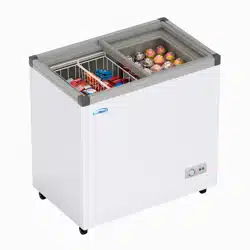
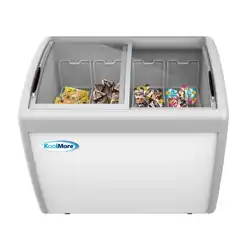
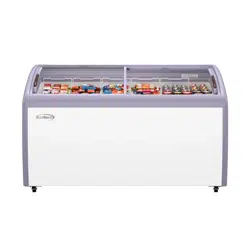
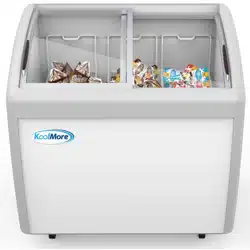
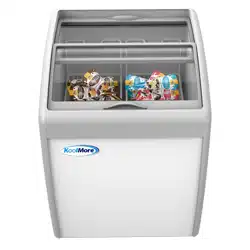
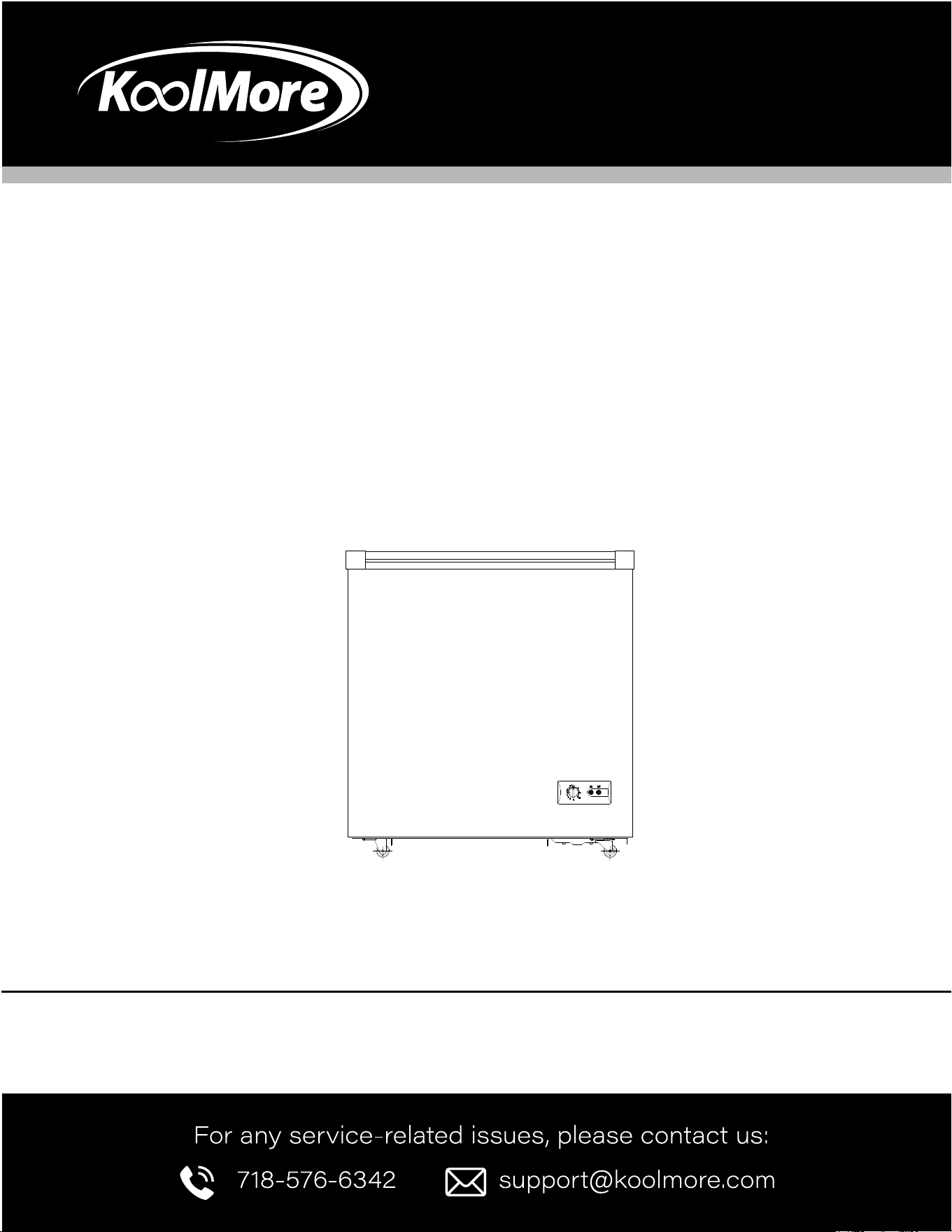
KoolMore Flat Top Ice Cream Display
Freezer
Model: KM-ICD-7C
DISPLAY FREEZER
Net dimension : 33.85*21.25*31.69
Packing dimension : 36.41*23.62*34.05

Stay informed with the latest information
for your KoolMore Appliance.
If you need any assistance or have questions, our customer
support team is here to help.
718-576-6342 suppor[email protected]

3
Contents
Safety ................................................................................. 4
Set-up ................................................................................ 7
Operation ........................................................................... 7
Maintanence ..................................................................... 8
Troubleshooting ................................................................ 9
Warranty .......................................................................... 10
4
Safety
! Caution:
1. Risk of re / ammable materials, taking care to avoid causing a re by igniting ammable
material.
2. Keep clear of obstruction all ventilation openings in the appliance enclosure or in the structure for
building-in.
3. Do not use mechanical devices or other means to accelerate the defrosting process, other than those
recommended by the manufacturer.
4. Do not damage the refrigerant circuit.
5. Do not use electrical appliances inside the food storage compartments of the appliance, unless they
are of the type recommended by the manufacturer.
6. The ambient temperature and humidity conditions of the cooler climate class following the tab below:
Note: Water vapor mass in dry air has been converted to grains per pound (1 g/kg ≈ 7 grains per pound).
Temperatures have been converted from Celsius to Fahrenheit using the formula: °F = (°C × 9/5) + 32.
The note regarding water vapor mass remains the same:
Note: The water vapor mass in dry air is one of the main points inuencing the performance and the energy consumption of the freezers.
Therefore, the order of the climate class in the table is based on the water vapor mass column.
Warning! Do not damage the cooling uid circuit
Warning! Do not damage walls of the machine: the cooling uid circuit may damage
Warning! Do not use electrical appliances inside the food storage compartments of the appliance, unless they are of the type recom-
mended by the manufacturer.
Warning! The equipment must not be used by persons (including children) whose physical, sensorial, or mental capacities are reduced,
or who lack experience and know-how, unless they have been provided, by means of a person responsible for their safety, with suitable
monitoring or instructions about the use of the equipment. Children must be monitored to ensure they do not play with the equipment.
Warning! Keep clear of obstruction all ventilation openings in the appliance enclosure or in the structure for building-in
Warning! The appliance shall be installed in accordance with national wiring regulations.
Warning! Do not use means to accelerate the defrosting process or to clean, other than those recommended by the manufacturer.
Warning! The appliance shall be stored in a well-ventilated area where the room size corresponds to the room area as specied for
Test Room
Climate Class
Dry Bulb
Temperature
(°F)
Relative
Humidity (%)
Dew Point (°F) Water Vapor Mass
in Dry Air (gr/lb)
0 68 50 48.7 51.1
1 60.8 80 54.7 63.7
2 71.6 50 50.5 57.2
3 73.4 60 59.4 75.6
4 77 65 63.3 83.9
5 80.6 75 70 110.6
5 104 40 75 131.7
5 104 75 86 191

5
operation.
Warning! The appliance shall be stored in a room without continuously operating open ames (for example an operating gas appliance)
and ignition sources (for example an operating electric heater).
• Do not pierce or burn.
• Be aware that refrigerants may not contain an odour.
Warning! The appliance shall be stored so as to prevent mechanical damage from occurring.
Warning! Do not store explosive substances such as aerosol cans with a ammable propellant in this appliance.
Notice! Any person who is involved with working on or breaking into a refrigerant circuit should hold a current valid certicate from an
industry-accredited assessment authority, which authorizes their competence to handle refrigerants safely in accordance with an indus-
try recognized assessment specication.
Notice! Servicing shall only be performed as recommended by the equipment manufacturer.
Maintenance and repair requiring the assistance of other skilled personnel shall be carried out under the supervision of the person com-
petent in the use of ammable refrigerants.
Notice! Component parts shall be replaced with like components so as to minimize the risk of possible ignition due to incorrect parts.
The appliance is to be installed in accordance with the SafetyNotice! Any person involved in working on or breaking into a refrigerant
circuit must hold a current, valid certicate from an industry-accredited assessment authority, authorizing their competence to handle
refrigerants safely in accordance with industry-recognized assessment specications.
• Servicing must only be performed as recommended by the equipment manufacturer. Maintenance and repairs that require addition-
al skilled personnel must be carried out under the supervision of someone competent in the use of ammable refrigerants.
• This appliance is not intended for use by persons (including children) with reduced physical, sensory, or mental capabilities, or a
lack of experience and knowledge unless supervised or instructed in its use by someone responsible for their safety.
• Children must be supervised to ensure they do not play with the appliance.
• Disposal of Appliance: Follow local regulations for disposal, particularly concerning the appliance’s ammable blowing gas. Before
scrapping the appliance, ensure the doors are removed to prevent children from becoming trapped inside.
• If the supply cord is damaged, it must be replaced by the manufacturer, its service agent, or a similarly qualied person to avoid any
hazards.
• This appliance is intended for use in household and similar applications such as:
• Staff kitchens in shops, oces, and other working environments.
• Farmhouses, hotels, motels, and other residential environments.
• Catering and similar non-retail applications.
• The appliance must not be installed in public corridors or lobbies.
• Installation should comply with the Safety Standard for Refrigeration Systems (ANSI/ASHRAE 15).
• Ensure that cabling is not exposed to wear, corrosion, excessive pressure, vibration, sharp edges, or other adverse environmental
effects. This check should also consider aging and continual vibration from sources like compressors or fans.
• Before starting the Decommissioning Procedure, technicians must be fully familiar with the equipment and its details. It is good
practice to recover all refrigerants safely. Before decommissioning, take an oil and refrigerant sample in case analysis is needed for
reusing the recovered refrigerant. Ensure electrical power is available before starting the task.
• During refrigerant removal for servicing or decommissioning, it is recommended to remove all refrigerants safely.
• The recovery equipment must be in good working condition with instructions available and suitable for recovering all applicable
refrigerants, including ammable refrigerants when necessary.
• Recovered refrigerants should be returned to the supplier in the proper recovery cylinder, with the relevant waste transfer note
arranged. Do not mix refrigerants in recovery units or cylinders.
• The maximum loading of each type of shelf is 8 kg.
• All maintenance staff and others working in the area should be informed about the nature of the work being carried out. Avoid
working in conned spaces.
• If any hot work is to be performed on the refrigeration equipment or related parts, suitable re extinguishing equipment must be
available. A dry chemical or CO2 re extinguisher should be nearby during charging activities.
No Ignition Sources: When working on any refrigerating system that involves exposing pipework, do not use any sources of ignition
that could lead to a risk of re or explosion. All possible ignition sources, including cigarette smoking, should be kept far away from the

6
installation, repair, removal, or disposal site, where refrigerant might be released into the surrounding space. Prior to beginning work,
ensure that the area around the equipment has no ammable hazards or ignition risks. Clearly display “No Smoking” signs.
Checking for Refrigerant Presence: Use an appropriate refrigerant detector to check the area before and during the work, ensuring that
the technician is aware of any potentially toxic or ammable atmospheres. The leak detection equipment used must be suitable for all
applicable refrigerants (e.g., spark-free, adequately sealed, or intrinsically safe).
Ensure Adequate Ventilation: Make sure the work area is in an open space or adequately ventilated before breaking into the system or
conducting any hot work. Ventilation must continue during the work to safely disperse any released refrigerant, preferably expelling it
externally into the atmosphere.
Changing Electrical Components: When replacing electrical components, ensure they are suitable for the purpose and meet the correct
specications. Always follow the manufacturer’s maintenance and service guidelines. If there is any doubt, consult the manufacturer’s
technical department for assistance.
Detection of Flammable Refrigerants: Never use potential sources of ignition when searching for or detecting refrigerant leaks. Devices
like halide torches (or any other ame-based detectors) must not be used under any circumstances.

7
Operation
Transportation and Placement:
Transporting the Freezer: When moving the chest freezer, the cabinet should not be inclined more
than 45 degrees to prevent damage to the compressor or the refrigeration system.
Remove Packaging: Before using the freezer, remove all packaging materials. Ensure the back of the
freezer is at least 6 inches away from the wall, and both sides should be more than 6 inches away
from any adjacent cabinet or wall for proper ventilation.
Location: Place the freezer in a well-ventilated, dry area. Avoid placing it in direct sunlight and keep it
away from water sinks, heat sources, and any volatile or corrosive substances.
Power Source and Test-Running:
Wire Capacity: The specied wire capacity is 7A with a wire section of 0.82mm². Single-line or com-
pound lines are acceptable. Install a 2.5A fuse for electric current protection. If the power cord is
damaged, replace it with one that matches the same specication (7A and 0.82mm²).
Power Supply Requirements: The freezer requires a single-phase power supply, 60Hz, with a voltage
range of 98-132V. If the voltage is unstable, a voltage stabilizer with a capacity of at least 1000W
should be installed.
Power Cycling: Avoid frequent power cycling. If the freezer is turned off, wait at least 5 minutes before
turning it on again to protect the compressor.
Long-Term Storage: If the freezer will not be used for an extended period, disconnect the power rst
and clean the unit. Ensure that the electrical circuit is checked before using the freezer again.
Operation of the Temperature Control Knob:
• The temperature inside the cabinet can be controlled by adjusting the temperature control knob.
• Normally, the knob should be kept in an upright position to regulate the temperature. Turning the
knob to the “FREEZING MAX/HI” position provides the strongest cooling and is suitable for fast
freezing. However, do not keep the knob in this position for extended periods.
Food Storage Guidelines:
• Ensure there is space between the stored food and the inner surfaces of the cabinet to allow for
proper ventilation of cold air and even freezing.
• Avoid storing bottled or canned beverages with a freezing point higher than the cabinet’s tempera-
ture if it is below zero.
• For moisture-sensitive foods or those that dry out quickly, wrap them in airtight food bags or plas-
tic lm to prevent odor transfer and reduce frost buildup.

8
• Do not store volatile or combustible gases and liquids, such as strong alkalis, strong acids, petrol,
etc., in the freezer.
• This equipment is designed exclusively for storing ice cream and other frozen desserts.
Maintenance Instructions:
• Clean the freezer regularly. Before cleaning, turn off the power, remove all food, and clean the inte-
rior with water or a small amount of neutral detergent.
• Do not use boiling water, acid, chemical solvents, petrol, oil, or abrasive cleaning powders.
• Ensure the freezer is dry after cleaning.
• For cleaning the door seal, use mild soapy water. After it dries naturally, apply a small amount of
talcum powder to extend its service life.
• Clean the external surfaces with a soft cloth using water or a small amount of detergent. Keep the
power supply, electrical cable, and plug away from water to avoid the risk of electric shock.
• Except for common minor issues, do not attempt to disassemble or repair the freezer yourself.
Unauthorized repair of electrical parts like the compressor or temperature controller is forbidden.
Defrosting Instructions:
• Defrost the freezer to improve eciency when the frost inside the cabinet reaches 4-5mm thick-
ness.
• To defrost, turn off the power, remove the frozen food, and leave the door open to allow the frost
to melt. Use a soft cloth to absorb and clean up the water.
• Do not use sharp metal tools like steel brushes to remove frost, as they may damage the evapora-
tor.
9
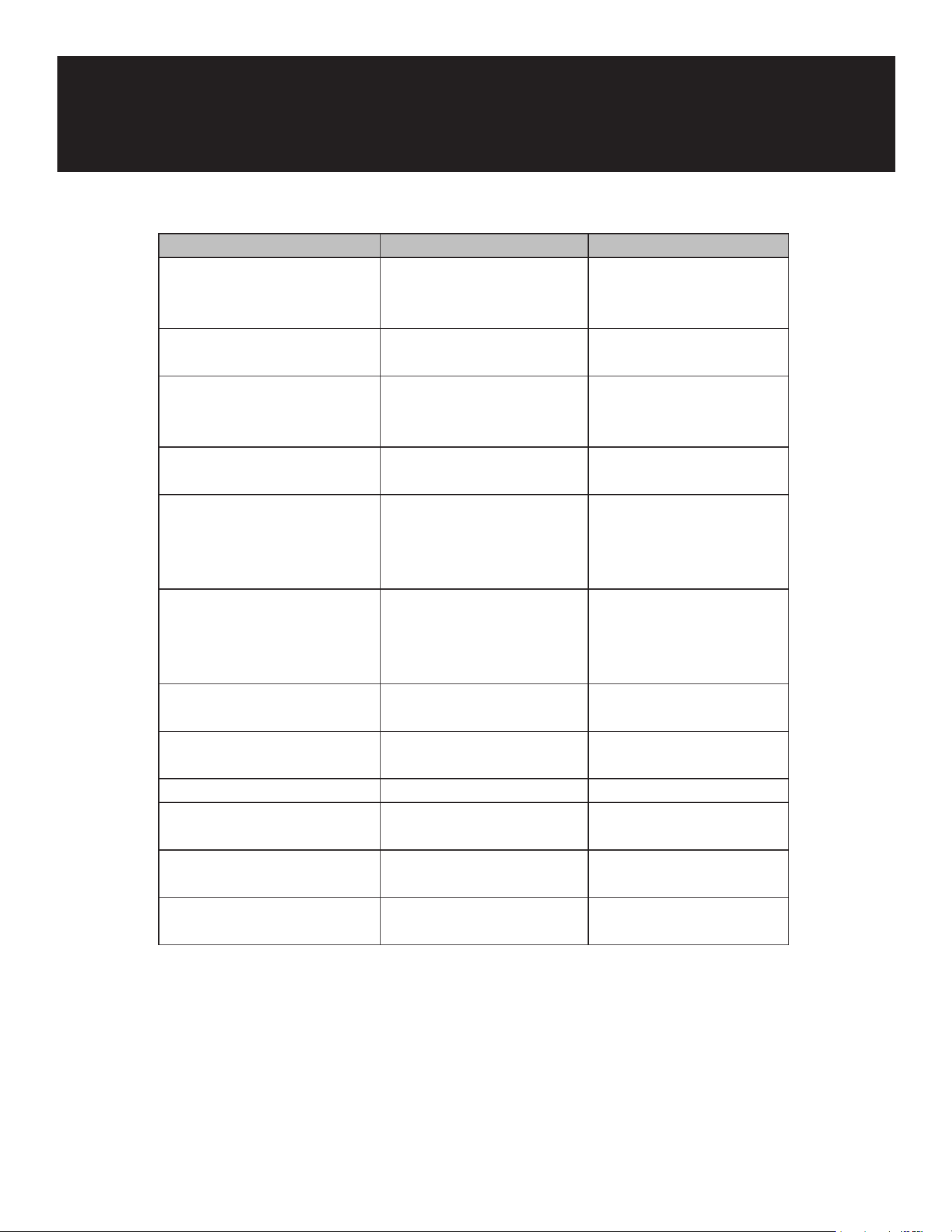
Troubleshooting
Issue Possible Problem Solution
The Indicator is not on. The
compressor does not start.
The plug is not connected
to the socket.
Plug it in.
No power. Connect the socket with
power.
The Indicator is on, but the
compressor does not work
and only buzzes.
The power voltage is ≤ 96V.Use a power-regulator
with more than 1000W
power together.
The power voltage is ≥
132V.
Reduce opening times.
The compressor stops a
minute after starting and
restarts after a few minutes,
repeatedly.
The door is opened too
frequently.
Reduce opening times.
The compressor works
normally, but the
temperature in the cabinet
lowers too slowly.
There is too much food in
the cabinet and it is placed
improperly.
Place foods properly and
keep space between them
for ventilation.
The frost lm is too thick. Take out foods and
defrost.
The surface of the
condenser is too dirty.
Stop and clean the
condenser.
The door does not seal. Adjust the door seal.
The noise is too loud. The freezer is not placed
on an even surface.
Place it on an even
surface.
The xing of the freezer is
loose.
Tighten the xing.
There is contact between
pipes.
Separate the pipes.
The following are not faults:
• When the freezer is operating or after it has stopped for a while, the refrigerant in the pipes cycles and produces a
"running water" sound. This is normal.
• The surface temperature of the compressor may reach up to 70°C to 80°C while it is functioning. This is not a fault.
• The back side of the freezer may feel hot during operation. This is typical and does not indicate a problem.
• During the rainy season, dew may form on the external surface of the cabinet. This is not a defect. Simply dry it with a
cloth.

10
WARRANTY
LIMITED WARRANTY
Koolmore Supply, Inc. extends a limited warranty to the original purchaser, guaranteeing that this Koolmore
product is free from manufacturing defects in material or workmanship for one year from the date of
purchase.
Should you discover any such defect within the warranty period, Koolmore Supply, Inc., reserves the right to
repair or replace the product without charge, or to cover the cost of replacement parts and repair labor needed
to correct defects present at the time of purchase or resulting from regular usage, when the appliance has been
installed, operated, and maintained as per the instructions provided.
At its sole discretion, Koolmore Supply Inc. may decide to replace the product. In such an event, your replace-
ment appliance will carry the warranty for the remaining term of the original unit's warranty period.
This warranty is valid exclusively to the original purchaser of the product and only applicable within the United
States. The warranty commences from the date of original consumer purchase. Proof of the original purchase
date will be required to obtain service under this warranty.
Under this limited warranty, your sole and exclusive remedy will be product repair, as outlined above. All
services must be provided by a Koolmore-designated service company.
To claim warranty or request repair service:
Email support@koolmore.com. Please include your name, address, phone number, warranty repair request,
and a copy of your proof of purchase receipt. Alternatively, visit koolmore.com and use the contact us page. A
Koolmore customer service representative will promptly arrange service for your appliance.
We thank you for choosing Koolmore.
WARRANTY EXCLUSIONS
This limited warranty will not cover:
1. Failure of the product to perform during power failures or interruptions,
or due to inadequate electrical service.
2. Damage incurred during transportation or handling.
3. Damage caused by accidents, vermin, lightning, winds, re, oods, or acts of God.
4. Damage resulting from accidents, alterations, misuse, abuse, improper installation, repair, or maintenance.
This includes using any external device that alters or converts the voltage or frequency of
electricity.
5. Unauthorized product modications, repairs by unauthorized centers, or use of non-approved
replacement parts.
6. Abnormal cleaning and maintenance not aligned with the user's manual.
7. Use of incompatible accessories or components.
8. Any costs associated with repairs or replacements under these excluded circumstances shall be the
responsibility of the consumer.