EU
User Manual
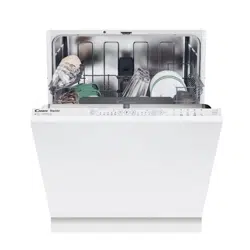
Dishwasher
EN
CFP 4D9F0W-80
CFP 4D9F0B-80

1
Content
EN
Safety and warnings
................................................................................................
...............................................................................................
...........................................................................................................
..............................................................................................................
.....................................................................................................................
.................................................................................................
..........................................................................................................
......................................................................................................................
...............................................................................................................
........................................................................................................
.....................................................................................................
............................................................................................................
.............................................................................................................
2
15
14
18
20
19
21
23
34
39
42
43
24
Product Description
Control Panel
Programme
First use
Loading suggestions
Setting a wash
..............................................................................................................
.........................................................................................
25
26
Preferences
Water softening system
Delayed start
Keylock
Maintenance
Troubleshooting
Fault codes
Standards Test
........................................................................................................
44
Technical Data
..................................................................................................................
28
Detergent
..................................................................................................................
30
Rinse aid
..................................................................................................................
31
Daily Use
6
.........................................................................................
Installation instructions
Safety and warnings
Read and save this guide
When using your Dishwasher, follow basic precautions, including the
following:
General
staff kitchen areas in shops, offices and other working environments
farm houses
by clients in hotels, motels and other residential environments
bed and breakfast environments.
Use only detergents or rinse aid recommended for use in a domestic dishwasher and keep
them out of reach of children. Check that the detergent dispenser is empty after the
completion of each wash program.
When loading items to be washed, locate sharp items so that they are not likely to damage
the Dishwasher and load sharp knives with the handle up to reduce the risk of cut injuries.
Do not touch the filter plate in the Dishwasher base during or immediately after use,
as it may be hot.
Do not operate your Dishwasher unless all enclosure panels are properly in place.
Do not tamper with the controls.
Do not abuse, sit on, stand in or on the door or dish rack of the Dishwasher.
The door should not be left in the open position since this could present a tripping hazard.
The information in this guide must be followed to minimise the risk of fire or explosionor
to prevent property damage, personal injury or loss of life.
Use the Dishwasher only for its intended function as described in this guide.
This appliance is intended to be used in household and similar applications such as:
2
Intended Use
The appliance is designed for domestic use inside the house,or in similar applications such
as staff kitchen areas in working environments, farm houses, by clients in hotels, motels or
other residential environments, and bed and breakfast environments.It is not intended for
commercial or industrial use. Do not use it for purposes other than that for which it was
designed.
Changes or modifications to the device are not allowed. Unintended use may cause hazards
and loss of warranty claims.
Standards and Directives
This product meets the requirements of all applicable EC directives with the corresponding
harmonised standards, which provide for CE marking.
EN
Do
not lean on or use the foldaway cup racks to support your body weight.
To reduce the risk of injury, do not allow children to play in or on the Dishwasher.
Under certain conditions, hydrogen gas may be produced in a hot water heater system
that has not been used for two weeks or more. HYDROGEN GAS IS EXPLOSIVE. If the
hot water system has not been used for such a period, before using the Dishwasher,
turn on all hot water taps and let the water flow from each for several minutes. This will
release any accumulated hydrogen gas. As the gas is flammable, do not smoke or use
an open flame during this time.
Remove the door to the washing compartment when removing an old Dishwasher from
service or discarding it.
Some dishwasher detergents are strongly alkaline. They can be extremely dangerous
if swallowed. Avoid contact with the skin and eyes and keep children away from the
Dishwasher when the door is open.
Safety and warnings
The Dishwasher must be used with the filter plate, filter, and spray arms in place. To
identify what these parts are refer to 'Maintenance'.
If the Dishwasher is not being used for long periods of time, turn the electricity and water
supply off.
Cleaning and maintenance shall not be done by children without supervision.
Take care not to load dishware items so they prevent the door from closing.
Household appliances are not intended to be used by children. Children of less than
8 years old must be kept away from the appliance unless continuously supervised. This
appliance can be used by children aged from 8 yea
rs and above, and persons with
reduced physical, sensory or mental capabilities or lack of experience and knowledge, if
they have been given supervision or instruction concerning the use of the appliance in a
safe way and they understand the hazards involved. Children being supervised not to play
with the appliance.
If a dishwasher cleaner is used, we recommend running a wash program with detergent
immediately afterward to prevent any damage.
The Dishwasher is designed f
or washing normal household utensils. Items that are
contaminated by petrol, paint, steel, iron debris, corrosive, acidic or alkaline chemicals
are not to be washed in the Dishwasher.
Do not wash plastic items unless they are marked dishwasher safe or equivalent. For
plastic items not marked, check the manufacturer’s recommendations.
Avoid washing containers with glued on labels. Labels removed during a wash cycle may
cause damage to the wash system
3
EN
This Dishwasher must be installed and located in accordance with the Installation
instructions before it is used. If you did not receive Installation instructions with your
Dishwasher, you can order them by calling your Authorised Repairer or download them
from our local Haier website, listed on the back cover.
Installation and service must be performed by a Haier trained and supported service
technician.
If the power supply cord is damaged, it must be replaced by a Haier trained and supported
service technician or a qualified trades person in order to avoid a hazard.
Ensure the Dishwasher is secured to adjacent cabinetry using the brackets provided.
Failure to do so may result in an unstable product, which may cause damage or injury.
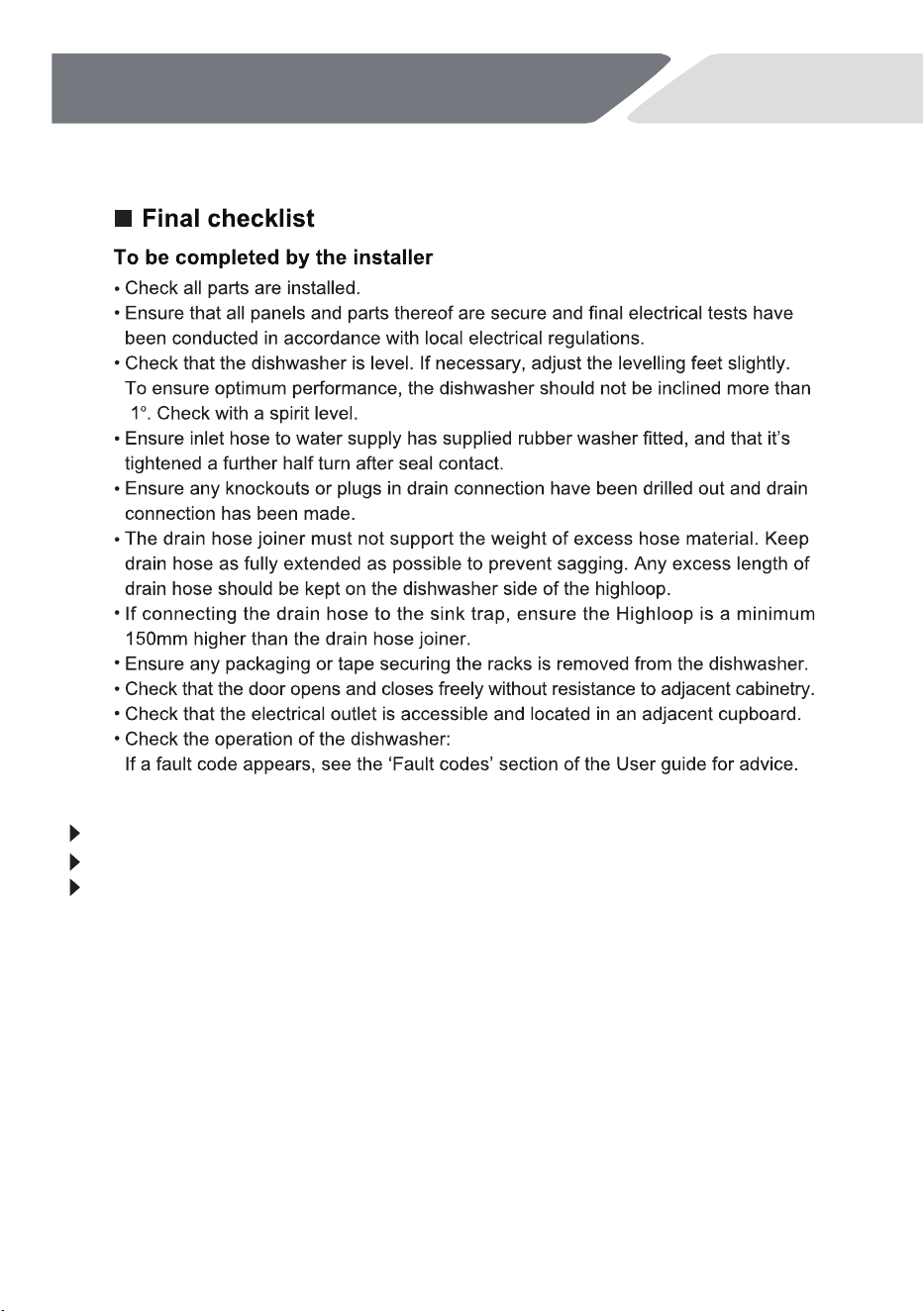
Do not operate this appliance if it is damaged, malfunctioning, partially disassembled
or has missing or broken parts, including a damaged power supply cord or plug.
Do not store or use petrol, or other flammable vapours and liquids in the vicinity of the
Dishwasher.
Connect to a properly rated, protected and sized power supply circuit to avoid electrical
overload.
Ensure the power supply cord is located so that it will not be stepped on, tripped over
or otherwise subject to damage or stress.
Do not install or store the Dishwasher where it will be exposed to temperatures below
freezing or exposed to weather.
Do not use an extension cord or a portable electrical outlet device (e.g. multi-socket
outlet box) to connect the Dishwasher to the power supply.
This appliance must be grounded. In the event of a malfunction or breakdown, grounding
will reduce the risk of electric shock by providing a path of least resistance
for electric current.
This appliance i
s equipped with a cord having an equipment-grounding conductor and
a grounding plug. The plug must be plugged into an appropriate outlet that is installed
and grounded in accordance with all local codes and ordinances. Improper connection
of the equipment-grounding conductor can result in a risk of electric shock. Check with
a qualified electrician or Haier trained and supported service technician if you are in doubt
as to whether the appliance is properly grounded.
Do not modify the plug provided with the appliance; if it will not fit the outlet, contact
a Haier trained and supported service technician or qualified electrician.
If the Dishwasher is installed as a permanently connected appliance, this appliance must
be connected to a grounded metal, permanent wiring system, or an equipmentgrounding
conductor must be run with the circuit conductors and connected to the equipment-grounding
terminal or lead on the appliance.
Safety and warnings
Installation
4
EN

Maintenance
Disconnect the appliance from the power supply before any cleaning or maintenance.
When disconnecting the appliance pull the plug rather than the power supply cord or
junction of cord to avoid damage.
Do not repair or replace any part of the appliance or attempt any servicing unless
specifically recommended in this guide. We recommend contacting a Haier trained and
supported service technician or Customer Care.
Keep the floor around your appliance clean and dry to reduce the possibility of slipping.
Keep the area around/underneath your appliance free from the accumulation of
combustible materials, such as lint, paper, rags and chemicals.
Safety and warnings
5
EN
Installation instructions
6
EN
WARNING!
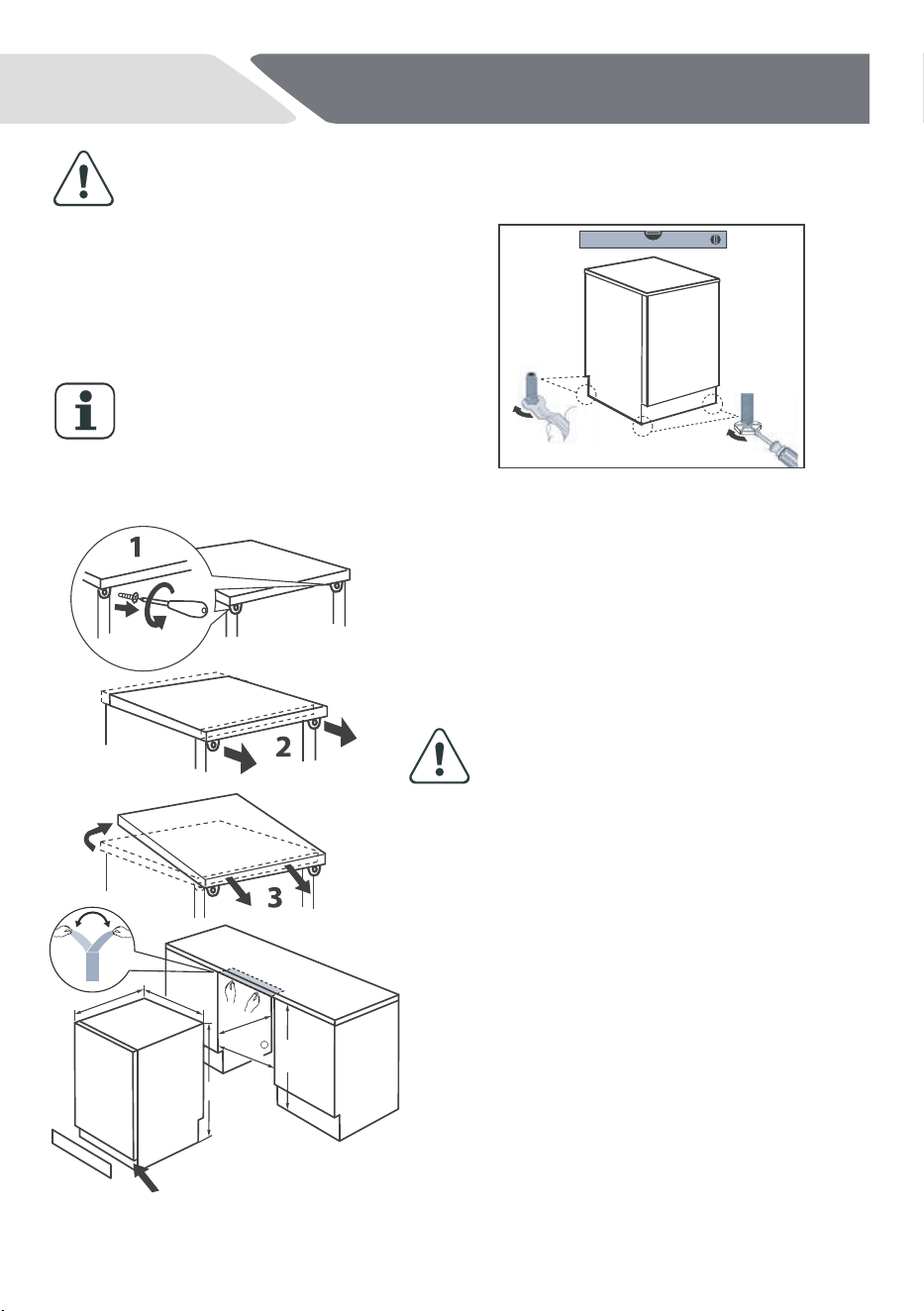
Free Standing Installation
Install the appliance on solid ground.
Adjust all feet accurately to get a firm,
horizontal position.
Only with a correct level the
appliance door closes and seals
correctly.
Installation under Worktop
5. The dimensions of the recess should
at least agree with the dimensions in
the figure.
7. Put
6.
After installation, the minmum gap
between the side panel and the
cupboard is 1mm, and the minmum
gap between the rear and the cupboard
is 10mm. The top gap is controlled
by adjusting the feet.
the appliance adjacent to the
slot. Make sure that all connections
(water, drain water, power) are neatly
positioned and connected.
1.
2.
4.
Install the appliance carefully into
the recess.
3.
Stick the water-proof sticker on the
bottom of the countertop.
WARNING!
If used as free standing appli-
ance again, the worktop must be
remounted.
598
min580
570
820
min822
min600
Any installation may be carried out only by a qualified technician
refer to section SAFETY.
Optional:Remove the worktop of
the appliance.
Adjustall feet to get a
firm level position.
Cotton bottom felt need to be
added as shown in figure A to
ensure the noise effect
8.
A
accurately
Installation instructions
7
EN
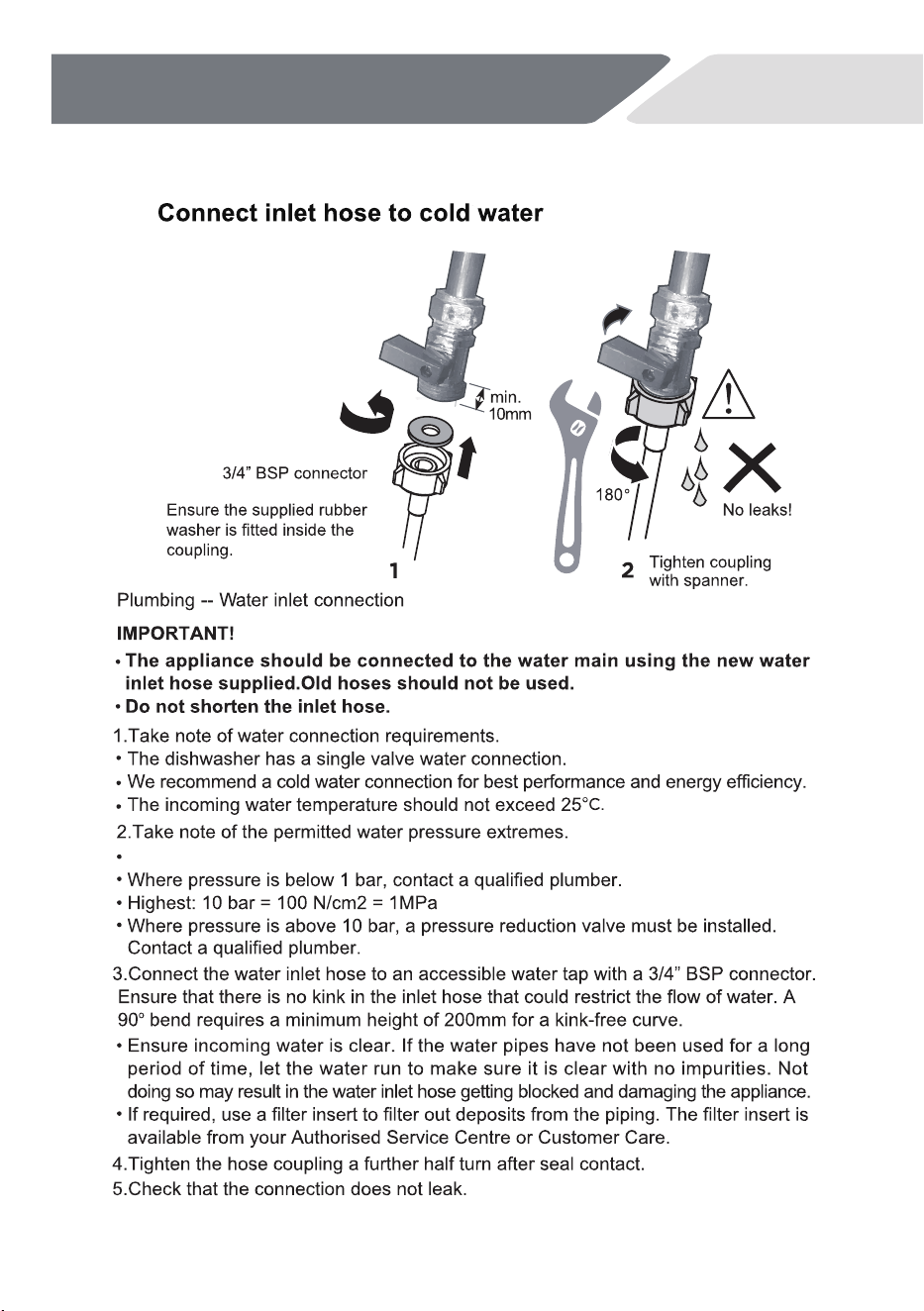
Fresh Water Connection
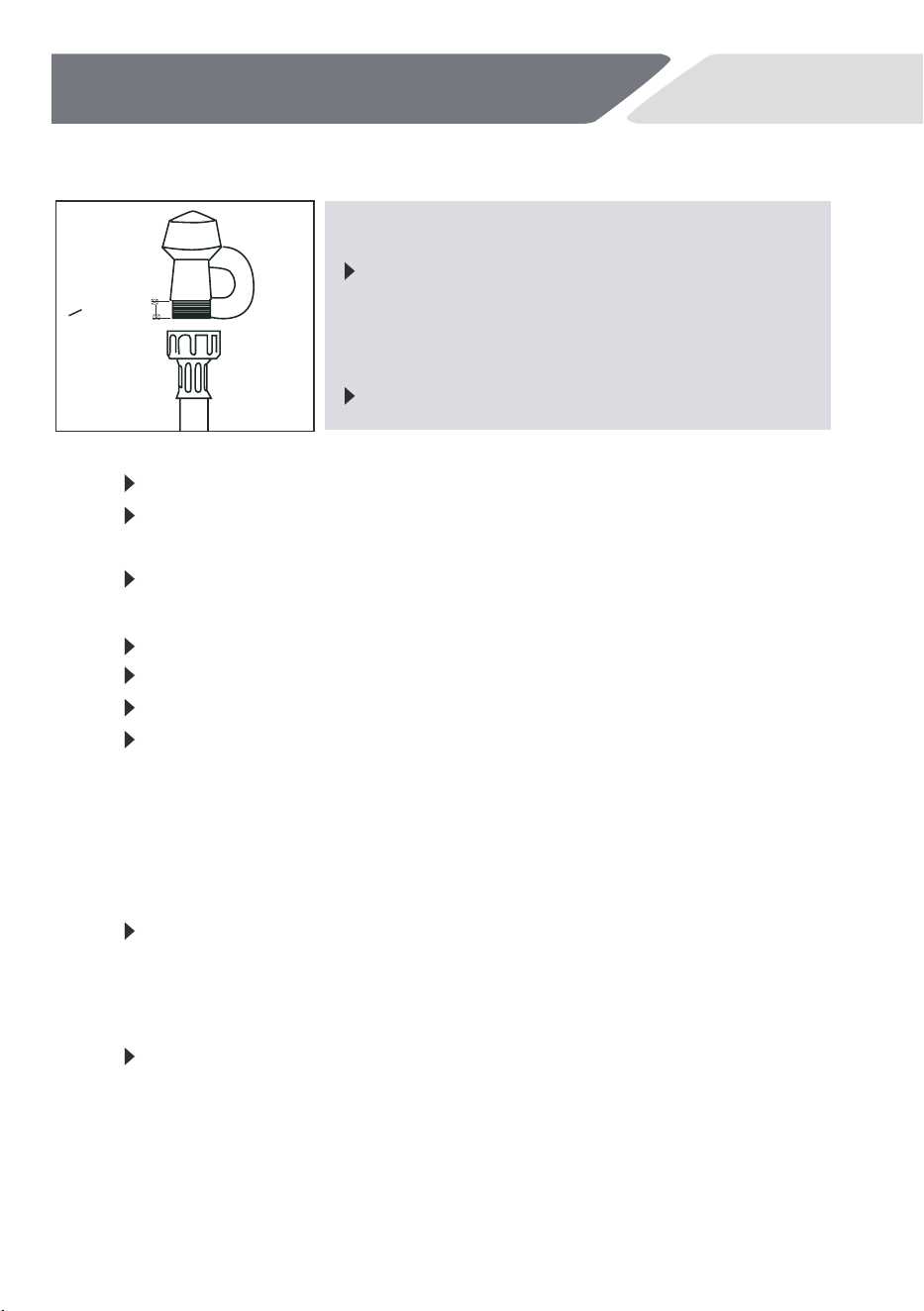
fig.A
>10mm
The appliance should be connected to
the water main using the new water
inlet hose supplied. Old hoses should
not be used.
Do not shorten the inlet hose.
IMPORTANT!
25°C.
1. Take note of water connection requirements.
The dishwasher has a single valve water connection.
We recommend a cold water connection for best performance
and energy efficiency.
The incoming water temperature should not exceed
2. Take note of the permitted water pressure extremes.
Lowest: 0.3 bar = 3 N/cm = 0.03MPa
Where pressure is below 1 bar, contact a qualified plumber.
Highest: 10 bar = 100 N/cm = 1MPa
Where pressure is above 10 bar, a pressure reduction valve
must be installed. Contact a qualified plumber.
2
2
3. Connect the water inlet hose to an accessible water tap with
a 3/4” BSP connector (see fig.A). Ensure that there is no kink in
the inlet hose that could restrict the flow of water. A 90° bend
requires a minimum height of 200 mm for a kink-free curve.
Ensure incoming water is clear. If the water pipes have not
been used for a long period of time, let the water run to make
sure it is clear with no impurities. Not doing so may result in
the water inlet hose getting blocked and damaging the appliance.
If required, use a filter insert to filter out deposits from the
piping. The filter insert is available from your Authorised
Service Centre or Customer Care.
4. Tighten the hose coupling a further half turn after seal contact.
5. Check that the connection does not leak.
Installation instructions
8
EN
Drain Water Connection
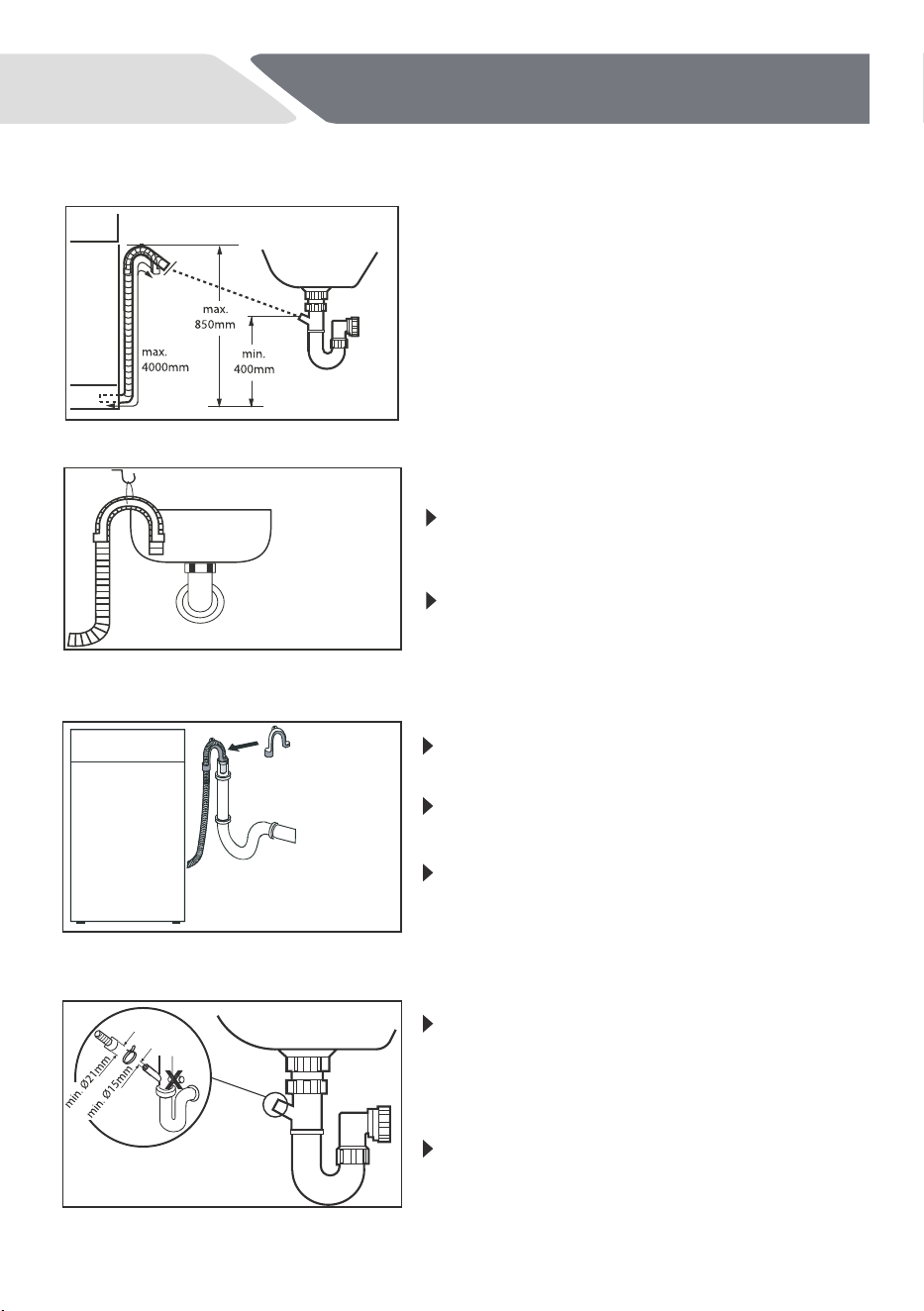
Fix the water drain hose properly to
Following connections are possible:
Drain hose to sink
the piping.The hose has to reach at one
point a height between 400 and 850 mm
above the appliance bottom line.
An extension hose for the water drain
hose must not exceed a total length of 4
m and must have the same diameter as
the water drain hose.
Hang the drain hose with the
U-support over the edge of a sink
with adequate size.
Protect the U-support sufficiently
against slipping.
Drain hose to waste water connection
Drain hose to sink connection
When connecting the drain hose to a
sink trap with a drain hose spigot, make
sure that the drain hose is supported
to the height of the bench.
Ensure the drain spigot has a minimum
hole diameter of 15 mm and it has been
drilled out.
The internal diameter of the stand pipe
with vent-hole must be minimum 40 mm.
Put the drain hose for approx.80 mm
in the wastewater pipe.
Attach the U-support and secure it
sufficiently.
Installation instructions
9
EN
CAUTION!
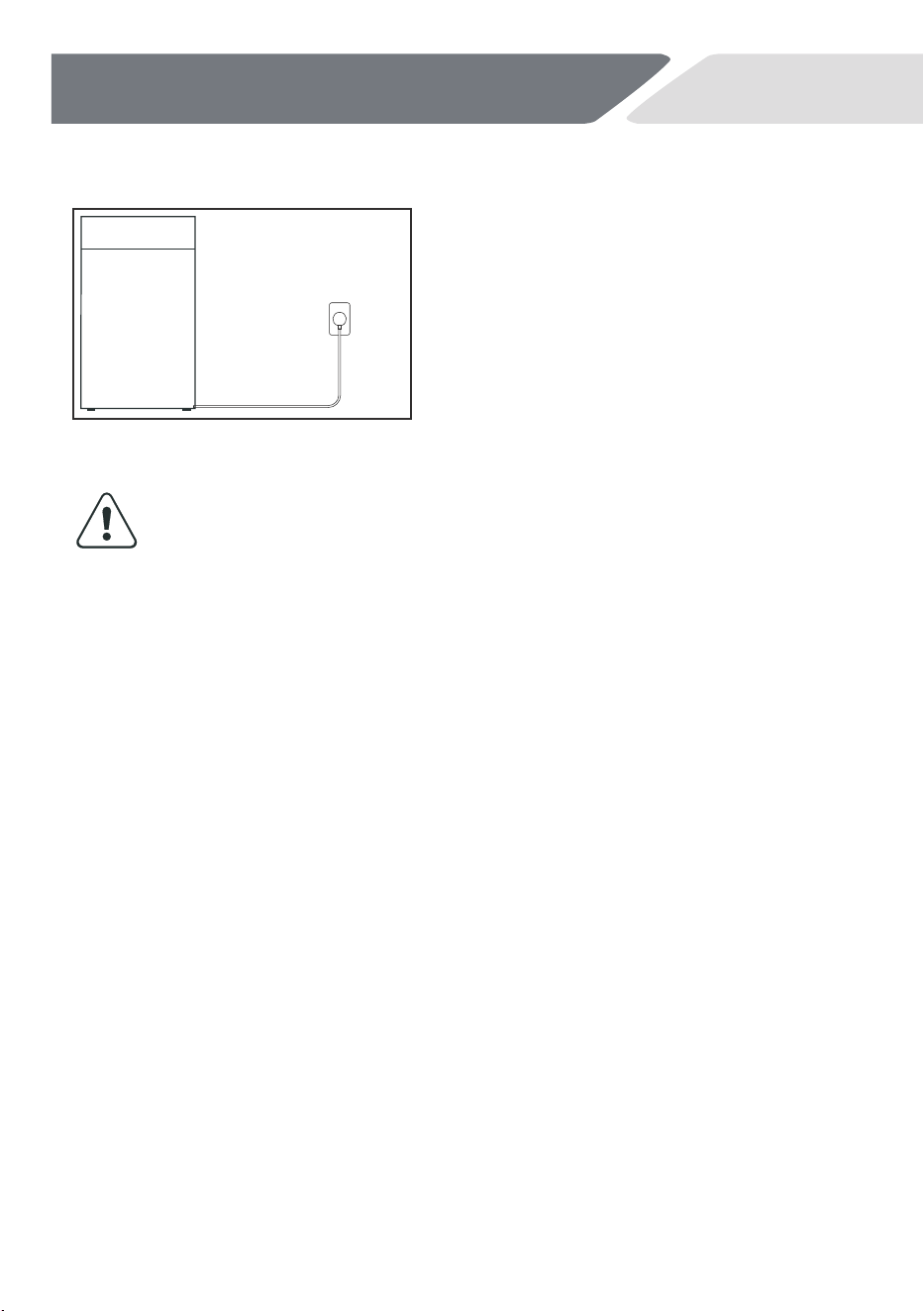
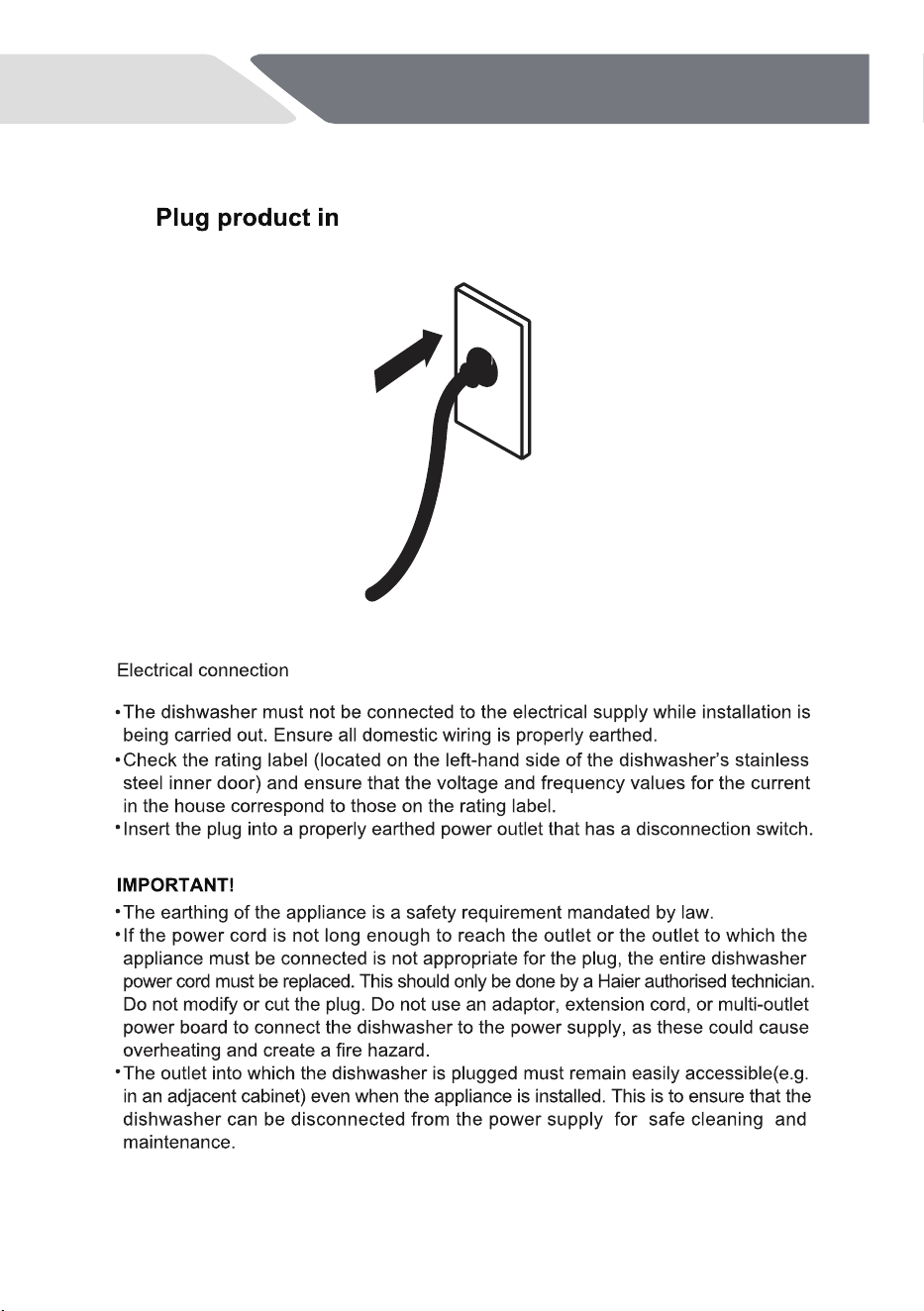
Power connection
Always ensure that all connections (power supply, drain and fresh
water hose) are firm, dry and leak free.
Take care thate these parts are never to be crushed, kinked, or twisted
If the supply cord is damaged, it must be replaced by the manufa-
cturer,its service agent or similarly qualified persons in order to
avoid a hazard.
As shown in the figure, the power supply
is plugged into an externally accessible
place through the service hole for easy
plugging.
Installation instructions
10
EN
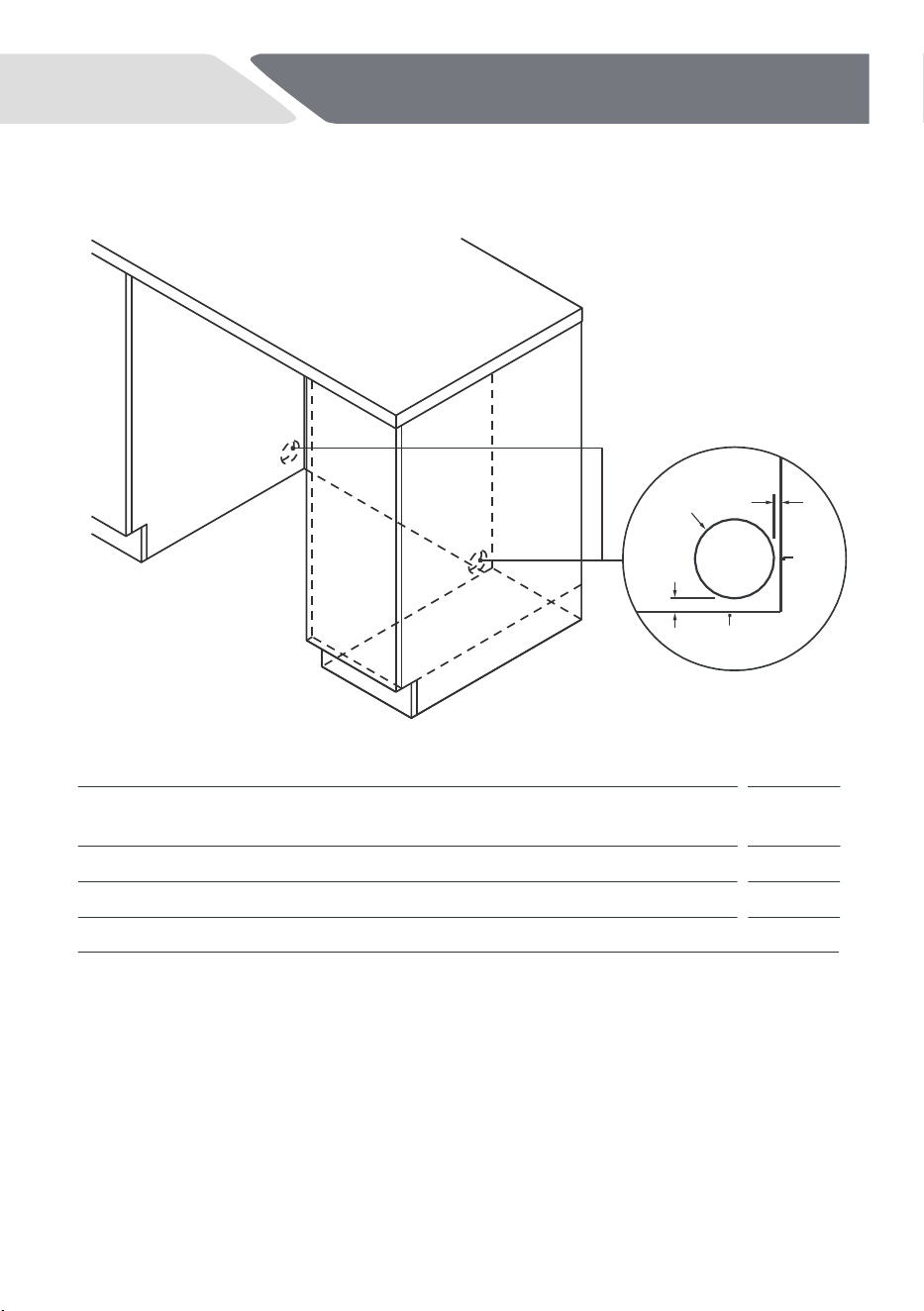
Service hole
C
A
REAR
WALL
B
FLOOR
PROFILE
Service hole dimensions mm
A
B
C
Minimum diameter of service hole
15
50
70
Maximum distance between rear of cavity and service hole*
Maximum distance between floor and service hole**
*
based on a cabinetry depth of 580mm.
**
depending on adjustment of levelling feet.
Lowest: 0.3 bar = 3 N/cm2 = 0.03MPa
Installation instructions
11
EN
Installation instructions
12
EN
Installation instructions
13
EN
Ensure the installer has completed the ‘Final checklist’ in the Installation instructions.
Read this guide, taking special note of the 'Safety and warnings' section.
Remove all internal and external packaging and dispose of it responsibly. Recycle items
that you can.
Product Description
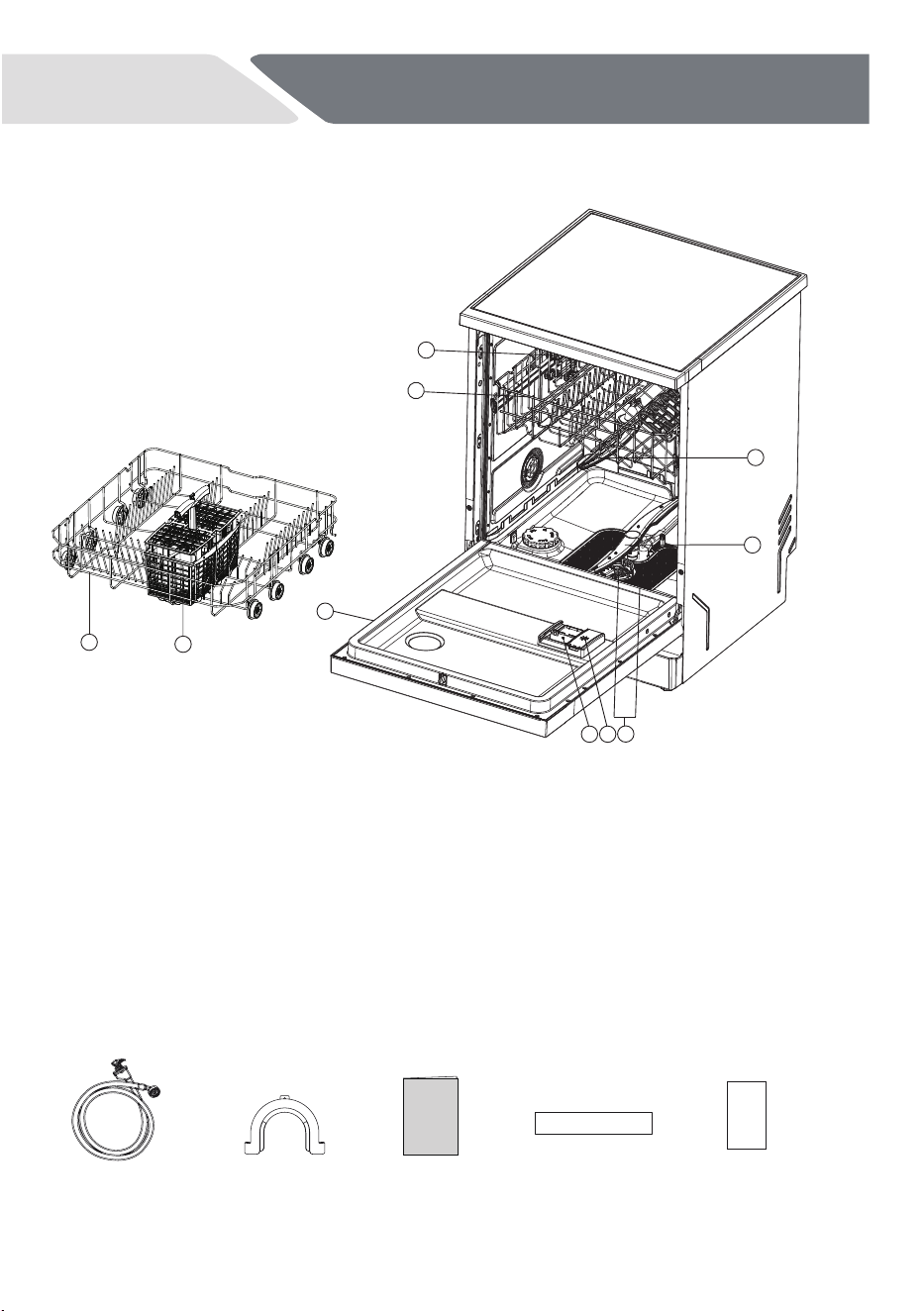
Dishwasher overview
14
1.
2.
Lower spray arm
Upper spray arm
3.
Filte
4.
Rinse aid dispenser
5.
Detergent dispenser
6.
Rating label
7.
8.
Cutlery/Utensil basket
9.
Upper basket
Lower basket
10.
Top spray arm
EN
1
2
3
45
6
7
8
9
1
10
Accessories
Check the accessories and literature in accordance with this list:
U-support(1)
water inlet hose(1)
User manual(1)
water-proof
sticker(1)
energy labels(2)
Safety guide(1)
Warranty card(1)
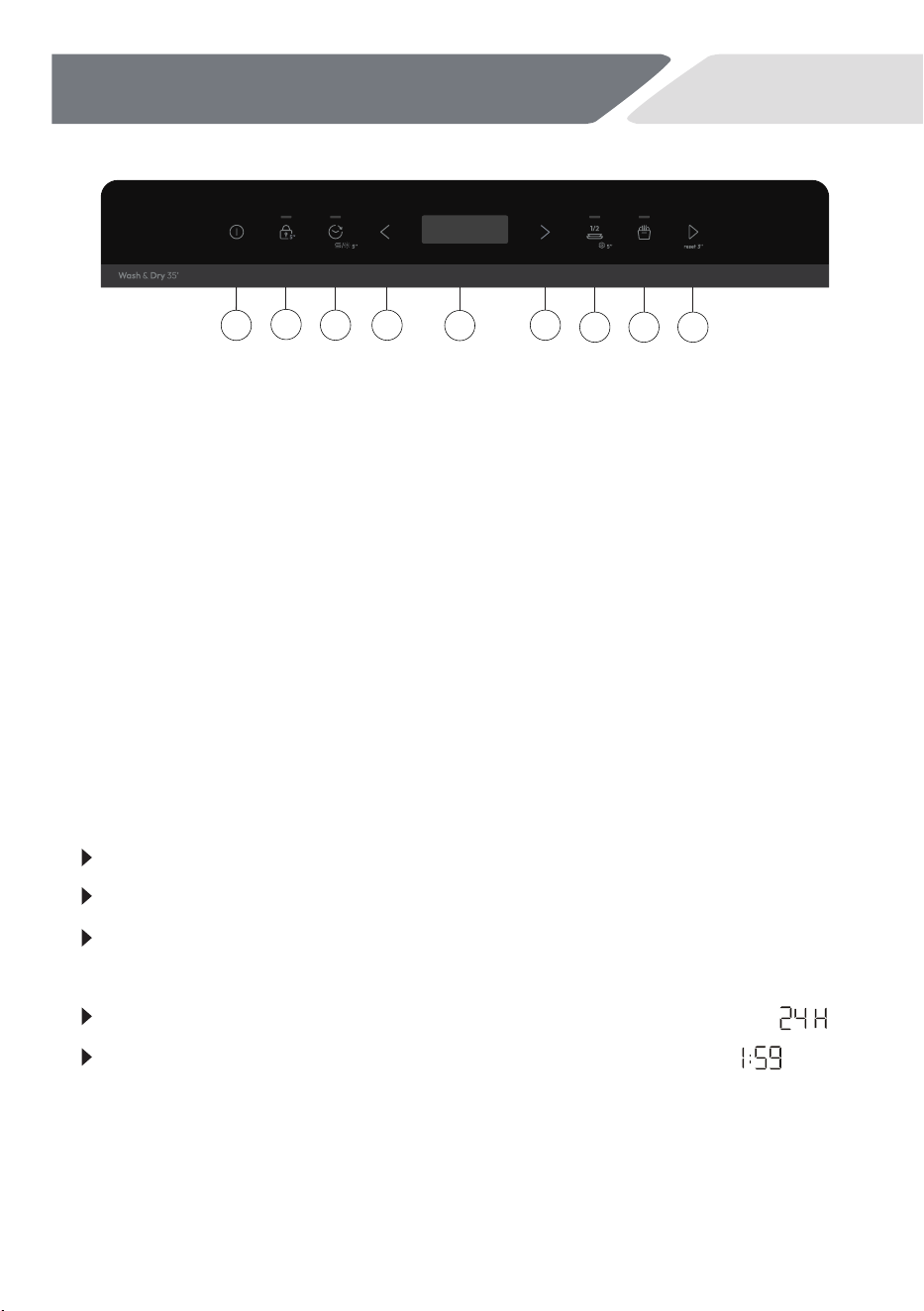
1. ON/OFF icon
2.
3. Delay indicator icon
Child Lock
4. Programme select icon
5.Time&Info Display/Indicator icon
6.Half load indicator icon
7. Auto Door indicator icon
8. START/RESET icon
Time & Info display
During any selection the display shows related information like
Programme cycle time
Programme start delay time
Error codes
After start of an operation it dispalys without flashing
Remaining time in hours of a delayed programme starts, e.g.
Remaining programme cycle time in hours + minutes, e.g.
While running it may vary due to local conditions and daily working load.
Control Panel
5
1
3
4 4
6 7 8
15
EN
2
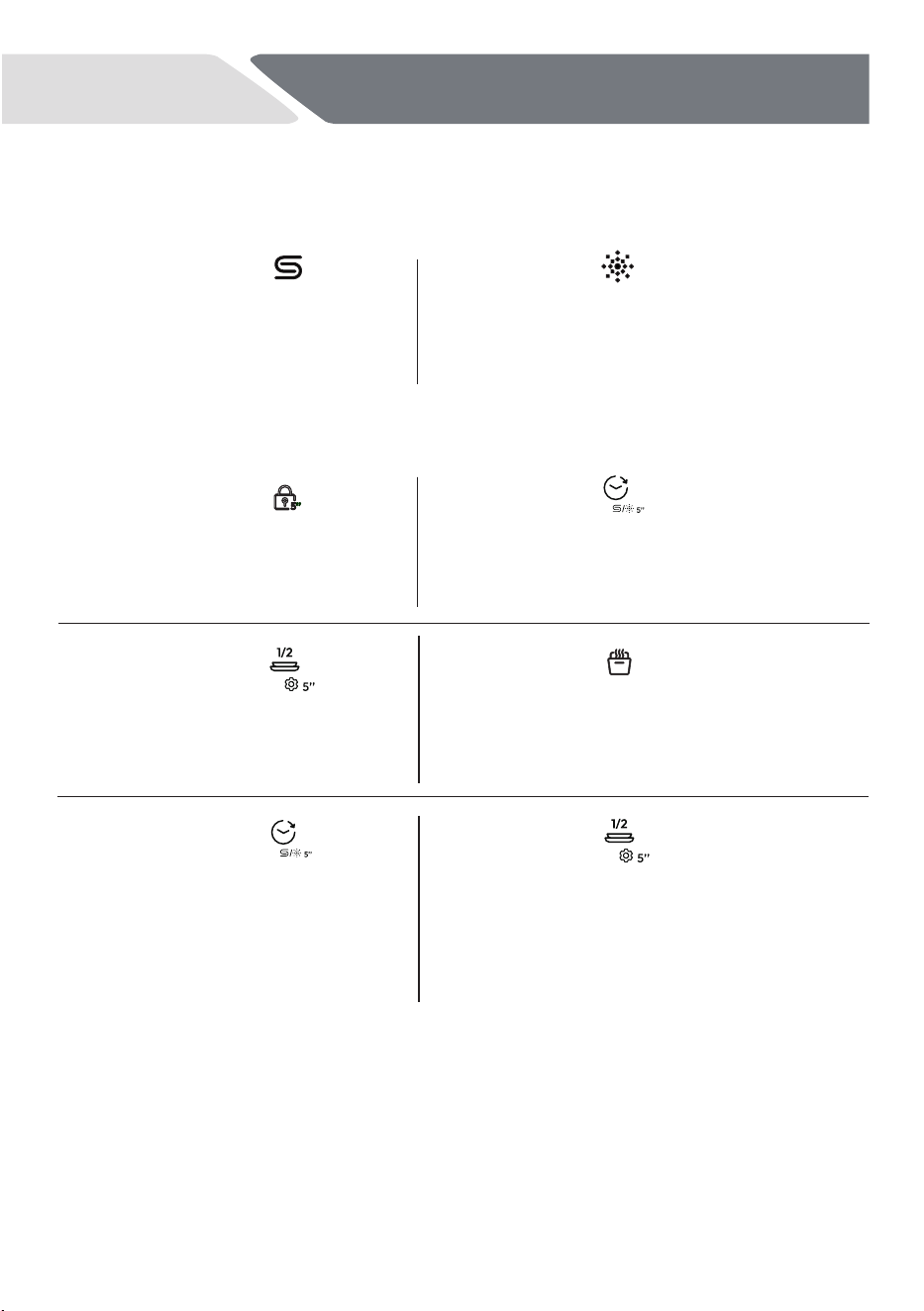
Indicator Icon
Options description
Control Panel
Rinse aid
If the indicator lights up: Rinse is empty.
Need to add rinse aid.
Salt aid
If the indicator lights up: Salt is empty.
Need to add salt.
Half load
Adjusts the wash program to more
efficiently wash smaller loads.
Smart Door
Automatically open the door a few centimeters to
allow air to circulate. Improve drying effect.
Delay
You can delay the start of a programme up to 24
hours.
Tabs
Hold down the icon for 5 seconds to activate the
user setting mode. Then you can activate the
Tabs function. This option allows you to optimize
the performance of the program by simply
choosing the type of detergent you want to use.
Reset
Hold down the icon for 5 seconds
to reset the salt or rinse indicator
light.
16
Child Lock
Hold down the icon for 5 seconds
to lock or unlock the option of
other icons.
EN
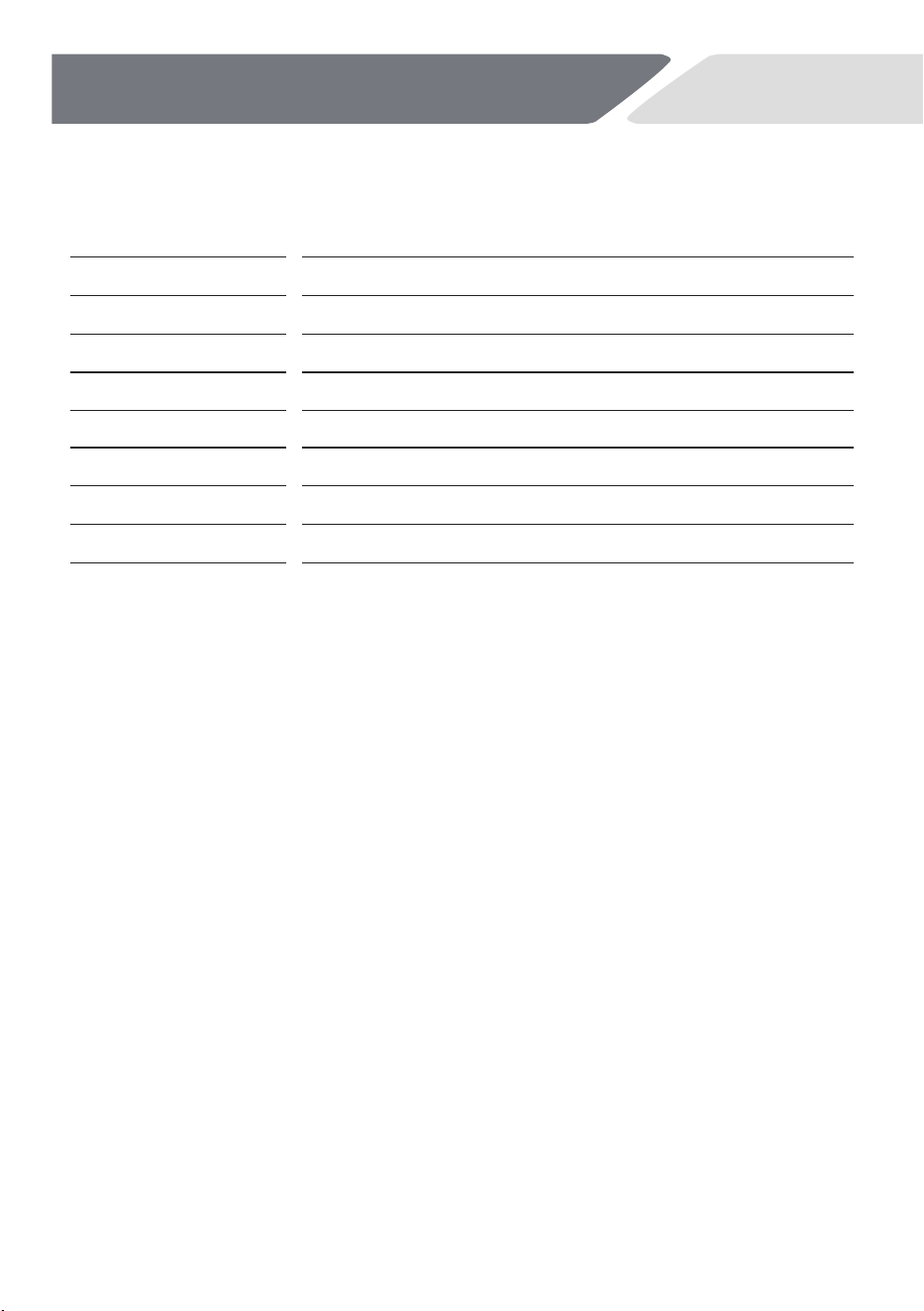
WASH PROGRAM
Smart Door,Half load
Smart Door,Half load
Smart Door,Half load
WASH&DRY 35’
ECO
59’MIN
GLASS
PREWASH
Additional function
Control Panel
The main program matched with the optional function.
17
Smart Door,Half load
Smart Door,Half load
INTENSIVE
UNIVERSAL
EN
Smart Door,Half load
-
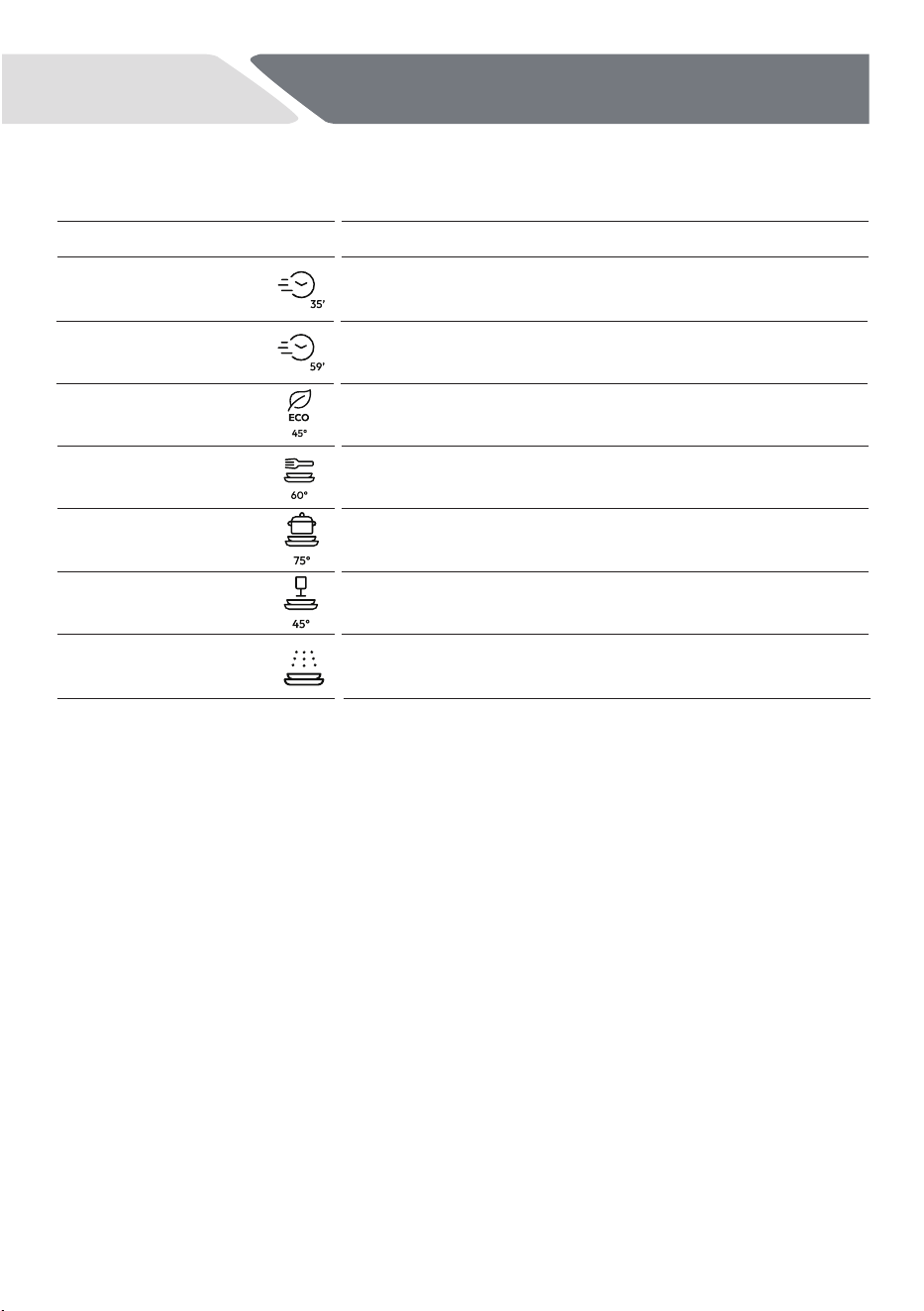
1). Use this programme to quickly rinse the dishes. This prevents the remaining food to
bond on the dishes and bad odours to come out from the appliance. Do not use
detergent with this programme.
1)
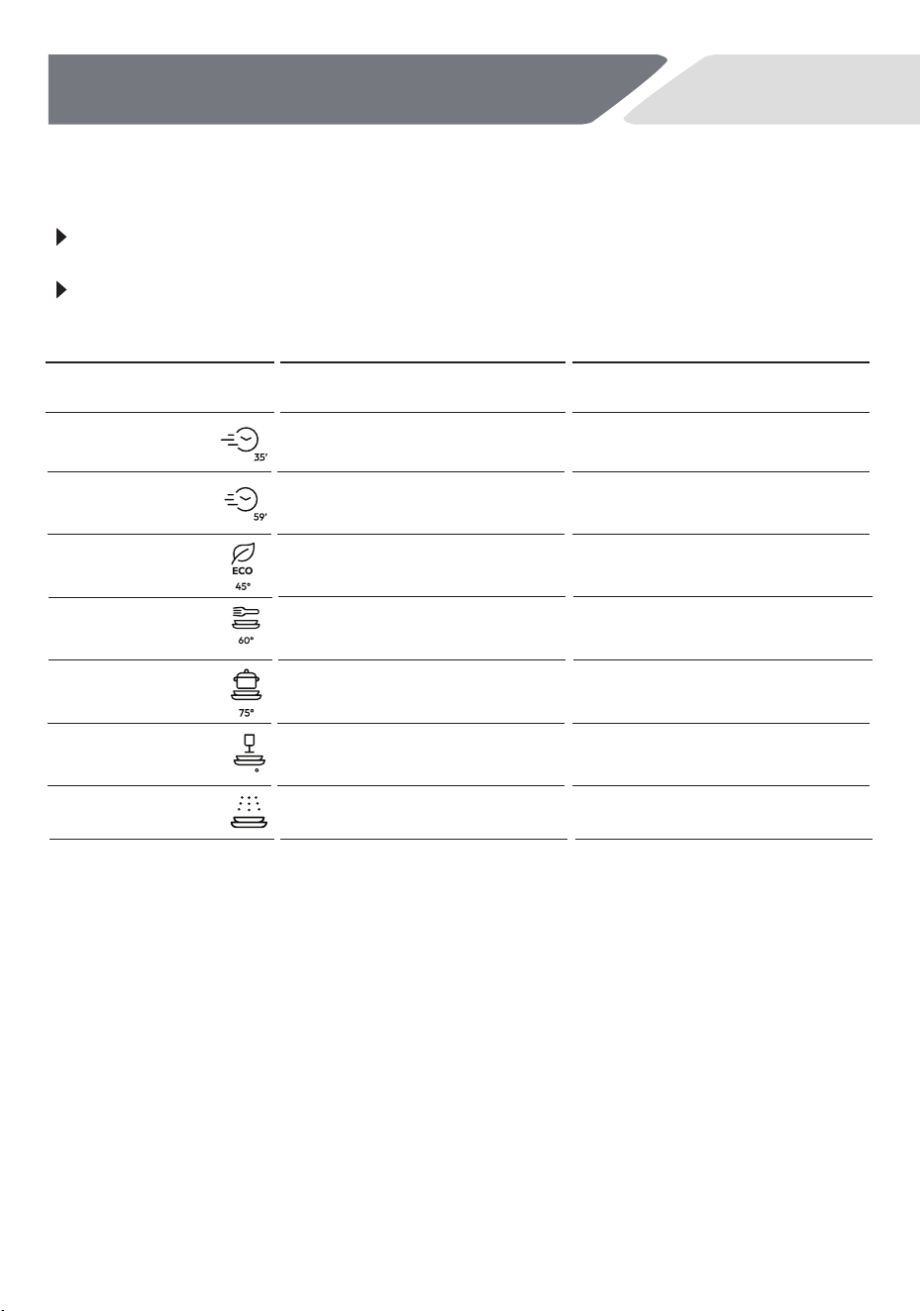
Wash program Program description
Your dishwasher has a number of wash programs designed to suit your needs. Selecting the
most appropriate cycle for each load will help ensure the best wash results.
Programme
P5 INTENSIVE
P6 GLASS
P7 PREWASH
P3 ECO
For normally soiled dishes for optimum water and energy
usage
Prevents odours and soils from dishes
Light soil:Coffee, cake, milk, cold drinks, salad, sausages
18
P4 UNIVERSAL
Best for dishes that are quite heavily soiled or to remove
food soils that have been left to dry overnight
P1 WASH&DRY 35’
Fast soil:Casseroles, sauces, potatoes,pasta, rice,
roasted or fried food
P2 59MIN
Use for dishes that are quite heavily soiled or food soils
that have been left to dry overnight
Designed for heavily soiled pots, pans and dishes
EN

Cutlery & silverware
Rinse cutlery and silverware immediately
after use to prevent tarnishing. Silver
should not come into contact with stainless
steel, mixing these can cause staining.
Remove silver cutlery from the dishwasher
and hand dry immediately.
Aluminium
Aluminium can be dulled by detergent.
The degree of change depends on the
quality of the detergent or aluminium.
Other metals
Iron and cast iron can rust and stain other
items. Copper, pewter and brass tend
to stain.
Woodware
Woodware is generally sensitive to heat
and water. Regular use in the dishwasher
may cause deterioration over time.
Dishware
The combination of high temperatures and dishwasher detergent may cause damage to
some items. Refer to the manufacturer's guidance or wash by hand if in doubt.
Glassware
Most glassware is dishwasher safe. Crystal,
very fine and antique glassware may etch
and develop a cloudy appearance.
Plastics
Some plastics may change shape or
colour with hot water. Refer to the
manufacturer’s guide. Dishwasher safe
plastic should be w
eighed down so it
does not flip and fill with water or fall
through the base rack during the wash.
Water hardness
Hard water is water with a high concentration of minerals such as calcium and magnesium.
It can be detrimental to the performance of your dishwasher and parts can fail over time.
Glassware washed in hard water will become cloudy over time and dishes will become
spotted or covered in a white film. Water hardness varies by geographical location.
If you live in a hard water area, we recommend f
itting a water softener to the household
water supply.
If your home has hard water
Refer to 'Powdered detergent quantity recommendations'.
Use rinse aid. We recommend you raise the rinse aid setting to help improve wash
performance. Refer to 'Preferences' for details.
Use a dishwasher cleaner/descaler regularly, or whenever you notice a build-up of limescale
deposits in your dishwasher.
If your home has soft or softened water
Avoid using too much detergent.
Glued items
Certain adhesives are softened or
dissolved in machine washing.
Decorated items
Most modern china patt erns are
dishwasher safe. Antique items, those with
a pattern painted over the glaze, gold
rims or hand painted china may be more
sensitive to machine washing.
First use
19
EN
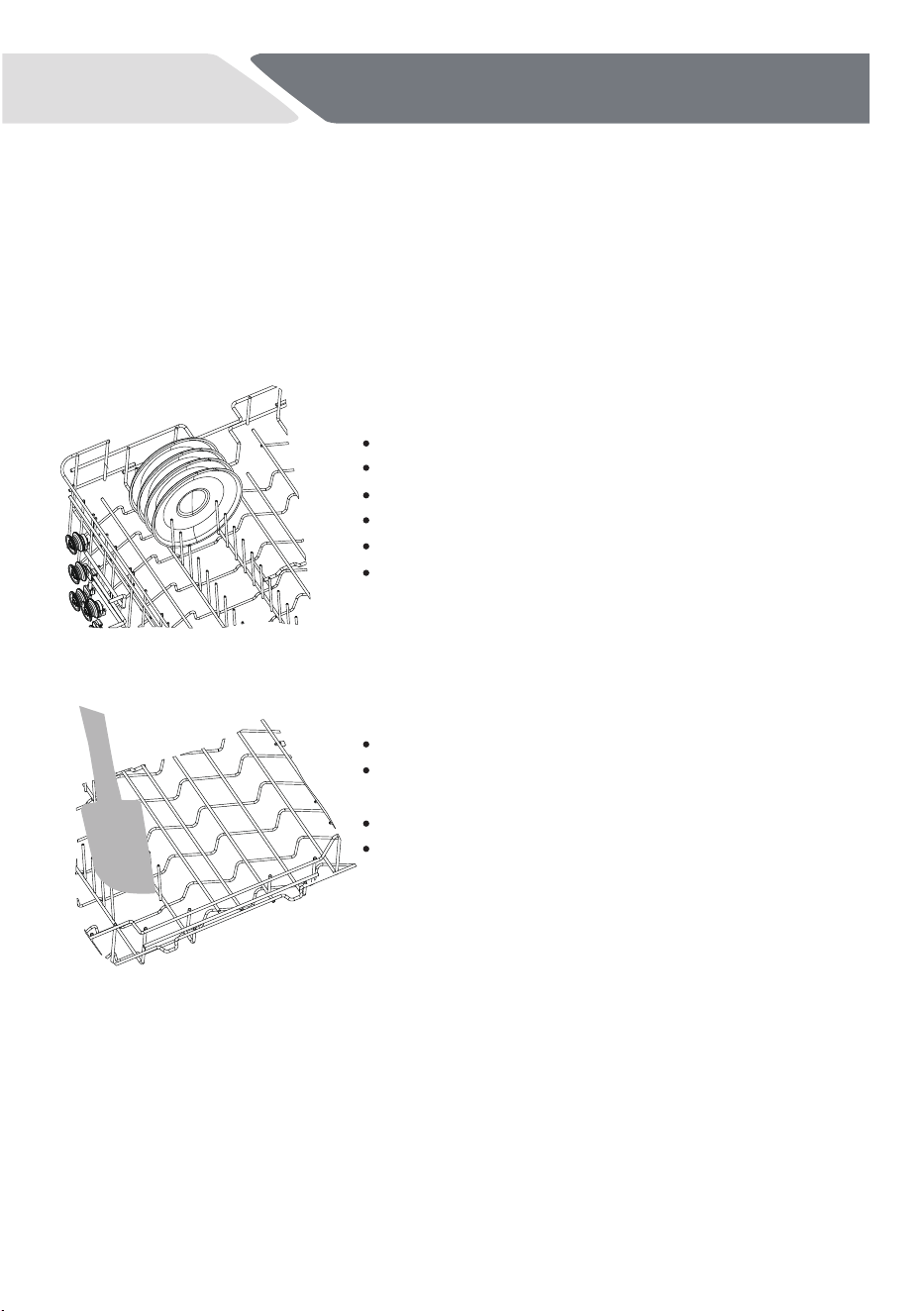
When loading your Dishwasher ensure items are placed so water coming from the rotating
spray arm below can reach all areas. Wash performance will be reduced if it can't.
Your dishwasher can hold up to a maximum of 11place settings.
Lower and upperspray arms can rotate freely.
Tall items do no obstruct the upper spray arm.
Glass and other fragile items are stable.
All dish openings are facing downwards.
Plates are e
venly spaced.
All sharp objects are located securely to avoid
injury or damage to the product.
Overcrowding.
Any protrusions below the racks and basket that
may prevent spray arm rotation.
Any protrusions at the front of the dishwasher.
Blocking water from any items on the foldaway
cup racks.
Ensure
Avoid
Loading suggestions
20
EN
1
2
3
4
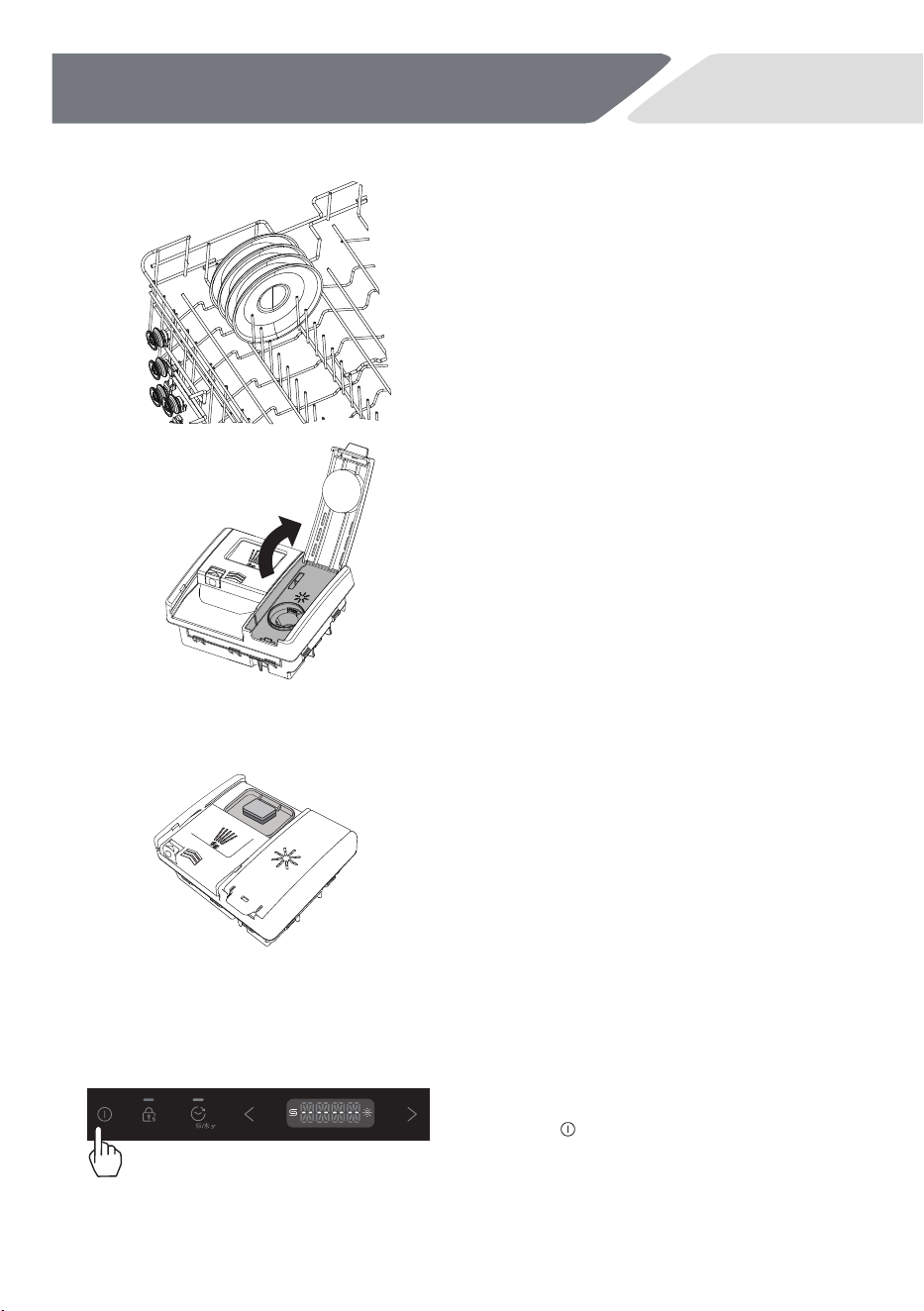
Remove all food scraps from dishware before
carefully loading into the dishwasher.
Ensure the spray arms are free from any
obstructions and rotate freely.
If the rinse aid indicator is illuminated, fill the
rinse aid dispenser.
Refer to 'Rinse aid' for additional guidance.
Add detergent to the dispenser and close
the cover.
Tablets can be placed in the detergent
dispenser.
Setting a wash
Make sure the dishwasher is powered on,
press the .
21
EN
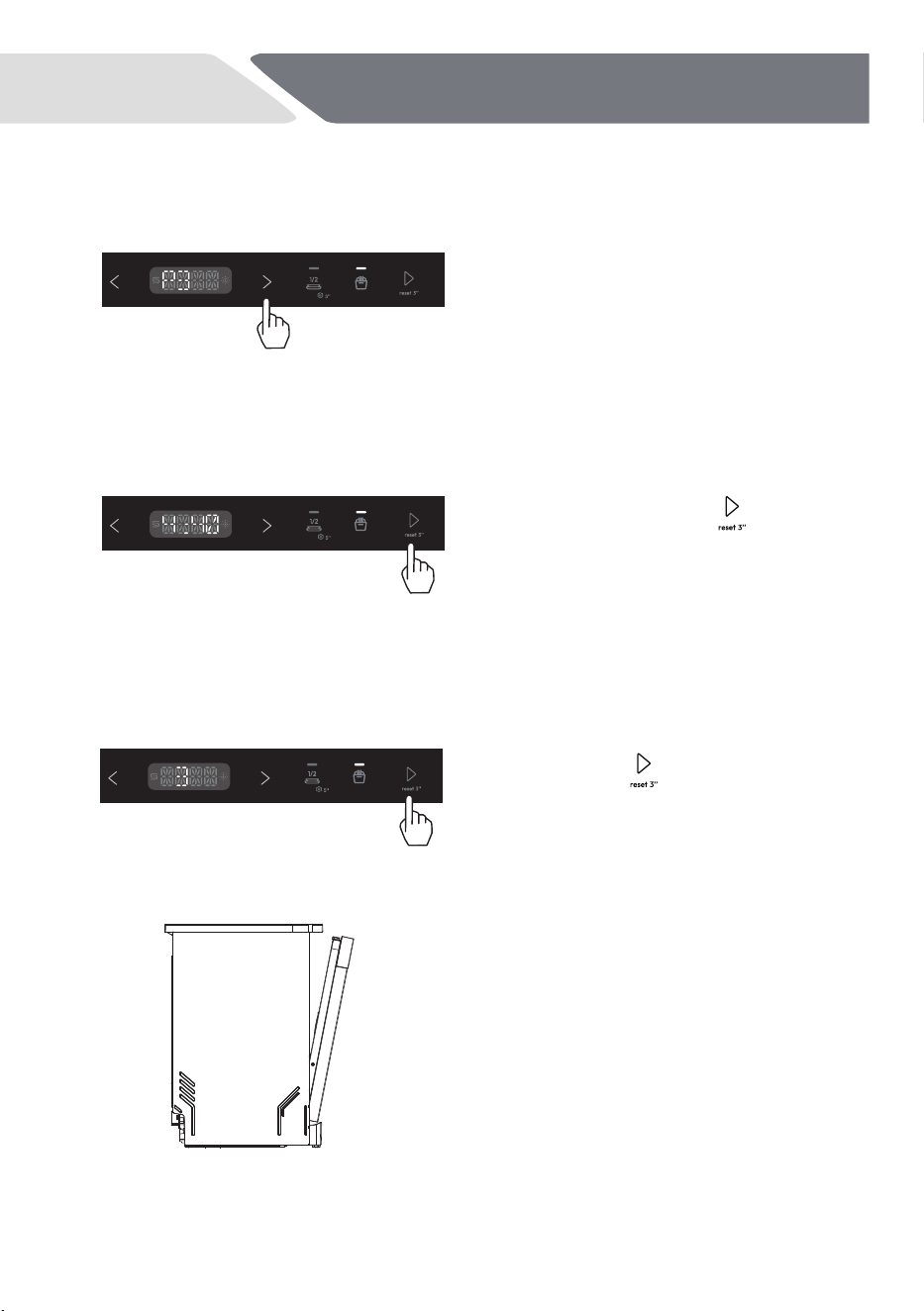
Close the door and press to start the wash.
5
6
7
Select a wash modifier if required.
Press and hold 3 seconds to cancel.
Setting a wash
22
EN
8
After the wash the door will automatically
open slightly to assist with drying.*
For best results, unload dishes once cooled.
* This function can be activated or not
by the user.
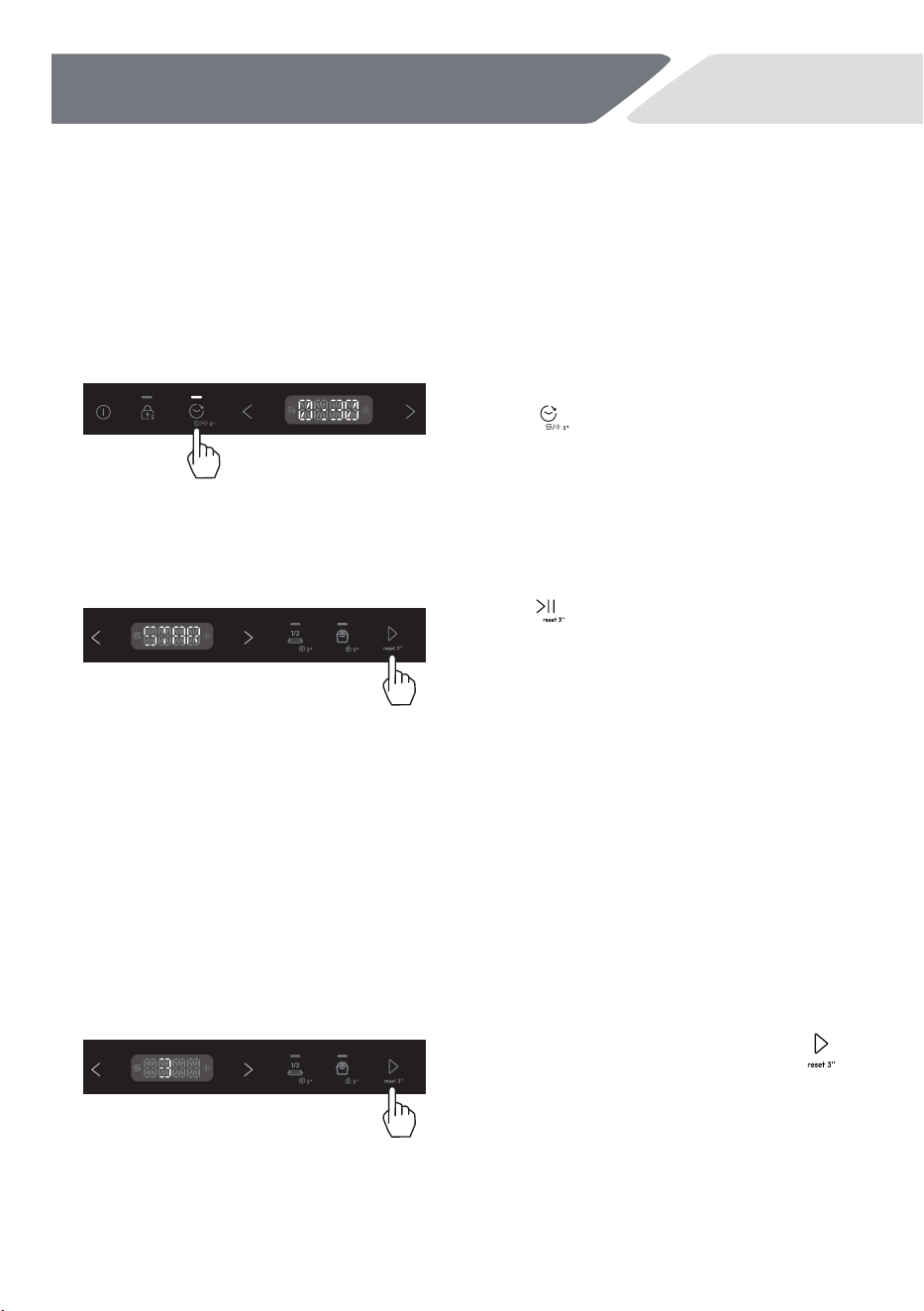
Setting Delayed Start
Set your dishwasher to start later in the day and run a selected wash program. DELAYED
START can be set after a wash program has been selected and can be set for up to 24 hours.
1
2
*
Open the door and press and hold 3
seconds to cancel.
Open the door to pause DELAYED START.
Close the door to continue.
Press to confirm.
The wash program will begin at the end of
the countdown, provided the door is closed.
Add detergent and select a wash program,
and wash modifier if required.
Press to enter DELAYED START and
increase the delay time.
*For the 0-4 hours, increase or decreases by 30min
each press, and for 4-24 hours, increase or decreases
by 1h.
Cancelling Delayed Start
Delayed start
23
EN
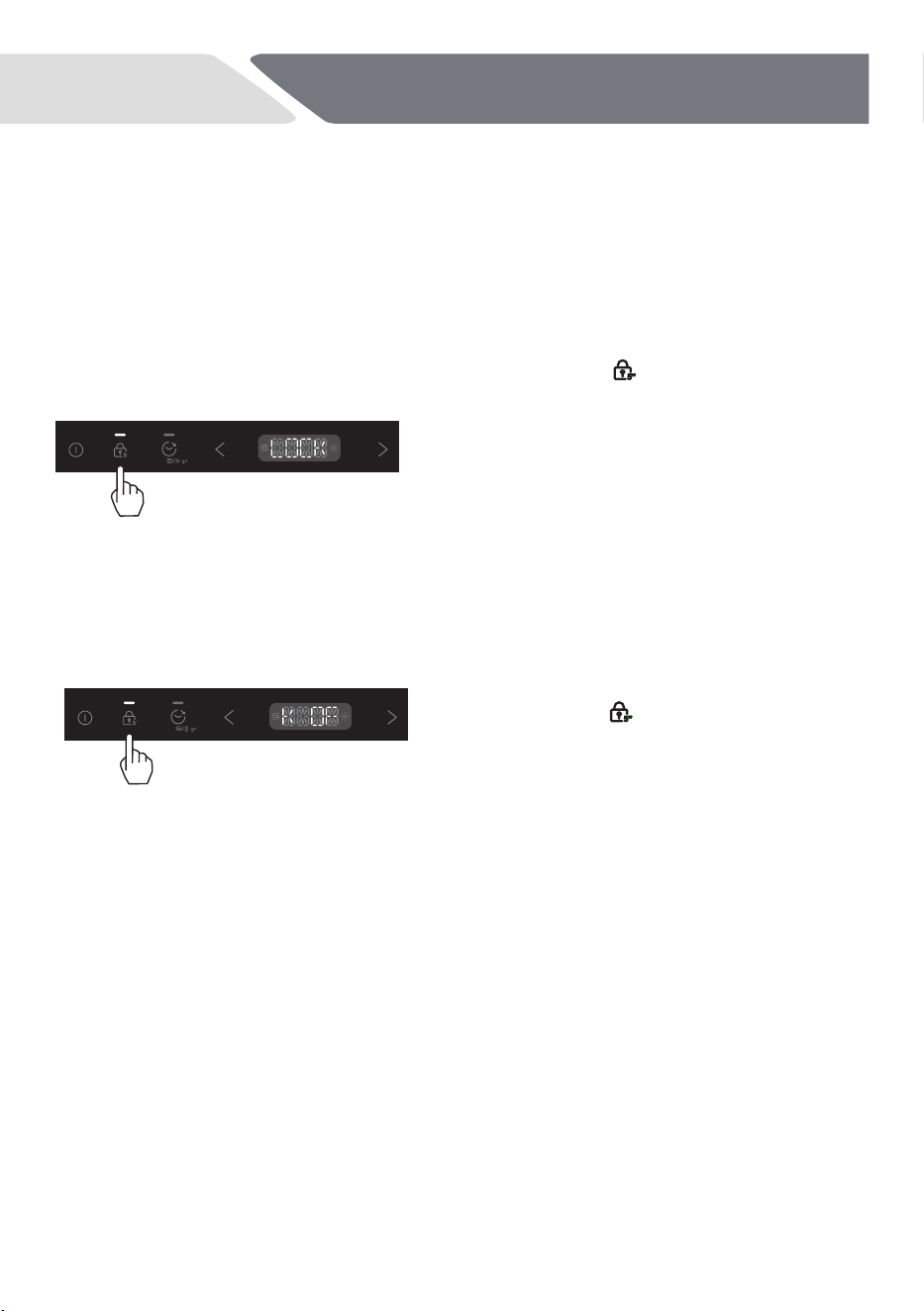
Lock the dishwasher controls for cleaning or to prevent unintended use.
Press and hold for 5 seconds to lock
the dishwasher controls.
Locking the controls
Unlocking the controls
Note:Before locking the controls,
running the program. After locking,
except for the unlocking and turn off
operation, other functions are not available.
Press and hold for 5 seconds to unlock.
Keylock
24
EN
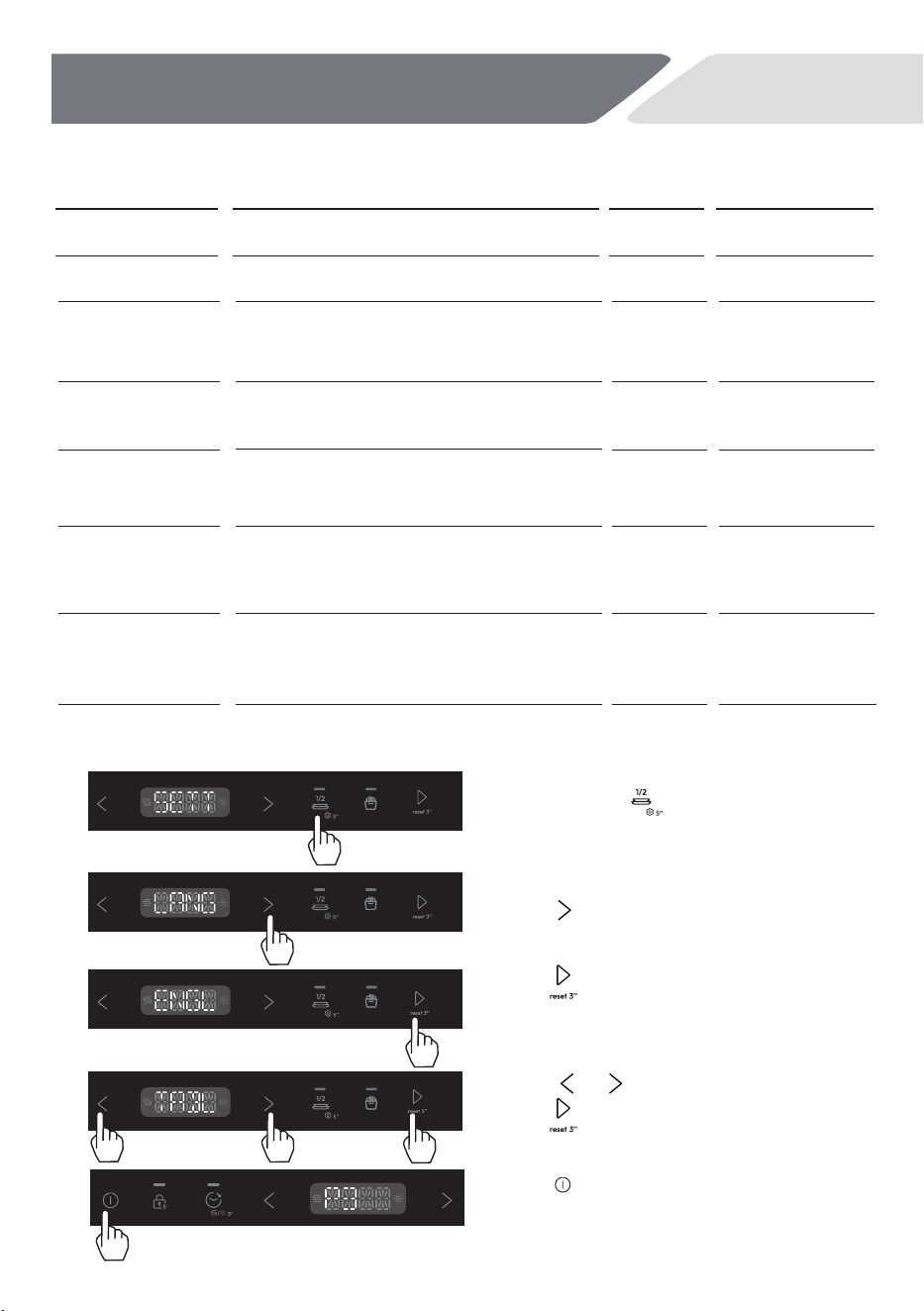
You can adjust any of the below settings prior to starting a wash cycle.
Option Description Default
SOFTENER
Adjust according to the following
page.
S 5
S 8
S 0
NO
NO
YES
Controls the amount of rinse aid
dispensed. Refer to 'Rinse aid' for
further details.
Program memory function, select
whether to remember the program
last use.
LAST USED
RINSE AID
Settings display
Off
On
Off
On
Off NO
On YES
Max:
Min:
SOFTENER
NO
NO
YES
Adjust according to the following
page.
TABLETS
1
2
3
4
Ensure there is no wash in progress.
Press and
hold for 5 seconds to
enter the menu.
Press to scroll through the settings.
Press to select the menu you want
to adjust.
BUZZER
Adjusts tone settings.When set to NO
all tones will be silenced except fault
alerts.
YES
R 5
R 6
R 0
Max:
Min:
RINSE AID
BUZZER
LAST USED
TABLETS
ENGLISH
Adjust according to the following page.
LANGUAGE
LANGUAGE
5
Press or to adjust the level.
Press to save the settings.
Press to exit.
Preferences
25
Changing the setting
EN
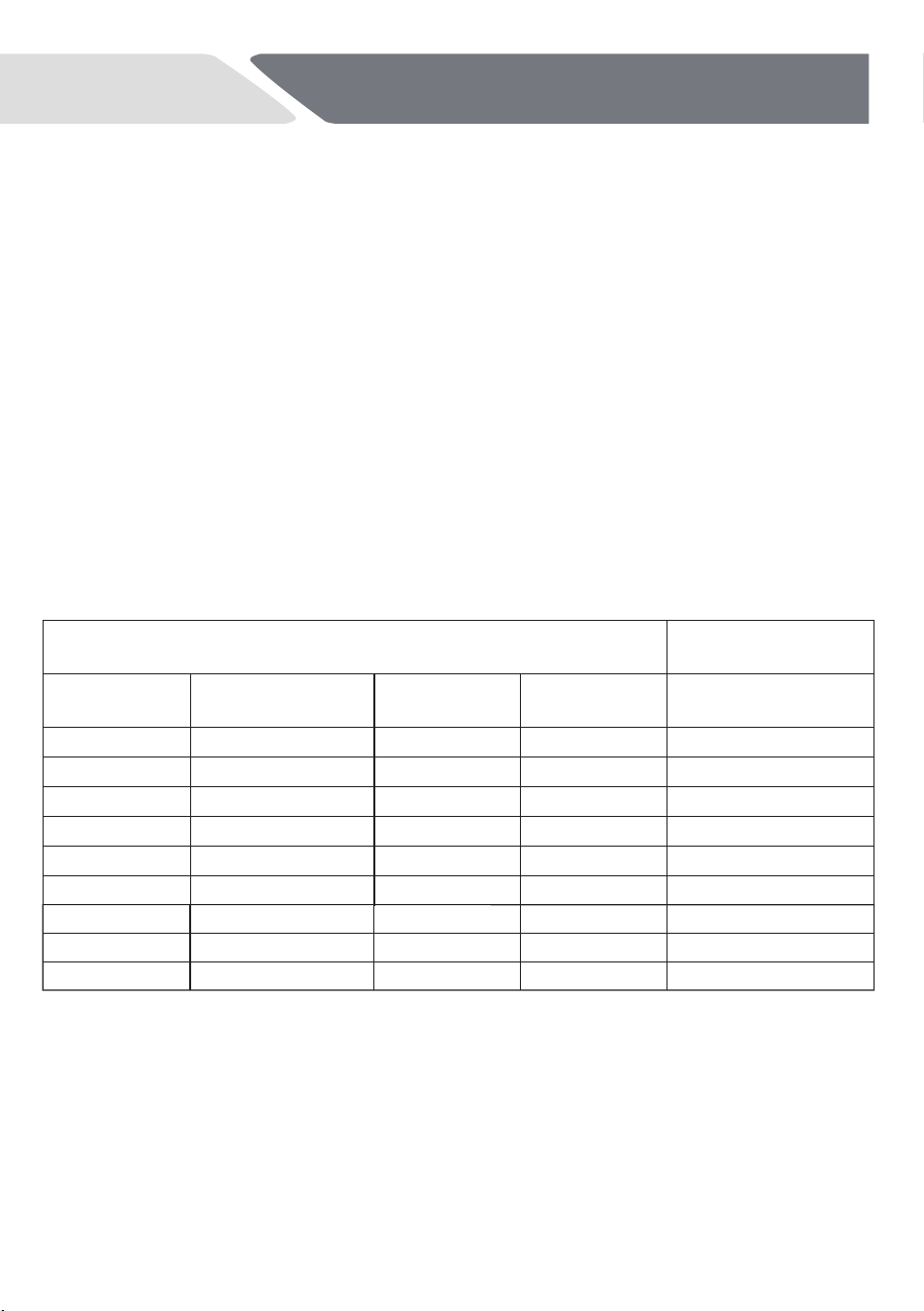
Identify the local water hardness
*Remark
1)Factory default setting for powder detergent.
2)Recommended setting for combi detegent tablets.
3)Indicator for Salt is off.
The amount of salt dispensed can be set in S 0 and S 8 stages,depending on the hardness
of your water.
1.Find out about the hardness value of your tap water.Your water utility company will help
you with this.
2.Setting can be found in the water hardness table.
To ensure good washing results,the dishwasher requires soft water.Hard water can be
detrimental to the performance of your dishwasher. Over time,glassware washed in hard
water will become opaque and dishes will become spotted or covered in a white film. Using
white film. Using very hard water can cause dishwasher parts to fail over time.Salt c
a
n improve
the situation.
Adjusting the water softening system
Water softening system
26
(°dH) (°fH)
Mmol/I
31-50
54-89
5,4-8,9
39-63
S 8
22-30
38-53
3,8-5,3
27-38
S 7
17-21
29-37
2,9-3,7
21-26
S 6
22-28
2,2-2,8
16-20
S 5
11-12
18- 21
1.8-2,1
13-15
S 4
9-10 15-17 1,5-1,7 11-12 S 3
7-8
0-6
-
11-14
0-11
-
1,1-1,4
0-1,1
-
8-10
0-7
-
S 2
S 1
S 0
13-16
Water hardness
Water softener
adjustment
German
French Clarke
degrees
electronic
1)*
2)*
3)*
EN
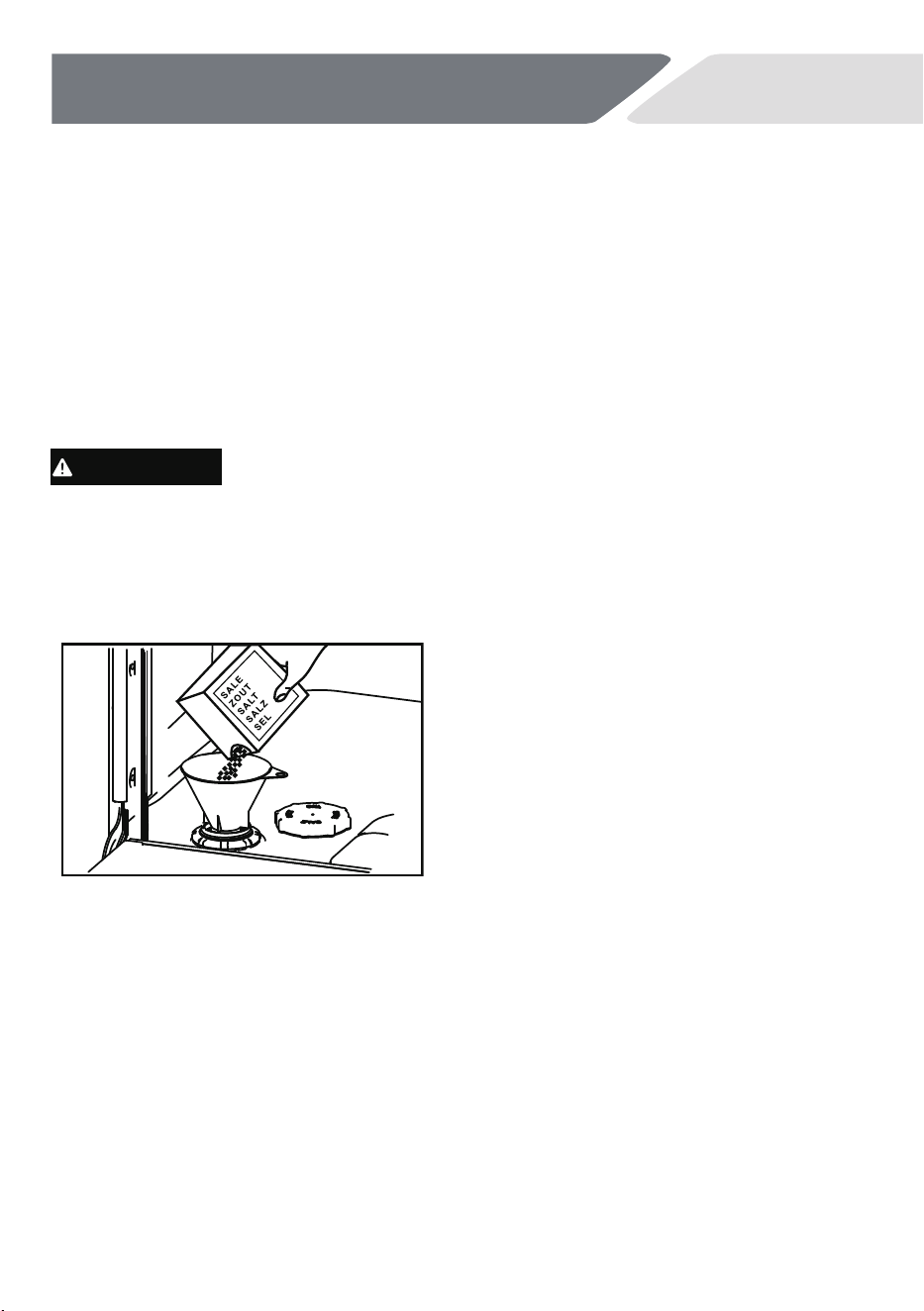
Using special salt
Top up the salt as follows:
As soon as the low salt indicator is lit on the control panel ,salt should be
topped up.Always refill with special salt immediately before switching on the
appliance.This ensures that overrun special salt solution is immediately washed
out and does not corrode the rinsing tank.
Only use dishwasher salt. Other products can cause damage to the appliance!
Any spilled salt causes corrosion.Run a programme after each refill.
1. Turn the cap counter-clockwise
salt container.
2. Fill with1 litre of water into the salt
container.
3. Fill the tank up with specific salt
(water overflows).
4. Remove spilled salt from the opening
area.
5. Turn the
cap clockwise to close the
to
open the salt container.
CAUTION
Water softening system
27
EN
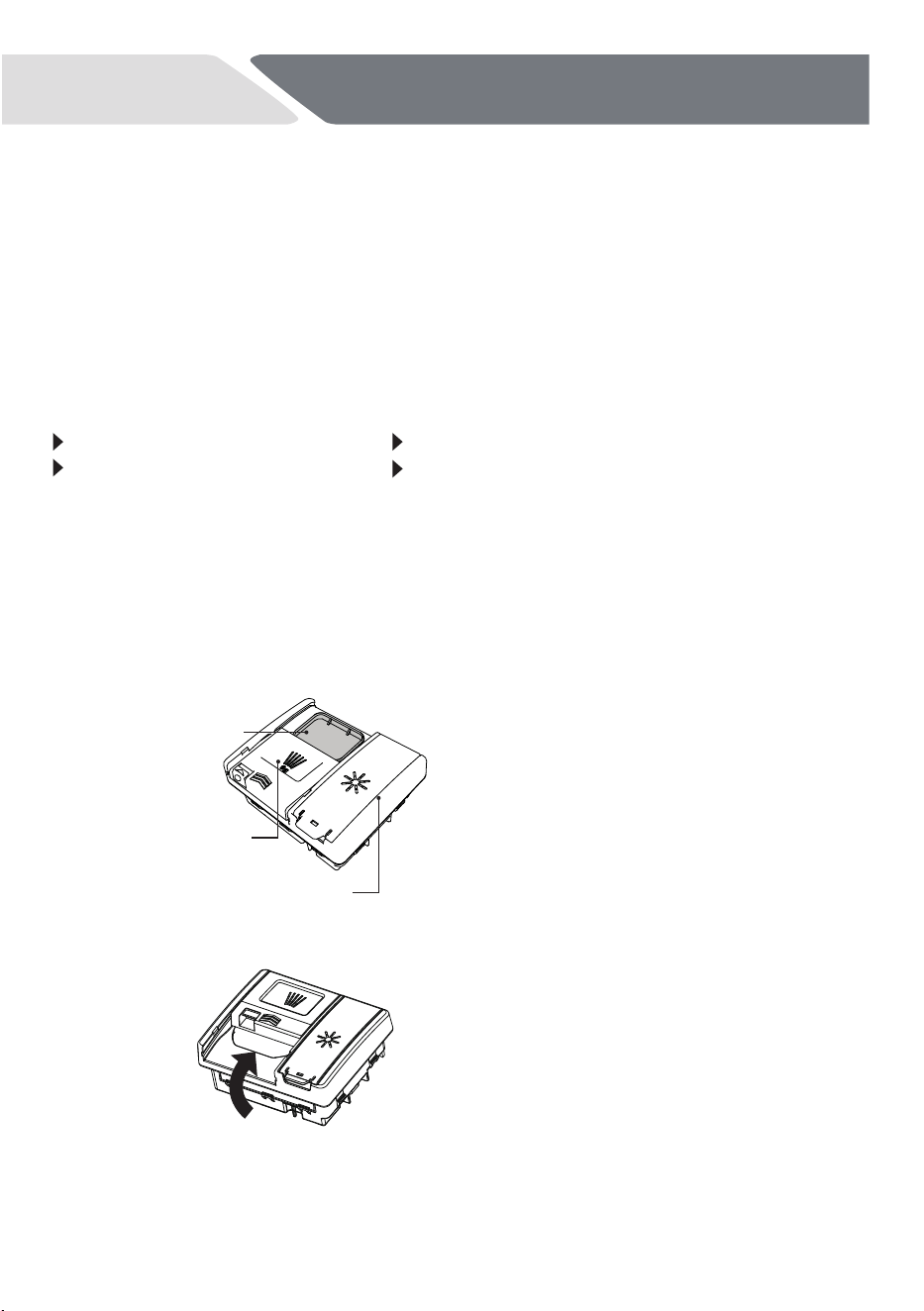
WARNING: Dishwasher detergents are strongly alkaline. They can be extremely dangerous
if swallowed. Avoid contact with the skin and eyes and keep children and infirm persons
away from the dishwasher when it is open. Check the powdered detergent dispenser is
empty after each wash.
Unsuitable detergents
These types of detergent are not suitable and may damage your dishwasher or lead to
a service call that is not covered by warranty:
Hand washing liquids
Laundry detergents
Soaps
Disinfectants
Using powdered detergent
For powdered detergent quantities, refer to the following 'Powdered detergent quantity
recommendations' table and the detergent manufacturer’s guidance.
Check that the dispenser is empty and dry.
Add powdered detergent or tablets to the
detergent dispenser.
Remove any excess detergent then slide the
cover closed. It will click into place.
If required, add additional detergent to the
pre-wash compartment on top of the
dispenser.
When washing heavily soiled dishware in hard water, more detergent may be required.
Refer to 'Powdered detergent quantity recommendations'.
1
2
Rinse aid compartment
Pre-wash compartment
Main wash compartment
Detergent
28
EN
Full
Full
None
Powdered detergent quantity recommendations
Use the table below to determine the optimal powdered detergent quantity for each
wash program.
If you have hard water in your area, more detergent may be required.
Pre wash compartment Main wash compartmentWash program
15/25
Full
None
Detergent
29
Full
15/25
15/25
15/25
Full
15/25
P5 INTENSIVE
P6 GLASS
P7 PREWASH
P3 ECO
P4 UNIVERSAL
P1 WASH&DRY 35’
P2 59MIN
Full
15/25
EN
45
2
1
3
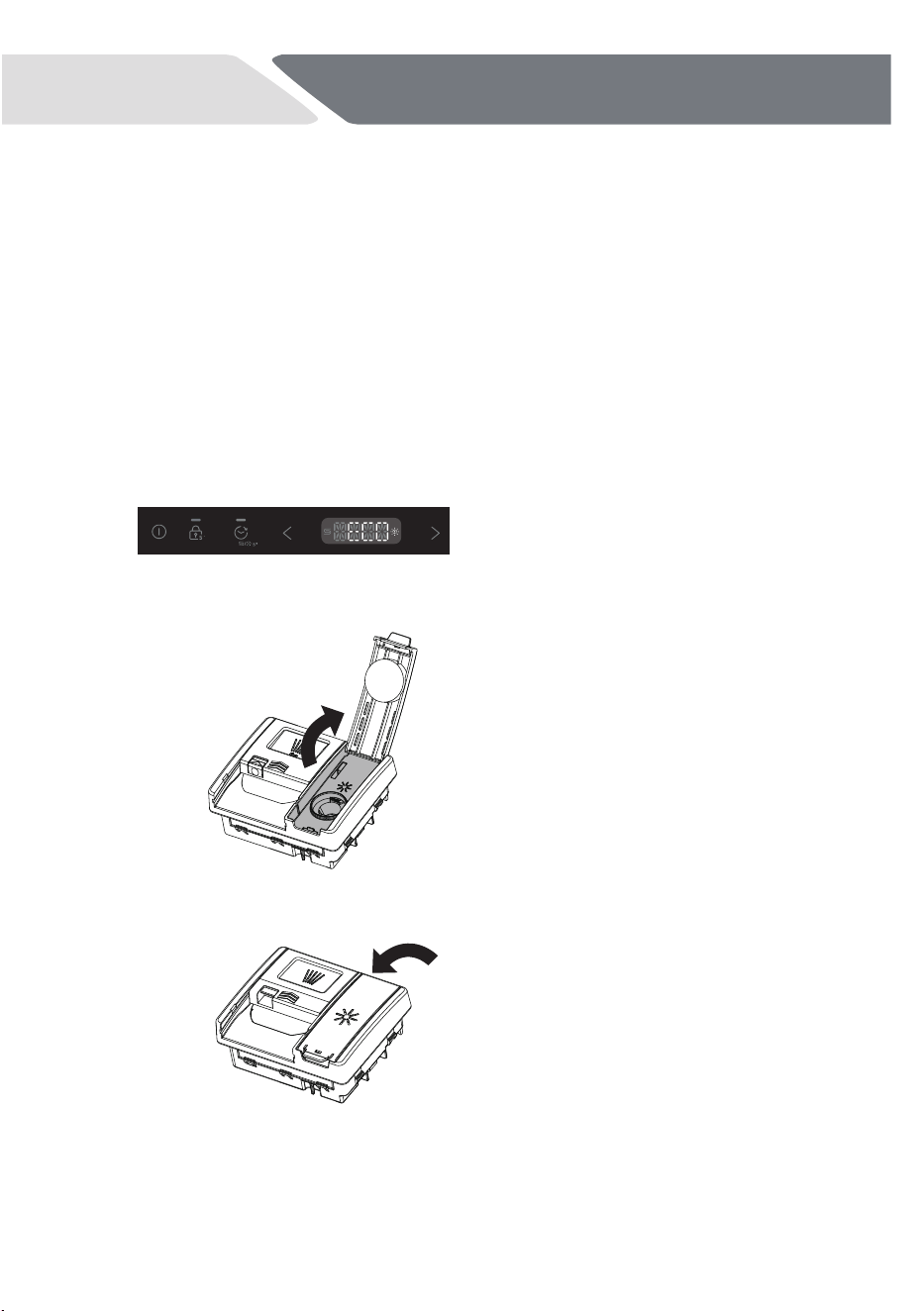
Rinse aid provides a streak-free finish to glass and dishware as well as preventing metal
from tarnishing. We recommend using a liquid rinse aid regularly for optimal drying results.
The rinse aid dispenser is located on the inside of the door next to the detergent dispenser.
Using rinse aid
The amount of rinse aid dispensed in each wash may need to be adjusted to suit your water
conditions. Refer to 'Preferences' and 'Water hardness' for guidance. Rinse aid is not required
if tablet has it already built into it.
When the rinse aid level is low, the rinse aid
indicator on the control panel wi
ll light up
to remind you to refill the dispenser.
Lift the cover open and pour rinse aid into
the opening.
Do not fill past the MAX line. Take care not
to spill any onto the door or detergent bucket.
Close the cover, ensuring it clicks shut.
Any accidental spillages into the dishwasher or detergent bucket must be cleaned up
immediately. Spilt rinse aid may result in excessive foaming. A service call relating to these
errors will not be covered by warranty.
Rinse aid
30
EN
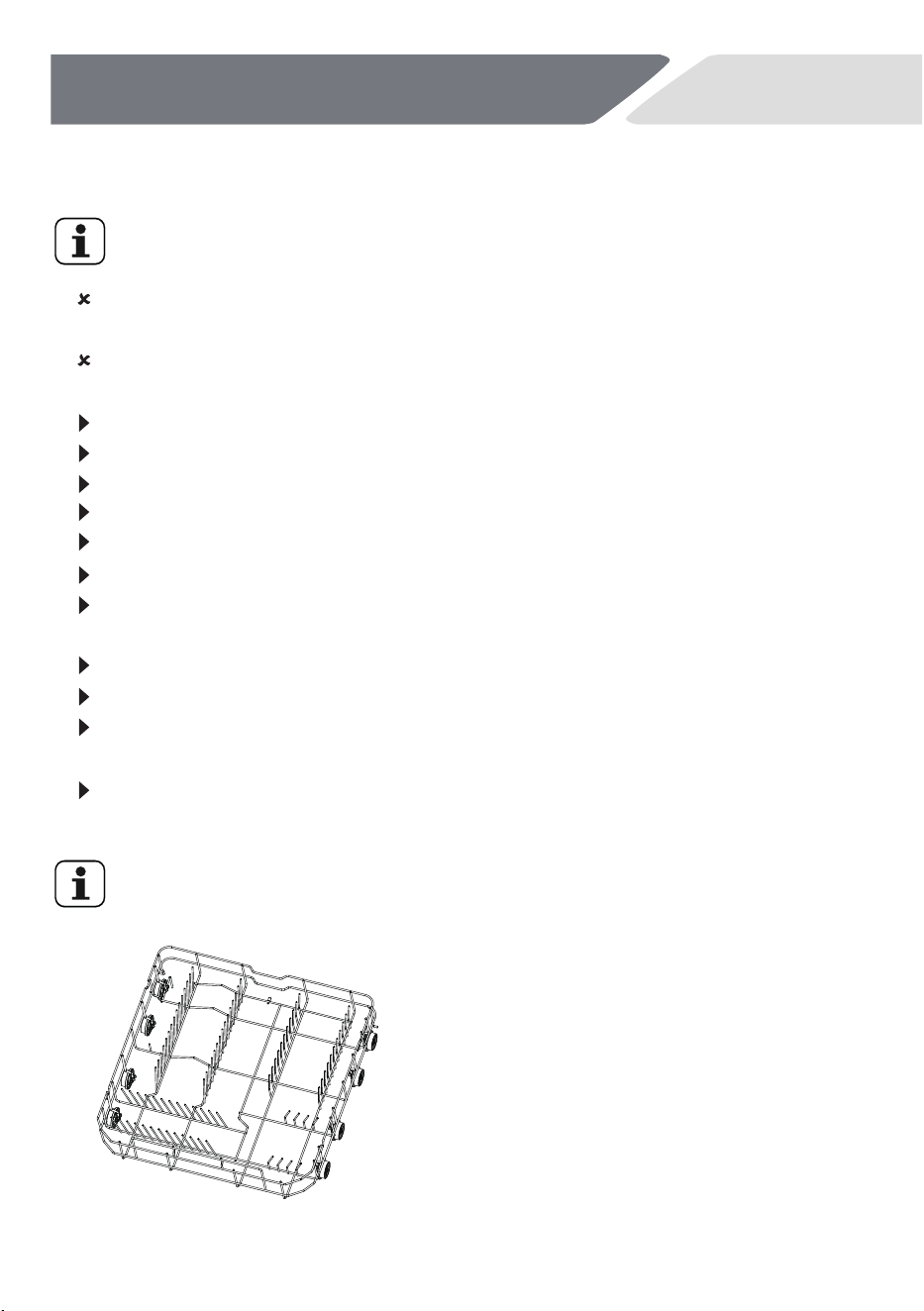
Load the Baskets
With delicate glasses and porcelain make sure they are labelled
dishwasher-proof.
Place heavily soiled items (like pots and
pans or dinner plates) in the bottom
basket. The more powerful spray jet
provides a better dishwashing result.
If jingling noises are heard during a programme run: Check that the
dishes and glassware have a firm position.
Do not put in the appliance items made of wood, horn, aluminium,
pewter and copper.
Do not put in the appliance items that can absorb water (sponges,
household cloths).
Only use the appliance to wash items that are dishwasher-safe.
Remove remaining food from the items.
Soften burned food on the items before washing.
Put hollow items (cups, glasses and pans) with the opening down.
Put items with deep hollows in a slanted position.
Mix spoons with other cutlery to prevent them to bond together.
Make sure that cutlery and dishes do not bond together and there
is a gap between each item.
Make sure that glasses do not touch other glasses.
Put small items in the cutlery basket.
Put lig
ht items in the upper basket. Make sure that the items do not
move.
Make sure that the spray arms can move freely before you start a
programme.
Daily Use
31
EN
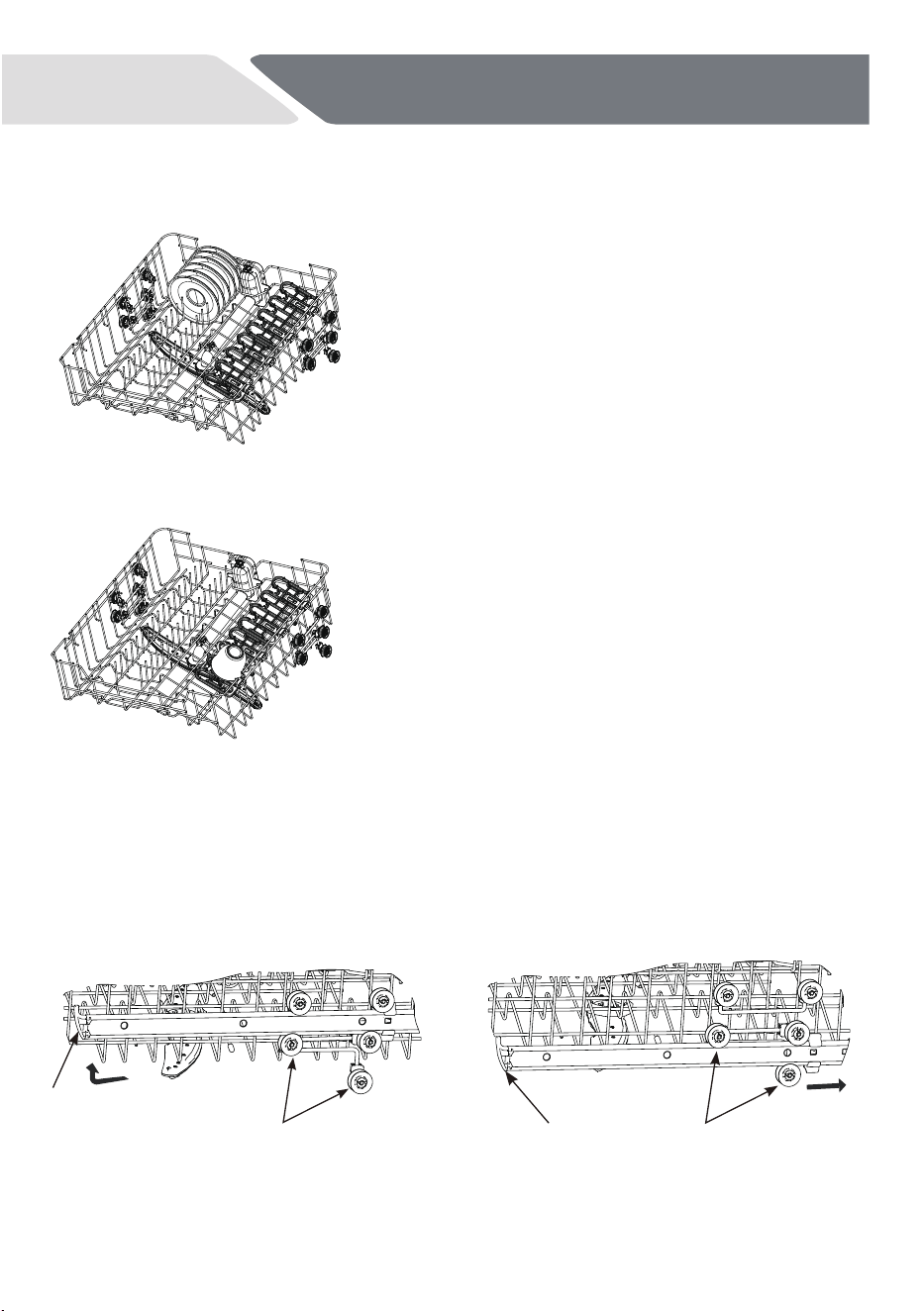
Upper baskets
To adjust the upper basket.
Foldable cup racks
Daily Use
The upper basket is designed to
hold items like glasses,cups,
saucers, plates, small bowls and
shallow pans.
Adjust the height to suit or fold out
of the way to make space for other
items. Use the notches to support
wine glass stems.
Folding and support can be achieved
by flipping.
Before you adjust its height, make sure the basket is empty.
Remove:
Replace:
32
Rail
Rollers
Stop Block
Rail
Rollers
Stop Block
EN
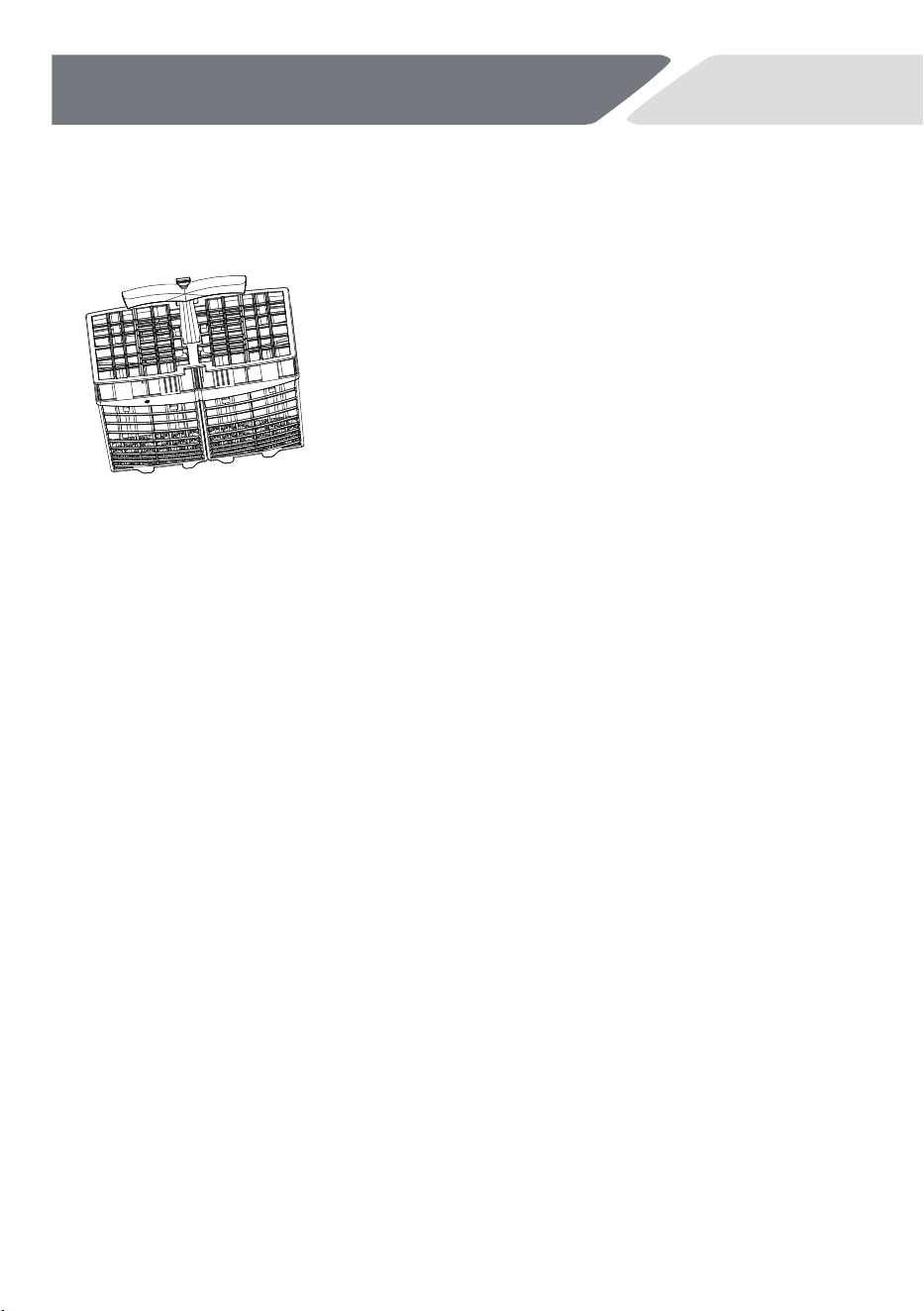
Cutlery/Utensil basket
Use the basket to secure cutlery and utensils.
Insert cutlery and utensils into the basket
to secure.
Daily Use
33
Maintenance
Troubleshooting
Maintenance
EN
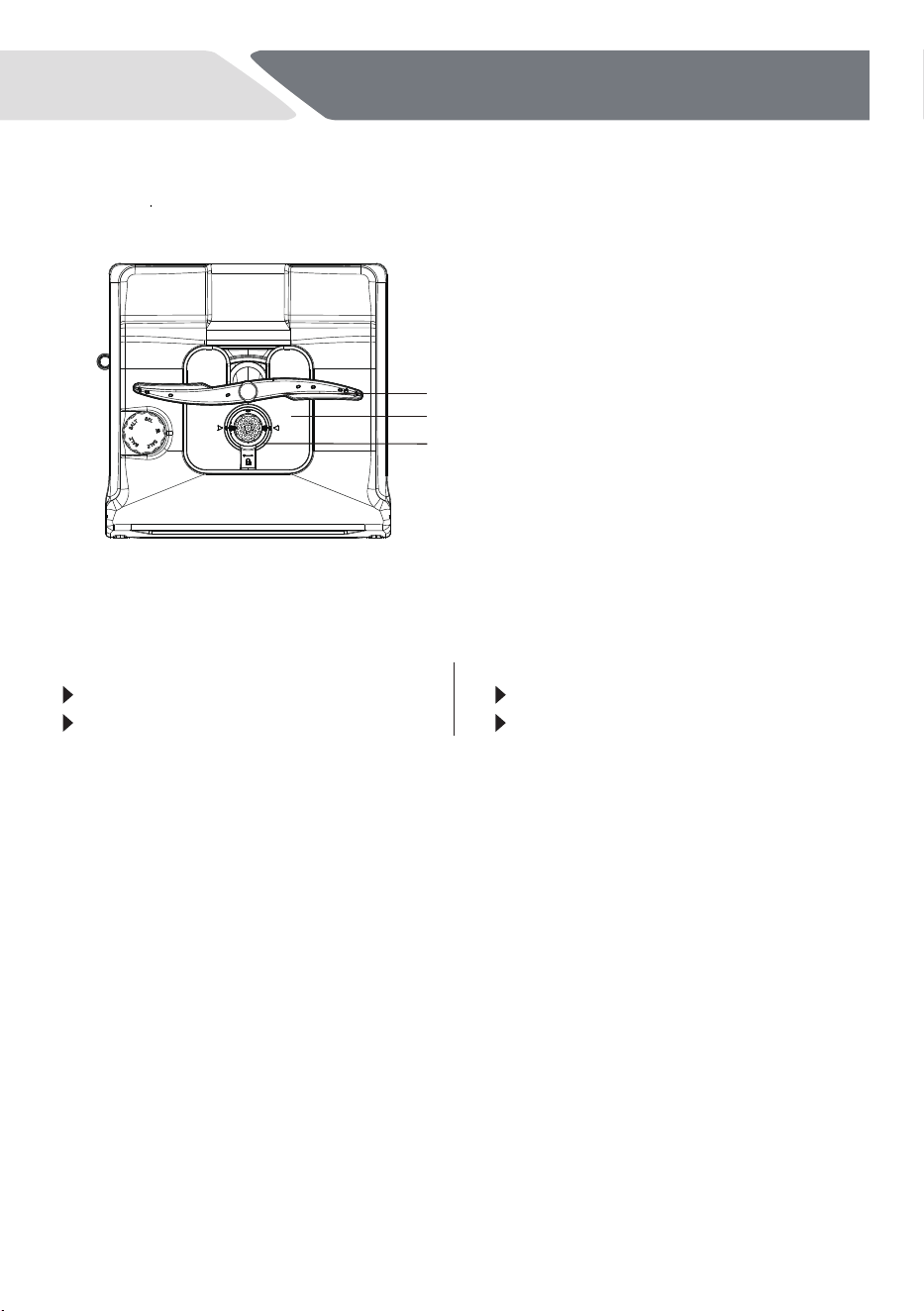
1 Filter
2 Filter plate
3 Lower spray arm
Features
Disconnect the dishwasher from the power supply and allow it to cool before undertaking
any cleaning or maintenance.
Not shown: top and upper spray arms
Cleaning surfaces
Wipe with a damp cloth and dry using a lint-free cloth. We do not recommend using the
following cleaning aids as they may damage the surfaces:
Plastic or stainless steel scouring pads
Abrasive, solvent, household cleaners
Acid or alkaline cleaners
Hand washing liquids or soap
Stainless steel cleaners or polishes
Laundry detergents or disinfectants
Cleaning the filter, spray arms and filter plate
We recommend that the drain filter and filter plate are removed and cleaned once a month
or whenever there is evidence of food particles. The spray arms in normal use should
require cleaning less frequently. Lower and upper spray arms can be shaken to remove any
foreign material, cleaned in hot water, then rinsed in clean water.
The dishwasher must be used with the filter plate, drain filter and spray arms correctly in
place. If using a dishwasher cleaner or descaler, refer to manufacturer instructions.
Extended periods of disuse
If your dishwasher is not going to be used for some time we recommend turning off the
power and water supply, leaving it clean and empty with the door ajar. When using your
dishwasher for the first time after a long period away, we recommend pouring 3 cups of
water into the dishwasher before use. This helps lubricate components that may have dried
out during disuse.
34
1
3
2
Maintenance
EN
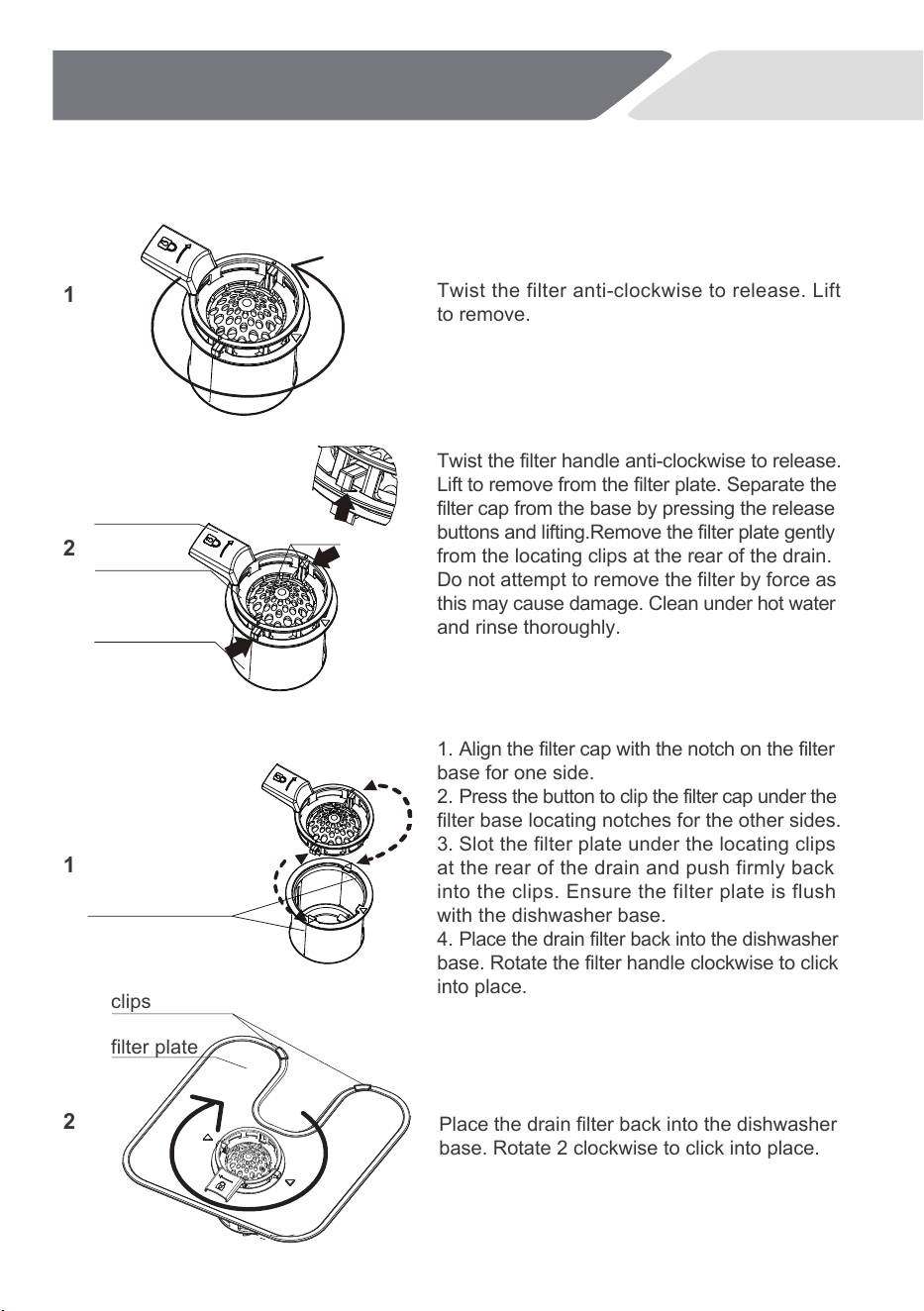
Removing and cleaning the filter
1
2
1
2
Twist the filter anti-clockwise to release. Lift
to remove.
Replacing the filters:
Twist the filter handle anti-clockwise to release.
L
ift to remove from the filter plate. Separate the
f
ilter cap from the base by pressing the release
b
uttons and lifting.Remove the filter plate gently
f
rom the locating clips at the rear of the drain.
D
o not attempt to remove the filter by force as
t
his may cause damage. Clean under hot water
and rinse thoroughly.
1. Align the filter cap with the notch on the filter
base for one side.
2.
Press the button to clip the filter cap under the
filter base locating notches for the other sides.
3.
Slot the filter plate under the locating clips
a
t the rear of the drain and push firmly back
i
nto the clips. Ensure the filter plate is flush
w
ith the dishwasher base.
4.
Place the drain filter back into the dishwasher
b
ase. Rotate the filter handle clockwise to click
into place.
clips
filter plate
Place the drain filter back into the dishwasher
base. Rotate 2 clockwise to click into place.
button
filter base
filter cap
filter handle
locating notch
35
Maintenance
EN
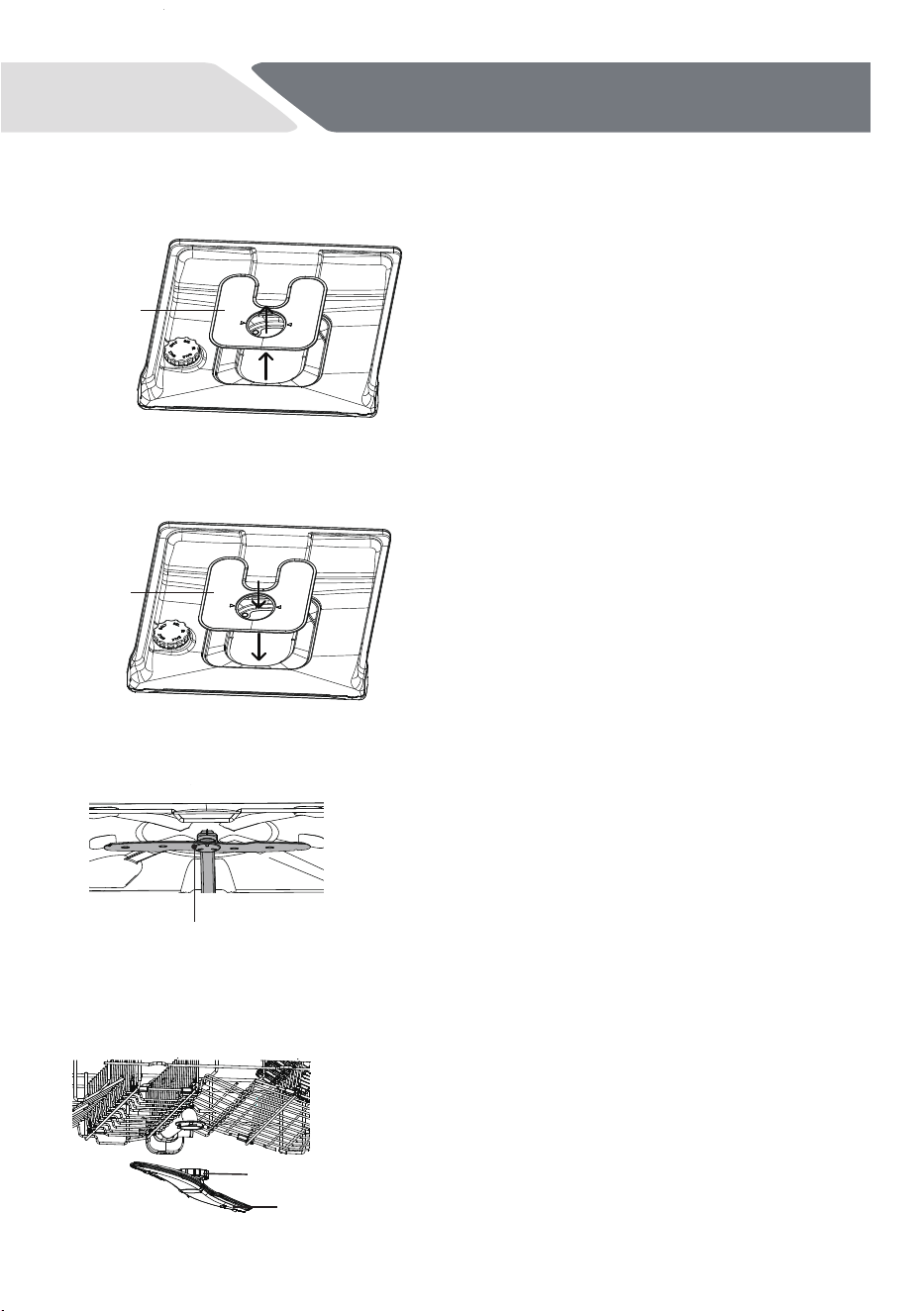
Troubleshooting
With the filter removed, carefully lift the filter plate
up and out.
Clean under hot water and rinse thoroughly.
Slot the filter plate under the locating clips at the
rear of the drain and push firmly back into place.
Ensure the filter plate is flush with the dishwasher
base.
Do not remove the top spray arm for cleaning.
Clean with a small, plastic-bristled brush.
If heavily soiled or blocked use a dishwasher cleaner/
descaler. Follow the manufacturer’s instructions.
To remove the upper spray arm, turn the locking
nut clockwise to release.
Rinse the spray arm thoroughly under running water,
then refit.
upper spray arm
locking nut
Cleaning the upper spray arm
Cleaning the top spray arm
Removing and cleaning the filter plate
Replacing the filter plate
top spray arm
filter plate
filter plate
36
Maintenance
EN
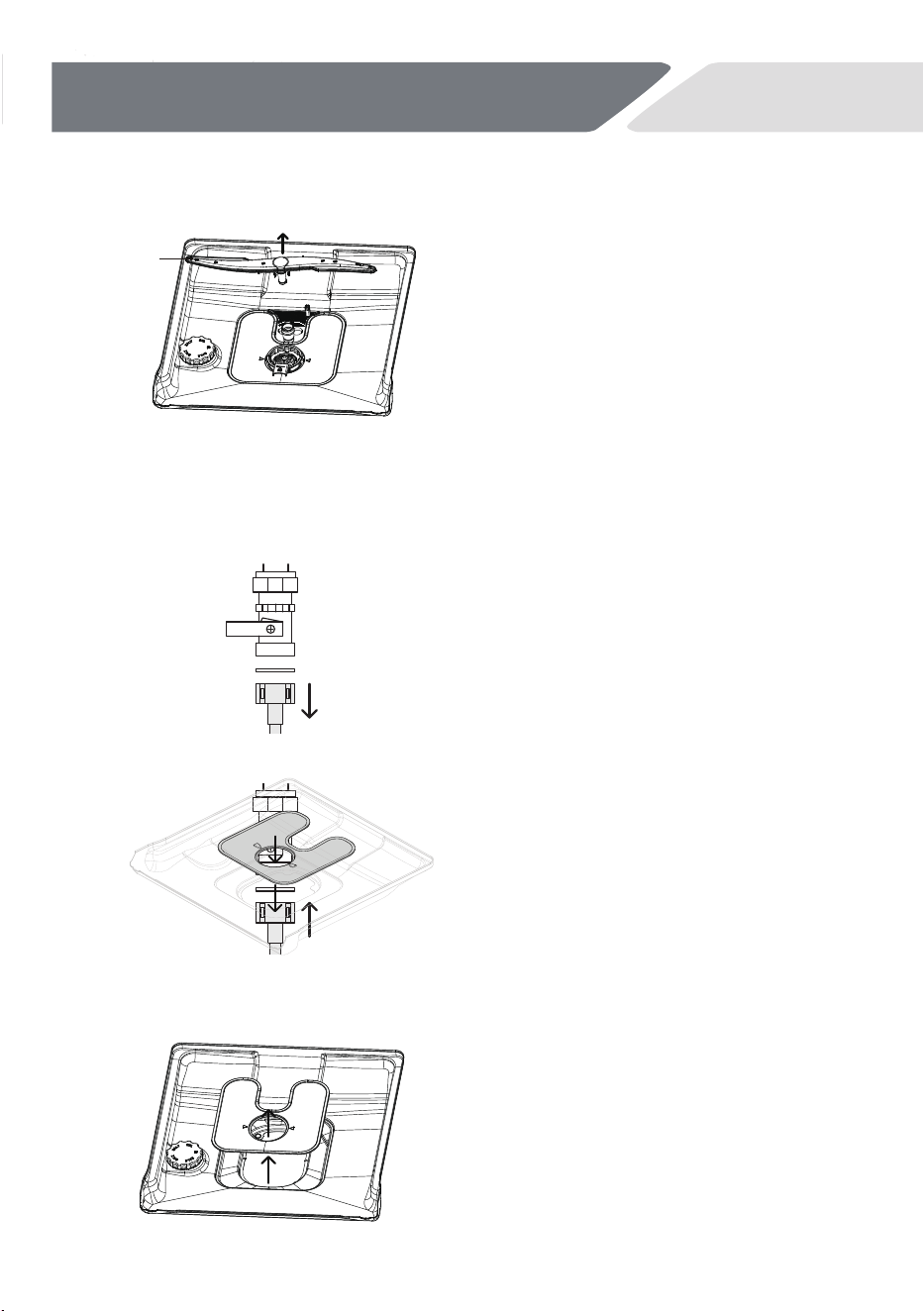
1
2
3
Cleaning the lower spray arm
To remove the lower spray arm, lift it from
the base of the dishwasher.
Rinse the spray arm thoroughly under running
water, then refit.
Ensure the arm rotates freely when refitted.
Winterizing (cold climates)
If the Dishwasher is installed in a cold climate where temperatures fall below zero, we
recommend winterizing.
Turn off the water supply.
Disconnect the drain hoses from the sink
drain pipe and the water inlet pipe from the
water valve.
Drain the water from the hoses, inlet pipe
and water valve, using a bucket or pan to
collect the water.
Reconnect the water inlet pipe to the water
valve and hoses to the sink drain pipe.
Remove the drain filter and the filter plate.
Use a sponge to remove any remaining
water from underneath before replacing.
37
lower spray
arm
Maintenance
EN
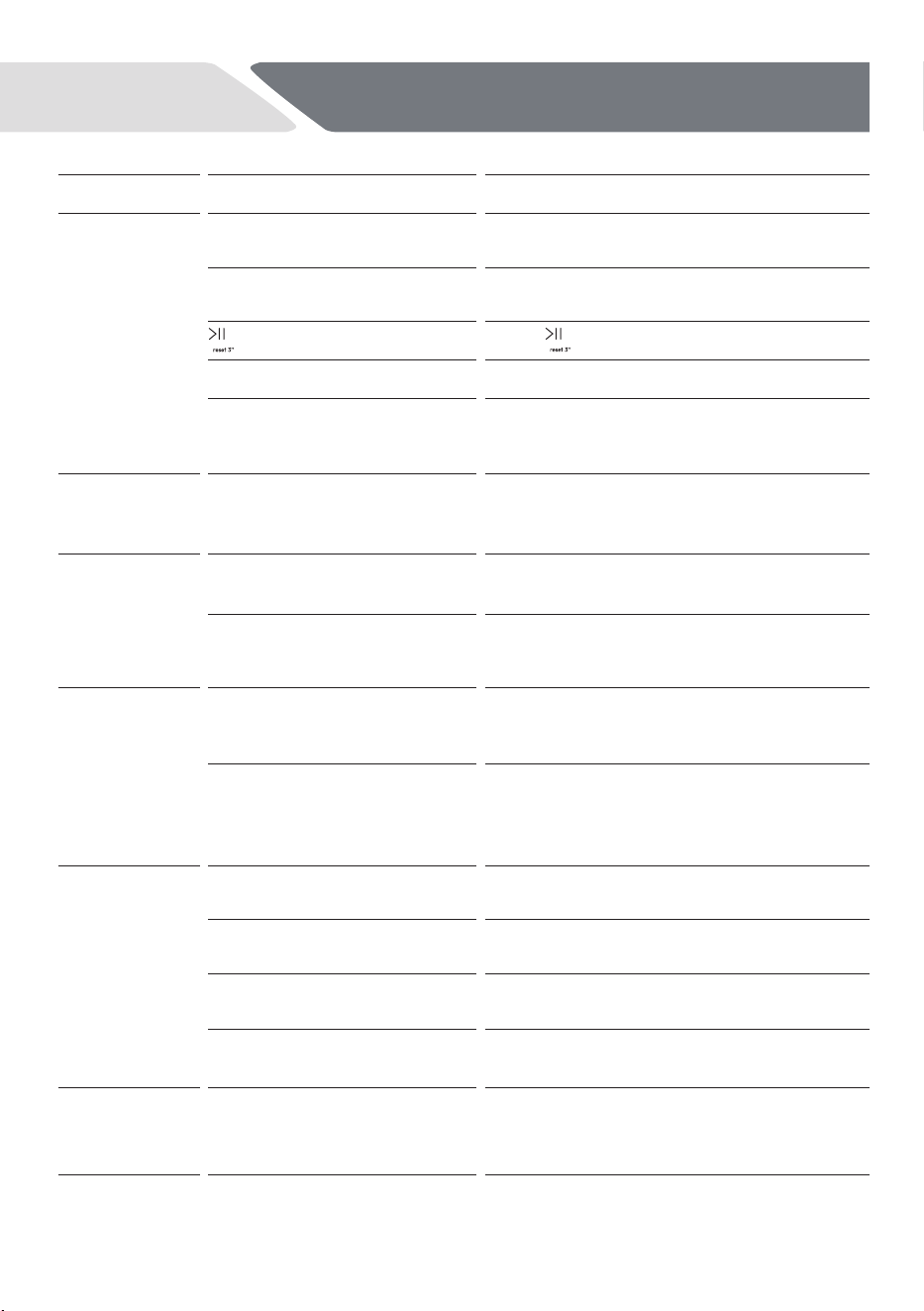
has not been pressed.
Press .
Dishwasher
will not start
Lower spray
arm rotates
with difficulty
Cover of
detergent
dispenser
cannot be
closed
Remnants
of detergent
stuck inside
dispenser
Water
remains
inside
dishwasher
after wash
has ended
Filter(s) blocked.
Clean the filter(s). See 'Maintenance' for
instructions.
Call your Haier Authorised Service Centre
or Customer Care.
Pump is jammed.
Check the drain hose and straighten if
needed.
Drain hose is crimped,
bent,or blocked.
Blocked drain connection.
Check that drain connection is free from
blockages.
Utensils are blocking
the detergent dispenser
from opening.
Ensure there are no large utensils
positioned in a way that will stop the
dispenser cover from opening when the
dishwasher door is closed.
Compartment was damp
when filled with detergent.
Detergent dispenser is
clogged with remnants
of detergent.
Wipe dispenser out with a damp cloth.
Dry the dispenser before adding detergent.
Wipe dispenser out with a damp cloth.
Dry the dispenser before adding detergent.
Remove detergent until the cover can be
closed.
Detergent compartment
has been overfilled.
Spray arm holes are
blocked by small items or
food particles.
Clean the spray arm. Refer to 'Maintenance'
for instructions.
Check the strainer and clean if necessary
– it is located where the water inlet hose
screws into the tap.
Blocked strainer in water
inlet hose.
Water tap not turned on.
Ensure water is connected and turned on.
The door is not properly
closed.
Ensure the dishwasher is plugged in and
the power supply is turned on at the wall.
Close the door.
No power.
Display
flashing while
Keylock is on
This is normal. The display
remains on although the
buttons are disabled.
No action requi
red.
38
Troubleshooting
Problem Possible cause What to do
Troubleshooting
EN
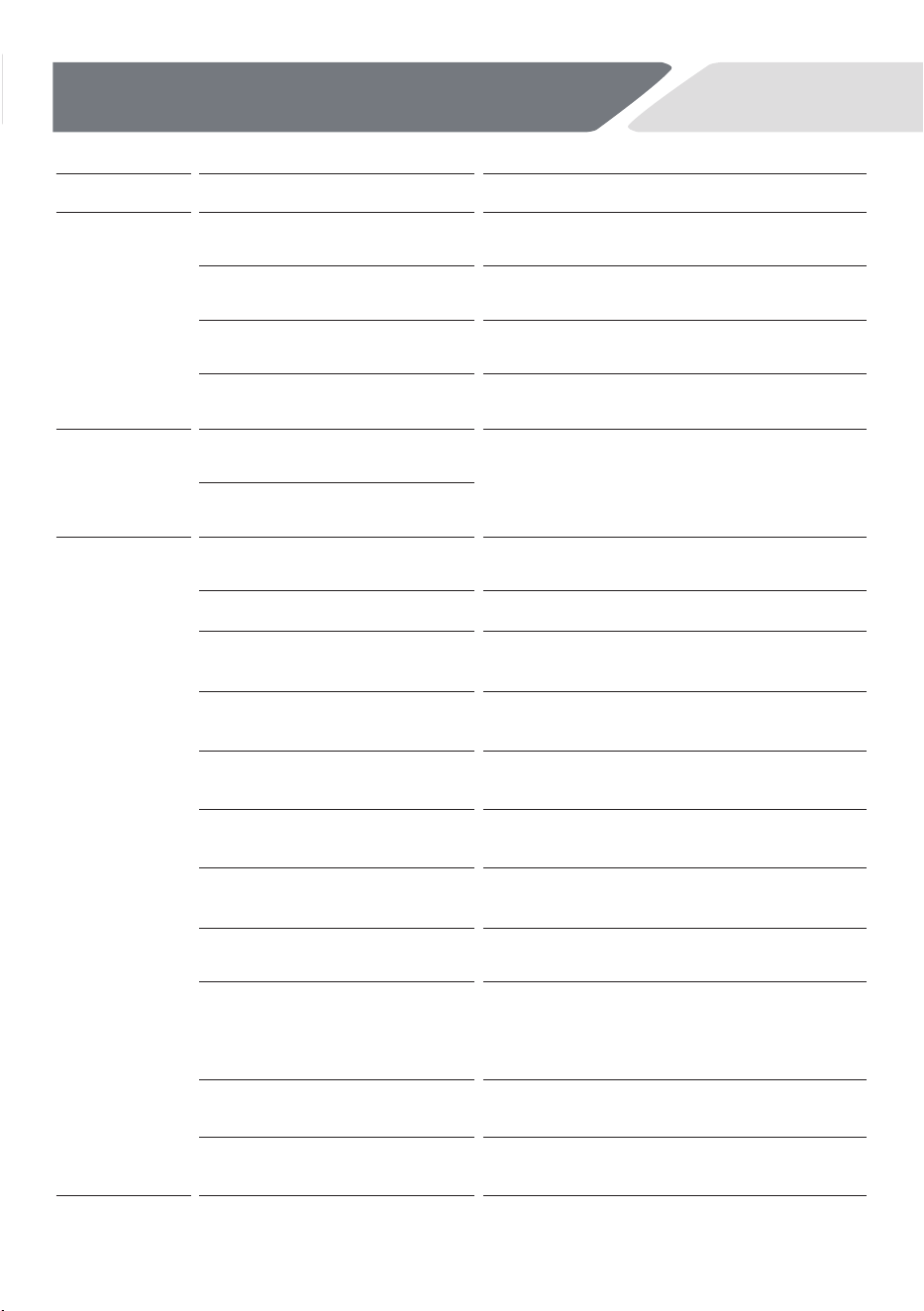
Problem Possible cause What to do
Foaming
Incorrect amount or type of
detergent used.
Refer to 'Detergent' or consult the
detergent manufacturer’s instructions.
Too much egg in the wash
load.
Increase the amount of detergent.
Rinse aid dosage level too
high.
Decrease the rinse aid dosage.
Rinse aid spills not wiped up.
Ensure that all rinse aid spills are wiped
up when they occur.
Knocking
or rattling
sound during
wash
Spray arm knocking against
dishes.
Pause the wash and rearrange dishes.
Refer to 'Setting a wash'
and 'Loading suggestions'.
Dishes have been stacked
incorrectly.
Unclean
dishes
Unsuitable wash program for
load selected.
Select the appropriate wash program for
the load. Refer to 'Wash programs'.
Soils were too heavily baked on.
Dishes may need soaking.
Spray arm(s) unable to rotate.
Ensure no items are obstructing the spray
arm path.
Basket/rack incorrectly
loaded.
Refer to 'Loading suggestions'.
Filter plate or filter incorr
ectly
installed.
Refer to 'Maintenance'.
Detergent put in the wrong
compartment.
Refer to 'Wash programs' and 'Detergent'.
Excessive food not removed
from dishes before loading.
Scrape all food scraps off dishes before
loading.
Unsuitable detergent.
Only use powdered or tablet detergent
designed for domestic dishwashers.
Not enough detergent.
Refer to 'Detergent' for recommended
quantities. You may need to adjust these
to suit your particular load and the
hardness of your water supply.
Spray arm holes are blocked.
Clean the spray arm(s). Refer to
'Maintenance' for instructions.
The filters are blocked.
Clean the filters. Refer to 'Maintenance'
for instructions.
39
Troubleshooting
EN
Plastic items
are discoloured
(e.g. stain left
by tomato
sauce)
Not enough detergent,
not pre-rinsed.
Pre-rinse plastic dishes before placing
in the dishwasher and/or add more
detergent.
Alternatively, using the Rinse program
after adding dishes may minimise staining.
White stains
are left on
dishes glasses ;
have a milky
appearance
Not enough detergent.
Refer to 'Detergent' for recommended
quantities. You may need to adjust these
to suit the hardness of your water supply.
Rinse aid dosage too low.
Increase rinse aid dosage.
Refer to 'Rinse aid'.
Dishes,
cutlery have
not dried
Rinse aid dosage too low.
Increase rinse aid dosage.
Refer to 'Rinse aid'.
Items removed too soon.
After the end of the wash program, leave
the door ajar and wait for sever
al minutes
to help drying.
Rinse aid dispenser empty.
(The rinse aid indicators
are lit.)
Add rinse aid. Refer to 'Rinse aid'.
Glasses
have dull
appearance
Rinse aid dosage too low.
Increase rinse aid dosage.
Refer to 'Rinse aid'.
Tea stains
or traces of
lipstick have
not been
completely
removed
Not enough detergent.
See section 'Detergent' for recommended
quantities. You may need to adjust these
to suit your particular load.
Wash temperature too low.
Select a wash program for heavily soiled
dishes. Refer to 'Wash programs' for
information.
Traces of rust
on cutlery
Cutlery is not sufficiently
rustproof.
Wash by hand.
Glasses
clouded and
discoloured;
milky coating
Hard water situation. Increase detergent quantities.
Glasses are not dishwasher
proof.
Wash by hand.
The dishwasher
stops suddenly
during the wash
Power or water supply
has been interrupted.
Check the power and water supplies.
Problem Possible cause What to do
40
Standards Test
Troubleshooting
EN
41
Water marks
left on
glasses and
cutlery
Rinse aid level or dosage
setting is too low.
Ensure there is rinse aid in dispenser. If
necessary, increase the rinse aid setting
or try using a wash program with a
higher temperature. Refer to 'Rinse aid'
for information.
Error codes on the display
Fault codes
Salt Aid
Indicator
is lighted.
Fill the tank up with specific salt until
full.
Softener salt is empty.
Water inlet hose is crimped
or bent, so no or not enough
water gets to the dishwasher.
Check the water inlet hose and straighten
if needed. Touch to restart the dishwasher.
Insufficient water supply
pressure.
Check household water pressure.
Ensure the water is connected and turned
on. Touch to restart the dishwasher.
Water tap not turned on.
Follow the steps below to try and fix the issue.
Problem Possible cause What to do
E10
No water
The drainage is blocked. Contact Service.
The water inlet valve is
open and blocked.
Disconnect appliance from power supply.
Close the water tap.
There are water leakages
in the appliance.
E30
Leak
Problem Possible cause What to do
Fault codes
EN
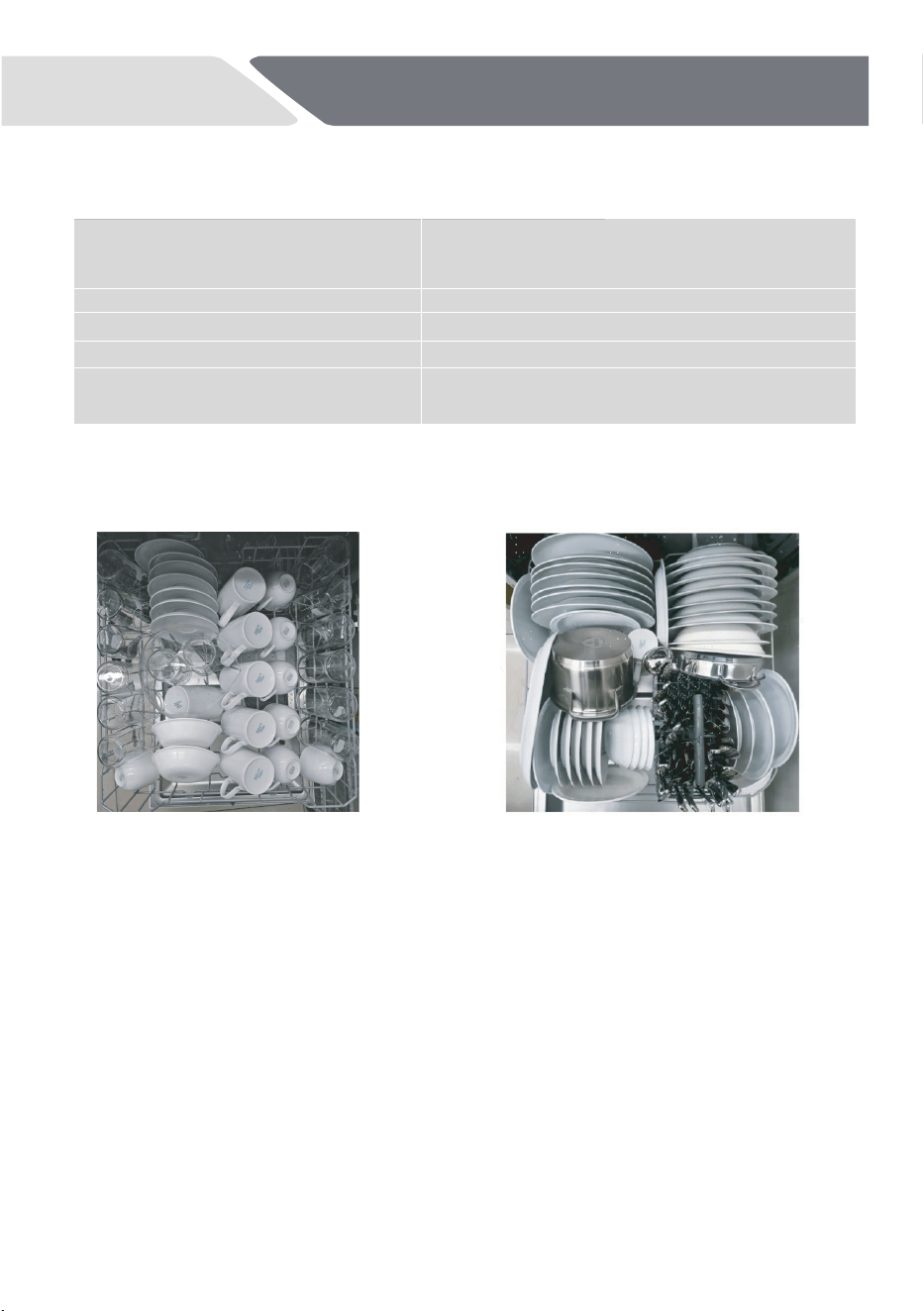
Wash programme
Eco
Powder detergent quantities 22g main wash
Rinse aid dosage level
Maximum number of place settings 14
R0-R6, R5(default)
Height adjustment of upper basket
Ensure the upper basket is in its lowest
position
Recommended loading patterns
Lower basket
Upper basket
42
Standards Test
EN
Supplier’s name or trade mark:
Supplier’s address
(b)
:
Model identifier:
General product parameters:
Parameter Value Parameter Value
Rated capacity
(a)
(ps)
14 Dimensions in cm
Height
84,7
Width
59,8
Depth
60,0
EEI
(a)
49,9
Energy efficiency class
(a)
[D]
(c)
Cleaning performance index
(a)
1,121
Drying performance index
(a)
1,061
Energy consumption in kWh
[per cycle], based on the eco
programme using cold water
fill. Actual energy consumption
will depend on how the
appliance is used.
0,849
Water consumption in litres
[per cycle], based on the eco
programme. Actual water con-
sumption will depend on how
the appliance is used and on
the hardness of the water.
11,0
Programme duration
(a)
(h:min)
3:58 Type [freestanding]
Airborne acoustical noise
emissions
(a)
(dB(A) re 1 pW)
49
Airborne acoustical noise
emission class
(a)
[C]
(c)
Off-mode (W) 0,50 Standby mode (W) 0,50
Delay start (W) (if applicable) 4,00
Networked standby (W) (if
applicable)
2,00
Minimum duration of the guarantee offered by the supplier
(b)
:
Additional information:
Weblink to the supplier’s website, where the information in point 6 of Annex II to Commission
Regulation (EU)2019/2022
(1)
(b)
is found:
(
a
)
for the eco programme.
(
b
)
changes to these items shall not be considered relevant for the purposes of paragraph 4 of Article 4 of Regulation (EU)
2017/1369.
(
c
)
if the product database automatically generates the definitive content of this cell the supplier shall not enter these data.
24
-
Candy
CFP 4D9F0W-80/CFP 4D9F0B-80/CFP 4D9F0S/CFP 4D9F0W
CANDY HOOVER GROUP S.R.L., Via Comolli, 16,Brugherio(MB),
20861, Italy
CFP 4D9F0W-80
43
Technical Data
EN
44
Information to be included in the technical documentation
PARAMETER UNIT VALUE
Eco programme energy consumption (EPEC)
rounded to three decimal places
kWh/cycle 0
,849
Standard programme energy consumption (SPEC)
rounded to three decimal places
kWh/cycle 1
,700
Energy Efficiency Index (EEI) — 49
,9
Eco programme water consumption (EPWC)
rounded to one decimal place
l/cycle
11
,0
Cleaning performance index (I
C )
—
1
,121
Drying performance index (I
D ) —
1
,061
Duration of the eco programme (T
t ) rounded to
the nearest minute
h:min 4:05
Power consumption in off-mode (P
o ) rounded to
two decimal places
W 0
,50
Power consumption in standby mode (P
sm )
rounded to two decimal places
W 0,50
Does standby mode include the display of
information?
— No
Power consumption in standby mode (P
sm ) in
condition of networked Standby (if applicable),
rounded to two decimal places
W
/
Power consumption in delay start (P
ds )
(if applicable) rounded to two decimal places
W 4
,00
Airborne acoustical noise emissions dB(A) re 1 pW 49
Technical Data
EN