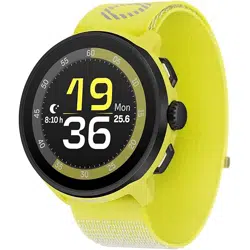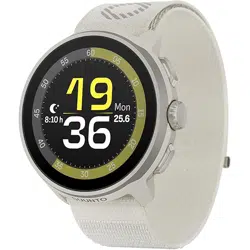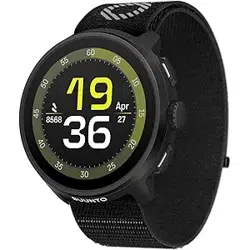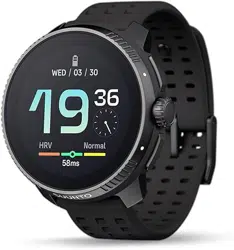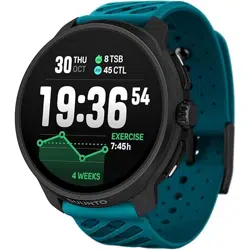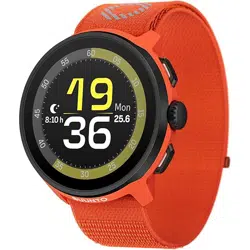

SUUNTO RUN
USER GUIDE
2025-03-26

1. SAFETY............................................................................................................................................................ 6
2. Getting started.............................................................................................................................................. 8
2.1. Touch screen and buttons.............................................................................................................. 8
2.2. Adjusting settings............................................................................................................................ 9
2.3. Software updates........................................................................................................................... 10
2.4. Suunto app....................................................................................................................................... 10
2.5. Optical heart rate............................................................................................................................10
3. Settings..........................................................................................................................................................12
3.1. Button and screen lock.................................................................................................................. 12
3.2. Display settings............................................................................................................................... 12
3.3. Tone and vibration.......................................................................................................................... 13
3.4. Bluetooth connectivity...................................................................................................................13
3.5. Airplane mode................................................................................................................................. 13
3.6. Do Not Disturb mode.....................................................................................................................14
3.7. Stand up reminder...........................................................................................................................14
3.8. Find my phone.................................................................................................................................14
3.9. Time and date..................................................................................................................................15
3.9.1. Alarm clock............................................................................................................................15
3.10. Language and region...................................................................................................................16
3.11. Unit system...................................................................................................................................... 16
3.12. Watch faces.....................................................................................................................................16
3.13. Power saving...................................................................................................................................17
3.14. Pair devices.....................................................................................................................................17
3.14.1. Calibrating foot pod...........................................................................................................18
3.15. Flashlight......................................................................................................................................... 18
3.16. Alarms.............................................................................................................................................. 18
3.16.1. Sunrise and sunset alarms...............................................................................................18
3.16.2. Storm alarm........................................................................................................................ 19
3.17. FusedSpeed™................................................................................................................................. 20
3.18. FusedAlti.........................................................................................................................................20
3.19. Altimeter.......................................................................................................................................... 21
3.20. Position formats............................................................................................................................21
3.21. Device info..................................................................................................................................... 22
3.22. Reset & power
o........................................................................................................................22
4. Recording an exercise.............................................................................................................................. 24
4.1. Sport modes.....................................................................................................................................25
4.2. Navigating during exercise......................................................................................................... 25
4.2.1. Find back.............................................................................................................................. 26
4.3. Training mode.................................................................................................................................26
4.4. Battery power management....................................................................................................... 27
Suunto Run
2

4.5. Multisport exercise........................................................................................................................ 28
4.6. Track running.................................................................................................................................. 28
4.7. Marathon...........................................................................................................................................28
4.8. Swimming........................................................................................................................................ 29
4.9. Autopause....................................................................................................................................... 29
4.10. Audio feedback............................................................................................................................ 29
4.11. Feeling............................................................................................................................................. 30
4.12. Intensity zones.............................................................................................................................. 30
4.12.1. Heart rate zones.................................................................................................................31
4.12.2. Pace zones.........................................................................................................................33
4.12.3. Power zones......................................................................................................................33
4.12.4. Using HR, pace or power zones when exercising...................................................34
5. Navigation....................................................................................................................................................35
5.1. Altitude navigation......................................................................................................................... 35
5.2. Bearing navigation........................................................................................................................ 36
5.3. Routes...............................................................................................................................................36
5.4. Points of interest............................................................................................................................ 38
5.4.1. Adding and deleting POIs................................................................................................ 38
5.4.2. Navigating to a POI........................................................................................................... 39
5.4.3. POI types............................................................................................................................. 40
6. Widgets.........................................................................................................................................................43
6.1. Control panel................................................................................................................................... 43
6.2. Weather............................................................................................................................................ 43
6.3.
Notifications.....................................................................................................................................44
6.4. Media player....................................................................................................................................44
6.5. Heart rate.........................................................................................................................................45
6.6. Progress........................................................................................................................................... 46
6.7. Training volume...............................................................................................................................47
6.8. Blood oxygen..................................................................................................................................48
6.9. Sleep................................................................................................................................................. 48
6.10. Steps and calories........................................................................................................................49
6.11. Sun & Moon.................................................................................................................................... 50
6.12. Logbook...........................................................................................................................................51
6.13. Recovery..........................................................................................................................................51
6.14. Alti & Baro....................................................................................................................................... 51
6.15. Compass.........................................................................................................................................52
6.16. Timer................................................................................................................................................54
6.17. Alipay (only in Mainland China)................................................................................................. 54
7. All apps..........................................................................................................................................................56
7.1. Breathe...............................................................................................................................................56
Suunto Run
3

8. Care and support....................................................................................................................................... 57
8.1. Handling guidelines....................................................................................................................... 57
8.2. Battery...............................................................................................................................................57
8.3. Disposal............................................................................................................................................57
9. Reference.....................................................................................................................................................58
9.1. Compliance...................................................................................................................................... 58
9.2. CE.......................................................................................................................................................58
Suunto Run
4

Suunto Run
5
1. SAFETY
Types of safety precautions
WARNING: - is used in connection with a procedure or situation that may result in
serious injury or death.
CAUTION: - is used in connection with a procedure or situation that will result in
damage to the product.
NOTE: - is used to emphasize important information.
TIP: - is used for extra tips on how to utilize the features and functions of the device.
Safety precautions
WARNING: Keep the USB cable away from medical devices such as pacemakers, as well
as key cards, credit cards and similar items. The USB cable device connector includes a
strong magnet which may interfere with the operation of medical or other electronic devices
and items with magnetically stored data.
WARNING: Allergic reactions or skin irritations may occur when the product is in contact
with skin, even though our products comply with industry standards. In such event, stop use
immediately and consult a doctor.
WARNING: Always consult your doctor before beginning an exercise program.
Overexertion may cause serious injury.
WARNING: Only for recreational use.
WARNING: Do not entirely rely on the GPS or battery lifetime of the product. Always use
maps and other backup material to ensure your safety.
CAUTION: Only use the provided charging cable when charging your Suunto Run.
CAUTION: Do not apply solvent of any kind to the product, as it may damage the
surface.
CAUTION: Do not apply insect repellent on the product, as it may damage the surface.
CAUTION: Do not throw the product away, but treat it as electronic waste to preserve the
environment.
CAUTION: Do not knock or drop the product, as it may get damaged.
CAUTION: Colored textile straps might bleed onto other fabrics or skin when new or wet.
Suunto Run
6

NOTE: At Suunto we use advanced sensors and algorithms to generate metrics that can
help you in your activities and adventures. We strive to be as accurate as possible. However,
none of the data our products and services collect is perfectly reliable, nor are the metrics
they generate absolutely precise. Calories, heart rate, location, movement detection, shot
recognition, physical stress indicators and other measurements may not match the real
world. Suunto products and services are intended for recreational use only and are not
meant for medical purposes of any kind.
Suunto Run
7
2. Getting started
Starting your Suunto Run for the first time is quick and simple.
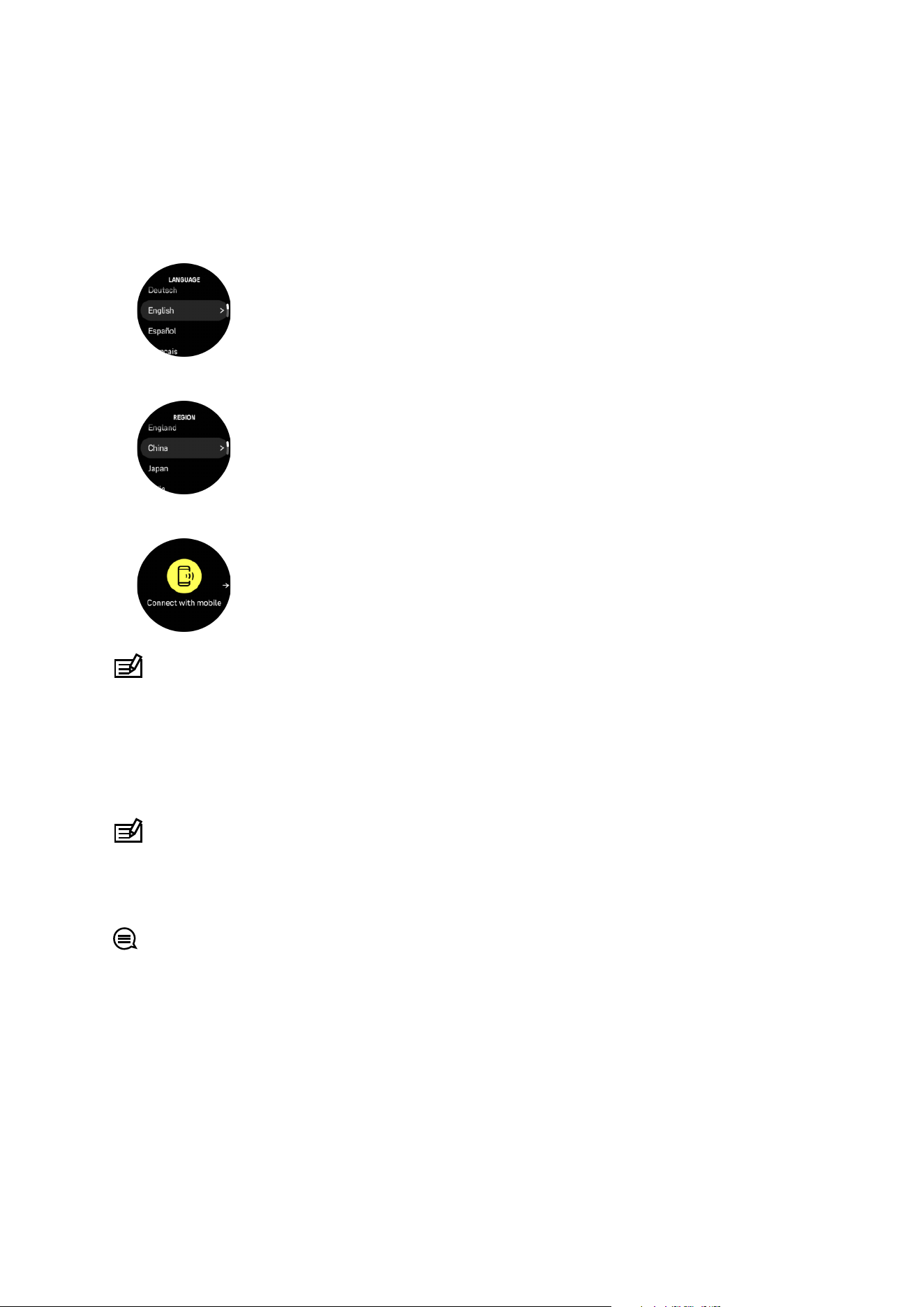
1. Keep the crown pressed to wake up the watch. The setup wizard starts automatically.
2. Select your language by swiping up or down and tapping on the language.
3. Select your region by swiping up or down and tapping on the region.
4. Pair the watch with your mobile phone to complete initial settings.
NOTE: Make sure the Bluetooth of your phone is turned on.
6. Scan the QR code appearing on the watch screen to download Suunto app if you haven't
done so already, or open Suunto app if it is already installed on your phone.
7. Enter the passkey appearing on the watch screen in the field that pops up on your phone.
8. Follow the wizard in Suunto app to complete the settings. For more information, see 2.4.
Suunto app.
NOTE: You can pair your watch with Suunto app later. In case you do not pair your
watch with Suunto app, you can complete the initial settings manually on your watch. Swipe
up or down to select values. Tap the screen or press the crown to accept a value and go to
the next step.
TIP: When the initial setup is done, Suunto Run provides you with a quick guide on how
to navigate your watch.
2.1. Touch screen and buttons
Suunto Run has a touch screen, a crown (also referred to as the middle button) and two
additional buttons you can use to navigate through displays and features.
Swipe and tap
•
swipe up or down to move in displays and menus
•
swipe right and left to move backwards and forwards in displays
•
tap to select an item
Suunto Run
8

Upper button
•
from watch face, press to open the menu for last exercise
•
from watch face, long press to open the defined shortcut
Crown/middle button
•
press to select an item
•
turn to move in displays and menus
•
from watch face, turn to open the widget list
•
from watch face, press to open the sport mode list
•
from watch face, long press to open the Settings menu
Lower button
•
press to go back in views and menus
•
long press to go back to watch face
•
from watch face, long press to open the defined shortcut
While recording an exercise:
Upper button
•
press to pause the activity
•
long press to change activity
Crown/middle button
•
turn to move backwards and forwards in displays
•
press to open exercise options
Lower button
•
press to mark a lap
•
long press to go to the watch face
2.2. Adjusting settings
You can adjust all watch settings directly in the watch.
To adjust a setting:
1. From watch face, keep the crown pressed to open Settings.
2. Scroll through the settings menu by swiping up/down or turning the crown.
3. Select a setting by tapping the setting name or pressing the crown when the setting is
highlighted. Go back in the menu by swiping right or pressing the lower button.
4. For settings with a value range, change the value by swiping up/down or turning the
crown.
5. For settings with just two values, such as on or
o, change the value by tapping the setting
or by pressing the crown.
Suunto Run
9

2.3. Software updates
Software updates add important improvements and new features to your watch. Suunto Run
is updated automatically, if it is connected to Suunto app.
When an update is available and your watch is connected with Suunto app, the software
update will be downloaded to the watch automatically. The status of this download can be
viewed in Suunto app.
Once the software is downloaded to your watch, the watch will update itself during the night
as long as the battery level is at least 20% and no exercise is being recorded simultaneously.
If you want to install the update manually before it happens automatically during the night,
navigate to Settings » General and select Software update.
NOTE: When the update is complete, the release notes will be visible in Suunto app.
2.4. Suunto app
With the Suunto app, you can further enrich your Suunto Run experience. Pair your watch with
the mobile app to sync your activities, create workouts, get mobile notifications, insights and
more.
NOTE: You cannot pair anything if airplane mode is on. Turn o airplane mode before
pairing.
To pair your watch with Suunto app:
1. Ensure your watch Bluetooth is on. Under the settings menu, go to Connectivity »
Discovery and enable it if it is not already.
2. Download and install Suunto app on your compatible mobile device from the App Store,
Google Play in addition to several popular app stores in China.
3. Start Suunto app and turn on Bluetooth if it is not on already.
4. Tap the watch icon in the upper-left of the app screen and then tap “PAIR” to pair your
watch.
5. Verify the pairing by typing the code that is displayed on your watch in the app.
NOTE: Some features require an internet connection over Wi-Fi or mobile network.
Carrier data connection fees may apply.
2.5. Optical heart rate
Optical heart rate measurement from the wrist is an easy and convenient way to track your
heart rate. Best results for heart rate measurement may be aected by the following factors:
•
The watch must be worn directly against your skin. No clothing, however thin, can be
between the sensor and your skin.
Suunto Run
10
•
The watch may need to be higher on your arm than where watches are normally worn.
The sensor reads blood flow through tissue. The more tissue it can read, the better.
•
Arm movements and flexing muscles, such as gripping a tennis racket, can change the
accuracy of the sensor readings.
•
When your heart rate is low, the sensor may not be able to provide stable readings. A
short warm up of a few minutes before you start the recording helps.
•
Skin pigmentation and tattoos block light and prevent reliable readings from the optical
sensor.
•
The optical sensor may not provide accurate heart rate readings for swimming activities.
•
For higher accuracy and quicker responses to changes in your heart rate, we recommend
using a compatible chest heart rate sensor such as Suunto Smart Sensor.
WARNING: The optical heart rate feature may not be accurate for every user during
every activity. Optical heart rate may also be
aected by an individual’s unique anatomy and
skin pigmentation. Your actual heart rate may be higher or lower than the optical sensor
reading.
WARNING: Only for recreational use; the optical heart rate feature is not for medical use.
WARNING: Always consult a doctor before beginning a training program. Overexertion
may cause serious injury.
WARNING: Allergic reaction or skin irritations may occur when products are in contact
with skin, even though our products comply with industry standards. In such event, stop use
immediately and consult a doctor.
Suunto Run
11

3. Settings
The settings menu can be accessed directly if you long press the crown while you are in the
watch face view.
TIP: From the watch face, swipe up to get access to all of the watch settings via the
Control panel.
If you want quick access to certain settings and/or features, you can customize the top and
lower button logic (from watch face view) and create shortcuts to your most useful settings/
features.
Navigate to the Control panel and select Customize followed by Top shortcut or Bottom
shortcut and select what function the top and bottom button will have when long pressed.
3.1. Button and screen lock
While recording an exercise, you can lock the buttons and the screen by pressing the crown
and toggle Lock screen on. Once locked, you cannot perform any action that requires button
interaction (create laps, pause/end exercise etc.) or change the display view.
To unlock the buttons and the screen, long press the upper and the lower button
simultaneously.
If you want to lock the touch screen but still use the buttons while exercising, toggle the touch
screen option
o in the exercise settings before you start recording the exercise.
When you are not recording an exercise, the screen becomes inactive and dims after a
certain time of inactivity. To activate the screen, press any button.
See 3.2. Display settings for information on the screen behavior.
3.2. Display settings
In the display menu, you can adjust the following features: the level of brightness
(Brightness), whether the inactive display shows any information (Always-on display),
whether the display activates when you raise and turn your wrist (Raise to wake), after how
many minutes of inactivity the screen goes
o (O screen time), whether you wear the watch
on your left or right wrist (Wrist), and whether you wear the watch with the buttons on the left
or the right side (Crown direction).
The display features can be adjusted from Settings > Display.
•
The Brightness setting determines the overall intensity of display brightness; Low, Medium
or High.
CAUTION: Prolonged use of the high brightness display reduces battery life and may
cause screen burn-in. Avoid using high brightness for extended period to lengthen display
lifetime.
•
The Always-on display setting determines if the inactive display is blank or shows
information, for example, the time. Always-on display can be toggled on or
o:
•
On: The display shows certain information all the time.
•
O: When the display is inactive, the screen is blank.
Suunto Run
12

TIP: You can quickly turn on the Always-on display setting in the Control panel.
CAUTION: The use of Always-on display reduces battery life by about 30%.
•
The Raise to wake feature activates the display when raising your wrist to look at the
watch.
•
The
O screen time setting determines the time after that the screen goes o or in case of
inactivity. You can set it to 10, 15, 30 or 60 seconds.
•
With the Wrist and Crown direction settings, you can determine if you wear the watch on
your left or right wrist, with the buttons on the left or the right side. With these settings, you
can change the display orientation and comfortably wear the watch on either wrist.
3.3. Tone and vibration
Tone and vibration alerts are used for notifications, alarms and other key events and actions.
Tone and vibration can be adjusted from Settings » Tone & Vibration.
You can select from the following options for the
dierent notifications, alarms and alerts:
•
Tone: sound alert
•
Vibration: vibration alert
•
Tone & Vibration: sound and vibration alert
For the crown and the buttons, you can select from four options:
•
None: Pressing any buttons and turning the crown do not trigger sound or vibration.
•
Tone: Pressing any buttons triggers sound.
•
Vibration: Turning the crown triggers vibration.
•
Tone & Vibration: Pressing any buttons triggers sound and turning the crown triggers
vibration.
Select your preferred option by pressing the crown.
3.4. Bluetooth connectivity
Suunto Run uses Bluetooth technology to send and receive information from your mobile
device when you have paired your watch with the Suunto app. Same technology is also used
when pairing headphones, PODs and sensors.
However, if you do not want your watch to be visible for Bluetooth scanners, you can activate
or deactivate the discovery setting from the settings under Connectivity > Discovery.
The Bluetooth can also be completely turned o by activating airplane mode, see 3.5.
Airplane mode.
3.5. Airplane mode
Activate airplane mode when needed to turn o wireless transmissions. You can activate or
deactivate airplane mode from the settings under Connectivity or in the Control panel.
Suunto Run
13
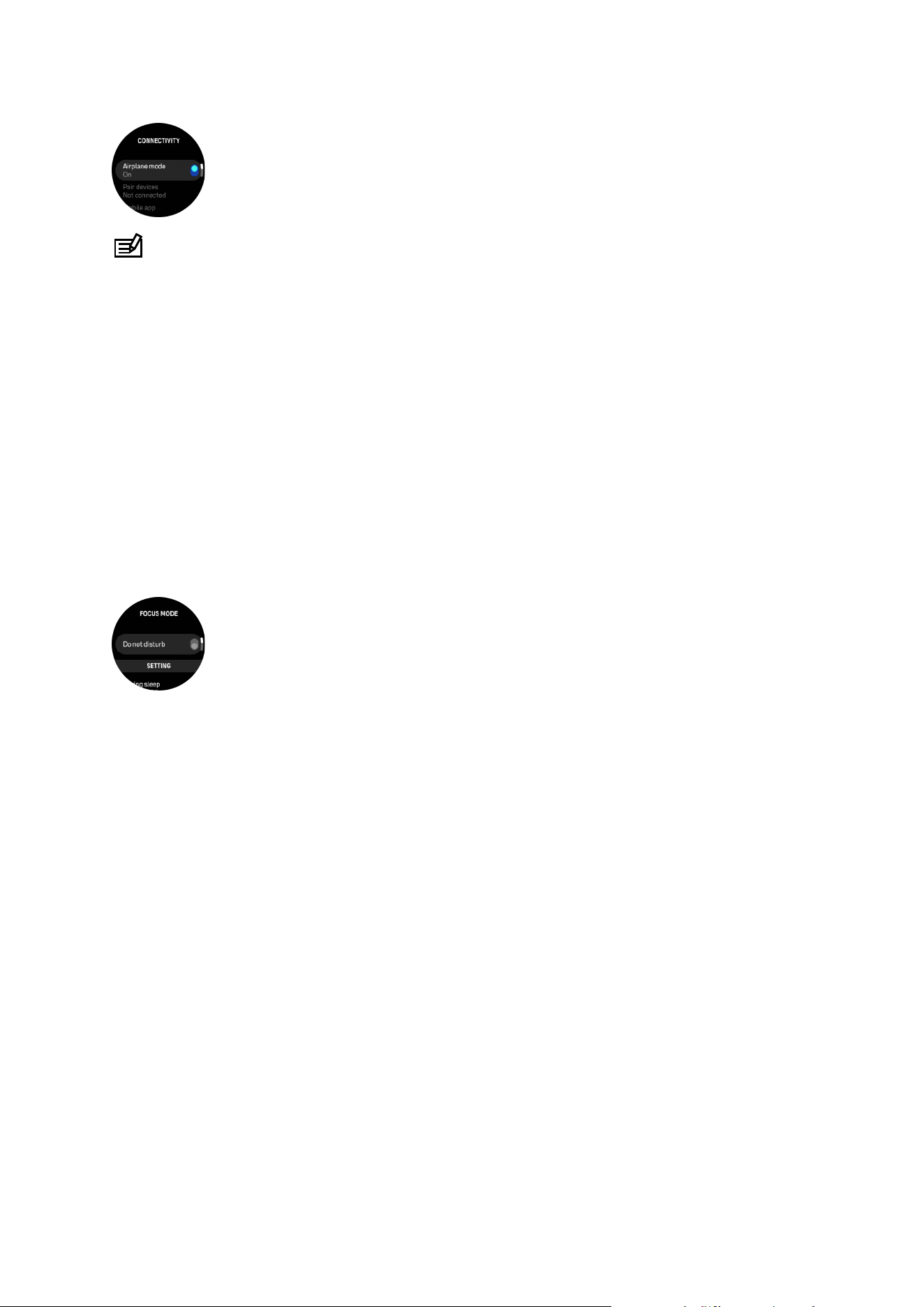
NOTE: To pair anything with your device, you need to first turn o airplane mode if you
have it on.
3.6. Do Not Disturb mode
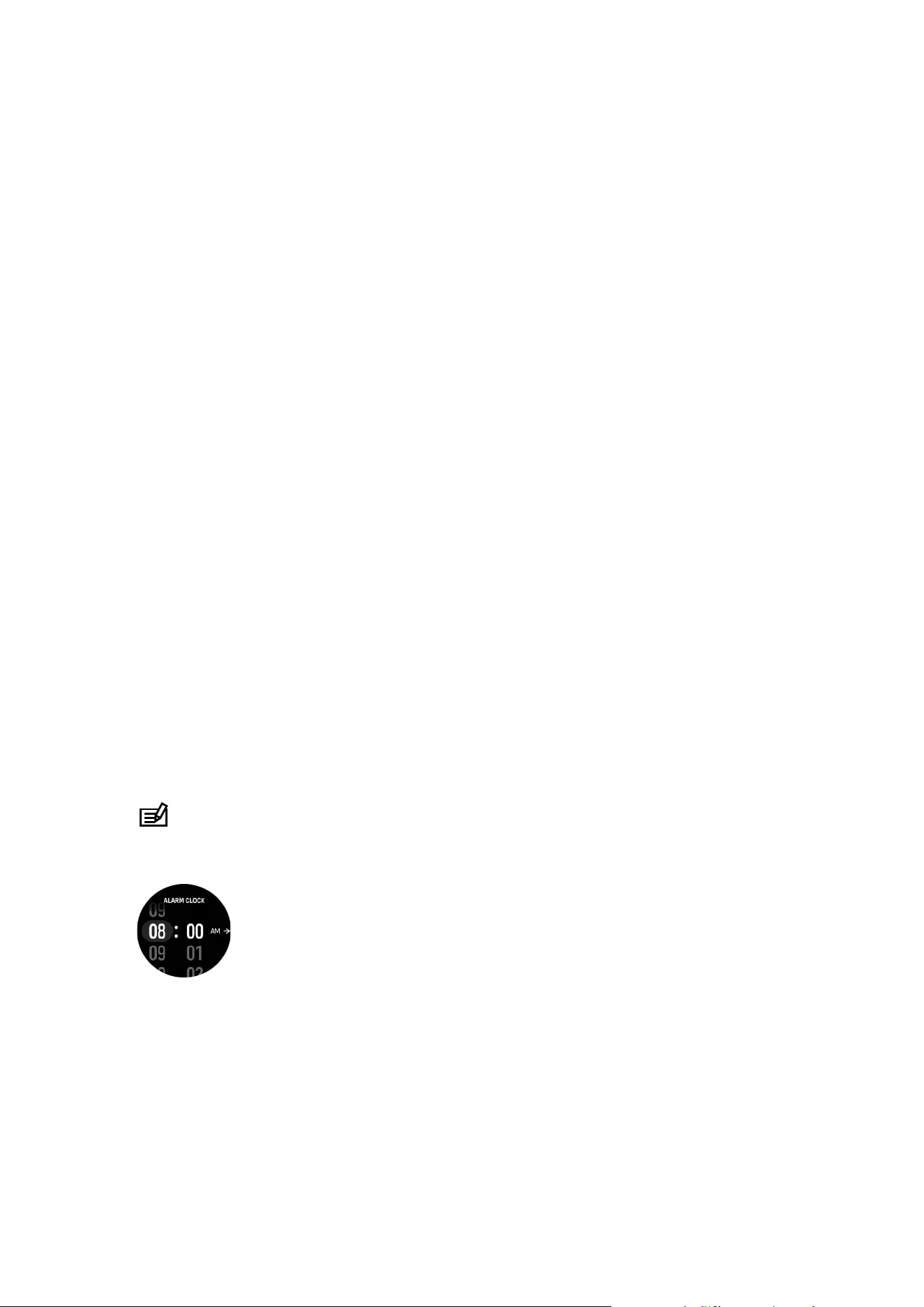
The Do not disturb mode is a setting that mutes all sounds and vibrations and dims the
screen, making it a very useful option when wearing the watch in, for example, a theater or
any environment where you want the watch to operate as usual, but silently.
To turn
on/o the Do not disturb mode:
1. From the watch face, swipe up to open Control panel.
2. Scroll down to Do not disturb.
3. Tap on the function name or press the crown to activate Do not disturb mode.
If you have an alarm set, it sounds as normal and disables Do not disturb mode unless you
snooze the alarm.
You can define Do not disturb settings in the Focus mode menu in the watch settings.
Toggle on the During sleep option to automatically turn Do not disturb on during the
previously defined sleep hours.
You can also set any other schedule for automatically activating the Do not disturb mode
according to your needs.
3.7. Stand up reminder
Regular movement is very beneficial for you. With Suunto Run, you can activate a stand up
reminder that reminds you to move around a bit if you have been sitting too long.
From the settings, select Activity & Training and toggle on Stand up reminder.
If you have been inactive during 2 consecutive hours, your watch will notify you and remind
you to stand up and move around a bit.
3.8. Find my phone
You can use the Find my phone feature to
find your phone when you do not remember where
you left it. Your Suunto Run can ring your phone if they are connected. As Suunto Run uses
Bluetooth to connect to your phone, the phone needs to be in Bluetooth range so that the
watch can ring it.
To activate the find my phone feature:
1. From the watch face, swipe up to open Control panel or All Apps.
Suunto Run
14
2. Scroll down to Find my phone.
3. Start ringing your phone by tapping on the function name or pressing the crown.
4. Press the lower button to stop ringing.
3.9. Time and date
You can set time and date during the initial startup of your watch. After this, your watch uses
GPS time to correct any oset.
Once you have paired with Suunto app, your watch gets updated time, date, time zone and
daylight-saving time from mobile devices.
In the Settings, under General » Time / Date, tap Auto time update to toggle the feature on
and o.
You can manually adjust time and date from the settings under General » Time / Date where
you can also change time and date formats.
In addition to the main time, you can use dual time to follow the time at a dierent location, for
example, when you are traveling. Under General » Time / Date, tap Dual time to set the time
zone by selecting a location.
3.9.1. Alarm clock
Your watch has an alarm clock that can sound once or repeat on
specific days. You can find it
in the All Apps menu and you can add it to the list of your selected widgets.
If you have a sleep plan saved in the Sleep menu, you can quickly set a wake up alarm under
Wake up in Alarm Clock. In this menu, you can turn the alarm on or
o, edit how often you
want it to sound, and modify your sleep plan.
You can set additional alarms besides your sleep plan's wake up alarm:
1. From the watch face, swipe up or down or turn the crown to access the Alarm Clock on
the widget list or in the All Apps menu.
2. Enter the Alarm Clock.
3. Scroll down and select New alarm clock.
NOTE: Older alarms can be deleted or edited if selected in the list below New alarm
clock.
4. Set the hour and minutes.
5. Select how often you want the alarm to sound. The options are:
Once: alarm sounds once in the next 24 hours at the set time
Everyday: alarm sounds at the same time every day of the week
Weekdays: alarm sounds at the same time Monday thru Friday
Suunto Run
15
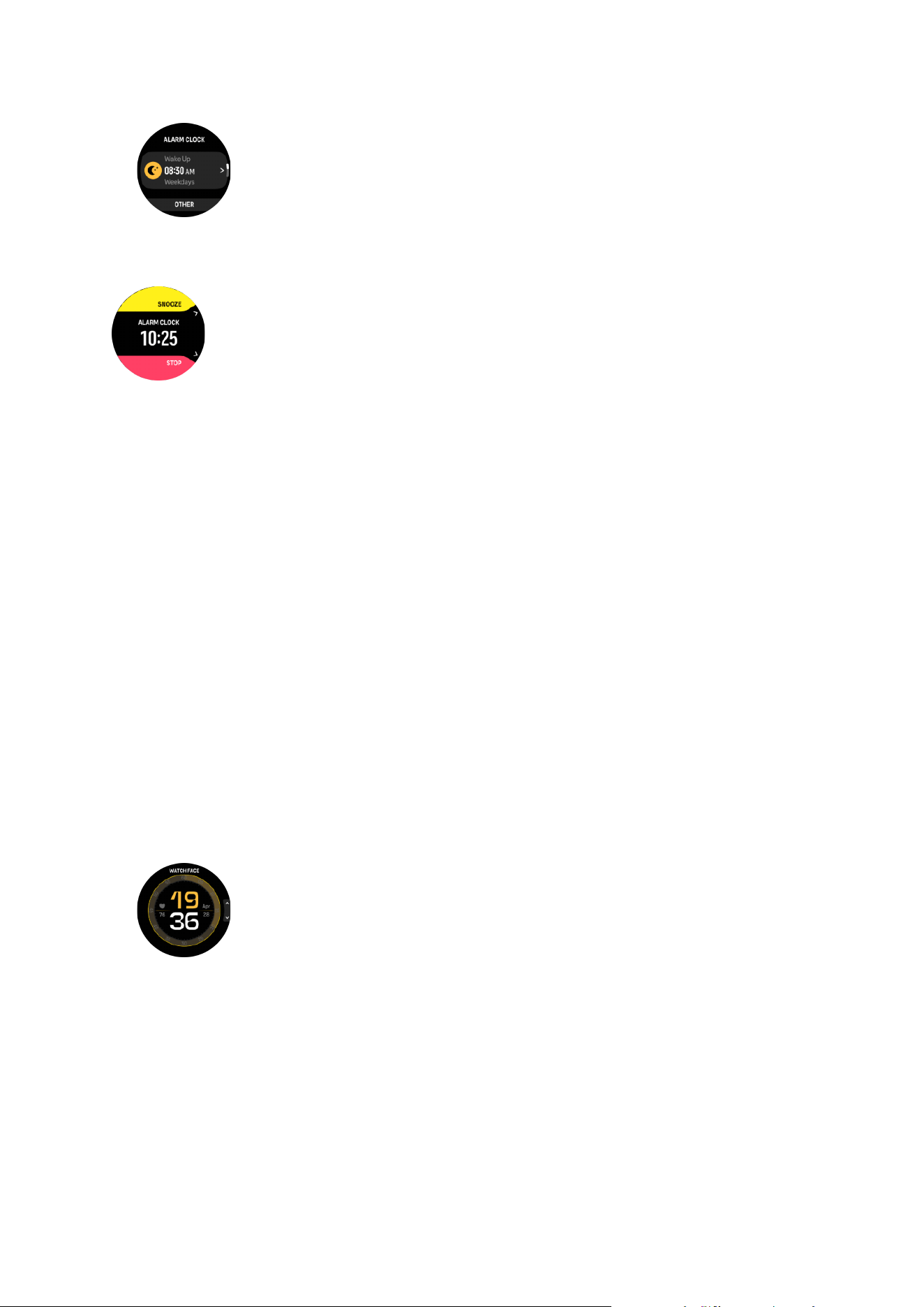
When the alarm sounds, you can dismiss it to end the alarm, or you can select the snooze
option. The snooze time is 10 minutes and can be repeated up to 10 times.
If you let the alarm continue to sound, it will turn o after one minute.
3.10. Language and region
You can change your watch language and select the region where you live from the settings
under General » Language.
3.11. Unit system
You can change the unit system of your watch from the settings under General » Unit system.
You can use the metric or the imperial system. Once you select one, all the data on your
watch will be displayed in the units of the selected system.
3.12. Watch faces
Suunto Run comes with several watch faces to choose from.
To change the watch face:
1. Select Customize from the Control panel.
2. Open Watch face by tapping on the menu option or pressing the crown.
3. Swipe up and down to scroll through the watch face previews and tap on the one you
want to use or select it by pressing the crown.
4. Swipe up and down to scroll through the watch face color options and select the colors
you want to use by pressing the crown.
5. On the Complications page, customize the information you want to see on the watch face.
Select a complication to edit by tapping on it or move between the complications by
turning the crown and edit them after pressing the upper button.
Suunto Run
16
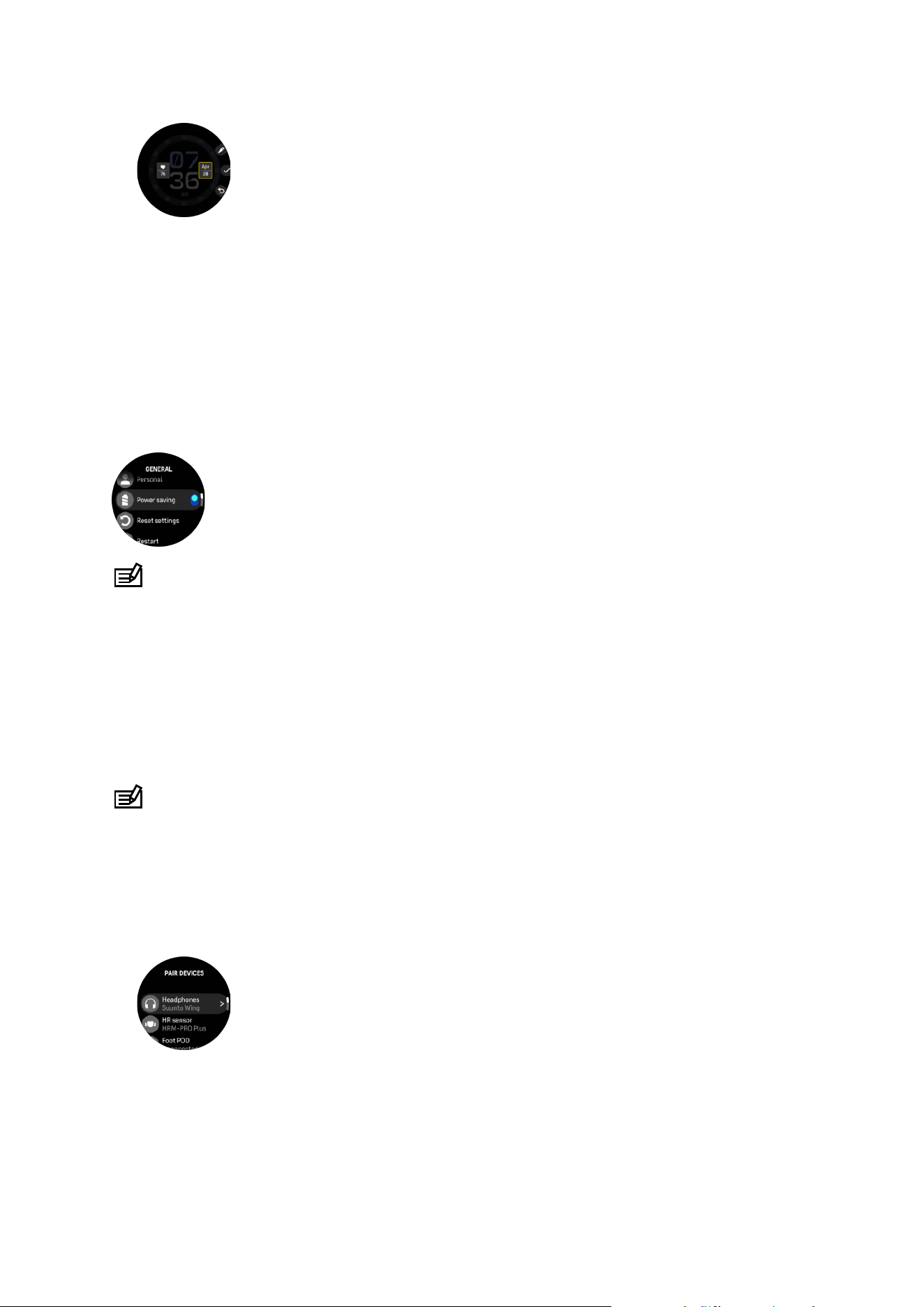
6. Save your setting by pressing the crown.
3.13. Power saving
Your watch includes a power saving option that turns
o all vibration and reduces display
brightness and the frequency of daily HR measurement to extend battery life during normal
daily use. For power saving options while recording activities, see 4.4. Battery power
management.
Enable/disable power saving from the settings under General » Power saving or in the
Control panel.
NOTE: Power saving is automatically enabled when the battery level reaches 10%.
3.14. Pair devices
Pair your watch with Bluetooth headphones, Bluetooth Smart pods and sensors to enjoy
music and collect additional information when recording an exercise.
Your Suunto Run supports the following types of pods and sensors:
•
Heart rate
•
Foot
NOTE: You cannot pair anything if airplane mode is on. Turn o airplane mode before
pairing. See 3.5. Airplane mode.
To pair headphones, a pod or a sensor:
1. Go to your watch settings and select Connectivity.
2. Select the Pair devices option to see the list of compatible device types.
3. Scroll down to see the whole list and tap on the device type you want to pair.
4. Follow the instructions in the watch to complete pairing (refer to headphones, sensor or
pod manual if needed), press the middle button to advance to the next step.
Suunto Run
17

If the pod has required settings, you are prompted to enter a value during the pairing process.
Once the pod or sensor is paired, your watch searches for it as soon as you select a sport
mode that uses that sensor type.
Once the headphones are paired, they connect to the watch automatically when you turn the
headphones on (within Bluetooth connection range).
NOTE: The headphones must be in pairing mode to pair them with the watch.
Each device can be disconnected from the watch or removed from the paired device list if
needed. Select the device you want to remove, and tap Disconnect to disconnect the devices
or Forget to remove the device from the list.
3.14.1. Calibrating foot pod
When you pair a foot pod, your watch automatically calibrates the pod using GPS. We
recommend using the automatic calibration, but you can disable it if needed from the pod
settings under Connectivity > Pair devices > Foot POD.
3.15. Flashlight
Your Suunto Run has a
flashlight function with three lighting modes.
To activate the flashlight, swipe up from watch face or scroll down with the crown and select
Control panel or All Apps. Scroll to Flashlight and turn it on by tapping on it or by pressing
the crown.
The flashlight has the following lighting modes:
•
an extra bright white backlight that is constantly on
•
a
flicker mode
•
a bright red backlight that is constantly on
To change the lighting modes, turn the crown or swipe up or down. To turn o the flashlight,
press the lower button or swipe right.
3.16. Alarms
In the Outdoor settings of your watch, you can set dierent adaptive alarm types.
You can set an alarm for sunrise and sunset and also for storm alarm. See 3.16.1. Sunrise and
sunset alarms and 3.16.2. Storm alarm.
3.16.1. Sunrise and sunset alarms
The sunrise/sunset alarms in your Suunto Run are adaptive alarms based on your location.
Instead of setting a
fixed time, you set the alarm for how much in advance you want to be
alerted before the actual sunrise or sunset.
Suunto Run
18
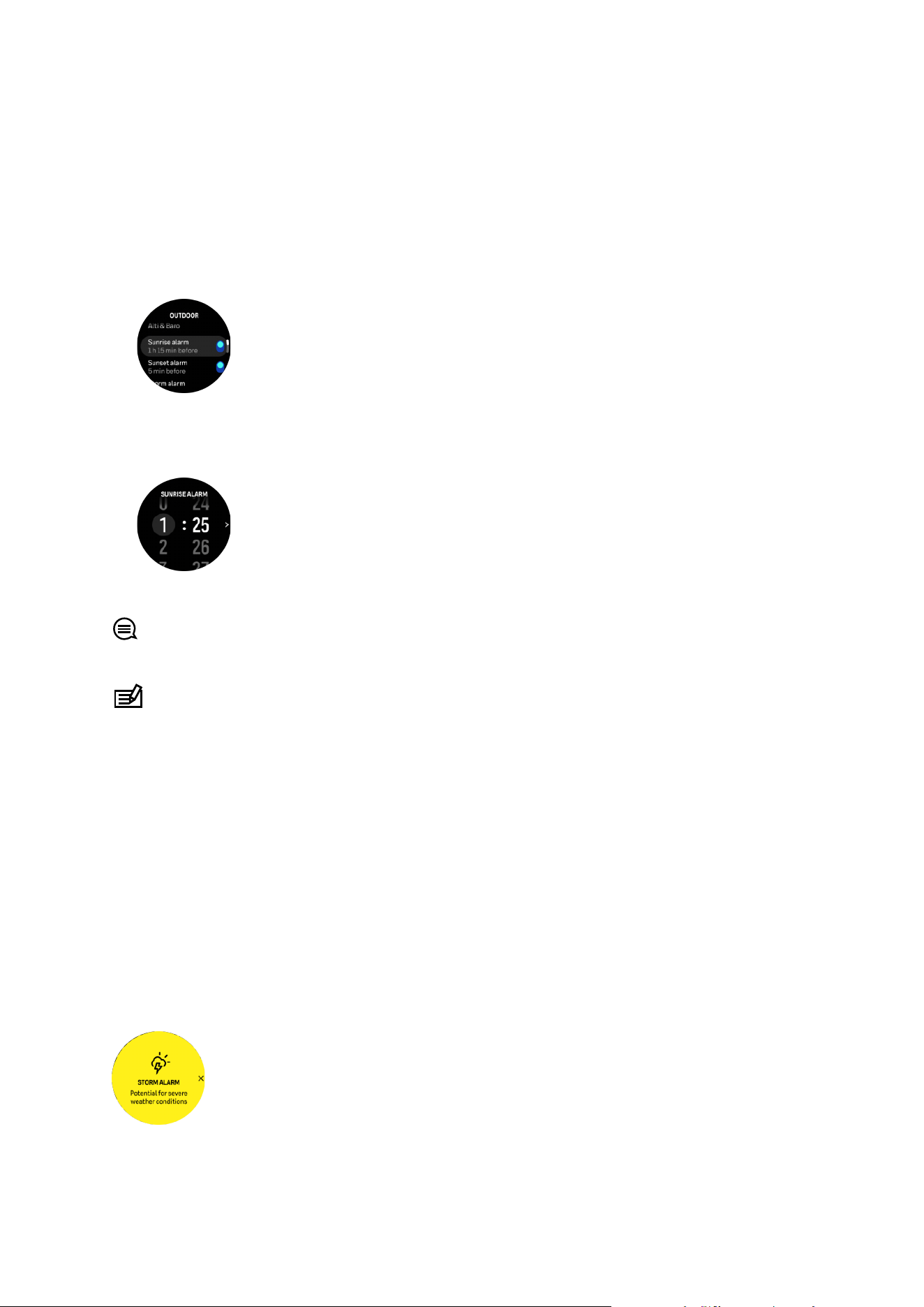
The sunrise and sunset times are determined via GPS, so your watch relies on the GPS data
from the last time you used GPS.
To set sunset/sunrise alarms:
1. From watch face, keep the crown pressed to enter Settings.
2. Scroll to Outdoor and enter the menu by tapping on its name or pressing the middle
button.
3. Scroll to the alarm that you want to set and select it.
4. Set the desired hours and minutes prior to sunrise/sunset by scrolling up and down with
the crown or by swiping up and down on the screen and confirming with the middle
button.
5. Press the middle button to confirm and exit.
TIP: You can customize the watch face to show sunrise and sunset times. See 3.12. Watch
faces.
NOTE: Sunrise and sunset times and alarms require a GPS fix. The times are blank until
GPS data is available.
3.16.2. Storm alarm
A
significant drop in barometric pressure typically means a storm is coming and you should
take cover. When the storm alarm is active, Suunto Run sounds an alarm and displays a storm
symbol when the pressure drops 4 hPa (0.12 inHg) or more during a 3-hour period.
To activate the storm alarm:
1. From watch face, keep the crown pressed to enter Settings.
2. Scroll to Outdoor and enter the menu by tapping on its name or pressing the crown.
3. Scroll to Storm alarm and toggle it
on/o by tapping on its name or pressing the crown.
When a storm alarm sounds, pressing any button ends the alarm. If no button is pressed, the
alarm notification lasts for one minute. The storm symbol remains on the display until the
weather conditions stabilize (pressure drop slows down).
Suunto Run
19
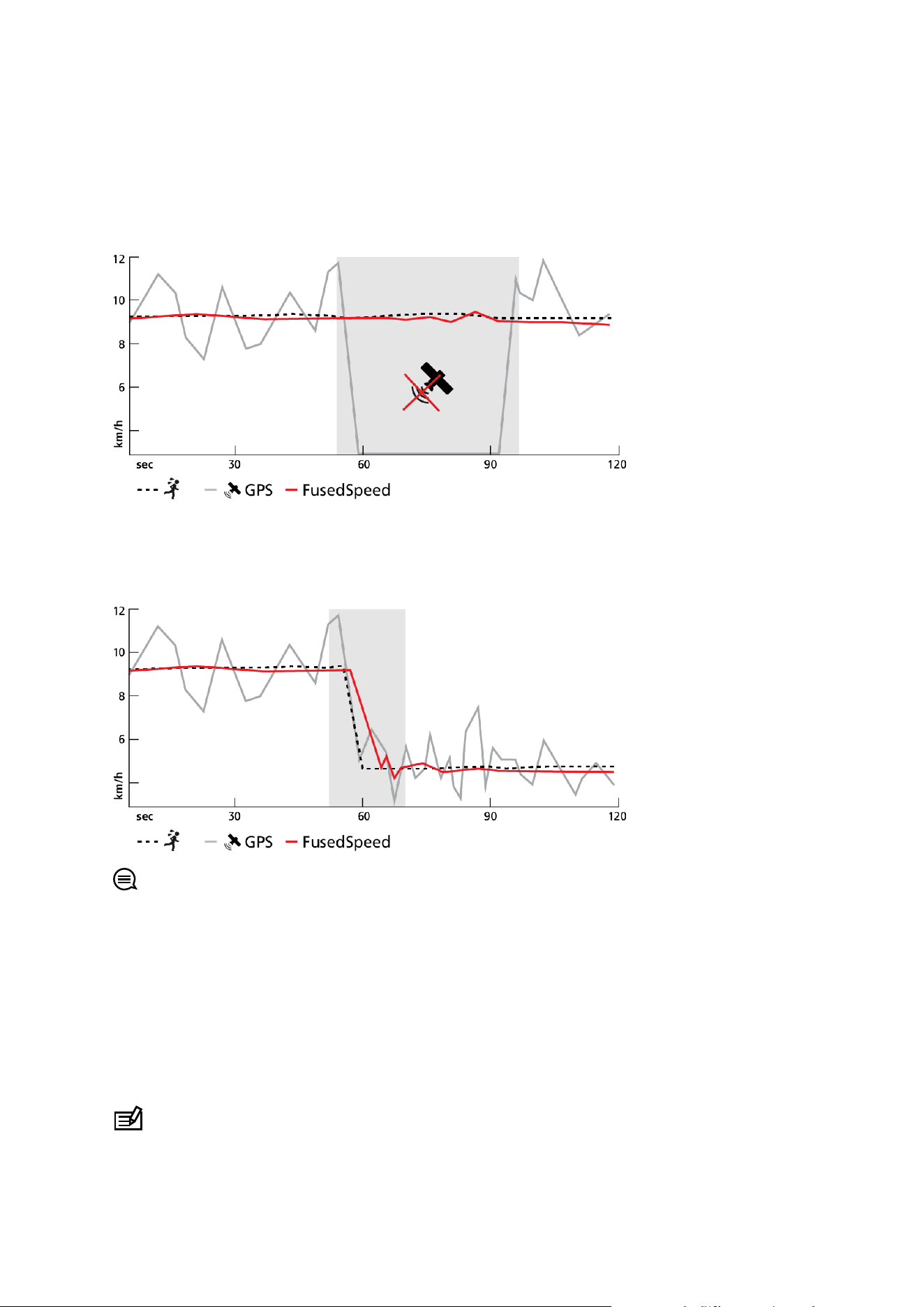
3.17. FusedSpeed™
FusedSpeed™ is a unique combination of GPS and wrist acceleration sensor readings for
measuring your running speed more accurately. The GPS signal is adaptively filtered based
on wrist acceleration, giving more accurate readings at steady running speeds and quicker
responses to changes in speed.
FusedSpeed benefits you the most when you need highly reactive speed readings during
training, for example, when running on uneven terrain or during interval training. If you
temporarily lose the GPS signal, for example, Suunto Run is able to continue showing
accurate speed readings with the help of the GPS calibrated accelerometer.
TIP: To get the most accurate readings with FusedSpeed, only glance shortly at the
watch when needed. Holding the watch in front of you without moving it reduces the
accuracy.
FusedSpeed is automatically enabled for running and other similar types of activities, such as
orienteering,
floor ball and football (soccer).
3.18. FusedAlti
FusedAltiTM provides an altitude reading that is a combination of GPS and barometric
altitude. It minimizes the
eect of temporary and oset errors in the final altitude reading.
NOTE: By default, altitude is measured with FusedAlti during exercises that use GPS and
during navigation. When GPS is switched o, altitude is measured with the barometric sensor.
Suunto Run
20

3.19. Altimeter
Suunto Run uses barometric pressure to measure altitude. To get accurate readings, you
need to define an altitude reference point. This can be your current elevation if you know the
exact value. Alternatively, you can use FusedAlti (see 3.18. FusedAlti) to set your reference
point automatically.
Set your reference point from the settings under Outdoor > Alti & baro.
3.20. Position formats
The position format is the way your GPS position is displayed on the watch. All the formats
relate to the same location, they only express it in a dierent way.
You can change the position format in the watch settings under Outdoor > Navigation >
Position format.
Latitude/longitude is the most commonly used grid and has three
dierent formats:
•
WGS84 Hd.d°
•
WGS84 Hd°m.m'
•
WGS84 Hd°m's.s
Other common position formats available include:
•
UTM (Universal Transverse Mercator) gives a two-dimensional horizontal position
presentation.
•
MGRS (Military Grid Reference System) is an extension of UTM and consists of a grid zone
designator, 100,000-meter square
identifier and a numerical location.
Suunto Run also supports the following local position formats:
•
BNG (British)
•
ETRS-TM35FIN (Finnish)
•
KKJ (Finnish)
•
IG (Irish)
•
RT90 (Swedish)
•
SWEREF 99 TM (Swedish)
•
CH1903 (Swiss)
•
UTM NAD27 (Alaska)
•
UTM NAD27 Conus
•
UTM NAD83
•
NZTM2000 (New Zealand)
NOTE: Some position formats cannot be used in the areas north of 84° and south of 80°,
or outside the countries that they are intended for. If you are outside the allowed area, your
location coordinates cannot be displayed on the watch.
Suunto Run
21

3.21. Device info
You can check details of your watch software and hardware from the settings under General »
About.
3.22. Reset & power o
All Suunto watches have two types of reset available to address dierent issues:
•
the
first one, the soft reset, also known as the restart.
•
the second one, the hard reset, also known as the factory reset.
Restart (soft reset):
Performing a restart on your watch might help with the following situations:
•
the device is not responding to any button presses, taps, or swipes (the touch screen is
not working).
•
the display is either frozen or blank.
•
there is no vibration, e.g., during button presses.
•
the watch functionalities are not working as expected, e.g., the watch does not record
your heart rate (optical heart rate LEDs are not blinking), the compass is not
finalizing the
calibration process, etc.
•
the step counter is not counting your daily steps at all (please note, recorded steps may
be shown with a delay in the app).
NOTE: The restart will end and save any active exercise. Under normal circumstances,
the exercise data will not be lost. On rare occasions, a soft reset may cause memory
corruption issues.
You can restart your watch via the Settings. Select General and scroll down to Restart.
Confirm your choice by pressing the upper button.
If you cannot access the watch menu, press and hold the upper button for 10 seconds and
release it to restart the watch.
There are
specific circumstances under which the soft reset might not solve the issue and the
second type of reset may be performed. If the above has not helped with the issue you were
aiming to solve; the hard reset might help.
The hard reset (factory reset):
The factory reset will restore your watch to the default values. It will erase all data from your
watch, including exercise data, personal data and settings that have not been synced to
Suunto app. After a hard reset, you must go through the initial setup of your Suunto watch.
Performing a factory reset on your watch may be performed in the following situations:
•
a Suunto Customer Support representative has asked you to do so as part of the
troubleshooting procedure.
•
the soft reset did not solve the issue.
•
the battery life of your device is
significantly reducing.
•
the device is not connecting to GPS and other troubleshooting has not helped.
Suunto Run
22

•
the device has connectivity issues with Bluetooth devices (e.g., Smart Sensor or mobile
app) and other troubleshooting has not helped.
The factory reset of your watch is done via the Settings on your watch. Select General, scroll
down to Reset settings and select it. Initiate the reset by pressing the upper button. All data
on your watch will be deleted during the reset.
NOTE: The factory reset deletes the previous pairing information your watch might have
had. To start the pairing process with the Suunto app again, we recommend you delete the
previous pairing from the Suunto app and your phone's Bluetooth - under Paired devices.
NOTE: Both presented scenarios are to be performed only for emergencies. You should
not perform them regularly. If any issue persists, we recommend you either contact our
Customer Support or send your watch to one of your authorized service centers.
Power o
If you don't want to use your watch for a while, you can power it o. Go to Settings, select
General and scroll down to Power
o. Confirm your choice by pressing the upper button.
To wake up the watch, keep the crown pressed.
Suunto Run
23

4. Recording an exercise
In addition to 24/7 activity monitoring, you can use your watch to record your training
sessions or other activities to get detailed feedback and follow your progress.
To record an exercise:
1. Put on a heart rate sensor (optional).
2. Press the crown. The sport mode list appears in the screen.
3. Find the sport mode you want to use by swiping up or turning the crown and select the
sport mode by pressing the crown.
4. Dierent sport modes have dierent options, swipe up or turn the crown to scroll through
them and adjust them by pressing the crown.
5. Above the start indicator, a set of icons appears, depending on what you are using with
the sport mode (such as heart rate and connected GPS):
•
The arrow icon (connected GPS) flashes gray while searching and turns white once a
signal is found.
•
The heart icon (heart rate) flashes gray while searching and once a signal is found, it
turns into a white heart attached to a belt if you are using a heart rate sensor or a
white heart without the belt if you are using the optical heart rate sensor.
•
If you have a POD or headphones paired and connected, their icon is visible.
•
The battery estimation is visible, that tells you how many hours you can exercise
before the battery runs out.
If you are using a heart rate sensor but only the heart icon turns white (meaning that the
optical heart rate sensor is active), check that the heart rate sensor is paired, see 3.14. Pair
devices, and try again.
We recommend you to wait for each icon to turn white before starting an exercise for more
accurate data. Start the recording by selecting Start.
Once the recording is started, the selected heart rate source is locked and cannot be
changed during the ongoing training session.
6. While recording, you can switch between displays by turning the crown.
7. Press the upper button to pause the recording.
8. Press the crown to open the list of options.
9. Stop and save by selecting End.
NOTE: It is also possible to delete your exercise log by selecting Discard.
After you stop the recording, you are asked how you felt. You can answer or skip the question
(see 4.11. Feeling). The next screen shows a summary of the activity that you can browse
through with the touch screen or by turning the crown.
Suunto Run
24

If you made a recording you do not want to keep, you can delete the log entry by scrolling to
the bottom of the summary and tapping the delete button. You can also delete logs in the
same way from the logbook.
Exercise settings
Before you start recording an exercise, it is worth customizing the settings for the given
exercise. From the start screen, scroll down and select Exercise settings. You can adjust the
following options:
•
Battery mode: See 4.4. Battery power management.
•
Autopause: See 4.9. Autopause.
•
Post-exercise HR monitoring: If you toggle on this option, the watch keeps monitoring your
heart rate for 3 minutes after your exercise recording. This way you can check how your
heart rate returns to the normal rate.
•
Touch screen: If you toggle on this option, you can use the touch screen during exercise
recording. Toggle o the touch screen option if you want to control your watch during the
exercise recording only with the buttons.
•
Audio feedback: See 4.10. Audio feedback.
•
Media player: See 6.4. Media player.
•
Pair devices: See 3.14. Pair devices.
•
Feeling: See 4.11. Feeling.
4.1. Sport modes
Your watch comes with a wide range of
pre-defined sport modes. The modes are designed
for specific activities and purposes, from a casual walk outside to a triathlon race.
Before you record an exercise (see 4. Recording an exercise), you can view and select from
the complete list of sport modes.
You can see your most recently used sport modes on the top of the list. Scroll down for the
complete list of more than 30 sport modes.
Each sport mode has a unique set of displays that show
dierent data depending on the
selected sport mode. You can edit and customize the data shown on the watch display during
your exercise with Suunto app.
Learn how to customize sport modes in Suunto app (Android) or Suunto app (iOS).
4.2. Navigating during exercise
You can navigate a route, to a point of interest (POI) or towards a set bearing while you are
recording an exercise.
The sport mode you are using needs to have GPS enabled to be able to access the
navigation options.
To navigate during exercise:
Suunto Run
25

1. Create a route or POI in Suunto app and sync your watch if you haven't done so already.
2. Select a sport mode that uses GPS.
3. Scroll down and select Navigation.
4. Select Navigation target.
5. Select the route or POI you want to navigate or set a bearing. Then press the upper button
to
confirm the navigation target.
6. Swipe right or press the lower button to go back to the start view and start your recording
as normal.
While exercising, turn the crown to scroll to the navigation display where you will see the
route or POI that you selected or the bearing you set. For more information on the navigation
display, see 5.3. Routes , 5.4.2. Navigating to a POI and 5.2. Bearing navigation.
While on the navigation display, press the crown to go to the map display and press the upper
button to open your navigation options. From the navigation options, you can, for example,
select a
dierent route or POI, check your current location coordinates, as well as end
navigation.
4.2.1. Find back
If you are using GPS when recording an activity, Suunto Run automatically saves the starting
point of your exercise. With Find back, Suunto Run can guide you directly back to your
starting point.
To start Find back:
1. Start an exercise with GPS.
2. Turn the crown until you reach the navigation display.
3. When on the navigation display, press the crown.
4. Press the upper button to open the navigation options.
5. Scroll to Find back and tap the screen or press the middle button to select.
The navigation guidance is shown in the navigation display.
4.3. Training mode
With Suunto Run, you can customize sport modes according to your own needs for dierent
circumstances. It is possible to set dierent targets with your Suunto Run when exercising.
If the sport mode you selected has targets as an option, you can adjust them before starting
the recording. Scroll down from the exercise start screen and select training mode by
pressing the crown. By default, it is set to Free training. In the Free training mode, you don't
have to set any target, but you can still customize the training mode by adjusting the intensity
goal, setting reminders, etc.
Suunto Run
26
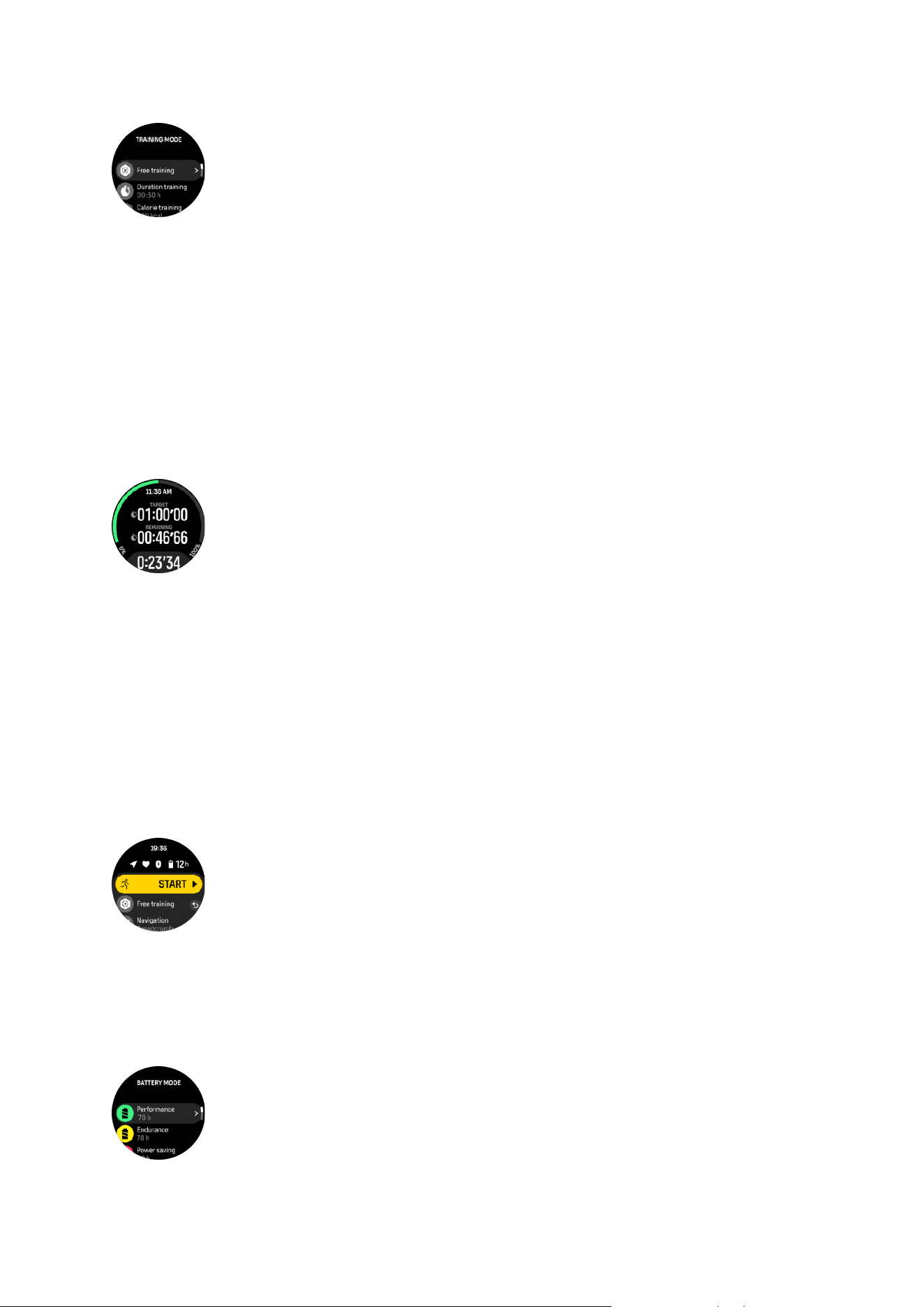
To exercise with general target:
1. Before you start an exercise recording, swipe up or turn the crown and select the training
mode option.
2. Select Duration training, Distance training or Calorie training.
3. Scroll down and set your target.
4. Scroll down again to adjust training mode settings, such as intensity goal and reminders.
5. Confirm your settings by pressing the upper button.
6. Scroll up and start your exercise.
When you have general targets activated, a target gauge is visible on every data display
showing your progress.
You will also receive a notification when you have reached 50% of your target and when your
selected target is fulfilled.
Some sport modes have more specific target options, for example Ascent training mode and
Ghost runner.
4.4. Battery power management
Your Suunto Run has a battery power management system that uses intelligent battery
technology to help ensure your watch does not run out of power when you need it most.
Before you start recording an exercise (see 4. Recording an exercise) you see an estimate of
how much battery life you have left in the current battery mode.
There are three predefined battery modes; Performance (default), Endurance and Power
saving. Changing between these modes will change the lifetime of the battery but also
changes the performance of the watch.
While in the start display, scroll down and select Exercise settings > Battery mode to change
battery mode and see how each mode
aects the performance of the watch.
Suunto Run
27

Battery notifications
In addition to the battery modes, your watch uses smart reminders to help you ensure you
have enough battery life for your next adventure. Some reminders are preemptive based on,
for example, your activity history. You also get notified, for example, when the watch notices
you are running low on battery while recording an activity. It will automatically suggest
changing to a dierent battery mode.
CAUTION: Only use the provided charging cable when charging your Suunto Run.
4.5. Multisport exercise
Your Suunto Run has predefined Triathlon sport modes that you can use to track your
Triathlon exercises and races but if you need to track another sort of multisport activity, you
can easily do so directly from the watch.
To use multisport exercises:
1. Select the sport mode you want to use for the
first leg of your multisport exercise.
2. Start recording an exercise as normal.
3. Press the crown and scroll down to enter multisport menu.
4. Select the next sport mode you want to use and press the middle button.
5. Adjust training mode settings
6. Press the upper button to start the recording with the new sport mode.
TIP: You can change sport mode as many times as you need during one single
recording, including a sport mode you used previously.
4.6. Track running
You can use your Suunto Run for track running.
When you use the Track running sport mode, you can set the running lane length and the
watch will automatically correct measurement data if needed. You can update lane length
before and during your exercise for the most accurate recording.
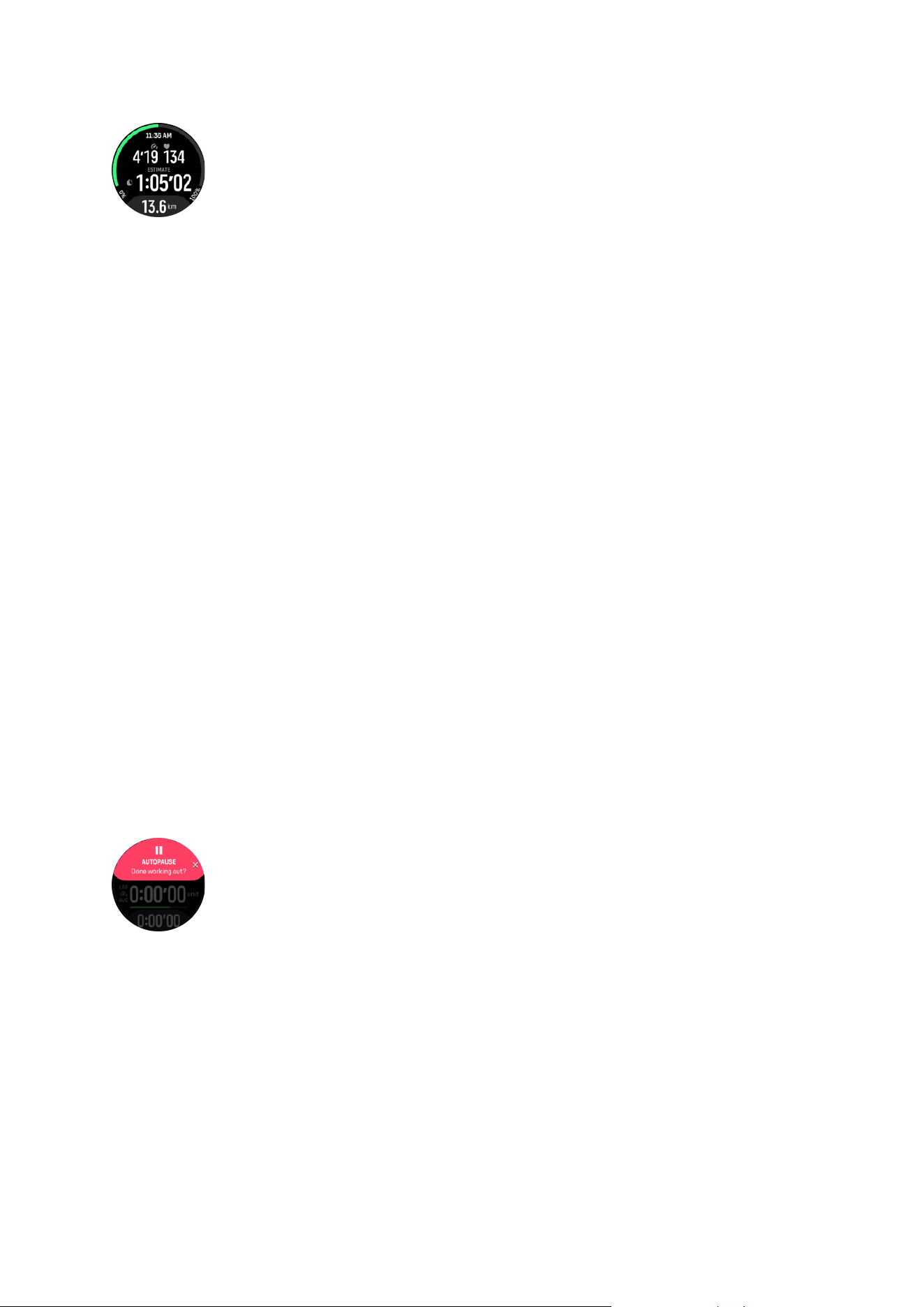
4.7. Marathon
The Marathon sport mode has a special display so that you can see the most important
information at a glance during your race. In the Marathon sport mode you can select 5 km, 10
km, Half Marathon and Marathon distances.
The Marathon display provides you with the following information:
•
your current pace
•
your current heart rate
•
finish time estimated based on your pace
•
distance done
•
a gauge indicating the distance done, compared to the full distance
Suunto Run
28
4.8. Swimming
You can use your Suunto Run for swimming in pools or openwater.
When you use a pool swimming sport mode, the watch relies on the pool length to determine
distance. You can change the pool length as needed under the sport mode options before
you start swimming.
Openwater swimming relies on GPS to calculate distance. Because GPS signals do not travel
under water, the watch needs to come out of the water periodically, such as with the freestyle
stroke, to get a GPS fix.
These are challenging conditions for GPS, so it is important that you have a strong GPS signal
before you jump in the water. To ensure good GPS, you should:
•
Sync your watch with your online account before you go swimming to optimize your GPS
with the latest satellite orbit data.
•
After you select an openwater swimming sport mode and a GPS signal is acquired, wait at
least three minutes before starting your swim. This gives the GPS time to establish strong
positioning.
4.9. Autopause
Autopause pauses the recording of your exercise when your speed is less than 2 km/h (1.2
mph). When your speed increases to more than 3 km/h (1.9 mph), the recording continues
automatically.
You can turn autopause on/o in the exercise settings in the watch before you start your
exercise recording.
If you turn this function on, a pop-up message notifies you when the recording is paused
automatically. A list of options open from where you can resume or end the recording.
You can let the recording resume automatically when you start moving again, or resume it
manually by pressing the upper button when on the exercise screen.
4.10. Audio feedback
You can get audio feedback with valuable information during your exercise. The feedback can
help you to keep track on your progress and give you useful indicators, depending on what
feedback options you have selected. The audio feedback comes from your headphones so
your watch must be paired with your Bluetooth headphones.
To activate audio feedback before an exercise:
Suunto Run
29

1. Before starting an exercise, scroll down and select Exercise settings.
2. Scroll down and toggle Audio feedback on.
3. Go back and start your exercise as you normally do.
To activate audio feedback during an exercise:
1. Press the crown to open the list of exercise options.
2. Scroll down and enter the Options menu by pressing the crown.
3. Scroll down to
find Audio feedback option under Sports settings.
4. Toggle Audio feedback on.
5. Go back and resume your exercise.
4.11. Feeling
If you are training regularly, following how you feel after each session is an important indicator
of your overall physical condition. A coach or personal trainer can also use your feeling trend
to track your progress over time.
There are
five degrees of feeling to choose from:
•
Poor
•
Average
•
Good
•
Very good
•
Excellent
What these options mean exactly are up to you (and your coach) to decide. The important
thing is that you use them consistently.
For each training session, you can record how you felt in the watch directly after stopping the
recording by answering the 'How was it?' question.
You can skip answering the question by pressing the middle button.
4.12. Intensity zones
Using intensity zones for exercising helps guide your fitness development. Each intensity
zone stresses your body in dierent ways, leading to dierent eects on your physical fitness.
There are five dierent zones, numbered 1 (lowest) to 5 (highest), defined as percentage
ranges based on your maximum heart rate (max HR), pace or power.
It is important to train with intensity in mind and understand how that intensity should feel.
And don't forget, regardless of your planned training, that you should always take time to
warm up before an exercise.
The
five dierent intensity zones used in Suunto Run are:
Zone 1: Easy
Exercising in zone 1 is relatively easy on your body. When it comes to fitness training, intensity
this low is significant mainly in restorative training and improving your basic fitness when you
Suunto Run
30

are just beginning to exercise, or after a long break. Everyday exercise – walking, climbing
stairs, cycling to work, etc. – is usually performed within this intensity zone.
Zone 2: Moderate
Exercising at zone 2 improves your basic fitness level eectively. Exercising at this intensity
feels easy, but workouts with a long duration can have a very high training eect. The majority
of cardiovascular conditioning training should be performed within this zone. Improving basic
fitness builds a foundation for other exercise and prepares your system for more energetic
activity. Long duration workouts at this zone consume a lot of energy, especially from your
body’s stored fat.
Zone 3: Hard
Exercising at zone 3 begins to be quite energetic and feels like pretty hard going. It will
improve your ability to move quickly and economically. In this zone, lactic acid begins to form
in your system, but your body is still able to completely flush it out. You should train at this
intensity at most a couple of times per week, as it puts your body under a lot of stress.
Zone 4: Very hard
Exercising at zone 4 will prepare your system for competition type events and high speeds.
Workouts in this zone can be performed either at constant speed or as interval training
(combinations of shorter training phases with intermittent breaks). High-intensity training
develops your
fitness level quickly and eectively, but done too often or at too high intensity
may lead to overtraining, which may force you to take a long break from your training
program.
Zone 5: Maximal
When your heart rate during a workout reaches zone 5, the training will feel extremely hard.
Lactic acid will build up in your system much faster than it can be removed, and you will be
forced to stop after a few minutes at most. Athletes include these maximum-intensity
workouts in their training program in a very controlled manner,
fitness enthusiasts do not
require them at all.
4.12.1. Heart rate zones
Heart rate zones are
defined as percentage ranges based on your maximum heart rate (max
HR).
By default, your max HR is calculated using the standard equation: 220 - your age. If you
know your exact max HR, you should adjust the default value accordingly.
Suunto Run has default and
activity-specific HR zones. The default zones can be used for all
activities, but for more advanced training, you can use specific HR zones for running and
cycling activities.
You can select from three HR zone types:
•
Max HR zones
•
HR reserve zones
•
Lactate threshold HR zones
Your default and activity
specific heart rate zones will be calculated based on the selected
zone type.
Max HR zones
Suunto Run
31
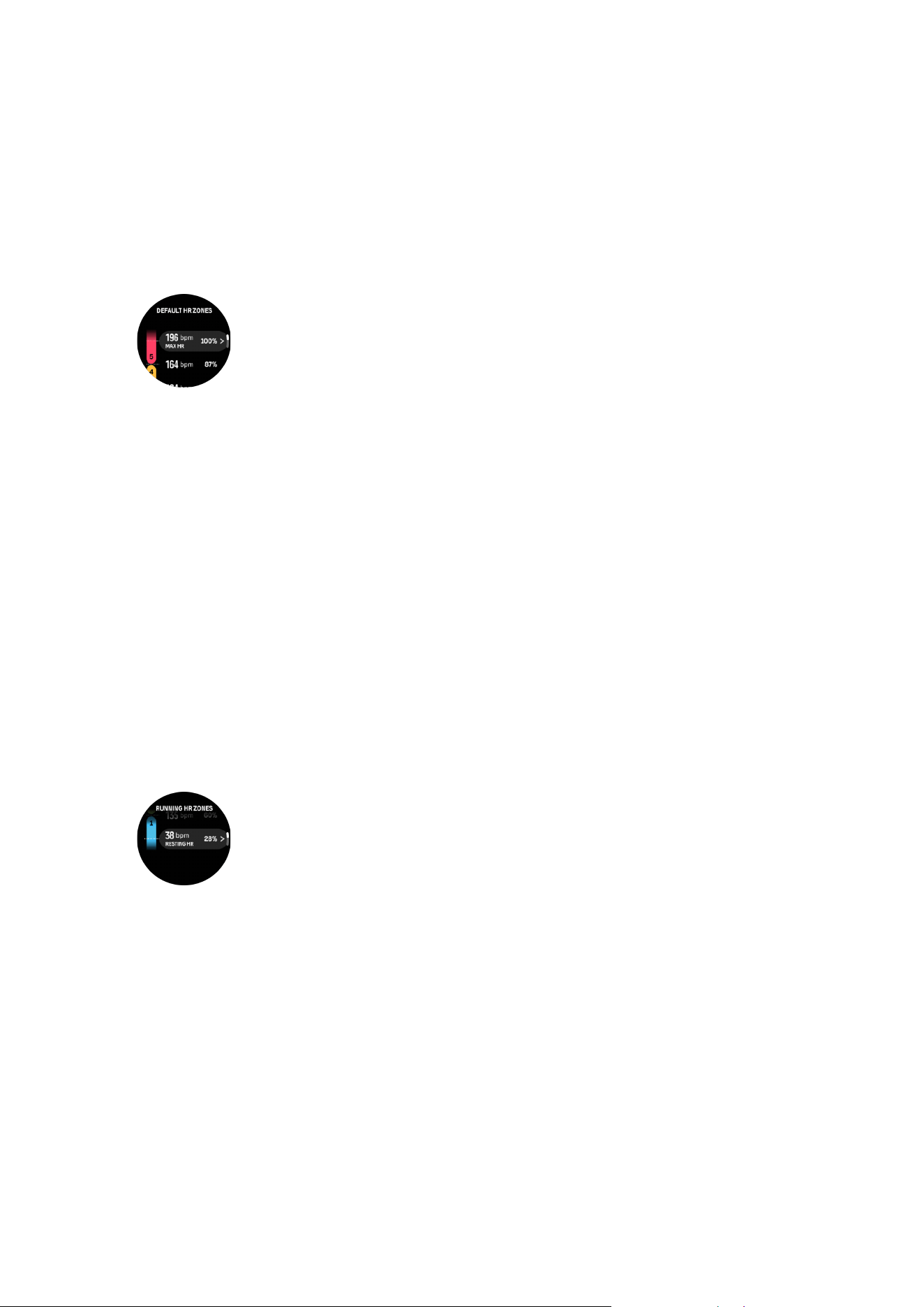
This is the default zone type. We recommend that you use the max HR zone setting in case
you do not know your lactate threshold heart rate and your resting heart rate.
1. Go to Activity & Training > Intensity zones > HR zones > Zone types.
2. Select the Max HR zones option by tapping on it or pressing the crown.
3. Scroll down and select the Default HR zones for all sports, the Running HR zones or the
Cycling HR zones option.
4. Tap the max HR (highest value, bpm) or press the crown.
5. Select your new max HR by swiping up or down or by turning the crown.
6. Press the crown to confirm the selected value.
7. On the pop-up screen, confirm if you want or don't want to update all HR zones based on
max HR.
HR reserve zones
We recommend that you use the HR reserve zones setting in case you do not know your
lactate threshold heart rate but you know your resting heart rate. Your HR reserve value
equals to your max HR minus your resting HR value.
1. Go to Activity & Training > Intensity zones > HR zones > Zone types.
2. Select the HR reserve zones option by tapping on it or pressing the crown.
3. Scroll down and select the Default HR zones for all sports, the Running HR zones or the
Cycling HR zones option.
4. Select the max HR at the top of the scale by tapping it or pressing the crown.
5. Select your new max HR by swiping up or down or by turning the crown.
6. Press the crown to
confirm the selected value.
7. Select the resting HR at the bottom of the scale by tapping it or pressing the crown.
8. Select your new resting HR by swiping up or down or by turning the crown.
9. Press the crown to confirm the selected value.
10. On the pop-up screen,
confirm if you want or don't want to update all HR zones based on
HR reserve.
Lactate threshold HR zones
We recommend that you use the Lactate threshold HR zones setting in case you know your
lactate threshold heart rate.
1. Go to Activity & Training > Intensity zones > HR zones > Zone types.
2. Select the Lactate threshold HR zones option by tapping on it or pressing the crown.
3. Scroll down and select the Default HR zones for all sports, the Running HR zones or the
Cycling HR zones option.
Suunto Run
32
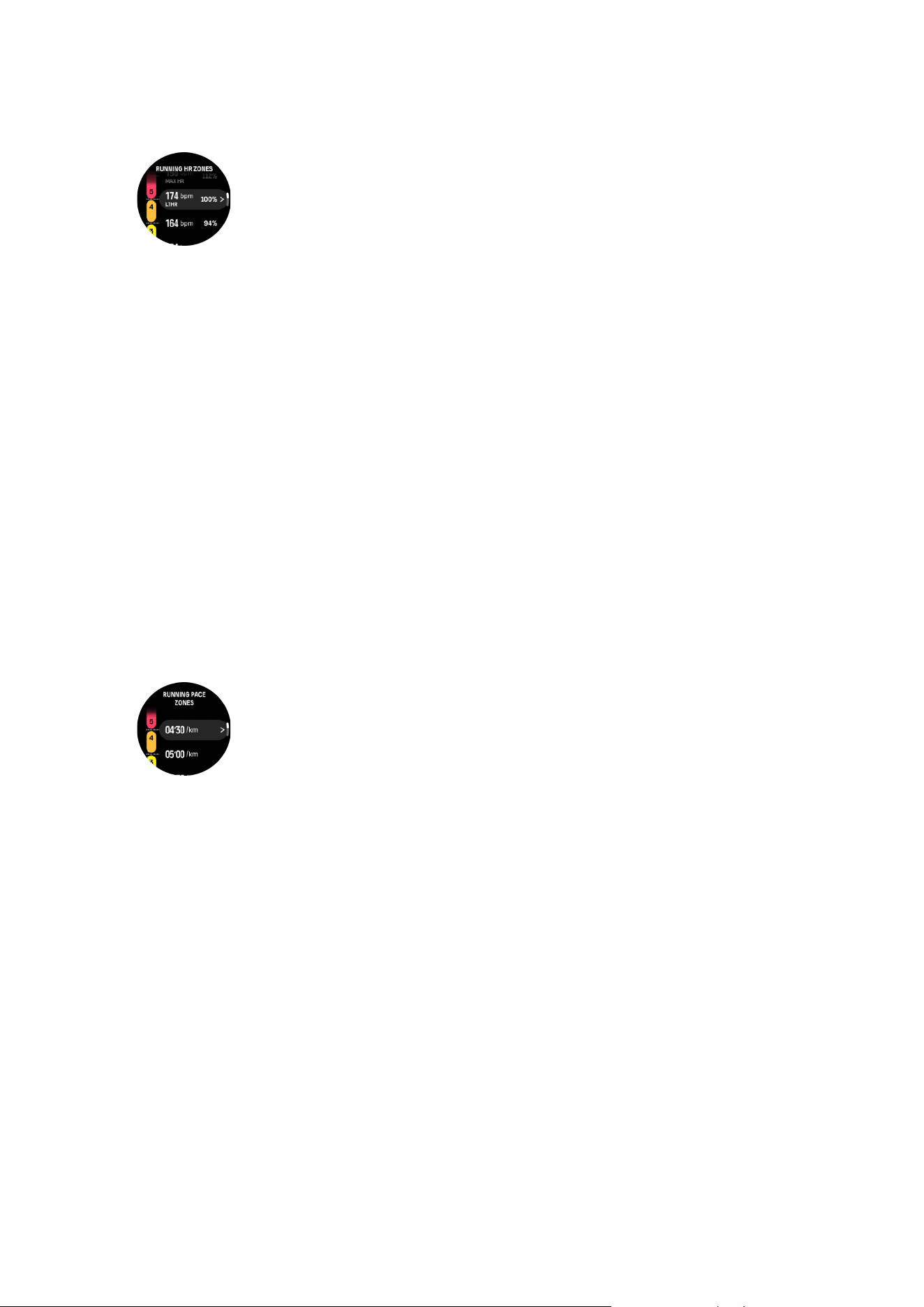
4. Tap the lactate threshold heart rate (LTHR) value or press the crown.
5. Select your new lactate threshold HR by swiping up or down or by turning the crown.
6. Press the crown to confirm the selected value.
7. On the pop-up screen, confirm if you want or don't want to update all HR zones based on
lactate threshold HR.
4.12.2. Pace zones
Pace zones work just like HR zones but the intensity of your training is based on your pace
instead of your heart rate. The pace zones are shown either as metric or imperial value
depending on your settings.
Suunto Run has five default pace zones that you can use or you can define your own.
Pace zones are available for running.
Set pace zones
Set your activity specific pace zones from the settings under Activity & Training > Intensity
zones > Running pace zones .
1. Swipe or turn the crown and select pace zones.
2. Swipe up/down or turn the crown and press the crown when the pace zone you want to
change is highlighted.
3. Select your new pace zone by swiping up/down or by turning the crown.
4. Press the crown to select the new pace zone value.
5. Swipe right or press the lower button to exit the pace zones view.
4.12.3. Power zones
Power meter measures the amount of physical
eort needed to perform a certain activity. The
eort is measured in watts. The main advantage gained with a power meter is precision. The
power meter reveals exactly how hard you really work and how much power you produce. It
is also easy to see your progress when analyzing the watts.
Power zones can help you train with the correct power output.
Suunto Run has
five default power zones that you can use or you can define your own.
Set activity specific power zones
Set your activity specific power zones from the settings under Activity & Training > Intensity
zones > Running power zones or Cycling power zones.
1. Tap the activity (running or cycling) that you want to edit or press the crown when the
activity is highlighted.
Suunto Run
33
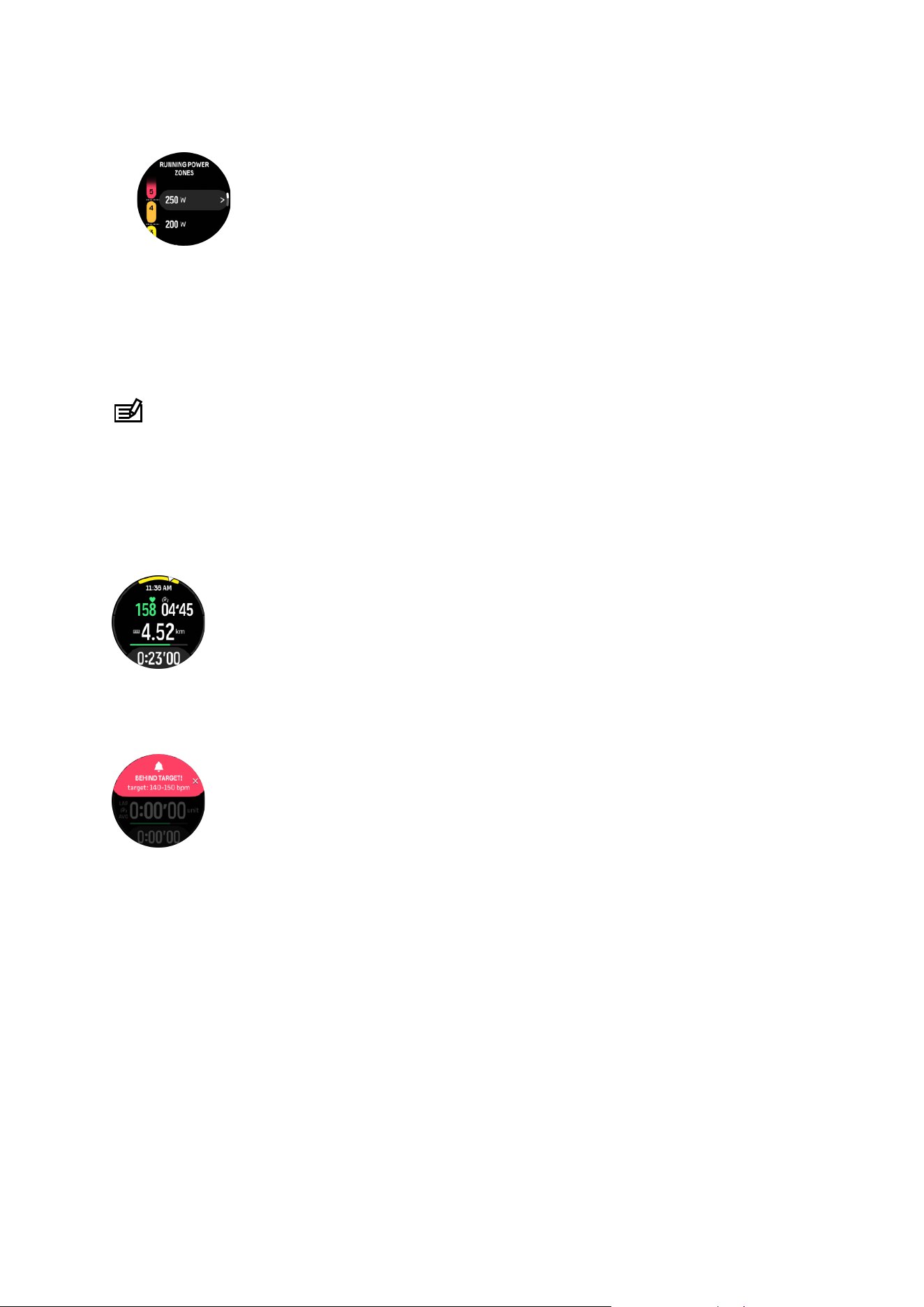
2. Swipe up or turn the crown and select power zones.
3. Swipe up/down or turn the crown and select the power zone you want to edit.
4. Select your new power zone by swiping up/down or by turning the crown.
5. Press the crown to select the new power value.
6. Swipe right or press the lower button to exit the power zones view.
4.12.4. Using HR, pace or power zones when exercising
NOTE: You need to have a power pod paired with your watch to be able to use power
zones when exercising, see 3.14. Pair devices.
When you record an exercise (see 4. Recording an exercise), and have selected HR, pace or
power as an intensity target, a zone gauge, divided into
five sections, is viewed. These five
sections are shown around the outer edge of the sport mode display. The gauge indicates the
zone you have chosen as an intensity target by lighting up the corresponding section. The
small arrow in the gauge indicates where you are within the zone range.
Your watch alerts you when you hit your selected target zone. During your exercise the watch
will prompt you to speed up or slow down, if your current HR, pace or power is outside the
selected target zone.
In the exercise summary, you get a breakdown of how much time you have spent in each
zone.
Suunto Run
34
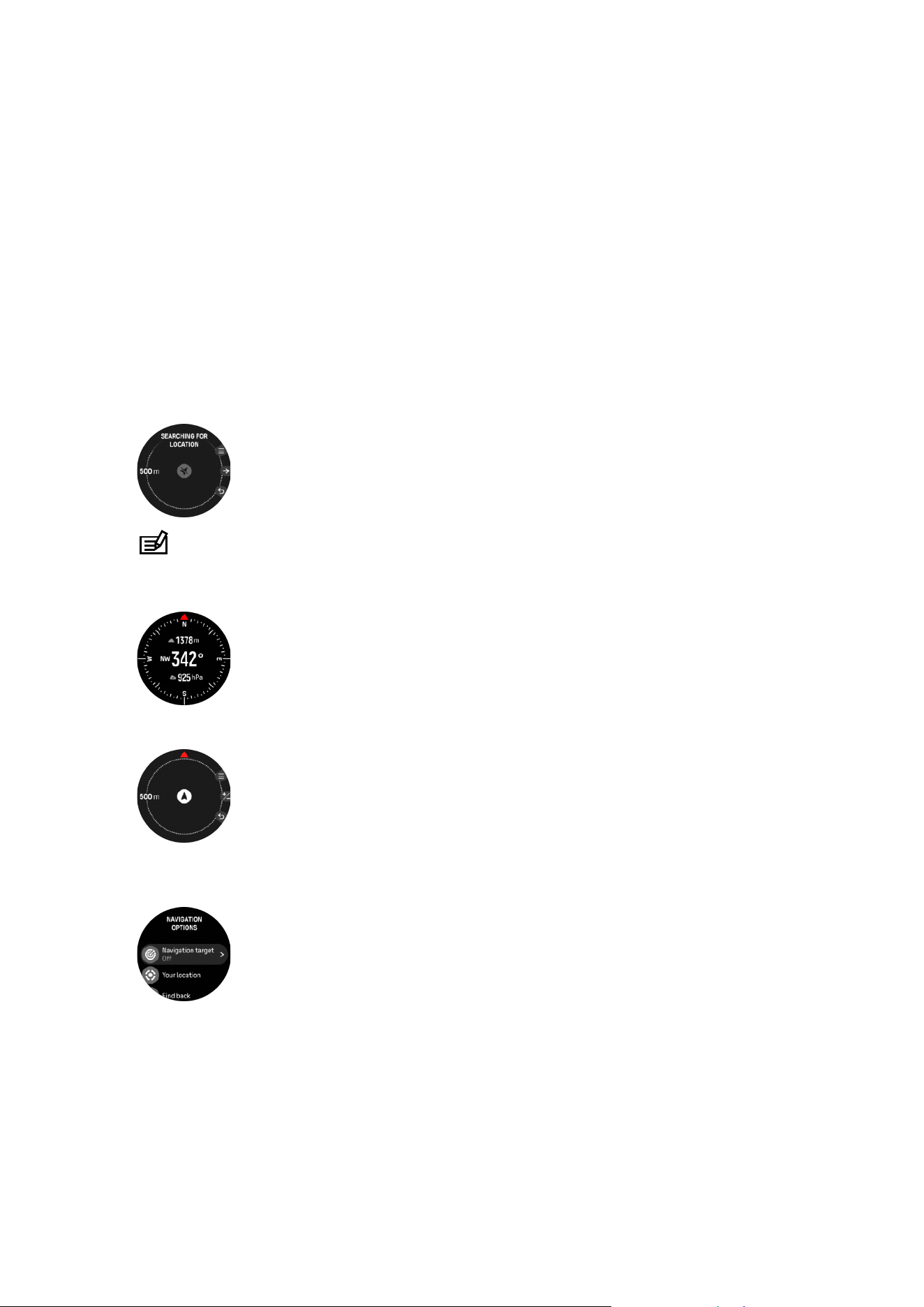
5. Navigation
With your Suunto Run, you have several navigation options. Find the Navigation widget in the
All Apps menu or on the list of your selected widgets.
You can use your watch to navigate in various ways. You can, for example, use it to orient
yourself in relation to magnetic north, navigate a route or to a point of interest (POI).
To use the navigation feature:
1. Swipe up from watch face or turn the crown to go to the Navigation widget in the All Apps
menu or on the list of your selected widgets and enter it.
2. The watch starts searching for your current location. Once found, the display shows an
arrow pointing to magnetic north, your location and the nearby POIs and waypoints if
there are any.
NOTE: If the compass is not calibrated, you are prompted to calibrate the compass
when you enter the widget.
3. Turn the crown to open the compass view.
4. Press the crown for a map view where you can zoom in and out by turning the crown.
5. Press the upper button to open the list of navigation options such as checking the
coordinates of your current location or selecting a route to navigate.
6. Press the lower button to exit the Navigation widget.
5.1. Altitude navigation
If you are navigating a route that has altitude information, you can also navigate based on
ascent and descent using the altitude profile display. While using navigation, turn the crown to
switch to the altitude profile display.
Suunto Run
35
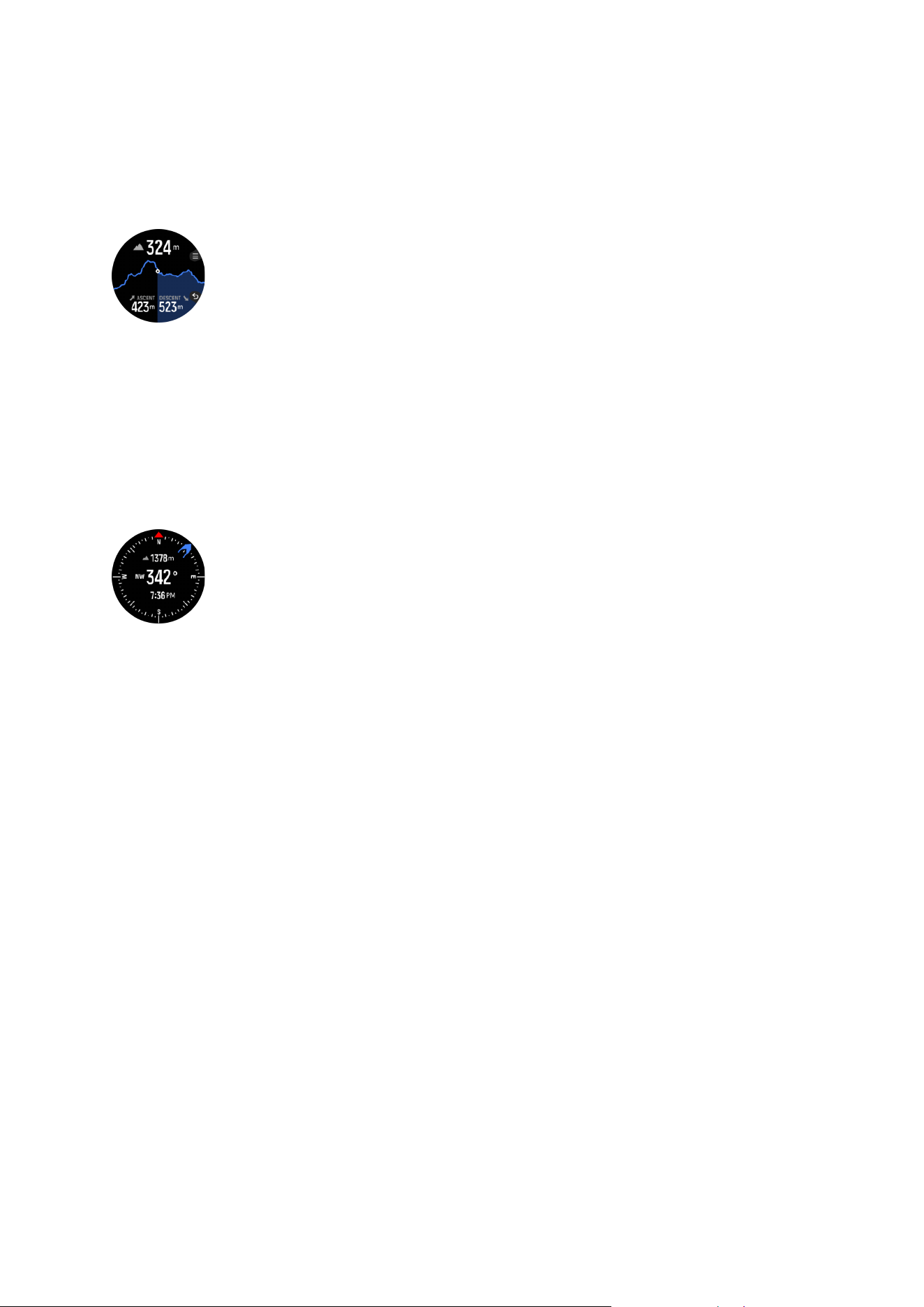
The altitude profile display shows you the following information:
•
top: your current altitude
•
center: altitude profile showing your current position
•
bottom: the ascent and descent done
If you stray too far o from the route while using altitude navigation, your watch will give you
an O route message in the altitude profile display. If you see this message, scroll to the
route navigation display to get back on track before continuing with altitude navigation.
5.2. Bearing navigation
Bearing navigation is a feature that you can use outdoors to follow the target path for a
location you see or have found on a map. You can use this feature stand alone as a compass
or together with a paper map.
To use bearing navigation without exercising:
1. Scroll to Navigation by swiping up or turning the crown from watch face.
2. Press the upper button to open navigation options.
3. Select Navigation target.
4. If needed, calibrate the compass by following the on-screen instructions.
5. Point the blue arrow on the screen towards your target location and press the middle
button.
6. Follow the blue arrow to the location.
7. Press the upper button and select End navigation to end the navigation.
5.3. Routes
You can use your Suunto Run to navigate routes. Plan your route with Suunto app and transfer
it to your watch with the next sync.
To navigate on a route:
1. Swipe up from watch face or turn the crown to go to the Navigation widget in the All Apps
menu or on the list of your selected widgets and enter it.
2. In the map display, press the upper button.
3. Press the crown to select the Navigation target option.
4. Scroll to Routes and press the crown to open your list of routes.
5. Scroll to the route you want to navigate to and press the crown.
Suunto Run
36
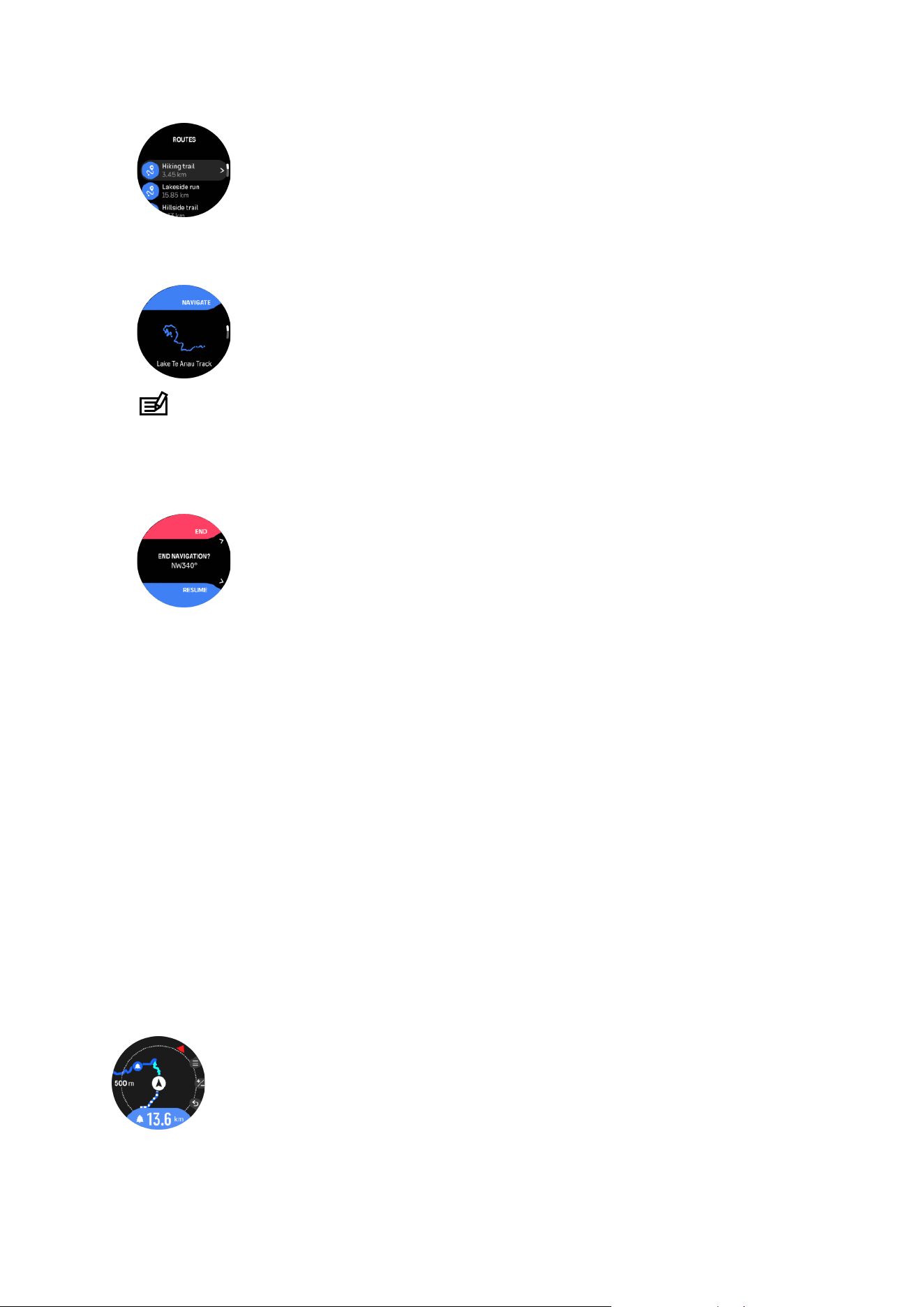
6. Scroll down for the route details.
7. Start the navigation by pressing the upper button.
NOTE: If you only navigate a route without recording an exercise, nothing will be
saved or logged in Suunto app.
8. If you want to stop navigating, press the upper button to open navigation options and
select the End navigation option. Confirm ending the navigation by pressing the upper
button.
While you are on the route navigation display, you have the following options:
•
turn the crown to go to the altitude view
•
press the crown to go to the map view where you can zoom in and out by turning the
crown
•
press the upper button to open navigation options (for example, check route details, select
another route to navigate, save POIs and turn on and
o breadcrumb view and POI
display)
Navigation guidance
As you navigate a route, your watch helps you stay on the correct path by giving you
additional data in the navigation guidance field at the bottom of the screen and sending you
notifications as you progress along the route.
For example, if you go more than 100 m (330 ft) o route, the watch notifies you that you are
not on the right track, as well as lets you know when you are back on route.
The guidance field shows the distance to the next waypoint (if there are no waypoints on your
route, the distance to the end of the route is shown). Once you approach a waypoint or POI
on the route, you get an informative popup showing the distance to the next waypoint or POI.
Suunto Run
37

NOTE: If you are navigating a route that crosses itself, such as a figure-8, and you make
a wrong turn at the crossing, your watch assumes you are intentionally going in a
dierent
direction on the route. The watch shows the next waypoint based on the current, new
direction of travel. So, keep an eye on your breadcrumb trail to ensure you are going the
right way when you are navigating a complicated route.
Turn-by-turn navigation
When creating routes in Suunto app, you can choose to activate turn-by-turn instructions.
When the route is transferred to your watch and used for navigation, it will give you turn-by-
turn instructions with a sound alert and information on which way to turn.
NOTE: All sport modes with GPS also have a route selection option. See 4.2. Navigating
during exercise.
5.4. Points of interest
A point of interest, or POI, is a special location, such as camping spot or vista along a trail, you
can save and navigate to later. You can create POIs in Suunto app from a map and do not
have to be at the POI location. Creating a POI in your watch is done by saving your current
location.
Each POI is
defined by:
•
POI name
•
POI type
•
Date and time created
•
Latitude
•
Longitude
•
Elevation
You can store up to 250 POIs in your watch.
5.4.1. Adding and deleting POIs
You can add a POI to your watch either with Suunto app or by saving your current location in
the watch.
If you are outside with your watch and come across a spot you want to save as a POI, you can
add the location directly in your watch.
To add a POI with your watch:
1. Swipe up or turn the crown and select Navigation.
2. From the map display, press the upper button.
3. Select Your location by pressing the crown.
4. Wait for the watch to activate GPS and
find your location.
5. When the watch displays your latitude and longitude, press the upper button to save your
location as a POI and select the POI type.
6. By default the POI name is the same as the POI type (with a running number after it). You
can edit the name later in Suunto app.
Suunto Run
38

Deleting POIs
You can remove a POI by deleting the POI from the POI list in the watch or removing it in
Suunto app.
To delete a POI in your watch:
1. Swipe up or turn the crown and select Navigation.
2. From the map display, press the upper button.
3. Select Navigation target.
4. Scroll to POIs and press the crown.
5. Scroll to the POI you want to remove from the watch and press the crown.
6. Scroll to the end of the details and select Delete.
When you delete a POI from your watch, the POI is not permanently deleted.
To permanently delete a POI, you need to delete the POI in Suunto app.
5.4.2. Navigating to a POI
You can navigate to any POI that is in your watch POI list.
NOTE: When navigating to a POI, your watch uses full power GPS.
To navigate to a POI:
1. Swipe up from watch face or turn the crown to go to the Navigation widget in the All Apps
menu or on the list of your selected widgets and enter it.
2. In the map display, press the upper button.
3. Press the crown to select the Navigation target option.
4. Scroll to POIs and press the crown to open your list of POIs.
5. Scroll to the POI you want to navigate to and press the crown.
6. Press the upper button or tap Navigate.
7. If you want to stop navigating, press the upper button to open navigation options and
select the End navigation option.
Confirm ending the navigation by pressing the upper
button.
NOTE: If you only navigate to the POI without recording an exercise, nothing will be
saved or logged in Suunto app.
The POI navigation has two views:
•
map view showing your current location relative to the POI and your breadcrumb trail (the
track you have traveled)
•
POI view with direction indicator and distance to the POI
Suunto Run
39
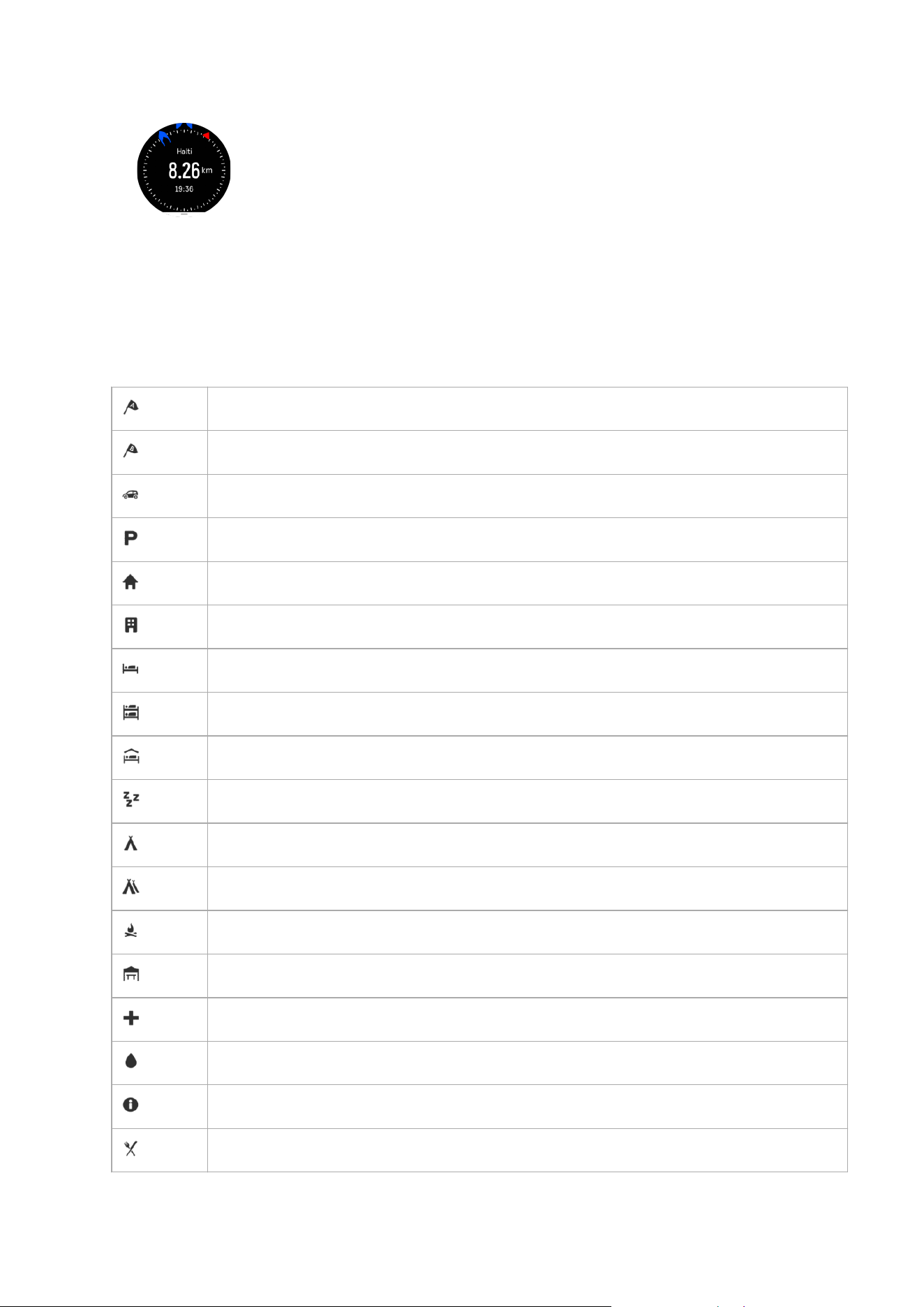
Turn the crown to switch between views.
In the map view, other POIs nearby are shown in gray. Press the crown to change to the map
view where you can adjust the zoom level by turning the crown.
5.4.3. POI types
The following POI types are available in Suunto Run:
Begin
End
Car
Parking
Home
Building
Hotel
Hostel
Lodging
Bedding
Camp
Camping site
Camp fire
Aid station
Emergency
Waterpoint
Information
Restaurant
Suunto Run
40
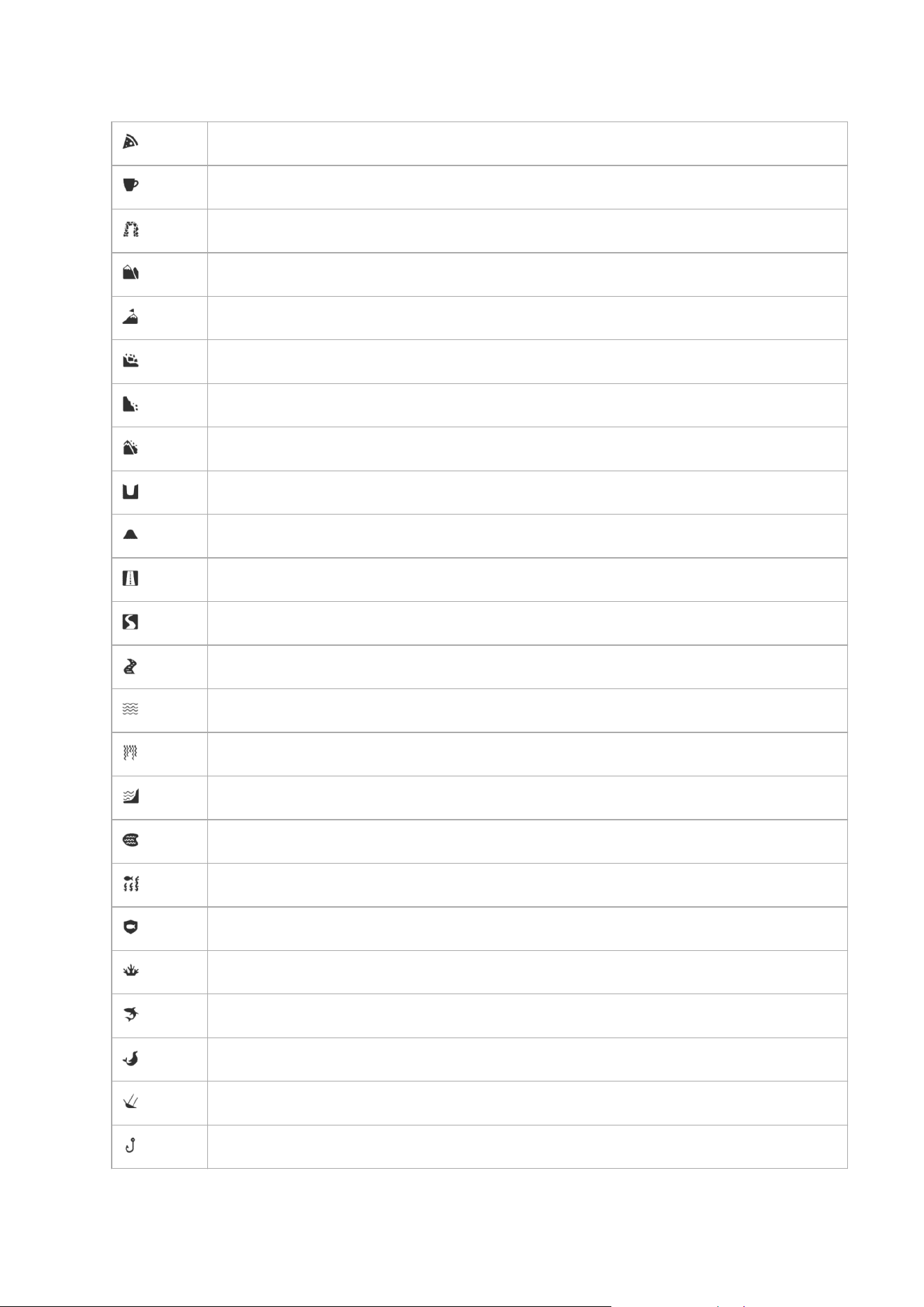
Food
Cafe
Cave
Mountain
Peak
Rock
Cli
Avalanche
Valley
Hill
Road
Trail
River
Water
Waterfall
Coast
Lake
Kelp forest
Marine reserve
Coral reef
Big fish
Marine mammal
Wreck
Fishing spot
Suunto Run
41
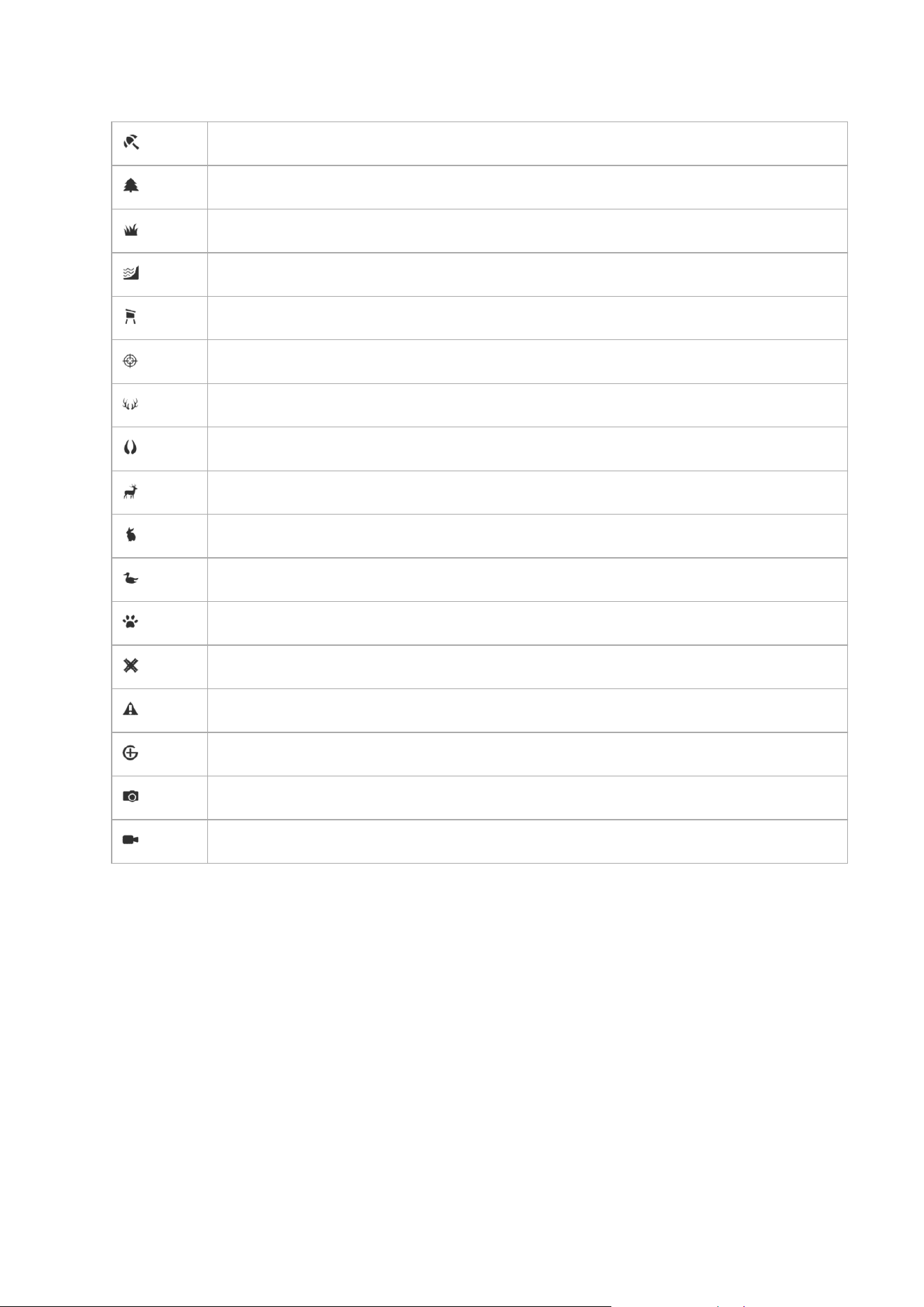
Beach
Forest
Meadow
Coast
Stand
Shot
Rub
Scrape
Big game
Small game
Bird
Prints
Crossroads
Danger
Geocache
Sight
Trailcam
Suunto Run
42
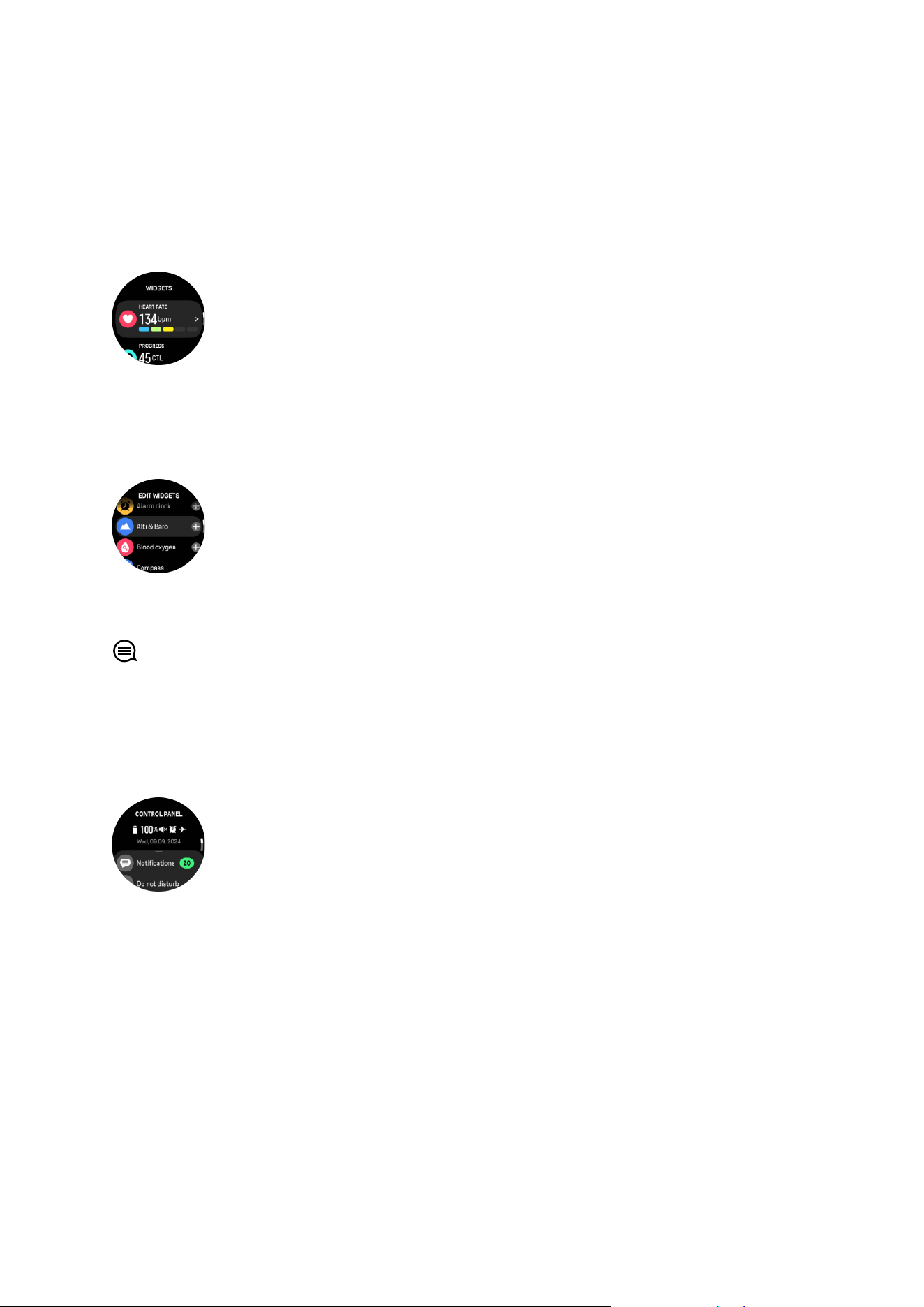
6. Widgets
Widgets give you useful information of your activity and training. Customize your widget list to
see the information that matters most to you, whether it's your heart rate, daily step count or
the current altitude, at a glance. The widgets are accessible from the watch face by swiping
up and down or turning the crown.
The widgets can be turned on and o from the Control panel under Customize > Edit
widgets. Select which widgets you want to use by tapping on the + and - signs next to the
widget name or by pressing the crown.
You can add up to six widgets to the list.
You can also select which widgets you want to use in your watch and in which order by
turning them on and o and sorting them in Suunto app.
TIP: If an application is not added to your widget list yet, you can find it in the All Apps
menu.
6.1. Control panel
From the Control panel on the top of the widget list, you can access several data and watch
options such as battery level, notifications and the complete settings menu.
From the watch face, swipe up or turn the crown to access the Control panel.
The Control panel is always on the top of the widget list, you cannot remove it or move it
lower on the list.
6.2. Weather
The weather widget provides you with information of the current weather. It shows the current
temperature, wind speed and direction and current weather type both as text and icon.
Weather types can be, for example, sunny, cloudy, rainy etc.
Suunto Run
43
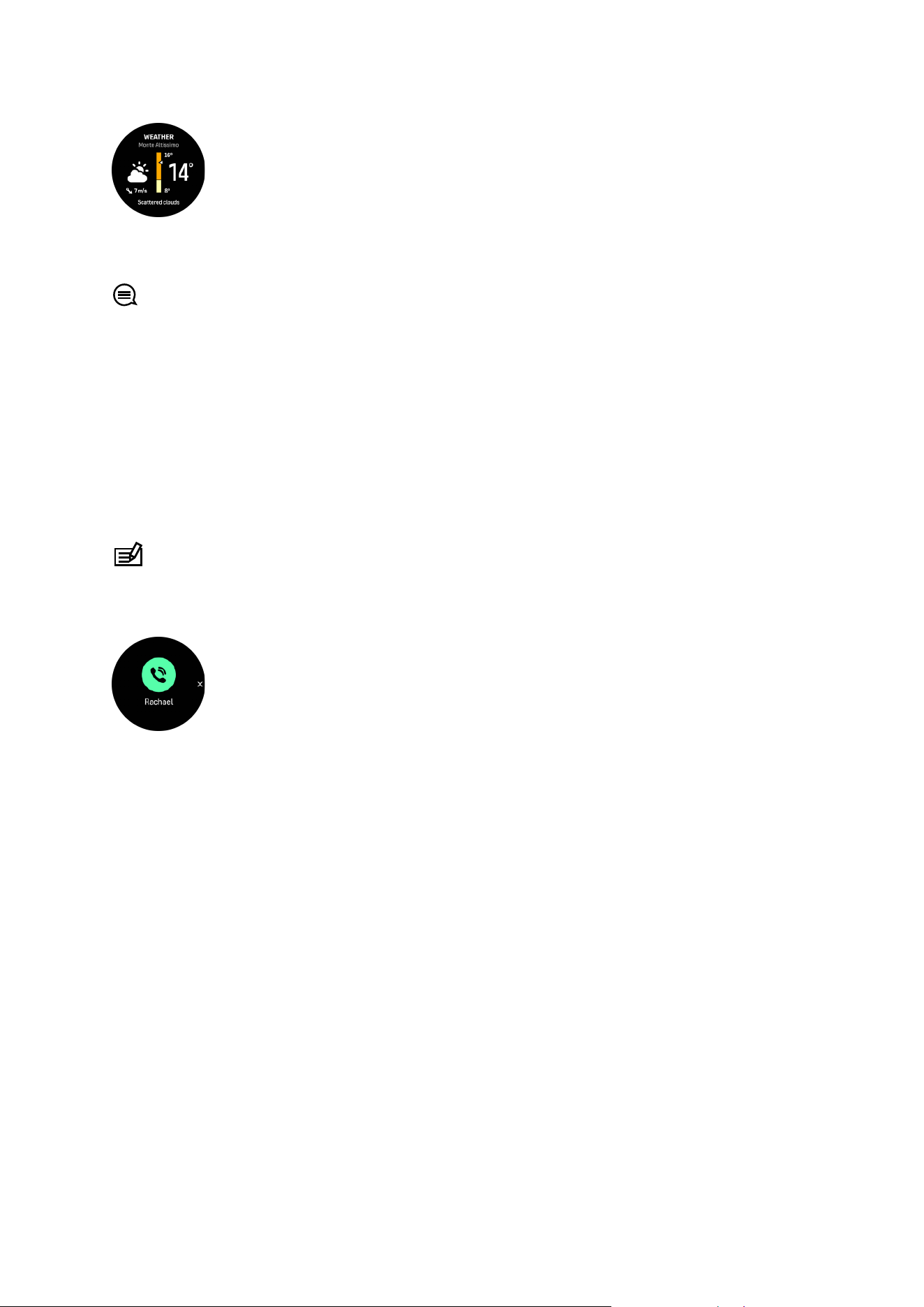
Swipe up or turn the crown to see more detailed weather data such as humidity, air quality
and forecast data.
TIP: Make sure that your watch is connected with Suunto app to get the most accurate
weather data.
6.3. Notifications
If you have paired your watch with Suunto app, you can get notifications of, for example,
incoming calls and text messages, on your watch.
While pairing your watch with the app, you can
confirm if you want to receive mobile
notifications on your watch.
You can turn the notifications on and o later from the Control panel > Notifications and in
Suunto app.
NOTE: Messages received from some apps used for communication might not be
compatible with Suunto Run.
When a
notification arrives, a pop-up appears on the watch face.
Press the crown to remove the popup. If the message doesn't fit on the screen, turn the crown
or swipe up to scroll through the full text.
Notification history
If you have unread
notifications or missed calls on your mobile device, you can view them on
your watch.
From the watch face, swipe up and select Notifications in the Control panel and turn the
crown to scroll through the notification history.
The
notification history is cleared when you check the notifications or if you select Clear all
messages in the notification settings.
6.4. Media player
You can
find the Media player widget in the All Apps menu and you can add it to the list of
your selected widgets.
The media player of your watch has two modes: Bluetooth mode and
Oine mode. With the
Bluetooth music mode, you can control the music, podcast, and other media played on your
phone, while the oine mode is for playing music stored on your watch.
Suunto Run
44
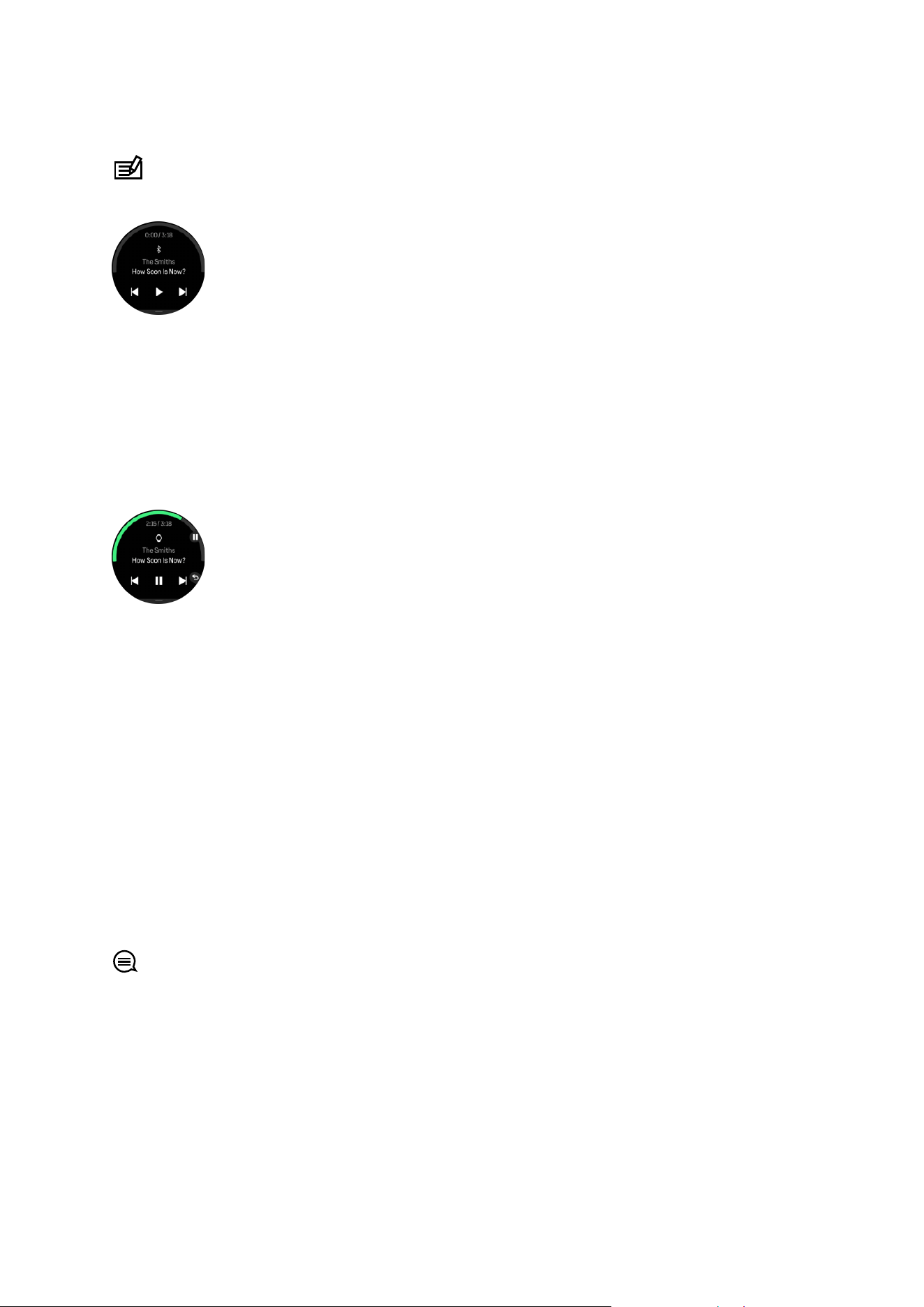
Bluetooth mode
NOTE: You need to pair your watch with your phone before you can use the Bluetooth
mode.
In the media player widget, tap play, next track or previous track to control the media played
on your phone.
Swipe up or turn the crown to enter the complete setup of the media controls. Select Media
mode to change to
oine mode.
Press the lower button to exit the media control widget.
Oine mode
The oine music mode is for playing the audio content stored on the watch. You can use the
oine mode of the media player if you have your Bluetooth headphones connected with your
watch. For information on pairing, see 3.14. Pair devices.
Your watch has one sample song stored by default. To transfer music to your watch, connect it
to a computer or a capable mobile phone with the USB (Type-C) charging cable included in
the product package. Open the music folder of the watch on the computer or mobile phone
and copy the audio
files there. The watch supports the following file formats: MP3, FLAC,
WAV, AAC.
To start listening to
oine music, turn on the headphones that you have paired with your
watch, and select Oine mode under Media mode in the media player widget. Tap play, next
track or previous track to control your media.
Swipe up or turn the crown to see additional options such as volume control, repeat and
shue mode, library overview. Select Media mode to change to Bluetooth mode.
Press the lower button to exit the media player widget.
TIP: Use Suunto app for organizing the audio files stored on your watch and creating
custom playlists.
6.5. Heart rate
You can find the Heart rate widget in the All Apps menu and you can add it to the list of your
selected widgets.
The Heart rate widget provides a quick snapshot of your heart rate and a 24-hour graph of
your heart rate. The graph is plotted using your average heart rate based on 5-minute time
slots.
Suunto Run
45
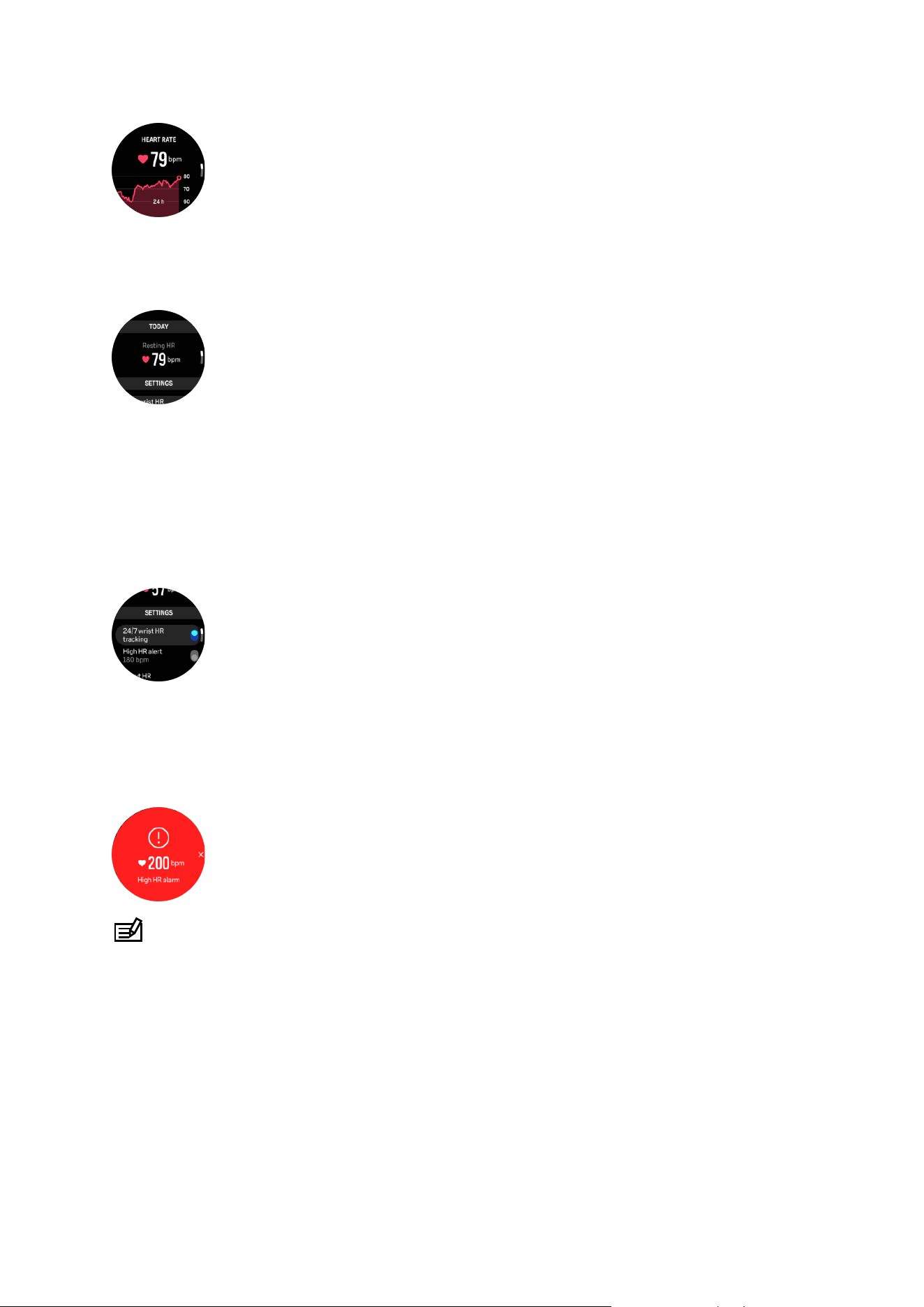
Below the graph, the range of your heart rate measured during the last 24 hours is visible.
Your resting heart rate from the given day is a good indicator of your recovery state. If it is
higher than normal, you probably are not yet fully recovered from your last training session.
If you record an exercise, the daily HR values reflect the elevated heart rate and calorie
consumption from your training.
To be able to see the daily HR widget values, the daily HR feature needs to be activated. You
can toggle the feature on or
o after entering the Heart rate widget and scrolling down to the
settings.
With this feature on, your watch activates the optical heart rate sensor on a regular basis to
check your heart rate. This slightly increases battery power consumption.
If you want to be notified when your heart rate is too high, you can set a high heart rate alert
in the Heart rate widget. Scroll down to the settings and toggle on High HR alert. On the next
screen, you can set a bpm value. When your HR is at or above the set value for 5 seconds,
the watch plays an alert sound and a red screen showing your current HR data also warns
you. To
confirm the alert, press the crown.
NOTE: Measurement results are for reference only and should not be used as a basis
for medical diagnosis.
6.6. Progress
You can find the Progress widget in the All Apps menu and you can add it to the list of your
selected widgets.
The progress widget provides you with data that helps you to increase your training load over
a longer period of time, whether it is the training frequency, duration or intensity.
Suunto Run
46
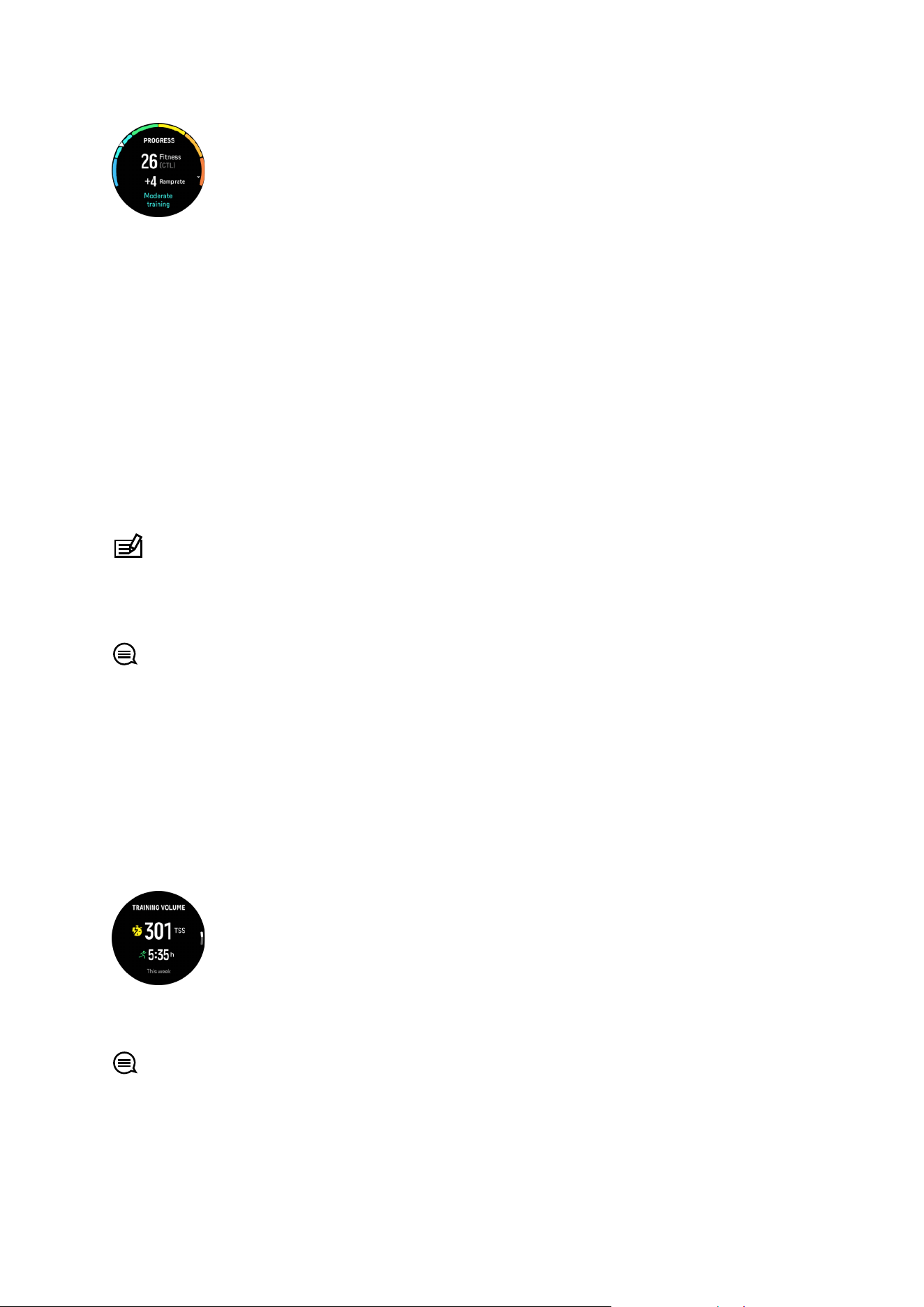
Every training session gets a Training Stress Score (TSS) (based on the duration and the
intensity) and this value is the base for calculating the training load for both short and long-
time averages. From this TSS value, your watch can calculate your fitness level (defined as
VO₂max), CTL (Chronic Training Load) and also provide you with an estimation on your lactate
threshold and a prediction on your running pace on various distances.
Your aerobic
fitness level is defined as VO₂max (maximal oxygen consumption), a widely
recognized measure of aerobic endurance capacity. In other words, VO₂max shows how well
your body can use oxygen. The higher your VO₂max, the better you can use oxygen.
The estimation of your
fitness level is based on detecting your heart rate response during
each recorded running or walking workout. To get your fitness level estimated, record a run
with a duration for at least 15 minutes while wearing your Suunto Run.
The widget also views your estimated
fitness age. Fitness age is a metric value that
reinterprets your VO₂max value in terms of age.
NOTE: Improvement of VO₂max is highly individual and it depends on factors such as
age, gender, genetics and training background. If you are already very fit, increasing your
fitness level will be slower. If you are just starting to exercise regularly, you may see a quick
increase in
fitness.
TIP: Please refer to www.suunto.com or Suunto app to learn more about Suunto's training
load analysis concept.
6.7. Training volume
You can find the Training volume widget in the All Apps menu and you can add it to the list of
your selected widgets.
The Training volume widget provides you with information on the training load and the total
duration of your training sessions done on the current week. You can compare your current
training volume with that of the past six weeks. This helps you maintain
fitness and reduce the
risk of injuries.
Training load is calculated based on training duration and intensity. Your Training Stress Score
(TSS) indicates how much stress your body is under during training.
TIP: Please refer to www.suunto.com or Suunto app to learn more about Suunto's training
load analysis concept.
Scroll down in the widget for more training data. You can check your HR zones and most
frequently used sport modes of the current week, adjust goals and review last week's training
volume.
Suunto Run
47
6.8. Blood oxygen
You can measure your blood oxygen level with the Suunto Run watch.
You can find the Blood oxygen widget in the All Apps menu and you can add it to the list of
your selected widgets.
Blood oxygen level can provide an indication of overtraining or fatigue and the measurement
can also be a helpful indicator of high altitude acclimation progress.
Normal blood oxygen levels are between 96% and 99% at sea level. At high altitudes, healthy
values can be slightly lower. Successful acclimation to high altitude makes the value increase
again.
To measure your blood oxygen level from the Blood oxygen widget:
1. Select MEASURE NOW.
2. Hold your hand still while the watch is measuring.
3. If the measuring failed, please follow the in-watch instructions.
4. When the measuring is complete, your blood oxygen value is displayed.
You can also measure your blood oxygen level during your 6.9. Sleep.
WARNING: Suunto Run is not a medical device and the blood oxygen level indicated by
Suunto Run is not intended for diagnosing or monitoring medical conditions.
6.9. Sleep
You can
find the Sleep widget in the All Apps menu and you can add it to the list of your
selected widgets.
A good night's sleep is important for a healthy mind and body. You can use your watch to
track your sleep and follow how much sleep you get on average.
When you wear your watch while sleeping, Suunto Run tracks your sleep based on
accelerometer data.
To track sleep, you have to enable sleep tracking in your watch.
1. From watch face, scroll down and select the Sleep widget.
2. Scroll down to the settings and press the crown to enter the Sleep menu.
3. Scroll down and toggle on Sleep tracking.
You can choose if you want to measure your Blood oxygen and HRV tracking during your
sleep.
Once you have enabled sleep tracking, you can also set your sleep target. A typical adult
needs between 7 and 9 hours of sleep per day, though your ideal amount of sleep may vary
from the norms.
Sleep trends
You can follow your overall sleep trend with the sleep widget. The
first view in the sleep
widget shows your last sleep and a graph of the last seven days.
Suunto Run
48
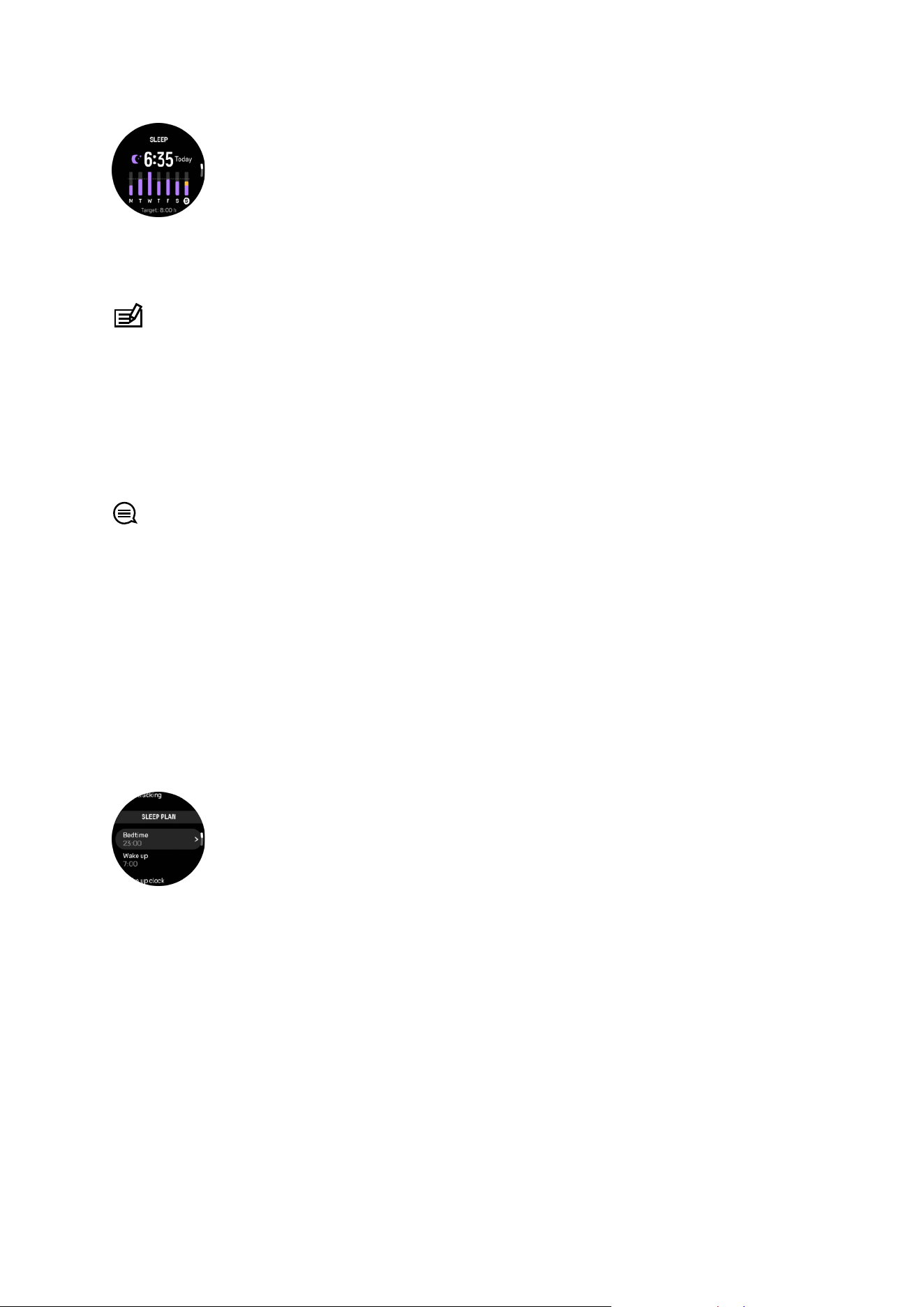
If you scroll down in the Sleep widget, you can see a summary of your sleep last night. The
summary includes, for example, the total duration of your sleep, as well as the estimated time
you were awake (moving around) and the time you were in deep sleep (no movement).
NOTE: All sleep measurements are based on movement only, so they are estimates that
may not reflect your actual sleep habits.
You can define several sleep related settings in the Sleep widget:
Sleep target
You can set your ideal sleep duration. If you set the target, your sleep summary will tell you
how much more or less you slept than your set target.
TIP: If you set your sleep target already during setting up the watch for the first time, the
saved target is shown below Sleep target.
Measuring blood oxygen and heart rate variability (HRV) while
sleeping
If you wear your watch during the night, you can get additional feedback on your blood
oxygen level and HRV while sleeping. To measure these data, toggle the Blood oxygen and
the HRV tracking options on in the tracking settings.
Sleep plan
Scroll down to set up your sleep plan. Set the time you plan to go to bed and to wake up.
Toggle on the Wake up alarm option if you want your watch to wake you up by vibration and
playing an alarm sound.
You can use the auto Do Not Disturb setting to automatically enable Do Not Disturb mode
while you sleep.
6.10. Steps and calories
You can find the Steps & Calories widget in the All Apps menu and you can add it to the list
of your selected widgets.
Your watch counts steps using an accelerometer. The total step count accumulates 24/7, also
while recording training sessions and other activities. However, with some specific sports,
such as swimming and cycling, steps are not counted.
Suunto Run
49
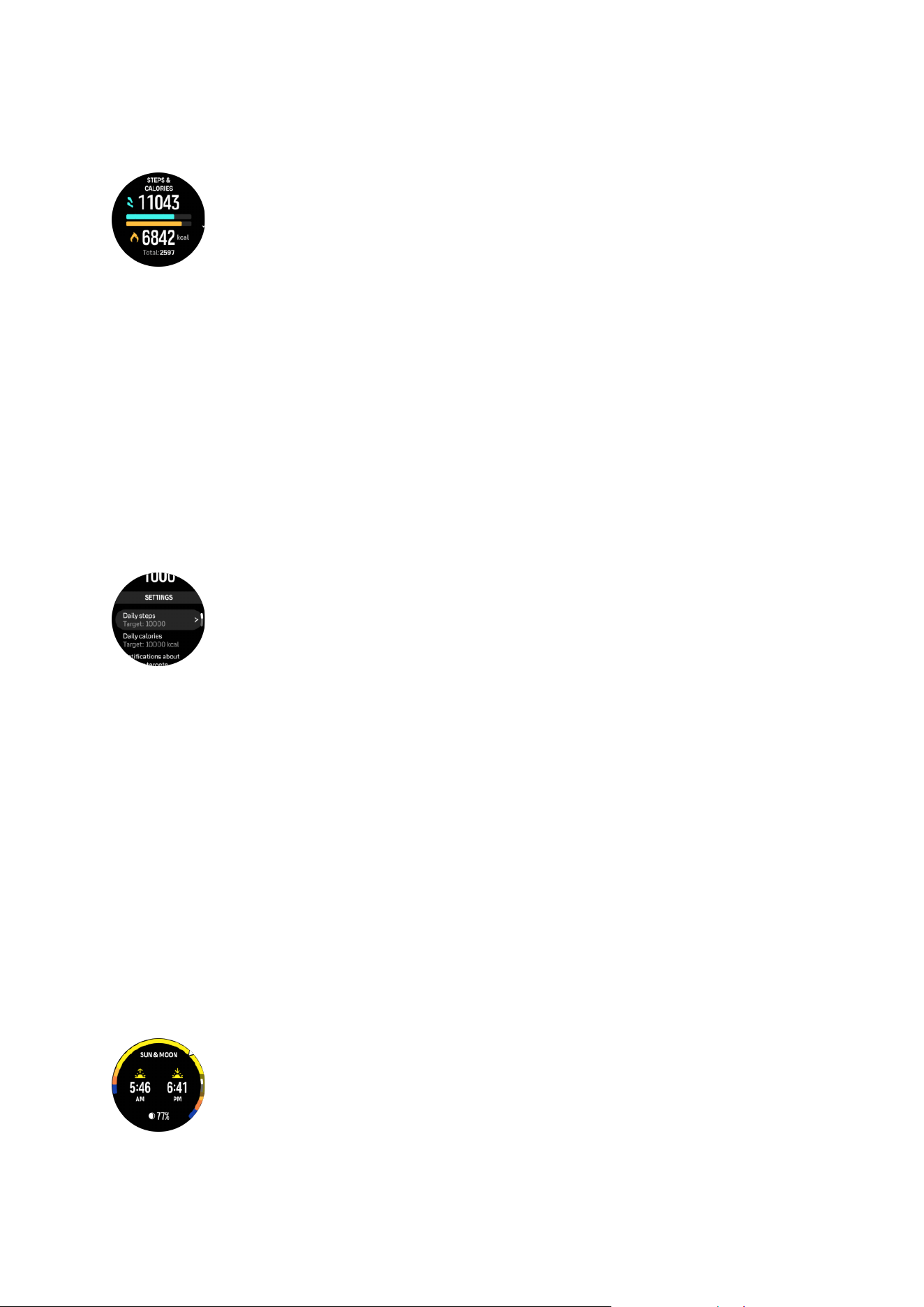
The top value in the widget shows the total step count for the given day and the bottom value
is the estimated amount of active calories you have burned so far during the day.
The colored bars in the widget indicate how close you are to your daily activity goals. These
targets can be adjusted to your personal preferences (see below).
You can also check your steps and calories burned over the last seven days by swiping up
from the widget.
Your Basal Metabolic Rate (BMR) is the amount of calories your body burns while at rest.
These are the calories your body needs to stay warm and perform basic functions like blink
your eyes or beat your heart. This number is based on your personal
profile, including factors
such as age and gender.
Activity goals
You can adjust your daily goals for both steps and calories. Scroll down in the widget to set
the daily step and calory goals and to turn target related
notifications on or o.
When setting your steps goal, you define the total number of steps for the day.
The total calories you burn per day is based on two factors: your BMR and your physical
activity.
When you set a calorie goal, you
define how many calories you want to burn in addition to
your BMR. These are your so-called active calories.
You can set your step and calory goals also in the watch settings, under Activity & Training.
6.11. Sun & Moon
You can find the Sun & Moon widget in the All Apps menu and you can add it to the list of
your selected widgets.
The widget gives you the time until the next sunset or sunrise, depending on which one
comes next.
If you select the widget, you get more details such as the time when the sun rises and sets,
and also the current moon phase.
Suunto Run
50

6.12. Logbook
Your watch provides an overview of your training activity via a logbook.
In the logbook you can see a summary of your current training week. The summary includes
the total duration and an overview of which days you have exercised.
Swiping up gives you information on which activities you have performed and when. Selecting
one of the activities, by pressing the crown, provides you with even more details and also the
possibility to delete the activity from your logbook.
6.13. Recovery
You can find the Recovery widget in the All Apps menu and you can add it to the list of your
selected widgets.
Your recovery data is a good indication of your body's energy levels, which directly
influence
your capacity to handle stress and cope with the daily challenges.
Stress and physical activity deplete your resources, while rest and recovery restore them.
Good sleep is an essential part of ensuring your body has the resources it needs.
In the Recovery widget of your watch, you can see a percentage value that indicates how well
your body has recovered since your last training or after an illness or a stressful period. A
colored scale below the value also shows the current state of your body. Turn the crown or
swipe up for more details and explanation.
When your recovery level is high, you will likely feel fresh and energetic. Going for a run when
your resources are high means you'll probably have a great run, because your body has the
energy it needs to adapt and improve as a result. However, when your recovery level is low, a
good amount of rest is recommended before the next hard workout.
Recovery data is calculated based on three main factors:
•
the average of your Heart Rate Variability (HRV) during the last seven days
•
your tracked sleep data of the last seven days
•
Training Stress Balance (TSB)
6.14. Alti & Baro
Your Suunto Run watch constantly measures absolute air pressure using the built-in pressure
sensor. Based on this measurement and your altitude reference value, it calculates altitude or
air pressure. The data are shown in the Alti & Baro widget.
You can
find the Alti & Baro widget in the All Apps menu and you can add it to the list of your
selected widgets.
Suunto Run
51
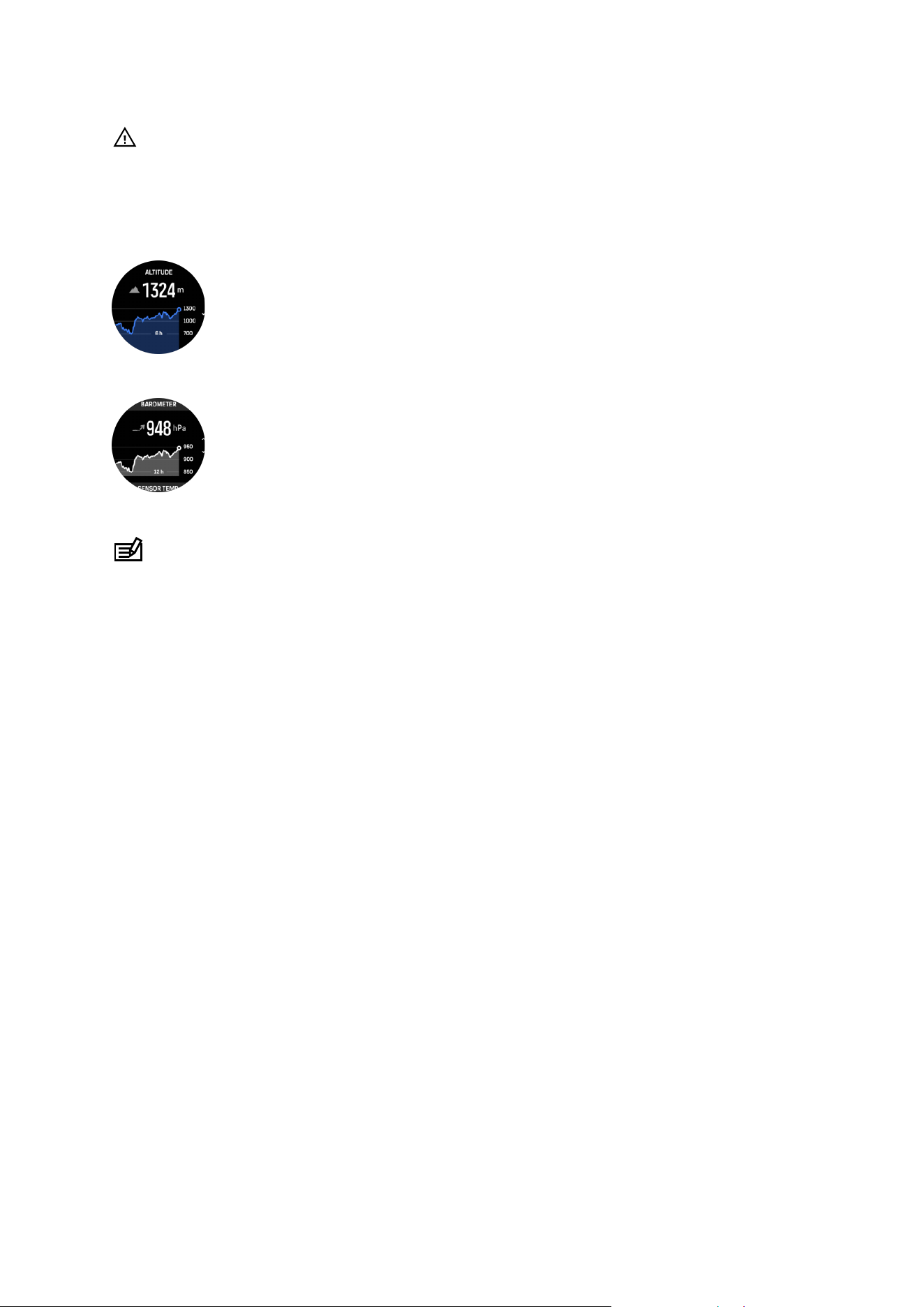
CAUTION: Keep the area around the two air pressure sensor holes located at 12 o'clock
on the side of your watch free of dirt and sand. Never insert any objects into the holes as this
may damage the sensor.
The widget has three views that can be accessed by swiping up or turning the crown. The first
view displays the current altitude.
Swipe up to see the barometric pressure and the barometer trend graph.
Swipe up again to see the temperature.
NOTE: When wearing your watch on your wrist, the sensor is very close to your body
and the temperature readings may be influenced by your body temperature. To ensure the
temperature readings are correct, attach your watch to your backpack or gear and use a
chest HR belt to track your heart rate.
Be sure to have your altitude reference value set correctly. When in the widget, scroll down
for setting the altitude manually or auto adjusting it. The altitude of your current location can
be found from most topographic maps or major on-line map services such as Google Maps.
Changes in local weather conditions
aect altitude readings. If local weather changes often,
you should reset the altitude reference value regularly, preferably before starting your next
journey.
Automatic alti-baro profile
Weather and altitude changes both cause a change in air pressure. To handle this, Suunto
Run automatically switches between interpreting changes in air pressure as altitude or
weather changes based on your movement.
If your watch senses vertical movement, it switches to measuring altitude. When you are
viewing the altitude graph, it is updated with a maximum delay of 10 seconds.
If you are at a constant altitude (less than 5 meters of vertical movement within 12 minutes),
your watch interprets air pressure changes as weather changes and adjusts the barometer
graph accordingly.
6.15. Compass
Suunto Run has a gyro-assisted compass that allows you to orient yourself in relation to
magnetic north. The tilt-compensated compass gives you accurate readings even if the
compass is not horizontally level.
Suunto Run
52
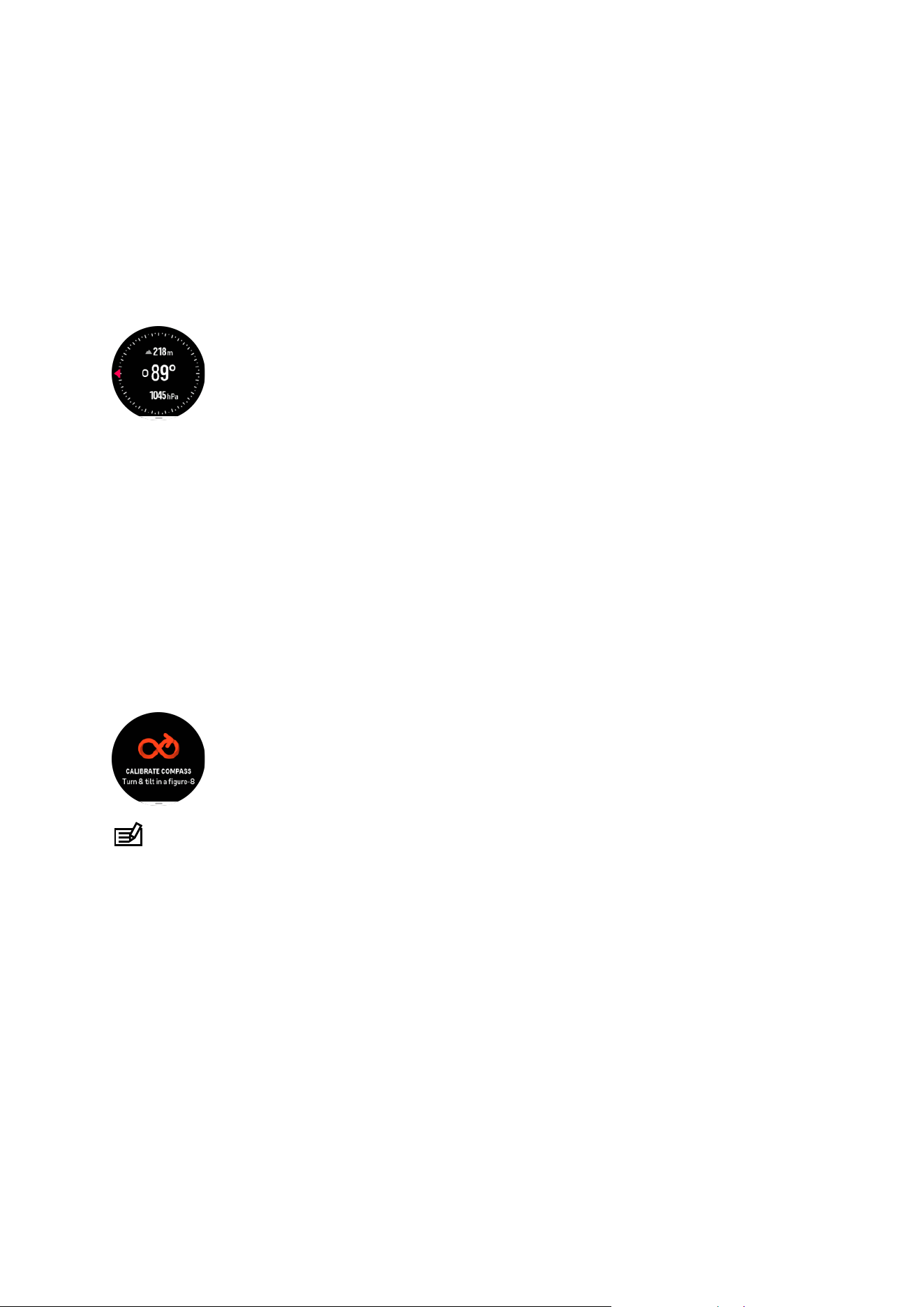
You can find the Compass widget in the All Apps menu and you can add it to the list of your
selected widgets.
The compass widget includes the following information:
•
Arrow pointing to magnetic north
•
Heading cardinal
•
Heading in degrees
•
Altitude
•
Barometric pressure
While you are in the compass widget, you can swipe up from the bottom of the screen to
open compass settings. You have the following setting options:
•
Calibrate compass
•
Declination
•
Compass unit
To exit the compass widget, press the lower button.
Calibrating compass
If the compass is not calibrated, you are prompted to calibrate it when you enter the compass
widget. You can also calibrate the compass after selecting the Calibrate compass option in
the compass settings.
NOTE: The compass calibrates itself when in use, but if the watch has been aected by
strong magnetic
fields or a hard knock, the compass might show the wrong direction. Do a
new calibration to resolve this issue.
Setting declination
To ensure correct compass readings, set an accurate declination value.
Paper maps point to true north. Compasses, however, point to magnetic north – a region
above the Earth where the Earth’s magnetic fields pull. Because magnetic North and true
North are not at the same location, you must set the declination on your compass. The angle
in between magnetic and true north is your declination.
The declination value appears on most maps. The location of magnetic north changes yearly,
so the most accurate and up-to-date declination value can be found from websites such as
www.magnetic-declination.com.
Suunto Run
53
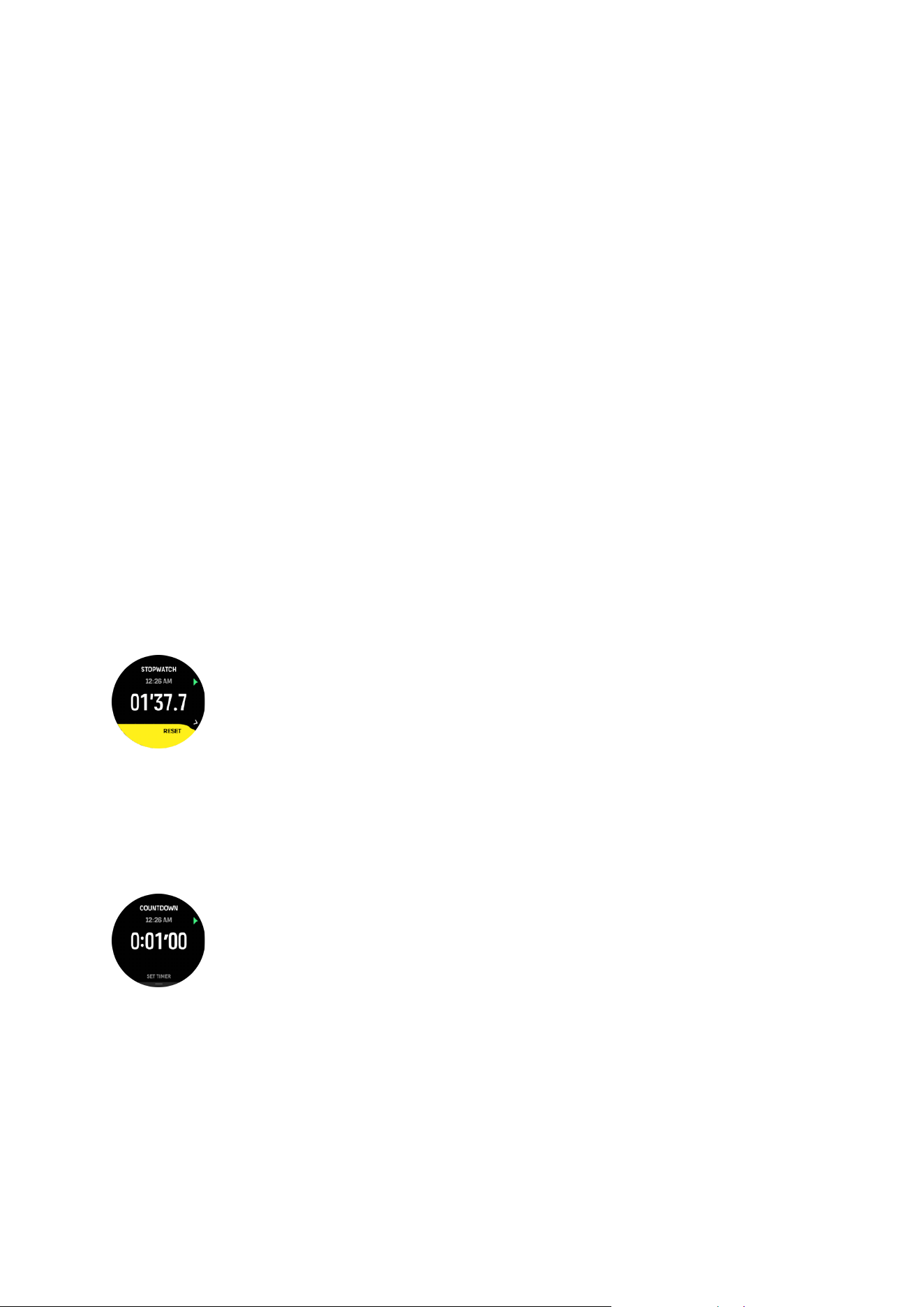
Orienteering maps, however, are drawn in relation to magnetic north. If you are using an
orienteering map, you need to turn the declination correction o by setting the declination
value to 0 degrees.
You can set your declination value after selecting the Declination option in the compass
settings.
Compass unit
You can set the compass unit to Degrees or Mils. For changing the compass unit, select the
Compass unit option in the compass settings.
Compass settings are available also in the watch settings, under Outdoor > Navigation.
6.16. Timer
Your watch includes a stopwatch and countdown timer for basic time measurement. You can
find the timer in the All Apps menu and you can add it to the list of your selected widgets.
When you first enter the widget, it shows the stopwatch. After that, it remembers whatever
you used last, stopwatch or countdown timer.
Swipe up to open the SET TIMER shortcuts menu where you can change the timer settings.
Stopwatch
Start and stop the stopwatch by pressing the upper button. You can resume by pressing the
upper button again. Reset by pressing the lower button.
Exit the timer by pressing the lower button.
Countdown timer
In the timer widget, swipe up to open the shortcuts menu. From there you can select a
pre-
defined countdown time or create custom countdown time.
Stop and reset as needed with the upper and lower buttons.
Exit the countdown timer by pressing the lower button.
6.17. Alipay (only in Mainland China)
You can
find the Alipay widget in the All Apps menu and you can add it to the list of your
selected widgets.
Suunto Run
54

If you connect your watch to the Alipay application on your mobile phone, you can use your
watch for oine payment.
NOTE: Alipay is available only in Mainland China.
Suunto Run
55

7. All apps
The All Apps menu contains all applications and watch functions and you can access watch
settings from here, too.
From watch face, swipe down or turn the crown to access the All Apps menu. After entering
the menu, scroll down to see the applications ordered in training, outdoor and general
categories.
7.1. Breathe
If you feel nervous or stressed, the Breathe application in your Suunto Run can help you relax
your body and mind. You can find the Breathe application in the All Apps menu.
Launch the application for a guided breathing exercise. Follow the animation as you inhale
and exhale. Vibration also helps you keep the rhythm.
Scroll down for setting the breathing exercise duration.
Suunto Run
56
8. Care and support
8.1. Handling guidelines
Handle the unit with care – do not knock or drop it.
Under normal circumstances, the watch does not require servicing. On a regular basis, rinse it
with fresh water, mild soap, and carefully clean the housing with a moist, soft cloth or chamois.
Use only original Suunto accessories - damage caused by non-original accessories is not
covered by warranty.
8.2. Battery
The duration on a single charge depends on how you use your watch and in what conditions.
Low temperatures, for example, reduce the duration of a single charge. In general, the
capacity of rechargeable batteries decreases over time.
NOTE: In case of abnormal capacity decrease due to defective battery, Suunto covers
battery replacement for one year or maximum 300 charging times, whichever comes
first.
When the battery charge level is less than 20% and later 5%, your watch displays a low
battery icon. If the charge level gets very low, your watch goes into a low power mode and
display a charge icon.
Use the supplied USB cable to charge your watch. Once the battery level is high enough, the
watch wakes up from lower power mode.
8.3. Disposal
Please dispose of the device in accordance with local regulations for electronic waste. Do not
throw it in the garbage. If you wish, you may return the device to your nearest Suunto dealer.
Suunto Run
57
9. Reference
9.1. Compliance
For compliance related information and detailed technical
specifications, see “Product Safety
and Regulatory Information” delivered together with your Suunto Run or available at
www.suunto.com/userguides.
9.2. CE
Hereby, Suunto Oy, declares that the radio equipment type OW234 is in compliance with
Directive 2014/53/EU. The full text of the EU declaration of conformity is available at the
following internet address: www.suunto.com/EUconformity.
Suunto Run
58

Suunto Run
59