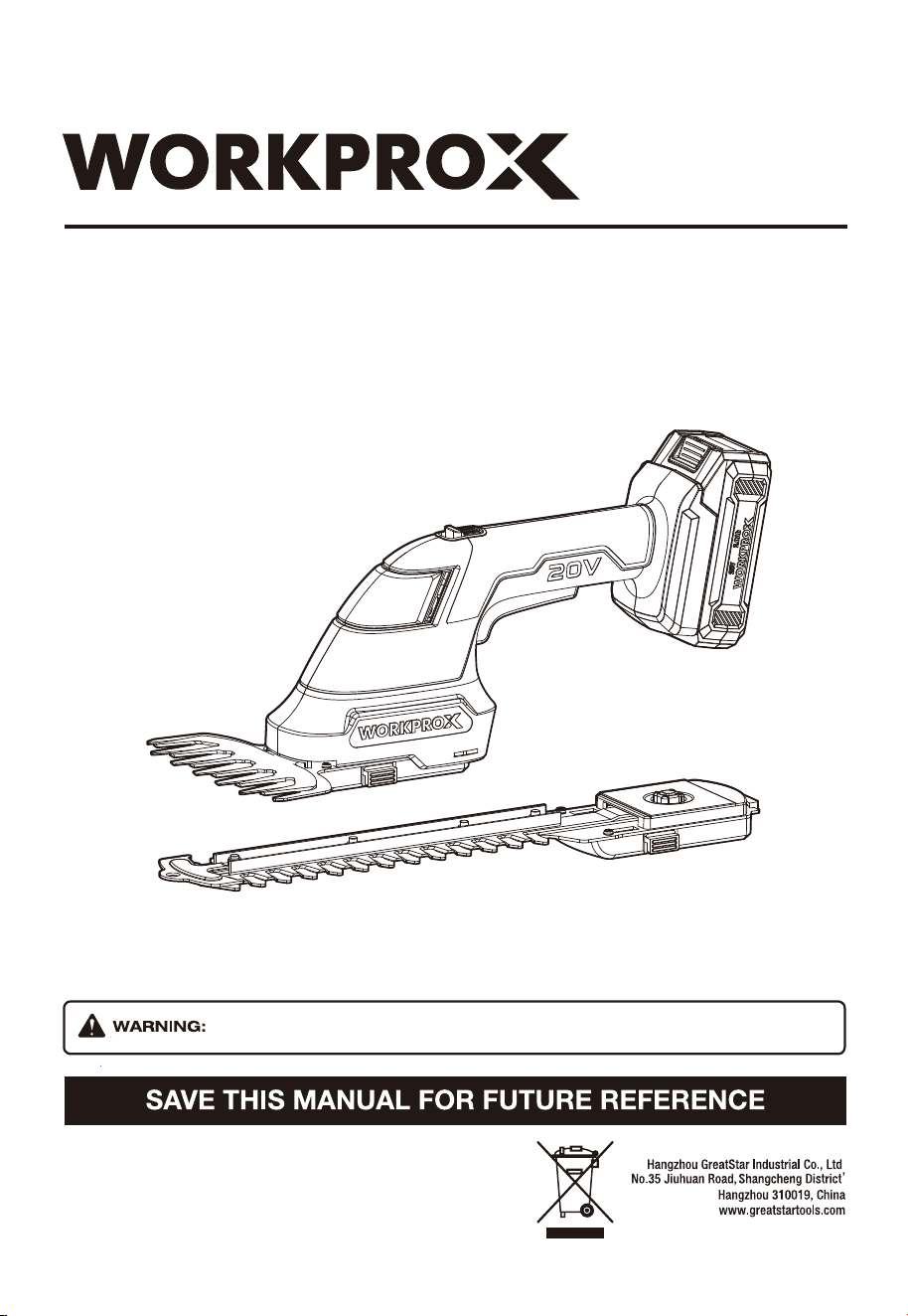
WX125331A
Made in China
ORIGINAL SAFETY AND OPERATING INSTRUCTIONS
20V CORDLESS GRASS
SHEAR & SHRUBBERY TRIMMER
Distributed by:
Thank you for buying a WORKPROX GRASS SHEAR & SHRUBBERY TRIMMER. Your new CORDLESS GRASS
SHEAR & SHRUBBERY TRIMMER has been engineered and manufactured to WORKPROX's high standard for
dependability, ease of operation, and operator safety. Properly cared for, it will give youyears of rugged,
trouble-free performance.
To reduce the risk of injury, the user must read and understand the operator’s manual.
2
2
2
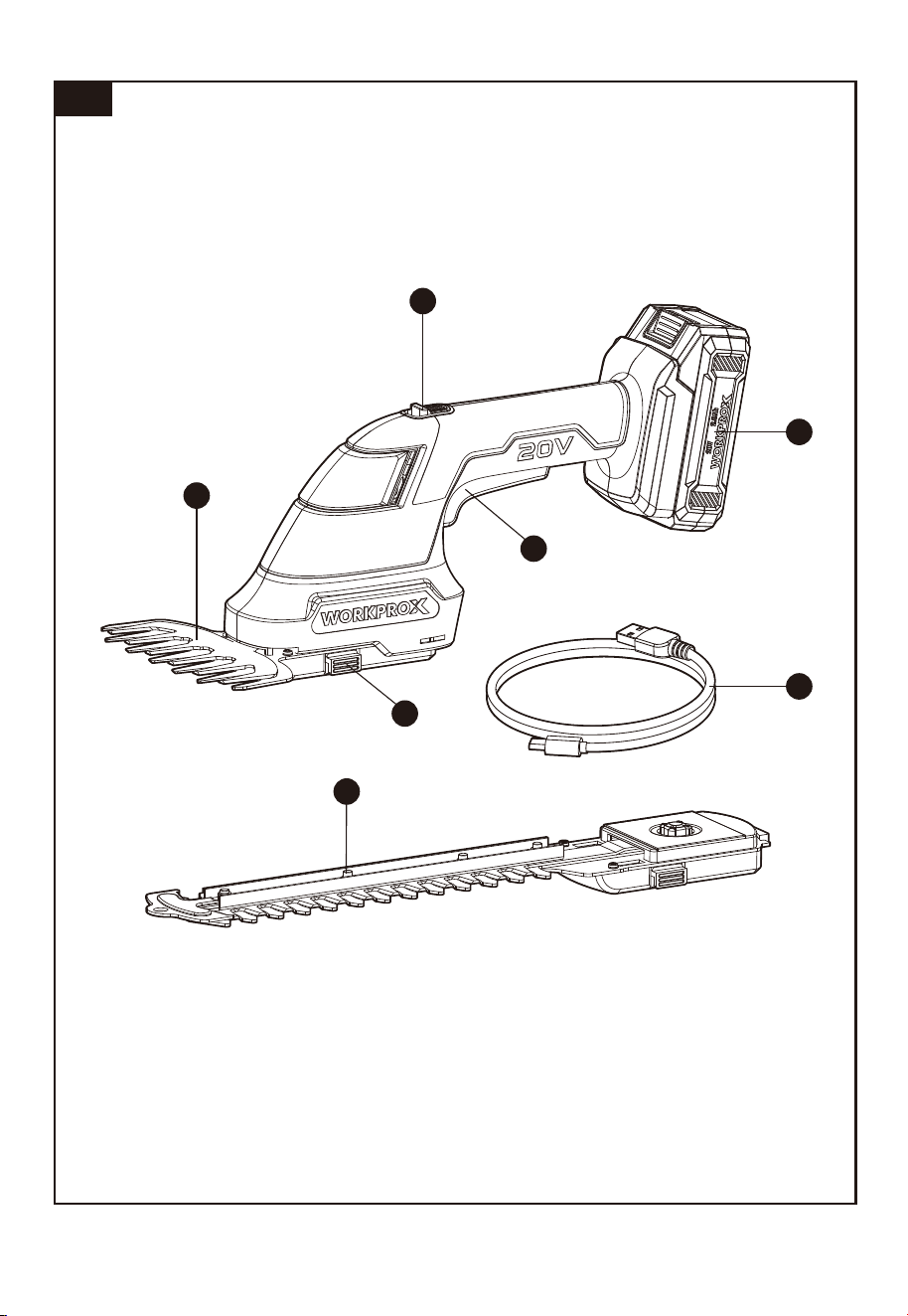
1
3
4
5
6
1. Grass shear blade
2. Shrubbery blade
3. Blade release button
4. ON/OFF switch
5. Safety lock-off button
6. Battery pack
7. USB-C charging cable
7
Fig. 1

3
INTRODUCTION
The equipment is designed for cutting the edges of lawns and small areas of grass in private and hobby gardens.
The tool can be used to trim small hedges and shrubs.
Tools for private and hobby gardens are not suitable for use in public facilities, parks and sport centers, along
roadways, on farms or in the forestry sector. For the tool to be used properly it is imperative to follow the
instructions set out in the manufacturer’s directions for use.
WARNING!
It is prohibited to use the tool to chop material for composting because of the potential danger to persons and
property.
The machine is to be used only for its prescribed purpose. Any other use is deemed to be a case of misuse. The
user / operator and not the manufacturer will be liable for any damage or injuries of any kind caused as a result of
this.
Please note that our equipment has not been designed for use in commercial, trade or industrial businesses or
for equivalent purposes.

4
When operating a power tool outdoors, use an
extension cord suitable for outdoor use. Use of
a cord suitable for outdoor use reduces the risk of
electric shock.
If operating a power tool in a damp location is
unavoidable, use a residual current device
(RCD) protected supply. Use of an RCD reduces
the risk of electric shock.
3) Personal safety
Stay alert, watch what you are doing and use
common sense when operating a power tool.
Do not use a power tool while you are tired or
under the inuence of drugs, alcohol or medica-
tion. A moment of inattention while operating
power tools may result in serious personal injury.
Use personal protective equipment. Always
wear eye protection. Protective equipment such
as a dust mask, non-skid safety shoes, hard hat or
hearing protection used for appropriate conditions
will reduce personal injuries.
Prevent unintentional starting. Ensure the
switch is in the off-position before connecting
to power source and/or battery pack, picking
up or carrying the tool. Carrying power tools with
your nger on the switch or energising power tools
that have the switch on invites accidents.
Remove any adjusting key or wrench before
turning the power tool on. A wrench or a key left
attached to a rotating part of the power tool may
result in personal injury.
Do not overreach. Keep proper footing and
balance at all times. This enables better control of
the power tool in unexpected situations.
Dress properly. Do not wear loose clothing or
jewellery. Keep your hair and clothing away from
moving parts. Loose clothes, jewellery or long hair
can be caught in moving parts.
If devices are provided for the connection of
dust extraction and collection facilities, ensure
these are connected and properly used. Use of
dust collection can reduce dust-related hazards.
Do not let familiarity gained from frequent use
of tools allow you to become complacent and
ignore tool safety principles. A careless action
can cause severe injury within a fraction of a
second.
4) Power tool use and care
Do not force the power tool. Use the correct
power tool for your application. The correct power
tool will do the job better and safer at the rate for
which it was designed.
Do not use the power tool if the switch does
not turn it on and off. Any power tool that cannot
be controlled with the switch is dangerous and
must be repaired.
DANGER!
When using the equipment, a few safety precautions
must be observed to avoid injuries and damage.
Please read the complete operating instructions and
safety regulations with due care. Keep this manual in
a safe place, so that the information is available at all
times. If you give the equipment to any other person,
hand over these operating instructions and safety
regulations as well. We cannot accept any liability for
damage or accidents which arise due to a failure to
follow these instructions and the safety instructions.
1.GENERAL POWER TOOL SAFETY
WARNING
WARNING!
Read all safety warnings, instructions, illustrations
and specications provided with this power tool.
Failure to follow all instructions listed below may result
in electric shock, re and/or serious injury.
Save all warnings and instructions for future
reference.
The term "power tool" in the warnings refers to your
mains-operated (corded) power tool or battery-operated
(cordless) power tool.
1) Work area safety
Keep work area clean and well lit. Cluttered or
dark areas invite accidents.
Do not operate power tools in explosive
atmospheres, such as in the presence of
ammable liquids, gases or dust. Power tools
create sparks which may ignite the dust or fumes.
Keep children and bystanders away while
operating a power tool. Distractions can cause
you to lose control.
2) Electrical safety
Power tool plugs must match the outlet. Never
modify the plug in any way. Do not use any adapter
plugs with earthed (grounded) power tools.
Unmodied plugs and matching outlets will reduce
risk of electric shock.
Avoid body contact with earthed or grounded
surfaces, such as pipes, radiators, ranges and
refrigerators. There is an increased risk of electric
shock if your body is earthed or grounded.
Do not expose power tools to rain or wet
conditions. Water entering a power tool will
increase the risk of electric shock.
Do not abuse the cord. Never use the cord for
carrying, pulling or unplugging the power tool.
Keep cord away from heat, oil, sharp edges or
moving parts. Damaged or entangled cords
increase the risk of electric shock.

5
e. Under abusive conditions, liquid may be ejected
from the battery; avoid contact. If contact accidentally
occurs, ush with water. If liquid contacts eyes,
additionally seek medical help. Liquid ejected from
the battery may cause irritation or burns.
ADDITIONAL SAFETY INSTRUCTIONS
RELATED TO THE BATTERY PACK AND
BATTERY SAFETY
Use only the WORKPROX batteries supplied with
the WORKPROX Tool or WORKPROX-approved
replacements.
Do not use the battery to power any device other
than the WORKPROX tool it was sold with.
Charge the battery only with the WORKPROX
charger supplied with the tool or WORKPROX-ap-
proved replacements and according to the
instructions in the WORKPROX Instruction Manual.
Do not charge the battery in a place where static
electricity is generated nor let the battery touch
something that is statically charged.
The battery can be stored at temperatures
between 40°F(4°C) and 104°F(40°C).
Never store or leave your lithium ion battery in
temperatures over that recommended otherwise
fire may occur.
DO NOT store the Lithium Ion battery anywhere that
the temperature can easily reach higher temperatures
than recommended -this includes garden type sheds,
and Vehicles where the inside temperature can climb
to dangerous levels in the direct sunlight and on high
temperature days. THINK BEFORE LEAVING YOUR
LITHIUM ION BATTERY PACK IN STORAGE.
The battery can be charged or operated at tempera-
tures between 40°F(4°C) and 104°F(40°C). NEVER
CHARGE YOUR LITHIUM ION BATTERY BELOW
OR ABOVE TEMPERATURES RECOMMENDED
OTHERWISE FIRE OR SERIOUS DAMAGE TO THE
BATTERY PACK MAY OCCUR.
The most suitable temperatures to charge the battery
pack are between 68°F(20°C) -77°F(25°C).
Always allow the battery pack to cool down after
charging, do not place it in a hot environment such as
a metal shed or open trailer left in the sun.
Take care where the tool is stored. Do not store in
areas of corrosive fumes, or salt air or similar
conditions. Try and store the tool in the packaging
supplied with the tool.
Do not dispose of the battery in a fire or put the
battery into a microwave oven, conventional oven,
dryer, or high-pressure container. Under these
conditions, the battery may explode.
Never attempt to open the battery pack, puncture the
battery or subject the battery to strong physical shock.
If the plastic housing of the battery pack breaks open
or cracks, immediately discontinue its use and do not
recharge it. Ensure the battery pack clip is in good
condition and will not allow the pack to fall free from
the tool. If the clip is damaged or for any reason is not
Disconnect the plug from the power source
and/or remove the battery pack, if detach-
able, from the power tool before making any
adjustments, changing accessories, or
storing power tools. Such preventive safety
measures reduce the risk of starting the power
tool accidentally.
Store idle power tools out of the reach of
children and do not allow persons unfamiliar
with the power tool or these instructions to
operate the power tool. Power tools are
dangerous in the hands of untrained users.
Maintain power tools and accessories. Check
for misalignment or binding of moving parts,
breakage of parts and any other condition
that may affect the power tool’s operation. If
damaged, have the power tool repaired before
use. Many accidents are caused by poorly
maintained power tools.
Keep cutting tools sharp and clean. Properly
maintained cutting tools with sharp cutting
edges are less likely to bind and are easier to
control.
Use the power tool, accessories and tool bits
etc. In accordance with these instructions,
taking into account the working conditions and
the work to be performed. Use of the power tool
for operations different from those intended
could result in a hazardous situation.
Keep handles and grasping surfaces dry,
clean and free from oil and grease. Slippery
handles and grasping surfaces do not allow for
safe handling and control of the tool in
unexpected situations.
5) Service
Have your power tool serviced by a qualied
repair person using only identical replacement
parts. This will ensure that the safety of the
power tool is maintained.
6) Battery tool use and care
a. Ensure the switch is in the off position before
inserting battery pack. Inserting the battery pack
into power tools that have the switch on invites
accidents.
b. Recharge only with the charger specied by the
manufacturer. A charger that is suitable for one
type of battery pack may create a risk of re
when used with another battery pack.
c. Use power tools only with specically designated
battery packs. Use of any other battery packs
may create a risk of injury and re.
d. When battery pack is not in use, keep it away
from other metal objects like paper clips, coins,
keys, nails, screws, or other small metal objects
that can make a connection from one terminal to
another. Shorting the battery terminals together
may cause burns or a re.

6
locking the pack in place, Do Not continue to use.
Stop using the battery if it exhibits abnormal heat,
odour, colour, deformation, or is in an abnormal
condition.
If you detect leakage or a foul odour, it is especially
important to keep the battery away from fire. If battery
liquid leaks onto your skin or clothes, wash well with
clean water immediately. If liquid leaking from the
battery gets into your eyes, do not rub your eyes.
Rinse your eyes well (for at least 10 minutes) with
clean water, and consult a doctor immediately.
Do not use a leaking battery.
Handle batteries with care to avoid shorting the
battery with conducting materials, such as nails,
screws, metal watch bands, rings, bracelets, and
keys. The battery may overheat and could burn you.
After the battery has reached the end of its useful life,
we recommend recycling the materials at your local
municipal council recycling centre. DO NOT attempt
to replace the battery cells in the battery pack, repair
or modify any part of the battery pack assembly.
When recycling, make it nonconductive by applying
insulating tape to the terminals located on the battery.
WHEN TO CHARGE THE BATTERY
New batteries are shipped in a low charged condition
and should be fully charged before Use. The battery
pack can be recharged at any time during use,
provided the pack is not overheated.
If the battery pack starts to cut out due to low voltage,
or previous tasks undertaken can no longer be
performed, it is suggested to stop using the tool and
recharge the battery.
For storage, it is suggested to recharge the battery
between 50% and 75% charge.
Charge the device at least once in 3-6 months to
preserve battery life span.
2.IMPORTANT SAFETY INSTRUC-
TIONS FOR CORDLESS GRASS
SHEAR
WARNING!
When using electric gardening appliances, basic safety
precautions should always be followed to reduce the
risk of re, electric shock, and personal injury, including
the following:
Avoid dangerous environment - Do not use
appliances in damp or wet locations.
Don’t use in rain.
Keep children away - All visitors should be kept at
a distance from work area.
Dress properly - Do not wear loose clothing or
jewelry. They can be caught in moving parts. Use of
rubber gloves and substantial footwear is
recommended when working outdoors. Wear
protective hair covering to contain long hair.
Use Safety Glasses – Always use face or dust mask
if operation is dusty.
Use Right Appliance - Do not use appliance for any
job except that for which it is intended.
Avoid Unintentional Starting - Do not carry
appliance with nger on switch. Be sure switch is
off before inserting battery pack.
Do not grasp the exposed cutting blades or cutting
edges when picking up or holding the appliance.
Do not Force Appliance - It will do the job better
and with less likelihood of a risk of injury at the rate
for which it was designed.
Do not Overreach - Keep proper footing and
balance at all times.
Stay Alert - Watch what you are doing. Use common
sense. Do not operate appliance when you are tired.
Store Idle Appliances Indoors - When not in use,
appliances should be stored indoors in dry, and
high or locked-up place out of reach of children.
Maintain Appliance With Care - Keep cutting edge
sharp and clean for best performance and to reduce
the risk of injury. Follow instructions for lubricating
and changing accessories. Keep handles dry, clean,
and free from oil and grease.
Check Damaged Parts - Before further use of the
appliance, a guard or other part that is damaged
should be carefully checked to determine that it will
operate properly and perform its intended function.
Check for alignment of moving parts, binding of
moving parts, breakage of parts, mounting, and any
other condition that may affect its operation. A guard
or other part that is damaged should be properly
repaired or replaced by an authorized service center
unless indicated elsewhere in this manual.
Keep hands away from blades.
Do not use or charge appliance in rain, or in wet
locations.
Do not use battery-operated appliance in rain.
Remove or disconnect battery before servicing,
cleaning or removing material from the appliance.
Such preventive safety measures reduce the risk of
starting the appliance accidentally.
Use only the battery(ies) listed in “SPECIFICATIONS”.
Use of any other batteries may create a risk of re.
Exercise care in handling batteries in order not to
short the battery with conducting materials such as
rings, bracelets, and keys. The battery or conductor
may overheat and cause burns.
Use safety equipment. Always wear eye protection.
Dust mask, non-skid safety shoes, hard hat, or
hearing protection must be used for appropriate
conditions.
Be aware that this appliance is always in an operating
condition, because it does not have to be plugged
into an electrical outlet.
Do not operate appliances in explosive atmospheres,
such as in the presence of ammable liquids, gases,
or dust. Appliances create sparks which may ignite
the dust or fumes.

7
Keep all parts of the body away from the blade. Do
not remove cut material or hold material to be cut
when blades are moving. Blades continue to move
after the switch is turned off. Amoment of inattention
while operating the hedge trimmer may result in
serious personal injury.
Carry the hedge trimmer by the handle with the
blade stopped and taking care not to operate any
power switch. Proper carrying of the hedge trimmer
will decrease the risk of inadvertent starting and
resultant personal injury from the blades.
When transporting or storing the hedge trimmer,
always t the blade cover. Proper handling of the
hedge trimmer will decrease the risk of personal
injury from the blades.
When clearing jammed material or servicing the
unit, make sure all power switches are off and the
battery pack is removed or disconnected.
Unexpected actuation of the hedge trimmer while
clearing jammed material or servicing may result in
serious personal injury.
Hold the hedge trimmer by insulated gripping
surfaces only, because the blade may contact
hidden wiring. Blades contacting a "live" wire may
make exposed metal parts of the hedge trimmer
"live" and could give the operator an electric shock.
Keep all power cords and cables away from cutting
area. Power cords or cables may be hidden in hedges
or bushes and can be accidentally cut by the blade.
Do not use the hedge trimmer in bad weather
conditions, especially when there is a risk of
lightning. This decreases the risk of being struck by
lightning.
SAVE THESE INSTRUCTIONS
Refer to them frequently and use them to instruct
others who may use this tool. If you loan someone
this tool, loan them these instructions also.
A battery operated appliance with integral batteries
or a separate battery pack must be recharged only
with the specied charger for the battery. A
charger that may be suitable for one type of
battery may create a risk of re when used with
another battery.
Use battery operated appliance only with
specically designated battery pack. Use of any
other batteries may create a risk of re.
Remove adjusting keys or wrenches before turning
the appliance on. A wrench or a key that is left
attached to a rotating part of the appliance may
result in personal injury.
Do not use appliance if switch does not turn it on
or off. An appliance that cannot be controlled with
the switch is dangerous and must be repaired.
Use only accessories that are recommended by
the manufacturer for your model. Accessories that
may be suitable for one appliance may create a
risk of injury when used on another appliance.
Appliance service must be performed only by
qualied repair personnel. Service or maintenance
performed by unqualied personnel may result in a
risk of injury.
When servicing an appliance, use only identical
replacement parts. Follow instructions in the
Maintenance section of this manual. Use of
unauthorized parts or failure to follow Maintenance
instructions may create a risk of shock or injury.
Before cutting grass, remove foreign matter such
as rocks and large sticks from the work area. Be
careful not to catch foreign matter between blades,
otherwise blades may be jammed. If this happens,
switch the appliance off. Then remove the
obstruction from the blades.
When not in use, be sure to cover the blades with
blade cover.
If the blades stop moving due to the stuck of foreign
objects between the blades during operation,
switch off the tool and remove the battery
cartridge, and then remove the foreign objects
using tools such as pliers. Removing the foreign
objects by hand may cause an injury for the reason
that the blades may move in reaction to removing
the foreign objects.
CORDLESS HEDGE TRIMMER SAFETY WARNINGS
WARNING!
Drilling, sawing, sanding or machining wood products
can expose you to wood dust, a substance known to
the State of California to cause cancer. Avoid inhaling
wood dust or use a dust mask or other safeguards for
personal protection. For more information go to
www.P65Warnings.ca.gov/wood.
8
Danger notices and information are clearly marked
throughout these instructions for use. The following
symbols are used:
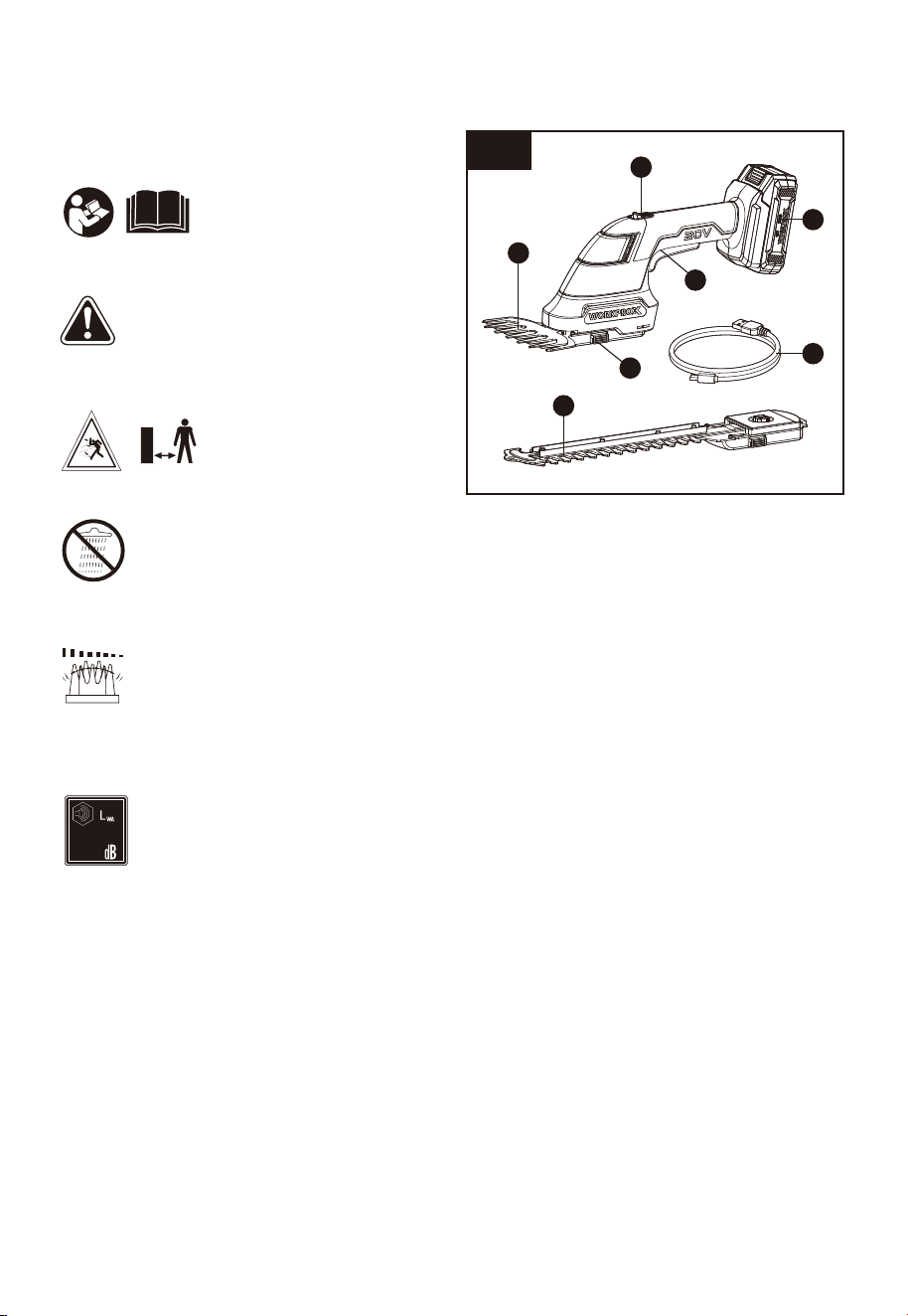
3. SYMBOLS
4. KNOW YOUR PRODUCT (Fig.1)
1.Grass shear blade
2.Shrubbery blade
3.Blade release button
4.On/Off switch
UNPACKING
Instructions
Carefully remove the cordless grass shear & shrubbery
trimmer and check to see that all of the above items
are supplied.
Inspect the product carefully to make sure no breakage
or damage occurred during shipping. If you nd
damaged or missing parts, please contact us at the
rst time.
Carton contents
Cordless Grass Shear & Shrubbery Trimmer
Shrubbery blade
Grass shear blade
USB-C charging cable
Battery Pack
Original safety and operating instructions
Carrying bag
NOTE: Do not discard the shipping carton and
packaging material until you are ready to use your new
cordless grass shear & shrubbery trimmer. The
packaging is made of recyclable materials. Properly
dispose of these materials in accordance with local
regulations.
Danger! - Read the operating instructions to reduce
the risk of inquiry.
Keep all other persons away from the danger zone.
Hazard symbols with information on prevention of
personal injury and property damage
Protect the tool from the damp and never expose it
to rain.
IMPORTANT! The cutter blades continue to run after
the motor is switched off. Wait for the blades to come
to a standstill. Risk of injury!
Guaranteed sound power level.
96
Fig. 1
1
5
4
3
2
6
7
5.Safety lock-off button
6.Battery pack
7.USB-C charging cable
20v cordless grass shear & shrubbery trimmer
Cutting width of grass shears
Cutting length of shrub shears
Cutting thickness of shrub shears
Net weight (battery not include)
5.71" (145mm)
7.83" (199mm)
0.31" (7.95mm)
3.86lbs (1.75kg)
BATTERY PACK
Battery pack type
Capacity
Voltage
9
5. TECHNICAL DATA
6. OPERATION
CAUTION! Risk of injury! Comply with all
safety instructions when handling recharge-
able devices.
NOTICE! Risk of damage to the unit! Do not
allow the battery pack to deep discharge.
NOTICE! Risk of damage to the unit! Do not
press the On/Off switch after the device has
deactivated automatically.
Note: The Li-Ion battery pack can be
charged at any time without affecting the
lifetime of the unit. Interrupting the charging
process will not damage the battery pack.
Note: If the battery is fully loaded, the charger
automatically switches over to the mainte-
nance charge function. The battery can thus
remain in the charger permanently.
The area to be cut must rst be cleared of stones and
other solid objects. The safety lock-off (5) prevents the
tool being started unintentionally.
WARNING!
The blades continue to move for a few seconds after
the tool is switched OFF. Turn OFF the tool and wait
until the blades come to a complete stop before
adjusting or cleaning.
CAUTION!
Never touch the blade rail while the tool is in operation
and be aware of the sharp edges even when the grass
and shrub shears is not in use.
NOTE: Do not touch the rotating blades.
Know your battery pack
IMPORTANT!
The equipment and packaging material are not toys.
Do not let children play with plastic bags, foils or small
parts. These items can be swallowed and pose a
suffocation risk!
Usb-C
Usb-A
Input/Output
Output
Li-Ion
2000mAh
Maximum: 20V/Nominal:18V
Max. 30W, 5V/3A, 9V/3A,
12V/2.5A, 15V/2A, 20V/1.5A
Max. 15W 5V/3A
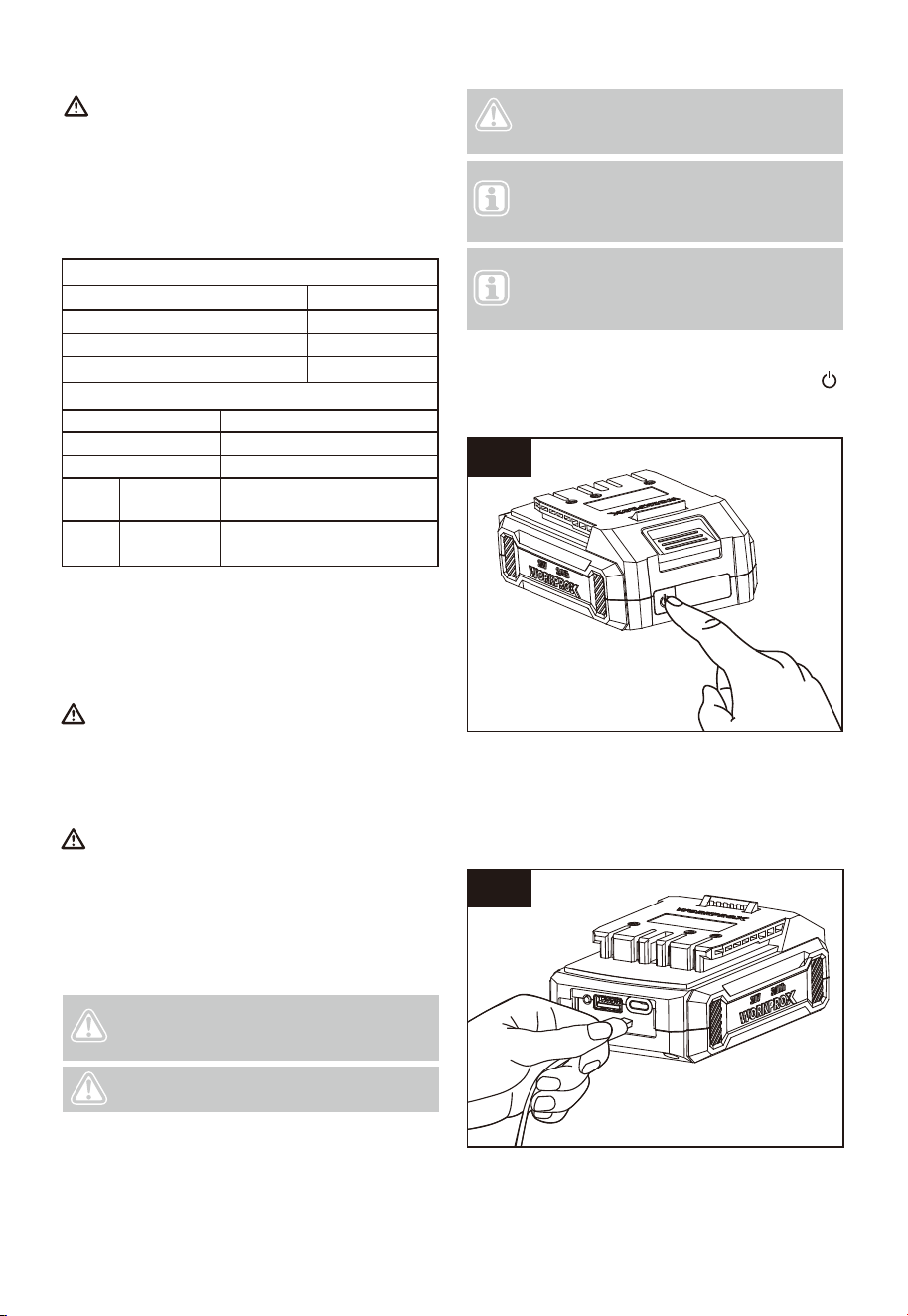
a) Battery capacity indicator(Fig.2)
The battery pack has an LED screen, and press the
can display real-time power level. The screen will
automatically turn off in three seconds.
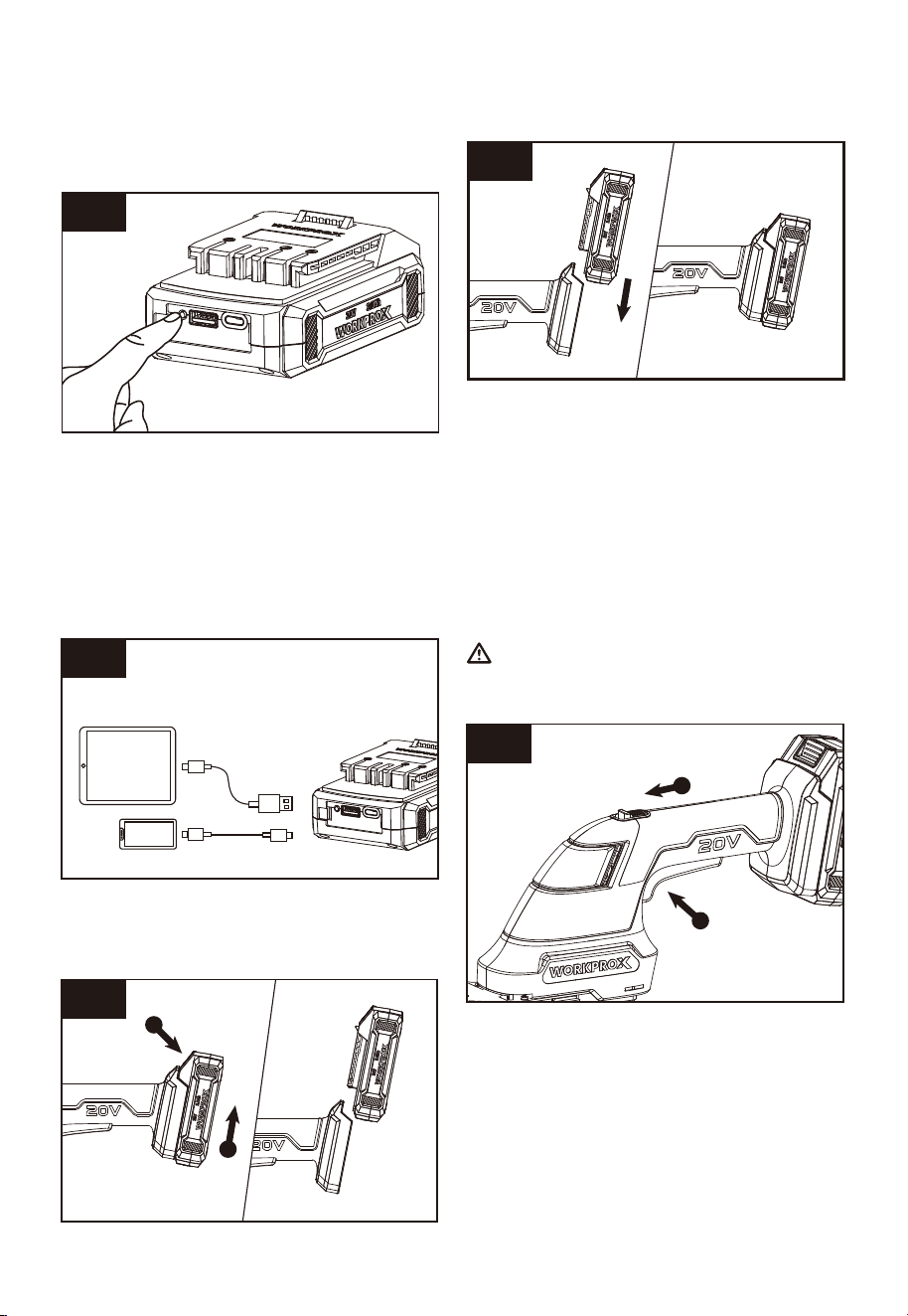
b) Recharge the battery pack (Fig. 3)
To charge your battery pack, connect one end of the
USB cable with a USB-C port to the corresponding
USB-C port on the battery pack, and connect the other
end to a USB-C or USB-A interface charger.
Fig. 2
Fig. 3
10
Slot the battery pack into the device and make sure
it clicks into place correctly. (Fig.7)
Switching on (Fig. 8)
Activate the safety lock-off by rst pressing forward the
safety lock-off button(5) and then pressing the ON/OFF
switch (4) .
NOTE: You can release the safety lock button (5) after
starting machine, just press and hold the ON/OFF
switch (4).
Switching off
To switch off the equipment, let go of the ON/OFF switch.
Changing the blade
WARNING!
The blades are sharp, be careful when changing them.
Risk of personal injury.
c) Charge portable device (Fig.4 & Fig. 5)
Press the button as shown in Fig. 4, the indicator will
light up green to indicate that the battery pack is active
and that the USB ports are ready to be used.
Plug the USB cable into the correct port, and the other
end of the cable into your device to begin charging the
device.(Fig. 5)
NOTE: The green light remains on during output.
After pressing the button(as shown in Fig. 4), if no
USB cable is connected for an extended period, the
green light will automatically turn off after 5 minutes.
Fig. 5
Fig. 8
Fig. 7
Fig. 4
Press in the battery pack release button and remove
the battery from the device. (Fig.6)
Battery pack removal and installation
Fig. 6
1
2
1
2
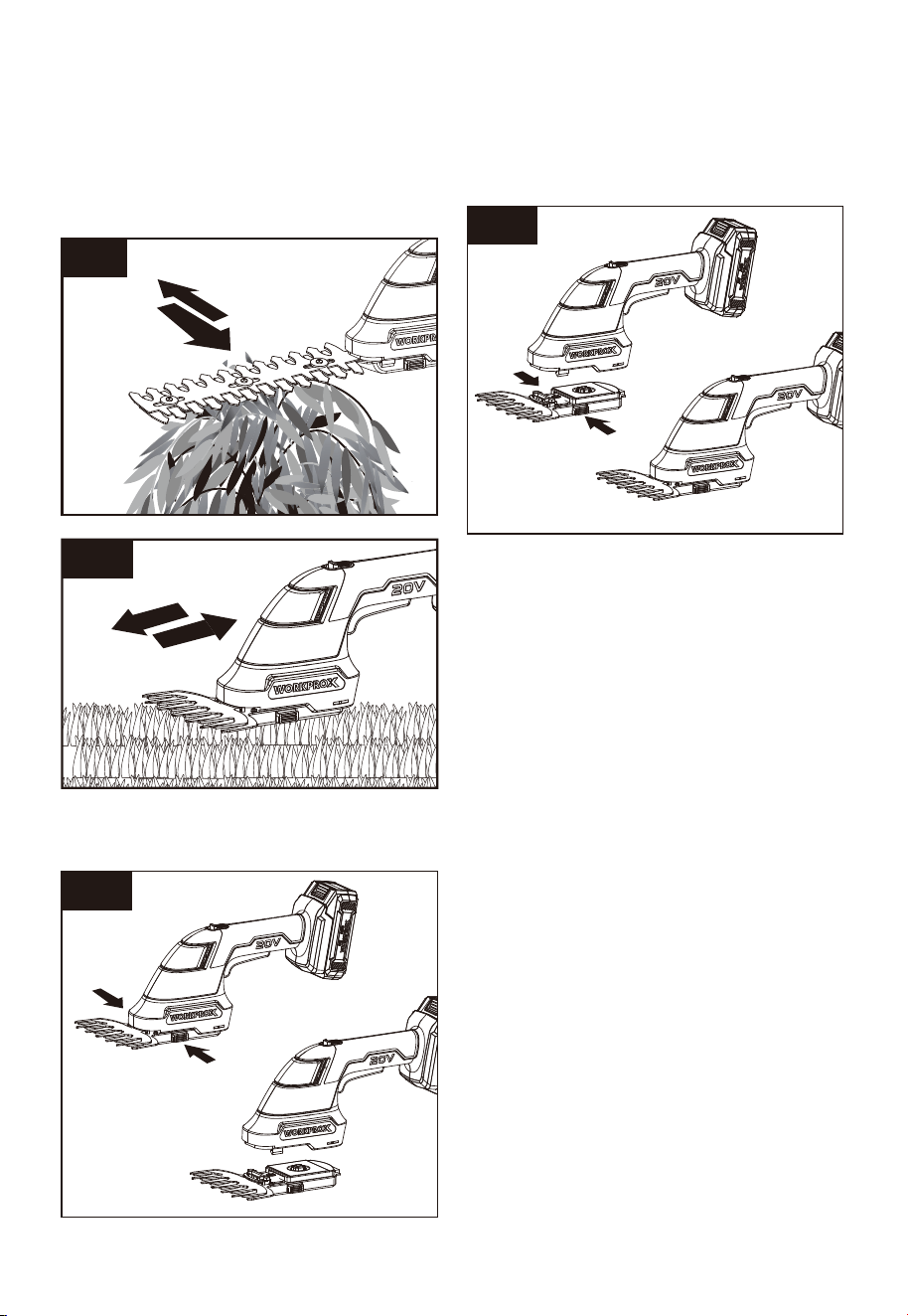
NOTE:The drive becomes visible when the accessory
comes off. Make sure that no impurities or foreign
objects get into the drive when changing accessories.
Press in the blade release buttons (3) and t the
accessory onto the tool. (Fig.12)
11
Press in the blade release buttons(3) and remove the
accessory from the tool.(Fig.11)
The grass and shrubbery shears is equipped with two
interchangeable blades that are designed for
do-it-yourself grooming projects around your garden.
The shrubbery blade (2) is used to cut hedges and
shrubbery (Fig. 9) while the grass shear blade (1) is
used to cut grass and hedges where ner detail is
required (Fig. 10).
Release the blade release buttons. The accessory is
now rmly xed on the tool.
CUTTING GRASS
Allow the grass cutter to glide above the ground. The
best results are achieved when the lawn is dry. When
you notice a drop in cutting performance, re-charge
the tool immediately so that the battery does not
become fully discharged.
TRIMMING HEDGES
The tool can be used to trim small hedges and shrubs.
Hold the tool slightly tilted in relation to the hedge you
want to cut. First cut the sides from the bottom up,
then cut the top. Watch out for foreign objects in or on
the hedge which could damage the blades.
When is the best time to trim hedges?
As a general rule, hedges which lose their leaves in
the autumn should be trimmed in June and October.
Hedges which do not lose their leaves should be cut
in April and August.
Fig. 9
Fig. 10
Fig. 11
Fig. 12

7. CLEANING AND MAINTENANCE
DANGER!
Risk of injury! Before any maintenance or cleaning
work:
Remove the battery.
Let the device cool down.
CLEANING
Keep all safety devices, air vents and the motor
housing free of dirt and dust as far as possible.
Wipe the equipment with a clean cloth or blow it
with compressed air at low pressure.
We recommend that you clean the device immediate-
ly each time you have nished using it. -Clean the
equipment regularly with a moist cloth and some
soft soap. Do not use cleaning agents or solvents,
these could attack the plastic parts of the
equipment. Ensure that no water can seep into the
device.
A few drops of oil (e.g. sewing machine oil) will
improve the cutting performance of the blades, but
never apply any grease to the blades.
To ensure constant exact cutting it is also important
to remove grass remnants and dirt from between
the upper and lower blade.
CAUTION!
Never clean the tool under running water and
particularly never with high pressure washer, because
of the potential danger to persons and property. Keep
your cordless grass and shrubbery shear in a dry and
frost-proof place. Choose a place that children are
unable to enter.
12
MAINTENANCE
To achieve good results you should keep the blades
sharp at all times. In particular we recommend that you
immediately level off any jags or ridges caused by stones
or the like. The tool should be thoroughly cleaned both
before and after use. There are no parts inside the
equipment which require additional maintenance.
Avoid using solvents when cleaning plastic parts.
Most plastics are susceptible to damage from various
types of commercial solvents and may be damaged
by their use. Use clean cloths to remove dirt, dust, oil,
grease, etc.
8. STORING AND TRANSPORT-
STORAGE
Store the device in a dry and dustproof location and
out of reach of children.
Remove the rechargeable battery from the device
before storing the device.
The optimum storage temperature for the battery
and device is between 32°F/0°C and 104°F/40°C.
Avoid extreme cold or heat during storage, so that
the battery does not lose performance.
Charge the device at least once in 3-6 months to
preserve battery life span.
TRANSPORT
Secure the appliance against slipping.
If shipping, use the original packaging wherever
possible.

9. Disposal
A crossed-out wheelie bin icon means: Batteries and rechargeable batteries, electrical or electronic
devices must not be disposed of with household waste. They may contain substances that are harmful
to the environment and human health.
Consumers must dispose of waste electrical devices, spent portable batteries and rechargeable batteries
Disposal of the packaging
separately from household waste at an ofcial collection point to ensure that these items are processed correctly.
Information on returning these items is available from the seller. Sellers are required to accept these items free of
charge. Batteries and rechargeable batteries, which are not permanently installed in waste electrical devices, must
be removed prior to disposal and must be disposed of separately. Lithium batteries and battery packs in all systems
must only be retuned to a collection point when discharged. Batteries must always be protected against short
circuits by covering the poles with adhesive tape.
All end users are responsible for deleting any personal data stored on waste devices prior to their disposal.
Disposal of an exhausted battery pack
To preserve natural resources, please recycle or dispose of the battery pack properly. This battery pack
contains Li-ion batteries. Consult your local waste authority for information regarding available recycling
and/or disposal options. Discharge your battery pack by operating your tool, then remove the battery
pack from the tool housing and cover the battery pack connections with heavy-duty adhesive tape to
prevent short circuit and energy discharge. Do not attempt to open or remove any of the components.
The packaging consists of cardboard and correspondingly marked plastics that can be recycled. Make
these materials available for recycling.
Disposal of the appliance
13
Li-ion

14