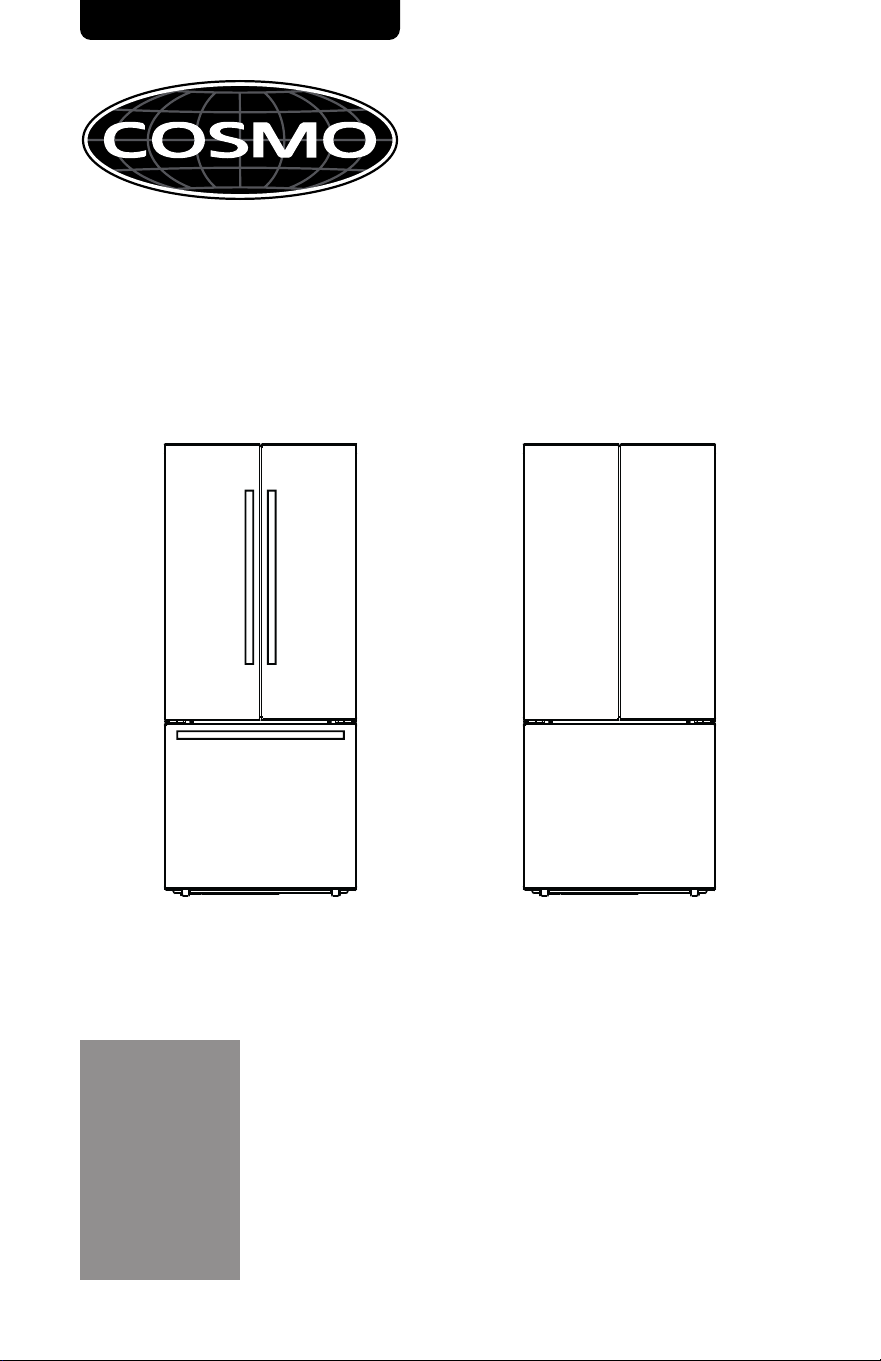
OWNER’S MANUAL
REFRIGERATOR
COS-RFFV183GHS
COS-RFFV183RS
IMPORTANT:
INSTALLER:
OWNER:
FRENCH DOOR REFRIGERATOR
READ AND SAVE THESE INSTRUCTIONS.
FOR RESIDENTIAL USE ONLY.
PLEASE LEAVE THESE INSTRUCTIONS WITH THIS UNIT FOR
THE OWNER.
PLEASE RETAIN THESE INSTRUCTIONS FOR FUTURE
REFERENCE.
Rev.25.01
2
THANK YOU FOR YOUR PURCHASE
Thank you for your purchase. We know that you have many brands and
products to choose from and we are honored to know that you have decided
to take one of our products into your home and hope that you enjoy it.
COSMO Appliances are designed according to the strictest safety and
performance standard for the North American market. We follow the most
advanced manufacturing philosophy. Each appliance leaves the factory after
thorough quality inspection and testing. Our distributors and our service
partners are ready to answer any questions you may have regarding how to
install, use and care for your products. We hope that this manual will help you
learn to use the product in the safest and most effective manner.
Before using this product, please read through this manual carefully. Keep
this user manual in a safe place for future reference. Please ensure that other
persons using this product are familiar with these instructions as well.
If you have any questions or concerns, please contact the dealer from whom you
purchased the product, or contact our Customer Support at:
1-888-784-3108
Reach us online at:
www.cosmoappliances.com
3
TABLE OF CONTENTS
REFRIGERATOR SAFETY .................................................................................... 4
Important Safety Instructions .............................................................................. 5
PRODUCT OVERVIEW ...................................................................................... 10
Refrigerator Layout ............................................................................................. 10
INSTALLATION INSTRUCTIONS ....................................................................... 12
Before Installing .................................................................................................... 12
Unpacking the Refrigerator ................................................................................ 13
Choosing the Proper Location ............................................................................ 14
Dimensions and Clearances ........................................................................ 15
Assembling/Removing Door Handles ............................................................... 17
Assembling/Detaching Door Bins ...................................................................... 18
Connecting to the House Water Line ................................................................ 19
Completing Installation ...................................................................................... 24
Start/Stop the Icemaker ............................................................................. 24
Leveling .......................................................................................................... 25
OPERATION ..................................................................................................... 27
Before Use ............................................................................................................. 27
Energy Saving Tips ............................................................................................... 29
Control Panel ........................................................................................................ 30
Control Buttons .............................................................................................. 31
Display ............................................................................................................ 33
Temperature Mode .............................................................................. 33
Icemaker ................................................................................................................ 34
MAINTENANCE & CARE .................................................................................. 36
General Cleaning ................................................................................................. 36
TROUBLESHOOTING ....................................................................................... 40
LIMITED WARRANTY....................................................................................... 50
4
REFRIGERATOR SAFETY
READ ALL INSTRUCTIONS BEFORE USING THE APPLIANCE
Your safety and the safety of others are very important.
We have provided many important safety messages in this manual and on
your appliance. Always read and obey all safety messages.
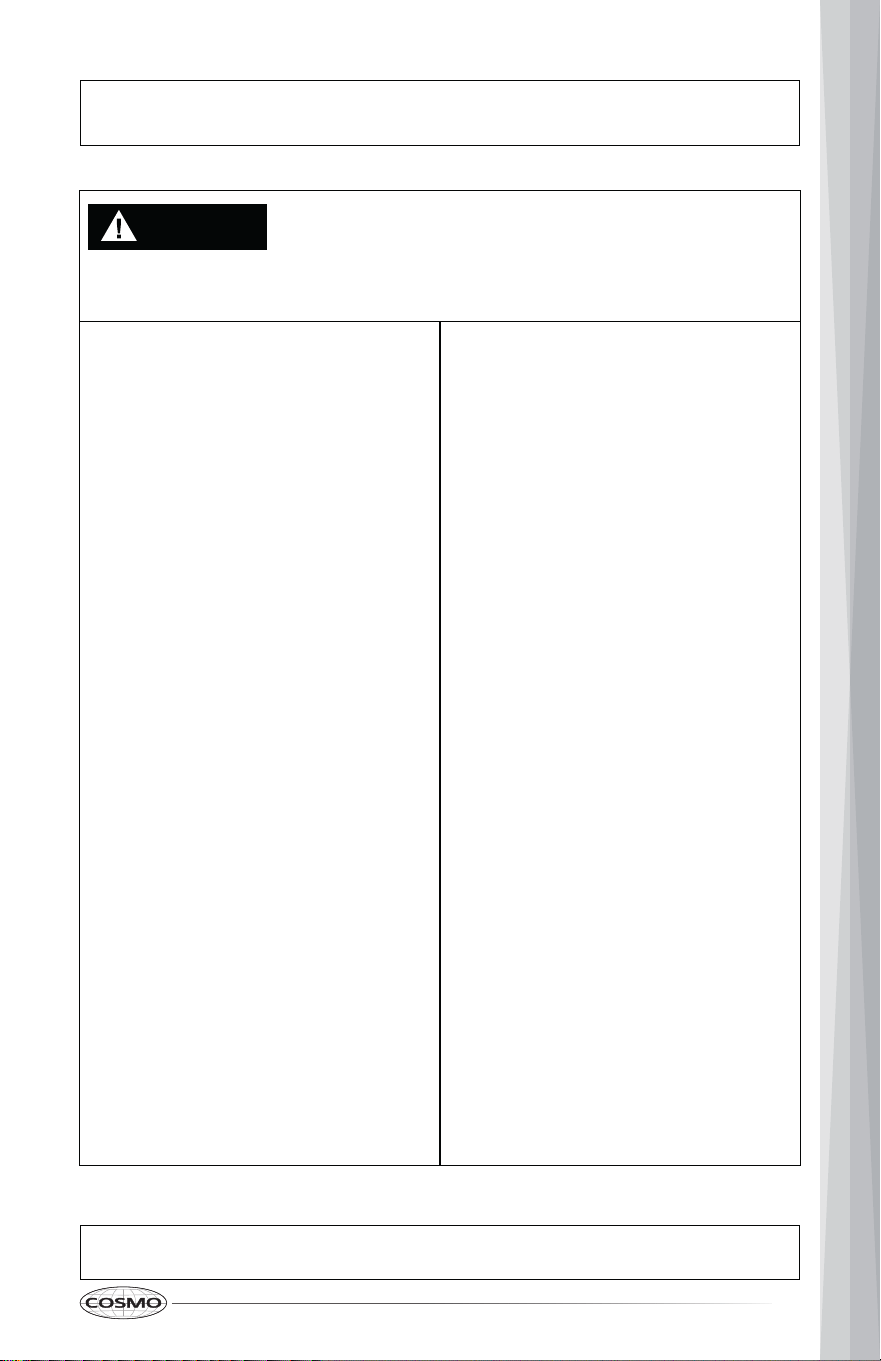
WARNING
You can be killed or seriously injured if you don't
follow instructions.
This is the safety alert symbol.
This symbol alerts you to potential hazards that
can kill or hurt you and others.
All safety messages will follow the safety alert
symbol and either the word "WARNING" or
"CAUTION." These words mean:
CAUTION
A potentially hazardous situation which, if not
avoided, could result in minor or moderate
injury.
All safety messages will tell you what the potential hazard is, tell you how
to reduce the chance of injury, and tell you what can happen if the
instructions are not followed.
California Proposition 65 Warning
WARNING:
Cancer and Reproductive Harm - www.P65Warnings.ca.gov
5
IMPORTANT SAFETY INSTRUCTIONS
To reduce the risk of fire, explosion, electric shock, or injury when using your
refrigerator, follow these basic safety precautions:
• This refrigerator must be
properly installed and located in
accordance with the installation
instructions before it is used.
• Unplug the refrigerator before
making repairs or cleaning.
NOTE: Power to the refrigerator
cannot be disconnected by any
setting on the control panel.
NOTE: Repairs must be
performed by a qualified service
professional.
• Replace all parts and panels
before operating.
• Do not use an extension cord.
• Do not store or use gasoline or
other flammable vapors and
liquids in the vicinity of this or
any other appliance.
• Do not store explosive
substances such as aerosol cans
with a flammable propellant in
this appliance.
• To prevent suffocation and
entrapment hazards to children,
remove the fresh food and
freezer doors from any
refrigerator before disposing of
it or discontinuing its use.
• To avoid serious injury or death,
children should not stand on, or
play in or with the appliance.
• Children and persons with
reduced physical, sensory or
mental capabilities or lack of
experience and knowledge can
use this appliance only if they
are supervised or have been
given instructions on safe use
and understand the hazards
involved.
• This appliance is intended to be
used in household and similar
applications such as: staff
kitchen areas in shops, offices
and other working
environments; farm houses; by
clients in hotels, motels, bed &
breakfast and other residential
environments; catering and
similar non-retail applications.
• Do not apply harsh cleaners to
the refrigerator. Certain cleaners
will damage plastic which may
cause parts such as the door or
door handles to detach
unexpectedly.
READ AND SAVE THESE INSTRUCTIONS
WARNING
6
IMPORTANT SAFETY INSTRUCTIONS
CAUTION
To reduce the risk of injury when using your refrigerator, follow these basic
safety precautions:
• Connect to potable water supply
only. A cold water supply is
required for automatic icemaker
operation. The water pressure
must be between 20 and 100 psi
(140 - 690 kilo-Pascals).
• Do not clean glass shelves or
covers with warm water when
they are cold. Glass shelves and
covers may break if exposed to
sudden temperature changes or
impact, such as bumping or
dropping. Tempered glass is
designed to shatter into many
small pieces if it breaks.
• Do not use a hair dryer to dry
the inside of the refrigerator.
• Do not light a candle to remove
odors in the refrigerator.
• Keep fingers out of the "pinch
point" areas; clearances
between the doors and between
the doors and cabinet are
necessarily small. Be careful
closing doors when children are
in the area.
• Do not refreeze frozen foods
which have thawed completely.
• Use caution consuming popsicles
or ice cubes straight from the
freezer as this can cause freezer
burn to the mouth and lips.
• Do not touch the cold surfaces in
the freezer compartment when
hands are damp or wet, skin
may stick to these extremely
cold surfaces.
• Don't store bottled or canned
drinks (especially carbonated
drinks) in the freezer
compartment. Bottles and cans
may explode.
• In refrigerators with automatic
icemakers, avoid contact with
the moving parts of the ejector
mechanism, or with the heating
element that releases the cubes.
Do not place fingers or hands on
the automatic ice making
mechanism while the
refrigerator is plugged in.
READ AND SAVE THESE INSTRUCTIONS
7
IMPORTANT SAFETY INSTRUCTIONS
CONNECTING ELECTRICITY
WARNING ELECTRICAL SHOCK HAZARD
Plug into a grounded 3-prong outlet.
Do not remove the ground prong.
Do not use an adapter or an extension cord.
Failure to do so can result in death, fire, or electrical shock.
Do not, under any circumstances, cut or remove the third (ground) prong
from the power cord. For personal safety, this appliance must be properly
grounded.
• The power cord of this appliance
is equipped with a 3-prong
(grounding) plug which mates
with a standard 3-prong
(grounding) wall outlet to
minimize the possibility of
electric shock hazard.
• Have the wall outlet and circuit
checked by a qualified
electrician to make sure the
outlet is properly grounded.
• A 115 Volt AC, 60 Hz, 15- or 20-
Amp fused, grounded electrical
supply is required. This provides
the best performance and also
prevents overloading house
wiring circuits which could cause
a fire hazard from overheated
wires.
• Never unplug your refrigerator
by pulling on the power cord.
Always grip plug firmly and pull
straight out from the outlet.
• Where a standard 2-prong wall
outlet is encountered, it is your
personal responsibility and
obligation to have it replaced
with a properly grounded 3-
prong wall outlet.
• The refrigerator should always
be plugged into its own
individual electrical outlet which
has a voltage rating that
matches the rating plate.
• Immediately discontinue use of
a damaged supply cord. If the
supply cord is damaged, it must
be replaced by a qualified
service professional with an
authorized service part from the
manufacturer.
• When moving the refrigerator
away from the wall, be careful
not to roll over or damage the
power cord.
READ AND SAVE THESE INSTRUCTIONS
8
IMPORTANT SAFETY INSTRUCTIONS
WARNING REFRIGERANT AND FOAM DISPOSAL
Dispose of appliance in accordance with Federal and Local Regulations.
Flammable insulation material used requires special disposal of your
appliance. Contact your local authorities for the environmentally safe
disposal of your appliance.
READ AND SAVE THESE INSTRUCTIONS
PROPER DISPOSAL OF YOUR OLD REFRIGERATOR
WARNING
SUFFOCATION AND ENTRAPMENT HAZARD
Failure to follow these disposal instructions can result in death or serious
injury.
IMPORTANT: Child entrapment and suffocation are not problems of the
past. Junked or abandoned refrigerators are still dangerous even if they will
sit for "just a few days." If you are getting rid of your old refrigerator, please
follow the instructions below to help prevent accidents.
Before You Throw Away Your Old Appliance
• Take off the fresh food and freezer doors.
• Leave the shelves in place so that children may not easily climb inside.
9
IMPORTANT SAFETY INSTRUCTIONS
READ AND SAVE THESE INSTRUCTIONS
FLAMMABLE REFRIGERANT
Check the rating label for refrigerant type. If R600a, follow the warning
instructions below.
WARNING
FIRE AND EXPLOSION HAZARD
This appliance contains isobutane refrigerant, also known as R600a, a
natural gas with high environmental compatibility. However, it is also
combustible. Adhere to the warnings below to reduce the risk of injury or
property damage.
• When handling, installing and
operating the appliance, care
should be taken to avoid
damage to the refrigerant
tubing.
• Service shall only be performed
by authorized service personnel.
Use only manufacturer-
authorized service parts.
• Dispose of refrigerator in
accordance with the Federal
and Local Regulations. The
flammable refrigerant and
insulation material used in this
product require special disposal
procedures. Contact your local
authorities for the
environmentally safe disposal of
your refrigerator.
• Keep ventilation openings in the
appliance enclosures or in the
built-in structure clear of
obstruction.
• To remove frost, scrape with a
plastic or wood spatula or
scraper. Do not use an ice pick or
a metal or sharp-edged
instrument as it may puncture
the freezer liner and then the
flammable refrigerant tubing
behind it.
• Do not use electrical appliances
inside the food storage
compartment of the appliance.
• Do not use any electrical device
to defrost your freezer.
10
PRODUCT OVERVIEW
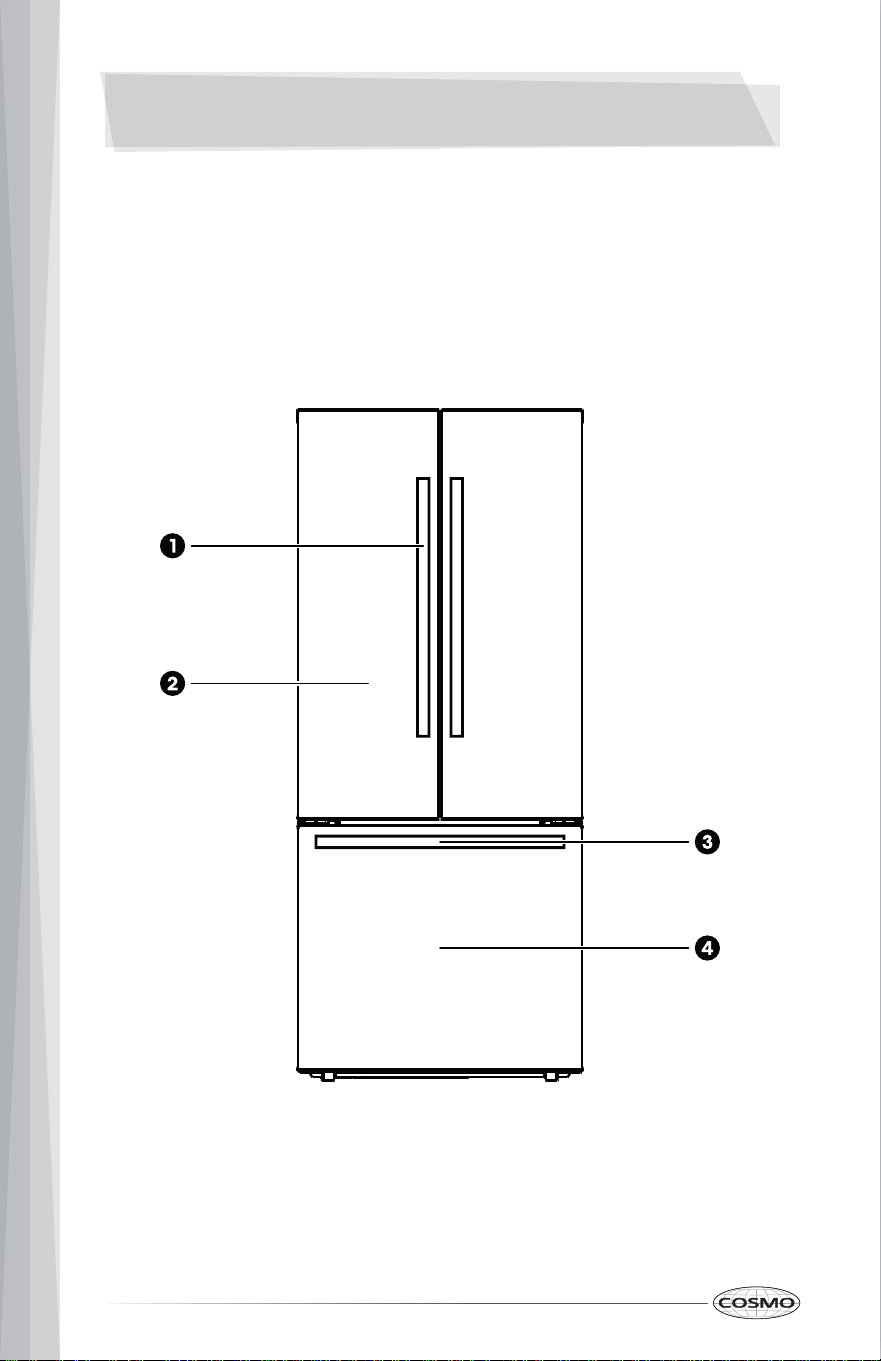
1. Door handle
(COS-RFFV183GHS only)
2. Refrigerator door
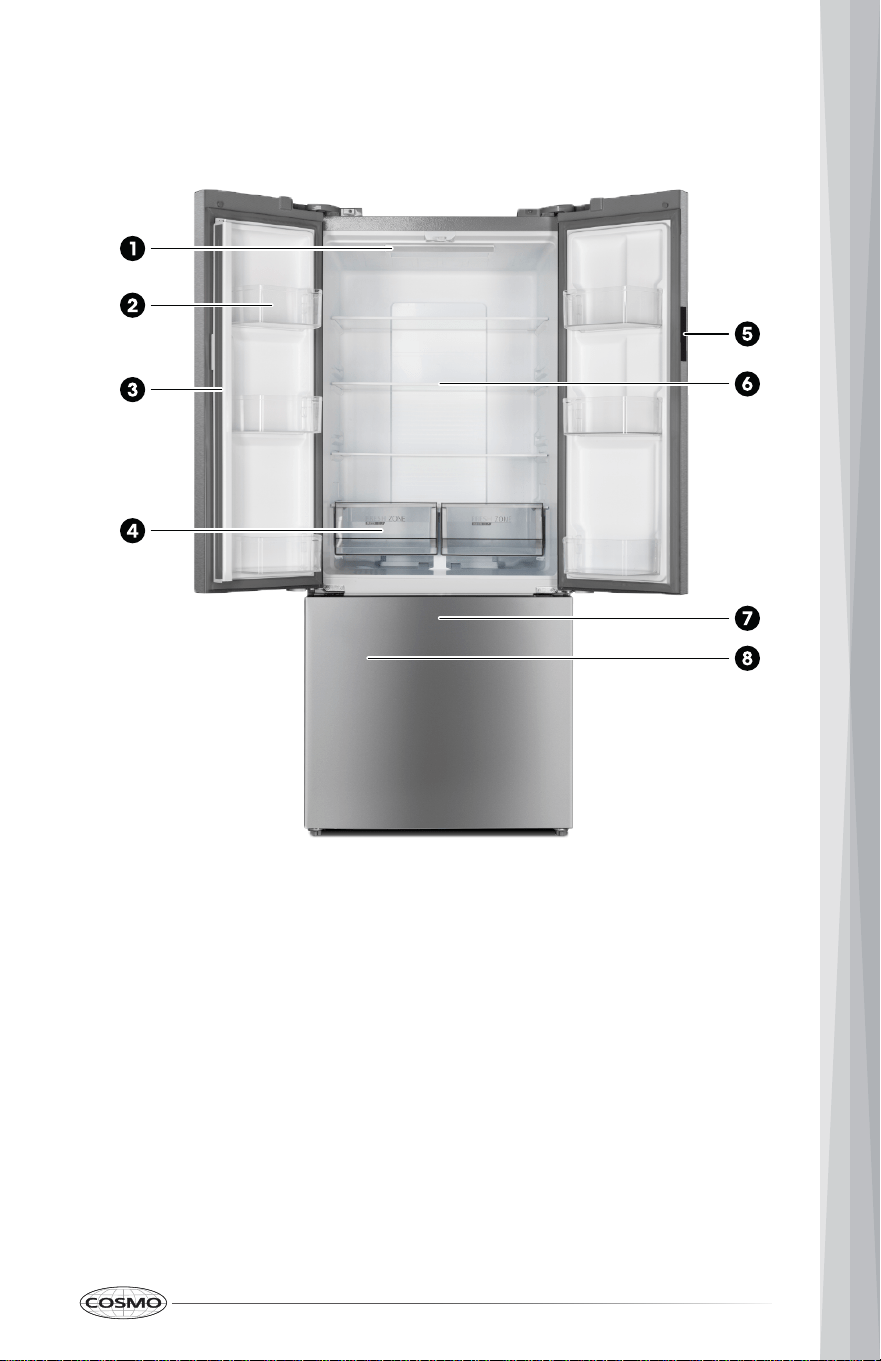
REFRIGERATOR LAYOUT
The images in this guide may be different from the actual components and
accessories, which are subject to change by the manufacturer without prior
notice for product improvement purposes.
EXTERIOR
3. Drawer handle
(COS-RFFV183GHS only)
4. Freezer drawer
11
INTERIOR
1. Refrigerator LED light
2. Door bin
3. Door mullion
4. Fruit and vegetables crisper
5. Control panel
6. Shelf
7. Freezer drawer
8. Ice bin (inside drawer)
12
INSTALLATION INSTRUCTIONS
BEFORE INSTALLING
Read these instructions completely and carefully.
• IMPORTANT: Observe all governing codes and ordinances. Save these
instructions for local inspector’s use.
• Note to Installer – Be sure to leave these instructions with the Consumer.
• Note to Consumer – Keep these instructions for future reference.
• Skill level – Installation of this appliance requires basic mechanical skills.
• This product should not be recessed or built-in an enclosed cabinet. It is
designed for freestanding installation only.
• Proper installation is the responsibility of the installer.
• Product failure due to improper installation is not covered under the
Warranty.
INSTALLATION OVERVIEW
1. Unpacking the Refrigerator
2. Choosing the Proper Location
3. Disassembling/Assembling
4. Connecting the Water Line
5. Leveling
PARTS SUPPLIED
• Door bins (6)
• Egg holders (2)
• Ice scoop
• Water line connector and washer
For COS-RFFV183GHS only:
• Refrigerator door handles with
set screws (2)
• Freezer drawer handle with set
screws
• Handle mounting fasteners
(6 + 2 spare)
• Handle set screws (4 spare)
• Hex key
13
UNPACKING THE REFRIGERATOR
EXCESSIVE WEIGHT HAZARD
• Use two or more people to move and install the refrigerator. Failure to
do so can result in back injury or other injury.
• The refrigerator is heavy. Protect the floor when moving the refrigerator
for cleaning or service. Always pull the refrigerator straight out when
moving it. Do not wiggle or walk the refrigerator when trying to move it,
as floor damage could occur.
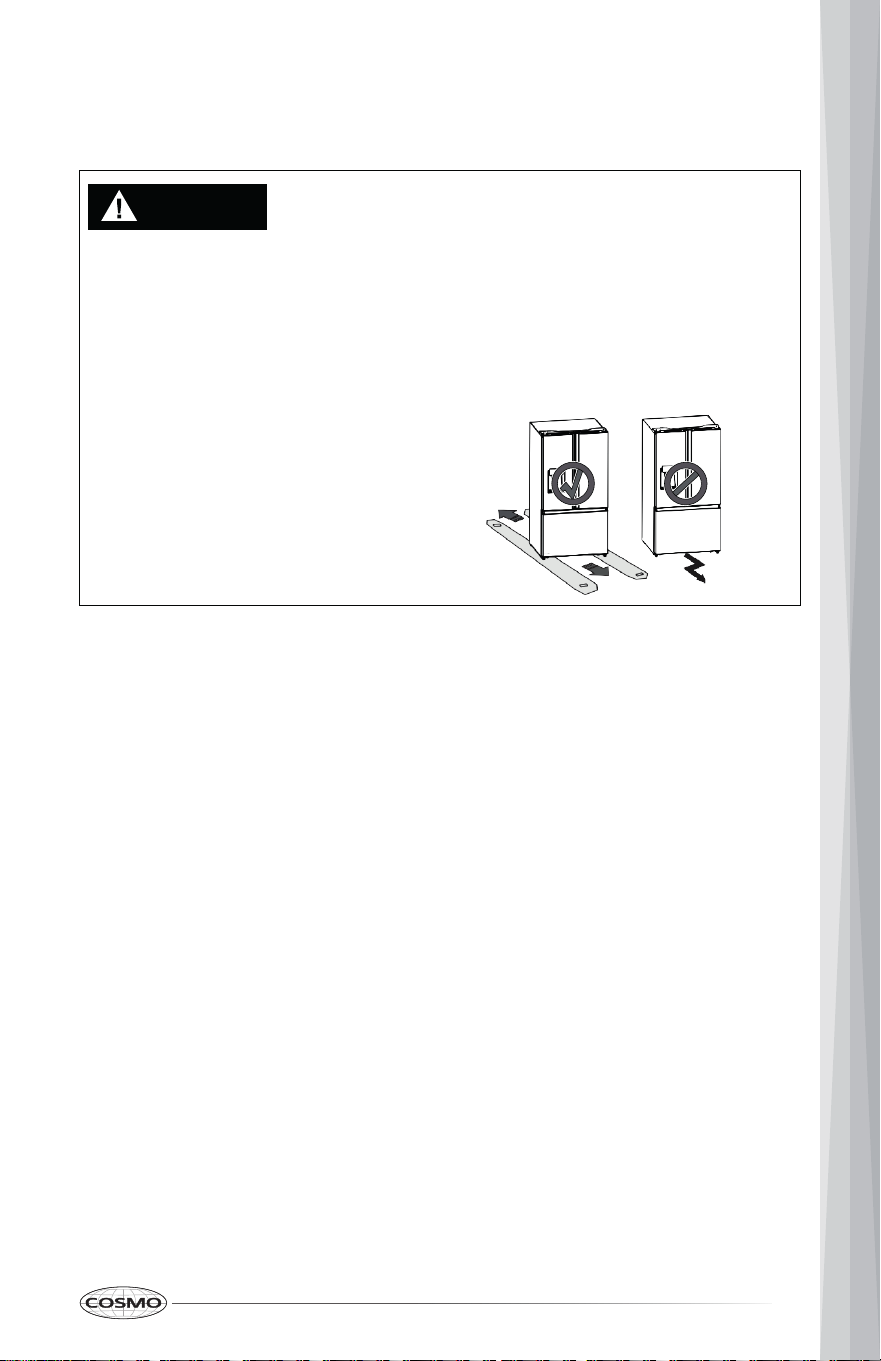
• The rollers, which are not
casters, should be only used
for forward or backward
movement. Moving the
refrigerator sideways may
damage your floor and the
rollers.
WARNING
• Remove tape and any temporary labels from your refrigerator before
using. Do not remove any warning labels or the model and serial numb er
label.
• To remove any remaining tape or glue, rub the area briskly with your
thumb. Tape or glue residue can also be easily removed by rubbing a
small amount of liquid dish soap over the adhesive with your fingers .
Wipe with warm water and dry.
• Do not use sharp instruments, rubbing alcohol, flammable fluids, o r
abrasive cleaners to remove tape or glue. These products can damag e
the surface of your refrigerator.
• Reinstall or adjust shelves as needed. Refrigerator shelves are installed i n
the shipping position. Reinstall shelves according to your individua l
storage needs.
14
CHOOSING THE PROPER LOCATION
WATER
The refrigerator must be located where a cold water supply can be connected
for the icemaker.
NOTE:
• The water pressure must be between 20 - 100 psi (140 - 690 kPa). If the
refrigerator is installed in an area with low water pressure (below 20 psi
or 140 kPa), you can install a booster pump to compensate for the low
pressure.
• Connect to potable water supply only. New hose-sets supplied with the
appliance are to be used, and that old hose-sets should not be reused.
• If your water line is not drinkable, please add an external water filter.
• Turn the icemaker OFF if the refrigerator will be used before or without
the water line is connected.
ELECTRICITY
Use an individual, grounded outlet: 110 - 115 Volts, 60 Hz, AC, Single Phase
NOTE:
• The refrigerator should always be plugged into its own individual
electrical outlet which has a voltage rating that matches the rating
plate.
• Do not overload house wiring and cause a fire hazard by plugging in
multiple appliances in the same outlet with the refrigerator.
• To reduce the risk of electric shock, do not install the refrigerator in a
wet or damp area.
15
FLOORING
For proper installation, this refrigerator must be placed on a level surface of
hard material that is the same height as the rest of the flooring. This surface
should be strong enough to support a fully loaded refrigerator. If required,
adjust the leveling legs to compensate for the unevenness of the floor.
AMBIENT TEMPERATURE
Install this appliance in an area where the temperature is between 32 °F (0 °C)
and 110 °F (43 °C). If the temperature around the appliance is too low or high,
cooling ability may be adversely affected.
Stand your appliance in a dry place to avoid high moisture damage. Keep the
appliance out of direct sunlight, rain or frost. Stand the appliance away from
heat sources such as stoves, fires or heaters.
DIMENSIONS AND CLEARANCES
This refrigerator is designed to be free standing only, and should not be
recessed or built-in an enclosed cabinet.
In order to improve efficiency of the cooling system and save energy, it is
necessary to maintain good ventilation around the appliance for the
dissipation of heat. For this reason, sufficient clear space should be available
around the refrigerator.
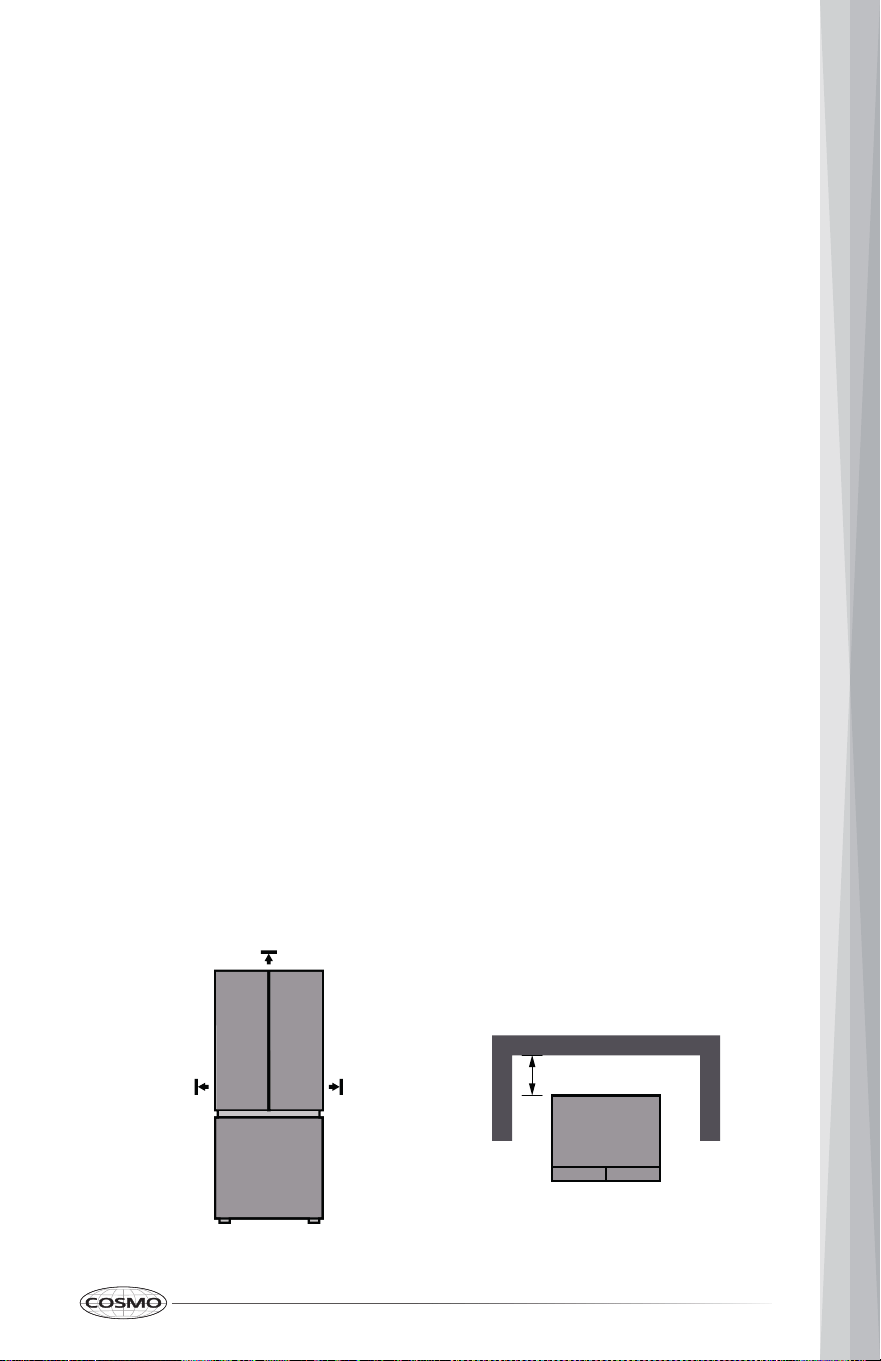
Allow at least 4" (10 cm) of clearance from the back of the fridge to the wall,
at least 12" (30 cm) of clearance from its top, at least 4" (10 cm) from its side to
the wall, and a clear space in front to allow the doors to open 145°.
> 4" (10 cm)> 4" (10 cm)
> 12" (30 cm)
Rear wall
> 4" (10 cm)
16
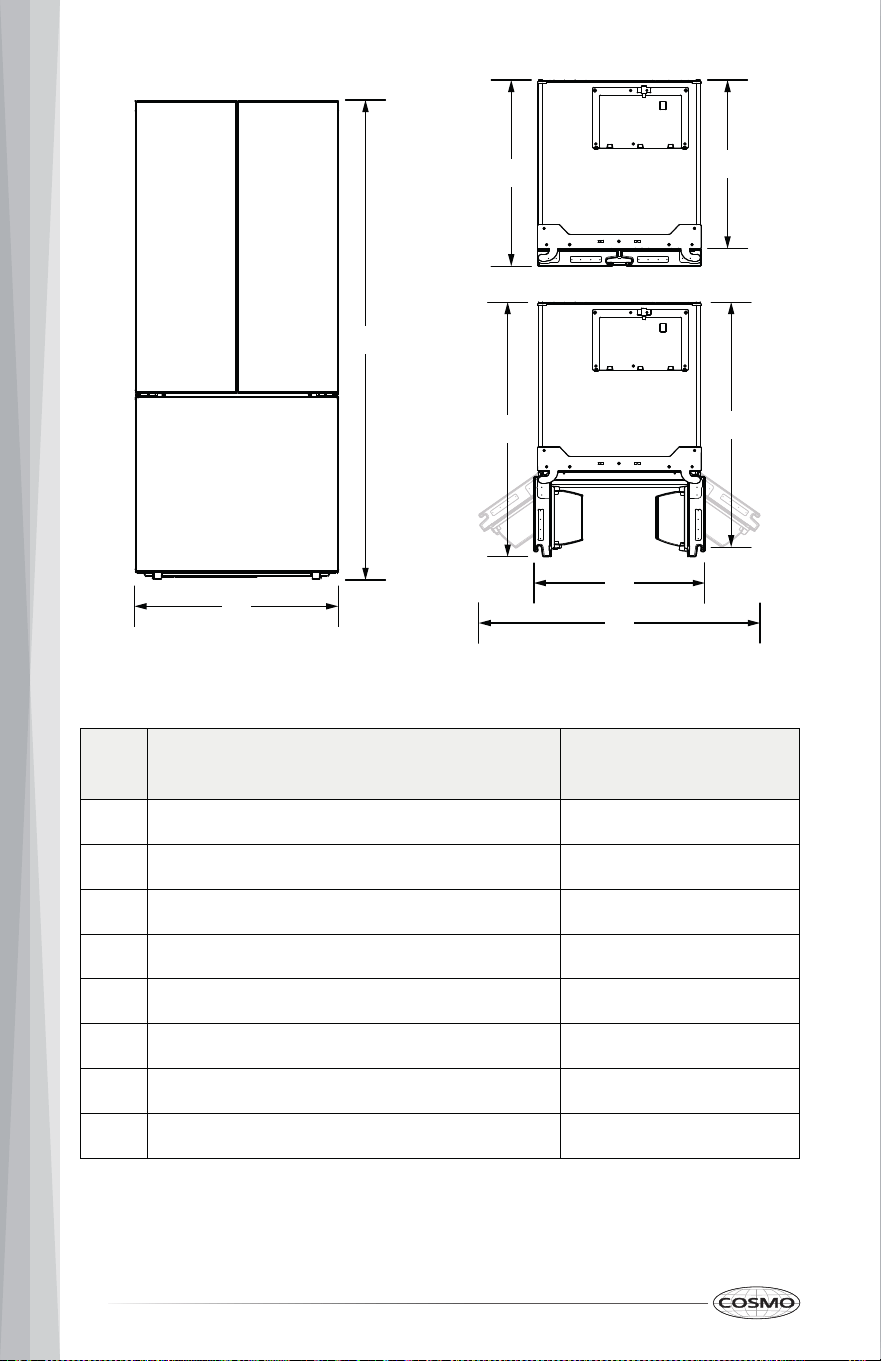
Item Dimension
COS-RFFV183GHS /
COS-RFFV183RS
A Overall Width 29 ⁷⁄₈" (75.9 cm)
B Overall Height
70 ¹⁄₁₆" (178.0 cm)
C
Overall Depth (without Handle) 29 ³⁄₁₆" (74.2 cm)
D Case Depth
25 ⁹⁄₁₆" (65.0 cm)
E
Width with Door Open (90°) 31 ¹⁄₄" (79.4 cm)
F Depth with Door Open (90°) 47" (119.4 cm)
G
Width with Door Fully Open (145°) 51 ⁵⁄₁₆" (130.3 cm)
H
45" (114.3 cm)Depth with Door Fully Open (145°)
A
B
C
D
F
E
G
H
17
• Phillips-head screwdriver
• Hex key (provided)
ASSEMBLING/REMOVING DOOR HANDLES
(FOR COS-RFFV183GHS ONLY)
Be very careful not to scratch the doors or the drawers. The appearance of the
handles may vary from what is shown in the manual.
Tool Needed
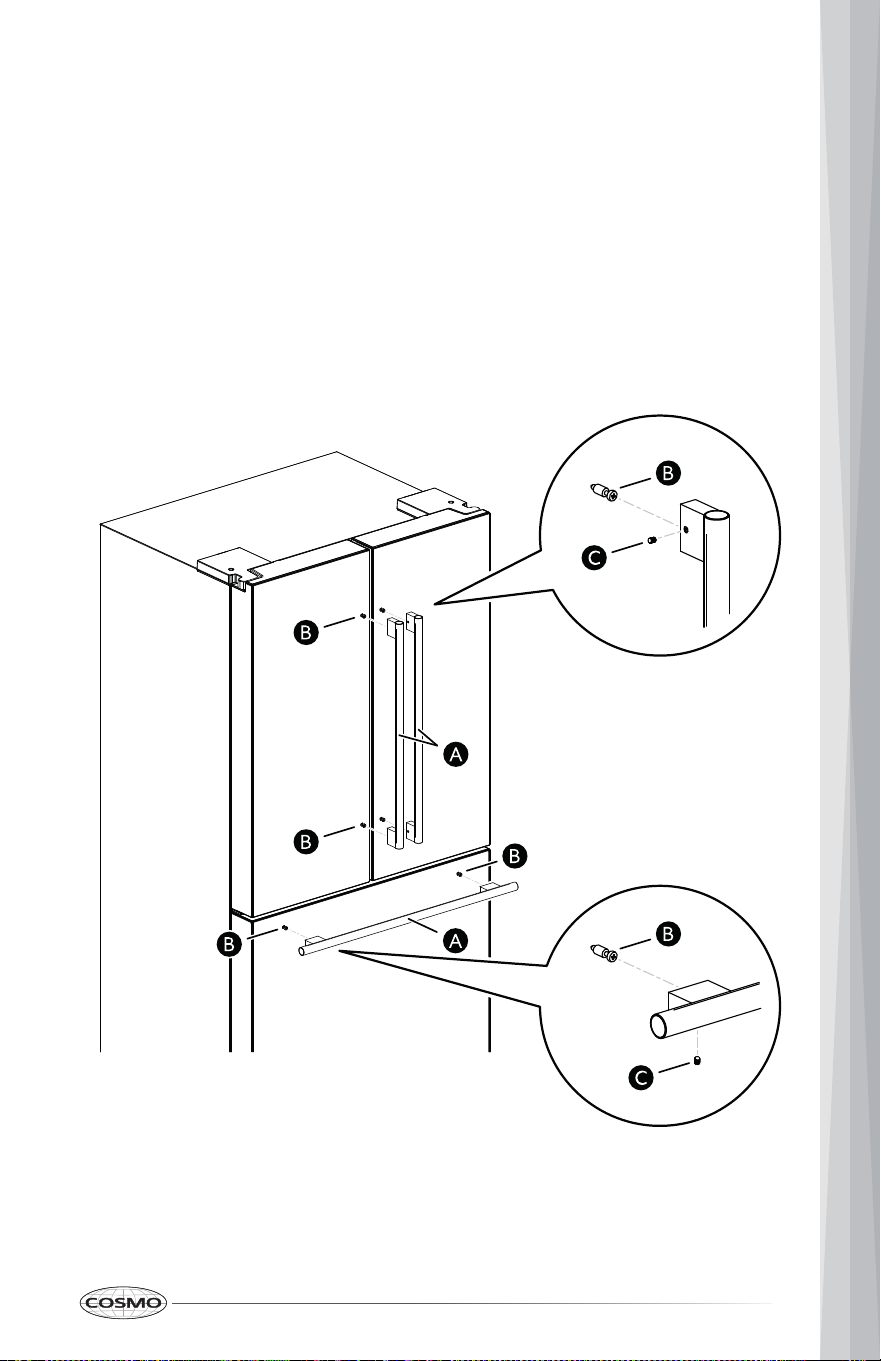
A. Handle
B. Mounting fastener
C. Set screw
18
ASSEMBLING DOOR HANDLES
REMOVING DOOR HANDLES
1. Assemble the mounting fasteners on each door/drawer with a Phillips-
head screwdriver.
2. Loosen the set screws in the end caps of each handle.
3. For each handle, place the handle on the door/drawer by fitting th e
handle footprints over the mounting fasteners, and tighten the set screw s
while supporting the handle.
1. Locate the set screw in the end caps of each handle.
2. Loosen the set screws with a Phillips-head screwdriver while supporti ng
the handle.
3. Remove the handle from the mounting fasteners on the door/drawer an d
set aside.
4. If needed, loosen and remove the mounting fasteners.
ASSEMBLING/DETACHING DOOR BINS
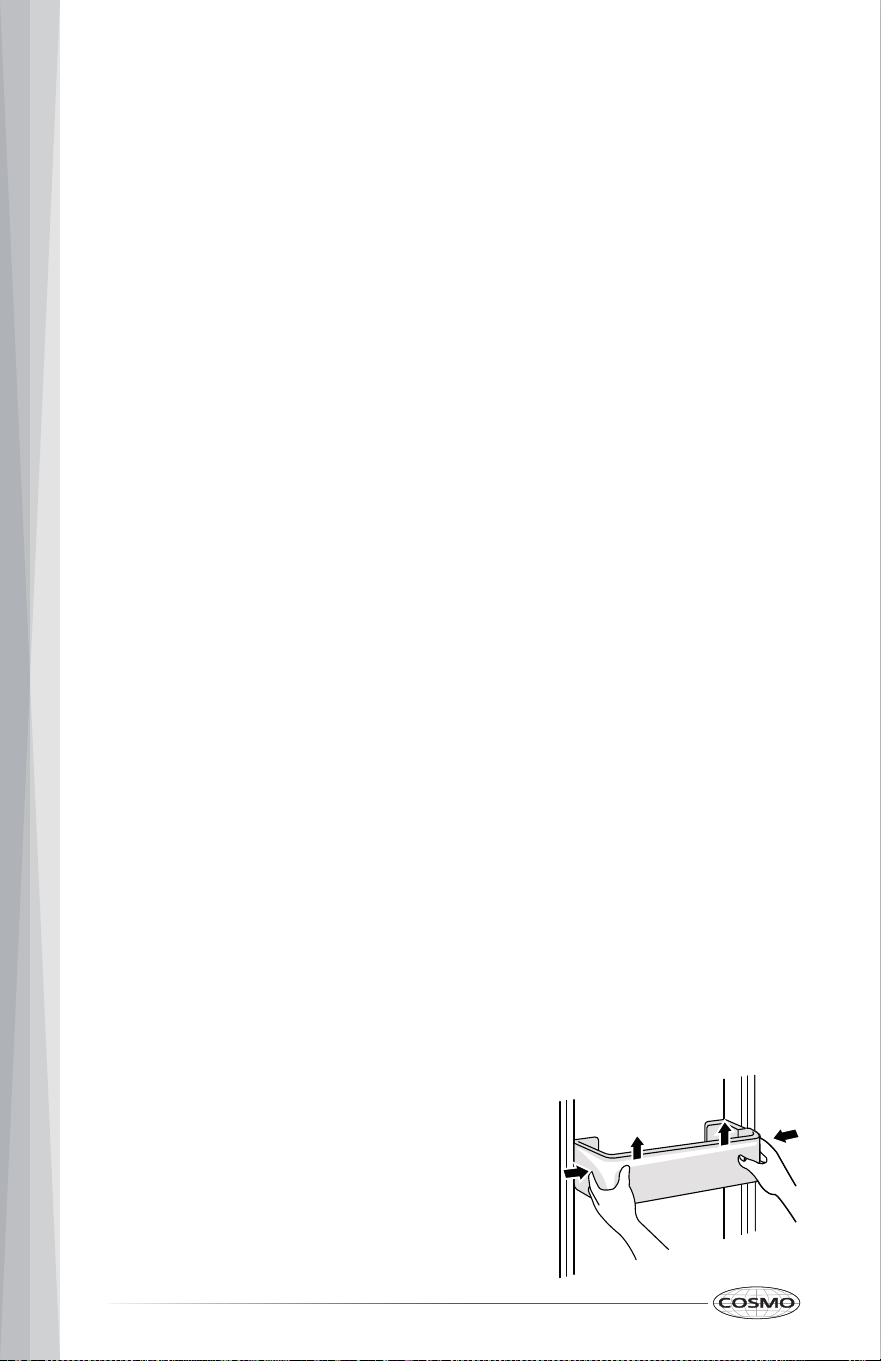
The door bins are removable for easy cleaning and adjustment. Do not apply
excessive force while detaching or assembling the storage bins.
Detaching/Assembling the Door Bin
• To remove the bin, grab an d
squeeze both sides, then lift t he
bin up and pull straight out.
• To assemble the bin, slide it i n
above the desired support an d
push down until it snaps int o
place.
19
CONNECTING TO THE HOUSE WATER LINE
BEFORE BEGINNING
The water connection must be made by a qualified plumber. This water line
installation is not covered by the refrigerator warranty. Follow these
instructions carefully to minimize the risk of expensive water damage.
If necessary, call a qualified plumber to correct water hammer before
installing the water supply line to the refrigerator. Water banging in the pipes
(water hammer) in residential plumbing can cause damage to refrigerator
parts and lead to water leakage or flooding.
• A water line is required in order for the icemaker to operate properly.
• To prevent burns and product damage, only connect the refrigerator
water line to a cold water supply.
• Turn the icemaker OFF if the refrigerator will be used before the water
line is connected.
WARNING
• Connect to potable water supply only.
• A cold water supply is required for automatic icemaker operation.
• The water pressure must be between 20 - 100 psi (140 - 690 kPa).
Operation outside the water pressure range may cause malfunction,
severe and damaging water leaks.
• If the refrigerator is installed in an area with low water pressure (below
20 psi or 140 kPa), you can install a booster pump to compensate for the
low pressure.
WARNING ELECTRIC SHOCK HAZARD
• Attach tubing clamp using existing hole only. DO NOT drill into the
refrigerator.
• When using any electrical device (such as a power drill) during
installation, be sure the device is battery-powered, double-insulated or
grounded in a manner that will prevent the hazard of electric shock.
20
• Do not install the icemaker tubing in areas where the ambient
temperatures fall below freezing.
• Wear eye protection during installation to prevent injury.
• Before making the connection to the refrigerator, be sure the refrigerator
power cord is not plugged into the wall outlet.
• Before connecting the water line to the house, purge the house line for at
least 2 minutes.
SUPPLIES NEEDED
• A copper or approved flexible universal refrigerator tubing kit or ice-
maker install kit with 1/4" outer diameter to connect the refrigerator to
the water supply. If using copper, be sure both ends of the tubing are cut
square.
• A cold water supply. The water pressure must be between 20 - 100 psi
(140 - 690 kPa).
• Power drill.
• 1/2" or adjustable wrench.
• Straight and Phillips blade screwdriver.
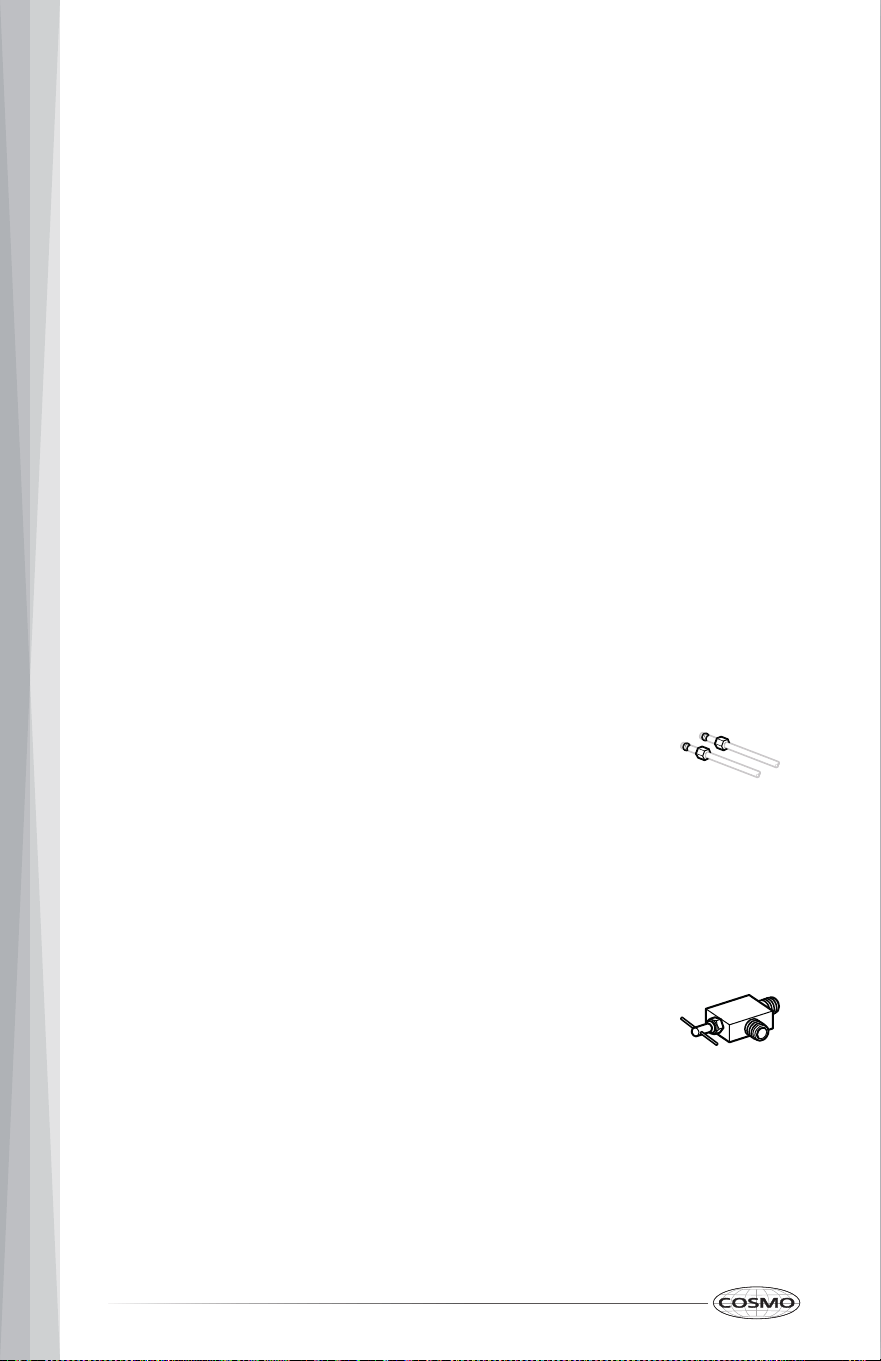
• Two 1/4" outer diameter compression nuts and two ferrules
(sleeves) to connect the copper tubing to the shutoff valve
and the refrigerator water valve, OR you can find kits that
come with all parts included such as Stop Tee and
compressing fittings.
• If your existing copper water line has a flared fitting at the end, you will
need an adapter (available at plumbing supply stores) to connect the
water line to the refrigerator, OR you can cut off the flared fitting with a
tube cutter and then use a compression fitting.
• Shutoff valve to connect to the cold water line. The shutoff
valve should have a water inlet with a minimum inner
diameter of 5/32" at the point of connection to the cold
water line. Saddle-type shutoff valves are included in many
water supply kits. Before purchasing, make sure a saddle-
type valve complies with your local plumbing codes.
21
NOTE:
WATER LINE INSTALLATION INSTRUCTIONS
• Only use approved plastic universal tubing if not using copper tubing.
Cross linked High Density Polyethylene (PEX) hose is extremely durable
and is becoming increasingly preferred.
• Install a shutoff valve on the nearest frequently used drinker water line.
• A self-piercing saddle type water valve should not be used.
1. Shut off the main water supply.
• Then turn on the nearest faucet long enough to clear the line of
water.
2. Choose the valve location.
• Choose an easily accessible
location on the cold water pipe for
the shutoff valve. It is best to
connect into the side of a vertical
water pipe. When it is necessary to
connect into a horizontal water
pipe, make the connection to the
top or side, rather than at the
bottom, to avoid drawing off any
sediment from the water pipe.
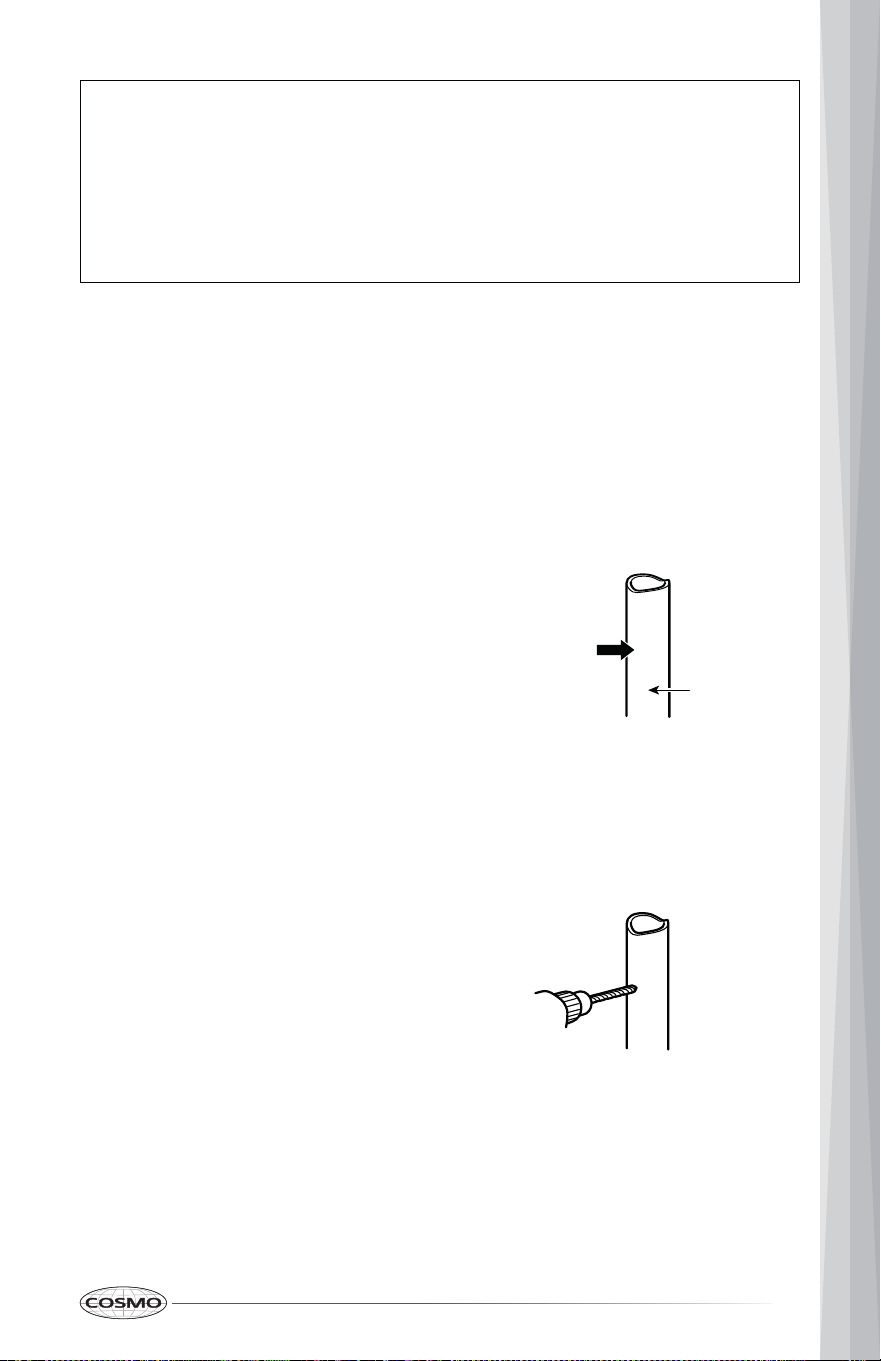
3. Drill the hole for the valve.
• Drill a 1/4" hole in the water pipe
(even if using a self-piercing valve)
using a sharp bit. Be cautious not
to allow water to drain into the
drill. Remove any burrs resulting
from drilling the hole in the pipe.
Failure to drill a 1/4" hole may
result in reduced ice production or
smaller cubes.
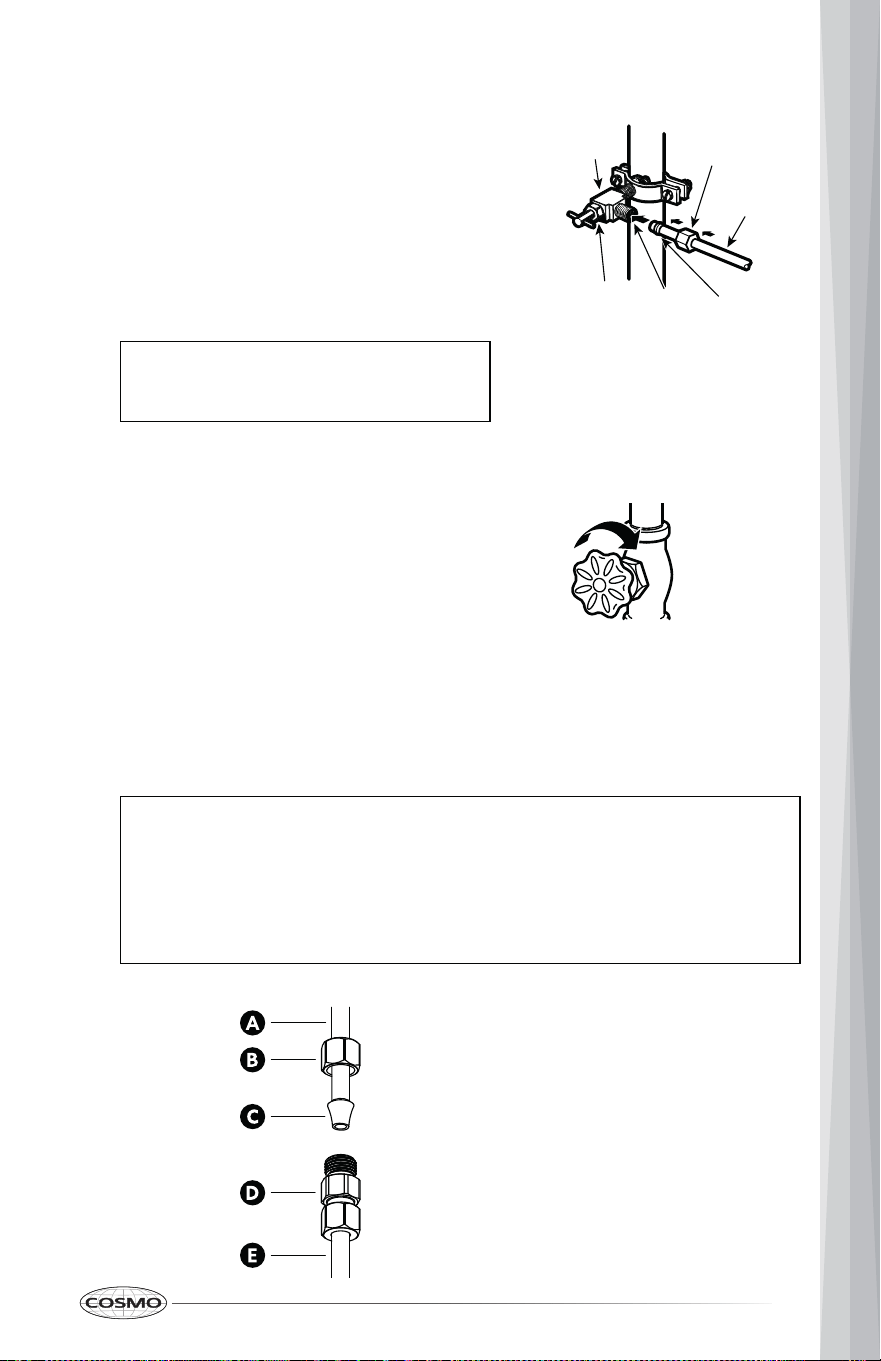
Vertical cold
water pipe
22
NOTE:
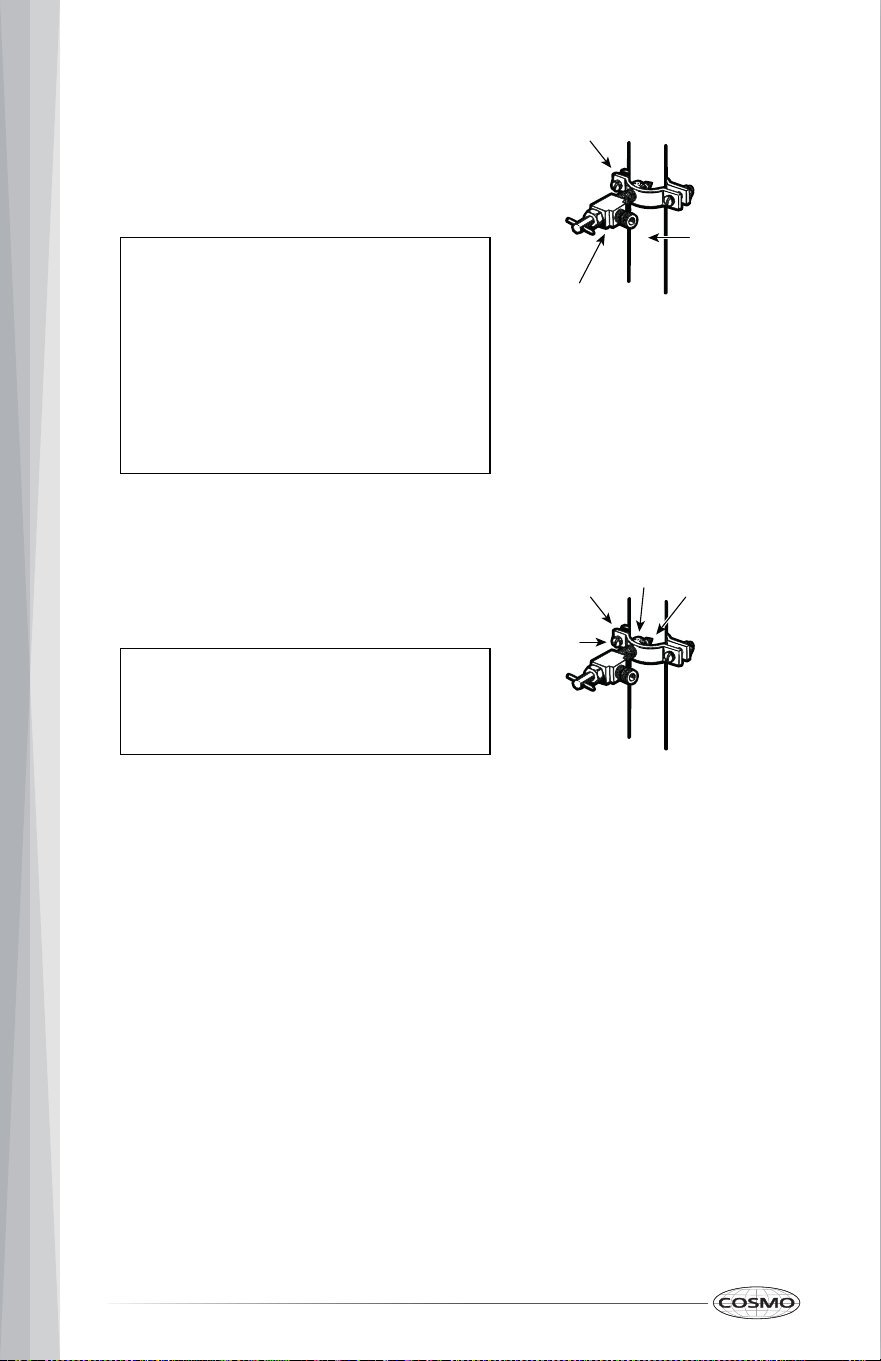
4. Fasten the shutoff valve.
• Fasten the shutoff valve to the
cold water pipe with the pipe
clamp.
NOTE:
• Commonwealth of
Massachusetts Plumbing Codes
248CMR shall be adhered to.
Saddle valves are illegal and use
is not permitted in
Massachusetts. Consult with your
licensed plumber.
5. Tighten the pipe clamp.
• Tighten the clamp screws until the
sealing washer begins to swell.
• Do not over tighten or you may
crush the tubing.
6. Route the water line tubing.
• Route the tubing between the cold
water line and the refrigerator.
Route the tubing through a hole
drilled in the wall or floor (behind
the refrigerator or adjacent the
base cabinet) as close to the wall
as possible.
Pipe clamp
Shutoff valve
Vertical cold
water pipe
Pipe
clamp
Inlet
end
Clamp
screw
Washer
23
NOTE:
• Over tightening may cause leaks.
7. Connect to shutoff valve.
• Place the compression nut and
ferrule (sleeve) onto the end of the
water line tubing and connect it to
the shutoff valve. Make sure the
tubing is fully inserted into the
valve. Tighten the compression
nut securely.
NOTE:
8. Flush the water line tubing
• Turn on the main water supply
and flush out the tubing until the
water is clear. Shut off the water
at the water valve after about 1
quart (1 Liter), or 2 minutes, of
water has been flushed through
the tubing.
9. Connect the water line tubing to the refrigerator.
• Before making the connection to the refrigerator, be sure that the
refrigerator power cord is not plugged into the wall outlet.
• Ensure that the water line tubing does not get pinched or bent
when installing.
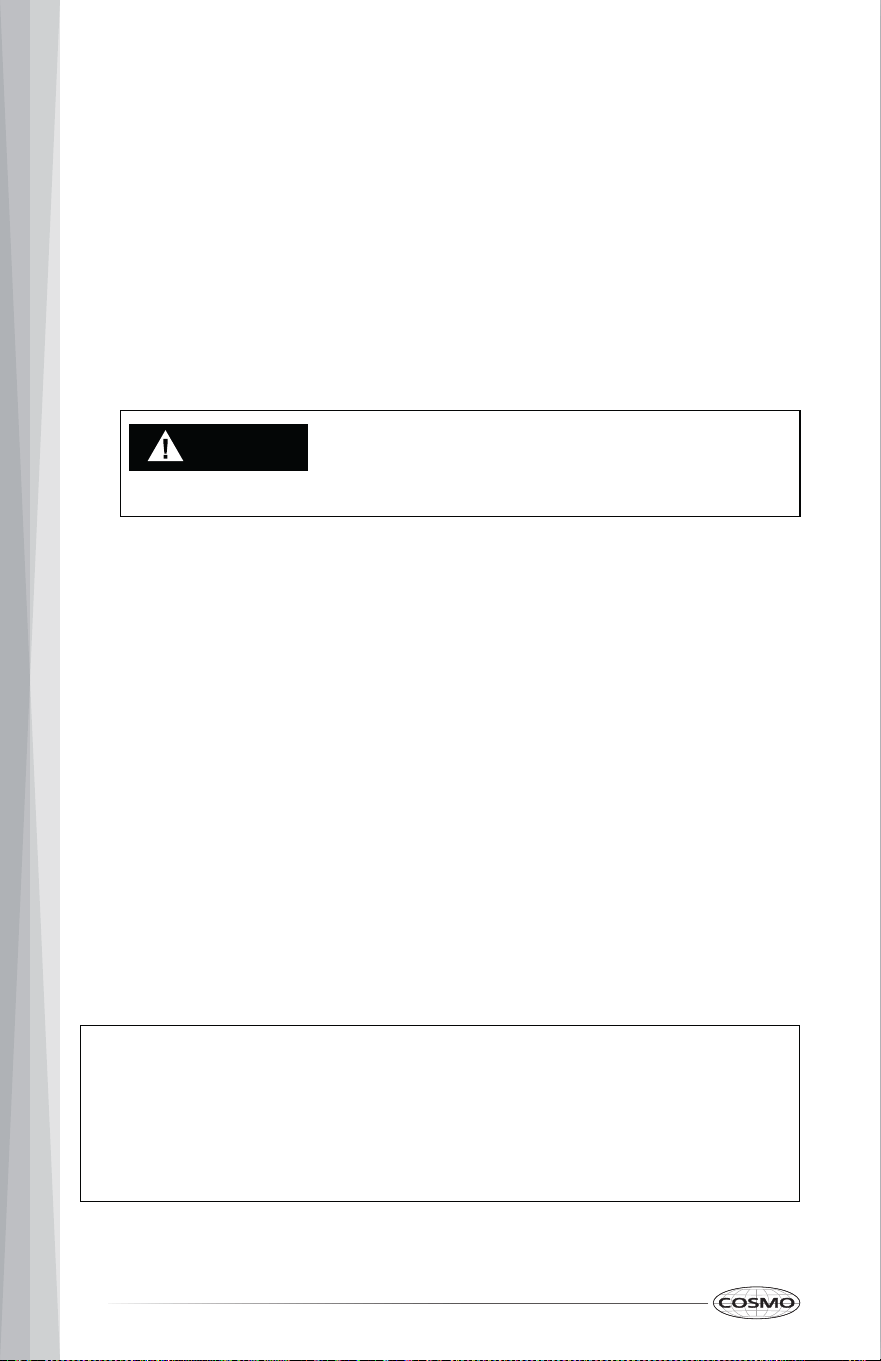
A. Water line tubing (1/4")
B. Compression nut
C. Ferrule (sleeve)
D. Brass union fitting
E. Refrigerator water inlet
Outlet
valve
Ferrule
(sleeve)
Shutoff
valve
Compression
nut
Water line
tubing
Packing
nut
24
COMPLETE INSTALLATION
TURNING ON THE POWER
IMPORTANT:
• Place the compression nut and ferrule (sleeve) onto the free end of
the water line tubing.
• Insert the free end of the tubing as far as possible into the brass
union fitting of the refrigerator water inlet on the back of the
refrigerator.
• Slide the compression nut over the ferrule (sleeve) and tighten the
compression nut onto the brass union fitting. Confirm the connection
is secure by gently pulling on it.
• Turn the water on at the shutoff valve. Tighten any connections that
leak.
NOTE:
1. Plug the refrigerator’s power cord into a 3-prong grounded outlet.
•
Make sure the plug is disconnected for at least 5 minutes when
reconnecting power, or it could cause freezer operation issues.
•
Turn the icemaker OFF if the refrigerator will be used before or without
the water line connected.
• Connect to a rated power outlet.
• Have a certified electrician check the wall outlet and wiring for proper
grounding.
• Do not damage or cut off the ground terminal of the power plug.
CAUTION
• Check to see if leaks occur at the water line connections.
25
NOTE:
START/STOP THE ICEMAKER
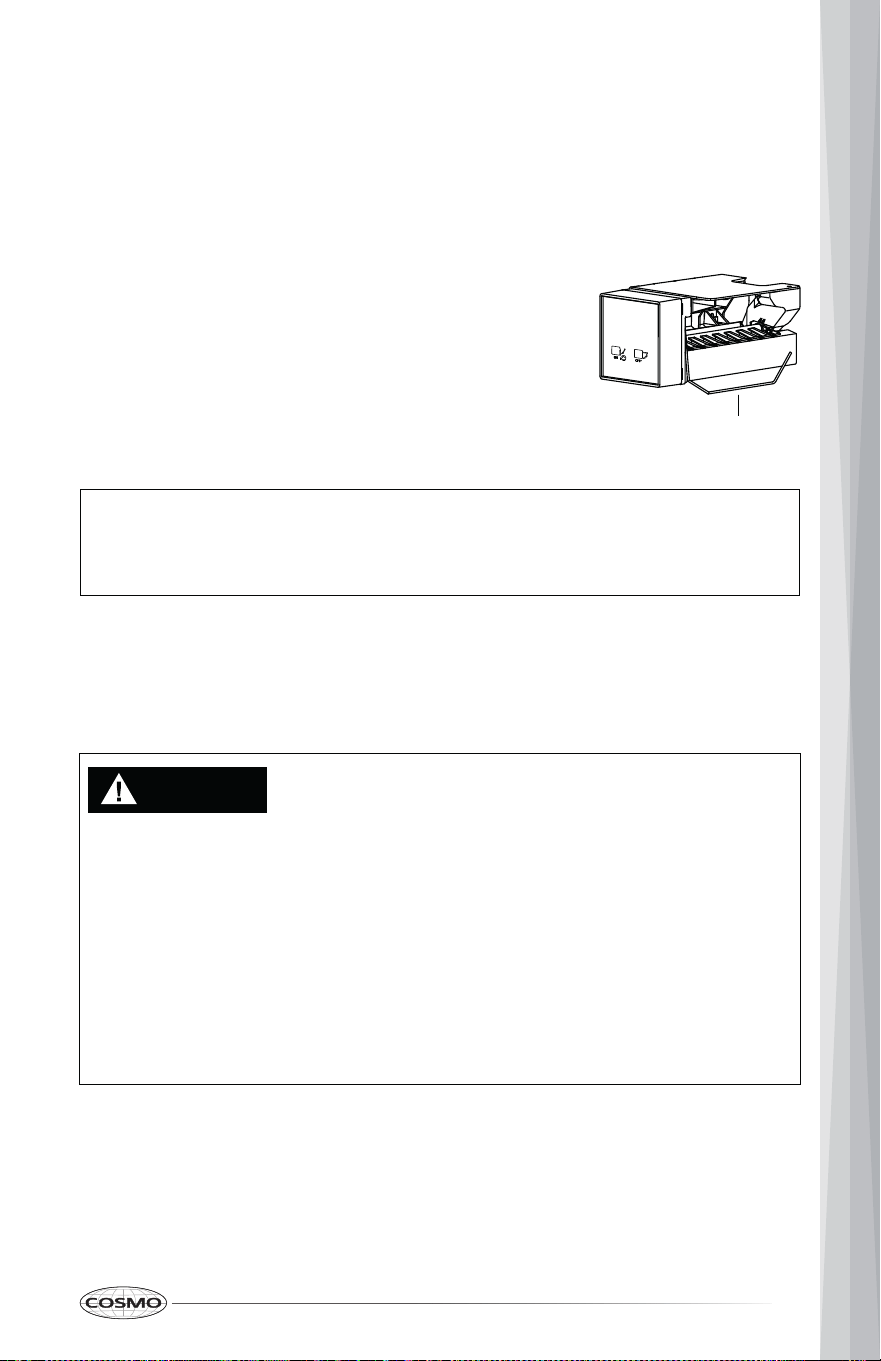
The icemaker is located inside the freezer compartment. The icemaker will
automatically begin to operate when the freezer compartment reaches its low
operating temperature of 5 °F (-15 °C) or below if it is turned on. Turn off the
icemaker if the refrigerator is not yet connected to the water supply.
•
To turn the icemaker on, lower the
shut-off arm (metal rod) if the water
line is connected.
•
To turn the icemaker off, raise the
shut-off arm (metal rod).
POSITION THE REFRIGERATOR
• A newly installed refrigerator may take 12 hours or longer to provide the
first batch of ice.
1. Arrange the coil of tubing so that it does not vibrate against the back of
the refrigerator or against the wall.
2. Carefully push the refrigerator into the final position.
Shut-off arm
(on position)
WARNING EXCESSIVE WEIGHT HAZARD
• Use two or more people to move and install the refrigerator. Failure to
do so can result in back injury or other injury.
• The refrigerator is heavy. Protect the floor when moving the refrigerator
for cleaning or service. Always pull the refrigerator straight out when
moving it. Do not wiggle or walk the refrigerator when trying to move it,
as floor damage could occur.
• The rollers, which are not casters, should be only used for forward or
backward movement. Moving the refrigerator sideways may damage
your floor and the rollers.
26
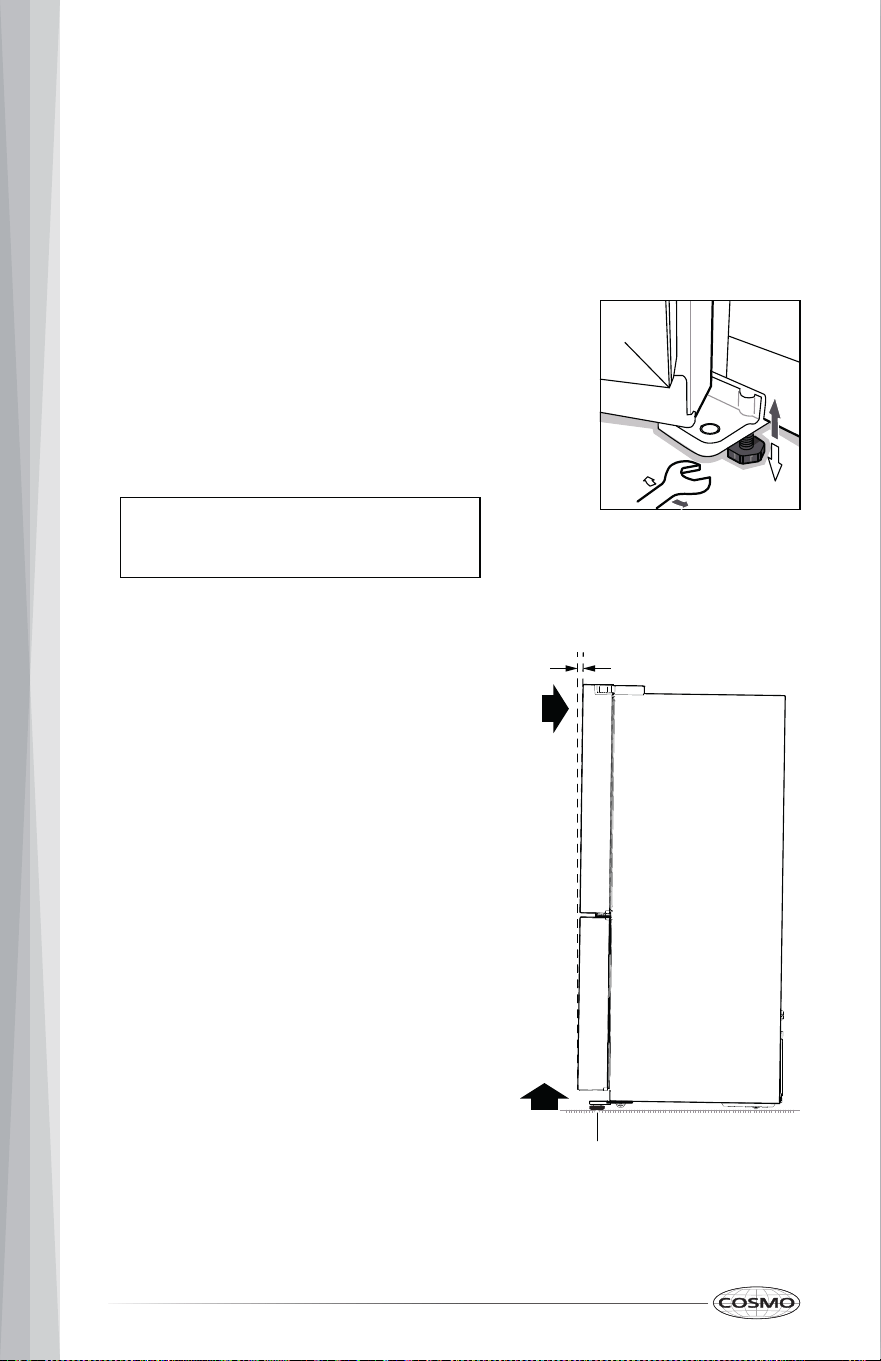
1. Turn the leveling leg to the left
NOTE:
• Do not over-tighten.
2. Open both doors and check to make
LEVELING
The refrigerator has two front leveling legs. After moving the refrigerator to its
final location, adjust the leveling legs to alter the tilt from front-to-back or
side-to-side. The front should be slightly higher than the rear to aid in door
closing. If the refrigerator seems unsteady, or the doors do not close easily,
adjust the refrigerator’s tilt using the instructions below:
(clockwise) to raise that side of the
refrigerator or to the right
(counterclockwise) to lower it. It may
take several turns of the leveling leg to
adjust the tilt of the refrigerator.
sure that they close easily. If the doors
do not close easily, tilt the refrigerator
slightly more to the rear by turning
both leveling legs to the left
(clockwise). It may take several more
turns, and be sure to turn both leveling
legs the same amount.
Leveling leg
¹⁄₈" - ³⁄₁₆"
27
OPERATION
BEFORE USE
• Intended use
This appliance is intended to be used in household and similar
applications such as staff kitchen areas in shops, offices and other
working environments; farm houses and by clients in hotels, motels and
other residential type environments; bed and breakfast type
environments; catering and similar non-retail applications.
If the appliance is used commercially or for purposes other than cooling
food, please note that the manufacturer cannot accept any liability for
any damage.
Modifications or alterations to the unit are not permitted for safety
reasons.
• Reserve doors and drawer(s) clearances.
Make sure to leave enough space to allow for the doors and drawers to
be opened without obstruction for your safety and convenience.
• Clean the refrigerator.
Remove all protective film and adhesive tapes as well as any adhesive
residues with cleaning solvent. Clean the refrigerator thoroughly and
wipe off all dust that accumulated during shipping.
CAUTION
• Do not scratch the refrigerator with a sharp object or use a
detergent that contains alcohol, a flammable liquid or an abrasive
when removing any tape or adhesive from the refrigerator. Remove
adhesive residue by wiping it off with your thumb or dish detergent.
• Do not peel off the model or serial number label or the technical
information on the rear surface of the refrigerator.
28
• Open refrigerator doors and freezer drawers to ventilate the interior.
The inside of the refrigerator may smell like plastic at first. Remove any
adhesive tape from inside the refrigerator and open the refrigerator
doors and the freezer drawers for ventilation.
• Connect the power supply.
Check if the power supply is connected before use.
• Turn off the icemaker.
Turn off the icemaker if the refrigerator is not yet connected to the water
supply.
• Wait for the refrigerator to cool.
Allow the refrigerator to run for at least two to three hours before putting
food in it. Check the flow of cold air in the freezer compartment to ensure
proper cooling.
Storage of too much food after initial connection to power may adversely
affect the freezing effect of the refrigerator.
CAUTION
• Putting food in the refrigerator before it has cooled could cause the
food to spoil, or a bad odor to remain inside the refrigerator.
• The refrigerator makes a loud noise after initial operation.
This is normal. The volume will decrease as the temperature decreases.
29
ENERGY SAVING TIPS
• The appliance should be located in the coolest area of the room, away
from heat producing appliances or heating ducts and out of direct
sunlight.
• Ensure that there is sufficient ventilation at the base of the appliance, on
the sides of the appliance, and at the back of the appliance. Never cover
ventilation openings.
• Open the doors only as briefly as necessary to minimize cold loss.
• Check and clean the door gaskets regularly to make sure there is no
debris and the doors close properly.
• Let hot foods cool to room temperature before placing in the appliance.
Overloading forces the compressor to run longer. Foods that freeze too
slowly may lose quality or spoil.
• Be sure to wrap foods properly and wipe containers dry before placing
them in the appliance. This cuts down on frost build-up inside the fridge.
• Allow frozen food to defrost in the refrigerator. The coldness of the frozen
food reduces energy consumption in the refrigerator compartment.
• An evenly filled refrigerator or freezer compartment contributes to
optimal energy use. Therefore, avoid empty or half-empty compartments.
• Appliance storage bin should not be lined with aluminum foil, wax paper
or paper towels. Liners interfere with cold air circulation making the
appliance less efficient.
• Organize and label food to reduce door opening and extended searches.
Remove as many items needed at one time and close the door as soon as
possible.
30
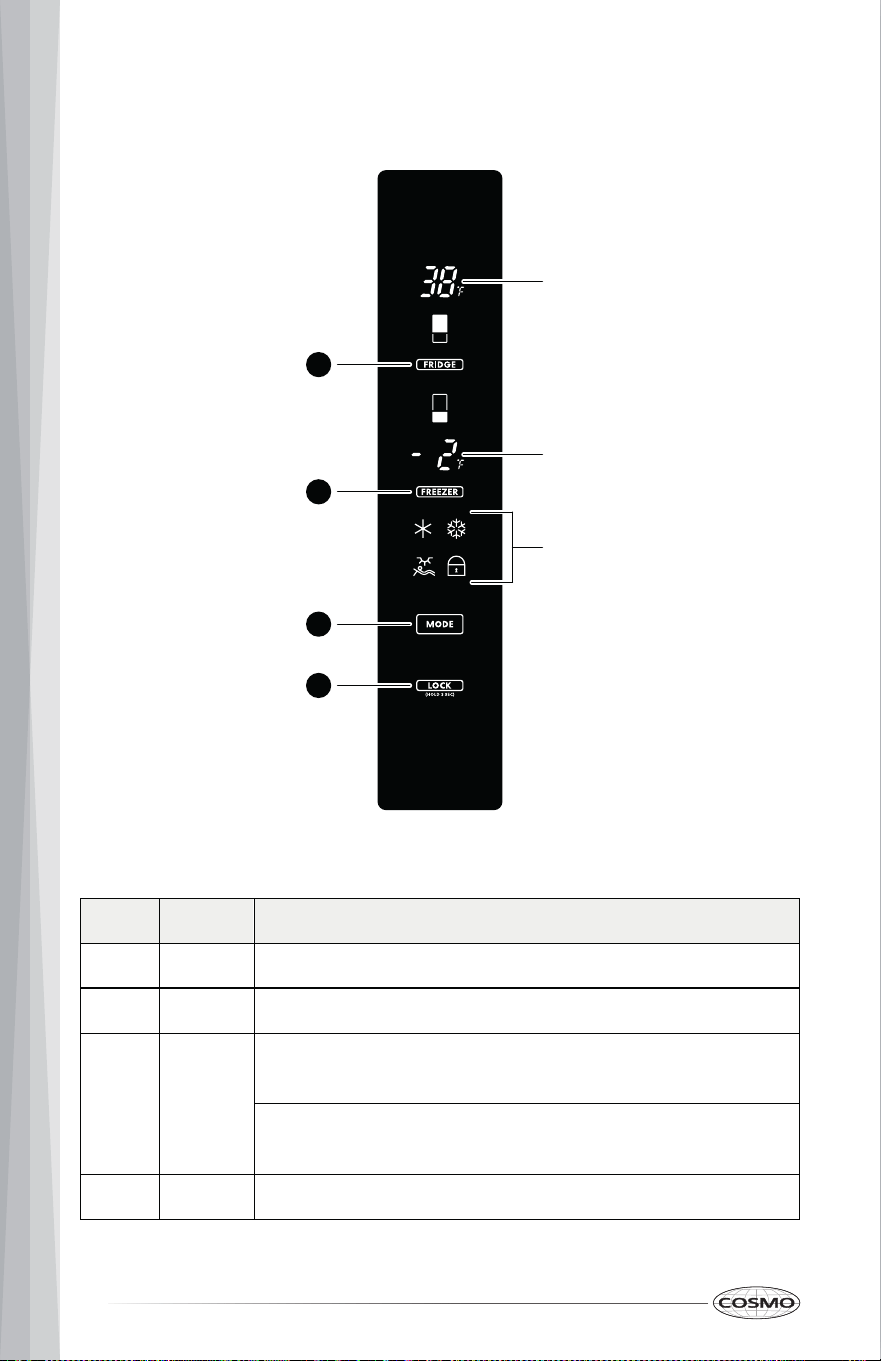
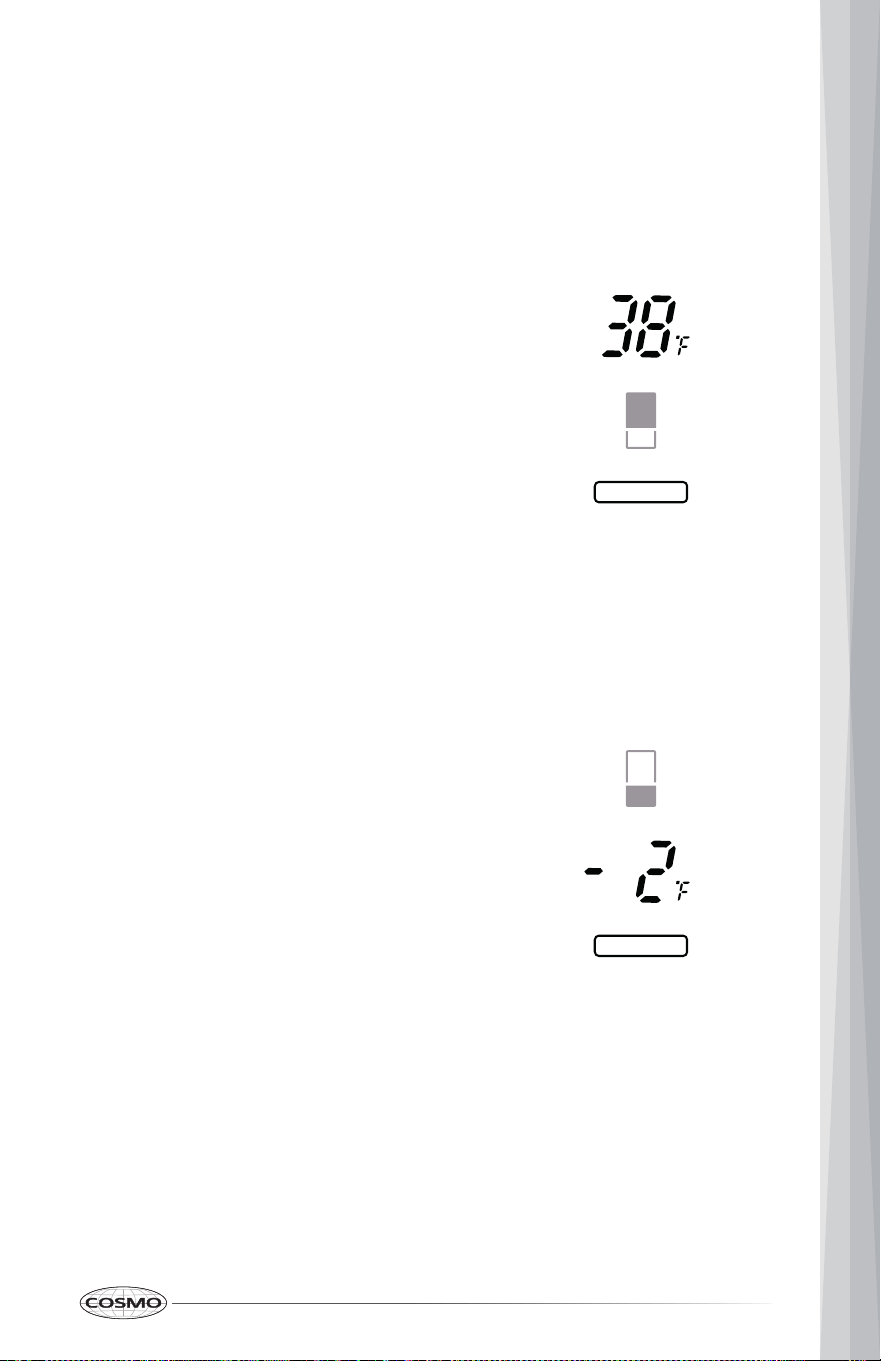
CONTROL PANEL
Item Pad Description
1 FRIDGE
2
To adjust refrigerator temperature.
FREEZER
3
To adjust freezer temperature.
MODE
To activate and deactivate Quick Cool, Quick Freeze, or
Vacation modes.
4 LOCK
To change the temperature mode from °F to °C or vice
versa.
To lock and unlock control panel
Refrigerator
temperature
Freezer
temperature
Mode icons
4
3
2
1
31
CONTROL PADS
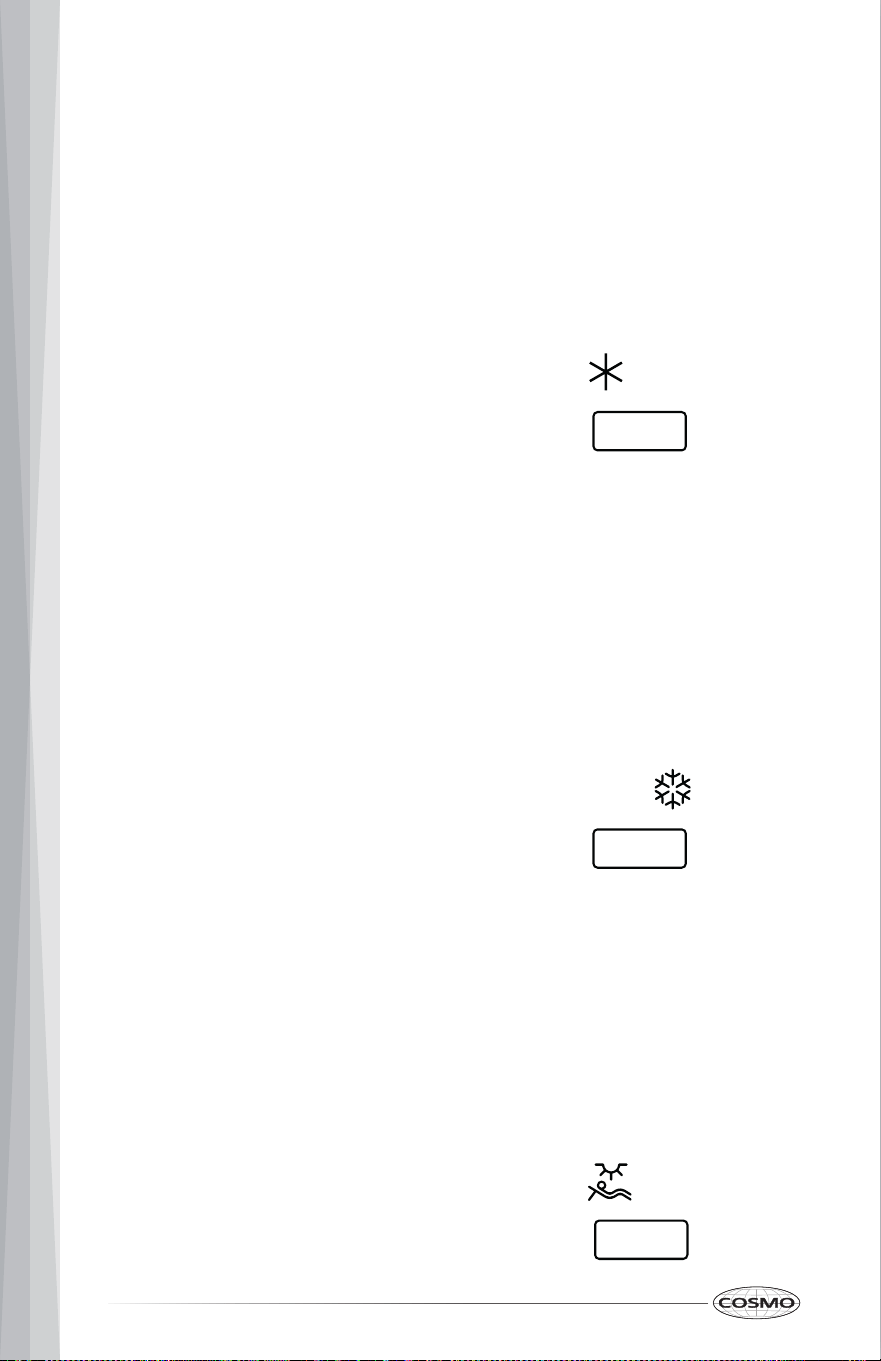
FRIDGE
FREEZER
• Refrigerator Temperature Setting
Adjust the refrigerator (fresh food
cabinet) target temperature.
•
Press the FRIDGE pad repeatedly
to adjust the refrigerator
temperature between 32 °F (0 °C)
and 43 °F (6 °C).
•
Each time you press the FRIDGE
pad, the temperature setting will
drop to next level and cycle from
the lowest back to the highest
available temperature.
•
Default refrigerator temperature:
38 °F (3 °C)
• Freezer Temperature Setting
Adjust the freezer target temperature.
•
Press the FREEZER pad repeatedly
to adjust the freezer temperature
between -10 °F (-23 °C) and
5 °F (-15 °C).
•
Each time you press the FREEZER
pad, the temperature setting will
drop to next level and cycle from
the lowest back to the highest
available temperature.
•
Default freezer temperature:
-2 °F (-19 °C)
FRIDGE
FREEZER
32
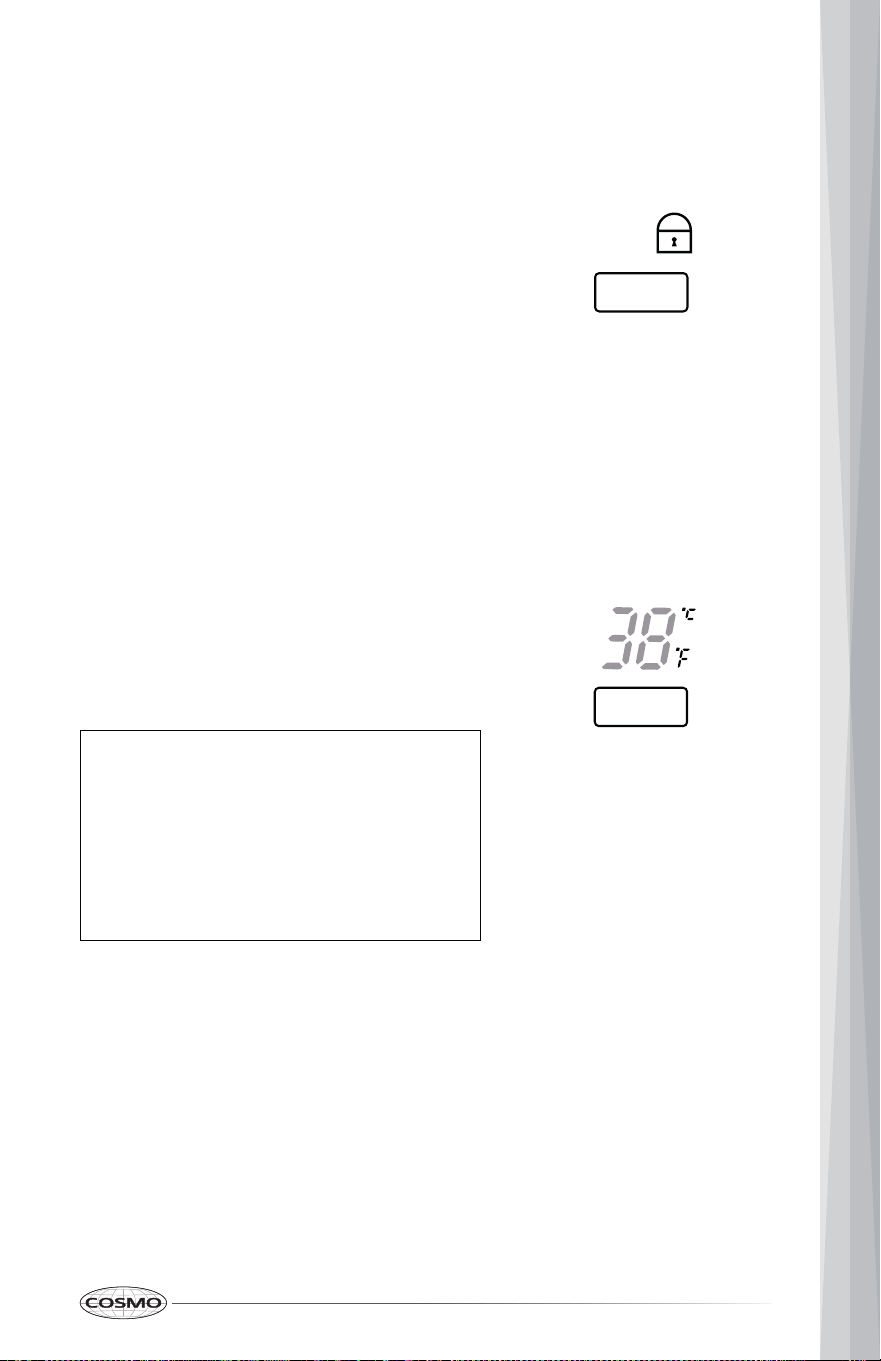
MODE
• Quick Cool
Automatically set the refrigerator (fresh food cabinet) to 32 °F (0 °C) the
lowest refrigerator temperature available to help cool new or large
grocery loads faster.
The refrigerator will remain in Quick Cool mode for 2 hours and 30
minutes or until the temperature reaches 32 °F (0 °C), and will then
deactivate Quick Cook mode. The set temperature will also return to the
set temperature before this mode was activated.
•
Press the MODE pad repeatedly
until the Quick Cool icon light
turns on or off to activate or
deactivate respectively.
•
Quick Cool and Quick Freeze can
be activated simultaneously.
• Quick Freeze
Automatically set the freezer to -10 °F (-23 °C) the lowest freezer
temperature available to help freeze new or large grocery loads faster.
The freezer will remain in Quick Freeze mode for 24 hours or until the
temperature reaches -10 °F (-23 °C), and will then deactivate Quick
Freeze mode. The set temperature will also return to the set temperature
before this mode was activated.
•
Press the MODE pad repeatedly
until the Quick Freeze icon light
turns on or off to activate or
deactivate respectively.
•
Quick Cool and Quick Freeze can
be activated simultaneously.
• Vacation
Automatically set the refrigerator (fresh food cabinet) and the freezer to
43 °F (6 °C) and 5 °F (-15 °C) the highest temperatures available to reduce
energy consumption when leaving for a long period.
When deactivating this mode, the set temperatures will return to the set
temperatures before this mode was activated.
•
Press the MODE pad repeatedly
until the Vacation icon light turns
on or off to activate or deactivate
respectively.
MODE
MODE
MODE
33
MODE
MODE
LOCK
• Control Panel Lock
The lock function disables every other pad on the control panel to
prevent unintentional changes to the refrigerator settings.
•
Press and hold the LOCK pad for 3
seconds to lock or unlock the
control panel.
• Press and hold the MODE pad for 5
seconds to change the temperature
mode between °F and °C.
DISPLAY
Under normal circumstances, the set temperatures of refrigerator and freezer
are shown. The display will go dark after approximately 20 seconds of no
activity.
TEMPERATURE MODE
The temperature scale is set to Fahrenheit (°F) by default.
NOTE:
• The displayed temperature is the
target temperature, and not the
actual temperature of the
refrigerator. The actual refrigerator
temperature depends on the food
inside the refrigerator.
ERROR CODES
When a non-numeric set temperature of refrigerator or freezer appears on
the display screen, it indicates a problem with the refrigerator. Your
refrigerator may seem to continue to operate normally even if there is a fault
present, but you should contact a technician immediately regarding the error.
34
ICEMAKER
NOTE:
BEFORE USING THE ICEMAKER
• A newly installed refrigerator may take 12 hours to provide the first
batch of ice.
• If discolored ice is produced, check the external water filter and water
supply. If the problem continues, contact the manufacturer customer
service center or a local licensed plumber. Do not use the ice until the
problem is corrected.
• The sound of ice dropping into the ice bin is normal.
• If the ice bin is completely filled with ice, ice production will stop.
USING THE ICEMAKER
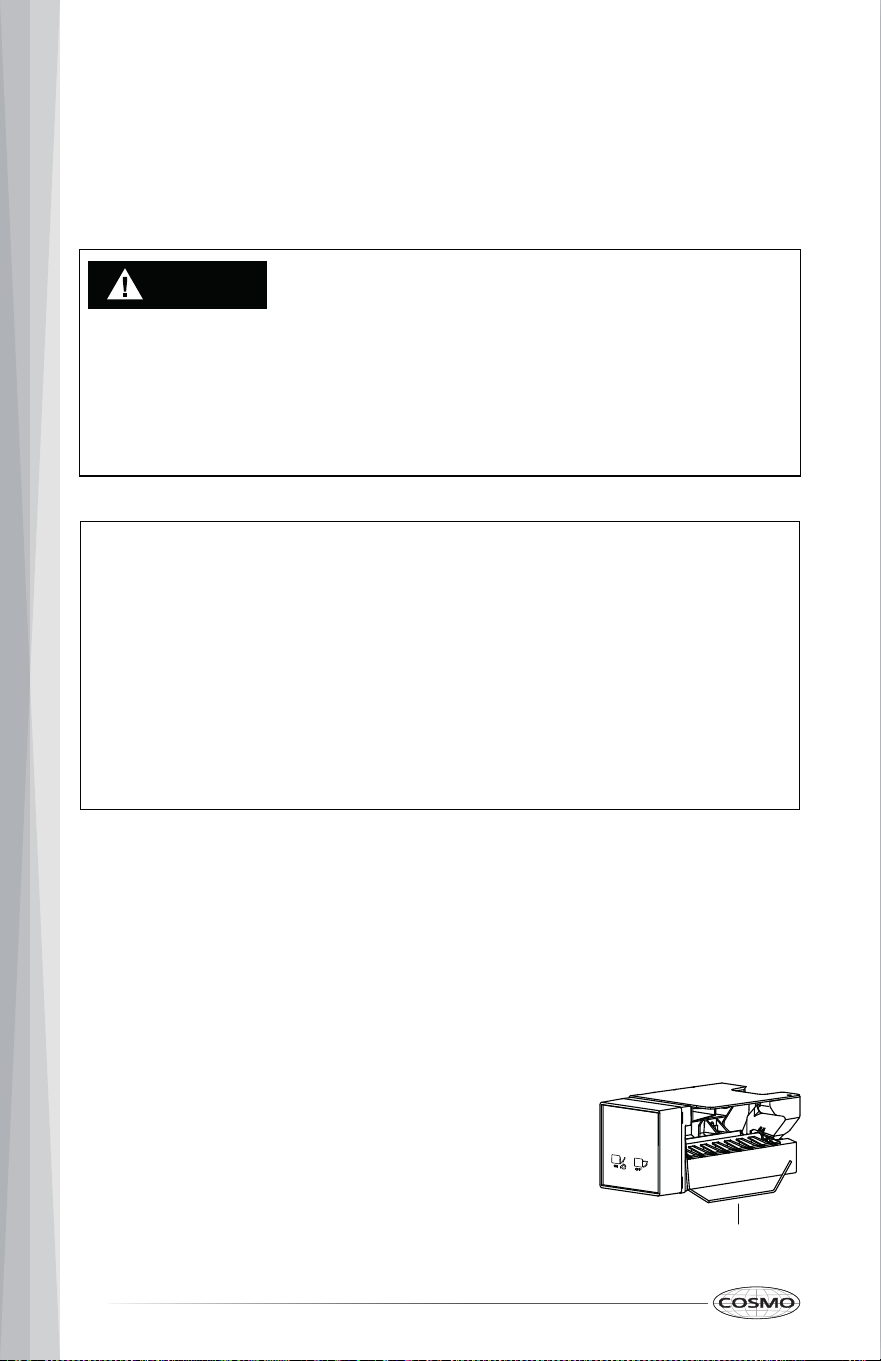
The icemaker is located inside the freezer compartment. The amount of ice
produced may vary according to the environment (ambient temperature
around the appliance, frequency of the door being opened, amount of food
stored in the appliance, etc.).
•
To turn the icemaker on, lower the
shut-off arm (metal rod) if the water
line is connected.
•
To turn the icemaker off, raise the
shut-off arm (metal rod).
CAUTION
• Throw away the first bin full of ice after installation. The first batch of ice
produced may include particles or odor from the water supply line.
• This is also necessary if the refrigerator has not been used for a long
time.
• In the event of a power outage, throw away the ice stored in the ice bin.
Shut-off arm
(on position)
35
NOTE:
• Ice cubes which are stored in the ice bin for a long time may clump
together and be difficult to separate. If this happens, empty the ice bin
completely and clean it before reinstalling it.
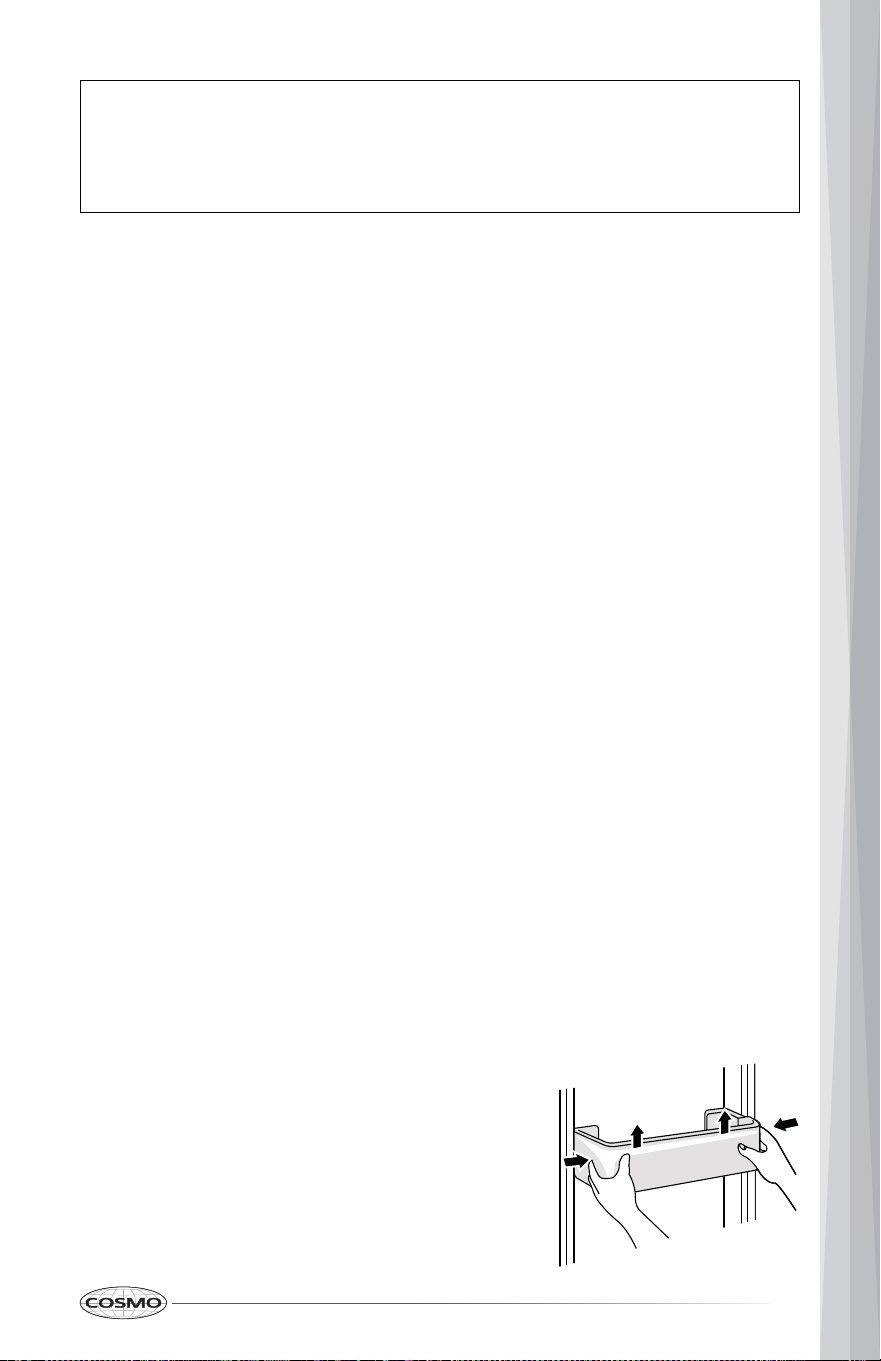
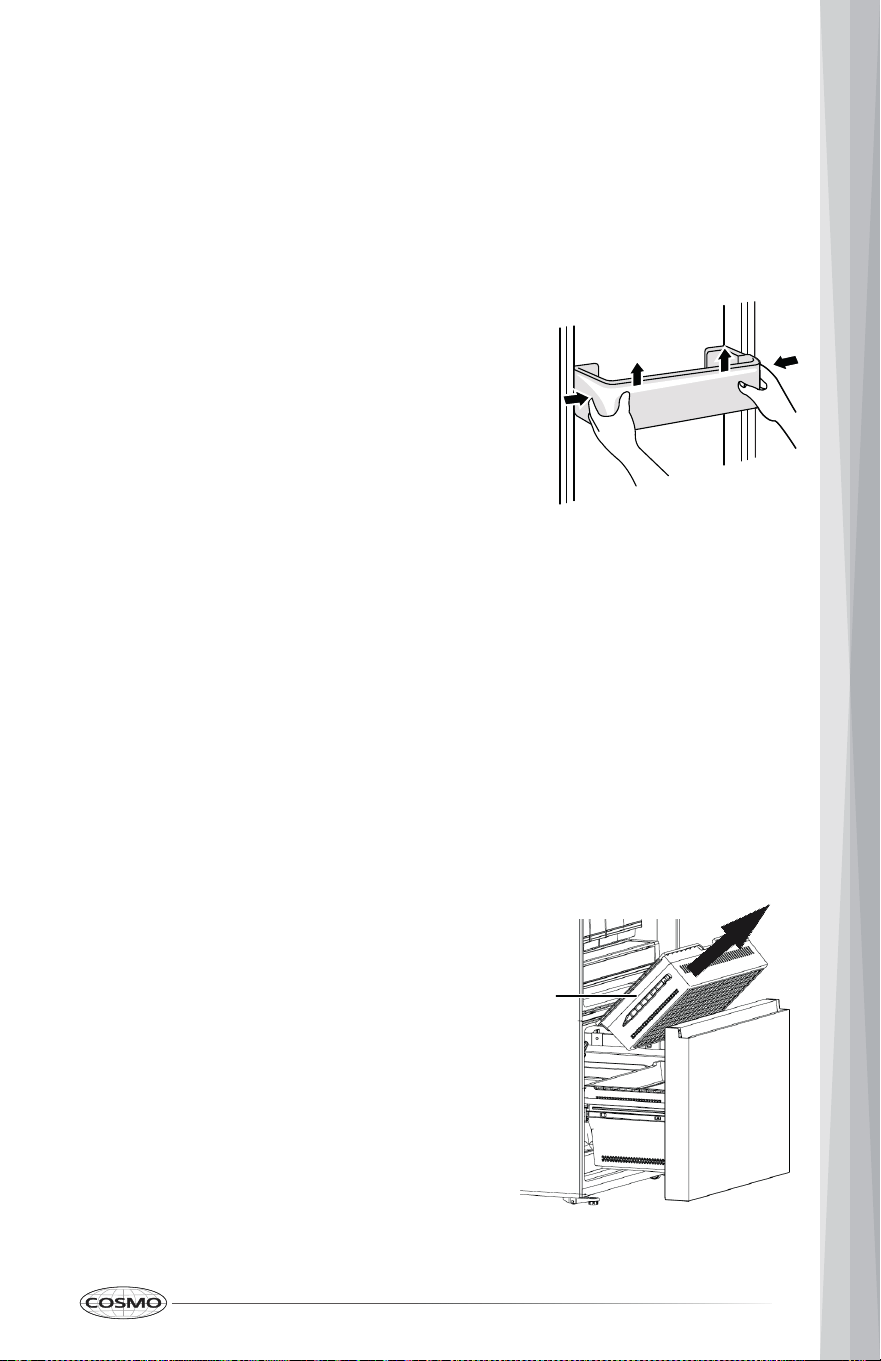
• To remove the bin, grab and
squeeze both sides, then lift the
bin up and pull straight out.
• To assemble the bin, slide it in
above the desired support and
push down until it snaps into
place.
CRISPERS
The crispers provide fresher tasting fruit and vegetables by keeping moist air
in the crisper drawer. (Separate fruit and vegetables to avoid over ripening
due to ethylene release by certain fruit.)
REFRIGERATOR SHELVES
Some shelves in the refrigerator can be raised to meet individual storage
needs. Adjusting the shelves to fit items of different heights will make finding
the exact item you want easier.
DOOR BINS
The door bins are removable for easy cleaning and adjustment. These are the
warmest areas of the fridge as room temperature air gushes in every time the
doors are opened. Put your least perishable items on the door, like ketchup,
mustard, soy sauce and other condiments with longer shelf lives.
Detaching/Assembling the Door Bin
36
MAINTENANCE & CARE
GENERAL CLEANING
WARNING
CAUTION
• Use non-flammable cleaner. Failure to do so can result in fire, explosion,
or death.
• Do not use sharp objects to clean as they can scratch the surface.
• Do not use an abrasive cloth or sponge when cleaning the interior and
exterior of the refrigerator.
• Clean the dust on top, behind, and under the refrigerator regularly.
• Wipe up spills immediately.
• Unplug the refrigerator or disconnect power before cleaning.
• Remove all removable parts, such as shelves.
• Use a clean sponge or soft cloth and a mild detergent in warm water. Do
not use abrasive or harsh cleaners.
• Hand wash, rinse and dry all surfaces thoroughly.
EXTERIOR
• For products with a standard stainless steel exterior, use a damp
microfiber cloth and rub in the direction of the grain. Dry with a paper
towel to avoid streaks.
• For stubborn stains and fingerprints, use a few drops of liquid dish soap in
water, and rinse with hot water before drying. Do not use abrasive or
harsh cleaners.
37
INSIDE WALLS
DOOR BINS
SHELVES
• To help remove odors, use a clean sponge or soft cloth to wipe the inside
of the refrigerator with a mixture of baking soda and warm water. Mix 2
tablespoons of baking soda to 1 quart of water (26 g soda to 1 liter water.)
Be sure the baking soda is completely dissolved so it does not scratch the
surfaces of the refrigerator.
• Remove all items from door bin,
grab and squeeze both sides, then
lift the bin up and pull straight out.
• Hand wash door bin and install
back in place or adjust height as
desired.
FREEZER BASKETS
• Open the refrigerator doors fully, and remove the upper door bins if
necessary.
• Pull shelf out.
• Hand wash using a clean sponge or soft cloth and a mild detergent in
warm water. Do not use glass cleaners, abrasive cleansers, or flammable
fluids. These can scratch or damage the material.
• To replace shelf, insert the shelf in place.
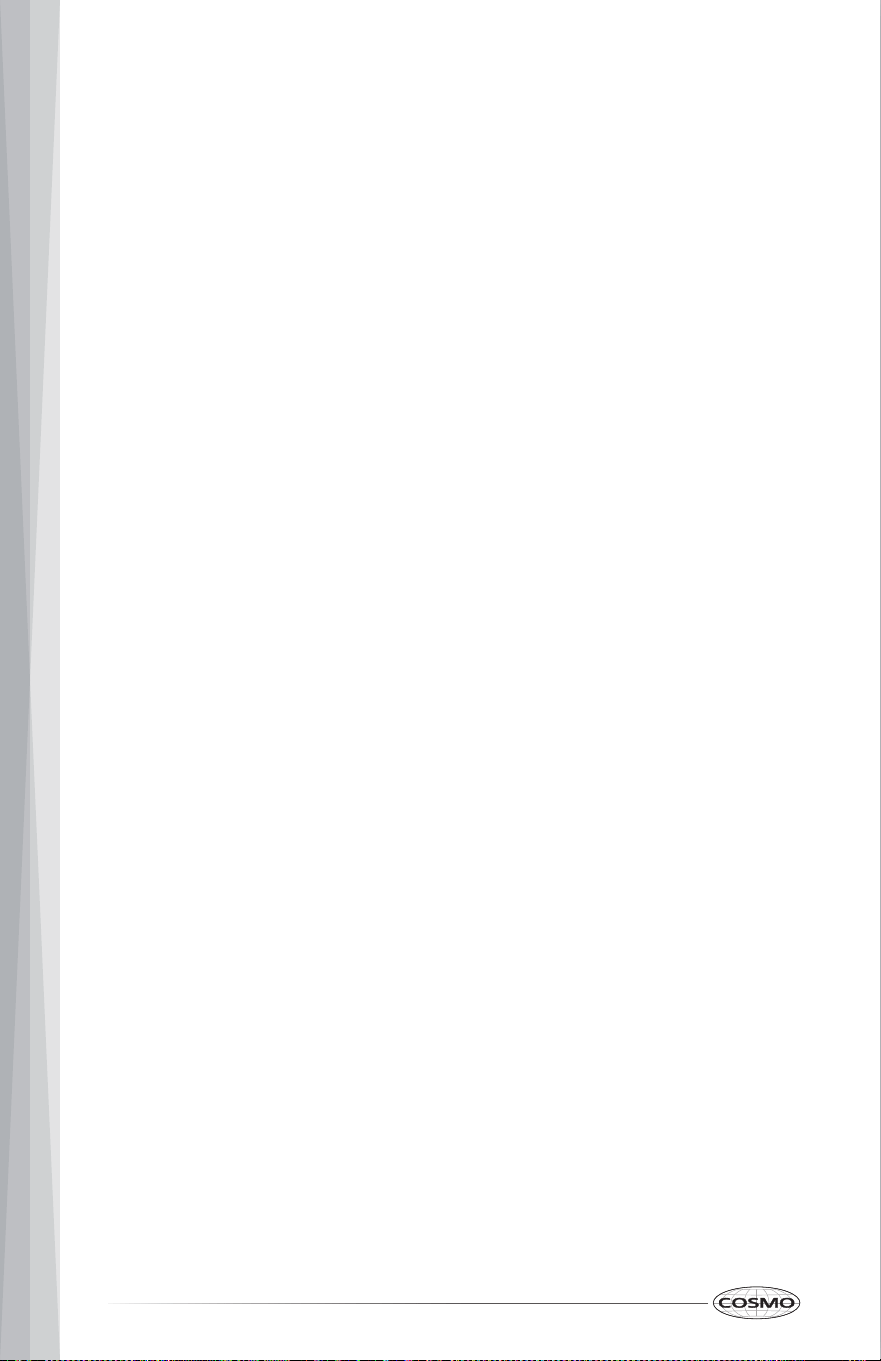
•
To remove the upper basket, lift
the front of basket up and pull it
straight out.
•
Allow basket to warm up so the
cloth will not stick.
•
Refer to "Inside Walls" section
above for cleaning suggestions on
both upper and lower baskets.
•
To replace the upper basket, lift
the front of basket up and align
the basket with the rails on both
sides, then gently close the
drawer.
Upper
basket
38
DOOR LINERS AND GASKETS
• Use a clean sponge or soft cloth and a mild detergent in warm water. Do
not use cleaning waxes, concentrated detergents, bleaches, or cleaners
containing petroleum on plastic refrigerator parts.
COMPARTMENT LED LIGHT
Replacing the LED Light
Service should be performed by a qualified technician.
1. Unplug the refrigerator.
2. Lift and pull out the light cover.
3. Press and hold the connector latch, and pull out the LED light.
4. Install a replacement LED light on the connector.
5. Replace the light cover.
DEFROSTING
The refrigerator defrosts automatically, but frost may still form with change of
season or temperature. Unplug the refrigerator or disconnect power and wipe
clean with a dry towel.
POWER FAILURE
In case of power failure, foods inside the refrigerator can be kept for several
hours. During the power failure, minimize opening the doors and do not place
any fresh food inside until power is restored.
EXTENDED PERIODS OF NON-USE
The appliance should be unplugged and then cleaned; the doors should be
left open to prevent odor buildup.
39
MOVING
•
Before the refrigerator is moved, take all objects out of the inside, fix the
glass partitions, vegetable holder, freezer drawers, etc. with tape and
tighten the leveling feet.
•
Close the doors and seal them with tapes.
•
During move, do not lay the appliance upside down or horizontally or
subject it to excessive vibration. Do not allow it to stand inclined more
than 45° during move.
•
Handle only from the sides of the refrigerator.
•
Be sure the refrigerator stays in an upright position during moving.
PREPARING FOR VACATION
•
Remove food from the refrigerator.
•
Turn off the icemaker.
•
Empty ice bin.
•
Unplug the refrigerator or disconnect power.
•
Turn off water supply.
•
Clean the refrigerator. (Refer to the "General Cleaning" section.)
•
Leave the doors and drawers open.
•
Upon returning from vacation, turn on water supply and run 2 gallons of
water through the cold water dispenser (about 5 minutes) to flush the
water lines.
NOTE:
• The ice bin should be emptied any time the icemaker is turned off.
• If the ambient temperature will drop below freezing, have a qualified
technician drain the water supply system to prevent serious property
damage due to flooding caused by ruptured water lines or connections.
40
TROUBLESHOOTING
BEFORE CALLING FOR SERVICE
Save time and money! Review this section on the following pages first and you
may not need to call for service.
Problem Possible Cause & Solution
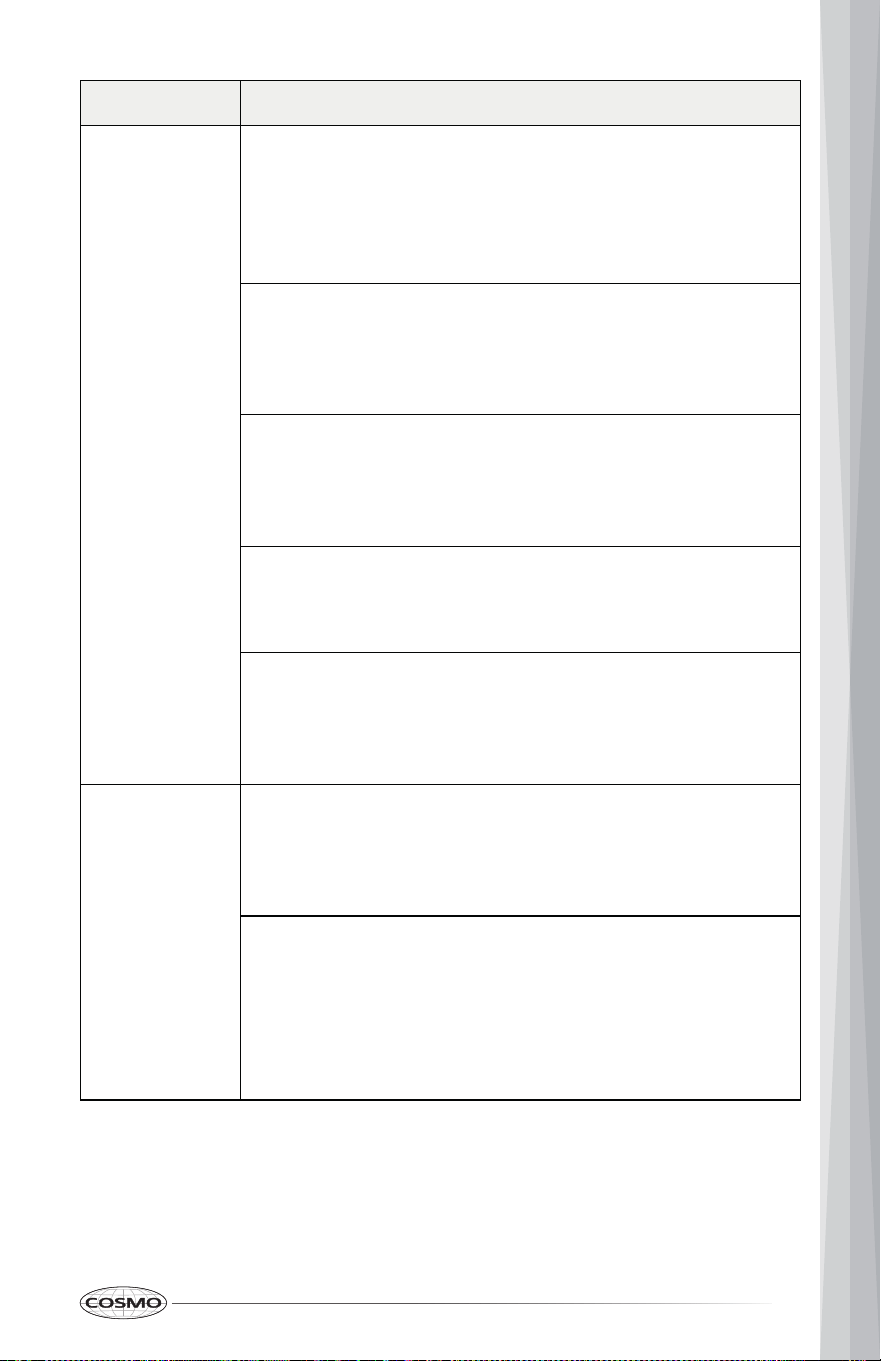
Refrigerator is
not cooling or
has no power.
A fuse in your home may be blown or the circuit breaker
tripped. Or the appliance is connected to a GFCI (Ground
Fault Circuit Interrupter) outlet, and the outlet's circuit
breaker has tripped.
• Check the main electrical box and replace the fuse or
reset the circuit breaker. Do not increase fuse capacity.
If the problem is a circuit overload, have it corrected
by a qualified electrician.
• Reset the circuit breaker on the GFCI. If the problem
persists, contact an electrician.
Refrigerator is in the defrost cycle.
• During the defrost cycle, the temperature of each
compartment may rise slightly. Wait 30 minutes and
confirm the proper temperature has been restored
once the defrost cycle has completed.
Refrigerator was recently installed.
• It may take up to 24 hours for each compartment to
reach the desired temperature.
Refrigerator was recently relocated.
• If the refrigerator was stored for a long period of time
or moved on its side, it is necessary for the refrigerator
to stand upright for 24 hours before connecting it to
power.
41
Problem Possible Cause & Solution
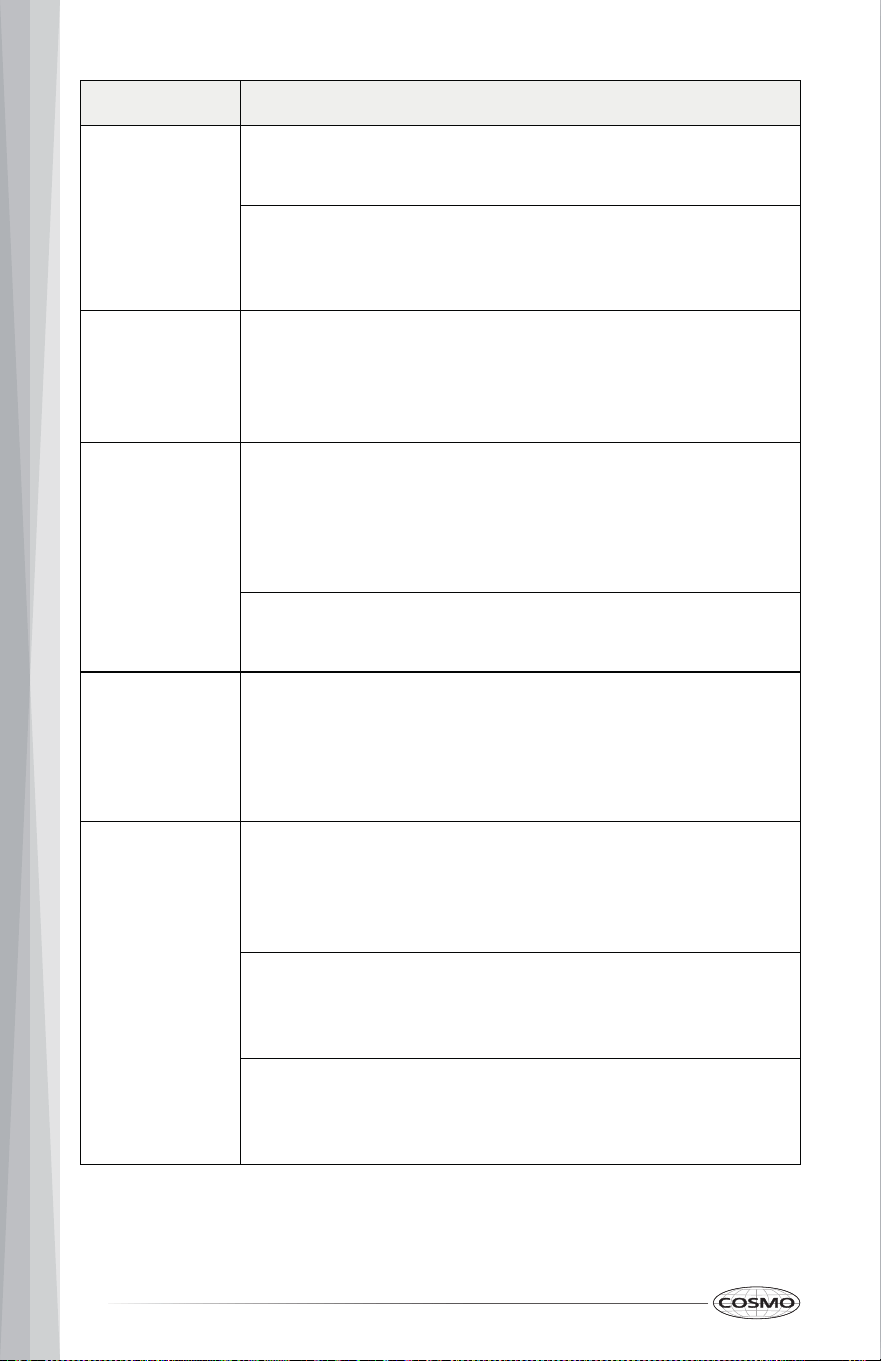
Cooling
system runs
too much.
Refrigerator is replacing an older model.
• Modern refrigerators require more operating time but
use less energy due to more efficient technology.
Refrigerator was recently plugged in or power restored.
• The refrigerator will take up to 24 hours to cool
completely.
The door is opened often or a large amount of food / hot
food was added.
• Adding food and opening the door warms the
refrigerator, requiring the compressor to run longer in
order to cool the refrigerator back down. In order to
conserve energy, try to get everything you need out of
the refrigerator at once, keep food organized so it is
easy to find, and close the door as soon as the food is
removed.
Doors are not closed completely.
• Firmly push the doors shut.
Refrigerator is installed in a hot location.
• The compressor will run longer under warm conditions.
At normal room temperatures (70 °F or 21 °C) expect
your compressor to run about 40 % to 80 % of the
time. Under warmer conditions, expect it to run even
more often. The refrigerator should not be operated
above 110 °F (43 °C).
42
Problem Possible Cause & Solution
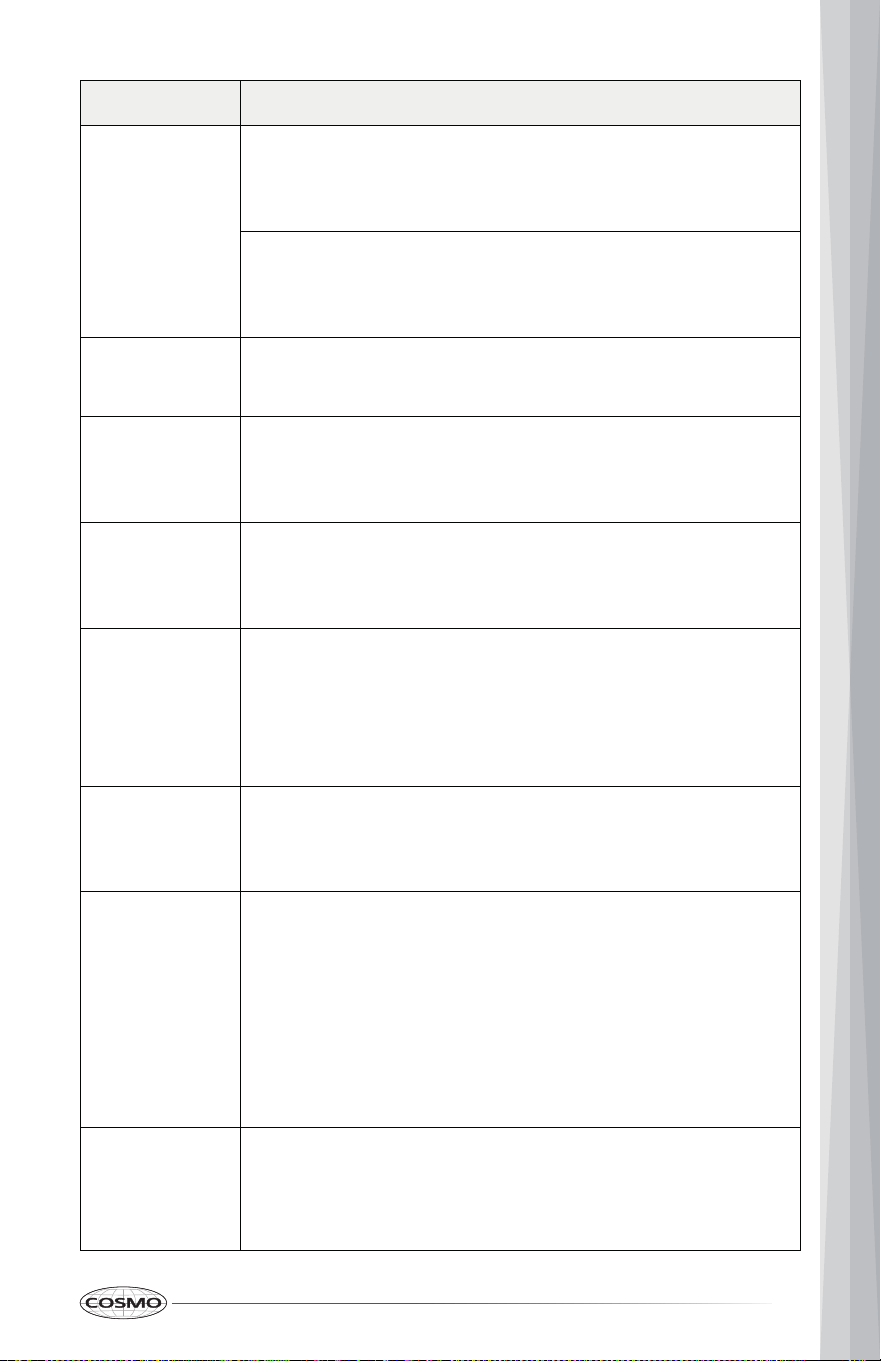
Interior
moisture
buildup.
Doors are opened often or for long periods of time.
• When the doors are opened often or for long periods
of time, warm, humid air enters the compartment. This
raises the temperature and moisture level within the
compartment. To lessen the effect, reduce the
frequency and duration of door openings.
Doors are not always closed completely.
• Firmly push the doors shut.
Weather is humid.
• Humid weather allows additional moisture to enter the
compartments when the doors are opened leading to
condensation or frost. Maintaining a reasonable level
of humidity in the home will help to control the
amount of moisture that can enter the compartments.
Defrost cycle recently completed.
• During the defrost cycle, the temperature of each
compartment may rise slightly and condensation may
form on the back wall. Wait 30 minutes and confirm
that the proper temperature has been restored once
the defrost cycle has completed.
Food is not packaged correctly.
• Food stored uncovered or unwrapped, and damp
containers can lead to moisture accumulation within
each compartment. Wipe all containers dry and store
food in sealed packaging to prevent condensation
and frost.
43
Problem Possible Cause & Solution
Food is
freezing in the
refrigerator
compartment.
Food with high water content was placed near an air
vent.
• Rearrange items with high water content away from
air vents.
Refrigerator temperature control is set incorrectly.
• If the temperature is too cold, adjust the control one
increment at a time and wait for the temperature to
stabilize.
Refrigerator is installed in a cold location.
• When the refrigerator is operated in temperature
below 41 °F (5 °C), food can freeze in the refrigerator
compartment. The refrigerator should not be operated
in temperature below 55 °F (13 °C).
Refrigerator or
Freezer section
is too cold.
Incorrect temperature control settings.
• If the temperature is too cold, adjust the control one
increment at a time and wait for the temperature to
stabilize.
Frost or ice
crystals form
on frozen food
(inside of
sealed
package).
Condensation from food with a high water content has
frozen inside of the food package.
• This is normal for food items with a high water
content.
Food has been left in the freezer for a long period of
time.
• Do not store food items with high water content in the
freezer for a long period of time.
Frost or ice
crystals form
on frozen food
(outside of
package).
Door is opened frequently or for long periods of time.
• When the doors are opened often or for long periods
of time, warm, humid air enters the compartment. This
raises the temperature and moisture level within the
compartment. Increased moisture will lead to frost
and condensation. To lessen the effect, reduce the
frequency and duration of door openings.
Doors are not always closed completely.
• Firmly push the doors shut.
44
Problem Possible Cause & Solution
Refrigerator or
Freezer section
is too warm.
Refrigerator was recently installed.
• It may take up to 24 hours for each compartment to
reach the desired temperature.
The air vents are blocked. Cold air circulates from the
freezer to the fresh food section and back again through
air vents in the wall dividing the two sections.
• Locate air vents by using your hand to sense airflow
and move all packages that block vents and restrict
airflow. Rearrange items to allow air to flow
throughout the compartment.
Doors are opened often or for long periods of time.
• When the doors are opened often or for long periods
of time, warm, humid air enters the compartment. This
raises the temperature and moisture level within the
compartment. To lessen the effect, reduce the
frequency and duration of door openings.
Unit is installed in a hot location.
• The refrigerator should not be operated in
temperatures above 110 °F (43 °C).
A large amount of food or hot food was added to either
compartment.
• Adding food warms the compartment requiring the
cooling system to run. Allowing hot food to cool to
room temperature before putting it in the refrigerator
will reduce this effect.
Doors are not always closed completely.
• Firmly push the doors shut.
Temperature control is not set correctly.
• If the temperature is too warm, adjust the control one
increment at a time and wait for the temperature to
stabilize.
45
Problem Possible Cause & Solution
Icemaker is not
making
enough ice.
House water supply is not connected, valve is not turned
on fully, or valve is clogged.
• Connect the refrigerator to a cold water supply with
adequate pressure and turn the water shutoff valve
fully open. If the problem persists, it may be necessary
to contact a plumber.
Water filter has been exhausted on models with a water
filter.
• Replacing the water filter is recommended:
- Approximately every six months.
- When the water filter indicator turns on.
- When the water dispenser output decreases.
- When the ice cubes are smaller than normal.
Low house water supply pressure.
• The water supply pressure must be between 20 - 100
psi (140 - 690 kPa). If the problem persists, it may be
necessary to contact a plumber.
Tubing connecting refrigerator to house supply valve is
kinked.
• The tubing can kink when the refrigerator is moved
during installation or cleaning resulting in reduced
water flow. Straighten or repair the water supply line
and arrange it to prevent future kinks.
Doors are opened often or for long periods of time.
• If the doors of the unit are opened often, ambient air
will warm the refrigerator which will prevent the unit
from maintaining the set temperature. Lowering the
refrigerator temperature can help, as well as not
opening the doors as frequently.
Doors are not always closed completely.
• If the doors are not properly closed, ice production will
be affected.
46
Problem Possible Cause & Solution
Icemaker is not
making ice.
Refrigerator was recently installed or icemaker recently
connected.
• It may take up to 24 hours for each compartment to
reach the desired temperature and for the icemaker to
begin making ice.
Icemaker is not turned on.
• Locate the icemaker ON/OFF and confirm that it is
turned on.
The refrigerator is not connected to a water supply or the
supply shutoff valve is not turned on.
• Connect the refrigerator to the water supply and turn
the water shutoff valve fully open.
Reverse osmosis water filtration system is connected to
your cold water supply.
• Reverse osmosis filtration systems can reduce the
water pressure below the minimum amount and result
in icemaker issues.
47
Problem Possible Cause & Solution
Ice has bad
taste or odor.
Water supply contains minerals such as sulfur.
• A water filter may need to be installed to eliminate
taste and odor problems. NOTE: In some cases, a filter
may not help. It may not be possible to remove all
minerals/odor/taste in all water supplies.
Icemaker was recently installed.
• Ice that has been stored for too long will shrink,
become cloudy, and may develop a stale taste. Throw
away old ice and make a new supply.
The food has not been stored properly in either
compartment.
• Rewrap the food. Odors may migrate to the ice if food
is not wrapped properly.
The interior of the refrigerator needs to be cleaned.
• See the Maintenance & Care section for more
information.
The ice storage bin needs to be cleaned.
• Empty and wash the bin (discard old cubes). Make
sure that the bin is completely dry before reinstalling
it.
Doors are
difficult to
open.
The gaskets are dirty or sticky.
• Clean the gaskets and the surfaces that they touch.
Rub a thin coat of appliance polish or kitchen wax on
the gaskets after cleaning.
Door was recently closed.
• When you open the door, warmer air enters the
refrigerator. As the warm air cools, it can create a
vacuum. If the door is hard to open, wait one minute
to allow the air pressure to equalize, then see if it
opens more easily.
48
Problem Possible Cause & Solution
Refrigerator
wobbles or
seems
unstable.
Leveling legs are not adjusted properly.
• Refer to the Leveling and Door Alignment section.
Floor is not level.
• It may be necessary to add shims under the leveling
legs or rollers to complete installation.
Lights do not
work.
LED interior lighting failure.
• The refrigerator compartment lamp is LED interior
lighting, and service should be performed by a
qualified technician.
Refrigerator
has an unusual
odor.
Food is not tightly wrapped.
• Wrap odorous food tightly.
• Store food in sealed packaging.
• Check whether there is any rotten food.
The refrigerator needs to be cleaned.
• Refer to the "General Cleaning" section.
The interior of
the
refrigerator is
covered with
dust or soot.
The refrigerator is located near a fire source, such as a
fireplace, chimney, or candle.
• Make sure that the refrigerator is not located near a
fire source, such as a fireplace, chimney or candle.
Rattling
noises.
Rattling noises may come from the flow of refrigerant,
the water line on the back of the unit, or items stored on
top of or around the refrigerator.
• Normal Operation
Refrigerator is not resting solidly on the floor.
• Floor is weak or uneven or leveling legs need to be
adjusted.
Refrigerator with linear compressor was jarred while
running.
• Normal Operation
49
Problem Possible Cause & Solution
Whooshing
noises.
Evaporator fan motor is circulating air through the
refrigerator and freezer compartments.
• Normal Operation
Air is being forced over the condenser by the condenser
fan.
• Normal Operation
Gurgling
noises.
Refrigerant flowing through the cooling system.
• Normal Operation
Popping
noises.
Contraction and expansion of the inside walls due to
changes in temperature.
• Normal Operation
Sizzling noises.
Water dripping on the defrost heater during a defrost
cycle.
• Normal Operation
Vibrating
noises.
If the side or back of the refrigerator is touching a
cabinet or wall, some of the normal vibrations may make
an audible sound.
• To eliminate the noise, make sure that the sides and
back cannot vibrate against any wall or cabinet.
Dripping
noises.
Water running into the drain pan during the defrost
cycle.
• Normal Operation
Pulsating or
high-pitched
sound
Your refrigerator is designed to run more efficiently to
keep your food items at the desired temperature. The
high efficiency compressor may cause your new
refrigerator to run longer than your old one, but it is still
more energy efficient than previous models. While the
refrigerator is running, it is normal to hear a pulsating or
high-pitched sound.
• Normal Operation
Non-numeric
temperature
appears in
display
This is an error code. Write down error code and contact
a qualified service provider for repairs.
50
LIMITED WARRANTY
WARRANTY AND SERVICE
TO RECEIVE WARRANTY SERVICE, YOUR PRODUCT MUST BE REGISTERED.
TO REGISTER AND REVIEW FULL WARRANTY DETAILS, VISIT:
WWW.COSMOAPPLIANCES.COM/WARRANTY
SCAN TO REGISTER
CUSTOMER SUPPORT
TO CHAT WITH US LIVE FOR ASSISTANCE, VISIT:
WWW.COSMOAPPLIANCES.COM/CHAT
SCAN TO CHAT
51
Correct disposal of this product:
This marking indicates that this appliance should not be
disposed with other household wastes. To prevent
possible harm to the environment or human health from
uncontrolled waste disposal, recycle it responsibly to
promote the sustainable reuse of material resources.
IMPORTANT
Do Not Return This Product To The Store
If you have a problem with this product, please contact COSMO Customer
Support at
+1 (888) 784-3108
DATED PROOF OF PURCHASE, MODEL #, AND SERIAL # REQUIRED FOR
WARRANTY SERVICE.
IMPORTANT
Ne pas Réexpédier ce Produit au Magasin
Pour tout problème concernant ce produit, veuillez contacter le service des
consommateurs Cosmo Customer Support au
+1 (888) 784-3108
UNE PREUVE D’ACHAT DATEE EST REQUISE POUR BENEFICIER DE LA GARANTIE.
IMPORTANTE
No regrese este producto a la tienda
Si tiene algún problema con este producto, por favor contacte el ayuda al
cliente COSMO al
+1 (888) 784-3108
(Válido solo en E.U.A.)
NECESITA UNA PRUEBA DE DE COMPRA FECHADA, NÚMERO DE MODELO Y DE
SERIE PARA EL SERVICIO DE LA GARANTÍA.