Author Checked by Approved by
Signature:
Date:
Signature:
Date:
Signature:
Date:
HA BU
Business Unit
Project Name
Product Name
FCC ID
Sogne BTE
BTE hearing aids
BVW-SHW-13
9010100314-EUD-BTE-01
Instructions for Use
BTE hearing aids
Valid from: December 20, 2025
© Shanghai United Imaging Microelectronics Technology Co., Ltd. Reserved

2
History
Version
01
Author
biman.xu
CR No.
NA
Change Contents
NA

3
Preface
Thank you for choosing United Imaging. We are dedicated to enhancing your
listening experience.
The entire United Imaging series features groundbreaking algorithmic
innovations, revolutionizing listening clarity, speech intelligibility, and wearing
comfort to provide users with a completely new hearing experience. It
incorporates a newly upgraded noise reduction algorithm that effectively
distinguishes between essential and non-essential speech sounds, helping you to
identify and focus on desired sounds in complex environments. The hearing aid
is also equipped with multiple listening programs that respond rapidly to changes
in your daily acoustic environment, ensuring consistent clarity. United Imaging
also mitigates common device-related interference, such as feedback (whistling)
and background noise, evolving the listening performance to be clearer, more
understandable, and more comfortable, so you can enjoy listening with
confidence.
Please do not hesitate to contact your hearing aid professional. He or she will
perform a personalized fitting based on your individual hearing needs and
listening preferences to ensure the best possible experience. We also encourage
you to read the instructions for use carefully to learn about operating instructions
and maintenance, which will help you adapt more quickly to your new hearing
aid. If you have any questions not answered in the instructions for use, please feel
free to contact us at any time.

4
Table of Contents
I. Basic Information of Product ................................................................ 5
II. Features and Identification .................................................................... 6
III. Operating Instructions ........................................................................... 7
1. On/Off ......................................................................................................... 7
2. Replacing a Battery ..................................................................................... 8
3. Left and Right Ear Markings .................................................................... 10
4. Attaching the dome or earmould to the hearing aid ................................. 10
5. Putting on a Hearing Aid .......................................................................... 10
6. Removing a Hearing Aid .......................................................................... 11
7. Wireless Function ..................................................................................... 12
8. Multi-Function Button .............................................................................. 12
IV. Maintenance and Service ..................................................................... 12
V. Troubleshooting .................................................................................... 14
VI. Precautions ............................................................................................ 15
VII. Technical Specifications ....................................................................... 18
1. Basic Safety Characteristics ...................................................................... 18
2. Electroacoustic Performance Parameters ................................................. 19
3. Description on Wireless Network Security .............................................. 19
4. User Access Control Mechanism .............................................................. 20
5. Environmental Conditions ........................................................................ 20
6. Disposal ..................................................................................................... 20
VIII. Electromagnetic Compatibility (EMC) .............................................. 20
IX. Symbol and Mark Legend .................................................................... 25
X. Maintenance Policy ............................................................................... 25
XI. Electromagnetic Compatibility (EMC) ................ 错误!未定义书签。

5
I. Basic Information of Product
Product Name
BTE hearing aids
Model name
Specification
BTE SHW-13
n32/n33/n53/n55/n56/n73/n75/n76/n93/n94/n95/n96
BTE SCW-13
n32/n33/n34/n36/n53/n54/n75/n95/n96
Intended Use
The hearing aid is intended to amplify and transmit sound to the ear and thereby
compensate for impaired hearing.
Intended Users
Person with hearing loss using a hearing aid and their caregivers. Hearing care
professional responsible for adjusting the hearing aid.
Intended Patient
The target population is primarily the adult population over 18 years of age. This
product may also be used with children 36 months of age or older. Individuals
with cognitive impairment will require constant supervision by a caregiver.
User Environment
The hearing aid is suitable for the home healthcare environment and due to their
portability it may happen that it is used in professional healthcare facility
environment like physician oces, dental oces etc.
Indication
Patients diagnosed with mild to profound air-conduction hearing loss requiring
amplification.
Contraindications
This product is not suitable for individuals with acute otitis externa, myringitis,
chronic suppurative otitis media (during the active discharge phase), acute
suppurative otitis media, or a known allergy to any of product materials.
Notes for Hearing Aid Professionals
The professional fitting of hearing aids must be performed by hearing aid
professionals with appropriate national qualifications. During the fitting process,
special attention must be given to users presenting with any of the following
clinical symptoms:
① Congenital or traumatic deformity of the ear; ② History of active drainage

6
from the ear within the previous 90 days; ③ Sudden or rapidly progressive
hearing loss in one or both ears within the previous 90 days; ④ Acute or chronic
dizziness; ⑤ An air-bone gap equal to or greater than 15 dB at 500 Hz, 1000
Hz, and 2000 Hz; ⑥ Visible evidence of significant cerumen impaction in the
ear canal; ⑦ Pain or significant discomfort in or about the ear.
A qualified hearing aid professional typically possesses the skills to: ① assess
a patient’s communication needs; ② select, program, and fit appropriate hearing
aids; and ③ monitor and validate the effectiveness of the fitting system.
Advice for Users
Do not underestimate hearing loss!
If you notice a decline in your hearing, we strongly recommend visiting a
professional hearing center or hospital for a comprehensive hearing examination
and assessment. Based on your results, discuss your hearing goals and
expectations with your hearing aid professional or doctor, who will help you
select a hearing aid that is right for you.
A hearing aid is an assistive listening device designed to help compensate for
hearing loss and improve your quality of life. The patient, the intended operator
of the hearing aid, for best results, should have the cognitive ability to operate the
device scientifically and reasonably under the guidance of a hearing aid
professional and put it on consistently.
Putting on hearing aids is one component of aural rehabilitation. Sometimes,
additional strategies such as auditory training or lip-reading may also be helpful
to supplement your listening. For children using this device, a guardian with
aforesaid capacities must provide supervision. After the hearing aid is fitted, it is
essential that the child promptly begins professional auditory-verbal therapy.
II. Features and Identification
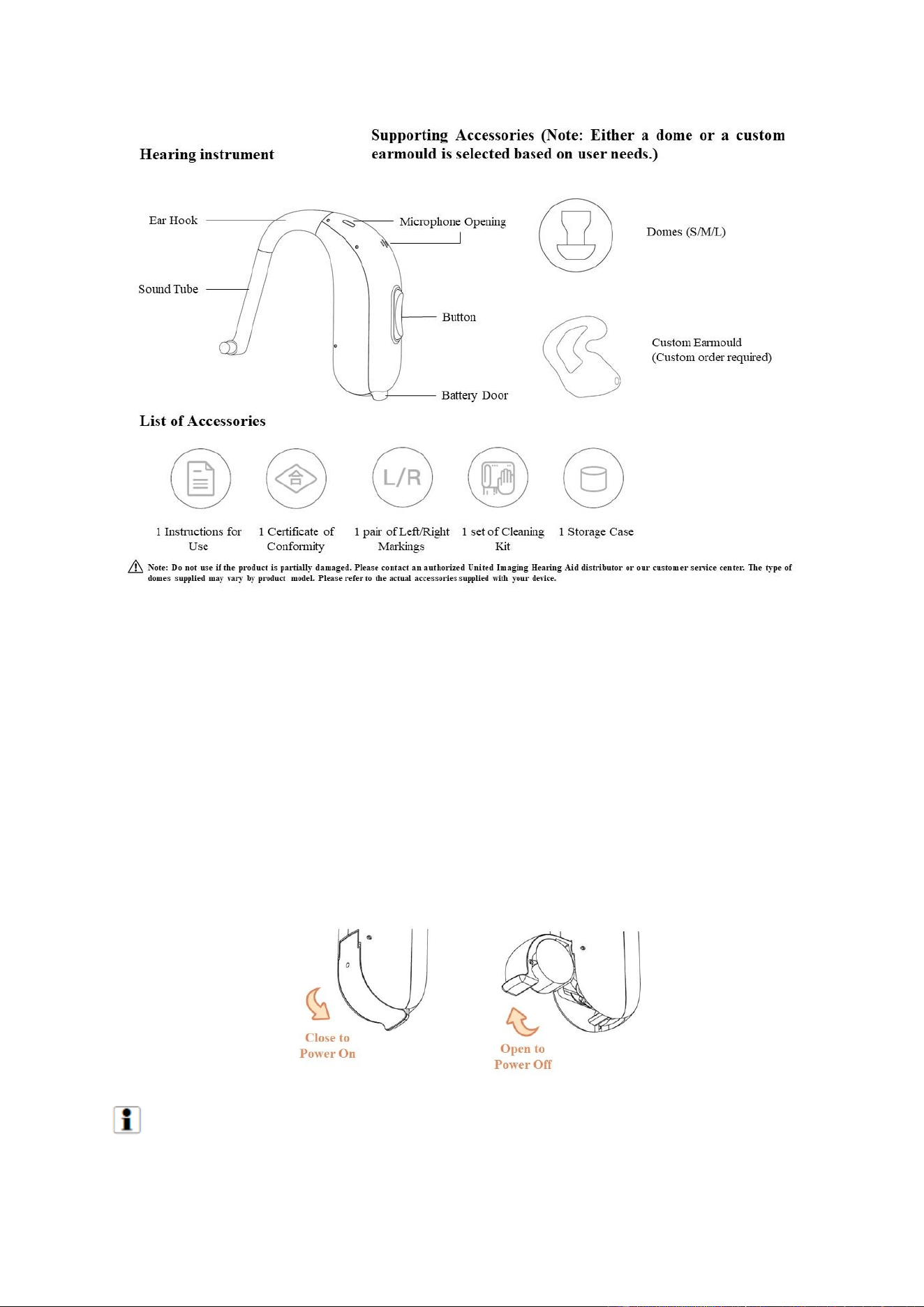
7
Note:
One box contains only one hearing aid, if you need a pair of hearing aids, you will receive two boxes.
III. Operating Instructions
1. On/Off
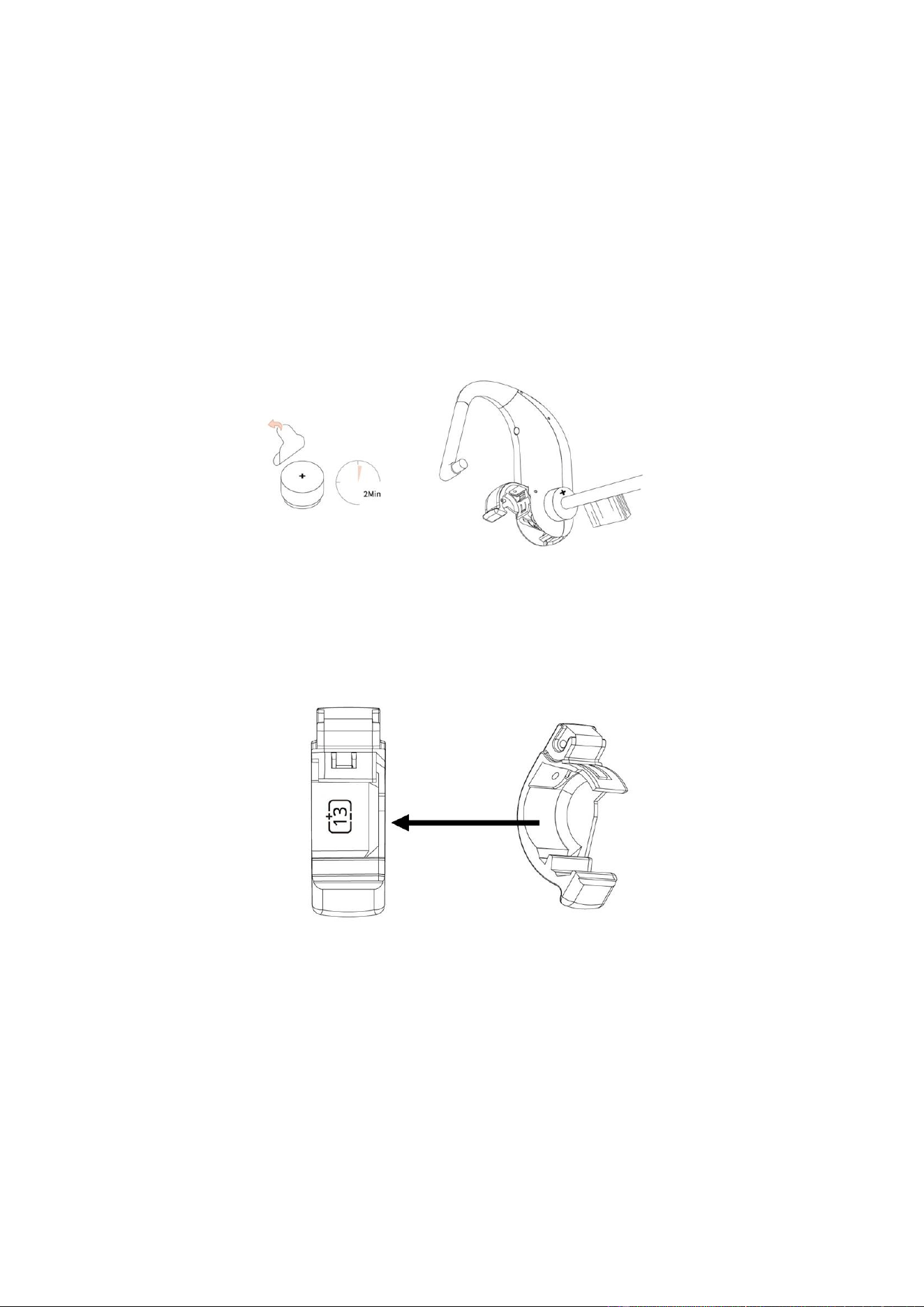
1) Open the battery door, insert the correct zinc-air battery, and close the door.
The hearing aid will power on, play a ON tone, and activate the default
listening program.
2) Open the battery door. The hearing aid will power off and stop working.
Tip:
When not using the hearing aid, open the battery door to remove the battery and
prevent unnecessary battery drain.
8
2. Replacing a Battery
1) Open the battery door and remove the used battery, if one is present. You can
remove the battery with your fingers or by using the supplied cleaning brush
with magnet on the end. Simply touch the magnet to the battery and lift it out.
2) Take a new battery and remove its protective tab. Let the battery sit for
approximately two minutes to allow it to fully activate with the air (see figure
below). For the required battery type, please refer to Chapter VIII “2.
Electroacoustic Performance Parameters”;
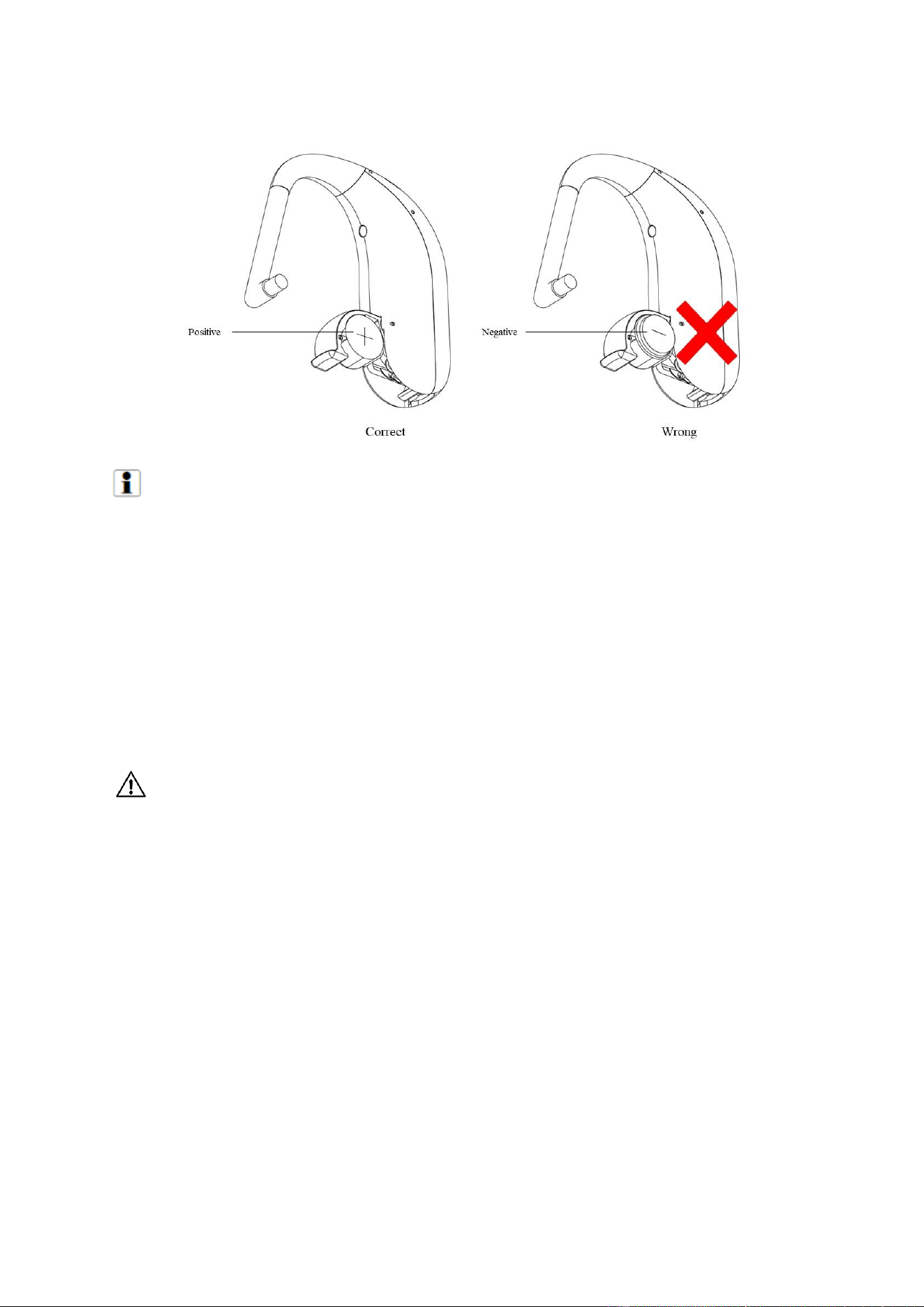
3) Insert the battery into the battery compartment, ensuring the plus sign (+) on
the battery aligns with the plus sign (13+) marked on the compartment and
the battery is placed stably;
4) Close the battery door gently. If resistance is felt, do not force it. Check that
the battery is inserted correctly.
9
Tip:
1) Use only a size 13 zinc-air battery. The battery is user-replaceable;
2) Ensure the battery is within its expiration date;
3) When the hearing aid is not in use, open the battery door to power it off and
conserve the battery;
4) Waiting approximately two minutes after removing the battery tab before
insertion helps ensure a stable power supply;
5) If you will not use the hearing aid for an extended period (more than 7 days),
remove the battery to prevent potential corrosion from leakage. Always store
the hearing aid in a place that is out of the reach of children.
Warning:
For safety and environmental protection, you must dispose of batteries properly
according to applicable regulations. Precautions are as follows:
1) When first learning to change the battery, follow the guidance of your hearing
aid professional. Always check that the battery compartment is intact.
2) Keep the battery out of the reach of children.
3) Never change the battery in the presence of infants, children, or individuals
with cognitive impairments.
4) Never put a battery in your mouth. Swallowing a battery is extremely
dangerous and can be fatal.
5) If a battery is swallowed, seek immediate medical attention.
6) Do not store batteries with medications, as they can be mistaken for pills.
7) Do not dispose of batteries in fire, as they may explode.
10
8) Do not leave depleted batteries inside the hearing aid, as leakage can cause
corrosion and damage the device.
9) Do not attempt to recharge single-use zinc-air batteries, as this can cause them
to leak or explode.
3. Left and Right Ear Markings
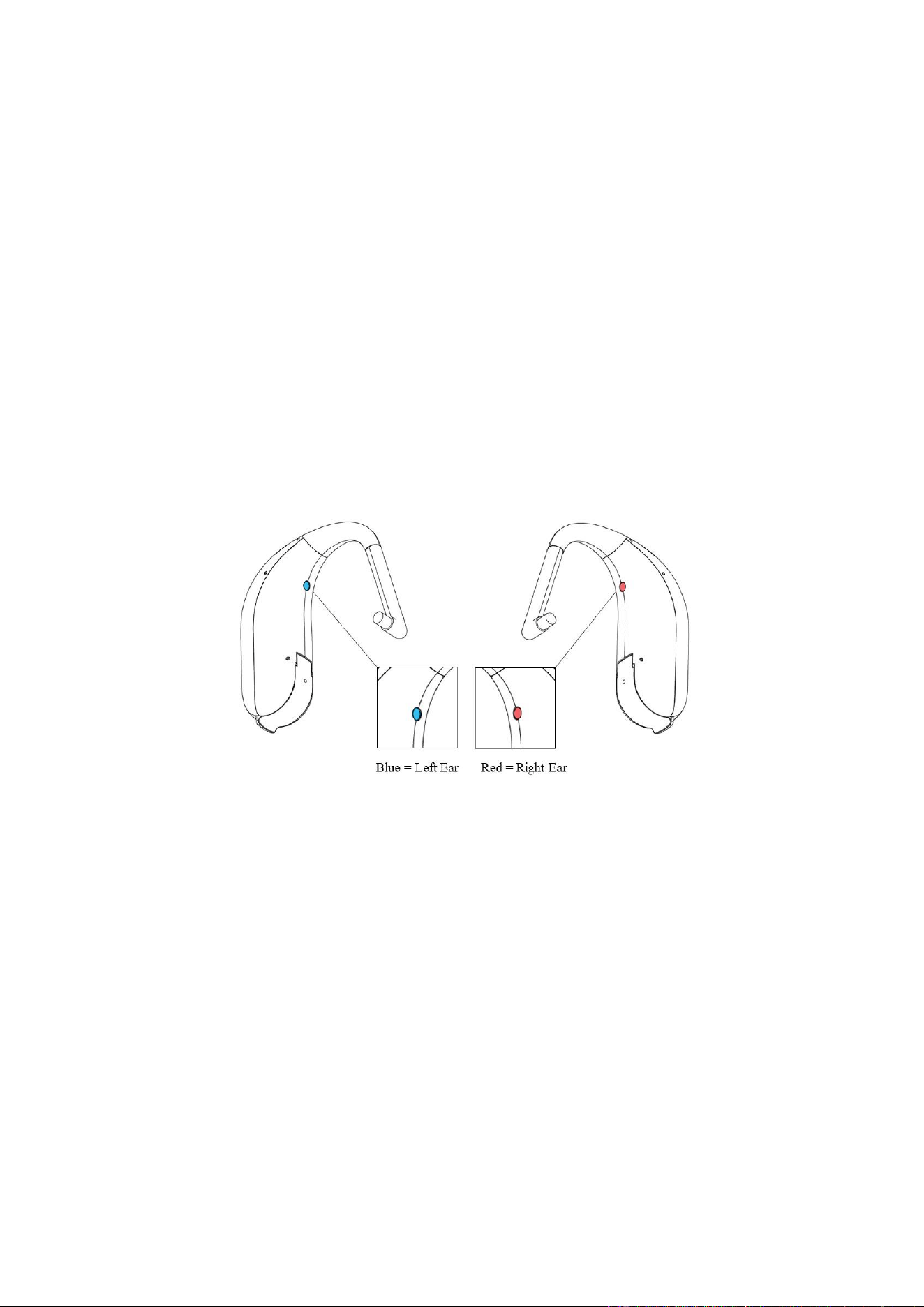
Your left and right hearing aids may be programmed differently, so it is crucial
to tell them apart. United Imaging hearing aids use a color code to help you: red
is for the right ear, and blue is for the left ear. You can find these blue or red
markings on either the hearing aid body to identify which is for the left ear and
which is for the right.
If you still have trouble telling your hearing aids apart, please contact your
authorized United Imaging Hearing Aid distributor for assistance.
4. Attaching the dome or earmould to the hearing aid
1) Hold the sound tube in one hand and the dome or earmould in the other.
2) Slide the dome or earmould over the sound tube.
3) The sound tube and the dome or earmould should fit perfectly together.
5. Putting on a Hearing Aid
Before putting on your hearing aid, ensure the Ear hook and sound tube are
correctly attached to the main body and fitted with the appropriate dome or
earmould. Follow these steps to put on your hearing aid:
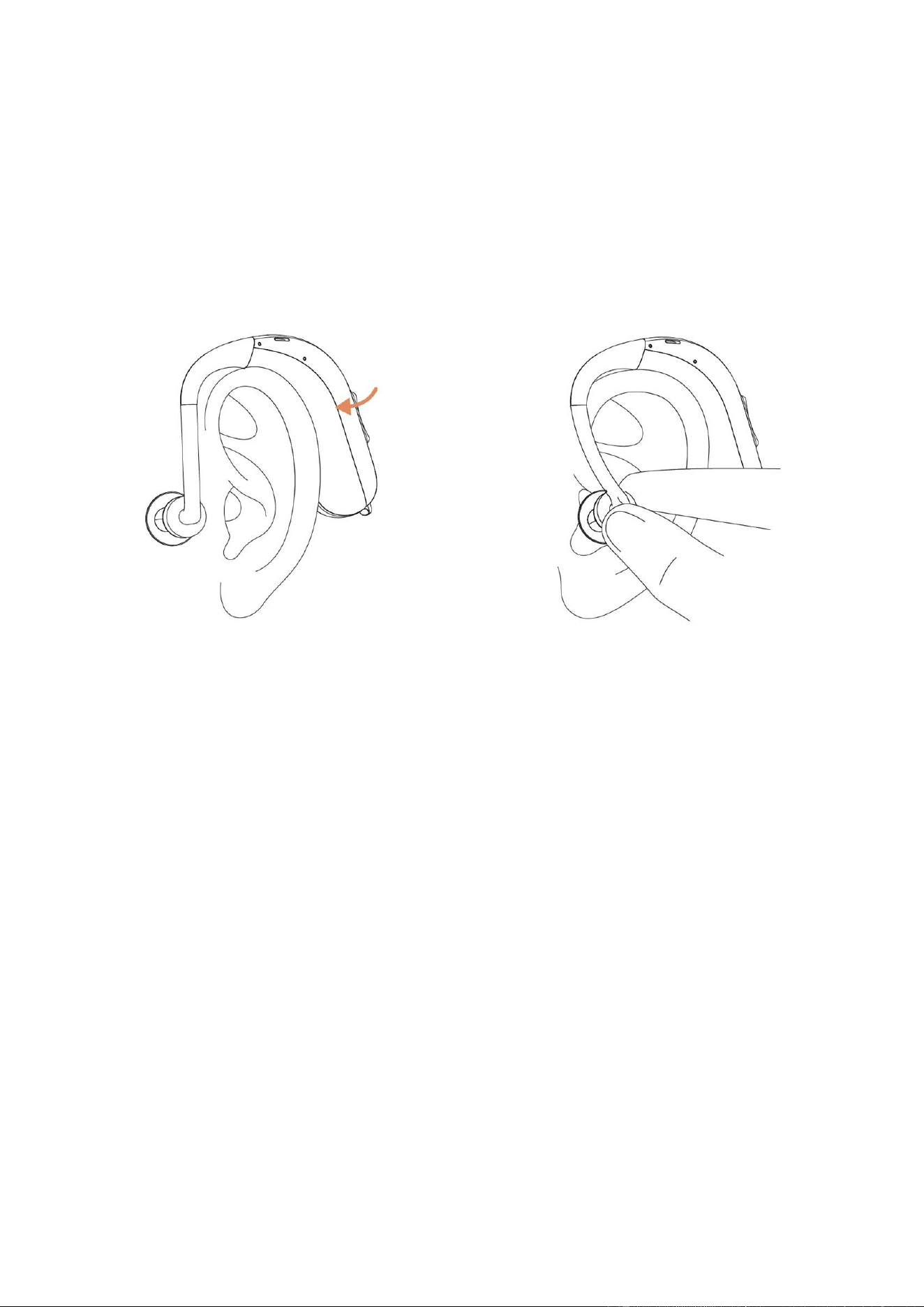
1) Put on the hearing aid on the auricle, with its main body placed behind the
auricle (see figure below);
2) With your thumb and forefinger, hold the bend in the sound tube gently.
Position the dome (or earmould) at the opening of your ear canal and gently
11
guide it inside until it rests securely and comfortably, without causing pain
and discomfort or feedback (whistling).
3) If the dome does not feel secure or comfortable, try a different size. To ensure
optimal performance, we recommend using only genuine replacement domes
from our company or an equivalent model. For earmould replacements, please
contact your hearing aid professional.
6. Removing a Hearing Aid
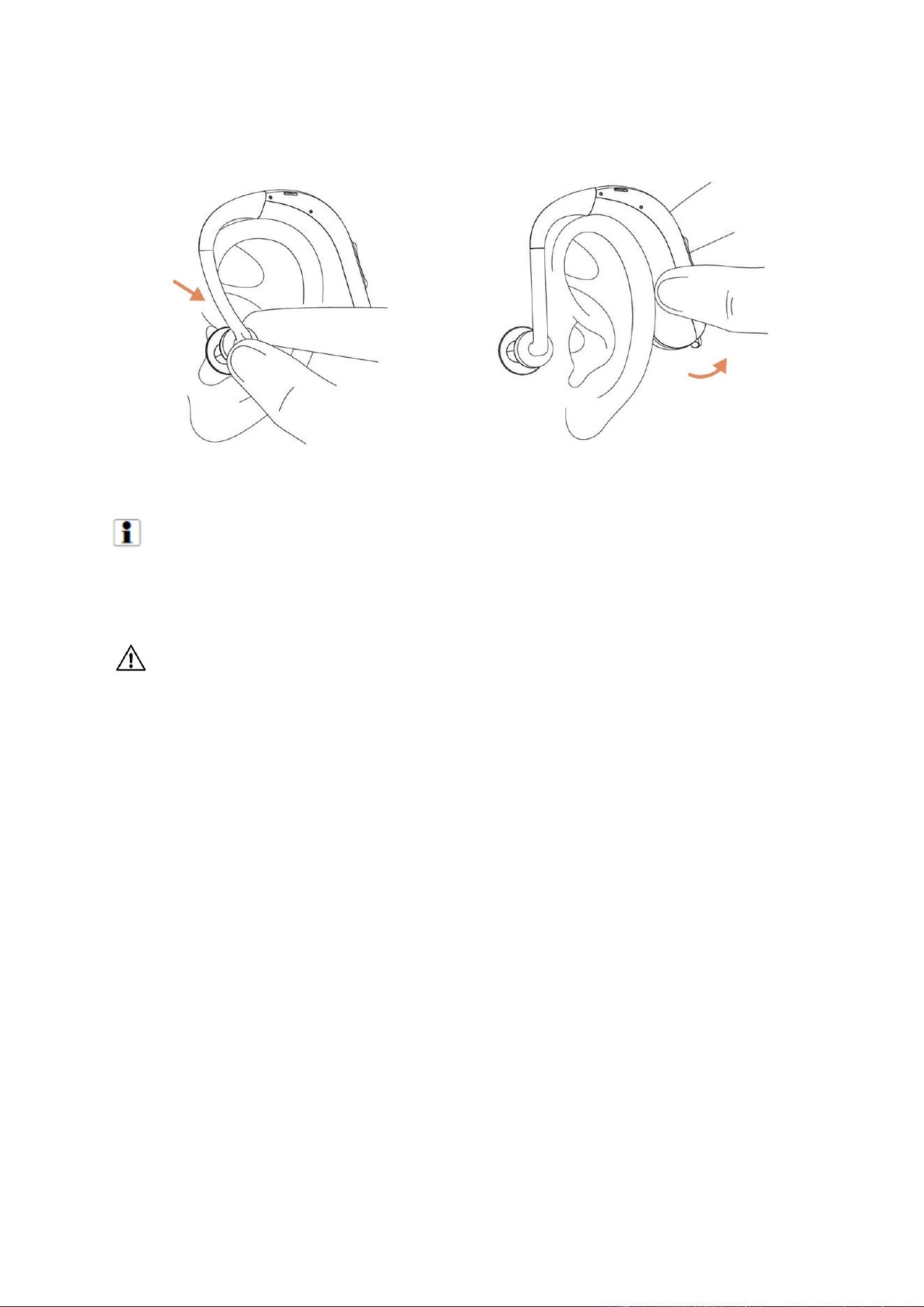
To remove your hearing aid correctly, follow these steps (see figure on the right):
1) Grasp the bend of the sound tube with your thumb and forefinger and gently
pull the dome out of your ear canal. (If you have a custom earmould, grasp
the small removal filament and gently pull the earmould out.) Avoid pulling
abruptly or roughly, as this could injure your ear or damage the device.
2) Once the dome is out, lift the hearing aid body from behind your ear.
12
Tip:
1) It is normal to find insertion and removal a bit tricky at first. With practice,
this will become much easier.
2) Using both hands can make the process easier.
Caution:
1) Do not attempt to modify the shape of the hearing aid, domes, or sound
tube.
2) If you have difficulty in inserting or removing your hearing aid, please
contact your hearing aid professional.
3) If you experience significant discomfort while putting on your hearing aid,
such as pain, swelling, or persistent feedback (whistling), please contact
your hearing aid professional promptly.
7. Wireless Function
This hearing aid features Bluetooth and can connect wirelessly to iPhones and to
Android phones running Bluetooth version 4.2 or higher.
Please consult your hearing aid professional for details on the application
software.
8. Multi-Function Button
The button on the hearing aid is a multi-function control. It can be used to adjust
volume or switch listening programs, depending on how it has been configured.
Please consult your hearing aid professional for details on your specific settings.
IV. Maintenance and Service

13
Your hearing aid is a precision electronic device. Keeping it clean and dry during
daily use is essential for reliable performance. Daily Care and Maintenance:
1) After each use, wipe any oil or moisture from the hearing aid body, sound
tube and ear hook with a soft, dry cloth or tissue. Do not use wet cloths or
cleaning agents.
2) Do not immerse the hearing aid in water or any other liquid.
3) Avoid dropping the hearing aid onto hard surfaces.
4) Do not expose the hearing aid to heat sources or direct sunlight, such as inside
a closed car in the summer, as overheating may cause damage to the hearing
aid.
5) Do not put on your hearing aid while showering, swimming, in the rain, or in
high-humidity environments like saunas or steam rooms.
6) If your hearing aid is exposed to water or high humidity, turn it off
immediately. Place it in a hearing aid dehumidifier (not supplied) and do not
use it again until it is completely dry.
7) Remove your hearing aid before applying cosmetics, perfume, shaving cream,
hairspray, or sunscreen.
8) In environments with significant temperature changes, condensation may
form inside the sound tube, which can affect sound transmission. If
condensation is present, contact your hearing care professional for service.
9) If the sound tube shows noticeable discoloration or cracks, contact your
hearing care professional for replacement.
Daily Cleaning
Follow these steps for daily cleaning:
1) At the end of each day, wipe the hearing aid body with a soft, dry cloth or
tissue; use the small brush supplied to clean the sound tube and the dome or
earmould.
2) We recommend using a hearing aid dehumidifier to prevent moisture from
damaging internal components.
3) To ensure the best performance, have your ear canals checked regularly for
excess earwax, as cerumen impaction can affect your hearing aid
effectiveness.
Dome Cleaning
Follow these steps to clean the dome:
1) Earwax and debris can build up on the dome or earmould over time. Use the
small brush or a cleaning cloth provided to remove them. While cleaning,
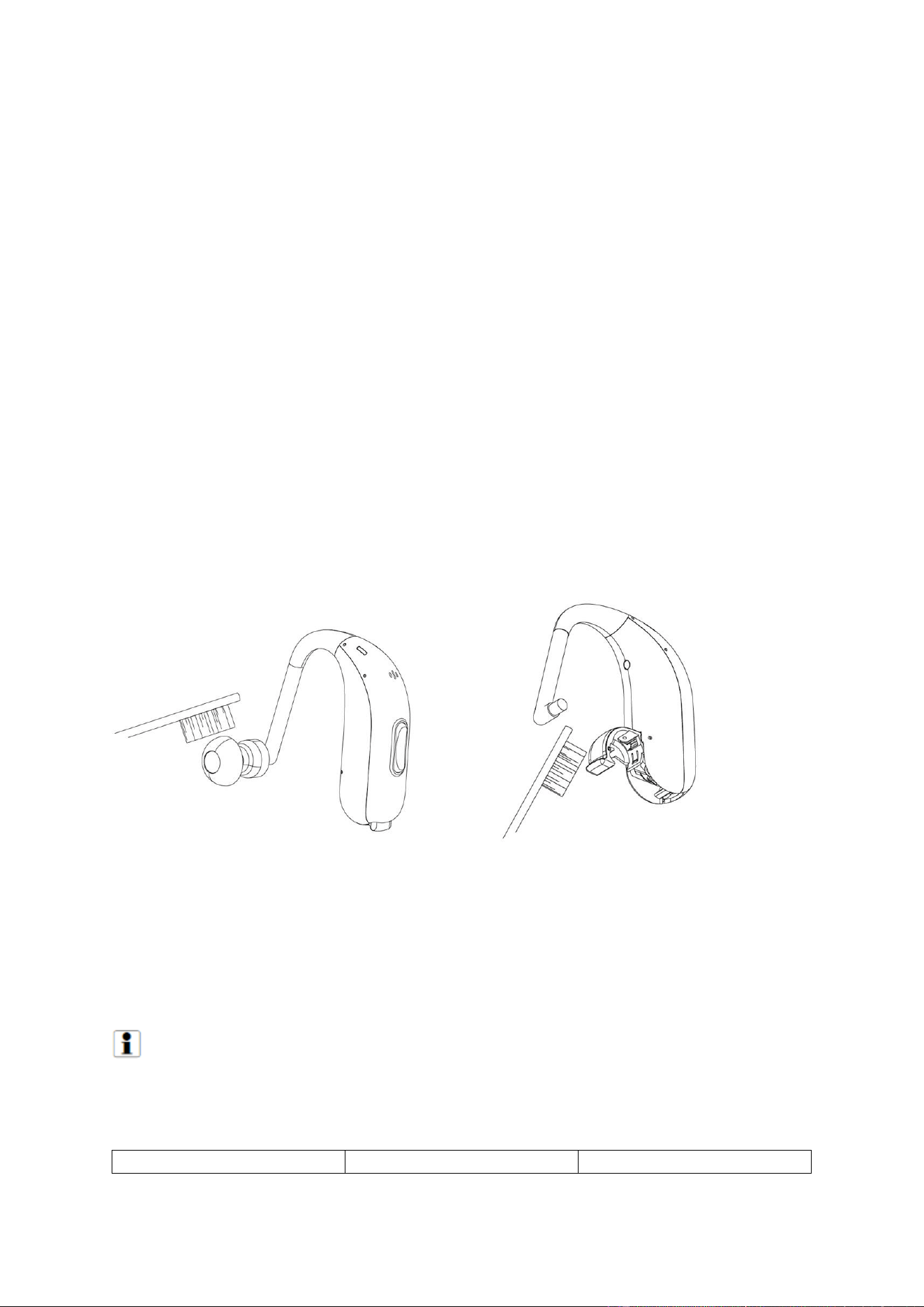
14
ensure the sound tube does not come into contact with water or other liquids.
Do not use alcohol to clean the dome.
2) If the dome or earmould becomes damaged during normal use, contact your
hearing aid professional immediately for a replacement.
Hearing Aid Cleaning
1) After daily use, wipe any earwax or perspiration from the surface of the
hearing aid with a soft, dry cloth. You can also perform a more thorough
cleaning every 2-3 months using a soft cleaning cloth or a cotton swab to
gently wipe the hearing aid surface.
2) Be careful to prevent any liquid from entering the microphone opening or
sound tube.
3) If the sound tube or microphone opening appear blocked with debris, use the
small brush supplied to gently clean them.
4) Never insert any sharp tools into the sound tube.
Tip: Following these maintenance procedures can help extend the life of your
hearing aids and reduce the need for repairs.
V. Troubleshooting
If you experience any of the following problems with your hearing aid,
please try these solutions first:
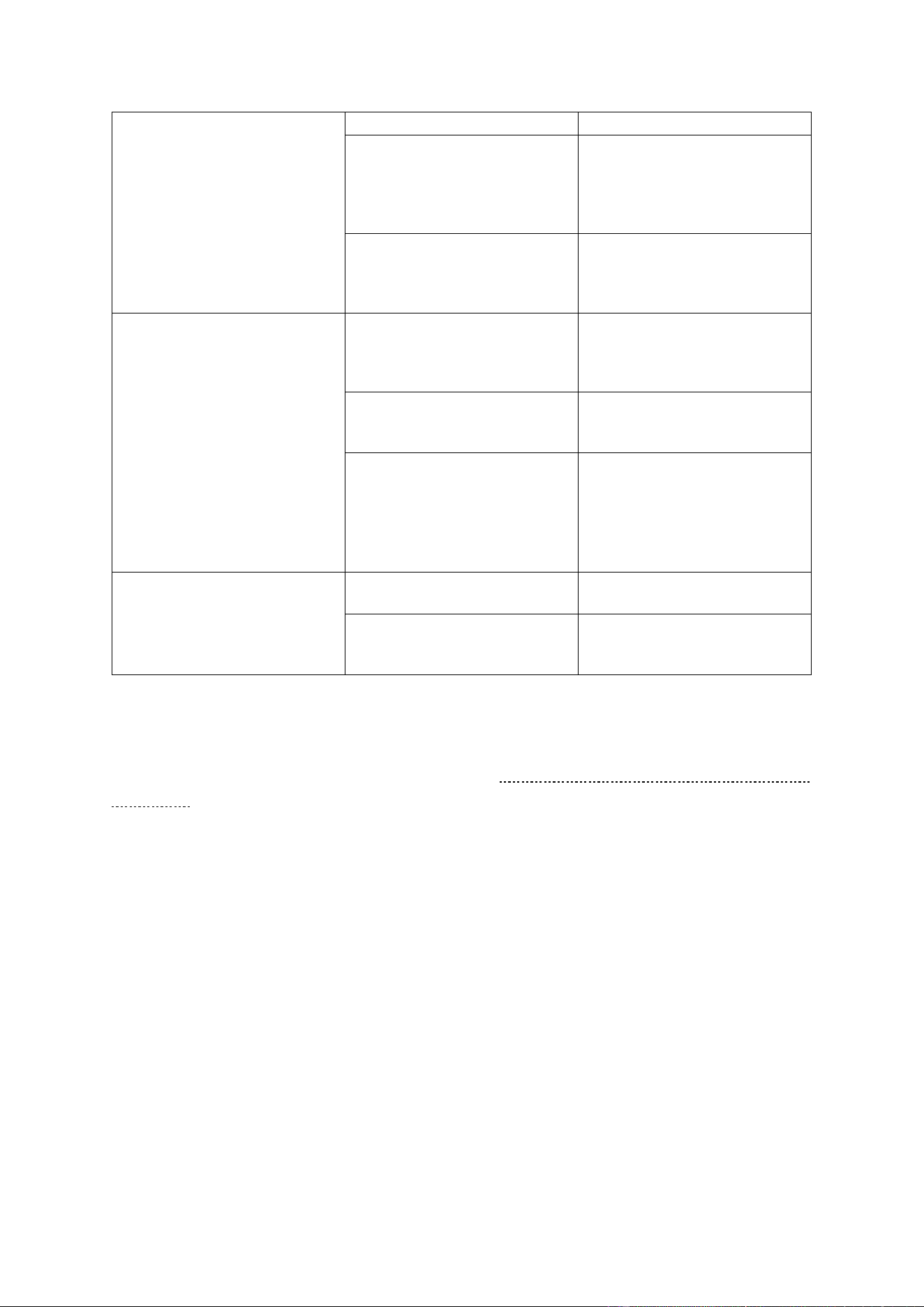
Guidance on Basic Troubleshooting
Manifestation of problems
Reasons
Solutions
15
Hearing aid silent
Hearing aid out of power
Replace the hearing aid battery.
Battery malfunction
Reboot the device after replacing
the battery. If the problem
persists, contact your audiologist
or hearing aid professional for
servicing.
The dome or earmould is blocked
by earwax, cotton fibers, dust, or
other debris.
Clean the dome, or earmould. If
the problem persists, contact your
audiologist or hearing aid
professional for servicing.
Sound intermittent or weak (at
microphone opening)
The dome or earmould is clogged
by earwax, cotton fibers, dust, or
other debris.
Clean the dome, or earmould. If
the problem persists, contact your
audiologist or hearing aid
professional for servicing.
Moisture inside the sound tube.
Contact your audiologist or
hearing aid professional for
servicing.
The microphone is damp or has
moisture in it.
Wipe the hearing aid dry and
place it in a dedicated
dehumidifier;
Contact your audiologist or
hearing aid professional for
servicing.
Hearing aid whistling
The hearing aid, earmould, or
dome is not inserted correctly.
Adjust the position and reinsert
it;
Excessive earwax in the ear
canal.
Consult a medical professional to
have your ear canal examined
and cleaned.
If the solutions above do not work or there are other problems with the hearing
aid, please contact your hearing aid professional or the United Imaging Hearing
Aid Customer Service Center immediately. Do not attempt to repair the device
yourself!
VI. Precautions
Precautions
1) A professional hearing examination and assessment should be completed
before you are fitted for a hearing aid. The device must be used under the
professional guidance of a doctor or hearing aid professional.
2) Users with a history of otitis media should reduce their wearing time as
needed to prevent recurrence of otitis media or damage to the eardrum.
3) Do not ingest or inhale any items from the packaging, including the desiccant
and cleaning tools.
4) Handle the program and volume control buttons gently. Do not use excessive
force.
5) The wireless Bluetooth function uses low-power digital technology and is

16
unlikely to interfere with other electronic devices. However, if interference
occurs, move away from those electronic devices.
6) Avoid exposing the hearing aid to strong electromagnetic interference.
7) We recommend installing security software on any connected devices to
ensure a secure operating environment.
8) Protect the hearing aid from moisture, drops, and high temperatures.
9) Do not leave the hearing aid in direct sunlight, near heat sources, or inside a
hot car.
10) Avoid dropping the hearing aid onto hard surfaces.
11) Never immerse the hearing aid in any liquid. Do not put it on while showering,
swimming, in the rain, or in high-humidity environments like saunas or steam
rooms. Always remove your hearing aid before swimming or bathing. After
these activities, ensure your ear canal is completely dry before reinserting the
hearing aid.
12) Remove your hearing aid before applying cosmetics, perfume, shaving cream,
hairspray, or sunscreen.
13) If the hearing aid is accidentally dropped in water or exposed to moisture,
immediately wipe it dry and place it in a dedicated hearing aid dehumidifier.
Do not use it again until it is completely dry. Or, if you have concerns, contact
your hearing aid professional.
14) Keep the hearing aid casing clean and regularly remove earwax from the
domes. After each use, wipe the device with a dry cloth or tissue to remove
any moisture or oil. Do not use wet cloths or cleaning agents. Store the clean
hearing aid in its dedicated dehumidifier.
15) Use a dedicated hearing aid dehumidifier to prevent moisture damage and
maintain optimal performance.
16) Schedule regular maintenance and check-ups with your hearing aid
professional to ensure your hearing aid remains in excellent working
condition.
17) Keep the hearing aid away from pets and children to prevent accidental
damage.
18) When not in use, store the hearing aid in its case to protect it, including from
insects.
19) The patient must operate all functions of the hearing aid safely, following the
guidance of their hearing aid professionals and the instructions for use.
20) The patient must maintain the hearing aid according to the instructions from
their hearing aid professionals and the instructions for use.

17
21) Check first before using the hearing aid in areas where electronics or wireless
devices are restricted.
22) The sound tube is a replaceable component. Please contact a professional for
replacement.
Warnings
1) The hearing aid must be selected, fitted, and used under professional guidance.
Improper use can cause further hearing damage.
2) Unauthorized modifications to the hearing aid may compromise its basic
safety and are strictly prohibited.
3) No maintenance or servicing should be performed on the hearing aid while it
is being worn.
4) Do not attempt to service or maintain the hearing aid while it is in use.
5) This device is not intended for children under 36 months of age. Use by
children or individuals with cognitive impairments must be supervised by a
guardian.
6) High-intensity sound can damage your remaining hearing. For hearing aids
with a maximum output exceeding 132 dB SPL, use them with caution and
only as advised by your hearing aid professional.
7) Warning for hearing aid professionals: This hearing aid may produce a
maximum OSPL90 of 132 dB or higher. Care should be taken when fitting
this device to ensure that excessive sound pressure levels are not delivered to
the user.
8) Data sheet values were measured with a standardized custom shell. Please
note deviation from these values may occur based on individualized acoustic
coupling. When children wear hearing aids, the sound pressure level
generated in the ear canal may be significantly higher than in adults. It is
recommended to measure the RECD to correctly set the target value for
OSPL90.
9) If you experience a foreign body sensation, an allergic reaction, or potential
cerumen impaction, consult a doctor immediately.
10) Turn off the hearing aid wireless function when on an aircraft.
11) Strong magnetic fields (e.g., during an MRI) or radiation (e.g., during a CT
scan) can damage your hearing aid. We advise against putting on your hearing
aid in these scenarios.
12) Low-radiation sources such as anti-theft alarms, radio equipment, and mobile
phones are generally not expected to affect the hearing aid. However,

18
interference or a change in sound quality is possible. If this occurs, move
away from such electronic devices.
13) Do not use your hearing aid in potentially explosive areas such as mines or
oil fields, unless the area is certified as safe for such devices.
14) Do not alter the hearing aid gain settings yourself. Never allow others to use
your hearing aid, as it is programmed for your specific needs and could
damage their hearing.
15) This hearing aid contains small parts, which may cause choking if swallowed
by children. Guardians should pay full attention to prevent this situation. If a
part is swallowed, seek immediate medical attention.
16) A trial battery may be included for initial fitting and testing purposes only. If
this battery is expired or depleted, please replace it with a fresh one. If you
notice battery leakage, do not use the hearing aid, as the fluid can cause skin
injury. If battery fluid comes into contact with your skin, wipe the area clean
immediately. If you experience any stinging or discomfort, seek medical
attention right away. For instructions on how to handle a hearing aid that has
been exposed to battery leakage, please contact your hearing aid professional
or the United Imaging Hearing Aid Customer Service Center.
17) Do not dispose of the hearing aid or its battery in regular waste.
18) The ME equipment or ME system may be interfered with by other equipment,
even if that other equipment complies with corresponding national standards.
19) Please only use accessories and detachable parts that are specified in the
instructions for use.
20) Do not use your hearing aid in potentially oxygen-enriched areas such as
hyperbaric oxygen chamber or forest fields, unless the area is certified as safe
for such devices.
Vigilance
Any serious incident that has occurred in relation to the device should be reported
to the local representative of Shanghai United Imaging Microelectronics
Technology Co., Ltd. and the Competent Authority of the Member State. A
serious incident is defined as any malfunction, deterioration in the characteristics
and/or performance of the device, or inadequacy in the device Operations
Manual/ labeling which could lead to the death or serious deterioration in the state
of health of the user, OR could do so upon recurrence.
VII. Technical Specifications
1. Basic Safety Characteristics
19
1) Classification according to the type of protection against electric shock:
Internally powered equipment;
2) Classification according to the degree of protection against electric shock:
Type B applied part;
3) Classification according to the degree of protection against ingress of liquid:
IP68;
4) Classification according to the safety degree of product used in the
flammable anesthesia gas mixed with air, oxygen or nitrous oxide: not
Category AP or APG equipment;
5) Classification according to the use in oxygen-rich environments: This device
is not suitable for use in oxygen-rich environments;
6) Classification according to the mode of operation: Continuous operation;
7) Rated voltage and frequency of equipment: 1.45V;
8) Input power: Not applicable;
9) Whether the equipment has defibrillation-proof applied part: No;
10) Whether the equipment has a signal input or output part: Wireless
programming;
11) Permanently installed equipment or non-permanently installed equipment:
Non-permanently installed equipment;
12) No essential performance of the product;
13) The entire hearing aid is classified as the applied part.
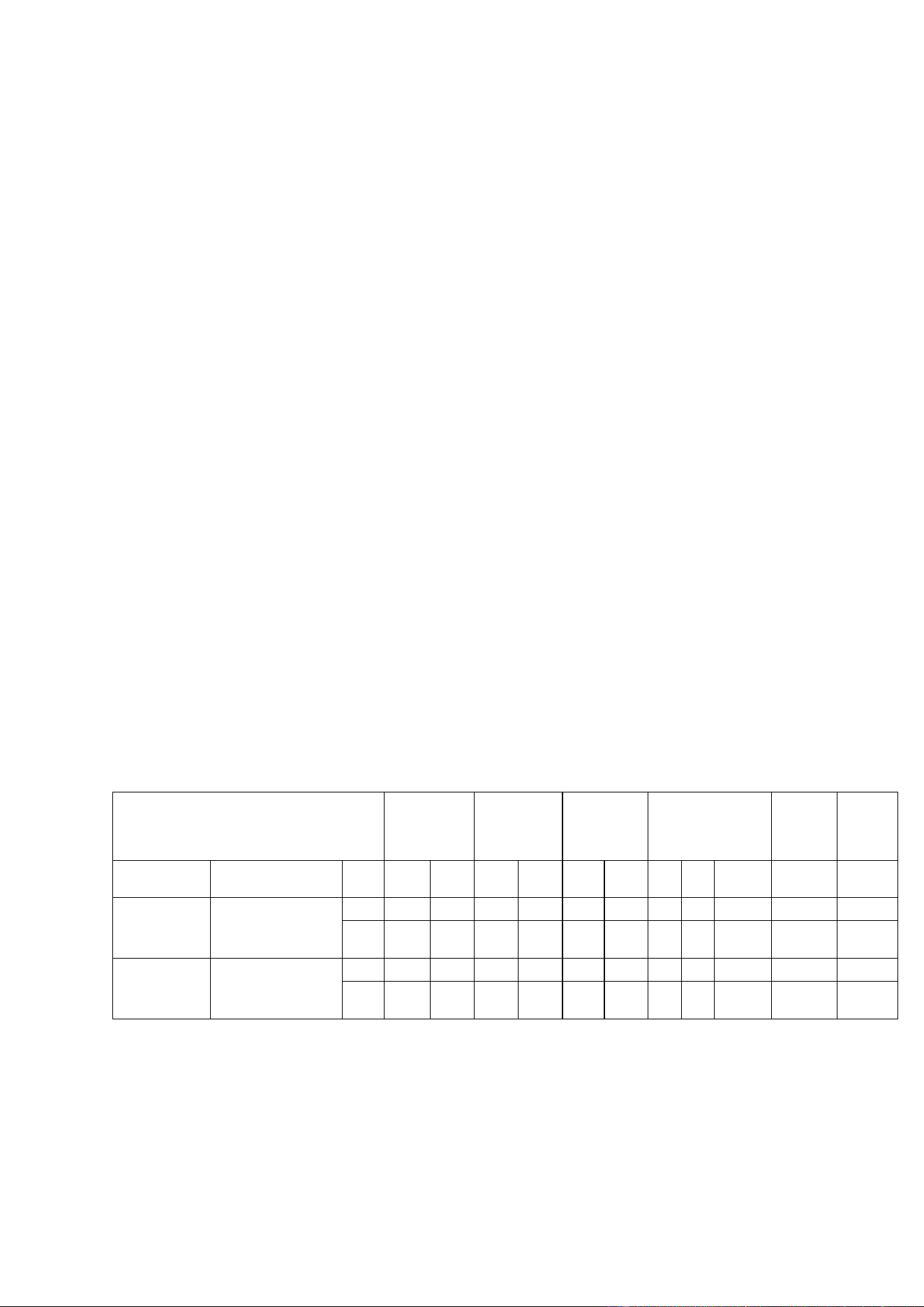
2. Electroacoustic Performance Parameters
Model/specification
OSPL
90
(dB SPL)
Full-on
acoustic gain
(dB)
Frequency
range (Hz)
Harmonic distortion
(%)
Equivalen
t noise
(dB SPL)
Battery
current
drain
(mA)
Model
Specification
recei
ver
Peak
value
HFA
Peak
value
HFA
F1
F2
500
Hz
800
Hz
1600 Hz
BTE SHW-13
n32/n33/n53/n55/
n56/n73/n75/n76/
n93/n94/n95/n96
UP
140
132
81
69
200
6300
5
1
1
19
1.5
SP
135
127
76
64
200
6300
2
1
1
19
1.5
BTE SCW-13
n32/n33/n34/n36/
n53/n54/n75/n95/
n96
UP
137
131
78
66
200
6300
5
2
2
19
1.5
SP
132
125
73
61
200
6300
3
2
2
19
1.5
Note: Technical specifications are tested according to the EN IEC 60118-0:2024 using a 2cm³ coupler
with the device in test mode. With a new battery, the hearing aid provides approximately 37 hours of use
with Bluetooth enabled and 92 hours with Bluetooth disabled (Test condition: 23 ± 3℃; 50% ± 5% RH).
Actual battery life will vary depending on individual usage and enabled settings.
3. Description on Wireless Network Security
Data Interface: Communication between the hearing aid and fitting software
is based on Bluetooth 5.2 protocol.

20
Data Storage Format: JSON.
4. User Access Control Mechanism
To adjust the hearing aid parameters, a wireless programmer establishes a
connection between the device (by wireless programming) and the United
Imaging fitting software on a computer. Access to the software requires a secure
login with username and password.
5. Environmental Conditions
1) Operating Conditions:
Temperature range: -10℃~40℃;
Relative humidity range: 15%~80%;
Atmospheric pressure range: 70 kPa~106 kPa
2) Transportation and Storage:
Temperature range: -25℃~70℃;
Relative humidity range: 10%~93%;
Atmospheric pressure range: 70 kPa~106 kPa
The time required for the ME equipment to warm from the minimum storage
temperature between uses until the ME equipment is ready for its intended use
when the ambient temperature is 20℃ is 15s.
The time required for the ME equipment to cool from the maximum storage
temperature between uses until the ME equipment is ready for its intended use
when the ambient temperature is 20℃ is 15s.
6. Disposal
Caution
Used zinc-air batteries can be harmful to the environment. Please collect used
batteries and dispose of them at a certified hazardous waste collection facility.
Disposing of earmoulds or hearing aids in household waste pollutes the
environment. Recycle hearing aids, accessories or batteries according to local
regulations. Hearing aid users can also return electronic waste to their hearing
care professional for disposal.
VIII. Electromagnetic Compatibility (EMC)
This hearing aid complies the IEC 60601-1-2 radiated emissions requirements for
a Group 1 Class B device as stated in CISPR 11.
Declaration - Electromagnetic Emissions
The BTE hearing aids are intended for use in the electromagnetic environment specified
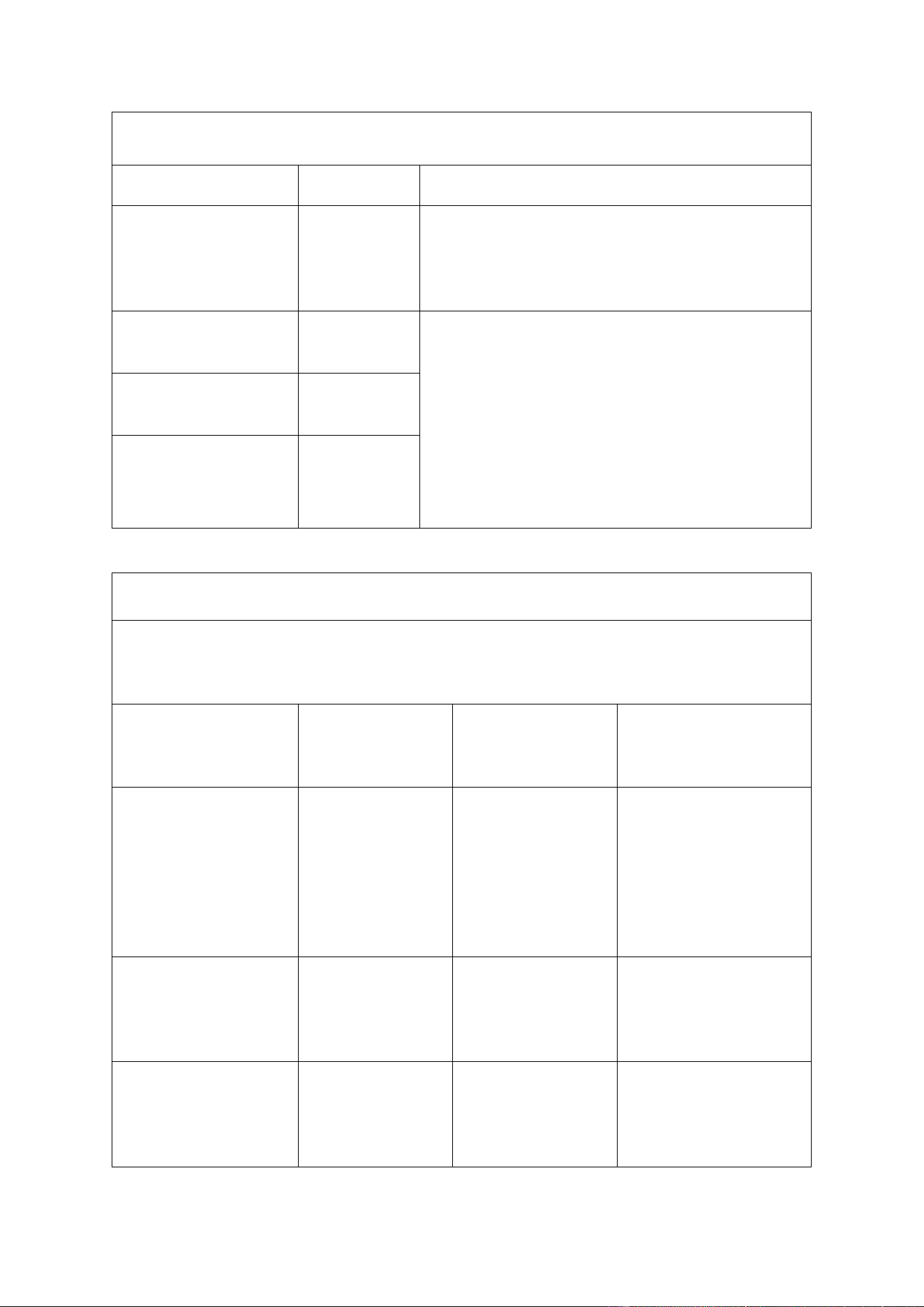
21
below. The customer or the user of the BTE hearing aids should assure that they are used in
such an environment.
Emissions test
Compliance
Electromagnetic environment - guidance
RF emissions CISPR
11
Group 1
The BTE hearing aids use RF energy only for its
internal function. Therefore, its RF emissions are
very low and are not likely to cause any
interference in nearby electronic equipment.
RF emissions
CISPR11
Class B
The BTE hearing aids is suitable for use in all
establishments, including domestic
establishments and those directly connected to the
public low-voltage power supply network that
supplies buildings used for domestic purposes.
Harmonic emissions
IEC 61000-3-2
N/A
Voltage fluctuations/
flicker emissions
IEC 61000-3-3
N/A
Guidance & Declaration — Electromagnetic Immunity
The BTE hearing aids are intended for use in the electromagnetic environment specified
below. The customer or the user of the BTE hearing aids should assure that they are used in
such an environment.
Immunity test
Required test
level
Compliance level
Electromagnetic
environment -
guidance
Electrostatic discharge
(ESD) IEC 61000-4-2
±8 kV contact
±2 kV, ±4 kV,
±8 kV,
±15 kV air
±8 kV contact
±2 kV, ±4 kV, ±8
kV,
±15 kV air
Floors should be wood,
concrete or ceramic
tile. If floors are
covered with synthetic
material, the relative
humidity should be at
least 30 %.
Electrical fast
transient/burst IEC
61000-4-4
Not applicable
Not applicable
Mains power quality
should be that of a
typical commercial or
hospital environment.
Surge IEC 61000-4-5
Not applicable
Not applicable
Mains power quality
should be that of a
typical commercial or
hospital environment.
22
Voltage dips, short
interruptions and
voltage variations on
power supply input
lines IEC 61000-4-11
Not applicable
Not applicable
Mains power quality
should be that of a
typical commercial or
hospital environment.
If the user of the BTE
hearing aids require
continued operation
during power mains
interruptions, it is
recommended that the
BTE hearing aids be
powered from an
uninterruptible power
supply or a battery.
Power frequency
(50/60 Hz) magnetic
field IEC 61000-4-8
30 A/m
50Hz & 60Hz
30 A/m
50Hz & 60Hz
Power f requency
magnetic
fields/Proximity
magnetic fields should
be at levels
characteristic of a
typical location in a
typical commercial or
hospital environment.
Proximity magnetic
Fields IEC 61000-4-
39
CW 8A/m for
30kHz Pluse
modulation
2.1kHz, 65A/m
for
134.2kHz Pluse
modulation
50kHz, 7.5A/m
for 13.56MHz
CW 8A/m for
30kHz Pluse
modulation
2.1kHz, 65A/m for
134.2kHz Pluse
modulation
50kHz,7.5A/m for
13.56MHz
NOTE U
T
is the a.c. mains voltage prior to application of the test level.
Guidance & Declaration - Electromagnetic Immunity Concerning
Conducted RF & Radiated RF
The BTE hearing aids are intended for use in the electromagnetic environment specified
below. The customer or the user of the BTE hearing aids should assure that they are used in
such an environment.
Immunity test
Required test level
Compliance level
Electromagnetic
environment -
guidance
Conducted RF IEC
61000-4-6
Not applicable
Not applicable
Portable RF
communications
equipment
(including
peripherals such as
Radiated RF IEC
61000-4-3
10V/m
10V/m
23
80 MHz to 2.7GHz
80% AM at 1kHz
385MHz-5785MHz
Test specifications
for ENCLOSURE
PORT IMMUNITY
to RF wireless
communication
equipment (Refer to
table 9 of IEC 60601-
1-2:2014+A1:2020)
80 MHz to 2.7GHz
80% AM at 1kHz
385MHz-5785MHz
Test specifications
for ENCLOSURE
PORT IMMUNITY
to RF wireless
communication
equipment (Refer to
table 9 of IEC 60601-
1-2:2014+A1:2020)
antenna cables and
external antennas)
should be used no
closer than 30 cm (12
inches) to any part of
the BTE hearing
aids, including
cables specified by
the manufacturer.
Otherwise,
degradation of the
performance of this
equipment could
result.
Radiated RF IEC
60118-13
10V/m
0.65GHz to 0.96GHz
& 1.4GHz to 2.7GHz
(Refer to table 1 of
IEC 60118-13:2019)
10V/m
0.65GHz to 0.96GHz
& 1.4GHz to 2.7GHz
(Refer to table 1 of
IEC 60118-13:2019)
Caution
The hearing aids are designed to operate in public and residential environments
and are designed to comply with international Electromagnetic Compatibility
emissions and immunity standards for medical devices.
However, it is still possible that you may experience interference caused by power
line disturbances, airport metal detectors, electromagnetic fields from other
medical devices, radio signals and electrostatic discharges.
If you use other medical devices or wear implantable medical devices such as
defibrillators or pacemakers and are concerned that your hearing aids might cause
interference with the medical device, please contact the physician or the
manufacturer of the medical device for information about the risk of disturbance.
The hearing aids should not be worn during an MRI procedure or in a hyperbaric
chamber.
Use of this equipment adjacent to or stacked with other equipment should be
avoided because it could result in improper operation. If such use is necessary,
this equipment and the other equipment should be observed to verify that they are
operating normally.
Use of accessories and detachable parts other than those specified or provided by
the manufacturer of this equipment could result in increased electromagnetic

24
emissions or decreased electromagnetic immunity of this equipment and result in
improper operation.
25
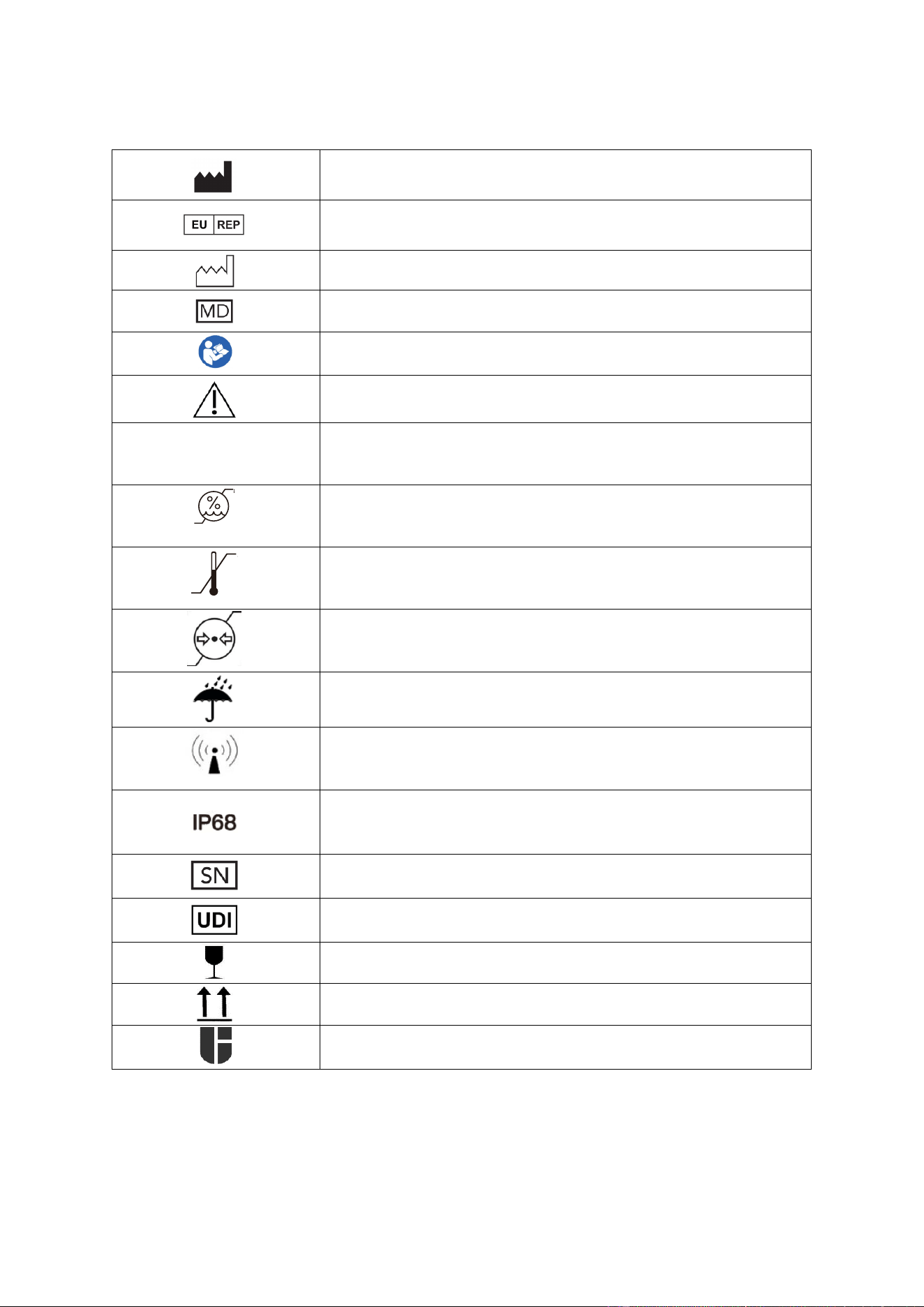
IX. Symbol and Mark Legend
Manufacturer
Authorized representative in the European Community
Date of Manufacture
Medical Device
Read instructions before use
Note: On the equipment "Follow the instructions for use".
Warnings and Cautions
+
Battery positive
Insert the battery into the compartment correctly, aligning the positive
terminal as marked.
Humidity limitation
Humidity limitation are indicated adjacent to the upper and lower
horizontal lines.
Temperature limit
Upper and lower limits of temperature are indicated adjacent to the upper
and lower horizontal lines.
Atmospheric pressure limitation
Upper and lower limits of atmospheric are indicated adjacent to the
upper and lower horizontal lines.
Keep dry
Non-ionizing radiation
Interference may occur in the vicinity of equipment marked with the
following symbol.
Degree of enclosure protection
6: Dust-tight;
8: Protection against continuous submersion in water;
Serial number and body number
Unique device identifier
Handle with care
This way up
United Imaging Group
X. Maintenance Policy
From date of purchase, your hearing aid is covered by a comprehensive warranty.
26
For specific warranty periods, consult the dealer and manufacturer. The warranty
period is calculated from the date of purchase. Any malfunctioning hearing aid
must be serviced by a qualified technician. Unauthorized disassembly or repair
attempts will void the warranty. The warranty does not cover damage resulting
from normal wear and tear, improper use, exposure to chemicals, or
circumstances beyond our control (Force Majeure).
0197
Wireless Connection Specifications:
Bluetooth Protocol: Bluetooth 5.2
Main Functions: Data transfer
Modulation Method: GFSK
Frequency Range: 2400–2483.5MHz
Transmission Power: ≤ 20dBm
Occupied Bandwidth: ≤ 3MHz
Date of Manufacture: See the product package
Lifetime: 5 years
* As an electronic medical device, the actual lifespan of the hearing aid will vary
based on changes in the user’s hearing condition and how it is used and
maintained. Factors such as excessive earwax, exposure to dusty or humid
environments, and improper cleaning will shorten the device’s lifespan. While
proper maintenance may extend the device’s lifespan.
Preparation Date of IFU: December, 2025
Shanghai United Imaging Microelectronics Technology Co., Ltd.
Building 4, Lane 150, Taiye Street, Jiading District, 201899
Shanghai, P.R.China
E-mail: UIM_Sales@uim-solution.com
Shanghai International Holding Corp. GmbH (Europe)
Eiffestrasse 80, 20537 Hamburg, Germany
Tel: +49-40-2513175

27
Revision: 01
Document No: 9010100314-EUD-BTE
XI. FCC Statement
This equipment has been tested and found to comply with the limits for a Class B
digital device, pursuant to Part 15 of the FCC Rules.Any changes or
modifications not expressly approved by the party responsible for compliance
could void the user's authority to operate the equipment. These limits are
designed to provide reasonable protection against harmful interference in a
residential installation.This equipment generates, uses and can radiate radio
frequency energy and, if not installed and used in accordance with the
instructions, may cause
harmful interference to radio communications. However, there is no guarantee
that
interference will not occur in a particular installation. lf this equipment does
cause
harmful interference to radio or television reception, which can be determined
by
turning the equipment off and on, the user is encouraged to try to correct the
interference by one or more of the following measures:
-Reorient or relocate the receiving antenna.
Increase the separation between the equipment and receiver.
-Connect the equipment into an outlet on a circuit different from that to which
the receiver is connected.
-Consult the dealer or an experienced radio/TV technician for help.
Radiation Exposure Statement
This device complies with FCC radiation exposure limits set forth for an
uncontrolled environment and it also complies with Part 15 of the FCC RF
Rules.
This device complies with part 15 of the FCC Rules. Operation is subject to the

28
following two conditions: (1) This device may not cause harmful interference,
and (2) this device must accept any interference received, including interference
that may cause undesired operation.
Changes or modifications not expressly approved by the party responsible for
compliance could void the user’s authority to operate the equipment.

