Powered by
Network
Camera
Operation Manual
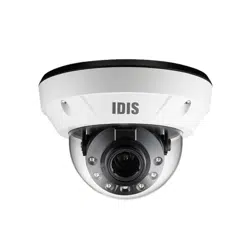
DC-S6883WRA
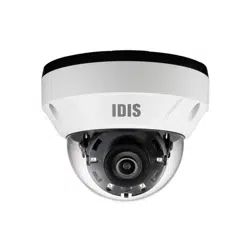
DC-S6683WRA
2
This is a basic operation manual for use of an IDIS network camera. Users who are using this product for the rst time,
as well as users with experience using comparable products, must read this operation manual carefully before use and
heed to the warnings and precautions contained herein while using the product. Safety warnings and precautions
contained in this operation manual are intended to promote proper use of the product and thereby prevent accidents
and property damage and must be followed at all times. Once you have read this operation manual, keep it at an easily
accessible location for future reference.
• The manufacturer will not be held responsible for any product damage resulting from the use of unauthorized parts and
accessories or from the user’s failure to comply with the instructions contained in this manual.
• The information in this document is believed to be accurate as of the date of publication even though explanation
about some functions may not be incorporated. The manufacturer is not responsible for any problems resulting from
the use thereof. The information contained herein is subject to change without notice. Revisions or new editions to this
publication may be issued to incorporate such changes.
• It is recommended that rst-time users of this network camera and individuals who are not familiar with its use seek
technical assistance from their retailer regarding product installation and use.
• If you need to disassemble the product for functionality expansion or repair purposes, you must contact your retailer and
seek professional assistance.
• Both retailers and users should be aware that this product has been certied as being electromagnetically compatible for
commercial use. If you have sold or purchased this product unintentionally, please replace with a consumer version.
Safety Symbols
Symbol Publication Description
IEC60417, No.5031
Direct current
In-Text
Symbol Type Description
Caution
Important information concerning a specic function.
Note
Useful information concerning a specic function.
Before reading this manual
Before reading this manual
3
Safety Precautions
WARNING
RISK OF ELECTRIC SHOCK
DO NOT OPEN
WARNING: TO REDUCE THE RISK OF ELECTRIC SHOCK,
DO NOT REMOVE COVER (OR BACK).
NO USER-SERVICEABLE PARTS INSIDE.
REFER SERVICING TO QUALIFIED SERVICE PERSONNEL.
Important Safeguards
1. Read Instructions
All the safety and operating instructions should be read before the
appliance is operated.
2. Retain Instructions
The safety and operating instructions should be retained for future
reference.
3. Cleaning
Unplug this equipment from the wall outlet before cleaning it. Do not
use liquid aerosol cleaners. Use a damp soft cloth for cleaning.
4. Attachments
Never add any attachments and/or equipment without the approval
of the manufacturer as such additions may result in the risk of re,
electric shock or other personal injury.
5. Water and/or Moisture
Do not use this equipment near water or in contact with water.
6. Placing and Accessories
Do not place this equipment on an wall or ceiling that is not strong
enough to sustain the camera. The equipment may fall, causing
serious injury to a child or adult, and serious damage to the
equipment. Wall or shelf mounting should follow the manufacturer's
instructions, and should use a mounting kit approved by the
manufacturer.
This equipment and cart combination should be moved with care.
Quick stops, excessive force, and uneven surfaces may cause the
equipment and cart combination to overturn.
Do not place this equipment in an enclosed space. Sucient
ventilation is required to prevent an increase in ambient temperature
which can cause malfunction or the risk of re.
7. Power Sources
This equipment should be operated only from the type of power
source indicated on the marking label. If you are not sure of the
type of power, please consult your equipment dealer or local power
company.
You may want to install a UPS (Uninterruptible Power Supply)
system for safe operation in order to prevent damage caused by an
unexpected power stoppage. Any questions concerning UPS, consult
your UPS retailer.
This equipment should be remain readily operable.
8. Power Cord
Operator or installer must remove power and TNT connections before
handling the equipment.
9. Lightning
For added protection for this equipment during a lightning storm,
or when it is left unattended and unused for long periods of time,
unplug it from the wall outlet and disconnect the antenna or cable
system. This will prevent damage to the equipment due to lightning
and power-line surges. If thunder or lightning is common where the
equipment is installed, use a surge protection device.
10. Overloading
Do not overload wall outlets and extension cords as this can result in
the risk of re or electric shock.
11. Objects and Liquids
Never push objects of any kind through openings of this equipment
as they may touch dangerous voltage points or short out parts that
could result in a re or electric shock. Never spill liquid of any kind on
the equipment.
12. Servicing
Do not attempt to service this equipment yourself. Refer all servicing
to qualied service personnel.
13. Damage requiring Service
Unplug this equipment from the wall outlet and refer servicing to
qualied service personnel under the following conditions:
A. When the power-supply cord or the plug has been damaged.
B. If liquid is spilled, or objects have hit the equipment.
C. If the equipment has been exposed to rain or water.
D. If the equipment does not operate normally by following the
operating instructions, adjust only those controls that are covered
by the operating instructions as an improper adjustment of other
controls may result in damage and will often require extensive work
by a qualied technician to restore the equipment to its normal
operation.
E. If the equipment has been dropped, or the cabinet damaged.
F. When the equipment exhibits a distinct change in performance —
this indicates a need for service.
14. Replacement Parts
When replacement parts are required, be sure the service technician
has used replacement parts specied by the manufacturer or that
have the same characteristics as the original part. Unauthorized
substitutions may result in re, electric shock or other hazards.
15. Safety Check
Upon completion of any service or repairs to this equipment, ask the
service technician to perform safety checks to determine that the
equipment is in proper operating condition.
16. Field Installation
This installation should be made by a qualied service person and
should conform to all local codes.
17.Correct Batteries
Warning: Risk of explosion if battery is replaced by an incorrect type.
Replace only with the same or equivalent type.
Dispose of used batteries according to the instructions.
The battery shall not be exposed to excessive heat such as sunshine,
re or the like.
18. Tmra
A manufacturer’s maximum recommended ambient temperature
(Tmra) for the equipment must be specied so that the customer and
installer may determine a suitable maximum operating environment
for the equipment.
Before reading this manual
4
FCC Compliance Statement
THIS EQUIPMENT HAS BEEN TESTED AND FOUND TO COMPLY WITH THE LIMITS FOR A CLASS A DIGITAL DEVICE, PURSUANT TO PART
15 OF THE FCC RULES. THESE LIMITS ARE DESIGNED TO PROVIDE REASONABLE PROTECTION AGAINST HARMFUL INTERFERENCE
WHEN THE EQUIPMENT IS OPERATED IN A COMMERCIAL ENVIRONMENT. THIS EQUIPMENT GENERATES, USES, AND CAN RADIATE
RADIO FREQUENCY ENERGY AND IF NOT INSTALLED AND USED IN ACCORDANCE WITH THE INSTRUCTION MANUAL, MAY CAUSE
HARMFUL INTERFERENCE TO RADIO COMMUNICATIONS. OPERATION OF THIS EQUIPMENT IN A RESIDENTIAL AREA IS LIKELY TO
CAUSE HARMFUL INTERFERENCE, IN WHICH CASE USERS WILL BE REQUIRED TO CORRECT THE INTERFERENCE AT THEIR OWN EXPENSE.
WARNING: CHANGES OR MODIFICATIONS NOT EXPRESSLY APPROVED BY THE PARTY RESPONSIBLE FOR COMPLIANCE COULD VOID
THE USER’S AUTHORITY TO OPERATE THE EQUIPMENT. THIS CLASS OF DIGITAL APPARATUS MEETS ALL REQUIREMENTS OF THE
CANADIAN INTERFERENCE CAUSING EQUIPMENT REGULATIONS.
WEEE (Waste Electrical & Electronic Equipment)
Correct Disposal of This Product
(Applicable in the European Union and other European countries with separate collection systems)
This marking shown on the product or its literature, indicates that it should not be disposed with other household
wastes at the end of its working life. To prevent possible harm to the environment or human health from
uncontrolled waste disposal, please separate this from other types of wastes and recycle it responsibly to promote
the sustainable reuse of material resources.
Household users should contact either the retailer where they purchased this product, or their local government
oce, for details of where and how they can take this item for environmentally safe recycling.
Business users should contact their supplier and check the terms and conditions of the purchase contract. This
product should not be mixed with other commercial wastes for disposal.
Copyright
© 2025 IDIS Co., Ltd.
IDIS Co., Ltd. reserves all rights concerning this manual.
Use or duplication of this manual in part or whole without the prior consent of IDIS Co., Ltd. is strictly prohibited.
Contents of this manual are subject to change without prior notice for reasons such as functionality enhancements.
Registered Trademarks
IDIS is a registered trademark of IDIS Co., Ltd.
Other company and product names are registered trademarks of their respective owners.
The software included in this product contains some Open Sources. You may obtain the corresponding source
code which we have to distribute according to the license policy. For more information, refer to System > General
page. This product includes software developed by the University of California, Berkeley and its contributors, and
software developed by the OpenSSL Project for use in the OpenSSL Toolkit (http://www.oepnssl.org/). Also, this
product includes cryptographic software written by Eric Young ([email protected]).

5
Table of Contents
1
Part 1 - Remote Setup ........................................7
Remote Setup ...................................................................7
Quick Setup .....................................................................8
System ..........................................................................9
General ...................................................................................9
Date/Time ...............................................................................10
User/Group ..............................................................................11
Network .......................................................................11
IP Address ...............................................................................12
FEN ......................................................................................13
Port/QoS .................................................................................14
Bandwidth Control .......................................................................15
Security ..................................................................................15
IEEE 802.1X ..............................................................................16
Video ..........................................................................16
Camera ..................................................................................17
Streaming ...............................................................................20
MAT .....................................................................................21
Privacy Masking ..........................................................................22
PTZ ......................................................................................23
OSD .....................................................................................28
Audio ..........................................................................29
Input/Output ............................................................................30
Event Action ...................................................................30
Alarm out ................................................................................31
Email ....................................................................................31
Remote Callback .........................................................................32
Audio Alarm .............................................................................32
FTP Upload ..............................................................................33
Record ...................................................................................34
PTZ AI Tracking ...........................................................................35
Event ..........................................................................36
Alarm In .................................................................................37
Motion Detection ........................................................................37
Audio Detection .........................................................................38
Tampering ...............................................................................39
System Event ............................................................................40
Table of Contents
6
IDLA ...........................................................................41
Object Detection .........................................................................42
Intrusion .................................................................................43
Loitering .................................................................................44
Line Crossing ............................................................................45
Face Detection ...........................................................................46
Advanced ................................................................................47
IDLA Pro .......................................................................48
Crowd Detection .........................................................................49
Abandoned Object Detection ............................................................50
Removed Object Detection ...............................................................51
Fall Detection ............................................................................52
Advanced ................................................................................52
Part 2 - IDLA Guide .........................................53
Part 3 - IDIS Web ............................................66
Web Live Mode .................................................................68
Web Search Mode ..............................................................71
Part 4 - Appendix ...........................................73
Index ..........................................................................73
2
3
4
7
Congure basic network camera settings and all other
system settings.
Screen images may vary depending on the model.
Remote Setup
1
Launch the IDIS Discovery program and then from
the main screen, select a network camera whose
settings you wish to change.
2
Click on the Setup icon.
3
Select Remote Setup from the Setup menu to load
the Remote Setup screen. Alternatively, you can
select Network Camera from the main screen and
then right-click to access the Remote Setup screen.
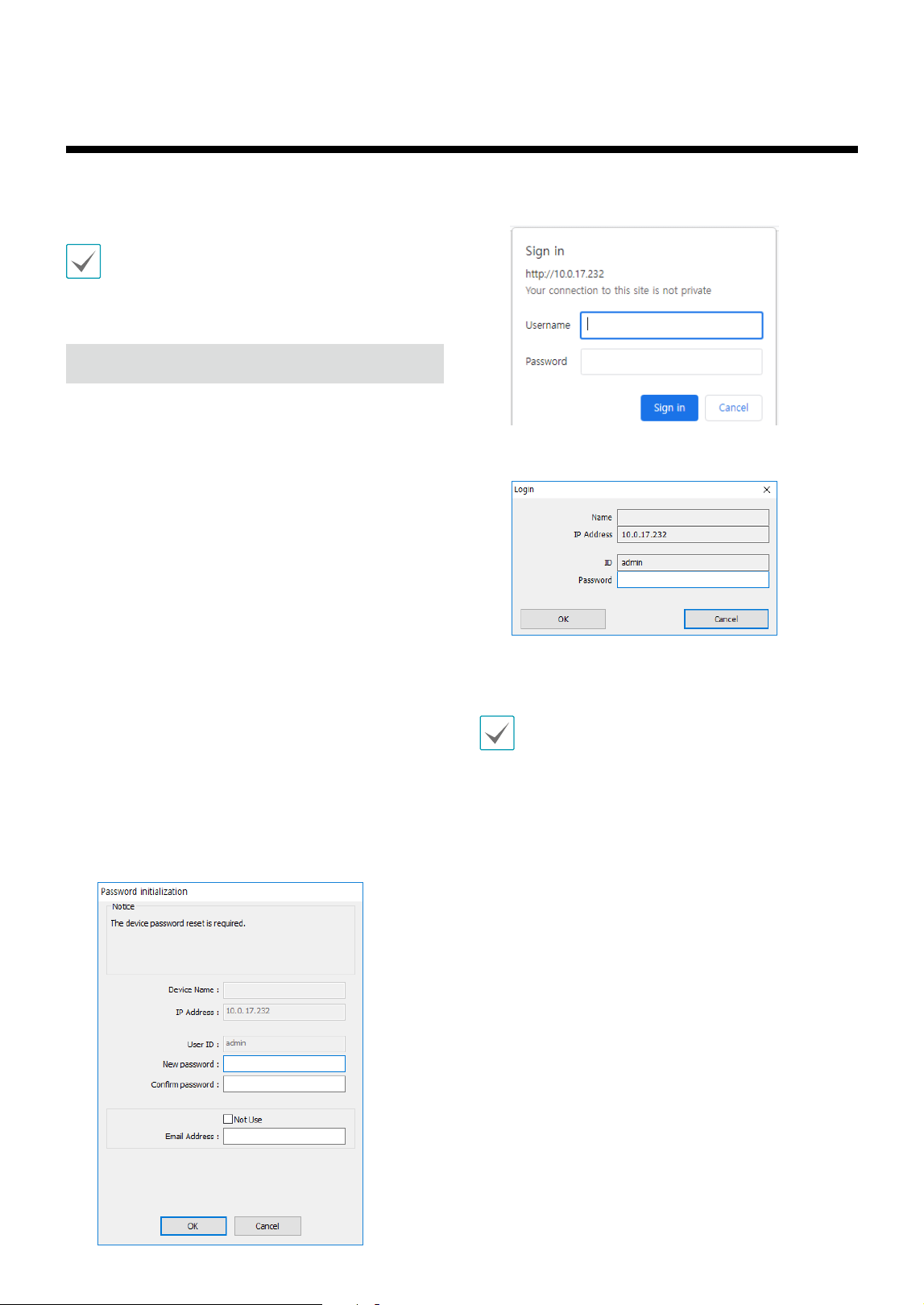
4
If you do not have a password, you must register a
password. Please enter your mobile phone number
(required) and email address (optional). If you
forget your password, you need to enter your mobile
phone number and email address to reset your
password. If you do not enter your mobile phone
number and email address and lose your password,
you need to initialize the device with the RESET
button on the camera, so be sure to memorize it.
5
Log in by entering the admin account and password
set above.
<Web Log In>
<IDIS Discovery Log In>
• IDIS Discovery connects to the default browser
during remote setup, so please use a supported
browser as the default browser.
• System settings can also be changed using a remote
program.
• Remote Setup works with the following web
browsers when the web browsers support HTML5:
Google Chrome, Edge, Mozilla Firefox, or Apple
Safari. It is recommended that you update the web
browser to the latest version.
Part 1 - Remote Setup
Part 1 - Remote Setup
8
From the Remote Setup screen, select the
menu on the left to display the current settings.
Select an option under the menu to change the
corresponding settings. Once you have changed
the settings, click Save to apply the settings.
Quick Setup
Quick Setup allows you to set up System, Network,
Video, Audio, and other basic settings needed for
camera use.
Part 1 - Remote Setup
9
System
Change the camera’s system information, add users/
groups, and/or import/export settings.
General
• Language: Select the language you wish to use for
remote setup.
• Name: Enter a name for the camera. (Up to 31
alphanumeric characters, including spaces)
• Note: Enter a description for the camera.
• Product: Indicates the model name of the camera.
• HW Version/SW Version: Indicates the camera’s
hardware and software versions.
• MAC Address: Indicates the MAC address of the
camera.
• Miscellaneous
- ONVIF Protocol: Select to enable ONVIF protocol
use. However, ONVIF Protocol is available only
to users belonging to the standard user groups
(Administrator, Operator, and User). When you
have connected to the camera by using the ONVIF
protocol, only the currently enabled streams or
events are supported and you cannot change it.
There may be some more settings that cannot be
changed, too. If you want to change those settings,
connect to the camera by using the IDIS Discovery
program.
- ONVIF Event Type
• Normal: This is the usual way the camera delivers
events.
• Standard: This is the ONVIF standard event
delivery method.
- Opensource Licenses: Click View to see the
information of opensource licenses.
Part 1 - Remote Setup
10
• Setup
- Load Default Setup: Restores all settings other
than Date/Time to their factory defaults. Select
Include Network Setup to load default network
settings as well. For more information on network
setup, refer to the Network on page 11.
- Import Setup: Open a setup le and apply its
settings to the camera. Click on the button and
then select a setup le. Select Include Network
Setup to apply the le’s network setup settings (exc.
FEN). For more information on network setup, refer
to the Network on page 11.
- Export Setup: Export the current settings as a .dat
le. Click on the button and then enter a le name.
• Load Default Setup and Import Setup options
are available only to users belonging to the
Administrator group.
• When applying the settings of a setup le, do not
select the Include Network Setup option if the
network settings contained in the selected le is
currently being used by a dierent camera. Doing
so can interfere with establishing a connection
with the other camera.
• If IP Address, Port, and/or SSL settings have been
changed, click Save to apply the current settings,
and then restart Remote Setup. If you do not
restart Remote Setup, the changes afterwards will
not be applied.
• Management
- Reboot: Reboot the camera.
Date/Time
• Date/Time: Change the camera’s date/time settings
and display formats and congure the time zone and
daylight saving time settings. Click Save to apply the
changes right away.
- Get from system: Synchronize with the local time
of the device connected to the web browser.
• Time Sync
- Automatic Sync: Select to synchronize the system’s
time with the time server at a specied interval.
Enter the time server’s IP address or domain name
and then specify the interval. Provides Manual
settings that can be entered directly and a list of
predened common time servers. If the time server
is FEN-enabled, select the Use FEN option and
then enter the time server’s name instead of its IP
address or domain name.
- Run as Server: Select to run the camera as a
time server. Other devices will then be able to
synchronize its time setting with this camera’s time
setting.
If you wish to enter a domain name instead of an
IP address for the Time Server setting, DNS server
must be congured during Network setup. If you
wish to enter a server name instead of an IP address
or a domain name, the Use FEN option must be
enabled during Network setup.
Setting up the Automatic Sync is required to
ensure there is no error to the SD card recording
time.
Part 1 - Remote Setup
11
User/Group
• User/Group: Change remote camera control
permission settings for users and user groups.
- Add Group: Add a new user group. Designate
a name for the group and then specify control
authorities.
- Add User: Add a new user. Designate a name for
the user, select which group to add the user to, and
then enter a connection password.
- Edit: Edit group authorities and/or user passwords.
Select a group or user and then click on the button.
- Remove: Delete groups or users. Select a group
of user you wish to delete and then click on the
button.
• User/Group settings can only be congured by
users belonging to the Administrator group.
• There is no default password for the Administrator
group's admin user.
• Standard groups (Administrator, Operator, and
User) cannot be edited or deleted. Authorities
assigned here apply identically to ONVIF protocol
user groups.
• Group authorities that can be assigned are as
follows:
– Upgrade: Upgrade the system.
– Setup: Congure the system's settings.
– Color Control: Adjust the camera's brightness,
contrast, saturation, and hue settings.
– PTZ Control: Authority to control pan/tilt driver’s
pan/tilt functions.
– Alarm-Out Control: Reset alarm outs.
– Search: Search video recordings saved on the SD
memory card from a remote program.
– Clip-Copy: Search video recordings saved on the
SD memory card and save them as video les
from a remote program.
Network
Change the network settings, enable FEN and security
features, and control network bandwidth use.
Part 1 - Remote Setup
12
IP Address
IPv4
• Type: Select the type of network you are using. If this
option has been changed, click Save to apply the
current settings, and then restart Remote Setup. If you
do not restart Remote Setup, the changes afterwards
will not be applied.
- Manual: Select if using a static IP. You will then be
able to congure the related settings manually.
- DHCP: Select if connected to the network using
DHCP. Click Save to retrieve IP address and other
network settings automatically from the DHCP
server.
• DNS Server: Enter the DNS server’s IP address. By
using the DNS server, you will be able to use domain
names instead of IP addresses when conguring the
FEN, time, or SMTP server. If the camera is connected
to the network via DHCP, select the From DHCP
option to retrieve the DNS server’s IP address from the
DHCP server automatically. The updated address will
be displayed upon the subsequent connection.
• RTP Multicast: Set up the IP address, the Port, and the
TTL for the RTP multicast.
• Link-local only: Use only the IP address of link-local
IPv4. (ex 169.254.x.x)
IPv6
• Check Use to activate IPv6.
• Type: Select the type of network you are using. If this
option has been changed, click Save to apply the
current settings, and then restart Remote Setup. If you
do not restart Remote Setup, the changes afterwards
will not be applied.
- Manual: Select if using a static IP. You will then be
able to congure the related settings manually.
- DHCP: Select if connected to the network using
DHCP. Click Save to retrieve IP address and other
network settings automatically from the DHCP
server or the router. If it can not be received
automatically, it will be created automatically from
the camera.
• View IP Address Information: The IPv6 address
assigned to the IP camera is shown.
• DNS Server: Enter the DNS server’s IP address. If
the camera is connected to the network via DHCP,
select the From DHCP option to retrieve the DNS
server’s IP address from the DHCP server or the router
automatically. If it can not be received automatically,
it will be created automatically from the camera.
The updated address will be displayed upon the
subsequent connection.
• Contact your network administrator for more
information on the camera's network connection
type, the DNS server's IP address, and other related
information.
• If using DHCP, the camera's IP address may change
from time to time. We therefore recommend that
you use the FEN feature.
• If using IPv6, some network function may be limited.
Part 1 - Remote Setup
13
FEN
Select Use FEN to enable the FEN feature.
• FEN Server: Enter the FEN Server’s IP address or
domain name.
• Port: Enter the FEN Server’s port number.
• FEN Name: Enter a camera name you wish to register
to the FEN Server. Click OK to check the name’s
availability.
• In WAN environment it is recommended to use
the UPnP while recording images using FEN or
when FEN connection is not stable. Otherwise,
surveillance and recording may not be desirable
depending on your network conguration
environment.
• Use FEN is a feature that allows you to register a
unique name for a camera that utilizes a dynamic
IP address to the FEN Server and connect to the
camera using the registered name instead of an
IP address, which can change from time to time.
Moreover, you can access the camera without
having to congure NAT (Network Address
Translation) device settings even when the camera
uses a NAT device. In order to use this feature, you
must rst register a FEN name to the FEN Server.
• If network settings have been changed, click Save
at the bottom of the setup window to save the
changes and then setup the FEN.
• Inquire with your network administrator for the FEN
Server’s IP address or domain name. If a DNS server
has been congured under Network setup, you can
enter the FEN Server’s domain name instead of its IP
address for the FEN Server setting.
• FEN Server's default address is fen.idisglobal.
com. DNS server must be congured under network
setup to ensure normal operation.
• You will not be able to save FEN settings unless
you click on the OK button next to the FEN name
eld and check the entered name's availability.
In addition, you will be prompted with an error
message if you do not enter a FEN name or enter
a name already registered to the FEN Server. If
the FEN name contains special characters, the
connection may not be made when the WebGuard
or remote setting is accessed by FEN name
through the Web browser. (If you can not access
special characters, you can access by changing the
encoding.)
The FEN Server operated by IDIS is a service to its
clients and may go oine without notice for server
update purposes or due to an unexpected failure.
Part 1 - Remote Setup
14
Port/QoS
• Use/Port: Enable/disable ports and designate
corresponding port numbers. Remote Port and HTTP
ports are enabled by default and cannot be disabled.
By enabling RTSP port, you will be able to use a media
player that supports RTSP (Real-Time Streaming
Protocol) service to connect to the camera. When
the HTTP port is enabled, you can run the camera’s
Remote Setup. If this option has been changed, click
Save to apply the current settings, and then restart
Remote Setup. If you do not restart Remote Setup, the
changes afterwards will not be applied.
• DSCP: Designate each port’s QoS (Quality of Service)
level using DSCP values. Assigning QoS levels
prioritizes the ports for network bandwidth use.
Higher the DSCP value, higher the QoS level and thus
higher on the network bandwidth allocation priority
list. Use 0 if you do not want to assign a QoS level. The
network environment must support DSCP in order
for this feature to function properly. Contact your
network administrator for more details.
• Use HTTPS: Select this option to apply https protocol-
based security on IDIS Web.
• Use UPnP: If the camera is connected to the network
via an IP router (or NAT), select this option to connect
to the camera without setting up port forwarding.
The IP router (or NAT) must be enabled with UPnP in
order for this feature to function properly. For more
information enabling UPnP on your IP router (or NAT),
refer to the IP router or NAT’s operation manual.
Click Check to test the current port settings.
A conrmation message will appear if all the
selected ports are available for use. If not, a list of
recommended port numbers will be shown.
Click Apply to use the recommended port numbers.
• Use SNMP: Select this option to enable SNMP (Simple
Network Management Protocol).
• In a WAN environment, it is recommended that you
use the UPnP function if you record video by using
the FEN function or FEN connection is not smooth.
Otherwise, monitoring or recording might not be
smooth depending on the network environment.
• Each port number must be unique.
• It is not allowed to use the same port number for
more than one function.
• You can connect to the camera using a media player
that supports RTSP service and monitor its video
feed. If the camera is connected to the network via
an IP router (or NAT) or is behind a rewall, you must
open the ports. (All ports if using UDP protocol and
RTSP ports if using TCP protocol) This feature may
not be supported by al media player. In addition,
video display on certain media players may not be
smooth depending on the network status, video
streaming compression method used, and/or the
resolution setting. Connection methods are as
follows:
– Via PC: Launch the media player (such as VLC)
and then enter rtsp://ID:Password@IP Address:
RTSP Port Number/trackID='Stream Number'
(Stream Number: 1 if Primary, 2 if Secondary, and
3 if Tertiary). (e.g.: rtsp://admin:@10.0.152.35:554/
trackID=1 (User: admin, Password: None, Camera
IP Address: 10.0.152.35, RTSP Port Number: 554,
Stream: Primary))
• Port numbers of the remote program must be
updated whenever the camera's port numbers are
changed.
• ONVIF protocol may not function if using HTTPS.
Part 1 - Remote Setup
15
Bandwidth Control
Regulates the camera’s network bandwidth use based
on network trac uctuations.
Select Network Bandwidth limit and then specify
the maximum bandwidth. The camera will not be able
to use more than the specied limit in the event of
network trac.
It may not be possible to produce the frame rate
specied under Video > Streaming if a network
bandwidth limit has been set.
Security
• IP Filtering: Select this option to enable IP Filtering.
IP Filtering allows camera access from certain IP
addresses and blocks access from others.
- Add: Add new IP addresses to Allow List or Deny
List. Select the Host option to add one IP address at
a time. Select the Group option to dene a range of
IP addresses you wish to add.
- Remove/Remove All: Remove individual or all IP
addresses from Allow List or Deny List.
• SSL: Select this option to enable SSL (Secure Sockets
Layer). Enabling this option applies SSL protocol
protection on data transmitted out. However,
programs and systems that do not support SSL will
not be able to connect to the camera. If this option
has been changed, click Save to apply the current
settings, and then restart Remote Setup. If you do not
restart Remote Setup, the changes afterwards will not
be applied.
• Time server, FEN Server, and SMTP server's IP
addresses must be added to Allow List under IP
Filtering in order to use Time Sync, FEN, and Send
Email features. No connection to the camera will be
permitted whatsoever from IP addresses added to
Deny List.
• Enabling the SSL option may place a greater load
on the external system, depending on the level of
security being used.
• This product contains software developed by Open
SSL Project for use in Open SSL Toolkit. (http://www.
openssl.org/)
Part 1 - Remote Setup
16
IEEE 802.1X
Select the IEEE 802.1X option to enable IEEE 802.1X
network connection authentication.
• Certicates: Upload a certicate or a private key. You
may be prompted to enter a password for the private
key.
• Settings: Congure EAP (Extensible Authentication
Protocol) settings.
- EAP Type: Choose a network connection
authentication method. Selected method must be
identical to the authentication method used on the
authentication server.
- EAPOL Version: Choose EAP authentication’s
version.
- EAP Identity/EAP Password: Enter authentication
ID and password.
The authentication server and AP must support IEEE
802.1X authentication in order for the IEEE 802.1X
network connection authentication feature to function
properly.
Video
Congure Camera, Streaming, MAT, Privacy Masking,
PTZ, and OSD options.
Part 1 - Remote Setup
17
Camera
Image Sensor
Congure Image Sensor settings.
• Frame Rate: Set the frame rate of image sesor.
Streaming settings are reset when changing the
frame rate.
Streaming settings are reset when changing the
frame rate.
• Mirroring: Select Horizontal Reverse or Vertical
Reverse to ip the image horizontally or vertically.
• Defog: Disables or enables the Defog feature. When it
is enabled, image with a fog is adjusted.
• 3DNR: Set the strength of 3DNR (3D Noise Reduction).
A higher 3DNR value reduces background noise in a
low-light environment, but it may cause afterimage
(lag) of moving objects.
White Balance
Congure White Balance settings.
• Preset: Use precongured white balance settings.
- Auto: Allow the system to adjust the white
balance automatically. The system will assess the
lighting conditions and adjust the white balance
automatically.
- Hold: Hold the current white balance.
- INCANDESCENT - FLUORESCENT COLD: Select
a lighting type to apply the appropriate white
balance.
If the Preset is Hold and the WDR mode is changed,
a reset is required.
• Manual: Adjust the white balance manually. Adjust
Red and Blue gain values. Greater the value, greater
the intensity of the corresponding color.
If the white balance does not work properly under the
following specic conditions, select Manual or Hold.
- When the surrounding environment of the object is
out of the color temperature correction range
- When the surrounding environment of the object is
dark
- The camera is pointed directly at the uorescent lamp
or installed in a place where the lighting change is
severe.
Part 1 - Remote Setup
18
Exposure
Congure Exposure settings.
• Iris: Adjust the openness of the lens IRIS.
- Auto: The system will assess the lighting conditions
and adjust the openness of the IRIS automatically.
- Manual: Use the slider to select the desired
openness of the IRIS. Select the most suitable value
for the lighting conditions in the area where the
camera is located.
• AE Target Gain: Specify exposure compensation’s
target gain. Exposure is compensated automatically
based on the specied target gain. Higher the gain,
brighter the images.
• Anti-Flicker: If the lights in the area where the
camera is located use alternating current, specify
the frequency of the lights to minimize ickering.
Matching the frequencies can reduce ickering.
(NTSC: 60Hz, PAL: 50Hz) When using WDR, ickering
can be present in poor environments even if Anti-
Flicker is turned on.
• Slow Shutter: Activate Slow Shutter. The electronic
shutter’s speed will decrease to the specied level
under low-lighting conditions to allow more light in
and therefore produce brighter images.
• WDR: Disables or enables the WDR(Wide Dynamic
Range). When the very dark and very bright areas
exist simultaneously on the screen, WDR allows you to
recognize the both areas.
• WDR Level: Set the strength. The larger the value, the
brighter the dark parts of the image.
• Backlight Compensation: Enable/disable the
Backlight Compensation feature. If WDR used,
Backlight Compensation OFF does not work.
- ON: When images are too bright overall due to
backlight, objects are exposed brighter under
backlight circumstances.
• Exposure Control: Adjust Shutter Speed and gain.
This option is available only when Anti-Flicker and
Slow Shutter are both set to O.
- Auto: The system will assess the lighting
conditions and adjust the shutter speed and gain
automatically.
- Manual: Use the slider to select the desired shutter
speed and gain. Select the most suitable minimum
and maximum shutter speeds and gains for the
lighting conditions in the area where the camera is
located.
With certain features, selecting Auto automatically
loads settings suitable for the camera's installation
environment.
Part 1 - Remote Setup
19
Day & Night
Congure Day & Night settings.
• Day&Night Mode: Set the day/night mode.
- Day: Set B&W Mode to O, IR Cut Filter to Day.
- Night: Set B&W Mode to On, IR Cut Filter to Night.
- Auto: Set B&W Mode to Auto, IR Cut Filter to Auto.
- Schedule: Set B&W Mode to Schedule, IR Cut Filter
to Schedule.
- Custom: Adjust manually B&W Mode and IR Cut
Filter.
• B&W Mode: Display the images in greyscale for
greater clarity in low-lighting conditions.
- On/O: Enable/disable B&W Mode.
- Auto: Allow the system to enable/disable B&W
Mode automatically.
- Schedule: Set up a B&W Mode schedule. B&W
Mode is enabled on days and times designated as
Nighttime and disabled at all other times. Select
On or O at the bottom of the schedule table and
then click or drag on the dates and times to select/
unselect as Nighttime. Select On or O and then
click Select All/Clear All to select/unselect all dates
and times as Nighttime.
• IR Cut Filter: IR Cut Filter blocks out the infrared
spectrum. You can ensure clear images at all times by
blocking out the infrared spectrum in high-lighting
conditions and allowing the infrared spectrum to pass
through in low-lighting conditions.
- Nighttime Mode/Daytime Mode: Disables or
enables the IR cut lter.
- Auto: Allow the system to enable/disable IR Cut
Filter automatically.
- Schedule: Sets up the IR cut lter schedule. The
IR cut lter is disabled during the date and time
scheduled as Nighttime and enabled during the
rest. Set up or release Nighttime by selecting On or
O in the bottom and clicking or dragging the date
and time area in the table. Selecting On or O and
clicking the Select All/Clear All button sets up or
releases Nighttime for all dates and time.
• Switching Mode: Change the switching mode of
daytime and nighttime. Normal mode, daytime/
nighttime is switched through the amount of light
received by the ambient light sensor. Advanced
mode, it is switched through the amount of light and
the analysis of the camera video.
• Switching Level: Sets up the switching level between
daytime and nighttime modes. For example, if the
darkness level is set to 3 and the brightness level to
5, the system switches to nighttime mode when in
lighting conditions of level 3 or below and to daytime
mode when in lighting conditions of level 5 or over. It
is recommended that you do not set up the darkness
level and brightness level identically; otherwise, this
function may not work properly. This functions only
when B&W Mode or IR Cut Filter is set to Auto.
Part 1 - Remote Setup
20
Miscellaneous
Congure Miscellaneous settings.
• Video Output: Select a video output signal format.
Set the brightness of the IR LED. The higher the value
is set, the brighter it is.
• Image Stabilizer: Disable or enable the image
stabilizer function. When the image stabilizer is
enabled, it reduces blurring caused by camera shake
that results from external conditions such as the wind.
• Smart IR: Prevent the object from being saturated by
IR light.
Streaming
• Primary/Secondary/Tertiary/Quaternary:
Multistreaming is supported. Enable/disable
streaming use. The stream you set rst has priority.
• Compression: Choose the streaming compression
method.
• Resolution: Choose a resolution setting for video
streaming. The resolution varies depending on the
camera model.
• Quality: Choose a quality setting for video streaming.
• Target Bitrate(Kbps): Set the target bitrate. When
Quality is set to Manual, you can congure the value
of the target bitrate. If not, the set value of the target
bitrate for each Quality appears.
• Bitrate Control: Choose a bitrate control mode for
video compression.
- CBR (Fixed Bitrate): Maintains the current bitrate
regardless of motion change in the video.
- VBR (Variable Bitrate): Bitrate varies depending
on motion changes in the video. Less movement
places less load on the network and takes up less
storage space.
• Frame Rate: Choose a frame rate setting for video
streaming.
• Default Record Stream: Choose a stream to use
for recording. This setting, however, may not apply
if a recording stream has been designated from the
remote program or the SD memory card recording
feature has been enabled.
• Intelligent Codec: Analyze real-time video
intelligently to minimize bitrate while maintaining
frame rate and image quality.
• Event Stream (JPEG): Select the resolution and
quality used for FTP server uploads and email image
Part 1 - Remote Setup
21
attachments.
In environments where there are many video changes,
image quality can be reduced.
If multiple users are connected to the camera, the
increase in bandwidth use can lower the frame rate.
MAT
Select the MAT option to use the MAT (Motion Adaptive
Transmission) feature during video transmission and
recording.
• Sensitivity: Set the motion detection sensitivity.
Higher values will result in more sensitive motion
detection.
• Inactivity Period: Set the Inactivity Period. If motion
is not detected for the duration of time specied,
video is transmitted and recorded using the frame
rate designated below until movement is detected
again.
• Frame Rate: Designate the frame rate to be used
between the end of the Inactivity Period and the next
motion detection. When the slow shutter mode is
enabled under Video > Camera menu, the fame rate
may change. Video is transmitted and recorded at
the designated frame rate between then end of the
Inactivity Period and the next motion detection. Once
motion is detected again, the frame rate designated
under Streaming is restored immediately.
MAT (Motion Adaptive Transmission) is a feature
that lowers the frame rate when motion is not
detected to reduce the load on the network and save
on storage space. Based on the specied sensitivity
setting, no movement will be assumed if there is no
change between two consecutive images.
Part 1 - Remote Setup
22
Privacy Masking
Select Privacy Masking to set up a privacy mask over
a specic area. The section on which a privacy mask is
applied will appear as black when monitoring video.
• Privacy Masking Setup: Set up privacy masks(up to
32).
- No./Name: Displays a list of active privacy masks.
The numbers indicate privacy mask numbers. Select
the empty space next to a number to assign a name
to the corresponding privacy mask. Click Delete to
remove the selected privacy mask.
- (Draw)/ (Erase): Set or remove a privacy mask.
Click on the button and drag & drop using the
mouse to set up a privacy mask.
- Go To Privacy: Operate Pan and Tilt to center the
privacy mask previously set by the user.
, , , , , , , (Direction): Used to tilt
and pan the camera. Adjust the camera by clicking
on the square area and by dragging the circle(
)
within the square area.
- / (Zoom In/Out): Zoom in and out.
- / (Focus Near/Far): Adjust camera focus to far
or near.
- (Onepush): Find the optimum focus
automatically.
-
/ / / (Pan/Tilt/Zoom/Focus): Display the
current location, modify the value, and then adjust
the camera with the Go To button.
If privacy masking is set at high magnication,
accuracy may be reduced. It is recommended to set
the setup and macular inversion at low magnication
if accurate privacy masking is required.
Part 1 - Remote Setup
23
PTZ
Preset
Select the Preset tab and congure preset settings.
Displays a list of preset. The number indicates the preset
number. Click Setup button to congure the preset.
Use the buttons below to choose a preset position.
-
, , , , , , , (Direction): Used to tilt
and pan the camera. Adjust the camera by clicking
on the square area and by dragging the circle(
)
within the square area.
- Zoom
(In/Out): Zoom in and out.
- Focus
(Near/Far): Adjust camera focus to far
or near.
- (Onepush): Find the optimum focus
automatically.
-
/ / / (Pan/Tilt/Zoom/Focus): Display the
current location, modify the value, and then adjust
the camera with the Go To button.
• Set: Choose a preset number and then enter a name.
This saves the current preset under the specied
preset number and name.
• Go To: Select a preset from the list and then click Go
to to move the camera to the selected preset position.
• Edit Name: Used to change the selected preset’s
name.
• Remove: Used to remove the selected preset.
Part 1 - Remote Setup
24
Scan
Select the Scan tab and congure scan settings.
Used to set up a prole for moving the camera
between two points. At least two presets must be
available in order to use the scan feature.
Displays a list of scan. The number indicates the scan
number. Click Setup button to congure the scan
settings.
• Set: Displays a setup window.
- Name: Enter a name for the scan prole.
- Start, Stop: Specify which presets to use as start
and stop points.
- Dwell Time (sec.): Specify how long the camera will
dwell at start and stop positions.
- Speed, Direction: Specify scanning speed and
direction.
• Run: Select a scan prole and then click the Run
button to perform the scan function.
• Edit: Used to edit the selected scan prole.
• Remove: Used to remove the selected scan prole.
Part 1 - Remote Setup
25
Pattern
Select the Pattern tab and congure pattern settings.
Used to set up a pattern prole for the camera to
follow along.
Displays a list of pattern. The number indicates the
pattern number. Click Setup button to congure the
pattern settings.
• Record: Select a pattern number, enter a name for the
pattern, and then click OK to save the pattern. Move
the camera using directional, zoom, and focus buttons
and then click Stop to save the pattern prole. You
can record up to two minutes of movement.
-
, , , , , , , (Direction): Used to tilt
and pan the camera. Adjust the camera by clicking
on the square area and by dragging the circle(
)
within the square area.
- Zoom
(In/Out): Zoom in and out.
- Focus
(Near/Far): Adjust camera focus to far
or near.
- (Onepush): Find the optimum focus
automatically.
-
/ / / (Pan/Tilt/Zoom/Focus): Display the
current location, modify the value, and then adjust
the camera with the Go To button.
• Run: Select a pattern prole and then click the Run
button to perform the pattern function.
• Edit Name: Used to edit the selected pattern prole.
• Remove: Used to remove the selected pattern prole.
When recording and executing a pattern, it is recorded
and executed in Digital ip regardless of the Auto Flip
setting (PTZ > Miscellaneous).
Part 1 - Remote Setup
26
Tour
Select the Tour tab and congure tour settings.
Used to set up a tour prole of multiple functions in a
designated sequence.
Displays a list of tour. The number indicates the tour
number. Click Setup button to congure the tour
settings.
• Set: Displays a setup window.
- Name: Enter a name for the tour prole.
- No.: Indicates the order of the function in the tour
sequence.
- Function: Select a function to be performed.
- Dwell Time (sec.): Specify how long to perform the
selected function for.
- Speed: Specify the preset speed.
• Run: Select a tour prole and then click the Run
button to perform the tour function.
• Edit: Used to edit the selected tour prole.
• Remove: Used to remove the selected tour prole.

Part 1 - Remote Setup
27
Schedule
Select the Schedule tab and congure schedule settings.
The schedule setting can be used only when the PTZ
funtions –Preset, Scan, Pattern, and etc.–are set up. The
maximum set schedule is up to 32.
Allows you to make the PTZ functions operate at the set
sime.
• Repeat: Allows you to make the congurred Scan,
Tour, and Pattern operate depending on the Interval.
When the interval is set up as None, the functions will
continue for a set period of time.
• Once: Allows you to make the congurred Scan, Tour,
Pattern, Preset, PTZ Reset, and Wiper operate once at
a specied time.
• Draw: Set up the schedule.
• Erase: Delete the schedule.
Miscellaneous
Select the Miscellaneous tab and congure
miscellaneous settings.
• Focus Mode: Choose a Focus Mode. If the camera
image is changed by moving the object or changing
the zoom magnication, it is required to adjust the
focus.
- Manual: Allows you to adjust the focus manually
using remote programs.
- Auto: The camera changes its focus automatically
whenever a change occurs in the image.
- Auto – One Push: The camera changes its focus
automatically only for the rst change in the image
after PTZ movement changes. If another change
occurs after that, this setting must be adjusted
manually.
• PTZ Reset: Click the button to reset the camera’s pan/
tilt/zoom location.
• Home Position: Specify the camera’s home position.
- Default: Uses the factory-default position as the
camera’s home position.
- User Setting: Uses the user-dened position as the
home position. Select Setup to change the home
position.
• Auto Run: Specify which action to take if the camera
has not been controlled for the specied duration of
time.
• Auto Pan: Specify the camera’s panning direction.
When Auto Pan is selected from a remote program,
the camera pans in the direction selected here.
Part 1 - Remote Setup
28
• Auto Flip: Automatically ips the image when the
camera tilts past 90° to prevent the objects from
appearing upside down.
- Digital: Flips the image left to right or top to
bottom.
- Mechanical: Automatically pans or tilts the camera.
- O: Disables Auto Flip.
• Quick Zoom: Enable rapid movement to a
predened zoom and focus position.
• Restore: Specify whether to restore the camera to its
last position or function. Enabling this option restores
the camera to its last position or function after being
restarted.
• Periodic Moving: Pan and Tilt move the entire range
of motion at a set interval for a set period of time,
and then move to the last position or perform the last
function.
• Wiper: Remove dust from the front of the lens.
OSD
Select OSD to indicate Texts, Date/Time, and PTZ
information.
• Text
- Size: Select the size of the text.
- Color: Select the color of the text.
- Transparency: Select the transparency of the text.
- Position X: Set up the X-coordinate of the text.
- Position Y: Set up the Y-coordinate of the text.
• Date/Time
- Format: Select the format of the Date/Time.
- Size: Select the size of the Date/Time.
- Color: Select the color of the Date/Time.
- Transparency: Select the transparency of the Date/
Time.
- Position X: Set up the X-coordinate of the Date/
Time.
- Position Y: Set up the Y-coordinate of the Date/
Time.
Part 1 - Remote Setup
29
• PTZ
- Size: Select the size of the PTZ.
- Color: Select the color of the PTZ.
- Transparency: Select the transparency of the PTZ.
- PTZ Position: Display the location information of
the current PTZ.
- PTZ Function: Display the currently operating PTZ
function.
- Azimuth: Display the current location of the
azimuth.
• Direction Sign
- Text: Display the text for each direction.
- Position X: Set up the X-coordinate of the direction
sign text.
- Position Y: Set up the Y-coordinate of the direction
sign text.
Audio
Congure audio in/out settings.
Part 1 - Remote Setup
30
Input/Output
• Audio Codec: Select an audio codec.
• Input: Select an option and then adjust the volume.
• Output: Select an option and then adjust the volume.
Cameras do not feature built-in audio amplier units
and therefore require the user to purchase a speaker
system with a built-in amplier separately.
Event Action
Designate event detection alert actions.
Part 1 - Remote Setup
31
Alarm out
Select Alarm Out to enable alarm out.
• Dwell Time: Designate the alarm out duration. When
an event occurs, alarm out will be generated for the
specied duration.
• Schedule: Specify the alarm out schedule. Alarm out
is generated during the specied period only.
Email
Select Email to send out emails.
• SMTP Server/Port: Enter the SMTP server’s IP address
(or domain name) and port number you received
from the network administrator. If a DNS server has
been set up during network conguration, you can
enter a domain name instead of an IP address.
• Test: Enter the SMTP server and click the Test
button. During normal operation, a pop-up window
is displayed asking to conrm the e-mail has been
received. Connect to the mail server and check if the
email has been received.
• Use SSL/STARTTLS: If using an SMTP server requiring
an SSL or STARTTLS connection, select SSL or
STARTTLS option.
• Authentication: Enter a user ID and password if user
authentication is required by the SMTP server.
• Sender/Recipient(s): Enter the sender and recipients’
addresses. (Up to 10) The addresses must be properly
formatted and include the @ symbol.
Part 1 - Remote Setup
32
Remote Callback
Select Remote Callback to send callback messages to a
remote system.
• Not supported from the IDIS Web program.
• The camera must be registered to the remote
system in order to use the Remote Callback feature.
• IP Address: Enter the IP address and port number of
the remote system that will receive the messages.
• Retry: Designate how many reattempts to make if
message delivery fails.
Audio Alarm
Select Audio Alarm to generate audio.
• List: Displays a list of audio les to playback. Click Add
or Remove to add/remove audio (.wav, .mp3) le.
(supports 16-bit, 16KHz encoded les only) Select an
audio le from the list and then click Play to listen to
the le. The total audio le upload capacity is 8MB.
Please upload a le that a supported format. (.wav,
.mp3) The .wav le supports the formats of 8/16/24bits
and 8/11.025/12/16/22.05/24/32/44.1/48/64/96KHz.
Part 1 - Remote Setup
33
FTP Upload
Select FTP Upload to upload .jpg image of the event
detected to an FTP server.
• FTP Server: Click Add to register a new FTP server.
Click Remove to remove a registered FTP server.
When an event is detected, a .jpg image of the event
detected image is uploaded to the Primary Server.
If the upload to the Primary Server fails, the le will
be uploaded to the Secondary Server. Upload to the
Secondary Server will continue to be attempted until
successful. Fill out the elds below and click Test to
test the FTP server connection settings. Once the test
is complete, click OK.
- FTP Server: Enter the FTP server’s IP address (or
domain name).
- Upload Path: Designate the le upload path.
- Port: Enter the FTP server’s port number.
- User ID, Password: Enter the user ID and password
needed for connecting to the FTP server.
• Settings: Congure image and upload settings.
- Upload Type: Choose an upload type. Select
Always to upload images using the settings below,
irrespective of event detection. Select Event to
upload images using the settings below when an
event is detected.
- Upload Frequency: Activated only when Upload
Type has been set to Always. Designate the upload
speed. The specied number of images will be
uploaded to the FTP server during the specied
period of time.
- Image per: Activated only when Upload Type has
been set to Event. Designate the upload speed.
Select Upload for and specify a duration. Images
will be uploaded for the specied duration at the
specied upload speed. Select Upload while event
status is active to upload images at the specied
speed only while event status is active.
- Base File Name: Enter a name for the les to be
uploaded to the FTP server and then choose le
identication options. Select Add Date/Time Sux
to add event detection date and time information
to each image le. Select Add Sequence Number
Sux - max. Count to number the image les
based on the order of event detection. Select
Overwrite to overwrite the previous image with
the new image. Event type is automatically added
to the le names.
• When specifying the Upload Path or Base File
Name, you cannot use special characters such as \, /,
#, *, |, :, ", <, >, and ?.
• The resolution of FTP upload image can change
depending on the resolution setting applied under
Video > Streaming.
• Set speed settings for Upload Frequency and
Upload 1 image per options in consideration of the
FTP server's performance. FTP uploads can fail if the
congured speed is higher than what the FTP server
can handle.
Part 1 - Remote Setup
34
Record
Select Record to record video on the SD memory card.
First, make sure that an SD memory card (Class 6 or
higher) has been properly inserted.
• Type: Select the record type.
- Normal Mode: SD recording is performed
according to schedule and setting.
- Smart Failover: Used for recording failover in NVR
/ VMS interlock. For more information, refer to the
NVR / VMS manual.
• Total Capacity: Indicates the SD memory card’s total
capacity if it has been inserted properly.
• Format SD card: Click on this button to format the
inserted SD memory card. Formatting the SD memory
card erases all data saved on the card.
This function is only supported for users in
Administrator group.
• Record Audio: Enable/disable audio recording.
• Overwrite: If the SD memory card runs out of storage
space, the old video is automatically deleted and the
new video is saved.
Changing the recording type may cause recording
data on the SD memory card to be deleted.
Setting up the Automatic Sync at Date/Time is
required to ensure there is no error to the SD card
recording time.
Schedule
Select the Schedule tab and set up a recording
schedule.
• Mode: Choose a recording mode.
- Always - Event: Records video in event mode. In
event recording mode, video is recorded when an
event is detected.
- Always - Time-Lapse: Records video in time
lapse mode. In time lapse recording mode, video
is recorded continuously, irrespective of event
detection.
- Always - Time-Lapse/Event: Records video in time
lapse mode when event has not been detected and
in event mode when one is detected.
- Date/Time: Video is recorded in the specied mode
according to the dates and times selected in the
schedule. Select On or O at the bottom of the
schedule table and then choose a recording mode.
Click on dates and times on the schedule table or
drag to enable/disable recording mode. Select On
or O and then click Select All/Clear All to enable/
disable recording mode on all dates and times.
• Duration: Specify the event recording duration.
- Pre-Event: Select the pre-event recording duration.
You can record up to 60MB of video. Using high
resolution, quality, and frame rate settings can
cause the recording to exceed the 60MB limit and
stop before the end of the specied recording
duration.
- Post-Event: Select the post-event recording
duration.
Part 1 - Remote Setup
35
Settings
Select the Settings tab and congure recording
settings.
• Recording Stream: Choose a stream to use for
recording. It’s possible to designate dierent streams
for dierent recording modes.
- Time-Lapse/Pre-Event: Designate the stream to
use for recording in time lapse mode or event mode
(pre-event).
- Event: Designate the stream to use for recording in
event mode (post-event).
• Recordings saved on the SD memory card can be
searched and played back from the IDIS Solution
Suite Compact program or remotely from the
remote program. For more information, refer to
each program's operation manual.
• Video search and playback may not function
properly on the remote program while video is
being recorded on to the SD memory card.
To remove the SD memory card, unselect the Record
option and wait 30 seconds before doing so. Removing
the SD memory card while recording is in progress of
without waiting 30 seconds can damage the system
and/or the recording data.
PTZ AI Tracking
Select PTZ AI Tracking and congure PTZ AI Tracking
settings. With PTZ AI Tracking event enabled, an event
occurs and tracks the moving object when motion is
detected in the video.
• PTZ Sensitivity: Set this function from 1(insensitive)
to 5(sensitive) and the more sensitive the PTZ is, the
more sensitive it is to object movement.
• Using zoom: Set this function to operate the zoom
lens during PTZ AI Tracking. During tracking, adjust
the zoom to the size of the tracking target.
• Dwell Time: Set Continuous or the time you want.
Set the time for the camera to track the tracking
target and returns if it loses target.
• Return Position
- Start Position: PTZ AI Tracking returns to the
location where it started.
- Home Position: PTZ AI Tracking returns to the
home position of the camera.
- Hold Position: PTZ AI Tracking stays in the last
position in which PTZ AI Tracking ended.
- Preset: PTZ AI Tracking returns to the specic
preset.
Part 1 - Remote Setup
36
PTZ AI Tracking may not work properly in the
following situations:
• When there are many moving objects on the screen
• Snowy or Rainy
• When the light and brightness changes rapidly
• When a moving object overlaps by another object
or obstacle
• If the object and background have similar colors or
brightness
• The image is shaken due to camera shake
• Too small or large enough to cover the screen
• Too fast or slow
• Too dark environment
• When the object passes directly under the camera
Event
Congure event detection settings.
Part 1 - Remote Setup
37
Alarm In
Select Alarm In to enable alarm in event. With alarm
in event enabled, alarm in detections by the alarm in
connector will be assumed as events.
• Title: Enter the alarm-in device’s name.
• Type: Select the alarm in type.
• Event Action: Select an alarm in event alert action.
- Alarm Out: Select if you wish to generate an alarm
out.
- Send Email: Select if you wish to send an email.
Select the Image Attachment option to attach a
.jpg image of the event detected to the email.
- Remote Callback: Select this option to send a
message to a remote system and then select which
system to send the message to.
• Not supported from the IDIS Web program.
• The camera must be registered to the remote
system in order to use the Remote Callback
feature.
- Audio Alarm: Select this option to generate an
audio alert and then choose an audio file.
- FTP Upload: Select this option if you wish to
upload images to the FTP server.
- Record: Select this option to record video.
- Move PTZ to: Select a preset position to move the
pan/tilt driver to that position. Preset positions can
be set from the remote program.
Event Action settings must be configured correctly in
order to perform event actions.
Motion Detection
Select Motion Detection to congure motion detection
event settings. With motion detection event enabled,
motion detections within the designated area will be
assumed as events.
• Sensitivity: Select daytime and nighttime motion
detection sensitivity levels. Higher values will result in
more sensitive motion detection.
• Minimum Blocks for Detection: Select minimum
blocks for daytime and nighttime motion detection.
Motion must take place over the selected number
of blocks in order for it to be considered as a motion
detection event.
• Motion Zone: Click Setup and dene the motion
zone using blocks.
-
(Draw)/ (Erase): Enable/disable motion
detection blocks.
-
(Cell): Select/unselect motion detection blocks
individually.
-
(Region): Select/unselect multiple motion
detection blocks.
-
(Fill): Select/unselect all motion detection blocks.
• Motion Ignoring Interval: With Motion Ignoring
Interval congured, no event log or notication is
generated for motions detected during a period of
time following a motion detection event.
• Daytime: Specify when daytime starts and ends. All
other times will be assumed as nighttime.
• Detection on PTZ movement: Select a preset
position to move the camera to that position.
Preset positions can be set from the Remote Setup
(Video>PTZ>Preset).
• Event Action: Select a motion detection event alert
action.
- Alarm Out: Select if you wish to generate an alarm
out.
Part 1 - Remote Setup
38
- Send Email: Select if you wish to send an email.
Select the Image Attachment option to attach a
.jpg image of the event detected to the email.
- Remote Callback: Select this option to send a
message to a remote system and then select which
system to send the message to.
• Not supported from the IDIS Web program.
• The camera must be registered to the remote
system in order to use the Remote Callback
feature.
- Audio Alarm: Select this option to generate an
audio alert and then choose an audio le.
- FTP Upload: Select this option if you wish to
upload images to the FTP server.
- Record: Select this option to record video.
- Move PTZ to: Select a preset position to move the
pan/tilt driver to that position. Preset positions can
be set from the remote program.
Event Action settings must be congured correctly
in order to perform event actions.
Audio Detection
Select Audio Detection to congure audio detection
event settings. With audio detection enabled, an audio
detection taking place during the specied activation
period will be assumed as an event.
• Sensitivity: Dene the audio detection sensitivity.
Higher values will result in more sensitive detection.
• Activation Time: Specify how long audio has to be
detected for it to be considered as an event. Audio
detections that do not last for the specied duration
of time will not be considered as events.
• Use Ignoring Time: Dene the event ignoring time.
Audio detections taking place during the dened
time range will not be assumed as events.
• Audio Ignore Interval: With Audio Ignoring Time
congured, no event log or notication is generated
for audio detections taking place during a period of
time following an audio detection event.
• Event Action: Select an audio detection event alert
action.
- Alarm Out: Select if you wish to generate an alarm
out.
- Send Email: Select if you wish to send an email.
Select the Image Attachment option to attach a
.jpg image of the event detected to the email.
- Remote Callback: Select this option to send a
message to a remote system and then select which
system to send the message to.
• Not supported from the IDIS Web program.
• The camera must be registered to the remote
system in order to use the Remote Callback
feature.
- FTP Upload: Select this option if you wish to
upload images to the FTP server.
- Record: Select this option to record video.
Part 1 - Remote Setup
39
- Move PTZ to: Select a preset position to move the
pan/tilt driver to that position. Preset positions can
be set from the remote program.
Event Action settings must be congured correctly
in order to perform event actions.
Tampering
Select Tampering to congure tampering detection
event settings. With tampering detection event enabled,
a sudden change in the video, such as due to movement
of the camera or covering up of the lens, will be
assumed as an event.
• Sensitivity: Dene the tampering detection
sensitivity. Higher values will result in more sensitive
detection.
• Activation time: Specify how long tampering has
to be detected for it to be considered as an event.
Tampering detections that do not last for the
specied duration of time will not be considered as
events.
• Use Ignoring Time: Dene the event ignoring time.
Tampering detections taking place during the dened
time range will not be assumed as events.
Part 1 - Remote Setup
40
• Event Action: Select a tampering detection event
alert action.
- Alarm Out: Select if you wish to generate an alarm
out.
- Send Email: Select if you wish to send an email.
Select the Image Attachment option to attach a
.jpg image of the event detected to the email.
- Remote Callback: Select this option to send a
message to a remote system and then select which
system to send the message to.
• Not supported from the IDIS Web program.
• The camera must be registered to the remote
system in order to use the Remote Callback
feature.
- Audio Alarm: Select this option to generate an
audio alert and then choose an audio le.
- FTP Upload: Select this option if you wish to
upload images to the FTP server.
- Record: Select this option to record video.
- Move PTZ to: Select a preset position to move the
pan/tilt driver to that position. Preset positions can
be set from the remote program.
Event Action settings must be congured correctly
in order to perform event actions.
System Event
Select System Event and congure system event
settings. With system event enabled, system status,
alarm in status, and disk status will be checked
periodically and corresponding alerts will be generated.
• System Alive: Select to check the system status and
then set up a schedule.
- Send Email: Select to send out an email when the
system comes on line.
- Remote Callback: Select this option to send a
message to a remote system when the system
comes on line and then select which system to send
the message to.
• Alarm In Bad: Select to check the alarm in status and
then set up a schedule.
- Send Email: Select to send out an email if no
change is detected in the alarm in status.
- Remote Callback: Select this option to send a
message to a remote system when the SD memory
card is inserted/removed and then select which
system to send the message to.
• Disk In/Out: Select to check if the SD memory card
has been inserted/removed.
- Send Email: Select to send out an email when the
SD memory card is inserted/removed.
- Remote Callback: Select this option to send a
message to a remote system when the SD memory
card is inserted/removed and then select which
system to send the message to.
• Disk Bad: Select to notiy you if an error occurs on
the SD memory card.
- Send Email: Select to send out an email if an error
occurs on the SD memory card.
- Remote Callback: Select this option to send a
message to a remote system when an error occurs
on the SD memory card and then select which
system to send the message to.
Part 1 - Remote Setup
41
• Email and Remote Callback settings under Event
Action must be congured correctly in order to
send out emails and messages.
• Remote Callback is not supported on IDIS Web.
• The camera must be registered to the remote
system in order to use the Remote Callback feature.
IDLA
Congure IDLA (IDIS Deep Learning Analytics)
settings. It quickly detects objects (human, vehicle)
and faces, and based on them, object detection,
intrusion, loitering, line crossing, and face detection are
performed.
Part 1 - Remote Setup
42
Object Detection
Select Object Detection and congure object detection
settings. With object detection event enabled, an event
is considered when an object is detected in a set zone.
• Zone: Click Setup and dene the object detection
area and the conditions for which an object detection
event will occur in each area up to 4 conditions.
- Always: Operate always regardless of the PTZ
location.
- Preset: Operate only in specic presets. You can set
up to 16 presets.
- Name: Set the name of the area.
-
(Draw): Set the area on the screen in the form of
a polygon.
-
(Erase): Select the polygon to erase.
-
(Move): Move the position of the polygon on the
screen or the position of the polygon point.
-
(Edit): Add or delete polygon points.
- + Preset: Add the current position as a preset.
- PTZ Control: Used to tilt and pan the camera with
the 8 direction arrow buttons. Adjust the camera
by clicking on the square area and by dragging the
circle(
) within the square area.
- / (Zoom In/Out): Zoom in and out.
- / (Focus Near/Far): Adjust camera focus to far
or near.
- (Onepush): Find the optimum focus
automatically.
-
/ / / (Pan/Tilt/Zoom/Focus): Display the
current location, modify the value, and then adjust
the camera with the Go To button.
- Object: Select the object (Human, Vehicle) to
detect in the area.
• Ignore Interval: With Object Detection Ignoring
Interval congured, no event log or notication is
generated for object detected during a period of time
following a object detection event.
• Use Ignoring Time: Dene the event ignoring time.
Object detections taking place during the dened
time range will not be assumed as events.
• Event Action: Select an object detection event alert
action.
- Alarm Out: Select if you wish to generate an alarm
out.
- Send Email: Select if you wish to send an email.
Select the Image Attachment option to attach a
.jpg image of the event detected to the email.
- Remote Callback: Select this option to send a
message to a remote system and then select which
system to send the message to.
• Not supported from the IDIS Web program.
• The camera must be registered to the remote
system in order to use the Remote Callback
feature.
- Audio Alarm: Select this option to generate an
audio alert and then choose an audio le.
- FTP Upload: Select this option if you wish to
upload images to the FTP server.
- Record: Select this option to record video.
- PTZ Action: Select this option to move to the PTZ
AI Tracking action or the saved preset position.
• Event Action settings must be congured
correctly in order to perform event actions.
Part 1 - Remote Setup
43
Intrusion
Select Intrusion and congure intrusion settings. With
intrusion event enabled, an event is considered when
a movement of the set object to the set area passing in
the set direction.
• Zone: Click Setup and dene the intrusion area and
the conditions for which an intrusion event will occur
in each area up to 4 conditions.
- Preset: Select the preset rst and then set the area.
- Name: Set the name of the area.
-
(Draw): Set the area on the screen in the form of
a polygon.
-
(Erase): Select the polygon to erase.
-
(Move): Move the position of the polygon on the
screen or the position of the polygon point.
-
(Edit): Add or delete polygon points.
- + Preset: Add the current position as a preset.
- PTZ Control: Used to tilt and pan the camera with
the 8 direction arrow buttons. Adjust the camera
by clicking on the square area and by dragging the
circle(
) within the square area.
- / (Zoom In/Out): Zoom in and out.
- / (Focus Near/Far): Adjust camera focus to far
or near.
- (Onepush): Find the optimum focus
automatically.
-
/ / / (Pan/Tilt/Zoom/Focus): Display the
current location, modify the value, and then adjust
the camera with the Go To button.
- Direction: Select the direction(In, Out, In/Out) the
object passes through the area.
- Object: Select the object (Human, Vehicle) to
detect in the area.
• Ignore Interval: With the intrusion Ignoring Interval
congured, no event log or notication is generated
for intrusion detected during a period of time
following an intrusion.
• Use Ignoring Time: Dene the event ignoring time.
Intrusions taking place during the dened time range
will not be assumed as events.
• Event Action: Select an intrusion event alert action.
- Alarm Out: Select if you wish to generate an alarm
out.
- Send Email: Select if you wish to send an email.
Select the Image Attachment option to attach a
.jpg image of the event detected to the email.
- Remote Callback: Select this option to send a
message to a remote system and then select which
system to send the message to.
• Not supported from the IDIS Web program.
• The camera must be registered to the remote
system in order to use the Remote Callback
feature.
- Audio Alarm: Select this option to generate an
audio alert and then choose an audio le.
- FTP Upload: Select this option if you wish to
upload images to the FTP server.
- Record: Select this option to record video.
- PTZ Action: Select this option to move to the PTZ
AI Tracking action or the saved preset position.
• Event Action settings must be congured
correctly in order to perform event actions.
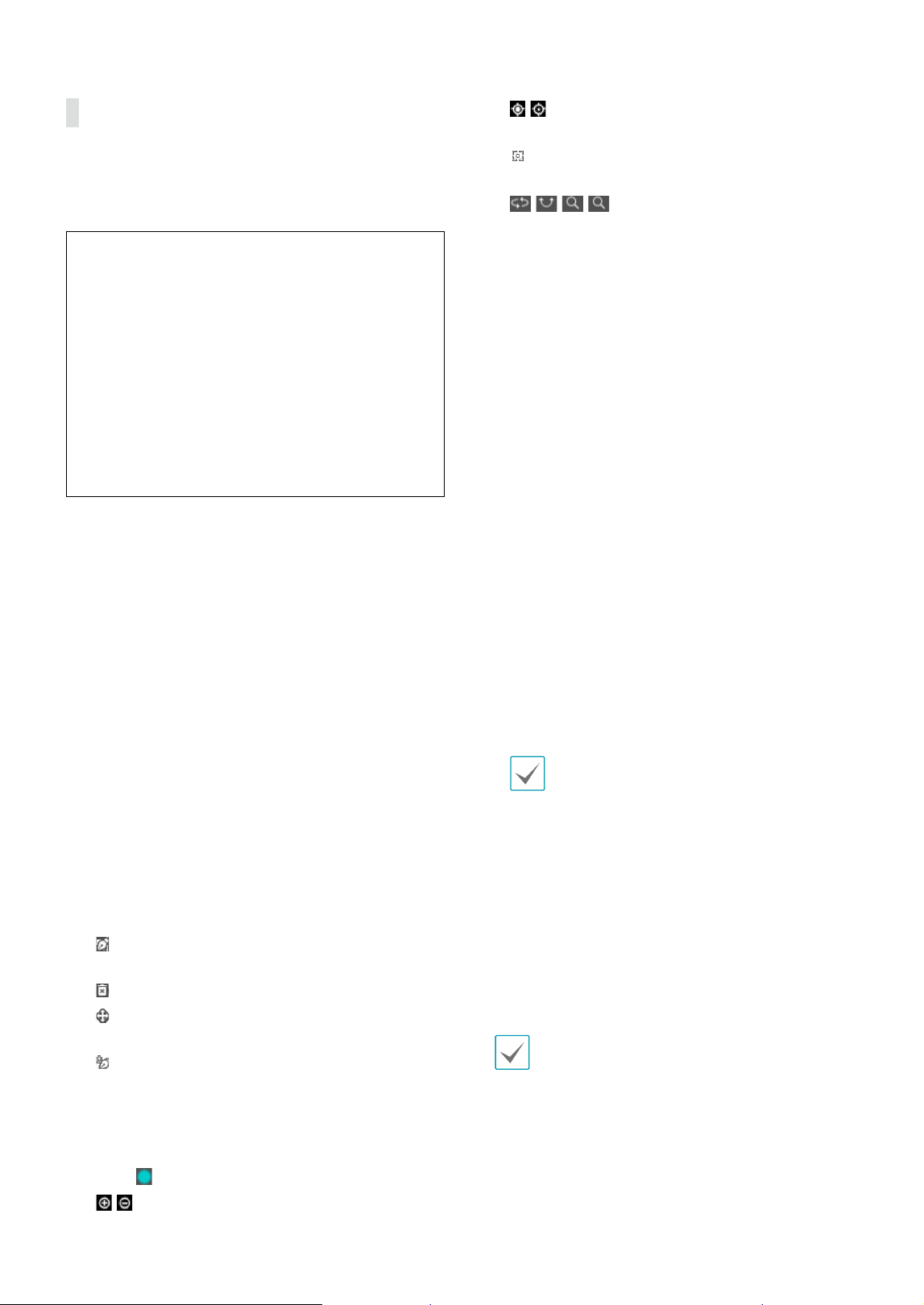
Part 1 - Remote Setup
44
Loitering
Select Loitering and congure loitering settings. With
loitering event enabled, an event is considered when an
object is detected to wander for a certain period of time.
• Zone: Click Setup and dene the loitering area and
the conditions for which a loitering event will occur in
each area up to 4 conditions.
- Preset: Select the preset rst and then set the area.
- Name: Set the name of the area.
-
(Draw): Set the area on the screen in the form of
a polygon.
-
(Erase): Select the polygon to erase.
-
(Move): Move the position of the polygon on the
screen or the position of the polygon point.
-
(Edit): Add or delete polygon points.
- + Preset: Add the current position as a preset.
- PTZ Control: Used to tilt and pan the camera with
the 8 direction arrow buttons. Adjust the camera
by clicking on the square area and by dragging the
circle(
) within the square area.
- / (Zoom In/Out): Zoom in and out.
- / (Focus Near/Far): Adjust camera focus to far
or near.
- (Onepush): Find the optimum focus
automatically.
-
/ / / (Pan/Tilt/Zoom/Focus): Display the
current location, modify the value, and then adjust
the camera with the Go To button.
- Object: Select the object (Human, Vehicle) to
detect in the area.
- Activation Time: Select the minimum time to
detect loitering. If the set object wanders for more
than the set time, it is considered an event.
• Ignore Interval: With Loitering Ignoring Interval
congured, no event log or notication is generated
for loitering detected during a period of time
following a loitering event.
• Use Ignoring Time: Dene the event ignoring time.
Loiterings taking place during the dened time range
will not be assumed as events.
• Event Action: Select a loitering event alert action.
- Alarm Out: Select if you wish to generate an alarm
out.
- Send Email: Select if you wish to send an email.
Select the Image Attachment option to attach a
.jpg image of the event detected to the email.
- Remote Callback: Select this option to send a
message to a remote system and then select which
system to send the message to.
• Not supported from the IDIS Web program.
• The camera must be registered to the remote
system in order to use the Remote Callback
feature.
- Audio Alarm: Select this option to generate an
audio alert and then choose an audio le.
- FTP Upload: Select this option if you wish to
upload images to the FTP server.
- Record: Select this option to record video.
- PTZ Action: Select this option to move to the PTZ
AI Tracking action or the saved preset position.
• Event Action settings must be congured
correctly in order to perform event actions.
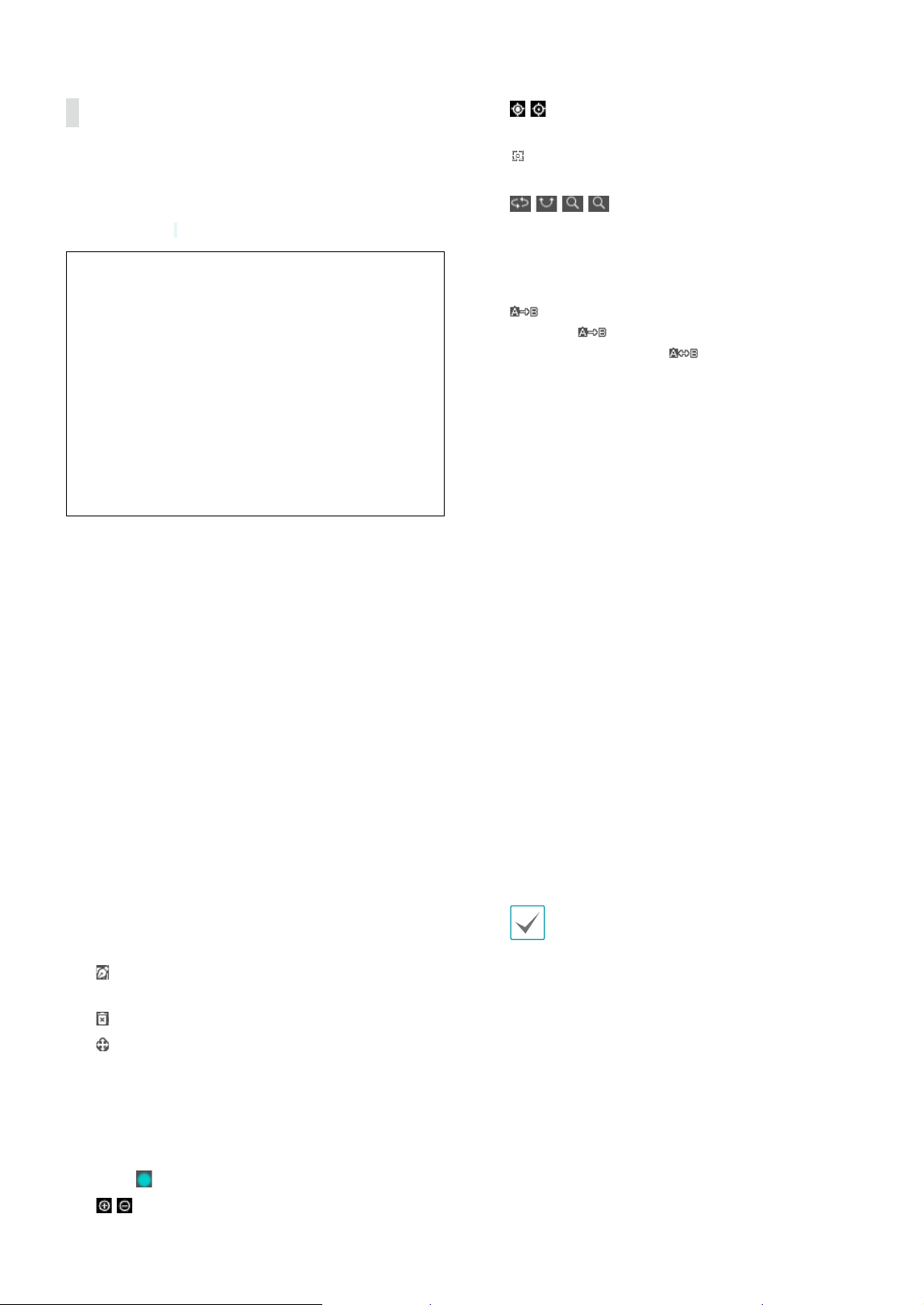
Part 1 - Remote Setup
45
Line Crossing
Select Line Crossing and congure line crossing
settings. With line crossing event enabled, an event
is considered when the set object in the set line and
direction passes
.
• Line: Click Setup and dene the line and the
conditions for which each line crossing event will
occur up to 8 conditions.
- Preset: Select the preset rst and then set the area.
- Name: Set the name of the area.
-
(Draw): Set the area on the screen in the form of
a polygon.
-
(Erase): Select the polygon to erase.
-
(Move): Move the position of the polygon on the
screen or the position of the polygon point.
- + Preset: Add the current position as a preset.
- PTZ Control: Used to tilt and pan the camera with
the 8 direction arrow buttons. Adjust the camera
by clicking on the square area and by dragging the
circle(
) within the square area.
- / (Zoom In/Out): Zoom in and out.
- / (Focus Near/Far): Adjust camera focus to far
or near.
- (Onepush): Find the optimum focus
automatically.
-
/ / / (Pan/Tilt/Zoom/Focus): Display the
current location, modify the value, and then adjust
the camera with the Go To button.
- Direction: Select the direction in which the object
to be considered as an event crosses on each line.
is when a movement is made from A to B on a
line basis,
is when a movement is made from A
to B on a line basis, and
is when a movement is
made in both directions.
- Object: Select the object (Human, Vehicle) to
detect in the area.
- Crossing Position Settings: Select the position
of the object where the line event occurs(Center
of object, Upper side of object, Lower side of
object).
• Ignore Interval: With Line Crossing Ignoring Interval
congured, no event log or notication is generated
for line crossing detected during a period of time
following a line crossing event.
• Use Ignoring Time: Dene the event ignoring time.
Line crossing detections taking place during the
dened time range will not be assumed as events.
• Event Action: Select a line crossing event alert action.
- Alarm Out: Select if you wish to generate an alarm
out.
- Send Email: Select if you wish to send an email.
Select the Image Attachment option to attach a
.jpg image of the event detected to the email.
- Remote Callback: Select this option to send a
message to a remote system and then select which
system to send the message to.
• Not supported from the IDIS Web program.
• The camera must be registered to the remote
system in order to use the Remote Callback
feature.
- Audio Alarm: Select this option to generate an
audio alert and then choose an audio le.
- FTP Upload: Select this option if you wish to
upload images to the FTP server.
- Record: Select this option to record video.
- PTZ Action: Select this option to move to the PTZ
AI Tracking action or the saved preset position.
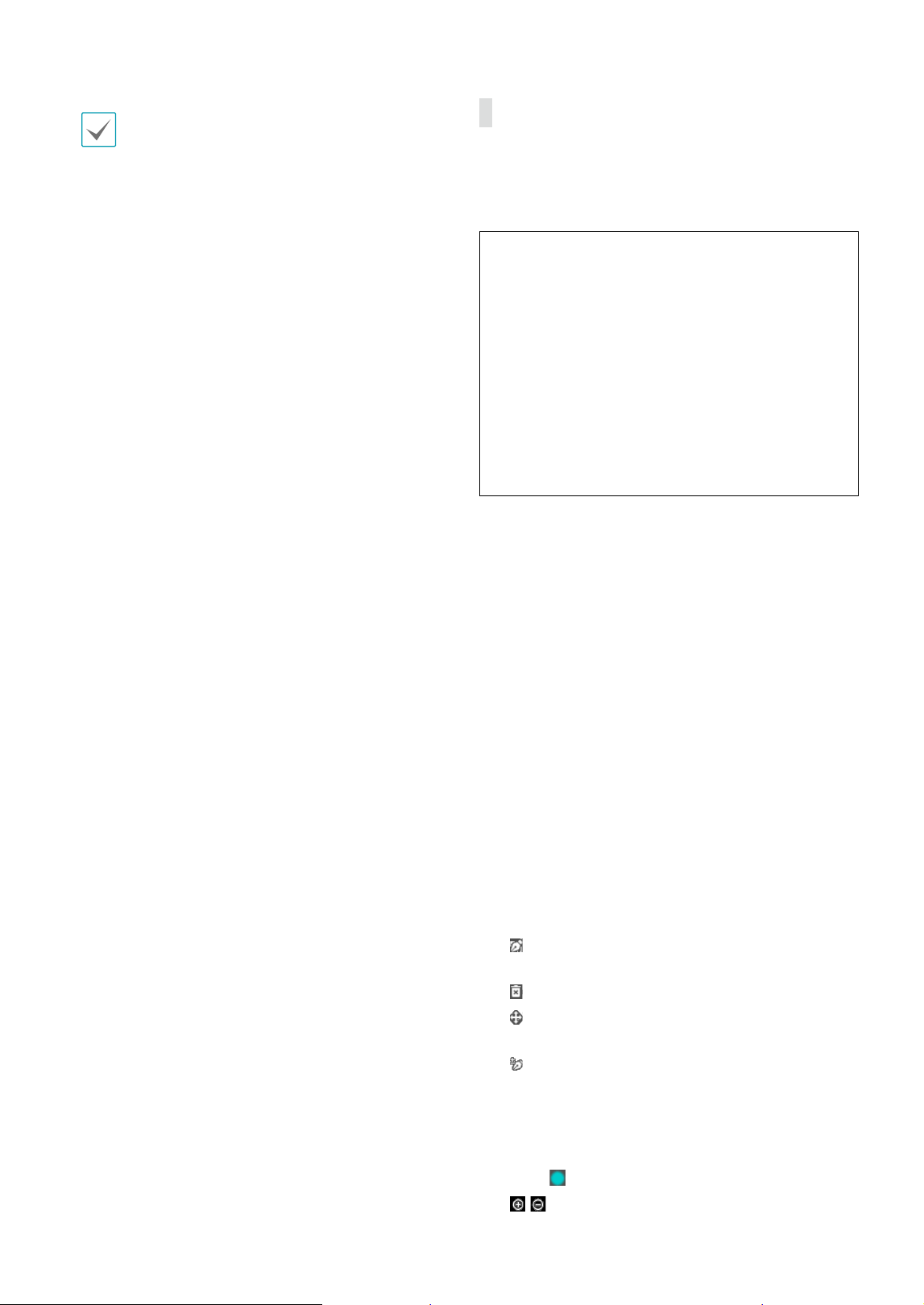
Part 1 - Remote Setup
46
• Event Action settings must be congured
correctly in order to perform event actions.
• Line crossing works normally only when the
distance between objects is suciently far apart.
Face Detection
Select Face Detection and congure face detection
settings. With face detection event enabled, an event is
considered when a face is detected in a set zone.
• Zone: Click Setup and dene the face detection area
up to 8.
- Always: Operate always regardless of the PTZ
location.
- Preset: Operate only in specic presets. You can set
up to 16 presets.
- Name: Set the name of the area.
-
(Draw): Set the area on the screen in the form of
a polygon.
-
(Erase): Select the polygon to erase.
-
(Move): Move the position of the polygon on the
screen or the position of the polygon point.
-
(Edit): Add or delete polygon points.
- + Preset: Add the current position as a preset.
- PTZ Control: Used to tilt and pan the camera with
the 8 direction arrow buttons. Adjust the camera
by clicking on the square area and by dragging the
circle(
) within the square area.
- / (Zoom In/Out): Zoom in and out.
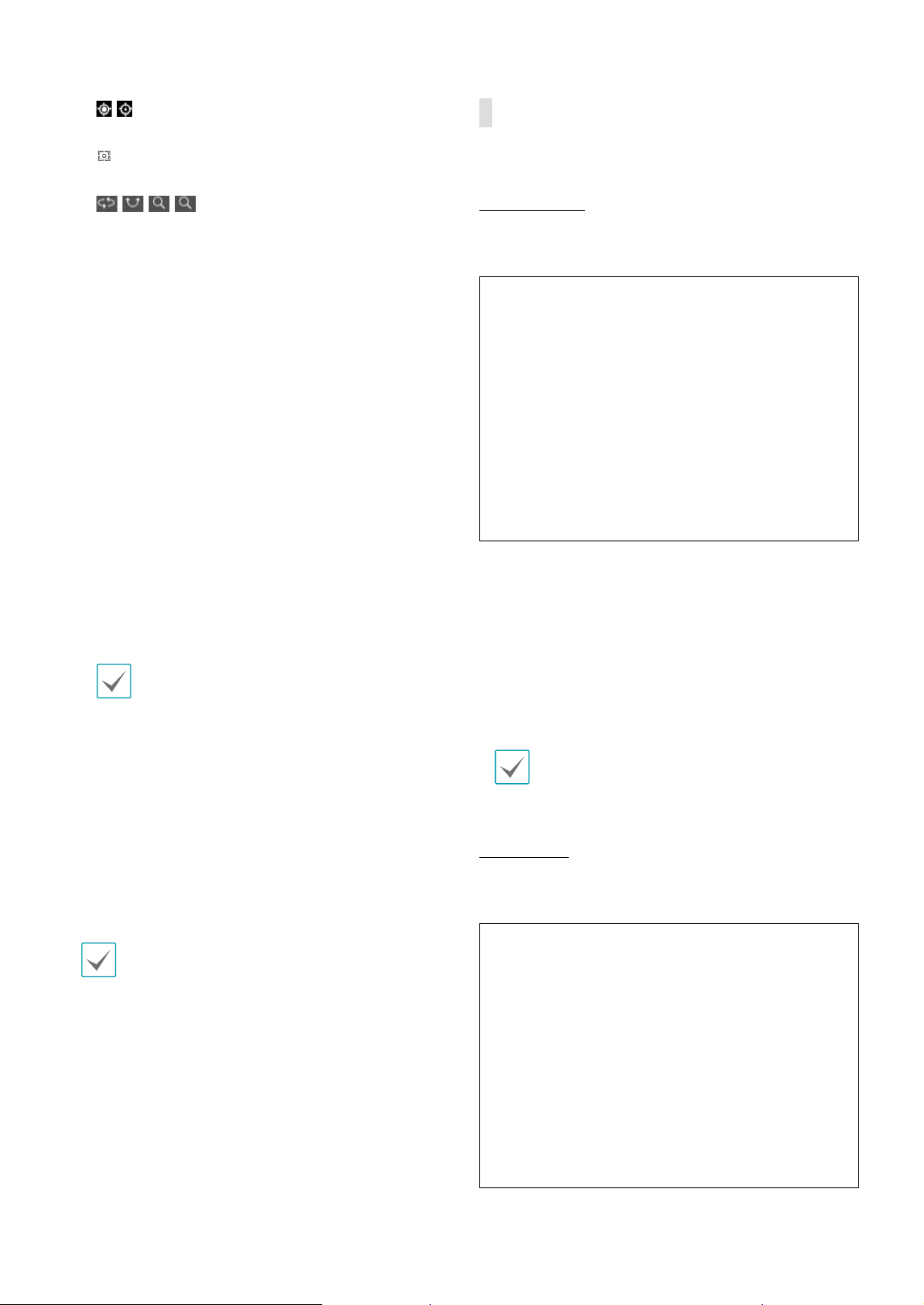
Part 1 - Remote Setup
47
- / (Focus Near/Far): Adjust camera focus to far
or near.
- (Onepush): Find the optimum focus
automatically.
-
/ / / (Pan/Tilt/Zoom/Focus): Display the
current location, modify the value, and then adjust
the camera with the Go To button.
• Ignore Interval: With Face Detection Ignoring Interval
congured, no event log or notication is generated
for face detected during a period of time following a
face detection event.
• Use Ignoring Time: Dene the event ignoring time.
Face detections taking place during the dened time
range will not be assumed as events.
• Event Action: Select a face detection event alert
action.
- Alarm Out: Select if you wish to generate an alarm
out.
- Send Email: Select if you wish to send an email.
Select the Image Attachment option to attach a
.jpg image of the event detected to the email.
- Remote Callback: Select this option to send a
message to a remote system and then select which
system to send the message to.
• Not supported from the IDIS Web program.
• The camera must be registered to the remote
system in order to use the Remote Callback
feature.
- Audio Alarm: Select this option to generate an
audio alert and then choose an audio le.
- FTP Upload: Select this option if you wish to
upload images to the FTP server.
- Record: Select this option to record video.
- PTZ Action: Select this option to move to the PTZ
AI Tracking action or the saved preset position.
• Event Action settings must be congured
correctly in order to perform event actions.
Advanced
Object Engine
Set the value for recognizing the object found in the
image.
• Metadata: Allows you to congure whether metadata
is included in the recorded video.
• Attribute: Allows you to congure detailed
information for objects detected in the video and
specify whether to save them using the A-Cut
function.
• Daytime/Nighttime Threshold : Adjust the day/night
threshold.
Disabling Metadata will also disable the
Attribute settings.
Face Engine
Set the value for recognizing the face found in the
image.
• Metadata: Allows you to congure whether metadata
is included in the recorded video.
Part 1 - Remote Setup
48
• Attribute: Allows you to congure detailed
information for objects detected in the video and
specify whether to save them using the A-Cut
function.
• Daytime/Nighttime Threshold : Adjust the day/night
threshold.
Disabling Metadata will also disable the
Attribute settings.
IDLA Pro
Congure IDLA Pro (IDIS Deep Learning Analytics Pro)
settings. It operates based on a newly designed AI
model engine, separate from the IDLA, and supports
functions such as Crowd Detection, Abandoned/
Removed Object Detection, and Fall detection.
Part 1 - Remote Setup
49
Crowd Detection
Select Crowd Detection and congure crowd detection
settings. With crowd detection event enabled, an event
is considered if a set number of people are present in a
set area for a set amount of time.
• Zone: Click Setup and dene one area for crowd
detection and specify one condition for a crowd
detection event within that area.
- Max. People: Select the maximum number of
people for crowd detection. An event is triggered
when the number of detected individuals exceeds
the set threshold and the condition persists for the
dened time.
- Min. Dwell Time: Select the minimum duration
that the detected condition must be maintained.
An event is triggered when the number of detected
people exceeds the set threshold for longer than
the dened time.
• Event Action: Select a crowd detection event alert
action.
- Alarm Out: Select if you wish to generate an alarm
out.
- Send Email: Select if you wish to send an email.
Select the Image Attachment option to attach a
.jpg image of the event detected to the email.
- Remote Callback: Select this option to send a
message to a remote system and then select which
system to send the message to.
• Not supported from the IDIS Web program.
• The camera must be registered to the remote
system in order to use the Remote Callback
feature.
- Audio Alarm: Select this option to generate an
audio alert and then choose an audio le.
- FTP Upload: Select this option if you wish to
upload images to the FTP server.
- Record: Select this option to record video.
- PTZ Action: Select this option to move to the PTZ
AI Tracking action or the saved preset position.
• Event Action settings must be congured
correctly in order to perform event actions.
Part 1 - Remote Setup
50
Abandoned Object Detection
Select Abandoned Object Detection and congure
abandoned object detection settings. With abandoned
object detection event enabled, an event is considered
if a new object is detected in a set area.
• Zone: Click Setup and dene one area for abandoned
object detection.
• Event Action: Select an abandoned object detection
event alert action.
- Alarm Out: Select if you wish to generate an alarm
out.
- Send Email: Select if you wish to send an email.
Select the Image Attachment option to attach a
.jpg image of the event detected to the email.
- Remote Callback: Select this option to send a
message to a remote system and then select which
system to send the message to.
• Not supported from the IDIS Web program.
• The camera must be registered to the remote
system in order to use the Remote Callback
feature.
- Audio Alarm: Select this option to generate an
audio alert and then choose an audio le.
- FTP Upload: Select this option if you wish to
upload images to the FTP server.
- Record: Select this option to record video.
- PTZ Action: Select this option to move to the PTZ
AI Tracking action or the saved preset position.
• Event Action settings must be congured
correctly in order to perform event actions.
Part 1 - Remote Setup
51
Removed Object Detection
Select Removed Object Detection and congure
removed object detection settings. With removed object
detection event enabled, an event is considered if an
existing object disappears in a set area.
• Zone: Click Setup and dene one area for removed
object detection.
• Event Action: Select a removed object detection
event alert action.
- Alarm Out: Select if you wish to generate an alarm
out.
- Send Email: Select if you wish to send an email.
Select the Image Attachment option to attach a
.jpg image of the event detected to the email.
- Remote Callback: Select this option to send a
message to a remote system and then select which
system to send the message to.
• Not supported from the IDIS Web program.
• The camera must be registered to the remote
system in order to use the Remote Callback
feature.
- Audio Alarm: Select this option to generate an
audio alert and then choose an audio le.
- FTP Upload: Select this option if you wish to
upload images to the FTP server.
- Record: Select this option to record video.
- PTZ Action: Select this option to move to the PTZ
AI Tracking action or the saved preset position.
• Event Action settings must be congured
correctly in order to perform event actions.
Part 1 - Remote Setup
52
Fall Detection
Select Fall Detection and congure fall detection
settings. With fall detection event enabled, an event is
considered when a person’s falling motion is detected.
• Event Action: Select a fall detection event alert
action.
- Alarm Out: Select if you wish to generate an alarm
out.
- Send Email: Select if you wish to send an email.
Select the Image Attachment option to attach a
.jpg image of the event detected to the email.
- Remote Callback: Select this option to send a
message to a remote system and then select which
system to send the message to.
• Not supported from the IDIS Web program.
• The camera must be registered to the remote
system in order to use the Remote Callback
feature.
- Audio Alarm: Select this option to generate an
audio alert and then choose an audio le.
- FTP Upload: Select this option if you wish to
upload images to the FTP server.
- Record: Select this option to record video.
- PTZ Action: Select this option to move to the PTZ
AI Tracking action or the saved preset position.
• Event Action settings must be congured
correctly in order to perform event actions.
Advanced
• Abandoned/Removed Object Detection Engine:
Set the values used to analyze and recognize objects
in the video.
• Daytime/Nighttime Threshold: Adjust the day/night
threshold.
• Fall Detection Engine: Set the values used to detect
falls in the video.
• Daytime/Nighttime Threshold : Adjust the day/night
threshold.
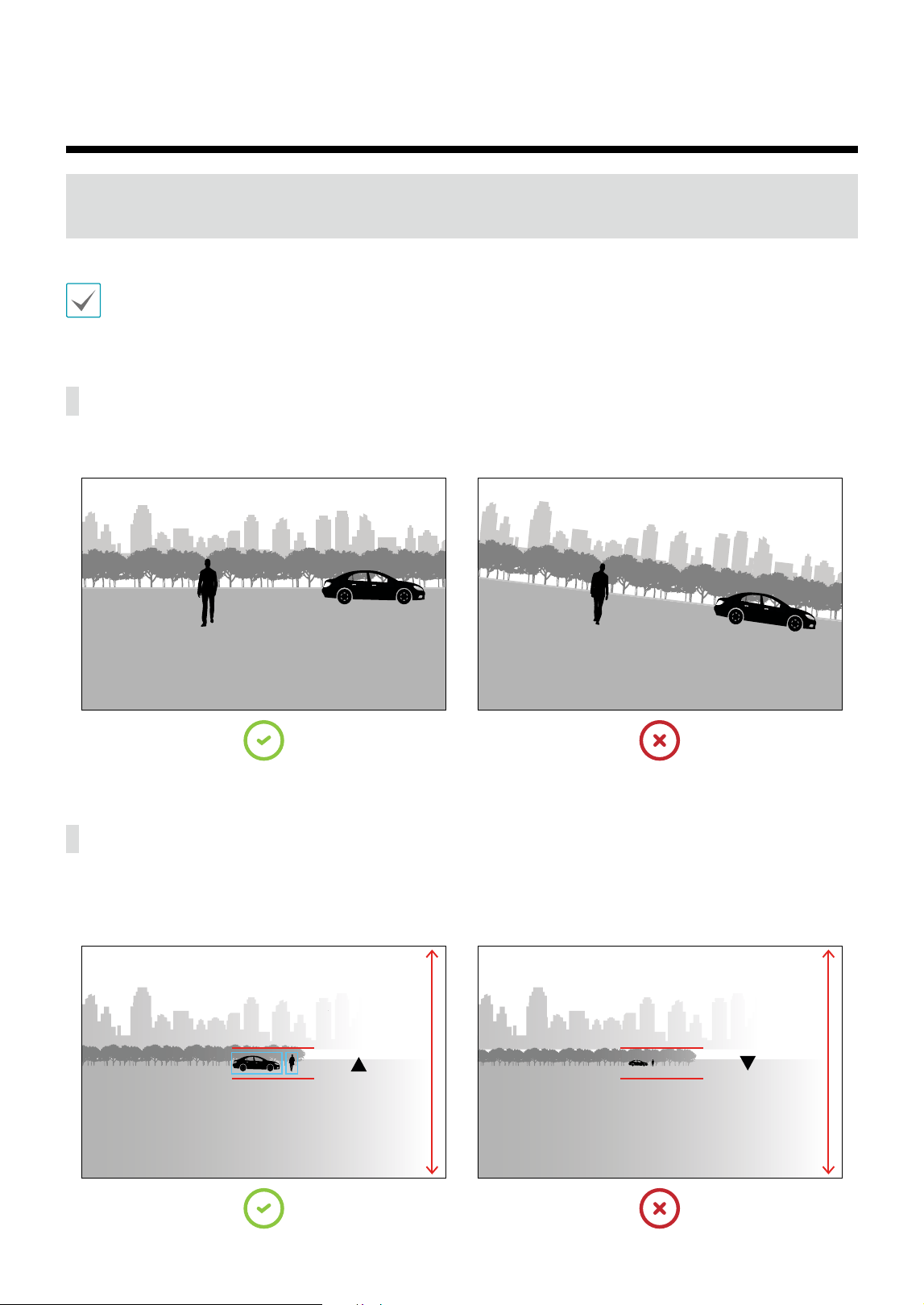
53
Part 2 - IDLA Guide
Camera Installation Guide for IDLA (IDIS Deep Learning Analytics)
Features
In order for the camera and, in eect, various AI functions to operate properly, the following must be applied.
Horizontal Angel
The image should be level with the horizon. The camera should be tilted no more than 30° from the horizontal.
Object Size
To reduce the risk of missed detections, the minimum height for humans and vehicles is at least 6% of the total image
height based on resolution criteria.
6%
6%
Part 2 - IDLA Guide
54
Object Visibility
Position cameras so that they can capture the entire object, such as people and vehicles in the image, rather than just
a partial view.
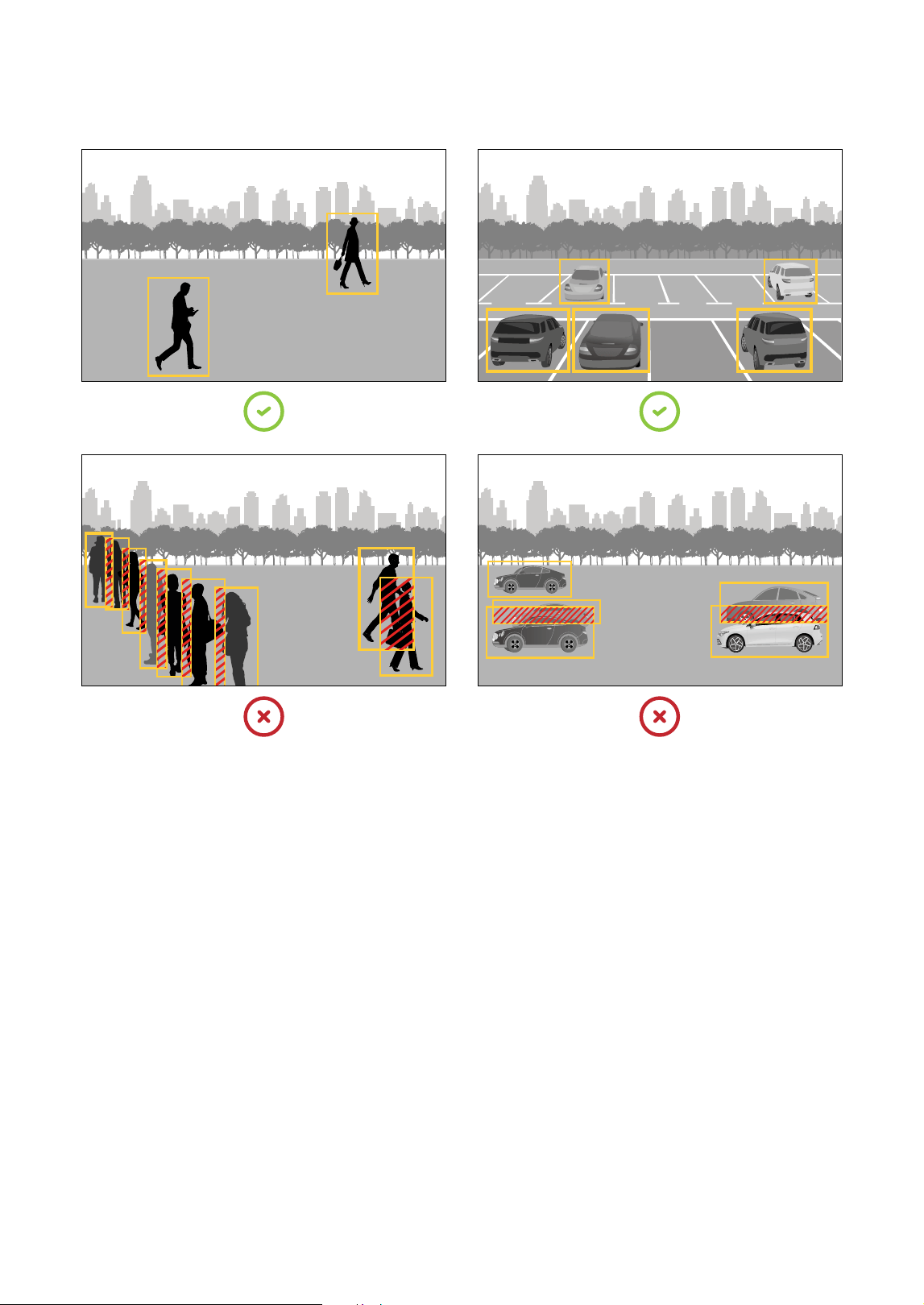
Part 2 - IDLA Guide
55
We recommend installing cameras diagonally to prevent objects from overlapping each other. (In crowded scenarios,
frequent overlap can impact detection accuracy.)
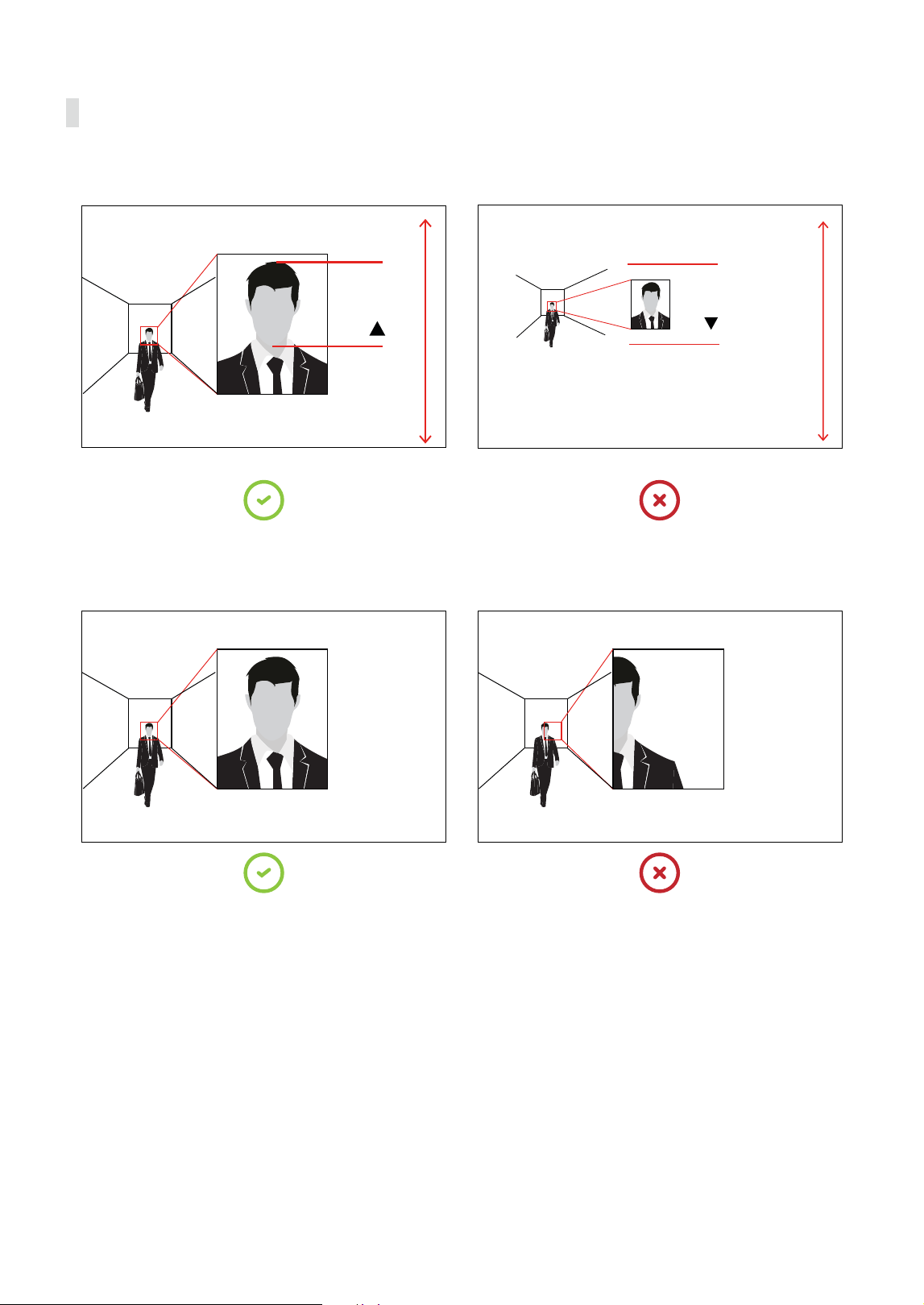
Part 2 - IDLA Guide
56
Face Detection
To reduce the risk of missed detections, the person’s face is at least 4% of the total image height based on resolution
criteria.
4%
4%
1) Mount cameras to capture the entire face in the image and position them at the average height of a person for a
good angle on faces.
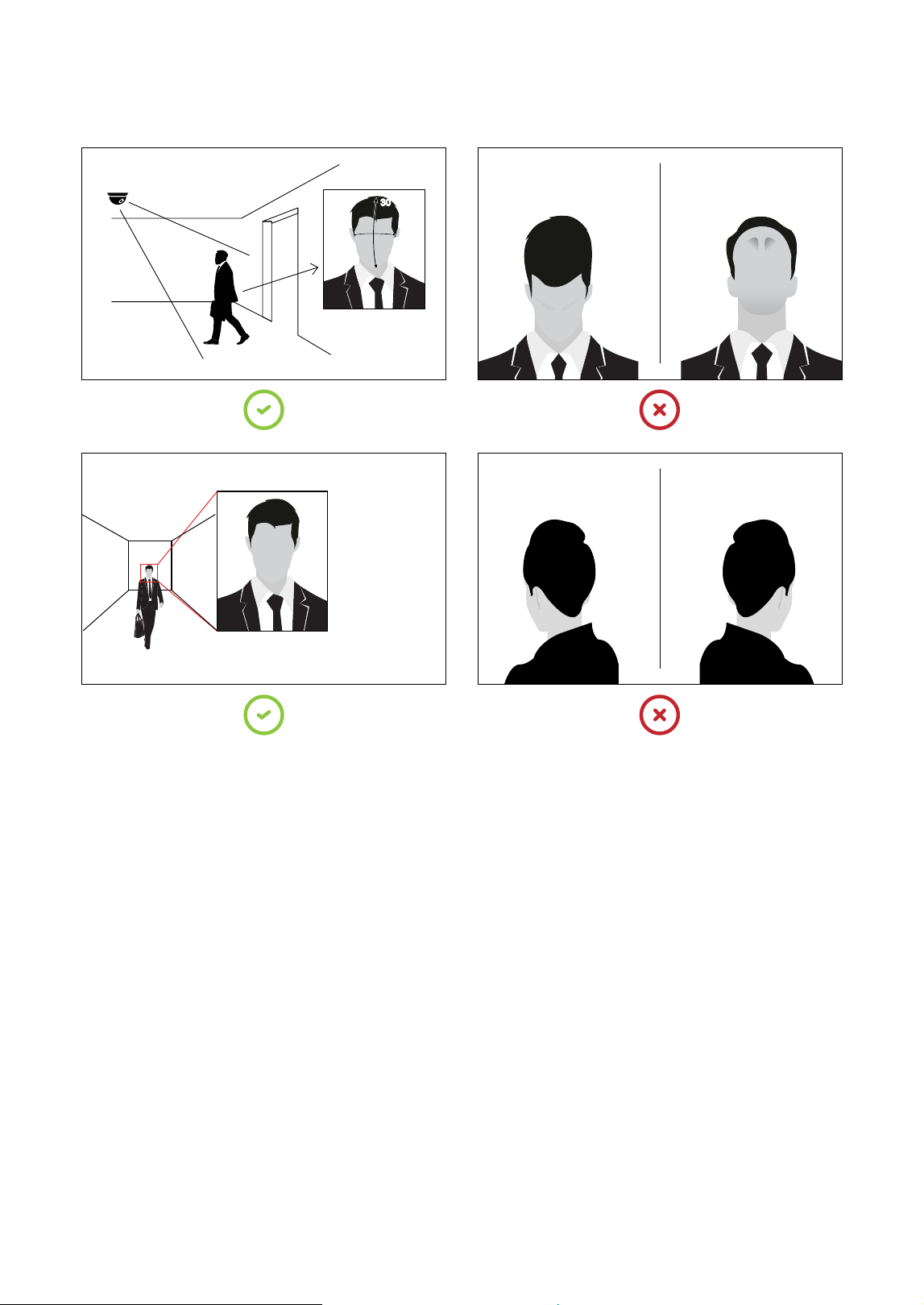
Part 2 - IDLA Guide
57
2) Mount the camera so that person in the image is front-facing and is not looking down or up. Face detection feature
recognizes within 60 degress from hotizontal and 30 degress from vertical.
30˚30˚
60
˚60˚
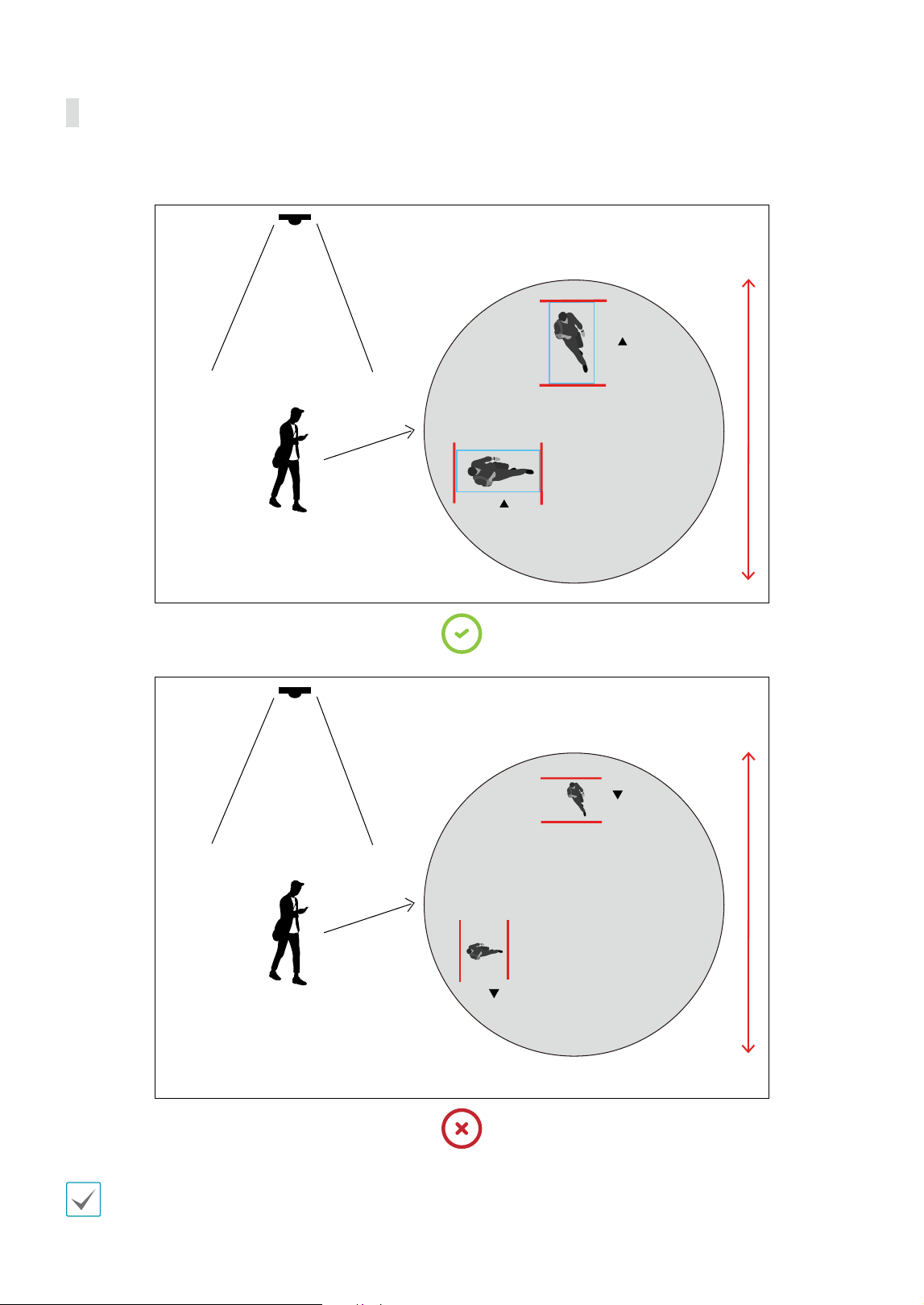
Part 2 - IDLA Guide
58
Fisheye View
Persons and vehicles must be installed at a height of at least 6% of the image height.
Fisheye lenses can produce distortion, especially near the edges of the image, which can reduce recognition accuracy.
6%
6%
6%
6%
To optimize recognition accuracy, it is recommended to position the area of interest and objects at the 12
o’clock (north) position in the sheye image.
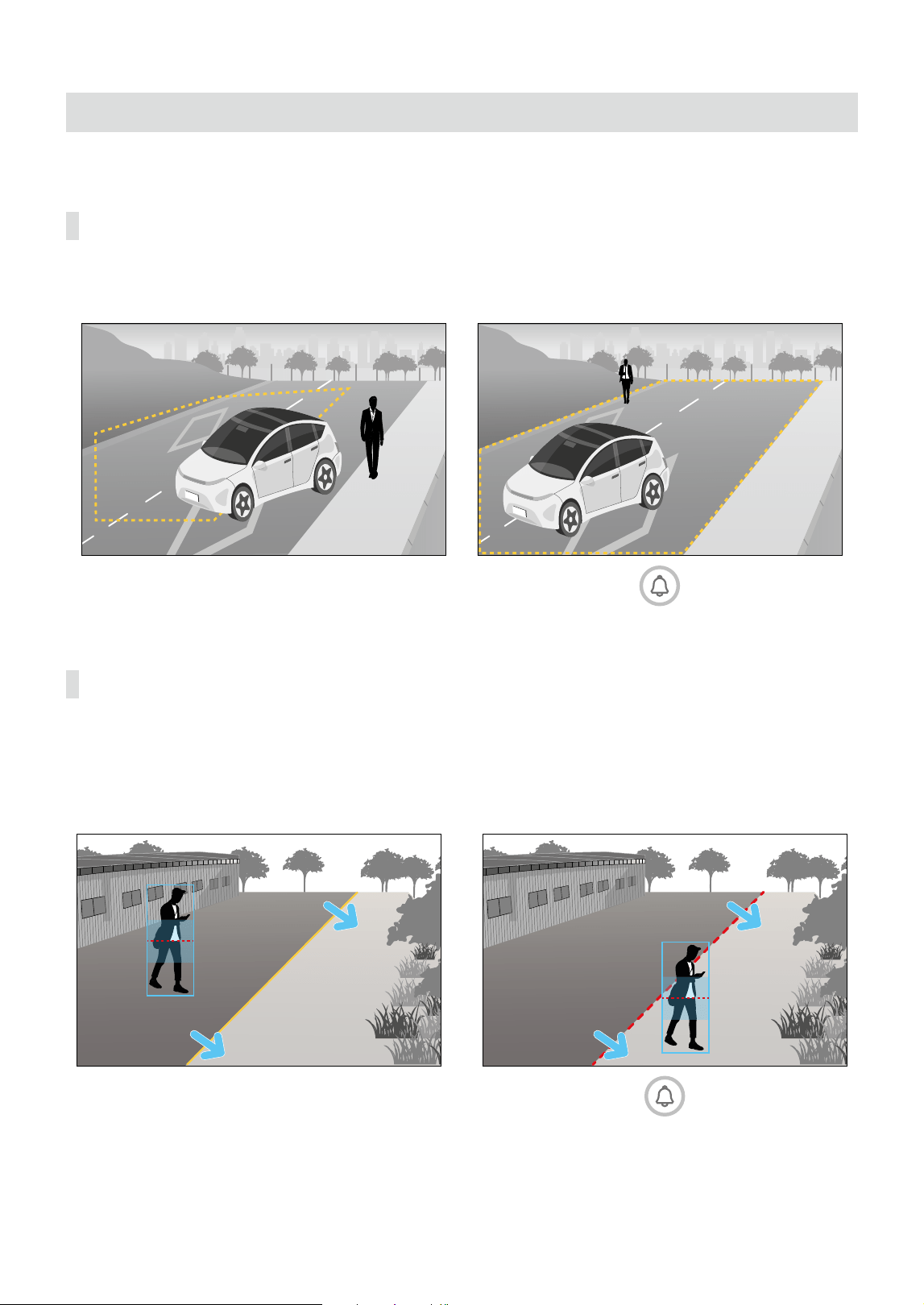
Part 2 - IDLA Guide
59
IDLA (IDIS Deep Learning Analytics) Conguration Guide
Zone Detection
To detect an object, the user-dened detection point for the object must be within the detection zone. In the case of
humans, the point is at the feet, while for vehicles, the detection point is at the bottom.
Line Crossing Detection
Detection occurs when the user-dened detection point for the object crosses the line.
(Line Crossing position is set to center (Center of object) by default, but you can modify it according to the installation
environment in the settings)
[Pre-event] [Post-event]
Center
▶
Center
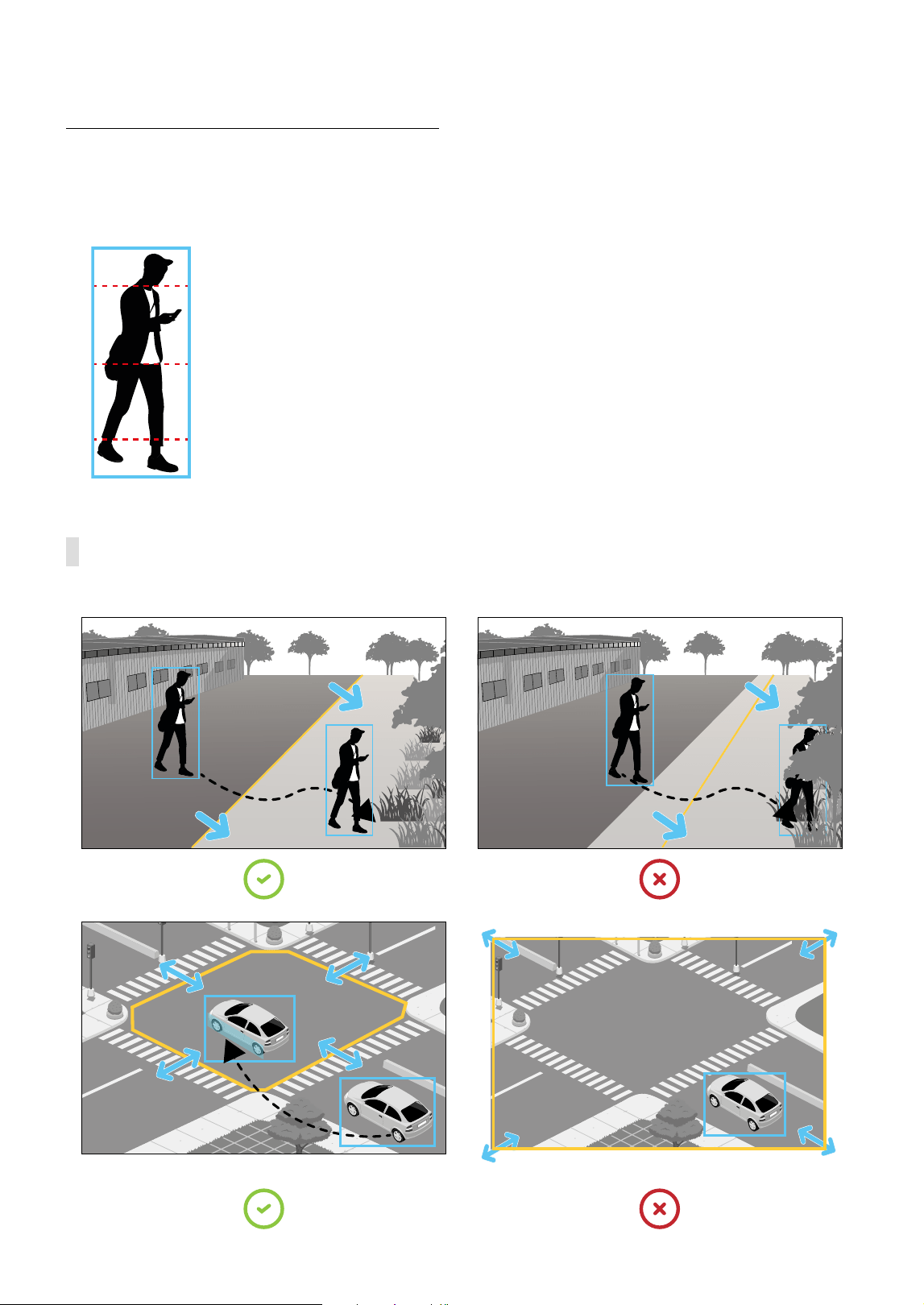
Part 2 - IDLA Guide
60
Recommended Crossing Position Settings
• When the line is vertical, we recommend using the default setting.
• If the line is horizontal and the object passes through the area below the line too quickly compared to the area above the line, it is
recommended to set the detection position to Lower side of object. Conversely, in the opposite scenario, setting it to Upper side
of object is recommended.
Upper side of object
Center of object
Lower side of object
Analysis Conditions
Position it in the center to capture both the before and after moments of passing the virtual line or zone.
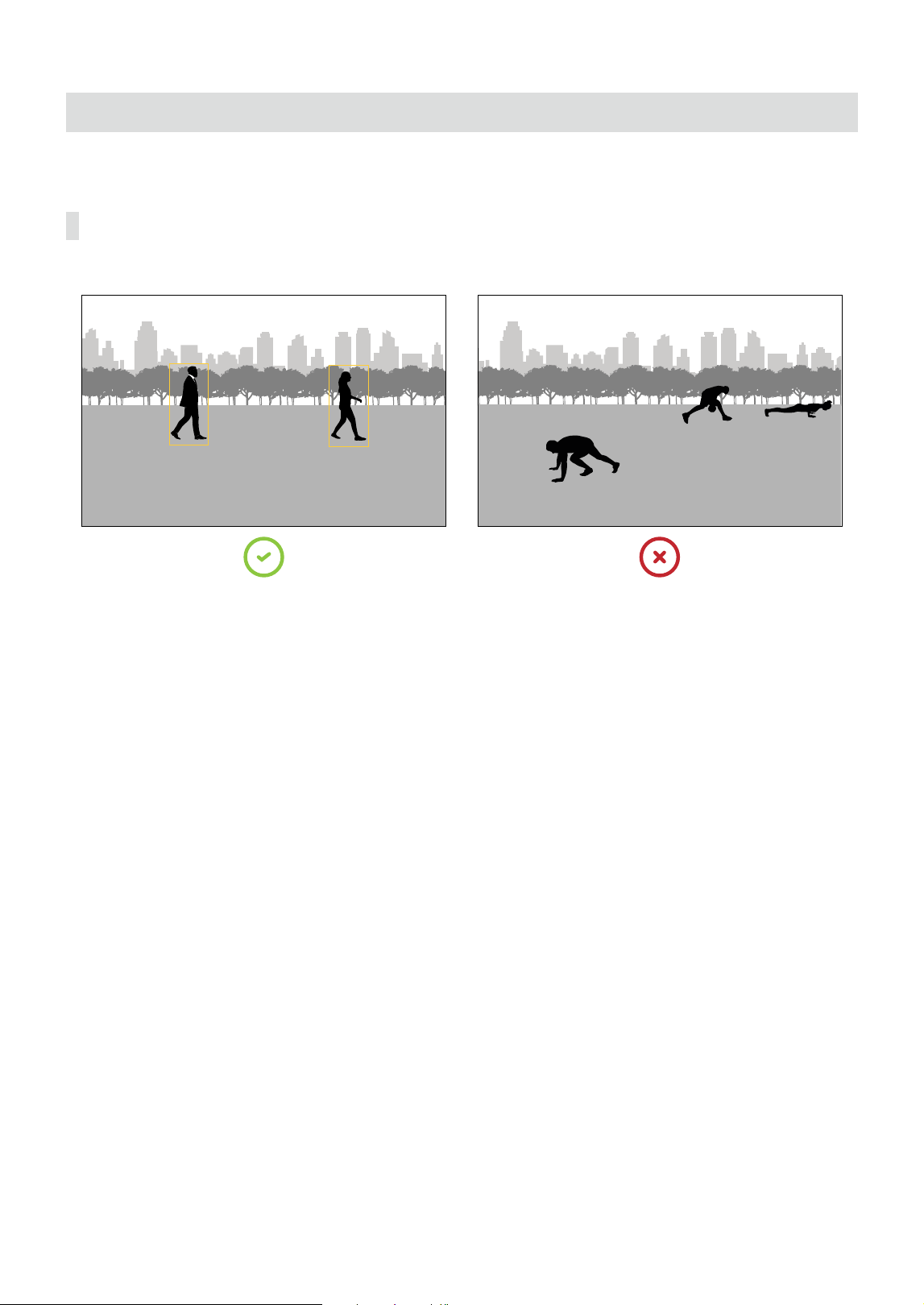
Part 2 - IDLA Guide
61
Wrong Examples
Postures Other Than Upright Position
Humans should move in a somewhat upright position.
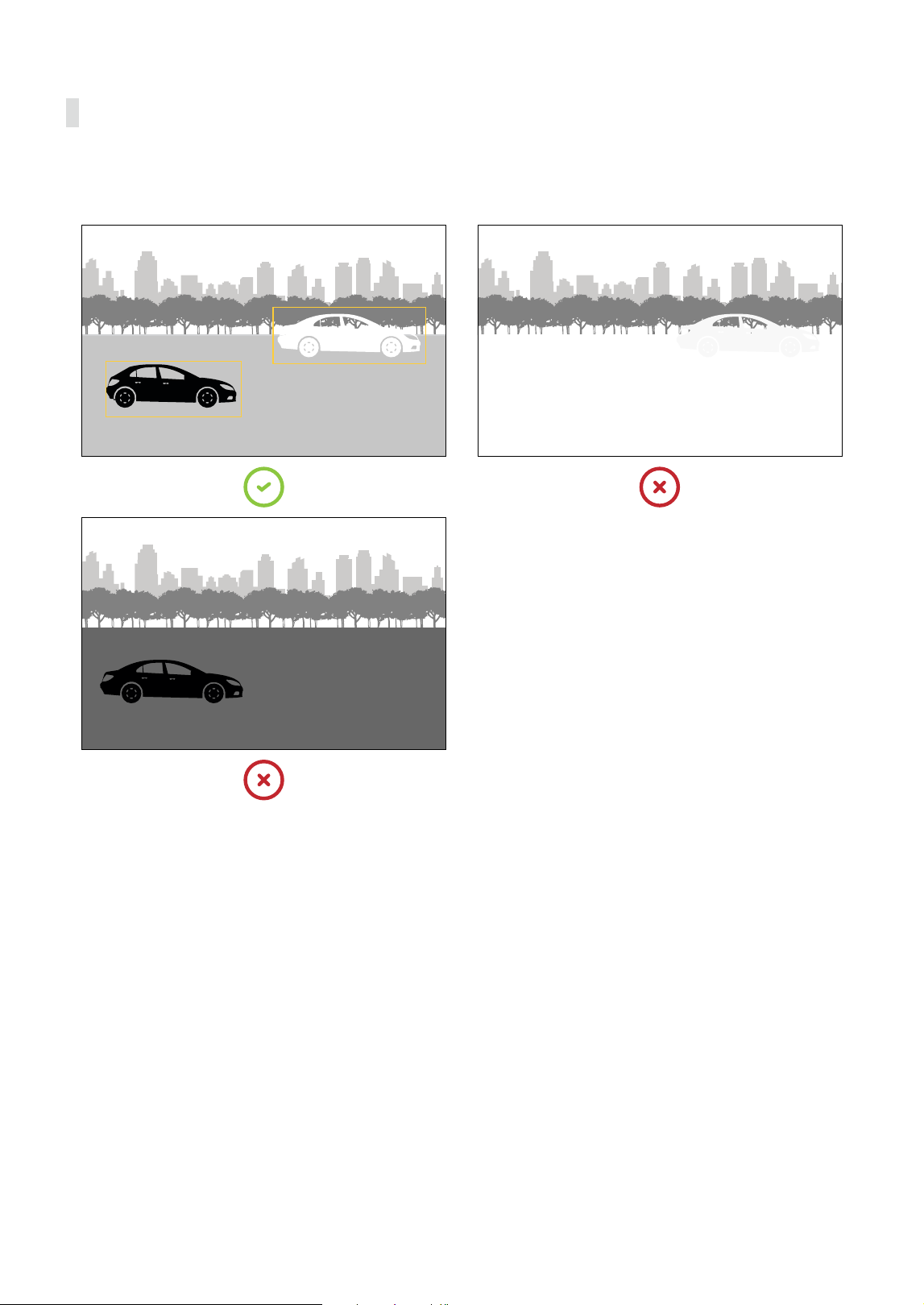
Part 2 - IDLA Guide
62
Insucient Dissimilarity Between Objects and the Background
There should be sucient dissimilarity between objects and the background to distinguish the object from the
background or other objects. Fog, direct light shining on the camera, or an excessive noisy image can cause contrast
issues. You can adjust the level of illumination and adjust the image settings to enhance the level of contrast.
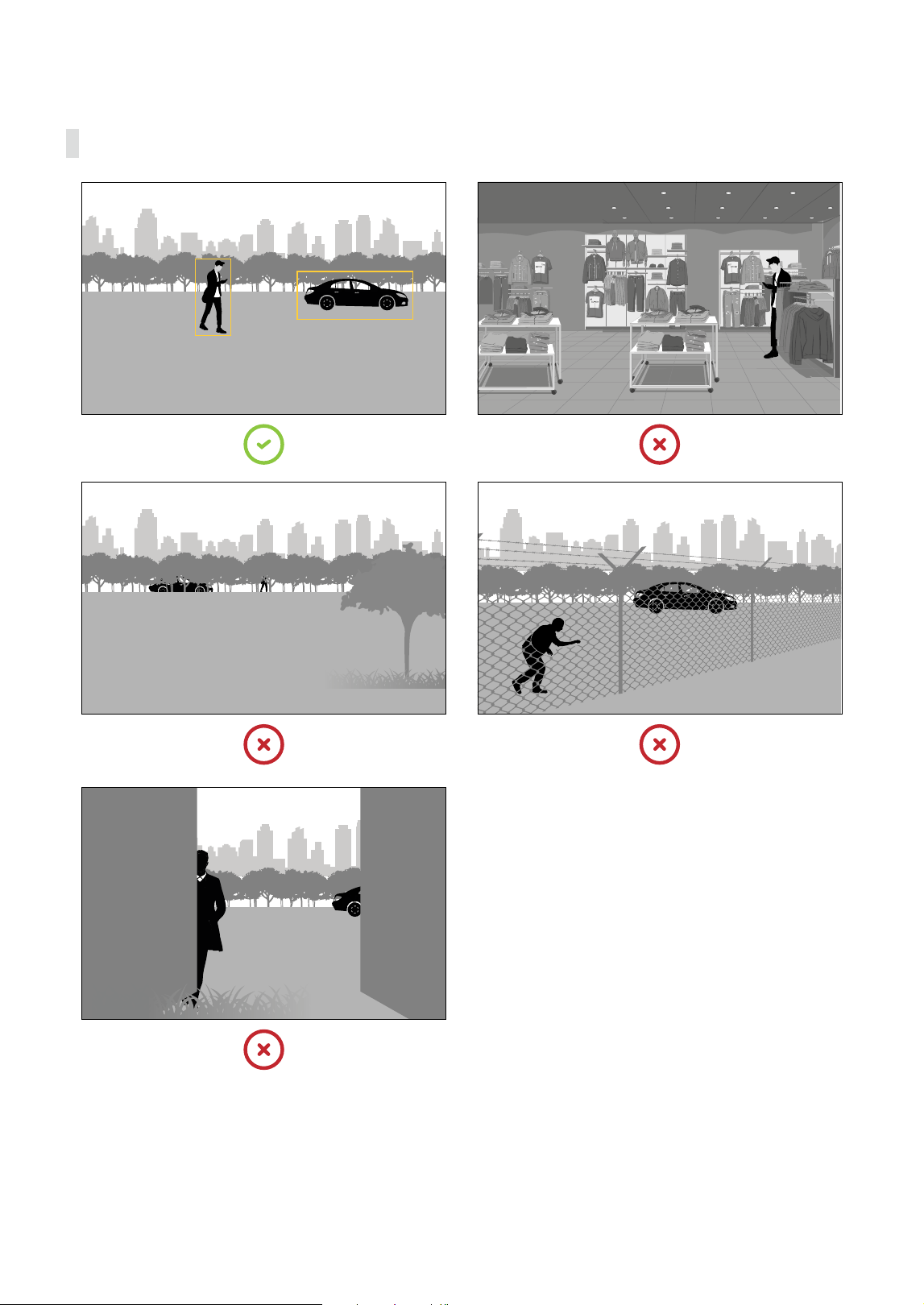
Part 2 - IDLA Guide
63
When Obstacles such as Trees, Walls, or Fences Partially Obstruct the
Object
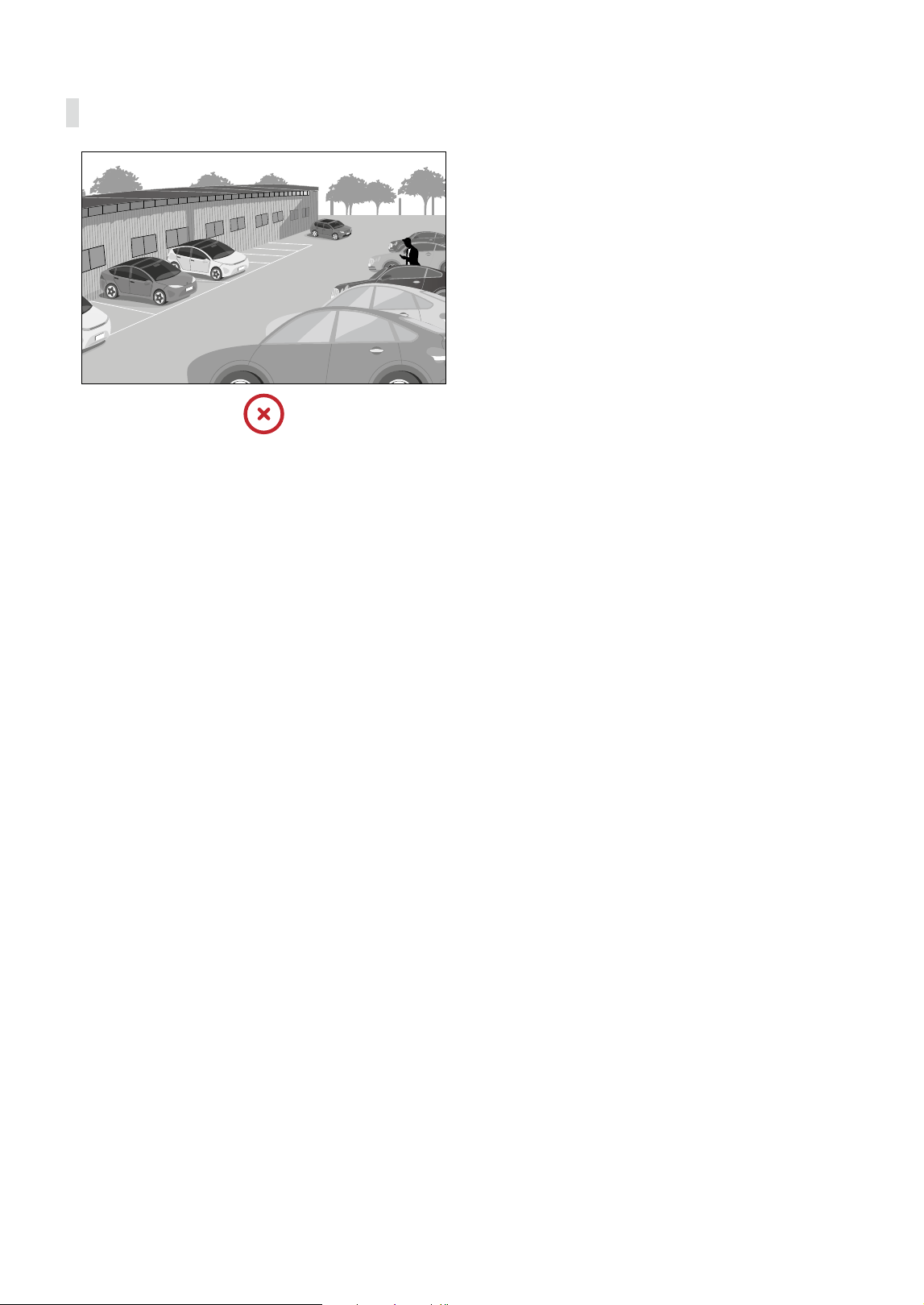
Part 2 - IDLA Guide
64
When a Person Is Nearly Obscured by a Parked Vehicle
Part 2 - IDLA Guide
65
Conditions That Can Trigger False Alarms
Environments
• Fog
• Heavy rain or snowfall
• Insects on the cam
era lens
• If water droplets form on the camera lens
Environments
• Inadequate brightness or light
• Overly noisy image
• Direct light shining on the camera
• If the position of the camera diers from the direction of a light source and it makes a shadow.
• If an object is reected on the oor, wall, glass, metal or water
• Strong light causing shadows.
• If the mirror is reecting light
• A combination of car headlights and intense rain
Other Conditions
• When several extremely fast moving objects appear randomly
• Human-size animals.
66
Part 3 - IDIS Web
IDIS Web is a program that allows you to view and search video from remote locations over the Internet and can be
accessed on the regular web browser.
System requirements for running IDIS Web are as follows:
• OS: Microsoft
®
Windows
®
7 (Home Premium, Professional, Ultimate), Microsoft
®
Windows
®
8 (Pro, Enterprise),
Microsoft
®
Windows
®
10 (Pro, Home), Microsoft
®
Windows
®
11
• CPU: Intel Pentium IV 2.4GHz or above (Core 2 Duo E4600 recommended)
• RAM: 1GB or more
• VGA: 128MB or more (1280x1024, 24bpp or above)
• Internet Explorer: Version 10 or later 32-bit
• Chrome: Google Chrome 22.0.1229.0 or above (59.xxx or above recommended)
• Edge: 98.0.1108.43 or above
1
Launch the web browser and then enter the following information in the address bar.
– http://IP Address:Port Number (IDIS Web connection port number selected during camera IP address and port
number setup)
– Or http://FEN Server Address/FEN name (FEN Server address and FEN name registered to the FEN Server)
– Or http://web.idisglobal.com (it is required to enter the camera IP address when logging in. If the camera uses
the FEN feature, you can enter the FEN name registered to the FEN server instead of the camera IP address after
selecting the USE FEN option)
• If the Use HTTPS option has been selected during IDIS Web port number setup, enter https instead of http. If
prompted with a security certicate warning, select "Continue to this website (not recommended)." If the IDIS Web
login page fails to load, congure Internet Explorer's settings as follows:
– Tools → Internet Options → Security → Custom Level... → Medium-high (default) or Medium.
– Tools → Internet Options → Advanced → Security → Use TLS 1.0 (select)
• If connecting by entering an IP address and a port number, you can connect by entering just the IP address if IDIS
Web connection port number has been set to 80 (443 when entering https).
• If connecting by entering http://web.idisglobal.com, it is required to enter the Watch port number.
• Contact your network administrator for the IP address of the camera you wish to connect to the IDIS Web pot number.
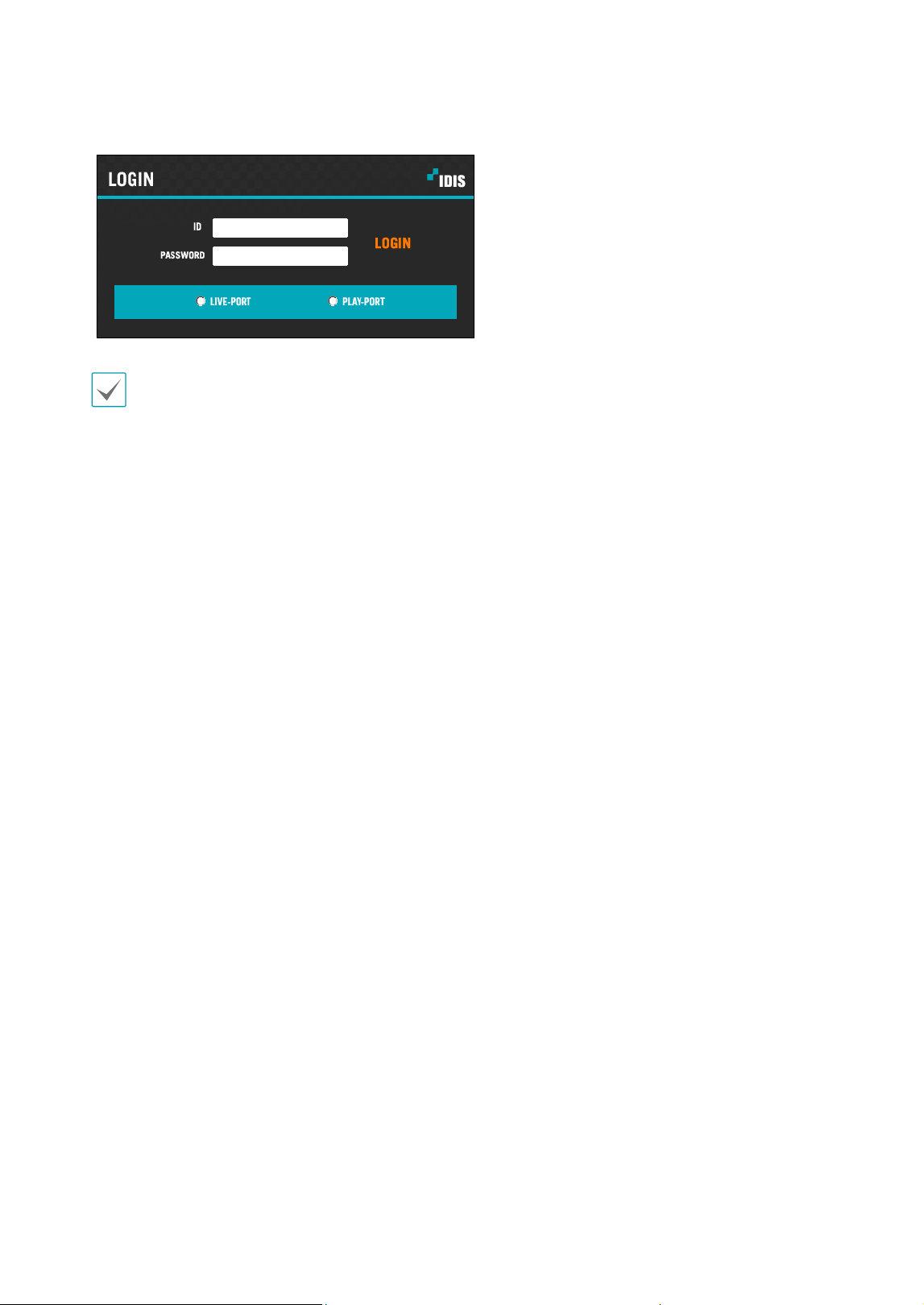
Part 3 - IDIS Web
67
2
When prompted with the IDIS Web login window, select LIVE-PORT or PLAY-PORT as the desired mode. Enter the
ID and password and click LOGIN to sign in using the selected mode.
• IDIS Web does not work with Microsoft
®
Windows
®
8 metro UI.
• Do not close the login window while IDIS Web is running. Switching over to Web Live or Web Search mode can cause
a script error, requiring you to restart the IDIS Web program.
• To use IDIS Web on Microsoft Windows Vista or above, launch Internet Explorer by right-clicking on the icon and
selecting the Run as administrator option. Otherwise, certain IDIS Web functions might not be available.
• When running IDIS Web, the bottom section of the screen may get cut o if the address bar or the status bar is shown.
In this case, change Internet Options so that the address bar or the status bar is hidden. (Tools → Internet Options
→ Security → Custom level... → Allow websites to open windows without address or status bars (Enable))
• Launching a new version of IDIS Web for the rst time can cause Internet Explorer to load information from the
previous version. In this case, navigate to Tools → Internet Options → General, delete temporary Internet les, and
then restart IDIS Web.
• On Microsoft Windows Vista or above, lowered image transmission rate can prevent the screen from being displayed
or updated. In this case, we recommend that you disable the computer's auto tuning function. Open the command
prompt as an administrator. (Start → Accessories → Command Prompt → Right-Click and then select Run as
administrator) Type in "netsh int tcp set global autotuninglevel=disable"and then press Enter. Restart the
computer to apply the change. To enable auto tuning again, launch the command prompt as an administrator and
then type in "netsh int tcp set global autotuninglevel=normal". Restart the computer to apply the change.
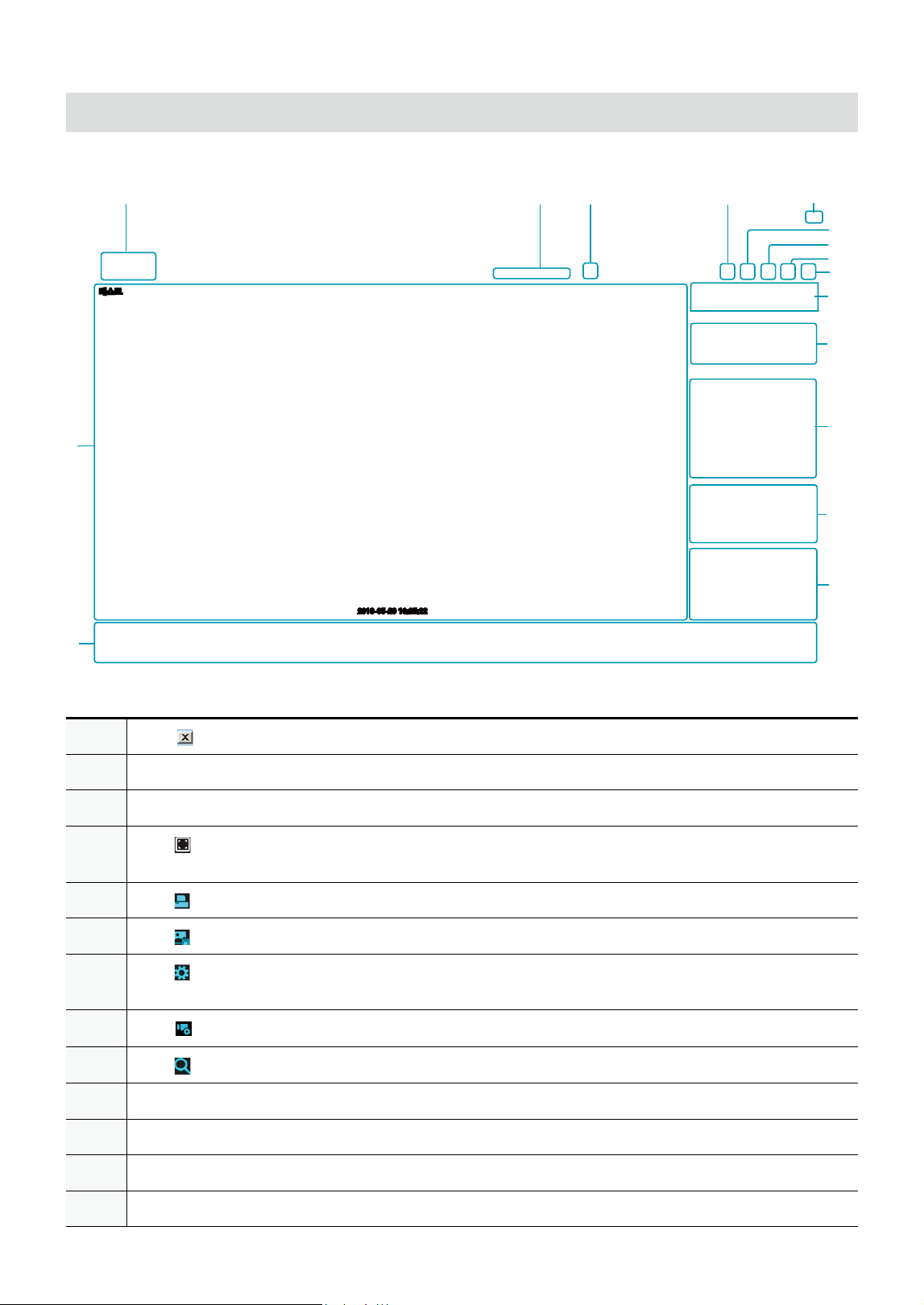
Part 3 - IDIS Web
68
Web Live Mode
A remote web monitoring program that allows you to monitor images from remote locales in real-time.
테스트
2013-05-29 16:25:222013-05-29 16:25:22
1
0
!
@
#
$
6
7
8
9
^
%
2 3 4 5
1
Press
TYPE 1
to terminate IDIS Web.
2
Place the mouse pointer on the logo to check IDIS Web's version.
3
Displays the current time.
4
Click
TYPE 1
to view the video in full screen. Press the ESC key on the keyboard to return to the previous
screen.
5
Click
TYPE 1
to print the current video screen using a printer connected to the computer.
6
Click
TYPE 1
to save the current video screen as an image le.
7
Click
TYPE 1
to congure rendering mode and OSD settings. Select rendering mode to adjust the video output
rate or select which OSD elements to display on the screen from the OSD list.
8
Click
TYPE 1
to load the camera setup window.
9
Click
TYPE 1
to switch over to Web Search mode.
0
Shows login information.
!
Indicates the camera's number.
@
Used to control pan and tilt of the Pan/Tilt driver at a remote location.
#
Used to adjust live video quality.
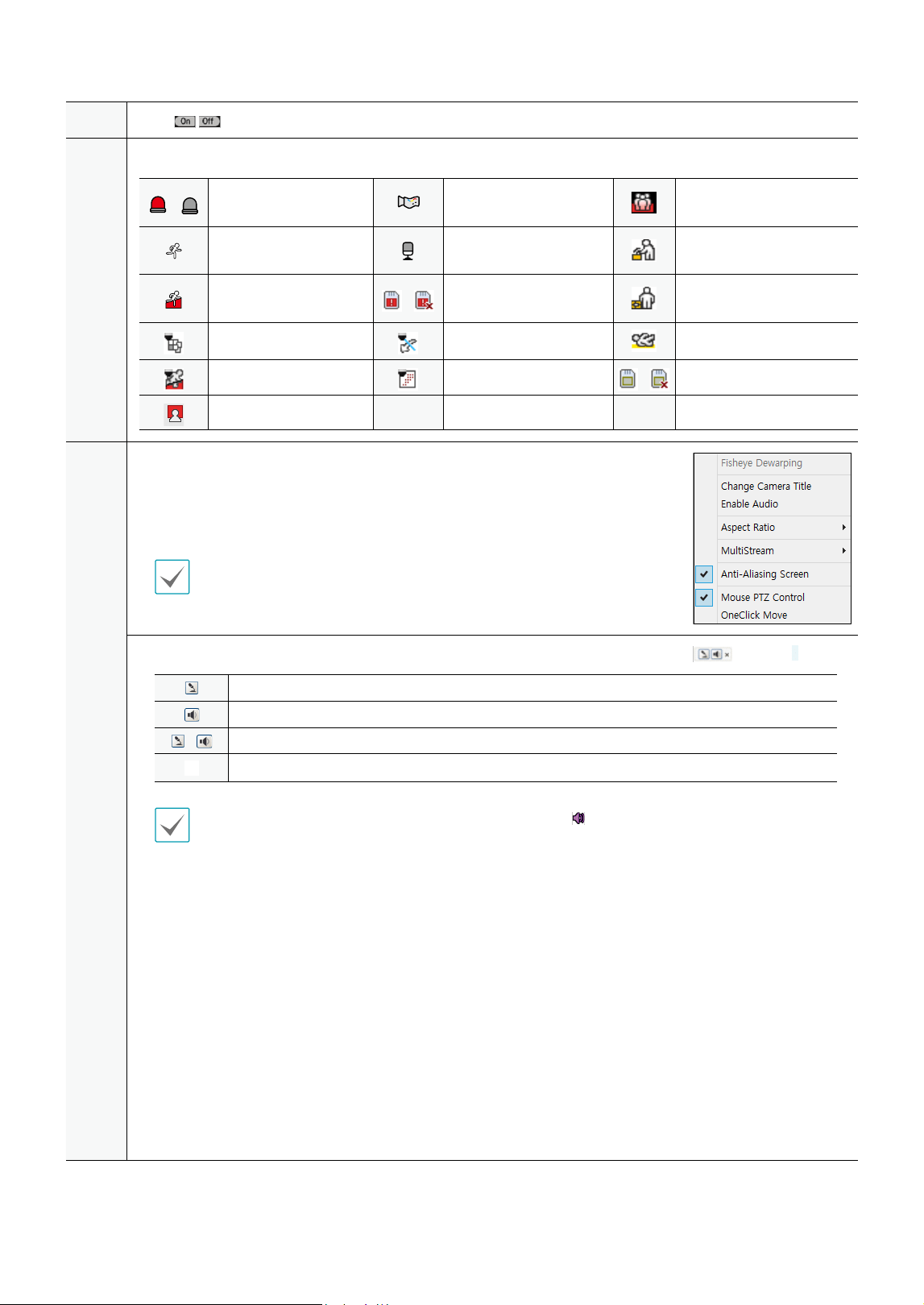
Part 3 - IDIS Web
69
$
Click
TYPE 1
TYPE 1
to control the alarm out device connected to the camera.
%
Event status window at the bottom of the screen displays a list of events detected at remote locales.
/
Enable/Disable Alarm
In
Tampering Crowd Detection
Motion Detection Audio Detection
Abandoned Object
Detection
Trip zone
/
SD Bad On/O
Removed Object
Detection
Loitering Line Crossing Fall Detection
Intrusion Object Detection
/
Disk On/O
Face Detection
^
Right-click on the screen to display the pop-up menu. Click to enable or
disable each function.
• Fisheye Dewarping: This function is not supported.
• Change Camera Title: Used to change the camera's name.
Renaming the camera in Web Live mode does not aect the camera's name on
the remote system. If no name is entered for the camera, the name used at the
remote locale is shown on the screen.
• Enable Audio: Enables audio transmission with remote locales. Select to display buttons.
Enables transmission of audio to the remote locale via microphone.
Enables playback of audio from the remote locale on speakers.
/ Enables two-way audio communication with the remote locale.
Disables audio transmission.
If the remote locale connected to supports audio transmission,
TYPE 1
icon appears on the corresponding
camera screen.
• Aspect Ratio: Change the aspect ratio of the video displayed on the screen.
- Fit to Screen: Fit the video to the size of the camera screen.
- Fit to Aspect Ratio: Resizes camera screen to original aspect ratio of the video.
- Half Size (x0.5) - 4 Times Bigger (x4): Displays the camera videos in the selected size based on the
original size of the video. For example, original size (x1) displays the video in its original size. Half size
(x0.5) through 4 times larger (x4) options are only available if there is enough space on the camera
screen to accommodate the selected size.
• MultiStream: If the camera is running on multi-stream mode, you can choose between the streams.
• Anti-Aliasing Screen: Removes stair step eect (blocks) that are caused when zooming a video to
improve overall quality of video output.
• Mouse PTZ Control: Scrolling the mouse wheel zooms in or out.
• OneClick Move: Controls Pan-Tilt to move the user’s point to the center of the screen.
Part 3 - IDIS Web
70
&
Used to congure camera easy setup. Select from presets or custom setup for the video mode according
to daytime/nighttime.
• Preset: Select from Natural, Vivid or De Noise.
• User Custom: Manually congure the values of each setting (Sharpness, Contrast, Colors and
Brightness).
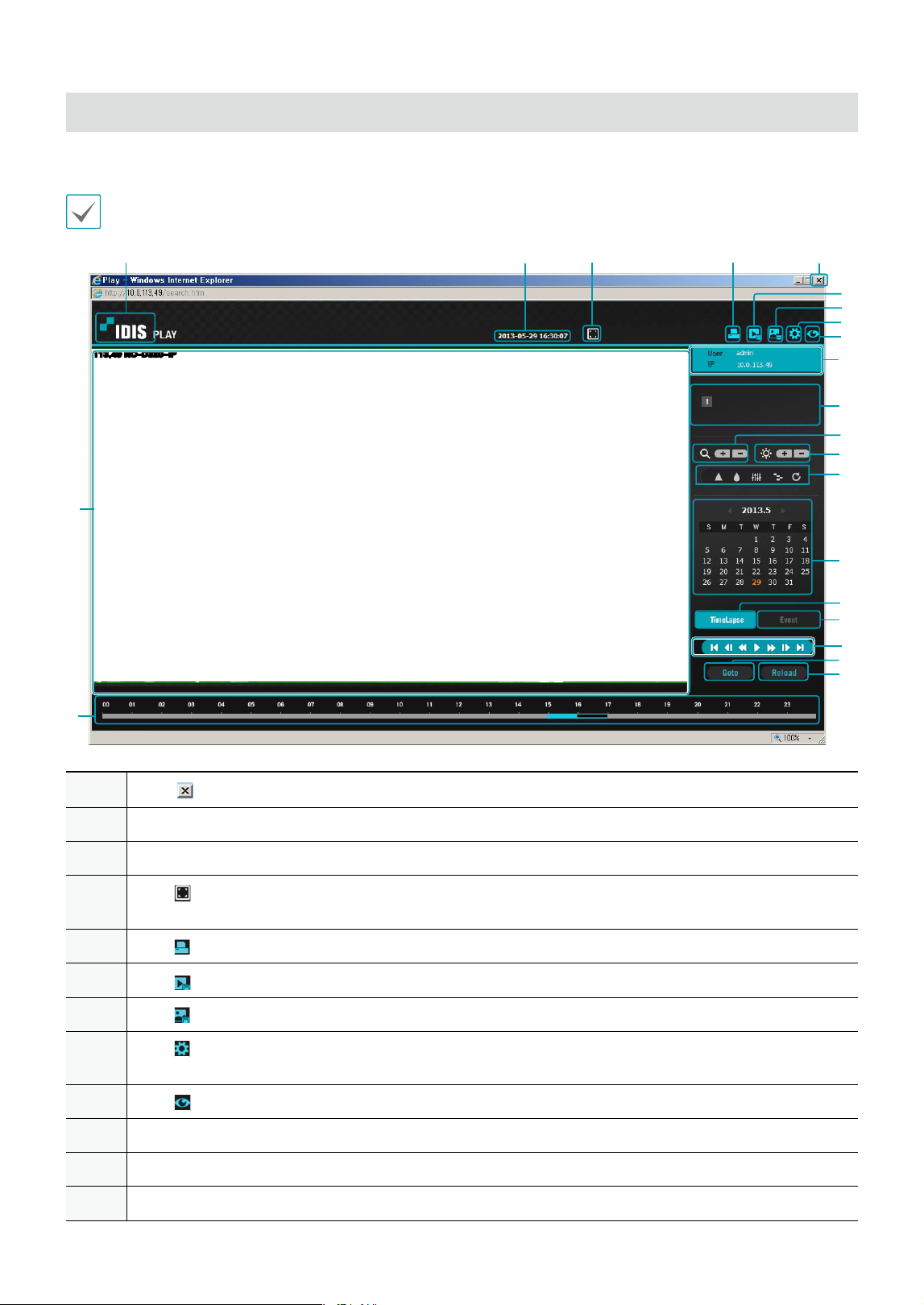
Part 3 - IDIS Web
71
Web Search Mode
A remote web search program that allows you to search for recordings from remote locales in real-time.
While in Web Search mode, connection to remote locales will terminate automatically after 30 minutes of inactivity.
113.49 NC-D320-IP
@
#
%
^
&
*
(
)
2
!
$
b
a
3
4 5 1
9
0
6
7
8
1
Press
TYPE 1
to terminate IDIS Web.
2
Place the mouse pointer on the logo to check IDIS Web's version.
3
Displays time information of the video recording from the remote locale.
4
Click
TYPE 1
to view the video in full screen. Press the ESC key on the keyboard to return to the previous
screen.
5
Click
TYPE 1
to print the current video screen using a printer connected to the computer.
6
Click
TYPE 1
to save the video recording as an executable le.
7
Click
TYPE 1
to save the current video screen as an image le.
8
Click
TYPE 1
to congure rendering mode and OSD settings. Select rendering mode to adjust the video
output rate or select which OSD elements to display on the screen from the OSD list.
9
Click
TYPE 1
to switch over to Web Live mode.
0
Shows login information.
!
Indicates the camera's number.
@
Zoom in or out on the video.
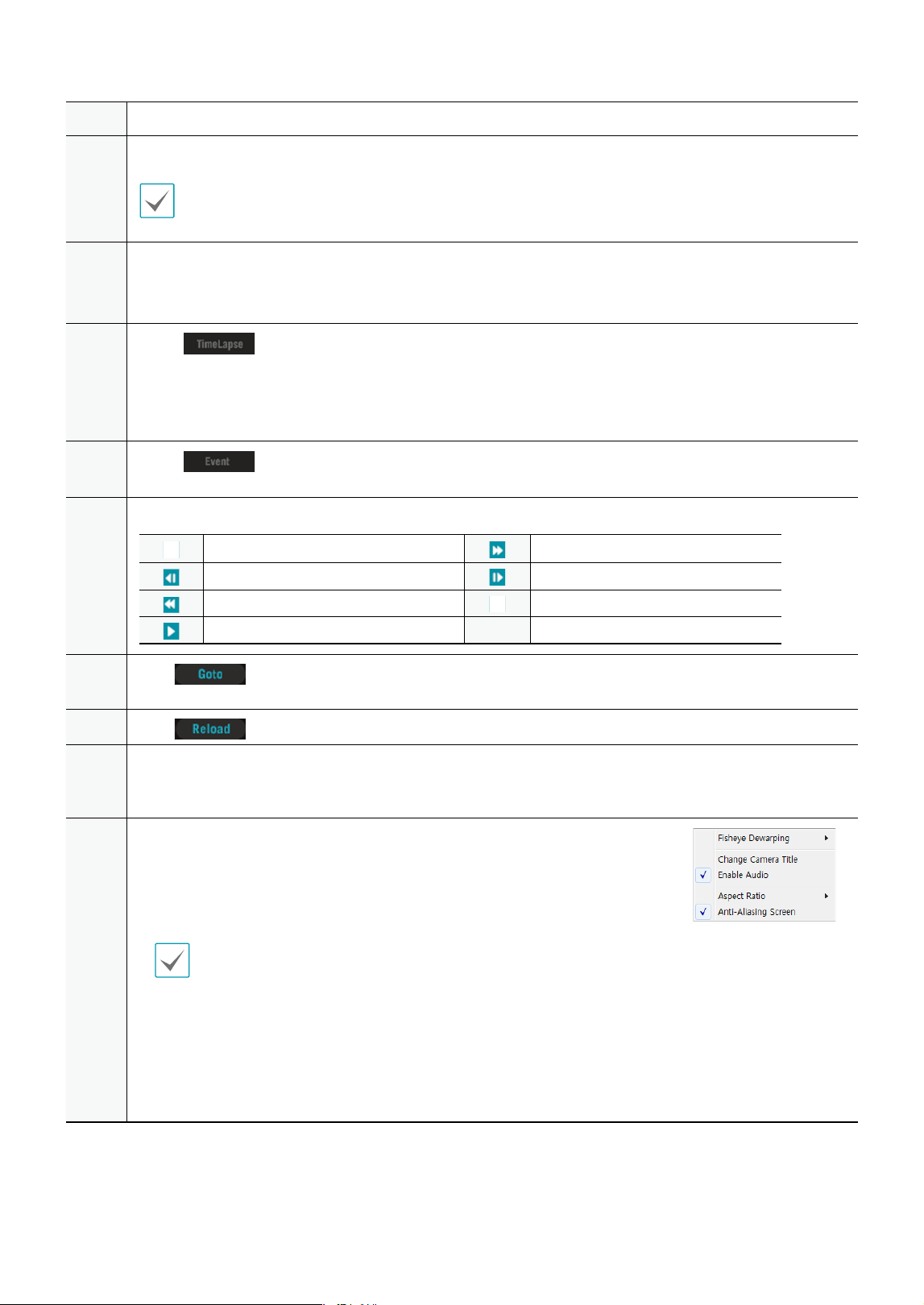
Part 3 - IDIS Web
72
#
Adjust image brightness.
$
Apply image lters (Sharpen, Blur, Equalizer, Interpolation, and Revert) to the images.
Image calibration is applied only during the paused state.
%
Use the calendar to search for video recordings by specic dates.
Dates containing video recordings are highlighted in light blue. Selecting a date containing video
recording data loads the earliest recording from that date. Selected date is highlighted in orange.
^
Select
TYPE 1
to enable time lapse search mode and search/playback video recordings in
chronological order. In time lapse search mode, video recordings can be searched by selecting specic
dates on the calendar. Time information of video recordings found on the selected dates is shown on
the time table at the bottom of the screen. Select a point in time to display video from that moment. If
multiple recordings are available for the selected point in time, you can select the desired segment.
&
Select
TYPE 1
to enable event search mode and search for events matching user-designated
parameters.
*
Use the playback controls to play back video.
TYPE 1
Go to First
TYPE 1
Fast Forward
TYPE 1
Play by Frame (backwards)
TYPE 1
Play by Frame (forwards)
TYPE 1
Rewind
TYPE 1
Go to Last
TYPE 1
Play/Pause
(
Click
TYPE 1
to designate recent recordings you wish to search and then jump to a specic point in
the recording.
)
Click
TYPE 1
to reload recent video recordings from remote locales.
a
Indicates the camera's recording data on a time bar. If the camera's system clock has been changed to a
point in the past and more than one recording exists at the same point in time as a result, you will be able
to choose which segment to search from the segment menu on the upper right portion of the time table.
b
Right-click on the screen to display the pop-up menu. Click to enable or
disable each function.
• Fisheye Dewarping: This function is not supported.
• Change Camera Title: Used to change the camera's name.
Renaming the camera in Web Search mode does not aect the camera's name
on the remote system. If no name is entered for the camera, the name used at
the remote locale is shown on the screen.
• Enable Audio: If audio was recorded with the video, enabling this option plays audio upon playback.
• Aspect Ratio: Change the aspect ratio of the video displayed on the screen.
• Anti-Aliasing Screen: Removes stair step eect (blocks) that are caused when zooming a video to
improve overall quality of video output.

73
Part 4 - Appendix
Index
B
Bitrate Control 20
C
Camera Name 9
Compression 20
D
Date/Time 10
DSCP 14
F
FEN Name 13
FEN Server 13
Frame Rate 20
I
IPFiltering 15
M
MAT 21
N
Network Bandwidth Limit 15
O
ONVIF Protocol 9
Q
Quality 20
R
Remote Port 14
Resolution 20
S
SSL 15
T
Time Sync 10
U
Use FEN 13
Use HTTPS 14
User/Group 11
Use UPnP 14
V1.0

IDIS Co., Ltd.
For more information, please visit at
www.idisglobal.com