Form No. 3463-843 Rev A
Narrow Bucket
Compact T ool Carriers
Model No. 22520 —Serial No. 409900000 and Up
Model No. 23174 —Serial No. 400000000 and Up
Register at www .T oro.com.
Original Instructions (EN)
*3463-843*
W ARNING
CALIFORNIA
Proposition 65 W arning
Use of this product may cause exposure
to chemicals known to the State of
California to cause cancer , birth defects,
or other reproductive harm.
Introduction
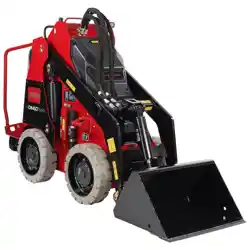
The bucket is a load-bearing attachment intended to
be used on a T oro compact tool carrier . It is designed
primarily for moving rock, dirt, sand, or other materials.
Using this product for purposes other than its intended
use could prove dangerous to you and bystanders.
Read this information carefully to learn how to operate
and maintain your product properly and to avoid
injury and product damage. Y ou are responsible for
operating the product properly and safely .
V isit www .T oro.com for product safety and operation
training materials, accessory information, help nding
a dealer , or to register your product.
Whenever you need service, genuine T oro parts, or
additional information, contact an Authorized Service
Dealer or T oro Customer Service and have the model
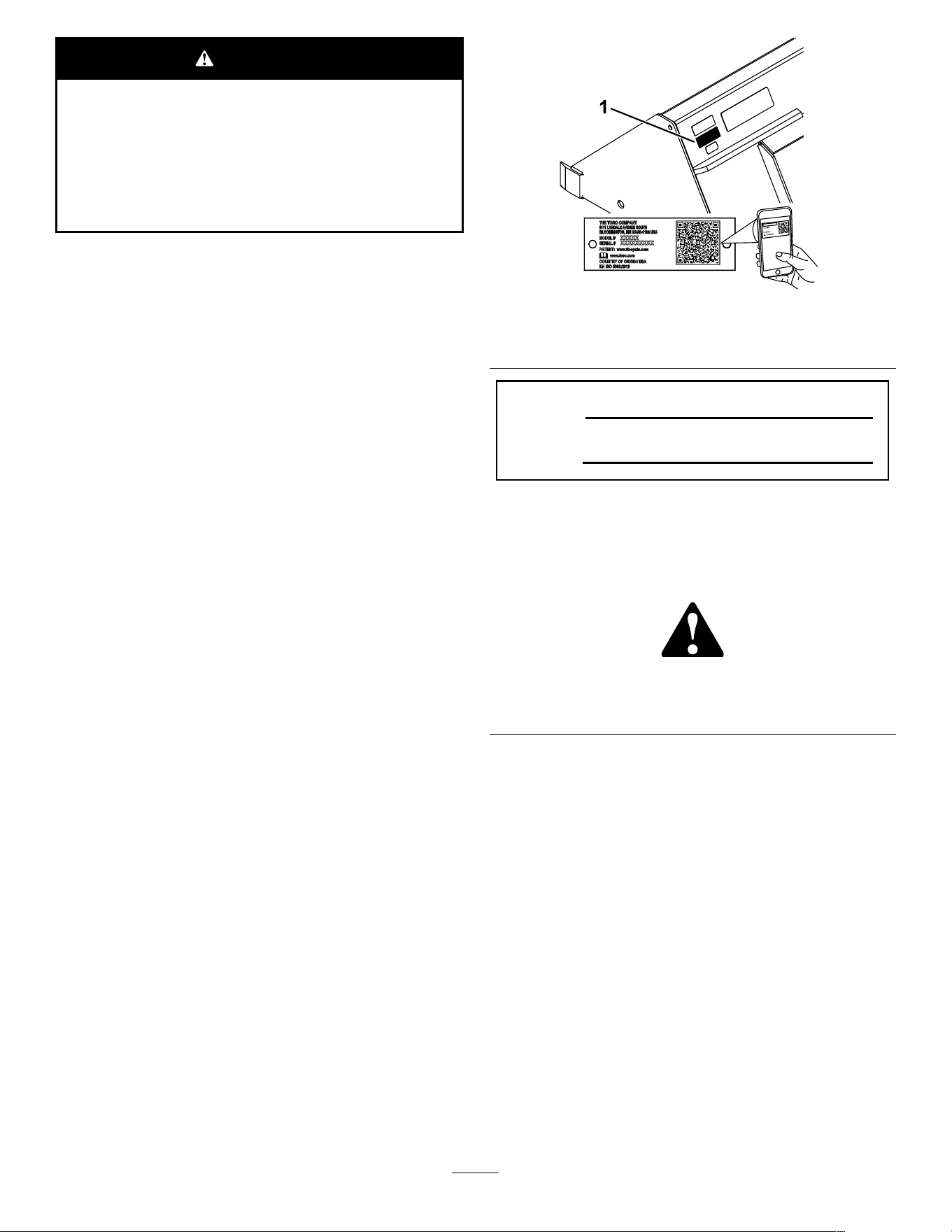
and serial numbers of your product ready . Figure 1
identies the location of the model and serial numbers
on the product. W rite the numbers in the space
provided.
Important: W ith your mobile device, you can
scan the QR code on the serial number decal (if
equipped) to access warranty , parts, and other
product information.
g240152
Figure 1
1. Model and serial number location
Model No.
Serial No.
This manual identies potential hazards and has
safety messages identied by the safety-alert symbol
( Figure 2 ), which signals a hazard that may cause
serious injury or death if you do not follow the
recommended precautions.
g000502
Figure 2
1. Safety-alert symbol
This manual uses 2 words to highlight information.
Important calls attention to special mechanical
information and Note emphasizes general information
worthy of special attention.
© 2023—The T oro® Company
81 1 1 L yndale A venue South
Bloomington, MN 55420
2
Contact us at www .T oro.com.
Printed in the USA
All Rights Reserved
Contents
Safety . . . . . . . . . . . . . . . . . . . . . . . . . . . . . . . . . . . . . . . . . . . . . . . . . . . . . . . . . . . . . . . . . . . . . . . 3
General Safety . . . . . . . . . . . . . . . . . . . . . . . . . . . . . . . . . . . . . . . . . . . . . . . . . . . 3
Slope Safety . . . . . . . . . . . . . . . . . . . . . . . . . . . . . . . . . . . . . . . . . . . . . . . . . . . . . . . 4
Bucket Safety . . . . . . . . . . . . . . . . . . . . . . . . . . . . . . . . . . . . . . . . . . . . . . . . . . . . . 4
Maintenance and Storage Safety . . . . . . . . . . . . . . . . . . . . . . . . 4
Safety and Instructional Decals . . . . . . . . . . . . . . . . . . . . . . . . . . 4
Product Overview . . . . . . . . . . . . . . . . . . . . . . . . . . . . . . . . . . . . . . . . . . . . . . . . . . . . . 5
Specications . . . . . . . . . . . . . . . . . . . . . . . . . . . . . . . . . . . . . . . . . . . . . . . . . . . . 5
Maximum Material Density at Capacity . . . . . . . . . . . . . . . 5
Operation . . . . . . . . . . . . . . . . . . . . . . . . . . . . . . . . . . . . . . . . . . . . . . . . . . . . . . . . . . . . . . . . . . 6
Installing and Removing the Attachment . . . . . . . . . . . . . 6
Filling the Bucket . . . . . . . . . . . . . . . . . . . . . . . . . . . . . . . . . . . . . . . . . . . . . . . . 6
T ransport Position . . . . . . . . . . . . . . . . . . . . . . . . . . . . . . . . . . . . . . . . . . . . . . 7
Storage . . . . . . . . . . . . . . . . . . . . . . . . . . . . . . . . . . . . . . . . . . . . . . . . . . . . . . . . . . . . . . . . . . . . . 7
Safety
DANGER
There may be buried utility lines in the work
area. Digging into them may cause a shock
or an explosion.
Have the property or work area marked for
buried lines and do not dig in marked areas.
Contact your local marking service or utility
company to have the property marked (for
example, in the US, call 81 1 or in Australia,
call 1 100 for the nationwide marking service).
General Safety
Always follow all safety instructions to avoid serious
injury or death.
• Do not exceed the rated operating capacity , as the
machine may become unstable, which may result
in loss of control.
• Do not transport an attachment with the arms
raised or extended (if applicable) . Always
transport the attachment close to the ground; refer
to T ransport Position ( page 7 ) .
• Have the property or work area marked for buried
lines and other objects, and do not dig in marked
areas.
• Read and understand the content of this Operator ’ s
Manual before starting the machine.
• Use your full attention while operating the
machine. Do not engage in any activity that
causes distractions; otherwise, injury or property
damage may occur .
• Never allow children or untrained people to
operate the machine.
• Keep your hands and feet away from the moving
components and attachments.
• Do not operate the machine without the guards
and other safety protective devices in place and
working on the machine.
• Keep bystanders and pets away from the machine.
• Stop the machine, shut of f the machine, and
remove the key before servicing, fueling, or
unclogging the machine.
Improperly using or maintaining this machine can
result in injury . T o reduce the potential for injury ,
comply with these safety instructions and always
pay attention to the safety-alert symbol , which
means Caution, W arning, or Danger—personal safety
instruction. Failure to comply with these instructions
may result in personal injury or death.
3
Slope Safety
• Operate the machine up and down slopes with
the heavy end of the machine uphill. W eight
distribution changes with attachments. An empty
load-bearing attachment makes the rear of the
machine the heavy end, and a full load-bearing
attachment makes the front of the machine the
heavy end. Most other attachments make the front
of machine the heavy end.
• Raising or extending (if applicable) the loader arms
on a slope af fects the stability of the machine.
Keep the loader arms in the lowered and retracted
position when on slopes.
• Slopes are a major factor related to loss of control
and tip-over accidents, which can result in severe
injury or death. Operating the machine on any
slope or uneven terrain requires extra caution.
• Establish your own procedures and rules for
operating on slopes. These procedures must
include surveying the site to determine which
slopes are safe for machine operation. Always
use common sense and good judgment when
performing this survey .
• Slow down and use extra care on hillsides. Ground
conditions can af fect the stability of the machine.
• A void starting or stopping on a slope. If the
machine loses traction, proceed slowly , straight
down the slope.
• A void turning on slopes. If you must turn, turn
slowly and keep the heavy end of the machine
uphill.
• Keep all movements on slopes slow and gradual.
Do not make sudden changes in speed or
direction.
• If you feel uneasy operating the machine on a
slope, do not do it.
• W atch for holes, ruts, or bumps, as uneven terrain
could overturn the machine. T all grass can hide
obstacles.
• Use caution when operating on wet surfaces.
Reduced traction could cause sliding.
• Evaluate the area to ensure that the ground is
stable enough to support the machine.
• Use caution when operating the machine near the
following:
– Drop-of fs
– Ditches
– Embankments
– Bodies of water
The machine could suddenly roll over if a track
goes over the edge or the edge caves in. Maintain
a safe distance between the machine and any
hazard.
• Do not remove or add attachments on a slope.
• Do not park the machine on a hillside or slope.
Bucket Safety
• Always lower the attachment and shut of f the
machine each time you leave the operating
position.
• When lifting the attachment, keep it level and
prevent the load from spilling backward.
Maintenance and Storage
Safety
• Check fasteners at frequent intervals for proper
tightness to ensure that the equipment is in safe
operating condition.
• Refer to this Operator ’ s Manual for important
details if you store the attachment for an extended
period of time.
• Maintain or replace safety and instruction labels,
as necessary .
Safety and Instructional
Decals
Safety decals and instructions are
easily visible to the operator and are
located near any area of potential
danger . Replace any decal that is
damaged or missing.
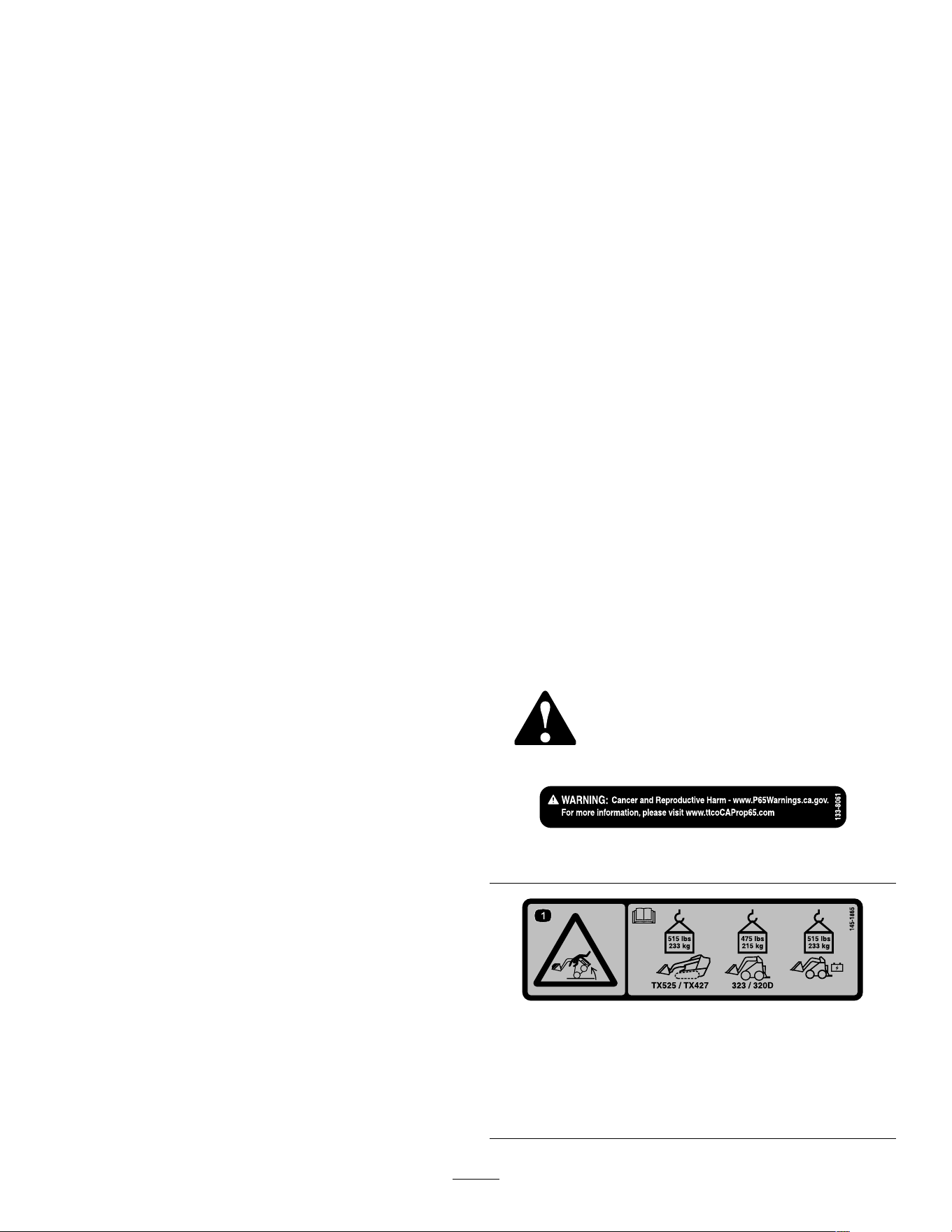
decal133-8061
133-8061
decal145-1865
145-1865
1. T ipping hazard—read the Operator's Manual ; for the TX
525 and TX 427, do not exceed loads of 233 kg (515 lb);
for the 323 and 320D models, do not exceed loads of 215
kg (475 lb); for the battery powered models, do not exceed
loads of 233 kg (515 lb).
4
Product Overview
Specications
Note: Specications and design are subject to
change without notice.
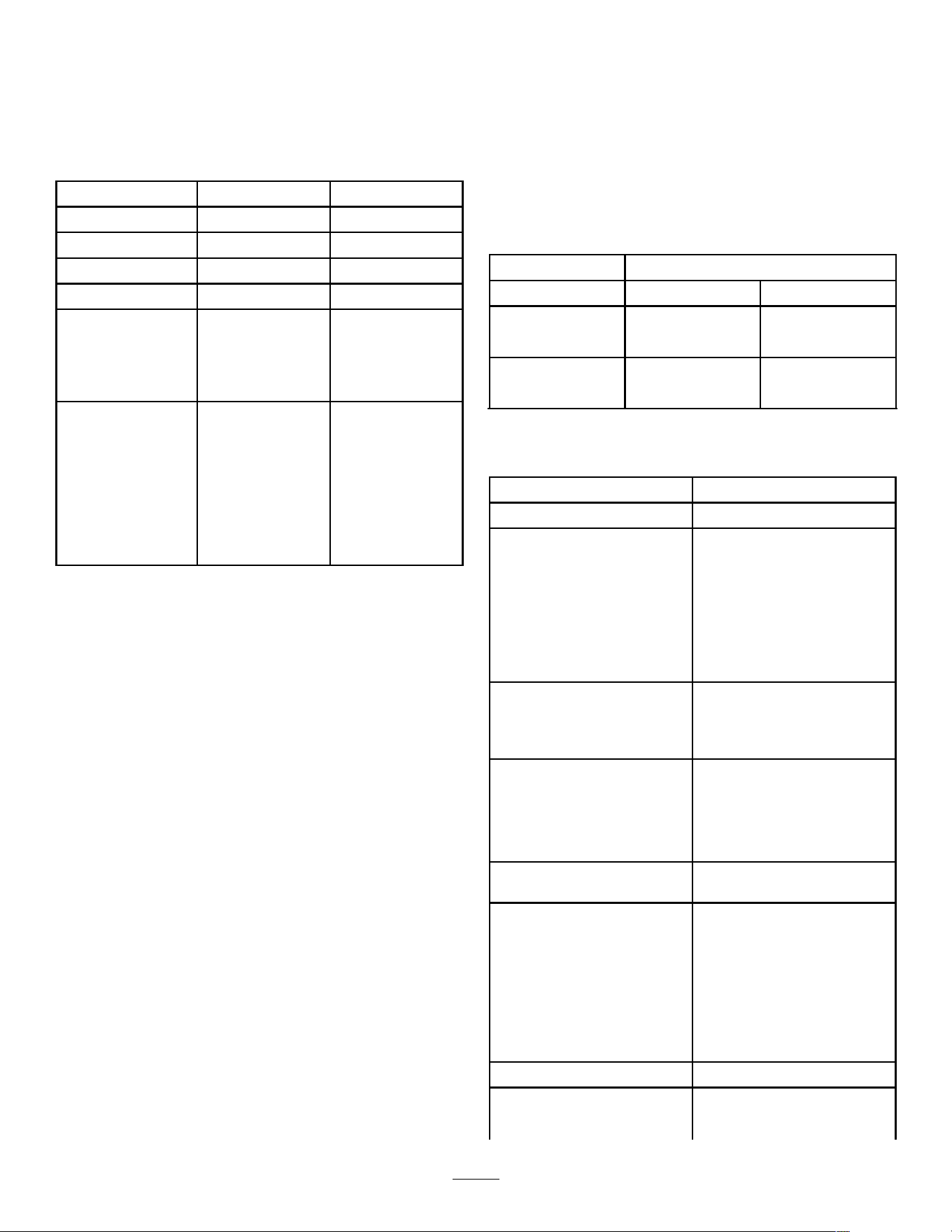
Model 22520 Model 23174
Width
88 cm (35 inches) 53 cm (21 inches)
Length
68 cm (27 inches) 74 cm (29 inches)
Height
64 cm (25 inches) 42 cm (17 inches)
W eight
69 kg (153 lb) 69 kg (153 lb)
Capacity
SAE struck
capacity
0.10 m
3
(3.5 ft
3
) 0.08 m
3
(2.9 ft
3
)
Heaped capacity
0.12 m
3
(4.3 ft
3
) 0.10 m
3
(3.4 ft
3
)
Maximum load
rating
320D and 323
models
215 kg (475 lb) 215 kg (475 lb)
TX 427 and TX
525 models
233 kg (515 lb) 233 kg (515 lb)
Battery-powered
models
233 kg (515 lb) 233 kg (515 lb)
T o ensure optimum performance and continued safety
certication of the machine, use only genuine T oro
replacement parts and accessories. Replacement
parts and accessories made by other manufacturers
could be dangerous, and such use could void the
product warranty .
Maximum Material Density at
Capacity
The density of the materials moved by the bucket
varies and, therefore, so does the amount of material
that the bucket can carry before reaching the
maximum load rating. The rst 2 tables lists the
density of material that can be carried, both heaped
and struck (i.e., leveled of f), in the bucket. The
Material Density table lists common materials and
their densities.
Maximum Density
Bucket Capacity
Model 22520 Model 23174
2369 kg/m
3
2835 kg/m
3
Struck (leveled)
bucket
(147 lb/ft
3
) (177 lb/ft
3
)
1922 kg/m
3
2419 kg/m
3
Heaped bucket
(120 lb/ft
3
) (151 lb/ft
3
)
Note: Maximum density = Maximum load rating / Capacity
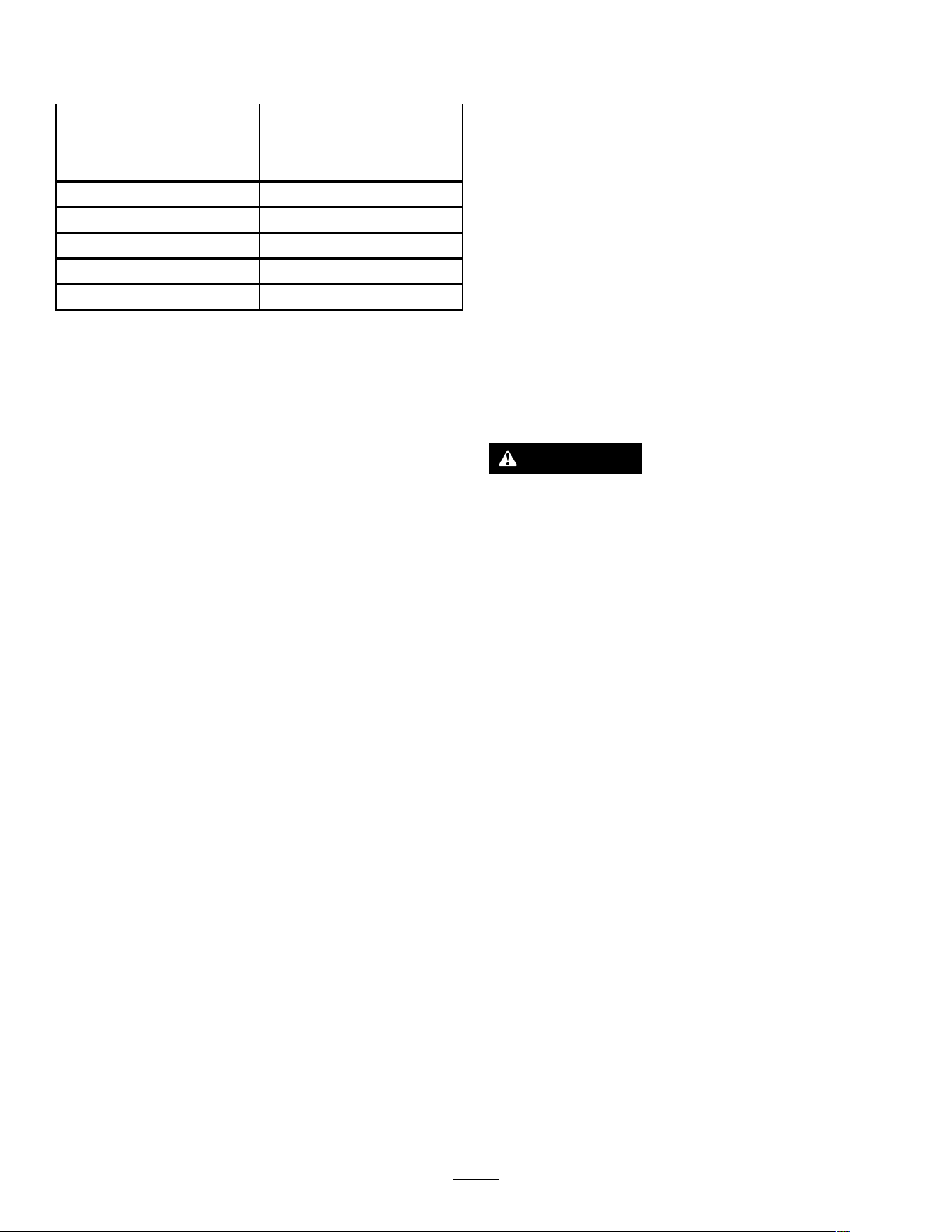
Material Density
Material
Density (Approximate)
Caliche 1250 kg/m
3
(78 lb/ft
3
)
Clay:
Natural bed
1600 kg/m
3
(104 lb/ft
3
)
Dry
1480 kg/m
3
(93 lb/ft
3
)
W et
1660 kg/m
3
(104 lb/ft
3
)
With gravel, dry
1420 kg/m
3
(89 lb/ft
3
)
With gravel, wet
1540 kg/m
3
(96 lb/ft
3
)
Coal:
Anthracite, broken
1 100 kg/m
3
(69 lb/ft
3
)
Bituminous, broken
830 kg/m
3
(52 lb/ft
3
)
Earth:
Dry , packed
1510 kg/m
3
(94 lb/ft
3
)
W et, packed
1600 kg/m
3
(100 lb/ft
3
)
Loam
1250 kg/m
3
(78 lb/ft
3
)
Granite, broken or large
crushed
1660 kg/m
3
(104 lb/ft
3
)
Gravel:
Dry
1510 kg/m
3
(94 lb/ft
3
)
Pit run (graveled sand) 1930 kg/m
3
(120 lb/ft
3
)
Dry , 13 to 51 mm (1/2 to 2
inch)
1690 kg/m
3
(106 lb/ft
3
)
W et, 13 to 51 mm (1/2 to 2
inch)
2020 kg/m
3
(126 lb/ft
3
)
Limestone, broken or crushed
1540 kg/m
3
(96 lb/ft
3
)
Sand:
Dry
1420 kg/m
3
(89 lb/ft
3
)
5
Material Density (cont'd.)
W et
1840 kg/m
3
(1 15 lb/ft
3
)
With gravel, dry
1720 kg/m
3
(107 lb/ft
3
)
With gravel, wet
2020 kg/m
3
(126 lb/ft
3
)
Sandstone, broken 1510 kg/m
3
(94 lb/ft
3
)
Shale 1250 kg/m
3
(78 lb/ft
3
)
Slag, broken 1750 kg/m
3
(109 lb/ft
3
)
Stone, crushed 1600 kg/m
3
(100 lb/ft
3
)
T opsoil
950 kg/m
3
(59 lb/ft
3
)
Operation
Determine the left and right sides of the machine from
the normal operating position.
Installing and Removing
the Attachment
Refer to the Operator ’ s Manual for the traction unit for
the installation and removal procedure.
Important: Before installing the attachment,
position the machine on a level surface, ensure
that the mount plates are free of any dirt or debris,
and ensure that the pins rotate freely . If the pins
do not rotate freely , grease them.
Note: Always use the traction unit to lift and move
the attachment.
W ARNING
If you do not fully seat the quick-attach
pins through the attachment mount plate,
the attachment could fall off the machine,
crushing you or bystanders.
Ensure that the quick-attach pins are fully
seated in the attachment mount plate.
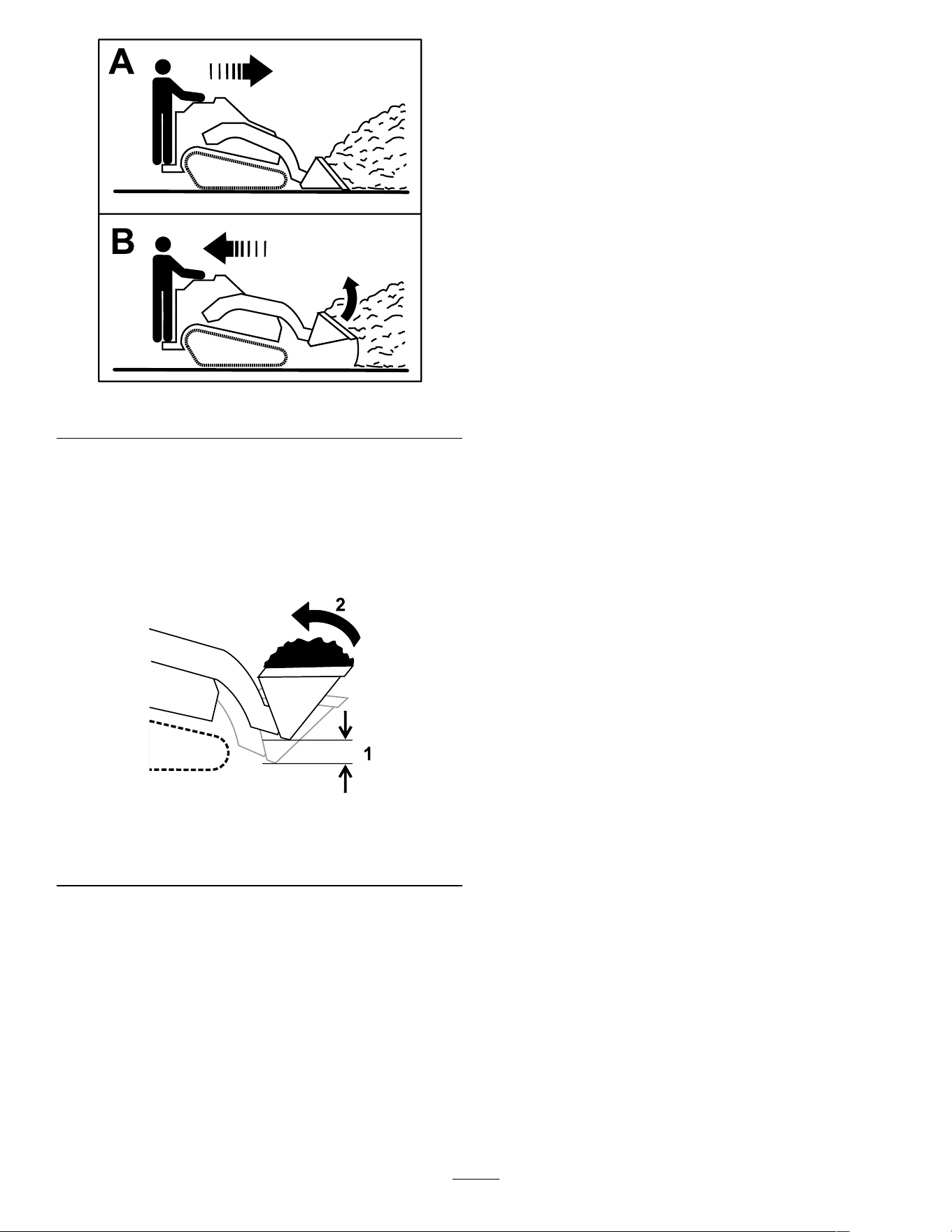
Filling the Bucket
1. Position the bucket level to the ground.
2. Drive forward and insert the bucket into the pile
of material.
3. When the bucket is full, drive the machine in
reverse and gently tilt the bucket rearward to
decrease the lifting resistance when you lift the
load.
Important: Always carry loads close to the
ground; refer to T ransport Position ( page 7 ) .
6
g266856
Figure 3
T ransport Position
When transporting a load, keep the attachment as
close to the ground as possible, no more than 15 cm
(6 inches) above the ground. T ilt it rearward to keep
the load level.
g240205
Figure 4
1. No more than 15 cm (6
inches) above the ground
2. T ilt the load rearward
Storage
1. Before long-term storage, wash the attachment
with mild detergent and water to remove dirt and
grime.
2. Paint all scratched or bare metal surfaces.
Note: Paint is available from your Authorized
Service Dealer .
3. Store the attachment in a clean, dry garage or
storage area. Cover it to protect it and keep it
clean.
7

California Proposition 65 W arning Information
What is this warning?
Y ou may see a product for sale that has a warning label like the following:
W ARNING: Cancer and Reproductive Harm—www .p65W arnings.ca.gov .
What is Prop 65?
Prop 65 applies to any company operating in California, selling products in California, or manufacturing products that may be sold in or brought into
California. It mandates that the Governor of California maintain and publish a list of chemicals known to cause cancer , birth defects, and/or other
reproductive harm. The list, which is updated annually , includes hundreds of chemicals found in many everyday items. The purpose of Prop 65 is to
inform the public about exposure to these chemicals.
Prop 65 does not ban the sale of products containing these chemicals but instead requires warnings on any product, product packaging, or literature with
the product. Moreover , a Prop 65 warning does not mean that a product is in violation of any product safety standards or requirements. In fact, the
California government has claried that a Prop 65 warning “is not the same as a regulatory decision that a product is ‘safe’ or ‘unsafe.’” Many of these
chemicals have been used in everyday products for years without documented harm. For more information, go to https://oag.ca.gov/prop65/faqs-view-all .
A Prop 65 warning means that a company has either (1) evaluated the exposure and has concluded that it exceeds the “no signicant risk level”; or (2)
has chosen to provide a warning based on its understanding about the presence of a listed chemical without attempting to evaluate the exposure.
Does this law apply everywhere?
Prop 65 warnings are required under California law only . These warnings are seen throughout California in a wide range of settings, including but not
limited to restaurants, grocery stores, hotels, schools, and hospitals, and on a wide variety of products. Additionally , some online and mail order
retailers provide Prop 65 warnings on their websites or in catalogs.
How do the California warnings compare to federal limits?
Prop 65 standards are often more stringent than federal and international standards. There are various substances that require a Prop 65 warning
at levels that are far lower than federal action limits. For example, the Prop 65 standard for warnings for lead is 0.5 μg/day , which is well below
the federal and international standards.
Why don’t all similar products carry the warning?
• Products sold in California require Prop 65 labelling while similar products sold elsewhere do not.
• A company involved in a Prop 65 lawsuit reaching a settlement may be required to use Prop 65 warnings for its products, but other companies
making similar products may have no such requirement.
• The enforcement of Prop 65 is inconsistent.
• Companies may elect not to provide warnings because they conclude that they are not required to do so under Prop 65; a lack of warnings for a
product does not mean that the product is free of listed chemicals at similar levels.
Why does T oro include this warning?
T oro has chosen to provide consumers with as much information as possible so that they can make informed decisions about the products they buy and
use. T oro provides warnings in certain cases based on its knowledge of the presence of one or more listed chemicals without evaluating the level of
exposure, as not all the listed chemicals provide exposure limit requirements. While the exposure from T oro products may be negligible or well within the
“no signicant risk” range, out of an abundance of caution, T oro has elected to provide the Prop 65 warnings. Moreover , if T oro does not provide these
warnings, it could be sued by the State of California or by private parties seeking to enforce Prop 65 and subject to substantial penalties.
Rev A