1
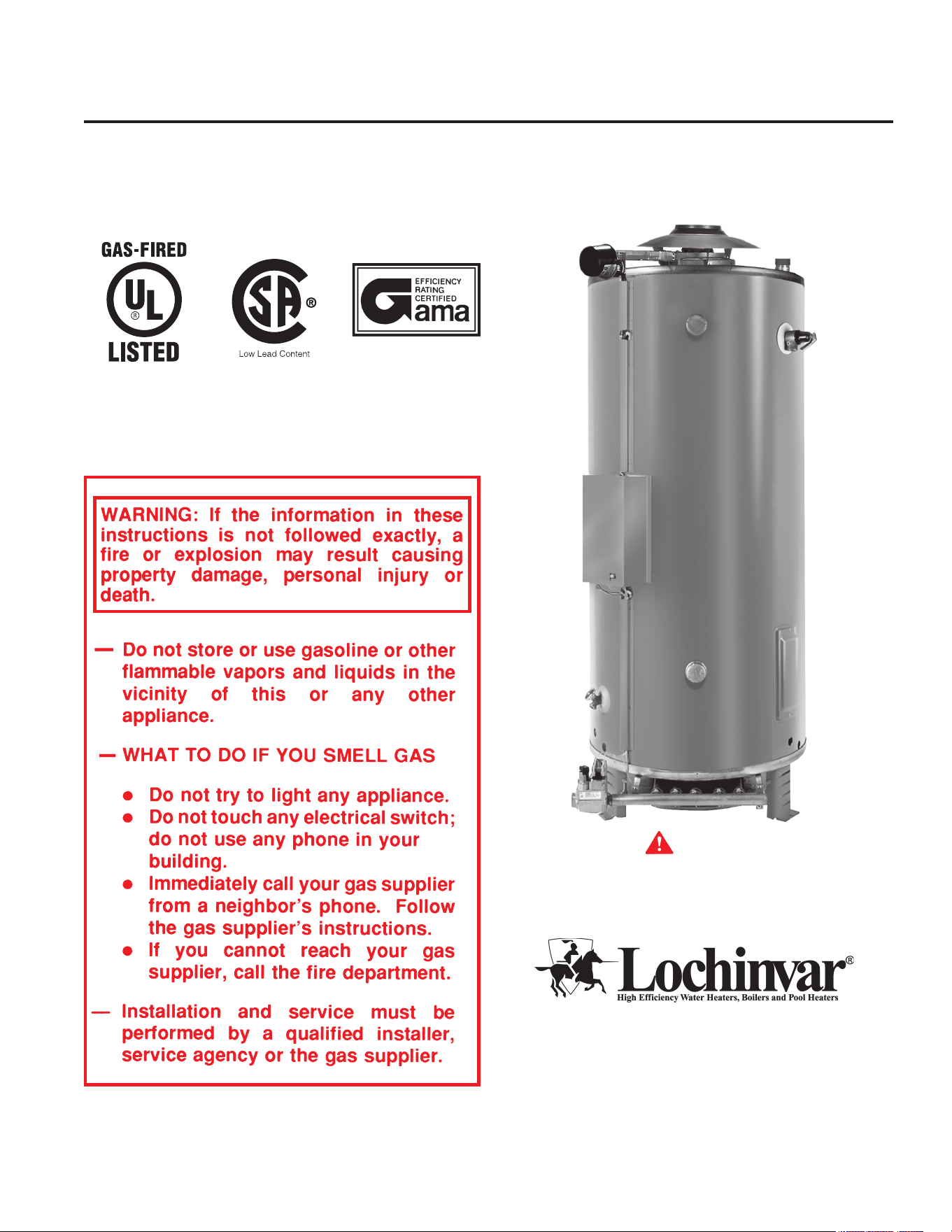
MODELS CG(N,L)120 THRU 400A
COMMERCIAL GAS, GLASS-LINED, TANK-TYPE WATER HEATER
• INSTALLATION • OPERATION • MAINTENANCE • LIMITED WARRANTY
PLACE THESE INSTRUCTIONS ADJACENT TO HEATER
AND NOTIFY OWNER TO KEEP FOR FUTURE REFERENCE.
CAUTION
TEXT PRINTED OR OUTLINED IN RED CONTAINS
INFORMATION RELATIVE TO YOUR SAFETY. PLEASE
READ THOROUGHLY BEFORE INSTALLING AND USING
THIS APPLIANCE.
Thank you for buying this energy efcient water heater. We
appreciate your condence in our product.
PRINTED 1011 322876-000
300 Maddox Simpson Parkway
Lebanon, TN 37090
Phone: 615-889-8900 • Fax: 615-547-1000
Technical Service email: [email protected]
www.Lochinvar.com
2
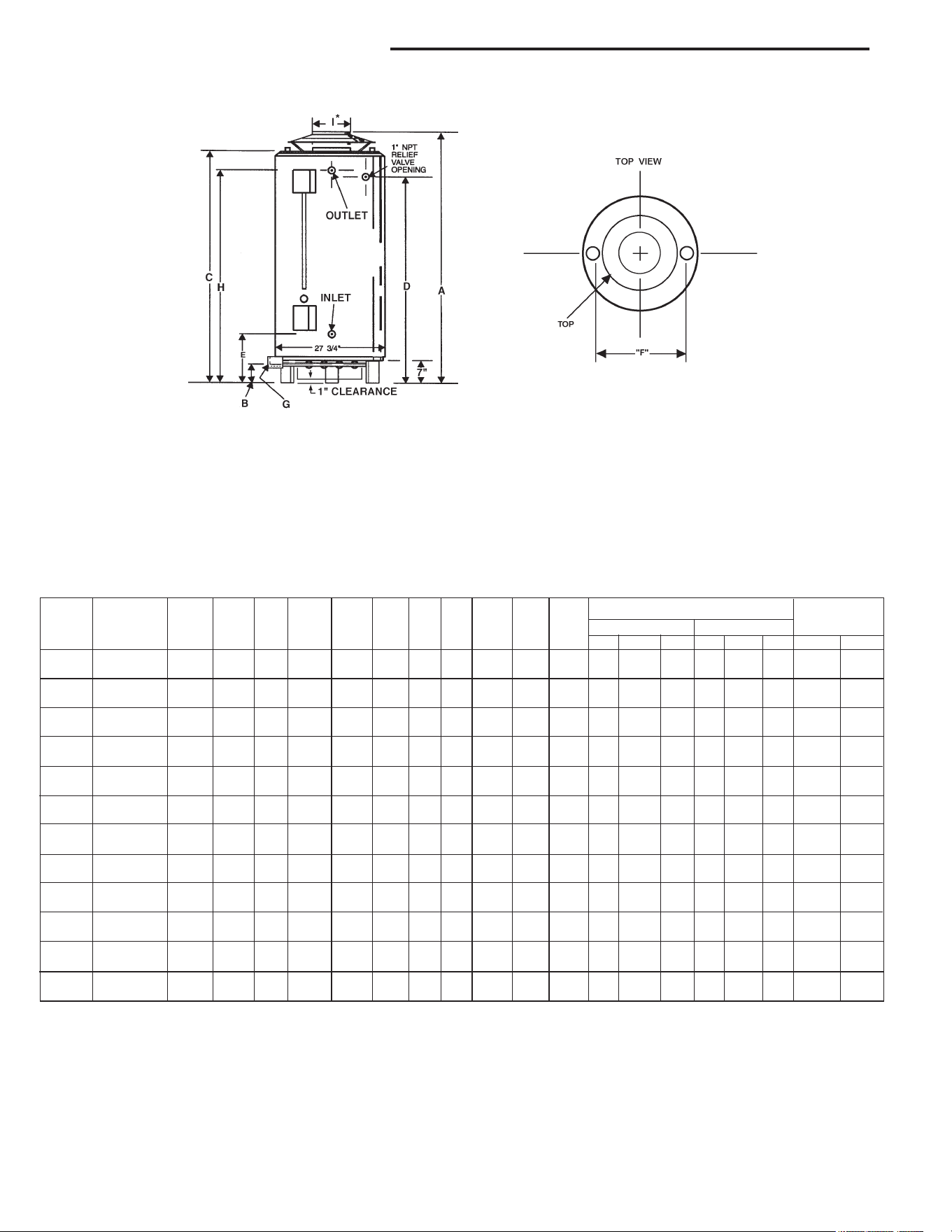
MODELS CG(N,L)120 Through CG(N,L)400 - TABLE 1A
MODEL INPUT APPROX. GAS H VENT CONNECTIONS Approximate
RATE TANK INLET DIA INLET OUTLET ship. Weight
BTU/Hr. CAP. A B C D E F G I J TOP FRONT BACK TOP FRONT BACK STD. ASME
CG(N,L) 120,000 BTU/Hr. 71 Gal 69.75” 4.25” 59.50” 50.87” 19.69” 19” 1/2” 51.88” 6” 27.75” 1.50” 1.50” 1.50” 1.50” 1.50” 1.50” 400 Lbs NA
120070 35 Kw/Hr 268 L 177 cm 11 cm 151 cm 129 cm 50 cm 48 cm 1/2” 132 cm 15 cm 71 cm 1.50” 1.50” 1.50” 1.50” 1.50” 1.50” 182 Kg NA
CG(N,L) 154,000 BTU/Hr 81 Gal 73.00” 4.25” 66.50” 57.87” 19.69” 19” 1/2” 59.00” 6” 27.75” 1.50” 1.50” 1.50” 1.50” 1.50” 1.50” 470 Lbs NA
155080 45 Kw/Hr 307 L 185 cm 11 cm 169 cm 147 cm 50 cm 48 cm 1/2” 150 cm 15 cm 71 cm 1.50” 1.50” 1.50” 1.50” 1.50” 1.50” 213 Kg NA
CG(N,L) 180,000 BTU/Hr 81Gal 67.50” 4.50” 62.00” 53.62” 20.50” 21” 1/2” 54.62” 6” 27.75” 1.50” 1.50” 1.50” 1.50” 1.50” 1.50” 470 Lbs NA
180080 53 Kw/Hr 307 L 171 cm 12 cm 157 cm 136 cm 52 cm 53 cm 1/2” 139 cm 15 cm 71 cm 1.50” 1.50” 1.50” 1.50” 1.50” 1.50” 213 Kg NA
CG(N,L) 199,000 BTR/Hr 100 Gal 75.00” 4.50” 70.00” 61.62” 20.50” 21” 1/2” 62.62” 6” 27.75” 1.50” 1.50” 1.50” 1.50” 1.50” 1.50” 603 Lbs NA
200100 58 kW/Hr 379 L 192 cm 12 cm 178 cm 157 cm 52 cm 53 cm 1/2” 159 cm 15 cm 71 cm 1.50” 1.50” 1.50” 1.50” 1.50” 1.50” 273 Kg NA
CG(N,L) 199,000 BTU/Hr 81 Gal 67.50” 4.50” 62.00” 53.62” 20.50” 21” 1/2” 54.62” 6” 27.75” 1.50” 1.50” 1.50” 1.50” 1.50” 1.50” 470 Lbs NA
200080 58 kW/Hr 307 L 171 cm 12 cm 157 cm 136 cm 52 cm 53 cm 1/2” 139 cm 15 cm 71 cm 1.50” 1.50” 1.50” 1.50” 1.50” 1.50” 213 Kg NA
CG(N,L) 199,000 BTR/Hr 100 Gal 72.00” 4.50” 65.13” 55.87” 19.75” 23” 1/2” 56.38” 6” 30.25” 1.50” 2.00” 2.00” 1.50” 2.00” 2.00” 630 Lbs 725 Lbs
199100(A) 58 kW/Hr 379 L 183 cm 12 cm 165 cm 142 cm 50 cm 58 cm 1/2” 143 cm 15 cm 77 cm 1.50” 2.00” 2.00” 1.50” 2.00” 2.00” 286 Kg 329 Kg
CG(N,L) 250,000 BTR/Hr 100 Gal 72.00” 4.50” 65.13” 55.87” 19.75” 23” 1/2” 56.38” 8” 30.25” 1.50” 2.00” 2.00” 1.50” 2.00” 2.00” 630 Lbs 725 Lbs
250100(A) 72 kW/Hr 379 L 183 cm 12 cm 165 cm 142 cm 50 cm 58 cm 1/2” 143 cm 20 cm 77 cm 1.50” 2.00” 2.00” 1.50” 2.00” 2.00” 286 Kg 329 Kg
CG(N,L) 251,000 BTR/Hr 65 Gal 75.00” 4.50” 65.75” 57.25” 20.00” NA 1/2” 58.75 8” 27.75” NA 1.50” 1.50” NA 1.50” 1.50” 750Lbs 862 Lbs
250065(A) 73 kW/Hr 246 L 191 cm 12 cm 167 cm 145 cm 51 cm NA 1/2” 149 cm 20 cm 70 cm NA 1.50” 1.50” NA 1.50” 1.50” 341 Kg 391 Kg
CG(N,L) 275,000 BTR/Hr 100 Gal 72.00” 4.50” 65.13” 55.87” 19.75” 23” 1/2” 56.38” 8” 30.25” 1.50” 2.00” 2.00” 1.50” 2.00” 2.00” 630 Lbs 725 Lbs
275100(A) 80 kW/Hr 379 L 183 cm 12 cm 165 cm 142 cm 50 cm 58 cm 1/2” 143 cm 20 cm 77 cm 1.50” 2.00” 2.00” 1.50” 2.00” 2.00” 286 Kg 329 Kg
CG(N,L) 305,000 BTR/Hr 65 Gal 75.00” 4.50” 65.75” 57.25” 20.00” NA 1/2” 58.75 8” 27.75” NA 1.50” 1.50” NA 1.50” 1.50” 750 Lbs 862 Lbs
305065(A) 89 kW/Hr 246 L 191 cm 12 cm 167 cm 145 cm 51 cm NA 1/2” 149 cm 20 cm 70 cm NA 1.50” 1.50” NA 1.50” 1.50” 341 Kg 391 Kg
CG(N,L) 365,000 BTR/Hr 85 Gal 79.50” 4.50” 70.25” 62.50” 22.50” 23” 3/4” 63.00 8” 27.75” 1.50” 1.50” 1.50” 1.50” 1.50” 1.50” 725 Lbs 833 Lbs
365085(A) 107 kW/Hr 322 L 202 cm 12 cm 178 cm 159 cm 57 cm 58 cm 3/4” 160 cm 20 cm 70 cm 1.50” 1.50” 1.50” 1.50” 1.50” 1.50” 329 Kg 379 Kg
CG(N,L) 390,000 BTU/Hr 100 Gal 75.50” 4.50” 67.50” 58.25” 26.75” 23” 3/4” 59.00” 8” 30.25” 1.50” 2.00” 2.00” 1.50” 2.00” 2.00” 760 Lbs 874 Lbs
400100(A) 114 kW/Hr 379 L 192 cm 12 cm 171 cm 148 cm 68 cm 58 cm 3/4” 150 cm 20 cm 77 cm 1.50” 2.00” 2.00” 1.50” 2.00” 2.00” 345 Kg 396 Kg
ROUGH-IN-DIMENSIONS
See Models Below
FIGURE 1
* CG(N,L)1200070 Models are approved for 5” (13 cm) venting using a 6” (15 cm) to 5” (13 cm) reducer.

3
TABLE 1C - HEATER PERFORMANCE DATA CG(N,L) MODELS
INPUT APPROX. RECOVERY RATING CAPACITIES (GPH AND LPH)
RATE GAL. EFF. 30°F 40°F 50°F 60°F 70°F 80°F 90°F 100°F 110°F 120°F 130°F 140°F
MODEL BTUH CAP. % (-)1° C 4° C 10° C 15° C 21° C 27° C 32° C 38° C 43° C 49° C 54° C 60° C
CG(N,L) 120,000 BTUH 71 Gal 80 388 291 233 194 166 145 129 116 106 97 90 83
120070 35 Kw/Hr 268 L 1469 1102 882 734 628 549 488 439 401 367 341 314
CG(N,L) 154,000 BTUH 81 Gal 80 498 373 299 249 213 187 166 149 136 124 115 107
155080 45 Kw/Hr 306 L 1885 1412 1132 943 806 708 628 564 515 469 435 405
CG(N,L) 180,000 BTUH 81 Gal 80 579 434 347 289 248 217 193 174 158 145 134 124
180080 53 Kw/Hr 306L 2192 1643 1314 1094 939 821 731 659 598 549 507 469
CG(N,L) 199,000 BTUH 100 Gal 80 643 482 386 322 276 241 214 193 175 161 148 132
200100 58 Kw/Hr 379 L 2434 1825 1461 1219 1045 912 810 731 662 609 560 500
CG(N,L) 199,000 BTUH 81 Gal 80 614 461 368 307 263 230 205 184 167 154 142 132
200080 58 Kw/Hr 306 L 2324 1745 1393 1162 996 871 776 697 632 583 538 500
CG(N,L) 199,000 BTUH 100 Gal 80 643 482 386 322 276 241 214 193 175 161 148 132
199100(A) 58 Kw/Hr 379 L 2434 1825 1461 1219 1045 912 810 731 662 609 560 500
CG(N,L) 250,000 BTUH 100 Gal 80 808 606 485 404 346 303 269 242 220 202 186 173
250100(A) 73 Kw/Hr 379 L 3059 2294 1835 1529 1311 1147 1020 918 834 765 706 655
CG(N,L) 251,000 BTUH 65 Gal 80 811 608 487 406 348 304 270 243 221 203 187 174
250065(A) 73 Kw/Hr 246 L 3071 2303 1843 1536 1316 1152 1024 921 838 768 709 658
CG(N,L) 275,000 BTUH 100 Gal 80 889 667 533 444 381 333 296 267 242 222 205 190
275100(A) 80 Kw/Hr 379 L 3365 2524 2019 1682 1442 1262 1122 1009 918 841 776 721
CG(N,L) 305,000 BTUH 65 Gal 80 986 739 592 493 423 370 329 296 269 246 228 211
305065(A) 89 Kw/Hr 246 L 3732 2799 2239 1866 1599 1399 1244 1120 1018 933 861 800
CG(N,L) 365,000 85 Gal 80 1180 885 708 590 506 442 393 354 322 295 272 253
365085(A) 107 Kw/Hr 322 L 4466 3349 2680 2233 1914 1675 1489 1340 1218 1116 1031 957
CG(N,L) 390,000 BTUH 100 Gal 80 1293 970 776 646 554 485 431 388 353 323 298 277
400100(A) 114 Kw/Hr 379 L 4894 3671 2936 2447 2097 1835 1631 1468 1335 1224 1129 1049

4
TABLE OF CONTENTS
ROUGH-IN-DIMENSIONS .................................................2-3
TABLE OF CONTENTS .........................................................4
FOREWORD .........................................................................4
GENERAL SAFETY INFORMATION ..................................... 5
Chemical Vapor Corrosion .....................................................5
Improper Combustion ............................................................5
Liquid Petroleum Models .......................................................5
Extended Non-Use Periods ...................................................5
Insulation Blankets .............................................................5-6
High Altitude Installation ........................................................6
FEATURES ............................................................................6
The Eliminator (Self-Cleaning System) .................................6
High Limit Switch (E.C.O.) ..................................................6-7
Electronic Ignition Control......................................................7
Automatic Flue Damper Device ............................................. 7
Circulating Pump ...................................................................7
Dishwashing Machine Requirement ...................................7-8
INSTALLATION INSTRUCTIONS .........................................8
Uncrating ...............................................................................8
Locating The Heater ..............................................................8
Levelling ................................................................................8
Clearances .........................................................................8-9
Installation on Combustible Flooring .....................................9
Hard Water ............................................................................9
Air Requirements ..............................................................9-10
Unconned Space ...............................................................9
Conned Space .................................................................10
Vent Reducer .......................................................................10
Venting.................................................................................10
Multiple Heater Manifold ...................................................... 10
Water Line Connections ......................................................10
Technical Data Venting ...................................................11-12
Water (Potable) Heating and Space Heating ......................13
Thermometers (Not Supplied) .............................................13
Relief Valve ..........................................................................13
Gas Piping ......................................................................13-14
Gas piping and Dirt Leg Installation................................14-15
Gas Pressure Regulator ......................................................15
Grounding Instructions ........................................................15
Heater Wiring.......................................................................15
INSTALLATION DIAGRAMS ..........................................15-21
MECHANICAL VENTING ....................................................22
Single Unit Installation .........................................................22
Vent Installation ...................................................................22
Multiple Unit Installation.......................................................22
OPERATION ........................................................................23
General ................................................................................ 23
Filling ...................................................................................23
Purging ................................................................................23
Lighting and Operating Labels........................................24-25
Water Temperature Control .................................................26
Testing Damper Operation...................................................26
Checking Venting............................................................26-27
PREVENTIVE MAINTENANCE ...........................................27
Check The Pilot ...................................................................27
Pilot Burner .......................................................................... 27
Main Burner ....................................................................27-28
Gas Valves ..........................................................................28
Checking The Input .............................................................28
Venting System....................................................................29
Remote Storage Tank Temperature Control ........................29
Relief Valve ..........................................................................29
Hot Water Odor ...................................................................29
Anode Rod Inspection .........................................................29
Recommended Procedure For Periodic Removal
of Lime Deposits From Tank Type Commercial
Water Heaters ................................................................29-30
Deliming Solvents ................................................................ 30
Tank Cleanout Procedure ....................................................30
Troubleshooting Ignition Module System ............................30
SERVICE .............................................................................31
Electrical Servicing ..............................................................31
Replacement Parts ..............................................................31
Efkal Flue Damper Troubleshooting Guide ........................ 32
Operational Checklist ..........................................................33
Limited Warranty .................................................................34
Page
Page
FOREWORD
These designs comply with ANSI Z21.10.3/CSA 4.3 as an automatic
circulating or automatic storage tank type water heater.
Heaters having an input of 305,000 (89 Kwh), 365,000 (107 Kwh),
399,000 (117 Kwh) and 500,000 (147 Kwh) Btuh with a recovery
rating of 277.3 gph (1049 Lph) or more also comply with ANSI
Z21.10.3 as an automatic instantaneous type heater.
Detailed installation diagrams are found in this manual. These
diagrams will serve to provide the installer with a reference for the
materials and methods of piping necessary. It is highly essential
that all water, gas piping and wiring be installed as shown on the
diagrams.
Particular attention should be given to the installation of
thermometers at the locations indicated on the diagrams as
these are necessary for checking the proper functioning of
the heater.
This model water heater is designed and manufactured in both
natural gas and propane versions. MAKE SURE the gas on which
the heater will operate is the same as that specied on the heater
model and rating plate.
These heaters may be installed on combustible oors.
In addition to these instructions, the equipment shall be installed
in accordance with those installation regulations in force in the
local area where the installation is to be made. These shall be
carefully followed in all cases. Authorities having jurisdiction should
be consulted before installations are made.
In the absence of local codes, the installation must comply with the
current editions of the National Fuel Gas Code, ANSI Z223.1/NFPA
54 and the National Electrical Code, NFPA 70 or CAN/CSA-B149.1,
the Natural Gas and Propane Installation Code and CSA C22.1,
the Canadian Electrical Code. All documents are available from
the Canadian Standards Association, 8501 East Pleasant Valley
Road, Cleveland, OH 44131. NFPA documents are also available
from the National Fire Protection Association, 1 Batterymarch
Park, Quincy, MA 02269.

5
GENERAL SAFETY
INFORMATION
PRECAUTIONS
DO NOT USE THIS APPLIANCE IF ANY PART HAS BEEN
UNDER WATER. Immediately call a qualied service technician
to inspect the appliance and to replace any part of the control
system and any gas control which has been under water.
IF THE UNIT IS EXPOSED TO THE FOLLOWING, DO NOT
OPERATE HEATER UNTIL ALL CORRECTIVE STEPS HAVE
BEEN MADE BY A QUALIFIED SERVICEMAN.
1. EXTERNAL FIRE.
2. DAMAGE.
3. FIRING WITHOUT WATER.
4. SOOTING
CHEMICAL VAPOR CORROSION
WARNING
CORROSION OF THE FLUEWAYS AND VENT SYSTEM MAY
OCCUR IF AIR FOR COMBUSTION CONTAINS CERTAIN
CHEMICAL VAPORS. SUCH CORROSION MAY RESULT IN
FAILURE AND RISK OF ASPHYXIATION.
Spray can propellants, cleaning solvents, refrigerator and air
conditioning refrigerants, swimming pool chemicals, calcium
and sodium chloride (water softener salt), waxes, and process
chemicals are typical compounds which are potentially corrosive.
Do not store products of this sort near the heater. Also, air which
is brought in contact with a the heater should not contain any
of these chemicals. If necessary, uncontaminated air should be
obtained from remote or outside sources. The limited warranty
is voided when failure of water heater is due to a corrosive
atmosphere. (Refer to the limited warranty for complete terms
and conditions.)
IMPROPER COMBUSTION
WARNING
ATTIC AND/OR EXHAUST FANS OPERATING ON THE
PREMISES WITH A WATER HEATER CAN RESULT IN CARBON
MONOXIDE POISONING AND DEATH.
OPERATION OF THESE FANS CAN PRODUCE A NEGATIVE
DRAFT IN THE AREA OF THE WATER HEATER PREVENTING
THE PRODUCTS OF COMBUSTION FROM EXHAUSTING
THROUGH THE CHIMNEY OR VENT PIPE.
The venting of the water heater should be inspected by a qualied
service technician at the time of installation and periodically
thereafter to ensure a down-draft condition does not exist.
DO NOT OBSTRUCT THE FLOW OF COMBUSTION AND
VENTILATING AIR. ADEQUATE AIR FOR COMBUSTION AND
VENTILATION MUST BE PROVIDED FOR SAFE OPERATION.
LIQUID PETROLEUM MODELS
Water heaters for propane or liqueed petroleum gas (LPG) are
different from natural gas models. A natural gas heater will not
function safely on LP gas and no attempt should be made to
convert a heater from natural gas to LP gas.
LP gas must be used with great caution. It is highly explosive
and heavier than air. It collects rst in the low areas making its
odor difcult to detect at nose level. If LP gas is present or even
suspected, do not attempt to nd the cause yourself. Go to a
neighbor’s house, leaving your doors open to ventilate the house,
then call your gas supplier or service agent. Keep area clear until
a service call has been made.
At times you may not be able to smell an LP gas leak. One cause
is odor fade, which is a loss of the chemical odorant that gives
LP gas its distinctive smell. Another cause can be your physical
condition, such as having a cold or diminishing sense of smell
with age. For these reasons, the use of a propane gas detector
is recommended.
IF YOU EXPERIENCE AN OUT-OF-GAS SITUATION, DO
NOT TRY TO RELIGHT APPLIANCES YOURSELF, Ask your
LP delivery person to relight pilots for you. Only trained LP
professionals should conduct the required safety checks in
accordance with industry standards.
EXTENDED NON-USE PERIODS
WARNING
HYDROGEN GAS CAN BE PRODUCED IN A HOT WATER
SYSTEM SERVED BY THIS HEATER THAT HAS NOT BEEN
USED FOR A LONG PERIOD OF TIME (GENERALLY TWO
WEEKS OR MORE). HYDROGEN GAS IS EXTREMELY
FLAMMABLE. To reduce the risk of injury under these conditions,
it is recommended that the hot water faucet be opened for several
minutes at the kitchen sink before using any electrical appliance
connected to the hot water system. If hydrogen is present, there
will probably be an unusual sound such as air escaping through
the pipe as the water begins to ow. THERE SHOULD BE NO
SMOKING OR OPEN FLAME NEAR THE FAUCET AT THE TIME
IT IS OPEN.
INSULATION BLANKETS
Insulation blankets available to the general public for external
use on gas water heaters are not approved for use on your
Lochinvar water heater. The purpose of an insulation blanket is
to reduce the standby heat loss encountered with storage tank
water heaters. Your Lochinvar water heater meets or exceeds
the current edition of ANSI/ASHRAE/IESNA Standard 90.1 with
respect to insulation and standby loss requirement making an
insulation blanket unnecessary.
WARNING
Should you choose to apply an insulation blanket to this heater,
you should follow these instructions. Failure to follow these
instructions can result in re, asphyxiation , serious personal
injury or death.
• Do not apply insulation to the top of the water heater, as this
will interfere with safe operation of drafthood.
• Do not cover the gas valve or temperature & pressure
relief valve.
6
• Do not cover the instruction manual. Keep it on the side of the
water heater or nearby for future reference.
• Do not allow insulation to come within 2” (5 cm) of the burners,
to prevent blockage of combustion air ow to the burners.
• Do not allow insulation to come within 9” (23 cm) of oor, (within
2” (5 cm) of bottom cover) to prevent blockage of combustion
air ow to the burners.
• Do inspect the insulation blanket frequently to make sure it
does not sag, thereby obstructing combustion air ow.
• Do obtain new labels from Lochinvar for placement on the
blanket directly over the existing labels.
HIGH ALTITUDE INSTALLATIONS
WARNING
INSTALLATIONS ABOVE 2000 FEET (610 METERS) REQUIRE
REPLACEMENT OF THE BURNER ORIFICES IN ACCORDANCE
WITH THE CURRENT EDITION OF NATIONAL FUEL GAS
CODE (ANSI Z223.1). FOR CANADIAN INSTALLATIONS
CONSULT NATURAL GAS AND PROPANE INSTALLATION
CODE CAN/CSA-B149.1 CURRENT EDITION. FAILURE TO
REPLACE THE ORIFICES WILL RESULT IN IMPROPER AND
INEFFICIENT OPERATION OF THE APPLIANCE RESULTING
IN THE PRODUCTION OF INCREASED LEVELS OF CARBON
MONOXIDE GAS IN EXCESS OF SAFE LIMITS WHICH COULD
RESULT IN SERIOUS PERSONAL INJURY OR DEATH.
You should contact your gas supplier for any specic changes
which may be required in your area.
As elevation above sea level is increased, there is less oxygen
per cubic foot of air. Therefore, the heater input rate should be
reduced at high altitudes for satisfactory operation with the reduced
oxygen supply. Failure to make this reduction would result in an
overring of the heater causing sooting, poor combustion and/or
unsatisfactory heater performance.
Ratings specified by manufacturers for most appliances apply
for elevations up to 2000 feet (610 m). For elevations above
2000 feet (610), ratings must be reduced at the rate of 4% for
each 1000 feet (305 m) above sea level. For example, if a
heater is rated at 120,000 Btuh (35 Kwh) at sea level, to rate
the heater at 4000 feet (1219 m), you subtract 4 (once for each
thousand feet) x 04 (4% input reduction) x 120,000 (original
rating) from the original rating. Therefore, to calculate the
input rating at 4,000 feet (121.9 m): 4 x .04 x 120,000 =19,200
Btuh (5.6 Kwh), 120,000 (35 Kwh) - 19, 200 (5.6 Kwh) = 100,80 0
Btuh (29.4 Kwh). At 6000 feet (1829 m) the correct input rating
should be 91,200 Btuh (26.7 Kwh).
The input reduction is primarily achieved by reducing the size
of the main burner orifices. To do this, the main burner orifices
require replacement with orifices sized for the particular
installation elevation. Correct orifice sizing and parts may
be obtained from Lochinvar, LLC. When ordering, be sure to
state the model number and the altitude of the location where
the water heater is being installed.
Upon completion of derating of the heater, adjustment to the gas
pressure regulator may be required. See CHECKING THE INPUT
section in this manual for inlet and manifold pressure requirements.
Also due to the input rating reduction required at high altitudes,
the output rating of the appliance is reduced and should be
compensated for in the sizing of the equipment for application.
FEATURES
THE ELIMINATOR
(SELF-CLEANING SYSTEM)
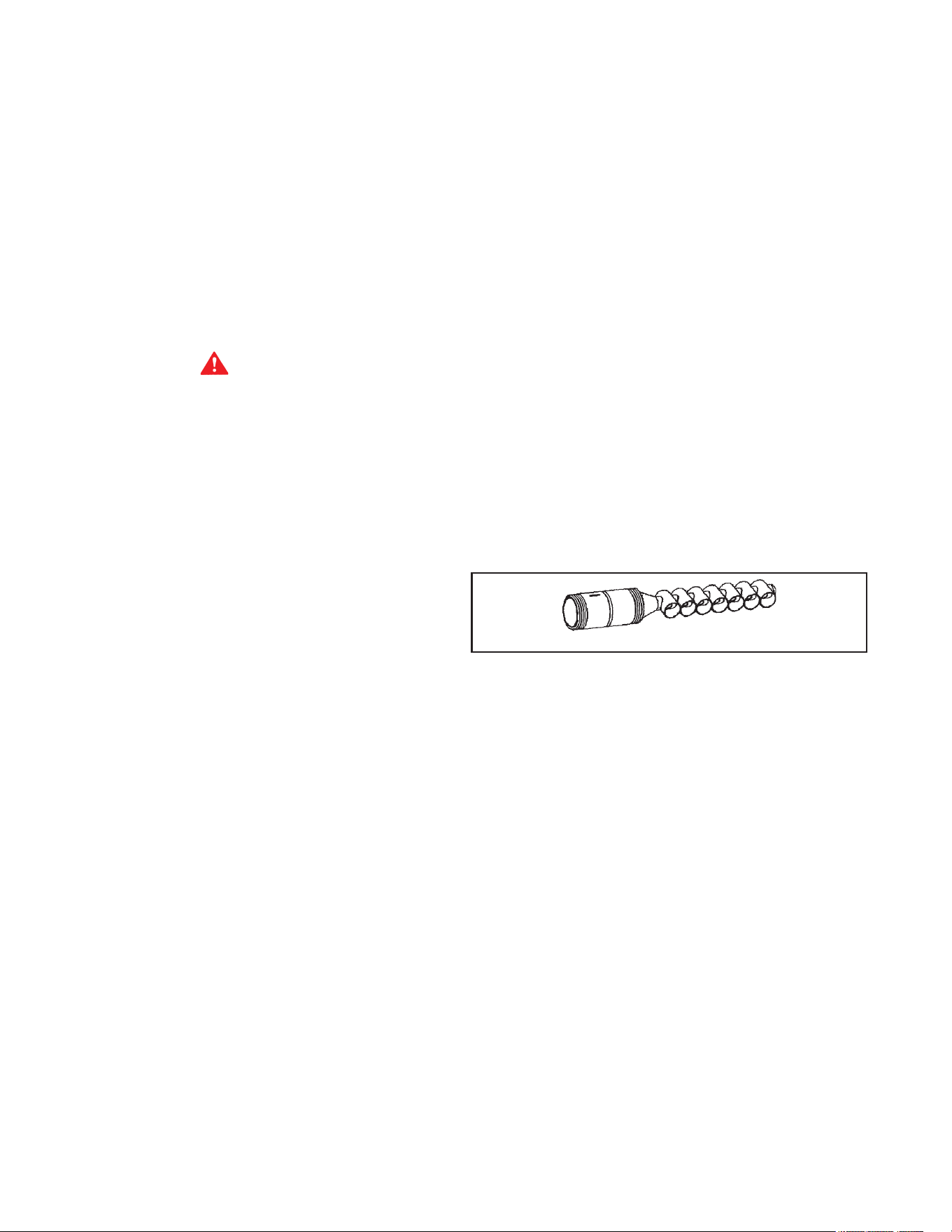
These units include The Eliminator (Self-Cleaning System)
installed in the front water inlet. See gure 2. The Eliminator
must be oriented correctly for proper function. There is a marked
range on the pipe nipple portion of the Eliminator, that must be
aligned with the top of the inlet spud. A label above the jacket
hole has an arrow that will point to the marked portion of the
pipe nipple if the orientation is correct. If the arrow does not point
within the marked range on the pipe nipple, adjust the pipe nipple
to correct. A pipe union is supplied with the Eliminator to reduce
the probability of misaligning the Eliminator accidentally while
tightening the connection to the inlet water supply line. Improper
orientation of the Eliminator can cause poor performance of the
heater and can signicantly reduce outlet water temperatures
during heavy draws.
NOTE: The inlet tube may have 1, 3 or 7 cross-tubes.
FIGURE 2
For proper function, The Eliminator must be oriented correctly.
There is a marked range on the pipe nipple that must be aligned with
the top of the inlet spud (check for label on the appliance) to assure
proper orientation. Please check to conrm that the marked range
is in alignment with the top of the spud. A pipe union is supplied
with The Eliminator to help eliminate the possibility of changing
the orientation by accidentally over-tightening the inlet supply line.
Improper orientation of The Eliminator may cause temperature
build-up issues or spells of colder than usual water temperatures.
HIGH LIMIT SWITCH
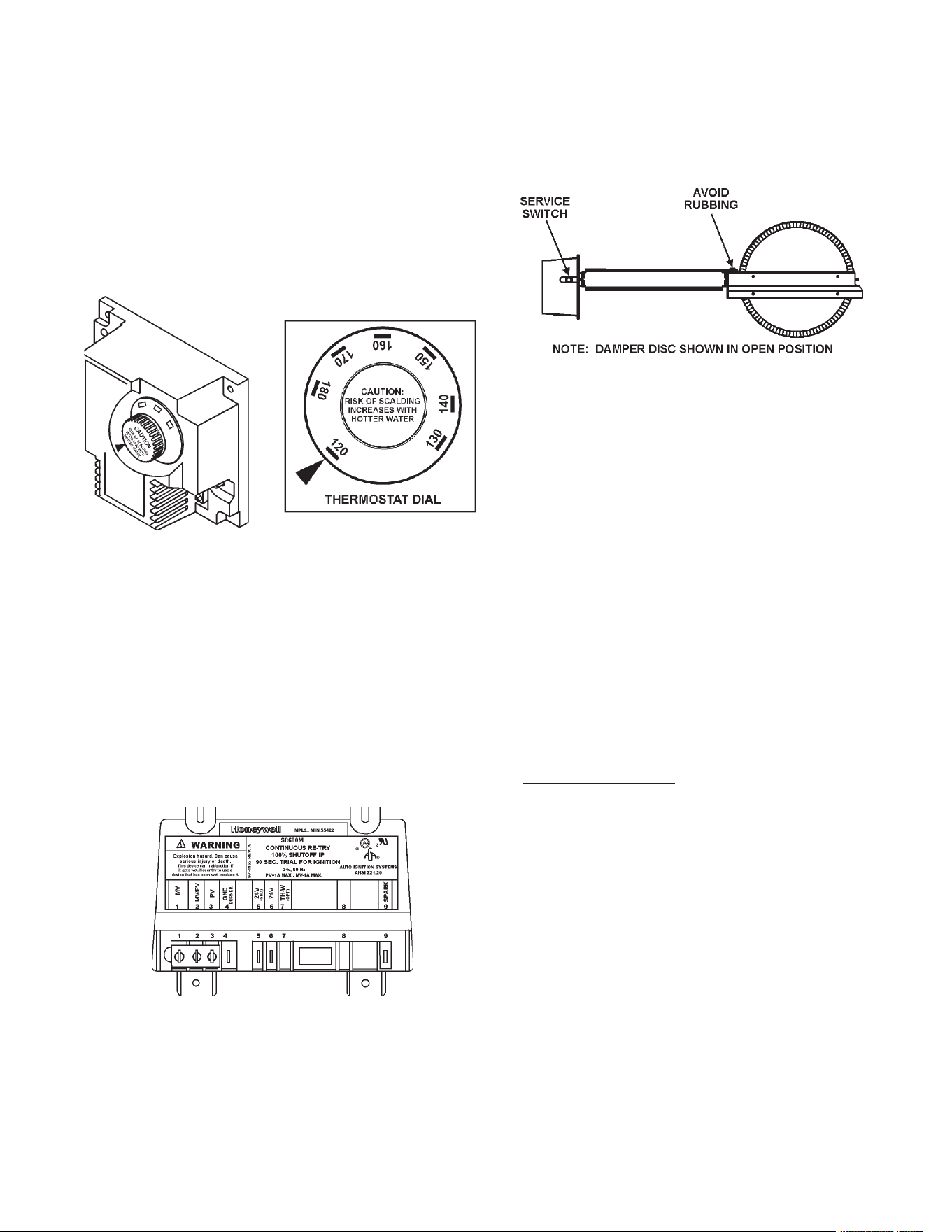
The digital thermostat (Fig. 3) contains the high limit (energy cutoff)
sensor. The high limit switch interrupts main burner gas ow should
the water temperature reach 203°F (95°C).
In the event of high limit switch operation, the appliance cannot be
restarted unless the water temperature is reduced to approximately
120°F (49°C). The high limit reset button on the front of the control
then needs to be depressed.
7
Continued manual resetting of high limit control, preceded by
higher than usual water temperature is evidence of high limit
switch operation. The following is a possible reason for high limit
switch operation:
• A malfunction in the thermostatic controls would allow the gas
valve to remain open causing water temperature to exceed the
thermostat setting. The water temperature would continue to
rise until high limit switch operation.
Contact your dealer or service agent if continued high limit switch
operation occurs.
DIGITAL THERMOSTAT
FIGURE 3
ELECTRONIC IGNITION CONTROL
Each heater is equipped with a Honeywell ignition module. The
solid state ignition control, g.4, ignites the pilot burner gas by
creating a spark at the pilot assembly. Pilot gas is ignited and
burns during each running cycle. The main burner and pilot gases
are cut off during the OFF cycle. Pilot gas ignition is proven by the
pilot sensor. Main burner ignition will not occur if the pilot sensor
does not rst sense pilot ignition.
HONEYWELL IGNITION MODULE
S8600M Continuous Re-Try
FIGURE 4
AUTOMATIC FLUE DAMPER DEVICE
All units are equipped with an automatic ue damper that
reduces heat loss during the OFF cycles. The automatic ue
damper drive assembly is a eld replaceable part and may
be obtained by contacting your Lochinvar dealer, distributor
or, Parts Department, 300 Maddox Simpson Pkwy, Lebanon,
TN 37090, Phone: 615-889-8900 • Fax: 615-882-2918, email:
parts_team@lochinvar.com, www.Lochinvar.com.
Each automatic ue damper drive assembly is equipped with a
“Service Switch”, as shown in gure 5.
FIGURE 5
The “Service Switch” has 2 positions: AUTOMATIC
OPERATION and HOLD OPEN DAMPER. For normal
operation the switch should be in the AUTOMATIC
OPERATION position.
If there is a problem with the damper the “Service Switch” can
be placed in the HOLD OPEN DAMPER position. When the
switch is placed in the HOLD OPEN DAMPER position the
damper disc will rotate to the open position and the heater
may be used until vent assembly is repaired or replaced. DO
NOT turn the damper disc manually; damage will occur to
the drive assembly if operated manually. Refer to TESTING
DAMPER OPERATION section of this manual for additional
information.
CIRCULATING PUMP
A circulating pump is used when a system requires a circulating
loop or there is a storage tank used in conjunction with the heater.
Refer to the piping diagrams in this manual for electrical hookup
information and install in accordance with the current edition of
the National Electrical Code NFPA 70. For Canada refer to the
Canadian Electrical Code CSA C22.1.
Only all bronze circulating pumps should be used with commercial
water heaters.
Although circulating pumps are oiled and operated by the
manufacturer some circulators must be oiled again before
operating. Please refer to manufacturer’s instructions.
DISHWASHING MACHINE REQUIREMENT
These appliances meet the NSF Standard 5 for sanitary
installations when used with the following leg kits, Part
#9003425205.
All dishwashing machines meeting the National Sanitation
Foundation requirements are designed to operate with water ow
pressures between 15 and 25 psi (103 kPa and 173 kPa). Flow
pressures above 25 psi (173 kPa), or below 15 psi (103 kPa), will
result in improperly sanitized dishes. Where pressures are high,
a water pressure reducing or ow regulating control valve should
be used in 180°F (82°C) line to the dishwashing machine, and
should be adjusted to deliver water between these limits.

8
NEVER BE PLACED ON OR ADJACENT TO THE HEATER.
OPEN CONTAINERS OR FLAMMABLE MATERIAL SHOULD
NOT BE STORED OR USED IN THE SAME ROOM WITH
THE HEATER.
THE HEATER MUST NOT BE LOCATED IN AN AREA WHERE
IT WILL BE SUBJECT TO FREEZING.
LOCATE IT NEAR A FLOOR DRAIN. THE HEATER SHOULD
BE LOCATED IN AN AREA WHERE LEAKAGE FROM THE
HEATER OR CONNECTIONS WILL NOT RESULT IN DAMAGE
TO THE ADJACENT AREA OR TO LOWER FLOORS OF
THE STRUCTURE.
When such locations cannot be avoided, it is recommended
that a suitable drain pan, adequately drained, be installed under
the appliance.
Water heater life depends upon water quality, water pressure
and the environment in which the water heater is installed. Water
heaters are sometimes installed in locations where leakage may
result in property damage, even with the use of a drain pan piped
to a drain. However, unanticipated damage can be reduced or
prevented by a leak detector or water shut-off device used in
conjunction with a piped drain pan. These devices are available
from some plumbing supply wholesalers and retailers, and detect
and react to leakage in various ways:
• Sensors mounted in the drain pan that trigger an alarm or
turn off the incoming water to the water heater when leakage
is detected.
• Sensors mounted in the drain pan that turn off the water
supply to the entire home when water is detected in the
drain pan.
• Water supply shut-off devices that activate based on the water
pressure differential between the cold water and hot water
pipes connected to the water heater.
• Devices that will turn off the gas supply to a gas water heater
while at the same time shutting off its water supply.
WHEN SUCH LOCATIONS CANNOT BE AVOIDED,
A SUITABLE DRAIN PAN SHOULD BE INSTALLED UNDER
THE HEATER. Such pans should be fabricated with sides at
least 2” (5 cm) deep, with length and width at least 2” (5 cm)
greater than the diameter of the heater and must be piped
to an adequate drain. The pan must not restrict combustion
air ow.
For appliance installation locations with elevations above 2000
feet (610 m), refer to HIGH ALTITUDE INSTALLATIONS section
of this manual for input reduction procedure.
LEVELING
If the unit is not level, insert the bolts which were used in crating
into the legs to correct this condition.
CLEARANCES
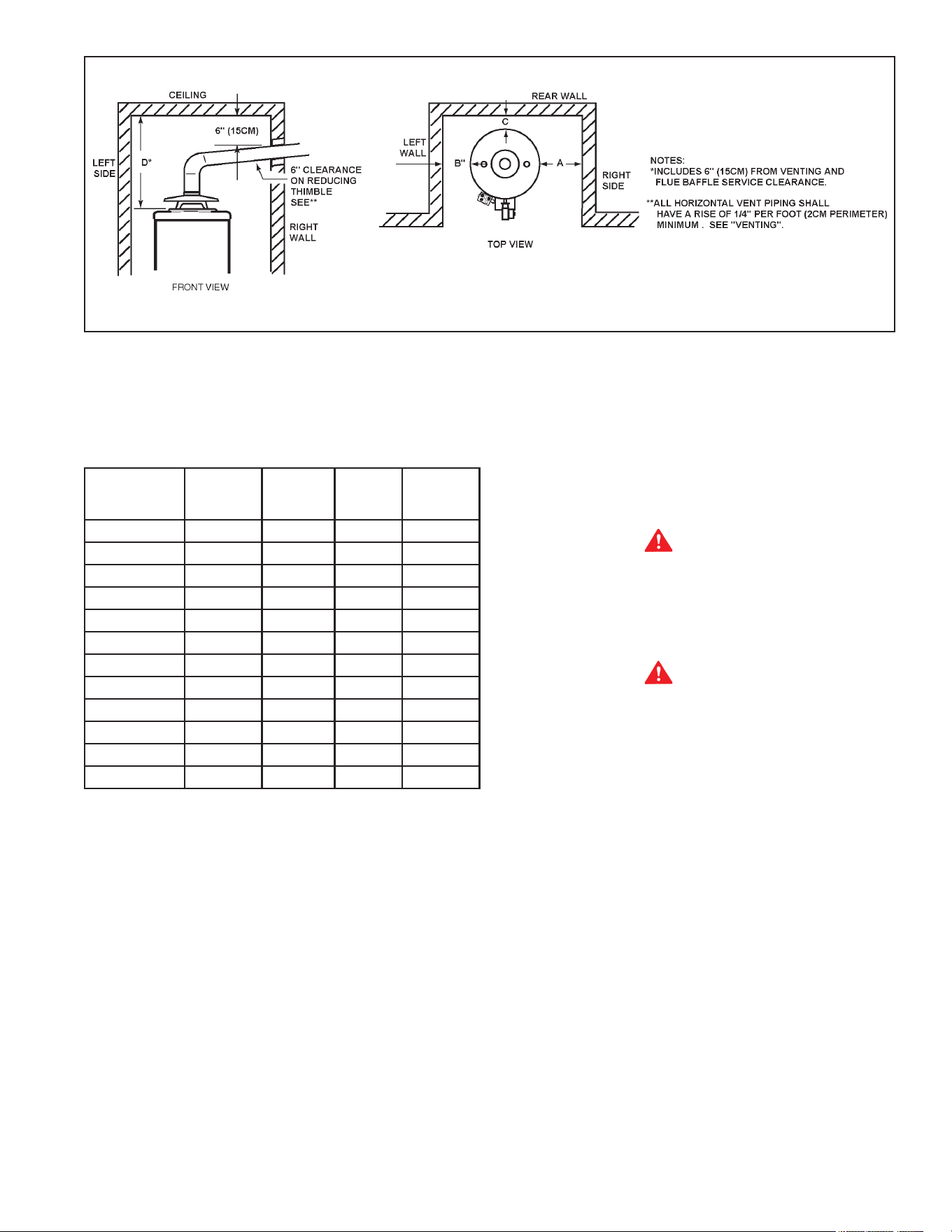
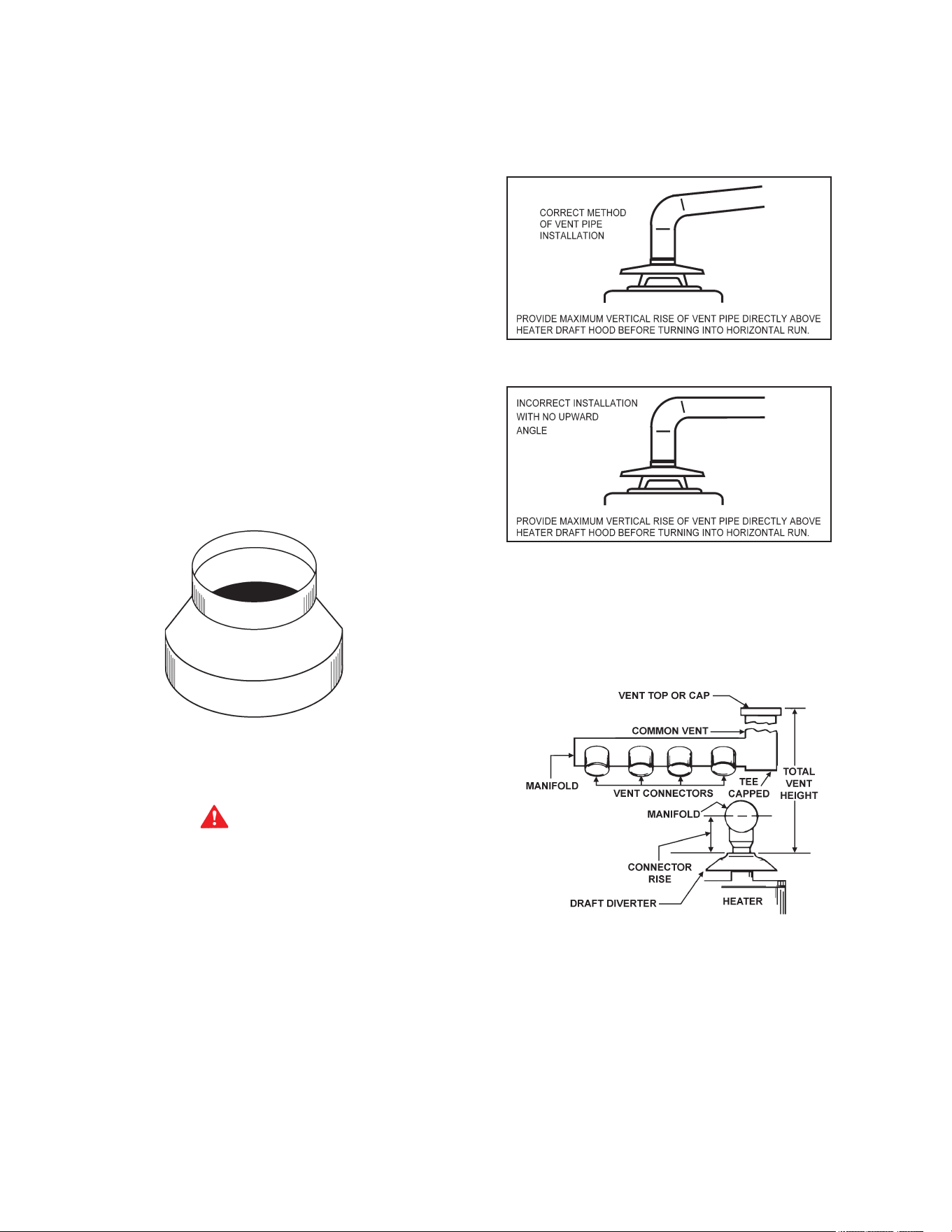
These heaters are approved for installation on combustible
ooring in an alcove when the minimum clearance from any
combustion construction are followed as indicated in gure 6
and Table 2.
The National Sanitation Foundation also recommends circulation
of 180°F (82°C) water. Where this is done, the circulation
should be very gentle so that it does not cause any unnecessary
turbulence inside the water heater. The circulation should be just
enough to provide 180°F (82°C) water at the point of take-off to
the dishwashing machine. Adjust ow by means of the plug cock
in the circulating line.
INSTALLATION INSTRUCTIONS
REQUIRED ABILITY
INSTALLATION OR SERVICE OF THIS WATER HEATER
REQUIRES ABILITY EQUIVALENT TO THAT OF A LICENSED
TRADESMAN IN THE FIELD INVOLVED. PLUMBING, AIR
SUPPLY, VENTING, GAS SUPPLY AND ELECTRICAL WORK
ARE REQUIRED.
WARNING
FAILURE TO FOLLOW THESE INSTRUCTIONS CAN RESULT
IN SERIOUS PERSONAL INJURY OR DEATH.
UNCRATING
The heater is shipped with the ue damper already installed. The
wiring conduit runs from the thermostat to the damper drive cover.
Before turning unit on, check to make sure the wiring conduit is
securely plugged into damper drive.
LOCATING THE HEATER
When installing the heater, consideration must be given to
proper location. Location selected should be as close to the
stack or chimney as practicable, with adequate air supply and as
centralized with the piping system as possible.
WARNING
THERE IS A RISK IN USING FUEL BURNING APPLIANCES
SUCH AS GAS WATER HEATERS IN ROOMS, GARAGES OR
OTHER AREAS WHERE GASOLINE, OTHER FLAMMABLE
LIQUIDS OR ENGINE DRIVEN EQUIPMENT OR VEHICLES ARE
STORED, OPERATED OR REPAIRED. FLAMMABLE VAPORS
ARE HEAVY AND TRAVEL ALONG THE FLOOR AND MAY BE
IGNITED BY THE HEATER’S PILOT OR MAIN BURNER FLAMES
CAUSING FIRE OR EXPLOSION. SOME LOCAL CODES
PERMIT OPERATION OF GAS APPLIANCES IN SUCH AREAS
IF THEY ARE INSTALLED 18” (.50 m). OR MORE ABOVE THE
FLOOR. THIS MAY REDUCE THE RISK IF LOCATION IN SUCH
AN AREA CANNOT BE AVOIDED.
DO NOT INSTALL THIS WATER HEATER DIRECTLY ON A
CARPETED FLOOR. A FIRE HAZARD MAY RESULT. Instead the
water heater must be placed on a metal or wood panel extending
beyond the full width and depth by at least 3 inches (7.6 cm) in
any direction. If the heater is installed in a carpeted alcove, the
entire oor shall be covered by the panel. Also, see the DRAIN
REQUIREMENTS.
THE HEATER SHALL BE LOCATED OR PROTECTED SO IT IS NOT
SUBJECT TO PHYSICAL DAMAGE BY A MOVING VEHICLE.
WARNING
FLAMMABLE ITEMS, PRESSURIZED CONTAINERS OR ANY
OTHER POTENTIAL FIRE HAZARDOUS ARTICLES MUST
9
The following units are approved for installation with side, rear
and ceiling clearances as indicated below:
A
(RIGHT SIDE)
B
(LEFT SIDE)
C
(BACK)
D
(CEILING)
CG(N,L) 120070 1" (2.54 cm) 1" (2.54 cm) 1" (2.54 cm) 12" (30.48 cm)
CG(N,L) 155080 1" (2.54 cm) 1" (2.54 cm) 1" (2.54 cm) 12" (30.48 cm)
CG(N,L) 180080 1" (2.54 cm) 1" (2.54 cm) 1" (2.54 cm) 12" (30.48 cm)
CG(N,L) 200100 1" (2. 54 cm) 1" (2.54 cm) 1" (2.54 cm) 12" (30.48 cm)
CG(N,L) 200080 1" (2.54 cm) 1" (2.54 cm) 1" (2.54 cm) 12" (30.48 cm)
CG(N,L) 199100(A) 1" (2.54 cm) 1" (2.54 cm) 1" (2.54 cm) 12" (30.48 cm)
CG(N,L) 250100 2" (5.08 cm) 2" (5.08 cm) 2" (5.08 cm) 12" (30.48 cm)
CG(N,L) 250065 2" (5.08 cm) 2" (5.08 cm) 2" (5.08 cm) 12" (30.48 cm)
CG(N,L) 275100(A) 2" (5.08 cm) 2" (5.08 cm) 2" (5.08 cm) 12" (30.48 cm)
CG(N,L) 305065 2" (5.08 cm) 2" (5.08 cm) 2" (5.08 cm) 12" (30.48 cm)
CG(N,L) 365085(A) 3" (7.75 cm) 3" (7.75 cm) 3" (7.75 cm) 12" (30.48 cm)
CG(N,L) 400100(A) 3" (7.75 cm) 3" (7.75 cm) 3" (7.75 cm) 12" (30.48 cm)
TABLE 2
In all installations the minimum combustible clearances from any
draft hood surface or vent piping shall be 6” (16cm). Vent piping
passing through a combustible wall or ceiling must be a continuous
run (no joints) and retain the 6” (16cm) clearance unless an
approved reducing thimble is used.
A service clearance of 24” (61cm) should be maintained from
serviceable parts, such as relief valves, ue bafes, ue damper
devices, thermostats, cleanout openings or drain valves.
HARD WATER
Where hard water conditions exist, water softening or the threshold
type of water treatment is recommended. This will protect the
dishwashers, coffee urns, water heaters, water piping and
other equipment.
See MAINTENANCE section for details of tank cleanout
procedure.
AIR REQUIREMENTS
REFER TO THE CURRENT EDITION OF THE “NATIONAL FUEL
GAS CODE” ANSI Z223.1/NFPA 54. FOR CANADA CONSULT
NATURAL GAS AND PROPANE INSTALLATION CODE
CAN/CSA-B149.1.
WARNING
KEEP APPLIANCE AREA CLEAR AND FREE OF COMBUSTIBLE
MATERIALS, GASOLINE AND OTHER FLAMMABLES, VAPORS
AND LIQUIDS.
DO NOT OBSTRUCT THE FLOW OF COMBUSTION OR
VENTILATING AIR.
WARNING
FOR SAFE OPERATION PROVIDE ADEQUATE AIR FOR
COMBUSTION AND VENTILATION. AN INSUFFICIENT SUPPLY OF
AIR WILL CAUSE RECIRCULATION OF COMBUSTION PRODUCTS
RESULTING IN AIR CONTAMINATION THAT MAY BE HAZARDOUS
TO LIFE. SUCH A CONDITION OFTEN WILL RESULT IN A YELLOW,
LUMINOUS BURNER FLAME, CAUSING CARBONING OR SOOTING
OF THE COMBUSTION CHAMBER, BURNERS AND FLUE TUBES
AND CREATES A RISK OF ASPHYXIATION.
Where an exhaust fan is supplied in the same room with a
heater, sufcient openings for air must be provided in the walls.
UNDERSIZED OPENINGS WILL CAUSE AIR TO BE DRAWN
INTO THE ROOM THROUGH THE CHIMNEY, CAUSING POOR
COMBUSTION. SOOTING MAY RESULT IN SERIOUS DAMAGE
TO THE HEATER AND RISK OF FIRE OR EXPLOSION.
UNCONFINED SPACE
In buildings of conventional frame, brick, or stone construction,
unconned spaces may provide adequate air for combustion,
ventilation and draft hood dilution.
If the unconned space is within a building of tight construction
(buildings using the following construction: weather stripping,
heavy insulation, caulking, vapor barrier, etc.), air for combustion,
ventilation and draft hood dilution must be obtained from
outdoors. The installation instructions for conned spaces in
tightly constructed buildings must be followed to ensure adequate
air supply.
ILLUSTRATION OF MINIMUM COMBUSTIBLE CLEARANCES IN AN ALCOVE
FIGURE 6
10
CONFINED SPACE
When drawing combustion and dilution air from inside a conventionally
constructed building to a conned space, such a space shall be
provided with two permanent openings, ONE IN OR WITHIN 12
INCHES (30.5cm) OF THE ENCLOSURE TOP AND ONE IN OR
WITHIN 12 INCHES (30.5cm) OF THE ENCLOSURE BOTTOM.
Each opening shall have a free area of at least one square inch per
1000 Btuh (2,225mm
2
/Kw) of the total input of all appliances in the
enclosure, but not less than 100 square inches (645 square cm).
If the conned space is within a building of tight construction, air for
combustion, ventilation, and draft hood dilution must be obtained
from outdoors. When directly communicating with the outdoors
or communicating with the outdoors through vertical ducts, two
permanent openings, located in the above manner, shall be provided.
Each opening shall have a free area of not less than one square inch
per 4000 Btuh (8,900mm
2
/Kw) of the total input of all appliances in the
enclosure. If horizontal ducts are used, each opening shall have a
free area of not less than one square inch per 2000 Btuh (4,450mm
2
/
Kw) of the total input of all appliances in the enclosure.
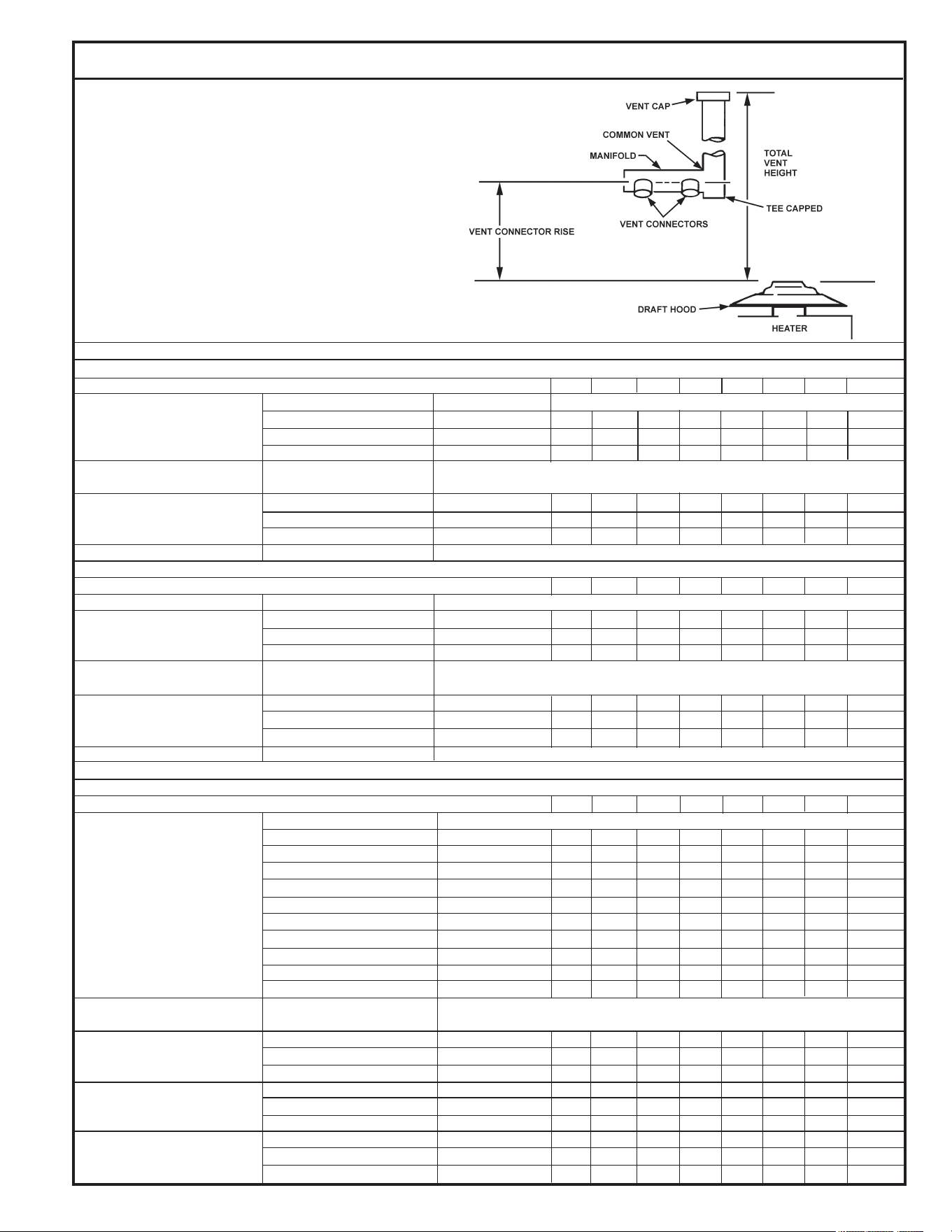
VENT REDUCER
The CG(N,L)250065(A), & CG(N,L)275100(A) are shipped with
an 8” to 6” diameter ue outlet adapter. Each adapter ts on top
of the installed ue damper. Use only vent reducers supplied with
the unit. The venting must comply with the NATIONAL FUEL GAS
CODE, ANSI Z223.1/NFPA 54.
FIGURE 7
VENTING
WARNING
THE INSTRUCTIONS IN THIS SECTION ON VENTING MUST
BE FOLLOWED TO AVOID CHOKED COMBUSTION OR RE-
CIRCULATION OF FLUE GASES. SUCH CONDITIONS CAUSE
SOOTING OR RISKS OF FIRE AND ASPHYXIATION.
Heater must be protected from freezing downdrafts.
Remove all soot or other obstructions from the chimney that will
retard a free draft.
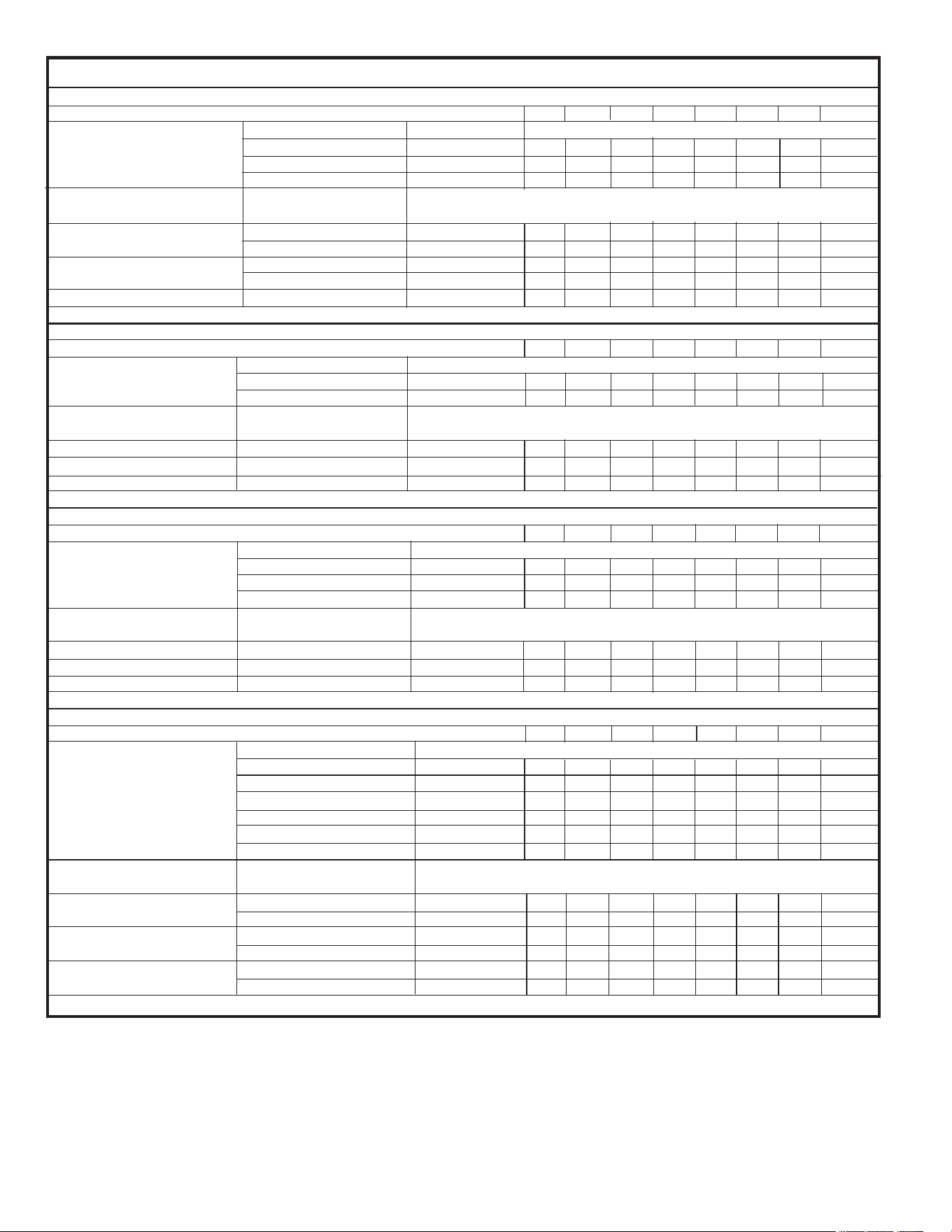
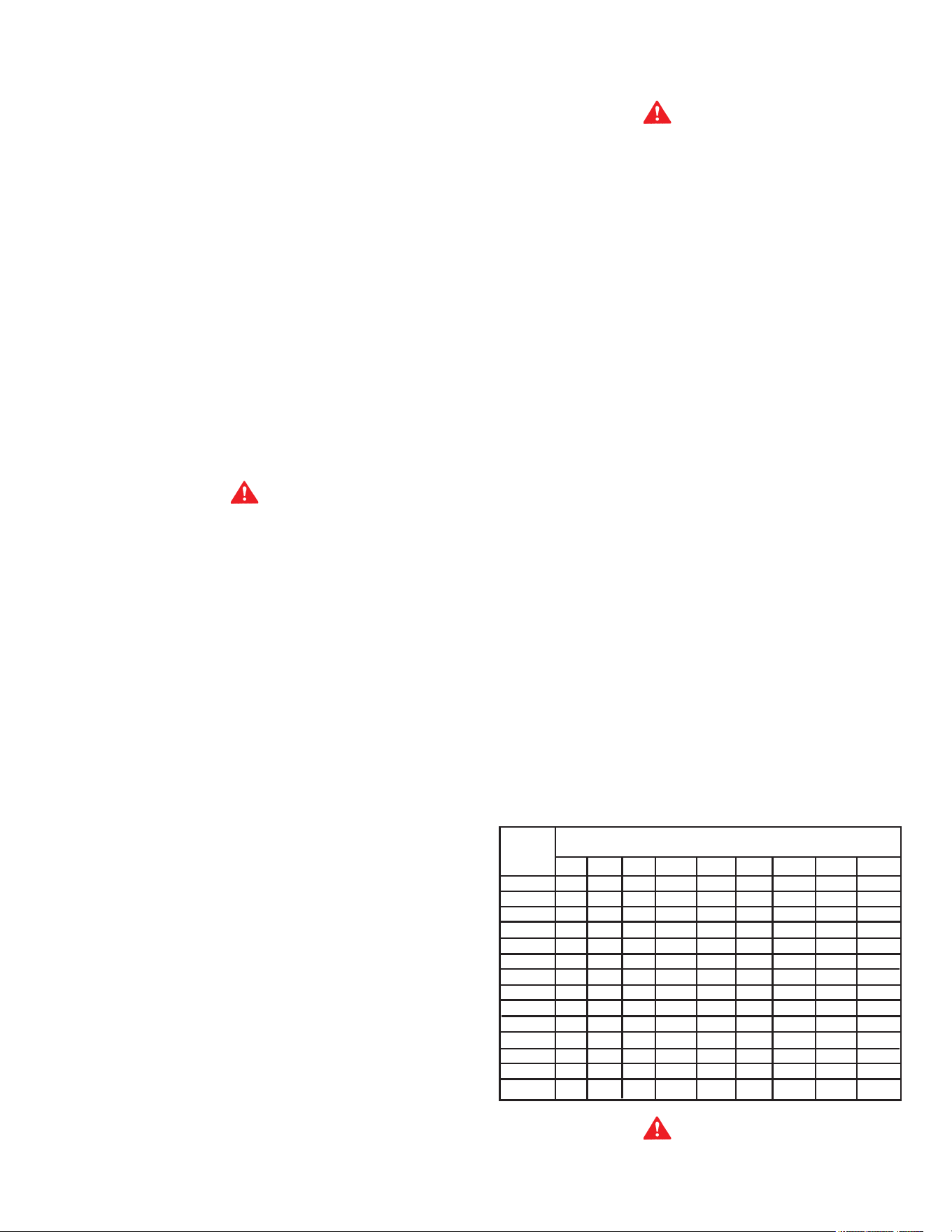
Type B venting is recommended with these heaters. See table 3
TECHNICAL DATA VENTING.
This water heater must be vented in compliance with all local codes,
the current edition of the National Fuel Gas Code (ANSI-Z223.1)
and with the Category I Venting Tables.
If any parts of the vent system are exposed to ambient
temperatures below 35 degrees F (2 degrees C) they must be
insulated to prevent condensation.
• Do not connect the heater to a common vent or chimney with
solid fuel burning equipment. This practice is prohibited by
many local building codes as is the practice of venting gas
red equipment to the duct work of ventilation systems.
• Where a separate vent connection is not available and the vent
pipe from the heater must be connected to a common vent with
an oil burning furnace, the vent pipe should enter the smaller
common vent or chimney at a point above the large vent pipe.
FIGURE 8
FIGURE 9
MULTIPLE HEATER MANIFOLD
Figure 10 and table 3 should be used for horizontally manifolding
two or more heaters. Also see MULTIPLE-UNIT INSTALLATIONS of
MECHANICAL VENTING section for induced draft applications.
FIGURE 10
WATER LINE CONNECTIONS
This manual provides detailed installation diagrams (see pages
16-22 of this manual) for typical methods of application for the
water heaters.
The water heater may be installed by itself, or with a separate
storage tank, on both single and two-temperature systems.
When used with a separate storage tank, the circulation may
be either by gravity or by means of a circulating pump. When a
circulating pump is used it is important to note that the ow rate
should be slow so that there will be a minimum of turbulence
inside the heater.
11
MODEL CG(N,L)120070
Input: 120,00Btuh Total Vent Height (Feet)
Draft Hood: 5” 6 8 10 15 20 30 50 100
Input Btuh Rise Vent Connector Diameter (inches)
120,000 1 Ft. 7 7 7 6 6 6 6 6
120,000 2 Ft. 6 6 6 6 6 6 6 5
123,000 3 Ft. 6 6 6 6 6 5 5 5
Number Combined Input
of Heaters in Thousands of Btuh Manifold and Common Vent Diameter (In inches)
2 240 10 8 8 7 7 7 6 7
3 360 10 10 10 10 8 8 7 7
4 480 12 12 12 10 10 10 8 8
MODEL CG(N,L)155080
Input: 154,000 Btuh Total Vent Height (Feet)
Draft Hood: 6” 6 8 10 15 20 30 50 100
Input Btuh Rise Vent Connector Diameter (in inches)
154,000 1 Ft. 8 8 7 7 7 7 7 7
154,000 2 Ft. 7 7 7 7 7 6 6 6
154,000 3 Ft. 7 7 7 6 6 6 6 6
Numbers Combined Input
of Heaters in Thousands of Btuh Manifold and Common Vent Diameter (in inches)
2 308 10 10 10 8 8 7 7 7
3 462 12 12 12 10 10 10 8 8
4 618 14 14 12 12 12 10 10 10
MODEL CG(N,L)180080, 200080, 200100, 199100,
Input: 180,000, 190,000, 199,000 Btuh T otal Vent Height (Feet)
Draft Hood: 6” 6 8 10 15 20 30 50 100
Input Btuh Rise Vent Connector Diameter (in inches)
180,000 1 Ft. 8 8 8 8 8 7 7 7
190,000 - 8 8 8 8 8 7 7
199,000 - - 8 8 8 8 8 7
180,000 2 Ft. 8 8 7 7 7 7 7 7
190,000 8 8 8 7 7 7 7 7
199,000 8 8 8 8 7 7 7 7
179,000 3 Ft. 7 7 7 7 7 7 6 6
190,000 8 7 7 7 7 7 6 6
197,000 8 7 7 7 7 7 7 6
199,000 8 8 7 7 7 7 7 6
Number of Combined Input
Heaters in Thousands of Btuh Manifold & Common Vent Diameter
358 10 10 10 10 8 8 7 7
2 380 12 10 10 10 10 8 7 7
394/398 12 10 10 10 10 8 8 7
537 14 12 12 12 10 10 10 8
3 570 14 12 12 12 10 10 10 10
591/597 14 14 12 12 12 10 10 10
716 14 14 14 12 12 12 10 10
4 760 16 14 14 14 12 12 10 10
788/796 16 14 14 14 12 12 12 10
TYPE B GAS VENT
Multiple Gas Fired Tank-Type Heaters
When venting mutiple tank type heaters using Type B
vent pipe, follow the installation diagram (gure 8) and
tables below which give sizing and data based upon
NFPA 54/ANSI Z223.
TECHNICAL DATA VENTING, TABLE 3
12
MODEL CG(N,L)250100(A), 2500065(A)
Input: 250,000, 251,000 Total Vent Height (Feet)
Draft Hood: 6” 6 8 10 15 20 30 50 100
Input Btuh Rise Vent Connector Diameter (in inches)
250/251,000 1 Ft. - - - - - - 8 8
250/251,000 - - - 8 8 8 8 8
250/251,000 3 Ft. - 8 8 8 - 8 7 7
Number Combined Input
of Heaters in Thousands of Btuh Manifold and Common Vent Diameter (In inches)
2 480 14 12 12 10 10 10 8 8
500/502 14 12 12 10 10 10 10 8
3 720 14 14 14 12 12 12 10 10
750/753 16 14 14 14 12 12 10 10
4 960/1000/1004 18 16 16 14 14 14 12 12
MODEL CG(N,L)275100(A)
Input: 275,000 Btuh Total Vent Height (Feet)
Draft Hood: 6” 6 8 10 15 20 30 50 100
Input Btuh Rise Vent Connector Diameter (in inches)
275,000 2 Ft. - - - - - 8 8 8
275,000 3 Ft. - - - 8 8 8 8 8
Numbers Combined Input
of Heaters in Thousands of Btuh Manifold and Common Vent Diameter (in inches)
2 550 - - - 12 10 10 10 10
3 825 - - - 14 14 12 12 12
4 1100 - - - 16 14 14 12 12
MODEL CG(N,L)305065(A)
Input: 305,000 Btuh T otal Vent Height (Feet)
Draft Hood: 8” 6 8 10 15 20 30 50 100
Input Btuh Rise Vent Connector Diameter (in inches)
315,000 1 Ft. - - 10 10 10 10 10 10
305,000 2 Ft. 10 10 10 10 10 10 8 8
365,000 3 Ft. 10 10 10 10 10 8 8 8
Number of Combined Input
Heaters in Thousands of Btuh Manifold & Common Vent Diameter
2 610 14 14 12 12 12 10 10 10
3 915 16 16 16 14 14 12 12 12
4 1220 18 18 16 16 16 14 14 12
MODEL CG(N,L)365085(A), 400100(A)
Input: 365,000, 399,000 Total Vent Height (Feet)
Draft Hood: 8” 6 8 10 15 20 30 50 100
Input Btuh Rise Vent Connector Diameter (in inches)
365,000 1 Ft. - - - - - 10 10 10
400,000 - - - - - - 10 10
365,000 2 FT. 12 12 10 10 10 10 10 10
400,000 12 12 12 12 10 10 10 10
365,000 3 FT. 10 10 10 10 10 10 10 10
400,000 12 10 10 10 10 10 10 10
Number of Combined Input
Heaters in Thousands of Btuh Manifold & Common Vent Diameter (inches)
2 730 14 14 14 12 12 12 10 10
800 16 14 14 14 12 12 10 10
3 1095 18 18 16 16 14 14 12 12
1200 18 18 18 16 16 14 14 12
4 1460 20 20 18 18 16 16 14 12
1600 22 20 20 18 18 16 14 14
TECHNICAL DATA VENTING, TABLE 3 (Continued)
13
If a water heater is installed in a closed water system, contact
the water supplier or local plumbing inspector on how to control
this situation.
WATER (POTABLE) HEATING AND
SPACE HEATING
1. All piping components connected to this unit for space heating
applications shall be suitable for use with potable water.
2. Toxic chemicals, such as those used for boiler treatment, shall
NEVER be introduced into this system.
3. This unit may NEVER be connected to any existing heating
system or component(s) previously used with a non-potable
water heating appliance.
4. When the system requires water for space heating at
temperatures higher than required for domestic water purposes,
a tempering valve must be installed. Please refer to installation
diagrams on pages 16 through 21 in this manual for suggested
piping arrangements.
5. These water heaters cannot be used in space heating
applications only.
CAUTION
A closed system will exist if a check valve (without bypass),
pressure reducing valve (without bypass), or a water meter (without
bypass) is installed in the cold water line between the water heater
and street main (or well).
Excessive pressure may develop in such closed systems, causing
premature tank failure or intermittent relief valve operation. This
is not a warranty failure. An expansion tank or a similar device
may be required in the inlet supply line between the appliance
and the meter or valve to compensate for the thermal expansion
of the water.
SYSTEM CONNECTIONS
The system installation must conform to these instructions and to
the local code authority having jurisdiction. Good practice requires
that all heavy piping be supported.
THERMOMETERS (Not Supplied)
Thermometers should be obtained and eld installed as shown in
the installation diagrams.
Thermometers are installed in the system as a means of detecting
the temperature of the outlet water supply.
RELIEF VALVE
This water heater is equipped with a combination temperature-
pressure relief valve that complies with the standard for relief
valves for hot water supply system, ANSI Z21.22-CSA 4.4. FOR
SAFE OPERATION OF THE WATER HEATER, THE RELIEF
VALVE(S) MUST NOT BE REMOVED OR PLUGGED.
ASME ratings cover pressure relief capacities. ANSI ratings cover
release rate with temperature actuation.
In addition to the appliance relief valve, each remote storage tank
which may be used in conjunction with this appliance shall also be
installed with a properly sized, rated and approved combination
temperature (ANSI) and pressure (ASME) relief valve(s).
WARNING
THE PURPOSE OF RELIEF VALVE IS TO AVOID EXCESSIVE
PRESSURE OR TEMPERATURE INTO THE STEAM RANGE,
WHICH MAY CAUSE SCALDING AT FIXTURES, TANK
EXPLOSION, SYSTEM OR HEATER DAMAGE. NO VALVE IS
TO BE PLACED BETWEEN THE RELIEF VALVE AND TANK.
Your local code authority may have other specic relief valve
requirements.
A DRAIN LINE MUST BE CONNECTED TO THE RELIEF
VALVE TO DIRECT DISCHARGE TO A SAFE LOCATION TO
AVOID SCALDING OR WATER DAMAGE. THIS LINE MUST
NOT BE REDUCED FROM THE SIZE OF THE VALVE OUTLET
AND MUST NOT CONTAIN VALVES, RESTRICTIONS NOR
SHOULD IT BE LOCATED IN FREEZING AREAS. DO NOT
THREAD OR CAP THE END OF THIS LINE. RESTRICTED
OR BLOCKED DISCHARGE WILL DEFEAT THE PURPOSE
OF THE VALVE AND IS UNSAFE. DISCHARGE LINE SHALL
BE INSTALLED TO ALLOW COMPLETE DRAINAGE OF BOTH
THE VALVE AND LINE.
See SERVICE INFORMATION section for procedure and
precautions.
GAS PIPING
Contact your local gas service company to ensure that adequate
gas service is available and to review applicable installation codes
for your area.
Size the main gas line in accordance with Table 4. The gures shown
are for straight lengths of pipe at 0.5 in. W.C. pressure drop, which
is considered normal for low pressure systems. Note: Fittings
such as elbows, tees and line regulators will add to the pipe
pressure drop. Also refer to the current edition of the National
Fuel Gas Code. For Canadian installations consult Natural Gas
and Propane Installation Code CAN/CSA-B149.1.
TABLE 4 - GAS SUPPLY LINE SIZES (IN INCHES)*
MAXIMUM CAPACITY OF PIPE IN
CUBIC FEET PER HOUR
LENGTH NOMINAL IRON PIPE SIZES (INCHES)
IN
FEET 1/2” 3/4” 1” 1 1/4” 1 1/2” 2” 2 1/2” 3” 4”
10 175 360 680 1400 2100 3960 6300 11000 23000
20 120 250 465 950 1460 2750 4360 7700 15800
30 97 200 375 770 1180 2200 3520 6250 12800
40 82 170 320 660 990 1900 3000 5300 10900
50 73 151 285 580 900 1680 2650 4750 9700
60 66 138 260 530 810 1520 2400 4300 8800
70 61 125 240 490 750 1400 2250 3900 8100
80 57 118 220 460 690 1300 2050 3700 7500
90 53 110 205 430 650 1220 1950 3450 7200
100 50 103 195 400 620 1150 1850 3250 6700
125 44 93 175 360 550 1020 1650 2950 6000
150 40 84 160 325 500 950 1500 2650 5500
175 37 77 145 300 460 850 1370 2450 5000
200 35 72 135 280 430 800 1280 2280 4600
WARNING
THE HEATER IS NOT INTENDED FOR OPERATION AT HIGHER
THAN 14.0” W.C.(3.5 kPa) (1/2 POUND PER SQUARE INCH
14
13
42
C
P
M
X
MV
MV/PV
PV
24 V GND
24 V
SPARKER
GND-BURNER
HONEYWELL IGNITION
DAMPER
DRIVE
ON/OFF
SWITCH
LOWER
PROBE
UPPER
PROBE/ECO
11E79
LINE
IN
1
2
3
4
NEUTRAL
NATURAL
GAS
VALVE
PV
PV
TH
TR
MV
MV/PV
MV
PROPANE
GAS
VALVE
120 vac
24 VAC TO IGNITION CONTROL
DAMPER
DRIVE
24 VAC
24 NEUTRAL
FACTORY WIRED
BY INSTALLER
IF ANY OF THE ORIGINAL WIRE AS SUPPLIED MUST BE REPLACED, USE ONLY TYPE 105
O
C
THERMOPLASTIC OR EQUIVALENT. FLAME SENSOR IGNITION CABLE MUST BE 250
O
C TYPE F.
197287-000 REV 02
W
W
W
Y
BLK
BLK
BLK
W
R
R
Y
BLK
BL
BL
LEGEND:
W--WHITE
BLK--BLACK
BL--BLUE
R--RED
Y--YELLOW
GAGE- 3.5 kPa) SUPPLY GAS PRESSURE. EXPOSURE TO
HIGHER SUPPLY PRESSURE MAY CAUSE DAMAGE TO THE
GAS VALVE WHICH COULD RESULT IN FIRE OR EXPLOSION.
IF OVERPRESSURE HAS OCCURRED SUCH AS THROUGH
IMPROPER TESTING OF GAS LINES OR EMERGENCY
MALFUNCTION OF THE SUPPLY SYSTEM, THE GAS VALVE
MUST BE CHECKED FOR SAFE OPERATION. MAKE SURE
THAT THE OUTSIDE VENTS ON THE SUPPLY REGULATORS
AND THE SAFETY VENT VALVES ARE PROTECTED AGAINST
BLOCKAGE. THESE ARE PARTS OF THE GAS SUPPLY
SYSTEM, NOT THE HEATER. VENT BLOCKAGE MAY OCCUR
DURING ICE STORMS.
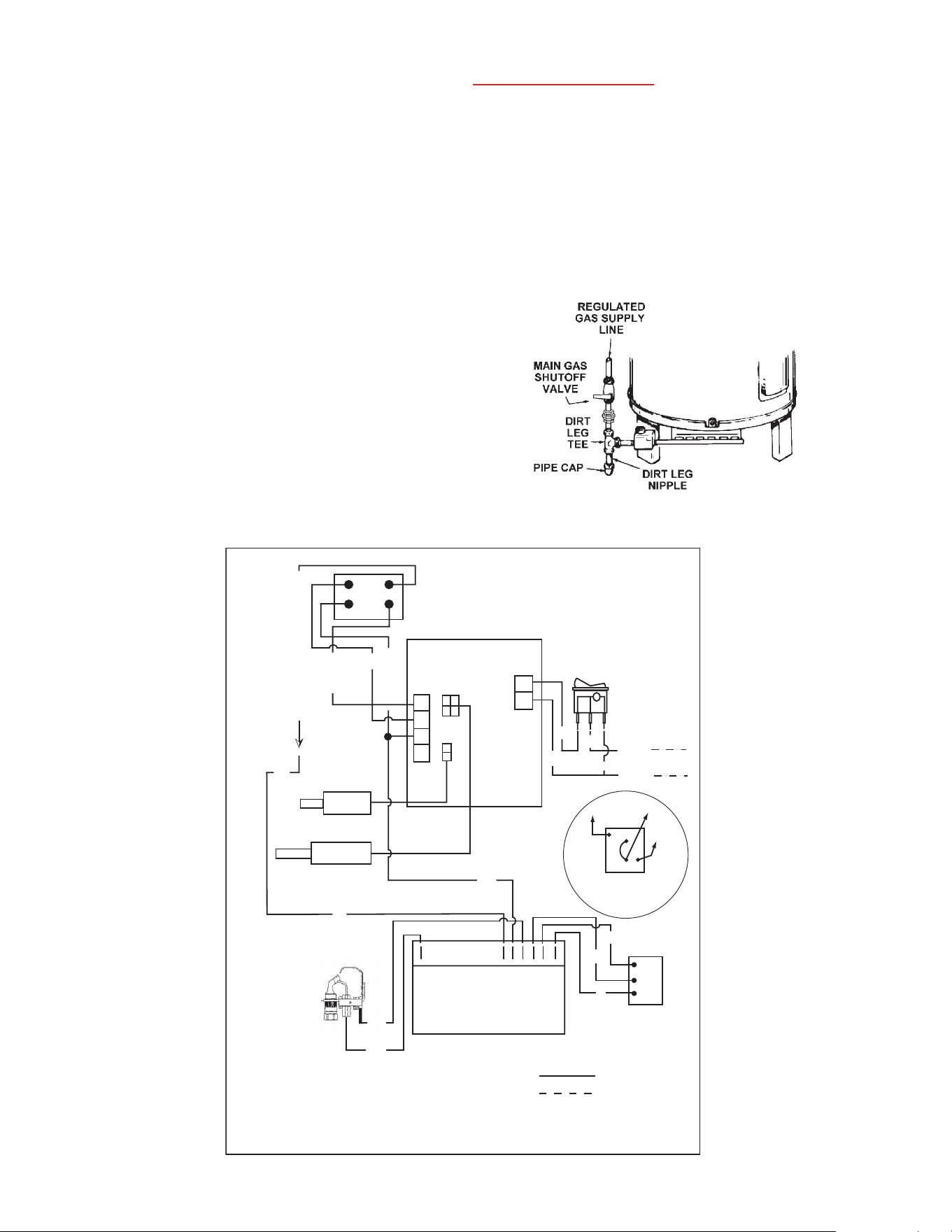
IT IS IMPORTANT TO GUARD AGAINST GAS VALVE FOULING
FROM CONTAMINANTS IN THE GAS WAYS. SUCH FOULING
MAY CAUSE IMPROPER OPERATION, FIRE OR EXPLOSION.
IF COPPER SUPPLY LINES ARE USED THEY MUST BE
INTERNALLY TINNED AND CERTIFIED FOR GAS SERVICE.
BEFORE ATTACHING THE GAS LINE, BE SURE THAT ALL GAS
PIPE IS CLEAN ON THE INSIDE.
TO TRAP ANY DIRT OR FOREIGN MATERIAL IN THE GAS
SUPPLY LINE, A DIRT LEG (SOMETIMES CALLED SEDIMENT
TRAP OR DRIP LEG) MUST BE INCORPORATED IN THE PIPING
(SEE FIG. 11). THE DIRT LEG MUST BE READILY ACCESSIBLE
AND NOT SUBJECT TO FREEZING CONDITIONS. INSTALL
IN ACCORDANCE WITH RECOMMENDATIONS OF SERVING
FIGURE 12
GAS SUPPLIERS. REFER TO THE CURRENT EDITION OF THE
NATIONAL FUEL GAS CODE. For Canadian installations consult
Natural Gas and Propane Installation Code CAN/CSA-B149.1.
To prevent damage, care must be taken not to apply too much
torque when attaching gas supply pipe to gas valve inlet.
Apply joint compounds (pipe dope) sparingly and only to the
male threads of pipe joints. Do not apply compounds to the rst
two threads. Use compounds resistant to the action of liqueed
petroleum gases.
GAS PIPING AND DIRT LEG INSTALLATION
FIGURE 11
15
INSTALLATION DIAGRAMS-TOP INLET/OUTLET USAGE
GENERAL
The type, size and location of the relief valves must be in
accordance with local codes. The locations of the relief valves
shown in the installation diagrams are typical. The heater has a
factory installed high temperature limit switch and temperature
and pressure relief valve.
Cold water lines to heater should be installed as shown in order
to minimize gravity circulation of hot water to building cold water
lines.
A listed temperature and pressure relief valve of adequate capacity
is installed on the heater. The locations shown in the installation
diagrams on the following pages are typical.
The discharge opening of the temperature and pressure relief
valve, located in front of the heater must be piped to an open drain
and should not be subject to freezing temperatures.
Install in accordance with all local codes.
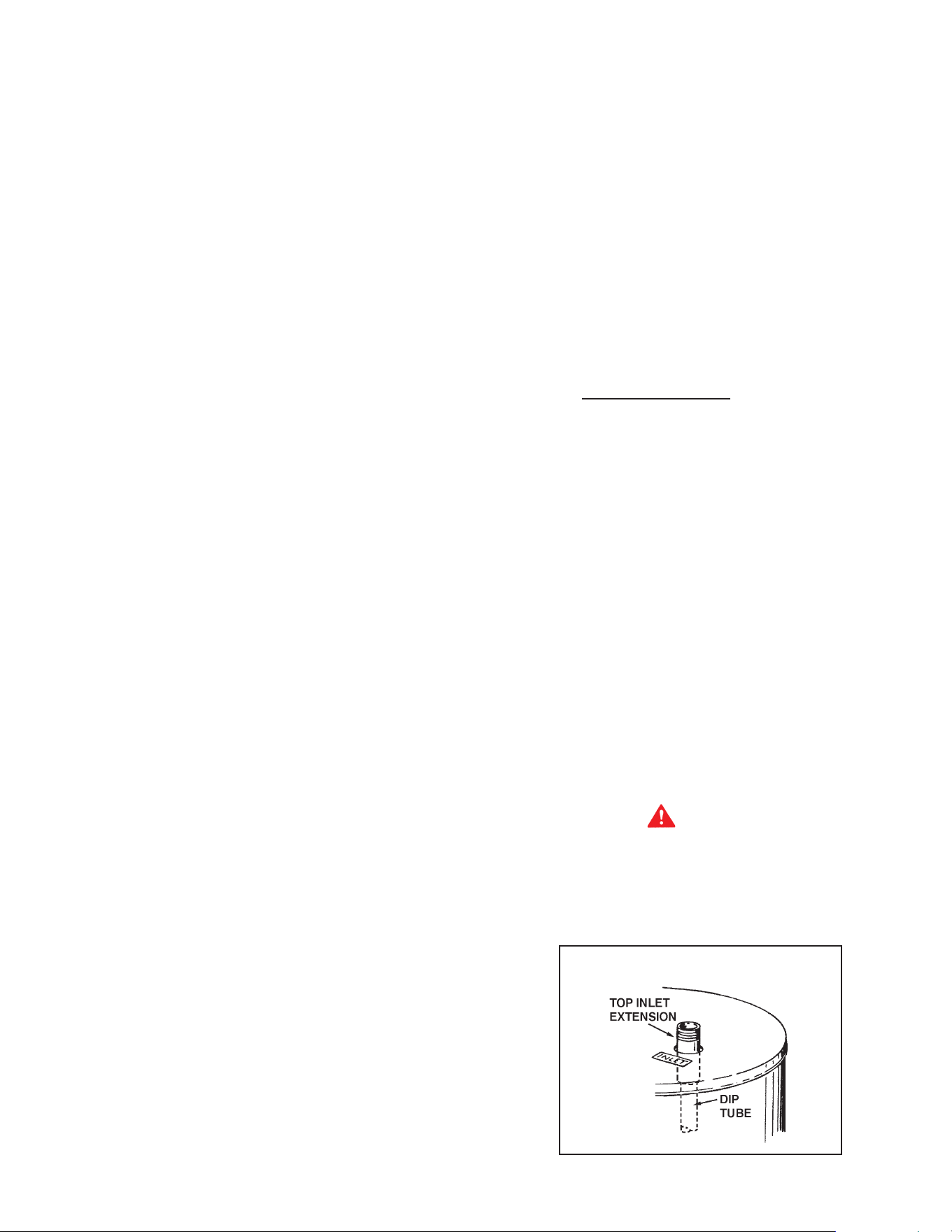
Use of the top inlet water connection requires installation of an inlet
dip tube (refer to gure 11). The tube is supplied in the heater.
Follow caution labels if applying heat to this tting. Do not allow
pipe dope to contact the plastic tube during installation.
CODE RESTRICTIONS
Use of the top inlet water connection is not permitted on
installations in the state of North Carolina, due to the material of
the tube (Polypropylene). Where such code restrictions exist, use
only lower inlet tank connection. This may also require a heat
trap - check local codes. The “Top Outlet” connection may still be
used on these applications. Plug or cap all unused openings in
the tank before lling with water.
DANGER
TEMPERATURE SETTING SHOULD NOT EXCEED SAFE USE
TEMPERATURE AT FIXTURES. SEE WATER TEMPERATURE
CONTROL WARNING ON PAGE 27. IF HIGHER PREHEAT
TEMPERATURES ARE NECESSARY TO OBTAIN ADEQUATE
BOOSTER OUTPUT, ADD AN ANTI-SCALD VALVE FOR HOT
WATER SUPPLIED TO FIXTURES.
TUBE INLET INSTALLATION
FIGURE 13
BEFORE PLACING THE HEATER IN OPERATION, CHECK FOR
GAS LEAKAGE. Use soap and water solution or other material
acceptable for the purpose in locating the leaks. DO NOT USE
MATCHES, CANDLES, FLAME OR OTHER SOURCES OF
IGNITION FOR THIS PURPOSE.
DISCONNECT THE HEATER AND ITS MANUAL GAS SHUT-OFF
VALVE FROM THE GAS SUPPLY PIPING SYSTEM DURING ANY
SUPPLY PRESSURE TESTING EXCEEDING 1/2 PSIG (3.5 kPa).
GAS SUPPLY LINE MUST BE CAPPED WHEN DISCONNECTED
FROM THE HEATER FOR TEST PRESSURES OF 1/2 PSIG
(3.5 kPa) OR LESS. THE APPLIANCE NEED NOT BE
DISCONNECTED, BUT MUST BE ISOLATED FROM THE
SUPPLY PRESSURE TEST BY CLOSING THE MANUAL GAS
Shut-off VALVE.
GAS METER SIZE — NATURAL GASES ONLY
Be sure the gas meter has sufcient capacity to supply the full
rated gas input of the water heater as well as the requirements of
all other gas red equipment supplied by the meter. If gas meter
is too small, ask the gas company to install a larger meter having
adequate capacity.
GAS PRESSURE REGULATOR
The gas pressure regulator is built into the gas valve and is
equipped to operate on the gas specied on model and rating
plate. The regulator is factory adjusted to deliver gas to burner
at correct water column pressure allowing for a nominal pressure
drop through the controls.
The minimum gas supply pressure for input adjustment must not
be less than 4.5” w.c. (1.12 kPa) for natural gas and 11.0” w.c.
(2.74 kPa) for propane gas.
Do not subject the combination gas valve to inlet gas
pressures of more than 14.0” W.C. (3.48 kPa) - natural gas,
14.0” W.C. (3.48 kPa)- propane gas. A service regulator is
necessary if higher gas pressures are encountered.
Gas pressure specied in Table 5, refer to ow pressure taken at
pressure tap of automatic gas valve while heater is operating.
GROUNDING INSTRUCTIONS
This water heater must be connected to a grounded metal,
permanent wiring system; or an equipment grounding
conductor must be run with the circuit conductors and
connected to the equipment grounding terminal or lead on
the water heater.
HEATER WIRING
All electrical work must be installed in accordance with the current
edition of the National Electrical Code NFPA 70. For Canada use
Canadian Electrical Code CSA C22.1 and must conform to all local
code authority having jurisdiction. AN ELECTRICAL GROUND
IS REQUIRED TO REDUCE RISK OF ELECTRICAL SHOCK OR
POSSIBLE ELECTROCUTION.
For Canadian installations the electrical connections and grounding
shall be done in accordance with current Canadian Electrical Code
CSA C22.1, Part 1 and/or local codes.
If any of the original wire as supplied with the appliance must be
replaced, use only type 105°C thermoplastic or equivalent. 250°C
type F must be used for the ame sensor leads and the spark
ignition cable must be high voltage 250°C.
16
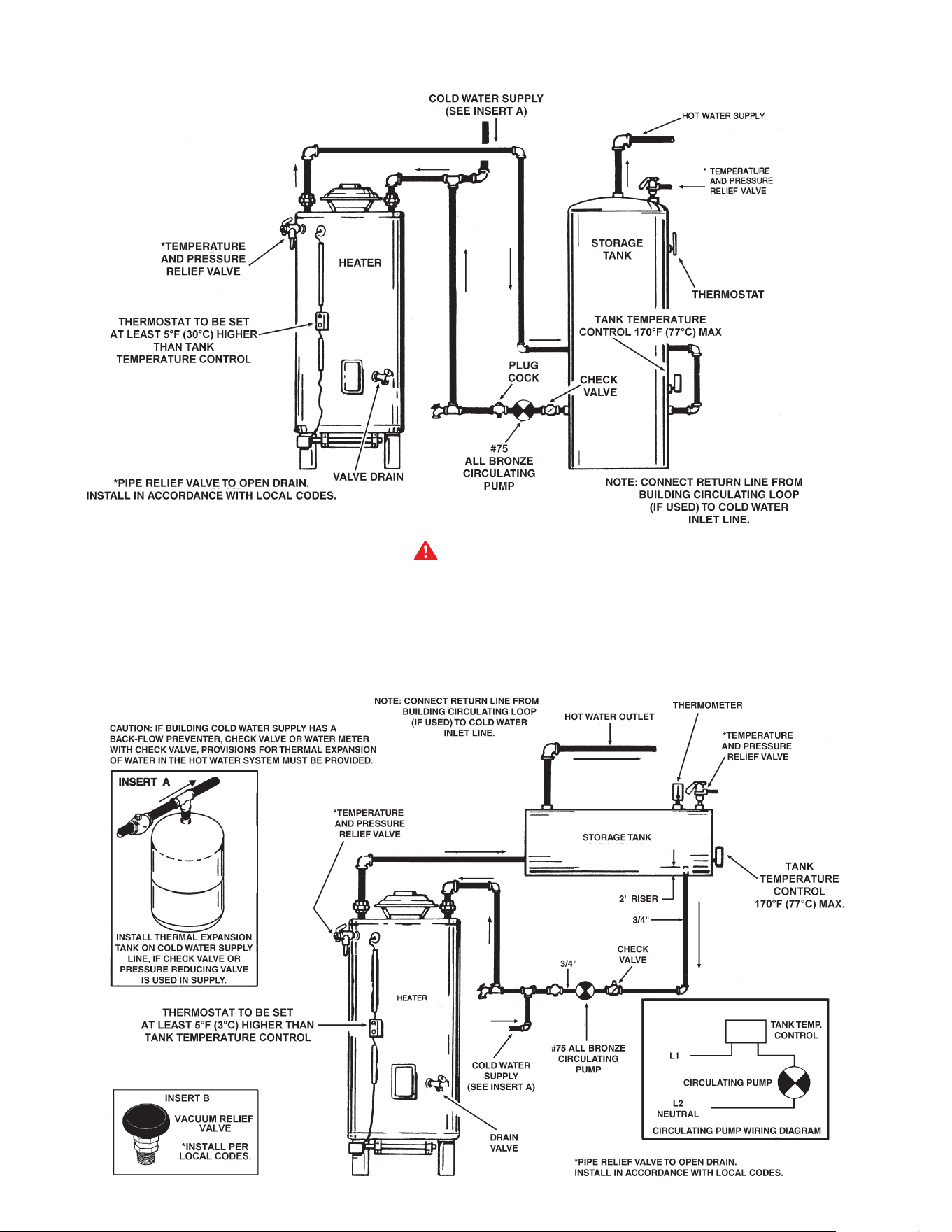
VERTICAL STORAGE TANK AND FORCED CIRCULATION
DANGER
TEMPERATURE SETTING SHOULD NOT EXCEED SAFE USE TEMPERATURE AT FIXTURES. SEE WATER TEMPERATURE
CONTROL WARNING ON PAGE 27. IF HIGHER PREHEAT TEMPERATURES ARE NECESSARY TO OBTAIN ADEQUATE BOOSTER
OUTPUT, ADD AN ANTI-SCALD VALVE FOR HOT WATER SUPPLIED TO FIXTURES.
HORIZONTAL STORAGE TANK AND FORCED CIRCULATION
17
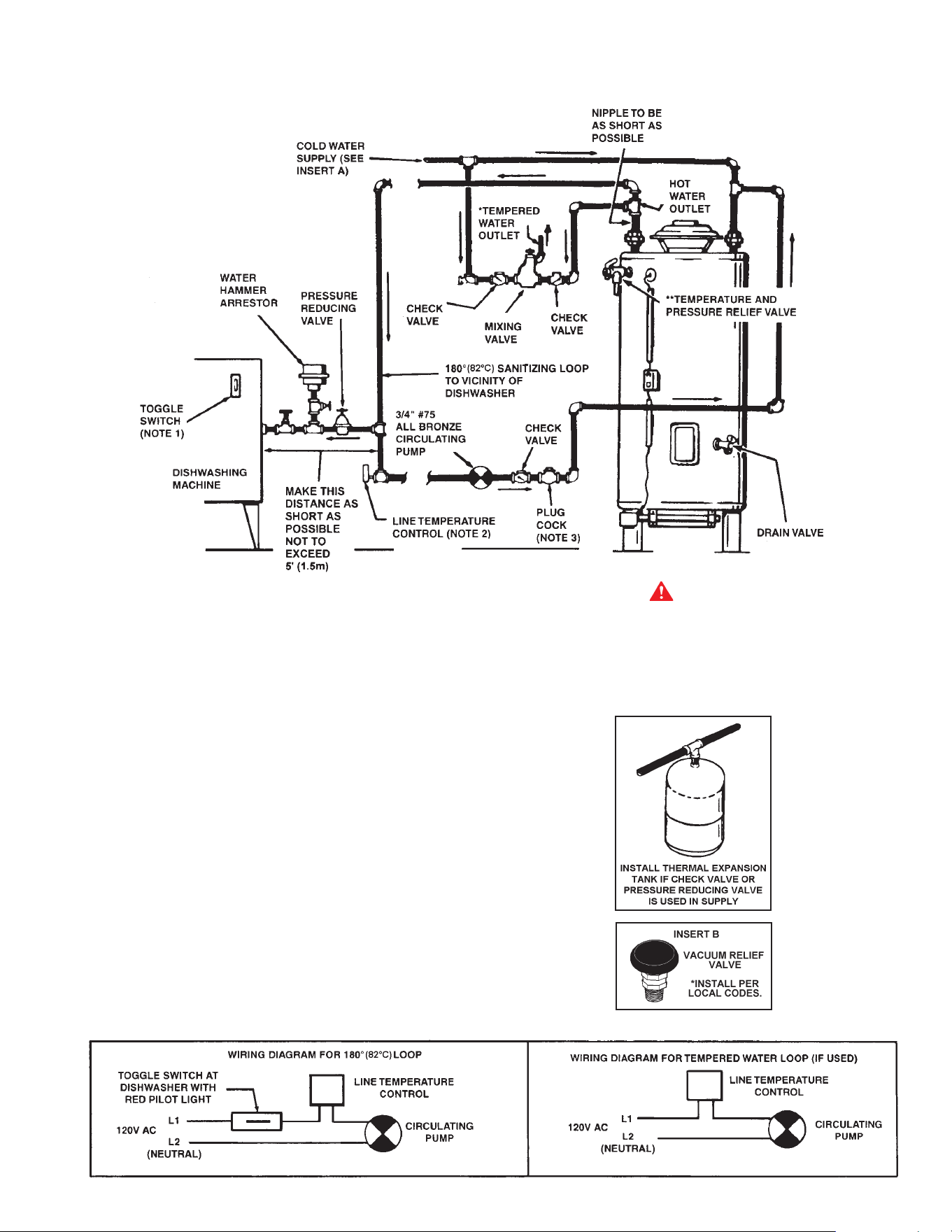
DANGER
TEMPERATURE SETTING SHOULD NOT EXCEED SAFE USE
TEMPERATURE AT FIXTURES. SEE WATER TEMPERATURE
CONTROL WARNING ON PAGE 27. IF HIGHER PREHEAT
TEMPERATURES ARE NECESSARY TO OBTAIN ADEQUATE
BOOSTER OUTPUT, ADD AN ANTI-SCALD VALVE FOR HOT
WATER SUPPLIED TO FIXTURES.
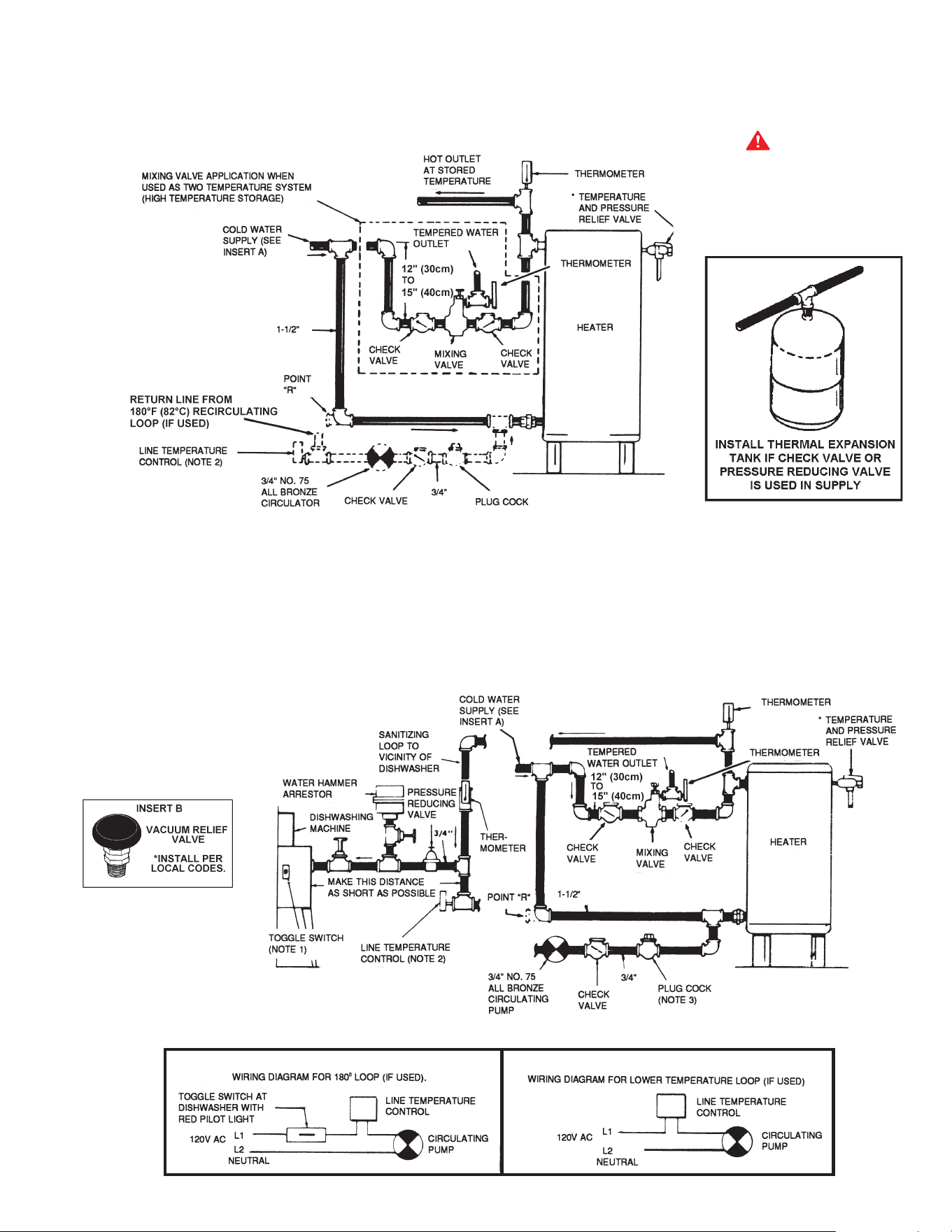
TWO TEMPERATURE - ONE HEATER HIGH TEMPERATURE STORAGE
WITH RECIRCULATION OF SANITIZING LOOP
NOTE 1: TOGGLE SWITCH CONTROLS 180°F (82°C) WATER
CIRCULATION. INSTALL ON OR CLOSE TO DISHWASHING
MACHINE. TOGGLE SWITCH MUST BE CLOSED (ON) DURING
THE RINSE OPERATION AND OPEN (OFF) WHEN DISHWASHER
IS NOT OPERATING OR WHEN ON LONG STANDBY.
NOTE 2: INSTALL LINE TEMPERATURE CONTROL IN AN
UNINSULATED TEE BEYOND THE DISHWASHING MACHINE
TAKEOFF IN THE SANITIZING LOOP. CONTROL SHOULD BE
SET AT 185°F (85°C).
NOTE 3: ADJUST PLUG COCK SO THE SANITIZING LOOP FLOW RATE
DOES NOT CAUSE UNNECESSARY TURBULENCE IN THE
TANK.
* TEMPERED WATER LOOP, IF USED, CONNECT TO
POINT “A”.
**PIPE RELIEF VALVE TO OPEN DRAIN.
INSTALL IN ACCORDANCE WITH LOCAL CODES.
CAUTION: IF BUILDING COLD WATER SUPPLY HAS A BACKFLOW
PREVENTER, CHECK VALVE OR WATER METER WITH
CHECK VALVE. PROVISIONS FOR THERMAL EXPANSION OF
WATER IN THE HOT WATER SYSTEM MUST BE PROVIDED.
18
INSTALLATION DIAGRAMS-SIDE INLET/OUTLET USAGE
DANGER
TEMPERATURE SETTING SHOULD NOT EXCEED SAFE USE
TEMPERATURE AT FIXTURES. SEE WATER TEMPERATURE
CONTROL WARNING ON PAGE 27. IF HIGHER PREHEAT
TEMPERATURES ARE NECESSARY TO OBTAIN ADEQUATE
BOOSTER OUTPUT, ADD AN ANTI-SCALD VALVE FOR HOT WATER
SUPPLIED TO FIXTURES.
A listed temperature and pressure relief valve of adequate
capacity is installed on the heater. The locations shown in the
installation diagrams on the following pages are typical.
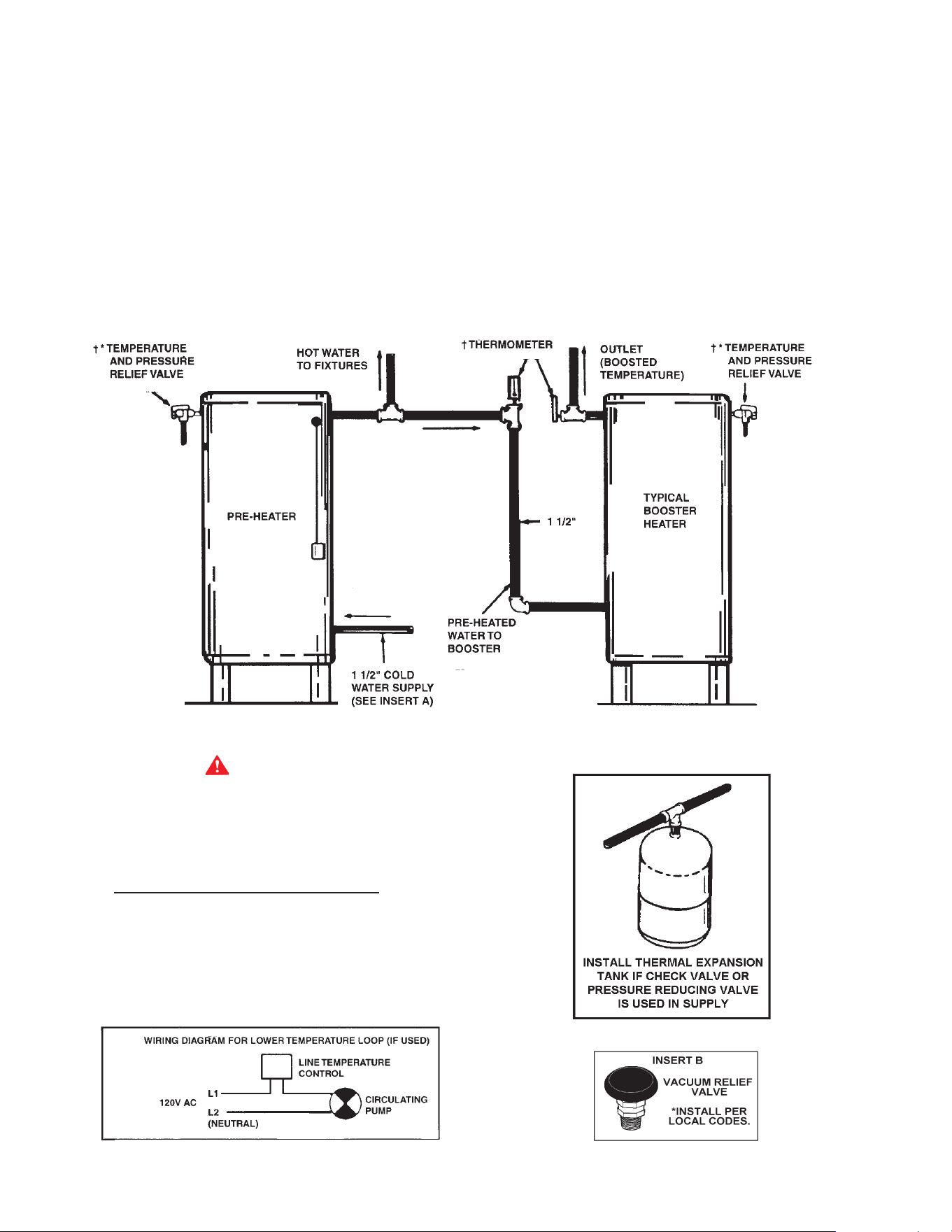
TWO TEMPERATURE - TWO HEATERS, ONE PRE-HEATER/ONE - BOOSTER HEATER
WITH OR WITHOUT BUILDING RECIRCULATION
The discharge opening of the temperature and pressure
relief valve must be piped to an open drain and should not be
subject to freezing conditions. DO NOT REDUCE, BLOCK
OR PLUG THE DISCHARGE OPENING OF THE VALVE.
CIRCULATING RETURN LINE CONNECTIONS
- FROM FIXTURE LOOP, IF USED, CONNECT TO PREHEATER INLET.
- FROM BOOSTED TEMPERATURE LOOP, IF USED CONNECT TO
BOOSTER INLET.
†AVALAIBLE FROM LOCHINVAR.
*PIPE RELIEF VALVE TO OPEN DRAIN.
INSTALL IN ACCORDANCE WITH LOCAL CODES.
INSERT A
19
ONE OR TWO TEMPERATURE - ONE HEATERS,HIGH TEMPERATURE
STORAGE WITH OR WITHOUT RECIRCULATION
HEATER WITH OR WITHOUT MIXING VALVE
HEATER WITH MIXING VALVE AND RECIRCULATED SANITIZING LOOP
NOTE 1: TOGGLE SWITCH CONTROLS 180°F (82°C)
WATER CIRCULATION. INSTALL ON OR
CLOSE TO DISHWASHING MACHINE. TOGGLE
SWITCH MUST BE CLOSED (ON) DURING THE
RINSE OPERATION AND OPEN (OFF) WHEN
DISHWASHER IS NOT OPERATING OR WHEN
ON LONG STANDBY.
NOTE 2: INSTALL LINE TEMPERATURE CONTROL
IN AN UNINSULATED TEE BEYOND THE
DISHWASHING MACHINE TAKEOFF
IN THE SANITIZING LOOP. CONTROL
SHOULD BE SET AT 185°F (85°C).
NOTE 3: ADJUST PLUG COCK SO THE SANITIZING
LOOP FLOW RATE DOES NOT CAUSE
UNNECESSARY TURBULENCE IN THE
TANK.
* PIPE RELIEF VALVE TO OPEN DRAIN.
INSTALL IN ACCORDANCE WITH LOCAL
CODES.
CIRCULATING RETURN LINE CONNECTIONS.
- TEMPERED WATER LOOP, IF USED,
CONNECT TO POINT “R”.
- STORED TEMPERATURE WATER LOOP, IF USED,
CONNECT TO COLD WATER INLET.
CAUTION: IF BUILDING COLD WATER SUPPLY HAS A BACKFLOW
PREVENTER, CHECK VALVE OR WATER METER WITH CHECK VALVE.
PROVISIONS FOR THERMAL EXPANSION OF WATER IN THE HOT WATER
SYSTEM MUST BE PROVIDED.
DANGER
TEMPERATURE SETTING SHOULD NOT
EXCEED SAFE USE TEMPERATURE AT
FIXTURES. SEE WATER TEMPERATURE
CONTROL WARNING ON PAGE 27. IF HIGHER
PREHEAT TEMPERATURES ARE NECESSARY
TO OBTAIN ADEQUATE BOOSTER OUTPUT,
ADD AN ANTI-SCALD VALVE FOR HOT WATER
SUPPLIED TO FIXTURES.
INSERT A
20
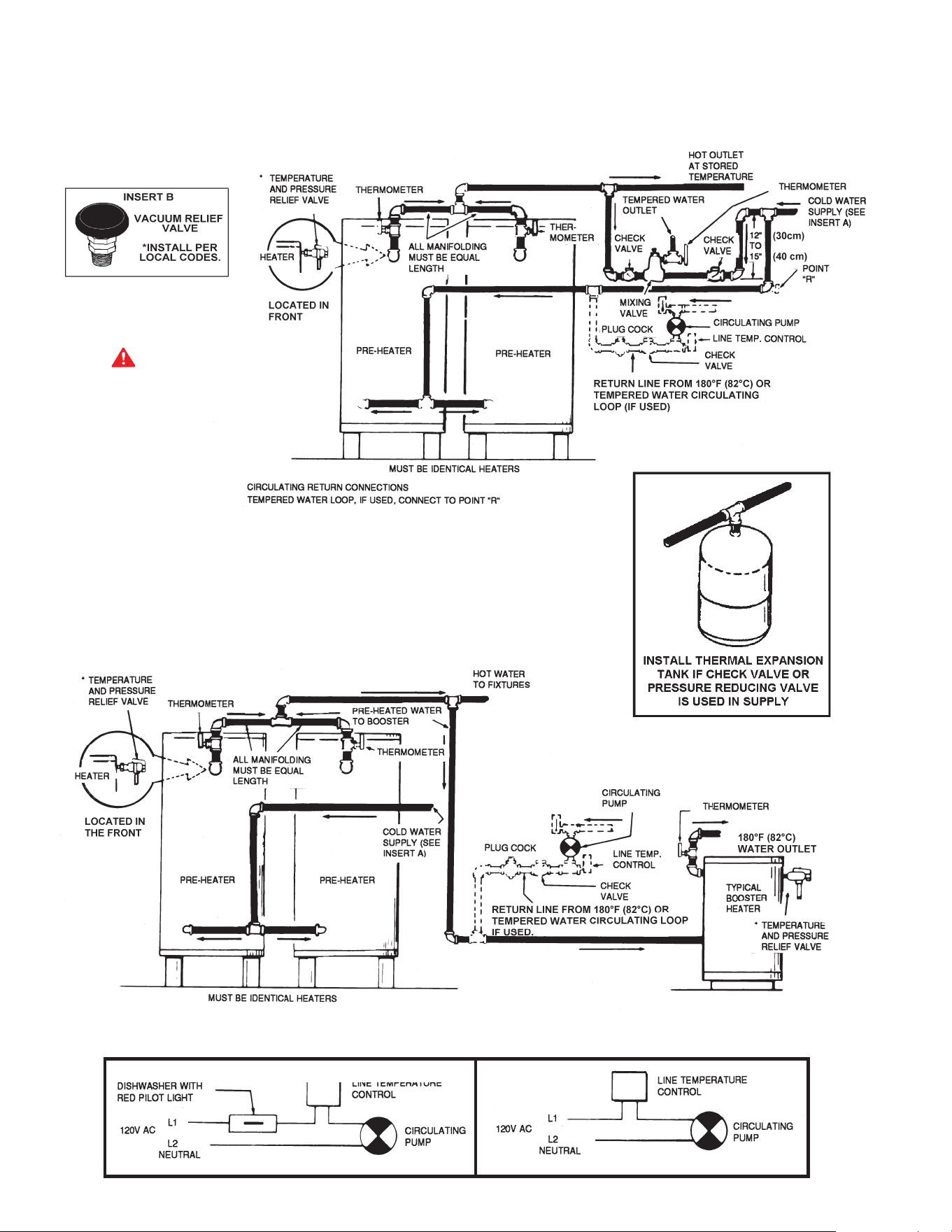
TWO TEMPERATURE - TWO PRE-HEATERS WITH MIXING VALVE OR
BOOSTER HEATER WITH OR WITHOUT BUILDING RECIRCULATION
TWO PRE-HEATERS WITH MIXING VALVE
TWO PRE-HEATERS WITH BOOSTER HEATER
DANGER
TEMPERATURE SETTING SHOULD NOT
EXCEED SAFE USE TEMPERATURE AT
FIXTURES. SEE WATER TEMPERATURE
CONTROL WARNING ON PAGE 27. IF HIGHER
PREHEAT TEMPERATURES ARE NECESSARY
TO OBTAIN ADEQUATE BOOSTER OUTPUT,
ADD AN ANTI-SCALD VALVE FOR HOT WATER
SUPPLIED TO FIXTURES.
INSERT A
21
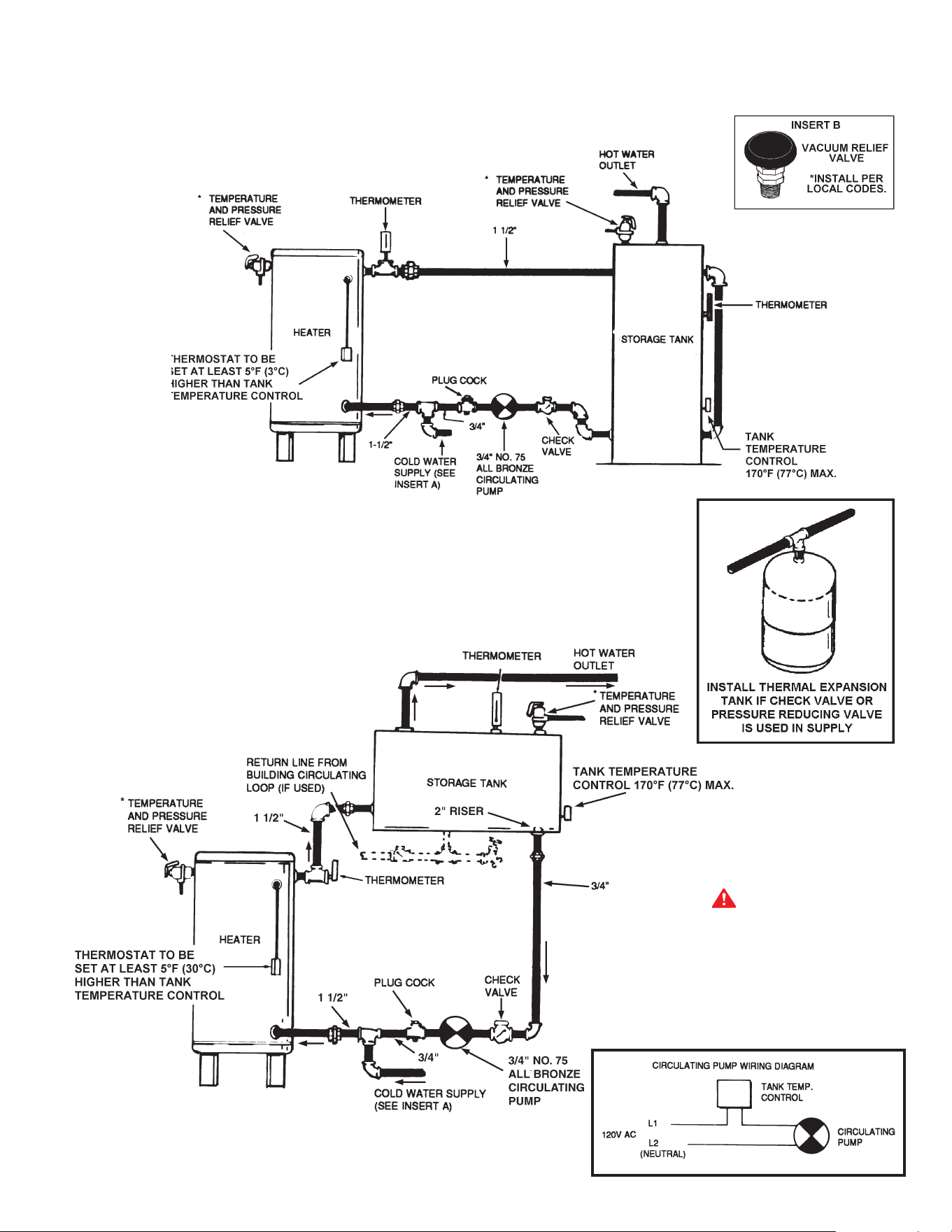
MEDIUM TEMPERATURE - ONE HEATER WITH AUXILIARY STORAGE TANK
FORCED CIRCULATION WITH OR WITHOUT BUILDING RECIRCULATION
VERTICAL STORAGE TANK
HORIZONTAL STORAGE TANK
DANGER
TEMPERATURE SETTING SHOULD NOT EXCEED
SAFE USE TEMPERATURE AT FIXTURES. SEE WATER
TEMPERATURE CONTROL WARNING ON PAGE 27. IF
HIGHER PREHEAT TEMPERATURES ARE NECESSARY
TO OBTAIN ADEQUATE BOOSTER OUTPUT, ADD AN
ANTI-SCALD VALVE FOR HOT WATER SUPPLIED TO
FIXTURES.
* PIPE RELIEF VALVE TO OPEN DRAIN.
IF BUILDING CIRCULATING LOOP IS
USED, CONNECT TO AN OPENING
NEAR THE BOTTOM OF THE TANK.
CAUTION: IF BUILDING COLD WATER SUPPLY HAS A
BACKFLOW PREVENTER, CHECK VALVE OR WATER
METER WITH CHECK VALVE. PROVISIONS FOR
THERMAL EXPANSION OF WATER IN THE HOT WATER
SYSTEM MUST BE PROVIDED.
*PIPE RELIEF VALVE TO OPEN DRAIN
INSTALL IN ACCORDANCE WITH LOCAL CODES.
INSERT A
22
MECHANICAL VENTING
SINGLE UNIT INSTALLATION
When mechanical venting of these heaters is desired, the following
kits are available.
Models CG(N,L)120070 through CG(N,L)199100(A)
part number 9006015
Models CG(N,L)250100(A) through CG(N,L)400100(A)
part number 9006016
Where an approved power venter is to be installed to operate in
conjunction with the water heater thermostat, the following codes
must be adhered to. Field wiring should conform to the current
edition of the National Electrical Code NFPA 70. For Canadian
installations the electrical connections and grounding shall be done
in accordance with the current edition of the Canadian Electrical
Code CSA C22.1 and/or local codes.
VENT INSTALLATION
Seal all joints between the power venter and the vent termination.
This is to prevent leakage of exhaust products into the room(s)
due to positive pressure of blower.
The “Sequence of Operation” description will be the same with
mechanical venting except,
When the appliance thermostat calls for heat:
Thermostat contacts “Close” and the power venter blower
(120 VAC) is energized. Sufcient draft must be established for
the “Draft Prover Switch (N.O.)” to “Close”. When the draft prover
switch “Closes” the relay coil of the ue damper is energized.
See side wall vent kit installation manual for complete instructions.
MULTIPLE UNIT INSTALLATIONS
For multiple unit installations, contact Lochinvar, Parts
Department, 300 Maddox Simpson Pkwy, Lebanon,
TN 37090, Phone: 615-889-8900 • Fax: 615-882-2918, email:
parts_team@lochinvar.com, www.Lochinvar.com.
TABLE 5
MANIFOLD GAS PRESSURE IN INCHES
OF WATER COLUMN (ALL MODELS*)
TYPE OF GAS
NATURAL PROPANE
3.5 10.0
Gas pressure specied in Table 5, refer to ow pressure taken at
pressure tap of automatic gas valve while heater is operating.
TABLE 6
APPROXIMATE TIME REQUIRED TO CONSUME
1 CU. FT. OF GAS AT FULL CAPACITY
INPUT TYPE BTUH TIME REQ’D
RATE OF PER TO CONSUME
(BTUH) GAS CU. FT. 1 CU. FT.
OF GAS
120,000 NATURAL 1050 31.5 SEC.
PROPANE 2500 75.0 SEC.
154,000 NATURAL 1050 24.5 SEC.
PROPANE 2500 58.4 SEC.
180,000 NATURAL 1050 21.1 SEC.
PROPANE 2500 50.3 SEC.
199,000 NATURAL 1050 19.0 SEC.
PROPANE 2500 47.4 SEC.
250,000 NATURAL 1050 15.1 SEC.
PROPANE 2500 35.3 SEC.
251,000 NATURAL 1050 15.06 SEC.
PROPANE 2500 35.1 SEC.
275,000 NATURAL 1050 13.75 SEC.
PROPANE 2500 32.2 SEC.
305,000 NATURAL 1050 12.4 SEC.
PROPANE 2500 29.5 SEC.
360,000 NATURAL 1050 11.4 SEC.
PROPANE 2500 24.0 SEC.
365,000 NATURAL 1050 10.4 SEC.
PROPANE 2500 24.7 SEC.
390,000 NATURAL 1050 9.5 SEC.
PROPANE 2500 22.6 SEC.
Figures shown are valid for 0-2000 ft.(0-610m) installations. See
“HIGH ALTITUDE INSTALLATIONS” for deration requirements
over 2000 ft.(610m).
TABLE 7
PILOT BURNER INFORMATION
TYPE OF PILOT BURNER RATED
MODEL GAS PART NUMBER ORIFICE
(WITH ORIFICE) SIZE
ALL NATURAL 9004541215 0.018
MODELS PROPANE 9004542215 0.014

23
OPERATION
IMPORTANT
A qualied person must perform the initial ring of the heater. At
this time the user should not hesitate to ask the individual any
questions which they may have in regard to the operation and
maintenance of the unit.
An Operational Checklist is included at the rear of this manual. By
using this checklist the user may be able to make minor operational
adjustments and avoid unnecessary service calls. However, the
user should not attempt repairs which are not listed under the
USER column.
GENERAL
NEVER OPERATE THE HEATER WITHOUT FIRST BEING
CERTAIN IT IS FILLED WITH WATER AND A TEMPERATURE
AND PRESSURE RELIEF VALVE IS INSTALLED IN THE RELIEF
VALVE OPENING OF THE HEATER.
SHOULD OVERHEATING OCCUR OR THE GAS SUPPLY FAIL
TO SHUT OFF, TURN OFF THE MANUAL GAS CONTROL VALVE
TO THE APPLIANCE.
CAUTION
Before proceeding with the operation of the unit make sure
the water heater and system are lled with water and all air is
expelled.
FILLING
1. Close the heater drain valve by turning handle clockwise.
2. Open a nearby hot water faucet to permit the air in the system
to escape.
3. Fully open the cold water inlet pipe valve allowing the heater
and piping to be lled.
4. Close the hot water faucet as water starts to ow.
5. The heater is ready to be operated.
PURGING
Gas line purging is required with new piping or systems in which
air has entered.
CAUTION
PURGING SHOULD BE PERFORMED BY PERSONS
EXPERIENCED IN THIS TYPE GAS SERVICE. TO AVOID RISK OF
FIRE OR EXPLOSION, PURGE DISCHARGE MUST NOT ENTER
CONFINED AREAS OR SPACES WHERE IGNITION CAN OCCUR.
THE AREA MUST BE WELL VENTILATED AND ALL SOURCES OF
IGNITION MUST BE INACTIVATED OR REMOVED.
WARNING
THE GAS VALVE MUST HAVE BEEN IN THE OFF POSITION FOR
AT LEAST 5 MINUTES. This waiting period is an important safety
step. Its purpose is to permit gas that may have accumulated in the
combustion chamber to clear. IF YOU DETECT GAS ODOR AT THE
END OF THIS PERIOD DO NOT PROCEED WITH LIGHTING.
RECOGNIZE THAT GAS EVEN IF IT SEEMS WEAK, MAY
INDICATE PRESENCE OF ACCUMULATED GAS SOMEPLACE
IN THE AREA WITH RISK OF FIRE OR EXPLOSION. SEE THE
FRONT PAGE FOR STEPS TO BE TAKEN.
All gas and water lines leak tested and open.
With above conditions satised, light the unit in accordance with
the instructions on the Operating label attached to the heater. If
label instructions are not legible - determine which gas valve the
appliance is equipped with and use the applicable OPERATING
INSTRUCTIONS as follows:
IF PILOT FLAME GOES OUT - Main burners will extinguish and
pilot will attempt reignition.
DAMPER MUST BE IN FULL OPEN POSITION FOR PILOT AND/
OR MAIN BURNER IGNITION TO OCCUR - See SEQUENCE
OF OPERATION for complete description.
Each heater is equipped with a Honeywell Ignition Module. This
module will try to prove pilot for 90 seconds. If pilot is not proven
within the 90 secs, the unit will retry after 5 minutes. This cycle
will continue until pilot is proven.
If pilot does not ignite when system calls for heat, check for
pilot ignition spark at pilot assembly. Refer to OPERATIONAL
CHECKLIST and EFFIKAL RVGP-KSF SERIES FLUE DAMPER
TROUBLESHOOTING GUIDE.
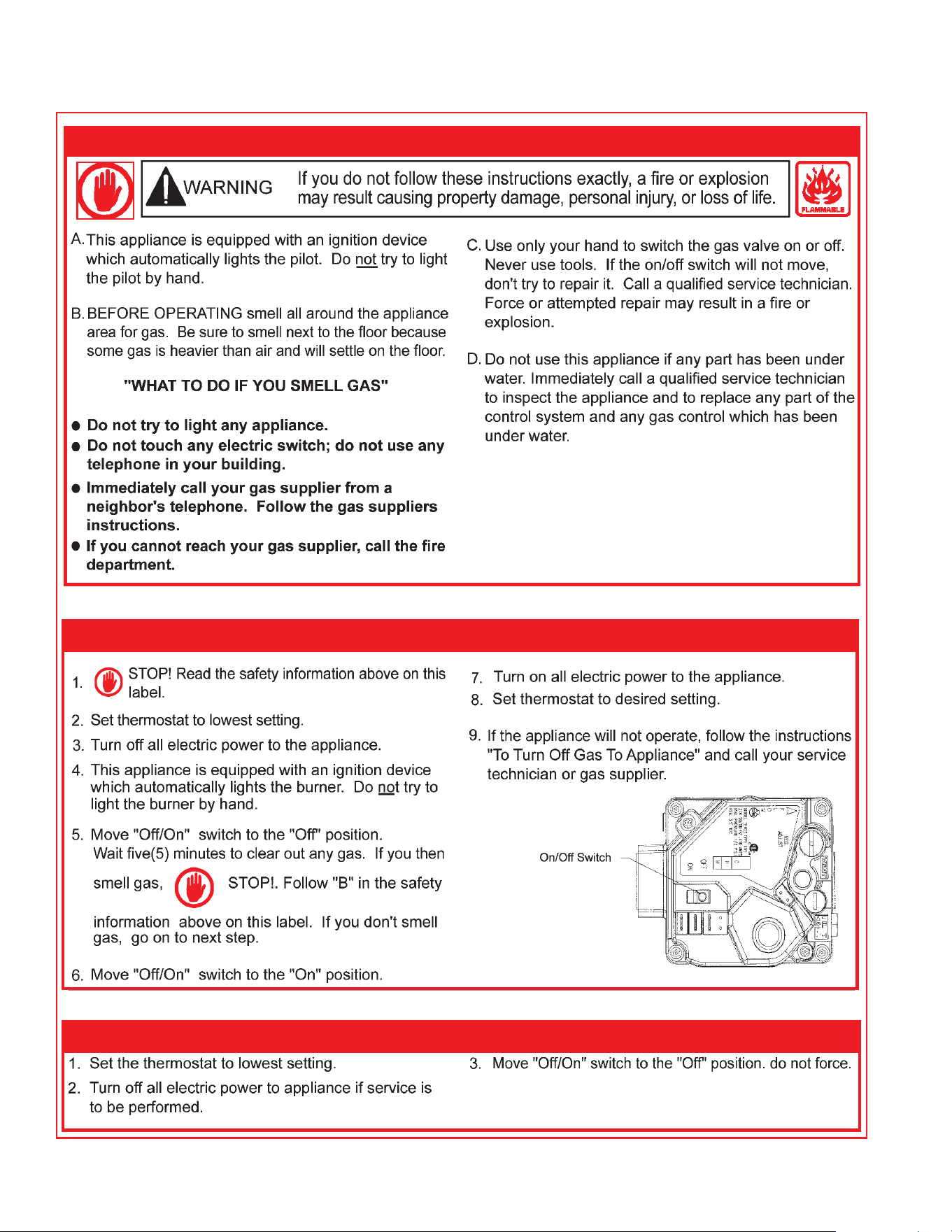
24
FOR NATURAL GAS MODELS
FOR YOUR SAFETY READ BEFORE OPERATING
OPERATING INSTRUCTIONS
FOR YOUR SAFETY READ BEFORE OPERATING
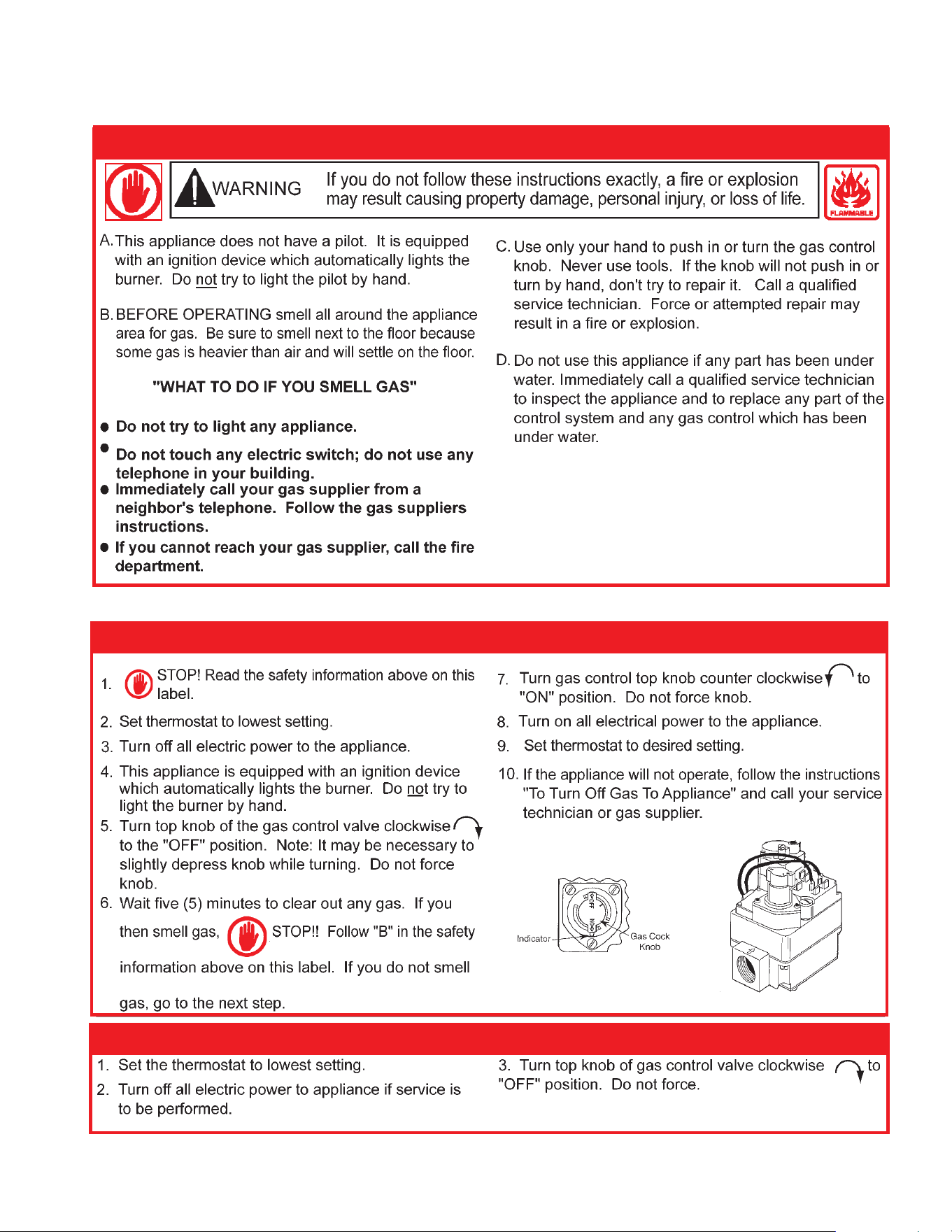
25
FOR PROPANE GAS MODELS
FOR YOUR SAFETY READ BEFORE OPERATING
OPERATING INSTRUCTIONS
TO TURN OFF GAS TO APPLIANCE
26
ADJUSTMENTS
ON INITIAL STARTUP SOME ADJUSTMENTS ARE NECESSARY.
1. CHECK MANIFOLD AND INLET GAS PRESSURES.
2. TO ADJUST PILOT FLAME - FOLLOW “PILOT BURNER”
PROCEDURE UNDER “PREVENTIVE MAINTENANCE”.
WATER TEMPERATURE CONTROL
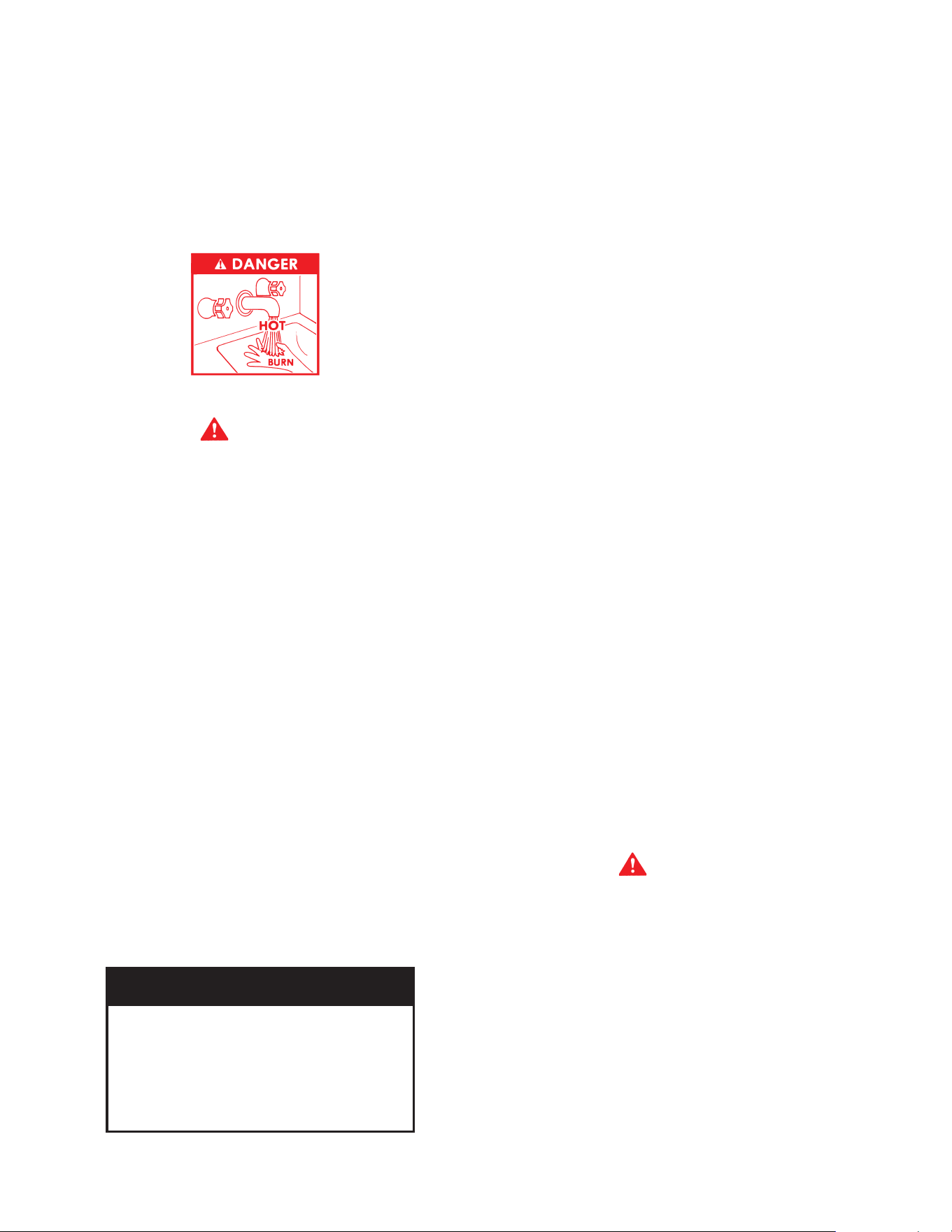
WARNING
THIS WATER HEATER IS EQUIPPED WITH AN ADJUSTABLE
THERMOSTAT TO CONTROL WATER TEMPERATURE. HOT
WATER TEMPERATURES REQUIRED FOR AUTOMATIC
DISHWASHER AND LAUNDRY USE CAN CAUSE SCALD BURNS
RESULTING IN SERIOUS PERSONAL INJURY AND/OR DEATH.
THE TEMPERATURE AT WHICH INJURY OCCURS VARIES WITH
THE PERSON’S AGE AND TIME OF EXPOSURE. THE SLOWER
RESPONSE TIME OF CHILDREN, AGED OR DISABLED PERSONS
INCREASES THE HAZARDS TO THEM. NEVER ALLOW SMALL
CHILDREN TO USE A HOT WATER TAP, OR DRAW THEIR OWN
BATH WATER. NEVER LEAVE A CHILD OR DISABLED PERSON
UNATTENDED IN A BATHTUB OR SHOWER.
THE WATER HEATER SHOULD BE LOCATED IN AN AREA
WHERE THE GENERAL PUBLIC DOES NOT HAVE ACCESS
TO SET TEMPERATURES.
SETTING THE WATER HEATER TEMPERATURE AT 120°F WILL
REDUCE THE RISK OF SCALDS. Some states or provinces
require settings at specic lower temperatures.
Below you will nd listed the approximate time-of-burn relationship
for normal adult skin. Short repeated heating cycles caused by
small hot water uses can cause temperatures at the point of use
to exceed the thermostat setting by up to 20°F (11°C).
If you experience this type of use, you should consider using lower
temperature settings to reduce scald hazards.
TABLE 7
Water Time to Produce 2nd & 3rd
Temperature Degree Burns on Adult Skin
180°F (82°C) Nearly Instantaneous
170°F (77°C) Nearly Instantaneous
160°F (71°C) About 1/2 Second
150°F (65°C) About 1 - 1/2 Seconds
140°F (60°C) Less than 5 Seconds
130°F (54°C) About 30 Seconds
120°F (49°C) More than 5 Minutes
Valves for reducing point-of-use temperature by mixing cold and
hot water are available. Also available are inexpensive devices
that attach to faucets to limit hot water temperatures. Contact a
licensed plumber or the local plumbing authority.
The water temperature is controlled by a thermostat, Fig. 3, which
has two sensing elements. One sensor is located near the top of
the tank and the other is near the center. The thermostat is set in
the lowest position before the heater leaves the factory.
The thermostat temperature dial, Fig. 3, is accessible by
removing the control cover. The dial is adjustable and may be
set for 120°F (49°C) to 180°F (82°C) water temperature, but
120°F (49°C) is the recommended starting point. It is suggested
the dial be placed on the lowest setting which produces an
acceptable hot water supply. This will always give the most
energy efcient operation. The temperature control has a 4°F
xed differential.
TESTING DAMPER OPERATION
With the Service Switch in the AUTOMATIC OPERATION position,
check the operation of the ue damper three (3) times with the
water operating controls for proper operating sequence:
• The damper disc must be open (in the vertical position) before
the ignition and combustion process begins.
• The damper disc must be in the open position when the main
burner is ring.
• The gas valve must close and the main burner must have
ceased ring before the damper disc begins its return to the
closed (horizontal) position.
If during testing of the operation of the damper you nd that
there is a problem with the operation of the water heater when
the Service Switch is in the AUTOMATIC OPERATION position:
Reset the Service Switch to the HOLD OPEN DAMPER position
and check operation again.
If the water heater does operate when placed in the HOLD OPEN
DAMPER position:
• Refer to the EFFIKAL RVGP-FSF-SERIES TROUBLESHOOTING
GUIDE at the end of this manual.
CAUTION
Do not force the damper disc manually or motor damage will
occur.
If the water heater does not operate with the Service Switch in
either position:
• Refer to the Troubleshooting Sections and Operational
Checklist sections.
CHECKING VENTING
The following steps shall be followed with each appliance
connected to the venting system placed in operation, while any
other appliances connected to the venting system are not in
operation.
1. Seal any unused openings in the venting system.
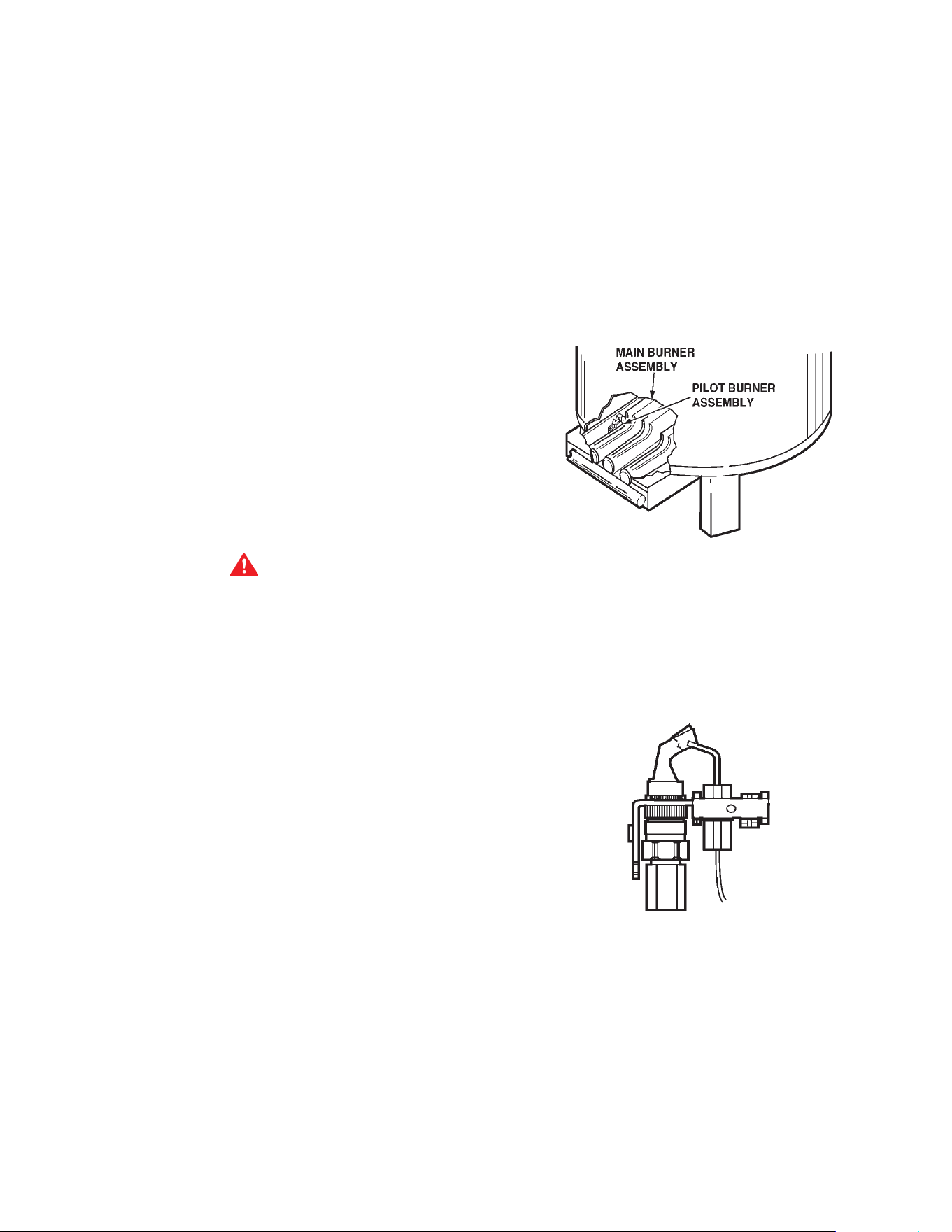
27
2. Inspect the venting system for proper size and horizontal pitch,
as required in the National Fuel Gas Code, ANSI Z223.1 or the
Natural Gas and Propane Installation Code CAN/CSA-B149.1
and these instructions. Determine that there is no blockage or
restriction, leakage, corrosion and other deciencies which
could cause an unsafe condition.
3. So far as is practical, close all building doors and windows
and all doors between the space in which the water heater(s)
connected to the venting system are located and other spaces
of the building. Turn on all appliances not connected to the
venting system. Turn on all exhaust fans, such as range hoods
and bathroom exhausts, so they shall operate at maximum
speed. Close replace dampers.
4. Follow the lighting instruction. Place the water heater being
inspected in operation. Adjust thermostat so appliance shall
operate continuously.
5. Test for draft hood spillage at the relief opening after 5 minutes
of main burner operation.
6. After it has been determined that each appliance connected
to the venting system properly vents when tested as outlined
above, return doors, windows, exhaust fans, replace dampers
and any other gas burning appliance to their previous conditions
of use.
7. If improper venting is observed during any of the above tests,
the venting system must be corrected.
WARNING
FAILURE TO CORRECT BACK DRAFTS MAY CAUSE AIR
CONTAMINATION AND UNSAFE CONDITIONS.
• If the back draft cannot be corrected by the normal method or
if a suitable draft cannot be obtained, a blower type ue gas
exhauster must be employed to assure proper venting and
correct combustion.
PREVENTIVE MAINTENANCE
CHECK THE PILOT
At least once a year, check the pilot burner, g. 15, and the main
burner, g. 16, for proper operation. Refer to the following pilot
and main burner sections.
PILOT BURNER
For access to pilot, unfasten two screws to burner cover and
remove. Locate the burner with pilot and remove screw holding
burner to manifold. Unfasten pilot tubing from valve and slide out
burner and pilot.
Servicing of the pilot burner includes keeping pilot free of lint,
cleaning the burner head, the primary air opening and the orice
of the pilot burner.
Pilot burner ame is affected by:
1. Low gas pressure.
• Adjust pilot ame by means of the pilot gas adjustment
located on the gas valve. See g. 17.
• The pilot flame should envelop sensing device with 5/8”
(1.6cm) ame, g. 16. Remove pilot adjustment cover screw,
g. 15. Turn inner adjustment screw clockwise to decrease, or
counterclockwise to increase pilot ame. Be sure to replace
cover screw on gas valve after adjustment to prevent possible
gas leakage.
2. Clogged pilot burner orice.
• Clean or replace orice. A clogged orice will restrict
gas ow.
3. Incorrect orice.
• Replace. See Table 7, for correct orice for type of gas
used. Orice size is stamped on the wrench ats.
FIGURE 14
Pilot sensing device must sense a ame before sparking will stop.
Loose wires or a draft may cause intermittent or abnormal sparking.
To eliminate this condition, rst correct loose wiring condition, and
then, if necessary, increase pilot ame.
PILOT BURNER ASSEMBLY
FIGURE 15
MAIN BURNER
The main burner, fig. 16, should display the following
characteristics:
• Cause rapid ignition and carry over of ame across entire
burner.
• Give reasonably quiet operation during ignition, burning and
extinction.
• Cause no excessive lifting of ame from burner ports.
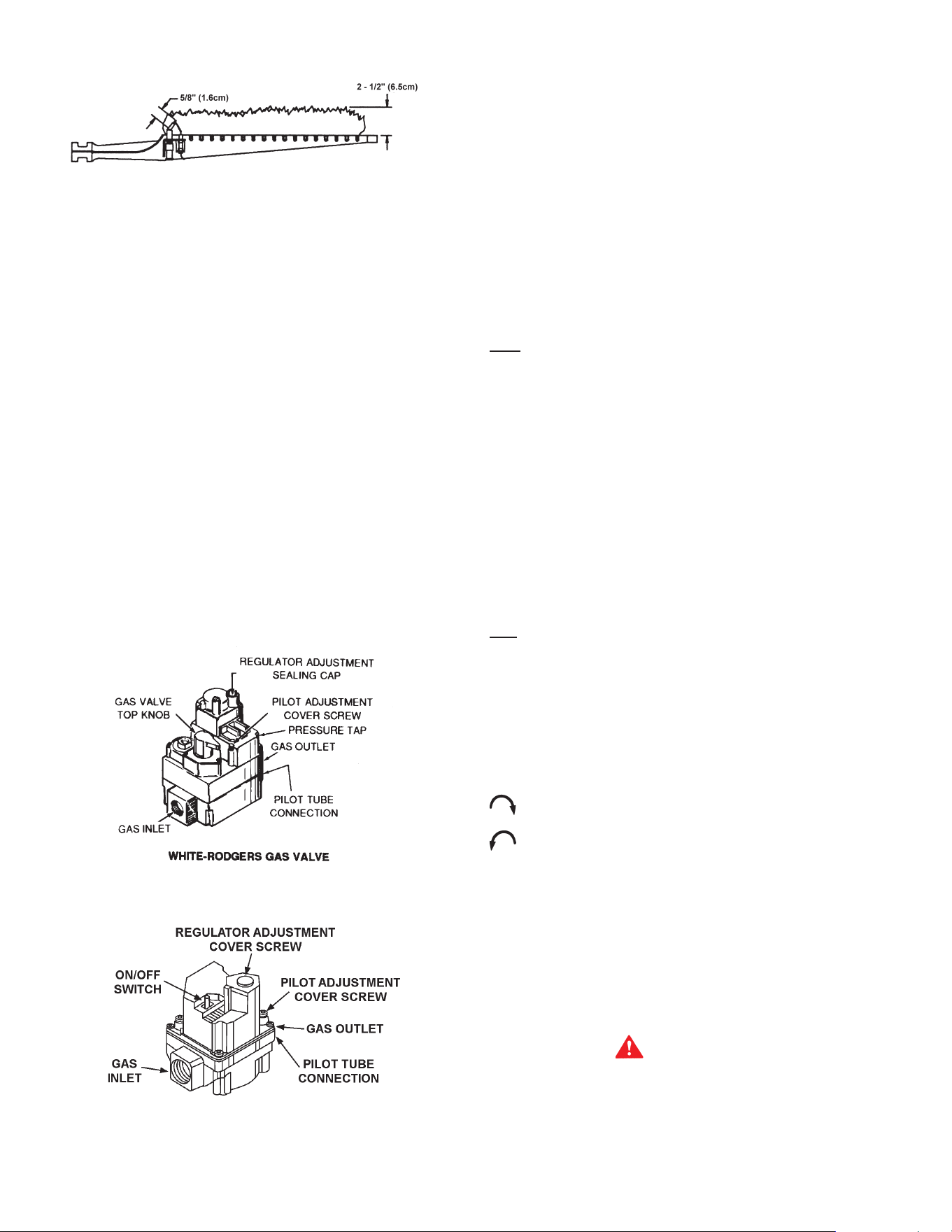
28
TYPICAL PILOT AND MAIN BURNER FLAMES
FIGURE 16
If the preceding burner characteristics are not evident, check
for accumulation of lint or other foreign material that restricts or
other foreign material that restricts or blocks the air openings to
the burner or heater.
NOTE: Cleaning of main burners.
1. Remove main burners from unit.
2. Check that burner venturi and ports are free of foreign
matter.
3. Clean burners with bristle brush and/or vacuum cleaner — DO
NOT distort burner ports or pilot location.
4. Reinstall burners in unit. Make sure front and rear of burners
are installed correctly in burner support brackets.
Also check for good ow of combustion and ventilating air to the
unit. Maintain a clear area around the heater at all times.
GAS VALVES
Figure 17 shows the two types of combination gas control valves
used on these heaters.
LP VALVE
NATURAL VALVE
FIGURE 17
If the gas valve becomes defective, repairs should not be
attempted. A new valve should be installed in place of the
defective one.
CHECKING THE INPUT
For appliance installation locations with elevations above 2000
feet (610 m), refer to HIGH ALTITUDE INSTALLATIONS section
of this manual for input reduction procedure.
1. Attach a pressure gauge or a manometer to the gauge port and
refer to Table 5, for correct manifold pressure.
2. Use this formula to “clock” the meter. Be sure that other gas
consuming appliances are not operating during this interval.
3600 X H = Btuh
T
T = Time in seconds to burn one cubic foot of gas.
H = Btu’s per cubic foot of gas.
Btuh = Actual heater input.
Example: (Using BTRC-199 heater)
T = 15.8 seconds
H = 1050 Btu
Btuh = ?
19.0 X 1050 = 199,000 Btuh (70.3 Kwh) (Compare with
15.9 heater model and rating)
Should it be necessary to adjust the gas pressure to the burners
to obtain the full input rate, the steps below should be followed:
3. Remove the regulator adjustment sealing cap, g. 17, and
adjust the pressure by turning the adjusting screw with a
screwdriver.
Clockwise to increase gas pressure and input rate.
Counterclockwise to decrease gas pressure and input
rate.
4. “Clock” the meter as in step 2 above.
5. Repeat steps 3 and 4 until the specied input rate is achieved.
6. Turn the gas control knob to PILOT. Remove the pressure
gauge and replace the sealing cap and the allen wrench set
screw in the pressure tap opening.
WARNING
UNDER NO CIRCUMSTANCES SHOULD THE GAS INPUT
EXCEED THE INPUT SHOWN ON THE HEATER MODEL AND
RATING PLATE. OVERFIRING COULD RESULT IN DAMAGE
OR SOOTING OF THE HEATER.
When the heater is operating at full capacity, or full gas input, it
should consume 1 cu. ft. of gas in time indicated on Table 6.
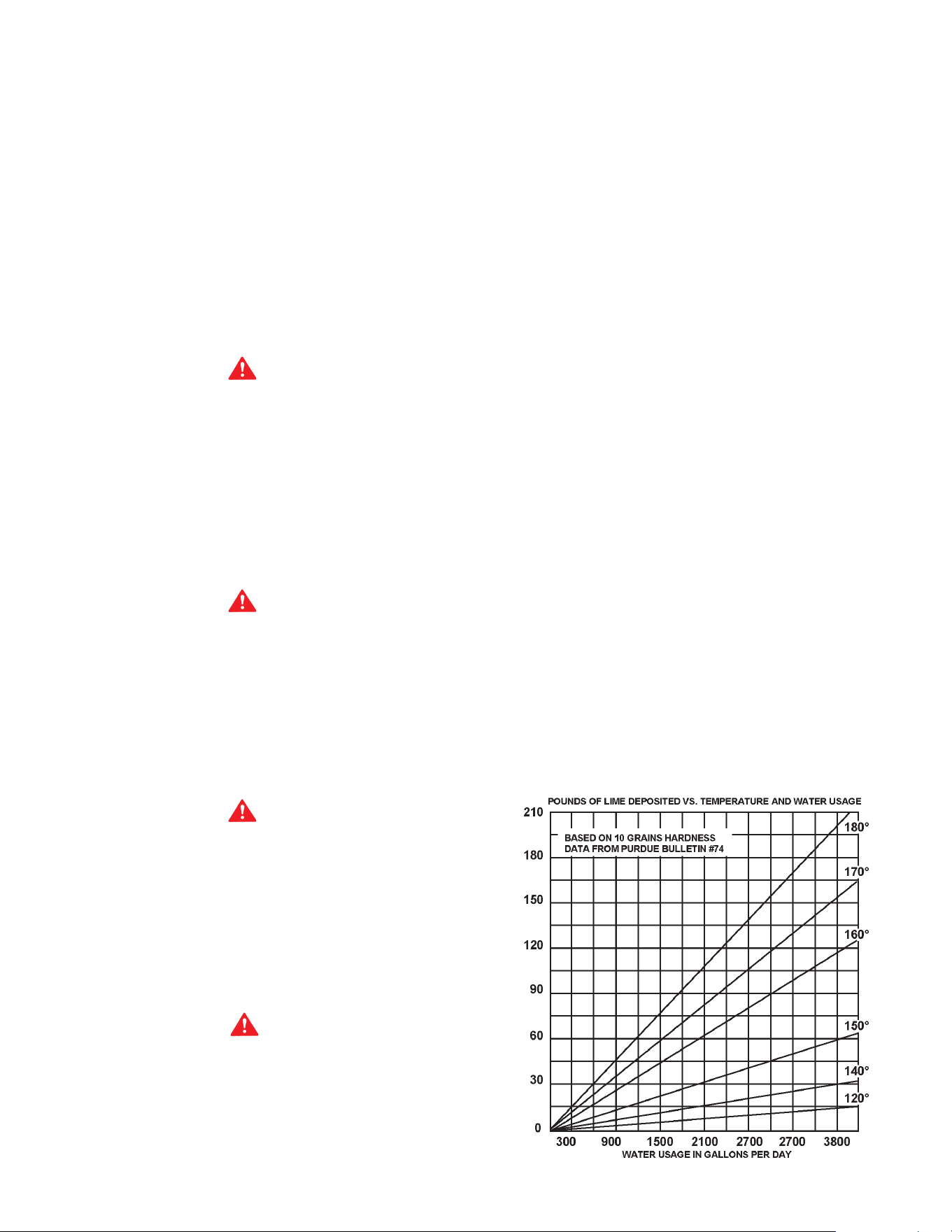
29
VENTING SYSTEM
Examine the venting system every six months for obstructions
and/or deterioration of the vent piping.
Remove all soot or other obstructions from chimney which will
retard free draft.
REMOTE STORAGE TANK
TEMPERATURE CONTROL
The water temperature in the storage tank (if used) is controlled
by the storage tank temperature control. The sensing element is
mounted in the hot water storage tank, see page 16.
A change in water temperature in the storage tank lower than the
tank temperature control setting will cause the sensor to activate the
circulating pump. The pump then circulates the water through the
heater where the thermostat senses the drop in water temperature
and activates main burner operation of the appliance.If the storage
tank temperature control is out of calibration, replace with new control.
WARNING
SHOULD OVERHEATING OCCUR OR THE GAS SUPPLY FAIL
TO SHUT OFF, TURN OFF THE MANUAL GAS CONTROL VALVE
TO THE APPLIANCE.
RELIEF VALVE
At least once a year, the temperature and pressure relief valve
should be checked to ensure that it is in operating condition. Lift
the lever at the top of the valve several times until the valve seats
properly and operates freely.
If the appliance installation includes other relief valves, such as
in “remote” storage tanks etc., check their relief valve operation
with the same frequency.
WARNING
THE WATER PASSING OUT OF THE VALVE DURING THIS
CHECKING
OPERATION MAY BE EXTREMELY HOT. AVOID
CONTACT AND DISCHARGE SAFELY TO PREVENT WATER DAMAGE.
If the temperature and pressure relief valve on the heater discharges
periodically or continuously, a problem exists. This may be due to
unusually high water temperatures or pressures in the system, or to a
faulty relief valve. Contact your dealer or a qualied service technician to
nd the cause of the problem and to correct it. This may also be due to
thermal expansion in a closed water supply system. Contact the water
supplier or local plumbing inspector on how to correct this situation. DO
NOT PLUG THE TEMPERATURE AND PRESSURE RELIEF VALVE.
WARNING
SHOULD OVERHEATING OCCUR OR THE GAS SUPPLY FAIL
TO SHUT OFF, TURN OFF THE MANUAL GAS CONTROL VALVE
TO THE APPLIANCE.
HOT WATER ODOR
On occasion, hot water may develop a strong odor. If this occurs drain
the heater completely, ush thoroughly, and rell. If the problem persists,
chlorination of the heater and replacement of the factory installed
magnesium anodes with aluminum anodes may correct the condition.
Occasionally water softener companies recommend removal of
heater anodes for odor reasons.
CAUTION
Unauthorized removal of the anode(s) will void the warranty. For
further information contact your dealer.
ANODE ROD INSPECTION
The heater tank is equipped with anode rods to provide corrosion
control. At least once a year the anode rods should be checked
to determine if replacement is necessary. Initially the anode rods
are approximately 7/8” (22mm) in diameter with a 1/8” (3mm)
diameter steel core wire running down the center of the anode
material. THE ANODES SHOULD BE REPLACED when the 1/8”
(3mm) diameter core wire is visible as this means that the anode
material has been expended in the control of corrosion.
For models with top inlet and outlet, it is recommended that, before
removing the inner cover for cleaning, inspection or removal of
inner parts, you obtain two new nipple collars, part no. 74060.
The nipple collars on the heater will usually be damaged when
removed. New pipe collars will insure that the seal is such as to
prevent leakage of ue products when properly installed.
NOTE: Anode rod inspection may need to be made more frequently
in areas subject to acid rain that obtains their water supply from
surface water as the low pH will accelerate anode activity.
CAUTION: Close cold water inlet valve serving heater and
open nearby hot water faucet to relieve the pressure in the
heater before attempting to remove anode(s) for inspection.
RECOMMENDED PROCEDURE FOR
PERIODIC REMOVAL OF LIME DEPOSITS FROM
TANK TYPE COMMERCIAL WATER HEATERS
The The amount of calcium carbonate (lime) released from water is
in direct proportion to water temperature and usage, see chart.
The higher the water temperature or water usage, the more lime
deposits are dropped out of the water. This is the lime scale which
forms in pipes, heaters and on cooking utensils.
Lime accumulation not only reduces the life of equipment but also
reduces efciency of the heater and increases fuel consumption.
The usage of water softening equipment greatly reduces the
hardness of the water. However, this equipment does not
always remove all of the hardness (lime). For this reason it is
recommended that a regular schedule for deliming be maintained.
The time between cleaning will vary from weeks to months
depending upon water conditions and usage. The depth of lime
buildup should be measured periodically. Heaters equipped with
cleanouts will have about 2” of lime buildup when the level of
lime has reached the bottom of the cleanout opening. A schedule
for deliming should then be set up,based on the amount of time
it would take for a 1” buildup of lime. It is recommended that the
water heater initially be inspected after 6 months.
Example 1:
If initial inspection after 6 months shows 1/2” of lime accumulation.
Therefore, the heater should be delimed once a year.
Example 2:
If initial inspection after 6 months shows 2” of lime accumulation.
Therefore, the heater should be delimed every 3 months.
FIGURE 18

30
CAUTION
Observe handling instructions on label of product being used.
TANK CLEANOUT PROCEDURE
The following practices will ensure longer life and enable the unit
to operate at its designed efciency:
1. Once a month the heater should be ushed. Open drain valve and
allow two gallons of water to drain from heater. Inlet water valve
should remain open to maintain pressure in tank.
2. A cleanout opening is provided for periodic cleaning of the tank.
Gas must be shut off and heater drained before opening cleanout.
To clean heater through cleanout opening, proceed as follows:
1. Drain heater.
2. Remove outer cover plate from lower side of heater jacket.
3. Remove six (6) hex head screws securing tank cleanout plate
and remove plate.
4. Remove lime, scale, or sediment using care not to damage glass lining.
5. Inspect cleanout plate gasket, if new gasket is required, replace
with part 9004099215.
6. Install cleanout plate. Be sure to draw plate up tight by tightening
screws securely.
7. Replace outer jacket cover plate.
In some water areas the sediment might not be removed by this
method and may result in the water heater making rumbling or
boiling noises. To dissolve and remove these more stubborn
mineral deposits, UN•LIME Professional Delimer should
be used.
TROUBLESHOOTING
IGNITION MODULE SYSTEM
Before calling your service agent, the following checklist should
be examined to eliminate obvious problems from those requiring
replacement or servicing.
— Check that “main manual gas shut-off valve” is fully open and
that gas service has not been interrupted.
— Check that after following the appliance OPERATING
INSTRUCTIONS, the “Top Knob” of the appliance gas valve
is in “ON” position.
— Check electrical supply to the appliance for possible blown (or
tripped) fusing or power interruption.
— Is the water temperature in tank below the thermostat dial
setting on the appliance thermostat (calling for heat)?
— It is possible that the high limit (E.C.O.) has functioned to shut
off the appliance. See FEATURES — Water Temperature
Control for reset procedure. Contact your serviceman if limit
continues to function to shut off appliance.
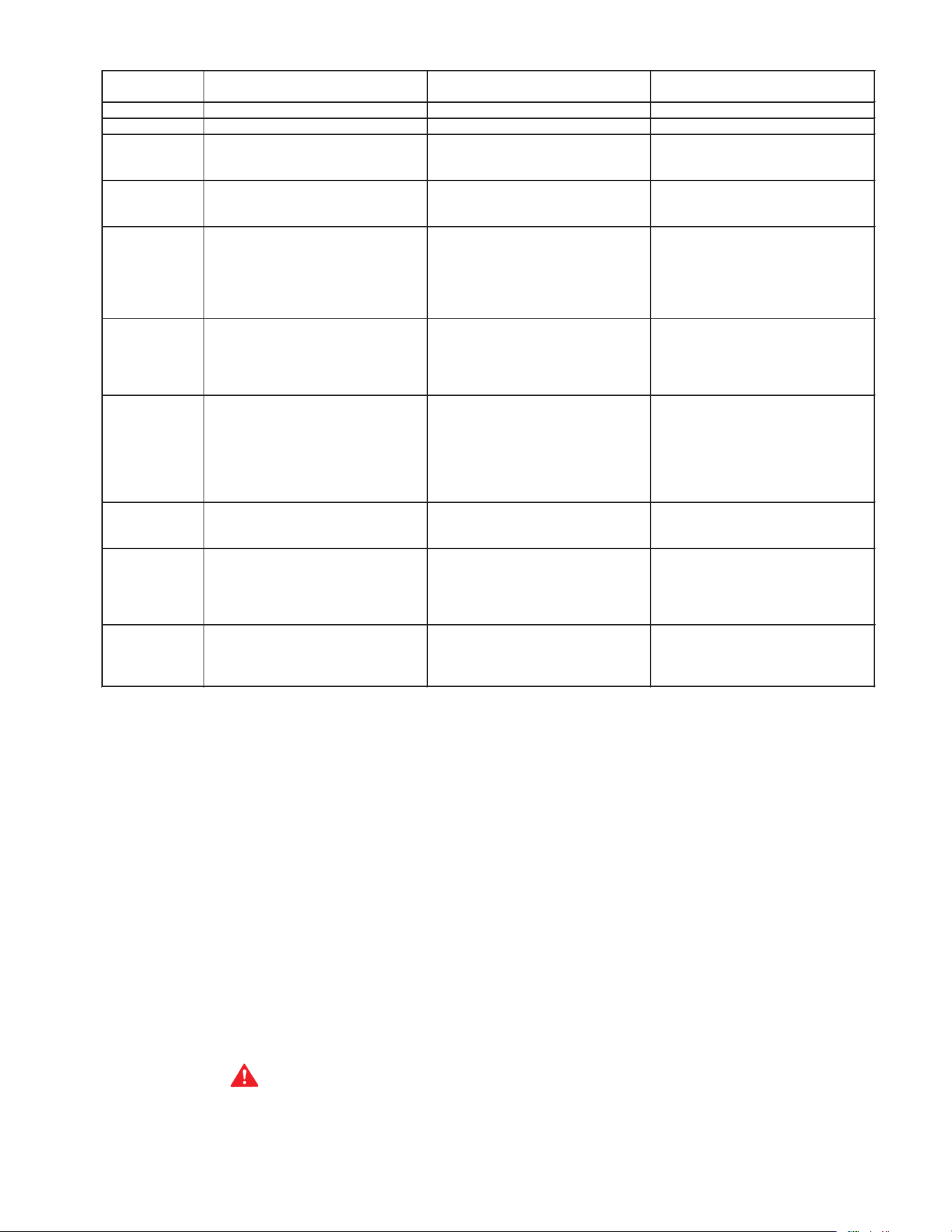
31
SERVICE
The installer may be able to obser ve and correct certain problems
which may arise when the unit is put into operation. HOWEVER, it
is recommended that only qualied servicemen, using appropriate
test equipment, be allowed to service the heater.
As preliminary step, check wiring against diagram, check for
grounded, broken or loose wires. Check all wire ends to be sure
that they are making good contact.
ELECTRICAL SERVICING
CAUTION
LABEL ALL WIRES PRIOR TO DISCONNECTION WHEN
SERVICING CONTROLS. WIRING ERRORS CAN CAUSE
IMPROPER AND DANGEROUS OPERATION.
VERIFY PROPER OPERATION AFTER SERVICING.
REPLACEMENT PARTS
Replacement parts may be ordered through Lochinvar
dealers, authorized servicers or distributors. Refer to the
Yellow Pages for where to call or contact the Parts Department,
300 Maddox Simpson Pkwy, Lebanon, TN 37090,
Phone: 615-889-8900 • Fax: 615-882-2918, email:
parts_team@lochinvar.com, www.Lochinvar.com. When
ordering parts be sure to state the quantity, part number and
description of the item(s) including the complete model and
serial number as it appears on the product. Refer to the part’s
list for more information.
Green LED
Flash Code
a
Indicates
Next System Action
Recommended Service Action
OFF
No “Call for Heat”
Not applicable
None
Flash Fast
Power up - internal check
Not applicable
None
Heartbeat Normal startup – ignition
sequence started (including
prepurge)
Not applicable None
4 Seconds
ON then “x”
flashes
Device in run mode. “x” = flame
current to the nearest μA.
Not applicable
None
2
5 minute Retry Delay - Pilot flame
not detected during trial for ignition
Initiate new trial for ignition after
retry delay completed.
If system fails to light on next trial
for ignition check gas supply, pilot
burner, spark and flame sense
wiring, flame rod contaminated or
out of position, burner ground
connection.
3
Recycle - Flame failed during run
Initiate new trial for ignition. Flash
code will remain through the
ignition trial until flame is proved.
If system fails to light on next trial
for ignition, check gas supply, pilot
burner, flame sense wiring,
contamination of flame rod, burner
ground connection.
4 Flame sensed out of sequence If situation self corrects within 10
seconds, control returns to normal
sequence. If flame out of
sequence remains longer than 10
seconds, control will resume
normal operation 1 hour after error
is corrected.
Check for pilot flame. Replace gas
valve if pilot flame present. If no
pilot flame, cycle “Call for Heat.” If
error repeats, replace control.
6
Control Internal Error
Control remains in wait mode.
When the fault corrects, control
resumes normal operation.
Cycle “Call for Heat”. If error
repeats, replace control.
7
Flame rod shorted to ground
Control remains in wait mode.
When the fault corrects, control
resumes normal operation.
Check flame sense lead wire for
damage or shorting. Check that
flame rod is in proper position.
Check flame rod ceramic for
cracks, damage or tracking.
8
Low secondary voltage supply
Control remains in wait mode.
When the fault corrects, control
resumes normal operation.
Check transformer and AC line for
proper input voltage to the control.
Check with full system load on the
transformer.
a
Flash Code Descriptions:
- Flash Fast: rapid blinking.
- Heartbeat: Co nstant ½ second bright, ½ second dim cycles.
- 4 second solid on pulse followed by “x” 1 second flashes indicates flame current to the nearest μA. This is only available in run mode.
- A single flash code number signifies that the LED flashes X times at 2Hz, remains off for two seconds, and then repeats the sequence.
322568-000 REV. XX
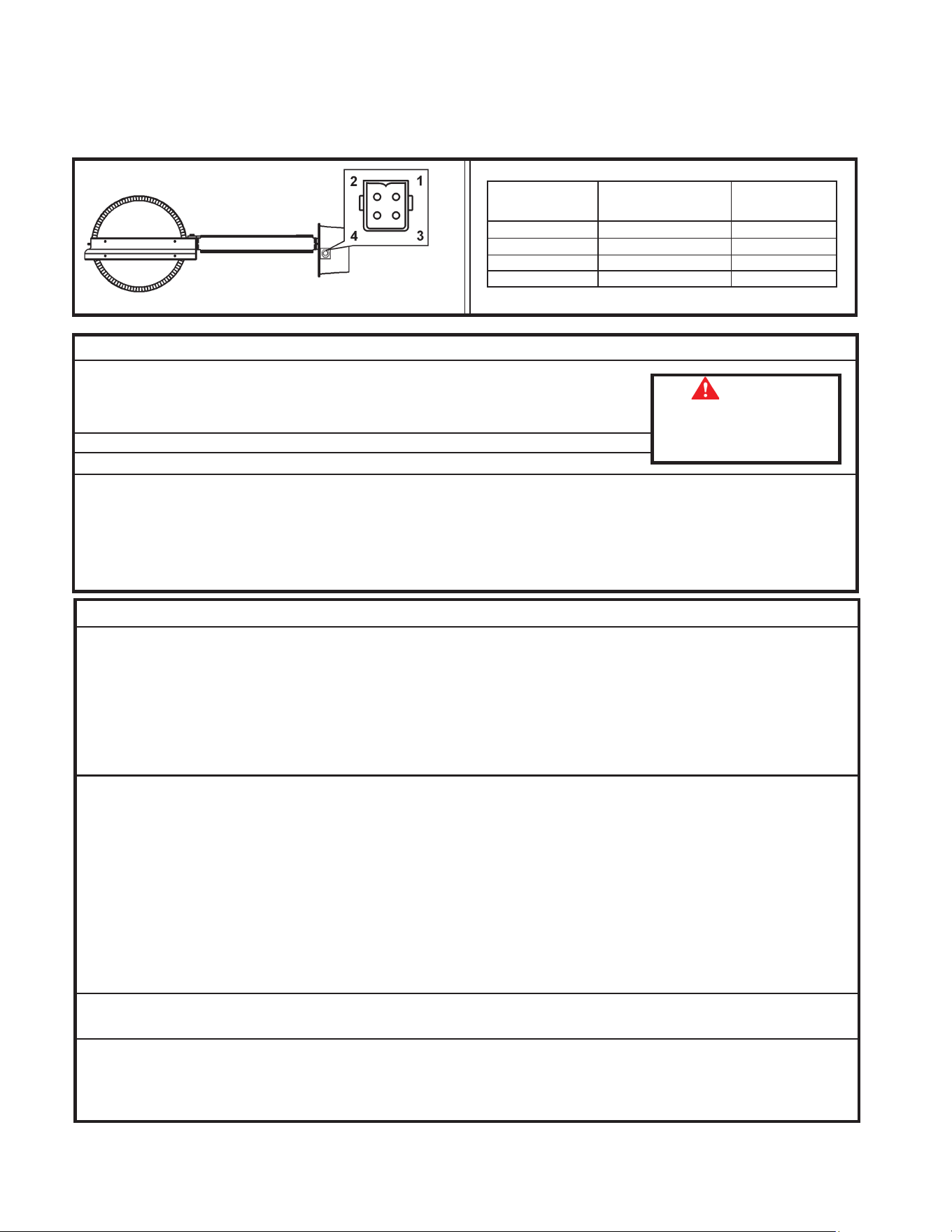
32
PIN END VIEW
24 V.A.C. NORMAL SEQUENCE OF OPERATION
B. DAMPER HAS OPENED,
NO COMBUSTION
VOLTAGE ACROSS:
4 & 1; 4 & 2; 4 & 3: 1. Check for power at ignition module terminals. If 24VAC power is present damper
is working properly.
2. Defective component in appliance after the ue damper.
3. If 24 VAC is not present at the ignition module, look for loose or broken
connections between damper and ignition module.
4. If the connections from damper to ignition module seem proper, replace damper
assembly. If a damper assembly is not available, place the service switch in the
hold open position. This should keep the damper in the open position and allow
the customer to have automatic heat, until a replacement damper can be installed.
C. DAMPER ROTATES
CONTINUOUSLY Change the entire damper assembly
D. DAMPER STICKS 1. Make sure no screws obstruct the damper blade.
2. Make sure damper pipe assembly is not egg shaped.
3. Make sure damper rod is not rubbing on pipe assembly.
See gure on front page of this insert sheet
ABNORMAL OPERATION
A. NOTHING WORKING
NO VOLTAGE ACROSS:
4 & 1 1. High Limit has tripped and is OPEN. Determine reason for tripping of high limit
2. Bad Transformer
3. Loose or broken connections
4. Blown fuse or circuit breaker
5. Disconnect switch off
6. Harness not plugged into appliance receptacle
A. FLUE DAMPER OPEN OR OPENING
(Unit is calling for heat and damper disc should be in vertical position)
VOLTAGE ACROSS:
4 & 1 All Times that High Limit is closed
4 & 2 Calling for Heat Open or Opening
4 & 3 During Combustion Damper Open+
B. FLUE DAMPER CLOSED (Unit is not calling for heat and damper disc should be in horizontal position)
NOTE: POSITION 4 IS COMMON AND POSITION 3 IS HOT 24VAC
VOLTAGE ACROSS:
4 & 1 All Times that High Limit is closed
NO VOLTAGE ACROSS:
4 & 3 or 4 & 2 1.Thermostat not calling for heat.
EFFIKAL RVGP-KSF-SERIES FLUE DAMPER TROUBLE SHOOTING GUIDE
Do not turn damper open manually or motor damage will result, use the service switch.
All readings are taken from harness receptacle. Do not push meter leads into harness receptacle.
This opens the pins and will create connection problems.
WARNING
Do not negate the action
of any existing safety
or operational controls.
IMPORTANT: DAMPER MUST BE OPEN BEFORE COMBUSTION TAKES PLACE. If all steps have been
tried and damper problems persists call Service Department, Phone: 615-889-8900 • Fax: 615-547-1000.
NOTE: DAMPER DISC SHOWN IN OPEN POSITION.
Efkal Pinouts Adapter wire
& wire colors Function colors in*
1. Brown 24 VAC HOT Black
2. Orange Signal In Yellow
3. Yellow Signal Out Red
4. Black 24 VAC Common White
*See Connection Diagram, Figure 14.
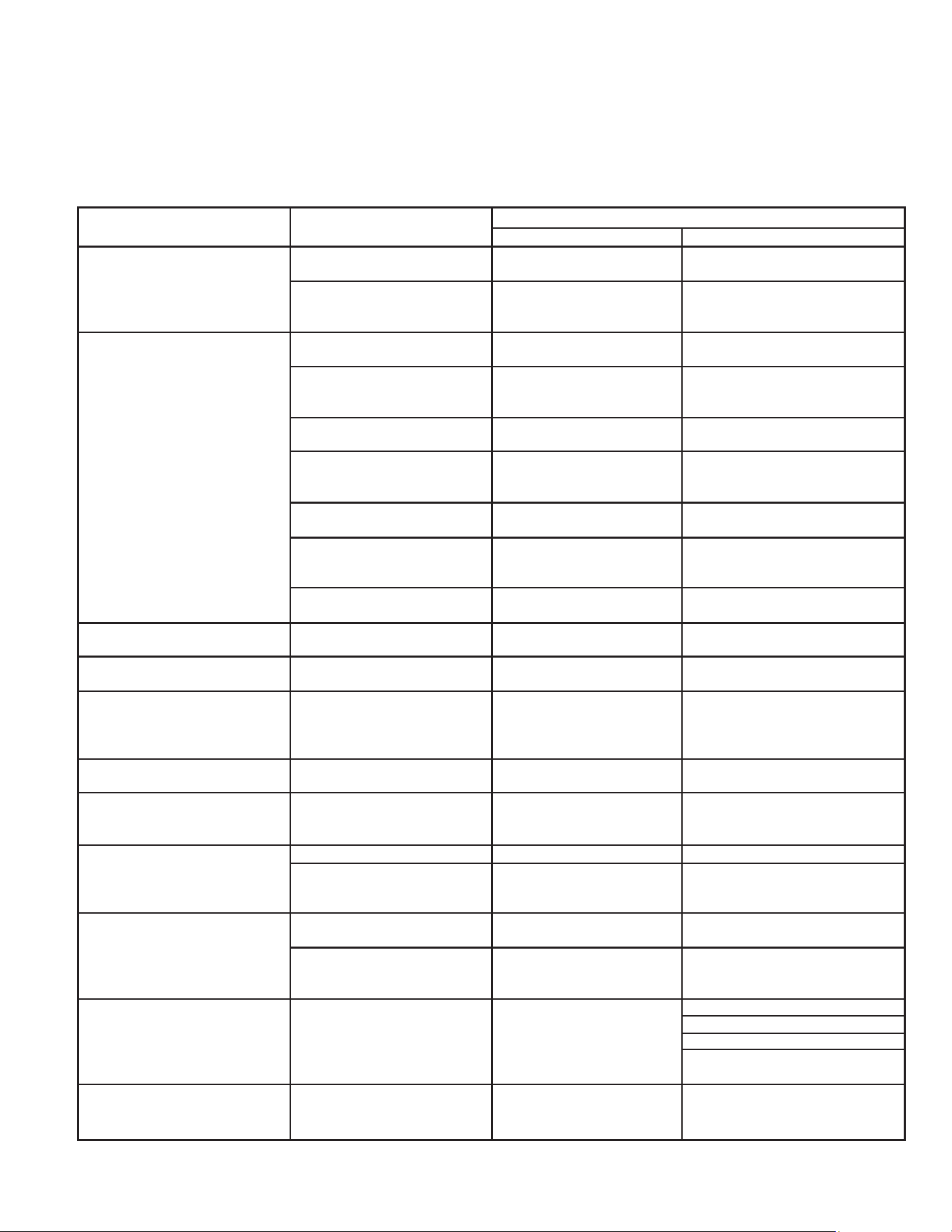
33
OPERATIONAL CHECKLIST
This checklist in conjunction with “TROUBLESHOOTING” and the “SEQUENCE OF OPERATION” should be used as an on-the-job
troubleshooting guide to identify the cause of incorrect system operation and suggest a remedy for its correction. Because improper
piping and wiring can result in unsatisfactory system performance, it is suggested that the installation by examined before using the
checklist. Be sure to refer to the correct piping and wiring diagram for the type of system that is installed.
REMEDY
COMPLAINT CAUSE USER SERVICE AGENT
*Water not hot enough. Thermostat set too low. Set thermostat dial to
a higher temperature.
Thermostat out of calibration. Call service agent. Recalibrate thermostat.
If thermostat cannot be
recalibrated, replace.
*Insufcient hot water Thermostat set too low. Set thermostat dial to a
*See WATER TEMPERATURE higher temperature.
WARNING (on page 27) Thermostat out of calibration. Call service agent. Recalibrate thermostat. If
thermostat cannot be recalibrated,
replace.
Main manual gas shutoff Open main manual gas
valve partially closed. shutoff valve to fullest extent.
Heater too small for demand. Space usage to give heater
time to restore water
temperature.
Thermostat differential is Call service agent. Replace dual bulb controller if
too wide. differential is greater than 4°F.
Heater recovery is slower. Call service agent. Check gas input. If incorrect,
adjust gas pressure or replace
main burner orice.
Draft hood not installed or Call service agent. Install draft hood or bafes as
one or more ue bafes. furnished with unit.
Water temperature too hot. Thermostat set too high. Set thermostat to a
lower setting.
Heater makes sounds: sizzling. Condensation on outside of
tank - normal.
Rumbling. Sediment accumulation on Drain a quantity of water
bottom of tank. through drain valve. If Delime heater.
rumbling persists, call
a serviceman.
Ticking or metallic sounds. Expansion and contraction-
normal.
Pounding. Air chambers in piping have Drain piping system and
become waterlogged. rell. Heater must be off
while this is being done.
Combustion noises. Too much primary air. Adjust shutters.
Overred heater. Incorrect
burners or orice for types Call service agent. Check and correct as necessary.
of gas used.
Water leaks. Drain valve not closed tightly. If drain valve cannot be
closed tightly, replace.
If leakage source cannot be Shut off gas supply to heater Repair or in case of suspected
corrected or identied, call and close cold water inlet tank leakage, be certain to conrm
serviceman. valve to heater. before replacing heater.
Gas odors. Heater is overred. Shut off gas supply to Check for sooted ue passage.
heater and call serviceman. Check for obstructed vent line.
Check backdraft or lack of draft.
Draft hood may be improperly
installed or not sized properly.
Possible gas leaks. Shut off gas supply to
heater and call gas
company at once.

34
Limited Warranty
1. THE TANK
If the glass-lined tank in this water heater shall prove upon examination by the warrantor to have leaked due to natural corrosion from potable water therein,
during the first THREE years after initial installation, the warrantor will supply a complete new Lochinvar water heater of equivalent size and current model at the
warrantor's option. Some government agencies are requiring energy efficient standards for water heaters. In the event regulations prohibit sale of a model
of
equivalent size and construction, Lochinvar will provide a model which complies with the regulations of your area, in which case the consumer will be charged the
difference in price between the like replacement and the energy efficient model required. The warranty on the replacement water heater will be limited to the
unexpired term of the original warranty.
2. ALL OTHER PARTS
If within ONE year after initial installation of this water heater, any part or portion shall prove upon examination by the warrantor to be defective in material or
workmanship, the warrantor will repair or replace such part or portion at its option.
3. CONDITIONS AND EXCEPTIONS
This warranty shall apply only when the water heater is installed in accordance with local plumbing and building codes, ordinances and regulations, the printed
instructions provided with it and good industry practices. In addition, a temperature and pressure relief valve, certified by CSA and approved by the American
Society o
f Mechanical Engineers, must have been installed.
a. This warranty shall apply only when the water heater is:
(1) owned by the original purchaser;
(2) used at temperatures not exceeding the maximum setting of its thermostat;
(3) used at water pressure not exceeding the working pressure shown on the heater;
(4) used when operated free of the damaging effects of uncontrolled water hammer;
(5) used when filled with potable water, free to circulate at all times;
(6) used in a non-corrosive and
non-contaminated atmosphere;
(7) used with factory approved anode(s) installed;
(8) in its original installation location;
(9) in the United States, its territories or possessions, and Canada;
(10) sized in accordance with proper sizing techniques for commercial water heaters;
(11) bearing a rating plate which has not been altered, defaced or removed except as required by the warrantor;
(12) fired at the factory rated input using the fuel stated on the rating plate in the case of
gas models or fired at the proper voltage and wattage in the
case of electric models
(13) maintained in accordance with the instructions printed in the manual included with the water heater.
b. Any accident to the water heater, any misuse, abuse (including freezing) or alteration of it, any operation of it in a modified form, or any attempt
to repair tank leaks will void this warranty.
c. This warranty is void if a device acting as a backflow prevention device (check valves et
c.) is installed in the cold water supply the heater is
connected to, unless an effective method of controlling thermal expansion is also installed at the heater(s) and operational at all times.
The temperature and pressure relief valve installed on the heater is not an acceptable method.
4. SERVICE AND REPAIR EXPENSES
Under the limited warranty the warrantor will provide only a replacement water heater or part thereof. The owner is responsible for all other costs. Such costs
may in
clude but are not limited to:
a. Labor charges for service removal, repair or reinstallation of the water heater or any component part;
b. Shipping, delivery, handling, and administrative charges for forwarding the new heater or replacement part from the nearest distributor and returning
the claimed defective heater or part to such distributor.
c. All cost necessary or incidental for any material and/or permits required for installation of the replacement.
5. LIMITATIONS ON IMPL
IED WARRANTIES
Implied warranties, including the warranty of merchantability imposed on the sale of this heater under state law are limited to one (1) year duration for the heater
or any of its parts. Some states do not allow limitations on how long an implied warranty lasts, so the above limitation may not apply to you.
6. CLAIM PROCEDURE
Any claim under the warranty should be initiated with the dealer who sold the water heater, or with any other dealer handling the warrantor’s
products. I
f this is not practicable, the owner should contact:
a. The warrantor will only honor replacement with identical or similar water heater or parts thereof which are manufactured or distributed by the
warrantor.
b. Dealer replacements are made subject to in-warranty validation by warrantor.
7. DISCLAIMERS
NO OTHER EXPRESS WARRANTY HAS BEEN OR WILL BE MADE IN BEHALF OF THE WARRANTOR WITH RESPECT TO THE MERCHANTABILITY
OF THE HEATER OR THE INSTALLATION, OPERATION,
REPAIR OR REPLACEMENT OF THE WATER HEATER. THE WARRANTOR SHALL NOT BE
RESPONSIBLE FOR WATER DAMAGE, LOSS OF USE OF THE UNIT, INCONVENIENCE, LOSS OR DAMAGE TO PERSONAL PROPERTY OR OTHER
CONSEQUENTIAL DAMAGE. THE WARRANTOR SHALL NOT BE LIABLE BY VIRTUE OF THIS WARRANTY OR OTHERWISE FOR DAMAGE TO ANY
PERSONS OR PROPERTY, WHETHER DIRECT OR INDIRECT, AND WHETHER ARISING IN CONTRACT OR TORT.
a. Some states do not allow the exclusion or limitation of the incidental or consequential damage, so the above limitations or exclusions may not apply to
you.
b. This warranty gives you specific legal rights, and you may also have other rights which vary from state to state.
Fill in the following for your own reference. Keep it. Registration is not a condition of warranty. The model and serial number are found on the heater’s rating plate.
Date Installed________________________Model No.____________________________________________Serial No._________________________________________
Dealer’s Name _____________________________________________________________________Phone No.________________________________________________
Dealer’s Address__________________________________________________City and State________________________________________Zip Code________________
FILL IN WARANTY AND KEEP FOR FUTURE REFERENCE
Lochinvar, LLC the warrantor, extends the following LIMITED WARRANTY to the owner of this water heater.
Lochinvar, LLC
300 Maddox Simpson Pkwy
Lebanon, TN 37090
(615) 889-8900

35
NOTES

36
Copyright © 2011 Lochinvar, LLC, All rights reserved.
300 Maddox Simpson Parkway
Lebanon, TN 37090
Phone: 615-889-8900 • Fax: 615-547-1000
Technical Service email: [email protected]
www.Lochinvar.com