PLACE THESE INSTRUCTIONS ADJACENT TO HEATER AND NOTIFY OWNER TO KEEP FOR FUTURE REFERENCE.
KEEP THIS MANUAL IN THE POCKET ON HEATER FOR FUTURE REFERENCE WHENEVER MAINTENANCE
ADJUSTMENT OR SERVICE IS REQUIRED.
PRINTED 0422 100357554_2000198507C
Instruction Manual
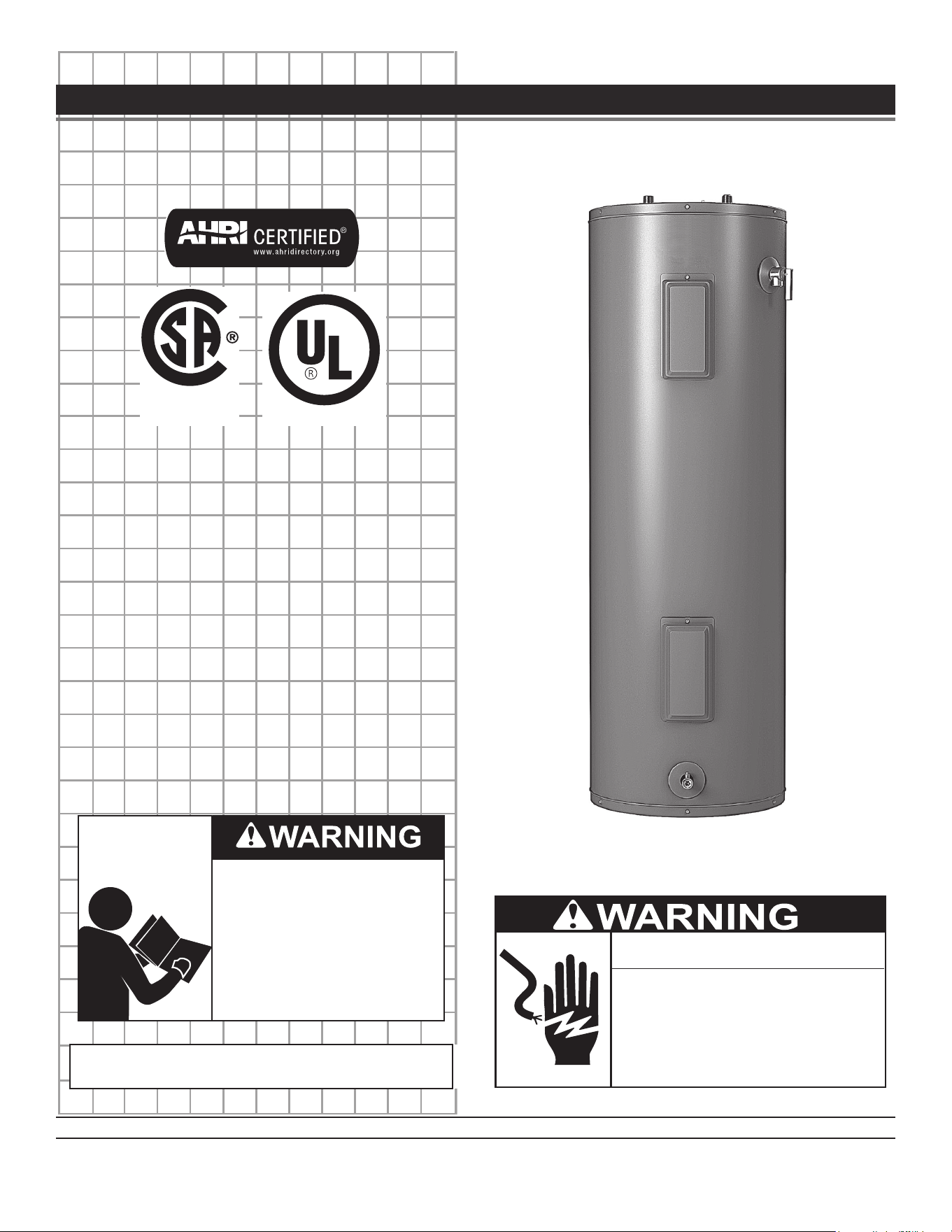
LIGHT SERVICE COMMERCIAL ELECTRIC WATER HEATERS
MODELS: 66/80/120 GALLONS
SERIES 250
INSTALLATION - OPERATION - SERVICE - MAINTENANCE
LOW LEAD
CONTENT
Read and understand this instruction
manual and the safety messages
herein before installing, operating or
servicing this water heater.
Failure to follow these instructions and
safety messages could result in death
or serious injury.
This manual must remain with the
water heater.
Thank you for buying this energy efficient water heater. We
appreciate your condence in our products.
If the water heater becomes immersed
in water up to or above the level of the
bottom of the element doors, the
heater should be examined by a
qualified service agency before it is
placed in operation.
Electrical Shock Hazard

2
CONTENTSCONTENTS
SAFE INSTALLATION, USE, AND SERVICE ....................3
Important Denitions .........................................................3
APPROVALS ........................................................................3
GENERAL SAFETY INFORMATION ..................................4
Precautions .......................................................................4
Limiting the Risk of Scalding .............................................4
Hydrogen Gas (Flammable) ..............................................4
Hazard Messages .............................................................4
INTRODUCTION .................................................................7
Preparing for the Installation .............................................7
FEATURES AND COMPONENTS ......................................8
Model and Rating ..............................................................9
INSTALLATION CONSIDERATIONS ...............................10
Locating the Water Heater ...............................................10
Clearances ......................................................................10
INSTALLATION ..................................................................11
Required Ability ............................................................... 11
General ............................................................................ 11
Contaminated Water ........................................................ 11
Circulating Pump ............................................................. 11
Insulation Blankets .......................................................... 11
Temperature-Pressure Relief Valve ................................. 11
Closed Water Systems ....................................................12
Thermal Expansion .........................................................12
Electrical ..........................................................................12
START UP ..........................................................................15
Filling the Water Heater ................................................... 15
Initial Start Up ..................................................................15
Draining the Water Heater ............................................... 15
TEMPERATURE REGULATION .......................................16
Limiting the Risk of Scalding ...........................................16
Temperature Adjustment .................................................16
MAINTENANCE .................................................................18
Draining and Flushing .....................................................18
Lime Scale Removal .......................................................18
Anode Rod Maintenance ................................................. 19
Temperature-Pressure Relief Valve Test .........................20
Repair Parts List ..............................................................21
TROUBLESHOOTING CHECKLIST ................................22
Checklist ..........................................................................22
Checking for Leaks ..........................................................23
WIRING DIAGRAMS .........................................................24
3
SAFE INSTALLATION, USE, AND SERVICESAFE INSTALLATION, USE, AND SERVICE
Your safety and the safety of others is extremely important in the
installation, use and servicing of this water heater. Many safety-
related messages and instructions have been provided in this manual
and on your own water heater to warn you and others of a potential
injury hazard. Read and obey all safety messages and instructions
throughout this manual. It is very important that the meaning of each
safety message is understood by you and others who install, use or
service this water heater.
Many safety-related messages and instructions have been provided in this manual and on your own water heater to warn you and others of
a potential injury hazard. Read and obey all safety messages and instructions throughout this manual. It is very important that the meaning
of each safety message is understood by you and others who install, use, or service this water heater.
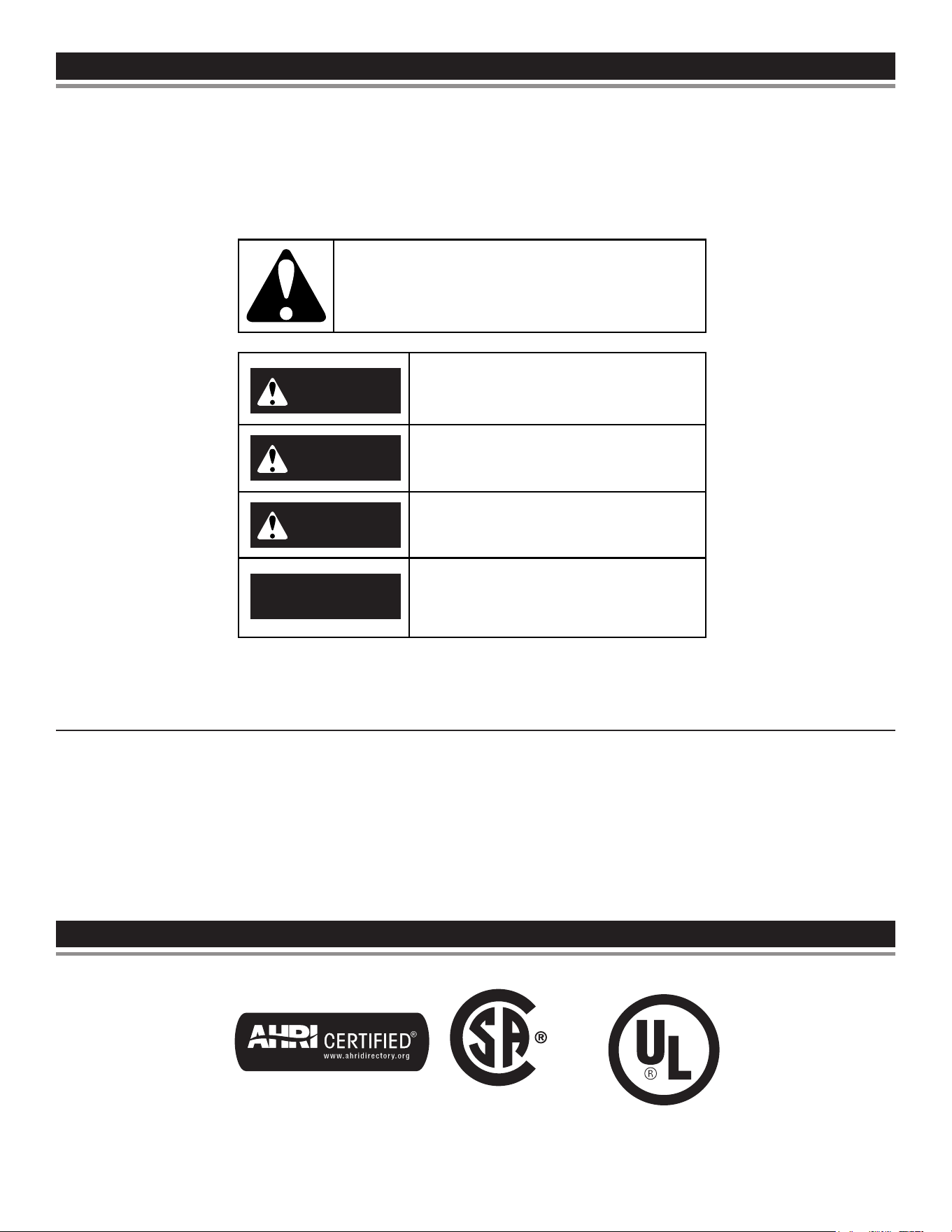
DANGER
WARNING
CAUTION
CAUTION
DANGER indicates an imminently
hazardous situation which, if not avoided,
will result in injury or death.
This is the safety alert symbol. It is used to alert you to
potential personal injury hazards. Obey all safety
messages that follow this symbol to avoid possible
injury or death. Keep this manual near the water heater.
WARNING indicates a potentially hazardous
situation which, if not avoided, could result
in injury or death.
CAUTION indicates a potentially hazardous
situation which, if not avoided, could result
in minor or moderate injury.
CAUTION used without the safety alert
symbol indicates a potentially hazardous
situation which, if not avoided, could result in
property damage.
All safety messages will generally tell you about the type of hazard, what can happen if you do not follow the safety message, and how
to avoid the risk of injury.
IMPORTANT DEFINITIONS
• Qualied Installer or Service Agency:
Installation and service of this water heater requires ability
equivalent to that of a Qualied Agency (as dened by ANSI
below) in the eld involved. Installation skills such as plumbing,
electrical supply are required in addition to electrical testing skills
when performing service.
• ANSI Z223.1 2006 Sec. 3.3.83:
“Qualified Agency” - “Any individual, firm, corporation or
company that either in person or through a representative is
engaged in and is responsible for (a) the installation, testing
or replacement of gas piping or (b) the connection, installation,
testing, repair or servicing of appliances and equipment; that
is experienced in such work; that is familiar with all precautions
required; and that has complied with all the requirements of the
authority having jurisdiction.”
APPROVALSAPPROVALS
LOW LEAD
CONTENT
4
GENERAL SAFETY INFORMATIONGENERAL SAFETY INFORMATION
PRECAUTIONS
DO NOT USE THIS WATER HEATER IF ANY PART HAS BEEN
EXPOSED TO FLOODING OR WATER DAMAGE.
Immediately
call a qualied service technician to inspect the water heater and to
replace any part of the control system which has been under water.
If the unit is exposed to the following, do not operate heater until all
corrective steps have been made by a qualied service technician.
1. External re.
2. Damage.
3. Firing without water.
GROUNDING INSTRUCTIONS
This water heater must be grounded in accordance with the
National
Electrical Code
and/or local codes. These must be followed in all cases.
Failure to ground this water heater properly may also cause erratic
control system operation.
This water heater must be connected to a grounded metal,
permanent wiring system; or an equipment grounding conductor must
be run with the circuit conductors and connected to the equipment
grounding terminal or lead on the water heater.
LIMITING THE RISK OF SCALDING
For a variety of reasons, water heaters can produce water that is
much hotter than its temperature setting. Take precautions to prevent
this higher temperature water from reaching the water xtures.
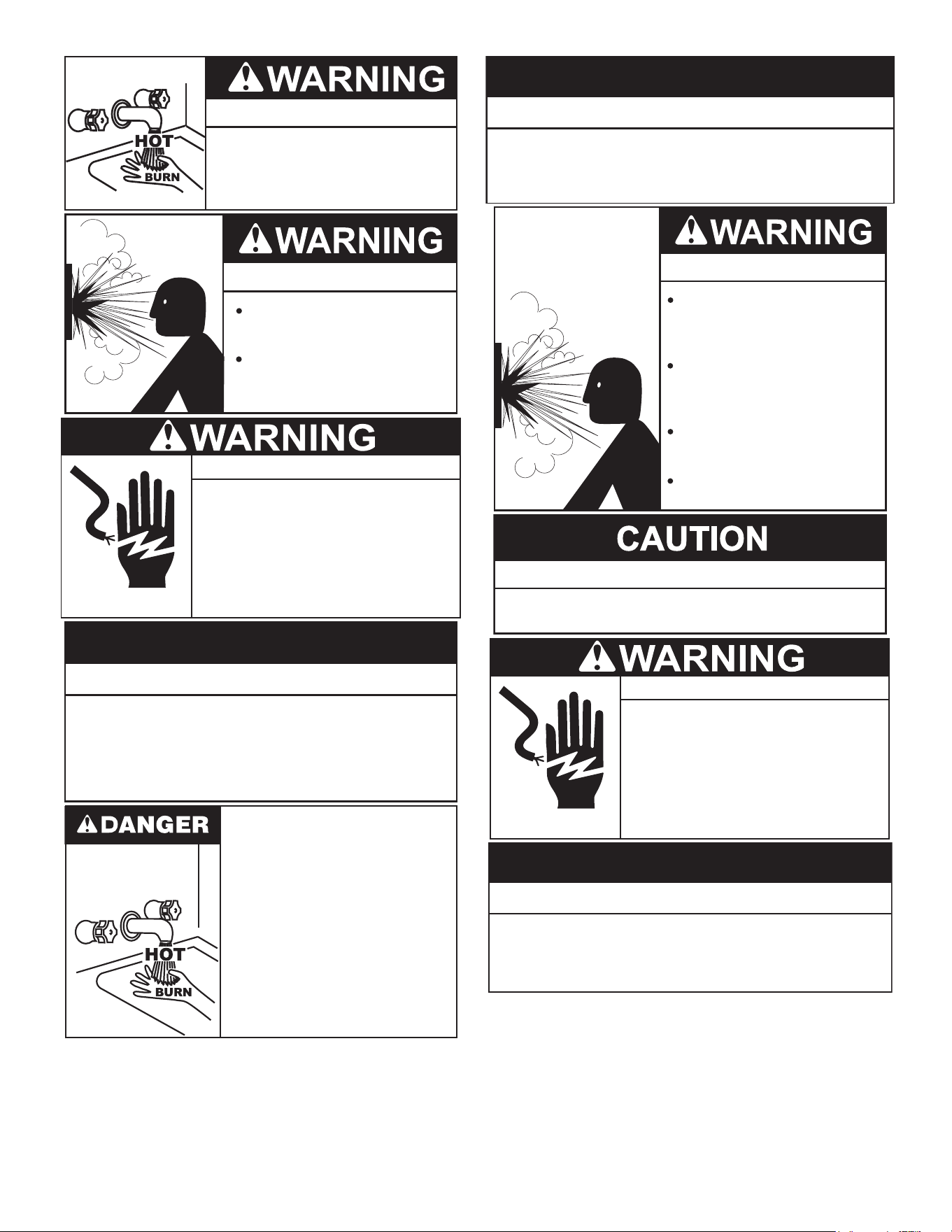
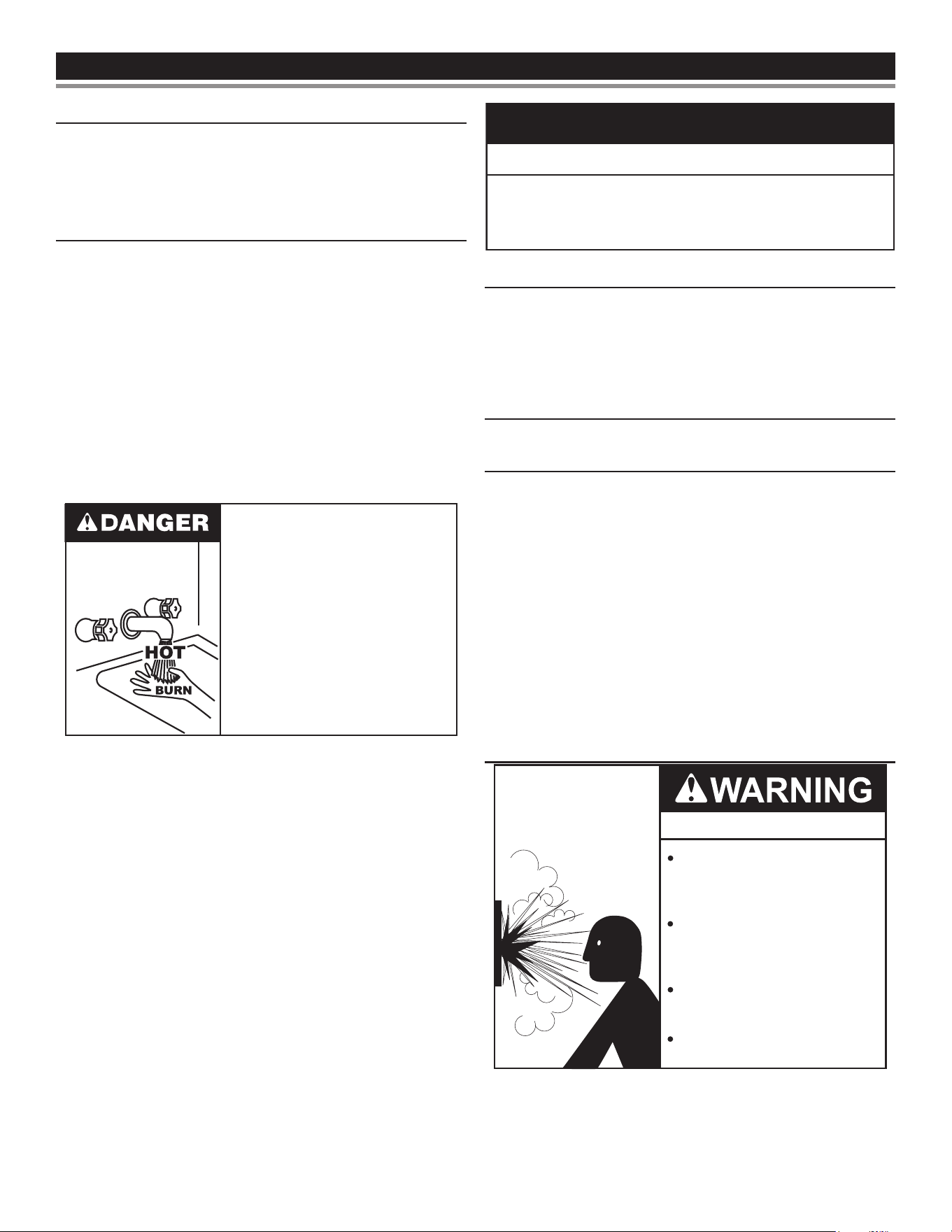
Burn Hazard
To reduce the risk of unusually hot
water reaching the fixtures in the
house, install thermostatic mixing
valves at each point of use.
A properly adjusted thermostatic mixing valve at each point of use
allows you to set the tank temperature to a higher setting without
increasing risk of scalds. A higher temperature setting allows the
tank to provide much more hot water and can help provide proper
water temperatures for appliances such as dishwashers and washing
machines.
Water temperature over 125°F (52°C)
can cause severe burns instantly
resulting in severe injury or death.
Children, the elderly and the
physically or mentally disabled are at
highest risk for scald injury.
Feel water before bathing or shower-
ing.
Temperature limiting devices such as
thermostatic point-of-use mixing
valves must be installed when
required by codes and to ensure safe
temperatures at fixtures.
HYDROGEN GAS (FLAMMABLE)
Explosion Hazard
Flammable hydrogen gases
may be present.
Keep all ignition sources away
from faucet when turning on
hot water.
Hydrogen gas can be produced in a hot water system served by this
heater that has not been used for a long period of time (generally two
weeks or more). Hydrogen gas is extremely ammable. To reduce
the risk of injury under these conditions, it is recommended that the
hot water faucet be opened for several minutes at the kitchen sink
before using any electrical appliance connected to the hot water
system. If hydrogen is present there will probably be an unusual
sound such as air escaping through the pipe as the water begins
to ow.
THERE SHOULD BE NO SMOKING OR OPEN FLAME NEAR
THE FAUCET AT THE TIME IT IS OPEN.
When servicing this unit, verify the power to the unit is turned off prior to opening the control cabinet door.
HAZARD MESSAGES
Read and understand this instruction
manual and the safety messages
herein before installing, operating or
servicing this water heater.
Failure to follow these instructions and
safety messages could result in death
or serious injury.
This manual must remain with the
water heater.
If the water heater becomes immersed
in water up to or above the level of the
bottom of the element doors, the
heater should be examined by a
qualified service agency before it is
placed in operation.
Electrical Shock Hazard
5
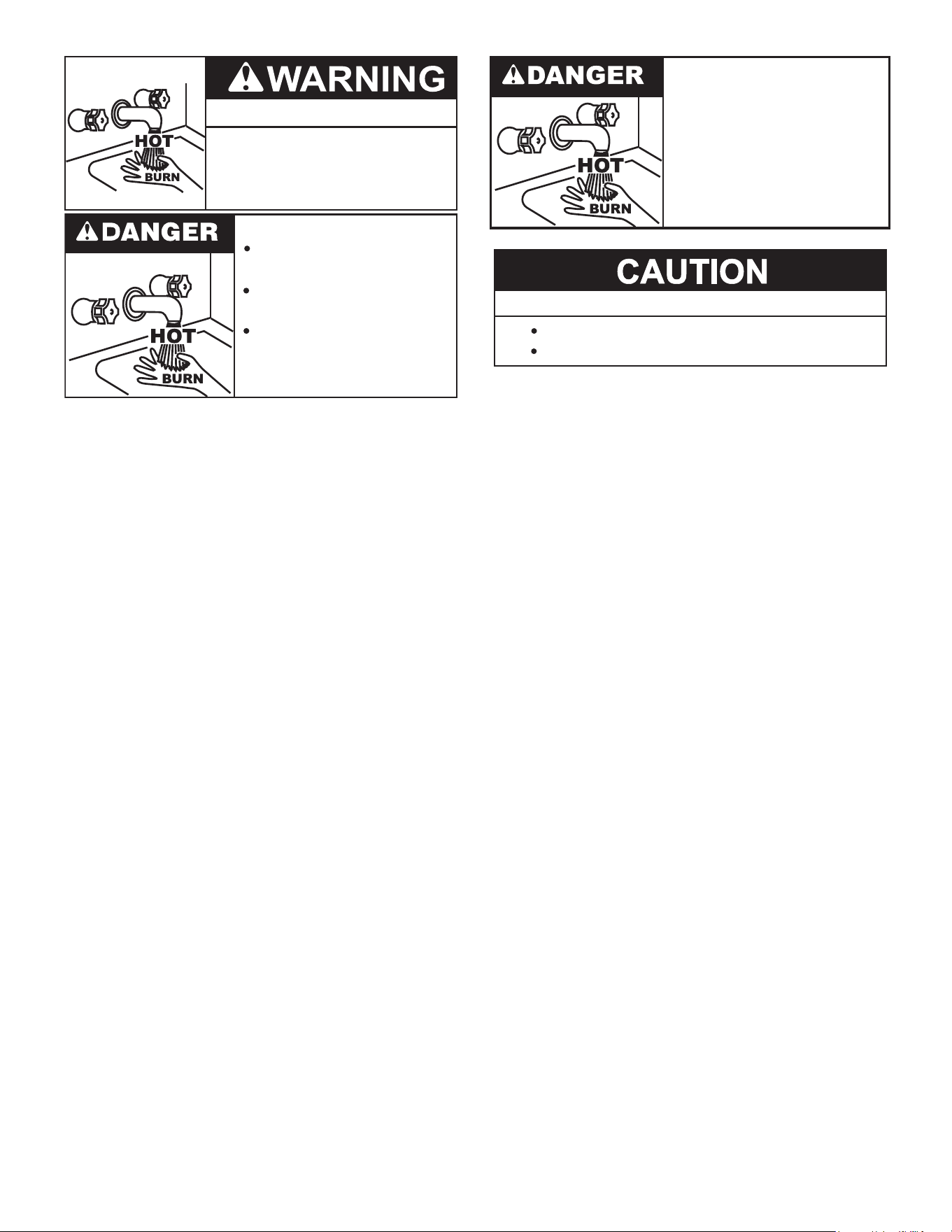
Burn Hazard
To reduce the risk of unusually hot
water reaching the fixtures in the
house, install thermostatic mixing
valves at each point of use.
Explosion Hazard
Flammable hydrogen gases
may be present.
Keep all ignition sources away
from faucet when turning on
hot water.
● Before removing any access panels or
servicing the water heater, make sure
the the electrical supply to the water
heater is turned OFF.
Electrical Shock Hazard
● Failure to follow these instructions can
result in personal injury or death.
Property Damage Hazard
The expansion tank should be located in an area
where water leakage from the tank or connections
will not result in damage to the area around the
expansion tank or to the lower floors of the structure.
CAUTION
Water temperature over 125°F (52°C)
can cause severe burns instantly
resulting in severe injury or death.
Children, the elderly and the
physically or mentally disabled are at
highest risk for scald injury.
Feel water before bathing or shower-
ing.
Temperature limiting devices such as
thermostatic point-of-use mixing
valves must be installed when
required by codes and to ensure safe
temperatures at fixtures.
Property Damage Hazard
•
All water heaters eventually leak.
•
Do not install without adequate drainage.
CAUTION
Explosion Hazard
Temperature-Pressure Relief Valve
must comply with ANSI Z21.22-
CSA 4.4 and ASME code.
Properly sized temperature-
pressure relief valve must be
installed in opening provided.
Can result in overheating and
excessive tank pressure.
Can cause serious injury or death.
Property Damage Hazard
● The temperature-pressure relief-valve discharge pipe
must terminate at an adequate drain.
● Before removing any access panels or
servicing the water heater, make sure
the the electrical supply to the water
heater is turned OFF.
Electrical Shock Hazard
● Failure to follow these instructions can
result in personal injury or death.
Property Damage Hazard
To avoid water heater damage, fill tank with water
before operating.
CAUTION
6
Burn Hazard
If you choose a higher temperature
setting, install thermostatic mixing
valves at each point-of-use to help
avoid scalding.
Burn hazard.
Hot water discharge.
Keep clear of the Relief Valve
discharge outlet.
• Burn hazard.
• Hot water discharge.
• Keep hands clear of drain
valve discharge.
Avoid damage.
Property Damage Hazard
Inspection and replacement of anode rod required.
7
INTRODUCTIONINTRODUCTION
Thank You for purchasing this water heater. Properly installed and
maintained, it should give you years of trouble free service.
Abbreviations Found In This Instruction Manual:
• ANSI - American National Standards Institute
• AHRI - Air-Conditioning, Heating and Refrigeration Institute
• NEC - National Electrical Code
• NFPA - National Fire Protection Association
• UL - Underwriters Laboratory
PREPARING FOR THE INSTALLATION
● Before removing any access panels or
servicing the water heater, make sure
the the electrical supply to the water
heater is turned OFF.
Electrical Shock Hazard
● Failure to follow these instructions can
result in personal injury or death.
1. Read the “General Safety Information” section of this manual rst
and then the entire manual carefully. If you don’t follow the safety
rules, the water heater may not operate safely. It could cause
DEATH,
SERIOUS BODILY INJURY AND/OR PROPERTY DAMAGE.
This manual contains instructions for the installation, operation, and
maintenance of the electric water heater. It also contains warnings
throughout the manual that you must read and be aware of. All
warnings and all instructions are essential to the proper operation
of the water heater and your safety.
READ THE ENTIRE MANUAL
BEFORE ATTEMPTING TO INSTALL OR OPERATE THE WATER
HEATER
.
Be sure to turn o power when working on or near the electrical
system of the heater. Never touch electrical components with wet
hands or when standing in water. When replacing fuses always use
the correct size for the circuit. See
Figure 9
(page 24).
The model and rating plates on page 3 interprets certain markings
into useful information. Both of these references should be used to
identify the heater, its components and optional equipment.
2. The installation must conform with these instructions and the local
code authority having jurisdiction and the requirements of the power
company. In the absence of local codes, the installation must comply
with the latest editions of the
National Electrical Code, NFPA 70
or the
Canadian Electrical Code CSA C22.1
. The
National Electrical Code
may be
ordered from: National Fire Protection Association, 1 Batterymarch
Park, Quincy, MA 02269. The Canadian Electrical Code is available
from the Canadian Standards Association, 8501 East Pleasant Valley
Road, Cleveland, OH 44131.
3. If after reading this manual you have any questions or do not
understand any portion of the instructions, call the toll free number
listed on the back cover of this manual for technical assistance.
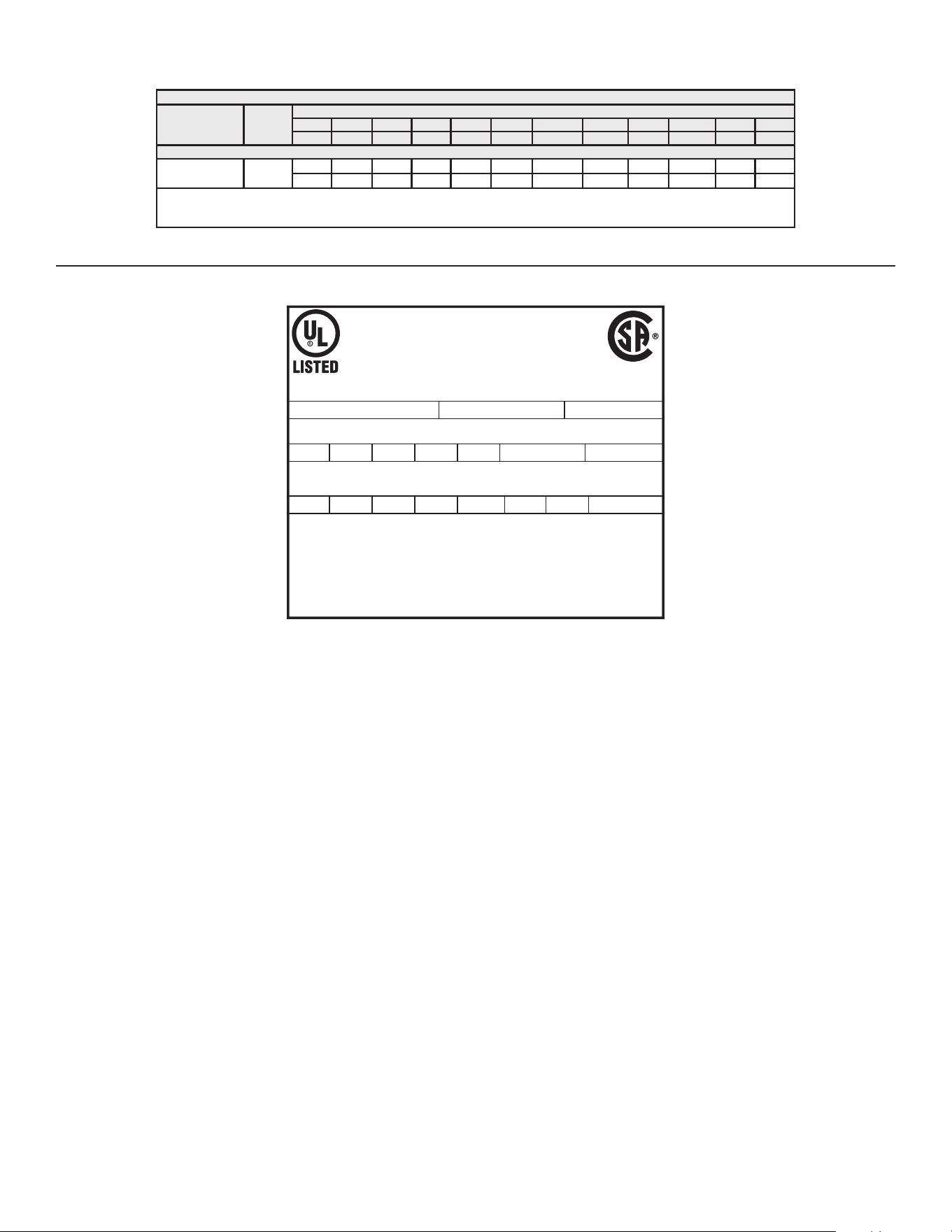
A sample rating plate is shown on page 9 of this manual. In order
to expedite your request, please have full model and serial number
available for the technician.
4. Carefully plan your intended placement of the water heater. Examine
the location to ensure the water heater complies with the “Locating
the New Water Heater” section in this manual.
Installation and service of this water heater requires ability equivalent
to that of a licensed tradesman or qualied agency (page 3) in
the eld involved. Plumbing and electrical work are required.
8
FEATURES AND COMPONENTSFEATURES AND COMPONENTS
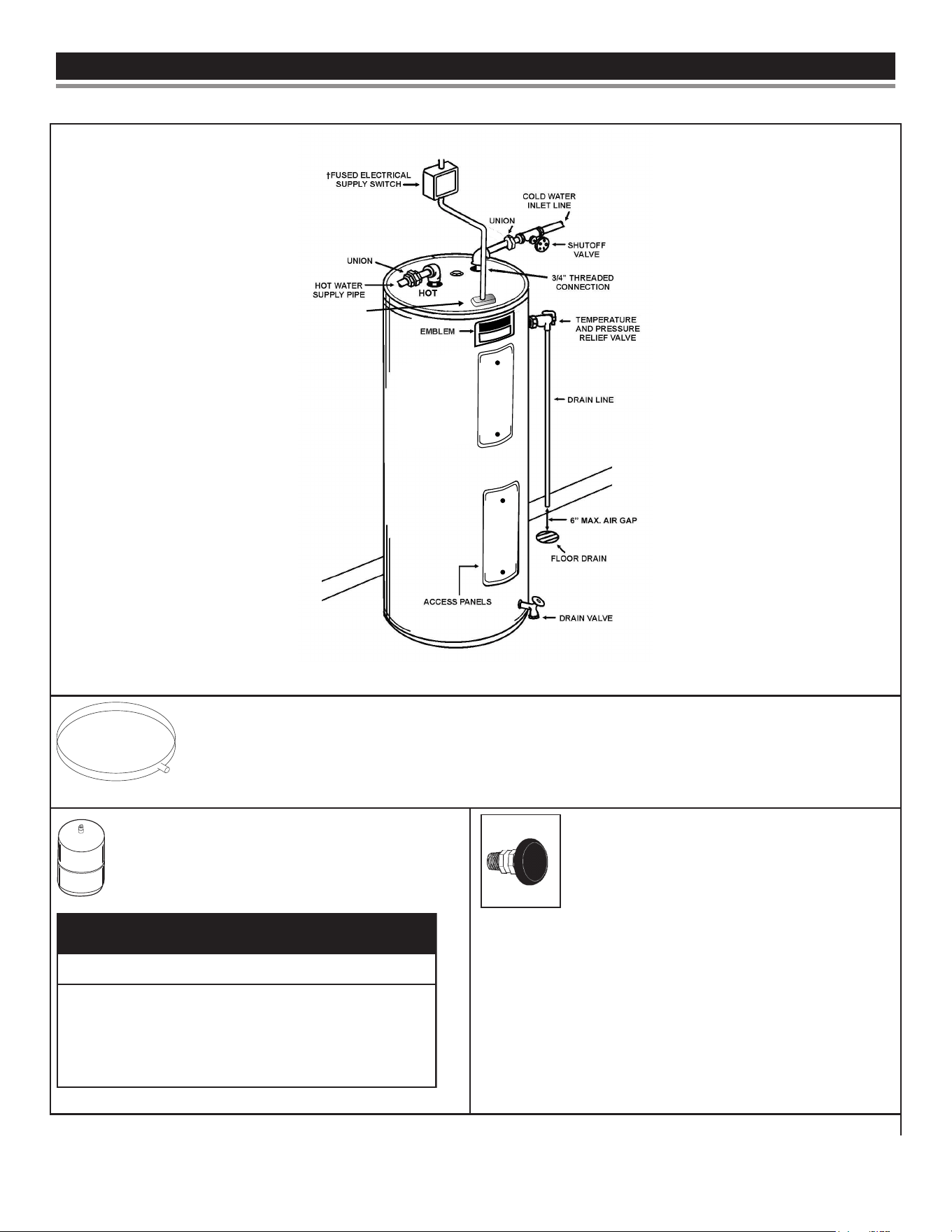
This page shows a typical water heater installation..
JUNCTION BOX
COLD
† OVER CURRENT PROTECTION MUST BE SUPPLIED IN WATER HEATER CIRCUIT. CONSULT LOCAL CODE OR CURRENT EDITION OF NEC FOR PROPER
INSTALLATION.
Install suitable drain pans under water heaters to prevent damage due to leakage. See
Locating the Water Heater
(page 10).
Property Damage Hazard
The expansion tank should be located in an area
where water leakage from the tank or connections
will not result in damage to the area around the
expansion tank or to the lower floors of the structure.
CAUTION
Install thermal expansion tank if check valve or pressure reduc-
ing valve is used in supply line.
VACUUM RELIEF
VALV E
*INSTALL PER
LOCAL CODES
Install vacuum relief in cold water inlet line as required by
local codes.
Figure 1. Typical Water Heater Installations
9
Table 1. Recovery Capacities
Element
Wattage
(Upper/Lower)
INPUT
kW
U.S. Gallons/Hr and Liters/Hr at Temperature Rise Indicated
F° 36F° 40F° 54F° 60F° 72F° 80F° 90F° 100F° 108F° 120F° 126F°
C° 20C° 22.2C° 30C° 33.3C° 40C° 44.4C° 50C° 55.5C° 60C° 66.6C° 70C°
Simultaneous Operation
6100/6100
12.2
GPH 140 126 93 84 70 63 56 50 47 42 40
LPH 531 478 354 318 265 239 212 191 177 159 152
Recovery capacities at 100° F rise equal: for non-simultaneous element operation = 4.1 gal. x kW of one element; for simultaneous
element operation = 4.1 gal. x 2/3 kW of both elements. For other rises multiply element kW as previously explained by 410 and
divide by temperature rise. Full load current for single phase = total watts : voltage.
MODEL AND RATING
MODEL NUMBER
22U1
COMMERCIAL STORAGE
TANK WATER HEATER
WATTS
LOWER
MAX WORKING
PRESSURE PSI
1 PH / 3 PH
1 PH 3 PH
RATED
MEASURED
%
WATTS
INTERLOCK SIMULTANEOUS CAPACITY US GAL STANDBY LOSS
TOTAL WATTS CONNECTED
SERIAL NUMBER
ITEM ID / PART NUMBER
WATTS
PHASE
CIRCUIT
VOLTS - AC
UPPER
LLC
10
INSTALLATION CONSIDERATIONSINSTALLATION CONSIDERATIONS
A
B
C
8"
H
OT
CONNECTION
ANODE
ROD
COLD
CONNECTION
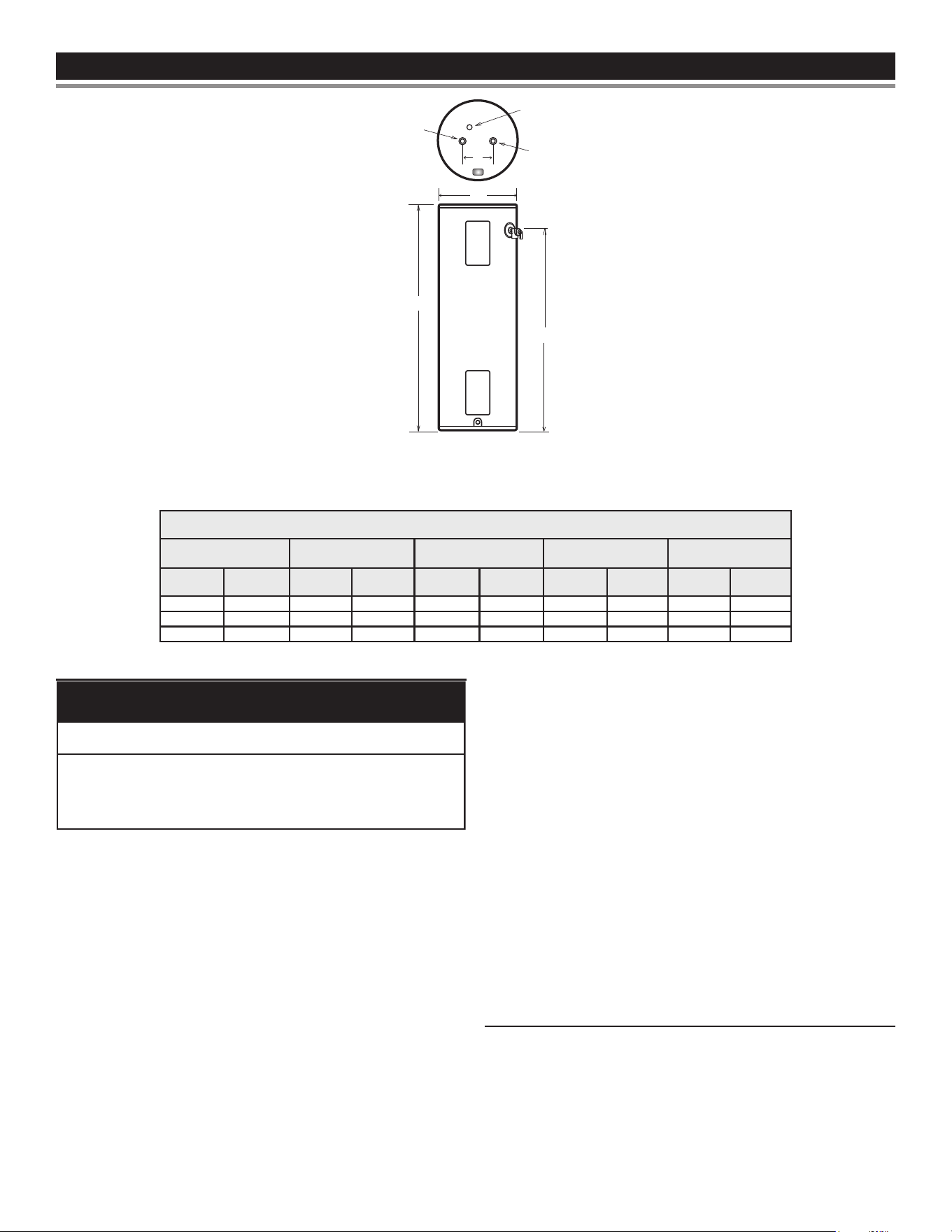
Figure 2. Rough-in Dimensions
Table 2. Rough-In Dimensions
Tank Capacity A B C
Approx.
Shipping Weight
US Gals. Liters inches cm inches cm inches cm Lbs. Kg.
66 250 60.13 153 52.75 134 22 56 146 66.22
80 303 60.50 154 52.25 133 24 61 174 78.93
119 450 61.38 156 54.38 138 28 71 268 121.56
LOCATING THE WATER HEATER
Property Damage Hazard
•
All water heaters eventually leak.
•
Do not install without adequate drainage.
CAUTION
The water heater should be located as close as possible to/or
centralized to the water piping system. The water heater should be
located in an area not subject to freezing temperatures.
The water heater should be located in an area where leakage of the
tank or connections will not result in damage to the area adjacent to
the heater or to lower oors of the structure.
When such locations cannot be avoided, a suitable drain pan should
be installed under the heater.
Such pans should be at least two inches deep, have a minimum
length and width of at least two inches greater than the diameter of
the heater and should be piped to an adequate drain.
Drain pans suitable for these water heaters are available from your
distributor.
Water heater life depends upon water quality, water pressure and
the environment in which the water heater is installed. Water heaters
are sometimes installed in locations where leakage may result in
property damage, even with the use of a drain pan piped to a drain.
However, unanticipated damage can be reduced or prevented by
a leak detector or water shut-o device used in conjunction with a
piped drain pan. These devices are available from some plumbing
supply wholesalers and retailers, and detect and react to leakage
in various ways:
• Sensors mounted in the drain pan that trigger an alarm or turn
o the incoming water to the water heater when leakage is
detected.
• Sensors mounted in the drain pan that turn o the entire water
supply when water is detected in the drain pan.
• Water supply shut-o devices that activate based on the water
pressure dierential between the cold water and how water
pipes connected to the water heater.
• Devices that will turn o the gas supply to a gas water heater
while at the same time shutting o its water supply.
CLEARANCES
A minimum clearance of 4” must be allowed for access to replaceable
parts such as thermostats, drain valve and relief valve.
Adequate clearance for servicing this water heater should be
considered before installation, such as changing the anodes, etc.
11
INSTALLATIONINSTALLATION
REQUIRED ABILITY
Installation and service of this water heater requires ability equivalent
to that of a qualied installer or service agency in the eld involved.
See
Important Definitions
(page 3). Plumbing and electrical work
is required.
GENERAL
The installation must conform with these instructions and the local
code authority having jurisdiction and the requirements of the power
company. In the absence of local codes, the installation must comply
with the latest editions of the
National Electrical Code, NFPA 70
or the
Canadian Electrical Code CSA C22.1
. The
National Electrical Code
may be
ordered from: National Fire Protection Association, 1 Batterymarch
Park, Quincy, MA 02269. The
Canadian Electrical Code
is available from
the Canadian Standards Association, 8501 East Pleasant Valley
Road, Cleveland, OH 44131.
Do NOT
test electrical system before heater is lled with water, follow
the procedure in
Start Up
(page 15).
The principal components of the heater are identied in the
Features
and Components
(page 8).
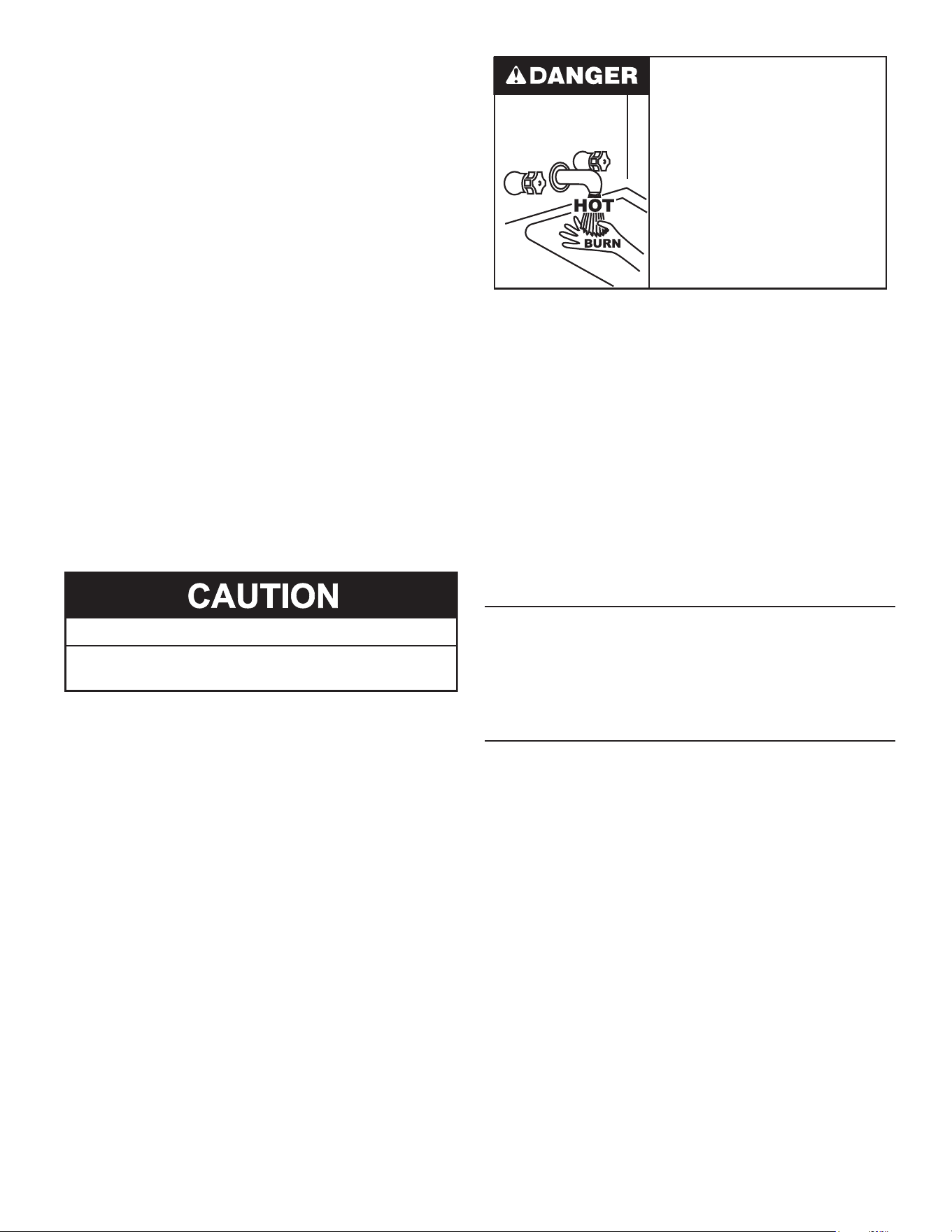
Water temperature over 125°F (52°C)
can cause severe burns instantly
resulting in severe injury or death.
Children, the elderly and the
physically or mentally disabled are at
highest risk for scald injury.
Feel water before bathing or shower-
ing.
Temperature limiting devices such as
thermostatic point-of-use mixing
valves must be installed when
required by codes and to ensure safe
temperatures at fixtures.
MIXING VALVE USAGE
Water heaters are intended to produce hot water. Water heated to
a temperature which will satisfy space heating, clothes washing,
dish washing, cleaning and other sanitizing needs can scald and
permanently injure you upon contact. Some people are more likely to
be permanently injured by hot water than others. These include the
elderly, children, the inrm, or physically/developmentally disabled.
If anyone using the hot water ts into one of these groups or if there
is a local code or state law requiring a maximum water temperature
at the hot water tap, then you must take special precautions.
In addition to using the lowest possible temperature setting that
satises your hot water needs, a means such as a
MIXING VALVE
,
should be used at the hot water taps used by these people or at
the water heater.
MIXING VALVES
for reducing point of use temperature are available
and are to be set at a maximum of 125°F. Consult a qualied
installer or service agency. Follow all manufacturer’s Instructions for
installation of these valves. Before changing the factory setting on
the thermostat, read the
Temperature Regulation
(page 16)
Property Damage Hazard
•
All water heaters eventually leak.
•
Do not install without adequate drainage.
CAUTION
CONTAMINATED WATER
This water heater shall not be connected to any heating system(s)
or component(s) used with a non-potable water heating appliance.
Toxic chemicals, such as those used for boiler treatment shall not
be introduced into this system.
CIRCULATING PUMP
Field installed circulating pumps should be of all bronze construction.
INSULATION BLANKETS
Insulation blankets are available to the general public for external
use on electric water heaters but are not necessary with this product.
The purpose of an insulation blanket is to reduce the standby heat
loss encountered with storage tank heaters.
Should you choose to apply an insulation blanket to this heater,
you should follow these instructions below. Failure to follow these
instructions can result in re, serious personal injury, or death.
• Do not cover the temperature and pressure relief (T & P) valve
with an insulation blanket.
• Do not cover the instruction manual. Keep it on the side of the
water heater or nearby for future reference.
• Do obtain new warning and instruction labels for placement on
the blanket directly over the existing labels.
TEMPERATURE-PRESSURE RELIEF VALVE
Explosion Hazard
Temperature-Pressure Relief Valve
must comply with ANSI Z21.22-
CSA 4.4 and ASME code.
Properly sized temperature-
pressure relief valve must be
installed in opening provided.
Can result in overheating and
excessive tank pressure.
Can cause serious injury or death.
This water heater is provided with a properly rated/sized and certied
combination temperature - pressure relief valve by the manufacturer.
The valve is certied by a nationally recognized testing laboratory
that maintains periodic inspection of production of listed equipment
12
of materials as meeting the requirements for
Relief Valves for Hot Water
Supply Systems, ANSI Z21.22 • CSA 4.4
, and the code requirements of
ASME
.
If replaced, the new valve must meet the requirements of local codes,
but not less than a combination temperature and pressure relief
valve rated/sized and certied as indicated in the above paragraph.
The new valve must be marked with a maximum set pressure not to
exceed the marked hydrostatic working pressure of the water heater
(150 psi = 1,035 kPa) and a discharge capacity not less than the
water heater Btu/hr or KW input rate as shown on the water heater’s
model rating plate.
For safe operation of the water heater, the temperature and pressure
relief valve must not be removed from its designated opening nor
plugged. The temperature-pressure relief valve must be installed
directly into the tting of the water heater designed for the relief valve.
Install discharge piping so that any discharge will exit only within 6
inches (15.2 cm) above, or at any distance below the structural oor.
Be certain that no contact is made with any live electrical part. The
discharge opening must not be blocked or reduced in size under
any circumstances. Excessive length, over 30 feet (9.14 m), or
use of more than four elbows can cause restriction and reduce the
discharge capacity of the valve.
No valve or other obstruction is to be placed between the relief valve
and the tank. Do not connect discharge piping directly to the drain
unless a 6” (15.2 cm) air gap is provided. To prevent bodily injury,
hazard to life, or property damage, the relief valve must be allowed
to discharge water in adequate quantities should circumstances
demand. If the discharge pipe is not connected to a drain or other
suitable means, the water ow may cause property damage.
Property Damage Hazard
● The temperature-pressure relief-valve discharge pipe
must terminate at an adequate drain.
The Discharge Pipe:
• Shall not be smaller in size than the outlet pipe size of the
valve, or have any reducing couplings or other restrictions.
• Shall not be plugged or blocked.
• Shall be of material listed for hot water distribution.
• Shall be installed so as to allow complete drainage of both the
temperature-pressure relief valve and the discharge pipe.
• Must terminate a maximum of six inches above a oor drain
or external to the building. In cold climates, it is recommended
that the discharge pipe be terminated at an adequate drain
inside the building.
• Shall not have any valve or other obstruction between the
relief valve and the drain.
Water temperature over 125°F (52°C)
can cause severe burns instantly
resulting in severe injury or death.
Children, the elderly and the
physically or mentally disabled are at
highest risk for scald injury.
Feel water before bathing or shower-
ing.
Temperature limiting devices such as
thermostatic point-of-use mixing
valves must be installed when
required by codes and to ensure safe
temperatures at fixtures.
The temperature-pressure relief valve must be manually operated
at least once a year. Caution should be taken to ensure that (1) no
one is in front of or around the outlet of the temperature-pressure
relief valve discharge line, and (2) the water manually discharged
can cause bodily injury or property damage because the water
may be extremely hot. If after manually operating the valve, it fails
to completely reset and continues to release water, immediately
close the cold water inlet to the water heater, follow the draining
instructions in
Draining the Water Heater Storage Tank
(page 18), and
replace the temperature-pressure relief valve with a properly rated/
sized new one.
If you do not understand these instructions or have any questions
regarding the temperature-pressure relief valve call the toll free
number listed on the back cover of this manual for technical
assistance.
CLOSED WATER SYSTEMS
Water supply systems may, because of code requirements or such
conditions as high line pressure, among others, have installed
devices such as pressure reducing valves, check valves, and back
ow preventers. Devices such as these cause the water system to
be a closed system.
THERMAL EXPANSION
As water is heated, it expands (thermal expansion). In a closed
system the volume of water will grow when it is heated. As the
volume of water grows there will be a corresponding increase in
water pressure due to thermal expansion. Thermal expansion can
cause premature tank failure (leakage). This type of failure is not
covered under the limited warranty. Thermal expansion can also
cause intermittent temperature-pressure relief valve operation:
water discharged from the valve due to excessive pressure build
up. This condition is not covered under the limited warranty. The
temperature-pressure relief valve is not intended for the constant
relief of thermal expansion.
A properly sized thermal expansion tank should be installed on all
closed systems to control the harmful eects of thermal expansion.
Contact a local plumbing service agency to have a thermal expansion
tank installed.
13
ELECTRICAL
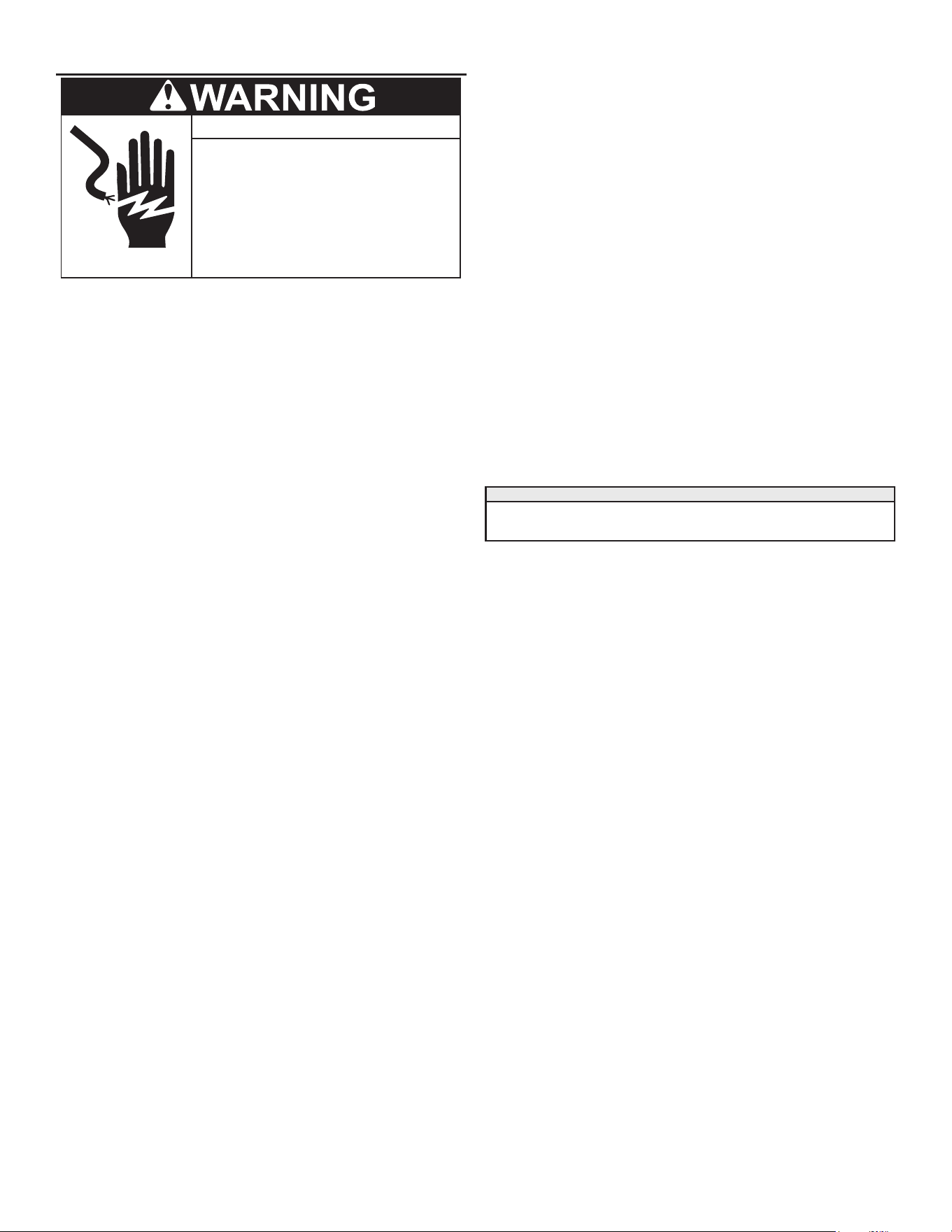
● Before removing any access panels or
servicing the water heater, make sure
the the electrical supply to the water
heater is turned OFF.
Electrical Shock Hazard
● Failure to follow these instructions can
result in personal injury or death.
The installation must conform with these instructions and the local
code authority having jurisdiction and the requirements of the power
company. In the absence of local codes, the installation must comply
with the current editions of the
National Electrical Code, NFPA 70
or the
Canadian Electrical Code CSA C22.1
.
An electrical ground is required to reduce risk of electrical shock
or possible electrocution. The water heater should be connected
to a separate grounded branch circuit with over-current protection
and disconnect switch. The water heater should be grounded in
accordance with national and local codes.
Voltage applied to the heater should not vary more than +5% to -10%
of the model and rating plate marking for satisfactory operation.
DO NOT ENERGIZE THE BRANCH CIRCUIT FOR ANY REASON
BEFORE THE HEATER TANK IS FILLED WITH WATER. DOING SO
WILL CAUSE THE HEATING ELEMENTS TO BURN OUT AND VOID
WARRANTY.
The factory wiring is attached to a terminal block within the external
junction box unit. The branch circuit is connected to the terminal
block within this junction box. The water heater should be connected
to a separate, grounded, branch circuit with over-current protection
and disconnect switch. The water heater should be grounded in
accordance with national and local codes.
BRANCH CIRCUIT
The branch circuit wire size should be established through reference
to the current edition of
NFPA-70
, the
National Electrical Code
or other
locally approved source in conjunction with the heater amperage
rating. For convenience, portions of the wire size tables from the
Code are reproduced here. The branch circuit should be sized at
125 percent of the heater rating and further increase wire size as
necessary to compensate for voltage drop in long runs.
CALCULATING AMPERAGE/OVER-CURRENT PROTECTION
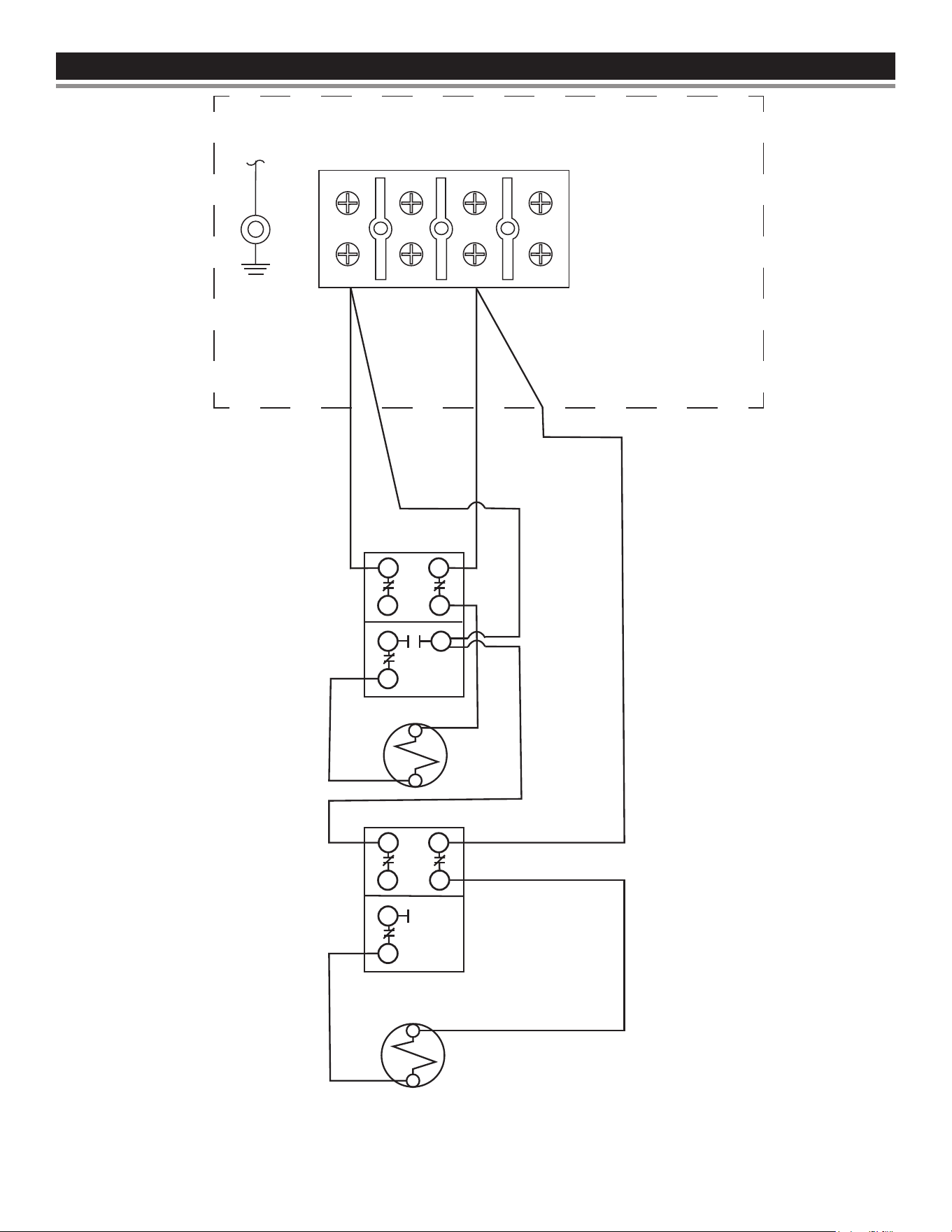
The heaters come from the factory in the following conguration:
Four-wire, A-8 circuit for dual element heater equipped with two
high-limit controls and single-phase power input.
See
Wiring Diagrams
(page 24).
This is an example of calculating heater amperage for simultaneous
element operation. From this, the branch circuit conductor and over-
current protection sizing can be established.
The example is of a 277-volt unit with two, 6.1 kW elements. Check
the heater model and rating plate for actual specications and
substitute those values in the following.
Table 3. Example: Single Phase Simultaneous A-8 Circuit
12,200 watts ÷ 277 volts = 44 amps
The rating of the over-current protection should be computed on
the basis of 125 percent of the total connected load amperage.
Where the standard ratings and settings do not correspond with
this computation, the next higher standard rating or setting should
be selected.
14
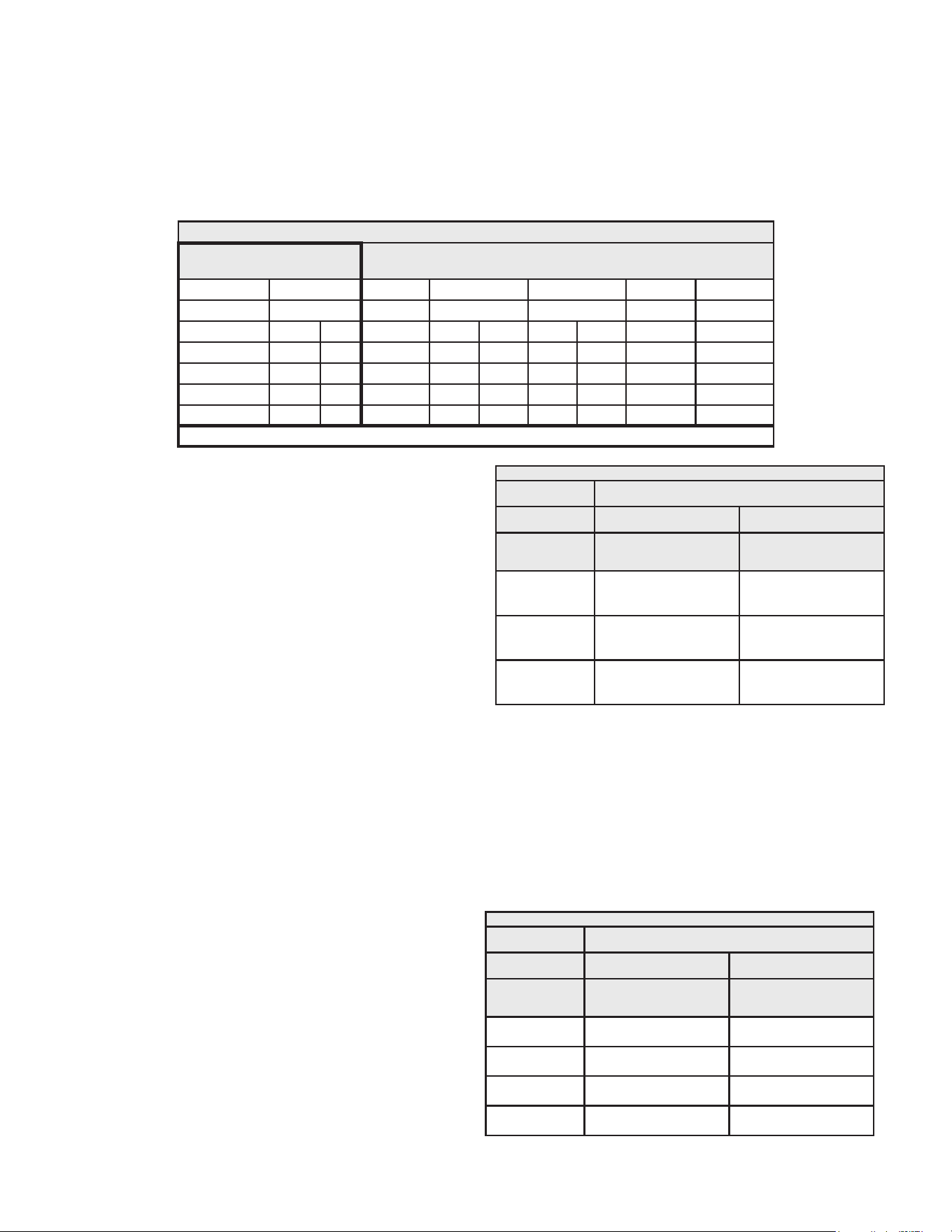
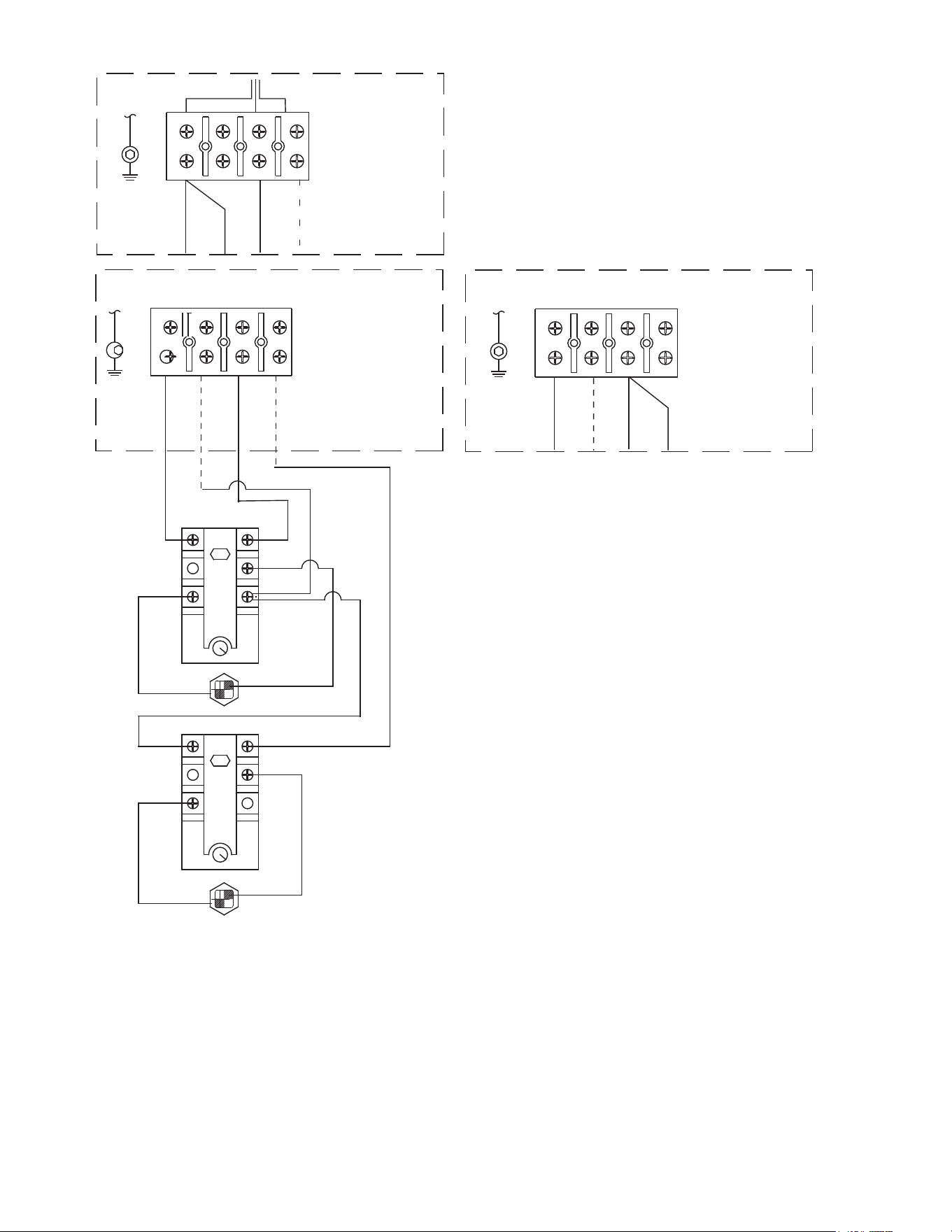
ELECTRICAL CONFIGURATIONS
On-site conditions may require or necessitate a eld conversion for
the installation of commercial water heating equipment. Consistent
with this anticipated need, the commercial light service 66, 80, and
119 gallon models are equipped with a terminal block located on top
of the water heater. This terminal block allows for eld conversion
of phase (single phase or three phase) and element operation
(simultaneous or non-simultaneous) based on specic job-site
conditions. Special attention should be paid to understand the amp
draw, line voltage, phase, wiring size and over current protection
needed when performing any eld conversions. Please see table
for details on available eld converted congurations. See
Wiring
Diagrams
(page 24) for factory and optional eld conversion wiring
at the terminal block. The wiring must conform to local codes or the
latest edition of the
National Electric Code
.
Table 4. Field Converted Congurations
Factory Shipped Congura-
tion/Rating Potential Field Conversion*
Voltage
277 277 240 240 240 208
Operation
SIM NON-SIM SIM NON-SIM NON-SIM NON-SIM
Phase
1-PH 3-PH 1-PH 1-PH 3-PH 1-PH 3-PH 1-PH 1-PH
Wattage Rating
12,200 N/A 6,100 9,000 9,000 4,500 4,500 5,500 4,500
AMP
44 N/A 22 38 33 19 19 23 22
OCPD
60 N/A 30 50 45 25 25 30 30
Wire Size
6 N/A 10 8 8 10 10 10 10
*Contact local representative or wholesaler for aftermarket conversion kits.
Single Phase Non-Simultaneous Installations
For eld conversion to single phase non-simultaneous operation,
move the Red wire from the L1 terminal to the J terminal, see Field
Conversion Wiring Options diagram. Leave the Yellow wire in the
L1 terminal and check that all wiring connections are tight before
applying power to the water heater.
Three Phase Simultaneous Installations
To eld convert to three phase simultaneous operation, the Black
wire must be moved from the L2 terminal to the L3 terminal, see
Field Conversion Wiring Options diagram. Leave the Blue wire in
the L2 terminal and check that all wiring connections are tight before
applying power to the water heater.
Three Phase Non-Simultaneous Installations
For three phase non-simultaneous eld conversions, move the Red
wire from the L1 terminal to the J terminal and move the Black wire
from the L2 terminal to the L3 terminal, see Field Conversion Wiring
Options diagram. Leave the Yellow wire in the L1 terminal and the
Blue wire in the L2 terminal. Check that all wiring connections are
tight before applying power to the water heater.
PORTION OF TABLE 310-16 (NFPA-70) FOLLOWS:
Allowable Ampacities of Insulated Copper Conductors. Not more
than three conductors in Raceway or Cable or Direct Burial (Based
on Ambient Temperature of 30° C, 86° F).
These ampacities relate only to conductors described in
Table 310-13
in Code
.
For ambient temperatures over 30° C (86° F), see
Correction Factors,
Note 13 in Code
.
Portion of Table 310-16 (NFPA-70)
Size
Temperature Rating of Conductor
See Table 310-13 in Code
AMG
MCM
60°C
(140°F)
75°C
(167°F)
Types:
RUW, (14-2), T, TW, UF
Types:
RH, RHW, RUH, (14-2),
THW, THWN, XHHW, USE
18
16
14
- - -
- - -
15
- - -
- - -
15
12
10
8
20
30
40
20
30
45
6
4
3
55
70
80
65
85
100
PORTION OF TABLE 310-18 FOLLOWS:
Allowable Ampacities of Insulated Aluminum and Copper -Clad
Aluminum Conductors.
Not more than three conductors in Raceway or Cable or Direct Burial
(Based on Ambient Temperature of 30° C, 86° F. These ampacities
relate only to conductors described in
Table 310-13
in
Code
.
For ambient temperatures over 30° C (86° F), see C
orrection Factors,
Note 13
in
Code
.
Portion of Table 310-18 (NFPA-70)
Size
Temperature Rating of Conductor
See Table 310-13 in Code
AMG
MCM
60°C
(140°F)
75°C
(167°F)
Types:
RUW, (14-2), T, TW, UF
Types:
RH, RHW, RUH, (14-2),
THW, THWN, XHHW, USE
12
10
15
25
15
25
8
6
30
40
40
50
4
3
55
65
65
75
2
1
75
85
90
100
15
START UPSTART UP
See
Features and Components
(page 8) for the location of
components mentioned in the instructions that follow.
NEVER
turn on power to the water heater without being certain the
water heater is lled with water and a temperature and pressure
relief valve is installed in the relief valve opening.
DO NOT TEST ELECTRICAL SYSTEM BEFORE HEATER IS FILLED
WITH WATER. FOLLOW FILLING AND START-UP INSTRUCTIONS
IN OPERATION SECTION.
● Before removing any access panels or
servicing the water heater, make sure
the the electrical supply to the water
heater is turned OFF.
Electrical Shock Hazard
● Failure to follow these instructions can
result in personal injury or death.
FILLING THE WATER HEATER
Property Damage Hazard
To avoid water heater damage, fill tank with water
before operating.
CAUTION
1. Turn o the electrical disconnect switch.
2. Close the water heater drain valve.
3. Open a nearby hot water faucet to permit the air in the system
to escape.
4. Fully open the cold water inlet pipe valve allowing the heater and
piping to be lled.
5. Close the hot water faucet as water starts to ow. The heater
is now ready for
Start Up
(page 15) and
Temperature Regulation
(page 16).
INITIAL START UP
The following checks should be made by the installer when the heater
is placed into operation for the rst time.
1. Turn o the electrical disconnect switch.
2. Open the front panel or top access cover, check all water and
electrical connections for tightness. Also check connections on top
and or sides of heater. Repair water leaks and tighten electrical
connections as necessary.
3. Press the red manual reset button on each Thermostat/ECO
combination control. See
Figure 6
(page 20).
4. Turn on the electrical disconnect switch.
5. Observe the operation of the electrical components during the rst
heating cycle. Use care as the electrical circuits are energized.
6. Close the front panel or top access cover.
Temperature control and contactor operation should be checked by
allowing heater to come up to temperature and shut o automatically.
Use care as the electrical circuits are energized.
DRAINING THE WATER HEATER
The water heater must be drained if it is to be shut down and exposed
to freezing temperatures. Maintenance and service procedures may
also require draining the heater.
1. Turn o the electrical disconnect switch.
2. Open a hot water valve until the water is cool, then close the
supply water inlet valve to heater.
3. Attach hose to outlet opening of drain valve and direct end to
drain.
4. Open a nearby hot water faucet and the heater drain valve.
5. If the heater is being drained for an extended shutdown, it is
suggested the drain valve be left open during this period. The
hose may be removed.
Follow the procedure in
Filling the Water Heater
(page 15)
when
restoring hot water service.
• Burn hazard.
• Hot water discharge.
• Keep hands clear of drain
valve discharge.
16
TEMPERATURE REGULATIONTEMPERATURE REGULATION
LIMITING THE RISK OF SCALDING
For a variety of reasons, water heaters can produce water that is
much hotter than its temperature setting. Take precautions to prevent
this higher temperature water from reaching the water xtures.
Burn Hazard
To reduce the risk of unusually hot
water reaching the fixtures in the
house, install thermostatic mixing
valves at each point of use.
A properly adjusted thermostatic mixing valve at each point of use
allows you to set the tank temperature to a higher setting without
increasing risk of scalds. A higher temperature setting allows the
tank to provide much more hot water and can help provide proper
water temperatures for appliances such as dishwashers and washing
machines.
Water temperature over 125°F (52°C)
can cause severe burns instantly
resulting in severe injury or death.
Children, the elderly and the
physically or mentally disabled are at
highest risk for scald injury.
Feel water before bathing or shower-
ing.
Temperature limiting devices such as
thermostatic point-of-use mixing
valves must be installed when
required by codes and to ensure safe
temperatures at fixtures.
THE WATER HEATER IS EQUIPPED WITH AN ADJUSTABLE
THERMOSTAT TO CONTROL WATER TEMPERATURE. HOT WATER
AT TEMPERATURES DESIRED FOR AUTOMATIC DISHWASHER
AND LAUNDRY USE CAN CAUSE SCALDS RESULTING IN SERIOUS
PERSONAL INJURY AND/OR DEATH. THE TEMPERATURE AT
WHICH INJURY OCCURS VARIES WITH THE PERSON’S AGE AND
TIME OF EXPOSURE. THE SLOWER RESPONSE TIME OF CHILDREN
, AGED OR DISABLED PERSONS INCREASES THE HAZARD TO
THEM. NEVER ALLOW SMALL CHILDREN TO USE A HOT WATER
TAP, OR TO DRAW THEIR OWN BATH WATER. NEVER LEAVE A
CHILD OR DISABLED PERSON UNATTENDED IN A BATHTUB OR
SHOWER.
It is recommended that lower water temperatures be used to avoid
the risk of scalding. It is further recommended, in all cases, that the
water temperature thermostats be set for the lowest temperature
which satises your hot water needs. This will also provide the most
energy ecient operation of the water heater. See
Table 5
Burn Hazard
If you choose a higher temperature
setting, install thermostatic mixing
valves at each point-of-use to help
avoid scalding.
Table 5
shows the approximate time-to-burn relationship for
normal adult skin. The thermostats on your water heater have a
linear relationship between degrees of angular rotation and the
corresponding change in temperature. Thus rotating the temperature
adjustment indicator 30 angular degrees will result in a 10°F change
in water temperature.
Table 5. Burn Time at Various Temperatures
Water Temperature
°F (°C)
Time for 1st Degree
Burn
(Less Severe Burns)
Time for Permanent
Burns
2nd & 3rd Degree
(Most Severe Burns)
110 (43) (normal shower temp.)
116 (47) (pain threshold)
116 (47) 35 minutes 45 minutes
122 (50) 1 minute 5 minutes
131 (55) 5 seconds 25 seconds
140 (60) 2 seconds 5 seconds
149 (65) 1 second 2 seconds
154 (68) instantaneous 1 second
(U.S. Government Memorandum, C.P.S.C., Peter L. Armstrong, Sept. 15, 1978)
Burn Hazard
To reduce the risk of unusually hot
water reaching the fixtures in the
house, install thermostatic mixing
valves at each point of use.
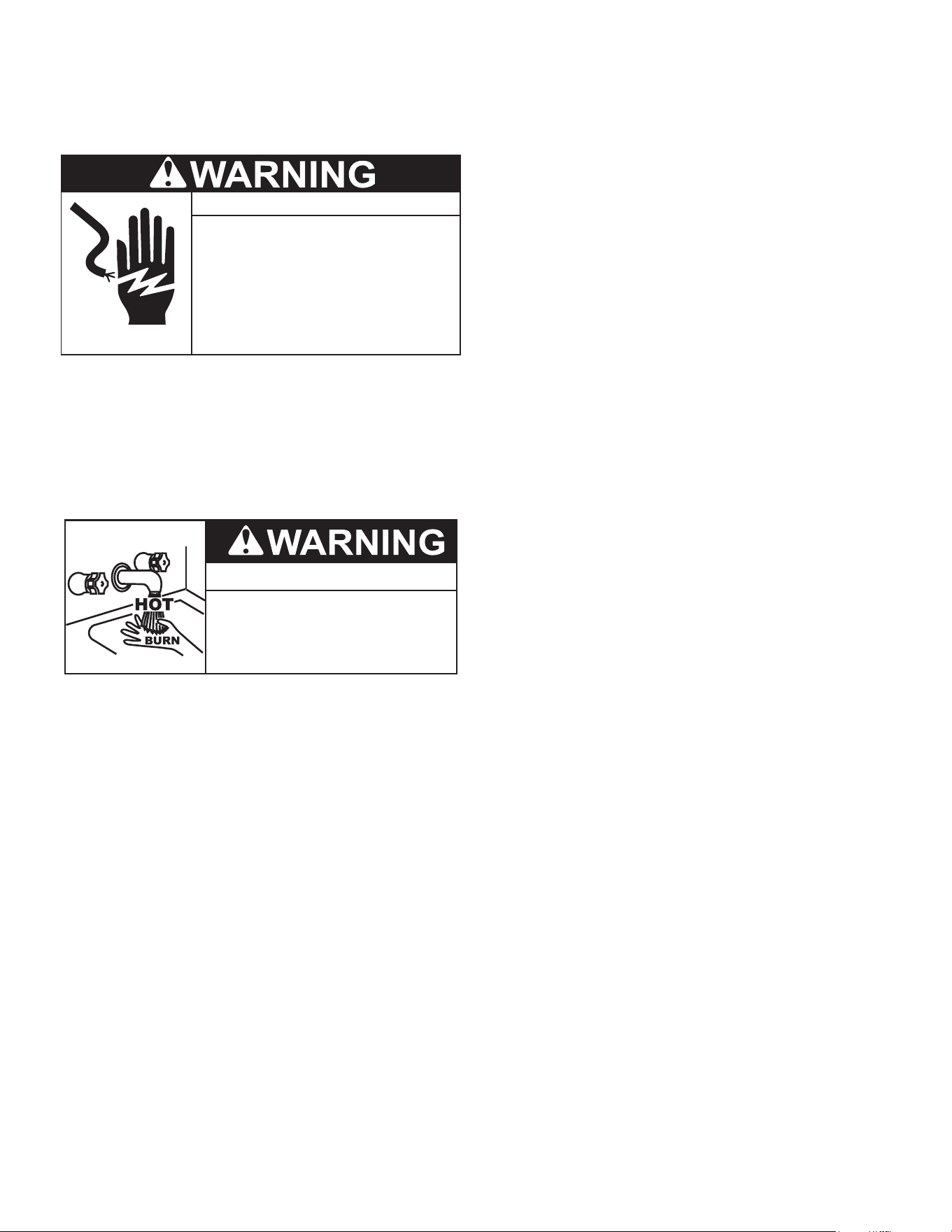
TEMPERATURE ADJUSTMENT
The thermostats are adjustable from approximately 120°F (49°C)
(lowest setting) to 181°F (83°C) (highest setting). See
Figure 3
).
These thermostats are set from the factory at approximately the
140°F (60°C) setting. The over temperature device (ECO high limit)
attached to each thermostat has a manual reset.
LOWER THERMOSTAT
UPPER THERMOSTAT
Figure 3. Thermostat Controls
17
Note: It is not necessary to adjust the upper thermostat for a dual
element unit. However, if it is adjusted above the factory set
point 140°F (60°C) it is recommended that it not be set higher
than the lower thermostat setting.
To change the temperature setting:
● Before removing any access panels or
servicing the water heater, make sure
the the electrical supply to the water
heater is turned OFF.
Electrical Shock Hazard
● Failure to follow these instructions can
result in personal injury or death.
1.
DANGER:
Turn o the heater electrical supply. Do not attempt to
adjust thermostat with power on.
2. Remove the upper and/or lower element access panel. Do not
remove the plastic personnel protectors covering the thermostats.
The thermostat is factory pre-set at 140°F (60°C).
3. Using a at tip screwdriver, rotate the adjusting knob to the desired
temperature setting.
4. Replace the access panels, and turn on heater electrical supply.
Burn Hazard
If you choose a higher temperature
setting, install thermostatic mixing
valves at each point-of-use to help
avoid scalding.
18
MAINTENANCEMAINTENANCE
Table 6. Maintenance Schedule
Component Operation Interval Reference
Tank Drain and Flush
Every 6
Months
See
Draining and Flushing
Tank
Lime Scale Re-
moval
(Water Less Than
25 Grains Hard)
Not Required N/A
Tank
Lime Scale Re-
moval
(Water Greater
Than 25 Grains
Hard)
Annually
See
Lime Scale Removal
.
Moving Parts Lubrication Not Required N/A
Powered
Anodes
Inspection/
Cleaning
Annually
See
Anode Rod Maintenance
(page 19)
T&P Valve Test Operation Semi Annually
See
Temperature-Pressure Relief
Valve Test
(page 20).
Burn hazard.
Hot water discharge.
Keep clear of the Relief Valve
discharge outlet.
Periodically the drain valve should be opened and the water allowed
to run until it ows clean. This will help to prevent sediment buildup
in the tank bottom.
Periodically check the temperature and pressure relief valve to
ensure that it is in operating condition. Lift the lever at the top of the
valve several times until the valve seats properly and operates freely.
Water heater maintenance includes periodic tank ushing and
cleaning, and removal of lime scale from the heating element.
The heater tank is equipped with an anode rod to aid in corrosion
control.
DRAINING AND FLUSHING
It is recommended that the water heater storage tank be drained
and flushed every 6 months to reduce sediment buildup. The
water heater should be drained if being shut down during freezing
temperatures. See
Figure 1
(page 8) for the location of the water
heater components described below.
• Burn hazard.
• Hot water discharge.
• Keep hands clear of drain
valve discharge.
DRAINING THE WATER HEATER STORAGE TANK
1. Turn o the electrical supply to the water heater.
2. Ensure the cold water inlet valve is open.
3. Open a nearby hot water faucet and let the water run until the
water is no longer hot.
4. Close the cold water inlet valve to the water heater.
5. Connect a hose to the water heater drain valve and terminate it
to an adequate drain.
6. Open the water heater drain valve and allow all the water to drain
from the storage tank.
7. Close the water heater drain valve when all water in the storage
tank has drained.
8. Close the hot water faucet opened in Step 3.
9. If the water heater is going to be shut down for an extended
period, the drain valve should be left open.
FLUSHING THE WATER HEATER STORAGE TANK
1. Turn o the electrical supply to the water heater.
2. Ensure the cold water inlet valve is open.
3. Open a nearby hot water faucet and let the water run until the
water is no longer hot. Then close the hot water faucet.
4. Connect a hose to the drain valve and terminate it to an adequate
drain.
5. Ensure the drain hose is secured before and during the entire
ushing procedure. Flushing is performed with system water
pressure applied to the water heater.
6. Open the water heater drain valve to ush the storage tank.
7. Flush the water heater storage tank to remove sediment and
allow the water to ow until it runs clean.
8. Close the water heater drain valve when ushing is completed.
9. Remove the drain hose.
10. Fill the water heater. See
Filling the Water Heater
(page 15).
11. Turn on the electrical supply to place the water heater back in
operation.
12. Allow the water heater to complete several heating cycles to
ensure it is operating properly.
LIME SCALE REMOVAL
When water is heated, dissolved minerals in the water such as
calcium and magnesium carbonate (lime scale) become less soluble.
As the water temperature rises these minerals will precipitate or “fall
out” of solution.
The amount of lime scale released from water is in direct proportion
to water temperature and usage. The higher the water temperature
or water usage, the more lime deposits are dropped out of the water.
Water hardness also aects lime scale accumulation. With the
temperature and usage being the same, hard water will release
more lime scale than softer water.
Lime scale reduces heating eciency as it accumulates inside a
water heater. Heating transfer surfaces become coated with lime
scale deposits which increases fuel costs to operate the water heater.
Lime scale deposits can also cause rumbling and pounding noises
as air molecules trapped in the lime scale escape when heated. Lime
scale accumulation also reduces the life span of water heaters. For
these reasons a regular schedule for deliming should be set up.
CHEMICAL LIME SCALE REMOVAL
To dissolve and remove more stubborn lime scale deposits, UN-
LIME
®
Professional Delimer should be used.
19
UN-LIME
®
Professional Delimer is an easy to handle patented food
grade acid formulated specically for lime scale removal from all
types of water using equipment. Hydrochloric base acids must not
be used to delime the water heaters covered in this manual.
Follow the instructions on the UN-LIME
®
to delime the water heater.
Note: Contact Technical Support for assistance in ordering the UN-
LIME
®
Professional Delimer.
• Burn hazard.
• Hot water discharge.
• Keep hands clear of drain
valve discharge.
Periodically the drain valve should be opened and the water allowed
to run until it ows clean. This will help to prevent sediment buildup
in the tank bottom.
Periodically check the temperature and pressure relief valve to
ensure that it is in operating condition. Lift the lever at the top of the
valve several times until the valve seats properly and operates freely.
Water heater maintenance includes periodic tank ushing and
cleaning, and removal of lime scale from the heating element.
The heater tank is equipped with an anode rod to aid in corrosion
control.
ANODE ROD MAINTENANCE
Avoid damage.
Property Damage Hazard
Inspection and replacement of anode rod required.
The anode rod is used to protect the tank from corrosion. Most hot
water tanks are equipped with an anode rod. The submerged rod
sacrices itself to protect the tank. Instead of corroding tank, water
ions attack and eat away the anode rod. This does not aect water’s
taste or color. The rod must be maintained to keep tank in operating
condition.
Anode deterioration depends on water conductivity, not necessarily
water condition. A corroded or pitted anode rod indicates high water
conductivity and should be checked and/or replaced more often than
an anode rod that appears to be intact. Replacement of a depleted
anode rod can extend the life of your water heater. Inspection should
be conducted by a qualied technician, and at a minimum should
be checked annually.
Articially softened water is exceedingly corrosive because the
process substitutes sodium ions for magnesium and calcium ions.
The use of a water softener may decrease the life of the water
heater tank.
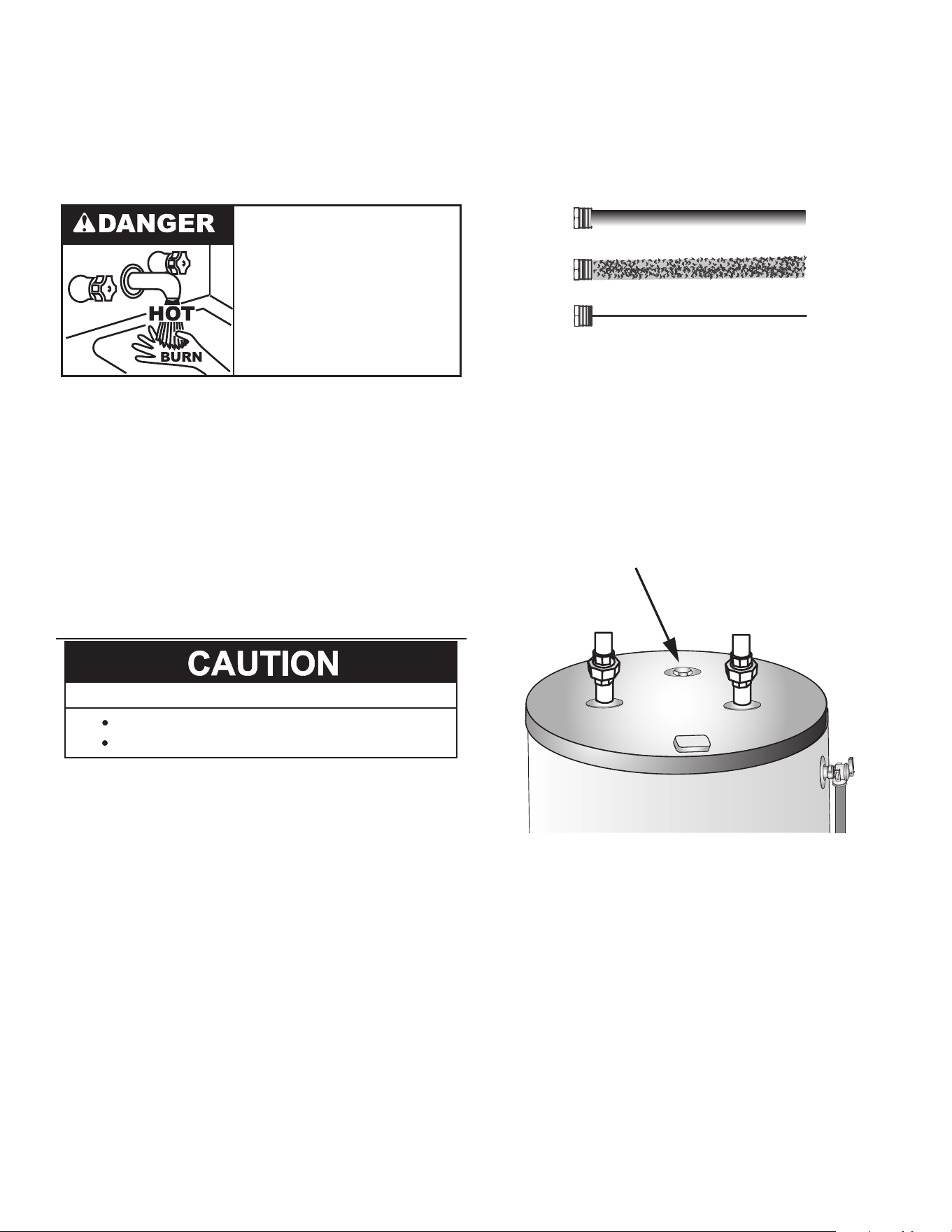
The following are typical (but not all) signs of a depleted anode rod:
• The majority of the rods diameter is less than 3/8”.
• Signicant sections of the support wire (approx. 1/3 or more of
the anode rod’s length) are visible.
New Anode Rod
Partially Consumed Anode Rod
Depleted Anode Rod
Figure 4. Anode Depletion
If the anode rod show signs of either or both it should be replaced.
Note: Whether re-installing or replacing the anode rod, check for
any leaks and immediately correct if found.
1. Turn o the electrical disconnect switch.
2. Shut o the water supply and open a nearby hot water faucet to
depressurize the water tank.
3. Drain approximately 5 gallons of water from tank. See
Draining and
Flushing
(page 18) for proper procedures. Close drain valve.
Anode
Figure 5. Accessing the Anode
4. Use a socket wrench to unscrew an remove the anode rod and
inspect the rod.
Check the rod for damage or depletion.
If the rod is depleted, obtain a new rod and apply Teon
®
tape or
approved pipe sealant on threads to ensure there is no leakage.
5. Install the new rod or reinstall the existing rod.
6. Rell the tank. See
(page 16)
7. Turn on the electrical power supply and restart the water heater
See
Start Up
(page 16).
20
TEMPERATURE-PRESSURE RELIEF VALVE TEST
It is recommended that the Temperature-Pressure Relief Valve
should be checked to ensure that it is in operating condition every
6 months.
When checking the Temperature-Pressure Relief Valve operation,
make sure that (1) no one is in front of or around the outlet of the
Temperature-Pressure Relief Valve discharge line, and (2) that the
water discharge will not cause any property damage, as water may
be extremely hot. Use care when operating valve as the valve may
be hot.
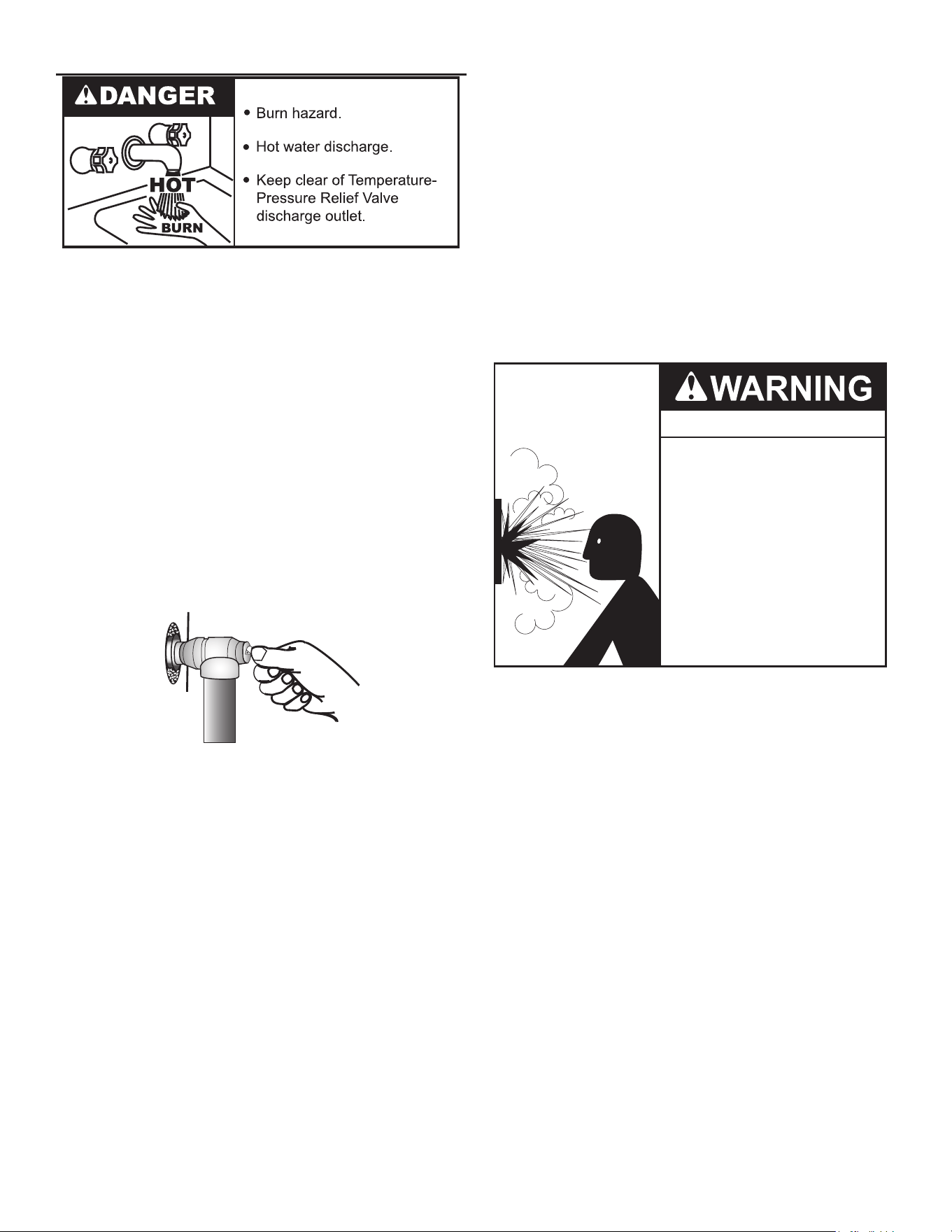
To check the temperature-pressure relief valve, lift the lever at the
end of the valve several times. See
Figure 6
(page 20). The valve
should seat properly and operate freely.
If after manually operating the valve, it fails to completely reset and
continues to release water, immediately close the cold water inlet to
the water heater and drain the water heater. See
Draining and Flushing
(page 18). Replace the Temperature-Pressure Relief Valve with
a properly rated/sized new one. See
Temperature-Pressure Relief Valve
(page 11) for instructions on replacement.
Figure 6. Testing the Temperature-Pressure Relief Valve
If the Temperature-Pressure Relief Valve on the water heater weeps
or discharges periodically, this may be due to thermal expansion.
Note: Excessive water pressure is the most common cause of
Temperature-Pressure Relief Valve leakage. Excessive water
system pressure is most often caused by “thermal expansion”
in a “closed system.” See
Closed Water Systems
(page 12)
and
Thermal Expansion
(page 12). The Temperature-Pressure
Relief Valve is not intended for the constant relief of thermal
expansion.
Temperature-Pressure Relief Valve leakage due to pressure build
up in a closed system that does not have a thermal expansion
tank installed is not covered under the limited warranty. Thermal
expansion tanks must be installed on all closed water systems.
DO NOT PLUG THE TEMPERATURE-PRESSURE RELIEF VALVE
OPENING. THIS CAN CAUSE PROPERTY DAMAGE, SERIOUS
INJURY OR DEATH.
Explosion Hazard
• Temperature-Pressure Relief
Valve must comply with ANSI
Z21.22-CSA 4.4 and ASME code.
• Properly sized tempera-
ture-pressure relief valve must
be installed in opening
provided.
• Can result in overheating and
excessive tank pressure.
• Can cause serious injury or
death.
21
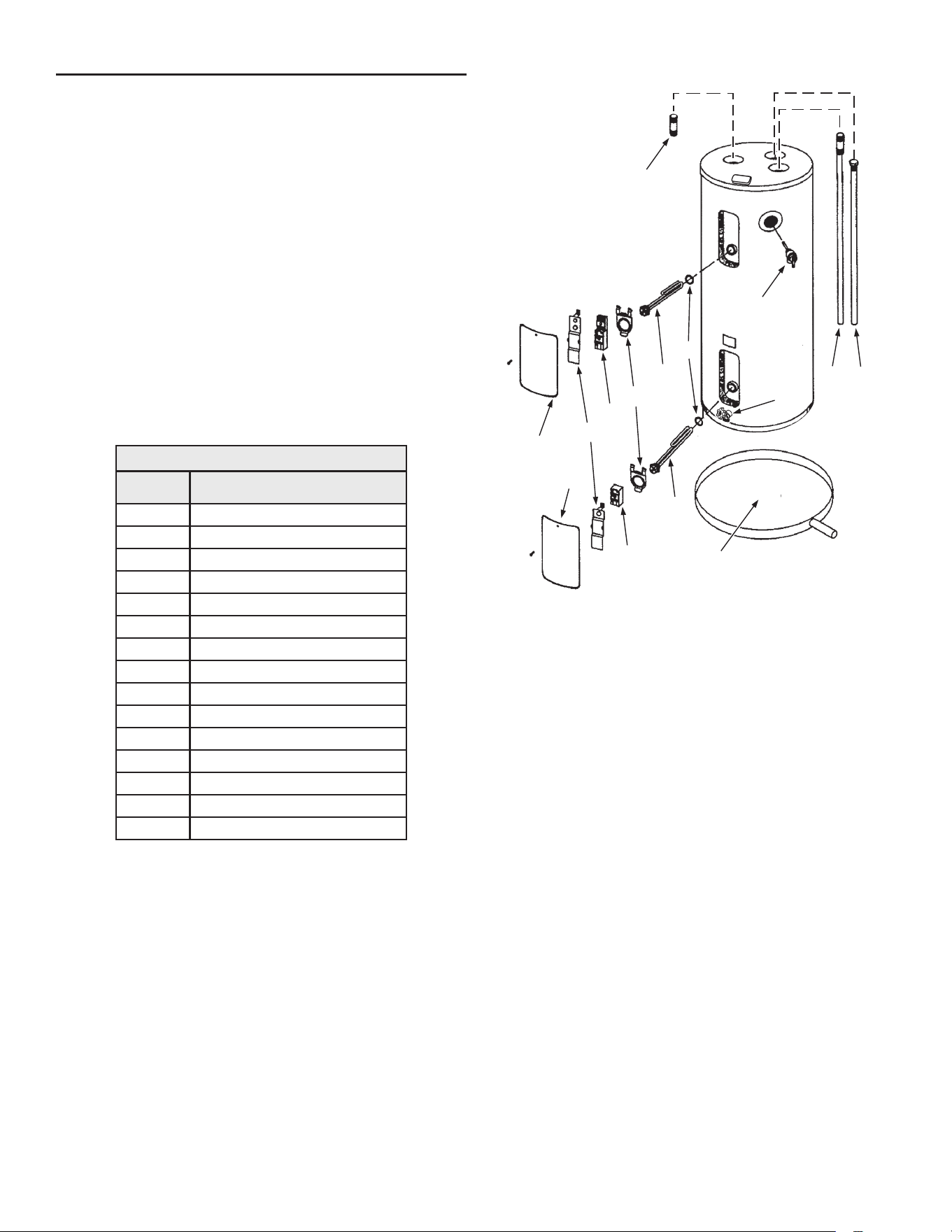
REPAIR PARTS LIST
Now that you have purchased this water heater, should a need ever
exist for repair parts or service, simply contact the company it was
purchased from or direct from the manufacturer listed on the rating
plate on the water heater.
Selling prices will be furnished on request or parts will be shipped
at prevailing prices and you will be billed accordingly.
The model number of your Water Heater will be found on the rating
plated located above the lower access panel.
Be sure to provide all pertinent facts when you call or visit.
WHEN ORDERING REPAIR PARTS, ALWAYS GIVE THE FOLLOWING
INFORMATION:
• Model Number
• Voltage And Element Wattage
• Serial Number
• Part Description
Table 7. Repair Parts List
Key No. Part Description
1 Extension Nipple
2 Combo Dip Tube
3 Primary Anode Rod
4 T&P Valve
5 Element Gasket
6 Upper Element
7 Thermostat Bracket
8 Upper Thermostat w/Hi Limit
9 Terminal Protector
10 Upper Access Panel
11 Lower Access Panel
12 Lower Thermostat w/Hi Limit
13 Lower Element
14 Brass Drain Valve
15 Drain Pan
1
2
3
4
5
6
7
8
9
10
12
13
15
11
14
Figure 7. Repair Parts
22
TROUBLESHOOTING CHECKLISTTROUBLESHOOTING CHECKLIST
CHECKLIST
Before calling for service, check the following points to see if the
cause of trouble can be identied and corrected.
Reviewing this checklist may eliminate the need of a service call and
quickly restore hot water service. See
Figure 1
(page 8) in this
manual to identify and locate water heater components.
● Before removing any access panels or
servicing the water heater, make sure
the the electrical supply to the water
heater is turned OFF.
Electrical Shock Hazard
● Failure to follow these instructions can
result in personal injury or death.
NOT ENOUGH OR NO HOT WATER
1. Be certain the electrical disconnect switch serving the water
heater is in the ON position.
2. Check the fuses.
• The electrical disconnect switch usually contains fuses.
3. If the water was excessively hot, and is now cold, the high limit
switch may have activated.
• See the
Temperature Regulation
(page 16) for more infor-
mation on how to reset the ECO high limit controls.
4. The capacity of the heater may have been exceeded by a large
demand for hot water.
• Large demands require a recovery period to restore wa-
ter temperature.
5. Cooler incoming water temperature will lengthen the time required
to heat water to the desired temperature.
6. Look for hot water leakage.
7. Sediment or pipe scale may be aecting water heater operation.
ABNORMAL SOUNDS
8. Sediment or lime scale accumulations on the elements causes
sizzling and hissing noises when the heater is operating.
• The sounds are normal, however, the tank bottom and el-
ements should be cleaned. See
Maintenance
(page 18).
WATER LEAKAGE IS SUSPECTED
See
Checking for Leaks
(page 23).
9. Check to see if the heater drain valve is tightly closed.
10. If the outlet of the relief valve is leaking it may represent:
• Excessive water temperature.
• Faulty relief valve.
• Excessive water pressure.
11. Excessive water pressure is the most common cause of relief
valve leakage. It is often caused by a “closed system”. See
Closed
Water Systems
(page 12) and
Thermal Expansion
(page 12) for
more information.
12. Examine the area around the element for gasket leakage.
• Tighten the elements or, if necessary, follow the proce-
dure in
Lime Scale Removal
(page 18) to replace the gas-
kets.
IF YOU CANNOT IDENTIFY OR CORRECT THE SOURCE OF
MALFUNCTION
1. Turn the power supply to the water heater o.
2. Close the supply water inlet valve to the heater.
3. Contact a Qualied Service Agency in your area. Call the toll free
phone number on the back cover of this Instruction Manual for
assistance in locating a service agency in your area.
REPLACEMENT PARTS
Call the toll free phone number on the back cover of this Instruction
Manual for assistance in locating replacement parts.. When ordering
parts, specify complete model no., serial no., (see rating plate),
quantity and name of part desired. Standard hardware items should
be purchased locally.
23
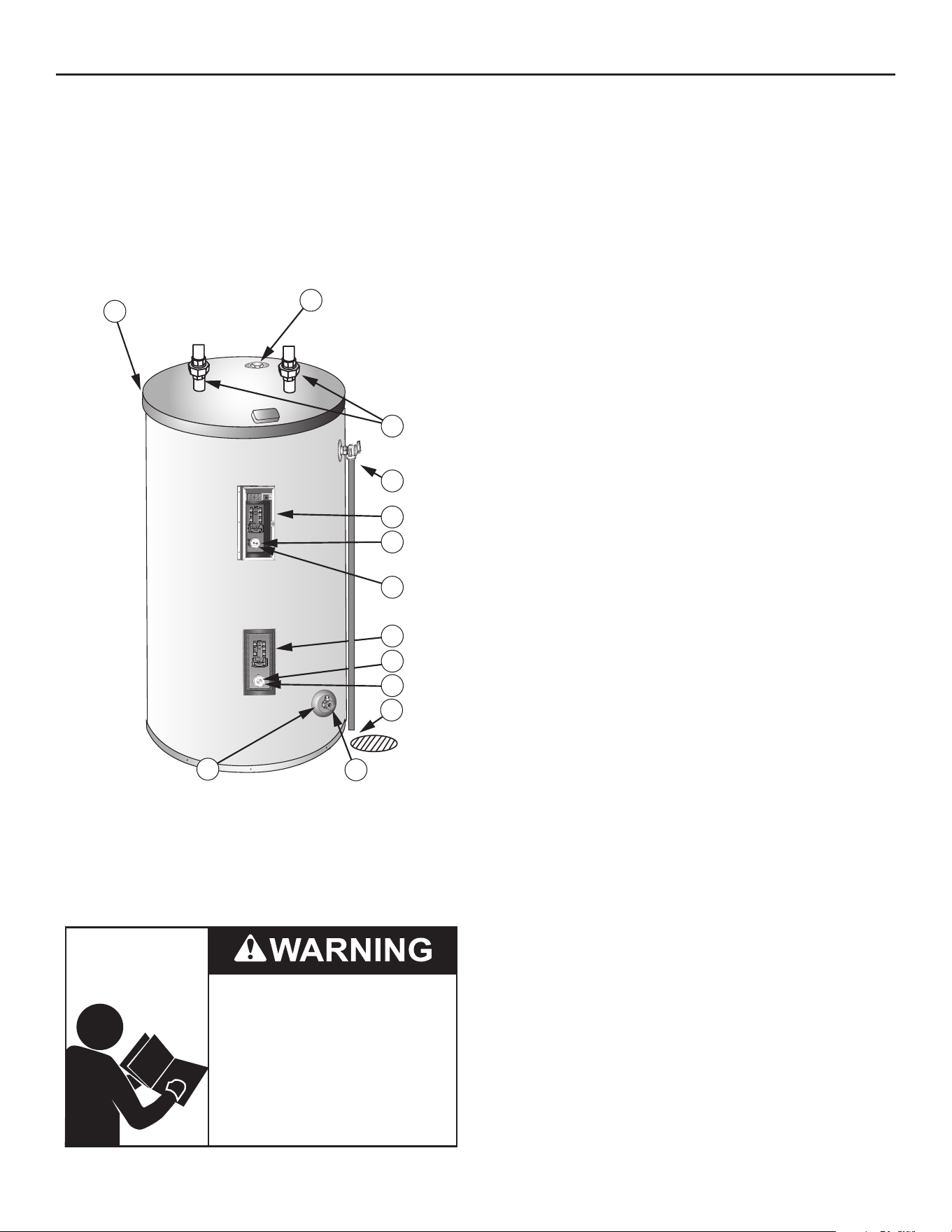
CHECKING FOR LEAKS
Use this illustration as a guide when checking for sources of water leakage. You or your dealer may be able to correct what appears to
be a problem.
Note: Cover and insulation are show removed to reveal tank top.
All water which appears at the water heater bottom or on the surrounding oor may be caused by condensation, loose connections or
relief valve operation and leakage. Do not replace the water heater until full inspection of all potential leak points is made and corrective
steps taken to stop the leak.
Leakage from other appliances, water lines or ground should also be suspected until proven otherwise. See
Water leakage is suspected
(page 22).
6
10
1
4
5
7
6
7
8
8
9
3
2
L1 L3
L4
T2 T4
L2
T1
THERM O DISC
89T
RESET
RESET
181°F
120°F
140°F
L1 L3
L4
T2 T4
L2
T1
THERM O DISC
89T
RESET
RESET
181°F
120°F
140°F
Figure 8. Leakage Checkpoints
Read and understand this instruction
manual and the safety messages
herein before installing, operating or
servicing this water heater.
Failure to follow these instructions and
safety messages could result in death
or serious injury.
This manual must remain with the
water heater.
Never use this water heater unless it is completely lled with water.
To prevent damage to the tank, the tank must be lled with water.
Water must ow from the hot water faucet before turning the water
heater.
1. Where possible remove or lift top cover to examine threads of
ttings installed into tank for evidence of leakage. Correct tting
leaks as necessary.
2. *The anode rod tting may be leaking.
3. *Condensation might be seen on pipes in humid weather or pipe
connections may be leaking.
4. *The temperature-pressure relief valve might be leaking at the
tank tting.
5. Small amounts of water from temperature-pressure relief valve
might be due to thermal expansion or high water pressure in
your area.
6. Water on the side of the tank might be condensation due to the
panel or insulation not being in place.
7. Defective element which leaks at terminals or thru ange. Replace
element*
8. Loose element/gasket leak
a. Screw-in type: tighten with 1-1/2” socket wrench. If leak
continues, remove element*, discard gasket and clean thread
areas. Apply non-hardening Permatex Number 2 to thread
areas, install new gasket and screw element into tting until
it seats. Tighten 1/2 to 3/4 turn with wrench.
b. Flange type: tighten screw with wrench. If leak continues
remove element* and discard gasket. Clean gasket seating
areas and re-install element with new gasket. A new element
may be required where threads have become rusted or
damaged, preventing tightening.
9. Water from a drain valve might be due to the valve being slightly
opened.
10. *The drain valve might be leaking at the tank tting.
Leakage from other water heaters, water lines, or ground seepage
should also be checked.
* To check where threaded portion enters tank, insert cotton swab
between jacket opening and fitting. If cotton is wet, follow the
procedure in
Draining the Water Heater Storage Tank
(page 18) and then
remove tting. Put pipe dope or teon tape on the threads and replace.
Then follow the procedure in
Filling the Water Heater
(page 15).
*Contact your dealer as it is necessary to shut o electricity and
drain tank to perform procedure.
24
WIRING DIAGRAMSWIRING DIAGRAMS
1 3
1
2 4
2
L1
J
L2
L3
YELLOW
GREEN
GND
BLACK
FACTORY PRE-WIRED
BLACK
1 3
1
2 4
4
2
RED
RED
BLACK
RED
RED
HIGH LIMIT
DOUBLE-THROW
THERMOSTAT
YELLOW
YELLOW
BLUE
BLUE
RED
BLACK
BLACK
BLACK
BLACK
HIGH LIMIT
SINGLE-THROW
THERMOSTAT
RED
UPPER ELEMENT
LOWER ELEMENT
Figure 9. Wiring Diagram
25
GND
GREEN
L1 J L2 L3
YELLOW
RED
BLUE
BLACK
THREE-PHASE POWER IN
THREE-PHASE
SIMULTANEOUS
*
**
COMMON LEG
**
THREE PHASE
NON-SIMULTANEOUS
GND
GREEN
L1 J L2 L3
YELLOW
RED
BLUE
BLACK
GND
GREEN
L1 J L2 L3
YELLOW
RED
BLUE
BLACK
SINGLE-PHASE
NON-SIMULTANEOUS
RESET
RESET
LOWER
ELEMENT
ELEMENT
UPPER
YELLOW
RED
RED
RED
RED
BLACK
BLACK
BLUE
BLUE
NOTE:
MUST NOT BE CONVERTED TO
SIMULTANEOUS OPERATION IF TOTAL
CURRENT DRAW EXCEED 48 AMPS.
NOTE:
L1 IS COMMON LEG FOR 3-PHASE
SIMULTANEOUS OPERATION.
------------ : FIELD CONVERSION
*
**
Figure 10. Field Conversion Options

Copyright © 2022. All rights reserved.