
ファゴット
取扱説明書
Bassoon
Owner’s Manual
Fagott
Benutzerhandbuch
Basson
Mode d’emploi
Fagot
Manual de instrucciones
Fagote
Manual do Proprietário
大管
使用说明书
Фагот
Руководство пользователя
바순
사용설명서
低音管
使用說明書
JA EN DE FR ES PT ZH-CN RU KO ZH-TW
日本語
EnglishDeutschFrançaisEspañol
简体中文繁體中文
Русский
한국어
Português

P. 3
야마하 악기를 구입해 주셔서 감사합니다 . 악기의 알맞은 조립 방법 및 보관을 위해 본
사용설명서를 반드시 읽어주시기 바랍니다 .
このたびは、ヤマハ管楽器をお買い上げいただき、まことにありがとうございます。
楽器を正しく組み立て性能をフルに発揮させるため、また永く良い状態で楽器をお
使いいただくために、この取扱説明書をよくお読みください。
P. 3
You are now the owner of a high quality musical instrument. Thank you for choos-
ing Yamaha. For instructions on the proper assembly of the instrument, and how to
keep the instrument in optimum condition for as long as possible, we urge you to
read this Owner’s Manual thoroughly.
P. 3
Sie sind nun der stolze Besitzer eines hochwertigen Musikinstruments. Vielen Dank, dass Sie sich
für ein Instrument der Marke Yamaha entschiedenen haben. Um mit den Handgrien zum Zusam-
mensetzen und Zerlegen des Instruments vertraut zu werden und dieses über Jahre hinweg in
op
timalem Zustand halten zu können, raten wir Ihnen, diese Anleitung aufmerksam durchzulesen.
P. 3
Vous êtes dès à présent le propriétaire d’un instrument de musique de haute qualité. Nous vous
remercions d’avoir choisi Yamaha. En ce qui concerne les instructions relatives à un assemblage adé-
quat de l’instrument et sur la façon de garder l’instrument dans des conditions optimales aussi long-
temps que possible, nous vous conseillons vivement de lire entièrement le présent Mode d’emploi.
P. 3
P. 3
Usted es ahora propietario de un instrumento musical de alta calidad. Le agradecemos su
elección de un instrumento Yamaha. Le aconsejamos que lea todo este manual de instruc-
ciones para ver las instrucciones para el montaje correcto del instrumento y para aprender
a co
nservar el instrumento en óptimas condiciones durante tanto tiempo como sea posible.
Agora você é o proprietário de um instrumento musical de alta qualidade. Obrigado
pela sua escolha de um instrumento Yamaha. Para instruções da montagem correta
do instrumento, e de como conservar o instrumento em condições ideais pelo maior
tempo possível, pedimos que você leia este Manual do Proprietário por completo.
P. 3
P. 3
现在您已经是高品质乐器的主人了!感谢您选择 Yamaha 乐器。有关如
何正确地安装乐器以及使乐器尽可能长久地处于最佳状况的说明,请完
整地阅读该使用说明书。
感謝您選擇 Yamaha 購買優質樂器。如需瞭解如何正確組裝樂器,
以及如何讓樂器盡可能長時間保持最佳狀態,強烈建議您詳閱本使用
說明書。
P. 3
P. 3
Вы стали обладателем высококачественного музыкального инструмента. Благо-
дарим вас за выбор продукции Yamaha. Для получения инструкций по правильной
сб
орке данного инструмента и его длительном хранении в оптимальных условиях
мы настоятельно рекомендуем вам внимательно прочитать настоящее руководство.
2
3
Bassoon
Owner’s Manual
Precautions
Please read before using
■
About the Icons
: This icon indicates points which should be paid
attention to.
: This icon indicates actions that are prohibited.
Caution
Do not throw or swing the instrument
around, or in the direction of others.
This is dangerous. Parts of the instrument
may become detached hitting others. Always
treat the instrument with care.
Keep oils, polishes, and other such
substances out of children’s mouths
and reach of children. Also, perform
instrument maintenance in an area
away from children.
Keep the oil, polish, etc., out of children’s
reach and do maintenance when children are
not present.
Keep small parts out of the reach of
infants.
Your children may accidentally swallow them.
Take care not to touch the needle
springs during maintenance.
These springs have sharp ends and are par-
ticularly found on high-end models to provide
enhanced key action.
NOTICE
• Pay attention to temperature, humidity,
etc.
Do not expose the instrument to heat sources
such as heaters, etc. Also, avoid using or storing
the instrument in places where it may be exposed
to abnormal temperatures, humidity, etc. Doing
so may damage the balance of key connections,
and pad alignment, which can be the source of
trouble when playing.
• Protect the instrument from damage.
Placed on an unstable surface the instrument can
drop resulting in damage. Pay close attention to
where the instrument is placed.
• Never modify the instrument.
Doing so will void the warranty and may result in
irreparable damage.
The precautions given below concern the proper and safe use of the instru-
ment, and are to protect you and others from any damage or injuries. Please
follow and obey these precautions.
If children are using the instrument, a guardian should clearly explain these precautions to the
child and make sure they are fully understood and obeyed. After reading this manual, please
keep it in a safe place for future reference.
Disobeying the points indicated with this
mark may lead to injury.

4
The body of the bassoon is made from maple so it is sensitive to sudden changes in tem-
perature and humidity. Such changes can cause deformations to the body that can make
assembly of the joints dicult. Please pay close attention to the environment in which
the instrument is used and the manner in which the instrument is treated.
l
During the winter season, wait until the instrument is warmed up before playing.
l
Do not play new instruments for long periods of time. Play for 20 to 30 minutes
a day for the rst two weeks (if, however, the instrument must be played for
long periods of time, remove moisture from the instrument frequently).
l
Whenever possible, use a cleaning swab to remove moisture and dirt from the
instrument. This should be done during playing sessions as well.
The bassoon is a very delicate instrument. Handling the instrument in any of the manners
described below can result in damage. Never treat the instrument in such a manner.
l
Playing or storing the instrument where it will be exposed to direct sunlight
for an extended period of time.
l
Playing or storing the instrument in places subject to moisture (rain, etc.) or
high humidity.
l
Playing or storing the instrument close to a heat source such as a stove,
heater, etc.
l
Playing or storing the instrument in places where it will be directly exposed to
cold air from an air conditioner, etc.
To keep the instrument in optimum condition, please observe the following important
points.
l
After playing, use a cleaning swab to thoroughly remove moisture and dirt.
l
When putting the instrument down for breaks, etc., use a stand to prop it up.
If you must lay the instrument down, use a cleaning swab to remove any col-
lected moisture and dirt, and then lay it down on a stable place.
l
After playing, make sure the instrument is stored in its case. Never keep the
instrument in places where it may be exposed to high temperatures or high
humidity.
Special Care for Wooden Instruments
5
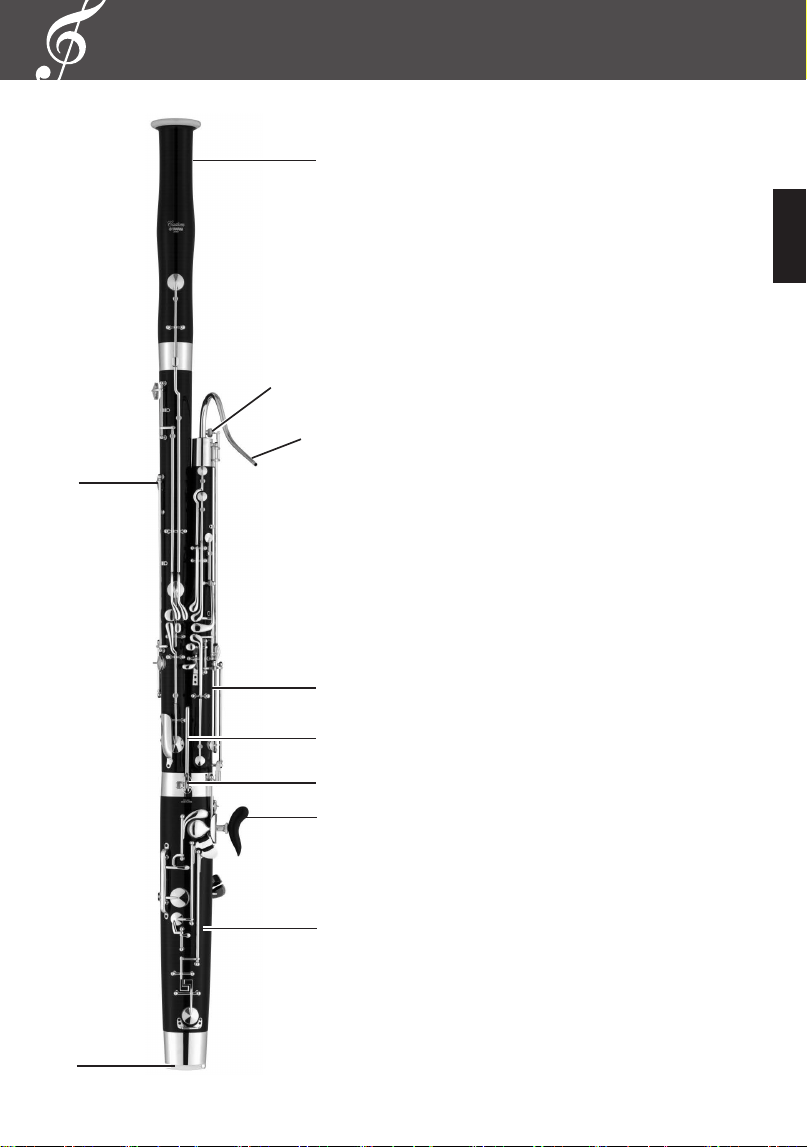
Nomenclature
* The contents of this manual apply to the latest
specications as of the publishing date. To obtain
the latest manual, access the Yamaha website
then download the manual le.
q
Bell Joint
w
Whisper Key
e
Bocal (Crook)
r
Bass Joint
t
Tenor (Wing) Joint
y
Strap Ring
u
Hand Rest
i
Double (Boot) Joint
o
Protector Cap
!0
Balancer
q
w
e
r
t
y
u
i
o
!0
6
Assembly
Before Assembling the Instrument
(Please pay close attention to the following)
The bassoon is made from natural wood and precision metal parts. When holding
or assembling the instrument, make sure the keys are protected from damage
due to impacts, etc.
Also, if the joint cork on the bocal is tight or sti when assembling the instrument,
apply a thin layer of cork grease and try inserting it into the receiver again. Be
careful not to apply too much cork grease. If the joint is still tight, apply a small
amount of cork grease to the receiver.
■
Assembling the Instrument
Assembling the Tenor Joint
and Double Joint
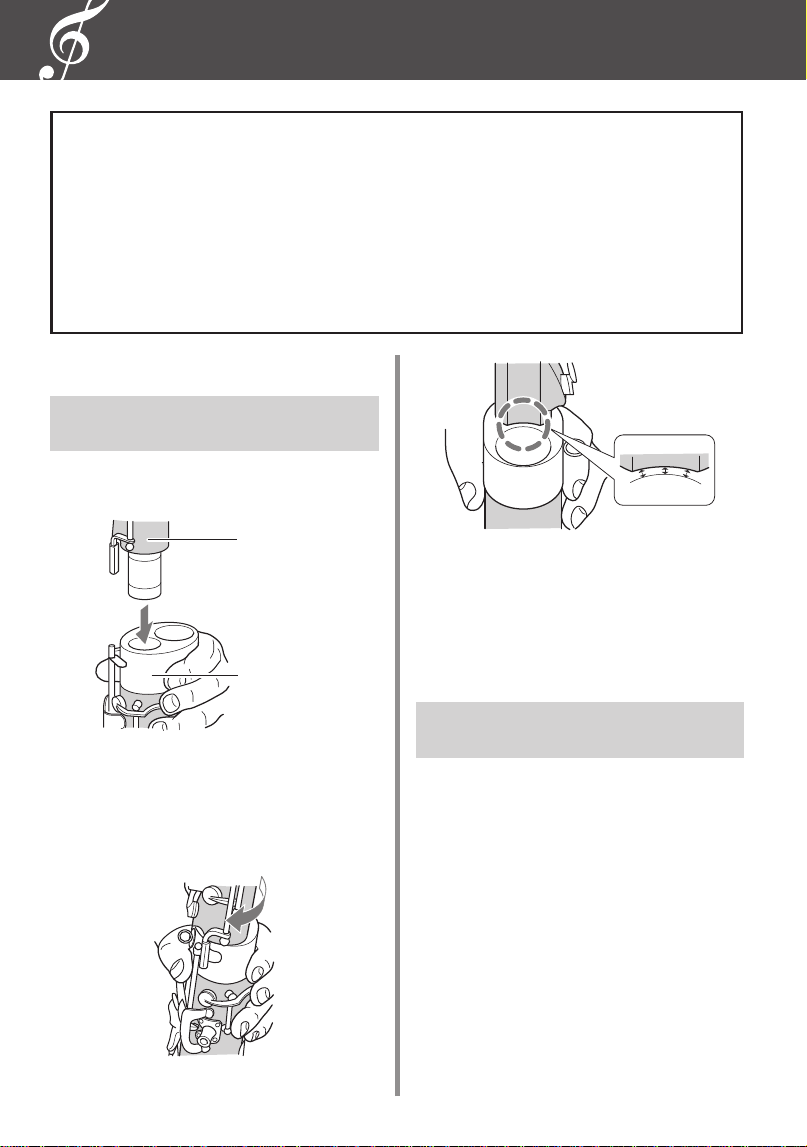
1.
Insert the tenor joint into the double
joint.
Tenor Joint
Double Joint
2.
Rotate the tenor joint to the right to
assemble. At this time, make sure that
there is even spacing between the
tenor joint’s curved hollow lining and
the bass joint’s socket.
* If the tenor joint was rotated too far,
remove the joint in a manner that does
not damage the key connections and try
assembling again. Forcibly rotating the
joint in the opposite direction when keys
are in contact with each other can dam-
age the keys.
Assembling the Bass Joint
and Double Joint
Assemble the bass joint so that the C
#
and E
b
keys do not come into contact with
the tenor joint.
1.
Insert the bass joint about halfway
into the double joint.
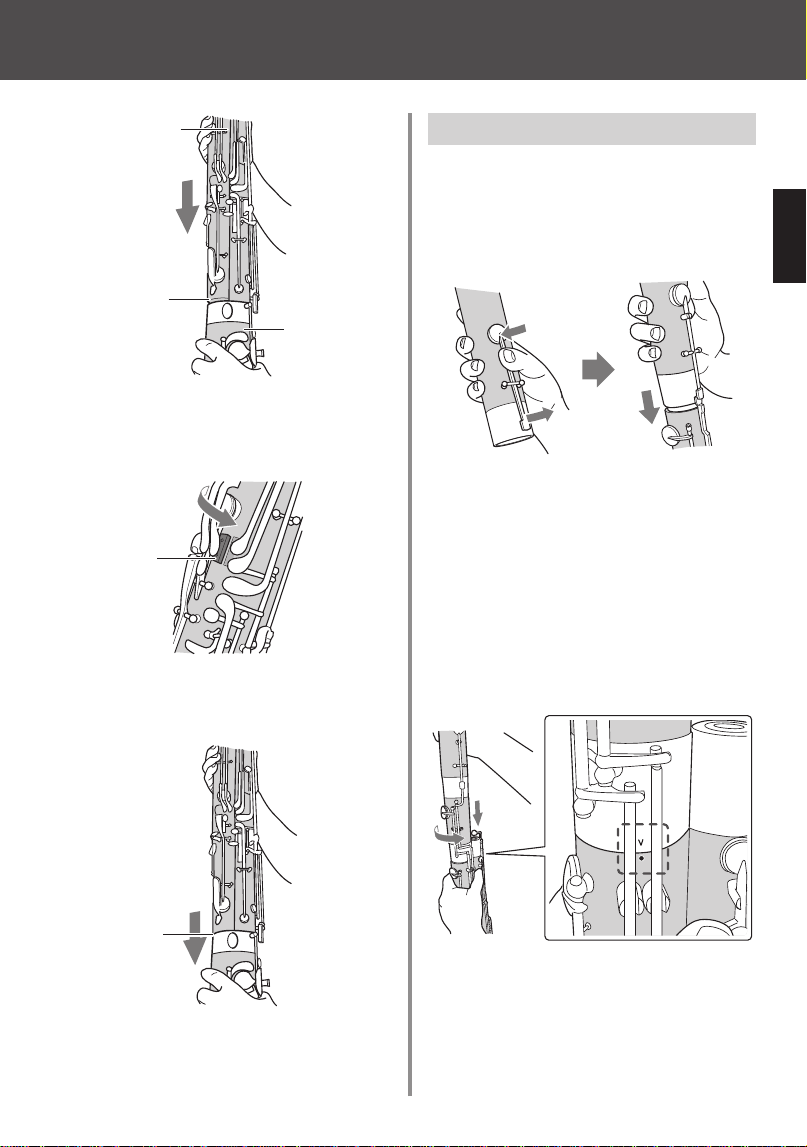
7
2.
Rotate the bass joint so that the
stopper on the bass joint comes into
contact with the tenor joint.
3.
Continue to insert the bass joint, all
the way into the socket.
Assembly
Attaching the Bell
Normal type
As shown in the illustration below, gently
hold the bell key pad down to raise the
connection at the opposite end, and
insert the bell section into the bass joint.
* Take care not to apply too much pressure
on the bell key pad.
Gentleman type
Insert the bell into the bass joint while
turning it so that the key connections do
not contact each other.
Align the mark “V” on the bell with the
mark “
l
” on the bass joint for the correct
position.
Bass Joint
Stopper
Fully insert
Insert
halfway
Double Joint
8
Assembly
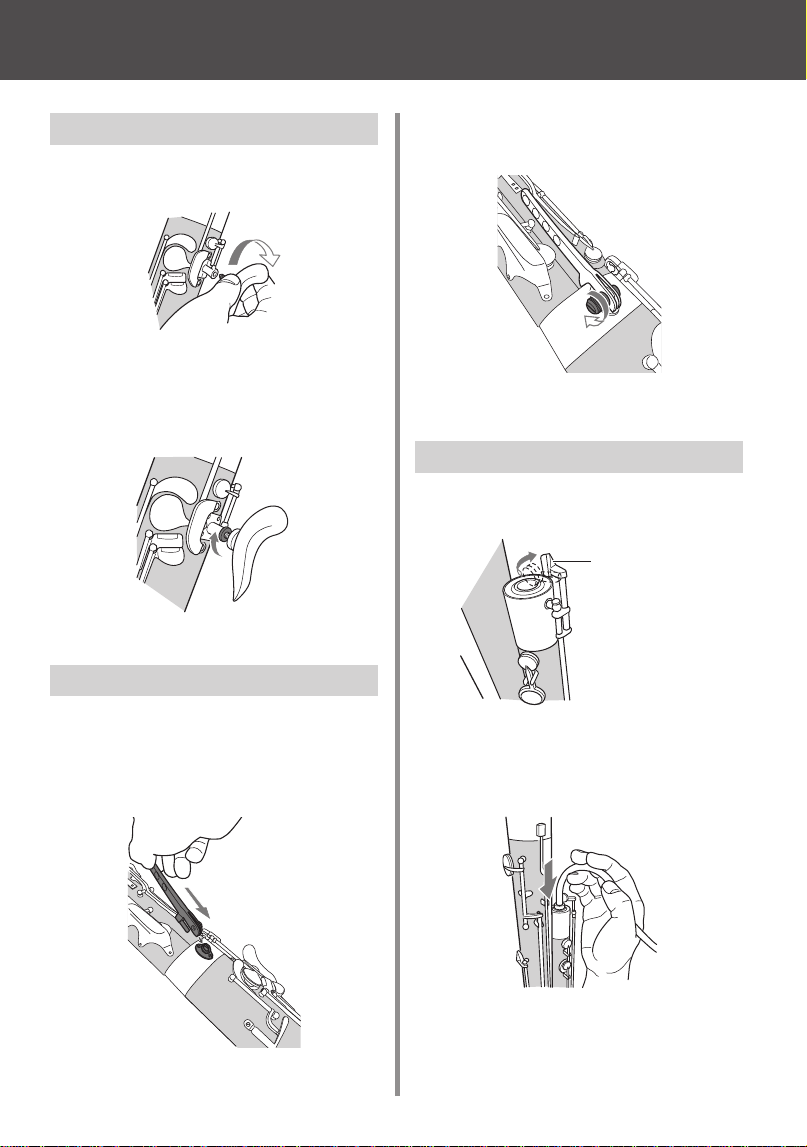
Attaching the Hand Rest
1.
Screw the hand rest into its holder
stopping at a comfortable position.
* Take care not to over tighten the hand
rest.
2.
Tighten the ring on the screw to se-
cure the hand rest.
Attaching the Balancer
1.
Insert the pin on the balancer into the
hole on the top of the strap ring.
Make sure that the strap ring ts in
the gap at the bottom of the balancer.
2.
Fix the balancer and the instrument
body with the xing screws rmly.
Attaching the Bocal
1.
Make sure that the whisper key on the
tenor joint is open.
Whisper Key
2.
Apply cork grease to the cork joint of
the bocal, then attach the bocal as
shown in the illustration below.

9
Assembly
■
Adjusting the Joint Sections
l
Body joints are wrapped with string.
If the joints t too tightly, contact
the store where you purchased the
product or a Yamaha customer service
center.
l
The bocal’s joint section is covered
with cork. Make sure cork grease is
applied to the cork before assembling.
Also, some models use cork on the
joints. If so, make sure cork grease is
applied to the corks before assem-
bling.
■
Tuning
l
The Yamaha Bassoon is supplied with
two bocals of dierent lengths. Select
the bocal according to the pitch you
want the bassoon tuned to. When ex-
changing the bocal to adjust the pitch,
pay close attention to the whisper
key’s pad. Air will leak if the pad is not
properly aligned with the tone hole.
■
Disassembling the Instrument
To disassemble the bassoon, follow the
steps described below. Also, refer to the
“Maintenance” section on the following
page to properly care for the instrument.
1.
Remove the bocal.
2.
Remove the bell and bass joints as one
section, then remove the bell from the
bass joint (the bell can, however, be
removed from the bass joint before
removing the bass joint from the
instrument). At this time, take care not
to apply too much force on the B key.
To disassemble the gentleman type
bell and bass joint, reverse the assem-
bly procedure.
3.
Remove the tenor joint.
4.
Remove moisture from the double
joint’s narrower tube.
5.
Remove the hand rest and balancer.
6.
Clean each of the parts.
Take Care When Handling the
Bassoon
Don’t let moisture accumulate in the
wider of the double joint’s tubes while
playing the instrument.
10
Maintenance
After Playing
Follow the procedures given below and make sure moisture and dirt is thoroughly
removed from the inside of the instrument after playing.
■
Caring for the Instrument’s
Interior
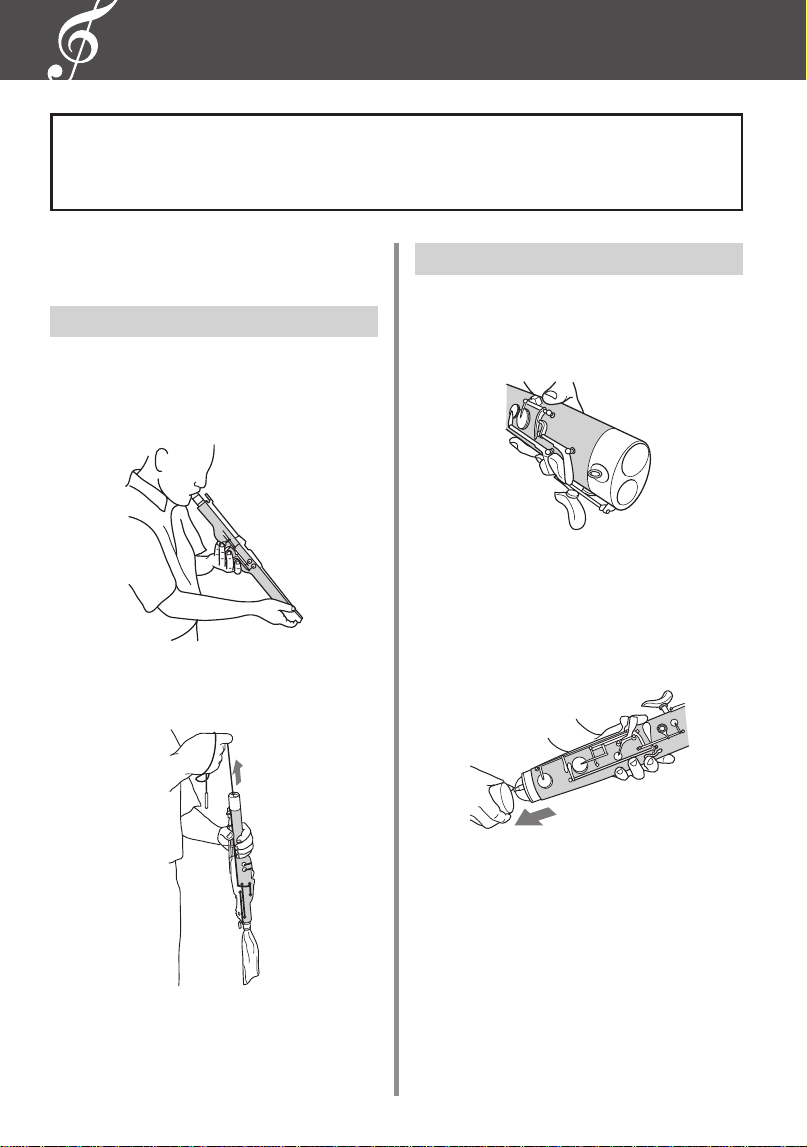
Tenor Joint Maintenance
1.
Breathe in from the top of the tenor
joint and suck any moisture clogged in
the tone hole toward the inside of the
instrument.
2.
Run a cleaning swab through the tenor
joint’s interior to remove moisture.
Double Joint Maintenance
1.
Remove moisture collected in the U-
tube from the narrower side of the
tube.
* Please take note that placing the C
#
tone
hole face down can cause moisture to
accumulate.
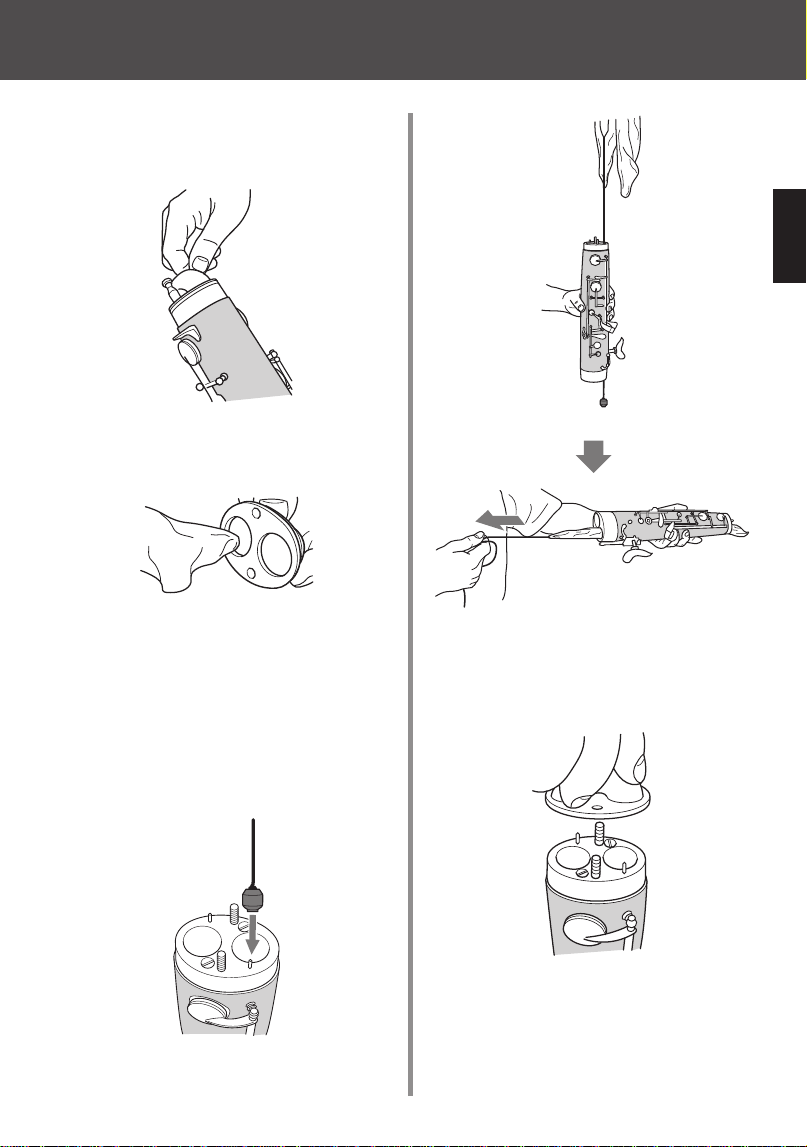
2.
Remove the protector cap covering the
U-tube.
11
Maintenance
3.
Remove the nuts holding the U-tube in
place, and carefully remove the U-tube
from the bassoon.
4.
Remove moisture on the inside of the
U-tube.
5.
Insert the weighted end of the clean-
ings swab into the narrow tube, and
pull the swab through the opposite
end to remove moisture.
If moisture is present in the double
joint’s wider tube, remove the U-tube
and clean the tube thoroughly. Also,
make sure to remove moisture from
the A
b
key hold if any is present there.
6.
Reattach the U-tube making sure it is
properly aligned with the instrument’s
bore and the bolts. Tighten both nuts
evenly to secure.
12
Maintenance
Bass Joint and Bell Joint
Maintenance
A cleaning swab (for the double joint)
should be run through these sections
about every other month to remove dirt
from the instrument’s interior.
■
Instrument Maintenance
Use a polishing cloth once or twice a
month to wipe the instrument’s surface.
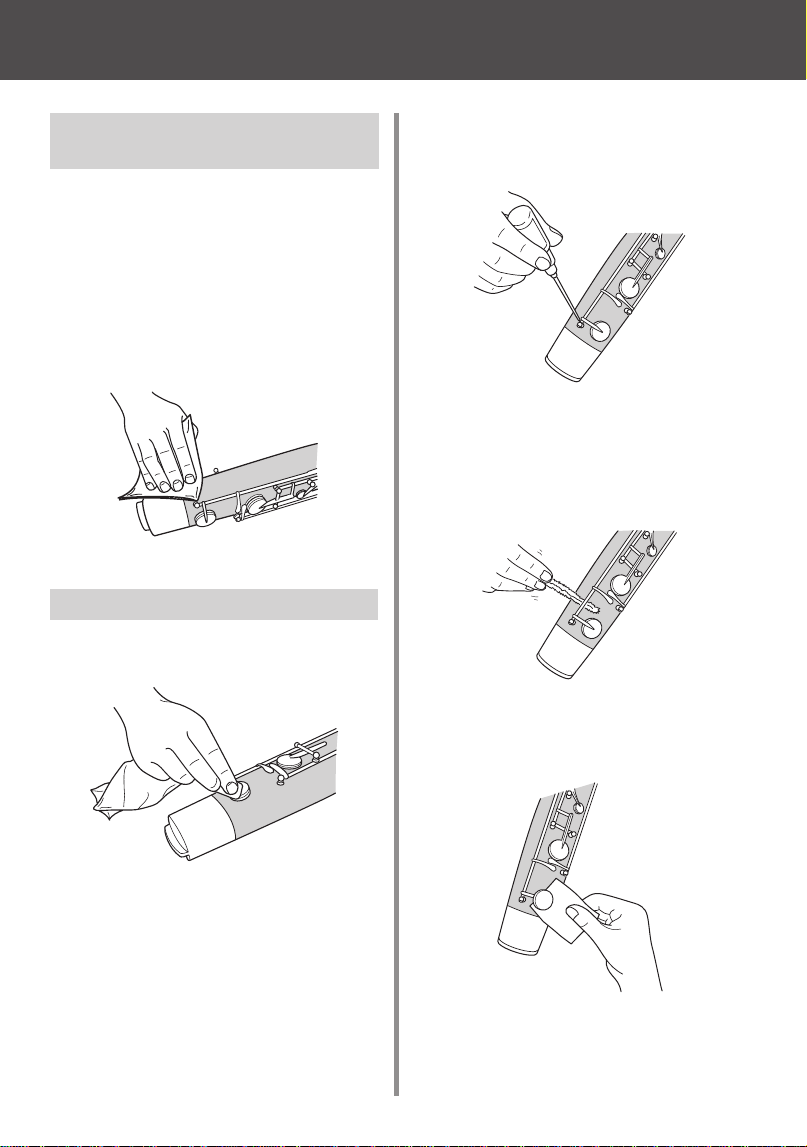
Key and Pad Maintenance
1.
Use a polishing cloth or silver cloth to
wipe the key surfaces.
2.
Apply a small amount of key oil be-
tween the key and key posts about
once a month.
* Wipe o any excess oil.
3.
Use a tone hole cleaner to remove the
dirt or dust that accumulates between
the keys and body.
4.
Use a cleaning swab to remove dirt
and moisture from the pads.
13
Maintenance
■
Pay Attention to the Fol-
lowing When Storing the
Instrument
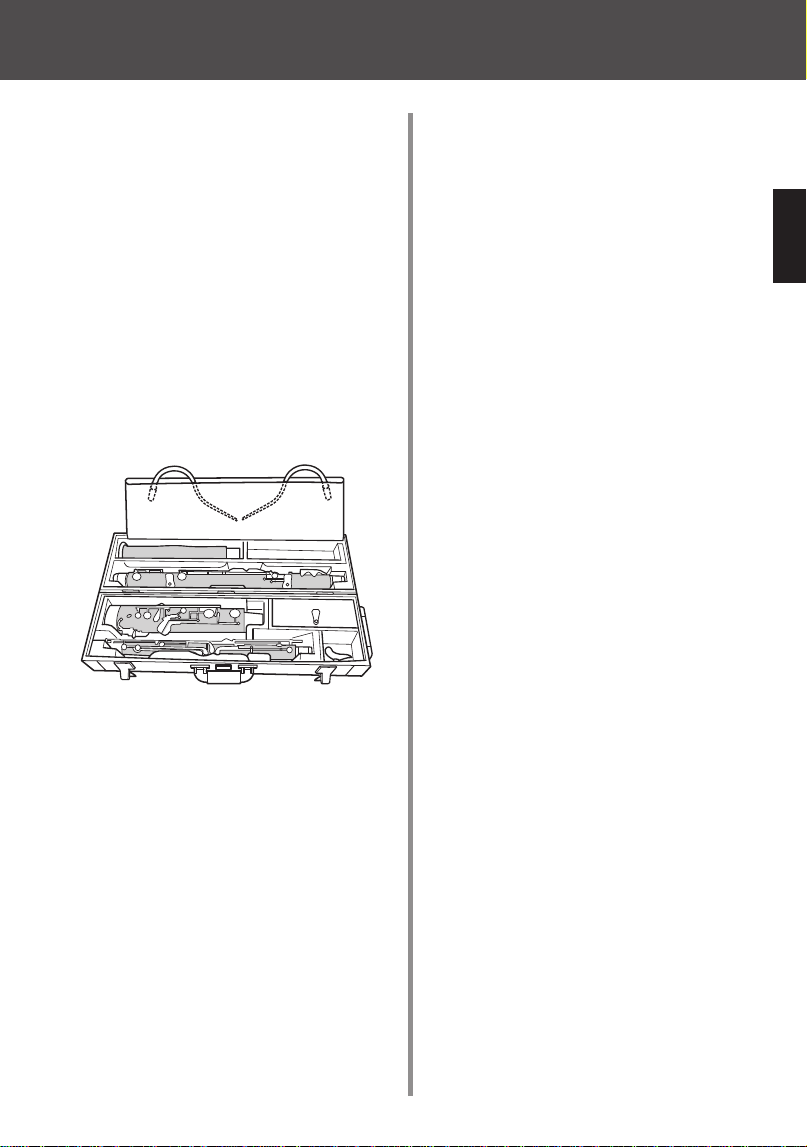
l
Never place an object on the case that
may apply pressure to the instru-
ment’s keys or body.
l
Never apply excessive force to the
instrument or case.
l
Make sure the instrument is stored in
its case when not in use.
l
Do not warm the instrument with air
from, or put the instrument close to a
heat source such as a heater, furnace
vent, etc.

14
The tone is not clear, or the in-
strument plays out of tune.
• If pads are deformed and air is leak-
ing from the instrument, take the
instrument to your dealer for repair.
➞
Never apply excessive pressure to
the keys. Also, when placing the
instrument in the case, make sure
that nothing is placed on top of the
instrument.
• If the body cracks, take the instru-
ment to your dealer for repair.
➞
Sudden changes in temperature or
humidity can cause cracking. Do not
directly expose the instrument to
hot or cold air.
The keys are sti. The keys do
not move.
• If a spring has become dislodged,
returning it to its proper position may
correct the problem.
➞
When hooking the spring in posi-
tion, be careful not to bend the
spring. Springs may become dis-
lodged when performing mainte-
nance on the instrument or when
wiping the instrument with a cloth.
Please use caution.
• If keys are bent, take the instrument
to your dealer for repair.
➞
Do not apply excessive force to
the instrument such as dropping
the instrument, closing the case
when an object is placed on top
of the instrument, etc. Also, when
you are nished playing, place the
instrument in the case. At this time,
make sure that there is nothing in
the case that will apply pressure
on the keys. When assembling the
instrument, be careful not to apply
unnecessary pressure to the keys.
Hold on to the instrument in the
intervals between performance and
during breaks between practice.
Troubleshooting
The joint is too tight or loose.
• If the joint becomes tight or loose,
please contact the store where you
purchased the product or a Yamaha
customer service center.
➞
The joints may shrink/expand
depending on humidity and tem-
perature, making them tight in the
summer and loose in the winter.
➞
After playing, be sure to store the
instrument in the case.
The keys are noisy.
• Apply key oil if the keys lack oil and
are dry, and tighten screws that have
become loose.
➞
Apply key oil once a month (1-2
drops per location) to prevent abra-
sion. Also, since woodwind instru-
ments have many small screws,
check for loose screws and tighten
if necessary.
• The cork or felt on the keys has fallen
o or torn. The instrument may have
received a shock causing the keys
to come in contact with the body
or other keys. In this case, take the
instrument to your dealer for repair.
➞
Take proper care of the instru-
ment to prevent the corks or felts
from falling o. After playing the
instrument keep the instrument
in its case. Also, hold on to the
instrument in the intervals between
performance and during breaks be-
tween practice to prevent excessive
pressure being placed on the instru-
ment or keys.

16
MEMO

© 2013 Yamaha Corporation
Published 09/2023
发行
IPCP-B0
VGU3250
〒430-8650 静岡県浜松中央区中沢町 10-1