USE + CARE
MANUAL
REV.022026
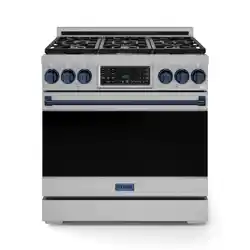
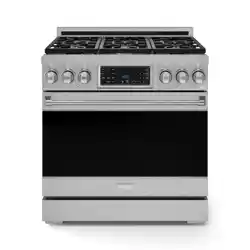
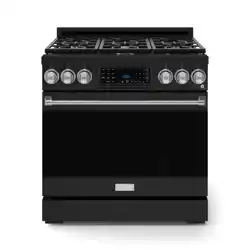
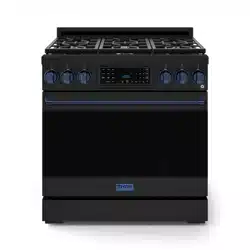
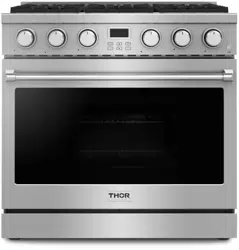
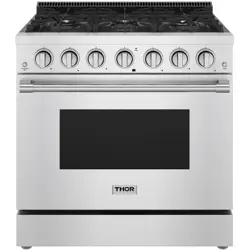
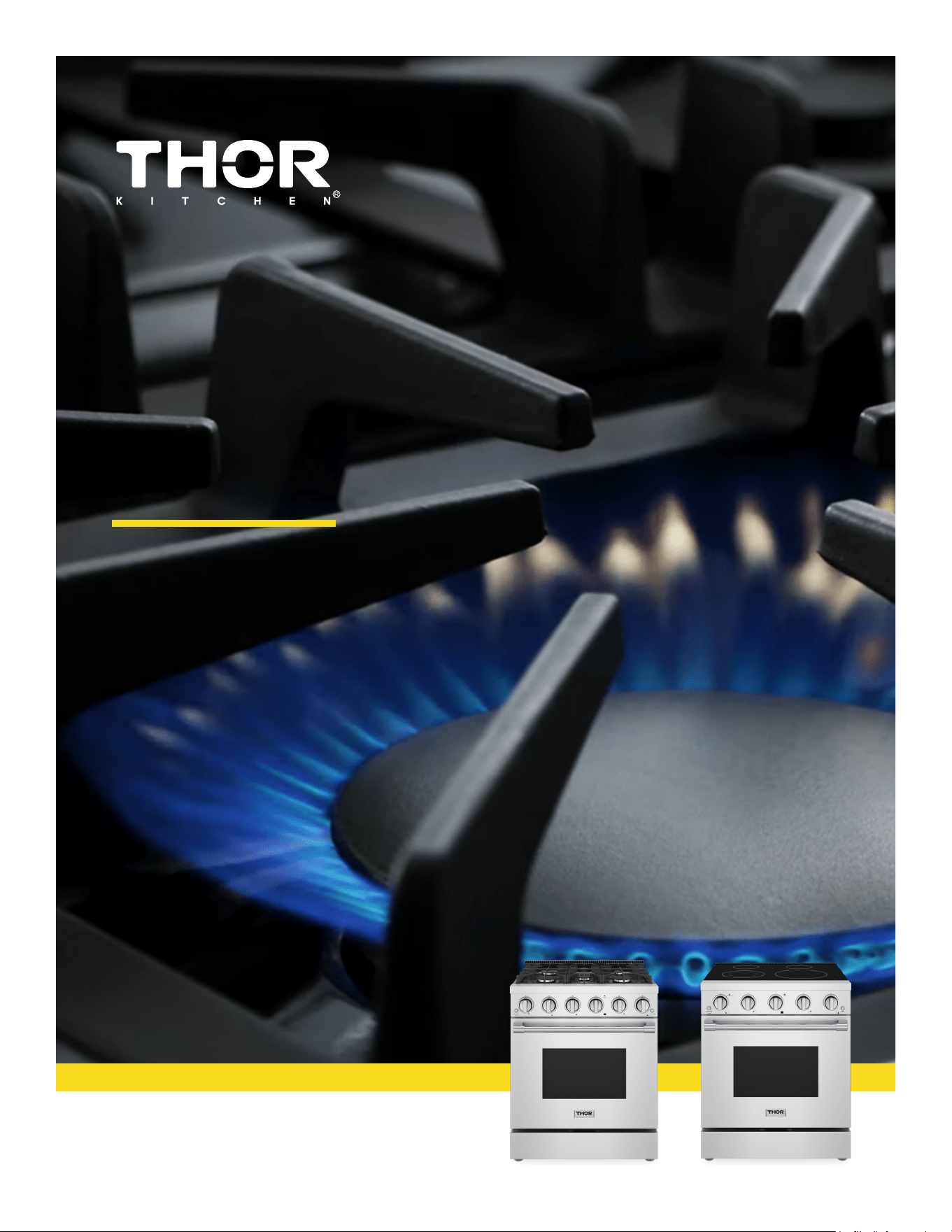
S SERIES PROFESSIONAL
GAS/ELECTRIC RANGE
SRG3001 | SRG3601
SRE3001 | SRE3601

USE & CARE MANUAL
S SERIES
PROFESSIONAL
GAS/ELECTRIC
RANGE
SRG3001/SRG3601
SRE3001/SRE3601

3
TABLE OF CONTENTS
IMPORTANT INSTRUCTION. . . . . . . . . . . . . . . . . . . . . . . . . . . . . . . . . . . . . . . . . . . . . . . . . . . . . . . . . . . . . . . . . . . . . . . . . . . . . . . . . . 4
1.1 Critical safety information. . . . . . . . . . . . . . . . . . . . . . . . . . . . . . . . . . . . . . . . . . . . . . . . . . . . . . . . . . . . . . . . . . . 4
1.2 Signal words explanation. . . . . . . . . . . . . . . . . . . . . . . . . . . . . . . . . . . . . . . . . . . . . . . . . . . . . . . . . . . . . . . . . . . . . . . . 5
1.3 Intended use. . . . . . . . . . . . . . . . . . . . . . . . . . . . . . . . . . . . . . . . . . . . . . . . . . . . . . . . . . . . . . . . . . . . . . . . . . . . .5
1.4 IMPORTANT INSTRUCTION. . . . . . . . . . . . . . . . . . . . . . . . . . . . . . . . . . . . . . . . . . . . . . . . . . . . . . . . . . . . . . . . . . . . . . 6
COOKTOP FUNCTIONS. . . . . . . . . . . . . . . . . . . . . . . . . . . . . . . . . . . . . . . . . . . . . . . . . . . . . . . . . . . . . . . . . . . 9
2.1 Safety guidelines (SRG3001/LP, SRG3601/LP only). . . . . . . . . . . . . . . . . . . . . . . . . . . . . . . . . . . . . . . . . . . . . . . . . . . 9
2.2 Safety guidelines (SRE3001,SRE3601only). . . . . . . . . . . . . . . . . . . . . . . . . . . . . . . . . . . . . . . . . . . . . . . . . . . 10
2.3 Usage Tips. . . . . . . . . . . . . . . . . . . . . . . . . . . . . . . . . . . . . . . . . . . . . . . . . . . . . . . . . . . . . . . . . . . 11
2.4 Matching knob to the burners. . . . . . . . . . . . . . . . . . . . . . . . . . . . . . . . . . . . . . . . . . . . . . . . . . . . . . . . . . . 11
2.5 Igniting a burner. . . . . . . . . . . . . . . . . . . . . . . . . . . . . . . . . . . . . . . . . . . . . . . . . . . . . . . . . . . . . . . . . 12
OVEN FUNCTIONS. . . . . . . . . . . . . . . . . . . . . . . . . . . . . . . . . . . . . . . . . . . . . . . . . . . . . . . . . 12
3.1 Safety guidelines. . . . . . . . . . . . . . . . . . . . . . . . . . . . . . . . . . . . . . . . . . . . . . . . . . . . . . . . . . . . . . . . . . . . 12
3.2 Using the accessories. . . . . . . . . . . . . . . . . . . . . . . . . . . . . . . . . . . . . . . . . . . . . . . . . . . . . . . . . . . . . . . . . . . . 14
3.3 Oven burner use. . . . . . . . . . . . . . . . . . . . . . . . . . . . . . . . . . . . . . . . . . . . . . . . . . . . . . . . . . . . . . . . . . . . 14
CLEANING. . . . . . . . . . . . . . . . . . . . . . . . . . . . . . . . . . . . . . . . . . . . . . . . . . . . . . . . . . . . . . . . . . . . . . . . . . 15
4.1 General cleaning. . . . . . . . . . . . . . . . . . . . . . . . . . . . . . . . . . . . . . . . . . . . . . . . . . . . . . . . . . . . . . . . . . . . . . . . . . . . . 15
4.2 Cooktop. . . . . . . . . . . . . . . . . . . . . . . . . . . . . . . . . . . . . . . . . . . . . . . . . . . . . . . . . . . . . . . . . . . . . . . . . . . . . . . . 16
4.3 Oven. . . . . . . . . . . . . . . . . . . . . . . . . . . . . . . . . . . . . . . . . . . . . . . . . . . . . . . . . . . . . . . . . . . . . . . . . . . . . . . . 18
4.4 Baking accessories. . . . . . . . . . . . . . . . . . . . . . . . . . . . . . . . . . . . . . . . . . . . . . . . . . . . . . . . . . . . . . . . . . . . . . . . . . . . 19
MAINTENANCE. . . . . . . . . . . . . . . . . . . . . . . . . . . . . . . . . . . . . . . . . . . . . . . . . . . . . . . . . . . . . . . . . . . . . . . . . . . . . 20
5.1 Maintenance guidelines. . . .. . . . . . . . . . . . . . . . . . . . . . . . . . . . . . . . . . . . . . . . . . . . . . . . . . . . . . . . . . . . . . . . . .20
5.2 Purchase replacement parts. . . . . . . . . . . . . . . . . . . . . . . . . . . . . . . . . . . . . . . . . . . . . . . . . . . . . . . . . . . . . . . . . . . . .20
5.3 Change the light bulb. . . . . . . . . . . . . . . . . . . . . . . . . . . . . . . . . . . . . . . . . . . . . . . . . . . . . . . . . . . . . . . . . . . . . . . . . 21
WARRANTY. . . . . . . . . . . . . . . . . . . . . . . . . . . . . . . . . . . . . . . . . . . . . . . . . . . . . . . . . . . . . . . . . . . . . . . . . . . . . . . . . 22
4
- Do not store or use gasoline or other flammable vapors and liquids in the
vicinity of this or any other appliance.
- WHAT TO DO IF YOU SMELL GAS:
•
Do not try to light any appliance.
•
Do not touch any electrical switch.
•
Do not use any phone in your building.
•
Immediately call your gas supplier from a neighbor.s phone. Follow the
gas supplier.s instructions.
•
If you cannot reach your gas supplier, call the fire department.
- Installation and service must be performed by a qualified installer,
service agency, or the gas supplier.
WARNING
Never Operate the Top Surface Cooking Section of this Appliance
Unattended.
•
Failure to follow this warning statement could result in fire,
explosion, or burn hazard that could cause property damage,
personal injury, or death.
•
If a fire should occur, keep away from the appliance and immediately
call your fire department.
DO NOT ATTEMPT TO EXTINGUISH AN OIL/GREASE FIRE WITH WATER.
WARNING
NEVER use this appliance as a space heater to heat or warm the room.
Doing so can result in carbon monoxide poisoning and overheating of
the oven.
WARNING: If the information in these instructions is not followed exactly,
a fire or explosion can result causing property damage, personal injury,
or death.
1.1 Critical safety information
IMPORTANT INSTRUCTION
5
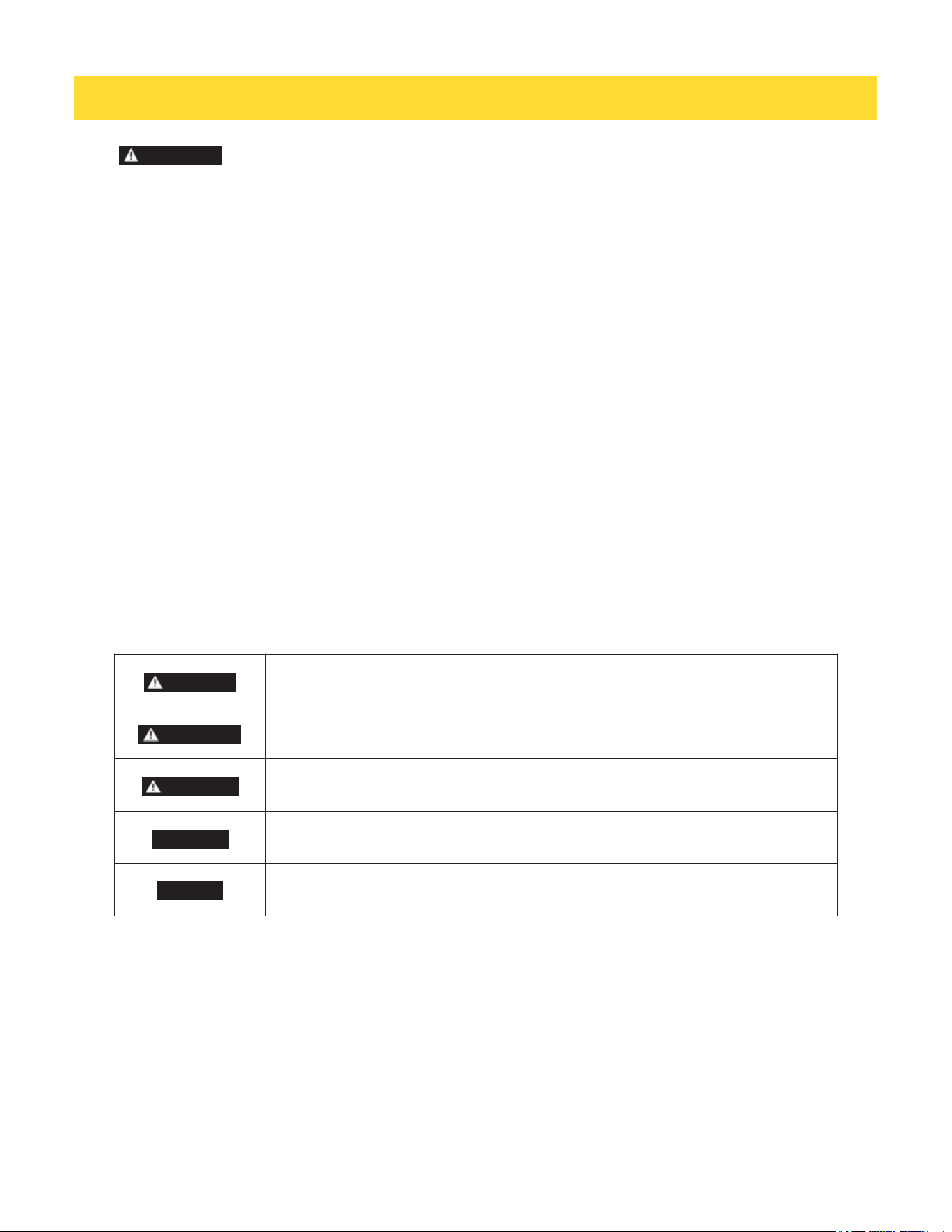
•
A child or adult can tip the appliance and be killed.
•
Install the anti-tip device to the wall/loor (see Installation instructions). Verify the anti-tip device has
been properly installed and engaged with the back of the appliance.
•
Engage the appliance to the anti-tip device by pushing that appliance all the way into the installation
location. Ensure the anti-tip device is re-engaged when the appliance is moved.
•
Re-engage the anti-tip device if the appliance is moved. Do not operate the appliance without the anti-
tip device in place and engaged.
•
See installation instructions for details.
•
Failure to do so can result in death or serious burns to children or adults.
To check the installation of the anti-tip device:
1.
R
emove any items on the cooktop (31).
2. Grasp the top rear edge of the appliance and carefully attempt to tilt it forward.
3. Verify that the anti-tip device is engaged.
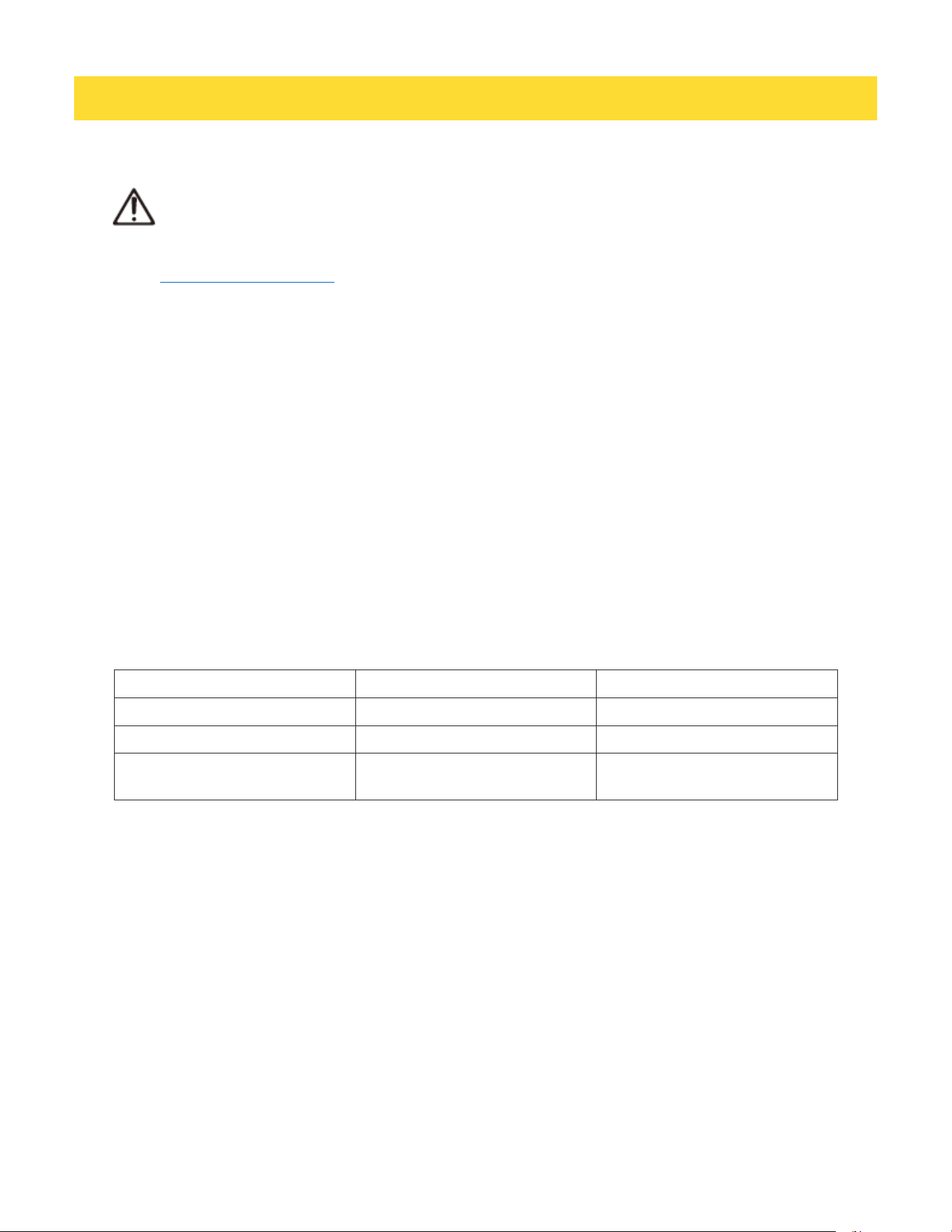
1.2 Signal words explanation
The following signal words are used in this manual
This signal word indicates a hazardous situation which, if not avoided, will result
in death or serious injury.
This signal word indicates a hazardous situation which, if not avoided, could
result in death or serious injury.
This signal word indicates a hazardous situation which, if not avoided, could
result in minor or moderate injury.
This signal word indicates a hazardous situation which, if not avoided, could
result in property damage.
NOTICE
This signal word is a preferred signal word to address tips and practices not
related to personal injury.
1.3 Intended use
•
This appliance is intended for cooking and preparing food.
•
This appliance is intended for household use only.
•
This appliance is intended to be used in dry indoor areas only.
•
Only use the appliance as mentioned in this manual. Any other use is considered improper and may
result in damage to property or injury to persons.
•
Potential injury from improper use.
•
The manufacturer or vendor cannot be held liable for damages or injury incurred through improper or
incorrect use.
WARNING
WARNING
CAUTION
DANGER
CAUTION
IMPORTANT INSTRUCTION

6
1.4 IMPORTANT INSTRUCTION
For all models
This user manual is part of this appliance, and contains important information on setup and use. Read
this manual carefully, especially the IMPORTANT INSTRUCTION chapter, before using the appliance.
Failure to do so may result in personal injury and/or damage to the appliance.
•
Keep this manual for future use and reference. Make sure to include this manual when passing the
appliance on to third parties. If you require a digital copy of this manual, please contact customer
service.
•
The appliance must be installed in accordance with local codes. In the absence of local codes, follow
ANSI Z223. 1/NFPA 54 standards in the U.S. or CSA B149. 1 in Canada.
•
It is recommended to electrically ground the appliance during installation in accordance with local
codes. If local codes are not available, follow NFPA 70 or CSA C22. 1 standards in Canada.
•
The ventilation area is located at the back of the appliance. The back of the appliance should not be in
direct contact with a wall/surface. Install the back spacers to the back of the appliance to maintain a
proper area for ventilation.
•
In the event of a power failure, do not attempt to use the appliance. If the power fails, always turn the
oven off. If the oven is not turned off and the power returns, the oven my begin to operate again. Food
left unattended could catch fire or spoil.
•
The maximum depth of cabinets installed above the cooktop (31) is 13" (33 cm).
•
Seal any openings in the wall behind the appliance and in the loor under the appliance.
•
If there is a cabinet above the appliance, install a noncombustible material on the bottom if that
cabinet in accordance with local codes. If local codes are not available, follow ANSI Z223. 1/NFPA 54 or,
CSA B149. 1. in Canada
•
Proper Installation - Be sure your appliance is properly installed and grounded by a qualified
technician.
•
Never Use Your Appliance for Warming or Heating the Room.
•
Do Not Leave Children Alone - Children should not be left alone or unattended in area where
appliance is in use. They should never be allowed to sit or stand on any part of the appliance.
•
Wear Proper Apparel - Loose-fitting or hanging garments should never be worn while using the
appliance.
•
User Servicing - Do not repair or replace any part of the appliance unless specifically recommended in
the manual. All other servicing should be referred to a qualified technician.
•
Storage in or on Appliance - Flammable materials should not be stored in an oven or near surface
units.
•
Do Not Use Water on Grease Fires - Smother fire or lame or use dry chemical or foam-type
extinguisher.
•
Use Only Dry Potholders - Moist or damp potholders on hot surfaces may result in burns from steam.
Do not let potholder touch hot heating elements. Do not use a towel or other bulk cloth.
•
Use Proper Pan Size - The appliance is equipped with one or more surface units of different size.
Select utensils having lat bottoms large enough to cover the surface unit heating element. The use
of undersized utensils will expose a portion of the heating element to direct contact and my result in
ignition of clothing. Proper relationship of utensil to burner will also improve efficiency.
IMPORTANT INSTRUCTION

7
•
Never Leave Surface Units Unattended at High Heat Settings - Boilover can cause smoke and greasy
spillovers that may ignite.
•
Protective Liners - Do not use aluminum foil to line the surface of cooktop drip pan or oven bottoms.
Improper installation of these liners may result in a risk of electric shock, fire or damage to the
porcelain surface.
•
Glazed Cooking Utensils - Only specific types of glass, glass-ceramic, ceramic, earthenware, or other
glazed utensils are suitable for use on the cooktop, as they may break from sudden temperature
changes.
•
Utensil Handles Should Be Turned Inward and Not Extend Over Adjacent Surface units - To reduce
the risk of burns, ignition of lammable materials, and spillage due to unintentional contact with the
utensil, the handle of a utensil should be positioned so that it is turned inward, and does not extend
over adjacent surface units.
•
Use Caution When Opening Door - Let hot air or steam escape before removing or replacing food.
•
Do Not Heat Unopened Food Containers - Build-up of pressure may cause container to burst and
result in injury.
•
Keep Oven Exhaust Vent Unobstructed.
•
Placement of Oven Racks - Always place oven racks in the desired position while the oven is cool. If
moving a rack while the oven is hot, ensure potholders do not touch the heating elements.
•
Do Not Clean Door Gasket - The door gasket is essentials for a good seal. Care should be taken not to
rub, damage, or move the gasket.
•
Do not use a protective coating to line the oven and do not use commercial oven cleaner unless
Certified for use in a self cleaning oven.
•
Clean only the parts as suggested in the manual.
•
Before Using the Self-Clean Function: Remove the broiler pan, oven racks, and any other utensils.
•
DO NOT TOUCH SURFACE UNITS OR AREAS NEAR SURFACES UNITS - Surface units may be hot
even though they are dark in color. Areas near surface units may become hot enough to cause burns.
During and after use, do not touch, or let clothing or other lammable materials contact surface units
or areas near units until they have had sufficient time to cool. Among these areas are the surrounding
areas of cook-top, drip-pan, burners and cooking grates.
•
DO NOT TOUCH INTERIOR SURFACES OF OVEN - Interior surfaces of an oven become hot enough to
cause burns. During and after use, do not touch, or let clothing or other lammable materials contact
the interior surfaces of oven until they have had sufficient time to cool. Other surface of the appliance
may become hot enough to cause burns - among these surface are oven vent openings and surfaces
near these openings, oven doors, and windows of oven doors.
CAUTION Risk of fire and damage! Do not leave food or cooking utensils, etc., in oven during the
pyrolytic self cleaning mode of operation. Remove all items from the oven prior to initiating
the cleaning cycle. Before initiating the cleaning cycle, wipe off all excessive spillage, food
residue or debris that could potentially ignite. Maintain a safe distance from the appliance
during the cleaning cycle and avoid placing any lammable items or materials near the
appliance.
CAUTION Risk of injury! Do not store items of interest to children in cabinets above a appliance or
on the backguard of a appliance - children climbing on the appliance to reach items could
be seriously injured.
IMPORTANT INSTRUCTION
8
WARNING
This appliance contains chemicals known to the State of California to cause cancer and/or
reproductive harm, and birth defects or other reproductive harm. For more information go to
www.
P65Warnings.ca.gov.
For gas appliances only (SRG3001/LP, SRG3601/LP)
•
Line Pressure Testing Above 1/2 psi (3.5kPa): The range and its individual shutoff valve must be
disconnected from the gas supply piping system during any pressure testing of that system at test
pressures in excess of 1/2 psi (3.5 kPa).
•
Line pressure testing equal or less than 1/2 psi (3.5 kPa): The range must be isolated from the gas
supply piping system by closing its individual manual shutoff valve during any pressure testing of the
gas supply piping system at test pressures equal to or less than 1/2 psi (3.5 kPa).
•
The appliance should not be installed with a ventilation system that blows air downward toward the
appliance. This type of ventilation system may cause ignition and combustion problems with the gas
cooking appliance resulting in personal injury or unintended operation.
•
Do not use an air curtain or other overhead appliance hood (equipment that operates by blowing a
downward airlow onto a appliance) in conjunction with a gas appliance unless the hood and appliance
have been designed and tested in accordance with ANSI Z21. 1 or CSA 1. 1, and designed and tested for
combination use.
•
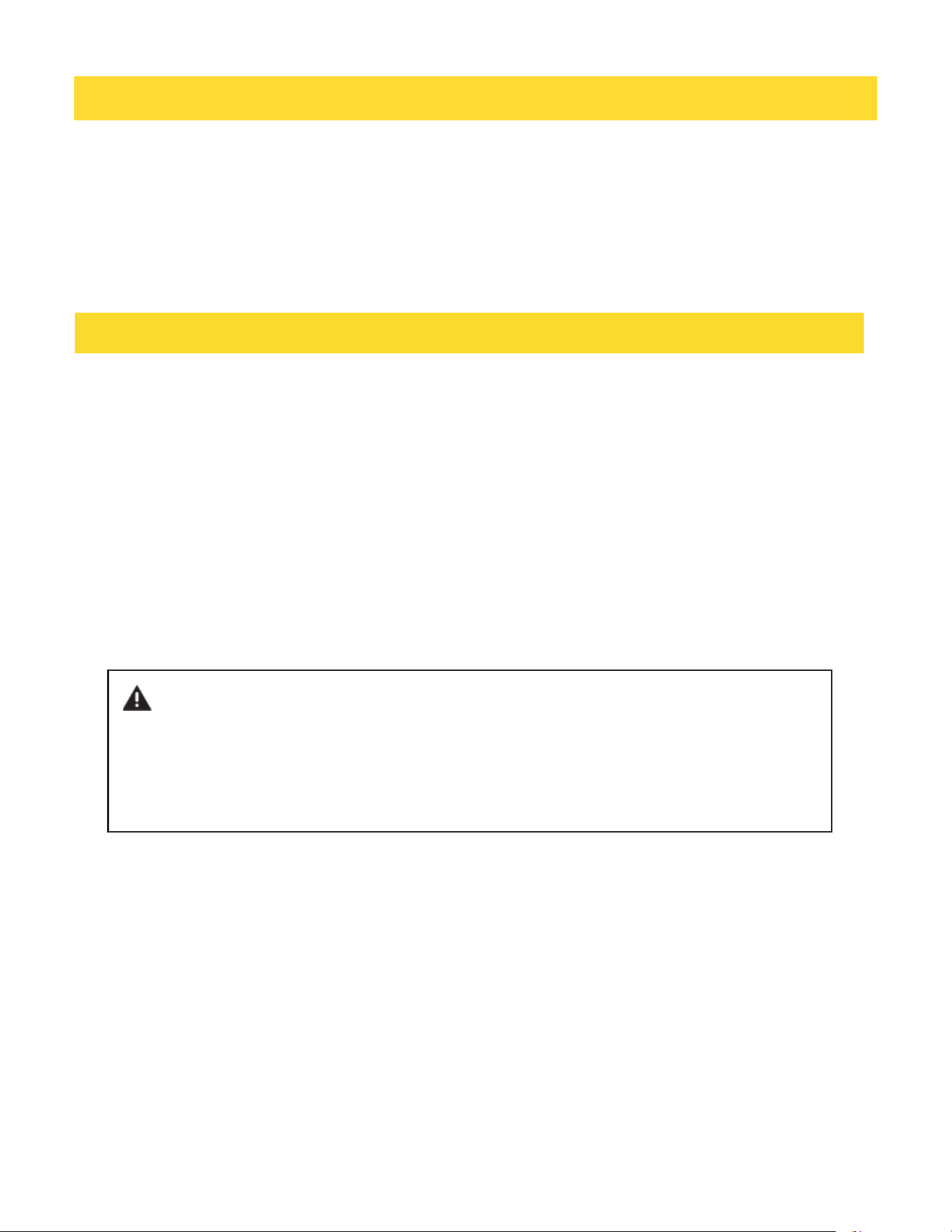
The maximum gas supply pressure, test pressure and the supplied pressure regulator setting of the
gas appliance supplied are as follows:
•
Leak testing of the appliance shall be conducted in accordance with these instructions (see
Installation instructions).
•
A manual shut-off valve has to be installed in an accessible location in the gas piping external to the
appliance for the purpose of turning on or shutting off the gas supply to the appliance.
COMMONWEALTH OF MASSACHUSETTS
•
Installations and repairs must be performed by a qualified or licensed contractor, plumber, or gas
fitter, qualified or licensed by the state, province, or region where this appliance is being installed.
•
Use only gas shut-off valves approved for use within the state, province, or region where this
appliance is being installed.
•
A lexible gas connector, when used, must not exceed 3' (0.9 m).
For electrical appliances only (SRE3001,SRE3601)
•
Do Not Cook on a Broken Cooktop - If the cooktop is broken, cleaning solutions and spillovers may
seep through the cracks, posing a risk of electric shock. Contact a qualified technician immediately.
LP (Liquid Propane) in wc
NG (Natural gas) in wc
Maximum gas supply pressure
13.0
10.0
Test pressure
≥11.0 ≥6.0
Appliance pressure regulator
setting for outlet pressure
10.0 5.0
IMPORTANT INSTRUCTION
9
•
Clean Cook-Top With Caution. Do Not clean cooktop when it's hot. - If a wet sponge or cloth is used to
wipe spills on a hot cooking area, be careful to avoid steam burn. Some cleaners can produce noxious
fumes if applied to a hot surface.
COOKTOP FUNCTIONS
2.1 Safety guidelines (SRG3001/LP, SRG3601/LP only)
Before cooking
•
Ensure all burner parts are properly assembled to avoid dangerous lames.
•
The burner lame size should be adjusted so it does not extend beyond the edge of the cooking utensil.
This instruction is based on safety considerations.
•
Keep lammable items away from the cooktop.
•
If the burner fails to ignite within 4 seconds, turn the knob to Off and wait for 5 minutes to allow gas to
dissipate before attempting to relight.
•
Do not operate the appliance during a power outage.
During cooking
WARNING
NEVER cover any slots, holes, or passages in the oven bottom or cover
an entire rack with materials such as aluminum foil. Doing so blocks
airflow through the oven and can cause carbon monoxide poisoning.
Aluminum foil linings can also trap heat, causing a fire hazard.
IMPORTANT INSTRUCTION

10
•
Never leave the cooktop unattended when in use to prevent smoking and igniting greasy spills.
•
Do not disassemble or clean around a burner while another burner is on. Avoid touching burner caps or
bases when igniters are sparking.
•
Ensure lames do not extend beyond cookware or curl up on the sides to prevent damage,
discoloration, and burns.
•
Use the low setting on dual burners for gentle simmering, melting chocolate and butter, cooking rice and
delicate sauces, simmering soups and stews, and keeping food hot.
•
Keep handles away from the edge of the appliance or on a burner that is on.
•
Be cautious when deep-frying as oil or fat can quickly overheat, especially on a high setting.
After cooking
•
The burners can be easily removed and are not sealed to the cooktop.
•
Clean the burners after each use and especially after spills or boil overs.
•
Promptly wipe up acidic or sugary spills to prevent discoloration or staining.
•
Clean affected burners before using them again to prevent clogging of the igniter and lame spreader,
which can affect burner functionality.
2.2 Safety guidelines (SRE3001,SRE3601only)
Before cooking
•
Do not use the glass cooktop surface as a cutting board.
•
Do not place or store items that can melt or catch fire on the glass cooktop, even when it is not in use.
•
Only turn on the surface units after placing cookware on them.
•
Avoid storing heavy items above the cooktop surface to prevent damage from falls.
During cooking
WARNING Risk of electric shock! Do not cook on broken cooktop - if the cooktop breaks, cleaning
solutions and spillovers can penetrate the broken cooktop and create a risk of electric shock.
Contact a qualified technician immediately.
•
Avoid placing aluminum foil or plastic items on the appliance when it is in use, as the hot air from the vent
could cause melting or ignite lammable materials.
•
Ensure the correct surface unit of the appliance is turned on.
•
Never cook directly on the glass surface of the appliance; always use cookware.
•
Always place the pan in the center of the surface unit being used for cooking on the appliance.
•
Do not leave surface units of the appliance unattended while using high heat settings, as boilovers can
cause smoking and greasy spillovers that may catch fire.
•
Remember to turn off the surface units of the appliance before removing cookware.
•
Avoid using plastic wrap to cover food on the appliance, as it may melt onto the surface and be difficult to
remove.
COOKTOP FUNCTIONS

11
•
Clean the burners after each use and especially after spills or boil overs.
2.3 Usage Tips
For SRG3001/LP, SRG3601/LP only
•
For the best simmer results, use a smaller lame. Small lames are ideal for precise cooking of
delicate foods, keeping food warm, melting chocolate or butter, and slow cooking over low heat. The
highest lame setting on the appliance provides maximum heat and should be used for heavy cooking
loads like boiling water or cooking pasta.
•
When selecting the lame size, observe the lame as the knob is turned. Any lame larger than th
e
bottom of the cookware is unnecessary. The lame should be steady and blue. Note that foreign
material in the gas line may cause an appliance lame during initial operation.
For SRE3001,SRE3601 only
•
Cooking areas on the glass cooktop are identified by permanent rings on the surface. Match the pan
s
ize to the cooking area for optimal efficiency. Pans should not extend more than 0.5 to 1" (1.3 to 2.5
cm) beyond the cooking area.
•
When a burner is turned on, a glow is visible through the glass surface. The cooking area cycles on
and off to maintain the preset heat setting, even at high settings. The temperature in the cooking area
gradually and evenly increases. As the temperature rises, the broil element (48) glows red and cycles
on and off to maintain the selected setting.
•
The broil element retains enough heat to provide uniform and consistent heat during the off
cycle. For efficient cooking, turn off the element several minutes before cooking is complete to allow
residual heat to finish the process.
•
The cooking area has a limiter that cycles it on and off, even at the highest setting, to prevent damage
to the glass cooktop. This cycling is normal and occurs if the cookware is too small or if the
bottom of the cookware is not lat.
2.4 Matching knob to the burners
There are markings located on the control panel to show which knob corresponds to which burner on
the cooktop.
CAUTION Risk of steam burns and noxious fumes! Clean cooktop with caution - if a wet sponge or
cloth is used to wipe spills on a hot cooking area, be careful to avoid steam burns. Some
cleaners can produce noxious fumes if applied to a hot surface.
After cooking
COOKTOP FUNCTIONS

12
3.1 Safety guidelines
Oven door
WARNING Risk of injury and damage! Do not step, lean or sit on the oven door.
•
Excessive weight or force applied to the oven door (33) can damage the hinges, or other components,
leading to malfunction or potential instability.
•
Regular misuse of the oven door (33) can cause misalignment, operational issues, or malfunctions,
compromising the functionality of the appliance.
2.5 Igniting a burner
For SRG3001/LP, SRG3601/LP only
1. Simultaneously push in and turn a knob to the Ignite position. A clicking sound is heard, the burner
ignites.
2. After the burner ignites, rotate the knob to the desired heat setting.
3. After use, return the knob to the Off position.
For SRE3001,SRE3601 only
1. Push the knob in.
2. For the back burners, rotate the knob to the desired heat setting.
3. For the front burners, rotate the knob to the left side for single burner setting or the right side for
dual burner setting.
4. After use, return the knob to the OFF position.
NOTICE After the burners are switched on, the Burner On indicator lights up to show that the
burners are hot.
COOKTOP FUNCTIONS
OVEN FUNCTIONS

13
Oven
WARNING Risk of fire, gas leaks, food contamination and damage! Do not use the oven as storage
space.
•
Placing lammable items like paper, plastic, or cloth inside the oven can increase the risk of fire if the
oven is accidentally turned on.
•
Items stored inside the oven can be damaged or melted if the oven is turned on by mistake or if
residual heat is present.
•
Storing items in a gas oven can obstruct the ventilation and increase the risk of a gas leak, leading to
potential explosions or carbon monoxide poisoning.
•
Using the oven for storage can lead to the accumulation of dust, dirt, or pests, which can contaminate
food when the oven is used for cooking.
•
Placing items in the oven can increase the likelihood of accidentally turning on the oven while
forgetting about the stored items.
•
Do not hang any articles (e.g. dish towels) on the oven handle. Some fabrics may ignite or melt from
the heat.
CAUTION Risk of burns! When opening the oven door, do not stand directly at its opening. Hot air or
steam can escape when opening the oven door.
•
Do not block the rear ducts of the appliance during oven use.
•
Avoid touching the vent opening or nearby surfaces during operation as they are hot.
•
Do not place plastics, paper, or other items that can melt or burn near the oven vent.
•
Use all oven functions with the door closed.
•
Do not use aluminum foil to cover oven shelves or line the oven loor to prevent heat damage and
potential fire.
•
Do not use plastic wrap or wax paper in the oven.
•
For food safety, do not leave food in the oven for longer than 2 hours before and after cooking or
defrosting, especially in warmer weather. Do not hold foods at temperatures between 40°F to 140°F
for more than 2 hours.
OVEN FUNCTIONS
14
3.2 Using the accessories
Oven racks
CAUTION Risk of burns! The oven racks can be hot after use. Wait for the oven racks to cool down or
use kitchen mitts when inserting/removing them from the oven cavity.
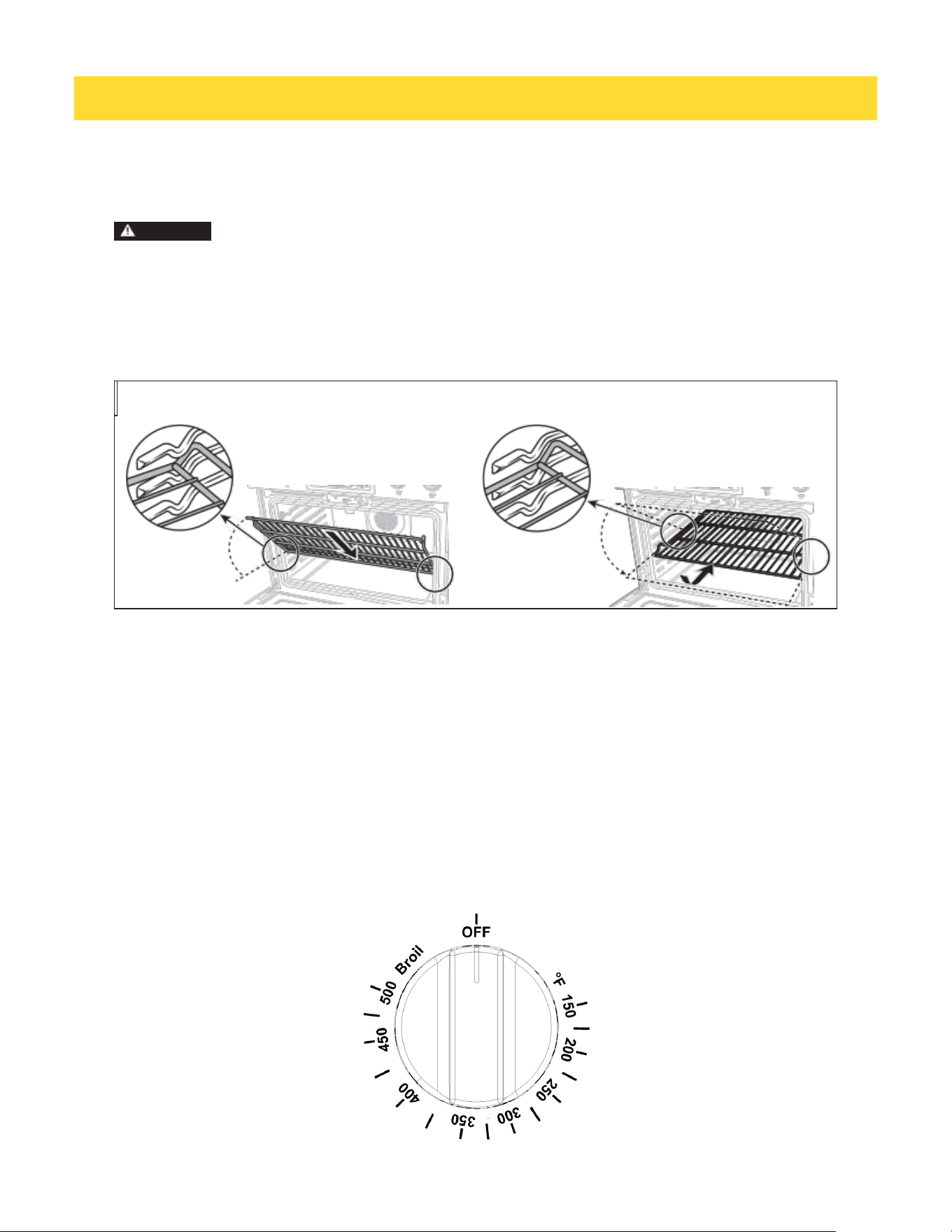
•
To insert an oven rack, place the end of it on the desired rack position. Tilt the oven rack forwards then
push inwards.
•
To remove an oven rack, pull it out until it stops. Lift the oven rack upwards and pull it out.
3.3 Oven burner use
•
To light the oven burner, push and turn the appropriate control knob counter clockwise to the (150℉~500℉)
p
osition. You will hear a clicking noise – the sound of the electric spark igniting the burner. Once burner ignition
has been achieved, then turn the burner control knob to adjust the desired heat setting.
•
To light the broiler burner, push and turn the appropriate control knob clockwise to the broil position. You
w
ill hear a clicking noise – the sound of the electric spark igniting the burner. Keep pressing about 4 seconds
until the burner ignition has been achieved.
OVEN FUNCTIONS

15
•
Do not let cooking grease or other lammable materials accumulate on the surfaces or near the
appliance.
•
Never use corrosive detergents, wire brushes, abrasive scourers, metal or sharp utensils to clean the
appliance
•
Check that all controls are off and all surfaces are cool before cleaning any part of the appliance.
• If
the appliance is moved for servicing, check that the anti-tip device is re-engaged properly when the
appliance is replaced.
For gas appliances only (SRG3001/LP, SRG3601/LP), never spray aerosol cleaner on or around the
appliance while the burners are lit. Be sure all functions are switched off and the appliance is cool. The
aerosol gas and chemicals in these cleaners could, in the presence of heat, ignite or cause
metal parts to corrode.
Painted parts and decorative trim
•
For general cleaning, use a cloth with hot, soapy water. Wipe dry.
•
For more difficult residue and built-up grease, apply a liquid detergent directly onto the area and
leave for 30 to 60 minutes. Wipe with a damp cloth and dry. Do not use abrasive cleaners on any oven
surface to prevent scratching.
Stainless steel surfaces
CAUTION Risk of damage! Do not use a steel-wool pad to clean the surfaces. It may scratch the
surfaces.
CAUTION Risk of steam burns and noxious fumes! Clean cooktop with caution - if a wet sponge or
cloth us used to wipe spills on a hot cooking area, be careful to avoid steam burns.
Some cleaners can produce noxious fumes if applied to a hot surface.
4.1 General cleaning
CLEANING

16
NOTICE If a mineral oil-base stainless steel appliance cleaner has been used before to clean the
appliance, wash the surface with liquid detergent and water prior to using the stainless steel
appliance cleaner/polish.
1. Use stainless steel appliance cleaner/polish.
2. Place a small amount of cleaner/polish on a damp cloth or paper towel.
3. Clean in small areas, rubbing with the grain of the stainless steel.
4.
D
ry and buff with a clean, dry paper towel or soft cloth.
5
. Re
peat as necessary.
4.2 Cooktop
Burner cap, burner head, dual burner cap with lame spreader, dual burner simmer
ring, dual burner lower lame spreader (SRG3001,SRG3601only)
1. Ensure the burners are turned off and cooled.
2. Take off all the removable burner parts.
3. Wash them in hot soapy water, rinse, and dry.
4. Clear the notches of the burner heads, dual burner cap with lame spreader, dual burner
simmer ring and dual burner lower lame spreader with a stiff nylon brush or straight-ended paper
clip.
5. Dry all removable burner parts completely.
6.
R
eplace all the removable burner parts before using the cooktop.
Electrical cooktop (SRE3001,SRE3601only)
The cooktop surface is porcelain-enamel. Acidic foods (tomatoes, sauerkraut, fruit juices) and high-
sugar foods can cause dull spots if left to set.
Surface care
•
Wipe spills immediately to prevent dulling.
•
Avoid steel wool or abrasive cleaners on stainless steel.
•
Check pan bottoms for roughness to avoid scratches.
Normal daily use cleaning
Use only a ceramic cooktop cleaner for effective maintenance. Clean the cooktop with a ceramic
cleaner before first use to protect and ease future cleanups.
1. Shake ceramic cooktop cleaner.
2. Apply cleaner directly on the cooktop.
3. Clean with a paper towel or ceramic cleaning pad.
4. Wipe with a dry cloth or paper towel to remove residue.
CLEANING

17
Cleaning sugary spills and melted plastics
Sugary spillovers (jellies, fudge, candy, syrups) or melted plastics can cause pitting on the cooktop
surface, which is not covered under warranty. A new, sharp razor blade scraper is essential to avoid
further damage.
1. Switch off surface burners and remove hot pans.
2. Wearing an oven mitt, use a sharp single-edge razor scraper to move the spill to a cool area. Remove
with paper towels.
3. Wait for the cooktop to cool, then remove remaining spillover. Do not use burners until all residue is
removed.
Removing burned-on residue
1.
E
nsure burners are off and cooktop is cool.
2. Apply ceramic cooktop cleaner on the residue area.
3
. Ru
b with a ceramic cooktop cleaning pad, applying pressure as needed.
4.
R
epeat if residue remains.
5.
P
olish with ceramic cooktop cleaner and a paper towel.
Removing heavy burned-on residue
1.
E
nsure burners are off and cooktop is cool.
2. Use a single-edge razor scraper at a 45° angle to scrape the residue.
3. Apply ceramic cooktop cleaner on the residue area and clean with a pad.
4.
P
olish with ceramic cooktop cleaner and a paper towel.
Cleaning the cooktop seal
Lay a wet cloth on the seal, then wipe clean with a nonabrasive cleaner.
Control panel and door handle
•
Clean with a solution of mild detergent and warm water.
•
Do not use abrasive cleaners or scrubbers to avoid permanent damage to the finish.
•
Dry parts with a soft, lint-free cloth.
.
CLEANING

18
4.3 Oven
Oven door
•
Clean the top, sides, and front of the oven door with soap and water. Rinse well.
•
Use a oven window cleaner on the outside glass of the oven door .
•
Use mild detergent and warm water on the inside glass of the oven door. Dry with a soft, lint-free
cloth.
•
Do not immerse the oven door in water.
•
Do not spray or allow water or glass cleaner to enter the door vents. Door vents are located at the
small gap above the oven cavity , close to the oven door lock and the oven door sensor.
•
Do not use oven cleaners, cleaning powders, or harsh abrasives on the outside of the oven door.
•
Do not clean or damage the oven door gasket around the oven cavity, as it is essential for a good seal.
Oven shelves
1. Scrub stubborn or baked-on soiling with a dampened, soap-filled, nonmetal, non-abrasive pad. Then
wipe dry.
2. Apply a food grade chrome cleaner with a damp sponge or cloth. Then wipe dry.
Porcelain surfaces
1. Clean the oven interior and inner door liners with a solution of mild detergent and warm water.
2. Rinse and dry with a soft, lint-free cloth.
CLEANING

19
Oven door gasket
The oven door gasket is located around the oven cavity. Do not clean this part. Handle the gasket with
care to avoid rubbing, damaging or displacing it. If large food particles need to be removed, proceed as
follows:
1. Dampen a sponge with hot water.
2. Gently wipe off the soiling without rubbing.
3. Press a dry towel gently on the oven door gasket to dry.
Oven and broiler burners
Do not clean these parts. They self clean during normal use.
4.4 Baking accessories
Oven racks
CAUTION Risk of damage! Do not clean the oven racks with a dishwasher.
•
Leaving oven racks in the oven during a self cleaning cycle may turn them slightly blue and dull the
finish. After the self cleaning cycle and once the oven has cooled, rub the sides of the oven racks with
wax paper or a cloth with a small amount of oil to help them glide more easily.
•
Clean oven racks by hand with an abrasive cleaner or steel wool.
•
If oven racks become hard to remove or replace, lightly wipe the oven rack guides with cooking oil, but
do not apply oil to the sides.
•
If oven racks are difficult to slide, lubricate them with a graphite lubricant.
CLEANING
20
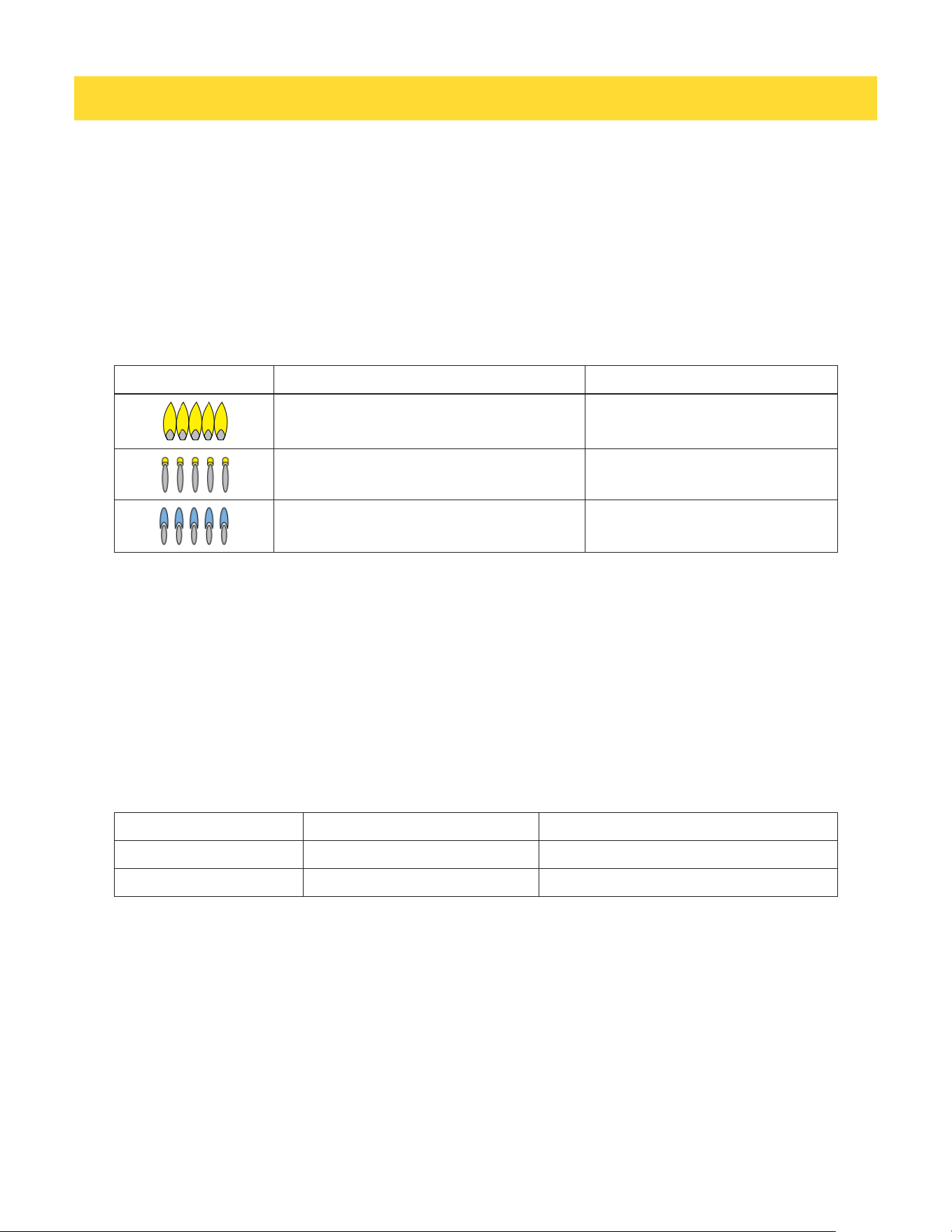
Flame appearance
Description
Verdict
Yellow lames
Call for service to adjust the lame
Yellow tips on the outer cones
Normal for LP
Soft blue lames Normal for NG
5.1 Maintenance guidelines
•
Keep the appliance area clear and free from combustible materials (e.g. wall coverings, curtains, drapes),
gasoline, and other lammable vapors and liquids.
•
Switch off the power to the appliance at the main fuse or circuit breaker. If in doubt, contact an electrician.
•
Do not obstruct the low of combustion and ventilation air.
•
For gas models (RSG30/LP, RSG36/LP, RSG30B/LP, RSG36B/LP only) visually check the burner lames for
any abnormalities:
Contact
Phone number Email
Thor's parts department
877-288-8099 (option 5)
parts@thorinternational.com
Customer service
877-288-8099 (option 3)
service@thorinternational.com
MAINTENANCE
•
If the appliance is moved for servicing, check that the anti-tip device (4) is re-engaged properly when
the appliance is replaced.
•
Always unplug/disconnect the appliance from the electrical supply before servicing.
•
Any other servicing than mentioned in this manual should be performed by a professional repair
center.
5.2 Purchase replacement parts
For purchasing replacement parts, ensure compatibility by referencing the appliance model number and
serial number contact Thor by:
21
C
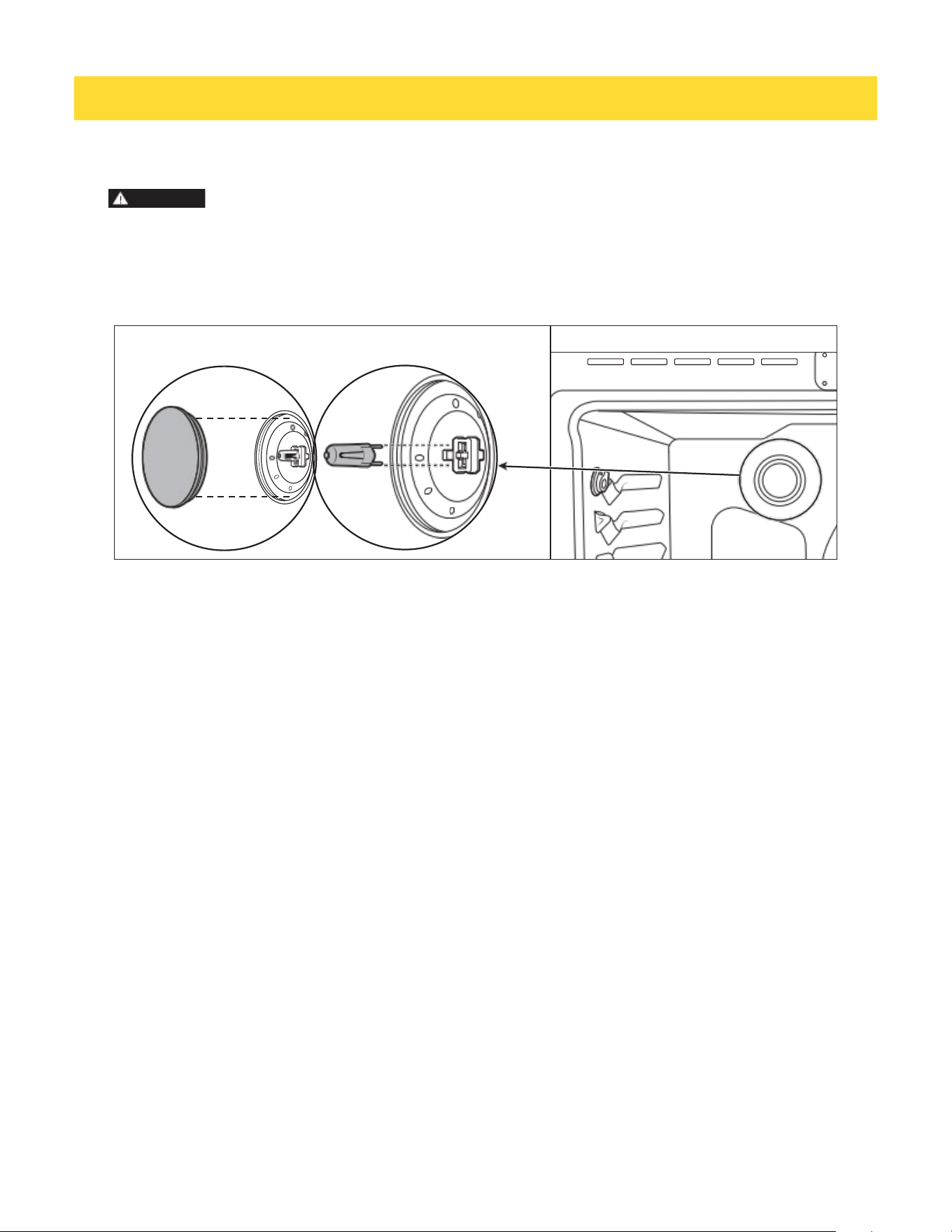
1. Unplug the appliance or disconnect power.
2. Rotate the light cover in the back of the oven counterclockwise to remove.
3. Pull out the light bulb to remove it from its socket.
4. Insert the new light bulb.
5. Insert the light cover and rotate it clockwise.
6. Plug in the appliance or reconnect the power.
CAUTION Risk of burns! The oven and the light can be hot from use. Let the oven and the light fully
cool down before proceeding.
The light bulb is a G9 120 V~ 40 W appliance bulb.
5.3 Change the light bulb
MAINTENANCE

22
WARRANTY
War ranty&Service
This appliance has been manufactured by Thor International, 10830 Ada Ave, Montclair, CA 91762
For Customer Service, please call (877) 288 - 8099
For the most up to date warranty and service policy, please refer to our website
WWW.THORKITCHEN.COM/WARRANTY-REGISTRATION
For in-warranty service requests, please visit our website at
WWW.THORKITCHEN.COM/SERVICE
Please No te: You must provide proof of purchase or installation date for any in-warranty service requests
Warranty Registration
Made Easy.
We Stand Behind
the Quality of Our
Appliances.
Reliability and customer satisfaction are our top priorities. We offer a
solid two-year warranty on both parts and labor. Enjoy professional-grade
performance with the condence that we’ve got you covered.
01
02
03
Scan the QR Code or visit thorkitchen.
com/register-your-product.
Input your purchase and product
information and select register.
That’s it. You’re all set.
Enjoy!
WARRANTY
PARTS
Questions: [email protected]