7083 174-01
EN
FK 2640
FK 3640
FK 4140
FK 5440
FKv 2640
FKv 3640
FKv 4140
FKv 5440
GKvesf 4145
GKvesf 5445
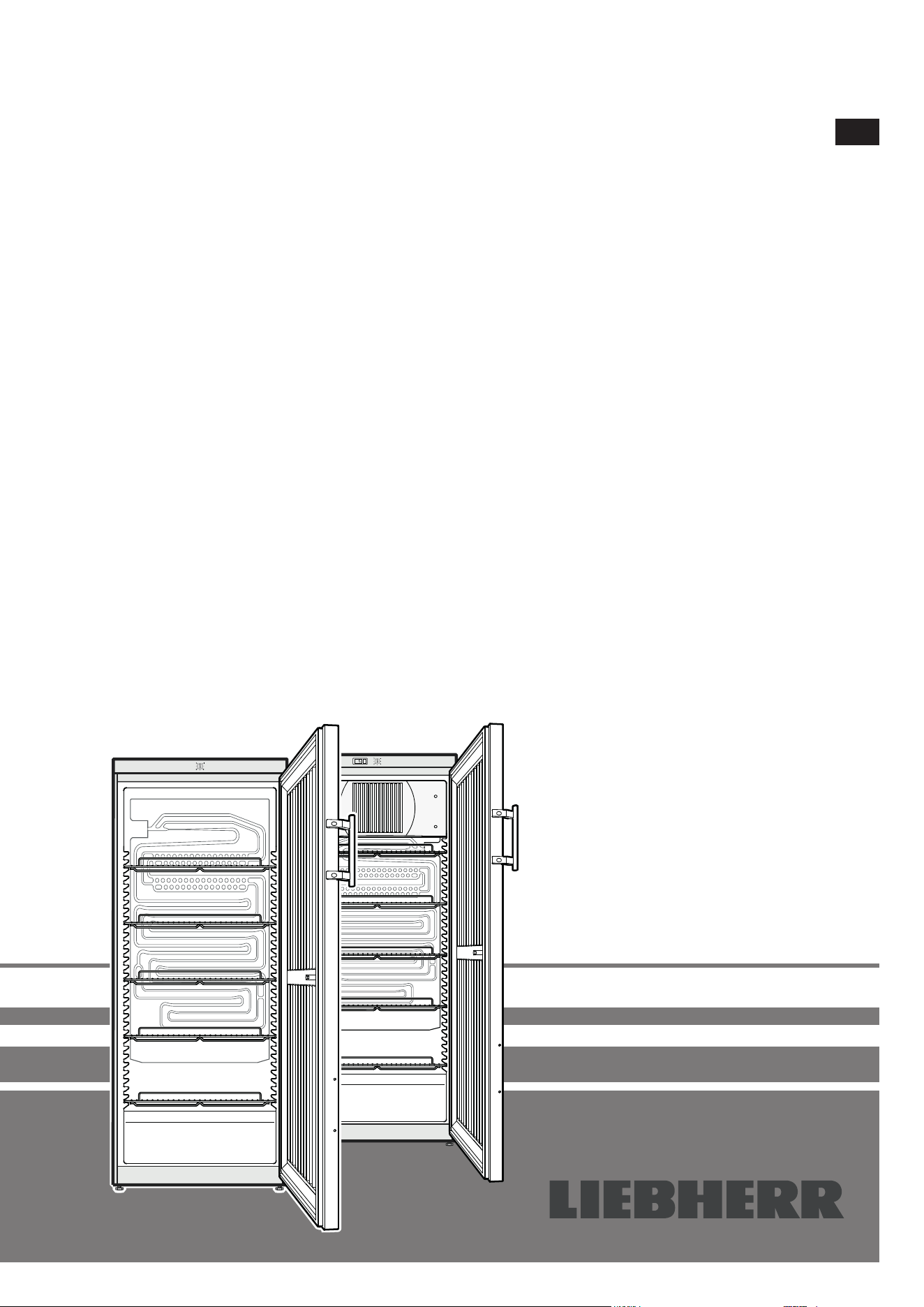
Original operating instructions Page 10
Beverage cooler
Read the operating instructions before switching on for the rst time
10
Content
Priority of warnings .................................................................10
EPREL database .................................................................... 10
Safety instructions and warnings ...........................................10
Symbols on the appliance ...................................................... 11
Intended use ........................................................................... 11
Foreseeable incorrect use...................................................... 11
Declaration of conformity ....................................................... 11
Noise emissions from the appliance ...................................... 11
Climate class .......................................................................... 12
Description of the appliance ...................................................12
Levelling the appliance ........................................................... 13
Setting up ............................................................................... 13
Electrical connection ..............................................................13
Appliance dimensions (mm) ...................................................13
Switching the appliance on and o ........................................ 13
Setting the temperature ..........................................................13
Temperature display ............................................................... 13
Cooling ................................................................................... 13
Safety lock .............................................................................. 14
Defrosting ...............................................................................14
Cleaning .................................................................................14
Malfunctions ...........................................................................14
Shutting your appliance down ................................................ 14
Disposal notes ........................................................................ 14
Additional information:............................................................15
Changing over door hinges ....................................................15
Priority of warnings
DANGER
identies a situation involving direct
danger which, if not obviated, may result
in death or severe bodily injury.
WARNING
identies a dangerous situation which,
if not obviated, may result in death or
severe bodily injury.
CAUTION
identies a dangerous situation which,
if not obviated, may result in minor or
medium bodily injury.
NOTICE
identies a dangerous situation
which, if not obviated, may result in
damage to property.
Note
identies useful information and tips.
Safety instructions and warnings
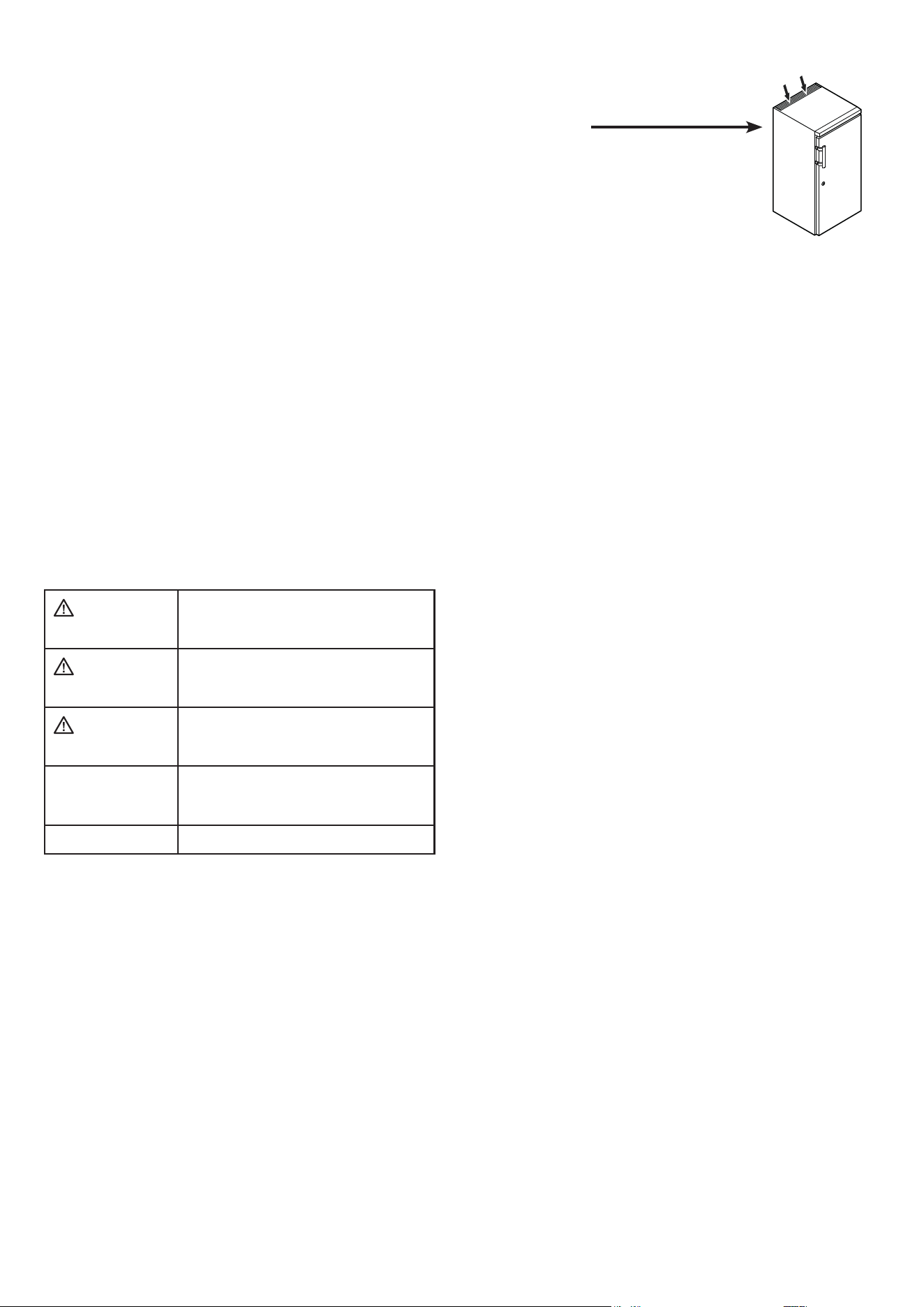
- WARNING: do not seal ventilation
openings on the appliance housing
or enclosure.
- WARNING: only use the mechanical
devices or other aids recommended
by the manufacturer to help speed
up the defrosting process.
- WARNING: do not damage the refrigerant circuit.
- WARNING: do not use any electrical devices in the
refrigerator compartment which do not comply with
the design recommended by the manufacturer.
- WARNING: the mains cable must not be dam-
aged while installing the appliance.
- WARNING: multi-sockets or distributor strips
and other electronic devices (such as halogen
transformers) must not be positioned and oper-
ated at the rear of appliances.
- WARNING: this appliance must be secured as
described in the operating instructions to rule
out any potential risks due to its instability.
- This appliance can be used by children of 8 years
old and over, and also by persons with restricted
physical, sensory or mental capacity or lack of
experience and knowledge, if they are supervised
or have been instructed on safe use of the appli-
ance and understand the resulting risks. Children
must not be allowed to play with the appliance.
Cleaning and user maintenance must not be
carried out by children without supervision.
- Do not store any explosive substances, such as
aerosol containers with flammable propellant
gas, inside the appliance.
- To prevent injury and damage to property, the
appliance should only be installed by two people.
- After unpacking it, check the appliance for signs
of damage. Contact the supplier if it is damaged.
Do not connect the appliance to the mains power
supply.
- Avoid prolonged skin contact with cold surfaces
(e.g. chilled/frozen products). If necessary, take
safety action (e.g. gloves).
- All repairs and work on the appliance may only
be carried out by customer service personnel
or other trained personnel. The same applies to
changing the mains power cable.
- Only carry out repair and other work on the ap-
pliance when the mains plug has visibly been
disconnected.
EPREL database
As from 1 March 2021, information about energy labelling and
ecodesign requirements will be available in the European product
database (EPREL). You can access the product database using
the following link: https://eprel.ec.europa.eu/. You will be asked
to enter the model identier. You will nd the model identier on
the type plate.
11
EN
- Only install, connect and dispose of the appliance
as described in these operating instructions.
- In the event of a fault, pull out the plug or switch
o the fuse.
- When disconnecting the appliance from the
mains, pull on the plug. Do not pull on the cable.
- Ensure that food which has been stored for too
long is not consumed. Dispose of food which has
been stored for too long properly.
- Do not allow naked ames or ignition sources to
enter the appliance.
- Alcoholic drinks or other vessels containing al-
cohol should be sealed tightly for storage.
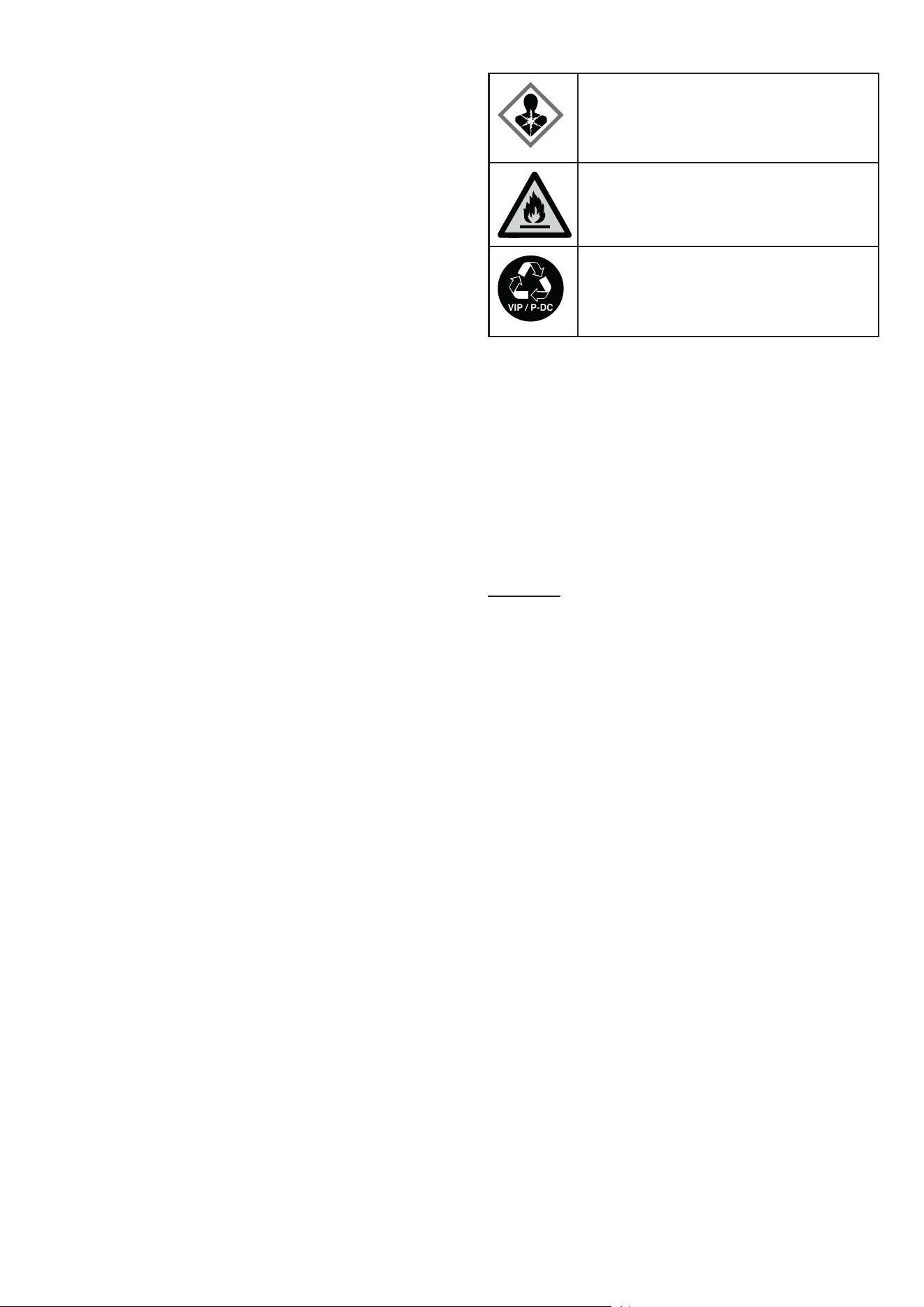
Symbols on the appliance
The symbol can be located on the compressor. It
refers to the oil in the compressor and indicates
the following danger: swallowing or inhaling can
be fatal. This is only relevant for recycling. There
is no danger in normal operation.
Warning about inammable substances.
A sticker to this eect may be applied to the rear
of the appliance. It refers to the foampadded
panels in the door and/or the housing. This is
only relevant for recycling. Do not remove the
sticker.
Noise emissions from the appliance
The noise level while the appliance is operating is below 70 dB(A)
(relative noise level 1 pW).
Declaration of conformity
The refrigerant circuit has been tested for leaks. The appliance
complies with the relevant safety regulations and EU Directives
2006/42/EG, 2014/30/EU, 2009/125/EG and 2011/65/EU.
Intended use
This professional refrigeration appliance is designed for storing,
presentation and sale of chilled packed food and drink. It may
be used for the presentation of packed food and drink in a com-
mercial environment and in retail sales outlets. It is designed for
the removal of chilled goods by customers.
The appliance is designed for use in enclosed rooms. All other
types of use are not permitted.
Foreseeable incorrect use
Do not use the appliance for the following applications:
• Storage and cooling of medicines, blood plasma, laboratory
preparations or similar substances and products subject to the
Medical Devices Directive 2007/47/EC.
• Use in potentially explosive atmospheres.
• Use outdoors or in areas where it is exposed to splash water or
damp conditions.
Incorrect use of the appliance will result in damaging or spoiling
the goods stored in it.
12
Description of the appliance
FK 2640, FK 3640
FK 4140, FK 5440
FKv 2640, FKv 3640
FKv 4140, FKv 5440
GKvesf 4145, GKvesf 5445
NOTICE
FK 2640 / FKv 2640
FK 3640 / FKv 3640
FK 4140 / FKv 4140, GKvesf 4145
The maximum load per grid shelf is 45 kg.
FK 5440 / FKv 5440, GKvesf 5445
The maximum load per grid shelf is 60 kg.
(1) Temperature control
(2) Temperature display
(3) Type plate
(4) Grid shelves
(5) Adjustable-height feet
Climate class
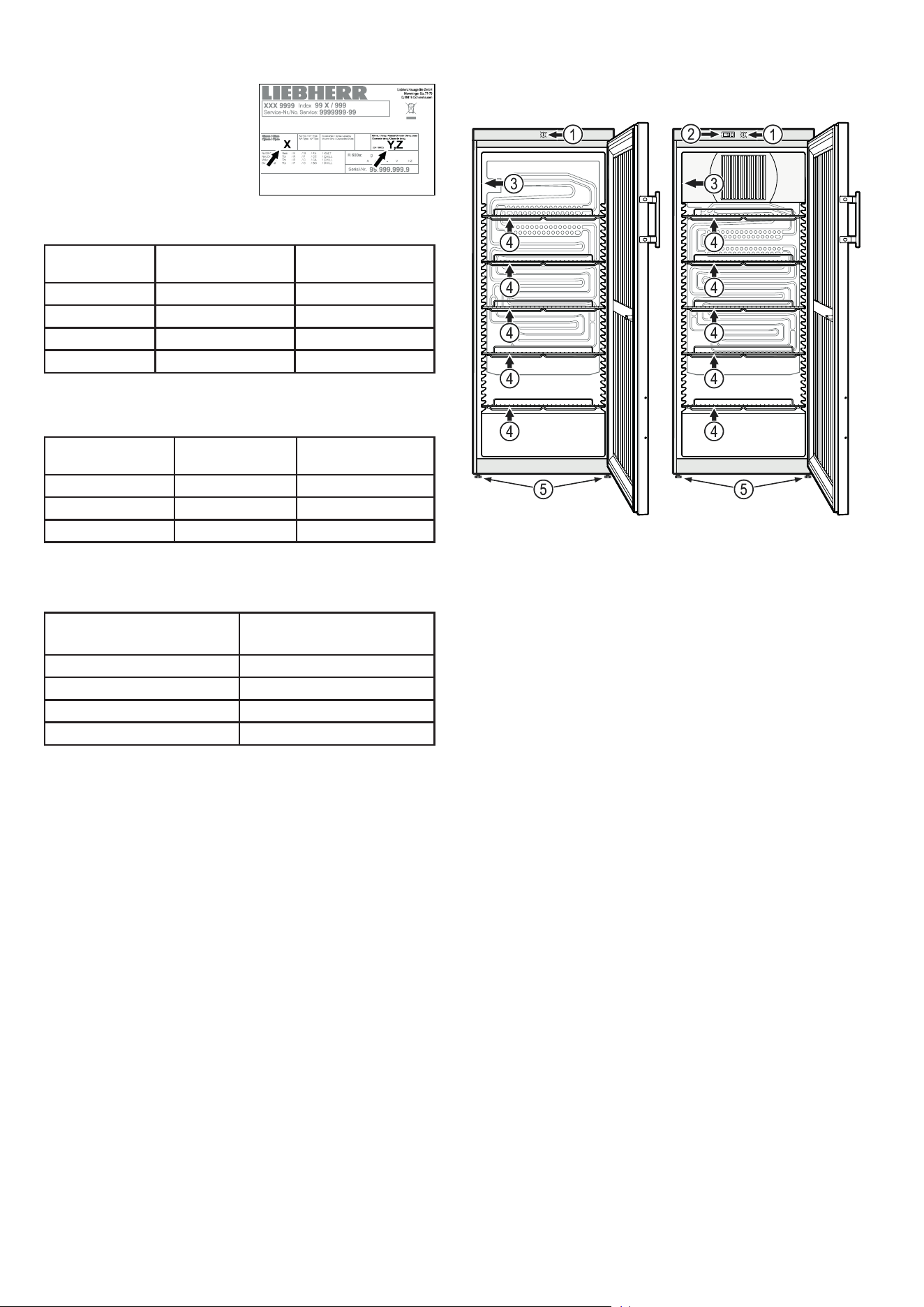
The climate class [X] specifies the
ambient conditions in which the
appliance can be operated safely.
The climate class [Y] and tempera-
ture class [Z] define the maximum
outline conditions in which the
appliances will operate perfectly.
The climate rating is indicated on the type plate.
[X]
Climate class
Max. room
temperature
Max. relative
humidity
3 25 °C 60 %
4 30 °C 55 %
5 40 °C 40 %
7 35 °C 75 %
The minimum room temperature at the place of installation is 10°C.
[Y]
Climate class
Temperature
[°C]
Relative humidity
[%]
CC1 25,0 60
CC2 32,2 65
CC3 40,6 75
Recommended temperature setting:
[Z]
Temperature class
Temperature setting
[°C]
K1 3,5
K2 2,5
K3 -1,0
K4 +5,0
13
EN
Levelling the appliance
Compensate oor unevenness using the adjustable feet.
NOTICE
The appliance must be aligned horizontally and vertically. If the
appliance is not level, the main body of the appliance can be
deformed and the door will not close properly.
Setting up
• Do not place the appliance in direct sunlight or near cookers,
radiators and similar sources of heat.
• Do not place heat-emitting appliances, e.g. microwave oven,
toaster, etc., on top of the appliance.
• The more coolant there is in the appliance, the larger the room
in which the appliance is installed must be. If the room is too
small, any leak may create a flammable mixture of gas and air.
For each 8 g of coolant the installation space must be at least
1 m³. Information on the coolant is on the model plate inside the
appliance.
• Always install the appliance directly against the wall.
Electrical connection
Only operate the appliance with alternating current (AC).
The permissible voltage and frequency are indicated on the type
plate. The position of the type plate is shown in the section entitled
Description of the appliance.
The socket must be properly earthed and protected by a fuse.
The tripping current of the fuse must be between 10 A and 16 A.
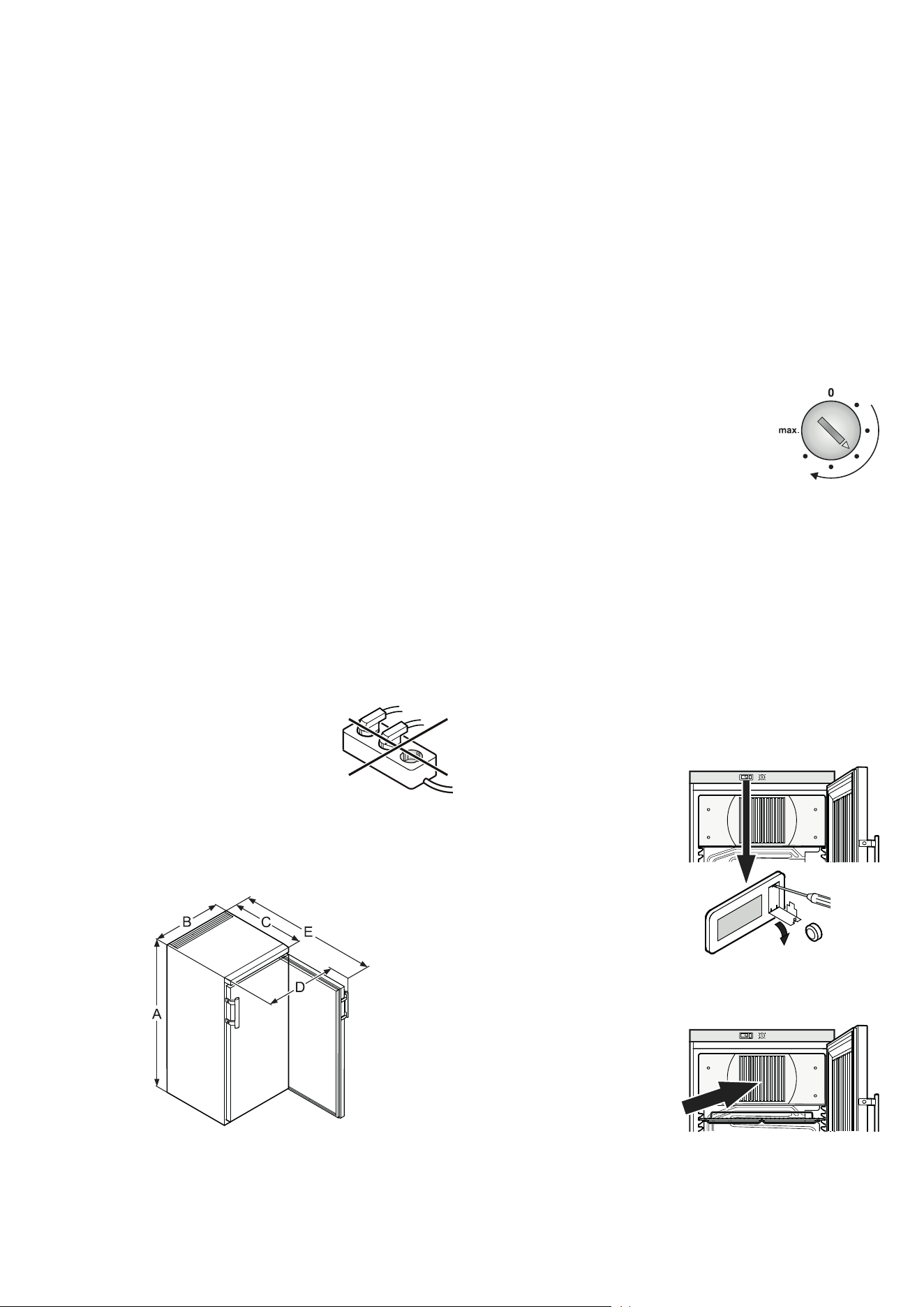
The socket must not be situated behind the appli-
ance and must be easily accessible.
Do not connect the appliance using an exten-
sion cable or extension socket.
Do not use stand-alone inverters (conversion
of direct current to alternating current/three-
phase current) or energy-saving plugs. Risk
of damage to the electronic control system!
Appliance dimensions (mm)
A B C D E
FK / FKv 26 ....................... 1250 600 610 650 1180
FK / FKv 36 ....................... 1640 600 610 650 1180
FK / FKv / GKvesf 41 ......... 1800 600 610 650 1180
FK / FKv / GKvesf 54 .. ......1640 750 730 850 1410
Temperature display
FKv 2640, 3640, 4140, 5440, GKvesf 4145, 5445
The temperature display is powered by a battery which is avail-
able from your specialist dealer.
Changing the battery
• Open the battery compartment
using a small screwdriver.
• Replace the battery.
• Close the battery compart-
ment.
If Er or HH appears in the dis-
play, the appliance has a fault.
Consult the customer serv ice
department indicating the fault
number displayed.
Cooling
The grid shelves can be moved
to accommodate different
height bottles or packages.
The ventilation slots on the
inside must not be covered!
NOTICE
Store raw meat or sh in clean sealed containers on the bottom
shelf of the refrigerator/freezer compartment so that it cannot
come into contact with any other food or drip liquid onto it.
A failure to follow these instructions may result in the food being
spoilt.
Setting the temperature
Set the temperature inside the appliance using
the temperature control.
The nearer the temperature control is to the The nearer the temperature control is to the
max.max. setting, the colder the interior tempera- setting, the colder the interior tempera-
ture. ture. Set the control between "0" and "max."
as required.
Note
The temperature in the warmest area of the interior may be higher
than the temperature setting.
If the door is left open for a lengthy period, the temperature in the
appliance's compartments may rise dramatically.
Switching the appliance on and o
Switching the appliance on
Connect the appliance to the mains - the appliance is switched on.
Note
Once the mains plug has been inserted, the refrigeration unit may
not come on until up to 8 minutes later. This is required to protect
the electronic controls.
Switching the appliance o
Pull out the mains plug or set the temperature control to 0.
Note
When the temperature control is turned to "0", the refrigeration
system is switched o, but the appliance is not completely discon-
nected from the mains.
14
Malfunctions
You may be able to rectify the following faults by checking
the possible causes yourself:
• Appliance does not function:
– Is the appliance switched on?
– Is the plug correctly fitted in the mains socket?
– Is the fuse intact?
• The temperature is not low enough:
– Is the temperature setting correct (see "Setting the temperature")?
– Does the separately installed thermometer show the correct
reading?
– Is the ventilation system working properly?
– Is the appliance set up too close to a heat source?
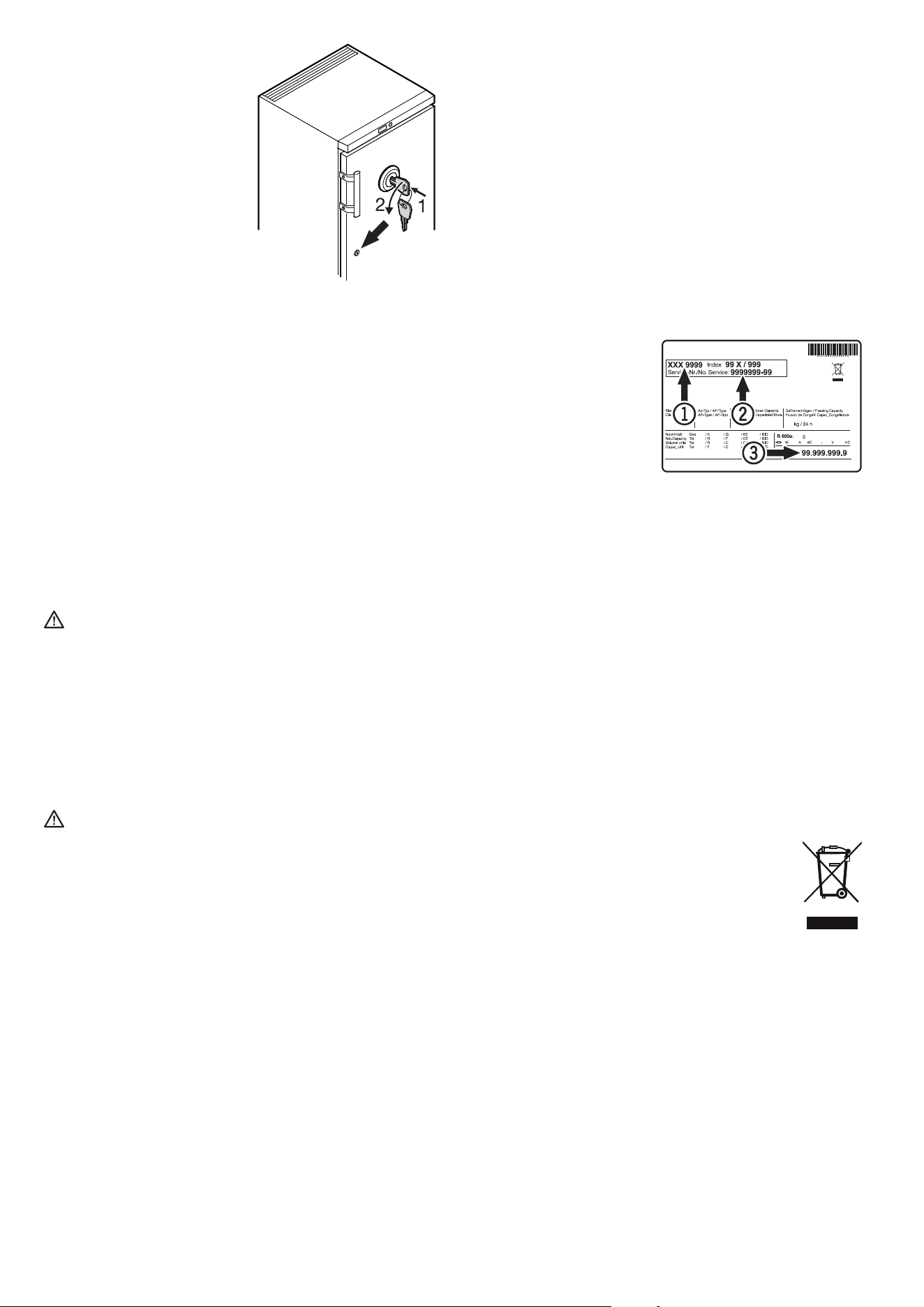
If none of the above causes
apply and you cannot rec-
tify the fault yourself, contact
the nearest customer ser-
vice department stating the
type designation
1, service
number
2and appliance
number
3as indicated on the
type plate.
The position of the type plate is shown in the section entitled
Description of the appliance.
Shutting your appliance down
If the appliance is left empty for a lengthy period, it must be
switched o, defrosted, cleaned and dried and the door is to be
left open to prevent mould formation.
NOTICE
The permissible room temperature for storing the appliance after
decommissioning is between -10°C and +50°C.
Storing the appliance outside this temperature range can damage
the appliance and cause it to malfunction.
Disposal notes
The appliance contains reusable materials and should
be disposed of properly - not simply with unsorted
household refuse. Appliances which are no longer
needed must be disposed of in a professional and
appropriate way, in accordance with the current local
regulations and laws.
Do not damage the refrigerant circuit of an appliance that is no
longer needed during its disposal.
This appliance contains inammable gases in the refrigerant
circuit and insulation foam.
Your local council or a waste disposal contractor can provide
information about how to dispose of the appliance correctly.
Safety lock
The lock in the appliance door is
equipped with a safety mecha-
nism.
Locking the appliance
• Insert the key as shown by ar-
row 1.
• Turn the key 90°.
To unlock the appliance, the same
procedure must be repeated in the
same order.
Defrosting
The refrigerator compartment defrosts automatically.
When operating at a very cold thermostat setting, the interior rear
wall may ice up. In this case, the appliance must be defrosted
manually.
•
Pull out the mains plug!
• Remove the food from the appliance and store in a cool place.
• Leave the door of the appliance open while defrosting. After
defrosting mop up the remaining water and clean the appliance.
Cleaning
WARNING
Before cleaning, always disconnect the appliance
from the mains. Pull out the plug or switch o the
fuse.
Surfaces which may come into contact with food
and accessible drain systems must be cleaned at
regular intervals.
CAUTION
Risk of damage to the appliance components and
risk of injury due to hot steam.
Do not use steam cleaning equipment to clean
the appliance.
• Clean the inside, equipment parts and outer walls with lukewarm
water and a little detergent. Do not use chemical solvents or any
cleaning agents containing sand or acid.
• Ensure that no cleaning water penetrates into the electrical
components or ventilation grille.
• Dry all parts well with a cloth.
• The dust should be removed from the refrigeration unit and heat
exchanger - metal grid at the back of the appliance - once a year.
• Do not damage or remove the type plate on the inside of the
appliance. It is very important for servicing purposes.
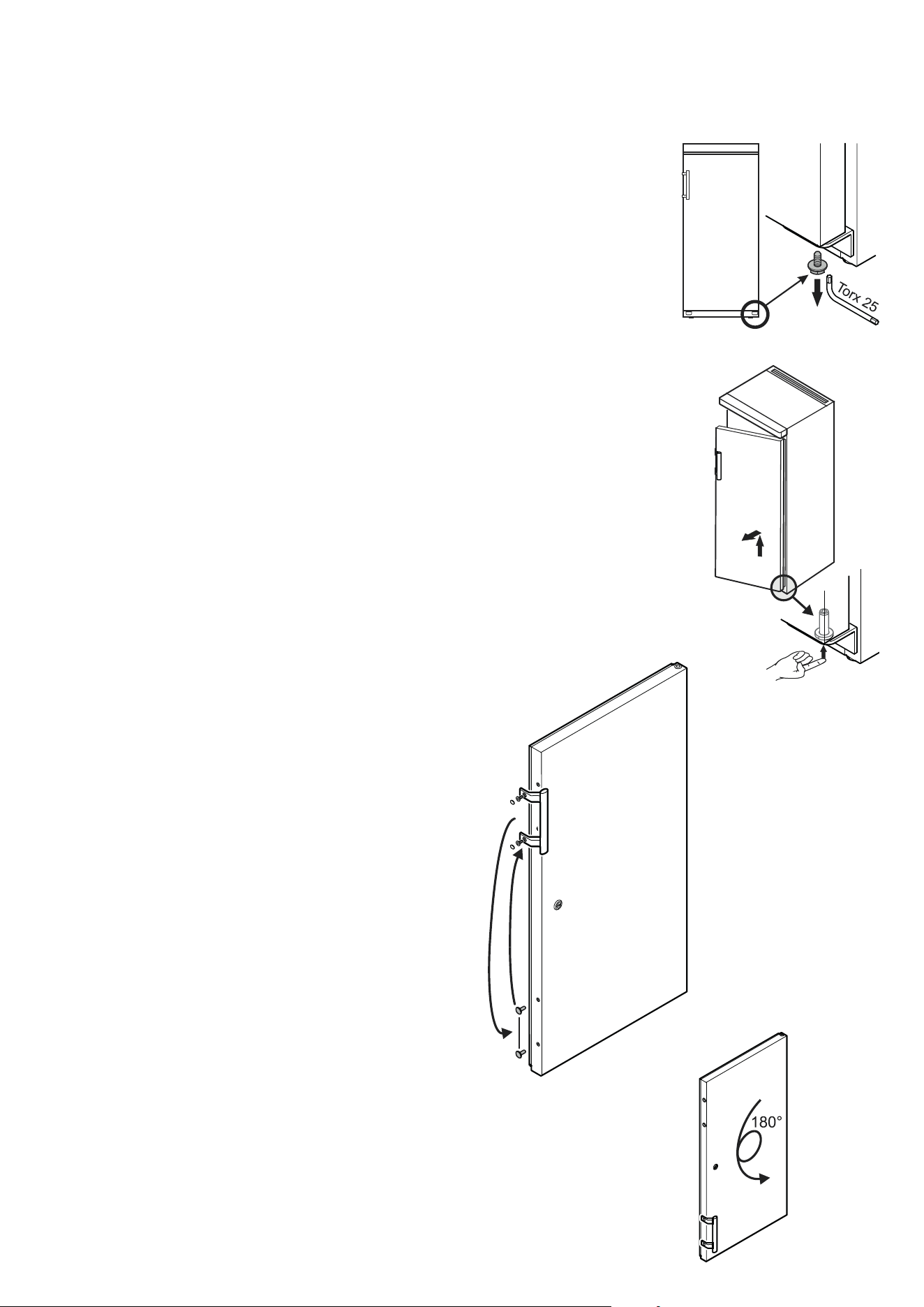
15
EN
2. Open the door approx. 45° and
lift upwards.
Important
As a result of its heavy weight, the
door must be held secure by one
person.
3. Push the pin upwards using your
fingertip.
4. Pull the door to the front and
remove it downwards.
Changing over door hinges
Door hinges should only be changed by a trained expert.
Changing the door hinges must be done by two people.
1. Remove screw from lower
hinge bracket.
5. Transfer door handle and
plugs to the other side.
6. Turn the door by 180°.
1
2
3
4
5
6
Additional information:
- Food will remain fresh for longer if stored at the correct tempera-
ture. This can prevent having to discard food needlessly.
- If the condenser coil is not cleaned every year, it will significantly
reduce the appliance's efficiency.
- The period during which spare parts, necessary for the repair
of the refrigerating appliance with a direct sales function, are
available is 10 years.
- The minimum duration of the guarantee of the refrigerating ap-
pliance with a direct sales function offered by the manufacturer,
importer or authorised representative is 2 years.
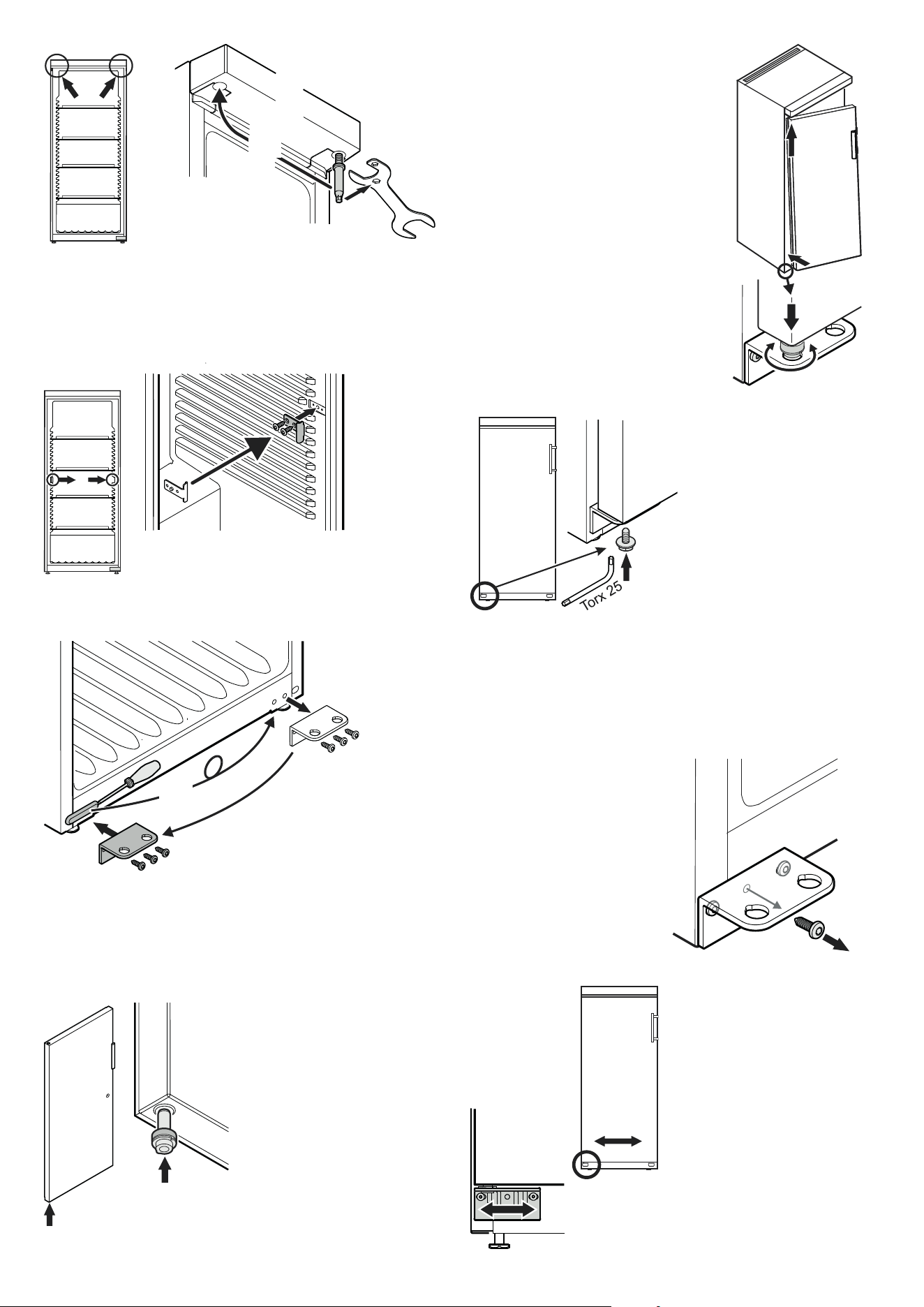
16
13. Insert the pin into the left-hand door mounting.
Use your index finger to hold the pin while you are
assembling the door.
9. Transfer locking bracket to the op-
posite side.
7. Unscrew the pin.
Use the spanner provided.
8. Screw in the pin on the opposite side.
10. Unscrew hinge bracket.
11. Remove the cover, turn it through 180° and
re-fit it on the opposite side.
12. Screw hinge bracket into place.
14. Locate the door on the upper pin as
shown in the illustration and guide it
to the lower hinge bracket.
Important
As a result of its heavy weight, the door
must be held secure by one person.
15. Lift the door upwards and turn the pin
until it fits into the bore hole of the hinge
bracket.
Slowly lower the door downwards.
The lower part of the pin must be fully
engaged in the bore hole of the hinge
bracket.
16. Screw the screw into the
pin again and tighten.
Adjusting the lateral tilt of the door
If the door is at an angle, adjust the angle.
18. Undo screws and slide hinge bracket to
the right or left.
Tighten screws.
17. Remove middle screw from
hinge bracket.
This screw is no longer
needed.
13
14
15
16
18
9
17
12
11
10
7
8

17
EN
*708317401*
Liebherr-Hausgeräte GmbH
Memminger Straße 77-79
88416 Ochsenhausen
Germany
home.liebherr.com