Do not destroy this manual. Please read carefully
and keep in a safe place for future reference.
CERTIFIED
R
Print 2D
Bar Code
Here
www.ahridirectory.org
ULTRA
Low NOx
Emissions
SCAQMD Rule 1146.2
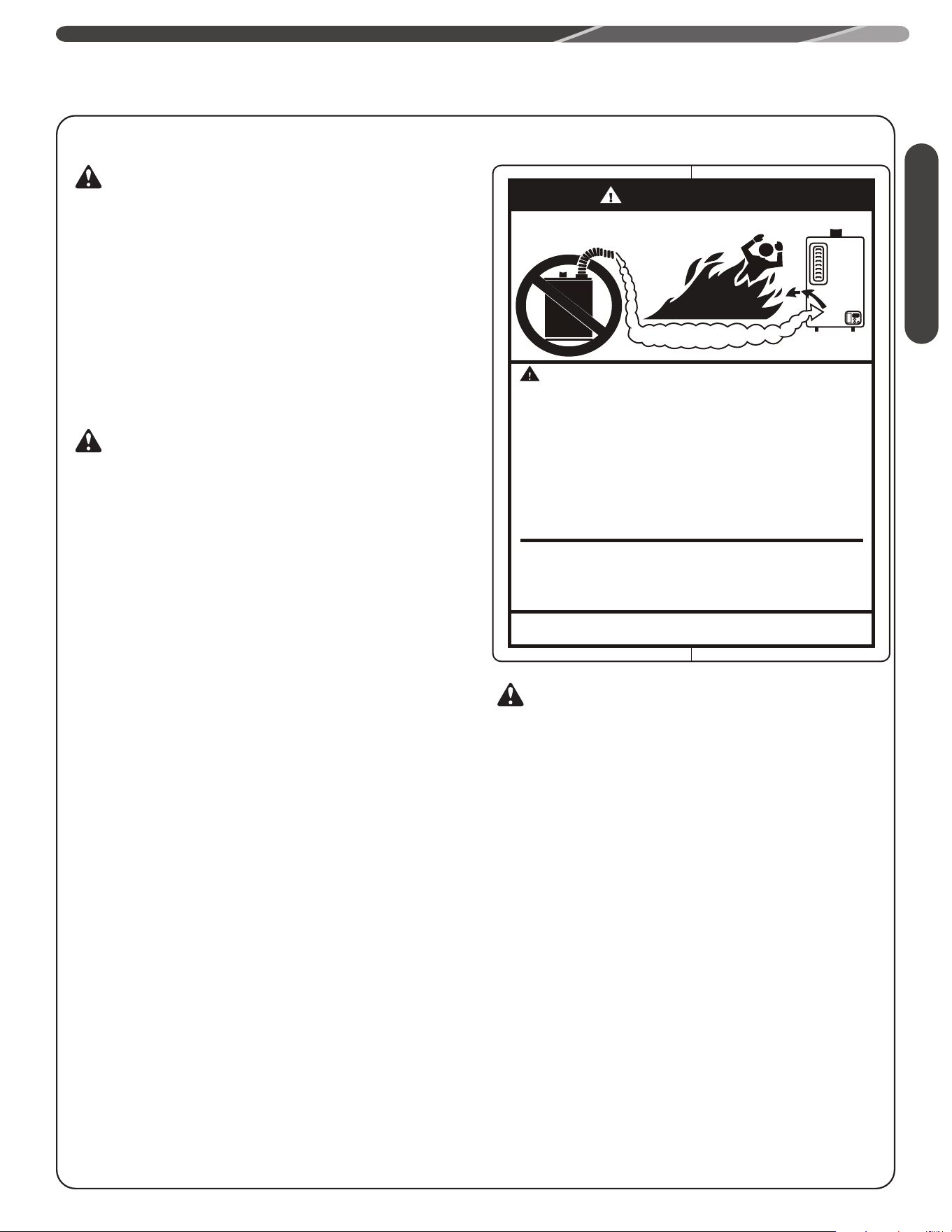
WARNING:
If the information in these instructions is not
followed exactly, a fire or explosion may result,
causing death, personal injury, or property dam-
age.
For Your Safety!
• Do not store or use gasoline or other flammable
vapors and liquids in the vicinity of this or
any other appliance. To do so may result in an
explosion or fire.
• Installation and service must be performed by
a qualified installer, service agency, or the gas
supplier.
D
E
S
I
G
N
C
E
R
T
I
F
I
E
D
®
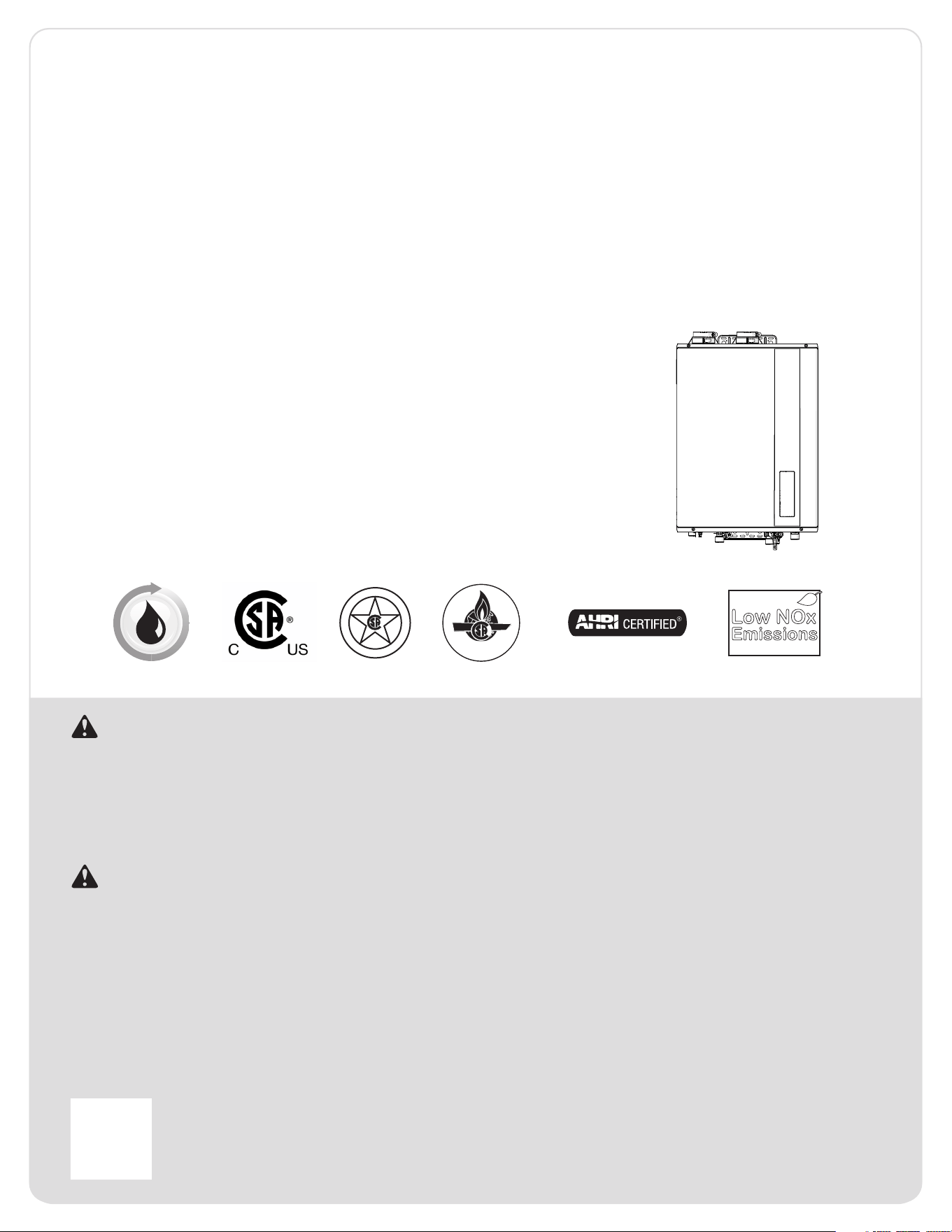
SUPER HIGH EFFICIENCY CONDENSING
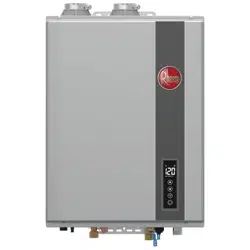
TANKLESS WATER HEATER
USE AND CARE MANUAL
What to Do If You Smell Gas
• Do not try to light any appliance.
• Do not touch any electrical switch; do not use
any phone in your building.
• Immediately call your gas supplier from a
neighbor’s phone. Follow the gas supplier’s
instructions.
• If you cannot reach your gas supplier, call the
fire department.
• Do not return to your home until authorized by
the gas supplier or fire department.
With Installation Instructions
for the Installer
Condensing Direct Vent
199,900 Btu/hr, 180,000 Btu/hr,
157,000 Btu/hr and 120,000 Btu/hr Models
AP21820 Rev 03
Important Safety Information
Safety Precautions ��������������������������������������������������������������� 2 – 8
Product Information
Product Information �������������������������������������������������������������������� 8
Specifications ����������������������������������������������������������������������� 9, 10
Flow Rate vs Pressure Drop �������������������������������������������������������11
General Descriptions ������������������������������������������������������������12, 13
Installation Instructions
Standards Compliance ��������������������������������������������������������������� 15
Choosing a Location �������������������������������������������������������������15, 16
Product Inspection ���������������������������������������������������������������������17
Water Heater Installation����������������������������������������������������17 – 19
Venting & High-Altitude Adjustments ���������������������������������20 – 36
Water Quality/Supply ���������������������������������������������������������37 – 41
Condensate �������������������������������������������������������������������������������41
Gas Supply ������������������������������������������������������������������������42 – 47
Electrical Wiring ������������������������������������������������������������������� 47, 48
Insulation Blankets and Installation Precautions�������������������������49
Installation Checklist ������������������������������������������������������������������ 50
Safety
Using Your Water Heater
Activating the Water Heater �������������������������������������������������51, 52
Setting the Water Temperature �������������������������������������������53 – 56
WiFi Setup ����������������������������������������������������������������������������������������������������56
Recirculation Pump Control �����������������������������������������������57 – 62
Water Saving Control Option ������������������������������������������������ 63, 64
Caring for Your Water Heater
Water Heater Inspections ���������������������������������������������������� 65, 66
Care and Cleaning ���������������������������������������������������������������67, 68
Preventive Maintenance ������������������������������������������������������������ 69
Draining the Water Heater���������������������������������������������������70 – 72
Freeze Protection ���������������������������������������������������������������������� 72
Vacation and Extended Shutdown ���������������������������������������������73
Troubleshooting Chart ��������������������������������������������������������� 73, 74
Service Error Code Chart ���������������������������������������������������� 75, 76
Call for Assistance ���������������������������������������������������������������������76
Maintenance Notice ������������������������������������������������������������� 77, 78
Parts Replacement���������������������������������������������������������������������79
Warranty Information�����������������������������������������������������������80, 81
2
CONTENTS
READ THE SAFETY INFORMATION
Your safety and the safety of others are very important. There
are many important safety messages in this manual and on
your appliance. Always read and obey all safety messages.
This is the safety alert symbol. Recognize this
symbol as an indication of Important Safety
Information! This symbol alerts you to potential
hazards that can kill or hurt you and others.
All safety messages will follow the safety alert symbol
and either the word “DANGER,” “WARNING,” “CAUTION,”
or “NOTICE.”
These words mean:
IMPORTANT SAFETY INFORMATION
WARNINGS:
• Improper installation, adjustment, alteration, service,
or maintenance can cause death, personal injury, or
property damage. Follow the instructions in this manual.
READ ALL INSTRUCTIONS
BEFORE USING.
Be sure to read and understand the entire Use and Care Manual
before attempting to install or operate this water heater. It
may save you time and money. Pay particular attention to the
Safety Instructions. Failure to follow these warnings could result
in death or serious bodily injury. Should you have problems
understanding the instructions in this manual, or have any
questions, STOP and get help from a qualified service technician
or the local gas utility.
DANGER:
NOTICE:
!
CAUTION:
!
WARNING:
An imminently hazardous
situation that will result in
death or serious injury.
A potentially hazardous
situation that can result in
death or serious injury and/or
damage to property.
A potentially hazardous
situation that may result in
minor or moderate injury.
Attention is called to observe a
specified procedure or maintain
a specific condition.
!
Safety
3
IMPORTANT SAFETY INFORMATION
DANGER
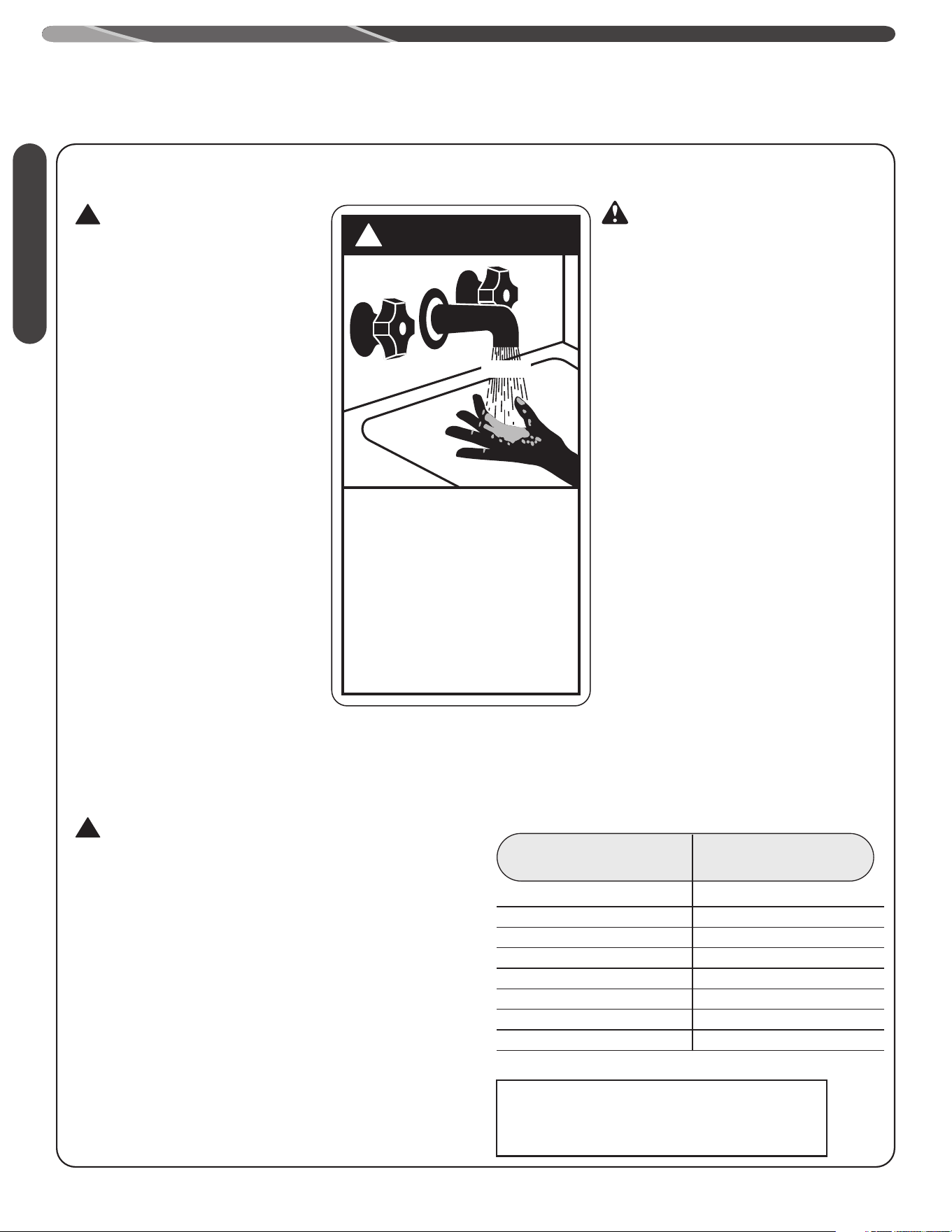
FLAMMABLES
Flammable Vapors
Water heater has a main
burner flame.
The main burner flame:
1. which can come on
at any time and
2. will ignite flammable
vapors.
Vapors:
1. cannot be seen,
2. are heavier than air,
3. go a long way on the
floor and
4. can be carried from
other rooms to the
main burner flame by
air currents.
Vapors from flammable
liquids will explode and
catch fire causing death or
severe burns.
Do not use or store flammable
products such as gasoline,
solvents or adhesives in the
same room or area near the
water heater.
Keep flammable products:
1. far away from heater,
2. in approved containers,
3. tightly closed and
4. out of children's reach.
Installation:
Do not install water heater
where flammable products will
be stored or used unless the
main burner flame is at least
18" above the floor. This will
reduce, but not eliminate, the
risk of vapors being ignited
by the main burner flame.
Read and follow water heater warnings and instructions. If
owners manual is missing, contact the retailer or manufacturer.
Water Heater Venting Safety
DANGER:
• Failure to install and properly vent the water heater to
the outdoors as outlined in the “Venting” section of the
Installation Instructions in this manual will result in
death from fire, explosion, or asphyxiation from carbon
monoxide. NEVER operate this water heater unless it is
properly vented and has the air supply piping properly
installed and terminated to the outdoors.
• Be sure to inspect the vent terminal, the air intake,
and the vent system on the water heater for proper
installation at initial start-up and at least annually
thereafter. Refer to the “Care and Cleaning” section
of this manual for more information regarding vent
system inspection.
WARNINGS:
• Gasoline and other flammable liquids, materials,
and vapors (including paint thinners, solvents,
and adhesives) are extremely dangerous. DO NOT
handle, use, or store gasoline or other flammable or
combustible materials anywhere in the vicinity of a
water heater or any other appliance. Be sure to read
and follow the labels on the water heater, as well as the
warnings printed in this manual. Failure to do so can
result in death, bodily injury, or property damage.
• Combustible construction refers to adjacent walls and
ceilings and should not be confused with combustible
or flammable products and materials. Combustible
materials, such as clothing, cleaning materials, or
flammable liquids, should never be stored in the vicinity
of this or any gas appliance. Fire or explosion can occur
causing death, personal injury, and/or property damage.
See page 16 for clearances to combustible materials.
• Follow vent manufacturer’s instructions for venting
installation, including additional clearances from
combustibles, to avoid conditions that can lead to
death, personal injury, and/or property damage.
• Use tankless water heater manufacturer-approved
Schedule 40 PVC (foam core is not permitted at any
time), Schedule 80 PVC, CPVC, ABS, UL 1738-listed
Category III Stainless Steel, or InnoFlue® PP. No other
vent material is permitted. For Canada, installations
must follow ULC S636 for exhaust venting.
• Moisture in the flue gas will condense as it leaves the
vent terminal. In cold weather this condensate can
freeze on the exterior wall, under the eaves, and on
surrounding objects. Some discoloration to the exterior
of the building is to be expected. However, improper
location or installation may result in severe damage to
the structure or exterior finish of the building.
• For multiple-unit installation, a minimum distance
between vent terminations must be maintained to
prevent recirculation of vent gases. See page 26 & 27
for information on venting and clearances to multiple
terminations.
CAUTIONS:
• Ensure that the appliance vent is securely glued and
attached to the vent connection on the top of the water
heater. DO NOT USE SCREWS.
• DO NOT operate without the condensate drain connected
and routed to a proper drain.
4
IMPORTANT SAFETY INFORMATION
Water Supply Safety
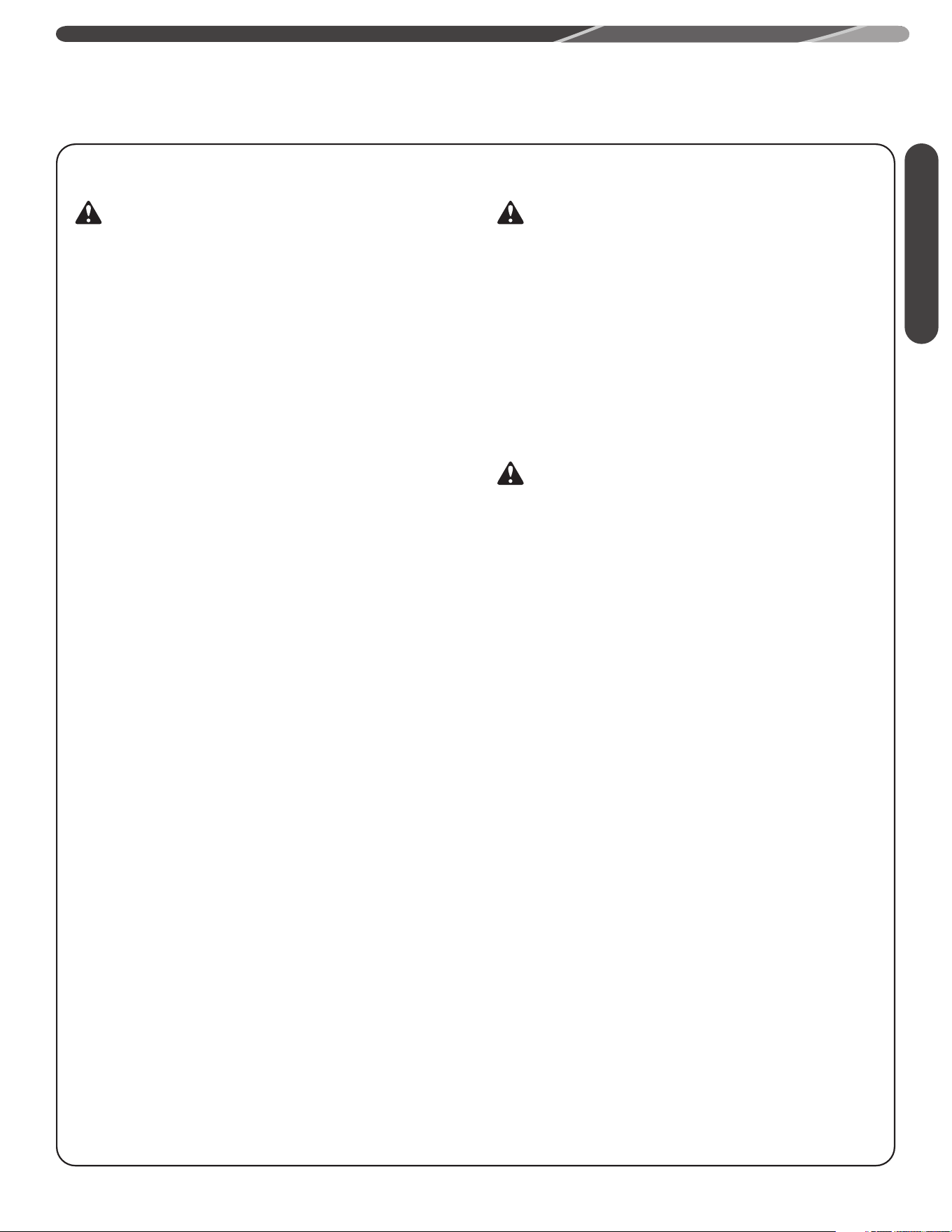
D ANGER
!
HOT
Water temperature over 125°F (52°C)
can cause severe burns instantly or
death from scalds.
Children, disabled and elderly are
at highest risk of being scalded.
See instruction manual before
setting temperature at water
heater.
Feel water before bathing or
showering.
Temperature limiting valves are
available, see manual.
BURN
Temperature Conversion Chart °F/°C
100 102 104 106 108 110 112 114 116 118 120 125 130 140 °F
38 39 40 41 42 43 44 46 47 48 49 52 54 60 °C
Time/Temperature Relationship in Scalds
120°F (49°C) More than 5 minutes
125°F (52°C) 1 1/2 to 2 minutes
130°F (54°C) About 30 seconds
135°F (57°C) About 10 seconds
140°F (60°C) Less than 5 seconds
145°F (63°C) Less than 3 seconds
150°F (66°C) About 1 1/2 seconds
155°F (68°C) About 1 second
Table courtesy of Shriners Burn Institute
Water Temperature Time to Produce
a Serious Burn
Safety
!
DANGERS:
• WATER TEMPERATURE SETTINGS
– Safety and energy conservation
are factors to be considered when
selecting the water temperature
setting of a water heater’s remote
control. Water temperatures above
125°F (52°C) can cause death
or severe burns from scalding.
Be sure to read and follow the
warnings outlined on the pictured
label.
• There is a hot water scald potential
if the water temperature is set
too high. Households with small
children, the disabled, or elderly
persons may require a 120°F
(49°C) or lower temperature setting
to prevent contact with “HOT”
water.
• Before manually operating the
relief valve, make certain no one
will be exposed to the danger
of the hot water released by
the valve. The water may be hot
enough to create a scald hazard.
The water should be released into
a suitable drain to prevent injury or
property damage.
• Failure to perform the recommended Routine Preventive
Maintenance can harm the proper operation of this
water heater, which can cause carbon monoxide
dangers, excessive hot water temperatures, and other
potentially hazardous conditions.
!
WARNINGS:
• IMPORTANT: DO NOT apply heat to the HOT or COLD
water connections. If sweat connections are used,
sweat tubing to adapter before fitting adapter to the
water connections on heater. Any heat applied to the
water supply fittings will permanently damage the
internal components of the water heater.
• In case the pipe insulation is not rated for the
appropriate weather conditions, install electric heat
tracing or equivalent to prevent freezing of the pipes.
DO NOT insulate or block the drain valve on the hot
outlet fitting. If the pipes are allowed to freeze, the
water heater and the pipes may malfunction or leak due
to freezing water.
• Failure to drain the water heater as described on
"Draining the Water Heater" can cause serious personal
injuries from scalding and/or damage the water heater.
CAUTIONS:
• This water heater must only be used
with the following water supply system
conditions:
– With clean, potable water free of corrosive
chemicals, sand, dirt, or other contaminants.
– With inlet water temperatures above 32°F
(0°C), but not exceeding 120°F (49°C).
– DO NOT reverse the hot and cold water
connections. The water heater will not operate.
• Even when drained properly, a small
amount of water will remain in the water
heater. In cold weather conditions, this
water can freeze. If this happens, allow
the defrost protection on the heater
at least 30 minutes to melt the frozen
water or the water heater may not work
properly.
NOTICE:
The factory setting allows operating
temperatures between 100°F (38°C) and 120°F
(49°C). Temperatures up to 140°F (60°C) can
be achieved with the remote control. Only
qualified service personnel should perform this
adjustment. Only factory-authorized remote
control(s) should be used.
5
IMPORTANT SAFETY INFORMATION
WARNINGS:
• The installation of gas piping must comply with local
utility company requirements and/or in the absence of
local codes, use the latest edition of National Fuel Gas
Code (NFGC), ANSI Z223.1/NFPA 54, or CAN/CSA B149.1,
Natural Gas and Propane Installation Code.
• If inlet gas pressure is out of allowable range [4.0” w.c.
(1.0kPa) – 10.5” w.c. (2.6kPa)] for Natural Gas, or [8.0”
w.c. (2.0kPa) – 13.0” w.c. (3.2kPa)] for LP gas, a gas
pressure regulator must be installed to maintain the
allowable inlet gas pressure.
• Should overheating occur or the gas supply fail to shut
off, turn off the manual gas control valve to the water
heater.
CAUTIONS:
• DO NOT attempt the repair of any electrical wiring, gas
piping, remote control, burners, vent connectors, or
other safety devices. Refer repairs to qualified service
personnel.
• Turn off the manual gas shut-off valve if the water
heater has been subjected to overheating, fire, flood,
physical damage, or if the gas supply fails to shut off.
• DO NOT turn on the water heater unless the water and
gas supplies are completely opened.
Natural Gas and Liquefied Petroleum Safety
DANGERS:
• Never attempt to convert the water heater from natural
gas to LP or vice versa. The water heater must only
use the fuel type in accordance with the listing on the
data plate—natural gas for natural gas units and LP
for LP units. Any other fuel usage will result in death or
serious personal injury from fire and/or explosion. This
water heater is not certified for any other fuel type.
• Both natural gas and propane (LP) have an odorant
added to aid in detecting a gas leak. Some people
may not physically be able to smell or recognize this
odorant. If you are unsure or unfamiliar with the
smell of natural gas or LP, ask the gas supplier. Other
conditions, such as “odorant fade,” which causes
the odorant to diminish in intensity, can also hide or
camouflage a gas leak.
• Water heaters using LP gas are different from natural
gas models. A natural gas water heater will not
function safely on LP and vice versa.
• LP must be used with great caution. It is heavier than
air and will collect first in lower areas, making it hard
to detect at nose level.
• Before attempting to light the water heater, make sure
to look and smell for gas leaks. Use a soapy solution
to check all gas fittings and connections. Bubbling at
a connection indicates a leak that must be corrected.
When smelling to detect a gas leak, be sure to also sniff
near the floor.
• Gas detectors are recommended in LP and natural
gas applications and their installation should be
in accordance with the detector manufacturer’s
recommendations and/or local laws, rules, regulations,
or customs.
• Combustible materials, such as clothing, solvents,
cleaning materials, or flammable liquids, must not be
placed in the vicinity of the water heater.
• If a gas leak is present or suspected:
– DO NOT attempt to find the cause yourself.
– Never use an open flame to test for gas leaks. The gas can
ignite resulting in death, personal injury, or property damage.
– Follow the steps listed under “What to Do If You Smell Gas”
found on the front cover of this manual.
Safety
6
IMPORTANT SAFETY INFORMATION
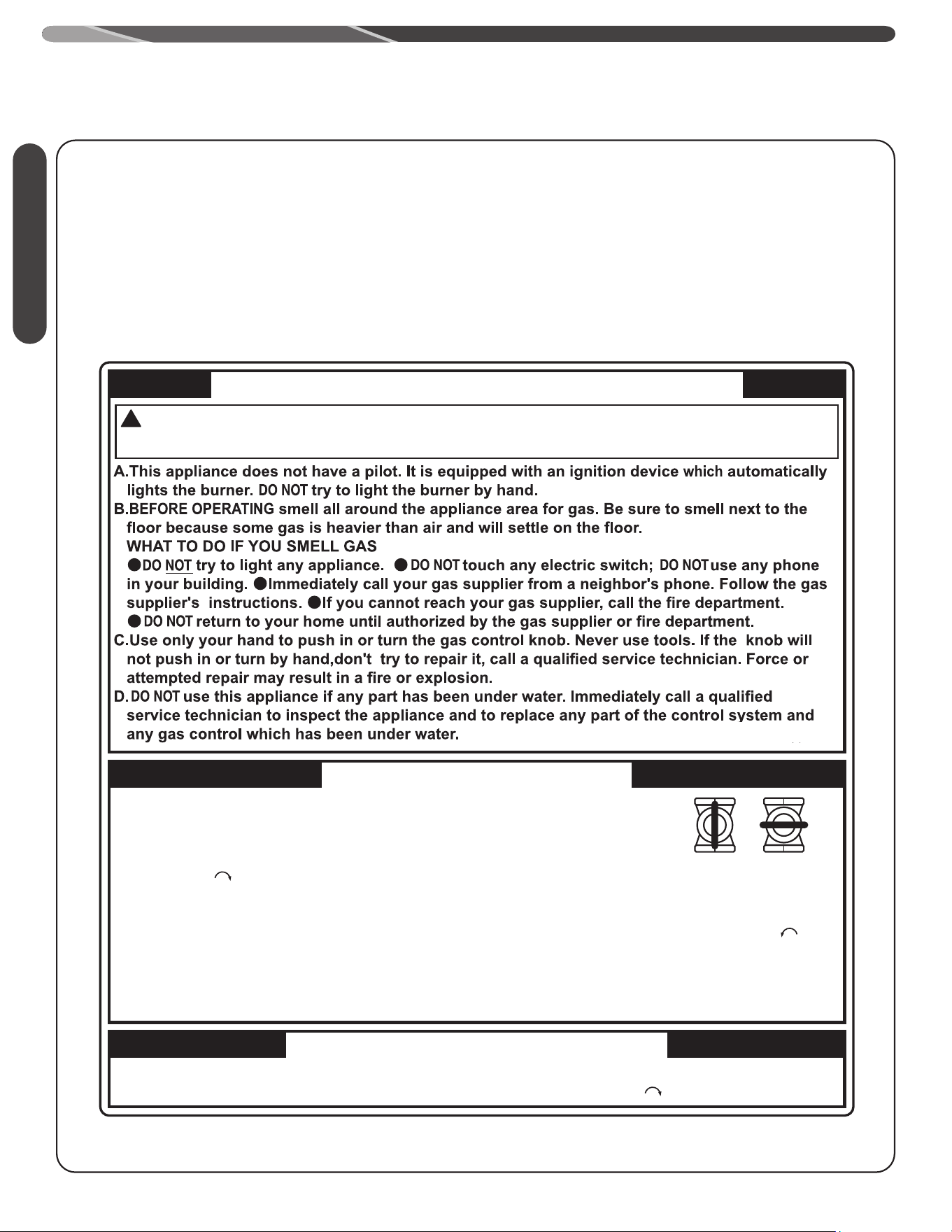
Before operating this water heater, be sure to read
and follow the instructions on the label pictured below
and all other labels on the water heater, as well as the
warnings printed in this manual.
Failure to do so can result in unsafe operation of the
water heater, resulting in death, personal injury, or
property damage. Should you have any problems
reading or following the instructions in this manual,
STOP and get help from a qualified service technician.
WARNING : If you do not follow these instructions exactly, a fire or explosion may result
causing property damage, personal injury or loss of life.
FOR YOUR SAFETY READ BEFORE OPERATING
1.STOP! Read the safety information above on this label.
2.Turn off all electric power to the appliance.
3.DO NOT attempt to light the burner by hand.
4.Turn the Gas Shutoff Valve located on the outside of the unit
clockwise to the "OFF" position.
5.Wait five (5) minutes to clear out any gas. If you then smell gas, STOP! Follow "B" in
the safety information above on this label. If you don't smell gas, go to the next step.
6.Turn the Gas Shutoff Valve located on the outside of the unit counterclockwise to
the "ON" position.
7.Turn on all electric power to the appliance.
8.If the appliance will not operate, follow the instructions "To Turn Off Gas To Appliance"
and call your service technician or gas supplier.
TO TURN OFF GAS TO APPLIANCE
1
.
Turn off all electric power to the appliance if service is to be performed.
2
.
Turn
the
Gas
Shutoff
Valve
located
on
the
outside
of
the
unit
clockwise to
the
"OFF"
position.
GAS SHUTOFF
VALVE
OPEN CLOSE
OPERATING INSTRUCTIONS
!
Safety
7
IMPORTANT SAFETY INFORMATION
Electrical Safety
DANGER:
• Shock Hazard – Make sure the electrical power to the
water heater is off to avoid electric shock that will
result in death or serious personal injury.
WARNINGS:
• For your safety, the information in this manual must
be followed to minimize the risk of fire, explosion, or
electric shock that can result in death, personal injury,
and/or property damage.
• Field wiring connections and electrical grounding must
comply with local codes or, in the absence of local
codes, with the latest edition of the National Electrical
Code, ANSI/NFPA 70, or in Canada, Canadian Electrical
Code, CAN/CSA C22.1, Part 1.
CAUTIONS:
• Label all wires prior to disconnecting for service. Wiring
errors can cause dangerous and improper operation.
Verify correct operation after servicing.
• For your safety, burner inspection and cleaning should
be performed only by qualified service personnel.
• Make certain the power to the water heater is OFF
before removing the unit cover panel. Exposed
electrical components and moving parts can cause
personal injuries.
• For your safety, DO NOT attempt the repair of any
electrical wiring, gas piping, remote control, burners,
vent connectors, or other safety devices. Refer repairs
to qualified service personnel.
Safety
California law requires that water heaters must be
braced, anchored, or strapped to resist falling or
horizontal displacement due to earthquake motions. For
water heaters up to 52-gallon capacity, a brochure with
generic earthquake bracing instructions can be obtained
from: Office of the State Architect, 1102 Q Street, Suite
5100, Sacramento, CA 95814, or you may call 916-445-
8100 or ask a water heater dealer.
However, applicable local codes shall govern
installation. For residential water heaters of a capacity
greater than 52 gallons or tankless-style, consult the
local building jurisdiction code for acceptable bracing
procedures.
FOR INSTALLATIONS IN THE STATE OF CALIFORNIA
8
IMPORTANT SAFETY INFORMATION
General Installation and Maintenance Safety
WARNINGS:
• This water heater must be installed in accordance
with these instructions, local codes, utility company
requirements and/or in the absence of local codes,
use the latest edition of the American National
Standard/National Fuel Gas Code (NFGC), ANSI Z223.1
and National Fire Protection Association, NFPA 54, or
in Canada, CAN/CSA B149.1, Natural Gas and Propane
Installation Code, and the latest edition of the
National Electrical Code, ANSI/NFPA 70, or in Canada,
Canadian Electrical Code, CAN/CSA C22.1, Part 1.
• For your safety, DO NOT attempt to disassemble this
water heater for any reason. Improper adjustments,
alterations, service, or maintenance can cause death,
personal injury, or property damage.
SAVE THESE INSTRUCTIONS
SAFETY PRECAUTIONS:
Read this manual entirely before installing and/or
operating the water heater.
Use this water heater only for its intended purpose as
described in this Use and Care Manual.
Have the installer show you the location of the gas shut-
off valve and how to shut it off if necessary. Turn off
the manual shut-off valve if the water heater has been
subjected to overheating, fire, flood, physical damage,
or if the gas supply fails to shut off.
Be sure your water heater is properly installed in
accordance with local codes and the provided
installation instructions.
DO NOT attempt to repair or replace any part of your
water heater unless it is specifically recommended in
this manual. All other servicing should be referred to a
qualified service technician.
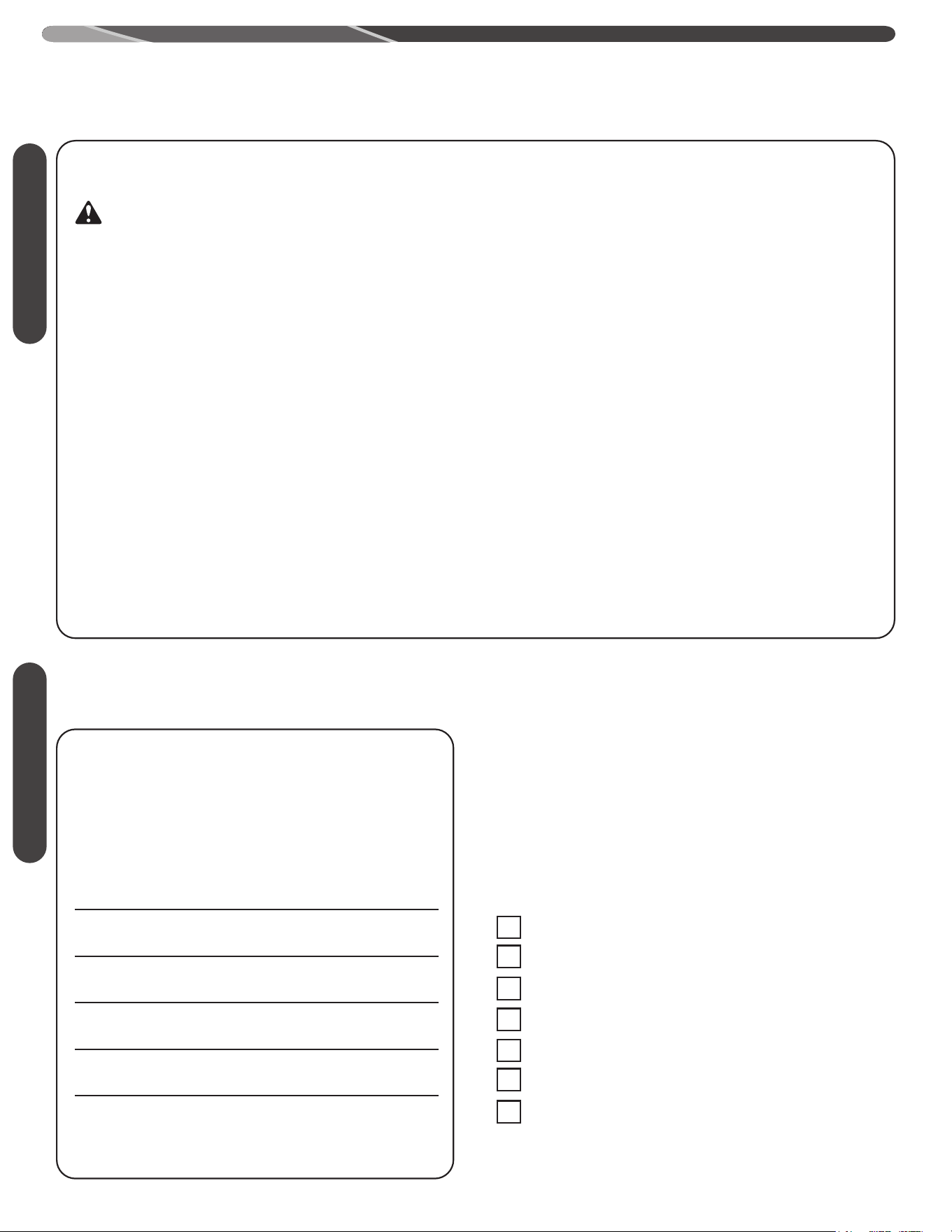
PRODUCT INFORMATION
For Your Records
Write down and save the following product
information along with the original sales slip and/
or cancelled check.The model and serial numbers
can be found on the top label on the right side of the
water heater.
MODEL NUMBER:
SERIAL NUMBER:
DATE OF INSTALLATION:
INSTALLING COMPANY/PHONE NUMBER:
PLUMBING CONTRACTOR/PHONE NUMBER:
See page 76 for additional service information.
Read This Manual
Inside you will find many helpful hints on how to use and
maintain your water heater properly. A little preventive care
on your part can save you time and money over the life of
your water heater.
You’ll find many answers to common problems in the
"Troubleshooting Chart" in this Use and Care Manual.
Always refer to this chart before calling for service.
Referring to this chart before calling may answer your
question(s) and eliminate the need for service.
Preoperating Checklist
Is the main gas valve to the water heater turned on?
Is the fuse in place or is the breaker turned on?
Does the water heater’s electronic ignition light?
Is the water temperature set to a safe temperature?
Is the water heater connected to a floor drain?
Is the water heater properly vented to the outside?
Is the water heater installed in a safe location away
from flammable materials and/or freezing conditions?
Product Information Safety
9
PRODUCT INFORMATION
Product Information
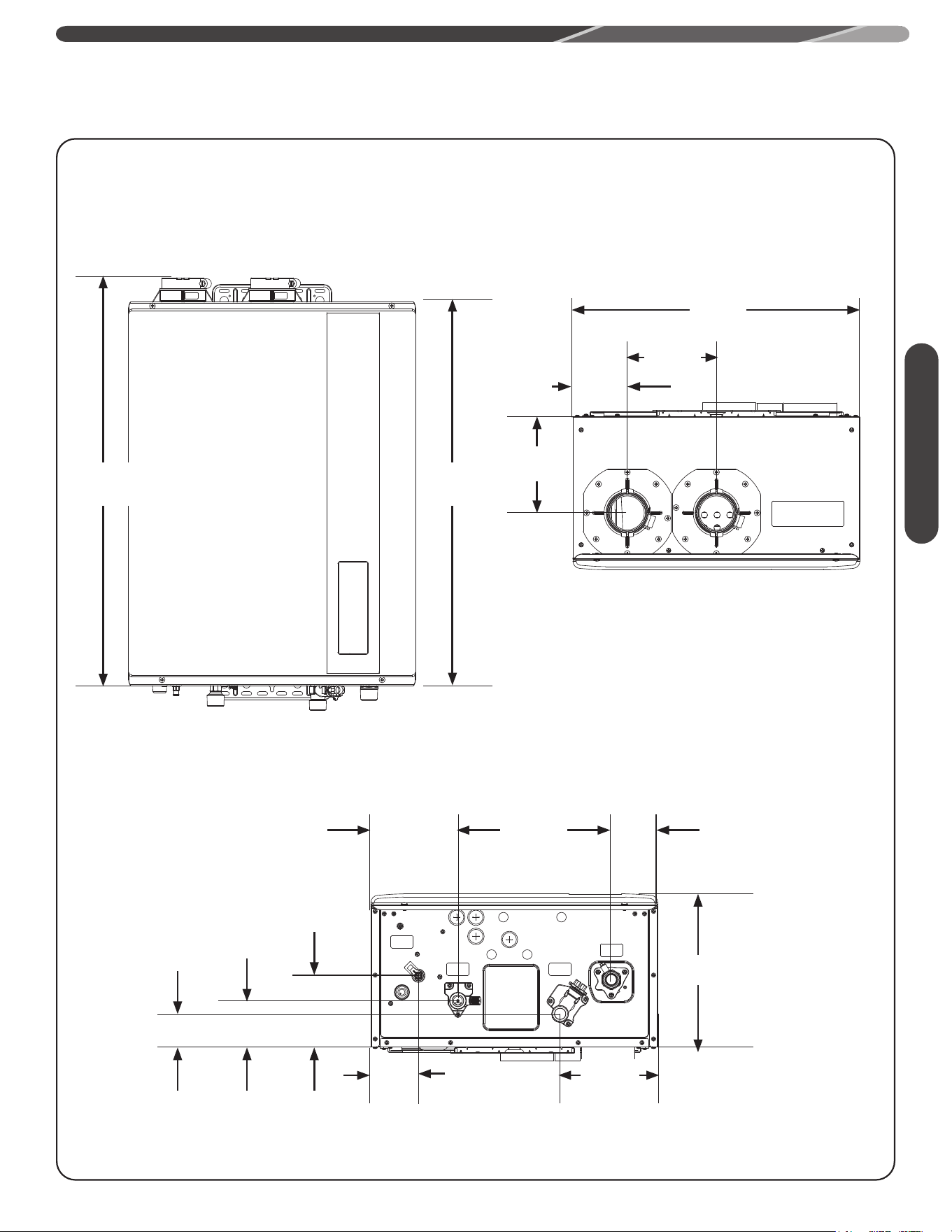
Specifications – Direct-Vent Models
25.7 in
(637 mm)
23.58 in
(600 mm)
3.31 in
(84 mm)
5.89 in
(150 mm)
5.54 in
(141 mm)
17.65 in
(448 mm)
5.43 in
(138 mm)
4.36 in
(111 mm)
2.9 in
(74 mm)
2.85 in
( 72 mm)
2.04 in
(52 mm)
2.78 in
(71 mm)
9.42 in
(239 mm)
6 in
(152 mm)
Front View
Top View
Bottom View
10
PRODUCT INFORMATION
Specifications
Product Information
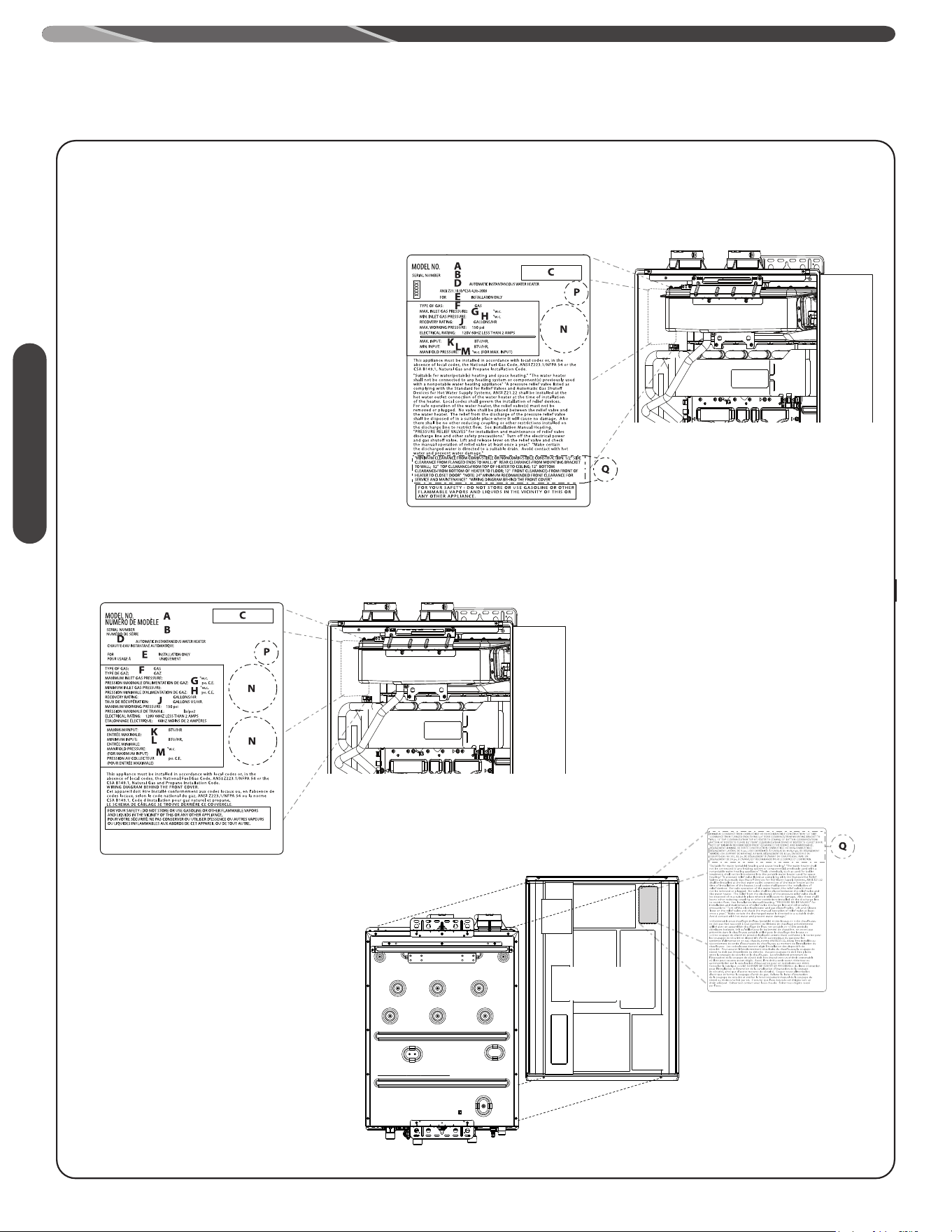
The following product information can
be found from the rating label on this
water heater.
A. Model Number
B. Serial Number
C. Data Bar Code
D. Heater Type
E. Installation Type
F. Type of Gas
G. Max. Inlet Gas Pressure
H. Min. Inlet Gas Pressure
J. Recovery Rating
K. Max. BTU Input Rating
L. Min. BTU Input Rating
M. Manifold Gas Pressure
N. Certification Stamp
P. Alternate Approval Stamp
Q. Clearances
English Rating Label
English/French Rating Label
Back side of
the cover
11
PRODUCT INFORMATION
Product Information
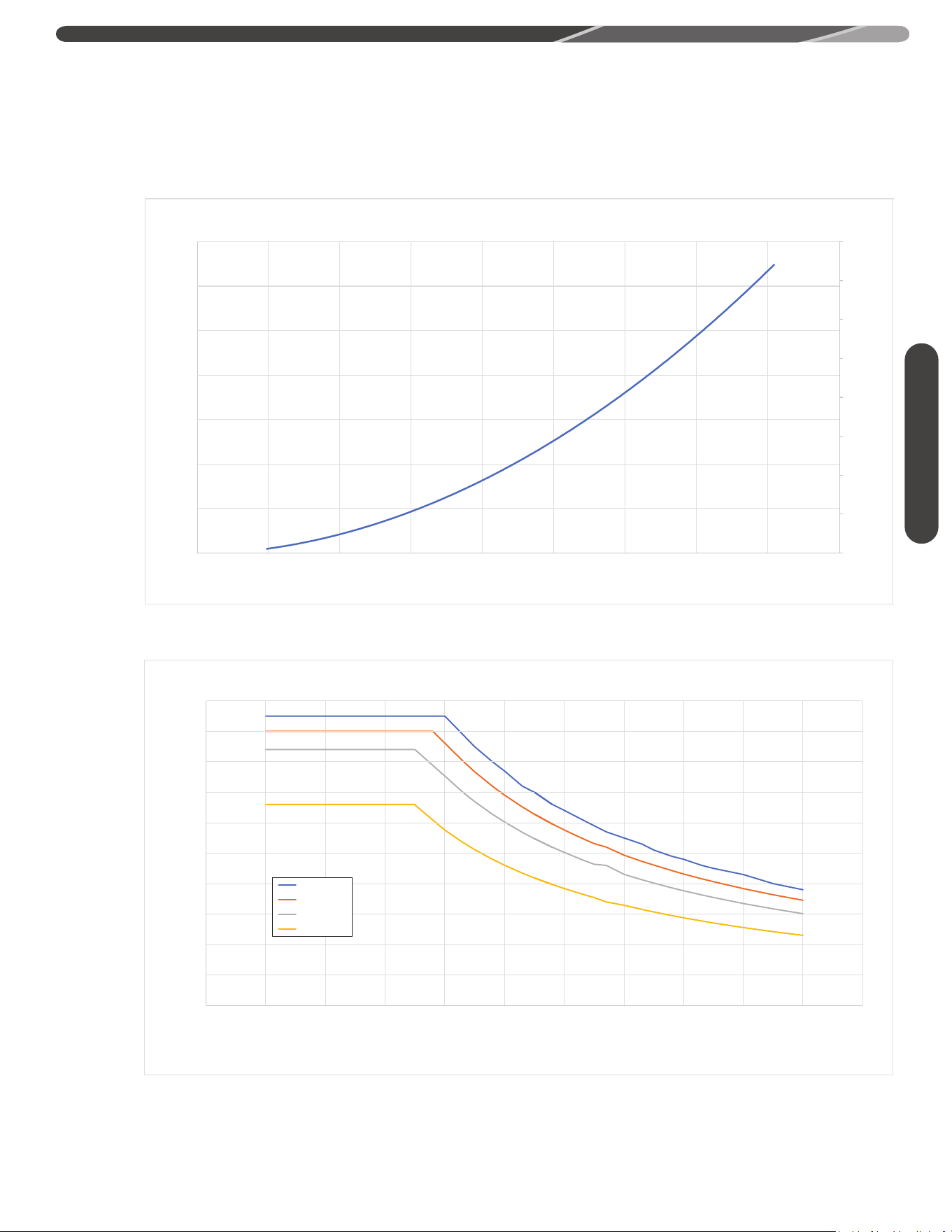
0
5
10
15
20
25
30
35
0
Pressure Drop (PSI)
1 2 3 4 5 6 7 8
Water Flow Rate (GPM)
Pressure Drop Curve
0
10
20
30
40
50
60
70
80
9
Pressure Drop (ft of head)
0
1
2
3
4
5
6
7
8
9
10
0 10 20 30 40 50
Water Flow Rate (GPM)
Delta T - Temperatu
r
Temperature Rise Curve
RTGH-90DVL-3
RTGH-68DVL-3
60 70 80 90 100 110
re Rise (°F)
RTGH-95DVL-3
RTGH-84DVL-3
The graphic below illustrates the pressure drop across the water heater. Please ensure ample water supply
pressure is available to ensure the best performance.
12
PRODUCT INFORMATION
General Descriptions
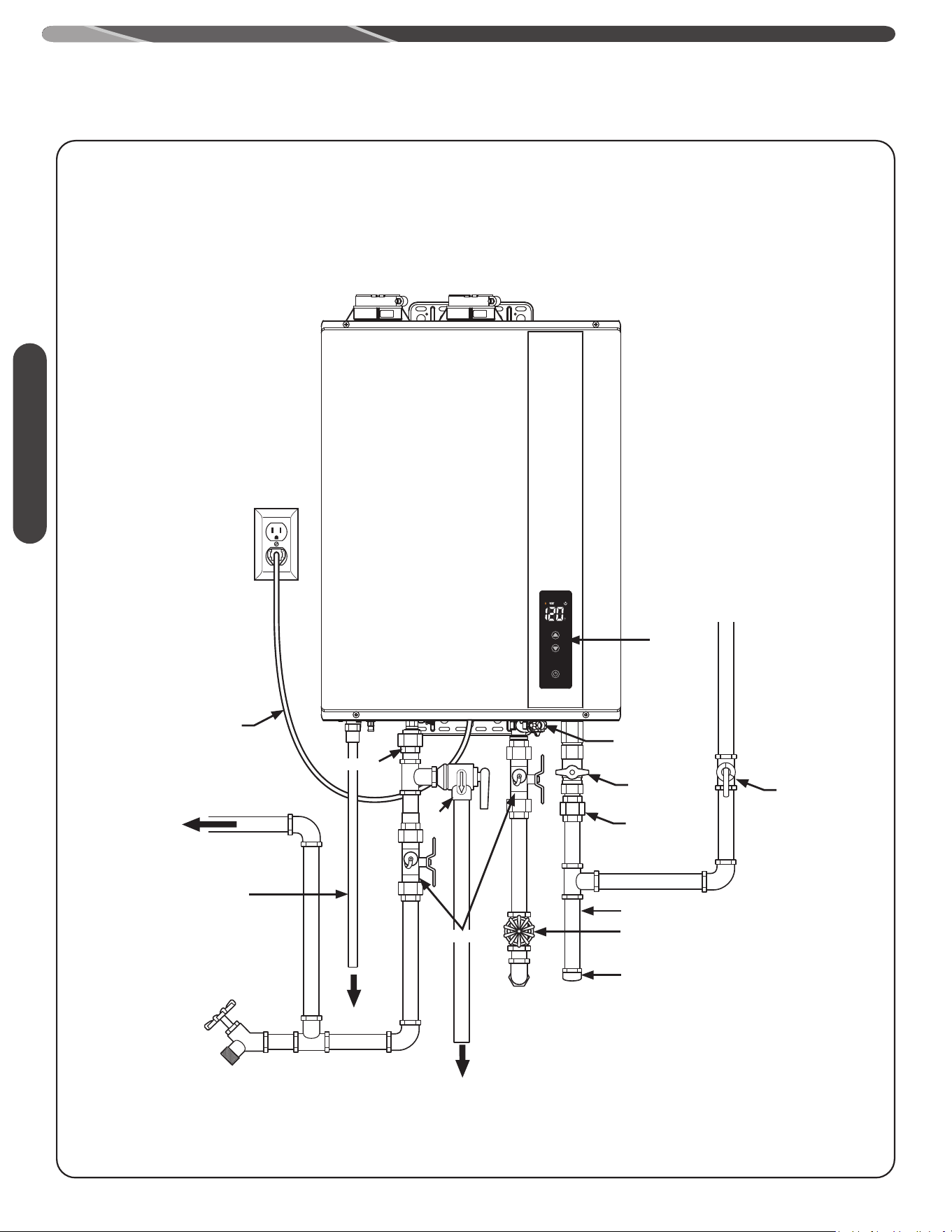
Typical Direct-Vent Water Heater
(Shown Without Venting)
Product Information
Water Filter
Built-In
Display
Manual Gas
Shut-Off Valve
Union
Union
Power
Supply
Cord
Sediment Trap
Service Valve
To Suitable
Drain /
Neutralizer
To Suitable
Drain
Drain
Valve
Condensate
Pipe*
To Hot Water
Faucet(s)
Relief
Valve
Cold Water Supply
Shut-Off Valve
Cap
Manual Gas
Supply Line
Shut-Off Valve
13
General Descriptions
Product Information
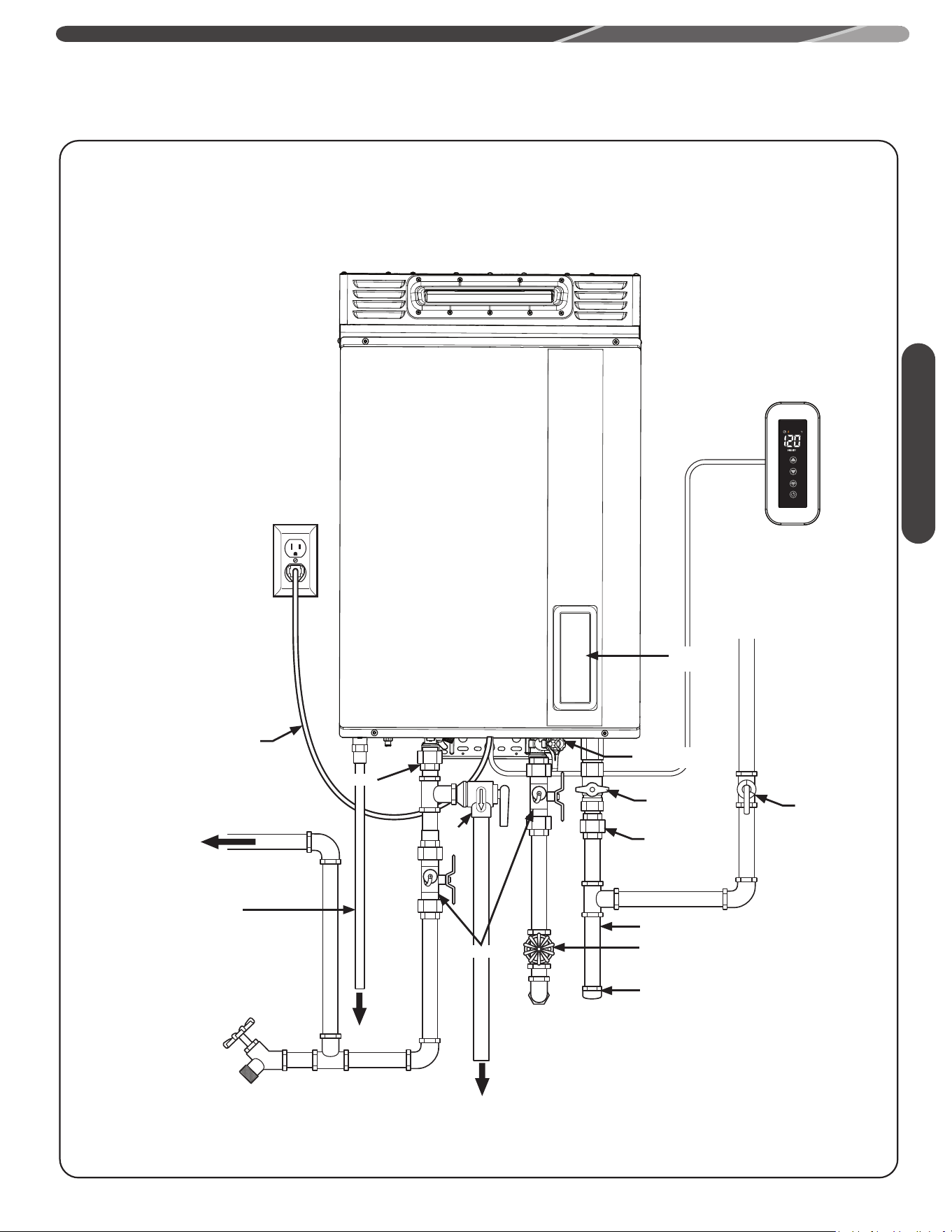
Water Filter
Built-In
Display
WiFi Control &
Harness
Manual Gas
Shut-Off Valve
Union
Union
Power
Supply
Cord
Sediment Trap
Service Valve
To Suitable
Drain/
Neutralizer
To Suitable
Drain
Drain
Valve
Condensate
Pipe*
To Hot Water
Faucet(s)
Relief
Valve
Cold Water Supply
Shut-Off Valve
Cap
Manual Gas
Supply Line
Shut-Off Valve
PRODUCT INFORMATION
Typical Outdoor Water Heater
(Outdoor Conversion Kit Required - sold separately)
INSTALLATION
INSTRUCTIONS
FOR THE CONTRACTOR
14
Installation
15
INSTALLATION INSTRUCTIONS
Standards Compliance
This water heater must be installed in accordance
with these instructions, local codes, and utility
company requirements.
In the United States where local codes are not
available, use the latest edition of the American
National Standard/National Fuel Gas Code. A copy
of the Fuel Gas Code can be purchased from either
the American Gas Association, 400 North Capitol
Street Northwest, Washington, DC 20001, as
ANSI standard Z223.1, or National Fire Protection
Association, 1 Batterymarch Park, MA 02269 as
NFPA 54.
In Canada, use the latest edition of the CAN/CSA
B149.1 Natural Gas and Propane Installation Code
and the Canadian Electrical Code, CAN/CSA C22.1,
Part 1.
A copy can be purchased from; Canadian Standards
Association, 5060 Spectrum Way, Mississauga, ON
L4W 5N6
Choosing a Location
WARNING:
Fire Hazard –Combustible construction refers to adjacent
walls and ceilings and should not be confused with
combustible or flammable products and materials.
Combustible materials, such as clothing, cleaning
materials, or flammable liquids, must not be placed against
or next to the water heater. Fire or explosion could occur
causing death, personal injury, and/or product or property
damage.
A gas-fired water heater should never be installed in a
space or room where liquids with flammable vapors are
used or stored. Such liquids include gasoline, LP gas
(butane or propane), paint, adhesives and their thinners,
solvents, or removers. Flammable vapors carry long
distances from where they are used or stored. The open
flame of the water heater’s main burner can ignite these
vapors causing an explosion or fire.
NOTICE:
Elevating a gas-fired water heater will reduce but NOT
eliminate the possibility of lighting the vapor of flammable
liquids which may be improperly stored or accidentally
spilled.
NOTICE:
DO NOT connect power until venting installation is complete
(see Venting installation).
NOTICE:
This water heater should not be located in an area where
water leakage of the heat exchanger or connections will
result in damage to the area adjacent to it or to lower floors
of the structures. When such areas cannot be avoided,
install a suitable catch pan with an adequate drain under
the water heater.
The following requirements will ensure a safe
installation:
• The water heater must be located in an area where
it won’t sustain damage from moving vehicles,
flooding, etc. If the water heater is installed in a
storage garage, the direct ignition system and main
burner should be no less than 18 in. (45 cm) above
the garage floor.
• If the water heater is installed in a repair garage or
in a private garage, the direct ignition system and
main burner should be no less than 4.5 ft (1400
mm) above the garage floor.
• The water heater should be installed as close as
possible to the vent exhaust and air intake. This
minimizes the vent length and the number of
elbows and joints required for venting.
• The water heater should be installed with the
correct venting and exhaust materials. See
"Venting" in this Use and Care Manual.
General
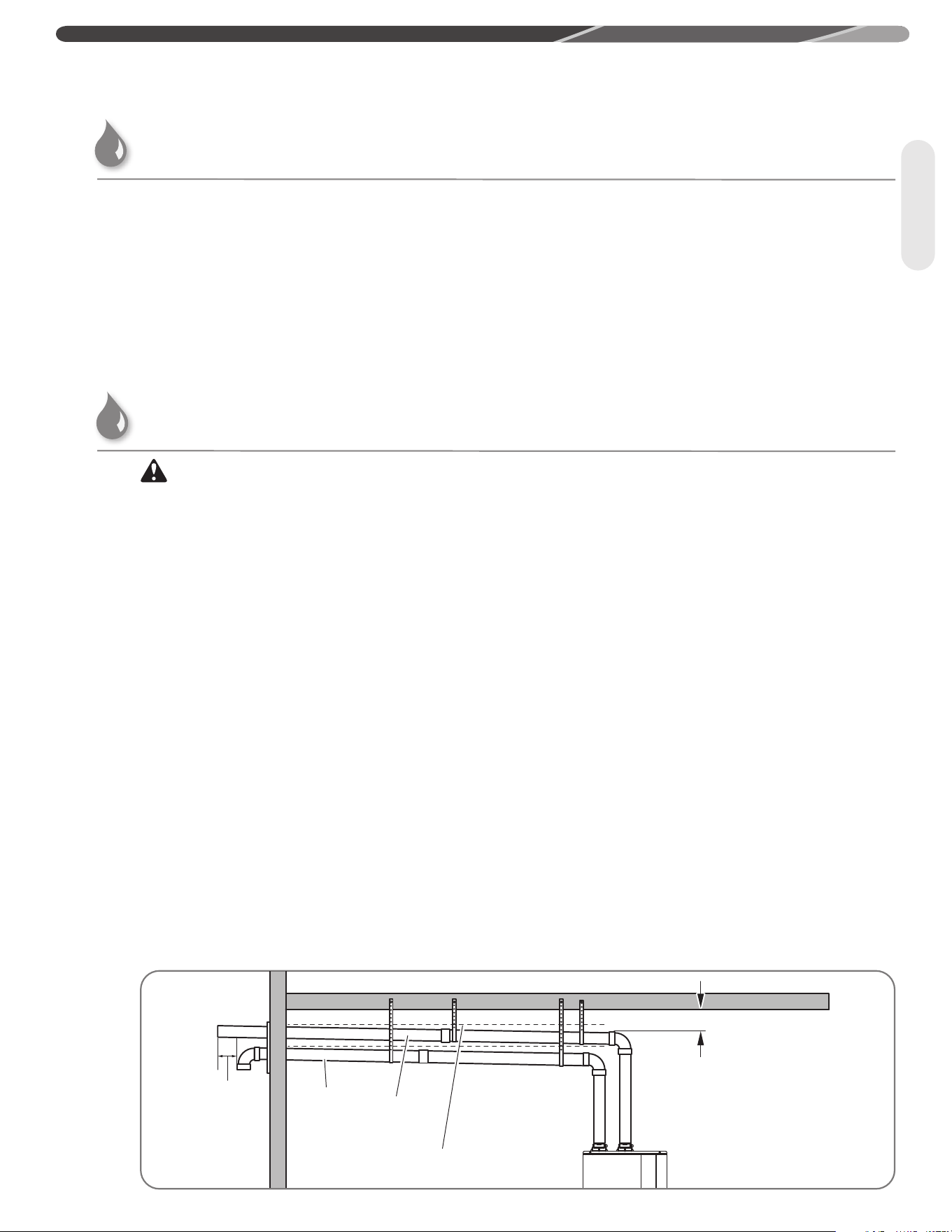
Exhaust Vent Pipe
Air Intake Pipe
0" min.
(0 mm)
12"
(300 mm)
Minimum
Upward Slope
to Termination
16
INSTALLATION INSTRUCTIONS
General
• Every vent or air intake pipe penetration of a floor
or ceiling should be sealed.
• Failure to install and properly vent the water heater
to the outdoors as outlined on "Venting" can result
in unsafe operation.
• Long hot water lines should be insulated to
conserve water and energy.
• The water heater and water lines should be
protected from exposure to freezing temperatures.
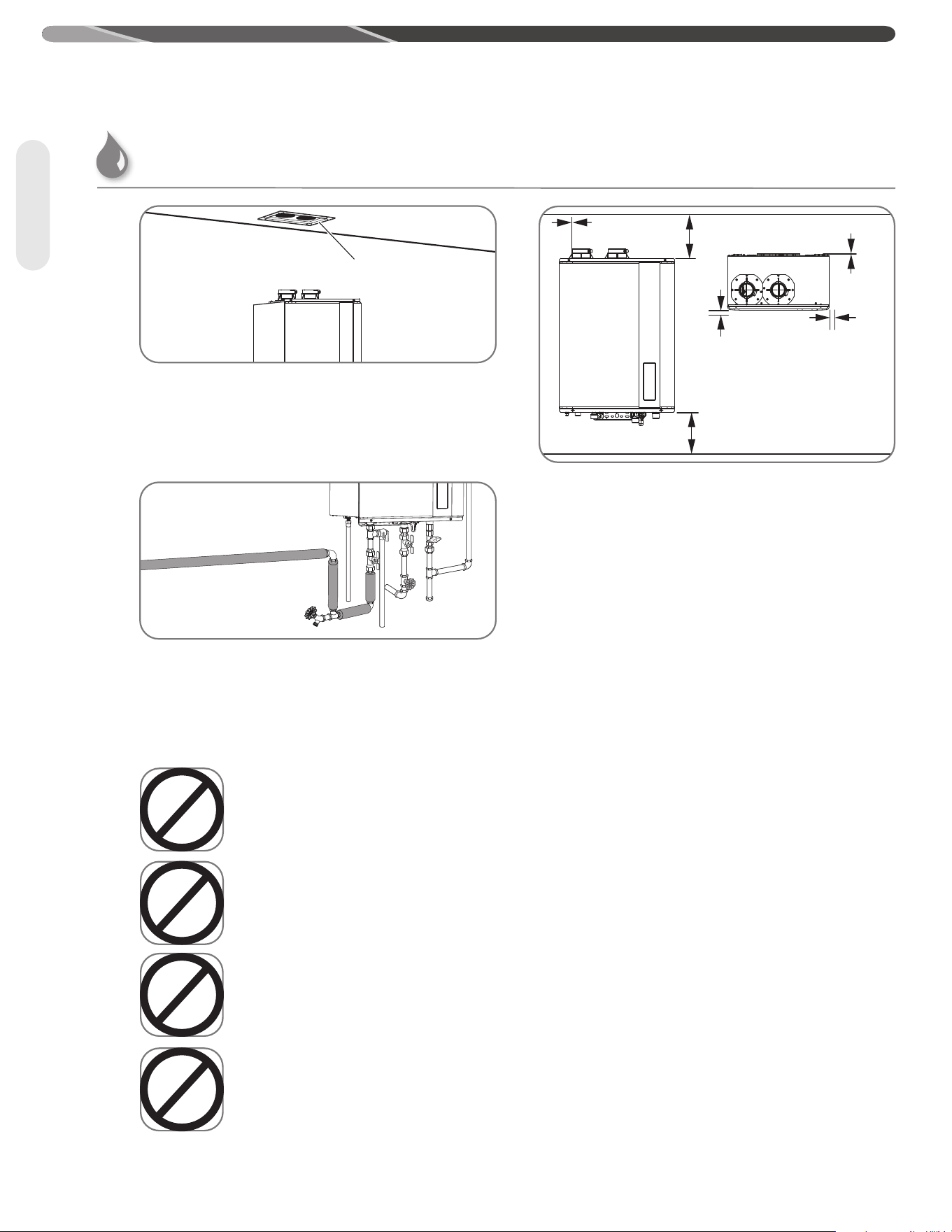
• Minimum water heater clearances from
combustible and noncombustible construction are
as follows:
– 1/2 in. (1.3 cm) for sides and front
– 0 in. (0 cm) for rear with support bracket(s)
– 12 in. (30 cm) from the bottom and top
– 0 in. (0 cm) for vent or air intake pipe
NOTICE:
Preferred maintenance clearance is 24 in. (61 cm)
from top, bottom, and front of unit.
12" min.
(300 mm)
12" min.
(300 mm)
0" min.
(0 mm)
1/2" min.
(13 mm)
1/2" min.
(13 mm)
0"
(0 mm)
Sealing Plate
• DO NOT install the water heater in areas
prohibited by National Fuel Gas Code in
U.S. installation or CAN/CSA B149.1 in
Canadian installation.
• DO NOT install the water heater where it
is subject to vibrations.
• DO NOT install the water heater in a
recreational vehicle, boat, or other
watercraft.
• DO NOT install the water heater near
vents for heating and cooling unless
a minimum clearance of 4 ft (1.2 m) is
maintained.
Choosing a Location (cont.)
17
INSTALLATION INSTRUCTIONS
General
Product Inspection
Visually inspect the water heater for any possible
damage.
Check the rating plate on the water heater to make
sure the water heater was designed to be used with
the supplied type of gas (natural or LP).
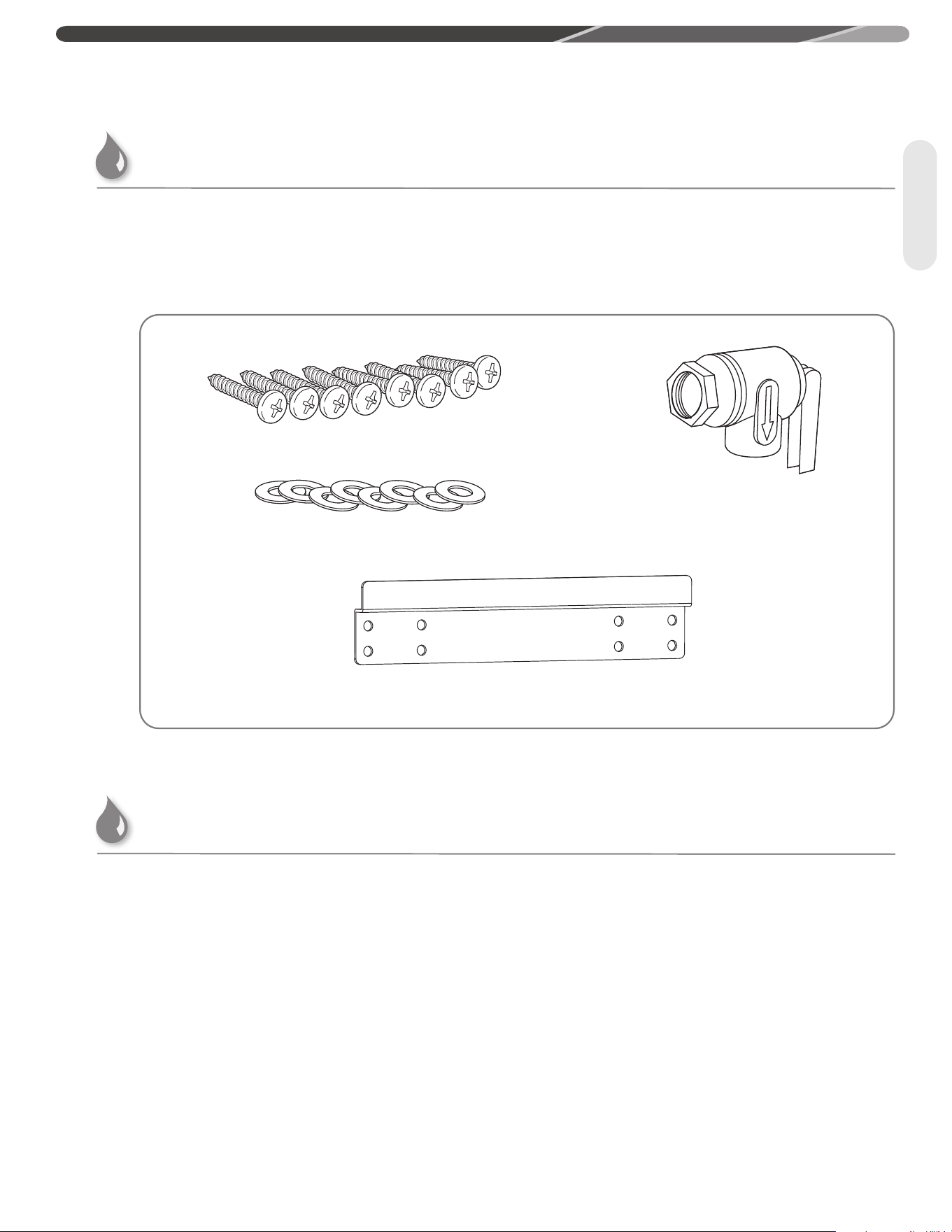
Verify that all included supplied parts are present as
shown.
Water Heater Installation
Corrosive Atmosphere
NOTICE:
The water heater should not be installed near an air supply
containing halogenated hydrocarbons where contaminants
can enter the combustion air supply.
Avoid installing a water heater in any of the
following locations: beauty shops, dry-cleaning
establishments, photo processing labs, and storage
areas for liquid and powdered bleaches or swimming
pool chemicals. These locations often contain such
halogenated hydrocarbons.
The air supply containing halogenated hydrocarbons
is safe to breathe, but when passed through a gas
flame, corrosive elements are released that will
shorten the life of any gas-burning appliance.
Propellants from common spray cans or gas leaks
from A/C and refrigeration equipment are highly
corrosive after passing through a flame.
NOTICE:
The water heater warranty is void when the failure is due to
operation in corrosive conditions.
Screws
Washers
Mounting Bracket
Pressure Relief Valve
(Some models only)
18
INSTALLATION INSTRUCTIONS
General
NOTICE:
The National Fuel Gas Code (NFGC) and CAN/CSA B149.1 mandate a manual gas shut-off valve.
See NFGC/B149.1 for complete instructions. Local codes or plumbing authority requirements may vary from the instructions or
diagrams provided and take precedence over these instructions.
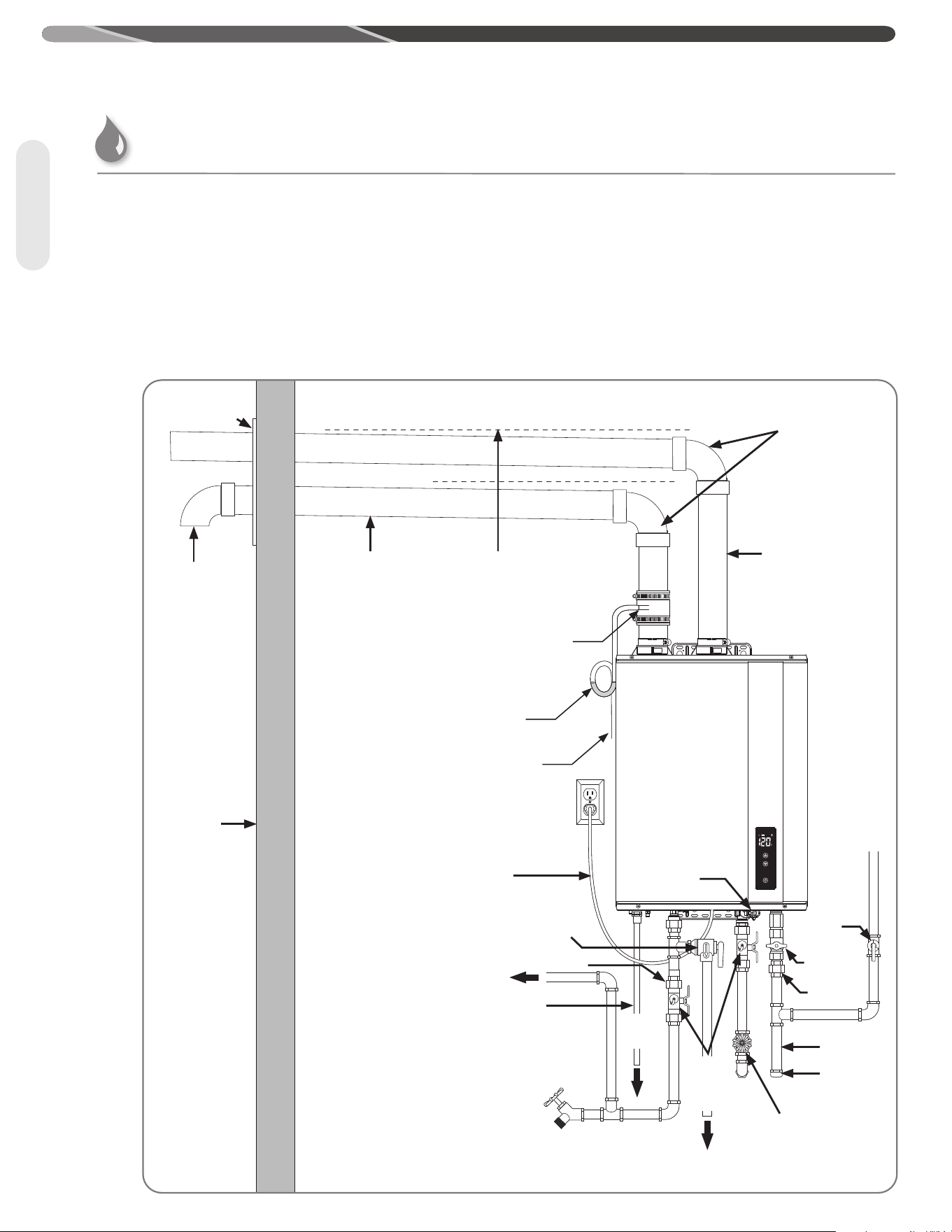
Typical Installation of Direct-Vent Water Heater
Water Heater Installation (cont.)
To
Suitable
Drain
To
Suitable
Drain
To Hot Water
Faucet(s)
Condensate
Pipe*
Union
Relief
Valve
Sediment
Trap
Water
Filter
Manual Gas
Supply Line
Shut-Off Valve
Manual Gas
Shut-Off
Valve
Union
Cap
Cold Water
Supply Shut-Off
Valve
Service
Valve
(supplied)
with some
models)
Power Supply
Cord
Outside
Wall
Wall Plate
(Recommended)
90°
Elbow
Air
Intake
Pipe
Upward Slope to
outside termination
Exhaust Vent Pipe
90°Elbow
Drain
Valve
Condensate Collector
Condensate Trap
To Drain: Dispose of condensate
in accordance to local codes.
19
General
INSTALLATION INSTRUCTIONS
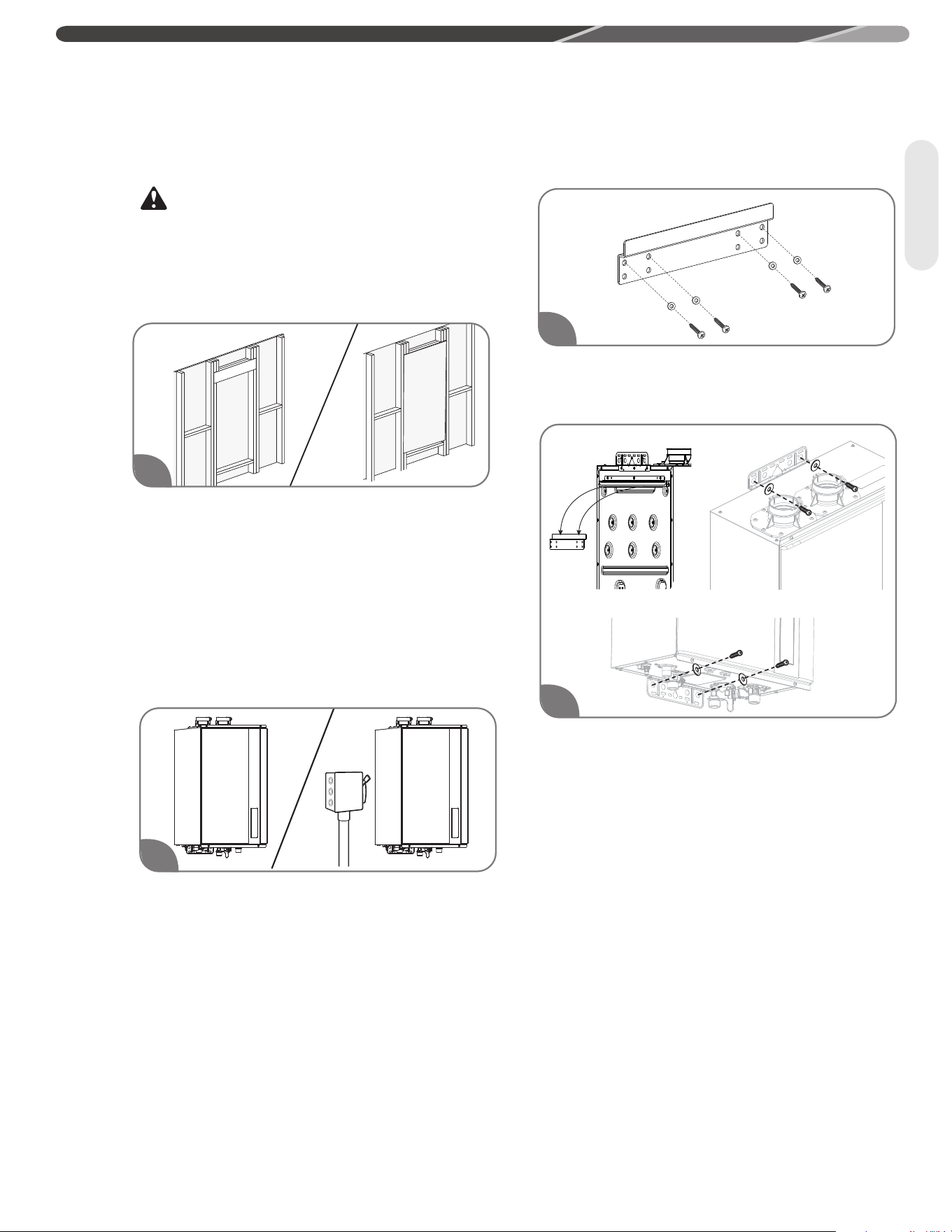
Mounting the Water Heater
CAUTION:
Reinforcement of the wall is required where the wall is not
strong enough to hold the water heater. Failure to do so
could result in personal injury and/or property damage.
The mounting location for the water heater should
allow for easy access and operation.
The water heater is designed to be installed either
inside the wall cavity, between the wall studs, or
outside the wall cavity. Either installation requires the
water heater to be supported with a wooden support
brace between the wall studs, or a piece of wood
that is equal in size to the water heater and securely
attached to the wall studs before the water heater is
attached to it. This piece of wood can be installed
inside or outside of the wall. Use wood screws to
secure brackets to wall. If mounting to a concrete
wall, use lag bolts designed for concrete.
Make sure the proper electrical outlet or supply (120
VAC/60 Hz) is available and located near the unit.
Direct-vent models come with a 6-ft. (1.8-m) power
cord, while the outdoor models require hard-wiring
or the addition of a plug.
Attach the mounting bracket to the wall and secure
it by 4 screws and washers. Make sure it is level and
that it can support the weight of the water heater.
NOTICE:
The image above may differ in appearance from your water
heater.
Align the groove on the back of the water heater to
the tongue on the mounting bracket. When mounted
with the mounting bracket, the water heater will have
a 5/8" (16 mm) clearance from the back of the wall.
Using two screws and washers , secure the top and
lower mounting bracket to the wall.
NOTICE:
DO NOT connect power until venting installation is complete
(see Venting installation).
3
1
4
2
DANGER:
Failure to properly vent the water heater to the outdoors
as outlined in this Venting section will result in death or
serious personal injury. To avoid the risk of fire, explosion,
or asphyxiation from carbon monoxide, NEVER operate the
water heater unless it is properly vented and has adequate
air supply for proper operation as outlined in this Venting
section. This water heater must have air supply connected
and terminated to the outdoors.
WARNING:
Refer to page 16 for required clearances to combustible
materials. Improper clearances can cause explosion or fire
resulting in death, personal injury, and/or product damage.
CAUTIONS:
•
Check to make sure flue gases DO NOT recirculate into the
air intake terminal when using direct venting. If the water
heater is having service issues, flue recirculation may be a
contributing factor.
• Even when the minimum vent terminal separation
distances are followed, recirculation may still occur
depending upon the location outside the building, the
distance from other buildings, proximity to corners,
weather conditions, wind patterns, and snow depth.
• Periodically check to make sure that flue recirculation
is not occurring. Signs of flue gas recirculation include
frosted or frozen intake terminals and condensate in the
intake terminal and venting system.
• Correction to flue recirculation may involve angling the
intake away from the exhaust terminal and increasing the
distance between them. Check to be sure the intake and
exhaust terminals are not obstructed, especially during
periods of below-freezing weather.
Venting Requirements
The installation of venting must comply with national
codes, local codes, and the vent manufacturer’s
instructions.
The vent exhaust and air intake must terminate
outside as described in these instructions. DO NOT
vent this water heater through a chimney. It must be
vented separately from all other appliances.
NOTICE:
The unit can be vented using only the following approved
vent pipe material.
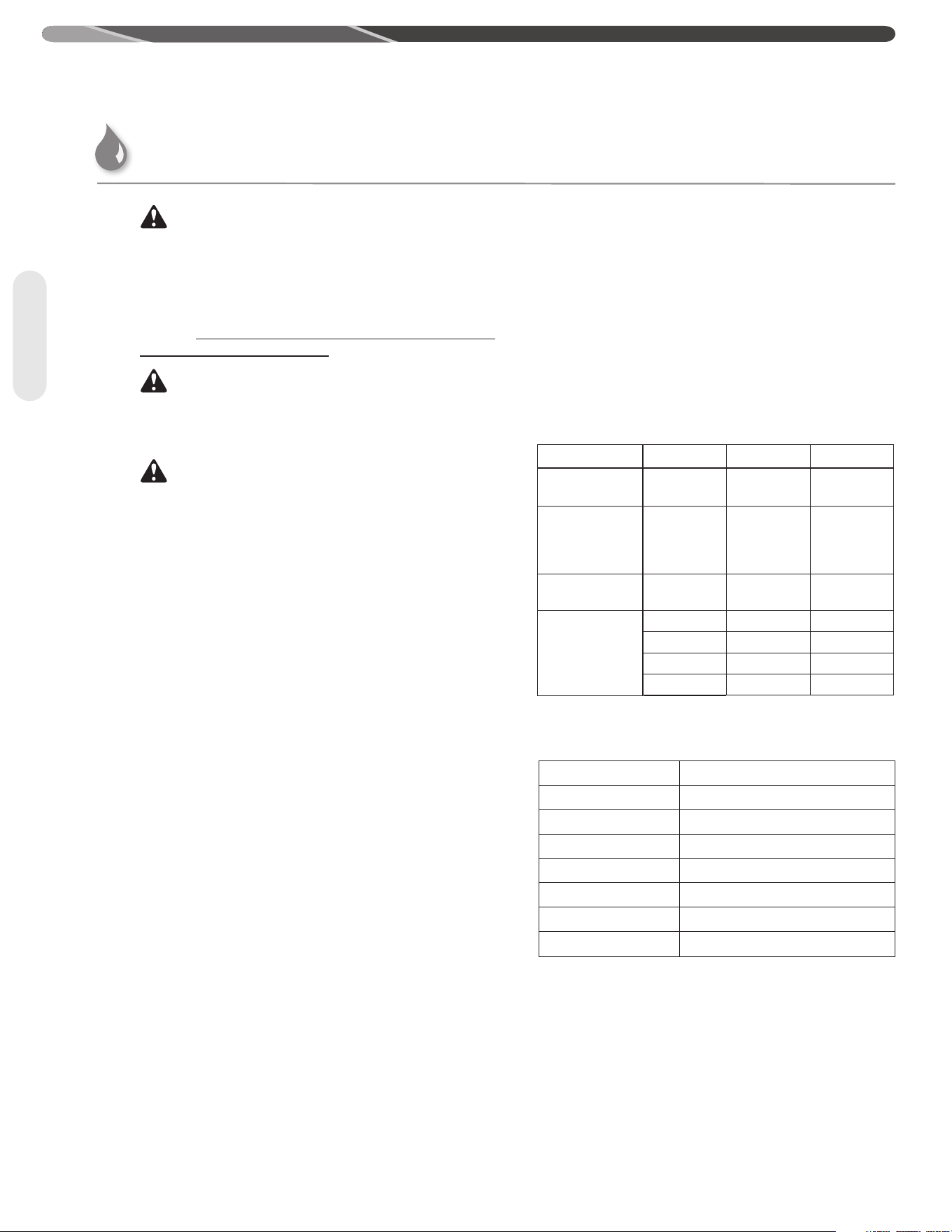
Use only 2 or 3 inch diameter pipe. Refer to local
codes for restrictions on the use of InnoFlue® PP,
PVC, CPVC, or ABS pipe and fittings. All exhaust
venting materials for product installed in Canada
must meet ULC-S636.
The use of cellular core PVC (ASTM F891), cellular
core CPVC, or Radel® (polyphenolsulfone) in non-
metallic venting systems is prohibited and that
covering non-metallic vent pipe and fittings with
thermal insulation is prohibited.
This water heater requires a special venting
system. Refer to venting supplier’s instruction for
complete parts list and method of installation.
The manufacturers and product lines listed on the
following tables have been tested and authorized to
safely operate with Rheem tankless water heater.
Approved Vent Materials, Fittings and Terminations:
ABS is not permitted for exhaust vent in Canada
Approved Polypropylene Vent Manufacturer/Trade Name:
*Refers to variations in nominal size.
DO NOT USE Schedule 20, Cell Core, Drain Pipe,
Galvanized, Aluminum, B-Vent, or any flexible vent.
20
INSTALLATION INSTRUCTIONS
Venting for Direct-Vent Water Heater
Venting
Acceptable Materials
for Exhaust
Acceptable Materials
for Air Intake
Fittings
Terminations
(Manufactured
by Polytech)
Schedule 40,
ASTM D-1785
Schedule 40,
ASTM D-1785,
and DWV,
ASTM-D2665
Schedule 40,
ASTM D-2665
SP20285
SP20286
SP20245
SP20897
PVC
Schedule 40,
ASTM F-441
Schedule 40,
ASTM F-441,
and CPVC 4120,
ASTM-D2846
Schedule 40,
ASTM F-438
SP21025
SP21026
CPVC
Schedule 40,
ASTM D-2661
Schedule 40,
ASTM D-2661
Schedule 40,
ASTM D-2661
ABS
Manufacturer
Trade Name
Single Wall Pipe
Elbow
Adapter
Non-Return Valve (NRV)
Siphon
Termination
Centrotherm
InnoFlue®
ISVL**** or ISVL****UV
ISELL**** or ISELL****UV
ISAAL0202
ISNRV****
IASJBVS
ISLPT**** or ISTT****
21
INSTALLATION INSTRUCTIONS
Appropriate dip switch adjustment shall be required
to allow certain vent length. There are 4 vent
configuration settings, A-0, A-1, A-2, and A-3 settings
at 0-2000 ft (0-610 m) elevation.
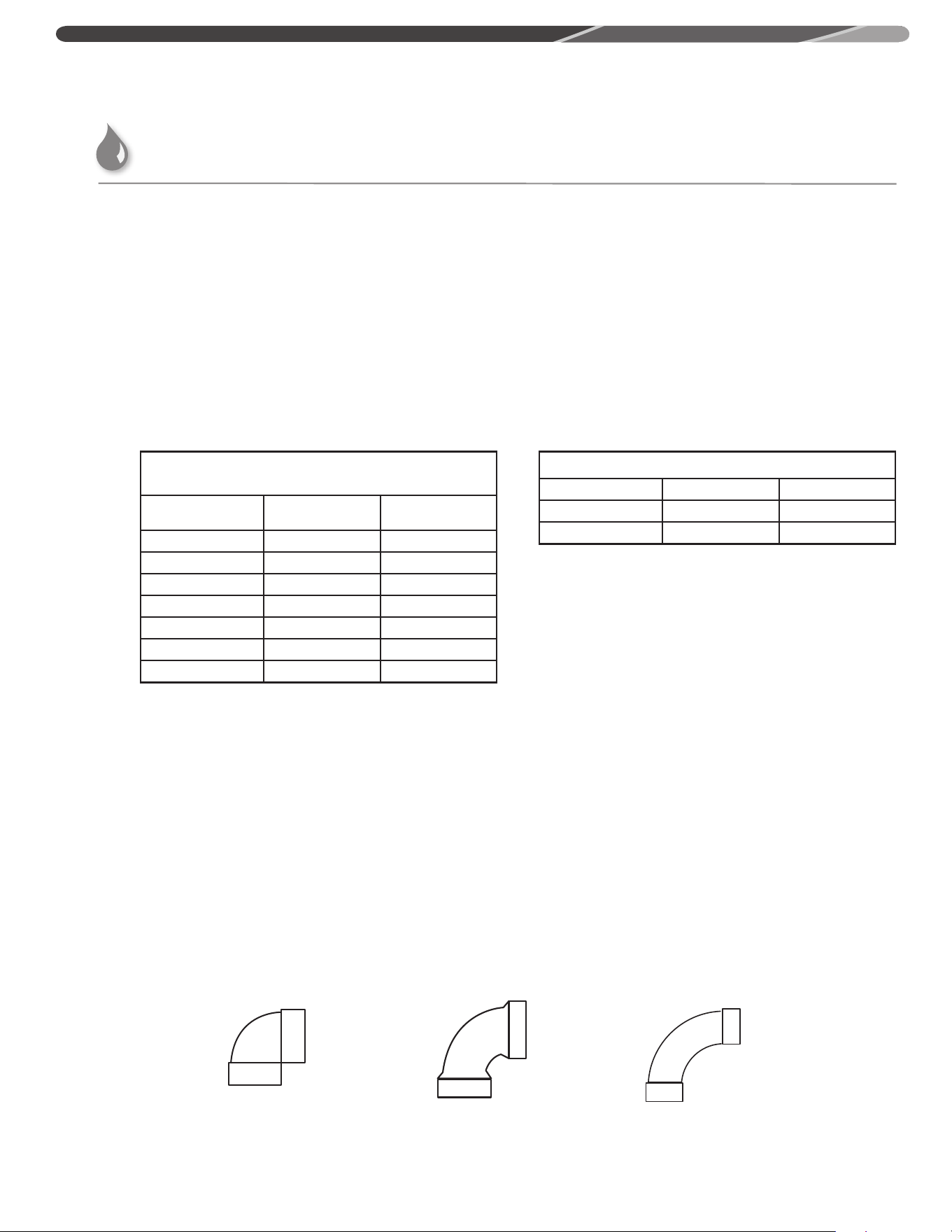
Vent Lengths
Before starting the vent installation, careful planning
should be given to the routing and termination of the
vent pipes. The length of the vent pipes (inlet and
outlet) should be kept to a minimum. Also, see pages
26 and 27 for vent terminal placement. Refer to the
maximum and minimum vent length charts for the
pipe sizes that can be used and the total equivalent
length of pipe that can be used. DO NOT exceed
equivalent length of pipe in maximum vent length
chart.
Venting for Direct-Vent Water Heater
The vent termination is not included in the equivalency calculations.
NOTICE: A 90°, ¼ standard bend or long bend elbow is equivalent to 6 ft. (1.83 m) of straight pipe. A 45°, 1/8
standard bend or long bend elbow is equivalent to 2.5 ft. (0.76 m) of straight pipe. A 90°, short bend radius elbow
is equivalent to 12 ft. (3.66 m) of straight pipe.
DO NOT use unequal diameters of pipe and fittings for the vent system.
See examples below.
Short Bend 90° Elbow
OK to Use
Standard Bend 90° Elbow
OK to Use
Long Bend 90° Elbow
OK to Use
Elbow Examples
*The altitude settings for installations at levels greater than 2000 ft (610 m), can be found in the "High-Altitude
Dip Swich Adjustments" section of this manual. DIP switch changes will be necessary at higher altitudes.
SINGLE UNIT: MAX. EQUIVALENT
VENT LENGTHS - STRAIGHT PIPE
Number of 90° Elbows
Max Length 2"
Straight Pipe
Max Length 3"
Straight Pipe
0 60 ft. (18.3 m) 150 ft. (45.7 m)
1 54 ft. (16.5 m) 144 ft. (43.9 m)
2 48 ft. (14.6 m) 138 ft. (42.7 m)
3 42 ft. (12.8 m) 132 ft. (40.2 m)
4 36 ft. (11.0 m) 126 ft. (38.4 m)
5 30 ft. (9.1 m) 120 ft. (36.6 m)
6 24 ft. (7.3 m) 114 ft. (34.7 m)
EQUIVALENT FT. OF ELBOWS
2" Pipe 3" Pipe
90° 6 ft. (1.83 m) 6 ft. (1.83 m)
45° 3 ft. (0.9 m) 3 ft. (0.9 m)
22
INSTALLATION INSTRUCTIONS
Venting
Vent Length and High Altitude DIP switch Adjustments
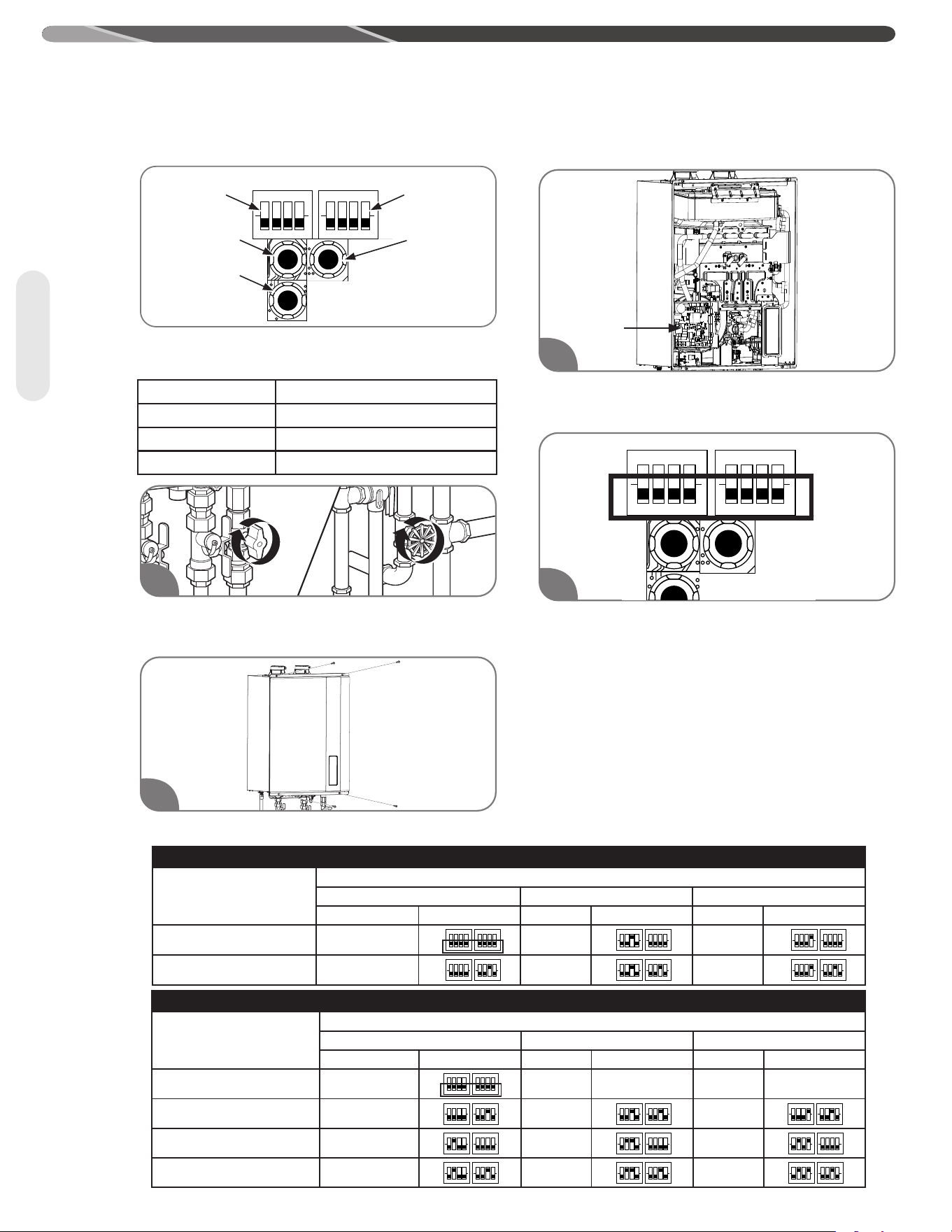
A-0 setting is default and factory setting. All dip
switches are off.
Turn off the gas and water to the water heater by
closing the shut-off valves.
Remove the front cover panel on the water heater.
Find DIP Switch 1 and 2 located in the top-right
portion of the control board.
The factory settings for this switch should all be in
the OFF position (DOWN), which is the A-0 setting.
For longer vent lengths and altitudes above 2000 ft.
(610 m), refer to the table below for the necessary
DIP switch settings. These setting must be changed
to ensure proper operation.
NOTICE
DO NOT alter any other DIP switch settings. Please
contact technical service listed on page 76 of this
use and care manual if you have any questions of DIP
switch adjustments.
As set
from factory
MIN MAX ADJ
ON
1 2 3 4
ON
1 2 3 4
1
3
2
4
ON
1 2 3 4
ON
1 2 3 4
Control
Board
DIP
Switch
2
"MAX"
button
"ADJUST"
button
"MIN"
button
DIP
Switch
1
3" VENT SYSTEM DIAMETER
Identify Vent Length
IDENTIFY ALTITUDE
0 - 2,000 ft 2,001 - 5,400 ft 5,400 - 7,800 ft
Dip Dip Dip
6 to 45 feet (1.8 - 13.7 meters) A-0 (Factory Setting) B-0 C-0
45 to 150 feet (13.7 to 45.7 meters) A-1 B-1 C-1
2" VENT SYSTEM DIAMETER
Identify Vent Length
IDENTIFY ALTITUDE
0 - 2,000 ft 2,001 - 5,400 ft 5,400 - 7,800 ft
Dip Dip Dip
MUST CHANGE FACTORY DIP SETTING A-0 (Factory Setting)
6 to 21 feet (1.8 to 6.4 meters) A-1 B-1 C-1
21 to 42 feet (6.4 to 12.8 meters) A-2 B-2 C-2
42 to 60 feet (12.8 to 18.3 meters) A-3 B-3 C-3
ON
1 2 3 4
ON
1 2 3 4
ON
1 2 3 4
ON
1 2 3 4
ON
1 2 3 4
ON
1 2 3 4
ON
1 2 3 4
ON
1 2 3 4
ON
1 2 3 4
ON
1 2 3 4
ON
1 2 3 4
ON
1 2 3 4
ON
1 2 3 4
ON
1 2 3 4
ON
1 2 3 4
ON
1 2 3 4
ON
1 2 3 4
ON
1 2 3 4
ON
1 2 3 4
ON
1 2 3 4
ON
1 2 3 4
ON
1 2 3 4
ON
1 2 3 4
ON
1 2 3 4
ON
1 2 3 4
ON
1 2 3 4
ON
1 2 3 4
ON
1 2 3 4
ON
1 2 3 4
ON
1 2 3 4
ON
1 2 3 4
ON
1 2 3 4
SECTION HIGH-ALTITUDE
Sea Level (A Setting) 0-2000 ft (0 m - 610 m)
B Setting 2001 ft - 5400 ft (610 m - 1650 m)
C Setting 5401 ft - 7800 ft (1650 m - 2377 m)
23
INSTALLATION INSTRUCTIONS
Replace the front cover panel on the water heater.
Turn on the gas and water to the water heater by
opening the shut-off valves.
NOTICE:
To use 3" vent pipe, an increasing adapter will be
required.
WARNING:
To use Category III Stainless Steel, a proper transition part
will be required to prevent flue gas from leaking.
This water heater requires the correct DIP switch
adjustments per vent length for proper operation.
Incorrect DIP switch adjustments may cause improper
water heater operation resulting in serious injury or death.
Depending on the size of pipe that is chosen for
venting the water heater, it might be necessary
to use a fitting for stepping down in pipe size, to
connect to the water heater.
All intake and exhaust venting components must
have the same diameter size. DO NOT use a
different size on the intake and exhaust venting.
It is recommend to have a vent length as short
as possible. Input rate of the water heater
decreases if there is restriction (pressure drop) in
the venting system.
The following table shows approximate input rate
reduction. Actual input rate reduction may be
different at each installation.
The unit may be vented horizontally through a
wall or vertically through the roof. Pipe runs must
be adequately supported along both vertical and
horizontal runs.
Maximum unsupported span is recommended to
be no more than 4 feet (1.2 m). It is imperative
that the first hanger be located on the horizontal
runs immediately adjacent to the first 90-degree
elbow from the vertical rise. Only use support
isolation hanging bands. DO NOT use wire to
support pipe runs.
Stress levels in the pipe and fittings can be
significantly increased by improper installation.
If rigid pipe clamps are used to hold the pipe in
place, or if the pipe cannot move freely through
a wall penetration, the pipe may be directly
stressed, or high thermal stresses may be
formed when the pipe heats up and expands.
Install accordingly to minimize such stresses.
Venting for Direct-Vent Water Heater
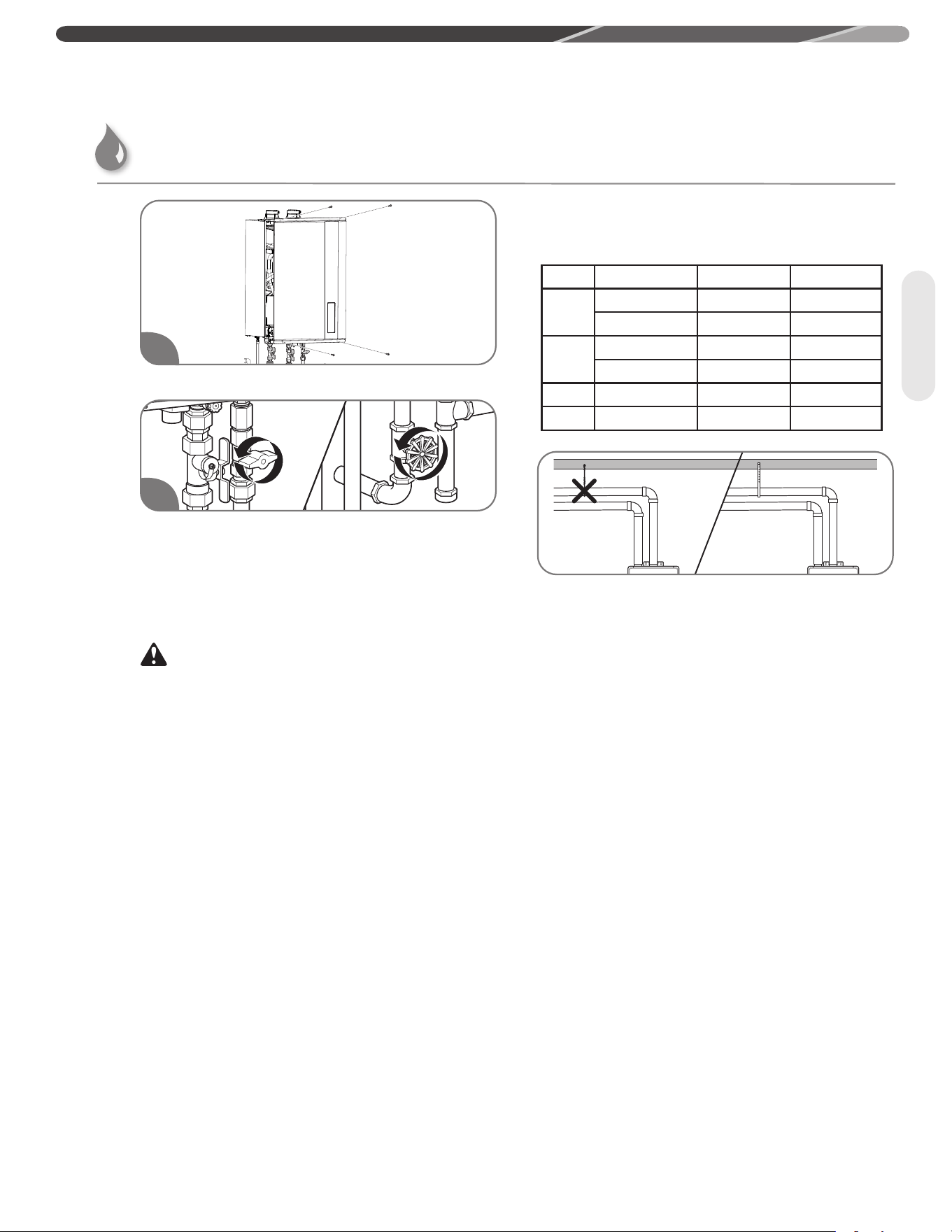
5
6
Venting
Setting Vent Size Min Vent Length Max Vent Length
A-0
3" 0% 5%
2" --- ---
A-1
3" 5% 10%
2" 5% 10%
A-2 2" 15% 20%
A-3 2" 20% 25%
24
Venting for Direct-Vent Water Heater
INSTALLATION INSTRUCTIONS
Venting
NOTICES:
• It is recommended that the air intake pipe and
exhaust pipe have a 1/4" per foot upward slope
toward the outdoors.
• Maintain the proper clearance between the vent pipe
and combustible or noncombustible materials as
described on page 16.
• Recommend use of condensation trap/collar on
the air intake to prevent water entering the heater
cabinet
• A clearance of 0 in. (0 cm) is allowed between the
vent or air intake pipe and combustible material.
• Use proper support for the vent and air intake pipes.
• It is recommended the support method used isolates
the vent pipe from floor joists or other structural
members. This helps prevent transmission of noise
and vibration.
• DO NOT support, pin, or otherwise secure the venting
system in a way that restricts the normal thermal
expansion and contraction of the chosen venting
material.
See page 25 for additional requirements for the
Commonwealth of Massachusetts.
Preexisting Venting Notes:
If the water heater is being installed as a
replacement for an existing water heater, a
thorough inspection of the existing venting and
air intake system must be performed prior to any
installation work. Verify that the correct materials,
vent lengths, and terminal locations as described
in this manual have been met. Carefully inspect
the entire venting and air intake system for any
signs of cracks or fractures, particularly at the
joints between elbows or other fittings and the
straight runs of vent pipe. Check the system for
signs of sagging or other stresses in the joints as
a result of misalignment of any components in the
system. If any of these conditions are found, they
must be corrected in accordance with the venting
instructions in this manual before completing
the installation and putting the water heater into
service.
When the water heater is installed above 2000 ft.
(610 m), the settings on the DIP switch located on
the control board need to be changed per vent
length and altitude. If these settings are not changed,
the water heater may not function properly.
Refer to "Venting for Direct Vent Water Heaters" on
page 22 for the vent lengths at each setting.
NOTICE:
DO NOT alter any other DIP switch settings. The manifold
pressure will be reduced accordingly.
Please contact technical service listed on page 76 of
this use and care manual if you have any questions
of high altitude DIP switch adjustments.
WARNING:
This water heater requires the correct DIP switch
adjustments per vent length and altitude for proper
operation. Incorrect DIP switch adjustments may cause
improper water heater operation resulting in serious injury
or death.
NOTICE:
It is recommend to have a vent length as short as possible.
Input rate at high altitude naturally is derated. In addition
to that, input rate of the water heater decreases more if
there is restriction (pressure drop) in the venting system.
Refer to input rate reduction table due to vent length on
page 23. Actual input rate reduction may be different at
each installation.
25
Venting for Direct-Vent Water Heater
In the Commonwealth of Massachusetts
The Commonwealth of Massachusetts requires compliance
with regulation 248 CMR 4.00 and 5.00 for installation of
through-the-wall vented gas appliances as follows:
5.08: Modifications to NFPA–54, Chapter 10
(1) Revise NFPA–54 section 10.5.4.2 by adding a second
exception as follows:
Existing chimneys shall be permitted to have their use
continued when a gas conversion burner is installed, and
shall be equipped with a manual reset device that will
automatically shut off the gas to the burner in the event of a
sustained back-draft.
(2) Revise 10.8.3 by adding the following additional
requirements:
(a) For all side-wall, horizontally vented, gas-fueled
equipment installed in every dwelling, building, or structure
used in whole or part for residential purposes, including
those owned or operated by the Commonwealth and where
the side-wall exhaust vent termination is less than seven
(7) feet above finished grade in the area of the venting,
including but not limited to decks and porches, the following
requirements shall be satisfied.
1. INSTALLATION OF CARBON MONOXIDE DETECTORS.
At the time of installation of the side-wall, horizontally
vented, gas-fueled equipment, the installing plumber or
gas fitter shall observe that a hard-wired carbon monoxide
detector with an alarm and battery backup is installed on
the floor level where the gas equipment is to be installed.
In addition, the installing plumber or gas fitter shall observe
that a battery-operated or hard-wired carbon monoxide
detector with an alarm is installed on each additional level of
the dwelling, building, or structure served by the side-wall,
horizontally vented, gas-fueled equipment. It shall be the
responsibility of the property owner to secure the services of
qualified licensed professionals for the installation of hard-
wired carbon monoxide detectors.
a. In the event that the side-wall, horizontally vented, gas-
fueled equipment is installed in a crawl space or an attic, the
hard-wired carbon monoxide detector with alarm and battery
backup may be installed on the next adjacent floor level.
b. In the event that the requirements of this subdivision
cannot be met at the time of completion of installation, the
owner shall have a period of thirty (30) days to comply with
the above requirements, provided, however, that during said
thirty (30) day period, a battery-operated carbon monoxide
detector with an alarm shall be installed.
2. APPROVED CARBON MONOXIDE DETECTORS. Each
carbon monoxide detector as required in accordance with the
above provisions shall comply with NFPA 720 and be ANSI/
UL 2034-listed and IAS-certified.
3. SIGNAGE. A metal or plastic identification plate shall be
permanently mounted to the exterior of the building at a
minimum height of eight (8) feet above grade directly in line
with the exhaust vent terminal for the horizontally vented,
gas-fueled heating appliance or equipment. The sign shall
read, in print size no less than one-half (1/2) inch in size,
“GAS VENT DIRECTLY BELOW. KEEP CLEAR OF ALL
OBSTRUCTIONS.”
4. INSPECTION. The state or local gas inspector of the
side-wall, horizontally vented, gas-fueled equipment shall
not approve the installation unless, upon inspection, the
inspector observes carbon monoxide detectors and signage
installed in accordance with the provisions of 248 CMR 5.08
(2)(a)(1 through 4).
(b) EXEMPTIONS: The following equipment is exempt from
248 CMR 5.08 (2)(a)(1 through 4):
1. The equipment listed in Chapter 10 entitled “Equipment
Not Required To Be Vented” in the most current edition of
NFPA 54 as adopted by the Board, and
2. Product-approved side-wall, horizontally vented, gas-
fueled equipment installed in a room or structure separate
from the dwelling, building, or structure used in whole or in
part for residential purposes.
(c) MANUFACTURER REQUIREMENTS – GAS EQUIPMENT
VENTING SYSTEM PROVIDED. When the manufacturer of
product-approved side-wall, horizontally vented, gas-fueled
equipment provides a venting system design or venting
system components with the equipment, the instructions
provided by the manufacturer for installation of the
equipment and the venting system shall include:
1. Detailed instructions for the installation of the venting
system design or the venting system components; and
2. A complete parts list for the venting system design or
venting system.
(d) MANUFACTURER REQUIREMENTS – GAS EQUIPMENT
VENTING SYSTEM NOT PROVIDED. When the manufacturer
of product-approved side-wall, horizontally vented, gas-
fueled equipment does not provide the parts for venting
the flue gases, but identifies “special venting systems,” the
following requirements shall be satisfied by the manufacturer:
1. The referenced “special venting systems” instructions
shall be included with the appliance or equipment installation
instructions, and
2. The “special venting systems” shall be product-approved
by the Board, and the instructions for that system shall
include a parts list and detailed installation instructions.
(e) A copy of all installation instructions for all product-
approved side-wall, horizontally vented, gas-fueled
equipment, all venting instructions, all parts lists for venting
instructions, and/or all venting design instructions shall
remain with the appliance or equipment at the completion of
the installation.
NOTE: For the State of Massachusetts, use only
plastic piping, fittings and vent terminations as
specified in this manual which are approved by the
Massachusetts Board of State Examiners of Plumbers
and Gas for venting of appliances (see link below):
https://licensing.reg.state.ma.us/pubLic/pl_products/
pb_pre_form.asp
INSTALLATION INSTRUCTIONS
Venting
26
INSTALLATION INSTRUCTIONS
Venting
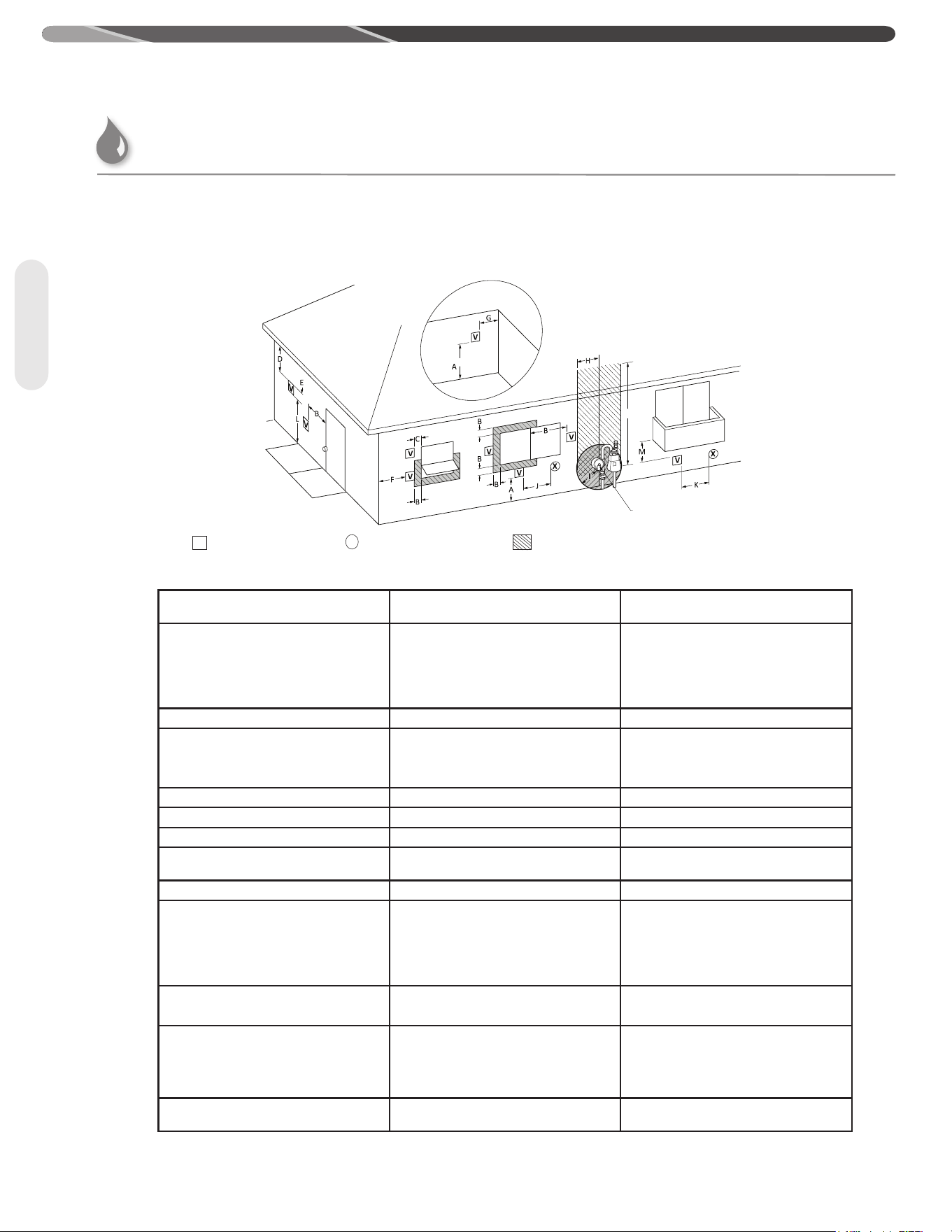
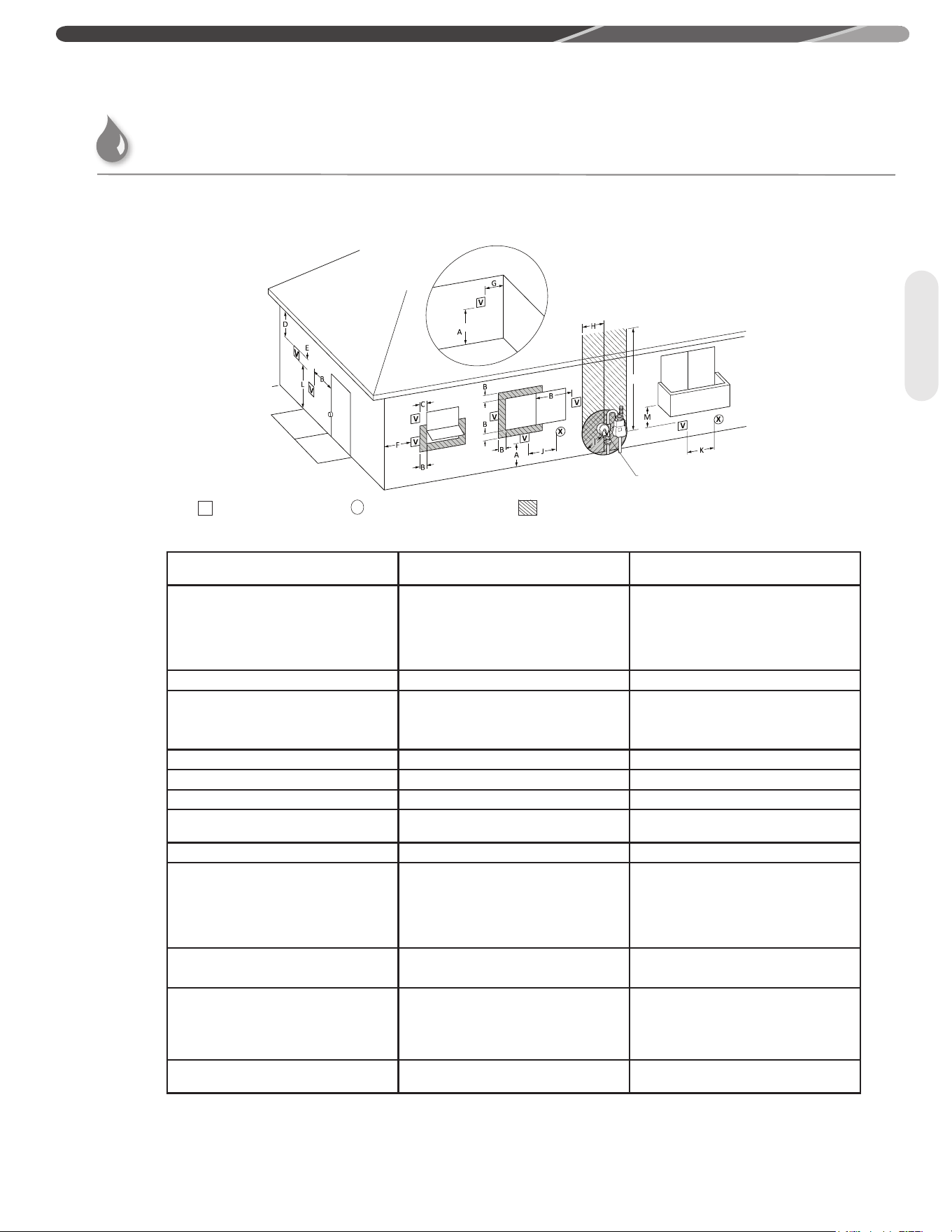
The following charts detail the minimal dimensional information needed to determine the proper location of the vent terminal for direct
vent and outdoor tankless water heaters.
Regulator vent outlet in the event no
regulator is present, H and I can be
disregarded.
Fixed
closed
15 ft
Fixed
closed
Inside
corner detail
Operable
Operable
V
VENT TERMINAL
X
AIR SUPPLY INLET
AREA WHERE TERMINAL IS NOT PERMITTED
1
In accordance with the current
CSA B149.1 Natural Gas and Propane Installation Code
2
In accordance with the current
ANSI Z223.1/ NFPA 54 National Fuel Gas Code
‡ Permitted only if veranda, porch, deck, or balcony is fully open on a minimum of two sides beneath the oor.
Canadian Installations
1
US Installations
2
A= Clearance above grade, veranda, porch, deck
or balcony.
12 inches (30 cm) 12 inches (30 cm)
B= Clearance to window or door that may be
opened.
• 6 in (15 cm) for appliances ≤ 10,000 Btuh
(3 kW),
• 12 in (30 cm) for appliances > 10,000 Btuh
(3 kW) and ≤ 100,000 Btuh (30 kW),
• 36 in (91 cm) for appliances > 100,000 Btuh
(30 kW)
4 ft (1.2) below or to side of opening; 1 ft
(300 mm) above opening.
C= Clearance to permanently closed window. 0 in (0 cm) 0 in (0 cm)
D= Vertical Clearance to ventilated soffit located
above the terminal within a horizontal
distance of 2 feet (61 cm) from the center
line of the terminal.
12 in (30 cm) 12 in (30 cm)
E= Clearance to unventilated soffit. 12 in (30 cm) 12 in (30 cm)
F= Clearance to outside corner. 24 in (61 cm) 24 in (61 cm)
G= Clearance to inside corner. 18 in (46 cm) 18 in (46 cm)
H = Clearance to each side of center line
extended meter/regulator assembly. above
3 feet (91 cm) within a height 15 feet (4.6 m) 3 ft (91 cm) within a height of 15 ft (4.6 m)
I = Clearance to service regulator vent outlet. 3 feet (91 cm) 3 feet (91 cm)
J = Clearance to nonmechanical air supply inlet
to building or the combustion air inlet to any
other appliance..
• 6 in (15 cm) for appliances ≤ 10,000 Btuh
(3 kW),
• 12 in (30 cm) for appliances > 10,000 Btuh
(3 kW) and ≤ 100,000 Btuh (30 kW),
• 36 in (91 cm) for appliances > 100,000 Btuh
(30 kW)
4 ft (1.2) below or to side of opening; 1 ft
(300 mm) above opening.
K = Clearance to mechanical air supply inlet.
6 feet (1.83 m)
3 feet (91 cm) above if within 10 feet (3 m)
horizontally.
L = Clearance above paved side walk or paved
driveway located on public property.
7 feet (2.13 m)
7 feet (2.13 m) for mechanical draft systems
(Category I appliances); vents for Category II
and IV appliances cannot be located above public
walkways or other areas where condensate or
vapor can cause a nuisance or hazard.
M = Clearance under veranda, porch, deck or
balcony.
12 in (30 cm) ‡ 12 in (30 cm) ‡
Horizontal Vent Terminal Location for Other than Direct Vent/Outdoor Heater
Venting for Direct-Vent Water Heater
27
INSTALLATION INSTRUCTIONS
Venting for Direct-Vent Water Heater
Venting
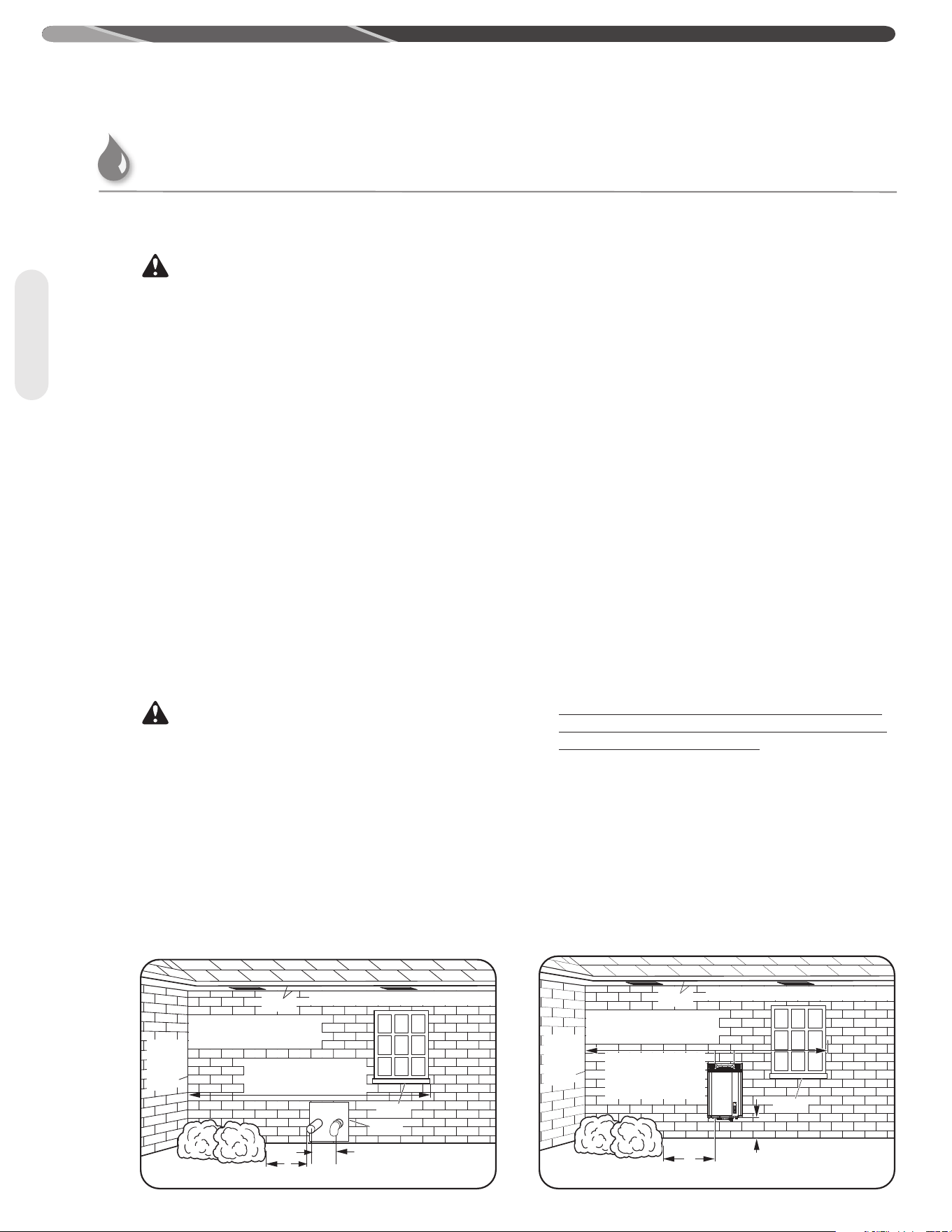
Regulator vent outlet in the event no
regulator is present, H and I can be
disregarded.
Fixed
closed
15 ft
Fixed
closed
Inside
corner detail
Operable
Operable
V
VENT TERMINAL
X
AIR SUPPLY INLET
AREA WHERE TERMINAL IS NOT PERMITTED
Canadian Installations
1
US Installations
2
A= Clearance above grade, veranda, porch, deck
or balcony.
12 inches (30 cm) 12 inches (30 cm)
B= Clearance to window or door that may be
opened.
• 6 in (15 cm) for appliances ≤ 10,000 Btuh
(3 kW),
• 12 in (30 cm) for appliances > 10,000 Btuh
(3 kW) and ≤ 100,000 Btuh (30 kW),
• 36 in (91 cm) for appliances > 100,000 Btuh
(30 kW)
• 6 in (15 cm) for appliances ≤ 10,000 Btuh
(3 kW),
• 12 in (30 cm) for appliances > 10,000 Btuh
(3 kW) and ≤ 50,000 Btuh (15 kW),
• 12 in (30 cm) for appliances > 50,000 Btuh
(15 kW)
C= Clearance to permanently closed window. 0 in (0 cm) 0 in (0 cm)
D= Vertical Clearance to ventilated soffit located
above the terminal within a horizontal
distance of 2 feet (61 cm) from the center
line of the terminal.
12 in (30 cm) 12 in (30 cm)
E= Clearance to unventilated soffit. 12 in (30 cm) 12 in (30 cm)
F= Clearance to outside corner. 24 in (61 cm) 24 in (61 cm)
G= Clearance to inside corner. 18 in (46 cm) 18 in (46 cm)
H = Clearance to each side of center line
extended meter/regulator assembly. above
3 feet (91 cm) within a height 15 feet (4.6 m) 3 ft (91 cm) within a height of 15 ft (4.6 m)
I = Clearance to service regulator vent outlet. 3 feet (91 cm) 3 feet (91 cm)
J = Clearance to nonmechanical air supply inlet
to building or the combustion air inlet to any
other appliance..
• 6 in (15 cm) for appliances ≤ 10,000 Btuh
(3 kW),
• 12 in (30 cm) for appliances > 10,000 Btuh
(3 kW) and ≤ 100,000 Btuh (30 kW),
• 36 in (91 cm) for appliances > 100,000 Btuh
(30 kW)
• 6 in (15 cm) for appliances ≤ 10,000 Btuh
(3 kW),
• 12 in (30 cm) for appliances > 10,000 Btuh
(3 kW) and ≤ 50,000 Btuh (15 kW),
• 12 in (30 cm) for appliances > 50,000 Btuh
(15 kW)
K = Clearance to mechanical air supply inlet.
6 feet (1.83 m)
3 feet (91 cm) above if within 10 feet (3 m)
horizontally.
L = Clearance above paved side walk or paved
driveway located on public property.
7 feet (2.13 m)
7 feet (2.13 m) for mechanical draft systems
(Category I appliances); vents for Category II
and IV appliances cannot be located above public
walkways or other areas where condensate or
vapor can cause a nuisance or hazard.
M = Clearance under veranda, porch, deck or
balcony.
12 in (30 cm) ‡ 12 in (30 cm) ‡
1
In accordance with the current
CSA B149.1 Natural Gas and Propane Installation Code
2
In accordance with the current
ANSI Z223.1/ NFPA 54 National Fuel Gas Code
‡ Permitted only if veranda, porch, deck, or balcony is fully open on a minimum of two sides beneath the oor.
Horizontal Vent Termination Location for Direct-Vent Water Heater
28
Venting for Direct-Vent Water Heater (cont.)
Venting
INSTALLATION INSTRUCTIONS
Horizontal Vent Considerations
WARNING:
Moisture in the flue gas will condense as it leaves the vent
terminal. In cold weather this condensate can freeze on the
exterior wall, under the eaves, and on surrounding objects.
Some discoloration to the exterior of the building is to be
expected. However, improper location or installation can
result in severe damage to the structure or exterior finish of
the building.
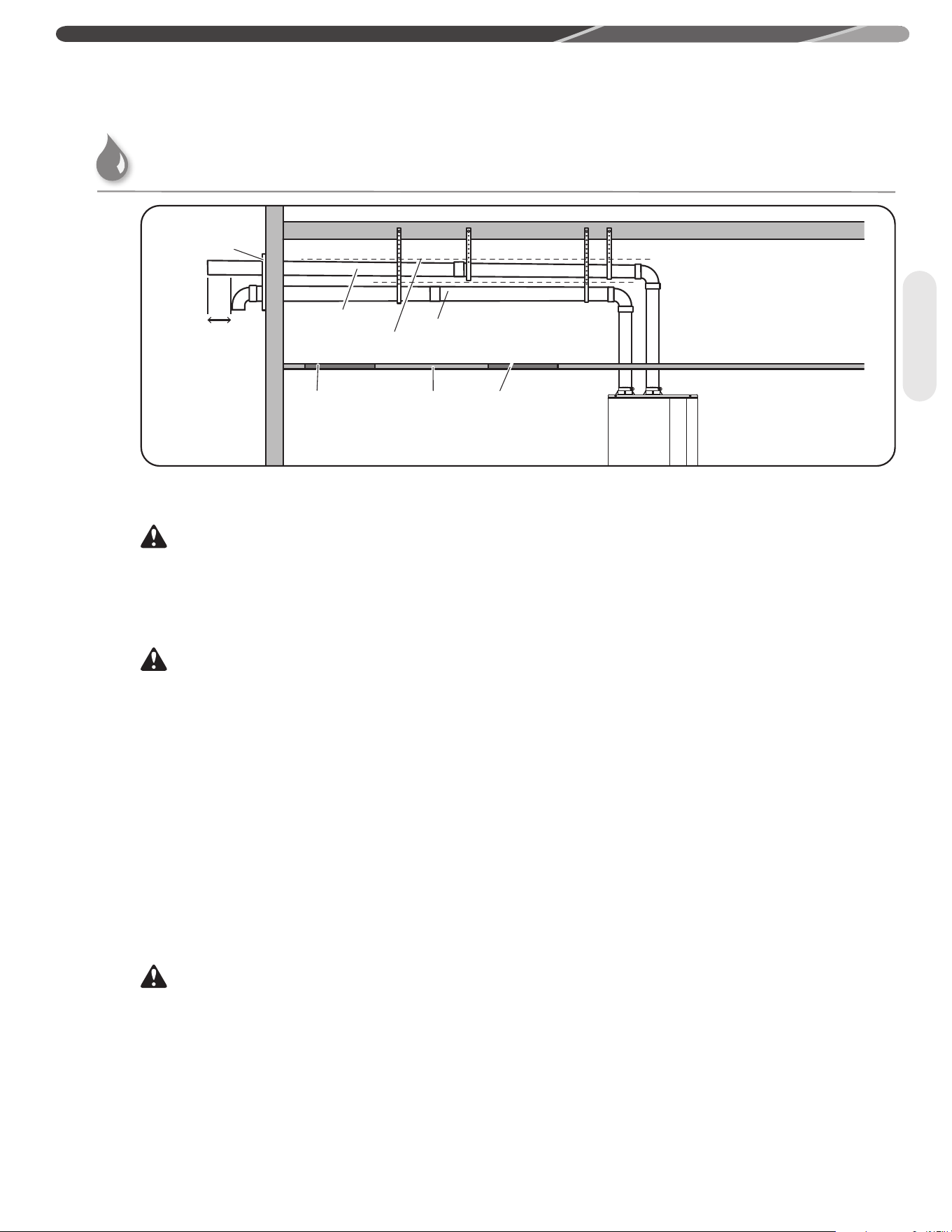
– DO NOT locate vent terminal on the side of a building
with prevailing winter winds. This will help prevent
water lines from freezing and moisture from freezing on
walls and under eaves.
– DO NOT locate vent terminal too close to shrubbery, as
flue gasses may damage them. A minimum distance of 4
ft. (1.22 m) is recommended.
– All painted surfaces should be primed to lessen the
chance of physical damage. Painted surfaces will
require maintenance.
– Guard against accidental contact with people and pets.
Indoor Tankless Water Heaters
WARNING:
For multiple-unit installations, a minimum distance
between vent terminations must be maintained to prevent
recirculation of vent gases. Maintain a center-to-center
distance between each pair of vent terminations as listed
below:
24 in. (61 cm) for a two-unit installation;
24 in. (61 cm) and 36 in. (91.4 cm) for a three-unit
installation;
24 in. (61 cm), 36 in. (91.4 cm), and 24 in. (61 cm) for a
four-unit installation.
– DO NOT terminate vent directly on brick or masonry
surfaces. Use rust-resistant, sheet-metal backing plate
behind the vent.
– The vent for this appliance shall not terminate
• Over public walkways; or
• Near soffit vents or crawl space vents or other area
where condensate or vapor could create a nuisance
or hazard or cause property damage; or
• Where condensate or vapor could cause damage or
could be detrimental to the operation of regulators,
relief valves, or other equipment.
– Caulk all cracks, seams, and joints within
6 ft. (1.8 m) of the vent terminal.
– Caulk around wall faceplate for weather-tight seal.
– DO NOT extend exposed vent pipe of indoor water
heaters outside of the building.
– This water heater requires its own separate venting
system. DO NOT connect the exhaust vent to an existing
vent pipe or chimney.
– Observe minimum clearances. Vent terminals must be
a minimum of 5.5 inches (14 cm) and a maximum of 24
inches (61 cm) apart horizontally.
– Install indoor and outdoor water heaters such that air
inlet and flue outlet are above anticipated snow level.
Rising moisture will collect under eaves.
Inside
Corner
Caulk
Caulk
Caulk
Caulk
If sot vent is too close,
block o and install new
vent at another location.
6' (1.8 m) Caulk zone or
to edge of window etc.,
starting within 6' (1.8 m)
4'
(1.2 m)
5.5”to 24 “
(14 cm to 61cm)
Rising moisture will collect under eaves.
Inside
Corner
Caulk
Caulk
Caulk
If soffit vent is too close,
block off and install new
vent at another location.
6' (1.8 m) Caulk zone
or to edge of window
etc., starting within
6' (1.8 m)
4'
(1.2 m)
12"
(300 mm)
29
Venting
INSTALLATION INSTRUCTIONS
Venting for Direct-Vent Water Heater (cont.)
Horizontal Vent Installation
WARNING:
Danger of fire or bodily injury – Solvent cements and
primers are highly flammable. Provide adequate ventilation
and DO NOT assemble near heat source or open flame. DO
NOT smoke. Avoid skin or eye contact. Observe all cautions
and warnings on material containers.
CAUTION:
Use tankless water heater manufacturer-approved Schedule
40 PVC (foam core is not permitted at any time), Schedule
80 PVC, CPVC, ABS or UL 1738-listed Category III Stainless
Steel or InnoFlue
®
PP. No other vent material is permitted.
For Canada, installations must follow ULC S636 for exhaust
venting.
Joining Pipes and Fittings
All pipe, fittings, solvent cement, primers, and
procedures, for the U.S., must conform to American
National Standards Institute and American Society
for Testing and Materials (ANSI/ASTM) standards.
For Canada, all pipe, fittings, solvent cement,
primers, and procedures must conform to ULC-S636
and vent manufacturer specifications.
CAUTIONS:
• DO NOT use solvent cement that has become curdled,
lumpy, or thickened.
• DO NOT thin solvent cement. Observe shelf precautions
printed on the containers.
• For applications below 32°F, use only lower temperature-
type solvent cement.
• Appropriate solvent and cleaner must be used for the type
of vent pipe used (PVC, CPVC, or ABS).
Cleaner-Primer and Medium-Body Solvent Cement
All joints in vent piping must be properly sealed, and
we recommend using the following material:
PVC materials should use ASTM D-2564-grade
cement.
CPVC materials should use ASTM F-493-grade
cement.
ABS materials should use ASTM D-2235-grade
cement (ABS is not allowed for exhaust vent in
Canada).
Cementing Joints
1. Cut pipe end square; remove jagged edges and
burrs. Chamfer end of pipe and clean fitting socket
and pipe joint area of all dirt, grease, or moisture.
2. After checking pipe and socket for proper fit,
wipe socket and pipe with cleaner-primer. Apply
a liberal coat of primer to inside surface of socket
and outside of pipe.
3. Apply a thin coat of cement evenly in the socket.
Quickly apply a heavy coat of cement to the pipe
and insert pipe into fitting with a slight twisting
motion until it bottoms out.
4. Hold the pipe fitting for 30 seconds to prevent the
tapered socket from pushing the pipe out of the
fitting.
5. Wipe all excess cement from the joint with a rag.
Allow 15 minutes before handling. Cure time will
vary according to fit, temperature, and humidity.
NOTICE:
• Cement must be fluid; if not, recoat with fresh cement.
• Stir the solvent frequently while using. Use a natural
bristle brush or the dauber supplied with the can. The
proper brush size is one inch.
• DO NOT use cement for InnoFlue® PP.
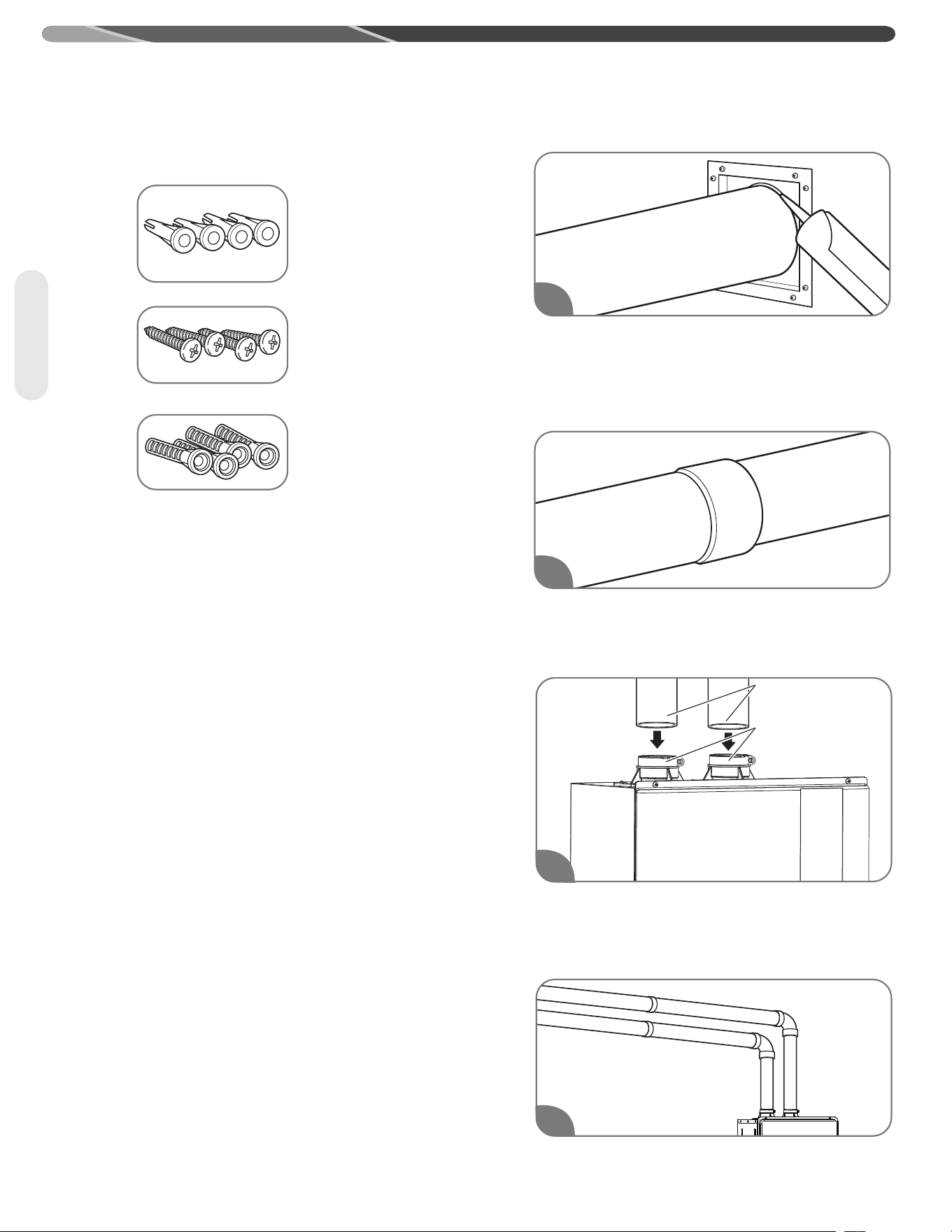
Exhaust Vent Pipe
12” (30 cm)
Minimum
Air Intake Pipe
Wall Plate
(recommended)
Inspection
Access Panel
(Optional)
Inspection
Access Panel
(Optional)
Ceiling
Upward Slope
to Termination
30
INSTALLATION INSTRUCTIONS
Horizontal Vent Installation (cont.)
Fasteners will vary depending on the wall type.
For particle board or
composite sheathing, use
4 hollow wall anchors. The
anchors should be at least
1/8 in. (0.3 cm) in diameter
and the appropriate length
for the sheathing thickness.
For plywood or solid wood
sheathing or members,
use 4 #10 x 1 1/4-in. wood
screws.
For masonry walls, use
suitable masonry anchors
long enough to pass
through the wall.
NOTICE:
• The exhaust vent terminal must extend a minimum of 12
inches (30.5 cm) more than the air intake terminal from
the exterior wall. Also, an edge to edge distance between
an air intake termination and an exhaust termination
shall be at least 12 inches (30.5 cm) for any directions to
prevent recirculation of vent gases.
• To prevent possibility of condensate freeze-up, DO NOT
install vent kits one above the other.
Once the vent terminal location has been
determined, make holes through the exterior wall to
accommodate the vent pipes. Vent pipes must exit
exterior wall horizontally only.
The standard horizontal air intake termination is a
2-inch or 3-inch 90 degree elbow. This prevents rain
or any other liquid for getting into air intake and the
pipe from being pushed back into the structure. The
standard horizontal exhaust outlet termination is a
2-inch or 3-inch pipe which terminates 12 inches
from the air intake termination. Insert a small length
of vent pipe through the wall and connect the
coupling. Connect vent cap or terminal to the vent
pipe on the exterior of the building.
1. Observe minimum clearances. Vent terminals
must be a minimum of 5.5 inches (14 cm) and a
maximum of 24 inches (61 cm) apart horizontally.
2. Cut two 2 1/2” (6.4 cm) diameter holes [for a 2”
(5.1 cm) diameter pipe] or 3 1/2” (8.9 cm) diameter
holes [for a 3” (7.6 cm) diameter pipe] for the
exhaust vent and air intake openings.
Apply silicone sealant or silicone/latex caulk to seal
the vent pipe to the vent coupling to permit field
disassembly for annual inspection and cleaning.
Completely seal where it passes through the wall
plate and where it is attached to the structure.
Attach the female end of the next vent pipe section
to the male end of the 2-in./3-in. (5.1-cm/7.6-cm)
vent pipe. See “Cementing Joints” on this Use and
Care Manual.
Insert a 2" PVC pipes slowly into an air intake
connector and a flue connector located on top of the
water heater until they stop. DO NOT use cement.
Tighten 2 locking bands to secure 2" PVC pipes.
Complete the rest of the vent pipe installation to the
water heater's flue outlet and air intake.
1
4
2
Venting
3
2” PVC pipes
Locking bands
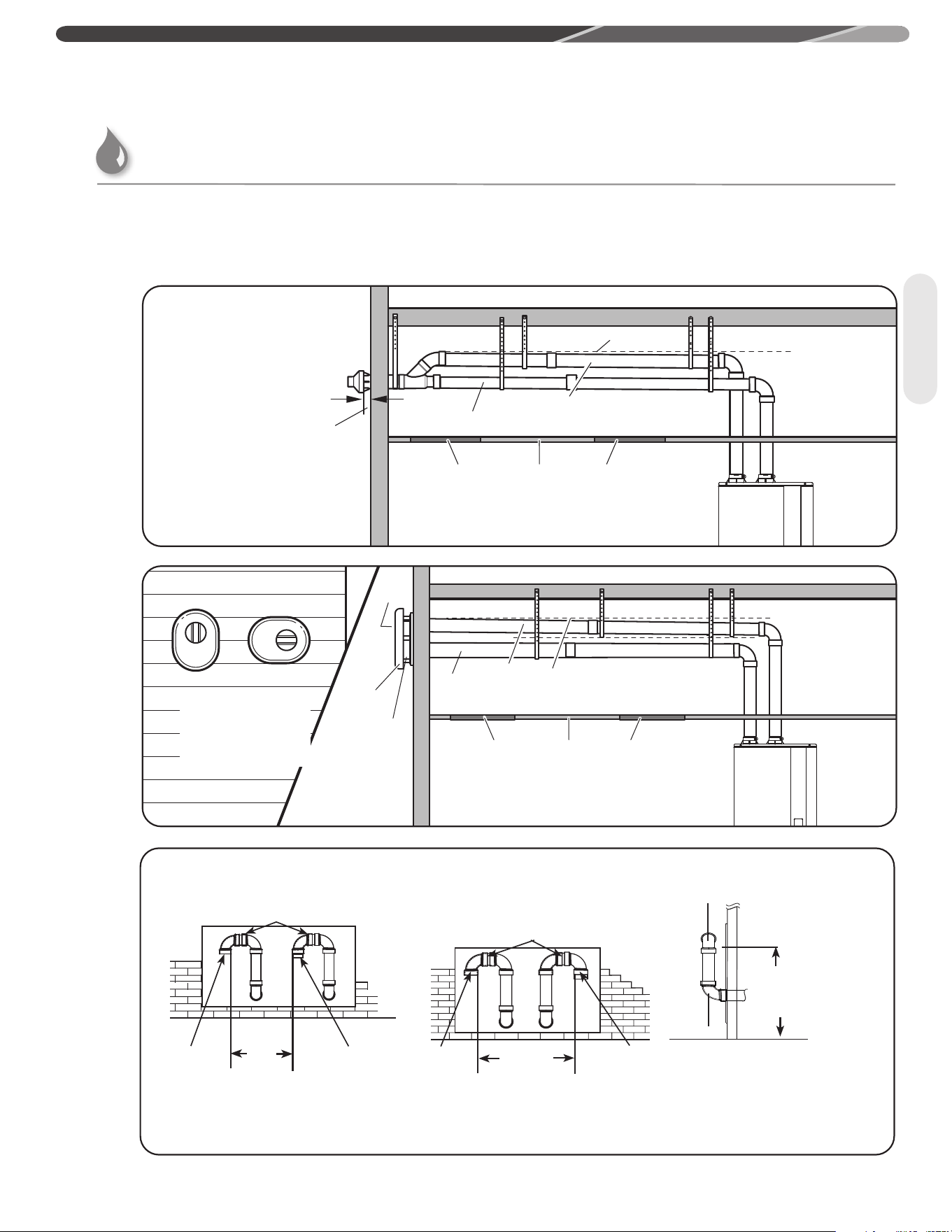
31
Venting
INSTALLATION INSTRUCTIONS
Venting for Direct-Vent Water Heater (cont.)
Alternative Horizontal Vent Installations
Alternative horizontal vent termination kits are commercially available. Please refer to the instruction sheet
packaged with the kit for complete installation instructions.
Concentric Vent
Termination Kit
Optional vent diagram
(no kit required)
Exhaust Vent
Pipe
Air Intake
Pipe
Inspection
Access Panel
(Optional)
Inspection
Access Panel
(Optional)
Ceiling
1"
from wall
is recommended
Upward Slope
to Termination
Flat
Termination
Kit
Air Intake
Vent
Exhaust
Vent
Exhaust Vent
Pipe
Air Intake
Pipe
Inspection
Access Panel
(Optional)
Inspection
Access Panel
(Optional)
Ceiling
Upward Slope
to Termination
Flat Horizontal
Termination Kit
(this termination
can be rotated)
12 in�
(30�5 cm) min�
Terminal assemblies to be parallel to wall�
Front View
Option 2
12 in�
(30�5 cm)
min�
Terminal assemblies to be parallel to wall�
Front View
Option 1
Side View
Termination Openings -
12 in� (30�5 cm) min� above
grade or anticipated snow level
Short piece of pipe
Short piece of pipe
Exhaust
Vent
Terminal
Exhaust
Vent
Terminal
Combustion
Air-Inlet
Terminal
Combustion
Air-Inlet
Terminal
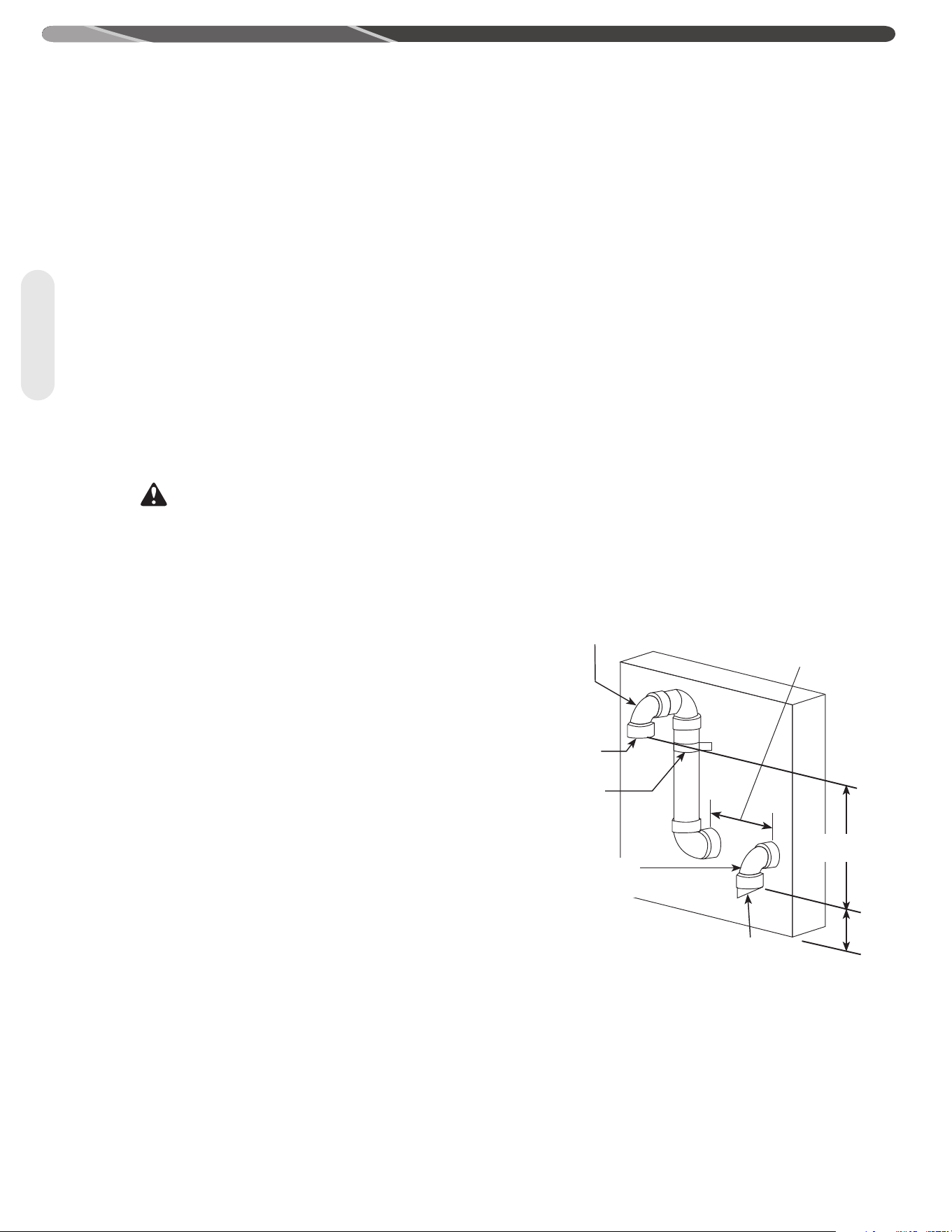
32
Horizontal Vent and Combustion, Air-Inlet Alternate
Vent Riser Terminal Installation
INSTALLATION INSTRUCTIONS
Read these instructions thoroughly and make sure
you understand all steps and procedures before
proceeding with the installation.
Determine the locations for the vent and combustion
air-inlet terminals then make two (2) holes through
the exterior wall to accommodate the vent and
combustion air-inlet pipes.
The horizontal distance between the vent and
combustion air-inlet terminal centerlines must be
from 12 in. (30.5 cm) minimum to 36in. (91.4 cm)
maximum.
The vertical distance between the outlet of the vent
terminal to the outlet of the combustion air-inlet
terminal must be from 0 in. (0 cm) minimum to 36 in.
(91.4 cm) maximum.
WARNING:
The vent terminal must always be installed at the same
height or vertically higher than the combustion air-inlet
terminal.
Maintain a minimum distance from the outlets of the
vent and combustion air-inlet terminals of not less
than 12 in. (30.5 cm) above grade or average snowfall
whichever is greater.
IMPORTANT:
The vent terminal must always be installed at the same
height or vertically higher than the combustion air-inlet
terminal.
Insert lengths of vent and combustion air-inlet pipes
through the wall as shown.
Allow sufficient length of pipe to extend beyond the
exterior wall of the building for attachment of the
vent riser assemblies as shown.
Place the supplied 1/2 in. (1.3 cm) mesh metal screen
inside exhaust vent terminal fitting (optional).
NOTICE:
For cold climates the screen may be removed.
Connect the vent riser assemblies to the vent and
combustion air-inlet pipes which are extending out of
the building.
Ensure that the back of the 90° elbows are flush
with the outside wall surface and that the vent and
combustion air-inlet terminations of the vent risers
are parallel with the outside wall.
IMPORTANT:
Remember to include the additional 90° elbows and vertical
height of vent and combustion air-inlet pipes of the vent
riser when calculating the maximum equivalent vent
and combustion air-inlet system lengths. The maximum
equivalent vent and combustion air-inlet system lengths
must be as specified by the tables shown in the Use and
Care Manual.
The vent and combustion air-inlet terminations are
not included in the equivalency calculations.
Complete the installation of the remainder of the vent
system and attach it to the vent connector fitting on
the water heater's blower assembly.
Horizontal sections of the vent system must slope
downward toward the water heater a minimum of 1/8
in. per foot (10 mm per m).
DO NOT use unequal diameters of pipe and fittings
for the vent and combustion air-inlet systems except
as defined previously.
NOTICE: The difference between the vent and
combustion air-inlet system equivalent lengths must
be no greater than 5 ft. (1.5 m).
Complete the installation of the remainder of the
combustion air-inlet system and attach it to the
combustion air-inlet connector fitting on the water
heater's combustion air-inlet tube assembly.
Support vertical and horizontal lengths of the vent
and combustion air-inlet systems as previously
mentioned.
90° Vent
Terminal Elbow
90° Combustion
Air-Inlet Terminal Elbow
*Wind Vane
Mesh
Screen
Inside
(Optional)
Securing
Strap
(Optional)
0 in. (0 cm) min.
36 in. (91.4 cm) max.
12 in. (30.5 cm) min.
36 in. (91.4 cm) max.
Termination Openings
- 12 in. (30.5 cm)
min. above grade or
anticipated snow level
*For installations using 3 in. (7.6
cm) pipe and fittings, a 90 elbow
equipped with a wind vane
deflector must be used for the
combustion air-inlet terminal.
Contact Manufacture’s National
Service Department for the elbow.
Venting
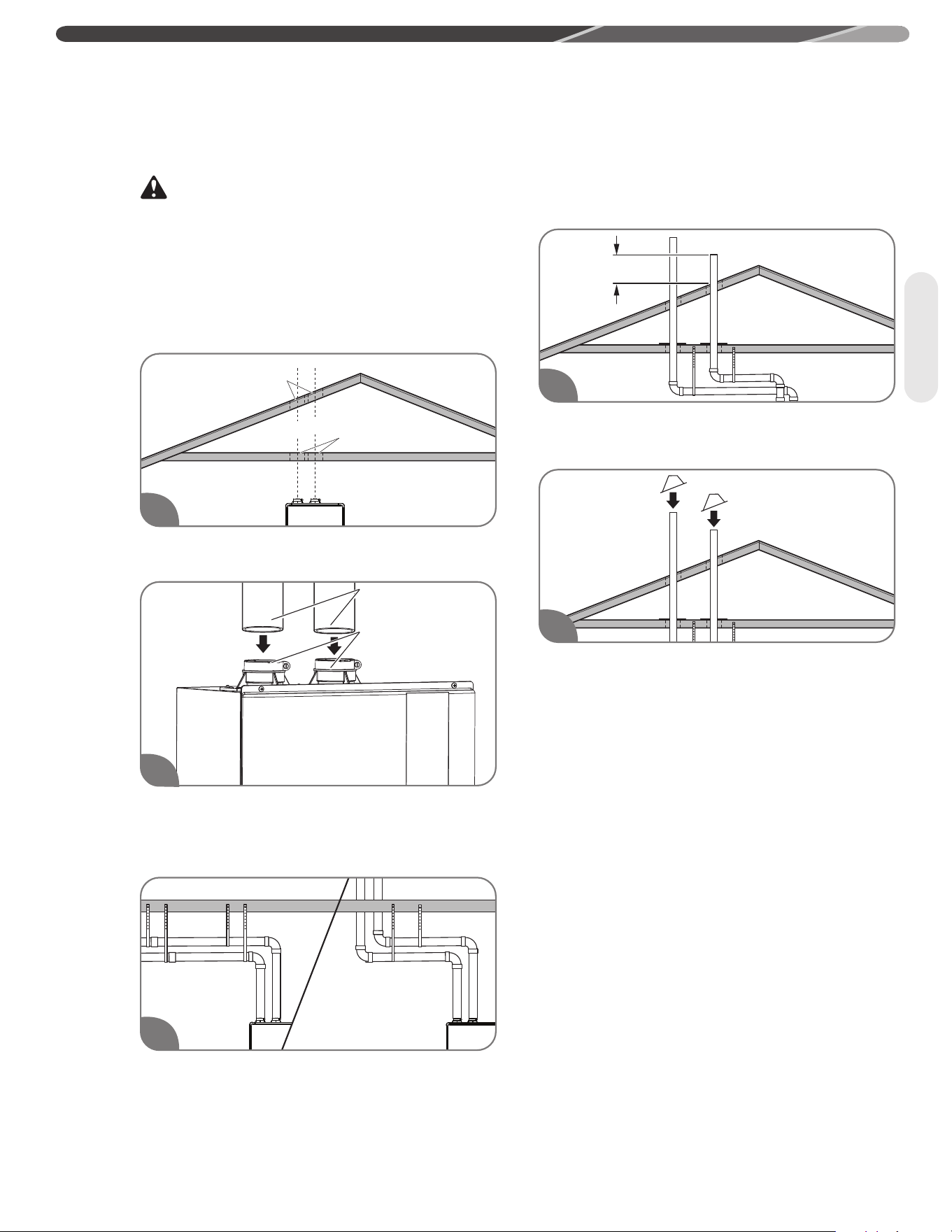
33
INSTALLATION INSTRUCTIONS
Vertical Vent Installation
WARNING:
Improper vent installation can result in death, personal
injury, product damage, and/or poor performance.
NOTICE:
Only Rheem-approved AND ULC S636 approved termination
and parts must be used during installation.
Maintain the recommended air space clearance to
combustible materials and building insulation.
Cut a hole through the roof and interior ceiling to
accommodate the vent pipes.
Insert a 2" PVC pipes slowly into an air intake
connector and a flue connector located on top of the
water heater until they stop. Tighten 2 locking bands
to secure 2" PVC pipes.
Support vertical and horizontal runs as described on
page 23. Vertical supports are required every 4 ft. (1.2
m) along a vertical pipe route, after every transition to
vertical, and after every offset elbow.
NOTICE:
Free-standing vent pipe that penetrates a roof/ceiling
requires another means of support from a second location.
Determine the vent terminal height and install the
vent pipe accordingly. Refer to “Vertical Vent Terminal
Location” for clearance requirements.
Install adequate flashing where the vent pipe passes
through the roof.
Hole
Through Roof
C
L
Hole
Through Ceiling
C
L
1
A, B
4
5
3
Venting
2
2” PVC pipes
Locking bands
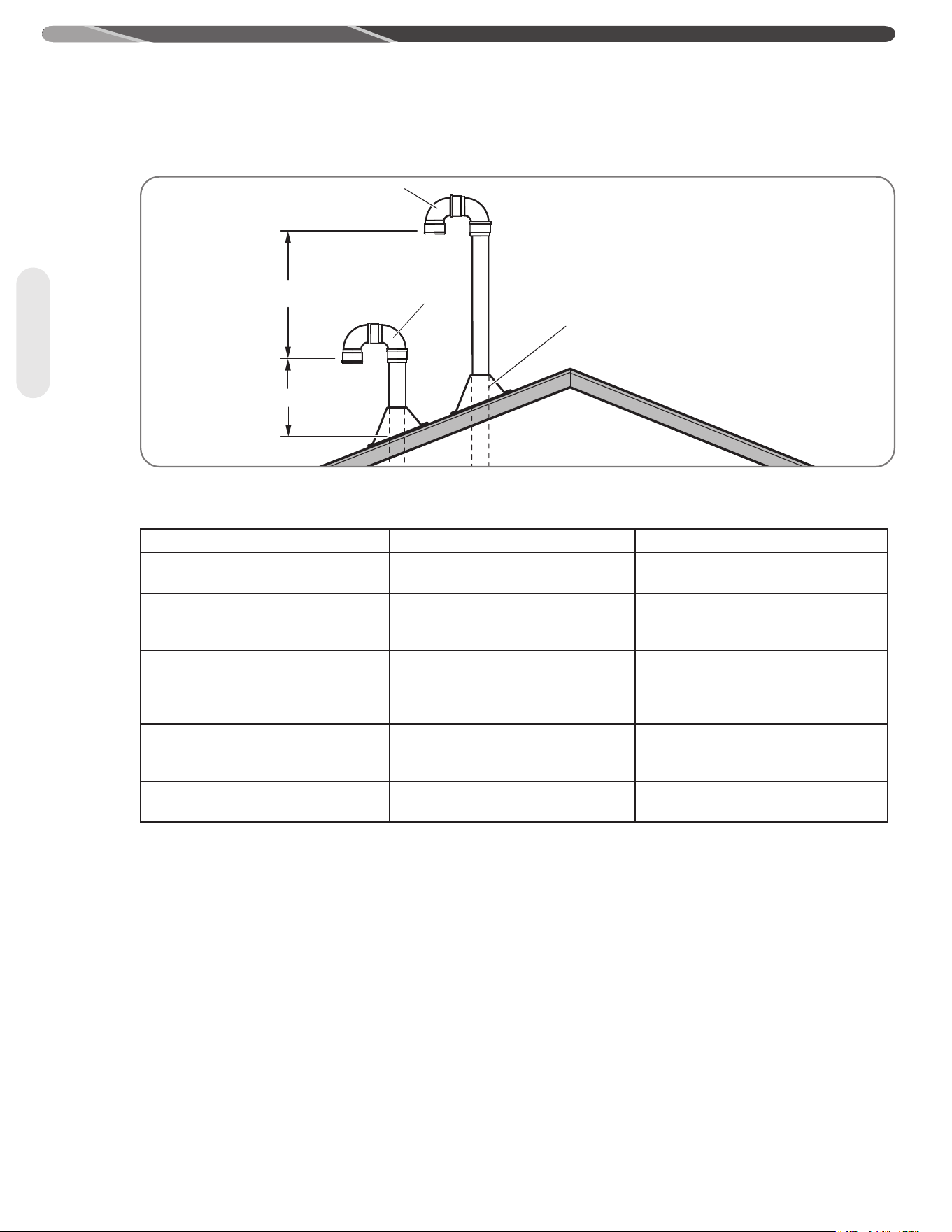
34
Venting
INSTALLATION INSTRUCTIONS
Vertical Vent Terminal Location
A, B
12" Min.
(300 mm)
Vent Pipe
Through Roof
Optional
Air Intake
The following chart with diagrams details the minimum dimensional information needed to determine the proper
location of the vertical vent terminal for direct-vent indoor tankless water heaters:
Location U.S. Installation Requirements
1
Canadian Installation Requirements
2
A = Minimum clearance above the roof
level.
12 in. (30 cm) above roof level.
18 in. (45.7 cm) above roof level.
B = Maximum clearance above roof
level (without additional support for
vent pipe).
24 in. (61 cm) above roof level.
24 in. (61 cm) above roof level.
C = Required vent clearance from any
gable, dormer, or other roof struc-
ture with building interior access
(i.e., vent, window).
4 ft. (1.2 m)
4 ft. (1.2 m)
D = Required vent clearance from any
forced air inlet, including dryer and
furnace air inlets.
10 ft. (3 m)
6 ft. (1.8 m)
E = Minimum/maximum horizontal dis-
tance between vent terminals
5.5 in. (14 cm)/24 in. (61 cm)
5.5 in. (14 cm)/24 in. (61 cm)
1 In accordance with current ANSI Z223.1/NFPA 54 National Fuel Gas Code.
2 In accordance with current CAN/CSA B149.1 Installation Codes.
The vertical intake air termination requires a return
bend or two short or long sweep radius 90° elbows
to keep the inlet downward and prevent entry of rain.
Refer to figure above for the proper location of the air
intake with respect to the exhaust outlet termination.
The vertical exhaust outlet termination is a 2-inch or
3-inch pipe which terminates at least 12 inches (30
cm) above the air intake termination. The exhaust
outlet terminations must be at least 12 inches (30
cm) in US [at least 18 inches (46 cm) in Canada]
above the roof line or anticipated snow levels.
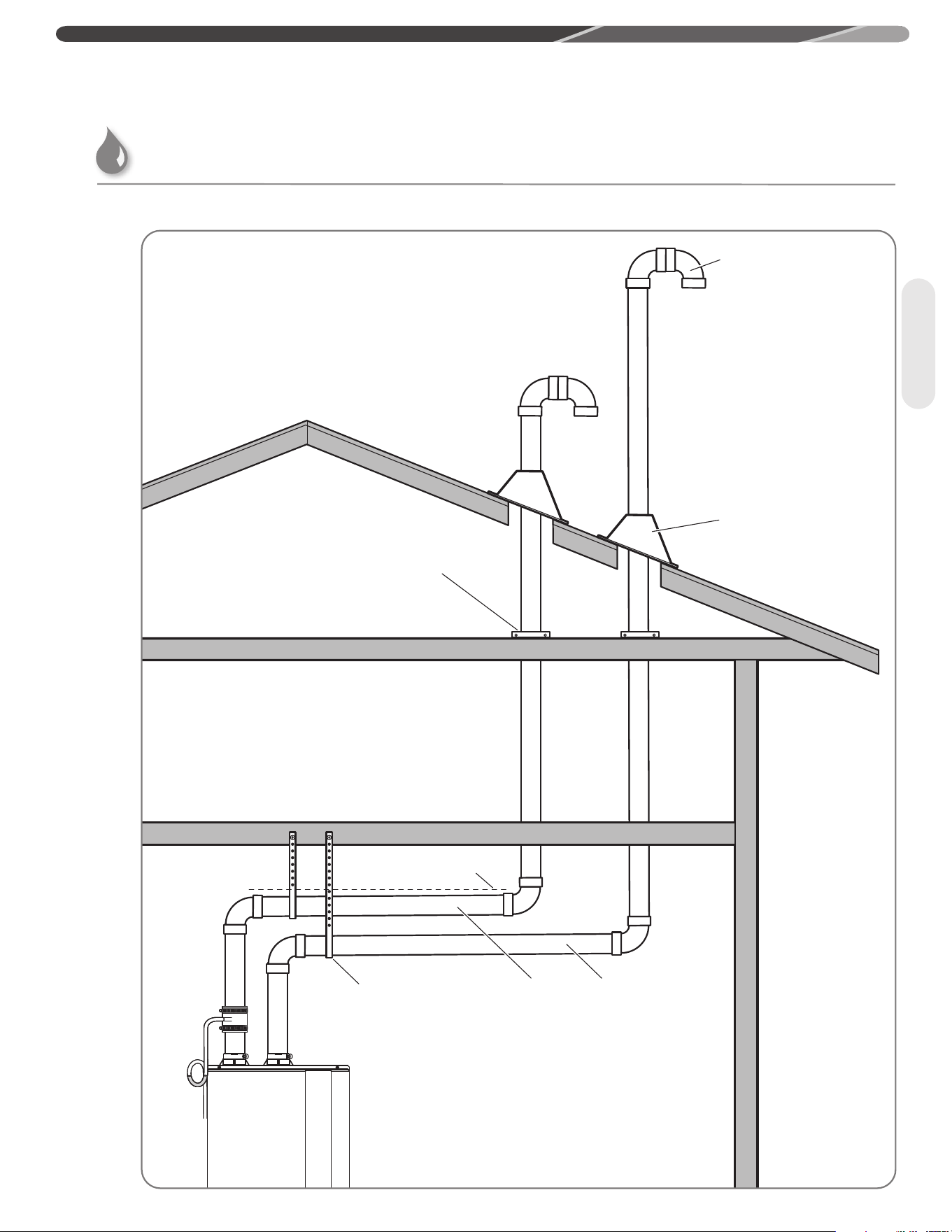
35
INSTALLATION INSTRUCTIONS
Standard Vertical Vent Termination
Venting
Adjustable Roof Flashing
Support Clamp
Upward Slope
Support Hanger
Air Intake
Pipe
Exhaust Vent
Pipe
Optional
Venting for Direct-Vent Water Heater (cont.)
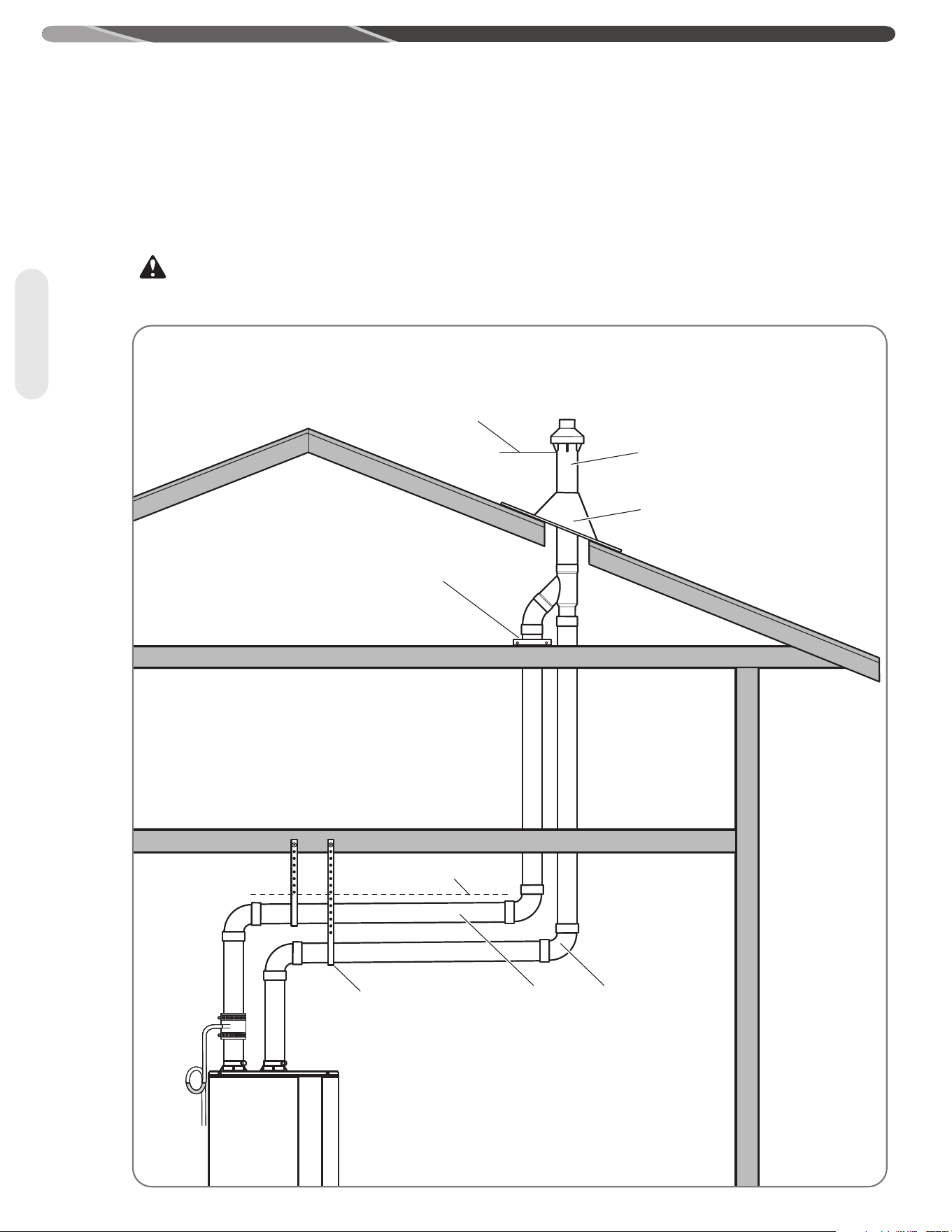
36
INSTALLATION INSTRUCTIONS
Alternative Vertical Vent Termination
Alternative vertical vent termination kits are commercially available. Please refer to the instruction sheet
packaged with the kit for complete installation instructions.
WARNING:
Under no circumstances should the exhaust pipe and the air intake pipe be connected together.
Venting
Support Hanger
Adjustable Roof Flashing
Support Clamp
Air Intake
Pipe
Exhaust Vent
Pipe
Minimum Clearance 18 inches above roof
Concentric Vent Termination
Upward Slope
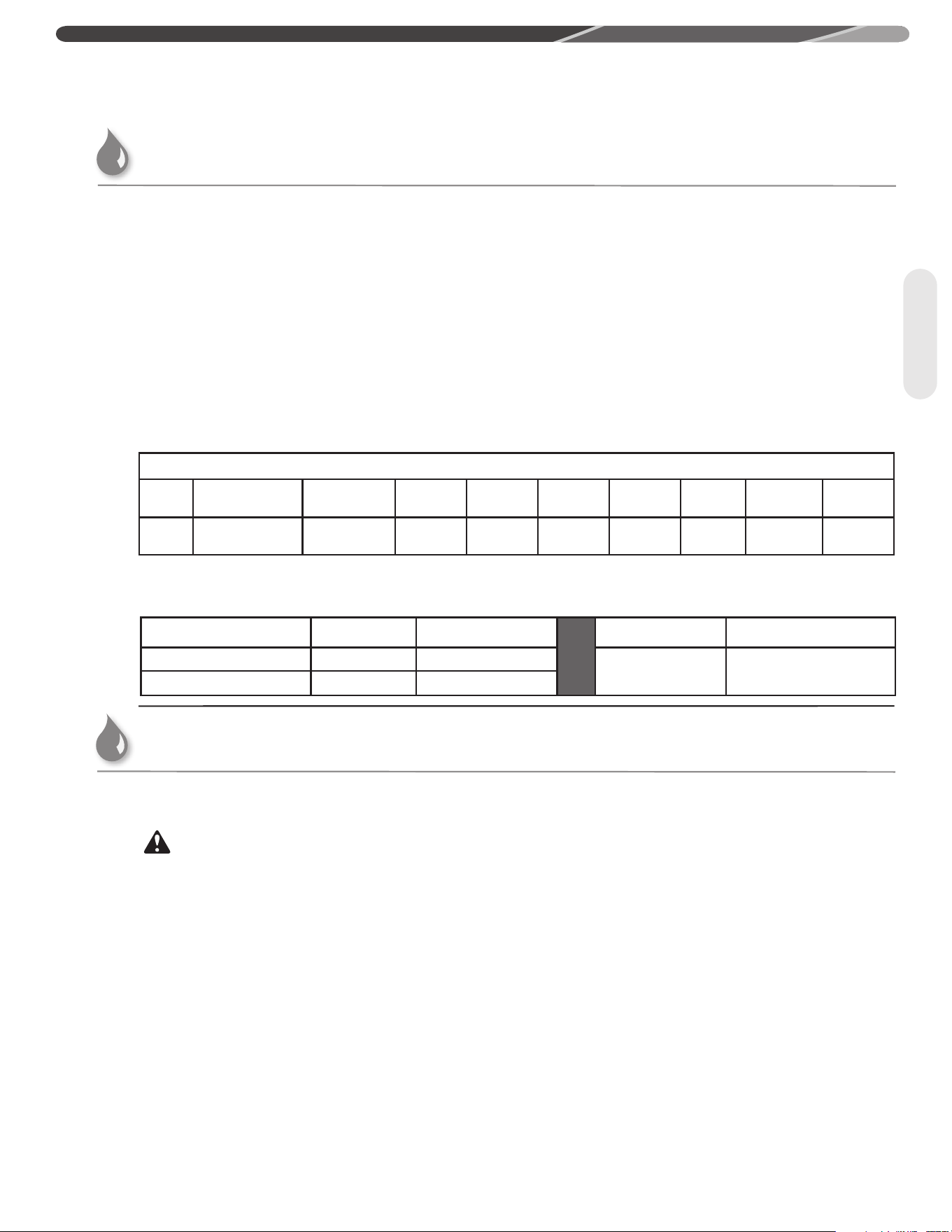
37
INSTALLATION INSTRUCTIONS
Water Supply
CAUTION:
This water heater MUST ONLY be used with the following
water supply conditions to prevent product damage and
operation failure.
• Clean, potable water free of corrosive chemicals, sand,
dirt, and other contaminates.
• Inlet water temperatures above 32°F (0°C), but not
exceeding 120°F (49°C).
• DO NOT reverse the HOT and COLD water connections.
• DO NOT connect this water heater to water lines
previously used for space heating. All water piping and
components shall be suitable for potable water.
• With recommended water quality (See chart above).
Water Quality
Plumbing
Water Supply
Water quality must be taken into account when
installing and maintaining the water heater. Water
conditions outside of the levels specified below
affect and may damage the water heater. Please
note that the limited warranty provided with the
water heater does not cover defects, malfunctions
or failures resulting from water conditions that are
not in accordance with the specifications in the table
below.
If you nonetheless install this water heater where the
water conditions are not within the levels specified in
the table below, Rheem recommends that you take
the following steps:
Install a water treatment device or water softener at
the same time as the original installation of the water
heater. Rheem offers a water treatment accessory
that can be installed with the water heater. (See
below).
Flush the water heater’s heat exchanger regularly.
Rheem offers a flush kit and isolation valves to help
remove scale build up. (See below)
Chart for Recommended Water Quality Levels
pH
(Total Dissolved
Solids) TDS
Free Carbon
Dioxide (CO
2
)
Total
Hardness
Aluminum Chlorides Copper Iron Manganese Zinc
6.5–8.5 Up to 500 mg/L Up to 15 mg/L
Up to
200 mg/L
0.05 to
0.2 mg/L
Up to
250 mg/L
Up to
1.0 mg/L
Up to
0.3 mg/L
Up to
0.05 mg/L
Up to
5 mg/L
Cited reference: National Secondary Drinking Water Regulations
Accessory Kit Replacement Filter Tankless Flush Kit Tankless Isolation Valve
AllClear Water Treatment Kit RTG20251 RTG20252
RTG20124 RTG20220AB
Scale Prevention Device RTG20246 RTG20247
Accessory part numbers listed below. See Parts and Accessories Catalog for more information.
38
Plumbing
INSTALLATION INSTRUCTIONS
Water Supply Connections
CAUTION:
IMPORTANT—DO NOT apply heat to the HOT or COLD water
connections. If sweat connections are used, sweat tubing
to the adapter before fitting the adapter to the water
connections on the water heater. Any heat applied to the
water supply fittings will permanently damage the internal
components of the water heater.
NOTICE:
In cold environments, ice can accumulate in the water
heater’s connectors. Plug in the water heater power
cord for approximately 10 minutes before making these
connections. This will melt any ice buildup.
Plumbing should be carried out by a qualified
plumbing contractor in accordance with local codes.
Only use approved plumbing materials.
To allow the full flow capacity, it is recommended
to keep water inlet and outlet pipes 3/4" (1.9 cm)
diameter or larger.
To conserve energy and to prevent freezing, insulate
both COLD and HOT water supply lines. DO NOT
insulate the drain line or pressure-relief valve.
Recirculation
Direct recirculation is allowed, provided the loop is
thermostatically controlled, and a timer is used to
turn the pump off during off peak periods. The pump
must be sized for a minimum of 5 gpm at 25 ft of
head plus building head. A 10°F difference between
the loop thermostat setting and water heater
temperature setting must be maintained.
To ensure proper operation of the water heater,
follow these water pressure guidelines.
Operation of the water heater requires a minimum
water pressure of 14 psi (97 kPa) and a minimum
water flow rate of 0.4 gpm (1.5 lpm).
Water pressure of 40 psi (276 kPa) is required to
achieve maximum flow rate.
To maintain proper performance, there must be
sufficient water supply pressure.Required Water
Pressure =
Min. Operating Water Pressure (14 psi [97 kPa])
+ Pipe Pressure Loss
+ Faucet Pressure Loss
+ Safety Margin (more than 5 psi [34 kPa]).
To supply HOT water to upper floors, additional
water pressure will be required (0.44 psi [3 kPa]
per foot of height). Calculate the distance between
the water inlet of the water heater (ground level) to
the HOT water faucet farthest away from the water
heater (upper floor level).
Well water systems should be set to ensure a
minimum system pressure of 40 psi (276 kPa). The
pressure should remain constant and stable during
the operation of the water heater.
Gravity water pressure is not recommended. When
the water is supplied from a water supply tank, the
height of the tank, the diameter of the supply pipes,
and their relation to water pressure need to be taken
into consideration.
Thermal Expansion
Determine if a check valve exists in the inlet water
line. Check with your local water utility company.
It may have been installed in the cold water line as
a separate back flow preventer, or it may be part
of a pressure reducing valve, water meter or water
softener. A check valve located in the cold water inlet
line can cause what is referred to as a “closed” water
system. A cold water inlet line with no check valve
or back flow prevention device is referred to as an
“open” water system. As water is heated, it expands
in volume and creates an increase in the pressure
within the water system. This action is referred to
as “thermal expansion”. In an “open” water system,
expanding water and the resulting pressure increase
which exceeds the capacity of the water heater,
flows back into the city main where the pressure is
easily dissipated.
A “closed” water system, however, prevents the
expanding water from flowing back into the main
supply line, and the result of “thermal expansion” can
create a rapid and dangerous pressure increase
in the water heater and system piping. This rapid
pressure increase can quickly reach the safety
setting of the relief valve, causing it to operate
during each heating cycle. Thermal expansion, and
the resulting rapid and repeated expansion and
contraction of components in the water heater and
piping system can cause premature failure of the
relief valve, and possibility the heater itself.
NOTICE:
Replacing the relief valve will not correct the problem!
The suggested method of controlling thermal
expansion is to install an expansion tank in the cold
water line between the water heater and the check
valve.
The expansion tank is designed with a built-in air
cushion that compresses as the system pressure
increases. This relieves the over-pressure condition
and eliminates the repeat operation of the relief
valve. For other approved methods of thermal
expansion, contact an installing contractor, water
supplier, or plumbing inspector.
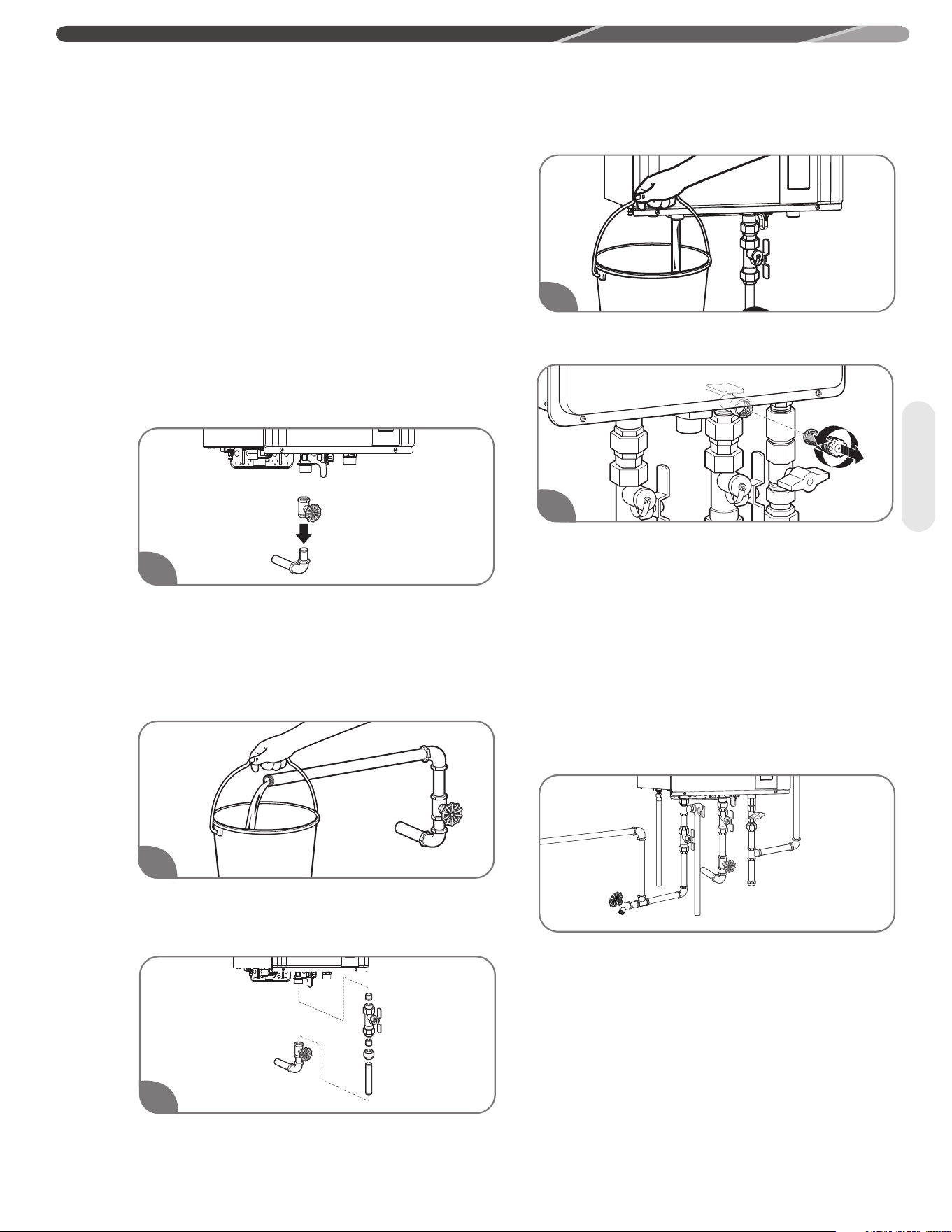
39
Water Supply Installation
NOTICE:
• Use only Teflon tape on all COLD and HOT water
connections.
• If the water flow resistance of a showerhead is too high,
the burner in the water heater will fail to ignite. Keep
all showerheads clean from debris that could cause
additional pressure drop.
• If using mixing valves on the outlet, choose one that
prevents COLD water pressure from overcoming HOT water
pressure.
• If multiple water heaters are installed in a manifold
system, the water piping MUST be in “parallel” and the
water pressure at each water heater should be a minimum
of 40 psi (276 kPa).
Install a COLD water shut-off valve near the inlet
line on the water heater. This valve will be used for
servicing and draining purposes.
NOTICE:
It is not recommended to use pipes with smaller diameters
than the water supply connection of the water heater.
Before attaching the water line to the water heater,
open the shut-off valve. Run the water until it has
purged all contaminants (sand, debris, air, caulking,
etc.).
Install a service valve on the end of the COLD water
supply line and connect it to the water inlet on the
water heater.
Open the shut-off valve in the COLD water Inlet line
to check the water flow through the water heater.
Close the shut-off valve and remove, clean, and
replace the water filter.
NOTICES:
• Be sure to connect the COLD water inlet and the HOT
water outlet as shown on the water heater. If reversed,
the water heater will not function.
• The flow rate of HOT water may vary when more than two
faucets (e.g. appliances, fixtures, etc.) are being used
simultaneously.
• The pipes MUST be completely drainable. If the HOT
water faucets are located at a point higher than the water
heater, place a drain valve at the lowest point.
It is recommended to use unions and flexible copper
connections at the COLD and HOT water lines. They
allow the water heater to be disconnected easily for
servicing.
Use the following guidelines when connecting the
HOT WATER OUTLET:
Connections between the water heater and point(s)
of use should be as short as possible.
Local codes shall govern the piping used for water
connections.
To conserve energy and to prevent freezing, insulate
both COLD and HOT water supply lines. DO NOT
insulate drain line or pressure-relief valve.
INSTALLATION INSTRUCTIONS
4
Plumbing
1
3
2
5
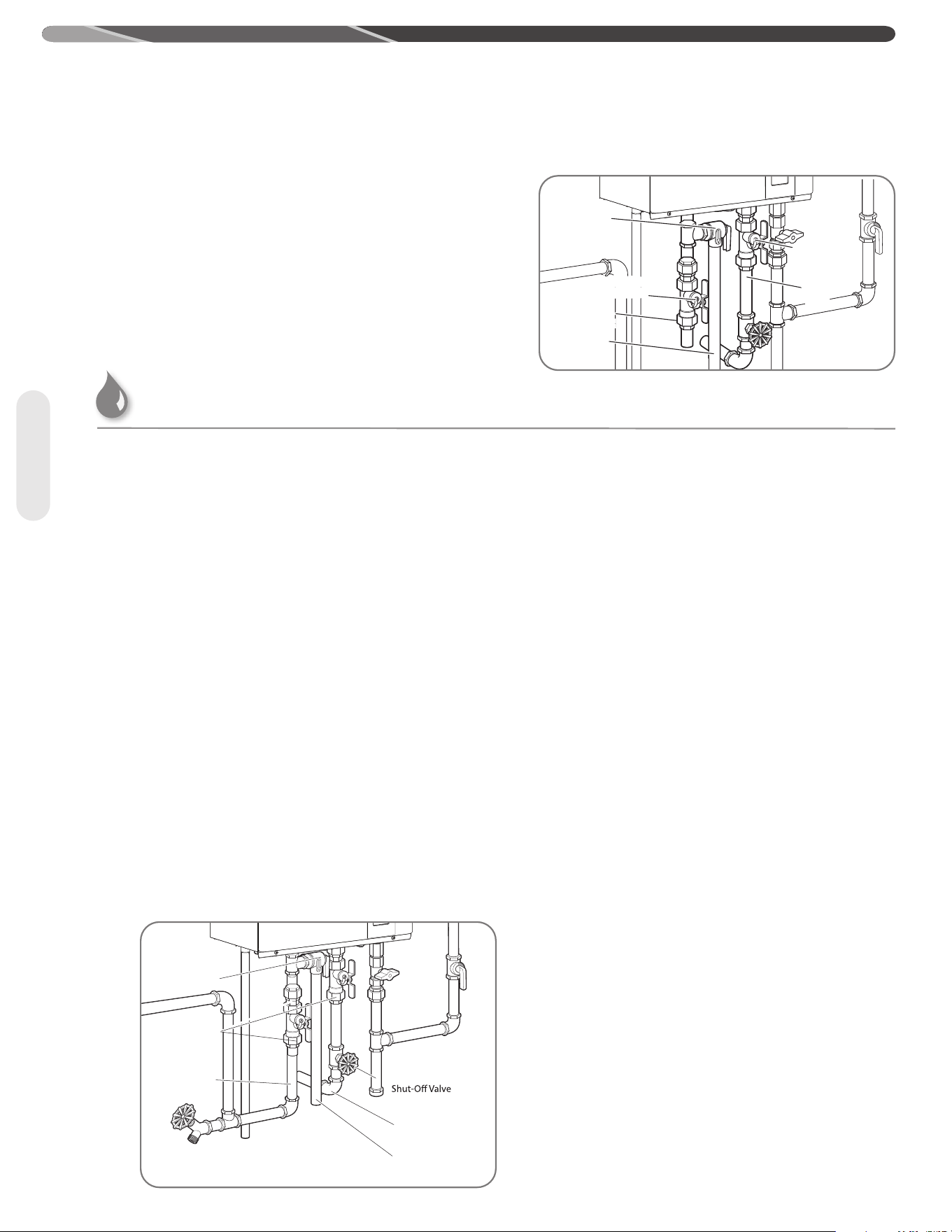
40
Relief Valve
A new pressure-relief valve, complying with the
Standard for Relief Valves and Automatic Gas
Shut-Off Devices for Hot Water Supply Systems,
ANSI Z21.22/CSA 4.4, must be installed at the HOT
water outlet connection of the water heater during
installation. Local codes shall govern the installation
of any relief valve.
NOTICE:
• The following drawing illustrates a pressure-only relief
valve. If local codes require a combination temperature
and pressure-relief valve, you may need to install an
extension piece to ensure that the valve probe is not
directly in the flow path of the water.
•
A pressure relief valve supplied with this water heater must
be installed as shown below.
• Manual operation of relief valves should be performed at
least once a year.
• If the relief valve on the system discharges periodically, a
problem exists. Turn off the water heater, unplug the unit,
and call for service.
One end of the relief valve discharge line connects
to the HOT water outlet pipe as shown above. The
other end of the pipe should be routed to a suitable
drain to eliminate potential water damage.
For safe operation of the water heater, be sure that:
The pressure rating of the relief valve must not
exceed 150 psi (1,034 kPa) or the maximum working
pressure of the water heater. (See the rating plate on
the water heater.)
The BTUH rating of the relief valve must equal or
exceed the BTUH input of the water heater. (See the
rating plate on the water heater.)
No valve of any type should be installed between the
relief valve and the water heater.
Discharge from the relief valve should be piped to
a suitable drain. Piping used should be of a type
approved for the distribution of hot water.
HOT and COLD water lines should be insulated up to
the water heater. See "Water Supply Installation".
The discharge line must be NO SMALLER than the
outlet of the relief valve. The drain line must pitch
downward to allow for complete drainage of the line
and the valve.
The end of the discharge line should not be threaded
or concealed and should be protected from freezing.
No valve of any type, restriction, or reducer coupling
should be installed in the discharge line.
Plumbing
INSTALLATION INSTRUCTIONS
Water Supply (cont.)
Relief
Valve
Union
Union
Cold Water Supply
Cold Water
Supply Inlet
Hot Water
Supply Outlet
Relief Valve
Discharge Line
Pressure
Relief Valve
Pressure
Relief Valve
Cold Water
Service Valve
Cold Water
Service Valve
Water
Inlet
Water
Inlet
Water
Outlet
Water
Outlet
Hot Water
Service Valve
Hot Water
Service Valve
Drain
Drain
Water Piping Arrangement With Service Valve Kit
Service valve kits can attach to all tankless
water heater systems. All kits include two full-
port isolation valves to be used in the COLD
and HOT water lines. When installed, these
valves allow one person full diagnostic testing
and ease of flushing the system. Contact your
distributor or place of purchase for availability
and installation information.
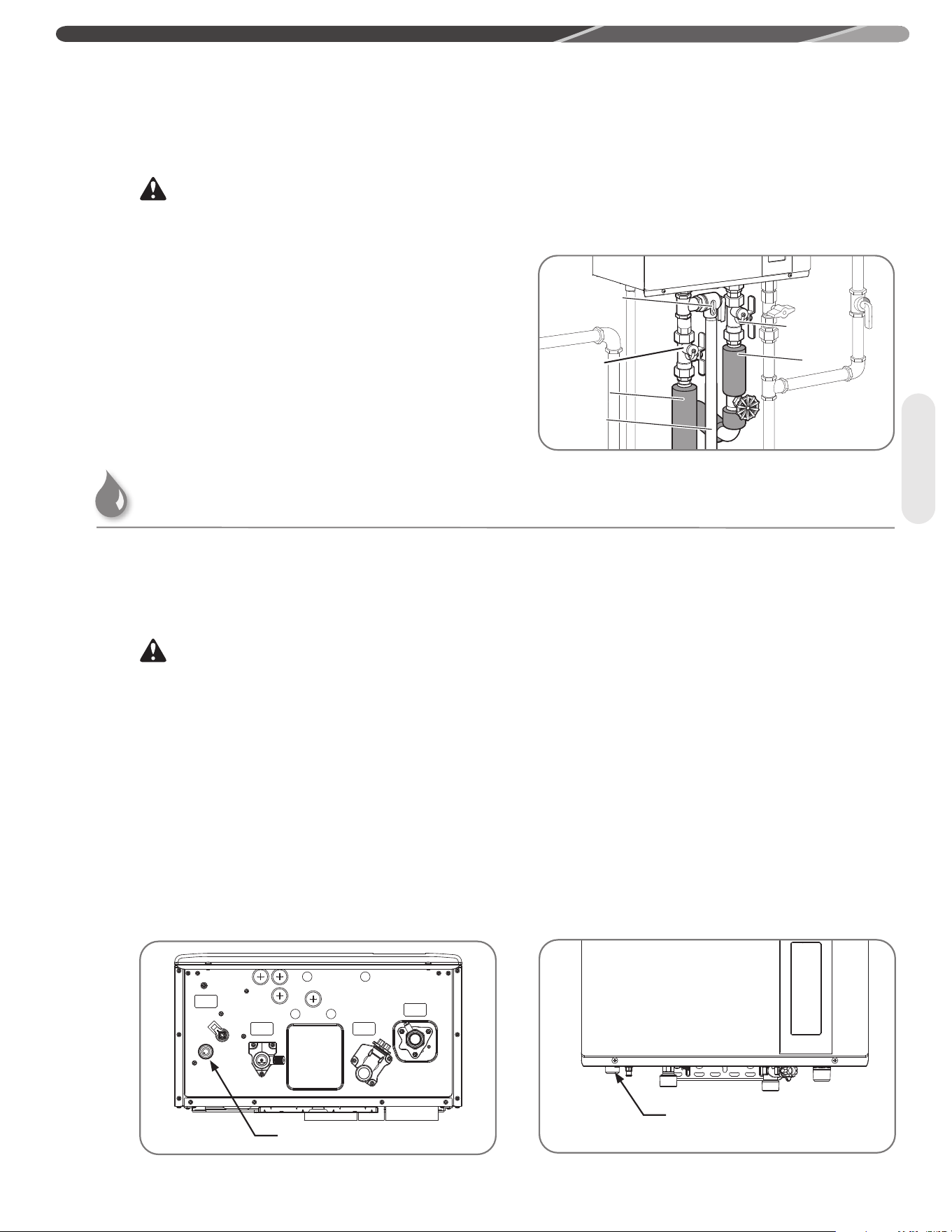
41
INSTALLATION INSTRUCTIONS
WARNINGS:
• When pipe insulation is not rated for the appropriate
weather conditions, install electric heat tracing or
equivalent to prevent freezing of the pipes.
• DO NOT insulate or block drain valve on the hot outlet
fitting.
• If pipes are allowed to freeze, the water heater and the
pipes may malfunction or leak due to freezing water.
NOTICE:
The hot and cold water supply pipes should be insulated to
provide additional freeze protection.
For increased energy efficiency, use pipe insulation
as shown in the diagram. Insulate the pipes all the
way to the top. DO NOT cover any drain or pressure-
relief valve(s).
Hot and Cold Pipe Insulation Installation
Cold Water
Service Valve
Hot Water
Service Valve
Pressure
Relief Valve
Pressure
Relief Valve
Water
Outlet
Water
Outlet
Water
Inlet
Water
Inlet
Drain
Drain
Condensate Drainage
It is recommended to install an external neutralizer.
Contact a store where this water heater is purchased
to purchase an external neutralizer.
WARNING:
The condensate coming from the water heater is known
to be acidic. Without an external neutralizer, metals
contacting the condensate can be corroded.
Be sure the condensate runs freely to a drain and
does not accumulate inside the water heater. In
cold climates, precautions may need to be taken to
ensure that the condensate drain does not freeze.
All condensation must be drained and disposed of
per local codes and requirements.
If the condensate drain gets blocked, an error code
will display on the remote control. If this occurs, the
condensate drain must be cleared.
Use only PVC or CPVC pipe or flexible tube for the
condensate drain line.
The drain pipe (along its entire length) must be at
least the same diameter as the drain line.
The drain line should be as short as possible and
have a downward slope toward the end.
The end of the drain pipe should be open to the
atmosphere. The end should not be under water or
other substances.
DO NOT connect the drain pipe directly to the drain
sewer.
Condensate
Plumbing
Condensate Drain
Condensate Drain
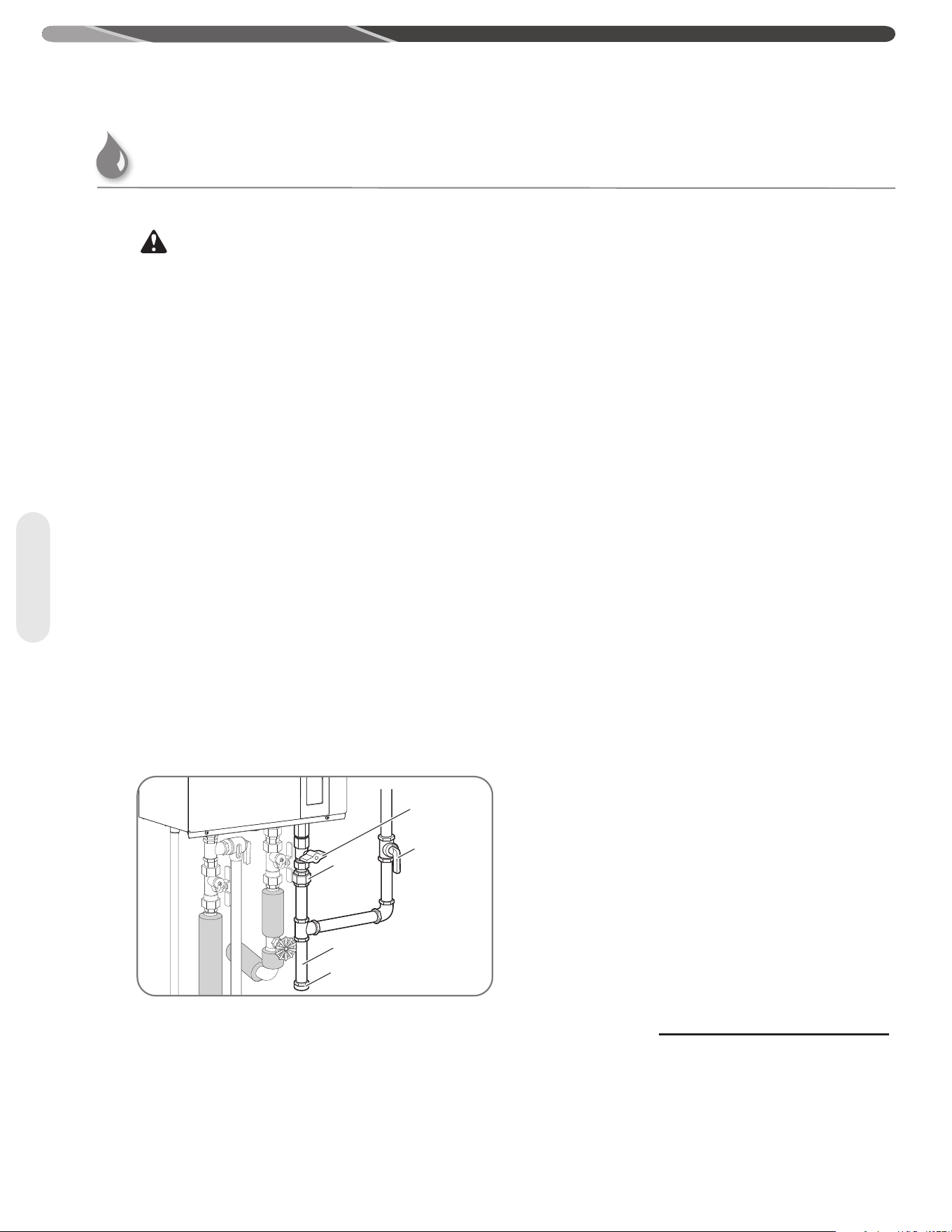
42
Gas Supply
INSTALLATION INSTRUCTIONS
Gas Supply System
WARNING:
DO NOT attempt to convert this water heater for use with
a different type of gas other than the type shown on the
rating plate. Doing so could result in death, personal injury,
explosion or fire, product damage, and/or poor operating
conditions or performance.
NOTICE:
• Gas piping shall be in accordance with local utility
company requirements and/or in the absence of local
codes, use the latest edition of National Fuel Gas Code
(NFGC), ANSI Z223.1. In Canada, use the latest edition of
CAN/CSA B149.1, Natural Gas and Propane installation
code.
• Apply a thin coat of pipe compound to all threaded male
ends. Compound must be of the type resistant to the
action of LP gas.
• To ensure proper water heater operation, the gas pipe and
gas meter must be sized correctly.
• If flexible connectors are used, the minimum inside
diameter must be 3/4" or greater and the rated capacity
of the connector must be equal to or greater than the
BTU capacity of the water heater. See manufacturer
information for the gas connector. Lengths over 36 inches
are not recommended.
• DO NOT use excessive force when tightening the pipe
sections. Excessive force can damage the water heater,
especially when Teflon pipe compound is used.
Gas Supply
Union
Manual Gas
Supply Line
Shut-O Valve
Cap
Sediment Trap
Manual Gas
Shut-O Valve
Gas Piping
Pipe-Sizing Procedure – The gas supply system
must be properly sized to ensure the proper
operation of this tankless water heater as well as all
the gas appliances on the system. Failure to ensure
the gas system, (meter, regulators, and piping) are
properly sized could result in improper operation
of this or other gas appliances. Insufficient gas
pressure/supply can cause pilot outages, lockouts,
or operating conditions that could lead to an
appliance failure, improper combustion, carbon
monoxide, sooting, or fire. Gas line sizing is based
on gas type, the pressure drop in the system, the
gas pressure supplied, and the gas line type. For
gas pipe sizing in the United States, refer to the
National Fuel Gas Code, (NFPA 54, ANSI Z223.1).
For Canadian gas pipe sizing, refer to the Natural
Gas and Propane Installation Code CAN/CSA
B149.1.
These simplified instructions only address low
pressure gas systems using Schedule 40 Metallic
Pipe (Black Iron). For hybrid gas systems,
high pressure main lines with regulators at the
appliances, gas systems piped with corrugated
stainless steel tubing (CSST), or Propane gas
systems.
Determining the required
regulator and gas meter size.
Find the BTU capacity of each appliance on the
system. This information is located on a rating label
attached to the appliance. Total the BTU of all the
appliances together and divide that by the heating
value of the fuel (for natural gas the average is 1,024
or 2,546 for propane). This will give you the total
cubic feet per hour of gas required for the system.
At your gas meter/regulator there will be a rating
plate that gives the cubic feet per hour capacity
of that equipment. If the total gas required for the
system is greater than the rating of the meter/
regulator then the local gas company will need
to be contacted in order to upgrade the meter/
regulator for the system.
Cubic Feet
Per Hour (CFH) =
Gas Input of
Water Heater (BTU/HR)
Heating Value of Gas (BTU/FT
3
)

43
Gas Supply
INSTALLATION INSTRUCTIONS
Determining the required pipe size.
The gas system is designed to operate at a certain
maximum pressure drop. A pressure drop greater
than what is permissible can cause operational
issues with the gas appliances. The National Fuel
Gas Code (NFPA 54, ANSI Z223.1 2012) allows for
three pressure drop levels, a 0.3 inch W.C., (see
table 2); a 0.5 inch W.C., (see table 3) and a 3.0 inch
W.C., (see table 4) pressure drop for natural gas.
Only a 0.5 inch W.C. pressure drop is allowable with
Propane (see table 5). For Canadian installations the
maximum allowable pressure drop is 0.5 inch W.C.,
(see table 3).
Measure the inlet gas pressure to the system using
a manometer. For Natural Gas, if the inlet pressure
is less than 8.0 inches W.C. then use Table 2 or 3
for your gas pipe sizing. Table 4 can only be used if
the inlet gas pressure is 8.0 inches W.C. or greater.
Table 4 cannot be used for Canadian installations.
The gas piping system consists of a main trunk
line that runs from the meter/regulator and branch
lines that run from the trunk line to the individual
appliances. A branch may carry gas for more than
one appliance.
The trunk line must be sized to carry the entire load
of all the gas appliances on the system. As with
determining the meter/regulator size, total the BTU
of all the appliances together and divide that by the
heating value of the fuel (for natural gas the average
is 1,024 or 2,546 for propane). This will give you the
total cubic feet per hour of gas required for the trunk
line. Measure the total length of the line Refer to
Table(s) 2, 3, or 4 and find the number closest to but
higher than the total cubic feet per hour requirement
calculation. This will tell you the minimum size that
the trunk line must be.
Each branch line must be sized to carry the load
of the appliance(s) attached to it. If more than one
appliance is on a branch total the BTU and as with
the trunk line divide that by the heating value of the
fuel. Refer to Table(s) 2, 3, or 4 and find the number
closest to but higher than the total cubic feet per
hour requirement calculation for the branch and
appliance(s). This will tell you the minimum size for
that branch line and appliance.
Final Considerations
If this water heater is replacing an existing water
heater, it is important to verify the capacity of the gas
system. Check the capacity of the meter/regulator,
and verify the pipe lengths and sizes.
An improperly sized gas system will cause
operational issues with this water heater. Other
appliances on the gas system may be affected as
well.
Flexible Gas Connectors may be used however the
BTU capacity of the connector must be checked.
Each connector has a capacity label on it, verify
that the connector has a BTU capacity greater than
that of the water heater. An undersized flexible gas
connector will cause operational issues with this
water heater.
Half-inch gas lines are permissible provided the gas
system meets certain requirements. First, the gas
pressure on the system must be 8.0 inch W.C. or
greater. Second the capacity of the pipe as outlined
in Table 4 is followed. If the existing pipes are too
small it could cause a pressure drop greater than 3.0
inch W.C. and will cause operational issues with this
water heater as well as other gas appliances on the
system.
Gas Supply
44
Table 2 - Pipe-Sizing - Natural Gas
Schedule 40 Metallic Pipe (Black Iron)
Inlet System Pressure: Less than 2 PSI (55 inches W.C.)
Allowable Pressure Drop: 0.3 inches W.C.
Specic Gravity : 0.60
(Capacity in cubic feet per hour)
Length Pipe Size (Inches)
½ ¾ 1 1¼ 1½
10 131 273 514 1,060 1,580
20 90 188 355 726 1,090
30 72 151 284 583 873
40 62 129 243 499 747
50 55 114 215 442 662
60 50 104 195 400 600
70 46 95 179 368 552
80 42 89 167 343 514
90 40 83 157 322 482
100 38 79 148 304 455
Information in this chart obtained from NFPA 54, ANSI Z223.1 - 2012 Table 6.2(a)
Table 4 - Pipe-Sizing - Natural Gas
Schedule 40 Metallic Pipe (Black Iron)
Inlet System Pressure: 8.0 inches W.C. or greater, but Less than 2 PSI (55
inches W.C.)
Allowable Pressure Drop: 3.0 inches W.C.
Specic Gravity : 0.60
(Capacity in cubic feet per hour)
Length Pipe Size (Inches)
½ ¾ 1 1¼ 1½
10 454 949 1,787 3,669 5,497
20 312 652 1,228 2,522 3,778
30 250 524 986 2,025 3,778
40 214 448 844 1,733 2,597
50 190 387 748 1,536 2,302
60 172 360 678 1,392 2,085
70 158 331 624 1,280 1,919
80 147 308 580 1,191 1,785
90 138 289 544 1,118 1,675
100 131 273 514 1,056 1,582
Information in this chart obtained from NFPA 54, ANSI Z223.1 - 2012 Table 6.2(c)
Table 3 - Pipe-Sizing - Natural Gas
Schedule 40 Metallic Pipe (Black Iron)
Inlet System Pressure: Less than 2 PSI (55 inches W.C.)
Allowable Pressure Drop: 0.5 inches W.C.
Specic Gravity : 0.60
(Capacity in cubic feet per hour)
Length Pipe Size (Inches)
½ ¾ 1 1¼ 1½
10 172 360 678 1390 2090
20 118 247 466 957 1430
30 95 199 374 768 1150
40 81 170 320 657 985
50 72 151 284 583 873
60 65 137 257 528 791
70 60 126 237 486 728
80 56 117 220 452 677
90 52 110 207 424 635
100 50 104 195 400 600
Information in this chart obtained from NFPA 54, ANSI Z223.1 - 2012 Table 6.2(b)
Table 5 - Pipe-Sizing - Undiluted Propane
Schedule 40 Metallic Pipe (Black Iron)
Inlet System Pressure: 11 inches W.C.
Allowable Pressure Drop: 0.5 inches W.C.
Specic Gravity : 1.5
(Capacity in cubic feet per hour)
Length Pipe Size (Inches)
½ ¾ 1 1¼ 1½
10 291 608 1150 2350 3520
20 200 418 787 1620 2420
30 160 336 632 1300 1940
40 137 287 541 1110 1660
50 122 255 480 985 1480
60 110 231 434 892 1340
80 101 212 400 821 1230
100 94 197 372 763 1140
125 89 185 349 716 1070
150 84 175 330 677 1010
Information in this chart obtained from NFPA 54, ANSI Z223.1 - 2012 Table 6.3(d)
Gas Supply
INSTALLATION INSTRUCTIONS
This is an example, in US, refer to current National
Fuel Gas Code, NFPA 54 for correct pipe sizing
chart, and in Canada, refer to current Natural Gas
and Propane Installation Code CAN/CSA B149.1.
Gas Supply
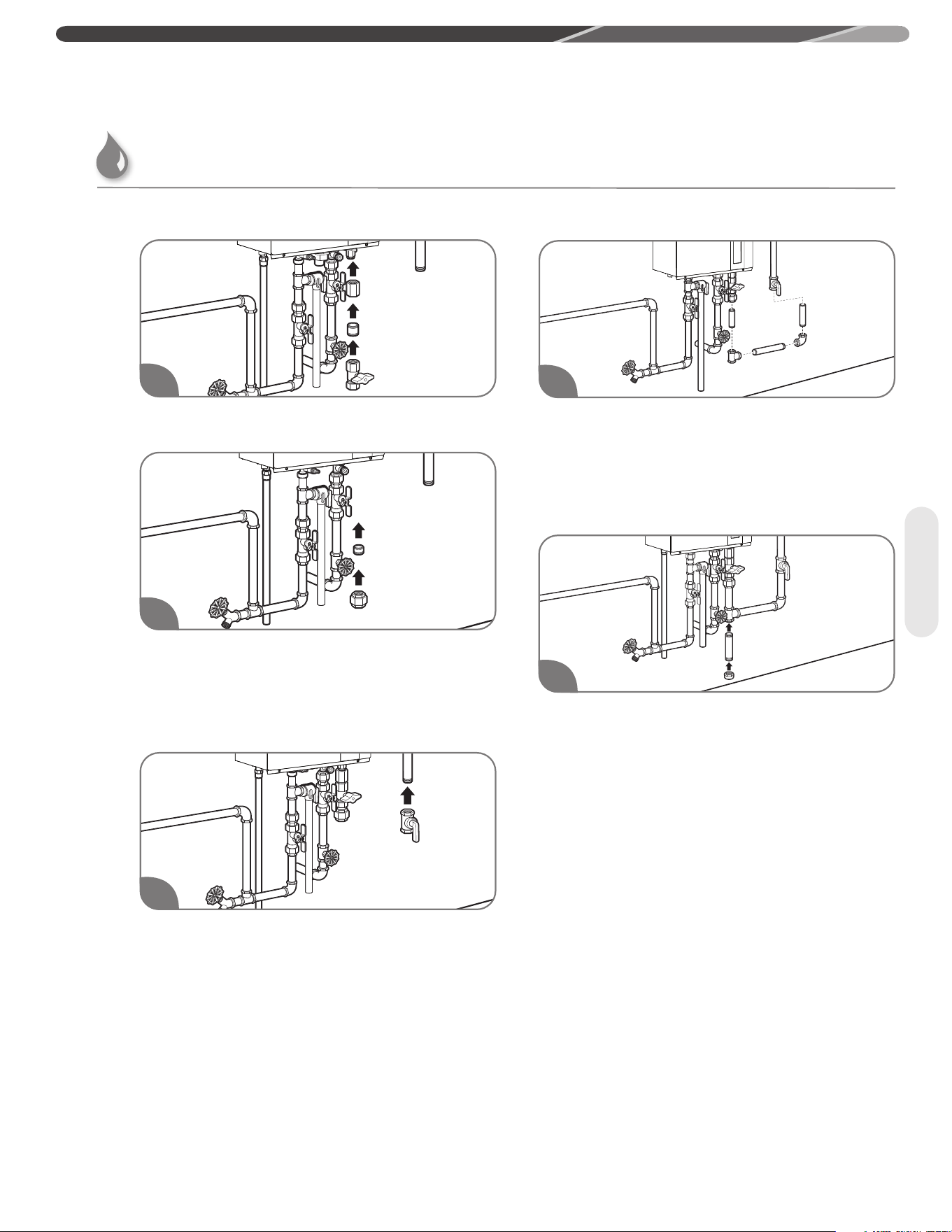
45
Gas Supply
INSTALLATION INSTRUCTIONS
Gas Supply Installation
Install the manual gas appliance shut-off valve to the
gas connection at the water heater.
Install a ground joint union or ANSI design-certified
semi-rigid or flexible gas appliance connector to
the open end of the manual gas appliance shut-off
valve. The NFGC, ANSI Z223.1 and CAN/CSA B149.1
codes mandate the use of manual gas shut-off valve.
Install a manual gas supply line shut-off valve
to the end of the gas supply line.
Using the proper-size piping, fittings, and
components, build the gas supply line to the water
heater.
NOTICE:
The gas supply line should be a minimum of 3/4-in. (1.9-cm)
black steel pipe or other approved gas piping material.
Install a sediment trap at the lowest portion of the
gas line.
The inlet gas pressure to the water heater must NOT
exceed 10.5 in. w.c. (2.6 kPa) for natural gas and
13 in. w.c. (3.2 kPa) for LP gas. For purposes of
input adjustment, the minimum inlet gas pressure
(with main burner on) is shown on the water heater
rating plate. If high or low gas pressures are present,
contact your gas supplier for correction.
1
2
4
3
5
Gas Supply
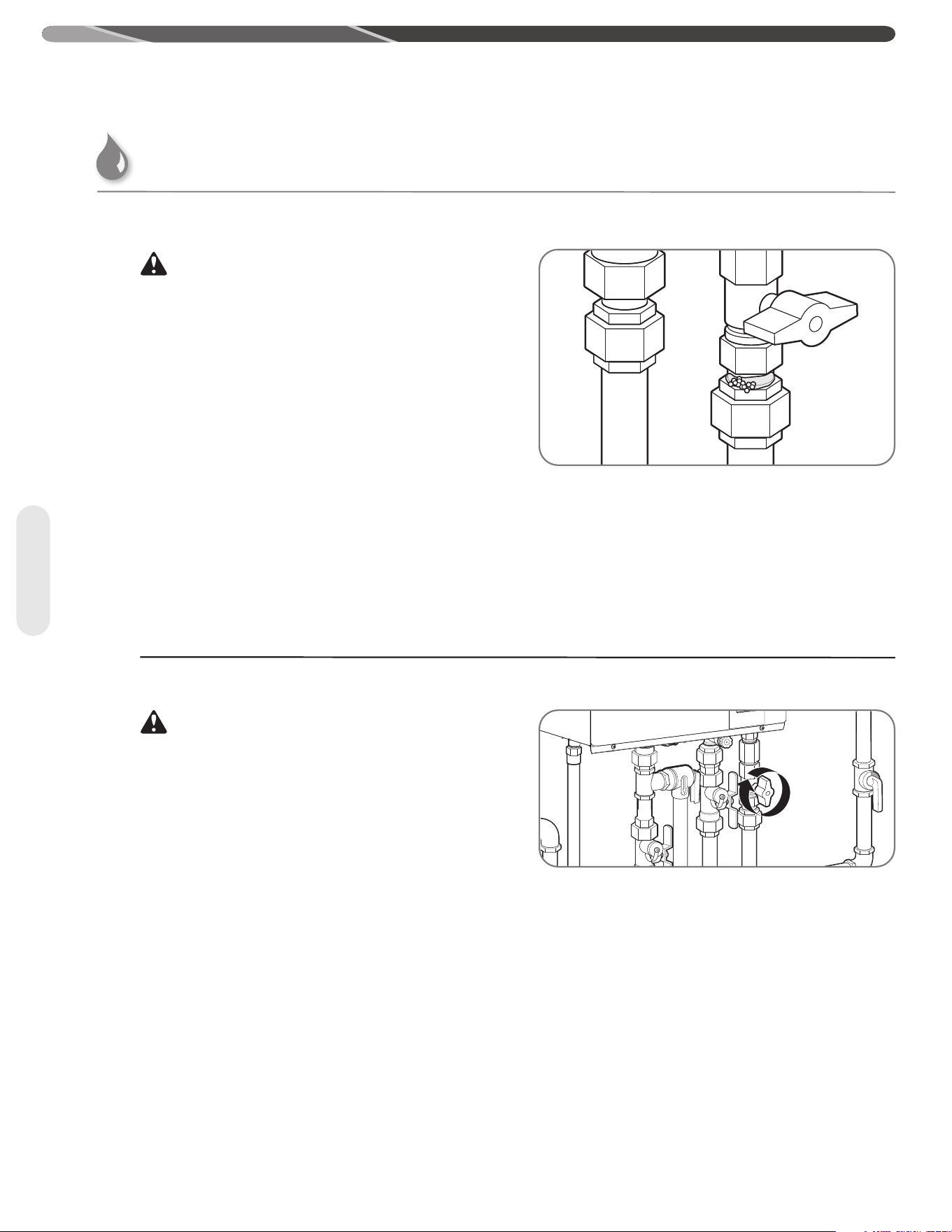
46
Leak Testing
WARNING:
Never use an open flame to test for gas leaks, because
death, personal injury, and/or property damage can result.
The water heater and its gas connections MUST be leak-
tested at normal operating pressures before the unit is
placed in operation. These tests should also include all
factory connections.
• Turn on the gas shut-off valve(s) to the water heater.
• Use a soapy water solution to test for leaks at all
the connections and fittings. If bubbles are seen,it
indicates a gas leak that must be corrected.
• Contact a qualified service technician.
Pressure Testing the Gas Supply System
WARNING:
If inlet gas pressure is out of allowable range [4.0” w.c.
(1.0kPa) – 10.5” w.c. (2.6kPa)] for Natural Gas, or [8.0”
w.c. (2.0kPa) – 13.0” w.c. (3.2kPa)] for LP gas, a gas
pressure regulator must be installed to maintain the
allowable inlet gas pressure.
The water heater and its manual gas shut-off valve
must be disconnected from the gas supply piping
system during any pressure testing of the system at
test pressures in excess of 1/2 psi (3.5 kPa).
The water heater must be isolated from the gas
supply piping system by closing the manual gas
shut-off valve during any pressure testing of the gas
supply piping system at test pressures equal to or
less than 1/2 psi (3.5 kPa).
Gas Supply
Gas Supply
INSTALLATION INSTRUCTIONS
47
Gas Supply
Electrical
INSTALLATION INSTRUCTIONS
Electrical Wiring
DANGER:
Shock Hazard – Before servicing the water heater, turn
off the electrical power to the water heater at the main
disconnect or circuit breaker. Failure to do so will result in
death or serious personal injury.
WARNING:
Field wiring connections and electrical grounding must
comply with local codes or, in the absence of local codes,
with the latest edition of the National Electrical Code, ANSI/
NFPA 70, or in Canada, Canadian Electrical Code, CAN/CSA
C22.1, Part 1.
CAUTION:
Label all wires prior to disconnecting
is recommended
.
Wiring errors can cause personal injury, product damage,
and/or dangerous operating conditions. Verify correct
operation after servicing.
NOTICE:
• DO NOT connect power until venting installation is
complete (see Venting Installation).
• Wait ninety (90) seconds after power is connected for the
first time to initiate operation of the water heater.
Power consumption is up to 100 Watts during normal
operation, 3-5 Watts during standby, waiting to run, and up
to 200 Watts during the freeze protection operation.
Power Cord
The electric power supply requirement for this water
heater is 120 VAC/60 Hz, 2 amps.
A dedicated circuit is recommended for the water
heater. DO NOT connect to a GFCI or AFCI circuit.
Multiple units may be connected to a single circuit
up to the circuit rating.
DO NOT use 3-prong to 2-prong adapters. DO NOT
use power strips or multiple outlet adapters.
All direct-vent gas models come with a 3-prong
power cord. Only use this power cord and a
matching grounded electrical outlet.
All outdoor gas models DO NOT come with a power
cord. Only hard-wire to an appropriate power outlet
with a ground terminal.
Keep any excess length of the power supply cord on
the outside of the water heater.
If local codes require hard-wiring, see instructions for
“Hard-Wiring the Electrical Connections” below.
Hard-Wiring the Electrical
Connections
Wiring should be performed by a qualified electrician
in accordance with local codes.
The water heater requires a properly grounded
120 VAC/60 Hz dedicated power supply. Multiple
water heaters may be connected to a single circuit
up to that circuit’s rating.
DO NOT connect grounding wire to water pipes, gas
pipes, telephone cables, lighting conductor circuits,
or to any other grounding circuits that require a GFCI
or AFCI (arc fault circuit interrupter).
An ON/OFF switch must be provided and installed
for the incoming 120 VAC power supply.
Wire the water heater exactly as shown in the wiring
diagram. This wiring diagram can also be found
inside the water heater cover panel.
The green screw is provided in the enclosure for a
grounding connection.
Connect the live wire to the black wire and neutral
wire to the white neutral wire.
High-Altitude Installation
The water heater is certified for installations up to
7,800 ft. (610 m) above sea level. The input rating of
this water heater is based on sea level operation. At
higher elevations, the actual input rate may be lower
than the value listed on the rating label due to the
derating of Natural Gas and LP Gas.
NOTICE:
For installations above 2000 ft. (610 m) elevation, contact
a qualified service technician to make the proper altitude
adjustments. See “Vent Length and High-Altitude DIP
Switch Adjustments” for additional information.
WARNING:
DO NOT install this water heater at elevations above 2000
ft. (610 m) without the proper adjustments. Please contact
your installer, local gas supplier, place of purchase, or the
Rheem Customer Service phone number listed in the “Call
for Assistance” section.
Gas Supply
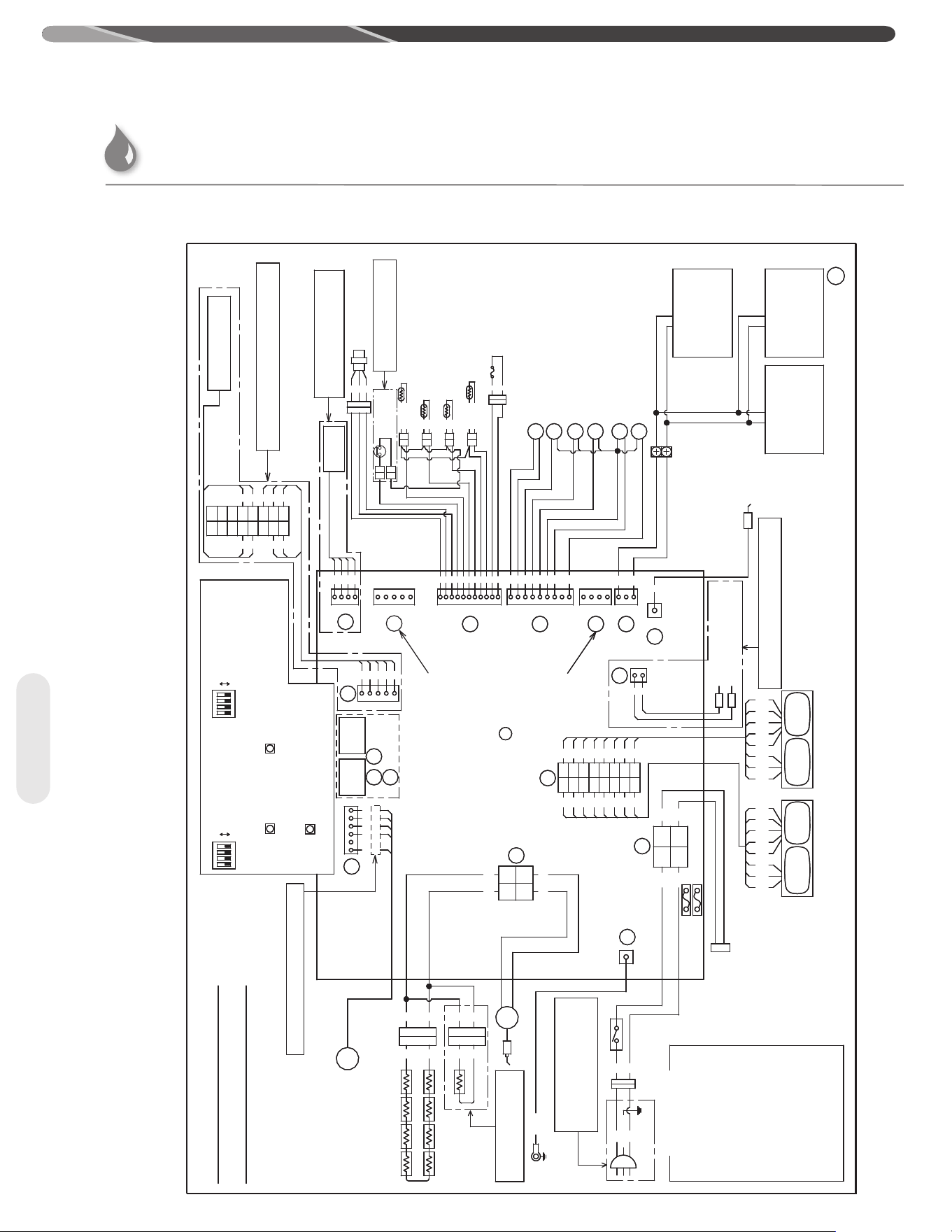
48
Wiring Diagram
Electrical
1
①
③ ④
②
③ ①
②④
GND
IG
W
W
W
W
W
W
W
W
W
ANTI-FROST HEATER
CHAUFFAGE ANTI-GIVRE
W
YG YG
BK
2
1
R
R
1
FLAMEROD
DÉTECTEUR DE
FLAMMES
654 321
4
3
2
1
W
R
G
BK
DISPLAY
AFFICHAGE
1
2
3
4
5
1
2
3
GAS TYPE
CIRCUIT BOARD
PLAQUE DE CIRCUIT
IMPRIMÉ TYPE GAZ
1
2
3
4
5
6
7
8
9
W
R
BK
R
BL
BK
GY
Y
1
2
3
4
5
6
7
8
9
10
11
R
R
W
W
Y
W
BK
BL
BK
BL
WATER FLOW SENSOR
CAPTEUR DE DÉBIT D'EAU
HEAT EXCHANGER THERMISTOR
THERMISTANCE ÉCHANGEUR DE CHALEUR
HOT WATER OUTLET THERMISTOR
THERMISTANCE SORTIE D'EAU CHAUDE
OVER HEAT LIMITER
LIMITEUR DE SURCHAUFFE
AMBIENT AIR THERMISTOR
THERMISTANCE D'AIR AMBIANT
BK
W
⑮
① ②
③ ④
⑤ ⑥
BK
R
G
Y
BL
O
W
BR
R
G
Y
BL
O
W
BR
BK
G/Y
A
B
C
D
E
F
G
M
N
K
O
I
H
L
LIMITER
LIMITEUR
MOTOR
MOTEUR
BK
WATER BY-PASS
CONTROL MOTOR
MOTEUR MÉLANGE D'EAU
WATER VOLUME
CONTROL MOTOR
MOTEUR DÉBIT D'EAU
AC
120V
G/YorG
W
BK
GND
BL
BL
BK OR W
BK
BK
BK
BR
BK
R
W
W
W
W
W
BK
USUALLY
DISCONNECTED
NORMALEMENT
DÉCONNECTÉ
VERT/JAUNE
G/Y:GREEN/YELLOW,
O:ORANGE,ORANGE
COLOR CODE
R:RED,ROUGE
W:WHITE,BLANC
BR:BROWN,MARRON
BL:BLUE,BLEU
BK:BLACK,NOIR
GY:GRAY,GRIS
G:GREEN,VERT
Y:YELLOW,JAUNE
CODE COULEUR
P:PINK,ROSE
PU:PURPLE,VIOLET
PSV
SV4
SV0
SV1
SV2
SV3
+
-
SOLENOID VALVE 4
ÉLECTROVALVE 4
SOLENOID VALVE 3
ÉLECTROVALVE 3
SOLENOID VALVE 2
ÉLECTROVALVE 2
SOLENOID VALVE 1
ÉLECTROVALVE 1
GAS INLET SOLENOID VALVE 0
ÉLECTROVALVE 0 D'ADMISSION DE GAZ
⑦ ⑧
⑨ ⑩
⑪ ⑫
⑬ ⑭
⑯
①
③
⑤
⑦
⑨
⑪
⑬
⑮
1
2
3
4
5
G
WIFI MODEL
MODÈLE WIFI
FOR NON-WIFI MODEL ONLY
UNIQUEMENT POUR MODÈLE
SANS WIFI
FOR WIFI MODEL ONLY
UNIQUEMENT POUR MODÈLE WIFI
R
FM
FAN MOTOR
VENTILATEUR DU MOTEUR
P.G.F.R VALVE
VALVE P.G.F.R
41-34301 1
WATER LEAK SENSOR
CAPTEUR DE FUITE D'EAU
Y
P
PU
BR
G
MIN BUTTON
SW2
SW3
ADJUSTER BUTTON
BOUTON DE RÉGLAGE
MAX BUTTON
BOUTON MAX
BOUTON MIN
SW1
ON
MARCHE
DIP SWITCH2
CONTACTEUR DIP2
OFF
ARRÊT
ON
MARCHE
DIP SWITC1
ARRÊT
CONTACTEUR DIP1
OFF
1 2
3
4
1
2
3
4
DIP1DIP2
SW1SW2
SW3
LED
WATER LEVEL ELECTRODE
ÉLECTRODE DE NIVEAU D’EAU
FOR CONDENSING MODEL ONLY
FOR INDOOR,DIRECT-VENT
MODEL ONLY
POUR MODÈLE INTÉRIEUR À
VENT DIRECT SEULEMENT
BATH REMOTE
CONTROL 1
BATH REMOTE
CONTROL 2
(USC1-117)
FUSE(10A)
FUSIBLE(10A)
1
2
3
4
WIRING DIAGRAM
W
( )
LIMITER
LIMITEUR
MOTOR
MOTEUR
G R BRBL W O Y BKG R BR
BLW O Y
UNIQUEMENT POUR MODÈLE DE CONDENSAGE
②
④
⑥
⑧
⑩
⑫
⑭
⑯
TÉLÉCOMMANDE 1
<<DE BAIN>>
TÉLÉCOMMANDE 2
<<DE BAIN>>
(USC2-117)
W
1
①
③ ④
②
③ ①
②④
GND
IG
IGNITER
ALLUMEUR
W
W
W
W
W
W
W
W
W
ANTI-FROST HEATER
CHAUFFAGE ANTI-GIVRE
W
YG YG
BK
2
1
1
FLAMEROD
DÉTECTEUR DE
FLAMMES
654 321
4
3
2
1
W
R
G
BK
DISPLAY
AFFICHAGE
1
2
3
4
5
1
2
3
GAS TYPE
CIRCUIT BOARD
PLAQUE DE CIRCUIT
IMPRIMÉ TYPE GAZ
1
2
3
4
5
6
7
8
9
W
R
BK
R
BL
BK
GY
Y
1
2
3
4
5
6
7
8
9
10
11
R
R
W
W
Y
W
BK
BL
BK
BL
WATER FLOW SENSOR
CAPTEUR DE DÉBIT D'EAU
WATER INLET THERMISTOR
THERMISTANCE ENTREE D'EAU FROIDE
HEAT EXCHANGER THERMISTOR
THERMISTANCE ÉCHANGEUR DE CHALEUR
HOT WATER OUTLET THERMISTOR
THERMISTANCE SORTIE D'EAU CHAUDE
OVER HEAT LIMITER
LIMITEUR DE SURCHAUFFE
AMBIENT AIR THERMISTOR
THERMISTANCE D'AIR AMBIANT
BK
W
⑮
① ②
③ ④
⑤ ⑥
BK
R
G
Y
BL
O
W
BR
R
G
Y
BL
O
W
BR
BK
G/Y
A
C
D
E
F
G
M
N
K
O
I
H
L
LIMITER
LIMITEUR
MOTOR
MOTEUR
BK
WATER BY-PASS
CONTROL MOTOR
MOTEUR MÉLANGE D'EAU
WATER VOLUME
CONTROL MOTOR
MOTEUR DÉBIT D'EAU
G/YorG
W
BK
GND
BL
BL
BK OR W
BK
BK
BR
BK
R
W
W
BK OR W
BK OR W
W
W
USUALLY
DISCONNECTED
NORMALEMENT
DÉCONNECTÉ
VERT/JAUNE
G/Y:GREEN/YELLOW,
O:ORANGE,ORANGE
COLOR CODE
R:RED,ROUGE
W:WHITE,
BR:BROWN,MARRON
BL:BLUE,BLEU
BK:BLACK,NOIR
GY:GRAY,GRIS
G:GREEN,VERT
Y:YELLOW,JAUNE
CODE COULEUR
P:PINK,ROSE
PU:PURPLE,VIOLET
PSV
SV4
SV0
SV1
SV2
SV3
+
-
SOLENOID VALVE 4
ÉLECTROVALVE 4
SOLENOID VALVE 3
ÉLECTROVALVE 3
SOLENOID VALVE 2
ÉLECTROVALVE 2
SOLENOID VALVE 1
ÉLECTROVALVE 1
GAS INLET SOLENOID VALVE 0
ÉLECTROVALVE 0 D'ADMISSION DE GAZ
⑦ ⑧
⑨ ⑩
⑪ ⑫
⑬ ⑭
⑯
①
③
⑤
⑦
⑨
⑪
1
2
3
4
5
BL
BK
W
G
GY
R
FM
FAN MOTOR
VENTILATEUR DU MOTEUR
FOR OUTDOOR MODEL ONLY
UNIQUEMENT POUR MODÈLE À USAGE EXTÉRIEUR
P.G.F.R VALVE
VALVE P.G.F.R
WATER LEAK SENSOR
CAPTEUR DE FUITE D'EAU
Y
P
PU
BR
G
GY
BL
W
BK
MIN BUTTON
SW2
SW3
ADJUSTER BUTTON
BOUTON DE RÉGLAGE
MAX BUTTON
BOUTON MAX
BOUTON MIN
SW1
ON
MARCHE
DIP SWITCH2
CONTACTEUR DIP2
OFF
ARRÊT
ON
MARCHE
DIP SWITC1
ARRÊT
CONTACTEUR DIP1
OFF
1 2
3
4
1
2
3
4
DIP1DIP2
SW1SW2
SW3
LED
ÉLECTRODE DE NIVEAU D’EAU
FOR CONDENSING MODEL ONLY
BATH REMOTE
CONTROL 1
BATH REMOTE
CONTROL 2
(USC1-117)
1
2
3
4
TO PUMP
À LA POMPE
SCHÉMA DE CÂBLAGE
WIRING DIAGRAM
W
( )
LIMITER
LIMITEUR
MOTOR
MOTEUR
G R BRBL W O Y BKG R BR
BLW O Y
UNIQUEMENT POUR MODÈLE DE CONDENSAGE
②
④
⑥
⑧
⑩
⑫
⑭
⑯
TÉLÉCOMMANDE 1
<<DE BAIN>>
TÉLÉCOMMANDE 2
<<DE BAIN>>
(USC2-117)
W
BL
BLBK
R
R
O Y
Y
CIRCUIT BOARD
PLAQUE DE CIRCUIT
UNIQUEMENT POUR
MODÈLE DE CONDENSAGE
FOR CONDENSING MODEL ONLY
BK
THERMOSTAT
UNIQUEMENT POUR
MODÈLE DE CONDENSAGE
FOR CONDENSING MODEL ONLY
MAIN REMOTE
CONTROL
TÉLÉCOMMANDE
<<MAIN>>
(UMC-117)
5 6
Electrical Wiring
INSTALLATION INSTRUCTIONS
49
INSTALLATION INSTRUCTIONS
Insulation Blankets
In general, insulation blankets for external use on gas
water heaters are not necessary. The purpose of an
insulation blanket is to reduce the standby heat loss
from the water heater’s storage tank. Since these
water heaters DO NOT store water, they eliminate
the need for the insulation blanket.
!
WARNING:
Never cover the air inlet, flue outlet, or operating and
warning labels attached to the water heater. Covering these
components will cause dangerous operating conditions that
can lead to death, personal injury, property damage, and/or
product damage.
The manufacturer’s warranty does not cover any
damage or defect caused by insulation, insulation
attachment, or use of any type of energy-saving
or other unapproved devices (unless authorized
by the manufacturer). The use of unauthorized
energy-saving devices can result in death, personal
injury, and/or property damage. The manufacturer
disclaims any responsibility for such loss or injury
resulting from the use of such unauthorized devices.
Installation Precautions
Follow all installation instructions covered in this
manual.
Check the inlet gas pressure to make sure it is within
the range specified on the rating plate.
Make sure there is adequate air for combustion and
ventilation as described on "Venting" in this manual.
Maintain proper clearances to combustibles and
noncombustibles as specified on the rating plate.
Make sure the venting system complies with local
codes, National Fuel Gas Code (ANSI Z223.1/NFPA
54) or Natural Gas and Propane Installation Code
(CAN/CSA B149.1), and the guidelines found on
"Venting" in this manual.
Make sure the heater and remote control are
properly fastened to their mounting surfaces.
Make sure the heater and remote control are wired
in accordance with all regulations and codes without
any exposed connections.
Contact the local gas company to make sure the gas
meter and gas piping are adequately sized.
Use only Teflon tape on all male water line
connections and fittings.
DO NOT block or restrict any outside air intake
openings.
DO NOT remove the front cover unless absolutely
necessary. This should only be done by a qualified
service technician.
DO NOT install this product where standing water
may occur.
DO NOT use pipe dope on water line connections
and fittings.
DO NOT use Teflon tape on gas line connections
and fittings in US.
Electrical
50
Checklist
Condensate drain is properly routed to an
external neutralizer or corrosive resistant drain,
if applicable.
F. Condensate
Installation Checklist
Indoor water heaters must be installed indoors.
Outdoor water heaters must be installed
outdoors.
Close to area of ventilation termination (indoor
models).
Protected from freezing temperatures.
Proper clearance from combustible material
observed.
Sufficient fresh air supply for proper operation
of water heater.
Air supply free of corrosive elements and
flammable vapors.
Provisions made to protect area from water
damage.
Sufficient room to service heater.
Combustible materials, such as clothing,
cleaning materials, and rags clear of the heater
and vent piping.
Water heater is properly secured to the wall.
A. Water Heater Location
B. Vent (Indoor Models)
Vent pipe material is ULC S636 approved and
manufacturer-approved.
Horizontal air intake pipe and exhaust pipe have
a 1/4" per foot UPWARD slope toward the vent
terminal.
Vertical venting is installed as described in the
"Vertical Vent Installation section.
Connection(s) securely fastened together with
cement and airtight.
All vent runs are properly installed.
Vent terminal is properly installed.
Maximum vent length is observed.
DIP Switches are properly adjusted per vent
length and elevation
Water supply has sufficient pressure.
Air has been purged from the water heater and
the piping.
Water connections tight and free from leaks.
Water filter is clean and in place.
All piping has been assembled as described on
"Water Supply".
Water pipes are insulated and protected from
freezing, if necessary.
Pressure-relief valve properly installed with
discharge line running to open drain.
Discharge line protected from freezing, if
necessary.
C. Water Supply/Relief Valve
Gas type matches listing on rating plate.
Gas supply pressure is sufficient for the water
heater.
Gas line equipped with shut-off valve, union
and sediment trap as described on "Gas Supply
System".
Approved pipe-joint compound has been used
on all gas pipe connections.
All connections and fittings have been checked
for leaks with a soapy water solution.
Gas company inspected installation (if required).
D. Gas Supply
Supply cord and/or wiring meets all local
codes, National Electrical Code, ANSI/NFPA 70,
in the U.S., or Canadian Electrical Code, CAN/
CSA C22.1, Part 1, in Canada.
Voltage matches listing on rating plate.
Water heater is properly grounded.
E. Electrical Wiring
INSTALLATION INSTRUCTIONS
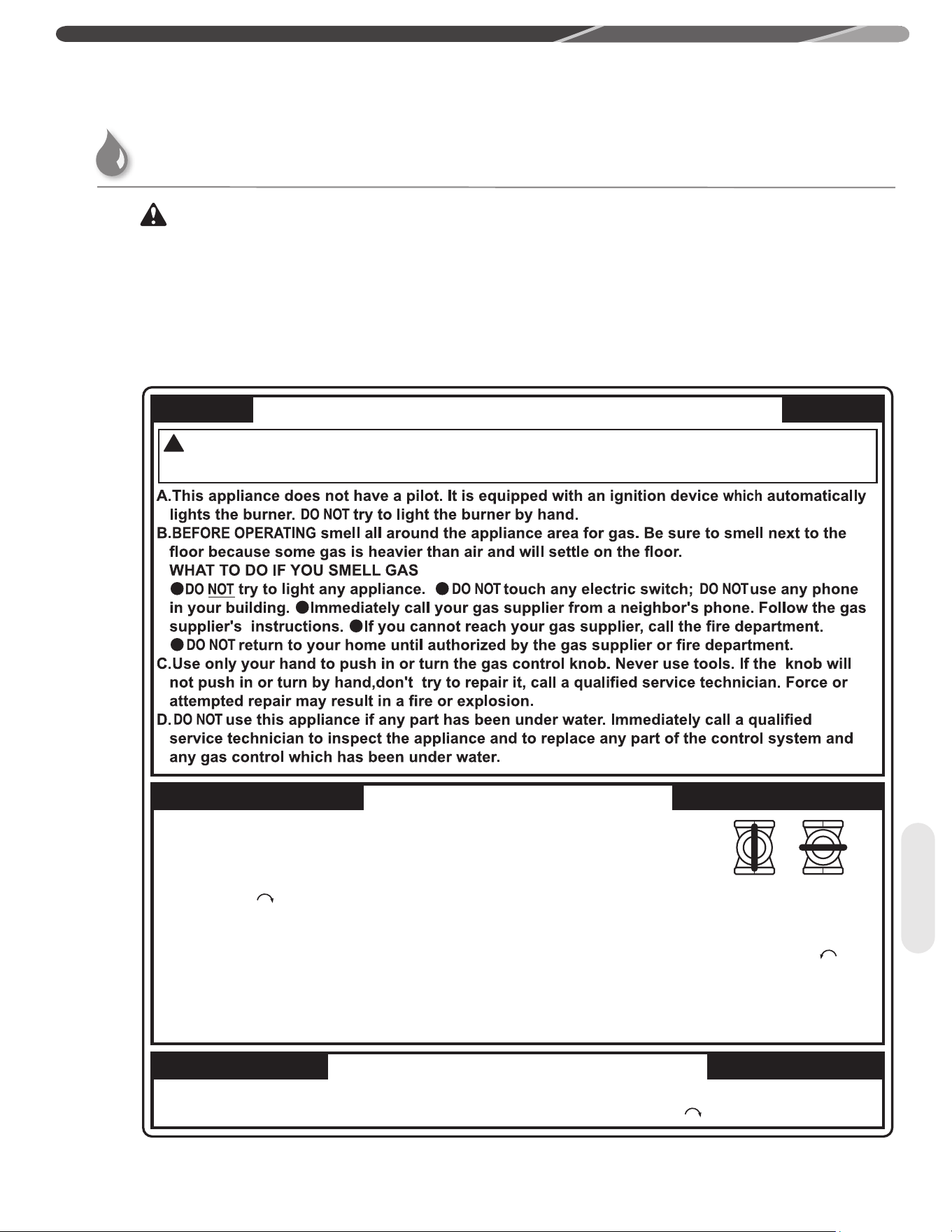
51
USING YOUR WATER HEATER
Activating the Water Heater
WARNING:
Before operating this water heater, be sure to read and
follow the instructions on the following label, all labels on
the water heater, and the “Important Safety Information”
section in this manual. Failure to do so can result in unsafe
operating conditions that can result in death, personal
injury, property damage, and/or product damage.
WARNING : If you do not follow these instructions exactly, a fire or explosion may result
causing property damage, personal injury or loss of life.
FOR YOUR SAFETY READ BEFORE OPERATING
1.STOP! Read the safety information above on this label.
2.Turn off all electric power to the appliance.
3.DO NOT attempt to light the burner by hand.
4.Turn the Gas Shutoff Valve located on the outside of the unit
clockwise to the "OFF" position.
5.Wait five (5) minutes to clear out any gas. If you then smell gas, STOP! Follow "B" in
the safety information above on this label. If you don't smell gas, go to the next step.
6.Turn the Gas Shutoff Valve located on the outside of the unit counterclockwise to
the "ON" position.
7.Turn on all electric power to the appliance.
8.If the appliance will not operate, follow the instructions "To Turn Off Gas To Appliance"
and call your service technician or gas supplier.
TO TURN OFF GAS TO APPLIANCE
1
.
Turn off all electric power to the appliance if service is to be performed.
2
.
Turn
the
Gas
Shutoff
Valve
located
on
the
outside
of
the
unit
clockwise to
the
"OFF"
position.
GAS SHUTOFF
VALVE
OPEN CLOSE
OPERATING INSTRUCTIONS
!
Start/Adjust
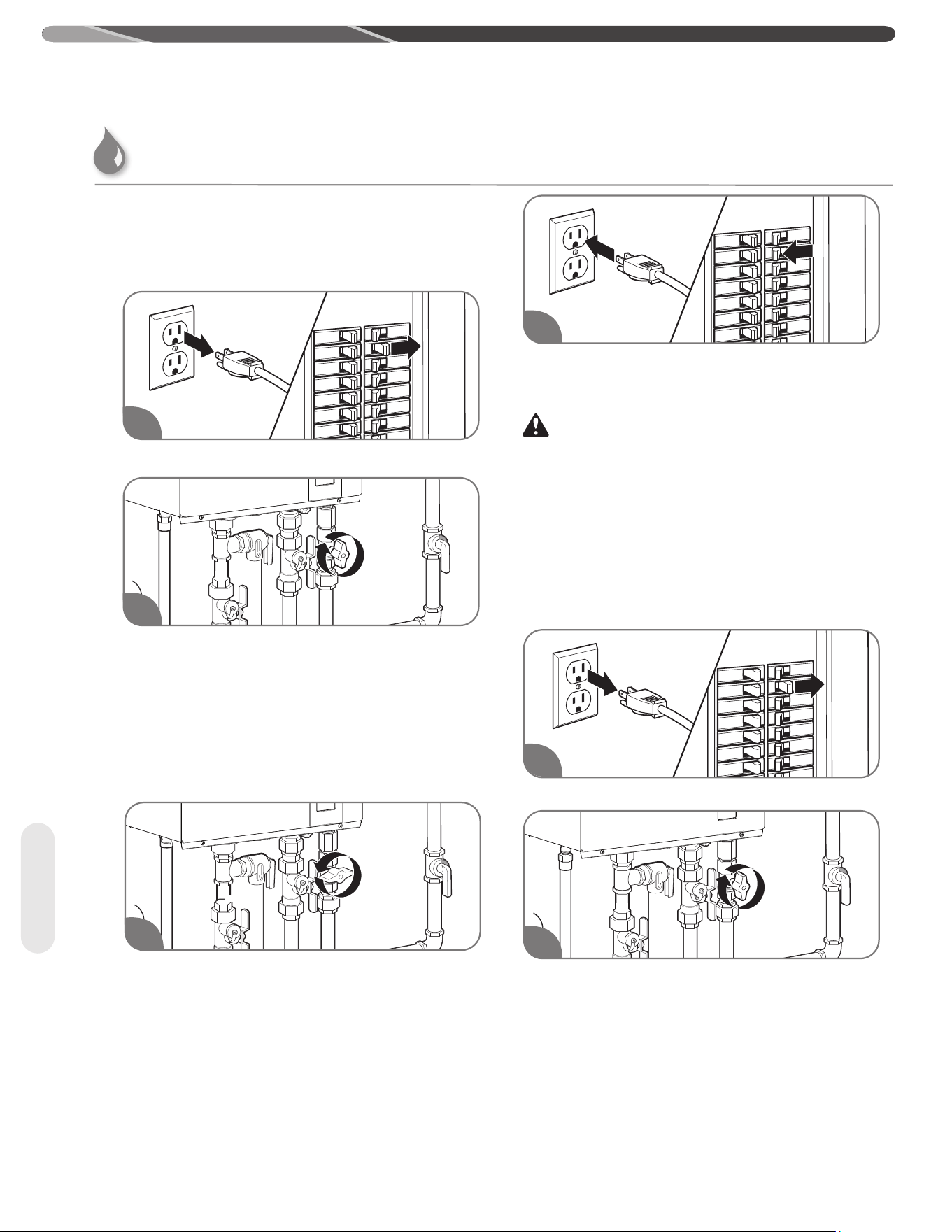
52
Start/Adjust
USING YOUR WATER HEATER
Operating Instructions
Read, understand, and follow the safety information
listed on the operating label and in the “Important
Safety Information” section in this manual.
Disconnect all electric power to the water heater.
Turn the gas shut-off valve clockwise to the OFF
position. This valve is located on the outside of the
water heater. Wait 5 minutes to clear any gas. If you
don’t smell gas, proceed to Step 3.
NOTICE:
If you smell gas, STOP and follow the safety instructions
listed under B on the operating label or on the front cover
of this manual.
Turn the gas shut-off valve counterclockwise to the
ON position.
Turn on all electric power to the water heater.
The remote control must be powered on prior to
operating the water heater.
WARNING:
DO NOT attempt to light the burner by hand. Lighting the
burner by hand is an unsafe operating condition that can
result in death, personal injury, property damage, and/or
product damage.
If the water heater burner will not light, turn off the
water heater as described below and call your
service technician or gas supplier.
Shutting Off the Water Heater
Disconnect all electric power to the water heater.
Turn the gas shut-off valve clockwise to the OFF
position.
1
2
3
4
1
2
Activating the Water Heater
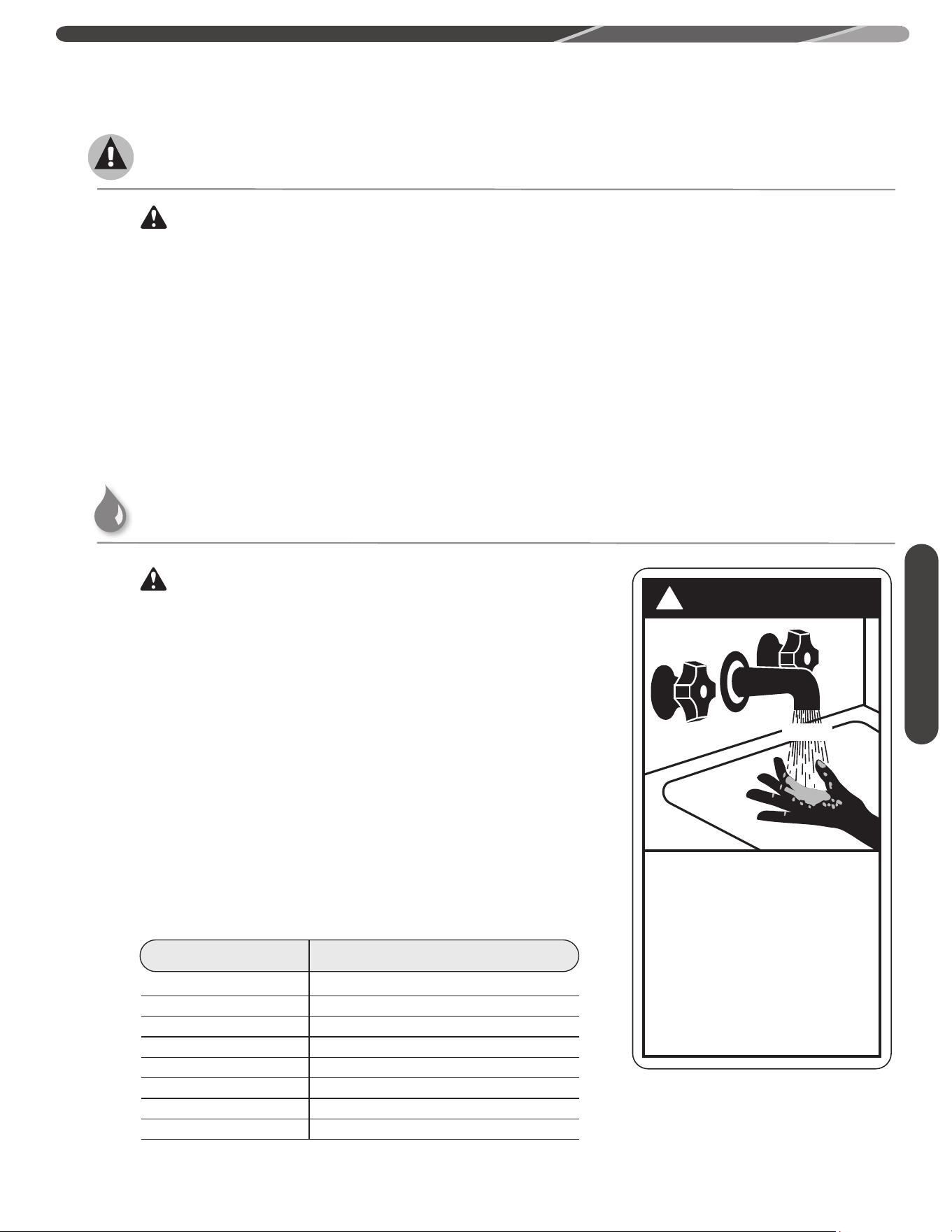
53
Use Instructions
USING YOUR WATER HEATER
WARNING:
• Flammable vapors can be drawn by air currents
from surrounding areas to the water heater. Vapors
can ignite causing death, personal injury, or product
damage.
• DO NOT store or use flammable or combustible
materials (gasoline, paint thinner, adhesives,
solvents, newspapers, rags, mops, etc.) in the
vicinity of the water heater or any other gas
appliance. If they must be used, open doors and
windows for ventilation, and shut off all gas-
burning appliances, including their pilot lights.
• DO turn off manual gas shut-off valve if water
heater has been subjected to overheating, fire, flood,
physical damage, or if the gas supply fails to shut
off.
• DO NOT turn on water heater unless water and gas
supplies are completely opened.
• DO NOT turn on water heater if cold water supply
shut-off valve is closed.
• If there is any difficulty in understanding or
following the operating and care instructions in
this manual, it is recommended that you contact a
qualified service technician to perform the work.
Safety Precautions
Setting the Water Temperature
D ANGER
!
HOT
Water temperature over 125°F (52°C)
can cause severe burns instantly or
death from scalds.
Children, disabled and elderly are
at highest risk of being scalded.
See instruction manual before
setting temperature at water
heater.
Feel water before bathing or
showering.
Temperature limiting valves are
available, see manual.
BURN
Time/Temperature Relationship in Scalds
Water Temperature Time to Produce a Serious Burn
120°F (49°C) More than 5 minutes
125°F (52°C) 1 1/2 to 2 minutes
130°F (54°C) About 30 seconds
135°F (57°C) About 10 seconds
140°F (60°C) Less than 5 seconds
145°F (63°C) Less than 3 seconds
150°F (66°C) About 1 1/2 seconds
155°F (68°C) About 1 second
Table courtesy of Shriners Burn Institute
DANGER:
Water temperatures above 125°F (52°C) will result in death and/or
severe burns from scalding.
Safety and energy conservation are factors to be considered when
selecting the water temperature setting. The temperature of the
water in the water heater can be regulated by setting the temperature
on the front of the remote control. Be sure to read and follow the
warnings outlined on the pictured label.
The recommended setting for the water temperature is 120°F
(49°C). The remote control has been preset and shipped at the
recommended temperature setting.
Safety factors should be considered whenever altering the water
temperature setting. The chart below may be used as a guide in
determining the proper water temperature for your home.
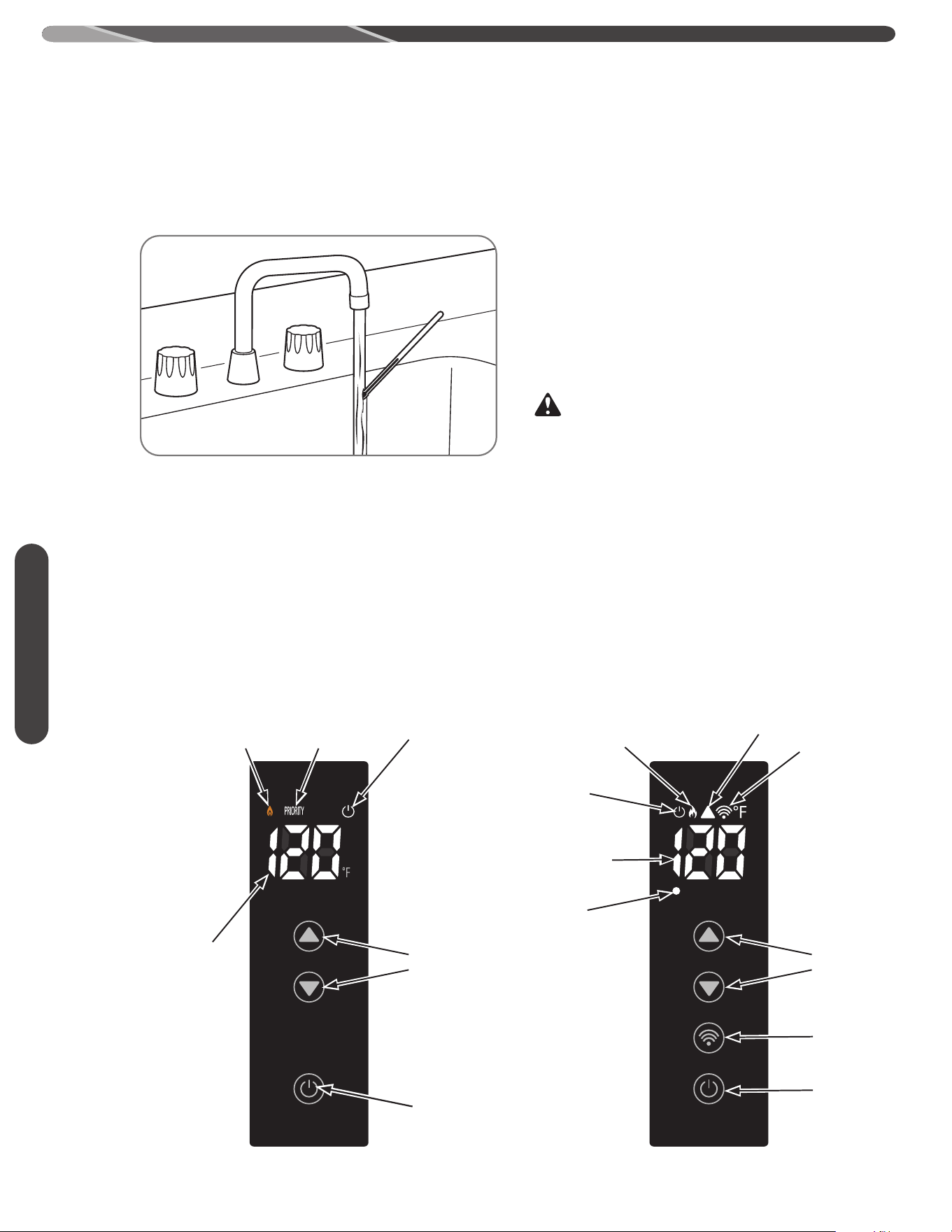
54
Use Instructions
Maximum water temperature occurs while the
water heater burner is ON. To determine the water
temperature:
Turn on the hot water faucet and place a
thermometer in the water stream.
NOTICE:
Water temperature at the faucet may vary depending on the
season and the length of pipe from the water heater.
The display control temperature range is between
100°F (38°C) and 140°F (60°C). To adjust the
temperature to a desired setting, press the UP or
DOWN adjustment button on the face of the remote
control. The new temperature set point will show on
the LED display.
NOTICE:
The temperature set point by default cannot be increase
above 120°F (49°C).
To achieve temperatures above 120°F (49°C), refer page 56
in this Use & Care manual.
The water heater may not operate with a small
water flow. Increase the water flow and recheck. If
it still does not operate with the hot water faucet
completely open, increase the temperature setting
on the water heater.
Water Heater Facts
DANGER:
Water temperatures above 125°F (52°C) will result in
death and/or severe burns from scalding.
• The hottest temperature water will be at the faucet
closest to the water heater.
• Always remember to test the water temperature with
your hand before use.
• Always supervise young children or others who are
incapacitated.
• The water heater is equipped with a device that will
shut off the gas supply to the burner if the water heater
exceeds normal operating temperatures.
• Any water heater that has been subjected to fire, flood,
physical damage, or been under water should be turned
off at the manual gas shut-off valve and not used until
it has been checked by qualified service personnel.
!
PRIORITY
In-Use Indicator
(Lit during operation)
Priority
Indicator
Power On/Off
Indicator
Temperature
Adjustment
Buttons
Temperature
Adjustment
Buttons
WiFi
Button
Priority
Indicator
Power On/Off
Indicator
In-Use Indicator
Lit during operation
Alarm/ Error
Indicator
WiFi Signal
Indicator
Power On/Off
Button
LED
Temperature
and Error Code
Display
LED Temperature
and Error Code
Display
Power On/Off
Button
(WiFi model only)
LED DISPLAY LED WiFi DISPLAY
USING YOUR WATER HEATER
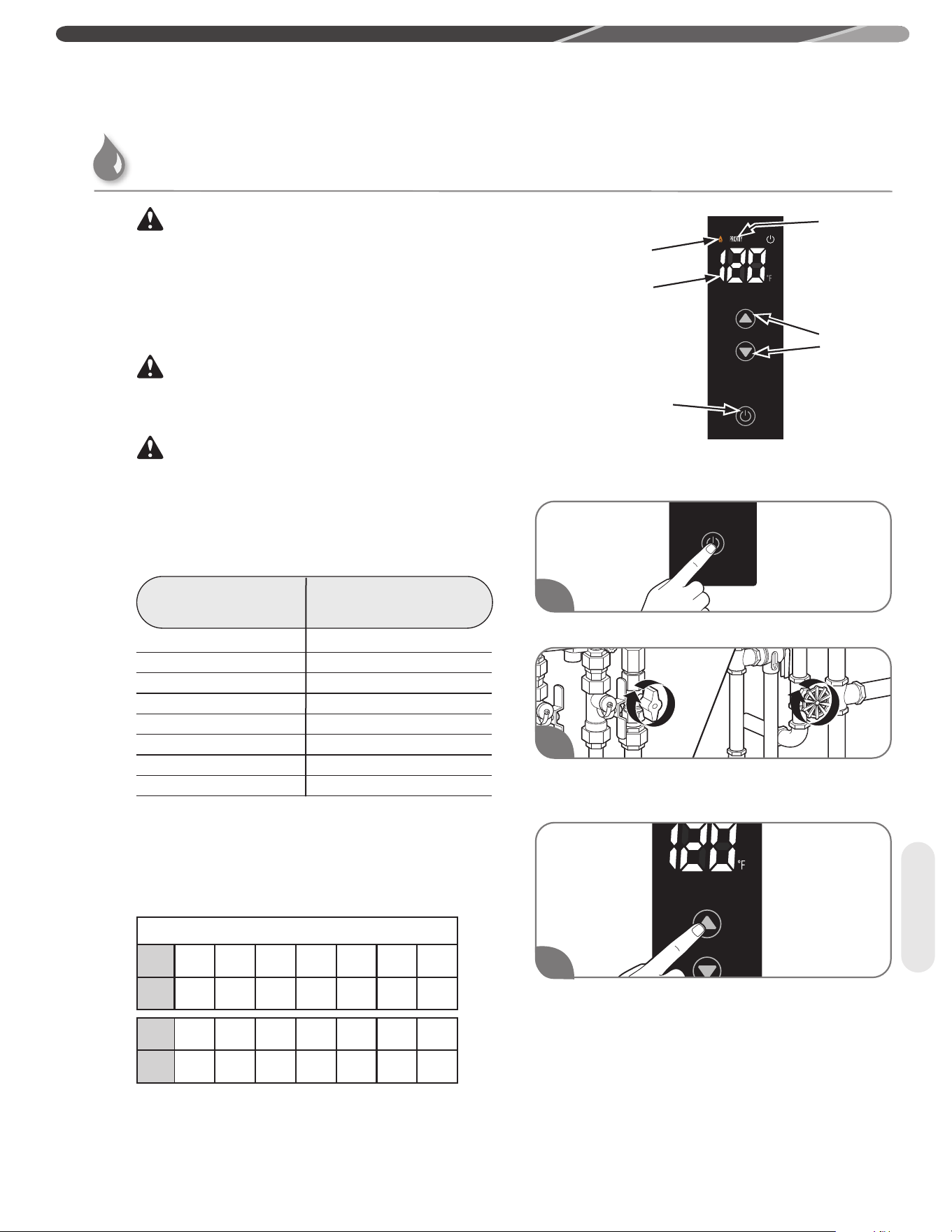
55
Setting the Water Temperature
WARNING:
Improper adjustment, alteration, service, or maintenance
can result in death, personal injury, property damage, and/
or product damage.
Maximum Temperature Adjustment
by the Main Display Control
DANGER:
Water temperatures above 125°F (52°C) will result in death
and/or severe burns from scalding.
WARNING:
Refer to chart below and the scald potential warnings
on page 4 on this manual before making an adjustment.
Changing this setting is done at your own risk.
Residential water heater temperatures can be
adjusted up to 140°F (60°C). DO NOT perform the
following adjustment if a setting of up to 140°F (60°C)
is not required.
To adjust the set temperature above 120°F (49°C),
please refer the following steps.
Turn on the control.
Turn off the gas and water to the water heater by
closing the shut-off valves.
Press the UP adjustment button repeatedly until
120°F (49°C) shows in the LED display.
NOTICE:
LED display only shows °F.
Time/Temperature Relationship in Scalds
Water Time to Produce
Temperature a Serious Burn
120°F (49°C) More than 5 minutes
125°F (52°C) 1 1/2 to 2 minutes
130°F (54°C) About 30 seconds
135°F (57°C) About 10 seconds
140°F (60°C) Less than 5 seconds
145°F (63°C) Less than 3 seconds
150°F (66°C) About 1 1/2 seconds
155°F (68°C) About 1 second
Table courtesy of Shriners Burn Institute
1
2
3
Start/Adjust
Temperature Conversion Chart °F/°C
°F 100 102 104 106 108 110 112
°C 38 39 40 41 42 43 44
°F 114 116 118 120 125 130 140
°C 46 47 48 49 52 54 60
In-Use Indicator
(Lit during operation)
Priority
Indicator
Temperature
Adjustment
Buttons
LED
Temperature
and Error Code
Display
Power On/Off
Button and
Indicator
USING YOUR WATER HEATER
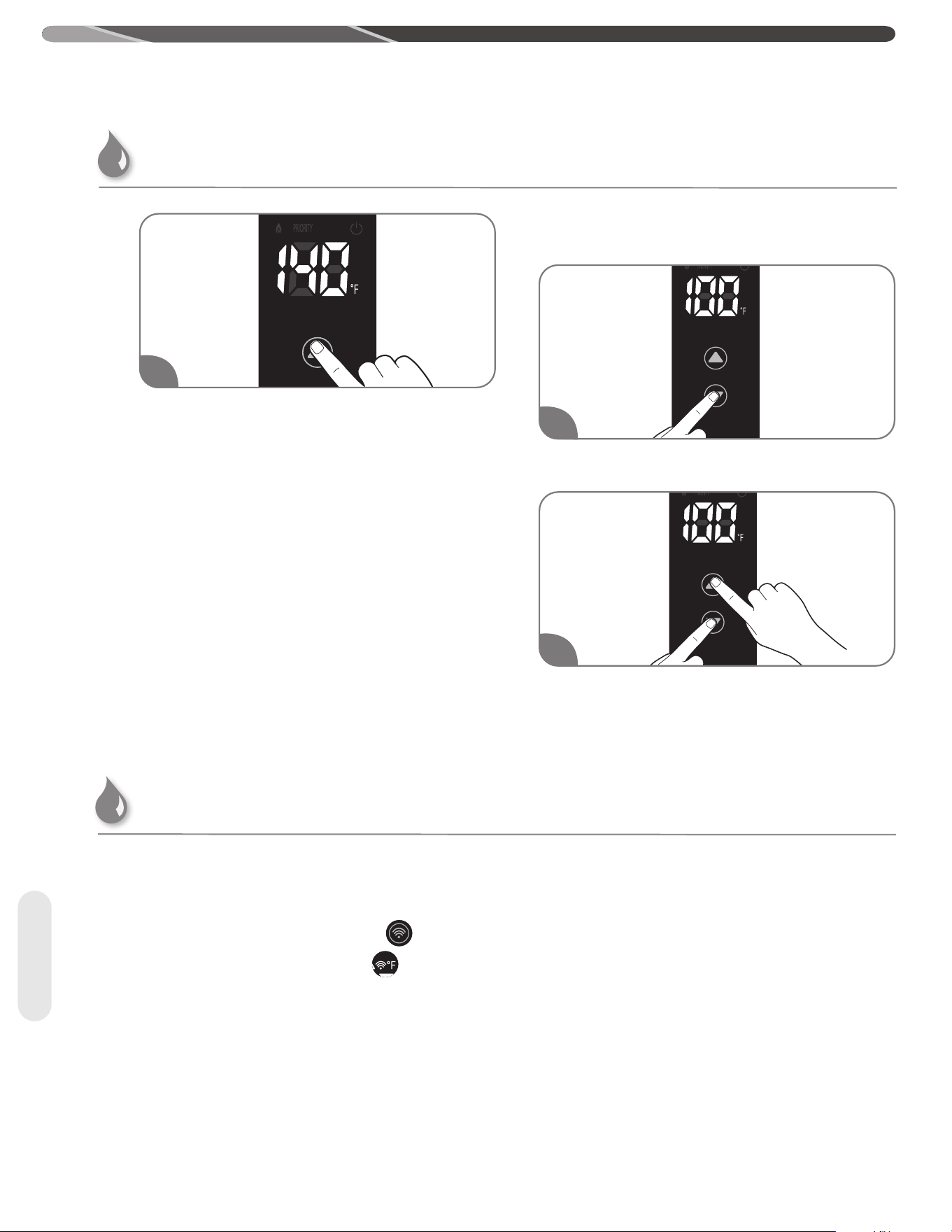
56
WiFi Setup
1. Download the EcoNet app to your mobile device
and ensure that the device is connected to the
WiFi network.
2. Press and hold the WiFi button on the
display until the WiFi indicator begins
flashing .
3. Open the EcoNet application and follow the
instructions on the application to connect the
water heater.
!
PRIORITY
!
PRIORITY
Start/Adjust
While "120" is shown on LED display, press and hold
UP button for 5 seconds. "140" is shown on the LED
display.
If need to disable the ability to set above 120°F,
please refer the following steps:
Press DOWN button until "100" appears.
Press and hold DOWN button for 2 seconds.
While holding the DOWN button, press the UP
button. Release both buttons.
4
1
2
USING YOUR WATER HEATER
Setting the Water Temperature
57
USING YOUR WATER HEATER
Recirculation Pump Control
Local codes or plumbing authority requirements may vary
from the instructions or diagrams provided in this manual
and take precedence over these instructions.
Recirculation Mode
Your tankless water heater has the ability to control
an external recirculation pump which recirculates the
water in the plumbing system to provide hot water
more quickly when a faucet is opened.
Two modes are available:
• Timer recirculation (Energy Saver Mode)
• Timer recirculation (Performance Mode)
If this water heater has wifi capability, additional two
modes are available:
• On-Demand recirculation
• Schedule recirculation
Information for setting up these modes can be found
in the EcoNet App.
NOTICE:
Recirculation control is for residential application only.
Recirculation control cannot be used with an air handler
or with multiple water heater installations. The maximum
temperature setting is 140°F (60°C) in recirculation control.
Pump Requirements
Voltage: 120V, 60Hz
In-rush current: Less than 2.5 amps
Amperage: less than 2.0 amps
WARNING:
A control board can be damaged if amperage exceeds 2.0
amps.
Pump Size
The pump should be sized for about 2.5 gpm at the
pressure drop through the tankless water heater and
the supply and return plumbing in the recirculation
loop. Contact service department listed on page
76 of this use and care manual if you need more
information.
Recommend size and length for
recirc. line
To conserve energy and minimize heat loss,
insulation for hot water lines is recommended.
*Equivalent pipe length includes hot water line, return
lines and all fittings.
Recirculation Pump
Maximum allowable equivalent pipe Length*
Pipe Diameter
(Copper pipe)
¾” ½”
Pipe length 400 ft� 100 ft�
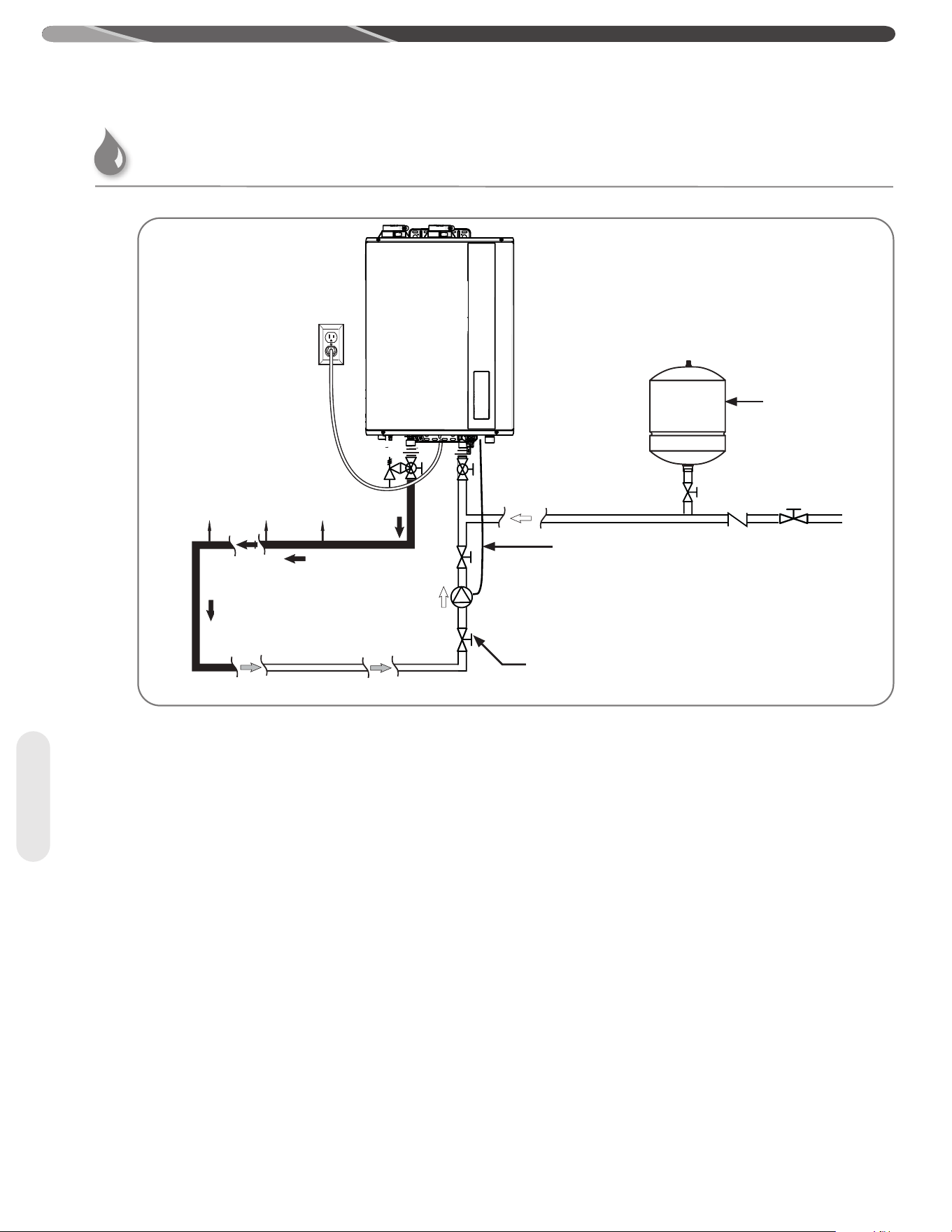
58
Recirculation Pump
(Copper
Pipe)
(Copper
Pipe)
Optional Shut-Off Valve
Circulation
Pump with
built in check
valve
Wire to Connect
Pump to heater
(8 ft long)
Cold Water
to Tankless
Check
Valve
Shut-Off
Valve
Cold Water
Supply
Expansion
Tank
Tankless
Water
Heater
Hot Water
to Fixtures
Hot Water
Loop
Dedicated
Return Line
USING YOUR WATER HEATER
Recirculation Pump Control
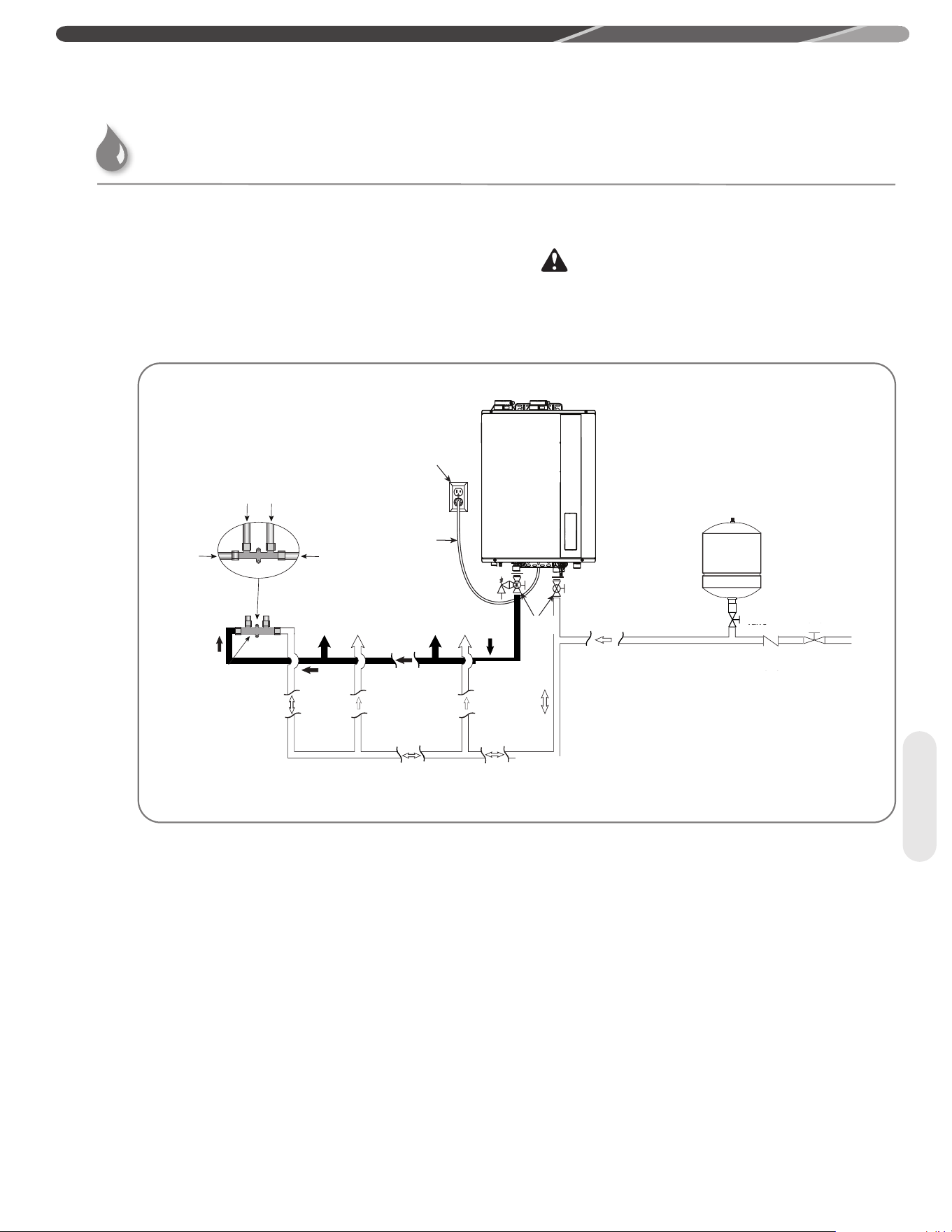
59
Recirculation Pump Control
Typical Recirculation Pump Installation with Comfort Valve Kit
Comfort Valve Kit can be used for applications that
DO NOT have a dedicated return line. Comfort Valve
should be installed at the farthest fixture.
Refer to page 57 for maximum allowable equivalent
pipe length.
CAUTION:
Warm water may be present in cold water fixtures and
cold water line during pump operation and a short period
thereafter, when using cold water line as a return line.
USING YOUR WATER HEATER
Power receptacle
should be close to
appliance
Tankless
water heater
power cord
Cold
Cold
To fixture
Hot
Hot
Service
valves
Fixtures
Hot Cold Hot Cold
Cold
water line
Expansion
tank
Install Thermal Bypass
(Crossover) Valve
at the farthest fixture
Cold water
to tankless
water heater
Cold water
supply
(Copper pipe)
Check
valve
Shut-off
valve
Shut-off
valve
(Copper pipe)
Power receptacle
should be close
to appliance
Tankless
water heater
power cord
Install Thermal Bypass
(Crossover) Valve at the
farthest fixture
To fixture
Fixtures
Cold water
line
(Copper
pipe)
(Copper
pipe)
Cold water
to tankless
water heater
Check
valve
Cold Water
Supply
Expansion
Tank
Shut-off
Valve
Shut-off
Valve
Service
Valves
Hot
Hot
Hot Hot
Cold
Cold
Cold Cold
Recirculation Pump
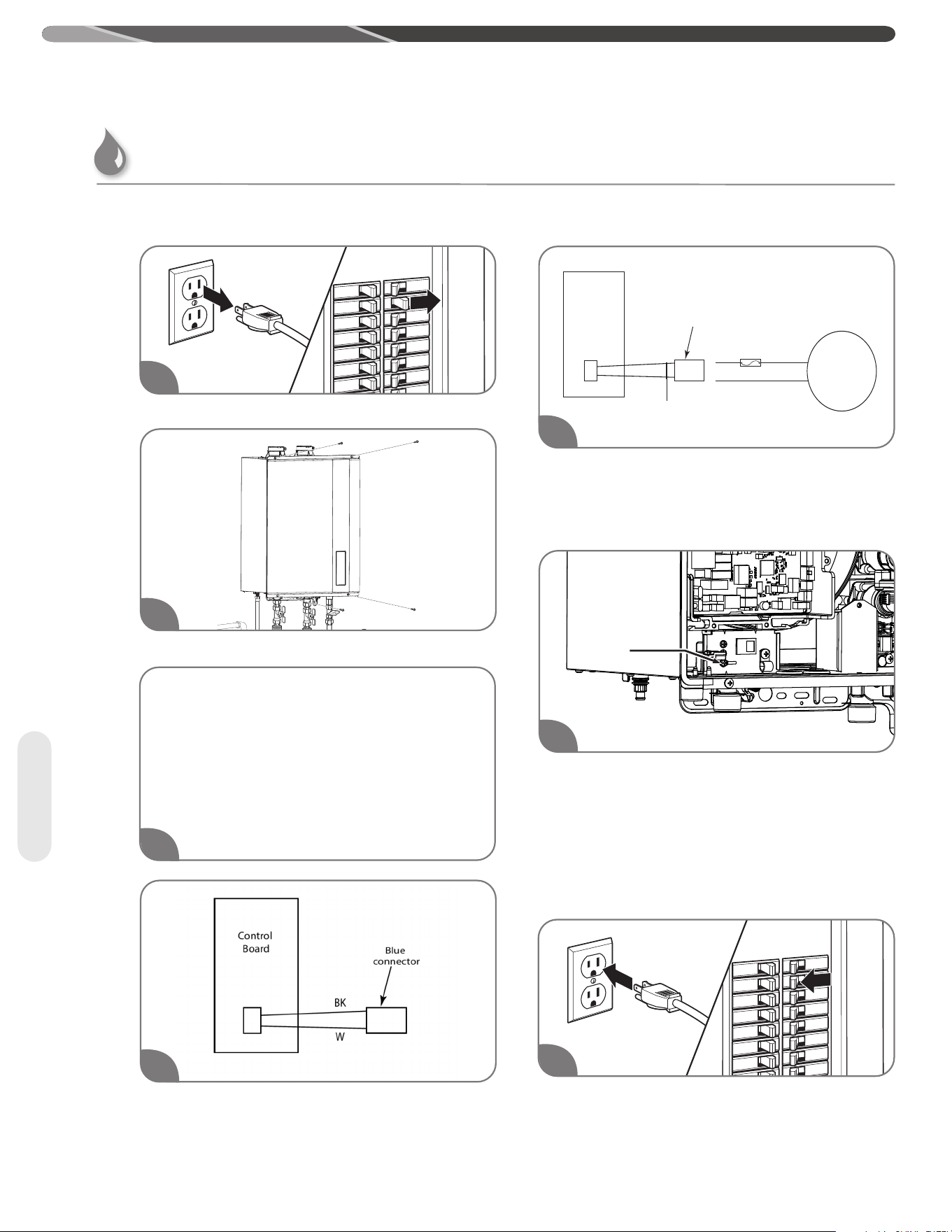
60
Installation
Disconnect all electric power to the water heater.
Remove the front cover panel on the water heater.
Install the recirculation pump on the return line
according to the pump manufacturer installation
instructions. Install a check valve in the return line
as shown in typical recirculation pump installation
if one is not integrated into the pump. See "Typical
Recirculation Pump Installation".
NOTICE: Some pumps may have built in check valve.
The wire harness for the recirculation pump is
bundled with the wire harness from the control
board. Find a blue connector with a black and a
white wire.
To connect to the pump, cut the blue connector,
splice the wires, and add a 4 amp fuse to the hot
wire of the pump. Rheem recirculation pump kit
includes a molex connector and a 4 amp fuse so
splicing wires is not required.
Connect the ground wire from the pump to a screw
at the base of the water heater cabinet.
NOTICE:
Follow any applicable electrical code and the pump
manufacture installation instruction referring to the
Pump Electrical Connection Diagram in Step 5 of these
instructions.
Plug in the power cord or reconnect the power
supply at the circuit breaker box.
2
1
4
3
Control
Board
PUMP
Add
4 Amp
Fuse
Blue
connector
Cut blue connector
and splice wires.
BK
W
5
6
Ground
Recirculation Pump
7
Recirculation Pump Control
USING YOUR WATER HEATER
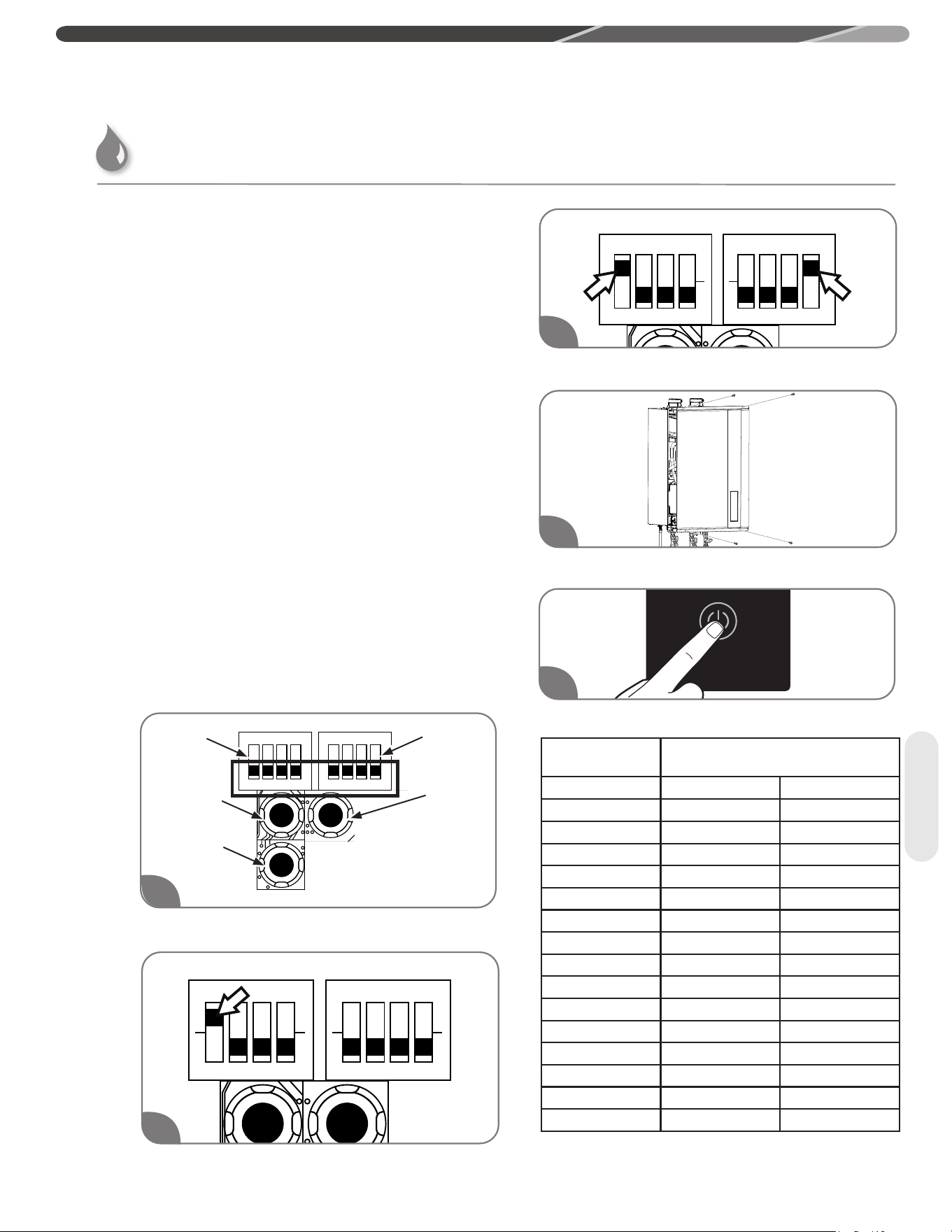
61
Recirculation Operation
Timer mode
The water heater is turned ON when the recirculation
pump starts operation. The water heater produces
hot water at the setting temperature. When the return
water temperature reaches approximately 15°F (8°F)
below the setting temperature, the water heater
and the pump will turn OFF. The cycle will restart
at the approximate time based on the temperature
thermistor reading.
Energy Saver mode
The Energy Saver mode operates as below:
• Less Energy consumption due to fewer pump
cycles
• Pump cycles ON Every 30 to 60 minutes
Performance mode
The Performance mode operates as below:
• Higher energy consumption due to more pump
cycles
• Pump cycles ON every 15 to 30 minutes
Mode Setting -Timer Mode-
The factory setting for the switch should all be in the
OFF position (Down).
Change the first switch on “DIP switch 2” to the ON
position (UP). Performance mode is selected.
To select Energy Saver mode, change the fourth
switch on “DIP switch 1” to the ON position (UP).
Replace the front cover panel.
Turn on all electric power to the water heater.
Setting Temp Typical Pump ON Intervals [Min]
[°F]
Performance Energy Saver
140 15 30
135 15 30
130 15 30
125 15 30
120 16 31
118 17 33
116 18 35
114 19 38
112 20 40
110 22 44
108 24 47
106 26 51
104 28 56
102 31 62
100 35 69
Actual pump ON intervals may vary based on the
setting temperature, insulation, and heat loss in the
system.
5
Recirculation Pump
Recirculation Pump Control
ON
1 2 3 4
ON
1 2 3 4
DIP 1DIP 2
ON
1 2 3 4
ON
1 2 3 4
DIP 1DIP 2
2
3
4
ON
1 2 3 4
ON
1 2 3 4
DIP
Switch
2
"MAX"
button
"ADJUST"
button
"MIN"
button
DIP
Switch
1
1
USING YOUR WATER HEATER

62
Recirculation Pump
Recirculation Operation –
On-Demand mode-
If the On-Demand mode is used, the water heater
needs wifi capability.
If the water heater is NOT a WiFi model, you cannot
use the On-Demand mode.
To enter On Demand Mode
• Ensure Switch 1 on DIP 2 and switch 4 on DIP 1
are off.
• In less than one minute.
• Turn Switch 1 on DIP 2 on-off-on-off.
• Press the Adjust Button
• The PCB LED will flash one time
The unit is now in on demand mode.
NOTE:
If the water heater does not have WiFi capability,
the built-in display needs to be replaced with the
display including WiFi capability.
Rheem offers the display including wifi capability.
See the Parts and Accessories catalog for more
information.
When set to On-Demand mode, the recirculation
pump is ON for 5 minutes when the water heater
receive the signal form the application on smart
phone.
Mode setting – On-Demand mode-
Please refer to EcoNet app for instructions.
Recirculation Operation – Schedule
mode-
If the Schedule mode is used, the water heater needs
wifi capability.
If the water heater is NOT a WiFi model, you cannot
use the Schedule mode.
NOTE:
If the water heater does not have WiFi capability,
the built-in display needs to be replaced with the
display including WiFi capability.
Rheem offers the display including WiFi capability.
See the Parts and Accessories catalog for more
information.
When set to Schedule mode, the recirculation
pump is ON according the setting schedule on the
application on smart phone
Mode setting – Timer mode-
To use Schedule mode, the water heater should be
set to Performance mode or Timer mode.
Recirculation Pump Control
USING YOUR WATER HEATER
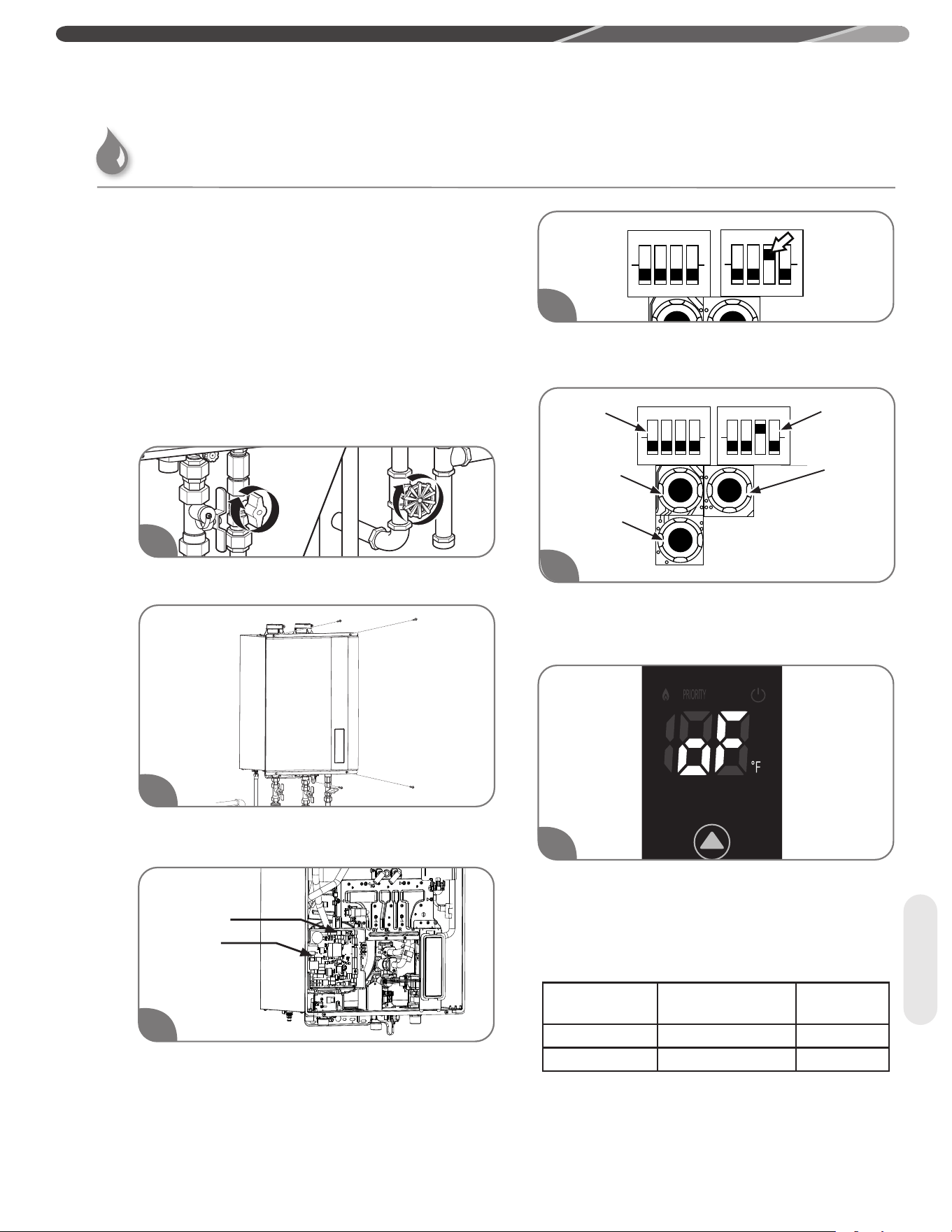
63
Water Saving Control
Water saving control is optional and is inactive
as default. To activate this control, appropriate
procedures must be followed.
Water saving control can reduce waste water at
initiation of hot water demand by reducing flow until
outlet hot water reaches set temperature.
It is recommended to turn ON this control if the
water heater is installed in a drought area or
anywhere water conservation is needed.
Follow the steps below to turn ON the water saving
control.
1
Turn off the gas and water to the water heater by
closing the shut-off valves.
2
Remove the front cover panel on the water heater
and ensure the remote is OFF.
Find DIP Switch 1 located in the top-right portion at
the control board. The switch labeled “DIP 1” is the
right-most set of switches. If any DIP switches are
on for venting/altitude settings, switch them to the
OFF position.
Change the third switch on “DIP 1” to the ON
position (UP).
Within 30 seconds of turning the third switch ON,
press the "Max button" or "Min button" on the
control board to set the activation of this control.
LED display on the built-in control shows “oF”.
Within the next 30 seconds, the display/control
board will show the water saving control setting. The
LED identifications are below
ON
1 2 3 4
ON
1 2 3 4
DIP 1
DIP 2
4
Start/Adjust
3
DIP Switch
Control Board
6
ON
1 2 3 4
ON
1 2 3 4
DIP
Switch
2
"MAX"
button
"ADJUST"
button
"MIN"
button
DIP
Switch
1
5
USING YOUR WATER HEATER
WATER SAVING
CONTROL
CONTROL BOARD LED
(RED)
DISPLAY LED
ON Once Flashing ON
OFF Twice Flashing OF
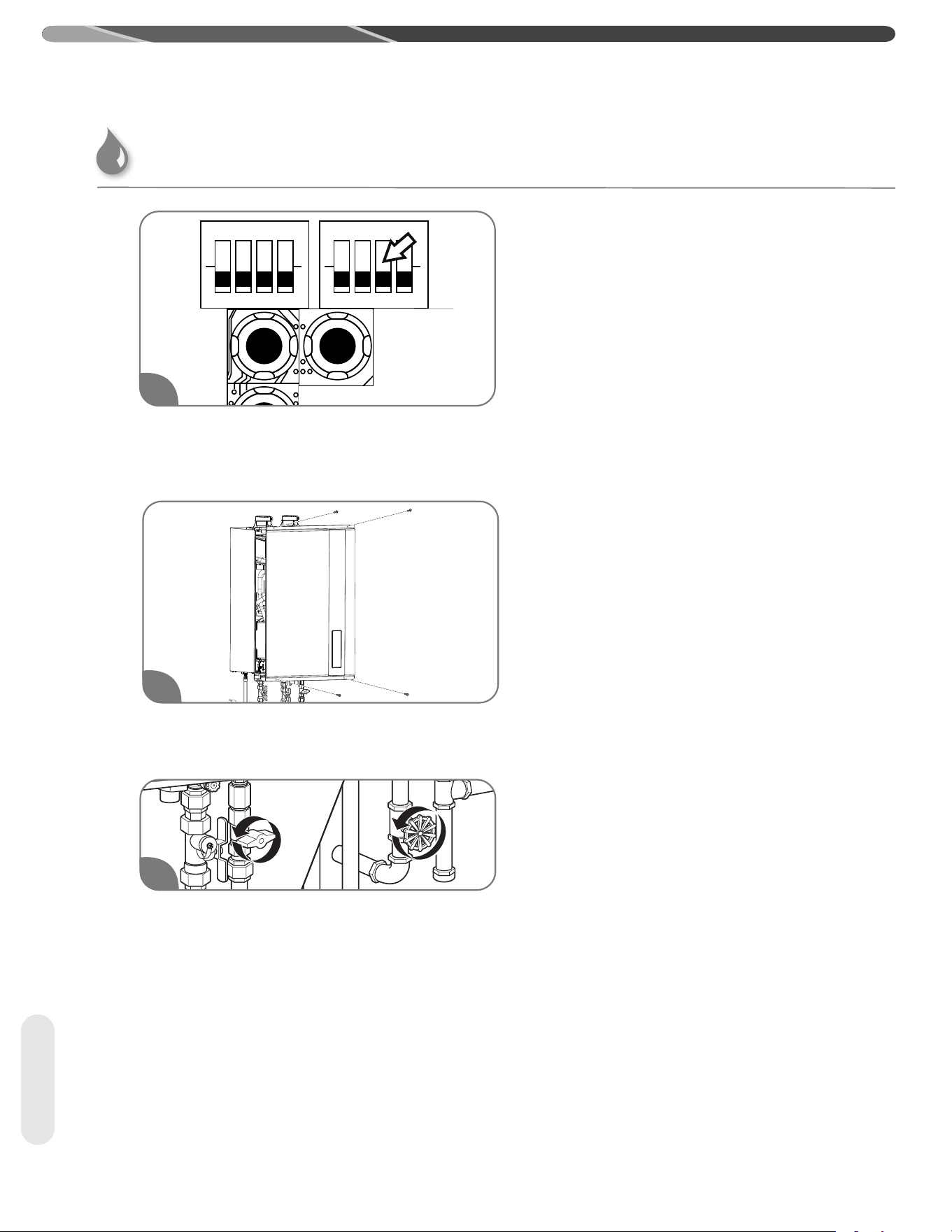
64
Replace the front cover panel and turn the remote
ON. Turn the remote on before turning the water
supply on.
Turn on the gas and water to the water heater by
opening the shut-off valves.
9
Start/Adjust
8
USING YOUR WATER HEATER
Water Saving Control
ON
1 2 3 4
ON
1 2 3 4
7
After setting the activation of this control, change
the third switch on “DIP 1” to the OFF position
(DOWN). Be sure to reapply any venting/altitude DIP
switch settings.
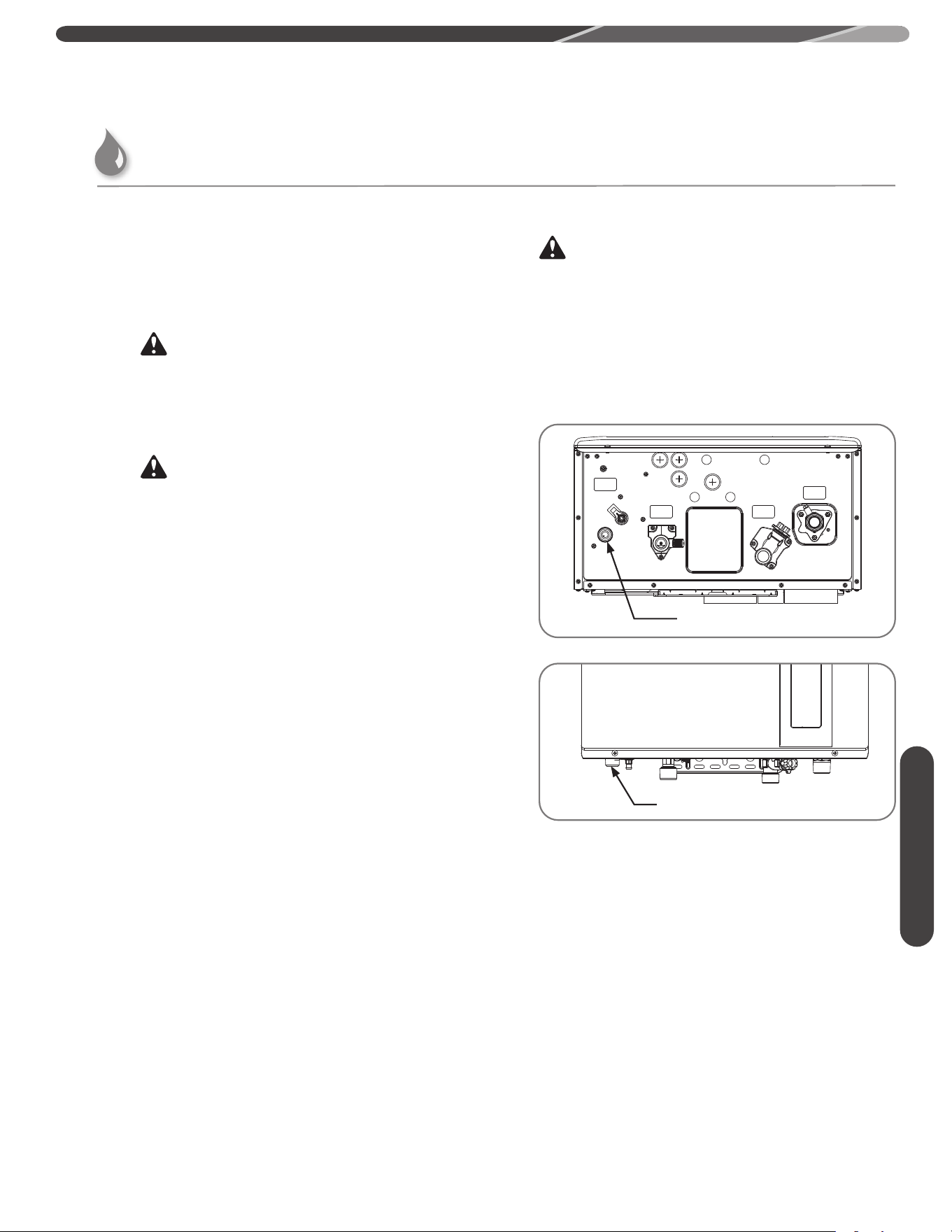
65
Venting System (Direct Vent Only)
The venting system should be inspected annually
to ensure all of the vent sections are secure and
airtight. Qualified service personnel are familiar with
vent system inspections and may be contacted for
advice.
WARNING:
DO NOT operate the water heater if the vent system shows
signs of leaking exhaust. Leaking exhaust could lead to
death, personal injury, and/or product failure.
DANGER:
Shock Hazard – Make sure the electrical power to the water
heater is OFF before removing protective cover. Electric
shock will cause death or serious personal injury.
Condensate Collector
CAUTIONS:
• Condensate is known to be acidic; refer to federal, state
(provincial), and local codes for proper handling and
discharge methods.
• DO NOT operate without the condensate collector
drain connected and routed to an external
neutralizer or proper drain that can handle
corrosive condensate. This could cause the system
to malfunction or fail.
On a regular basis, inspect the condensate drain line
to ensure the condensate is draining properly.
Water Heater Inspections
Care Instructions
Condensate Drain
Condensate Drain
CARING FOR YOUR WATER HEATER
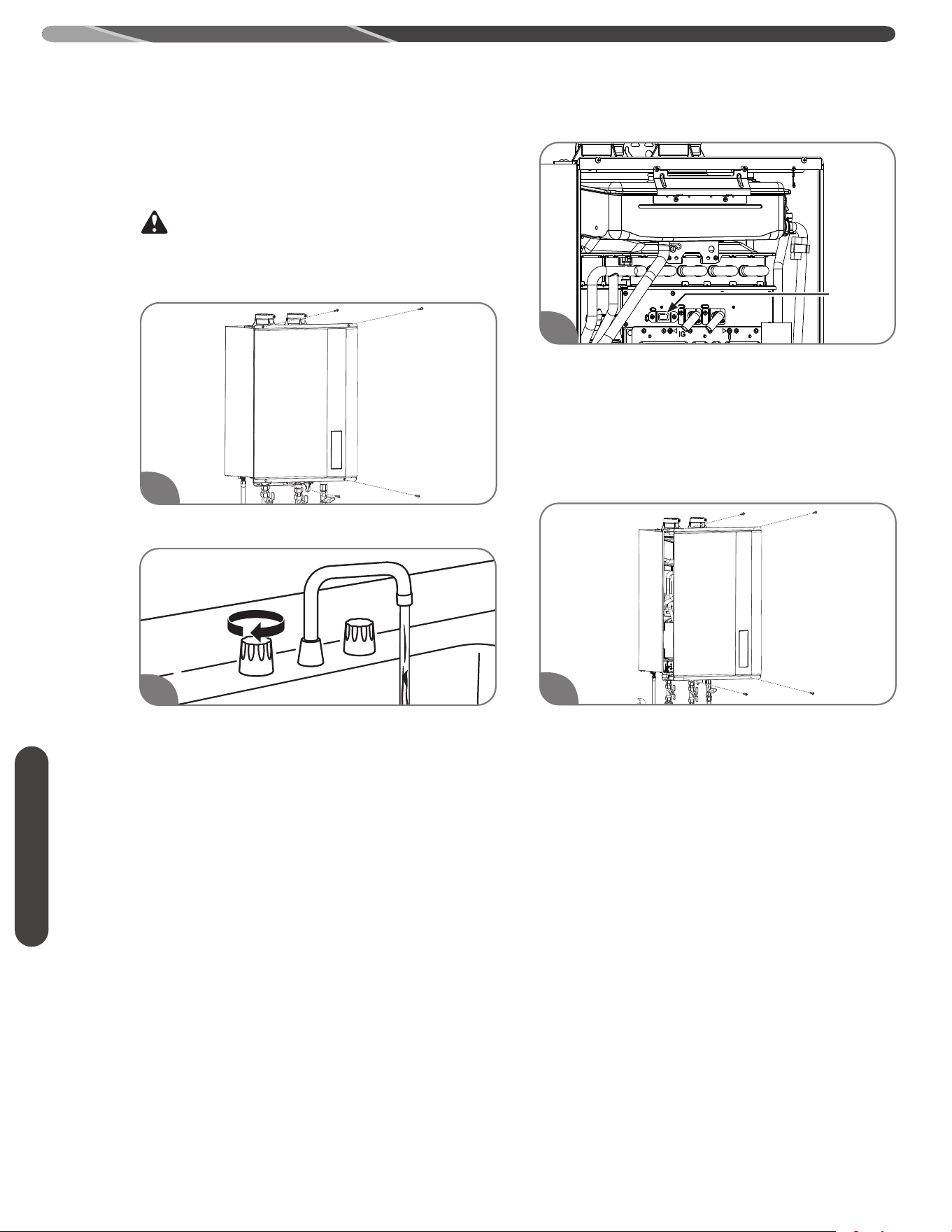
66
CARING FOR YOUR WATER HEATER
Burner
It is recommended the burner be annually inspected
by a qualified service technician.
DANGER:
Shock Hazard – Removing the front cover panel
exposes you to live electricity. Electric shock will
cause death or serious personal injury.
Remove 4 screws and the unit cover panel.
Turn on a hot water faucet.
While the water heater is operating, inspect the main
burner flames through the burner sight glass. The
flames should be blue when the main burner is firing.
NOTICE:
If the flames are not blue or you observe unusual
burner operation, shut off the water heater and
contact a qualified service technician.
Turn off the hot water faucet and reinstall the unit
cover panel.
4
2
1
3
Care Instructions
Burner
Sight
Glass
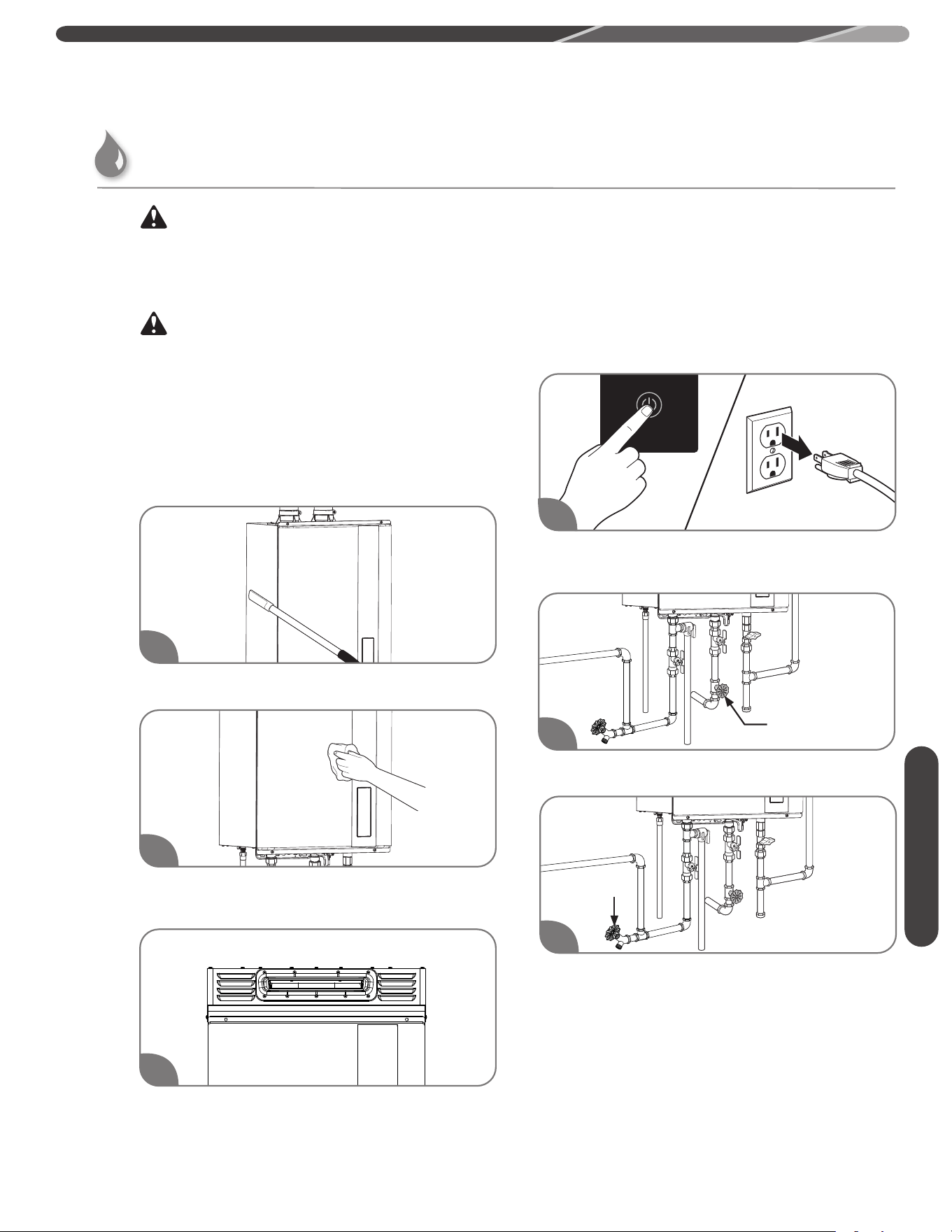
67
CARING FOR YOUR WATER HEATER
Care and Cleaning
DANGER:
Shock Hazard – Make certain power to the water
heater is OFF before removing protective cover
for any reason. Electric shock will cause death or
serious personal injury.
WARNING:
Combustible materials, such as clothing, cleaning
materials, or flammable liquids, must not be
placed against or next to the water heater. Fire or
explosion can occur causing death, personal injury,
and/or product damage.
All care and cleaning to and around the water
heater should only be performed with the water
heater turned off and the electrical power supply
disconnected.
Vacuum around the water heater to remove any dust,
dirt, and/or lint buildup.
Clean the water heater with a damp soft cloth and
mild detergent. Gently wipe and completely dry all
surfaces.
Check the air intake and vent outlet for blockage
and/or debris.
NOTICE:
The air intake requires a minimum of 12 in. (30 cm)
of clearance between the air intake opening and
any obstruction.
Clean the water filter monthly, as described below
and on the next page.
Water Filter Cleaning
Turn off the water heater and disconnect the
electrical power supply.
Turn off the water supply to the water heater.
Drain the water heater. See "Draining the Water
Heater" section.
1
2
1
3
2
3
Outdoor models
Care Instructions
Cold Water Supply
Shut-Off Valve
Drain
Valve
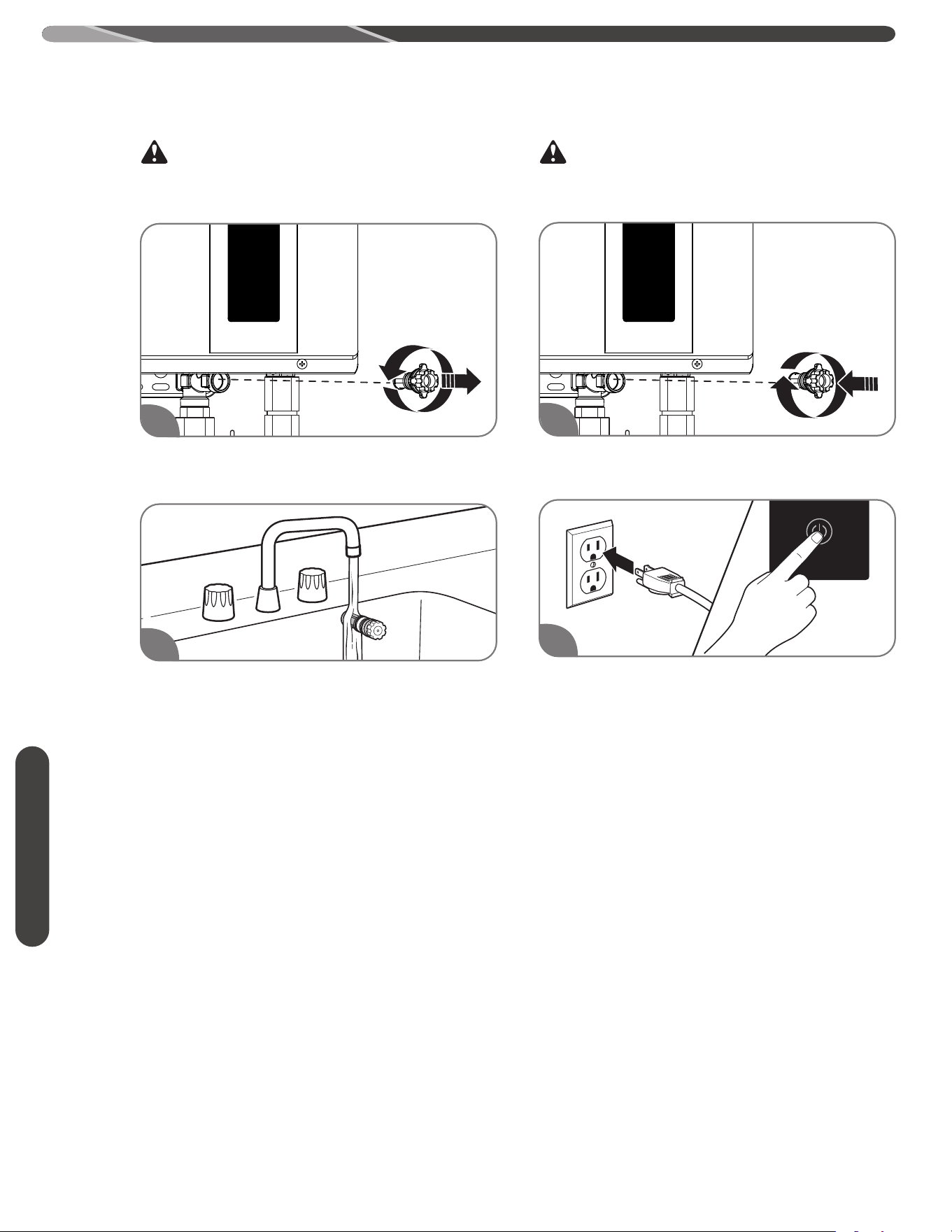
68
CAUTION:
DO NOT tap or force the filter during removal. This can
deform and/or damage the filter.
Unscrew the water filter from the base of the cold
water inlet line and carefully slide it out of the line.
Clean the water filter under running water. To remove
severe sediment and dirt, use a soft brush.
CAUTION:
DO NOT overtighten the water filter. Overtightening can
deform and/or damage the filter.
Replace the filter in the cold water inlet line and
tighten until it is snug.
Turn on the water supply, reconnect the electrical
supply, and turn on the water heater.
4
7
5
6
Care Instructions
CARING FOR YOUR WATER HEATER
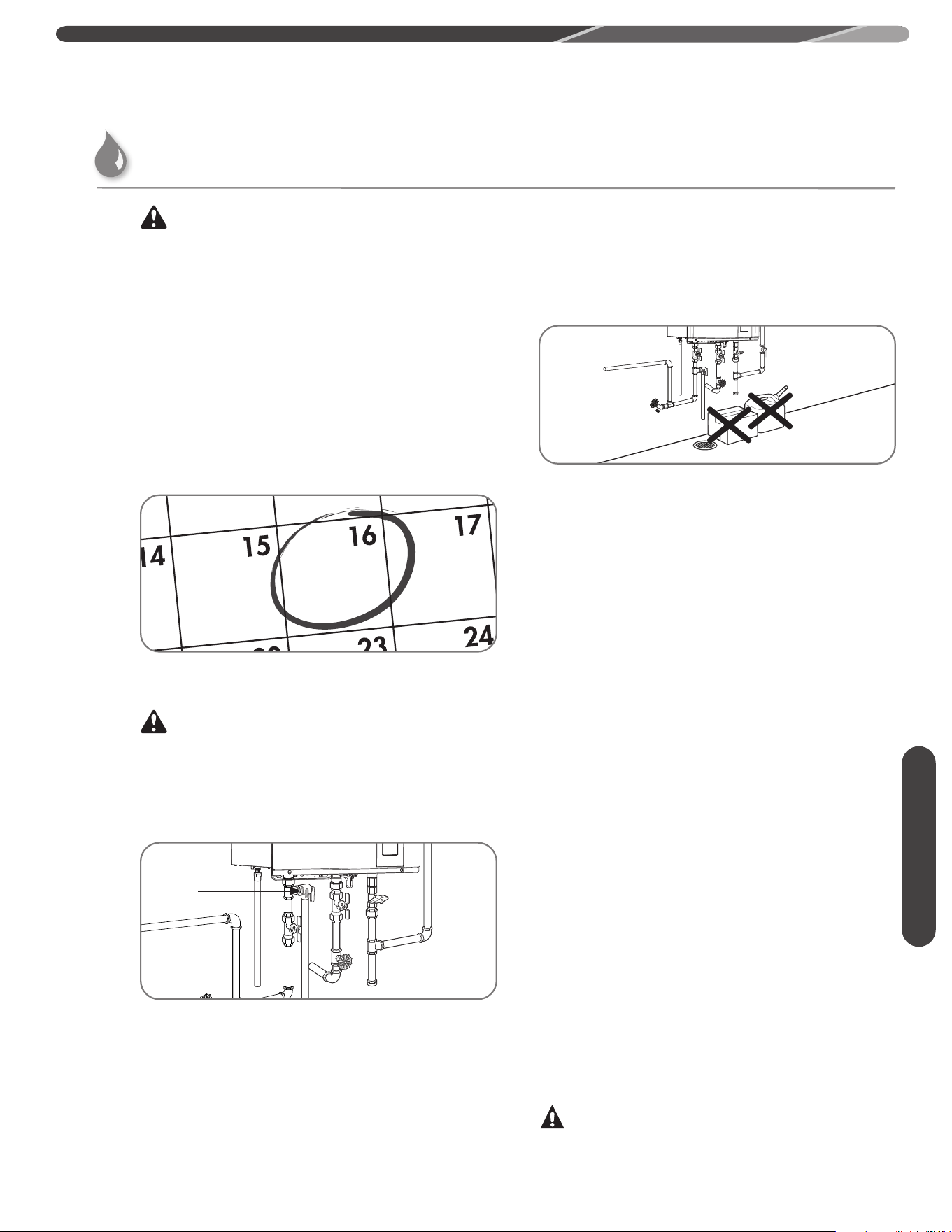
69
Preventive Maintenance
WARNING:
Failure to perform routine preventive maintenance can
prevent the water heater from operating properly. Improper
operation can cause carbon monoxide dangers, excessive
water temperatures, and other potentially hazardous
conditions resulting in death, personal injury, and/or
product damage.
Properly maintaining your water heater will ensure
dependable, trouble-free service.
User Preventive Maintenance
Establish and follow a routine preventive
maintenance program. The following suggested
items should be included in your program.
Check and clean the water filter monthly. See “Water
Filter Cleaning” on this Use and Care Manual.
WARNING:
Hot water is released during manual operation of the relief
valve. Make sure all people and animals are clear from
the area before performing this check to prevent death,
personal injury, and/or property damage from hot drain
water.
• Annually check the operation of the pressure relief valve
annually. Lifting the lever handle on the pressure-relief
valve opens the valve to flush hot water through the
discharge line to the drain. After several gallons have
drained, release the lever handle to close the valve and
stop draining.
NOTICE:
If the pressure relief valve on the hot water heater
discharges periodically, this may indicate a problem in the
water system. Contact the water supplier or a plumbing
contractor to correct the problem. DO NOT plug the relief
valve outlet.
• Inspect and keep the area around the water heater clear
and free of flammable materials, such as gasoline and
other flammable vapors and liquids.
• Visually inspect the water heater for damage and/or
denting. If present, contact qualified service personnel to
verify proper operation.
• Check for abnormal sound during normal operation (e.g.,
hissing or banging noises). Contact qualified service
technician or plumbing contractor if abnormal sounds are
noted.
• Check all gas and water pipes for leaks. See "Leak
Testing " on this Use and Care Manual.
• Visually inspect vent screens. Remove any debris or
blockages.
• If condensate neutralizer is installed; annually inspect
and ensure the neutralizer medium is present. If the
medium is depleted, replace the neutralizer.
• Check for blockage of condensate line.
NOTICE:
– DO NOT operate the water heater if you feel
something is wrong with the unit.
– DO NOT allow children to operate or handle
the unit.
• After inspections, maintenance, and/or cleaning, ensure
proper operation by turning on a hot water faucet.
Professional Preventive
Maintenance
It is recommended that a periodic inspection of the water
heater burner, relief valve, air intake filter, water filter, and
venting system be made by a qualified service technician.
WARNING:
Certain water conditions can damage the water heater and
may cause defects, malfunctions or failures of the water
heater that are not covered by the limited warranty. See
"Water Quality" on this Use and Care Manual.
Care Instructions
Relief
Valve
CARING FOR YOUR WATER HEATER
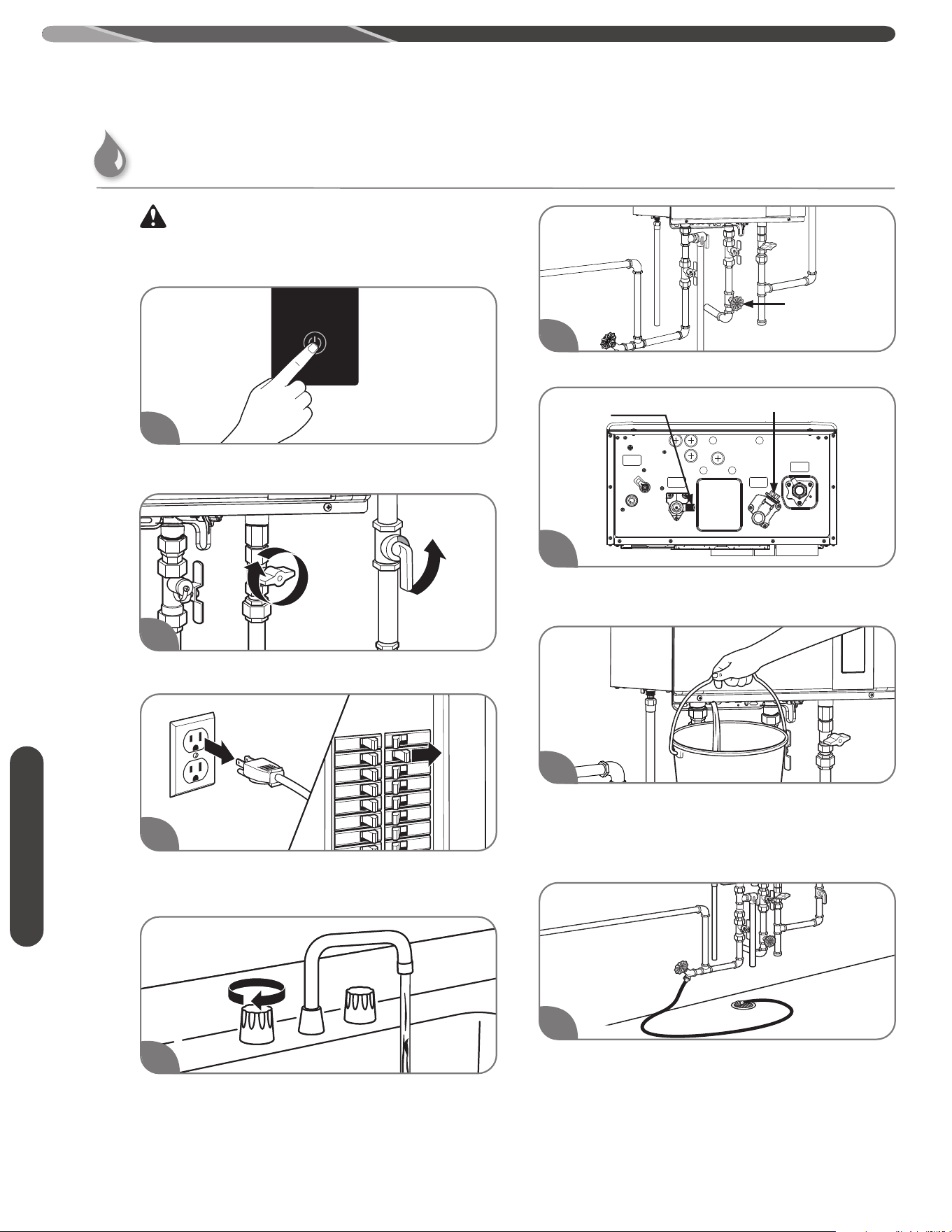
70
Care Instructions
CARING FOR YOUR WATER HEATER
Draining the Water Heater
WARNING:
Failure to follow these draining instructions can cause
serious personal injury from scalding and/or product
damage.
Turn off the water heater by pressing the POWER
ON/OFF button on the LED display.
Close the gas shut-off valve(s).
At least 10 seconds after Step 1, unplug the water
heater or disconnect the power supply at the circuit
breaker box.
Open all hot water faucets. Run the water until it is
COLD; then shut off the faucet.
Close the water shut-off valve.
Find the water drain valve and the water filter located
at bottom of the water heater.
Using a suitable container to catch the water, remove
the water drain valve from the base of the hot water
outlet line, and the water filter from the base of the
cold water inlet line.
Connect a garden hose to the drain valve in the hot
water outlet line and place the other end in a suitable
drain. Open the drain valve until all the water has
drained from the water heater. Leave water heater as
is until placed back in service.
1
2
3
4
5
7
6
8
Cold Water Supply
Shut-Off Valve
Water
Drain
Valve
Water Filter
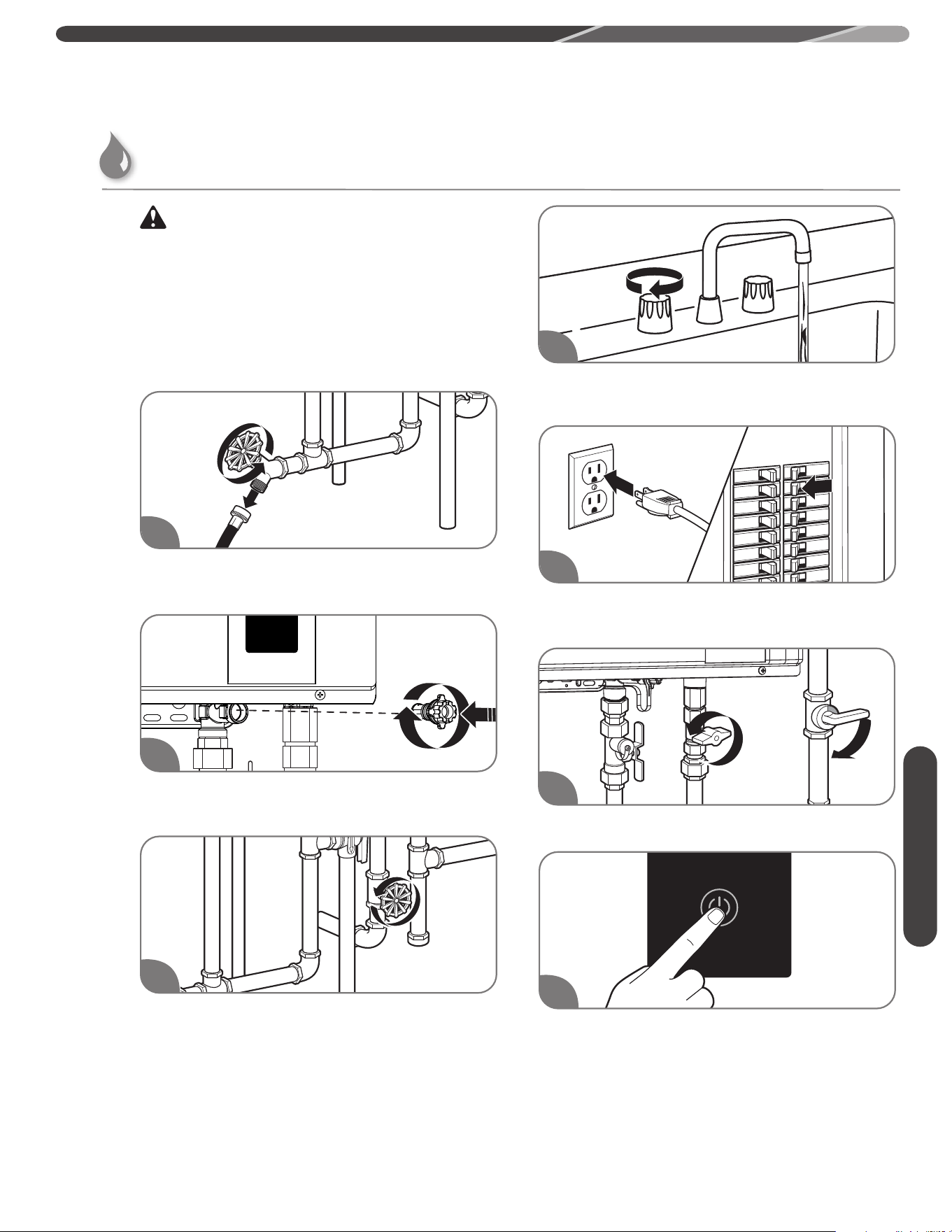
71
Care Instructions
CARING FOR YOUR WATER HEATER
CAUTION:
Even when drained properly, a small amount of water will
remain in the water heater. In cold weather conditions,
this water can freeze. If this happens, allow the defrost
protection on the water heater at least 60 minutes to melt
the frozen water. The water heater will not work properly
until this water is thawed.
To put the water heater back in service:
Disconnect drain hose. Make sure the drain valve is
closed.
Reinstall the water filter in the base of the cold water
inlet line, the water drain valve, and the water drain
plug.
Open the water shut-off valve.
Open all hot water faucets and let run until all air
has been purged from the lines. Close all hot water
faucets.
Plug in the power cord or reconnect the power
supply at the circuit breaker box.
Open the gas shut-off valve(s).
Press the POWER ON/OFF button on the remote
control to restart the unit.
1
2
3
4
5
6
7
Draining the Water Heater
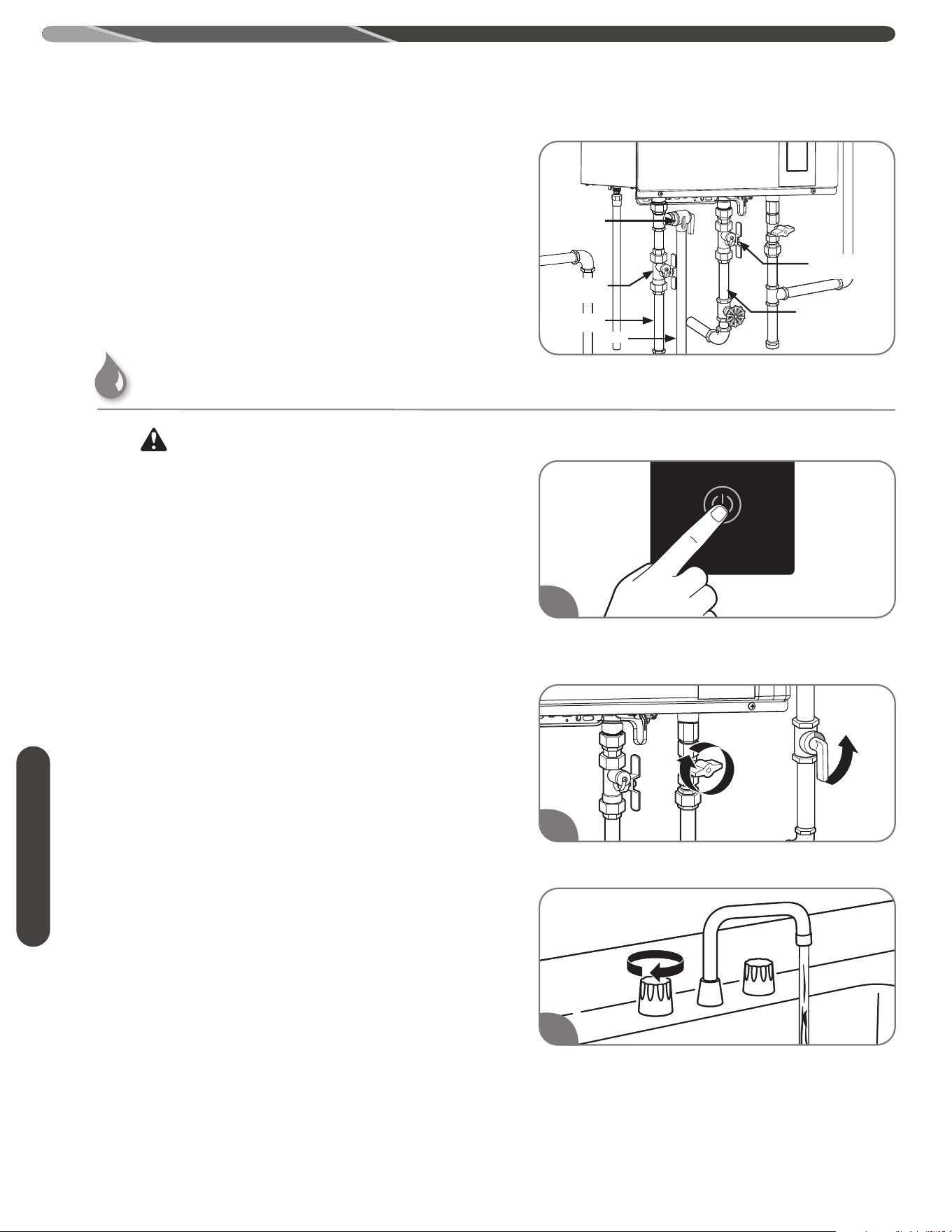
72
Standard Drain Method
Service isolator valve kits may be purchased from
the manufacturer, distributor, or place of purchase.
The kits include two full-port isolation valves to be
used in the inlet and outlet water lines. These kits
provide a means for full diagnostic testing and ease
of system flushing and draining.
Freeze Protection
WARNING:
Failure to drain the water heater can cause serious
personal injury from scalding and/or product damage.
Whenever the water heater may be exposed to
freezing conditions, precautions should be taken to
help prevent the water heater from freezing.
Freezing conditions come from the ventilation
system on direct-vent models and from exposure to
cold air on outdoor models.
All of these water heaters are equipped with a freeze
protection electric heater. This heater helps prevent
freezing inside the water heater down to an outside
temperature of -30°F (-35°C) on indoor installations
and approximately -4°F (-20°F) on outdoor
installations. These temperatures are all based on
temperatures without wind.
The heater only protects the internal components of
the water heater.
NOTICE:
Unplugging or disconnecting the power supply to the
water heater will also disconnect the power to the freeze
protection electric heater.
External piping and valves require additional
freeze protection. One method is to wrap insulation
around the piping and valves.
Another method is to turn on a hot water faucet and
leave a small amount of water running at a faucet.
This will help protect the water heater, piping, and
valves from freezing.
If power outages occur during freezing conditions,
it is recommended to completely drain the water
heater to help prevent damage to the unit. See
"Draining the Water Heater." Once power is restored,
refill the water heater and check for frozen or leaking
components.
Components or heat exchangers damaged
by freezing conditions is not covered under
manufacturer's warranty.
Running Water Freeze Protection
Turn off the water heater by pressing the POWER
ON/OFF button on the remote control.
Close the gas shut-off valve(s).
Open a hot water faucet slightly until the water
stream is approximately 1/8 in. (0.3 cm). Be sure to
check the flow periodically.
1
2
3
Care Instructions
Cold Water
Service Valve
Drain
Water Outlet
Hot Water
Service Valve
Pressure
Relief
Valve
Water
Inlet
CARING FOR YOUR WATER HEATER
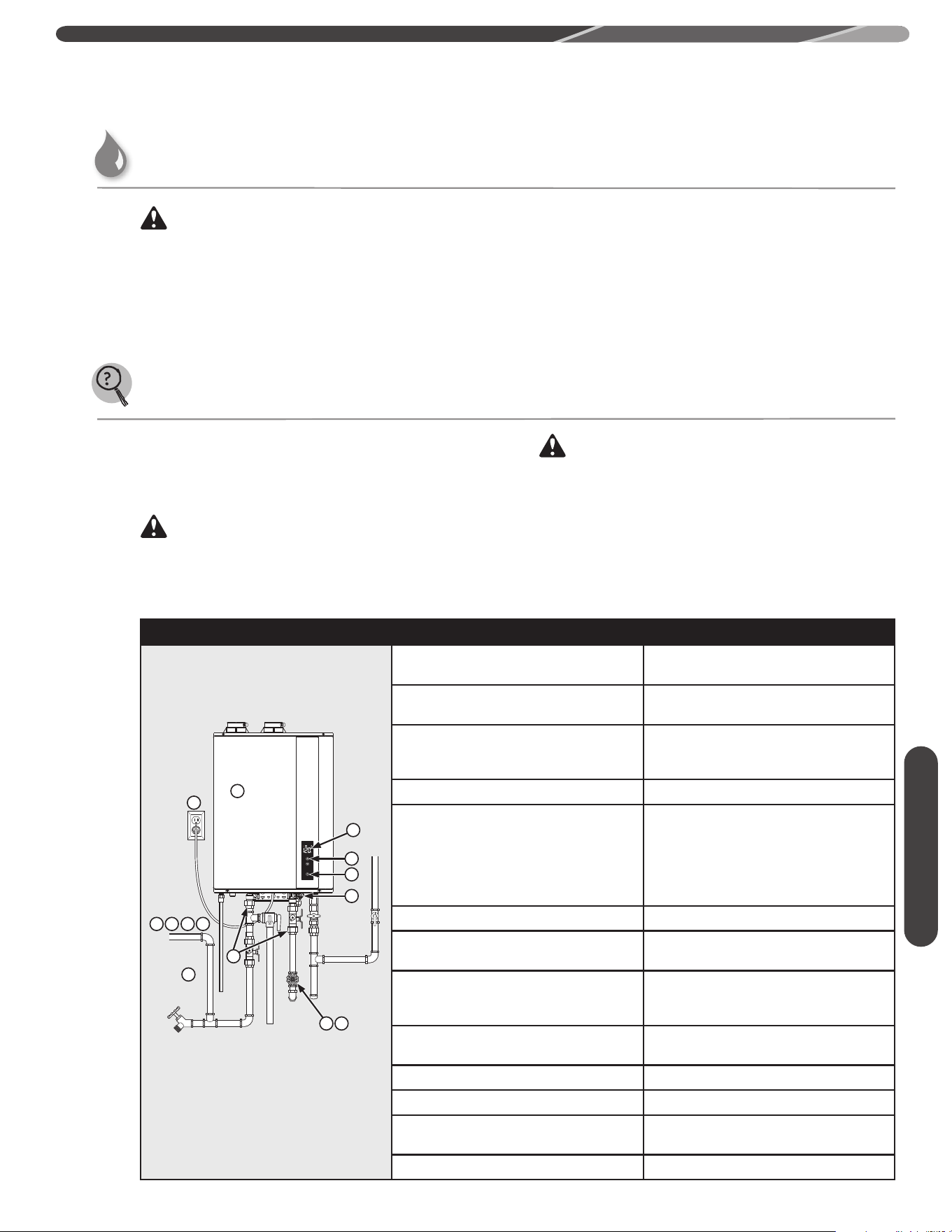
73
Vacation and Extended Shutdown
WARNING:
Failure to drain the water heater can cause serious
personal injury from scalding and/or product damage.
If the water heater is to remain idle for an extended
period of time, the power and water to the heater
should be turned off.
The water heater and piping should be drained if
they might be subjected to freezing temperatures.
When drained, some water may remain in the unit.
See “Freeze Protection” section on this Use and Care
Manual.
After an extended shutdown, the water heater’s
operation and controls should be checked by a
qualified service technician.
Troubleshooting Chart
The information in the following troubleshooting
chart may help you diagnose and/or fix a problem
you may be experiencing. Please review this chart
before calling for service assistance.
DANGER:
Shock Hazard – Make certain power to the water heater
is OFF before removing protective cover for any reason.
Electric shock will cause death or serious personal injury.
WARNING:
For Your Safety, DO NOT attempt repair of electrical wiring,
gas piping, remote control, burners, vent connectors, or
other safety devices. Refer repairs to a qualified service
technician.
Problem Possible Cause Solution
Not enough or no hot water.
1. Unit is not ON. 1. Turn on the unit by pressing the
POWER ON/OFF button.
2. Water shut-off valve is not completely
opened.
2. Check shut-off valve and open com-
pletely.
3. Hot water faucet is not completely
opened.
3. Open hot water faucet completely.
(The main burner goes off when incoming
water volume is inadequate.)
4. Water piping is frozen. 4. Allow piping to thaw.
5. Electrical power is disconnected or
water supply is shut off.
5a. Plug in the power cord or reconnect
the power supply at the circuit breaker
box.
5b. Completely open the water supply valve.
(Inadequate water volume will cause the
main burner to turn off.)
6. The temperature may be set too low. 6. Increase the temperature setting.
7. Mixing valve malfunctions (if
applicable).
7. Check and replace the mixing valve.
8. Error code displayed on the remote
control.
8. See “Service Error Code Chart” on
page 76. If required, contact a
qualified service technician.
9. Not enough water demand. 9. Increase the hot water flow at the
faucet.
10. Water filter is clogged or dirty. 10. Clean the water filter. (See page 76.)
11. Fixture aerator is clogged or dirty. 11. Clean the aerator.
12. Scale buildup in the heat exchanger. 12. Check for error code. If required,
contact a qualified service technician.
13. Hot and cold water lines reversed. 13. Reverse the water lines.
Care Instructions
1
10
6
8
5
12
7
3 94 11
13
2 4
CARING FOR YOUR WATER HEATER
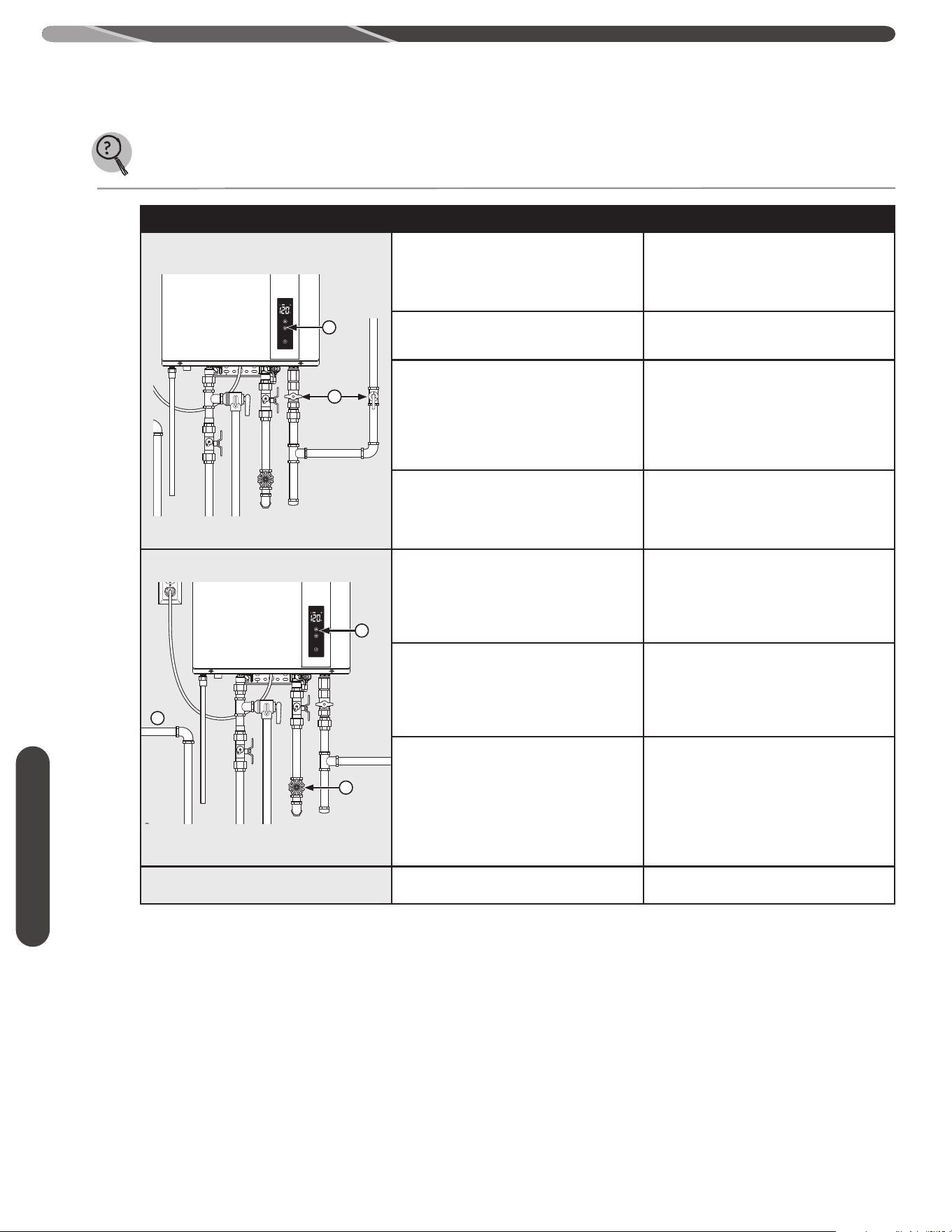
74
Care Instructions
CARING FOR YOUR WATER HEATER
Problem Possible Cause Solution
Water not hot enough.
1. The temperature may be set too low. 1. Increase the temperature setting at
the remote control.
2. The gas valve is not completely opened. 2. Check and completely open the gas valve.
3. Gas supply pressure is low. 3. Contact your gas utility company or gas
contractor to verify the gas meter and
gas piping size.
4. Bleed-over in one of the hot water
fixtures.
4. Contact a dealer or a qualified service
technician.
Water too hot.
1. Temperature is set too high. 1. Decrease the temperature setting at
the remote control.
2. Water shut-off valve is not completely
opened.
2. Check and completely open the water
shut-off valve.
3. Small amount of water has been heated. 3. Increase the hot water flow at the
faucet to allow more water to flow
through the water heater.
Fan continues to rotate after the hot water
faucet is closed.
The post-purge cycle clears flue gases. Normal operation.
Troubleshooting Chart
1
1
2
3
2
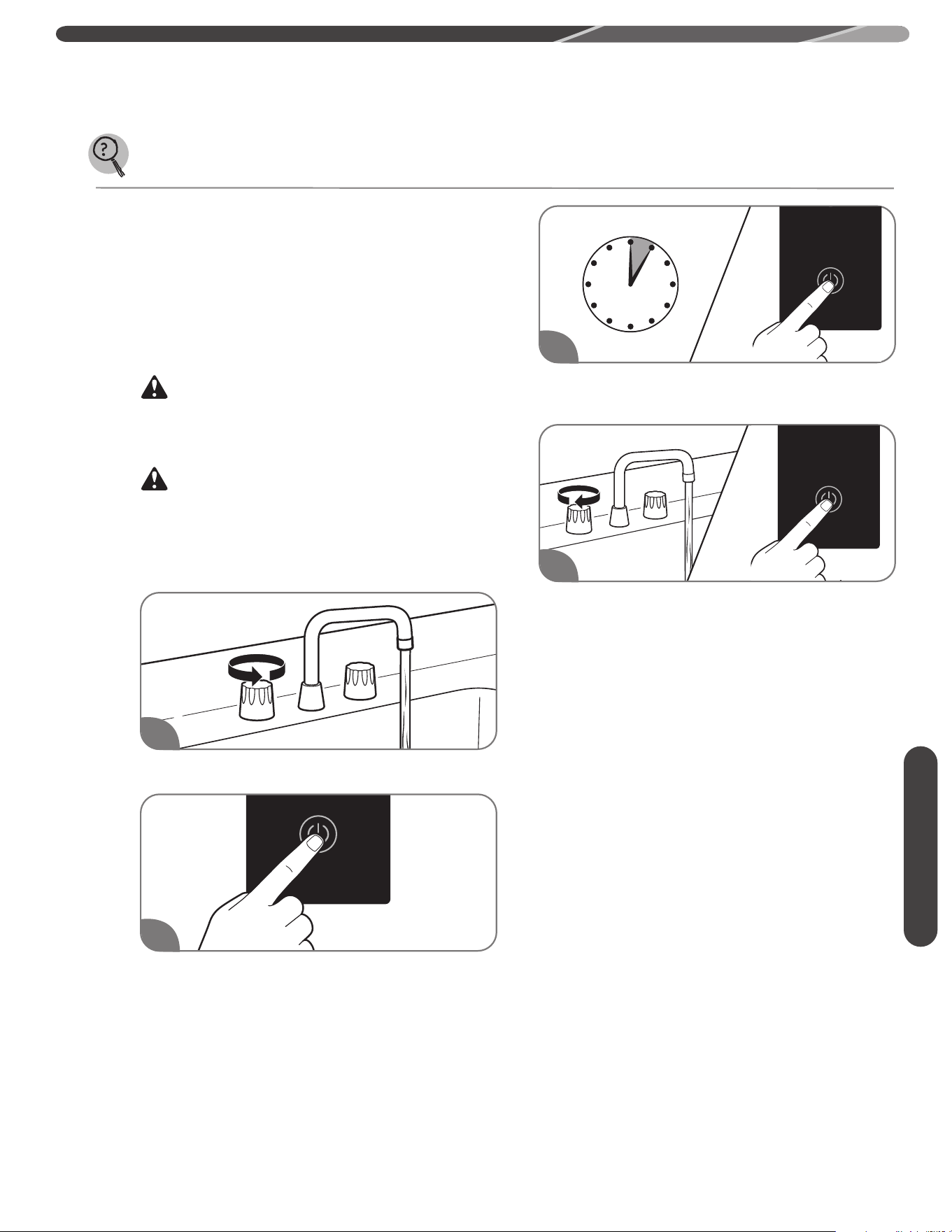
75
Care Instructions
CARING FOR YOUR WATER HEATER
Service Error Code Chart
Your water heater has an electronic diagnostic
system built into it. When the water heater finds
a problem, it displays an error code in the LED
display on the remote control. The chart on the next
page lists the error codes along with their possible
problem and solution. Using this chart may help
you diagnose and/or fix a problem you may be
experiencing. Please refer to this chart before calling
for service assistance.
DANGER:
Shock Hazard – Make certain power to the water heater
is OFF before removing protective cover for any reason.
Electric shock will cause death or serious personal injury.
WARNING:
For Your Safety, DO NOT attempt repair of electrical wiring,
gas piping, remote control, burners, vent connectors, or
other safety devices. Refer repairs to a qualified service
technician.
When an error code is displayed:
Turn off all the hot water faucets.
Turn off the water heater by pressing the POWER
ON/OFF button on the remote control.
Wait about 5 minutes; then restart the water heater
by pressing the POWER ON/OFF button.
Turn on a hot water faucet and recheck the remote
control display.
If the error code remains in the display:
1. Turn off the hot water faucet.
2. Turn off the water heater.
3. Unplug the water heater from power, wait about
30 seconds and plug back in.
4. Follow the error code chart information.
5. Restart the water heater, turn on a hot water
faucet, and recheck the remote control display.
If the error code is still shown:
1. Turn off the hot water faucet.
2. Turn off the water heater.
3. Make note of the displayed error code and call for
service assistance. See “Call for Assistance” section
on this Use and Care Manual.
NOTICE:
If the displayed error code is not listed in the chart,
immediately turn off the water heater and call for service
assistance.
1
2
3
4
76
Error Code Possible Cause Solution
1L
Water heater has buildup of lime deposits. Contact a dealer or qualified service techni-
cian.
11
The gas shut-off valve is not fully opened. Check shut-off valve and open completely.
12
Gas service has been interrupted. Contact your gas utility company.
LP gas is running low (LP models only). Refill or replace your LP gas container.
14
Water heater is overheating. Contact a dealer or qualified service techni-
cian.
29
Neutralizer is clogged. Contact a dealer or qualified service techni-
cian.
31
Faulty inlet thermistor. Contact a dealer or qualified service techni-
cian.
33
Faulty outlet thermistor. Contact a dealer or qualified service techni-
cian.
61
Faulty blower motor. Contact a dealer or qualified service techni-
cian.
66
Faulty bypass motor. Contact a dealer or qualified service techni-
cian.
71
Solenoid valve circuit failure. Contact a dealer or qualified service techni-
cian. Flushing procedure may need to be re-
peated for excessive lime and scale build-up.
88
Reminder of flushing the heat exchanger and/
or replacing the water treatment filter.
Contact a dealer or qualified service techni-
cian.
90 or 99
Air intake or vent exhaust opening may be
blocked.
Remove any blockage. (Air intake requires 12
in. [30 cm] of clearance.)
The vent pipes on the vent termination may
not be connected properly.
Contact a dealer or qualified service techni-
cian.
P1
Not enough water flow to operate the unit. Increase the water flow from the fixtures.
Care Instructions
CARING FOR YOUR WATER HEATER
1. All questions, adjustments, repairs, and/or
routine maintenance should be directed to your
installer, plumbing contractor, or licensed service
agent. If your contacts have moved or are not
available, please refer to the telephone directory,
commercial listings, or local utility company for
qualified service assistance.
2. If your problem has not been solved to your
satisfaction, contact the Manufacturer National
Service Department at the following address:
Manufacturer National Service Department
800 Interstate Park Drive
Montgomery, AL 36109
Phone: 1-866-720-2076
When contacting the manufacturer, the following
information will be requested:
A. Model and serial number. (See page 8 or the
ratings plate on the side of the water heater.)
B. Address where the water heater is located.
C. Name and address of installation contractors
(page 8) and all qualified service companies that
have worked on the water heater.
D. Original installation date. (See page 8.)
E. Dates any service or preventive maintenance was
performed.
F. Details of the persisting problem.
G. List of businesses that have tried to fix this
problem, along with dates of service.
Call for Assistance
IF YOU NEED SERVICE
Service Information
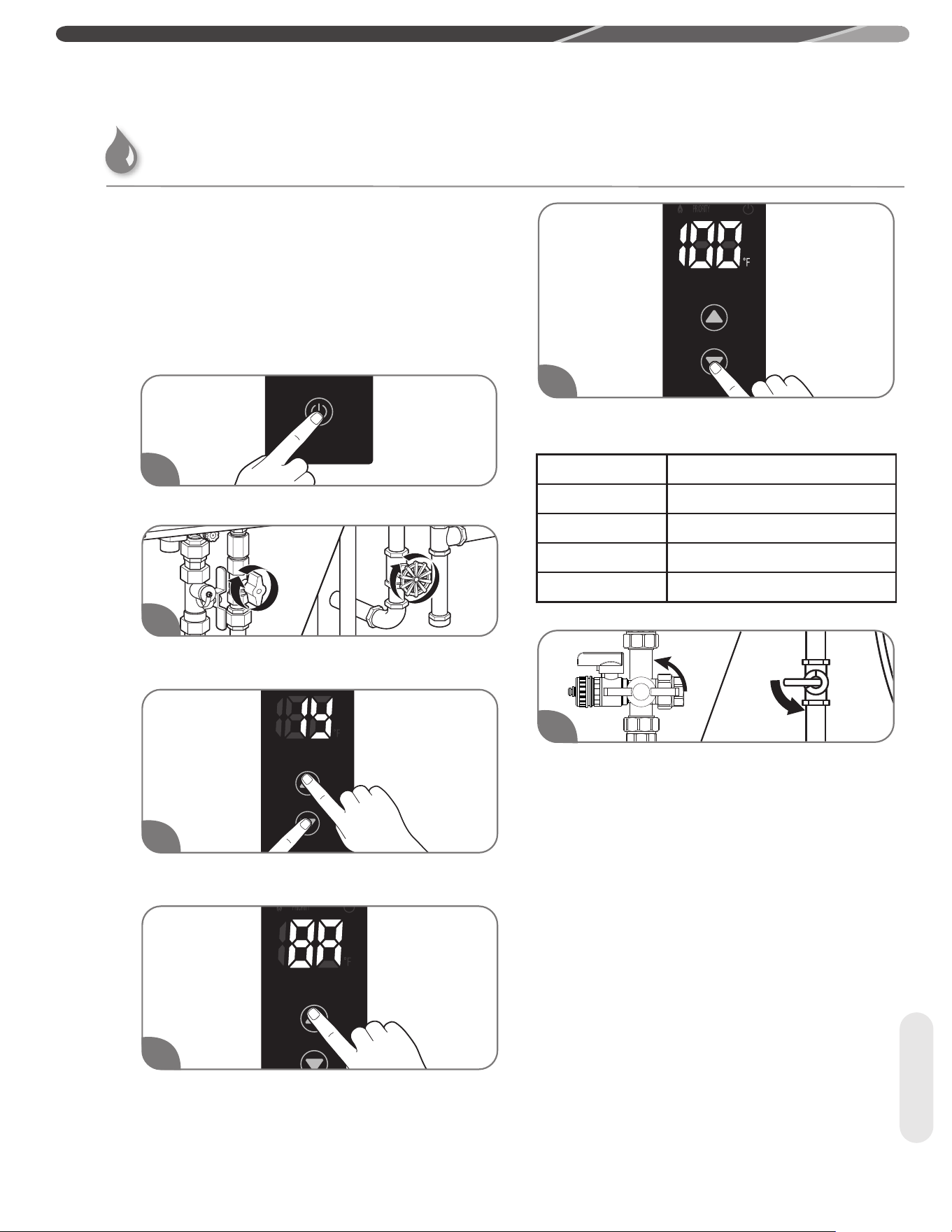
77
Start/Adjust
Maintenance Notice
Maintenance notice is an optional control and is
inactive as default. Maintenance notice reminds
users of water heater maintenance activities such as
flushing the heat exchanger or replacing the water
treatment filter (if applicable) in order to maximize the
life of your tankless water heater. Contact technical
service department listed on page 76 of this use
and care manual if you are not familiar with these
maintenance activities.
Turn off the remote control.
Turn off the gas and water to the water heater by
closing the shut-off valves.
Press and hold the “▲“and “▼”button until “1Y ” is
displayed on the built-in display.
Press the “▲“or “▼”button until “8A ” is displayed.
Press and hold the power button on the build-in
display for 1 second.
The current setting time is displayed on the display.
(Factory setting is “OFF”)
Press the “▲“or “▼”button to choose “50”, “75”,
“100” or “OF”.
Turn on the gas and water to the water heater by
opening the shut off valves.
When tankless water heater has a certain number
of hours of combustion, error code “88” is shown
on the display. It is highly recommended to perform
water heater maintenance activities such as flushing
the heat exchanger and/or replacing the water
treatment filter (if applicable).
1
2
3
4
5
Displayed Maintenance Notice Hour
50 500 hours
75 750 hours
100 1,000 hours
OF OFF
6
CARING FOR YOUR WATER HEATER
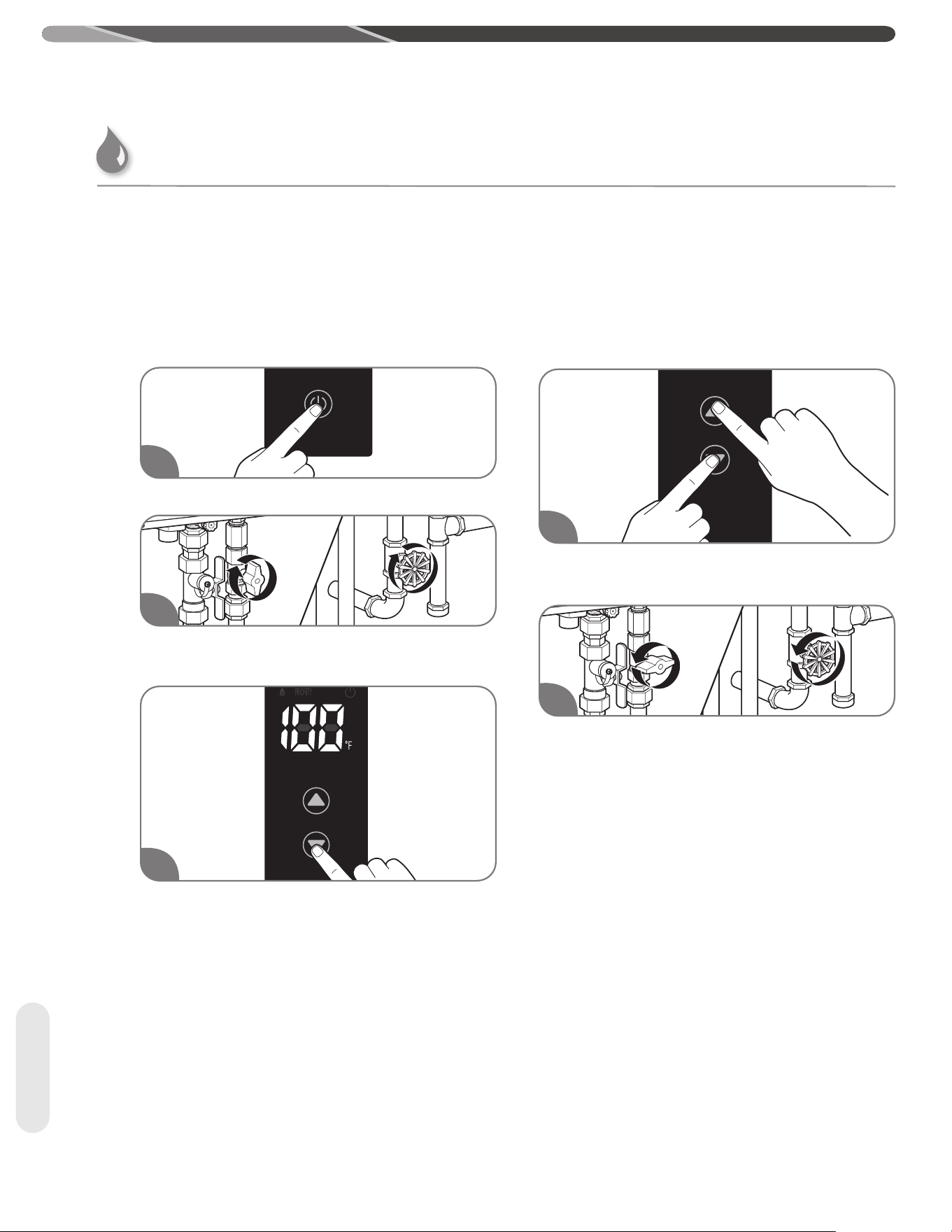
78
ERROR CODE 88 CLEARING
IMPORTANT
It is highly recommended to perform water heater maintenance activities such as flushing the heat exchanger and/or replacing
the water treatment filter (if applicable) before clearing this error code.
After these maintenance activities are completed, follow the steps below to clear error code "88".
Turn on the remote control.
Turn off the gas and water to the water heater by
closing the shut-off valves.
Press the DOWN adjustment button repeatedly until
the lowest setting temperature shows in the LED
display.
Press and hold the DOWN and UP adjustment
button for 5 to 10 seconds.
Turn on the gas and water to the water heater by
opening the shut off valves.
If error code "88" is still shown, repeat steps 1
through 5 above.
Maintenance Notice
1
2
3
4
5
CARING FOR YOUR WATER HEATER
Start/Adjust
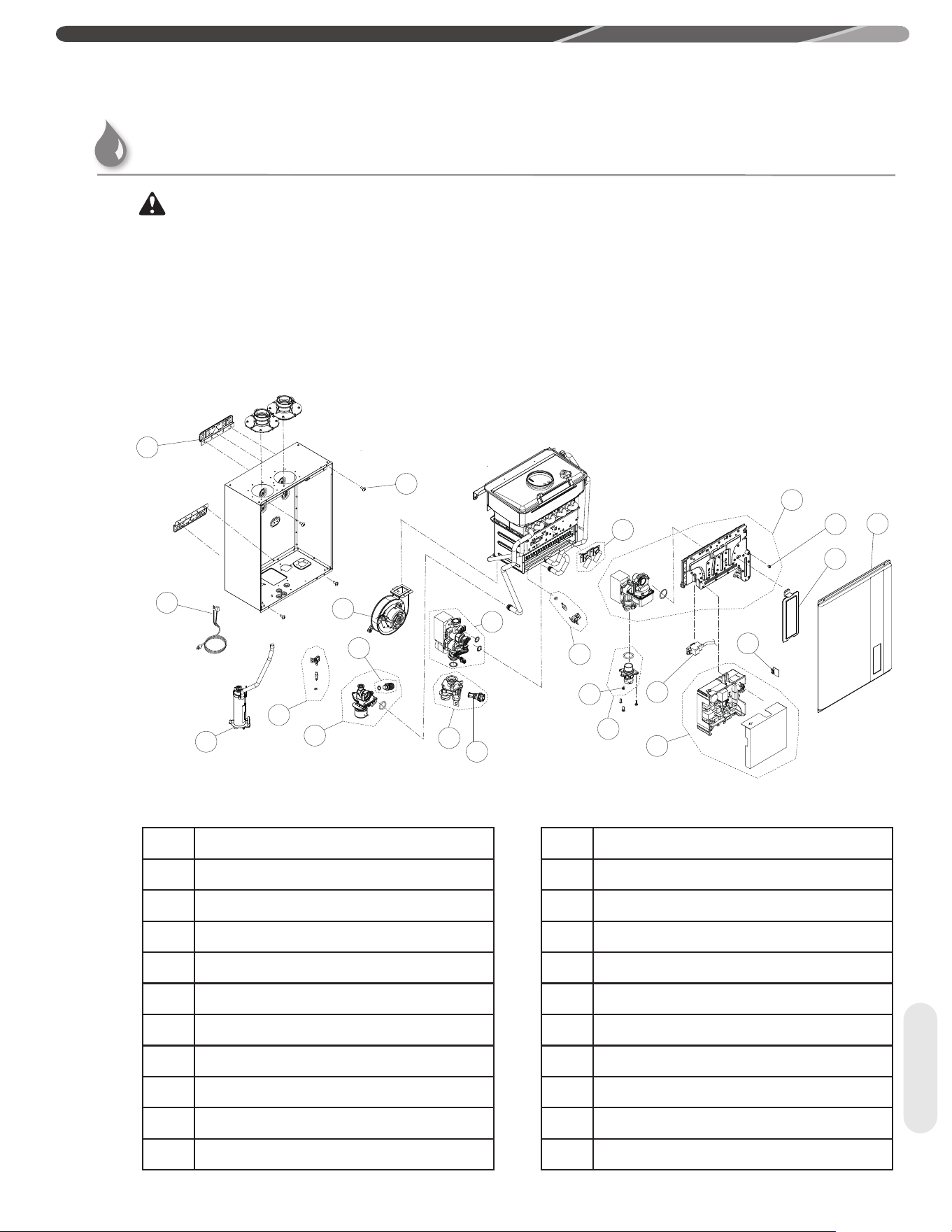
79
PARTS REPLACEMENT
Parts Ordering
WARNING:
For your safety, DO NOT attempt to disassemble, repair, or
replace any portion of this unit. Refer all repairs, service,
and/or adjustments to qualified service personnel.
Address all parts orders to the distributor or store
where the water heater was purchased. All parts
orders should include:
1. The model and serial number of the water heater
from the rating plate.
2. Specify the gas type (natural or LP) as marked on
the rating plate.
3. Parts description (as shown below) and number
of parts desired.
Direct-Vent Gas Components
Parts
1 Front Cover Final Assembly
2 Front Cover Screw
3 Cabinet Bracket
4 Power Cord
5 Display / Controller
6 Condensate Drain
7 Blower Motor
8 HEX Thermistor
9 Hot Water Connection
10 Drain Valve
11 Hot Water Thermistor
12 Water Control Valve
13 Inlet Water Connection
14 Water Filter
15 Manifold/Gas Valve Kit
16 Manifold Screw
17 Gas Connection
18 Inlet Gas Screw
19 Control Board
20 Program Chip
21 Igniter / Flame Rod Kit
22 Igniter Module
116
15
21
20
22
19
17
18
8
12
14
13
10
7
2
3
4
6
11
9
5
80
LIMITED WARRANTY
For the RHEEM®, RUUD®, Richmond®, Paloma®, and EcoSmart® Residential Tankless Gas Water Heaters.
GENERAL
This Limited Warranty is only available to the original owner of the water heater at the original installation location. This Limited Warranty is not
transferable.
Rheem Sales Company, Inc. (Rheem) warrants this tankless gas water heater, and its component parts, to be free from defects in materials and
manufacture, under normal use and service, for the Applicable Warranty Period specified below. At its option, Rheem will repair or replace the defective
water heater, or defective component part(s), in accordance with the terms of this Limited Warranty, if it fails in normal use and service during the
Applicable Warranty Period. The replacement water heater must be manufactured by Rheem under one of the covered brand names. The replacement
component part(s) must be Rheem authorized component part(s). The replacement unit will be warranted only for the unexpired portion of the original
unit’s Applicable Warranty Period.
Rheem strongly recommends that this tankless water heater be installed by a contractor that is licensed, state qualified and trained on Rheem's tankless
products because improper installation may invalidate warranty coverage.
EFFECTIVE DATE
The Effective Date of warranty coverage (or the beginning of the Applicable Warranty Periods) is the date of the original installation of the water heater, if
properly documented. Otherwise, it is the date of manufacture of the water heater plus ninety (90) days.
APPLICABLE WARRANTY PERIODS: The Applicable Warranty Period depends on the type of installation, as described below:
Residential: a Single Family Dwelling
Twelve (12) years from the Effective Date for the heat exchanger, five (5) years from the Effective Date for the component parts, and one (1) year from the
Effective Date for certain labor as described under the heading, LABOR, SHIPPING AND PROCESSING COST.
Residential: a Single Family Dwelling used with Hydronic Force Air Heating
Ten (10) years from the Effective Date for the heat exchanger, five (5) years from the Effective Date for the component parts, and one (1) year from the
Effective Date for certain labor as described under the heading, LABOR, SHIPPING AND PROCESSING COST. Provided that a Rheem manufactured/
Rheem approved potable water hydronic air handler is installed with the system.
Residential: a Single Family Dwelling with recirculation, controlled loop
Twelve (12) years from the Effective Date for the heat exchanger, five (5) years from the Effective Date for the component parts, and one (1) year from the
Effective Date for certain labor as described under the heading, LABOR, SHIPPING AND PROCESSING COST. Provided that the recirculation system is
an on demand type system or the pump is controlled with a temperature sensor (aquastat) and timer.
Residential: a Single Family Dwelling with recirculation, uncontrolled loop
Three (3) years from the Effective Date for the heat exchanger, three (3) years from the Effective Date for the component parts, and one (1) year from
the Effective Date for certain labor as described under the heading, LABOR, SHIPPING AND PROCESSING COST, if the water heater is installed in a
system in which the water is re-circulated using a continuously operating pump.
Commercial: any installation that is not a single family dwelling
Five (5) years from the Effective Date for the heat exchanger, five (5) years from the Effective Date for the component parts, and one (1) year from the
Effective Date for certain labor as described under the heading, LABOR, SHIPPING AND PROCESSING COST.
Commercial: with recirculation, controlled loop
Five (5) years from the Effective Date for the heat exchanger, five (5) years from the Effective Date for the component parts, and one (1) year from the
Effective Date for certain labor as described under the heading, LABOR, SHIPPING AND PROCESSING COST. Provided that the recirculation system is
an on demand type system or the pump is controlled with a temperature sensor (aquastat) and timer.
Commercial: with recirculation, uncontrolled loop
Three (3) years from the Effective Date for the heat exchanger, three (3) years from the Effective Date for the component parts, and one (1) year from
the Effective Date for certain labor as described under the heading, LABOR, SHIPPING AND PROCESSING COST, if the water heater is installed in a
system in which the water is re-circulated using a continuously operating pump.
WARRANTY EXCLUSIONS
This Limited Warranty will not cover:
a) Damages, malfunctions or failures resulting from:
1. Installation of the water heater in environments in which water quality levels DO NOT fall within the ranges listed in the table below:
b) Operating the water heater in a corrosive or contaminated atmosphere, including without limitation damages, malfunctions or failures caused by lime, mineral build-up, or scale.
c) Service trips to your business to teach you how to install, use, or maintain this water heater or to bring the water heater installation into compliance with local building codes and
regulations or manufacturer’s installation requirements.
d) Water heater unit installed for use in: spa or pool heating; a recreational vehicle; a boat or any other watercraft.
e) Water heater unit installed in any circulating system in which the temperature of the incoming water to the water heater is in excess of 140° f.
f) Water heater unit that is installed in any installation supplying radiant heat, such as in floor, baseboard, radiators, snow melt or closed loop systems, or any system using glycol or non-
potable water.
g) Damages, malfunctions or failures resulting from failure to install the water heater in accordance with applicable building codes/ordinances or good plumbing and electrical trade practices.
h) Damages, malfunctions or failures resulting from improper installation or failure to operate and maintain the unit in accordance with the manufacturer’s instructions.
i) Performance problems caused by improper sizing of the water heater or the gas supply line, the venting connection, combustion air openings, electric service voltage, wiring, or fusing.
j) Damages, malfunctions or failures caused by improper conversion from natural gas to LP gas or LP gas to natural gas fuel source.
k) Damages, malfunctions or failures caused by operating the water heater with any parts removed or with modified, altered, or unapproved parts installed.
l) Damages, malfunctions or failures caused by abuse, accident, fire, flood, freeze, lightning, acts of God and the like.
m) Heat exchanger failures (leaks) caused by operating the water heater in a corrosive or contaminated atmosphere or damages, malfunctions or failures caused by lime, mineral build-up, or
scale.
n) Damages, malfunctions or failures caused by operating the unit at water temperatures exceeding the maximum setting of the operating, or high limit, control.
o) Heat exchanger failures caused by operating the water heater when it is not supplied with potable water, free to circulate at all times.
p) Damages, malfunctions or failures caused by subjecting the heat exchanger to pressures, or firing rates, greater than those shown on the rating label.
q) Damages, malfunctions or failures resulting from the use of any attachment, including any energy saving device, not authorized by Rheem.
r) Units installed outside the fifty states (and the District of Columbia) of the United States of America and Canada.
s) Units removed from the original installation location and reinstalled elsewhere.
t) Units that have had their rating labels altered, tampered with, or removed. A water heater should not be operated if the rating label is removed.
Chart for Recommended Water Quality Levels
pH (Total Dissolved Solids) TDS Free Carbon Dioxide (CO
2
) Total Hardness Aluminum Chlorides Copper Iron Manganese Zinc
6.5–8.5 Up to 500 mg/L Up to 15 mg/L Up to 200 mg/L 0.05 to 0.2 mg/L Up to 250 mg/L Up to 1.0 mg/L Up to 0.3 mg/L Up to 0.05 mg/L Up to 5 mg/L
Cited reference: National Secondary Drinking Water Regulations
Warranty
81
LABOR, SHIPPING, AND PROCESSING COSTS
For one (1) year after the Effective Date, Rheem will cover reasonable labor costs necessary to repair or replace a tankless water heater or component part that Rheem
determines to be defective and covered by this Limited Warranty. The warranty service must be performed by a contractor that is licensed, state qualified, and trained to
install and service Rheem's tankless water heaters. This Limited Warranty does not cover any labor expenses for general service, inspection, reinstallation, permits, removal
and disposal of the failed water heater or defective component part(s), or updating the installation to meet manufacture or local code requirements. All such expenses are your
responsibility.
Rheem will pay the transportation costs for an “in-warranty” replacement water heater, or “in-warranty” replacement component part(s), to a convenient delivery point (selected
by Rheem) near the place the original water heater, or original component part(s), is located: such as a local water heater distributor. You must pay any local freight charges,
including the cost of returning the failed water heater, or defective component part(s) to a convenient shipping location (selected by Rheem): such as a local Rheem distributor.
Rheem does not authorize, recommend, or receive any benefit from any claims processing or similar fees charged by others to process warranty claims for any water heater
or component part(s). Rheem will not reimburse any party for these, or any other, fees not specifically covered in this Limited Warranty document.
HOW TO OBTAIN WARRANTY CLAIM ASSISTANCE
Any claim for warranty assistance must be made promptly. First, determine if your water heater is “in-warranty” (that is, within the Applicable Warranty Period). You can
determine your unit’s warranty status by adding its Applicable Warranty Period to its date of installation. However, if you DO NOT have documentary proof of your water
heater’s date of installation, your unit’s warranty status will be based on its date of manufacture as determined from the serial number. Add the Applicable Warranty Period
plus ninety (90) days to the date of manufacture to determine whether the water heater is still covered by this Limited Warranty. You may also determine your unit’s warranty
status by obtaining the complete model number, complete serial number, and date of installation of your water heater and then accessing the “Warranty Verification”
information on Rheem Water Heaters' internet website (www.rheem.com) or contacting Rheem's Claims Department (telephone (800) 621-5622) during normal business
hours (in the Central Time Zone) to determine if the Applicable Warranty Period has expired.
If your water heater is “in-warranty”, contact the plumber, or mechanical contractor, that installed it for assistance with the warranty repairs, or replacement, required. Rheem
Water Heaters' Technical Service personnel are available to assist you (by telephone at (866) 720-2076) in obtaining “in-warranty” service or to answer your questions about
the operation or repair of your water heater during normal business hours (in the Central Time Zone). Be prepared to provide the plumber, mechanical contractor, or Rheem
Technical Service person you call with the complete model number, the complete serial number, and the date of installation of your water heater in addition to an explanation
of your water heater problem.
If an exact replacement is not available, Rheem will provide you with the current model of your water heater, or component part(s), or a replacement unit with comparable
operating features. If government regulations or industry certification or similar standards require the replacement water heater, or replacement component part(s), to have
features not found in the defective water heater, or the defective component part(s), you will be charged for the difference in price represented by those required features. If
you pay the price difference for those required features and/or to upgrade the size and/or other features available on a replacement new water heater, you will also receive a
complete new Limited Warranty (with the full Applicable Warranty Period) for the replacement new water heater.
Rheem reserves the right to inspect, or require the return of, the failed water heater or the defective component part(s). Each “in-warranty” failure water heater must be made
available to Rheem (with the rating label and all the component parts intact) in exchange for the replacement water heater. Each defective “in-warranty” component part to be
replaced must be returned to Rheem in exchange for the replacement component part.
Warranty compensation is subject to validation of “in-warranty” coverage by Rheem Claims Department personnel.
• To obtain warranty compensation for an “in-warranty” water heater failure, you must provide Rheem with the failed water heater (with the rating label and all the component
parts intact) the complete model number and the complete serial number of the Rheem or Ruud water heater that replaced the failed unit; and the date the original water
heater failed. You may also be required to provide documentary proof of the failed water heaters date of installation to establish its “in-warranty” status.
• To receive warranty compensation for an “in-warranty” defective component part, you must provide Rheem with: the defective component part; the complete model
number and the complete serial number of the Rheem or Ruud water heater from which the defective component part was removed; and the date the defective component
part failed. You may also be required to provide documentary proof of the date of installation of the Rheem or Ruud water heater from which the defective part was removed –
or the date of purchase of the part (If it was purchased separately) – to establish the “in-warranty” status of the defective component part.
• If Rheem determines that the water heater or component part returned to Rheem is free of defects in material and manufacture and/or that it was damaged by improper
installation or other cause not covered by this Limited Warranty, the warranty claim for the product, component part and/or labor maybe denied.
Warranty claim documentation should be mailed promptly to Rheem Water Heaters, Claims Department, 800 Interstate Park Drive, Montgomery, Alabama 36109, or in
Canada, 125 Edgeware Rd. Unit 1, Brampton, ON, Canada L6Y 0P5
EXCLUSIVE WARRANTY – LIMITATION OF LIABILITY
THIS LIMITED WARRANTY IS THE SOLE AND EXCLUSIVE WARRANTY PROVIDED IN CONNECTION WITH THIS RHEEM®, RUUD®,
RICHMOND®, PALOMA® AND ECOSMART® RESIDENTIAL TANKLESS GAS WATER HEATER UNIT (THE “WATER HEATER”). No one
is authorized to make any other warranties on behalf of Rheem. ANY IMPLIED WARRANTIES, INCLUDING MERCHANTABILITY, OR FITNESS
FOR A PARTICULAR PURPOSE, SHALL NOT EXTEND BEYOND THE APPLICABLE WARRANTY PERIODS, SPECIFIED PREVIOUSLY.
RHEEM’S SOLE LIABILITY, WITH RESPECT TO ANY DEFECT, SHALL BE AS SET FORTH IN THIS LIMITED WARRANTY, AND ANY
CLAIMS FOR INCIDENTAL OR CONSEQUENTIAL DAMAGES (INCLUDING DAMAGE FROM WATER LEAKAGE) ARE EXCLUDED. Some
states DO NOT allow limitations on how long an implied warranty lasts, or for the exclusion of incidental or consequential damages, so the above
limitations or exclusions may not apply to you.
This Limited Warranty gives you specific legal rights, and you may also have other rights, which vary from state to state.
DO NOT RETURN THIS WATER HEATER OR PART TO RHEEM WITHOUT A RETURN AUTHORIZATION.
This document is for reference only and does not replace the original warranty document found in the back of the Use and Care manual
provided with the tankless water heater.
DO NOT RETURN THIS DOCUMENT TO RHEEM.
KEEP IT WITH YOUR WATER HEATER OR BUSINESS RECORDS.
Name of Owner:
Owner’s Address:
Name of Plumber/
Mechanical Contractor – Installer:
Address of Plumber/
Mechanical Contractor – Installer :
Telephone Number of Plumber/
Mechanical Contractor – Installer:
Date of Water Heater Installation:
Model Number of Your Water Heater:
Serial Number of Your Water Heater:
Warranty
82
NOTES