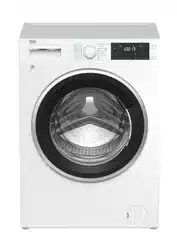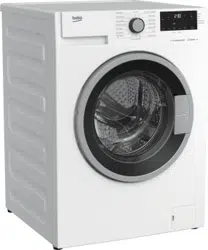
Washer-Dryer
User Manual
BMM5DFO5741W
EN / 2
Please read this user manual first!
Dear Customer,
Thank you for choosing a Beko product. We hope that you get the best results from your
product which has been manufactured with high quality and state-of-the-art technology.
Therefore, please read this entire user manual and all other accompanying documents
carefully before using the product.
Follow all warnings and information in the user manual. Thus, you protect yourself and
your product against possible d
angers.
Keep the user manual. If you hand over the product to someone else, provide the user
manual as well. Warranty terms, usage and troubleshooting methods of your product are in
user guide.
Symbols and Definitions
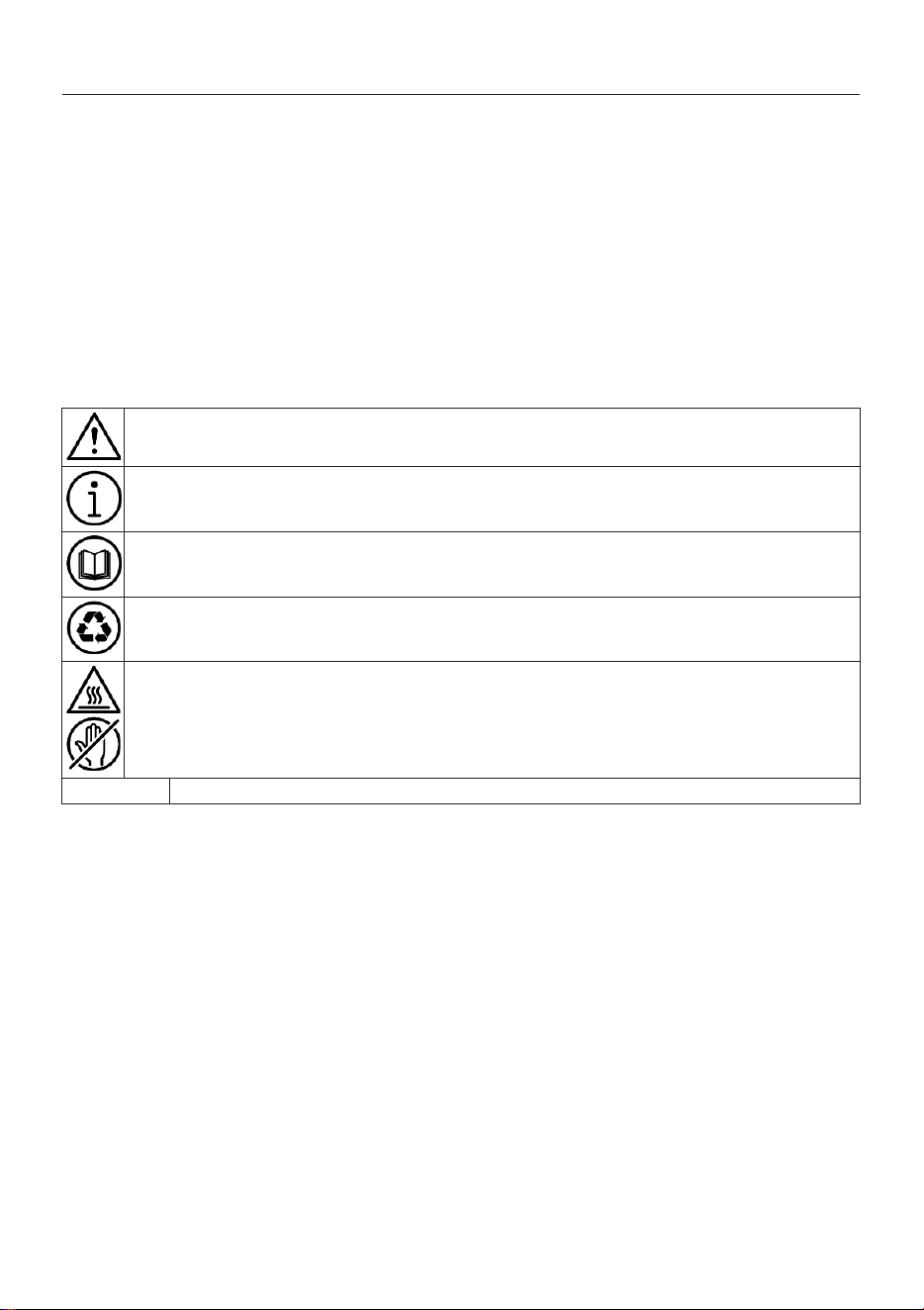
The following symbols are used in the user guide:
Danger that could result in death or injury.
Important information or useful hints about usage.
Read the user manual.
Recyclable materials.
Hot surface warning.
WARNING
Danger that may result in property damage to the product or its environment.

EN / 3
Table of Contents
1 Safety Instructions..................... 4
1.1 Intended Use ....................................... 4
1.2 Safety of Children, .............................. 4
1.3 Electrical Safety .................................. 5
1.4 Handling Safety .................................. 6
1.5 Installation Safety ............................... 6
1.6 Operational Safety .............................. 8
1.7 Drying Safety ...................................... 9
1.8 Maintenance and Cleaning Safety .. 12
2 Important Instructions for
Environment ............................ 13
2.1 Compliance with WEEE Directive ..... 13
2.2 Package Information ........................ 13
3 Technical Specifications .......... 14
4 Installation............................... 15
4.1 Appropriate Installation Location..... 15
4.2 Removing Transportation Safety Bolts
.......................................................... 16
4.3 Connecting to Water Supply ............. 16
4.4 Connecting the Drain Hose to the
Drain .................................................. 17
4.5 Adjusting the Stands ........................ 19
4.6 Electrical Connection ....................... 19
4.7 Handling the Product........................ 19
5 Preliminary Preparation ........... 21
5.1 Sorting the Laundry .......................... 21
5.2 Preparing Laundry for Washing ....... 21
5.3 Tips for Energy and Water Saving .... 21
5.4 Start Up ............................................. 21
5.5 Loading the
Laundry ......................... 22
5.6 Correct Load Capacity ...................... 22
5.7 Using Detergent and Softener .......... 22
5.8 Tips for Efficient Washing ................ 25
5.9 Tips for Efficient Drying .................... 26
6 Operating the Product .............. 28
6.1 Control Panel .................................... 28
6.2 Symbols on the Display .................... 29
6.3 Preparing the Laundry ...................... 30
6.4 Preparing the Laundry for Drying ..... 30
6.5 Sort the Laundry According to Colour
and Degree of Soiling ....................... 31
6.6 Degree of Soiling .............................. 31
6.7 Sorting the Laundry Acc
ording to Care
Label Specifications ......................... 32
6.8 Table of Wash Cycle ......................... 33
6.9 Various Cycles .................................. 35
6.10 Various Functions............................. 36
6.11 How to Use the Appliance ................ 38
6.12 Cancelling the Programme ............... 40
6.13 End of Programme ............................ 40
6.14 Standby Mode ................................... 40
7 Maintenance and Cleaning ....... 41
7.1 Cleaning the Detergent Drawer ......... 41
7.2 Cleaning the Loading Door and the
Drum .................................................. 41
7.3 Cleaning the Loading Door and the
Drum .................................................. 42
7.4 Cleaning the Mesh Filter in the Water
Inlet Hose and the Water Inlet Valve 42
7.5 Cleaning the Mesh Filter in the Water
Inlet Hose and the Water Inlet Valve 42
8 Troubleshooting ....................... 44
9 DISCLAIMER / WARNING .......... 49
BEKO UK AND ROI STANDARD
MANUFACTURER GUARANTEE TERMS
AND CONDITIONS ............................. 50
EN / 4
This section includes the safety
instructions necessary to pre-
vent the risk of personal injury or
material damage.
Our company shall not be held
responsible for damages that
may occur if these instructions
are not observed.
• Installation and repair
operations shall always be
per- formed by Authorized
Service.
• Use original spare parts and
accessories only.
• Do not repair or replace any
component of the product un-
less it is clearly specified in the
operation manual.
• Do not modify the product.
1.1 Intended Use
• The service life of your product
is 10 years. During this period,
original spare parts will be
available to operate the
appliance properly.
• This product has been de-
signed for domestic use. It is
not for commercial purposes,
or it should not be used out of
its intended use.
• Use only for washing and
drying textile products that
are marked accordingly.
• The manufacturer assumes no
responsibility for any damage
due to misuse or mishandling.
• This appliance is intended to
be used in household and
similar applications. For
example;
– Personnel kitchens of stores,
offices and other wor
k
environments,
– Ranches,
– By customers of hotels,
motels and other
accommodation facilities
– Bed and breakfasts, hostel-
like environments,
– Common areas of apartment
blocks or laundries.
1.2 Safety of Children,
Vulnerable Persons
and Pets
• This product may be used by
children aged 8 years and
older and persons with under-
developed physical, sensory or
mental capabilities or lack of
experience and knowledge if
they have been given
supervision or instruction
concerning use of the
appliance in the product safe
way and the hazards involve
d.
• Children under the age of 3
should be kept away unless
continuously supervised.
1 Safety Instructions

EN / 5
• Electrical products are
dangerous for children and
pets. Children or pets should
not play with, climb on top or
inside the product. Check
inside the product before use.
• Use child lock to prevent
children from intervening with
the product.
• Do not forget to close the
loading door when leaving the
room where the product is
located. Children and pets may
get locked inside and drown.
• Children should not perform
cleaning and user
maintenance works without
an adult’s supervision.
• Keep the packaging materials
away from children. Risk of in-
jury and suffocation.
• Keep all detergents and
additives used for the product
away from children’s reach.
• Cut the power cable and break
and deactivate the locking
mechanism of the loading
door before disposing of the
product for children’s safety.
1.3 Electrical Safety
• Product should be unplugged
during installation,
maintenance, cleaning and
repair procedures. Unplug the
product or turn off the fuse.
• Damaged power cables should
be replaced by the authorised
service in order to prevent
possible danger.
• The product should not be fed
via an external switching
device such as a timer or
connected to a circuit that is
regularly sw
itched on and off
by a device.
• Do not tuck the power cord un-
der the product or to the rear
of the product. Do not put
heavy items on the power
cord. Do not over bend, crush
and touch the power cable to
sources of heat.
• Only use the original cable. Do
not use cut or damaged
cables.
• Do not use an extension cord,
multi-plug or adaptor to
operate your product.
• Extension cords, multi-socket
outlets, adapters or portable
power supplies can overheat
and cause a fire. Make sure
not to place power sockets
and portable power supplies
near or behind the product.
• The plug shall be easily
accessible. If this is not
possible, a mec
hanism that
meets the electrical legislation
and that disconnects all
terminals from
EN / 6
the mains (fuse, switch, main
switch, etc.) shall be available
on the electrical installation.
• Do not touch the plug with wet
hands.
• When unplugging the
appliance, don't hold the
power cord, but the plug.
• Make sure the plug is not wet,
dirty or dusty.
• Never connect your product to
electricity saving devices. Such
systems are harmful to the
product.
1.4 Handling Safety
• Unplug the product before
moving, remove the water out-
let and water main
connections. Drain any water
left in- side the product.
• This product is heavy, do not
handle it b
y yourself. It may
cause injuries if your product
falls on you. Do not hit and
drop the product while
carrying.
• Do not hold parts such as the
laundry loading door to lift and
move the product. The upper
tray should be tightly fixed for
moving.
• Carry the product in an upright
position. If it cannot be carried
upright, tilt it to the right side in
frontal view.
• Make sure that the hoses as
well as the power cable are not
folded, pinched or crushed
after the product is fitted into
its place after installation or
cleaning procedures.
1.5 Installation Safety
• Check the information on the
manual and installation
instructions to prepare the
product for installation and
make sure the electrical mains,
clean water mains and water
outlet are suitable. If not, call a
qualified electrician and
plumber to have them make
the necessary arrangements.
These operations are the
responsibility of the customer.
• Prior to commencing the
installation, be sure to switch
off the fuse to deactivate the
power supply for the line to
which the product will be
connected.
• This product is intended for
use at altitudes not exceeding
2000 meters above sea level.
• Check for any da
mage on the
product before installing it. Do
not have the product installed
if it is damaged.

EN / 7
• Always wear personal
protective equipment (gloves,
etc.) during product
installation, maintenance and
repair. There is a risk of injury.
• Injuries may occur if hands are
put into uncovered slots. Close
the holes of the transportation
safety bolts with plastic plugs.
• Do not install or leave the
product at locations where it
may be exposed to external
environment conditions.
• Do not install the product at
locations where temperature
drops below 0ºC.
• Do not place the product on a
carpet or similar surface. It
would create fire hazard since
it cannot receive air from
underneath.
•
Place the product on a level
and hard surface and balance
with the adjustable legs.
• Connect the product to a
grounding plug protected by a
fuse suitable to the current
values on the type label. Make
sure the grounding is carried
out by an expert electrician. Do
not use the product without
suitable grounding to
local/national regulations.
• Plug the product in a socket
with voltage and frequency
values suitable to those
indicated on the type label.
• Do not plug the product to
loose, broken, dirty, greasy
sockets or sockets that has
come out their seats or
sockets with a risk of wat
er
contact.
• Use the new hose set provided
with the product. Do not re-use
old hose sets. Do not make
additions to the hoses.
• Connect the water inlet hose
directly to the water tap. The
pressure from the tap should
be minimum 0.03 MPa (0.3
bars) and maximum 1MPa (10
bars). 10 to 80 litres of water
should be running from the tap
in a minute in order for the
product to function properly. If
the water pressure is above 1
MPa (10 Bars), a pressure-
reducing valve should be
fitted. The maximum allowed
temperature is 25°C.
• Fit the end of the water dis-
charge hose to the dirty wa
ter
discharge drain, the sink or the
bathtub.
• Place the power cable and
hoses in locations without risk
of tripping.
• Do not install the product be-
hind a door, a sliding door or at
another location that will pre-
vent the door from opening
completely.
EN / 8
• If a dryer is to be placed on the
product, fix with a suitable
connection apparatus obtained
from the authorised service.
• There is a risk of contact with
electrical pieces when the up-
per trays is removed. Do not
dismantle the upper tray of the
product.
• Place the product at least 1 cm
away from the edges of
furniture.
• Make sure the room in which
the installation performed is
adequately ventilated, as there
may be a risk of undesirable
gases coming out of the
device igniting other fuels in
the room or interacting with an
open flame.
1.6 Operational Safety
• When you are using the
appliances, use only
detergents, softeners and
supplements suitable for
washing ma- chines.
• Do not use chemical solvents
on the product. These
materials contain an
explosion risk.
• Do not operate defective or
damaged products. Unplug the
product (or turn off the fuse it
is connected to), turn off the
water tap and call an
authorised service.
• Do not place sources of
ignition (burning candle,
cigarettes, etc.) or sources of
heat (irons, furnaces, ovens,
etc.) on top of or near the
product. Do not put
inflammable/explosive
materials near the prod
uct.
• Do not get on the product.
• Unplug the product and turn
off the tap if you will not be
using the product for long
periods.
• Detergent/maintenance
materials may splash out of
the detergent drawer if it is
opened while the machine is
working Contact of the
detergent with your skin and
eyes is dangerous.
• Make sure pets do not climb
inside the product. Check in-
side the product before use.
• Do not force open the locked
loading door. The door will
open once the washing is
completed. If the door does
not open, use the solutions for
“loading door does not open”
error in the Troubleshooting
section.
• Do not wash elements
contaminated with gasoline,
kerosene, benzene, reducers,
alcohol or other inflammable
or explosive materials and
industrial chemicals.
EN / 9
• Do not directly use dry
cleaning detergent and do not
wash, rinse, spin or dry laundry
contaminated with dry
cleaning detergent.
• Do not place your hands into
the rotating drum. Wait until
the drum no longer rotates.
• Do not place your hands or
a metal object under the
machine.
• If washing laundry at high
temperatures, the discharged
washing water would burn your
skin if in contact with your
skin, for ex. when the draining
hose is connected to the tap.
Do not touch the discharge
water.
• Take the following precautions
to prevent formation of biofilm
and malodours:
– Make sure the room where
t
he washing machine is
placed is well ventilated.
– Wipe the door gasket and
loading door glass with a dry
and clean cloth at the end of
the programme.
• The glass of the loading door
will heat up when washing or
drying at high temperatures.
Therefore, do not allow
especially children to touch
the loading door glass while
washing or drying.
• Before disposing of worn out
and no longer usable items:
1. Unplug the power plug and
remove it from the socket.
2. Cut the power cable and dis-
connect it with the plug from
the appliance.
3. Break the locking mechanism
of the loading door to r
ender
it inoperable.
4. Do not allow children to play
with the outdated product.
1.7 Drying Safety
• Laundry that has been
previously washed, cleaned,
contaminated, or stained with
gasoline/gas, dry cleaning
solvents or other inflammable/
explosive materials should not
be dried in the machine
because they give off
inflammable or explosive
vapours. Otherwise, fire
hazard arises.
• Laundry contaminated with
materials such as vegetable or
mineral oil, acetone, alcohol,
gasoline, gas oil, stain re-
movers, naphtha, turpentine,
paraffin or paraffin removers
should be washed separately
in hot water by adding extra
detergent before being dried in
the washing machine with
dryer. Otherwise, fire hazard
arises.

EN / 10
• Do not dry textile products
that contain predominantly
foam, rubber or rubber-like
parts (e.g. shower caps,
waterproof textile products,
rubber products and clothes)
or the ones that are filled
and damaged (e.g. Pillows
or coats). There is a risk of
burns.
• If you use a laundry ball, deter-
gent scale, laundry cage or ball
in your machine, these
products may melt during
drying. If you are going to
choose the drying feature, do
not use these products.
Otherwise, fire hazard arises.
• If you use industrial chemicals
for cleaning, do not use the
drying function. Otherwise, fire
hazard arises.
• The door becomes very hot
after drying process. After
drying is over, open the door
of the device completely. Do
not touch the metal door
located inside of the door
glass. There is a risk of burns
due to high temperatures.
• During Drying programmes, a
cooling step is performed as
the last step to ensure that
the laundry remains at a
temperature where it will not
be dam- aged. You may be
exposed to hot steam if you
open the cover without
completing the cooling step.
Risk of seething.
• If the drying programmes are
interrupted (as a result of pro-
gramme cancellation or power
failure), the laundry in the ma-
chine may be hot. Be careful.
• Do not stop the machine
before drying programme is
completed. If you have to stop
the machine, take out all the
laundry inside of it and place
them in a suitable place and
wait for them to cool.
• Avoid interrupting the drying
program by stopping your
tumble dryer prematurely, as
the laundry inside the machine
may become excessively hot in
the event of program
cancellation or a power failure.
Risk of burns! If you have to
stop the machine, take out the
laundry and lay them
somewhere to cool down.
• Your product is suitable to
operate between the
temperatures of 5°C and
+35°C.
• Ambient temperatures
between 15°C and +25°C are
ideal for your product.
• Do no
t overload the machine
for drying. Observe the
specified maximum load levels
for drying.

EN / 11
• If the laundry has been
washed with a stain remover,
run an additional rinsing
speed before starting the
drying speed.
• Do not dry leather laundry and
laundry containing leather
(such as leather tags on jeans)
in the machine. The colour left
by the leather parts may smear
on other textiles.
• If there is a problem that you
cannot solve using the
information given in the safety
instructions section, turn off
and unplug the machine and
call an Authorized Service.
• In your washer-dryer, you can
only wash laundry, only dry
laundry or do both of these
processes. The machine
should not be used for a long
period of time only for drying
wet l
aundry. While the machine
is only used for drying, it
should be run empty in a short
washing programme every 15
starts.
• Before putting laundry in the
machine, check all of them and
make sure that there is no
object such as lighter, coin,
metal object and pin, etc. in
their pockets or inside of
them.
• Lingerie that has metal parts
should not be dried in the ma-
chine. Metal parts may come
off during drying and cause
damage to the machine. Put
them in a bag or pillowcase.
• Do not dry large laundry such
as tulle curtains, curtains,
sheets/beddings, blankets,
rugs in the machine. Laundry
may get da
maged.
• Do not dry unwashed laundry in
the machine.
• Do not use softener or anti-
static agent unless
recommended by the
manufacturer.
• Products such as softener
should be used in accordance
with the manufacturer's
instructions.
• Do not dry silk, wool and
similar delicate clothes in the
ma- chine. Otherwise, wool
clothes can shrink, and
damage may be caused in
other delicate clothes.
• Check the symbols on laundry
label before washing and
drying processes.
• The machine automatically
cleans the lint itself that
comes out of the laundry
during drying. The
machine
per- forms automatic water
intakes for cleaning. For this
reason, the water tap of the
machine should also be open
during drying programmes.

EN / 12
• Prevent the lint from
accumulating around the
product.
• Remove all objects such
as matches and lighters
from your pockets.
1.8 Maintenance
and Cleaning
Safety
• Before cleaning or
servicing the washing
machine, unplug it or cut
the power at the fuse.
• If you need to move the
product for cleaning, do not
pull on the cover. The cover
can break and cause injury!
• Do not put hands, feet and
metal objects under or behind
your product. This can cause
jams, and any sharp edge can
cause personal injury.
• Use a clean, dry cloth to wipe
foreign material or dust from
the plug ends. When clea
ning
the plug, do not use a wet or
damp cloth. Otherwise, there is
a risk of fire or electric shock.
• Do not wash the product with
pressure washers, by spraying
vapour, water or pouring water.
There is a risk of electrocution.
• Do not use sharp or abrasive
tools to clean the product. Do
not use household cleaners,
soap, detergent, gas, gasoline,
thinner, alcohol, varnish, etc.
while cleaning.
• Cleaning agents containing
solvents might reek poisonous
fumes (for ex. cleaning
solvent. Do not use cleaning
products containing solvents.
• There may be detergent
residues in the detergent
drawer
when you open it for
cleaning.
• Do not dismantle the filter of
the discharge pump while the
product is running.
• The temperature in the ma-
chine may rise up to 90ºC.
Clean the filter after the water
in the machine cools down in
order to avoid risk of getting
burnt.
EN / 13
2 Important Instructions for Environment
2.1 Compliance with WEEE Directive
This product complies with EU
WEEE Directive (2012/19/EU).
This product bears a
classification symbol for waste
electrical and electronic
equipment (WEEE).
This product has been manufactured with
high quality parts and materials which can
be reused and are suitable for recycling. Do
not dispose of the waste product with nor-
mal domestic and other wastes at the end
of its
service life. Take it to the collection
center for the recycling of electrical and
electronic equipment. Please consult your
local authorities to learn about these
collection centers.
Compliance with RoHS Directive:
The product you have purchased complies
with EU RoHS Directive (2011/65/EU). It
does not contain harmful and prohibited
materials specified in the Directive.
2.2 Package Information
Packaging materials of the product are
manufactured from
recyclable materials in
accordance with our National Environment
Regulations. Do not dispose of the pack-
aging materials together with the domestic
or other wastes. Take them to the pack-
aging material collection points designated
by the local authorities.
EN / 14
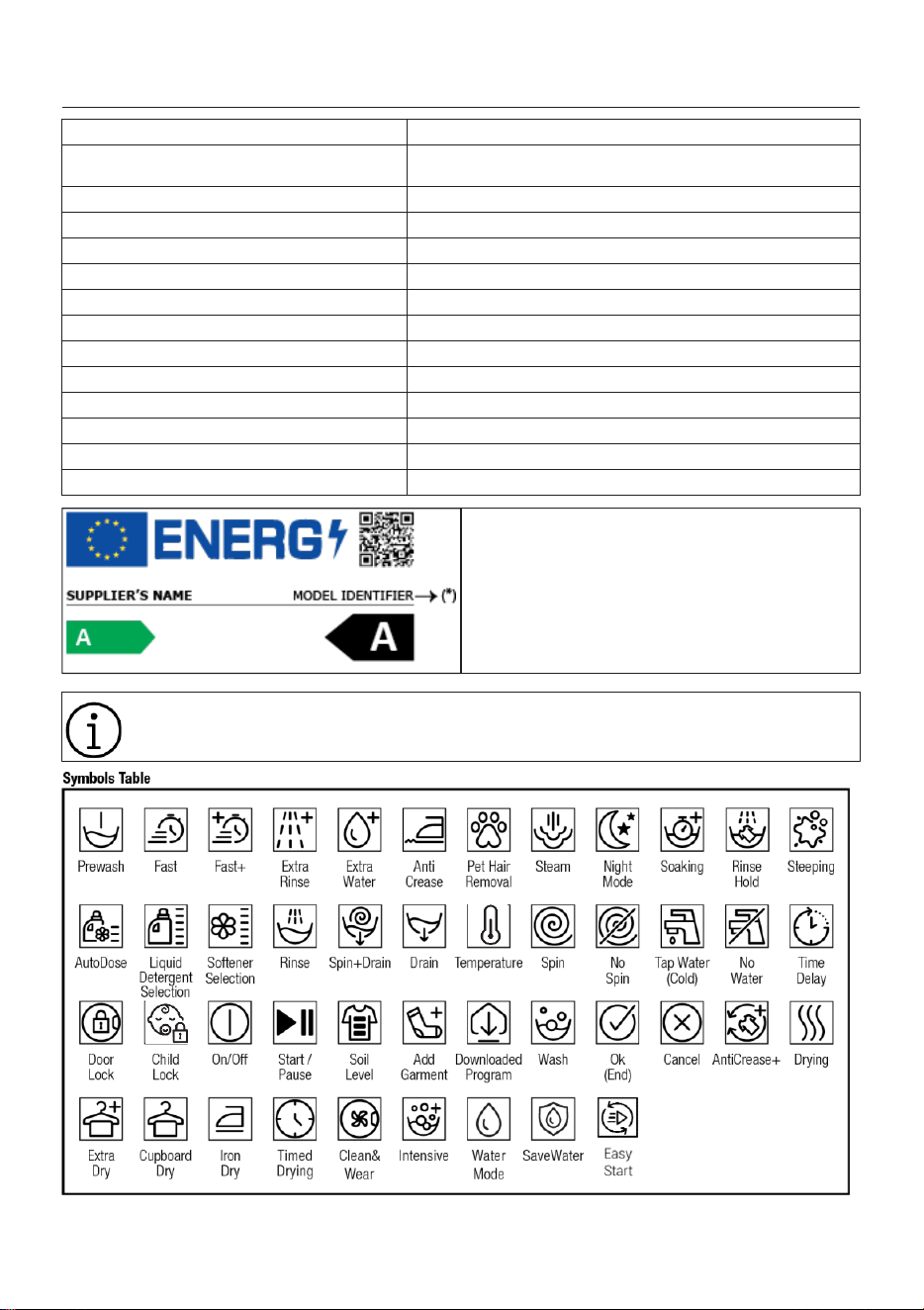
The model information as stored in the product database
can be reached by entering following website and
searching for your model identifier (*) found on energy
label.
https://eprel.ec.europa.eu/
The consumption values apply when wireless network connection is turned off.
3 Technical Specifications
Manufacturer’s name or commercial brand Beko
Model name
BMM5DFO5741WPB, BMM5DFO5741W, BMM5DFO5741W,
BMM5DFO5741WPB, BMM5DFO5741W,BMDSC7545B,WTS210
Rated washing capacity (cotton) (kg)
7
Rated drying capacity (cotton) (kg)
5
Maximum spin speed (cycle/min) 1400
Built-In No
Height (cm)
84,7
Width (cm) 60
Depth (cm) 52
Single Water inlet / Double Water inlet
+ / -
Rated voltage / Rated frequency in hertz (V/Hz)
230 V / 50Hz
Rated current (A) 10
Rated power (W) 2200
Main model code

EN / 15
Please read the “Safety
Instructions” section first!
4 Installation
• Please contact the nearest Authorised
Service for the installation of the
appliance.
• Make sure that the installation and
electrical connections of the product are
per- formed by authorised service agent.
Manufacturer shall not be held
responsible for damages caused by
operations per- formed by unauthorised
persons.
• Preparation of the location and electrical,
tap water and waste
water installations
at the place of installation is under
customer's responsibility.
• Make sure that the water inlet and dis-
charge hoses as well as the power cable
are not folded, pinched or crushed while
pushing the product into its place after
installation or cleaning procedures.
• Prior to installation, visually check if the
product has any defects on it. Do not
have the product installed if it is dam-
aged. Damaged products cause
risks for
your safety.
4.1 Appropriate Installation Location
• Place the product on a hard and level
floor. Do not place it onto a carpet with
high pile or other similar surfaces.
Placing on an improper floor shall
cause noise and vibration problems.
• Do not place the product on the power
cable.
• Do not install the product at places where
temperature may fall below 0 ºC.
Freezing might damage your product.
• Leave a minimum space of 1 cm
between the prod
uct and the furniture.
• If you will install the product on a surface
with steps, never place it close to the
edge.
• Do not place the product on any platform.
• There shall not be any locked, sliding or
hinged doors that may prevent the
loading door from opening completely
in the installation location of this
product.
• Do not place heat sources such as
cooker, irons, ovens, heater etc. on the
appliance and do not use them on the
p
roduct.
EN / 16
WARNING
The water pressure required for the
operation of the product is between
1-10 bars (0.1-1 MPa). To ensure a
smooth operation of the machine,
10 - 80 liters of water shall be sup-
plied in a minute from a fully
opened tap. If the water pressure is
higher, install a pressure reducing
valve.
WARNING
Models with a single water inlet
shall not be connected to the hot
water tap. In such a case the
laundry will get damaged, or the
product will switch to protection
mode and will not operate.
Do not use old or used water inlet
hoses on a new product. It may
cause water leakage from your ma-
chine and stain your laundry.
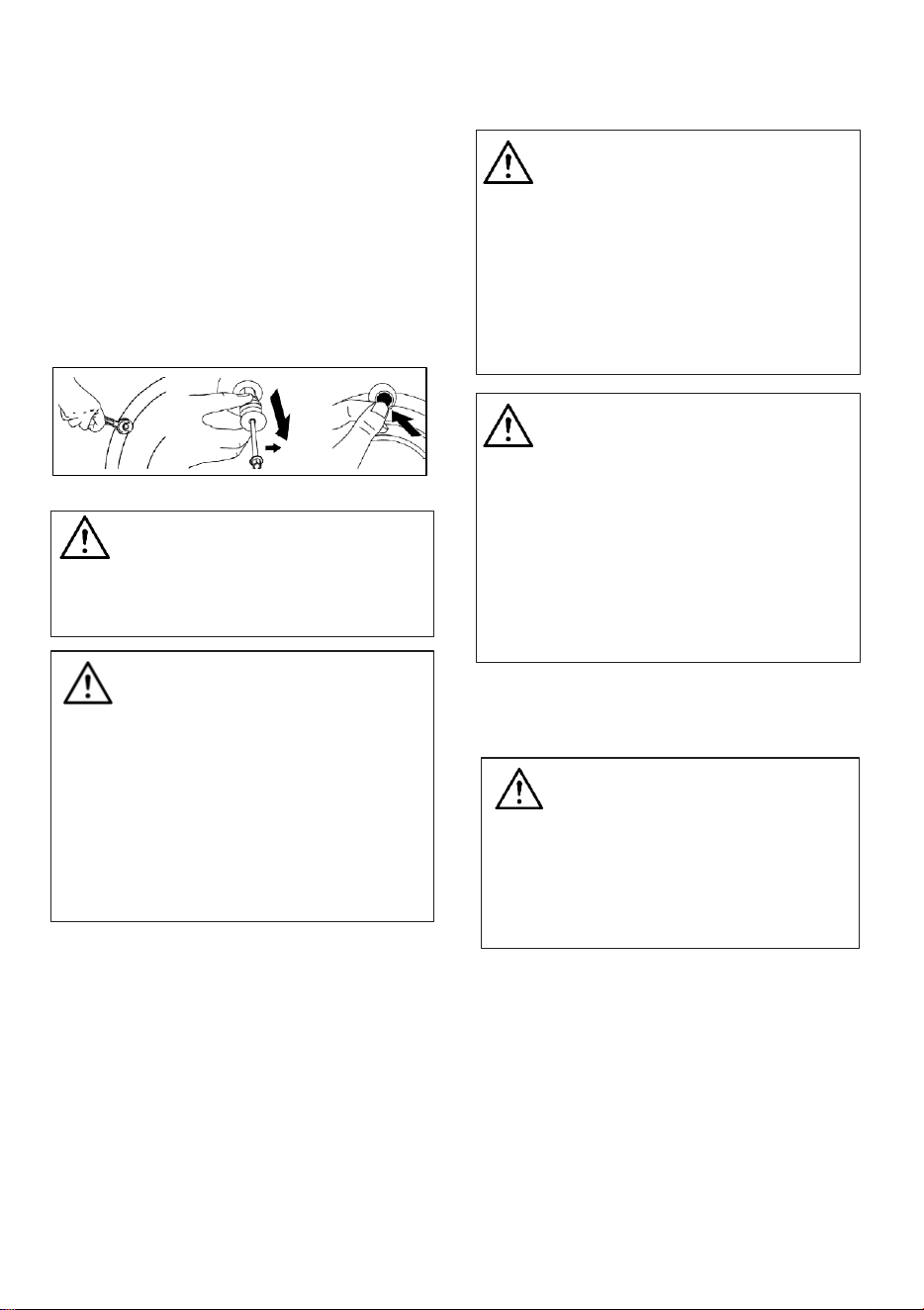
4.2 Removing Transportation Safety
Bolts
1. Loosen all transportation safety bolts
with an
appropriate wrench until they
turn freely.
2. Bend the inner part by pressing it at the
grip areas and pull the part out.
3. Attach the plastic covers supplied in the
User Manual bag into the holes on the
rear panel.
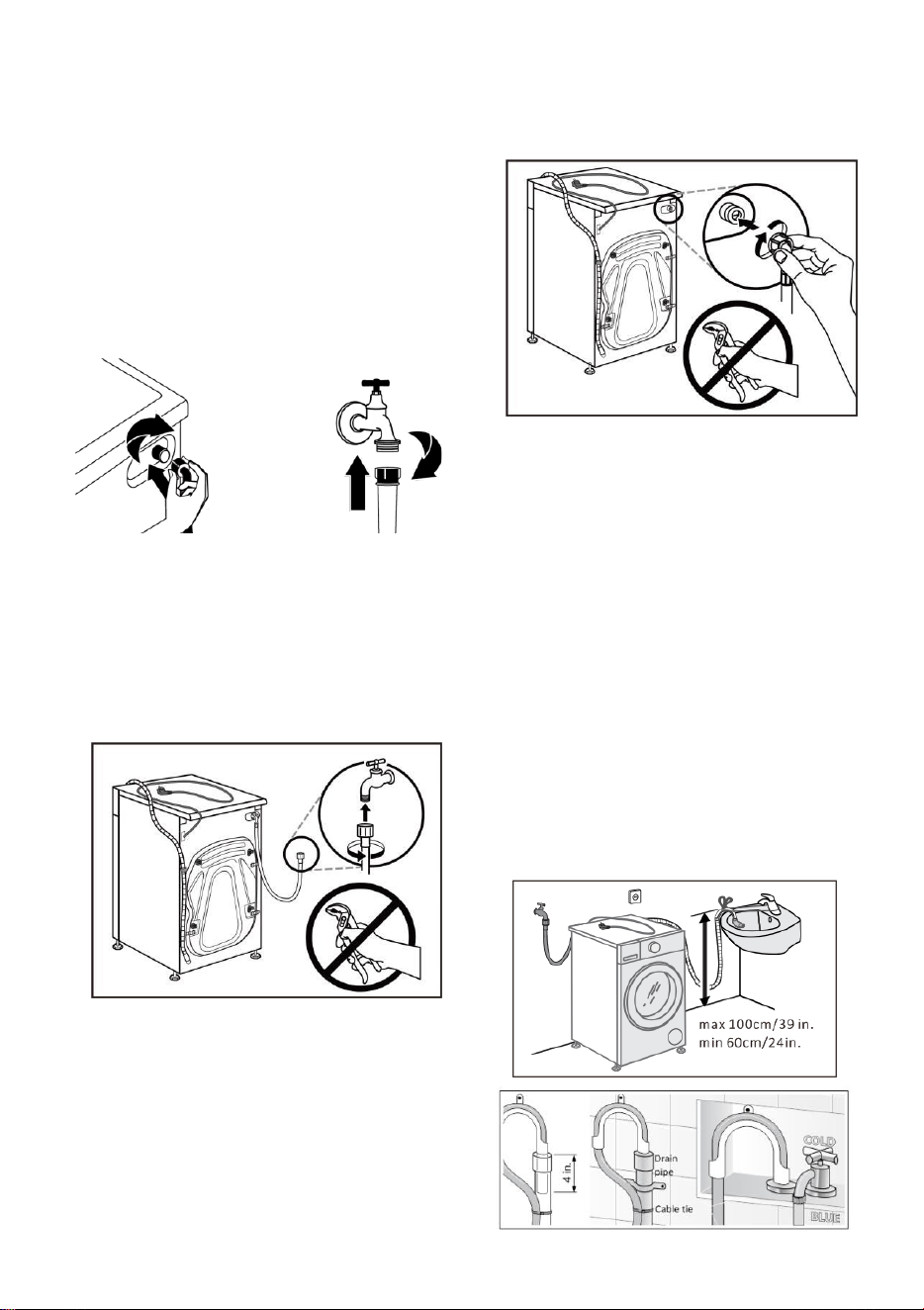
4.3 Connecting to Water Supply
1. Connect the special hose supplied with
the product to the water inlet on the
product.
WARNING
Keep the transportation safety
bolts in a safe place to reuse when
the product needs to be moved
again in the future.
Install the transportation safety
bolts in reverse order of the
disassembly procedure.
Never move the product without the
transportation safety bolts properly
fixed in place.
WARNING
Remove the transportation safety
bolts before operating the product.
Otherwise, the product will get
damaged.
WARNING
Make sure that the cold-water
connection is performed correctly
during the installation of the
product. Otherwise, your laundry
may come out as hot at the end of
the washing cycle and thus they
may be worn.
EN / 17
2. Tighten all hose nuts by hand. Never use
a tool when tightening the nuts.
3. Open the taps completely after making
the hose connection to check for water
leaks at the connection points. If any
leak occurs, turn off the tap and remove
the nut. Check the gasket and tighten
the nut carefully again. In order to pre-
vent the water leaks and resultant dam-
ages, keep the taps closed when you do
not use the product.
4.4 Connecting the Drain Hose to the
Dr
ain
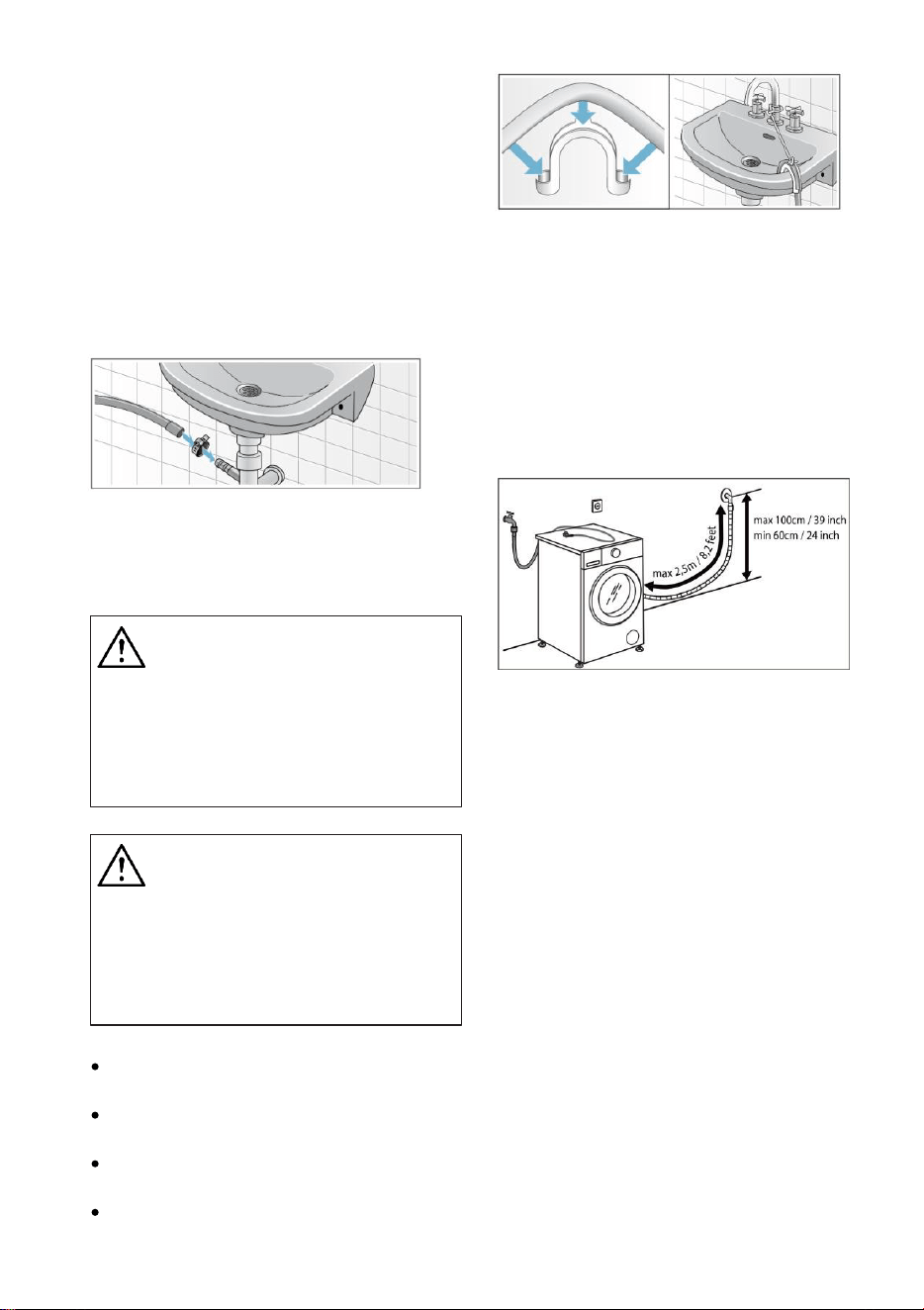
1. Connect one end of the water inlet hose
to a cold water tap and tighten by hand
(see figure). Before performing the
connection, allow the water to run freely
until it is perfectly clear.
2. Connect the other end of the water inlet
hose to the water inlet valve on the rear of
the appliance and tighten by hand.
3. Turn on the tap slowly and make sure
there are no leaks.
Do not twist, squash, modify or cut the
hose.
Tighten the end of the hose firmly
by hand.
The supply water pressure must be in
0.03-1 MPa range. If the water pressure
exceeds this value, please fit a pressure
reducing valve.
If the hose is not long enough, contact
a specialized shop or an authorized
technician.
Never use a second-hand water inlet
hose. Use the new water inlet hose
supplied with the appliance.
4. Height difference between the floor
and drainage point should be minimum
60cm (
24 in.) and maximum 100 cm
(39 in.)
EN / 18
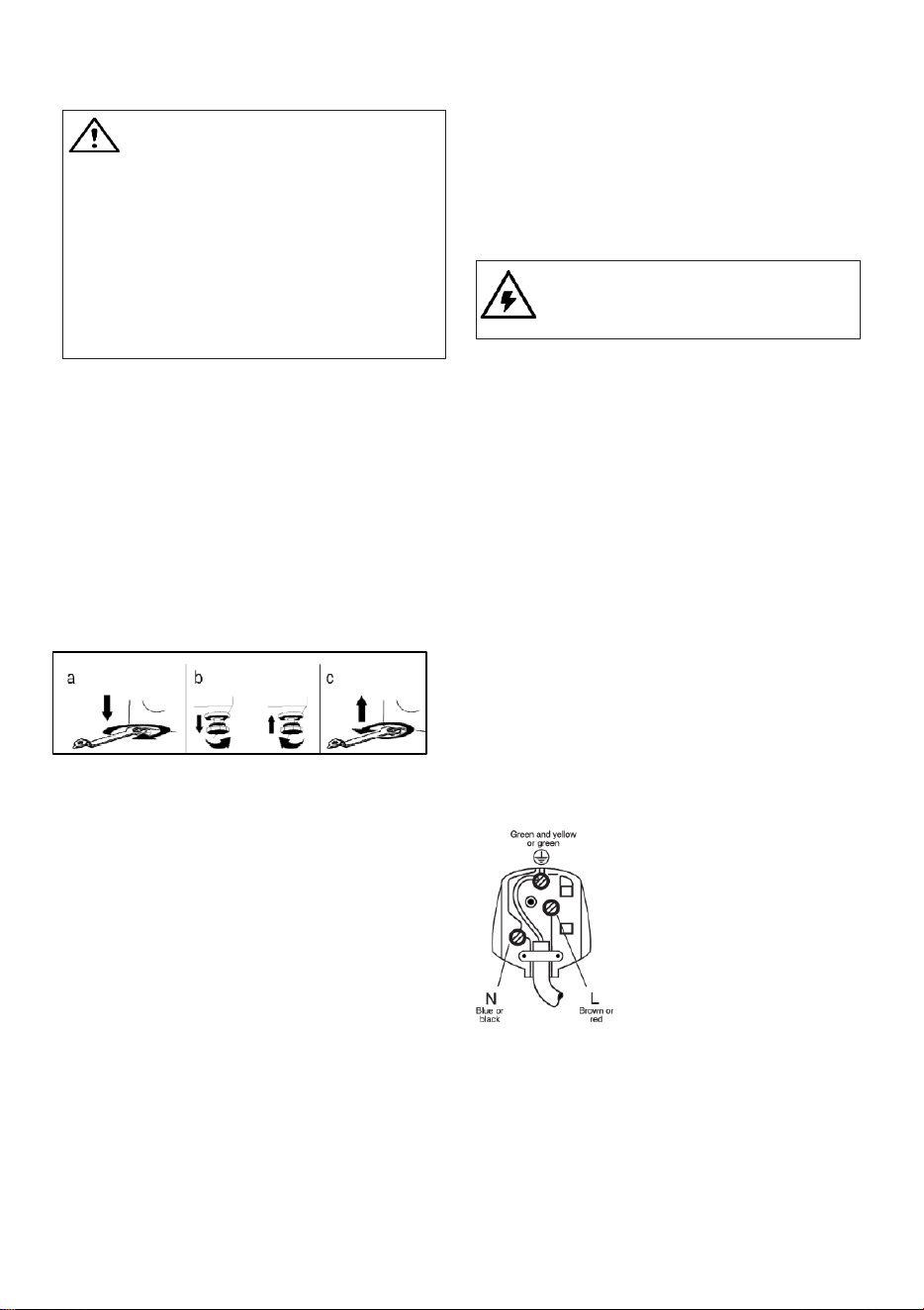
5. Attach the drain hose to the elbow
(not provided with the appliance).
Position the elbow on the drain hose 4
in (100mm) from the end of the hose
into the drainpipe, if the hose is
pushed down too far, this may cause
the washer to self-syphon i.e.
Continuously empty as it is filling.
Secure the elbow and hose with a
cable tie to keep the hose from
coming out of the drainpipe during
use.
Secure the drain hose to the sink
syphon using
a 0.9-1.6 in (20-44mm)
hose clip (available from a hardware
store).
6. Make sure that;
There is no stopper in the sink
drain.
The end of the drain hose does
touch the discharge water.
The sink drain is free flowing and
not partially clogged.
Attach the drain hose securely to
the wash basin.
7. Do not twist, pull out or bend the drain
hose. Secure the drain hose with the
cable tie to the drainpipe, wash basin,
etc. So, the hose does not pull out from
the force of the water. It is advised
against the use of drain hose
extensions; in case of absolute need,
the extension must have the same
diameter as the original hose and must
not exceed 250cm in length.
WARNING
When washing at high
temperatures, there is a risk of
scalding if you touch hot suds,
e.g. when pumping out hot suds
into a wash basin.
Do not reach into the hot suds.
WARNING
If the end of the drain hose
touches the discharged water
(water drained from washer), it
(the discharged water) can be
sucked back into the washer and
may damage the appliance or
textiles.
EN / 19
4.5 Adjusting the Stands
•
a 10-amp supply.
• The voltage specified in the "Technical
specifications" section must be equal to
your mains voltage.
• Do not make connections via extension
cables or multi-plugs. Overheating and
burning may occur due to the connecting
cable.
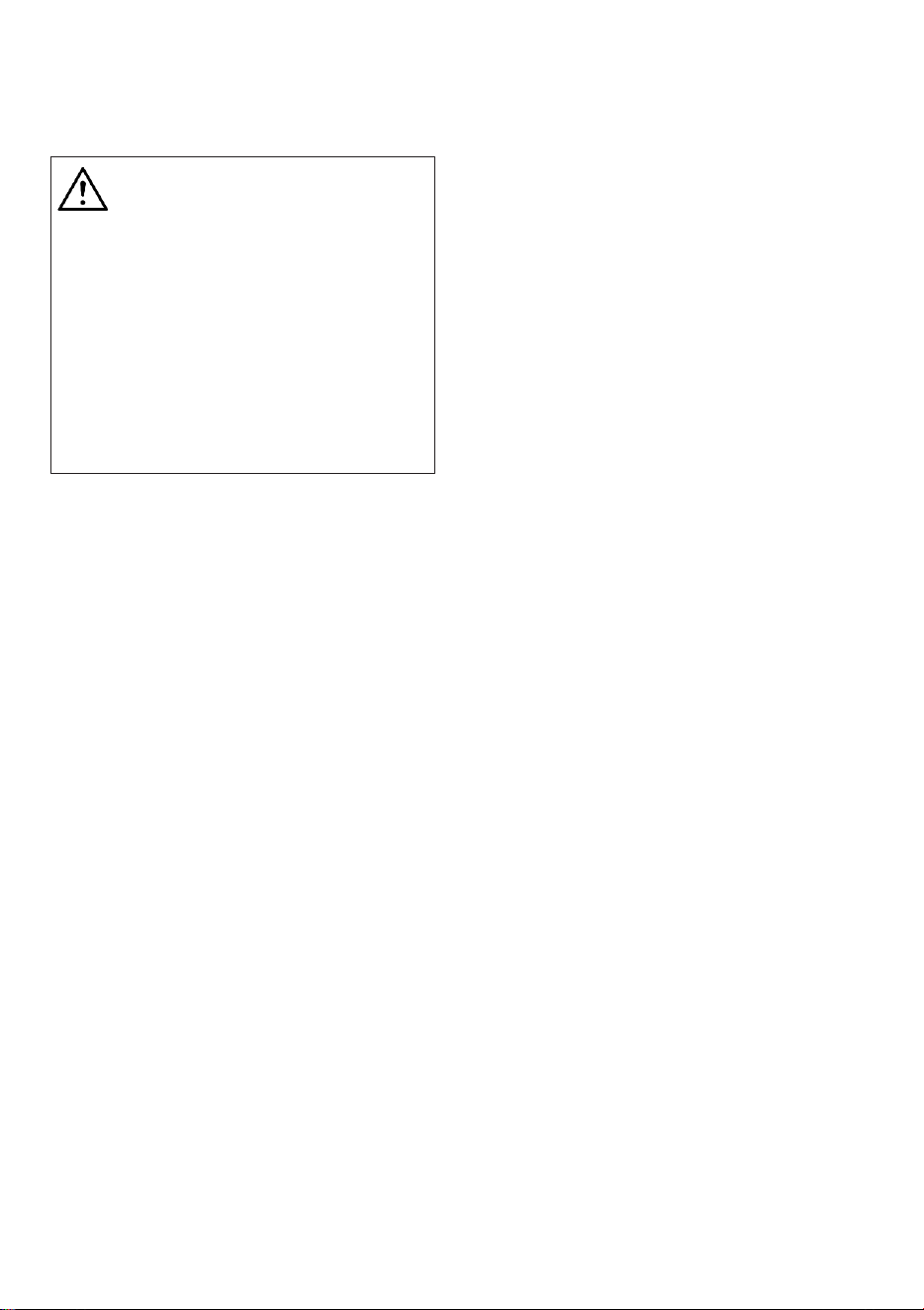
1. Loosen the nuts on the feet in the
direction of the arrow with the tool
in the user manual bag.
2. Adjust the feet until the product stands
level and balanced. You can move
the
feet up by turning them
counterclockwise and down by turning
them clockwise.
3. Re-tighten all lock nuts with the tool in
the direction of the arrow. You can move
the nuts down by turning them
clockwise.
4.6 Electrical Connection
Connect the product to a grounded outlet
protected by a 10 A fuse. Our company
shall not be responsible for the damages
that shall be incurred due to using the
product without grounding according
to
local regulations.
• Connection must comply with national
regulations.
• The electrical connection cable infra-
structure of the product must be ad-
equate and suitable for product
requirements. It is recommended to
use a Ground Fault Circuit Breaker
(GFCI).
• Power cable plug must be within easy
reach after installation.
• If the current supply to the fuse or
breaker in the house is less than 10
Amps, have a qualified electrician instal
l
Important
Fitting a different plug:
As the colours of the wires in the mains
lead of this appliance may not correspond
with the coloured markings identifying the
terminals on your plug, proceed as follows:
1. Connect the green - yellow or green
(earth) wire to the terminal in the plug
marked ‘E’ or with the symbol f or
coloured green and yellow or green.
2. Connect the blue (neutral) wire to the
terminal in the plug marked ‘N’ or
coloured
black.
3. Connect the brown (live) wire to the
terminal in the plug marked ‘L’ or
coloured red.
With the alternative plugs a 10 A fuse must
be fitted either in the plug or adaptor or in
the main fuse box. If in doubt, contact a
qualified electrician.
4.7 Handling the Product
1. Unplug the product before handling it.
2. Disconnect the water outlet and water
main connections. 3 Drain all the water
that remains in the product. See
Dr
aining Remaining Water and
Cleaning the Pump Filter.
Damaged power cables should be
replaced by the authorized service
in order to prevent possible danger.
WARNING
In order to ensure that the product
operates more silently and
vibration-free, it must stand level
and balanced on its feet. Ensure
that the product is balanced by
adjusting the feet. Otherwise, the
product may move from its place
and cause crushing, noise and
vibration problems.
EN / 20
3. Install the shipping bolts in reverse or-
der of the disassembly procedure. See
Removing the Shipping Bolts
Never carry the product without the
shipping bolts properly attached!
Your product is so heavy that it
shall not be carried by one person.
Your product shall be carried by
two people and more care shall be
taken on the stairs as it is a heavy
product. If the product falls on you,
it may cause injury.
The packaging materials are
dangerous for children. Keep
packaging materials at a safe
place away from the reach of
children.

EN / 21
5 Preliminary Preparation
5.1 Sorting the Laundry
• Sort laundry according to type of fabric,
colour, and degree of soiling and allow-
able water temperature.
• Always observe the instructions given on
the garment care labels.
5.2 Preparing Laundry for Washing
• Laundry items with metal attachments
such as, underwiring, belt buckles or
metal buttons will damage the product.
Remove the metal pieces or wash such
clothes by putting them in a laundry bag
or p
illowcase.
• Take out all substances in the pockets
such as coins, pens and paper clips, and
turn pockets inside out and brush. Such
objects may damage the product or
cause noise problem.
• Put small size clothes such as infant’s
socks and nylon stockings in a laundry
bag or pillowcase.
• Place curtains in without compressing
them. Remove curtain attachment items.
Curtain attachment items may cause
pulling and tearing on the curtain.
• Fasten zippers, sew loose b
uttons and
mend rips and tears.
• Wash “Machine washable” or “Hand
washable” labelled products only with
an appropriate programme. Dry these
types of clothes by hanging them or
laying them flat. Do not dry them in the
ma- chine.
• Do not wash colours and whites
together. New, dark coloured cottons
release a lot of dye. Wash them
separately.
• Only use paints / colour changing
agents and descalers suitable for use
in ma- chines. Always observe the
in
structions on the packaging
• Tough stains must be treated
properly before washing. If you are
not sure, check with a dry cleaner.
• Wash trousers and delicate laundry
turned inside out.
• Laundry that are subjected to materials
such as flour, lime dust, milk powder, etc.
intensely must be shaken off before
placing into the product. Such dusts and
powders on the laundry may build up on
the inner parts of the product in time and
can cause damage.
•
Before washing laundry made of angora
wool, keep them in the freezer section of
the refrigerator for few hours. This will
reduce pilling.
5.3 Tips for Energy and Water Saving
Following information will help you use the
product in an ecological and energy/water-
efficient manner.
• Observe the temperature instructions on
the detergent packaging.
• Wash slightly soiled laundry at low
temperatures.
• Use faster programmes for small
quantities of lightly s
oiled laundry.
• Do not use prewash and high
temperatures for laundry that is not
heavily soiled or stained.
• If you plan to dry your laundry in a dryer,
select the highest spin speed
recommended during washing process.
• Do not use more detergent than the re-
commended on the detergent packaging.
5.4 Start Up
Before starting to use the product make sure
that the preparations described in section
“Environmental Instructions” and
“Installation”. To
prepare the product for
washing laundry, perform first operation in
Drum Cleaning programme. If this
programme is not available in your product,
apply the method which is described in
section "Cleaning the loading door and the
drum".
Please read the “Safety
Instructions” section first
EN / 22
When the appliance is overloaded
product’s washing performance will
drop. Moreover, noise and vibration
problems may occur.
For a successful drying
performance, do not put more
laundry in the machine than
specified.
5.5 Loading the Laundry
1. Open the loading door.
2. Put the laundry items into the product
in a loose manner.
3. Push the loading door to close until
you hear a locking sound. Ensure that
no items are caught in the door. The
loading door is locked while a
programme is running. The door lock
will open a few minutes after the
washing programme has ended. Then
you can open the loading door. If the
door does not open, ap- ply the
solutions provid
ed for “Loading door
cannot be opened” error in the
Troubleshooting section.
5.6 Correct Load Capacity
The maximum load capacity depends
on the type of laundry, the degree of
soiling and the desired washing
programme.
The product automatically adjusts the
water amount according to the weight of
the laundry put inside it.
Bathrobe: 4000g
Bedding: 3000g
Sheet: 3000g
Pillowcase:3000g
Tablecloth:3000g
Blouse: 7000g
Towel: 4000g
5.7 Using Detergent and Softener
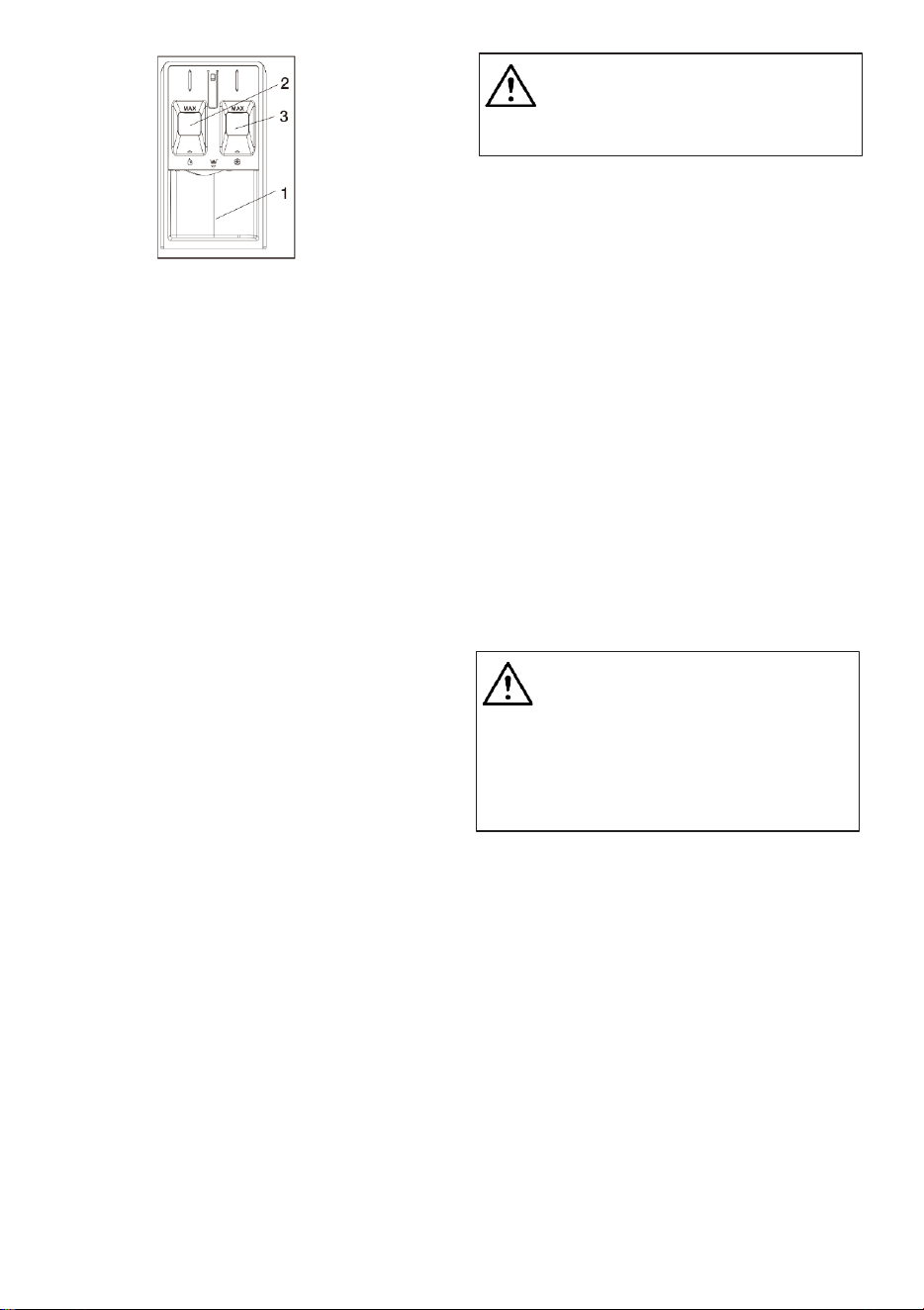
The detergent drawer comprises of three
compartments:
(1) Powder washing detergent
(2) Liquid washing detergent
(3) Additives (softener etc.)
The fabric softener must not exceed the
“MAX” level.
Use an anti-limescale product suit-
able for the washing machines
Some water has remained in the
product due to the quality control
processes in the production. It is
not harmful for the product.
WARNING
If the laundry is placed incorrectly,
noise and vibration problems may
occur in the machine.
WARNING
Read the manufacturer instructions
on the package while using deter-
gents, softeners, starch and bleach,
anti-limescale and follow the
dosage information provided. Use
a
measuring cup, if any.
The loading door is locked while a
programme is running. The door
lock will open once the programme
is completed. If the inner part of the
machine is very hot at the end of
the program, the loading door will
not open until the temperature
drops. If the door does not open,
apply the solutions provided for
“Loading Door Cannot Be Opened”
error in the Troubleshooting
section.
EN / 23
WARNING
Do not use liquid detergents or
other materials with cleaning
properties unless they are
intended for use in washing
machines for softening the
laundry.
Only detergents, softeners and
additives suitable for washing ma-
chines should be used.
Do not use soap powder.
Detergent, Softener and Other
Cleaning Agents
• Add detergent and softener before
starting the washing programme.
• Do not leave the detergent drawer
open when the washing programme is
on.
• If you are using a liquid detergent,
follow the directions under “Liquid
detergent use” and do not forget to
bring the liquid detergent apparatus to
the correct position.
• Do not add washin
g chemicals
(Liquid detergent, Softener, etc.)
while the machine is during Drying
step.
Choosing the Detergent type
Detergent type to be used depends on the
washing programme, fabric type and
colour.
• Use different detergents for coloured
and white laundry.
• Wash your delicate clothes only with
special detergents (liquid detergent,
wool shampoo, etc.) intended solely for
delicate clothes and at suggested
programmes.
• When washing dark coloured clot
hes
and quilts, it is recommended to use
liquid detergent.
• Wash woollens at suggested
programme with special detergent
made specifically for woollens.
• Please review the “programme
descriptions” part for suggested
programme for different textiles.
• All recommendations about detergents
are valid for selectable temperature
range of programmes.
Adjusting the Detergent Amount
The amount of detergent depends on the
amount of laundry, how soiled they are and
the water
hardness.
• Do not exceed the recommended dosage
values on the detergent packaging in or-
der to eliminate excessive foam and poor
rinsing problems, to save money and
protect the environment.
• Use less amounts of detergent for fewer
or less soiled laundry.
Using Softeners
Put the softener in the softener compartment
of the detergent drawer.
• Do not exceed the (>max<) level sign in
the softener compartment.
• If the softener is not fluid, dilut
e with
water before placing in the softener
compartment.

EN / 24
Use of Gel and Tablet Detergents
• If the detergent is fluid and there is no li-
quid detergent compartment in your
product, place the gel detergent in the
main washing detergent compartment
in first water intake. If your product has
a li- quid detergent compartment, fill the
compartment with detergent before
starting the programme.
• If the gel detergent is not fluid or is in a
capsule liquid tablet, place directly
inside the drum before washing.
• Put the tablet detergent in the main
washing compartment (compartment
no. “2”) or directly inside the drum
before washing.
• Tablet detergents may leave residue in
the detergent compartment. If you face
such residues, place the tablet
detergent among the laundry in the
next washes in a way that it will be at
the bottom side of the drum.
• Use tablet or gel detergent without
selecting the pre-wash function.
• Do not forget to remove elements
such as
plastic detergent
compartment from the drum before
drying.
Using Starch
• Put in the liquid starch, powder starch
or fabric dye in the softener
compartment.
• Do not use softener and starch in
the same washing programme
simultaneously.
• Wipe the inside of the product with a
damp and clean cloth after using starch.
Using Anti-Limescale
• When necessary, only use anti-limescale
produced for washing machines.
Using Bleach and Decolourants
• Select a program
me with pre-washing and
add bleach at the start of pre-washing. Do
not put detergent in the pre-wash
compartment. As an alternative
application, select a programme with
additional rinsing and add the bleach
while the product is receiving water to the
deter- gent compartment in the first
rinsing step.
• Do not mix and use bleach and detergent
together.
• As bleach may cause skin irritation use
only small amounts (1/2 teacups - ap-
proximately 5
0 ml and rinse the laundry
well.
• Do not pour bleach directly onto the
laundry.
• Do not use bleach for coloured clothes.
• Select a programme with low temperature
washing while using oxygen-based
decolourants.
• Oxygen-based decolourants can be used
together with detergents. However, if it
does not have the same viscosity as the
detergent, first place the detergent in
compartment no. “2” in the detergent
drawer and wait for the product to rinse
away t
he detergent during water intake.
Add the decolourant to the same
compartment while the machine
continues taking in water.
EN / 25
5.8 Tips for Efficient Washing
Clothes
Light Colours and
Whites
Colours Black/Dark Colours
Delicates/
Woollens/Silks
(Recommended
temperature range
based on soil level:
40-90 °C)
(Recommended
temperature range
based on soil level:
cool -40 °C)
(Recommended
temperature range
based on soil level:
cool -40 °C)
(Recommended
temperature range
based on soil level:
cool -30°C)
Soiling Level
Heavily
Soiled
(difficult
stains
such as
grass,
coffee,
fruits and
blood.)
It may be necessary
to pre-treat the stains
or per- form prewash.
Powder and liquid
deter- gents
recommended for
whites can be used at
dosages
recommended for
heavily soiled clothes.
It is recommended to
use powder
detergents to clean
clay and soil stains
and the stains that are
sensitive to bleaches.
Powder and liquid
deter- gents
recommended for
colours can be used
at dosages
recommended for
heavily soiled clothes.
It is recommended to
use powder
detergents to clean
clay and soil stains
and the stains that are
sensitive to bleaches.
Detergents which do
not contain de-
colourant should be
used.
Liquid detergents
suitable for colours
and black/dark col-
ours can be used at
doses recommended
for heavily soiled
clothes.
Prefer liquid deter-
gents produced for
delicate clothes.
Woollen and silk
clothes must be
washed with special
woollen detergents.
Normally
Soiled
(For
example,
stains
caused by
body on
collars
and
cuffs)
Powder and liquid
deter- gents
recommended for
whites can be used at
dosages
recommended for
normally soiled
clothes.
Powder and liquid
deter- gents
recommended for
colours can be used
at dosages
recommended for
normally soiled
clothes. Detergents
which do not contain
de-colourant should
be used.
Liquid detergents
suitable for colours
and black/dark col-
ours can be used at
doses recommended
for moderately soiled
clothes.
Prefer liquid deter-
gents produced for
delicate clothes.
Woollen and silk
clothes must be
washed with special
woollen detergents.
Lightly
Soiled
(No
visible
stains
exist.)
Powder and liquid
deter- gents
recommended for
whites can be used at
dosages
recommended for
lightly soiled clothes.
Powder and liquid
deter- gents
recommended for
colours can be used
at dosages
recommended for
lightly soiled clothes.
Detergents which do
not contain de-
colourant should be
used.
Liquid detergents
suitable for colours
and black/dark col-
ours can be used at
doses recommended
for lightly soiled
clothes.
Prefer liquid deter-
gents produced for
delicate clothes.
Woollen and silk
clothes must be
washed with special
woollen detergents.
EN / 26
5.9 Tips for Efficient Drying
Programmes
Cotton Dry Synthetic Dry Babyprotect+
Washing and
Drying
Wash & Wear
gnihtolC fo sepyT
Durable
Clothes
Containing
Cotton
Sheets, bed-
dings, baby
clothes, t-
shirts, sweat-
shirts, durable
knitted clothes,
jeans, canvas
pants, shirts,
cotton socks
etc.
Not
Recommended!
It washes and
dries
consecutively!
Sheets,
beddings, baby
clothes, t-shirts,
sweat- shirts,
durable knitted
clothes, jeans,
canvas pants,
shirts, cotton
socks etc.
It washes and
dries
consecutively!
Sheets,
beddings, baby
clothes, t-shirts,
sweat- shirts,
durable knitted
clothes, jeans,
canvas pants,
shirts, cotton
socks etc.
Clothes such as
shirts, t- shirts,
sweat- shirts
etc. that have
been worn for a
short time and
are unstained A
very small
amount of
laundry should
be loaded.
Synthetic
Clothes
(Polyester,
nylon etc.)
Not
Recommended!
It is
recommended
for clothes
containing
polyester, nylon,
polyacetate,
acrylic. Drying
is not
recommended
for clothes
containing
viscose.
Attention
should be paid
to the drying
instructions on
the
maintenance
label.
It is
recommended
for clothes
containing
polyester, nylon,
polyacetate and
acrylic at low
temperatures,
taking into
account the
washing and
drying warnings
indicated on the
maintenance
label.
It is
recommended
for clothes
containing
polyester, nylon,
polyacetate and
acrylic at low
temperatures,
taking into
account the
washing and
drying warnings
indicated on the
maintenance
label.
Lightly soiled
and unstained
shirts, t-shirts
and synthetic
laundry. A very
small amount
of laundry
should be
loade
d.
Delicate
(Containing
Silk,
Woolen,
Cashmere,
Angora
wool etc.)
Laundry
Not
Recommended!
Not
Recommended!
Not
Recommended!
Not
Recommended!
Not
Recommended!
Bulky
laundry
such as
blankets,
coats,
curtains
etc.
Not
Recommended!
It is not suitable
to dry bulky
laundry in the
washing
machine. Dry
this laundry by
hanging them
or laying them
flat.
Not
Recommended!
It is not suitable
to dry bulky
laundry in the
washing
machine. Dry
this laundry by
hanging them
or laying them
flat.
Not
Recommended!
It is not suitable
to dry bulky
laundry in the
washing
machine. Dry
this laundry by
hanging them
or laying them
flat.
Not
Recommended!
It is not suitable
to dry bulky
laundry in the
washing
machine. Dry
this laundry by
hanging them
or laying them
flat.
Not
Recommended!
It is not suitable
to dry bulky
laundry in the
washing
machine. Dry
this laundry by
hanging them
or laying them
flat.

EN / 27
5.10 Displayed Programme Duration
You can view the programme duration on
the display of your machine while selecting
a programme. Depending on the amount of
laundry you have loaded into your machine,
foaming, unbalanced load conditions,
fluctuations in power supply, water
pressure and programme settings, the
programme duration is automatically
adjusted while the programme is running.
SPECIAL CASE: At programme start of Cot-
tons and Cotton Eco progr
ammes, display
shows the duration of half load. It is the
most common use case. After programme
starts, in 20-25 minutes actual load is
detected by the machine. And if the detected
load is higher than half load; washing pro-
gramme will be adjusted accordingly and
programme duration increased automatic-
ally. You can follow this change on the dis-
play.
EN / 28
Please read the “Safety
Instructions” section first!
6 Operating the Product
6.1 Control Panel
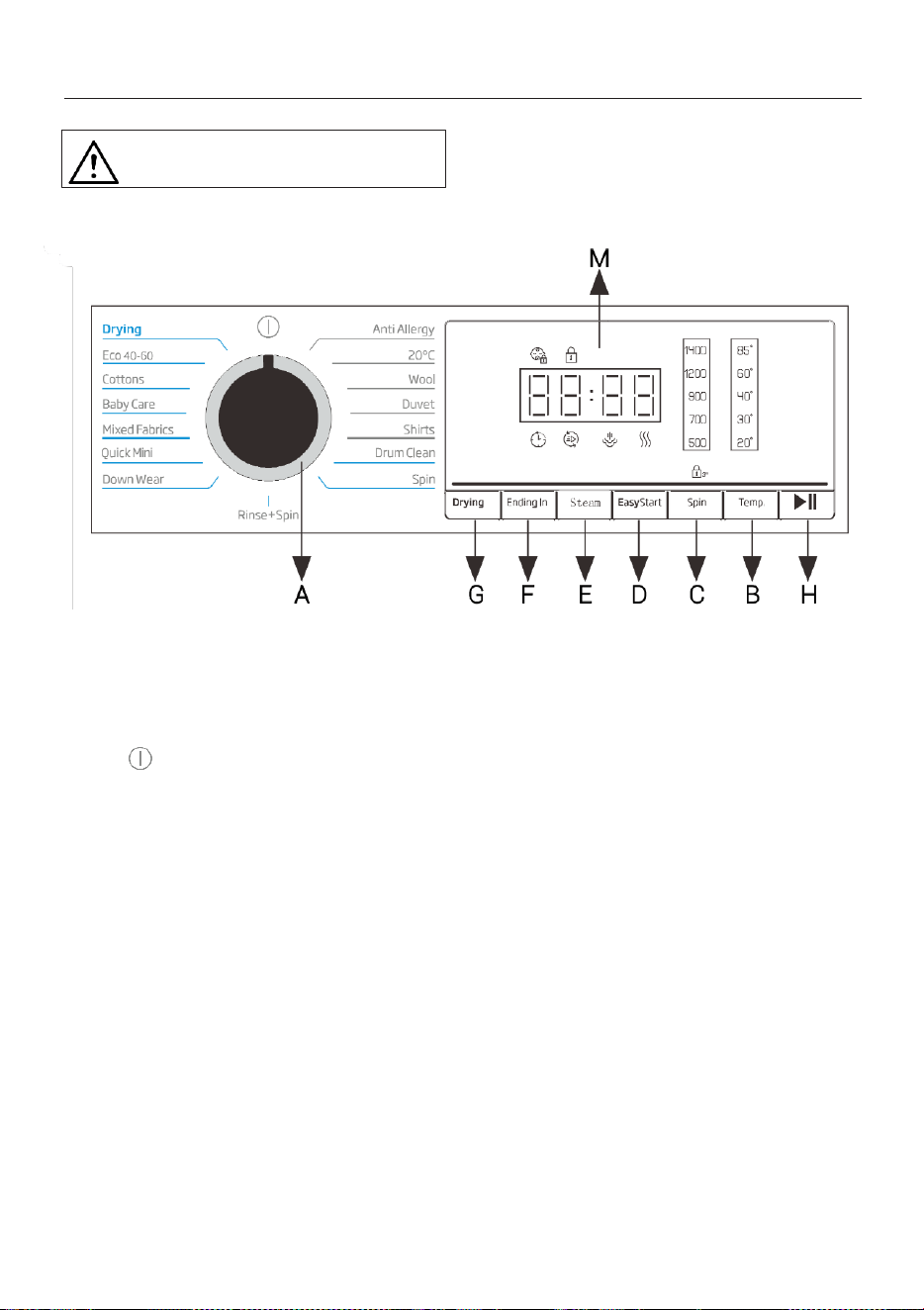
A- Wash Cycle Selector Knob: Used to
set the desired wash cycle.
OFF Position: Turn the Linear mark on the
wash cycle selector knob under the
symbol “ ” to turn off the machine. If the
machine is turned off during a wash cycle,
this wash cycle will be cancelled.
B- Temp Button: Press to change the
water temperature for the current
cycle.
There are five temperature values on the
display when a temperature value is
selected, the corresponding temperature
value indicator light will be lit on the
display.
C- Spin Button:
This cycle uses a spin
to shorten drying times for heavy
fabrics or special-care items washed
by hand.
D- EasyStart Button: Press to set the
EasyStart wash cycle. For a detailed
description, see various cycles and
functions.
E- Steam Button: Press to set the steam
wash cycle. For a detailed
description, see “various cycles and
functions”.
F- Ending In Button: Press to set the
program end (Delay end) time. For a
detailed description, see “various
cycles and functions”.
G- Drying Button: Press to set the drying
type or drying as needed. Drying type
or drying time appears on digital
display. Some programs do not have
a drying function.
For a detailed description, see “v
arious
cycles and functions”.
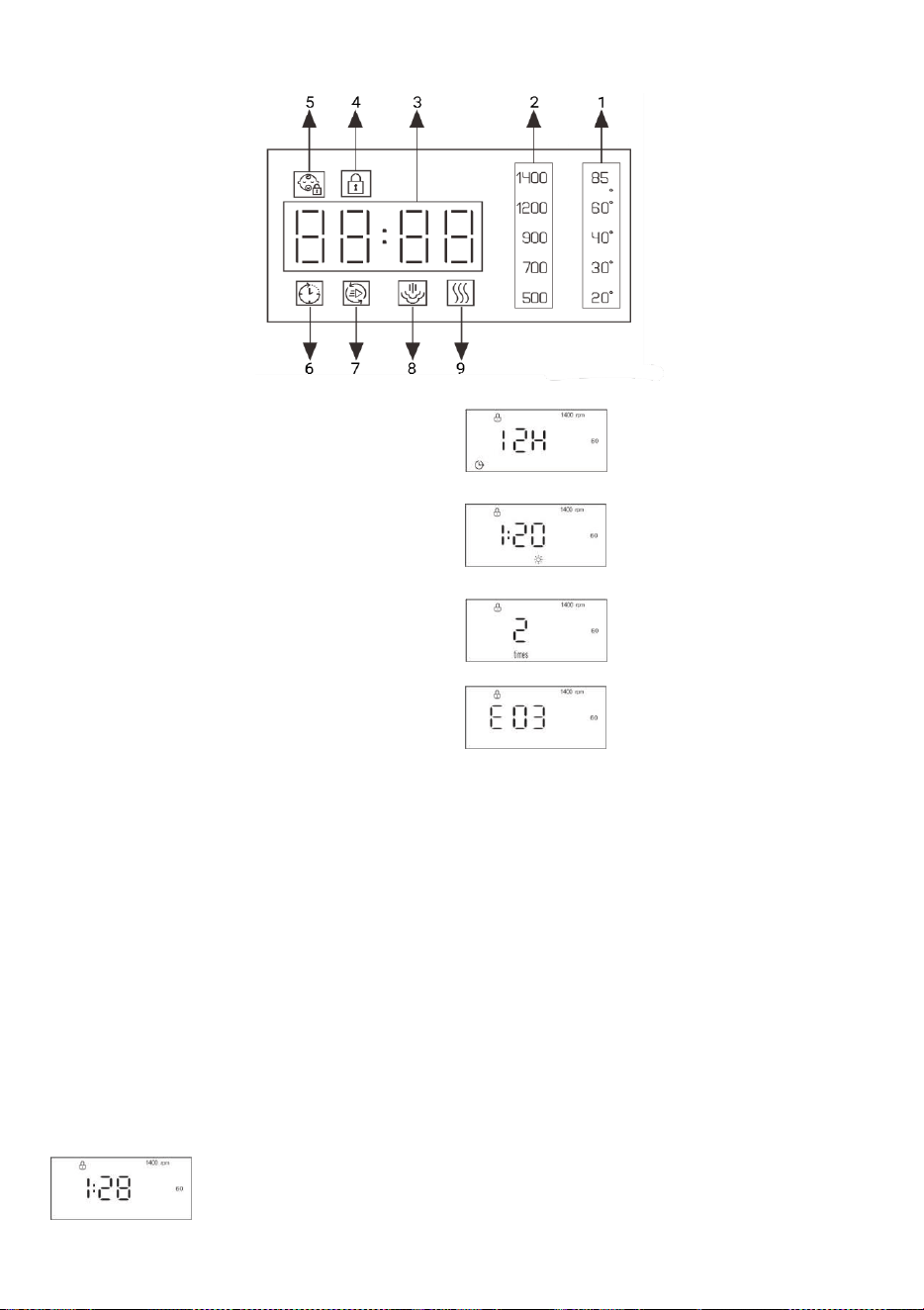
EN / 29
6.2 Symbols on the Display
1- Temperature Indicator
When a program is selected, the default
temperature value indicator light of this
program will be lit on the display.
You can change the temperature value by
pressing the TEMP. button. There are five
temperature value indicator lights on the
display. When a temperature value is
selected, the corresponding temperature
value indicator light will be lit on the display.
If all temperature value in
dicator lights are
off, it indicates the appliance is using only
cold water without utilizing the heater in this
program.
2- Spin Speed Indicator
When a program is selected, the default
spinning speed value indicator light for this
program will be lit on the display.
You can change the spinning speed value by
pressing the SPEED button. There are five
spinning speed value indicator lights on the
display. When a spinning speed value is
selected, the correspo
nding indicator light
will be lit on the display. If all spinning speed
indicator lights are off, it indicates that the
appliance does not spin after the final drain
process in this program.
3- Duration Indicator
When a program is selected, the default
spinning speed value.
Remaining time of the wash cycle:
Delay end time:
Drying time:
Rinse count:
Fault code
4- Door Lock Indicator
The lit indicator light indicates
that the door is
locked. To prevent any damage, wait until the
indicator light turns off before opening the
door. To open the door while a cycle is in
progress, press the START/PAUSE button. If
the DOOR LOCK indicator light is off, the door
may be opened.
5- Child Lock Indicator
The lit indicator light indicates that the CHILD
LOCK function is activated, and the control
panel is locked.
6- Delayed End Indicator
The lit indicator light indicates that
the DELAY
END function is activated. The countdown to
the end of the selected wash cycle will appear
on the digital display.
EN / 30
7- EasyStart Function Indicator
The lit indicator light indicates that the
EASYSTART wash program is selected.
8- Steam Indicator
When the indicator light is lit, it means that
the steam function has been set.
9- Drying Function Indicator
When the indicator light is lit, it means that
the drying function has been set or is
carrying out the drying cycle.
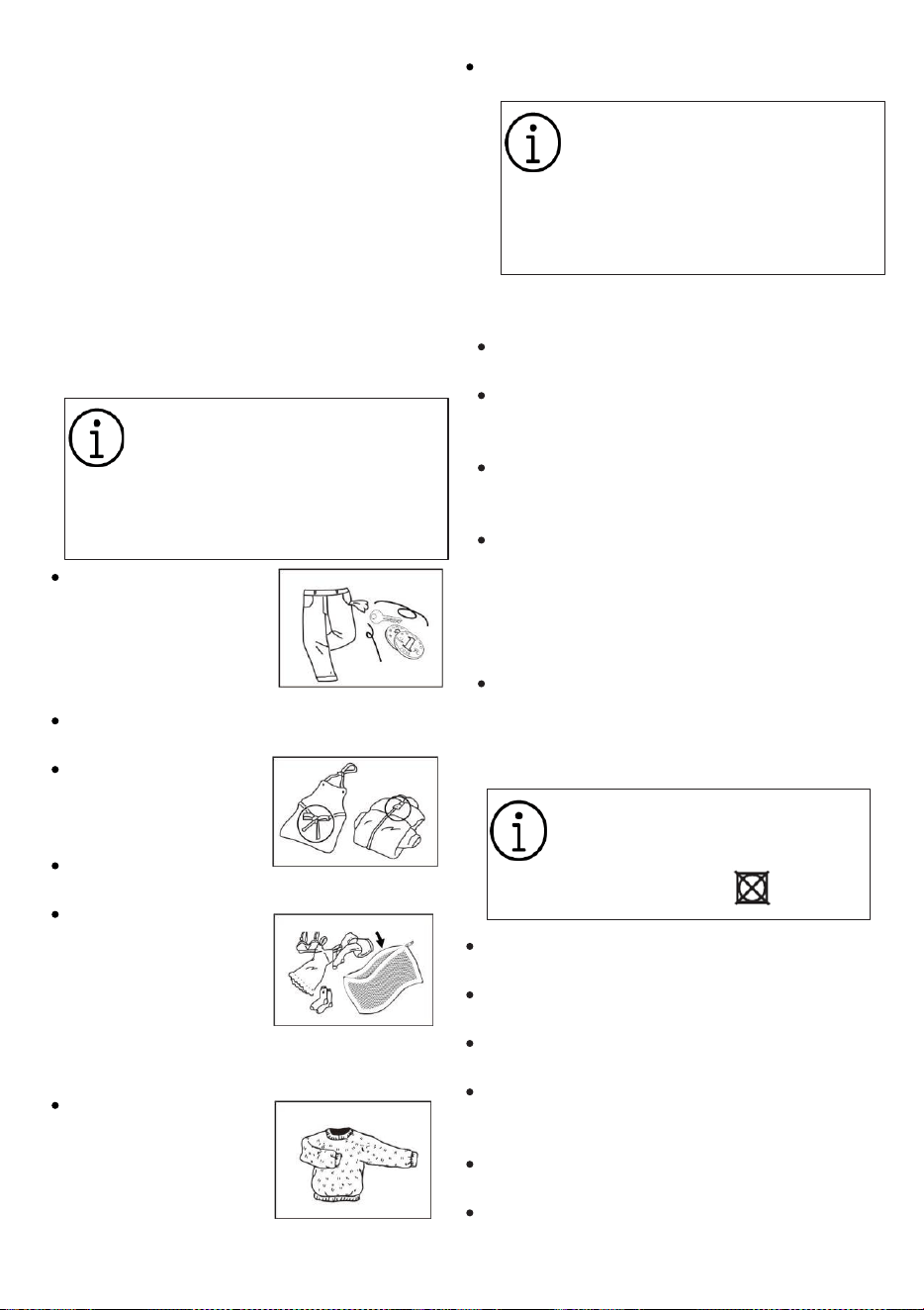
6.3 Preparing the Laundry
,
Remove any loose
items or metal
objects, such as
safety pins, paper
clips, etc. from the
laundry.
Brush sand, coins, etc. out of pocket and
cuffs.
Close zips and
button up cushion
covers, duvet
covers, etc.
Remove curtain
runners or secure them in a net bag.
Particularly
delicate items:
such as tights or
lace curtains, or
smaller items,
such as tiny socks
or handkerchiefs, should only be washed
in a net bag or pillowcase.
Some items are
best turned inside
out. These
included knitwear,
trousers, T-shirts
and sweatshirts.
Make sure that the wire-cup bras are
machine washable.
6.4 Preparing the Laundry for Drying
Only tumble-dry textiles that have been
washed, rinsed, and spun.
Remove as much water as possible
from the laundry. Do not press the
SPEED button to reduce the spin speed.
To ensure uniform drying, sort the items
according to fabric type and the degree
of drying required.
Items that require ironing do not need to
be ironed immediately after being
tumble-dried. It is a good idea to fold or
roll them together for a while, so that
any remaining moisture is evenly
distributed.
When washing laundry to be tumble-
dried, use the correct amount of
detergent and textile care products as
specified in the manufacturer's
instructions.
Woolens or items containing wool: Risk
of shrinking!
Delicate fabrics (silk, synthetic net
curtains): Risk of creasing!
Items containing foam rubber or similar
materials.
Items treated with flammable solvents,
such as stain removers, petrol, or paint
thinners: Explosion hazard!
Items still containing hair lacquer or
similar substances: Dangerous vapours!
Dripping-wet laundry: Waste of energy!
Damage to the appliance/fabric:
Foreign objects (e.g. coins, paper
clips, needles, nails) may damage
the laundry or components in the
appliance. Therefore, follow these
tips when preparing your laundry:
Make sure that wire-cup bras are
placed in a pillowcase that can be
securely closed with a zipper or
button. If the wire comes out of
the cup, it may fall through the
holes in the drum and cause
extensive damage.
The following textiles should not
be tumble-dried: laundry marked
with the care symbol:
"Do not tumble-dry."
EN / 31
Use the following main programmes de-
pending on the type of fabric.
After selecting the appropriate washing
program, by pressing the Drying button be-
fore starting the program, you can set your
machine to switch to the drying step
(automatically or scheduled) at the end of
the washing program, without any
pauses/interruptions. Each time you press
the button, the step in which the drying
process will take place is shown in the row
of information
and the related symbol
lights up. You can see when the
programme will finish on the display of the
machine, according to the drying selections
you will add to the washing programmes. If
you want, by keeping pressing the button
you can dry for the maximum time allowed.
You can take a glance at the programmes
for which you can select the drying function
in the Programme and Consumption tables.
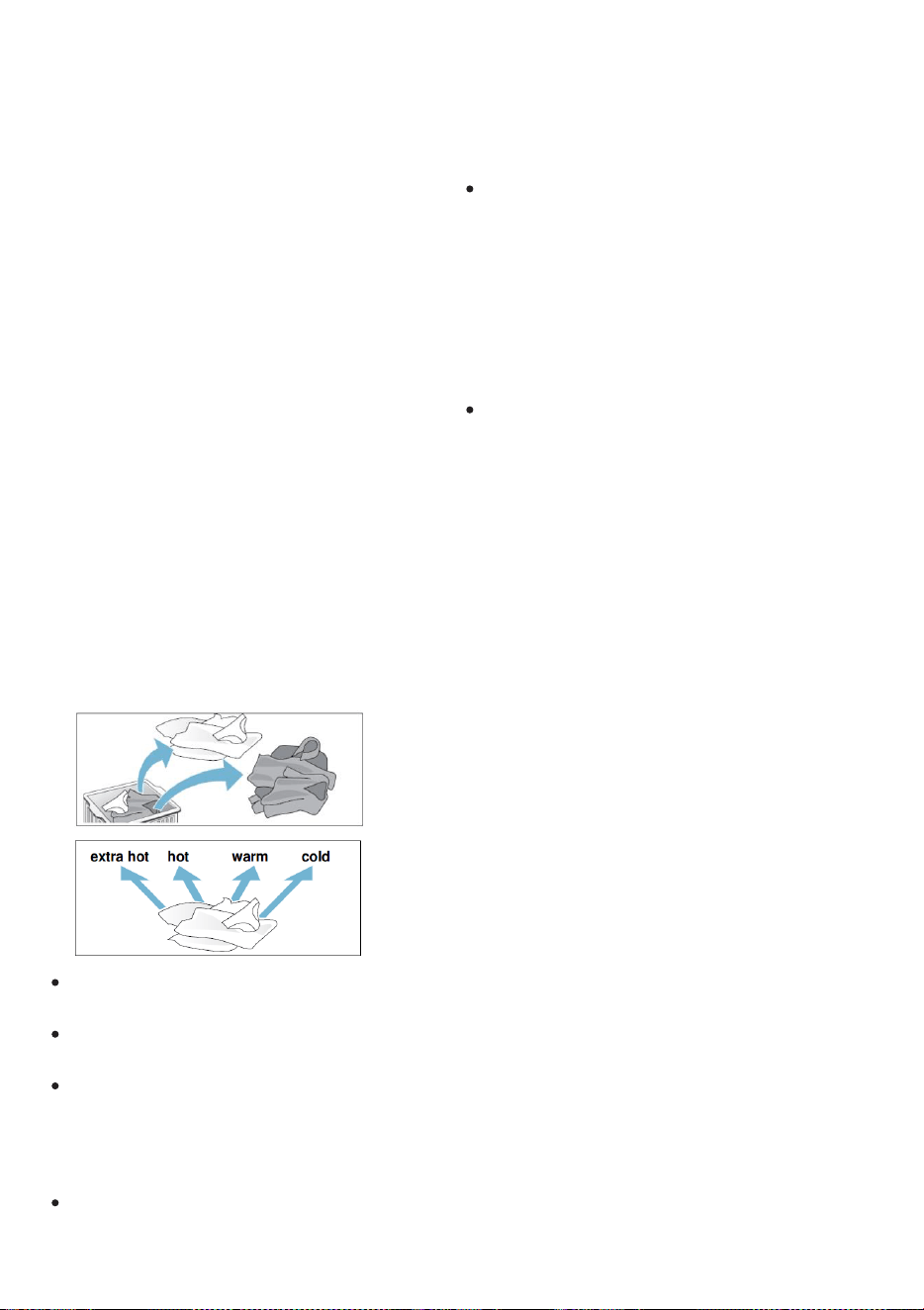
6.5 Sort the Laundry According to
Colour and Degree of So
iling
Sort laundry items according to colour,
degree of soiling, and recommended wash
temperature range.
Items of clothing can become
discoloured.
Never wash new multi-coloured items
together with other items.
Wash white items separately from
coloured items; otherwise, white items
may tend to become grey.
6.6 Degree of Soiling
Light soiling:
No visible soiling or stains but may have
absorbed some odour. This could include
lightweight summer clothes such as T-shirts,
shirts, or blouses worn only once. Also
suitable for freshening bed linen or guest
towels.
Normal soiling:
Visible soiling and/or a few light stains. This
could include clothing such as T-shirts,
shirts, or blouses that have been sweated in
or worn several times. Also includes tea
towels, hand towels, or bed linen used for up
to one week or more, and curtains without
stains that have not been washed for up to
half a year.
Heavy soiling:
Visible soiling and stains. This could include
kitchen towels, fabric napkins, baby bibs,
children's outer clothing, or football jerseys
and shirts stained with grass or dirt. It may
also include work clothes such as overalls,
jeans, and other clothing worn for outdoor
work and activities.
EN / 32
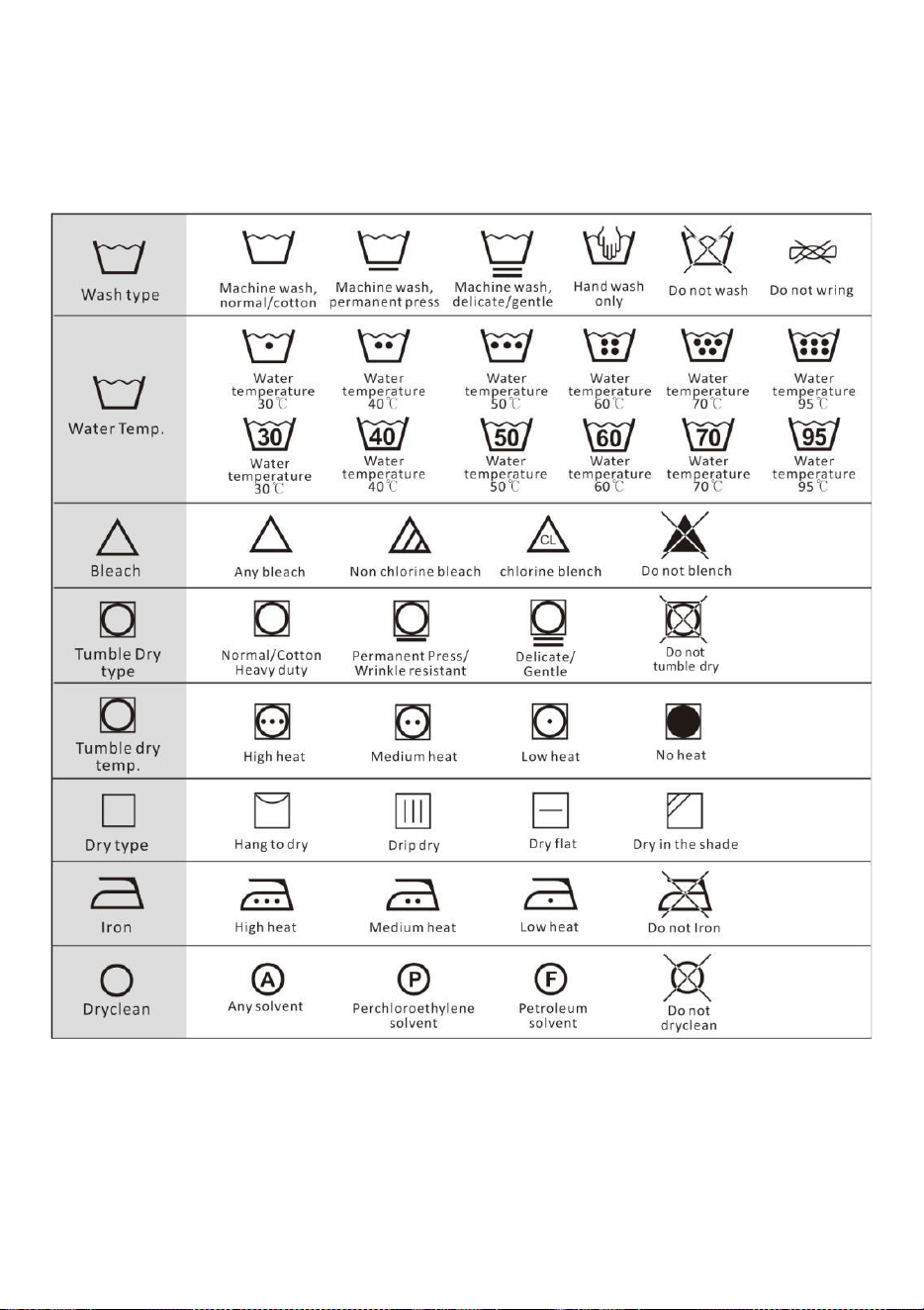
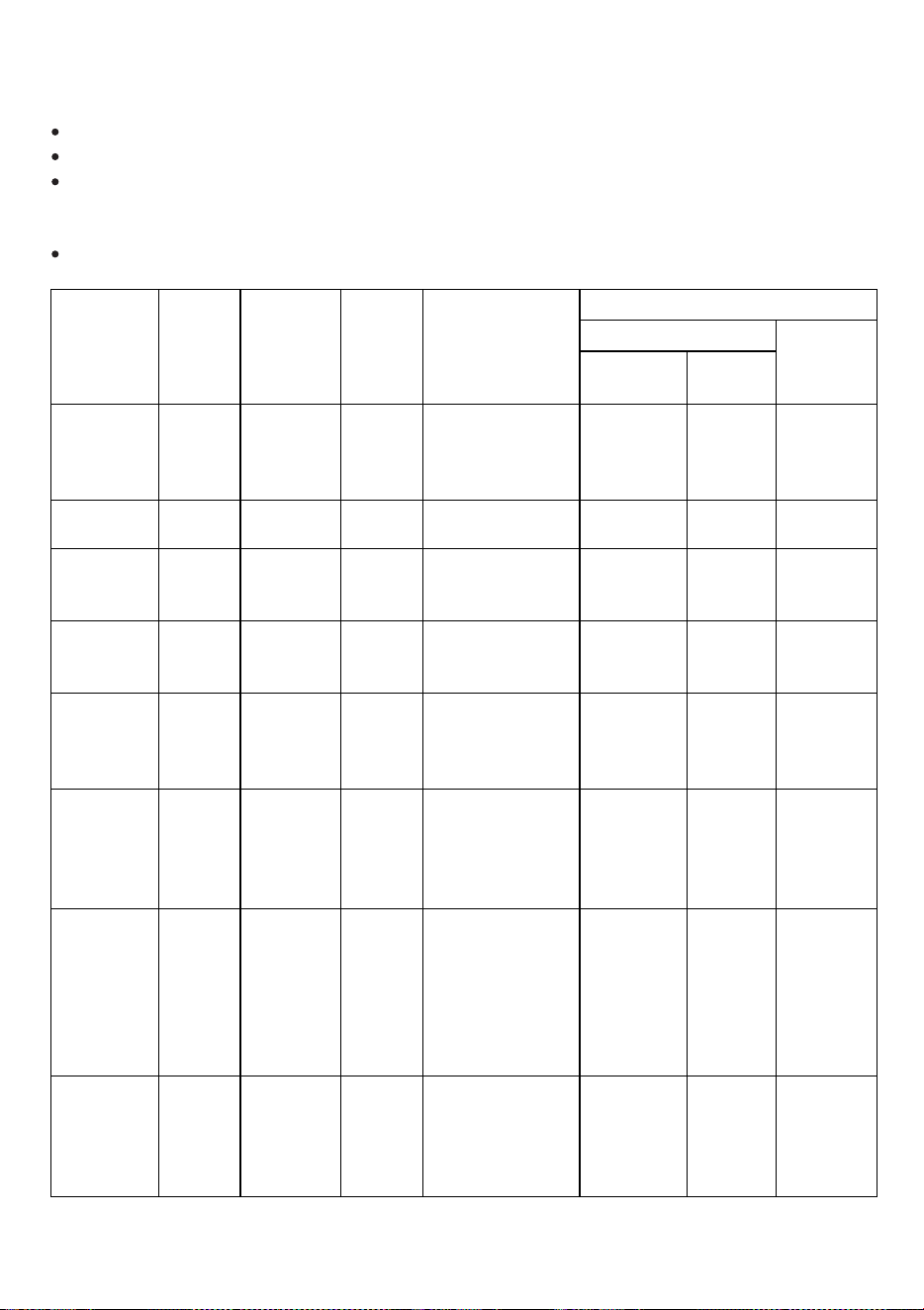
6.7 Sorting the Laundry According to Care Label Specifications
The symbols on the labels of your garments will help you choose the suitable wash program,
the right temperature, wash cycles, and ironing methods. Don't forget to take a glance at
these useful indications!
EN / 33
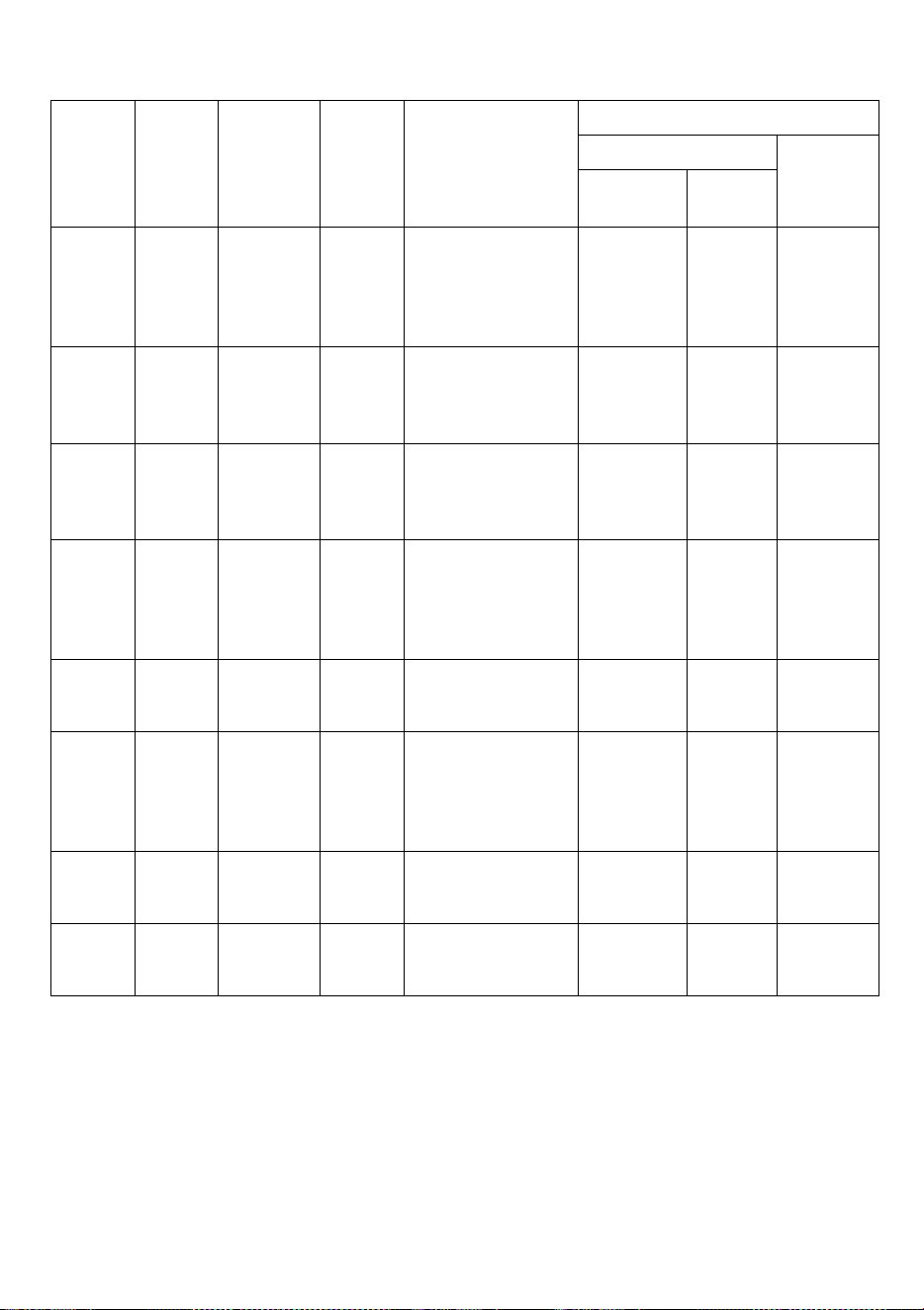
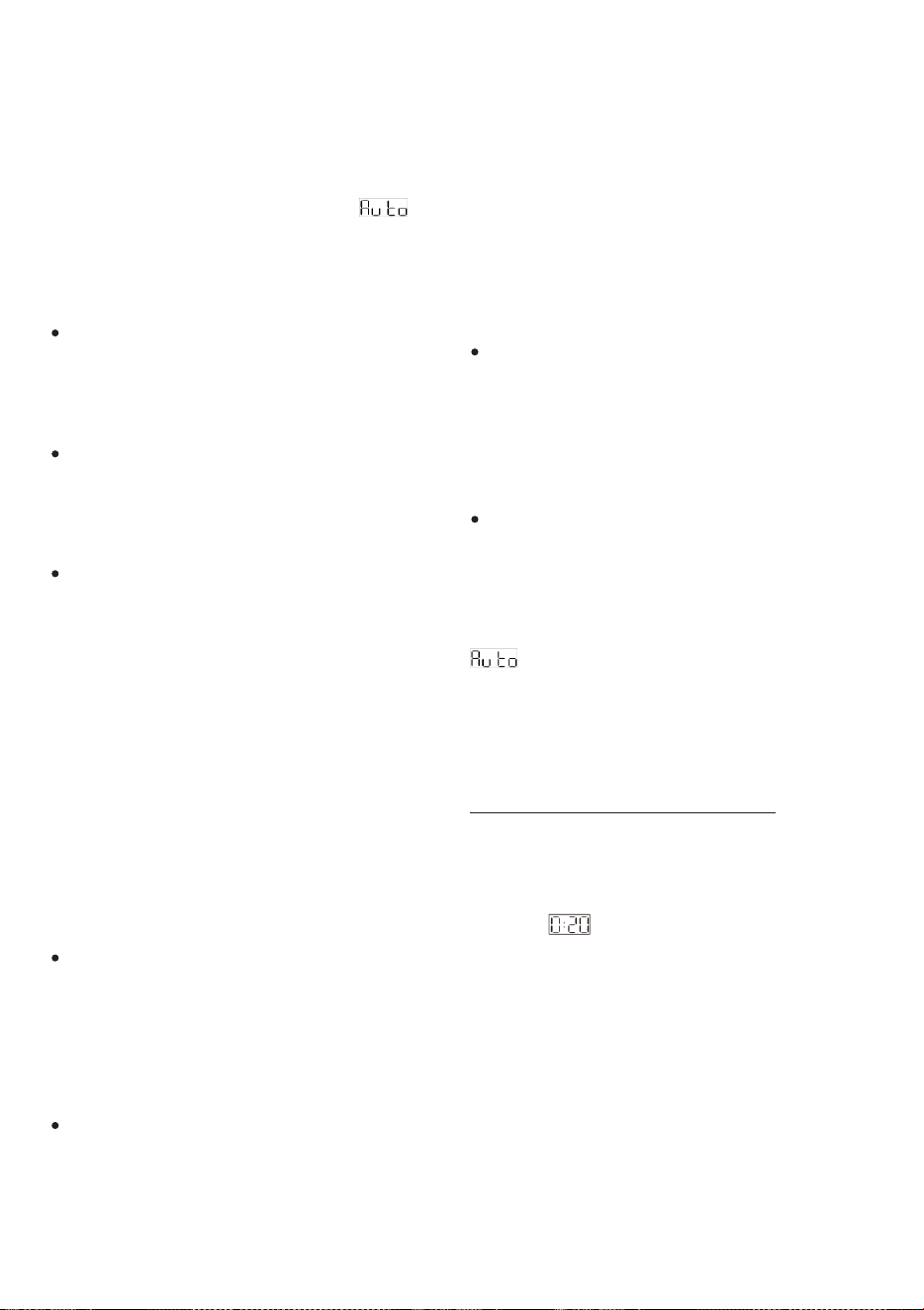
6.8 Table of Wash Cycle
L= Gel/Liquid Detergent P=Powder Detergent O=Optional --- =No
If using liquid detergent, it is not recommended to activate the time delay.
We recommend using:
o Laundry powder: 20℃ to 80℃
o Wool detergent: 20℃ to 40℃
Please follow the dosage recommendation on the powder or liquid detergent package.
Wash
Cycle
Temp.
°C
(Max)
Max
Load
(kg)
Washing
Max
Load
(kg)
Drying
Specification
Kind of Detergent
Detergents
Softener
Universal Special
EasyStart 40 5 ---
Suitable for
daily wear of
clothing
washing
L/P --- O
Drying --- --- 5
For drying wet
cotton fabric
--- --- ---
Eco 40-
60
40 7 5
Energy
efficiency test
program
L/P --- O
Cottons 60 7 5
Suitable for
cotton and
linen clothing
L/P --- O
Baby
Care
85 5 5
Suitable for
washing
children's
clothes
L/P --- O
Mixed
Fabrics
60 7 5
Suitable for
mixed washing
of cotton, linen
and chemical
fibre fabrics
L/P --- O
Quick
Mini
40 1 1
Suitable for
quick washing
of a small
amount of
clothes with
slight stains or
new clothes.
L/P --- O
Down
Wear
60 2 2
Suitable for
washing
machine
washable
down clothing.
L/P --- O
EN / 34
Wash
Cycle
Temp.
°C
(Max)
Max
Load
(kg)
Washing
Max
Load
(kg)
Drying
Specification
Kind of Detergent
Detergents
Softener
Universal Special
Anti-
allergy
85 3 3
Suitable for
clothes that
need to be de-
mite and de-
allergenised.
L/P --- O
20°C 30 2 ---
Suitable for
small amounts
of clothes that
fade easily
L/P --- O
Wool 40 1 ---
Suitable for
machine
washable wool
clothing
--- L O
Duvet 40 6 3
Suitable for
washing multi-
piece bedding
items or single
size duvet
--- L O
Shirts 60 3 ---
Suitable for
machine
washable shirts
L/P L O
Drum
Clean
85 --- ---
Use only for
cleaning inside
the cylinder, do
not place
washing material
--- --- ---
Spin --- 7 5
For clothing that
only needs to be
dehydrated
--- --- ---
Rinse
+ Spin
--- 7 5
For rinsing only
dehydrated
clothing
--- --- O
EN / 35
6.9 Various Cycles
EasyStart
The EasyStart wash cycle can intelligently
detect the weight of the laundry and adjust
the washing time and temperature
accordingly for optimal washing. " " is
displayed during the detection stage after
the cycle is started. The EasyStart wash
cycle can be entered by the following three
methods.
When the appliance is OFF, press and
hold the EasyStart button for at least 3
seconds. The appliance will run the
EasyStart wash cycle directly, with the
EasyStart indicator light lit.
When the appliance is ON, press and
hold the EasyStart button for at least 3
seconds. The appliance will run the
EasyStart wash cycle directly, with the
EasyStart indicator light lit.
When the appliance is ON, short press
the EasyStart button. The EasyStart
indicator light will be lit, and then press
the button. The appliance will run the
EasyStart wash cycle.
Drying Program
1- To set the program of "Washing +
Drying":
Only part of the washing program can add
drying function.
First, load the laundry into the drum, close the
door,
turn the wash cycle selector knob to select
the desired wash program (except for t
he
Drying program), and press the Dry button to
select the two drying modes as follows:
Automatic drying: press the Drying
button continuously to adjust the drying
time that is displayed on the panel, and
when " " is displayed, the automatic
drying mode is activated. The drying time
can be automatically adjusted according
to the amount and humidity of clothes.
Timed drying: press the Dry button to set
the drying time. Press the Drying button,
and the digital display screen will display
the timed drying time (30 - 60 - 90 - 120 -
150 - 180 - 210 - 240). Select the
appropriate timed drying time and enter
the timed drying mode. Then, press the
start/pause button. The machine starts
running the Washing + Drying program,
with the drying program activated.
2- To set the Drying only program:
The Drying only program is suitable for drying
cotton clothes. Do not dry clothes that are
prone to deformation or shrinkage. When the
Drying only program is set, it is recommended
to run a single spin cycle for the clothes to be
dried before starting the drying process.
First, load the laundry into the drum,
close the door, turn the wash cycle
selector knob to select the Drying
program only, and then press the Drying
button continuously to select either the
Auto drying or Timed drying mode (as
described above).
Then, press the START/PAUSE button to
start the Drying only program.
3- To set the down jacket drying program:
The "Washing + Drying" program should be
used to dry down jackets. Please select the
"Down Jacket" program + "Automatic Drying (
)" mode.
Please do not choose the "Drying only" mode
for down jacket drying.
For better drying results, it is recommended
to dry one down jacket at a time.
Precautions for Drying Programme
1- If there is too much moisture in the
clothes, the machine will automatically
extend the drying time, and it is normal
for " " to be displayed for an
extended period.
2- When the drying program is running, the
faucet must be turned on, as water is
required for cooling and dehumidification
during the drying program.
3- The longest drying time is set according
to different models.
4- To prevent wrinkles caused by excessive
drying, set
the drying time a little shorter
at first, and then add more time based on
the drying result.
5- Before running the Drying only program,
EN / 36
it is recommended to run a spinning
cycle first.
6- If necessary, untie any knots in the
clothes after spinning and then place
them in the drum for drying.
7- For larger or thicker clothes, drying may
be uneven in certain areas. Add drying
time as needed after the initial drying
cycle based on the drying effect.
8- Wool fabrics are not suitable for drying.
9- Do not dry clothes that are prone to
deformation or shrinkage.
10- Some programs do
not have a drying
function.
Drying Channel Cleaning
After setting the wash cycle and options,
before starting, long press this button for 3
seconds, and the machine will enter the
"Drying Channel Cleaning" program. The
digital display will show the running time of
the "Drying Channel Cleaning" program (
), and then the program will run after
pressing the "Start/Pause" button.
The Drying Channel Cleaning program can
automatically remove the lint gathered in the
drying channel and improve drying efficiency.
This program is only used to remove lint from
the drying channel. Do not add any clothes to
the drum during this process.
Steam
A cycle designed for cotton clothes that are
not prone to fading.
Steam treatment can reduce wrinkles in
clothes, bring them to an ideal humidity
level, and achieve a more relaxed state,
making ironing easier.
Additionally, steam treatment can help
eliminate unpleasant odors from clothes.
Special Wash Cycles
Baby Care: A cycle designed for dirt typical of
children's garments, effectively removing any
traces of residual detergent.
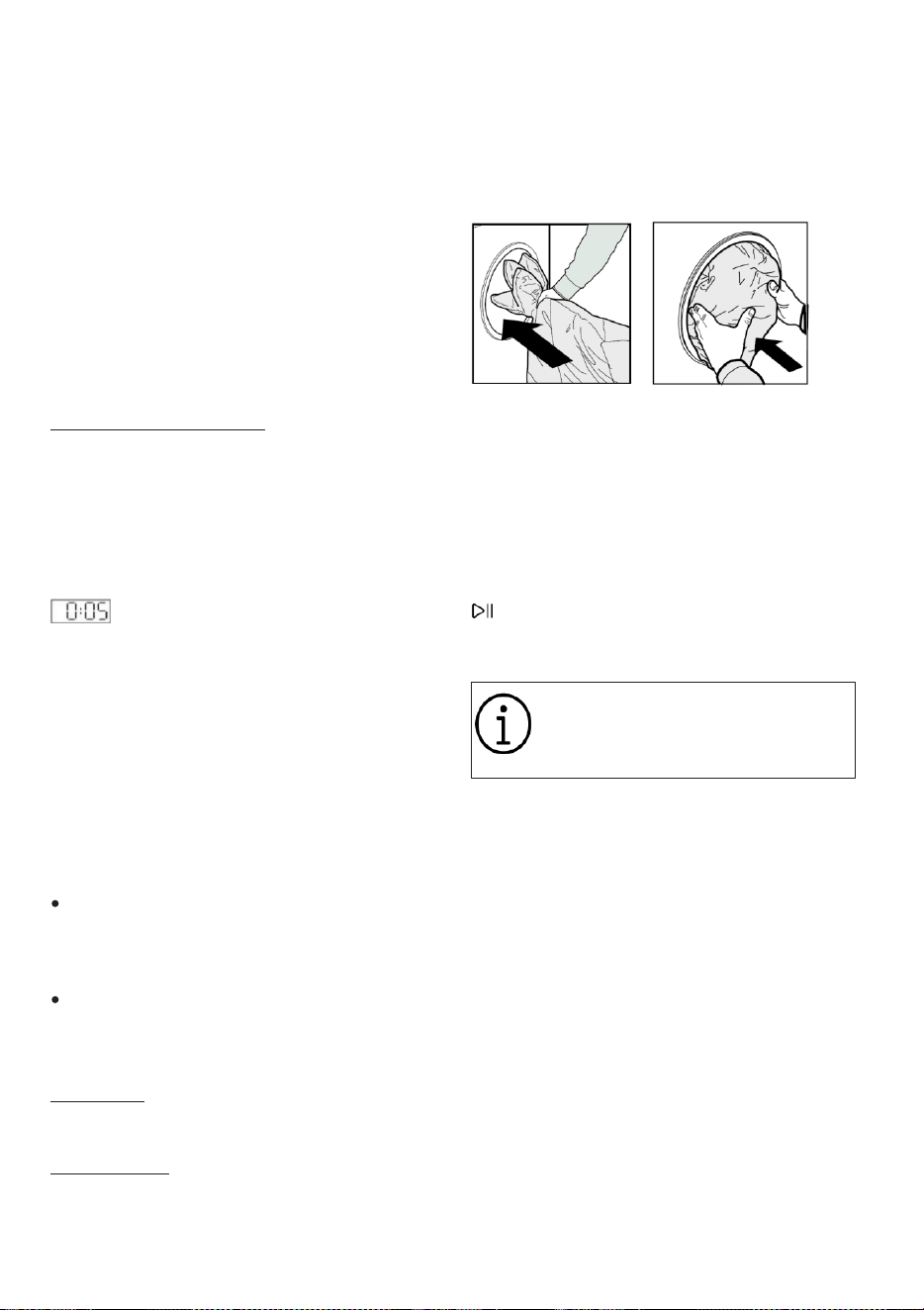
Down Jacket: A cycle for washing single
down items (with a weight not exceeding 2.0
kg), such as cushions or clothes padded with
goose down, like puff jackets. Use this
special wash cycle. We recommend placing
the down items in the drum with their edges
folded inward (see figure) and ensuring no
more than 3/4 of the drum's total volume is
used. For the best results, we recommend
using a liquid detergent and placing it inside
the detergent dispenser drawer.
6.10 Various Functions
Ending In
Press the ENDING IN button to set the
program end (ENDING IN) time in one-hour
increments, up to a maximum of 24 hours.
After selecting the desired washing program
but before pressing the START/PAUSE button
, press the ENDING IN button until the
desired time is displayed, e.g., 8h, with the
ENDING IN indicator light lit.
Here is an example of a 1 hr 30 min cycle
time and an 8 hr Ending In time:
8 hr is displayed,
and the countdown
(approximately 6 hr 30 min) begins until the
washing cycle starts (at 1 hr 30 min). Then,
the cycle duration of 1 hr 30 min is displayed
and begins. The total time is approximately 8
hours.
The way to cancel the Delay End function:
Turn the wash cycle selector knob to reset
the wash cycle. The ENDING IN indicator light
will go out.
Note: The ENDING IN function cannot be set
for some wash cycles.
The actual e
nd time of the wash cycle may
differ from the set ENDING IN time depending
on water supply pressure, drainage, clothing
type, water temperature, and other
conditions.
NOTICE:
The cycle duration is included in
the set "Ending In" time.
EN / 37
Child Lock
Setting the child lock function can
prevent children's mis-operation and
external interference with the washing
procedure.
Press and hold the SPIN key for 3
seconds before or after starting the wash
to set or cancel the child lock function.
After the child lock function is set, the
child lock indicator light is lit, the door
cannot be opened, and the control panel
is locked. All buttons on the control panel
do not respond, and the wash cycle
selector knob (except for the Linear mark
under the symbol " ") does not
respond either. You can only turn off the
machine by turning the wash cycle
selector knob to the " " position, which
will turn off the machine and stop the
running c
ycle. If the machine is turned
off, the child lock function will be
cancelled.
After the child lock function is set, you
can turn off the machine by turning the
wash cycle selector knob. When the
machine is turned on again, it will
automatically resume the program that
was running before it was turned off.
Add clothes during the program running
When the program is running, long press the
START/PAUSE button to pause the
machine. If the DOOR LOCK indicator light
goes out, the door may be opened, allowing
you to add or re
move laundry. After
completing the operation, close the door and
long press the START/PAUSE button
again. The machine will then continue running
from the point at which it was interrupted.
Cancelling the buzzer
Press and hold the SPIN button and
EASYSTART button together for at least 3
seconds to turn off the buzzer that sounds
during the washing cycle.
To activate the buzzer setting:
Perform the same operation as you did to
canc
el. The buzzer setting is activated after
one beep.
Load Balancing System
The appliance has an automatic detection
system for unbalanced loads. During the
spinning process, if the clothes are unevenly
distributed, the appliance will adjust the load
until the clothes are evenly distributed before
spinning. If the clothes cannot be evenly
distributed within a specified time, the
appliance will not spin to prevent severe
vibration. In such cases, check if the clo
thes
are knotted or entangled, and then select the
"Spin" program after reorganizing the clothes.
When washing fewer items, such as a pair of
jeans, a sweater, or a bath towel, the machine
may not complete the spinning process due
to balance protection. To help the machine
spin effectively, try washing larger and
smaller items together to distribute the load
more evenly and allow the spinning process
to complete smoothly.
NOTICE:
Due to the different types and
materials of the laundry, the
automatic adjustment and balance
system of the appliance may level
and adjust the clothes multiple
times, which can prolong the
spinning time. This is a normal
phenomenon and not a machine
failure.
NOTICE:
If the water level or water
temperature in the drum is too
high, the DOOR LOCK indicator
light will remain lit, and the door
cannot be opened. As a result, you
cannot add or remove clothes
while the program is running.

EN / 38
Downlight
The downlight is always on during
program or function setting.
When the program is suspended, the
downlight will illuminate by opening the
machine door.
When the program is running, the
downlight will automatically light up
according to the current washing stage.
Touching any button other than the
power button will also illuminate the
downlight.
You can also change the temperature after
the washing starts. You can also change
the desired temperature after the washing
programme starts. However, you need to
do this before the heating phase starts.
6.11 How to Use the Appliance
Before loading your first load of laundry
Your new appliance was tested before leaving
the factory. This process involved running
various wash cycles, whi
ch may leave a small
amount of water in the tub and drainage
system. Before washing your first load of
laundry, run a Drum Clean cycle with no
laundry and no detergent to clean the system.
Preparing the laundry
Empty pockets
Coins, paper clips, etc., can damage both
the laundry and the washing machine
components.
Tissues will break down during the wash
cycle, and the fragments will need to be
removed by hand afterward.
Close all zippers, buttons, and hooks. Tie all
ribbons or belts.
Insert smaller garments (e.g., nylon
hosiery, belts, etc.) and garments with
hooks (e.g., bras) into a fabric bag or a
pillowcase with a zipper. Remove any
rings from curtains or place the curtains
inside a fabric bag along with the rings.
Fabric type/symbol on the wash label
Cottons, Mixed Fibres, Easy Care/Synthetics,
Wool, Hand Wash Items:
Select the appropriate cycle for these fabric
types to ensure proper care.
Colour:
Separate coloured and white items. Wash
new coloured articles separately to prevent
colour bleeding.
Size:
Wash items of different sizes in the same
load to improve washing efficiency and
ensure better distribution of the clothes in the
drum.
Delicates:
Wash delicate items separately, as they
require gentle treatment to avoid damage.
How to use the appliance
1- Load laundry
Open the door and load the laundry. Place the
items loosely, one at a time, without
overfilling the drum. Refer to the "Table of
Wash Cycles" for recommended load sizes.
Overloading the machine may result in
unsatisfactory washing results and creased
laundry.
2- Close the door
Ensure no laundry is stuck between the door
gla
ss and the rubber seal. Close the door
firmly until you hear it click shut.
3- Open the tap
Verify that the appliance is connected to the
water supply, then open the tap.
4- Set the desired program
Use the WASH CYCLE SELECTOR knob to
choose the desired program. The cycle
duration will appear on the display. The
washing machine automatically shows the
default temperature and spin speed settings
for the selected program.
Change temperature (if needed):
Press the TEMP. button to progressively
lower the temperature until the cold wash is
set (all temperature value indicator lights go
out on the display). Pressing the button again
sets the highest possible temperature.
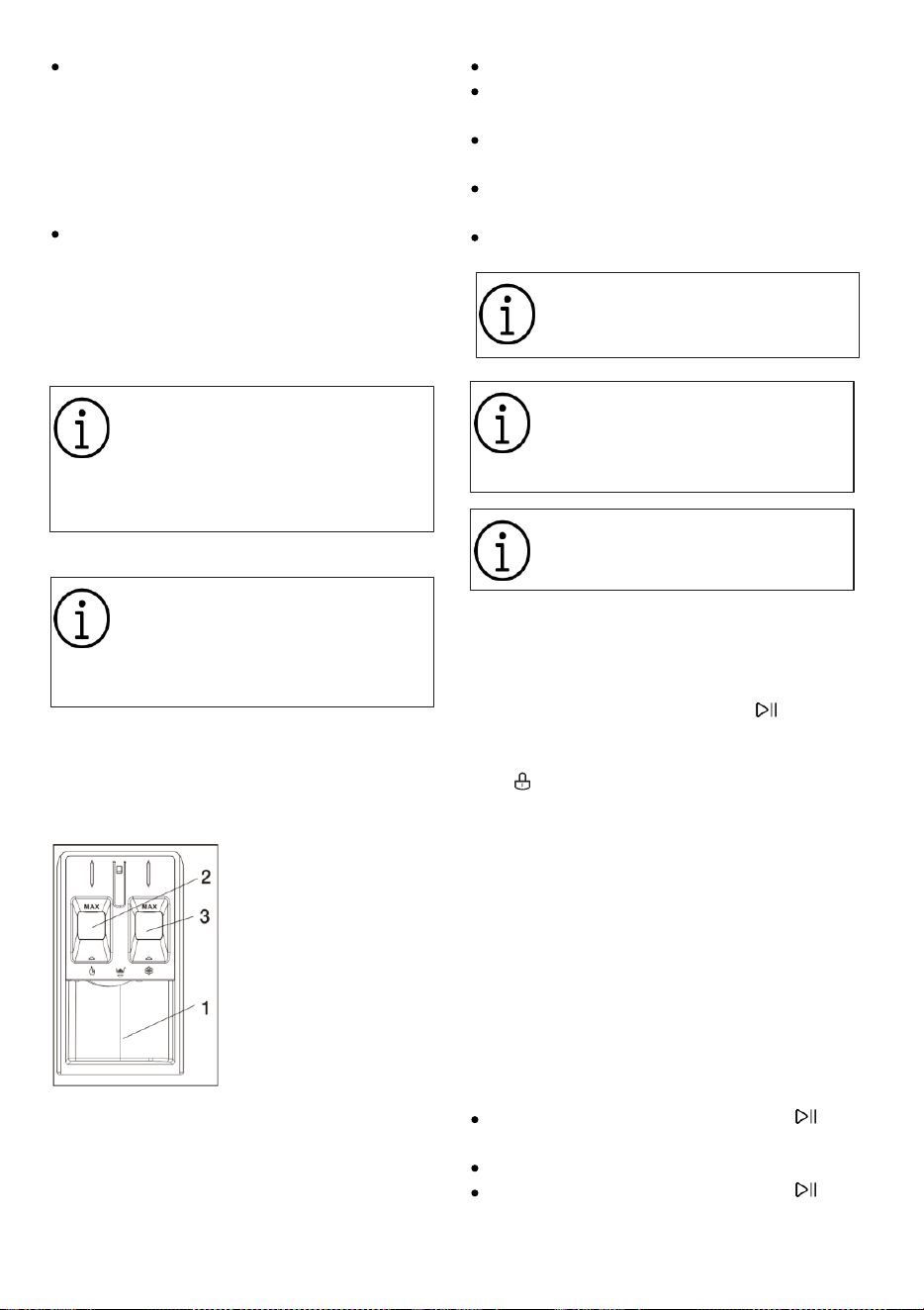
EN / 39
Change spin speed (if needed):
Press the SPEED button to progressively
decrease the spinning speed until the spin
cycle is turned off (all spinning speed value
indicator lights go out on the display).
Pressing the button again sets the highest
possible speed.
Select options (if needed):
Press the option button(s) to enable specific
options. The corresponding option indicator
light will turn on. Press the button(s) again to
cancel the option, and the corresponding
indicator light will go out.
5- Add detergent
Pull out the detergent dispenser (and
additives/softener) compartments as
described below.
Compartment 1:
Powder washing
detergent
Compartment 2: Liquid
washing detergent (The
liquid det
ergent must
not exceed the "MAX"
level.)
Compartment 3:
Additives (softener,
etc.)
The fabric softener must not exceed the
"MAX" level.
Follow the dosing recommendations on the
detergent pack. Correct dosing of
detergent/additives is important because:
It optimizes the cleaning result.
It avoids irritating residues of surplus
detergent in your laundry.
It saves money by preventing waste of
surplus detergent.
It protects the washer by preventing
calcification of components.
It respects the environment by avoiding
unnecessary environmental burden.
6- Delaying the end of a program
To set a program to end at a later time, refer
to the section "Control Panel / ENDING IN."
7- Start a program
Press the START/PAUSE button . The
corresponding indicator light will turn on, the
door will lock, and the DOOR LOCK indicator
light will be lit.
To avoid overflow, do not open the detergent
dispenser once a program is runni
ng.
The remaining program duration may vary
due to factors such as unbalanced loads or
foam formation, which can affect the
program duration.
8- Change the settings of a running
program if needed
You can still change the settings while a
program is running. The changes will be
applied, provided the respective program
phase has not yet finished.
To change the settings of a running program:
Press the START/PAUSE button to
put the running program on pause.
Change your settings.
Press the START/PAUSE button again
to continue the program.
If the selected option is
incompatible with the program set,
the incompatibility will be signaled
by a buzzer, and the corresponding
option indicator light will flash.
If the selected option is
incompatible with another
previously set option, only the
most recent selection will remain
active.
Use powder detergent for white
cotton garments, for pre-washing,
and for washing at temperatures
over 60℃.
Follow the instructions provided
on the detergent packaging.
Do not use hand washing
detergents, as they create too
much foam.
EN / 40
If you have changed the program, do not add
detergent for the new program.
To prevent a running program from being
changed accidentally (for instance, by
children), use the CHILD LOCK function (see
section "Control Panel / SPIN").
To pause a running program and open the
door if needed:
Press the START/PAUSE button to pause
the program. If the water level and/or
temperature in the drum are not too high, the
DOOR LOCK indicator light will turn off,
allowing you
to open the door. You can then
add or remove laundry, such as items
mistakenly loaded.
Press the START/PAUSE button again to
resume the program.
9- Cancelling a running program if needed
Turn the Linear mark on the wash cycle
selector knob to the symbol " " to turn
off the appliance.
If the water level and/or temperature are
low enough, the door will unlock and can
be opened.
If the door remains locked due to a
higher water level in the drum, follow
these steps to unlock it: Turn the wash
cycle selector knob to select the spin
program. Press the SPIN button to turn
off the spin program (all spinning speed
value indicator lights will go out on the
display).
Press the START/PAUSE button to
run the spin program. The water will be
pumped out from the drum during the
cycle, and the door will unlock at the end
of the program.
10- Switch off the appliance after program
end
At the end of the cycle, the message
"End" is displayed on the digital display.
The door can only be opened when the
DOOR LOCK indicator light goes out.
Check that the DOOR LOCK indicator
light is off, then open the door and
remove the laundry.
Turn the Linear mark on the wash cycle
selector knob to the symbol " " to turn
off the appliance.
Finally, turn off the tap.
Leave the door ajar to allow the interior of the
appliance to dry.
6.12 Cancelling the Programme
The programme is cancelled when pro-
gramme selection knob is turned to a
different programme or machine is turned
off and on again using the programme
selection knob.
6.13 End of Programme
End symbol appears on the display when
the programme is completed.
If you do not press any button for 10
minutes, the machine
will switch to OFF
mode. Display and all indicators are turned
off.
Completed programme steps will be dis-
played if you press any button.
6.14 Standby Mode
Your machine has the "Standby Mode"
feature.
After turning the machine on with the On/
Off button, if no programme is started or
no other action is taken during the
selection phase, or if nothing is performed
within ap- proximately 2 minutes after the
selected programme is over, the mac
hine
automatic- ally switches to energy saving
If you turn the programme selection
knob when the Child Lock is
enabled, the programme will not be
cancelled. You should cancel the
Child Lock first.
If you want to open the loading
door after you have cancelled the
programme but it is not possible to
open the loading door since the
water level in the machine is above
the loading door baseline, then turn
the Programme Selection knob to
Pump+ Spin programme and drain
the water in the machine.
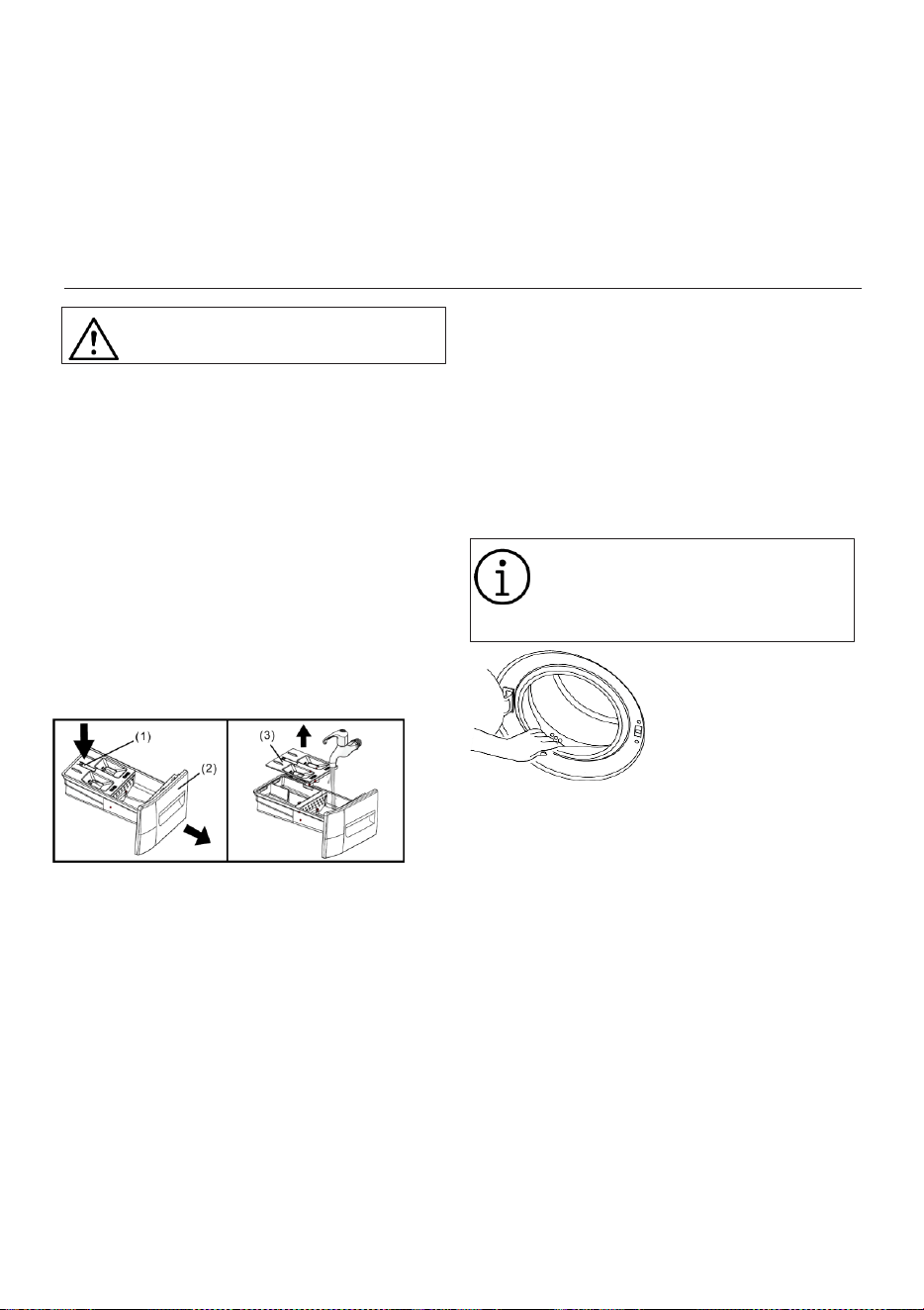
EN / 41
Repeat Drum Cleaning process in
every 2 months.
NOTICE: Use an anti-limescale
suitable for the washing machines.
Please read the “Safety
Instructions” section first!
mode. Furthermore, if your product has a
display that shows the programme time,
this display is completely turned off. If you
turn the pro- gramme selection button or
touch any but- ton, the lights are
illuminated, and the screen will turn on
again. The choices you make when exiting
the energy saving state may change.
Check your selections’ accuracy before
starting the programme. Adjust your set-
tings aga
in if necessary. This is not an
error.
7 Maintenance and Cleaning
Service life of your product extends, and
frequently experienced problems will be
reduced if it is cleaned at regular intervals.
7.1 Cleaning the Detergent Drawer
Clean the detergent drawer at regular
intervals (once every 4 to 5 wash) as
mentioned below to prevent accumulation of
powder detergent.
If there is a buildup of residual detergent or
additives, or if the softener compartment is
not rinsed out properly, it may be helpful to
clean the dispenser.
1- Open the detergent dispenser tray fully.
Press down on the drawer catch (1) and
pull the tray (2) out from the appliance
housing.
2- Remove the liquid detergent cover (3) by
grasping it and pulling it upwards from
the detergent dispenser tray.
3- Clean the liquid detergent cover and the
detergent dispenser tray under running
water. Lightly wipe away any remaining
detergent residue.
4- Att
ach the liquid detergent cover and
slide the detergent dispenser tray back
into place, ensuring it is securely closed.
5- Tip: Do not operate the appliance without
the detergent dispenser tray in place.
Always keep the tray completely closed.
7.2 Cleaning the Loading Door and the
Drum
For products with drum cleaning pro-
gramme, please see the Operating the
product section.
After every washing make sure that no
foreign substance is left in the product.
I
f the holes on the door gasket shown in the
figure is blocked, open the holes using a
toothpick.
Foreign metal substances will cause rust
stains in the drum. Clean the stains on the
drum surface by using cleaning agents for
stainless steel.
Never use steel wool or wire wool. These
will damage the painted, chrome coated
and plastic surfaces.
We recommend you to wipe the door
gasket with a dry and clean cloth at the end
of the program. This will remove r
esidues
on the door gasket in your machine and
prevent formation of malodorous.
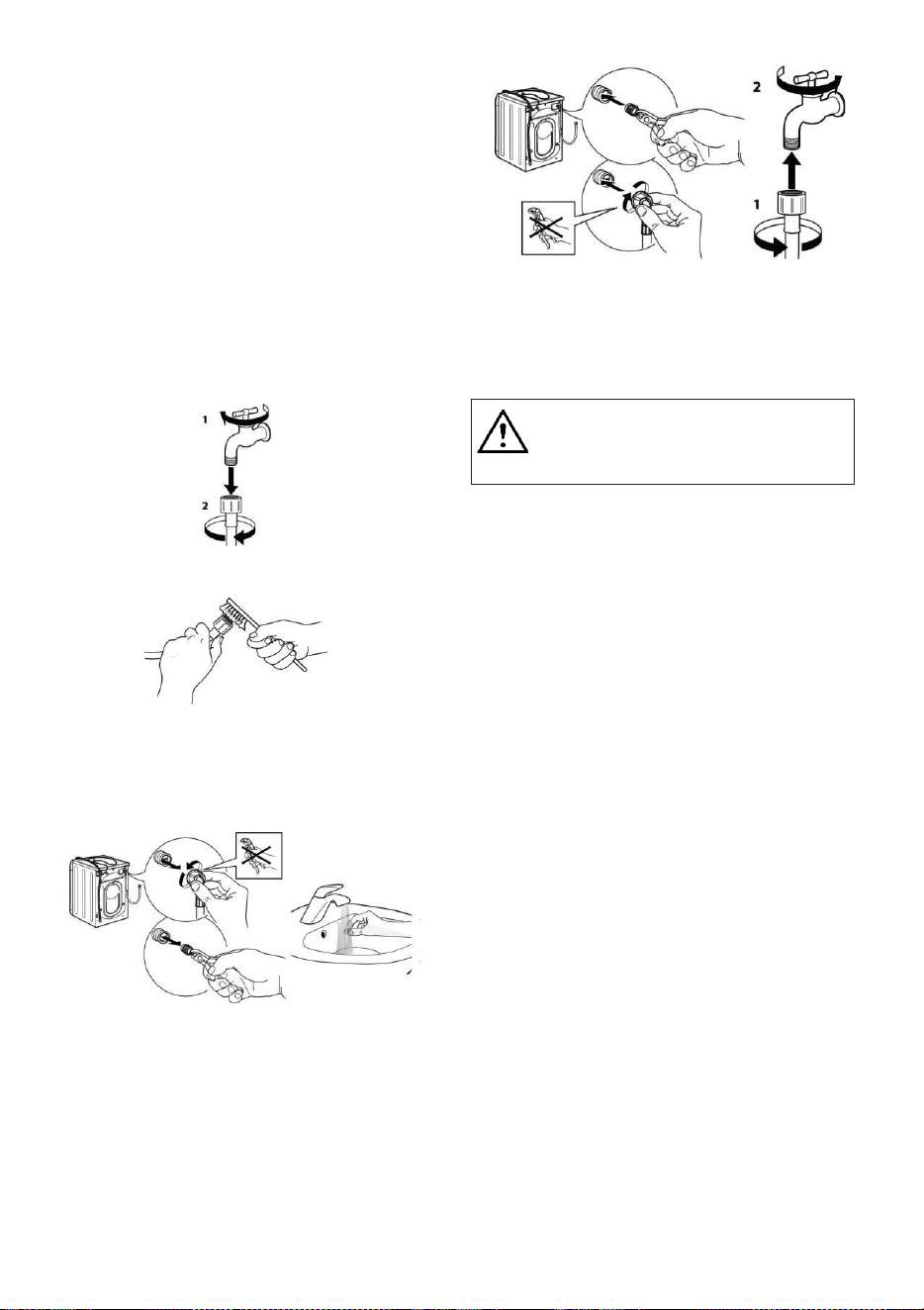
EN / 42
WARNING
Risk of Scalding
Risk of hot water injury to skin!
7.3 Cleaning the Loading Door and the
Drum
Wipe the body of the product with soapy
water or non-corrosive mild gel detergents as
necessary, and dry with a soft cloth.
Use only a soft and damp cloth to clean the
control panel. Do not use cleaning products
that contain bleach.
7.4 Cleaning the Mesh Filter in the
Water Inlet Hose and the Water
Inlet Valve
1- Close the water tap and unscrew the
water inlet hose.
2- Clean the mesh filter at the hose's end
carefully with a fine brush.
3- Now unscrew the water inlet hose on
the back of the appliance by hand. Pull
out the mesh filter from the water inlet
valve on the back of the appliance using
pliers and carefully clean it.
4- Insert the mesh filter back into place.
Connect the water inlet hose to the
water tap and the appliance again. Do
not use a tool to tighten the inlet hose.
Open the wate
r tap and check that all
connections are secure.
7.5 Cleaning the Mesh Filter in the
Water Inlet Hose and the Water
Inlet Valve
You are responsible for ensuring that all
safety precautions are followed when
draining water from the appliance and/or
manually opening the appliance door.
It may be necessary to clean the appliance
drain pump if the appliance fails to drain (for
example, if you do not hear the sound of
water being pumped out when it should be
draini
ng, and nearby drains, such as a sink,
are functioning properly).
The appliance pump can become blocked by
loose debris (which is a good reason to check
the drum and remove any visible debris after
each load). Fabrics that shed large amounts
of fluff may also cause blockages.
To access the appliance’s drain pump, the
service cover must first be opened (see steps
below). With the service cover opened,
proceed as follows:
1- If the appliance has not been drain
ed, try
to drain it now. First, turn the wash cycle
selector knob to select the Spin program.
Press the SPEED button to turn off the
spin program (all spinning speed value
indicator lights will go out on the
display), then press the START/PAUSE
button.
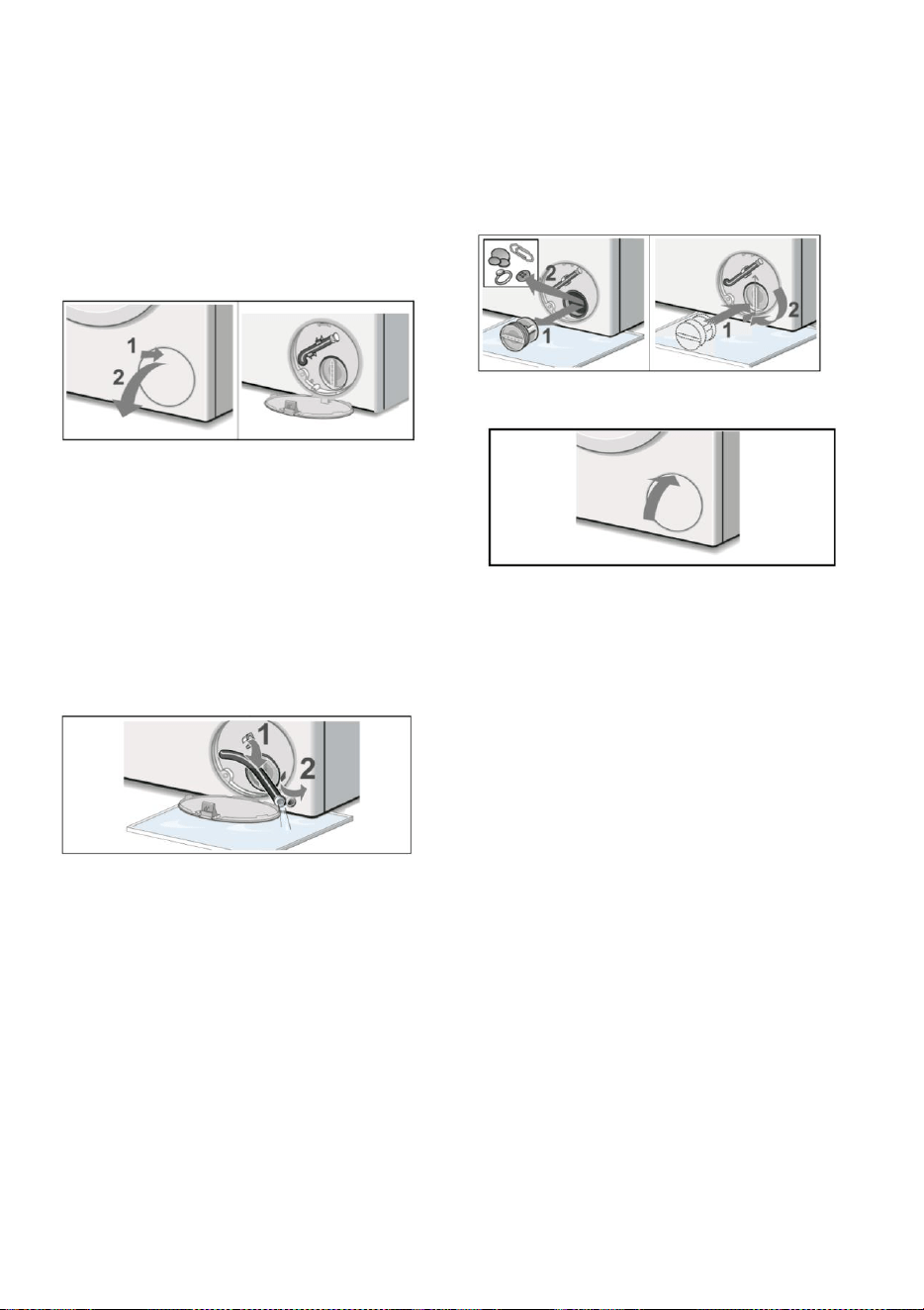
EN / 43
Wait a few moments to allow the pump
to drain the water from the drum. If the
pump is completely blocked, the water
will be unable to drain, and the cycle will
end.
2- Shut off the tap to prevent any more
water from flowing in and needing to be
drained. Switch the appliance off and
unplug the power plug.
3- Open the drain filter cover.
4- Use the pull-out drain hose located in the
pump access opening to drain the
remaining water into a suitable
container
(up to 5.3 U.S. gallons/20 liters of water
may be drained). Pull the sealing cap
from the hose and lay the hose over the
side of the container to allow the water
to finish draining from the drum. When
finished, replace the sealing cap back
onto the end of the hose and return the
hose to its storage location.
5- Turn the pump cover counterclockwise
to remove it. A small amount of residual
water may flow out when the cover i
s
removed. Clean the interior of the pump
housing, removing any debris or foreign
objects.
Check to ensure the impeller at the back of
the pump housing can turn freely. Remove
any lint, debris, or detergent residue from the
threads of the pump cover and the pump
cover housing. Reinstall the pump cover by
screwing it tightly into position, ensuring that
the handle is vertical.
6- Close the drain filter cover. Wipe up any
spilled water.
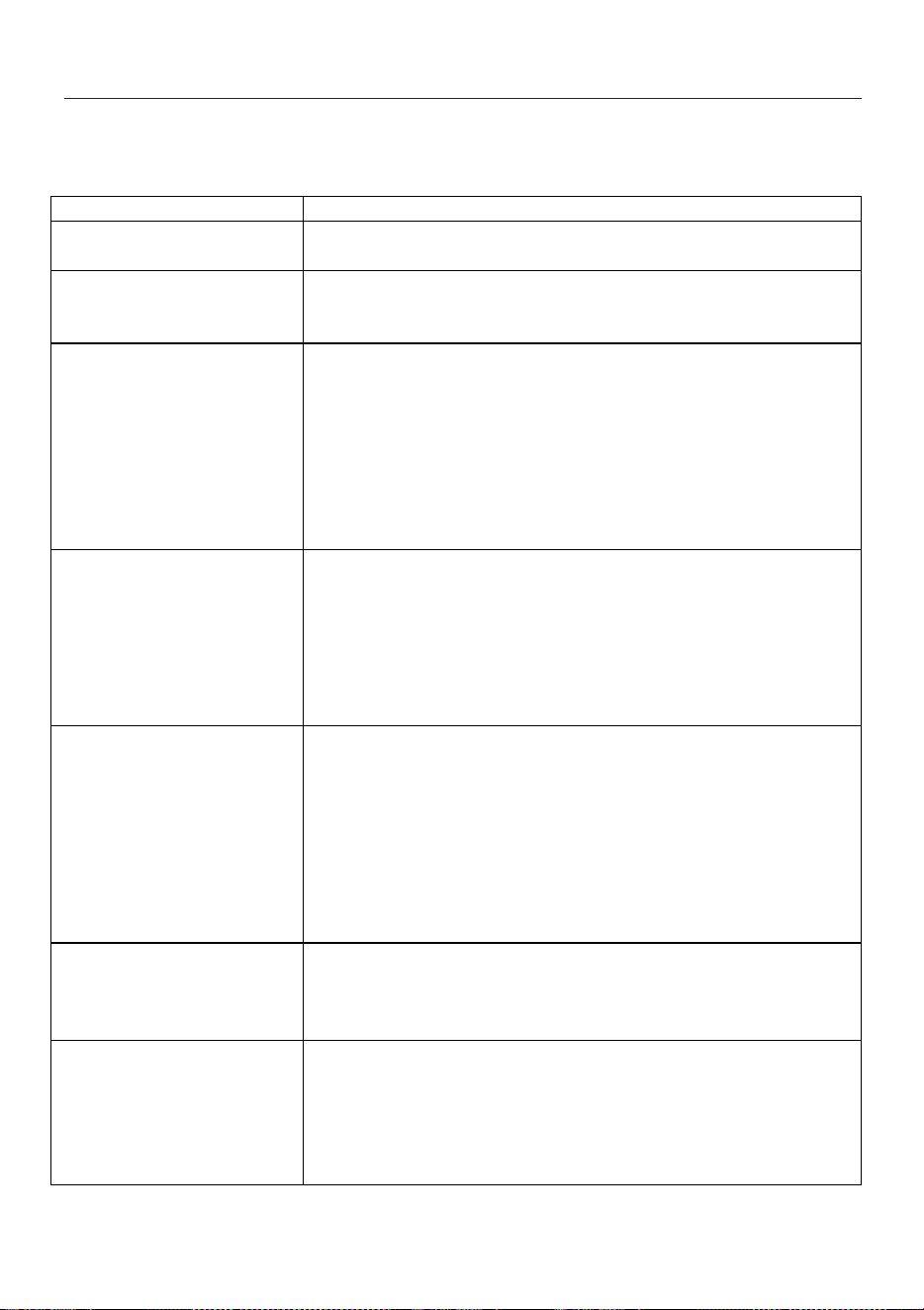
EN / 44
8 Troubleshooting
Your appliance may occasionally fail to work. Before contacting the service center, ensure
that the problem cannot be resolved easily using the following list:
Problem
Possible Cause / Solutions
There are colour spots
and oil stains in drum
• The appliance requires a service wash. Run a "Drum clean"
wash cycle with no detergent and no laundry.
The machine smells
• Due to the use of rubber parts, the machine will have a
rubber smell at the beginning of use, but the rubber smell will
gradually disappear during use.
The door cannot be
opened
• The safety protection function is in operation, and the water
temperature and/or water level is too high.
• Whether the program has ended normally and whether
there is power failure.
• Is the child lock function activated? Turn off the child lock
function.
• Whether to select the delay end function? Turn off the delay
end function.
The machine leaks from
the dispenser
• The dispenser drawer is blocked with detergent and
requires cleaning.
• The water pressure is too high and requires turning down -
turn down the tap on the water supply pipe slightly and try
again.
• The appliance is tilting forward - it must be level when in its
final position.
The machine leaks (other
than dispenser)
• The water inlet hose is loose, check both the cabinet and
tap ends.
• The inlet hose is tight but still leaks, so replace the rubber
washers, or the water inlet hose is missing the rubber
washer.
• The drain hose is not fixed in properly.
• In case of water leakage inside the machine, please turn off
the power supply and contact the after-sales department for
maintenance.
The machine does not
switch on
• The appliance is not plugged into the socket fully, or not
enough to make contact.
• There is no power to the socket, or the fuse has blown in
the mains plug.
The wash cycle does not
start
• The door is not closed properly.
• The POWER button has not been pressed.
• The START/PAUSE button has not been pressed.
• The water tap has not been turned on to allow water to flow
into the appliance.
• A Delay end function has been set.
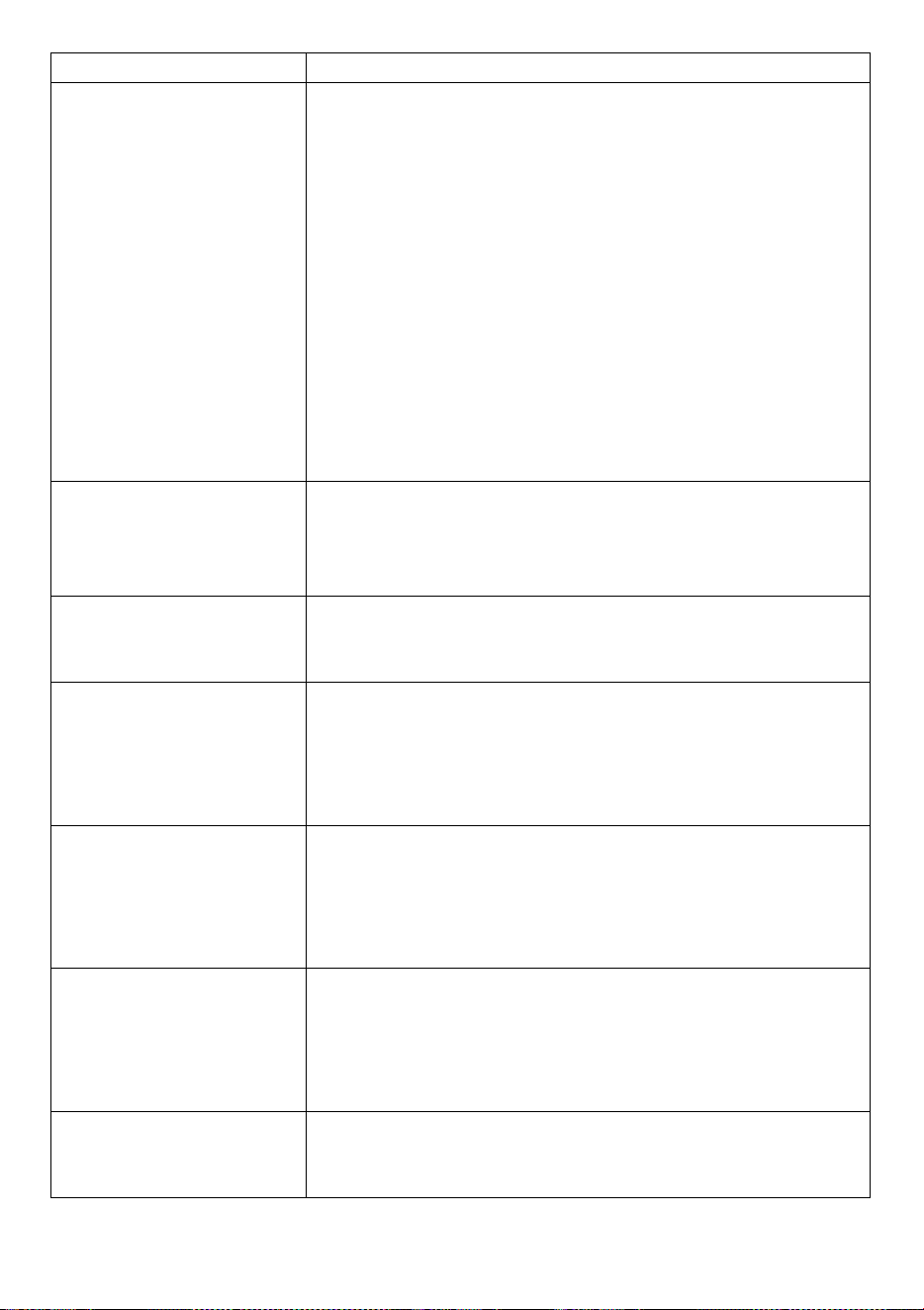
EN / 45
Problem
Possible Cause / Solutions
The machine does not fill
with water, the detergent
cannot flow into the drum
or "ddE02" appears in the
display
• The water inlet hose is kinked, twisted and bent.
• The water inlet hose is not connected to the water supply.
• The water pressure is too low.
• The water tap has not been turned on to allow water to flow
into the machine.
• There is no water supply to the house.
• The mesh filter in the water inlet hose and/
or water inlet
valve are blocked.
• The faucet and/or water supply pipe are frozen.
• The delay end function is selected, so the machine does not
enter water.
• The START/PAUSE button has not been pressed.
• There is enough water in the drum already.
Discharge the water when
the program is started
• This is not a fault. Please do not open the door to pour the
water directly into the drum before the program runs,
otherwise the machine may discharge the water already
poured into the drum.
The water level is too low
when the machine is
washing
• This is not a fault. The water consumption in wash cycle of
this appliance is relatively low, as it is designed for lower
water usage compared to other washing machines.
Make up water during
wash cycle operation
• If the water level drops, the machine will make up water
automatically.
• When the amount of washing clothes is too large, the
appliance may make up water automatically several times
during the wash cycle.
There is too much foam in
drum or foam overflows
from detergent dispenser
• The detergent is not suitable for machine washing (it should
display "for washing machines" or "hand and machine wash"
or similar).
• Too much detergent was used—less detergent is required in
soft water.
The high-speed spinning
needs to be repeated
many times
• Due to the different types and materials of laundry, the load-
balancing system of the appliance may wobble and disperse
the clothes multiple times to prolong spinning time. This is a
normal phenomenon, not a machine failure.
The machine does not
spin
• The spin speed is turned off by pressing the SPEED button
to set all spinning speed values. The indicator light will go out
on the display.
EN / 46
Problem
Possible Cause / Solutions
The machine vibrates a lot
during the spin cycle
• The feet have not been adjusted, enabling the machine to
rock.
• New installation - either the Transit Bolts, plastic spacer, or
the polystyrene packaging have not been removed when
installing the machine.
• The appliance is trapped between cabinets and/or walls.
• The load is in a slight out-of-balance condition and the
appliance is spinning but at a lower speed.
The spin effect is not ideal
• When washing fewer clothes, like a pair of jeans or a
sweater, the machine may not complete the spinning process
due to balance protection.
• If the load is in a slight out-of-balance condition, the
appliance is spinning, but at a lower speed, not at the default
spin speed of the cycle or the spin speed setting.
The machine does not
drain, drains slowly, or
"E03" appears in the
display
• The top of the drain hose is too high - it must be fitted at a
height between 65 and 100 cm from the floor.
• The pump filter is blocked.
• The drain hose is kinked, twisted, or bent.
• The drain hose is blocked or frozen.
The program time stops
counting down before
entering high-speed
spinning
• This is not a fault. The load-balancing system wobbles and
disperses clothes in the drum for a long time to achieve
balance and complete high-speed spinning. During this
wobbling process, the program time may stop counting down
before entering the high-speed spinning process.
The program takes too
long
• Program times will vary due to water pressure, incoming
water temperature, and if the wash load goes out of balance.
This will increase program times accordingly.
The machine is noisy
• There will always be some motor, pump, and drum noise
during spin.
• The washing machine is touching other objects.
• Foreign matters, such as hairpins or metal objects, may be
in the drum or tub.
The machine continuously
fills with water and
continually drains away
• The top of the drain hose is too low - it must be fitted at a
height between 65 and 100 cm from the floor.
• The end of the drain hose has been pushed too far down the
standpipe; the hose elbow should be fitted 4 inches (100 mm)
from the end of the drain hose.
• The end of the drain hose is submerged in the discharged
water.
EN / 47
Problem
Possible Cause / Solutions
The discharged water
flows back into the
appliance
• If the end of the drain hose touches the discharged water
(water drained from washer), it can be sucked back into the
appliance and may damage the appliance or textiles.
The local part of the
control panel is heated
• This is the slight heating effect of the electronic
components on the computer board on the back of the
control panel.
After drying, there are
water drops on the door
and drum
• During drying, the door may be stained with water drops,
please wipe off the water drops.
• Do you put in too much or too thick clothes?
The drying effect is poor
and uneven
• Are clothes that are not easy to dry (such as thick cotton
fabrics) and fabric that are easy to dry (such as synthetic
fabrics) dried together?
• Do you put too many clothes for drying?
• When only running the "Drying" program, do you separate the
dehydrated and entangled clothes by putting them in the
drum?
• Due to different types and quantities of clothes, uneven
drying may occur. For uneven drying please add regular
drying.
• Is the faucet turned off during drying?
• Is the filter of the drain pump blocked during drying?
• Is the drain hose bent, twisted or blocked during drying?
General
• Your appliance contains sensors that monitor progress
during the wash cycle (e.g.: water level, temperature, out of
balance loads, wash time/progress). Normally, if your
appliance successfully completes the cycle, there is unlikely
to be anything wrong!
EN / 48
WARNING
Foreign substances left in the pump filter may damage your product or cause noise
problems. If you live in areas prone to frost, remember to turn off the water tap,
disconnect the main hose, and drain the water from the appliance when it's not in
use. After each use, turn off the tap to which the mains hose is connected.!
In case of the following faults, the microcomputer system will detect the issue, and a buzzer
will sound, displaying th
e corresponding fault codes on the control panel:
Fault
codes
Fault type Possible Cause / Solutions
E02
No inlet
water
• Check whether the faucet is turned on? Whether the water
supply is cut off?
• Whether the mesh filter in the water inlet hose and the water
inlet valve are blocked?
• Whether the water inlet hose of the appliance is frozen?
Eliminate the above fault causes. If the fault code still exists,
please contact the service center for repair.
E03
Abnormal
water
drainage
• Clean the pump filter.
• Check whether the drain hose is bent, twisted, or blocked?
Eliminate the above fault causes. If the fault code still exists,
please contact the service center for repair.
U4
Door lock
malfunction
• The door is not closed in place, and the door lock does not
work normally. Close the door again, turn the wash cycle
selector knob to the "OFF" position to turn off the power supply,
and then turn the wash cycle selector knob to select any wash
program and press the START/PAUSE button to restart the
program. Eliminate this fault cause. If the fault code still exists,
please contact the service center for repair.
• If the fault code displays and cannot open the door, the door
lock may be faulty, please contact the service center for repair.
H
The
temperature
in the drum
is high
• Press the START/PAUSE button to suspend the appliance
operation and wait for several minutes. When the temperature in
the drum drops to a safe range and the fault code on the display
is removed, press the START/PAUSE button to continue the rest
of the program. If the fault code still exists, please contact the
service center for repair.
EXX Other faults
• Turn the wash cycle selector knob to the "OFF" position to turn
off the power supply, unplug the power cord, and contact the
service center for repair as soon as possible.
Not emptying contents from pockets may cause pump or drain hose blockages or may
damage the machine. Do not wash items that do not have a wash label, or wash items that
are not intended to be machine washable.

EN / 49
9 DISCLAIMER / WARNING
Some (simple) failures can be adequately
handled by the end-user without any safety
issue or unsafe use arising, provided that
they are carried out within the limits and in
accordance with the following instructions
(see the “Self-Repair” section).
Therefore, unless otherwise authorized in
the “Self-Repair” section below, repairs
shall be addressed to registered
professional repairers in order to avoid
safety is- sues. A regist
ered professional
repairer is a professional repairer that has
been granted access to the instructions
and spare parts list of this product by the
manufacturer ac- cording to the methods
described in legislative acts pursuant to
Directive 2009/125/ EC.
However, only the service agent (i.e.
authorized professional repairers) that
you can reach through the phone
number given in the user
manual/warranty card or through your
authorized dealer may provide service
under the guarantee ter
ms. Therefore,
please be advised that repairs by
professional repairers (who are not
authorized by Beko ) shall void the
guarantee.
Self-Repair
Self-repair can be done by the end-user
with regard to the following spare parts:
door, door hinge and seals, other seals,
door locking assembly and plastic
peripherals such as detergent dispensers
(an updated list is also available in sup-
port.beko.com as of 1st of March 2021)
Moreover, to ensure product safety and to
prevent
risk of serious injury, the mentioned
self-repair shall be done following the
instructions in the user manual for self-
repair or which are available in
support.beko.com For your safety, unplug
the product before attempting any self-
repair.
Repair and repair attempts by end-users for
parts not included in such list and/or not
following the instructions in the user
manuals for self-repair or which are
available in support.beko.com , might give
raise to safety issues not attr
ibutable to
sup- port.beko.com , and will void the
warranty of the product.
Therefore, it is highly recommended that
end-users refrain from the attempt to carry
out repairs falling outside the mentioned list
of spare parts, contacting in such cases
authorized professional repairers or
registered professional repairers. On the
contrary, such attempts by end-users may
cause safety issues and damage the
product and subsequently cause fire, flood,
ele
ctrocution and serious personal injury to
occur.
By way of example, but not limited to, the
following repairs must be addressed to
authorized professional repairers or
registered professional repairers: motor,
pump assembly, main board, motor board,
display board, heaters etc.
The manufacturer/seller cannot be held li-
able in any case where end-users do not
comply with the above
The spare part availability of the washing
machine or washer-drye
r that you
purchased is 10 years. During this period,
original spare parts will be available to
operate the washing machine or washer-
dryer properly.

EN / 50
The standard guarantee starts from the date of original purchase of the product and lasts for a period of
twelve (12) months unless Beko plc (the “Manufacturer”) agrees to extend the guarantee for the product in
writing.
If you have purchased an American style Fridge freezer, the standard guarantee starts from the date of
original purchase of the product and lasts for a period of twenty-four (24) months unless Beko plc (the
“Manufacturer”) agrees to extend the guarantee for the product in writing.
The standard guarantee starts from the date of original purchase of the product and lasts for a period of
twelve (12) months unless Beko plc (the “Manufacturer”) agrees to extend the guarantee for the product in
writing.
If you have purchased an American style Fridge freezer, the standard guarantee starts from the date of ori-
ginal purchase of the product and lasts for a period of twenty-four (24) months unless Beko plc (the “Manu-
facturer”) agrees to extend the guarantee for the product in writing.
BEKO UK AND ROI STANDARD MANUFACTURER GUARANTEE TERMS
AND CONDITIONS
Your new Beko product is guaranteed against faulty materials, defective components or
manufacturing defects.
If you have any questions about the guarantee on your product (including how long it is
valid), please contact your retailer or our Customer Service Team on 0333 207 9710 (UK
and Northern Ireland) or 01 862 3411 (Republic of Ireland)
This guarantee does not in any way
diminish or affect your statutory rights in connection
with the product. This guarantee is in addition to your statutory rights as a consumer. If
you have any questions about these rights, please contact the retailer from which you
purchased the product. In certain circumstances, it is possible that your statutory rights
may offer additional or higher levels of protection than those offered under the terms of
this guarantee.
What is cov
ered by this guarantee?
• Repairs to the product required as a result of faulty materials, defective components or
manufacturing defects.
• Functional replacement parts to repair a product.
• The costs of a Beko plc Authorised Service Representative or Approved Engineer
(together the “Service Representatives”) to carry out the repair.
What is not covered?
• Transit and delivery damage.
• Cabinet or appearance parts, including but not limit
ed to control knobs, flaps and
handles.
• Accessories and/or consumable items including but not limited to ice trays, scrapers,
cutlery baskets, filters and lightbulbs.
• Repairs necessary as a direct or indirect result of:
– Accidental damage, misuse or abuse of a product.
– An attempted repair of a product by anyone other than a Service Representative.
– Installation or use of a product where such installation or use fails to meet the
r
equirements contained in this guarantee or the User Instructions Booklet.
• Repairs to a product operated at any time on commercial or non-residential household
premises (unless we have previously agreed to the installation environment).
This guarantee is limited to the cost of repairing the product. To the extent permitted by
law, the Manufacturer does not accept and will not be held liable for any financial loss
incurred in connection with the failure of any pr
oduct to operate in accordance with the
expected standards. Such financial loss includes but is not limited to loss arising from:
• Time taken off work.
• Damaged food, clothing or other items.
• Meals taken at restaurants or from takeaways.
• General compensation for inconvenience.

EN / 51
Important Notes
1. Your product is designed and built for domestic household use only.
2. The guarantee will automatically be void if the product is installed or is used in
commercial or non-residential domestic household premises, unless we have
previously agreed to the installation environment.
3. The product must be correctly installed, located and operated in accordance with the
instructions contained in the User Instructions Booklet p
rovided with your product.
4. Professional installation by a qualified electrical domestic appliance installer is
recommended for all Washing Machines, Dishwashers and Electric Cookers (as
incorrect installation may result in you having to pay for the cost of repairing the
product).
5. Gas Cookers must be professionally installed by a Gas Safe (or Gas Networks Ireland
for Republic of Ireland) registered gas installer.
6. This guarantee is give
n in respect of products purchased and used within the United
Kingdom and the Republic of Ireland.
7. This guarantee is effective from the initial date of purchase of a new product from an
authorised retailer and will be void if the product is resold.
8. This guarantee does not apply to graded sales (where the product is purchased as a
“second”).
9. Possession of a copy of these terms and conditions does not necessarily mean that a
prod
uct has the benefit of this guarantee. If you have any questions, please call our
Customer Service Team on the number set out above.
10. The Manufacturer reserves the right to terminate the guarantee if its staff or
representatives are subjected to physical or verbal abuse in the course of carrying out
their du- ties.
11. Optional extras, where available (i.e. extendable feet) are supplied on a chargeable
basis only.
Does Beko offer replacements?
This is a repair-o
nly guarantee. On occasion, the Manufacturer may at its sole discretion,
replace your product with a new product instead of carrying out a repair. Where a
replacement is offered, this would normally be an identical model but when this is not
possible, a model of similar specification will be provided. Subject to agreement, the
Manufacturer will cover the costs and arrange for the delivery of the new product and for
the return of the old product. Any costs related to disconnecting the faulty product and
installing the replacement product will not be borne by the Manufacturer unless previously
agreed to in writing. The original guarantee will continue to apply to the replacement
product; the new product will not come with a new guarantee.
When will the repair take place?
Our Service Representatives work Monday to Friday 9.00am to 5.00pm. Appointments out-
side these hours may be possible at the sole dis
cretion of the Manufacturer but cannot be
guaranteed. Whilst our Service Representatives will endeavour to minimize inconvenience
and to meet requests for specific timed appointments, this cannot be guaranteed. We will
not be liable for delays or if it is unable to carry out a repair because a convenient
appointment cannot be arranged.
Will there be any charge for the repairs?
It is your responsibility to provide evidence to the Service Representative that you
r product
is covered by this guarantee with a proof of purchase. The Manufacturer reserves the right
to charge for the reasonable cost of any service call if:

EN / 52
If you have purchased a built-in or integrated appliance and registered it within 90 days of purchase by
completing the online registration form, then the standard 12-month guarantee will be extended to 24
months, under the same terms and conditions as detailed in our Standard Guarantee Terms and Conditions.
If you have purchased a built-in or integrated appliance and registered it within 90 days of purchase by
completing the online registration form, then the standard 12-month guarantee will be extended to 24
months, under the same terms and conditions as detailed in our Standard Guarantee Terms and Condi-
tions.
In order to activate the 10-year parts guarantee you MUST register the appliance within 90 days of the
original purchase date. You can register by visiting our websites. For UK customer visit beko.co.uk/register
or phone 0800 497 0732. For ROI customers visit beko.ie/register or phone 1800 911 690. Our Beko branded
appliances carry FREE replacement parts for the first 10 years, provided they are fitted by our Service
Representatives, at the applicable labour charge.
In order to activate the 10-year parts guarantee you MUST register the appliance within 90 days of the ori-
ginal purchase date. You can register by visiting our websites. For UK customer visit beko.co.uk/register or
phone 0800 497 0732. For ROI customers visit beko.ie/register or phone 1800 911 690. Our Beko branded
appliances carry FREE replacement parts for the first 10 years, provided they are fitted by our Service Rep-
resentatives, at the applicable labour charge.
• You cannot provide evidence that your product is covered by this guarantee.
• Where a service call has been made and the Service Representative finds that there is no
fault with your product.
• That your product has not been installed or operated in accordance with the User
Instructions Booklet.
• That the fault was caused by something other than faulty materials, defective
components or manufacturing defects.
• For missed appointments.
Pay
ment of these costs are due immediately upon the Service Representative providing
you with an invoice. The Manufacturer reserves the right to terminate the guarantee if you
fail to pay the costs for the service call in a timely manner.
If you are a resident of the United Kingdom, this guarantee will be governed by English law
and subject to the exclusive jurisdiction of the English Courts, save where you live in an-
other part of th
e United Kingdom, in which case the governing law and exclusive
jurisdiction of the courts of that country will apply.
If you are resident in the Republic of Ireland, this guarantee will be governed by Irish law
and the Irish courts will have exclusive jurisdiction.
This guarantee is provided by Beko plc. Beko House, 1 Greenhill Crescent, Watford,
Hertfordshire. WD18 8QU.
Beko plc is registered in England and Wales with company registration number 024155
78.
BEKO UK AND ROI BUILT-IN APPLIANCES GUARANTEE TERMS AND CONDITIONS
BEKO UK AND ROI PARTS GUARANTEE TERMS AND CONDITIONS
This 10-year parts guarantee relates to Beko products.
To confirm if your Beko appliance has our 10-year parts guarantee you can visit our web-
site at beko.co.uk/guarantee-terms or telephone our registrations team on 0800 497 0732.
The Parts guarantee terms and conditions are in addition to our Standard guarantee terms
an
d conditions detailed in the previous section.
Beko free standing appliances come with a 12-month parts and labour guarantee as
standard.
Beko built-in, integrated appliances or American fridge freezers come with a 12-month
parts and labour guarantee as standard. This is extended to 24 months, free of charge,
upon registration of the appliance. When you register your appliance for additional guaran-
tee, you will automatically activate the 10-year par
ts guarantee. You do not need to register
twice.
To make a claim against your Beko Parts Guarantee (the “Guarantee”), all customer and
product details must be registered with Beko plc using the procedure outlined below:
1. This extra 9 years (for free standing appliances) or 8 years (for built-in or integrated
appliances or American fridge freezers) guarantee is only effective after the expiration
of the standard manufacturer’s guarantee.

EN / 53
Please take a few moments to complete the details below, as you will need this information when you call us, or to
use our online services. For help please visit beko.co.uk/support/model-finder
Please take a few moments to complete the details below, as you will need this information when you call us, or to
use our online services. For help please visit beko.co.uk/support/model-finder
2. It is only valid for certain models of Beko branded products serviced or repaired by
Beko plc Authorised Service Representative and Own Engineers (the “Service
Representative”) and does not cover any labour charge or any:
a. Components including but not limited to cabinet or appearance parts, control knobs,
flaps and handles.
b. Accessories and/or consumable items including but not limited to ice trays,
scrapers, cutlery baskets, filters
and light bulbs.
3. To activate your guarantee, you MUST register your appliance within 90 days of the
original purchase date, For UK customers, visit beko.co.uk/register or phone 0800 497
0732. For ROI customers visit beko.ie/register or phone 1800 911 690.
4. Registrations made after 90 days of the original purchase date, may be required to pay
an additional fee to activate the 10-year free parts guarantee.
5. Any repair must be carried ou
t by a Service Representative and booked directly with
Beko plc.
6. Labour for the repair is not included in this guarantee and is chargeable at the time of
booking a repair.
7. The repair is guaranteed for 12 months for the same defect.
8. In the unlikely event that the appliance is beyond economical repair we may at the sole
discretion of Beko plc offer you an appliance at a reduced price. Our call out fee will
still apply.
9. If the fault can’t be identified an
d the appliance is functioning normally a call out fee
will apply.
10. The guarantee is not transferable and cannot be exchanged for cash.
11. There are no alternative or additional offers to this guarantee.
12. The guarantee is exclusive of the manufacturer’s standard guarantee.
13. All repair pricing can be found here beko.co.uk/guarantee-terms (UK & ROI).
Alternatively contact our Customer Services Team for further information.
14. All prices are subject to change without not
ice.
15. The Terms and Conditions shown above are in addition to the standard terms and
conditions of your product guarantee. Please read and refer to such Terms and
Conditions when making any claim.
16. We may use the information you provide for marketing purposes and to analyse your
purchasing preferences. We may keep your information for a reasonable period for
these purposes in accordance with the applicable Data Protection Laws and General
Data Protection Regulations
(GDPR). You can opt into this service during the
registration process. Further details are available at beko.co.uk/cookie-and-privacy-
policy.
17. These Terms and Conditions are governed by the laws of England and Wales;
manufacturer: Beko plc, Beko House, 1 Greenhill Crescent, Watford WD18 8QU.
Company Registration Number: 02415578.
HOW TO OBTAIN SERVICE FOR YOUR APPLIANCE
Please keep your purchase receipt or other proof of purchase details in a safe place; you
will
need to have this documentation available should the product require attention under
guarantee.
• The product model number is printed on the Operating Instruction Booklet / User guide.
Please have your Model number and Serial number available when you call us, as you will be required to provide it
prior to booking a service visit
Please have your Model number and Serial number available when you call us, as you will be required to provide it
prior to booking a service visit
• The product model and serial number is printed on the Rating Label affixed to the
appliance.
• The Retailer (Purchased from) and Date of purchase will be printed on your purchase
receipt or other proof of purchase paperwork
Recording of these details alone will not count as proof of purchase. A valid proof of
purchase is required for requesting service under guarantee.
Model number
Serial number
Purchased from
Date of purchase
For service under guarantee or for product advice please call our Customer Service Team
Before requesting service please check the troubleshooting guide in the Operating
Instructions booklet or our video support found beko.co.uk/support/how-to-guides, as a
charge may be levied where no fault is found, even though your product may still be under
guaran- tee.
After arranging a service visit, please ensure the area around the product must be easily
accessible
to the Service Representative, without the need for cabinets or furniture to be re-
moved or moved.
It is your responsibility to ensure our Service Representatives have a clean and safe
environment to carry out any repairs.
UK Mainland & Northern Ireland:
0333 207 9710
Landline or mobile calls to 0333 numbers cost no more than calls to geographic numbers
01 or 02 and are charged at the basic rate. Calls from landlines and mobiles are included in
free c
all packages but please check with your telephone service provider for exact call
charges.
Republic of Ireland:
01 862 3411
Service once the manufacturers guarantee has expired
If you have purchased an extended guarantee please refer to the instructions contained
within the extended guarantee agreement document, otherwise please call us using the ap-
propriate number above, where service can be obtained at a charge.
If you do not have any extended
guarantee, you can call the Customer Services Team for
UK customers on 0330 123 1750 and ROI customers on 01 862 3411
Contact us though our website
Send us a secure message through our online contact us form. Please visit our website,
click Contact Us and choose a product support topic from the list of options. Complete the
required details and click send message.
Product registrations
For UK registrations please visit beko.co.uk/register and for t
he Republic of Ireland visit
beko.ie/register.