MULTIPURPOSE BATTERY, BULB, FUSE AND
CONTINUITY TESTER
MODEL NO: BT06
Thank you for purchasing a Sealey product. Manufactured to a high standard, this product will, if used according to these instructions,
and properly maintained, give you years of trouble free performance.
IMPORTANT: PLEASE READ THESE INSTRUCTIONS CAREFULLY. NOTE THE SAFE OPERATIONAL REQUIREMENTS, WARNINGS & CAUTIONS. USE
THE PRODUCT CORRECTLY AND WITH CARE FOR THE PURPOSE FOR WHICH IT IS INTENDED. FAILURE TO DO SO MAY CAUSE DAMAGE AND/OR
PERSONAL INJURY AND WILL INVALIDATE THE WARRANTY.
1. SAFETY
9 Ensure that the tester is in good condition before use.
9 If the battery terminals are corroded or dirty clean them before using the tester.
9 Keep children and unauthorised persons away from the work area.
8 DO NOT disassemble the tester for any reason. The tester must only be checked by qualied service personnel.
8 DO NOT in damp, or wet locations and DO NOT use in the vicinity of ammable liquids or gases.
8 DO NOT use the tester for a task for which it is not designed.
8 DO NOT short the terminals of any battery.
9 For dierent instruments which use battery for power, the required battery charge level may vary. Refer to the instrument’s user manual
for detailed information.
9 When not in use, store the tester carefully in a safe, dry, childproof location.
2. INTRODUCTION
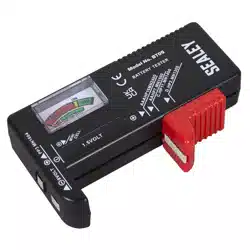
Easy to use, with colour coded analogue display needle; Good/Green, Low/Yellow, Replace or Recharge/Red. Tests levels of AAA, AA, C, D,
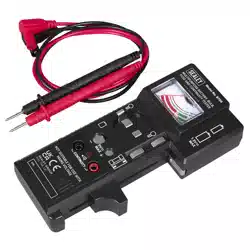
1.5V, 9V and button type batteries, household and automotive fuses and domestic lament bulbs. Audible continuity tester via test probes
(supplied). Lightweight and compact design for easy portability. Not to be used to test lead acid batteries. Operated by 9V battery (supplied).
3. SPECIFICATION
Model No: ..................................................................... BT06
Power: ................................................................... 9V Battery
Weight: ...................................................................... 0.180kg
4. FEATURES
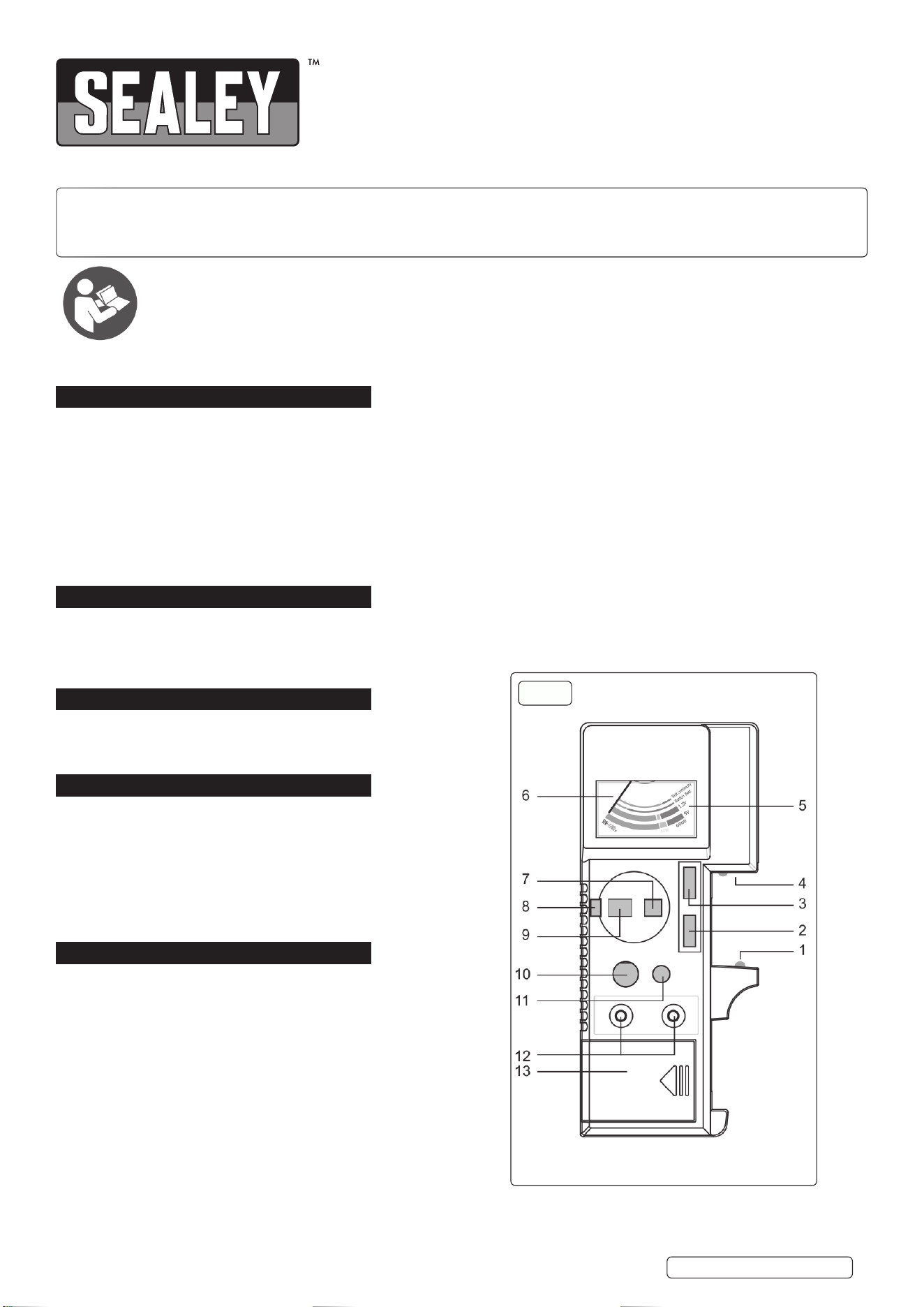
1, 4: Metal contacts for testing 1.5V batteries
2, 3: Metal contacts for testing fuses
7, 8, 9: Metal contacts for testing bulbs
10, 11: Metal contacts for testing 9V batteries
5: Display scales
6: Needle
12: Jack plugs for test leads
13: Storage compartment
5. FIT BATTERY
5.1. Slide o battery compartment cover on rear of battery.
5.2. Connect cable to battery terminals, install battery, ret cover.
NOTE: Use this tester to test the 9V battery.
Refer to
instruction
manual
g.1
Original Language Version
© Jack Sealey Limited
BT06 Issue 1 02/10/24
6. OPERATION
Numbers below refer to fig.1
6.1. TESTING 1.5V BATTERIES (AAA, AA, C, D, ETC):
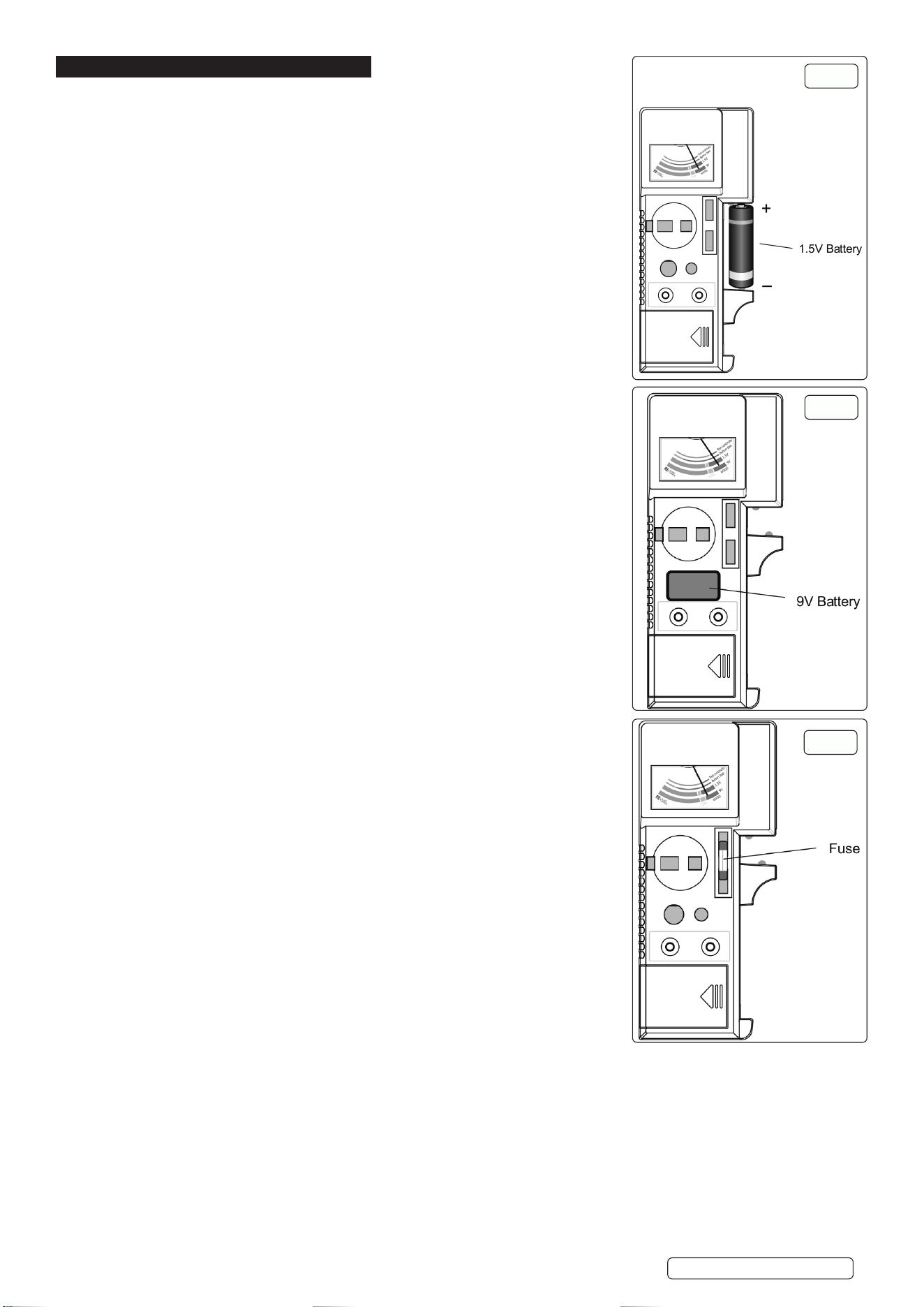
6.1.1. Refer to fig.2, connect the 1.5V battery to be tested to the metal contacts 4 and 1,
make sure that the positive terminal of the battery is connected to the contact 4 and
the negative terminal of the battery is connected to the contact 1.
6.1.2. Read the” 1.5V” scale:
Green area indicates that the battery is good.
Yellow area indicates that the battery is low.
Red area indicates that the battery needs to be replaced or recharged.
6.2. TESTING 9V BATTERIES (6F22, 006P, ETC) FIG.3:
6.2.1. Connect the 9V battery to be tested to the metal contacts 10 and 11, make
sure that the positive terminal of the battery is connected to the contact 11 and the negative
terminal of the battery is connected to the contact 10.
6.2.2. Read the “ 9V “ scale.
Green area indicates that the battery is good.
Yellow area indicates that the battery is low.
Red area indicates that the battery needs to be replaced or recharged.
6.3. TESTING FUSES FIG.4:
6.3.1. Connect the two terminals of the fuse to be tested to the metal contacts 2 and 3.
6.3.2. Use and read the “Test continuity“ scale.
If the pointer is in the green area, the fuse is good.
If the pointer is in the red area, the fuse is in open circuit state (has blown).
g.2
g.3
g.4
Original Language Version
© Jack Sealey Limited
Original Language Version
© Jack Sealey Limited
BT06 Issue 1 02/10/24
Sealey Group, Kempson Way, Suffolk Business Park, Bury St Edmunds, Suffolk. IP32 7AR
01284 757500 sales@sealey.co.uk www.sealey.co.uk
ENVIRONMENT PROTECTION
Recycle unwanted materials instead of disposing of them as waste. All tools, accessories and packaging should be sorted, taken to
a recycling centre and disposed of in a manner which is compatible with the environment. When the product becomes completely
unserviceable and requires disposal, drain any fluids (if applicable) into approved containers and dispose of the product and fluids
according to local regulations.
Note: It is our policy to continually improve products and as such we reserve the right to alter data, specifications and component parts without prior
notice.
Important: No Liability is accepted for incorrect use of this product.
Warranty: Guarantee is 12 months from purchase date, proof of which is required for any claim.
WEEE REGULATIONS
Dispose of this product at the end of its working life in compliance with the EU Directive on Waste Electrical and Electronic
Equipment (WEEE). When the product is no longer required, it must be disposed of in an environmentally protective way.
Contact your local solid waste authority for recycling information.
REGISTER YOUR
PURCHASE HERE
Original Language Version
© Jack Sealey Limited
BT06 Issue 1 02/10/24
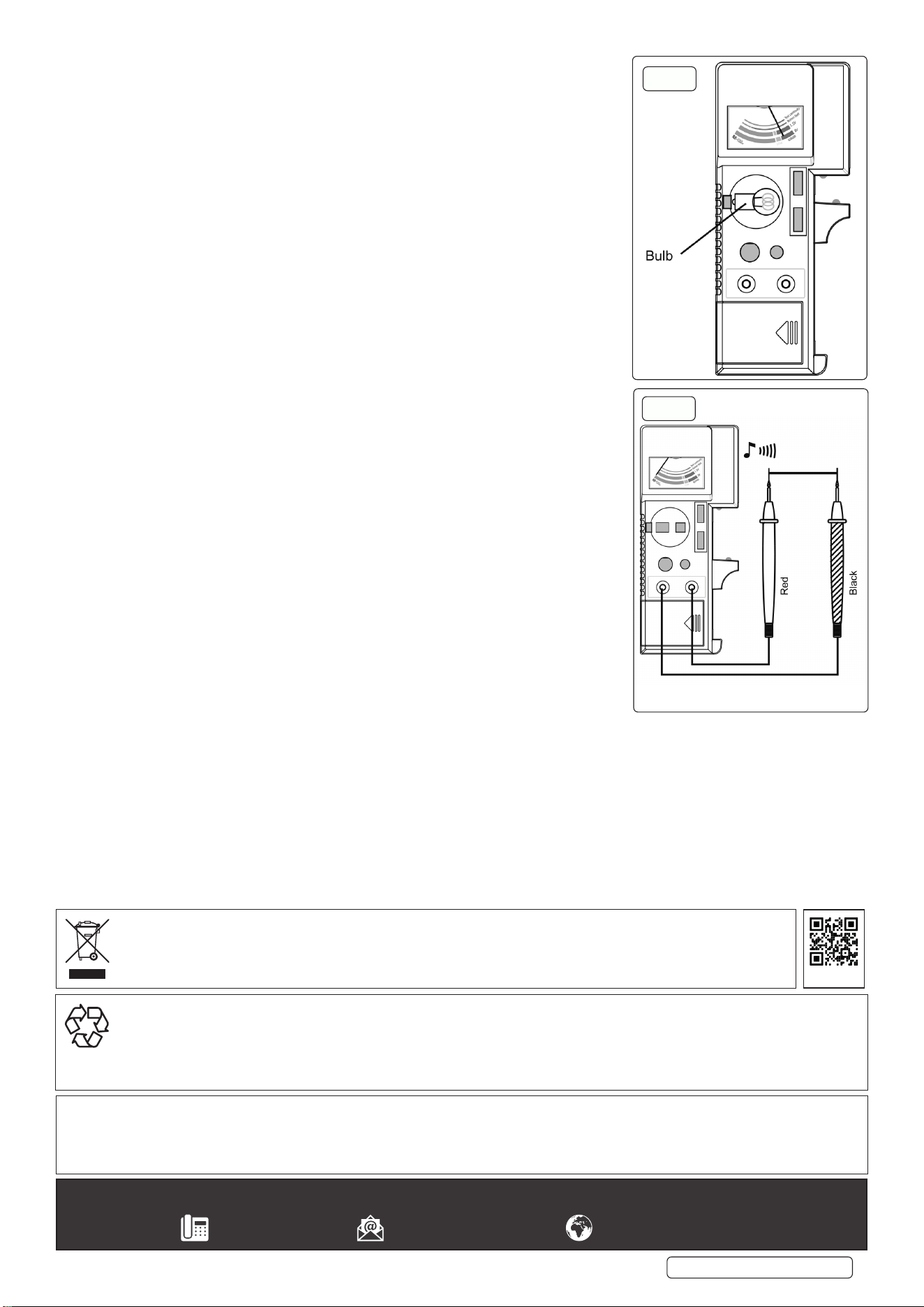
6.4. TESTING BULBS FIG.5:
6.4.1. Connect the two terminals of the bulb to be tested to the contacts 8 and 9, or to the contacts 7
and 9, depending on the type of the bulb.
6.4.2. Use and read the “Test continuity“ scale.
If the pointer is in the green area, the bulb is good.
If the pointer is in the red area, the bulb is in open circuit state, (has blown).
6.5. CONTINUITY TEST FIG.6:
NOTE: Before test, disconnect all power to the circuit to be tested and discharge all
capacitors thoroughly.
6.5.1. Connect the black test lead to the left jack and the red test lead to the right jack.
6.5.2. Connect the test leads across the circuit to be tested.
6.5.3. If the circuit’s resistance is less than about 5000, the built-in buzzer will sound.
6.5.4. If the resistance is between 5000 and 1kO, the buzzer may sound or may not sound.
g.5
g.6