User Manual
Orbi Tri-band Mesh WiFi 6 System
Models:
Orbi Router Model RBR760, RBR750P, and RBR660
Orbi Satellite Model RBS760, RBS750P, and RBS660
NETGEAR, Inc.
350 E. Plumeria DriveSeptember 2024
San Jose, CA 95134, USA202-12673-02

Support and Community
Visit netgear.com/support to get your questions answered and access the latest
downloads.
You can also check out our NETGEAR Community for helpful advice at
community.netgear.com.
Regulatory and Legal
Si ce produit est vendu au Canada, vous pouvez accéder à ce document en français
canadien à https://www.netgear.com/support/download/.
(If this product is sold in Canada, you can access this document in Canadian French at
https://www.netgear.com/support/download/.)
For regulatory compliance information including the EU Declaration of Conformity, visit
https://www.netgear.com/about/regulatory/.
See the regulatory compliance document before connecting the power supply.
For NETGEAR’s Privacy Policy, visit https://www.netgear.com/about/privacy-policy.
By using this device, you are agreeing to NETGEAR’s Terms and Conditions at
https://www.netgear.com/about/terms-and-conditions. If you do not agree, return the
device to your place of purchase within your return period.
Trademarks
© NETGEAR, Inc., NETGEAR, and the NETGEAR Logo are trademarks of NETGEAR, Inc.
Any non-NETGEAR trademarks are used for reference purposes only.
Revision History
CommentsPublish DatePublication Part
Number
Added RBR660/RBS660 information.September 2024202-12673-02
First publication.June 2024202-12673-01
User Manual2
Orbi Tri-band Mesh WiFi 6 System

Contents
Chapter 1 Overview
Orbi router overview........................................................................... 8
Orbi router hardware features...................................................... 8
Orbi router front LED and Power LED behavior......................... 9
Orbi satellite overview...................................................................... 10
Orbi satellite hardware features................................................. 10
Orbi satellite front LED and Power LED behavior.................... 11
Router and satellite labels................................................................ 12
Connect your router......................................................................... 13
Place your Orbi satellite................................................................... 13
Sync your Orbi satellite with your Orbi router.............................. 14
Chapter 2 Connect to the Network and Access the Router
Connect to the network.................................................................... 16
Wired connection......................................................................... 16
WiFi connection............................................................................ 16
WiFi connection using WPS........................................................ 17
Types of logins.................................................................................. 17
Set up and manage with the NETGEAR Orbi app........................ 17
Use a web browser to access the router........................................ 18
Use the automatic Internet setup option................................... 19
Log in to the Orbi router web interface..................................... 20
Change the language....................................................................... 20
Chapter 3 Specify Your Internet Settings
Manually set up the Internet connection....................................... 23
Specify an Internet connection without a login............................. 23
Specify an Internet connection that uses a login.......................... 24
Manage an IPv6 Internet connection.............................................. 26
Requirements for entering IPv6 addresses............................... 26
Specify IPv6 Internet connections.............................................. 26
Use auto detection for an IPv6 Internet connection................ 27
Use auto configuration for an IPv6 Internet connection.......... 29
Set up an IPv6 6to4 tunnel Internet connection....................... 30
Set up an IPv6 6rd tunnel Internet connection......................... 32
Set up an IPv6 pass-through Internet connection.................... 33
Set up an IPv6 fixed Internet connection................................... 34
Set up an IPv6 DHCP Internet connection................................. 35
Set up an IPv6 PPPoE Internet connection................................ 37
3

Change the MTU size....................................................................... 38
Chapter 4 Control Access to the Internet
Manage NETGEAR Armor................................................................ 42
Allow or block access to your network........................................... 42
Manage network access control lists.............................................. 43
Use keywords to block Internet sites.............................................. 44
Delete keywords that are used to block Internet sites................. 45
Avoid blocking on a trusted computer.......................................... 46
Block services from the Internet...................................................... 46
Schedule when to block Internet sites and services..................... 48
Set up security event email notifications........................................ 48
Chapter 5 Specify Network Settings
Manage the WiFi settings................................................................ 52
Enable or disable AX features for the 2.4 GHz and 5 GHz
band............................................................................................... 52
Change the WiFi network name................................................. 53
Change the WiFi channel............................................................ 53
Change the WiFi password or security option......................... 54
Set up a guest WiFi network............................................................ 55
Change your region.......................................................................... 56
View or change WAN settings......................................................... 57
Manage Dynamic DNS..................................................................... 58
Set up a new Dynamic DNS account......................................... 58
Specify a Dynamic DNS account that you already created..... 59
Change the Dynamic DNS settings............................................ 60
Set up a default DMZ server............................................................ 61
Change the router’s device name................................................... 62
Change the LAN TCP/IP settings.................................................... 62
Use the router as a DHCP server..................................................... 64
Disable the DHCP server feature in the router.............................. 65
Manage reserved LAN IP addresses............................................... 66
Reserve an IP address.................................................................. 66
Edit a reserved IP address........................................................... 67
Delete a reserved IP address entry............................................ 67
Manage custom static routes........................................................... 68
Set up a static route...................................................................... 68
Edit a static route.......................................................................... 69
Delete a static route..................................................................... 70
Use the router as a WiFi access point only.................................... 70
Change the router back to router mode........................................ 72
Generate a new backhaul password.............................................. 72
Set up a bridge for a port group or VLAN tag group................... 73
4
Orbi Tri-band Mesh WiFi 6 System

Set up a bridge for a port group................................................ 73
Set up a bridge for a VLAN tag group....................................... 74
Improve network connections with Universal Plug and Play....... 75
Chapter 6 Mantain and Monitor Your Network
Update the router and satellite firmware....................................... 78
Check for firmware updates........................................................ 78
Manually update firmware.......................................................... 79
Manually update satellite firmware............................................ 79
Manually update router firmware............................................... 80
Change the admin password.......................................................... 81
Enable admin password reset......................................................... 82
Reset the admin password............................................................... 82
Always use HTTPS to access the router.......................................... 83
View router status and usage information..................................... 84
Display Internet port statistics......................................................... 85
Check the Internet connection status............................................. 86
View the satellite status.................................................................... 87
View and manage logs of router activity........................................ 87
View devices connected to the network or edit device
information......................................................................................... 88
View devices connected to the network................................... 88
Edit device information on the Attached Devices page.......... 89
View satellites connected to the network or edit satellite
information......................................................................................... 90
View satellites connected to the network.................................. 90
Edit satellite information that displays on the Attached Devices
page............................................................................................... 91
Check your Internet bandwidth...................................................... 92
Monitor Internet traffic..................................................................... 92
Set the time zone.............................................................................. 94
Change the NTP server.................................................................... 94
Manage the router configuration file............................................. 95
Back up settings............................................................................ 95
Restore configuration settings.................................................... 96
Erase the current configuration settings................................... 96
Remotely access your router using the Orbi app......................... 97
Chapter 7 Customize Internet Traffic Rules for Ports
Manage port forwarding to a local server..................................... 99
Set up port forwarding to a local server.................................... 99
Add a custom port forwarding service.................................... 100
Edit a port forwarding service.................................................. 101
Delete a port forwarding entry................................................. 102
5
Orbi Tri-band Mesh WiFi 6 System

How the router implements the port forwarding rule........... 102
Application example: Make a local web server public.......... 103
Manage port triggering................................................................. 103
Add a port triggering service................................................... 104
Disable port triggering or change the time-out period........ 105
Application example: Port triggering for Internet Relay Chat. 106
Chapter 8 Use VPN to Access Your Network
Set up a VPN connection............................................................... 108
Specify VPN service in the router.................................................. 108
Install OpenVPN software.............................................................. 109
Install OpenVPN software on your Windows-based
computer..................................................................................... 109
Install OpenVPN software on your Mac computer................ 112
Install OpenVPN software on an iOS device........................... 113
Install OpenVPN software on an Android device.................. 113
Use a VPN tunnel on your Windows-based computer............... 114
Use VPN to access your Internet service at home...................... 116
Set up VPN client Internet access in the router...................... 116
Block VPN client Internet access in the router........................ 117
Use a VPN tunnel to access your Internet service at home.... 117
Chapter 9 Troubleshooting
Quick tips......................................................................................... 120
Sequence to restart your network............................................ 120
WiFi settings................................................................................ 120
Network settings........................................................................ 120
The router and satellites do not sync........................................... 121
You cannot log in to the router..................................................... 121
You cannot access the Internet..................................................... 122
Troubleshoot Internet browsing................................................... 123
Troubleshoot PPPoE....................................................................... 123
Troubleshoot WiFi connectivity.................................................... 124
Troubleshoot your network using the ping utility...................... 125
Test the LAN path to your router............................................. 125
Test the path from your computer to a remote device......... 126
6
Orbi Tri-band Mesh WiFi 6 System
1
Overview
The Orbi Tri-band Mesh WiFi 6 System creates dedicated high-speed WiFi connections
to your Internet service. The Orbi router (model RBR760, RBR750P, or RBR660) connects
to your modem or gateway. The Orbi satellite (model RBS760, RBS750P, or RBS660)
extends the WiFi signal throughout your home.
This manual describes how to manage your Orbi WiFi System from your Orbi router
web interface. You can manage your Orbi satellite from the Orbi router web interface.
This chapter contains the following sections:
• Orbi router overview
• Orbi satellite overview
• Router and satellite labels
• Connect your router
• Place your Orbi satellite
• Sync your Orbi satellite with your Orbi router
For more information about the topics covered in this manual, visit the support website
at https://www.netgear.com/support/.
NOTE: This manual might refer to the Orbi router (model RBR760, RBR750P, or
RBR660) as the router and refer to the Orbi satellite (model RBS760, RBS750P,
or RBS660) as the satellite.
7
Orbi router overview
The following sections are an overview of the Orbi router hardware features and LED
behavior.
Orbi router hardware features
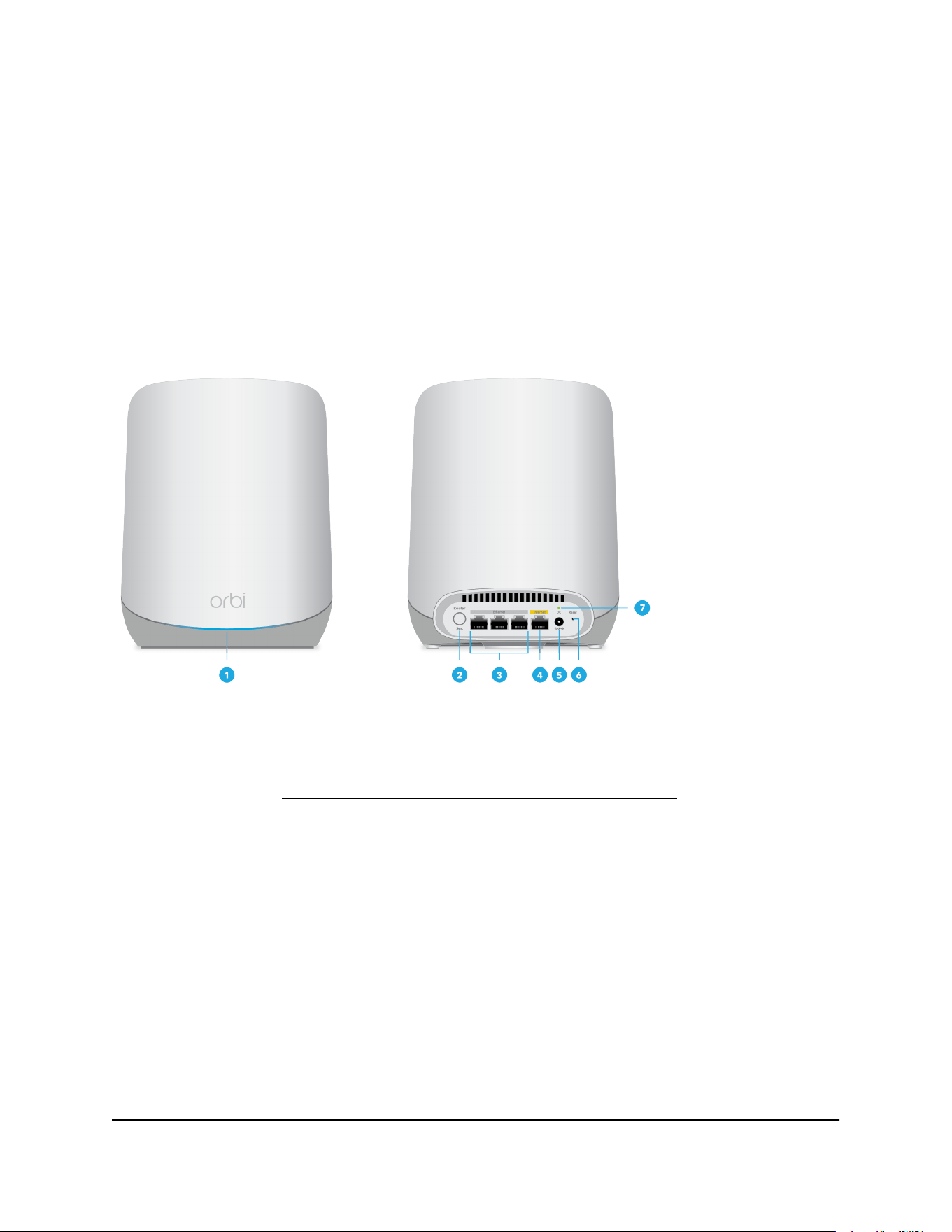
The following figures shows the Orbi router hardware features.
Figure 1. Orbi router front and back views
1. Router LED: Use the LED on the front of the router to determine its status. For more
information, see Orbi router front LED and Power LED behavior on page 9.
2. Sync button: Use the Sync button to connect a satellite to the router.
3. Ethernet ports 1–3: You can connect a LAN device to each of the three Gigabit
Ethernet RJ-45 LAN ports.
4. Internet port. Connect your modem to this port.
5. Power connector: Connect the power adapter that came with your router to this
port.
6. Reset button: Use the Reset button to restart (reboot) the router or reset the router
to its factory default settings:
User Manual8Overview
Orbi Tri-band Mesh WiFi 6 System
•
Restart the router: Press the Reset button for less than five seconds. The Power
LED lights solid amber and the router restarts.
•
Reset the router to its factory default settings: Press and hold the Reset button
until the Power LED starts blinking amber. The router resets and returns to its
factory settings.
7. Power LED: For more information about the Power LED behavior, see Orbi router
front LED and Power LED behavior on page 9.
Orbi router front LED and Power LED
behavior
The Orbi router includes a Router LED on the front and a Power LED on the back.
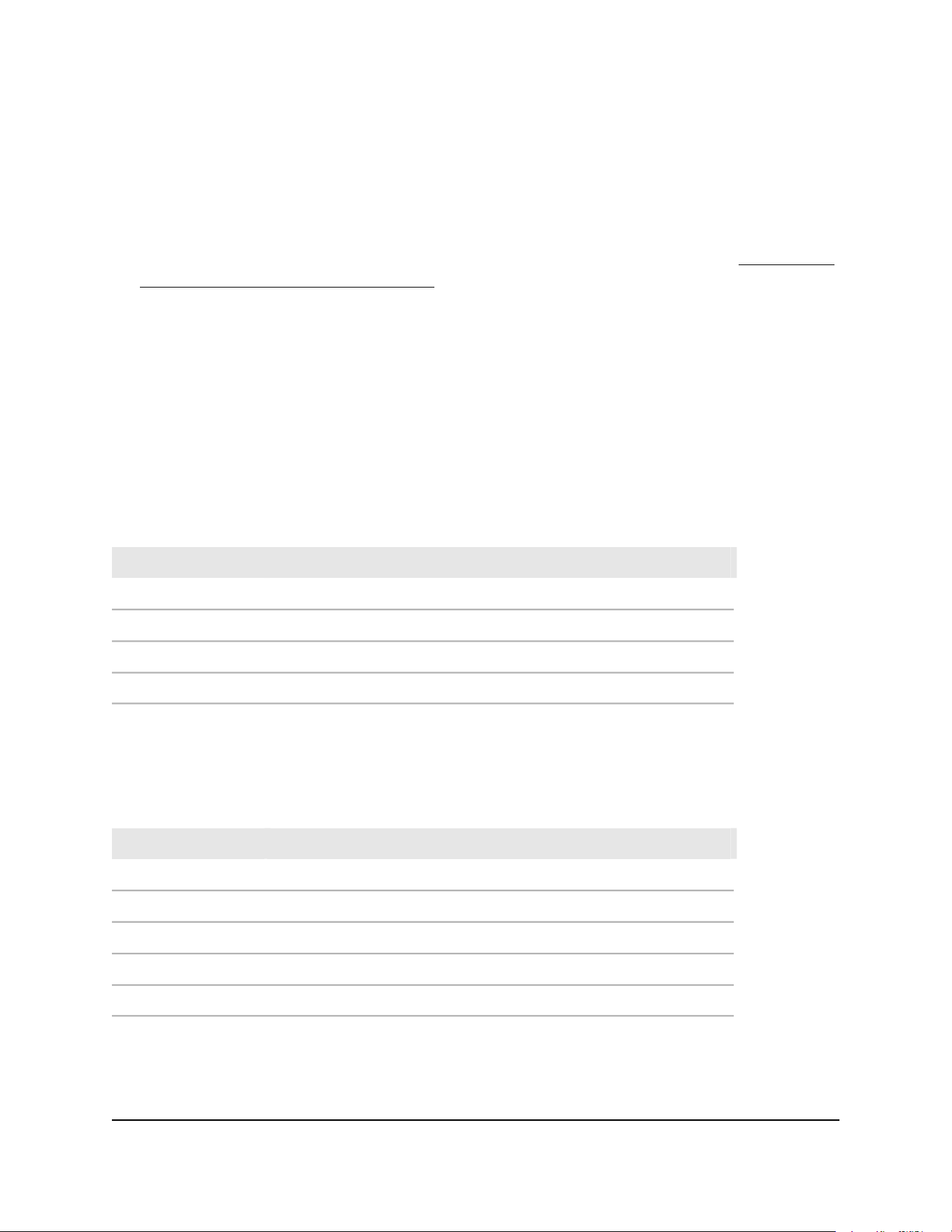
The following table describes the LED behavior for the Router LED on the front of the
router.
Table 1. Router LED behavior
DescriptionLED color
The router is booting or someone pressed the Sync button.Pulsing white
The router is resetting to its factory default settings.Solid white
The router cannot connect to the Internet.Solid magenta
The router finished booting and is working normally.Off
The following table describes the LED behavior for the router’s Power LED on the back
of the router.
Table 2. Power LED behavior
DescriptionLED color
Power is on.Solid green
The router is booting.Solid amber
The router is resetting to its factory default settings.Blinking amber
The router’s firmware is corrupted.Blinking red
Power is not suppliedOff
User Manual9Overview
Orbi Tri-band Mesh WiFi 6 System
Orbi satellite overview
The following sections are an overview of the Orbi satellite hardware features and LED
behavior.
Orbi satellite hardware features
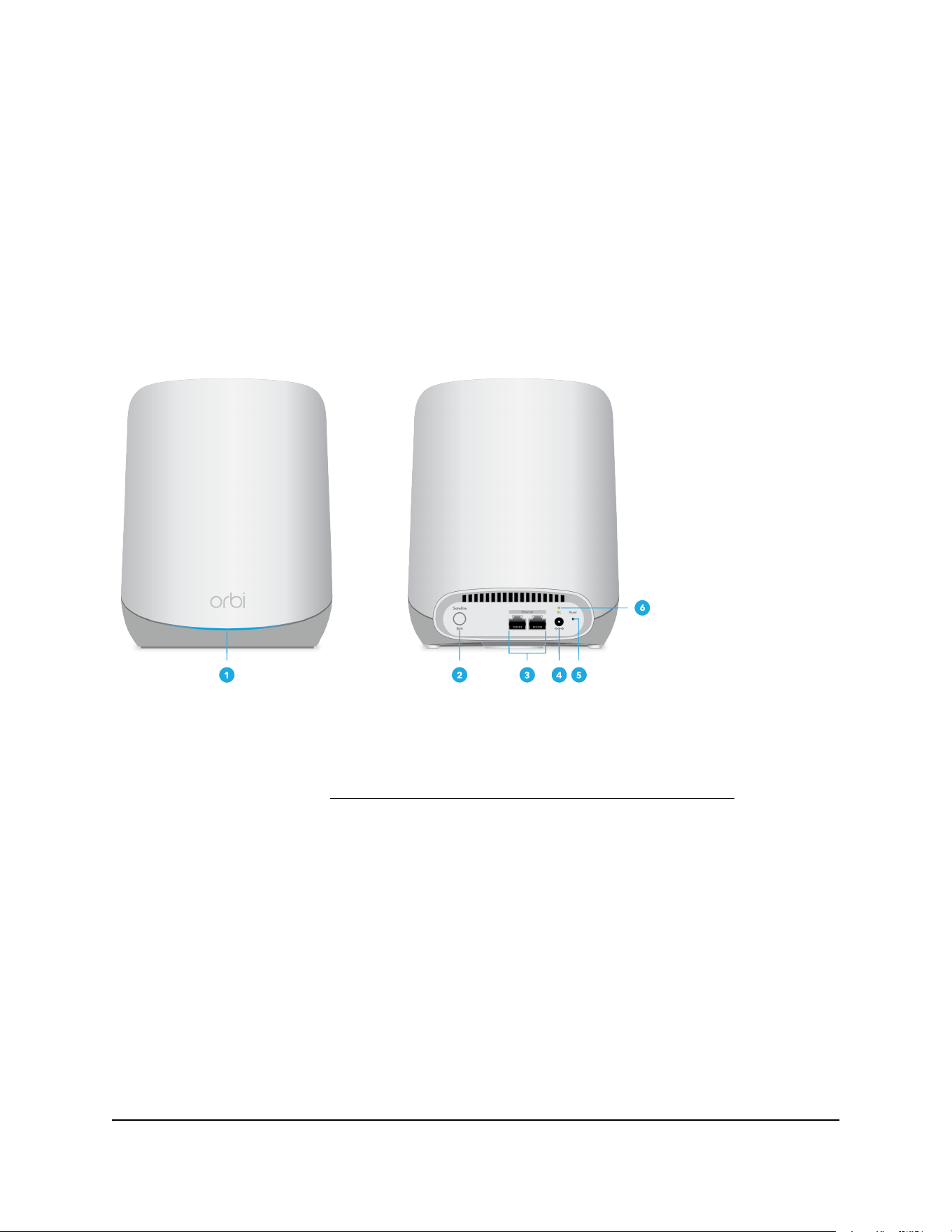
The following figures shows the Orbi satellite hardware features.
Figure 2. Orbi satellite front and back views
1. Satellite LED: Use the LED on the front of the router to determine its status. For
more information, see Orbi satellite front LED and Power LED behavior on page 11.
2. Sync button: Use the Sync button to connect the satellite to the router.
3. Ethernet ports 1–2: You can connect a LAN device to each of the two Gigabit
Ethernet RJ-45 LAN ports.
4. Power connector: Connect the power adapter that came with your satellite to this
port.
5. Reset button: Use the Reset button to restart (reboot) the satellite or reset the
satellite to its factory default settings:
User Manual10Overview
Orbi Tri-band Mesh WiFi 6 System
•
Restart the satellite: Press the Reset button for less than five seconds. The Power
LED lights solid amber and the satellite restarts.
•
Reset the satellite to its factory default settings: Press and hold the Reset
button until the Power LED starts blinking amber. The satellite resets and returns
to its factory settings.
6. Power LED: For more information about the Power LED behavior, see Orbi satellite
front LED and Power LED behavior on page 11.
Orbi satellite front LED and Power LED
behavior
The Orbi satellite includes a Satellite LED on the front and a Power LED on the back.
The following table describes the LED behavior for the Satellite LED on the front of the
satellite.
Table 3. Satellite LED behavior
DescriptionLED color
The satellite is booting.Pulsing white
The satellite synced to the router. The connection between the satellite
and router is good.
The LED lights blue for three minutes and then turns off.
Blue
The satellite synced to the router. The connection between the satellite
and router is fair.
The LED lights amber for three minutes and then turns off.
Amber
The satellite did not sync to the router.Magenta
The satellite synced with the router and is working normally.Off
The following table describes the LED behavior for the satellite’s Power LED on the back
of the satellite.
Table 4. Power LED behavior
DescriptionLED color
Power is on.Solid green
The satellite is booting.Solid amber
The satellite is resetting to its factory default settings.Blinking amber
User Manual11Overview
Orbi Tri-band Mesh WiFi 6 System
Table 4. Power LED behavior (Continued)
DescriptionLED color
The satellite’s firmware is corrupted.Blinking red
Power is not suppliedOff
Router and satellite labels
The Orbi router and satellite labels show the router’s or satellite's MAC address and
serial number. Each label also includes a QR code you can scan during the setup to
connect to the Orbi network. The following are examples of what the router and satellite
labels might look like:
Figure 3. Router label (left) and satellite label (right)
User Manual12Overview
Orbi Tri-band Mesh WiFi 6 System
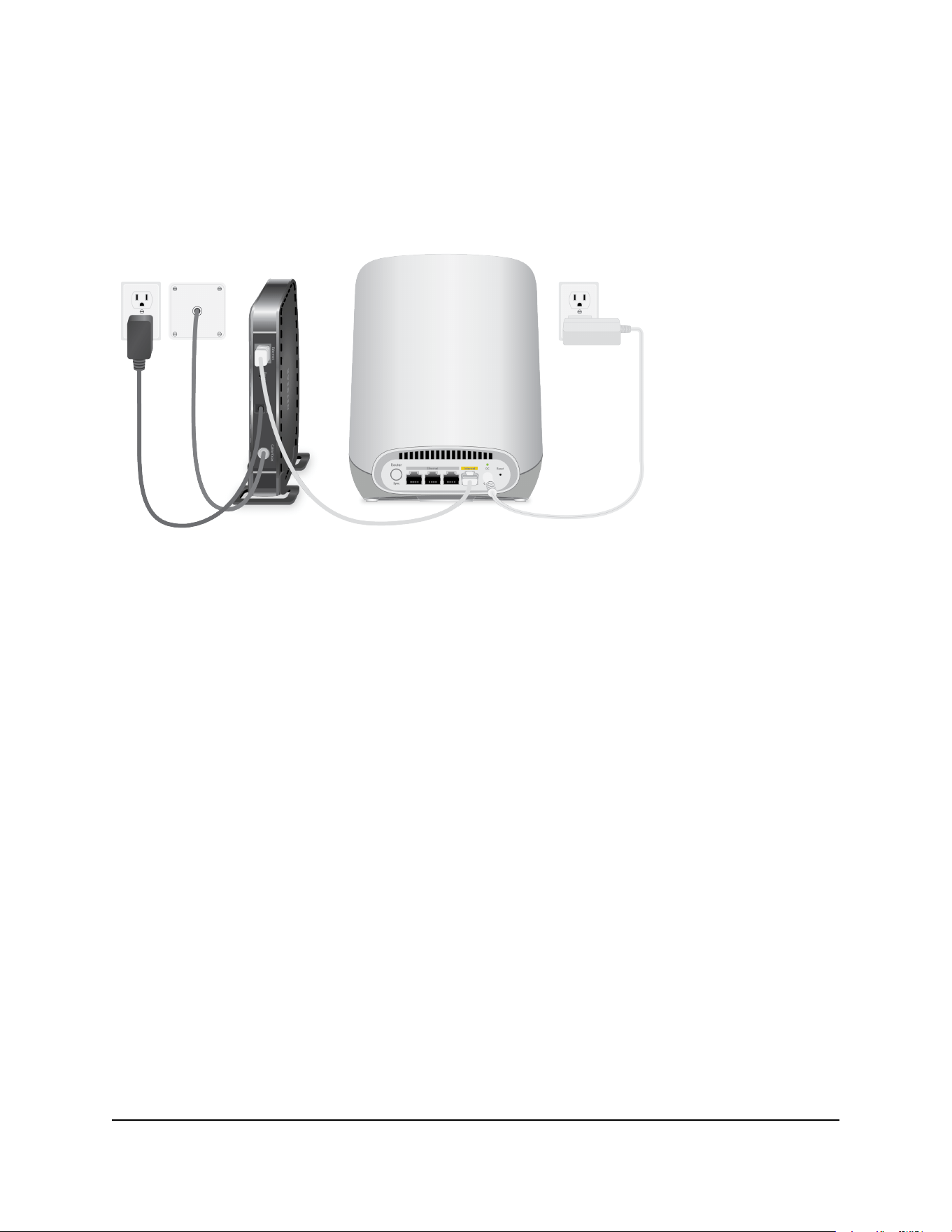
Connect your router
Power on your router and connect it to a modem.
To cable your router:
1. Unplug your modem’s power, leaving the modem connected to the wall jack for
your Internet service.
If your modem uses a battery backup, remove the battery.
2. Plug in and turn on your modem.
If your modem uses a battery backup, put the battery back in.
3. Connect your modem to the Internet port of your router with the Ethernet cable that
came with your router.
4. Connect the power adapter to your router and plug the power adapter into an outlet.
5. If the Power LED does not light, make sure that the power adapter is properly
connected to your router and power outlet.
Place your Orbi satellite
Your Orbi satellite must be within range of your Orbi router’s WiFi signal so that it can
sync with your router. Use your satellite’s LED to help you determine where to place
your satellite.
User Manual13Overview
Orbi Tri-band Mesh WiFi 6 System

Sync your Orbi satellite with your
Orbi router
The Orbi satellite that comes with your Orbi router is preset to automatically find and
sync to your Orbi router’s WiFi signal.
To sync your satellite:
1. Place your satellite.
For more information, see Place your Orbi satellite on page 13.
2. Connect the satellite to a power source.
The satellite LED pulses white. The satellite automatically finds the Orbi router’s WiFi
signal and attempts to sync to the Orbi router.
The satellite LED lights one of the following colors:
•
Blue: The Orbi router and satellite successfully synced, and the connection
between the router and satellite is good.
•
Amber: The connection with the router is fair. We recommend that you move
the Orbi satellite closer to the Orbi router and try again.
3. If the satellite LED lights magenta, do the following:
a. Unplug your Orbi satellite, move the satellite closer to the router.
b. Plug the satellite back in, and wait two minutes for the LED to turn blue or amber.
4. If the satellite LED still does not turn blue or amber, do the following:
a. Press the Sync button on the back of the router.
b. Within two minutes press the Sync button on the back of the satellite.
c. Wait two minutes for the LED to turn blue or amber.
User Manual14Overview
Orbi Tri-band Mesh WiFi 6 System


Connect to the network
You can connect to the Orbi network through a wired or WiFi connection. If you want
to connect on a computer using a static IP address, change the settings so that it uses
Dynamic Host Configuration Protocol (DHCP).
Wired connection
You can connect your computer to the router using an Ethernet cable and join the
router’s local area network (LAN). The computer must have an Ethernet port.
To connect your computer to the router with an Ethernet cable:
1. Make sure that the router is receiving power (its Power LED is lit).
2. Connect an Ethernet cable to an Ethernet port on your computer.
3. Connect the other end of the Ethernet cable to one of the router’s Ethernet ports.
Your computer connects to the local area network (LAN). A message might display
on your computer screen to notify you that an Ethernet cable is connected.
WiFi connection
If you're installing your Orbi router for the first time, you can connect to the router's
WiFi network by scanning the QR code on your router with the camera app on your
mobile device. To scan the QR code with your camera app, your mobile device must
have iOS version 11 or later or Android version 10 or later.
You can also manually find and select the Orbi router's WiFi network from your
WiFi-enabled computer or mobile device.
To find and select the WiFi network:
1. Make sure that the router or satellite is receiving power (its Power LED is lit).
2. On your WiFi-enabled computer or mobile device, find and select the WiFi network.
The WiFi network name is on the router label. The WiFi network name is the same
for the router and the satellite in the Orbi WiFi System.
NOTE: If you bought the router and the satellite separately, their default
WiFi network names are different.
3. Join the WiFi network and enter the WiFi password.
The password is on the router label.
Your WiFi-enabled computer or mobile device connects to the WiFi network.
User Manual16Connect to the Network and
Access the Router
Orbi Tri-band Mesh WiFi 6 System

WiFi connection using WPS
You can connect to the router’s WiFi network with Wi-Fi Protected Setup (WPS) or you
can find and select the WiFi network.
To use WPS to connect to the WiFi network:
1. Make sure that the router is receiving power (its Power LED is lit).
2. Check the WPS instructions for your computer or WiFi device.
3. Press the Sync button on the router.
4. Within two minutes, on your WiFi-enabled computer or mobile device, press its WPS
button or follow its instructions for WPS connections.
Your computer or mobile device connects to the WiFi network.
Types of logins
Separate types of logins serve different purposes. It is important that you understand
the difference so that you know which login to use when.
Types of logins:
•
ISP login: The login that your Internet service provider (ISP) gave you logs you in to
your Internet service. Your service provider gave you this login information in a letter
or some other way. If you cannot find this login information, contact your service
provider.
•
WiFi network name and network key: Your router and satellite are preset with the
same WiFi network name (SSID) and network key (password) for WiFi access. This
information is on the router label and the satellite label.
•
NETGEAR account login: The free NETGEAR account that you need to register your
router and manage your subscriptions. If you do not have a NETGEAR account, you
can create one using the NETGEAR Orbi app.
•
Router login: This logs you in to the router web interface from a web browser as
the router administrator (admin).
Set up and manage with the
NETGEAR Orbi app
You can use the NETGEAR Orbi app to set up and access your Orbi network.
User Manual17Connect to the Network and
Access the Router
Orbi Tri-band Mesh WiFi 6 System
To find the app, scan a QR code or search for NETGEAR Orbi in the Apple App Store
or Google Play Store.
For more information about the Orbi app, visit
https://www.netgear.com/home/apps-services/orbi-app.
NOTE: If you do not want to use the NETGEAR Orbi app, you can use the Orbi
router web interface to set up your Orbi devices. For more information about
how to access your Orbi router web interface, see Use a web browser to access
the router on page 18.
To set up your Orbi WiFi system with the Orbi app:
1. Download the NETGEAR Orbi app on your mobile device.
2. On your mobile device, open the WiFi connection manager.
3. Locate and connect your mobile device to your Orbi WiFi network.
Your preset Orbi WiFi network and password is on the Orbi router label. You can
change the WiFi credentials after setup.
4. Launch the Orbi app and follow the setup instructions.
Use a web browser to access the
router
When you connect to the network (either with WiFi or with an Ethernet cable), you can
use a web browser to access the router to view or change its settings. The first time you
access the router, the NETGEAR installation assistant automatically checks to see if your
router can connect to your Internet service.
User Manual18Connect to the Network and
Access the Router
Orbi Tri-band Mesh WiFi 6 System

Use the automatic Internet setup option
You can set up your router automatically, or you can use a web browser to access the
router and set up your router manually. Before you start the setup process, get your ISP
information and make sure that the computers and devices in the network use the
settings described here.
When your Internet service starts, your Internet service provider (ISP) typically gives you
all the information needed to connect to the Internet. For DSL service, you might need
the following information to set up your router:
•
The ISP configuration information for your DSL account
•
ISP login name and password
•
Fixed or static IP address settings (special deployment by ISP; this setting is rare)
If you cannot locate this information, ask your ISP to provide it. When your Internet
connection is working, you no longer need to launch the ISP login program on your
computer to access the Internet. When you start an Internet application, your router
automatically logs you in.
Installation and basic setup takes about 15 minutes to complete.
To automatically set up your router:
1. Power on your router.
2. Make sure that your WiFi-enabled computer or mobile device is connected to the
router with an Ethernet cable (wired) or wirelessly with the preset WiFi security
settings listed on the label.
NOTE: If you want to change the router’s WiFi settings, use a wired
connection to avoid being disconnected when the new WiFi settings take
effect.
3. Launch a web browser.
The page that displays depends on whether you accessed the router before:
•
The first time that you set up the Internet connection for your router, the browser
goes to orbilogin.com, and the Orbi login page displays.
•
If you already set up the Internet connection, enter orbilogin.com in the address
field for your browser to start the installation process.
4. Follow the onscreen instructions.
The router connects to the Internet.
5. If the browser does not display the web page, do the following:
User Manual19Connect to the Network and
Access the Router
Orbi Tri-band Mesh WiFi 6 System

•
Make sure that the computer is connected to one of the four LAN Ethernet ports
or over WiFi to the router.
•
Make sure that the router is receiving power, and that its Power LED is lit.
•
Close and reopen the browser or clear the browser cache.
•
Browse to orbilogin.com.
•
If the computer is set to a static or fixed IP address (this setting is uncommon),
change it to obtain an IP address automatically from the router.
6. If the router does not connect to the Internet, do the following:
a. Review your settings.
b. Make sure that you selected the correct options and typed everything correctly.
c. Contact your ISP to verify that you are using the correct configuration information.
d. Read Troubleshooting on page 119.
If problems persist, register your NETGEAR product and contact NETGEAR
technical support.
Log in to the Orbi router web interface
When you log in to the Orbi, the browser displays the router web interface. You can
use the router web interface to change the router or satellite settings.
To log in to your Orbi:
1. Launch a web browser from a computer or mobile device that is connected to your
Orbi network.
2. Enter orbilogin.com.
A login window displays.
3. Enter the router admin user name and password.
The user name is admin. The password is the one that you specified the first time
that you logged in. The user name and password are case-sensitive.
The BASIC Home page displays.
Change the language
By default, the Auto setting uses your region to automatically set the language that
displays when you log in to the router web interface.
User Manual20Connect to the Network and
Access the Router
Orbi Tri-band Mesh WiFi 6 System

To change the language:
1. Launch a web browser from a computer or mobile device that is connected to your
Orbi network.
2. Enter orbilogin.com.
A login window displays.
3. Enter the router admin user name and password.
The user name is admin. The password is the one that you specified the first time
that you logged in. The user name and password are case-sensitive.
The BASIC Home page displays.
4. In the upper right corner, select a language from the menu.
5. When prompted, click the OK button to confirm this change.
The page refreshes with the language that you selected.
User Manual21Connect to the Network and
Access the Router
Orbi Tri-band Mesh WiFi 6 System

3
Specify Your Internet Settings
Usually, the quickest way to set up the router to use your Internet connection is to allow
Orbi to detect the Internet connection when you first access the router with a web
browser. You can also customize or specify your Internet settings.
This chapter contains the following sections:
• Manually set up the Internet connection
• Specify an Internet connection without a login
• Specify an Internet connection that uses a login
• Manage an IPv6 Internet connection
• Change the MTU size
22

Manually set up the Internet
connection
You can view or change the router’s Internet connection settings.
Specify an Internet connection
without a login
To specify the Internet connection settings:
1. Launch a web browser from a computer or mobile device that is connected to your
Orbi network.
2. Enter orbilogin.com.
A login window opens.
3. Enter the admin user name and password.
The user name is admin. The password is the one that you specified the first time
that you logged in. The user name and password are case-sensitive.
The BASIC Home page displays.
4. Select Internet.
The Internet Setup page.
5. Leave the Does your Internet connection require a login No radio button selected.
6. If your Internet connection requires an account name or host name, type it in the
Account Name (If Required) field.
7. If your Internet connection requires a domain name, type it in the Domain Name (If
Required) field.
For the other sections in this page, the default settings usually work, but you can
change them.
8. Select an Internet IP Address radio button:
•
Get Dynamic IP Address From Router. Your ISP uses DHCP to assign your IP
address. Your ISP automatically assigns these addresses.
•
Use Static IP Address. Enter the IP address, IP subnet mask, and the gateway IP
address that your ISP assigned. The gateway is the ISP router to which your router
connects.
User Manual23Specify Your Internet Settings
Orbi Tri-band Mesh WiFi 6 System

9. Select a Domain Name Server (DNS) Address radio button:
•
Get Automatically from ISP. Your ISP uses DHCP to assign your DNS servers.
Your ISP automatically assigns this address.
•
Use These DNS Servers. If you know that your ISP requires specific servers, select
this option. Enter the IP address of your ISP’s primary DNS server. If a secondary
DNS server address is available, enter it also.
10. Select a Router MAC Address radio button:
•
Use Default Address. Use the default MAC address.
•
Use Computer MAC Address. The router captures and uses the MAC address
of the computer that you are now using. You must use the one computer that the
ISP allows.
•
Use This MAC Address. Enter the MAC address that you want to use.
11. In the Vendor Class Identifier String (option 60) field, enter the enter the vendor
class identifier (VCI) string, as indicated by your ISP.
If your ISP did not provide you with a VCI string, leave this field blank.
12. In the Client Identifier String (option 61) field, enter the client identifier (client ID)
string, as indicated by your ISP.
If your ISP did not provide you with a client ID string, leave this field blank.
13. Click the Apply button.
Your settings are saved.
14. Click the Test button to test your Internet connection.
Specify an Internet connection that
uses a login
To view or change the basic Internet setup:
1. Launch a web browser from a computer or mobile device that is connected to your
Orbi network.
2. Enter orbilogin.com.
A login window opens.
3. Enter the admin user name and password.
The user name is admin. The password is the one that you specified the first time
that you logged in. The user name and password are case-sensitive.
The BASIC Home page displays.
User Manual24Specify Your Internet Settings
Orbi Tri-band Mesh WiFi 6 System

4. Select Internet.
The Internet Setup page displays.
5. Select the Does your Internet connection require a login Yes radio button.
The page adjusts.
6. From the Internet Service Provider menu, select the encapsulation method:
The selections are PPPoE, PPTP, or L2TP.
7. In the Login field, enter the login name your ISP gave you.
This login name is often an email address.
8. In the Password field, type the password that you use to log in to your Internet
service.
9. If your ISP requires a service name, type it in the Service Name (if Required) field.
10. From the Connection Mode menu, select Always On, Dial on Demand, or Manually
Connect.
11. To change the number of minutes until the Internet login time out, in the Idle Timeout
(In minutes) field, type the number of minutes.
This is how long the router keeps the Internet connection active when no one on the
network is using the Internet connection. A value of 0 (zero) means never log out.
12. Select an Internet IP Address radio button:
•
Get Dynamic IP Address From Router. Your ISP uses DHCP to assign your IP
address. Your ISP automatically assigns these addresses.
•
Use Static IP Address. Enter the IP address, IP subnet mask, and gateway IP
address that your ISP assigned. The gateway is the ISP router to which your router
connects.
13. Select a Domain Name Server (DNS) radio button:
•
Get Automatically from ISP. Your ISP uses DHCP to assign your DNS servers.
Your ISP automatically assigns this address.
•
Use These DNS Servers. If you know that your ISP requires specific servers, select
this option. Enter the IP address of your ISP’s primary DNS server. If a secondary
DNS server address is available, enter it also.
14. Select a Router MAC Address radio button:
•
Use Default Address. Use the default MAC address.
•
Use Computer MAC Address. The router captures and uses the MAC address
of the computer that you are now using. You must use the one computer that the
ISP allows.
•
Use This MAC Address. Enter the MAC address that you want to use.
15. Click the Apply button.
User Manual25Specify Your Internet Settings
Orbi Tri-band Mesh WiFi 6 System

Your settings are saved.
16. Click the Test button to test your Internet connection.
Manage an IPv6 Internet connection
The router supports many different types of IPv6 Internet connections for which you can
specify the settings manually.
Requirements for entering IPv6 addresses
IPv6 addresses are denoted by eight groups of hexadecimal quartets that are separated
by colons. You can reduce any four-digit group of zeros within an IPv6 address to a
single zero or omit it.
All of the following examples specify the same IPv6 address:
•
2001:db8:0000:0000:020f:24ff:febf:dbcb
•
2001:db8:0:0:20f:24ff:febf:dbcb
•
2001:db8::20f:24ff:febf:dbcb
•
2001:db8:0:0:20f:24ff:128.141.49.32
The following errors invalidate an IPv6 address:
•
More than eight groups of hexadecimal quartets
•
More than four hexadecimal characters in a quartet
•
More than two colons in a row
Specify IPv6 Internet connections
You can set up an IPv6 Internet connection if the router does not detect it automatically.
To set up an IPv6 Internet connection:
1. Launch a web browser from a computer or mobile device that is connected to your
Orbi network.
2. Enter orbilogin.com.
A login window opens.
3. Enter the admin user name and password.
User Manual26Specify Your Internet Settings
Orbi Tri-band Mesh WiFi 6 System

The user name is admin. The password is the one that you specified the first time
that you logged in. The user name and password are case-sensitive.
The BASIC Home page displays.
4. Select ADVANCED > Advanced > IPv6.
The IPv6 page displays.
5. From the Internet Connection Type menu, select the IPv6 connection type:
•
If you are not sure, select Auto Detect so that the router detects the IPv6 type
that is in use.
•
If your Internet connection does not use PPPoE, DHCP, or fixed, but is IPv6, select
Auto Config.
Your Internet service provider (ISP) can provide this information.
For more information about IPv6 Internet connection, see the following sections:
•
Use auto detection for an IPv6 Internet connection on page 27
•
Use auto configuration for an IPv6 Internet connection on page 29
•
Set up an IPv6 6to4 tunnel Internet connection on page 30
•
Set up an IPv6 6rd tunnel Internet connection on page 32
•
Set up an IPv6 pass-through Internet connection on page 33
•
Set up an IPv6 fixed Internet connection on page 34
•
Set up an IPv6 DHCP Internet connection on page 35
•
Set up an IPv6 PPPoE Internet connection on page 37
6. Click the Apply button.
Your settings are saved.
Use auto detection for an IPv6 Internet
connection
To set up an IPv6 Internet connection through auto detection:
1. Launch a web browser from a computer or mobile device that is connected to your
Orbi network.
2. Enter orbilogin.com.
A login window opens.
3. Enter the admin user name and password.
User Manual27Specify Your Internet Settings
Orbi Tri-band Mesh WiFi 6 System

The user name is admin. The password is the one that you specified the first time
that you logged in. The user name and password are case-sensitive.
The BASIC Home page displays.
4. Select ADVANCED > Advanced > IPv6.
The IPv6 page displays.
5. From the Internet Connection Type menu, select Auto Detect.
The page adjusts.
The router automatically detects the information in the following fields:
•
Connection Type. This field indicates the connection type that is detected.
•
Router’s IPv6 Address on WAN. This field shows the IPv6 address that is acquired
for the router’s WAN (or Internet) interface. The number after the slash (/) is the
length of the prefix, which is also indicated by the underline (_) under the IPv6
address. If no address is acquired, the field displays Not Available.
•
Router’s IPv6 Address on LAN. This field shows the IPv6 address that is acquired
for the router’s LAN interface. The number after the slash (/) is the length of the
prefix, which is also indicated by the underline (_) under the IPv6 address. If no
address is acquired, the field displays Not Available.
6. Select an IP Address Assignment radio button:
•
Use DHCP Server. This method passes more information to LAN devices, but
some IPv6 systems might not support the DHCv6 client function.
•
Auto Config. This is the default setting.
This setting specifies how the router assigns IPv6 addresses to the devices on your
home network (the LAN).
7. (Optional) Select the Enable RIPng check box.
This selection enables RIP Next Generation (RIPng) on IPv6 Internet connections.
RIPng is an extension of Routing Information Protocol (RIP) that supports IPv6.
8. (Optional) Select the Use This Interface ID check box and specify the interface ID
to be used for the IPv6 address of the router’s LAN interface.
If you do not specify an ID here, the router generates one automatically from its MAC
address.
9. Click the Apply button.
Your settings are saved.
User Manual28Specify Your Internet Settings
Orbi Tri-band Mesh WiFi 6 System

Use auto configuration for an IPv6 Internet
connection
To set up an IPv6 Internet connection through auto configuration:
1. Launch a web browser from a computer or mobile device that is connected to your
Orbi network.
2. Enter orbilogin.com.
A login window opens.
3. Enter the admin user name and password.
The user name is admin. The password is the one that you specified the first time
that you logged in. The user name and password are case-sensitive.
The BASIC Home page displays.
4. Select ADVANCED > Advanced > IPv6.
The IPv6 page displays.
5. From the Internet Connection Type menu, select Auto Config.
The page adjusts.
The router automatically detects the information in the following fields:
•
Router’s IPv6 Address on WAN. This field shows the IPv6 address that is acquired
for the router’s WAN (or Internet) interface. The number after the slash (/) is the
length of the prefix, which is also indicated by the underline (_) under the IPv6
address. If no address is acquired, the field displays Not Available.
•
Router’s IPv6 Address on LAN. This field shows the IPv6 address that is acquired
for the router’s LAN interface. The number after the slash (/) is the length of the
prefix, which is also indicated by the underline (_) under the IPv6 address. If no
address is acquired, the field displays Not Available.
6. (Optional) In the DHCP User Class (If Required) field, enter a host name.
Most people can leave this field blank, but if your ISP gave you a specific host name,
enter it here.
7. (Optional) In the DHCP Domain Name (If Required) field, enter a domain name.
You can type the domain name of your IPv6 ISP. Do not enter the domain name for
the IPv4 ISP here. For example, if your ISP’s mail server is mail.xxx.yyy.zzz, type
xxx.yyy.zzz as the domain name. If your ISP provided a domain name, type it in this
field. For example, Earthlink Cable might require a host name of home, and Comcast
sometimes supplies a domain name.
8. Select an IPv6 Domain Name Server (DNS) Address radio button:
User Manual29Specify Your Internet Settings
Orbi Tri-band Mesh WiFi 6 System

•
Get Automatically from ISP. Your ISP uses DHCP to assign your DNS servers.
Your ISP automatically assigns this address.
•
Use These DNS Servers. If you know that your ISP requires specific servers, select
this option. Enter the IP address of your ISP’s primary DNS server. If a secondary
DNS server address is available, enter it also.
9. Select an IP Address Assignment radio button:
•
Use DHCP Server. This method passes more information to LAN devices, but
some IPv6 systems might not support the DHCv6 client function.
•
Auto Config. This is the default setting.
10. (Optional) Select the Enable RIPng check box.
This selection enables RIP Next Generation (RIPng) on IPv6 Internet connections.
RIPng is an extension of Routing Information Protocol (RIP) that supports IPv6.
11. (Optional) Select the Use This Interface ID check box and specify the interface ID
that you want to be used for the IPv6 address of the router’s LAN interface.
If you do not specify an ID here, the router generates one automatically from its MAC
address.
12. Click the Apply button.
Your settings are saved.
Set up an IPv6 6to4 tunnel Internet
connection
The remote relay router is the device to which your router creates a 6to4 tunnel. Make
sure that the IPv4 Internet connection is working before you apply the 6to4 tunnel
settings for the IPv6 connection.
To set up an IPv6 Internet connection by using a 6to4 tunnel:
1. Launch a web browser from a computer or mobile device that is connected to your
Orbi network.
2. Enter orbilogin.com.
A login window opens.
3. Enter the admin user name and password.
The user name is admin. The password is the one that you specified the first time
that you logged in. The user name and password are case-sensitive.
The BASIC Home page displays.
4. Select ADVANCED > Advanced > IPv6.
User Manual30Specify Your Internet Settings
Orbi Tri-band Mesh WiFi 6 System

The IPv6 page displays.
5. From the Internet Connection Type menu, select 6to4 Tunnel.
The page adjusts.
The router automatically detects the information in the Router’s IPv6 Address on
LAN field. This field shows the IPv6 address that is acquired for the router’s LAN
interface. The number after the slash (/) is the length of the prefix, which is also
indicated by the underline (_) under the IPv6 address. If no address is acquired, the
field displays Not Available.
6. Select a Remote 6to4 Relay Router radio button:
•
Auto. Your router uses any remote relay router that is available on the Internet.
This is the default setting.
•
Static IP Address. Enter the static IPv4 address of the remote relay router. Your
IPv6 ISP usually provides this address.
7. Select an IPv6 Domain Name Server (DNS Address) radio button:
•
Get Automatically from ISP. Your ISP uses DHCP to assign your DNS servers.
Your ISP automatically assigns this address.
•
Use These DNS Servers. If you know that your ISP requires specific servers, select
this option. Enter the IP address of your ISP’s primary DNS server. If a secondary
DNS server address is available, enter it also.
8. Select an IP Address Assignment radio button:
•
Use DHCP Server. This method passes more information to LAN devices, but
some IPv6 systems might not support the DHCv6 client function.
•
Auto Config. This is the default setting.
This setting specifies how the router assigns IPv6 addresses to the devices on your
home network.
9. (Optional) Select the Enable RIPng check box.
This selection enables RIP Next Generation (RIPng) on IPv6 Internet connections.
RIPng is an extension of Routing Information Protocol (RIP) that supports IPv6.
10. (Optional) Select the Use This Interface ID check box and specify the interface ID
that you want to be used for the IPv6 address of the router’s LAN interface.
If you do not specify an ID here, the router generates one automatically from its MAC
address.
11. Click the Apply button.
Your settings are saved.
User Manual31Specify Your Internet Settings
Orbi Tri-band Mesh WiFi 6 System

Set up an IPv6 6rd tunnel Internet connection
The 6rd protocol makes it possible to deploy IPv6 to sites using a service provider’s
IPv4 network. 6rd uses the service provider’s own IPv6 address prefix. This limits the
operational domain of 6rd to the service provider’s network and is under direct control
of the service provider. The IPv6 service provided is equivalent to native IPv6. The 6rd
mechanism relies on an algorithmic mapping between the IPv6 and IPv4 addresses that
are assigned for use within the service provider’s network. This mapping allows for
automatic determination of IPv4 tunnel endpoints from IPv6 prefixes, allowing stateless
operation of 6rd.
With a 6rd Tunnel configuration, the router follows the RFC5969 standard, supporting
two ways to establish a 6rd tunnel IPv6 WAN connection:
•
Auto Detect Mode. In IPv6 Auto Detect mode, when the router receives option 212
from the DHCPv4 option, auto detect selects the IPv6 as 6rd Tunnel setting. The
router uses the 6rd option information to establish the 6rd connection.
•
Manual Mode. Select 6rd. If the router receives option 212, the fields are
automatically completed. Otherwise, you must enter the 6rd settings.
To set up an IPv6 6rd tunnel Internet connection:
1. Launch a web browser from a computer or mobile device that is connected to your
Orbi network.
2. Enter orbilogin.com.
A login window opens.
3. Enter the admin user name and password.
The user name is admin. The password is the one that you specified the first time
that you logged in. The user name and password are case-sensitive.
The BASIC Home page displays.
4. Select ADVANCED > Advanced > IPv6.
The IPv6 page displays.
5. In the Internet Connection Type menu, select 6rd Tunnel.
The page adjusts.
The router automatically detects the information in the following sections:
•
6rd (IPv6 Rapid Development) Configuration. The router detects the service
provider’s IPv4 network and attempts to establish an IPv6 6rd Tunnel connection.
If the IPv4 network returns 6rd parameters to the router, the page adjusts to
display the correct settings in this section.
•
Router’s IPv6 Address on LAN. This field shows the IPv6 address that is acquired
for the router’s LAN interface. The number after the slash (/) is the length of the
User Manual32Specify Your Internet Settings
Orbi Tri-band Mesh WiFi 6 System

prefix, which is also indicated by the underline (_) under the IPv6 address. If no
address is acquired, the field displays Not Available.
6. Select an IPv6 Domain Name Server (DNS) Address radio button:
•
Get Automatically from ISP. Your ISP uses DHCP to assign your DNS servers.
Your ISP automatically assigns this address.
•
Use These DNS Servers. If you know that your ISP requires specific servers, select
this option. Enter the IP address of your ISP’s primary DNS server. If a secondary
DNS server address is available, enter it also.
7. Select an IP Address Assignment radio button:
•
Use DHCP Server. This method passes more information to LAN devices, but
some IPv6 systems might not support the DHCv6 client function.
•
Auto Config. This is the default setting.
This setting specifies how the router assigns IPv6 addresses to the devices on your
home network.
8. (Optional) Select the Enable RIPng check box.
This selection enables RIP Next Generation (RIPng) on IPv6 Internet connections.
RIPng is an extension of Routing Information Protocol (RIP) that supports IPv6.
9. (Optional) Select the Use This Interface ID check box and specify the interface ID
that you want to be used for the IPv6 address of the router’s LAN interface.
If you do not specify an ID here, the router generates one automatically from its MAC
address.
10. (Optional) To set a specific MTU size for an IPv6 6rd tunnel Internet connection,
specify the MTU size in the MTU Size (in bytes) field.
11. Click the Apply button.
Your settings are saved.
Set up an IPv6 pass-through Internet
connection
In pass-through mode, the router works as a Layer 2 Ethernet switch with two ports (LAN
and WAN Ethernet ports) for IPv6 packets. The router does not process any IPv6 header
packets.
To set up a pass-through IPv6 Internet connection:
1. Launch a web browser from a computer or mobile device that is connected to your
Orbi network.
2. Enter orbilogin.com.
User Manual33Specify Your Internet Settings
Orbi Tri-band Mesh WiFi 6 System

A login window opens.
3. Enter the admin user name and password.
The user name is admin. The password is the one that you specified the first time
that you logged in. The user name and password are case-sensitive.
The BASIC Home page displays.
4. Select ADVANCED > Advanced Setup > IPv6.
The IPv6 page displays.
5. From the Internet Connection Type menu, select Pass Through.
The page adjusts, but no additional fields display.
6. Click the Apply button.
Your settings are saved.
Set up an IPv6 fixed Internet connection
To set up a fixed IPv6 Internet connection:
1. Launch a web browser from a computer or mobile device that is connected to your
Orbi network.
2. Enter orbilogin.com.
A login window opens.
3. Enter the admin user name and password.
The user name is admin. The password is the one that you specified the first time
that you logged in. The user name and password are case-sensitive.
The BASIC Home page displays.
4. Select ADVANCED > Advanced > IPv6.
The IPv6 page displays.
5. From the Internet Connection Type menu, select Fixed.
The page adjusts.
6. Configure the fixed IPv6 addresses for the WAN connection:
•
IPv6 Address/Prefix Length. The IPv6 address and prefix length of the router
WAN interface.
•
Default IPv6 Gateway. The IPv6 address of the default IPv6 gateway for the
router’s WAN interface.
User Manual34Specify Your Internet Settings
Orbi Tri-band Mesh WiFi 6 System

•
Primary DNS Server. The primary DNS server that resolves IPv6 domain name
records for the router.
•
Secondary DNS Server. The secondary DNS server that resolves IPv6 domain
name records for the router.
NOTE: If you do not specify the DNS servers, the router uses the DNS servers
that are configured for the IPv4 Internet connection on the Internet Setup
page. (See Manually set up the Internet connection on page 23.)
7. Select an IP Address Assignment radio button:
•
Use DHCP Server. This method passes more information to LAN devices, but
some IPv6 systems might not support the DHCv6 client function.
•
Auto Config. This is the default setting.
This setting specifies how the router assigns IPv6 addresses to the devices on your
home network.
8. (Optional) Select the Enable RIPng check box.
This selection enables RIP Next Generation (RIPng) on IPv6 Internet connections.
RIPng is an extension of Routing Information Protocol (RIP) that supports IPv6.
9. In the IPv6 Address/Prefix Length fields, specify the static IPv6 address and prefix
length of the router’s LAN interface.
If you do not specify an ID here, the router generates one automatically from its MAC
address.
10. Click the Apply button.
Your settings are saved.
Set up an IPv6 DHCP Internet connection
To set up an IPv6 Internet connection with a DHCP server:
1. Launch a web browser from a computer or mobile device that is connected to your
Orbi network.
2. Enter orbilogin.com.
A login window opens.
3. Enter the admin user name and password.
The user name is admin. The password is the one that you specified the first time
that you logged in. The user name and password are case-sensitive.
The BASIC Home page displays.
4. Select ADVANCED > Advanced > IPv6.
The IPv6 page displays.
User Manual35Specify Your Internet Settings
Orbi Tri-band Mesh WiFi 6 System

5. From the Internet Connection Type menu, select DHCP.
The page adjusts.
The router automatically detects the information in the following fields:
•
Router’s IPv6 Address on WAN. This field shows the IPv6 address that is acquired
for the router’s WAN (or Internet) interface. The number after the slash (/) is the
length of the prefix, which is also indicated by the underline (_) under the IPv6
address. If no address is acquired, the field displays Not Available.
•
Router’s IPv6 Address on LAN. This field shows the IPv6 address that is acquired
for the router’s LAN interface. The number after the slash (/) is the length of the
prefix, which is also indicated by the underline (_) under the IPv6 address. If no
address is acquired, the field displays Not Available.
6. (Optional) In the User Class (If Required) field, enter a host name.
Most people can leave this field blank, but if your ISP gave you a specific host name,
enter it here.
7. (Optional) In the Domain Name (If Required) field, enter a domain name.
You can type the domain name of your IPv6 ISP. Do not enter the domain name for
the IPv4 ISP here. For example, if your ISP’s mail server is mail.xxx.yyy.zzz, type
xxx.yyy.zzz as the domain name. If your ISP provided a domain name, type it in this
field. For example, Earthlink Cable might require a host name of home, and Comcast
sometimes supplies a domain name.
8. Select an IPv6 Domain Name Server (DNS) Address radio button:
•
Get Automatically from ISP. Your ISP uses DHCP to assign your DNS servers.
Your ISP automatically assigns this address.
•
Use These DNS Servers. If you know that your ISP requires specific servers, select
this option. Enter the IP address of your ISP’s primary DNS server. If a secondary
DNS server address is available, enter it also.
9. Select an IP Address Assignment radio button:
•
Use DHCP Server. This method passes more information to LAN devices, but
some IPv6 systems might not support the DHCv6 client function.
•
Auto Config. This is the default setting.
This setting specifies how the router assigns IPv6 addresses to the devices on your
home network (the LAN).
10. (Optional) Select the Enable RIPng check box.
This selection enables RIP Next Generation (RIPng) on IPv6 Internet connections.
RIPng is an extension of Routing Information Protocol (RIP) that supports IPv6.
11. (Optional) Select the Use This Interface ID check box and specify the interface ID
that you want to be used for the IPv6 address of the router’s LAN interface.
User Manual36Specify Your Internet Settings
Orbi Tri-band Mesh WiFi 6 System

If you do not specify an ID here, the router generates one automatically from its MAC
address.
12. Click the Apply button.
Your settings are saved.
Set up an IPv6 PPPoE Internet connection
To set up a PPPoE IPv6 Internet connection:
1. Launch a web browser from a computer or mobile device that is connected to your
Orbi network.
2. Enter orbilogin.com.
A login window opens.
3. Enter the admin user name and password.
The user name is admin. The password is the one that you specified the first time
that you logged in. The user name and password are case-sensitive.
The BASIC Home page displays.
4. Select ADVANCED > Advanced > IPv6.
The IPv6 page displays.
5. From the Internet Connection Type menu, select PPPoE.
The page adjusts.
The router automatically detects the information in the following fields:
•
Router’s IPv6 Address on WAN. This field shows the IPv6 address that is acquired
for the router’s WAN (or Internet) interface. The number after the slash (/) is the
length of the prefix, which is also indicated by the underline (_) under the IPv6
address. If no address is acquired, the field displays Not Available.
•
Router’s IPv6 Address on LAN. This field shows the IPv6 address that is acquired
for the router’s LAN interface. The number after the slash (/) is the length of the
prefix, which is also indicated by the underline (_) under the IPv6 address. If no
address is acquired, the field displays Not Available.
6. In the Login field, enter the login information for the ISP connection.
This is usually the name that you use in your email address. For example, if your main
Earthlink and Deutsche Telekom) require that you use your full email address when
you log in. If your ISP requires your full email address, type it in this field.
7. In the Password field, enter the password for the ISP connection.
8. In the Service Name field, enter a service name.
User Manual37Specify Your Internet Settings
Orbi Tri-band Mesh WiFi 6 System

If your ISP did not provide a service name, leave this field blank.
NOTE: The default setting of the Connection Mode field is Always On to
provide a steady IPv6 connection. The router never terminates the connection.
If the connection is terminated, for example, when the modem is turned off,
the router attempts to reestablish the connection immediately after the PPPoE
connection becomes available again.
9. Select an IPv6 Domain Name Server (DNS) Address radio button:
•
Get Automatically from ISP. Your ISP uses DHCP to assign your DNS servers.
Your ISP automatically assigns this address.
•
Use These DNS Servers. If you know that your ISP requires specific servers, select
this option. Enter the IP address of your ISP’s primary DNS server. If a secondary
DNS server address is available, enter it also.
10. Select an IP Address Assignment radio button:
•
Use DHCP Server. This method passes more information to LAN devices, but
some IPv6 systems might not support the DHCv6 client function.
•
Auto Config. This is the default setting.
This setting specifies how the router assigns IPv6 addresses to the devices on your
home network (the LAN).
11. (Optional) Select the Enable RIPng check box.
This selection enables RIP Next Generation (RIPng) on IPv6 Internet connections.
RIPng is an extension of Routing Information Protocol (RIP) that supports IPv6.
12. (Optional) Select the Use This Interface ID check box and specify the interface ID
that you want to be used for the IPv6 address of the router’s LAN interface.
If you do not specify an ID here, the router generates one automatically from its MAC
address.
13. Click the Apply button.
Your settings are saved.
Change the MTU size
The maximum transmission unit (MTU) is the largest data packet a network device
transmits. When one network device communicates across the Internet with another,
the data packets travel through many devices along the way. If a device in the data path
uses a lower MTU setting than the other devices, the data packets must be split or
“fragmented” to accommodate the device with the smallest MTU.
User Manual38Specify Your Internet Settings
Orbi Tri-band Mesh WiFi 6 System

The best MTU setting for NETGEAR equipment is often the default value. In some
situations, changing the value fixes one problem but causes another. Leave the MTU
unchanged unless one of these situations occurs:
•
You experience problems connecting to your ISP or other Internet service, and the
technical support of either the ISP or NETGEAR recommends changing the MTU
setting.
For example, if a secure website does not open, or displays only part of a web page,
you might need to change the MTU.
•
You use VPN and experience severe performance problems.
•
You used a program to optimize MTU for performance reasons, and now you are
experiencing connectivity or performance problems.
NOTE: An incorrect MTU setting can cause Internet communication problems.
For example, you might not be able to access certain websites, frames within
websites, secure login pages, or FTP or POP servers.
To change the MTU size:
1. Launch a web browser from a computer or mobile device that is connected to your
Orbi network.
2. Enter orbilogin.com.
A login window opens.
3. Enter the admin user name and password.
The user name is admin. The password is the one that you specified the first time
that you logged in. The user name and password are case-sensitive.
The BASIC Home page displays.
4. Select ADVANCED > Setup > WAN Setup.
The WAN Setup page displays.
5. In the MTU Size field, enter a value from 64 to 1500.
6. Click the Apply button.
Your settings are saved.
If you suspect an MTU problem, a common solution is to change the MTU to 1400.
If you are willing to experiment, you can gradually reduce the MTU from the maximum
value of 1500 until the problem goes away. The following table describes common
MTU sizes and applications.
User Manual39Specify Your Internet Settings
Orbi Tri-band Mesh WiFi 6 System
Table 5. Common MTU sizes
ApplicationMTU
The largest Ethernet packet size. This setting is typical for connections that do not use PPPoE
or VPN, and is the default value for NETGEAR routers, adapters, and switches.
1500
Used in PPPoE environments.1492
Maximum size to use for pinging. (Larger packets are fragmented.)1472
Used in some DHCP environments.1468
Used in PPTP environments or with VPN.1436
Typical value to connect to dial-up ISPs.576
User Manual40Specify Your Internet Settings
Orbi Tri-band Mesh WiFi 6 System

4
Control Access to the Internet
The router comes with a built-in firewall that helps protect your home network from
unwanted intrusions from the Internet.
This chapter includes the following sections:
• Manage NETGEAR Armor
• Allow or block access to your network
• Manage network access control lists
• Use keywords to block Internet sites
• Delete keywords that are used to block Internet sites
• Avoid blocking on a trusted computer
• Block services from the Internet
• Schedule when to block Internet sites and services
• Set up security event email notifications
41

Manage NETGEAR Armor
NETGEAR Armor protects your home network from potential cyber threats and provides
complete data protection, advanced threat defense, webcam protection, multilayer
ransomware protection, anti-phishing, safe files, secure browsing, rescue mode,
anti-fraud, and anti-theft. In addition, NETGEAR Armor provides multiple performance
and privacy tools.
NETGEAR Armor can support features for your Windows-based computers and your
Mac OS, iOS, and Android devices.
For more information about NETGEAR Armor, visit netgear.com/home/services/armor/.
You can manage NETGEAR Armor from the Orbi app.
Allow or block access to your
network
If you did not enable NETGEAR Smart Parental Controls (SPC) in the Orbi app, you can
use access control in the router web interface to allow or block access to your network.
To set up access control:
1. Launch a web browser from a computer or mobile device that is connected to your
Orbi network.
2. Enter orbilogin.com.
A login window opens.
3. Enter the admin user name and password.
The user name is admin. The password is the one that you specified the first time
that you logged in. The user name and password are case-sensitive.
The BASIC Home page displays.
4. Select ADVANCED > Security > Access Control.
The Access Control page displays.
5. Select the Turn on Access Control check box.
You must select this check box before you can specify an access rule and use the
Allow and Block buttons. When this check box is cleared, all devices are allowed to
connect, even if a device is in the blocked list.
6. Select an access rule:
User Manual42Control Access to the Internet
Orbi Tri-band Mesh WiFi 6 System

•
Allow all new devices to connect. With this setting, if you buy a new device, it
can access your network. You don’t need to enter its MAC address on this page.
We recommend that you leave this radio button selected.
•
Block all new devices from connecting. With this setting, if you buy a new
device, before it can access your network, you must enter its MAC address for
an Ethernet connection and its MAC address for a WiFi connection in the allowed
list.
The access rule does not affect previously blocked or allowed devices. It applies
only to devices joining your network in the future after you apply these settings.
7. To allow the computer or device you’re currently using to continue to access the
network, select the check box next to your computer or device, and click the Allow
button.
8. To view a list of allowed or blocked devices that are not connected, click one of the
following links:
•
View list of allowed devices not currently connected to the network
•
View list of blocked devices not currently connected to the network
The list displays.
9. Click the Apply button.
Your settings are saved.
Manage network access control lists
If you did not enable NETGEAR Smart Parental Controls (SPC) in the Orbi app, you can
use the router web interface to manage network access control lists (ACLs) to block or
allow access of devices to your network.
To manage devices that are allowed or blocked:
1. Launch a web browser from a computer or mobile device that is connected to your
Orbi network.
2. Enter orbilogin.com.
A login window opens.
3. Enter the admin user name and password.
The user name is admin. The password is the one that you specified the first time
that you logged in. The user name and password are case-sensitive.
The BASIC Home page displays.
4. Select ADVANCED > Security > Access Control.
The Access Control page displays.
User Manual43Control Access to the Internet
Orbi Tri-band Mesh WiFi 6 System

5. Select the Turn on Access Control check box.
6. Click the View list of allowed devices not currently connected to the network
link.
The list displays.
7. Select the check box for a device.
8. Use the Add button, Edit button, and Remove from the list button as needed.
9. Click the Apply button.
Your settings are saved.
Use keywords to block Internet sites
You can use keywords to block certain Internet sites from your network. You can use
blocking all the time or based on a schedule.
To block Internet sites:
1. Launch a web browser from a computer or mobile device that is connected to your
Orbi network.
2. Enter orbilogin.com.
A login window displays.
3. Enter the admin user name and password.
The user name is admin. The password is the one that you specified the first time
that you logged in. The user name and password are case-sensitive.
The BASIC Home page displays.
4. Select ADVANCED > Security > Block Sites.
The Block Sites page displays.
5. Select a keyword blocking option:
•
Per Schedule: Turn on keyword blocking according to a schedule that you set.
(See Schedule when to block Internet sites and services on page 48.)
•
Always: Turn on keyword blocking all the time, independent of the Schedule
page.
6. In the Type keyword or domain name here field, enter a keyword or domain that
you want to block.
For example:
User Manual44Control Access to the Internet
Orbi Tri-band Mesh WiFi 6 System

•
Specify XXX to block http://www.badstuff.com/xxx.html.
•
Specify .com if you want to allow only sites with domain suffixes such as .edu or
.gov.
•
Enter a period (.) to block all Internet browsing access.
7. Click the Add Keyword button.
The keyword is added to the keyword list. The keyword list supports up to 32 entries.
8. Click the Apply button.
Keyword blocking takes effect.
Delete keywords that are used to
block Internet sites
To delete keywords that are used to block Internet sites:
1. Launch a web browser from a computer or mobile device that is connected to your
Orbi network.
2. Enter orbilogin.com.
A login window displays.
3. Enter the admin user name and password.
The user name is admin. The password is the one that you specified the first time
that you logged in. The user name and password are case-sensitive.
The BASIC Home page displays.
4. Select ADVANCED > Security > Block Sites.
The Block Sites page displays.
5. Do one of the following:
•
To delete a single word, select it and click the Delete Keyword button.
The keyword is removed from the list.
•
To delete all keywords on the list, click the Clear List button.
All keywords are removed from the list.
6. Click the Apply button.
Your settings are saved.
User Manual45Control Access to the Internet
Orbi Tri-band Mesh WiFi 6 System

Avoid blocking on a trusted
computer
You can exempt one trusted computer from blocking. The computer that you exempt
must be assigned a fixed IP address. You can use the reserved IP address feature to
specify the IP address. See Manage reserved LAN IP addresses on page 66.
To specify a trusted computer:
1. Launch a web browser from a computer or mobile device that is connected to your
Orbi network.
2. Enter orbilogin.com.
A login window displays.
3. Enter the admin user name and password.
The user name is admin. The password is the one that you specified the first time
that you logged in. The user name and password are case-sensitive.
The BASIC Home page displays.
4. Select ADVANCED > Security > Block Sites.
The Block Sites page displays.
5. Scroll down and select the Allow trusted IP address to visit blocked sites check
box.
6. In the Trusted IP Address field, enter the IP address of the trusted computer.
7. Click the Apply button.
Your settings are saved.
Block services from the Internet
You can block Internet services on your network based on the type of service. You can
block the services all the time or based on a schedule.
To block services:
1. Launch a web browser from a computer or mobile device that is connected to your
Orbi network.
2. Enter orbilogin.com.
A login window displays.
3. Enter the admin user name and password.
User Manual46Control Access to the Internet
Orbi Tri-band Mesh WiFi 6 System

The user name is admin. The password is the one that you specified the first time
that you logged in. The user name and password are case-sensitive.
The BASIC Home page displays.
4. Select ADVANCED > Security > Block Services.
The Block Services page displays.
5. Specify when to block the services:
•
To block the services all the time, select the Always radio button.
•
To block the services based on a schedule, select the Per Schedule radio button.
For information about how to specify the schedule, see Schedule when to block
Internet sites and services on page 48.
6. Click the Add button.
The Block Services Setup page displays.
7. To add a service that is in the Service Type list, select the application or service.
The settings for this service automatically display in the fields.
8. To add a service or application that is not the list, select User Defined.
a. If you know that the application uses either TCP or UDP, select the appropriate
protocol.
Otherwise, select TCP/UDP (both).
b. Enter the starting port and ending port numbers.
•
If the service uses a single port number, enter that number in both fields.
•
To find out which port numbers the service or application uses, you can contact
the publisher of the application, ask user groups or newsgroups, or search
on the Internet.
9. To specify how to filter the services, select one of the following radio buttons:
•
Only This IP Address: Block services for a single computer.
•
IP Address Range: Block services for a range of computers with consecutive IP
addresses on your network.
•
All lP Addresses: Block services for all computers on your network.
10. Click the Add button.
Your settings are saved.
User Manual47Control Access to the Internet
Orbi Tri-band Mesh WiFi 6 System

Schedule when to block Internet
sites and services
When you schedule blocking, the same schedule is used to block sites and to block
services. For information about how to specify what you want the router to block, see
Use keywords to block Internet sites on page 44 and Block services from the Internet
on page 46.
To schedule blocking:
1. Launch a web browser from a computer or mobile device that is connected to your
Orbi network.
2. Enter orbilogin.com.
A login window displays.
3. Enter the admin user name and password.
The user name is admin. The password is the one that you specified the first time
that you logged in. The user name and password are case-sensitive.
The BASIC Home page displays.
4. Select ADVANCED > Security > Schedule.
5. Specify when to block keywords and services:
•
Days to Block: Select the check box for each day that you want to block the
keywords or select the Every Day check box, which automatically selects the
check boxes for all days.
•
Time of Day to Block: Select a start and end time in 24-hour format, or select
All Day for 24-hour blocking.
6. Click the Apply button.
Your settings are saved.
Set up security event email
notifications
The router can email you its logs of router activity. The log records router activity and
security events such as attempts to access blocked sites or services.
User Manual48Control Access to the Internet
Orbi Tri-band Mesh WiFi 6 System

To set up email notifications:
1. Launch a web browser from a computer or mobile device that is connected to your
Orbi network.
2. Enter orbilogin.com.
A login window displays.
3. Enter the admin user name and password.
The user name is admin. The password is the one that you specified the first time
that you logged in. The user name and password are case-sensitive.
The BASIC Home page displays.
4. Select ADVANCED > Security > E-mail.
The E-mail page displays.
5. Select the Turn Email Notification On check box.
6. In the Primary E-mail Address field, enter the email address to which logs and alerts
are sent.
This email address is also used for the From address. If this field is blank, log and
alert messages are not sent.
7. In the Your Outgoing Mail Server field, enter the name of your ISP outgoing (SMTP)
mail server (such as mail.myISP.com).
You might be able to find this information in the configuration window of your email
program. If you leave this field blank, log and alert messages are not sent.
8. In the Outgoing Mail Server Port Number field, enter your mail server’s port
number.
You might be able to find this information in the configuration window of your email
program.
9. If your outgoing email server requires authentication, select the My Mail Server
requires authentication check box and do the following:
•
In the User Name field, type the user name for the outgoing email server.
•
In the Password field, type the password for the outgoing email server.
10. To send alerts immediately, select the Send Alerts Immediately check box.
Email alerts are sent immediately when someone attempts to visit a blocked site.
11. To send logs based on a schedule, specify these settings:
•
From Send logs according to this schedule menu, select the schedule type.
•
From the Day menu, select the day.
•
From the Time menu, select the time, and select the am or pm radio button.
12. Click the Apply button.
User Manual49Control Access to the Internet
Orbi Tri-band Mesh WiFi 6 System

Your settings are saved.
Logs are sent automatically. If the log fills before the specified time, it is sent. After
the log is sent, it is cleared from the router memory. If the router cannot email the
log and the log buffer fills, the router overwrites the log.
User Manual50Control Access to the Internet
Orbi Tri-band Mesh WiFi 6 System

5
Specify Network Settings
This chapter includes the following sections:
• Manage the WiFi settings
• Set up a guest WiFi network
• Change your region
• View or change WAN settings
• Manage Dynamic DNS
• Set up a default DMZ server
• Change the router’s device name
• Change the LAN TCP/IP settings
• Use the router as a DHCP server
• Disable the DHCP server feature in the router
• Manage reserved LAN IP addresses
• Manage custom static routes
• Use the router as a WiFi access point only
• Change the router back to router mode
• Generate a new backhaul password
• Set up a bridge for a port group or VLAN tag group
• Improve network connections with Universal Plug and Play
51

Manage the WiFi settings
The router and satellite come preset with the same WiFi network name (SSID) and the
same WiFi security. You can find the SSID and password on the router label and on the
satellite label. If you log in to the router and change the WiFi settings, the router
automatically sends the new settings to the satellite.
If you change your WiFi settings, make a note of the new settings and store it in a safe
place where you can easily find it.
If your computer or mobile device is using a WiFi connection when you change the
network name (SSID) or other WiFi security settings, you are disconnected when you
click the Apply button. To avoid this problem, use a computer with a wired connection
to access the router.
Enable or disable AX features for the 2.4 GHz
and 5 GHz band
AX features improve your network's capacity, Internet upload and download speeds,
and WiFi range by allowing WiFi traffic from different devices to be concurrently
managed.
AX features are enabled by default for the 2.4 GHz and 5 GHz band.
To enable or disable AX features for the 2.4 GHz or 5 GHz band:
1. Launch a web browser from a computer or mobile device that is connected to the
router network.
2. Enter http://www.routerlogin.net.
A login window opens.
3. Enter the router admin user name and password.
The user name is admin. The password is the one that you specified the first time
that you logged in. The user name and password are case-sensitive.
The BASIC Home page displays.
4. Select Wireless.
The Wireless Setup page displays.
5. In the Enable AX section, select or clear the following check boxes:
User Manual52Specify Network Settings
Orbi Tri-band Mesh WiFi 6 System

•
Enable 2.4G: Selecting the check box enables AX features for the 2.4 GHz band.
Clearing this check box disables AX features for the 2.4 GHz band.
•
Enable 5G: Selecting the check box enables AX features for the 5 GHz band.
Clearing this check box disables AX features for the 5 GHz band.
6. Click the Apply button.
Your settings are saved.
Change the WiFi network name
To change the WiFi network name (SSID):
1. Launch a web browser from a computer or mobile device that is connected to your
Orbi network.
2. Enter orbilogin.com.
A login window opens.
3. Enter the Orbi admin user name and password.
The user name is admin. The password is the one that you specified the first time
that you logged in. The user name and password are case-sensitive.
The BASIC Home page displays.
4. Select Wireless.
5. Enter a new name in the Name (SSID) field.
The name can be up to 32 characters long and it is case-sensitive. The default SSID
is randomly generated and is on the router’s label. If you change the name, make
sure to write down the new name and keep it in a safe place.
6. Click the Apply button.
Your settings are saved. The router sends the new settings to the satellite.
If you are using a WiFi connection and you changed the SSID, you are disconnected
from the network.
Change the WiFi channel
You can change the 2.4 GHz and 5 GHz WiFi channel.
In some regions, not all channels are available. Do not change the channel unless you
experience interference (shown by lost connections or slow data transfers). If this
happens, experiment with different channels to see which is the best.
User Manual53Specify Network Settings
Orbi Tri-band Mesh WiFi 6 System

When you use multiple access points, it is better if adjacent access points use different
channels to reduce interference. The recommended channel spacing between adjacent
access points is four channels (for example, use Channels 1 and 5, or 6 and 10).
To change the WiFi channel:
1. Launch a web browser from a computer or mobile device that is connected to your
Orbi network.
2. Enter orbilogin.com.
A login window opens.
3. Enter the Orbi admin user name and password.
The user name is admin. The password is the one that you specified the first time
that you logged in. The user name and password are case-sensitive.
The BASIC Home page displays.
4. Select Wireless.
The Wireless Settings page displays.
5. To change the 2.4 GHz or 5 GHz WiFi channel, select a number from one of the
following menus:
•
2.4GHz Channel
•
5GHz Channel
6. Click the Apply button.
Your settings are saved. The router sends the new settings to the satellite.
Change the WiFi password or security option
The router and satellite come preset with the same WiFi network name (SSID) and the
same WiFi security. You can find the SSID and password on the router label and on the
satellite label. If you log in to the router and change the WiFi settings, the router
automatically sends the new settings to the satellite.
To change the WiFi password or security option:
1. Launch a web browser from a computer or mobile device that is connected to your
Orbi network.
2. Enter orbilogin.com.
A login window opens.
3. Enter the Orbi admin user name and password.
The user name is admin. The password is the one that you specified the first time
that you logged in. The user name and password are case-sensitive.
The BASIC Home page displays.
User Manual54Specify Network Settings
Orbi Tri-band Mesh WiFi 6 System

4. Select Wireless.
The Wireless Settings page displays.
5. In the Security Options section, select a radio button:
•
WPA2-PSK [AES]
•
WPA-PSK [TKIP] + WPA2-PSK [AES]
•
WPA3-Personal [SAE]
6. In the Password (Network Key) field, enter the network key (password) that you
want to use.
Enter a text string from 8 to 127 characters.
7. Write down the new password and keep it in a secure place for future reference.
8. Click the Apply button.
Your settings are saved. The router sends the new settings to the satellite.
Set up a guest WiFi network
To set up a guest WiFi network:
1. Launch a web browser from a computer or mobile device that is connected to your
Orbi network.
2. Enter orbilogin.com.
A login window opens.
3. Enter the admin user name and password.
The user name is admin. The password is the one that you specified the first time
that you logged in. The user name and password are case-sensitive.
The BASIC Home page displays.
4. Select Guest Network.
The Guest Network Settings page displays.
5. Select the Enable Guest Network check box.
6. To change the network name, type a new name in the Guest Wireless Network
Name (SSID) field.
The name can be up to 32 characters long and it is case-sensitive. If you change the
name, make sure to write down the new name and keep it in a safe place.
By default, security and encryption are disabled for the guest WiFi network. (Under
Security Options, the None radio button is selected).
User Manual55Specify Network Settings
Orbi Tri-band Mesh WiFi 6 System

7. To enable security and encryption for the guest WiFi network, under Security Options,
select a WPA radio button:
•
WPA2-PSK [AES]
•
WPA2-PSK [TKIP] + WPA3-Personal [SAE]
•
WPA3-Personal [SAE]
The WPA3 option uses the newest standard for the strongest security.
Some computers and WiFi devices cannot use WPA3. If you network includes such
devices, select the WPA2-PSK [AES] + WPA3-Personal [SAE] radio button.
8. In the Password (Network Key) field, enter the network key (password) that you
want to use.
For WPA2, it is a text string from 8 to 63 characters. For WPA3, it is a text string from
8 to 127 characters.
9. Write down the new password and keep it in a secure place for future reference.
10. Click the Apply button.
Your settings are saved. The router sends the new settings to the satellite.
Change your region
To view or change your region:
1. Launch a web browser from a computer or mobile device that is connected to your
Orbi network.
2. Enter orbilogin.com.
A login window displays.
3. Enter the admin user name and password.
The user name is admin. The password is the one that you specified the first time
that you logged in. The user name and password are case-sensitive.
The BASIC Home page displays.
4. Select ADVANCED > Advanced Setup > Wireless Settings.
The Advanced Wireless Settings page displays.
5. In the Region menu, select your region.
In some locations, you cannot change this setting.
6. Click the Apply button.
Your settings are saved.
User Manual56Specify Network Settings
Orbi Tri-band Mesh WiFi 6 System

View or change WAN settings
You can view or configure wide area network (WAN) settings for the Internet port. You
can set up a DMZ (demilitarized zone) server, change the maximum transmit unit (MTU)
size, and enable the router to respond to a ping to its WAN (Internet) port.
To view the WAN settings:
1. Launch a web browser from a computer or mobile device that is connected to your
Orbi network.
2. Enter orbilogin.com.
A login window opens.
3. Enter the admin user name and password.
The user name is admin. The password is the one that you specified the first time
that you logged in. The user name and password are case-sensitive.
The BASIC Home page displays.
4. Select ADVANCED > Setup > WAN Setup
The WAN Setup page displays.
5. View or change the following settings:
•
Disable Port Scan and DoS Protection. DoS protection protects your LAN against
denial of service attacks such as Syn flood, Smurf Attack, Ping of Death, and many
others. Select this check box only in special circumstances.
•
Default DMZ Server. This feature is sometimes helpful when you are playing
online games or videoconferencing, but it makes the firewall security less effective.
See Set up a default DMZ server on page 61.
•
Respond to Ping on Internet Port. This feature allows your router to be
discovered. Use this feature only as a diagnostic tool or if you have a specific
reason.
•
Disable IGMP Proxying. IGMP proxying allows a computer on the local area
network (LAN) to receive the multicast traffic it is interested in from the Internet.
If you do not need this feature, select this check box to disable it.
•
MTU Size (in bytes). The normal MTU (maximum transmit unit) value for most
Ethernet networks is 1500 bytes, or 1492 bytes for PPPoE connections. Change
the MTU only if you are sure that it is necessary for your ISP connection. See
Change the MTU size on page 38.
•
NAT Filtering. Network Address Translation (NAT) determines how the router
processes inbound traffic. Secured NAT protects computers on the LAN from
attacks from the Internet, but might prevent some Internet games, point-to-point
User Manual57Specify Network Settings
Orbi Tri-band Mesh WiFi 6 System

applications, or multimedia applications from working. Open NAT provides a
much less secured firewall, but allows almost all Internet applications to work.
•
Disable SIP ALG. The application-level gateway (ALG) for the Session Initiation
Protocol (SIP) is enabled by default for enhanced address and port translation.
However, some types of VoIP and video traffic might not work well when the SIP
ALG is enabled. For this reason, the router provides the option to disable the SIP
ALG.
6. Click the Apply button.
Your settings are saved.
Manage Dynamic DNS
Internet service providers (ISPs) assign numbers called IP addresses to identify each
Internet account. Most ISPs use dynamically assigned IP addresses. This means that the
IP address can change at any time. You can use the IP address to access your network
remotely, but most people don’t know what their IP addresses are or when this number
changes.
To make it easier to connect, you can get a free account with a Dynamic DNS service
that lets you use a domain name to access your home network. To use this account, you
must set up the router to use Dynamic DNS. Then the router notifies the Dynamic DNS
service provider whenever its IP address changes. When you access your Dynamic DNS
account, the service finds the current IP address of your home network and automatically
connects you.
If your ISP assigns a private WAN IP address (such as 192.168.x.x or 10.x.x.x), the Dynamic
DNS service does not work because private addresses are not routed on the Internet.
Set up a new Dynamic DNS account
To set up Dynamic DNS and register for a free NETGEAR account:
1. Launch a web browser from a computer or mobile device that is connected to your
Orbi network.
2. Enter orbilogin.com.
A login window displays.
3. Enter the admin user name and password.
The user name is admin. The password is the one that you specified the first time
that you logged in. The user name and password are case-sensitive.
The BASIC Home page displays.
User Manual58Specify Network Settings
Orbi Tri-band Mesh WiFi 6 System

4. Select ADVANCED > Advanced Setup > Dynamic DNS.
The Dynamic DNS page displays.
5. Select the Use a Dynamic DNS Service check box.
6. In the Service Provider list, select NETGEAR.
7. Select the No radio button.
8. In the Host Name field, type the name that you want to use for your URL.
The host name is sometimes called the domain name. Your free URL includes the
host name that you specify, and ends with mynetgear.com. For example, specify
MyName.mynetgear.com.
9. In the Email field, type the email address that you want to use for your account.
10. In the Password (6-32 characters) field, type the password for your account.
11. To agree to the terms of service, select the check box above the Register button.
12. Click the Register button.
13. Follow the onscreen instructions to register for your NETGEAR Dynamic DNS service.
14. To check that Dynamic DNS is enabled in the router, click the Show Status button.
A message displays the Dynamic DNS status.
Specify a Dynamic DNS account that you
already created
If you already own a Dynamic DNS account with NETGEAR, No-IP, or DynDNS, you can
set up the router to use your account.
To set up Dynamic DNS if you already created an account:
1. Launch a web browser from a computer or mobile device that is connected to your
Orbi network.
2. Enter orbilogin.com.
A login window displays.
3. Enter the admin user name and password.
The user name is admin. The password is the one that you specified the first time
that you logged in. The user name and password are case-sensitive.
The BASIC Home page displays.
4. Select ADVANCED > Advanced Setup > Dynamic DNS.
The Dynamic DNS page displays.
5. Select the Use a Dynamic DNS Service check box.
User Manual59Specify Network Settings
Orbi Tri-band Mesh WiFi 6 System

6. In the Service Provider list, select your provider.
7. Select the Yes radio button.
The page adjusts and displays to show the Status, Cancel, and Apply buttons.
8. In the Host Name field, type the host name (sometimes called the domain name)
for your account.
9. For a No-IP account or DynDNS account, in the User Name field, enter the user
name for your account.
10. For a NETGEAR account, in the Email field, type the email address for your account.
11. In the Password (6-32 characters) field, type the password for your DDNS account.
12. Click the Apply button.
Your settings are saved.
13. To verify that your Dynamic DNS service is enabled in the router, click the Show
Status button.
A message displays the Dynamic DNS status.
Change the Dynamic DNS settings
To change your settings:
1. Launch a web browser from a computer or mobile device that is connected to your
Orbi network.
2. Enter orbilogin.com.
A login window displays.
3. Enter the admin user name and password.
The user name is admin. The password is the one that you specified the first time
that you logged in. The user name and password are case-sensitive.
The BASIC Home page displays.
4. Select ADVANCED > Advanced Setup > Dynamic DNS.
The Dynamic DNS page displays.
5. Change your DDNS account settings as necessary.
6. Click the Apply button.
Your settings are saved.
User Manual60Specify Network Settings
Orbi Tri-band Mesh WiFi 6 System

Set up a default DMZ server
The default DMZ server feature is helpful when you are using some online games and
videoconferencing applications that are incompatible with Network Address Translation
(NAT). The router is programmed to recognize some of these applications and to work
correctly with them, but other applications might not function well. In some cases, one
local computer can run the application correctly if the IP address for that computer is
entered as the default DMZ server.
DMZ servers pose a security risk. A computer designated as the default DMZ server
loses much of the protection of the firewall and is exposed to exploits from the Internet.
If compromised, the DMZ server computer can be used to attack other computers on
your network.
The router usually detects and discards incoming traffic from the Internet that is not a
response to one of your local computers or a service that you configured in the Port
Forwarding/Port Triggering page. Instead of discarding this traffic, you can specify that
the router forwards the traffic to one computer on your network. This computer is called
the default DMZ server.
To set up a default DMZ server:
1. Launch a web browser from a computer or mobile device that is connected to your
Orbi network.
2. Enter orbilogin.com.
A login window displays.
3. Enter the admin user name and password.
The user name is admin. The password is the one that you specified the first time
that you logged in. The user name and password are case-sensitive.
The BASIC Home page displays.
4. Select ADVANCED > Setup > WAN Setup.
The WAN Setup page displays.
5. Select the Default DMZ Server check box.
6. Type the IP address.
7. Click the Apply button.
Your settings are saved.
User Manual61Specify Network Settings
Orbi Tri-band Mesh WiFi 6 System

Change the router’s device name
The router’s default device name is its model number. This device name displays in a
file manager when you browse your network.
To change the router’s device name:
1. Launch a web browser from a computer or mobile device that is connected to your
Orbi network.
2. Enter orbilogin.com.
A login window displays.
3. Enter the admin user name and password.
The user name is admin. The password is the one that you specified the first time
that you logged in. The user name and password are case-sensitive.
The BASIC Home page displays.
4. Select ADVANCED > Setup > Device Name.
The Device Name page displays.
5. In the Device Name field, type a new name.
6. Click the Apply button.
Your settings are saved.
Change the LAN TCP/IP settings
The router is preconfigured to use private IP addresses on the LAN side and to act as
a DHCP server. The router’s default LAN IP configuration is as follows:
•
LAN IP address. 192.168.1.1
•
Subnet mask. 255.255.255.0
These addresses are part of the designated private address range for use in private
networks and are suitable for most applications. If your network requires a different IP
addressing scheme, you can change these settings.
You might want to change these settings if you need a specific IP subnet that one or
more devices on the network uses, or if you use competing subnets with the same IP
scheme.
User Manual62Specify Network Settings
Orbi Tri-band Mesh WiFi 6 System

To change the LAN TCP/IP settings:
1. Launch a web browser from a computer or mobile device that is connected to your
Orbi network.
2. Enter orbilogin.com.
A login window opens.
3. Enter the admin user name and password.
The user name is admin. The password is the one that you specified the first time
that you logged in. The user name and password are case-sensitive.
The BASIC Home page displays.
4. Select ADVANCED > Setup > LAN Setup.
The LAN Setup page displays.
5. In the IP Address field, type the IP address.
6. In the IP Subnet Mask, type the subnet mask of the router.
The IP address and subnet mask identifies which addresses are local to a specific
device and which must be reached through a gateway or router.
7. Change the RIP settings.
Router Information Protocol (RIP) allows a router to exchange routing information
with other routers.
a. Select the RIP direction:
•
Both. The router broadcasts its routing table periodically and incorporates
information that it receives.
•
Out Only. The router broadcasts its routing table periodically.
•
In Only. The router incorporates the RIP information that it receives.
b. Select the RIP version:
•
Disabled. This is the default setting.
•
RIP-1. This format is universally supported. It is adequate for most networks,
unless you are using an unusual network setup.
•
RIP-2B. This format carries more information. RIP-2B sends the routing data
in RIP-2 format and uses subnet broadcasting.
•
RIP-2M. This format carries more information. RIP-2M sends the routing data
in RIP-2 format and uses multicasting.
8. Click the Apply button.
Your settings are saved.
User Manual63Specify Network Settings
Orbi Tri-band Mesh WiFi 6 System

If you changed the LAN IP address of the router, you are disconnected when this
change takes effect.
9. To reconnect, close your browser, relaunch it, and log in to the router.
Use the router as a DHCP server
By default, the router acts as a Dynamic Host Configuration Protocol (DHCP) server. The
router assigns IP, DNS server, and default gateway addresses to all computers connected
to the LAN. The assigned default gateway address is the LAN address of the router.
These addresses must be part of the same IP address subnet as the router’s LAN IP
address. Using the default addressing scheme, define a range between 192.168.1.2
and 192.168.1.254, although you can save part of the range for devices with fixed
addresses.
To use the router as a DHCP server and specify the pool of IP addresses that the
router assigns:
1. Launch a web browser from a computer or mobile device that is connected to your
Orbi network.
2. Enter orbilogin.com.
A login window displays.
3. Enter the admin user name and password.
The user name is admin. The password is the one that you specified the first time
that you logged in. The user name and password are case-sensitive.
The BASIC Home page displays.
4. Select ADVANCED > Setup > LAN Setup.
The LAN Setup page displays.
5. If you previously disabled the DHCP server feature, select the Use Router as DHCP
Server check box.
6. Specify the range of IP addresses that the router assigns:
a. In the Starting IP Address field, enter the lowest number in the range.
This IP address must be in the same subnet as the router. The default starting IP
address is 192.168.1.2.
b. In the Ending IP Address field, enter the number at the end of the range of IP
addresses.
This IP address must be in the same subnet as the router. The default ending IP
address is 192.168.1.254.
7. Click the Apply button.
User Manual64Specify Network Settings
Orbi Tri-band Mesh WiFi 6 System

Your settings are saved.
The router delivers the following parameters to any LAN device that requests DHCP:
•
An IP address from the range that you defined
•
Subnet mask
•
Gateway IP address (the router’s LAN IP address)
•
DNS server IP address (the router’s LAN IP address)
Disable the DHCP server feature in
the router
By default, the router acts as a DHCP server. The router assigns IP, DNS server, and
default gateway addresses to all computers connected to the LAN. The assigned default
gateway address is the LAN address of the router.
You can use another device on your network as the DHCP server, or specify the network
settings of all your computers.
To disable the DHCP server feature in the router:
1. Launch a web browser from a computer or mobile device that is connected to your
Orbi network.
2. Enter orbilogin.com.
A login window displays.
3. Enter the admin user name and password.
The user name is admin. The password is the one that you specified the first time
that you logged in. The user name and password are case-sensitive.
The BASIC Home page displays.
4. Select ADVANCED > Setup > LAN Setup.
The LAN Setup page displays.
5. Clear the Use Router as DHCP Server check box.
6. Click the Apply button.
7. (Optional) If this service is disabled and no other DHCP server is on your network,
set your computer and device IP addresses manually so that they can access the
router.
User Manual65Specify Network Settings
Orbi Tri-band Mesh WiFi 6 System
Manage reserved LAN IP addresses
When you specify a reserved IP address for a computer on the LAN, that computer
always receives the same IP address each time it accesses the router’s DHCP server.
Assign reserved IP addresses to computers or devices that require permanent IP settings.
Reserve an IP address
To reserve an IP address:
1. Launch a web browser from a computer or mobile device that is connected to your
Orbi network.
2. Enter orbilogin.com.
A login window displays.
3. Enter the admin user name and password.
The user name is admin. The password is the one that you specified the first time
that you logged in. The user name and password are case-sensitive.
The BASIC Home page displays.
4. Select ADVANCED > Setup > LAN Setup.
The LAN Setup page displays.
5. In the Address Reservation section of the page, click the Add button.
The page adjusts.
6. In the IP Address field, type the IP address to assign to the computer or server.
Choose an IP address from the router’s LAN subnet, such as 192.168.1.x.
7. Type the MAC address of the computer or server.
NOTE: If the computer is already on your network, you can copy its MAC
address from the Attached Devices page and paste it here.
8. Click the Apply button.
The reserved address is entered into the table.
The reserved address is not assigned until the next time the computer contacts the
router’s DHCP server. Reboot the computer, or access its IP configuration and force
a DHCP release and renew.
User Manual66Specify Network Settings
Orbi Tri-band Mesh WiFi 6 System

Edit a reserved IP address
To edit a reserved address entry:
1. Launch a web browser from a computer or mobile device that is connected to your
Orbi network.
2. Enter orbilogin.com.
A login window displays.
3. Enter the admin user name and password.
The user name is admin. The password is the one that you specified the first time
that you logged in. The user name and password are case-sensitive.
The BASIC Home page displays.
4. Select ADVANCED > Setup > LAN Setup.
The LAN Setup page displays.
5. Select the radio button next to the reserved address.
6. Click the Edit button.
The Address Reservation page displays.
7. Change the settings.
8. Click the Apply button.
Your settings are saved.
Delete a reserved IP address entry
To delete a reserved address entry:
1. Launch a web browser from a computer or mobile device that is connected to your
Orbi network.
2. Enter orbilogin.com.
A login window displays.
3. Enter the admin user name and password.
The user name is admin. The password is the one that you specified the first time
that you logged in. The user name and password are case-sensitive.
The BASIC Home page displays.
4. Select ADVANCED > Setup > LAN Setup.
The LAN Setup page displays.
User Manual67Specify Network Settings
Orbi Tri-band Mesh WiFi 6 System

5. Select the radio button next to the reserved address.
6. Click the Delete button.
The address is removed.
Manage custom static routes
Typically, you do not need to add static routes unless you use multiple routers or multiple
IP subnets on your network.
As an example of when a static route is needed, consider the following case:
•
Your main Internet access is through a cable modem to an ISP.
•
Your home network includes an ISDN router for connecting to the company where
you are employed. This router’s address on your LAN is 192.168.1.100.
•
Your company’s network address is 134.177.0.0.
When you set up your router, two implicit static routes were created. A default route
was created with your ISP as the gateway, and a second static route was created to your
local network for all 192.168.1.x addresses. With this configuration, if you try to access
a device on the 134.177.0.0 network, your router forwards your request to the ISP. The
ISP forwards your request to the company where you are employed, and the company
firewall is likely to deny the request.
In this case you must define a static route, telling your router to access 134.177.0.0
through the ISDN router at 192.168.1.100. Here is an example:
•
The Destination IP Address and IP Subnet Mask fields specify that this static route
applies to all 134.177.x.x addresses.
•
The Gateway IP Address field specifies that all traffic for these addresses will be
forwarded to the ISDN router at 192.168.1.100.
•
The Private check box is selected only as a precautionary security measure in case
RIP is activated.
Set up a static route
To set up a static route:
1. Launch a web browser from a computer or mobile device that is connected to your
Orbi network.
2. Enter orbilogin.com.
A login window displays.
User Manual68Specify Network Settings
Orbi Tri-band Mesh WiFi 6 System

3. Enter the admin user name and password.
The user name is admin. The password is the one that you specified the first time
that you logged in. The user name and password are case-sensitive.
The BASIC Home page displays.
4. Select ADVANCED > Advanced Setup > Static Routes.
The Static Routes page displays.
5. Click the Add button.
The page adjusts.
6. In the Route Name field, type a name for this static route (for identification purposes
only.)
7. To limit access to the LAN only, select the Private check box.
If Private is selected, the static route is not reported in RIP.
8. Select the Active check box to make this route take effect.
9. Type the IP address of the final destination.
10. Type the IP subnet mask for this destination.
If the destination is a single host, type 255.255.255.255.
11. Type the gateway IP address.
This address must be on the same LAN segment as the router.
12. Type a number from 2 through 15 as the metric value.
This value represents the number of routers between your network and the
destination. Usually, a setting of 2 or 3 works.
13. Click the Apply button.
The static route is added.
Edit a static route
To edit a static route:
1. Launch a web browser from a computer or mobile device that is connected to your
Orbi network.
2. Enter orbilogin.com.
A login window displays.
3. Enter the admin user name and password.
The user name is admin. The password is the one that you specified the first time
that you logged in. The user name and password are case-sensitive.
User Manual69Specify Network Settings
Orbi Tri-band Mesh WiFi 6 System

The BASIC Home page displays.
4. Select ADVANCED > Advanced Setup > Static Routes.
The Static Routes page displays.
5. In the table, select the radio button for the route.
6. Click the Edit button.
The Static Routes page adjusts.
7. Edit the route information.
8. Click the Apply button.
Your settings are saved.
Delete a static route
To delete a static route:
1. Launch a web browser from a computer or mobile device that is connected to your
Orbi network.
2. Enter orbilogin.com.
A login window displays.
3. Enter the admin user name and password.
The user name is admin. The password is the one that you specified the first time
that you logged in. The user name and password are case-sensitive.
The BASIC Home page displays.
4. Select ADVANCED > Advanced Setup > Static Routes.
The Static Routes page displays.
5. In the table, select the radio button for the route.
6. Click the Delete button.
The route is removed from the table.
Use the router as a WiFi access
point only
By default, the Orbi router functions as both a router and WiFi access point. You can
set up the router to run as a WiFi access point only on the same local network as another
router or gateway.
User Manual70Specify Network Settings
Orbi Tri-band Mesh WiFi 6 System
For example, you can use the Orbi router as a WiFi access point that connects to a
gateway or modem router that you already use for your Internet service. In this situation,
you do not need to change the settings for the gateway or modem router.
To set up the Orbi router as an AP after you set up your Internet connection:
1. Use an Ethernet cable to connect the Internet port of the Orbi router to a LAN port
on your existing gateway or modem router.
2. Launch a web browser from a computer or mobile device that is connected to your
Orbi network.
3. Enter orbilogin.com.
A login window displays.
4. Enter the admin user name and password.
The user name is admin. The password is the one that you specified the first time
that you logged in. The user name and password are case-sensitive.
The BASIC Home page displays.
5. Select ADVANCED > Advanced Setup > Router / AP Mode.
The Router / AP Mode page displays.
6. Select the AP Mode radio button.
The page adjusts.
7. Select the IP address setting:
•
Get dynamically from existing router: The other router on the network assigns
an IP address to the Orbi router while the Orbi router is in AP mode.
•
Enable fixed IP settings on this device (not recommended): Use this setting
if you want to manually assign a specific IP address to the Orbi router while it is
in AP mode. Using this option effectively requires advanced networking
experience.
NOTE: To avoid interference with other routers or gateways in your network,
we recommend that you use different WiFi settings on each router and
gateway. If the other router or gateway is also a WiFi access point, you could
turn off the WiFi radio on the other router or gateway and use the Orbi router
only for WiFi client access.
8. Click the Apply button.
The IP address of the Orbi router changes, and you are disconnected.
9. To reconnect, close and restart your browser and enter orbilogin.com.
User Manual71Specify Network Settings
Orbi Tri-band Mesh WiFi 6 System

Change the router back to router
mode
If you set up your Orbi router as an access point, you can change it back to a router.
To change the router back to router mode:
1. Launch a web browser from a computer or mobile device that is connected to your
Orbi network.
2. Enter orbilogin.com.
A login window displays.
3. Enter the admin user name and password.
The user name is admin. The password is the one that you specified the first time
that you logged in. The user name and password are case-sensitive.
The BASIC Home page displays.
4. Select ADVANCED > Advanced Setup > Router / AP Mode.
The Router / AP Mode page displays.
5. Select the Router Mode radio button.
The page adjusts.
6. Click the Apply button.
Your settings are saved and the router restarts.
Generate a new backhaul password
The backhaul password is a security key that is used in WiFi communication between
the router and the satellite. You can generate a new backhaul password. After you
generate a new backhaul password, you must use the Sync button to build a new
backhaul connection so that the router and satellite can communicate with each other
using WiFi.
To generate a new backhaul password:
1. Launch a web browser from a computer or mobile device that is connected to your
Orbi network.
2. Enter orbilogin.com.
A login window displays.
3. Enter the admin user name and password.
User Manual72Specify Network Settings
Orbi Tri-band Mesh WiFi 6 System

The user name is admin. The password is the one that you specified the first time
that you logged in. The user name and password are case-sensitive.
The BASIC Home page displays.
4. Select ADVANCED > Advanced Setup > Wireless Settings.
The Advanced Wireless Settings page displays.
5. In the Backhaul Password section, click the Generate button.
The router generates a new backhaul password.
Set up a bridge for a port group or
VLAN tag group
Some devices, such as IPTVs, cannot function behind the router’s Network Address
Translation (NAT) service or firewall. Based on what your Internet service provider (ISP)
requires for the device to connect to the ISP’s network directly, you can enable the
bridge between the device and the router’s Internet port or add new VLAN tag groups
to the bridge.
NOTE: If your ISP provides directions on how to set up a bridge for IPTV and
Internet service, follow those directions.
NOTE: This feature is only supported if the router is in router mode.
Set up a bridge for a port group
If the devices that are connected to the router’s Ethernet LAN port include an IPTV
device, your ISP might require you to set up a bridge for a port group for the router’s
Internet interface.
A bridge with a port group prevents packets that are sent between the IPTV device and
the router’s Internet port from being processed through the router’s Network Address
Translation (NAT) service.
To configure a port group and enable the bridge:
1. Launch a web browser from a computer or mobile device that is connected to your
Orbi network.
2. Enter orbilogin.com.
A login window displays.
3. Enter the admin user name and password.
User Manual73Specify Network Settings
Orbi Tri-band Mesh WiFi 6 System

The user name is admin. The password is the one that you specified the first time
that you logged in. The user name and password are case-sensitive.
The BASIC Home page displays.
4. Select ADVANCED > Advanced Setup > VLAN / Bridge Settings.
The VLAN / Bridge Settings page displays.
5. Select the Enable VLAN / Bridge Settings check box.
The page expands.
6. Select the By bridge group radio button.
The section expands.
7. Select the Wired Ports check box that corresponds to the Ethernet port on the router
to which the device is connected.
You must select at least one Wired Ports check box. You can select more than one
check box.
8. Click the Apply button.
Your settings are saved.
Set up a bridge for a VLAN tag group
If the devices that are connected to the router’s Ethernet LAN ports include an IPTV
device, your ISP might require you to set up a bridge for a VLAN tag group for the
router’s Internet interface.
If you are subscribed to IPTV service, the router might require VLAN tags to distinguish
between the Internet traffic and the IPTV traffic. A bridge with a VLAN tag group prevents
packets that are sent between the IPTV device and the router’s Internet port from being
processed through the router’s Network Address Translation (NAT) service.
You can add VLAN tag groups to a bridge and assign VLAN IDs and priority values to
each VLAN tag group.
To add a VLAN tag group and enable the bridge:
1. Launch a web browser from a computer or mobile device that is connected to your
Orbi network.
2. Enter orbilogin.com.
A login window displays.
3. Enter the admin user name and password.
The user name is admin. The password is the one that you specified the first time
that you logged in. The user name and password are case-sensitive.
The BASIC Home page displays.
User Manual74Specify Network Settings
Orbi Tri-band Mesh WiFi 6 System
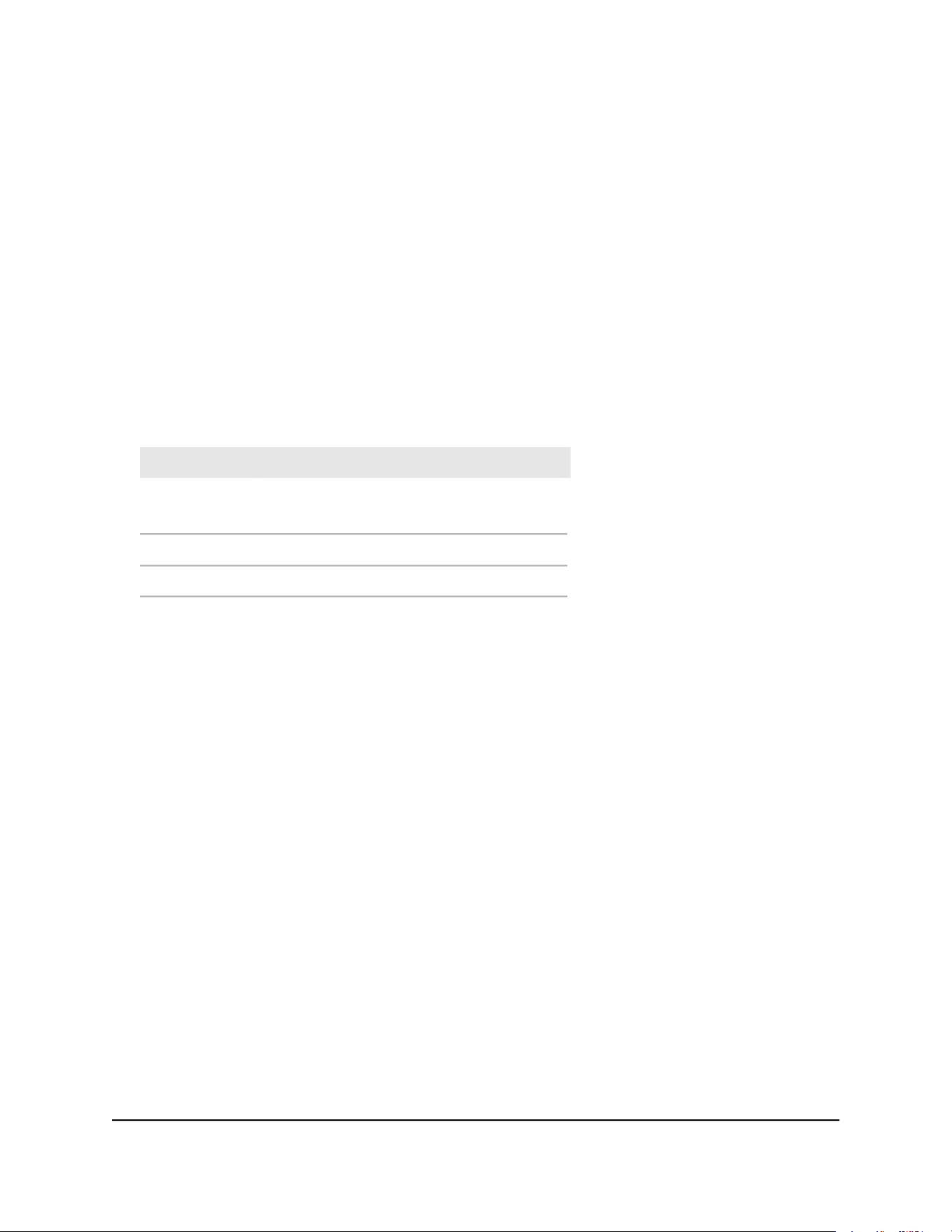
4. Select ADVANCED > Advanced Setup > VLAN / Bridge Settings.
The VLAN / Bridge Settings page displays.
5. Select the Enable VLAN / Bridge Group check box.
The page expands.
6. Select the By VLAN tag group radio button.
The section expands.
7. Click the Add button.
The Add VLAN Rule page displays.
The table includes default VLAN 10 that has all Ethernet ports and WiFi networks as
members. This VLAN is enabled by default.
8. Specify the settings as described in the following table.
DescriptionField
Enter a name for the VLAN tag group.
The name can be up to 10 characters.
Name
Enter a value from 1 to 4094.VLAN ID
Enter a value from 0 to 7.Priority
9. Select the check box for a wired Ethernet port.
If your device is connected to an Ethernet port on the router, select the Ethernet port
check box that corresponds to the Ethernet port on the router to which the device
is connected.
You must select at least one Ethernet port. You can select more than one port.
10. Click the Add button.
The VLAN tag group is added.
11. Click the Apply button.
Your settings are saved.
Improve network connections with
Universal Plug and Play
Universal Plug and Play (UPnP) helps devices, such as Internet appliances and computers,
access the network and connect to other devices as needed. UPnP devices can
automatically discover the services from other registered UPnP devices on the network.
User Manual75Specify Network Settings
Orbi Tri-band Mesh WiFi 6 System

If you use applications such as multiplayer gaming, peer-to-peer connections, or real-time
communications such as instant messaging or remote assistance, enable UPnP.
To enable Universal Plug and Play:
1. Launch a web browser from a computer or mobile device that is connected to your
Orbi network.
2. Enter orbilogin.com.
A login window opens.
3. Enter the admin user name and password.
The user name is admin. The password is the one that you specified the first time
that you logged in. The user name and password are case-sensitive.
The BASIC Home page displays.
4. Select ADVANCED > Advanced Setup > UPnP.
The UPnP page displays.
5. Select the Turn UPnP On check box.
By default, this check box is selected. UPnP for automatic device configuration can
be enabled or disabled. If the Turn UPnP On check box is cleared, the router does
not allow any device to automatically control router resources, such as port
forwarding.
6. Type the advertisement period in minutes.
The advertisement period specifies how often the router broadcasts its UPnP
information. This value can range from 1 to 1440 minutes. The default period is 30
minutes. Shorter durations ensure that control points receive current device status
at the expense of more network traffic. Longer durations can compromise the
freshness of the device status but can significantly reduce network traffic.
7. Type the advertisement time to live in hops.
The time to live for the advertisement is measured in hops (steps) for each UPnP
packet sent. Hops are the steps a packet takes between routers. The number of hops
can range from 1 to 255. The default value for the advertisement time to live is 4
hops, which should be fine for most home networks. If you notice that some devices
are not being updated or reached correctly, it might be necessary to increase this
value.
8. Click the Apply button.
The UPnP Portmap Table displays the IP address of each UPnP device that is accessing
the router and which ports (internal and external) that device opened. The UPnP
Portmap Table also displays what type of port is open and whether that port is still
active for each IP address.
9. To refresh the information in the UPnP Portmap Table, click the Refresh button.
User Manual76Specify Network Settings
Orbi Tri-band Mesh WiFi 6 System

6
Mantain and Monitor Your Network
This chapter describes the router settings for administering and maintaining your router
and home network.
The chapter includes the following sections:
• Update the router and satellite firmware
• Change the admin password
• Enable admin password reset
• Reset the admin password
• Always use HTTPS to access the router
• View router status and usage information
• Display Internet port statistics
• Check the Internet connection status
• View the satellite status
• View and manage logs of router activity
• View devices connected to the network or edit device information
• View satellites connected to the network or edit satellite information
• Check your Internet bandwidth
• Monitor Internet traffic
• Set the time zone
• Change the NTP server
• Manage the router configuration file
• Remotely access your router using the Orbi app
77

Update the router and satellite
firmware
You can use the router web interface to check if new firmware is available and update
your router and satellites, or you can manually update the firmware for your router and
satellites.
Check for firmware updates
To check for new firmware and update your router and satellite:
1. Launch a web browser from a computer or mobile device that is connected to your
Orbi network.
2. Enter orbilogin.com.
A login window displays.
3. Enter the router admin user name and password.
The user name is admin. The password is the one that you specified the first time
that you logged in. The user name and password are case-sensitive.
The BASIC Home page displays.
4. Select ADVANCED > Administration > Firmware Update > Online Update.
The Firmware Update page displays.
5. Click the Check button.
The router checks to see if new firmware is available for the router and satellites.
6. If new firmware is available, click the Update All button.
The router locates and downloads the firmware for the router and satellites and
begins the update.
WARNING: To avoid the risk of corrupting the firmware, do not interrupt
the upgrade. For example, do not close the browser, click a link, or load a
new page. Do not turn off the router or satellite.
When the upload is complete, your router and satellites restart. The update process
typically takes about two minutes. Read the new firmware release notes to find out
if you must reconfigure the router after updating.
User Manual78Mantain and Monitor Your
Network
Orbi Tri-band Mesh WiFi 6 System

Manually update firmware
If a satellite is connected to your router, you can log in to the router to manually upload
the firmware on your satellite.
WARNING: We recommend that you always update the firmware on your satellite
first, and then update your router. Also, do not update the firmware on your
router and satellite at the same time, and do not update more than one Orbi
device (router or satellite) at a time. If you need to update more than one Orbi
device, wait for the first Orbi device to finish updating before updating your next
Orbi device.
To manually update the firmware on your Orbi router and satellites, follow these
high level steps:
1. Visit netgear.com/support and download the firmware for both your Orbi router and
satellites.
2. Update the firmware on your Orbi satellites, one at a time.
For more information, see Manually update satellite firmware on page 79.
3. Update the firmware on your Orbi router.
For more information, see Manually update router firmware on page 80.
Manually update satellite firmware
We recommend that you update your satellites' firmware before you update the router’s
firmware.
To manually update your satellites' firmware:
1. Launch a web browser from a computer or mobile device that is connected to your
Orbi network.
2. Enter orbilogin.com.
A login window displays.
3. Enter the router admin user name and password.
The user name is admin. The password is the one that you specified the first time
that you logged in. The user name and password are case-sensitive.
The BASIC Home page displays.
4. Select ADVANCED > Administration > Firmware Update > Manual Update.
The Firmware Update page displays.
5. Select the check box next to your satellite’s model name.
User Manual79Mantain and Monitor Your
Network
Orbi Tri-band Mesh WiFi 6 System

If you have more than one satellite, only update one satellite at a time. You must wait
for the first satellite to finish updating before updating the next satellite.
6. Click the Update button.
The Orbi satellite Firmware Update window displays.
7. If the browser asks you for the admin password, enter the same password that you
entered for the router.
8. Click the Browse button.
9. Locate and select the satellite firmware file that you downloaded.
The firmware file name ends in .img.
10. Click the Upload button.
The upload process starts.
WARNING: To avoid the risk of corrupting the firmware, do not interrupt
the upgrade. For example, do not close the browser, click a link, or load a
new page. Do not turn off the satellite.
When the upload is complete, your satellite restarts. The update process typically
takes about two minutes.
Manually update router firmware
We recommend that you update your router’s firmware after you update the satellites'
firmware.
WARNING: Make sure that your satellites completes their firmware updates
before you update your router’s firmware.
To manually update your router’s firmware:
1. Launch a web browser from a computer or mobile device that is connected to your
Orbi network.
2. Enter orbilogin.com.
A login window displays.
3. Enter the admin user name and password.
The user name is admin. The password is the one that you specified the first time
that you logged in. The user name and password are case-sensitive.
The BASIC Home page displays.
4. Select ADVANCED > Administration > Firmware Update > Manual Update.
The Firmware Update page displays.
User Manual80Mantain and Monitor Your
Network
Orbi Tri-band Mesh WiFi 6 System
5. Click the Browse button.
6. Locate and select the router firmware file you downloaded.
The firmware file name ends in .img.
7. Click the Upload button.
The upload process starts.
WARNING: To avoid the risk of corrupting the firmware, do not interrupt
the upgrade. For example, do not close the browser, click a link, or load a
new page. Do not turn off the router.
When the upload is complete, your router restarts. The update process typically
takes about two minutes.
Change the admin password
This feature lets you change the default password that is used to log in to the router
with the user name admin. This password is not the one that you use to access the Orbi
WiFi network.
NOTE: Be sure to change the admin password to a secure password. The ideal
password contains no dictionary words from any language and contains
uppercase and lowercase letters, numbers, and symbols. It can be up to 30
characters.
To set the password for the user name admin:
1. Launch a web browser from a computer or mobile device that is connected to your
Orbi network.
2. Enter orbilogin.com.
A login window displays.
3. Enter the admin user name and password.
The user name is admin. The password is the one that you specified the first time
that you logged in. The user name and password are case-sensitive.
The BASIC Home page displays.
4. Select ADVANCED > Administration > Set Password.
The Set Password page displays.
5. Type the old password, and type the new password twice.
6. To be able to reset the password, select the Enable Password Reset check box.
User Manual81Mantain and Monitor Your
Network
Orbi Tri-band Mesh WiFi 6 System

We recommend that you enable password reset.
7. Click the Apply button.
Your settings are saved.
Enable admin password reset
The router admin password is used to log in to your router web interface. We recommend
that you enable the password reset feature so that you can reset the password if it is
forgotten. This reset process is supported in Chrome, Safari, Firefox, Edge, and Internet
Explorer.
To enable password reset:
1. Launch a web browser from a computer or WiFi device that is connected to the
network.
2. Enter orbilogin.com.
A login window displays.
3. Enter the admin user name and password.
The user name is admin. The default password is password. The user name and
password are case-sensitive.
The BASIC Home page displays.
4. Select ADVANCED > Administration > Set Password.
The Set Password page displays.
5. Select the Enable Password Reset check box.
6. Select two security questions and provide answers to them.
7. Click the Apply button.
Your settings are saved.
Reset the admin password
If you set up the password reset feature, you can recover your router admin password.
NOTE: If you did not enable router password recovery, you must perform a
factory reset to set a new admin password. For more information, see Orbi router
hardware features on page 8.
User Manual82Mantain and Monitor Your
Network
Orbi Tri-band Mesh WiFi 6 System

To reset your admin password:
1. Launch a web browser from a computer or mobile device that is connected to your
Orbi network.
2. Enter orbilogin.com.
A login window displays.
3. Click the Cancel button.
If password reset is enabled, you are prompted to enter the router's serial number.
4. Enter the router’s serial number in the field.
You can find the router's serial number on the router label.
5. Click the CONTINUE button.
6. Enter your answers to the security questions.
You defined these answers when you set up the password reset feature.
7. Click the CONTINUE button.
You are requested to set a new admin password and set new security questions.
8. Enter your new admin password, set new security questions and answers, and click
the NEXT button.
Your settings are saved.
9. Click the LOGIN AGAIN button.
A login window displays.
10. With your new admin password, log in to the router.
Always use HTTPS to access the
router
You can configure the router to require HTTPS connections between your web browser
and the router web interface, for example, “https://www.orbilogin.com”. When you
enable the HTTPS requirement, connection requests to the router web interface that
specify HTTP are automatically converted to HTTPS.
NOTE: After you enable the HTTPS requirement, when you visit
https://www.orbilogin.com, your browser might display a security warning
because of the self-signed certificate on the router. This is expected behavior.
You can proceed, or add an exception for the security warning. For more
information, visit
kb.netgear.com/000062980/what-to-do-incase-of-security-message.
User Manual83Mantain and Monitor Your
Network
Orbi Tri-band Mesh WiFi 6 System

To require HTTPS connections:
1. Launch a web browser from a computer or mobile device that is connected to your
Orbi network.
2. Enter orbilogin.com.
A login window displays.
3. Enter the admin user name and password.
The user name is admin. The password is the one that you specified the first time
that you logged in. The user name and password are case-sensitive.
The BASIC Home page displays.
4. Select ADVANCED > Advanced > Web Services Management.
The Web Services Management page displays.
5. Select the Always Use HTTPS to Access Router check box.
6. Click the Apply button.
Your settings are saved.
View router status and usage
information
To view router status and usage information:
1. Launch a web browser from a computer or mobile device that is connected to your
Orbi network.
2. Enter orbilogin.com.
A login window displays.
3. Enter the admin user name and password.
The user name is admin. The password is the one that you specified the first time
that you logged in. The user name and password are case-sensitive.
The BASIC Home page displays.
4. Click the ADVANCED tab.
The ADVANCED Home page displays the router status.
User Manual84Mantain and Monitor Your
Network
Orbi Tri-band Mesh WiFi 6 System

Display Internet port statistics
To display Internet port statistics:
1. Launch a web browser from a computer or mobile device that is connected to your
Orbi network.
2. Enter orbilogin.com.
A login window displays.
3. Enter the admin user name and password.
The user name is admin. The password is the one that you specified the first time
that you logged in. The user name and password are case-sensitive.
The BASIC Home page displays.
4. Click the ADVANCED tab.
5. In the Internet Port pane, click the Show Statistics button.
The Show Statistics window displays and shows following information:
•
System Up Time. The time elapsed since the router was last restarted.
•
Port. The statistics for the WAN (Internet) and LAN (Ethernet) ports. For each
port, the page displays the following information:
○
Status: The link status of the port.
○
TxPkts: The number of packets transmitted on this port since reset or manual
clear.
○
RxPkts: The number of packets received on this port since reset or manual
clear.
○
Collisions: The number of collisions on this port since reset or manual clear.
○
Tx B/s: The current transmission (outbound) bandwidth used on the WAN
and LAN ports.
○
Rx B/s: The current reception (inbound) bandwidth used on the WAN and
LAN ports.
○
Up Time: The time elapsed since this port acquired the link.
○
Poll Interval: The interval at which the statistics are updated in this page.
6. To change the polling frequency, enter a time in seconds in the Poll Interval field
and click the Set Interval button.
7. To stop the polling entirely, click the Stop button.
User Manual85Mantain and Monitor Your
Network
Orbi Tri-band Mesh WiFi 6 System

Check the Internet connection
status
To check the Internet connection status:
1. Launch a web browser from a computer or mobile device that is connected to your
Orbi network.
2. Enter orbilogin.com.
A login window displays.
3. Enter the admin user name and password.
The user name is admin. The password is the one that you specified the first time
that you logged in. The user name and password are case-sensitive.
The BASIC Home page displays.
4. Click the ADVANCED tab.
5. In the Internet Port pane, click the Connection Status button.
The Connection Status window displays. The information that displays depends on
the type of Internet connection.
For example, if your Internet connection does not require a login and the router
receives an IP address automatically, the window displays the following information:
•
IP Address: The IP address that is assigned to the router.
•
Subnet Mask: The subnet mask that is assigned to the router.
•
Default Gateway: The IP address for the default gateway that the router
communicates with.
•
DHCP Server: The IP address for the Dynamic Host Configuration Protocol server
that provides the TCP/IP configuration for all the computers that are connected
to the router.
•
DNS Server: The IP address of the Domain Name Service server that provides
translation of network names to IP addresses.
•
Lease Obtained: The date and time when the lease was obtained.
•
Lease Expires: The date and time that the lease expires.
6. To release (stop) the Internet connection, click the Release button.
If you are using a PPPoE, PPTP, or L2TP connection, the name of the button might
be different.
7. To renew the Internet connection, click the Renew button.
User Manual86Mantain and Monitor Your
Network
Orbi Tri-band Mesh WiFi 6 System

If you are using a PPPoE, PPTP, or L2TP connection, the name of the button might
be different.
8. To exit the page, click the Close Window button.
View the satellite status
To view your satellite’s status, it must be connected to your Orbi network.
To view your satellite’s status:
1. Launch a web browser from a computer or mobile device that is connected to your
Orbi network.
2. Enter orbilogin.com.
A login window displays.
3. Enter the router admin user name and password.
The user name is admin. The password is the one that you specified the first time
that you logged in. The user name and password are case-sensitive.
The BASIC Home page displays.
4. Select Attached Devices.
The Attached Devices page displays.
5. In the Connected Satellites section, find your satellite’s IP address.
6. Enter your satellite’s IP address in your web browser’s address bar.
A login window displays.
7. Enter the same admin user name and password that you entered for the router.
The satellite’s status displays.
View and manage logs of router
activity
The log is a detailed record of the websites you accessed or attempted to access and
other router actions. Up to 256 entries are stored in the log.
User Manual87Mantain and Monitor Your
Network
Orbi Tri-band Mesh WiFi 6 System

To view and manage logs:
1. Launch a web browser from a computer or mobile device that is connected to your
Orbi network.
2. Enter orbilogin.com.
A login window opens.
3. Enter the admin user name and password.
The user name is admin. The password is the one that you specified the first time
that you logged in. The user name and password are case-sensitive.
The BASIC Home page displays.
4. Select ADVANCED > Administration > Logs.
The Logs page displays the following information:
•
Date and time. The date and time the log entry was recorded.
•
Source IP. The IP address of the initiating device for this log entry.
•
Target address. The name or IP address of the website or news group visited or
to which access was attempted.
•
Action. The action that occurred, such as whether Internet access was blocked
or allowed.
5. To refresh the log page, click the Refresh button.
6. To clear the log entries, click the Clear Log button.
7. To email the log immediately, click the Send Log button.
View devices connected to the
network or edit device information
You can view the devices that are connected to your Orbi network. You can also edit
the information that displays on the Attached Devices page in the router web interface.
View devices connected to the network
You can view all computers or devices that are currently connected to your Orbi network.
User Manual88Mantain and Monitor Your
Network
Orbi Tri-band Mesh WiFi 6 System

To view devices connected to your network:
1. Launch a web browser from a computer or mobile device that is connected to your
Orbi network.
2. Enter orbilogin.com.
A login window opens.
3. Enter the router admin user name and password.
The user name is admin. The password is the one that you specified the first time
that you logged in. The user name and password are case-sensitive.
The BASIC Home page displays.
4. Select Attached Devices.
The Attached Devices page displays the following information in the Connected
Devices section:
•
Device Name. This section displays the device model, name, type, and IP address.
•
IP Address. This section displays the device IP address. The device’s IP address
can change because the router assigns an IP address to each device when it joins
the network.
•
MAC Address. This section displays the device MAC address. The unique MAC
address for each device does not change.
•
Connection Type. This section displays how the device is connected to the Orbi
network through a wired Ethernet connection or WiFi connection.
•
Connected Orbi. This section displays the Orbi router or satellite that the device
is connected to. The Orbi router’s or satellite’s MAC address also displays.
5. To update this page, click the Refresh button.
Edit device information on the Attached
Devices page
You can change the connected device model and name that display on the Attached
Devices page.
To view devices connected to your network:
1. Launch a web browser from a computer or mobile device that is connected to your
Orbi network.
2. Enter orbilogin.com.
A login window opens.
3. Enter the router admin user name and password.
User Manual89Mantain and Monitor Your
Network
Orbi Tri-band Mesh WiFi 6 System

The user name is admin. The password is the one that you specified the first time
that you logged in. The user name and password are case-sensitive.
The BASIC Home page displays.
4. Select Attached Devices.
The Attached Devices page displays.
5. Select a connected device that displays on the page.
The Edit Device page displays.
6. To change the device model, enter a new model in the Device Model field.
7. To change the device name, enter a new name in the Device Name field.
8. To change the device type, select a device from the Device Type menu.
9. Click the Apply button.
Your settings are saved.
View satellites connected to the
network or edit satellite information
You can view the satellites that are connected to your Orbi network. You can also edit
the information that displays on the Attached Devices page in the router web interface.
View satellites connected to the network
You can view the satellites that are connected to your Orbi network.
To view satellites connected to your network:
1. Launch a web browser from a computer or mobile device that is connected to your
Orbi network.
2. Enter orbilogin.com.
A login window opens.
3. Enter the router admin user name and password.
The user name is admin. The password is the one that you specified the first time
that you logged in. The user name and password are case-sensitive.
The BASIC Home page displays.
4. Select Attached Devices.
User Manual90Mantain and Monitor Your
Network
Orbi Tri-band Mesh WiFi 6 System

The Attached Devices page displays the following information in the Connected
Satellites section:
•
Device Name: This section displays the satellite model, name, and IP address.
•
IP Address: This section displays the satellite IP address. The satellite’s IP address
can change because the router assigns an IP address to each satellite when it
joins the network.
•
MAC Address: This section displays the satellite MAC address. The unique MAC
address for each satellite does not change.
•
Connection Type: This section displays how the satellite is connected to the
Orbi network through a wired Ethernet connection or 2.4 GHz or 5 GHz WiFi
connection.
•
Connected Orbi: This section displays the Orbi router or satellite that the satellite
is connected to. The Orbi router’s or satellite’s MAC address also displays.
•
Backhaul Status: This section displays the backhaul connection status between
the satellite and router or another satellite.
5. To update this page, click the Refresh button.
Edit satellite information that displays on the
Attached Devices page
You can change the satellite’s model and name that display on the Attached Devices
page.
To edit the satellite’s model or name that displays on the Attached Devices page:
1. Launch a web browser from a computer or mobile device that is connected to your
Orbi network.
2. Enter orbilogin.com.
A login window opens.
3. Enter the router admin user name and password.
The user name is admin. The password is the one that you specified the first time
that you logged in. The user name and password are case-sensitive.
The BASIC Home page displays.
4. Select Attached Devices.
The Attached Devices page displays.
5. Select a connected device that displays on the page.
The Edit Device page displays.
6. To change the device model, enter a new model in the Device Model field.
User Manual91Mantain and Monitor Your
Network
Orbi Tri-band Mesh WiFi 6 System

7. To change the device name, enter a new name in the Device Name field.
8. Click the Apply button.
Your settings are saved.
Check your Internet bandwidth
You can use Ookla Speedtest to detect your Internet bandwidth.
To check your Internet bandwidth using Speedtest:
1. Launch a web browser from a computer or mobile device that is connected to your
Orbi network.
2. Enter orbilogin.com.
A login window opens.
3. Enter the admin user name and password.
The user name is admin. The password is the one that you specified the first time
that you logged in. The user name and password are case-sensitive.
The BASIC Home page displays.
4. Select Speedtest.
The Speedtest page displays.
5. Click the Take a Speedtest button.
Your Internet’s download and upload speeds display.
Monitor Internet traffic
Traffic metering allows you to monitor the volume of Internet traffic that passes through
the router Internet port. You can set limits for traffic volume.
To monitor Internet traffic:
1. Launch a web browser from a computer or mobile device that is connected to your
Orbi network.
2. Enter orbilogin.com.
A login window opens.
3. Enter the admin user name and password.
The user name is admin. The password is the one that you specified the first time
that you logged in. The user name and password are case-sensitive.
User Manual92Mantain and Monitor Your
Network
Orbi Tri-band Mesh WiFi 6 System

The BASIC Home page displays.
4. Select ADVANCED > Advanced Setup > Traffic Meter.
The Traffic Meter page displays.
5. Select the Enable Traffic Meter check box.
6. To control the volume of Internet traffic, use either the traffic volume control feature
or the connection time control feature:
•
Select the Traffic volume control by radio button and then select one of the
following options:
○
No Limit. No restriction is applied when the traffic limit is reached.
○
Download only. The restriction is applied to incoming traffic only.
○
Both directions. The restriction is applied to both incoming and outgoing
traffic.
•
Select the Connection time control radio button and enter the allowed hours
in the Monthly limit field.
7. If your ISP charges for extra data volume when you make a new connection, enter
the extra data volume in MB in the Round up data volume for each connection by
field.
This field is applicable to PPPoE, PPTP, and BigPond connections only. Some ISPs
charge a minimum data volume in MB for each connection. For example, if your ISP
charges 1 MB for each time that you log in, even if you use less than 1 MB of data,
enter 1 as the extra data volume in MB in the field.
8. In the Traffic Counter section, set the traffic counter to begin at a specific time and
date.
To start the traffic counter immediately, click the Restart Counter Now button.
9. If you want the router to issue a warning message before the monthly limit of Mbytes
or hours is reached, in the Traffic Control section, enter a numeric value.
By default, the value is 0 and no warning message is issued.
10. To stop the Internet connection when the limit is exceeded, select the Disconnect
and disable the Internet connection check box.
11. Click the Apply button.
The Internet Traffic Statistics section helps you to monitor the data traffic.
12. To update the Internet Traffic Statistics section, click the Refresh button.
13. To display more information about the data traffic on your router and to change the
poll interval, click the Traffic Status button.
User Manual93Mantain and Monitor Your
Network
Orbi Tri-band Mesh WiFi 6 System

Set the time zone
To set your time zone manually:
1. Launch a web browser from a computer or mobile device that is connected to your
Orbi network.
2. Enter orbilogin.com.
A login window displays.
3. Enter the admin user name and password.
The user name is admin. The password is the one that you specified the first time
that you logged in. The user name and password are case-sensitive.
The BASIC Home page displays.
4. Select ADVANCED > Administration > NTP Settings.
The NTP Settings page displays.
5. Select your time zone from the menu.
6. If you live in a region that observes daylight saving time, select the Automatically
adjust for daylight savings time check box.
7. Click the Apply button.
Your settings are saved.
Change the NTP server
By default, the router uses the NETGEAR Network Time Protocol (NTP) server to sync
the network time. You can change the NTP server to your preferred NTP server.
To change the NTP server to your preferred NTP server:
1. Launch a web browser from a computer or mobile device that is connected to your
Orbi network.
2. Enter orbilogin.com.
A login window displays.
3. Enter the admin user name and password.
The user name is admin. The password is the one that you specified the first time
that you logged in. The user name and password are case-sensitive.
The BASIC Home page displays.
4. Select ADVANCED > Administration > NTP Settings.
User Manual94Mantain and Monitor Your
Network
Orbi Tri-band Mesh WiFi 6 System

The NTP Settings page displays.
5. Select the Set your preferred NTP server radio button.
6. Enter the NTP server domain name or IP address in the Primary NTP server field.
7. Click the Apply button.
Your settings are saved.
Manage the router configuration
file
The configuration settings of the router are stored within the router in a configuration
file. You can back up (save) this file to your computer, restore it, or reset it to the factory
default settings.
Back up settings
To back up the router’s configuration settings:
1. Launch a web browser from a computer or mobile device that is connected to your
Orbi network.
2. Enter orbilogin.com.
A login window displays.
3. Enter the admin user name and password.
The user name is admin. The password is the one that you specified the first time
that you logged in. The user name and password are case-sensitive.
The BASIC Home page displays.
4. Select ADVANCED > Administration > Backup Settings.
The Backup Settings page displays.
5. Click the BACK UP button.
6. Specify a location on your network.
A copy of the current settings is saved in the location you specified.
User Manual95Mantain and Monitor Your
Network
Orbi Tri-band Mesh WiFi 6 System

Restore configuration settings
To restore configuration settings that you backed up:
1. Launch a web browser from a computer or mobile device that is connected to your
Orbi network.
2. Enter orbilogin.com.
A login window displays.
3. Enter the admin user name and password.
The user name is admin. The password is the one that you specified the first time
that you logged in. The user name and password are case-sensitive.
The BASIC Home page displays.
4. Select ADVANCED > Administration > Backup Settings.
The Backup Settings page displays.
5. Click the BROWSE button to find and select the .cfg file.
6. Click the RESTORE button.
The file is uploaded to the router and the router reboots.
WARNING: Do not interrupt the reboot process.
Erase the current configuration settings
You can erase the current configuration and restore the factory default settings. You
might want to do this if you move the router to a different network.
To erase the configuration settings:
1. Launch a web browser from a computer or mobile device that is connected to your
Orbi network.
2. Enter orbilogin.com.
A login window displays.
3. Enter the admin user name and password.
The user name is admin. The password is the one that you specified the first time
that you logged in. The user name and password are case-sensitive.
The BASIC Home page displays.
4. Select ADVANCED > Administration > Backup Settings.
The Backup Settings page displays.
5. Click the ERASE button.
User Manual96Mantain and Monitor Your
Network
Orbi Tri-band Mesh WiFi 6 System

The factory default settings are restored. The user name is admin, the password is
password, and the LAN IP address is 192.168.1.1. DHCP is enabled.
Remotely access your router using
the Orbi app
You can use the Orbi app to remotely access your router and change its settings. Before
you can use remote access with the Orbi app, you must update your router’s firmware
and download the latest Orbi app for your mobile device.
To download the latest Orbi app for your mobile device, visit
netgear.com/home/apps-services/orbi-app.
User Manual97Mantain and Monitor Your
Network
Orbi Tri-band Mesh WiFi 6 System


Manage port forwarding to a local
server
If your home network includes a server, you can allow certain types of incoming traffic
to reach the server. For example, you might want to make a local web server, FTP server,
or game server visible and available to the Internet.
The router can forward incoming traffic with specific protocols to computers on your
local network. You can specify the servers for applications and you can also specify a
default DMZ server to which the router forwards all other incoming protocols.
Set up port forwarding to a local server
To forward specific incoming protocols to a local server:
1. Decide which type of service, application, or game you want to provide.
2. Find the local IP address of the computer on your network that will provide the
service.
The server computer must always use the same IP address. To specify this setting,
use the reserved IP address feature. See Manage reserved LAN IP addresses on
page 66.
3. Launch a web browser from a computer or mobile device that is connected to your
Orbi network.
4. Enter orbilogin.com.
A login window displays.
5. Enter the admin user name and password.
The user name is admin. The password is the one that you specified the first time
that you logged in. The user name and password are case-sensitive.
The BASIC Home page displays.
6. Select ADVANCED > Advanced Setup > Port Forwarding / Port Triggering.
The Port Forwarding / Port Triggering page displays.
7. Leave the Port Forwarding radio button selected as the service type.
8. From the Service Name menu, select the service name.
If the service that you want to add is not in the menu, create a custom service. See
Add a custom port forwarding service on page 100.
User Manual99Customize Internet Traffic Rules
for Ports
Orbi Tri-band Mesh WiFi 6 System

9. In the Server IP Address field, enter the IP address of the computer that must provide
the service.
10. Click the Add button.
The service displays in the table.
Add a custom port forwarding service
To add a custom service:
1. Find out which port number or range of numbers the application uses.
You can usually find this information by contacting the publisher of the application
or user groups or news groups.
2. Launch a web browser from a computer or mobile device that is connected to your
Orbi network.
3. Enter orbilogin.com.
A login window displays.
4. Enter the admin user name and password.
The user name is admin. The password is the one that you specified the first time
that you logged in. The user name and password are case-sensitive.
The BASIC Home page displays.
5. Select ADVANCED > Advanced Setup > Port Forwarding / Port Triggering.
The Port Forwarding / Port Triggering page displays.
6. Leave the Port Forwarding radio button selected as the service type.
7. Click the Add Custom Service button.
The Ports - Custom Services page displays.
8. In the Service Name field, enter a descriptive name.
9. In the Protocol menu, select the protocol.
If you are unsure, select TCP/UDP.
10. In the External Port range field, enter the port numbers.
11. Specify the internal ports by one of these methods:
•
Leave the Use the same port range for Internal port check box selected.
•
Type the port numbers in the Internal port range field.
12. Type the IP address in the Internal IP address fields or select the radio button for
an attached device listed in the table.
13. Click the Apply button.
User Manual100Customize Internet Traffic Rules
for Ports
Orbi Tri-band Mesh WiFi 6 System

Your settings are saved. The service is now in the table on the Port Forwarding / Port
Triggering page.
Edit a port forwarding service
To edit a port forwarding entry:
1. Launch a web browser from a computer or mobile device that is connected to your
Orbi network.
2. Enter orbilogin.com.
A login window displays.
3. Enter the admin user name and password.
The user name is admin. The password is the one that you specified the first time
that you logged in. The user name and password are case-sensitive.
The BASIC Home page displays.
4. Select ADVANCED > Advanced Setup > Port Forwarding / Port Triggering.
The Port Forwarding / Port Triggering page displays.
5. Leave the Port Forwarding radio button selected as the service type.
6. In the table, select the radio button next to the service name.
7. Click the Edit Service button.
The Ports - Custom Services page displays.
8. Change any of the following settings:
•
Service Name: Type the service name.
•
Protocol: Select the protocol.
If you are unsure, select TCP/UP.
•
External port range: Enter the port numbers.
•
For the internal ports, leave the Use the same port range for Internal port check
box selected or enter the ports in the Internal port range field.
•
Internal IP address: Type the IP address in the Internal IP address fields, or
select the radio button for an attached device listed in the table.
9. Click the Apply button.
Your settings are saved. The service is changed in the table on the Port Forwarding
/ Port Triggering page.
User Manual101Customize Internet Traffic Rules
for Ports
Orbi Tri-band Mesh WiFi 6 System

Delete a port forwarding entry
To delete a port forwarding entry:
1. Launch a web browser from a computer or mobile device that is connected to your
Orbi network.
2. Enter orbilogin.com.
A login window displays.
3. Enter the admin user name and password.
The user name is admin. The password is the one that you specified the first time
that you logged in. The user name and password are case-sensitive.
The BASIC Home page displays.
4. Select ADVANCED > Advanced Setup > Port Forwarding / Port Triggering.
The Port Forwarding / Port Triggering page displays.
5. Select the Port Forwarding radio button as the service type.
6. In the table, select the radio button next to the service name.
7. Click the Delete Service button.
The port forwarding entry is removed from the table.
How the router implements the port
forwarding rule
The following sequence shows the effects of a port forwarding rule:
1. When you type the URL www.example.com in your browser, the browser sends a
web page request message with the following destination information:
•
Destination address: The IP address of www.example.com, which is the address
of your router.
•
Destination port number: 80, which is the standard port number for a web
server process.
2. Your router receives the message and finds your port forwarding rule for incoming
port 80 traffic.
3. The router changes the destination in the message to IP address 192.168.1.123 and
sends the message to that computer.
User Manual102Customize Internet Traffic Rules
for Ports
Orbi Tri-band Mesh WiFi 6 System

4. Your web server at IP address 192.168.1.123 receives the request and sends a reply
message to your router.
5. Your router performs Network Address Translation (NAT) on the source IP address,
and sends the reply through the Internet to the computer or WiFi device that sent
the web page request.
Application example: Make a local web
server public
If you host a web server on your local network, you can use port forwarding to allow
web requests from anyone on the Internet to reach your web server.
To make a local web server public:
1. Assign your web server either a fixed IP address or a dynamic IP address using DHCP
address reservation.
In this example, your router always gives your web server an IP address of
192.168.1.33.
2. On the Port Forwarding/Port Triggering page, configure the router to forward the
HTTP service to the local address of your web server at 192.168.1.33.
HTTP (port 80) is the standard protocol for web servers.
3. (Optional) Register a host name with a Dynamic DNS service, and specify that name
on the Dynamic DNS page of the router.
Dynamic DNS makes it much easier to access a server from the Internet because you
can type the name in the Internet browser. Otherwise, you must know the IP address
that the ISP assigned, which typically changes.
Manage port triggering
Port triggering is a dynamic extension of port forwarding that is useful in these cases:
•
An application must use port forwarding to more than one local computer (but not
simultaneously).
•
An application must open incoming ports that are different from the outgoing port.
With port triggering, the router monitors traffic to the Internet from an outbound “trigger”
port that you specify. For outbound traffic from that port, the router saves the IP address
of the computer that sent the traffic. The router temporarily opens the incoming port
or ports that you specify in your rule and forwards that incoming traffic to that destination.
User Manual103Customize Internet Traffic Rules
for Ports
Orbi Tri-band Mesh WiFi 6 System

Port forwarding creates a static mapping of a port number or range of ports to a single
local computer. Port triggering can dynamically open ports to any computer when
needed and close the ports when they are no longer needed.
Add a port triggering service
To add a port triggering service:
1. Launch a web browser from a computer or mobile device that is connected to your
Orbi network.
2. Enter orbilogin.com.
A login window displays.
3. Enter the admin user name and password.
The user name is admin. The password is the one that you specified the first time
that you logged in. The user name and password are case-sensitive.
The BASIC Home page displays.
4. Select ADVANCED > Advanced Setup > Port Forwarding / Port Triggering.
The Port Forwarding / Port Triggering page displays.
5. Select the Port Triggering radio button.
The page adjusts.
6. Click the Add Service button.
The Port Triggering - Services page displays.
7. In the Service Name field, type a descriptive service name.
8. In the Service User menu, select Any, or select Single address and enter the IP
address of one computer:
•
Any: This selection (the default) allows any computer on the local area network
(LAN) to use this service.
•
Single address: This selection restricts the service to a particular computer om
the LAN. Enter the IP address in the field that becomes available with this selection
from the menu.
9. From the Service Type menu, select the service type, either TCP or UDP.
10. In the Triggering Port field, enter the number of the outbound traffic port that must
open the inbound ports.
11. From the Connection Type menu, select the inbound connection type, TCP, UDP,
or TCP/UDP.
If you are not sure, select TCP/UDP.
User Manual104Customize Internet Traffic Rules
for Ports
Orbi Tri-band Mesh WiFi 6 System

12. Enter the inbound connection port numbers the Starting Port, and Ending Port
fields.
For a single port, enter the same number in each field.
13. Click the Apply button.
The service is now in the Portmap Table.
Disable port triggering or change the
time-out period
By default, port triggering is enabled and a default time-out period is defined. You can
disable port triggering or change the time-out period.
To disable port triggering or change the time-out period:
1. Launch a web browser from a computer or mobile device that is connected to your
Orbi network.
2. Enter orbilogin.com.
A login window displays.
3. Enter the admin user name and password.
The user name is admin. The password is the one that you specified the first time
that you logged in. The user name and password are case-sensitive.
The BASIC Home page displays.
4. Select ADVANCED > Advanced Setup > Port Forwarding / Port Triggering.
The Port Forwarding / Port Triggering page displays.
5. Select the Port Triggering radio button.
The page adjusts.
6. To disable port triggering, select the Disable Port Triggering check box.
If this check box is selected, the router does not use port triggering even if you
specified port triggering settings.
7. To change the time-out period, in the Port Triggering Timeout field, enter a value
up to 9999 minutes.
This value controls how long the inbound ports stay open when the router detects
no activity. This value is required because the router cannot detect when the
application terminates.
User Manual105Customize Internet Traffic Rules
for Ports
Orbi Tri-band Mesh WiFi 6 System

Application example: Port triggering for
Internet Relay Chat
Some application servers, such as FTP and IRC servers, send replies to multiple port
numbers. Using port triggering, you can tell the router to open more incoming ports
when a particular outgoing port starts a session.
An example is Internet Relay Chat (IRC). Your computer connects to an IRC server at
destination port 6667. The IRC server not only responds to your originating source port,
but also sends an “identify” message to your computer on port 113. Using port triggering,
you can tell the router, “When you initiate a session with destination port 6667, you must
also allow incoming traffic on port 113 to reach the originating computer.” The following
sequence shows the effects of the port triggering rule you define:
1. You open an IRC client program to start a chat session on your computer.
2. Your IRC client composes a request message to an IRC server using a destination
port number of 6667, the standard port number for an IRC server process. Your
computer then sends this request message to your router.
3. Your router creates an entry in its internal session table describing this communication
session between your computer and the IRC server. Your router stores the original
information, performs Network Address Translation (NAT) on the source address
and port, and sends this request message through the Internet to the IRC server.
4. Noting your port triggering rule and observing the destination port number of 6667,
your router creates another session entry to send any incoming port 113 traffic to
your computer.
5. The IRC server sends a return message to your router using the NAT-assigned source
port (for example, port 33333) as the destination port. The IRC server also sends an
“identify” message to your router with destination port 113.
6. When your router receives the incoming message to destination port 33333, it checks
its session table to see if a session is active for port number 33333. Finding an active
session, the router restores the original address information replaced by NAT and
sends this reply message to your computer.
7. When your router receives the incoming message to destination port 113, it checks
its session table and finds an active session for port 113 associated with your
computer. The router replaces the message’s destination IP address with your
computer’s IP address and forwards the message to your computer.
8. When you finish your chat session, your router eventually senses a period of inactivity
in the communications. The router then removes the session information from its
session table, and incoming traffic is no longer accepted on port numbers 33333 or
113.
User Manual106Customize Internet Traffic Rules
for Ports
Orbi Tri-band Mesh WiFi 6 System

8
Use VPN to Access Your Network
You can use OpenVPN software to remotely access your router using virtual private
networking (VPN). This chapter explains how to set up and use VPN access.
This chapter includes the following sections:
• Set up a VPN connection
• Specify VPN service in the router
• Install OpenVPN software
• Use a VPN tunnel on your Windows-based computer
• Use VPN to access your Internet service at home
107

Set up a VPN connection
A virtual private network (VPN) lets you use the Internet to securely access your network
when you aren’t home.
This type of VPN access is called a client-to-gateway tunnel. The computer is the client,
and the router is the gateway. To use the VPN feature, you must log in to the router and
enable VPN, and you must install and run VPN client software on the computer.
VPN uses DDNS or a static IP address to connect with your router.
To use a DDNS service, register for an account with a host name (sometimes called a
domain name). You use the host name to access your network. The router supports
these accounts: NETGEAR, No-IP, and Dyn.
If your Internet service provider (ISP) assigned a static WAN IP address (such as 50.196.x.x
or 10.x.x.x) that never changes to your Internet account, the VPN can use that IP address
to connect to your home network.
Specify VPN service in the router
You must specify the VPN service settings in the router before you can use a VPN
connection.
To specify the VPN service:
1. Launch a web browser from a computer or mobile device that is connected to your
Orbi network.
2. Enter orbilogin.com.
A login window opens.
3. Enter the admin user name and password.
The user name is admin. The password is the one that you specified the first time
that you logged in. The user name and password are case-sensitive.
The BASIC Home page displays.
4. Select ADVANCED > Advanced Setup > VPN Service.
The VPN Service page displays.
5. Select the Enable VPN Service check box.
By default, VPN uses the UDP service type with port number 12973 for TUN mode
and port number 12874 for TAP mode. If you want to customize the service type,
mode, and port, we recommend that you change these settings before you install
the OpenVPN software.
User Manual108Use VPN to Access Your Network
Orbi Tri-band Mesh WiFi 6 System

6. To change the TUN mode service type, select the UCP or TCP radio button.
7. To change the TUN mode service port, type the port number that you want to use
in the field.
The default port number is 12973.
8. To change the TAP mode service type, select the UCP or TCP radio button.
9. To change the TAP mode service port, type the port number that you want to use
in the field.
The default port number is 12974.
10. Click the Apply button.
Your settings are saved. VPN is enabled in the router, but you must install and set
up OpenVPN software on your computer or mobile device before you can use a
VPN connection.
Install OpenVPN software
You must install this software on each Windows-based computer, Mac computer, iOS
device, or Android device that you plan to use for VPN connections to your router.
Install OpenVPN software on your
Windows-based computer
You must install this software on each Windows-based computer that you plan to use
for VPN connections to your router.
To install VPN client software on your Windows-based computer:
1. Launch a web browser from a computer or mobile device that is connected to your
Orbi network.
2. Enter orbilogin.com.
A login window opens.
3. Enter the admin user name and password.
The user name is admin. The password is the one that you specified the first time
that you logged in. The user name and password are case-sensitive.
The BASIC Home page displays.
4. Select ADVANCED > Advanced Setup > VPN Service.
The VPN Service page displays.
User Manual109Use VPN to Access Your Network
Orbi Tri-band Mesh WiFi 6 System
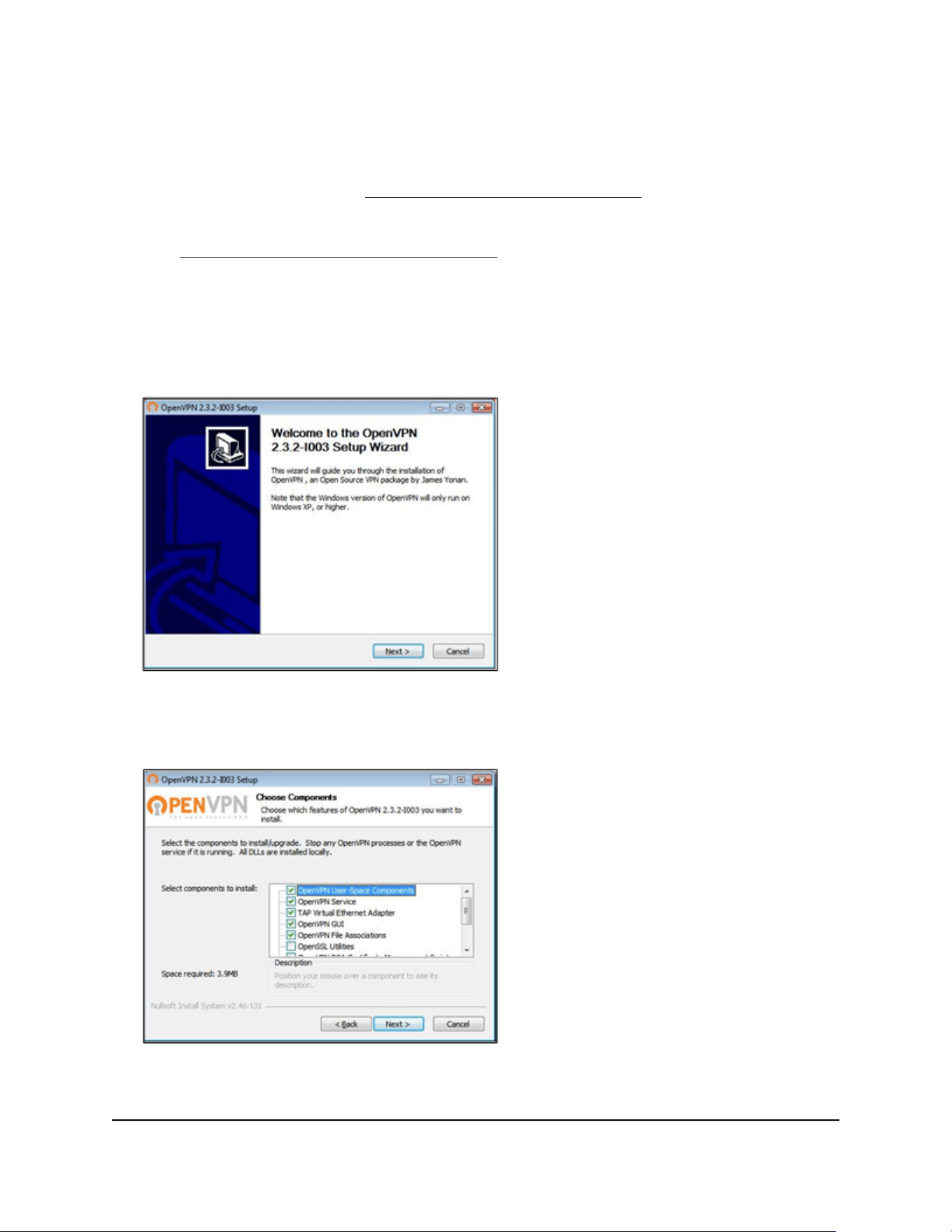
5. Make sure that the Enable VPN Service check box is selected.
6. Specify any VPN service settings on the page.
For more information, see Specify VPN service in the router on page 108.
7. Click the For Windows button to download the OpenVPN configuration files.
8. Visit openvpn.net/community-downloads/ to download the OpenVPN client utility.
9. In the Windows Installer section of the page, double-click the
openVPN-install-xxx.exe link.
10. Download and install the Open VPN software on your computer, click the
openVPN-install-xxx.exe file.
11. Click the Next button.
12. When prompted, read the License Agreement and click the I Agree button.
13. Leave the check boxes selected, and click the Next button.
User Manual110Use VPN to Access Your Network
Orbi Tri-band Mesh WiFi 6 System
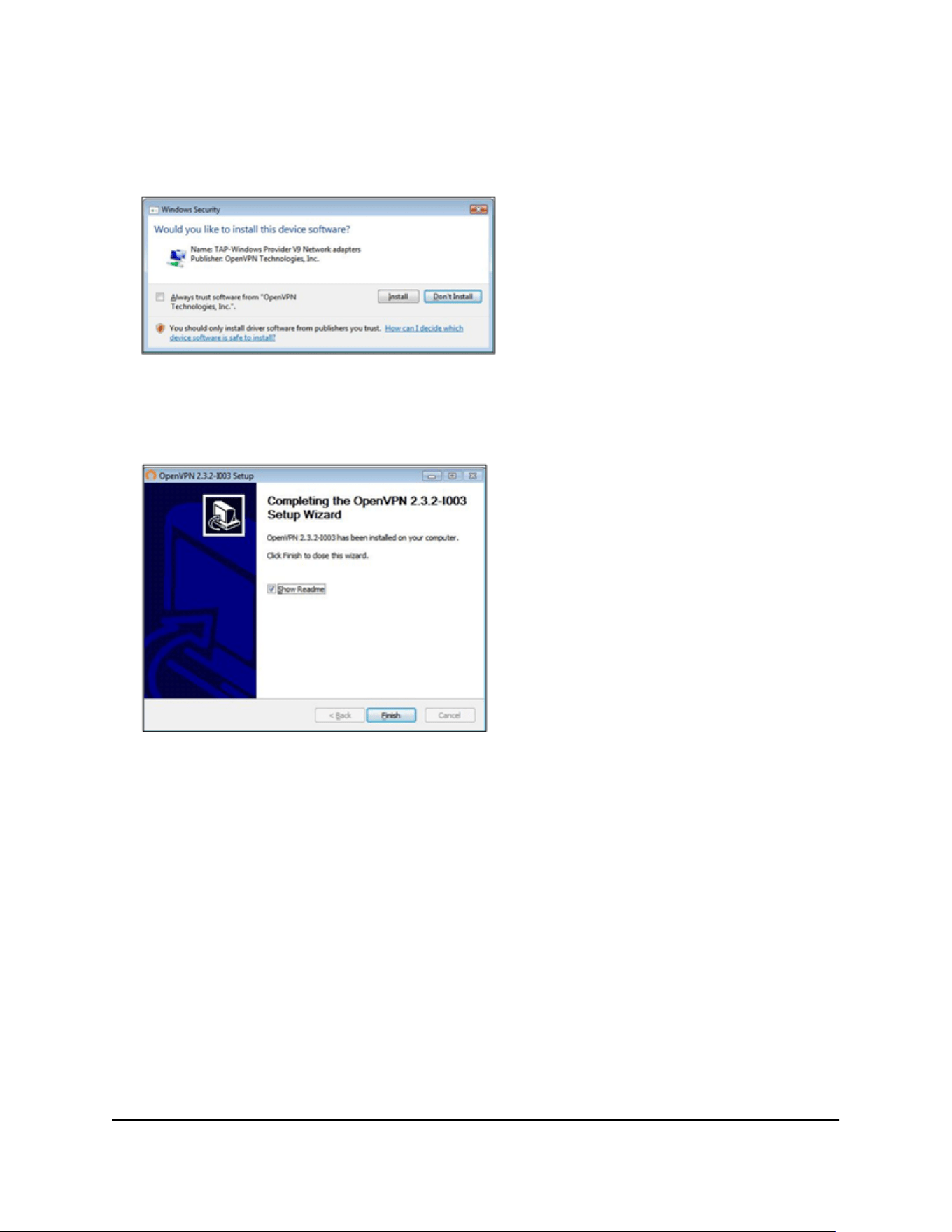
14. To specify the destination folder, click the Browse button and select a destination
folder.
15. Click the Install button.
The window displays the progress of the installation and then displays the final
installation page.
16. Click the Finish button.
17. Unzip the configuration files that you downloaded and copy them to the folder where
the VPN client is installed on your device.
For a client device with Windows 64-bit system, the VPN client is installed at
C:\Programfiles\OpenVPN\config\ by default.
18. For a client device with Windows, modify the VPN interface name to NETGEAR-VPN:
a. On your computer, go to the Networks page. If you are using Windows 10, select
Control Panel > Network and Sharing Center > Change adapter settings.
b. In the local area connection list, find the local area connection with the device
name TAP-Windows Adapter.
c. Select the local area connection and change its name (not its device name) to
NETGEAR-VPN.
If you do not change the VPN interface name, the VPN tunnel connection will fail.
User Manual111Use VPN to Access Your Network
Orbi Tri-band Mesh WiFi 6 System

For more information about using OpenVPN on your Windows-based computer,
visit
https://openvpn.net/index.php/open-source/documentation/howto.html#quick.
Install OpenVPN software on your Mac
computer
You must install this software on each Mac computer that you plan to use for VPN
connections to your router.
To install VPN client software on your Mac computer:
1. Launch a web browser from a computer or mobile device that is connected to your
Orbi network.
2. Enter orbilogin.com.
A login window opens.
3. Enter the admin user name and password.
The user name is admin. The password is the one that you specified the first time
that you logged in. The user name and password are case-sensitive.
The BASIC Home page displays.
4. Select ADVANCED > Advanced Setup > VPN Service.
The VPN Service page displays.
5. Make sure that the Enable VPN Service check box is selected.
6. Specify any VPN service settings on the page.
For more information, see Specify VPN service in the router on page 108.
7. Click the For non-Windows button to download the OpenVPN configuration files.
8. Visit https://tunnelblick.net/index.html to download the OpenVPN client utility for
Mac OS X.
9. Download and install the file.
10. Unzip the configuration files that you downloaded and copy them to the folder where
the VPN client is installed on your device.
The client utility must be installed by a user with administrative privileges.
For more information about using OpenVPN on your Mac computer, visit
https://openvpn.net/vpn-server-resources/installation-guide-for-openvpn-connect-client-on-macos/.
User Manual112Use VPN to Access Your Network
Orbi Tri-band Mesh WiFi 6 System

Install OpenVPN software on an iOS device
You must install this software on each iOS device that you plan to use for VPN connections
to your router.
To install VPN client software on an iOS device:
1. Launch a web browser from a computer or mobile device that is connected to your
Orbi network.
2. Enter orbilogin.com.
A login window opens.
3. Enter the admin user name and password.
The user name is admin. The password is the one that you specified the first time
that you logged in. The user name and password are case-sensitive.
The BASIC Home page displays.
4. Select ADVANCED > Advanced Setup > VPN Service.
The VPN Service page displays.
5. Make sure that the Enable VPN Service check box is selected.
6. Specify any VPN service settings on the page.
For more information, see Specify VPN service in the router on page 108.
7. Click the For Smart Phone button to download the OpenVPN configuration files.
8. On your iOS device, download and install the OpenVPN Connect app from the Apple
app store.
9. On your computer, unzip the configuration files that you downloaded and send the
files to your iOS device.
Note that when you open the .ovpn file, a list of apps displays. Select the OpenVPN
Connect app to open the .ovpn file.
For more information about using OpenVPN on your iOS device, visit
http://www.vpngate.net/en/howto_openvpn.aspx#ios.
Install OpenVPN software on an Android
device
You must install this software on each Android device that you plan to use for VPN
connections to your router.
User Manual113Use VPN to Access Your Network
Orbi Tri-band Mesh WiFi 6 System

To install VPN client software on an Android device:
1. Launch a web browser from a computer or mobile device that is connected to your
Orbi network.
2. Enter orbilogin.com.
A login window opens.
3. Enter the admin user name and password.
The user name is admin. The password is the one that you specified the first time
that you logged in. The user name and password are case-sensitive.
The BASIC Home page displays.
4. Select ADVANCED > Advanced Setup > VPN Service.
The VPN Service page displays.
5. Make sure that the Enable VPN Service check box is selected.
6. Specify any VPN service settings on the page.
For more information, see Specify VPN service in the router on page 108.
7. Click the For Smart Phone button to download the OpenVPN configuration files.
8. On your Android device, download and install the OpenVPN Connect app from the
Google Play Store.
9. On your computer, unzip the configuration files that you downloaded and send the
files to your Android device.
10. Open the files on your Android device.
11. Open the .ovpn file using the OpenVPN Connect app.
For more information about using OpenVPN on your Android device, visit
http://www.vpngate.net/en/howto_openvpn.aspx#android.
Use a VPN tunnel on your
Windows-based computer
After you set up the router to use VPN and install the OpenVPN application on your
computer, you can open a VPN tunnel from your computer to your router over the
Internet.
For the VPN tunnel to work, the local LAN IP address of the remote router must use a
different LAN IP scheme from that of the local LAN where your VPN client computer is
connected. If both networks use the same LAN IP scheme, when the VPN tunnel is
User Manual114Use VPN to Access Your Network
Orbi Tri-band Mesh WiFi 6 System
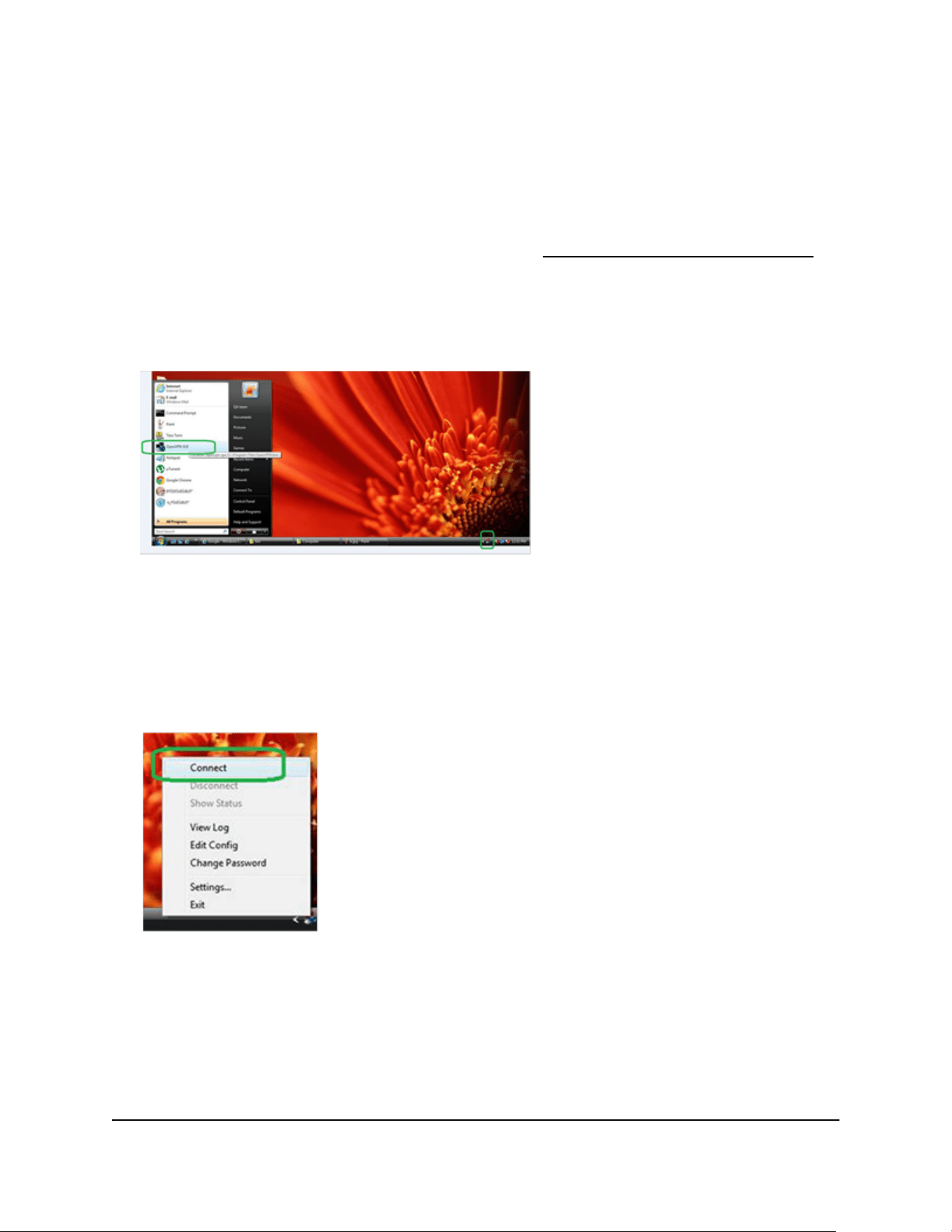
established, you cannot access your home router or your home network with the
OpenVPN software.
The default LAN IP address scheme for the router is 192.x.x.x. The most common IP
schemes are 192.x.x.x, 172.x.x.x, and 10.x.x.x. If you experience a conflict, change the
IP scheme either for your home network or for the network with the client VPN computer.
For information about changing these settings, see Change the LAN TCP/IP settings on
page 62.
To open a VPN tunnel:
1. Launch the OpenVPN application with administrator privileges.
Figure 4. The OpenVPN icon displays in the Windows taskbar.
TIP: You can create a shortcut to the VPN program, then use the shortcut to access
the settings and select the run as administrator check box. Then every time you
use this shortcut, OpenVPN automatically runs with administrator privileges.
2. Right-click the OpenVPN icon.
3. Select Connect.
The VPN connection is established. You can launch a web browser and log in to your
router.
User Manual115Use VPN to Access Your Network
Orbi Tri-band Mesh WiFi 6 System

Use VPN to access your Internet
service at home
When you’re away from home and you access the Internet, you usually use a local Internet
service provider. For example, at a coffee shop you might be given a code that lets you
use the coffee shop’s Internet service account to surf the web.
Your Orbi lets you use a VPN connection to access your own Internet service when
you’re away from home. You might want to do this if you travel to a geographic location
that doesn’t support all the Internet services that you use at home. For example, your
Netflix account might work at home but not in a different country.
Set up VPN client Internet access in the
router
By default, the router is set up to allow VPN connections only to your home network,
but you can change the settings to allow Internet access. Accessing the Internet remotely
through a VPN might be slower than accessing the Internet directly.
To allow VPN clients to use your home Internet service:
1. Launch a web browser from a computer or mobile device that is connected to your
Orbi network.
2. Enter orbilogin.com.
A login window opens.
3. Enter the admin user name and password.
The user name is admin. The password is the one that you specified the first time
that you logged in. The user name and password are case-sensitive.
The BASIC Home page displays.
4. Select ADVANCED > Advanced Setup > VPN Service.
The VPN Service page displays.
5. Select the Enable VPN Service radio button.
6. Scroll down to the Clients will use this VPN connection to access section, and select
the All sites on the Internet & Home Network radio button.
When you access the Internet with the VPN connection, instead of using a local
Internet service, you use the Internet service from your home network.
7. Click the Apply button.
User Manual116Use VPN to Access Your Network
Orbi Tri-band Mesh WiFi 6 System

Your settings are saved.
Block VPN client Internet access in the router
By default, the router is set up to allow VPN connections only to your home network,
not to the Internet service for your home network. If you changed this setting to allow
Internet access, you can change it back.
To allow VPN clients to access only your home network and block access to the
Internet service for your home network:
1. Launch a web browser from a computer or mobile device that is connected to your
Orbi network.
2. Enter orbilogin.com.
A login window opens.
3. Enter the admin user name and password.
The user name is admin. The password is the one that you specified the first time
that you logged in. The user name and password are case-sensitive.
The BASIC Home page displays.
4. Select ADVANCED > Advanced Setup > VPN Service.
The VPN Service page displays.
5. Select the Enable VPN Service radio button.
6. Scroll down to the Clients will use this VPN connection to access section, and select
the Home Network only radio button.
This is the default setting. The VPN connection is only to your home network, not to
the Internet service for your home network.
7. Click the Apply button.
Your settings are saved.
Use a VPN tunnel to access your Internet
service at home
To access your Internet service:
1. Set up the router to allow VPN access to your Internet service.
See Specify VPN service in the router on page 108.
2. On your computer, launch the OpenVPN application.
User Manual117Use VPN to Access Your Network
Orbi Tri-band Mesh WiFi 6 System

The OpenVPN icon displays in the Windows taskbar.
3. Right-click the icon and select Connect.
4. When the VPN connection is established, launch your Internet browser.
User Manual118Use VPN to Access Your Network
Orbi Tri-band Mesh WiFi 6 System

9
Troubleshooting
This chapter provides information to help you diagnose and solve problems you might
experience with your Orbi router or satellite. If you do not find the solution here, check
the NETGEAR support site at netgear.com/support for product and contact information.
This chapter includes the following sections:
• Quick tips
• The router and satellites do not sync
• You cannot log in to the router
• You cannot access the Internet
• Troubleshoot Internet browsing
• Troubleshoot PPPoE
• Troubleshoot WiFi connectivity
• Troubleshoot your network using the ping utility
119

Quick tips
This section describes tips for troubleshooting some common problems.
Sequence to restart your network
When you restart your network, follow this sequence:
1. Turn off and unplug the modem.
2. Turn off the router.
3. Plug in the modem and turn it on.
Wait two minutes.
4. Turn on the router and wait two minutes.
WiFi settings
Make sure that the WiFi settings in the WiFi-enabled computer or mobile device and
the router match.
The WiFi network name (SSID) and WiFi security settings must match exactly.
If you set up an access list, you must add each WiFi-enabled device’s MAC address to
the router’s access list.
Network settings
Make sure that the network settings of the computer are correct. Wired and wirelessly
connected computers must use network (IP) addresses on the same network as the
router. The simplest way to do this is to configure each computer to obtain an IP address
automatically using DHCP.
Some cable modem service providers require you to use the MAC address of the
computer initially registered on the account. You can view the MAC address on the
Attached Devices page.
User Manual120Troubleshooting
Orbi Tri-band Mesh WiFi 6 System

The router and satellites do not sync
If you are experiencing difficulty syncing the router and the satellites, we recommend
that you move the problem satellites into the same room as the router during the sync.
Then move the satellites to a different location.
To sync the router and satellites:
1. Place the satellite in the same room as the Orbi router.
Use this satellite location only during the sync process.
2. Connect the satellite to a power source.
3. Wait for the satellite LED to light solid white or magenta.
4. Press the Sync button on the router and then within two minutes, press the Sync
button on the satellite.
5. Wait for the satellite to light.
The satellite LED pulses white while it attempts to sync with the router. After the LED
pulses white, it lights one of the following colors:
•
Blue: The Orbi router and satellite successfully synced, and the connection
between the router and satellite is good.
•
Amber: The Orbi router and satellite failed to sync. Try repeating Step 4 again.
If the sync keeps failing, try moving the satellite to a different location that's closer
to the router.
6. Move the satellite to a new location and connect the satellite to a power source.
7. At the new location, check the satellite LED and make sure it lights blue.
If the satellite LED lights blue, the satellite synced successfully. If the satellite LED
lights amber, move the satellite closer to the router and try again. The satellite must
be within range of the router's WiFi cover area for a good connection to the router.
You cannot log in to the router
Make sure that your computer or mobile device is connected to the Orbi WiFi network.
If you do not want to use a WiFi connection, you can connect your computer to the Orbi
router with an Ethernet cable.
If you changed the admin password and you forgot what it is, see Reset the admin
password on page 82.
User Manual121Troubleshooting
Orbi Tri-band Mesh WiFi 6 System

You cannot access the Internet
Check your network and Internet connections:
1. Make sure that your WiFi-enabled computer or mobile device is connected to the
Orbi network.
2. If you are connected to Orbi but you cannot access the Internet, check to see if your
Internet connection is working.
3. Launch a web browser from a computer or WiFi device that is connected to the
network.
4. Enter orbilogin.com.
A login window displays.
5. Enter the router admin user name and password.
The user name is admin. The default password is password. The user name and
password are case-sensitive.
The BASIC Home page displays.
6. Click the ADVANCED tab.
The ADVANCED Home page displays.
7. Check that an IP address is shown for the Internet port.
If 0.0.0.0 is shown, your router did not obtain an IP address from your Internet service
provider (ISP).
If your router cannot obtain an IP address from the ISP, you can force your cable or DSL
modem to recognize your new router by restarting your network. For more information,
see Sequence to restart your network on page 120.
If your router is still unable to obtain an IP address from the ISP, the problem might be
one of the following:
•
Your Internet service provider (ISP) might require a login program. Ask your ISP
whether they require PPP over Ethernet (PPPoE) or some other type of login.
•
If your ISP requires a login, the login name and password might be set incorrectly.
•
Your ISP might check for your computer’s host name. Assign the computer host
name of your ISP account as the account name on the Internet Setup page.
•
If your ISP allows only one Ethernet MAC address to connect to Internet and checks
for your computer’s MAC address, do one of the following:
○
Inform your ISP that you bought a new network device and ask them to use the
router’s MAC address.
○
Configure your router to clone your computer’s MAC address.
User Manual122Troubleshooting
Orbi Tri-band Mesh WiFi 6 System

Troubleshoot Internet browsing
If your router can obtain an IP address but your computer is unable to load any web
pages from the Internet, it might be for one of the following reasons:
•
The traffic meter is enabled, and the limit was reached.
By configuring the traffic meter not to block Internet access when the traffic limit is
reached, you can resume Internet access. If your ISP sets a usage limit, they might
charge you for the overage.
•
Your computer might not recognize any DNS server addresses. A DNS server is a
host on the Internet that translates Internet names (such as www addresses) to numeric
IP addresses.
Typically, your ISP provides the addresses of one or two DNS servers for your use.
If you entered a DNS address during the router’s configuration, restart your computer.
Alternatively, you can configure your computer manually with a DNS address, as
explained in the documentation for your computer.
•
The router might not be configured as the default gateway on your computer.
Reboot the computer and verify that the router address (www.orbilogin.com) is listed
by your computer as the default gateway address.
•
You might be running login software that is no longer needed. If your ISP provided
a program to log you in to the Internet, you no longer need to run that software after
installing your router.
Troubleshoot PPPoE
If you are using PPPoE, try troubleshooting your Internet connection.
To troubleshoot a PPPoE connection:
1. Launch a web browser from a computer or WiFi device that is connected to the
network.
2. Enter orbilogin.com.
A login window displays.
3. Enter the router admin user name and password.
The user name is admin. The default password is password. The user name and
password are case-sensitive.
The BASIC Home page displays.
4. Click the ADVANCED tab.
User Manual123Troubleshooting
Orbi Tri-band Mesh WiFi 6 System

The ADVANCED Home page displays.
5. In the Internet Port pane, click the Connection Status button.
The Connection Status window displays.
6. Check the Connection Status window to see if your PPPoE connection is active and
working.
If the router is not connected, click the Connect button.
The router continues to attempt to connect indefinitely.
7. If you cannot connect after several minutes, the router might be set up with an
incorrect service name, user name, or password, or your ISP might be experiencing
a provisioning problem.
Unless you connect manually, the router does not authenticate using PPPoE until
data is transmitted to the network.
Troubleshoot WiFi connectivity
If you are experiencing trouble connecting to the Orbi WiFi network, try to isolate the
problem:
•
Can your WiFi-enabled computer or mobile device that you are using find your WiFi
network?
•
Does your WiFi-capable device support the security that you are using for your WiFi
network (WPA3, WPA2, or WPA)?
•
To view the WiFi settings for the router, use an Ethernet cable to connect a computer
to an Ethernet port on the router. Then log in to the router, and select BASIC >
Wireless.
NOTE: Be sure to click the Apply button if you change settings.
•
If you are trying to connect to the 5 GHz or 6 GHz WiFi band, does your WiFi-enabled
computer or mobile device support this standard?
•
Did your computer or WiFi device automatically connect to a different WiFi network
in your area, such as a WiFi hotspot?
User Manual124Troubleshooting
Orbi Tri-band Mesh WiFi 6 System

Troubleshoot your network using
the ping utility
Most network devices and routers contain a ping utility that sends an echo request
packet to the designated device. The device then responds with an echo reply. You can
easily troubleshoot a network using the ping utility in your computer or workstation.
Test the LAN path to your router
You can ping the router from your computer to verify that the LAN path to your router
is set up correctly.
To ping the router from a Windows computer:
1. From the Windows toolbar, click the Start button and select Run.
2. In the field provided, type ping followed by the IP address of the router, as in this
example:
ping www.orbilogin.com
3. Click the OK button.
You should see a message like this one:
Pinging <IP address > with 32 bytes of data
If the path is working, you see this message:
Reply from < IP address >: bytes=32 time=NN ms TTL=xxx
If the path is not working, you see this message:
Request timed out
If the path is not functioning correctly, you might be experiencing one of the following
problems:
•
Wrong physical connections
Check that the appropriate LEDs are on for your network devices. If your router and
computer are connected to a separate Ethernet switch, make sure that the link LEDs
on the switch are lit for the switch ports that your computer and router are connected
to.
•
Wrong network configuration
Verify that the Ethernet card driver software and TCP/IP software are both
installed and configured on your computer.
User Manual125Troubleshooting
Orbi Tri-band Mesh WiFi 6 System

Verify that the IP address for your router and your computer are correct and that
the addresses are on the same subnet.
Test the path from your computer to a
remote device
After verifying that the LAN path works correctly, test the path from your computer to
a remote device.
To test the path from your computer to a remote device:
1. From the Windows toolbar, click the Start button and select Run.
2. In the Windows Run window, type:
ping -n 10 <IP address>
where <IP address> is the IP address of a remote device such as your ISP DNS server.
If the path is functioning correctly, messages display that are similar to those shown in
Test the LAN path to your router on page 125.
If you do not receive replies, check the following:
•
Check to see that the IP address of your router is listed as the default gateway for
your computer. If DHCP assigns the IP configuration of your computers, this
information is not visible in your computer Network Control Panel. Verify that the IP
address of the router is listed as the default gateway.
•
Check to see that the network address of your computer (the portion of the IP address
specified by the subnet mask) is different from the network address of the remote
device.
•
Check to see that your cable or DSL modem is connected and functioning.
•
If your ISP assigned a host name to your computer, enter that host name as the
account name on the Internet Setup page.
•
Your ISP might be rejecting the Ethernet MAC addresses of all but one of your
computers.
Many broadband ISPs restrict access by allowing traffic only from the MAC address of
your broadband modem. Some ISPs additionally restrict access to the MAC address of
a single computer connected to that modem. If your ISP does this, configure your router
to “clone” or “spoof” the MAC address from the authorized computer.
User Manual126Troubleshooting
Orbi Tri-band Mesh WiFi 6 System