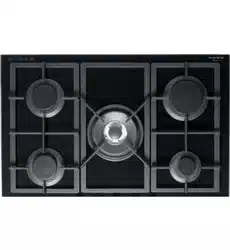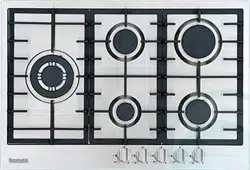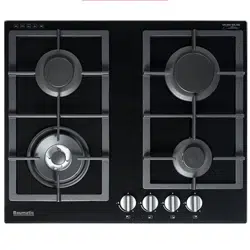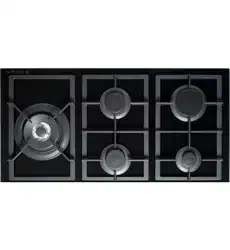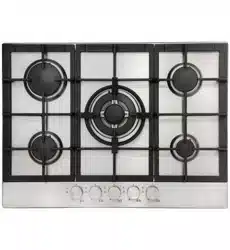

ICD6SG4 60cm, 4 burner, cast iron trivets, s/steel
ICD9SG6 90cm, 5 burner, cast iron trivets, s/steel
CD6SG1 60cm, 4 burner, cast iron trivets, s/steel
CD7SG1 70cm, 5 burner, cast iron trivets, s/steel
CD9SG1 90cm, 5 burner, cast iron trivets, s/steel
GFC60 60cm, 4 burner, enamel trivets, s/steel
60cm / 70cm / 90cm Gas Cooktop
USER MANUAL

For all product enquires, including warranty support,
please contact our Customer Care team
1800 444 357
or email
customer[email protected]
INSTRUCTIONS FOR THE USER
It is necessary that all the operations regarding the installation, adjustment and
adaptation to the type of gas available are carried out by authorised personnel, in
conformity with the regulations in force. The specific instructions are described in the
booklet section intended for the installer.
USING THE BURNERS
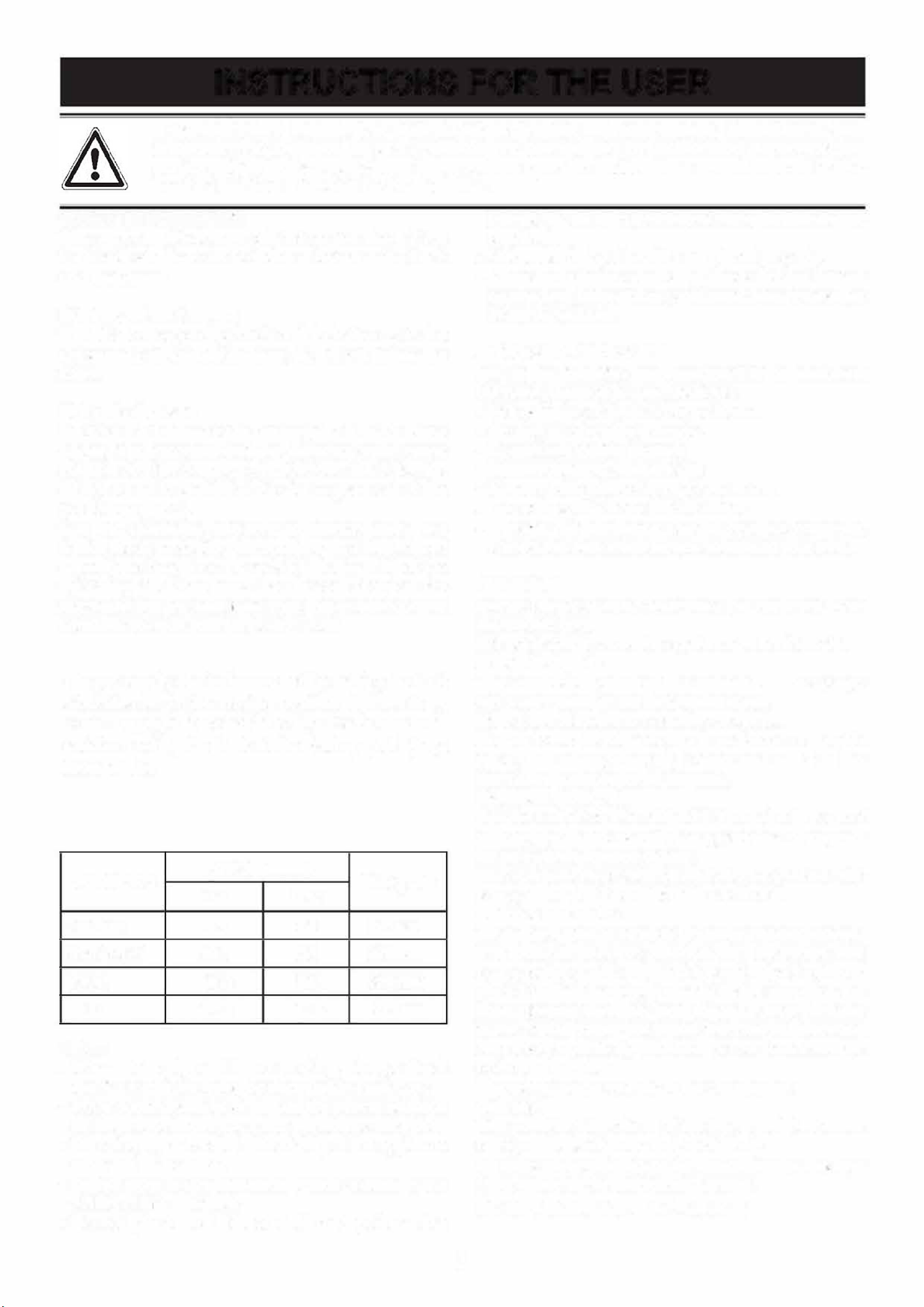
The symbols silk-screen printed on the side of the
knob indicate the correspondence between the knob
and the burner.
Start-up without valves
Turn the corresponding knob anticlockwise up to the
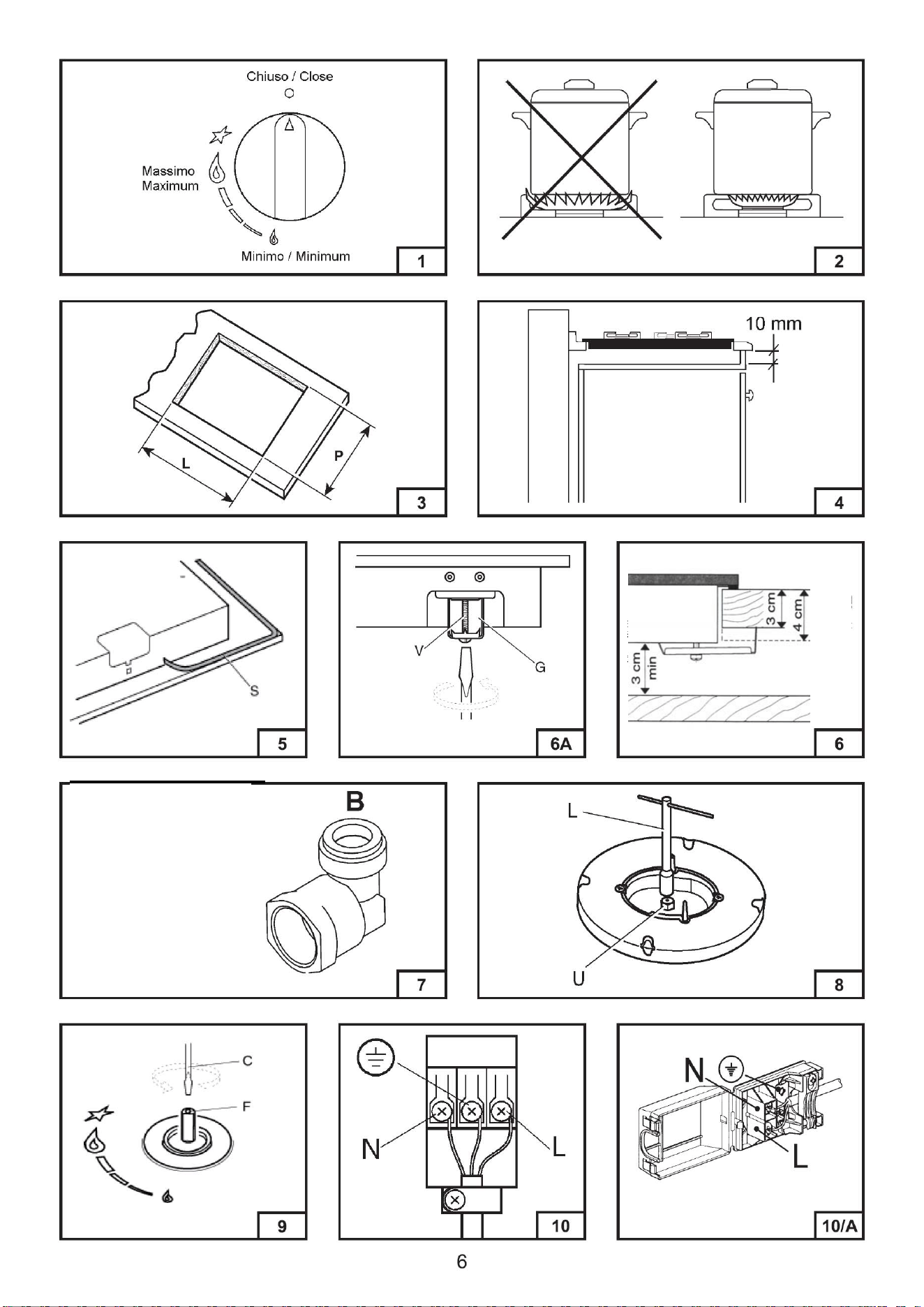
maximum position (large flame, fig. 1) and press the
knob.
Using the burners
In order to obtain the maximum yield without waste
of gas, it is important that the diameter of the pot is
suitable for the burner potential (see the following
table), so as to avoid that the flame goes out of the
pot bottom (fig. 2).
Use the maximum capacity to quickly make the
liquids reach the boiling temperature, and the reduced
capacity to heat food or maintain boiling. All of the
operating positions must be chosen between the
maximum and the minimum ones, never between the
minimum position and the closing point.
The gas supply can be interrupted by turning the knob
clockwise up to the closing position. If there is no
power supply, it is possible to light the burners with
matches, setting the knob to the start-up point (large
flame, fig. 1 ).
BURNERS
Power (MJ/h)
0 of pots
NG LPG
Auxiliary
4.5
4.1 195 mm
Semi-rapid
6.0 6.0
195 mm
Rapid 10.5 10.5 230mm
Wok
13.3
12.75
270mm
Notice
- When the equipment is not working, always check
that the knobs are in the closing position (see fig.1).
- While cooking with fat or oil, pay the utmost attention
as these substances can catch fire when overheated.
- Do not spray aerosols in the vicinity of the appliance
while it is in operation.
- Do not store or use flammable liquids or items in the
vicinity of this appliance.
- Do not place unstable or deformed pots on the
3
burner, so as to prevent them from overturning or
ovelowing.
- Make sure that pot handles are placed properly.
- When the burner is started up, check that the flameis
regular and, before taking pots away, always lowerthe
flame or put it out.
ABNORMAL OPERATION
Any of the following are considered to be abnormal
operation and may require servicing:
- Yellow tipping of the hob burner flame.
-
Sooting up of cooking utensils.
- Burners not igniting properly.
- Burners failing to remain alight.
- Burners extinguished by cupboard doors.
- Gas valves, which are difficult to turn.
- In case the appliance fails to operate correctly,
contact the authorised service provider in your area.
CLEANING
Before any operation, disconnect the appliance from
the electric grid.
It is advisable to clean the appliance when it is cold.
Enamelled parts
The enamelled parts must be washed with a sponge
and soapy water or with a light detergent.
Do not use abrasive or corrosive products.
Do not leave substances, such as lemon or tomato
juice, salt water, vinegar, coffee and milk on the
enamelled surfaces for a long time.
Stainless steel parts
Stainless steel can be stained if it remains in contact
with highly calcareous water or aggressive detergents
for an extended period of time.
The stainless steel parts should also be cleaned with
soapy water and then dried with a soft cloth.
Burners and racks
These parts can be removed to make cleaning easier.
The burners must be washed with a sponge and
soapy water or with a light detergent, wiped well and
placed in their housing perfectly. Make sure that the
flame-dividing ducts are not clogged. Check that the
feeler of the safety valve and the start-up electrode
are always perfectly cleaned, so as to ensure an
optimum operation.
The racks can be washed in the dishwasher.
Gas taps
The possible lubrication of the taps must be carried
out by authorised personnel, exclusively.
In case of hardening or malfunctions in the gas
taps, apply to the Customer Service.
DO NOT MODIFY THIS APPLIANCE
INSTRUCTIONS FOR THE INSTALLER
IMPORTANT NOTICE:
THE OPERATIONS INDICATED BELOW MUST BE FOLLOWED BY AUTHORISED PERSONNEL
EXCLUSIVELY, IN CONFORMITY WITH THE REGULATIONS IN FORCE.
THE MANUFACTURING FIRM REFUSES ALL RESPONSIBILITY FOR DAMAGES TO PEOPLE,
ANIMALS OR THINGS, RESUING FROM THE FAILURE TO COMPLY WITH SUCH PROVISIONS.
THIS APPLIANCE SHALL BE INSTALLED ONLY BY AUTHORISED PERSONS AND IN
ACCORDANCE WITH THE MANUFACTURER'S INSTALLATION INSTRUCTIONS, LOCAL GAS
FITTING REGULATIONS, MUNICIPAL BUILDING CODES, ELECTRICAL WIRING REGULATIONS,
AS 5601 - GAS INSTALLATIONS AND ANY OTHER STATUTORY REGULATIONS.
INSTALLATION
Installing the top
The appliance is designed to be embedded into
heat-resistant pieces of furniture.
The walls of the pieces of furniture must resist a
temperature of 75
°
C besides the room one.
The equipment must not be installed near
inflammable materials, such as curtains, cloths.etc.
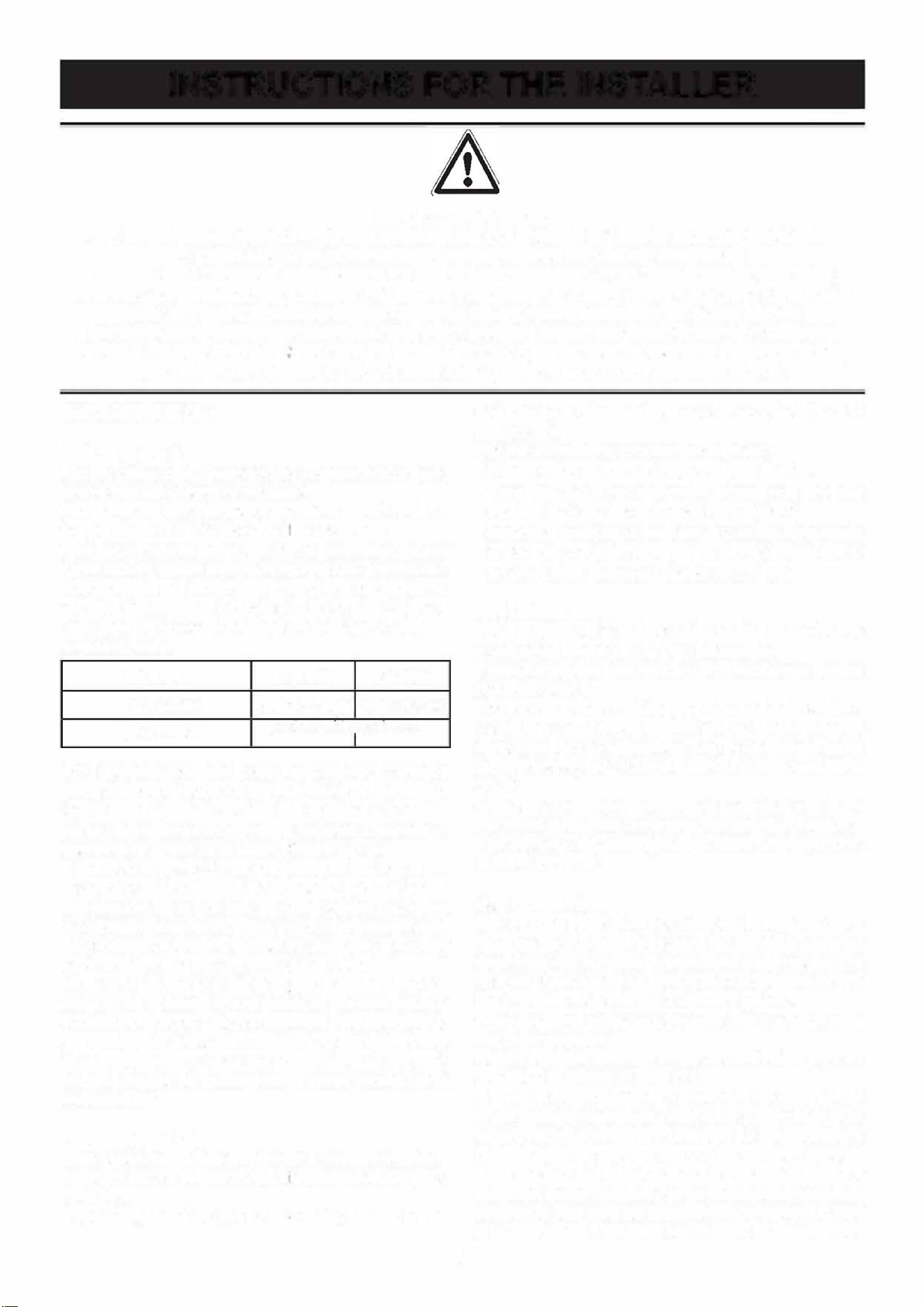
Make a hole in the top of the piece of furniture,
with the dimensions indicated in fig.3, at a distance
of at least 200 mm from the burner edge to the
adjacent walls.
MODELS
L (mm)
P (mm)
60
c
m
&
70
c
m
552mm
90
c
m
Any possible wall unit over the cook-top must be
placed at a distance of at least 600 mm from the
top. It is advisable to isolate the appliance from the
piece of furniture below with a separator, leaving a
depression space of at least 10 mm (fig. 4).
If the hob is going to be installed on the top of an
oven, precautions must be taken to guarantee an
installation in accordance with current accident
prevention standards. Pay particular attention to
the position of the electric cable and gas pipe: they
must not touch any hot parts of the oven.
Moreover, if the hob is going to be installed on
the top of a built in oven without forced cooling
ventilation, proper air vents must be installed to
guarantee an adequate ventilation, with the lower
air entering with a cross section of at least 200cm
2
,
and the higher air exiting with a cross section of at
least 60 cm
2
.
Fastening the top
Every cook-top is equipped with a special washer.
A set of hooks is also supplued for mounting the
cook-top.
Depending on the type of mounting surface, the
4
suitable type of mounting hook is supplied (hook A
or hook B).
For the installation proceed as follows:
- Remove the racks and burners from the top.
- Turn the appliance upside down and lay the
washer S along the external border (fig. 5).
- Introduce and place the cook-top in the hole made
in the piece of furniture, then block it with the V
screws of the fastening hooks (fig.6 / 6A).
Installation room
This appliance is not provided with a device for
exhausting the products of combustion.
Therefore, it is necessary to discharge these
smokes outside.
The room where this appliance is installed
must ave a natural air inflow, so as to ensure
a regular gas combustion and room ventilation:
the necessary air volume must not be lower than
20m
3
.
Air must come from permanent openings made on
the room walls that communicate with the outside.
The section of these openings shall correspond to
at least 200 cm2.
Gas Connection
Make sure that the appliance is adjusted for
the gas type available (see the label under the
appliance). Follow the instructions indicated in the
chapter "gas transformations and adjustments" for
the possible adaptation to different gases.
There are two ways to car out the connection to
the main gas line:
A. The hotplate can be connected with rigid pipe as
specified in AS5601 table 3.1.
B. The hotplate can be connected with a Flexible
Hose, which complies with AS/NZS 1869 (AGA
Approved), 10mm ID, class B or D, no more
than 1.2m long and in accordance with AS5601.
Ensure that the Hose does not contact the hot
surfaces of the hotplate, oven, dishwasher or other
appliance that may be installed underneath or next
to the hotplate. WARNING: Ensure that the hose
470mm
830mm
472mm

INSTRUCTIONS FOR THE INSLLER
assembly is restrained from accidental contact
with the flue or flue outlet of an underbench oven.
The hose should not be subjected to abrasion,
kinking or permanent deformation and should
be able to be inspected along its entire length.
Unions compatible with the hose fittings must be
used and connections tested for gas leaks. The
supply connection point shall be accessible with
the appliance installed.
Please select the type which is correct for the
supply concerned.
Once the installation is complete, check all
connections for gas leaks with soap and water.
DO NOT use a naked flame for detecting leaks.
Ignite all burners both individually and concurrently
to ensure correct operation of gas valves, burners
and ignition. Turn gas taps to low flame position
and observe stability of the flame for each burner
individually and concurrently. When satisfied with
the hotplate, please instruct the user on the correct
method of operation. In case the appliance fails
to operate correctly after all checks have been
carried out, refer to the authorised service provider
in your area.
Electric connection
The connection to the electric grid must be carried
out by qualified personnel and in conformity with
the regulations in force.
The voltage of the electric system must correspond
to the value indicated in the label under the
appliance. Make sure that the electric system is
provided with an effective ground connection in
compliance with the regulations and provisions of
the law. Grounding is compulsory.
GAS TRANSFORMATIONS AN D
ADJUSTMENTS
Data Label
A duplicate Data Label is supplied to adhere in an
accessible area next to the appliance.
This appliance is suitable for Natural Gas and Pro
pane LPG; ensure that the available gas supply
matches the Data Label.
When converting from Natural Gas to Propane
LPG ensure that the NG regulator is removed and
replaced with the Test Point Assembly. An approved
gas regulator suitable for a supply pressure
of 2. 75kPa should be part of the gas tank supply
and the test point pressure should be adjusted to
2.75kPa.
Replacing the nozzles
If the equipment is adjusted for a type of gas that is
dierent from the one available, it is necessary to
made according to the table of the "technical
characteristics" as enclosed.
Act as follows:
- remove the racks and burners.
- by means of a straight spanner L, unscrew
the nozzle U (fig. 8) and substitute it with the
corresponding one.
- tighten the nozzle strongly.
Adjusting the burners
The lowest flame point must always be properly
adjusted and the flame must remain on even if
there is an abrupt shift from the maximum to the
minimum position.
If this is not so, it is necessary to adjust the lowest
flame point as follows:
- start the burner up
- turn the tap up to the minimum position (small
flame)
- remove the knob from the tap rod
- introduce a flat-tip screwdriver C in the hole F of
the tap (fig. 9) and turn the by-pass screw up to
a proper adjustment of the lowest flame point.
Turndown screw set point:
Natural gas - 1/8 turn anti clockwise
Propane LPG - 1 /12 turn anti clockwise
MAINTENANCE
Maintenance Schedule
No regular maintenance is required for the hotplates
except cleaning.
Replacing the power supply cable
If the power supply cable should be replaced,
it is necessary to use a cable with a section of
3
x0. 75mm
2
,
type H05VV-F or H05RR-F,
complying
with the regulations in force.
The connection to the terminal board
effected as shown in fig.10 - 10/A:
brown cable L
(phase)
blue cable N
(neutral)
must be
replace the burner nozzles.
The choice of the nozzles to replace mus t be
green-yellow cable @ (ground)
5
OV
ERALL
COOKTOP
D
I
ME
N
S
ION
S
60
c
m
f
our burn
er
580mm
(
w
)
x
510mm
(
d
)
70cm five burner 680mm (w) x 500mm (d)
90cm five burner 860mm (w) x 500mm (d)
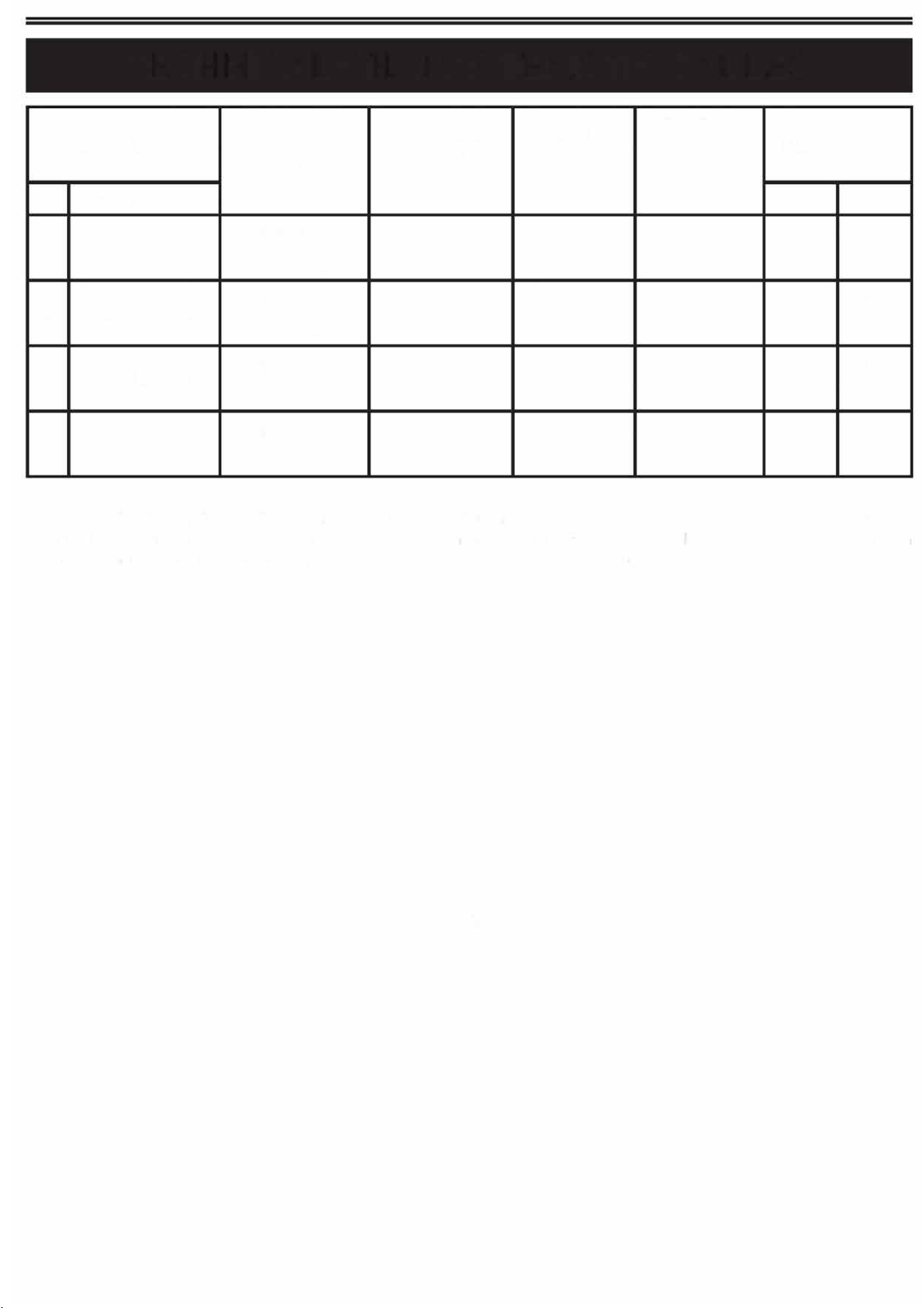
TECHNICAL CHARACTERISTIC TABLES
NORMAL
INJECTOR
TA PE BY
NOMINAL
BURNERS
PASS
HEAT INPUT
GAS
PRESSURE DIAMETER
DIAMETER
(
MJ/
h)
N
o
DESCRIPTION KPa
1/100 mm
1/100 mm Max. Min.
Propane LPG 2.75
90
40
10.5
2.63
1
RAPID
Natural
1.00
140
Adjust.
10.5 2.63
Propane LPG
2.75
70
31
6.0
1.50
2
SEMI-RAPID
Natural
1.00
110
Adjust.
6.0
1.50
Propane LPG
2.75
55
27
4.1
1.08
3
AUXILIARY
Natural 1.00
90
Adjust.
4.5
1.13
Wok
Propane LPG
2.75
98
60
12.75
6.4
4
Natural 1.00 170 Adjust. 13.3
7.0
The manufacturing firm refuses all responsibility for any possible imprecision in this booklet, due to
misprints or clerical errors. It reserves the right to make all the changes that it will consider necessary in
its own products, without eecting the essential characteristics of functionality and safety.
7

7KLVSDJHKDVEHHQOHIWEODQNLQWHQWLRQDOO\

7KLVSDJHKDVEHHQOHIWEODQNLQWHQWLRQDOO\

7KLVSDJHKDVEHHQOHIWEODQNLQWHQWLRQDOO\