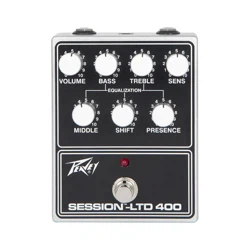
Session-LTD 400
Preamp Pedal
Owner’s Manual
• Faithful recreation of the original Peavey Session/LTD 400 preamp circuit (circa 1974) in a pedal
• Internal 25V supply from standard 9V supply/battery
• Standard 9V supply (#30908180) or 9V battery (#00050130)
• Hard Bypass switch with anti-click circuit
• Input Volume control
• ree-band Low, Mid, & High EQ with Mid Shi
• Presence control
• Tested and formally approved for worldwide EMC and FCC compliance by an independent laboratory
1
4
8
9
5
6
7
10
11
2 3

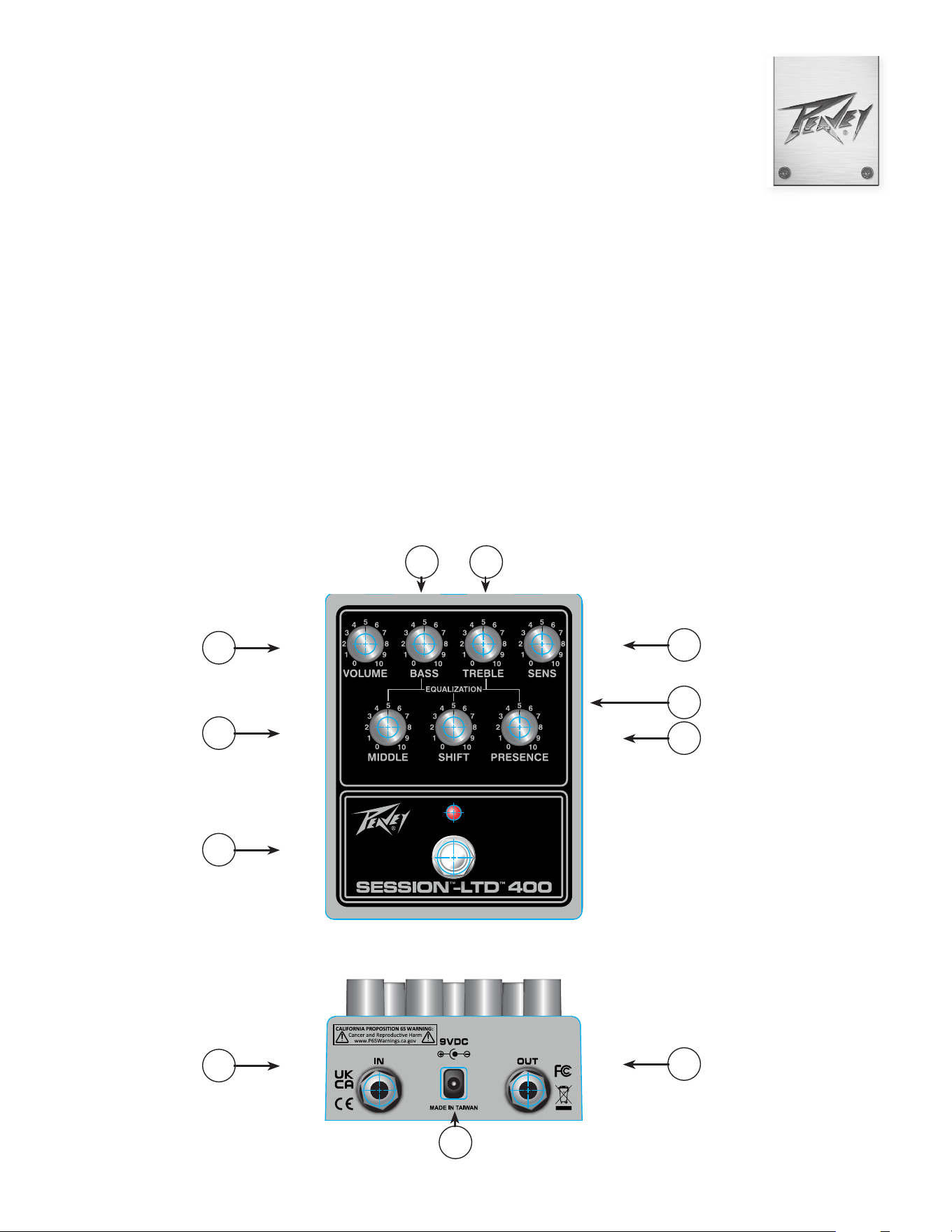
(1) VOLUME Control
e volume control sets the gain of the input preamp, thereby controlling the sensitivity of the preamp, not the
power of the amp. It is entirely possible for the preamp to be overdriven at very low gain settings if the signal
from your instrument is extremely high. Please remember that the volume control does NOT indicate power
output, but the GAIN of the preamp.
(2) BASS Control
e bass control is part of an electronic crossover that forms the tone circuit and works as a level for the bass fre-
quencies. e bass control provides for both a boost and a cut in bass response. Like the treble control, the bass
should be run near its full clockwise position tor maximum volume from the amp.
(3) TREBLE Control
e treble control is part of an electronic crossover and may be considered as a level control for treble frequen-
cies. ese variable feedback type tone controls are capable of providing a cut, as well as, a boost. Because the
treble control is a volume control for treble frequencies, it is a good practice to operate this control close to fully
clockwise for maximum benet and volume. Experimentation will allow the player to nd the level that works
best for his preference in tone.
(4) MID Control
e middle control is of the cut type and allows the musician to tailor the critical midrange frequencies to suit
each individual’s taste. is is perhaps the most dicult control to design, but its importance in tonal settings
made this extra efort necessary. Experimentation will illustrate the versatility of this control.
(5) SENSITIVITY Control
e master sensitivity control is a unique innovation which allows the player to “cut” or “boost’’ sen sitivity as he
desires. is allows the musician to cut out noise for a perfectly quiet performance during recording sessions.
e new version allows for operating all the way to OFF.
(6) SHIFT Control
e middle shi control enables the musician to select the particular frequency range that he wants to cut in the
midrange spectrum. By experimenting with dierent combinations of settings between the middle control and
the middle shi control, you will discover a variety of sounds.
(7) PRESENCE Control
e presence control allows precise variation of the extreme top end {treble) and tends to bring out the upper
harmonics generated by any instrument.
(8) BYPASS SWITCH
is switch is hard-bypass with anti-click circuitry, ensuring quiet operation.
(9) IN
Input signal from the instrument.
(10) OUTPUT
is provides a signal capable of driving any PA system, instrument amplier, or signal processor/pedalboard
setup.
(11) POWER SUPPLY
9VDC (NEG TIP) - Provided for the input of a standard 9VDC barrel-type, negative tipped power supply. e
25VDC rails are generated internally by a super high-eciency inverter circuit.

Logo referenced in Directive 2002/96/EC Annex IV
(OJ(L)37/38,13.02.03 and defined in EN 50419: 2005
The bar is the symbol for marking of new waste and
is applied only to equipment manufactured after
13 August 2005
www.peavey.com
Warranty registration and information for U.S. customers available online at
www.peavey.com/warranty
or use the QR tag below
Features and specications subject to change without notice.
Peavey Electronics Corporation 5022 Hartley Peavey Drive Meridian, MS 39305 (601) 483-5365 FAX (601) 486-1278
