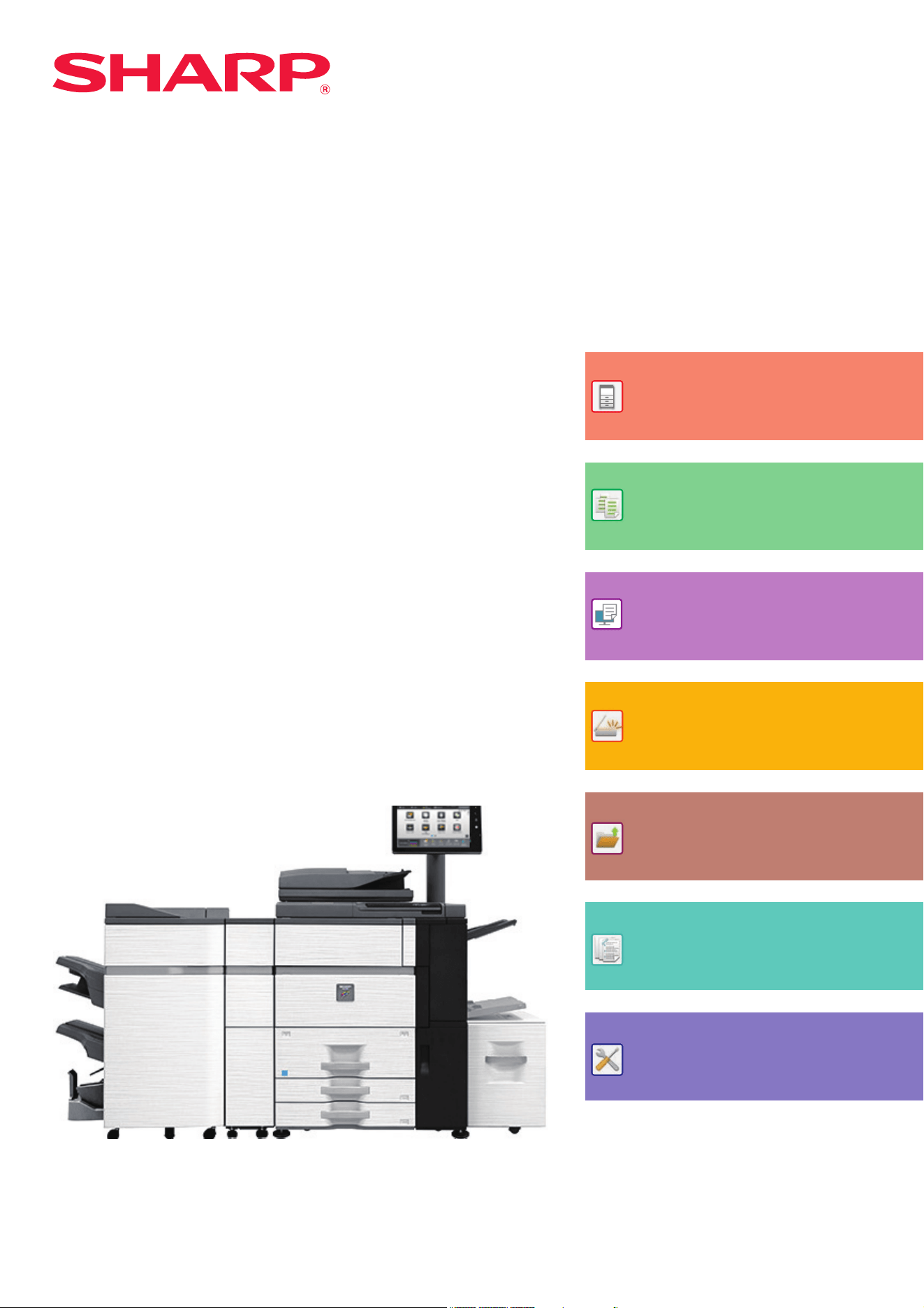
Functions of the machine and procedures
for placing originals and loading paper
BEFORE USING THE MACHINE
COPIER
Using the copy function
PRINTER
Using the printer function
SCANNER
Using the scan function
DOCUMENT FILING
Storing jobs as files on the hard drive
MANUAL FINISHING
Using the manual finishing function
Click to jump to the table of contents of the
desired chapter.
User's Manual
DIGITAL FULL COLOR MULTIFUNCTIONAL SYSTEM
MODEL: MX-7090N
MX-8090N
SYSTEM SETTINGS
Configuring settings to make the machine
easier to use
i
HOW TO USE THIS MANUAL
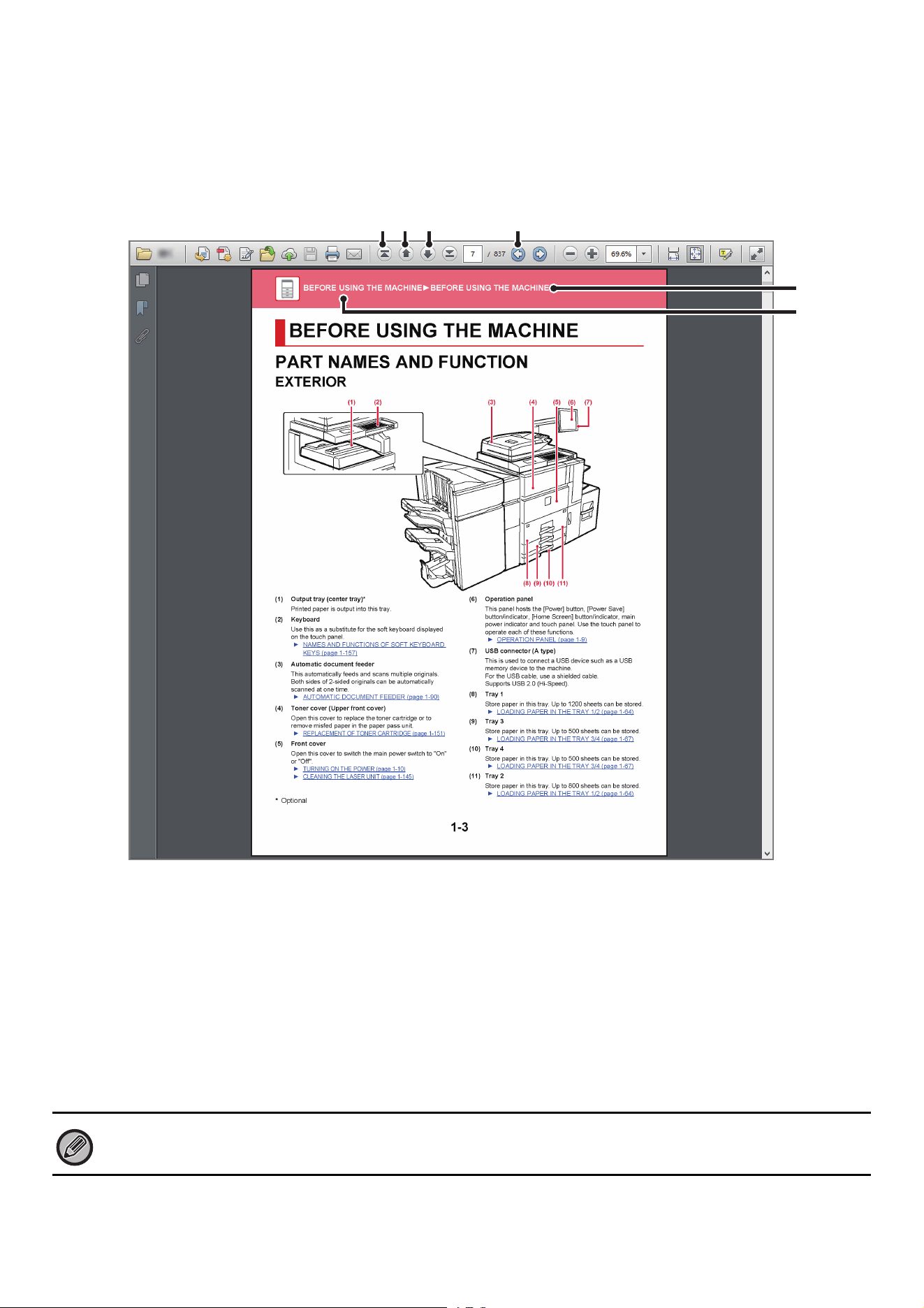
Click a button below to move to the page that you wish to view.
The following explanation assumes that Adobe Reader XI is being used (Some buttons do not appear in the default
state.).
(1) Return to top page button
If an operation does not proceed as expected, click this
button to start over again.
(2) Back one page button
Displays the previous page.
(3) Forward one page button
Displays the next page.
(4) Return to previously displayed page button
Displays the page that was displayed before the current
page.
(5) Title button
Displays the page of the title indicated by the button.
(6) Contents button
Displays the contents of each chapter.
For example, if the current page is part of the printer
chapter, the table of contents of the printer chapter
appears.
(1) (2) (3) (4)
(6)
(5)
If a button does not appear, refer to Adobe Reader Help to display the button.
ii
ABOUT OPERATION MANUAL
This manual explains how to use the MX-7090N/MX-8090N digital full color multifunctional system.
Please note
• For information on installing the drivers and software cited in this manual, please refer to the Software Setup Guide.
• For information on your operating system, please refer to your operating system manual or the online Help function.
• The explanations of screens and procedures in a Windows environment are primarily for Windows
®
8.1. The screens may be
different depending on the version of the operating system or the software application.
• The explanations of screens and procedures in a Macintosh environment are based on Mac OS X v10.10 in the case of Mac OS
X. The screens may be different depending on the version of the operating system or the software application.
• Wherever "MX-xxxx" appears in this manual, please substitute your model name for "xxxx".
• Considerable care has been taken in preparing this manual. If you have any comments or concerns about the manual, please
contact your dealer or nearest SHARP Service Department.
• This product has undergone strict quality control and inspection procedures. In the unlikely event that a defect or other problem
is discovered, please contact your dealer or nearest SHARP Service Department.
• Aside from instances provided for by law, SHARP is not responsible for failures occurring during the use of the product or its
options, or failures due to incorrect operation of the product and its options, or other failures, or for any damage that occurs due
to use of the product.
Warning
• Reproduction, adaptation or translation of the contents of the manual without prior written permission is prohibited, except as
allowed under copyright laws.
• All information in this manual is subject to change without notice.
Illustrations and the operation panel and touch panel shown in this manual
The peripheral devices are generally optional, however, some models include certain peripheral devices as standard equipment.
The explanations in this manual assume that a multi bypass tray, large capacity tray, saddle stitch finisher, punch module, and
curl correction unit is installed on the MX-8090N.
For some functions and procedures, the explanations assume that devices other than the above are installed.
Icons used in the manuals
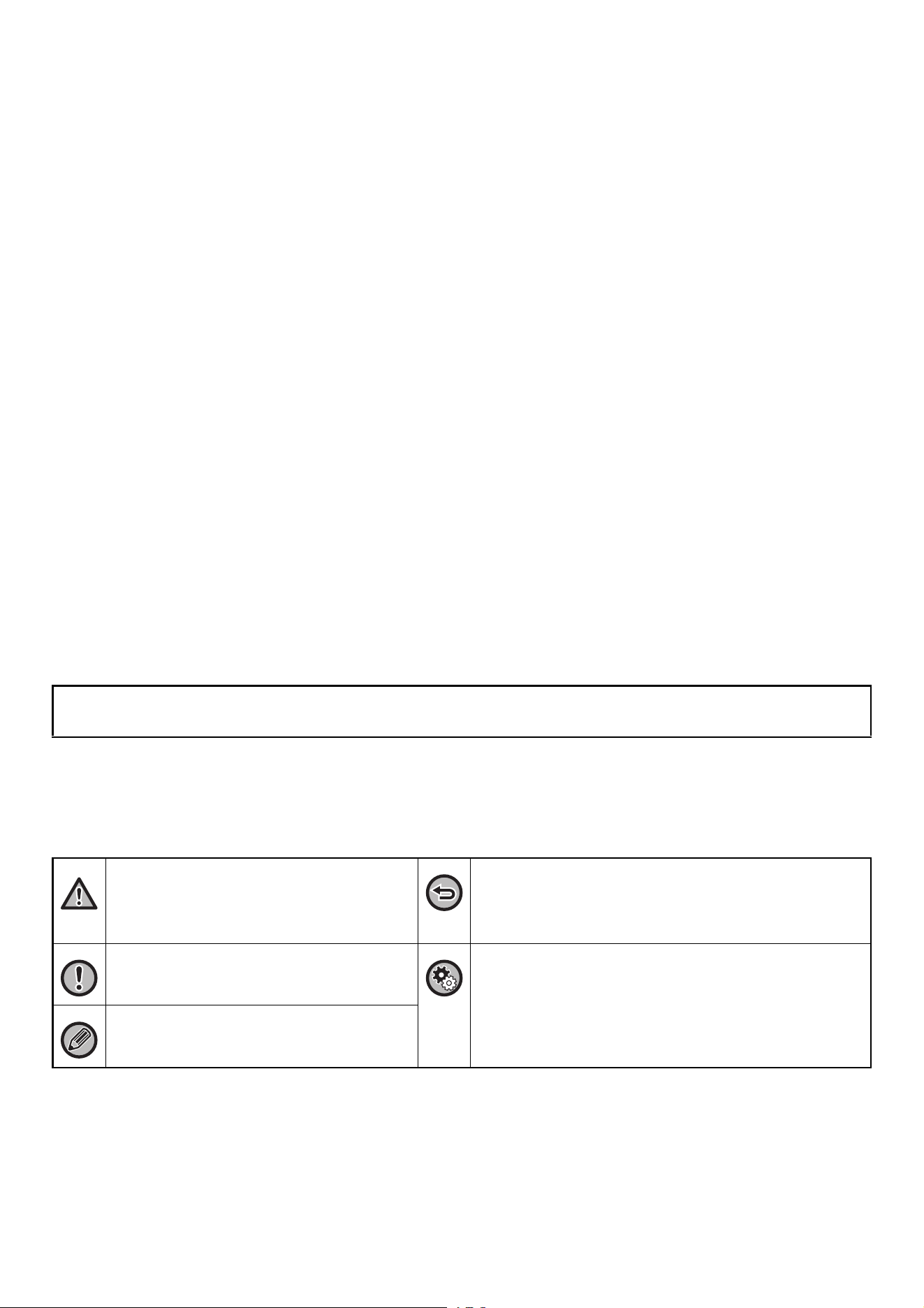
The icons in the manuals indicate the following types of information:
The display screens, messages, and key names shown in the manual may differ from those on the actual machine
due to product improvements and modifications.
This alerts you to a situation that could result in
death or serious personal injury. This alerts
you to a situation that could result in personal
injury or damage to properties.
This explains how to stop or correct an operation.
This alerts you to a situation where there is a
risk of machine damage or failure.
This describes a routine work relevant to setting mode.
This supplements function or operation
procedure.
1-1
BEFORE USING THE MACHINE
PART NAMES AND FUNCTION . . . . . . . . . . . . . . . 1-3
• EXTERIOR . . . . . . . . . . . . . . . . . . . . . . . . . . . . 1-3
• INTERIOR . . . . . . . . . . . . . . . . . . . . . . . . . . . . . 1-6
• AUTOMATIC DOCUMENT FEEDER AND
DOCUMENT GLASS. . . . . . . . . . . . . . . . . . . . . 1-7
• SIDE AND BACK. . . . . . . . . . . . . . . . . . . . . . . . 1-8
• OPERATION PANEL. . . . . . . . . . . . . . . . . . . . . 1-9
TURNING ON THE POWER. . . . . . . . . . . . . . . . . . . 1-10
TOUCH PANEL . . . . . . . . . . . . . . . . . . . . . . . . . . . . 1-11
• TOUCH TYPES . . . . . . . . . . . . . . . . . . . . . . . . . 1-11
• HOME SCREEN . . . . . . . . . . . . . . . . . . . . . . . . 1-14
• PREVIEW SCREEN . . . . . . . . . . . . . . . . . . . . . 1-17
•
OPERATION OF FREQUENTLY USED KEYS . . .
1-23
• ACTION PANEL . . . . . . . . . . . . . . . . . . . . . . . . 1-24
• CONFIRMATION SCREEN FOR FAVORITE
MENUS AND SETTINGS . . . . . . . . . . . . . . . . . 1-24
Eco . . . . . . . . . . . . . . . . . . . . . . . . . . . . . . . . . . . . . . 1-26
• ECO FUNCTIONS OF THE MACHINE . . . . . . . 1-26
• AUTO POWER SHUT-OFF MODE . . . . . . . . . . 1-27
• PREHEAT MODE . . . . . . . . . . . . . . . . . . . . . . . 1-28
• ECO RECOMMENDATION FUNCTION
DISPLAY . . . . . . . . . . . . . . . . . . . . . . . . . . . . . . 1-28
• AS SOON AS THE REMOTE JOB IS
FINISHED, ENTER AUTO POWER SHUT OFF
MODE . . . . . . . . . . . . . . . . . . . . . . . . . . . . . . . . 1-29
• ECO SCAN . . . . . . . . . . . . . . . . . . . . . . . . . . . . 1-29
• POWER ON/OFF SCHEDULE SETTING . . . . . 1-30
• SPECIFIC DATE OPERATION SETTINGS . . . 1-30
USER AUTHENTICATION . . . . . . . . . . . . . . . . . . . . 1-31
• AUTHENTICATION BY USER NUMBER . . . . . 1-31
• AUTHENTICATION BY LOGIN
NAME/PASSWORD . . . . . . . . . . . . . . . . . . . . . 1-33
• ACTIVE DIRECTORY LINKING FUNCTION. . . 1-36
BILLING CODE . . . . . . . . . . . . . . . . . . . . . . . . . . . . 1-39
• BILLING CODE . . . . . . . . . . . . . . . . . . . . . . . . . 1-39
• USE BILLING CODE . . . . . . . . . . . . . . . . . . . . . 1-40
• REGISTERING A NEW BILLING CODE . . . . . . 1-43
• EDITING OR DELETING THE REGISTERED
BILLING CODE . . . . . . . . . . . . . . . . . . . . . . . . . 1-46
CLOUD LINK. . . . . . . . . . . . . . . . . . . . . . . . . . . . . . 1-49
• BEFORE USING THE CLOUD LINK
FUNCTION . . . . . . . . . . . . . . . . . . . . . . . . . . . . 1-49
• UPLOADING SCANNED DATA TO A CLOUD
SERVICE . . . . . . . . . . . . . . . . . . . . . . . . . . . . . 1-50
• PRINTING DATA IN A CLOUD SERVICE . . . . 1-50
REMOTE OPERATION OF THE MACHINE . . . . . . 1-52
UNIVERSAL DESIGN IN THE MACHINE. . . . . . . . 1-53
• UNIVERSAL DESIGN RELATED TO
OPERATION . . . . . . . . . . . . . . . . . . . . . . . . . . 1-53
•
UNIVERSAL DESIGN RELATED TO VISION . . .
1-54
•
UNIVERSAL DESIGN RELATED TO HEARING . . .
1-54
•
UNIVERSAL DESIGN FEATURES. . . . . . . . . . . . . .
1-55
ITEMS RECORDED IN THE JOB LOG . . . . . . . . . 1-57
LOADING PAPER
IMPORTANT POINTS ABOUT PAPER . . . . . . . . . 1-60
• NAMES AND LOCATIONS OF TRAYS . . . . . . 1-60
• THE DEFINITION OF "R" IN PAPER SIZE . . . 1-60
• APPLICABLE PAPER TYPES . . . . . . . . . . . . . 1-61
LOADING PAPER IN THE TRAY 1/2 . . . . . . . . . . . 1-64
LOADING PAPER IN THE TRAY 3/4 . . . . . . . . . . . 1-67
LOADING PAPER IN THE LARGE CAPACITY
TRAY . . . . . . . . . . . . . . . . . . . . . . . . . . . . . . . . . . . . .
1-71
LOADING PAPER IN THE LARGE CAPACITY
TRAYS. . . . . . . . . . . . . . . . . . . . . . . . . . . . . . . . . . . 1-76
LOADING PAPER INTO THE BYPASS TRAY. . . . 1-81
HOW TO PLACE THE LONG PAPER GUIDE . . . . 1-88
HOW TO PLACE THE ORIGINAL
SELECTING A PROCEDURE FOR PLACING THE
ORIGINAL DEPENDING ON THE TYPE AND
STATUS OF THE ORIGINAL . . . . . . . . . . . . . . . . . 1-89
AUTOMATIC DOCUMENT FEEDER . . . . . . . . . . . 1-90
DOCUMENT GLASS. . . . . . . . . . . . . . . . . . . . . . . . 1-92
BEFORE USING THE MACHINE

1-2
BEFORE USING THE MACHINE
STOPPING/DELETING A JOB, PRIORITY
PROCESSING AND CHECKING THE STATUS
TYPES OF JOB MANAGEMENT SCREENS . . . . . 1-94
STOPPING/DELETING A JOB IN PROGRESS OR
RESERVED . . . . . . . . . . . . . . . . . . . . . . . . . . . . . . . 1-96
PRIORITY PROCESSING OF A RESERVED JOB . . .
1-97
CHECKING A RESERVED JOB OR THE JOB IN
PROGRESS . . . . . . . . . . . . . . . . . . . . . . . . . . . . . . . 1-99
CHECKING COMPLETED JOBS. . . . . . . . . . . . . . . 1-100
READING THE JOB LIST . . . . . . . . . . . . . . . . . . . . 1-100
ADDRESS BOOK
ADDRESS BOOK. . . . . . . . . . . . . . . . . . . . . . . . . . . 1-103
ADDRESS BOOK SCREEN. . . . . . . . . . . . . . . . . . . 1-104
STORING ADDRESSES THROUGH DIRECT
ENTRY . . . . . . . . . . . . . . . . . . . . . . . . . . . . . . . . . . . 1-107
STORING ADDRESSES THROUGH GLOBAL
ADDRESS SEARCH . . . . . . . . . . . . . . . . . . . . . . . . 1-108
STORING ADDRESSES FROM IMAGE SEND
LOGS . . . . . . . . . . . . . . . . . . . . . . . . . . . . . . . . . . . . 1-110
STORING GROUPS . . . . . . . . . . . . . . . . . . . . . . . . . 1-111
EDITING/DELETING ADDRESSES IN ADDRESS
BOOK . . . . . . . . . . . . . . . . . . . . . . . . . . . . . . . . . . . . 1-113
SETTING THE SCOPE FOR PUBLICIZING
CONTACTS AND GROUPS. . . . . . . . . . . . . . . . . . . 1-115
DELETING THE TRANSMISSION HISTORY . . . . . 1-116
PERIPHERAL DEVICES
PERIPHERAL DEVICES . . . . . . . . . . . . . . . . . . . . . 1-117
FINISHER (100-SHEET STAPLING) . . . . . . . . . . . . 1-119
• PART NAMES . . . . . . . . . . . . . . . . . . . . . . . . . . 1-119
• SUPPLIES . . . . . . . . . . . . . . . . . . . . . . . . . . . . . 1-120
• REPLACING THE CARTRIDGE . . . . . . . . . . . . 1-120
• DISCARDING STAPLE WASTE . . . . . . . . . . . . 1-122
SADDLE STITCH FINISHER (100-SHEET
STAPLING). . . . . . . . . . . . . . . . . . . . . . . . . . . . . . . . 1-124
• PART NAMES . . . . . . . . . . . . . . . . . . . . . . . . . . 1-124
• SUPPLIES . . . . . . . . . . . . . . . . . . . . . . . . . . . . . 1-125
• REPLACING THE CARTRIDGE . . . . . . . . . . . . 1-125
• DISCARDING STAPLE WASTE . . . . . . . . . . . . 1-130
• DISCARDING PAPER WASTE . . . . . . . . . . . . . 1-131
PUNCH MODULE (MX-PN13B) . . . . . . . . . . . . . . . 1-133
• DISCARDING PUNCH WASTE . . . . . . . . . . . . 1-133
FOLDING UNIT . . . . . . . . . . . . . . . . . . . . . . . . . . . . 1-135
• PART NAMES . . . . . . . . . . . . . . . . . . . . . . . . . 1-135
INSERTER. . . . . . . . . . . . . . . . . . . . . . . . . . . . . . . . 1-136
• PART NAMES . . . . . . . . . . . . . . . . . . . . . . . . . 1-136
STATUS INDICATORS . . . . . . . . . . . . . . . . . . . . . . 1-137
• PART NAMES . . . . . . . . . . . . . . . . . . . . . . . . . 1-137
Sharp OSA . . . . . . . . . . . . . . . . . . . . . . . . . . . . . . . 1-138
• APPLICATION COMMUNICATION . . . . . . . . . 1-138
• EXTERNAL ACCOUNT APPLICATION . . . . . . 1-139
REMOVING MISFEEDS
REMOVING MISFEEDS . . . . . . . . . . . . . . . . . . . . . 1-141
MAINTENANCE
REGULAR MAINTENANCE . . . . . . . . . . . . . . . . . . 1-142
• CLEANING THE DOCUMENT GLASS AND
AUTOMATIC DOCUMENT FEEDER. . . . . . . . 1-142
• CLEANING THE LASER UNIT. . . . . . . . . . . . . 1-145
• CLEANING THE BYPASS FEED ROLLER . . . 1-149
REPLACEMENT OF TONER CARTRIDGE . . . . . . 1-151
REPLACING THE WASTE TONER BOTTLE. . . . . 1-154
REPLACING THE STAMP CARTRIDGE . . . . . . . . 1-155
CHARACTER ENTRY
NAMES AND FUNCTIONS OF SOFT KEYBOARD
KEYS . . . . . . . . . . . . . . . . . . . . . . . . . . . . . . . . . . . . 1-157
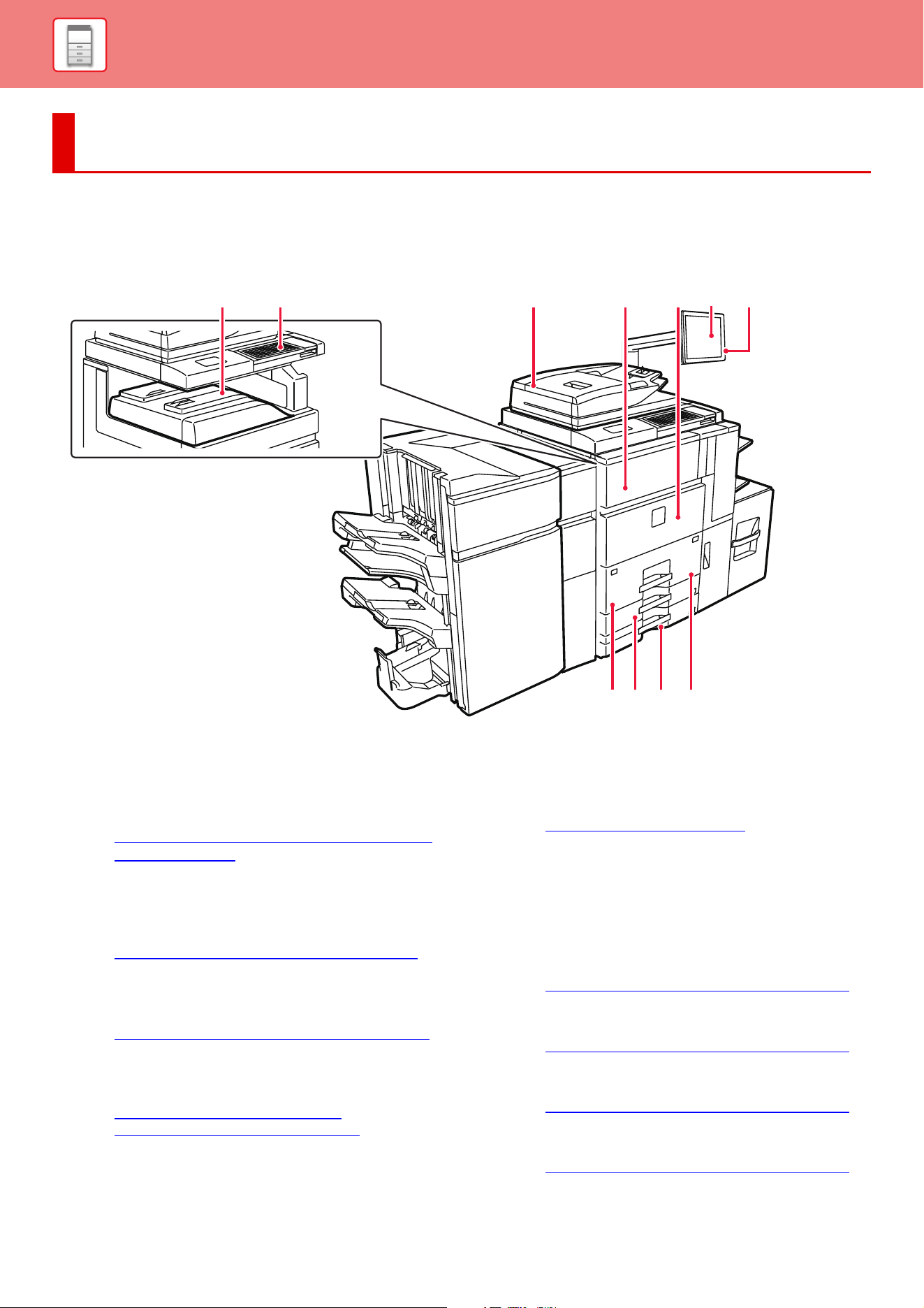
1-3
BEFORE USING THE MACHINE►BEFORE USING THE MACHINE
PART NAMES AND FUNCTION
EXTERIOR
(1) Output tray (center tray)*
Printed paper is output into this tray.
(2) Keyboard
Use this as a substitute for the soft keyboard displayed
on the touch panel.
► NAMES AND FUNCTIONS OF SOFT KEYBOARD
KEYS (page 1-157)
(3) Automatic document feeder
This automatically feeds and scans multiple originals.
Both sides of 2-sided originals can be automatically
scanned at one time.
► AUTOMATIC DOCUMENT FEEDER (page 1-90)
(4) Toner cover (Upper front cover)
Open this cover to replace the toner cartridge or to
remove misfed paper in the paper pass unit.
►
REPLACEMENT OF TONER CARTRIDGE (page 1-151)
(5) Front cover
Open this cover to switch the main power switch to "On"
or "Off".
►
TURNING ON THE POWER (page 1-10)
►
CLEANING THE LASER UNIT (page 1-145)
(6) Operation panel
This panel hosts the [Power] button, [Power Save]
button/indicator, [Home Screen] button/indicator, main
power indicator and touch panel. Use the touch panel to
operate each of these functions.
► OPERATION PANEL (page 1-9)
(7) USB connector (A type)
This is used to connect a USB device such as a USB
memory device to the machine.
For the USB cable, use a shielded cable.
Supports USB 2.0 (Hi-Speed).
(8) Tray 1
Store paper in this tray. Up to 1200 sheets can be stored.
► LOADING PAPER IN THE TRAY 1/2 (page 1-64)
(9) Tray 3
Store paper in this tray. Up to 500 sheets can be stored.
► LOADING PAPER IN THE TRAY 3/4 (page 1-67)
(10) Tray 4
Store paper in this tray. Up to 500 sheets can be stored.
► LOADING PAPER IN THE TRAY 3/4 (page 1-67)
(11) Tray 2
Store paper in this tray. Up to 800 sheets can be stored.
► LOADING PAPER IN THE TRAY 1/2 (page 1-64)
*Optional
BEFORE USING THE MACHINE
(8) (9) (10) (11)
(1)
(2)
(3) (4) (5)
(6)
(7)
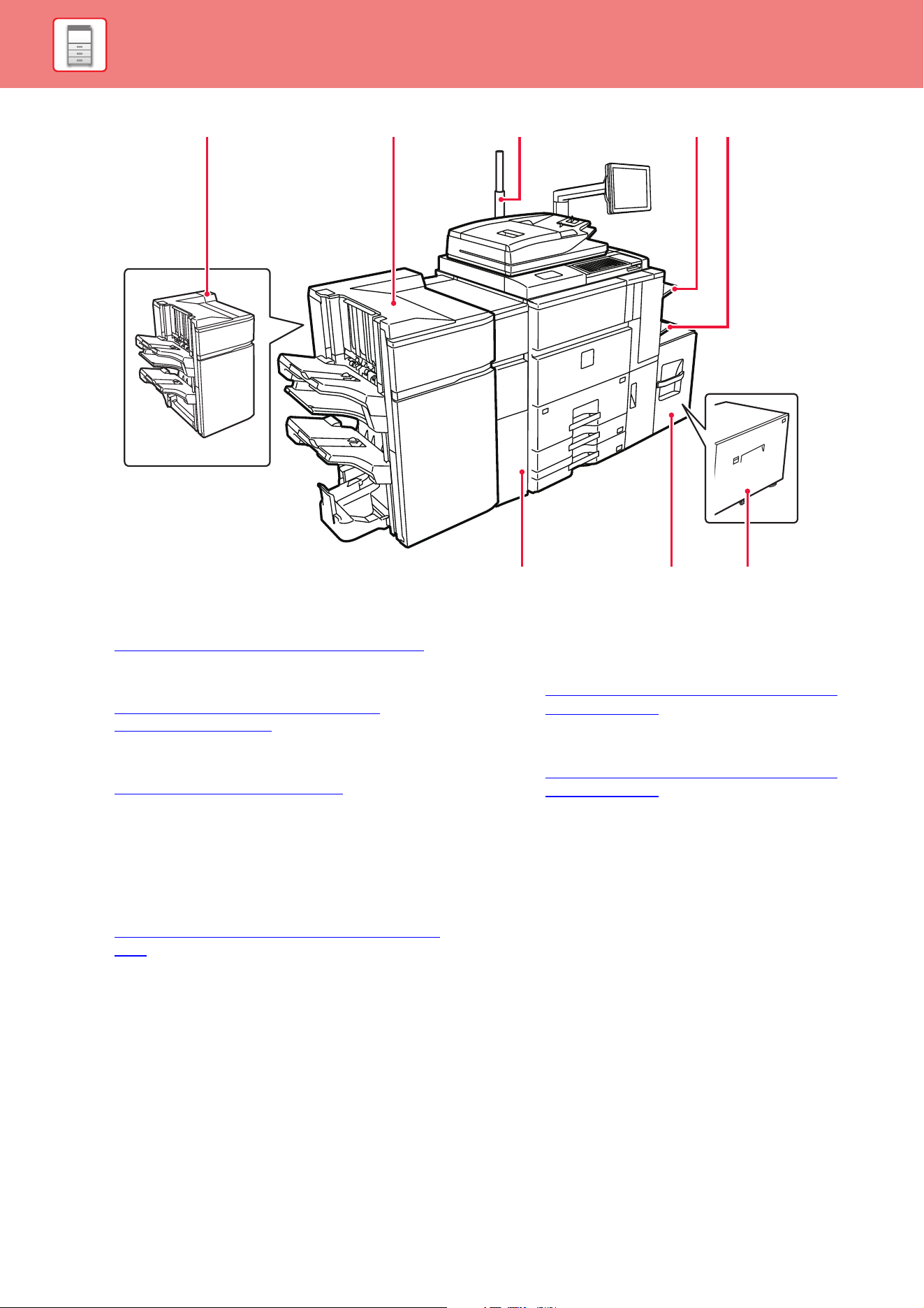
1-4
BEFORE USING THE MACHINE►BEFORE USING THE MACHINE
(12) Finisher (100-sheet stapling)*
This staples and outputs paper.
► FINISHER (100-SHEET STAPLING) (page 1-119)
(13) Saddle stitch finisher (100-sheet stapling)*
This staples and folds paper.
► SADDLE STITCH FINISHER (100-SHEET
STAPLING) (page 1-124)
(14) Status indicator*
The status of the machine is indicated.
► STATUS INDICATORS (page 1-137)
(15) Right tray*
As required, paper can be output into the right tray.
(16) Bypass tray*
Use this tray to feed paper manually.
When loading paper larger than 8-1/2" × 11"R or A4R,
pull out the extension guide.
► LOADING PAPER INTO THE BYPASS TRAY (page
1-81)
(17) Curl correction unit*
This punches and outputs paper.
(18) Tray 5 (MX-LC12)*
Store paper in this tray. Up to 3500 sheets can be stored.
► LOADING PAPER IN THE LARGE CAPACITY
TRAY (page 1-71)
(19) Tray 5 (MX-LCX3 N)*
Store paper in this tray. Up to 3000 sheets can be stored.
► LOADING PAPER IN THE LARGE CAPACITY
TRAY (page 1-71)
*Optional
(18)(17) (19)
(12) (13)
(14) (15) (16)
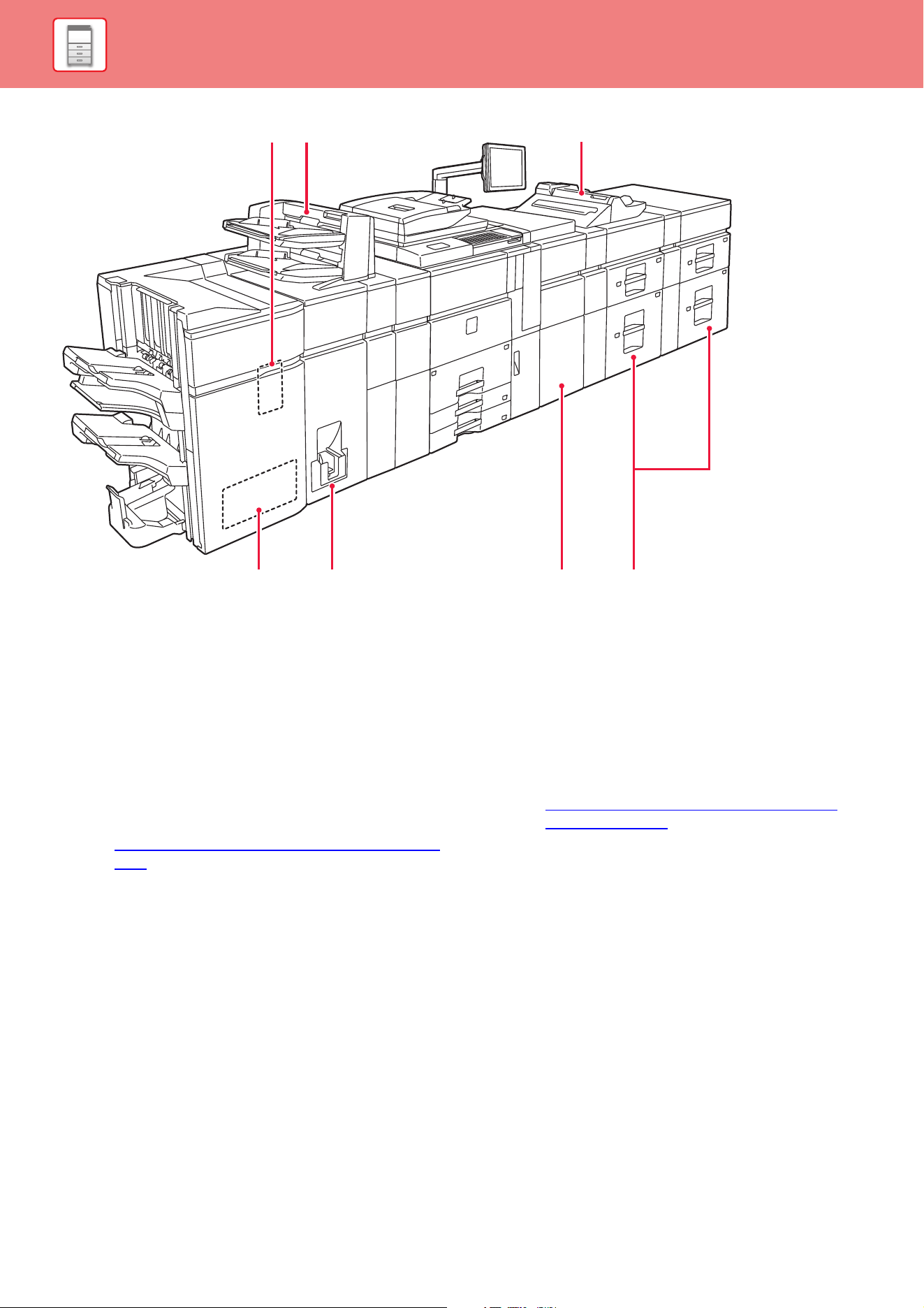
1-5
BEFORE USING THE MACHINE►BEFORE USING THE MACHINE
(20) Punch module*
This punches and outputs paper.
(21) Inserter*
Covers and insertion sheets to be inserted into printed
sheets can be loaded.
Using the manual finishing function, you can directly feed
paper into the finisher or saddle stitch finisher to staple,
punch or fold the paper.
(22) Bypass tray*
Use this tray to feed paper manually.
When loading paper larger than 8-1/2" × 11"R or A4R,
pull out the extension guide.
► LOADING PAPER INTO THE BYPASS TRAY (page
1-81)
(23) Trimming module*
This trims the excess of saddle-stitched output.
(24) Folding unit*
This folds and outputs paper.
(25) Paper pass unit*
This feeds paper to the machine.
(26) Large capacity trays*
Store paper in this tray. Up to 2500 sheets can be stored
in each tray.
► LOADING PAPER IN THE LARGE CAPACITY
TRAYS (page 1-76)
*Optional
(23) (24) (25) (26)
(21) (22)(20)
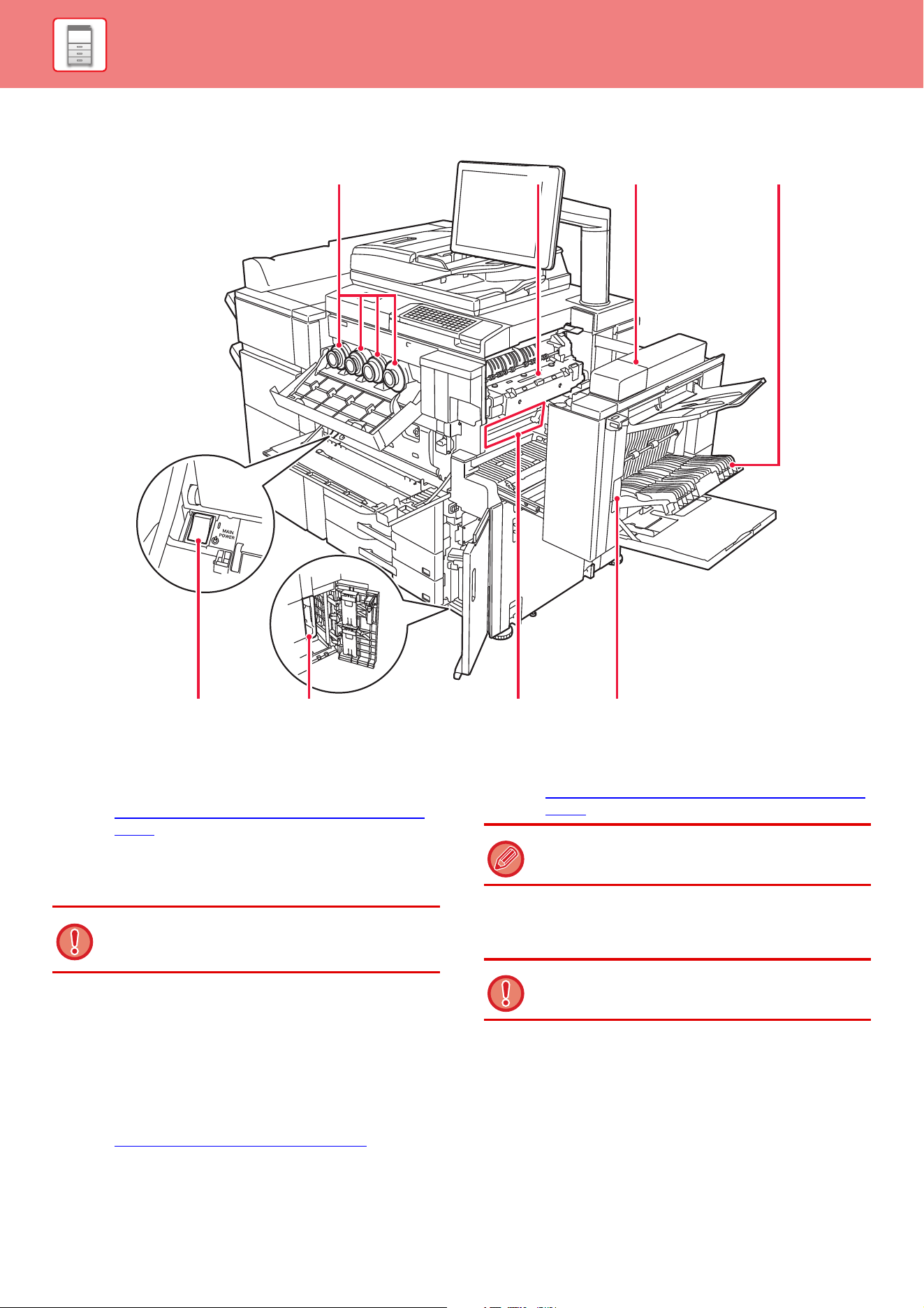
1-6
BEFORE USING THE MACHINE►BEFORE USING THE MACHINE
INTERIOR
(1) Toner cartridge
This cartridge contains toner.
When the toner in a cartridge runs out, the cartridge of
the color that ran out must be replaced.
► REPLACEMENT OF TONER CARTRIDGE (page
1-151)
(2) Fusing unit
Heat is applied here to fuse the transferred image onto
the paper.
(3) Right side cover
Open this cover to remove a misfeed.
(4) Paper reversing section cover
This unit is used for reversing paper when 2-sided printing
is performed. Open this cover to remove a paper misfeed.
(5) The main power switch
Use this switch to turn on the power for the machine.
► TURNING ON THE POWER (page 1-10)
(6) Waste toner bottle
This bottle collects excess toner that is produced during
printing.
► REPLACING THE WASTE TONER BOTTLE (page
1-154)
(7) Transfer belt
This belt takes the image formed with toner off the
photoconductive unit and transfers the image onto paper.
(8) Right side cover release lever
To remove a paper misfeed, pull and hold this lever up to
open the right side cover.
(1) (2) (3)
(5) (6) (8)(7)
(4)
The fusing unit is hot. Take care not to burn yourself
when removing a misfeed.
A service technician collects replaced waste toner
bottles.
Do not touch or damage the transfer belt.
This may cause a defective image.
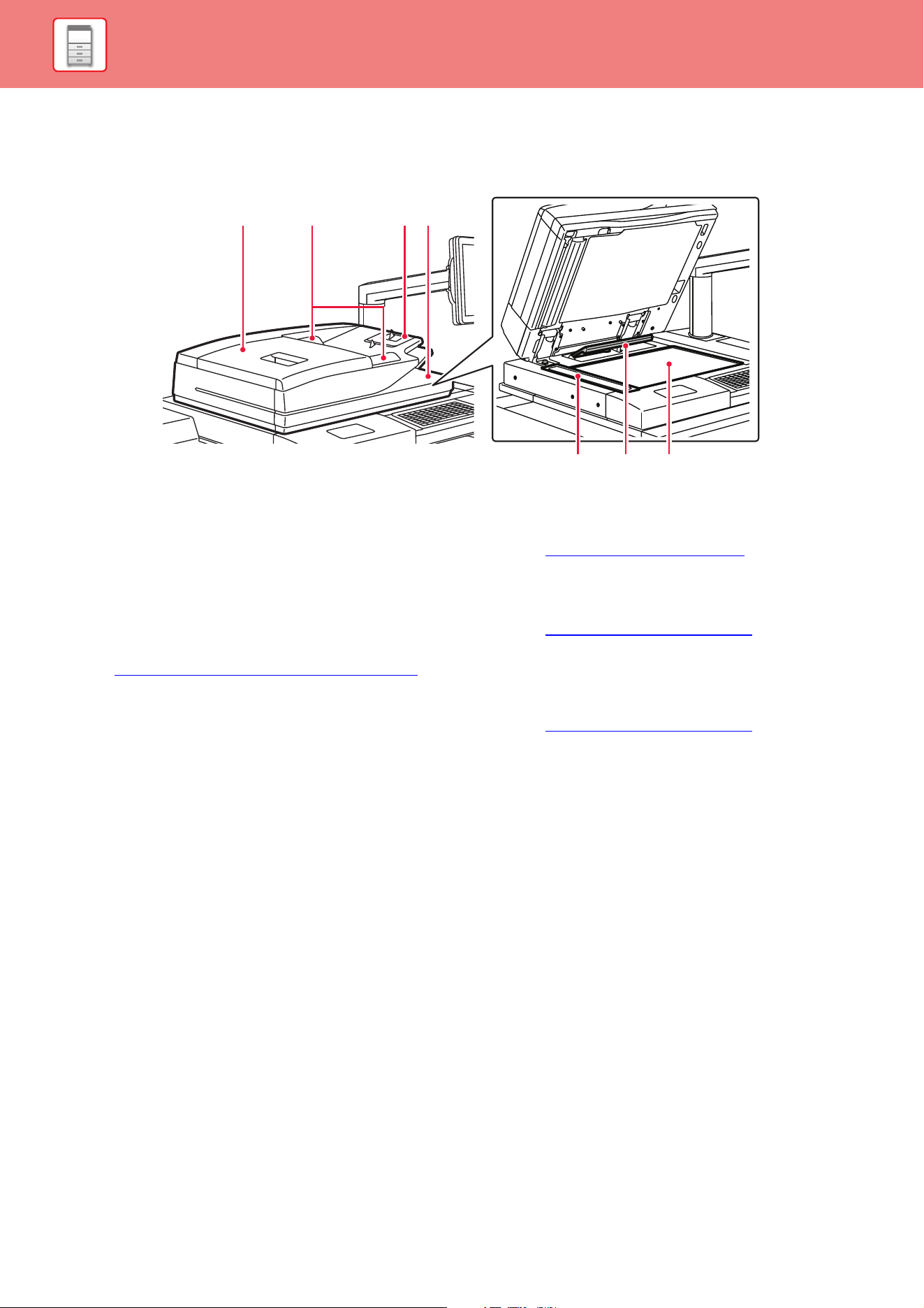
1-7
BEFORE USING THE MACHINE►BEFORE USING THE MACHINE
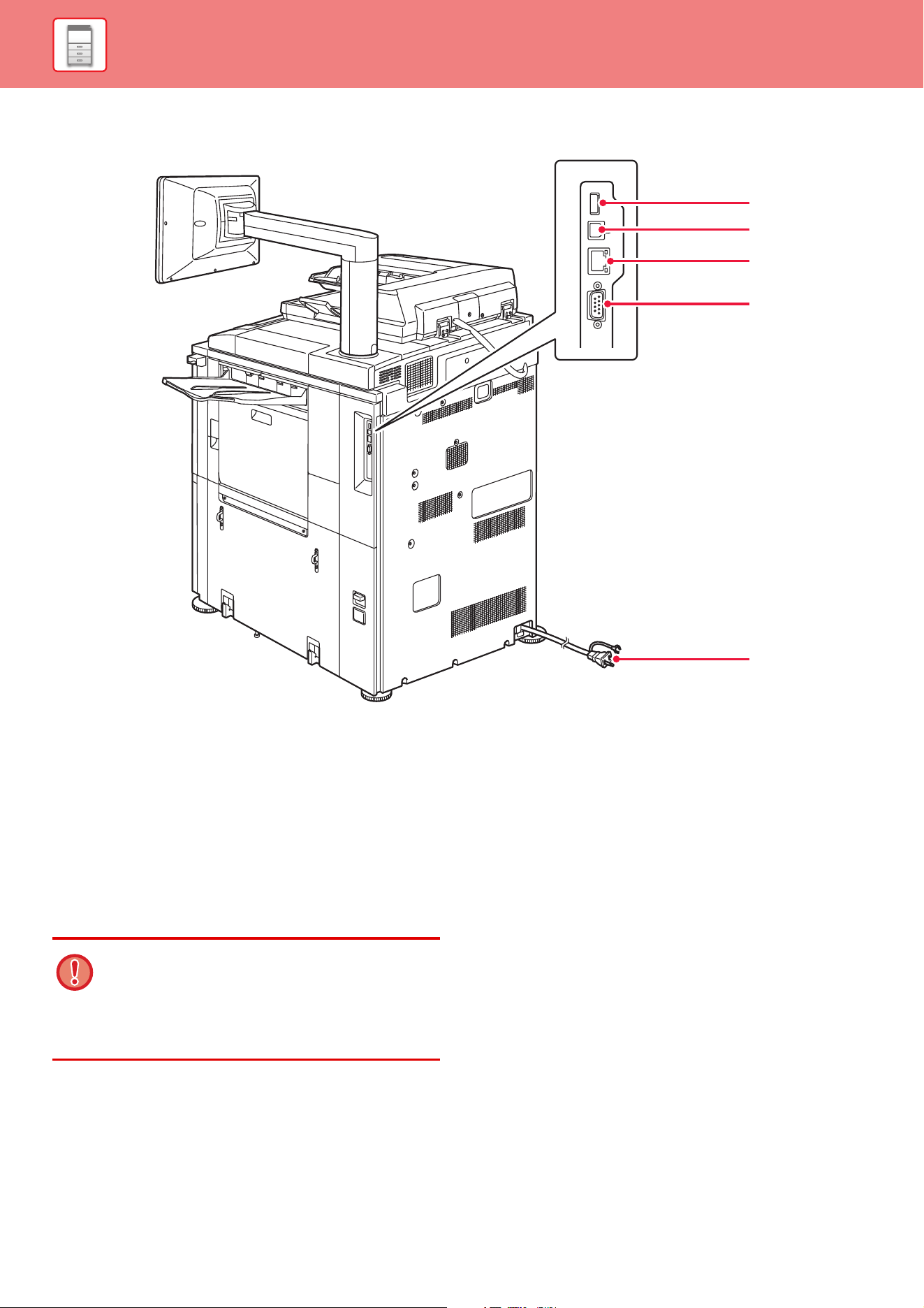
AUTOMATIC DOCUMENT FEEDER AND DOCUMENT
GLASS
(1) Document feeding cover
Open this cover to remove an original misfeed.
(2) Original guides
These guides help ensure that the original is scanned
correctly.
Adjust the guides to the width of the original.
(3) Document feeder tray
Place the original.
Place the original with the print side facing up.
► AUTOMATIC DOCUMENT FEEDER (page 1-90)
(4) Original exit tray
The original is discharged to this tray after scanning.
(5) Scanning area
Originals placed in the automatic document feeder tray
are scanned here.
► SCANNING AREA (page 1-143)
(6) Original size detector
This unit detects the size of an original placed on the
document glass.
► DOCUMENT GLASS (page 1-92)
(7) Document glass
If you want to scan books or other thick originals that
cannot be fed through the automatic document feeder,
place them on this glass.
► DOCUMENT GLASS (page 1-92)
(1) (3)
(5) (6) (7)
(2) (4)
1-8
BEFORE USING THE MACHINE►BEFORE USING THE MACHINE
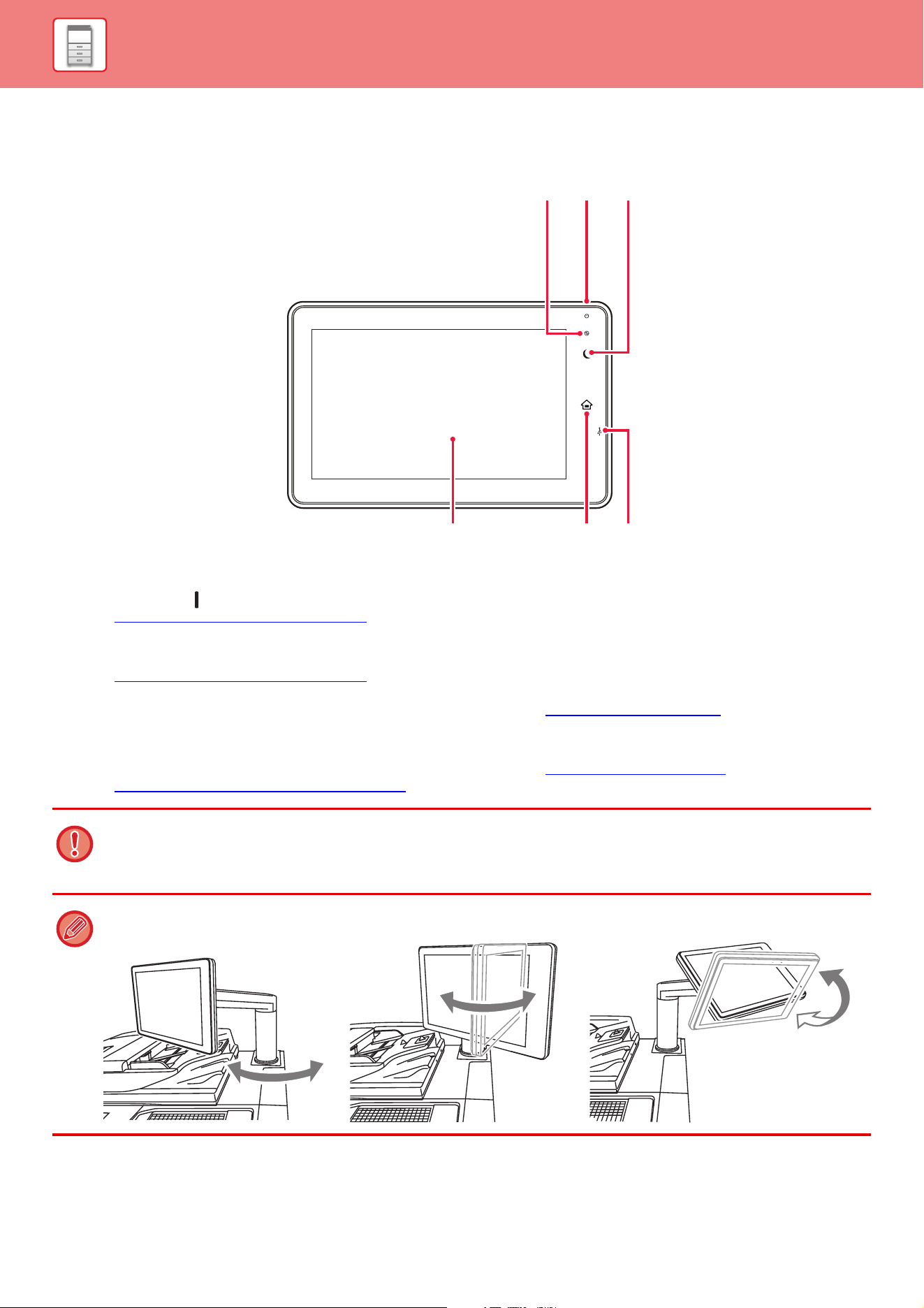
SIDE AND BACK
(1) USB connector (A type)
This is used to connect a USB device such as a USB
memory device to the machine.
Supports USB 2.0 (Hi-Speed).
(2) USB connector (B type)
Cannot be used.
(3) LAN connector
Connect the LAN cable to this connector when the
machine is used on a network.
Use a shielded LAN cable.
(4) Service-only connector
(5) Power plug
(1)
(3)
(2)
(4)
(5)
This connector is for use only by service technicians.
Connecting a cable to this connector may cause the
machine to malfunction.
Important note for service technicians:
The cable connected to the service connector must be
less than 118" (3 m) in length.
1-9
BEFORE USING THE MACHINE►BEFORE USING THE MACHINE
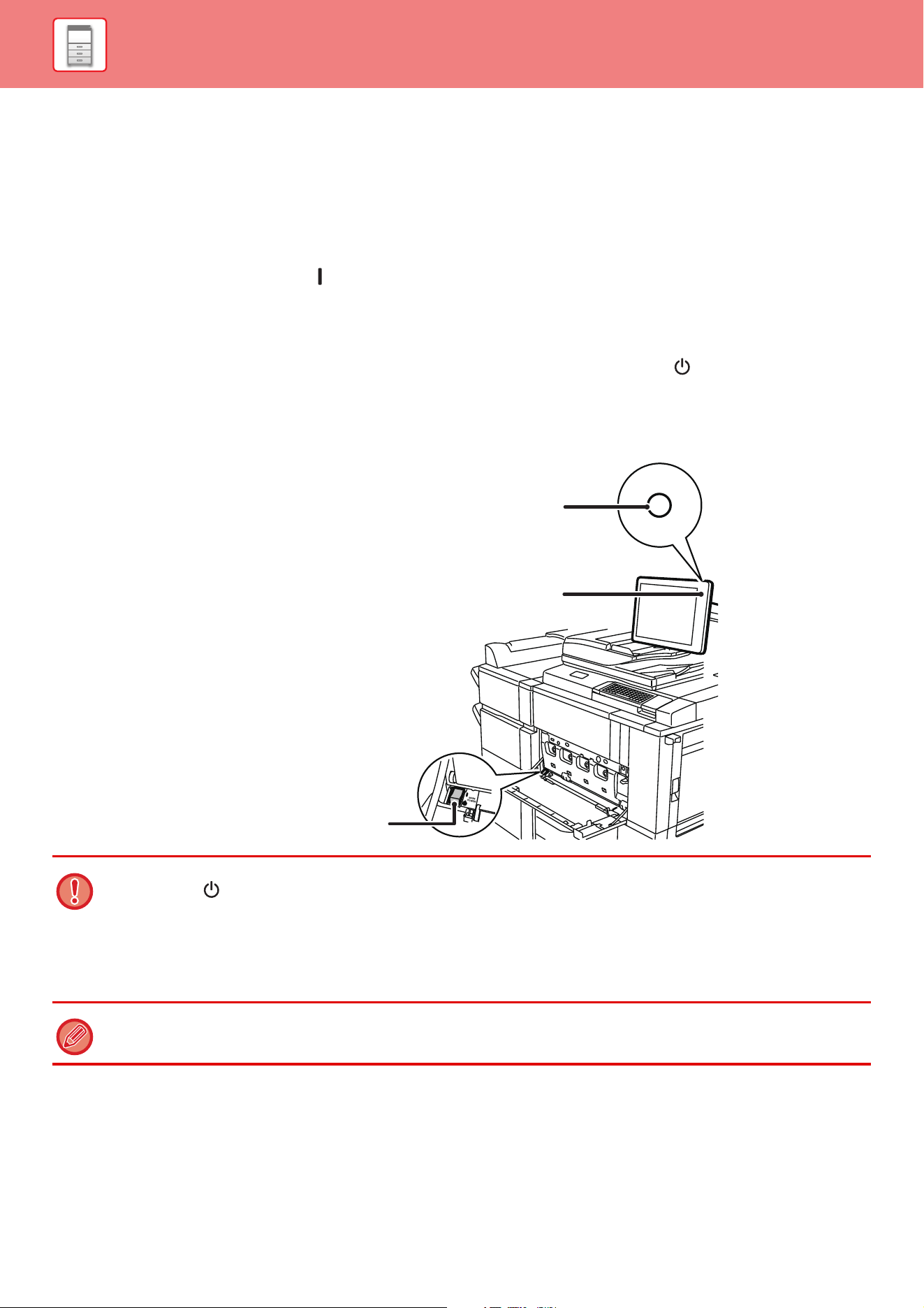
OPERATION PANEL
This section describes the names and functions of the respective parts of the operation panel.
(1) Main power indicator
This lamp lights up when the machine's main power
switch is in the " " position.
► TURNING ON THE POWER (page 1-10)
(2) [
Power
] button
Use this button to turn the machine's power on and off.
► TURNING ON THE POWER (page 1-10)
(3) [Power Save] button/indicator
Use this button to set the machine to Sleep mode for
energy saving.
[Power Save] button blinks when the machine is in Sleep
Mode.
► AUTO POWER SHUT-OFF MODE (page 1-27)
(4) USB connector (A type)
This is used to connect a USB device such as a USB
memory device to the machine. For the USB cable, use a
shielded cable. Supports USB 2.0 (Hi-Speed).
(5) Touch panel
Messages and keys appear on the touch panel display.
Operate the machine by directly tapping the displayed
keys.
► TOUCH TYPES (page 1-11)
(6) [Home Screen] key
Use this button to display the home screen.
► HOME SCREEN (page 1-14)
(4)
(5)
(6)
(2) (3)(1)
[Home Screen] key
Use your finger to touch the [Home Screen] key.
If you use a pen or other tool to touch the key, it may not operate properly.
Risk of malfunctioning if you use with jewelry or other accessories.
You can change the angle of the touch panel.
1-10
BEFORE USING THE MACHINE►BEFORE USING THE MACHINE
TURNING ON THE POWER
This section describes how to turn on/off the machine's power and how to restart the machine.
Operate two power switches: the main power switch inside the front cover, located in the lower left corner, and the
[Power] button on the operation panel.
Turning on the power
• Turn the main power switch to the " " position.
• When the main power indicator lights in green, press the [Power] button.
Turning off the power
Turn off the power by pressing the [Power] button, then turn the main power switch to the " " position.
Restart the machine
Turn off the power by pressing the [Power] button and then press it again to turn on the power.
• When turning off the main power switch, press the [Power] button on the operation panel and then turn the main power
switch to the " " position.
In a sudden case of main power outage, turn the power for the machine back on and then turn it off in the correct order.
If the machine is left for a long time with the main power having been turned off prior to the [Power] button being turned off,
abnormal noises, degraded image quality or other problems may result.
• Turn off both the [Power] button and the main power switch and unplug the power cord if you suspect a machine failure, if
there is a bad thunderstorm nearby, or when you are moving the machine.
In order for some settings to take effect, the machine must be restarted. In some states of the machine, restarting with the
[Power] button may not make the settings take effect. In this case, turn off the main power switch and then turn it on again.
[Power] button
Main power indicator
The main power switch
1-11
BEFORE USING THE MACHINE►BEFORE USING THE MACHINE
TOUCH PANEL
TOUCH TYPES
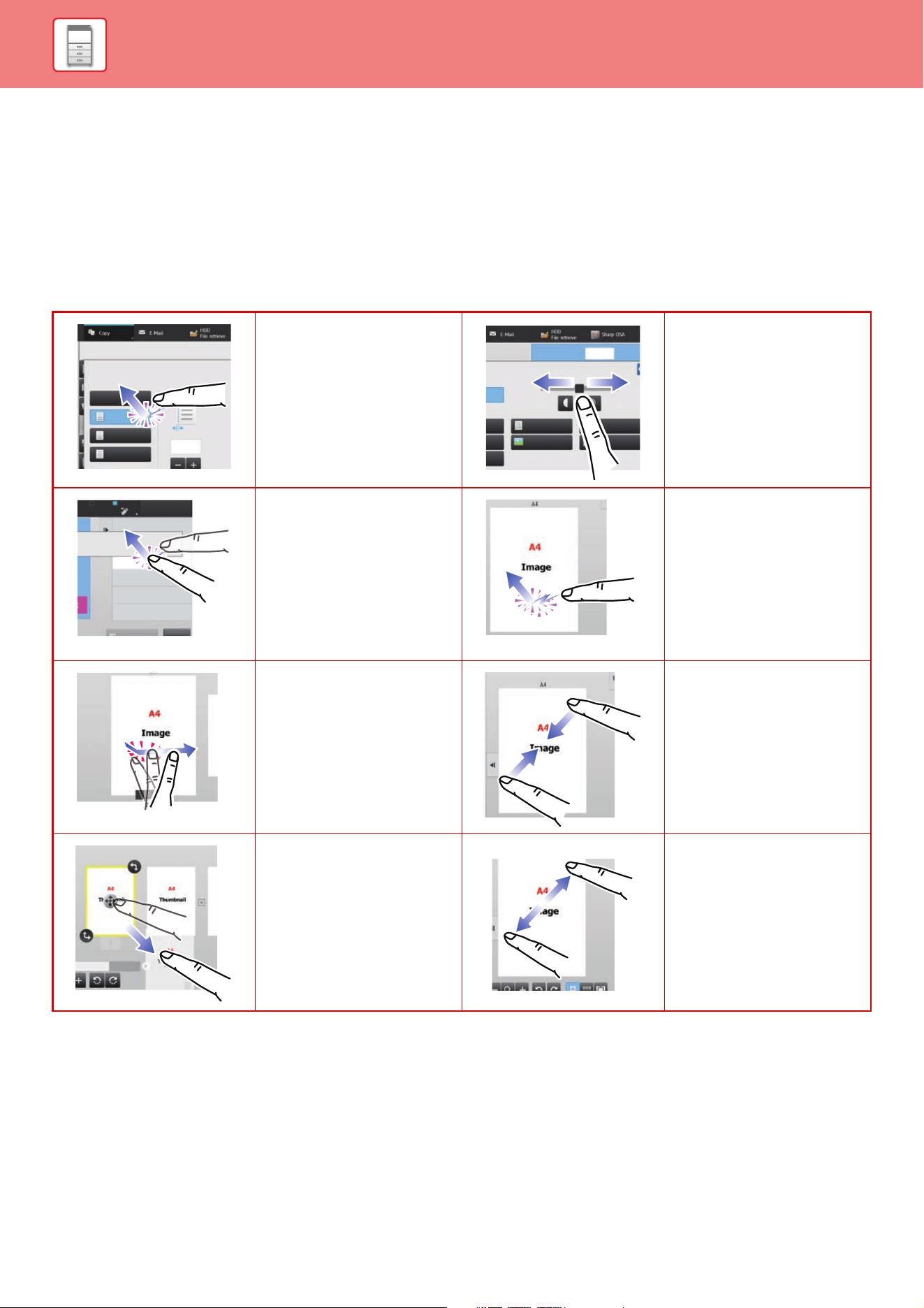
In addition to tapping, equivalent to conventional touching, the touch panel of the machine can be operated by long
touching, flicking and sliding.
Operation types
Tapping
Touch the panel with your
finger and then lift it quickly.
Use this method to select a
key, tab or check box.
Sliding
Slide the scroll bar (with your
finger touching the panel) to
scroll up and down a list with
a large number of items.
Long touching
Touch the panel with your
finger and hold it for a while.
Keep holding (long touching)
it on the action panel or
characters in the text box to
display characters in a
balloon.
Double tapping
Touch the screen twice. Use
this operation to enlarge the
image in the preview.
Flicking
Flick the panel to scroll a
preview image quickly.
Pinch
Touch the screen with two
fingers and move them
toward each other. This is
used to reduce the browser
and preview display.
Dragging
Drag (slide your finger
touching the panel in a
random direction) to replace
a page in the original during
preview.
Spread
Touch the screen with two
fingers and move them away
from each other. This is used
to enlarge the browser and
preview display.
Others
Margin Shift
Off
Right
Down
Left
( 0~2 )
inch
1/2
No. of copies
1
Text/Printed
Photo
Photo
Text/Photo
3
Data in Folder
Job Management
Send and Print
Call Eco Program
Store Data Temporarily
LINE PRINTER
1-12
BEFORE USING THE MACHINE►BEFORE USING THE MACHINE
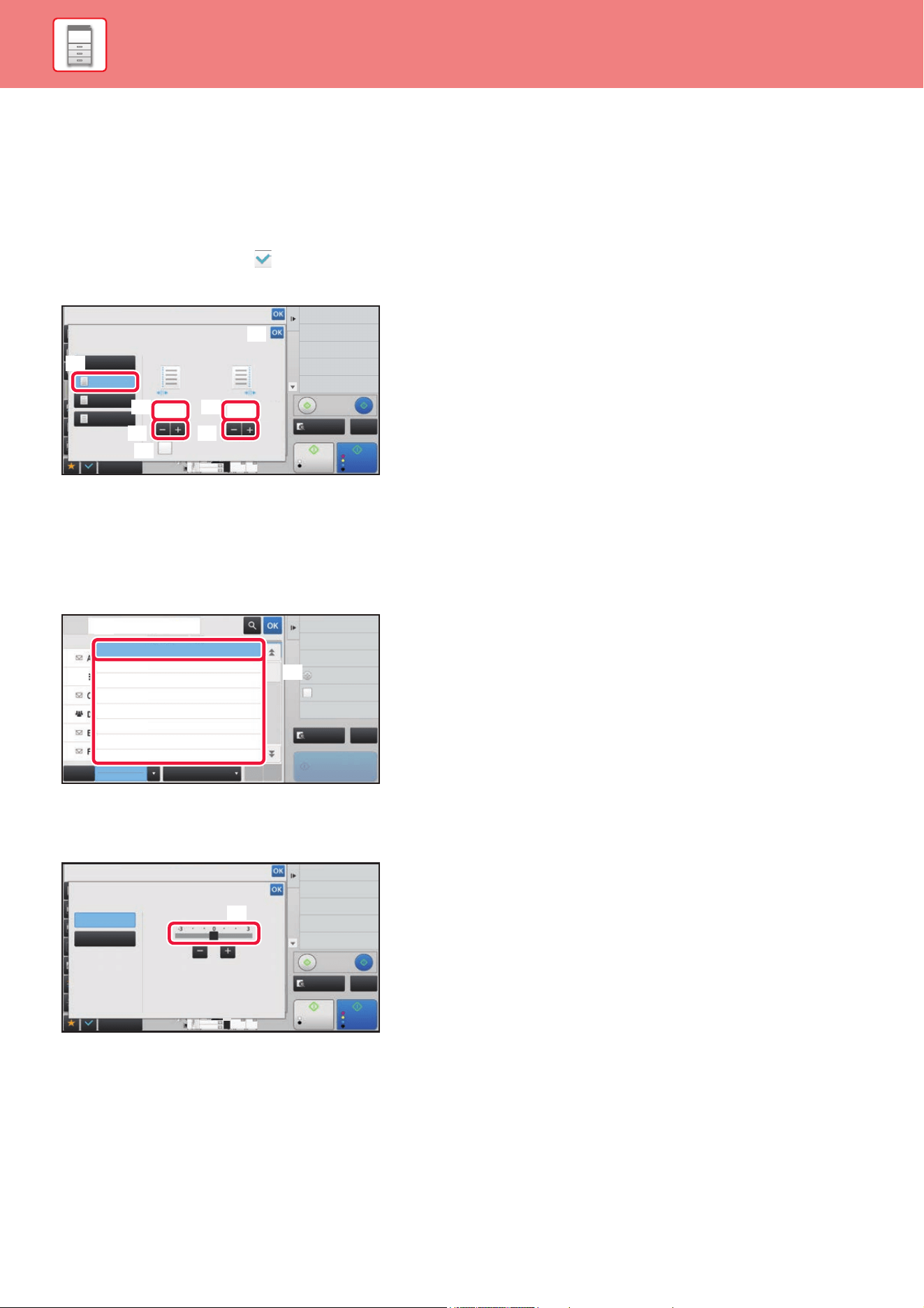
Operation on respective screens
Key (tapping)
A. Tap to select an item. The selected key turns into a different color.
B. Tap numeric keys to enter numbers.
C. Tap to increase or decrease the value. Long touching causes the value to be increased or decreased until you stop
touching.
D. Tap to enter a checkmark and enable the setting.
E. Tap here to close the screen.
List (tapping, sliding and flicking)
A. Tap to select an item. The selected item turns into a different color.
B. Slide the bar up and down.
It appears when the item does not fit in the screen.
C. Flick the key upwards or downwards. The item scrolls up or down.
Slider (sliding)
A. Slide the knob from side to side.
Proof Copy
68
B4
A3
3
4A4A4
Change Size/Direction.
Original
2-Sided Copy
Background Adjustment
Output
Change Paper Feed Tray
Paper Select
Others
Margin Shift
Off
Right
Left
Down
1/21/2
( 0~2 )
inch
( 0~2 )
inch
Adjust 2nd pg value to 1st.
Back
Preview
Start
Side 1 Side 2
Color
Start
CA
B/W
(A)
(B) (B)
(E)
(C)
(D)
(C)
Preview
Start
W
ABC
Address
All
Frequent
Use
Narrow Down
All
Category
All
Global Address Search
Sending History
Print Individual List
Call Search Number
Add New
Send
Destination Link
Category 0
Category 1
Category 5
Category 3
Category 2
Category 4
Category 6
CA
(A)
(C)
(B)
11x17 11x1711x174
3
8½x14
68
Proof Copy
Others
Background Adjustment
Adjust Original Background Darkness.
Preview
Start
Color
Start
Off
On
Touch [+] darken background.
Touch [-] erase background.
Back
Change Size/Direction.
Original
Erase Shadow Around
Erase
Adjust Outline of Image
Sharpness
Exposure
Select Type/Exposure
Color Mode
CA
B/W
(A)
1-13
BEFORE USING THE MACHINE►BEFORE USING THE MACHINE
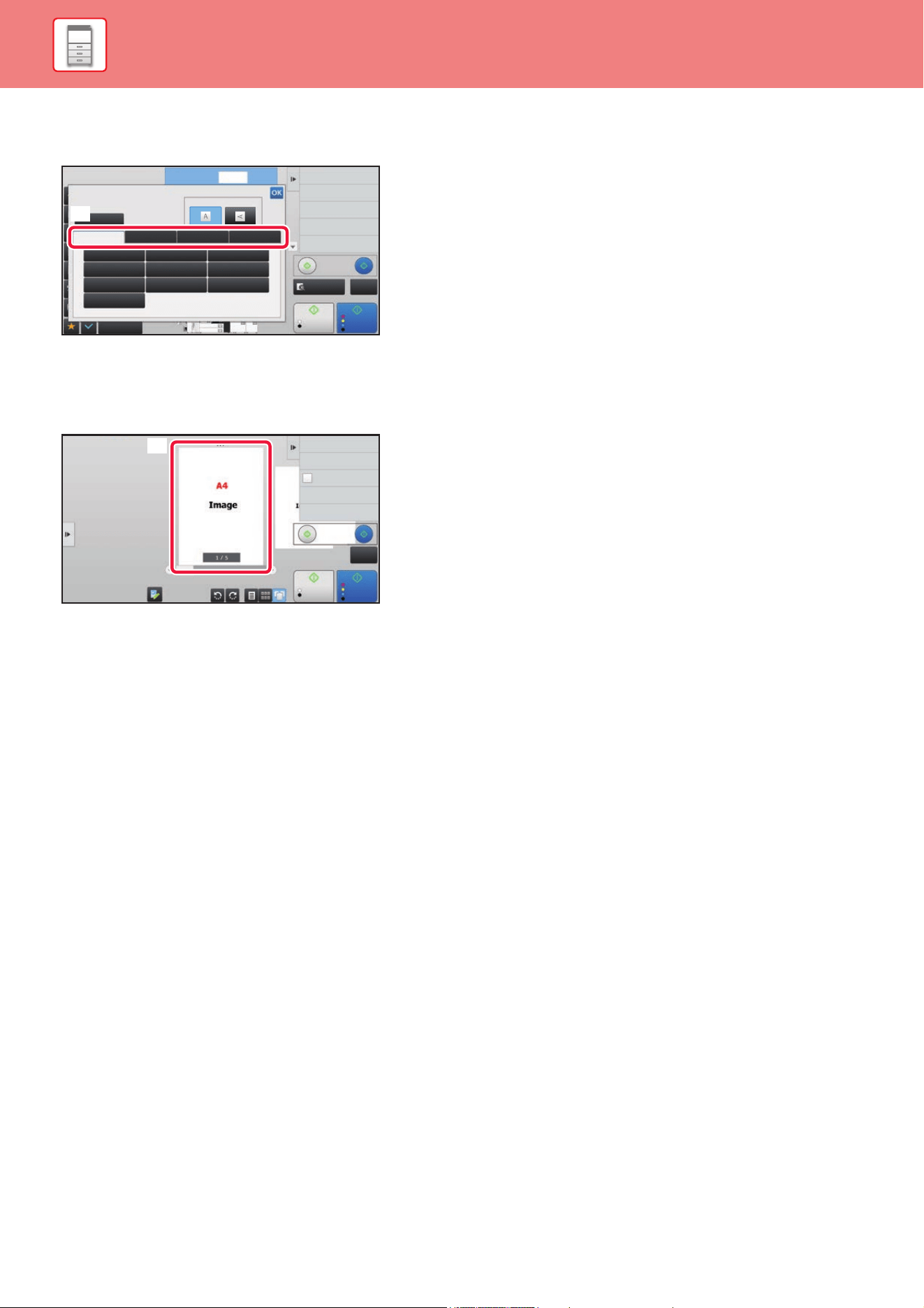
Tab (tapping)
A. Tap a tab to switch what is displayed.
Preview screen (Double tapping/ Pinch/ Spread)
A. When a preview screen is "pinched", the screen image is reduced. When "spread", the image is enlarged.
When "Double tapping", the image is also enlarged.
1
68
8½x14
11x17
3
4
8½x11 8½x11
1
Preview
Start
CA
Original
Others
Auto
Direct EntryInchAB Custom Size
Image Orientation
No. of copies
Skip Blank Page in Original
Copy Ratio
Enlarge/Reduce Copy
Blank Page Skip
Background Adjustment
2-Sided Copy
Color Mode
A5
216 x 343
B5R B4
A5R A4 A3
B5 A4R 216 x 340
Color
Start
B/W
Proof Copy
(A)
Send and Print
Scan Original Again
Without change Settings
Proof Copy
Color
Start
B/W
Start
Store Data in Folder
File
Store Data Temporarily
Quick File
CA
Register Current Settings
Program Registration
(A)
1-14
BEFORE USING THE MACHINE►BEFORE USING THE MACHINE
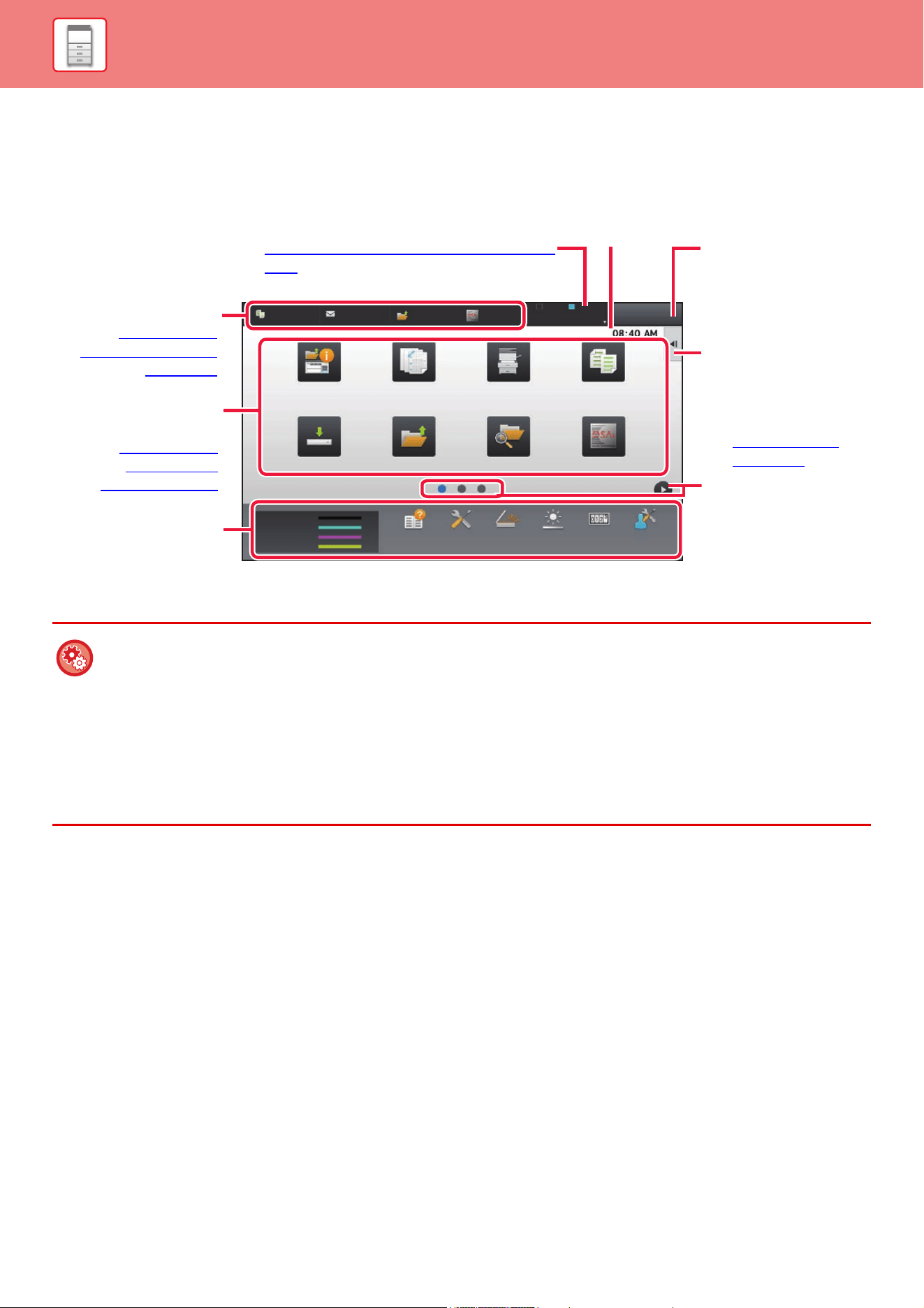
HOME SCREEN
Pressing the [Home Screen] key on the operation panel displays the home screen on the touch panel. The home screen
displays the keys for selecting modes or functions.
For procedures for adding and deleting shortcut keys, see "U/I Customize Guide".
• To set the home screen for each "Favorite Operation Group List":
In "Settings (Web version)", select [User Control] → [Favorite Operation Group List] → [Home Screen List].
Perform this setting when user authentication is used.
• To display the External Service Connect shortcut keys:
You can add shortcut keys for the External Service Connect functions (Google Drive, OneDrive, SharePoint Online, Gmail,
Exchange (E-Mail)) to the home screen.
These functions can be enabled in the system settings. When a function is enabled in the system settings, you can add a
shortcut key for that function to the home screen.
External Service Connect settings are configured in "Settings (administrator)" - [System Settings] → [Network Settings] →
[External Print Services Settings].
Copy E-mail
Job Management Manual
Finishing
HDD
File retrieve
Sharp OSA
LINE
PRINTER
Job Management
Toner Quantity
M
C
Bk
Y
Tray Settings/
Paper Settings
Scan to HDD HDD
File retrieve
Batch Print Sharp OSA
Operation
Guide
PC Scan
Total Count Machine
Adjustment
LCD Control
Settings
Copy
Tap a mode to change to
that mode.
►Changing mode
from the mode display
(page 1-16)
Select shortcut keys for
modes or functions.
►Changing mode
from the Home
screen (page 1-16)
Use these keys to select
functions that make the
machine easier to use.
Displays the machine's status other than the job
using icons.
► Icon indicating the status of the machine (page
1-15)
Displays the job in
progress or waiting with
text or icon.
Select functions that can
be utilized in respective
modes.
Tap the tab, and the list of
function keys is
displayed.
► ACTION PANEL
(page 1-24)
Switch the pages for
displaying shortcut keys.
Displays the time.
1-15
BEFORE USING THE MACHINE►BEFORE USING THE MACHINE
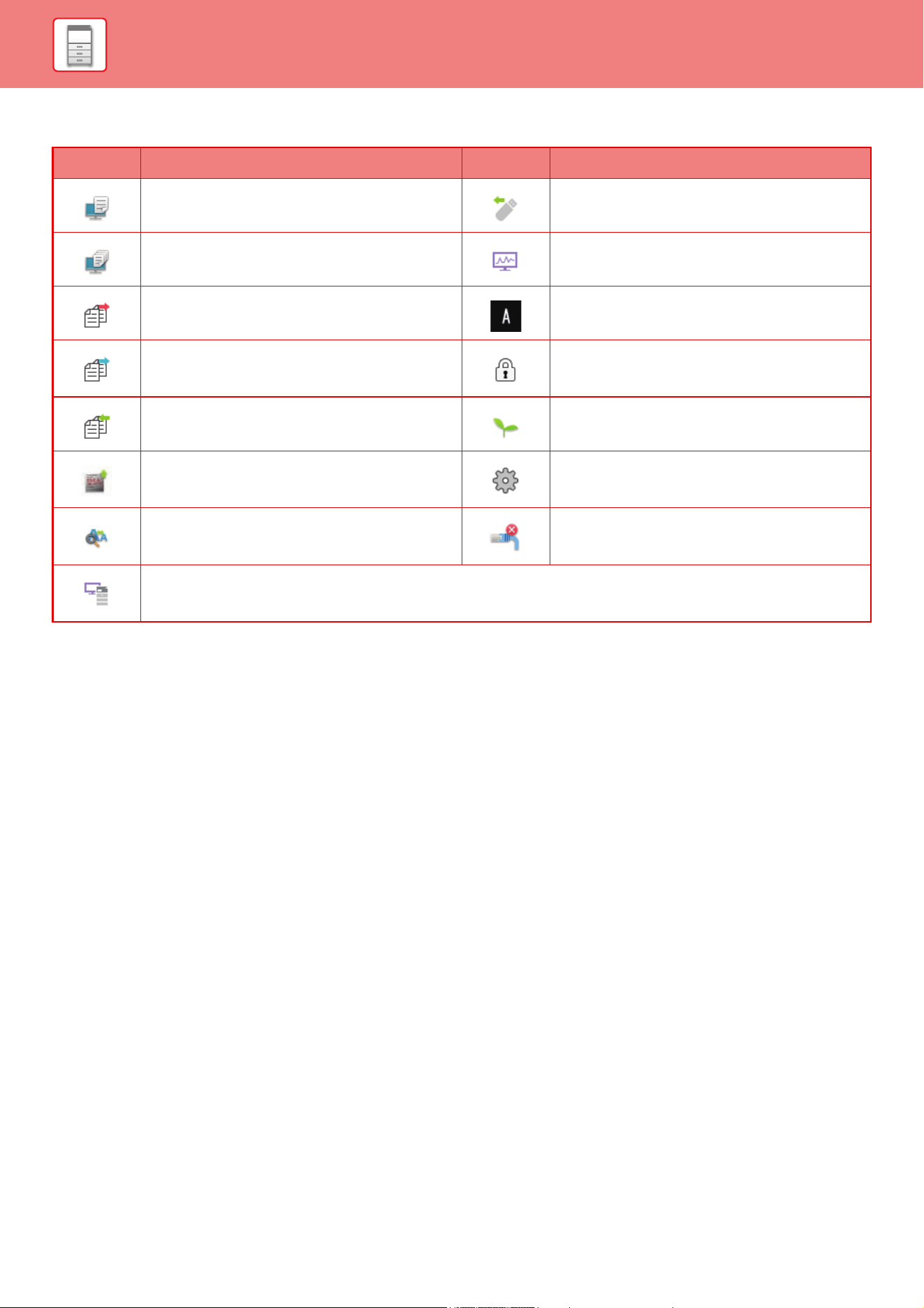
Icon indicating the status of the machine
* Contact your dealer or nearest SHARP Service Department.
Icon Machine status Icon Machine status
Printer data is being processed. A USB device is installed.
Printer data is being printed. The field support system is enabled.
Send data exists. Single-byte alphanumeric character entry
Forward error data exists. A data security kit is installed.
Received data exists. Eco mode is enabled.
OSA communication is in progress. A maintenance notification is issued.
Enlarge display mode is enabled. A LAN cable is not connected.
Remote operation is in progress.
1-16
BEFORE USING THE MACHINE►BEFORE USING THE MACHINE
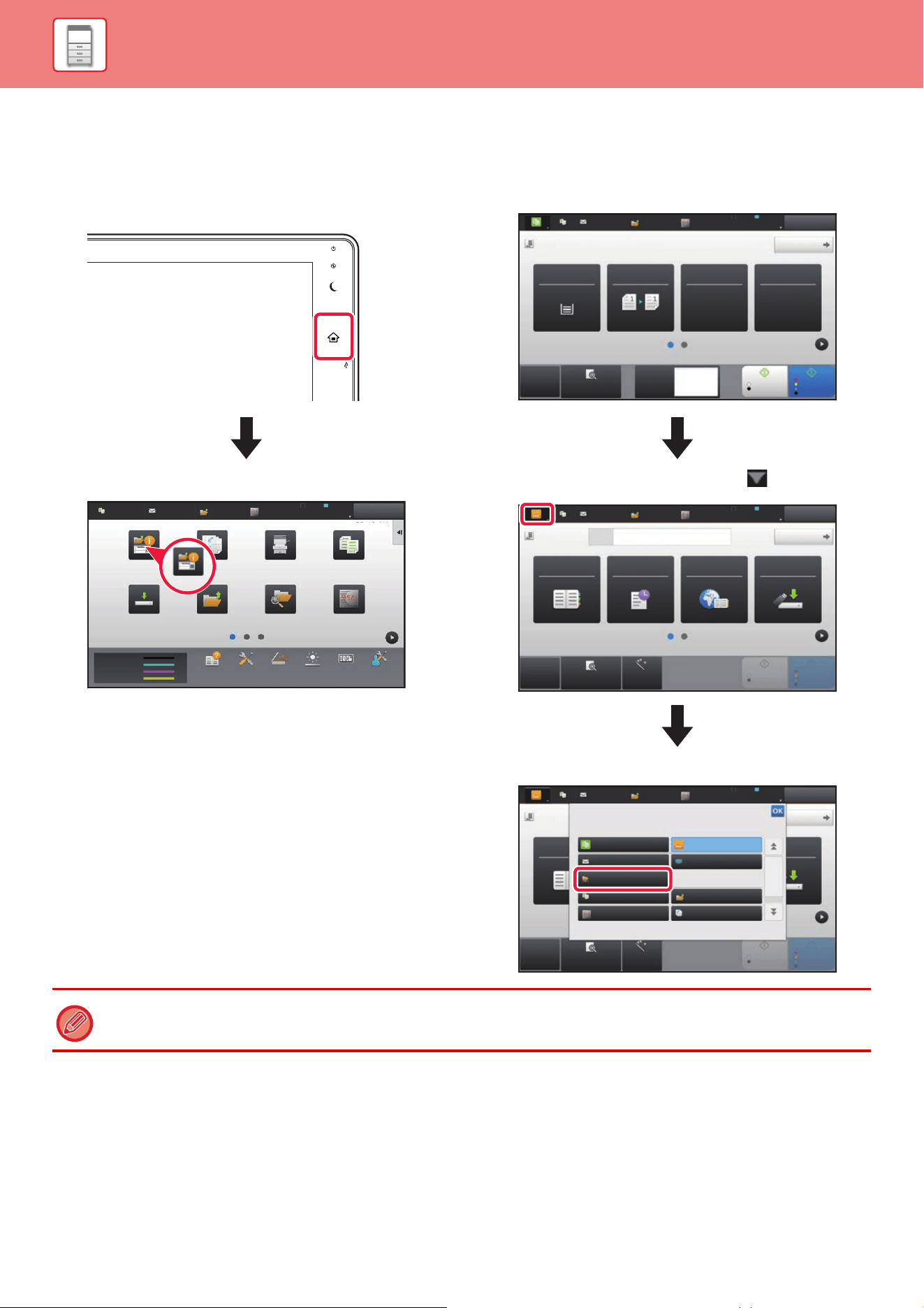
CHANGING MODES
Changing mode from the Home screen
Changing mode from the mode display
10:15 AM
Job Management
Copy
E-mail
HDD
File retrieve
Sharp OSA
LINE PRINTER
Job Management
Toner Quantity
M
C
Bk
Y
Tray Settings/
Paper Settings
Scan to HDD Batch Print Sharp OSA
Manual
Finishing
HDD
File retrieve
Operation
Guide
PC Scan Total Count Machine
Adjustment
LCD Control
Settings
Copy
Job Management
Press the [Home Screen] key.
Tap the mode icon.
CA
Preview
Copies
Start
Color
Start
Original
8½x11
Paper
Select
Tray 1 1 → 1
8½x11
2-Sided Copy Copy Ratio Staple / Punch
100%
Detail
LINE PRINTER
E-mail
HDD
File retrieve
Sharp OSA
B/W
Off
1
Job Management
CA
Preview Auto Set
Original
8½x11
Address
Address Book
Sending History
Global
Address Search
Scan to HDD/
USB
Detail
Start
Color
Start
B/W
LINE PRINTER
E-mail
HDD
File retrieve
Sharp OSA
E-mail Address
Job Management
Tap on the mode display.
CA
Preview Auto Set
Original
8½x11
Address Fax Number
Detail
Start
Color
Start
Address Book
Scan to HDD/
USB
LINE PRINTER
E-mail
HDD
File retrieve
Sharp OSA
Job Management
Select the mode.
HDD
File retrieve
Easy Copy
Network Folder
E-mail
Copy
Sharp OSA
B/W
Manual Finishing
Easy Scan
FTP
Tap the key that shows .
Tap for any mode desired.
For procedures for editing the home screen, see "U/I Customize Guide".
1-17
BEFORE USING THE MACHINE►BEFORE USING THE MACHINE
PREVIEW SCREEN
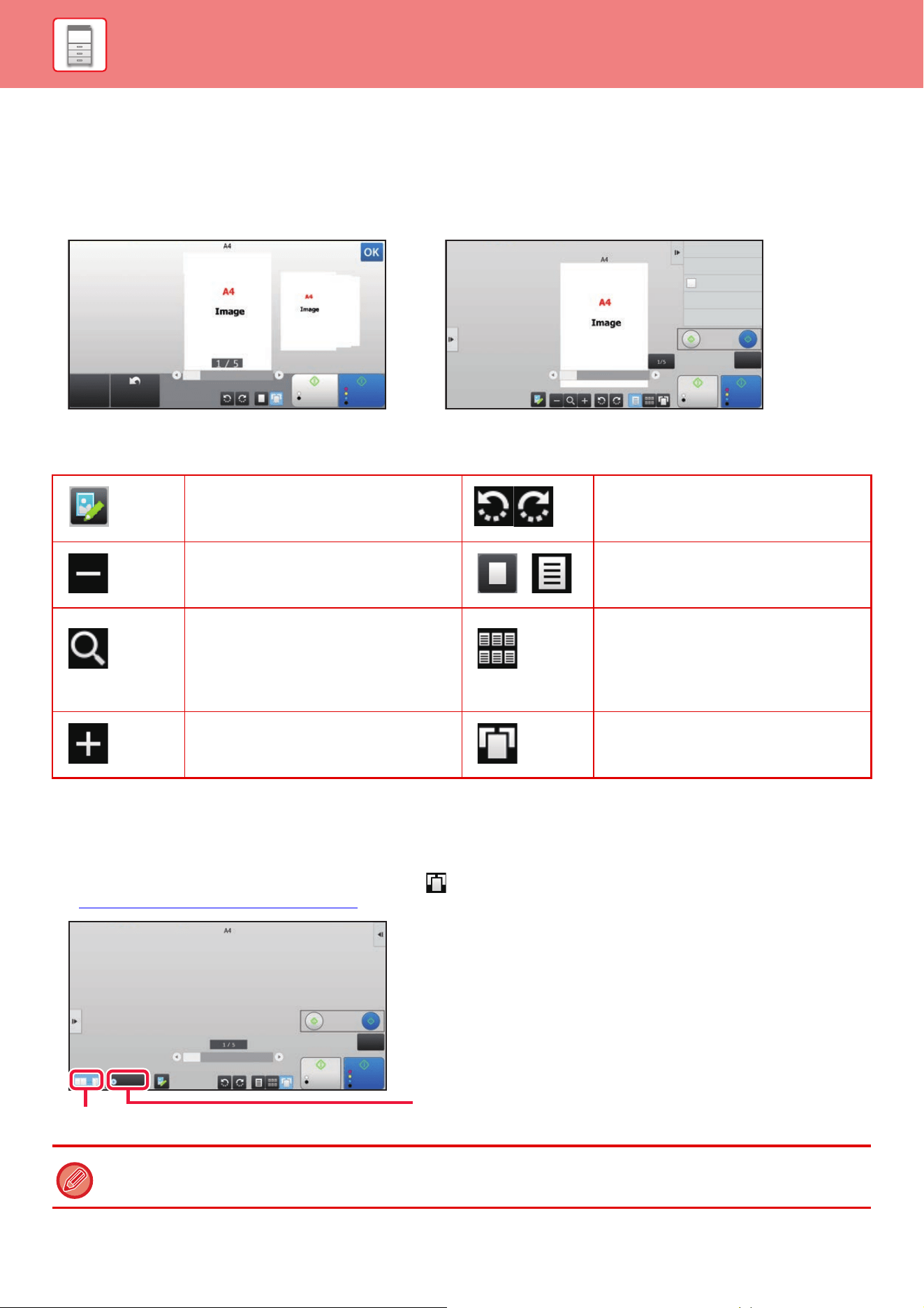
In the preview screen, you can view output images or images stored in the machine using the touch panel.
Keys used in the preview screen
* Can also be used in Easy mode.
Preview when folding is used
If you tapped the [Output] key of copy mode to configure folding settings, you can view a preview with the folding
settings applied. This can be performed when you tap to display the pages in a 3D layout.
► FOLDING OUTPUT PAPER (page 2-55)
This changes the mode to edit mode.
Pages of the original can be changed,
rotated, or deleted.
* This rotates the preview image of whole
page in the arrow's direction. The
printing result is not rotated.
* This reduces the image.
,
* This displays preview images of
respective pages.
* This displays the scroll bar for
enlargement/reduction operations.
Moving the slider to the left reduces the
image, and moving the slider to the right
enlarges the image.
This displays thumbnails of preview
images.
* This enlarges the image. * This displays pages in a 3D view.
• The display position of an image can be moved by dragging it while it is enlarged.
• To enlarge an image, double-tap it when the preview image is displayed by page.
Preview
Scan
Again
Color
Start
B/W
Start
CA
Send and Print
Scan Original Again
Without change Settings
Color
Start
B/W
Start
Store Data in Folder
File
Store Data Temporarily
Quick File
CA
Proof Copy
Register Current Settings
Program Registration
In Easy mode In Normal mode
A preview after folding is shown immediately.
The set folding flush is
reproduced.
CA
Proof Copy
Color
Start
B/W
Start
View
Folding
1-18
BEFORE USING THE MACHINE►BEFORE USING THE MACHINE
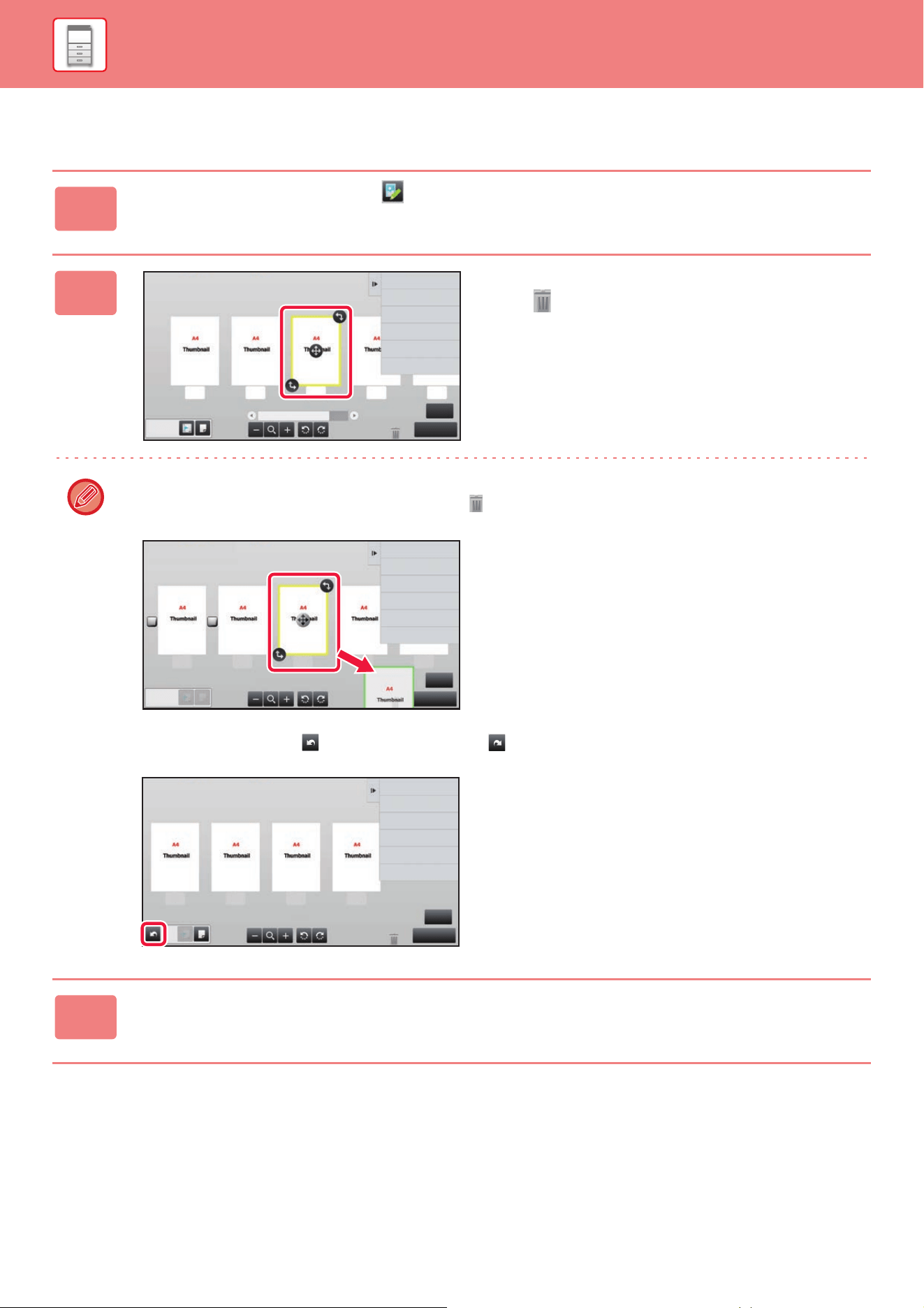
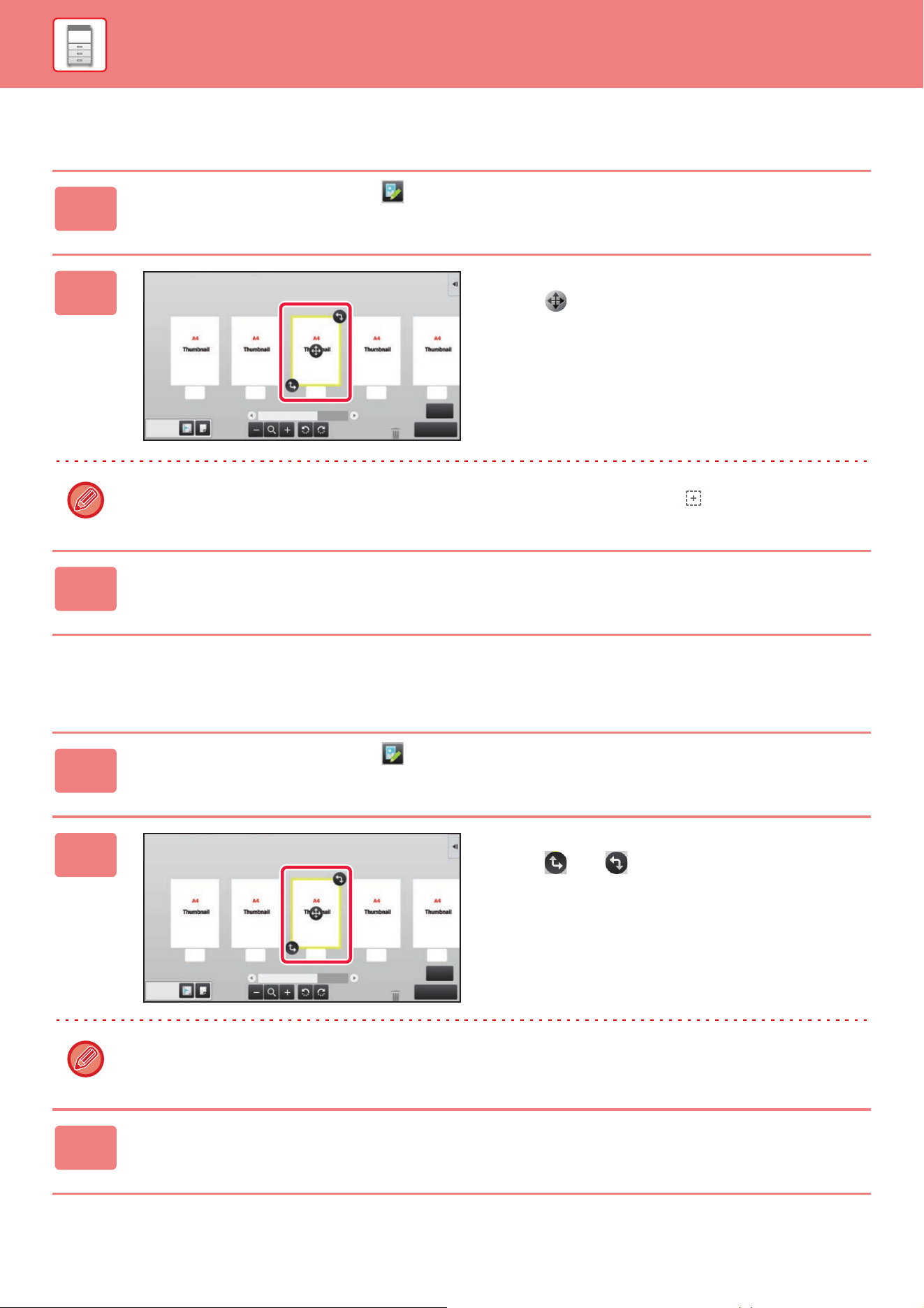
Deleting a page
1
In the preview screen, tap to switch to edit mode.
2
Tap the page you want to delete, and
tap .
• You can also delete the page by tapping [Delete the Page] on the action panel.
• You can also delete the page by dragging a page to .
• To undo the deletion, tap . To redo the deletion, tap .
3
Tap the [Edit End] key.
5
Edit End
Move the Page
Rotate 180 Degrees
Specify Chapter Inserts
Insert Blank Page
Delete the Page
Erase Specified Original Area
Erase Specified Range
523 41
4
Edit End
Cancel and ReturnSelect the location to move.
21 3 4 5
4
Edit End
Move the Page
Rotate 180 Degrees
Insert Blank Page
Delete the Page
Erase Specified Original Area
Erase Specified Range
4321
1-19
BEFORE USING THE MACHINE►BEFORE USING THE MACHINE
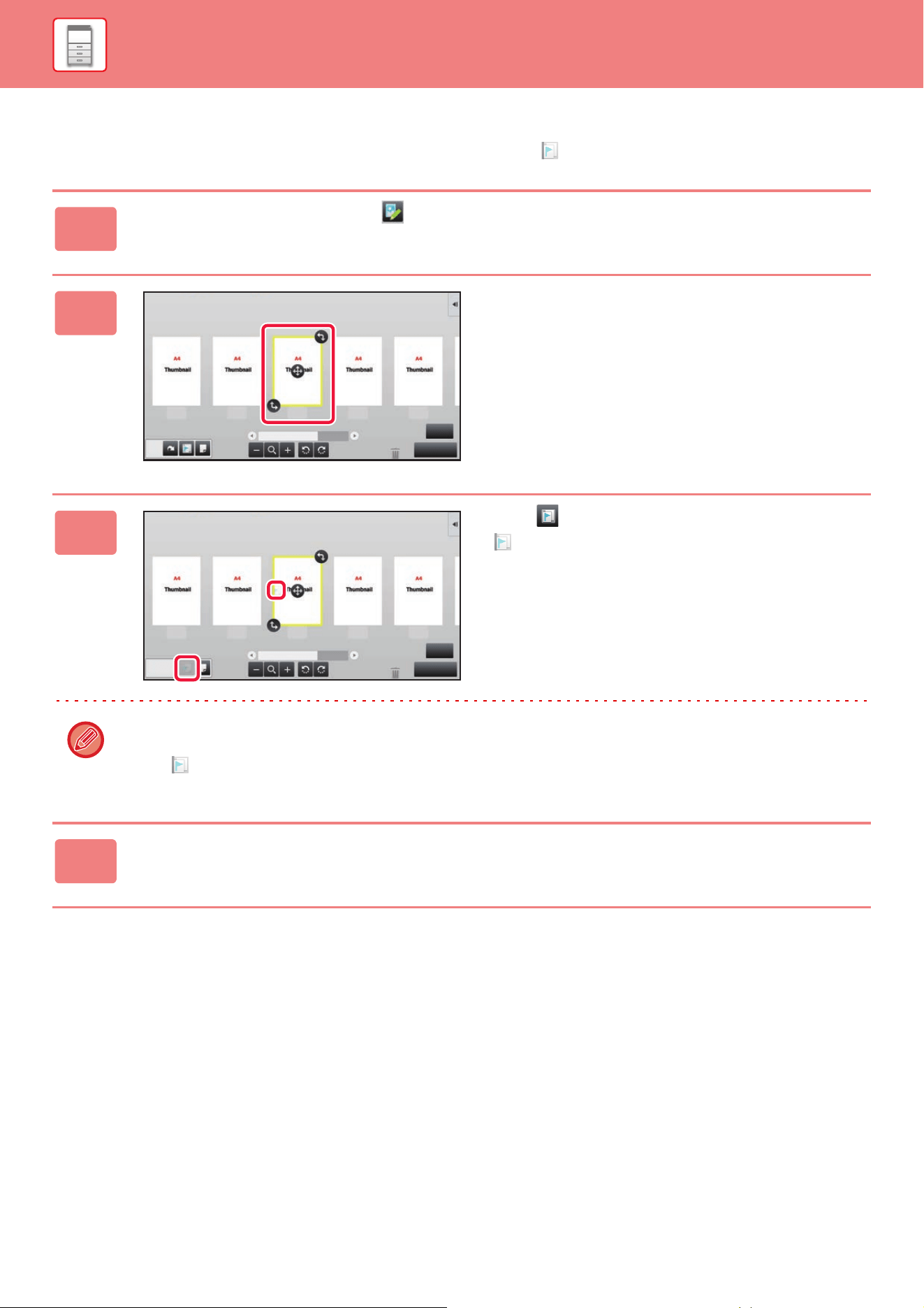
Moving a page
Rotating a page
1
In the preview screen, tap to switch to edit mode.
2
Tap the page you want to move, and
drag to move the page.
You can also move the page by tapping [Move the Page] on the action panel and then tap of the destination.
3
Tap the [Edit End] key.
1
In the preview screen, tap to switch to edit mode.
2
Tap the page you want to rotate, and
drag or to rotate the page.
You can also rotate the page by tapping [Rotate 180 Degrees] (Copy mode only) or [Rotate 90 Degrees] (Scanner mode
only) on the action panel.
3
Tap the [Edit End] key.
6
Edit End
4 5321
6
Edit End
4 5321
1-20
BEFORE USING THE MACHINE►BEFORE USING THE MACHINE
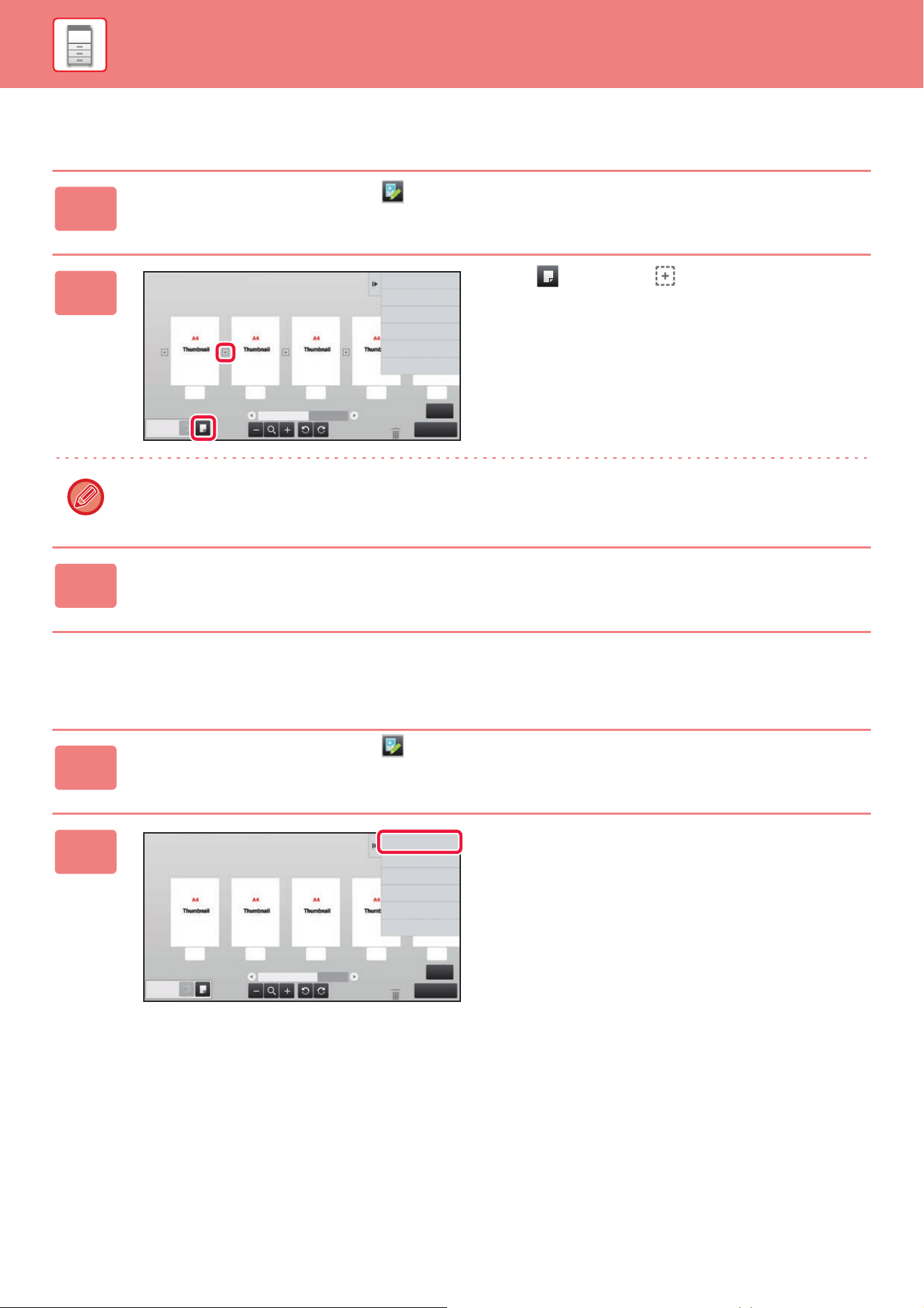
Setting chapter inserts
When N-Up or 2-Sided is specified, you can move a page marked with to the first page.
1
In the preview screen, tap to switch to edit mode.
2
Tap the page you want to set chapter
inserts.
3
Tap .
is displayed on the page.
• You can also set chapter inserts by tapping [Specify Chapter Inserts] on the action panel.
• To cancel the Chapter Inserts setting:
Tap displayed on the page, or select the page and tap [Cancel Chapter Inserts of Selected Page.] on the action
panel.
4
Tap the [Edit End] key.
6
Edit End
4 5321
6
Edit End
4 5321
1-21
BEFORE USING THE MACHINE►BEFORE USING THE MACHINE
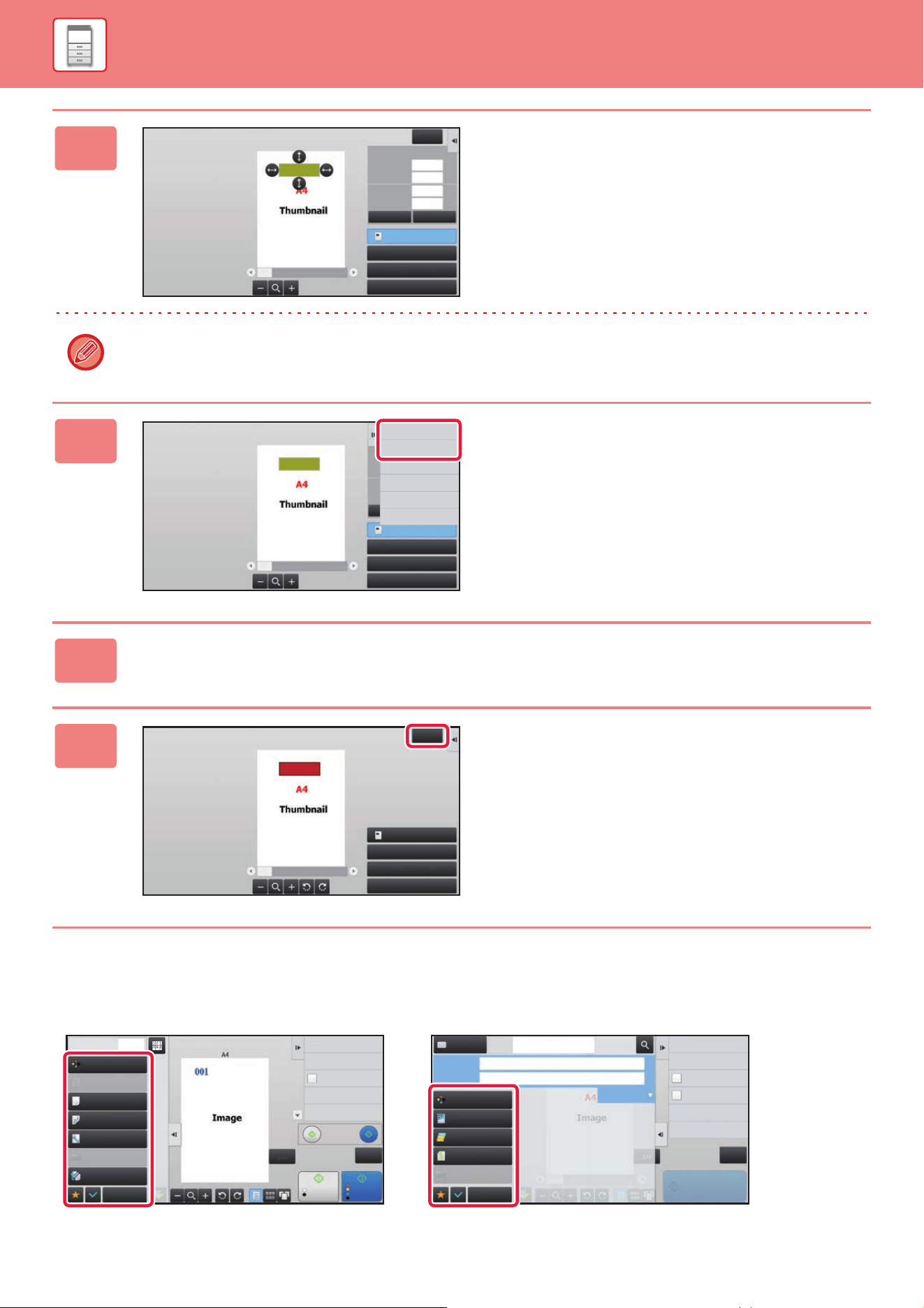
Inserting a blank page
Deleting part of the original image
1
In the preview screen, tap to switch to edit mode.
2
Tap , and tap for the location
into which you want to insert a blank
page.
You can also insert a blank page by tapping [Insert Blank Page] on the action panel.
3
Tap the [Edit End] key.
1
In the preview screen, tap to switch to edit mode.
2
Tap [Erase Specified Range] on the
action panel.
4
Edit End
Cancel and ReturnSelect the location to insert blank
page.
45321
6
Edit End
Move the Page
Rotate 180 Degrees
Specify Chapter Inserts
Insert Blank Page
Delete the Page
Erase Specified Original Area
Erase Specified Range
4 5321
1-22
BEFORE USING THE MACHINE►BEFORE USING THE MACHINE
Changing the settings
Tapping the tab on the left of the screen allows you to change the color mode and other settings.
You cannot tap the keys for functions whose settings cannot be changed.
3
Follow the on-screen instructions to
specify the erase range.
Specify the erase range and then tap the [Execute] key.
To delete the image outside the selected range, tap [Reverse Erase Range] on the action panel.
4
On the action panel, select [Apply This
Erase Position to All Pages.] or [Apply
This Erase Position to This Page.].
5
As necessary, repeat the steps to specify the erase range and the pages to
which it is applied.
6
Tap the [Exit] key.
Erase Specified Range
Clear Execute
Exit
Specify Range2
Specify Range3
Specify Range4
Height
Start Point
Width
X
Y
53
31
31
97
Height
Start Point
Width
Specify Range2
Specify Range3
Specify Range4
Erase Specified Range
Apply This Erase
Position to This Page.
Reverse Erase Range
Apply This Erase
Position to All Pages.
Erase Specified Range
Exit
Specify Range2
Erase Range1
Specify Range3
Specify Range4
1 / 6
Program Registration
Program Registration
Proof Copy
Start
Color Mode
Copies
Full Color
Paper Select
Auto
Exposure
Auto
Original
2-Sided Copy
1-Sided→1-Sided
Output
Copy Ratio
100%
Others
Send and print
Scan Original Again
Without change Settings
Store Data in Folder
File
Store Data Temporarily
Quick File
Start
CA
B/W
Auto
Color
Start
Color Mode
Auto/Mono2
Resolution
200x200dpi
File Format
PDF
Original
Auto
Others
Address Book
Subject
File Name
Address Touch to input Address
Options
Exposure
CA
Sending History
Quick File
Call Search Number
Check Send/Receive
Status
Send
Destination Link
Store Data Temporarily
File
Store Data in Folder
Specified by System Settings
1-23
BEFORE USING THE MACHINE►BEFORE USING THE MACHINE
OPERATION OF FREQUENTLY USED KEYS
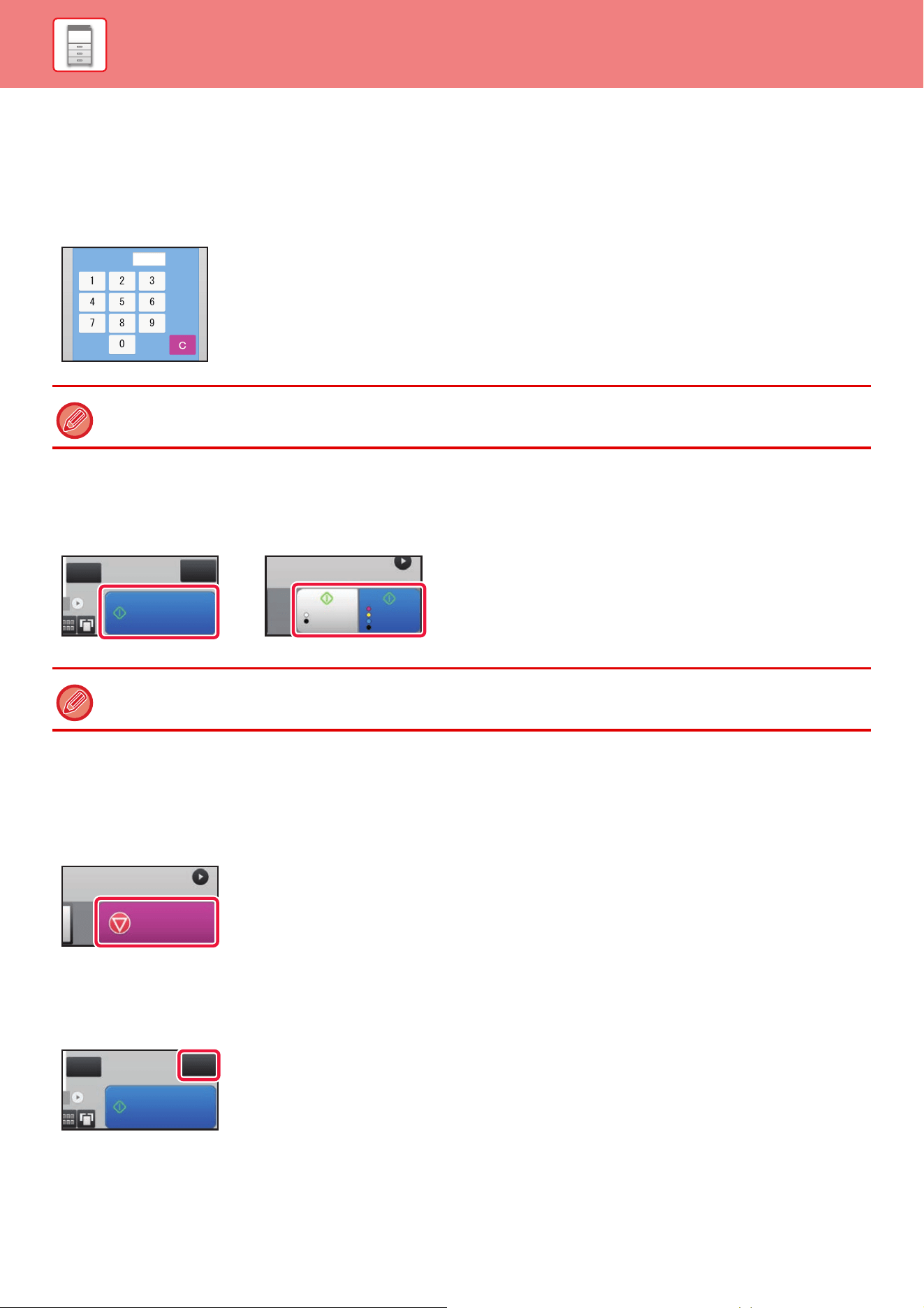
Numeric keys
Tap a number to enter it.
To clear the entered number, tap the [C] key.
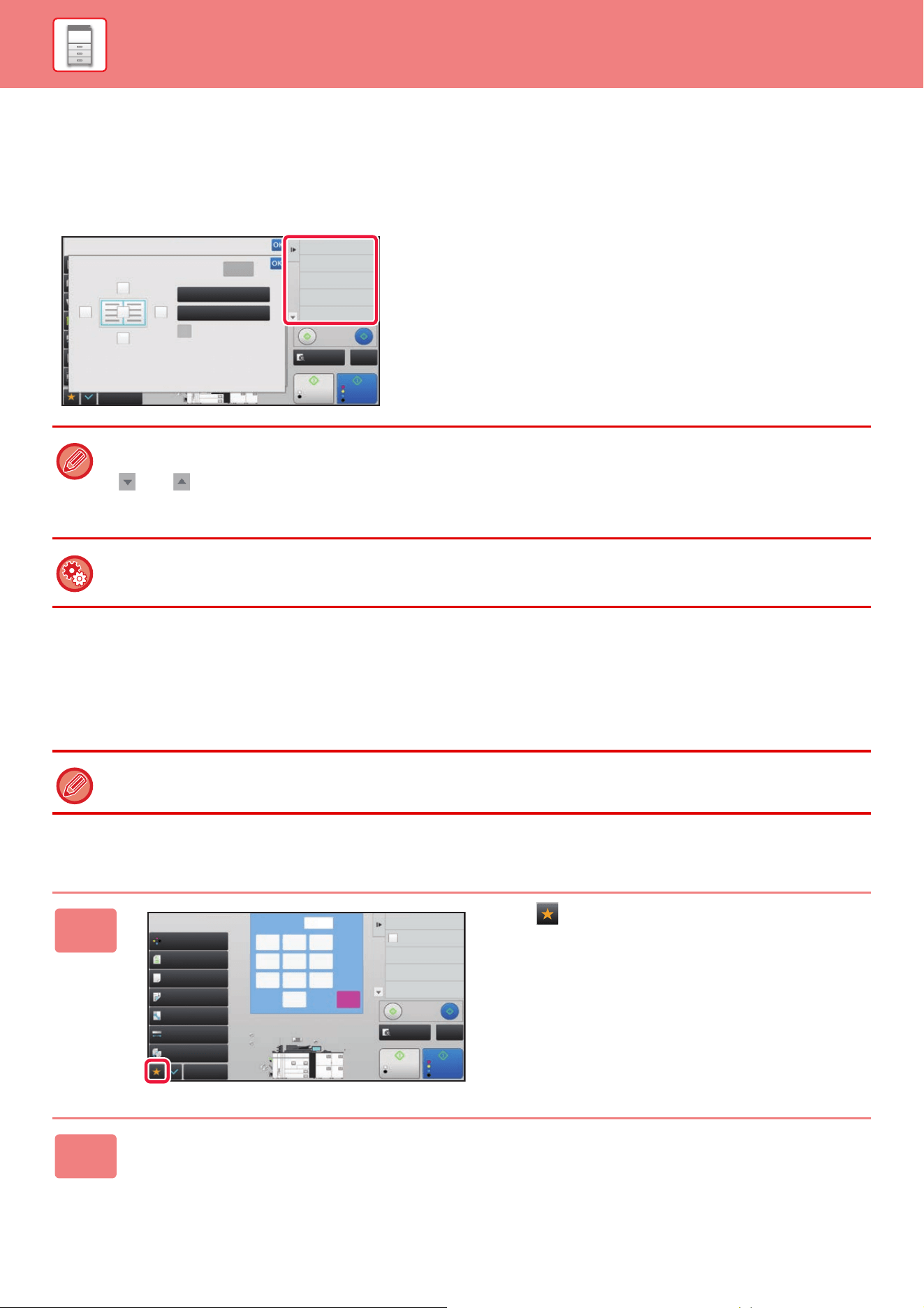
[Start] key ([B/W Start] key and [Color Start] key)
Tap to perform a print or send job.
[Cancel Copy] key, [Storing Canceled] key, [Cancel Scan] key, [Sending
Canceled] key
Tap to stop copying, printing, or transmission.
[CA] key
Tap to cancel all settings and restore the initial status in each mode.
On the address screen, you can enter characters other than numbers, and a different key layout is provided. You can also
move the cursor by using the [←] and [→] keys. Tap the [C] key to delete one character to the left of the cursor.
In copy mode, [B/W Start] and [Color Start] keys are displayed.
1
No. of copies
CA
1 / 7
Start
Color
Start
B/W
Start
Cancel
Scan
CA
1 / 7
Start
1-24
BEFORE USING THE MACHINE►BEFORE USING THE MACHINE
ACTION PANEL
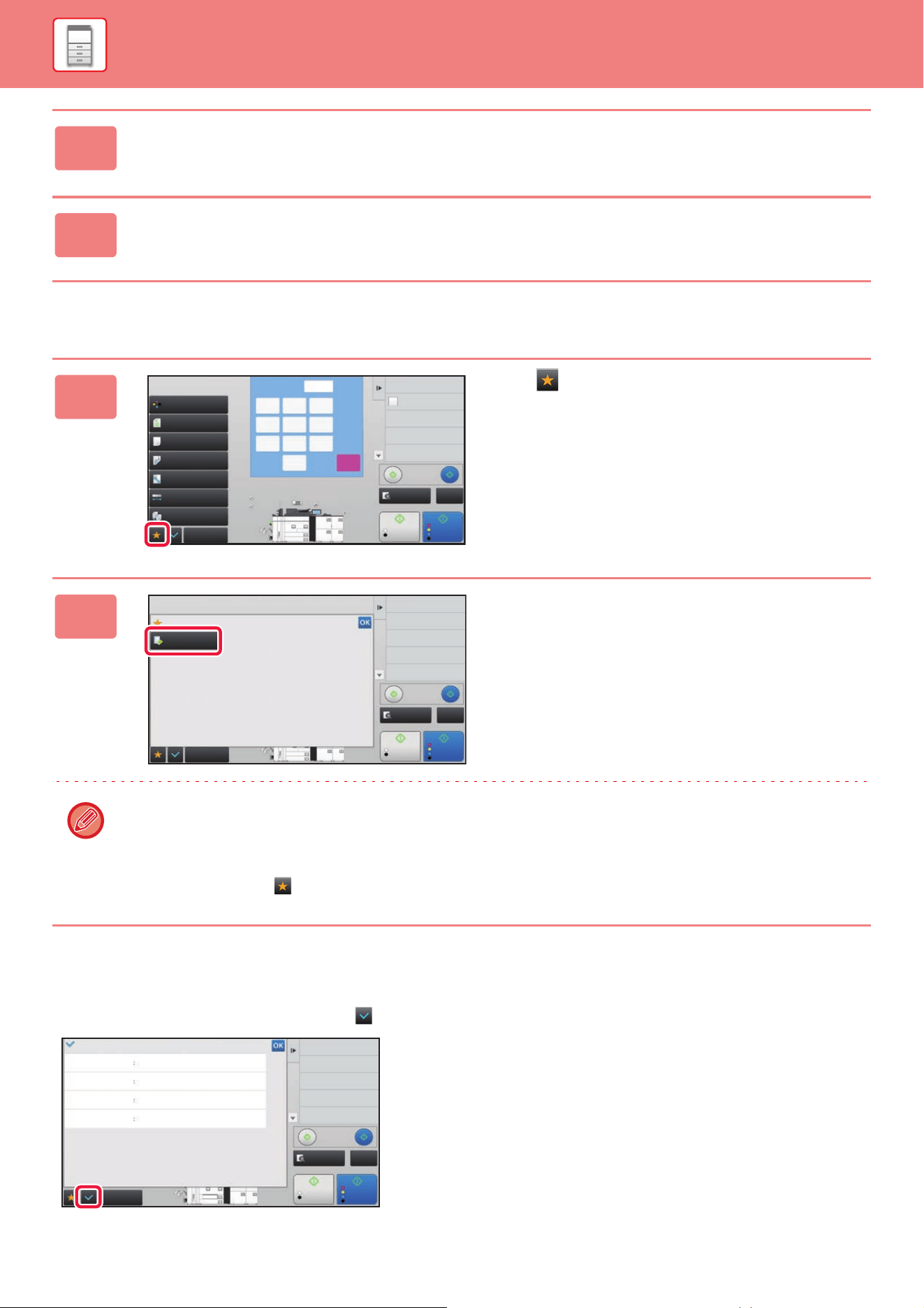
Recommended functions are displayed on the action panel when you configure functions in each mode.
From the action panel, you can configure functions or combine the configured function with a function displayed on the
action panel.
If the action panel does not appear, tap the action panel tab.
CONFIRMATION SCREEN FOR FAVORITE MENUS AND
SETTINGS
When you register frequently used functions you have configured for copying or image sending in favorite, you can
quickly call them.
Registering a function in Favorite
• The functions displayed on the action panel vary depending on the mode or the functions that have been configured.
• If too many functions have been configured to be displayed on the action panel, you can slide the panel vertically or tap
and to view all.
• In enlarge display mode, part of the text on the action panel may not be displayed. To display the whole text, long-touch
the partially hidden key or slide the tab of the action panel to the left.
To always display the action panel
In "Settings (administrator)", select [System Settings] → [Common Settings] → [Operation Settings] → [Condition Settings]
→ [Display Action Panel as default.].
Favorite can be used in normal mode.
1
Tap .
2
Tap [Edit Favorite] on the action panel.
Proof Copy
68
8½x14
11x17
8½x11 8½x11
Start Start
Preview
Others
Copy Like A Pamphlet
Booklet
Change Size/Direction.
Original
2-Sided Copy
Color Mode
Background Adjustment
Others
Erase
Clear
Outer Frame
Specify Frame+Centre
Reverse erase position of
back face
Up
Down
RightLeft
CA
B/W
4
3
Color
21
57
8½x11 8½x11
8½x11 8½x11
Proof Copy
Plain 1
8½x11
Start
Color
Start
Preview
Color Mode
Full Color
Paper Select
Auto
Exposure
Auto
Original
2-Sided Copy
1-Sided→1-Sided
Output
Copy Ratio
100%
Others
Plain1
Send and print
Call Eco Program
Store Data in Folder
File
Store Data Temporarily
Quick File
1
4
7
5
8
6
9
2
0
3
C
1
No. of copies
CA
B/W
8½x11
68
8½x11 8½x11
8½x143
11x174
Plain 1
8½x11
Auto
1-25
BEFORE USING THE MACHINE►BEFORE USING THE MACHINE
Calling a function from Favorite
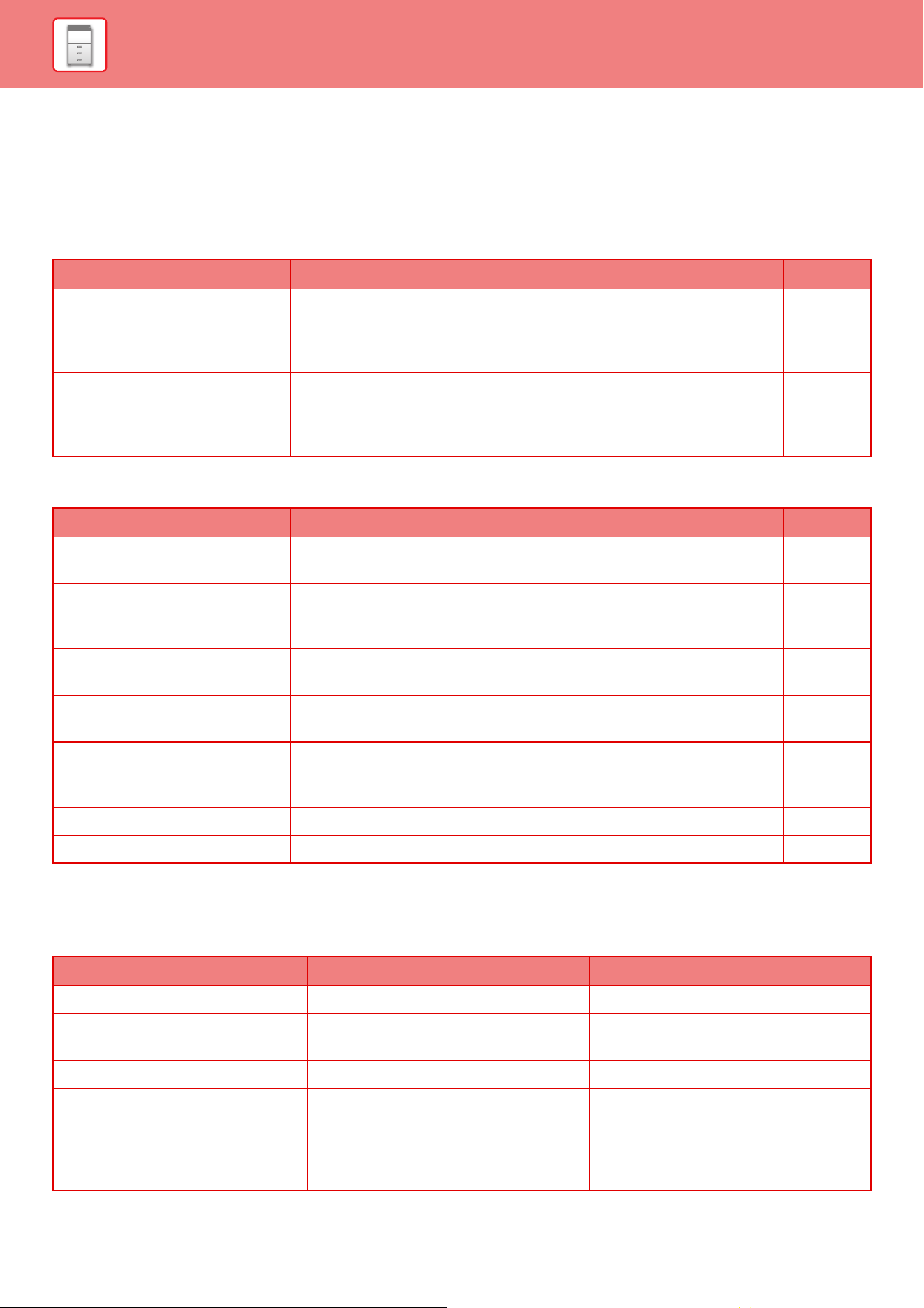
Confirmation Screen for Settings
You can display a list of configured functions and check them.
On the initial screen of each mode, tapping displays the setting confirmation screen.
3
Tap the [Register Key] key.
Administrator rights are required.
4
Tap the key for the function you want to register.
1
Tap .
2
Tap the key for the function you want
to call.
• Favorites can be registered or edited only by authenticated users and administrators.
• Unauthenticated users can call and use the favorites registered by administrators.
Settings for calling Favorites and permitting/prohibiting editing can be configured in [User Control] → [Authority Group
List] in "Settings (administrator)".
• To edit favorites, tap and then tap [Edit Favorite] on the action panel.
21
57
8½x11 8½x11
8½x11 8½x11
Proof Copy
Plain 1
8½x11
Start
Color
Start
Preview
Color Mode
Full Color
Paper Select
Auto
Exposure
Auto
Original
2-Sided Copy
1-Sided→1-Sided
Output
Copy Ratio
100%
Others
Plain1
Send and print
Call Eco Program
Store Data in Folder
File
Store Data Temporarily
Quick File
1
4
7
5
8
6
9
2
0
3
C
1
No. of copies
CA
B/W
8½x11
68
8½x11 8½x11
8½x143
11x174
Plain 1
8½x11
Auto
Proof Copy
Others
Start
Preview
Erase
Favorite
Edit Favorite
Shift to Icon Mode
Start
CA
B/W
3
4
8½x11 8½x11
68
8½x11 8½x11
8½x14
11x17
Color
Start
Preview
Register Current Settings
Program Registration
Function Review
Original
Paper Select
2-Sided Copy
Exposure
Image Orientation :
8½x11
Vertical
Tray 3 8½x11 Plain 1
2-Sided(Tablet)→1-Sided
Copy of Copy :Off / OffColour Tone Enhancement :
Original Image Type :Text/Exposure : 3.0
Others
Start
CA
B/W
Proof Copy
8½x11 8½x11
8½x14
3
11x174
8½x11 8½x11
68
OffCopy Original with Highlighted Lines :
Color
1-26
BEFORE USING THE MACHINE►BEFORE USING THE MACHINE
Eco
ECO FUNCTIONS OF THE MACHINE
These functions help save power consumption by managing operations of sections prone to high power consumption.
The machine provides two power-saving modes.
In addition to these two modes, using the following functions in conjunction helps reduce even more power
consumption.
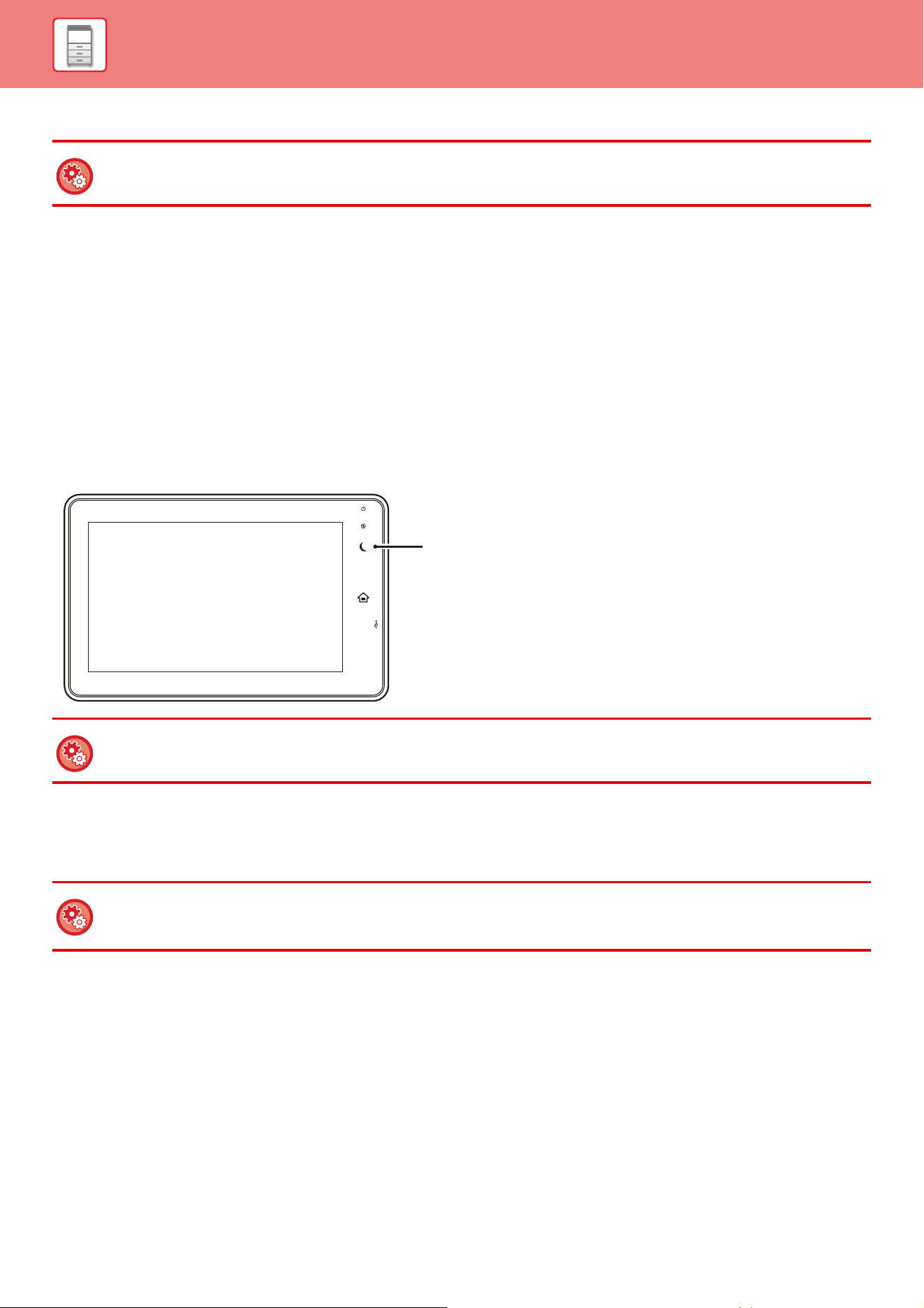
Mode Settings
The eco function settings are set in a batch. "Custom" and "Eco" are available.
Setting values applied by each mode is as follows.
Function Description Page
AUTO POWER SHUT-OFF
MODE
If no operations take place, this mode will turn off the power to the operation
panel and the fusing unit, and makes the machine wait in the lowest power
consumption state.
Although the power-saving rate is higher, the wakeup time is longer.
1-27
PREHEAT MODE This mode lowers the temperature of the fusing unit and makes the machine
wait in low power consumption state.
Compared to Auto Power Shut-Off Timer, the power-saving rate is lower, but
the wakeup time is shorter.
1-28
Function Description Page
ECO RECOMMENDATION
FUNCTION DISPLAY
Shows recommended copy/print settings for copy, document filing reprint,
and direct print.
1-28
AS SOON AS THE REMOTE JOB
IS FINISHED, ENTER AUTO
POWER SHUT OFF MODE
The machine returns from Auto Power Shut-Off and enters Auto Power
Shut-Off mode as soon as printing is completed.
1-29
ECO SCAN The machine is operated with the fusing unit turned off for non-printing
operations (that do not use the fusing unit) such image transmission.
1-29
POWER ON/OFF SCHEDULE
SETTING
Use this function to set the times for turning the power on and off to reduce
power consumption.
1-30
SPECIFIC DATE OPERATION
SETTINGS
When you must have the machine perform exceptionally many print jobs or
other special operation on a certain day, you can specify the day as a
"Specific Date" and define an energy saving pattern only for that day.
1-30
Toner Save Mode This mode is used to reduce toner consumption. 7-154
Sleep Mode Power Level Select whether priority is given to power saving or wakeup time. 7-151
Function Custom Eco
Preheat Mode Setting 1min. 1min.
Turn off Panel Display during
pre-heat mode
On On
Auto Power Shut-Off Timer
Fix transition time.: 15min.
Fix transition time.: 1min.
As soon as the remote job is finished,
enter Auto power shut off mode.
On On
Sleep Mode Power Level Low Power Low Power
Eco Scan On (Sending Modes Only) On (All Modes Except Copy)
1-27
BEFORE USING THE MACHINE►BEFORE USING THE MACHINE
Each Energy Save settings in System Setting is not applied when Eco mode is used.
AUTO POWER SHUT-OFF MODE
This mode turns off the power to the operation panel and the fusing unit, and makes the machine wait in the lowest
power consumption state.
Auto Power Shut-Off Timer will activate when the set duration of time elapses in waiting status without executing a job.
Compared to preheat mode, the power-saving rate is considerably higher but the wakeup time is longer.
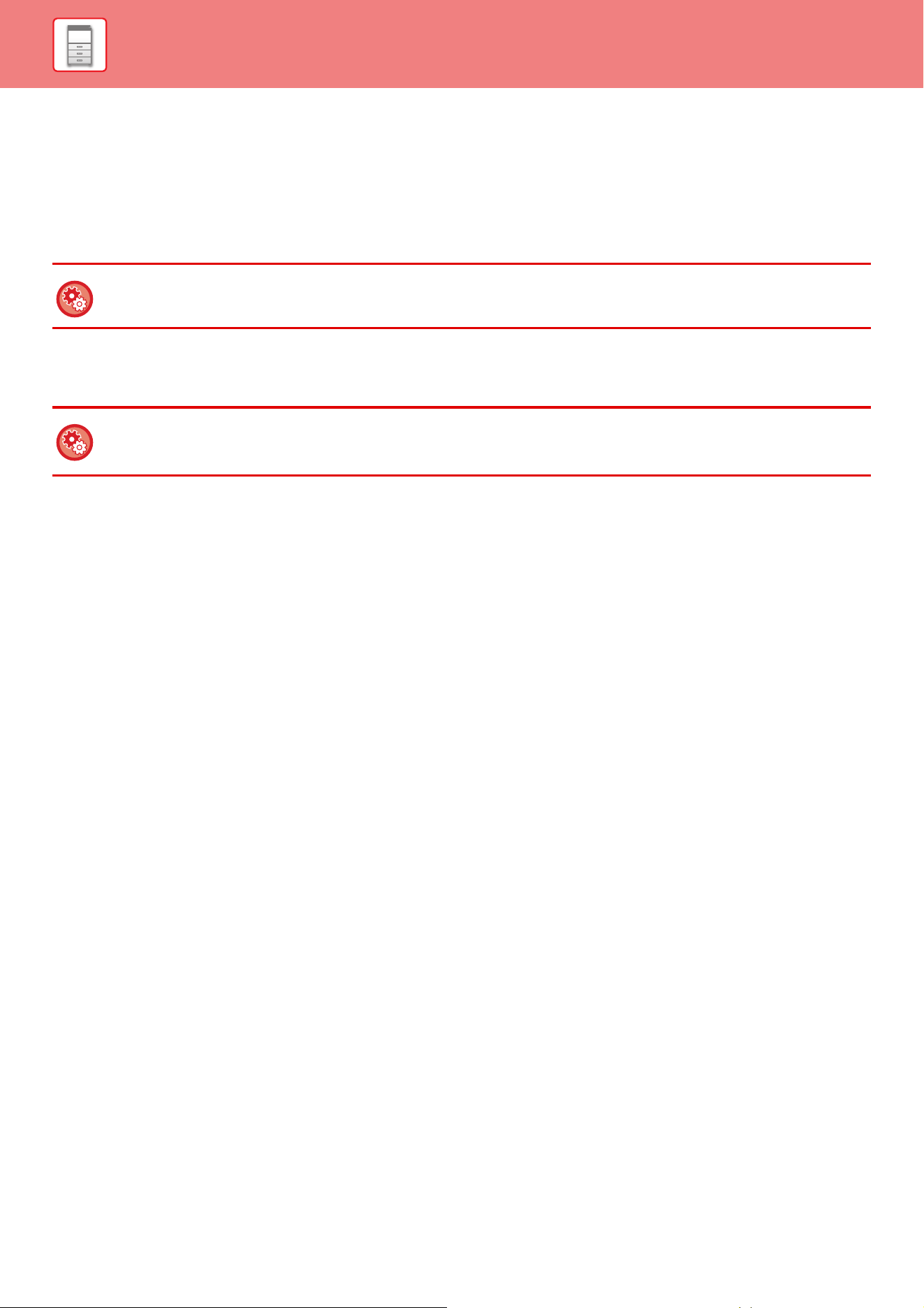
The [Power Save] button blinks when the machine is in Auto Power Shut-Off Timer.
Auto Power Shut-Off Timer is also activated by pressing the [Power Save] button while the [Power Save] button is not lit.
This mode is cleared when print data is being received or when the [Power Save] button is pressed while it is blinking.
A message appears 15 seconds before Auto Power Shut-Off Mode is entered.
To close the message and continue normal operation, tap the [Continue] button.
The message appears again 15 seconds before the end of the extension of normal operation time.
If no action is taken within 15 seconds after the message appears, the machine enters auto power shutoff mode.
To set mode settings
"Settings (administrator)" → select [System Settings] → [Energy Save] → [Eco Setting] → [Mode Setting].
To set Auto Power Shut-Off Timer:
In "Settings (administrator)", select [System Settings] → [Energy Save] → [Eco Setting] → [Auto Power Shut-Off].
To set display of the message:
In "Settings (administrator)", select [System Settings] → [Energy Save] → [Eco Setting] → [Display Message When
Extending Transition Time to Preheat/Auto Power Shut-Off Mode].
[Power Save] button/indicator
1-28
BEFORE USING THE MACHINE►BEFORE USING THE MACHINE
PREHEAT MODE
This mode lowers the temperature of the fusing unit and makes the machine wait in low power consumption state.
Preheat mode will activate when the set duration of time elapses in waiting status without executing a job.
Compared to Auto Power Shut-Off Mode, the amount of energy saved is less and the wakeup time is shorter.
In the preheat mode, the [Home Screen] key is lit and the light goes off for the touch panel and the [Power Save] button.
The touch panel is cleared when it is tapped or the [Home Screen] button is pressed.
A message appears 15 seconds before Preheat Mode is entered.
To close the message and continue normal operation, tap the [Continue] button.
If no action is taken within 15 seconds after the message appears, the machine enters preheat mode.
ECO RECOMMENDATION FUNCTION DISPLAY
Shows recommended copy/print settings for copy, document filing reprint, and direct print.
Copying
When you change to copy mode (normal mode), the settings recommended for copy mode appear.
Recommended settings: 2-Sided Copy, N-Up, B/W Copy and Image Orientation
Document filing print
When you tap the [Choose Print Settings] in the action panel on the file list screen of document filing, the settings
recommended for this mode appear.
Recommended settings: 2-Sided Print, N-Up, and Print B/W
Direct print
When you tap the [Choose Print Settings] in the action panel on the file list screen of direct print, the settings
recommended for this mode appear.
Recommended settings: 2-Sided Print, N-Up and Print B/W
To set preheat mode:
"Settings (administrator)" → select [System Settings] → [Energy Save] → [Eco Setting] → [Preheat Mode Setting].
To set display of the message:
In "Settings (administrator)", select [System Settings] → [Energy Save] → [Eco Setting] → [Display Message When
Extending Transition Time to Preheat/Auto Power Shut-Off Mode].
1-29
BEFORE USING THE MACHINE►BEFORE USING THE MACHINE
AS SOON AS THE REMOTE JOB IS FINISHED, ENTER
AUTO POWER SHUT OFF MODE
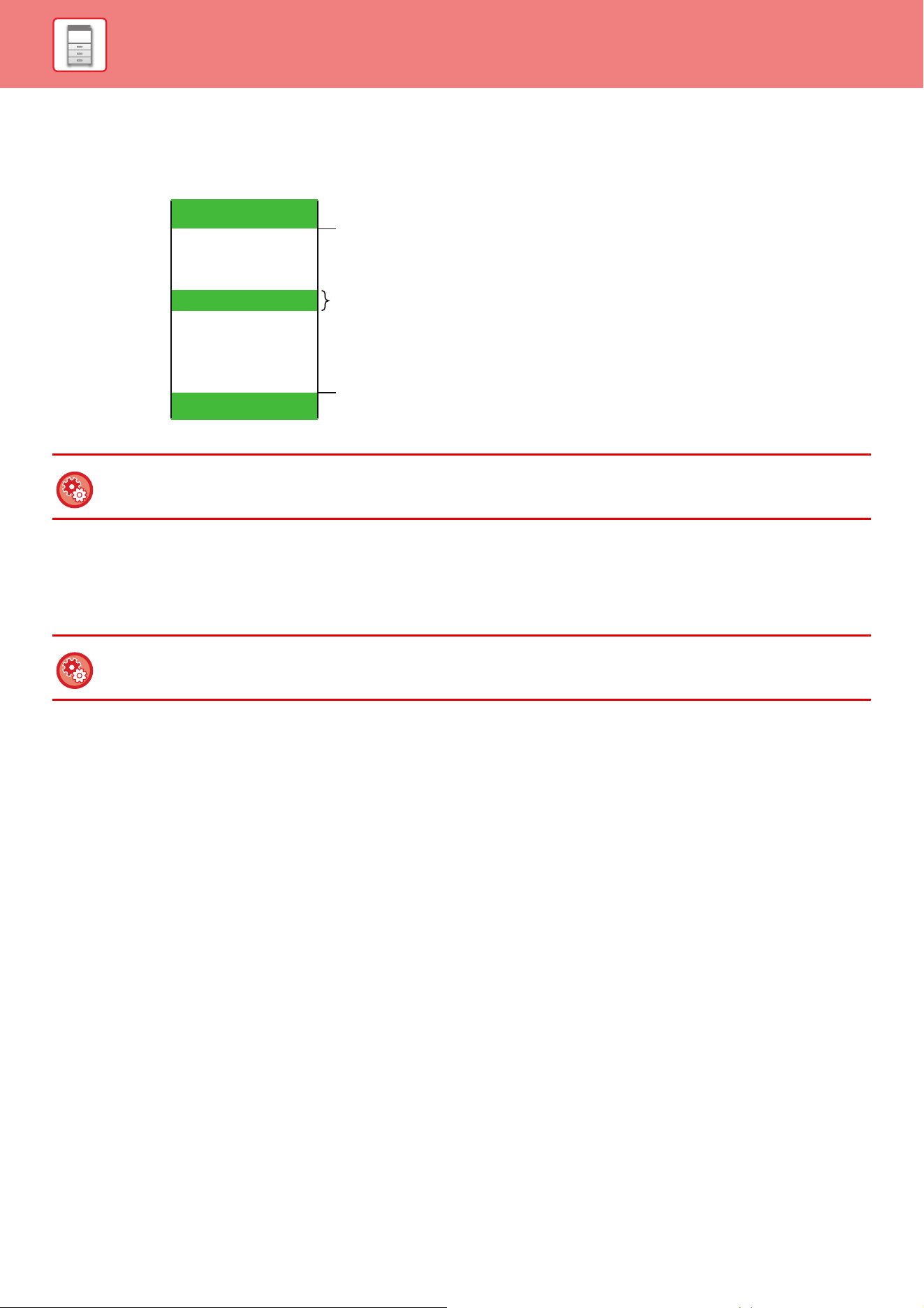
Printing in Auto Power Shut-Off Timer turns on the power, and then the machine returns to Auto Power Shut-Off Mode
immediately after completing the print job.
ECO SCAN
Non-print jobs such as sending a scanned original are performed with the fusing unit turned off.
To set "As soon as the remote job is finished, enter Auto power shut off mode.":
In "Settings (administrator)", select [System Settings] → [Energy Save] → [Eco Setting] → [As soon as the remote job is
finished, enter Auto power shut off mode.].
To set Eco scan:
"Settings (administrator)" → select [System Settings] → [Energy Save] → [Eco Setting] → [Eco Scan Setting].
1
0
0
H
0
Printed
Sleep mode
Print
Sleep mode
Fusing unit is turned
off
Fusing unit is turned
on
Fusing unit is turned
off
1
0
0
0
H
Fusing unit is
turned off
Image Send
Document Filing
Copy
Fusing unit is
turned on
Fusing unit is
turned off
Print
Sleep mode
1-30
BEFORE USING THE MACHINE►BEFORE USING THE MACHINE
POWER ON/OFF SCHEDULE SETTING
Use this function to set the times for turning the power on and off for the machine to reduce power consumption.
SPECIFIC DATE OPERATION SETTINGS
When you must have the machine perform exceptionally many print jobs or other special operation on a certain day, you
can specify the day as a "Specific Date" and define an energy saving pattern only for that day.
Setting Power ON/OFF Scheduling Function
In "Settings", select [System Settings] → [Energy Save] → [Power ON/OFF Schedule Setting].
To specify operation for the specific date:
"Settings (administrator)" select [System Settings] → [Energy Save] → [Specific Date Operation Settings].
9:00
12:00
13:00
18:00
ON
ON
OFF
OFF
OFF
Start time
Lunch break
Finish time
1-31
BEFORE USING THE MACHINE►BEFORE USING THE MACHINE
USER AUTHENTICATION
User authentication restricts the use of the machine to users that have been registered. The functions that each user is
allowed to use can be specified, allowing the machine to be customized to meet the needs of your workplace.
When the administrator of the machine has enabled user authentication, each user must log in to use the machine.
There are different types of user authentication, and each type has a different login method.
For more information, see the explanations of the login methods.
► AUTHENTICATION BY USER NUMBER (page 1-31)
► AUTHENTICATION BY LOGIN NAME/PASSWORD (page 1-33)
AUTHENTICATION BY USER NUMBER
The following procedure is used to log in using a user number received from the administrator of the machine.
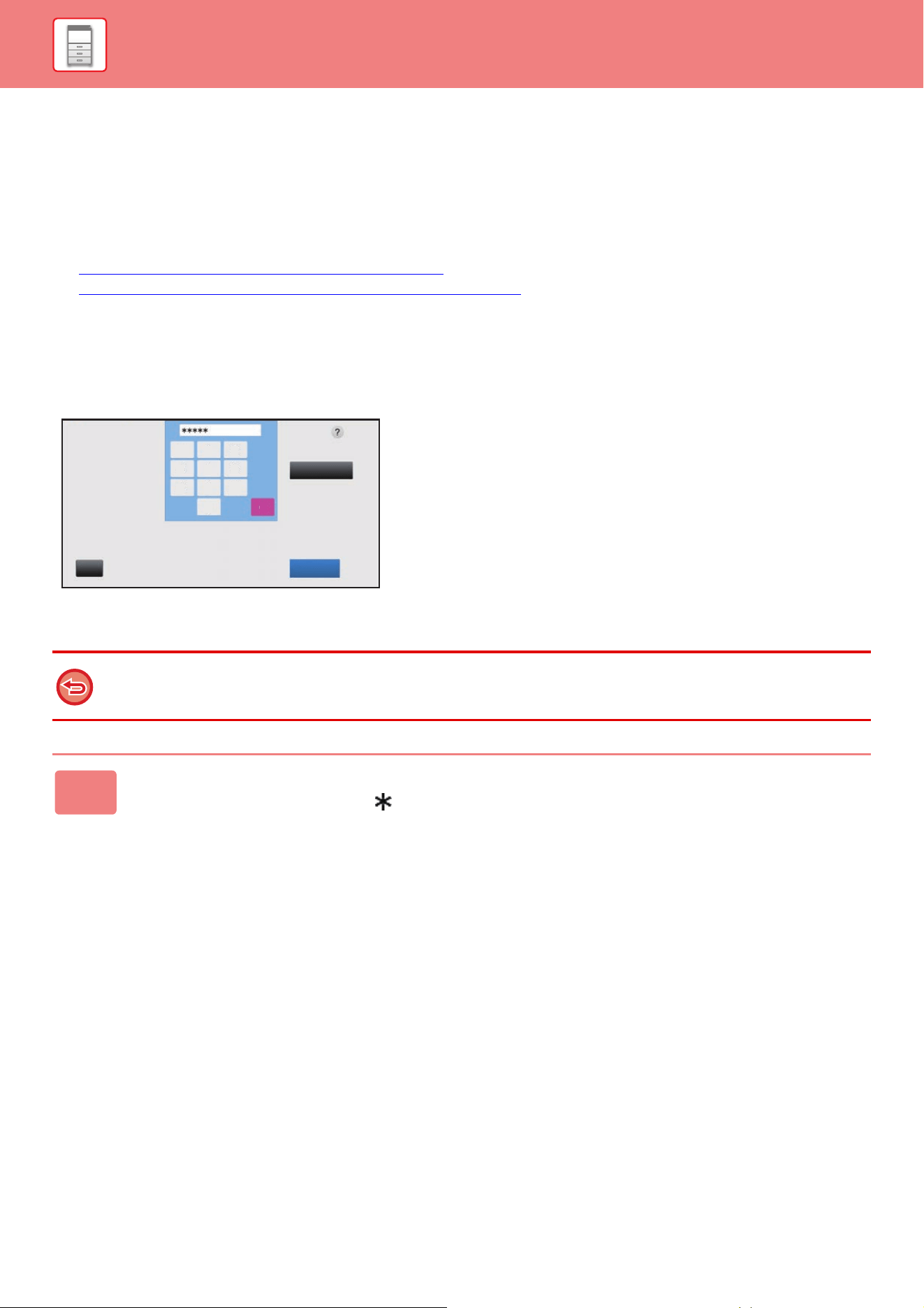
When starting the machine, the login screen appears.
When controlled by user number
If "A Warning when Login Fails" is enabled in the system settings, the operation panel will be locked for five minutes if an
incorrect user number is entered three times in a row.
Contact the machine administrator to check the user number assigned for you.
1
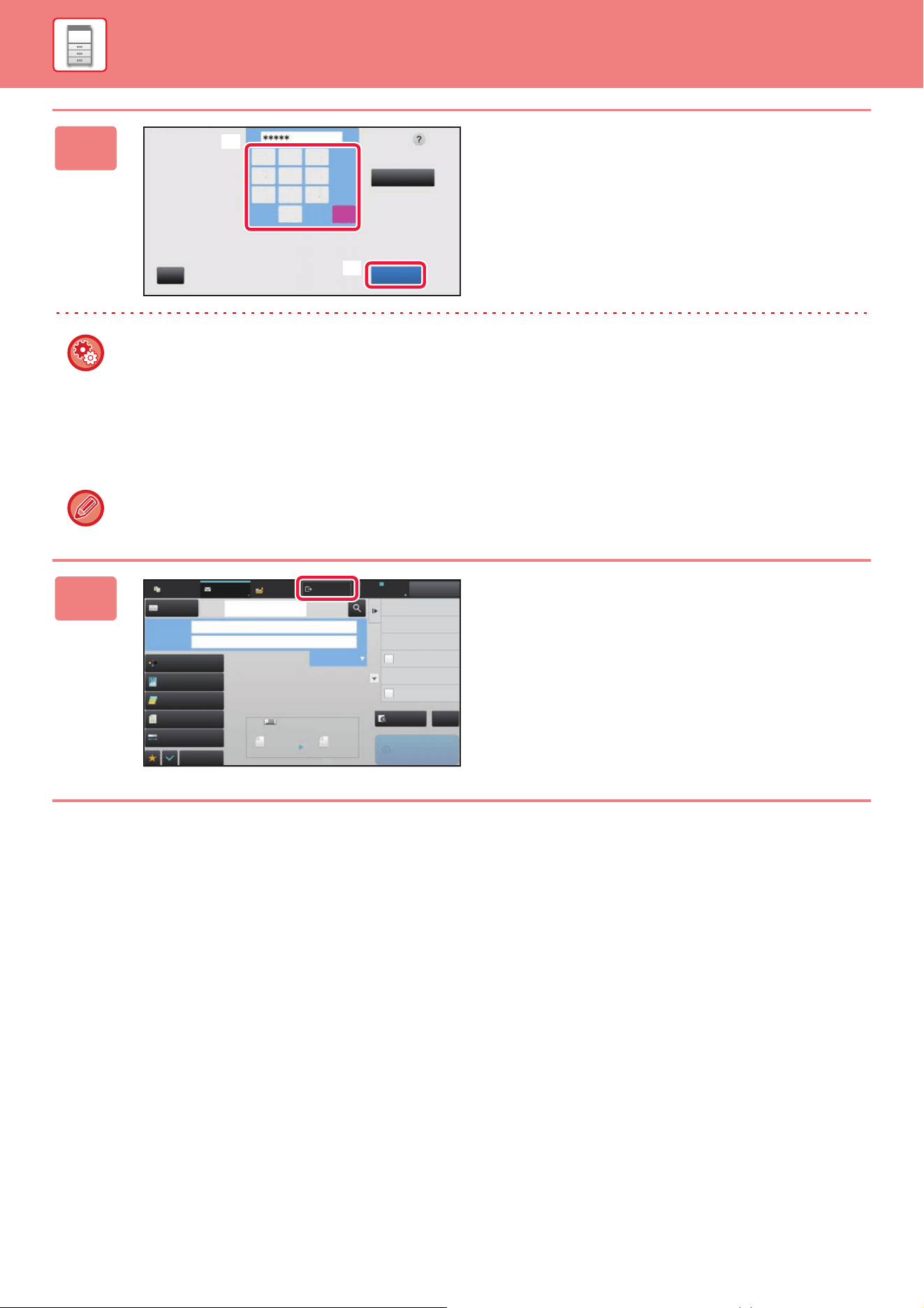
Enter your user number (5 to 8 digits) using the numeric keys.
Each entered digit will be displayed as " ".
1
4 5 6
2
0
3
C
User Authentication
Please input user number.
CA
Admin Login
OK
7 8 9
1-32
BEFORE USING THE MACHINE►BEFORE USING THE MACHINE
2
Tap the [OK] key.
If the entered user number is authenticated, the number of
remaining pages that the user can copy or scan is displayed.
When a limitation is set for the number of pages that a user
can use, the use count for the user that has logged in is
displayed.
• To limit the number of pages that a user can use:
In "Settings (administrator)", select [User Control] → [Pages Limit Group].
• To hide the number of pages that can be used after login:
In "Settings (administrator)", disable [User Control] → [Default Settings] → [Display Usage Status after Login].
• To change the message display time:
In "Settings" (administrator)", select [System Settings] → [Common Settings] → [Operation Settings] → [Condition
Settings] → [Message Time Setting].
When the user number is an 8-digit number, this step is not necessary. Login takes place automatically after the user
number is entered.
3
When you have finished using the
machine and are ready to log out, tap
[Logout].
1
4 5 6
2
0
3
7 8 9
C
User Authentication
Please input user number.
CA
Admin Login
OK
(1)
(2)
PDF
200x200dpi
Auto/Mono2
Subject
Address Book
Auto
Color Mode
Original
File Name
Specified by System Settings
Resolution
File Format
Address Touch to input Address
Logout
Admin
LINE PRINTER
Job Management
Others
Preview
Start
Scan Size
Auto Auto
100%
8½x11
8½x11
Send Size
Sending History
Call Search Number
Call Program
Call Registered settings
Verification Stamp
E-mail
Copy
HDD
File retrieve
CA
Global Address Search
Send
Destination Link
Auto
Exposure
1-33
BEFORE USING THE MACHINE►BEFORE USING THE MACHINE
AUTHENTICATION BY LOGIN NAME/PASSWORD
This method enables users to log in using a login name and password received from the administrator of the machine or
the administrator of the LDAP server.
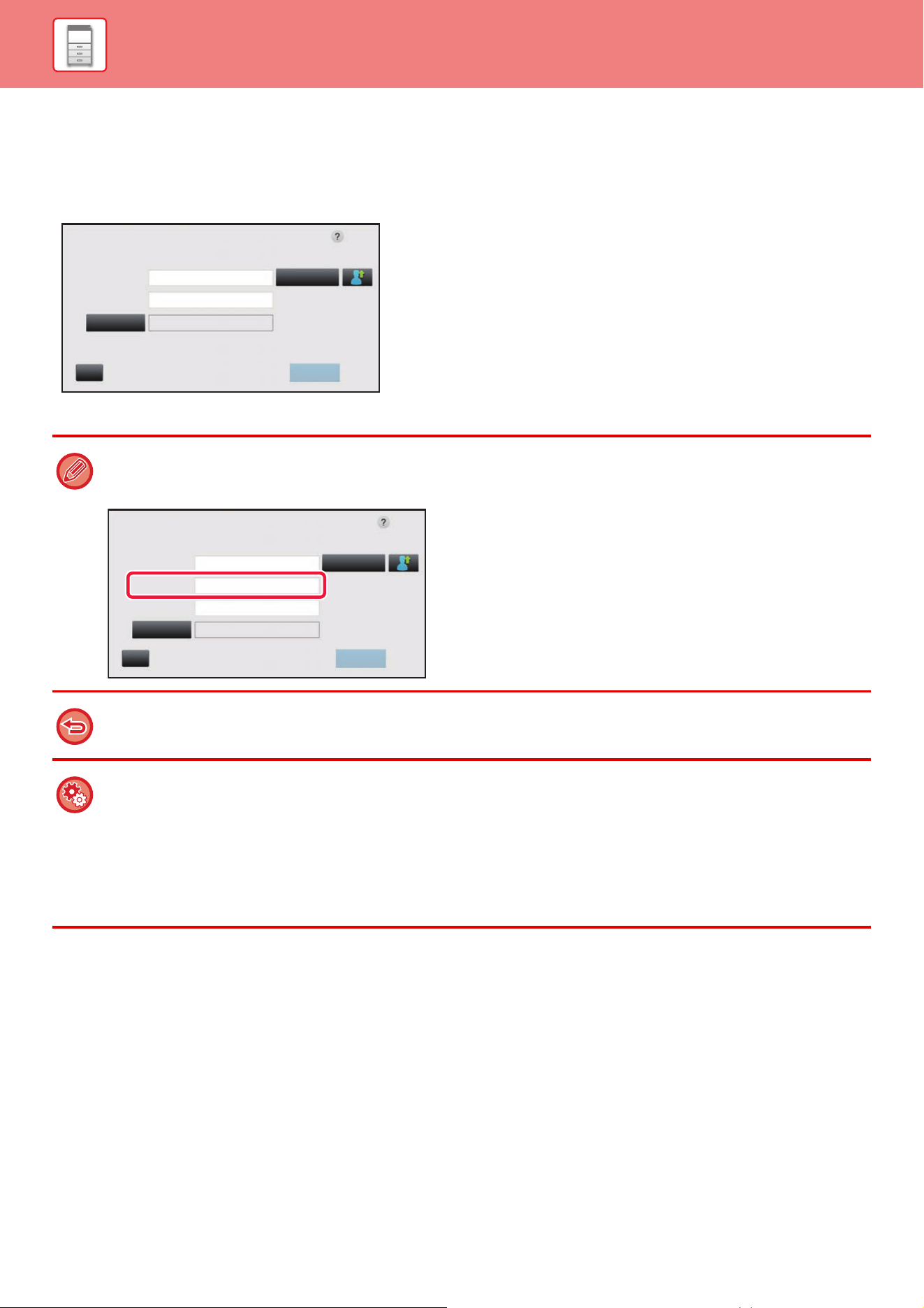
When starting the machine, the login screen appears.
When controlled by login name and password
• Different items may appear in the screen when LDAP authentication is used.
• When LDAP authentication is used, the [E-mail Address] key may appear, depending on the authentication method. Tap
the [E-mail Address] text box and enter your e-mail address.
If "A Warning when Login Fails" is enabled in the system settings, the operation panel will be locked for five minutes if an
incorrect login name or password is entered three times in a row.
Contact the machine administrator to check the login name/password assigned to you.
• To release the operation panel lock:
In "Settings (Web version)", select [User Control] → [Default Settings] to release the lock.
• To set [A Warning when Login Fails]:
In "Settings (administrator)", select [User Control] → [Default Settings] → [A Warning when Login Fails].
• To store a user name:
In "Settings (administrator)", select [User Control] → [User List].
Also register detailed information such as the login name, user number, and password. Ask the administrator of the
machine for the information that you need to use the machine.
User Authentication
Enter login name and password.
Login Name
Password
Touch to input Log-in Name
Touch to Input Password
Login Locally
CA
Select from List
OK
Auth to
CA
OK
User Authentication
Select from ListLogin Name
E-mail Address
Touch to input Log-in Name
Touch to input E-mail Address
Password
Auth to
Touch to Input Password
Login Locally
Please enter Log-in name/E-mail address/password.
1-34
BEFORE USING THE MACHINE►BEFORE USING THE MACHINE
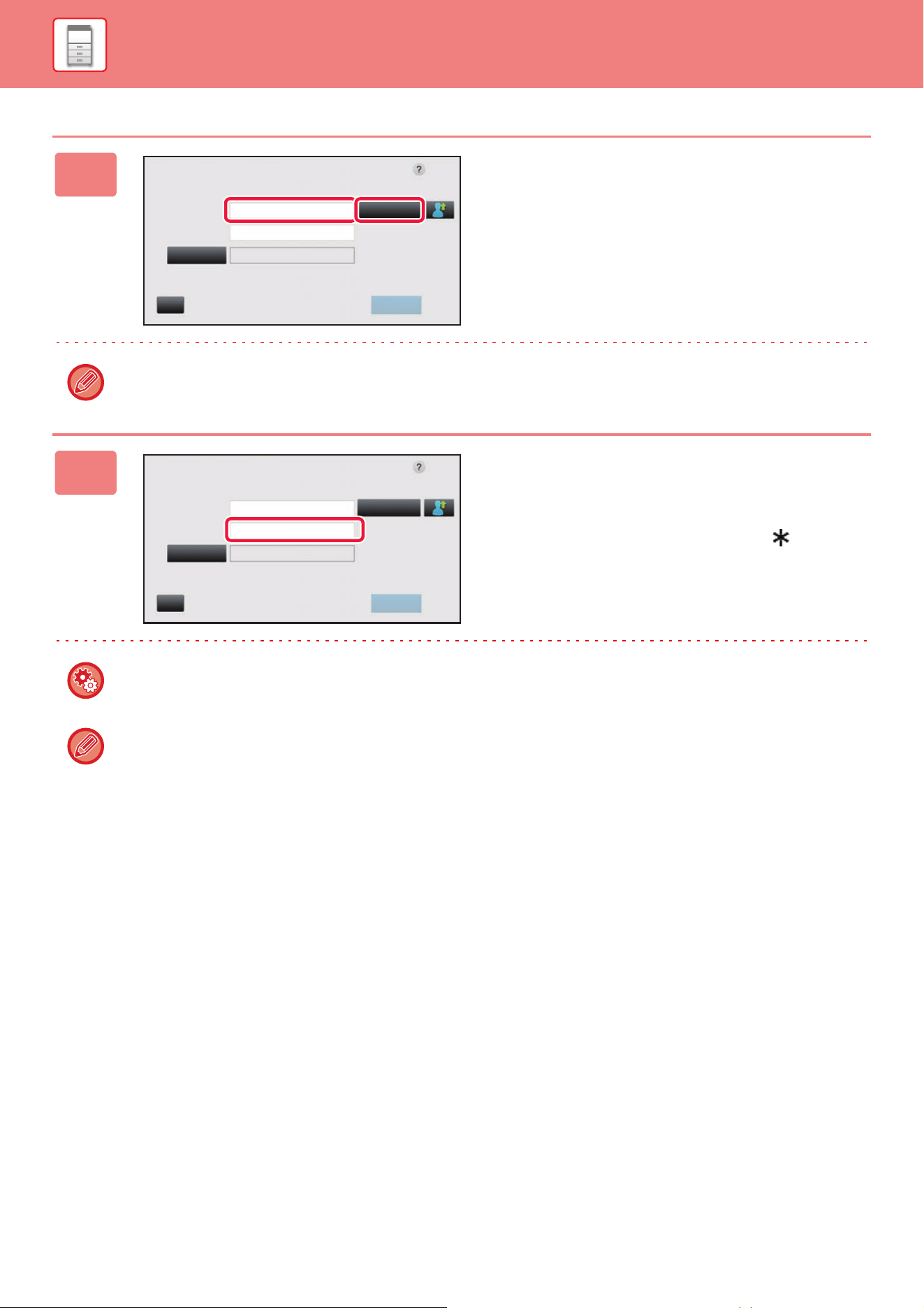
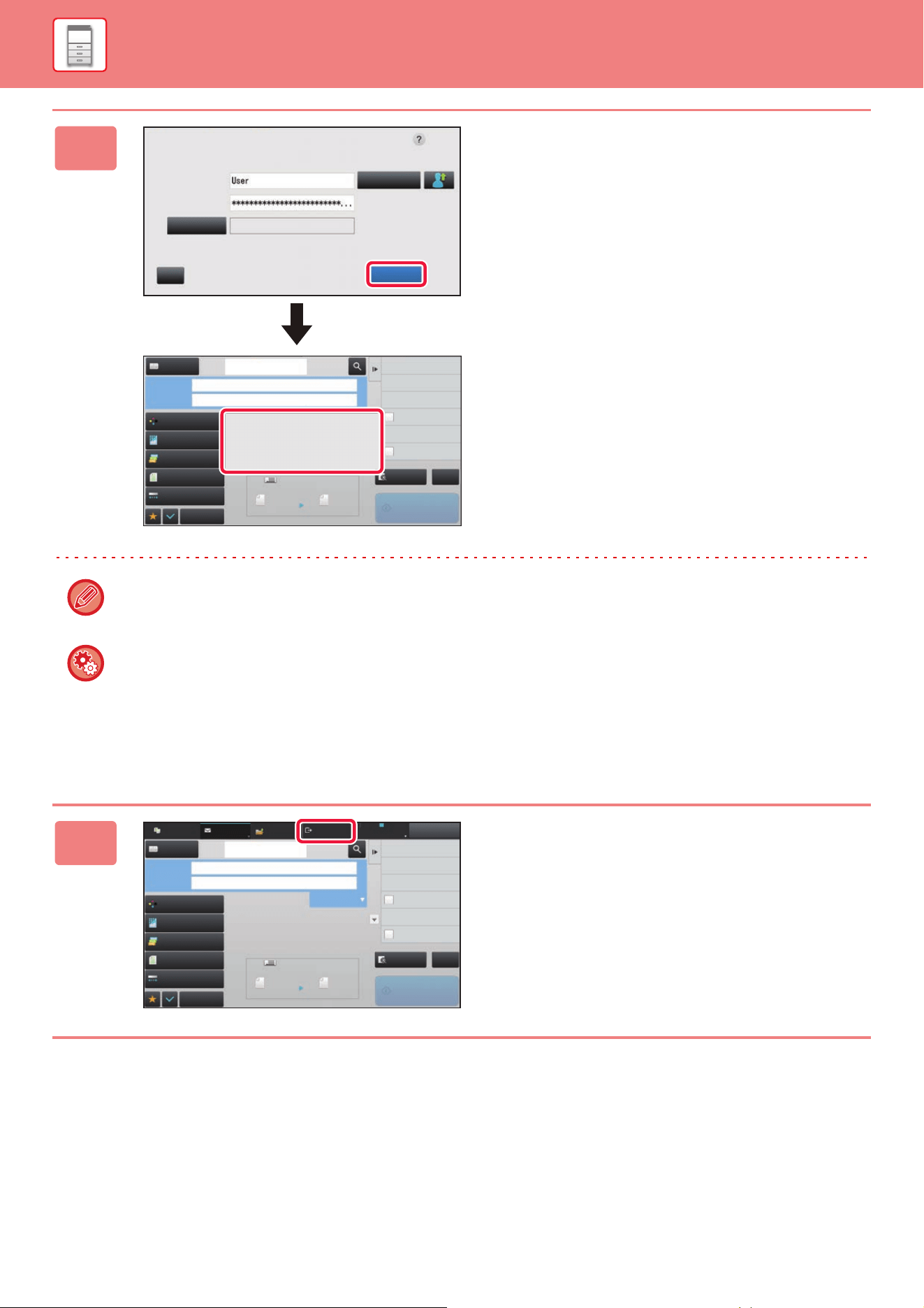
1
Enter the login name.
Entering using the soft keyboard
If user name registration has not been performed in setting
mode, a user only using LDAP authentication should tap the
[Login Name] text box and enter the login name using the
soft keyboard.
Selecting from a list
Tap the [Select from List] key and select a user name from
the User List screen.
LDAP authentication can be used when the administrator of the server provides LDAP service on the LAN (local area
network).
2
Enter the password.
Enter the password from the soft keyboard.
If you are logging in to an LDAP server, enter the password
that is stored with your LDAP server login name.
Each entered character will be displayed as " ". After
entering the password, tap the [OK] key.
When authentication is by LDAP server and you have
different passwords stored in "User List" and in the LDAP
server, use the password stored in the LDAP server.
To have the user name and password registered:
In "Settings (administrator)", select [User Control] → [User List].
When registering the LDAP server, change the information for [Auth to] as required.
• When selecting from the User List screen:
The LDAP server you are connecting to has been registered upon user registration, and so the target server to which
authentication should be directed appears when the login name is selected.
Go to step 3.
• When entering from the soft keyboard:
Tap [Auth to] and select the LDAP server to log in.
User Authentication
Enter login name and password.
Login Name
Password
Touch to input Log-in Name
Touch to Input Password
Login Locally
CA
OK
Select from List
Auth to
User Authentication
Enter login name and password.
Login Name
Password
Touch to input Log-in Name
Touch to Input Password
Login Locally
CA
OK
Select from List
Auth to
1-35
BEFORE USING THE MACHINE►BEFORE USING THE MACHINE
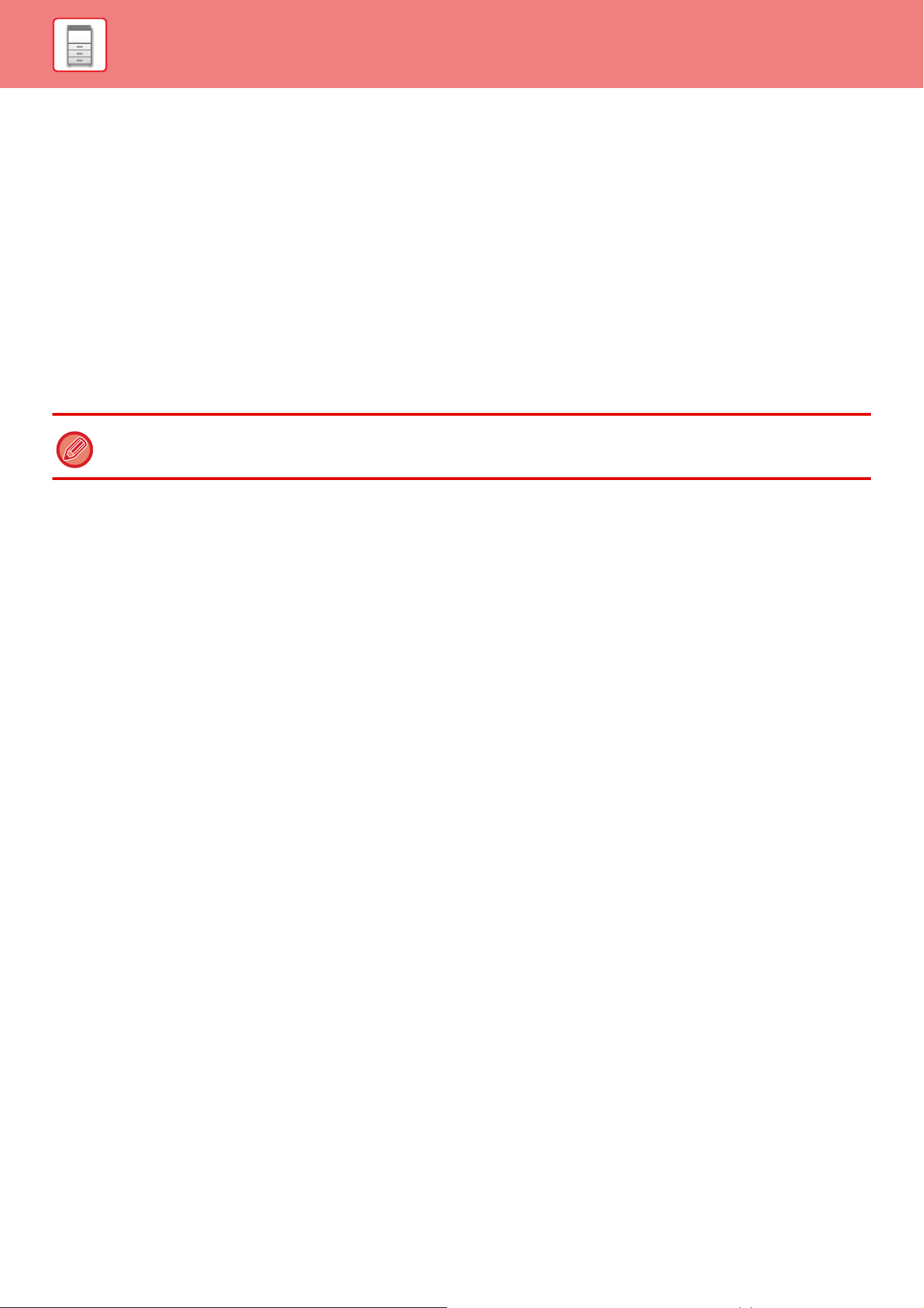
3
Tap the [OK] key.
If the entered login name and password are authenticated,
the number of remaining pages that the user can copy or
scan is displayed.
When a limitation is set for the number of pages that a user can use, the use count for the user that has logged in is
displayed.
• To limit the number of pages that a user can use:
In "Settings (administrator)", select [User Control] → [Pages Limit Group].
• To hide the number of pages that can be used after login:
In "Settings (administrator)", disable [User Control] → [Default Settings] → [Display Usage Status after Login].
• To change the message display time:
In "Settings" (administrator)", select [System Settings] → [Common Settings] → [Operation Settings] → [Condition
Settings] → [Message Time Setting].
4
When you have finished using the
machine and are ready to log out,
tap [Logout].
User Authentication
Enter login name and password.
Login Name
Password
Login Locally
CA
OK
Select from List
Auth to
TW0352
TW0333
PW1410
PW1417
Usage status : used/remaining pages
Scanner(B&W): 00,000,000/--,---,---
Scanner(Color): 00,000,000/--,---,---
PDF
200x200dpi
Auto/Mono2
Subject
Address Book
Auto
Color Mode
Original
File Name
Specified by System Settings
Resolution
File Format
Address
Others
Preview
Start
Scan Size
Auto Auto
100%
Send Size
Sending History
Call Search Number
Call Program
Call Registered settings
Verification Stamp
CA
Global Address Search
Send
Destination Link
Touch to input Address
Auto
Exposure
8½x11
8½x11
Subject
Address Book
Auto
Color Mode
Original
File Name
Specified by System Settings
Resolution
File Format
Address Touch to input Address
Logout
Admin
LINE PRINTER
Job Management
Others
Preview
Start
Scan Size
Auto Auto
100%
Send Size
Sending History
Call Search Number
Call Program
Call Registered settings
Verification Stamp
E-mailCopy
HDD
File retrieve
CA
Global Address Search
Send
Destination Link
Auto
Exposure
8½x11 8½x11
1-36
BEFORE USING THE MACHINE►BEFORE USING THE MACHINE
ACTIVE DIRECTORY LINKING FUNCTION
You can join the Active Directory domain (AD domain) of the machine, and easily perform user management on the
network.
On a network that does not have Active Directory enabled, you must perform network device authentication for each
device.
For this reason, one user must have multiple domain names and passwords.
When you join an AD domain, you only need to be authenticated once. After you are authenticated, the Active Directory
server automatically authenticates network devices. You can log in to multiple devices on the network with a single
domain name and password.
Joining an AD domain
To have the machine join an AD domain, set the authentication destination to [Active Directory] in "Settings
(administrator)" - [User Control]→[Default Settings]→[Authentication Server Settings].
Registering the machine in an AD domain
When you join an AD domain, the machine is registered as a printer in the AD domain. Enter the machine information in
setting mode.
Device name of the machine
In "Settings (administrator)", select [System Settings] → [Network Settings] → [Network Name Setting] → [Device Name].
Domain name of the machine
In "Settings (administrator)", select [System Settings] → [Network Settings] → [Active Directory Settings] → [Domain
Name].
Machine user name and password
In "Settings (administrator)", select [System Settings] → [Network Settings] → [Active Directory Settings] → [Device
Registration Account].
DNS domain name
In "Settings (administrator)", select [System Settings] → [Network Settings] → [Services Settings] → [DNS] → [Domain
Name].
When the authentication destination is set to Active Directory, the Kerberos setting cannot be used.
1-37
BEFORE USING THE MACHINE►BEFORE USING THE MACHINE
User authentication in the AD domain
The following methods can be used for user authentication in the AD domain.
1. Authentication by manual entry on the machine
Perform authentication using the touch panel of the machine. For the authentication method, refer to
"AUTHENTICATION BY LOGIN NAME/PASSWORD (page 1-33)
".
Configure the following setting in "Settings (administrator)".
Disable "Settings (administrator)"→[User Control]→[Default Settings]→[Use IC Card for Authentication].
2. Login by IC card (Quick Mode)
Use the card ID registered in an IC card to perform AD domain authentication.
When you first perform authentication, you must enter your password. After that you can perform authentication with just
your IC card.
3. Login by IC card (security card)
Use the card ID registered in an IC card to perform AD domain authentication.
You must always enter your password when you perform authentication using an IC card.
Enable "Settings (administrator)"→[User Control]→[Default Settings]→[Use IC Card for Authentication].
Disable "Settings (administrator)"→[User Control]→[Default Settings]→[Cache Password for Authentication].
If you change your password on the Active Directory server, your initially entered password information will be
reset and you will need to enter your password again.
Configure the following settings in "Settings (administrator)".
Enable "Settings (administrator)"→[User Control]→[Default Settings]→[Use IC Card for Authentication].
Enable "Settings (administrator)"→[User Control]→[Default Settings]→[Cache Password for Authentication].
• You can use both AD domain authentication users and users set on the machine. In this case, the authentication
destination is set when logging in.
• When an AD domain authentication user reserves a job and logs out before the job is executed, the user information is
temporarily stored in the machine and the reserved job is executed.
1-38
BEFORE USING THE MACHINE►BEFORE USING THE MACHINE
Functions that can be used by linking with Active Directory
User accessible network folders
When a user who has logged in to the AD domain accesses a network folder from the machine, the user can only
access a folder for which he has permission.
Shared folder
When a logged in user taps the [Browse] key for a shared folder address, only folders for which the user has permission
are displayed.
Document filing
When a logged in user taps [Select File from Network Folder to Print] on the action panel in document filing and then taps
[Refer to Folders on Network], only folders for which the user has permission are displayed.
Home Directory
Scan to Home Directory
When scanning, a logged in user can use his Home Directory property that is set in the AD domain to send the scanned
file to that folder.
To use this function, enable "Settings (administrator)"→[System Settings]→[Image Send Settings]→[Scan
Settings]→[Default Address]→[Apply Home Directory of The User for Login].
Shared folder
In the shared folder address, the path of the logged in user's Home Directory is automatically entered in [Path Input to
Folder]. The folder that appears after the [Browse] key is tapped is the user's Home Directory.
Print from Home Directory
The logged in user's Home Directory property that is set in the AD domain can be used to set the print folder for printing
to the Home Directory.
Shared folder
When the user taps [Select File from Network Folder to Print] on the action panel in document filing and then taps [Refer
to Folders on Network], the folder that appears is the user's Home Directory.
E-Mail
Scan to E-Mail
A logged in user can use his mail property set in the AD domain to send a scanned image to himself by e-mail.
To apply the e-mail address of the logged-in user set in the AD domain, tap [Find My Address] which appears on the
action panel when e-mail is sent, or enable [Apply E-mail address of the user for login.] in "Settings (administrator)" →
[System Settings] → [Image Send Settings] → [Scan Settings] → [Default Address].
If the Active Directory server cannot be accessed, the [Path Input to Folder] field will be blank, and when the [Browse] key is
tapped, the search results of the entire network will appear.
• When authentication information is stored in the address book and the user sends a file by specifying an address in the
address book, the file is sent according to the user's permissions in the address book. If authentication information is not
stored in the address book, the file is sent according to the logged in user's authentication permissions.
• In AD domain authentication mode, a file can be sent to a shared folder using the logged in user's authentication
permissions. In this case, a user name and password cannot be entered manually.
1-39
BEFORE USING THE MACHINE►BEFORE USING THE MACHINE
BILLING CODE
BILLING CODE
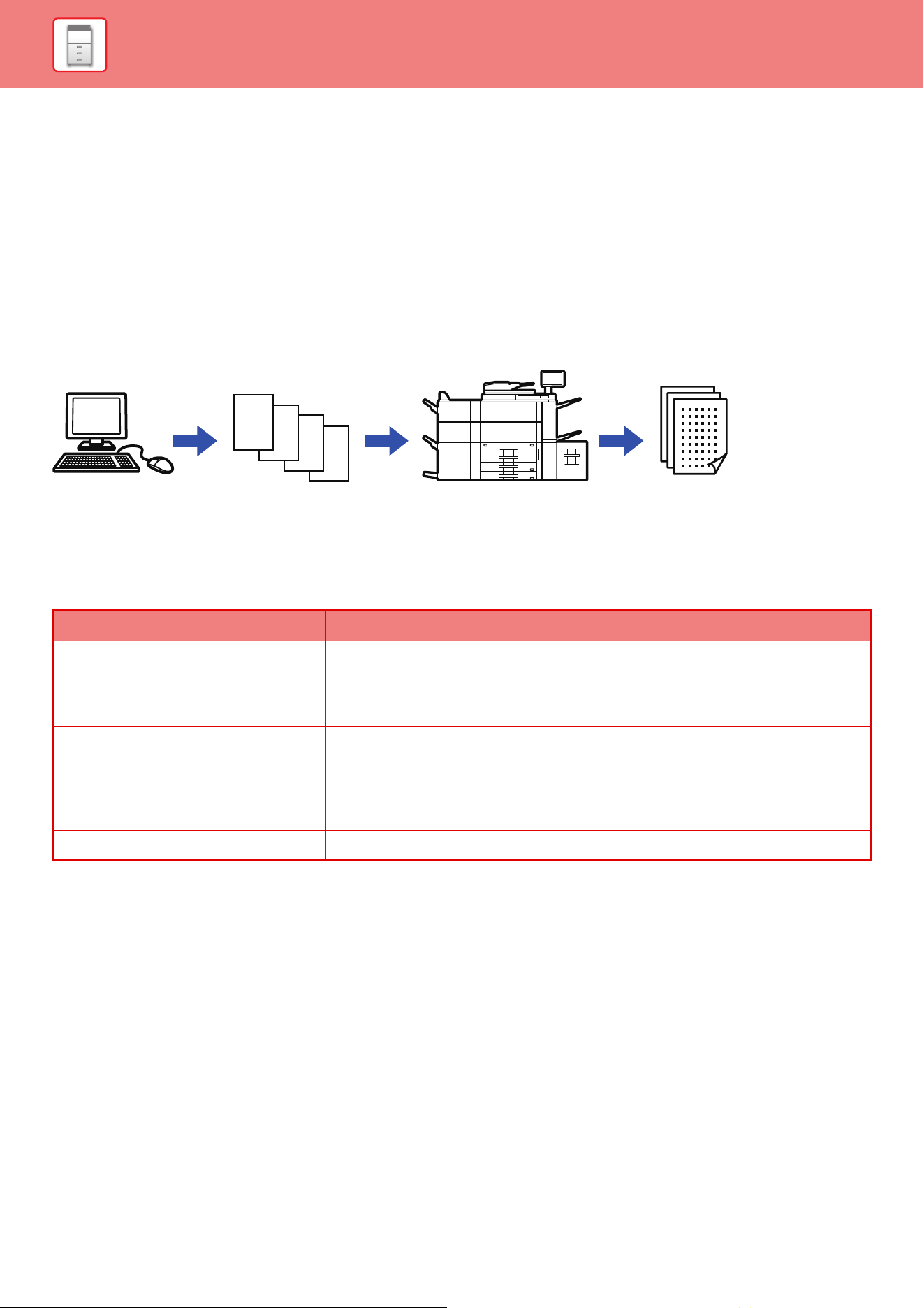
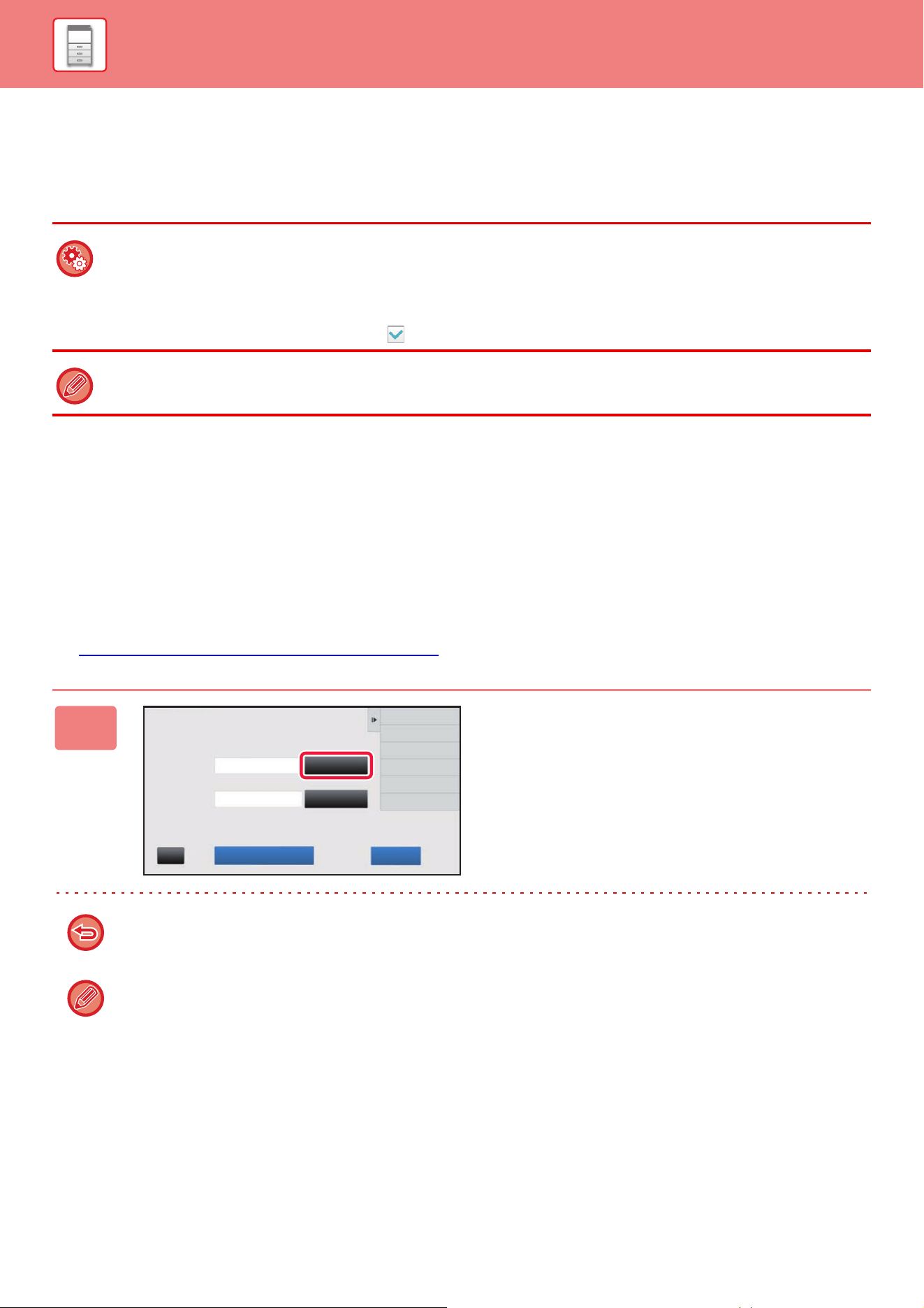
A billing code, which is added to a recorded job log when a printing or sending job has been executed, is used to
perform billing processing.
Billing codes are classified into two types: main code and sub code. A billing code is recorded in the job log when it is
entered and a print or send job is executed.
Summing up the amounts by Billing Code based on the job logs will facilitate the subsequent operations, for instance,
when making combined billings.
Types of billing codes
Enable use of billing code
To enable use of the billing code, select "Settings (administrator)" → [User Control] → [Billing Code] → [Administration
Settings], then set [Use Billing Code] to [Enable].
Collecting billing codes
In "Settings (Web version)", select [System Settings] → [System Control] → [Job Log] → [Job Log Operation], and click
[Save] button to download the job logs. Then sum up the data by classifying and arranging the stored job logs.
Type Description
Main Code Used to categorize the results of the executed print and send jobs to enable efficient
management. For example, you can assign a code by customer and collect cost
information by customer from job logs.
Code example: Issue of company A
Sub Code Available when the main code alone is not sufficient to enable management of billing
codes. For example, you can assign monthly cost information to a sub code and
collect the total monthly cost information of all customers when the customer name is
assigned to the main code.
Code example: Issue of December, 2016
Default Code Automatically assigned when the main code or sub code has not been specified.
D
C
B
A
Registering billing
codes
Assigning a billing code
and executing the job
Recording a
billing code
in the job log
Billing by code
Collecting job logs
1-40
BEFORE USING THE MACHINE►BEFORE USING THE MACHINE
USE BILLING CODE
If the use of billing code is enabled in "Settings (administrator)", the billing code entry window is displayed at the time of
mode transition (at the time of printing/sending in document filing mode).
Enter the main code or sub code as required.
Specifying a billing code again
To change the specified billing code to another one, tap [Switch Billing Code.] on the action panel.
When the billing code entry window is displayed, select a new billing code.
Select a billing code from the list
Select the desired billing code from the list of registered billing codes.
You need to register billing codes in advance.
► REGISTERING A NEW BILLING CODE (page 1-43)
• To enable use of the billing code
Select "Settings (administrator)" → [User Control] →
[Billing Code] → [Administration Settings], then set [Use Billing Code]
to [Enable].
• To retain the specified billing code at the time of mode transition
Select "Settings (administrator)" → [User Control] →
[Billing Code] → [Administration Settings], then set the [Remember
Billing Code Between Modes] check box to . This eliminates the need to enter billing codes at each mode transition.
You can assign billing codes to reprinting/resending of target files and sending of print jobs from "Settings (Web version)" →
[Document Operations].
1
When the billing code entry window is
displayed, tap the [Select from List]
key of the main code.
When not specifying a billing code
Tap the [Bypass Billing Code] key.
To select the previously used billing code (at the time of user authentication)
Tap [Use Previously-Used Billing Code] on the action panel at the time of user authentication; this displays the main
code and sub code the authenticated user has entered previously.
Billing Code
Please enter Billing Code.
Main Code
Sub Code
AAAA
AAAA
Select from List
Select from List
Bypass Billing Code OKCA
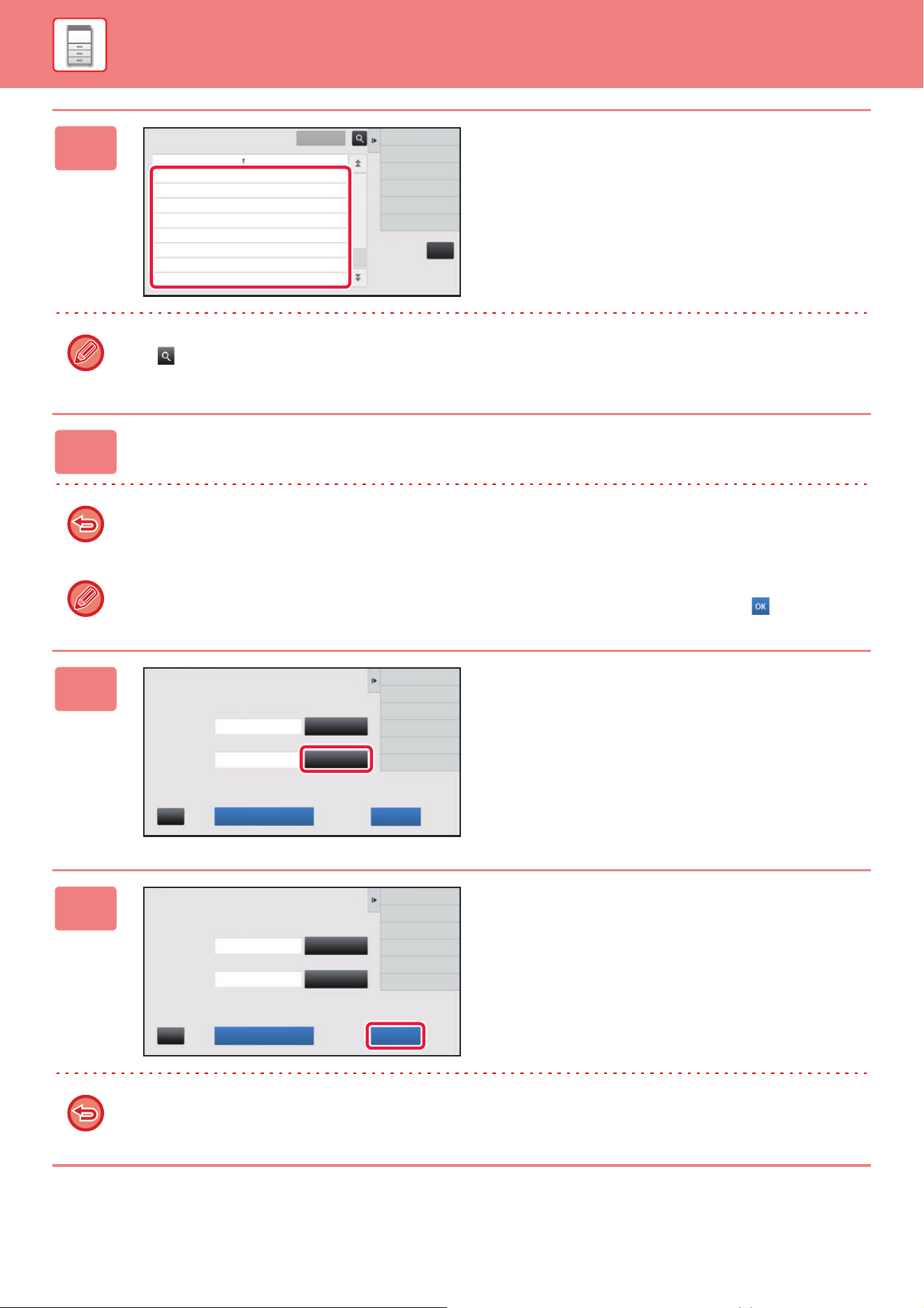
1-41
BEFORE USING THE MACHINE►BEFORE USING THE MACHINE
2
Tap and select the main code from the
list.
To search for the main code or main code name
Tap . When the search window is displayed, enter the main code and main code name, then tap the [Search Start]
key. The search result list is displayed.
3
Tap the [Execute] key.
Returns the screen to the billing code entry window.
To cancel the selection from the list
Tap [Cancel and Return] on the action panel. This cancels the selected main code and returns the screen to the billing
code entry window.
To check the details of the main code
Tap [Display Details] on the action panel. The detail window is displayed. Check the details, then tap .
4
Tap the [Select from List] key of the
sub code.
The sub code list is displayed. Perform the procedure shown
in steps 2 and 3, then specify the sub code.
5
Tap the [OK] key.
To clear the value of the specified billing code
Tap the [CA] key. Enter the billing code again.
CA
Cancel and Return
Main Code Main Code Name
MAIN001 Company 1
MAIN002 Company 2
MAIN003 Company 3
MAIN004 Company 4
MAIN005 Company 5
MAIN006 Company 6
MAIN007 Company 7
MAIN008 Company 8
Add/Edit Billing Code
Execute
Select Billing Code
Billing Code
Main Code
Sub Code
AAAA
AAAA
Select from List
Select from List
Bypass Billing Code OKCA
Please enter Billing Code.
Billing Code
Main Code
Sub Code
AAAA
AAAA
Select from List
Select from List
Bypass Billing Code OKCA
Please enter Billing Code.
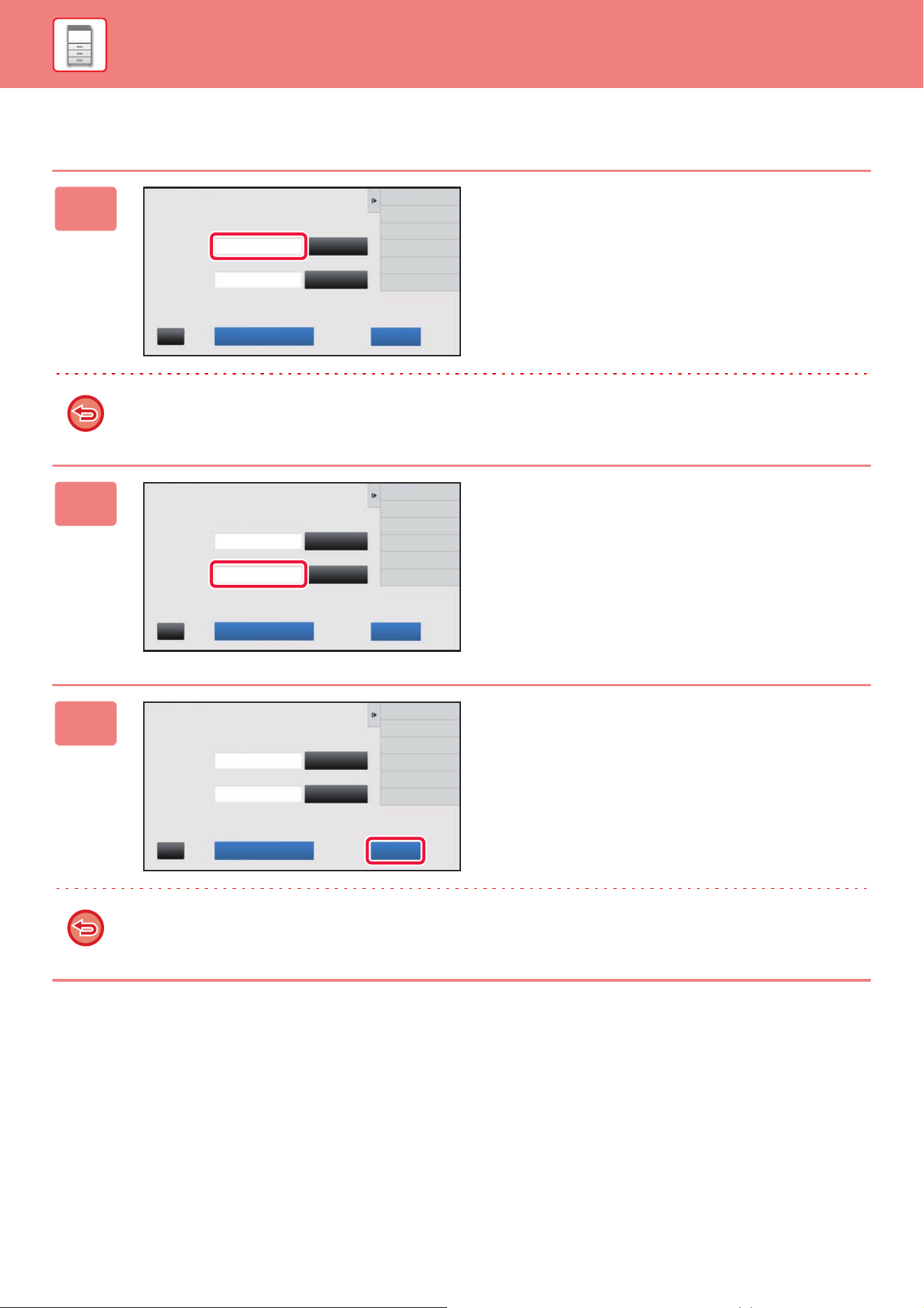
1-42
BEFORE USING THE MACHINE►BEFORE USING THE MACHINE
Directly entering a billing code
1
When the billing code entry window is
displayed, tap the box in [Main Code],
then enter the main code.
Specify the code using up to 32 single-byte characters.
When not specifying a billing code
Tap the [Bypass Billing Code] key. The use code is set to the main code.
2
Tap the box of [Sub Code], then enter
the sub code.
Specify the code using up to 32 single-byte characters.
3
Tap the [OK] key.
To clear the value of the specified billing code
Tap the [CA] key. Enter the billing code again.
Billing Code
Main Code
Sub Code
AAAA
AAAA
Select from List
Select from List
Bypass Billing Code OKCA
Please enter Billing Code.
Billing Code
Main Code
Sub Code
AAAA
AAAA
Select from List
Select from List
Bypass Billing Code OKCA
Please enter Billing Code.
Billing Code
Main Code
Sub Code
AAAA
AAAA
Select from List
Select from List
Bypass Billing Code OKCA
Please enter Billing Code.
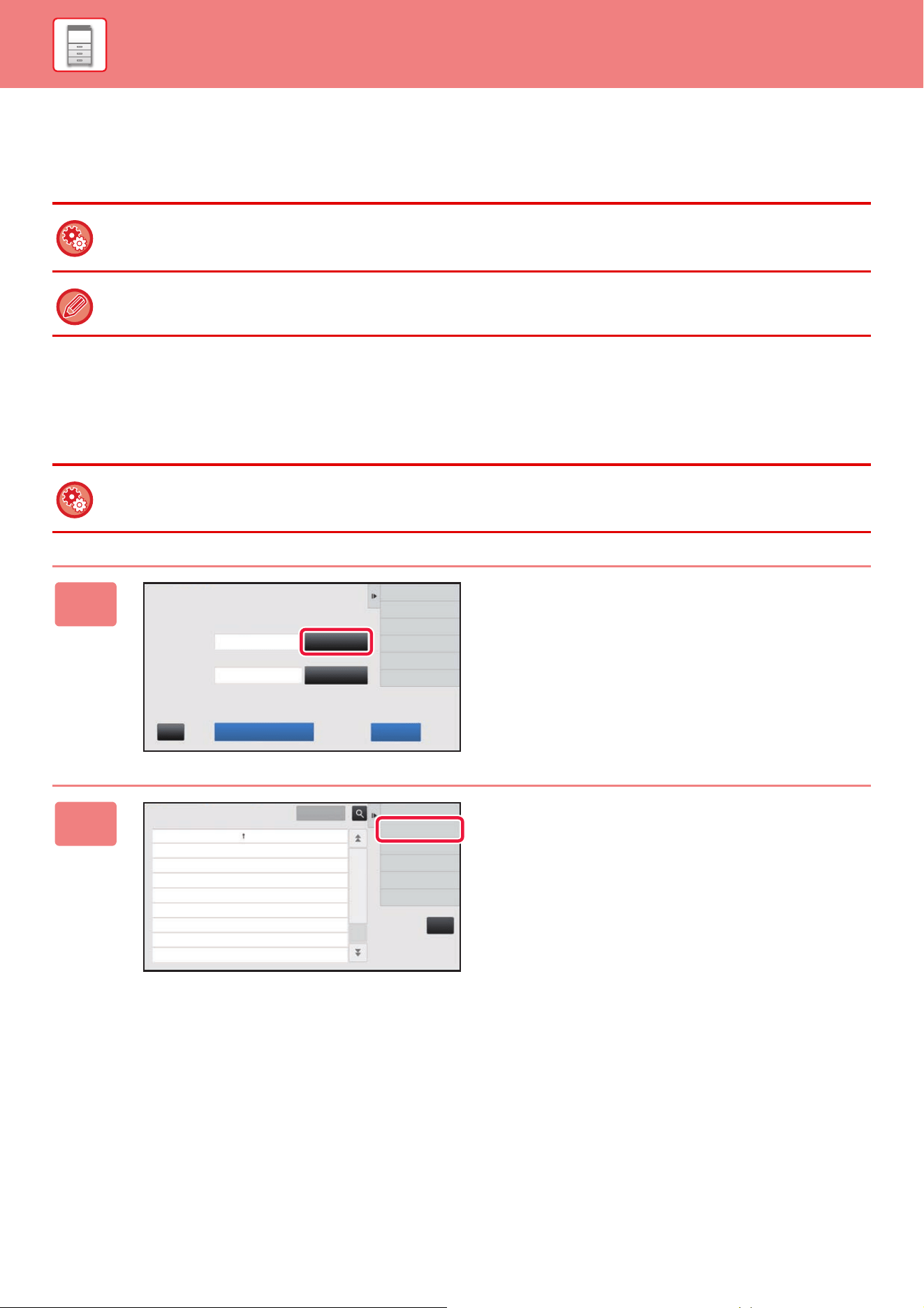
1-43
BEFORE USING THE MACHINE►BEFORE USING THE MACHINE
REGISTERING A NEW BILLING CODE
Register a new billing code.
A billing code can be registered not only from the billing code entry window but also from "Settings".
Shared range of billing code
The registered billing codes can only be shared in the specified group at the time of user authentication.
If the shared range is not specified, the registered billing codes are shared by all users.
To register a billing code from Setting Mode
Select "Settings" → [User Control] → [Billing Code] → [Main Code List] or [Sub Code List]. Register a main code in [Main
Code List], and a sub code in [Sub Code List].
A total of up to 2000 main and sub codes can be registered.
To register a user group
In "Settings (administrator)", select [User Control] → [Organization /Group List].
1
When the billing code entry window is
displayed, tap [Select from List] of the
main code.
To register a new sub code, tap the [Select from List] key of
the sub code.
The subsequent steps are the same as the main code.
2
Tap [Add/Edit Billing Code] on the
action panel
Billing Code
Please enter Billing Code.
Main Code
Sub Code
AAAA
AAAA
Select from List
Select from List
Bypass Billing Code OKCA
CA
Cancel and Return
Main Code Main Code Name
MAIN001 Company 1
MAIN002 Company 2
MAIN003 Company 3
MAIN004 Company 4
MAIN005 Company 5
MAIN006 Company 6
MAIN007 Company 7
MAIN008 Company 8
Add/Edit Billing Code
Execute
Select Billing Code
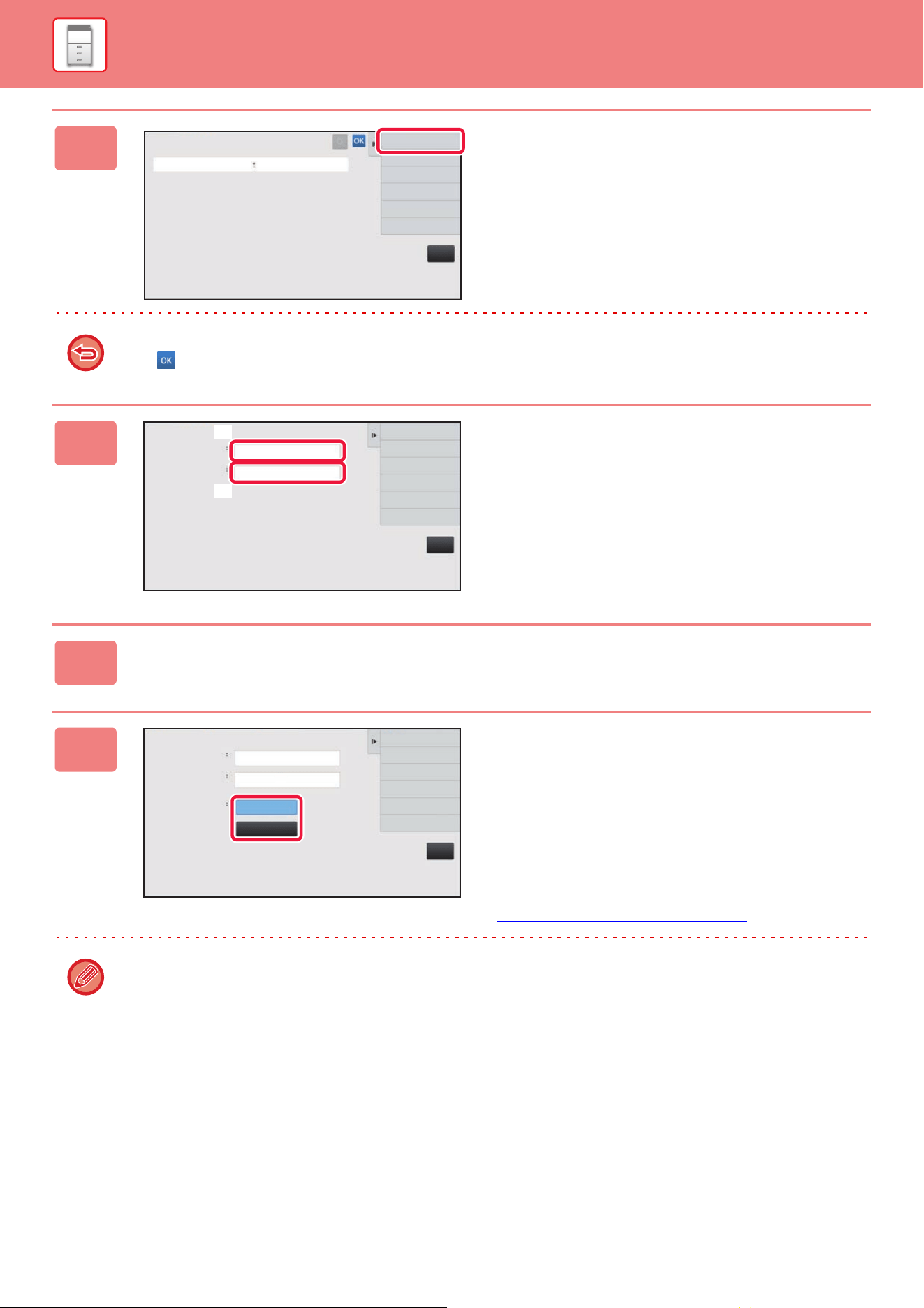
1-44
BEFORE USING THE MACHINE►BEFORE USING THE MACHINE
3
Tap [Add New] on the action panel.
To return to the billing code selection window
Tap .
4
Tap the box of [Main Code], then type
in the main code.
Specify the code using up to 32 single-byte characters.
5
Tap the box of [Main Code Name], then type in the main code name.
Specify the code name using up to 32 double- or single-byte characters.
6
If necessary, select the share range of
billing code.
Public to All: Registers the billing code as a public code for
all users who use the machine.
Specify target public address: Limits the share range of
billing code to be registered only to the specified group. Up
to eight groups can be specified as a public destination.
For details on how to specify a public destination, refer to
"Shared range of billing code (page 1-43)
".
The public destination of a billing code is not displayed if user authentication is not performed. The mode is automatically
set to [Public to All].
CA
Main Code Main Code Name
Main Code Registration
Add New
CA
Main Code
Main Code Name
Main Code Registration
Cancel and Return
End Registration
Register
Next Billing Code.
(4)
(5)
CA
Main Code
Main Code Name
Available to
Public to All
Specify target
public address
Main Code Registration
Cancel and Return
End Registration
Register
Next Billing Code.
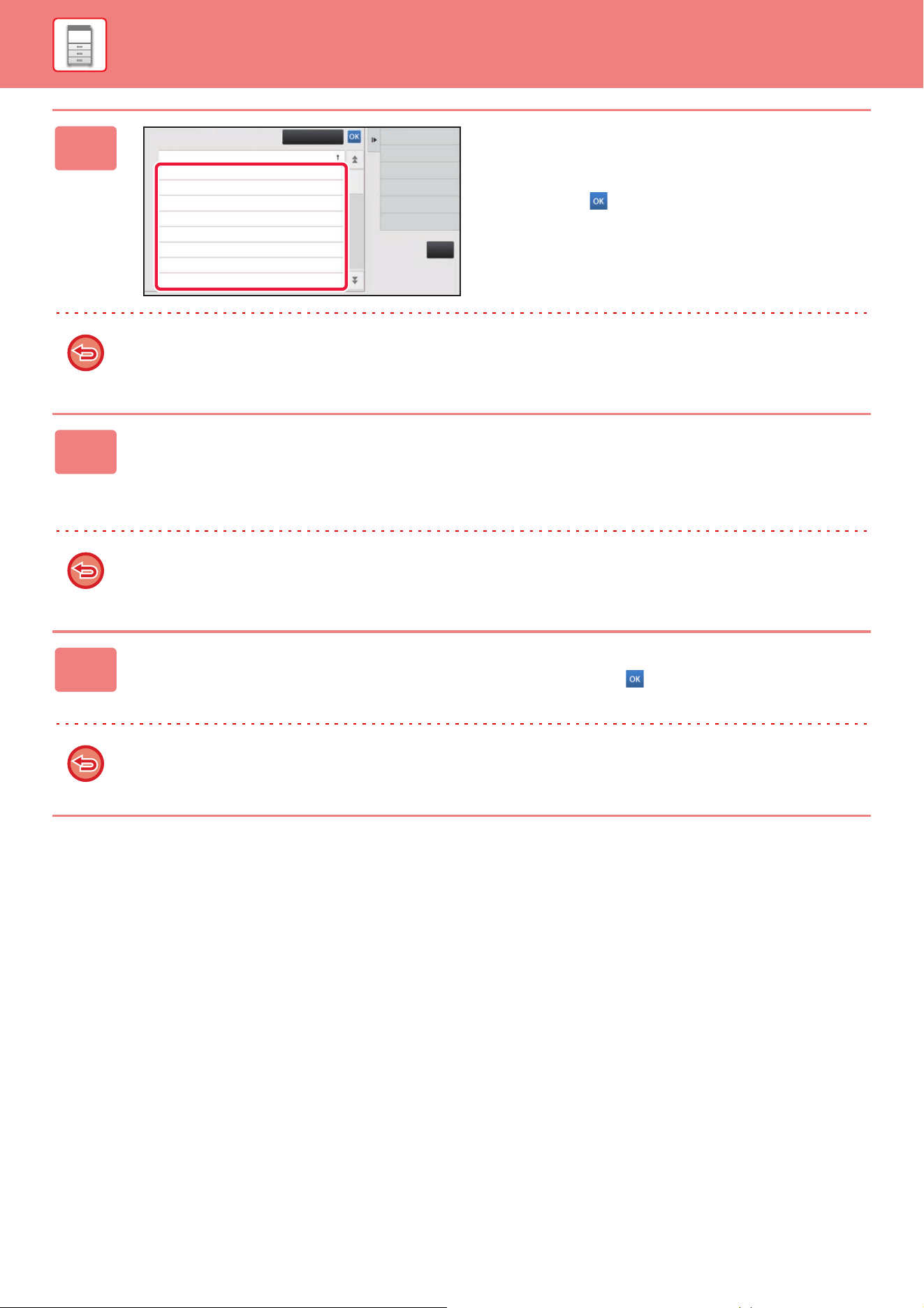
1-45
BEFORE USING THE MACHINE►BEFORE USING THE MACHINE
7
Tap and select a group as a public
destination
Up to eight groups can be specified. After the settings are
completed, tap .
To cancel the setting
Tap [Clear] on the action panel. This cancels the registered public destination and returns the screen to the previous
window.
8
To continuously register other billing codes, tap [Register Next Billing
Code.].
Execute steps 4 to 7 to register the main code.
To cancel the registration
Tap [Cancel and Return] on the action panel. This cancels all the registered billing codes and returns the screen to the
previous window.
9
Tap [End Registration] on the action panel.
This finalizes the registration and returns the screen to the previous window. Tap to finish the registration procedure.
To return to the billing code entry window
Tap the [CA] key.
CA
Organization /Group List
Group 1
Group 2
Group 3
Group 4
Group 5
Group 6
Group 7
Group 8
Clear
Designate Public Address
(Selected:1/32)
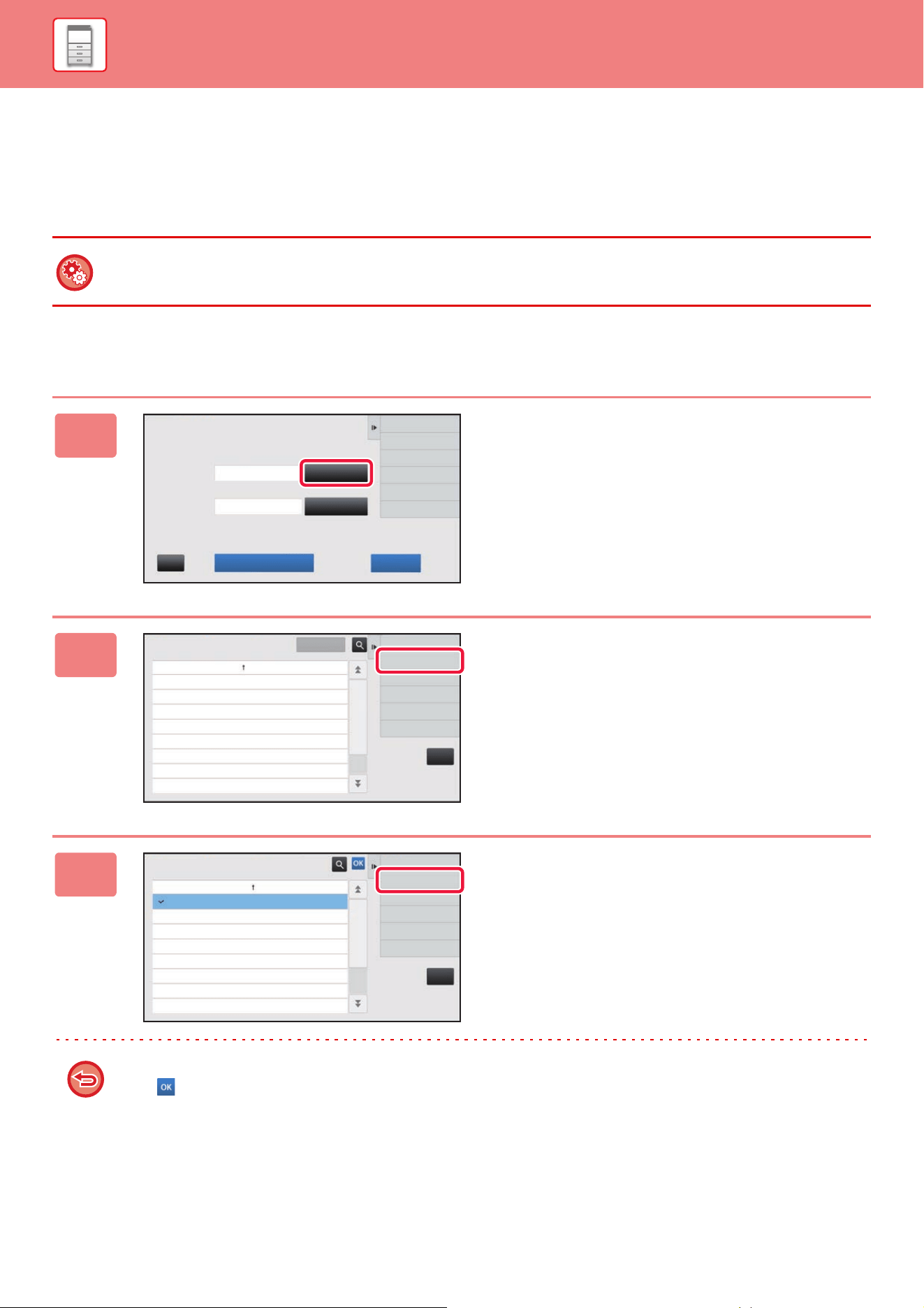
1-46
BEFORE USING THE MACHINE►BEFORE USING THE MACHINE
EDITING OR DELETING THE REGISTERED BILLING
CODE
You can change or delete the registered billing code.
The billing code can also be edited or deleted from "Settings".
Editing a billing code
To edit or register a billing code from Setting mode
Select "Settings" → [User Control] → [Billing Code] → [Main Code List] or [Sub Code List]. Edit or register a main code in
[Main Code List], and a sub code in [Sub Code List].
1
When the billing code entry window is
displayed, tap the [Select from List]
key of the main code.
To register a new sub code, tap the [Select from List] key of
the sub code.
The subsequent steps are the same as the main code.
2
Tap [Add/Edit Billing Code] on the
action panel.
3
Tap and select the main code to be
edited, then tap [Edit] on the action
panel.
To return to the billing code selection window
Tap .
Billing Code
Please enter Billing Code.
Main Code
Sub Code
AAAA
AAAA
Select from List
Select from List
Bypass Billing Code OKCA
CA
Cancel and Return
Main Code Main Code Name
MAIN001 Company 1
MAIN002 Company 2
MAIN003 Company 3
MAIN004 Company 4
MAIN005 Company 5
MAIN006 Company 6
MAIN007 Company 7
MAIN008 Company 8
Add/Edit Billing Code
Execute
Select Billing Code
CA
Add New
Main Code Main Code Name
MAIN001 Company 1
MAIN002 Company 2
MAIN003 Company 3
MAIN004 Company 4
MAIN005 Company 5
MAIN006 Company 6
MAIN007 Company 7
MAIN008 Company 8
Edit
Delete
Main Code Registration
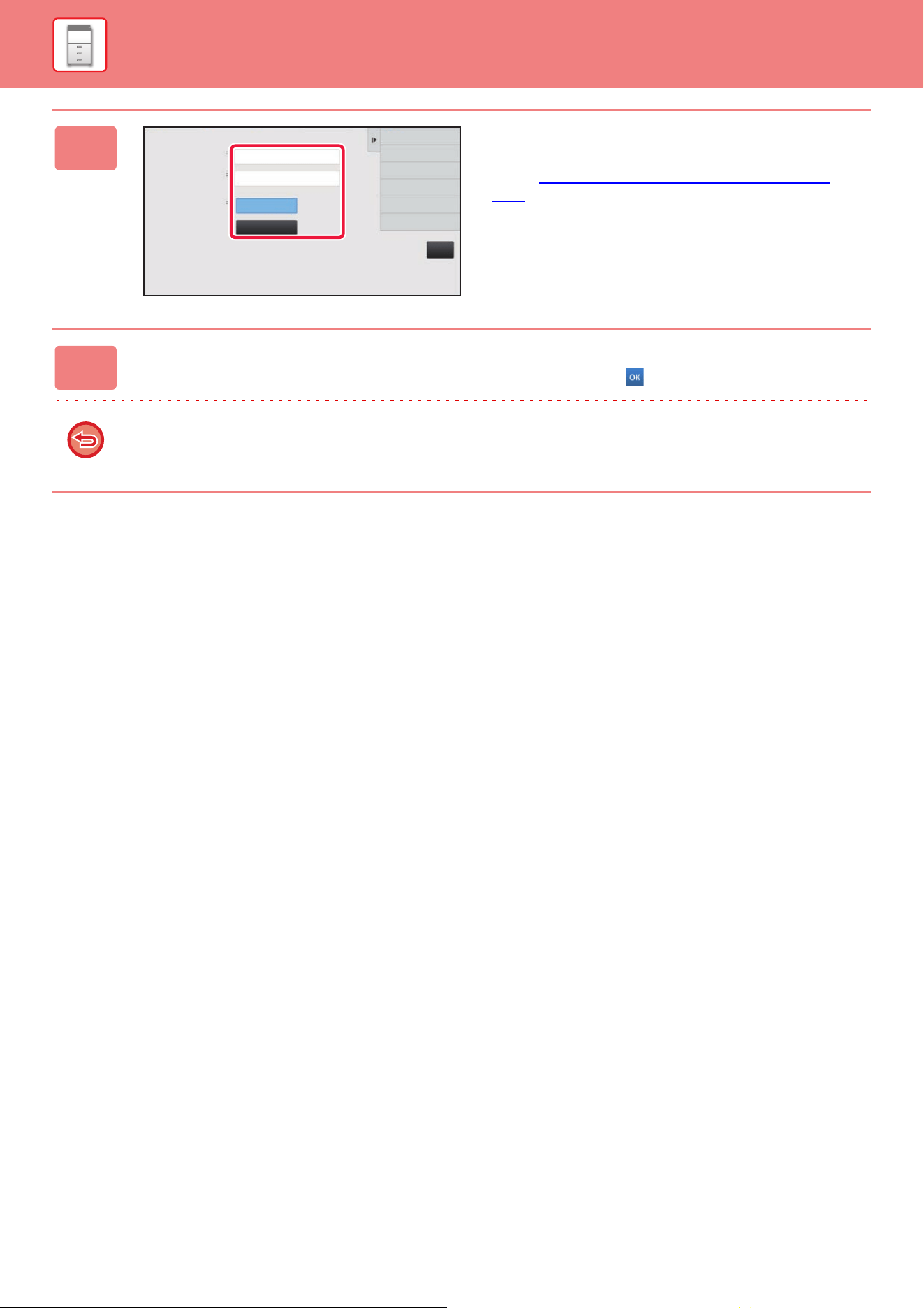
1-47
BEFORE USING THE MACHINE►BEFORE USING THE MACHINE
4
Edit the main code as required.
For information on how to correct the code, refer to steps 4
to 7 in
"
REGISTERING A NEW BILLING CODE (page
1-43)
".
5
Tap [End Registration] on the action panel.
This finalizes the registration and returns the screen to the previous window. Tap to finish the registration procedure.
To return to the billing code entry window
Tap the [CA] key.
CA
Main Code
Main Code Name
Public to All
Specify target
public address
Main Code Registration
Cancel and Return
End Registration
Register
Next Billing Code.
Available to
AAAA
AAAA
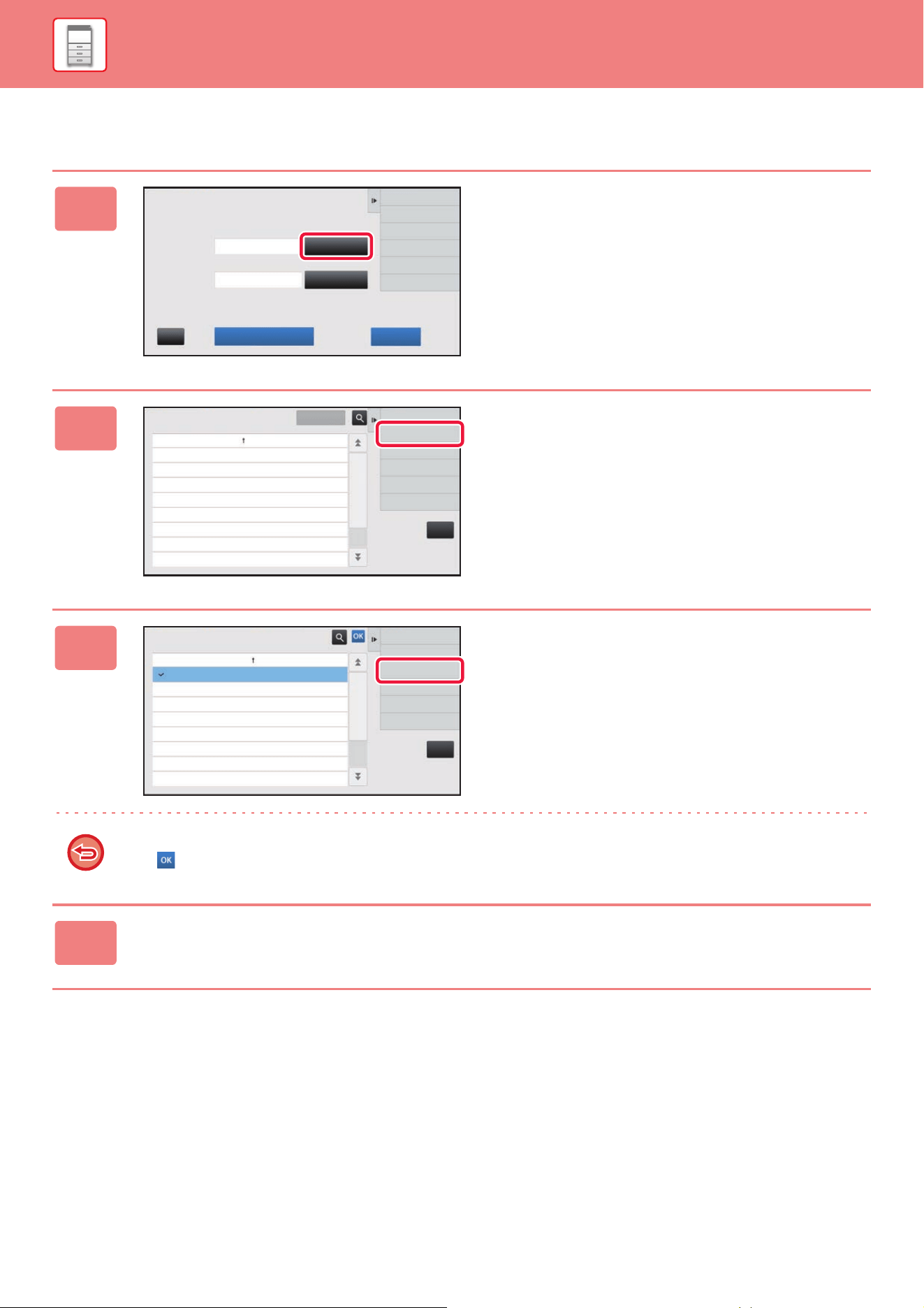
1-48
BEFORE USING THE MACHINE►BEFORE USING THE MACHINE
Deleting a billing code
1
When the billing code entry window is
displayed, tap the [Select from List]
key of the main code.
To delete a sub code, tap the [Select from List] key of the
sub code.
The subsequent steps are the same as the main code.
2
Tap [Add/Edit Billing Code] on the
action panel.
3
Tap and select the main code to be
deleted, then tap [Delete] on the action
panel.
To return to the billing code selection window
Tap .
4
When the confirmation message appears, tap the [Delete] key.
Billing Code
Please enter Billing Code.
Main Code
Sub Code
AAAA
AAAA
Select from List
Select from List
Bypass Billing Code OKCA
CA
Cancel and Return
Main Code Main Code Name
MAIN001 Company 1
MAIN002 Company 2
MAIN003 Company 3
MAIN004 Company 4
MAIN005 Company 5
MAIN006 Company 6
MAIN007 Company 7
MAIN008 Company 8
Add/Edit Billing Code
Execute
Select Billing Code
CA
Add New
Main Code Main Code Name
MAIN001 Company 1
MAIN002 Company 2
MAIN003 Company 3
MAIN004 Company 4
MAIN005 Company 5
MAIN006 Company 6
MAIN007 Company 7
MAIN008 Company 8
Edit
Delete
Main Code Registration
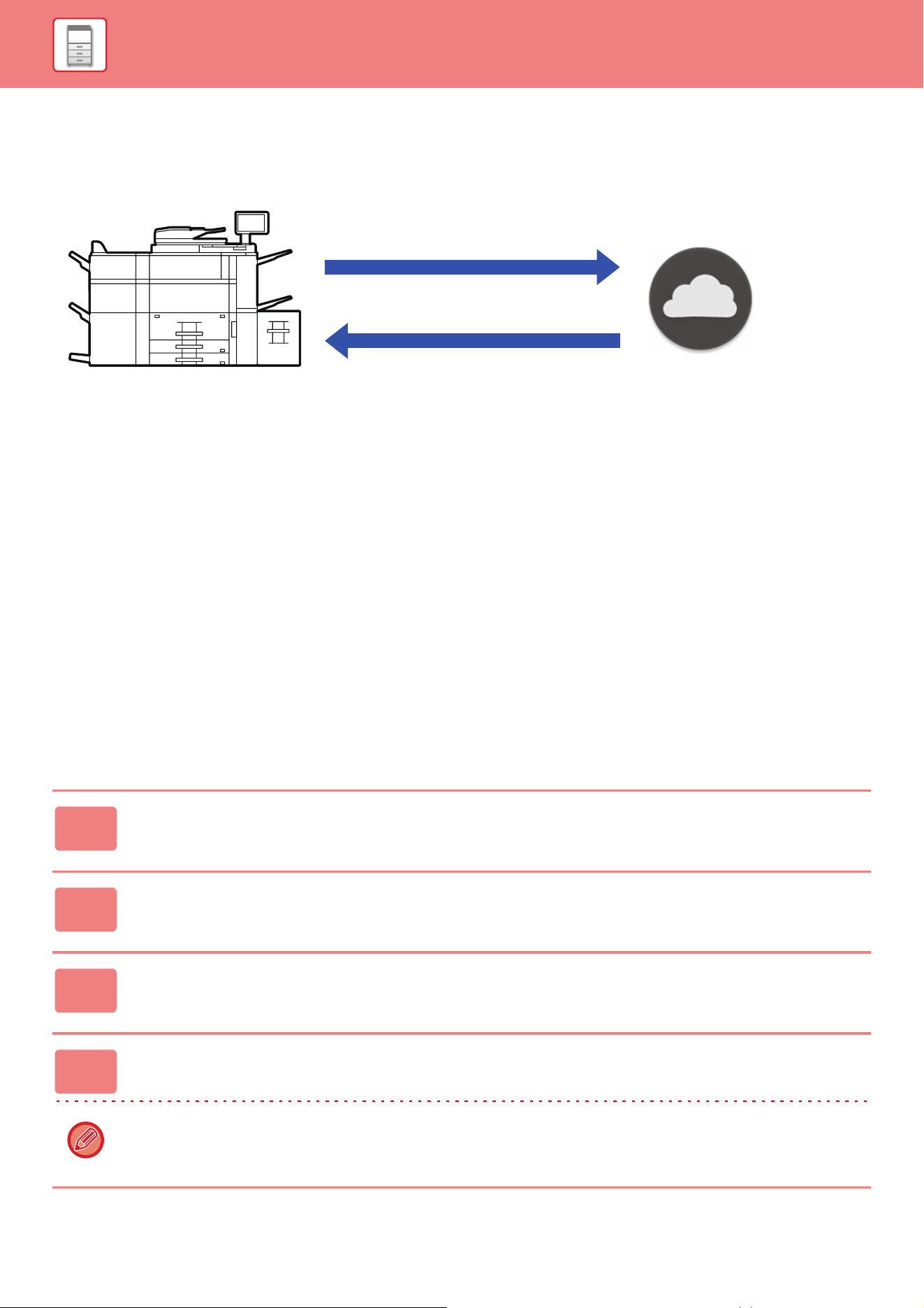
1-49
BEFORE USING THE MACHINE►BEFORE USING THE MACHINE
CLOUD LINK
The Cloud Link function is used to connect the machine to a cloud service on the Internet, enabling you to upload
scanned data and print data stored in the cloud.
The machine can connect to the following cloud services:
• Microsoft OneDrive for Business
• Microsoft SharePoint Online
• Google Drive
BEFORE USING THE CLOUD LINK FUNCTION
This section explains settings that must be configured before you can use the Cloud Link function.
Settings required on the machine
Configuring system settings
Configure settings for connection of the machine to the Internet (proxy settings, etc.) as required for your network
environment.
In addition, you must configure the following settings on the machine in order to use the "OneDrive for Business Link"
and "SharePoint Online Link" functions.
Configure these settings in "Settings (administrator)" → [System Settings] → [Network Settings] → [External Service
Connect] → [Cloud Connect Settings].
Set the cloud link icon in the home screen.
1
Tap [Edit Home] on the action panel.
2
In home edit mode, tap an unused shortcut key.
3
Tap [Google Drive], [OneDrive], or [SharePoint Online].
4
Tap [Exit Home Edit Mode] on the action panel.
Exit home edit mode and return to the home screen.
To edit the home screen, refer to the "U/I Customize Guide".
Printing data stored in the cloud
Uploading scanned data
1-50
BEFORE USING THE MACHINE►BEFORE USING THE MACHINE
UPLOADING SCANNED DATA TO A CLOUD SERVICE
This section explains how to upload data scanned on the machine to a cloud service.
PRINTING DATA IN A CLOUD SERVICE
This section explains how to use the machine to print data in a cloud service.
1
Tap [Google Drive], [OneDrive], or [SharePoint Online] in the home screen.
• The login screen of the selected cloud service appears.
• When user authentication is enabled on the machine, the login screen will not appear after the first time you
successfully log in to the cloud service.
When using OneDrive or SharePoint Online, you can only login using your standard Office 365 user account for
ID/password authentication.
2
Enter your user account information for the cloud service.
A screen for selecting tasks appears.
3
Tap the [Scan a document] key.
• The scan settings screen appears.
• Specify a "File Name", "Address", and "Upload Data Scan Settings".
When using SharePoint Online, you can upload to "Shared Documents".
4
Execute Scan or Preview.
1
Tap [Google Drive], [OneDrive], or [SharePoint Online] in the home screen.
• The login screen of the selected cloud service appears.
• When user authentication is enabled on the machine, the login screen will not appear after the first time you
successfully log in to the cloud service.
When using OneDrive or SharePoint Online, you can only login using your standard Office 365 user account for
ID/password authentication.
2
Enter your user account information for the cloud service.
A screen for selecting tasks appears.
1-51
BEFORE USING THE MACHINE►BEFORE USING THE MACHINE
Cautions when using the Cloud Link function
• Print results using the Cloud Link function may not have the same quality as print results using other print methods
(printer driver, etc.).
The contents of some files may cause incorrect printing or prevent printing.
• It may not be possible to use some or all Cloud Link functions in some countries or regions where the machine is
used.
• It may not be possible to use the Cloud Link function in some network environments. Even when the Cloud Link
function can be used, processing may require a longer time or may be interrupted.
• We do not extend any guarantees regarding the continuity or connection stability of the Cloud Link function.
With the exception of instances provided for by law, we bear absolutely no responsibility for any damages or loss
suffered by the customer due to the above.
DirectOffice™ is a product of CSR Imaging US, LP.
DirectOffice™ is a trademark of CSR Imaging US, LP, registered in the United States and other countries, used with
permission.
3
Tap the [Print a document] key.
• The file selection screen appears.
• Select the file and tap the [Choose Print Settings] key to display the print settings screen.
• When using SharePoint Online, you can print data in "Shared Documents".
• File formats that can be printed are DOCX, PPTX, XLSX, PDF, PS, PRN, PCL, TIFF, TIF, JFIF, JPE, JPEG, JPG, and
PNG.
4
Execute printing.
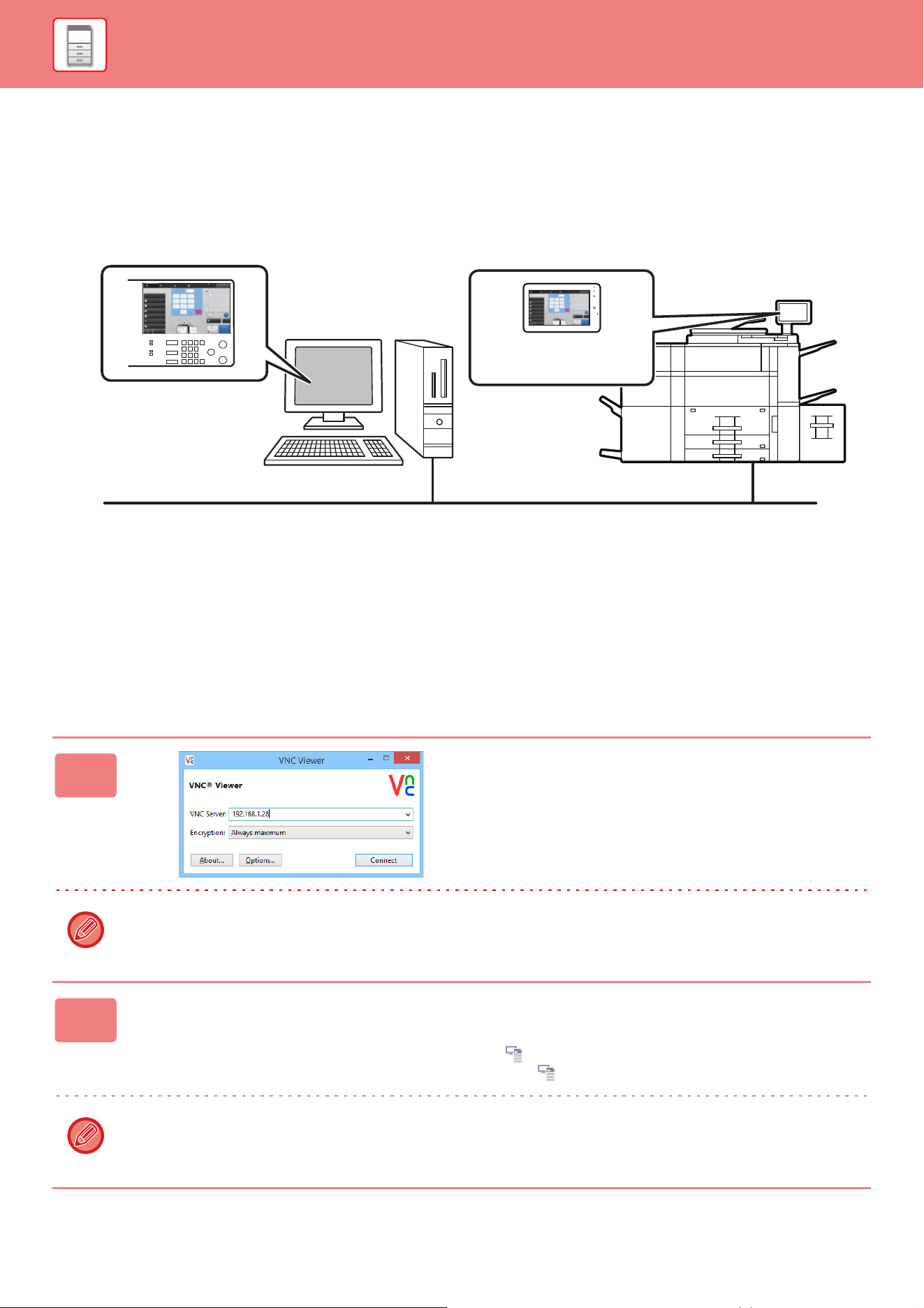
1-52
BEFORE USING THE MACHINE►BEFORE USING THE MACHINE
REMOTE OPERATION OF THE MACHINE
Remotely operate the machine on your computer.
You can operate the machine from the same panel as the machine's operation panel that is displayed on your PC, with
the same feel as operating in front of the machine.
The remote operation function can only be used on one computer at a time.
Before you can use the remote operation function, the following preparation is required.
•
In "Settings (administrator)", select [System Settings] → [Common Settings] → [Operation Settings] → [Condition
Settings] → [Remote Operation Settings] → [Remote Software Operation] and select [Allow] for [Operational Authority].
• Connect the machine to the network.
• Install a VNC application software (recommended VNC software: RealVNC) in your computer.
After the preparation is completed, follow the operation described below to set up the function.
Example: RealVNC
1
Start the VNC viewer, enter the IP
address of the machine in the "VNC
Server" entry box, and click the
[Connect] button.
Check with the administrator of the machine for its IP address.
2
Follow the message on the operation panel of the machine to permit the
connection.
When the machine is connected to a VNC application software, appears on the system bar of the machine's touch panel.
If you wish to disconnect, exit the VNC application software or tap .
Use the operation panel in the same way as you would on the machine. However, you cannot enter values in series by
continuously clicking the key.
Start
Colour
Start
Preview
Color Mode
Full Color
Paper Select
Auto
Exposure
Auto
Original
Auto 8½x11
2-Sided Copy
1-Sided→1-Sided
Output
Copy Ratio
100%
Others
Plain 1
Send and print
Call Eco Program
Store Data in Folder
File
Store Data Temporarily
Quick File
1
4
7
5
8
6
9
2
0
3
C
1
5½x8½
8½x14
11x17
21
3
4
No. of copies
CA
B/W
8½x11
LINE PRINTER
E-mail
HDD
File retrieve
Sharp OSA
Job Management
Copy
Proof Copy
Plain 1
8½x11
Plain 1
8½x11
8½x11
8½x11
8½x11
8½x11
8½x11
56
87
Start
Colour
Start
Preview
Color Mode
Full Color
Paper Select
Auto
Exposure
Auto
Original
Auto
8½x11
2-Sided Copy
1-Sided→1-Sided
Output
Copy Ratio
100%
Others
Plain 1
Send and print
Call Eco Program
Store Data in Folder
File
Store Data Temporarily
Quick File
1
4
7
5
8
6
9
2
0
3
C
1
5½x8½
8½x14
11x17
2
1
3
4
No. of copies
CA
B/W
8½x11
LINE PRINTER
E-mail
HDD
File retrieve
Sharp OSA
Job management
Copy
Proof Copy
Plain 1
8½x11
Plain 1
8½x11
8½x11
8½x11
8½x11
8½x11
8½x11
56
87
Operate the machine
using your computer
screen.
Your computer
Network
Operation panel
The machine
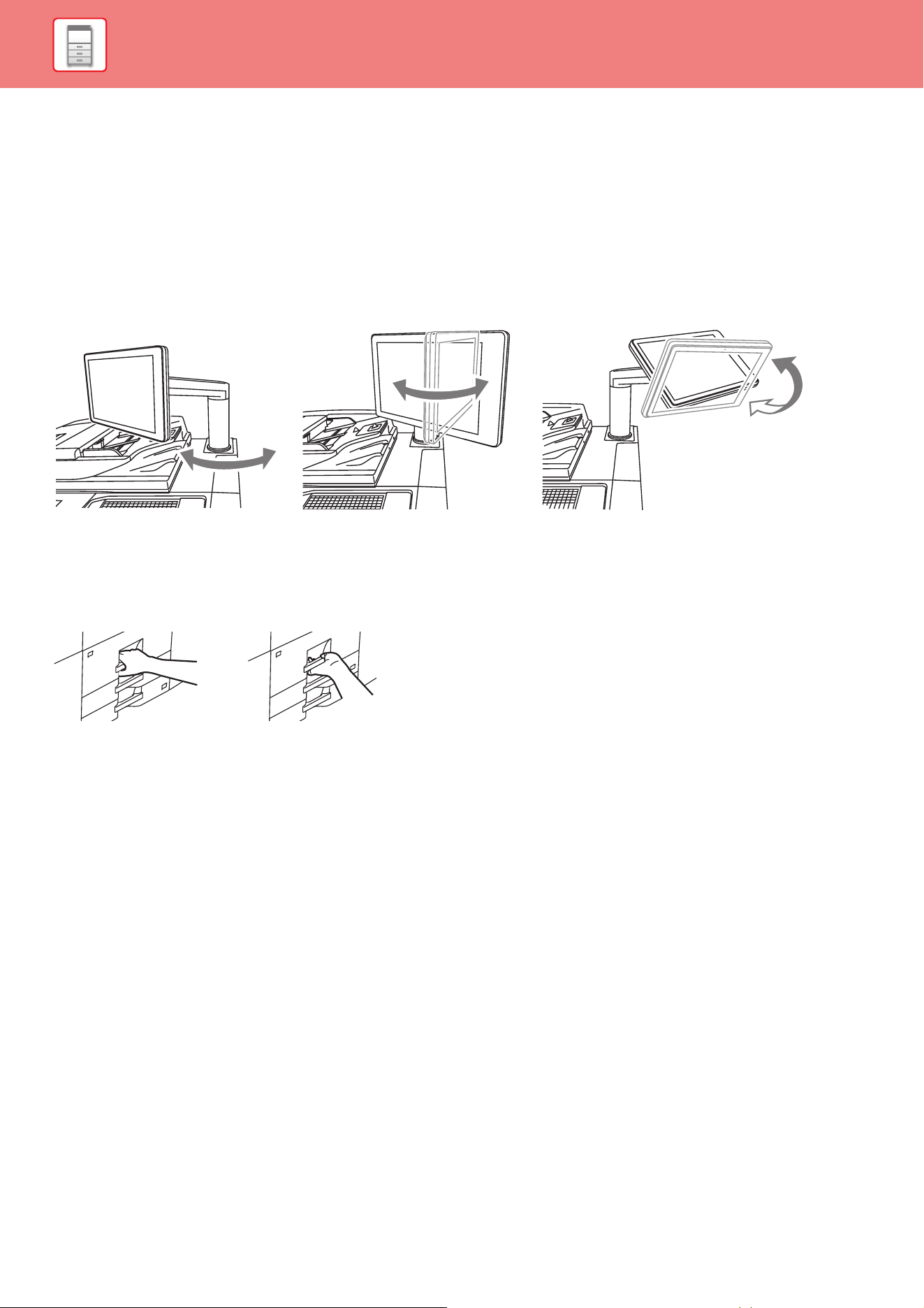
1-53
BEFORE USING THE MACHINE►BEFORE USING THE MACHINE
UNIVERSAL DESIGN IN THE MACHINE
The structure of the machine and the software are designed to allow all people to use the machine with ease.
UNIVERSAL DESIGN RELATED TO OPERATION
Adjustment of operation panel angle
The angle of the entire operation panel can be adjusted to enable use even when seated.
Grip handle on paper trays
The grip-type handles allow easy use from above or below. By simply placing your hand on a handle and gently pulling
forward, the lock releases. The trays can be manipulated in a natural manner.
Changing of key response time
The response time of the keys can be changed as needed.
In "Settings" (administrator)", select [System Settings] → [Common Settings] → [Operation Settings] → [Condition
Settings] → [Key Operation Setting].
• Time for Accepting Key Entry
This setting determines how long a key in the touch panel must be tapped until the key input is registered. The time
can be set from 0 to 2 seconds in increments of 0.5 seconds.
By lengthening the time setting, key input can be prevented when a key is tapped accidentally. Keep in mind,
however, that when a longer setting is selected more care is required when tapping keys to ensure that key input is
registered.
• Disable Auto Key Repeat
This is used to disable key repeat.
Key repeat causes a setting to change continuously not only each time the key is tapped but while a key is tapped.
• Long-touch Detection Time
Select a time when a long key touch is detected.
• Double Tap Speed Interval
Select an interval when a double tap is detected.
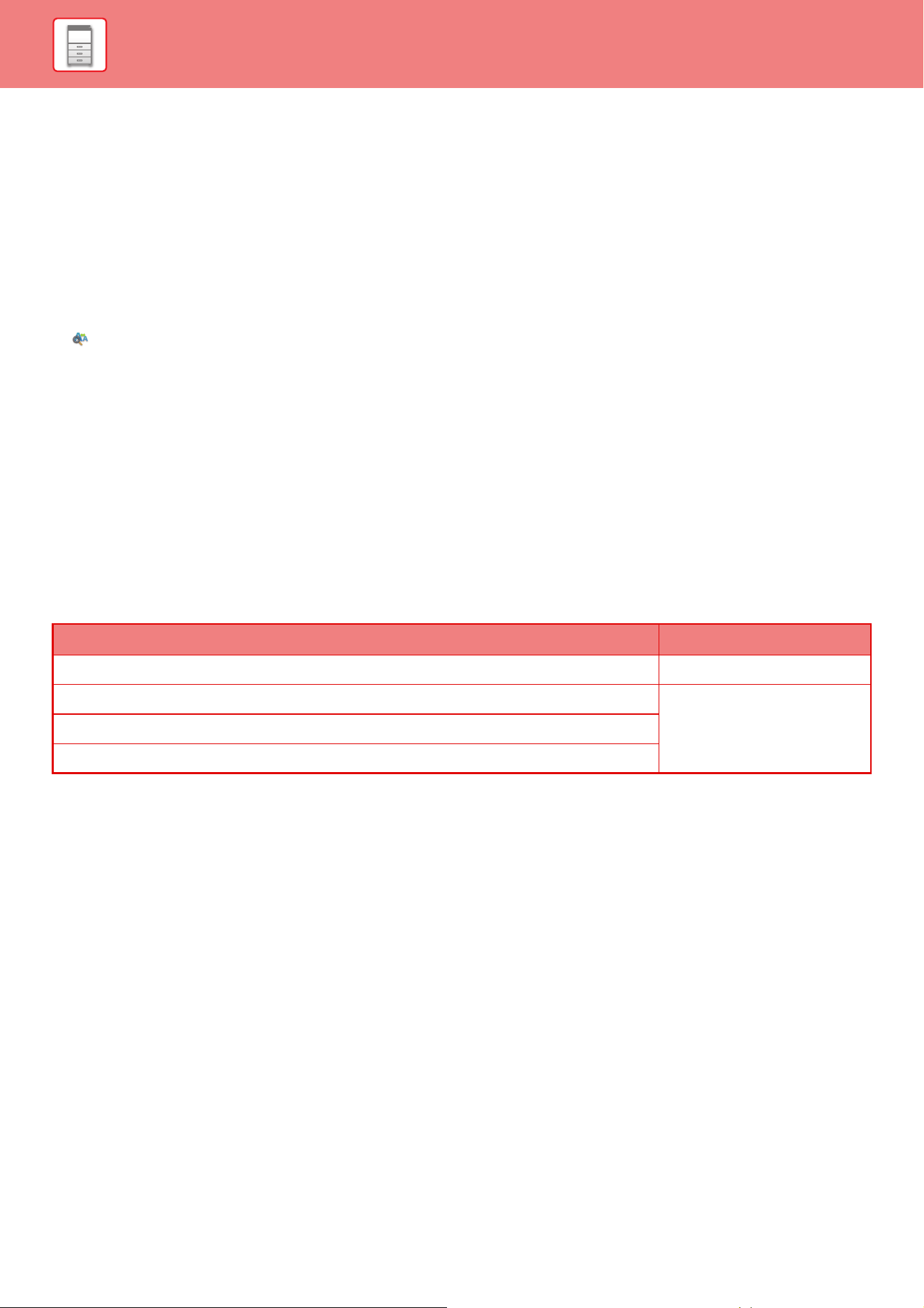
1-54
BEFORE USING THE MACHINE►BEFORE USING THE MACHINE
UNIVERSAL DESIGN RELATED TO VISION
Changing of text size
The size of the text on the touch panel can be changed. When the text on the touch panel is small and difficult to read,
the text can be enlarged.
In "Settings" (administrator)", select [System Settings] → [Common Settings] → [Operation Settings] → [Condition
Settings] → [Enlarge Display Mode].
• Enlarge Display Mode
Displays large characters on the screen.
appears in the system area when Enlarge Display Mode is enabled.
UNIVERSAL DESIGN RELATED TO HEARING
Audible alert sounds when changing settings
When moving through copy ratio or exposure settings, the user is alerted by an audible sound at the default setting
(copy ratio 100%, exposure 3).
In "Settings (administrator)", select [System Settings] → [Common Settings] → [Operation Settings] → [Condition
Settings] → [Keys Touch Sound] and [Make Key Touch Sound at Default Setting].
• Keys Touch Sound
Controls the key touch sound level, or turns the sound off. You can also have three peeps sound at initial values when
setting the ratio in copy mode or when adjusting the exposure in any mode.
• Make Key Touch Sound at Default Setting
When you specify the exposure in the exposure adjustment screen of each mode, a bleep sounds three times when
the reference value is reached.
Screen in which setting is effective Initial value
Ratio setting screen in base screen of copy mode Ratio 100%
Exposure setting screen in base screen of copy mode Exposure level: 3 (medium)
Exposure adjustment screen in base screen of network scanner modes
Exposure adjustment screen for Scan to HDD in document filing mode
1-55
BEFORE USING THE MACHINE►BEFORE USING THE MACHINE
UNIVERSAL DESIGN FEATURES
The machine has design features and settings that are compatible with universal design.
Easy-to-use user interface
• Easy mode
This mode shows only frequently used items. Buttons and text are enlarged to increase ease of operation. Almost all
regular operations can be completed using the easy mode screen.
► COPY MODE (page 2-3)
► NETWORK SCANNER MODE (page 4-6)
• Customizing the home screen and adding icons
You can add icons to the home screen. You can also change an icon image to a custom image.
Add an icon image in "Settings (administrator)" - [System Settings] →[Home Screen Settings] →[Icon].
To add an icon to the home screen, add a key in "Settings (administrator)" - [System Settings] →[Home Screen Settings]
→[Condition Settings] →[Home Button]/[Fix Key].
► Home Screen Settings (page 7-75)
• Customizing the home screen - changing the display order
You can change the order of the items in the home screen so that the items you use most frequently appear first.
To change the order of the items in the home screen, change in "Settings (administrator)" - [System Settings]
→[Home Screen Settings] →[Condition Settings] →[Home Button].
► Home Screen Settings (page 7-75)
• Customizing the home screen - intuitive and easy-to-use design
A flat icon design is used to make the screen intuitive and easy to view. The toner level is always shown, eliminating
the need to perform an action to check the toner level.
• High-contrast display (UD pattern)
The touch panel image can be set to high contrast.
Select [Pattern 5] in "Settings (administrator)" - [System Settings] →[Common Settings] →[Operation Settings]
→[Condition Settings] →[MFP Display Pattern Setting].
► Operation Settings (page 7-114)
• Multi-language display
The language used in the touch panel can be changed to another language such as English or French.
Select the desired language in "Settings (administrator)" - [System Settings] →[Common Settings] →[Operation
Settings] →[Condition Settings] →[Display Language Setting].
► Operation Settings (page 7-114)
For the procedures for editing the home screen, see "U/I Customize Guide".
1-56
BEFORE USING THE MACHINE►BEFORE USING THE MACHINE
Intuitive operation
• Quick-view operation guide
Touch the [Operation Guide] key in the home screen on the touch panel to display the operation guide. The operation
guide provides simple explanations of how to use the machine.
• Easy operation by storing programs
The program function lets you store groups of settings for copying and other functions. By storing groups of settings
that you frequently use, you can easily select those settings.
► PROGRAMS (page 2-149)
► STORING SCAN OPERATIONS (PROGRAM) (page 4-59)
• Remote operation
You can display the machine's touch panel on a computer on the same network to operate the machine from the
computer. You can show how to use the machine on a computer, and people who have difficulty using the touch panel
can operate the machine from a computer.
► REMOTE OPERATION OF THE MACHINE (page 1-52)
Easier operation at the machine
• Darkened output tray color
Output tray colors are darkened to make it easy to distinguish the tray to which a job has been output.
• On right side of operation panel
Located on the right side of the operation panel, this allows smooth removal of paper without interfering with the
output tray.
Worry-free support
• Sharp Power Net System
This system regularly monitors and diagnoses the condition of the machine via the Internet. This enables toner and
other supplies to be provided in a timely fashion. If a problem occurs, the system helps you to identify and quickly fix
the problem, reducing down time.
1-57
BEFORE USING THE MACHINE►BEFORE USING THE MACHINE
ITEMS RECORDED IN THE JOB LOG
The machine records the performed jobs in the job log.
The main information recorded in the job log is described below.
• To make it easy to total the usage counts of differently configured machines, the items recorded in the job log are fixed,
regardless of what peripheral devices are installed or the objective of the recording.
• In some cases, job information may not be correctly recorded, such as when a power failure occurs during a job.
No. Item name Description
1 Main items Job ID The job ID is recorded. Job IDs appear in the log as
consecutive numbers up to a maximum of 999999,
after which the count resets to 1.
2 Account Job ID
The job ID used in the Sharp OSA is recorded.
3 Job Mode
The job mode type, such as copy or print is recorded.
4 Computer Name The name of the computer that sent a print job is
recorded.*
5 User Name The user name when the user authentication
function is used is recorded.
6 Login Name The login name when the user authentication
function is used is recorded.
7 Card ID The card ID when it is used for an authentication
process is recorded.
8 Number of Card Issuance The number of times the card has been issued is
written in an SSFC IC card is recorded.
9 Main Code Main Code is recorded.
10 Sub Code Sub Code is recorded.
11 Starting Date & Time The date and time the job was started are recorded.
12 Completing Date & Time The date and time the job was completed are
recorded.
13 Black & White Total Count For a print job, the total count is recorded. For a
send job, the number of transmitted black & white
pages is recorded. When a broadcast transmission
is summarized, the total number of pages is
recorded. For a scan to HDD job, the number of
stored black & white pages is recorded.
14 Full Color Total Count The total number of pages in a send job that have
been printed using a full color is recorded.
15 3-Color Total Count The total count of trio-color pages is recorded.
16 2-Color Total Count For a print job, the total count of two color pages is
recorded. For a save job, the number of saved
two-color pages is recorded.
17 Single Color Total Count The total number of pages in a print job that have
been printed using a single color is recorded.
18 Count according to size Counts by original/paper size in color mode and
black & white mode are recorded.
19 Invalid Paper Count(Black &
White)
The black & white invalid sheet count is recorded.
20 Invalid Paper Count(Color) The color invalid sheet count is recorded.
1-58
BEFORE USING THE MACHINE►BEFORE USING THE MACHINE
21 Main items Number of Reserved Sets Number of specified sets or reserved destinations is
recorded.
22 Number of Completed Sets Number of completed sets or number of
destinations to which transmission was successfully
completed is recorded.
23 Number of Reserved Pages Number of reserved original pages of a copy, print,
scan job, or other job is recorded.
24 Number of Completed Pages Number of completed pages of a set is recorded.
25 Result The result of a job is recorded.
26 Error Cause When an error occurs during a job, the cause of the
error is recorded.
27 Print Job Related Item Output The output mode of a printed job is recorded.
28 Staple The status of stapling is recorded.
29 Staple Count The staple count is recorded.
30 Punch The status of punching is recorded.
31 Punch Count The punch count is recorded.
32 Fold A job that uses the fold function is recorded.
33 Fold Count Number of folded pages is recorded.
34 Saddle Fold A job that uses the saddle fold function is recorded.
35 Saddle Fold Count Number of saddle folded pages is recorded.
36 Printer Tone The tone used for a print job is recorded.
37 Image Send Related Item Address Address of an image send job is recorded.
38 Sender Name Sender name of an image send job is recorded.
39 Sender Address Sender address of an image send job is recorded.
40 Transmission Type Transmission type of an image send job is
recorded.
41 Administrative Serial
Number
Administrative serial number of an image send job
is recorded.
42 Broadcast number Broadcast number of an image send job is
recorded.
43 Entry Order Reservation order for broadcast transmission of an
image send job is recorded. This is used to link
communication and printing when recording multi
polling jobs.
44 File Format File format of an image send job or scan to HDD job
is recorded.
45 Sign Records whether or not an electronic signature is
used in e-mail transmission.
46 Encry. Records whether or not encryption is used for
e-mail transmission.
47 Compression
Mode/Compression Ratio
Compression mode and compression ratio of the
file of an image send job or scan to HDD job is
recorded.
48 Communication Time The communication time of image send jobs is
recorded.
No. Item name Description
1-59
BEFORE USING THE MACHINE►BEFORE USING THE MACHINE
* In some environments this is not recorded.
50 Document Filing Related
Item
Document Filing Status of document filing is recorded.
51 Storing Mode Document filing storing mode is recorded.
52 Common Functionality Color Setting Color mode selected by user is recorded.
53 Special Modes Special modes selected when the job was executed
is recorded.
54 File Name The stored file name is recorded.*
55 Data Size [KB] The size of a file is recorded.
56 Detailed Items Original Size Size of scanned original is recorded. For a
document filing print job, the paper size of the file is
recorded.
57 Original Type Original type (text, printed photo, etc.) set in the
exposure settings screen is recorded.
58 Original Count Number of scanned original sheets is recorded.
59 Paper Size For a print job, the paper size is recorded. For a
send job, the transmitted paper size is recorded.
For a Scan to HDD job, the paper size of the stored
file is recorded.
60 Paper Type The paper type used for printing is recorded.
61 Paper Property The paper property specified in "Paper Type" is
recorded.
62 Duplex Setup The duplex setting is recorded.
63 Resolution The scanning resolution is recorded.
64 Machine Item Model Name The model name of the machine is recorded.
65 Unit Serial Number The serial number of the machine is recorded.
66 Name The name of the machine that is set in the Web
pages is recorded.
67 Machine Location The installation location of the machine that is set in
the Web pages is recorded.
68 Machine ID Record the Machine ID entered by the service
technician.
No. Item name Description
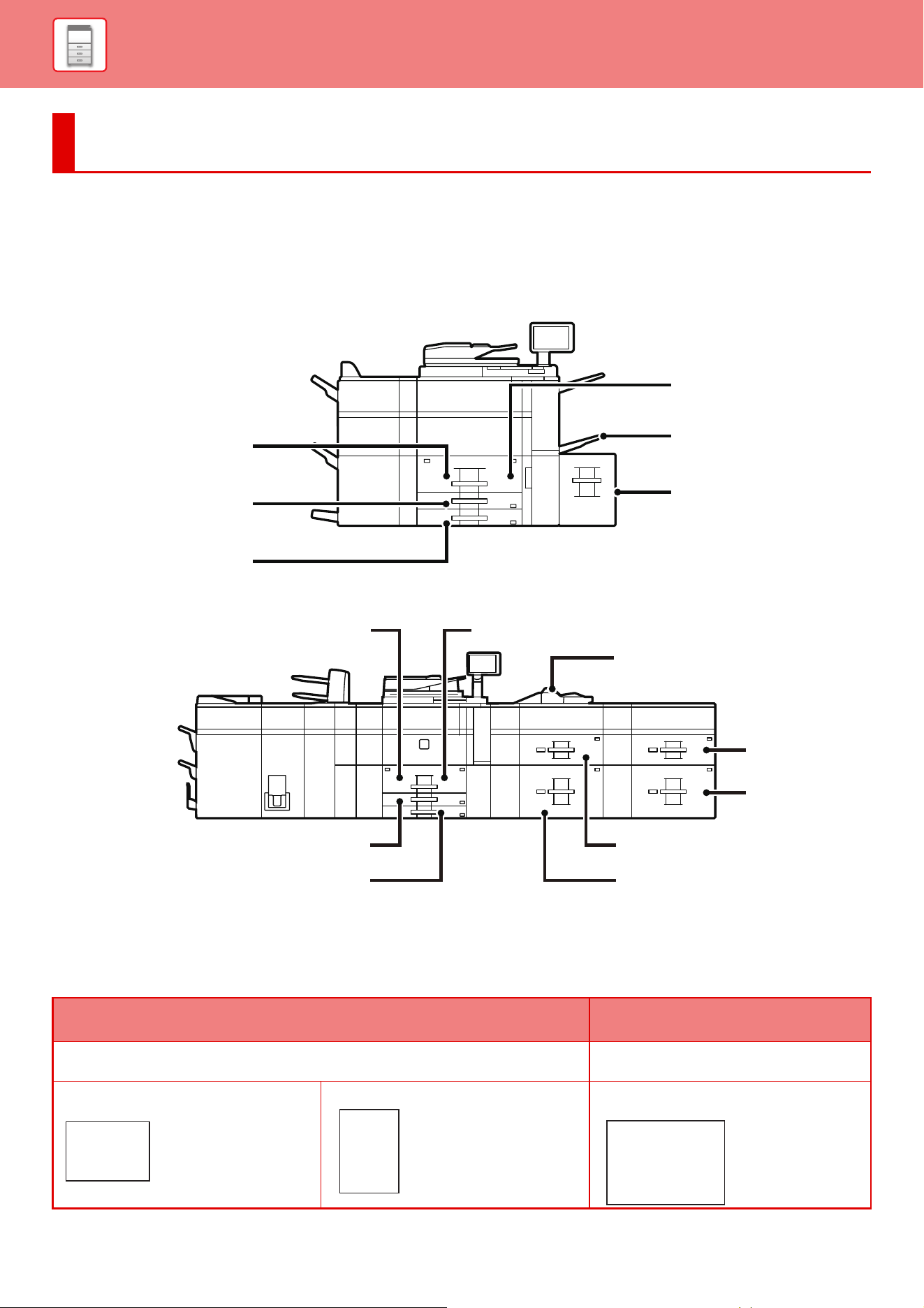
1-60
BEFORE USING THE MACHINE►LOADING PAPER
IMPORTANT POINTS ABOUT PAPER
NAMES AND LOCATIONS OF TRAYS
When a large capacity tray is installed
When two large capacity trays are installed
THE DEFINITION OF "R" IN PAPER SIZE
To indicate the landscape setting, "R" is added to the end of the name of a paper size enabled for both landscape and
portrait settings.
LOADING PAPER
Paper that can be set either in the portrait or landscape orientation Paper that can only be set in the
landscape orientation
8-1/2" x 11", A4, B5 12" x 18", 11" x 17", 8-1/2" x 14", 8-1/2" x
13", SRA3, A3W, A3, SRA4, B4
Paper set in the landscape orientation Paper set in the portrait orientation Can be placed only in the landscape
orientation
Tray 1
Tray 3
Tray 4
Tray 2
Bypass Tray
Tray 5
Tray 1
Tray 2
Bypass Tray
Tray 3
Tray 4
Tray 7
Tray 8
Tray 5
Tray 6
8-1/2" x 11"R
(A4R)
8-1/2" x 11"
(A4)
11" x 17"
(A3)
1-61
BEFORE USING THE MACHINE►LOADING PAPER
APPLICABLE PAPER TYPES
This section describes paper types that can be used and those that cannot be used.
All types of paper other than plain paper are referred to as special media.
Useable paper
Specifications of plain paper, heavy paper and thin paper
* Set a suitable paper weight in "Settings (administrator)" → [System Settings] → [Common Settings] → [Device
Control] → [Plain Paper Compatibility Settings]. This can only be set on the machine's operation panel.
Specifications of paper that can be used for two-sided printing
• Various types of paper are commercially available, some of which cannot be used on the machine.
Before using any paper, consult the dealer or nearest SHARP Service Department.
• The image quality and toner fusibility of paper may change due to ambient conditions, operating conditions, and paper
characteristics, resulting in image quality inferior to that of Sharp standard paper.
Before using any paper, consult the dealer or nearest SHARP Service Department.
• The use of non-recommended or non-usable paper may result in skewed feeding, misfeeds, poor toner fusing (the toner
does not adhere to the paper well and can be rubbed off), or machine failure.
• The use of non-recommended paper may result in misfeeds or poor image quality. Before using non-recommended paper,
check whether printing can be performed properly.
Plain Paper*
Plain Paper 1 16 lbs. bond to 24 lbs. bond (60 g/m
2
to 89 g/m
2
)
Plain Paper 2 24 lbs. bond to 28 lbs. bond (90 g/m
2
to 105 g/m
2
)
Heavy paper
Heavy paper 1 28 lbs. bond to 65 lbs. cover (106 g/m
2
to 176 g/m
2
)
Heavy paper 2 65 lbs. cover to 80 lbs. cover (177 g/m
2
to 220 g/m
2
)
Heavy paper 3 80 lbs. cover to 140 lbs. index (221 g/m
2
to 256 g/m
2
)
Heavy paper 4 140 lbs. index to 110 lbs. cover (257 g/m
2
to 300 g/m
2
)
Thin paper 13 lbs to 16 lbs (55 g/m
2
to 59 g/m
2
)
• For paper specifications, see the specifications in the "Start Guide".
• Recycled paper, colored paper and pre-punched paper must meet the same specifications as plain paper.
Before using any paper, consult the dealer or nearest SHARP Service Department.
• If the paper that was output is significantly curled, remove the paper from the cassette, turn the paper over so it is face
down, and resume use.
Paper Type Plain, Recycled, Color, Letter Head, Pre-Printed, Punched, Glossy Paper,
Heavy Paper (28 lbs. bond (106 g/m
2
) to 80 lbs. cover (220 g/m
2
))
Paper Size 12" x 18", 11" x 17", 8-1/2" x 14", 8-1/2" x 13-1/2", 8-1/2" x 13-2/5", 8-1/2" x 13", 8-1/2" x 11",
8-1/2" x 11"R, 5-1/2" x 8-1/2"R, 7-1/4" x 10-1/2", 9" x 12", SRA3, A3W, A3, B4, SRA4, A4, A4W,
A4R, B5, B5R, A5R
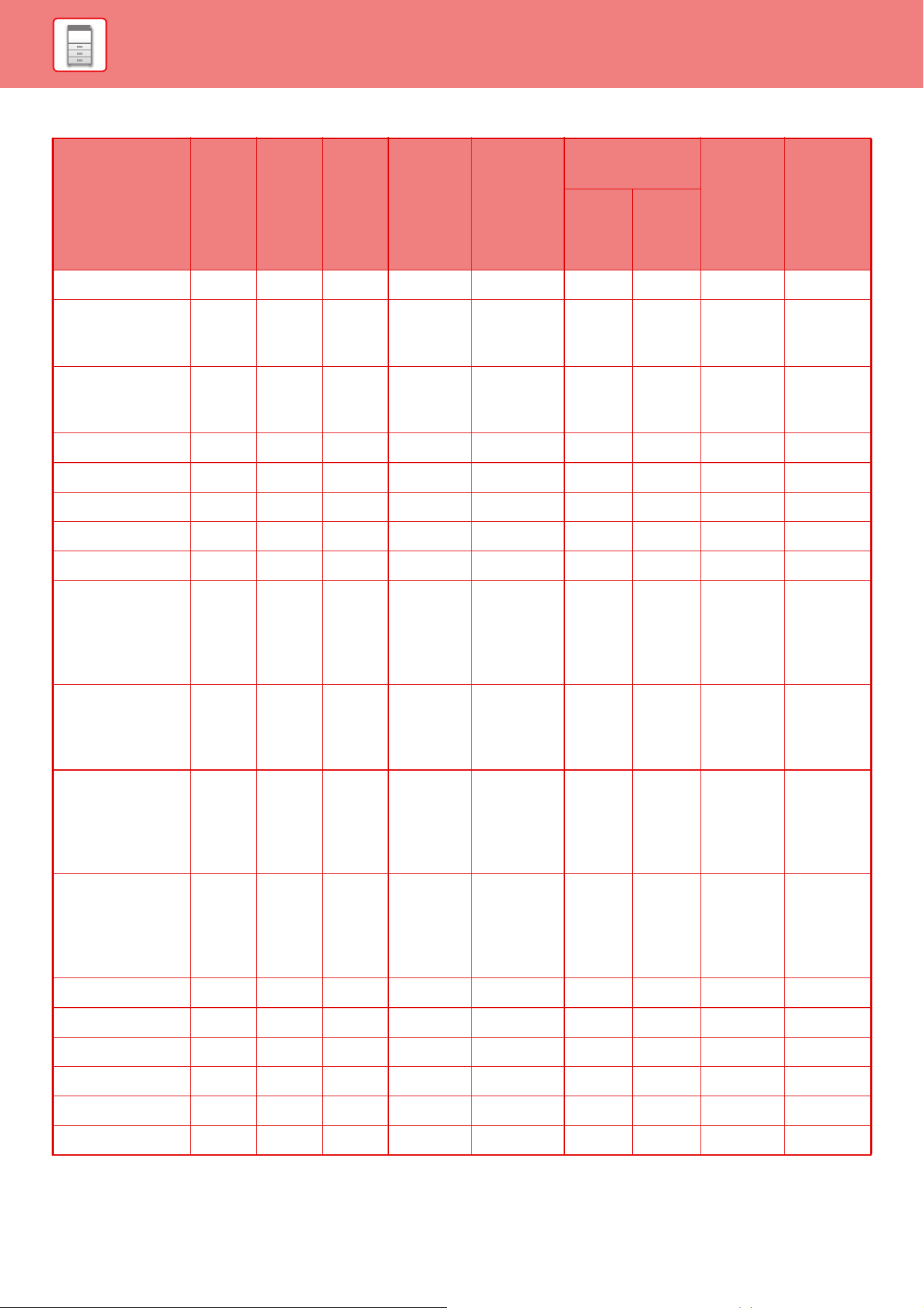
1-62
BEFORE USING THE MACHINE►LOADING PAPER
Types of paper that can be set in each tray
Yes: Can be used
-: Cannot be used
Tray
1/2
Tray
3
Tray
4
Bypass
tray
Tray 5
Large
capacity
tray
(MX-LC12/
MX-LCX3 N)
Large capacity
trays
Bypass
tray
(for
large
capacity
trays)
Inserter
(Upper /
Lower)
Tray
5/7
Tray
6/8
Thin paper - - - Yes - Yes Yes Yes -
Plain paper 1
(16 to 24 lbs bond
(60 to 89 g/m
2
))
Yes Yes Yes Yes Yes Yes Yes Yes Yes
Plain paper 2
(24 to 28 lbs bond
(90 to 105 g/m
2
))
Yes Yes Yes Yes Yes Yes Yes Yes Yes
Recycled paper Yes Yes Yes Yes Yes Yes Yes Yes Yes
Color Yes Yes Yes Yes Yes Yes Yes Yes Yes
Letter head Yes Yes Yes Yes Yes Yes Yes Yes Yes
Pre-printed Yes Yes Yes Yes Yes Yes Yes Yes Yes
Pre-punched Yes Yes Yes Yes Yes Yes Yes Yes Yes
Heavy paper 1:
28 lbs bond to 65
lbs index
(106 g/m
2
to 176
g/m
2
)
- Yes Yes Yes Yes Yes Yes Yes Yes
Heavy paper 2:
65 lbs index to 80
lbs Cover (177
g/m
2
to 220 g/m
2
)
- Yes Yes Yes Yes Yes Yes Yes Yes
Heavy paper 3:
80 lbs bond to
140 lbs index
(221 g/m
2
to 256
g/m
2
)
- - - Yes - Yes Yes - -
Heavy paper 4:
140 lbs index to
110 lbs Cover
(257 g/m
2
to 300
g/m
2
)
- - - Yes - Yes Yes - -
Embossed - - Yes Yes - Yes Yes - -
Envelope - - - Yes - - - - -
Tab paper - - Yes Yes - Yes Yes Yes -
Transparency film - - Yes Yes - Yes Yes Yes -
Labels - - Yes Yes - Yes Yes - -
Glossy paper - - - Yes - Yes Yes - -
1-63
BEFORE USING THE MACHINE►LOADING PAPER
Setting orientation of the print side
The setting orientation varies for the print side of paper, depending on the tray used.
Paper that cannot be used
• Special media for an ink jet printer (fine paper, glossy
paper, glossy film, etc.)
• Carbon paper or thermal paper
• Pasted paper
• Paper with clips
• Paper with fold marks
• Torn paper
• Oil feed transparency film
• Thin paper less than 13lbs bond (52 g/m
2
)
• Heavy paper as thick as 110 lbs Cover (301 g/m
2
) or
more
• Irregularly shaped paper
• Stapled paper
• Damp paper
• Curled paper
• Paper whose print side or reverse side has been
already printed on by another printer or multifunction
device
• Paper with a wave-like pattern due to moisture
absorption
• Paper with creases
• Paper with dust
Non-recommended paper
• Iron-on transfer paper
• Japanese paper
• Perforated paper
• For detailed information on the sizes and types of paper that can be loaded into each tray of the machine, see
"SPECIFICATIONS" in the "Start Guide" and "Paper Tray Settings (page 7-103)
" in "Settings".
• Recycled paper, colored paper and pre-punched paper must meet the same specifications as plain paper.
• Before using any paper, consult the dealer or "SHARP Service Department".
Tray In normal status With letter head or pre-printed paper set
Trays 1 - 4 Facing up Facing down
Bypass tray, Tray 5, Tray 6, Tray 7, Tray 8
Facing down Facing up
When [Disabling of Duplex] is set for "Letter Head" or "Pre-Printed", set the print side in the same orientation as for the
ordinary operation.
To set [Disabling of Duplex]:
In "Settings (administrator)", select [System Settings] → [Common Settings] → [Device Control] → [Disabling of Duplex].
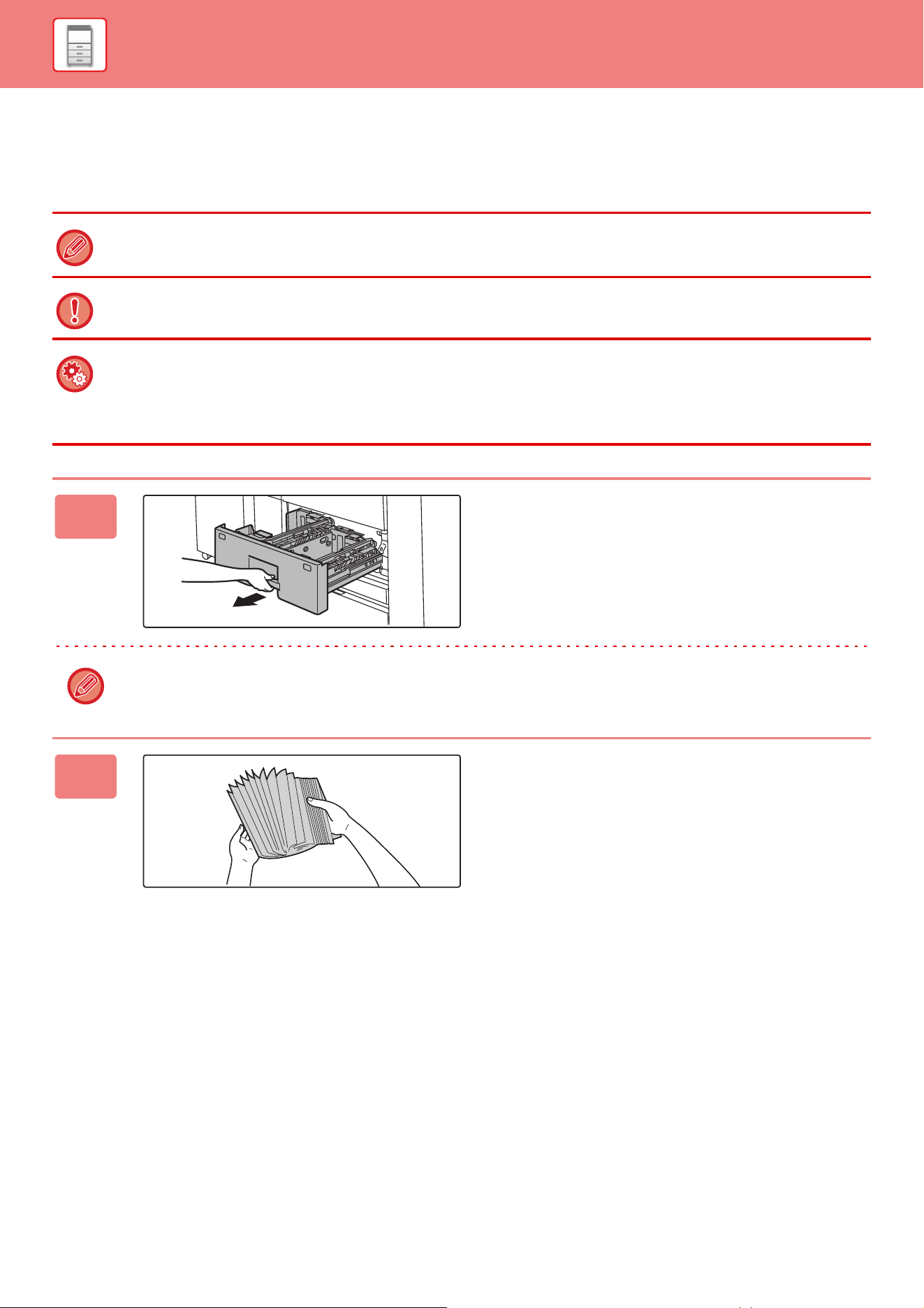
1-64
BEFORE USING THE MACHINE►LOADING PAPER
LOADING PAPER IN THE TRAY 1/2
A maximum of 1200 sheets of 8-1/2" × 11" (A4) paper can be loaded into tray 1.
A maximum of 800 sheets of 8-1/2" × 11" (A4) paper can be loaded into tray 2.
If you loaded paper of a different type or size from the paper previously loaded, be sure to check the settings in "Settings
(administrator)". An incorrect setting may cause print failure, printing on paper of an incorrect size, or type or paper misfeeds.
Do not place heavy objects on the tray or press down on the tray.
To check the type and size of paper:
[Tray Settings] in the home screen or in "Settings", select [Status] → [Machine Identification] → [Paper Input Tray Status].
To set the type and size of paper:
Set this in [Tray Settings] in the home screen or in "Settings", select [System Settings] → [Common Settings] → [Paper
Settings] → [Paper Tray Settings].
1
Pull out the paper tray.
Gently pull the tray out until it stops.
Keep holding the handle until the lock is released.
2
Fan the paper.
Fan the paper well before loading it. If the paper is not
fanned, multiple sheets may feed at once and cause a
misfeed.
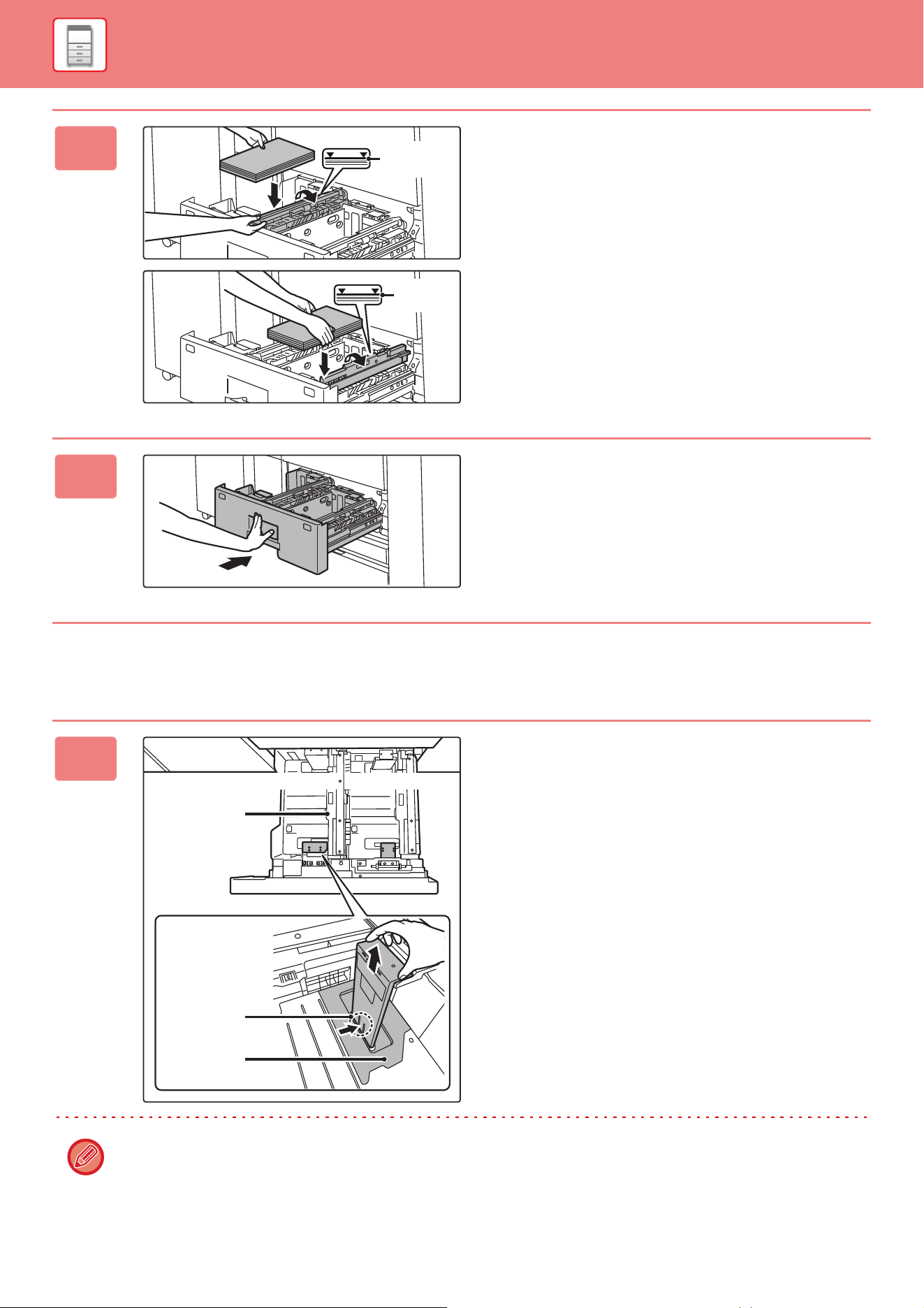
1-65
BEFORE USING THE MACHINE►LOADING PAPER
Changing the paper size
3
Lift the feed roller, and place paper
into the tray.
Load the paper with the print side facing up. The stack must
not be higher than the indicator line (maximum of 1200
sheets for tray 1, or maximum of 800 sheets for tray 2).
4
Lower the feed roller, and gently push
the paper tray into the machine.
Push the tray firmly all the way into the machine slowly.
Forcefully inserting the paper may cause skewed feeding
and paper misfeeds.
1
Remove the paper size guide.
With the base of the tray pressed all the way down, hold
down the hook at the bottom on the paper size guide and
pull the paper size guide up slightly.
Before changing the paper size of tray 2, raise the paper guide.
Indicator
line
Indicator
line
Tray 1 Tray 2
Paper guide
Transparent
sheet
Hook
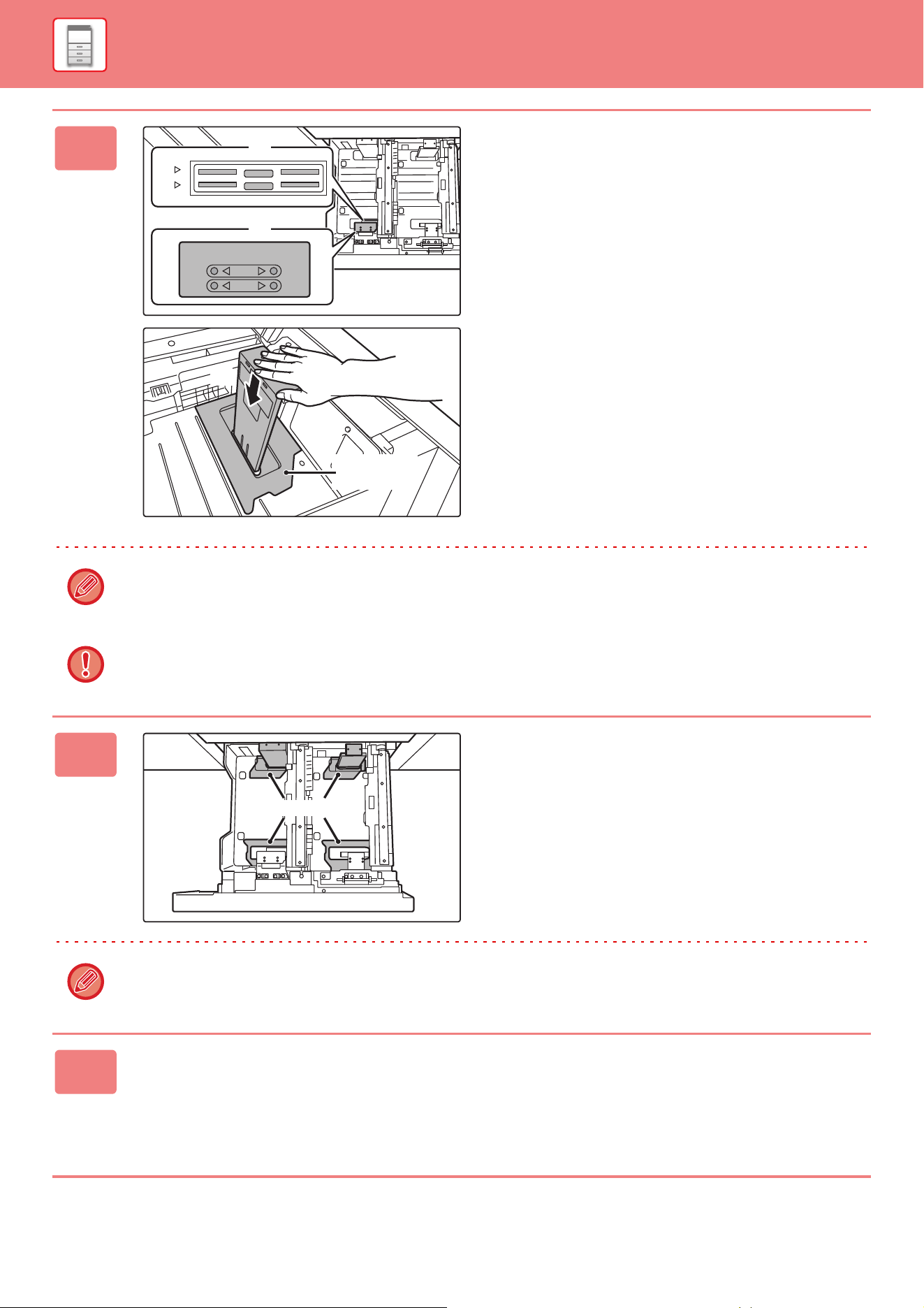
1-66
BEFORE USING THE MACHINE►LOADING PAPER
2
Attach the paper size guide and
transparent sheet appropriately for the
size of paper to be used.
(1) Align the bottom of the paper size guide
with the appropriate slot on the base of
the tray.
Align the paper size guide with the slot for the paper
size to be used (indicated by the paper size mark).
(2) Align the holes at the top of the paper
size guide with the protrusions that
secure the paper size guide.
Align with the holes for the paper size to be used
(indicated by the paper size mark).
(3) Push in the paper guide so that it locks
into place.
Push the paper size guide in until the hook at the
bottom locks into place. (You will hear a "click" when
the hook locks.) Move the paper size guide slightly to
verify that it has locked into place.
• When attaching the paper size guide, place the transparent sheet in direct contact with the base of the tray in the
correct orientation as shown.
• The slot or hole with the "LT" mark is for 8-1/2" x 11" size.
When attaching the paper size guide, make sure that the top and bottom of the guide are aligned to the same paper size. If
the top and bottom of the paper size guide are not aligned to the same paper size, skewed feeding and misfeeds will result.
3
Repeat steps 1 and 2 to adjust the far
paper guide to the paper size to be
used.
Be sure to adjust the far paper guide to the same size as the
near paper guide.
When removing and attaching the far paper size guide, take
care not to hit the front cover of the machine.
Adjusting only one paper guide may result in skewed feeding or misfeeds.
4
Set the paper size and paper type.
Be sure to set the paper size and paper type by selecting [Tray Settings] in the home screen or in "Settings", select
[System Settings] → [Common Settings] → [Paper Settings] → [Paper Tray Settings].
If the paper size setting is not configured correctly, automatic paper selection will not operate correctly and printing may
take place on the wrong size or type of paper or a misfeed may occur.
A4
LT
LT
A4
(1)
(2)
(3)
Transparent
sheet
Transparent sheet
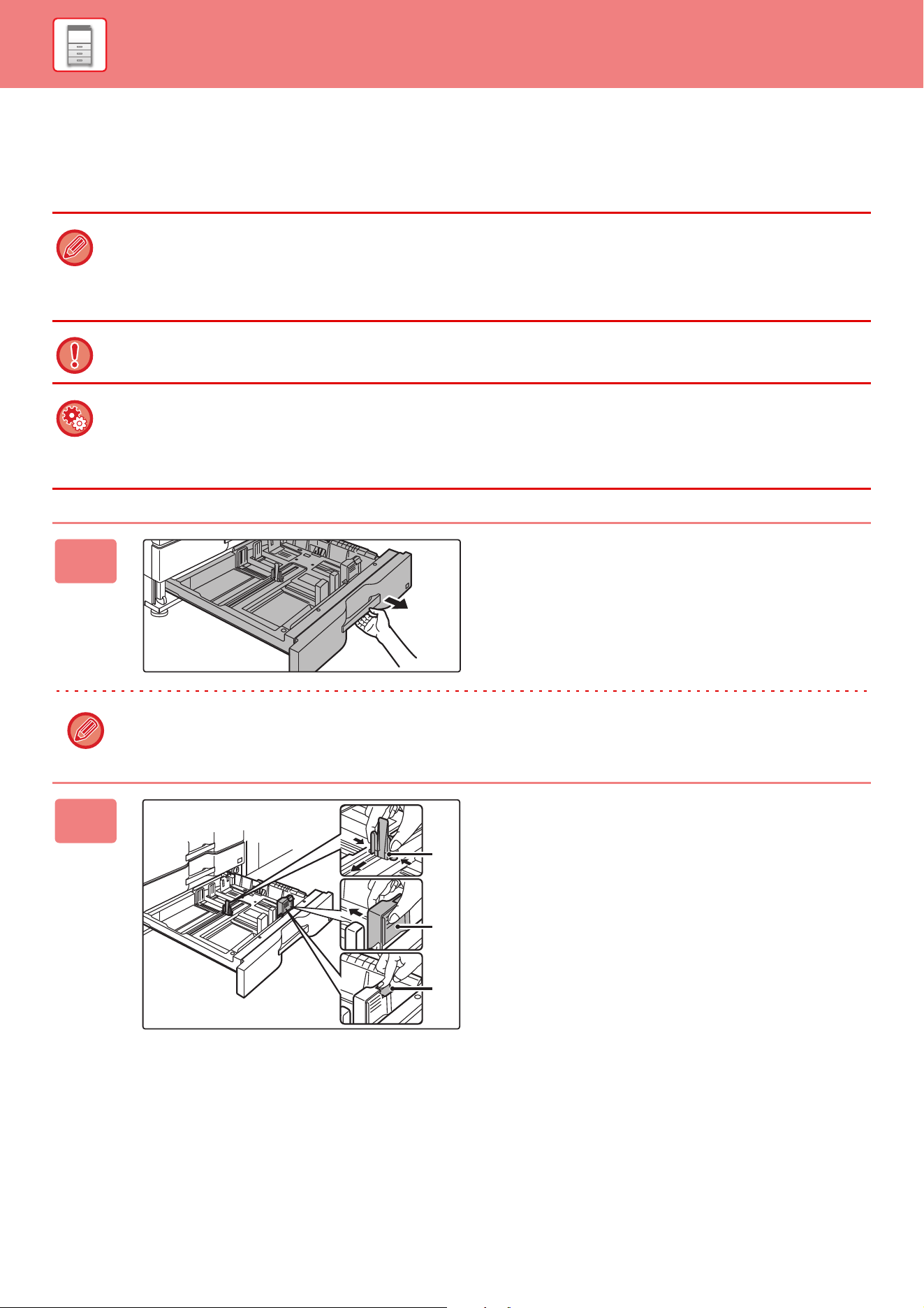
1-67
BEFORE USING THE MACHINE►LOADING PAPER
LOADING PAPER IN THE TRAY 3/4
A maximum of 500 sheets of paper from 12" × 18" to 7-1/4" × 10-1/2"R (A3W to B5R) can be loaded into tray 3.
A maximum of 500 sheets of paper from 12" × 18" to 5-1/2" × 8-1/2"R (A3W wide to A5R) can be loaded into tray 4.
• Other than plain paper, special media such as transparency film and tab paper can be loaded into tray 4.
To load tab paper, the dedicated guide must be installed.
• If you loaded paper of a different type or size from the paper previously loaded, be sure to check the settings in "Settings
(administrator)". An incorrect setting may cause print failure, printing on paper of an incorrect size, or type or paper
misfeeds.
Do not place heavy objects on the tray or press down on the tray.
To check the type and size of paper:
[Tray Settings] in the home screen or in "Settings", select [Status] → [Machine Identification] → [Paper Input Tray Status].
To set the type and size of paper:
Set this in [Tray Settings] in the home screen or in "Settings", select [System Settings] → [Common Settings] → [Paper
Settings] → [Paper Tray Settings].
1
Pull out the paper tray.
Gently pull the tray out until it stops.
To load paper, go to step 3.
To load a different size of paper, go to the next step.
Keep holding the handle until the lock is released.
2
Adjust guide plates A and B by
squeezing their lock levers and sliding
them to match the longitudinal and
transversal dimensions of the paper to
be loaded.
(1) Squeeze the lock knob on guide plate A
and slide to the desired paper size.
(2) Squeeze the lock knob on guide plate B
and slide to the desired paper size. If slid
to a standard paper size, guide plate B
will lock automatically.
(3) For a non-standard paper size, after
sliding guide plate B to the desired size,
press the lock button (C).
(A)
(B)
(C)
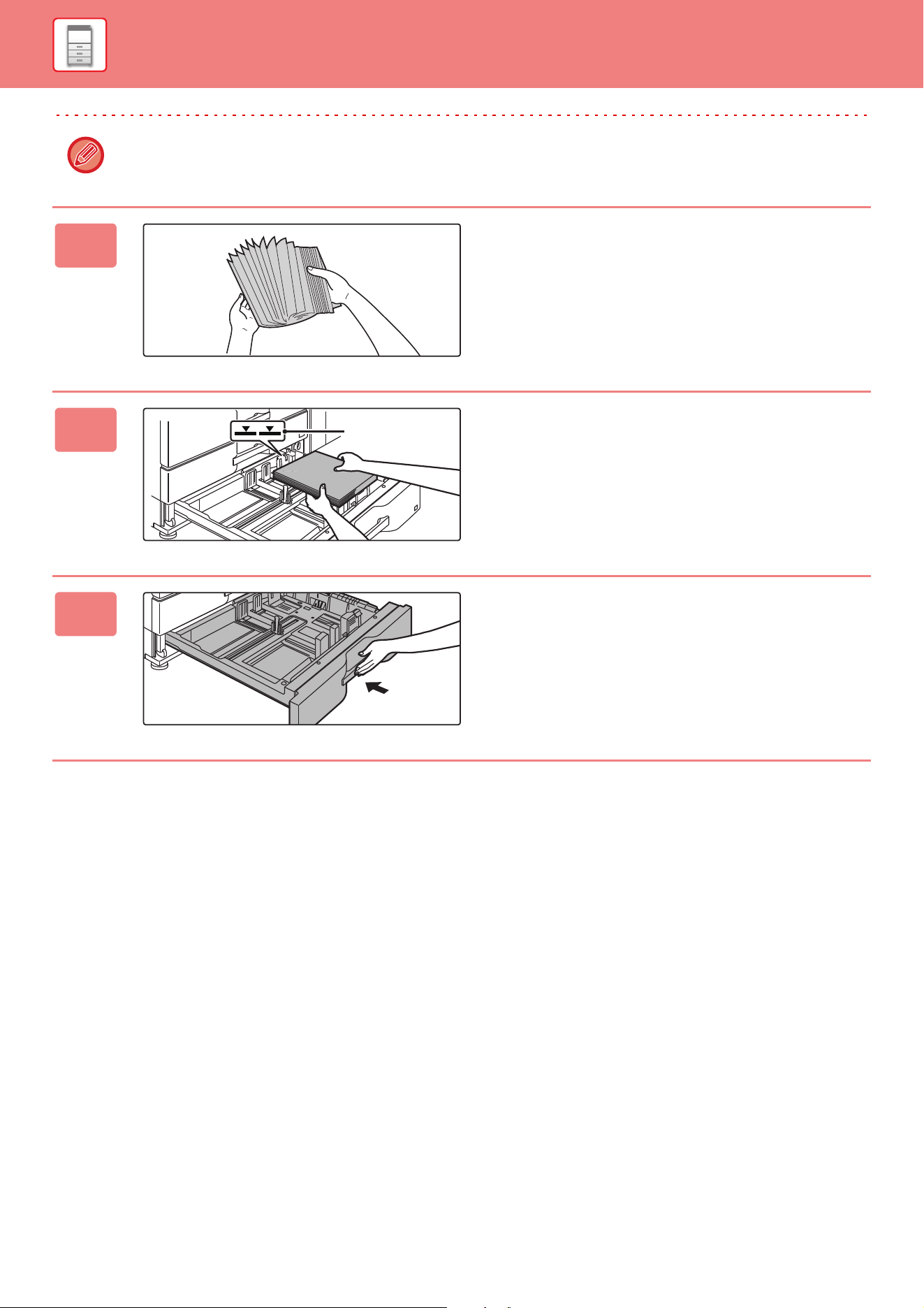
1-68
BEFORE USING THE MACHINE►LOADING PAPER
A non-standard size of paper can only be loaded in tray 4. A non-standard size of paper cannot be loaded in tray 3.
3
Fan the paper.
Fan the paper well before loading it. If the paper is not
fanned, multiple sheets may feed at once and cause a
misfeed.
4
Insert the paper into the tray.
Load the paper with the print side facing up. The stack must
not be higher than the indicator line (maximum of 500
sheets).
5
Gently push the paper tray into the
machine.
Push the tray firmly all the way into the machine slowly.
Forcefully inserting the paper may cause skewed feeding
and paper misfeeds.
Indicator line
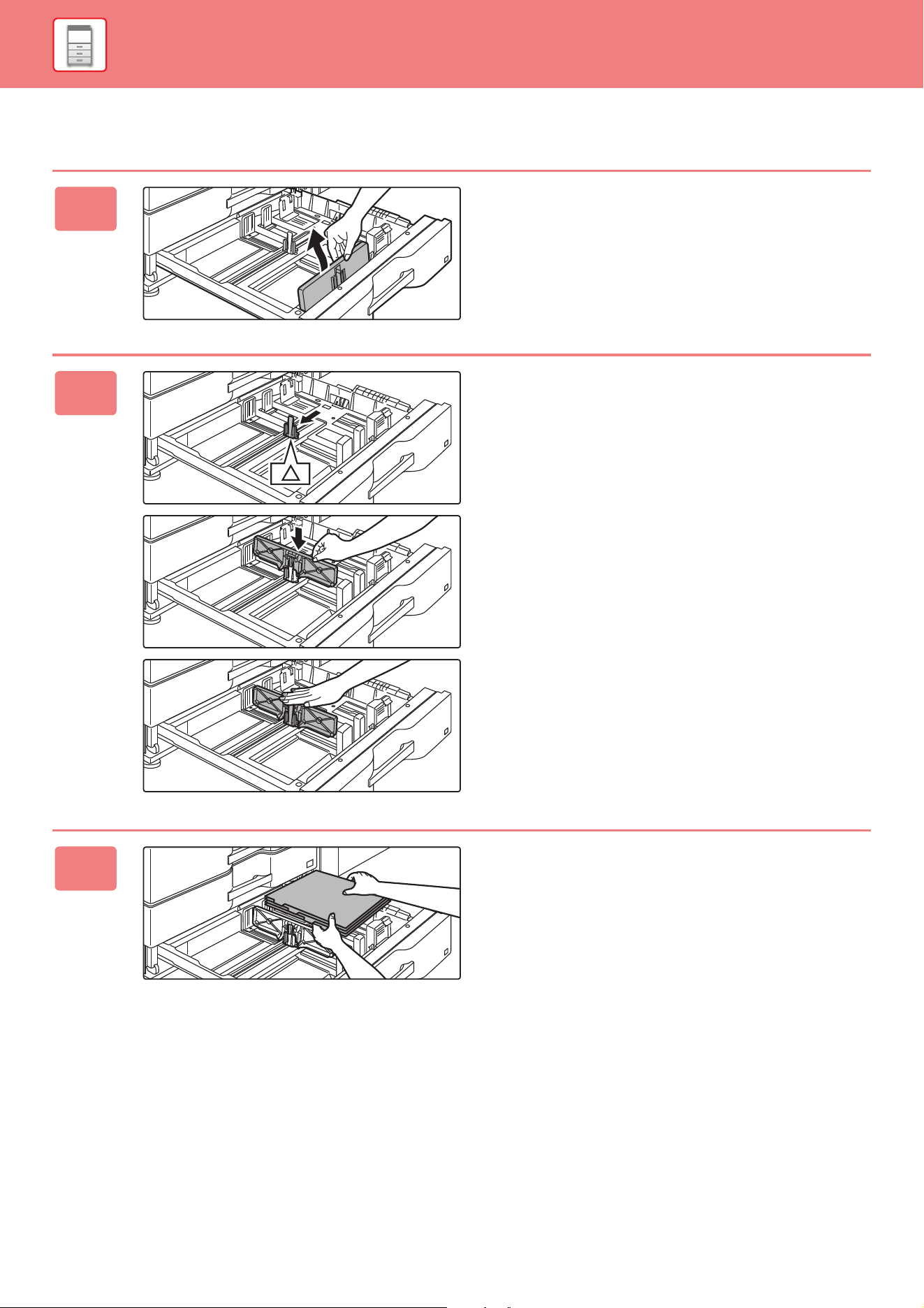
1-69
BEFORE USING THE MACHINE►LOADING PAPER
Loading tab paper into tray 4
1
Remove the tab paper guide.
The guide is stored inside tray 4.
2
Pull out the tray and install the guide.
Adjust the guide plates to the triangle mark position.
Install the guide so that it may cover the guide plates.
Adjust the guide plates in the tray to match the longitudinal
and transversal dimensions of the paper to be loaded.
3
Insert the tab paper into the tray.
Place the tab paper with the print side facing up so that the
tab is to the left.
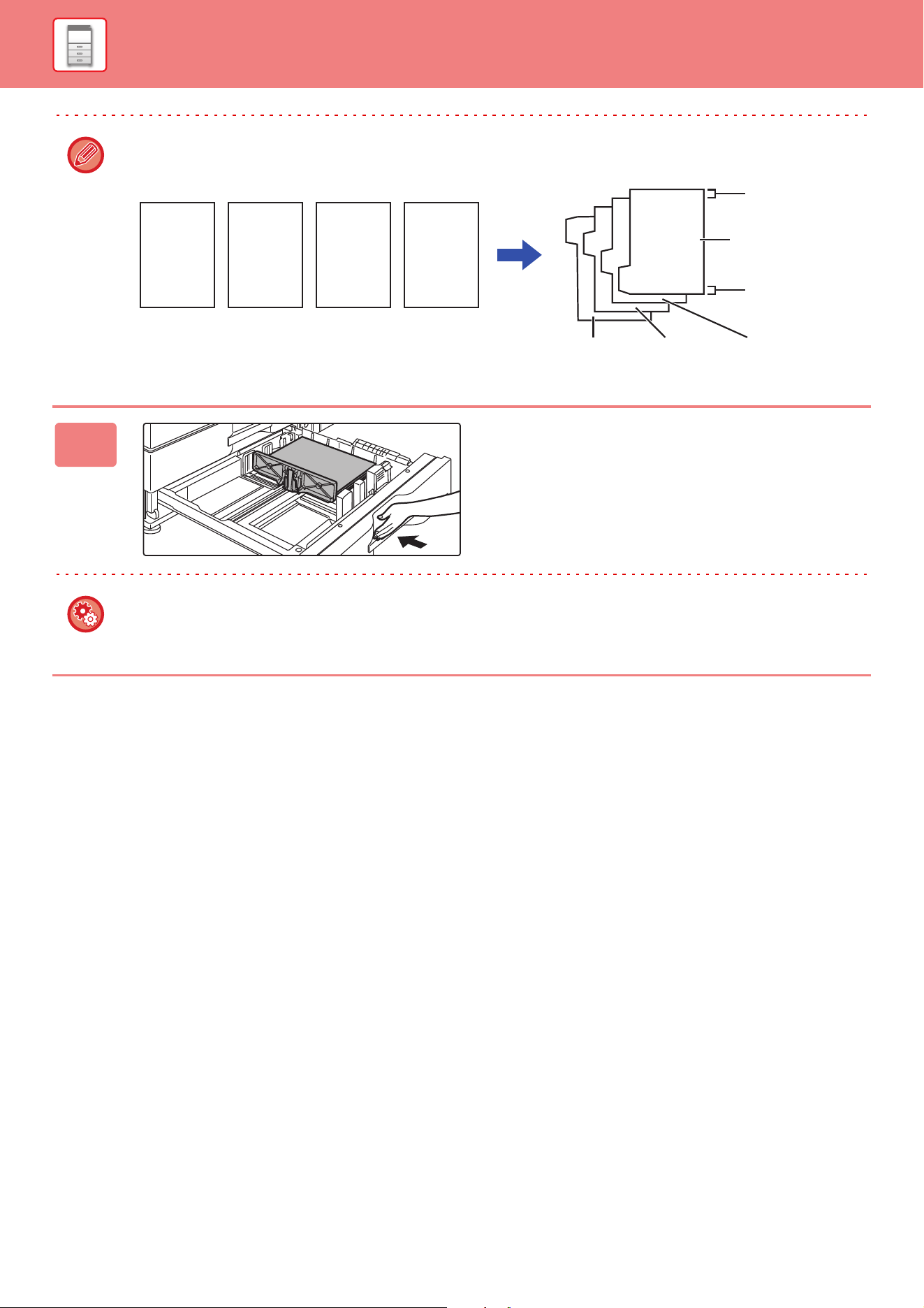
1-70
BEFORE USING THE MACHINE►LOADING PAPER
See the following figure and adjust the tab position of the tab paper.
4
Gently push the tray into the machine,
and set the paper type to tab paper.
Using "Paper Tray Settings" in the system settings, set the
paper type to tab paper.
To set the paper type to tab paper:
Set this in [Tray Settings] in the home screen or in "Settings", select [System Settings] → [Common Settings] → [Paper
Settings] → [Paper Tray Settings].
GHI
DEF
ABC
JKL
Originals
1st page
Tab paper
2nd page 3rd page 4th page
4th page 3rd page 2nd page
1st page
Top edge
Tail edge
Side 1
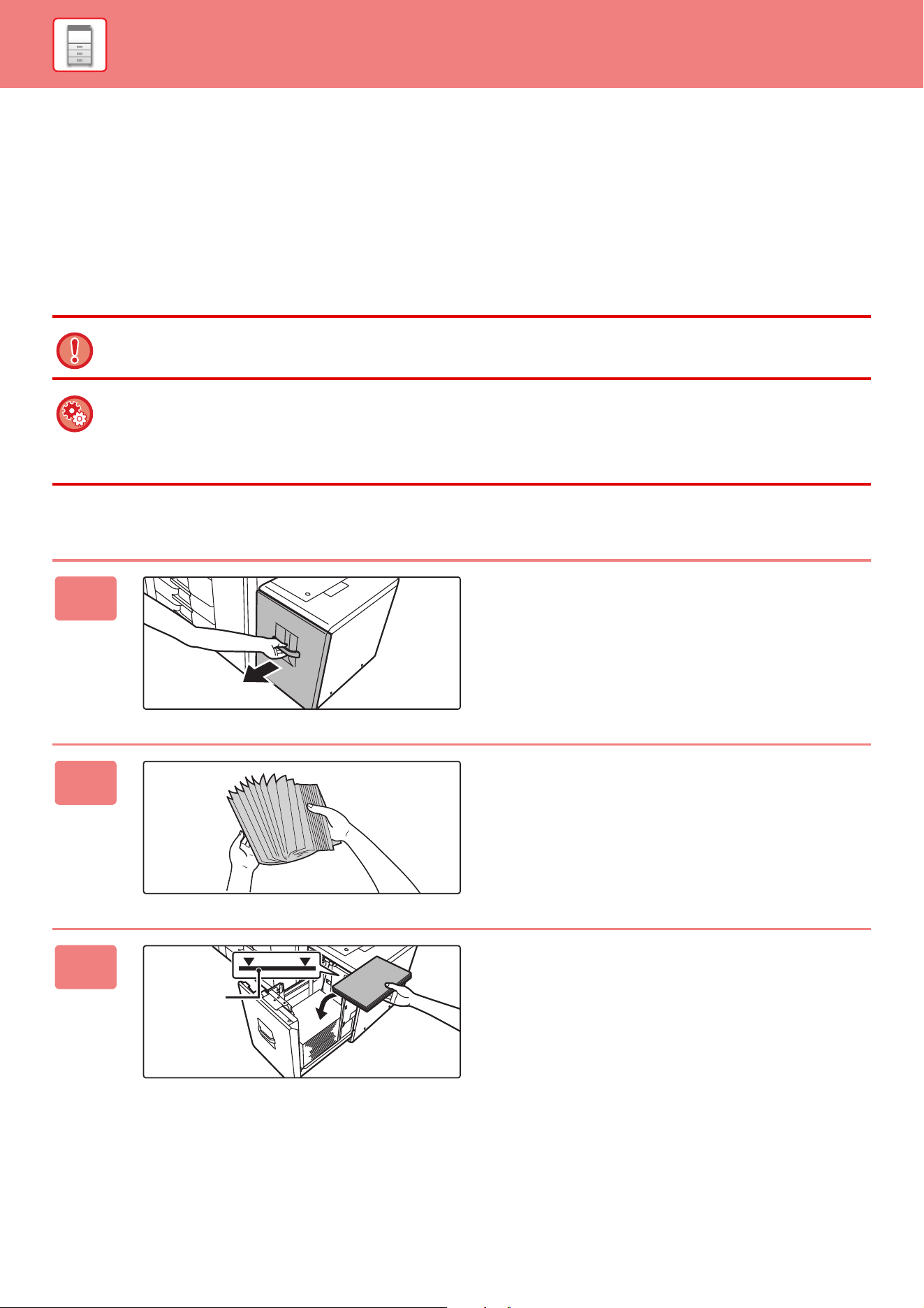
1-71
BEFORE USING THE MACHINE►LOADING PAPER
LOADING PAPER IN THE LARGE CAPACITY
TRAY
Use the large capacity tray for outputting massive prints that cannot be processed using the regular tray.
• Large capacity tray (MX-LC12) stores a maximum of 3500 sheets of 8-1/2" × 11", A4 and B5 paper.
• Large capacity tray (MX-LCX3 N) stores a maximum of 3000 sheets of paper from 12" × 18" (A3W) to 8-1/2" × 11"R
(B5).
When changing the paper size, consult the dealer or nearest SHARP Service Department.
Large capacity tray (MX-LC12)
Do not place heavy objects on the tray or press down on the tray.
To check the type and size of paper:
[Tray Settings] in the home screen or in "Settings", select [Status] → [Machine Identification] → [Paper Input Tray Status].
To set the type and size of paper:
Set this in [Tray Settings] in the home screen or in "Settings", select [System Settings] → [Common Settings] → [Paper
Settings] → [Paper Tray Settings].
1
Pull out the paper tray.
Gently pull the tray out until it stops.
2
Fan the paper.
Fan the paper well before loading it. If the paper is not
fanned, multiple sheets may feed at once and cause a
misfeed.
3
Place the paper in the center of the
paper table.
Load the paper with the print side facing down. The stack
must not be higher than the indicator line (maximum of 3500
sheets).
Indicator
line
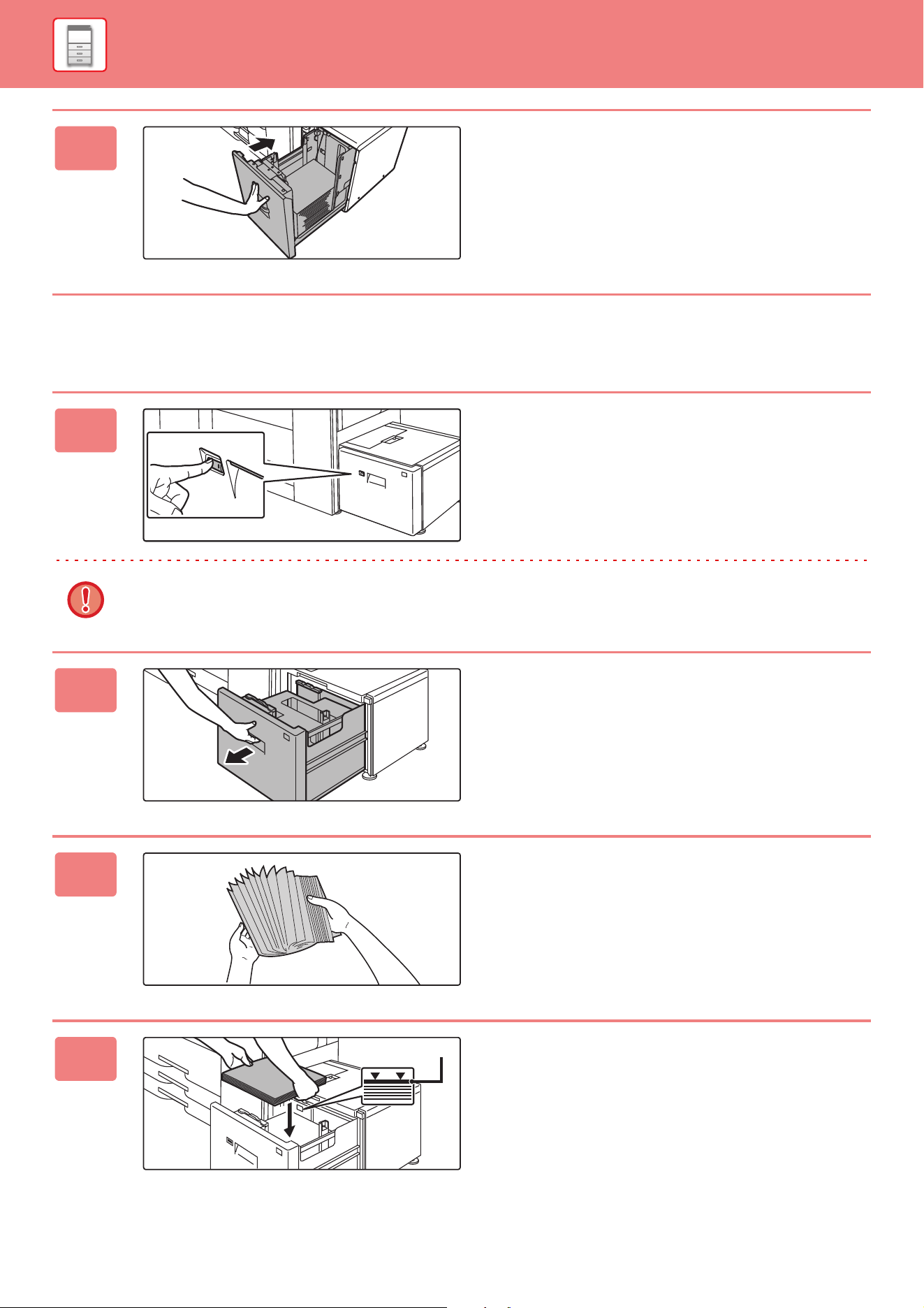
1-72
BEFORE USING THE MACHINE►LOADING PAPER
Large capacity tray (MX-LCX3 N)
4
Gently push the paper tray into the
machine.
Push the tray firmly all the way into the machine slowly.
Forcefully inserting the paper may cause skewed feeding
and paper misfeeds.
1
Press the operation button.
The operation button blinks, and the tray paper table goes
down to the paper loading position. Wait until the operation
button light goes off.
Do not pull out the tray until the light goes off. If you pull out the tray forcibly while the button lights up or blinks, a
machine failure may be resulted.
2
Pull out the paper tray.
Gently pull the tray out until it stops.
3
Fan the paper.
Fan the paper well before loading it. If the paper is not
fanned, multiple sheets may feed at once and cause a
misfeed.
4
Place the paper in the center of the
paper table.
Load the paper with the print side facing down. The stack
must not be higher than the indicator line (maximum of 3000
sheets).
When a certain volume of paper is loaded, the paper table
automatically goes down slightly and stops. Repeat this
operation in the same way to load paper.
Indicator line
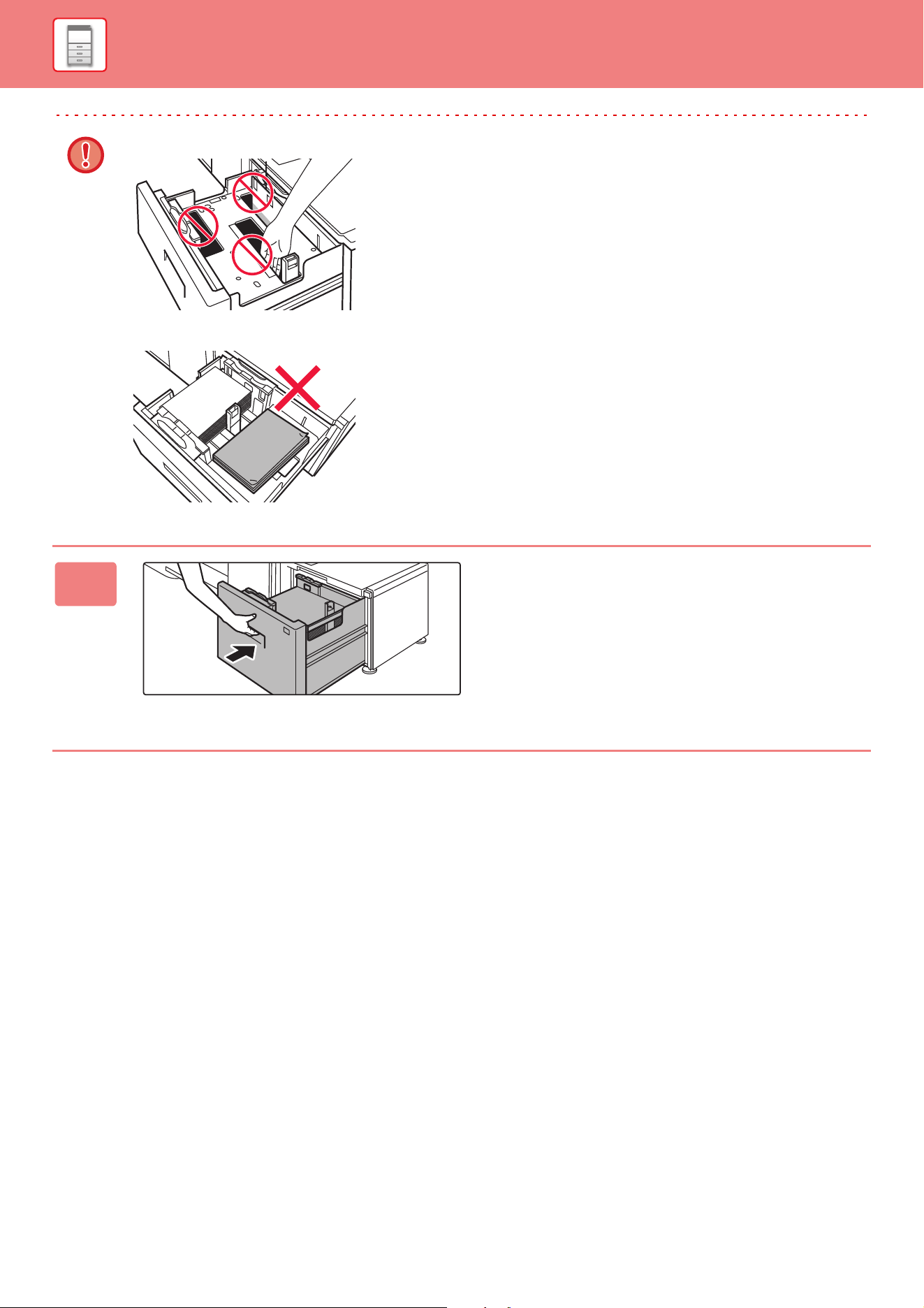
1-73
BEFORE USING THE MACHINE►LOADING PAPER
• Do not insert your hand into the space inside the paper table when you load paper.
• Do not insert spare paper or objects into the space inside the tray.
5
Gently push the paper tray into the
machine.
Push the tray firmly all the way into the machine slowly.
Forcefully inserting the paper may cause skewed feeding
and paper misfeeds.
The paper table goes up after the tray is pushed in. The
operation button blinks while the paper table goes up. The
button lights up when the paper table has gone up.
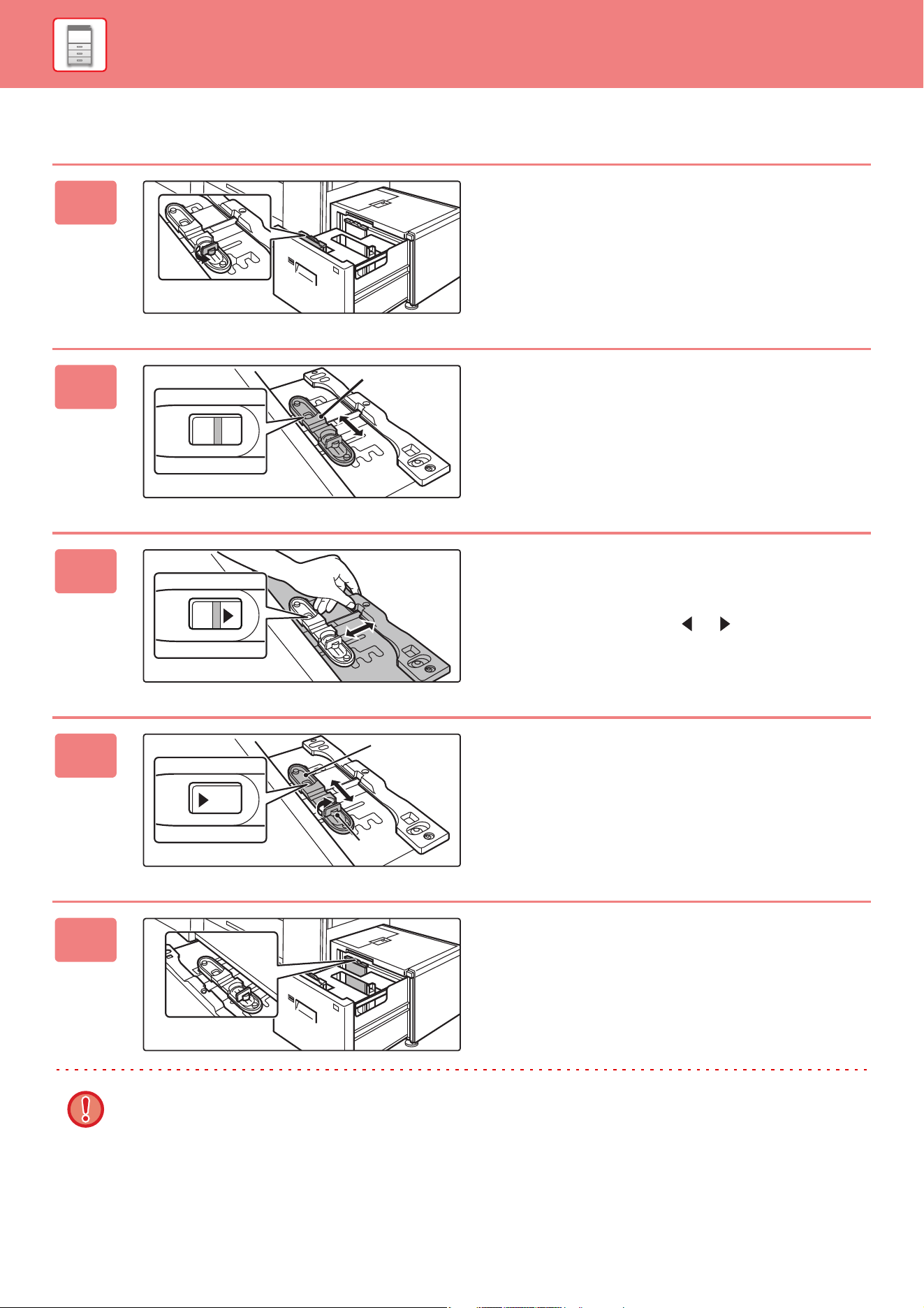
1-74
BEFORE USING THE MACHINE►LOADING PAPER
Changing the paper size for the large capacity tray (MX-LCX3 N)
1
Loosen the paper guide screw.
2
Slide the plate of the paper guide.
Slide the plate until the red line appears at the center of the
size window of the plate.
3
Adjust the paper guide to the paper
size that will be used.
Slide the paper guide forward or backward until the size
mark of the paper to be used ( or ) appears in the size
window of the plate.
4
Secure the paper guide.
(1) Slide the plate of the paper guide.
Slide the plate until the paper size to be used appears
in the size window of the plate.
(2) Tighten the paper guide screw.
5
Repeat steps 1 through 4 to adjust the
far paper guide to the paper size to be
used.
Be sure to adjust the far paper guide to the same paper size
as the near paper guide.
Adjusting only one paper guide may result in skewed feeding or misfeeds.
Plate
11
(1)
(2)
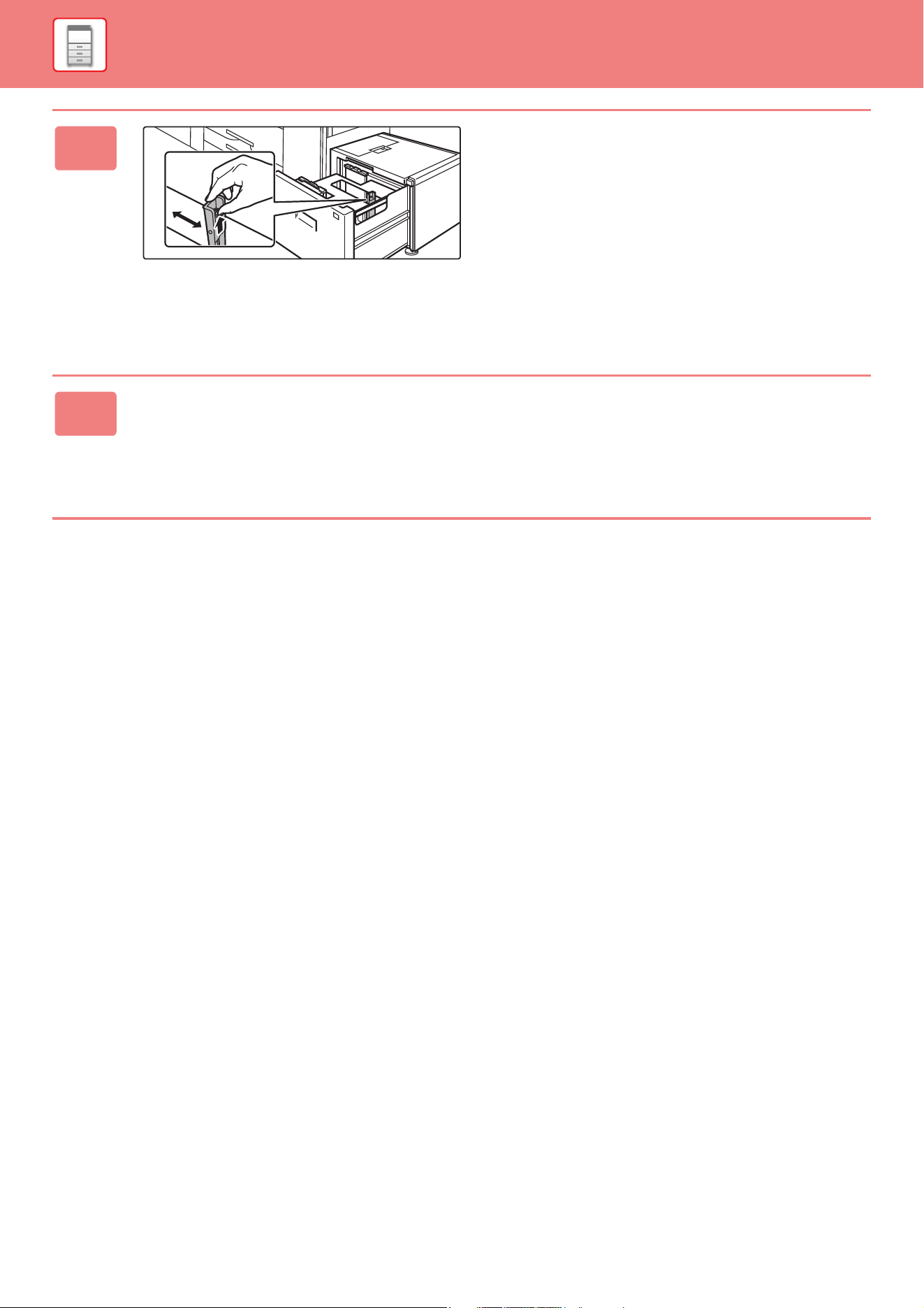
1-75
BEFORE USING THE MACHINE►LOADING PAPER
6
Change the right paper guide to the
paper size to be used.
(1) While holding up the paper guide lock,
slide the paper guide to the paper size to
be used.
(2) Release the paper guide lock.
(3) Move the paper guide slightly to the right
and left so that it locks into place.
You will hear a "click" when the paper guide locks.
7
Set the paper size and paper type.
Be sure to set the paper size and paper type by selecting [Tray Settings] in the home screen or in "Settings", select
[System Settings] → [Common Settings] → [Paper Settings] → [Paper Tray Settings].
If the paper size setting is not configured correctly, automatic paper selection will not operate correctly and printing may
take place on the wrong size or type of paper or a misfeed may occur.
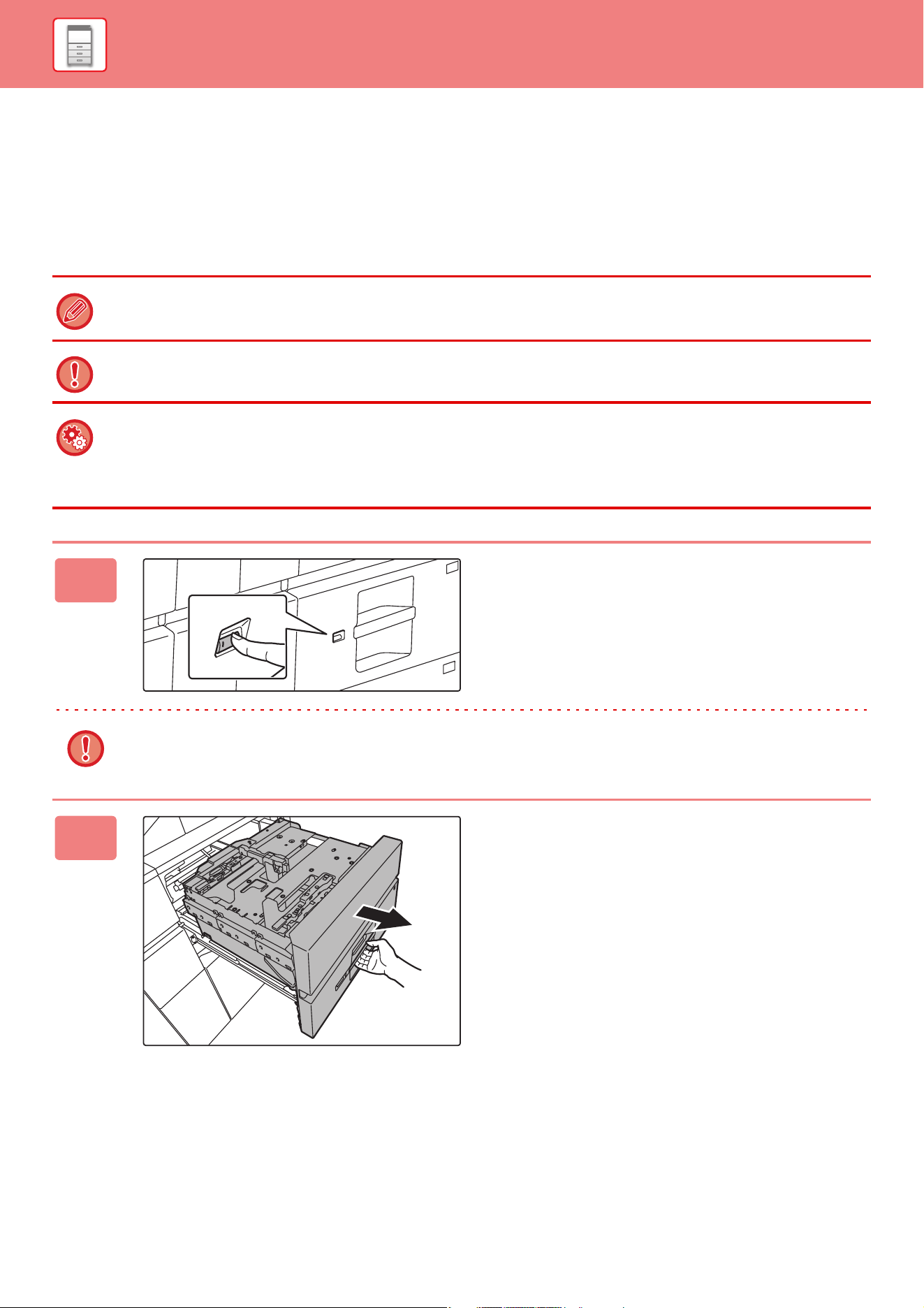
1-76
BEFORE USING THE MACHINE►LOADING PAPER
LOADING PAPER IN THE LARGE CAPACITY
TRAYS
Use the large capacity trays for outputting massive prints that cannot be processed using the regular tray.
The large capacity trays store a maximum of 5000 sheets of paper (2500 sheets for tray 5 and 2500 sheets for tray 6)
from 12" × 18" (A3W) to 7-1/4" × 10-1/2"R (B5R).
Other than plain paper, special media such as tab paper and transparency film can be loaded into the large capacity trays.
To load tab paper, the dedicated guide must be installed.
Do not place heavy objects on the tray or press down on the tray.
To check the type and size of paper:
[Tray Settings] in the home screen or in "Settings", select [Status] → [Machine Identification] → [Paper Input Tray Status].
To set the type and size of paper:
Set this in [Tray Settings] in the home screen or in "Settings", select [System Settings] → [Common Settings] → [Paper
Settings] → [Paper Tray Settings].
1
Press the operation button.
The operation button blinks, and the tray paper table goes
down to the paper loading position. Wait until the operation
button light goes off.
Do not pull out the tray until the light goes off. If you pull out the tray forcibly while the button lights up or blinks, a
machine failure may be resulted.
2
Pull out the paper tray.
Gently pull the tray out until it stops.
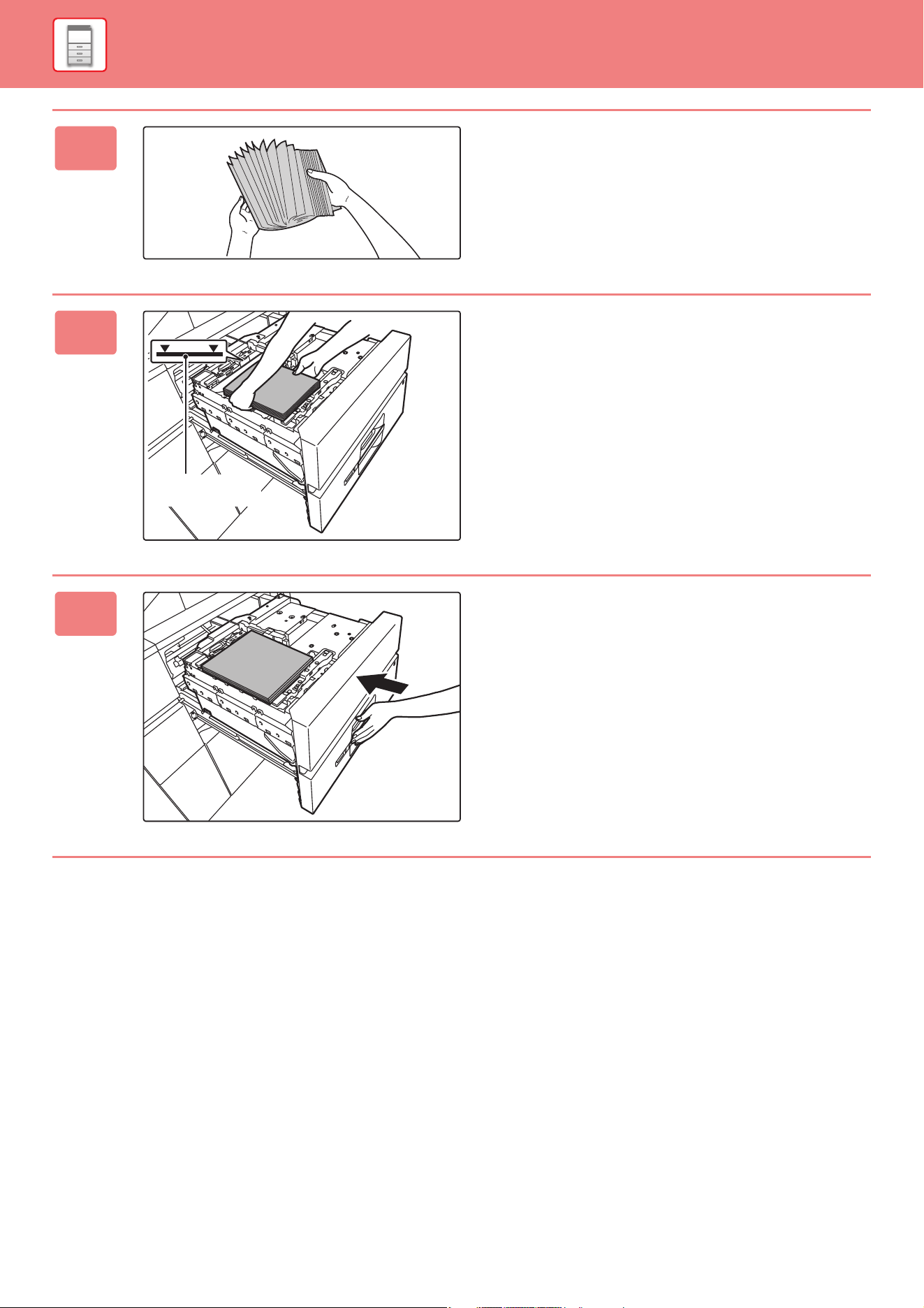
1-77
BEFORE USING THE MACHINE►LOADING PAPER
3
Fan the paper.
Fan the paper well before loading it. If the paper is not
fanned, multiple sheets may feed at once and cause a
misfeed.
4
Load the paper.
Load the paper with the print side facing down. The stack
must not be higher than the indicator line (maximum of 2500
sheets).
5
Gently push the paper tray into the
machine.
Push the tray firmly all the way into the machine slowly.
Forcefully inserting the paper may cause skewed feeding
and paper misfeeds.
The paper table goes up after the tray is pushed in.
The operation button blinks while the paper table goes up.
The button lights up when the paper table has gone up.
Indicator line
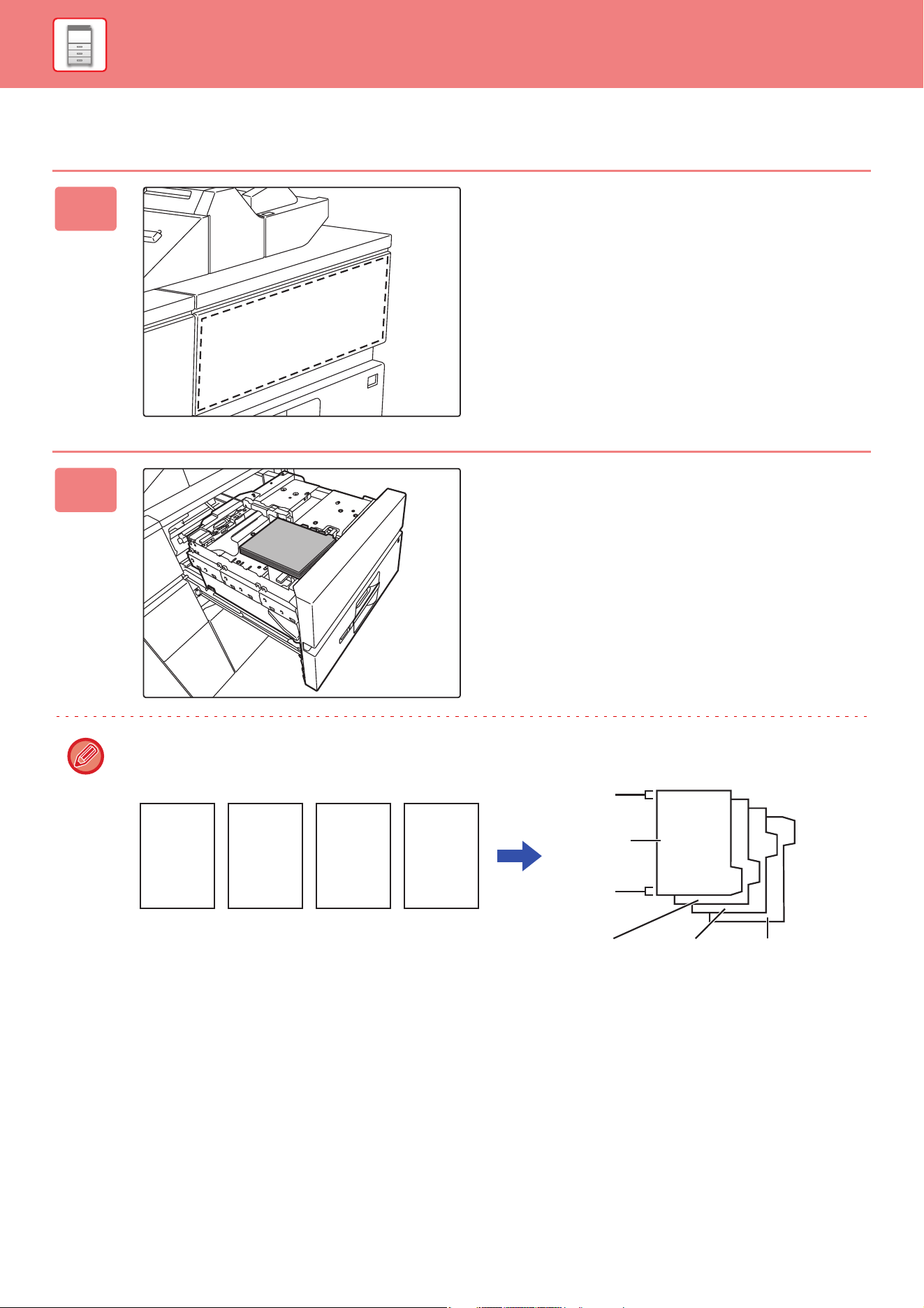
1-78
BEFORE USING THE MACHINE►LOADING PAPER
Loading the tab paper
1
Remove the tab paper guide.
The guide is stored in the upper tray.
2
Insert the tab paper into the tray.
Place the tab paper with the print side facing up so that the
tab is to the right.
See the following figure and adjust the tab position of the tab paper.
GHI
DEF
ABC
JKL
Originals
1st page
Tab paper
2nd page 3rd page 4th page
2nd page 3rd page 4th page
1st page
Top edge
Tail edge
Side 2
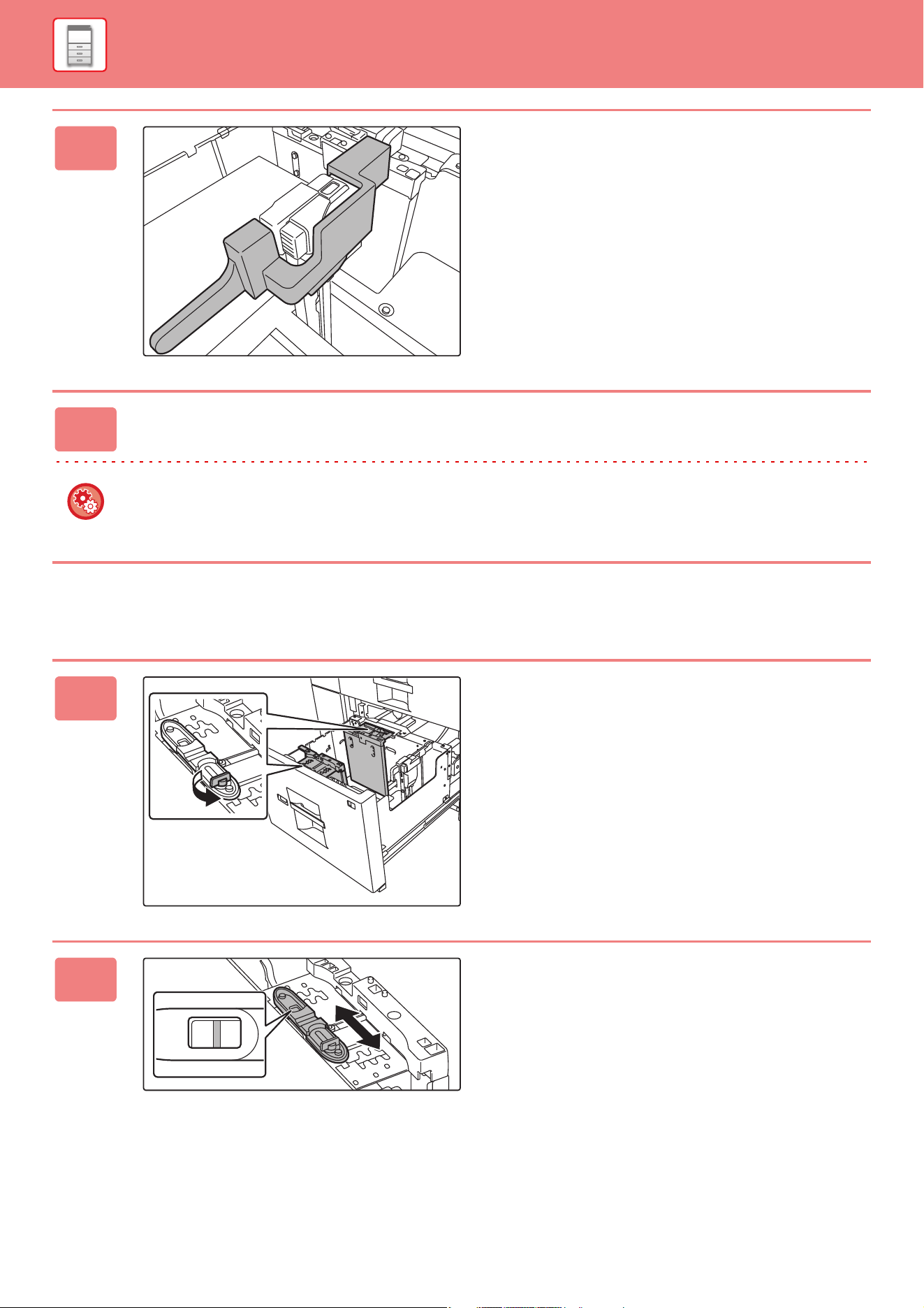
1-79
BEFORE USING THE MACHINE►LOADING PAPER
Changing the paper size
3
Place the tab paper guide.
Place the guide on the top of the tab paper.
4
Gently push the tray into the machine, and set the paper type to tab paper.
Using "Paper Tray Settings" in the system settings, set the paper type to tab paper.
To set the paper type to tab paper:
Set this in [Tray Settings] in the home screen or in "Settings", select [System Settings] → [Common Settings] → [Paper
Settings] → [Paper Tray Settings].
1
Loosen the paper guide screw.
2
Slide the plate of the paper guide.
Slide the plate until the red line appears at the center of the
size window of the plate.
Both near and far plates slides when you slide one of those.
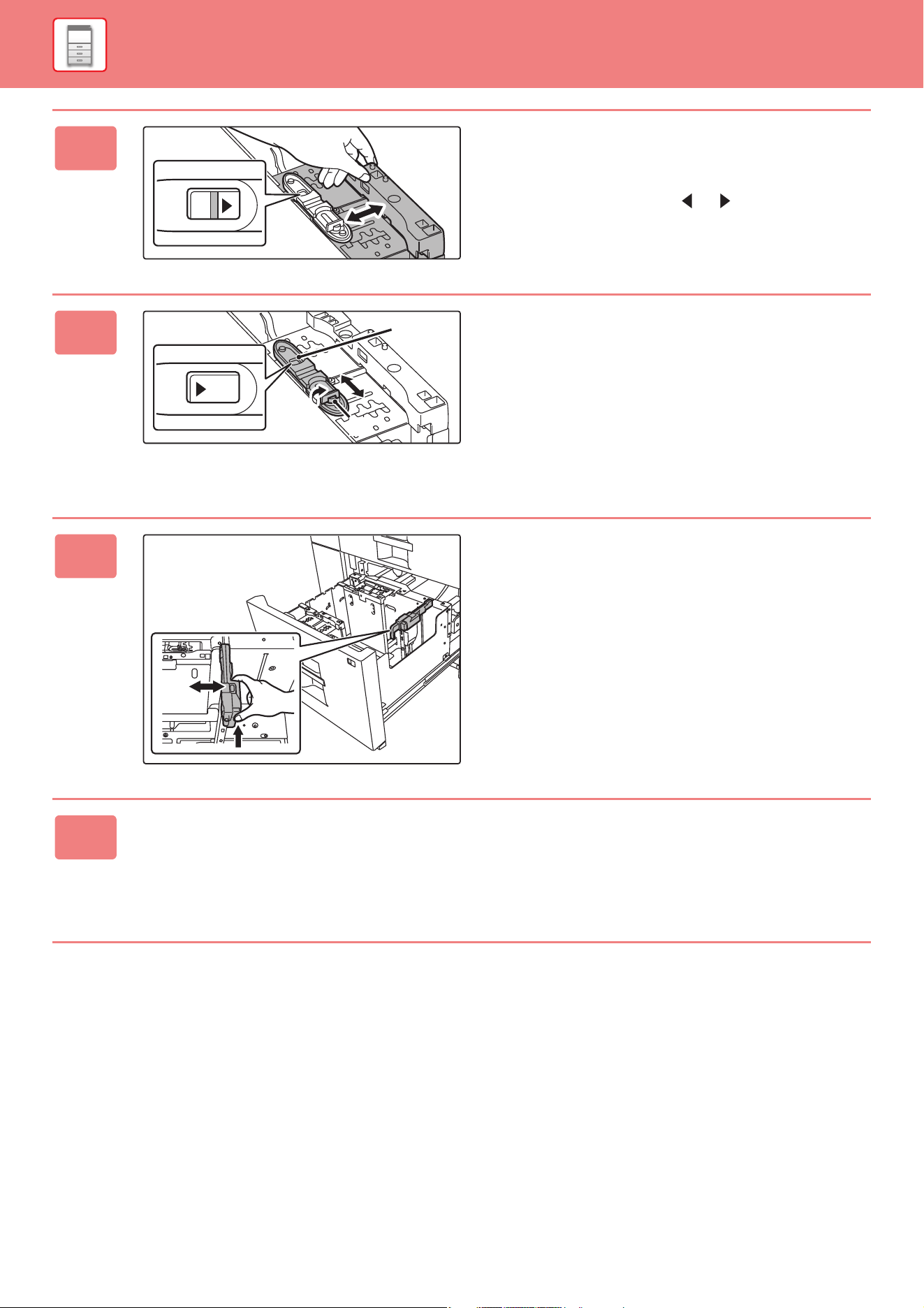
1-80
BEFORE USING THE MACHINE►LOADING PAPER
3
Adjust the paper guide to the paper
size that will be used.
Slide the paper guide forward or backward until the size
mark of the paper to be used ( or ) appears in the size
window of the plate.
Both near and far plates slides when you slide one of those.
4
Secure the paper guide.
(1) Slide the plate of the paper guide.
Slide the plate until the paper size to be used appears
in the size window of the plate.
Both near and far plates slides when you slide one of
those.
(2) Tighten the paper guide screw.
Tighten both far and near paper guide screws.
5
Change the right paper guide to the
paper size to be used.
(1) While holding the paper guide lock, slide
the paper guide to the paper size to be
used.
(2) Release the paper guide lock.
(3) Move the paper guide slightly to the right
and left so that it locks into place.
You will hear a "click" when the paper guide locks.
6
Set the paper size and paper type.
Be sure to set the paper size and paper type by selecting [Tray Settings] in the home screen or in "Settings", select
[System Settings] → [Common Settings] → [Paper Settings] → [Paper Tray Settings].
If the paper size setting is not configured correctly, automatic paper selection will not operate correctly and printing may
take place on the wrong size or type of paper or a misfeed may occur.
11
(1)
(2)
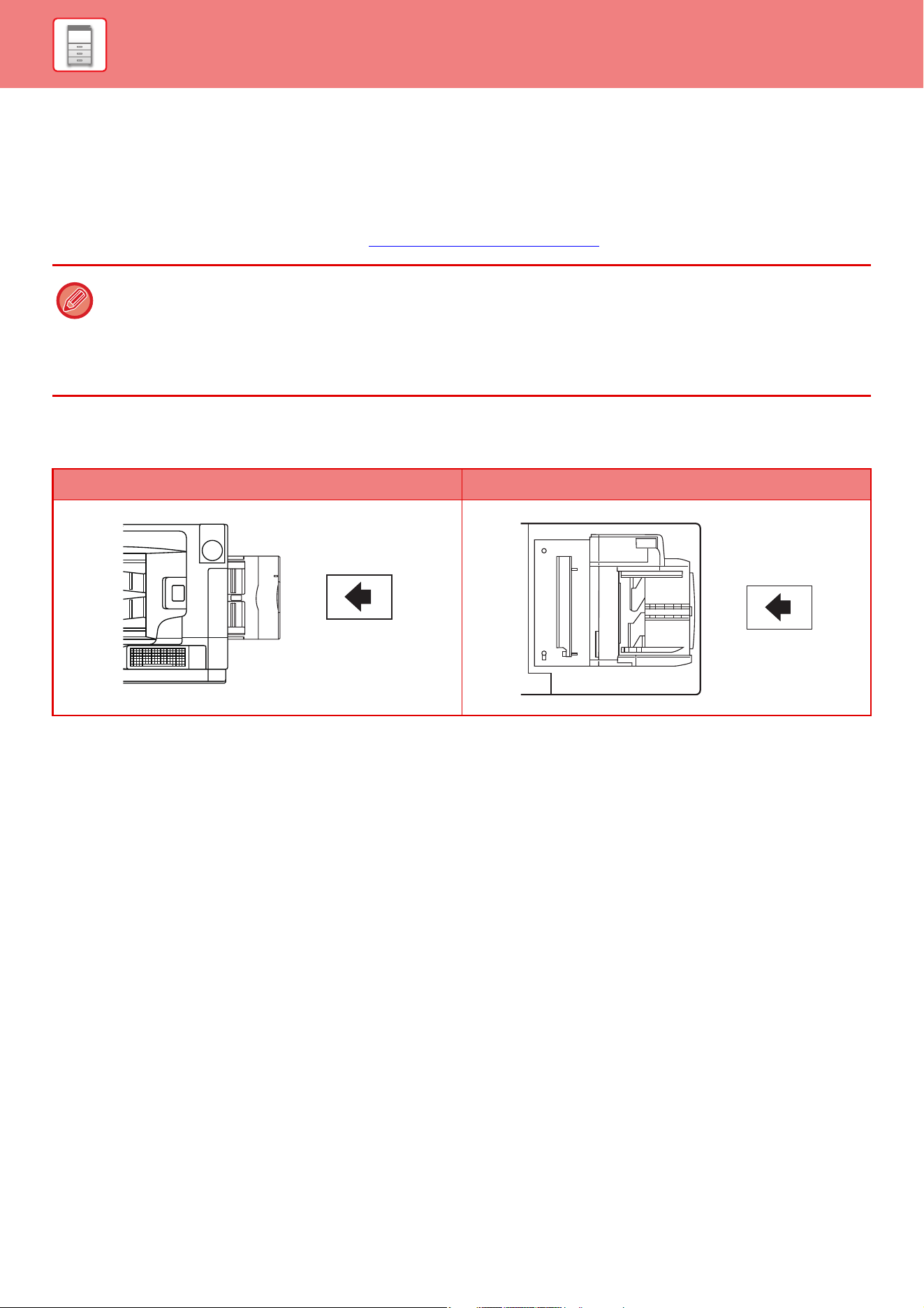
1-81
BEFORE USING THE MACHINE►LOADING PAPER
LOADING PAPER INTO THE BYPASS TRAY
Use the bypass tray for printing on plain paper, label sheets, tab paper, and other special media.
A maximum of 100 sheets of paper can be loaded into the bypass tray (on the machine), or a maximum of 500 sheets can
be loaded in the bypass tray (on the large capacity trays), and continuous printing is possible as is the case with other trays.
For detailed information on the sizes and types of paper that can be loaded into the bypass tray, see
"SPECIFICATIONS" in the "Start Guide" and "Paper Tray Settings (page 7-103)
".
How to place the original
Load paper up to 7-1/4" × 10-1/2" (A5) size in landscape orientation.
• When using plain paper other than Sharp standard paper or special media other than SHARP-recommended transparency
film, or when printing on the reverse side of paper that has been printed on one side, load paper one sheet at a time.
Loading more than one sheet at a time will cause misfeeds.
• Before loading paper, straighten any curling in the paper.
• When adding paper, remove any paper remaining in the bypass tray, combine it with the paper to be added, and reload as
a single stack. If paper is added without removing the remaining paper, a misfeed may result.
Bypass tray (on the machine) Bypass tray (on the large capacity trays)
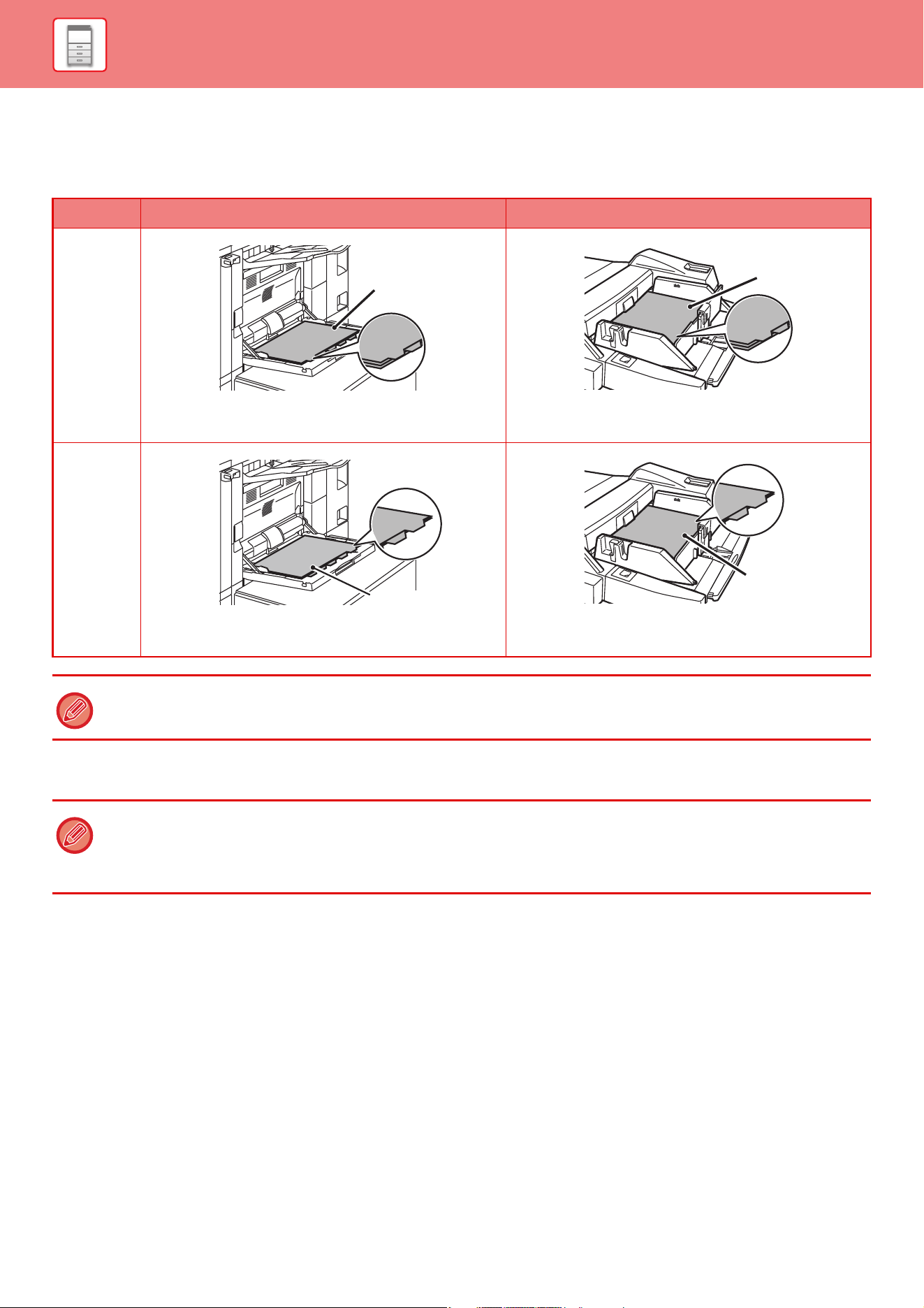
1-82
BEFORE USING THE MACHINE►LOADING PAPER
Loading tab paper
When printing on tab paper, be sure to place the paper with the print side facing down.
For the bypass tray (on the large capacity trays), the dedicated guide must be installed in the bypass tray guides at the
rear end. The dedicated guide is in the upper side of the large capacity trays.
Inserting transparency film
Bypass tray (on the machine) Bypass tray (on the large capacity trays)
Left
Place the first sheet of tab paper so that the tab faces
toward you.
Place the first sheet of tab paper so that the tab faces
toward you.
Right
Place the first sheet of tab paper so that the tab faces
away from you.
Place the first sheet of tab paper so that the tab faces
away from you.
• Use only tab paper that is made of paper. Tab paper made of a material other than paper (film, etc.) cannot be used.
• To copy onto the tabs of tab paper, [Tab Copy] in "Others" is useful.
• Use SHARP-recommended transparency film.
• When loading multiple sheets of transparency film into the bypass tray, fan the sheets several times before loading.
• When printing on transparency film, remove each sheet as it is printed and output from the machine. Allowing sheets to
stack in the output tray may result in curling.
Side 2
Side 2
Side 2
Side 2
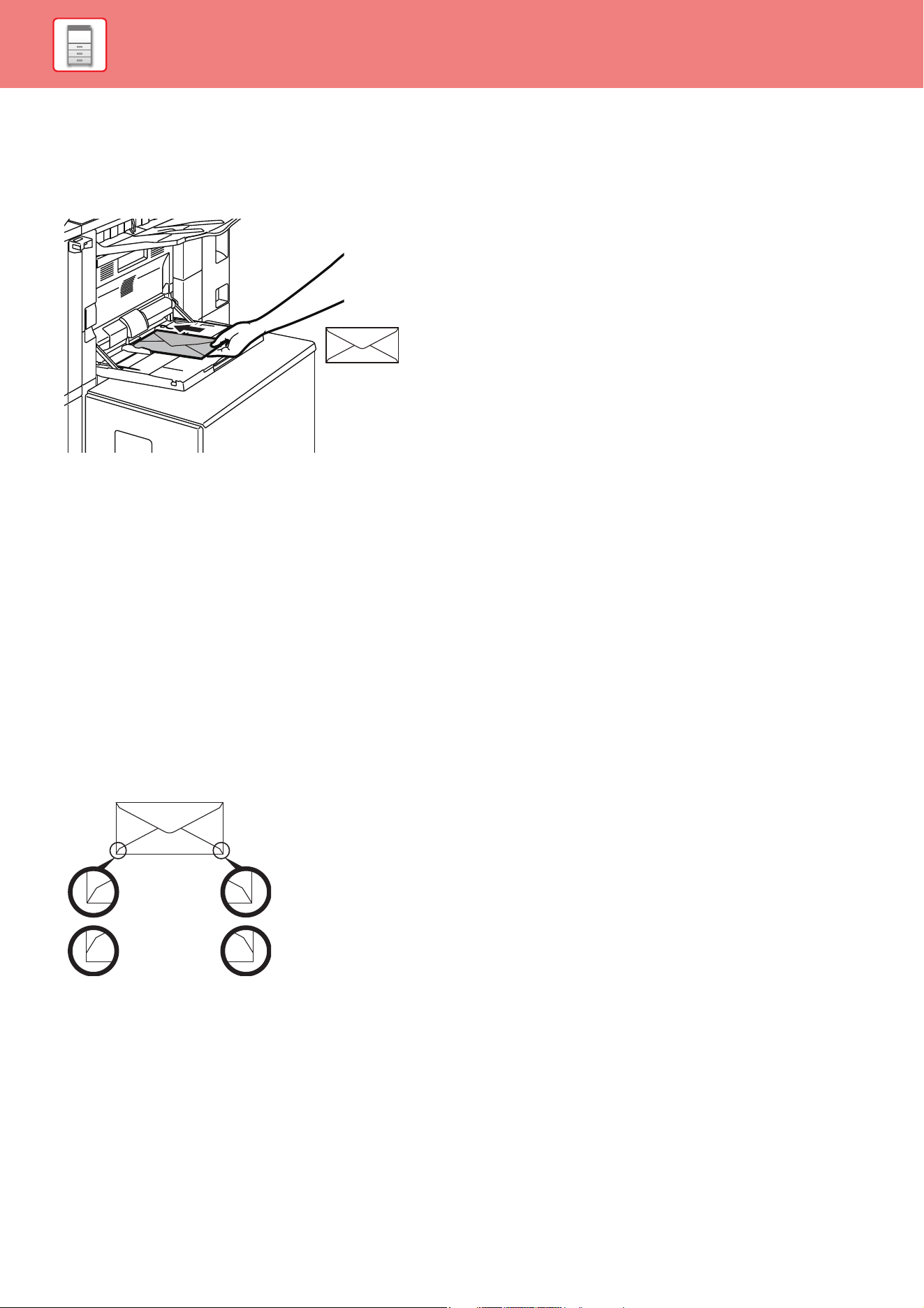
1-83
BEFORE USING THE MACHINE►LOADING PAPER
Loading envelopes
When loading envelopes into the bypass tray, place them in the orientation as shown in the figure.
Placing envelopes
Only the front side of envelopes can be printed on or copied to. Place the front side facing down.
Important points when using envelopes
• Do not print on both sides of an envelope. This may result in misfeeds or poor print quality.
• Restrictions apply to some types of envelopes. For more information, consult a qualified service technician.
• Some operating environments may cause creasing, smudging, misfeeds, poor toner fusing, or machine failure.
• Fold the flap of the envelope and make a sharp crease at the fold. A misfeed may occur if the flap is up.
• Do not use the following envelopes:
• Those with a metal piece, a plastic hook or a ribbon hook
• Those with a string for closing
• Those with a window
• Those with a lining
• Those with an uneven surface, finished with titling or emboss
• Duplex envelopes or those with adhesive or other synthetic material for sealing
• Hand-made envelopes
• Those containing air inside
• Those damaged with a crease, fold mark or tear
• Envelopes with the corner gluing position on the back not aligned with the corner edge should not be used as it may
cause creasing.
• Print quality is not guaranteed in the area 13/32" (10 mm) around the edges of the envelope.
• Print quality is not guaranteed on parts of envelopes where there is a large step-like change of thickness, such as on
four-layer parts or parts less than three layers.
• Print quality is not guaranteed on envelopes having peel off flaps for sealing the envelopes.
Can be used
Cannot be used

1-84
BEFORE USING THE MACHINE►LOADING PAPER
Important points when using embossed paper/label sheets
• The effect of asperity surfaces of embossed paper may affect the print quality depending on the type of embossed
paper.
For more information, consult the dealer or nearest SHARP Service Department.
• Some labels may have to be loaded into the bypass tray in the specified orientation. Follow such instructions.
If a form is already printed on the labels, and the print images and the preprinted form do not line up, adjust the
application or printer driver settings to rotate the print images.
• Do not use the following types of label sheets.
• Label sheets without an adhesive copy or label copy
• Label sheets with adhesive exposed
• Label sheets with a specified feeding direction that is not supported by the machine
• A label sheet that has already been fed or has some labels removed
• Label sheets consisting of multiple sheets
• Label sheets that do not support laser printing
• Label sheets that cannot withstand heat
• Label sheets that have perforations in the backing paper
• Label sheets with slits in the backing paper
• Non-standard label sheets
• Label sheets with adhesive that has deteriorated due to prolonged storage or otherwise
• Label sheets with cutouts that expose the backing paper
• Curled or otherwise deformed label sheets
• Torn or creased label sheets
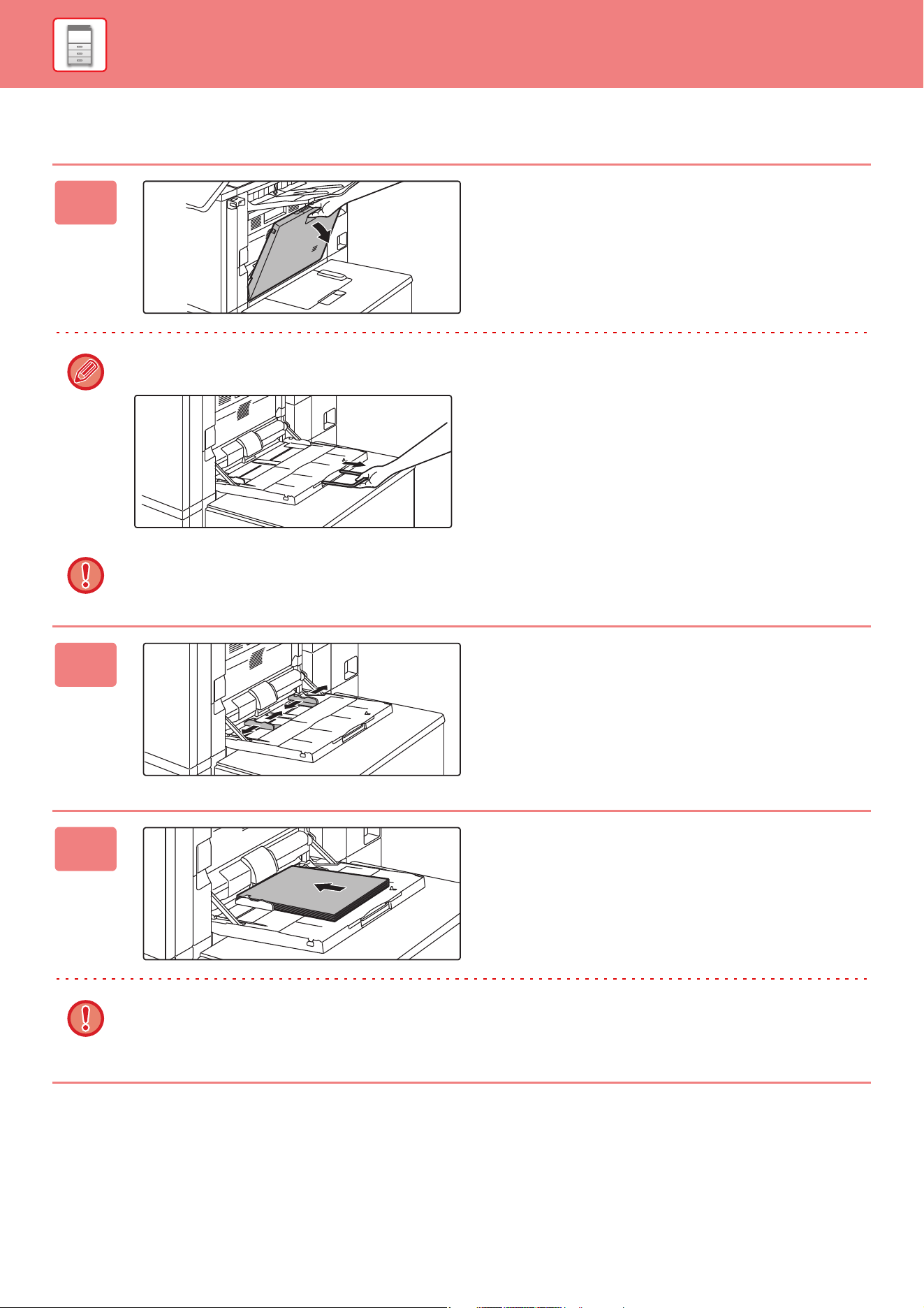
1-85
BEFORE USING THE MACHINE►LOADING PAPER
Loading paper into the bypass tray (on the machine)
1
Open the bypass tray.
When loading paper larger than 8-1/2" × 11"R or A4R, pull out the extension guide.
Pull the bypass tray extension all the way out.
Do not place heavy objects on the bypass tray or press down on the tray.
2
Adjust the bypass tray guides to the
size of paper to be loaded.
3
Insert the paper along the bypass tray
guides all the way into the bypass tray
until it stops.
Load paper with the print side facing down.
• Do not force the paper in.
• If the bypass tray guides are set wider than the paper, move the bypass tray guides in until they correctly fit the width
of the paper. If the bypass guides are set too wide, the paper may skew or be creased.
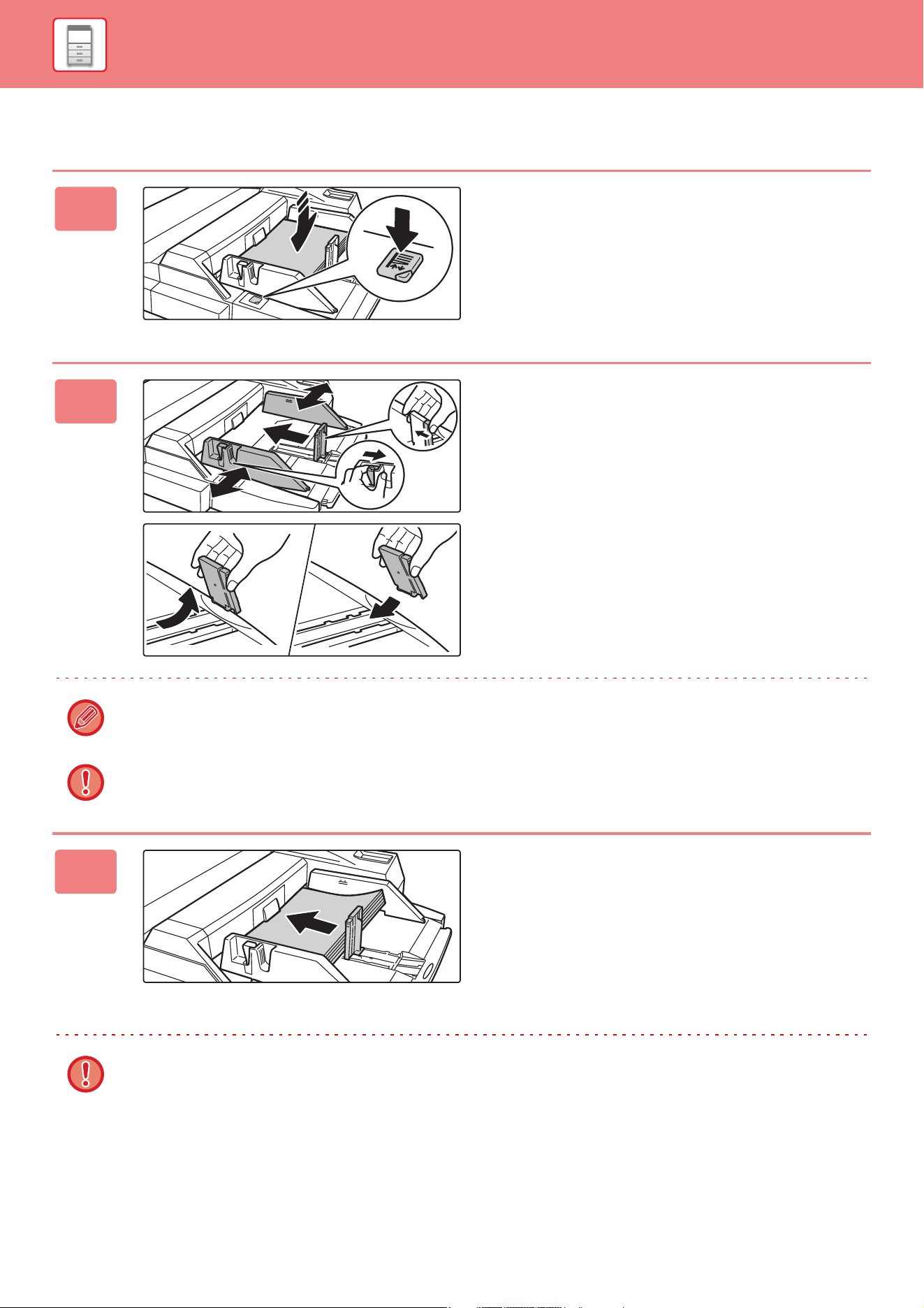
1-86
BEFORE USING THE MACHINE►LOADING PAPER
Loading paper into the bypass tray (on the large capacity trays)
1
To replace the paper in the bypass
tray, press the operation button and
remove the paper.
The paper table goes down. The operation button blinks
while the paper table goes down. The button lights up when
the paper table has gone down. Do not remove the paper
until the button ceases blinking.
2
Adjust the bypass tray guides to the
size of paper to be loaded.
Grasp the guide lock lever to adjust the bypass tray guides
to the paper size. Be sure to adjust the bypass tray guides at
the rear end.
When loading paper larger than 8-1/2" × 11"R or A4R, be
sure to pull out the bypass tray extension. Remove the
bypass tray guide at the rear end and attach them to the
inserter tray.
• Pull the bypass tray extension all the way out.
• When loading paper larger than 8-1/2" × 14", or A3W, remove the bypass tray guides at the rear end.
Do not place heavy objects on the bypass tray or press down on the tray.
3
Insert the paper along the bypass tray
guides all the way into the bypass tray
until it stops and adjust the right-side
guide.
Load paper with the print side facing down.
The stack must not be higher than the indicator line.
A maximum of 500 sheets of paper can be loaded into the
tray.
• Do not force the paper in.
• If the bypass tray guides are set wider than the paper, move the bypass tray guides in until they correctly fit the width
of the paper. If the bypass guides are set too wide, the paper may skew or be creased.
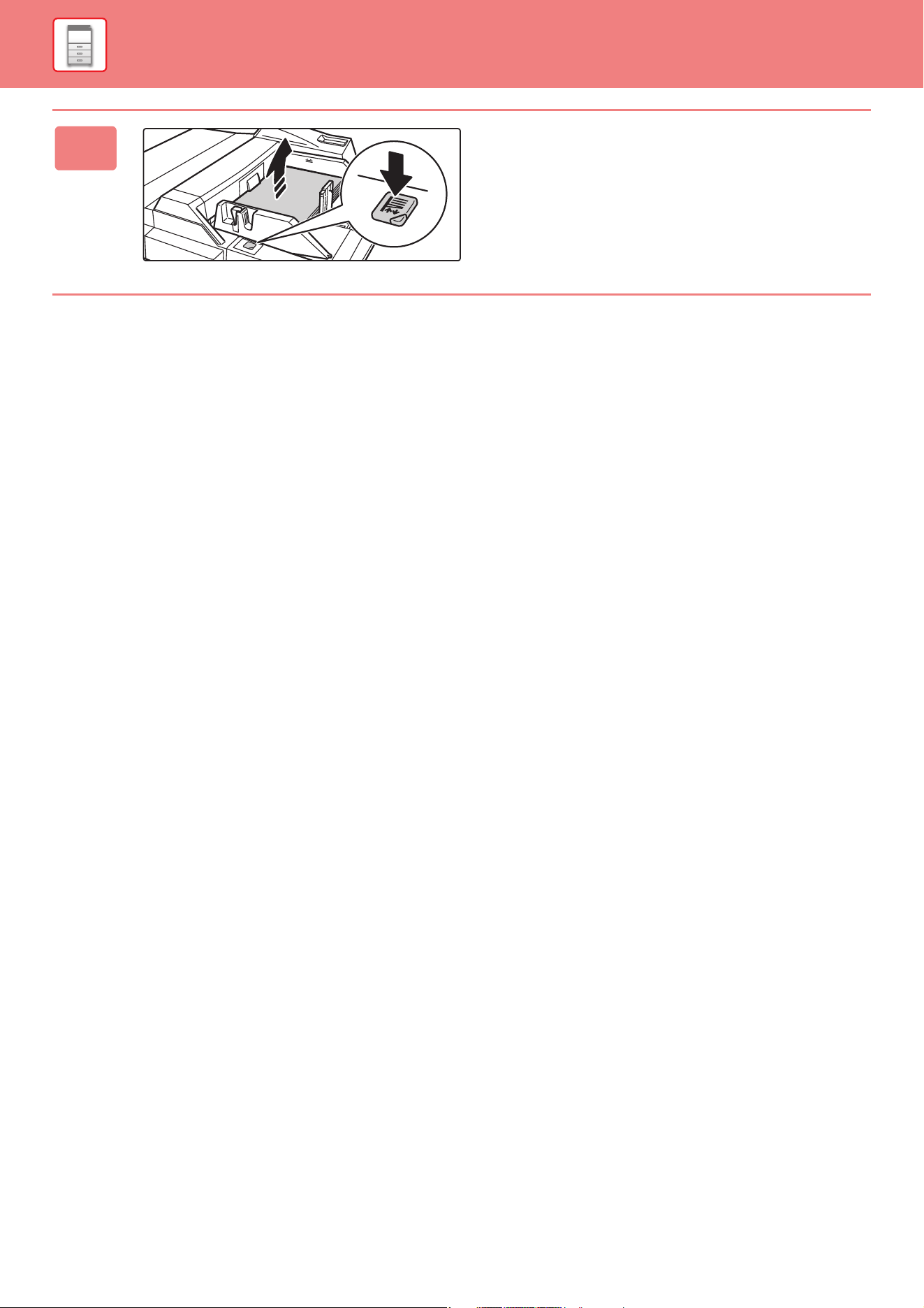
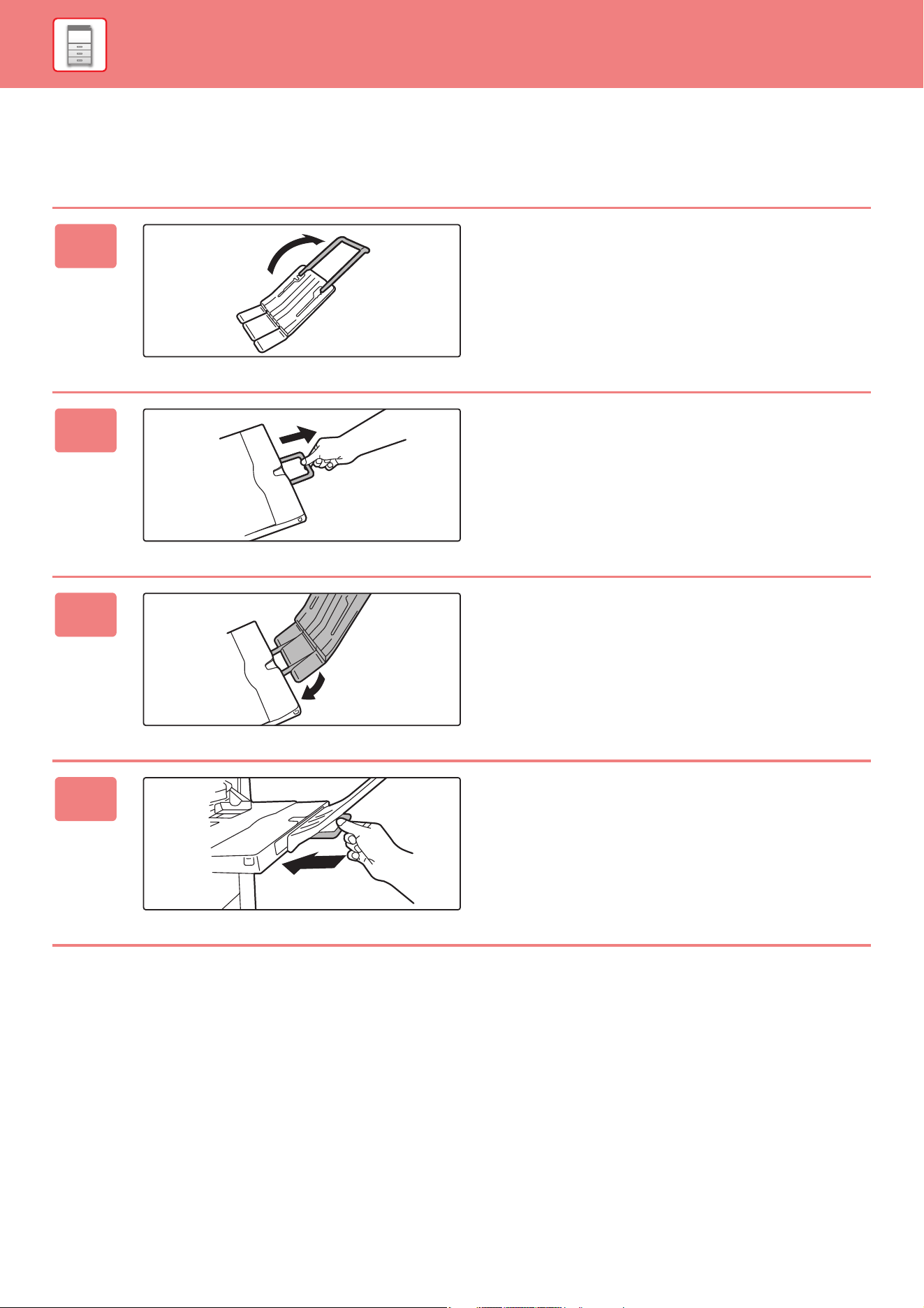
1-88
BEFORE USING THE MACHINE►LOADING PAPER
HOW TO PLACE THE LONG PAPER GUIDE
The steps for attaching the optional long paper feeding tray to the bypass tray are explained below.
1
Extend the auxiliary guide of the long
paper feeding tray.
2
Pull out the extension guide of the
bypass tray.
3
Attach the long paper feeding tray
onto the extension guide of the bypass
tray.
4
Replace the extension guide of the
bypass tray.
1-89
BEFORE USING THE MACHINE►HOW TO PLACE THE ORIGINAL
SELECTING A PROCEDURE FOR PLACING
THE ORIGINAL DEPENDING ON THE TYPE
AND STATUS OF THE ORIGINAL
Place the original in the automatic document feeder. Depending the type and status of the original, use the document
glass. Follow the instructions to select the method for placing the original.
To place it in the automatic document feeder, see "AUTOMATIC DOCUMENT FEEDER (page 1-90)
".
HOW TO PLACE THE ORIGINAL
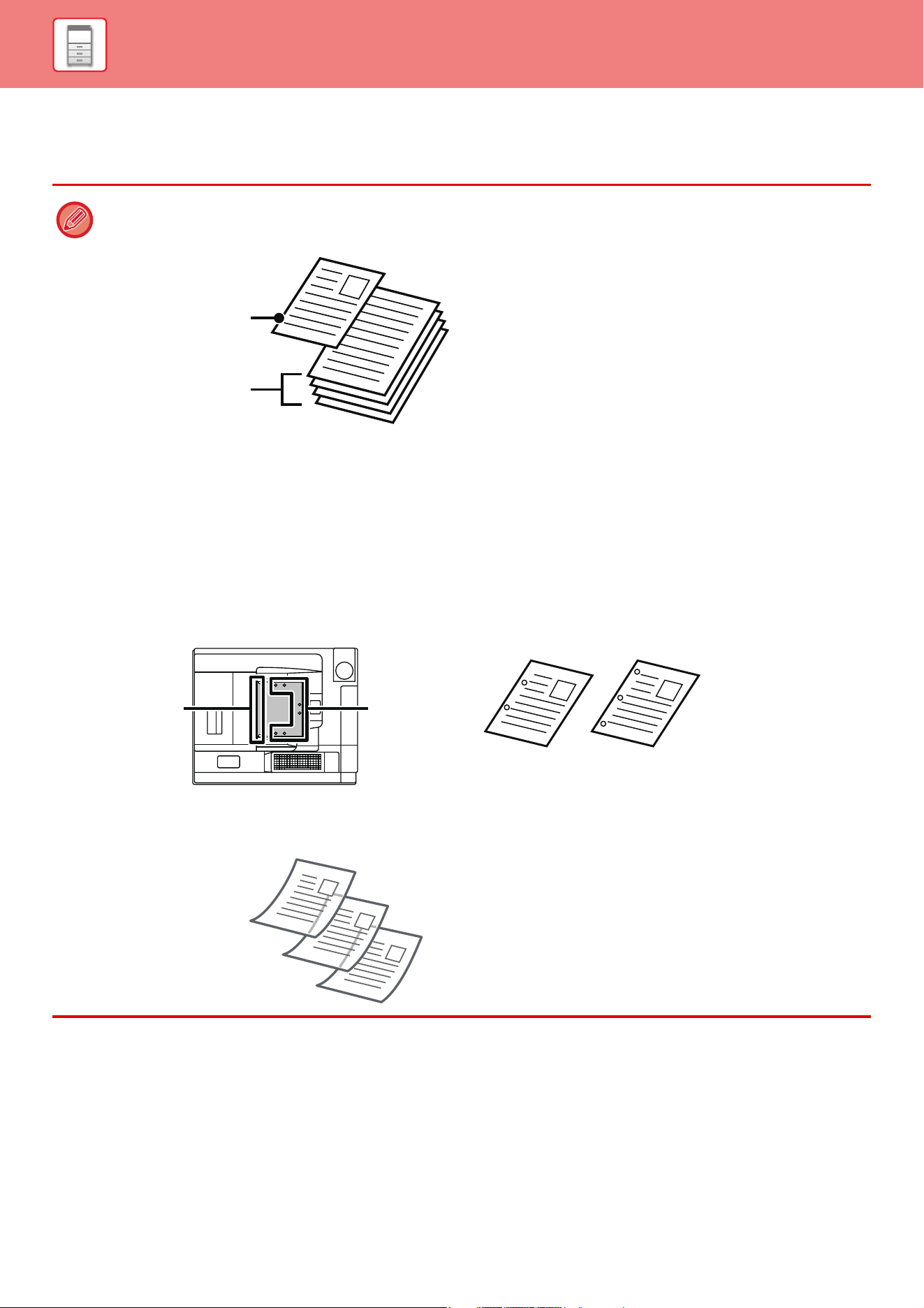
1-90
BEFORE USING THE MACHINE►HOW TO PLACE THE ORIGINAL
AUTOMATIC DOCUMENT FEEDER
This section explains how to place originals in the automatic document feeder.
• Place originals of different sizes together, if needed, in the automatic document feeder. In that case, use the "Others"
function in each mode to set [Mixed Size Original]. An original cannot be detected if all pages are of the same size but
some of them are set in a different orientation.
• Before inserting originals into the document feeder tray, be sure to remove any staples or paper clips.
• If originals have damp spots due to correction fluid, ink or paste up glue, wait until the originals are dry before making
copies. Otherwise the interior of the machine or the document glass may be soiled.
• Do not use the following originals. Incorrect original size detection, original misfeeds, and smudges may result.
Transparency film or other transparent material for backup copy, tracing paper, carbon paper, thermal paper or originals
printed with thermal transfer ink ribbon should not be fed through the document feeder. Originals to be fed through the
feeder should not be damaged, crumpled, folded, loosely pasted together, or have cut-out holes. Originals with multiple
punched holes other than two-hole or three-hole punched paper may not feed correctly.
• When using originals with two or three holes, place them so that the punched edge is at a position away from the feed slot
of the document feeder tray. Specify the orientation of the original using [Original].
• For a thin original (9 lbs. to 14 lbs. (35 g/m
2
- 49 g/m
2
)), use [Slow Scan Mode] in the "Others". For this type, 2-sided
scanning is disabled.
5-1/2" x 8-1/2" (B5)
8-1/2" x 11" (A4)
Hole positions
Feed slot
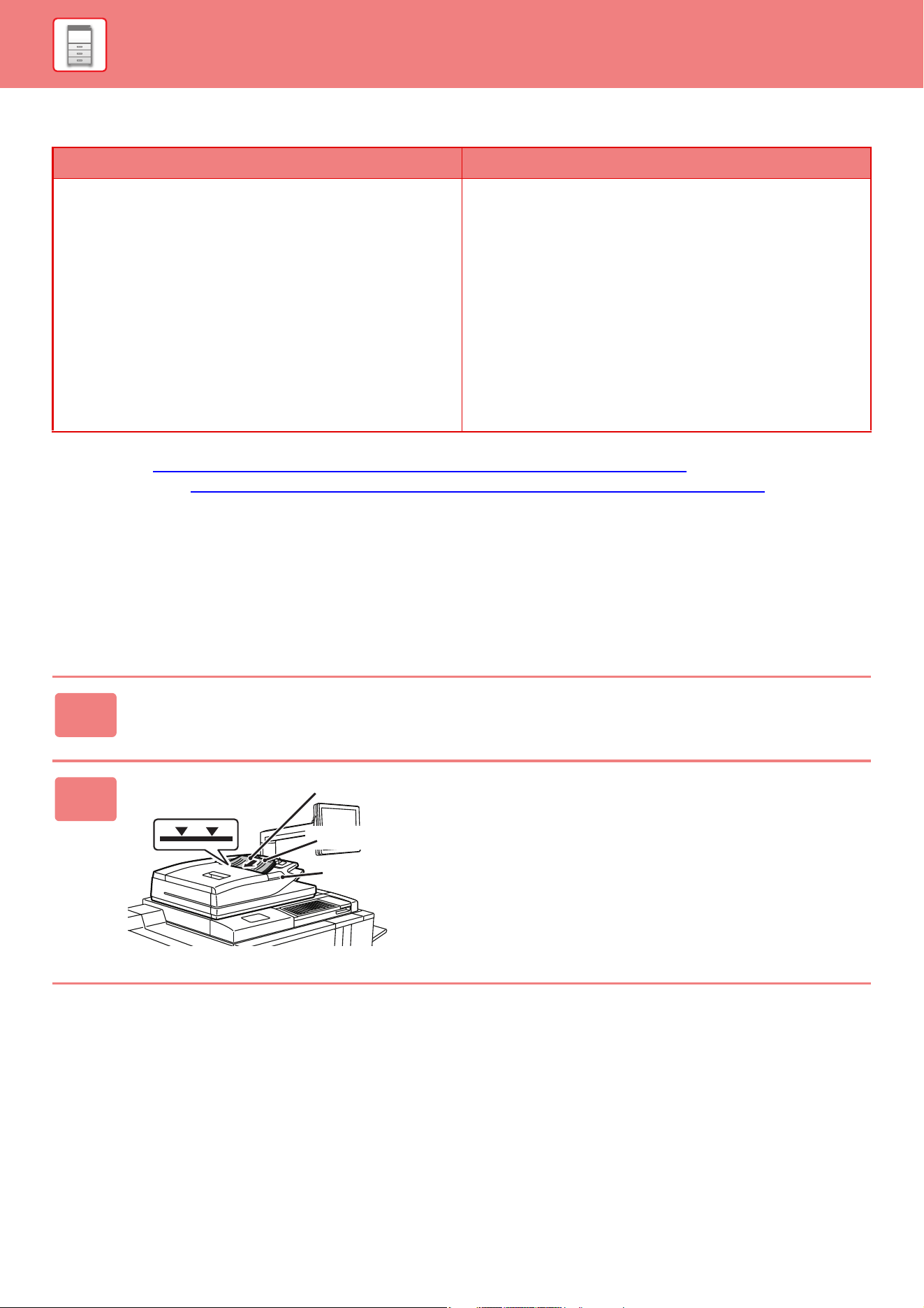
1-91
BEFORE USING THE MACHINE►HOW TO PLACE THE ORIGINAL
Allowed original sizes
When the original is a non-standard size, see the appropriate explanation below for the mode you are using.
► COPIER: "SELECTING THE ORIENTATION AND SIZE OF THE ORIGINAL (page 2-33)"
► IMAGE SEND: "SPECIFYING THE ORIGINAL SCAN SIZE USING NUMERIC VALUES (page 4-42)"
Allowed original weights
1-Sided scanning: 9 lbs. to 32 lbs. (35 g/m
2
to 128 g/m
2
)
2-Sided scanning:13 lbs. to 32 lbs. (50 g/m
2
to 128 g/m
2
)
To scan originals from 9 to 13 lbs Bond (35 to 49g/m
2
), use "Slow Scan Mode" in the "Others" function. Scanning without
using "Slow Scan Mode" may result in original misfeeds.
When "Slow Scan Mode" is selected, automatic 2-sided scanning is not possible.
Minimum original size Maximum original size
Standard size
(Minimum size that can be automatically detected)
5-1/2" (longitudinal) × 8-1/2" (transversal)
148 mm (longitudinal) × 210 mm, or A5
Non-standard size
(Minimum size that can be specified manually)
5-1/8" (longitudinal) × 5-1/2" (transversal)
131 mm (longitudinal) × 140 mm (transversal)
Standard size
(Maximum size that can be automatically detected)
11" (longitudinal) × 17" (transversal)
297 mm (longitudinal) × 420 mm (transversal) or A3
12" × 18" (A3W) cannot be used.
Non-standard size
(Maximum size that can be specified manually)
Copy mode:
11-5/8" (longitudinal) × 17" (transversal)
297 mm (longitudinal) × 432 mm (transversal)
Image send mode:
11" (longitudinal) × 39-3/8" (transversal)
297 mm (longitudinal) × 1000 mm (transversal)
1
Make sure that there is no original on the document glass.
2
Place the original.
Up to 150 sheets can be inserted.
After scanning is finished on the automatic document feeder,
remove originals from the original exit tray.
Align the edges evenly
and face them up
Insert to the end
Fit to the Original Size
Below the indicator line
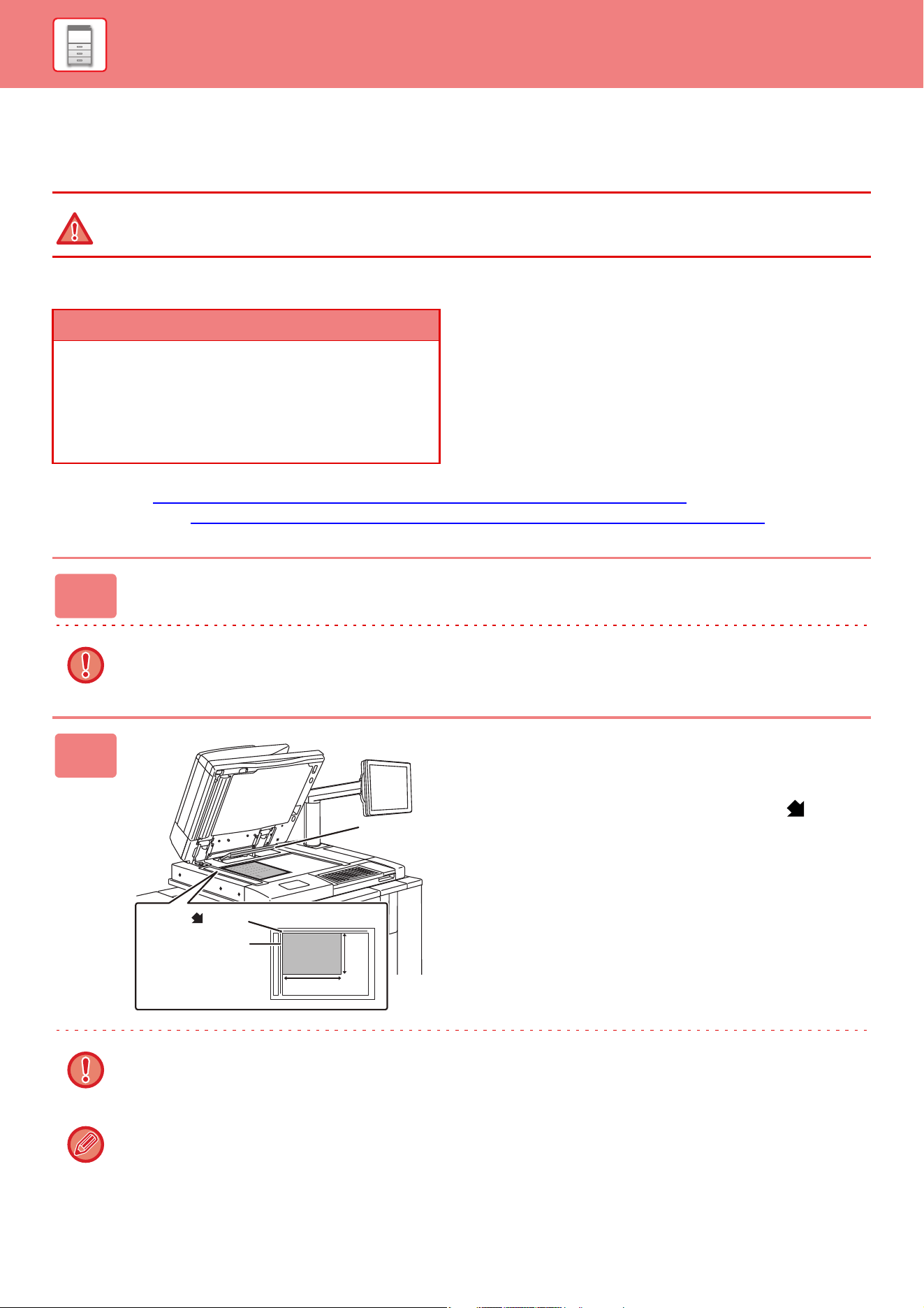
1-92
BEFORE USING THE MACHINE►HOW TO PLACE THE ORIGINAL
DOCUMENT GLASS
This section describes the steps for setting the original on the document glass.
Allowed original sizes
When the original is a non-standard size, see the appropriate explanation below for the mode you are using.
► COPIER: "SELECTING THE ORIENTATION AND SIZE OF THE ORIGINAL (page 2-33)"
► IMAGE SEND: "SPECIFYING THE ORIGINAL SCAN SIZE USING NUMERIC VALUES (page 4-42)"
• Close the automatic document feeder slowly. Abruptly closing the automatic document feeder may damage it.
• Take care that your fingers are not pinched when closing the automatic document feeder.
Maximum original size
Standard size
11" (longitudinal) x 17" (transversal)
297 mm (longitudinal) x 420 mm (transversal) or A3
Non-standard size
11-5/8" (longitudinal) x 17" (transversal)
297 mm (longitudinal) x 432 mm (transversal)
1
Open the automatic document feeder.
When opening the automatic document feeder, make sure the extension tray is closed.
2
Load the paper with the print side
facing down.
Place the original face down and align the top left corner of
the original with back left (at the tip of the mark ) of the
document glass.
Do not place any objects under the original size detector.
Closing the automatic document feeder with an object underneath may damage the original size detector or disable
correct detection of the original size.
When placing a non-standard size original on the document glass, the size can be detected easily if a blank sheet of
8-1/2" x 11" (A4), 5-1/2" x 8-1/2" (B5), or other standard size paper is placed on top of the original.
X
Y
Mark
Document glass
scale
Original size
detector
1-93
BEFORE USING THE MACHINE►HOW TO PLACE THE ORIGINAL
3
Close the automatic document feeder.
After placing the original, close the automatic document feeder. If the unit is left open, parts outside of the original will be
copied in black, causing excessive use of toner.
• When closing, open the automatic document feeder all the way and then close it.
• If originals have damp spots due to correction fluid, ink or paste up glue, wait until the originals are dry before making
copies. Otherwise the interior of the machine or the document glass may be soiled.
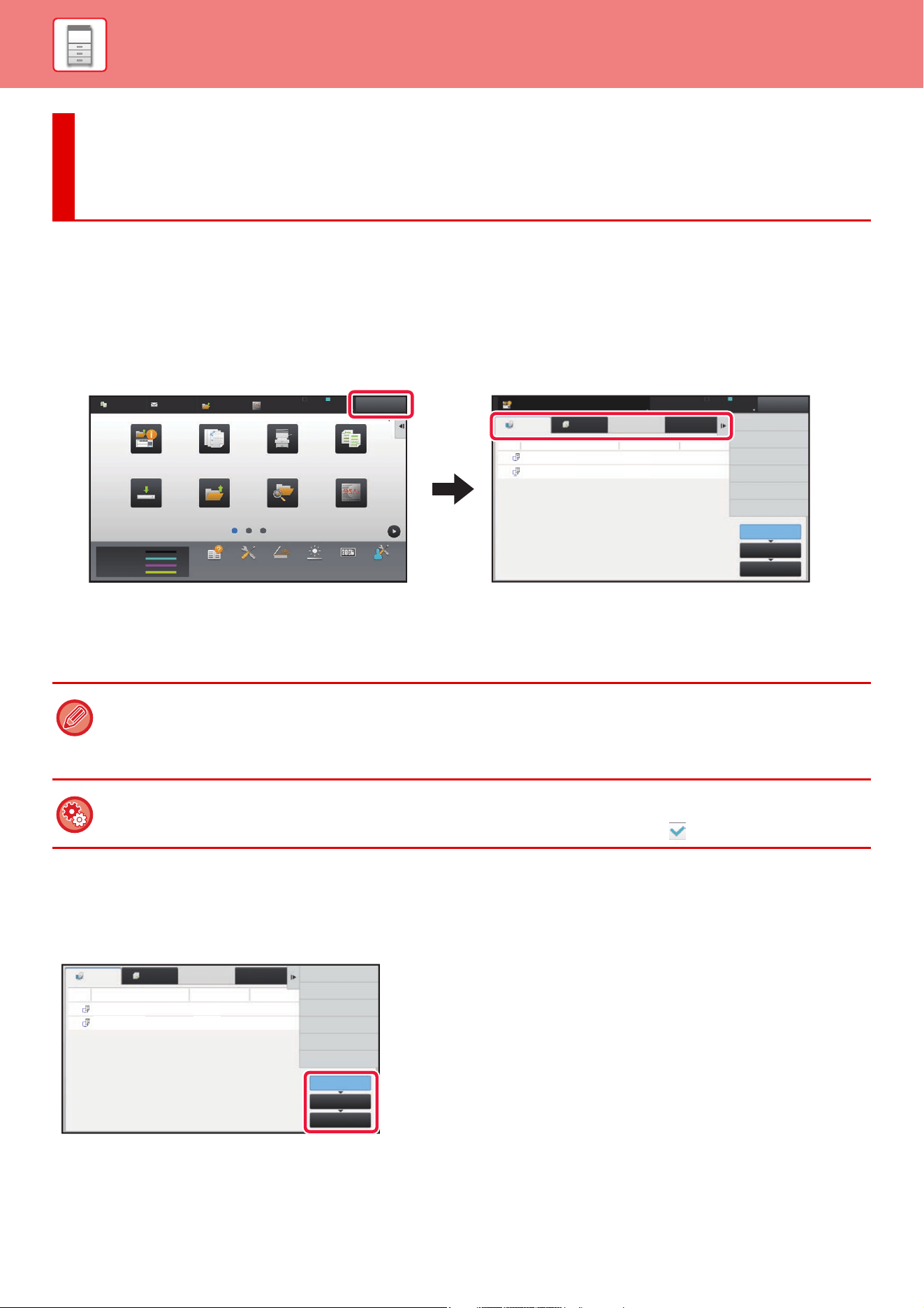
1-94
BEFORE USING THE MACHINE
►
STOPPING/DELETING A JOB, PRIORITY PROCESSING AND CHECKING THE STATUS
TYPES OF JOB MANAGEMENT SCREENS
When you tap the job management display, the job management screen appears. Tap it again to return to the previous
mode.
The job management screen is divided into the following four tabs, enabling you to select a job list by tapping a desired
tab.
•Print
Lists print jobs such as copying, printing from a PC, USB direct print, and printing for other received data.
• Scan
Lists send jobs of converted images for e-mail messages and FTP send jobs.
On each tab, jobs are classified into three groups.
Jobs move among the lists according to the processing status, from [Spool], [Job Queue] and [Complete], in that order.
To switch the job list display to the display by processing status, tap the [Spool], [Job Queue] or [Complete] key as
desired.
STOPPING/DELETING A JOB, PRIORITY
PROCESSING AND CHECKING THE STATUS
The background of the job management display changes as follows:
• Green: Job in progress
• Yellow: Warming up/waiting
• Red: Waiting for error clearing
To prohibit the display and changing of job information of other users when user authentication is enabled
Select "Settings (administrator)" → [User Control] → [Default Settings] → [Include Job Management in user authentication]
→ [Disable display/change of other users’ information in the job management] check box to .
Job Queue
Complete
Spool
File RetrieveScanPrint
Job Job Queue
Progress / Sets
Status
Encrypt PDF
Spooling
User_1_User_1_User ---/0004
---/0004User_2_User_2_User
Back
Job Management
Back
LINE PRINTER
10:15 AM
Copy
Job Management
Copy
E-mail
HDD
File retrieve
Sharp OSA
LINE PRINTER
Job Management
Toner Quantity
M
C
Bk
Y
Tray Settings/
Paper Settings
Scan to HDD Batch Print Sharp OSA
Manual
Finishing
HDD
File retrieve
Operation
Guide
PC Scan Total Count Machine
Adjustment
LCD Control
Settings
Job Queue
Complete
Spool
File RetrieveScanPrint
Job
Job Queue
Progress / Sets
Status
Encrypt PDF
Spooling
User_1_User_1_User ---/0004
---/0004User_2_User_2_User
Back
1-95
BEFORE USING THE MACHINE
►
STOPPING/DELETING A JOB, PRIORITY PROCESSING AND CHECKING THE STATUS
• Spool list (Only displayed when a print-from computer job is received)
Lists print jobs up to the transfer to the machine from a computer. The jobs move to the Job Queue list after the
transfer is completed.
If you printed an encrypted PDF file by direct print, enter the password from here to print the file.
► PRINTING AN ENCRYPTED PDF FILE (page 3-100)
• Job Queue list
Lists jobs in progress and in the queue for copying, printing from a computer. This list also displays jobs in progress
and in the queue for sending image data converted on the machine. The jobs move to the Complete list after printing
or sending is completed.
• Complete list
Lists jobs through with copying, printing or sending.
In the "Job Queue" for printing, the estimated start time for jobs waiting to be printed is shown.
The estimated job start time is only a guideline. The actual start time will vary depending on the state of the machine.
"Start time" can be hidden using the system settings.
Select "Settings (administrator)" → [User Control] → [Default Settings] → [Include Job Management in user authentication]
→ [Disable display/change of other users’ information in the job management] check box to .
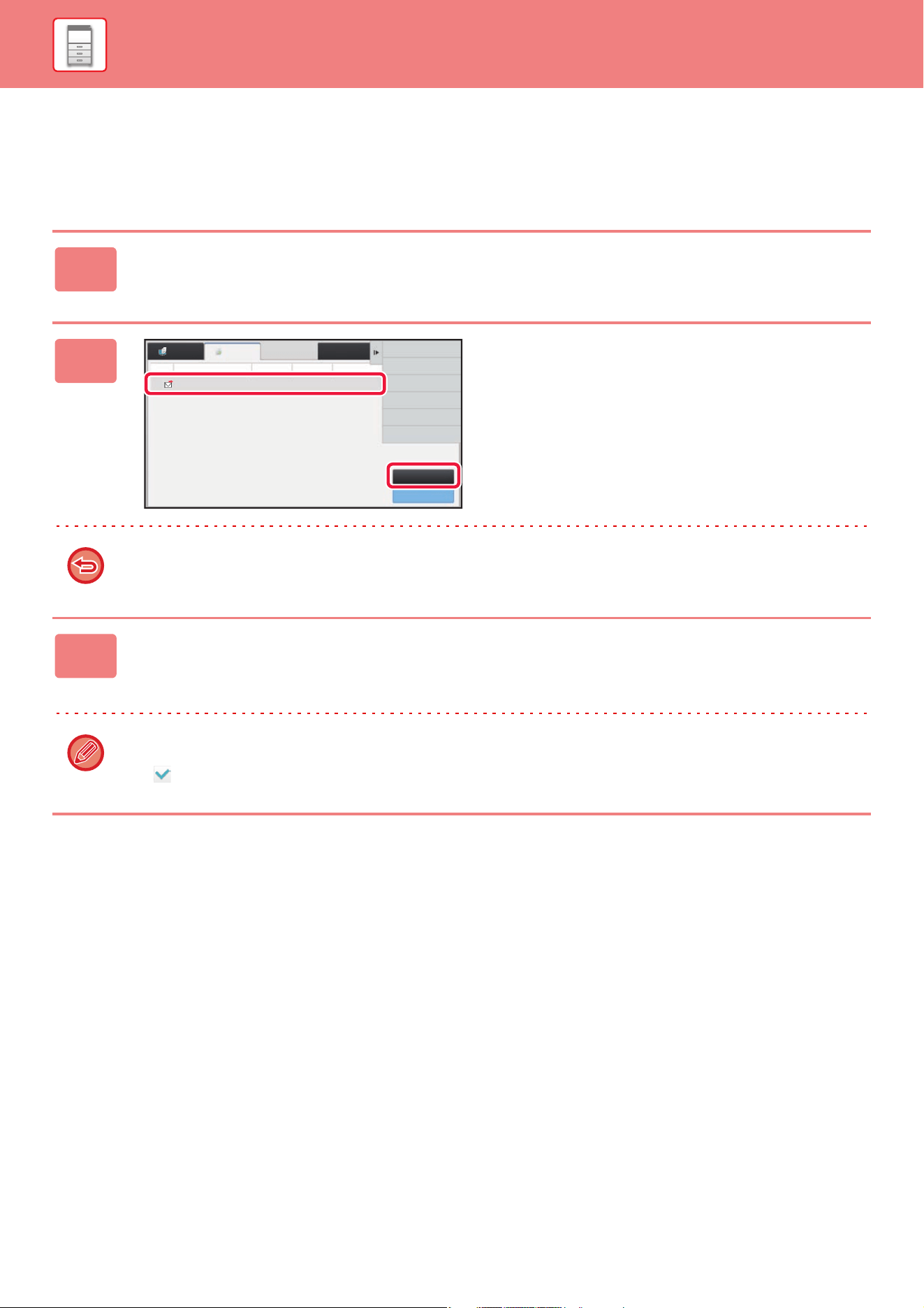
1-96
BEFORE USING THE MACHINE
►
STOPPING/DELETING A JOB, PRIORITY PROCESSING AND CHECKING THE STATUS
STOPPING/DELETING A JOB IN PROGRESS
OR RESERVED
1
Tap the job management display and tap the tab for the job that you wish to
stop or delete.
2
Tap the [Job Queue] key.
When you wish to stop a print job being sent from the computer, tap the [Spool] key.
3
Tap the job that you wish to stop or delete, and then tap [Stop/Delete] on the
action panel.
When a screen appears that allows you to confirm that you do want to stop the job, tap the [Cancel] key.
If the machine runs out of paper during a copy or print job, you can cancel the job from the job management screen.
To delete more than one job, operate the check box for [Enter Multi Selection Mode] on the action panel so that it looks
like .
Job Queue
Complete
File RetrieveScan
Job
Address
Set Time
Status
Print Image Sending
Activity Report
Back
0000/0002 OK
0000/000110:45 07/07Broadcast
Pages
Print
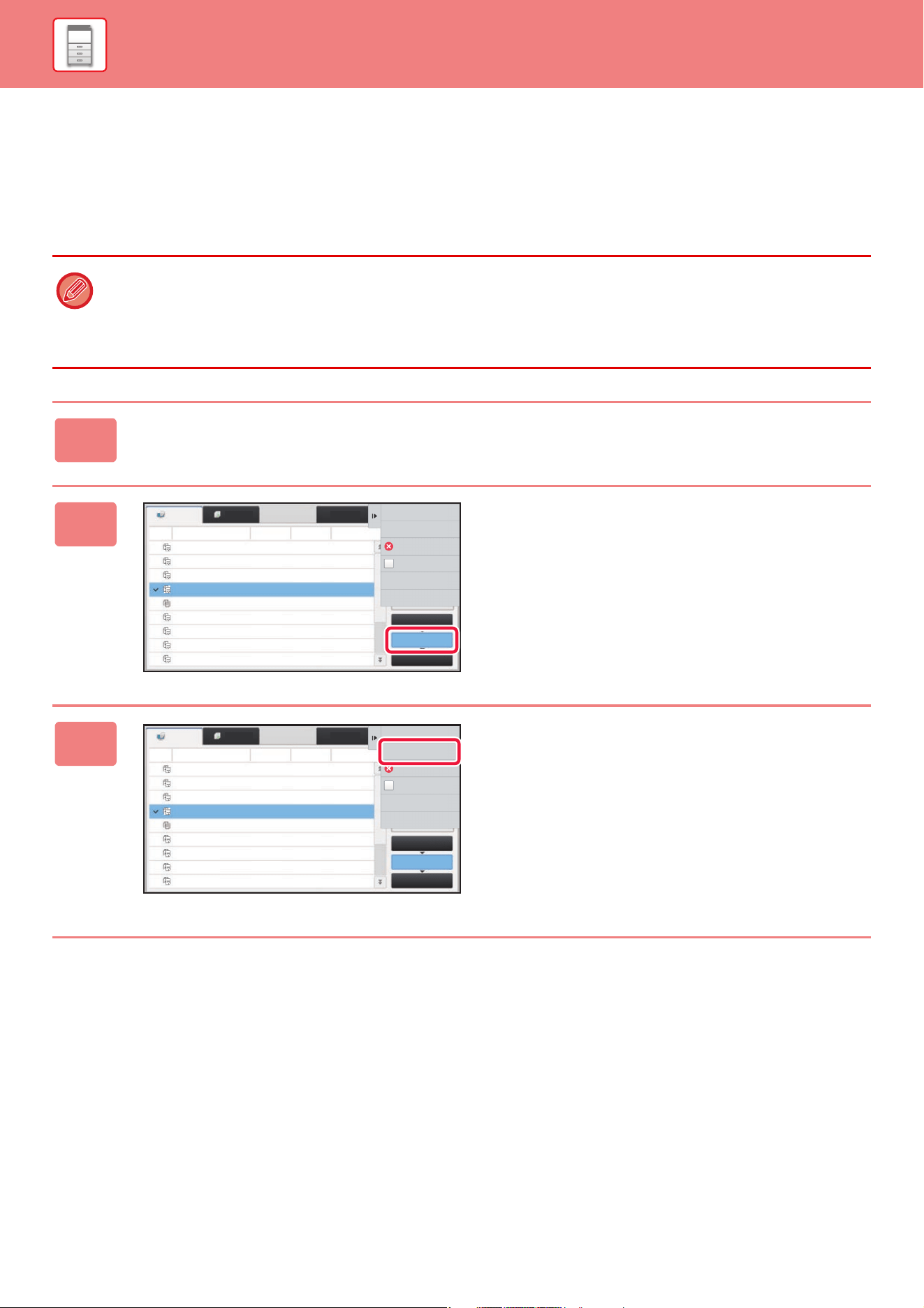
1-97
BEFORE USING THE MACHINE
►
STOPPING/DELETING A JOB, PRIORITY PROCESSING AND CHECKING THE STATUS
PRIORITY PROCESSING OF A RESERVED
JOB
This function gives priority to processing of copied, or image send jobs arising later to jobs already in a queue for printing
or sending.
Priority processing operation varies, as follows, depending on the job type.
• Job on the print tab
The job currently in progress is suspended to let the priority job make interruption.
• Job on the scanner tab
The priority job is moved directly under the job currently in progress.
1
Tap the job management display and tap the job for priority processing.
2
Tap the [Job Queue] key.
3
Tap the job for priority processing and
then tap [Change Job Priority] on the
action panel.
Print
Scan
Spool
Complete
Job Queue
Check Details of
Selected Job
Change Job Priority
Stop/Delete
Enter Plural
Selection Mode
Back
Job
Job Queue
Progress / Sets
Status
Paper Empty
Waiting
Waiting
Waiting
Waiting
Waiting
Waiting
Waiting
Waiting
Copy
Copy
Copy
Copy
Copy
Copy
Copy
Copy
Copy
0100/0100
0000/0001
0000/0001
0000/0001
0000/0001
0000/0001
0000/0001
0000/0001
0000/0001
File Retrieve
Start
Time
─
Calculating
Calculating
Calculating
Calculating
Calculating
Calculating
Calculating
Calculating
Print
Scan
Spool
Complete
Job Queue
Check Details of
Selected Job
Change Job Priority
Stop/Delete
Enter Plural
Selection Mode
Back
Job
Job Queue Progress / Sets Status
Paper Empty
Waiting
Waiting
Waiting
Waiting
Waiting
Waiting
Waiting
Waiting
Copy
Copy
Copy
Copy
Copy
Copy
Copy
Copy
Copy
0100/0100
0000/0001
0000/0001
0000/0001
0000/0001
0000/0001
0000/0001
0000/0001
0000/0001
File Retrieve
Start
Time
─
Calculating
Calculating
Calculating
Calculating
Calculating
Calculating
Calculating
Calculating
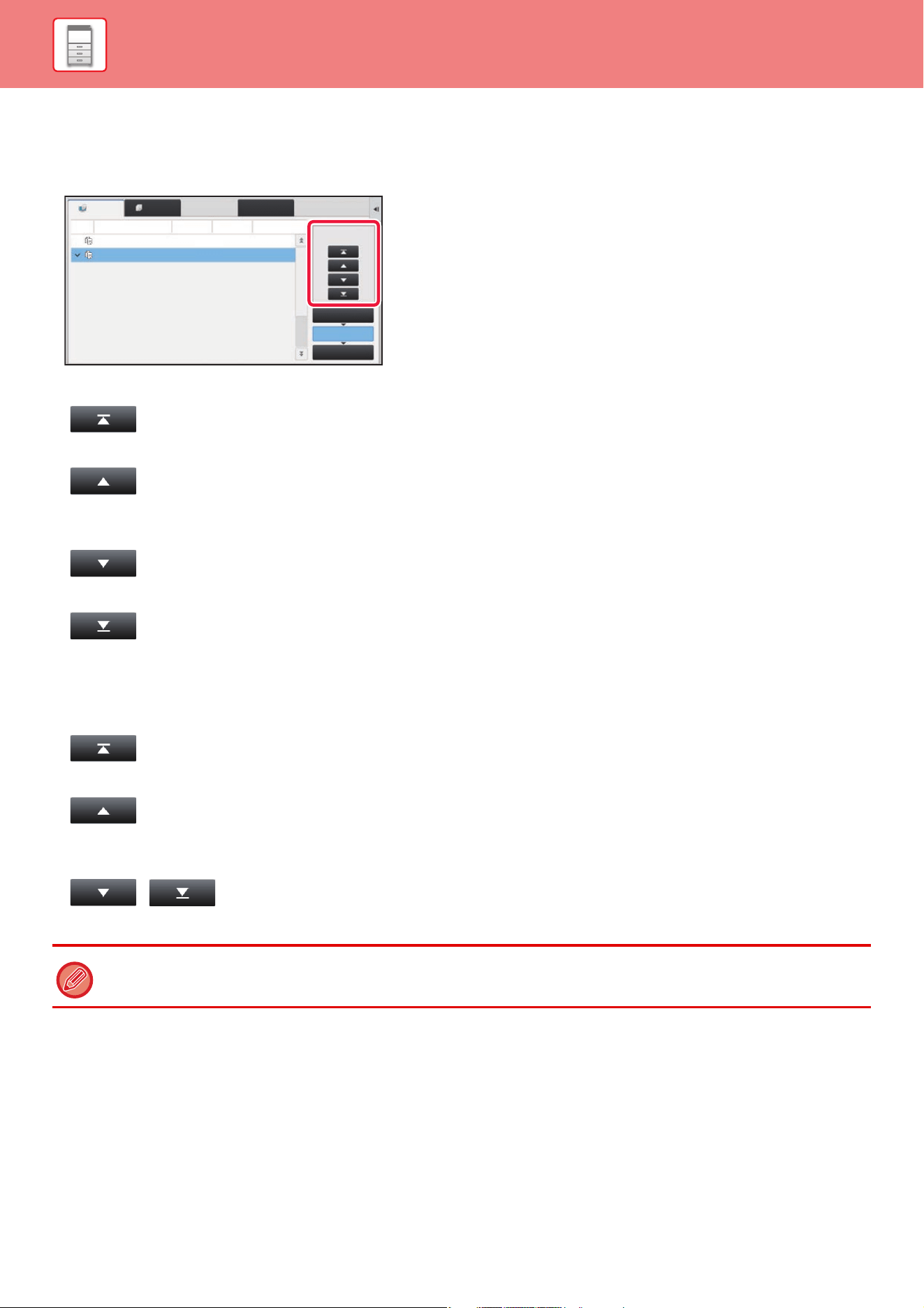
1-98
BEFORE USING THE MACHINE
►
STOPPING/DELETING A JOB, PRIORITY PROCESSING AND CHECKING THE STATUS
Changing the job order
If there is a job in progress, an interrupt job can be performed, or a job can be moved down in the queue to change the
job order. Tap the key of the job you want to move, and tap the "Priority Change" key.
•key
Moves the selected job to the top of the queue. The current job will be interrupted and the selected job starts.
•key
Moves the selected job up one position. When the second job from the top is selected, tapping this key interrupts the
current job and starts the selected job.
•key
Moves the selected job down one position.
•key
Moves the selected job to the bottom of the queue.
Scanner job with a timer setting
When a scanner job with a timer setting is selected, tapping the order change keys moves the job as follows.
•key
The timer setting is canceled and the job moves to the position after the job in progress (second from top).
•key
The timer setting is canceled and the job moves to the lowest position in the queue (if there are 3 jobs, the 4th
position)
• , key
These keys cannot be used.
The jobs below cannot be moved.
Job currently in progress, interrupt copy jobs, list print jobs, and jobs when Passing Prohibited is set in the system settings.
File Retrieve
Scan
Job
Job Queue
Copy
Copy
Job Queue
Complete
Spool
Priority Change
Print
Progress / Sets
0100/0100
0000/0001
Status
Paper Empty
Waiting
─
Start
Time
Calculating
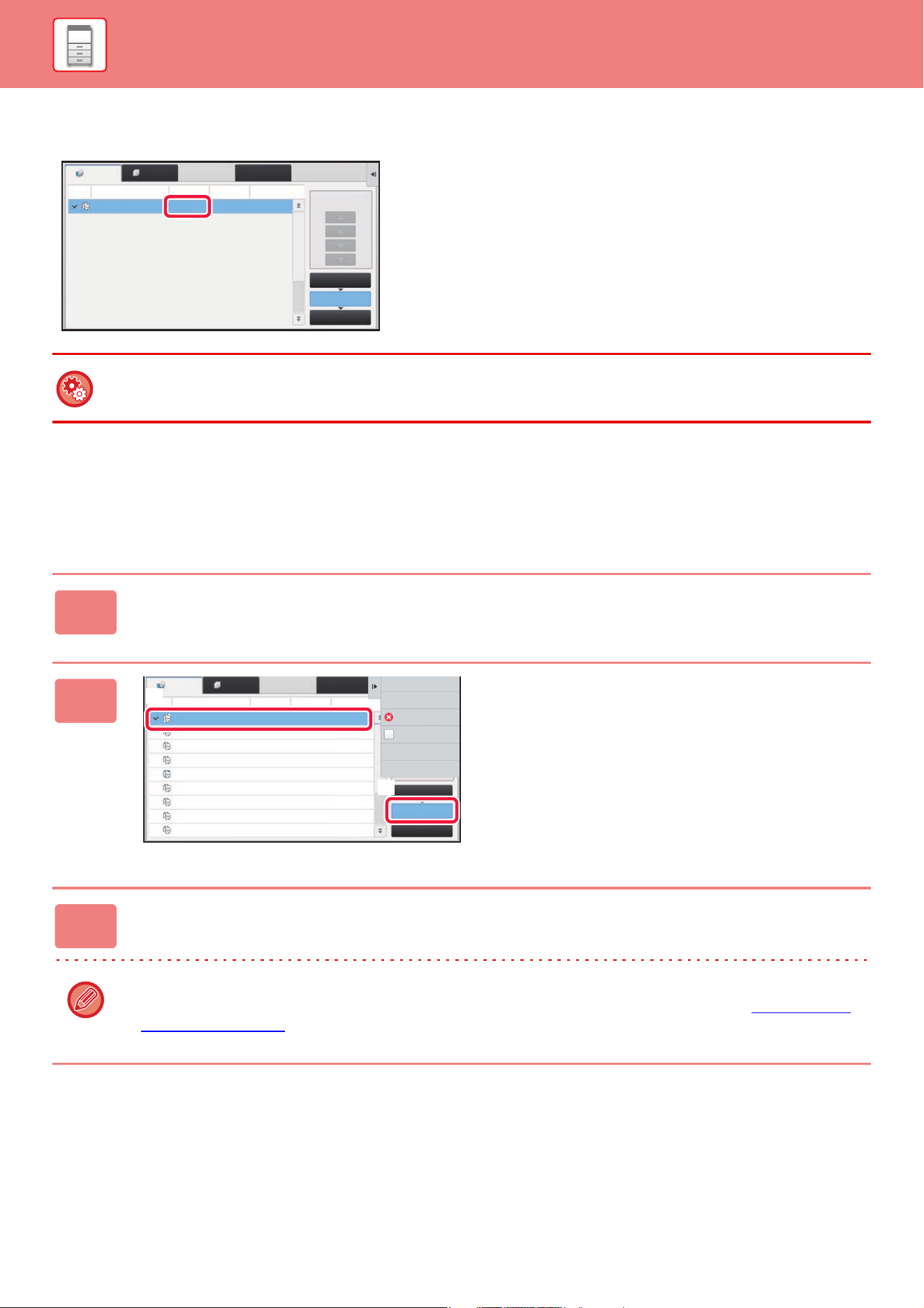
1-99
BEFORE USING THE MACHINE
►
STOPPING/DELETING A JOB, PRIORITY PROCESSING AND CHECKING THE STATUS
In print tab, you can switch the display in the "Job Queue" screen between the number of printed copies and remaining
copies to be printed for each job.
CHECKING A RESERVED JOB OR THE JOB
IN PROGRESS
To switch the display between the numbers of printed copies and remaining copies to be printed for each job:
In "Settings (administrator)", select [System Settings] → [Common Settings] → [Operation Settings] → [Condition Settings]
→ [Switch the Number of Sets to be Displayed for Job Management].
1
Tap the job management display and tap the tab for the job whose contents
you wish to check.
2
Tap the [Job Queue] key.
3
Tap the job whose contents you wish to check and then tap [Check Details of
Selected Job] on the action panel.
• Different job contents appear in different modes.
• For information on the icons displayed on the job keys or the messages displayed in "Status", see "READING THE
JOB LIST (page 1-100)".
Job Job Queue
Copy
─
Progress / Sets
Start
Time
Job Queue
Complete
Spool
0050/0050
Priority Change
File RetrieveScanPrint
Status
Paper Empty
Job Job Queue
Progress / Sets
Job Queue
Complete
Spool
0100/0100
0000/0001
0000/0001
0000/0001
0000/0001
0000/0001
0000/0001
0000/0001
0000/0001
Copy
Copy
Copy
Copy
Copy
Copy
Copy
Copy
Status
Paper Empty
Reselect Paper
Check Details of
Selected Job
Stop/Delete
Enter Plural
Selection Mode
Back
Waiting
Waiting
Waiting
Waiting
Waiting
Waiting
Waiting
Waiting
File RetrieveE-mailPrint
─
Start
Time
Calculating
Calculating
Calculating
Calculating
Calculating
Calculating
Calculating
CalculatingCopy
(1)
(2)
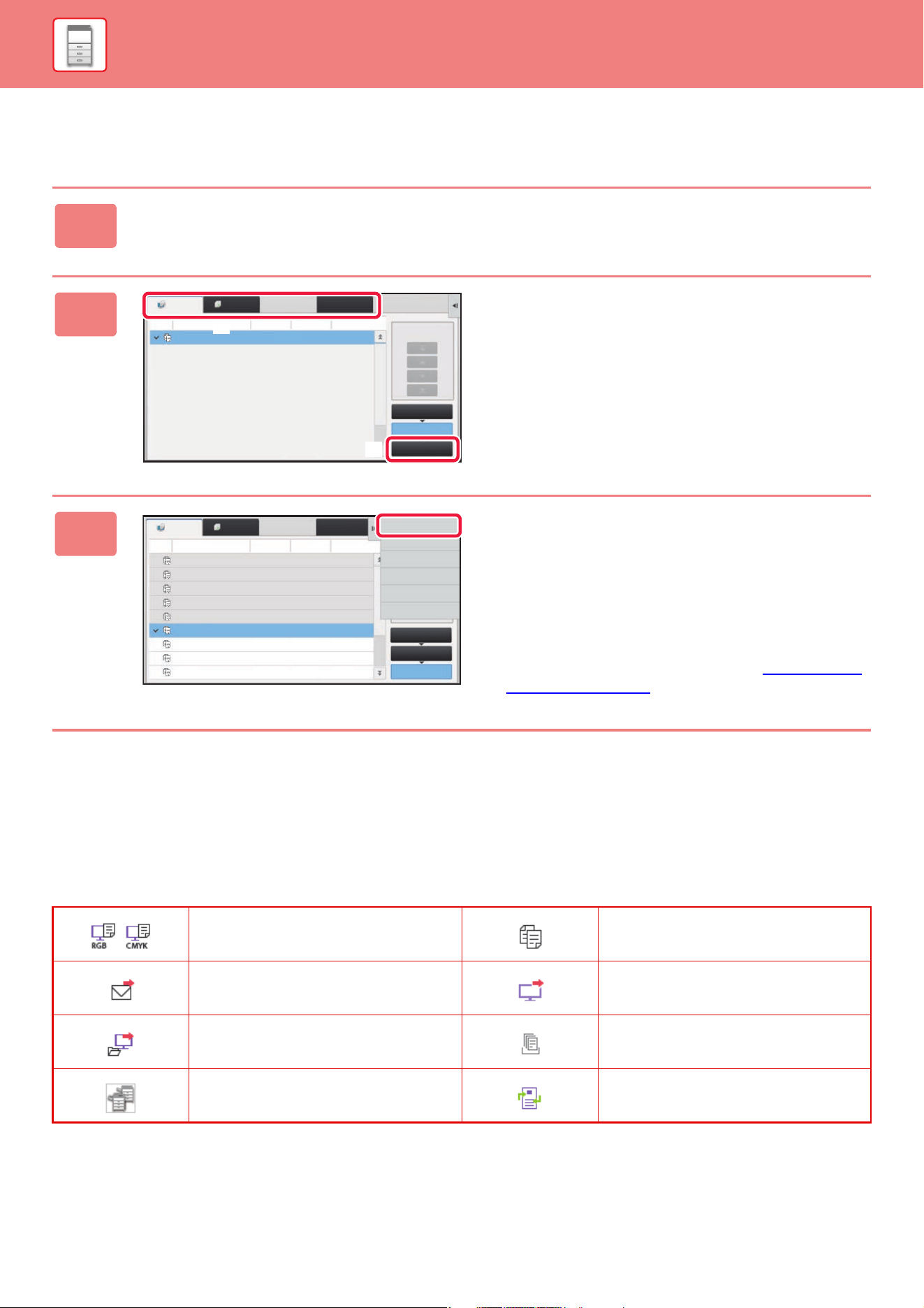
1-100
BEFORE USING THE MACHINE
►
STOPPING/DELETING A JOB, PRIORITY PROCESSING AND CHECKING THE STATUS
CHECKING COMPLETED JOBS
READING THE JOB LIST
The meaning of each job icon and message displayed in "Status" is as follows:
Icons indicating the job type
* This appears in a multi-mode broadcast job.
1
Tap the job management display and tap the tab for the job whose contents
you wish to check.
2
Tap the [Complete] key.
3
Tap the job whose contents you wish
to check and then tap [Check Details
of Selected Job] on the action panel.
Jobs you can check are displayed as keys so that you can
tap them.
• Different job contents appear in different modes.
• For information on the icons displayed on the job keys or
the messages displayed in "Status", see "READING THE
JOB LIST (page 1-100)".
Print job (RGB/CMYK) Copy job
Scan to E-mail job Scan to FTP job
Scan to Network Folder job Scan to HDD file print job
Tandem copy/print job OSA Scan Job
Job Queue
Complete
Spool
File RetrieveScan
Priority Change
Job Queue
Copy
Job
Print
Progress / Sets
0100/0100
Status
Paper Empty
─
Start
Time
(1)
(2)
Job Queue
Complete
Spool
Check Details of
Selected Job
Send
Change Setting to
Print
Back
Copy
Copy
Copy
Copy
Copy
Copy
Copy
Copy
Copy
OK
OK
OK
OK
OK
OK
OK
OK
OK
0001/0001
0001/0001
0001/0001
0001/0001
0001/0001
0001/0001
0001/0001
0001/0001
0001/0001
13:43 06/22
13:33 06/22
13:33 06/22
13:33 06/22
13:33 06/22
00:00 05/05
00:00 05/05
00:00 05/05
00:00 05/05
Scan
Print
File Retrieve
Job QueueJob
Progress / Sets
Status
Start
Time
1-101
BEFORE USING THE MACHINE
►
STOPPING/DELETING A JOB, PRIORITY PROCESSING AND CHECKING THE STATUS
Messages displayed in "Status"
Job in progress
Reserved job
Display Status
"Printing" Print job in progress
"Copying" Copy job in progress
"Connecting" Connecting
"Sending" Sending
"Receiving" Receiving
"Processing" Processing
"Tel" Speaking with the other party using an extension telephone
"Stopped" The job has been stopped
"Toner Empty" Toner Empty
"Paper Empty" Paper Empty
"Paper Jam" Paper jam
"Waiting" Waiting
"Warming up" Warming up
"Limit" Having reached the account limit
"Error" An error occurred while the job was being executed
"Report Wait" When a timeout occurs for reception of transmission confirmation
Display Status
"Waiting" The job is waiting to be executed
"Retry Mode" The job is being retried due to a communication error or other problem
A day and time is displayed Timer transmission job (the specified time is displayed)
1-102
BEFORE USING THE MACHINE
►
STOPPING/DELETING A JOB, PRIORITY PROCESSING AND CHECKING THE STATUS
Completed job
Display Status
"OK" Normal termination
"Send OK" Transmission was completed.
"Forward OK" The received data/received data (each file) has been forwarded.
"Stopped" The job was stopped.
"Delete" Deleted received data in the image check screen.
"Number of successful
transmission
destinations/Total
destinations OK"
Completion of a broadcast transmission, serial polling, or inbound routing operation.
If transmission to 3 destinations was successful out of a total of 5, "003/005 OK" will appear.
"NGxxxxxx" Transmission/reception was not successful because a communication error occurred (a 6-digit
error code appears in xxxxxx.)
"Error" An error occurred while the job was being executed.
In the "Job Queue" for printing, the estimated start time for jobs waiting to be printed is shown.
The estimated job start time is only a guideline. The actual start time will vary depending on the state of the machine.
"Start time" can be hidden using the system settings.
Select "Settings (administrator)" → [User Control] → [Default Settings] → [Include Job Management in user authentication]
→ [Disable display/change of other users’ information in the job management] check box to .
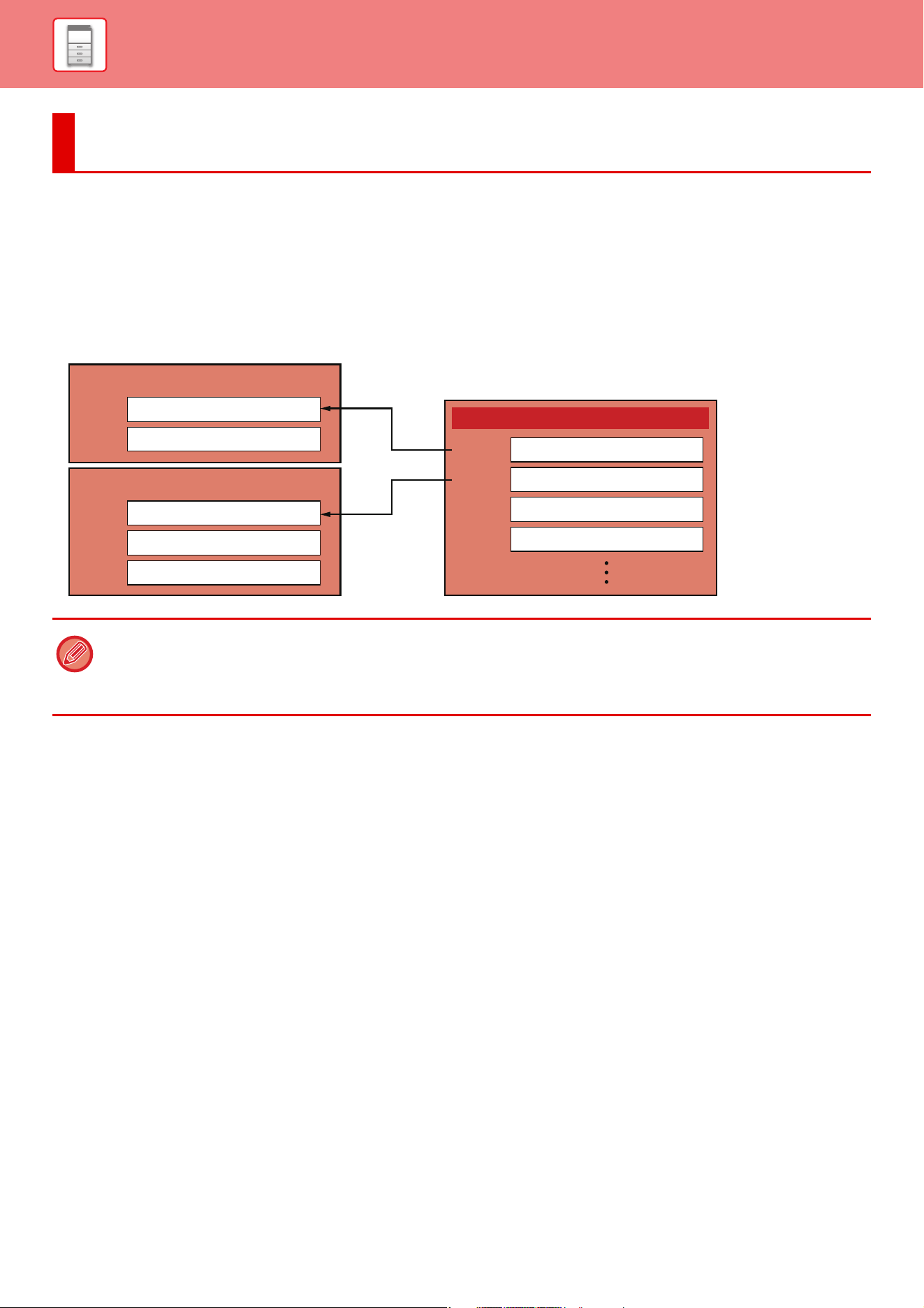
1-103
BEFORE USING THE MACHINE►ADDRESS BOOK
ADDRESS BOOK
"Contacts" and "Group" can be stored in the address book.
For a contact, more than one address can be stored, including e-mail and addresses.
Registering addresses stored as "Contacts" as well as directly entered addresses as "Group" enables you to easily send
messages to multiple destinations simply by specifying a group.
ADDRESS BOOK
• Up to 2000 entries in all can be stored for "Contacts" and "Group".
• The address book can store up to 6000 addresses.
• One "Contacts" can store up to 500 addresses.
• One "Group" can store up to 500 addresses.
Address Book
Contact: Mr. Yamada
Address 1
Address 2
Address 1
Address 2
Address 3
Contact: Mr. Suzuki
Address 1
Address 2
Address 3
Address 4
yamada@□□□□.□□□
192.168.0.XXX
suzuki@□□□□.□□□
\\suzuki_smb
192.168.1.XXX
yamada@
□□□□.□□□
suzuki@□□□□.□□□
yoshida@□□□□.□□□
\\X-PJ_smb
Group address: X-project members
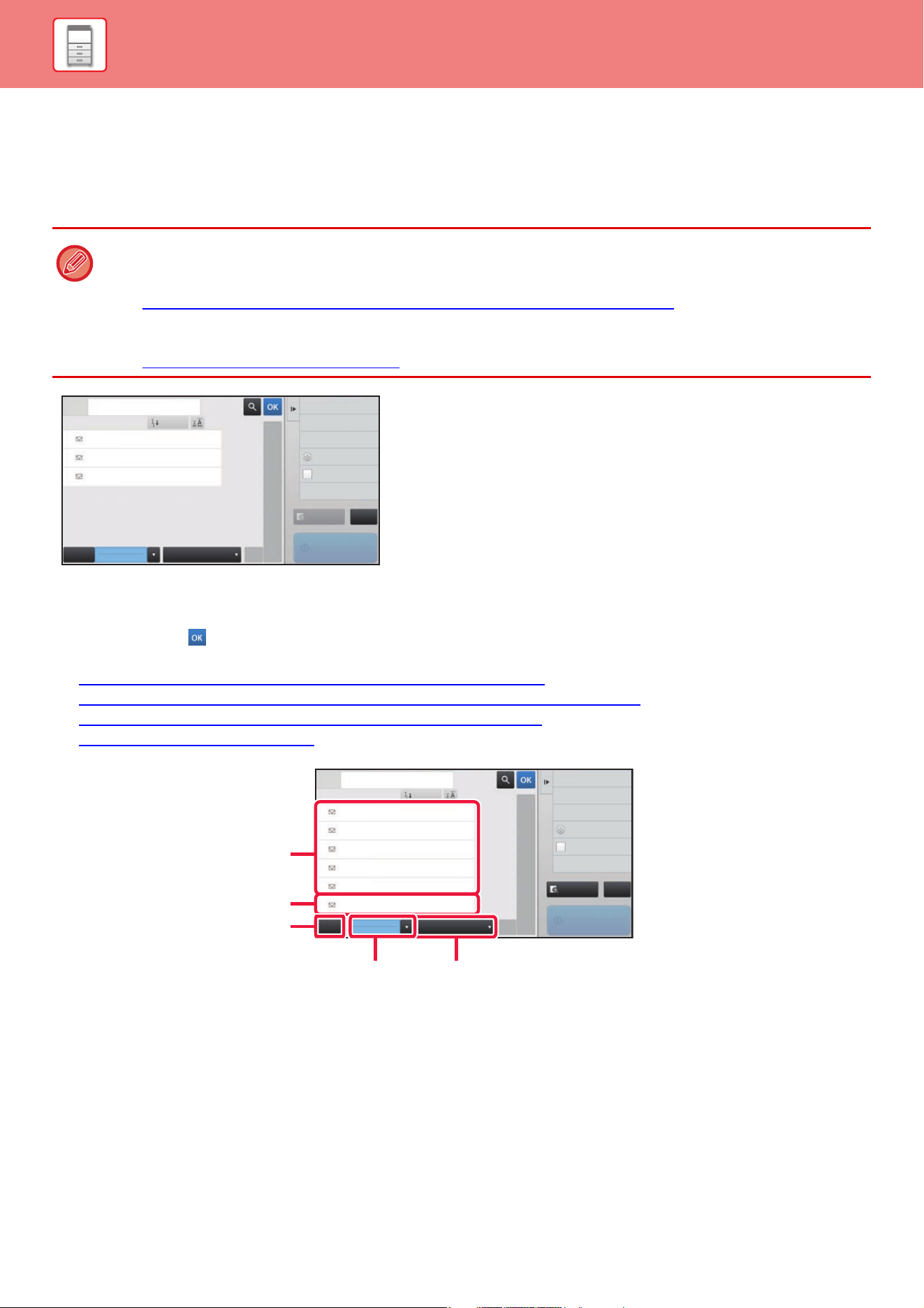
1-104
BEFORE USING THE MACHINE►ADDRESS BOOK
ADDRESS BOOK SCREEN
To display the address book, tap the [Address Book] key on the base screen in image send mode such as e-mail. You
can also display it by tapping the [Address Book] icon in the home screen. "Contacts" and "Group" registered are
enabled for alphabetical search and selected condition-based advanced search.
Selecting "Contacts" or "Group"
Tap a "Contacts" or "Group", and the tapped "Contacts" or "Group" is selected.
After selection, tap .
To add "Contacts" and "Group", refer to the following.
► STORING ADDRESSES THROUGH DIRECT ENTRY (page 1-107)
► STORING ADDRESSES THROUGH GLOBAL ADDRESS SEARCH (page 1-108)
► STORING ADDRESSES FROM IMAGE SEND LOGS (page 1-110)
► STORING GROUPS (page 1-111)
•
When the [Address Book] key is tapped on the e-mail base screen, groups and contacts having e-mail addresses are displayed.
• If user authentication is enabled, registered contacts can be shared within a specified group or stored as personal contacts
that only you are allowed to access.
► SETTING THE SCOPE FOR PUBLICIZING CONTACTS AND GROUPS (page 1-115)
• You can tap the [Find My Address] key while logging in and select your e-mail address from the user list. This is convenient
when you want to send an e-mail to yourself.
► Disabling of Find My Address (page 7-90)
Preview
Print Individual List
Sending History
Start
A
D
G
J
M
P
W
Add New
Call Search Number
Send
Destination Link
Narrow Down
All
Category
Sort
Address
BBB
AAA
CCC
ABC
T
CA
Global Address Search
E-mail
Frequent
Use
Send
Destination Link
Preview
Sending History
Call Search Number
Global Address Search
Start
A
D
G
J
M
P
T
W
Add New
Print Individual List
Narrow Down
All
Category
Sort
Address
BBB
AAA
CCC
CCC
DDD
DDD
ABC
CA
E-mail
Frequent
Use
One touch keys of
"Contacts"
One touch keys of "Group"
[Frequent Use] key
[Category] key [Narrow Down] key
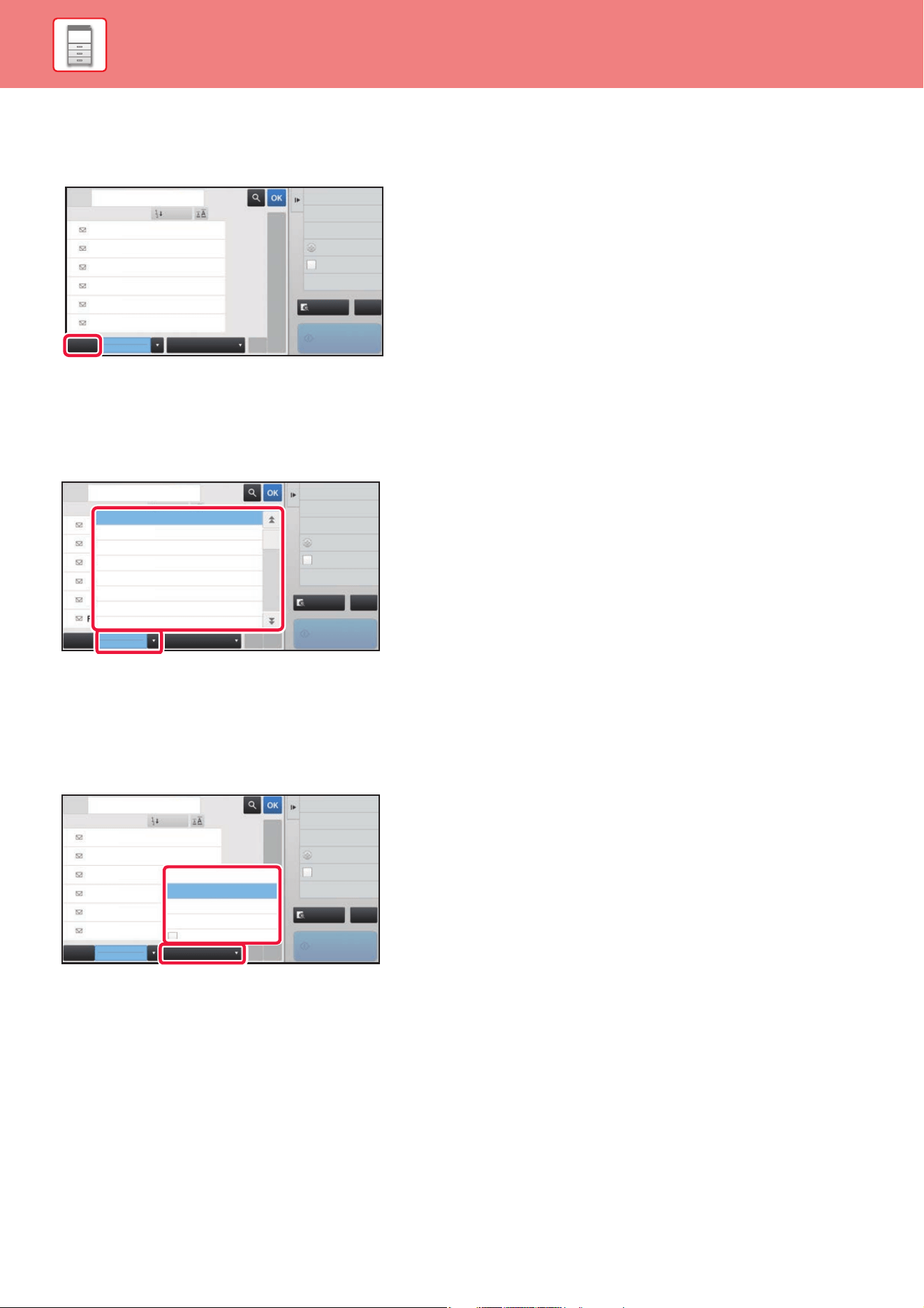
1-105
BEFORE USING THE MACHINE►ADDRESS BOOK
Narrowing by frequent Use
Tap the [Frequent Use] key and select an address in the screen that appears.
Addresses registered as "Frequent Use" addresses are shown.
Narrowing by category
Tap the [Category] key to select a category on the screen that appears.
The "Contacts" and "Group" in the selected category appear on a list.
The narrowed-down condition is displayed under the [Category] key.
Narrowing by job type
Tap the [Narrow Down] key to select a job on the screen that appears.
To narrow by "Group", tap the [Group] key.
The "Contacts" and "Group" for the selected job appear on a list.
The narrowed-down condition is displayed under the [Narrow Down] key.
Preview
Start
A
D
G
J
M
P
T
W
Frequent
Use
Narrow Down
All
Category
Sort
Address
BBB
AAA
CCC
CCC
DDD
DDD
ABC
CA
Sending History
Call Search Number
Global Address Search
Add New
Print Individual List
Send
Destination Link
E-mail
W
Narrow Down
All
Category
Sort
Address
B
B
A
A
C
ABC
All
Category 4
Category 0
Category 5
Category 6
Category 3
Category 2
Category 1
Preview
Start
CA
Sending History
Call Search Number
Global Address Search
Add New
Print Individual List
Send
Destination Link
E-mail
Frequent
Use
A
W
E-mail
Narrow Down
All
Category
Sort
Address
BBB
CCC
AAA
CCC
ABC
All
E-mail
FTP
Network Folder
Fax
Group
BBB
CCCCCC
BBB
AAA
Preview
Start
CA
Sending History
Call Search Number
Global Address Search
Add New
Print Individual List
Send
Destination Link
Frequent
Use
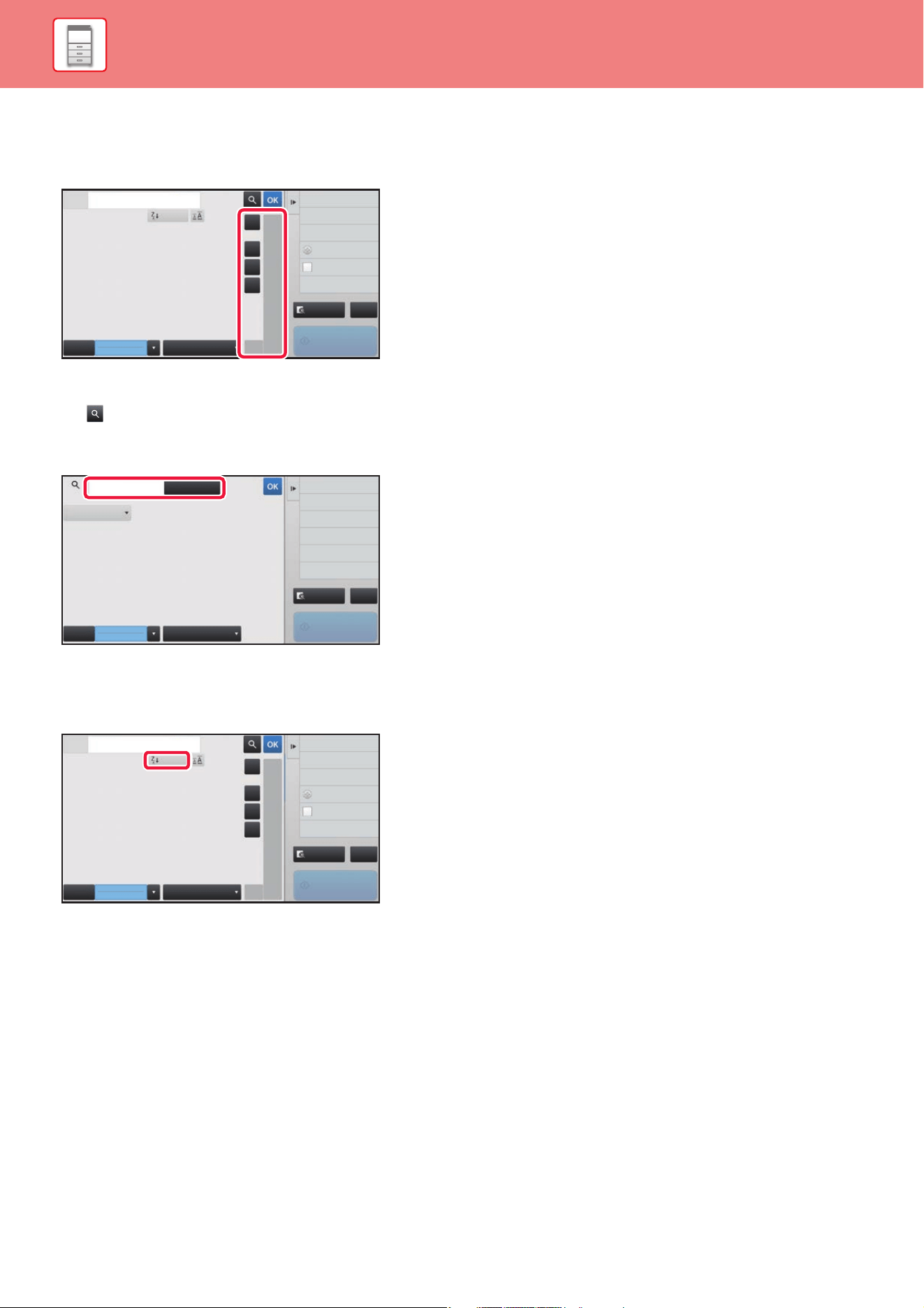
1-106
BEFORE USING THE MACHINE►ADDRESS BOOK
Narrowing by index
Search by alphabet to narrow down addresses.
For example, tap "A" on the index bar to display "Contacts" stored with search text starting with "A".
Narrowing by keyword
Tap to display a search screen. Select a target for search, enter a keyword and then tap the [Search Start] key. The
search results are listed.
For example, if [Item] is [Name], search with a keyword "SH" lists contacts and groups starting with "SH".
Displaying in the order of search numbers
Tapping the [Sort] key displays a list in ascending order, descending order, or in the order of search numbers.
The display is switched in the order of [Sort] (▲) (Up) →[Sort] (▼) (Down) → Search Number Order.
Preview
Start
CA
Sending History
Call Search Number
Global Address Search
Add New
Print Individual List
Send
Destination Link
E-mail
A
D
G
J
M
P
W
Frequent
Use
Narrow Down
All
Category
Sort
Address
ABC
T
ALL
A
B
C
Preview
Start
CA
Frequent
Use
Narrow Down
All
Category
Enter by Keyboard
Search Start
Address
Item Target
Address Book
E-mail
A
D
G
J
M
P
W
Frequent
Use
Narrow Down
All
Category
Sort
Address
ABC
T
ALL
A
B
C
Preview
Start
CA
Sending History
Call Search Number
Global Address Search
Add New
Print Individual List
Send
Destination Link
E-mail
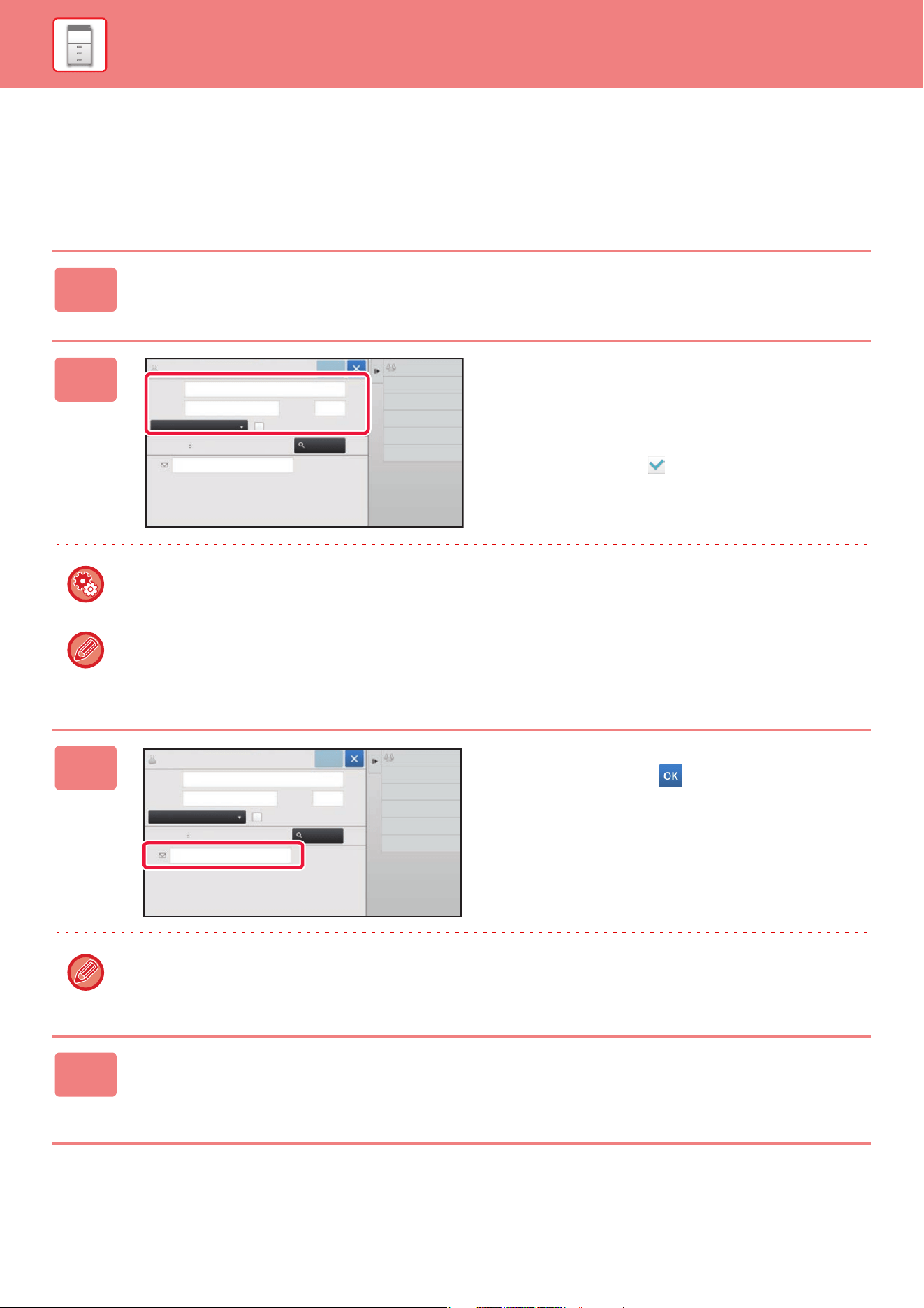
1-107
BEFORE USING THE MACHINE►ADDRESS BOOK
STORING ADDRESSES THROUGH DIRECT
ENTRY
Store new names or addresses in the address book by directly entering them.
1
In the address book screen, tap [Add New] on the action panel, or tap the
[Address Control] icon in the home screen.
2
Enter basic information.
Be sure to enter [Name] and [Initial].
To specify a category, select one from a category list that
appears when the entry box is tapped.
To register for frequent use, select the [Also Register for
Frequent Use] checkbox .
To register a category name:
In "Settings (Web version)", select [Address Book] → [Category Setting].
If user authentication is enabled, the tab for address publication setting appears. Setting address publication enables
stored "Contacts" and "Group" to be shared within a specified group or stored as personal contacts that only you are
allowed to access.
► SETTING THE SCOPE FOR PUBLICIZING CONTACTS AND GROUPS (page 1-115)
3
Tap [E-mail Address] to enter the
address, and tap .
• Select the checkbox to set that address as the preferred over the others if two or more addresses are stored for
"Contacts".
• FTP and Network Folder addresses can be registered from [Address Book] in "Settings (Web version)".
4
Tap the [Register] key.
The first address of each address type is set as the default address. If no address has the checkbox next to it selected,
a confirmation screen will appear asking you if you want to select a default address.
Name
Initial
Category 0
Number of
Addresses
Search
Number
Name (Required)
Search (Opt.)
E-mail Address
Add Contacts
6
Global
Search
Also Register
for Frequent Use
0
Switch to Group
Registration
Register
Name
Initial
Category 0
Number of
Addresses
Search
Number
E-mail Address
Add Contacts
10
Also Register
for Frequent Use
0
Switch to Group
Registration
Register
CCC
CCC
Global
Search
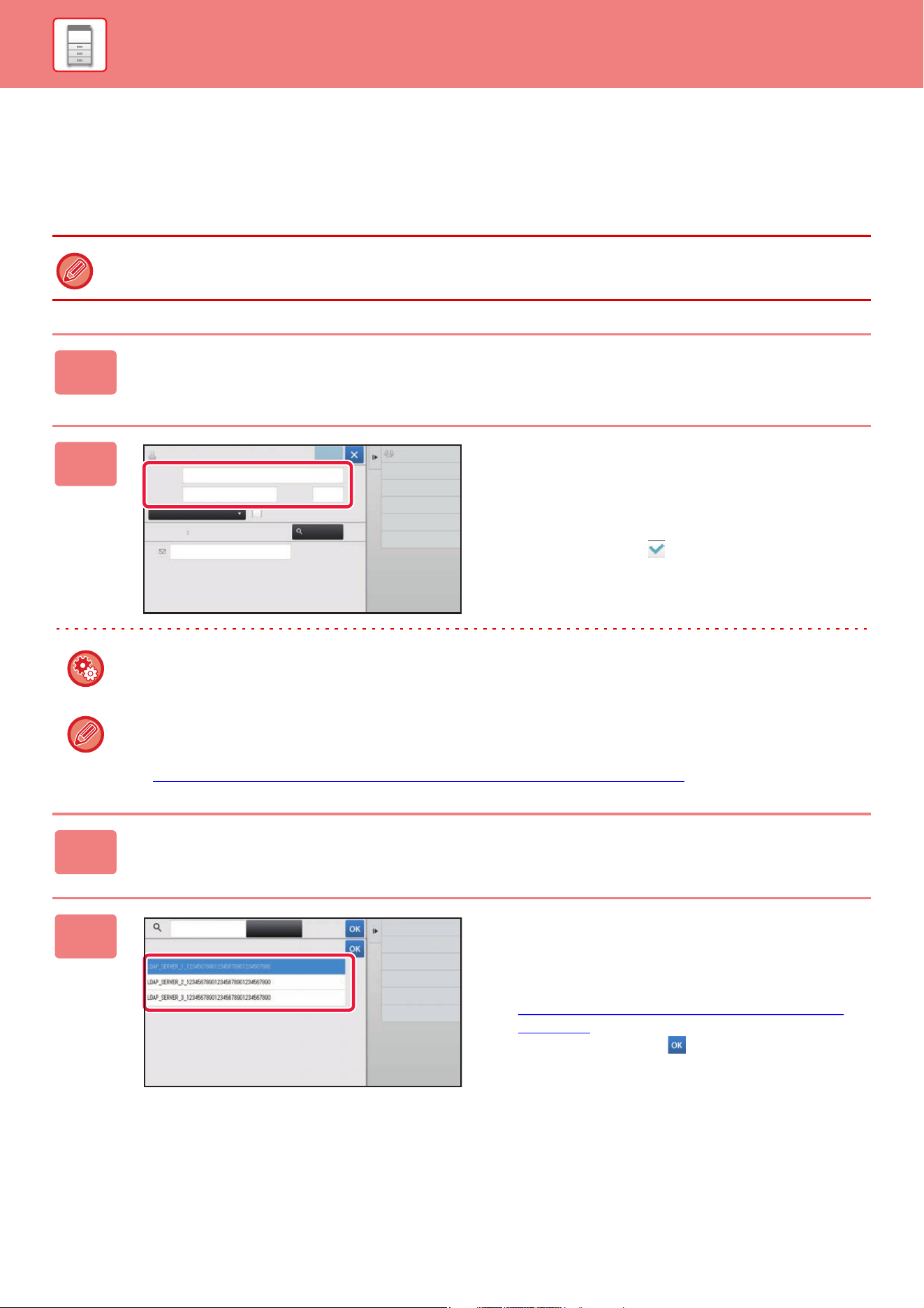
1-108
BEFORE USING THE MACHINE►ADDRESS BOOK
STORING ADDRESSES THROUGH GLOBAL
ADDRESS SEARCH
Store the results of searching the global address book as new addresses in the address book.
Global address search requires an LDAP server.
1
In the address book screen, tap [Add New] on the action panel, or tap the
[Address Control] icon in the home screen.
2
Enter basic information.
Be sure to enter [Name] and [Initial].
To specify a category, select one from a category list that
appears when the entry box is tapped.
To register for frequent use, select the [Also Register for
Frequent Use] checkbox .
To register a category name:
In "Settings (Web version)", select [Address Book] → [Category Setting].
If user authentication is enabled, the tab for address publication setting appears. Setting address publication enables
stored "Contacts" and "Group" to be shared within a specified group or stored as personal contacts that only you are
allowed to access.
► SETTING THE SCOPE FOR PUBLICIZING CONTACTS AND GROUPS (page 1-115)
3
Tap the [Global Search] key.
4
Select the server from the list of
servers.
If an authentication screen appears, enter your user name
and password, and tap the [OK] key.
► AUTHENTICATION BY LOGIN NAME/PASSWORD
(page 1-33)
After selecting a server, tap .
Switch to Group
Registration
Name
Initial
Category 0
Number of
Addresses
Search
Number
E-mail Address
Add Contacts
10
Also Register
for Frequent Use
0
Register
Global
Search
Name (Required)
Search (Opt.)
Cancel and Return
Search Start
Enter
Initials
Search Start
1-109
BEFORE USING THE MACHINE►ADDRESS BOOK
5
Tap the entry field to enter the search
condition and then tap the [Search
Start] key.
To change the search target, tap for [Item]. You can
select [Name] or [Address].
6
Select one address from the search result list, and tap the key.
To check address information, select the address and tap the [Confirm Registered Information] key.
7
Tap the [Register] key.
The first address of each address type is set as the default address. If no address has the checkbox next to it selected,
a confirmation screen will appear asking you if you want to select a default address.
Cancel and Return
Search Start
Enter
Initials
Enter Initial and press Enter key of
external keyboard or [Start Search] button.
TargetItem
Name
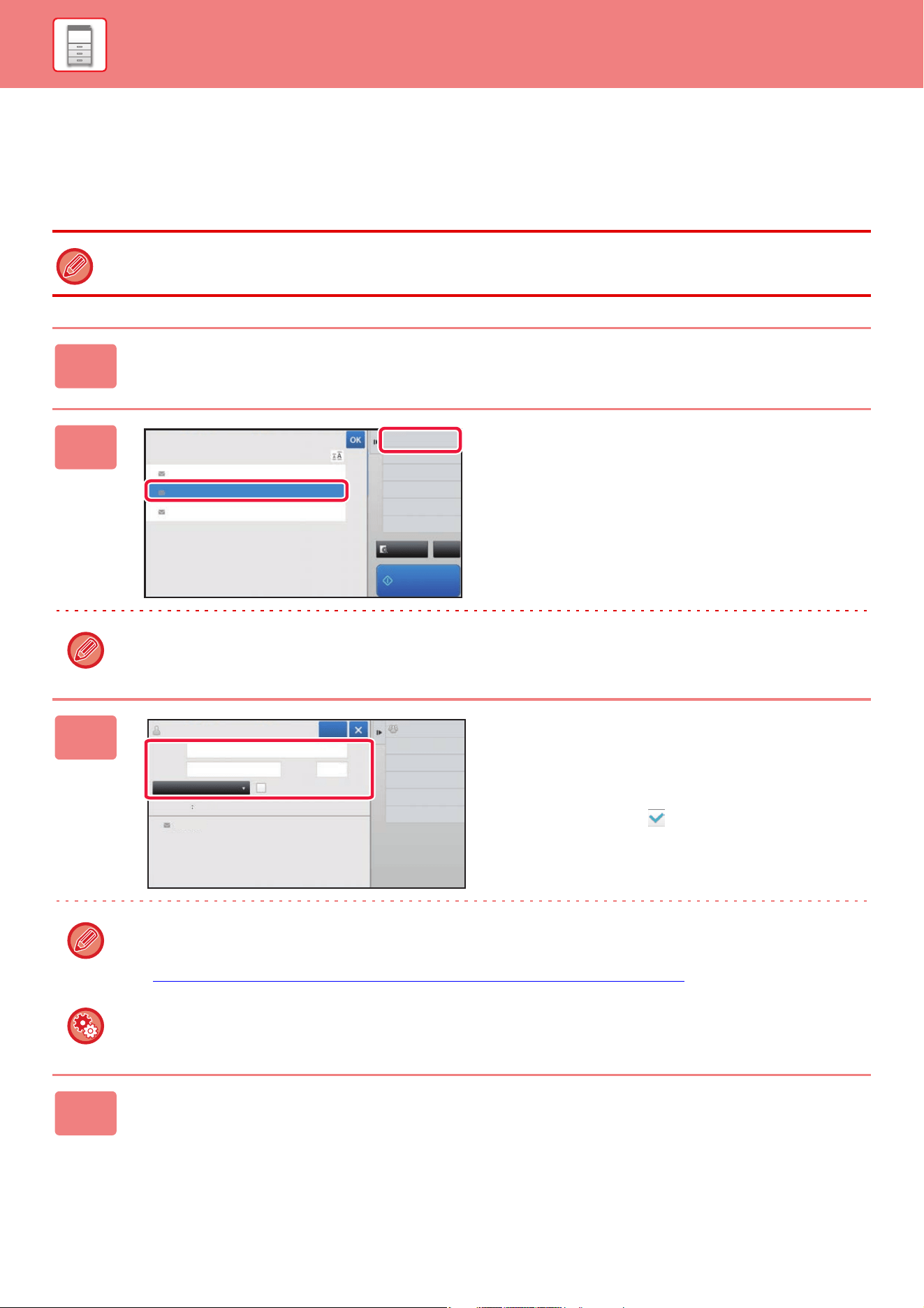
1-110
BEFORE USING THE MACHINE►ADDRESS BOOK
STORING ADDRESSES FROM IMAGE SEND
LOGS
As a new registration, add an address you have entered via image send operations to the address book.
FTP addresses cannot be stored in the address book from transmission logs.
1
In image send mode, tap [Sending History] on the action panel.
2
Select one address you want to
register in the address book from the
send logs, and then tap [New
Registration with Address Book] on
the action panel.
When you tap [Additional Registration with Address Book] on the action panel, you can add the address to a contact
stored in the address book.
3
Enter basic information.
Be sure to enter [Name] and [Initial].
To specify a category, select one from a category list that
appears when the entry box is tapped.
To register for frequent use, select the [Also Register for
Frequent Use] checkbox .
If user authentication is enabled, the tab for address publication setting appears. Setting address publication enables
stored "Contacts" and "Group" to be shared within a specified group or stored as personal contacts that only you are
allowed to access.
► SETTING THE SCOPE FOR PUBLICIZING CONTACTS AND GROUPS (page 1-115)
To register a category name:
In "Settings (Web version)", select [Address Book] → [Category Setting].
4
Tap the [Register] key.
The address is registered in the address book and the transmission log screen is restored.
The first address of each address type is set as the default address. If no address has the checkbox next to it selected, a
confirmation screen will appear asking you if you want to select a default address.
Preview CA
Start
New Registration
with Address Book
Additional Registration
with Address Book
Delete the Selected
History
Delete All Histories
Sending History
Select Address to Send Again.
Direct Entry
AAA
Direct Entry
CCC
Direct Entry
BBB
Name
Initial
BBB
BBB
Category 0
Number of
Addresses
Search
Number
Add Contacts
16
Also Register
for Frequent Use
1
Switch to Group
Registration
Register
BBB BBB
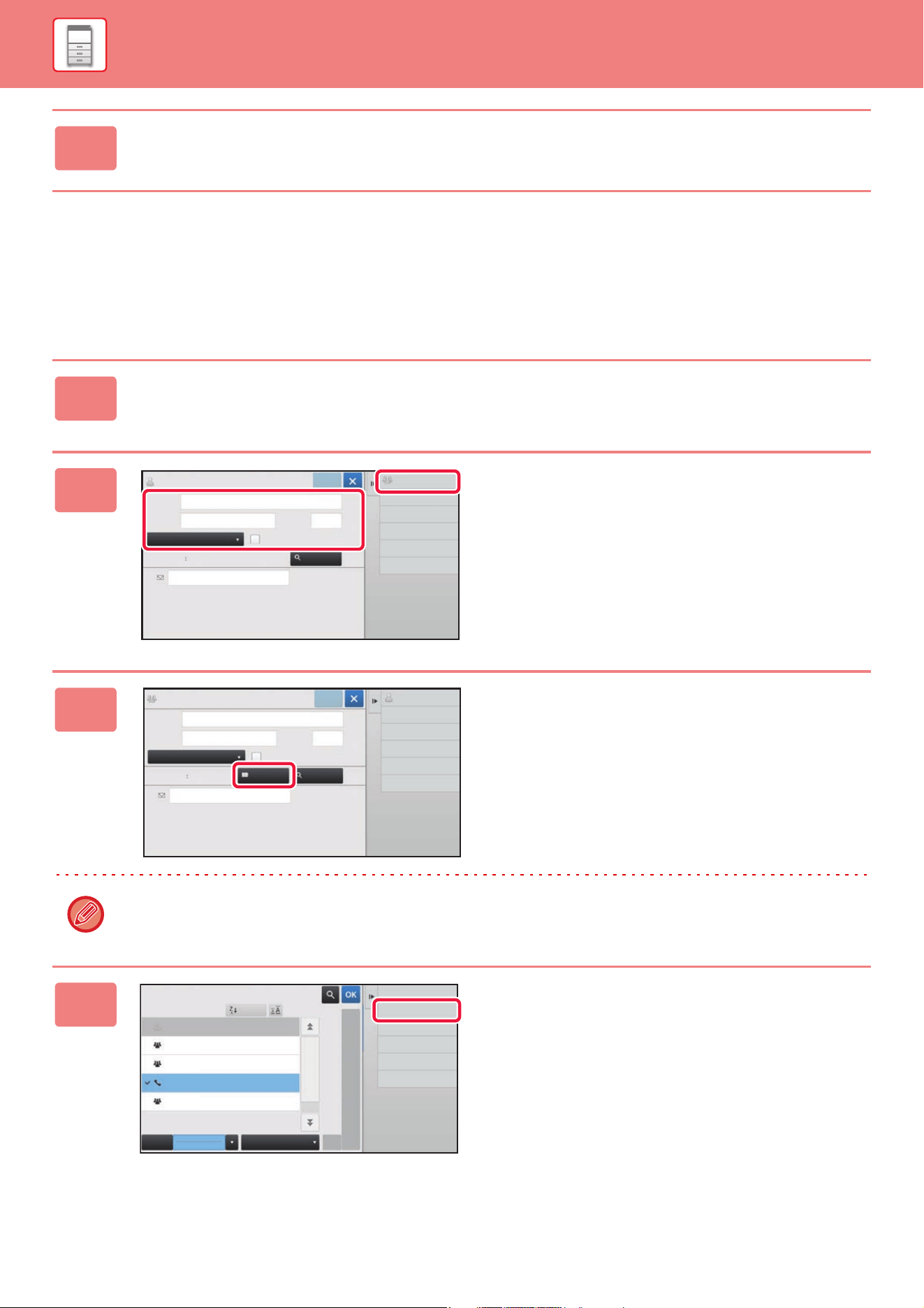
1-111
BEFORE USING THE MACHINE►ADDRESS BOOK
STORING GROUPS
Register "Group" by selecting addresses from those already stored as "Contacts". In this case of registration, only
reference to addresses already stored takes place, and so, the total number of registered addresses (maximum 6000) in
the address book does not increase. You can also directly enter a new address for a "Group".
5
Tap the [OK] key.
1
In the address book screen, tap [Add New] on the action panel, or tap the
[Address Control] icon in the home screen.
2
Enter the basic information, and tap
[Switch to Group Registration] on the
action panel.
3
Tap the [Address Book] key.
To directly enter a new address for a "Group", tap [E-mail Address].
4
In the contact list, tap the "Contacts"
that includes the address you want to
add to the "Group", and tap [Display
Registered Information] on the action
panel.
Name
Initial
Category 0
Number of
Addresses
Search
Number
Global
Search
Name (Required)
E-mail Address
Add Contacts
6
Also Register
for Frequent Use
0
Switch to Group
Registration
Register
Search (Opt.)
Global
Search
Name
Initial
Category 0
Number of
Addresses
Search
Number
Name (Required)
E-mail Address
Add Contacts
6
Also Register
for Frequent Use
0
Switch to Contacts
Registration
Register
Call Search Number
Address Book
Search (Opt.)
Frequent
Use
Select From Address Book
Narrow Down
All
Category
ABC
A
D
G
J
M
P
T
W
Sort
Cancel and Return
Display Registered
Information
AAA
AAA
CCC
DDD
CCC
E-mail
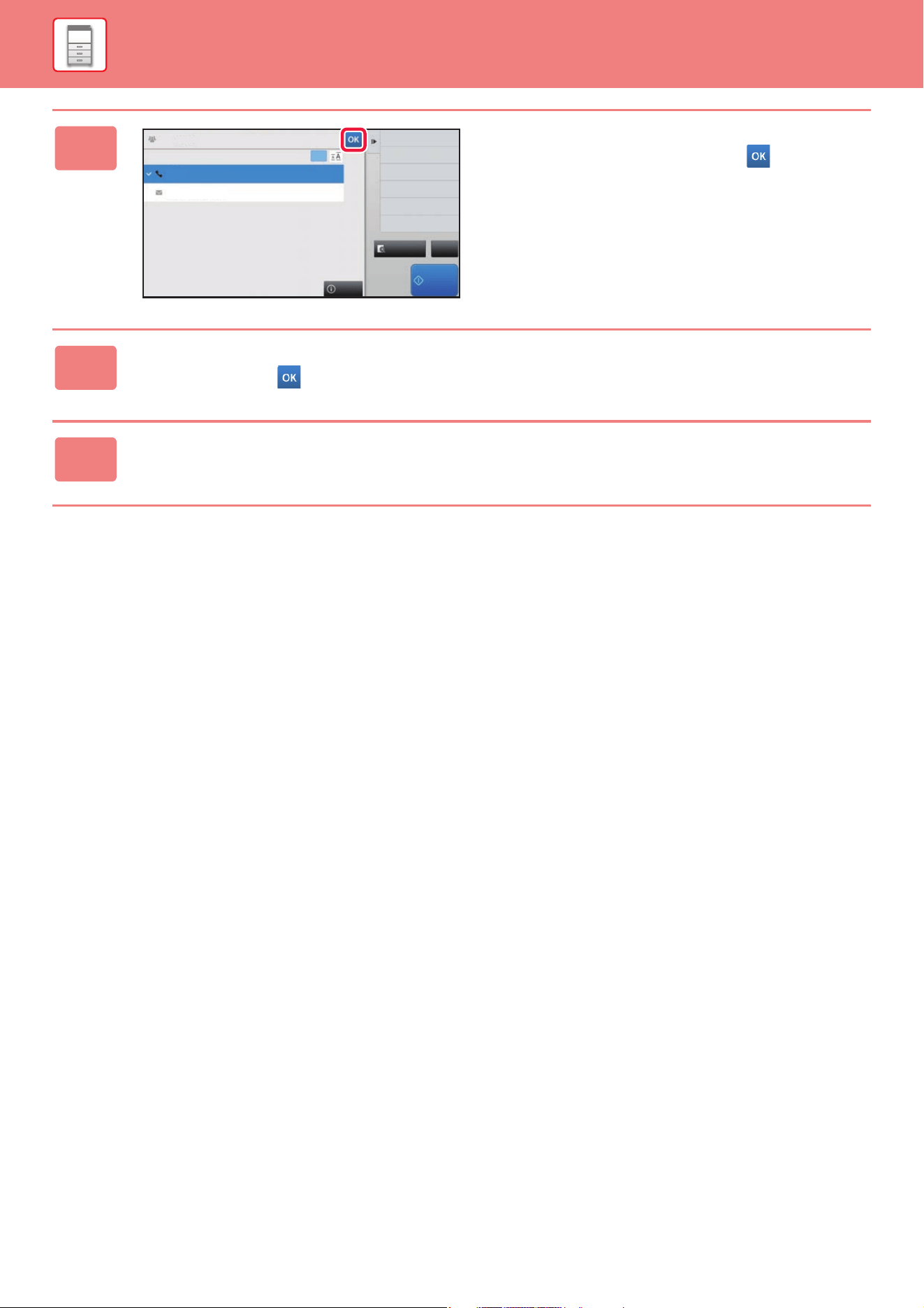
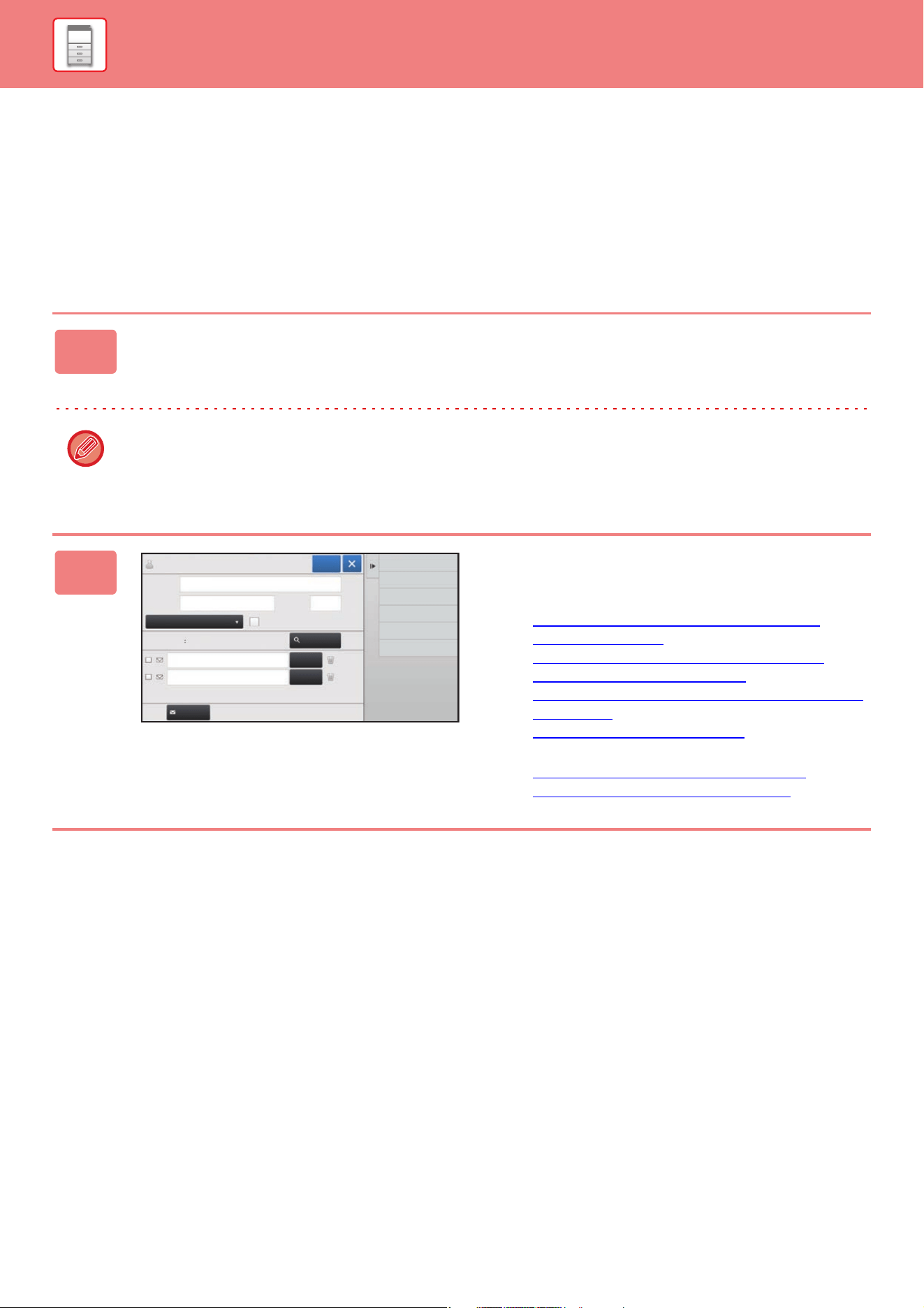
1-113
BEFORE USING THE MACHINE►ADDRESS BOOK
EDITING/DELETING ADDRESSES IN
ADDRESS BOOK
You can edit or delete "Contacts" or "Group" information stored in the address book as well as addresses listed under
"Contacts" and "Group".
Editing/deleting contacts and groups
1
In the address book screen, select a contact or group you wish to edit, and
tap [Edit] on the action panel.
To delete a "Contacts" or "Group", tap [Delete] on the action panel.
• For editing, you can only select one "Contacts" or "Group" at a time.
• For deleting, you can select more than one "Contacts" or "Group" at a time.
• If you have logged in as the administrator, you can delete all addresses stored in the address book by using the
[Delete All] that appears on the action panel.
2
Editing a "Contacts" or "Group"
• You can change basic information such as names and
categories and also you can add addresses.
► STORING ADDRESSES THROUGH DIRECT
ENTRY (page 1-107)
► STORING ADDRESSES THROUGH GLOBAL
ADDRESS SEARCH (page 1-108)
► STORING ADDRESSES FROM IMAGE SEND LOGS
(page 1-110)
► STORING GROUPS (page 1-111)
• You can change the publicity scope.
► SETTING THE SCOPE FOR PUBLICIZING
CONTACTS AND GROUPS (page 1-115)
ddd.eee@fff.
Global
Search
Name
Initial
Category 0
Number of
Addresses
Search
Number
Add Contacts
6
Also Register
for Frequent Use
0
Register
A
AAA
aaa.bbb@ccc.
Detail
Detail
E-mail
Add
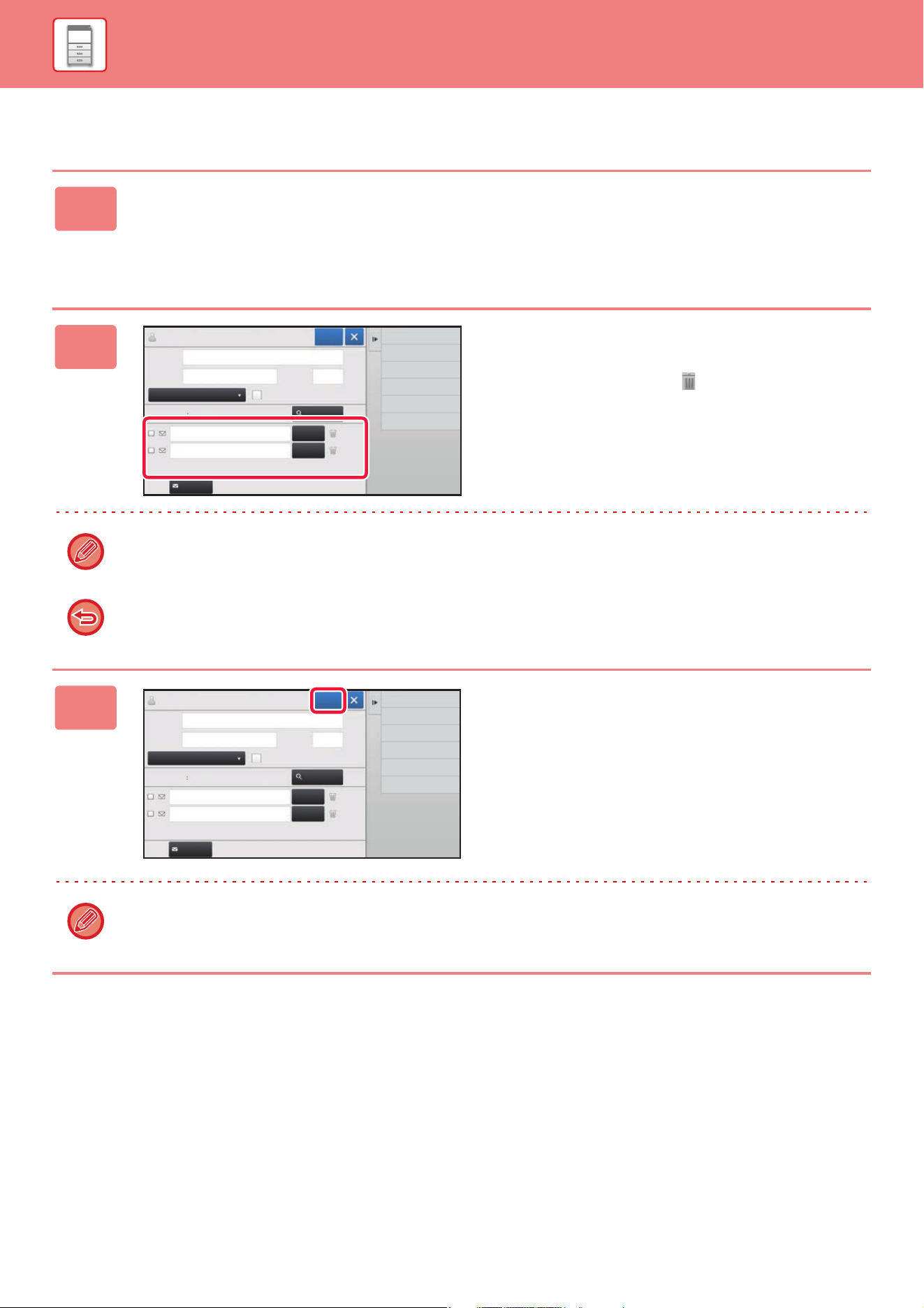
1-114
BEFORE USING THE MACHINE►ADDRESS BOOK
Editing/deleting addresses
1
Select a contact or group you wish to edit, and tap [Edit] on the action panel.
In the address book screen, select the contact or group that has the address
you want to edit, and tap [Edit] on the action panel.
Only one contact or group can be selected. If more than one is selected, the [Edit] key does not appear.
2
Tap the address display in the list of
addresses.
To delete an address, tap the key.
• To edit or delete, you can only select one address at a time.
• To check address information, tap the [Detail] key.
You cannot edit or delete an address for a job in a job queue.
3
Edit an address.
After editing, tap the [Register] key.
You can only edit addresses in the network folder on the edit screen. (The Add New screen cannot be displayed.)
Name CCC
Initial CCC
Category 0
Number of
Addresses
Search
Number
Add Contacts
5
Global
Search
Also Register
for Frequent Use
2
Register
Detail
Detail
E-mailAdd
ddd.eee@fff.
aaa.bbb@ccc.
Name CCC
Initial CCC
Category 0
Add Contacts
5
2
Detail
Detail
E-mail
Add
Register
Number of
Addresses
Search
Number
Global
Search
Also Register
for Frequent Use
ddd.eee@fff.
aaa.bbb@ccc.
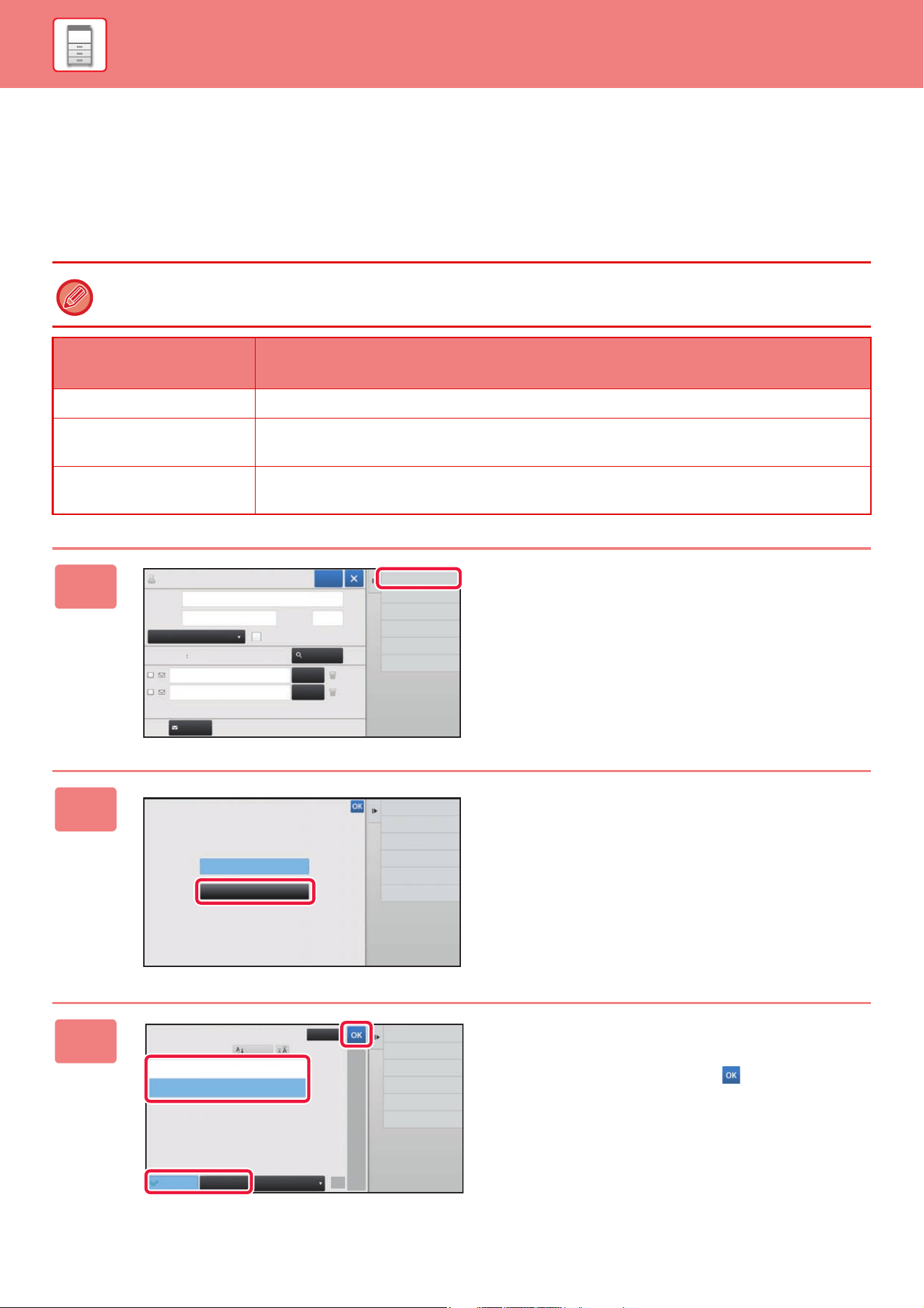
1-115
BEFORE USING THE MACHINE►ADDRESS BOOK
SETTING THE SCOPE FOR PUBLICIZING
CONTACTS AND GROUPS
"Contacts" and "Group" stored in the address book can be shared within a specified group or stored as personal
contacts that only you are allowed to access.
If no publicity scope is specified, stored "Contacts" and "Group" are publicized to all users.
User authentication is required to set the scope for publicizing "Contacts" and "Group".
Scope for publicizing
addresses
Description
Publicized to all "Contacts" and "Group" are published to all users of the machine.
User "Contacts" and "Group" are published only to the user. Registered addresses are preferentially
displayed as "Personal Contacts" in the user's address book.
User Group Publication of "Contacts" and "Group" is limited to the specified group. Up to eight groups per
"Contacts" or "Group" can be set as the publicity scope.
1
In the address registration screen, tap
[Restrict Public Address of The
Contacts] on the action panel.
2
Tap the [Designate Public Address]
key.
3
Tap [User] or [Group] and specify who
the address is made public to.
After the settings are completed, tap .
Name ABC
Initial ABC
Category 0
Number of
Addresses
Search
Number
Add Contacts
10
Also Register
for Frequent Use
Global
Search
1
Register
Detail
E-mail
Add
Restrict Public Address
of The Contacts
Detail
ddd.eee@fff.
aaa.bbb@ccc.
Public Address Setting
Public to All
Designate Public Address.
Call by User Number
A
D
G
J
M
P
W
User Group
Index
Sort
Designate Public Address Clear
User1
tianne
User1
tianne
ABC
T
E-mail
1-116
BEFORE USING THE MACHINE►ADDRESS BOOK
DELETING THE TRANSMISSION HISTORY
You can delete the image send transmission history.
Deleting a selected history
Deleting all transmission histories
If you have logged in as the administrator, select any user name desired from the user list.
To register a user:
In "Settings (administrator)", select [User Control] → [User Control] → [User List] → [User Registration].
The transmission history is deleted in normal mode.
1
Tap the history you want to delete.
2
In the transmission log screen, tap [Delete the Selected History] on the action
panel.
3
The message "Delete the selected history?" will appear, tap the [Delete] key.
The selected transmission log is deleted.
1
In the transmission log screen, tap [Delete All Histories] on the action panel.
2
The message "Delete all histories?" will appear, tap the [Delete All] key.
All transmission logs are to be deleted.
1-117
BEFORE USING THE MACHINE►PERIPHERAL DEVICES
.
PERIPHERAL DEVICES
Peripheral devices can be installed on the machine to increase its range of functionality.
The peripheral devices are generally optional. However, some models include certain peripheral devices as standard
equipment.
(As of July, 2017)
PERIPHERAL DEVICES
Product name
Product
number
Description
Large capacity tray MX-LC12 Additional tray. A maximum of 3500 sheets of paper can be
placed.
MX-LCX3 N Additional tray. A maximum of 3000 sheets of paper can be
placed.
Large capacity trays MX-LC13 N Additional tray. A maximum of 5000 sheets of paper can be
placed.
Paper pass unit MX-RB12 N
This unit is required for installing a finisher or saddle stitch finisher.
MX-RB14 This unit is required to facilitate connection of large capacity trays.
Connection module MX-RB17 This unit is required to facilitate connection of two large capacity
trays.
Multi bypass tray MX-MF11 Additional tray. A maximum of 500 sheets of paper can be
placed. Install this tray on the large capacity trays.
Exit tray unit MX-TR14 Output tray to be installed in the right of the machine.
Exit tray cabinet MX-TU14 Output tray to be installed in the center of the machine. This unit is
required when a finisher or saddle stitch finisher is not installed.
Long paper feeding tray MX-LT10 When using long paper, the long paper is loaded in the bypass
tray.
Finisher (100-sheet stapling) MX-FN21 Output device that enables the use of the staple function and
offset function. A maximum of 100 sheets of paper can be stapled.
Saddle stitch finisher
(100-sheet stapling)
MX-FN22 Output device that enables use of the staple function, offset
function and pamphlet copy function. A maximum of 100 sheets of
paper can be stapled.
Punch module MX-PN13B This unit punches holes in copies and other output. A finisher
(100-sheet stapling) or saddle stitch finisher (100-sheet stapling)
is required.
Trimming module MX-TM10 This unit trims the excess portions of saddle-stitched sheets. A
saddle stitch finisher (100-sheet stapling) is required.
Folding unit MX-FD10 This unit folds and outputs paper. A finisher (100-sheet stapling)
or saddle stitch finisher (100-sheet stapling) is required.
Inserter MX-CF11 This unit inserts covers and insertion sheets. This unit can also
feed paper to a finisher (100-sheet stapling) or saddle stitch
finisher (100-sheet stapling) for finishing.
1-118
BEFORE USING THE MACHINE►PERIPHERAL DEVICES
Curl correction unit MX-RB15 This unit corrects curls in printed paper. This unit is required for
installing a finisher (100-sheet stapling), saddle stitch finisher
(100-sheet stapling), folding unit or inserter.
Relay unit MX-RB13 This unit is required for directly installing a finisher (100-sheet
stapling) or saddle stitch finisher (100-sheet stapling) and inserter.
Barcode Font Kit MX-PF10 Adds barcode fonts to the machine.
Application Integration Module MX-AMX1 The application integration module can be combined with the
network scanner function to append a metadata file to a scanned
image file.
Stamp unit AR-SU1 This stamps each original page after it is scanned in image send
mode.
Stamp cartridge AR-SV1 Two Verification Stamp cartridges are included.
Staple cartridge MX-SCX2 Staples paper. A finisher (100-sheet stapling) or saddle stitch
finisher (100-sheet stapling) is required.
MX-SCX1 Saddle stitches paper. A saddle stitch finisher (100-sheet stapling)
is required.
Status indicator MX-SL10 N The status of the machine is indicated.
Product name
Product
number
Description
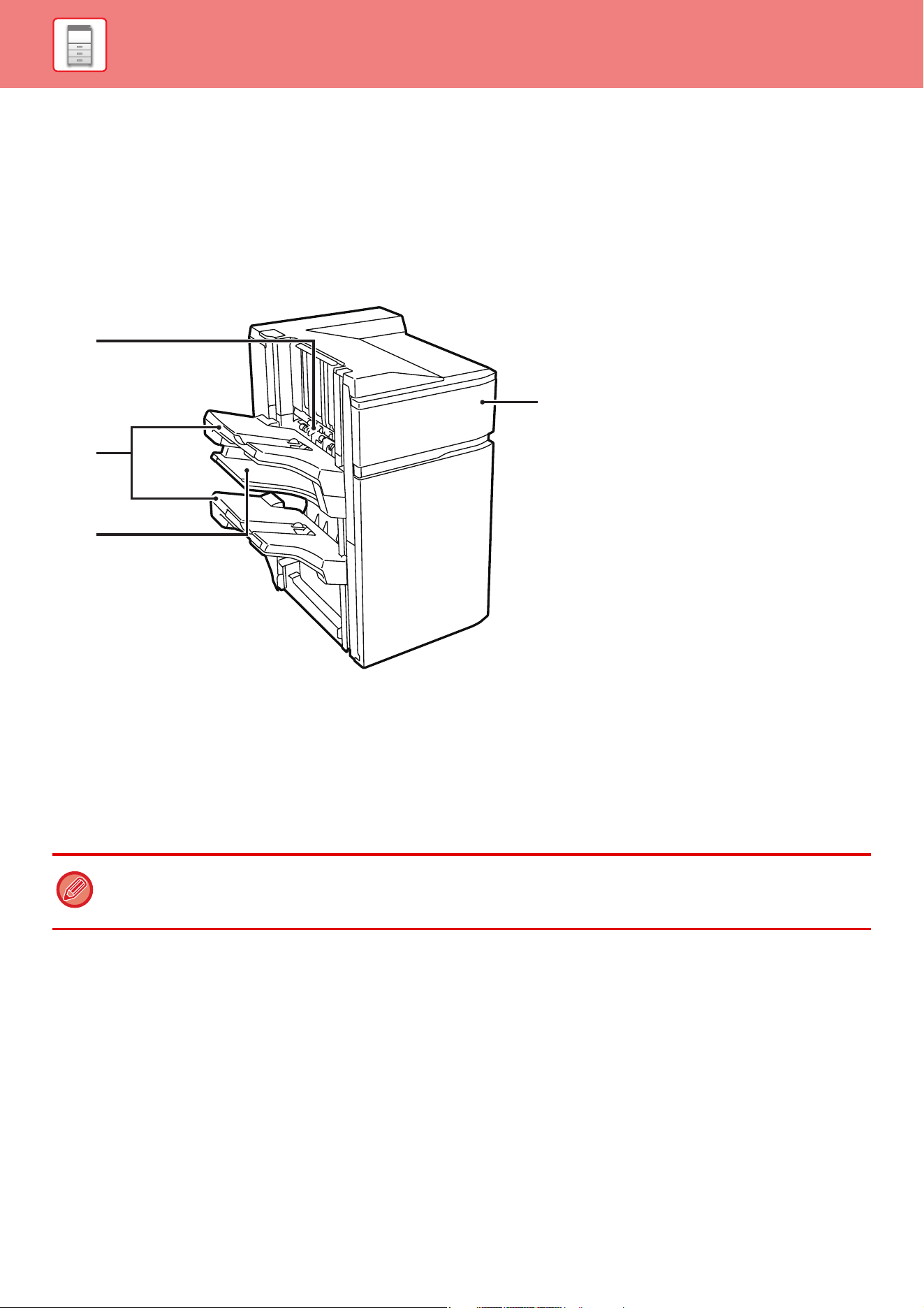
1-119
BEFORE USING THE MACHINE►PERIPHERAL DEVICES
FINISHER (100-SHEET STAPLING)
This includes the offset function that outputs sorted paper while staggering each set of paper and the staple sort function
that staples each set of prints.
Installing an optional hole punch module allows you to punch holes in printed paper.
PART NAMES
(1) Staple compiler
This temporarily stacks paper to be stapled.
(2) Output tray
Stapled and offset output is delivered to this tray.
The tray is slidable. Extend the tray for printing on
large-size paper (larger than 8-1/2" × 11" (A4)).
(3) Middle output tray
Output paper that will not be offset in this tray.
The tray is slidable. Extend the tray for printing on
large-size paper (larger than 8-1/2" × 11" (A4)).
(4) Front cover
Open this cover to replace the staple cartridge or remove
a staple jam.
(2)
(1)
(3)
(4)
• Do not place heavy objects on the finisher or press down on the finisher (100-sheet stapling).
• Exercise caution when you turn on the power and when printing is taking place, as the tray may move up and down.
• A finisher (100-sheet stapling) cannot be installed simultaneously with a saddle stitch finisher.
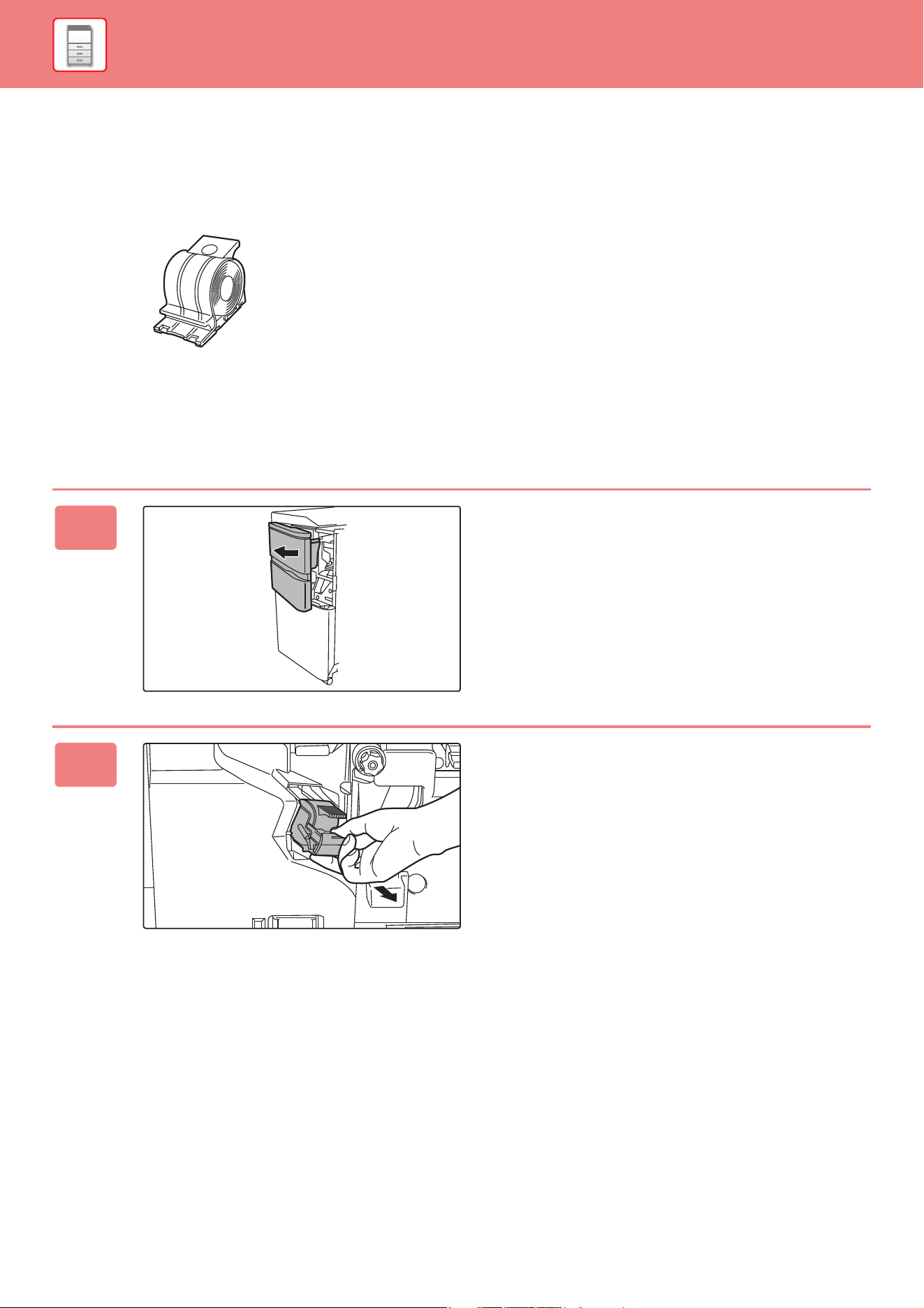
1-120
BEFORE USING THE MACHINE►PERIPHERAL DEVICES
SUPPLIES
The finisher (100-sheet stapling) requires the following staple cartridge:
Staple cartridge (approx. 5000 staples per cartridge × three cartridges)
MX-SCX2
REPLACING THE CARTRIDGE
When the staple cartridge runs out of staples, a message will appear in the operation panel. Follow the operation
procedure to replace the staple cartridge.
1
Open the front cover.
2
Squeeze the green parts of the staple
case and pull the case up and then
out.
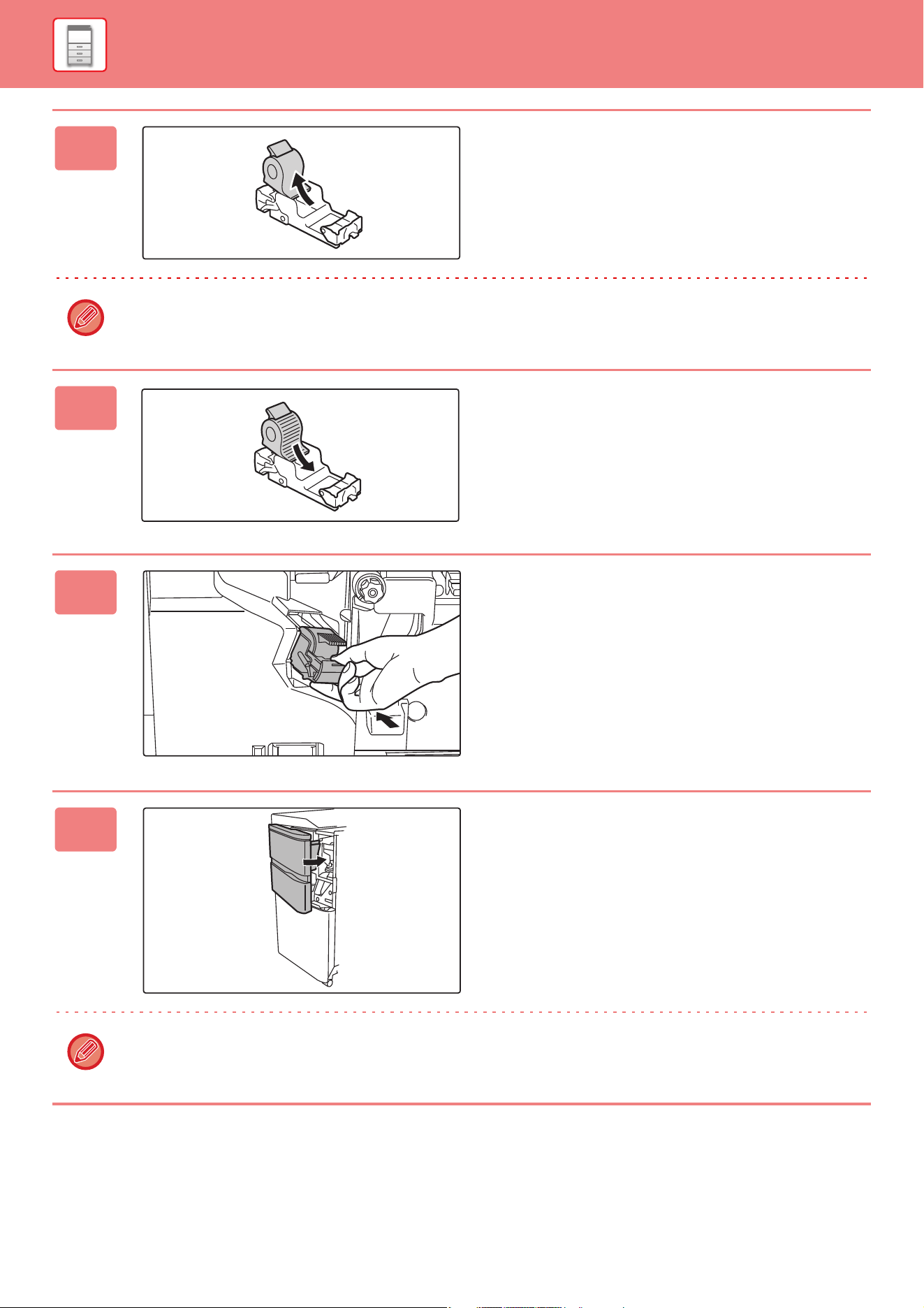
1-121
BEFORE USING THE MACHINE►PERIPHERAL DEVICES
3
Remove the empty staple cartridge.
When staples remain, the staple cartridge cannot be removed.
4
Insert a new staple cartridge into the
staple case.
Push the staple case in until it clicks into place.
5
Install a staple case.
Push the staple case in until it clicks into place.
6
Close the front cover.
Make a proof copy in staple sort function to verify that stapling takes place correctly.
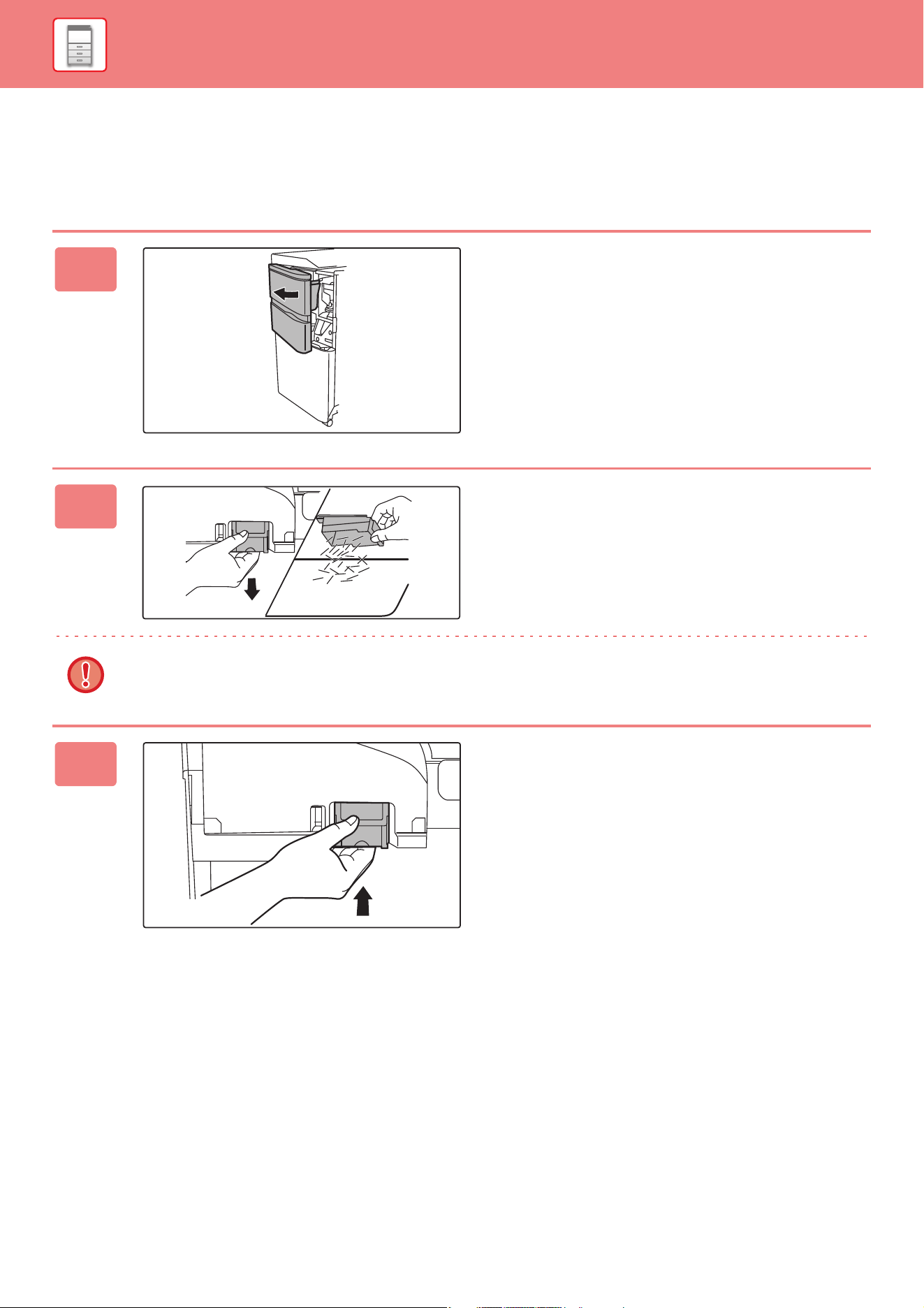
1-122
BEFORE USING THE MACHINE►PERIPHERAL DEVICES
DISCARDING STAPLE WASTE
When a finisher is used for stapling, staple waste is produced.
The staple waste is collected in the staple waste box.
Follow the steps below to discard staple waste.
1
Open the front cover.
2
Grasp the tab of the staple waste box,
gently pull out the box, and discard the
staple waste.
• Do not put your fingers into the staple waste box. The staples may prick and injure your fingers.
• Do not discard the staple waste in a plastic bag. The staples may create holes in the bag.
3
Replace the staple waste box.
Make sure that the staple waste box is replaced correctly.
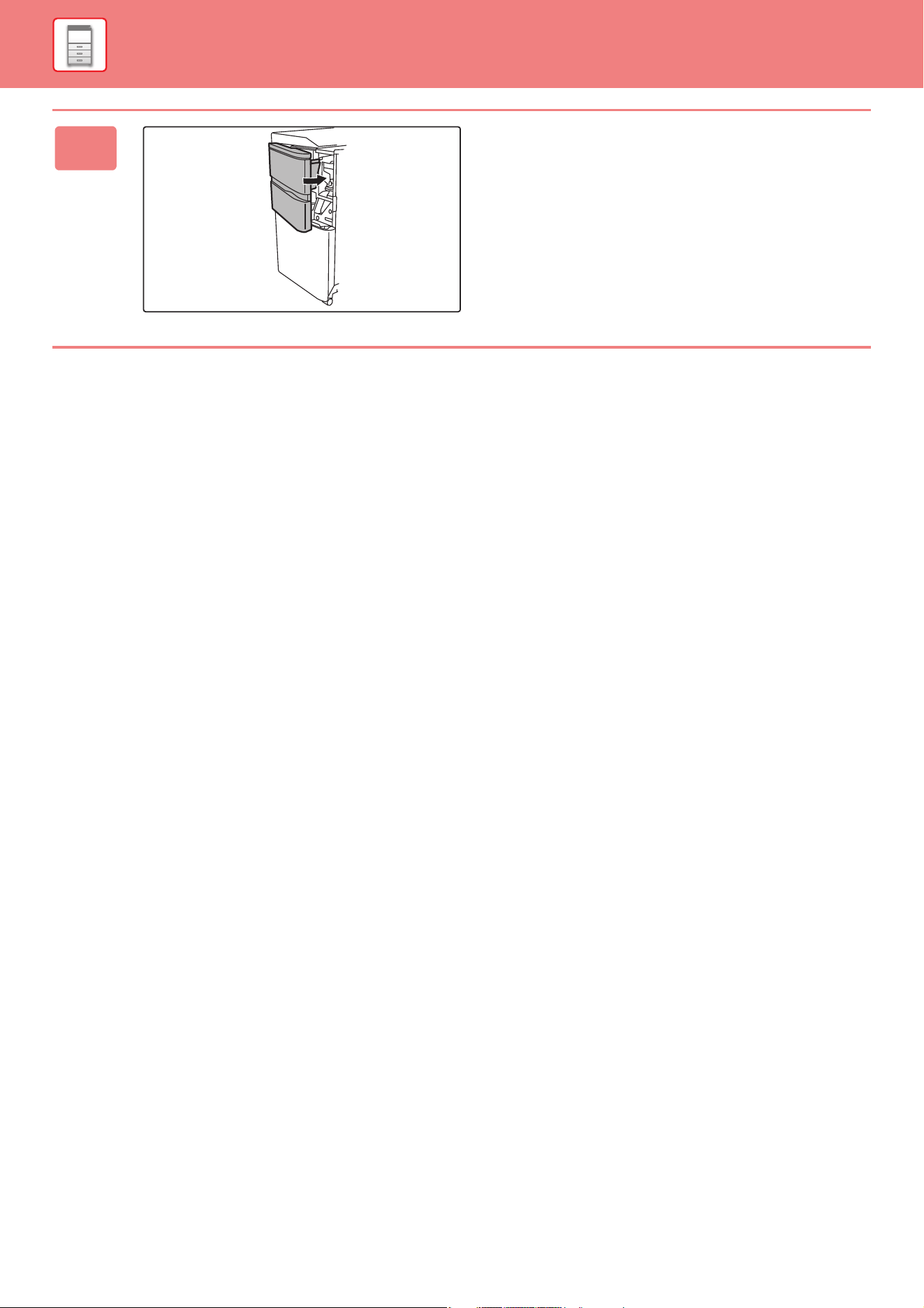
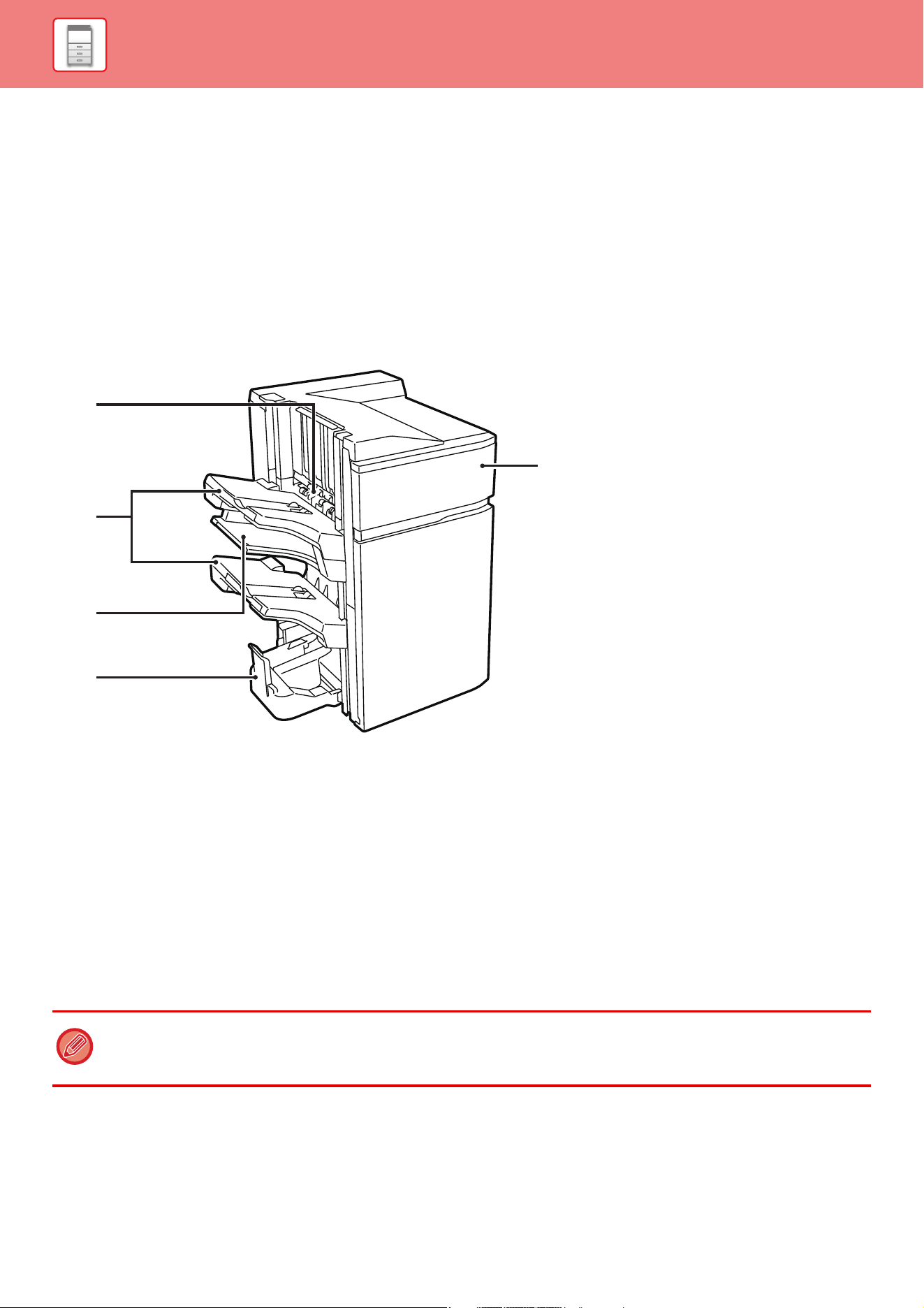
1-124
BEFORE USING THE MACHINE►PERIPHERAL DEVICES
SADDLE STITCH FINISHER (100-SHEET
STAPLING)
This includes the offset function that outputs sorted sheets of paper while staggering each set of paper, the staple sort
function that staples each set of prints, the saddle stitch function that staples the center of the sheets and folds the
sheets in half, and the paper folding function that folds paper in half.
Installing an optional hole punch module allows you to punch holes in printed paper.
PART NAMES
(1) Staple compiler
This temporarily stacks paper to be stapled.
(2) Output tray
Stapled and offset output is delivered to this tray.
The tray is slidable. Extend the tray for printing on
large-size paper (larger than 8-1/2" × 11" (A4)).
(3) Middle output tray
Output paper that will not be offset in this tray.
The tray is slidable. Extend the tray for printing on
large-size paper (larger than 8-1/2" × 11" (A4)).
(4) Saddle stitch tray
Saddle-stitched output is delivered to this tray.
(5) Front cover
Open this cover to replace the staple cartridge or remove
a staple jam.
(2)
(4)
(1)
(3)
(5)
• Do not place heavy objects on the finisher or press down on the finisher (100-sheet stapling).
• Exercise caution when you turn on the power and when printing is taking place, as the tray may move up and down.
• A saddle stitch finisher (100-sheet stapling) cannot be installed simultaneously with a finisher.
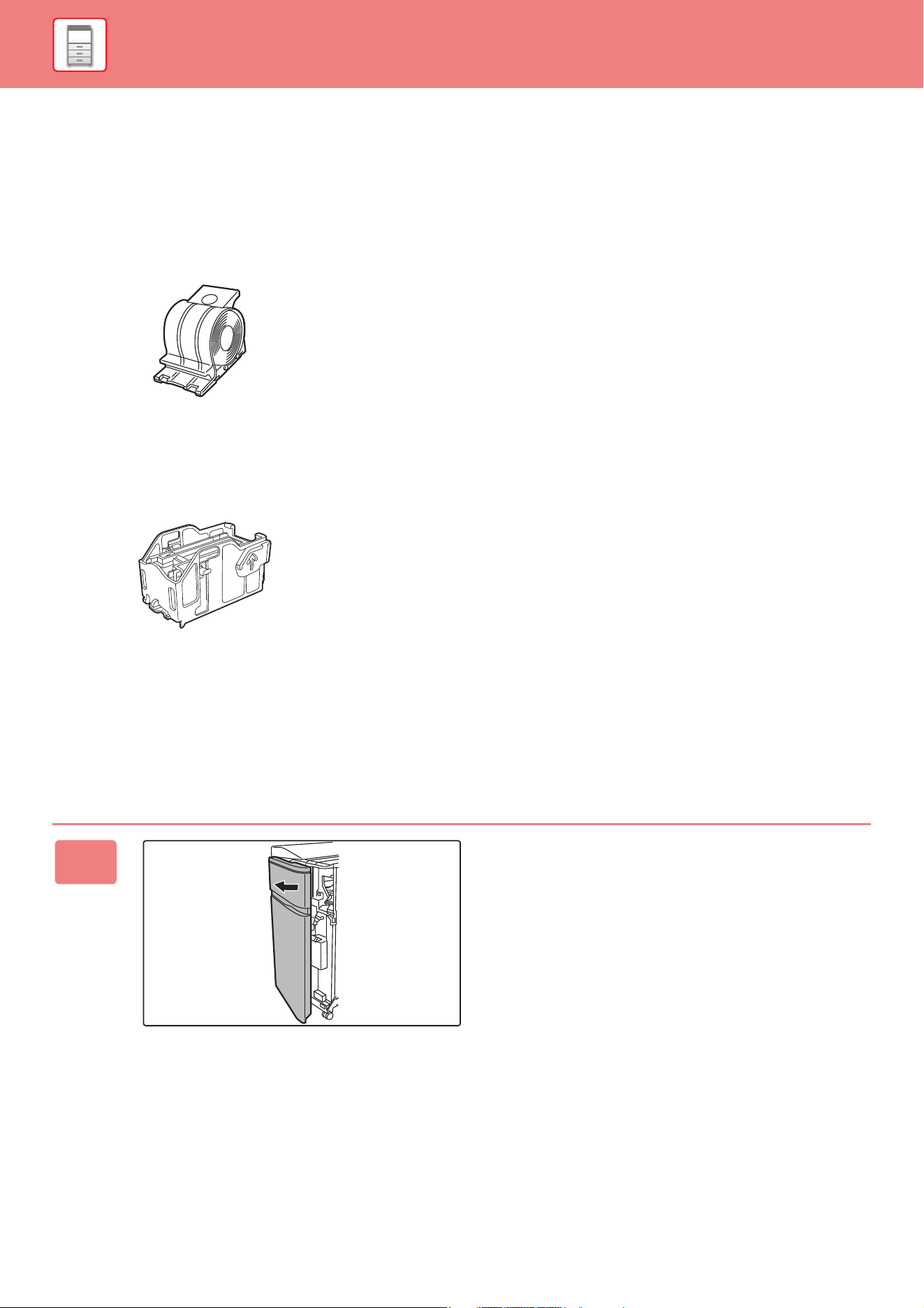
1-125
BEFORE USING THE MACHINE►PERIPHERAL DEVICES
SUPPLIES
The saddle stitch finisher (100-sheet stapling) requires the following staple cartridge:
Finisher unit
Staple cartridge (approx. 5000 staples per cartridge × three cartridges)
MX-SCX2
Saddle stitch unit
Staple cartridge (approx. 5000 staples per cartridge × four cartridges)
MX-SCX1
REPLACING THE CARTRIDGE
Finisher unit
When the staple cartridge runs out of staples, a message will appear in the operation panel. Follow the operation
procedure to replace the staple cartridge.
1
Open the front cover.
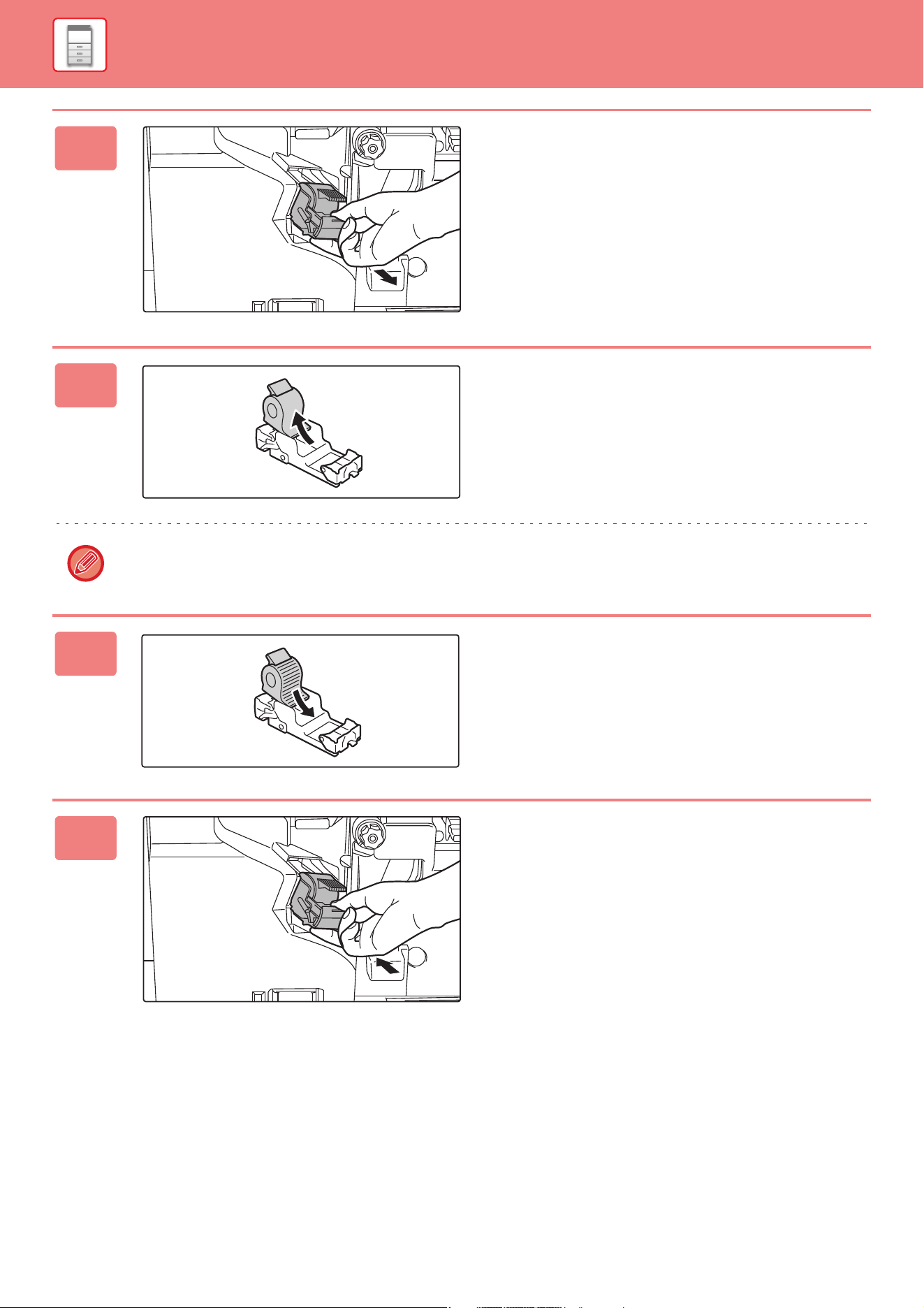
1-126
BEFORE USING THE MACHINE►PERIPHERAL DEVICES
2
Squeeze the green parts of the staple
case and pull the case up and then
out.
3
Remove the empty staple cartridge.
When staples remain, the staple cartridge cannot be removed.
4
Insert a new staple cartridge into the
staple case.
Push the staple case in until it clicks into place.
5
Install a staple case.
Push the staple case in until it clicks into place.
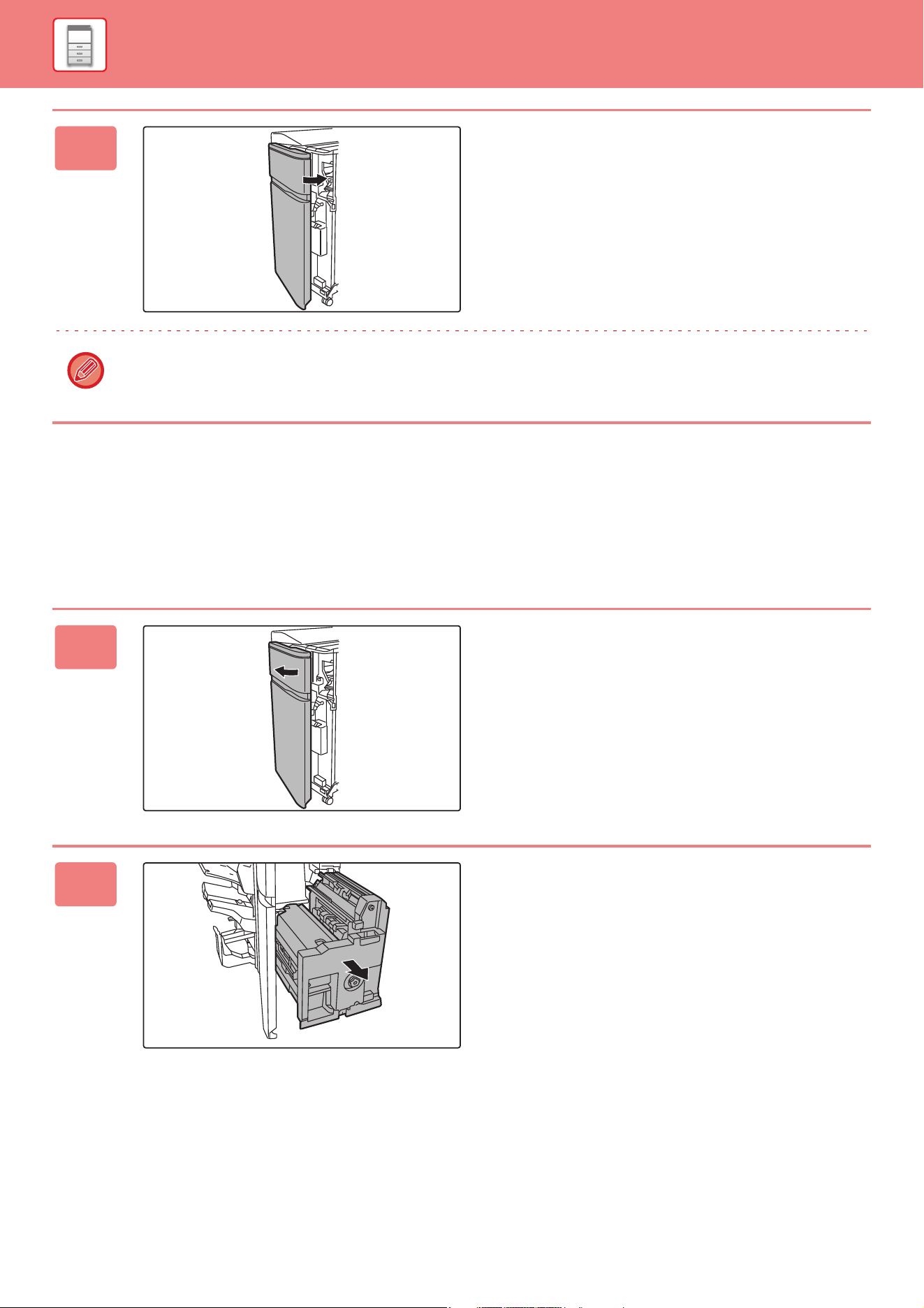
1-127
BEFORE USING THE MACHINE►PERIPHERAL DEVICES
Saddle stitch unit
When the staple cartridge runs out of staples, a message will appear in the operation panel. Follow the operation
procedure to replace the staple cartridge.
Before starting this procedure, remove all output from the output tray of the saddle stitch finisher (100-sheet stapling).
Do not replace removed output back in the output tray.
6
Close the front cover.
Make a proof copy in staple sort function to verify that stapling takes place correctly.
1
Open the front cover.
2
Grasp the handle on the saddle stitch
unit and pull it slowly out until it stops.
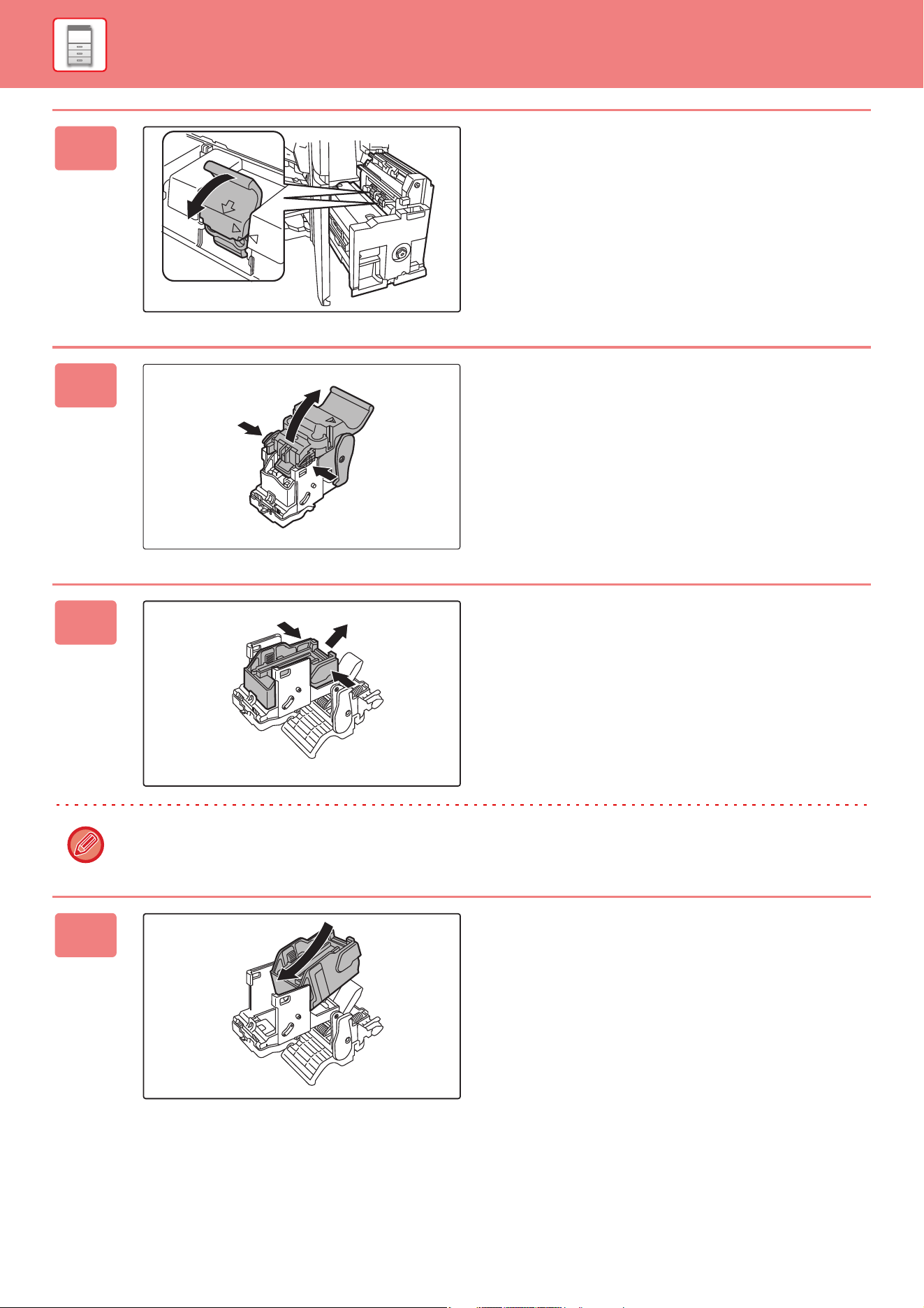
1-128
BEFORE USING THE MACHINE►PERIPHERAL DEVICES
3
Lower the staple case release lever
and remove the staple case.
Pull the staple case out to the left.
Replace both staple cartridges.
4
Press the lock button to open the
release lever.
5
Remove the empty staple cartridge.
Press the lock button to open the release lever.
6
Install a new staple cartridge.
Push the staple case in until it clicks into place.
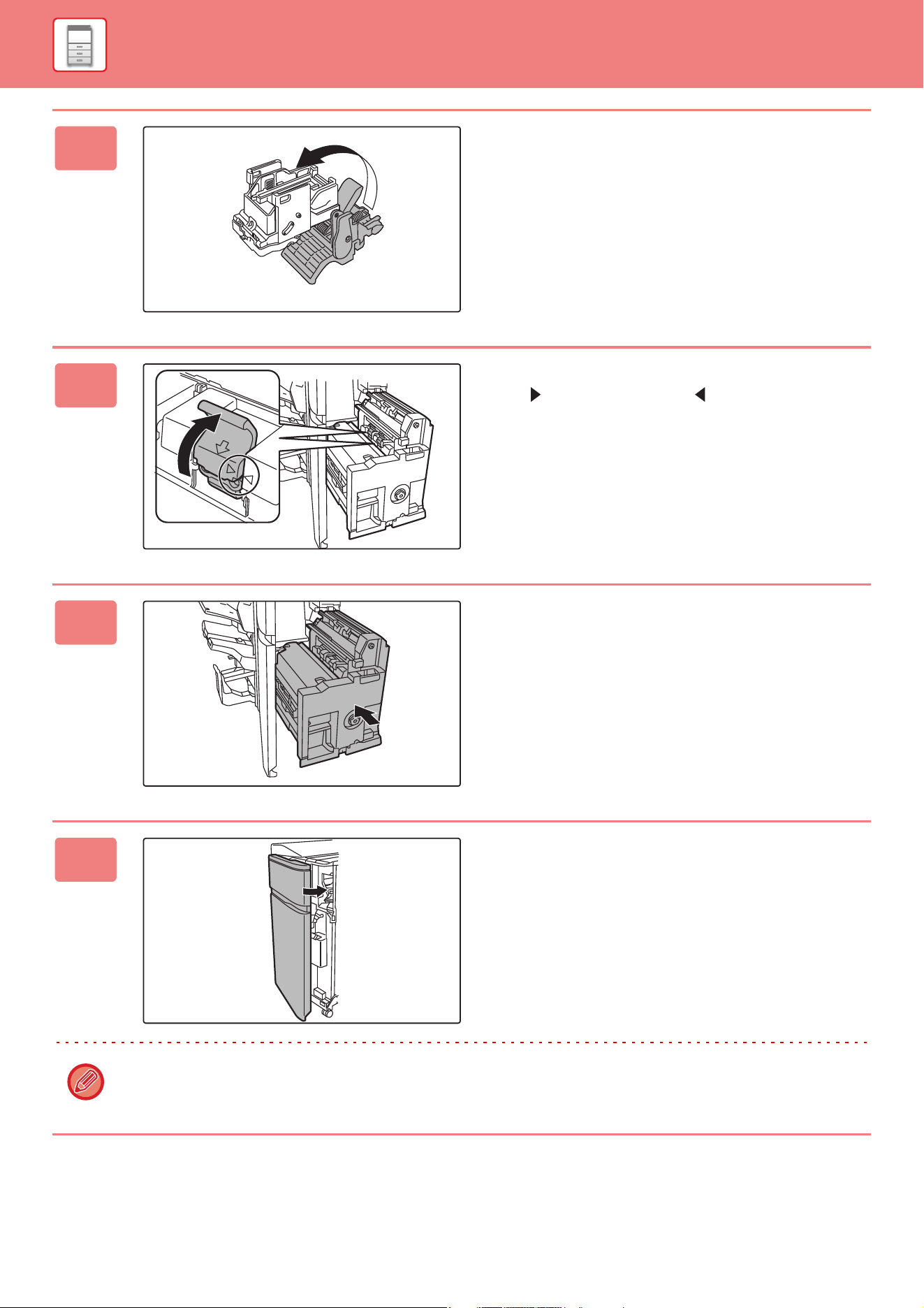
1-129
BEFORE USING THE MACHINE►PERIPHERAL DEVICES
7
Press the lock button to open the
release lever.
8
Push the staple case firmly back in.
Align of the staple case with of the unit.
Push the staple case in until it clicks into place.
9
Push the saddle stitch unit in.
10
Close the front cover.
Make a test print or copy using the saddle stitch function to verify that stapling takes place correctly.
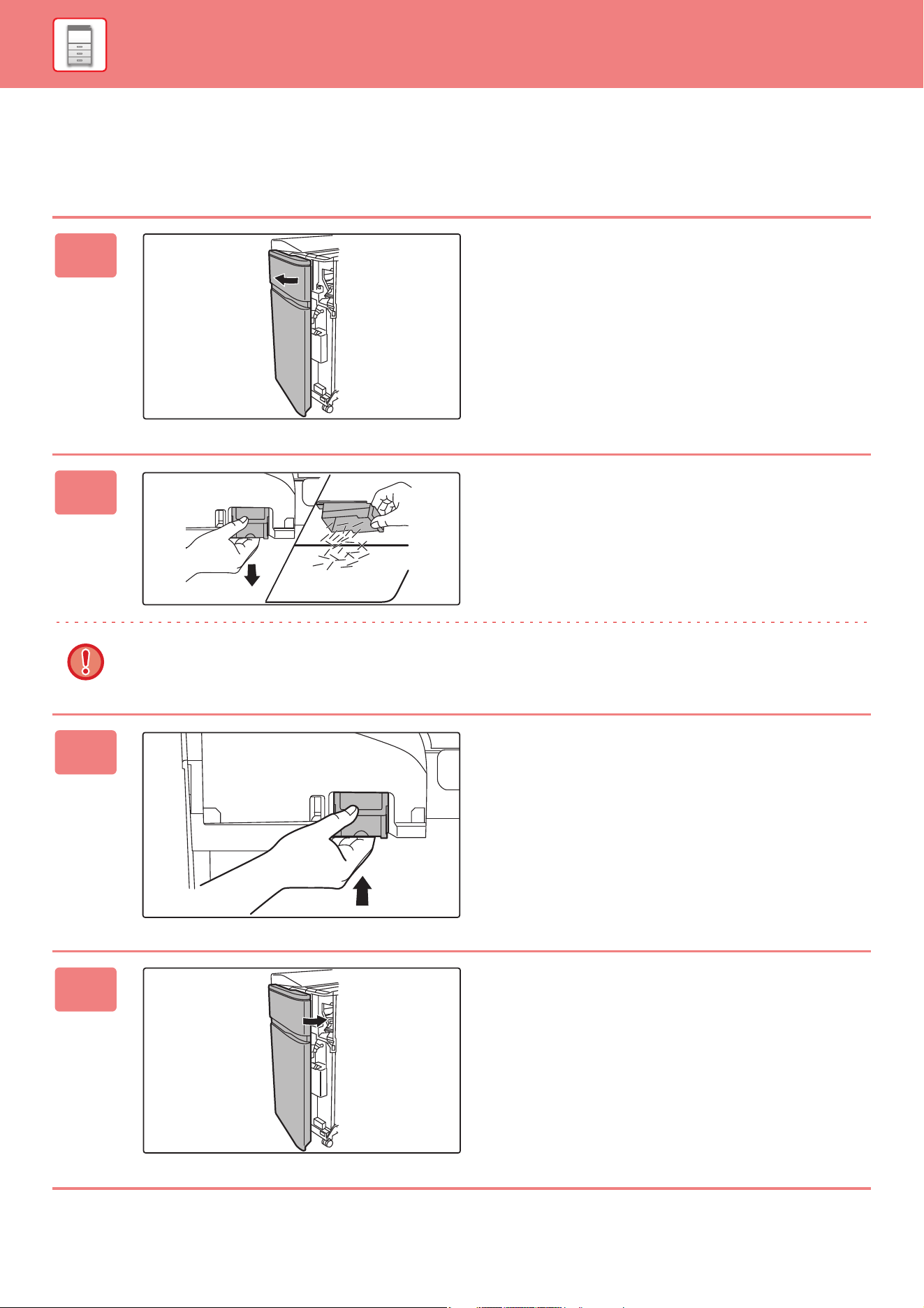
1-130
BEFORE USING THE MACHINE►PERIPHERAL DEVICES
DISCARDING STAPLE WASTE
When a finisher is used for stapling, staple waste is produced.
The staple waste is collected in the staple waste box.
Follow the steps below to discard staple waste.
1
Open the front cover.
2
Grasp the tab of the staple waste box,
gently pull out the box, and discard the
staple waste.
• Do not put your fingers into the staple waste box. The staples may prick and injure your fingers.
• Do not discard the staple waste in a plastic bag. The staples may create holes in the bag.
3
Replace the staple waste box.
Make sure that the staple waste box is replaced correctly.
4
Close the front cover.
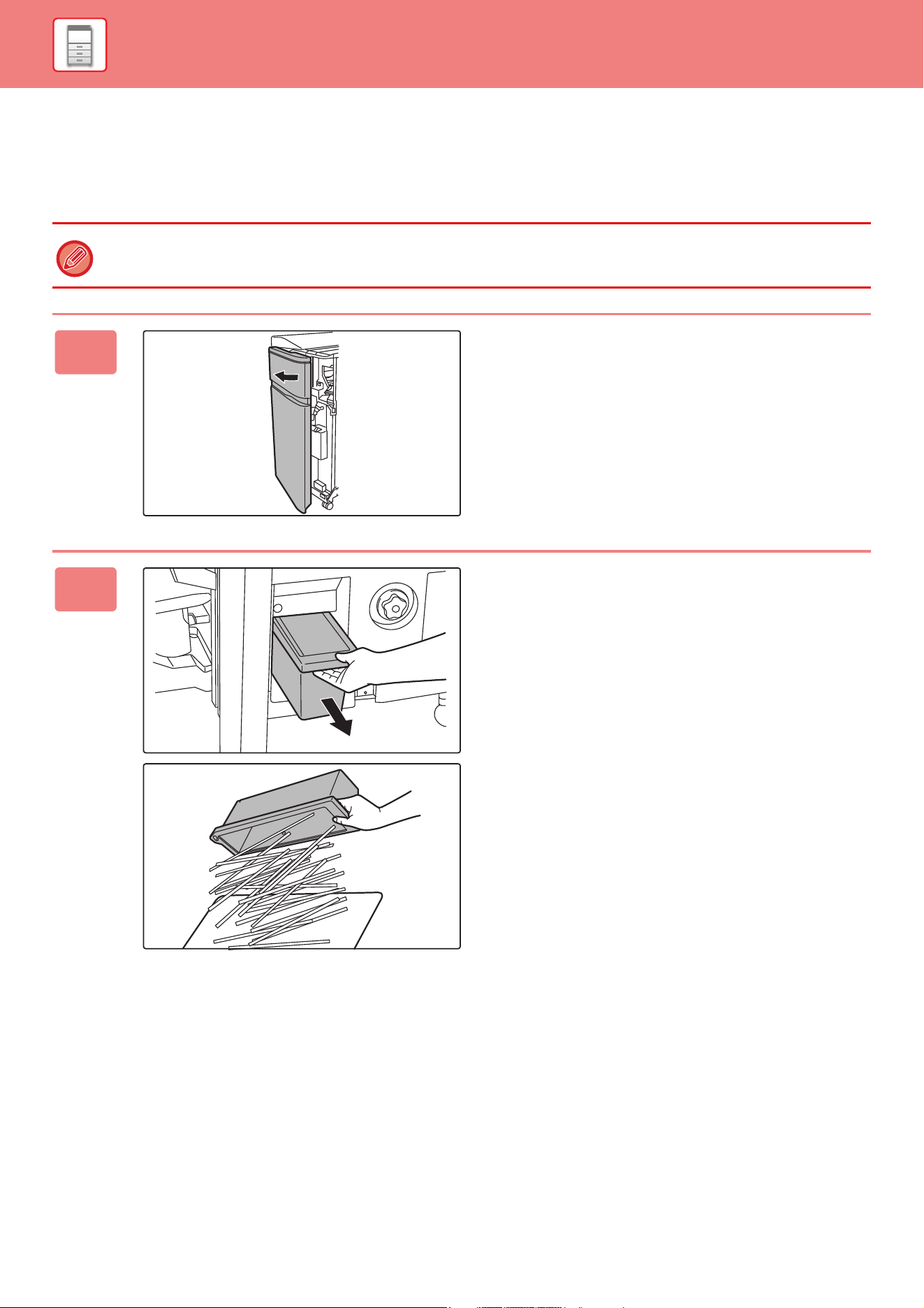
1-131
BEFORE USING THE MACHINE►PERIPHERAL DEVICES
DISCARDING PAPER WASTE
When folded paper is trimmed in trimmer settings, paper waste is generated.
Paper waste is collected in the paper waste box.
Follow the operation procedure to remove paper waste.
Using the trimmer function trims a side drop at the time of folding, creating a neat finish.
1
Open the front cover.
2
Grasp the paper waste box handle,
gently pull out the box, and discard the
paper waste.
Discard the paper waste into a plastic bag or other
container, being careful not to let any waste scatter.
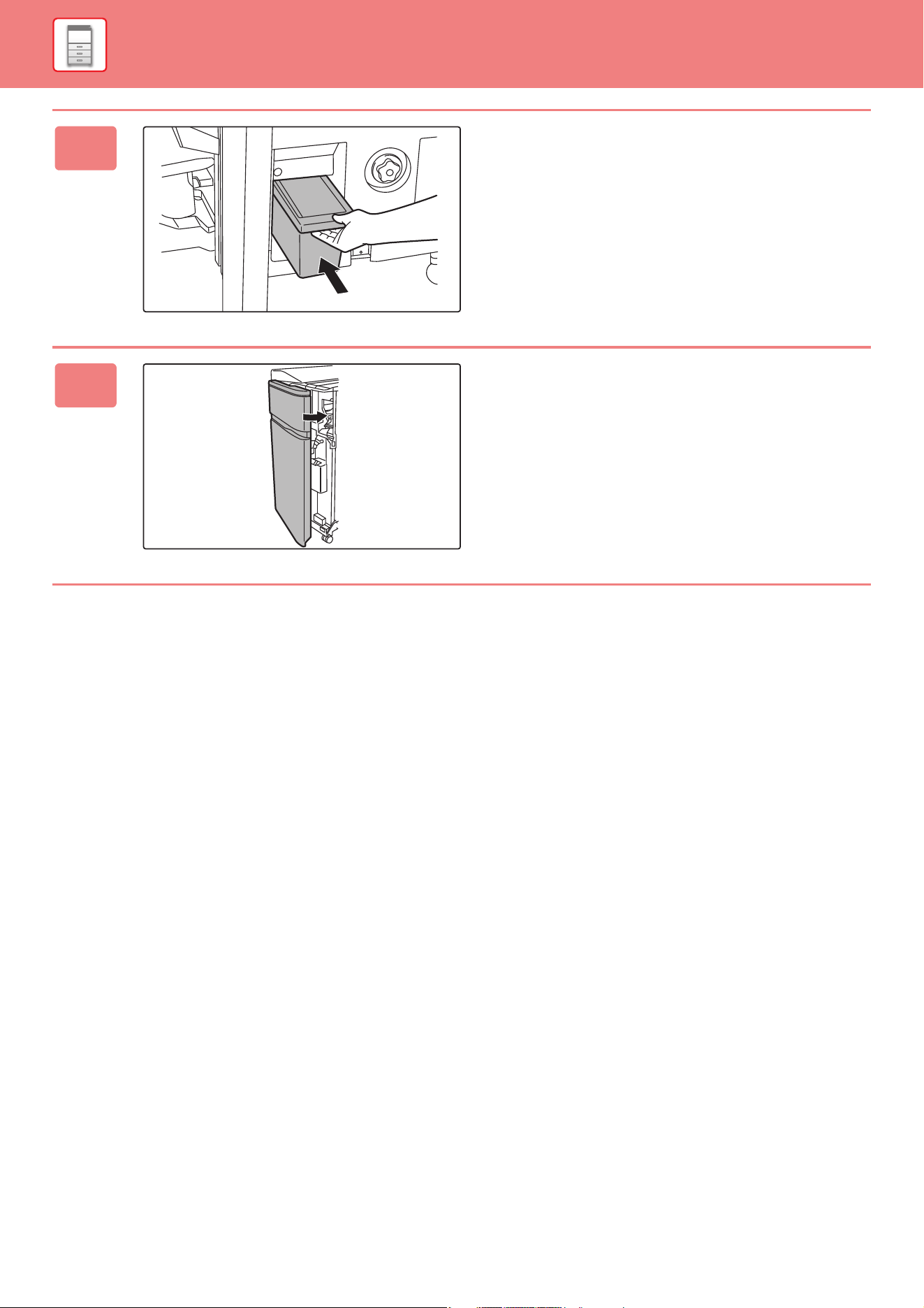
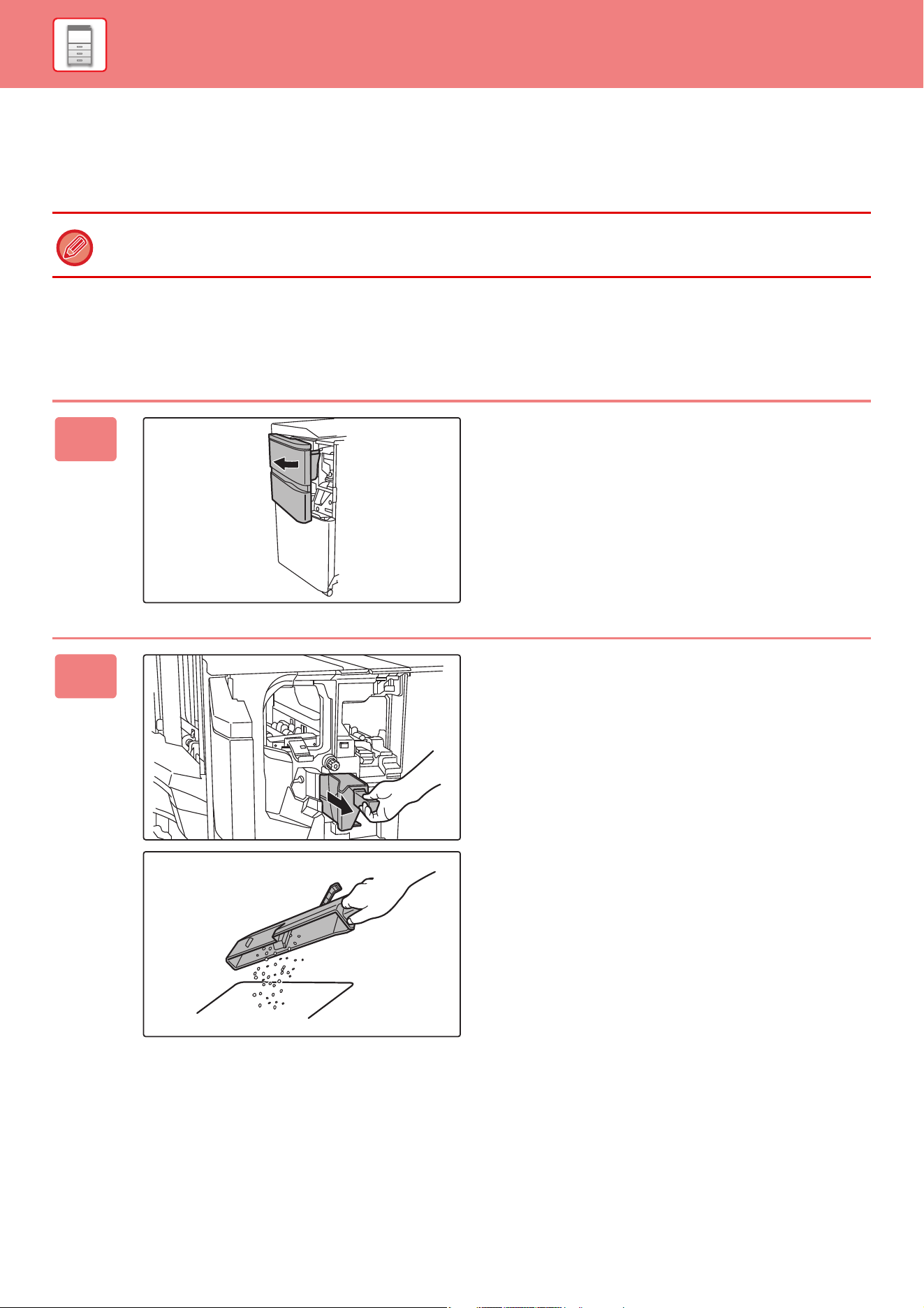
1-133
BEFORE USING THE MACHINE►PERIPHERAL DEVICES
PUNCH MODULE (MX-PN13B)
The punch module can be installed on a finisher (100-sheet stapling) or saddle stitch finisher (100-sheet stapling) to
punch holes in paper to be output.
DISCARDING PUNCH WASTE
Punch waste from punched holes is collected in the punch waste box.
Follow the operation procedure to replace punch waste.
A saddle stitch finisher or finisher (100-sheet stapling) is required to install the punch module (100-sheet punching).
1
Open the front cover.
2
Grasp the punch waste box handle,
gently pull out the box, and discard the
punch waste.
Discard the punch waste in a plastic bag or other container,
taking care not to let the waste scatter.
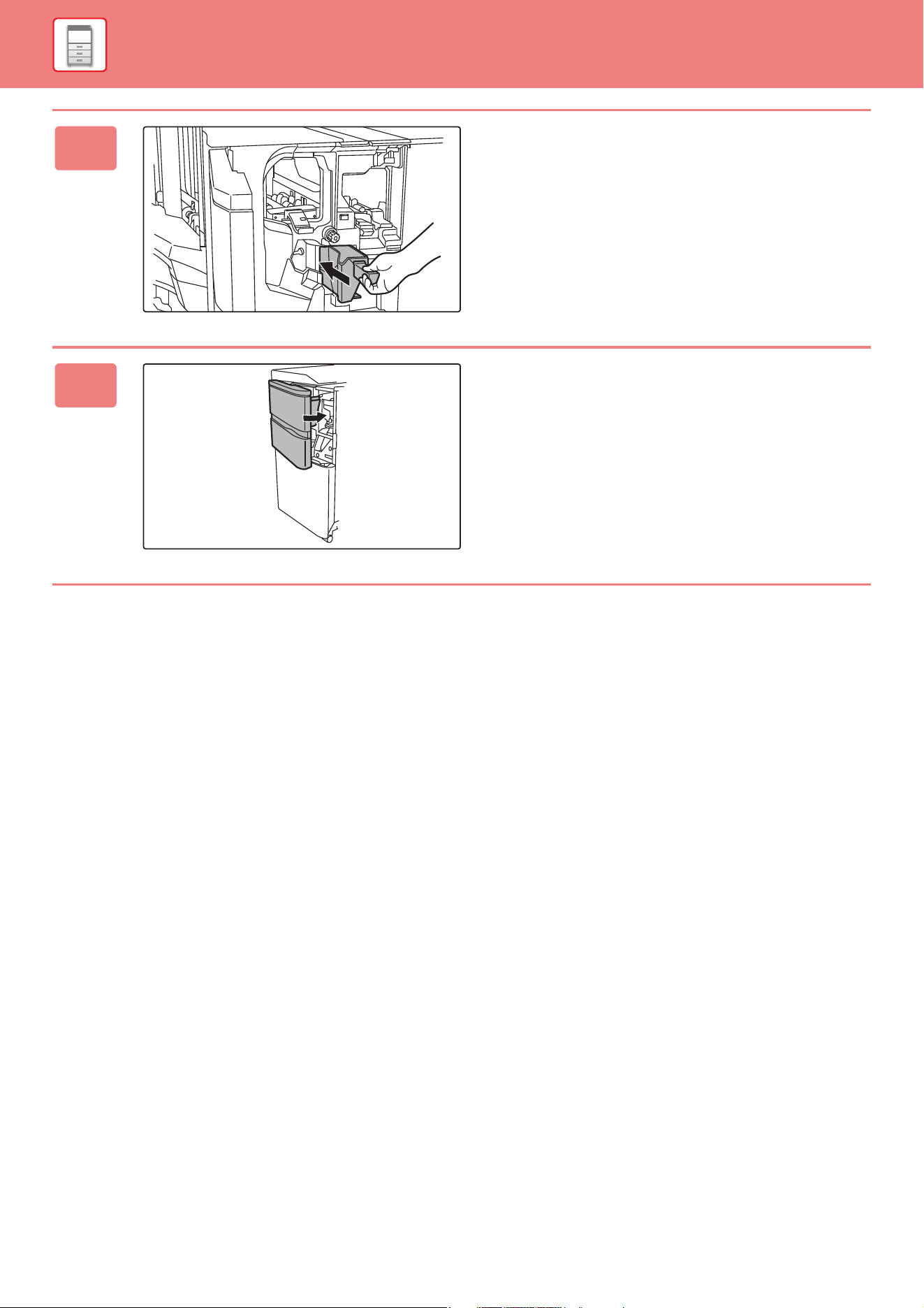
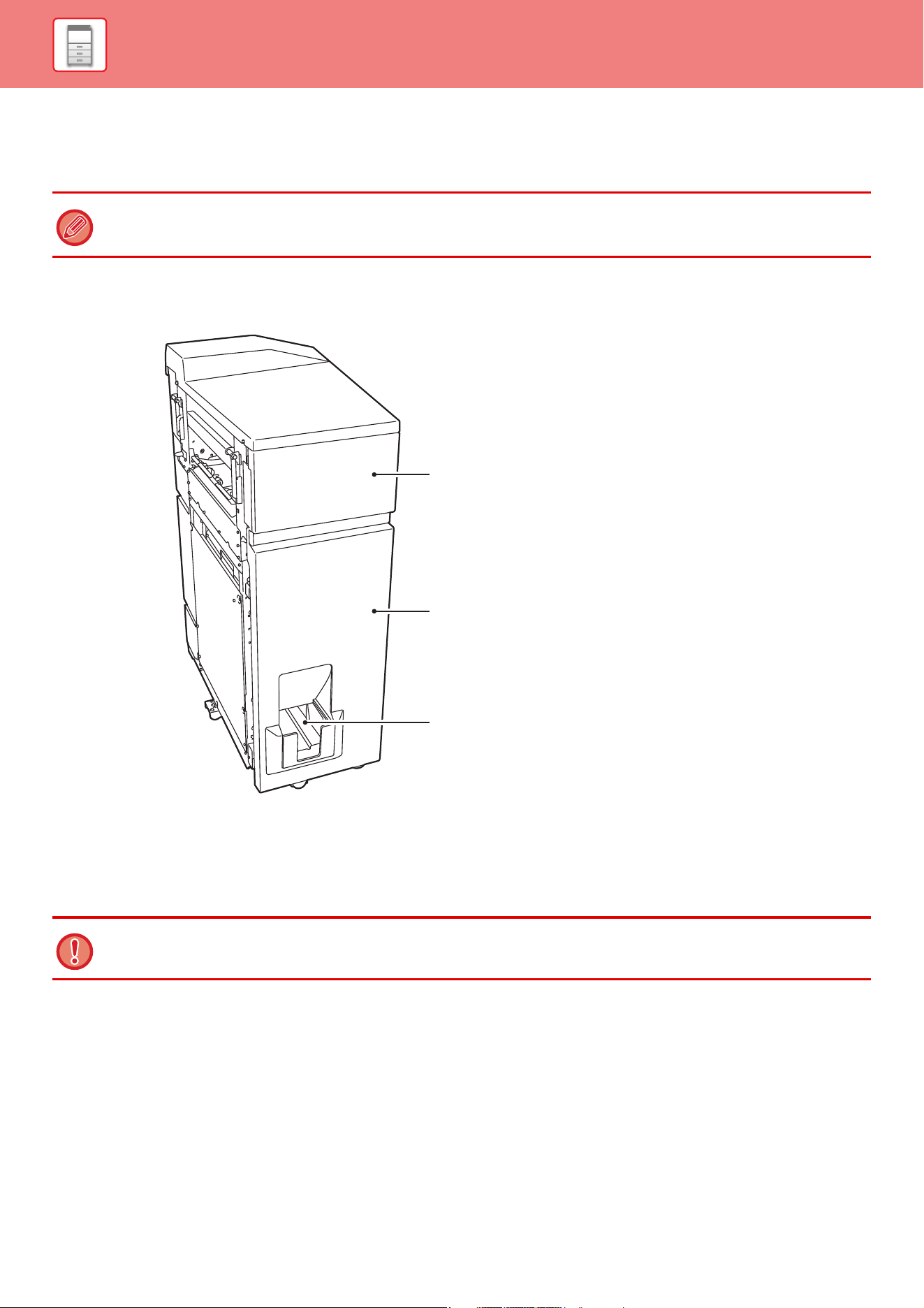
1-135
BEFORE USING THE MACHINE►PERIPHERAL DEVICES
FOLDING UNIT
A folding unit can be used for Z-Fold, C-Fold, Accordion Fold, Double Fold, and Half Fold.
PART NAMES
(1) Top cover
Open this cover to remove a paper misfeed.
(2) Bottom cover
Open this cover to remove a paper misfeed.
(3) Output tray of folding unit
Folded output is delivered to this tray.
A finisher (100-sheet stapling) or saddle stitch finisher (100-sheet stapling) is required to install the folding unit.
(1)
(2)
(3)
Do not place heavy objects on the folding unit or press down on the folding unit.
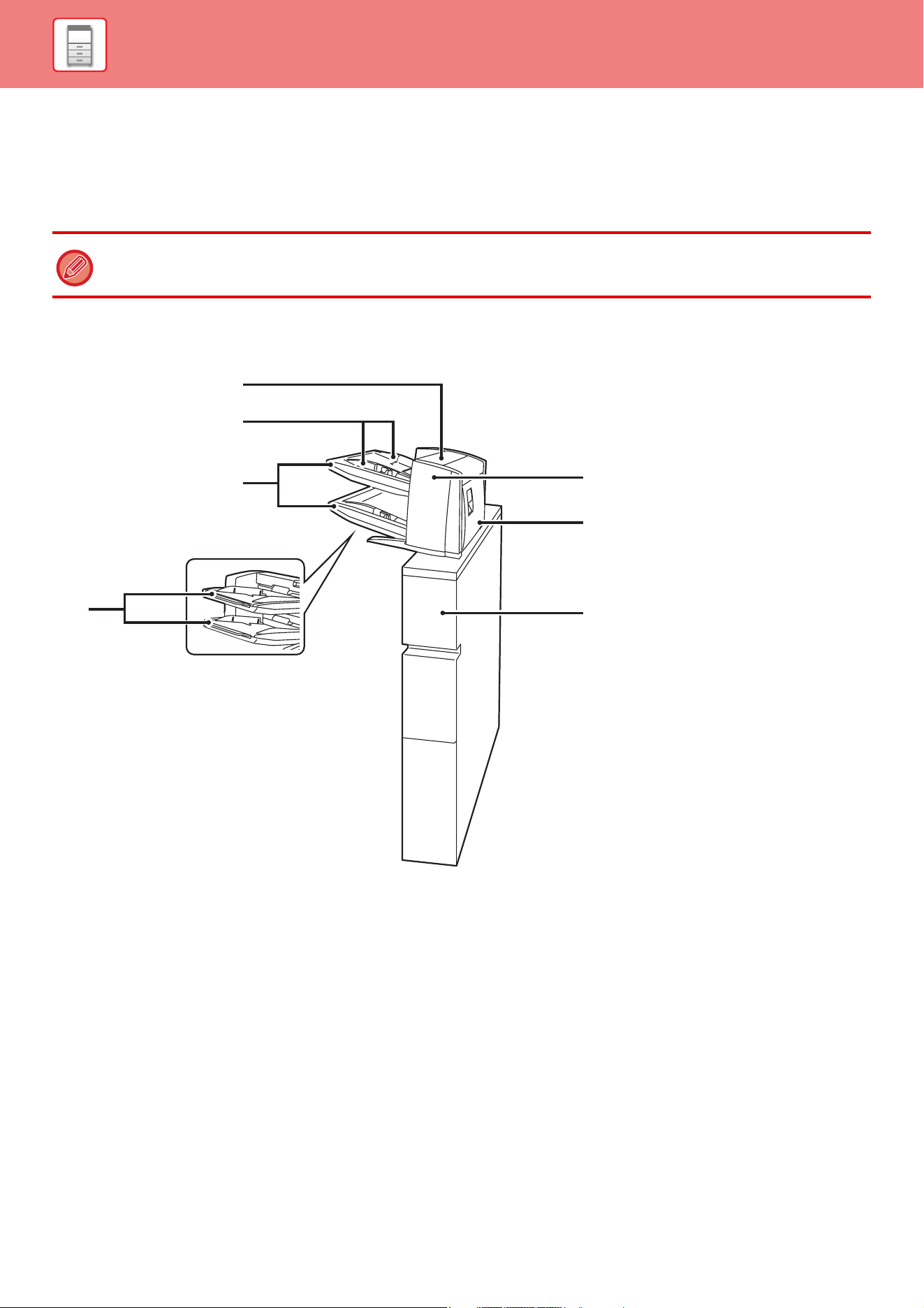
1-136
BEFORE USING THE MACHINE►PERIPHERAL DEVICES
INSERTER
Covers and insertion sheets to be inserted into printed sheets can be loaded.
Using the manual finishing function, you can directly feed paper into the finisher (100-sheet stapling) or saddle stitch
finisher (100-sheet stapling) to staple, punch or fold the paper.
PART NAMES
(1) Paper insertion unit cover
Open this cover to remove a paper misfeed.
(2) Paper guide
Push the lock lever to adjust to the paper size.
(3) Paper tray (upper/lower)
Insert paper or printed paper. A maximum of 200 sheets
of paper can be loaded into each tray.
(4) Bypass tray extension
Extend this when loading paper larger than 8-1/2" × 11"R
or A4R.
(5) Paper transfer unit front cover
Open this cover to remove a paper misfeed.
(6) Paper transfer unit rear cover
Open this cover to remove a paper misfeed.
(7) Cover
Open this cover to remove a paper misfeed.
For detailed information on paper that can be loaded into the inserter, see the "SPECIFICATIONS" in the "Start Guide".
(5)
(6)
(7)
(4)
(3)
(2)
(1)
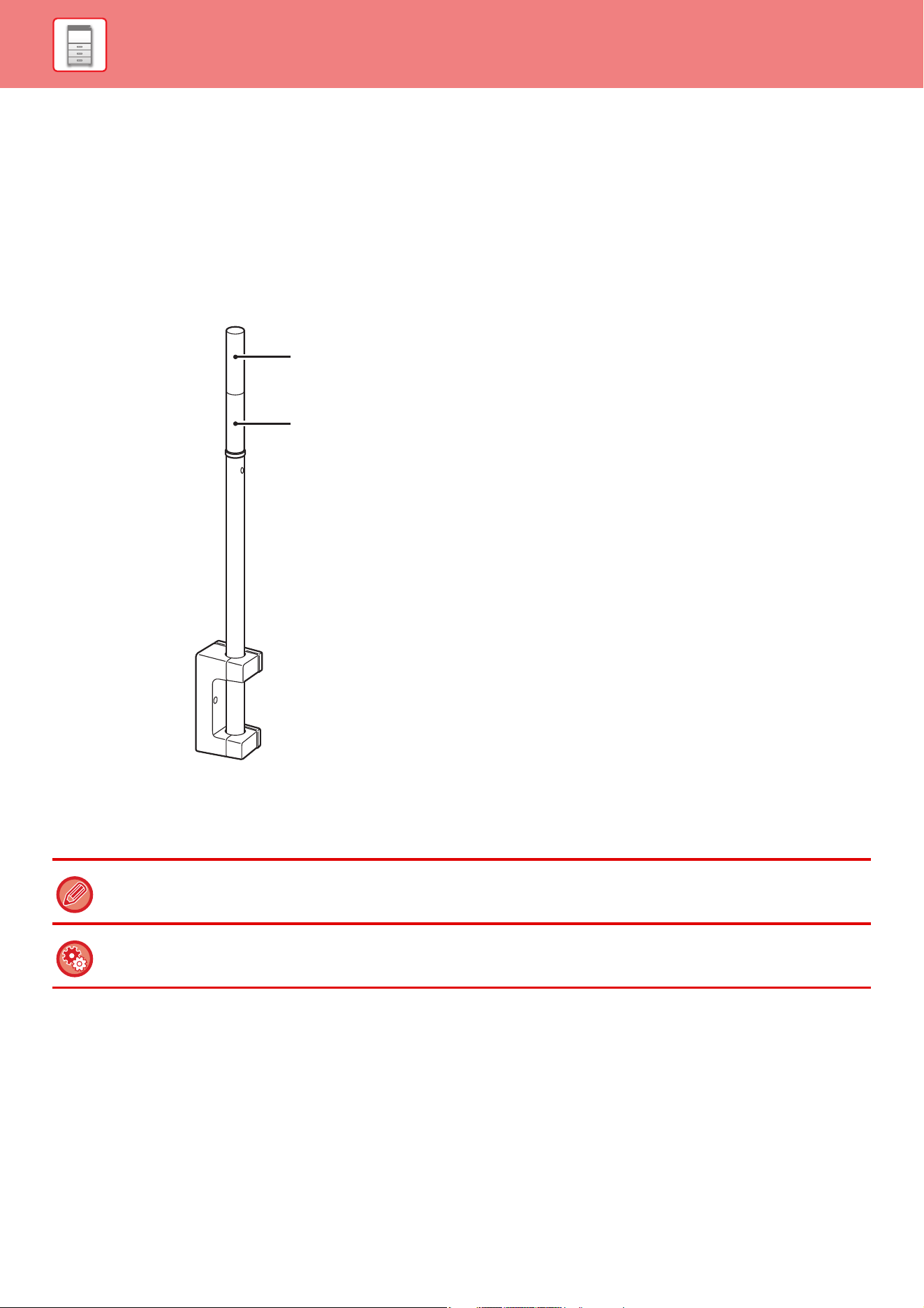
1-137
BEFORE USING THE MACHINE►PERIPHERAL DEVICES
STATUS INDICATORS
These indicators show the status of the machine. The green indicator lights up or blinks according to the job
management of the machine. The red indicator lights up or blinks when an error occurs. It lights up when an error occurs
but the machine is still able to be used, and blinks when the machine is not able to be used due to an error. In setting
mode, you can change the operation settings for the status indicators.
PART NAMES
(1) Indicator (Red)
The red indicator lights up or blinks when an error occurs.
(2) Indicator (Green)
The green indicator lights up or blinks according to the
job management of the machine.
(1)
(2)
In Auto Power Shut-Off mode, the status indicators go off.
To change the conditions for the status indicators to light up or blink:
In "Settings (administrator)", select [System Settings] → [Common Settings] → [Device Control] → [Status Indicator Setting].
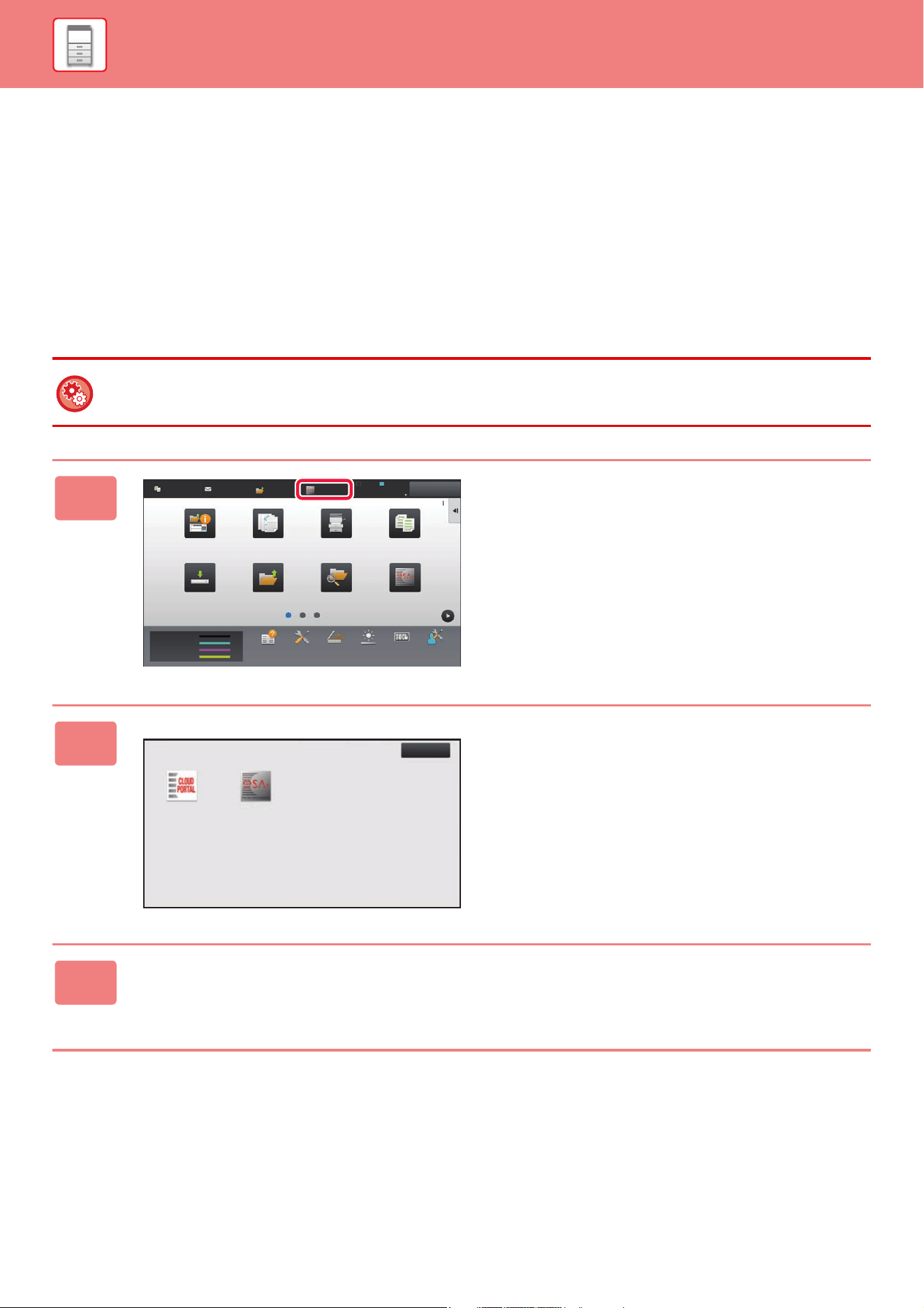
1-138
BEFORE USING THE MACHINE►PERIPHERAL DEVICES
Sharp OSA
Sharp OSA (Open Systems Architecture) is an architecture that directly links the machine to software applications for
work (external applications) over a network.
When you use a machine that supports Sharp OSA, you can link controls on the operation panel and device functions
such as scan send to external applications.
APPLICATION COMMUNICATION
This module enables you to link the machine with a scanner application and other standard applications. Set a standard
application in "Settings (administrator)" and "Sharp OSA".
To set a standard application in "Settings (administrator)":
In "Settings (administrator)", select [System Settings] → [Sharp OSA Settings] → [Standard Application Settings].
1
Tap the [Sharp OSA] key in the Home
screen.
If no standard applications have been stored, the key cannot
be tapped.
2
Select a standard application.
If two or more standard applications have been stored, the
screen for selecting a standard application will appear. Tap
the standard application that you wish to use.
If only one standard application has been stored, connection
to the standard application will begin.
3
Connect the machine to the standard application.
The message "Connecting to the external application." appears while the machine communicates with the standard
application.
10:15 AM
M
C
Bk
Y
Toner Quantity
LINE PRINTER
HDD
File retrieve
Sharp OSA
Operation
Guide
PC Scan Total Count Machine
Adjustment
LCD Control
Settings
Job Management
Tray Settings/
Paper Settings
Scan to HDD Batch Print
Manual
Finishing
HDD
File retrieve
Copy
E-mail
Job Management
Sharp OSA
Copy
Select External Application
CLOUD PORTAL
Exit
Mynumber_top_new
1-139
BEFORE USING THE MACHINE►PERIPHERAL DEVICES
EXTERNAL ACCOUNT APPLICATION
The external account module enables you to use an "external account application" for centralized account management
of an MFP on a network.
An "external account application" can be used in "external authentication mode" or "external count mode".
When "external authentication mode" is used, the login screen is retrieved from the application when the machine is
started. When a job ends, a job notification screen is sent to the application for counts by authenticated user. When
"external count mode" is used, the login screen is not displayed when the machine is started. Only a job result
notification is sent to the application. User authentication by the external account application cannot be used. However,
the external account application can be used in combination with the internal account function.
External account application setup
After setting an external application in "Settings (administrator)", restart the machine to enable the setting.
To restart the machine, see "TURNING ON THE POWER (page 1-10)
".
Operation in external account mode
The following describes operation in the two modes for using an external account application.
External authentication mode
When the machine is powered on in external authentication mode, the machine accesses the external account
application and displays the login screen. The login screen also appears when the [Call] key is tapped to run a job in the
job management complete screen. (The login screen does not appear if the user has already logged in by the normal
method.)
Tap the job management display while the login screen is displayed, and the Job Management screen appears. To
return to the previous screen, tap a mode select key.
If login fails:
If the login screen fails to appear or the application does not operate correctly, the machine may also stop operating
correctly. In that case, terminate external account mode forcibly.
To set up the external account application:
In "Settings (administrator)", select [System Settings] → [Sharp OSA Settings] → [External Accounting Application Settings].
To enable the external authentication mode:
In "Settings (administrator)", select [System Settings] → [Sharp OSA Settings] → [External Accounting Application Settings]
and enable the [External Account Control] setting.
• The user control function of the machine cannot be used in external authentication mode.
However, "User Registration", "User Count Display", "User Count Reset", "User Information Print", and "The Number of
User Name Displayed Setting" can be used.
• The mode select key cannot be used while the login screen appears.
To forcibly terminate the external account mode:
In "Settings (Web version)", select [System Settings] → [Sharp OSA Settings] → [External Accounting Application Settings].
If termination in Setting mode (Web version) fails, terminate it forcibly on the operation panel of the machine.
In "Settings", select [System Settings] → [Sharp OSA Settings] and change the setting for [External Accounting Application
Settings] and then restart the machine. To restart the machine, see "TURNING ON THE POWER (page 1-10)
".
1-140
BEFORE USING THE MACHINE►PERIPHERAL DEVICES
External count mode
Unlike in external authentication mode, when the machine is started in "external count mode", the login screen of the
external account application is not displayed after the machine has started up. Only the job result is sent to the external
account application.
External count mode can be used together with the user control function of the machine. (External count mode can also
be used when the user control function is disabled.)
To enable the external count mode:
In "Settings (administrator)", select [System Settings] → [Sharp OSA Settings] → [External Accounting Application Settings]
and enable the [External Account Control] setting alone.
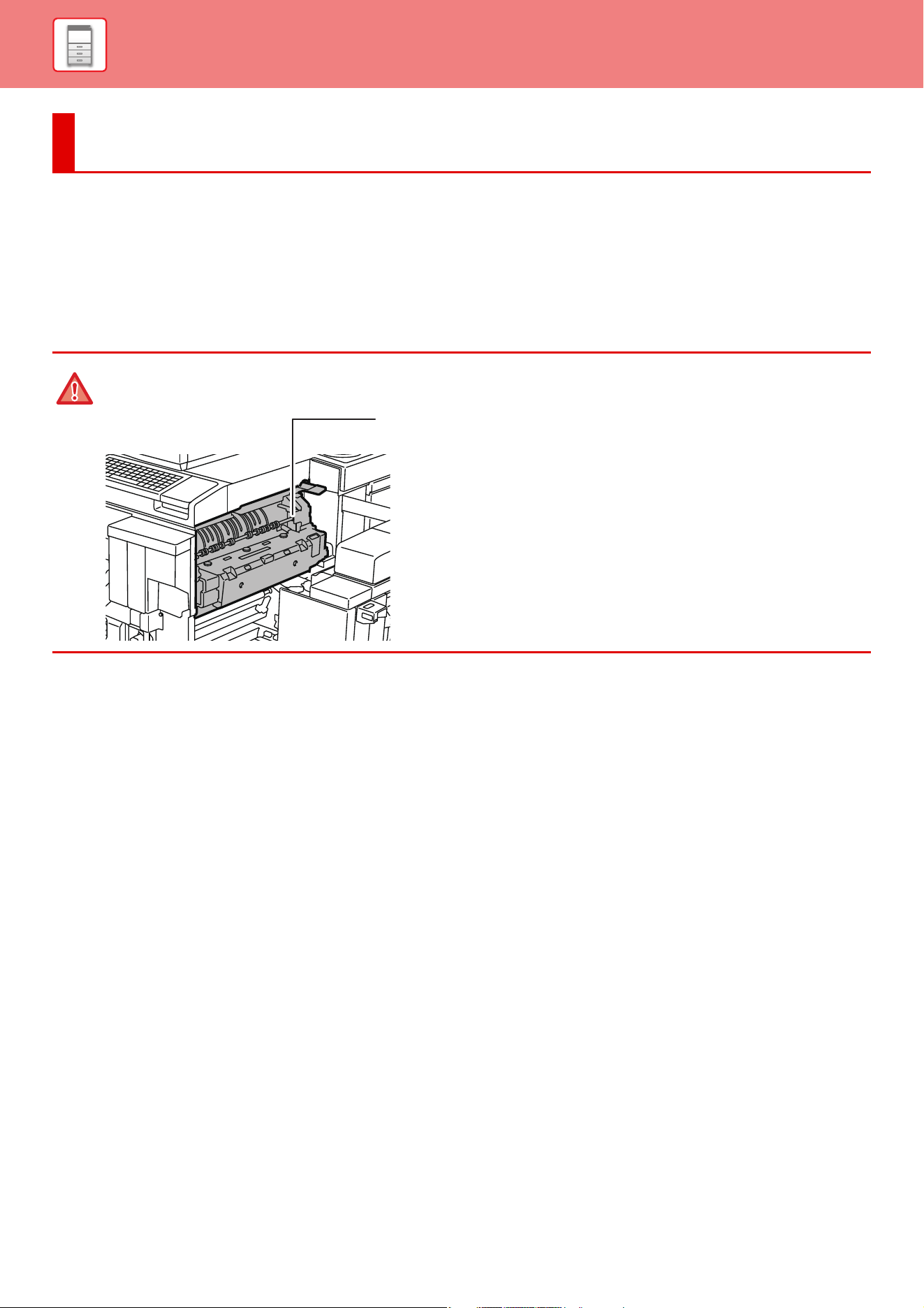
1-141
BEFORE USING THE MACHINE►REMOVING MISFEEDS
REMOVING MISFEEDS
If a paper misfeed occurs, the "Paper Jam" message will appear in the touch panel and printing and scanning will stop.
In this event, tap the [Check how to remove misfeeds] key in the touch panel.
When the key is tapped, instructions for removing the misfeed will appear. Follow the instructions. When the misfeed is
cleared, the message will automatically disappear.
REMOVING MISFEEDS
• The fusing unit and paper output area are hot.
• When removing a misfeed, do not touch the fusing unit. You may burn yourself.
Fusing unit
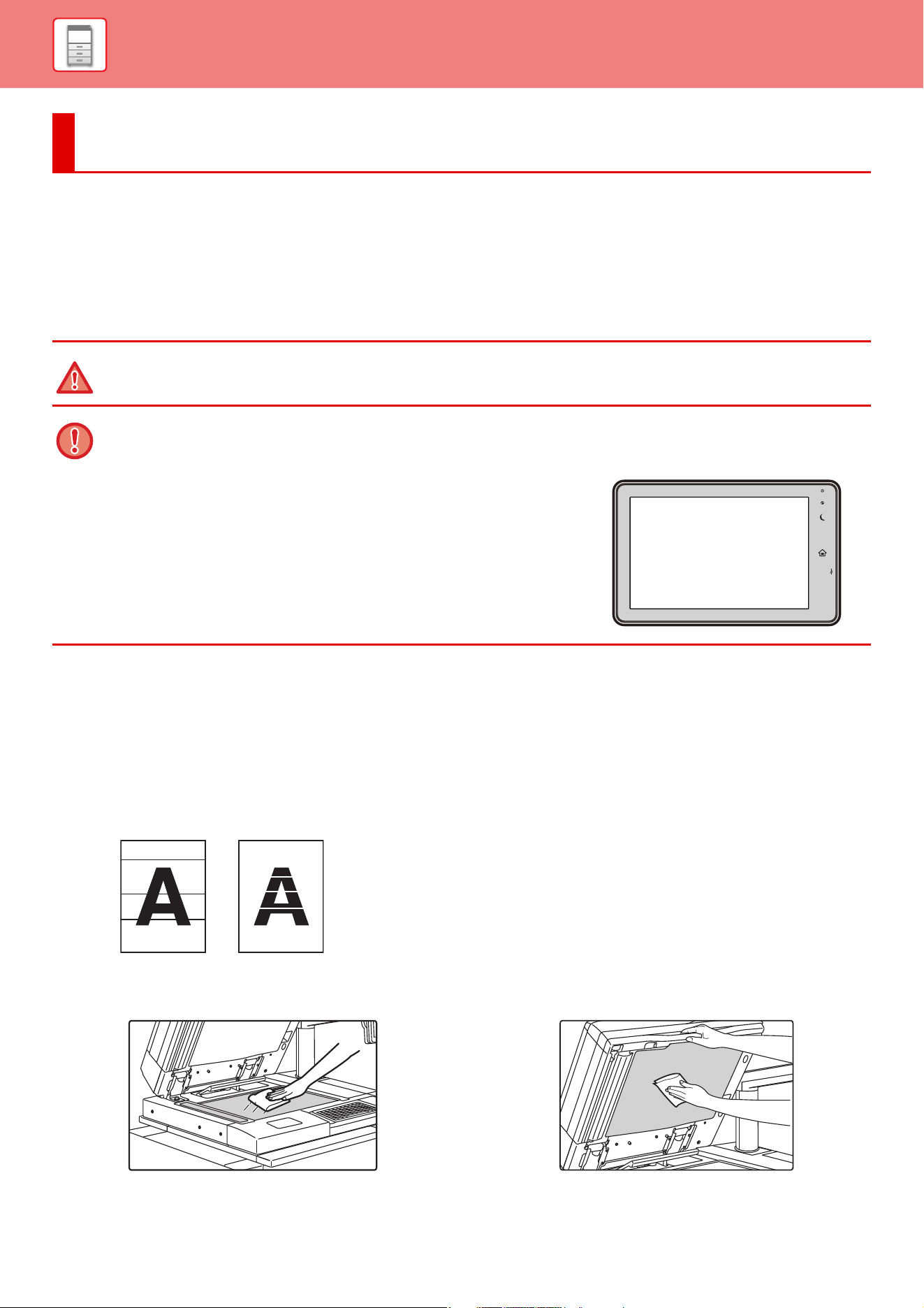
1-142
BEFORE USING THE MACHINE►MAINTENANCE
This section explains how to clean the machine, replace the toner cartridge, the waste toner bottle and the stamp
cartridge.
REGULAR MAINTENANCE
To ensure that the machine continues to provide top quality performance, periodically clean the machine.
CLEANING THE DOCUMENT GLASS AND AUTOMATIC
DOCUMENT FEEDER
If the document glass or document backplate sheet becomes dirty, the dirt will appear as dirty spots or white lines in the
scanned image. Keep these parts clean at all times.
Wipe the parts with a clean, soft cloth.
If necessary, moisten the cloth with water or a small amount of neutral detergent. After that, wipe with a clean dry cloth.
Examples of lines in the image
Document glass Document backplate sheet
MAINTENANCE
Do not use a flammable spray to clean the machine. If gas from the spray comes in contact with hot electrical components or
the fusing unit inside the machine, fire or electrical shock may result.
• Do not use thinner, benzene, or similar volatile cleaning agents to clean the machine. These may degrade or discolor the
housing.
• Use a soft cloth to gently wipe off dirt from the area on the operation panel.
If you use a stiff cloth or rub hard, the surface may be damaged.
Black lines White lines
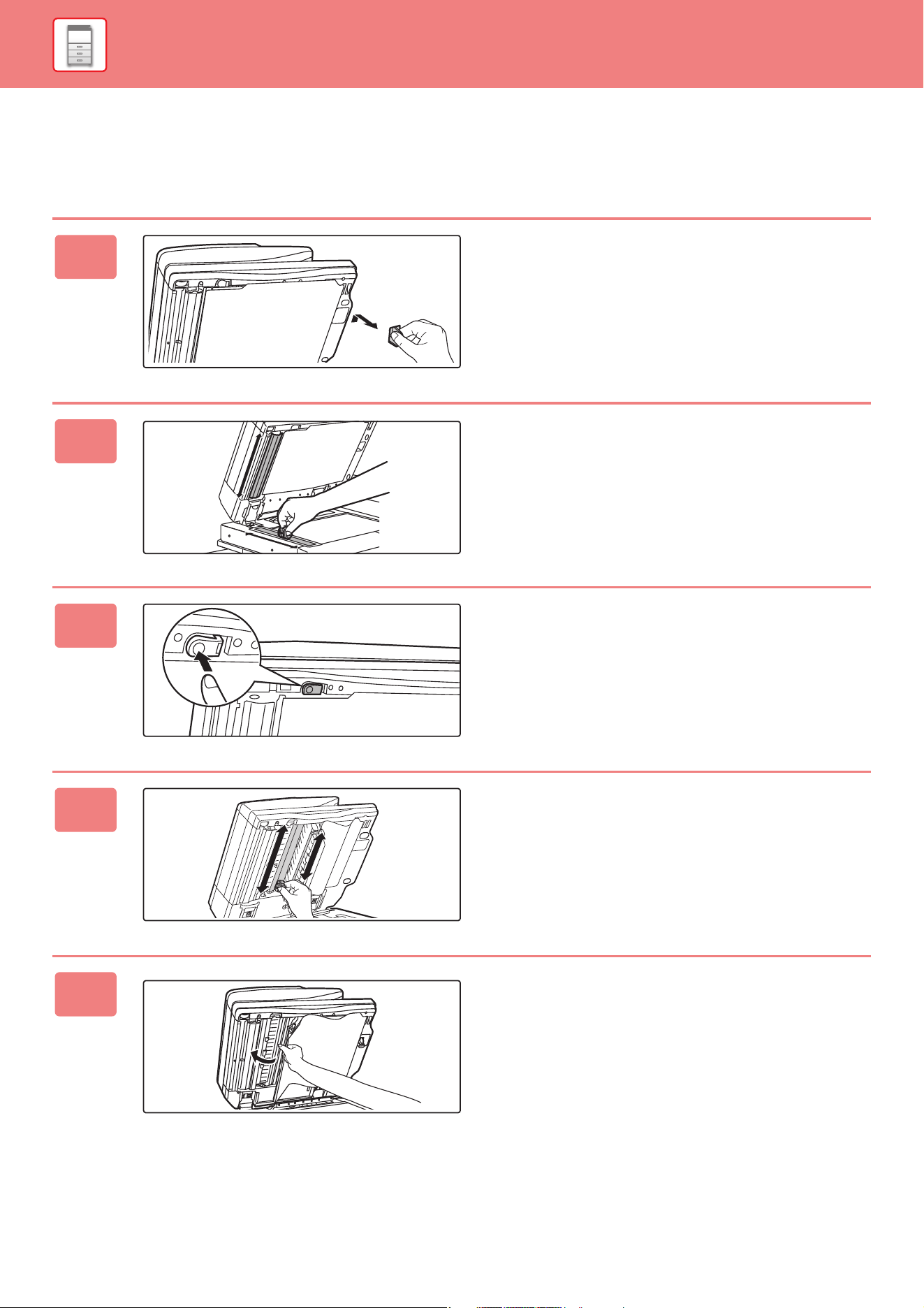
1-143
BEFORE USING THE MACHINE►MAINTENANCE
SCANNING AREA
If black lines or white lines appear in images scanned using the automatic document feeder, clean the scanning area
(the thin long glass next to the document glass).
To clean this part, use the glass cleaner that is stored in the automatic document feeder. After using the glass cleaner,
be sure to return it to its storage position.
1
Open the automatic document feeder
and remove the glass cleaner.
2
Clean the document scanning area on
the document glass with the glass
cleaner.
One scanning area is on the document glass and the other
is inside the automatic document feeder.
3
Open the scanning area cover on the
automatic document feeder.
Push in the release switch to release the cover.
4
Clean the scanning area in the
automatic document feeder.
5
Close the cover.
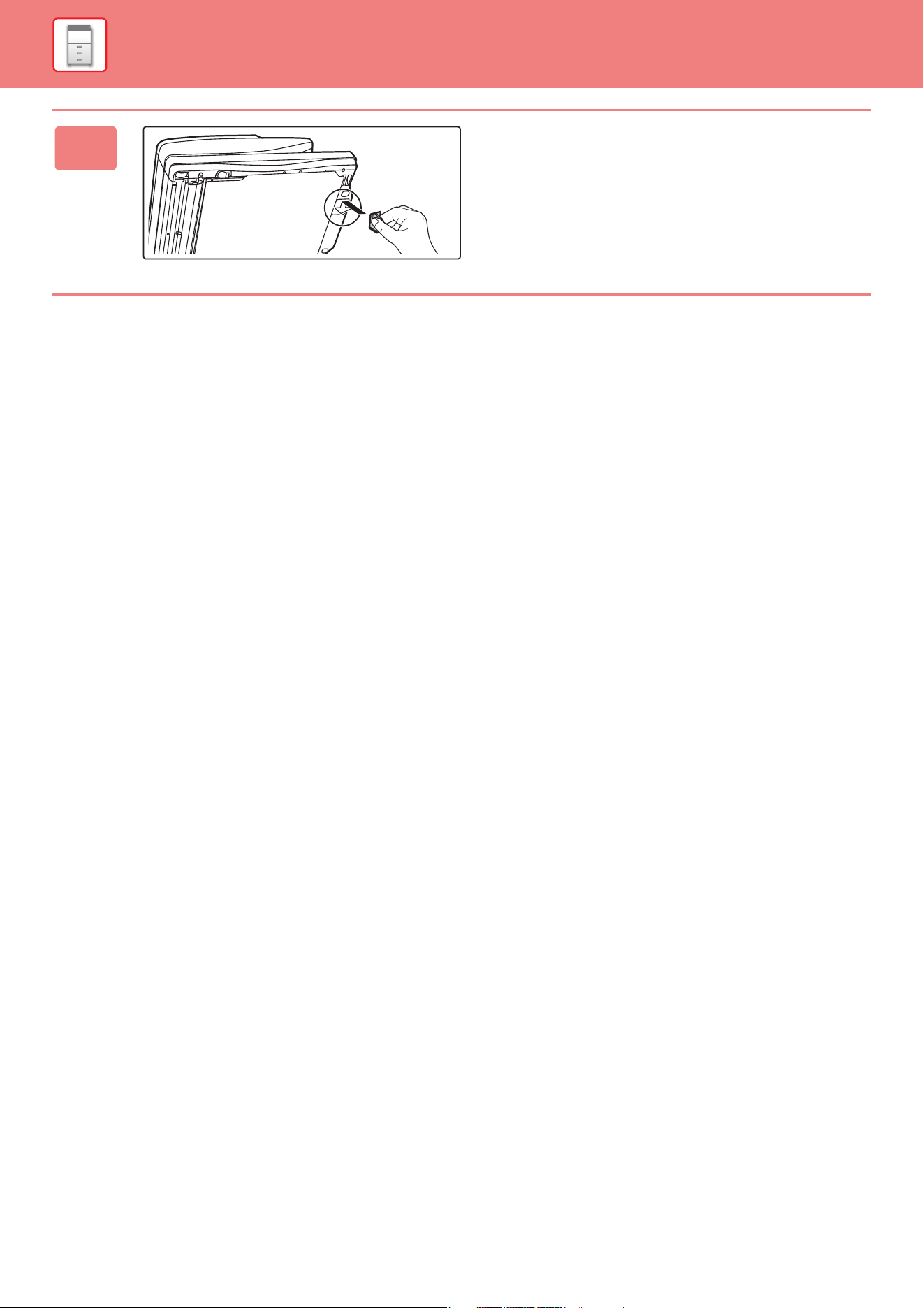
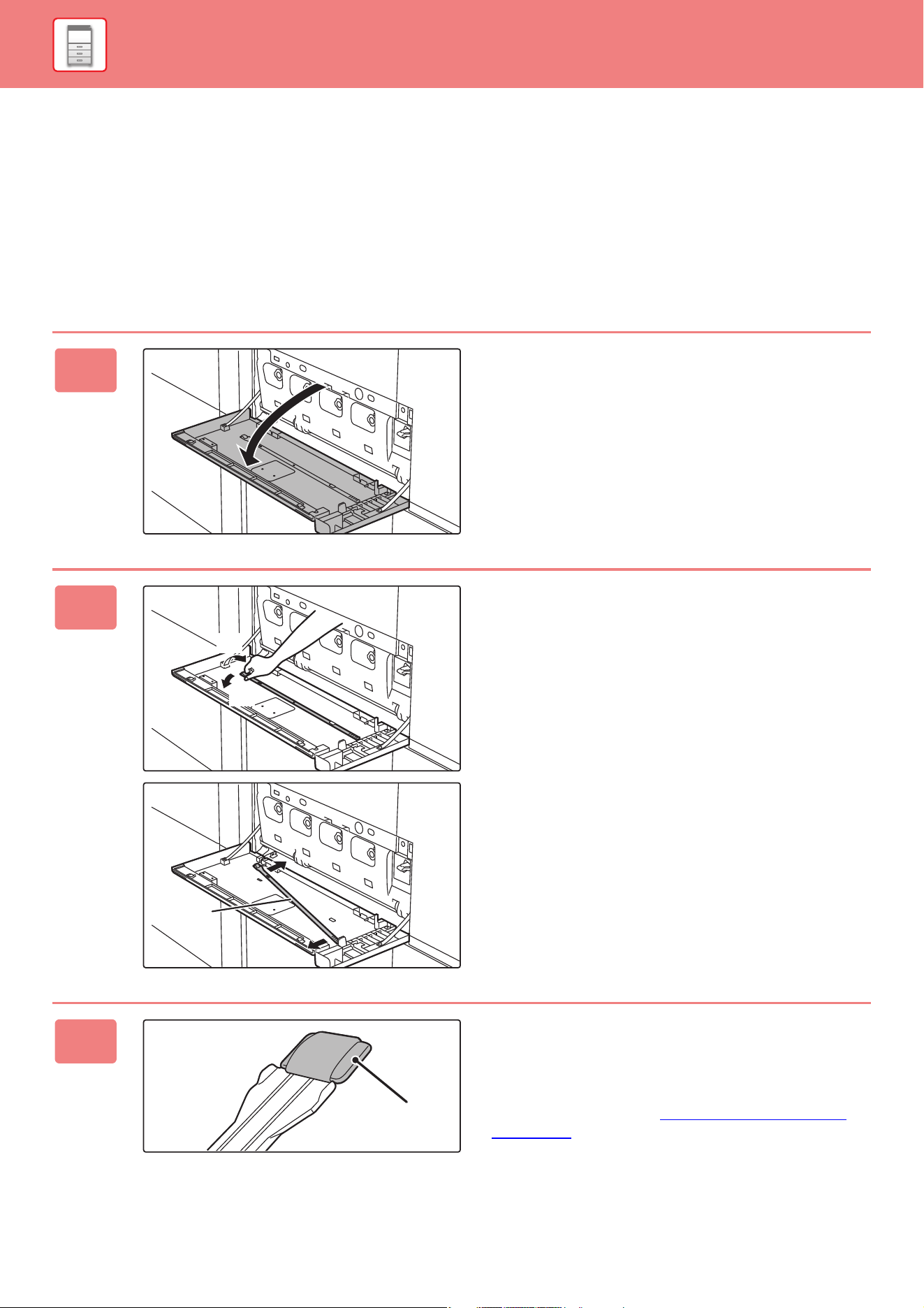
1-145
BEFORE USING THE MACHINE►MAINTENANCE
CLEANING THE LASER UNIT
When the laser unit inside the machine becomes dirty, line patterns (colored lines) may form in the printed image.
Identifying lines (colored lines) caused by a dirty laser unit
• Colored lines always appear in the same place. (The lines are never black.)
• Colored lines appear in parallel with the direction of paper feeding.
• Colored lines appear not only on output from a copier but also on prints from a computer. (The same lines appear on
both copies and print jobs.)
If conditions similar to the above occur, clean the laser unit as explained below.
1
Open the front cover.
2
Take out the cleaning tool for the laser
unit.
The cleaning tool is attached to the front cover of the
machine.
(1) Push the left-hand side of the cleaning
tool to detach it from the hook.
(2) Put it over the hook to place in on the
back side.
(3) Turn the cleaning tool around the boss to
detach it from the right-hand hook.
3
Make sure that the cleaner at the tip of
the cleaning tool is not dirty.
If the cleaner is dirty, remove the cleaner from the cleaning
tool and replace it with a clean one. For more information on
replacing the cleaner, see "REPLACING THE CLEANER
(page 1-147)".
(1)
(2)
(3)
Boss
Cleaner
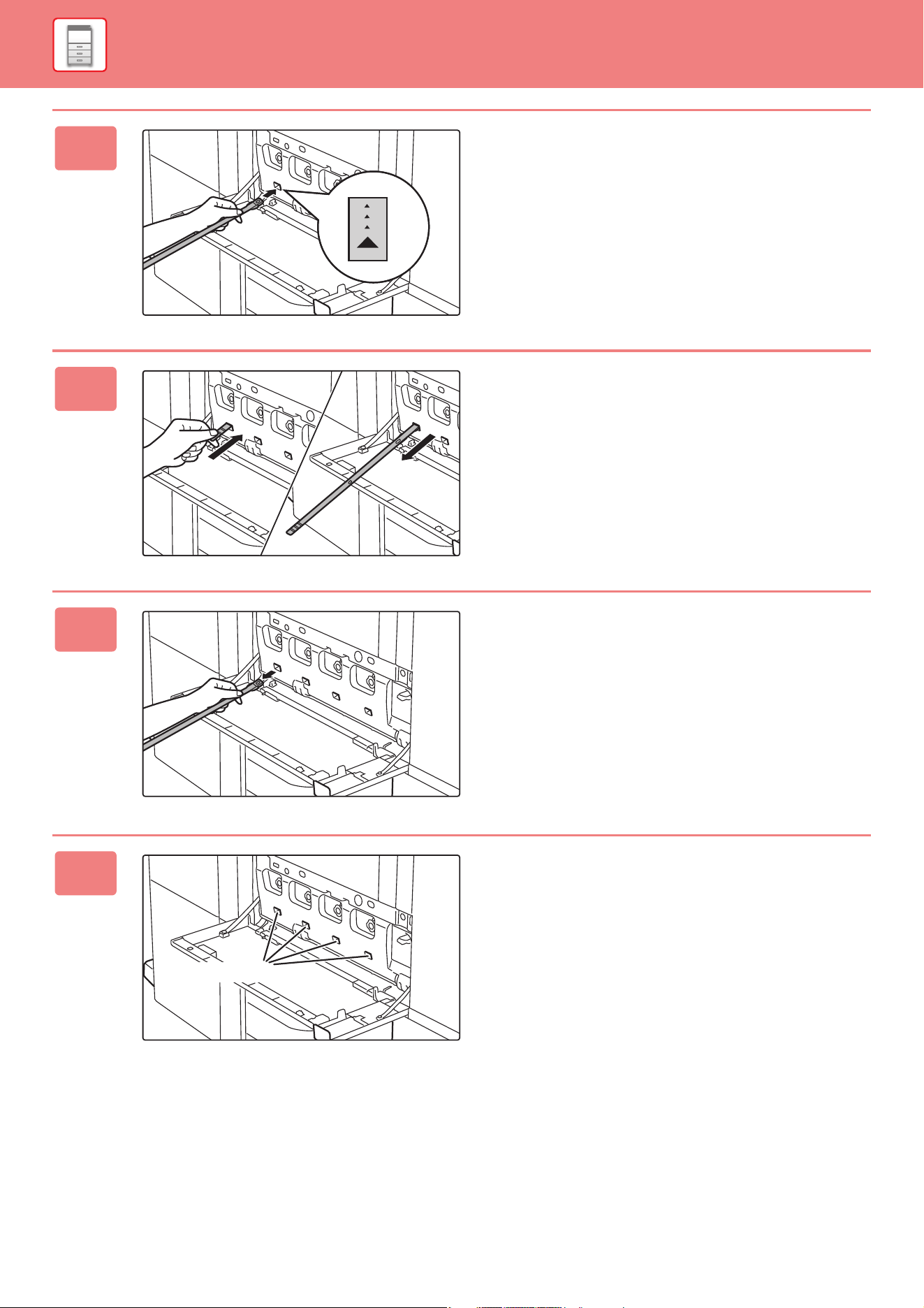
1-146
BEFORE USING THE MACHINE►MAINTENANCE
4
Point the cleaner down and slowly
insert the tool into the hole to be
cleaned in the laser unit.
Be sure to point the cleaner down. Labels similar to (A) are
attached to areas that require cleaning.
5
Insert the cleaning tool all the way into
the hole and then pull it back out.
Pull the cleaning tool out until you feel the tip of the tool
leave the cleaning surface of the laser unit.
6
Repeat steps 4 to 5 two or three times
and then remove the cleaning tool.
7
Repeat steps 4 to 6 to clean all holes
(4 holes) in the laser unit.
There are a total of four holes to be cleaned in the laser unit.
Clean all holes.
(A)
Cleaning points
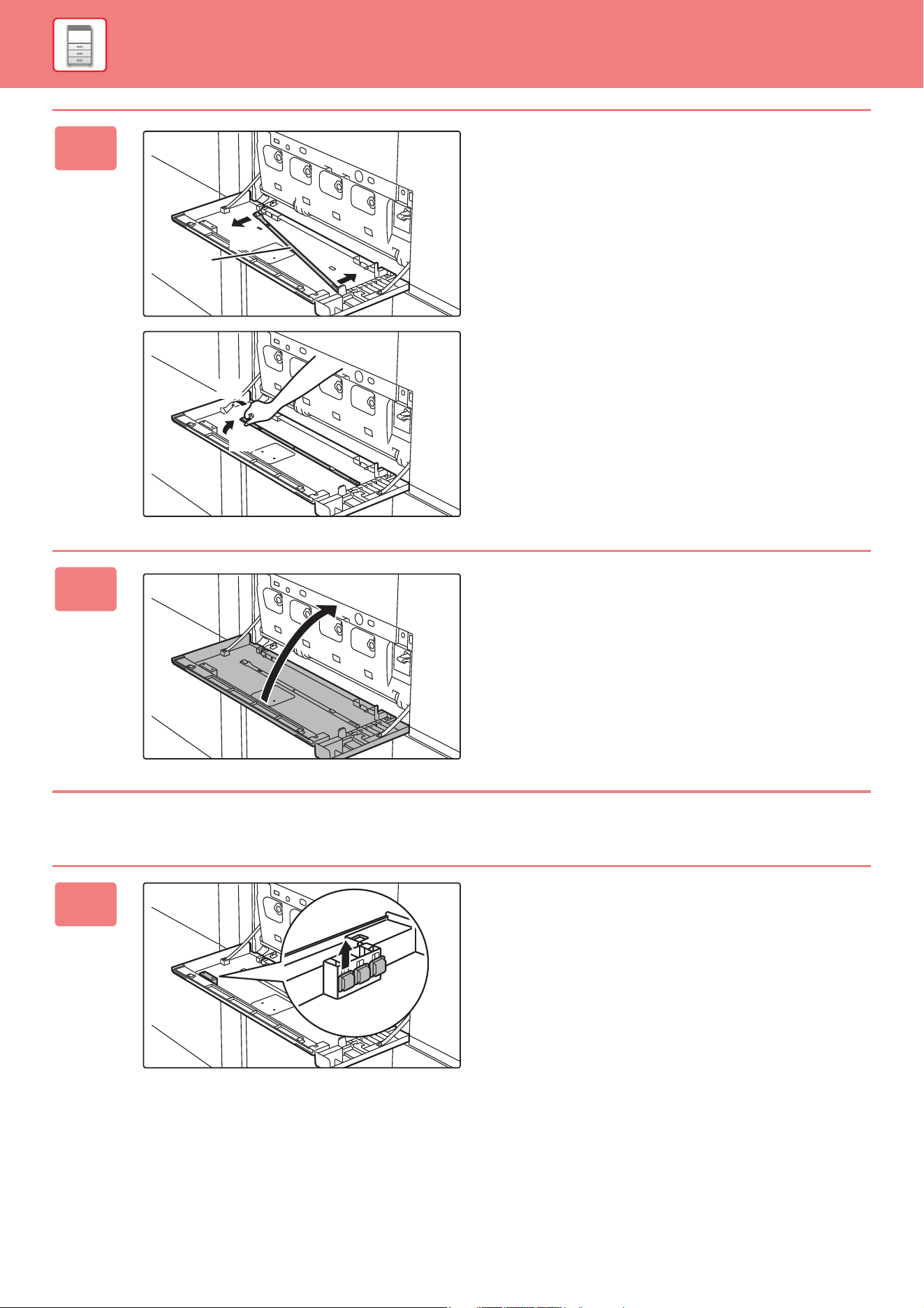
1-147
BEFORE USING THE MACHINE►MAINTENANCE
REPLACING THE CLEANER
8
Replace the cleaning tool.
(1) Engage the cleaning tool onto the boss
and turn it around it, and then put the
edge (non-cleaner side) on the right-hand
hook.
(2) Put the left-hand side of the cleaning tool
over the hook to place it on the near side.
(3) Turn the cleaning tool onto hook.
9
Close the front cover.
1
Open the front cover and take out a
replacement cleaner.
Replacement cleaners are stored in the front cover.
Grasp the end of the cleaner and pull it out of the cover.
(1)
Boss
(3)
(2)
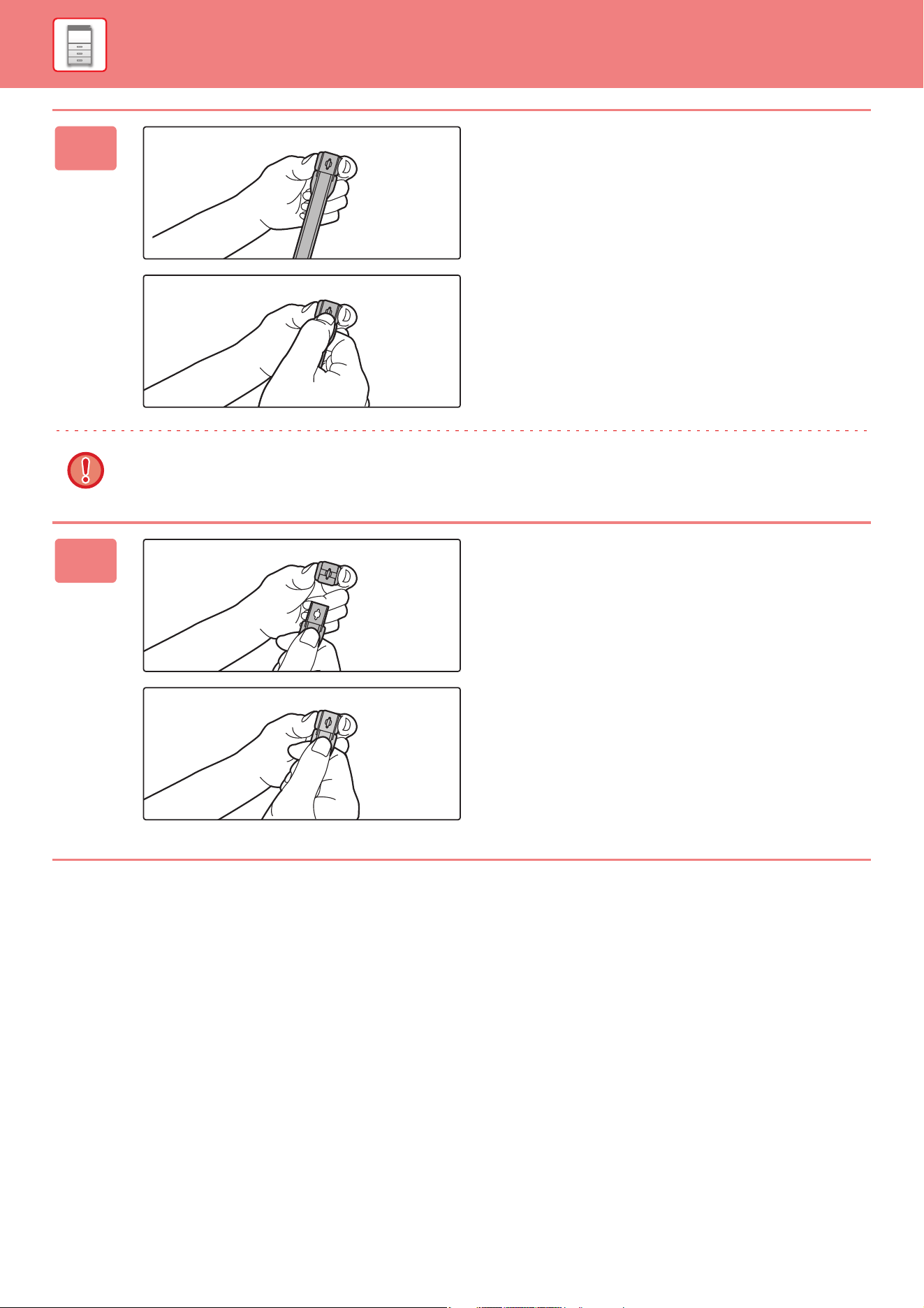
1-148
BEFORE USING THE MACHINE►MAINTENANCE
2
Remove the dirty cleaner from the tip
of the cleaning tool.
While firmly grasping the tool where the cleaner is attached,
use your other hand to press down on the hook that secures
the cleaner, and remove the cleaner.
Put the removed cleaner back on the inner cover. After replacing the cleaner, be sure to close the inner cover.
3
Attach the new cleaner to the cleaning
tool.
Align the cleaner hook with the attachment hole in the
cleaning tool. Hold the cleaner firmly and push the cleaning
tool in.
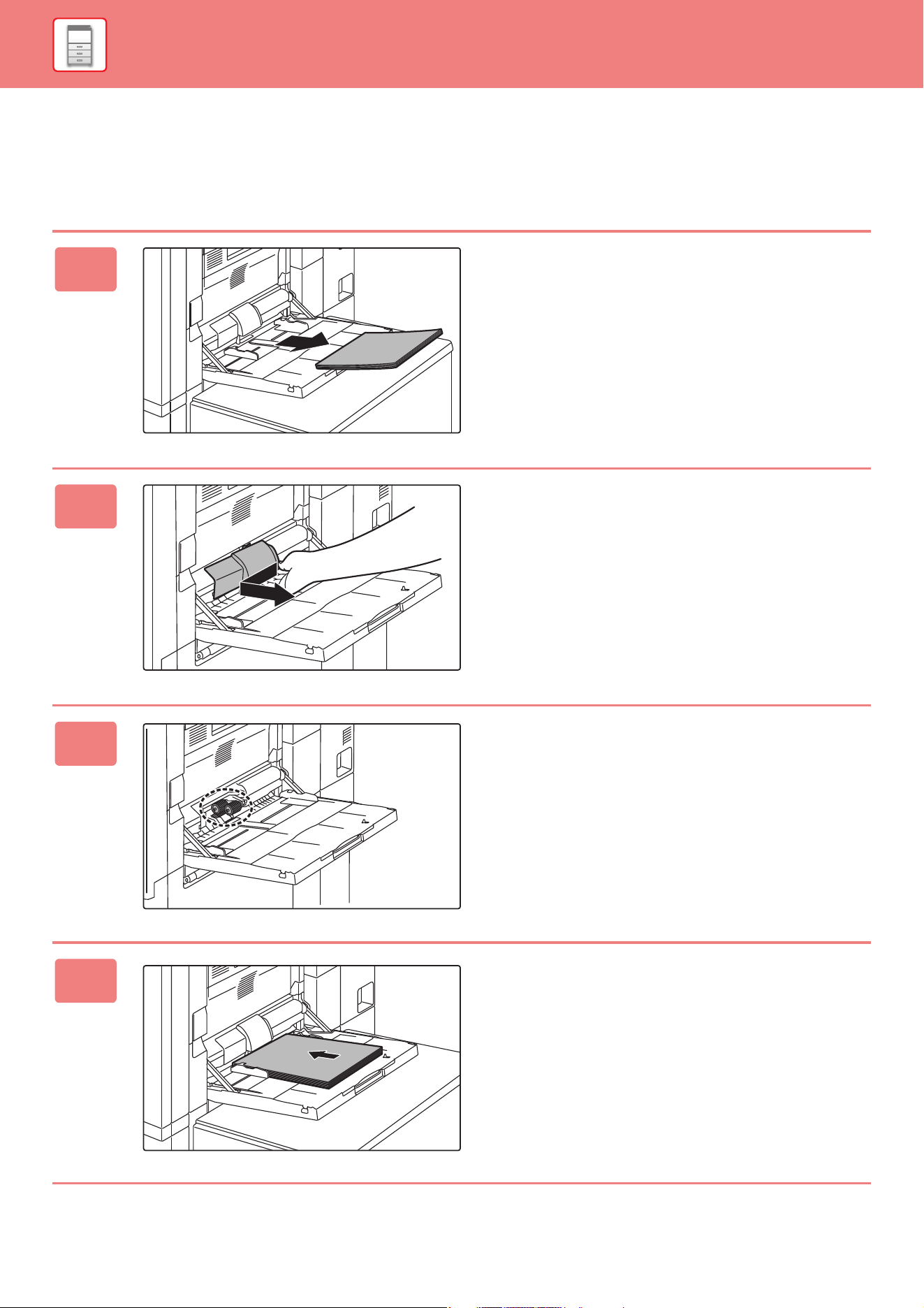
1-149
BEFORE USING THE MACHINE►MAINTENANCE
CLEANING THE BYPASS FEED ROLLER
If paper misfeed frequently occur in the bypass tray, clean the bypass feed roller. Wipe the surface of the feed roller with
a clean soft cloth moistened with water or a neutral detergent.
Bypass tray (on the machine)
1
Remove paper.
2
Remove the maintenance cover.
3
Clean the bypass feed roller.
Install the maintenance cover after the cleaning is
completed.
4
Load the paper.
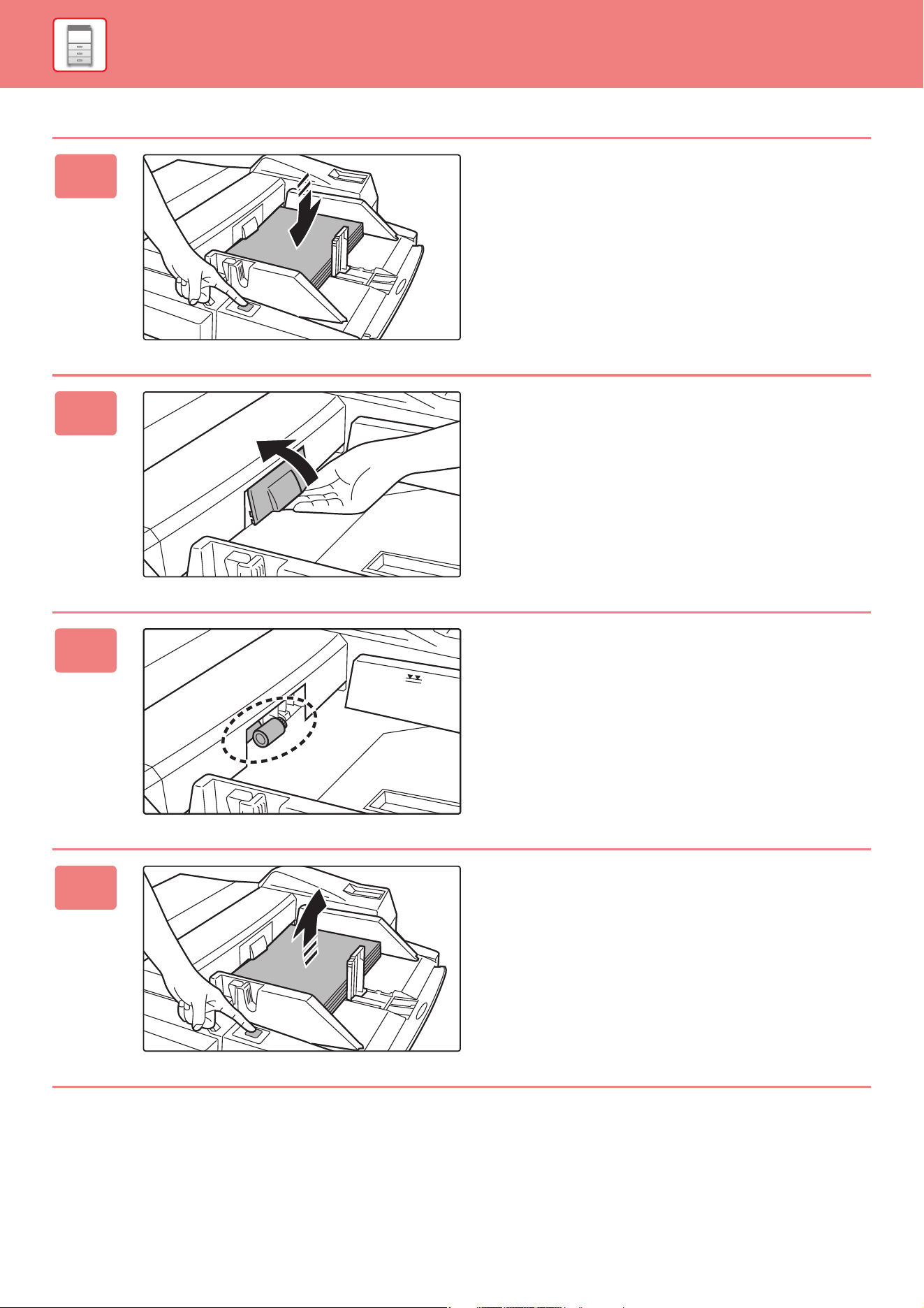
1-150
BEFORE USING THE MACHINE►MAINTENANCE
Bypass tray (large capacity trays)
1
Press the operation button and
remove paper.
The paper table goes down. The operation button blinks
while the paper table goes down. The button lights up when
the paper table has gone down. Do not remove the paper
until the button ceases blinking.
2
Remove the maintenance cover.
3
Clean the bypass feed roller.
Install the maintenance cover after the cleaning is
completed.
4
Load the paper and press the
operation button.
The paper table goes up when the operation button is
pressed.
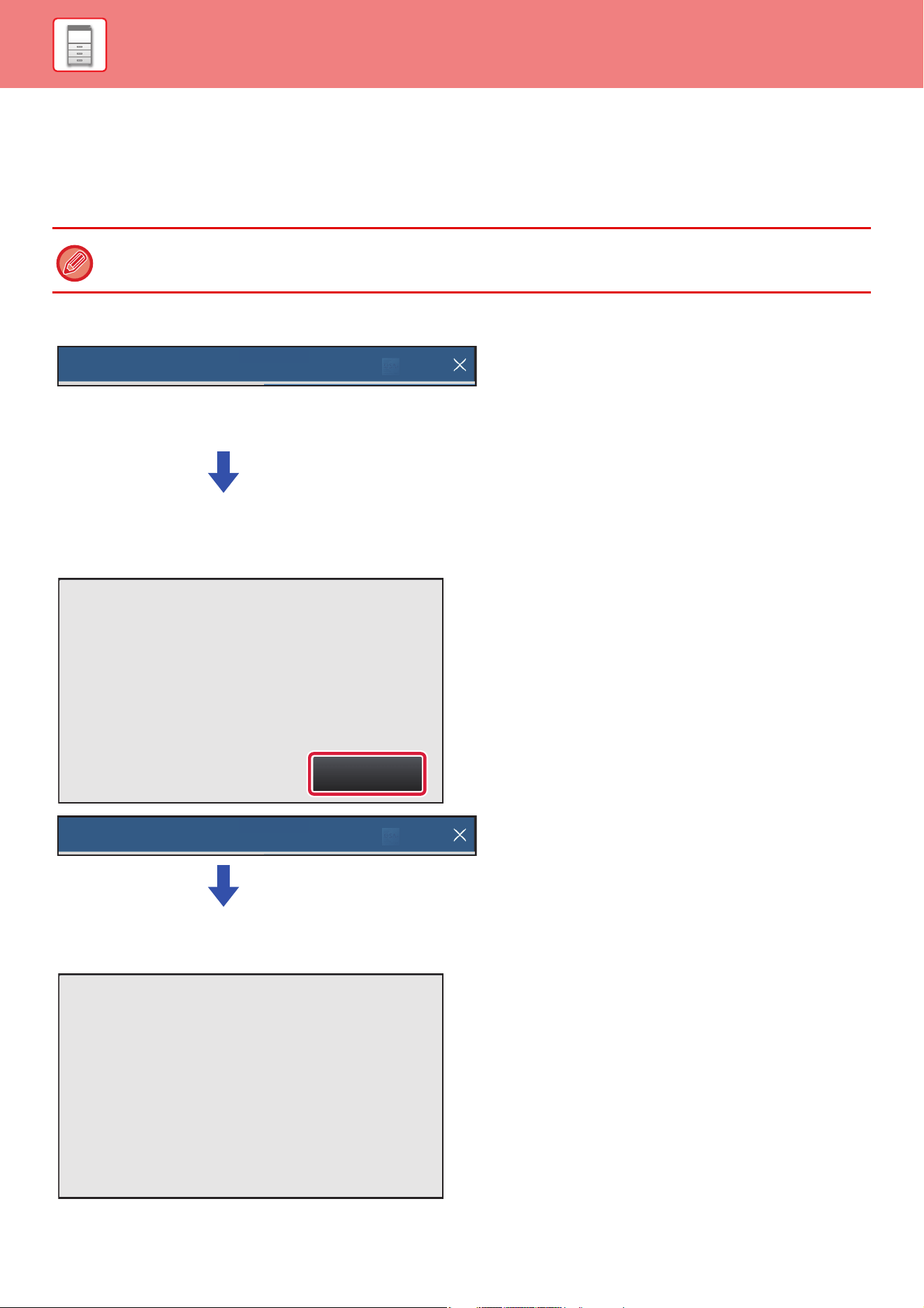
1-151
BEFORE USING THE MACHINE►MAINTENANCE
REPLACEMENT OF TONER CARTRIDGE
As a rule, toner cartridges should be replaced after the message "Change the toner cartridge." appears.
You should keep one set of replacement toner cartridge on hand so that you can preplace a toner cartridge immediately
when toner runs out.
Replacement message
When this message appears, prepare a toner cartridge for replacement.
"(□□□□)" indicates the color of toner cartridge that must be readed.
Y:Yellow toner, M:Magenta toner, C:Cyan toner, and Bk:Black toner
If you continue printing, the following message appears.
Colors that have run out of toner are indicated in (□□□□).
When this message appears, replace a toner cartridge for replacement.
In this state, printing is possible.
If you continue to use the machine, the following message will appear when the toner runs out.
Colors that have run out of toner are indicated in (□□□□).
Replace the toner cartridge with a one of the relevant color.
Empty toner cartridge can be replaced without interrupting a copy/print job.
Toner Low. (□□□□)(Do not replace
cartridge until requested.)
Change the toner cartridge.
(□□□□)
OK
Ready to scan for copy.
(□□□□ Change the toner supply.)
Change the toner cartridge.
(□□□□)
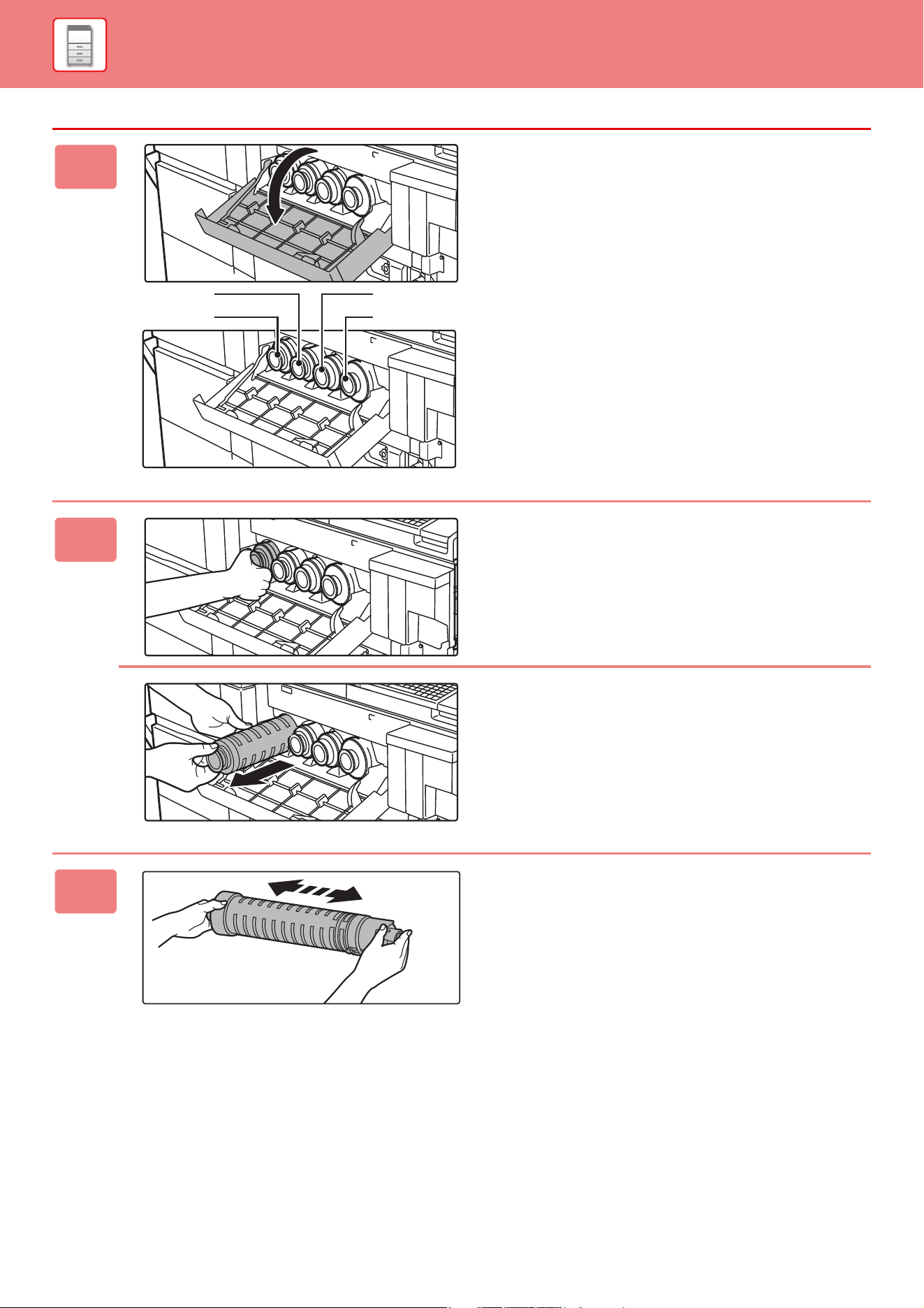
1-152
BEFORE USING THE MACHINE►MAINTENANCE
1
Open the toner cover.
2
Pull the toner cartridge toward you.
Gently pull out the toner cartridge horizontally.
If the cartridge is pulled out abruptly, toner may spill out.
(Example) Replacing the yellow toner
cartridge.
Hold the toner cartridge with both hands as shown and
slowly pull it out of the machine.
3
Take a new toner cartridge out of its
package and shake it horizontally five
or six times.
Magenta
Yellow
Cyan
Black
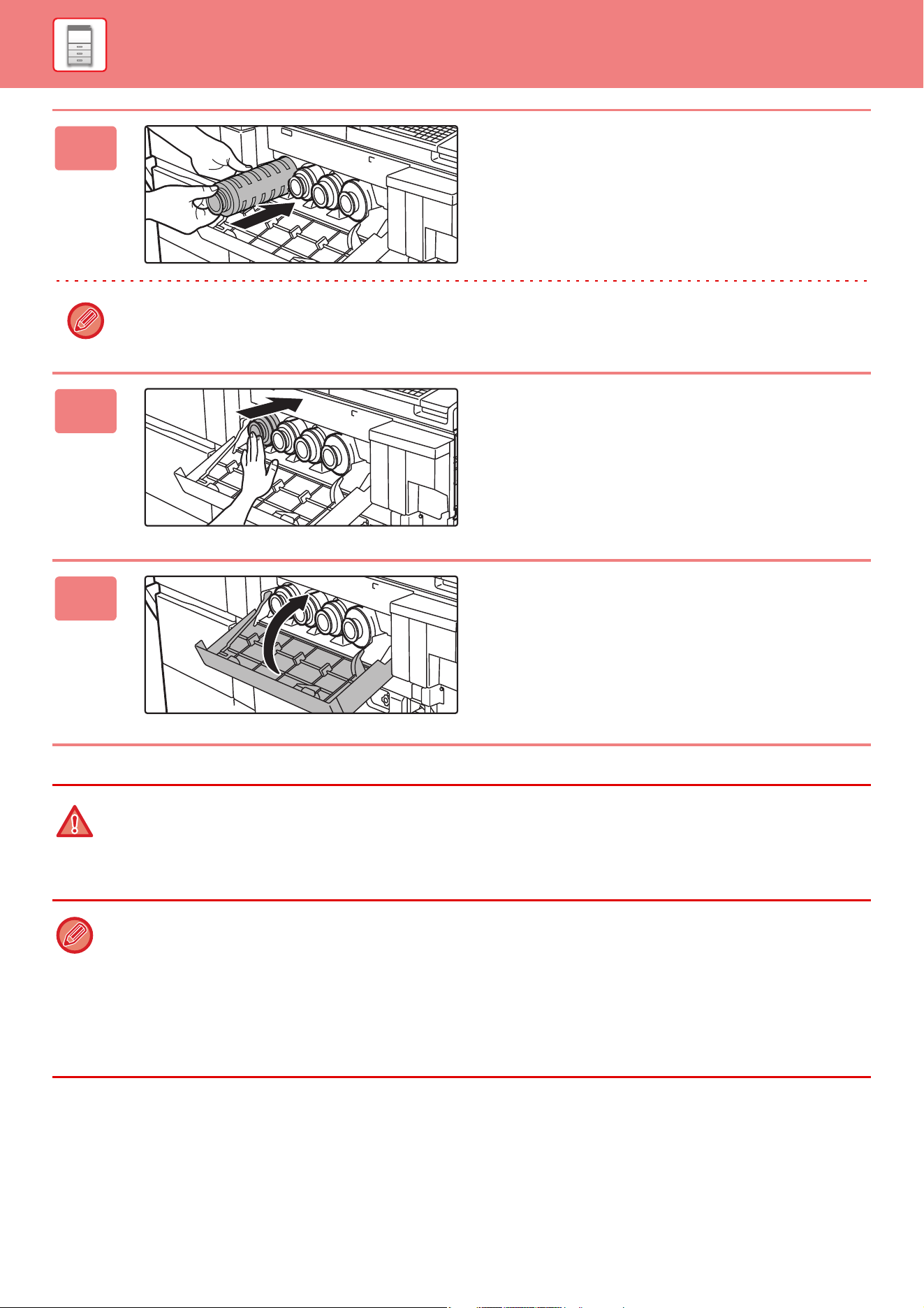
1-153
BEFORE USING THE MACHINE►MAINTENANCE
4
Slowly insert the new toner cartridge
on the level.
A toner cartridge of a different color cannot be installed. Be sure to install a toner cartridge of the same color.
5
Push the cartridge in until it locks
securely in place.
6
Close the toner cover.
After the toner cartridge is replaced, the machine
automatically enters image adjustment mode. Do not open
the front cover while this is taking place.
• Do not throw a toner cartridge into a fire. Toner may fly and cause burns.
• Store toner cartridges out of reach of small children.
•
If a toner cartridge is stored upright, the toner may harden and become unusable. Always store toner cartridges on their side.
• If a toner cartridge other than a SHARP-recommended toner cartridge is used, the machine may not attain full quality and
performance and there is a risk of damage to the machine. Be sure to use a SHARP-recommended toner cartridge.
• Be sure to install four toner cartridges (Y/M/C/Bk).
• If any one of the toner colors runs out, color printing will no longer be possible.
If the Y, M, or C toners run out but a quantity of Bk toner still remains, printing is performed in black and white.
• Depending on your conditions of use, the color may become light or the image blurred.
• Your service technician will collect used toner cartridges.
•
To view the approximate amount of toner remaining (indicated in %), hold down the [Home Screen] key during printing or in
standby mode. When the percentage falls to "25-0%", keep a toner cartridge for replacement purposes before toner runs out.
•
When toner runs out while the home screen is displayed, the "Toner Empty" message appears in the upper right corner of the screen.
1-154
BEFORE USING THE MACHINE►MAINTENANCE
REPLACING THE WASTE TONER BOTTLE
The waste toner bottle collects excess toner that is produced during printing. When the waste toner bottle becomes full,
the message "Replace waste toner bottle." will appear.
When this message appears, tap the guidance key that appears on the touch panel to view the procedure for replacing
the waste toner bottle.
When the key is tapped, instructions for replacing the waste toner bottle will appear. Follow the instructions. When the
waste toner bottle is replaced, the message will automatically disappear.
• Do not throw the waste toner bottle into a fire. Toner may fly and cause burns.
• Store the waste toner bottle out of the reach of small children.
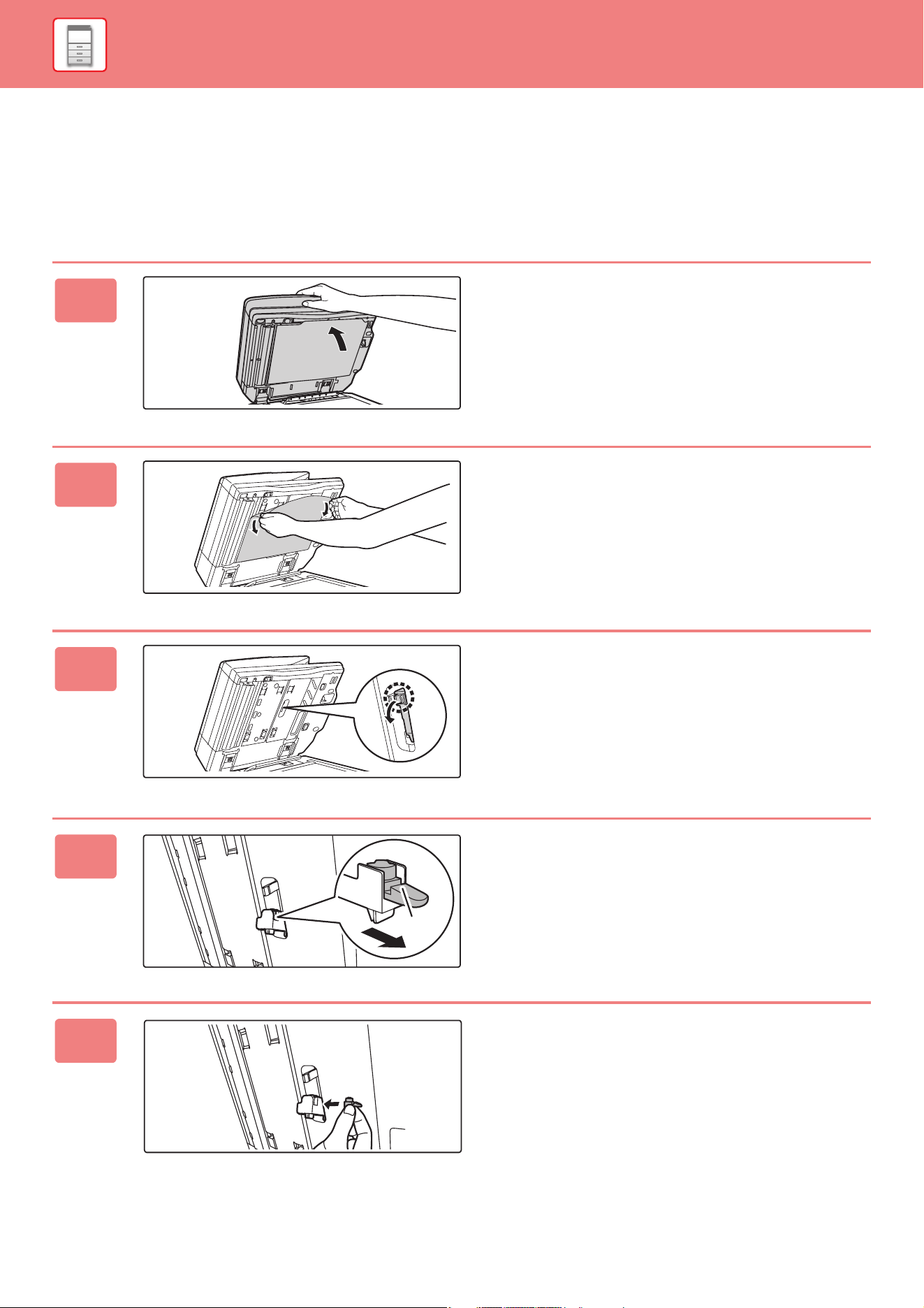
1-155
BEFORE USING THE MACHINE►MAINTENANCE
REPLACING THE STAMP CARTRIDGE
If a stamp unit (AR-SU1) is installed on the automatic document feeder and the stamp has become light, replace the
stamp cartridge (AR-SV1).
Supplies
Stamp cartridge (2 in package) AR-SV1
1
Open the automatic document feeder.
2
Remove the document backplate sheet
from the automatic document feeder.
Remove the sheet slowly. Place the removed sheet with the
side that was attached face up on the document glass.
3
Grasp the tab on the stamp unit and
pull the unit out.
4
Remove the stamp cartridge (A).
5
Install a new stamp cartridge.
(A)
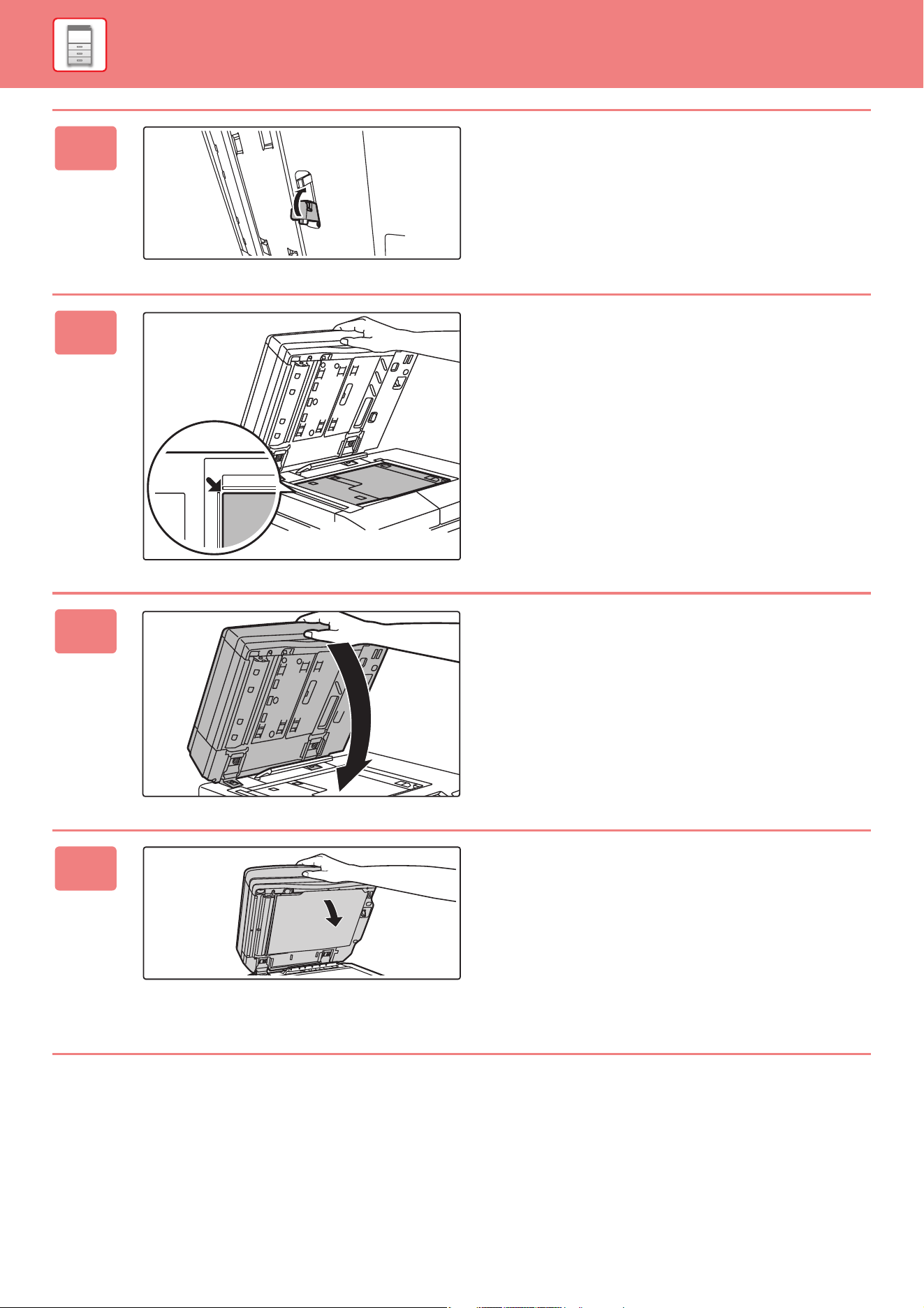
1-156
BEFORE USING THE MACHINE►MAINTENANCE
6
Push the stamp unit back in.
Push the stamp unit in until it clicks into place.
7
Align the top left corner of the
document backplate sheet with back
left (at the tip of the mark) of the
document glass.
8
Close the automatic document feeder.
The document backplate sheet on the document glass is
fixed to the automatic document feeder.
9
Make sure that the document
backplate sheet is correctly attached
to the automatic document feeder and
then close the automatic document
feeder.
If the document backplate sheet is not correctly attached,
remove the document backplate sheet and then attach it
correctly again.
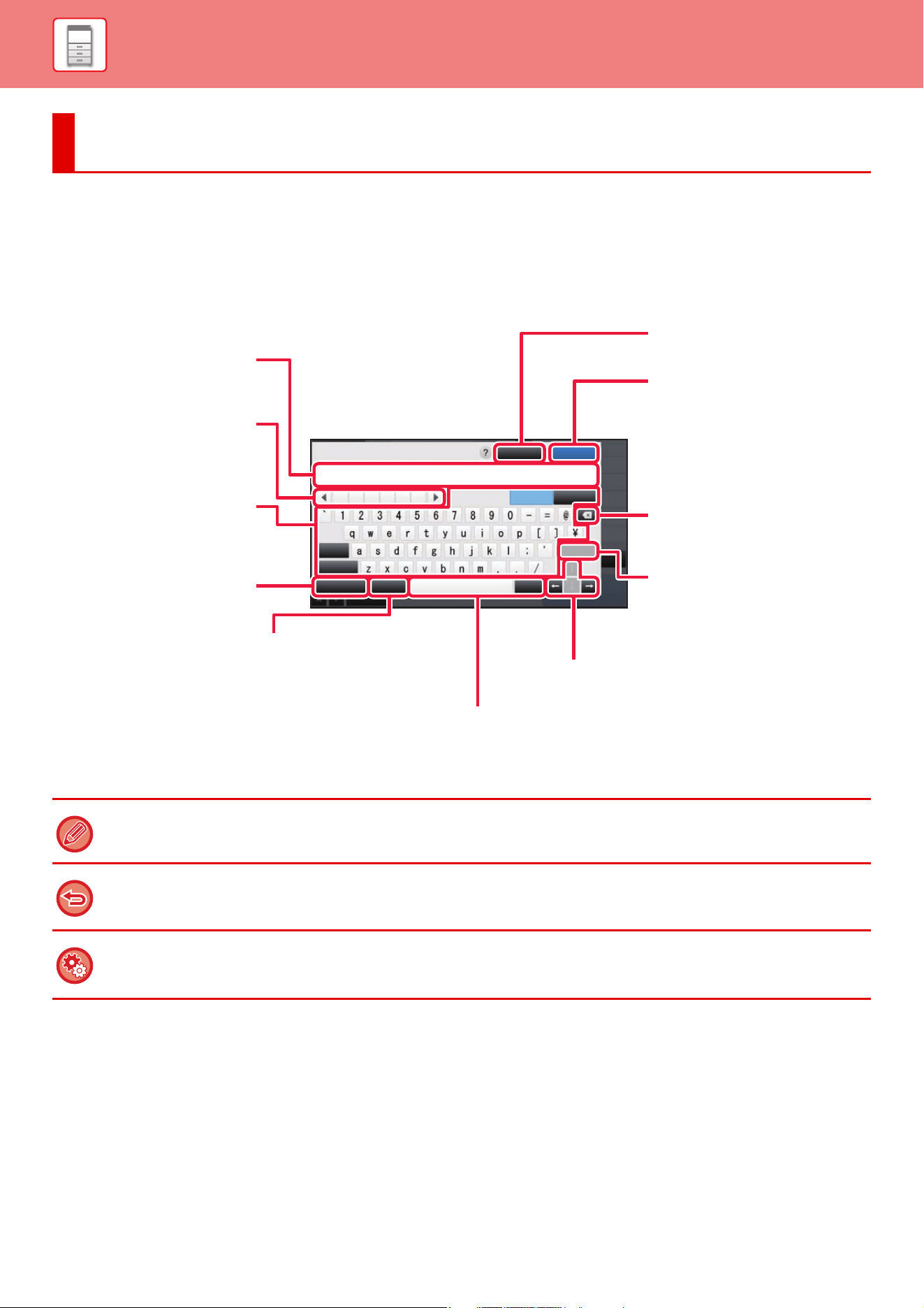
1-157
BEFORE USING THE MACHINE►CHARACTER ENTRY
NAMES AND FUNCTIONS OF SOFT
KEYBOARD KEYS
Display the soft keyboard to register the name of a file, program, folder or user.
CHARACTER ENTRY
The soft keyboard shown here is an image for your reference. Different keys may be enabled depending on the actual
situation and condition under which you enter characters.
If "External Keyboard" is selected in "Settings" → [System Settings] → [Common Settings] → [Keyboard Settings] → [Default
Keyboard Setting] → [Set Keyboard Priority], the soft keyboard will not appear.
To register words:
In "Settings (administrator)", select [System Settings] → [Common Settings] → [Keyboard Settings] → [Soft Keyboard
Template Setting].
Subject
Cancel OK
Space
Pre-set
Message
AltGr
Keyboard-
Select
Shift
Caps Enter
Characters Symbols
.com .net .org
.info
.biz
http:/
/
Displays the entered text.
Retrieves the stored words.
Use "Settings" to store words.
Tap a key to enter text.
The key types vary depending
on the selected entry mode.
Switches the key layout.
Use this to retrieve a
previously stored subject
for e-mail or pre-set text.
Converts the entered characters. The [Space] key
inserts a space between words if there are no
characters specified to be converted.
Exits the soft keyboard.
Finalizes the entered
characters and exits the soft
keyboard.
Deletes one character to the
left.
Temporarily fixes the converted
characters or inserts a line
break.
Used to move the cursor or to change the
range of the specified conversion target.
2-1
BEFORE USING THE MACHINE AS A
COPIER
COPY MODE . . . . . . . . . . . . . . . . . . . . . . . . . . . . . . 2-3
• EASY MODE . . . . . . . . . . . . . . . . . . . . . . . . . . . 2-3
• NORMAL MODE . . . . . . . . . . . . . . . . . . . . . . . . 2-4
SELECTING COPY MODE. . . . . . . . . . . . . . . . . . . . 2-4
COPYING SEQUENCE . . . . . . . . . . . . . . . . . . . . . . 2-7
COPY PREVIEW . . . . . . . . . . . . . . . . . . . . . . . . . . . 2-9
CHECKING THE ORIGINAL SIZE . . . . . . . . . . . . . . 2-10
SELECTING THE PAPER TRAY FOR COPYING . . .
2-13
BASIC PROCEDURE FOR MAKING
COPIES
COPYING . . . . . . . . . . . . . . . . . . . . . . . . . . . . . . . . . 2-14
• USING THE AUTOMATIC DOCUMENT
FEEDER FOR COPYING . . . . . . . . . . . . . . . . .
2-14
• USING THE DOCUMENT GLASS FOR
COPYING . . . . . . . . . . . . . . . . . . . . . . . . . . . . .
2-15
AUTOMATIC 2-SIDED COPYING . . . . . . . . . . . . . . 2-17
• USING THE AUTOMATIC DOCUMENT
FEEDER FOR 2-SIDED COPYING. . . . . . . . . .
2-17
• USING THE DOCUMENT GLASS FOR
2-SIDED COPYING. . . . . . . . . . . . . . . . . . . . . .
2-18
COPY COLOR MODES . . . . . . . . . . . . . . . . . . . . . . 2-20
CHANGING THE EXPOSURE AND ORIGINAL
IMAGE TYPE . . . . . . . . . . . . . . . . . . . . . . . . . . . . . . 2-23
• AUTOMATIC ADJUSTMENT OF EXPOSURE
AND ORIGINAL TYPE. . . . . . . . . . . . . . . . . . . .
2-23
• MANUAL ADJUSTMENT OF EXPOSURE AND
ORIGINAL TYPE . . . . . . . . . . . . . . . . . . . . . . . .
2-23
ENLARGE/REDUCE . . . . . . . . . . . . . . . . . . . . . . . . 2-26
• AUTO RATIO SELECT . . . . . . . . . . . . . . . . . . .
2-26
• MANUAL RATIO SELECTION . . . . . . . . . . . . .
2-27
• ENLARGING/REDUCING THE LENGTH AND
WIDTH SEPARATELY . . . . . . . . . . . . . . . . . . .
2-30
SELECTING THE ORIENTATION AND SIZE OF
THE ORIGINAL . . . . . . . . . . . . . . . . . . . . . . . . . . . . 2-33
STORING FREQUENTLY USED ORIGINAL SIZES . . .
2-36
MAKING COPIES USING THE BYPASS TRAY . . . 2-39
•
MAKING COPIES USING THE BYPASS TRAY . . .
2-39
• SPECIFYING A TYPE AND SIZE OF PAPER
LOADED ON BYPASS TRAY . . . . . . . . . . . . . .
2-40
OUTPUT . . . . . . . . . . . . . . . . . . . . . . . . . . . . . . . . .
2-41
• CHANGING OUTPUT DESTINATION . . . . . . .
2-43
• INSERTING SEPARATOR PAGES BETWEEN
COPIES OR JOBS . . . . . . . . . . . . . . . . . . . . . .
2-44
• SORT/GROUP SETTING. . . . . . . . . . . . . . . . .
2-46
• STAPLE SETTINGS. . . . . . . . . . . . . . . . . . . . .
2-48
• PUNCH SETTINGS . . . . . . . . . . . . . . . . . . . . .
2-53
• FOLDING OUTPUT PAPER. . . . . . . . . . . . . . .
2-55
BATCH COPY FUNCTIONS . . . . . . . . . . . . . . . . . . 2-61
• COPYING MULTIPLE ORIGINALS AS A
SINGLE PAGE (N-Up) . . . . . . . . . . . . . . . . . . . 2-61
• COPYING EACH FACING PAGE OF A BOUND
DOCUMENT (DUAL PAGE COPY) . . . . . . . . . 2-63
• COPYING BOTH SIDES OF A CARD AS A
SINGLE PAGE (CARD SHOT). . . . . . . . . . . . . 2-65
• REPEATING THE SAME IMAGE ON ONE
SHEET (REPEAT LAYOUT) . . . . . . . . . . . . . . 2-67
OTHER FUNCTIONS
OUTPUT AND LAYOUT EDITING FUNCTIONS. . . .
2-72
• MAKING COPIES IN PAMPHLET FORMAT
(BOOKLET) . . . . . . . . . . . . . . . . . . . . . . . . . . . 2-72
• COPYING MULTIPLE ORIGINALS ON EACH
BOOKLET PAGE (BOOKLET 2-Up/4-Up) . . . . 2-75
• COPYING A PAMPHLET (BOOK COPY) . . . . 2-78
• SPLITTING A PAMPHLET ORIGINAL BY
PAGE (BOOK DIVIDE). . . . . . . . . . . . . . . . . . . 2-80
PAPER, AND TIME SAVING FUNCTIONS . . . . . . . . . .
2-81
• SKIPPING BLANK PAGES IN AN ORIGINAL
(BLANK PAGE SKIP) . . . . . . . . . . . . . . . . . . . . 2-81
• ADJUSTING THE BACKGROUND BY MAKING
LIGHT AREAS OF THE ORIGINAL DARKER
OR LIGHTER (BACKGROUND
ADJUSTMENT) . . . . . . . . . . . . . . . . . . . . . . . . 2-83
• CHECKING THE NUMBER OF SCANNED
ORIGINAL SHEETS (ORIGINAL COUNT). . . . 2-84
• USING TWO MACHINES TO REDUCE THE
COPY TIME (TANDEM COPY) . . . . . . . . . . . . 2-86
• DISPLAYING ECO RECOMMENDATION
SETTINGS (ECO RECOMMENDATION
FUNCTION DISPLAY) . . . . . . . . . . . . . . . . . . . 2-88
Eco
COPIER
Icons
Functions you can use in Easy
Copy mode
Eco-friendly functions
Functions for copying on
special media
Eco
2-2
COPIER
SECURITY REINFORCEMENT FUNCTIONS . . . . . 2-89
• PADDING UNAUTHORIZED COPY
PREVENTION DATA (HIDDEN PATTERN
PRINT). . . . . . . . . . . . . . . . . . . . . . . . . . . . . . . . 2-89
• FORCIBLY PRINTING TRACEABLE
INFORMATION (TRACKING INFORMATION
PRINT). . . . . . . . . . . . . . . . . . . . . . . . . . . . . . . . 2-91
OUTPUT POSITION AND MARGIN ADJUSTMENT
FUNCTIONS . . . . . . . . . . . . . . . . . . . . . . . . . . . . . . . 2-92
• ADDING MARGINS (MARGIN SHIFT) . . . . . . . 2-92
• ERASING PERIPHERAL SHADOWS FOR
COPYING (ERASE). . . . . . . . . . . . . . . . . . . . . . 2-94
• COPYING ORIGINALS WITH NO EDGE
CUT-OFF (FULL BLEED COPY). . . . . . . . . . . . 2-96
• COPYING IN THE CENTER OF THE PAPER
(CENTERING) . . . . . . . . . . . . . . . . . . . . . . . . . . 2-97
• SPECIFYING A PAPER POSITION (POSITION
IMAGE) . . . . . . . . . . . . . . . . . . . . . . . . . . . . . . . 2-98
SCANNING FUNCTIONS. . . . . . . . . . . . . . . . . . . . . 2-100
• COLLECTIVELY SCANNING A LARGE
NUMBER OF ORIGINALS (JOB BUILD). . . . . . 2-100
• SCANNING ORIGINALS OF DIFFERENT
SIZES (MIXED SIZE ORIGINAL) . . . . . . . . . . . 2-103
• SCANNING THIN ORIGINALS (SLOW SCAN
MODE). . . . . . . . . . . . . . . . . . . . . . . . . . . . . . . . 2-105
• ADJUSTING RESOLUTION WHEN
SCANNING (RESOLUTION). . . . . . . . . . . . . . . 2-106
TEXT AND IMAGE ADDITION FUNCTIONS. . . . . . 2-107
• PRINTING DATES, PAGE NUMBERS, AND
WATERMARKS (STAMP) . . . . . . . . . . . . . . . . . 2-107
• ADDING A REGISTERED IMAGE TO AN
ORIGINAL (CUSTOM IMAGE) . . . . . . . . . . . . . 2-110
• INSERTING COVERS IN COPIES
(COVERS/INSERTS). . . . . . . . . . . . . . . . . . . . . 2-113
• INSERTING INSERTION SHEETS IN COPIES
(COVERS/INSERTS). . . . . . . . . . . . . . . . . . . . . 2-121
• CHECKING, EDITING, AND DELETING THE
PAGE LAYOUT OF COVERS AND
INSERTION SHEETS (PAGE LAYOUT). . . . . . 2-125
• INSERTING INSERTION SHEETS IN
BETWEEN TRANSPARENCY FILMS
(TRANSPARENCY INSERTS) . . . . . . . . . . . . . 2-126
FUNCTIONS FOR SPECIFIC USES . . . . . . . . . . . . 2-128
• COPYING CAPTIONS ONTO TAB PAPER
(TAB COPY) . . . . . . . . . . . . . . . . . . . . . . . . . . . 2-128
• MAKING A POSTER-SIZED COPY
(MULTI-PAGE ENLARGEMENT) . . . . . . . . . . . 2-131
• COPYING WITH MIRROR IMAGE (MIRROR
IMAGE) . . . . . . . . . . . . . . . . . . . . . . . . . . . . . . . 2-133
OUTPUT AND DENSITY ADJUSTMENT
FUNCTIONS . . . . . . . . . . . . . . . . . . . . . . . . . . . . . . . 2-134
• REVERSING WHITE AND BLACK IN A COPY
(B/W REVERSE) . . . . . . . . . . . . . . . . . . . . . . . . 2-134
• EASY ADJUSTMENT OF THE IMAGE
QUALITY (QUICK IMAGE QUALITY
ADJUSTMENT) . . . . . . . . . . . . . . . . . . . . . . . . . 2-135
• ADJUSTING RED/GREEN/BLUE IN COPIES
(RGB ADJUST) . . . . . . . . . . . . . . . . . . . . . . . . 2-136
• ADJUSTING THE SHARPNESS OF AN IMAGE
(SHARPNESS) . . . . . . . . . . . . . . . . . . . . . . . . . 2-137
•
ADJUSTING THE COLOR (COLOR BALANCE). . .
2-138
• ADJUSTING THE BRIGHTNESS OF A COPY
(BRIGHTNESS) . . . . . . . . . . . . . . . . . . . . . . . . 2-140
• ADJUSTING THE INTENSITY OF A COPY
(INTENSITY) . . . . . . . . . . . . . . . . . . . . . . . . . . 2-141
CONVENIENT COPY FUNCTIONS
MAKING A PROOF COPY (PROOF COPY) . . . . . 2-142
INTERRUPT COPY . . . . . . . . . . . . . . . . . . . . . . . . . 2-144
SEND DATA WHILE COPYING . . . . . . . . . . . . . . . 2-146
COPY JOBS . . . . . . . . . . . . . . . . . . . . . . . . . . . . . . 2-148
PROGRAMS . . . . . . . . . . . . . . . . . . . . . . . . . . . . . . 2-149
• STORING A PROGRAM . . . . . . . . . . . . . . . . . 2-149
• RETRIEVING A PROGRAM. . . . . . . . . . . . . . . 2-151
•
DELETING AND RENAMING A PROGRAM . . .
2-151
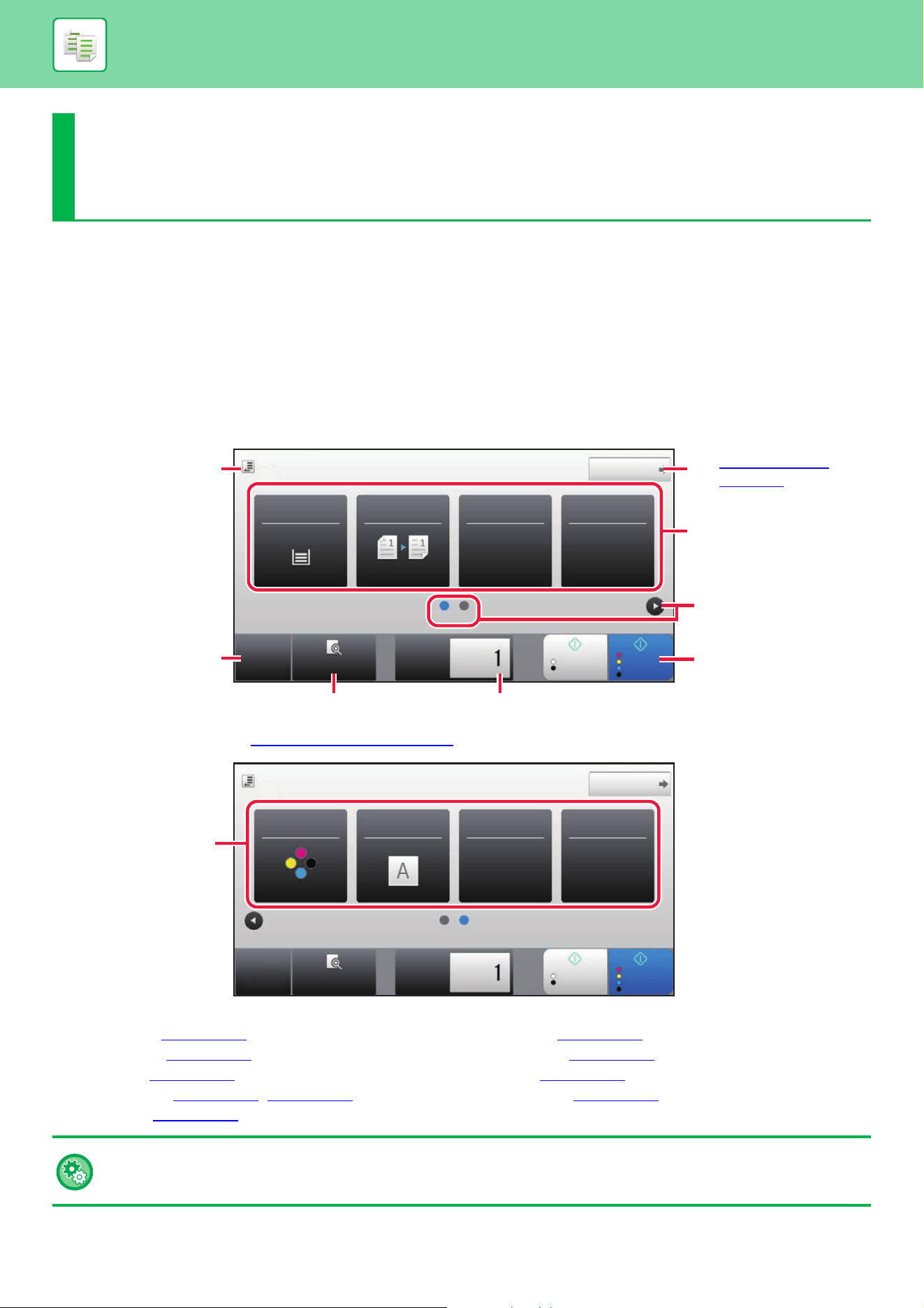
2-3
COPIER►BEFORE USING THE MACHINE AS A COPIER
COPY MODE
There are two modes for copying: easy mode and normal mode.
Easy mode is limited to frequently used functions that allow you to smoothly perform most copy jobs.
If you need to select detailed settings or special functions, use normal mode. All functions can be used in normal mode.
EASY MODE
Easy mode makes it easy to select basic settings for copying.
You can select these functions in easy mode.
• Paper Select ►page 2-13
•2-Sided Copy ►page 2-17
• Copy Ratio ►page 2-26
• Staple / Punch ►page 2-48, ►page 2-53
• Color Mode ►page 2-20
•Original ►page 2-33
• Exposure ►page 2-23
•N-Up ►page 2-61
• Card Shot ►page 2-65
BEFORE USING THE MACHINE AS A
COPIER
CA
Preview
Copies
Staple / PunchCopy Ratio2-Sided Copy
Paper
Select
8½x11
Tray 1 1 → 1
100%
Detail
Original
8½x11
Off
B/W
Start
Color
Start
Select function to be set up.
Change the function
display.
Starts black and white or
color copying.
Enter the number of copies.
Scans the original and shows a preview
image.
► PREVIEW SCREEN (page 1-17)
Change to normal mode.
► NORMAL MODE
(page 2-4)
Reset all settings.
Show the size of the
placed original.
1st screen
2nd screen
B/W
Start
Color
Start
CA
Preview
Copies
Card ShotExposureOriginalColor Mode
Full Color
Auto Off
Detail
Original
8½x11
Select function to be set
up.
To select a function in easy mode
In "Settings (administrator)", select [System Settings] → [Common Settings] → [Operation Settings] → [Easy Mode Settings] →
[Easy Copy]
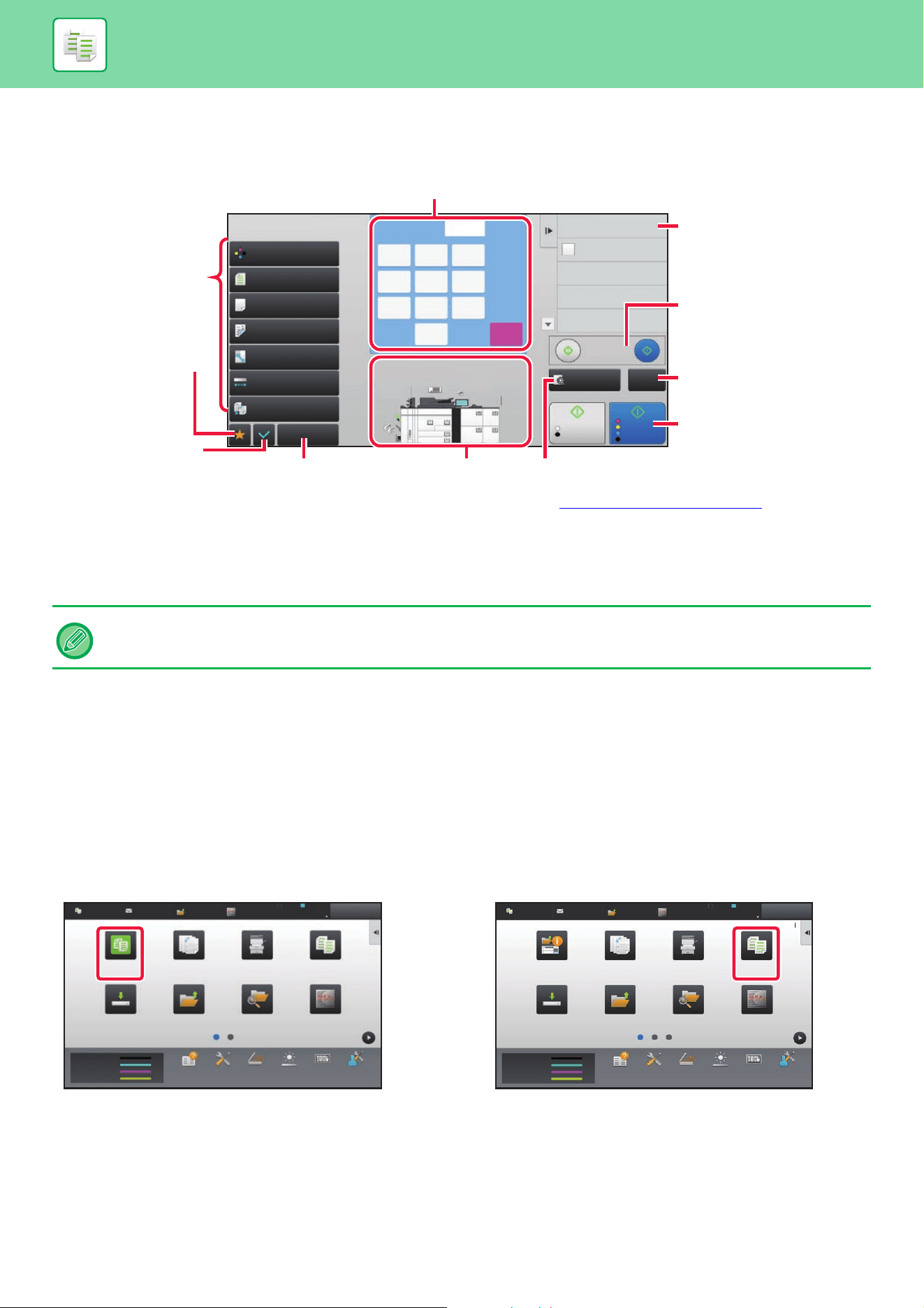
2-4
COPIER►BEFORE USING THE MACHINE AS A COPIER
NORMAL MODE
Normal mode lets you select any function setting that can be used for copying.
SELECTING COPY MODE
Follow the steps below to change from the Home Screen or each mode to copy mode.
Changing modes from the Home Screen
Tap a mode icon to switch from the home screen to that mode.
Shift to Easy Mode
Tap the [Easy Copy] mode icon.
Shift to Normal Mode
Tap the [Copy] mode icon.
The displayed contents of the above screen will vary depending on the devices installed.
Color Mode
Full Color
Paper Select
Auto
Exposure
Auto
Original
Auto
2-Sided Copy
1-Sided→1-Sided
Output
Copy Ratio
100%
Others
Plain 1
8½x11
1
CAPreview
B/W
Start
Color
Start
Send and print
Call Eco Program
Store Data in Folder
File
Store Data Temporarily
Quick File
No. of copies
1
4
7
5
8
6
9
2
0
3
C
12
3
4
7
8½x11
8½x11
11x17
8½x14
8½x11
5
8½x11
8
8½x11
6
8½x11
Proof Copy
Enter the number of copies.
Displays the functions that
can be utilized in copy
mode.
Scans the original and shows a
preview image.
► PREVIEW SCREEN (page 1-17)
Reset all settings.
Starts black and white or
color copying.
Indicates the
presence or absence
of an original and the
size of paper loaded
in each tray. Tap to
open the paper select
screen.
Display keys other than
the function keys
indicated above.
Setting keys used for
copying.
Displays the list of function
keys. Frequently used
[Others], programs, and
other settings can be
registered.
Check the current
settings.
Starts black and white or
color proof copying.
10:15 AM
Easy Copy
E-mail
Sharp OSA
LINE PRINTER
Toner Quantity
M
C
Bk
Y
Scan to HDD Sharp OSA
Manual
Finishing
HDD
File retrieve
Operation
Guide
PC Scan Total Count Machine
Adjustment
Settings
HDD
File retrieve
LCD Control
Tray Settings/
Paper Settings
Batch Print
Job Management
Copy
Copy
10:15 AM
E-mail
LINE PRINTER
Toner Quantity
M
C
Bk
Y
Scan to HDD Sharp OSA
Manual
Finishing
HDD
File retrieve
Operation
Guide
PC Scan Total Count Machine
Adjustment
Settings
HDD
File retrieve
Sharp OSA
LCD Control
Batch Print
Tray Settings/
Paper Settings
Job Management
Copy
Copy
Job Management
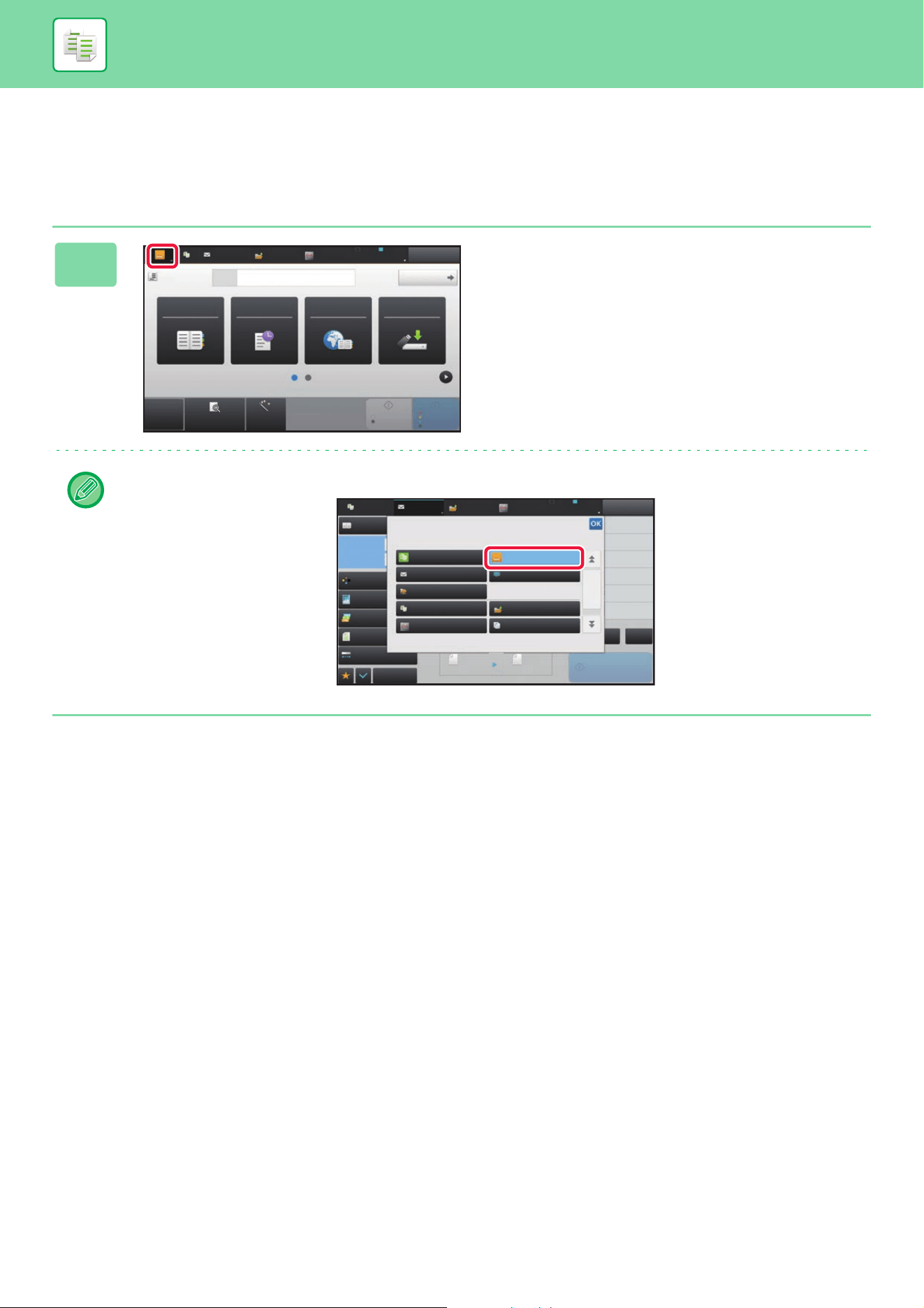
2-5
COPIER►BEFORE USING THE MACHINE AS A COPIER
Changing mode from each mode
To switch from any of the modes, tap the mode display.
Shift to Easy Mode
1
Tap [Easy Copy].
The initial screen of easy copy is displayed.
If the easy mode icon appears, tap the icon.
Address Book
Global
Address Search
Scan to HDD/
USB
CA
Preview Auto Set
Original
8½x11
Address E-mail Address
Detail
B/W
Start
Color
Start
Sending History
LINE PRINTER
HDD
File retrieve
Sharp OSA
Job Management
E-mail
Auto
Super Fine
Address
Preview
Global Address Search
Sending History
Call Search Number
Call Program
Call Registered settings
Subject
Address Book
Color Mode
Original
File Name
Specified by System Settings
Resolution
File Format
LINE PRINTER
Job Management
Others
Preview
Start
Auto Auto
100%
8½x11 8½x11
Verification Stamp
E-mail
HDD
File retrieve
CA
Sharp OSA
Exposure
Auto
Copy
Preview
Select the mode.
HDD
File retrieve
Easy Copy
Network Folder
E-mail
Copy
Sharp OSA
Manual Finishing
FTP
Easy Scan
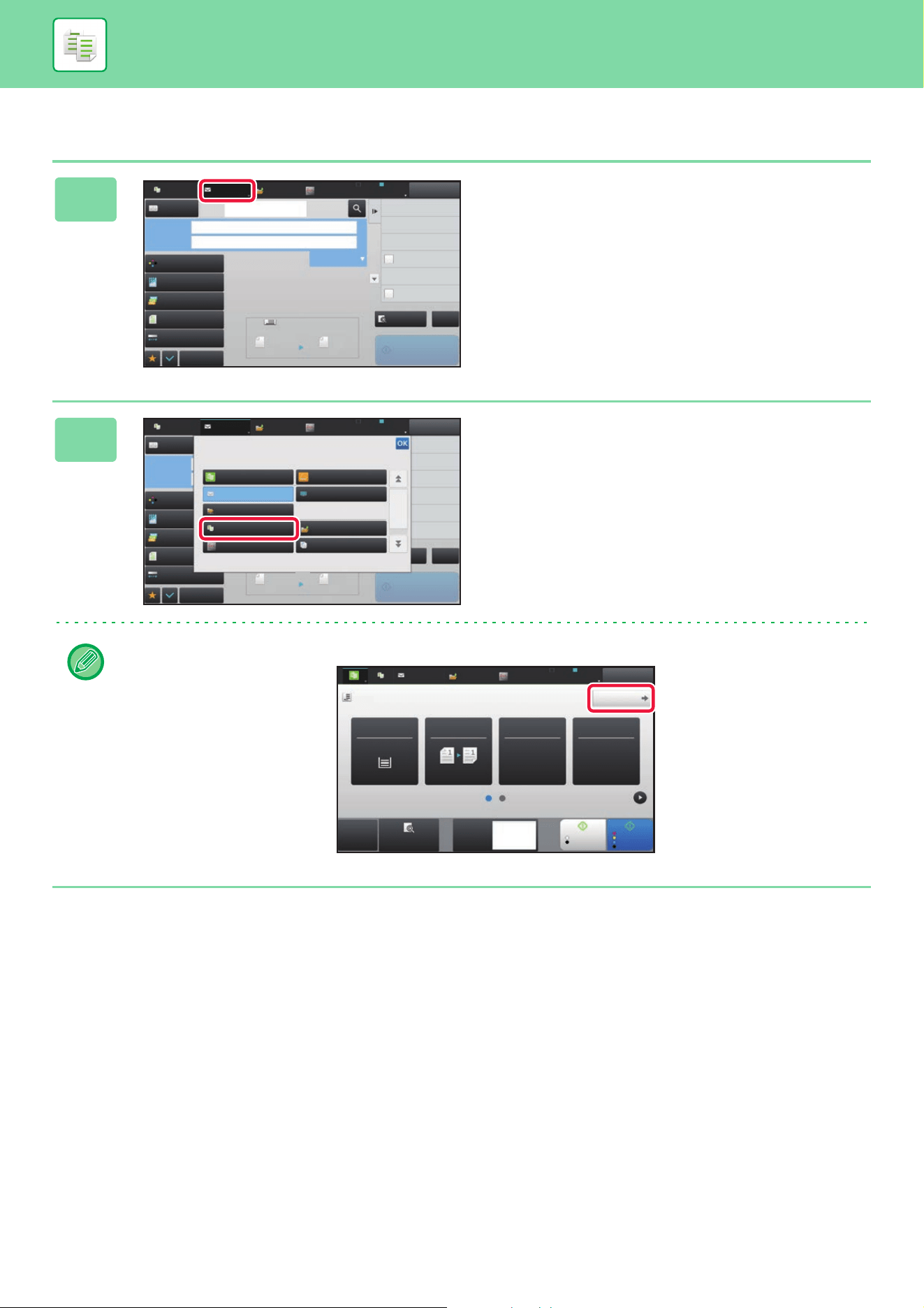
2-6
COPIER►BEFORE USING THE MACHINE AS A COPIER
Shift to Normal Mode
1
Tap on the mode display.
2
Tap the [Copy] key.
The initial copy mode screen is displayed.
To switch from the base screen of easy mode, tap the [Detail] key and then tap the [Yes] key in the confirmation screen.
Subject
Address Book
Auto
Color Mode
Original
File Name
Specified by System Settings
Resolution
Exposure
Auto
File Format
Address Touch to input Address
LINE PRINTER
Job Management
Others
Preview
Start
Scan Size
Auto Auto
100%
8½x11 8½x11
Send Size
Sending History
Call Search Number
Call Program
Options
Call Registered settings
Verification Stamp
HDD
File retrieve
E-mail
CA
Global Address Search
Send
Destination Link
Sharp OSA
Auto/Mono2
PDF
200x200dpi
Copy
Auto
Super Fine
Address
Preview
Global Address Search
Sending History
Call Search Number
Call Program
Call Registered settings
Subject
Address Book
Original
File Name
Specified by System Settings
Resolution
File Format
LINE PRINTER
Job Management
Others
Preview
Start
Auto Auto
100%
8½x11 8½x11
Verification Stamp
E-mail
HDD
File retrieve
CA
Sharp OSA
Color Mode
Exposure
Auto
Copy
Preview
Select the mode.
HDD
File retrieve
Easy Copy
Network Folder
E-mail
Copy
Sharp OSA
Manual Finishing
FTP
Easy Scan
Original
8½x11
Detail
Staple / PunchCopy Ratio2-Sided Copy
Paper
Select
8½x11
Tray 1 1 → 1
100% Off
CA
Preview
Copies
LINE PRINTER
HDD
File retrieve
Sharp OSA
B/W
Start
Color
Start
E-mail
Job Management
1
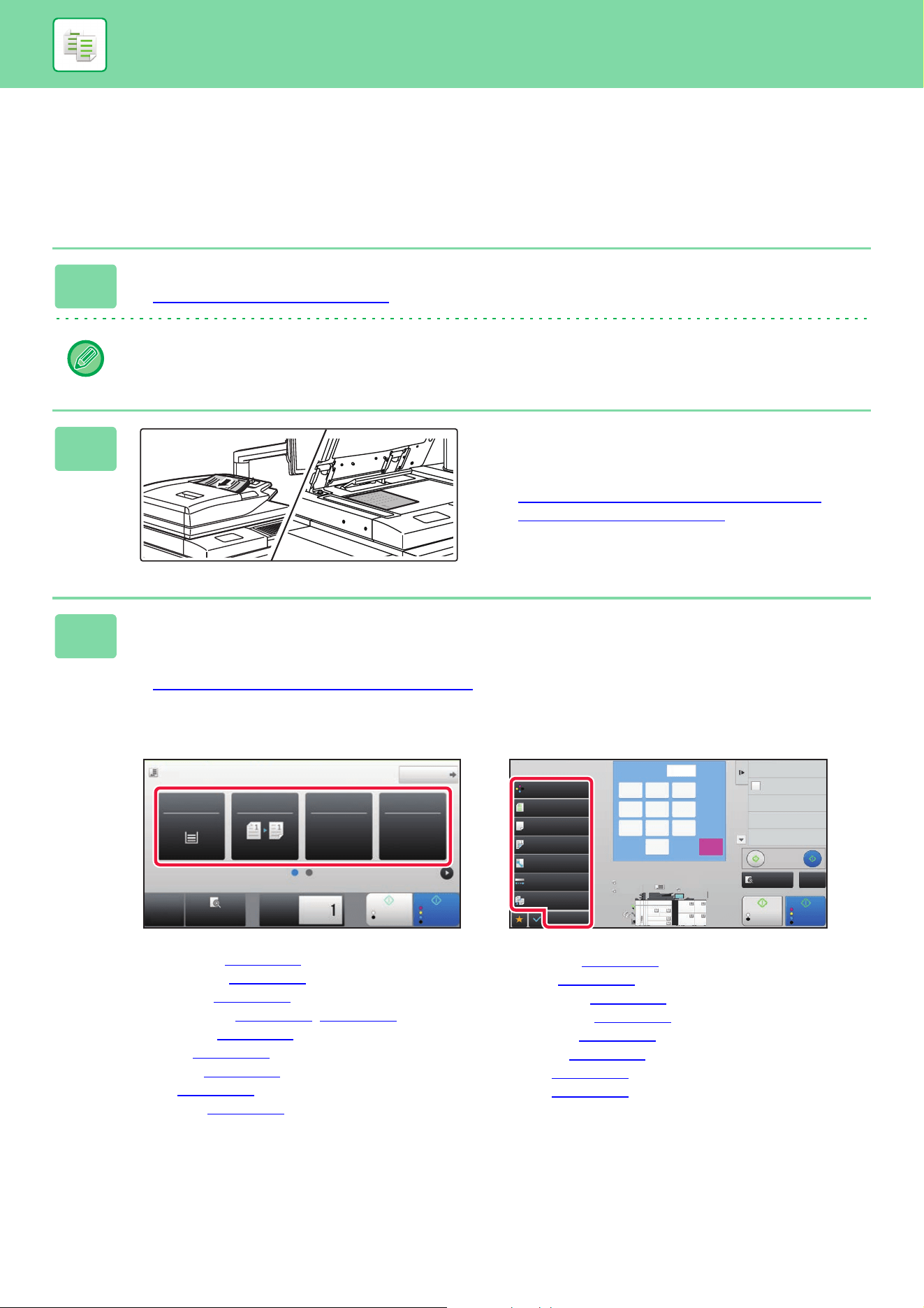
2-7
COPIER►BEFORE USING THE MACHINE AS A COPIER
COPYING SEQUENCE
This section explains the basic procedure for copying. Select settings in the order shown below to ensure that the copy
operation takes place smoothly.
For detailed procedures for selecting the settings, see the explanation of each setting in this chapter.
1
Switch to copy mode.
► SELECTING COPY MODE (page 2-4)
Maximum print area: 12-9/16" x 50-7/8" (319 mm x 1292 mm)
2
Place the original.
Place the original in the document feeder tray of the
automatic document feeder, or on the document glass.
► AUTOMATIC DOCUMENT FEEDER (page 1-90)
► DOCUMENT GLASS (page 1-92)
3
Select functions.
Specify the original scan size, exposure, resolution, etc.
Tap the [Original] key and specify the orientation of the original to have the orientation be correctly recognized.
► Specifying the orientation of the original (page 2-33)
If necessary, you can refer to the following functions for the setting.
In Easy mode In Normal mode
• Paper Select ►page 2-13
• 2-Sided Copy ►page 2-17
• Copy Ratio ►page 2-26
• Staple / Punch ►page 2-48, ►page 2-53
• Color Mode ►page 2-20
• Original ►page 2-33
• Exposure ►page 2-23
•N-Up ►page 2-61
• Card Shot ►page 2-65
• Color Mode ►page 2-20
•Original ►page 2-33
• Paper Select ►page 2-13
• 2-Sided Copy ►page 2-17
• Copy Ratio ►page 2-26
• Exposure ►page 2-23
• Output ►page 2-41
•Others ►page 2-72
B/W
Start
Color
Start
Original
8½x11
Detail
Staple / PunchCopy Ratio2-Sided Copy
Paper
Select
8½x11
Tray 1 1 → 1
100% Off
Preview
Copies
CA
1
9
32
6
78
4
5
0
C
Start
Color
Start
Preview
Color Mode
Full Color
Paper Select
Auto
Exposure
Auto
Original
2-Sided Copy
1-Sided→1-Sided
Output
Copy Ratio
100%
Others
Plain 1
Send and print
Call Eco Program
Store Data in Folder
File
Store Data Temporarily
Quick File
1
2
5
68
8½x11
No. of copies
CA
B/W
7
1
3
4
Plain 1
8½x11
Plain 1
8½x11
Proof Copy
8½x11 5½x8½
8½x11 8½x11
8½x11 8½x11
8½x14
11x17
Auto
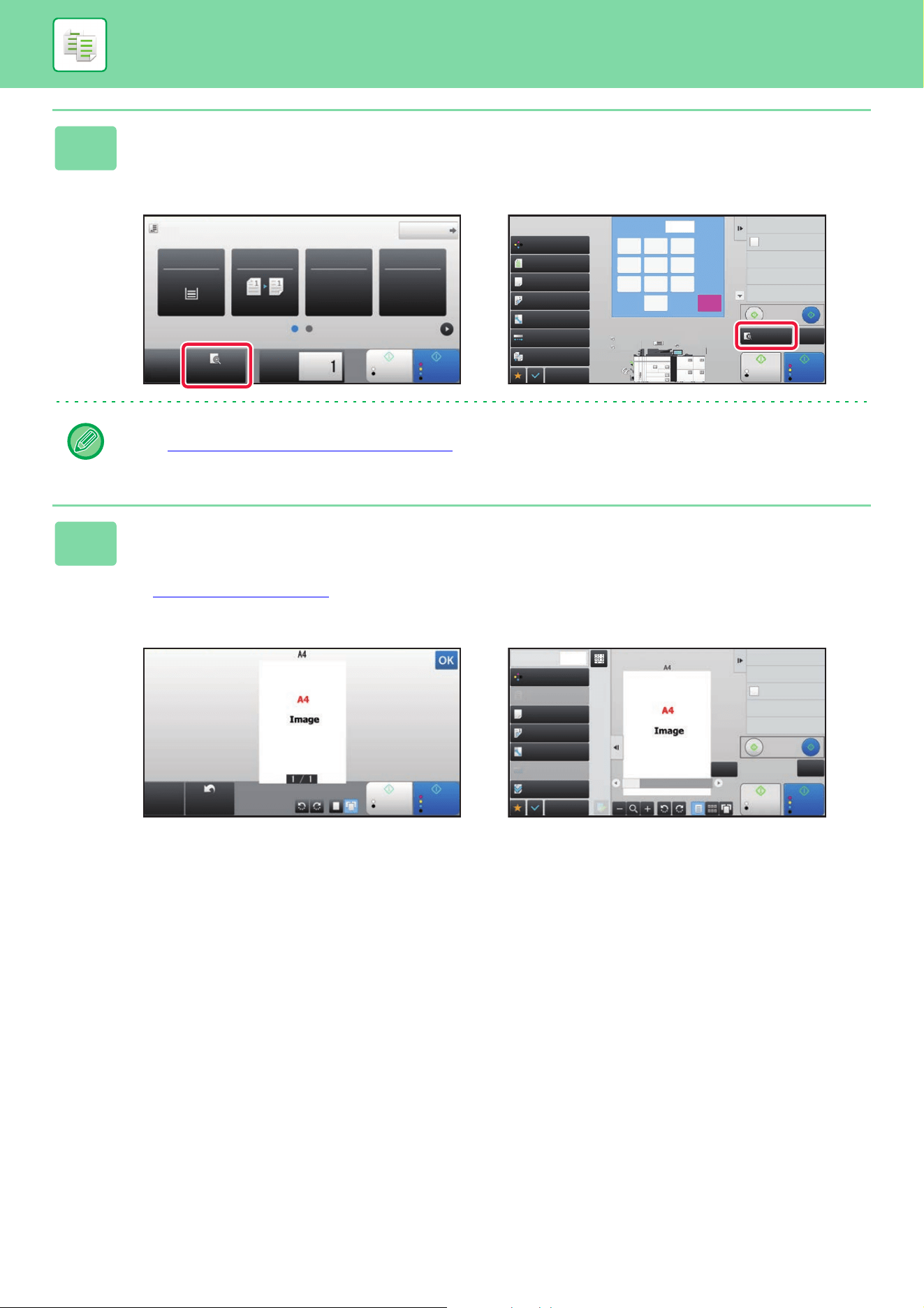
2-8
COPIER►BEFORE USING THE MACHINE AS A COPIER
4
Scan the original.
Tap the [Preview] key to scan the original.
In Easy mode In Normal mode
• To make 2-sided copies, configure the 2-sided copy settings before scanning the original.
► AUTOMATIC 2-SIDED COPYING (page 2-17)
• When not checking the preview image, tap the [Color Start] or [B/W Start] key to start copying.
5
Check the preview image.
Display the preview image of the scanned original.
In the preview screen, check the settings.
► COPY PREVIEW (page 2-9)
In Easy mode In Normal mode
Original
8½x11
Detail
Staple / PunchCopy Ratio2-Sided Copy
Paper
Select
8½x11
Tray 1 1 → 1
100% Off
CA
Preview
Copies
B/W
Start
Color
Start
Start
Color
Start
Preview
Exposure
Original
2-Sided Copy
Copy Ratio
Others
Send and print
Call Eco Program
Store Data in Folder
File
Store Data Temporarily
Quick File
1
CA
B/W
Paper Select
Plain
1
2
5
68
8½x11
7
1
3
4
Plain
8½x11
Plain
8½x11
1
9
32
6
78
4
5
0
Proof Copy
C
Auto
Auto
1-Sided→1-Sided
100%
No. of copies
8½x11 5½x8½
8½x11 8½x11
8½x11 8½x11
8½x14
11x17
Color Mode
Full Color
Output
Auto
B/W
Start
Color
Start
Preview
Scan
Again
CA
Others
Send and Print
Scan Original Again
Without change Settings
Store Data in Folder
File
Register Current Settings
Program Registration
Store Data Temporarily
Quick File
1
Copies
1/7
Paper Select
Auto
Exposure
Auto
Original
Auto 8½x11
2-Sided Copy
1-Sided→1-Sided
Copy Ratio
100%
Output
Color Mode
Full Color
Proof Copy
CA
Start
Color
Start
B/W
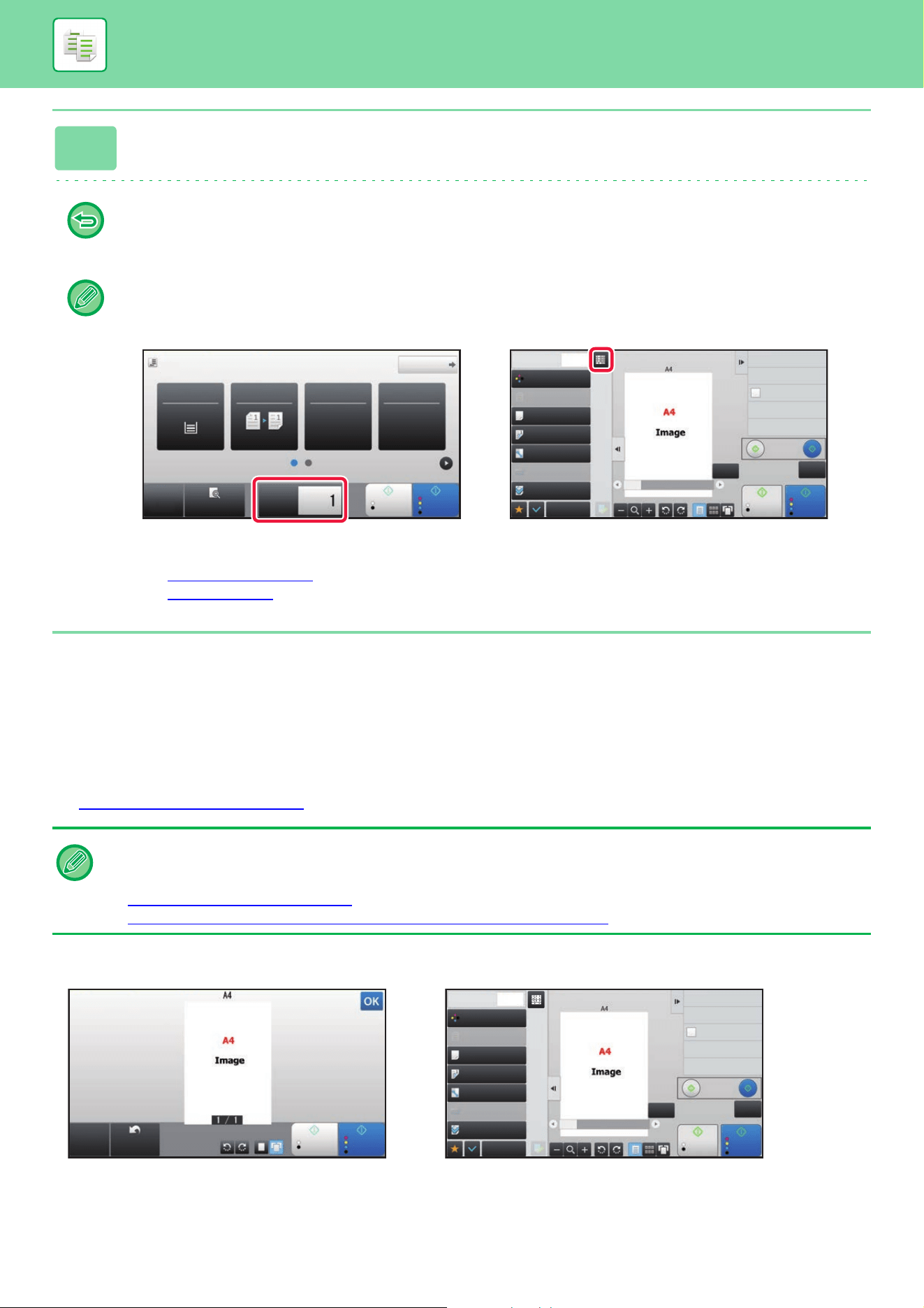
2-9
COPIER►BEFORE USING THE MACHINE AS A COPIER
COPY PREVIEW
You can tap the [Preview] key before scanning the original to check a preview of the scanned image.
If you configure the preview, you can check the status of the configured preview such as the staple position or page
layout.
► PREVIEW SCREEN (page 1-17)
6
Tap the [Color Start] or [B/W Start] key to start copying.
When making only one set of copies, you do not need to specify the number of copies.
• To cancel all settings, tap the [CA] key.
When the [CA] key is tapped, all settings selected to that point are cleared and you will return to the base screen.
• To cancel copying, tap the [Cancel Copy] key.
• To make two or more sets of copies:
Tap the copies display key to specify the number of copies.
• In normal mode, you can tap [File] or [Quick File] on the action panel before starting the copy job to save the scanned
original as a file.
► QUICK FILE (page 5-9)
► FILE (page 5-10)
In normal mode
While viewing the preview screen, you can adjust the settings, and configure the preview in your image.
You can also drag the preview image to edit it, for example, changing, rotating, or deleting an original page.
► COPY COLOR MODES (page 2-20)
► MANUAL ADJUSTMENT OF EXPOSURE AND ORIGINAL TYPE (page 2-23)
B/W
Start
Color
Start
Original
8½x11
Detail
Staple / PunchCopy Ratio2-Sided Copy
Paper
Select
8½x11
Tray 1 1 → 1
100% Off
CA
Preview
Copies
Others
Send and Print
Scan Original Again
Without change Settings
Store Data in Folder
File
Register Current Settings
Program Registration
Store Data Temporarily
Quick File
1
Copies
1/7
Paper Select
Auto
Exposure
Auto
Original
Auto 8½x11
2-Sided Copy
1-Sided→1-Sided
Copy Ratio
100%
Output
Color Mode
Full Color
Proof Copy
CA
Start
Color
Start
B/W
In Easy mode In Normal mode
B/W
Start
Color
Start
Preview
Scan
Again
CA
Others
Send and Print
Scan Original Again
Without change Settings
Store Data in Folder
File
Register Current Settings
Program Registration
Store Data Temporarily
Quick File
1
Copies
1/7
Paper Select
Auto
Exposure
Auto
Original
Auto 8½x11
2-Sided Copy
1-Sided→1-Sided
Copy Ratio
100%
Output
Color Mode
Full Color
Proof Copy
CA
Start
Color
Start
B/W
In Easy mode In Normal mode
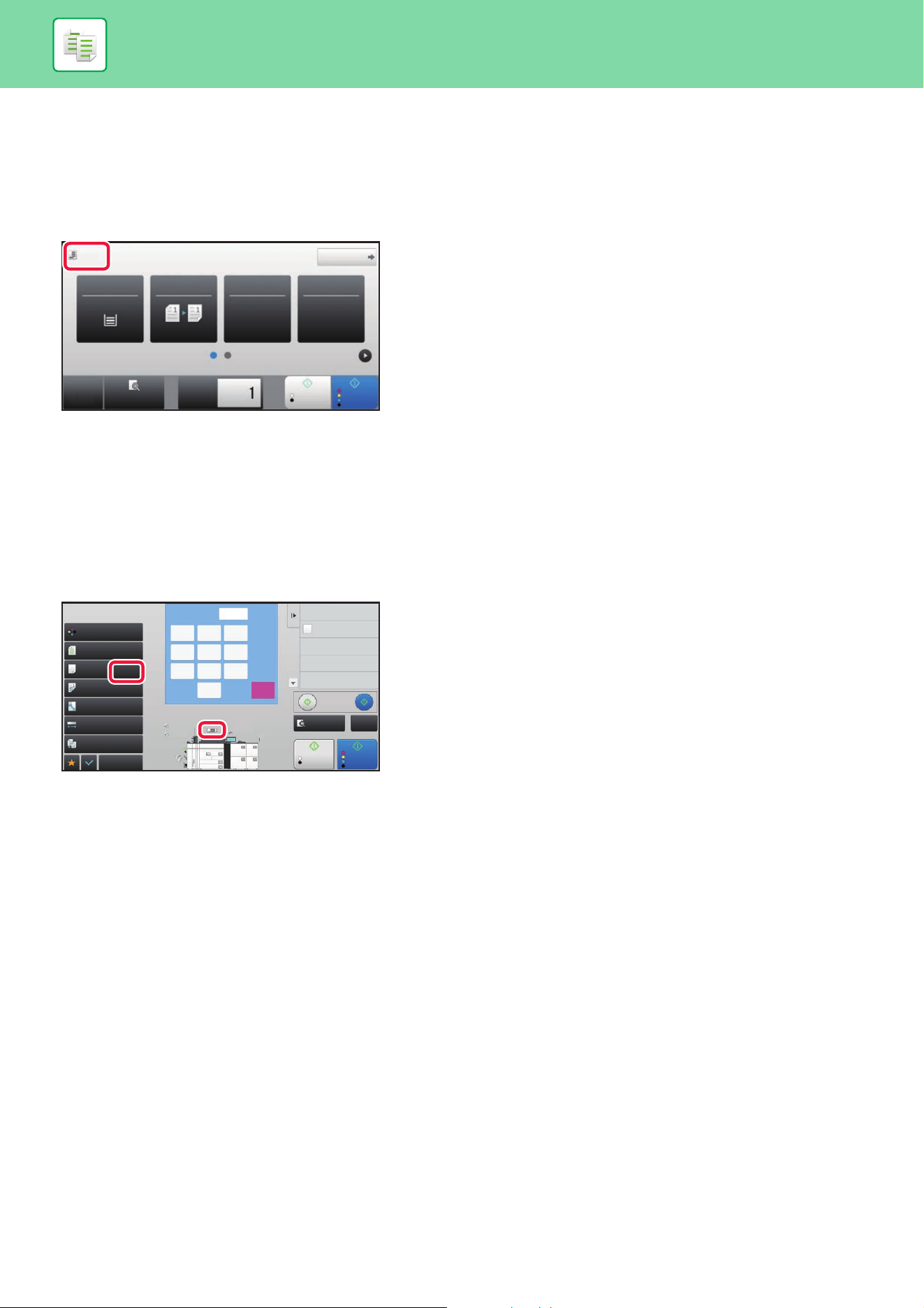
2-10
COPIER►BEFORE USING THE MACHINE AS A COPIER
CHECKING THE ORIGINAL SIZE
Easy mode
The size of the placed original is displayed in the upper left corner of the screen.
When you place the original in the automatic document feeder, the original icon appears next to the original size.
Normal mode
Check the size of the placed original on the display of the [Original] key.
If the original size is set to [Auto], the automatically detected size (standard size) is displayed. If the original size is
specified manually, the specified original size is displayed.
When you place the original in the automatic document feeder, the original icon appears above the automatic document
feeder.
B/W
Start
Color
Start
Original
8½x11
Detail
Staple / PunchCopy Ratio2-Sided Copy
Paper
Select
8½x11
Tray 1 1 → 1
100% Off
Preview
Copies
CA
Start Start
Preview
Color Mode
Paper Select
Exposure
Original
2-Sided Copy
Output
Copy Ratio
Others
Send and print
Call Eco Program
Store Data in Folder
File
Store Data Temporarily
Quick File
1
CA
B/W
1
9
32
6
78
4
5
0
C
Plain 1
2
1
34
8½x11
2
1
3
4
Plain 1
8½x11
Plain 1
8½x11
Proof Copy
Full Color
Auto
Auto
1-Sided→1-Sided
100%
No. of copies
8½x11 5½x8½
8½x11 8½x11
8½x11 8½x11
8½x14
11x17
Auto
Color
2-11
COPIER►BEFORE USING THE MACHINE AS A COPIER
Standard sizes
Standard sizes are sizes that the machine can automatically detect.
To specify the standard size, select [System Settings] in "Settings (administrator)"→ [Common Settings] → [Device
Control] → [Original Size Detector Setting].
List of original size detector settings
* In the size notation above, when the size is suffixed by "R" like "A4R", it indicates a case where a sheet available in
both the vertical and horizontal orientations are set horizontally.
Selections
Standard sizes (detected original sizes)
Document glass Document feeder tray
(automatic document feeder)
Inch-1 11" x 17", 8-1/2" x 14", 8-1/2" x 11", 8-1/2" x 11"R,
5-1/2" x 8-1/2"
11" x 17", 8-1/2" x 14", 8-1/2" x 11", 8-1/2" x 11"R,
5-1/2" x 8-1/2", A3, A4
Inch-2 11" x 17", 8-1/2" x 13" (216 mm x 330 mm),
8-1/2" x 11", 8-1/2" x 11"R, 5-1/2" x 8-1/2"
11" x 17", 8-1/2" x 13" (216 mm x 330 mm),
8-1/2" x 11", 8-1/2" x 11"R, 5-1/2" x 8-1/2", A3, A4
Inch-3 11" x 17", 8-1/2" x 13-2/5" (216 mm x 340 mm),
8-1/2" x 11", 8-1/2" x 11"R, 5-1/2" x 8-1/2"
11" x 17", 8-1/2" x 13-2/5 (216 mm x 340 mm),
8-1/2" x 11", 8-1/2" x 11"R, 5-1/2" x 8-1/2", A3, A4
AB-1 A3, A4, A4R, A5, B4, B5, B5R A3, A4, A4R, A5, B4, B5, B5R, 11" x 17", 8-1/2" x 14",
8-1/2" x 11"
AB-2 A3, A4, A4R, A5, B5, B5R, 216 mm x 330 mm
(8-1/2" x 13")
A3, A4, A4R, A5, B4, B5, B5R, 216 mm x 330 mm
(8-1/2" x 13"), 11" x 17", 8-1/2" x 11"
AB-3 A4, A4R, A5, B4, 8K, 16K, 16KR A3, A4, A4R, A5, B4, 8K, 16K, 16KR, 11" x 17",
216 mm x 330 mm (8-1/2" x 13"), 8-1/2" x 11"
AB-4 A3, A4, A4R, A5, B5, B5R, 216 mm x 340 mm
(8-1/2" x 13-2/5")
A3, A4, A4R, A5, B4, B5, B5R, 11" x 17",
216 mm x 340 mm (8-1/2" x 13-2/5"), 8-1/2" x 11"
AB-5 A3, A4, A4R, A5, B5, B5R, 216 mm x 343 mm
(8-1/2" x 13-1/2")
A3, A4, A4R, A5, B4, B5, B5R, 11" x 17",
216 mm x 343 mm (8-1/2" x 13-1/2"), 8-1/2" x 11"
• Even when [Original] is set to [Auto], some original sizes may be detected as other one that is near the standard size.
In this case, manually set the original size.
► SELECTING THE ORIENTATION AND SIZE OF THE ORIGINAL (page 2-33)
• When placing a non-standard size original on the document glass, you can make it easier for the size to be detected by
placing a blank sheet of 8-1/2" x 11" (A4), 5-1/2" x 8-1/2" (B5), or other standard size of paper on top of the original.
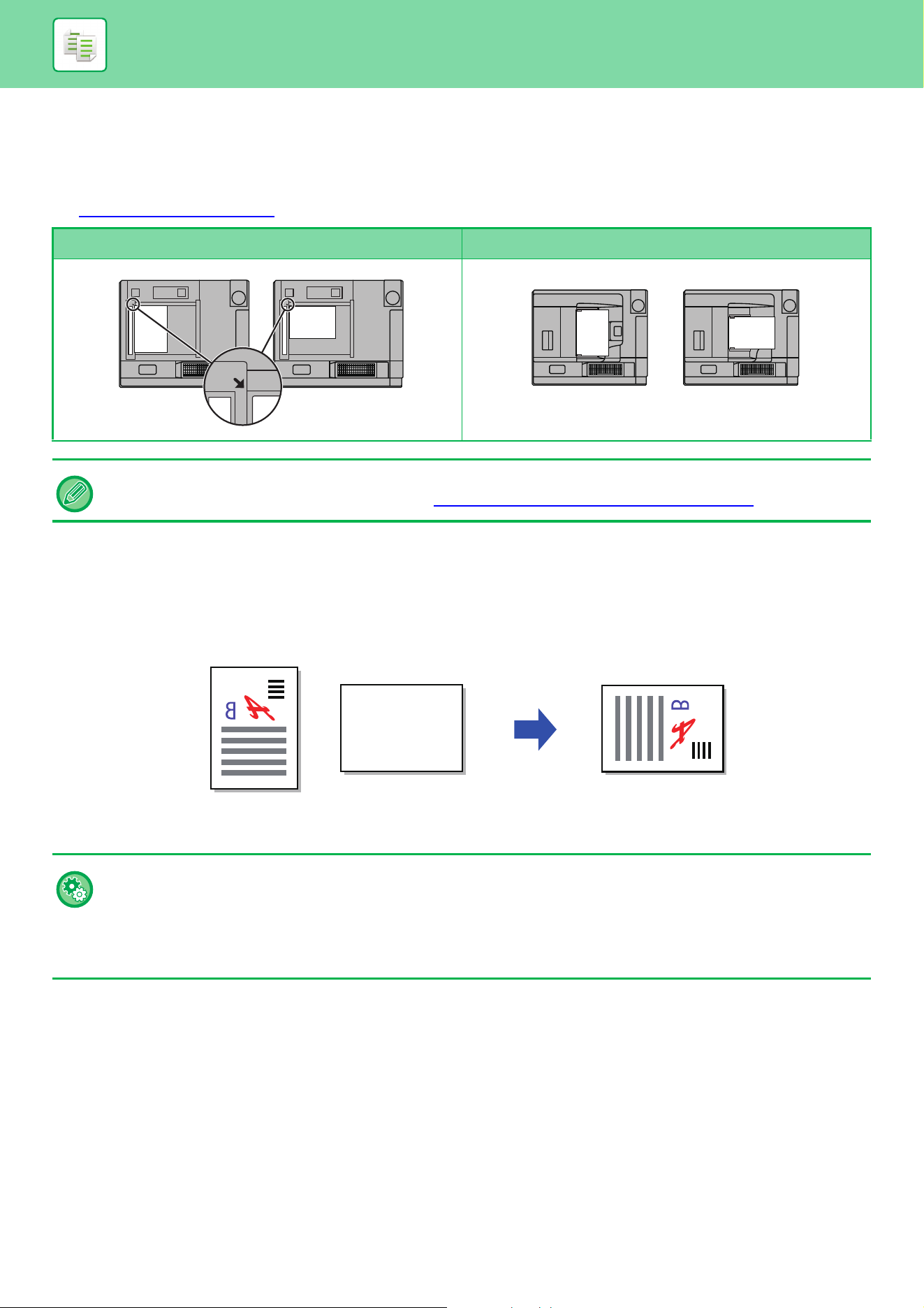
2-12
COPIER►BEFORE USING THE MACHINE AS A COPIER
Orientation of placed original
Place the original as shown below.
If you place the original in an incorrect orientation, it may result in punching at an unexpected position or stapling. On
"Preview Screen", view the image orientation or preview image.
► COPY PREVIEW (page 2-9)
Automatic copy image rotation (Rotation Copy)
If the orientation is different between the original and paper, the original image will be automatically rotated 90 degrees
to match the paper.
Document glass Document feeder tray
Set the orientation of the image to ensure that the orientation of the placed original is correctly recognized.
For information on the orientation of the original, see "Specifying the orientation of the original (page 2-33)
".
To set Rotation Copy:
In "Settings (administrator)", select [System Settings] → [Copy Settings] → [Condition Settings] → [Rotation Copy Setting].
When [Rotation Copy] is selected, Rotation Copy operates when Auto Paper Select or Auto Ratio Select is in effect, or when
the original and paper are the same size but the orientation is different.
When [Rotation Copy is done only at Auto Paper Select or Auto Ration Select] is selected, Rotation Copy only operates
when Auto Paper Select or Auto Ratio Select is in effect.
ABC
ABC
ABC
ABC
Orientation of placed original
The original seen
from behind
Orientation of paper The image is rotated 90 degrees
The paper seen from behind
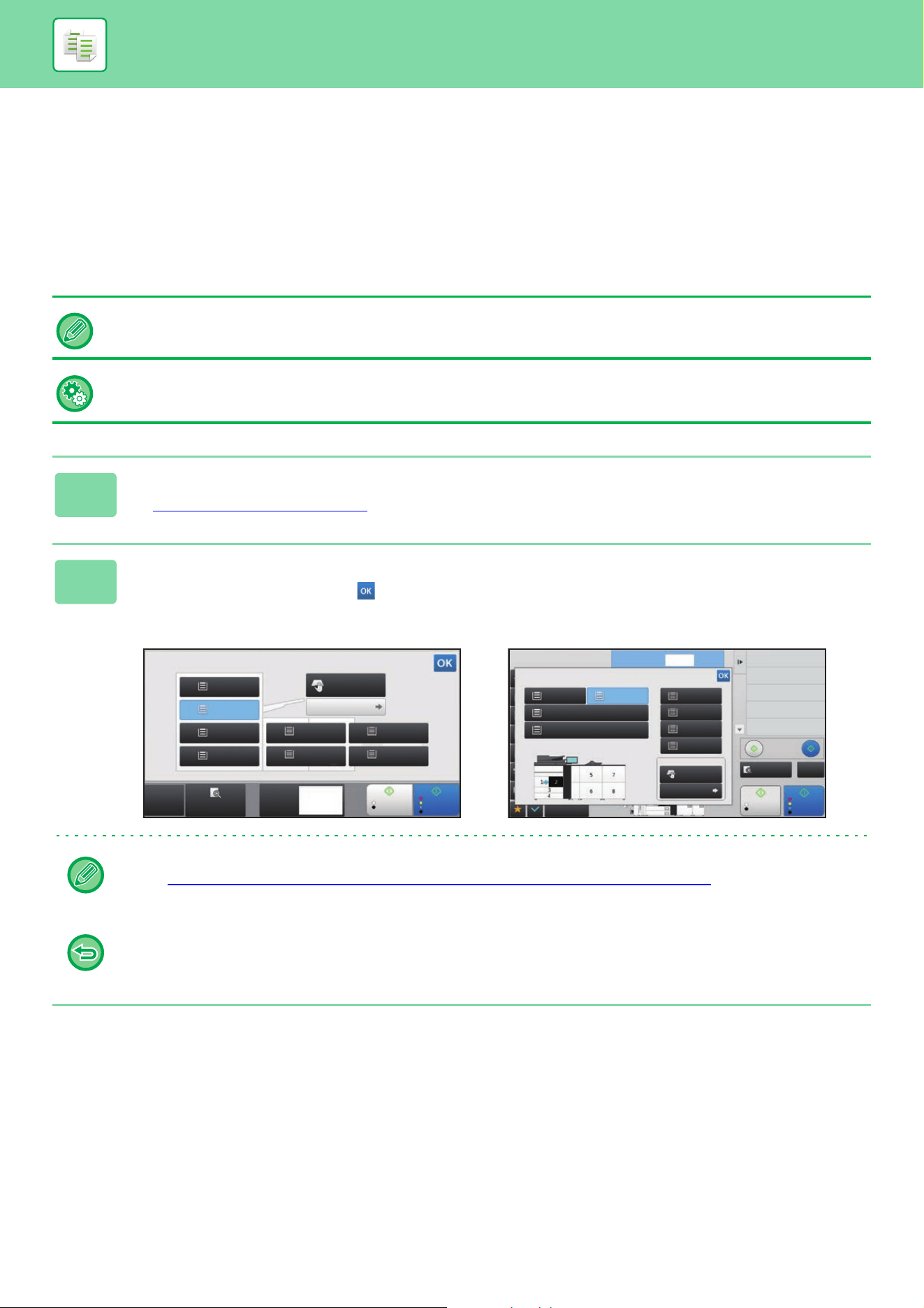
2-13
COPIER►BEFORE USING THE MACHINE AS A COPIER
SELECTING THE PAPER TRAY FOR
COPYING
The machine is set to automatically select a tray that has the same size of paper as the size of the placed original (Auto
Paper Select).
If the original size cannot be detected correctly because it is a non-standard size or when you want to change the paper
size for copying, you can select the paper tray manually.
If the selected tray runs out of paper during a copy job and there is another tray that has the same size and type of paper,
that tray will be automatically selected and the copy job will continue.
To change the initially selected tray:
In "Settings (administrator)", select [System Settings] → [Copy Settings] → [Initial Status Settings] → [Paper Tray].
1
Tap the [Paper Select] key.
► COPYING SEQUENCE (page 2-7)
2
Tap the required tray key.
After the settings are completed, tap .
In Easy mode In Normal mode
• When the bypass tray is selected, specify the paper type and size based on the paper loaded into the bypass tray.
► SPECIFYING A TYPE AND SIZE OF PAPER LOADED ON BYPASS TRAY (page 2-40)
• In normal mode, you can also open the [Paper Select] screen by tapping the machine image on the base screen.
To automatically select the tray, tap the [CA] key. When the [CA] key is tapped, all settings selected to that point are
cleared and you will return to the base screen.
7
8
8½x11
8½x11
1
1
Preview
B/W
Start
Color
Start
Copies
Paper
Select
Plain
8½x11
2
1
3
4
8½x11
8½x11
8½x14
11x17
CA
Type and Size
5
6
8½x11
8½x11
Start Start
Preview
No. of copies
Change Type and Size of
Tray Specified Currently
2-Sided Copy
Enlarge/Reduce Copy
Copy Ratio
Shift Position to Have Margin
Margin Shift
Change Size/Direction.
Original
1
Paper Select
Others
4
CA
Proof Copy
B/W
3
68
Bypass Tray
Large Capacity TrayPaper Tray
4
3
21
Plain
8½x11
Plain
8½x11
1
Plain
8½x11
1 Plain
8½x11
8
Plain
8½x11
1
1
Plain
8½x11
1
7
Plain
8½x11
1
6
Plain
8½x11
1
5
Plain
8½x11
1
Plain
8½x11
1
Type and Size
8½x11 8½x11
8½x14
11x17
Color
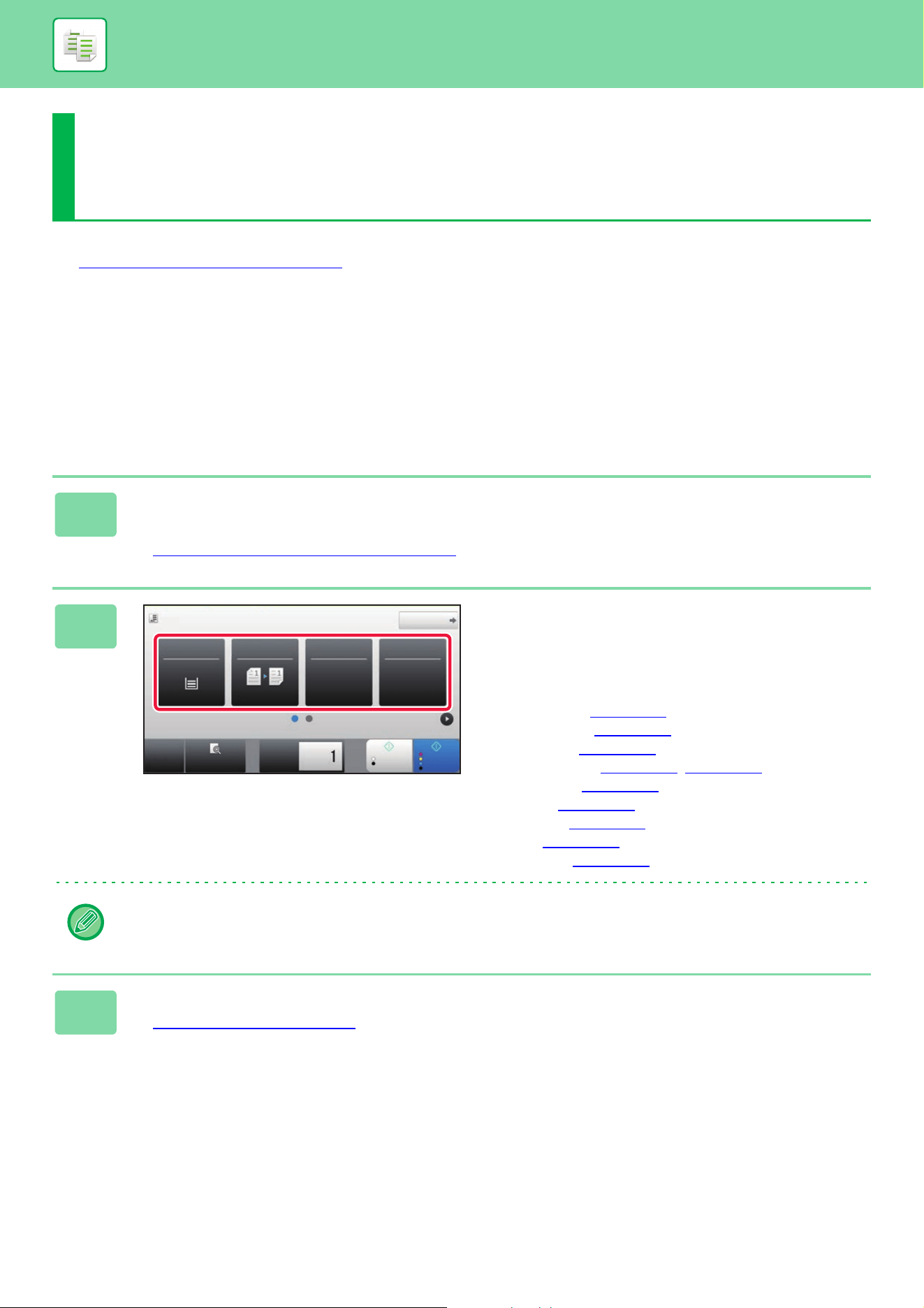
2-14
COPIER►BASIC PROCEDURE FOR MAKING COPIES
This section explains how to select settings from the base screen of easy mode.
► SELECTING COPY MODE (page 2-4)
COPYING
USING THE AUTOMATIC DOCUMENT FEEDER FOR
COPYING
BASIC PROCEDURE FOR MAKING
COPIES
1
Place the original in the document feeder tray of the automatic document
feeder.
► AUTOMATIC DOCUMENT FEEDER (page 1-90)
2
Check the paper (tray) and color mode
you want to use for copying, and tap
the keys for any other settings you
want to select.
• Paper Select ►page 2-13
• 2-Sided Copy ►page 2-17
• Copy Ratio ►page 2-26
• Staple / Punch ►page 2-48, ►page 2-53
• Color Mode ►page 2-20
•Original ►page 2-33
• Exposure ►page 2-23
•N-Up ►page 2-61
• Card Shot ►page 2-65
Depending on the size of the placed original, there may be cases where the same size of paper as the original is not
selected automatically. In this event, change the paper tray manually.
3
Tap the [Preview] key.
► PREVIEW SCREEN (page 1-17)
B/W
Start
Color
Start
Original
8½x11
Detail
Staple / PunchCopy Ratio2-Sided Copy
Paper
Select
8½x11
Tray 1 1 → 1
100% Off
Preview
Copies
CA
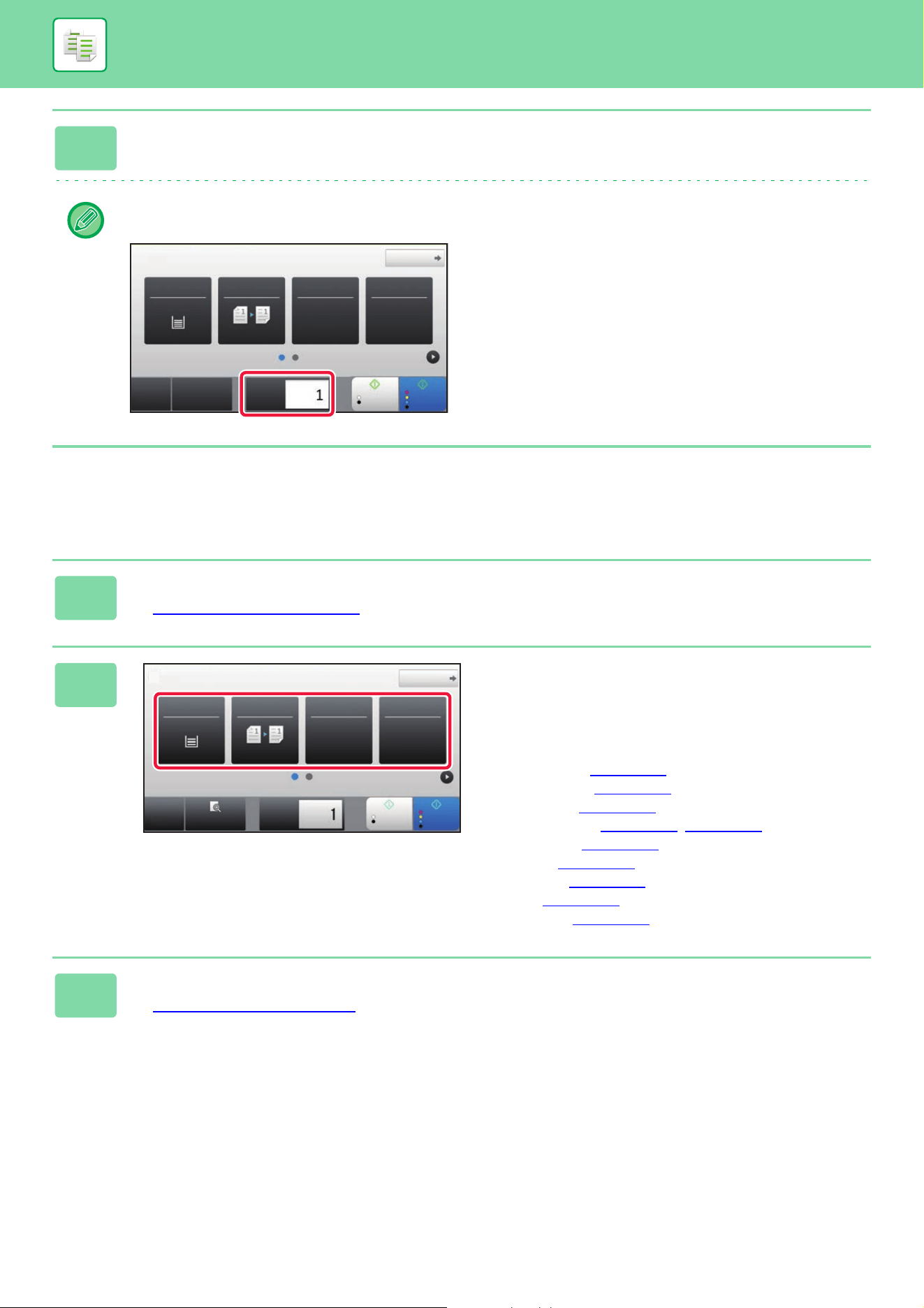
2-15
COPIER►BASIC PROCEDURE FOR MAKING COPIES
USING THE DOCUMENT GLASS FOR COPYING
4
Tap the [Color Start] or [B/W Start] key to start copying.
When making only one set of copies, you do not need to specify the number of copies.
To make two or more sets of copies:
Tap the number of copies key to specify the number of copies.
1
Place the original on the document glass.
► DOCUMENT GLASS (page 1-92)
2
Check the paper (tray) and color mode
you want to use for copying, and tap
the keys for any other settings you
want to select.
• Paper Select ►page 2-13
• 2-Sided Copy ►page 2-17
• Copy Ratio ►page 2-26
• Staple / Punch ►page 2-48, ►page 2-53
• Color Mode ►page 2-20
•Original ►page 2-33
• Exposure ►page 2-23
•N-Up ►page 2-61
• Card Shot ►page 2-65
3
Tap the [Preview] key.
► PREVIEW SCREEN (page 1-17)
B/W
Start
Color
Start
Original
8½x11
Detail
Staple / PunchCopy Ratio2-Sided Copy
Paper
Select
8½x11
Tray 1 1 → 1
100% Off
CA
Check
Preview
Copies
B/W
Start
Color
Start
Original
8½x11
Detail
Staple / PunchCopy Ratio2-Sided Copy
Paper
Select
8½x11
Tray 1 1 → 1
100% Off
Preview
Copies
CA
2-16
COPIER►BASIC PROCEDURE FOR MAKING COPIES
4
Tap the [Color Start] or [B/W Start] key to start copying.
When making only one set of copies, you do not need to specify the number of copies.
To make two or more sets of copies:
Tap the number of copies key to specify the number of copies.
B/W
Start
Color
Start
Original
8½x11
Detail
Staple / PunchCopy Ratio2-Sided Copy
Paper
Select
8½x11
Tray 1 1 → 1
100% Off
CA
Check
Preview
Copies
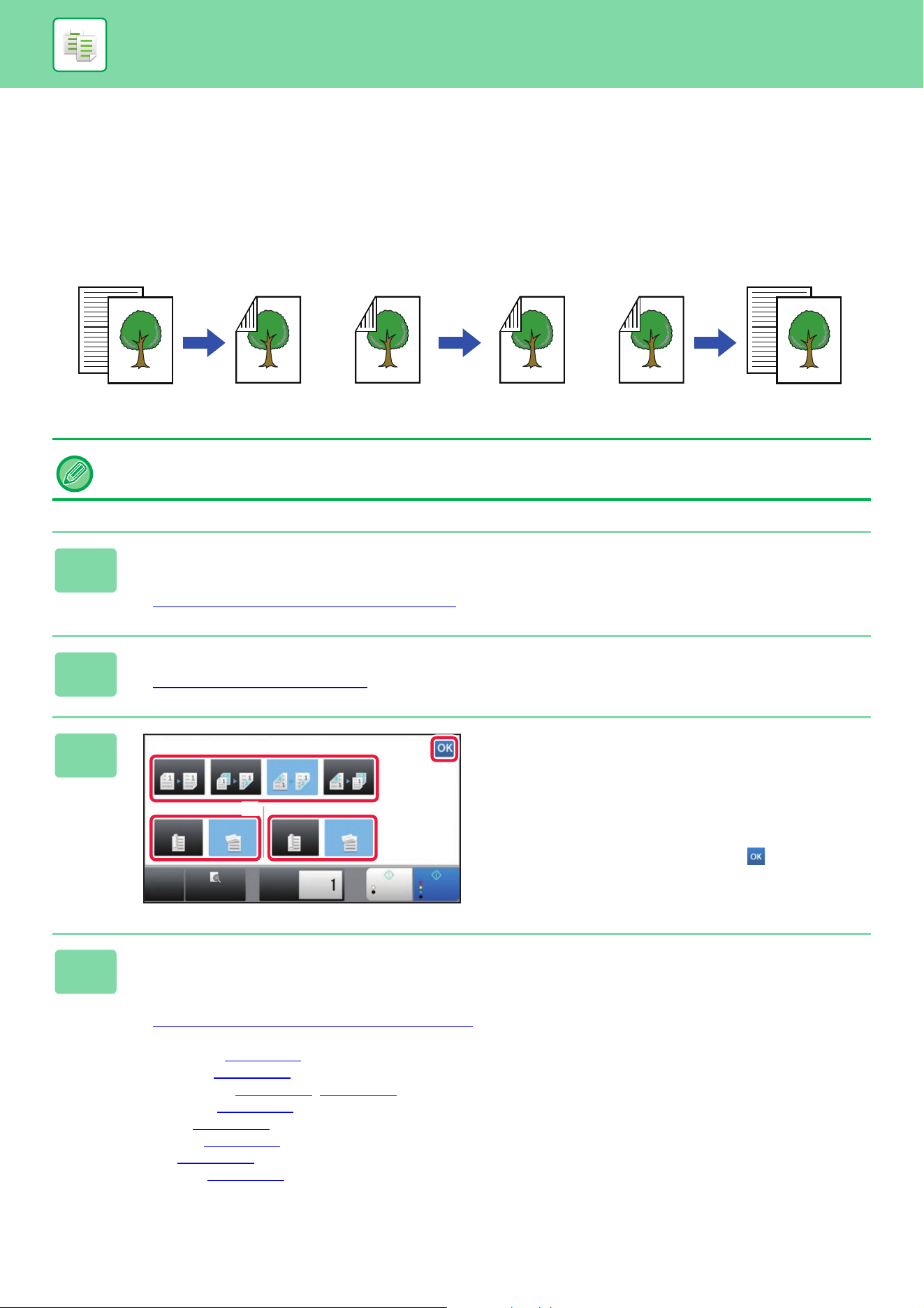
2-17
COPIER►BASIC PROCEDURE FOR MAKING COPIES
AUTOMATIC 2-SIDED COPYING
USING THE AUTOMATIC DOCUMENT FEEDER FOR
2-SIDED COPYING
• To make 2-sided copies, configure the 2-sided copy settings before scanning the original.
• Dual-side copy helps to save paper.
1
Place the original in the document feeder tray of the automatic document
feeder.
► AUTOMATIC DOCUMENT FEEDER (page 1-90)
2
Tap the [2-Sided Copy] key.
► COPYING SEQUENCE (page 2-7)
3
Select 2-sided copy mode.
(1) Select the 2-sided copy type.
(2) When the original is set to "2-Sided", select "Tablet" or
"Book" in "Original Binding".
(3) When the output is set to "2-Sided", select "Tablet" or
"Book" in "Output Binding".
(4) After the settings are completed, tap .
4
Check the paper (tray) and color mode you want to use for copying, and tap
the keys for any other settings you want to select.
Tap the [Original] key and specify the orientation of the original to have the orientation be correctly recognized.
► Specifying the orientation of the original (page 2-33)
• Paper Select ►page 2-13
• Copy Ratio ►page 2-26
• Staple / Punch ►page 2-48, ►page 2-53
• Color Mode ►page 2-20
• Original ►page 2-33
• Exposure ►page 2-23
•N-Up ►page 2-61
• Card Shot ►page 2-65
Originals Copies
Automatic 2-sided copying of
1-sided originals
Originals Copies Originals Copies
Automatic 2-sided copying of
2-sided originals
1-sided copying of 2-sided
originals
B/W
Start
Color
Start
CA
Preview
Copies
2-Sided Copy
Original Binding Output Binding
Tablet
1 → 2
TabletBookBook
2 → 12 → 21 → 1
(1)
(2)
(3)
(4)
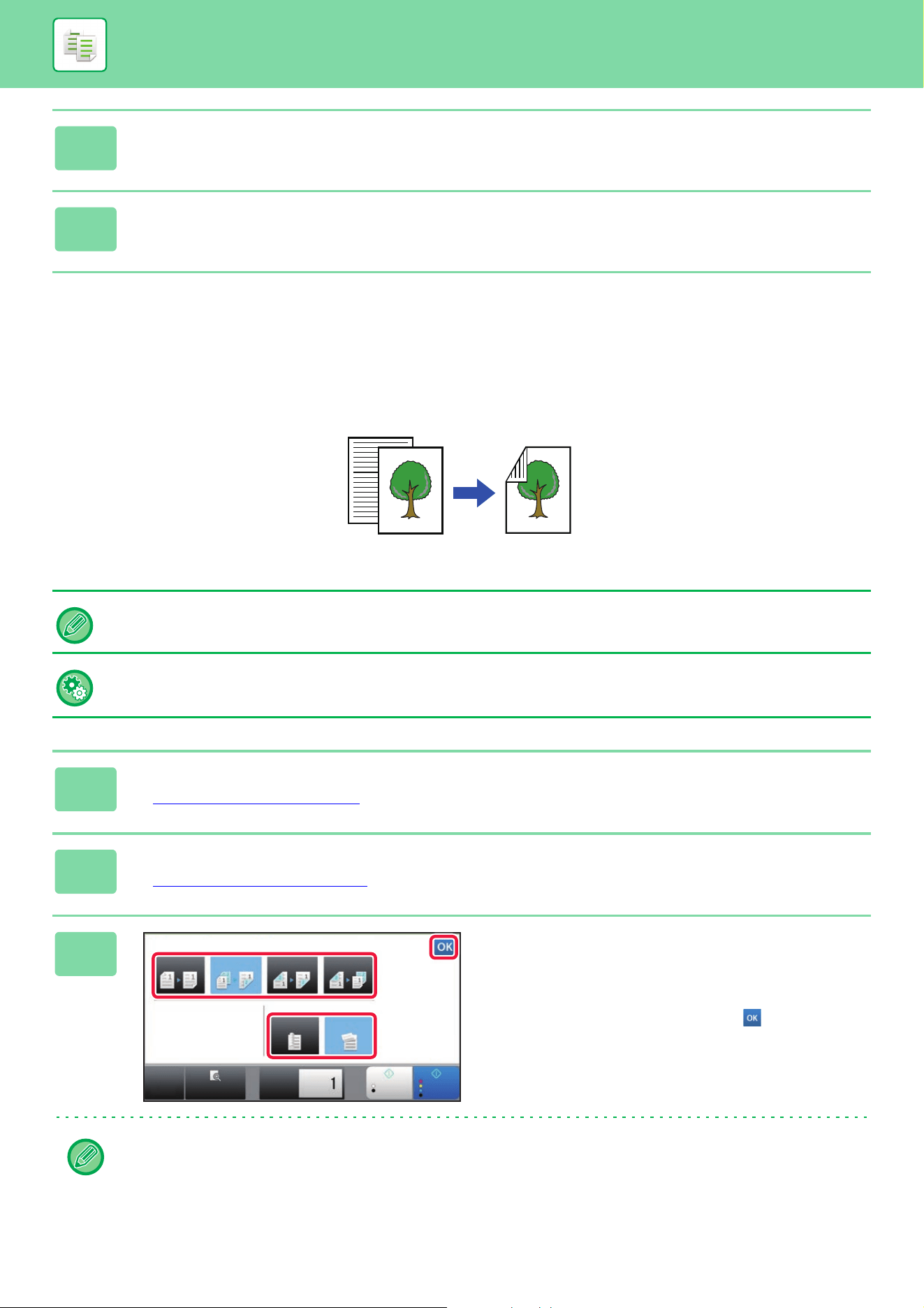
2-18
COPIER►BASIC PROCEDURE FOR MAKING COPIES
USING THE DOCUMENT GLASS FOR 2-SIDED
COPYING
5
Tap the [Preview] key.
6
Tap the [Color Start] or [B/W Start] key to start copying.
Dual-side copy helps to save paper.
To change the default 2-sided copy mode:
In "Settings (administrator)", select [System Settings] → [Copy Settings] → [Initial Status Settings] → [2-Sided Copy].
1
Place the original on the document glass.
► DOCUMENT GLASS (page 1-92)
2
Tap the [2-Sided Copy] key.
► COPYING SEQUENCE (page 2-7)
3
Select the 2-sided copy mode.
(1) Tap the [1 → 2] key.
(2) When the output is set to "2-Sided", select "Tablet" or
"Book" in "Output Binding".
(3) After the settings are completed, tap .
The [2 → 2] key and [1 → 2] key cannot be used when copying from the document glass.
Originals copy
Automatic 2-sided copying of 1-sided originals
B/W
Start
Color
Start
CA
Preview
Copies
2-Sided Copy
Output Binding
1 → 2
TabletBook
2 → 12 → 21 → 1
(3)
(1)
(2)
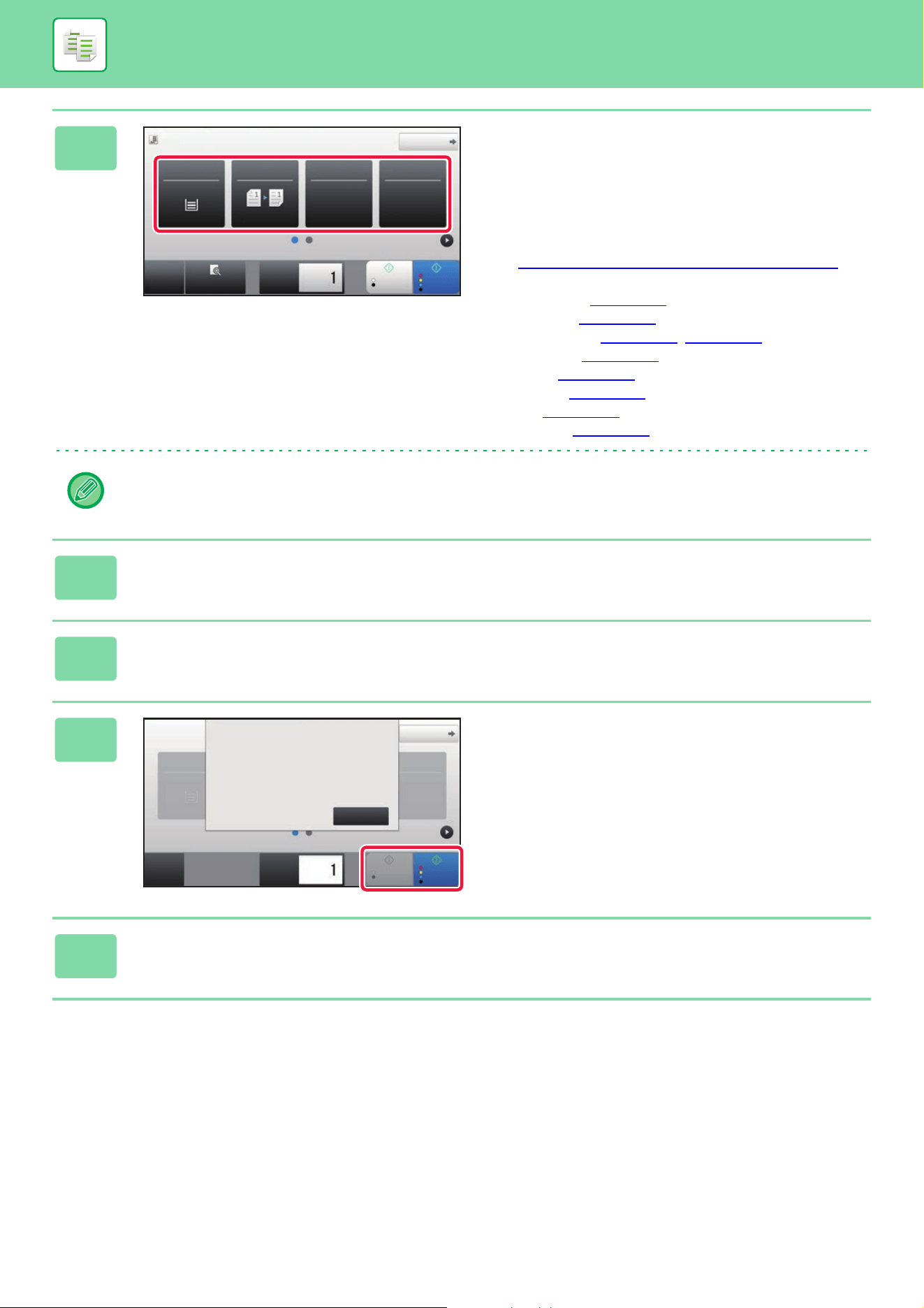
2-19
COPIER►BASIC PROCEDURE FOR MAKING COPIES
4
Check the paper (tray) and color mode
you want to use for copying, and tap
the keys for any other settings you
want to select.
Tap the [Original] key and specify the orientation of the
original to have the orientation be correctly recognized.
► Specifying the orientation of the original (page 2-33)
• Paper Select ►page 2-13
• Copy Ratio ►page 2-26
• Staple / Punch ►page 2-48, ►page 2-53
• Color Mode ►page 2-20
•Original ►page 2-33
• Exposure ►page 2-23
•N-Up ►page 2-61
• Card Shot ►page 2-65
Depending on the size of the placed original, there may be cases where the same size of paper as the original is not
selected automatically. In this event, change the paper tray manually.
5
Tap the [Preview] key.
6
Tap the [Color Start] or [B/W Start] key.
7
Set the next original, and tap the
[Color Start] or [B/W Start] key to scan
the original.
Tap the same key you tapped in step 6.
Repeat this step until all originals have been scanned.
8
Tap the [Read-End] key to start copying.
B/W
Start
Color
Start
Original
8½x11
Detail
Staple / PunchCopy Ratio2-Sided Copy
Paper
Select
8½x11
Tray 1 1 → 1
100% Off
Preview
Copies
CA
Staple / Punch
Paper
Select
8½x11
Tray 1
Off
Copies
Read-End
Place next original. Press [Start].
When finished, press [Read-End].
B/W
Start
Color
Start
CA
Original
8½x11
Detail
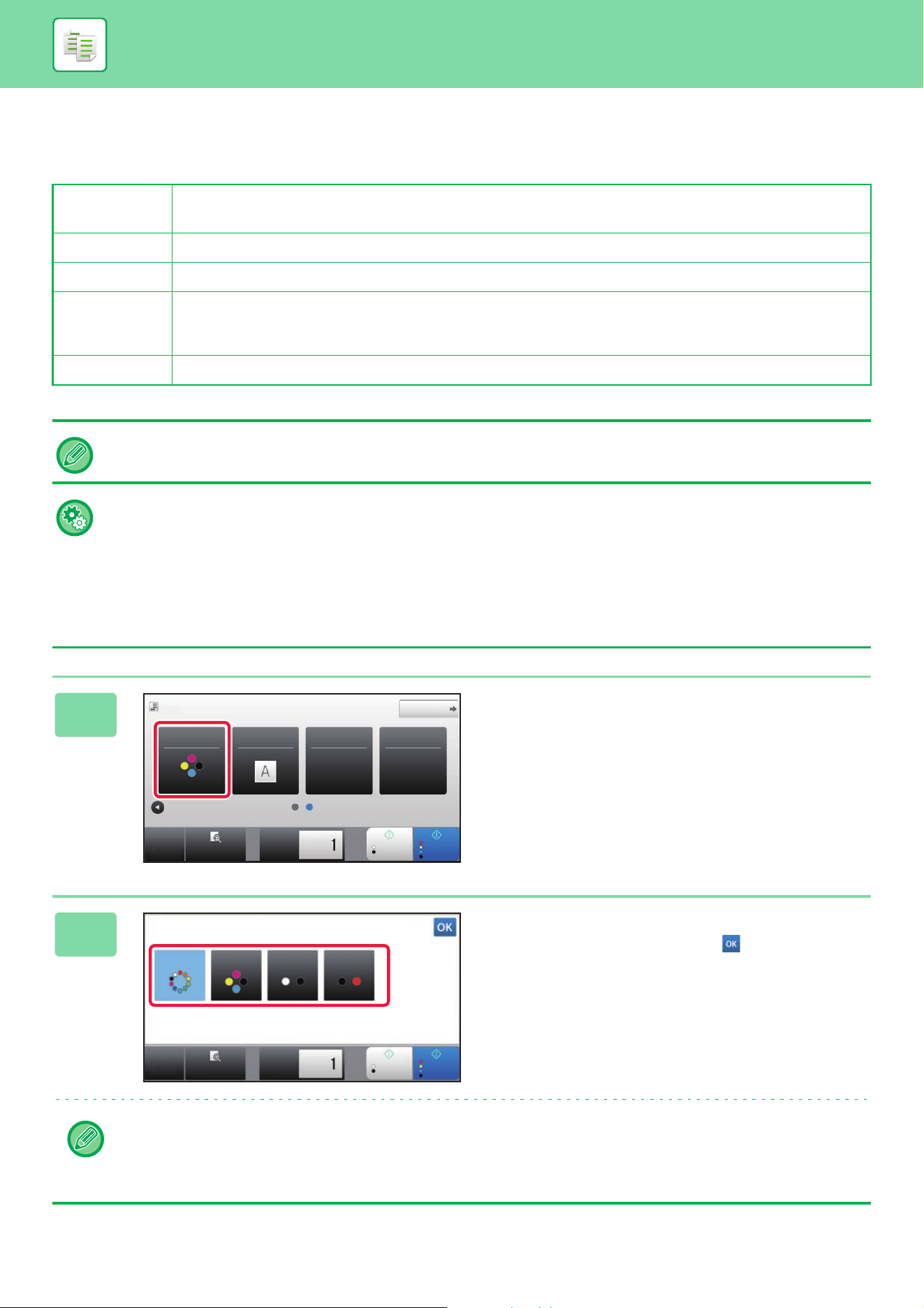
2-20
COPIER►BASIC PROCEDURE FOR MAKING COPIES
COPY COLOR MODES
Select the color mode from Auto, Full Color, B/W, 2 Color, and Single Color.
* Can be set in normal mode.
Auto
The machine automatically detects whether each original is color or black & white and switches the mode
appropriately (full color for a color original or black & white for a black & white original).
Full Color The original is copied in full color.
B/W The original is copied in black and white.
2 Color
The original is copied in two colors by changing a specific color used in the original to another color. If red is
set to a specific color, reddish parts in an original are extracted, and changed to the specified color to make a
copy.
Single Color* The original is copied in any one color regardless of the colors used in the original.
If any color mode is selected, copying takes place in black and white when you tap the [B/W Start] key.
• To change the default color mode:
In "Settings (administrator)", select [System Settings] → [Copy Settings] → [Initial Status Settings] → [Color Mode].
• To change the standard to detect Black & White and Color:
In "Settings (administrator)", select [System Settings] → [Common Settings] → [Device Control] → [Detect Standard in
Auto Color Mode].
When the color mode is set to auto in copy mode, the discrimination point for detecting whether originals are color or black
and white can be set to one of 5 levels. When set to [Closer to B/W], the originals are easier to recognize as black and
white. When set to [Closer color], the originals are easier to recognize as color.
1
Tap the [Color Mode] key.
2
Select the color mode.
After the settings are completed, tap .
Check that the specified color mode is selected.
• When auto mode is used, there may be some originals for which switching between color and black & white does not
take place correctly. If so, tap the [Color Start] or [B/W Start] key to manually switch between color and black & white.
• When [B/W Start] is selected, the [Color Start] key cannot be tapped.
Original
Detail
ExposureColor Mode
Full Color
CA
Preview
B/W
Start
Color
Start
Copies
Card ShotOriginal
Off
8½x11
Auto
CA
Preview
B/W
Start
Color
Start
Copies
Full Color B/W 2 ColorAuto
Color Mode
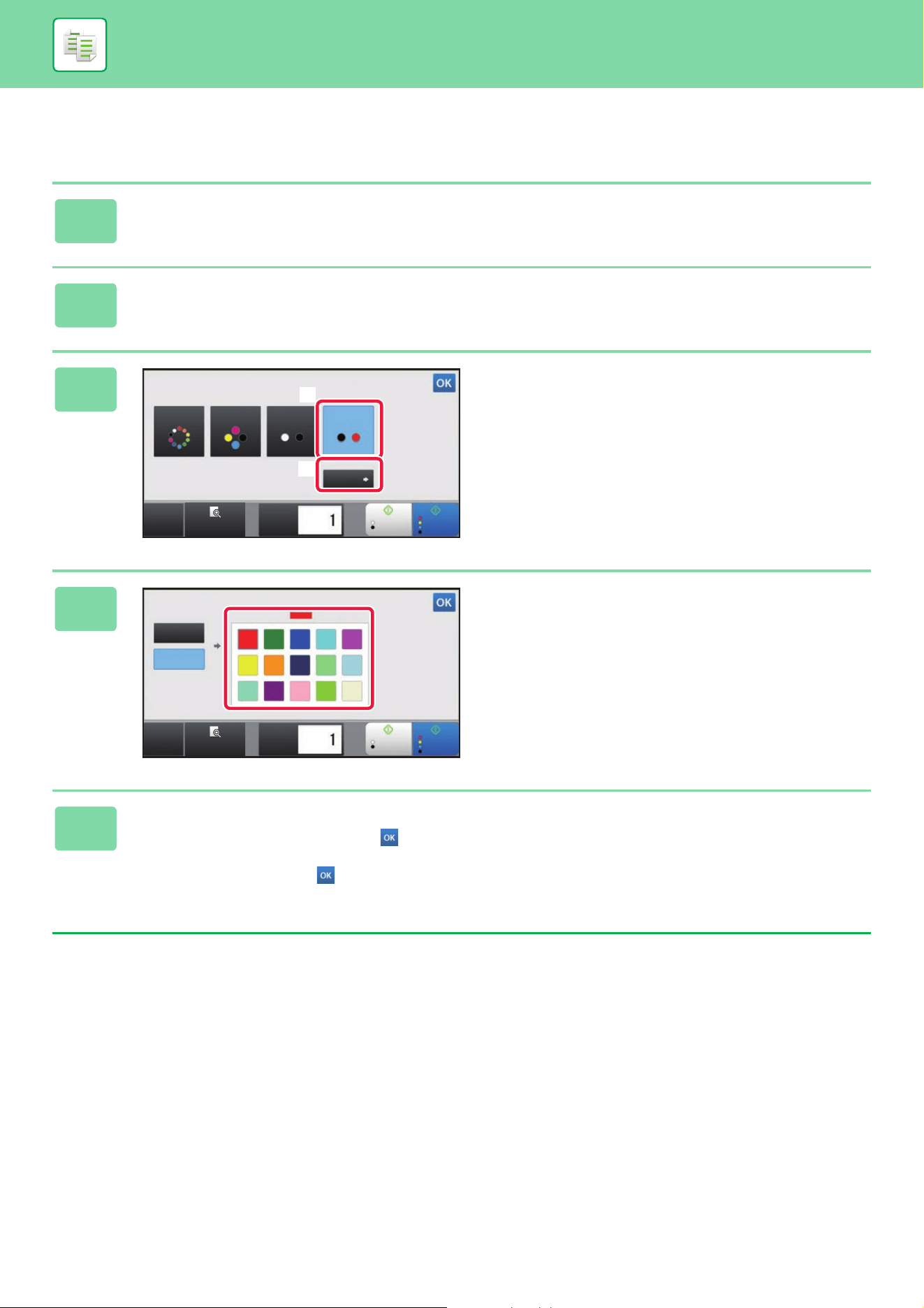
2-21
COPIER►BASIC PROCEDURE FOR MAKING COPIES
Copying in two colors
The original is copied in two colors by changing a specific color to another color.
1
Tap the [Color Mode] key.
2
Tap the [2 Color] key.
3
Tap the [Change] key.
4
Tap the key of the color to be extracted
to specify the extract color.
• [Except Black]:
Extracts black parts in an original, and changes non-black
parts to the specified color.
• [Reddish Color]:
Extracts reddish parts in an original, and changes them to
the specified color.
5
Specify the color to change the extracted color to.
After the settings are completed, tap the key on the [2 Color] screen, and check that the changed setting is
displayed at the side of [2 Color] key on the color mode screen.
After you have checked it, tap .
Check that the specified color mode is selected.
CA
Preview
B/W
Start
Color
Start
Copies
Full Color B/WAuto 2 Color
Change
Reddish Color
Color Mode
(2)
(3)
CA
Preview
B/W
Start
Color
Start
Copies
Except Black
Reddish Color
2 Color
Selected Color
Specified Color Red
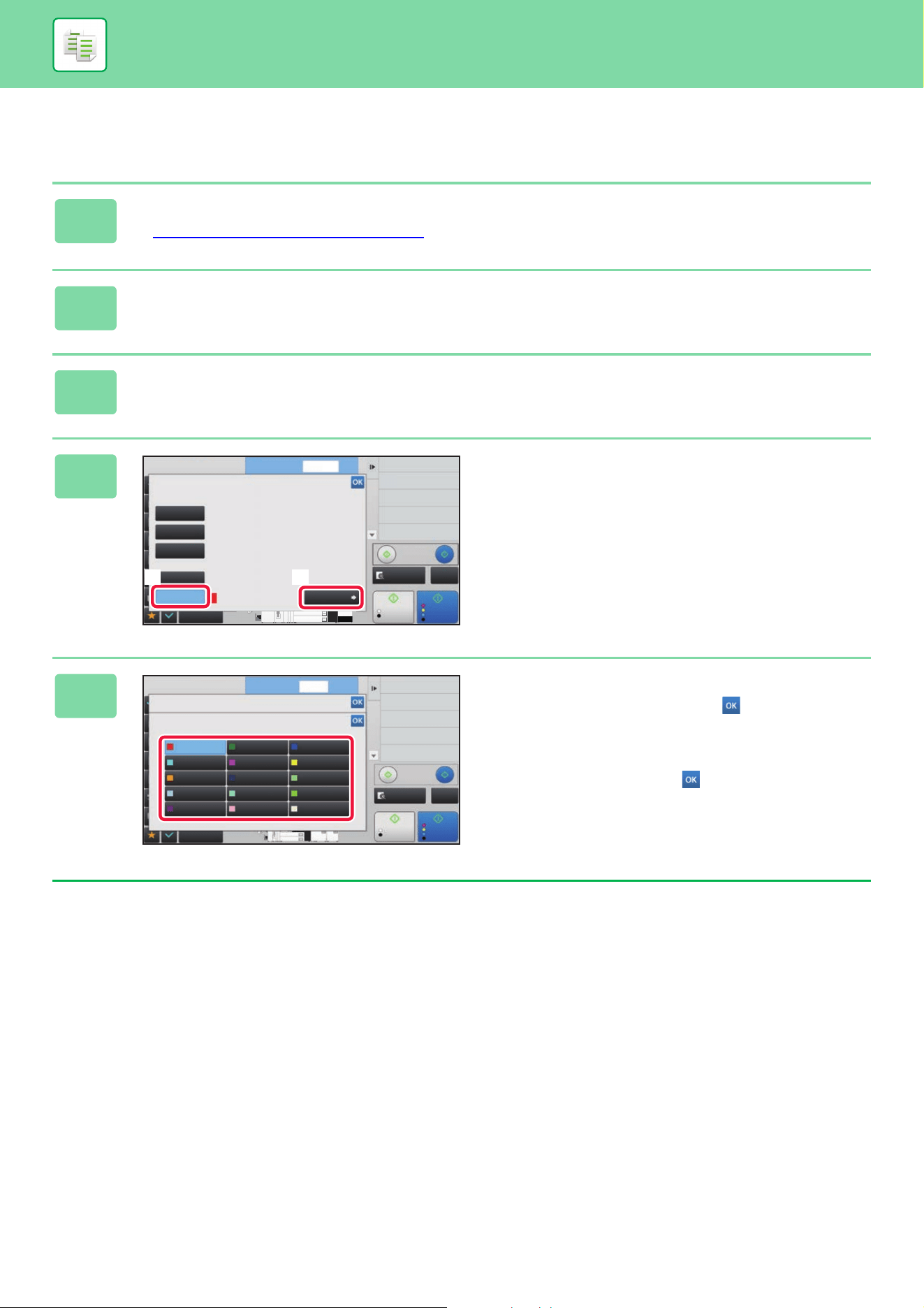
2-22
COPIER►BASIC PROCEDURE FOR MAKING COPIES
Copying in single color
The original is copied in any one color.
1
Tap the [Detail] key to change to normal mode.
► Changing mode from each mode (page 2-5)
2
Tap the [Color Mode] key.
3
Tap the [Single Color] key.
4
Tap the [Change] key.
5
Tap a color you wish to use.
After the settings are completed, tap on the [Single
Color] screen, and check that the changed setting is
displayed at the side of [Single Color] key on the color mode
screen.
After you have checked it, tap on the [Color Mode]
screen.
Plain 1
21
5
8½x11
8½x11
8½x11
Start
Color
Start
B/W
3
4 11x17
8½x14
8½x11
Proof Copy
Preview CA
Others
No. of copies
Change
Auto
Full Color
B/W
2 Color
Single Color
Red
Color Mode
1
Change Size/Direction.
Original
Shift Position to Have Margin
Margin Shift
Put Multiple Pages in A Page
N-Up
Output
2-Sided Copy
(4)(3)
Start Start
Preview
Others
No. of copies
1
Output
2-Sided Copy
Change Size/Direction.
Original
CA
B/W
Shift Position to Have Margin
Margin Shift
Put Multiple Pages in A Page
N-Up
Color Mode
Single Color
Red Green
Magenta YellowCyan
Orange
Light Blue
Purple
Aquamarine
Pink Beige
Yellow Green
Navy Light Green
Blue
4
3
68
Proof Copy
8½x11 8½x11
8½x14
11x17
Color
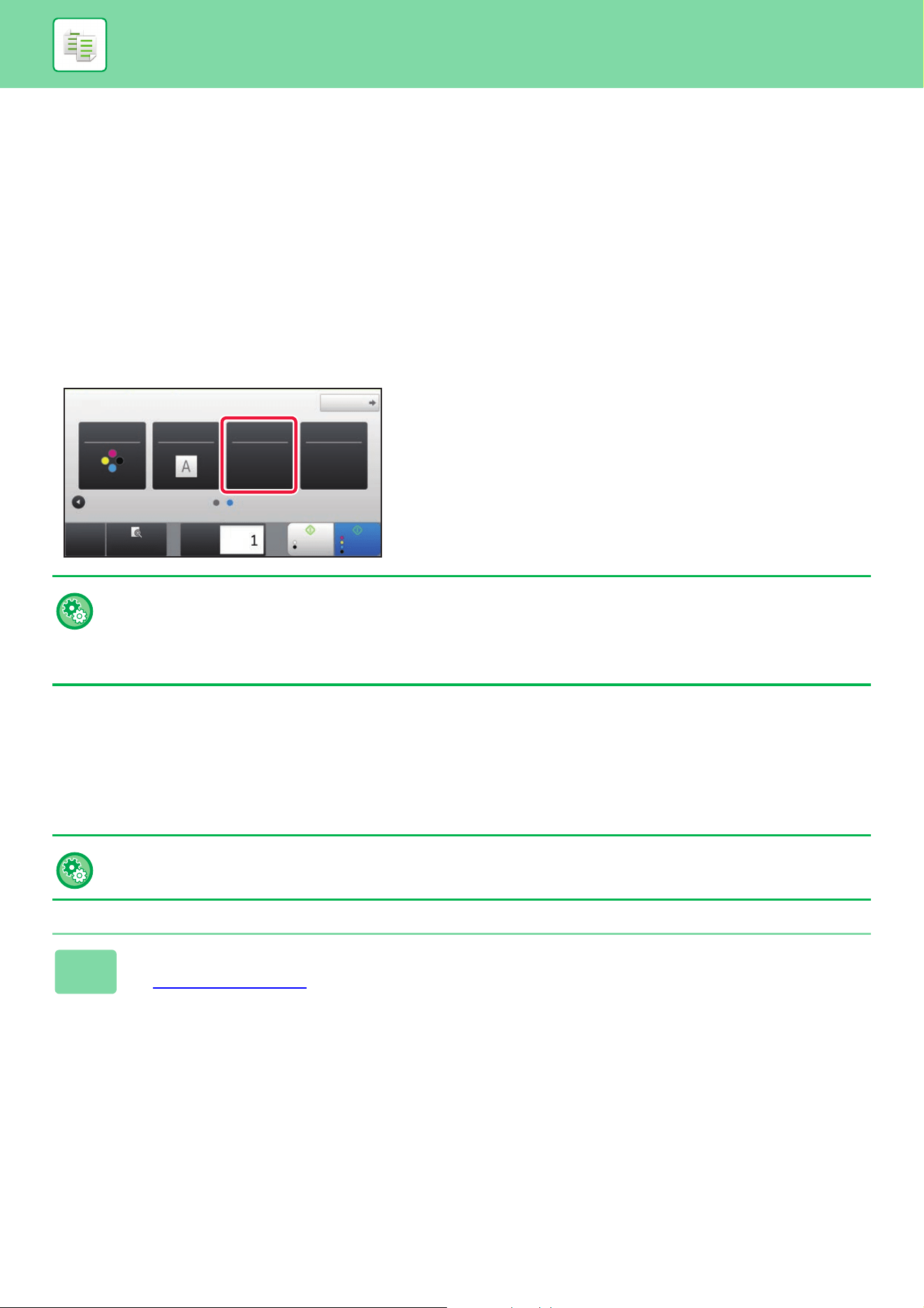
2-23
COPIER►BASIC PROCEDURE FOR MAKING COPIES
CHANGING THE EXPOSURE AND ORIGINAL
IMAGE TYPE
AUTOMATIC ADJUSTMENT OF EXPOSURE AND
ORIGINAL TYPE
Automatic exposure adjustment operates by default to automatically adjust the exposure level and original type as
appropriate for the original being copied. ([Auto] is displayed.)
This function automatically adjusts the image during black & white copying and full color copying to obtain the most
suitable copy.
MANUAL ADJUSTMENT OF EXPOSURE AND
ORIGINAL TYPE
This section explains how to select the original type depending on the original to be copied or manually adjust the
exposure.
• To change the default exposure:
In "Settings (administrator)", select [System Settings] → [Copy Settings] → [Initial Status Settings] → [Exposure Type].
• To adjust the exposure level when [Auto] is used for the copy exposure:
In "Settings (administrator)", select [System Settings] → [Image Quality Adjustment] → [Copy Image Quality] → [Density
Adjustment when [Auto] is selected for Exposure].
To change the default exposure:
In "Settings (administrator)", select [System Settings] → [Copy Settings] → [Initial Status Settings] → [Exposure Type].
1
Tap the [Exposure] key.
► COPY MODE (page 2-3)
B/W
Start
Color
Start
Original
8½x11
Detail
Exposure
CA
Preview
Copies
Original Card Shot
OffAuto
Color Mode
Full Color
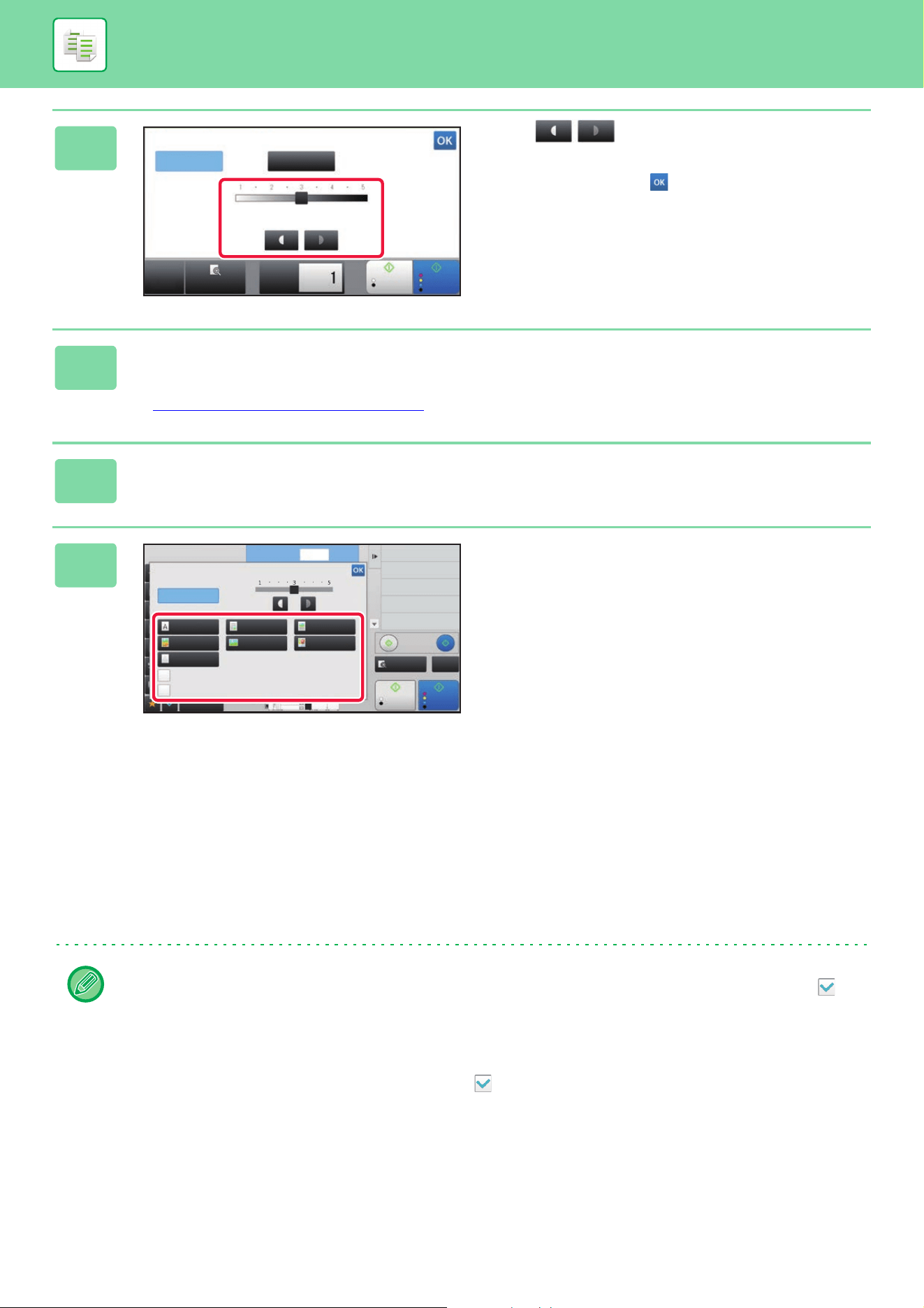
2-24
COPIER►BASIC PROCEDURE FOR MAKING COPIES
2
Tap or slide the slider to
adjust the copy exposure.
After the adjustment, tap .
This completes the procedure in easy mode.
3
To select more detailed settings, tap the [Detail] key to switch to normal
mode.
► Changing mode from each mode (page 2-5)
4
Tap the [Exposure] key.
5
Tap the required original image type
key to specify the original type.
Tap the key matching the original.
Original image type select keys
• Text ............................Use this mode for regular text documents.
• Text/Printed Photo ..... This mode provides the best balance for copying an original which contains both text and
printed photographs, such as a magazine or catalogue.
• Text/Photo..................This mode provides the best balance for copying an original which contains both text and
photographs, such as a text document with a photo pasted on.
• Printed Photo .............This mode is best for copying printed photographs, such as photos in a magazine or catalogue.
• Photo..........................Use this mode to copy photos.
• Map ............................This mode is best for copying the light color shading and fine text found on most maps.
• Light Original..............Use this mode for originals with light pencil writing.
• When using a copy or printed page from the machine as an original:
When using a copy or printed page from the machine as an original, tap the [Copy of Copy] checkbox so that
appears.
[Copy of Copy] is available when [Auto], [Text], [Printed Photo], or [Text/Printed Photo] is selected as the original
image type.
• To enhance the color of a color copy:
Tap the [Color Tone Enhancement] checkbox so that appears.
Set the [Color Tone Enhancement] when you select an original type.
• When copying originals marked with a highlighter pen in black and white, it is useful to use "Copy Original with
Highlighted Lines". This function can improve the hue difficult to express with normal copy.
B/W
Start
Color
Start
CA
Preview
Copies
Exposure
Auto Manual
Lighten Darken
Start Start
Preview
Others
No. of copies
1
Color Mode
Background Adjustment
Erase Shadow Around
Erase
Change Size/Direction.
Original
Exposure/Original Type
Auto
Manual
Copy of Copy
Text
Text/Printed Photo
Text/Photo
Printed Photo
Light Original
Photo Map
Select Scan Resolution
CA
B/W
Copy Original with
Highlighted Lines
4
8½x11 5½x8½
8½x11 8½x11
8½x14
11x17
3 8½x14
68
Proof Copy
Color
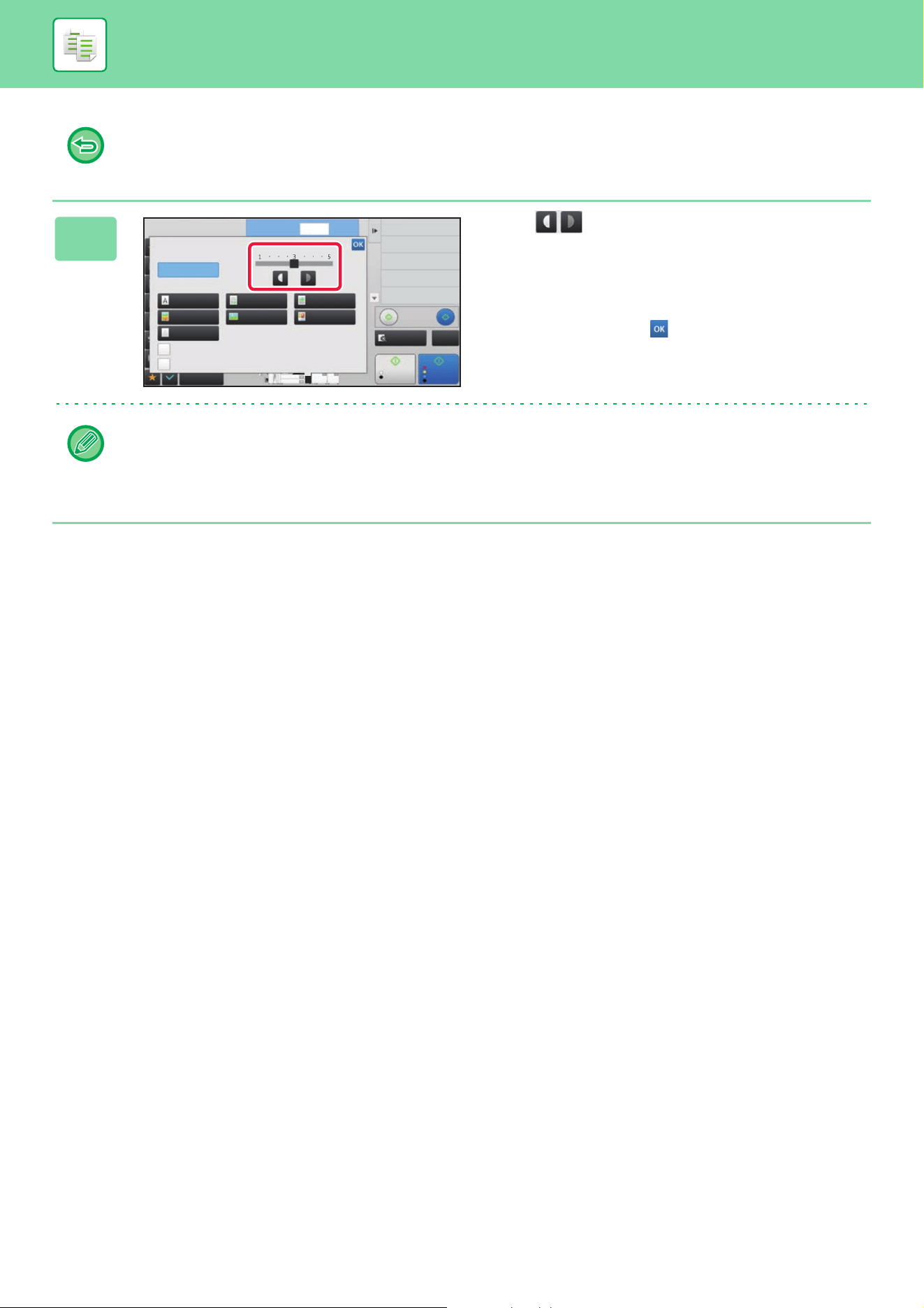
2-25
COPIER►BASIC PROCEDURE FOR MAKING COPIES
• [Copy of Copy] and [Color Tone Enhancement] cannot be specified together.
• [Copy of Copy] and [Color Tone Enhancement] cannot be combined with [Intensity] in "Others".
6
Tap or slide the slider to adjust
the copy exposure.
If you adjust the exposure with the original type selected to
[Auto], the original image type is automatically selected to
[Text/Printed Photo].
After the adjustment, tap .
Guidelines for the exposure level when [Text] is selected for "Exposure/Original Type"
1 to 2: Dark originals such as a newspaper
3: Normal density originals
4 to 5: Originals written in pencil or light colored text
Start Start
Preview
Others
No. of copies
1
Exposure/Original Type
Auto
Manual
Copy of Copy
Text
Text/Printed Photo
Text/Photo
Printed Photo
Light Original
Photo Map
CA
B/W
Copy Original with
Highlighted Lines
11x17 11x1711x174
3 8½x14
68
Proof Copy
Color Mode
Background Adjustment
Erase Shadow Around
Erase
Change Size/Direction.
Original
Select Scan Resolution
Color
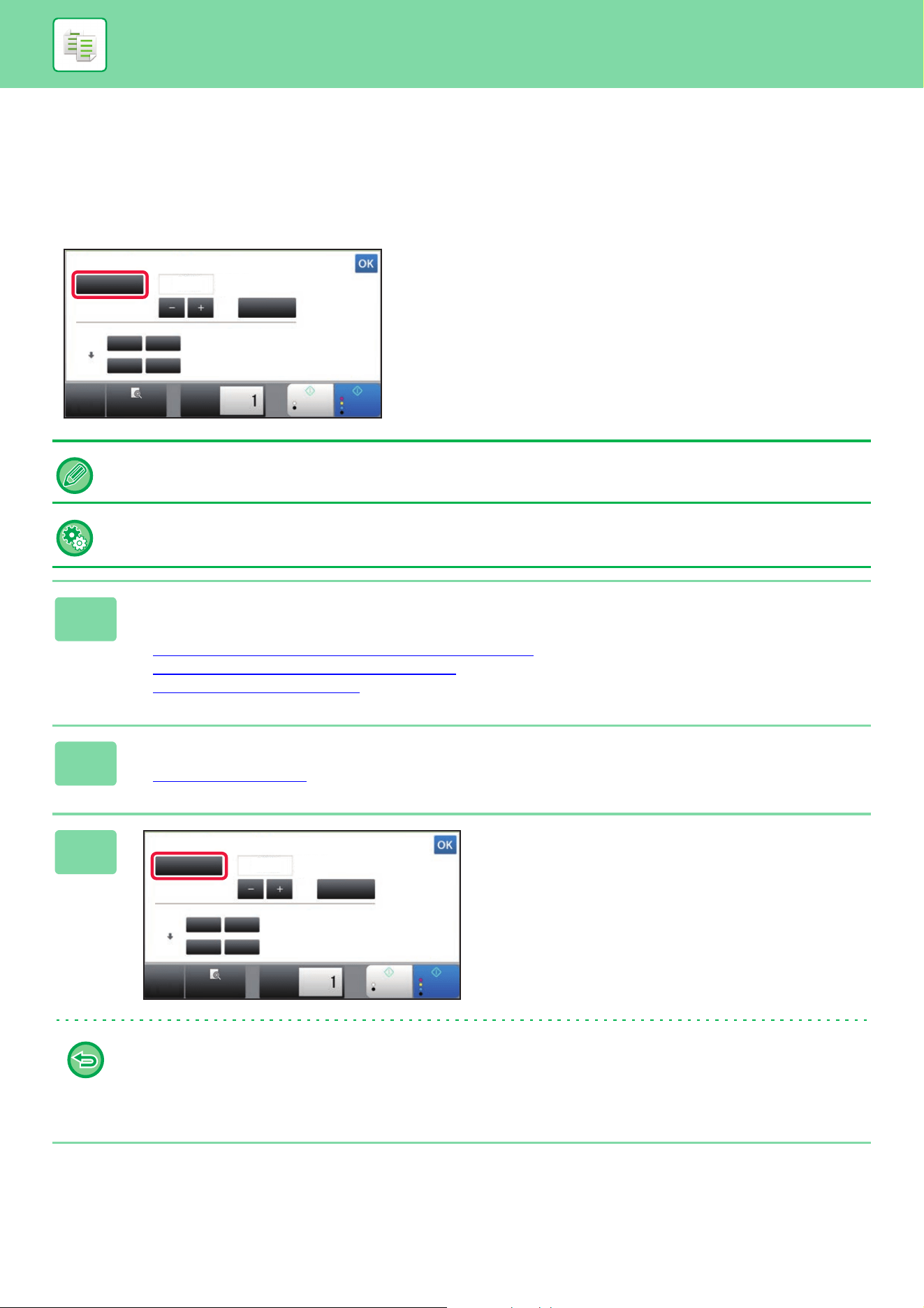
2-26
COPIER►BASIC PROCEDURE FOR MAKING COPIES
ENLARGE/REDUCE
AUTO RATIO SELECT
This section explains how to automatically select the appropriate ratio to meet the paper size when manually changing
the paper tray to make a copy on paper that has a size different from the original.
For a non-standard size original, the size must be entered in order to use Auto Image.
To change the default ratio:
In "Settings (administrator)", select [System Settings] → [Copy Settings] → [Initial Status Settings] → [Copy Ratio].
1
Manually select the paper tray, and place the original.
Place the original in the document feeder tray of the automatic document feeder, or on the document glass.
► SELECTING THE PAPER TRAY FOR COPYING (page 2-13)
► AUTOMATIC DOCUMENT FEEDER (page 1-90)
► DOCUMENT GLASS (page 1-92)
2
Tap the [Copy Ratio] key.
► COPY MODE (page 2-3)
3
Tap the [Auto Image] key.
The reduction or enlargement ratio is automatically selected
based on the original size and the selected paper size.
The automatically selected ratio will appear in the ratio
display.
• To cancel the Auto Ratio Selection setting:
Tap [Auto Image] to deselect it.
• To return the ratio to 100%:
Tap the [100%] key.
B/W
Start
Color
Start
Preview
Copies
Auto Image
Slightly Reduce
(3% Reduction)
Original
Paper
By Paper Size
8½x1111x17
8½x1111x17
100
( 25~200 )
%
CA
Copy Ratio
B/W
Start
Color
Start
Preview
Copies
Auto Image
Slightly Reduce
(3% Reduction)
Original
Paper
By Paper Size
8½x1111x17
8½x1111x17
100
( 25~200 )
%
CA
Copy Ratio
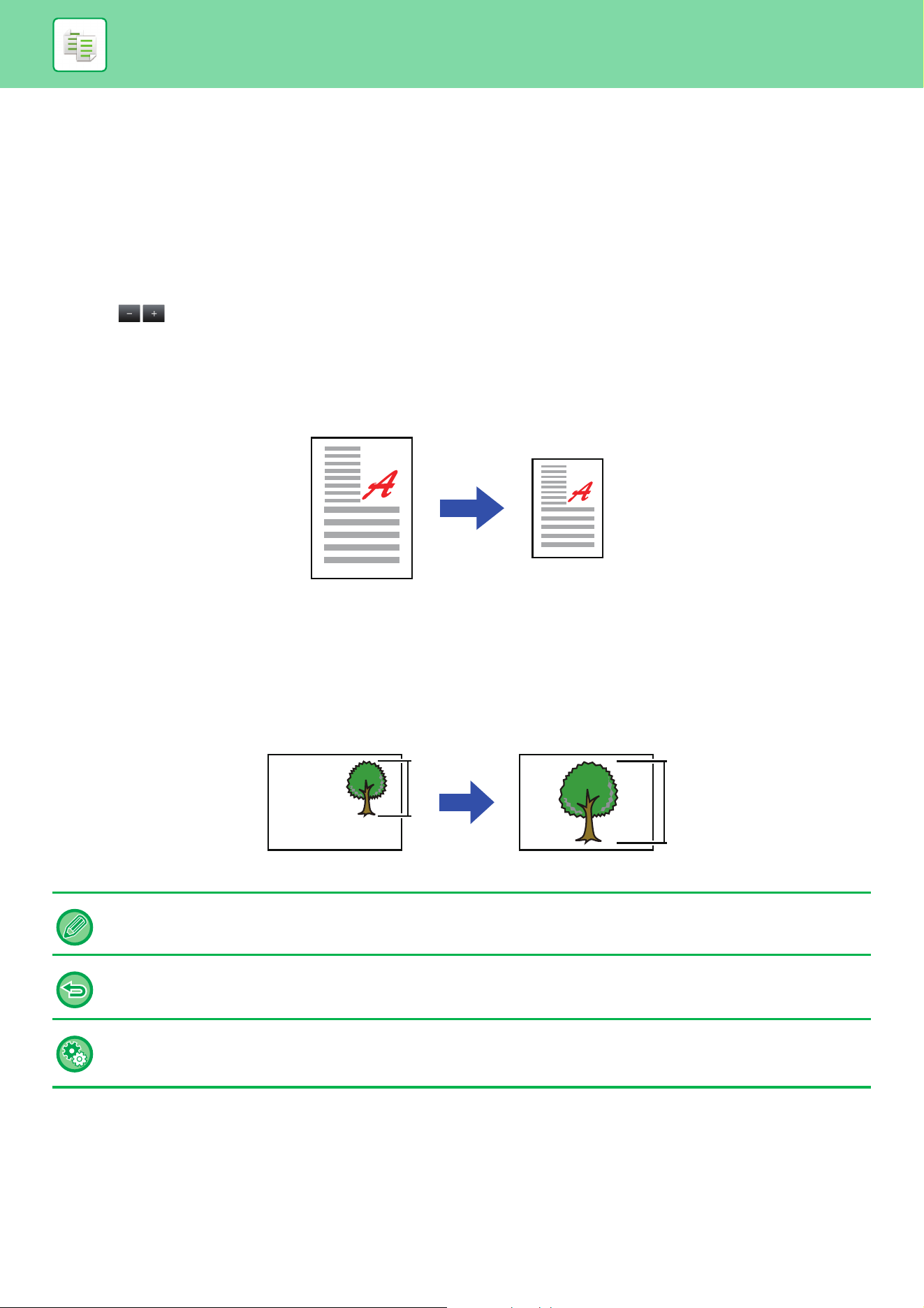
2-27
COPIER►BASIC PROCEDURE FOR MAKING COPIES
MANUAL RATIO SELECTION
This section explains how to specify any ratio when making a copy on paper that has a size different from the original or
changing the image size for copying.
The following three methods can be used to specify the ratio.
Using the preset ratio key
Specify any ratio by combination of preset ratio key, for which the enlargement and reduction ratio values are
pre-registered between the frequently used standard sizes, with the zoom key, which allows you to adjust the ratio in 1%
units like .
Up to two ratio values can be added to preset ratio keys, respectively for enlargement and reduction.
Specifying the paper size
Specify the paper sizes of the original and output to automatically obtain the appropriate ratio.
Specifying the image dimensions
Specify the image sizes of the original and output to automatically obtain the appropriate ratio.
To make a copy with the same ratio between the vertical and horizontal sizes, enter either one of the vertical and
horizontal sizes.
When the automatic document feeder is used, the vertical and horizontal ratio selection ranges are both between 25% to
200%.
To return the ratio to 100%:
Tap the [100%] key.
To add any ratio as a preset ratio:
In "Settings (administrator)", select [System Settings] → [Copy Settings] → [Condition Settings] → [Add or Change Extra
Preset Ratios]. To select the added preset ratio, tap the [Other Ratio] key.
64%
Original size: 11" x 17" Copy size: 8-1/2" × 11"
150%
Image size: 90mm Output size: 135mm
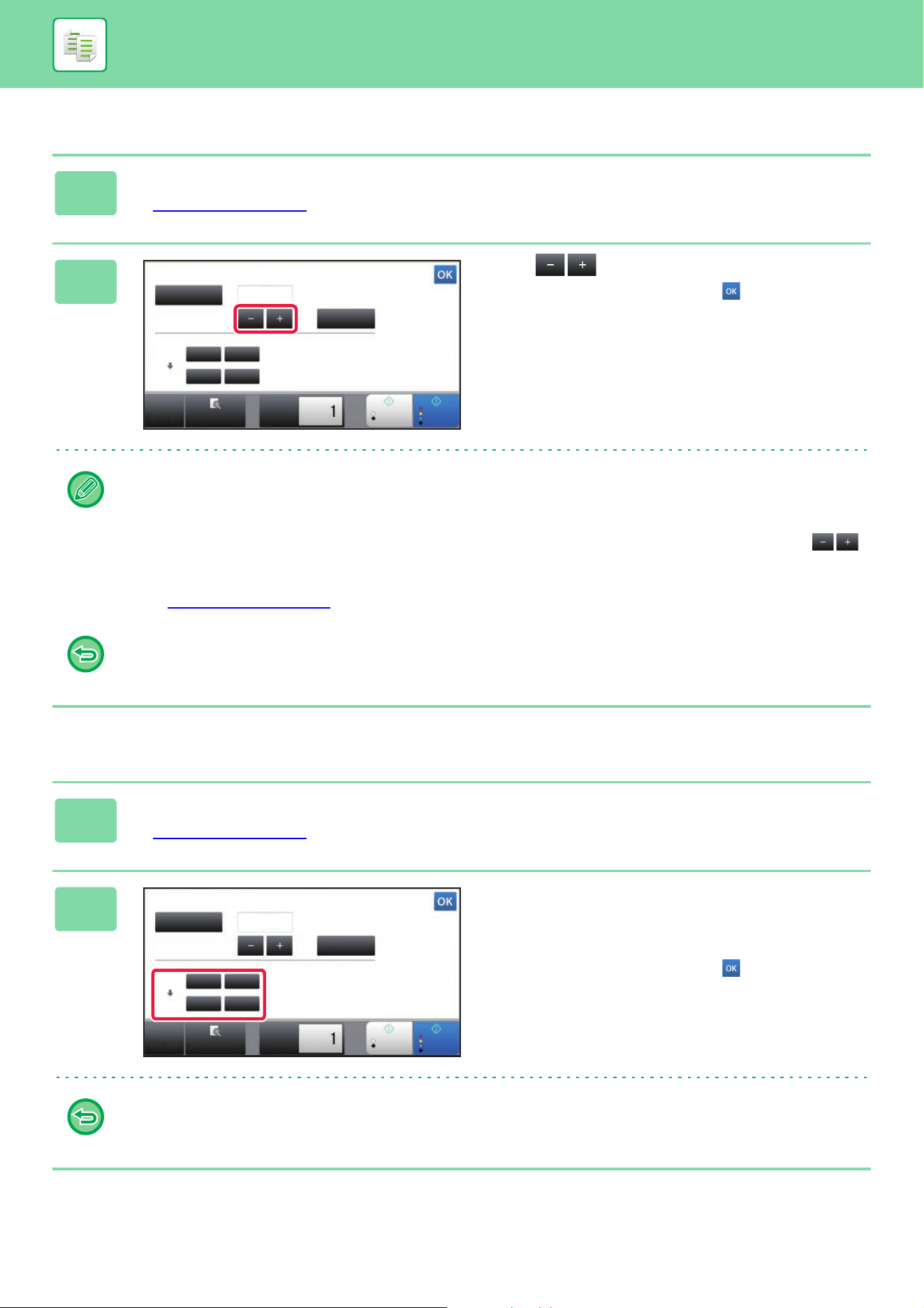
2-28
COPIER►BASIC PROCEDURE FOR MAKING COPIES
Using the preset ratio key
Specifying the paper size
1
Tap the [Copy Ratio] key.
► COPY MODE (page 2-3)
2
Tap to set the ratio.
After the settings are completed, tap .
Check that a paper size suitable for the ratio is selected.
• If you tap the [Slightly Reduce (3% Reduction)] key, the ratio will be set lower than the specified one by 3%.
In normal mode
• There are two setting screens. Use the [Other Ratio] key to switch between the screens.
• To quickly set the area, first specify a value close to the desired value by the numeric keys, then adjust it with .
• Up to two frequently used ratio values can be added to the preset ratio key, respectively for enlargement and
reduction.
► Copy Settings (page 7-77)
To cancel all settings:
Tap the [CA] key.
1
Tap the [Copy Ratio] key.
► COPY MODE (page 2-3)
2
Specify the original size (paper size of
the loaded original) and the copy size
(paper size of the copy output).
After the settings are completed, tap .
To cancel all settings:
Tap the [CA] key.
B/W
Start
Color
Start
Preview
Copies
Auto Image
Slightly Reduce
(3% Reduction)
Original
Paper
By Paper Size
8½x11
11x17
8½x1111x17
100
( 25~200 )
%
CA
Copy Ratio
B/W
Start
Color
Start
CA
Preview
Copies
Auto Image
Slightly Reduce
(3% Reduction)
Original
Paper
By Paper Size
Copy Ratio
8½x1111x17
8½x1111x17
100
( 25~200 )
%
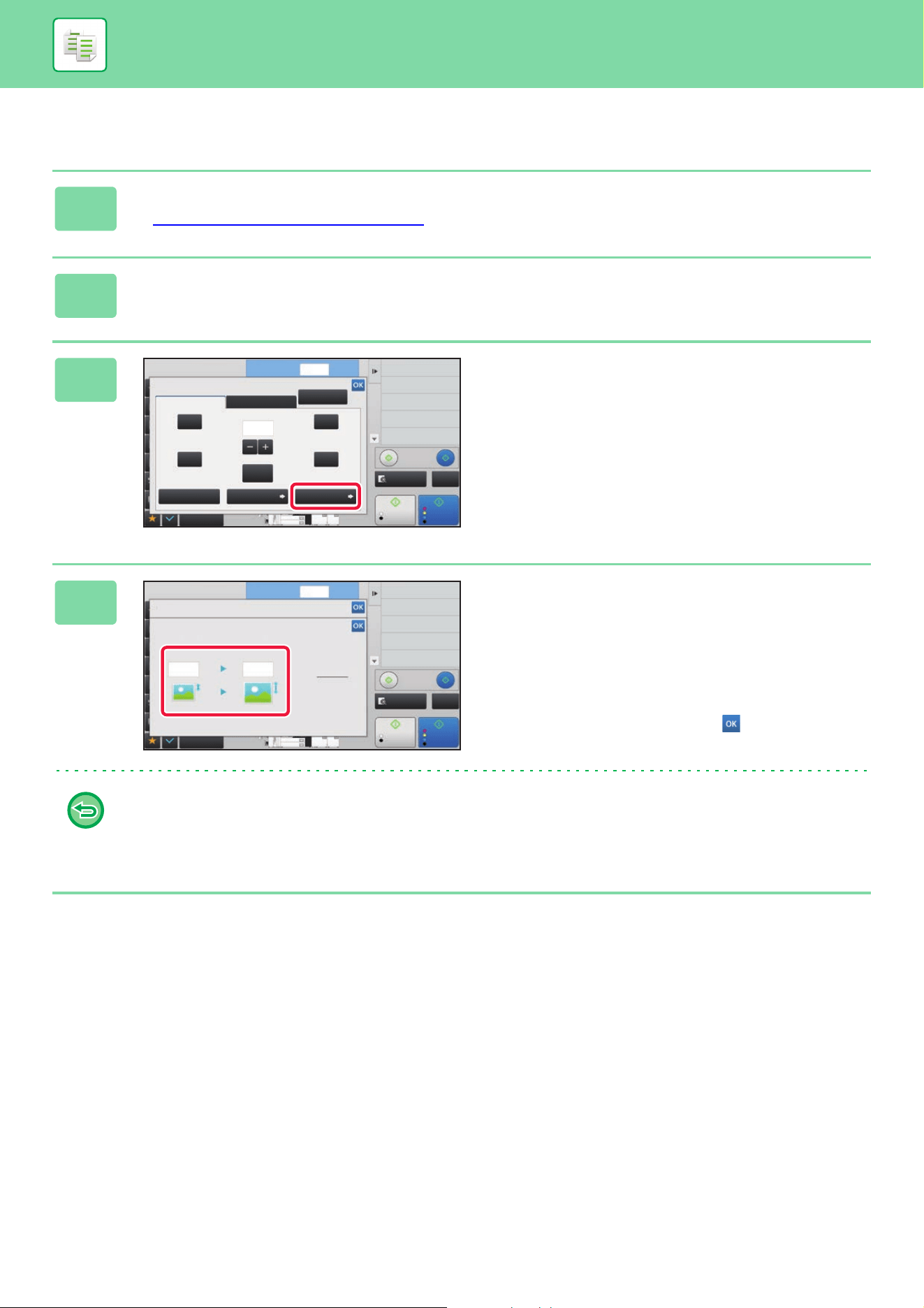
2-29
COPIER►BASIC PROCEDURE FOR MAKING COPIES
Specifying the image dimensions
1
Tap the [Detail] key to change to normal mode.
► Changing mode from each mode (page 2-5)
2
Tap the [Copy Ratio] key.
3
Tap the [by Size] key of the [Zoom] tab.
4
Specify the image size (dimensions of
the image to be enlarged or reduced)
and the output size (dimensions of the
enlarged and reduced images).
Tap the area of image size and output size, and enter the
sizes using the numeric keys.
After the settings are completed, tap .
• If you have entered an incorrect size:
Tap the [C] key, and then enter the correct size.
• To cancel all settings:
Tap the [CA] key.
( 25~200 )
%
Proof Copy
Start Start
Preview
Others
Other Ratio by Paper by Size
1
2-Sided Copy
Background Adjustment
Change Paper Feed Tray
Paper Select
Change Size/Direction.
Original
Copy Ratio
Slightly Reduce
(3% Reduction)
XY Zoom
Auto Image
Zoom
70%
81%
121%
115%
100%
11x17->8 1/2x11
8 1/2x14->8 1/2x11
8 1/2x11->5 1/2x8 1/2
11x17->8 1/2x14
5 1/2x8 1/2->8 1/2x11
8 1/2x14->11x17
8 1/2x11->11x17
100
No. of copies
CA
B/W
4
3
68
8½x11 8½x11
8½x14
11x17
Color
Start Start
Preview
2-Sided Copy
Background Adjustment
Change Paper Feed Tray
Paper Select
Change Size/Direction.
Original
Slightly Reduce
(3% Reduction)
Others
by Size
The copy ratio is calculated from specified sizes.
Enter the image size and the finished size.
Copy Ratio
Image Finished
Input Input
0
mm mm
1
CA
B/W
%
Copy Ratio
4
3
68
Proof Copy
No. of copies
8½x11 8½x11
8½x14
11x17
Color
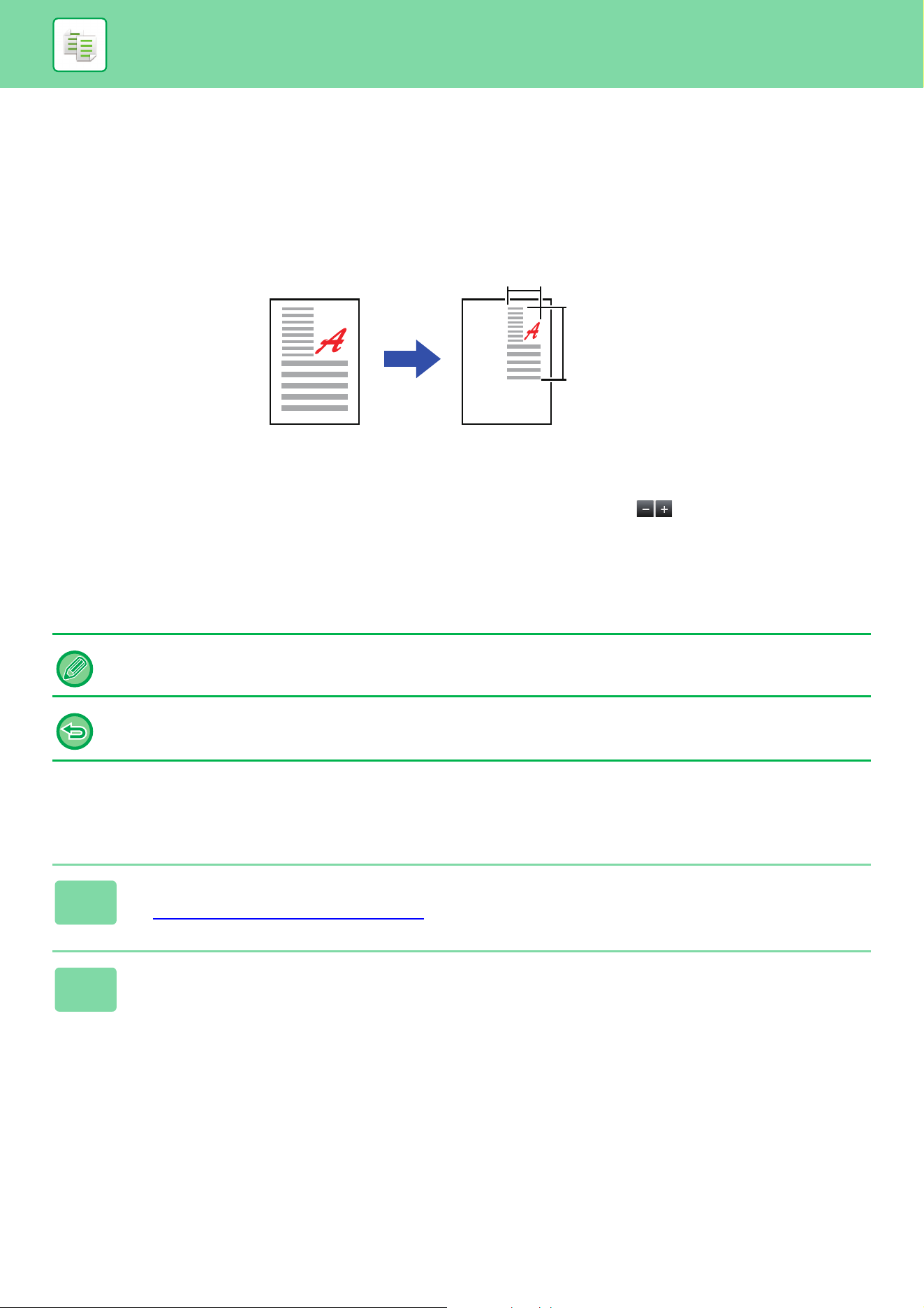
2-30
COPIER►BASIC PROCEDURE FOR MAKING COPIES
ENLARGING/REDUCING THE LENGTH AND WIDTH
SEPARATELY
This section explains how to individually specify the horizontal and vertical copy ratios.
When 50% is selected for the horizontal ratio and 70% is selected for the vertical ratio
The following two methods can be used to specify the ratio.
Using the preset ratio key
Specify any ratio by combination of preset ratio key, which is pre-registered, with the key, which allows you to
adjust the ratio in 1% units.
Specifying the image dimensions
Specify the image sizes of the original and output to automatically obtain the appropriate ratio.
Enter the vertical and horizontal sizes.
Using the preset ratio key
When the automatic document feeder is used, the vertical and horizontal ratio selection ranges are both between 25% to
200%.
To cancel the XY zoom setting:
Tap the [Zoom] tab or the [CA] key.
1
Tap the [Detail] key to change to normal mode.
► Changing mode from each mode (page 2-5)
2
Tap the [Copy Ratio] key, and then tap the [XY Zoom] tab.
50%
70%
2-31
COPIER►BASIC PROCEDURE FOR MAKING COPIES
Specifying the image dimensions
3
Tap the [X] key, and set the X
(horizontal) ratio.
• To quickly set the ratio, first specify a value close to the desired one, then adjust it with .
• Tap each area of the X (horizontal) and Y (vertical) directions, and enter the sizes using the numeric keys.
4
Tap the [Y] key, and set the Y (vertical) ratio in the same way as the [X] key.
After the settings are completed, tap .
Check that a paper size suitable for the ratio is selected.
1
Tap the [Detail] key to change to normal mode.
► Changing mode from each mode (page 2-5)
2
Tap the [Copy Ratio] key, and then tap the [XY Zoom] tab.
3
Tap the [by Size] key.
4
3
68
Proof Copy
8½x11 8½x11
8½x14
11x17
Start Start
Preview
Others
2-Sided Copy
Background Adjustment
Change Paper Feed Tray
Paper Select
Change Size/Direction.
Original
Copy Ratio
XY ZoomZoom
1
Auto Image
by Size
50%
64%
77%
129%
200%
400%
100%
Y
X
( 25~200 )
%
( 25~200 )
%
No. of copies
CA
B/W
100
100
Color
2-32
COPIER►BASIC PROCEDURE FOR MAKING COPIES
4
Specify the X and Y dimensions of the
image size and those of the output
size.
Check that a paper size suitable for the ratio is selected.
After the settings are completed, tap .
Tap the image size and output size areas, and enter the sizes using the numeric keys.
• If you have entered an incorrect size:
Tap the [C] key on the numeric keys that appears when you tap the entry area, and set to the correct size.
• To cancel all settings:
Tap the [CA] key.
4
3
68
Proof Copy
%
%
8½x11 8½x11
8½x14
11x17
Start Start
Preview
2-Sided Copy
Background Adjustment
Change Paper Feed Tray
Paper Select
Change Size/Direction.
Original
Others
Copy Ratio
by Size
The copy ratio is calculated from specified sizes.
Enter the image size and the finished size.
Copy Ratio
Image Output
Input Input
0
0
mm mm
Input Input
mm mm
1
No. of copies
CA
B/W
Slightly Reduce
(3% Reduction)
Color
2-33
COPIER►BASIC PROCEDURE FOR MAKING COPIES
SELECTING THE ORIENTATION AND SIZE
OF THE ORIGINAL
When the original size is a non-standard size or is not detected correctly, manually specify the original size.
Set the orientation of the image to ensure that the orientation of the placed original is correctly recognized.
Specifying the orientation of the original
By specifying the starting side (top or left side) of the placed original, the orientation of the original will be correctly
recognized.
Finishing position settings and N-Up layout settings are specified using the recognized orientation.
Specifying the orientation and size of an inch-size original
• Set the orientation and size of the original before scanning the original.
• The original size is set in normal mode.
1
Tap the [Original] key to set the orientation of the original.
► COPY MODE (page 2-3)
2
Tap the [Detail] key to change to normal mode.
► Changing mode from each mode (page 2-5)
3
Tap the [Original] key.
4
Tap the [Inch] tab.
CA
Preview
Copies
Image
Orientation
Original
B/W
Start
Color
Start
Preview
Start
Original
Others
Auto
Direct Entry
InchAB Custom Size
Skip Blank Page in Original
Copy Ratio
Enlarge/Reduce Copy
Blank Page Skip
Background Adjustment
2-Sided Copy
Color Mode
A5
A5R
216 x 340
Color
Start
1
CA
B/W
4
3
68
Proof Copy
Image Orientation
No. of copies
8½x11 8½x11
8½x14
11x17
B5R B4
A4 A3
B5 A4R
8½x11
216 x 343
In Easy mode In Normal mode
2-34
COPIER►BASIC PROCEDURE FOR MAKING COPIES
Specifying the orientation and size of an AB-size original
5
Tap the appropriate original size key.
After the settings are completed, tap .
1
Tap the [Original] key to set the orientation of the original.
► COPY MODE (page 2-3)
2
Tap the [Detail] key to change to normal mode.
► Changing mode from each mode (page 2-5)
3
Tap the [Original] key.
4
Tap the [AB] tab.
5
Tap the appropriate original size key.
After the settings are completed, tap .
Start
Color
Start
B/W
3
4 11x17
8½x14
8½x11
Proof Copy
Preview CA
Others
1
No. of copies
Original
Auto
Direct EntryInchAB Custom Size
8½x11
Image Orientation
5 ½x8 ½ 8 ½x11R 11x17
5 ½x8 ½R 8 ½x13
8 ½x11 8 ½x14
8 ½x13
2
/
5
Skip Blank Page in Original
Copy Ratio
Enlarge/Reduce Copy
Blank Page Skip
2-Sided Copy
Color Mode
Background Adjustment
4
3
68
8½x11 8½x11
8½x14
11x17
4
3
68
Proof Copy
8½x11 8½x11
8½x14
11x17
Preview
Start
Original
Others
Auto
Direct Entry
InchAB Custom Size
Image Orientation
Skip Blank Page in Original
Copy Ratio
Enlarge/Reduce Copy
Blank Page Skip
Background Adjustment
2-Sided Copy
Color Mode
A5
216 x 343
B5R B4
A5R A4 A3
B5 A4R 216 x 340
Start
8½x11
1
No. of copies
CA
B/W Color
2-35
COPIER►BASIC PROCEDURE FOR MAKING COPIES
Specifying the orientation and size of a non-standard size originals
1
Tap the [Original] key to set the orientation of the original.
► COPY MODE (page 2-3)
2
Tap the [Detail] key to change to normal mode.
► Changing mode from each mode (page 2-5)
3
Tap the [Original] key.
4
Tap the [Direct Entry] tab.
5
Specify the original size.
• Tap the areas displaying width and height sizes respectively, and enter the sizes using the numeric keys.
• It is convenient to use to finely adjust the entered size.
6
Tap the [Execute] key.
On the base screen, check that the specified size is displayed on the [Original] key.
After the settings are completed, tap .
4
3
68
Proof Copy
8½x11 8½x11
8½x14
11x17
Preview
Start
Original
Others
Auto
Direct Entry
InchAB Custom Size
Skip Blank Page in Original
Copy Ratio
Enlarge/Reduce Copy
Blank Page Skip
Background Adjustment
2-Sided Copy
Color Mode
Start
8½x11
11
11
(1
῀
17)
inch
X
Y
Execute
1
CA
B/W
Image Orientation
No. of copies
(1
῀
17)
inch
Color
2-36
COPIER►BASIC PROCEDURE FOR MAKING COPIES
STORING FREQUENTLY USED ORIGINAL
SIZES
Store the frequently used non-standard original sizes. This section explains how to store, retrieve, modify, and delete
non-standard original sizes.
Storing original sizes (Modify/Delete)
• The stored original size will be retained even if the main power is turned off.
• A total of up to 12 non-standard original sizes can be registered for copying and image sending.
• The added original sizes will also appear in other modes.
1
Tap the [Detail] key to change to normal mode.
► Changing mode from each mode (page 2-5)
2
Tap the [Original] key.
3
Tap the [Custom Size] tab.
4
Tap [Store/Delete Original Size] on the
action panel.
Preview
Start
Original
Others
Auto
Direct Entry
InchAB Custom Size
Skip Blank Page in Original
Blank Page Skip
Background Adjustment
2-Sided Copy
Color Mode
Store/Delete
Original Size
Start
8½x11
1
CA
B/W
4
3
68
Proof Copy
Image Orientation
No. of copies
8½x11 8½x11
8½x14
11x17
Color
2-37
COPIER►BASIC PROCEDURE FOR MAKING COPIES
5
Tap a key ( ) for storing a
custom original size.
Tap a key that does not show a size.
To modify or delete a previously stored key:
Tap the key that you want to modify or delete. The following screen will appear.
• To modify the key, tap the [Modify] key and go to the next step.
• To delete the key, tap the [Delete] key. Make sure that the original size has been cleared and tap the key.
6
Specify the original size.
Tap the areas displaying width and height sizes respectively,
and enter the sizes using the numeric keys.
It is convenient to use to finely adjust the entered size.
7
Tap the [Execute] key
After the settings are completed, tap the key, and check that the key of the size stored on the original screen is
added properly. After you have checked it, tap .
To cancel the operation:
Tap the [CA] key.
4
3
68
Proof Copy
8½x11 8½x11
8½x14
11x17
Preview
Start
Store/Delete
Select the size key to store/delete
the custom original size.
Others
Skip Blank Page in Original
Copy Ratio
Enlarge/Reduce Copy
Blank Page Skip
Background Adjustment
2-Sided Copy
Color Mode
Start
1
CA
B/W
Original
No. of copies
Color
Preview
Start
CA
Store/Delete
Select the size key to store/delete
the custom original size.
Others
Skip Blank Page in Original
Copy Ratio
Enlarge/Reduce Copy
Blank Page Skip
Background Adjustment
2-Sided Copy
Colour Mode
Start
X420 Y297
B/W
A custom size has already been stored
in this location.
Delete AmendCancel
Original
4
3
68
Proof Copy
8½x11 8½x11
8½x14
11x17
Color
4
3
68
Proof Copy
1
8½x11 8½x11
8½x14
11x17
Preview
Start
Color
Start
No. of copies
Skip Blank Page in Original
Copy Ratio
Enlarge/Reduce Copy
Blank Page Skip
Background Adjustment
2-Sided Copy
Color Mode
Size Input
Enter Size to Register.
Others
11
17
(1
῀
11 5/8)
inch
(1
῀
17)
inch
X
Y
OK
CA
B/W
Original
2-38
COPIER►BASIC PROCEDURE FOR MAKING COPIES
Retrieving a stored original size
1
Tap the [Detail] key to change to normal mode.
► Changing mode from each mode (page 2-5)
2
Tap the [Original] key.
3
Tap the [Custom Size] tab.
4
Tap the key of the original size that
you wish to retrieve.
After selecting the key of the original size, tap the key.
On the base screen, check that the specified size is
displayed on the [Original] key.
To cancel the operation
Tap the [CA] key.
4
3
68
Proof Copy
8½x11 8½x11
8½x14
11x17
Preview
Start
Original
Others
Auto
Direct Entry
InchAB Custom Size
Image Orientation
No. of copies
Skip Blank Page in Original
Blank Page Skip
Background Adjustment
2-Sided Copy
Color Mode
Store/Delete
Original Size
Start
8½x11
1
X420 Y297
CA
B/W Color
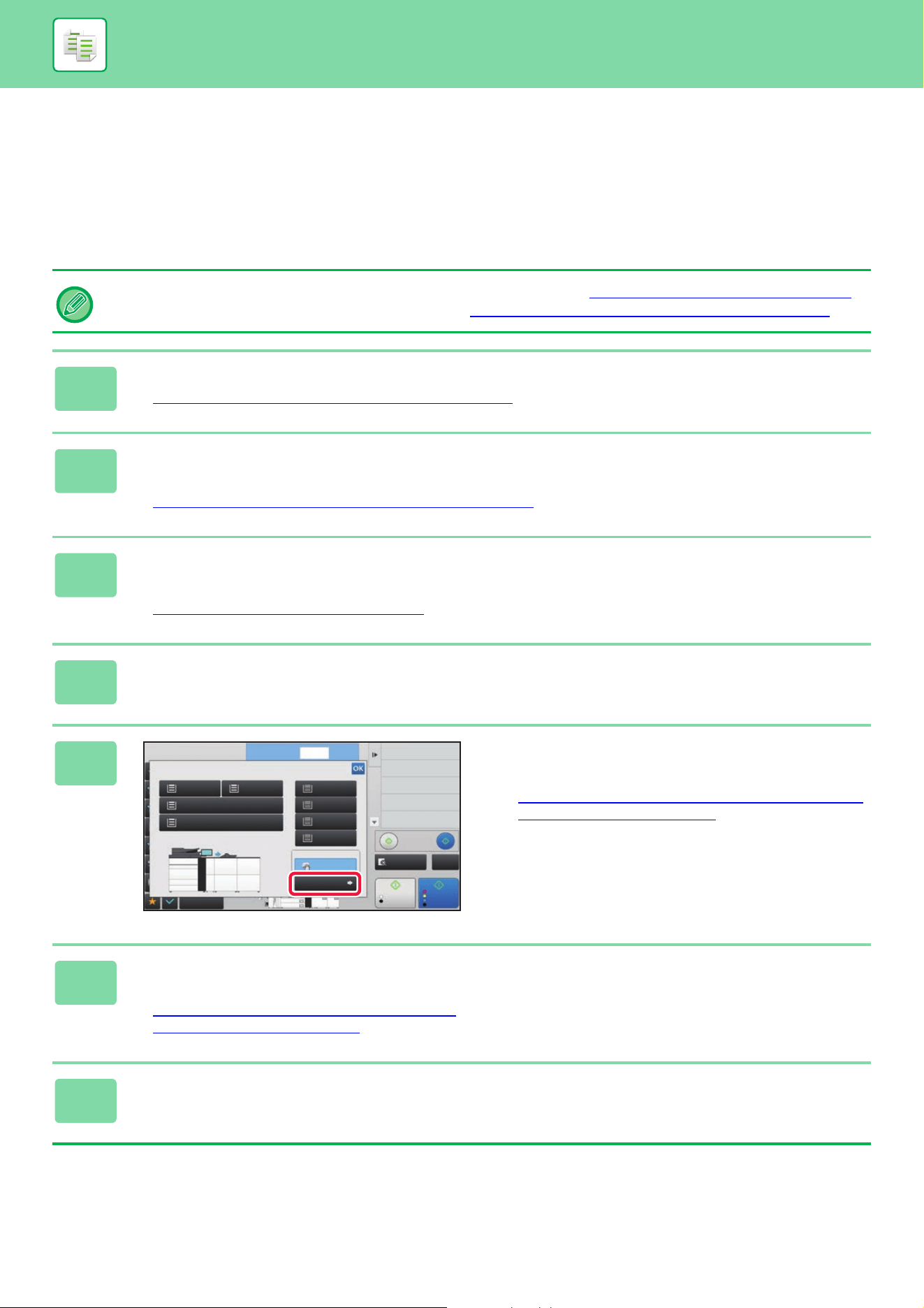
2-39
COPIER►BASIC PROCEDURE FOR MAKING COPIES
MAKING COPIES USING THE BYPASS TRAY
MAKING COPIES USING THE BYPASS TRAY
In addition to plain paper, the bypass tray allows you to make copies on transparency film, envelopes, tab paper, and
other special media.
For detailed information on paper that can be loaded into the bypass tray, see "APPLICABLE PAPER TYPES (page 1-61)".
For precautions on loading paper into the bypass tray, see "LOADING PAPER INTO THE BYPASS TRAY (page 1-81)
".
1
Load paper into the bypass tray.
► LOADING PAPER INTO THE BYPASS TRAY (page 1-81)
2
Tap the [Paper Select] key, and tap the bypass tray key.
Each tray key displays the size and type of the loaded paper.
► SELECTING THE PAPER TRAY FOR COPYING (page 2-13)
3
To select more detailed settings, tap the [Detail] key to switch to normal
mode.
► Changing mode from each mode (page 2-5)
4
Tap the [Paper Select] key.
5
Tap the [Type and Size] key, and select
the size and type of the paper.
► SPECIFYING A TYPE AND SIZE OF PAPER LOADED
ON BYPASS TRAY (page 2-40)
6
Place the original.
Place the original in the document feeder tray of the automatic document feeder, or on the document glass.
► AUTOMATIC DOCUMENT FEEDER (page 1-90)
► DOCUMENT GLASS (page 1-92)
7
Tap the [Color Start] or [B/W Start] key to start copying.
Paper Select
4
3
21
8½x11
Plain 1
8½x11
Plain 1
8½x11
Plain 1
8½x11
8
Plain 1
8½x11
Plain 1
8½x11
7
Plain 1
8½x11
6
Plain 1
8½x11
5
Plain 1
8½x11
Plain 1
8½x11
Type and Size
Bypass Tray
Large Capacity TrayPaper Tray
12
4
3
57
68
Preview
Start
Others
Shift Position to Have Margin
Copy Ratio
Enlarge/Reduce Copy
Margin Shift
Change Size/Direction.
Original
2-Sided Copy
Change Type and Size of
Tray Specified Currently
Start
CA
B/W
11x17 11x1711x174
3
8½x14
68
Proof Copy
1
No. of copies
Color
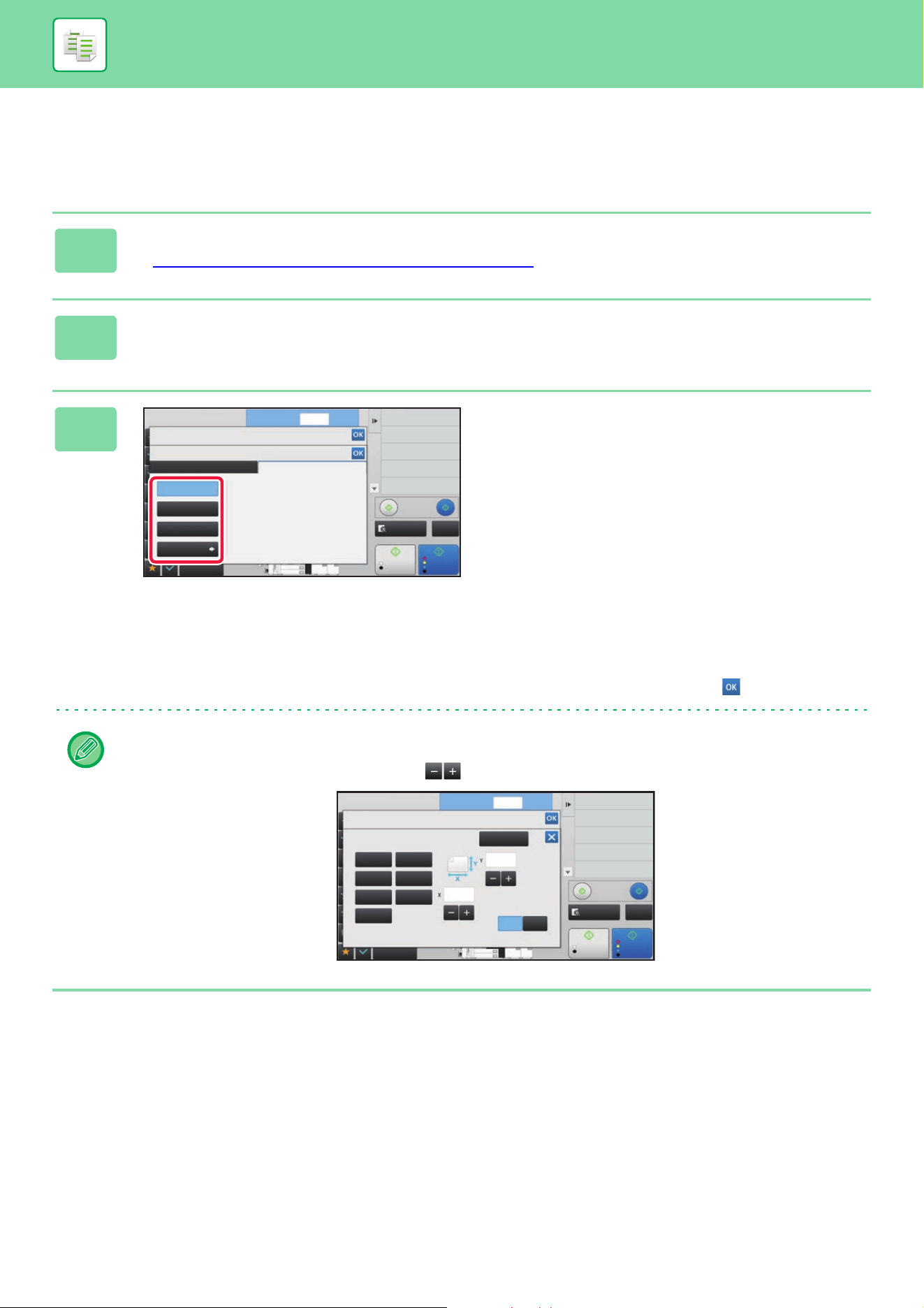
2-40
COPIER►BASIC PROCEDURE FOR MAKING COPIES
SPECIFYING A TYPE AND SIZE OF PAPER LOADED ON
BYPASS TRAY
1
Tap the [Paper Select] key, and tap the bypass tray key.
► SELECTING THE PAPER TRAY FOR COPYING (page 2-13)
2
Tap the [Type and Size] key, and tap the key that meets the type of the loaded
paper.
3
Tap the [Size] tab, and tap the key that
meets the size of the loaded paper.
• [Auto-AB] key:
Automatically detects the appropriate AB paper size when
loading paper such as A4 or B5.
• [Auto-Inch] key:
Automatically detects the appropriate inch paper size
when loading paper such as 8-1/2"x11".
• [Size Set] key:
Tap this key to manually specify the paper size that is not
detected automatically.
• [Direct Entry] key:
Tap this key to enter a numeric value for the size of the
loaded paper.
After the settings are completed, tap .
To directly enter a paper size
Tap the [inch] key to set a paper size in inches, or tap the [AB] key to set it in millimeters.
After you have entered the paper size using the key, tap the [Execute] key.
Preview
Start
Others
Shift Position to Have Margin
Copy Ratio
Enlarge/Reduce Copy
Margin Shift
Change Size/Direction.
Original
2-Sided Copy
Start
CA
B/W
11x17 11x1711x174
3
8½x14
68
Proof Copy
1
No. of copies
Color
Paper Select
Type/Size of Bypass
Type: Size: Auto-ABPlain 1
Auto-AB
Auto-Inch
Size Set
Direct Entry
Auto-AB
Auto-Inch
A3W(12x18),A3,A4W(9x12),A4,A4R,A5R,B4,
B5,B5R,11x17,8½ x11
12x18(11x17W),11x17, 8½ x14, 8½ x11,
8½ x11R,5½ x 8½R,7½ x 10½
R,11x17,8½x11,8½x14,5½x8½
Preview
Start
Others
Shift Position to Have Margin
Copy Ratio
Enlarge/Reduce Copy
Margin Shift
Change Size/Direction.
Original
2-Sided Copy
Start
CA
B/W
A3 A3A34
3B4
68
Proof Copy
1
Paper Select
Direct Entry
( 4 ~ 13 )
inch
11
17 ( 5 1/2 ~ 19 1/8 )
inch
Execute
AB inch
X17 Y11
X17 Y11
X17 Y11
X17 Y11
X17 Y11
X17 Y11X17 Y11
No. of copies
Color
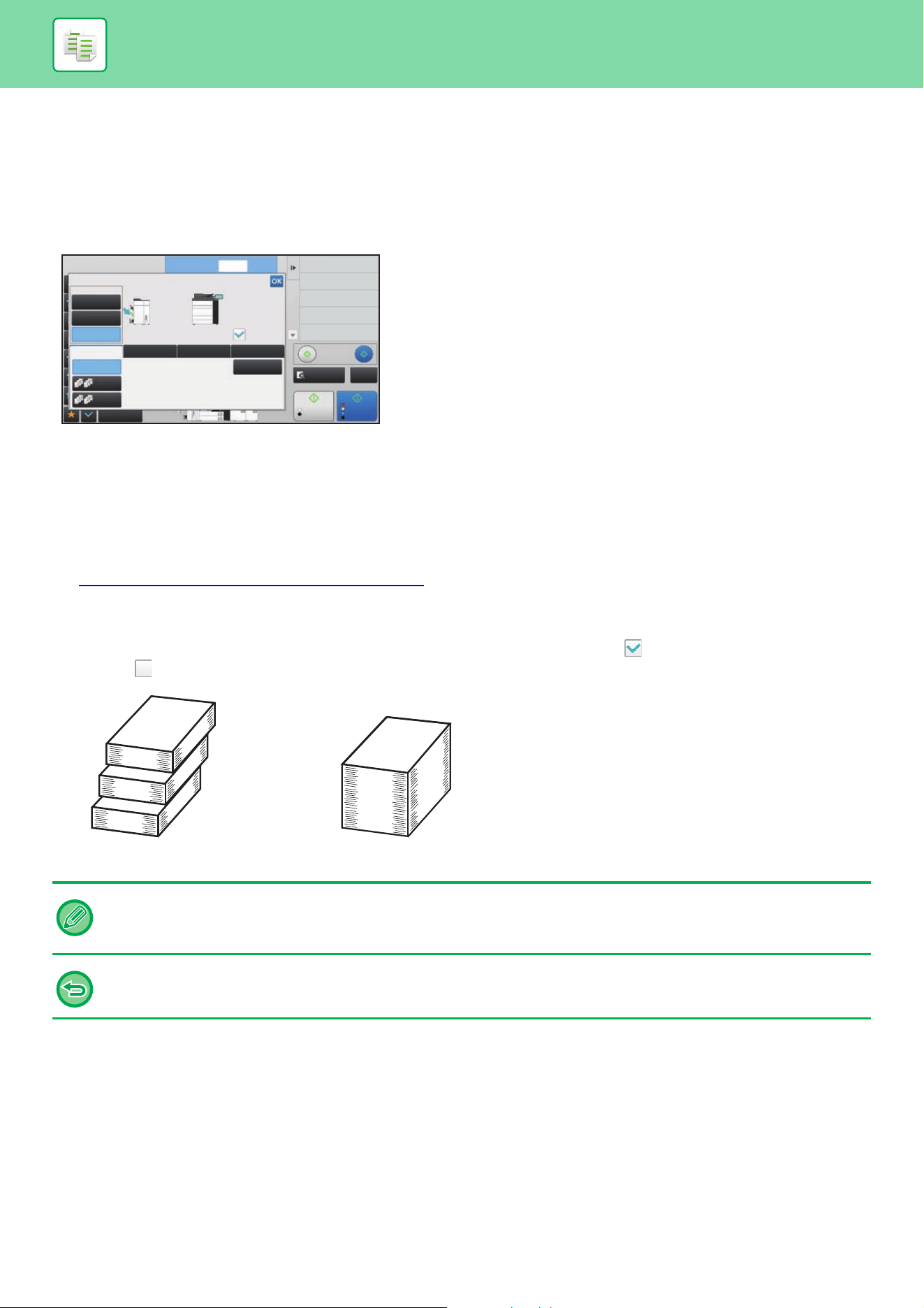
2-41
COPIER►BASIC PROCEDURE FOR MAKING COPIES
OUTPUT
Configure the output settings for copies using Sort, Group, Offset, Separator Page, Staple, Punch, or Fold. Also specify
the output destination of copies.
You can tap the [Output] key in normal mode to configure settings for all output functions.
Settings for the staple and punch functions can also be configured from simple mode.
Output Tray
Specify the destination to output copies.
If a finisher (100-sheet stapling) or saddle stitch finisher (100-sheet stapling) is installed, you can select [Upper Tray],
[Middle Tray], or [Lower Tray].
► CHANGING OUTPUT DESTINATION (page 2-43)
Offset
This function outputs copies while shifting them set by set. Setting the checkbox to enables the offset function, and
setting it to
disables the function.
• This function is available when a finisher or saddle stitch finisher is installed and [Upper Tray] or [Lower Tray] is selected
as the output tray.
• The offset can be used with a custom size paper.
Selecting the staple function clears the Offset checkmark automatically.
Preview
Start
Others
Start
CA
B/W
4
3
68
Proof Copy
1
No. of copies
1
Output Tray
Output
Lower Tray
Auto
Default Settings
Offset
Middle
Tray
Punch
Separator
Page
FoldStaple
Upper Tray
Group
Sort
Shift Position to Have Margin
Erase
Erase Shadow Around
Margin Shift
Put Multiple Pages in A Page
N-Up
Change Size/Direction.
Original
2-Sided Copy
8½x11 8½x11
8½x14
11x17
Color
[Output] screen of normal mode
Offset enabled Offset disabled
2-42
COPIER►BASIC PROCEDURE FOR MAKING COPIES
Separator Page
This function inserts separator pages for every specified number of copies or for every job before they are output.
► INSERTING SEPARATOR PAGES BETWEEN COPIES OR JOBS (page 2-44)
Sort/Group
Select the sorting method when copying the scanned original.
"Sort" sorts the scanned original on a set basis, and outputs them. "Group" sorts the scanned original on a page basis,
and outputs them.
► SORT/GROUP SETTING (page 2-46)
Staple
Each set of copies can be stapled, or the sheets can be folded at the center and stapled.
► Stapling each set of sorted copies (page 2-50)
► Saddle stitching for sorted copies (page 2-51)
Punch
This function punches copies and outputs them.
► PUNCH SETTINGS (page 2-53)
Fold
Copies can be folded and output.
► FOLDING OUTPUT PAPER (page 2-55)
• The staple function is available only when the finisher or saddle stitch finisher is installed.
• The saddle stitch function is available only when the saddle
stitch finisher is installed.
The punch function is available only when the punch module is installed.
The fold function is available only when the saddle
stitch finisher or folding unit is installed.
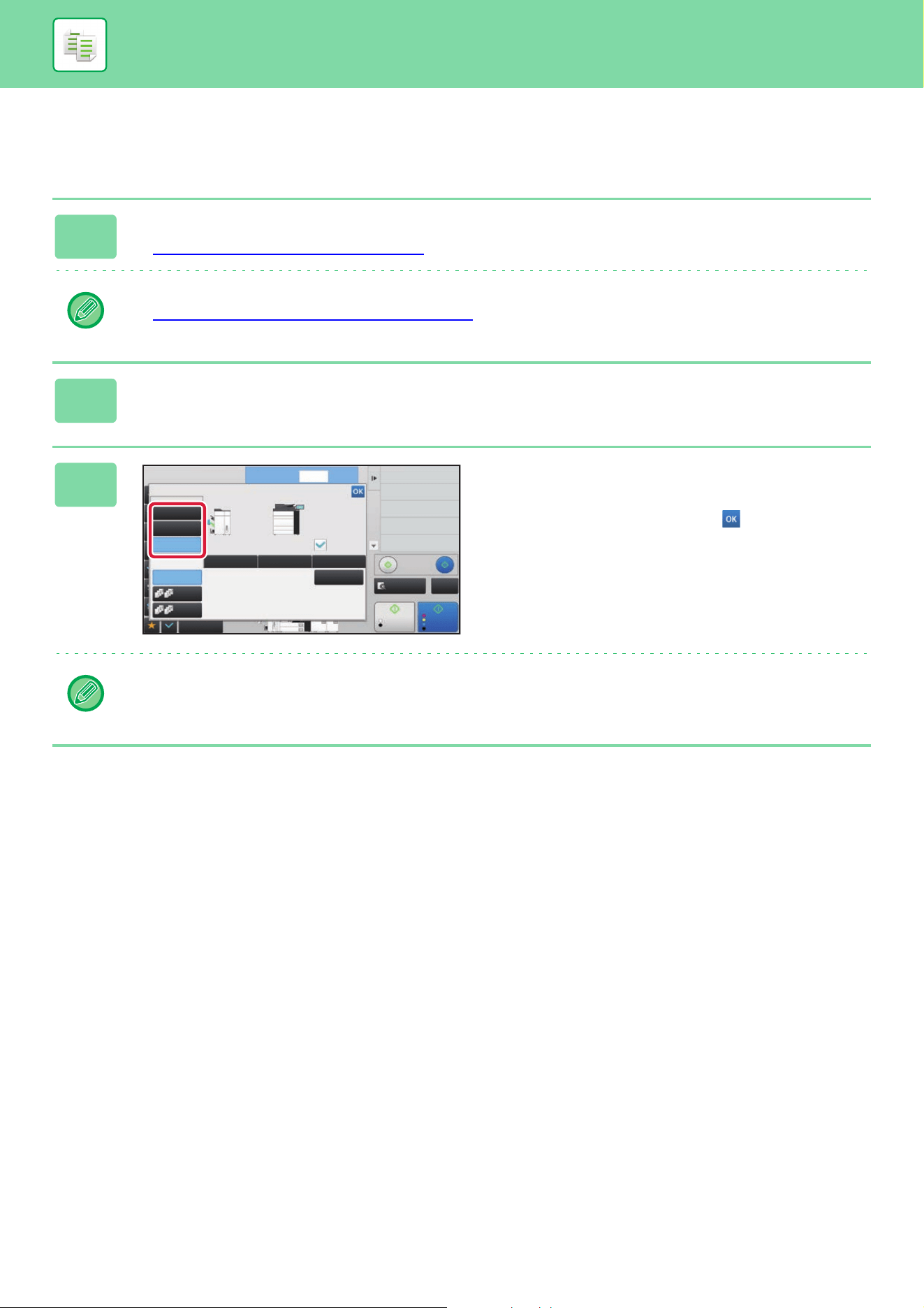
2-43
COPIER►BASIC PROCEDURE FOR MAKING COPIES
CHANGING OUTPUT DESTINATION
Specify the destination to output copies.
1
Tap the [Detail] key to change to normal mode.
► Changing mode from each mode (page 2-5)
Tap the [Original] key and specify the orientation of the original to have the orientation be correctly recognized.
► Specifying the orientation of the original (page 2-33)
2
Tap the [Output] key.
3
Select the output tray from "Output
Tray".
After the settings are completed, tap .
If a finisher (100-sheet stapling) or saddle stitch finisher (100-sheet stapling) is installed, select the [Upper Tray], [Middle
Tray] or [Lower Tray] key.
Start Start
B/W
Preview
Others
CA
4
3
68
Proof Copy
8½x11 8½x11
8½x14
11x17
1
Color
Output
Auto
Offset
Punch FoldStaple
Group
Sort
No. of copies
Output Tray
Lower Tray
Default Settings
Middle
Tray
Separator
Page
Upper Tray
Shift Position to Have Margin
Erase
Erase Shadow Around
Margin Shift
Change Size/Direction.
Original
2-Sided Copy
Put Multiple Pages in A Page
N-Up
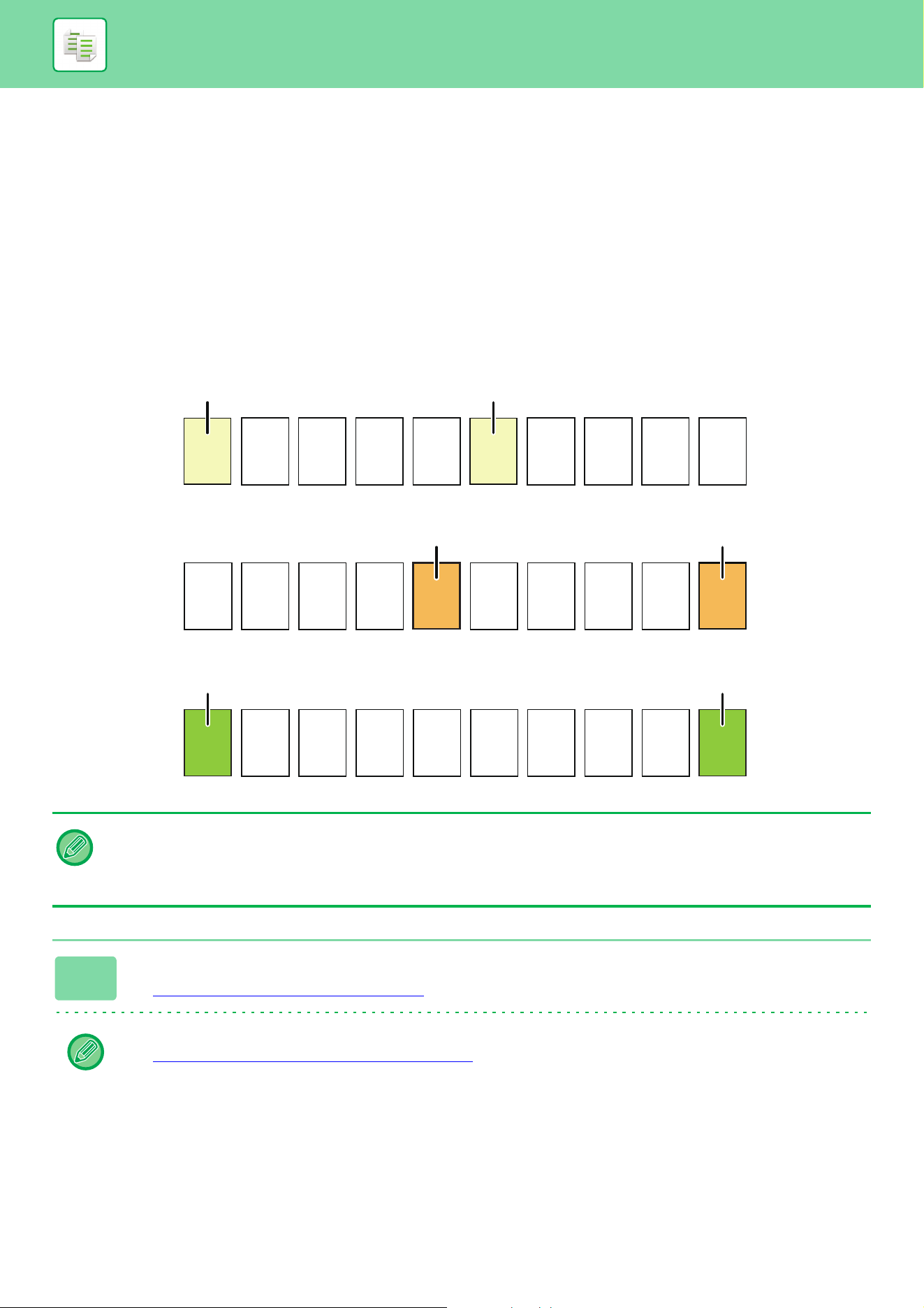
2-44
COPIER►BASIC PROCEDURE FOR MAKING COPIES
INSERTING SEPARATOR PAGES BETWEEN COPIES
OR JOBS
This function inserts separator pages between each set of copies or between each job.
When you insert separator pages between sets of copies, you can specify whether to insert the separator page before or
after each set. You can also specify the number of copies that makes one set.
When you insert separator pages between jobs, you can specify whether to insert a separator page before or after each
job.
Separator page insertion examples
In the following examples, four copies of a two-page original are output.
Inserting a separator page before each set of two copies
Inserting a separator page after each set of two copies
Inserting separator pages before and after a job
• Even when this function is enabled, the Sort/Group, Staple, Punch, Z-Fold, and Half Fold functions are not applied to
separator pages.
• Combinations of Saddle Stitch, Saddle Fold, C-Fold, Accordion Fold, Double Fold, and Trimmer cannot be used.
• The Offset function, if enabled, is also applied to separator pages.
1
Tap the [Detail] key to change to normal mode.
► Changing mode from each mode (page 2-5)
Tap the [Original] key and specify the orientation of the original to have the orientation be correctly recognized.
► Specifying the orientation of the original (page 2-33)
1 12 2 1 2 1 2
Insert before each set Insert before each set
1 12 2 1 2 1 2
Insert after each set Insert after each set
1 12 2 1 2 1 2
Insert Before Job Insert After Job
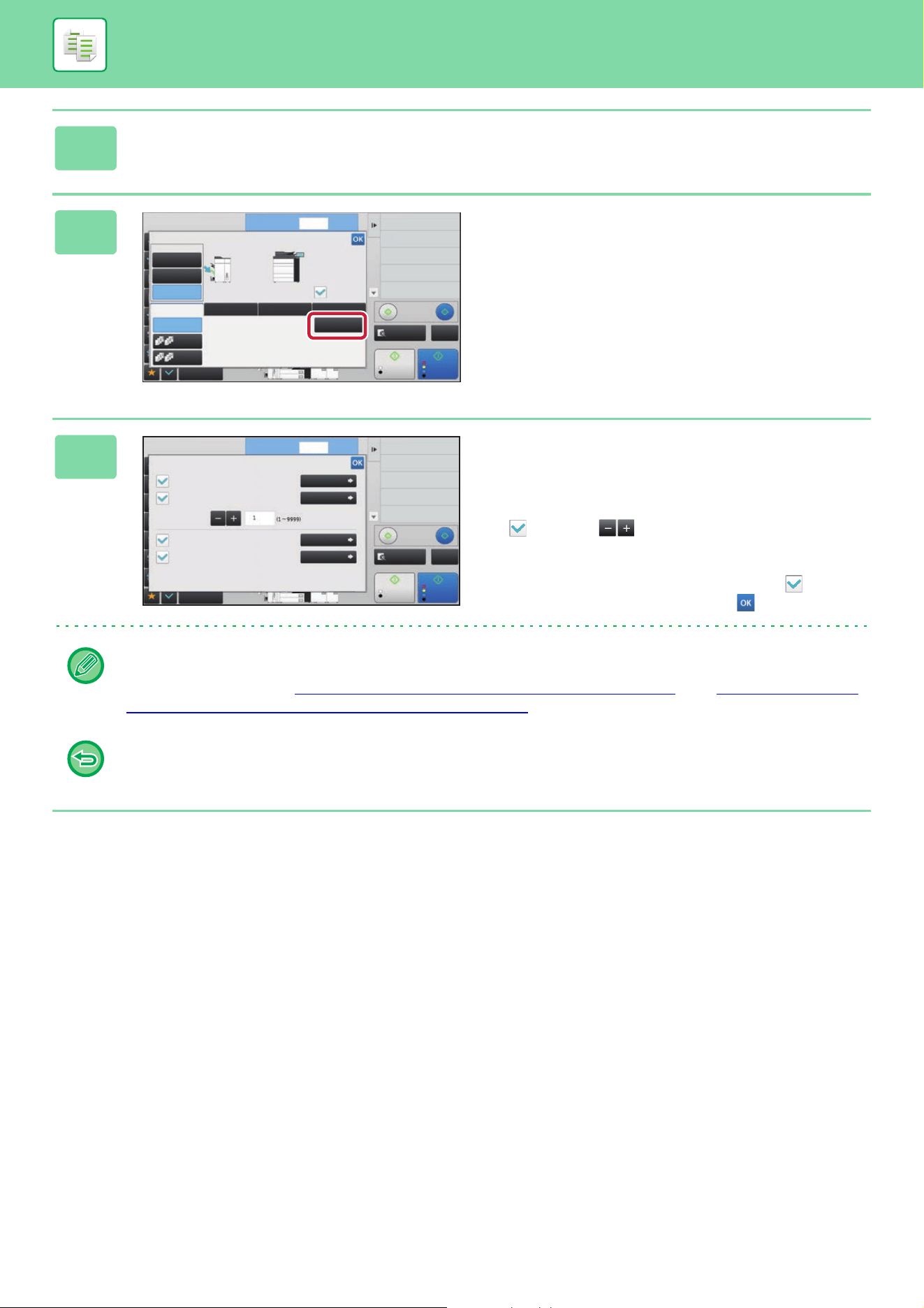
2-45
COPIER►BASIC PROCEDURE FOR MAKING COPIES
2
Tap the [Output] key.
3
Tap the [Separator Page] key.
4
Specify the separator page insertion
mode.
• To insert separator pages between sets of copies, set the
[Insert Top of Sets] or [Insert End of Sets] checkbox to
. Next, tap to specify the number of copies in
each set.
• To insert separator pages between jobs, set the [Insert
Before Job] or [Insert After Job] checkbox to .
• After the settings are completed, tap .
To change the separator page tray:
Tap the [Paper Tray] key to display the tray selection screen. Tap the separator page tray in the tray selection screen.
For more information, see "SELECTING THE PAPER TRAY FOR COPYING (page 2-13)
" and "SPECIFYING A TYPE
AND SIZE OF PAPER LOADED ON BYPASS TRAY (page 2-40)".
To cancel the separator page insertion setting:
Clear the checkmark for separator page insertion mode.
Start
Colour
Start
B/W
Preview
Others
Shift Position to Have Margin
Margin Shift
Shift Position to Have Margin
Margin Shift
Erase Shadow Around
Erase
Put Multiple Pages in A Page
N-Up
Change Size/Direction.
Original
2-Sided Copy
CA
4
3
68
Proof Copy
8½x11 8½x11
8½x14
11x17
1
Start Start
B/W
Preview
Color
Output
Auto
Offset
Punch FoldStaple
Group
Sort
No. of copies
Output Tray
Lower Tray
Default Settings
Middle
Tray
Separator
Page
Upper Tray
Start Start
B/W
Preview
Others
CA
4
3
68
Proof Copy
1No. of copies
Erase Shadow Around
Erase
Change Size/Direction.
Original
Shift Position to Have Margin
Margin Shift
Put Multiple Pages in A Page
N-Up
2-Sided Copy
8½x11 8½x11
8½x14
11x17
Color
Insert Top of Sets
Insert End of Sets
Insert Before Job
Insert After Job
Separator Page
Bypass Paper Tray
Paper Tray
Paper Tray
Paper Tray
Bypass
Bypass
Bypass
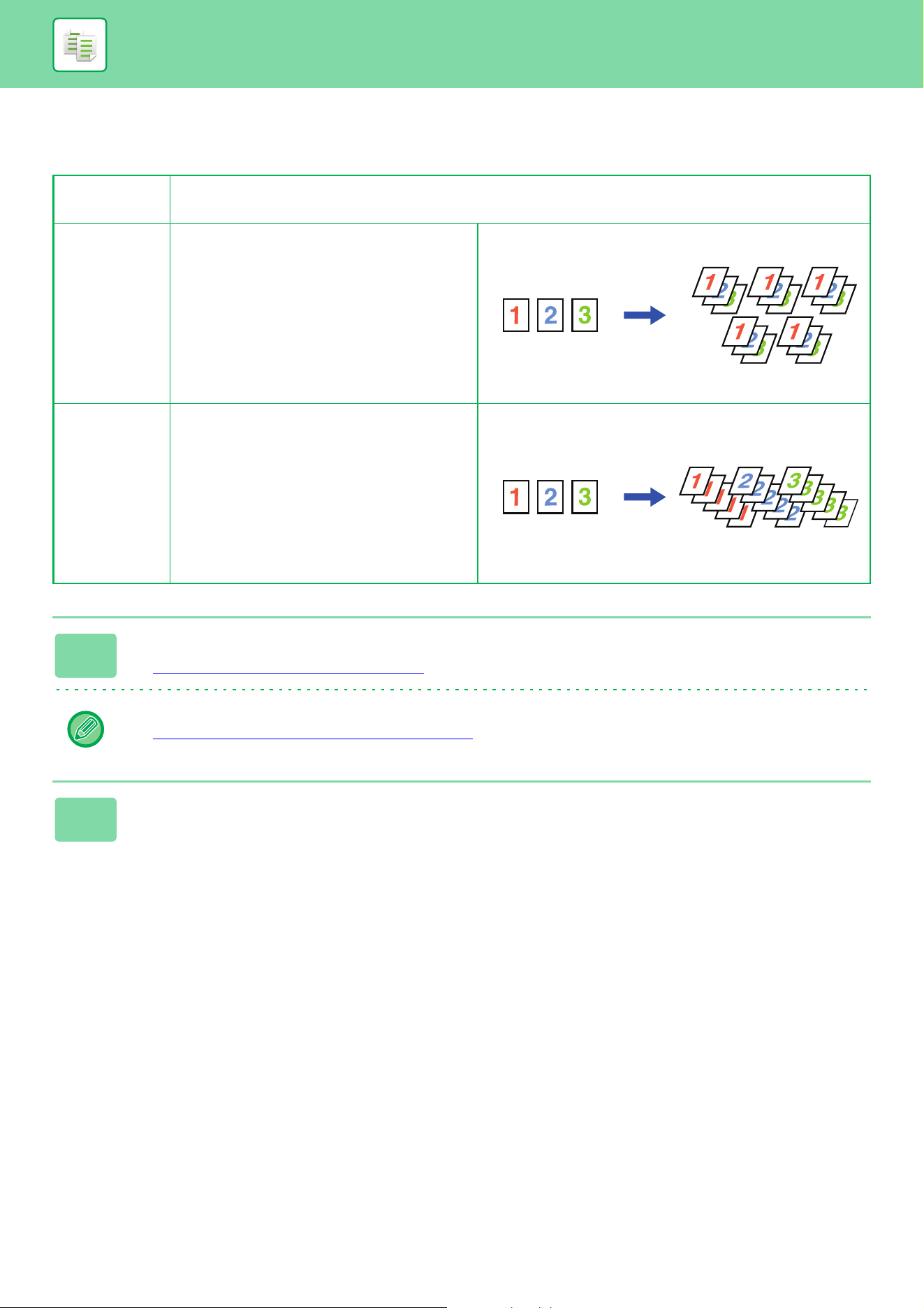
2-46
COPIER►BASIC PROCEDURE FOR MAKING COPIES
SORT/GROUP SETTING
This section explains how to select the sorting method when outputting the scanned original.
Auto Enables the sort mode when the original is placed in the automatic document feeder, and enables the group
mode when the original is placed on the document glass.
Sort Sorts the scanned original on a set basis, and
outputs them.
Group Groups the scanned original on a page basis,
and outputs them.
1
Tap the [Detail] key to change to normal mode.
► Changing mode from each mode (page 2-5)
Tap the [Original] key and specify the orientation of the original to have the orientation be correctly recognized.
► Specifying the orientation of the original (page 2-33)
2
Tap the [Output] key.
Originals
When 5 is set for the
number of copies
Finished
Originals Finished
When 5 is set for the
number of copies
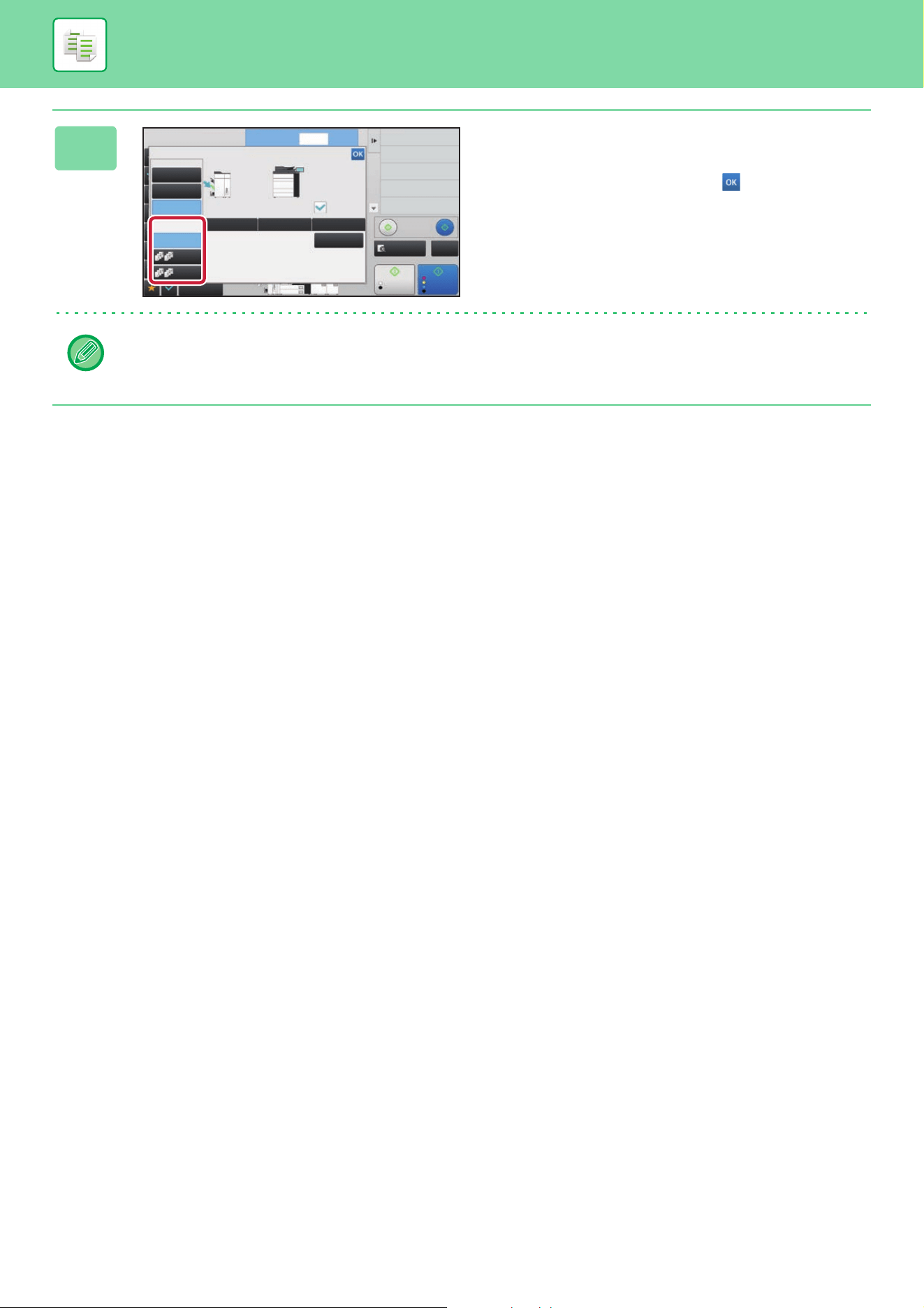
2-47
COPIER►BASIC PROCEDURE FOR MAKING COPIES
3
Tap the [Sort/Group] tab, and tap the
[Auto], [Sort] or [Group] key.
After the settings are completed, tap .
To change the output tray, tap the output tray key, and select the output destination.
8½x11
8½x11
Start Start
B/W
Preview
Others
CA
4
3
68
Proof Copy
1
No. of copies
Output Tray
Lower Tray
Default Settings
Middle
Tray
Separator
Page
Upper Tray
Shift Position to Have Margin
Erase
Erase Shadow Around
Margin Shift
Put Multiple Pages in A Page
N-Up
Change Size/Direction.
Original
2-Sided Copy
8½x11 8½x11
8½x14
11x17
Color
Output
Auto
Offset
Punch FoldStaple
Group
Sort
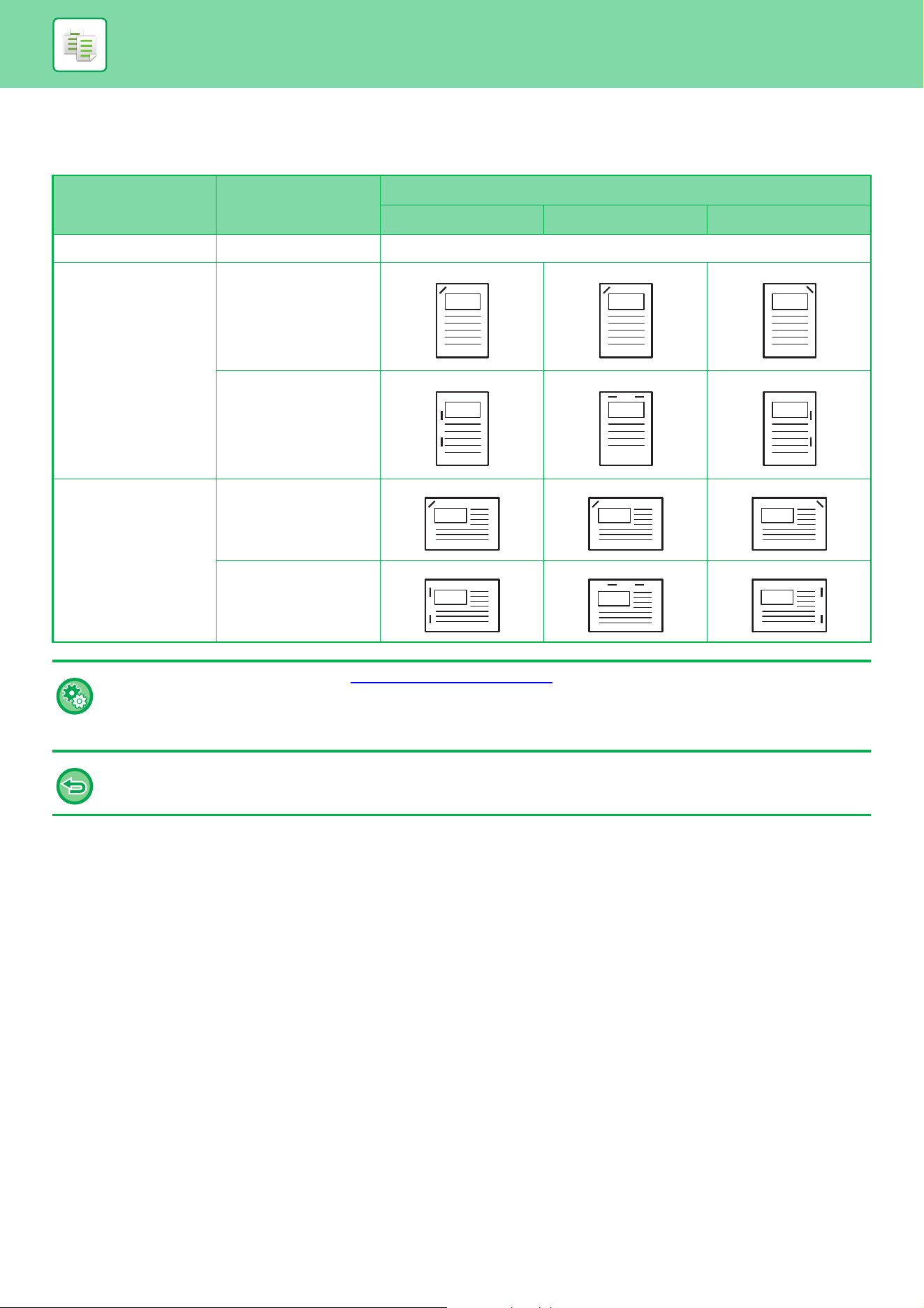
2-48
COPIER►BASIC PROCEDURE FOR MAKING COPIES
STAPLE SETTINGS
Specify whether or not the set of output will be stapled.
Image Orientation Staple
Staple Position
Left Top Right
- Off Does not staple.
Portrait orientation
1 Staple
2 Staples
Landscape orientation
1 Staple
2 Staple
• You can view staple positions on the "PREVIEW SCREEN (page 1-17)". Text will be printed at the preset size regardless
of the copy ratio or paper size setting.
• To change the default staple position:
In "Settings (administrator)", select [System Settings] → [Copy Settings] → [Initial Status Settings] → [Staple Position].
• A finisher or saddle stitch finisher is required to use the staple function.
• A saddle stitch finisher is required to use the saddle stitch function.
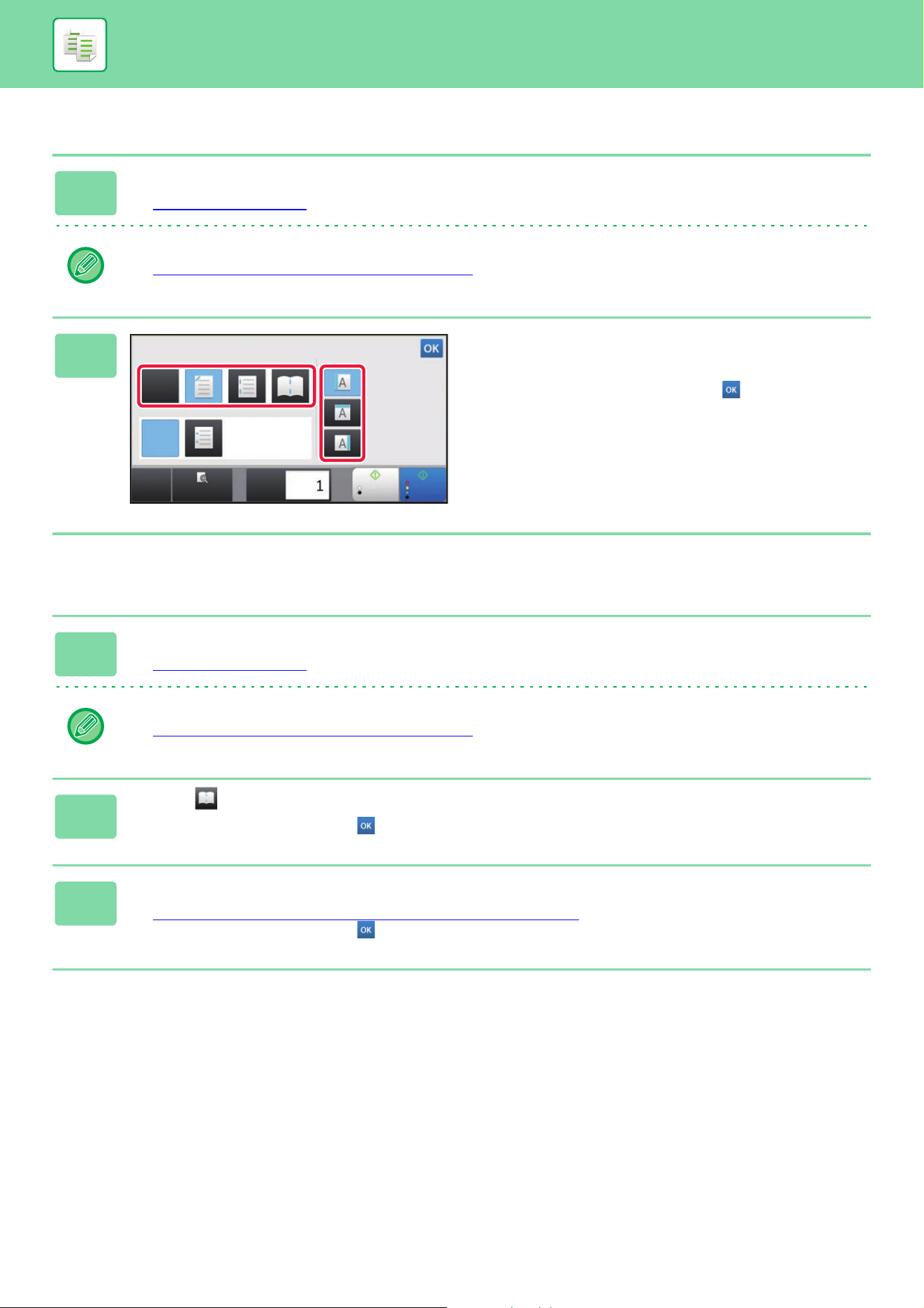
2-49
COPIER►BASIC PROCEDURE FOR MAKING COPIES
Staple ON (excluding booklet)
Saddle Stitch
1
Tap the [Staple / Punch] key.
► COPY MODE (page 2-3)
Tap the [Original] key and specify the orientation of the original to have the orientation be correctly recognized.
► Specifying the orientation of the original (page 2-33)
2
Select the number of staples and
staple position.
After the settings are completed, tap .
1
Tap the [Staple / Punch] key.
► COPY MODE (page 2-3)
Tap the [Original] key and specify the orientation of the original to have the orientation be correctly recognized.
► Specifying the orientation of the original (page 2-33)
2
Select .
After the settings are completed, tap .
3
Select binding edge and original settings.
► MAKING COPIES IN PAMPHLET FORMAT (BOOKLET) (page 2-72)
After the settings are completed, tap .
B/W
Start
Color
Start
CA
Preview
Copies
Staple / Punch
Staple
Off
Off
Position
Punch
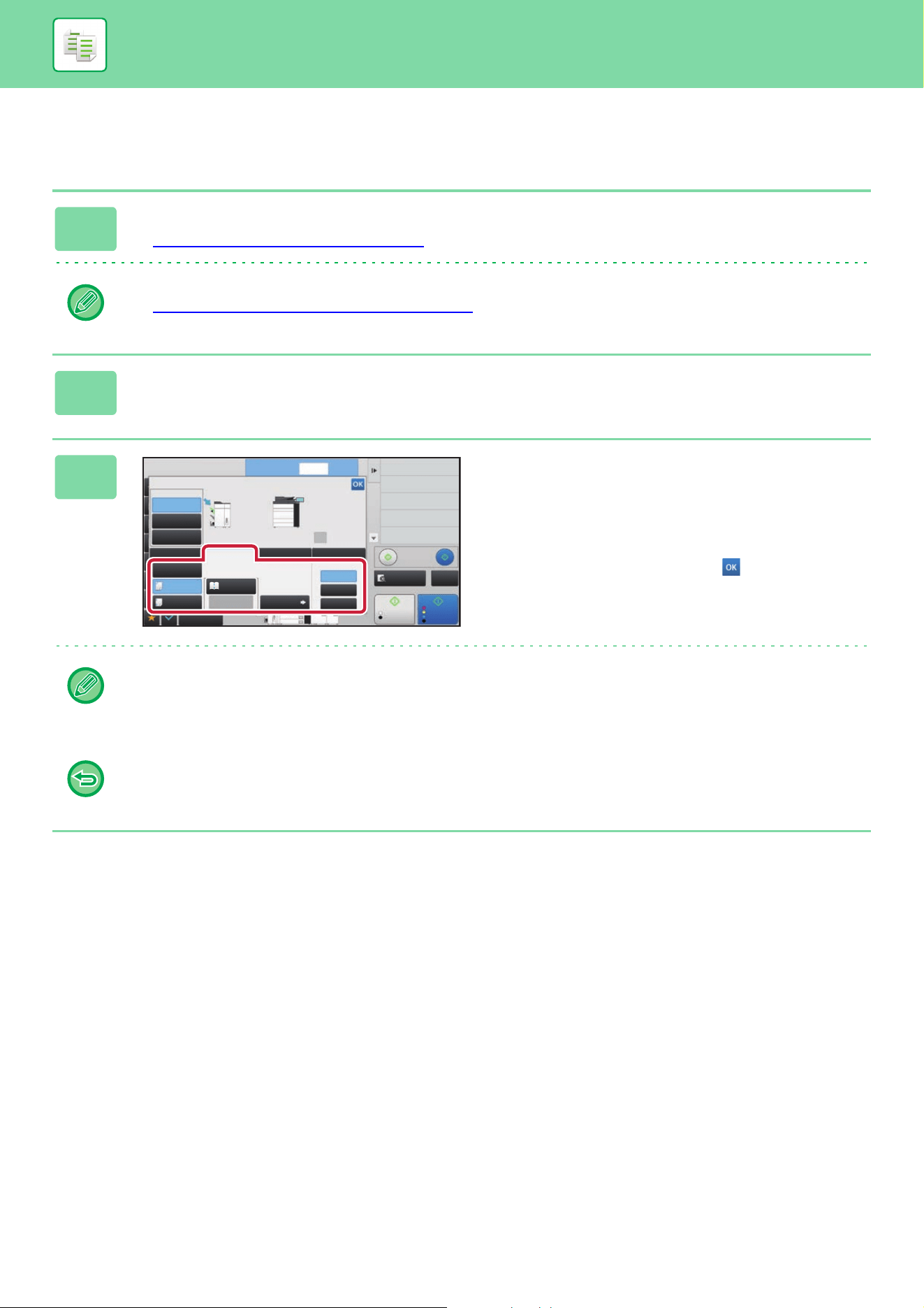
2-50
COPIER►BASIC PROCEDURE FOR MAKING COPIES
Stapling each set of sorted copies
The setting procedure in normal mode is explained.
1
Tap the [Detail] key to change to normal mode.
► Changing mode from each mode (page 2-5)
Tap the [Original] key and specify the orientation of the original to have the orientation be correctly recognized.
► Specifying the orientation of the original (page 2-33)
2
Tap the [Output] key.
3
Tap the [Staple] tab, and tap the staple
position key.
Tap the [Original] key to chenge the original settings.
Staple position can be selected from "Position" when
selecting keys other than [Off], and [Saddle Stitch].
After the settings are completed, tap .
If the number of scanned originals exceeds the staple sheet limit, a message is displayed. Tap the [Continue] or [Cancel]
key.
[Continue]: Continues sorting without stapling.
[Cancel]: Cancels the staple sort setting.
To cancel the staple function:
Tap the [Off] key.
Offset
Off
1 Staple
2 Staples
Original
Left
To p
Right
Position
Trimmer
Setting
Punch FoldStaple
Output
Start Start
B/W
Preview
Others
CA
4
3
68
Proof Copy
1
No. of copies
Output Tray
Lower Tray
Default Settings
Middle
Tray
Upper Tray
Erase Shadow Around
Erase
Change Size/Direction.
Original
Shift Position to Have Margin
Margin Shift
Put Multiple Pages in A Page
N-Up
2-Sided Copy
8½x11 8½x11
8½x14
11x17
Color
Saddle
Stitch
Offset
Off
2 Staples
Original
Left
To p
Right
Position
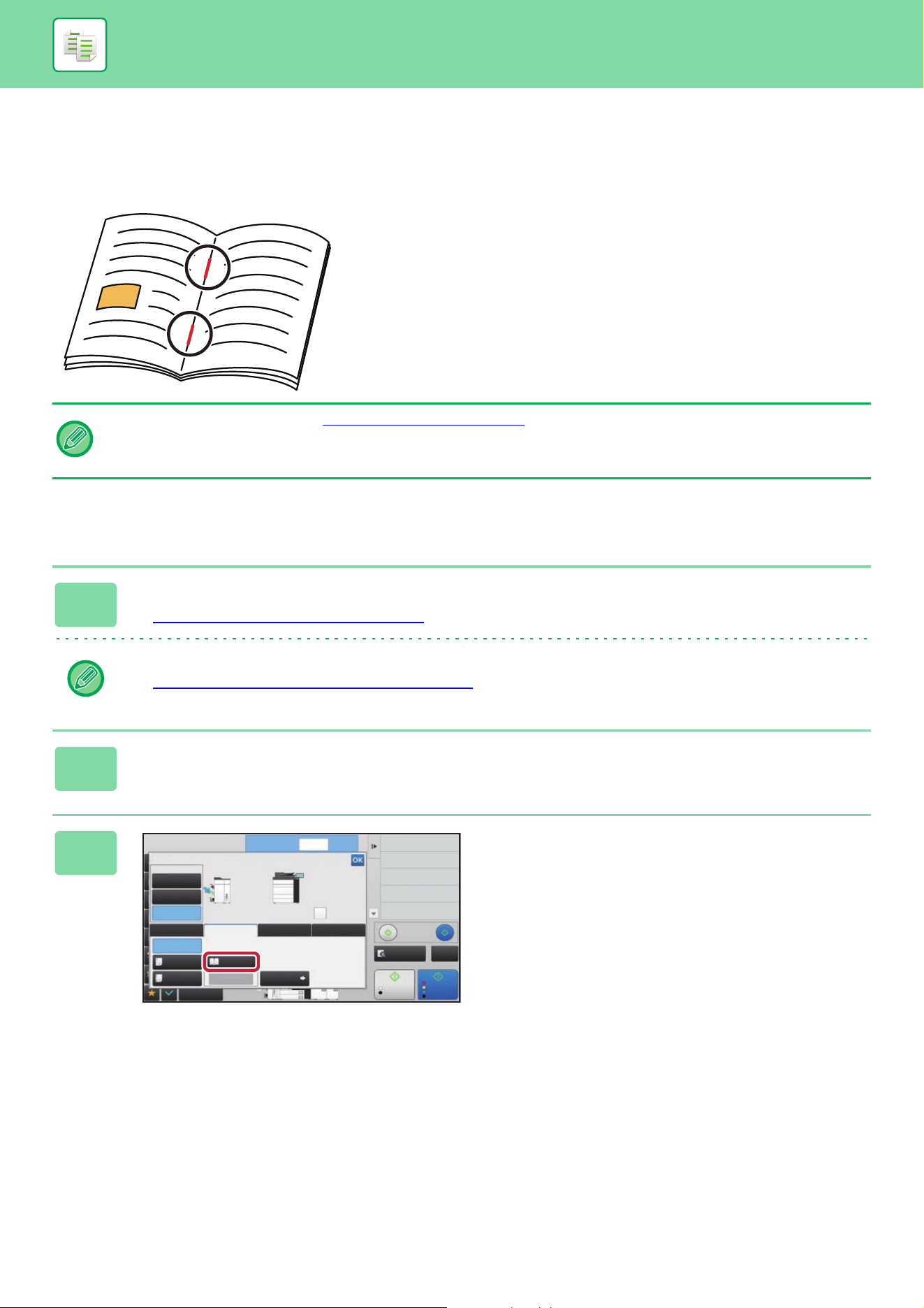
2-51
COPIER►BASIC PROCEDURE FOR MAKING COPIES
Saddle stitching for sorted copies
This function staples each set of copies at two positions in the center of paper, folds them in half, and outputs them. For
saddle folding, it trims a side drop, offering a good-looking output image.
The setting procedure in normal mode is explained.
Saddle stitch
• You can view staple positions in "PREVIEW SCREEN (page 1-17)".
• A saddle stitch finisher is required to use the saddle stitch function.
• The trimmer function is available when a trimmer unit is installed on the machine.
1
Tap the [Detail] key to change to normal mode.
► Changing mode from each mode (page 2-5)
Tap the [Original] key and specify the orientation of the original to have the orientation be correctly recognized.
► Specifying the orientation of the original (page 2-33)
2
Tap the [Output] key.
3
Tap the [Staple] tab, and tap the
[Saddle Stitch] key.
5
6
Offset
Saddle
Stitch
Trimmer
Setting
Punch FoldStaple
Output
Start Start
B/W
Preview
Others
CA
4
3
68
Proof Copy
8½x11 8½x11
8½x14
11x17
1
Off
1 Staple
2 Staples
Original
No. of copies
Output Tray
Lower Tray
Default Settings
Middle
Tray
Upper Tray
Erase Shadow Around
Erase
Change Size/Direction.
Original
Shift Position to Have Margin
Margin Shift
Put Multiple Pages in A Page
N-Up
Color
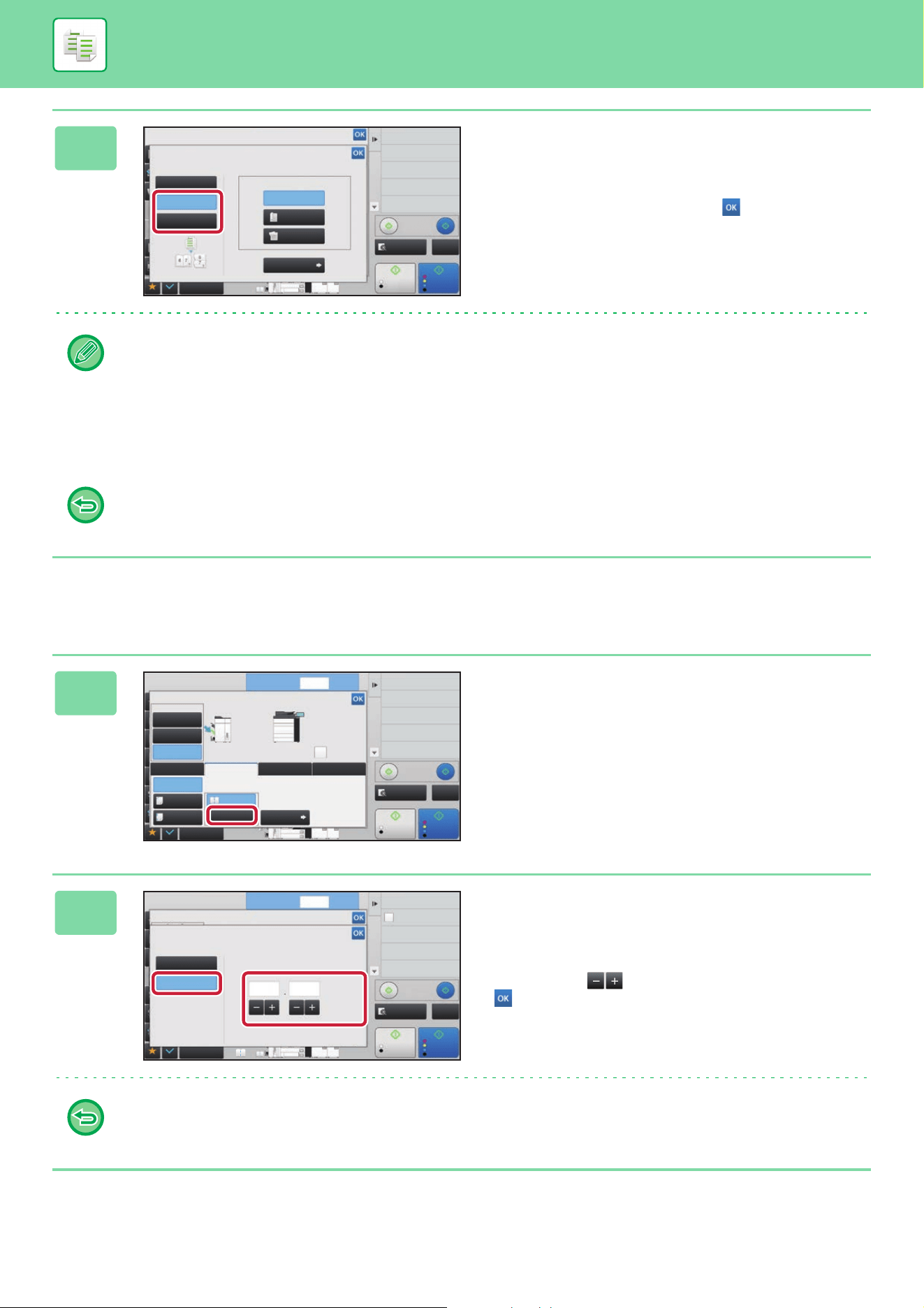
2-52
COPIER►BASIC PROCEDURE FOR MAKING COPIES
Trimmer Setting
4
Tap the [Left Binding/Tablet] or [Right
Binding] key to select an original and
configure the cover sheet setting.
After the settings are completed, tap .
• The original will be scanned from the innermost side when folded.
• If the number of scanned originals exceeds the staple sheet limit, a message is displayed. Tap the [Divide],
[Continue], or [Cancel] key.
[Divide]: Divides the pages into sets that can be stapled and sorts them. You cannot use this function if the
cover settings are selected.
[Continue]: Continues sorting without stapling.
[Cancel]: Cancels the staple sort setting.
To cancel the Saddle Stitch:
Tap the [Off] key.
1
When Saddle Stitch is selected, tap the
[Trimmer Setting] key.
2
Tap the [On] key, and specify the
trimming width.
Tap the numeric value display field of the trimming width,
and enter the allowable range using the numeric keys.
Otherwise, tap . After the settings are completed, tap
.
To cancel the Trimmer Setting:
Tap the [Off] key.
Put Multiple Pages in A Page
N-Up
Erase
Erase Shadow Around
Change Size/Direction.
Original
Others
Booklet
Select Output Binding Edge.
Select Original Type.
1-Sided
2-Sided
Booklet
2-Sided
Tablet
Cover Setting
Off
Left Binding/
Tablet
Right Binding
Start Start
B/W
Preview CA
Proof Copy
Others
4
3
68
Change Paper Feed Tray
Paper Select
8½x11 8½x11
8½x14
11x17
Color
1 Staple
2 Staples
Original
4
Start
Colour
Start
Preview
Erase Shadow Around
Erase
Output
Change Size/Direction.
Original
CA
B/W
Shift Position to Have Margin
Margin Shift
Put Multiple Pages in A Page
Multi Shot
Proof Copy
Others
11x17 11x1711x174
3 8½x14
68
1
1 Staple
2 Staples
Original
Start Start
Preview
Erase Shadow Around
Erase
Change Size/Direction.
Original
CA
B/W
Shift Position to Have Margin
Margin Shift
Put Multiple Pages in A Page
Proof Copy
Others
4
3
68
1
8½x11 8½x11
8½x14
11x17
Color
Output
Output Tray
Lower Tray
Staple
Punch Fold
Off
Offset
N-Up
Saddle
Stitch
Trimmer
Setting
No. of copies
Default Settings
Middle
Tray
Upper Tray
1 Staple
2 Staples
Original
Start Start
Preview
Erase Shadow Around
Erase
Full Bleed Copy
CA
B/W
Proof Copy
Others
No. of copies
4
3
68
1
8½x11 8½x11
8½x14
11x17
Color
Output
Trimmer Setting
Set Trimming Width.
(2.0
῀
20.0)
mm
On
Off
20
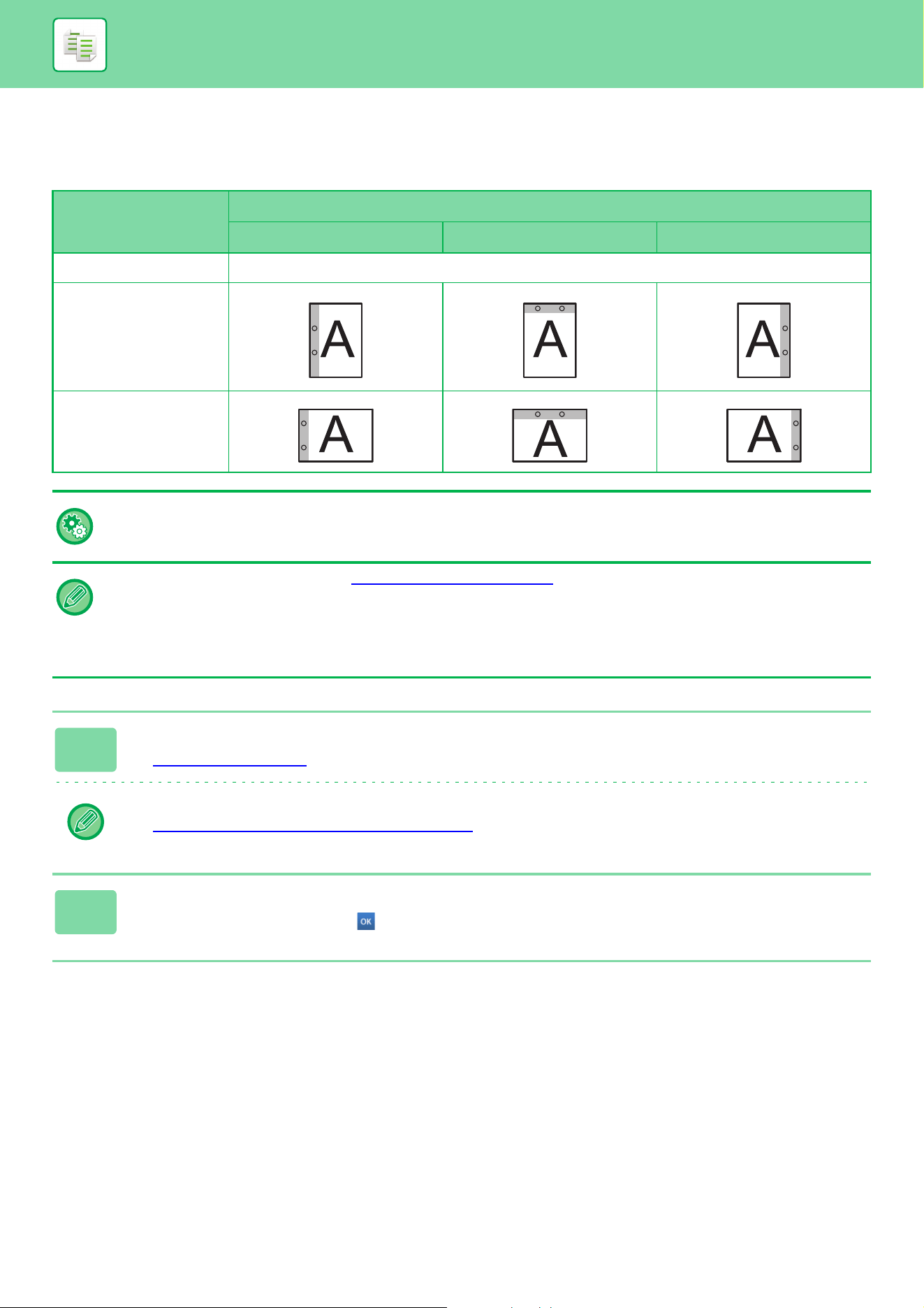
2-53
COPIER►BASIC PROCEDURE FOR MAKING COPIES
PUNCH SETTINGS
This function punches copies and outputs them to the tray.
Image Orientation
Punch Position
Left Top Right
Off Does not punch.
Portrait orientation
Landscape orientation
• To change the default punch settings:
In "Settings (administrator)", select [System Settings] → [Copy Settings] → [Initial Status Settings] → [Punch].
• Punch positions are linked to staple positions.
• You can view punch positions on the "PREVIEW SCREEN (page 1-17)
".
• A punch module is required for paper punch.
• You cannot use 12" x 18" (A3W) size paper or special media such as transparency film and tab paper.
• The punch function cannot be used in combination with Saddle Stitch or folding functions. The punch function can be used
in combination with the Z-Fold function when 11"x17", A3, or B4 is used.
1
Tap the [Staple / Punch] key.
► COPY MODE (page 2-3)
Tap the [Original] key and specify the orientation of the original to have the orientation be correctly recognized.
► Specifying the orientation of the original (page 2-33)
2
Select punching and set the position.
After the settings are completed, tap .
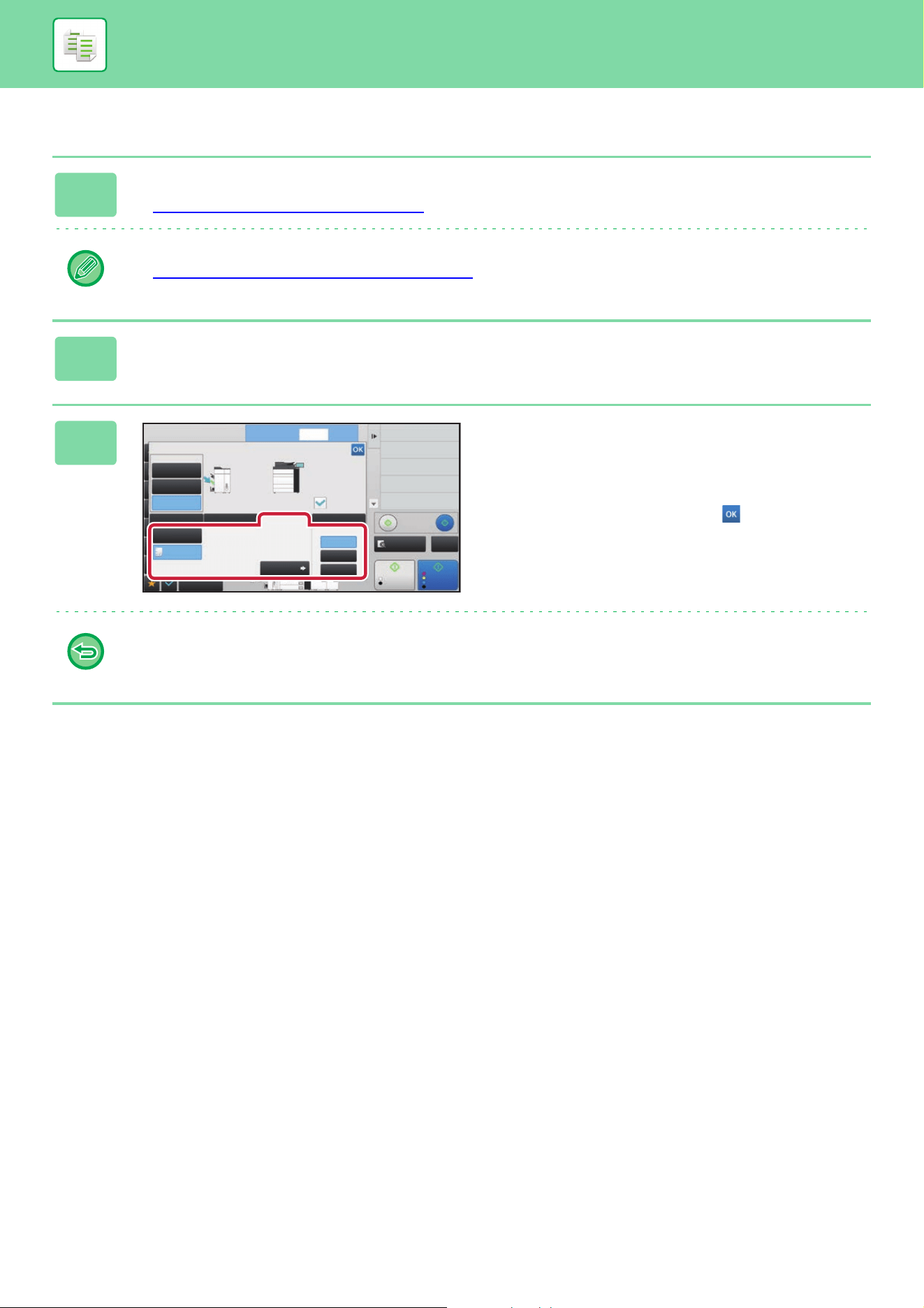
2-54
COPIER►BASIC PROCEDURE FOR MAKING COPIES
The setting procedure in normal mode is explained.
1
Tap the [Detail] key to change to normal mode.
► Changing mode from each mode (page 2-5)
Tap the [Original] key and specify the orientation of the original to have the orientation be correctly recognized.
► Specifying the orientation of the original (page 2-33)
2
Tap the [Output] key.
3
Tap the [Punch] tab, and tap the punch
you want to use.
Tap the [Original] key to chenge the original settings.
Punch position can be selected from "Position".
After the settings are completed, tap .
To cancel the punch function:
Tap the [Off] key.
Start Start
Preview
Erase Shadow Around
Erase
2-Sided Copy
Change Size/Direction.
Original
CA
B/W
Shift Position to Have Margin
Margin Shift
Put Multiple Pages in A Page
N-Up
Proof Copy
Others
No. of copies
4
3
68
1
8½x11 8½x11
8½x14
11x17
Color
Original
Output
Upper Tray
Output Tray
Middle Tray
Lower Tray
Staple
Original
Punch
Right
To p
Left
Fold
2/3-Hole
Punch
Default Settings
Off
Offset
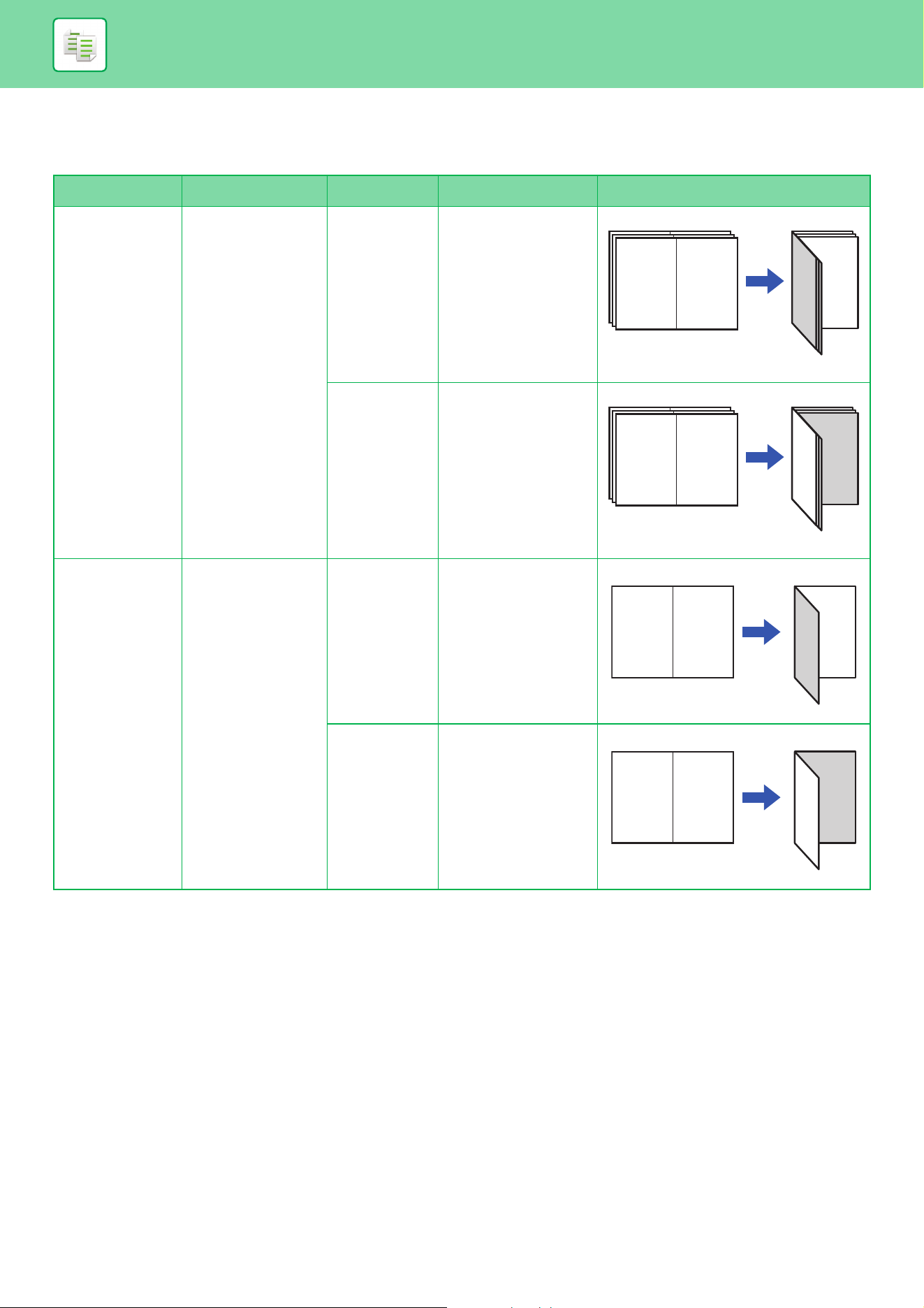
2-55
COPIER►BASIC PROCEDURE FOR MAKING COPIES
FOLDING OUTPUT PAPER
Copies can be folded and output.
Folding types Usable paper Print Side Fold Orientation Folding image
Saddle Fold
Saddle stitch finisher
(100-sheet stapling):
13" × 19", 12" × 18",
11" × 17",
8-1/2" × 14",
8-1/2" × 13-1/2",
8-1/2" × 13-2/5",
8-1/2" × 13",
8-1/2" × 11"R, A3W,
A3, B4, A4R,
SRA3,
8K
Inside -
Outside -
Half Fold 8-1/2" × 11"R, A4R
Inside -
Outside -
B
B
B
A
A
A
BA
BA
BA
B
A
B
A
B
A
BA
BA
BA
A
B
B
A
BA
BA
AA
B
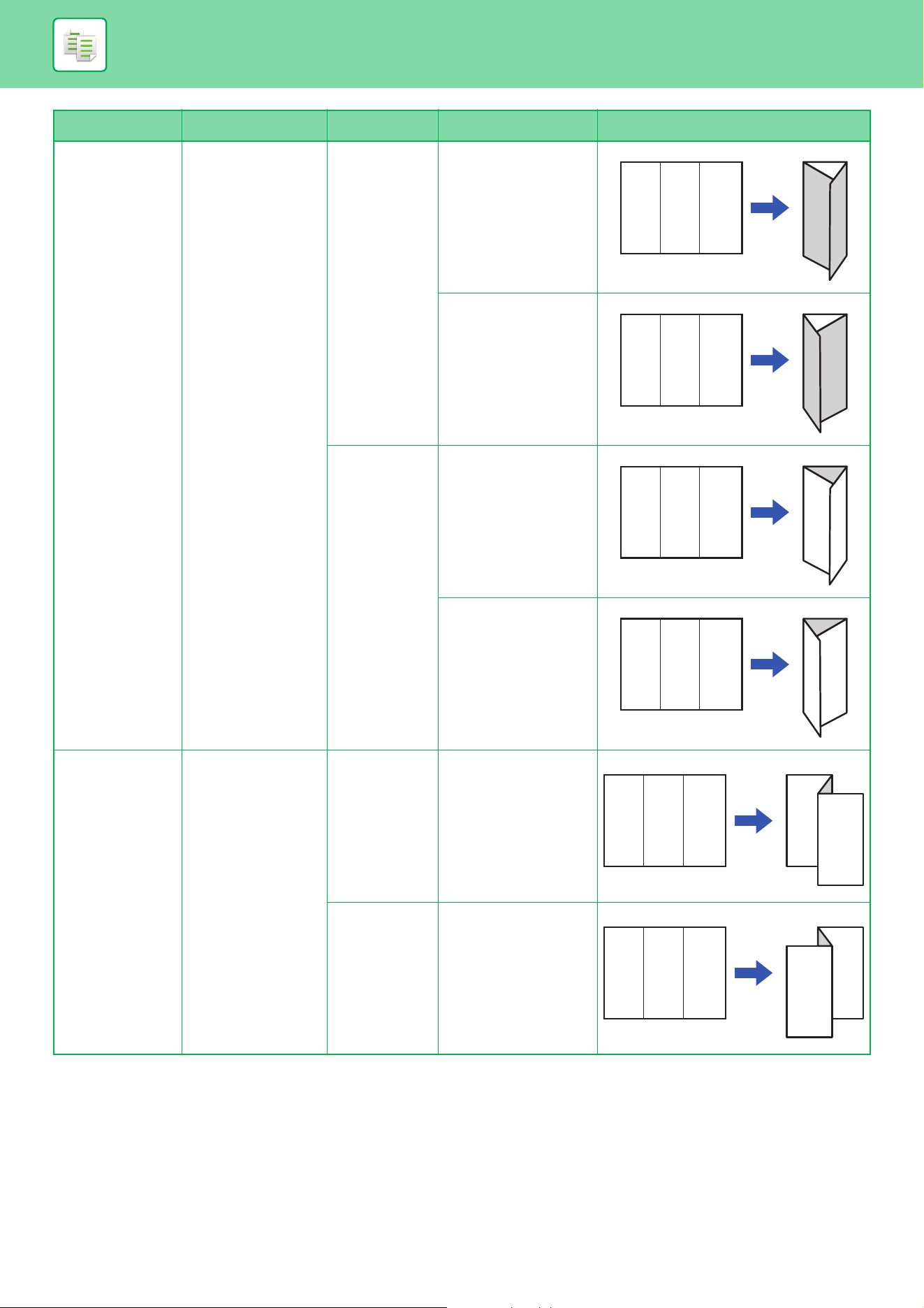
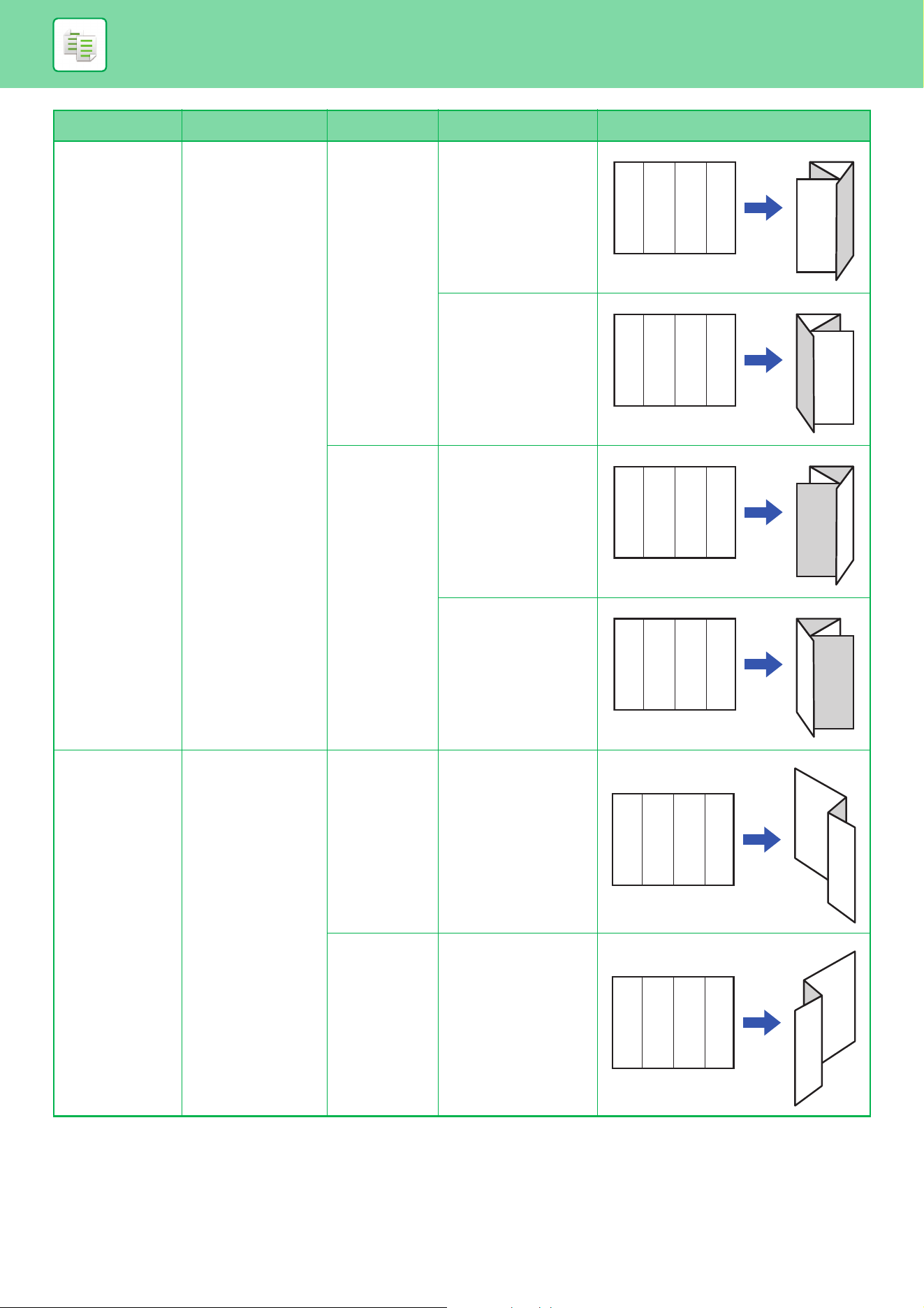
2-57
COPIER►BASIC PROCEDURE FOR MAKING COPIES
Double Fold 8-1/2" × 11"R, A4R
Inside
Open Right
Open Left
Outside
Open Right
Open Left
Z-Fold
11" × 17",
8-1/2" × 14",
8-1/2" × 11"R, A3,
B4, A4R
- Open Right
- Open Left
Folding types Usable paper Print Side Fold Orientation Folding image
ABCD
D
A
ABCD
A
D
ABCD
A
D
ABCD
D
A
ABCD
A
B
D
ABCD
D
C
A
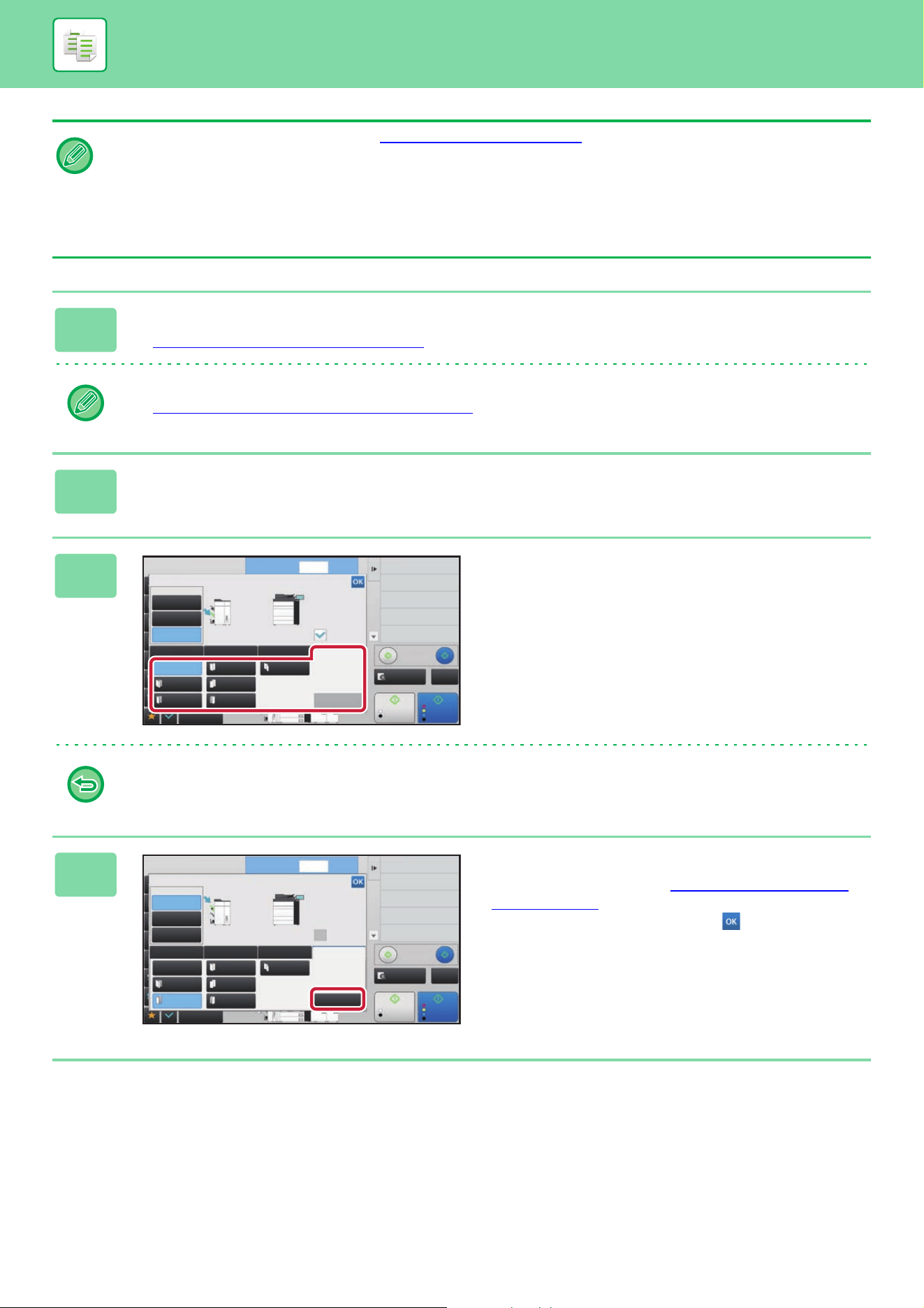
2-58
COPIER►BASIC PROCEDURE FOR MAKING COPIES
• You can view the specified folding type in "PREVIEW SCREEN (page 1-17)".
• A saddle stitch finisher is required to use Saddle Fold.
• A folding unit is required to use Half Fold, C-Fold, Accordion Fold, Double Fold, and Z-Fold.
• Special media such as transparency film and tab paper cannot be used.
• The paper folding function cannot be used with the staple and hole punch function. However, it can be used with them if
the paper size for Z-folding is set to 11" × 17", A3 or B4.
1
Tap the [Detail] key to change to normal mode.
► Changing mode from each mode (page 2-5)
Tap the [Original] key and specify the orientation of the original to have the orientation be correctly recognized.
► Specifying the orientation of the original (page 2-33)
2
Tap the [Output] key.
3
Tap the [Fold] tab, and tap the folding
type key.
To cancel the paper folding function:
Tap the [Off] key.
4
Tap the [Detail] key.
For the setting method, see "Detail Type for each Folding
Type (page 2-59)".
After the settings are completed, tap .
Start Start
Preview
Erase Shadow Around
Erase
Change Size/Direction.
Original
CA
B/W
Shift Position to Have Margin
Margin Shift
Put Multiple Pages in A Page
Proof Copy
Others
1
4
3
68
N-Up
2-Sided Copy
8½x11 8½x11
8½x14
11x17
Color
Detail
Output Tray
Offset
Off
Staple
No. of copies
Default Settings
Middle
Tray
Upper Tray
Output
C-Fold
Accord-
ion Fold
Double
Fold
Detail
Lower Tray
Punch
Fold
Saddle
Fold
Half
Fold
Off Z-Fold
Start Start
Preview
Erase Shadow Around
Erase
Change Size/Direction.
Original
CA
B/W
Shift Position to Have Margin
Margin Shift
Put Multiple Pages in A Page
Proof Copy
Others
1
4
3
68
Detail
Upper Tray
Output Tray
Staple
Offset
Saddle Fold
Half Fold
Default
Off
Output
C-Fold
Accord-
ion Fold
Double
Fold
Detail
Upper Tray
Output Tray
Middle Tray
Lower Tray
Staple
Punch Fold
Saddle Fold
Half Fold
Default
Off Z-Fold
No. of copies
N-Up
2-Sided Copy
8½x11 8½x11
8½x14
11x17
Color
Output
C-Fold
Accord-
ion Fold
Double
Fold
Detail
Output Tray
Lower Tray
Punch Fold
Saddle
Fold
Half
Fold
Off Z-Fold
Offset
StapleDefault Settings
Middle
Tray
Upper Tray
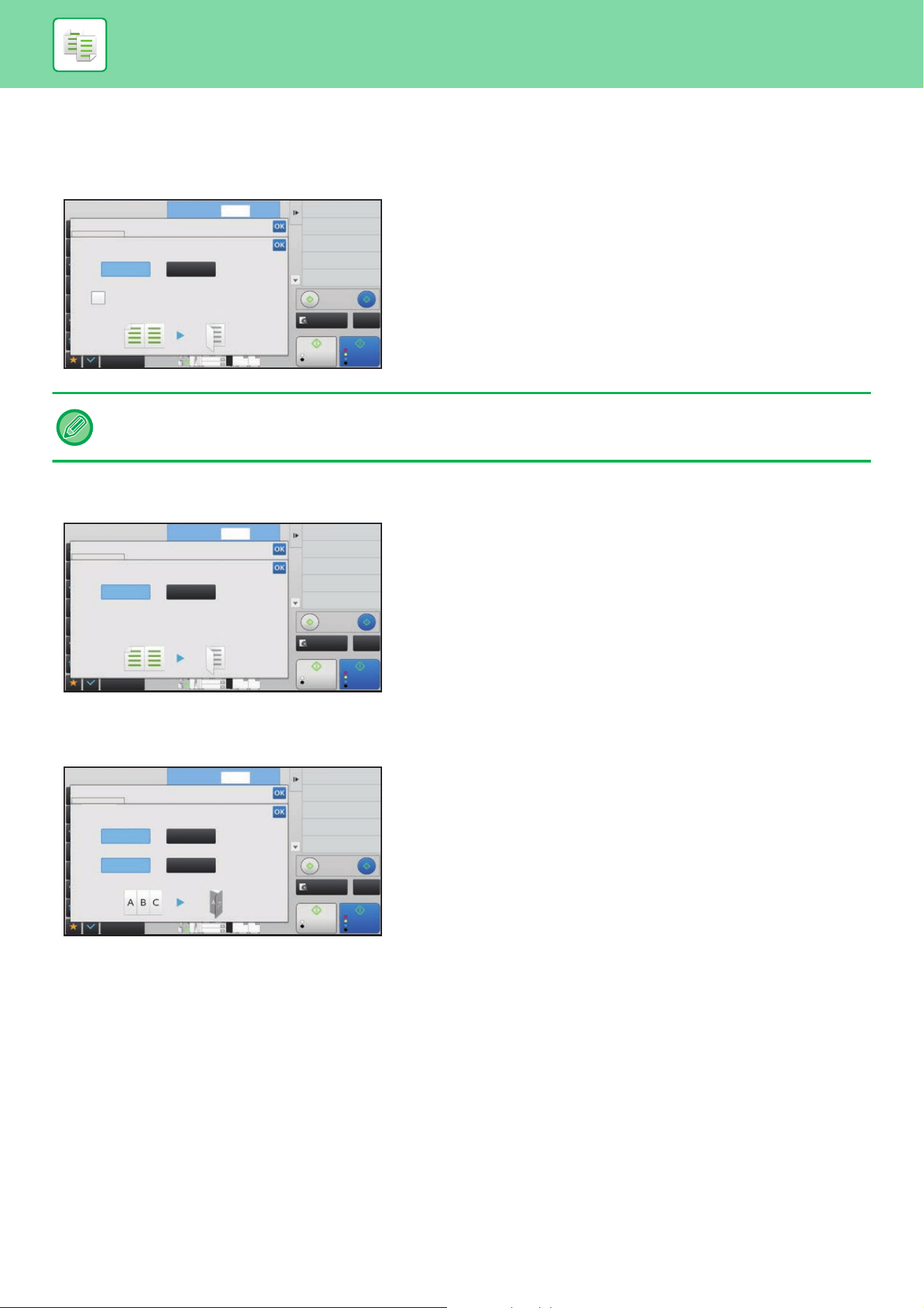
2-59
COPIER►BASIC PROCEDURE FOR MAKING COPIES
Detail Type for each Folding Type
Saddle Fold
Specify "Print Side" and "Multiple Fold".
Half Fold
Specify "Print Side".
C-Fold
Specify "Print Side" and "Fold Orientation".
The Multiple Fold function folds five sheets at a time. For example, if an original has 12 A4 size plain sheets, they are folded
three times in total: 5 sheets + 5 sheets + 2 sheets. However, some types of paper reduces the number of sheets that are
folded every set. For example, heavy paper is folded on a three-sheet basis.
Start Start
Preview CA
B/W
Proof Copy
Others
1
4
3
68
Erase Shadow Around
Erase
Change Size/Direction.
Original
Shift Position to Have Margin
Margin Shift
Put Multiple Pages in A Page
N-Up
2-Sided Copy
No. of copies
8½x11 8½x11
8½x14
11x17
Color
Output Tray
Output
Detail (Saddle Fold)
Print Side
Inside
Outside
Multiple Fold
Fold Multiple Sheets Together
Original Image Output Image
Start Start
Preview CA
B/W
Proof Copy
Others
1
4
3
68
Erase Shadow Around
Erase
Change Size/Direction.
Original
Shift Position to Have Margin
Margin Shift
Put Multiple Pages in A Page
N-Up
2-Sided Copy
No. of copies
8½x11 8½x11
8½x14
11x17
Color
Output Tray
Output
Detail (Saddle Fold)
Print Side
Inside
Outside
Original Image Output Image
Start
Colour
Start
Preview CA
B/W
Proof Copy
Others
1
4
3
68
Erase Shadow Around
Erase
Change Size/Direction.
Original
Shift Position to Have Margin
Margin Shift
Put Multiple Pages in A Page
N-Up
2-Sided Copy
No. of copies
8½x11 8½x11
8½x14
11x17
Output Tray
Output
Detail (Saddle Fold)
Fold Orientation
Open Right
Open Left
Print Side
Inside
Outside
Original Image Output Image
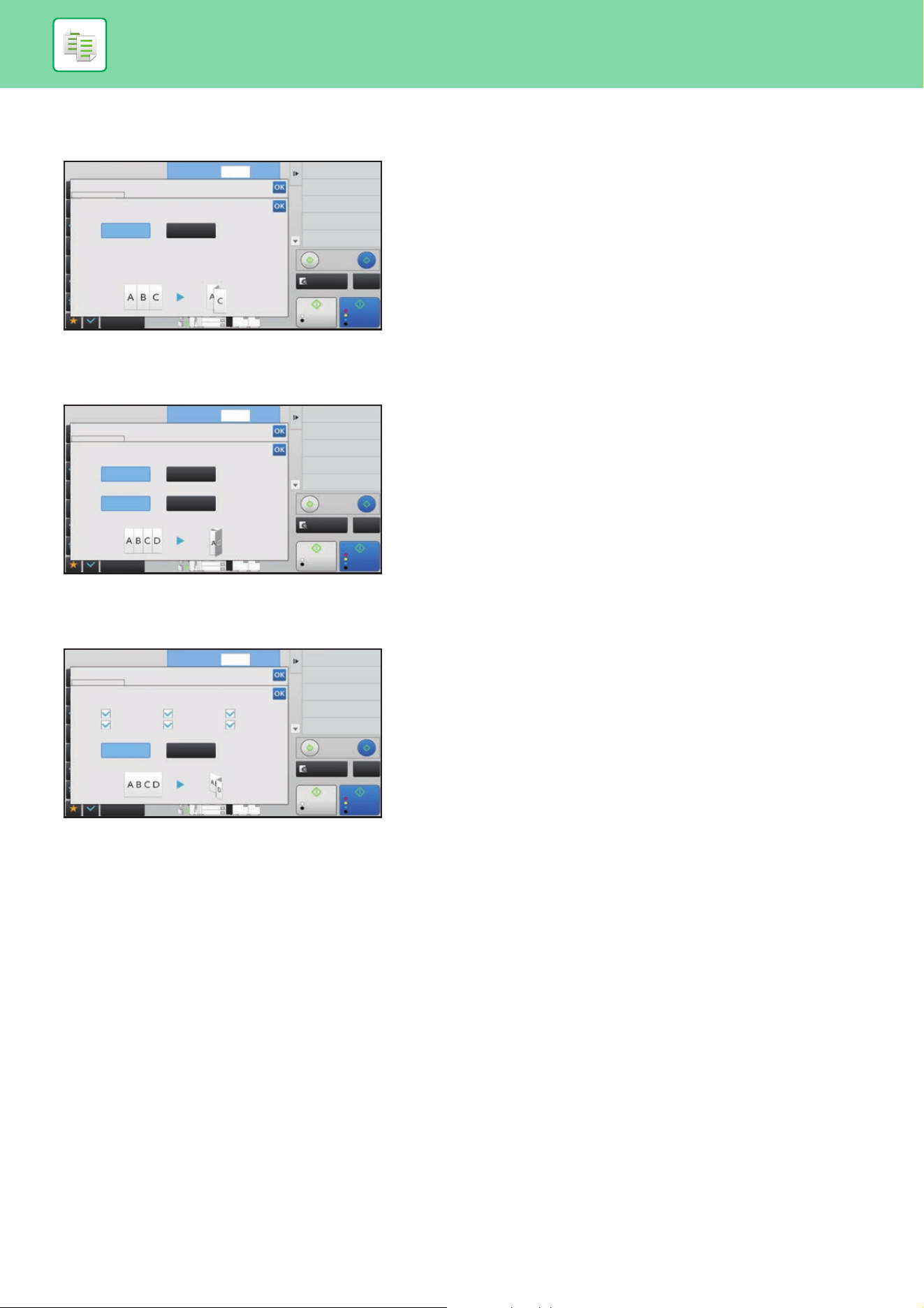
2-60
COPIER►BASIC PROCEDURE FOR MAKING COPIES
Accordion Fold
Specify "Fold Orientation".
Double Fold
Specify "Print Side" and "Fold Orientation".
Z-Fold
Specify the paper size and "Fold Orientation" for Z-folding.
Start Start
Preview CA
B/W
Proof Copy
Others
1
4
3
68
Erase Shadow Around
Erase
Change Size/Direction.
Original
Shift Position to Have Margin
Margin Shift
Put Multiple Pages in A Page
N-Up
2-Sided Copy
No. of copies
8½x11 8½x11
8½x14
11x17
Color
Output Tray
Output
Fold Orientation
Open Right
Open Left
Detail (Saddle Fold)
Original Image Output Image
Start Start
Preview CA
B/W
Proof Copy
Others
1
4
3
68
Erase Shadow Around
Erase
Change Size/Direction.
Original
Shift Position to Have Margin
Margin Shift
Put Multiple Pages in A Page
N-Up
2-Sided Copy
No. of copies
8½x11 8½x11
8½x14
11x17
Color
Output Tray
Output
Detail (Saddle Fold)
Fold Orientation
Open Right
Open Left
Print Side
Inside
Outside
Original Image Output Image
Start Start
Preview CA
B/W
Proof Copy
Others
1
4
3
68
Erase Shadow Around
Erase
Change Size/Direction.
Original
Shift Position to Have Margin
Margin Shift
Put Multiple Pages in A Page
N-Up
2-Sided Copy
No. of copies
8½x11 8½x11
8½x14
11x17
Color
Output Tray
Output
Fold Orientation
Open Right
Open Left
Original Image Output Image
Detail (Z-Fold)
Select Paper Size for [Z-Fold].
11x17
11x17
8½x14
8 1/2x14
8½x11R
8 1/2x11R
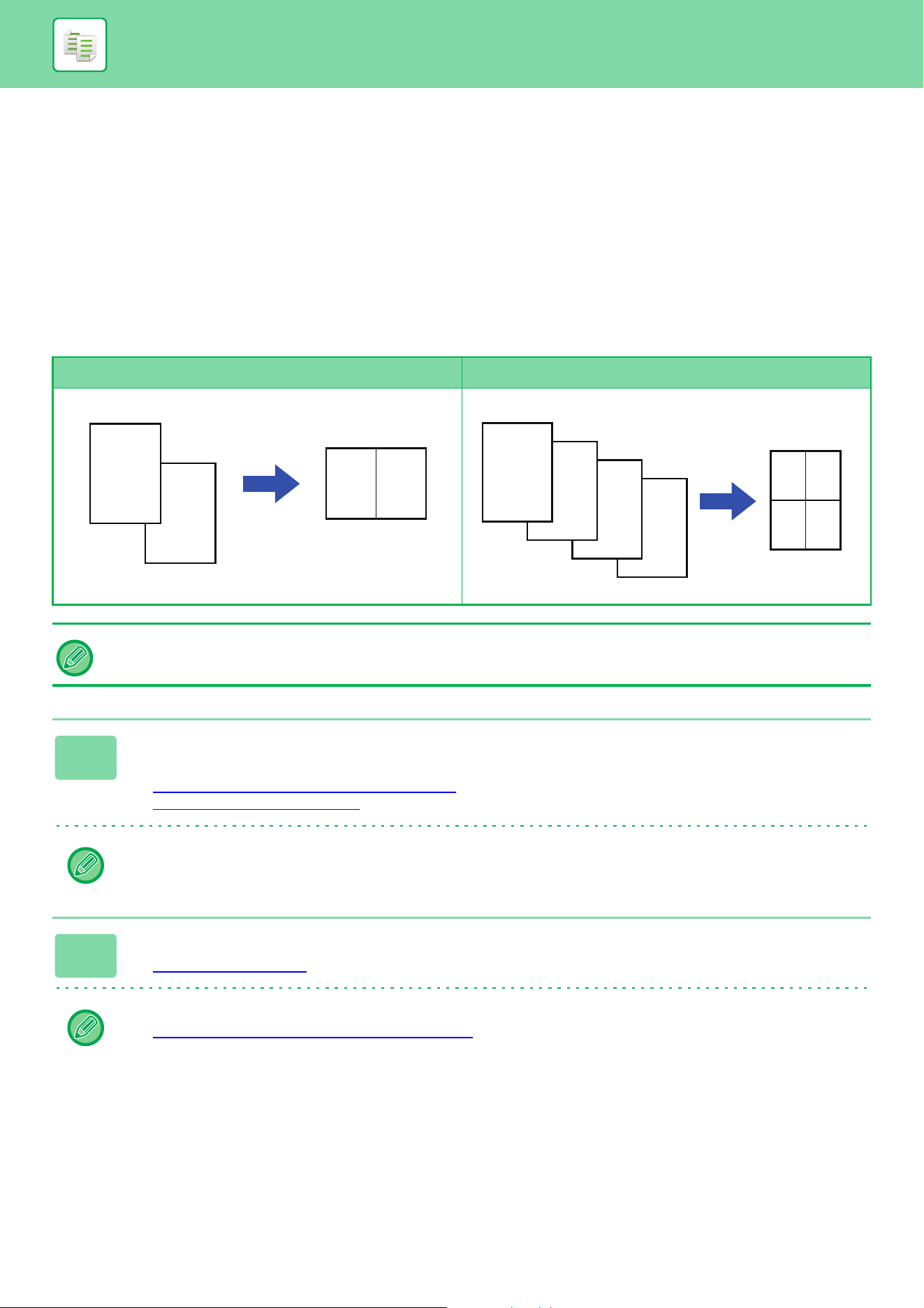
2-61
COPIER►BASIC PROCEDURE FOR MAKING COPIES
BATCH COPY FUNCTIONS
COPYING MULTIPLE ORIGINALS AS A SINGLE PAGE
(N-Up)
This function copies multiple original pages onto a single sheet of paper in a uniform layout.
Select 2-Up to copy two original pages onto one sheet, 4-Up to copy four original pages onto one sheet, or 8-Up to copy
eight original pages onto one sheet.
This function is convenient when you wish to present multiple pages in a compact format, or show a view of all pages in
a document.
2-Up copying 4-Up copying
When inserting a cover sheet, select Cover Setting to copy only a front sheet to one page and collectively copy the second
and subsequent pages.
1
Place the original.
Place the original in the document feeder tray of the automatic document feeder, or on the document glass.
► AUTOMATIC DOCUMENT FEEDER (page 1-90)
► DOCUMENT GLASS (page 1-92)
When using the document glass to scan multiple original pages, change the original and tap the [B/W Start] or [Color
Start] key.
2
Tap the [N-Up] key.
► COPY MODE (page 2-3)
Tap the [Original] key and specify the orientation of the original to have the orientation be correctly recognized.
► Specifying the orientation of the original (page 2-33)
B
A
A B
D
C
B
A
AB
C
D
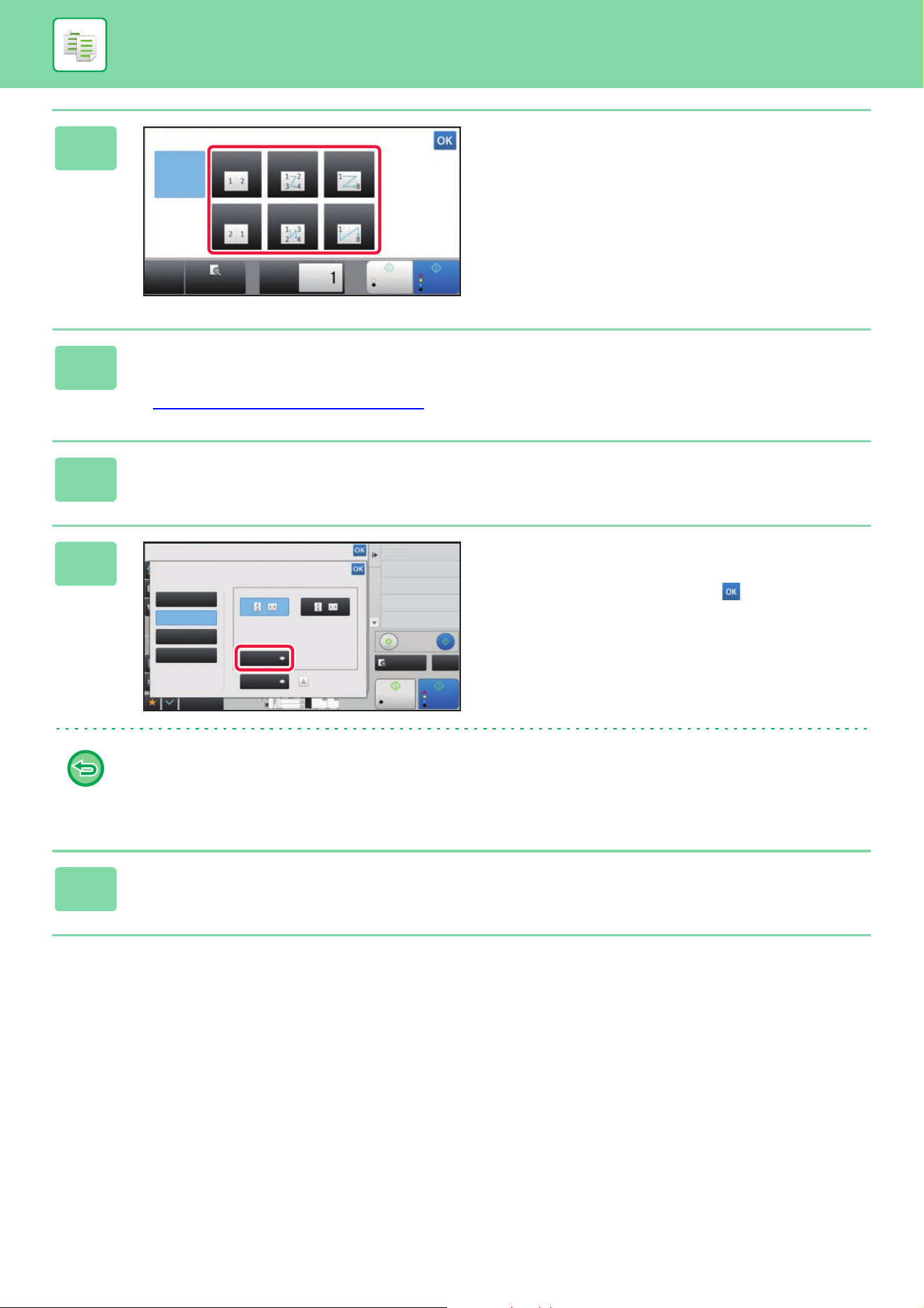
2-62
COPIER►BASIC PROCEDURE FOR MAKING COPIES
3
Tap the number of originals you want
to copy collectively, and select the
layout key.
If needed, the images will be rotated.
If you have finished selecting settings, go to step 7.
4
To select more detailed settings, tap the [Detail] key to switch to normal
mode.
► Changing mode from each mode (page 2-5)
5
Tap the [Others] key, and tap the [N-Up] key.
6
Tap [Border], and select the border.
A line can be inserted between pages arranged on a sheet.
After the settings are completed, tap three times.
• To cancel the N-Up setting:
Tap the [Off] key.
• To cancel all settings:
Tap the [CA] key.
7
Tap the [Color Start] or [B/W Start] key to start copying.
B/W
Start
Color
Start
N-Up
Off
CA
Preview
Copies
2-Up 4-Up 8-Up
2-Up 4-Up 8-Up
68
8½x11 5½x8½
8½x11 8½x11
8½x11 8½x11
8½x14
11x17
Preview
Start
Back
Start
N-Up
Select Original Type to Arrange in 1 Page.
Others
Shift Position to Have Margin
Booklet
Copy Like A Pamphlet
Margin Shift
Insert Covers/Inserts
Covers/Inserts
2-Sided Copy
Color Mode
Off
2-Up
4-Up
Proof Copy
8-Up
Layout
Border
Off
Original
CA
B/W Color
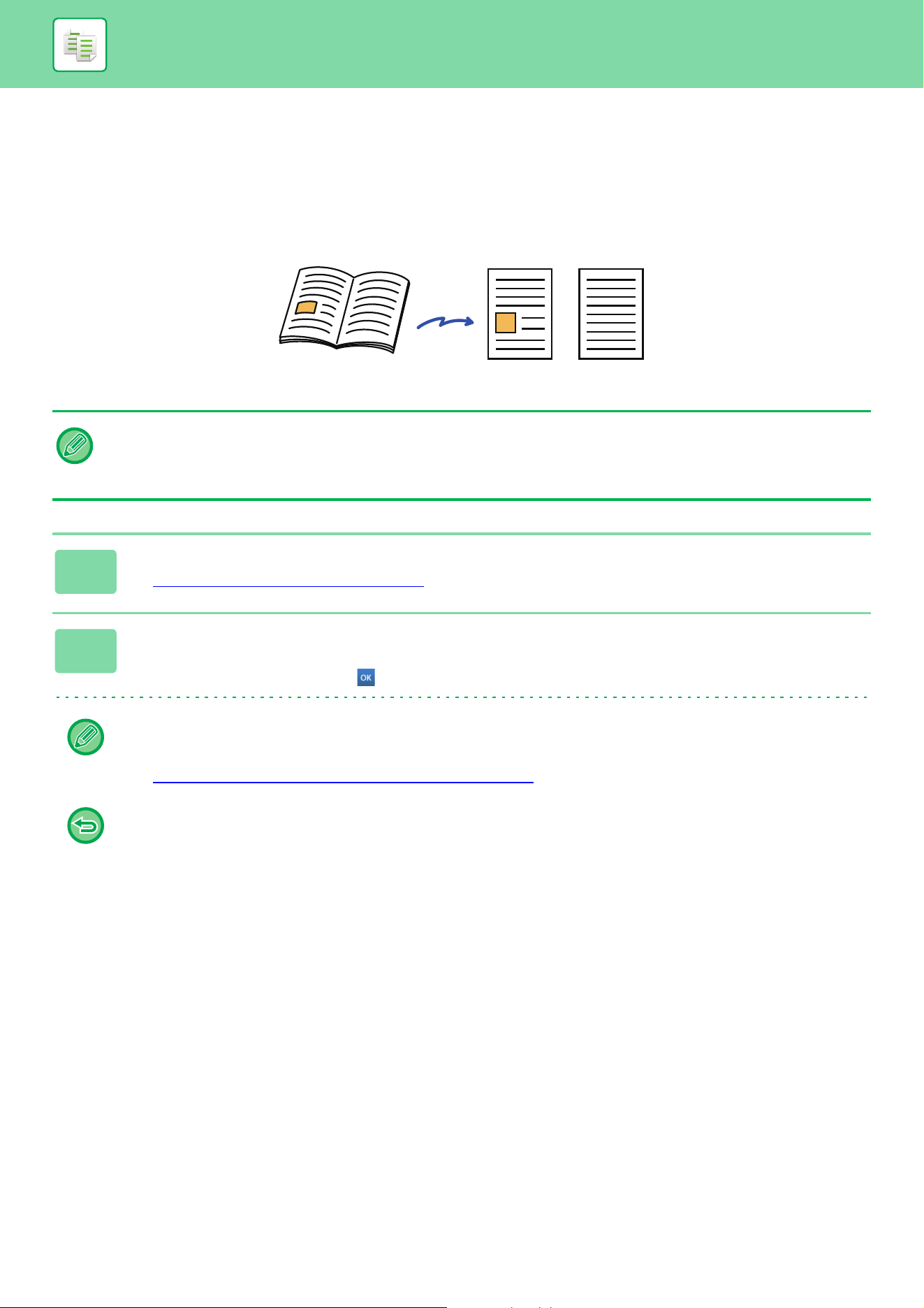
2-63
COPIER►BASIC PROCEDURE FOR MAKING COPIES
COPYING EACH FACING PAGE OF A BOUND
DOCUMENT (DUAL PAGE COPY)
This function copies the left and right half of an original successively. This function is useful when making copies of the
facing pages of a book or other bound document.
Copying the facing pages of a book or bound document
• Specify dual page copy before scanning the original.
• To erase shadows caused by the binding of a book or other bound document, use the erase function.
This function cannot be used in combination with Center Erase.
• This function cannot be used in combination with Image Orientation.
1
Tap the [Detail] key to change to normal mode.
► Changing mode from each mode (page 2-5)
2
Tap the [Others] key, and tap the [Dual Page Copy] key.
A checkmark appears on the icon.
After the settings are completed, tap .
When dual page copy is selected, 8-1/2" x 11" size paper is automatically selected.
If you want to use paper in another tray, tap the [Paper Select] key and select the tray containing the desired paper from
the paper tray selection screen that appears.
► SELECTING THE PAPER TRAY FOR COPYING (page 2-13)
To cancel the dual page copy setting:
Tap the [Dual Page Copy] key to uncheck it.
5
6
56
Book or bound document
The facing pages are copied onto
2 separate pages.
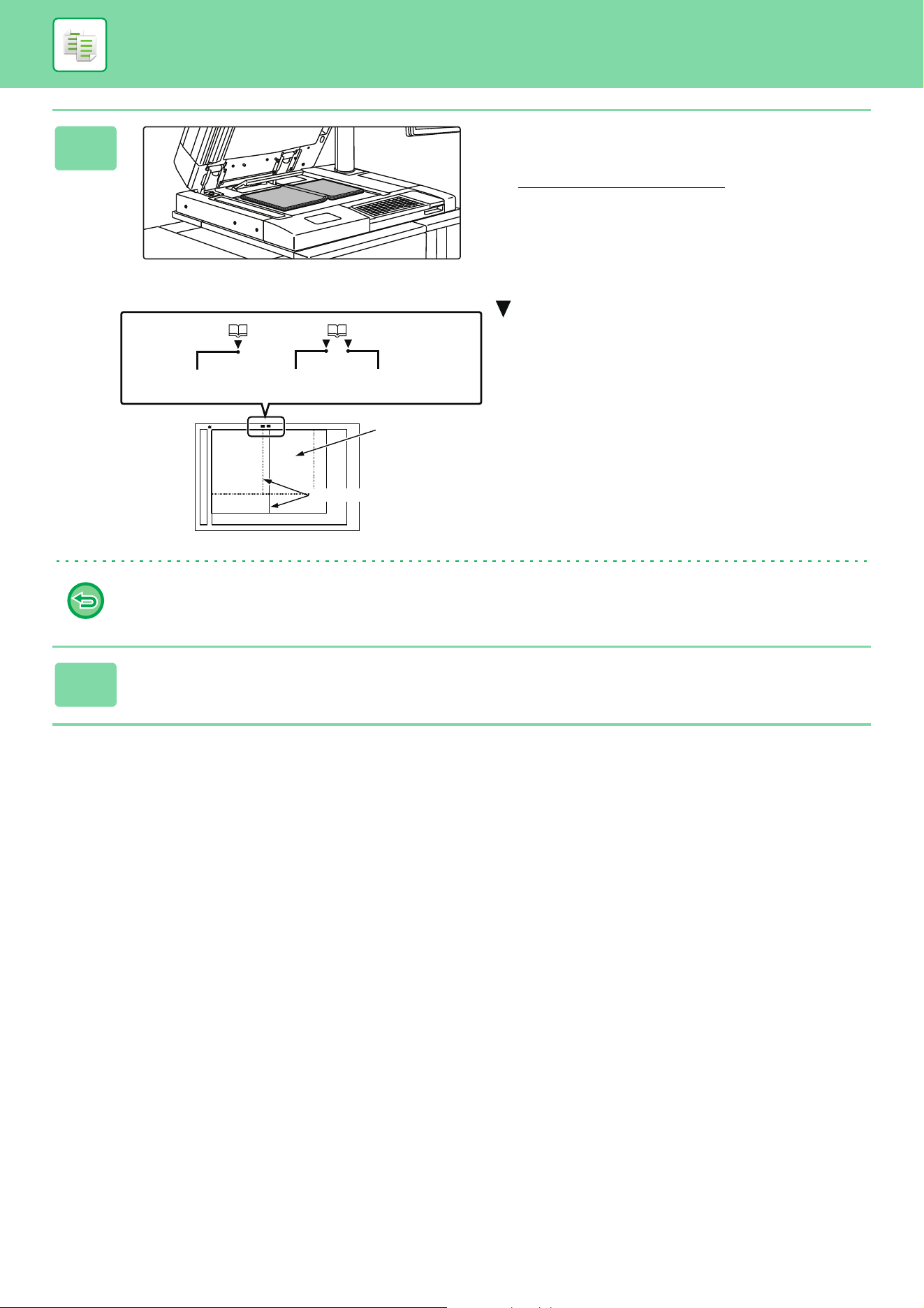
2-64
COPIER►BASIC PROCEDURE FOR MAKING COPIES
3
Place the original on the document
glass.
► DOCUMENT GLASS (page 1-92)
Align the center of the original with the appropriate size mark
.
To cancel all settings:
Tap the [CA] key.
4
Tap the [Color Start] or [B/W Start] key to start copying.
Centerline of B4
original
Centerline of A3
original
Centerline of
11" x 17" original
Size mark
The page on
this side is
copied first.
Centerline of original
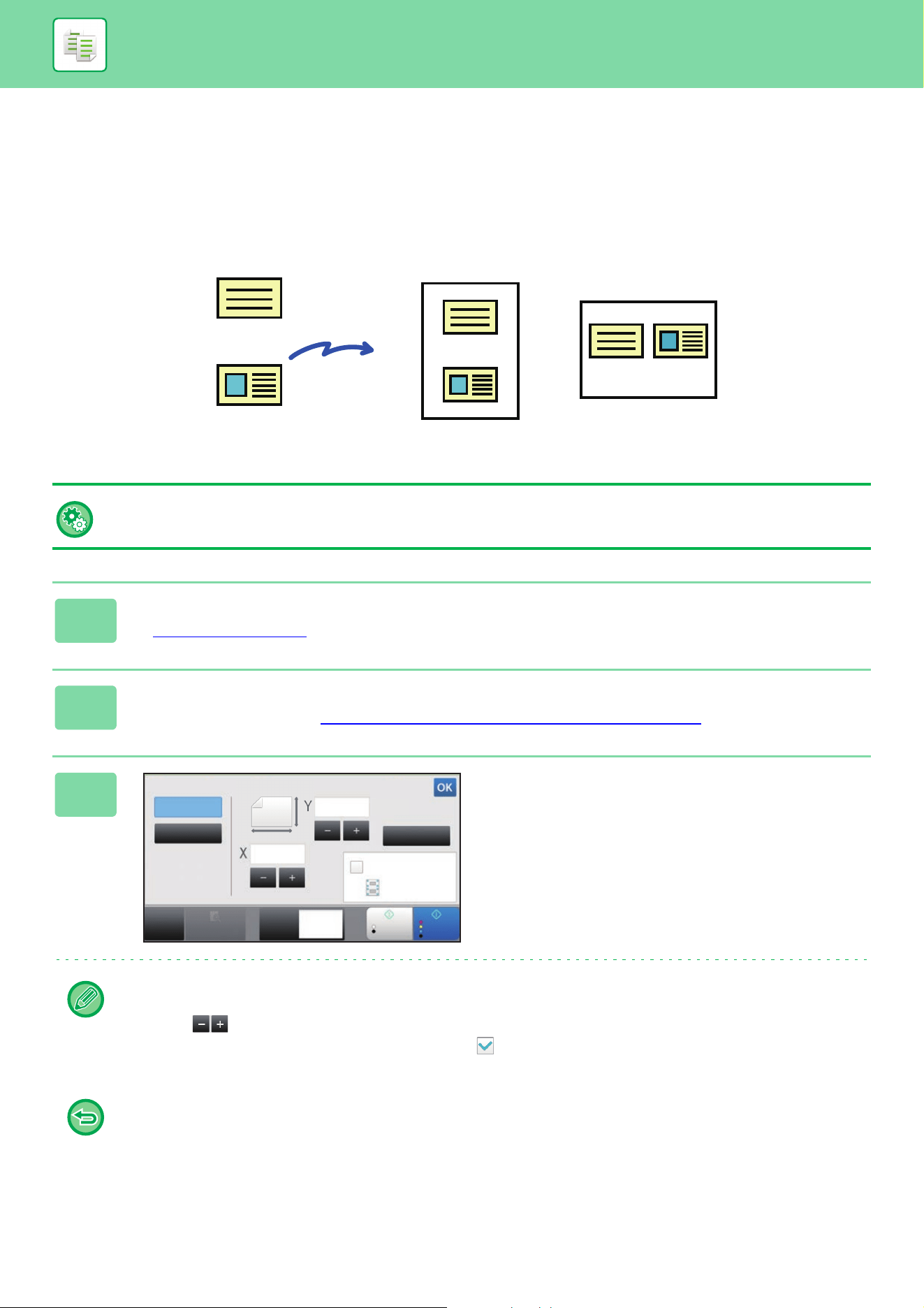
2-65
COPIER►BASIC PROCEDURE FOR MAKING COPIES
COPYING BOTH SIDES OF A CARD AS A SINGLE PAGE
(CARD SHOT)
This function copies the front and reverse sides of a card on one sheet, not on separate sheets.
This function is convenient for making copies for identification purposes and helps save paper.
To change the default original size during Card Shot:
In "Settings (administrator)", select [System Settings] → [Copy Settings] → [Condition Settings] → [Card Shot Settings].
1
Tap the [Card Shot] key.
► COPY MODE (page 2-3)
2
Select the paper to be used for card shot.
Set a paper by referring to the "SELECTING THE PAPER TRAY FOR COPYING (page 2-13)".
3
Tap the [On] key, and specify the
original size as required.
• Tap the areas displaying width and height sizes respectively, and enter the sizes using the numeric keys.
• To quickly set the size, first specify a value close to the desired ratio value by the numeric keys, then adjust it by
tapping .
• When you set the [Adjust to Paper Size] checkbox to , the original is enlarged or reduced with the ratio
appropriate to the original size.
To cancel the Card Shot settings:
Tap the [Off] key.
Back
Front
Example of an 8-1/2" x 11" (A4)
size portrait copy
Example of an 8-1/2" x 11" (A4)
size landscape copy
B/W
Start
Color
Start
Card Shot
Adjust to Paper Size
Reset
(1 ~ 8 1/2)
inch
2 1/8
(1 ~ 8 1/2)
inch
3 3/8
8½x11
CA
Preview
Copies
1
On
Off
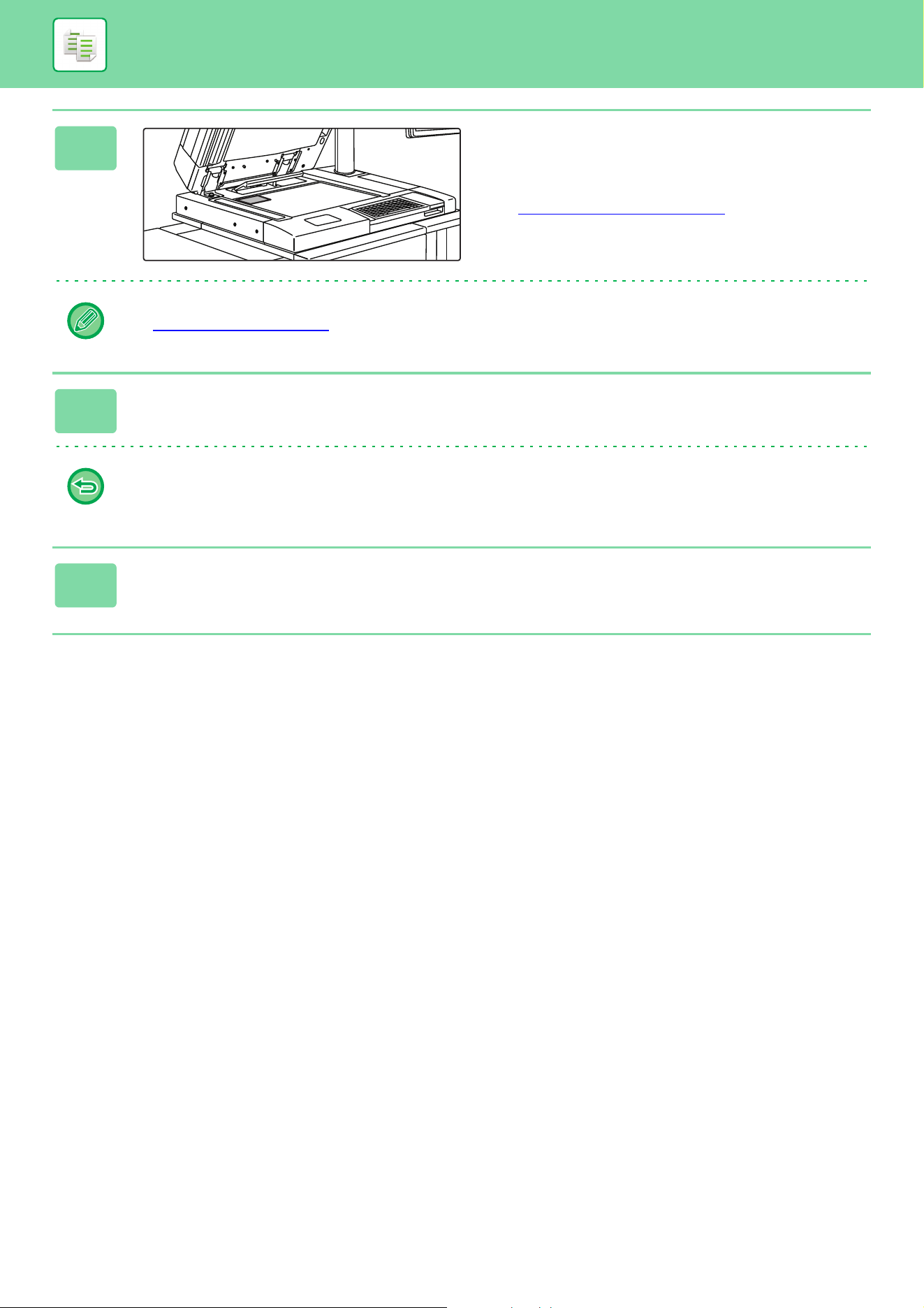
2-66
COPIER►BASIC PROCEDURE FOR MAKING COPIES
4
Place a card face down on the
document glass, and tap the
[Color Start] or [B/W Start] key.
► DOCUMENT GLASS (page 1-92)
You can tap the [Preview] key before scanning the original to check a preview of the scanned image.
► COPY PREVIEW (page 2-9)
5
Place a card face up on the document glass, and tap the [Color Start] or [B/W
Start] key to scan the reverse side.
• Copy settings cannot be changed when scanning additional pages.
• To cancel all settings:
Tap the [CA] key.
6
Tap the [Read-End] key to start copying.
If you tapped the [Preview] key in step 4, a preview will appear. Tap the [Start] key to start copying.
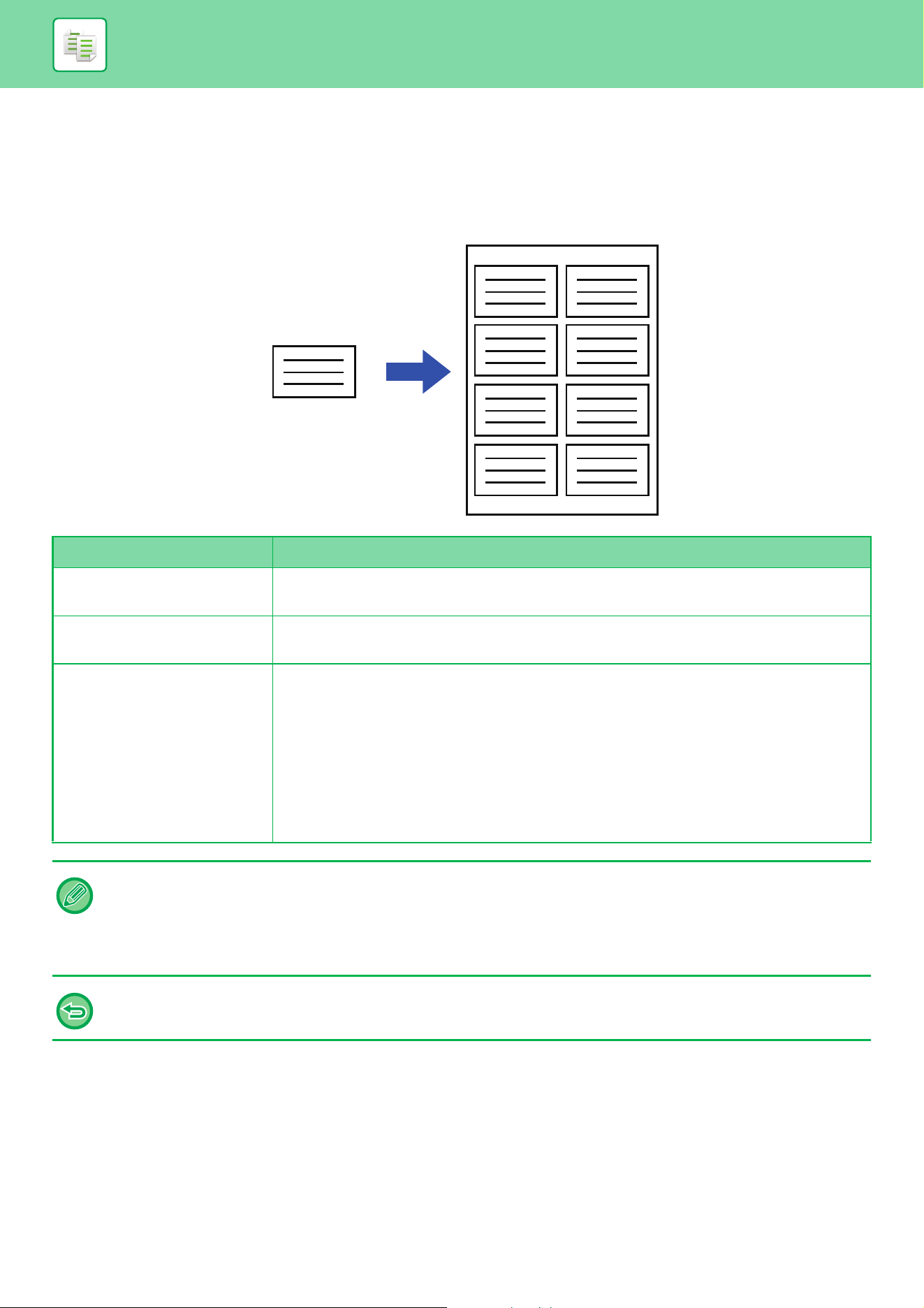
2-67
COPIER►BASIC PROCEDURE FOR MAKING COPIES
REPEATING THE SAME IMAGE ON ONE SHEET
(REPEAT LAYOUT)
This function copies multiple same original images on one sheet.
You can set any of the following three types of repeat copy.
Repeat method Description
Auto Repeat
The maximum repeat count to copy images on a sheet is calculated automatically according
to the original size, paper size, and copy ratio being selected from the base screen.
Fixed Repeat
When you select a repeat count, original size, and paper size to copy images on a sheet, the
copy ratio is calculated automatically and the original is copied.
Photo Repeat
This function repeatedly copies on 8-1/2" x 11" (A4) or 11" x 17" (A3) papers without changing
the copy ratio of the photo size original. You can select any of the following five types of
original size:
• E/L Size, Postcard (Up to 3" x 5" (130 mm x 90 mm))
• Up to 5" x 7" (100 mm x 150 mm)
• Card (Up to 2-1/2" x 4" (70 mm x 100 mm))
* The reduction ratio will be 95%.
• ID Photo (Up to 2-1/2" x 2-1/2" (65 mm x 70 mm))
• Card (Up to 2-1/8" x 2-5/8" (57 mm x 100 mm))
• Repeat Layout must be specified before scanning the original.
• If the copy ratio automatically obtained in [Fixed Repeat] exceeds 25 to 400% (using document glass) or 25 to 200%
(using automatic document feeder), it will result in an error. Select the number of faces to repeat again.
• Always place an original on the document glass for photo repeating.
• Repeat Layout can be combined with Staple / Punch or Saddle Stitch.
• This function cannot be combined with Mixed Size Original or 2-Sided Copy.
• Photo Repeat cannot be combined with Image Orientation.
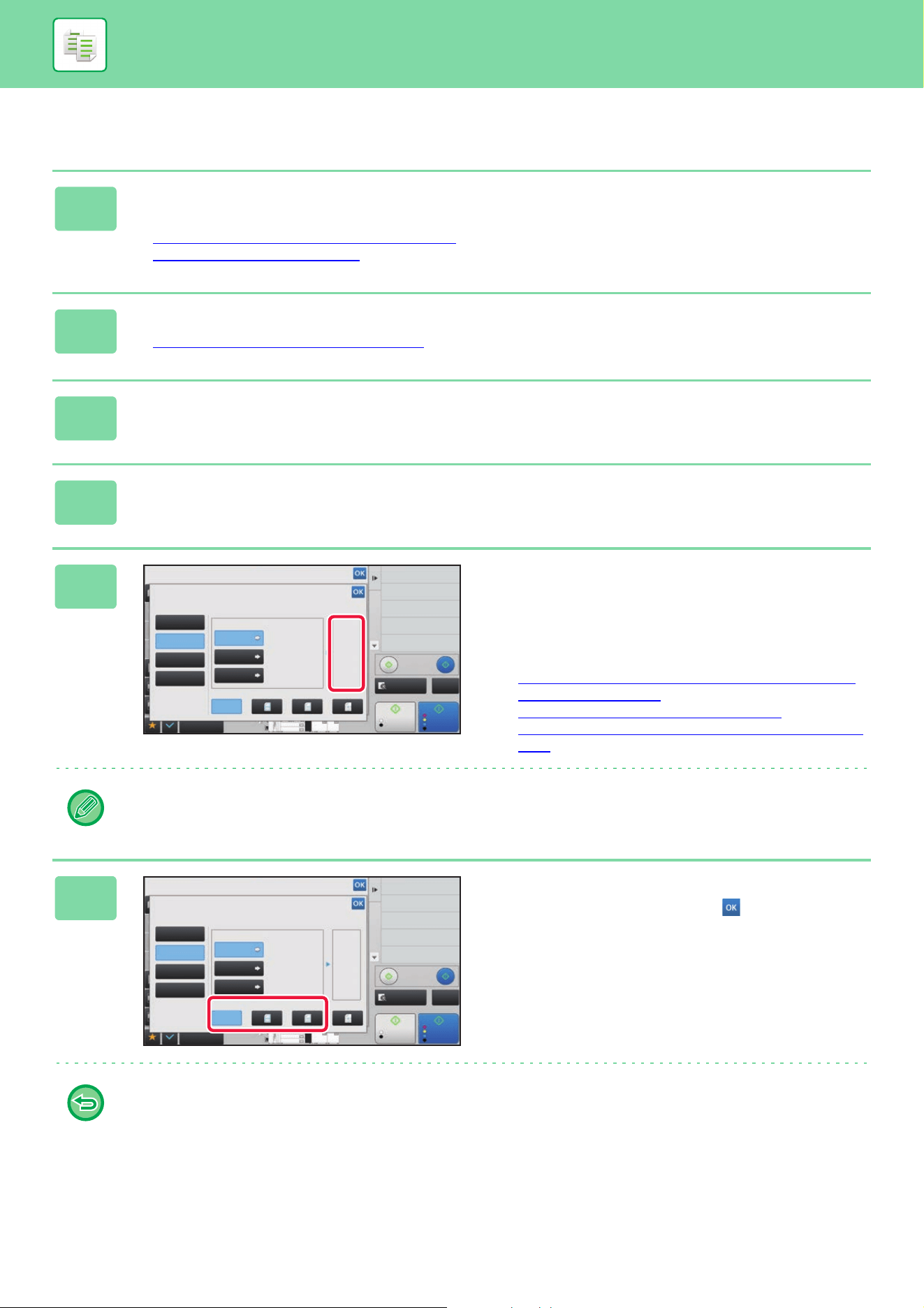
2-68
COPIER►BASIC PROCEDURE FOR MAKING COPIES
Copy by automatically calculating the repeat count (Auto Repeat)
1
Place the original.
Place the original in the document feeder tray of the automatic document feeder, or on the document glass.
► AUTOMATIC DOCUMENT FEEDER (page 1-90)
► DOCUMENT GLASS (page 1-92)
2
Tap the [Detail] key to change to normal mode.
► Changing mode from each mode (page 2-5)
3
Tap the [Others] key, and then tap the [Repeat Layout] key.
4
Tap the [Auto Repeat] key.
5
Check the repeat faces which have
been calculated automatically.
Change the original size, paper size, or copy ratio by tapping
the respective [Original], [Paper Select], or [Copy Ratio] key
when necessary.
► SELECTING THE ORIENTATION AND SIZE OF THE
ORIGINAL (page 2-33)
► MANUAL RATIO SELECTION (page 2-27)
► SELECTING THE PAPER TRAY FOR COPYING (page
2-13)
Set so that there are one or more repeat faces.
6
Specify the repeat partition line.
After the settings are completed, tap twice.
• To cancel the Auto Repeat setting:
Tap the [Off] key.
• To cancel all settings:
Tap the [CA] key.
4
3
68
Proof Copy
1
8½x11 8½x11
8½x14
11x17
Preview
Start
Back
Start
Repeat Layout
Auto Layout of Repeat Face Based on Original, Paper Size and Ratio.
Others
Off
Fixed Repeat
Photo Repeat
Auto Repeat
Exposure
Select Type/Exposure
Background Adjustment
Color Mode
Change Size/Direction.
Original
Paper Select
Original
Current Setting
8½x11
100%
Off
Parting Line
Copy Ratio
CA
B/W
Repeat
Number
Auto 8½x11
Color
1
Proof Copy
3
68
4
8½x11 5½x8½
8½x11 8½x11
8½x14
11x17
Preview
Start
Back
Start
Repeat Layout
Auto Layout of Repeat Face Based on Original, Paper Size and Ratio.
Others
Off
Fixed Repeat
Photo Repeat
Auto Repeat
Exposure
Select Type/Exposure
Background Adjustment
Color Mode
Change Size/Direction.
Original
Paper Select
Copy Ratio
Original
Current Setting
Parting Line
8½x11
Auto 8½x11
100%
Repeat
Number
Off
CA
B/W Color
2-69
COPIER►BASIC PROCEDURE FOR MAKING COPIES
Copy by specifying a repeat count (Fixed Repeat)
7
Tap the [Color Start] or [B/W Start] key to start copying.
1
Place the original.
Place the original in the document feeder tray of the automatic document feeder, or on the document glass.
► AUTOMATIC DOCUMENT FEEDER (page 1-90)
► DOCUMENT GLASS (page 1-92)
2
Tap the [Detail] key to change to normal mode.
► Changing mode from each mode (page 2-5)
3
Tap the [Others] key, and then tap the [Repeat Layout] key.
4
Tap the [Fixed Repeat] key.
5
Tap the [Original] and [Paper Select] keys to select an original size and a
paper size, respectively.
► SELECTING THE ORIENTATION AND SIZE OF THE ORIGINAL (page 2-33)
► SELECTING THE PAPER TRAY FOR COPYING (page 2-13)
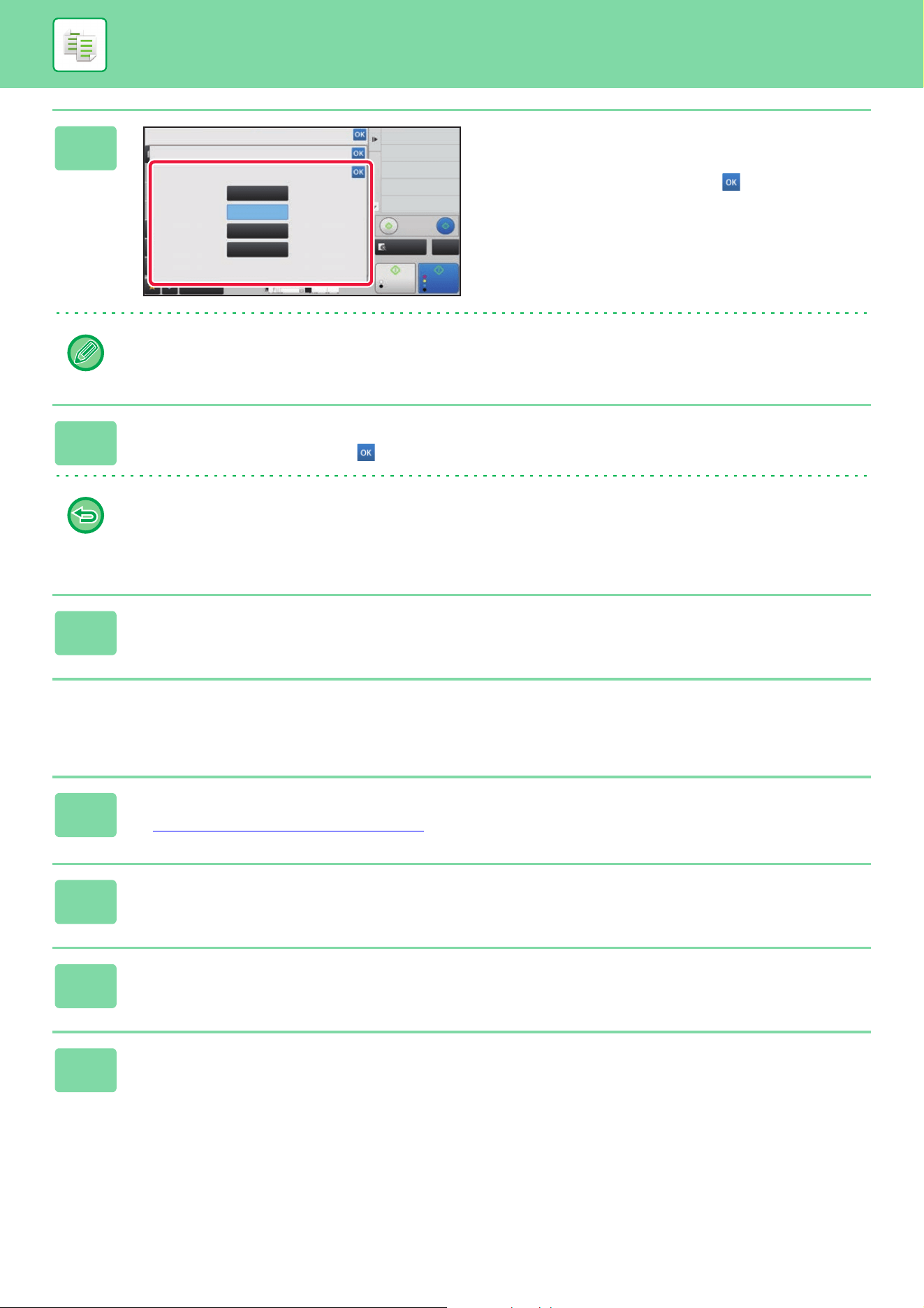
2-70
COPIER►BASIC PROCEDURE FOR MAKING COPIES
Repeat a photo size original in actual size (Photo Repeat)
6
Tap [No. of Faces] to set a repeat
count.
After the settings are completed, tap .
The automatic calculation result is shown as the copy ratio.
If the calculated copy ratio exceeds the range from 25% to 400% (using document glass) or 25 to 200% (using automatic
document feeder), an error occurs.
7
Specify the repeat partition line.
After the settings are completed, tap twice.
• To cancel the fixed repeat setting:
Tap the [Off] key.
• To cancel all settings:
Tap the [CA] key.
8
Tap the [Color Start] or [B/W Start] key to start copying.
1
Tap the [Detail] key to change to normal mode.
► Changing mode from each mode (page 2-5)
2
Tap the [Others] key, and then tap the [Repeat Layout] key.
3
Tap the [Photo Repeat] key.
4
Place the original on the document glass.
4
3 8½x14
68
Proof Copy
8½x11 5½x8½
8½x11 8½x11
8½x11 8½x11
8½x14
11x17
Preview
Start
Back
Start
Repeat Layout
No. of Faces
Others
Exposure
Select Type/Exposure
Background Adjustment
Color Mode
Change Size/Direction.
Original
4 Repeat
2 Repeat
8 Repeat
16 Repeat
CA
B/W Color
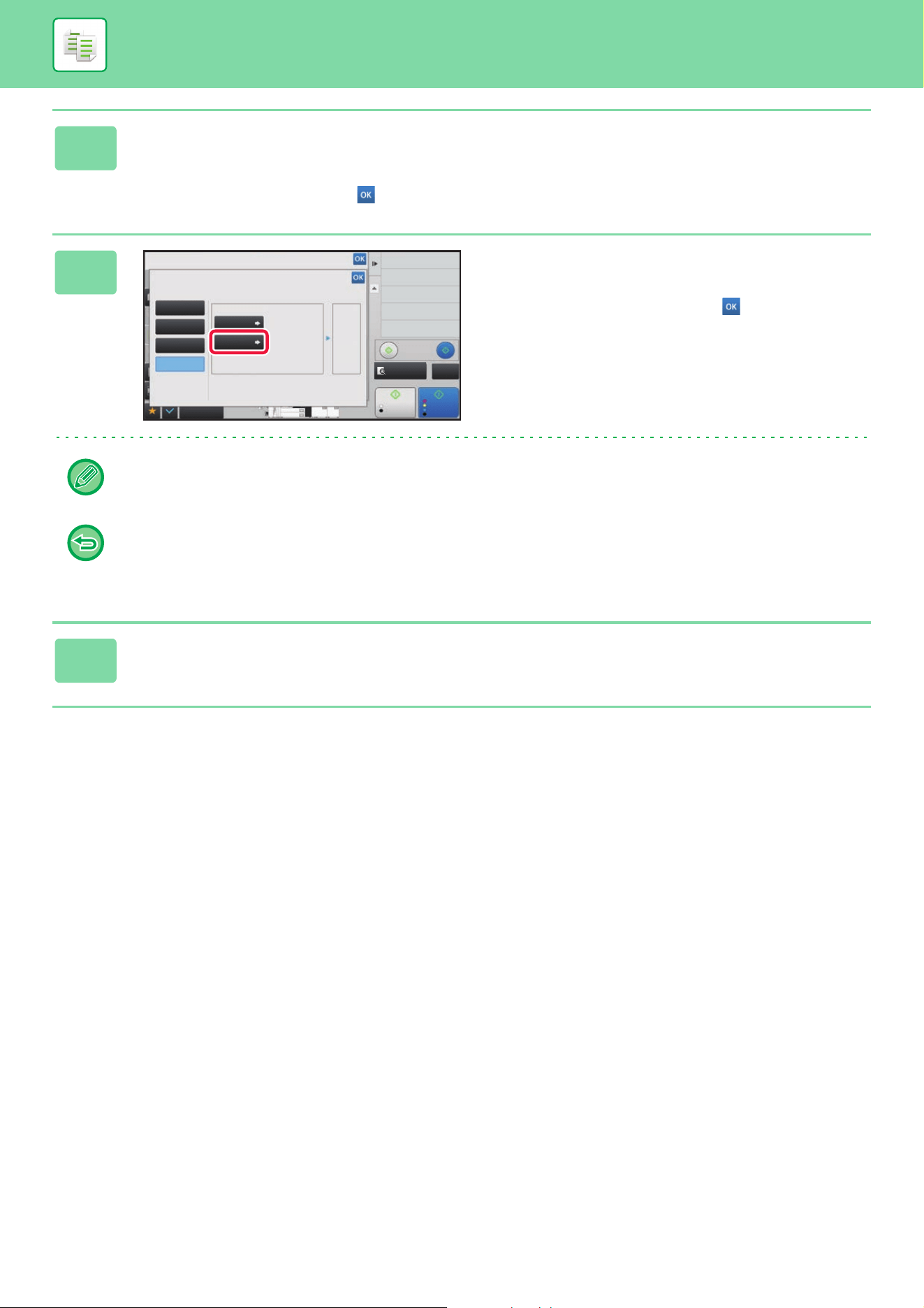
2-71
COPIER►BASIC PROCEDURE FOR MAKING COPIES
5
Tap the [Original] key and select an original size.
When you tap the original size key, the original direction is indicated in the "How To Set". Place the original to meet the
displayed orientation.
After the settings are completed, tap .
6
Tap the [Paper Select] key and select a
paper size.
After the settings are completed, tap twice.
The automatic calculation result is shown as the copy ratio.
When you tap the [*Up to 57x100mm(Card) *~ 2 1/8 x 2 5/8"] key on the [Original] screen, you can select the 8-1/2" x 11"
or A4 paper size only.
• To cancel the photo repeat setting:
Tap the [Off] key.
• To cancel all settings:
Tap the [CA] key.
7
Tap the [Color Start] or [B/W Start] key to start copying.
4
3
68
Proof Copy
8½x11 8½x11
8½x14
11x17
Preview
Start
Back
Start
Repeat Layout
Auto Layout of Repeat Face Based on Original, Paper Size and Ratio.
Others
Off
Fixed Repeat
Photo Repeat
Auto Repeat
Exposure
Select Type/Exposure
Background Adjustment
Color Mode
Copy Ratio
Original
Current Setting
5½x8½
8½x11
100%
Paper Select
4
Repeat
Number
CA
B/W Color
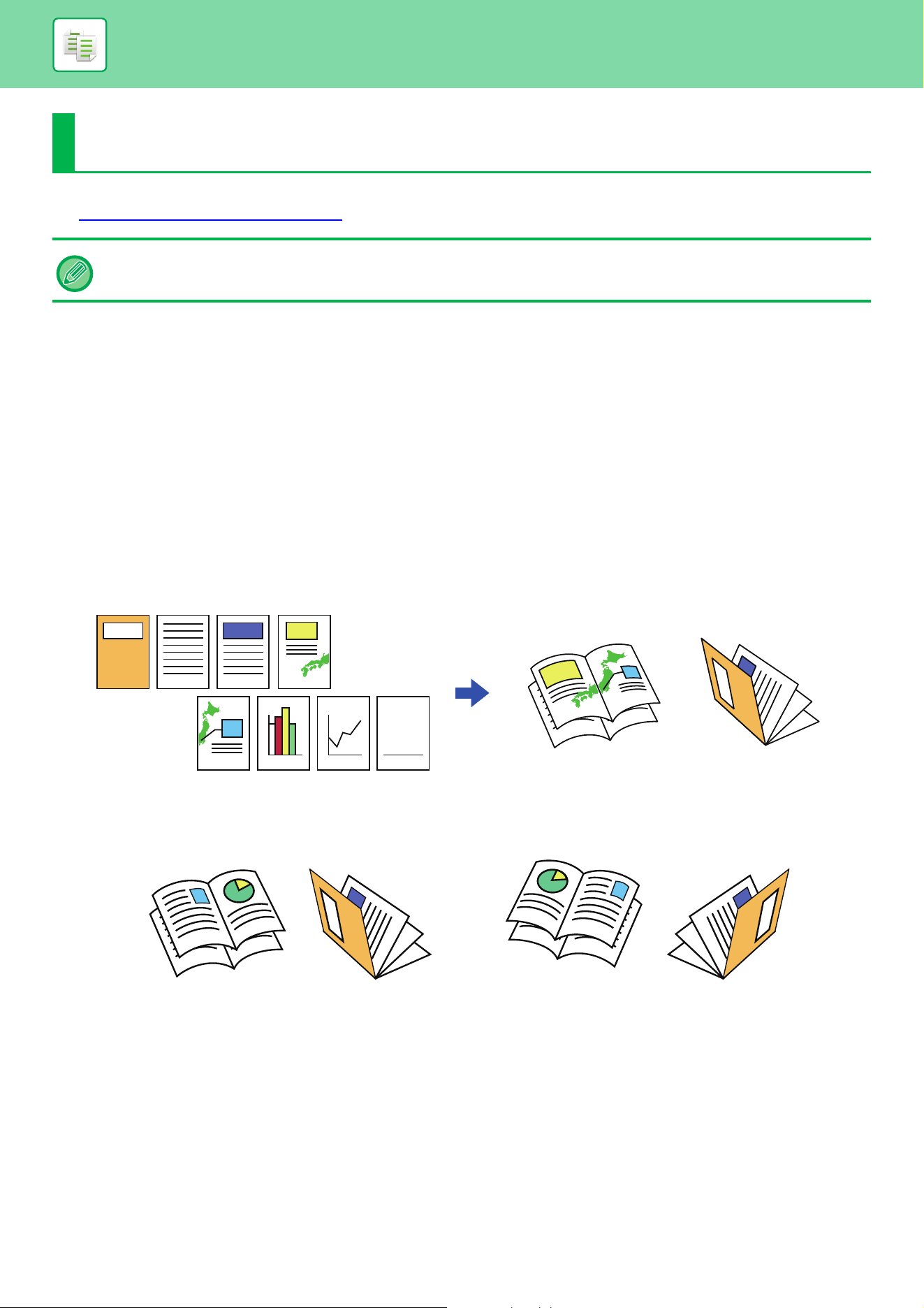
2-72
COPIER►OTHER FUNCTIONS
Other functions are set from the base screen of normal mode.
► SELECTING COPY MODE (page 2-4)
OUTPUT AND LAYOUT EDITING
FUNCTIONS
MAKING COPIES IN PAMPHLET FORMAT (BOOKLET)
Copies made by "Booklet" can be folded at the center to create a booklet.
This function is convenient for arranging copies into an attractive booklet or pamphlet.
Booklet copy using 8 original pages
Binding side
OTHER FUNCTIONS
Other functions cannot be selected in easy mode.
765
432
7
2
5
3
7
5
4
Originals
Staple to create a booklet
7
2
7
5
3
5
4
7
2
7
5
3
4
5
Left Binding
Right Binding
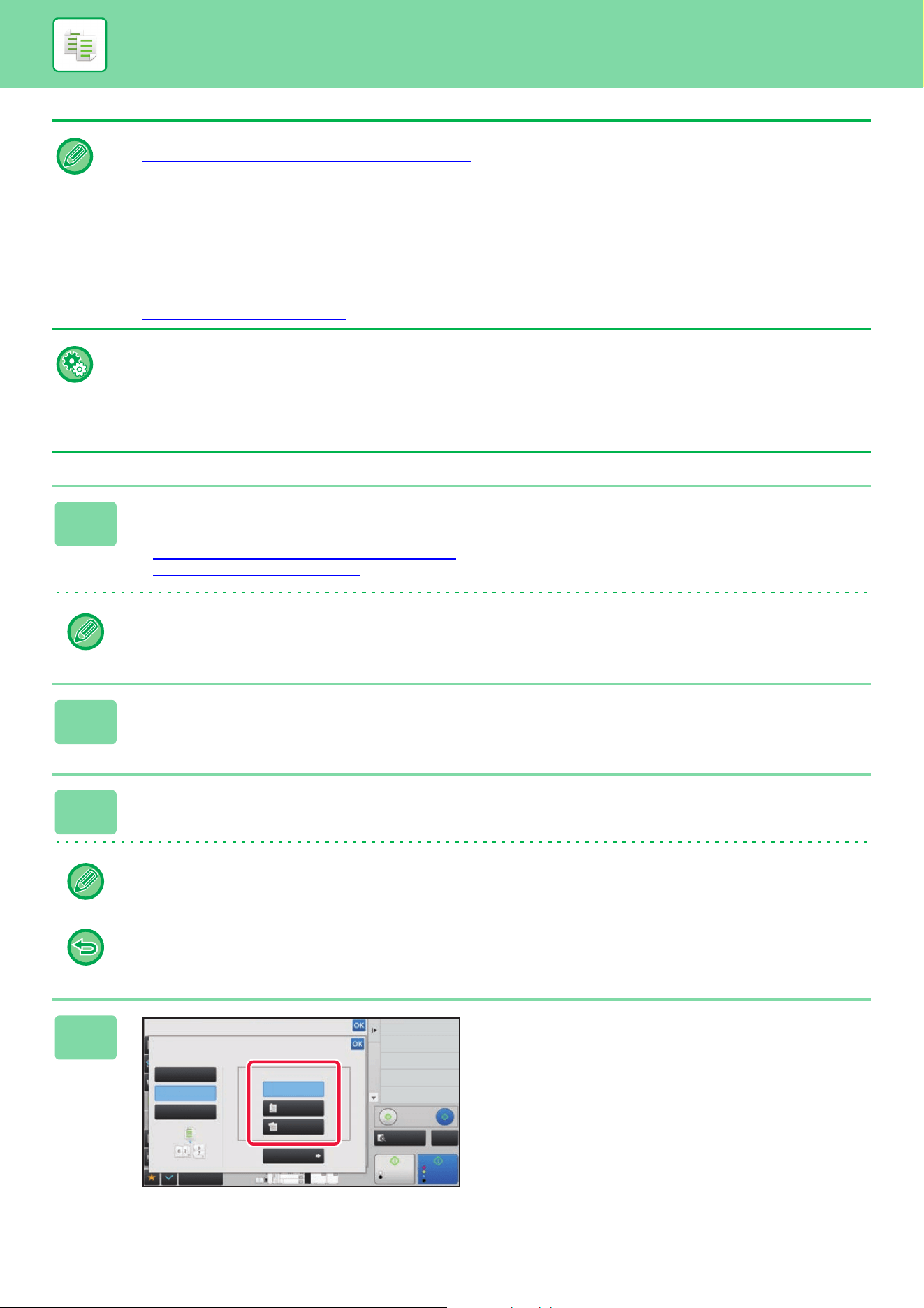
2-73
COPIER►OTHER FUNCTIONS
• To make Booklet copies of a book or other bound original, use the book copy function.
► COPYING A PAMPHLET (BOOK COPY) (page 2-78)
• When Booklet is selected, 2-sided copying mode is automatically selected. When settings are selected that prevent
2-sided copying, the booklet function cannot be used.
• Scan the originals in order from the first page to the last page. The order of copying will be automatically adjusted by the
machine. Four original pages will be copied onto each sheet of paper. Blank pages will be automatically produced at the
end of pamphlet copies if the number of original pages is not a multiple of four.
• When a saddle stitch finisher is installed, you can select [Saddle Stitch] (Staple each set of copies at two positions in the
center of paper).
► STAPLE SETTINGS (page 2-48)
To staple copies automatically when Booklet is enabled:
From the "Settings (administrator)", select [System Settings] → [Common Settings] → [Device Control] → [Automatic Saddle
Stitch].
This is used to activate Saddle Stitch automatically when Booklet is enabled when a saddle stitch finisher is installed. To
make pamphlet copies without stapling when the [Automatic Saddle Stitch] option is ON, tap the [Booklet] key. Then, tap the
[Off] key on the saddle stitch screen.
1
Place the original.
Place the original in the document feeder tray of the automatic document feeder, or on the document glass.
► AUTOMATIC DOCUMENT FEEDER (page 1-90)
► DOCUMENT GLASS (page 1-92)
If the originals are 2-sided, place them in the document feeder tray.
2
Tap the [Others] key and then the [Booklet] key, or tap the [Output] key and
then [Staple] tab and [Saddle Stitch] key.
3
Select the binding edge.
When [Automatic Saddle Stitch] is set to off in "Settings (administrator)", tap [Output] key → [Staple] tab → [Saddle
Stitch] key and then set with the [On] or [Off] key.
To cancel the booklet setting:
Tap the [Off] key.
4
Tap the [1-Sided], [2-Sided Booklet] or
[2-Sided Tablet] key as appropriate for
the original.
When not inserting a cover, go to step 6.
4
3
68
Proof Copy
8½x11 8½x11
8½x14
11x17
Preview
Start
Select Output Binding Edge.
Others
Booklet
Others
Change Size/Direction.
Original
Start
Off
Right Binding
Left Binding/
Tablet
2-Sided
Booklet
1-Sided
2-Sided
Tablet
Cover Setting
Paper Select
Change Paper Feed Tray
Put Multiple Pages in A Page
N-Up
Select Original Type.
CA
B/W
Erase Shadow Around
Erase
Color
2-74
COPIER►OTHER FUNCTIONS
5
When inserting a cover, tap the [Cover Setting] key, and tap the [On] key.
After the settings are completed, tap twice.
To change the cover input tray:
Tap the [Paper Tray] key to display the tray selection screen.
Tap the cover input tray on the tray selection screen.
For more information, see "SELECTING THE PAPER TRAY FOR COPYING (page 2-13)
".
• If the cover will be copied on, label sheets, transparency film, and tab paper cannot be used.
• To cancel all settings:
Tap the [CA] key.
6
Tap the [Color Start] or [B/W Start] key to start copying.
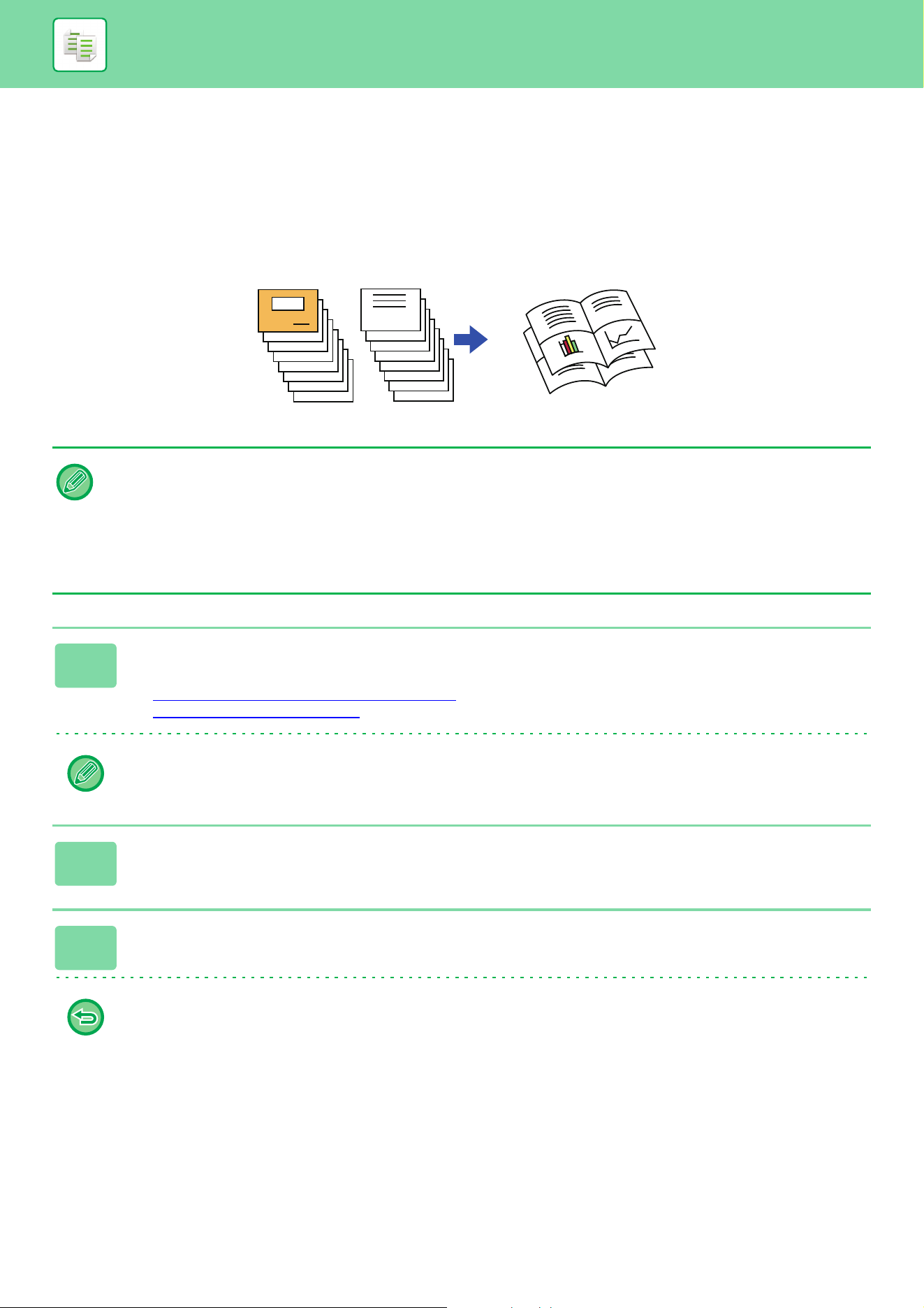
2-75
COPIER►OTHER FUNCTIONS
COPYING MULTIPLE ORIGINALS ON EACH BOOKLET
PAGE (BOOKLET 2-Up/4-Up)
This function copies two or four original pages equally on one page of pamphlet copy paper.
This function is convenient for arranging minimum number of copies into an attractive booklet or pamphlet format.
• The following paper sizes and number of sheets are available for booklet 2-Up or 4-Up.
Paper size: 12"x 18", 11"x 17", 8-1/2"x 14", 8-1/2"x 11"R, A3W, A3, B4, A4R, B5R
Number of stapled sheets: Max. 15 sheets
• Scan the originals in order from the first page to the last page. The order of copying will be automatically adjusted by the
machine.
Eight or 16 original pages will be copied onto each sheet of paper. Blank pages will be automatically produced at the end if
the number of original pages is not a multiple of eight.
1
Place the original.
Place the original in the document feeder tray of the automatic document feeder, or on the document glass.
► AUTOMATIC DOCUMENT FEEDER (page 1-90)
► DOCUMENT GLASS (page 1-92)
If the originals are 2-sided, place them in the document feeder tray.
2
Tap the [Others] key, and then the [Booklet] key.
3
Select the binding edge.
To cancel the booklet setting:
Tap the [Off] key.
8
14
4
3
7
6
5
4
3
2
15
14
13
12
11
10
9
10
8
9
7
Originals Booklet 2-Up
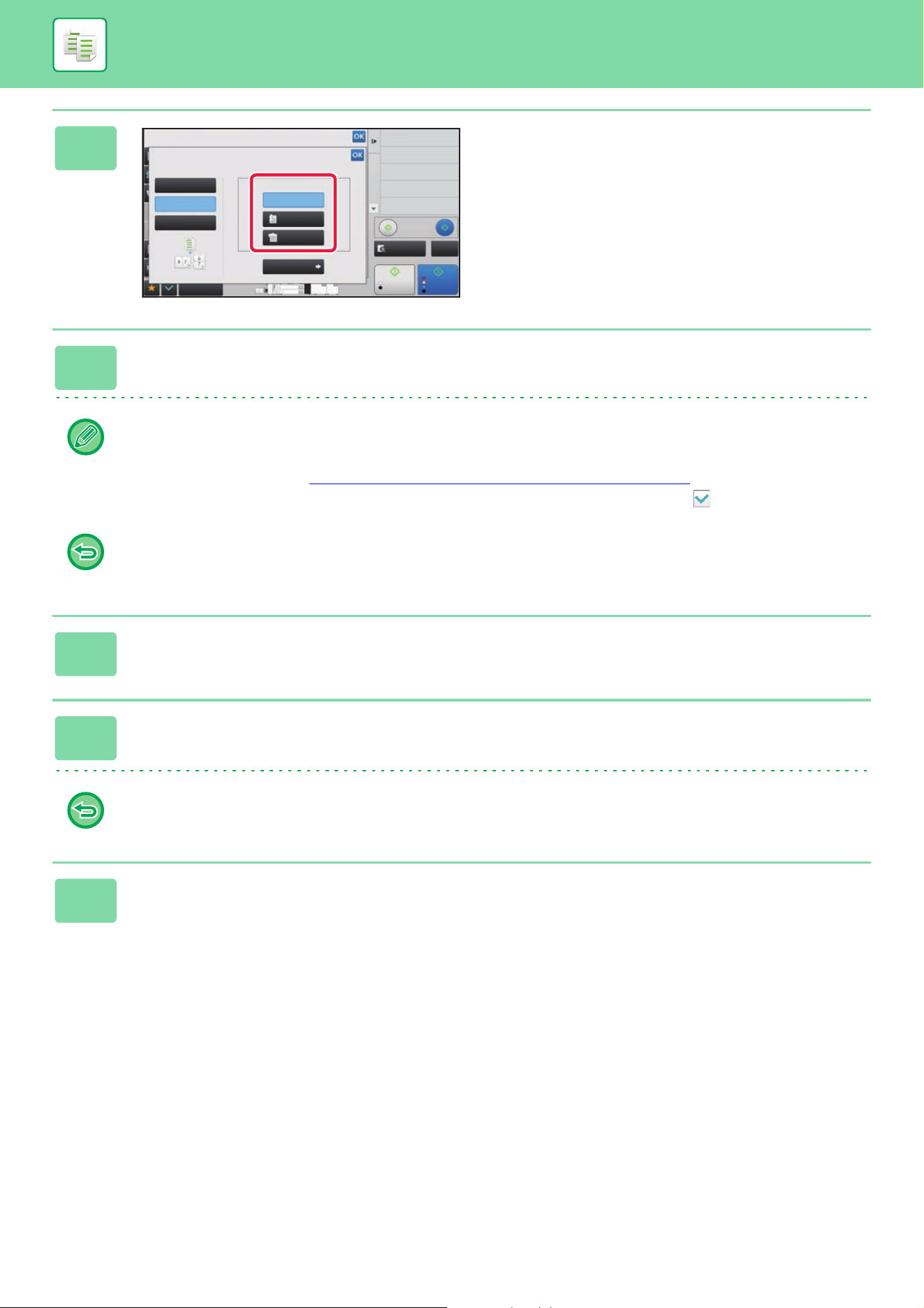
2-76
COPIER►OTHER FUNCTIONS
4
Tap the [1-Sided], [2-Sided Booklet] or
[2-Sided Tablet] key as appropriate for
the original.
When not inserting a cover, go to step 6.
5
When inserting a cover, tap the [Cover Setting] key, and tap the [On] key.
• To change the cover input tray:
Tap the [Paper Tray] key to display the tray selection screen.
Tap the cover input tray on the tray selection screen.
For more information, see "SELECTING THE PAPER TRAY FOR COPYING (page 2-13)
".
• To make a copy on a cover sheet, check the [Make Copy on Cover (Duplex)] box so that appears.
• If the cover will be copied on, label sheets, transparency film, and tab paper cannot be used.
• To cancel all settings:
Tap the [CA] key.
6
Tap [N-Up] on the action panel.
7
Tap the key of the N-Up sheets you wish to use.
If needed, the images will be rotated.
To cancel the N-Up setting
Tap the [Off] key.
8
Select the layout.
Preview
Start
Others
Start
Off
Right Binding
Left Binding/
Tablet
1-Sided
Cover Setting
Select Original Type.
CA
B/W
2-Sided
Booklet
2-Sided
Tablet
Change Size/Direction.
Original
Paper Select
Change Paper Feed Tray
Put Multiple Pages in A Page
N-Up
Proof Copy
11x17 11x1711x174
8½x14
68
3
Select Output Binding Edge.
Others
Booklet
Erase Shadow Around
Erase
Color
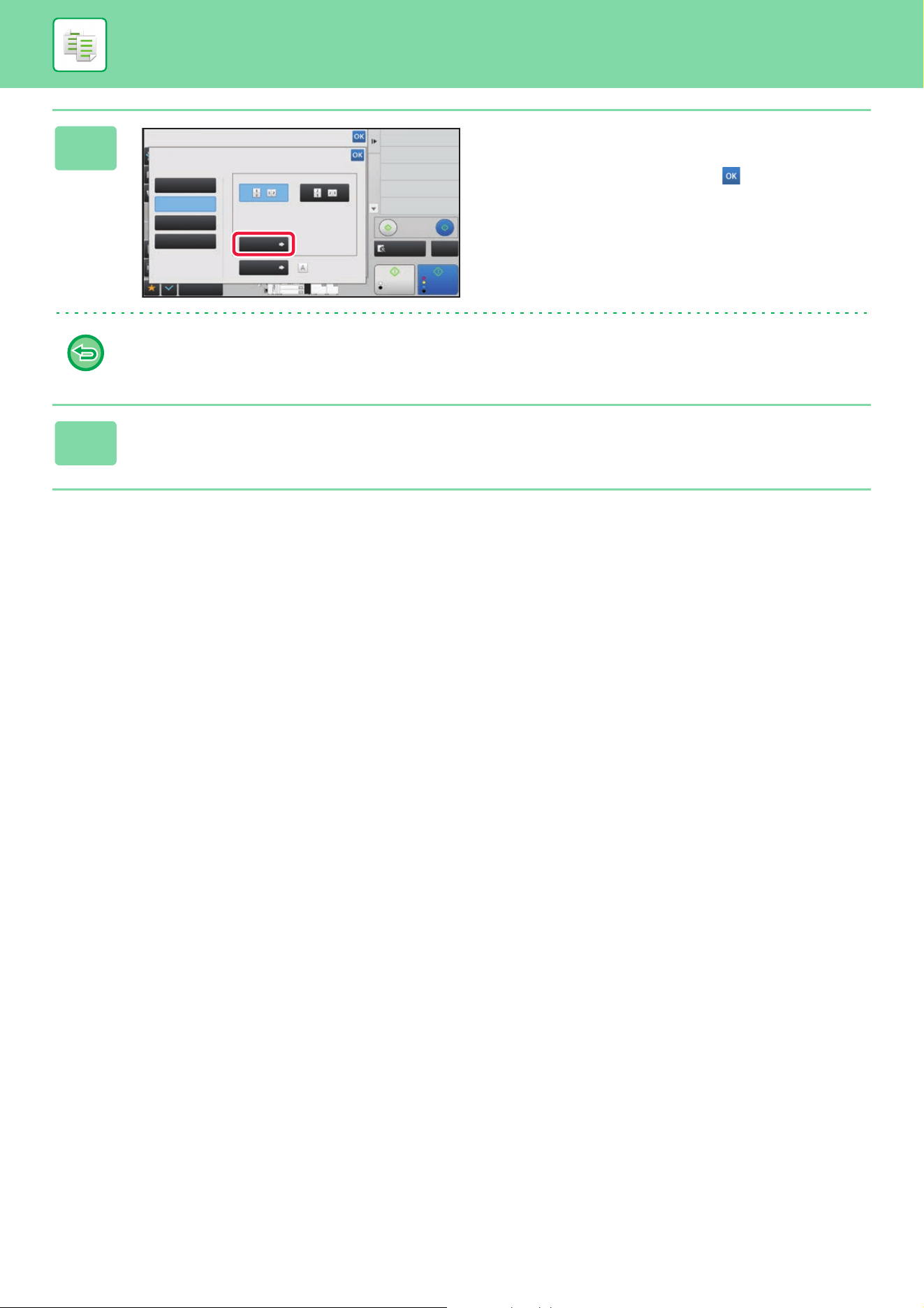
2-77
COPIER►OTHER FUNCTIONS
9
Tap [Border], and select the border.
A line can be inserted between pages arranged on a sheet.
After the settings are completed, tap three times.
To cancel all settings:
Tap the [CA] key.
10
Tap the [Color Start] or [B/W Start] key to start copying.
Proof Copy
2-Sided Copy
Margin Shift
Shift Position to Have Margin
Booklet
Copy Like A Pamphlet
Insert Covers/Inserts
11x17 11x1711x174
3
8½x14
68
Start
CA
Back
Start
Off
4-Up
8-Up
2-Up
Layout
Border
Original
Off
B/W
Select Original Type to Arrange in 1 Page.
Others
N-Up
Color Mode
Covers/Inserts
Preview
Color
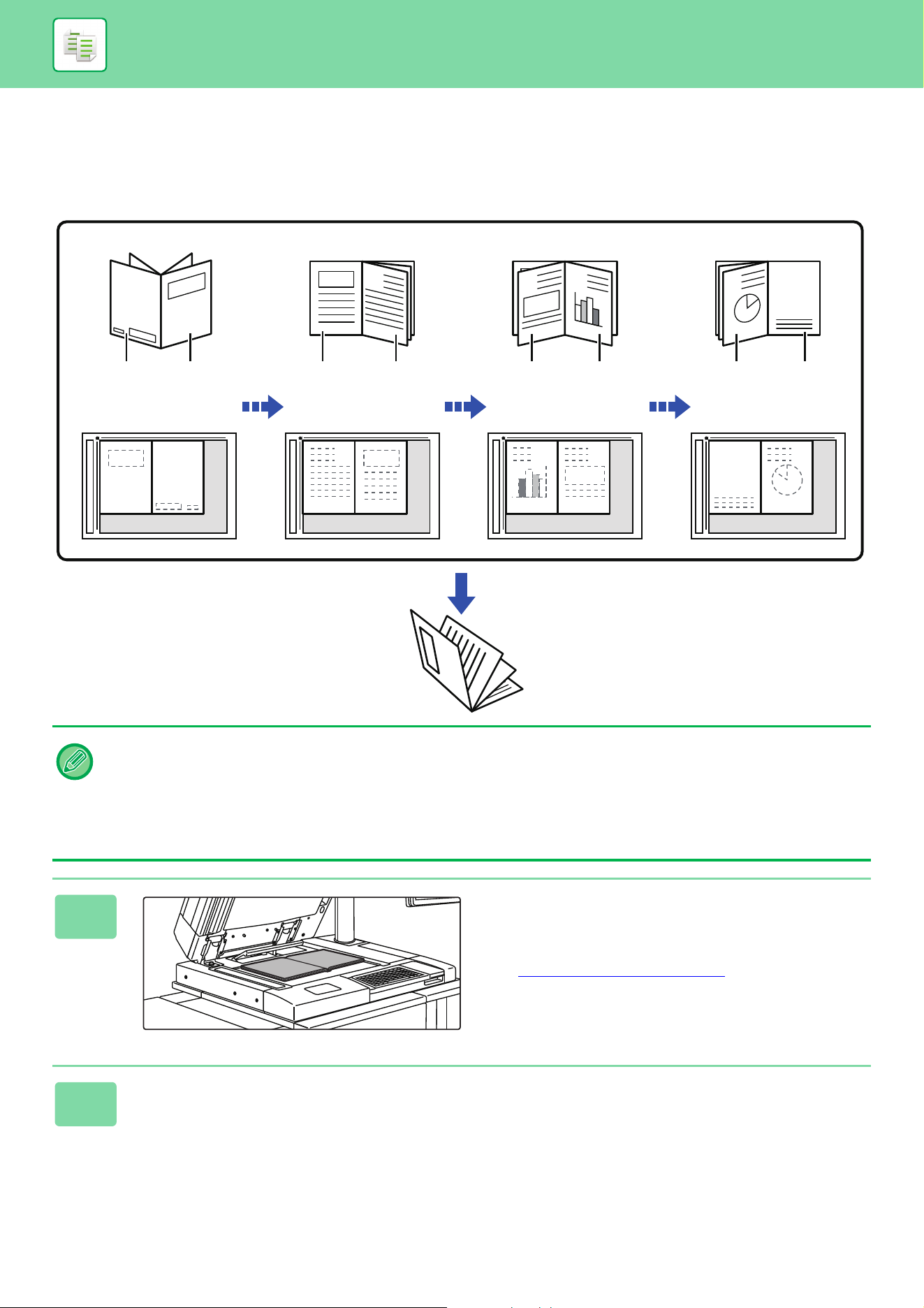
2-78
COPIER►OTHER FUNCTIONS
COPYING A PAMPHLET (BOOK COPY)
This function makes a copy of the two facing pages of an open book or other bound document.
Copies made with this function can be folded at the center to create a booklet.
This function is convenient for arranging copies into an attractive booklet or pamphlet.
• Book Copy must be specified before scanning the original.
• Four original pages will be copied onto each sheet of paper. Blank pages will be automatically added at the end if the total
number of original pages is not a multiple of four.
• This function can be combined with saddle stitch or fold if a saddle stitch finisher is installed.
• When the book copy function is selected, 2-sided copying mode is automatically selected.
When settings are selected that prevent 2-sided copying, the book copy function cannot be used.
1
Place the original on the document
glass.
Place the opened pages of the "front and last sheets".
► DOCUMENT GLASS (page 1-92)
2
Tap the [Others] key, and tap the [Book Copy] key.
C
3
B
2
A
1
D
4
A
1
B
2
C
3
D
4
3
1
Originals
Back cover Cover Inside of cover 1st page 2nd page 4th page Inside of
back cover
Place the original
3rd page
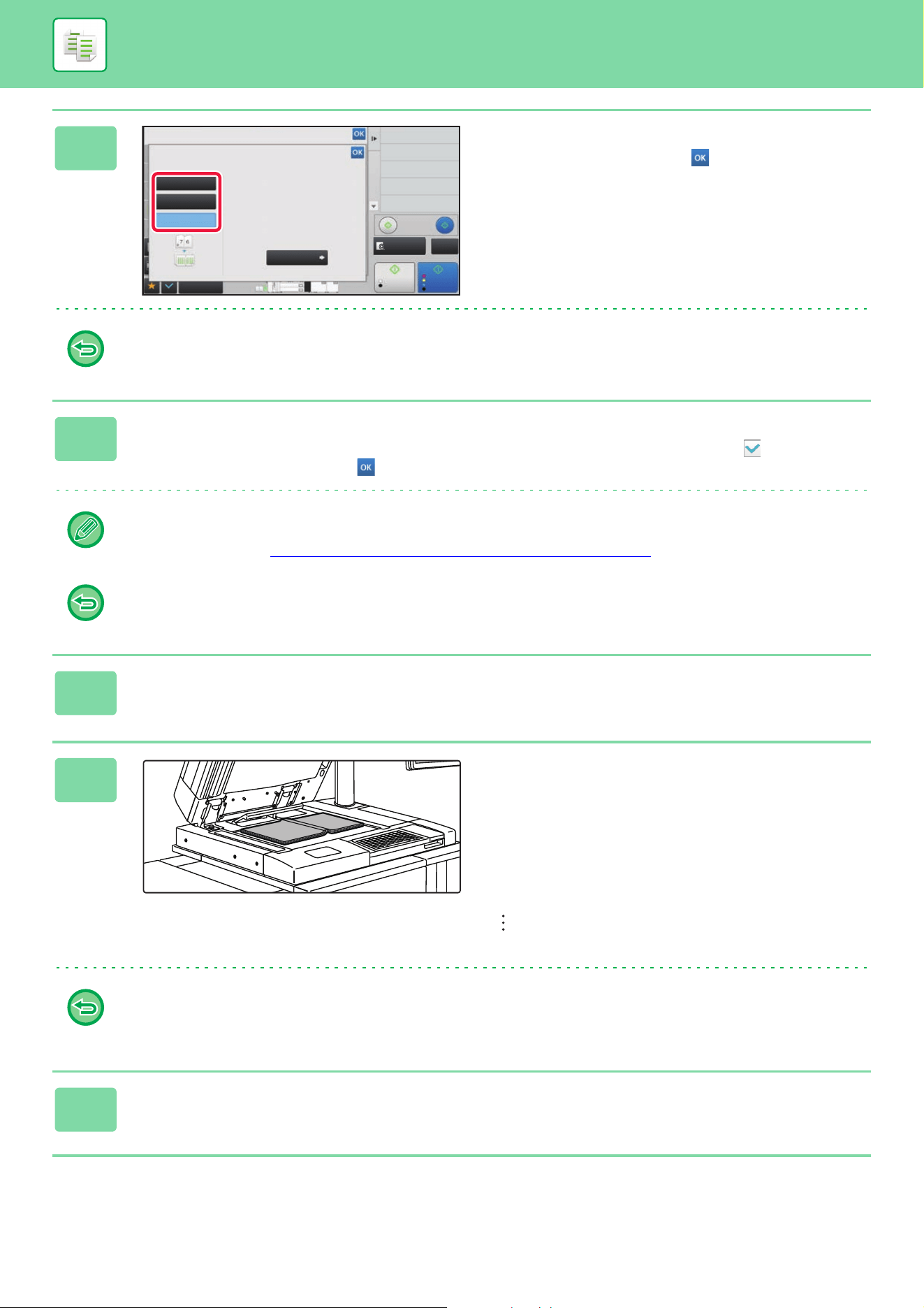
2-79
COPIER►OTHER FUNCTIONS
3
Select a binding position.
When not inserting a cover, tap twice. Then, go to step
5.
To cancel the book copy setting:
Tap the [Off] key.
4
When inserting a cover, tap the [Cover Setting] key, and tap the [On] key.
To make a copy on the inserted cover sheet, check the [Make Copy on Cover (Duplex)] box so that appears.
After the settings are completed, tap twice.
To change the cover input tray:
Tap the [Paper Tray] key to display the tray selection screen. Tap the cover input tray on the tray selection screen. For
more information, see "SELECTING THE PAPER TRAY FOR COPYING (page 2-13)".
• If the cover will be copied on, label sheets, transparency film, and tab paper cannot be used.
• This setting is not available when the covers/inserts function is disabled in the setting mode.
5
Tap the [Color Start] or [B/W Start] key to scan the first original page.
Scanning of the original starts.
6
Place the next opened original pages,
and tap the [Color Start] or [B/W Start]
key.
Tap the same key you tapped in step 5.
Repeat this step until all original pages have been scanned.
Scan the remaining original pages in the following order:
Inside of the front cover and the 1st page (facing pages)
The 2nd and 3rd pages (facing pages)
The last page and inside of back cover (facing pages)
• Copy settings cannot be changed when scanning additional pages.
• To cancel all settings:
Tap the [CA] key.
7
Tap the [Read-End] key to start copying.
Proof Copy
Start
Back
Start
Book Copy
Select Original Binding Edge.
Others
Off
Right Binding
Left Binding
Cover Setting
Preview
Color Mode
Output
Erase Shadow Around
Erase
CA
B/W
11x17 11x1711x174
3
8½x14
68
Color
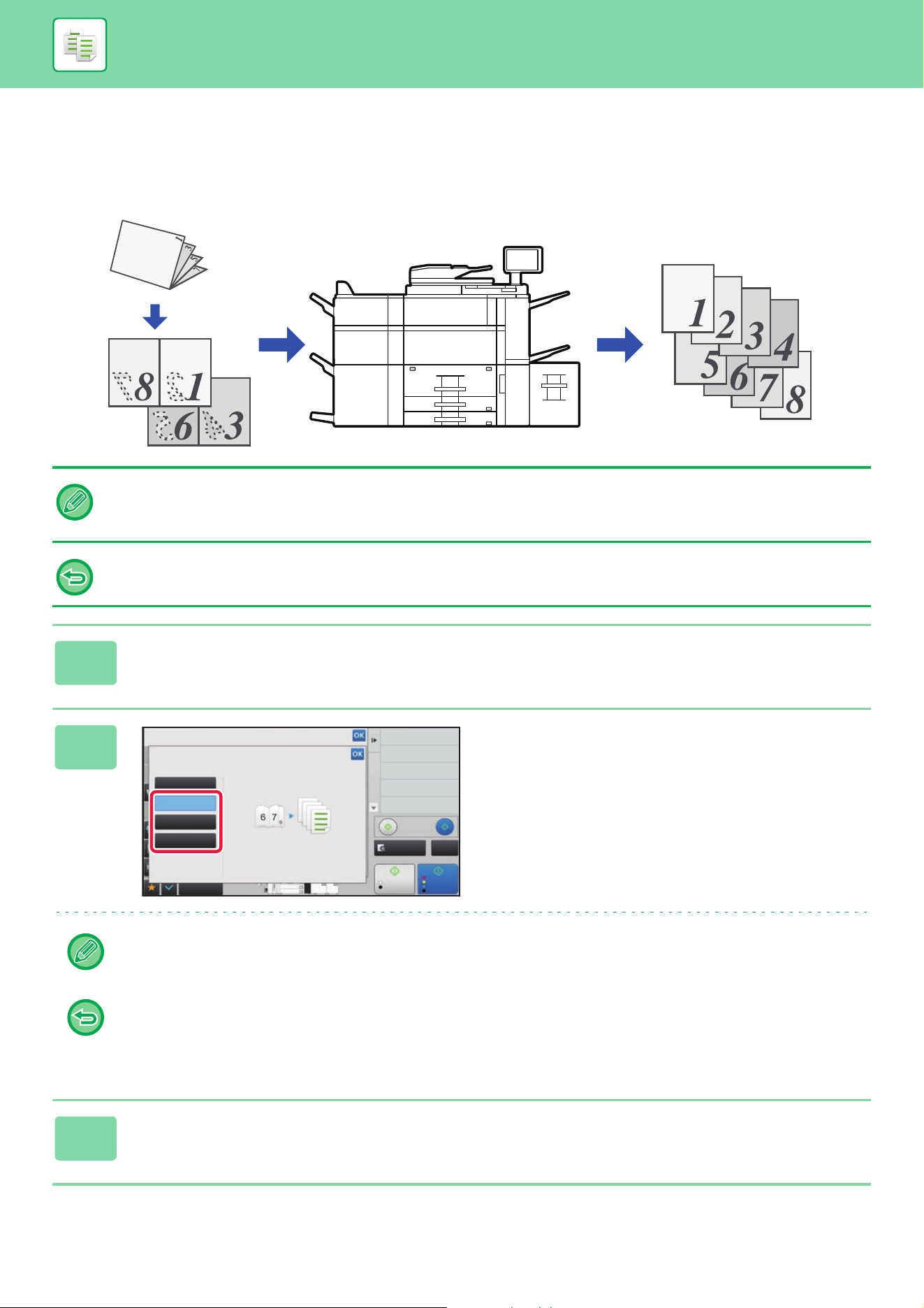
2-80
COPIER►OTHER FUNCTIONS
SPLITTING A PAMPHLET ORIGINAL BY PAGE
(BOOK DIVIDE)
This function splits a saddle-stitch original such as a catalogue or a pamphlet page by page, and copies in sequence.
• Book Divide must be specified before scanning the original.
• This function supports three original binding edges: left binding, right binding, and top open.
• The scanned original is split in the center.
The document glass is not available for this function.
1
Tap the [Others] key, and tap the [Book Divide] key.
2
Select the binding edge of the
pamphlet original.
Check the output image displayed in the screen, and make sure that the binding edge is correct.
• To cancel the Book Divide setting:
Tap the [Off] key.
• To cancel all settings:
Tap the [CA] key.
3
Tap the [Color Start] or [B/W Start] key to start copying.
Start
Back
Start
Book Divide
Proof Copy
Select Original Binding Edge.
Others
Off
Right Binding
Left Binding
Tablet
Preview
2-Sided Copy
Color Mode
Output
Erase Shadow Around
Erase
Skip Blank Page in Original
Blank Page Skip
CA
B/W
11x17 11x1711x174
3
8½x14
68
Color
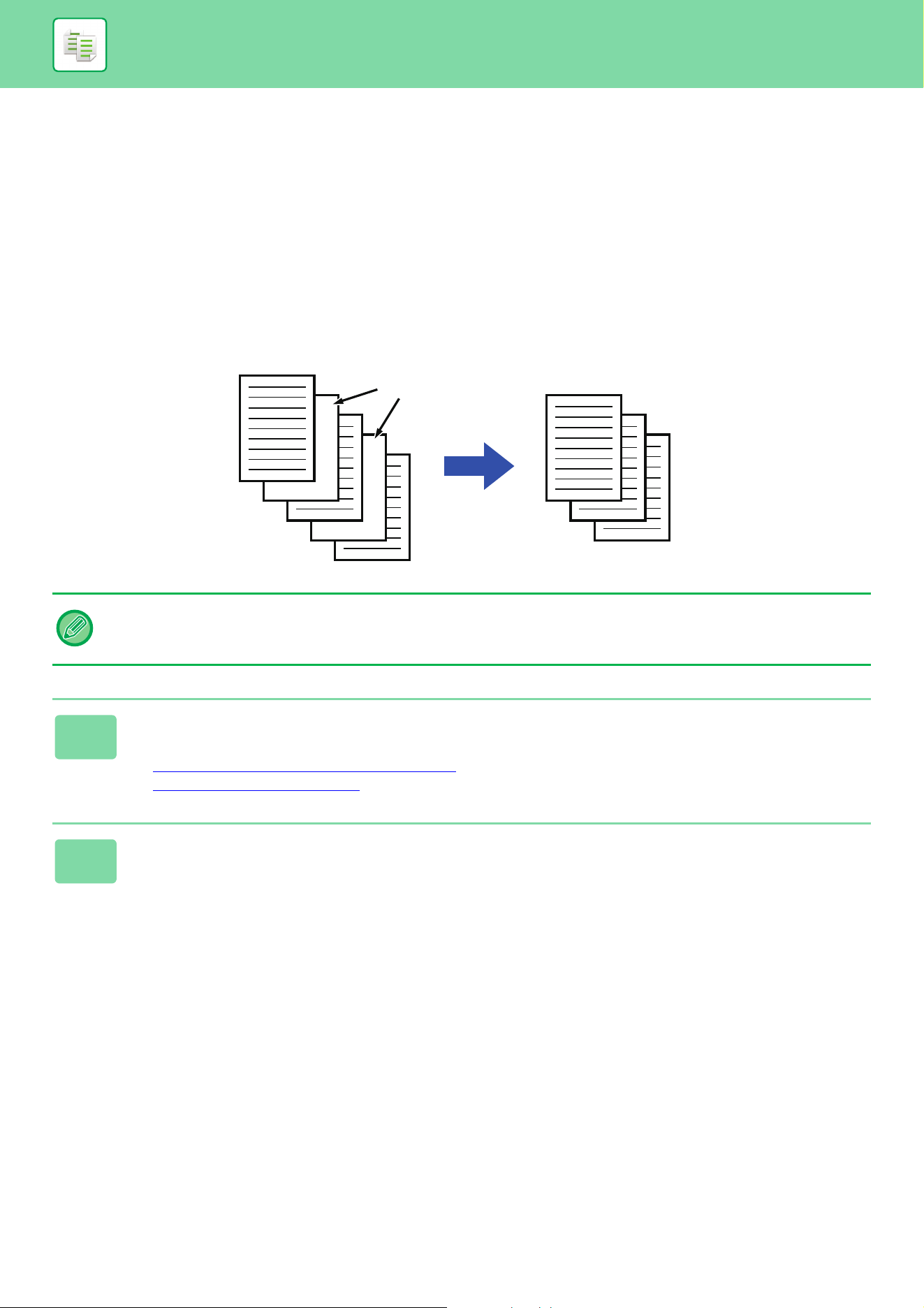
2-81
COPIER►OTHER FUNCTIONS
PAPER, AND TIME SAVING FUNCTIONS
SKIPPING BLANK PAGES IN AN ORIGINAL (BLANK
PAGE SKIP)
If the scanned original contains blank pages, this function skips them to copy only non-blank pages.
The machine detects blank pages, enabling you to skip useless copies without checking an original.
• If an original of which one side is blank is scanned, blank pages are skipped for 2-sided copying.
• Depending on the original, some pages that are not blank may be detected as blank pages and thus not being copied, and
some pages that are blank may not be detected as blank and thus copied.
1
Place the original.
Place the original in the document feeder tray of the automatic document feeder, or on the document glass.
► AUTOMATIC DOCUMENT FEEDER (page 1-90)
► DOCUMENT GLASS (page 1-92)
2
Tap the [Others] key, and tap the [Blank Page Skip] key.
Blank page
Copy
The blank pages are not copied.
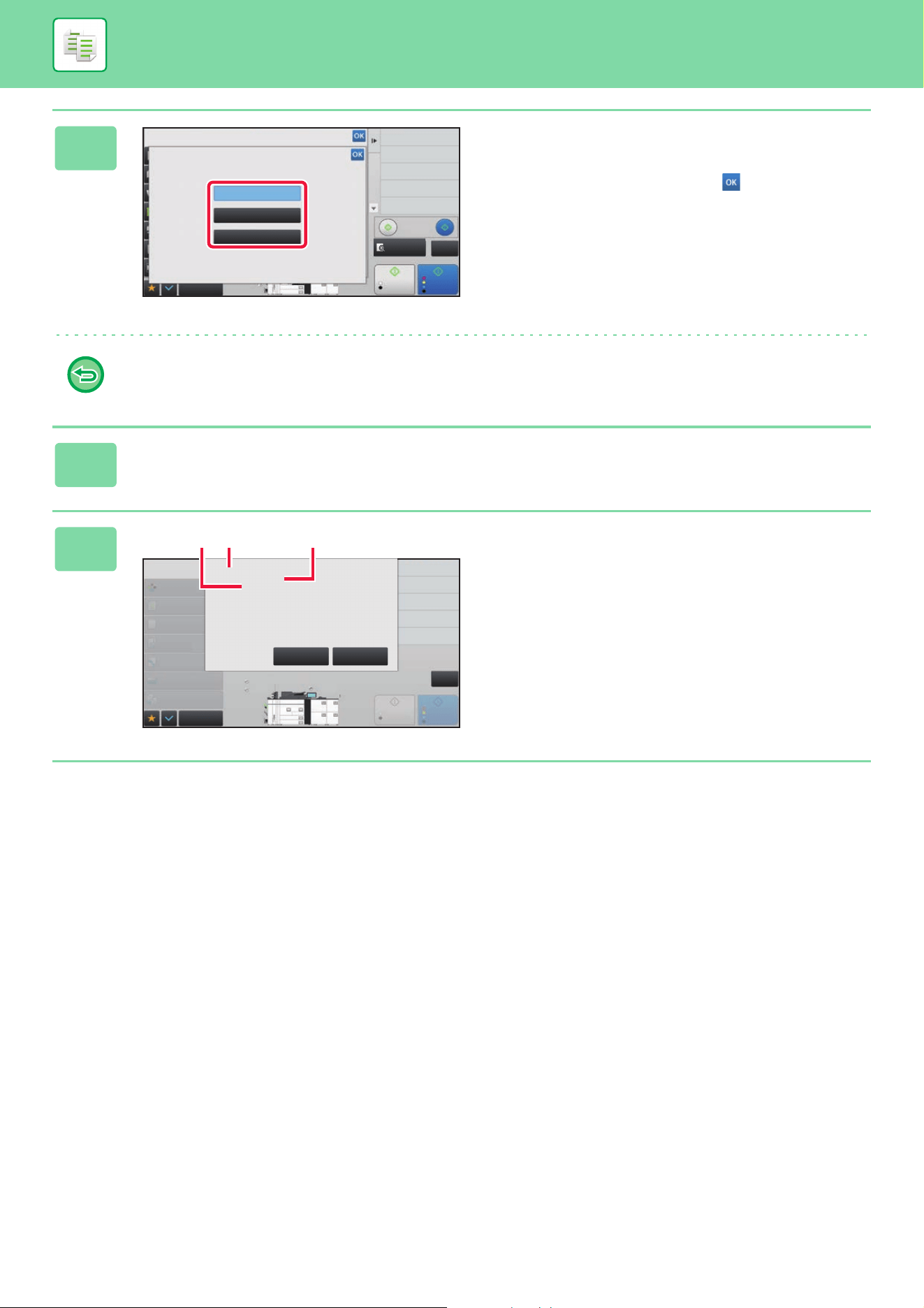
2-82
COPIER►OTHER FUNCTIONS
3
Tap the [Skip Blank Page] or [Skip
Blank and Back Shadow] key.
After the settings are completed, tap twice.
To cancel all settings:
Tap the [CA] key.
4
Tap the [Color Start] or [B/W Start] key.
5
Check the confirmation message, and
tap the [Execute] key to start copying.
On the confirmation screen, the number of scanned original
sheets appears in (A), the number of scanned sides in (B),
and the number of copies excluding blank pages in (C).
For example, if five original sheets that include two blank
pages are scanned by duplex scanning, (A) will show "5",
(B) will show "10", and (C) will show "8".
11x17 11x1711x174
3
8½x14
68
Proof Copy
Start
Back
Start
Others
Preview
Change Size/Direction.
Original
2-Sided Copy
Color Mode
Put Multiple Pages in A Page
N-Up
Erase Shadow Around
Erase
Blank Page Skip
Off
Skip Blank Page
Skip Blank and Back Shadow
CA
B/W Color
Start
Color
Start
Others
Color Mode
Full
Paper Select
Auto
Exposure
Auto
Original
Auto
2-Sided Copy
1-Sided→1-Sided
Output
Copy Ratio
100%
Plain 1
8½x11
2
5
68
8½x11
5½x8½
8½x14
11x17
7
1
3
4
Plain 1
8½x11
Plain 1
8½x11
8½x11
8½x11 8½x11
8½x11
Cancel Execute
5 pages of original have
been scanned. (P.10)
Copy 8 pages of originals.
Execute the job?
CA
B/W
(A)(C) (B)
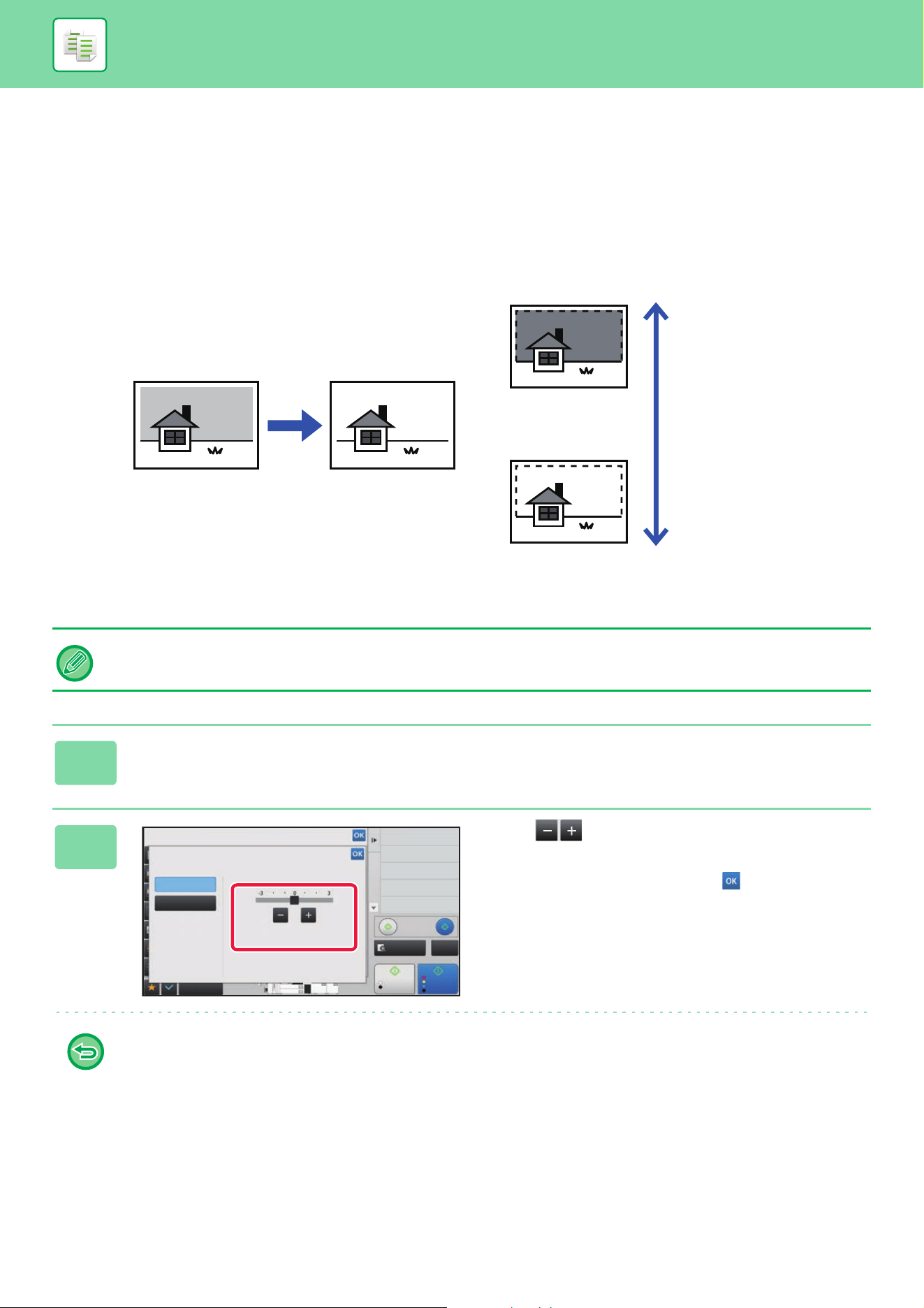
2-83
COPIER►OTHER FUNCTIONS
ADJUSTING THE BACKGROUND BY MAKING LIGHT
AREAS OF THE ORIGINAL DARKER OR LIGHTER
(BACKGROUND ADJUSTMENT)
You can adjust the background by making light areas of the original darker or lighter.
You must select Background Adjustment before scanning the original.
1
Tap the [Others] key, and tap the [Background Adjustment] key.
2
Tap or move the slider to set the
value.
After the settings are completed, tap twice.
To cancel the Background Adjustment setting:
Tap the [Off] key.
Adjust light areas in this way.
Level [+]
[+] makes the background
darker. [-] makes the
background lighter.
Level [-]
11x17 11x1711x174
3
8½x14
68
Proof Copy
Others
Background Adjustment
Adjust Original Background Darkness.
Preview
Start Start
Off
On
Touch [+] darken background.
Touch [-] erase background.
Back
Change Size/Direction.
Original
Erase Shadow Around
Erase
Adjust Outline of Image
Sharpness
Exposure
Select Type/Exposure
Color Mode
CA
B/W Color
2-84
COPIER►OTHER FUNCTIONS
CHECKING THE NUMBER OF SCANNED ORIGINAL
SHEETS (ORIGINAL COUNT)
This function counts the number of scanned original sheets, and displays the result before making a copy.
By allowing you to check the number of original sheets that were scanned, this helps reduce the occurrence of copy
mistakes.
3
Place the original.
Place the original in the document feeder tray of the automatic document feeder, or on the document glass.
► AUTOMATIC DOCUMENT FEEDER (page 1-90)
► DOCUMENT GLASS (page 1-92)
To cancel all settings:
Tap the [CA] key.
4
Tap the [Color Start] or [B/W Start] key to start copying.
• The count result is displayed with the number of scanned original sheets, not the number of scanned original pages. For
example, when 2-sided copying is performed using one original, the number "1" will appear to indicate that one original
sheet was scanned, not "2" to indicate the front-side page and the reverse side page.
• Original Count must be specified before scanning the original.
1
Tap the [Others] key, and tap the [Original Count] key.
A checkmark appears on the icon.
After the settings are completed, tap .
To cancel the Original Count setting:
Tap the [Original Count] key to uncheck it.
2
Place the original in the document feeder tray of the automatic document
feeder.
► AUTOMATIC DOCUMENT FEEDER (page 1-90)
3
Tap the [Color Start] or [B/W Start] key.
2-85
COPIER►OTHER FUNCTIONS
4
Check the number of original sheets.
The number that is displayed is the number of scanned
original sheets, not the number of scanned original pages.
For example, when 2-sided copying is performed using one
original, the number "1" will appear to indicate that one
original sheet was scanned, not "2" to indicate the front-side
page and the reverse side page.
If the displayed number of original sheets is different from the actual number of sheets
Tap the [Cancel] key to stop the job.
5
Tap the [OK] key to start copying.
If this function is combined with [Job Build], the count result is displayed after the [Read-End] key has been tapped.
Start
Color
Start
Color Mode
Full
Paper Select
Auto
Exposure
Auto
Original
Auto
2-Sided Copy
1-Sided
Output
Copy Ratio
100%
Others
CA
B/W
Call Eco Program
Register Current Settings
Program Registration
Plain 1
8½x11
2
5
68
8½x11
5½x8½
7
1
3
4
Plain 1
8½x11
Plain 1
8½x11
8½x11 8½x11
8½x11 8½x11
8½x14
11x17
Cancel OK
1 pages of original
have been scanned.
Copy the scanned data?
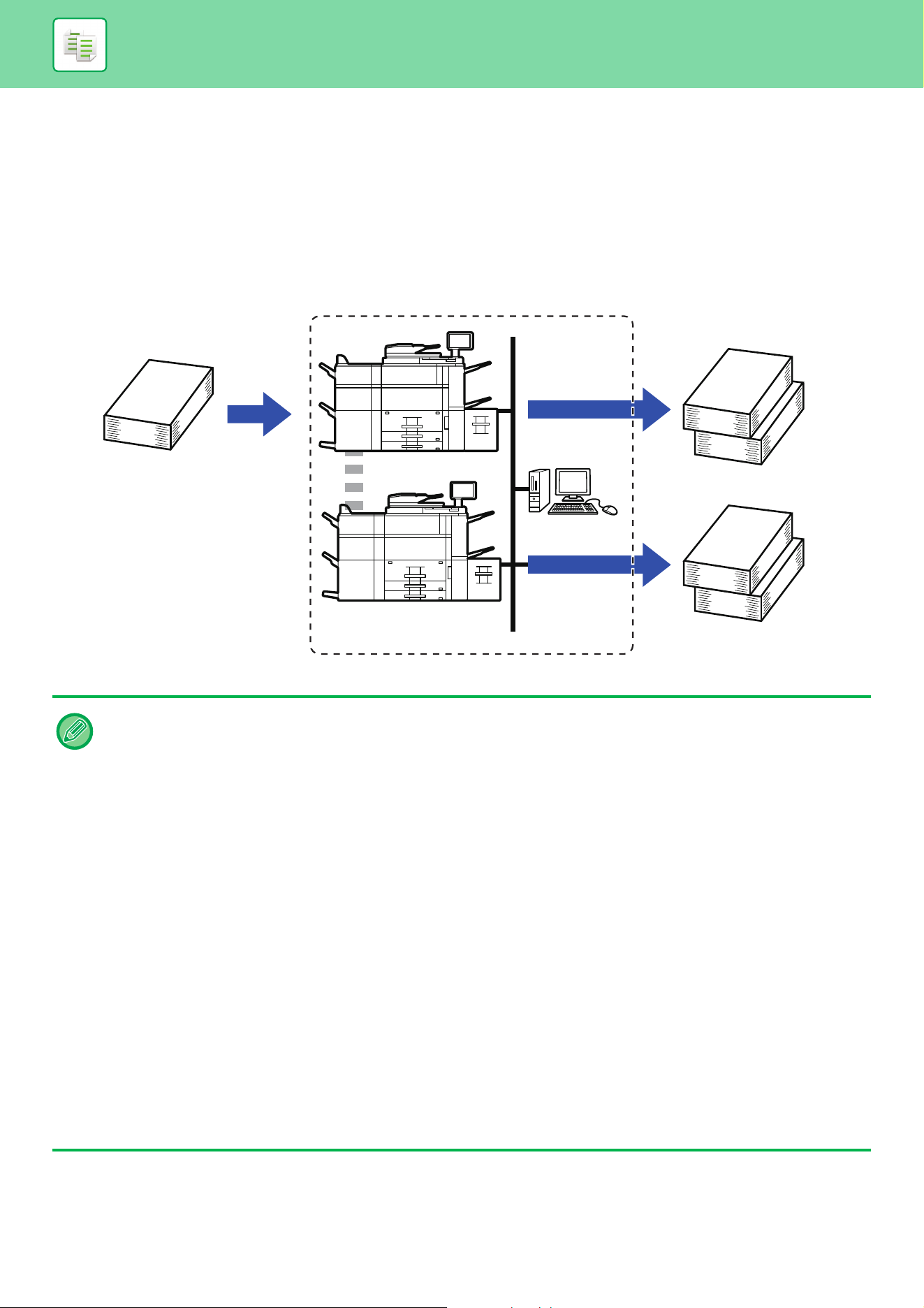
2-86
COPIER►OTHER FUNCTIONS
USING TWO MACHINES TO REDUCE THE COPY TIME
(TANDEM COPY)
This function shares a copy job half-and-half between two machines connected to the network, enabling the reduction of
the copy time.
Master machine and client machine
The master machine performs only scanning, and a client machine registered in the master machine performs only
printing without scanning the original.
• To use this function, two machines must be connected to your network.
• Even if more machines are connected to the network, this function can only be used to have one other machine share a
job.
•
To configure the tandem connection setting, register IP address information of the client machine in the master machine.
For the port number, it is best to use the initial setting (50001). Unless you experience difficulty with this setting, do not
change the port number. The tandem setting should be configured by your network administrator. If the master machine and
client machine will switch roles, configure the IP address of the master machine in the client machine. The same port
number can be used for both machines.
• In this situation:
A saddle stitch finisher is installed in the master machine while not installed in a client machine.
• Tandem Copy is enabled when specifying copies without stapling.
• Tandem Copy is disabled when specifying copies with stapling.
As shown here, if Tandem Copy is enabled using a function provided in the master machine and not provided in a client
machine, a message will appear.
• If a machine runs out of paper
If either the master machine or the client machine run out of paper, the machine that ran out of paper will hold the job while
the machine that still has paper continues the job. When paper is added to the machine that ran out, the job resumes.
• If user authentication is specified
• Tandem Copy is enabled when user authentication is specified in the master machine.
• Tandem Copy is disabled when user authentication is specified in the client machine while it is not specified in the master
machine.
• If an odd number of sets is being made, one more set is output to the master machine.
Execute 4 sets of copies
Master machine
Client machine
2 sets of copies
2 sets of copies
Network environment
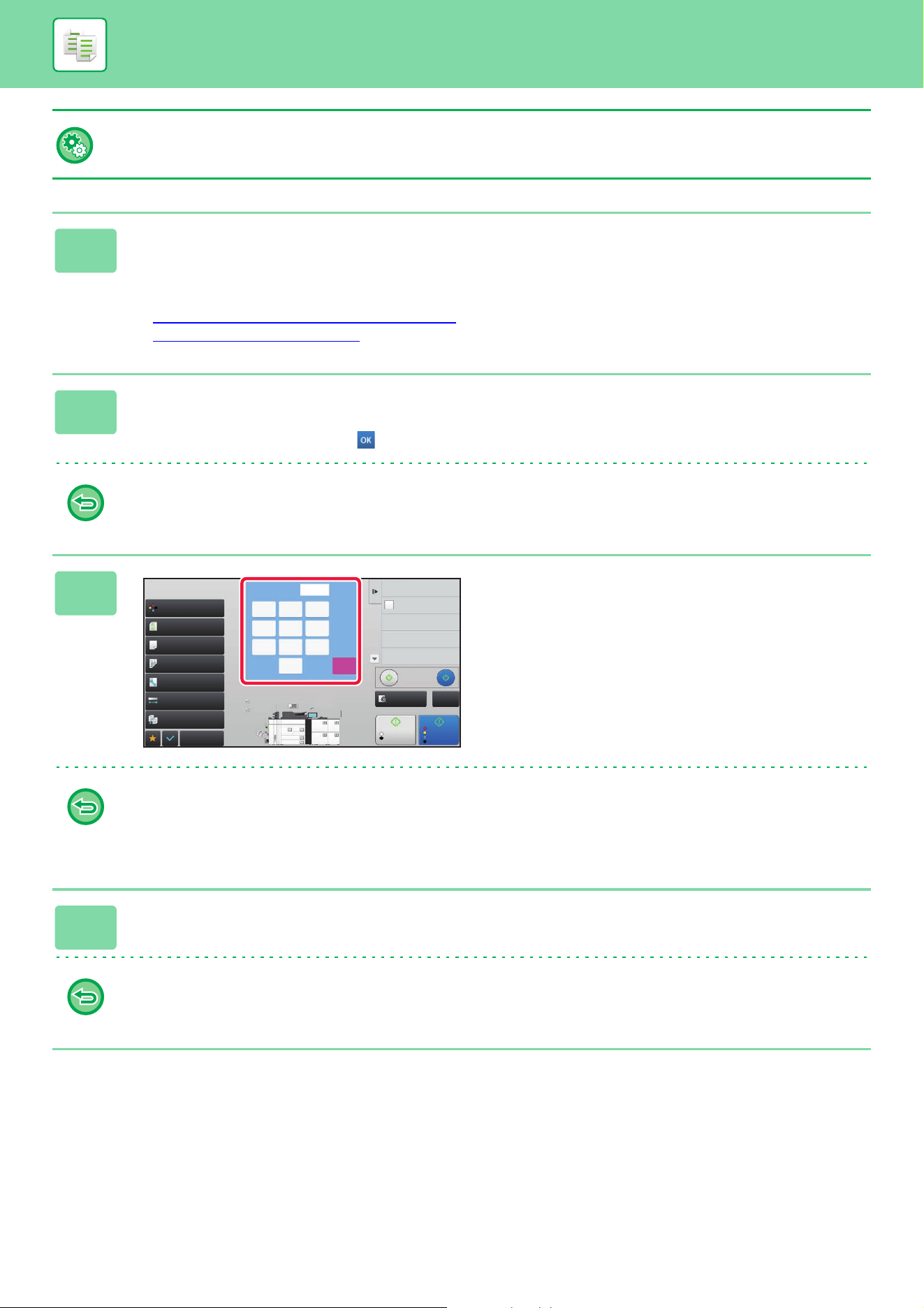
2-87
COPIER►OTHER FUNCTIONS
To use Tandem Copy:
In "Settings (administrator)", select [System Settings] → [Common Settings] → [Device Control] → [Tandem Connection
Setting].
1
Place the original.
Place the original in the document feeder tray of the automatic document feeder, or on the document glass.
When using the document glass to scan multiple original pages, change the original and tap the [B/W Start] or [Color
Start] key.
► AUTOMATIC DOCUMENT FEEDER (page 1-90)
► DOCUMENT GLASS (page 1-92)
2
Tap the [Others] key, and tap the [Tandem Copy] key.
A checkmark appears on the icon.
After the settings are completed, tap .
To cancel the Tandem Copy setting:
Tap the [Tandem Copy] key to uncheck it.
3
Tap the number of copies key to
specify the number of copies.
Up to 9999 copies (sets) can be set. The specified number
of copies are shared between the master and client
machines. If the number of copies is odd, the master
machine makes more copies than the client machine.
• If an incorrect number of copies is set:
Tap the [C] key and then enter the correct number.
• To cancel all settings:
Tap the [CA] key.
4
Tap the [Color Start] or [B/W Start] key to start copying.
• To cancel Tandem Copy:
Tap the [Cancel Copy] keys on both the master and client machines.
Start Start
Preview
Color Mode
Full Color
Paper Select
Auto
Exposure
Auto
Original
2-Sided Copy
1-Sided→1-Sided
Output
Copy Ratio
100%
Others
Send and print
Call Eco Program
Store Data in Folder
File
Store Data Temporarily
Quick File
1
No. of copies
CA
B/W
Plain 1
8½x11
2
5
68
8½x11
5½x8½
8½x14
11x17
7
1
3
4
Plain 1
8½x11
Plain 1
8½x11
8½x11
8½x11 8½x11
8½x11
1
9
32
6
78
4
5
C0
Proof Copy
Auto
Color
2-88
COPIER►OTHER FUNCTIONS
DISPLAYING ECO RECOMMENDATION SETTINGS
(ECO RECOMMENDATION FUNCTION DISPLAY)
When the base screen of normal mode is displayed, eco recommendation settings appear.
The displayed functions are as follows.
•2-Sided Copy ►page 2-17
•N-Up ►page 2-61
• B/W Copy ►page 2-20
• Image Orientation ►page 2-33
This function does not operate in easy mode.
To use the eco recommendation function display:
"Settings (administrator)" → [System Settings] → [Energy Save] → [Eco Setting] → [Eco Recommendation Function
Display].
2-89
COPIER►OTHER FUNCTIONS
SECURITY REINFORCEMENT FUNCTIONS
PADDING UNAUTHORIZED COPY PREVENTION DATA
(HIDDEN PATTERN PRINT)
Characters to prevent unauthorized copying such as pre-set or customized text are placed as invisible characters in a
background pattern.
When an output sheet with a pattern print is copied, the hidden characters will appear.
• "Hidden Pattern Print" is a function provided for the purpose of deterring unauthorized copying. It does not guarantee the
prevention of information leakage.
• Text may not be completely hidden on an output sheet with a hidden pattern print under certain machine conditions. In
such a case, adjust the contrast by selecting the [Hidden Pattern Print Setting] from the "Settings (administrator)".
• When copying an output sheet with a hidden pattern print, the hidden pattern may not emerge depending on settings other
than "Hidden Pattern Print".
• The hidden pattern may not emerge on copies with certain types of devices or under certain setting conditions used to
copy an output sheet with a hidden pattern print.
To set a Hidden Pattern Print:
In "Settings (administrator)", select [System Settings] → [Security Settings] → [Hidden Pattern Print Setting].
1
Place the original.
Place the original in the document feeder tray of the automatic document feeder, or on the document glass.
► AUTOMATIC DOCUMENT FEEDER (page 1-90)
► DOCUMENT GLASS (page 1-92)
2
Tap the [Others] key, and tap the [Hidden Pattern Print] key.
AB
CD
AB
CD
DO’NOT COPY
DO’NOT COPY
AB
CD
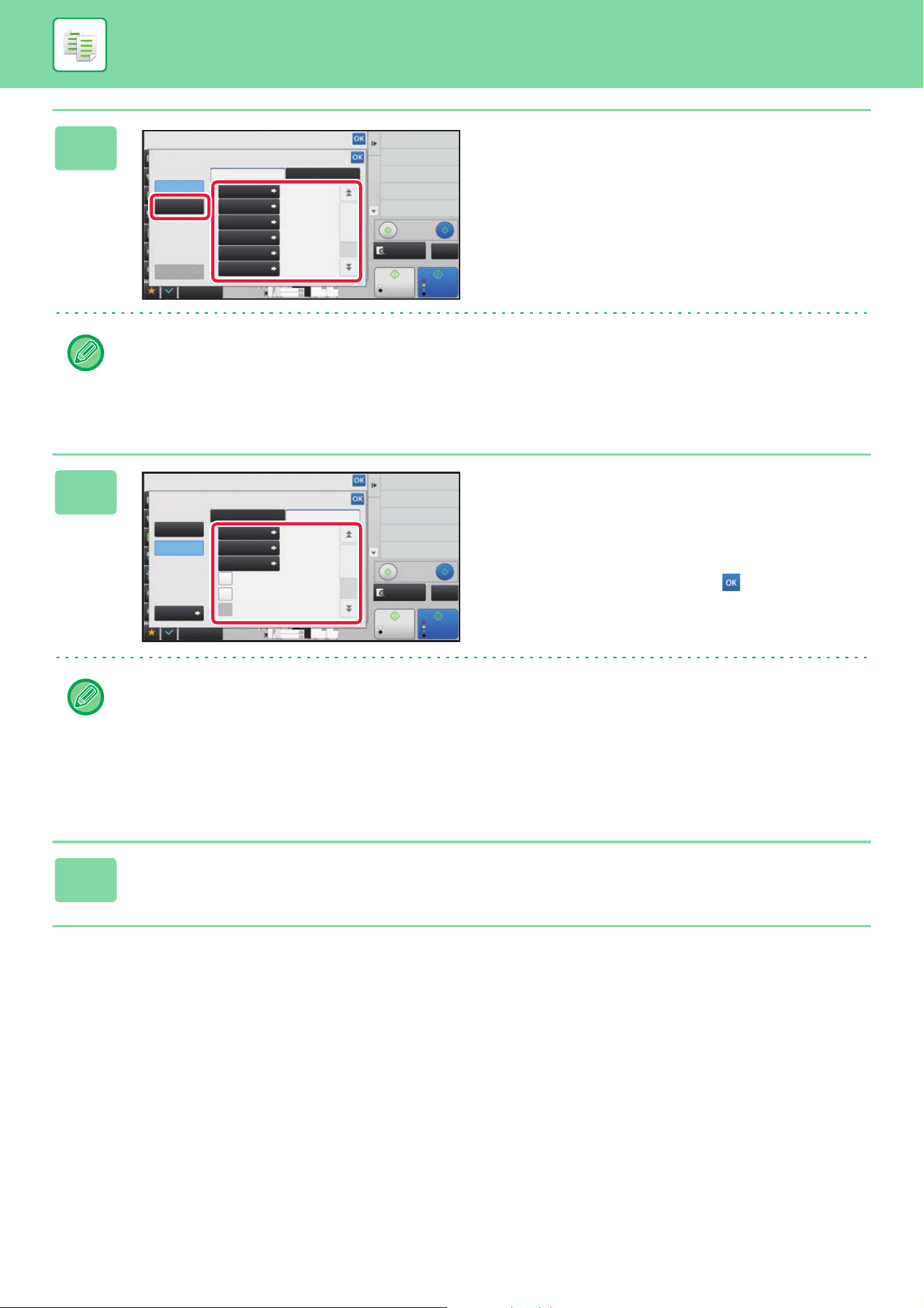
2-90
COPIER►OTHER FUNCTIONS
3
Tap the [On] key, and specify each
item in the [Default Settings] tab as
required.
• We recommend you to select the [Positive] option for the "Method".
• The black background pattern is printed in the following cases even when you set the [Print Color] to "Magenta" or
"Cyan":
If the color mode is set to "B/W"
If the black and white mode is determined automatically
4
Specify each item in the [Print
Contents Setting] tab as required.
To specify print settings, you can select the required one
from pre-set text or use the soft keyboard. You can also print
serial number and account job ID.
After the settings are completed, tap twice.
• To cancel the Hidden Pattern Print setting:
Tap the [Off] key.
• Tapping the [Function Rev.] key displays the settings of the [Print Contents Setting] tab.
• The hidden pattern print preview may slightly differ from the actual pattern and exposure as the preview is used for
simple pattern color checking.
• To cancel all settings:
Tap the [CA] key.
5
Tap the [Color Start] or [B/W Start] key to start copying.
Others
Hidden Pattern Print
Preview
Start Start
Off
On
Function Rev.
Back
Default Settings Print Contents Setting
Print Colour Black
Standard
0°
48point
Standard
Pattern 1
Exposure
Font Size
Angle
Font Style
Camouflage
Pattern
Change Size/Direction.
Original
Print Date and Stamp
Stamp
Color Mode
2-Sided Copy
Put Multiple Pages in A Page
N-Up
CA
B/W
3
4
Proof Copy
8½x11 8½x11
8½x14
11x17
Color
Others
Preview
Start Start
Back
Change Size/Direction.
Original
Print Date and Stamp
Stamp
Color Mode
2-Sided Copy
Put Multiple Pages in A Page
N-Up
CA
B/W
3
4
Proof Copy
68
8½x11 8½x11
8½x14
11x17
Color
Hidden Pattern Print
Off
On
Function Rev.
Default Settings Print Contents Setting
Pre-Set Word DO NOT COPY
Not
Not Input
Pre-Set Text
Direct Entry
Serial Number
Account Job ID
Login Name/User Number
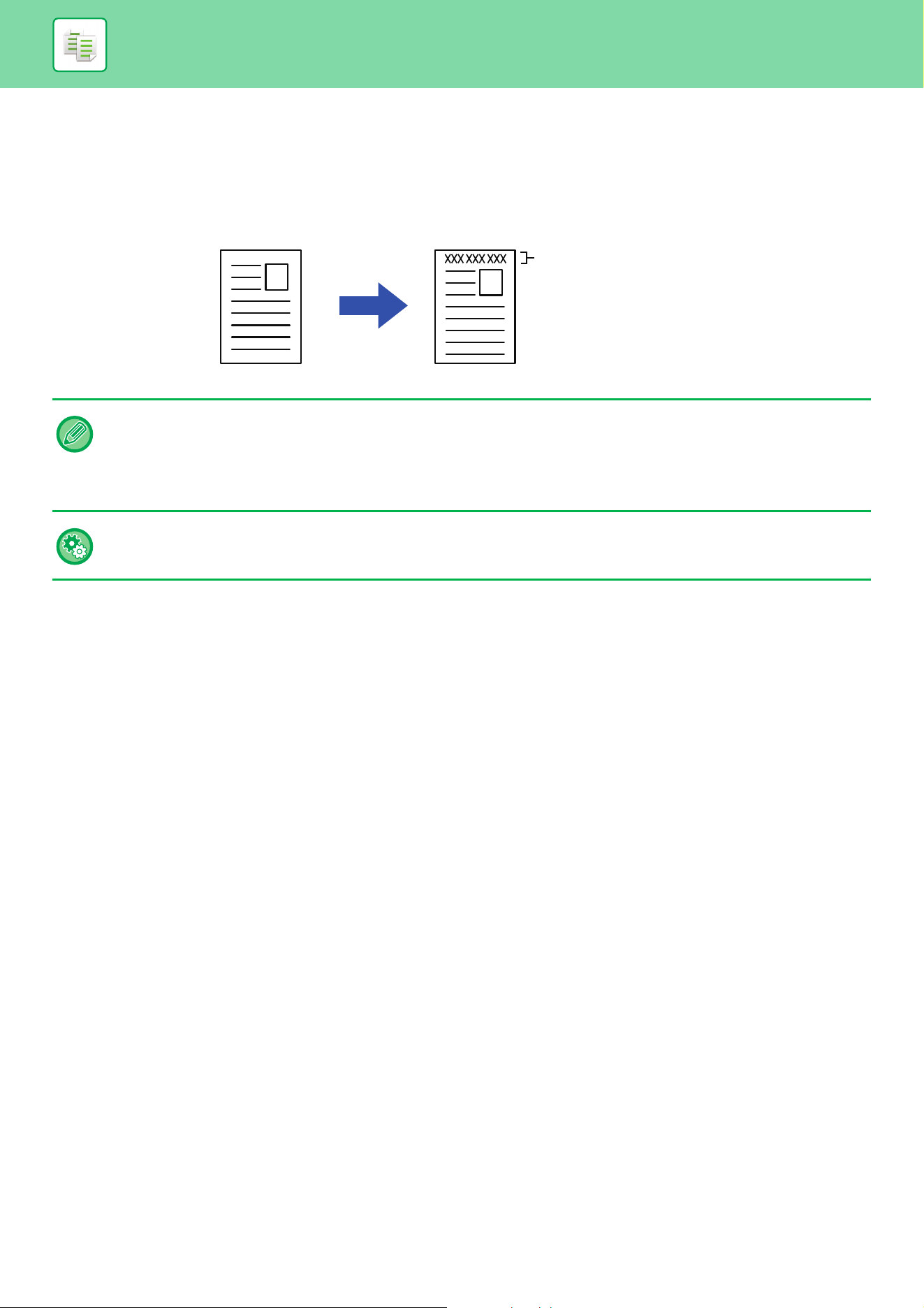
2-91
COPIER►OTHER FUNCTIONS
FORCIBLY PRINTING TRACEABLE INFORMATION
(TRACKING INFORMATION PRINT)
This function forcibly prints the pre-specified traceable information to prevent an unauthorized copy.
• If this function is specified together with another image compositing function, trace information is printed at the top.
• Trace information is printed at the top or bottom outside an image frame.
• The information added at printing or the preview image of the account job ID and date/time are displayed as shown below.
Account job ID: 00000
Date/time: MM/DD/YYYY hh:mm
To configure print settings:
In "Settings (administrator)", select [System Settings] → [Security Settings] → [Tracking Information Print] → [Tracking
Information Print Setting].
Originals
Trace information area
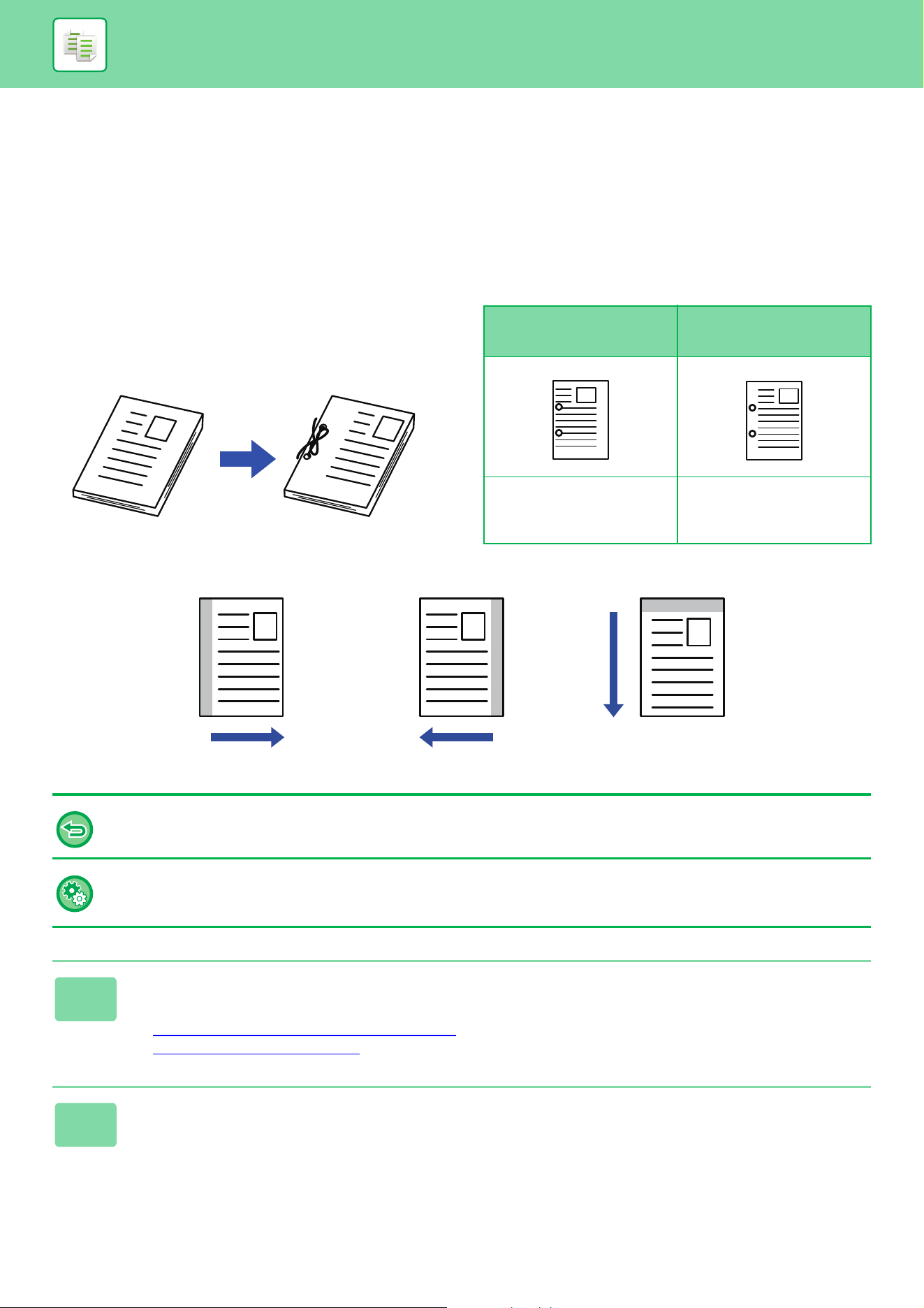
2-92
COPIER►OTHER FUNCTIONS
OUTPUT POSITION AND MARGIN
ADJUSTMENT FUNCTIONS
ADDING MARGINS (MARGIN SHIFT)
This function shifts the copy image right, left or down to adjust the margin.
This is convenient when you wish to bind the copies with a string or in a binder.
Shifting the image to the right so the copies can be
bound at the left edge
Margin Shift
1
1
Not using the Margin
Shift
Using the Margin Shift
The punch holes cut off
part of the image
The image is moved to
allow space for the holes
so the image is not cut off.
1
1
Rotation copy cannot be used in combination with the margin shift function.
To change the default margin shift setting:
In "Settings (administrator)", select [System Settings] → [Copy Settings] → [Condition Settings] → [Initial Margin Shift
Setting].
1
Place the original.
Place the original in the document feeder tray of the automatic document feeder, or on the document glass.
► AUTOMATIC DOCUMENT FEEDER (page 1-90)
► DOCUMENT GLASS (page 1-92)
2
Tap the [Others] key, and tap the [Margin Shift] key.
Right
Down
Left
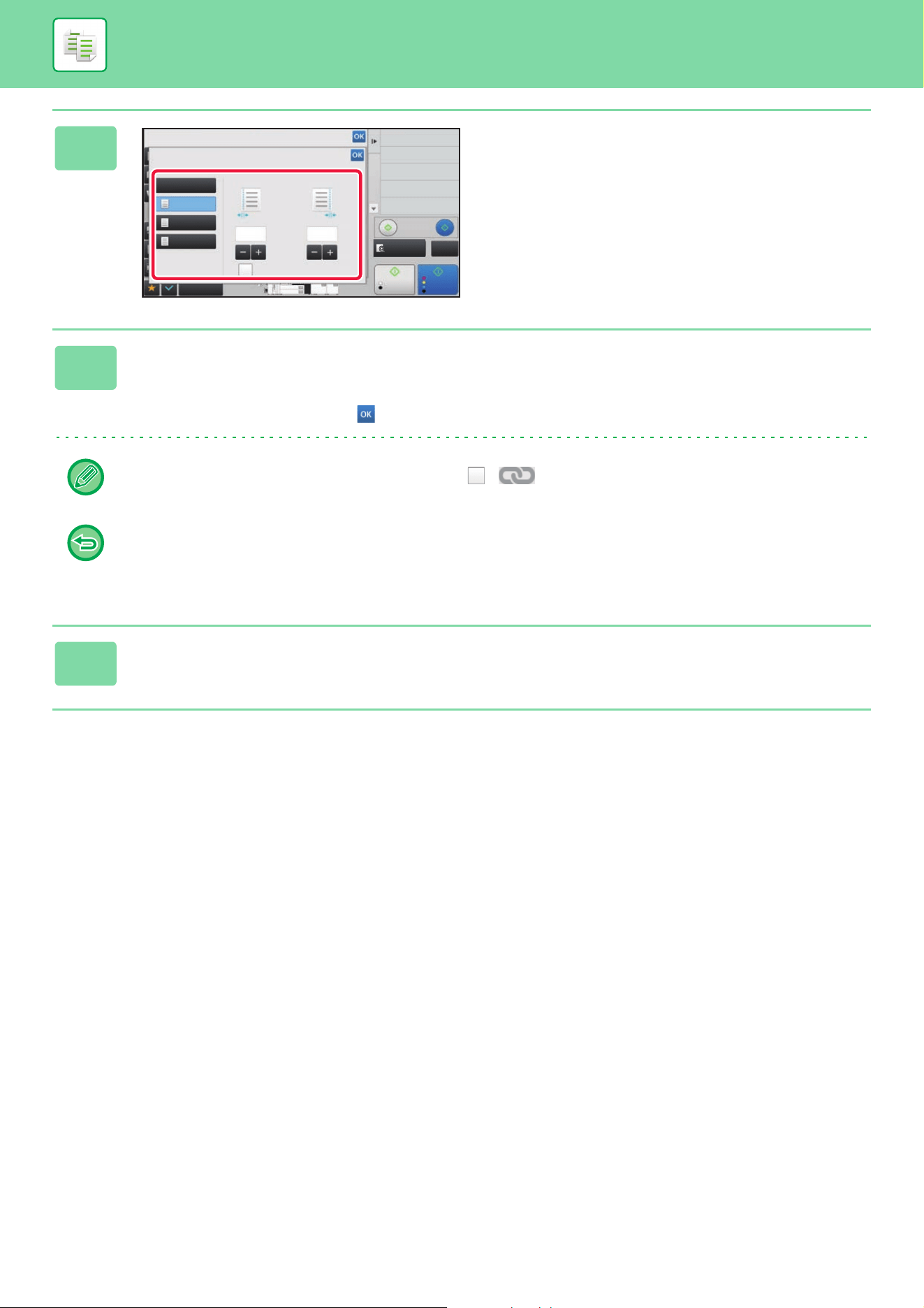
2-93
COPIER►OTHER FUNCTIONS
3
Tap the image shift direction.
4
Sets a margin shift width.
Tap the numeric value display indicating the margin shift area on the front side or reverse side, and enter the area using
the numeric keys.
After the settings are completed, tap twice.
If you set the [Adjust 2nd pg value to 1st.] checkbox to , goes out and you can set sides 1 and 2 separately.
• To cancel the margin shift setting:
Tap the [Off] key.
• To cancel all settings:
Tap the [CA] key.
5
Tap the [Color Start] or [B/W Start] key to start copying.
Others
Preview
Start Start
Back
Change Size/Direction.
Original
Change Paper Feed Tray
Paper Select
2-Sided Copy
Output
( 0~50 )
mm
( 0~50 )
mm
Background Adjustment
CA
B/W
Proof Copy
4
3
68
8½x11 5½x8½
8½x11 8½x11
8½x11 8½x11
8½x14
11x17
Color
Margin Shift
Side 1
Adjust 2nd pg value to 1st.
Side 2
Off
Left
Right
Down
1/2
( 0~2 )
inch
1/2
( 0~2 )
inch
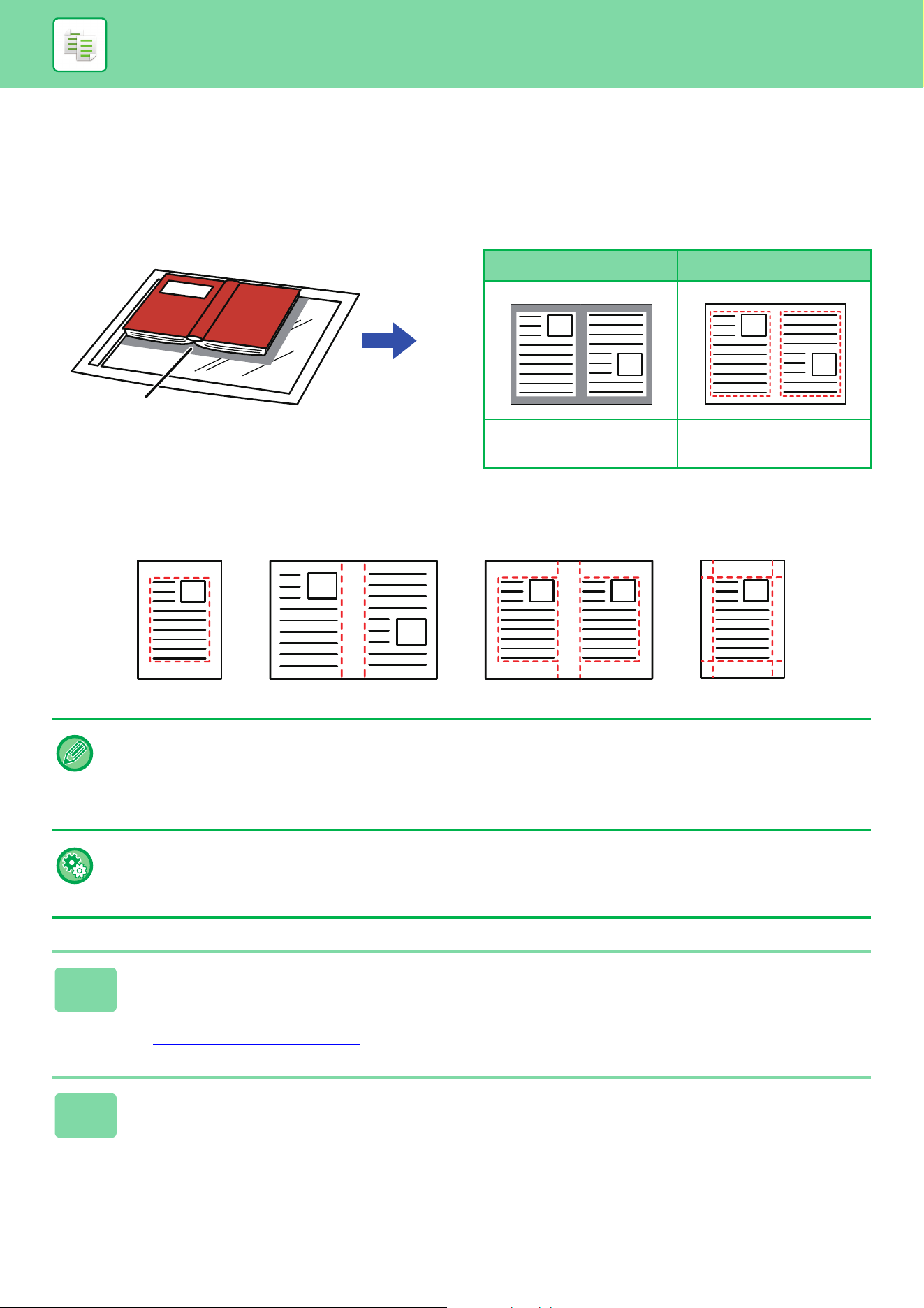
2-94
COPIER►OTHER FUNCTIONS
ERASING PERIPHERAL SHADOWS FOR COPYING
(ERASE)
The erase function is used to erase shadows around the edges of copies that occur when copying thick originals or
books.
When a thick book is copied
Erase modes
Shadows appear here
Not using the Erase Using the Erase
Shadows appear on the
copy
Shadows do not appear on
the copy
• If a ratio setting is used in combination with an erase setting, the erase width will change according to the selected ratio. If
the erase width setting is 1" (20 mm) and the image is reduced to 50%, the erase width will be 1/2" (10 mm).
• This function erases the parts of the image where shadows tend to form, but does not detect shadows and erase only the
shadows.
• When Erase is selected, the orientation of the original is automatically set to portrait.
To change the default erase width setting:
In "Settings (administrator)", select [System Settings] → [Copy Settings] → [Condition Settings] → [Erase Width Adjustment].
The factory default setting is 1/2" (10 mm). The changed setting is also applied to the Setting mode selection of [System
Settings] → [Image Send Settings] → [Common Settings] → [Condition Settings] → [Erase Width Adjustment].
1
Place the original.
Place the original in the document feeder tray of the automatic document feeder, or on the document glass.
► AUTOMATIC DOCUMENT FEEDER (page 1-90)
► DOCUMENT GLASS (page 1-92)
2
Tap the [Others] key, and tap the [Erase] key.
Outer Frame Erase Center Erase Edge + Center Erase
Side Erase
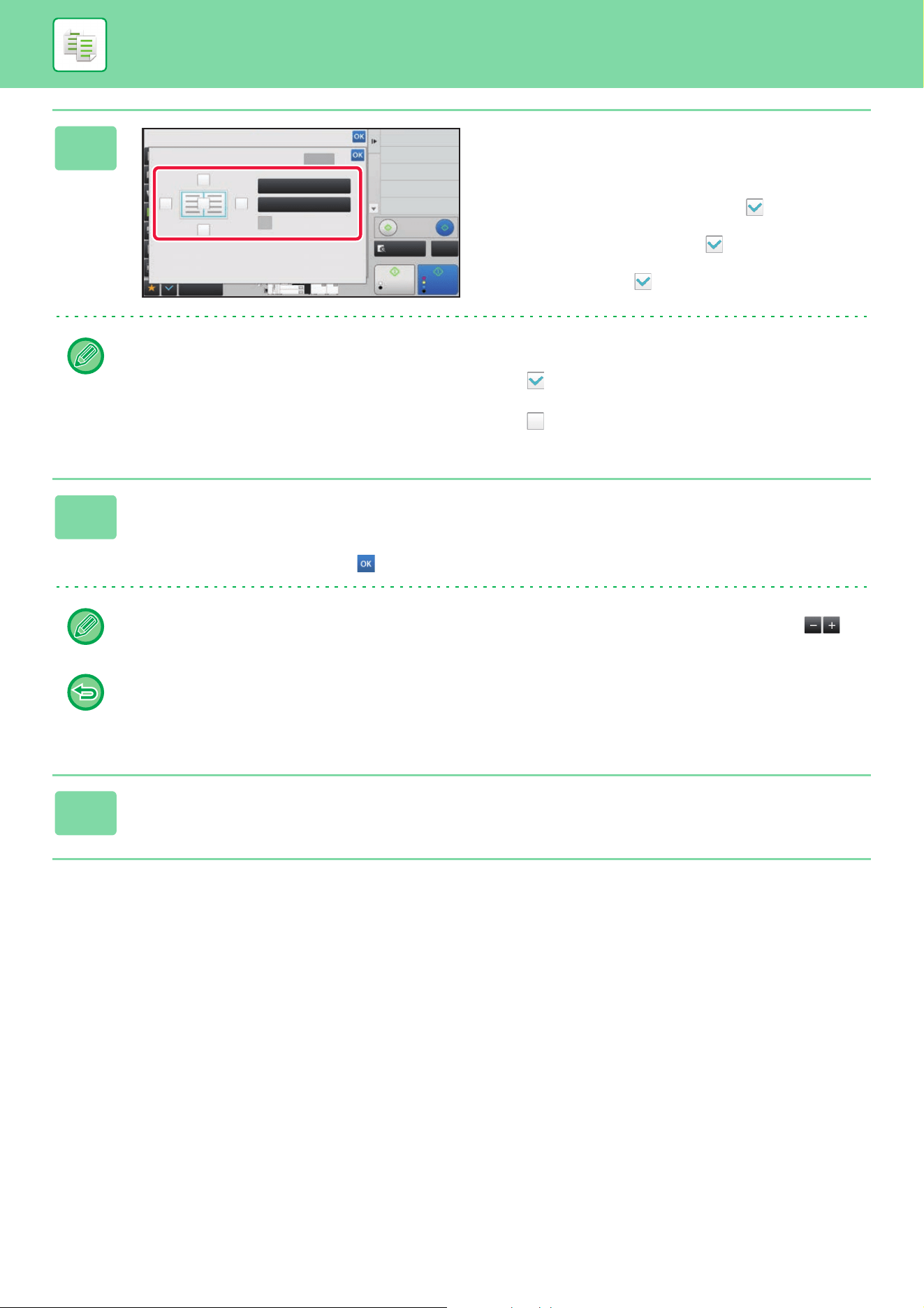
2-95
COPIER►OTHER FUNCTIONS
3
Tap the checkbox of the edge that you
wish to erase, and specify the erase
position.
Check that he tapped checkbox is set to .
If the [Outer Frame] key is tapped, the [Up], [Down], [Left],
and [Right] checkboxes are set to .
If the [Specify Frame+Center] key is tapped, all the
checkboxes are set to .
Specify the erase edge on the reverse side when erasing edges of one to three sides of Up, Down, Left, and Right on
the front side to scan a 2-sided original.
• If the [Reverse erase position of back face] checkbox is set to , the edge in the position opposite to the erased
edge on the front side will be erased.
• If the [Reverse erase position of back face] checkbox is set to , the edge in the same position as on the front side
will be erased.
4
Specify the erase width.
Tap the numeric value display indicating the margin shift area on the front side or reverse side, and enter the area using
the numeric keys.
After the settings are completed, tap twice.
To quickly set the area, first specify a value close to the desired value by the numeric keys, then adjust it with .
• To cancel the erase setting:
Tap the [Clear] key.
• To cancel all settings:
Tap the [CA] key.
5
Tap the [Color Start] or [B/W Start] key to start copying.
CAPreview
Start Start
Back
B/W
Proof Copy
68
4
3
8½x11 8½x11
8½x14
11x17
Color
Others
Back
Erase
Up
Down
RightLeft
Reverse erase position of
back face
Outer Frame
Specify Frame+Centre
Clear
Copy Like A Pamphlet
Booklet
Change Size/Direction.
Original
Color Mode
2-Sided Copy
Background Adjustment
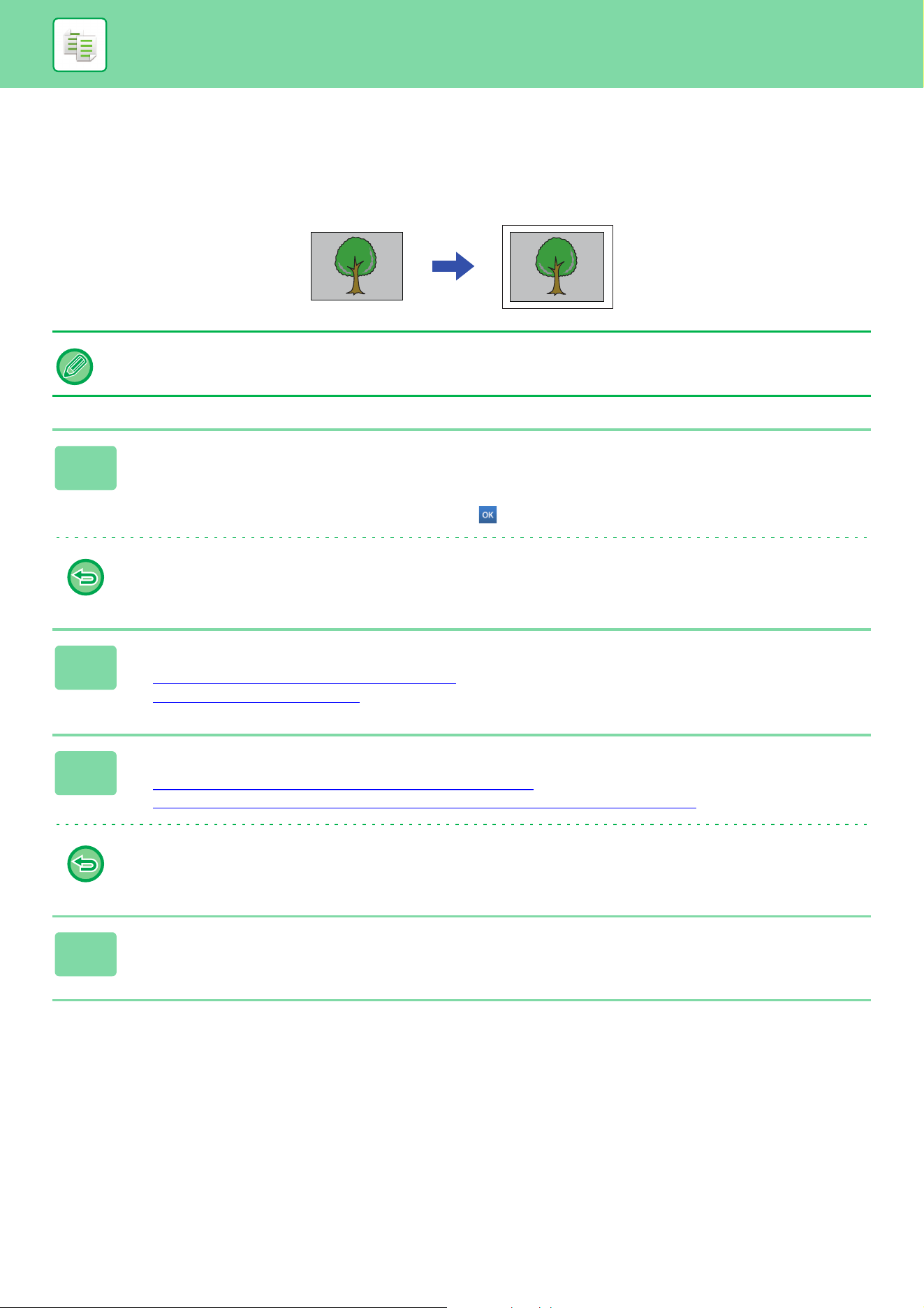
2-96
COPIER►OTHER FUNCTIONS
COPYING ORIGINALS WITH NO EDGE CUT-OFF
(FULL BLEED COPY)
This feature lets you copy an entire original to paper larger than the original size with no image cut-off at the edges.
The punch function cannot be used.
1
Tap the [Others] key, and tap the [Full Bleed Copy] key.
"Select larger paper size than output image size of original." is displayed on the page.
Tap [OK].
When you have finished selecting other settings, tap the .
To cancel the full bleed copy setting:
Tap the [Full Bleed Copy] key to uncheck it.
2
Place the original.
► AUTOMATIC DOCUMENT FEEDER (page 1-90)
► DOCUMENT GLASS (page 1-92)
3
Select paper larger than the output image
► SELECTING THE PAPER TRAY FOR COPYING (page 2-13)
► SPECIFYING A TYPE AND SIZE OF PAPER LOADED ON BYPASS TRAY (page 2-40)
To cancel all settings:
Tap the [CA] key.
4
Tap the [Color Start] or [B/W Start] key to start copying.
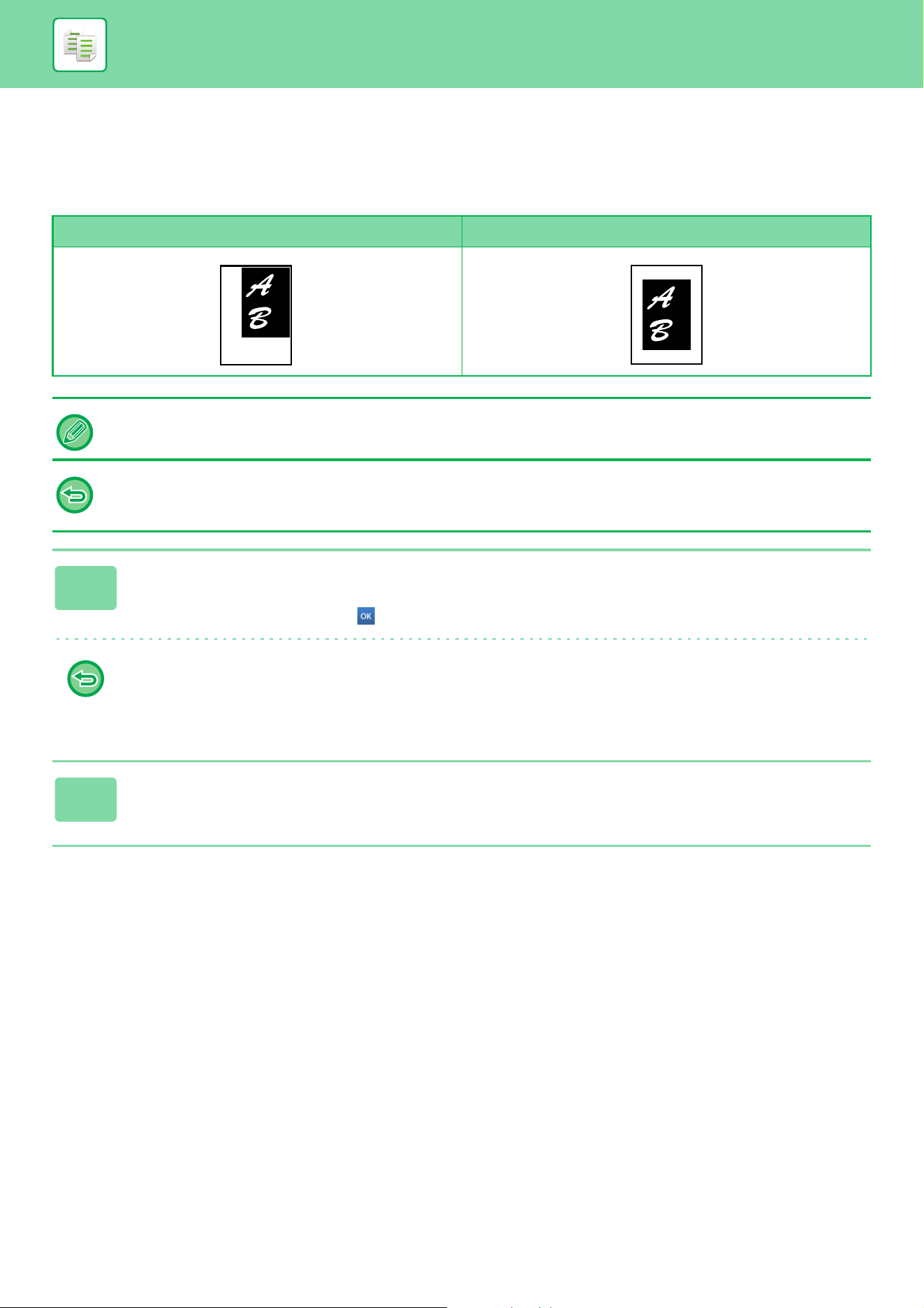
2-97
COPIER►OTHER FUNCTIONS
COPYING IN THE CENTER OF THE PAPER (CENTERING)
This function centers the copied image on the paper.
This lets you place the image in the center of the paper when the original size is smaller than the paper size or when the
image is reduced.
Not using the centering function Using the centering function
Centering must be specified before scanning the original.
• When the original size or the paper size is displayed as an extra size, this function cannot be used.
• This function cannot be used in combination with an enlargement setting. If enlargement of 101% or more is selected, the
enlargement is automatically returned to 100%.
1
Tap the [Others] key, and tap the [Centering] key.
A checkmark appears on the icon.
After the settings are completed, tap .
• To cancel the centering setting:
Tap the [Centering] key to clear the checkmark.
• To cancel all settings:
Tap the [CA] key.
2
Tap the [Color Start] or [B/W Start] key to start copying.
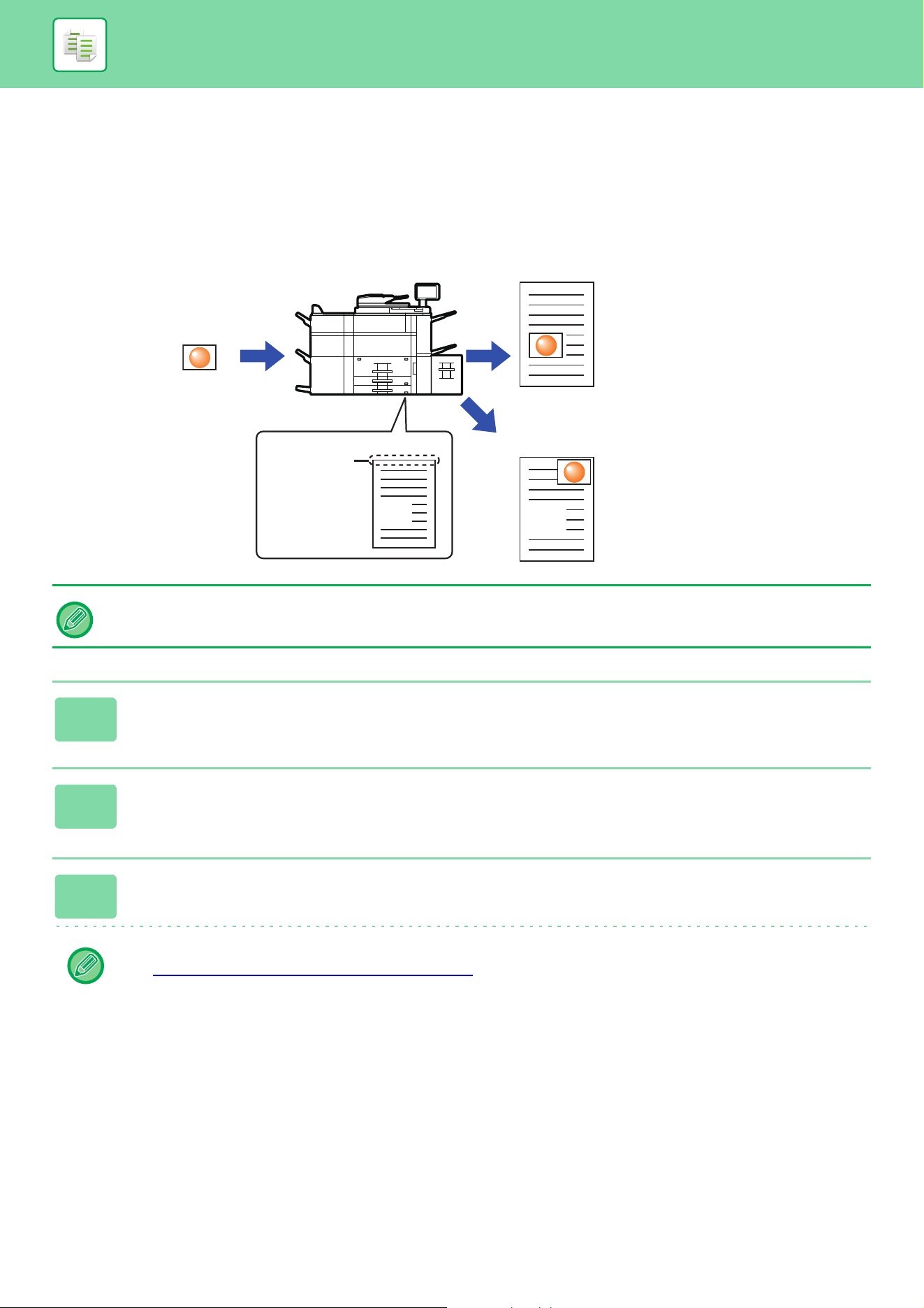
2-98
COPIER►OTHER FUNCTIONS
SPECIFYING A PAPER POSITION (POSITION IMAGE)
This function moves the scanned original to a specified position to make a copy.
You can make a copy in any desired position as you can fine adjust the position.
We recommend that you specify the top as the starting side of the original.
Auto ratio selection cannot be used.
1
Copy the original that you want to use for Move Copy.
Copying is performed without using move copy.
2
Measure the movement amount with the top as the starting side of the output
copy.
3
Tap the [Others] key, and tap the [Position Image] key.
Tap the [Original] key and specify the orientation of the original to have the orientation be correctly recognized.
► Specifying the orientation of the original (page 2-33)
Originals
Printing paper
Position Image is used
Position Image is not used
Top edge of
paper
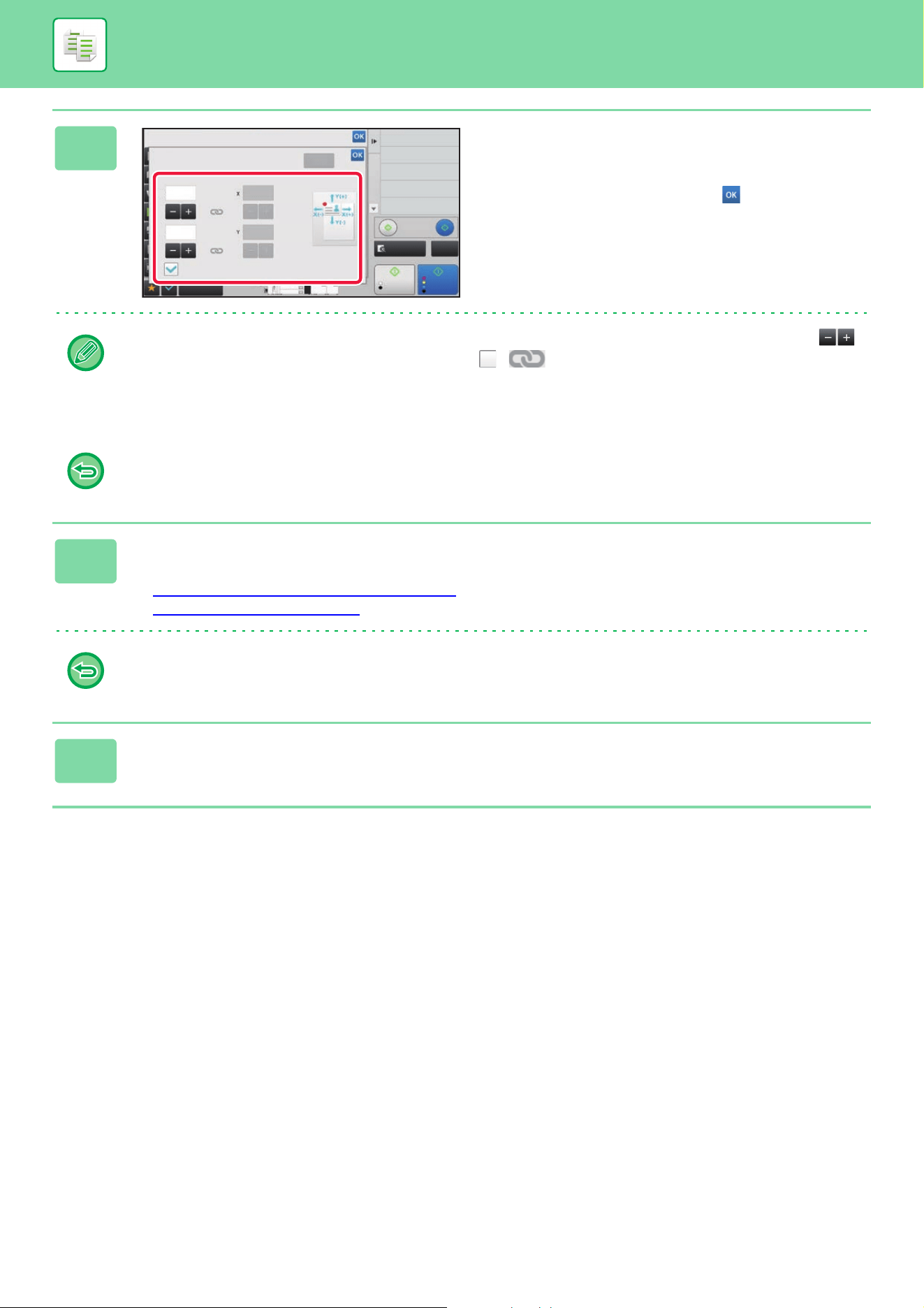
2-99
COPIER►OTHER FUNCTIONS
4
Sets a movement distance.
Tap the area indicating the movement distance on the front
or reverse side, and enter the distance using numeric keys.
After the settings are completed, tap twice.
• To quickly set the area, first specify a value close to the desired value by the numeric keys, then adjust it with .
• If you set the [Adjust 2nd pg value to 1st.] checkbox to , goes out and you can set sides 1 and 2 separately.
• If you want to copy in the horizontal orientation, specify "Left" as the starting side of the original.
Even if you copied in the horizontal orientation, setting the starting side of the original to the top enables measurement
of the movement distance in the same way as in the vertical orientation.
To cancel the Position Image setting:
Tap the [Clear] key.
5
Place the original.
Place the original in the document feeder tray of the automatic document feeder, or on the document glass.
► AUTOMATIC DOCUMENT FEEDER (page 1-90)
► DOCUMENT GLASS (page 1-92)
To cancel all settings:
Tap the [CA] key.
6
Tap the [Color Start] or [B/W Start] key to start copying.
Others
Position Image
Please designate print start position.
Preview
Start Start
Back
Change Size/Direction.
Original
Color Mode
2-Sided Copy
Clear
Side2Side1
Adjust 2nd pg value to 1st.
0
0
X
Y
( -17~17 )
inch
( -17~17 )
inch
( -11~11 )
inch
( -11~11 )
inch
Erase Shadow Around
Erase
X
Y
CA
B/W
68
4
3
Proof Copy
8½x11 8½x11
8½x14
11x17
Color
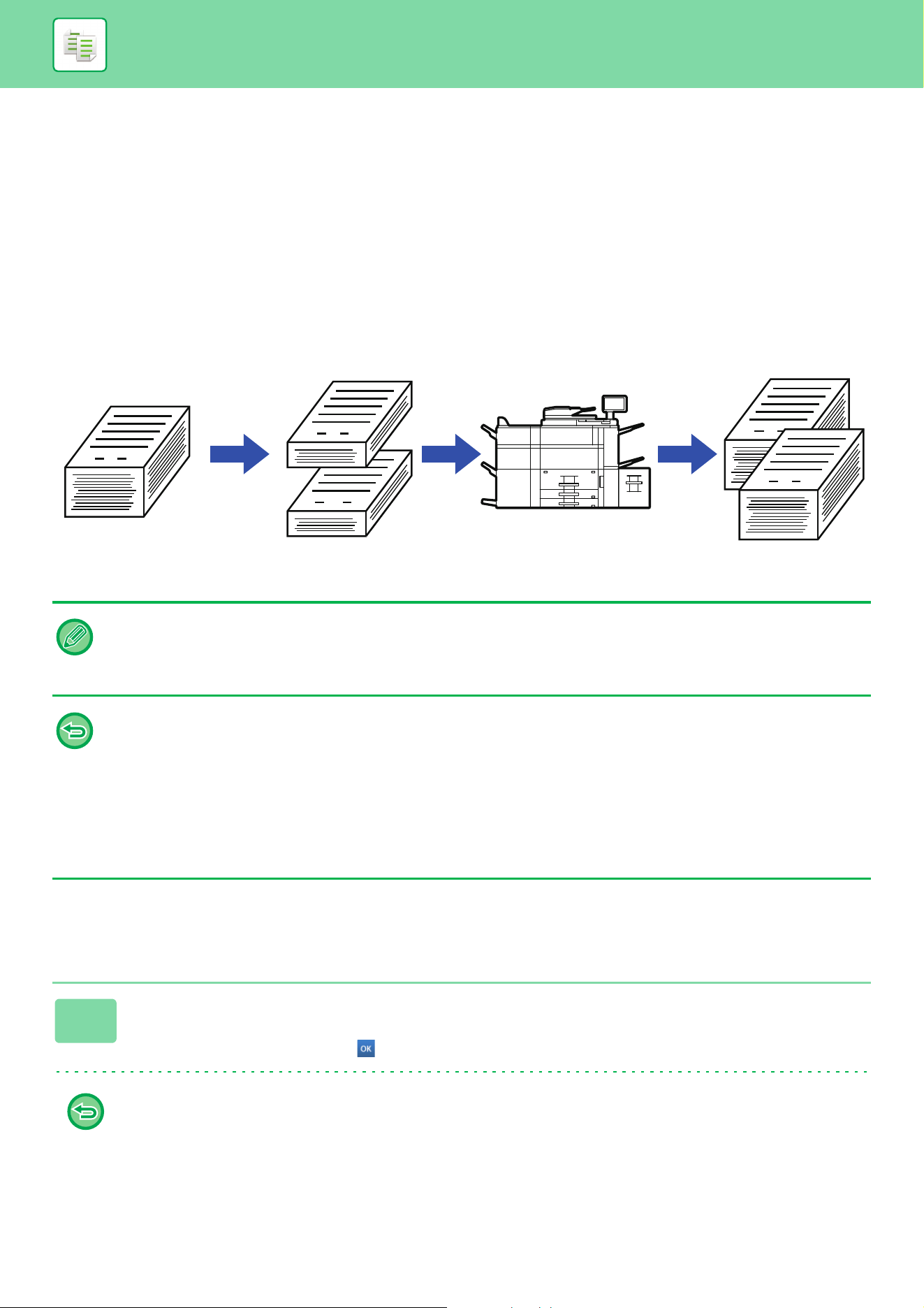
2-100
COPIER►OTHER FUNCTIONS
SCANNING FUNCTIONS
COLLECTIVELY SCANNING A LARGE NUMBER OF
ORIGINALS (JOB BUILD)
This function divides the originals into sets and feeds each set through the automatic document feeder one set at a time
when copying a very large number of originals. This saves you the trouble of sorting the copies.
When scanning originals that are separated into sets, scan the set that has the first page first.
The individual copy settings can be configured for each set of originals to be scanned separately.
Up to 100 sets of originals can be scanned for one job.
Copying in job build mode
• You must select Job Build mode before scanning the original.
• If you needed to change all original settings, change before scanning the original.
• If the Quick File Folder of document filing mode is full, copying in job build mode will be impeded. Delete unnecessary files
from the Quick File Folder.
The Job Build mode cannot be combined with other functions.
• Dual Page Copy
• Book Copy
• Book Divide
• Card shot
• Multi-Page Enlargement
• Repeat Layout
• Interrupt copy
1
Tap the [Others] key, and tap the [Job Build] key.
A checkmark appears on the icon.
After the settings are completed, tap .
To cancel the job build setting
Tap the [Job Build] key to uncheck it.
1
1
1
101
1
Originals
Scan the originals
in several sets.
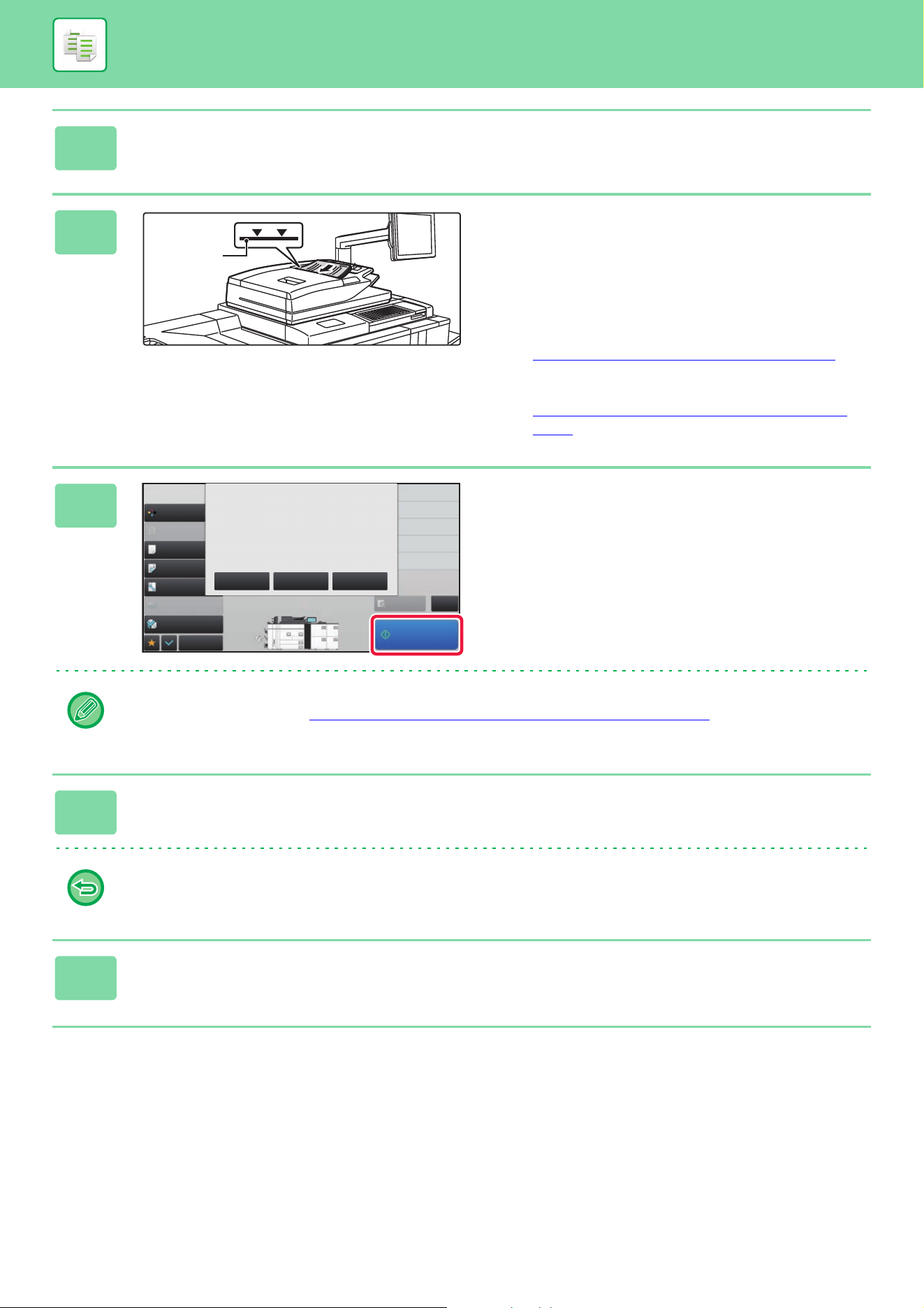
2-101
COPIER►OTHER FUNCTIONS
2
Change settings as needed.
3
Place the original in the document
feeder tray of the automatic document
feeder, and tap the [Start] key to scan
the first original.
• Insert the originals all the way into the document feeder
tray. Originals can be stacked up to the indicator line.
► AUTOMATIC DOCUMENT FEEDER (page 1-90)
• To initially make only one copy to check the output, tap
the [Proof Copy] key.
► MAKING A PROOF COPY (PROOF COPY) (page
2-142)
4
Place the next set of originals and tap
the [Start] key.
Repeat this step until all originals have been scanned.
• To change copy settings for each set of originals, tap the [Change Setting] key.
For more information, see "Changing the copy settings for each set of originals (page 2-102)
.
• If you tap the [Preview] key, you cannot scan additional pages.
5
Repeat until all pages have been scanned and check the preview image in the
preview screen.
To cancel all settings:
Tap the [CA] key.
6
Tap the [Read-End] key to start copying.
Indicator
line
Start
Color Mode
Full Colour
Paper Select
Auto
Exposure
Auto
Original
8½
2-Sided Copy
1-Sided→1-Sided
Output
Copy Ratio
100%
Others
Cancel and Return
Change to B/W
Send and print
Register Current Settings
Program Registration
Store Data Temporarily
Quick File
8½
CAPreview
Change Setting
Place next original.
Press [Start] to scan original.
[Change Setting]:
Change setting of next original.
[Preview]:
Finish scan and display preview.
Preview Read-End
2
5
68
7
1
3
4
8½x11 5½x8½
8½x11 8½x11
8½x11 8½x11
8½x14
11x17
2-102
COPIER►OTHER FUNCTIONS
Changing the copy settings for each set of originals
As necessary, change copy settings for each set of originals.
Perform the steps below before scanning the next set of originals in step 4 of "Copying in job build mode (page 2-100)
".
A [Separator Page] setting cannot be changed for the second and later sets.
1
Tap the [Change Setting] key.
2
Change copy settings.
3
Place the next set of originals and tap the [Start] key.
Repeat this step until all originals have been scanned.
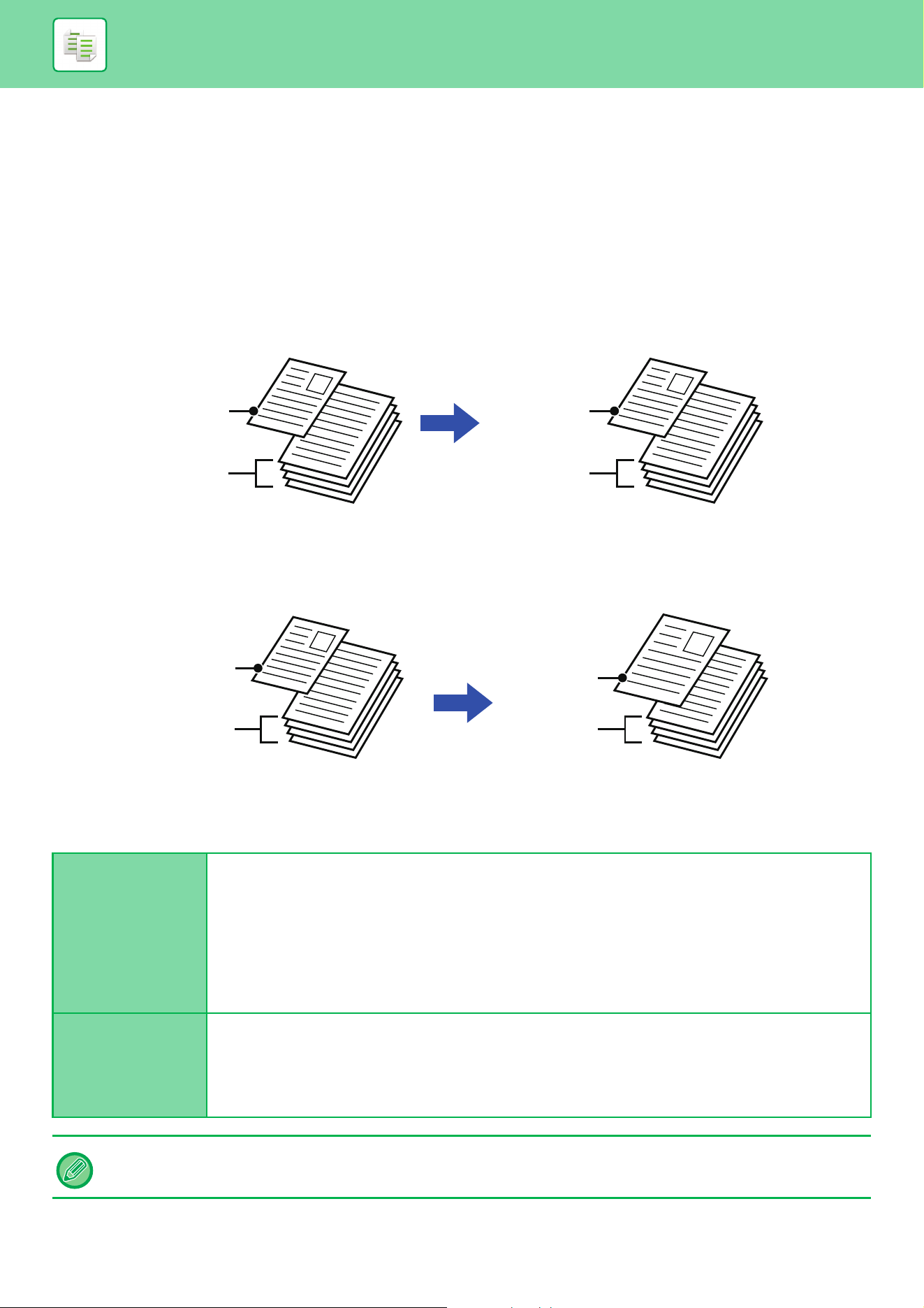
2-103
COPIER►OTHER FUNCTIONS
SCANNING ORIGINALS OF DIFFERENT SIZES
(MIXED SIZE ORIGINAL)
This feature copies originals in different sizes at the same time even when 8-1/2" x 14" (B4) size originals are mixed with
11" x 17" (A3) size originals.
When scanning the originals, the machine automatically detects the size of each original and uses paper appropriate for
that size.
When mixed size original is combined with auto ratio selection, the ratio is adjusted individually for each original
according to the selected paper size, enabling printing on a uniform paper size.
When mixed size original is combined with auto ratio selection
(Auto ratio selection and 11" x 17" (A3) are selected)
There are two settings for mixed size originals.
Same Width
Use this setting for originals that are different sizes but have sides that are the same length.
The originals are inserted in the document feeder tray with the sides that are the same length aligned
together on the left.
• 11" x 17" and 8-1/2" x 11"
• 8-1/2" x 14" and 8-1/2" x 11"R • 8-1/2" x 14" and 5-1/2" x 8-1/2"
• 8-1/2" x 13" and 8-1/2" x 11"R
• 8-1/2" x 13" and 5-1/2" x 8-1/2" • 8-1/2" x 11"R and 5-1/2" x 8-1/2"
• A3 and A4 • B4 and B5 • A4R and A5
Different Width
Use this setting when the originals are different sizes and do not have sides that are the same length.
This setting can only be used for the following combinations of sizes:
• 11"x17" and 8-1/2"x14" •11"x17" and 8-1/2"x13" • 11"x17" and 5-1/2"x8-1/2"
• A3 and B4 • A3 and B5 • B4 and A5 • A4 and B5 • B4 and A4R • B4 and A5
• B5 and A4R • B5 and A5
Mixed Size Original must be specified before scanning the original.
Originals Copy
11" x 17" (A3)
8-1/2" x 14" (B4)
11" x 17" (A3)
8-1/2" x 14" (B4)
Originals Copy
11" x 17" (A3)
8-1/2" x 14" (B4)
11" x 17" (A3)
11" x 17" (A3)
An 8-1/2" x 14" (B4) size original is
enlarged to 11" x 17" (A3) size for printing.
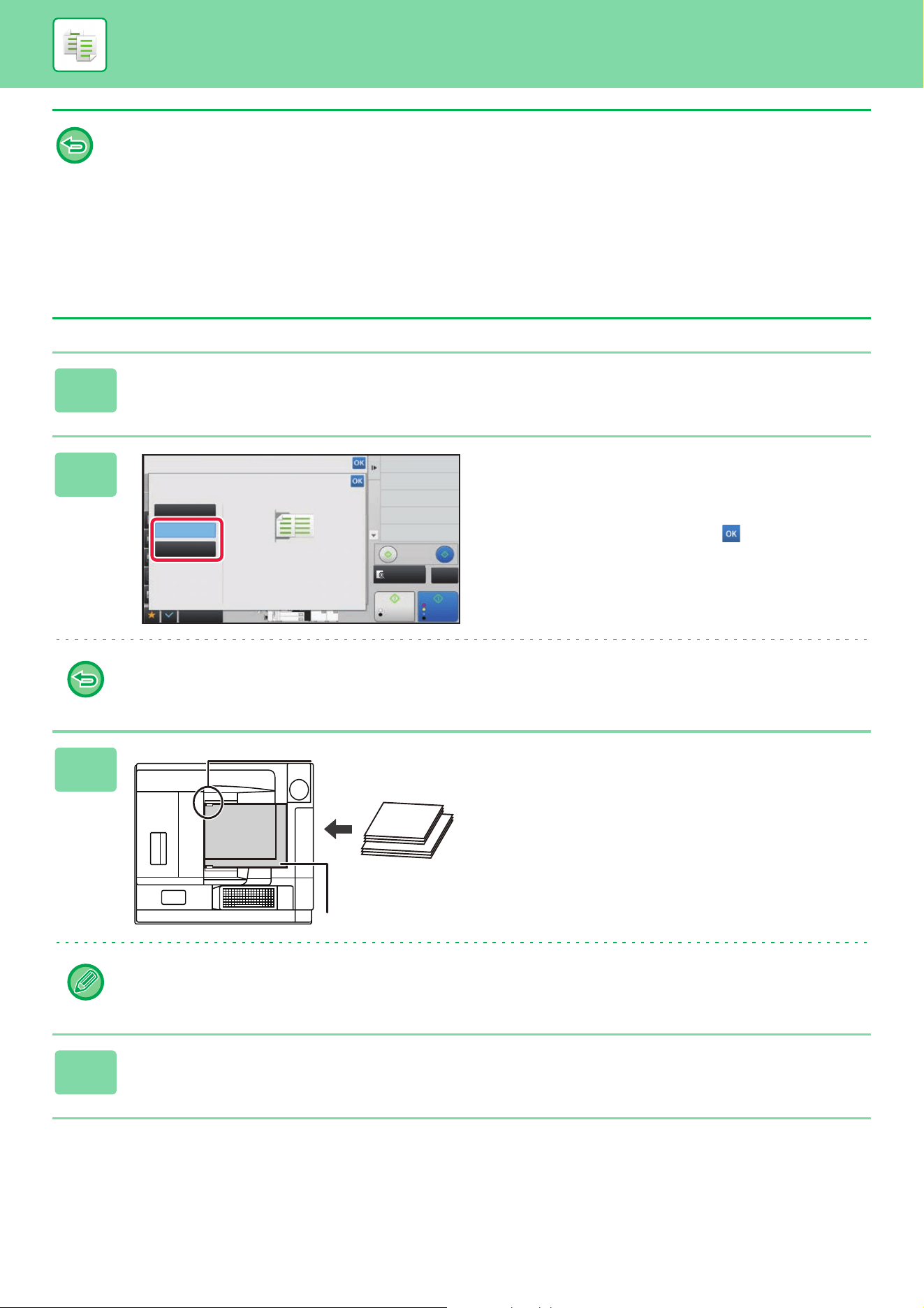
2-104
COPIER►OTHER FUNCTIONS
• Mixed originals cannot be used in combination with the following functions:
Standard size setting or size entry setting for the Original Size, folding setting other than Z-Fold
If different widths are selected for mixed originals, the following functions cannot be used.
Staple, Punch, N-Up, Offset, Booklet, Full Bleed Copy
• The mixed size original function cannot be used to copy originals that are the same size but are placed in different
orientations (8-1/2" x 11" and 8-1/2" x 11"R (A4 and A4R), etc.).
To set the machine to always scan mixed originals
• In "Settings (administrator)", select [System Settings] → [Common Settings] → [Device Control] → [Original Feeding
Mode].
• Output, N-Up, and other functions will have the same settings as the first page.
1
Tap the [Others] key, and tap the [Mixed Size Original] key.
2
Tap the [Same Width] key or the
[Different Width] key as appropriate for
the originals.
After the settings are completed, tap twice.
To cancel the mixed size original setting
Tap the [Off] key.
3
Place the original face up on the
document feeder tray.
Place the original as shown on the Mixed Size Original
screen.
For mixed size originals, set "Original" to "Auto".
4
Tap the [Color Start] or [B/W Start] key to start copying.
68
4
3
8½x11 5½x8½
8½x11 8½x11
8½x11 8½x11
8½x14
11x17
Others
Mixed Size Original
Preview
Start Start
Off
Same Width
Place the same width
originals.
Different Width
Back
Change Size/Direction.
Original
2-Sided Copy
CA
B/W
Proof Copy
Color
11" x 17"(A3)
8-1/2" x 14"(B4)
11" x 17" (A3)
Place the originals with
the corners aligned
together in the far left
corner.
8-1/2" x 14"
(
B4
)
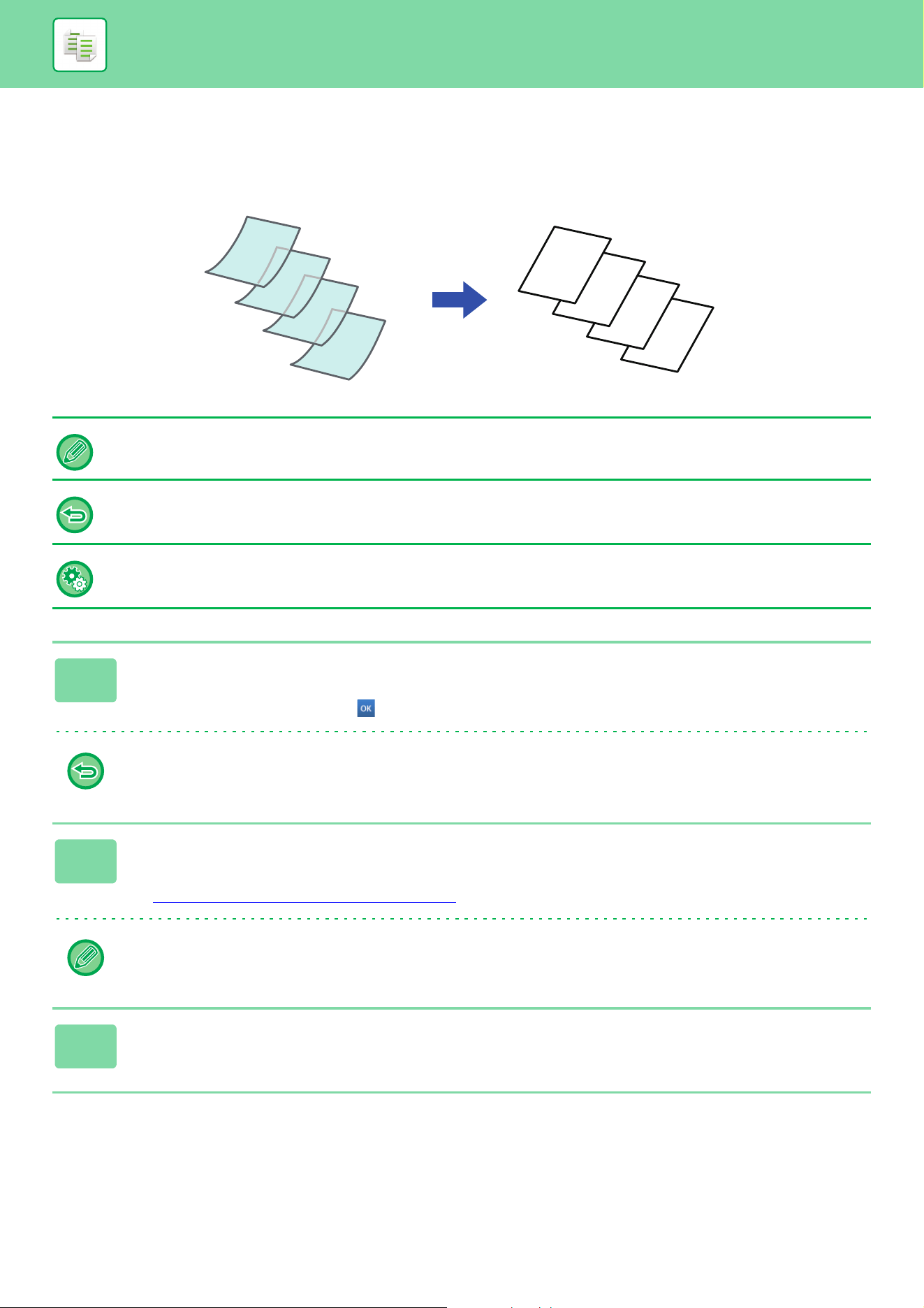
2-105
COPIER►OTHER FUNCTIONS
SCANNING THIN ORIGINALS (SLOW SCAN MODE)
When you wish to scan thin originals using the automatic document feeder, you can use this function, which helps
prevent thin originals from misfeeding.
Slow Scan Mode must be specified before scanning the original.
The "2-Sided→2-Sided" and "2-Sided→1-Sided" modes of automatic 2-sided copying cannot be used.
To always scan the original in the slow scan mode:
In "Settings (administrator)", select [System Settings] → [Common Settings] → [Device Control] → [Original Feeding Mode].
1
Tap the [Others] key, and tap the [Slow Scan Mode] key.
A checkmark appears on the icon.
After the settings are completed, tap .
To cancel slow scan mode:
Tap the [Slow Scan Mode] key to clear the checkmark.
2
Place the original in the document feeder tray of the automatic document
feeder.
► AUTOMATIC DOCUMENT FEEDER (page 1-90)
If the originals are inserted with too much force, they may crumple and misfeed.
3
Tap the [Color Start] or [B/W Start] key to start copying.
D
C
B
A
D
C
B
A
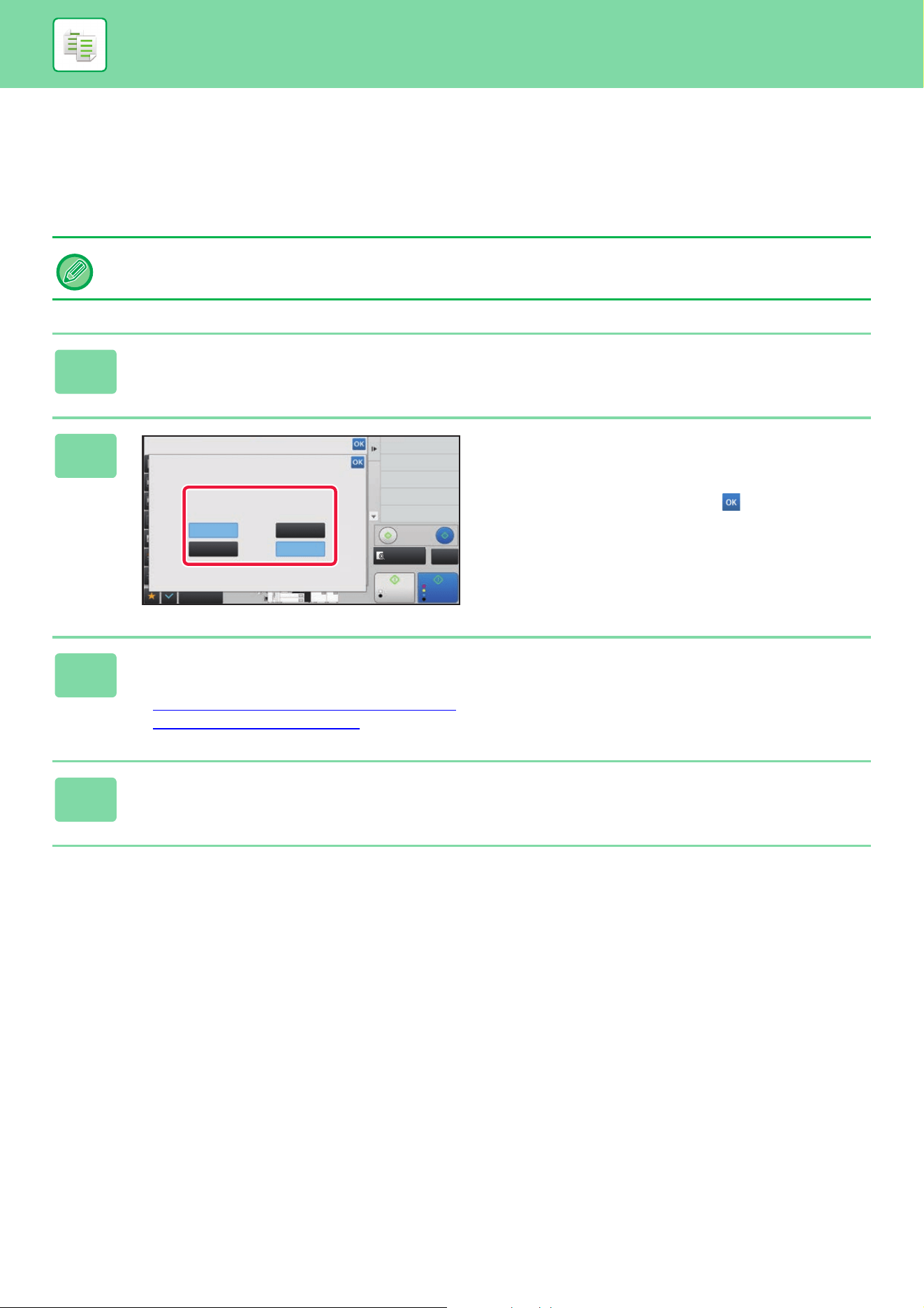
2-106
COPIER►OTHER FUNCTIONS
ADJUSTING RESOLUTION WHEN SCANNING
(RESOLUTION)
This function adjusts the resolution when scanning the original, enabling the high-quality output or speed-priority output
according to the application.
• Resolution must be specified before scanning the original.
• The resolution setting is applied when making a full-size black & white copy.
1
Tap the [Others] key, and tap the [Scan Resolution] key.
2
Select the resolution.
The resolution can be set to both the document feeder and
document glass.
After the settings are completed, tap twice.
3
Place the original.
Place the original in the document feeder tray of the automatic document feeder, or on the document glass.
► AUTOMATIC DOCUMENT FEEDER (page 1-90)
► DOCUMENT GLASS (page 1-92)
4
Tap the [B/W Start] key to start copying.
68
4
3
Proof Copy
8½x11 5½x8½
8½x11 8½x11
8½x11 8½x11
8½x14
11x17
Others
Scan Resolution
This setting is applied to B/W copy with copy ratio set to 100%.
Preview
Start Start
Back
Change Size/Direction.
Original
Document
Feeder
600x600dpi 600x600dpi
600x400dpi 600x400dpi
Document
Glass
Exposure
Select Type/Exposure
Color Mode
CA
B/W
Erase
Erase Shadow Around
Background Adjustment
Color
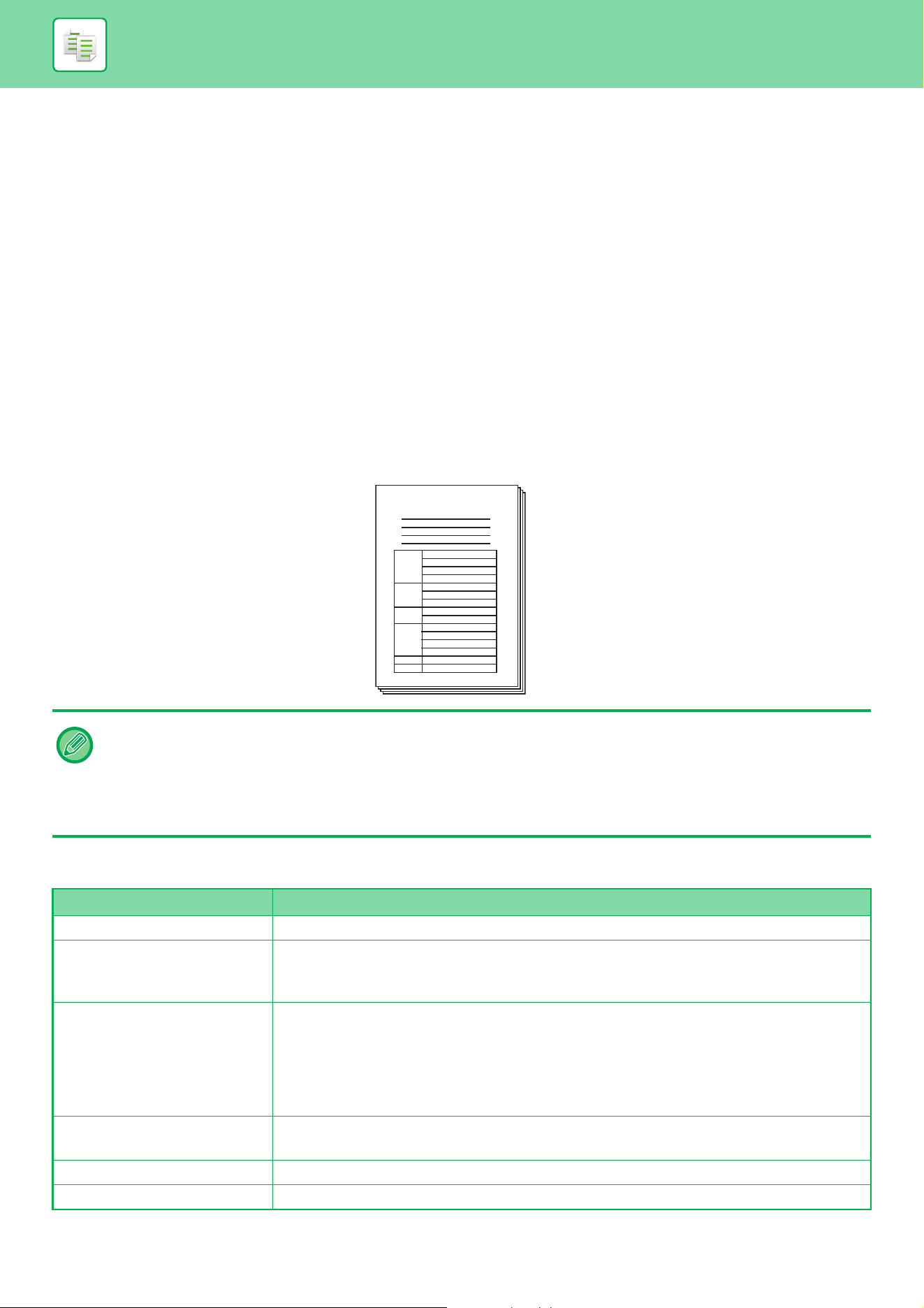
2-107
COPIER►OTHER FUNCTIONS
TEXT AND IMAGE ADDITION FUNCTIONS
PRINTING DATES, PAGE NUMBERS, AND
WATERMARKS (STAMP)
This function prints information such as the "Date" or "Stamp", which is not shown on the original, on copies. You can
print the following six types of information.
•Date
• Page No.
•Stamp
• Copies
•Text
• Watermark
For the stamp or watermark, you can print text such as "CONFIDENTIAL" or "PRIORITY". You can print pre-set text or
any characters as the text.
Each of the items above can be printed on the header or footer of each sheet.
When [Stamp] is combined with other functions:
• If the selected stamp content of one position overlaps the stamp content of another position, priority will be given in the
following order: watermark, Copies, Page No., right side, left side, center. Content that is hidden due to overlapping will not
be printed.
• Stamp will be printed at the preset size regardless of the copy ratio or paper size setting.
• Stamp will be printed at the preset exposure regardless of the exposure setting.
• Depending on the size of the paper, some printed content may be cut off or shifted out of position.
Combined function name Print operation
Margin Shift Together with the image, the stamp content is shifted the amount of the margin width.
Tab Copy
Centering
Position Image
Unlike a copy image that moves, the image will be printed in the position set in the stamp.
Dual Page Copy
Book Divide
Card Shot
N-Up
Booklet
Book Copy
Stamp items are printed for each copy sheet.
Covers/Inserts
Use the stamp settings to select whether or not the item is printed on inserted covers and
inserts.
Repeat Layout Cannot be combined.
Multi-Page Enlargement Cannot be combined.
Confidential
Specification
2015.12
5/45
DRAFT
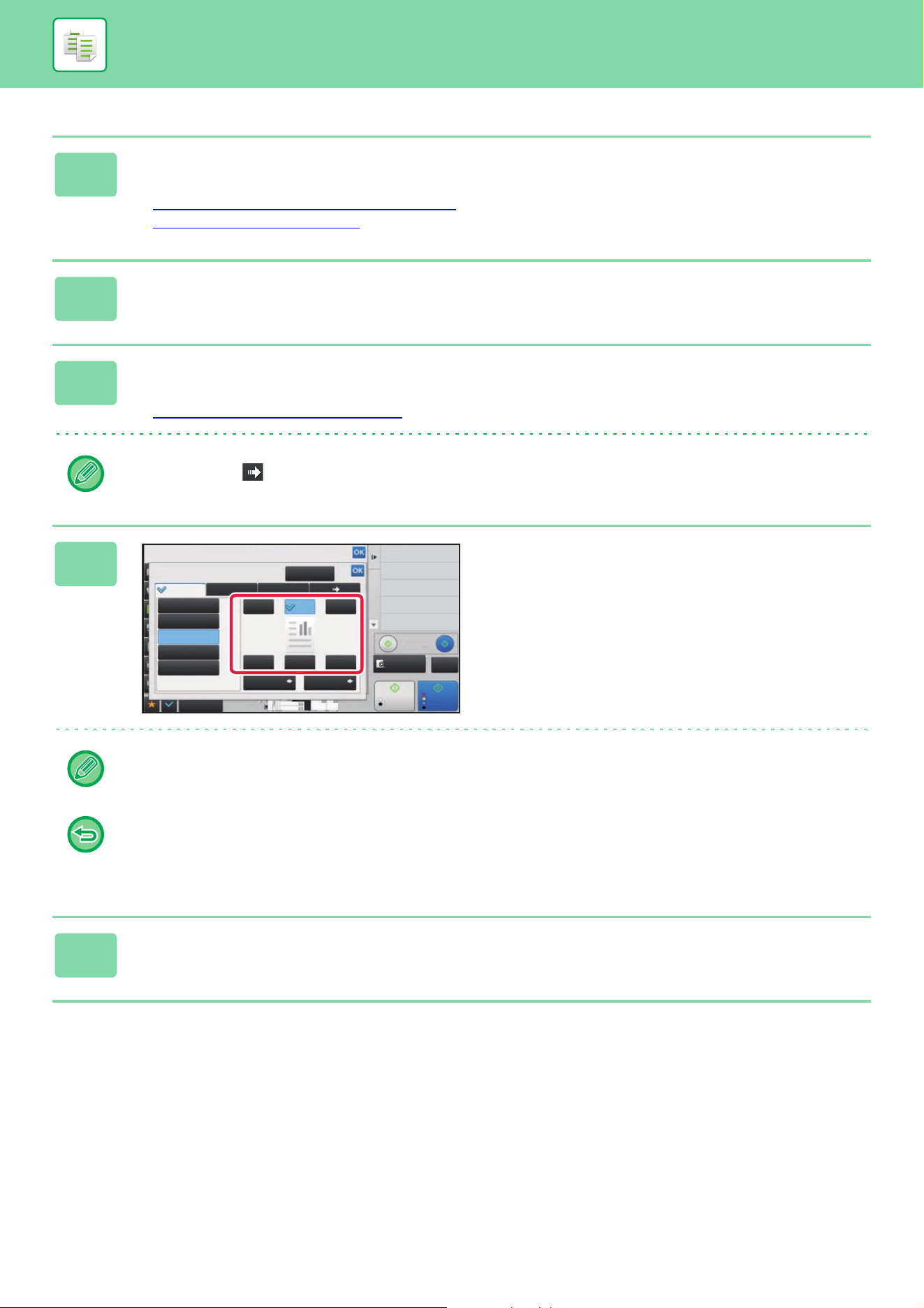
2-108
COPIER►OTHER FUNCTIONS
1
Place the original.
Place the original in the document feeder tray of the automatic document feeder, or on the document glass.
► AUTOMATIC DOCUMENT FEEDER (page 1-90)
► DOCUMENT GLASS (page 1-92)
2
Tap the [Others] key, and tap the [Stamp] key.
3
Tap a tab to be printed, and tap the format.
The format of the [Text] tab can be entered using pre-set text or soft keyboard.
► Setting using the [Text] tab (page 2-109)
When you tap the tab, the display tab is switched.
4
Tap a key of the desired print position.
Tap any of [1] to [6] keys.
• Tapping the [Detail] key allows you to configure setting for each tab such as a print color.
• Tapping the [Layout] key allows you to check the printing position or detailed settings.
• To cancel the text settings:
Tap the [Cancel All] key.
• To cancel all settings:
Tap the [CA] key.
5
Tap the [Color Start] or [B/W Start] key to start copying.
68
4
3
8½x11 8½x11
8½x14
11x17
Others
Stamp
Preview
Start Start
Back
Change Size/Direction.
Original
Combine Registered Images
Custom Image
Prevent Unauthorized Copy
Pattern Print
Color Mode
2-Sided Copy
Date Page No. Stamp
Detail Layout
Off
YYYY/MM/DD
MM/DD/YYYY
DD/MM/YYYY
MM DD, YYYY
1
456
32
Cancel All
CA
B/W
Proof Copy
Color
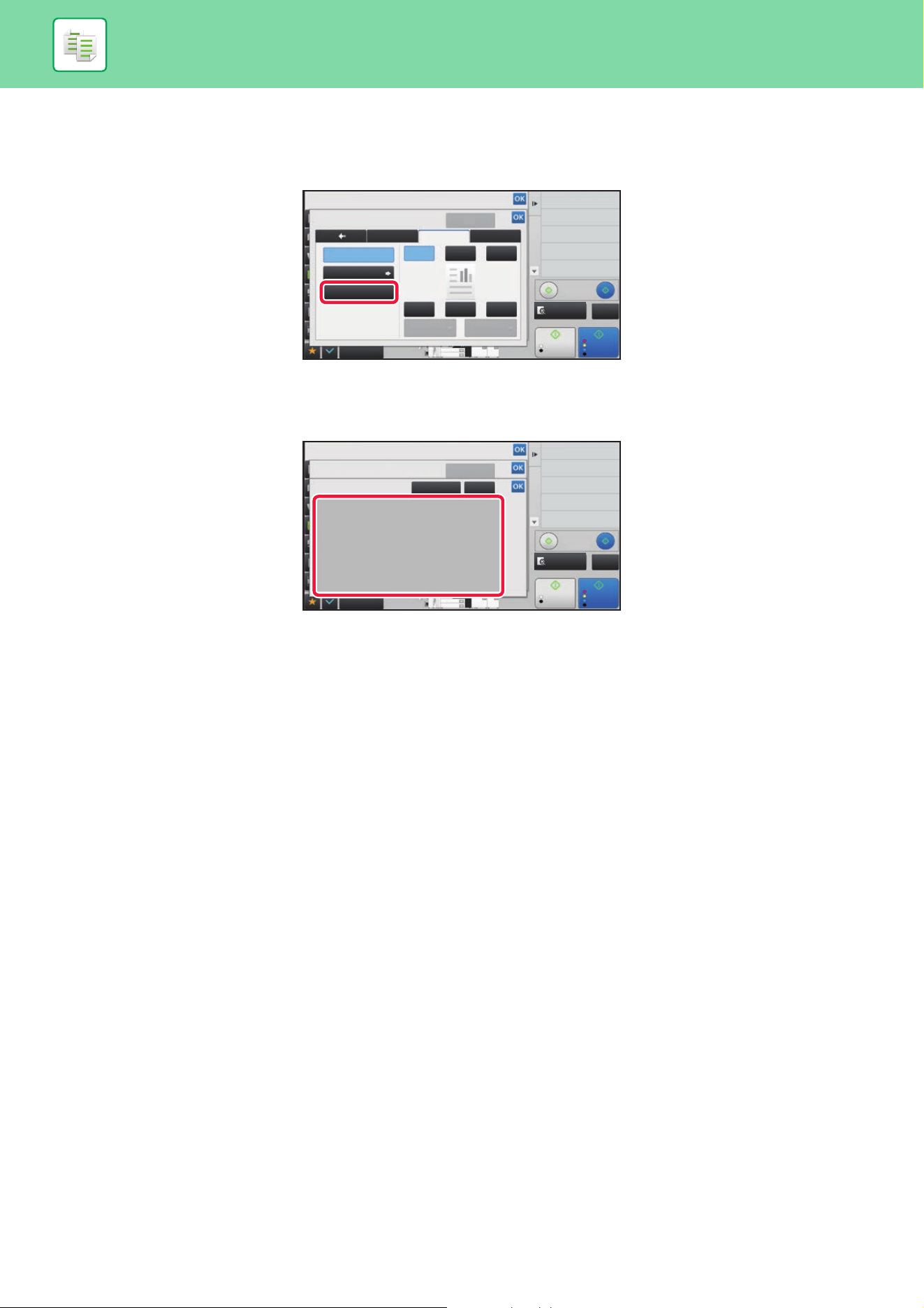
2-109
COPIER►OTHER FUNCTIONS
Setting using the [Text] tab
Tap the [Direct Entry] key in the [Text] tab to display the soft keyboard.
Use the soft keyboard to enter any characters.
Selecting the format from pre-set text
Tapping the [Pre-Set Text] key allows you to select the required one of the registered formats for printing.
Tapping the [Store/Delete] key allows you to edit, delete, or store pre-set text.
68
4
3
8½x11 8½x11
8½x14
11x17
Others
Stamp
Preview
Start Start
Back
Change Size/Direction.
Original
Combine Registered Images
Custom Image
Prevent Unauthorized Copy
Pattern Print
Color Mode
2-Sided Copy
Copies Text Watermark
Detail Layout
Off
Pre-Set Text
Direct Entry
1
456
32
CA
B/W
Cancel All
Proof Copy
Color
68
4
3
Others
Stamp
Pre-Set Text
Preview
Start Start
Back
Change Size/Direction.
Original
Combine Registered Images
Custom Image
Prevent Unauthorized Copy
Pattern Print
Color Mode
2-Sided Copy
Store/Delete Clear
No.05
No.06
No.01
No.04
No.03
No.02
Cancel All
CA
B/W
Proof Copy
8½x11 8½x11
8½x14
11x17
Color
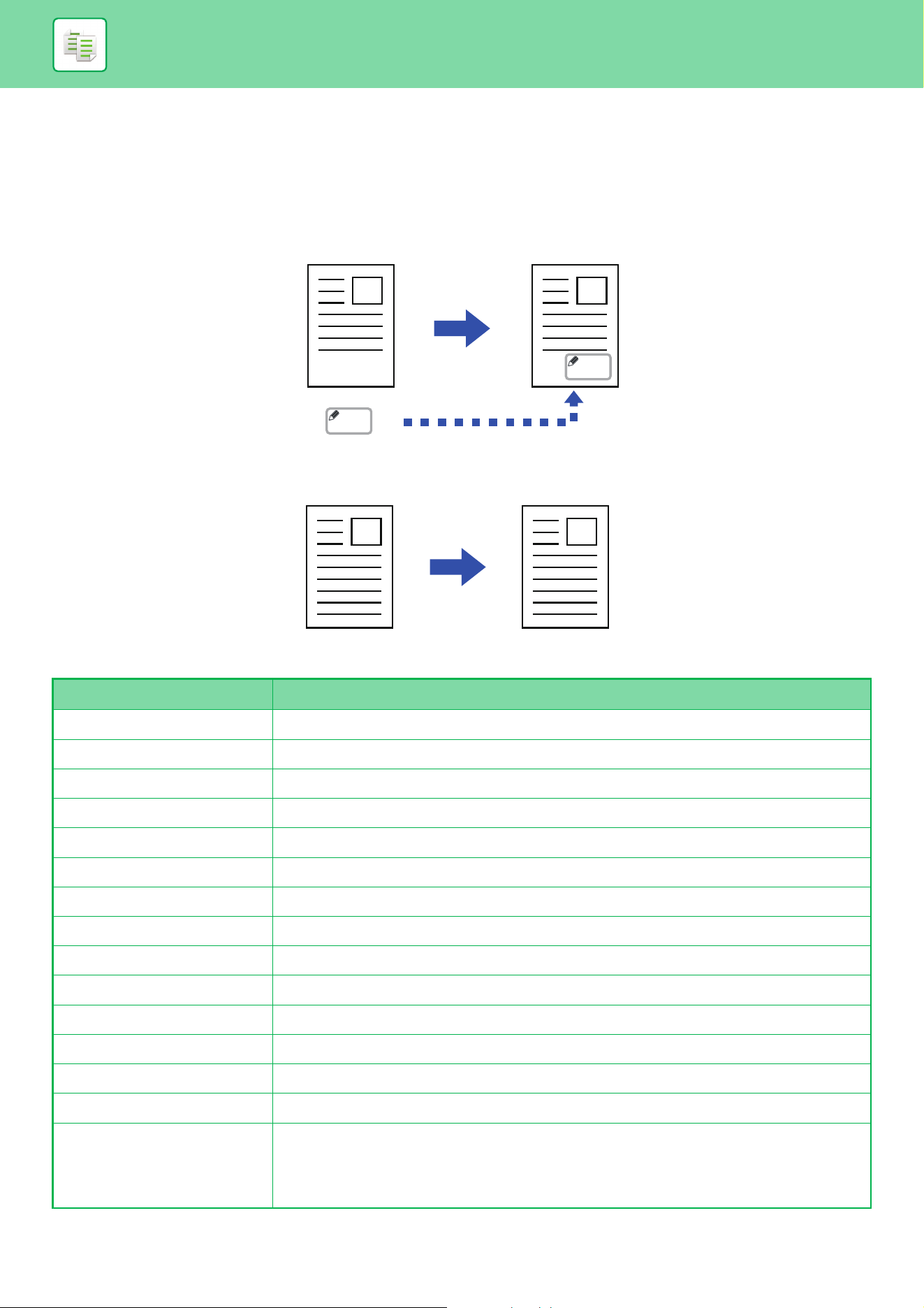
2-110
COPIER►OTHER FUNCTIONS
ADDING A REGISTERED IMAGE TO AN ORIGINAL
(CUSTOM IMAGE)
This function adds an image registered in the machine to an original to make a copy.
Following are two types of custom images.
• Custom stamp (Full-color stamp image)
• Custom watermark (Stamp image with gray-scale watermark)
The combination with other functions is described in the table below.
Combined function Custom image operations
Margin Shift Shifts in the same way as for an original image.
Erase Makes a stamp copy as normal.
Dual Page Copy Makes a stamp copy by sheet.
Booklet Makes a stamp copy as normal.
Job Build Makes a stamp copy as normal.
Tandem Copy Based on the tandem copy.
Covers/Inserts Based on the custom image setting.
Separator Page Printing does not take place on separator pages.
Transparency Inserts Makes a stamp copy as normal.
N-Up Makes a stamp copy by sheet.
Book Copy Makes a stamp copy as normal.
Tab Copy Makes a stamp copy as normal regardless of image shift setting.
Card Shot Makes a stamp copy by sheet.
Mirror Image Makes a stamp copy as normal without mirror image reverse.
B/W Reverse
Prints an image as normal without B/W reverse. However, the following condition is set when
printed on a dark background.
Custom stamp: Printed in white
Custom watermark: Printed without being whitened
MEMO
MEMO
Confidential
2-111
COPIER►OTHER FUNCTIONS
Full Bleed Copy Makes a stamp copy as normal.
Centering Makes a stamp copy as normal without centering.
Color Adjustments Makes a stamp copy using the registered data.
Stamp Makes a stamp copy on the Stamp menu.
Photo Repeat Cannot be combined.
Multi-Page Enlargement Cannot be combined.
Hidden Pattern Print Makes a stamp copy under a pattern print.
Tracking Information Print Makes a stamp copy under a tracking information print.
Repeat Layout Cannot be combined.
Position Image Prints an image at the original position regardless of the Position Image setting.
Book Divide Makes a stamp copy by sheet.
• An image must be registered in advance from the printer driver to the machine.
► REGISTERING A CUSTOM IMAGE (page 3-59)
• A custom stamp image is copied by sheet, not by original. If N-Up is enabled, user stamps are copied for each set of
pages.
• A custom stamp image is copied with the registered size. The size remains unchanged even when the copy ratio is
enlarged or reduced.
• A different custom image cannot be specified for each page.
• When you tap the [B/W Start] key, a monochrome copy is made even if you have selected a custom stamp.
• If an image runs off of the specified paper depending on the registered size or position, the excess will not be copied.
• Custom Image can be combined with Tandem Copy.
Stamp copy is performed when a custom image with the same file name is registered in both the master and client
machines.
If it is not registered, a copy will be made without a custom image.
1
Place the original.
Place the original in the document feeder tray of the automatic document feeder, or on the document glass.
► AUTOMATIC DOCUMENT FEEDER (page 1-90)
► DOCUMENT GLASS (page 1-92)
2
Tap the [Others] key, and tap the [Custom Image] key.
3
Tap the [Custom Stamp] or [Custom Watermark] key.
4
Tap the [Image] key to select an image.
Select the required thumbnail image(s) from the available selection.
Combined function Custom image operations
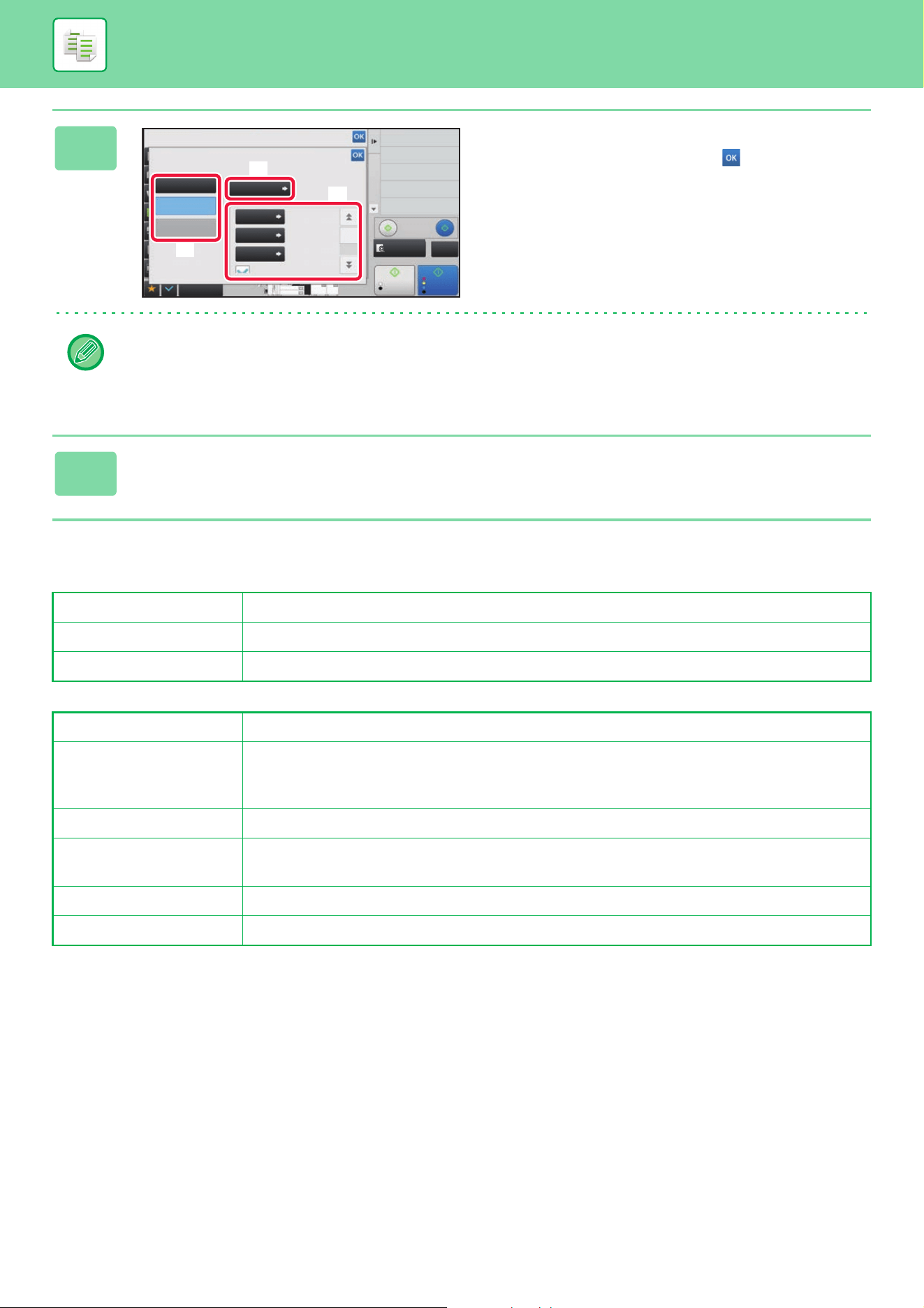
2-112
COPIER►OTHER FUNCTIONS
For settings related to custom stamp and custom water mark, see the following table.
For custom stamp
For custom watermark
5
Set [Print Page] or [Print Position].
After the settings are completed, tap twice.
• To cancel the custom image setting:
Tap the [Off] key.
• To cancel all settings:
Tap the [CA] key.
6
Tap the [Color Start] or [B/W Start] key to start copying.
Print Page Specify a page(s) for stamp copy. First Page or All Pages
Print Position Specify a position for stamp copy.
Print Angle Specify the corner of the image. 0 degrees, -90 degrees, 90 degrees, or 180 degrees
Print Color Specify the image watermark color. Black, red, green, blue, cyan, magenta or yellow.
Print Pattern
Specify the image watermark print pattern.
Transparent: Makes an original image transparent for stamp copy.
Overlap: Hides a watermark added to an original image for stamp copy.
Exposure Select the exposure of a watermark from nine levels.
Print Page
Specify a page(s) for stamp copy.
First Page or All Pages
Print Position Specify a position for stamp copy.
Print Angle Specify the corner of the image. 0 degrees, -90 degrees, 90 degrees, or 180 degrees
68
4
3
Proof Copy
8½x11 8½x11
8½x14
11x17
Others
Custom Image
Select Image to Operate.
Preview
Start Start
Off
Image
Print Page
Print Position
Angle
Custom
Stamp
Custom
Watermark
Original
Change Size/Direction.
Back
Print on cover/insert when
copy is made on cover/insert
0°
First Page
Not
X: 0 mm
Y: 0 mm
Print Date and Stamp
Stamp
Color Mode
2-Sided Copy
Put Multiple Pages in A Page
N-Up
CA
B/W Color
(3)
(4)
(5)
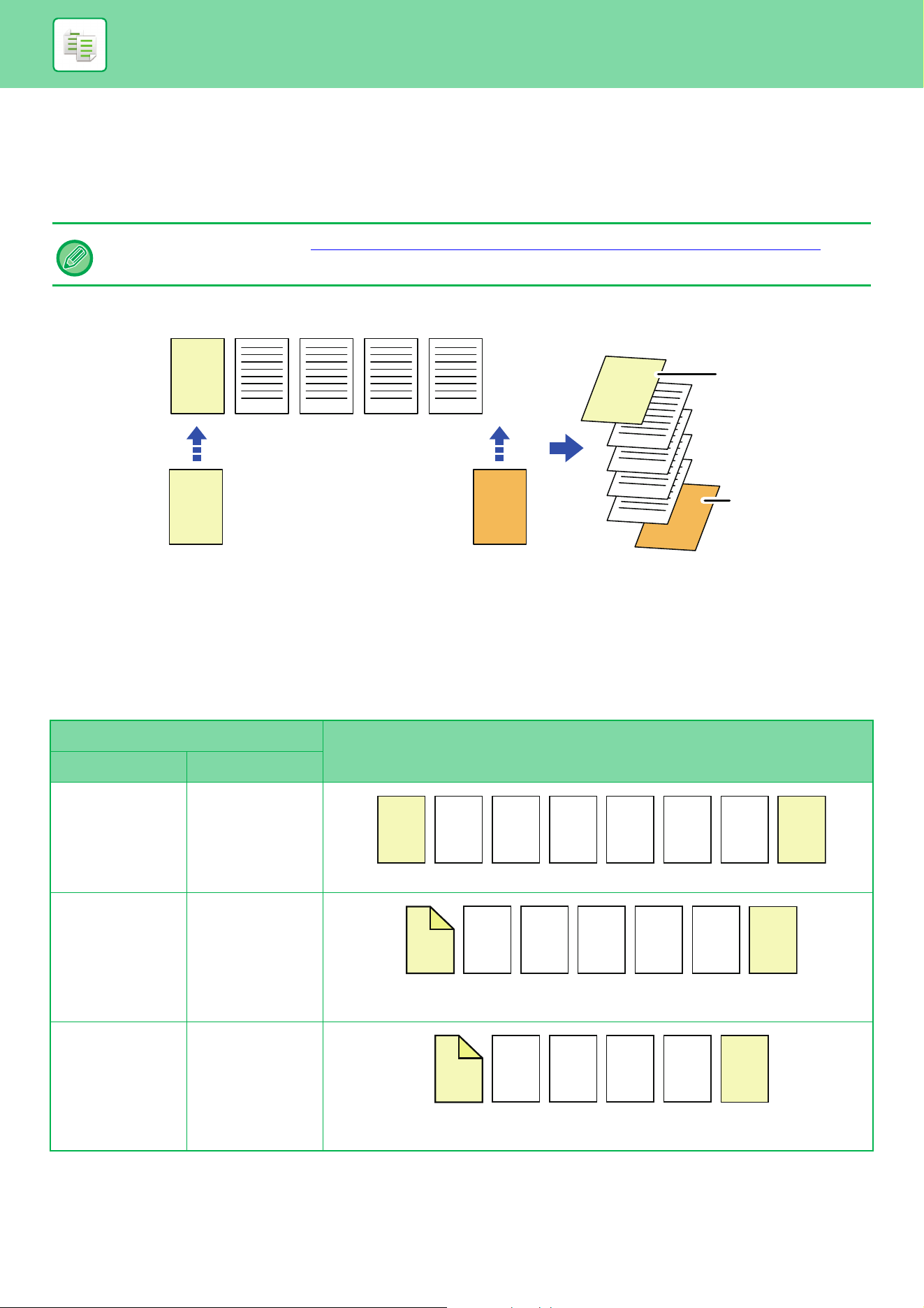
2-113
COPIER►OTHER FUNCTIONS
INSERTING COVERS IN COPIES (COVERS/INSERTS)
This function inserts a different type of paper into the pages corresponding to the front and back covers of a copy job.
It is helpful when you want to change cover paper to make resources look better.
Configure insertion sheet settings if needed.
Copying on a front cover and inserting together with a back cover
Cover inserting examples
The following shows the copy results when front and back covers are inserted into six 1-sided original pages or three
2-sided original pages in the four copy modes below.
1-sided copying of 1-sided originals
• To insert insertion sheets, see "INSERTING INSERTION SHEETS IN COPIES (COVERS/INSERTS) (page 2-121)".
• For N-Up, the layout is based on the first page and excludes covers.
Setting conditions for each cover
Resulting copies
Front Cover Back Cover
Not copied Not copied
Inserts cover sheets at the beginning and end of copies.
1-sided copy Not copied
Makes a 1-sided copy on the first original page for front cover, and inserts a back
cover at the end of copies.
2-sided copy Not copied
Makes a 2-sided copy on the first and second original pages for front cover, and
inserts a back cover at the end of copies.
5
4
2 3 4 51
3
2
1
Front cover paper Back cover paper Copy
Back Cover
Front Cover
2
1
3
6
4 5
1
2
3
6
4 5
1
2
3
6
4 5
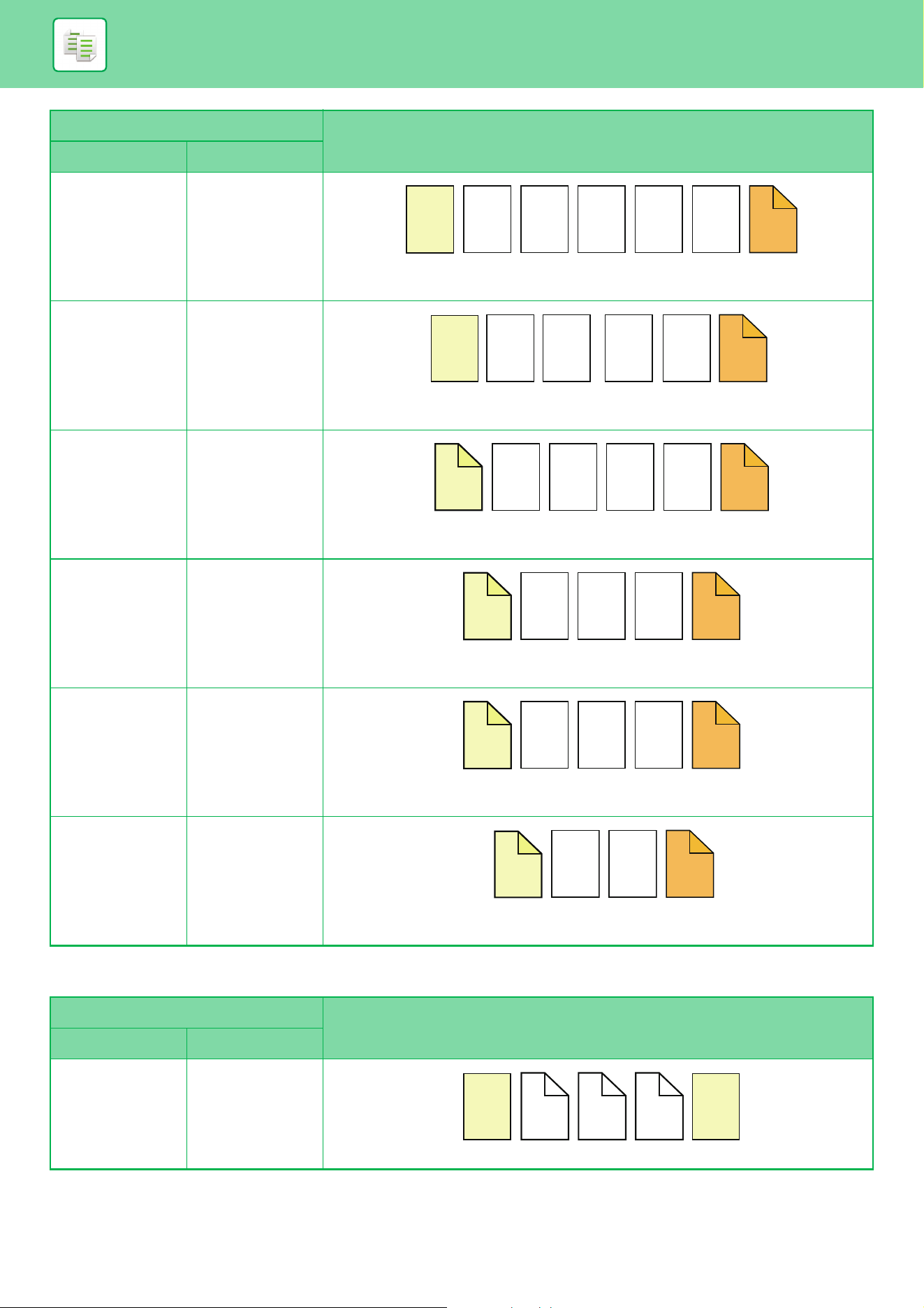
2-114
COPIER►OTHER FUNCTIONS
2-sided copying of 1-sided originals
Not copied 1-sided copy
Inserts a front cover at the beginning of copies, and makes a 1-sided copy on the
sixth original page for back cover.
Not copied 2-sided copy
Inserts a front cover at the beginning of copies, and makes a 2-sided copy on the fifth
and sixth original pages for back cover.
1-sided copy 1-sided copy
Makes a 1-sided copy on the first original page for front cover, and also makes a
1-sided copy on the sixth original page for back cover.
1-sided copy 2-sided copy
Makes a 1-sided copy on the first original page for front cover, and also makes a
2-sided copy on the fifth and sixth original pages for back cover.
2-sided copy 1-sided copy
Makes a 2-sided copy on the first and second original pages for front cover, and also
makes a 1-sided copy on the sixth original page for back cover.
2-sided copy 2-sided copy
Makes a 2-sided copy on the first and second original pages for front cover, and also
makes a 2-sided copy on the fifth and sixth original pages for back cover.
Setting conditions for each cover
Resulting copies
Front Cover Back Cover
Not copied Not copied
Inserts cover sheets at the beginning and end of copies.
Setting conditions for each cover
Resulting copies
Front Cover Back Cover
6
2
1
3 4
5
6
5
2
1
3
4
1
2
3
4
5
6
1
2
3 4
6
5
6
1
2
3 4 5
1
2
6
5
3
4
3
4
1
2
5
6
2-115
COPIER►OTHER FUNCTIONS
1-sided copy Not copied
Makes a 1-sided copy on the first original page for front cover, and also makes a
1-sided copy on the sixth original page. Inserts cover sheets at the end of copies.
2-sided copy Not copied
Makes a 2-sided copy on the first and second original pages for front cover, and
inserts a back cover at the end of copies.
Not copied 1-sided copy
Inserts a front cover at the beginning of copies, and makes a 1-sided copy on the
sixth original page for back cover. A 1-sided copy is made on the fifth original page.
Not copied 2-sided copy
Inserts a front cover at the beginning of copies, and makes a 2-sided copy on the fifth
and sixth original pages for back cover.
1-sided copy 1-sided copy
Makes a 1-sided copy on the first original page for front cover, and also makes a
1-sided copy on the sixth original page for back cover.
1-sided copy 2-sided copy
Makes a 1-sided copy on the first original page for front cover, and also makes a
2-sided copy on the fifth and sixth original pages for back cover.
2-sided copy 1-sided copy
Makes a 2-sided copy on the first and second original pages for front cover, and also
makes a 1-sided copy on the sixth original page for back cover. A 1-sided copy is
made on the fifth original page.
Setting conditions for each cover
Resulting copies
Front Cover Back Cover
5
6
2
3
1
6
3
4
5
6
1
2
3
4
1
2
5
6
6
5
3
4
1
2
5
6
2
3
1
6
2
3
1
6
5
4
3
4
1
2
5
6
2-116
COPIER►OTHER FUNCTIONS
1-sided copying of 2-sided originals
2-sided copy 2-sided copy
Makes a 2-sided copy on the first and second original pages for front cover, and also
makes a 2-sided copy on the fifth and sixth original pages for back cover.
Setting conditions for each cover
Resulting copies
Front Cover Back Cover
Not copied Not copied
Inserts cover sheets at the beginning and end of copies.
1-sided copy Not copied
Makes a 1-sided copy on the first original page for front cover, and inserts a back
cover at the end of copies.
2-sided copy Not copied
Makes a 2-sided copy on the first and second original pages for front cover, and
inserts a back cover at the end of copies.
Not copied 1-sided copy
Inserts a front cover at the beginning of copies, and makes a 1-sided copy on the
sixth original page for back cover.
Not copied 2-sided copy
Inserts a front cover at the beginning of copies, and makes a 2-sided copy on the fifth
and sixth original pages for back cover.
1-sided copy 1-sided copy
Makes a 1-sided copy on the first original page for front cover, and also makes a
1-sided copy on the sixth original page for back cover.
Setting conditions for each cover
Resulting copies
Front Cover Back Cover
3
4
1
2
6
5
2
1
3
4 5
6
2
3
45
6
1
3
4 5
6
1
2
2
1
3 4
5
6
2
1
3
4
6
5
2
3 4
5
1
6
2-117
COPIER►OTHER FUNCTIONS
1-sided copy 2-sided copy
Makes a 1-sided copy on the first original page for front cover, and also makes a
2-sided copy on the sixth original page for back cover.
2-sided copy 1-sided copy
Makes a 2-sided copy on the first and second original pages for front cover, and also
makes a 1-sided copy on the sixth original page for back cover.
2-sided copy 2-sided copy
Makes a 2-sided copy on the first and second original pages for front cover, and also
makes a 2-sided copy on the fifth and sixth original pages for back cover.
Setting conditions for each cover
Resulting copies
Front Cover Back Cover
2
3 4
1
6
5
3 4 5
1
2
6
3
4
1
2
6
5
2-118
COPIER►OTHER FUNCTIONS
2-sided copying of 2-sided originals
Setting conditions for each cover
Resulting copies
Front Cover Back Cover
Not copied Not copied
Inserts cover sheets at the beginning and end of copies.
1-sided copy Not copied
Makes a 1-sided copy on the first original page for front cover, and inserts a back
cover at the end of copies.
* The second original page is not copied.
2-sided copy Not copied
Makes a 2-sided copy on the first and second original pages for front cover, and
inserts a back cover at the end of copies.
Not copied 1-sided copy
Inserts a front cover at the beginning of copies, and makes a 1-sided copy on the
sixth original page for back cover.
* The fifth original page is not copied.
Not copied 2-sided copy
Inserts a front cover at the beginning of copies, and makes a 2-sided copy on the fifth
and sixth original pages for back cover.
1-sided copy 1-sided copy
Makes a 1-sided copy on the first original page for front cover, and also makes a
1-sided copy on the sixth original page for back cover. The second and the fifth
original pages are not copied.
1-sided copy 2-sided copy
Makes a 1-sided copy on the first original page for front cover, and also makes a
2-sided copy on the fifth and sixth original pages for back cover.
* The second original page is not copied.
3
4
1
2
5
6
3
4
1
5
6
3
4
1
2
5
6
3
4
1
2
6
3
4
1
2
6
5
3
4
1
6
3
4
1
6
5
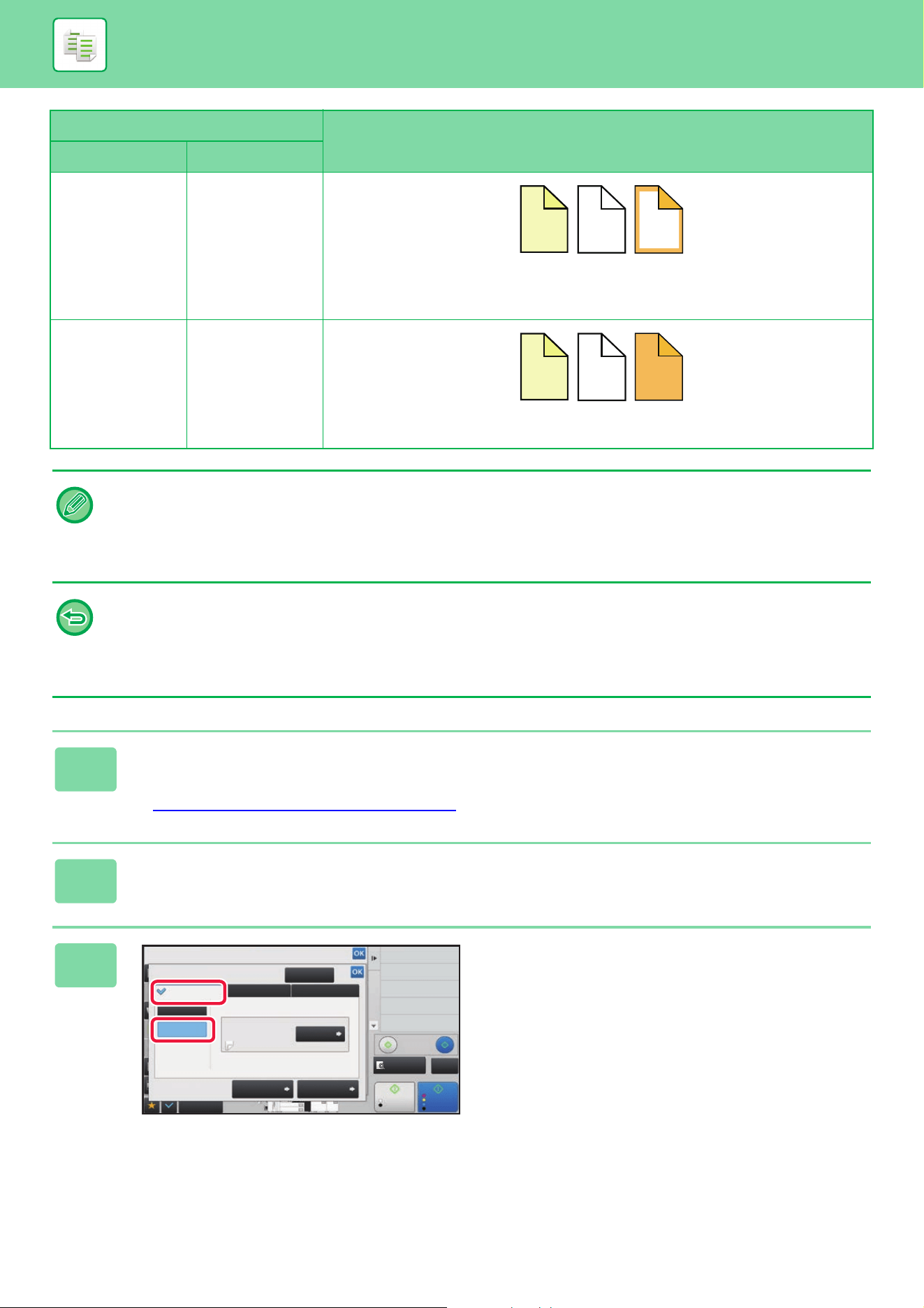
2-119
COPIER►OTHER FUNCTIONS
2-sided copy 1-sided copy
Makes a 2-sided copy on the first and second original pages for front cover, and also
makes a 1-sided copy on the sixth original page for back cover.
* The fifth original page is not copied.
2-sided copy 2-sided copy
Makes a 2-sided copy on the first and second original pages for front cover, and also
makes a 2-sided copy on the fifth and sixth original pages for back cover.
• Before using the covers/inserts function, load insertion sheets in the tray.
• When selecting the covers/inserts function, place the originals in the document feeder tray, select 1-sided or 2-sided
copying, and select the number of copies and any other desired copy settings. When these settings have been completed,
perform the procedure to select covers/inserts.
• One sheet can be inserted for each of front and back covers.
• The document glass is not available for this function.
• When performing 2-sided copying of 2-sided originals, an insertion sheet cannot be inserted between the front and reverse
sides of an original.
• This function cannot be used in combination with the saddle stitch function.
• This setting is not available when the "Covers/Inserts" is disabled in "Settings".
1
Place the original in the document feeder tray of the automatic document
feeder.
► AUTOMATIC DOCUMENT FEEDER (page 1-90)
2
Tap the [Others] key, and then tap the [Covers/Inserts] key.
3
Tap the [Front Cover] key, and then tap
the [On] key.
When inserting a back cover, tap the [Back Cover] tab, and
then tap the [On] key.
Setting conditions for each cover
Resulting copies
Front Cover Back Cover
3
4
6
1
2
3
4
1
2
6
5
8½x11
68
8½x11
4
3 8½x14
11x17
X: 0 mm
Y: 0 mm
Others
Preview
Start Start
Back
Insert SheetBack CoverFront Cover
Page Layout
Paper Tray
Settings
Cancel All
On
Off
Change
Bypass
Plain 1
Make No Copy
CA
B/W
Covers/Inserts
Proof Copy
Original
Change Size/Direction.
Shift Position to Have Margin
Margin Shift
Color Mode
Output
Put Multiple Pages in A Page
N-Up
Color
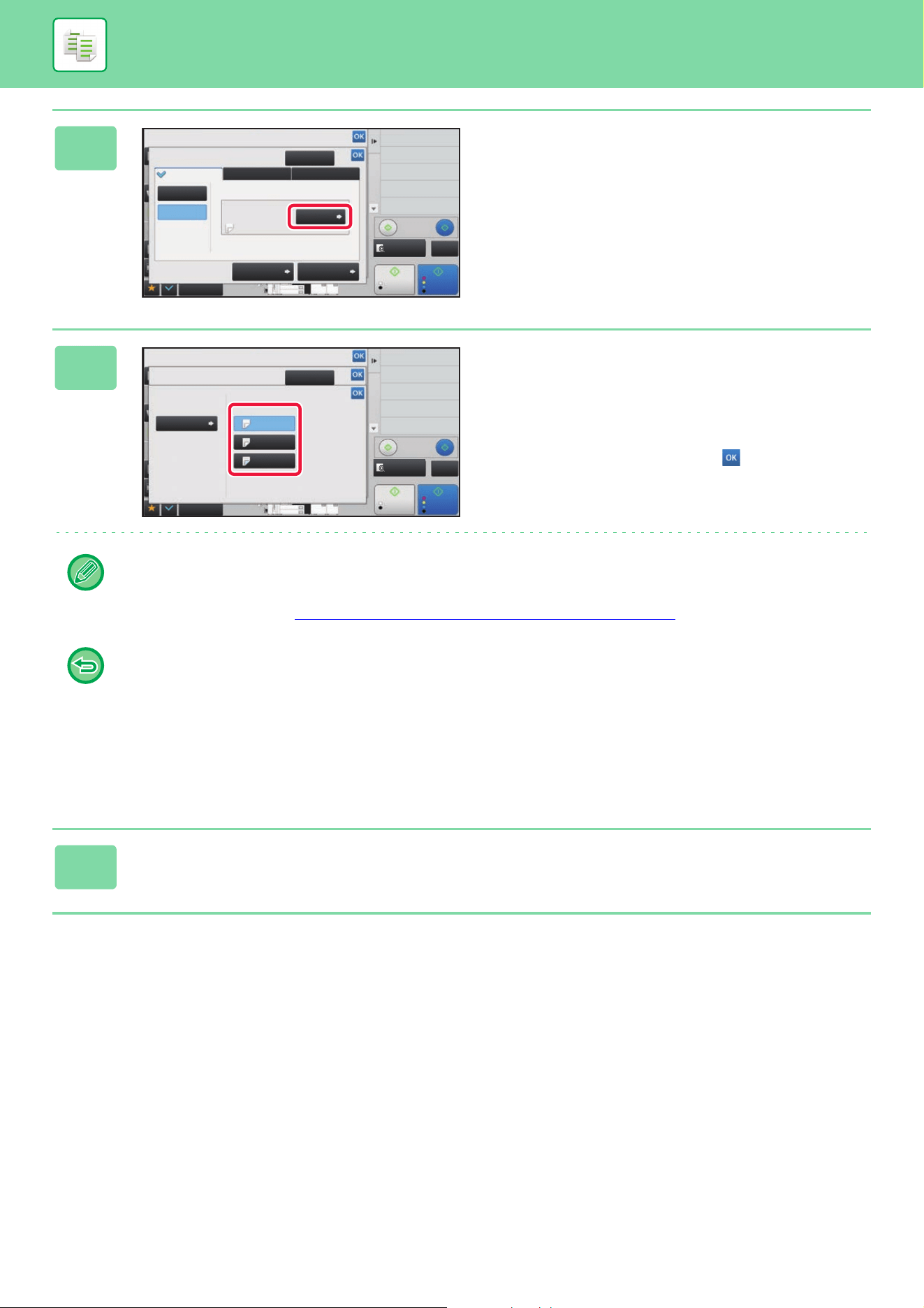
2-120
COPIER►OTHER FUNCTIONS
4
Tap the [Change] key.
5
Configure copy setting of a front cover
sheet.
When only inserting a cover, tap the [Make No Copy] key.
If you selected the [2-Sided Copy] key, tap the [Book] or
[Tablet] key for the front cover binding.
After the settings are completed, tap twice.
To change the cover input tray:
Tap the [Paper Tray Settings] key to display the input tray setting screen. On the input tray setting screen, tap the [Paper
Tray] key of [Front Cover] or [Back Cover].
For more information, see "SELECTING THE PAPER TRAY FOR COPYING (page 2-13)
".
• If the cover will be copied on, label sheets, transparency film, and tab paper cannot be used. If not copied on, tab
paper can be inserted.
• To cancel cover sheet insertion:
Tap the [Off] key.
• To cancel the front cover, back cover, and insertion sheet settings at the same time:
Tap the [Cancel All] key.
• To cancel all settings:
Tap the [CA] key.
6
Tap the [Color Start] or [B/W Start] key to start copying.
68
4
3
8½x11 8½x11
8½x14
11x17
Others
Preview
Start Start
Back
Insert SheetBack CoverFront Cover
Page Layout
Paper Tray
Settings
Cancel All
On
Off
Change
Bypass
Make No Copy
Plain 1
CA
B/W
Covers/Inserts
Original
Change Size/Direction.
Shift Position to Have Margin
Margin Shift
Color Mode
Put Multiple Pages in A Page
N-Up
Proof Copy
Output
Color
8½x11
68
8½x114
3
8½x14
11x17
Others
Front Cover Setting
Preview
Start Start
Back
Cancel All
Paper Tray
Bypass
Simplex
Make No Copy
2-Sided Copy
Print on Front Cover
Plain 1
CA
B/W
Covers/Inserts
Proof Copy
Original
Change Size/Direction.
Shift Position to Have Margin
Margin Shift
Put Multiple Pages in A Page
N-Up
Color Mode
Output
Color
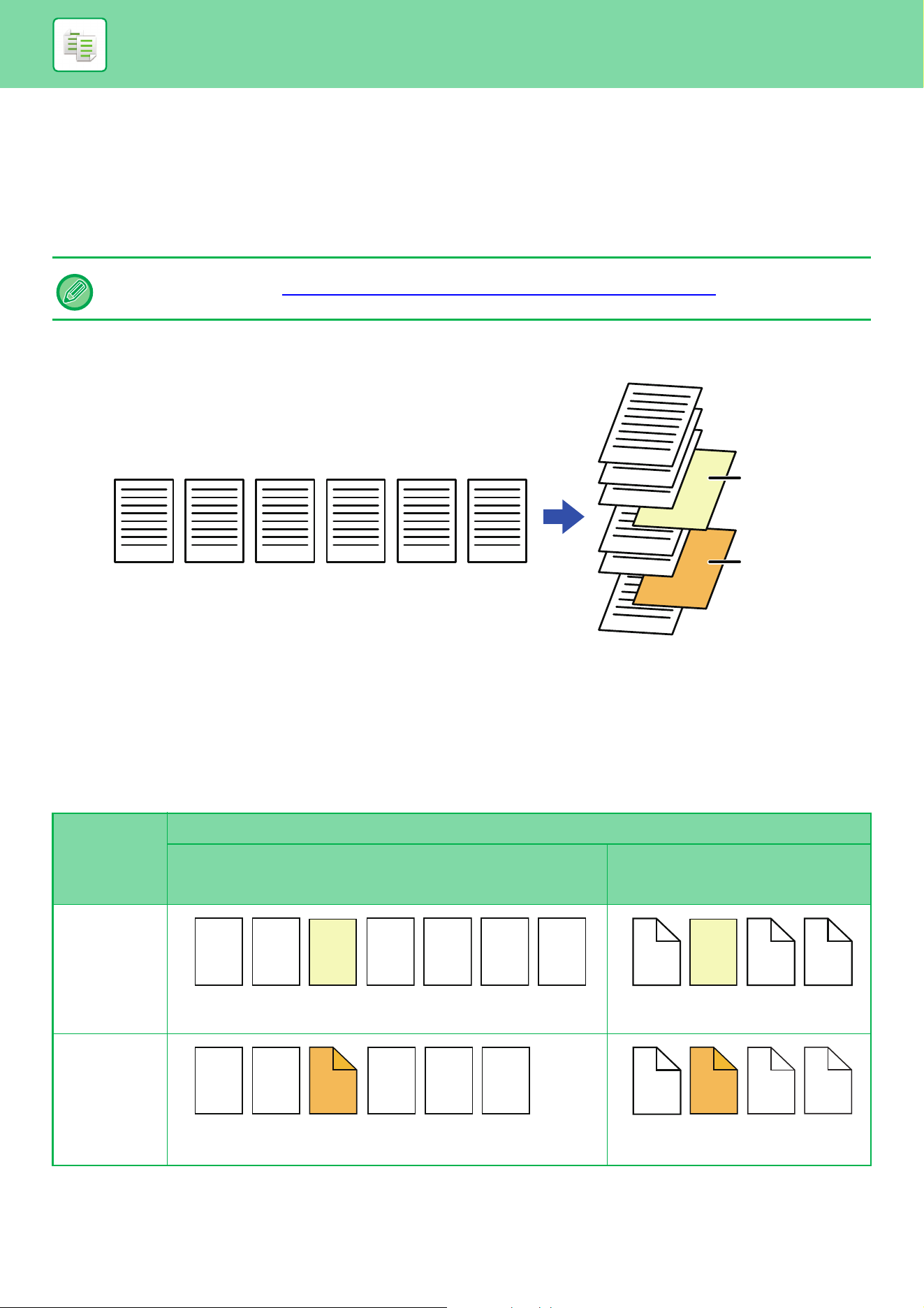
2-121
COPIER►OTHER FUNCTIONS
INSERTING INSERTION SHEETS IN COPIES
(COVERS/INSERTS)
This function inserts a sheet of paper into a specific page as an insertion sheet.
There are two types of insertion sheets. Insertion positions can be specified.
Insert covers if needed.
Example: Insert A after page 3 and insert B after page 5.
Sheet inserting examples
The following examples show the copy results when insertion sheets are inserted into six 1-sided originals or three
2-sided originals using two copy modes.
1-sided original copying
When inserting covers, see "INSERTING COVERS IN COPIES (COVERS/INSERTS) (page 2-113)".
Insertion
sheet
setting
conditions
Resulting copies
Insert an insertion sheet in 1-sided copy mode. Insert an insertion sheet in
2-sided copy mode.
Not copied
Inserts an insertion sheet between the second and third pages of
copies.
1-sided copy
Makes a 1-sided copy of the third original page on an insertion
sheet.
6
5
4
2 3 4 5 61
3
2
1
1
Originals
Insert A
Insert B
Copy
2
1
3
4
5
6
1
2
3
4
5
6
2
1
4
3
5
6
1
2
5
6
6
3
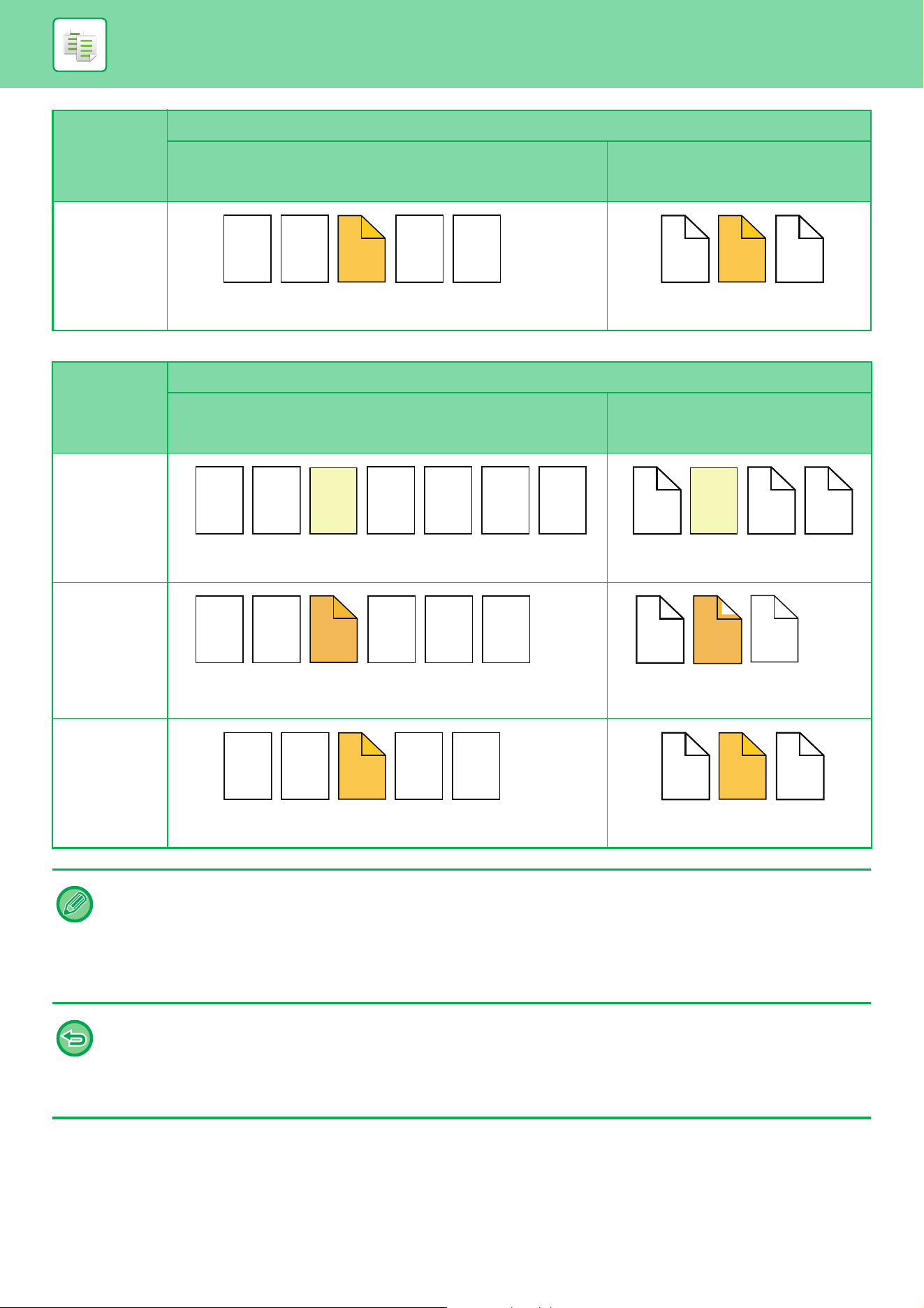
2-122
COPIER►OTHER FUNCTIONS
2-sided original copying
2-sided copy
Makes a 2-sided copy of the third and fourth original pages on an
insertion sheet.
Insertion
sheet
setting
conditions
Resulting copies
Insert an insertion sheet in 1-sided copy mode. Insert an insertion sheet in
2-sided copy mode.
Not copied
Inserts an insertion sheet between the second and third pages of
copies.
1-sided copy
Makes a 1-sided copy of the third original page on an insertion
sheet.
* The fourth original page is not
copied.
2-sided copy
Makes a 2-sided copy of the third and fourth original pages on an
insertion sheet.
• Before using the covers/inserts function, load insertion sheets in the tray.
• When selecting the covers/inserts function, place the originals in the document feeder tray, select 1-sided or 2-sided
copying, and select the number of copies and any other desired copy settings. When these settings have been completed,
perform the procedure to select covers/inserts.
• The insertion sheet size must be the same as the copy size.
• Up to 100 insertion sheets can be inserted.
• The document glass is not available for this function.
• When performing 2-sided copying of 2-sided originals, an insertion sheet cannot be inserted between the front and reverse
sides of an original.
• This function cannot be used in combination with the saddle stitch function.
• This setting is not available when the covers/inserts function is disabled in "Settings (administrator)".
Insertion
sheet
setting
conditions
Resulting copies
Insert an insertion sheet in 1-sided copy mode. Insert an insertion sheet in
2-sided copy mode.
2
1
3
4
5
6
1
2
3
4
5
6
2
1
3
4
5
6
1
2
3
4
5
6
2
1
4
3
5
6
1
2
5
6
3
2
1
3
4
5
6
1
2
3
4
5
6
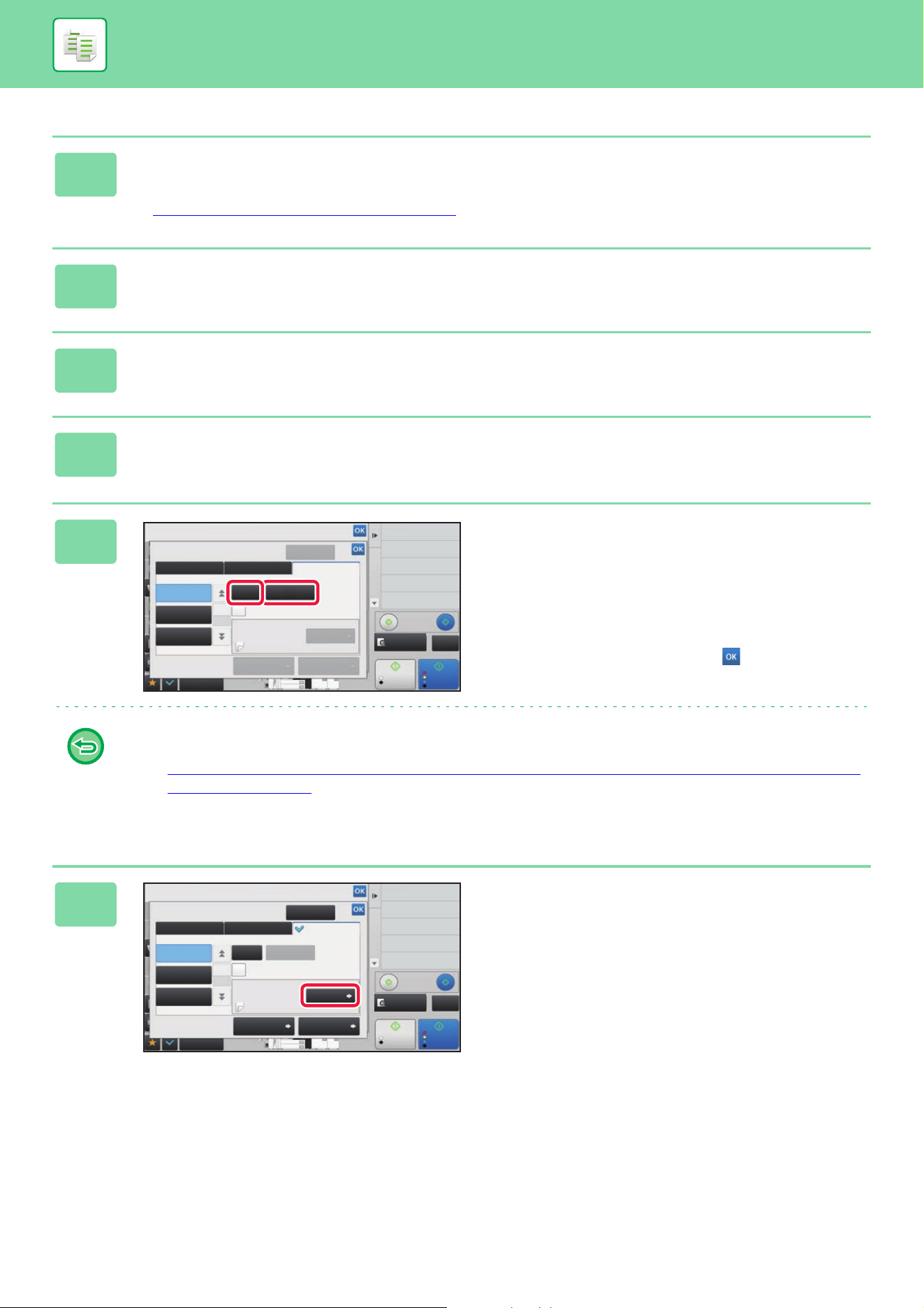
2-123
COPIER►OTHER FUNCTIONS
1
Place the original in the document feeder tray of the automatic document
feeder.
► AUTOMATIC DOCUMENT FEEDER (page 1-90)
2
Tap the [Others] key, and then tap the [Covers/Inserts] key.
3
Tap the [Insertion Sheet] tab.
4
Tap the [Insertion Type A] key, and tap the insert page display key.
The Insertion Type B to Type I settings are the same as the Insertion Type A settings.
5
Enter the number of the page you want
to insert a sheet into using numeric
keys, and then tap the [Enter] key.
The total number of insertion sheets is displayed at the side
of [Enter] key. Repeat these steps for the number of
insertion sheets.
After the settings are completed, tap twice.
• If you have entered an incorrect insert page number:
Tap the [Page Layout] key and change the page.
► CHECKING, EDITING, AND DELETING THE PAGE LAYOUT OF COVERS AND INSERTION SHEETS (PAGE
LAYOUT) (page 2-125)
• To cancel insertion sheets:
Tap the [Cancel All] key.
6
Tap the [Change] key.
8½x11
68
8½x11
4
3
8½x14
11x17
Others
Preview
Start Start
Back
Insert SheetBack CoverFront Cover
Page Layout
Paper Tray
Settings
Cancel All
Insertion Type C
Change
Specify Page to Insert and Press Enter
Bypass
Make No Copy
Before Back Cover
Enter1
Total :0
Insertion
Plain 1
CA
B/W
Insertion Type A
Insertion Type B
Covers/Inserts
Proof Copy
Original
Change Size/Direction.
Color Mode
Shift Position to Have Margin
Margin Shift
Output
Put Multiple Pages in A Page
N-Up
Color
8½x11
68
8½x11
4
3
8½x14
11x17
Proof Copy
Others
Preview
Start Start
Back
Change Size/Direction.
Original
Color Mode
Insert SheetBack CoverFront Cover
Page Layout
Paper Tray
Settings
Cancel All
Insertion Type C
Insertion Type A
Insertion Type B
Change
Specify Page to Insert and Press Enter
Bypass
Make No Copy
Before Back Cover
Enter0
Total :1
Shift Position to Have Margin
Margin Shift
Insertion
Plain 1
CA
B/W
Covers/Inserts
Output
Color
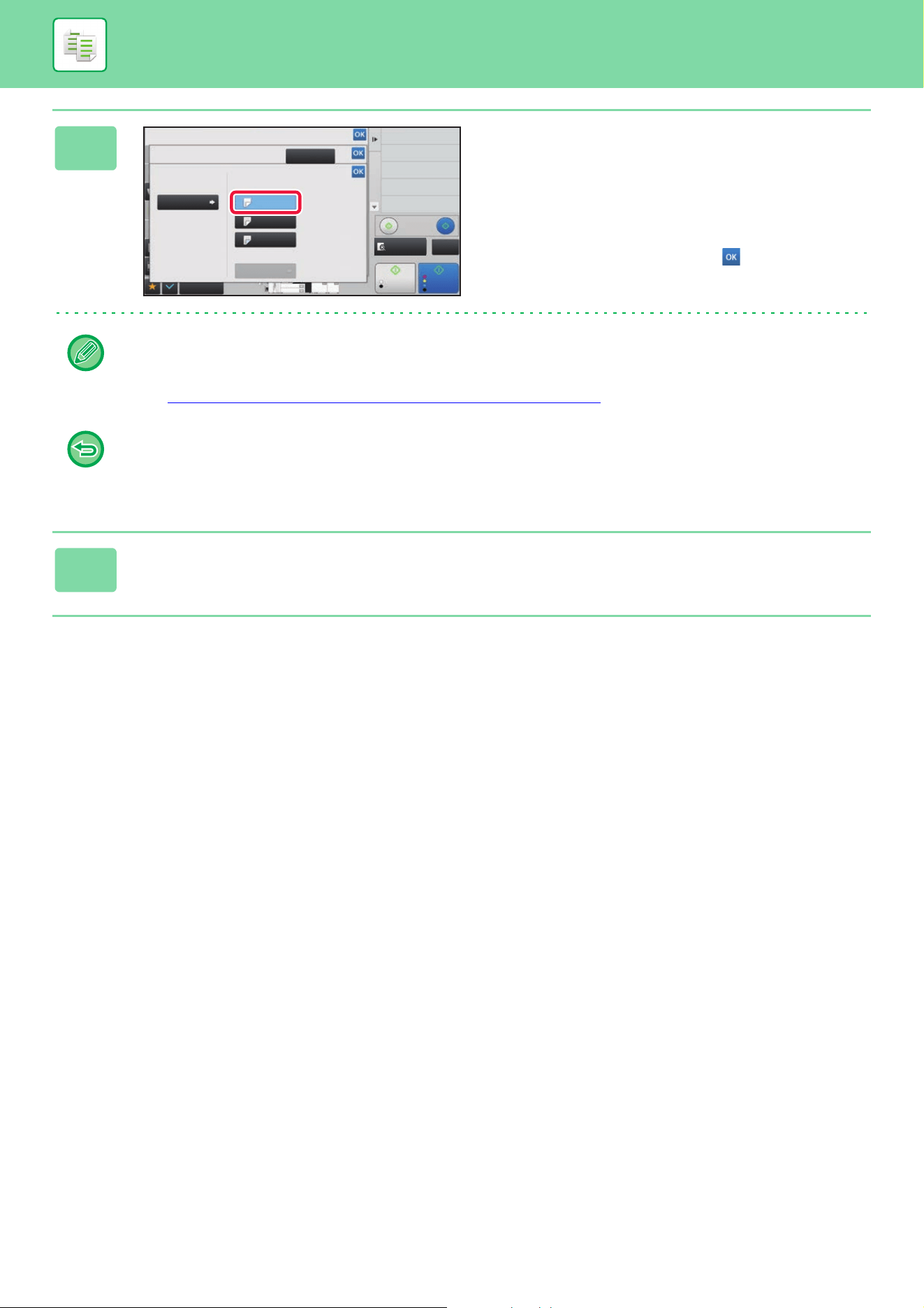
2-124
COPIER►OTHER FUNCTIONS
7
When only inserting insertion sheet A,
tap the [Make No Copy] key.
When making a copy on insertion sheet A, tap the [Simplex]
or [2-Sided Copy] key.
If you selected [2-Sided Copy], tap the [Book] key or [Tablet]
key for the insert sheet binding.
After the settings are completed, tap .
• To change an insertion sheet:
Tap the [Paper Tray] key, and select the tray with insertion sheets loaded.
• To copy on tab paper, tap the [Tab Copy] key.
► COPYING CAPTIONS ONTO TAB PAPER (TAB COPY) (page 2-128)
• When copying on both sides of an insertion sheet, you cannot use label sheets, transparency films, or tab paper for
insertion. If not copied on, tab paper can be inserted.
• To cancel all settings:
Tap the [CA] key.
8
Tap the [Color Start] or [B/W Start] key to start copying.
8½x11
68
8½x11
4
3 8½x14
11x17
Proof Copy
Others
Covers/Inserts
Insertion Type A
Preview
Start Start
Back
Cancel All
Paper Tray
Bypass
Plain 1
Simplex
Make No Copy
2-Sided Copy
Tab Copy
Copy on Insert A
CA
B/W
Change Size/Direction.
Original
Color Mode
Shift Position to Have Margin
Margin Shift
Output
Color
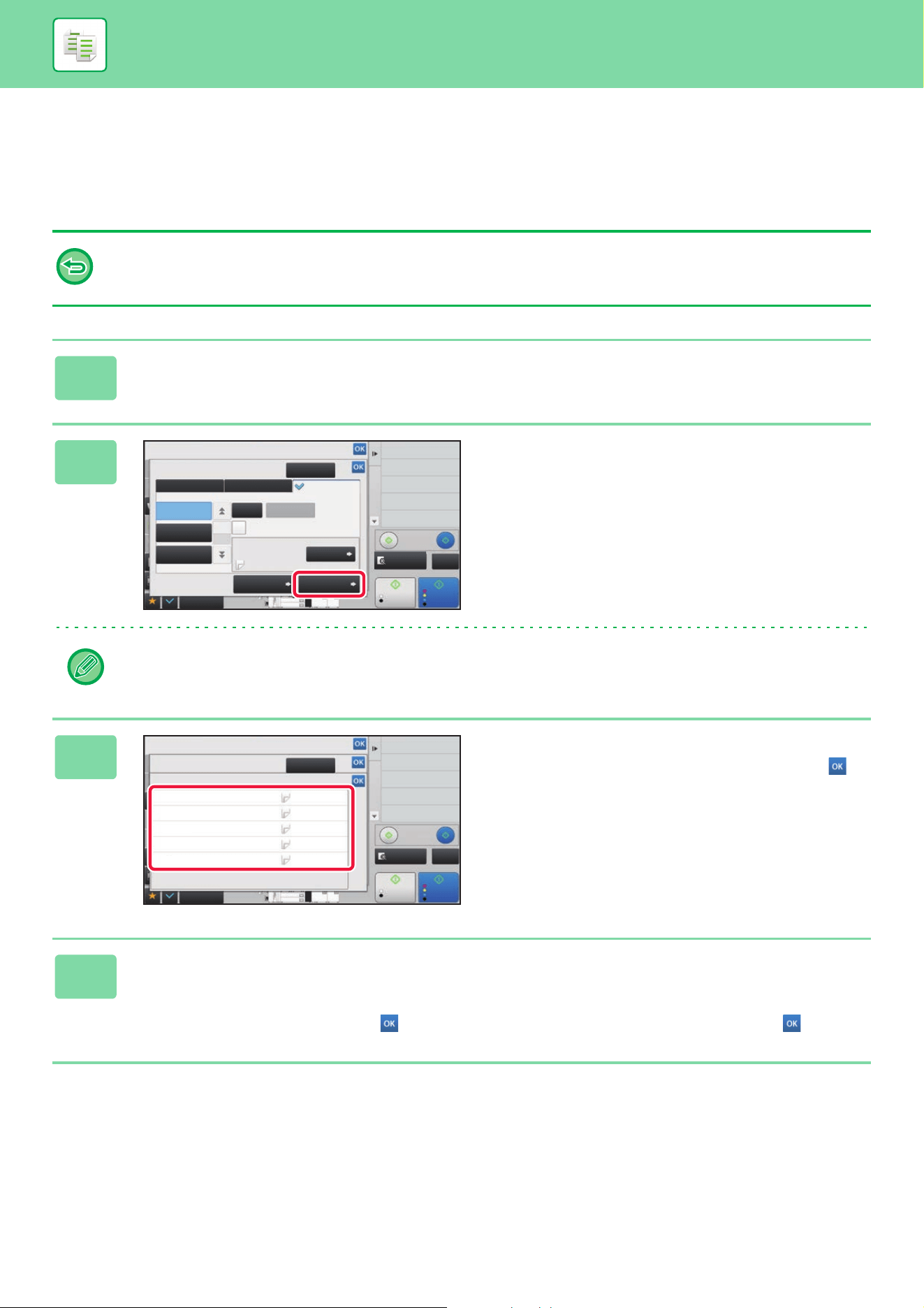
2-125
COPIER►OTHER FUNCTIONS
CHECKING, EDITING, AND DELETING THE PAGE
LAYOUT OF COVERS AND INSERTION SHEETS
(PAGE LAYOUT)
The editing contents are different between the registered covers and insertion sheets as shown below.
• For the "Cover Sheet", you can change settings such as the paper type, copy/do not copy, 1-Sided, and 2-Sided.
• For "Insert Sheet", you can change only the page number you want to insert an insert sheet into.
1
Tap the [Others] key, and then tap the [Covers/Inserts] key.
2
Tap the [Page Layout] key.
If the settings for the covers or insertion sheets are not configured, the [Page Layout] key is disabled.
3
Check the page layout.
To exit this job after checking the page layout, tap the
key.
To edit or delete, tap the required key. When deleting, tap
the [Delete] key. When editing, tap the [Modify] key.
When setting consecutive insertion of different types of
inserts at the same page, you can tap [Replace Order of
Inserts] on the action panel to change the order.
4
Change cover or insertion sheet settings.
For the cover, you can change the copy mode.
You can change the page number you want to insert an insert sheet into.
After the settings are completed, tap the key multiple times to return to the [Others] screen. Then, tap .
68
4
3
Proof Copy
Change Size/Direction.
Original
Color Mode
Shift Position to Have Margin
Margin Shift
Output
8½x11 8½x11
8½x14
11x17
Put Multiple Pages in A Page
N-Up
Others
Covers/Inserts
Preview
Start Start
Back
Insert SheetBack CoverFront Cover
Page Layout
Paper Tray
Settings
Cancel All
Insertion Type C
Insertion Type A
Insertion Type B
Change
Specify Page to Insert and Press Enter
Bypass
Make No Copy
Before Back Cover
Enter0
Total :1
Insertion
Heavy 2
CA
B/W Color
68
4
3
Proof Copy
8½x11 8½x11
8½x14
11x17
Others
Covers/Inserts
Page Layout
Make No Copy
Make No Copy
Make No Copy
Make No Copy
Make No Copy
-
-
<1
<1
<1
Insertion Type A
Insertion Type B
Insertion Type C
Front Cover
Back Cover
Preview
Start Start
Back
Cancel All
CA
B/W
Color Mode
Shift Position to Have Margin
Margin Shift
Replace Order of Inserts
Output
Color
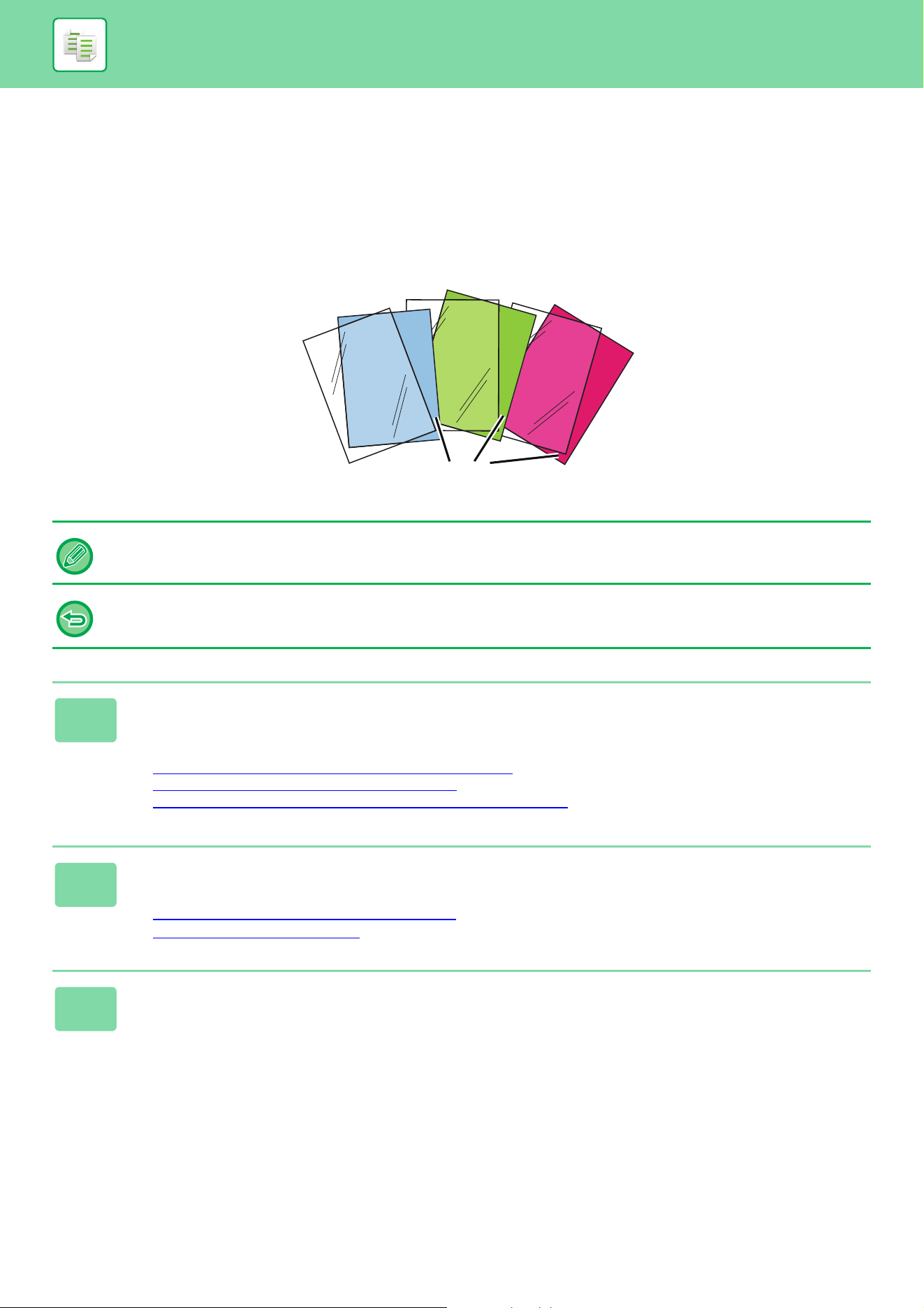
2-126
COPIER►OTHER FUNCTIONS
INSERTING INSERTION SHEETS IN BETWEEN
TRANSPARENCY FILMS (TRANSPARENCY INSERTS)
When copying on transparency film, the sheets may stick together due to static electricity.
The transparency inserts function can be used to automatically insert a sheet of paper between each sheet of
transparency film, making the sheets easy to handle.
It is also possible to copy on insertion sheets.
When performing 2-sided copying, only "2-Sided→1-Sided" mode can be used.
• The number of copies cannot be selected in this mode.
• Transparency film can be loaded in the bypass tray, tray 4 and large capacity trays.
1
Load transparency film in the bypass tray, tray 4 or large capacity trays.
When loading paper in the bypass tray or large capacity trays, load with the print side up. In tray 4, load with the print
side down.
► LOADING PAPER INTO THE BYPASS TRAY (page 1-81)
► LOADING PAPER IN THE TRAY 3/4 (page 1-67)
► LOADING PAPER IN THE LARGE CAPACITY TRAYS (page 1-76)
2
Place the original.
Place the original in the document feeder tray of the automatic document feeder, or on the document glass.
► AUTOMATIC DOCUMENT FEEDER (page 1-90)
► DOCUMENT GLASS (page 1-92)
3
Tap the [Others] key, and then tap the [Transparency Inserts] key.
C
B
A
Inserts
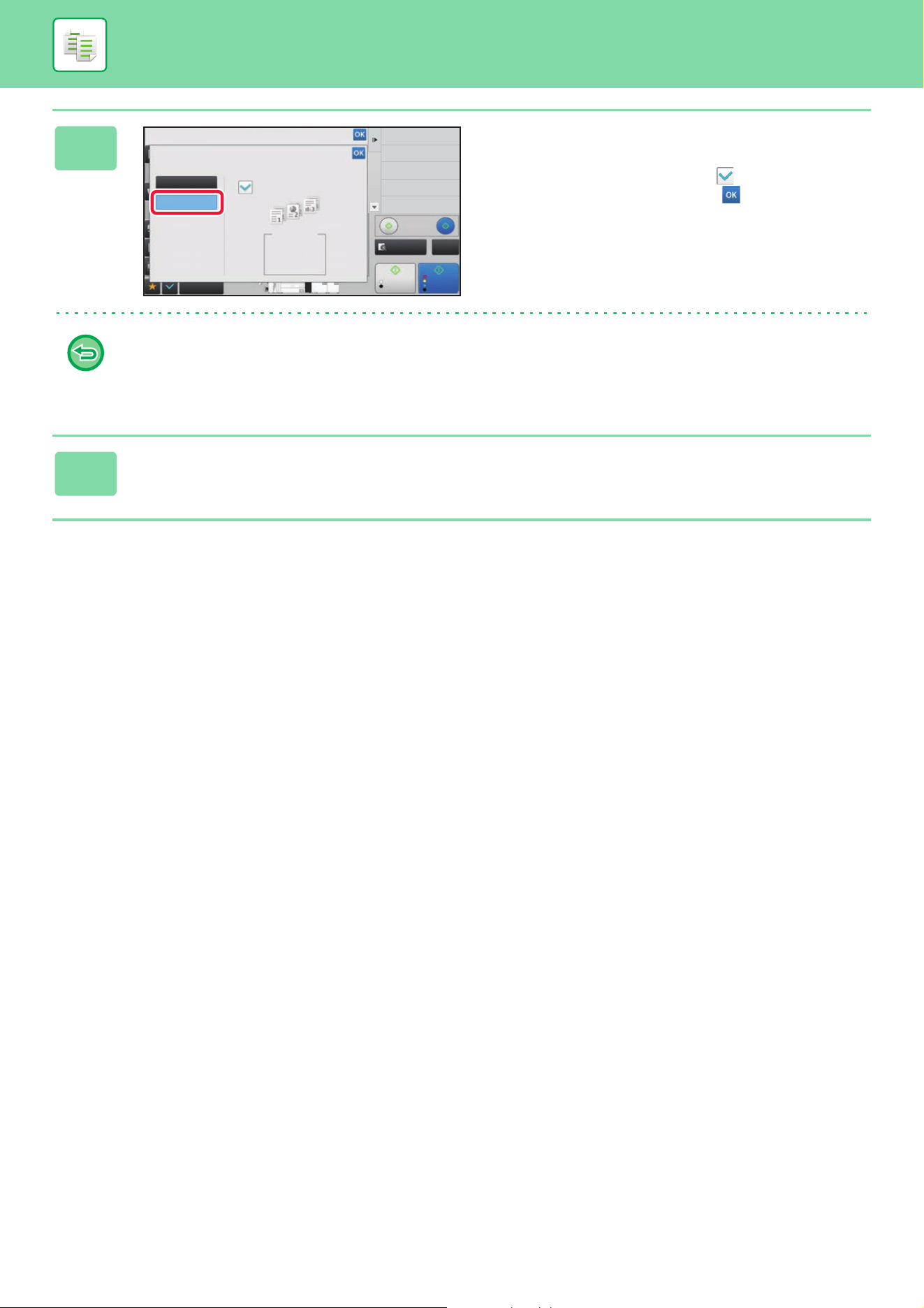
2-127
COPIER►OTHER FUNCTIONS
4
Tap the [On] key.
When making a copy on insertion sheets, tap the [Also Make
Copy on Inserts] checkbox to set to .
After the settings are completed, tap twice.
• To cancel the transparency inserts setting:
Tap the [Off] key.
• To cancel all settings:
Tap the [CA] key.
5
Tap the [Color Start] or [B/W Start] key to start copying.
68
4
3
Proof Copy
8½x11 8½x11
8½x14
11x17
Others
Preview
Start Start
Back
Off
On
Also Make Copy on Inserts
Transparency Inserts
Inserts Paper Tray
Tray 6
8½x11
Plain 1
CA
B/W Color
Change Size/Direction.
Original
Color mode
Shift Position to Have Margin
Margin Shift
N-Up
Put Multiple Pages in A Page
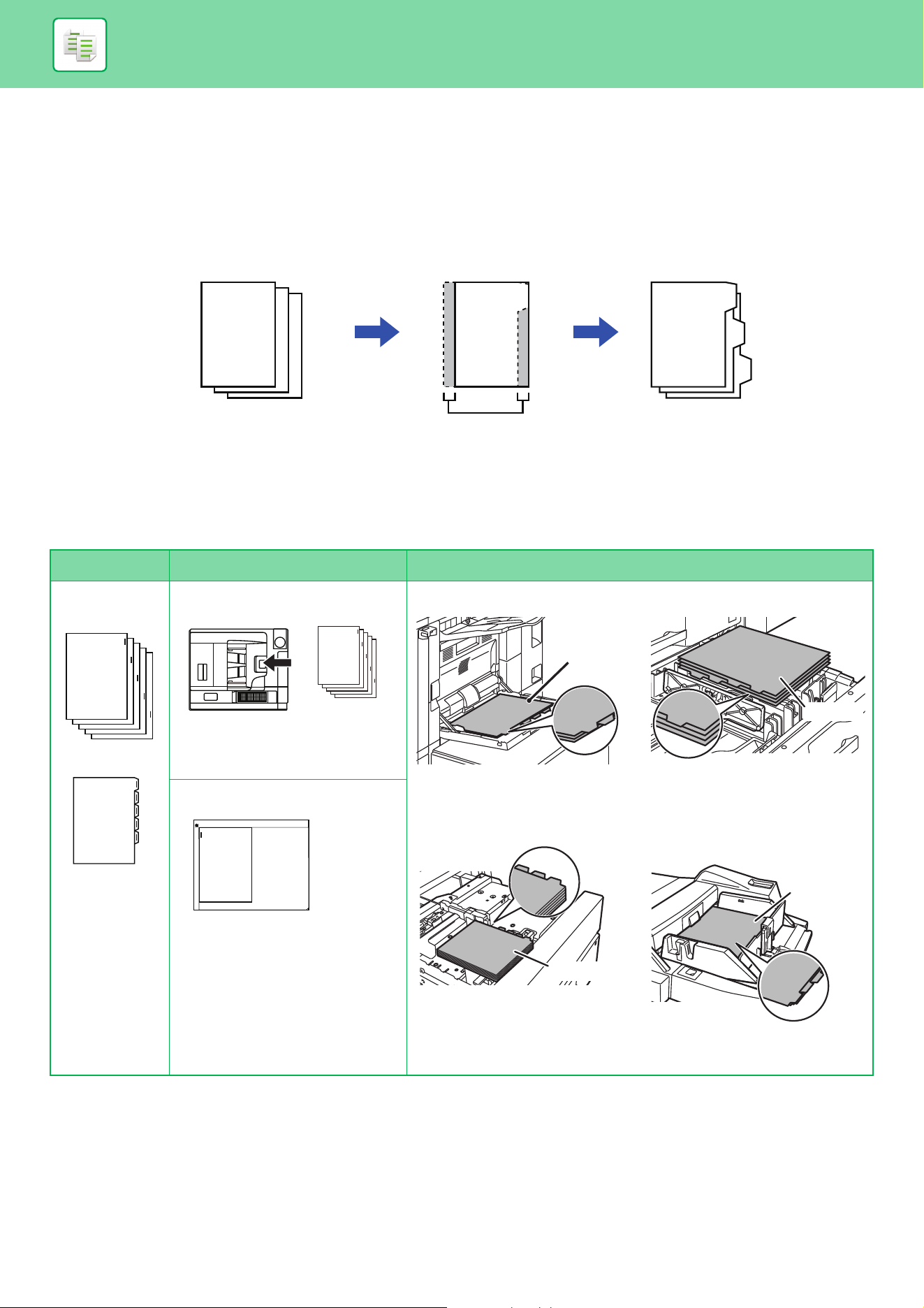
2-128
COPIER►OTHER FUNCTIONS
FUNCTIONS FOR SPECIFIC USES
COPYING CAPTIONS ONTO TAB PAPER (TAB COPY)
Load a tab sheet in the bypass tray, and make a copy on a tab.
Prepare appropriate originals for tab captions.
Relation between the originals and the tab paper
Tab copying with a left binding
Originals Placing the originals Loading tab paper
Bypass tray (on the machine)
Large capacity trays
Tray 4
Bypass tray
(on the large capacity trays)
GHI
DEF
ABC
GHI
DEF
ABC
ABC
Prepare originals that
match the tab positions.
The image is shifted by
the width of the tab
Originals
Final image
Document feeder tray
Insert the originals so that the
side with no tab text enters first.
Side 2
Place the first sheet of tab paper
so that the tab faces toward you.
Place the first sheet of tab paper
so that the tab faces toward you.
Side 2
Place the first sheet of tab paper
so that the tab faces toward you.
Side 1
Place the first sheet of tab paper
so that the tab faces toward you.
Side 2
1
Document glass
Place the originals so that
the side with the tab text
is on the left.
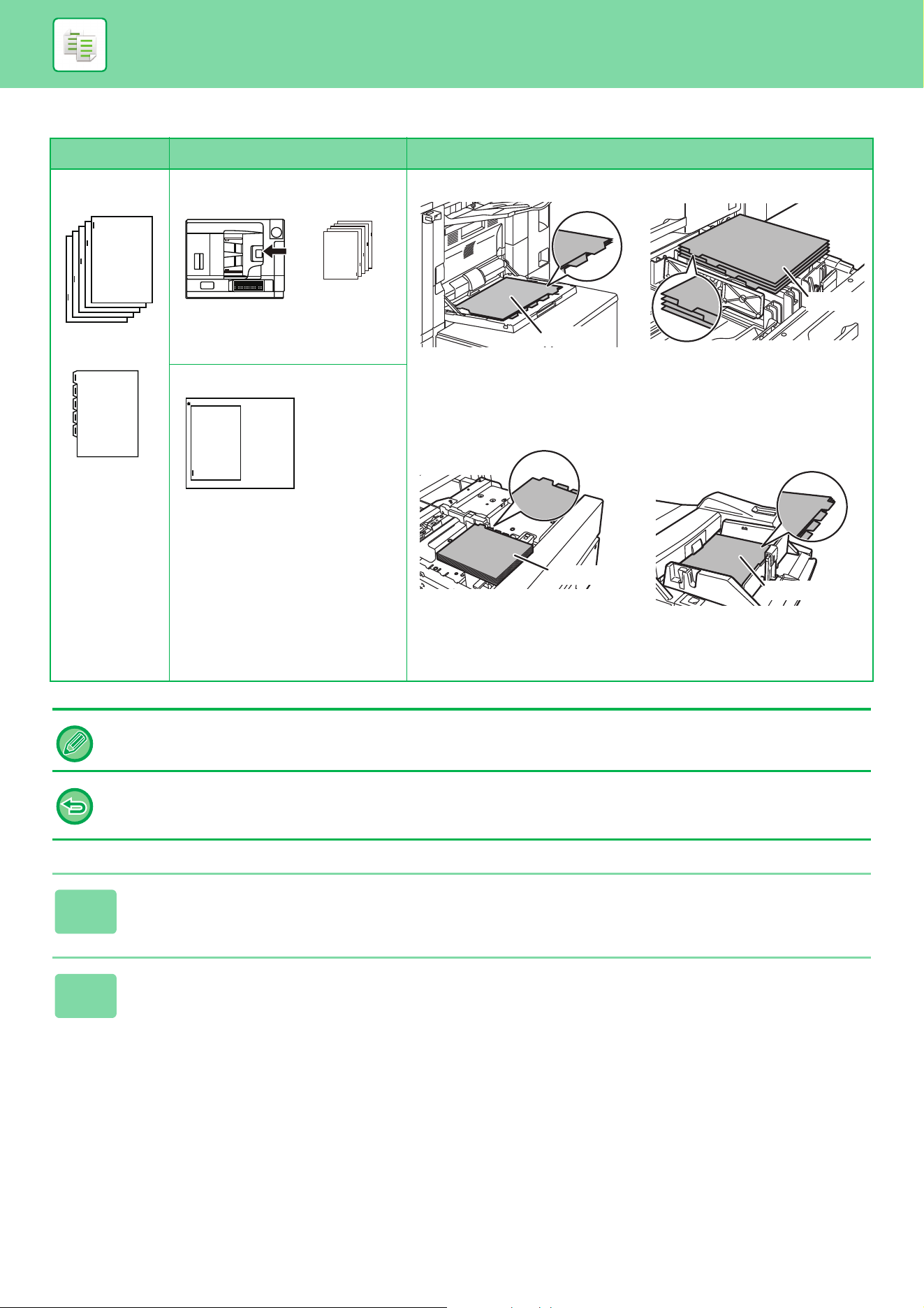
2-129
COPIER►OTHER FUNCTIONS
Tab copying with a right binding
Originals Placing the originals Loading tab paper
Bypass tray (on the machine)
Large capacity trays
Tray 4
Bypass tray
(on the large capacity trays)
Tab Copy must be specified before scanning the original.
To change the default image shift width for tab copying:
In "Settings (administrator)", select [System Settings] → [Copy Settings] → [Condition Settings] → [Initial Tab Copy Setting].
The factory default setting is 1/2" (10 mm).
1
Tap the [Others] key, and tap the [Tab Copy] key.
2
Tap the [On] key.
Originals
Final image
Document feeder tray
Insert the originals so that the
side with no tab text enters first.
Side 2
Place the first sheet of tab paper
so that the tab faces away from
you.
Place the first sheet of tab paper
so that the tab faces away from
you.
Side 2
Place the first sheet of tab paper
so that the tab faces away from
you.
Side 1
Place the first sheet of tab paper
so that the tab faces away from
you.
Side 2
1
Document glass
Place the originals so that the side
with the tab text is on the left.
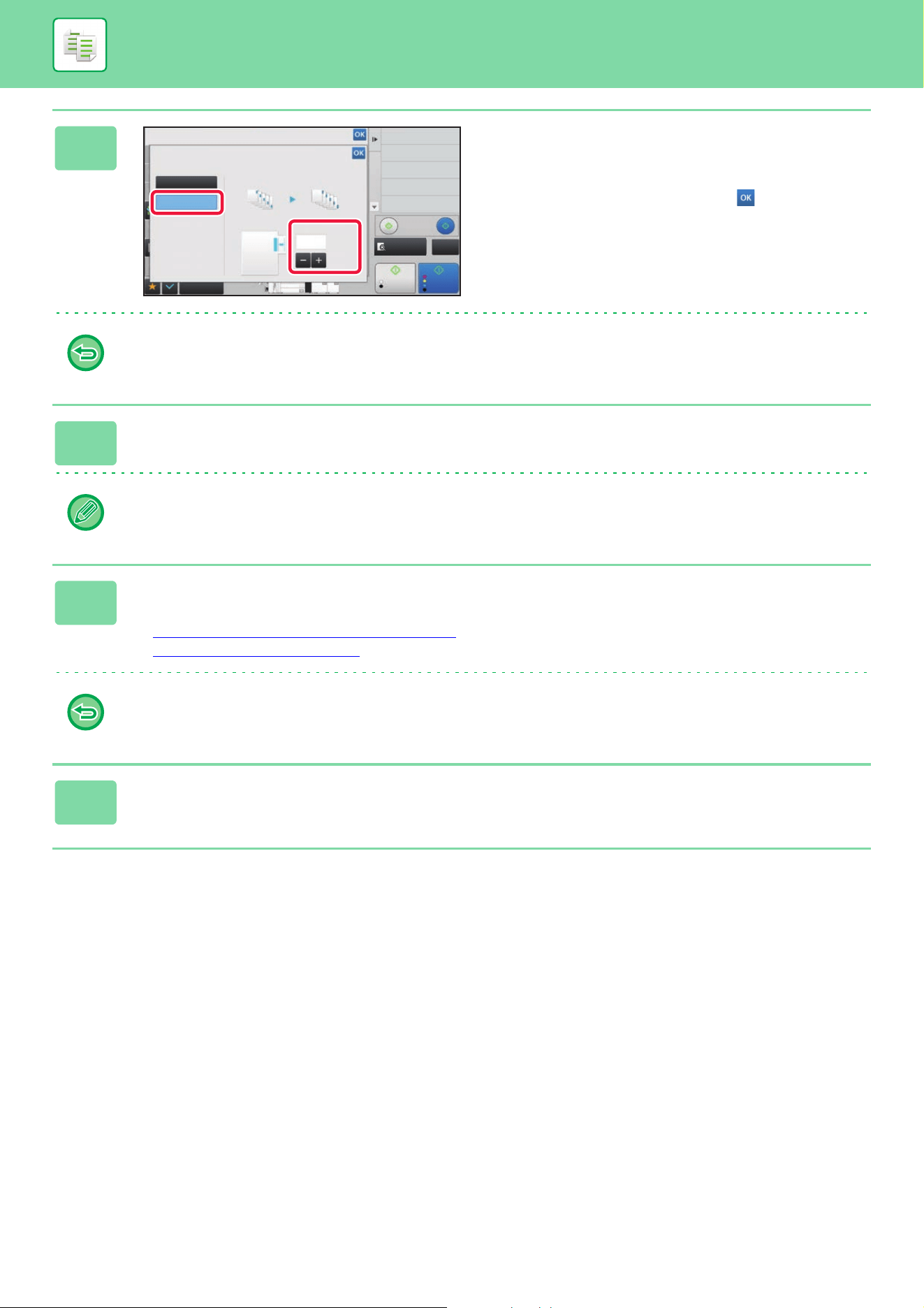
2-130
COPIER►OTHER FUNCTIONS
3
Sets an image shift width (tab width).
• Tap the numeric value display indicating the image shift
width, and enter a shift width using numeric keys.
• After the settings are completed, tap twice.
To cancel the tab copy setting:
Tap the [Off] key.
4
Load the tab paper.
The width of the tab paper can be as wide as 8-1/2" x 11" paper (8-1/2") plus 5/8" (or A4 width (210 mm) plus 20 mm).
5
Place the original and tap the [Preview] key.
Place the original in the document feeder tray of the automatic document feeder, or on the document glass.
► AUTOMATIC DOCUMENT FEEDER (page 1-90)
► DOCUMENT GLASS (page 1-92)
To cancel all settings:
Tap the [CA] key.
6
Tap the [Color Start] or [B/W Start] key to start copying.
8½x11
68
8½x11
4
3 8½x14
11x17
Others
Preview
Start Start
Back
Off
On
Original Copy
Tab Copy
Image Shift
(0
῀
5/8)
inch
1/2
CA
B/W
Change Size/Direction.
Original
Select Type/Exposure
Exposure
Store Data in Folder
File
Color Mode
Proof Copy
Color
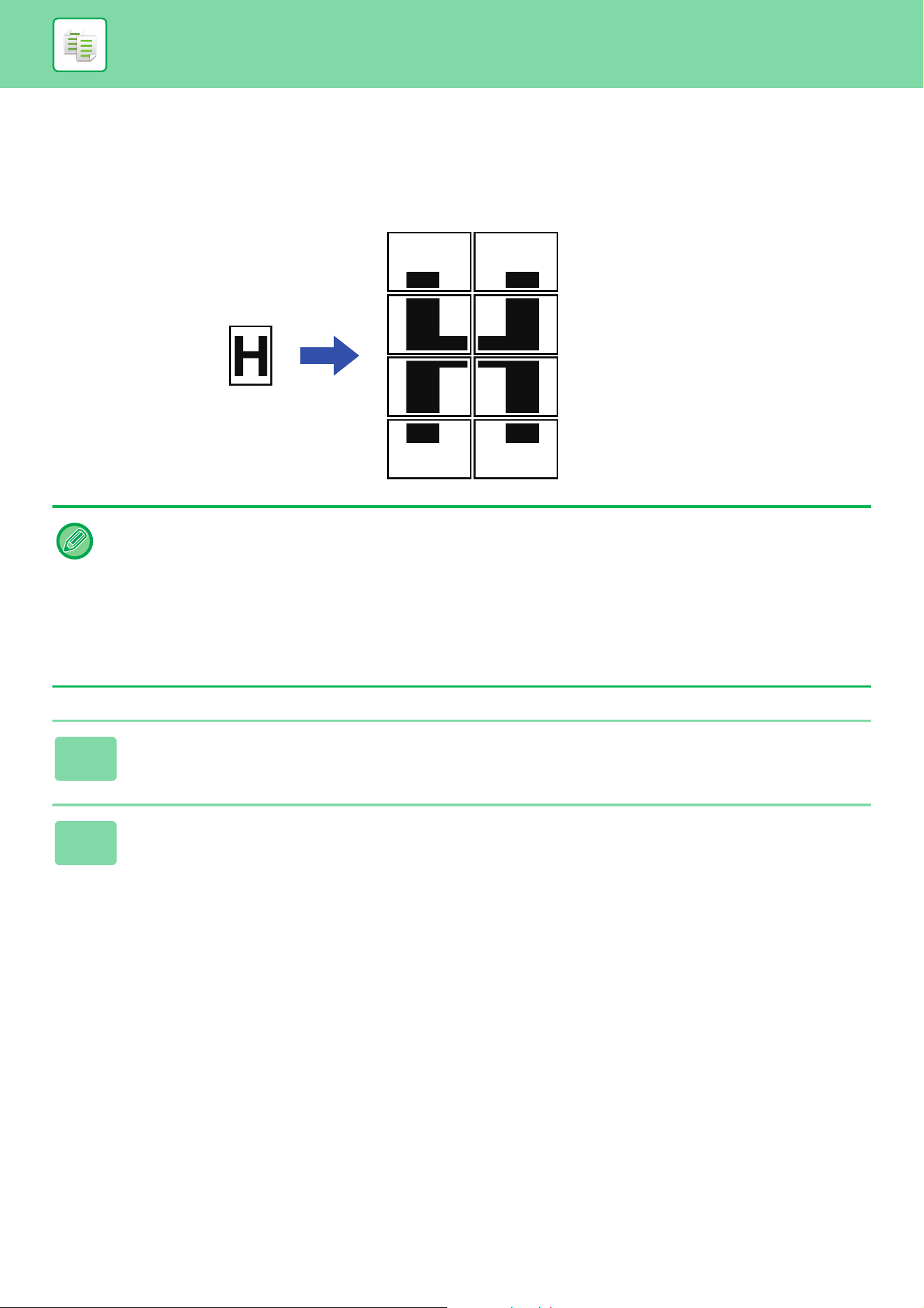
2-131
COPIER►OTHER FUNCTIONS
MAKING A POSTER-SIZED COPY (MULTI-PAGE
ENLARGEMENT)
This function separately copies an enlarged original image on multiple sheets.
• You must select Multi-Page Enlargement before scanning the original.
• Place an original on the document glass.
• When Multi-Page Enlargement is selected, the image orientation is changed to vertical.
• Overlap of sections of image
• There will be a margin around the edges of each copy.
• Areas for overlapping the copies will be created at the leading and trailing edges of each copy.
• The paper size, number of sheets required for the enlarged image, and the ratio are automatically selected based on the
selected original size and enlargement size. (The paper size and ratio cannot be selected manually.)
1
Tap the [Others] key, and tap the [Multi-Page Enlargement] key.
2
Select the [AB] or [Inch] tab to meet the original size for multi-page
enlargement, and tap the key that meets the original size.
Tapping the key of the original size displays the keys that show the available enlargement size, copy paper size, and
number of sheets.
Original (8-1/2" x 11" (A4) size)
Copy (enlarged image on 8
sheets of 11" x 17" (A3)
paper)
2-132
COPIER►OTHER FUNCTIONS
3
Tap the key of the size you want to
enlarge the original to.
The image orientation appears.
After the settings are completed, tap twice.
When printing the copy image and margin border, set the [Print Paste Position Mark] checkbox to .
• To cancel Multi-Page Enlargement setting:
Tap the [Clear] key.
Even when the multi-page enlargement setting is canceled, the automatically selected ratio is retained.
• To return the ratio to 100%:
Tap the [Copy Ratio] key on the base screen to display the ratio menu, and then tap the [100%] key.
4
Place the original on the document glass based on the orientation displayed
on the screen.
5
Tap the [Color Start] or [B/W Start] key to start copying.
68
4
3
Proof Copy
8½x11 8½x11
8½x14
11x17
Color Mode
Background Adjustment
Select Type/Exposure
Exposure
Others
Preview
Start Start
Back
Multi-Page Enlargement
AB Inch
Original Size
Print Paste Position Mark
Enlargement Size
A2 (11x17x2)
A1 (11x17x4)
A0 (11x17x8)
A0x2
Clear
CA
B/W
A3
A5
B5
A4
B4
Color
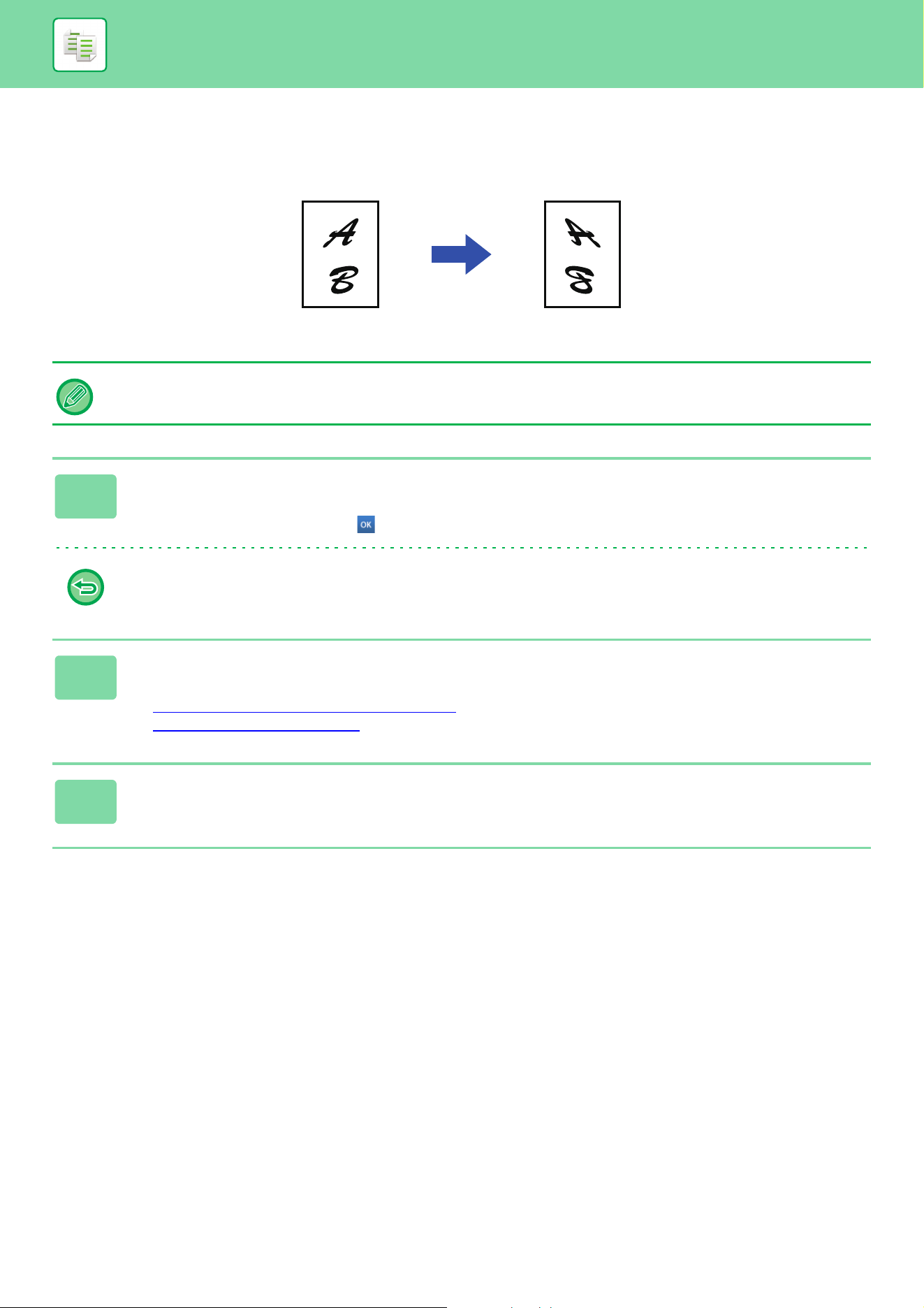
2-133
COPIER►OTHER FUNCTIONS
COPYING WITH MIRROR IMAGE (MIRROR IMAGE)
This function makes copies by inverting the original into a mirror image.
Specify the Mirror Image before scanning an original.
1
Tap the [Others] key, and tap the [Mirror Image] key.
A checkmark appears on the icon.
After the settings are completed, tap .
To cancel the mirror image setting:
Tap the [Mirror Image] key to uncheck it.
2
Place the original.
Place the original in the document feeder tray of the automatic document feeder, or on the document glass.
► AUTOMATIC DOCUMENT FEEDER (page 1-90)
► DOCUMENT GLASS (page 1-92)
3
Tap the [Color Start] or [B/W Start] key to start copying.
Originals Mirror image copy
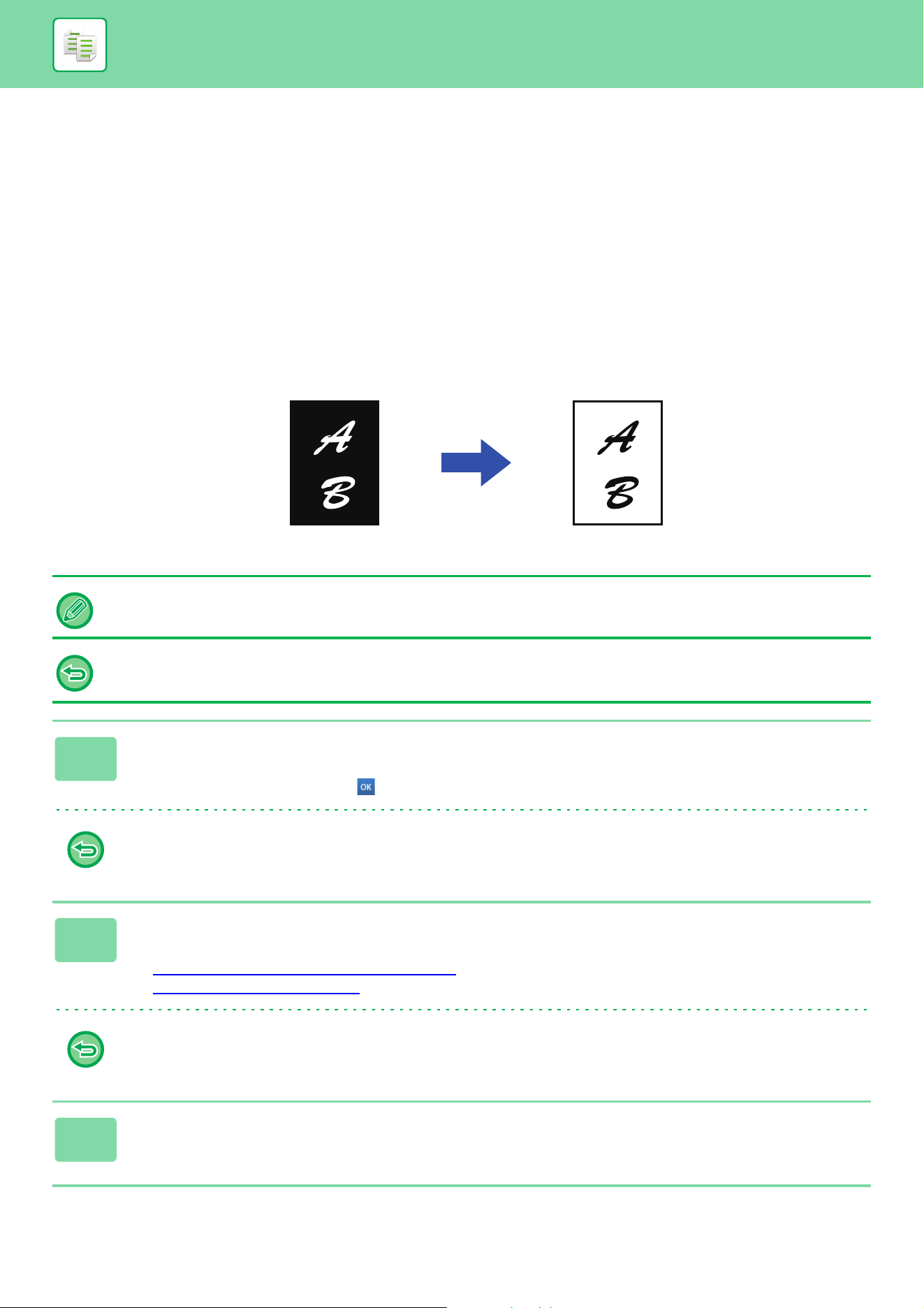
2-134
COPIER►OTHER FUNCTIONS
OUTPUT AND DENSITY ADJUSTMENT
FUNCTIONS
REVERSING WHITE AND BLACK IN A COPY (B/W
REVERSE)
This function reverses black and white in a copy to create a negative image. This function can only be used for black and
white copying.
Originals with large black areas (which use a large amount of toner) can be copied using Black/White Reverse to reduce
toner consumption.
• B/W Reverse must be specified before scanning the original.
•
When this function is selected, the "Exposure/Original Type" setting for exposure adjustment automatically changes to "Text".
When this function is selected, you cannot use the [Color Start] key.
1
Tap the [Others] key, and tap the [B/W Reverse] key.
A checkmark appears on the icon.
After the settings are completed, tap .
To cancel the B/W reverse setting:
Tap the [B/W Reverse] key to uncheck it.
2
Place the original.
Place the original in the document feeder tray of the automatic document feeder, or on the document glass.
► AUTOMATIC DOCUMENT FEEDER (page 1-90)
► DOCUMENT GLASS (page 1-92)
To cancel all settings:
Tap the [CA] key.
3
Tap the [B/W Start] key to start copying.
Originals B/W reverse copy
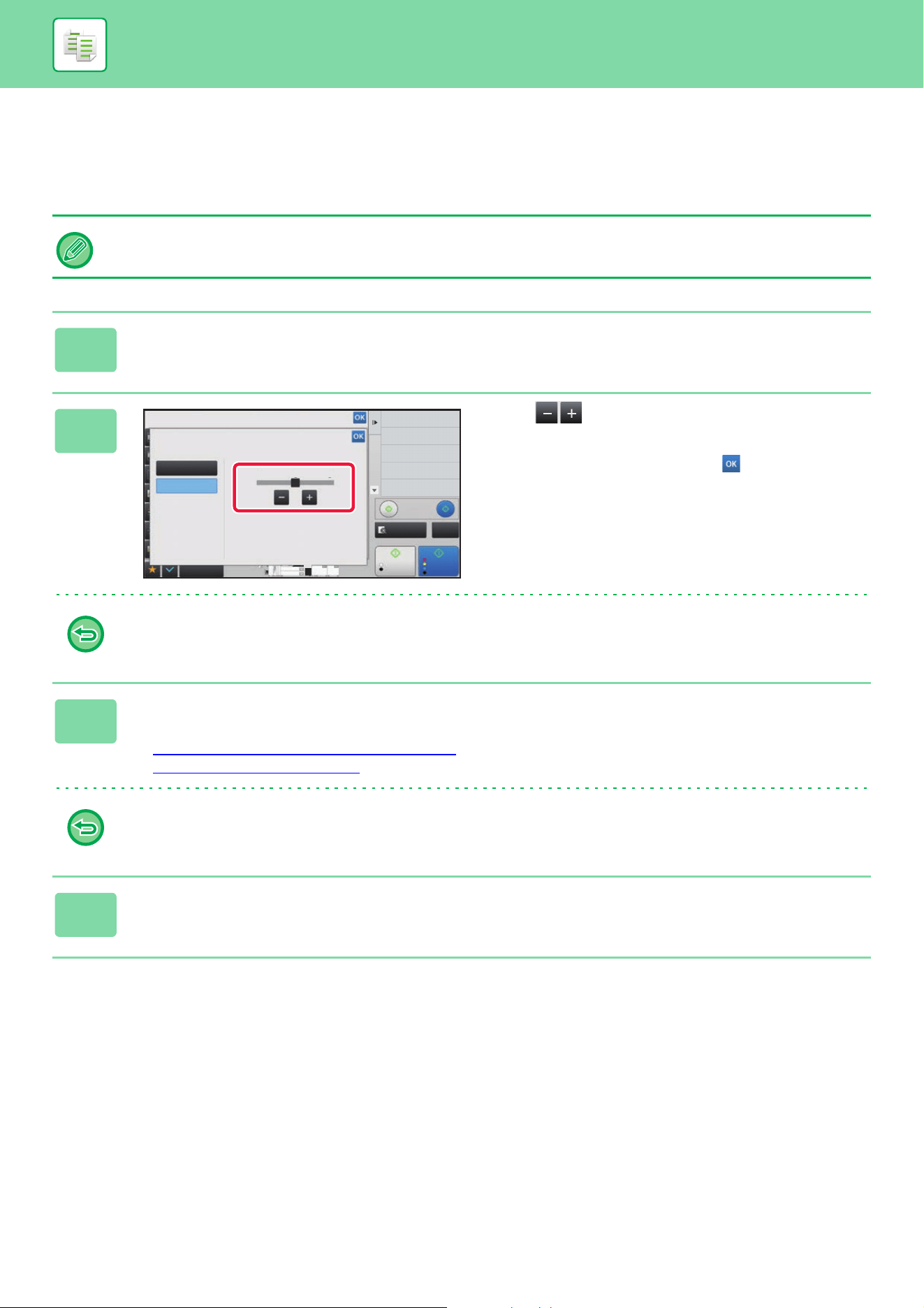
2-135
COPIER►OTHER FUNCTIONS
EASY ADJUSTMENT OF THE IMAGE QUALITY
(QUICK IMAGE QUALITY ADJUSTMENT)
You can easily adjust the color and outlines of images and text.
You must select Quick Image Quality Adjustment before scanning the original.
1
Tap the [Others] key, and tap the [Quick Image Quality Adjustment] key.
2
Tap or slide the slider to adjust
the image quality.
After the settings are completed, tap twice.
To cancel the quick image quality adjustment setting:
Tap the [Off] key.
3
Place the original.
Place the original in the document feeder tray of the automatic document feeder, or on the document glass.
► AUTOMATIC DOCUMENT FEEDER (page 1-90)
► DOCUMENT GLASS (page 1-92)
To cancel all settings:
Tap the [CA] key.
4
Tap the [Color Start] or [B/W Start] key to start copying.
68
4
3
Proof Copy
8½x11 8½x11
8½x14
11x17
Others
Preview
Start Start
Back
Quick Image Quality Adjustment
Adjust Colour Tone and Darkness.
Off
On
Smooth Sharp
Touch [+] to sharpen and [-] to smoothen
overall colour tone and outline.
1 2
3
CA
B/W Color
Original
Change Size/Direction.
Exposure
Select Type/Exposure
RGB
Adjust Thickness of RGB
Brightness
Adjust Brightness
Color Mode
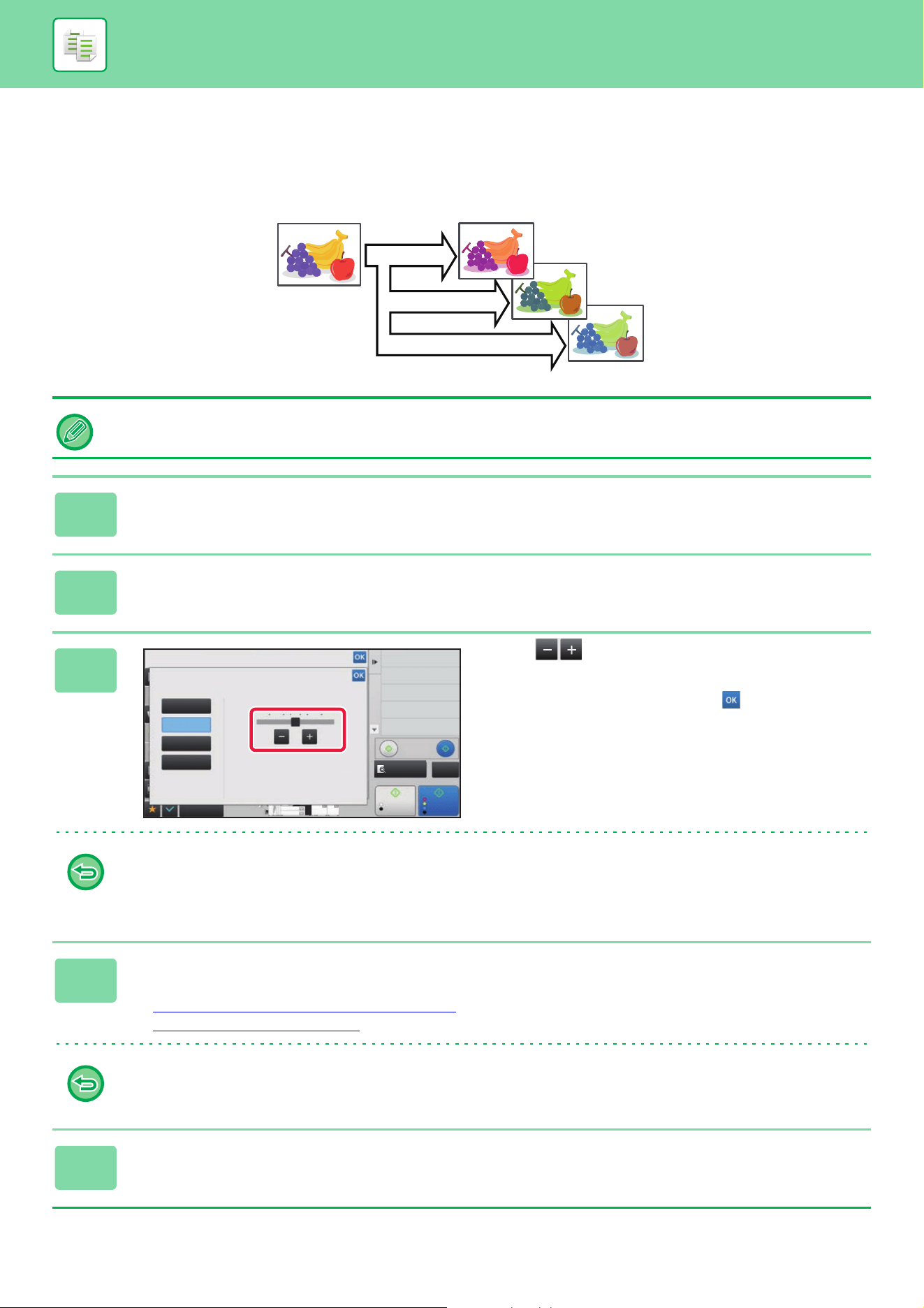
2-136
COPIER►OTHER FUNCTIONS
ADJUSTING RED/GREEN/BLUE IN COPIES (RGB
ADJUST)
This function heightens or lightens any one of the three color components R (red), G (green), and B (blue).
RGB must be specified before scanning the original.
1
Tap the [Others] key, and tap the [RGB Adjust] key.
2
Tap the key of the color you want to adjust.
3
Tap or slide the slider to adjust
the coloring.
After the settings are completed, tap twice.
• Only one color can be adjusted. (If you adjust one color and then tap another color, the adjustment of the first color is
canceled.)
• To cancel the RGB adjust setting:
Tap the [Off] key.
4
Place the original.
Place the original in the document feeder tray of the automatic document feeder, or on the document glass.
► AUTOMATIC DOCUMENT FEEDER (page 1-90)
► DOCUMENT GLASS (page 1-92)
To cancel all settings:
Tap the [CA] key.
5
Tap the [Color Start] key to start copying.
R(Red)+
G(Green)+
B(Blue)+
68
4
3
8½x11 5½x8½
8½x11 8½x11
8½x11 8½x11
8½x14
11x17
Exposure
Select Type/Exposure
Color Mode
Change Size/Direction.
Original
Adjust Color Tone
Color Balance
Adjust Intensity
Intensity
Proof Copy
Others
Preview
Start Start
Back
RGB Adjust
Any one colour can be adjusted.
This setting is only applied to colour.
Off
R(Red)
G(Green)
B(Blue)
Touch [+] to darken and [-] to lighten
selected colour tone.
-1-2 0 1 2
CA
B/W Color
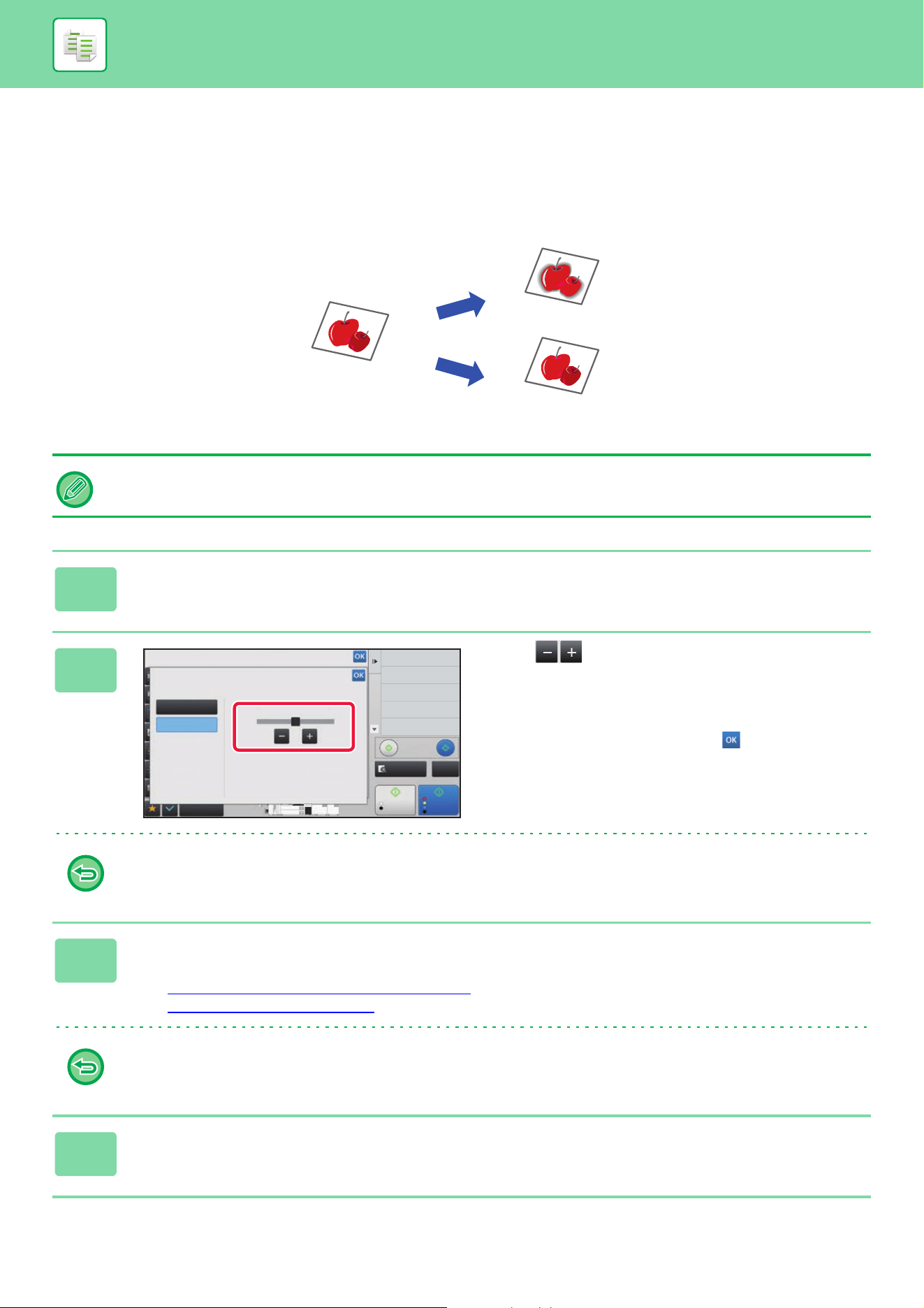
2-137
COPIER►OTHER FUNCTIONS
ADJUSTING THE SHARPNESS OF AN IMAGE
(SHARPNESS)
This function adjusts the sharpness to make a sharper or softer image.
Sharpness must be specified before scanning the original.
1
Tap the [Others] key, and tap the [Sharpness] key.
2
Tap or slide the slider to adjust
the sharpness.
Select [More Sharp] for sharper outlines, or [Less Sharp] for
softer outlines.
After the settings are completed, tap twice.
To cancel the sharpness setting:
Tap the [Off] key.
3
Place the original.
Place the original in the document feeder tray of the automatic document feeder, or on the document glass.
► AUTOMATIC DOCUMENT FEEDER (page 1-90)
► DOCUMENT GLASS (page 1-92)
To cancel all settings:
Tap the [CA] key.
4
Tap the [Color Start] or [B/W Start] key to start copying.
Softer
Sharper
68
4
3
8½x11 8½x11
8½x14
11x17
Proof Copy
Others
Preview
Start Start
Back
Sharpness
Off
On
More Sharp
1 2
3
Less Sharp
CA
B/W Color
Original
Change Size/Direction.
Brightness
Adjust Brightness
Exposure
Select Type/Exposure
RGB
Adjust Thickness of RGB
Color Mode
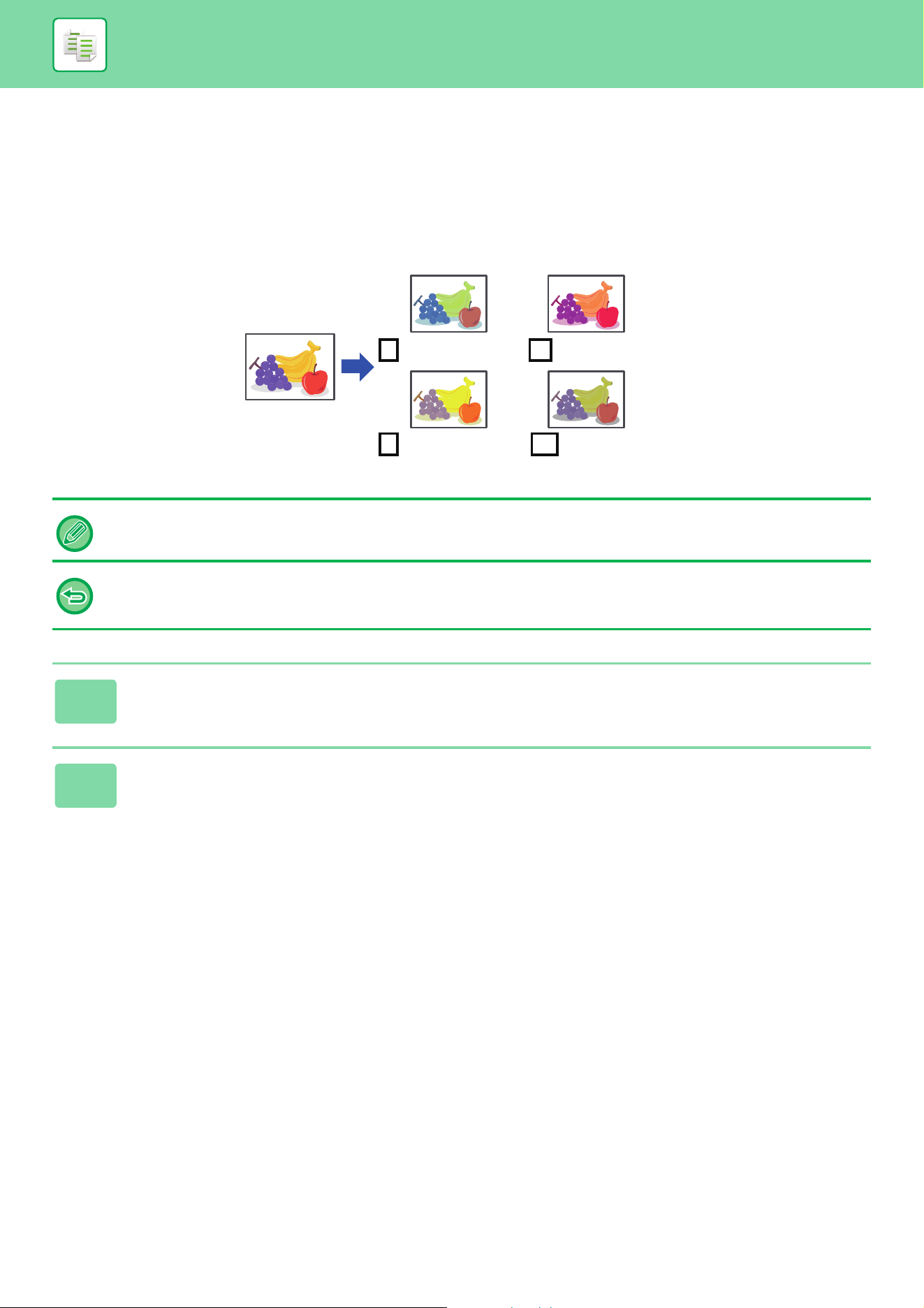
2-138
COPIER►OTHER FUNCTIONS
ADJUSTING THE COLOR (COLOR BALANCE)
You can adjust the color, tone, and density of copies.
Use the [Color] tab for color copy settings, or the [B/W] tab for black & white copy settings.
If you select the [Color] tab, the densities of the colors yellow, magenta, cyan, and black are divided into three ranges,
and you can adjust the density of each range.
If needed, you can also adjust all three density ranges at once.
Color Balance must be specified before scanning the original.
To change the default color balance setting:
Change the setting in "Settings (administrator)" → [System Settings] → [Image Quality Adjustment] →
[Copy Image Quality]→ [Color Balance (Color)] or [Color Balance (Black & White)].
1
Tap the [Others] key, and tap the [Color Balance] key.
2
Tap the tab of the mode you want to adjust.
C Cyan+
Y Yellow+
Bk Black+
M Magenta+
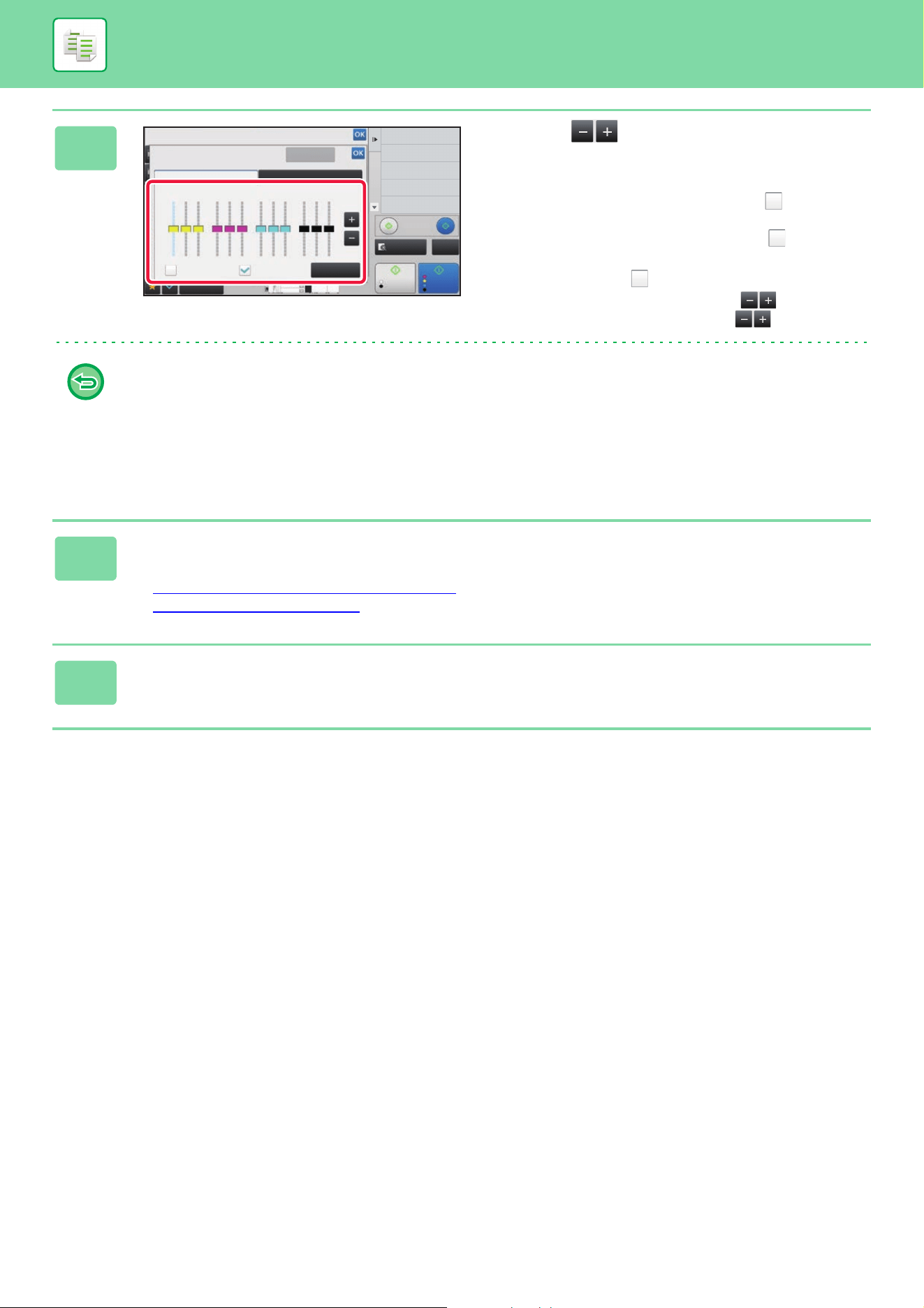
2-139
COPIER►OTHER FUNCTIONS
3
Tap the key or slide the slider to
adjust the color balance.
• If you want to adjust each color individually on the [Color]
tab, set the [Set in a Batch] checkmark to . If you want
to further adjust each range of each color individually, set
the [Set in a Group by Color] checkbox to .
• To adjust each range on the [B/W] tab, set the [Set in a
Batch] checkbox to .
• To adjust a slider individually with the keys, tap the
slider you want to adjust and tap the keys.
• To return the color balance of the current tab to the default balance:
Tap the [Reset] key.
The values of all gradations currently being adjusted will return to their default color balance values.
• To return all color balances to defaults:
Tap the [Cancel All] key.
The default settings are the values set in "Settings (administrator)" → [System Settings] → [Image Quality Adjustment]
→ [Copy Image Quality]→ [Color Balance (Color)] or [Color Balance (Black & White)].
4
Place the original.
Place the original in the document feeder tray of the automatic document feeder, or on the document glass.
► AUTOMATIC DOCUMENT FEEDER (page 1-90)
► DOCUMENT GLASS (page 1-92)
5
Tap the [Color Start] or [B/W Start] key to start copying.
Proof Copy
8½x11
68
8½x11
4
3 8½x14
11x17
Others
Preview
Start Start
Back
Color Balance
Adjust Color Tone for Copy.
Cancel All
Colour B/W
YMCBk
Set in a Batch
Set in a Group by Color
Reset
0
+
-
LMH LMH LMH LMH
CA
B/W Color
Original
Change Size/Direction.
Exposure
Select Type/Exposure
RGB
Adjust Thickness of RGB
Color Mode
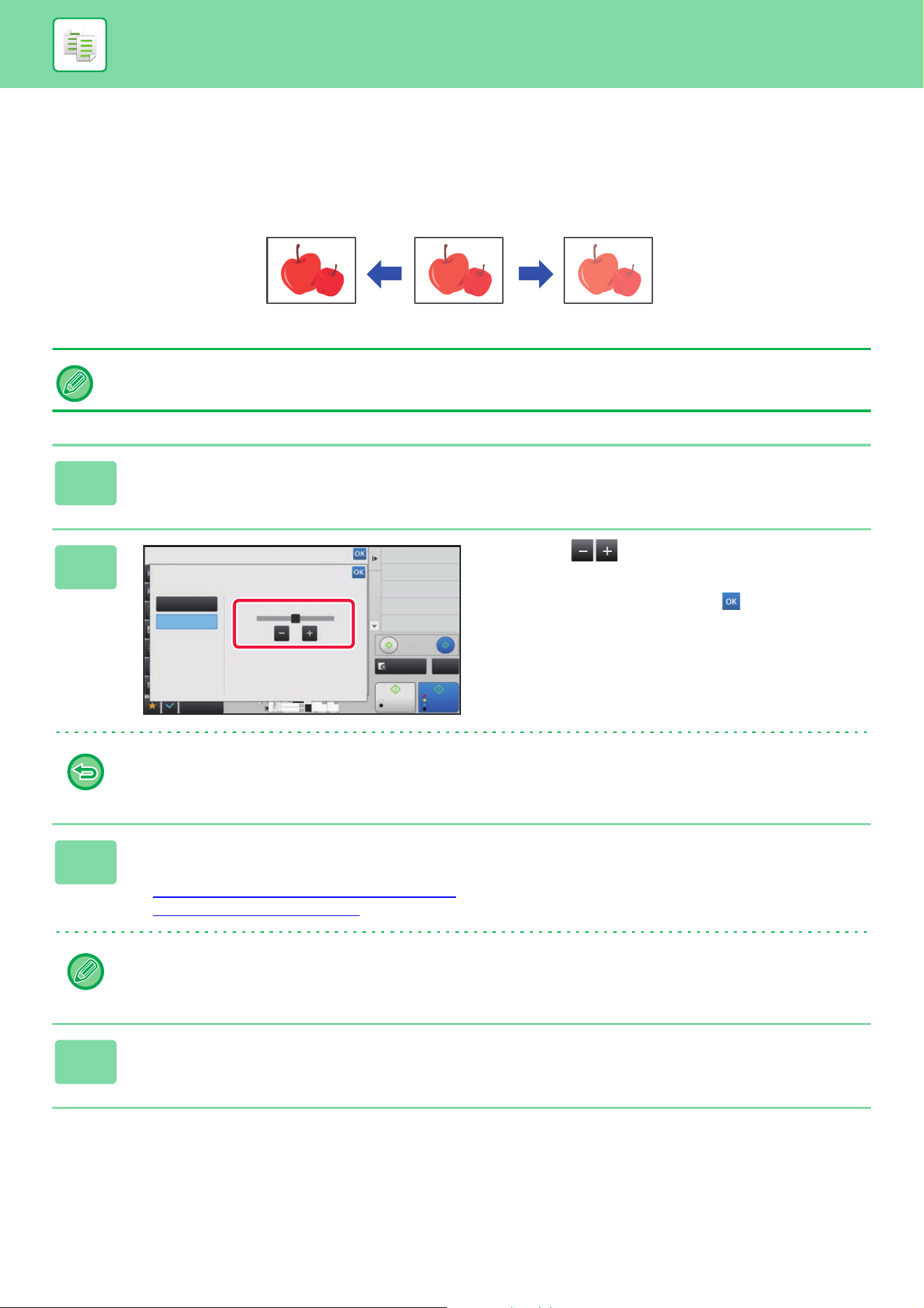
2-140
COPIER►OTHER FUNCTIONS
ADJUSTING THE BRIGHTNESS OF A COPY
(BRIGHTNESS)
This function adjusts the brightness of a color copy image.
Brightness must be specified before scanning the original.
1
Tap the [Others] key, and tap the [Brightness] key.
2
Tap the key or slide the slider to
adjust the brightness.
After the settings are completed, tap twice.
To cancel the brightness setting:
Tap the [Off] key.
3
Place the original.
Place the original in the document feeder tray of the automatic document feeder, or on the document glass.
► AUTOMATIC DOCUMENT FEEDER (page 1-90)
► DOCUMENT GLASS (page 1-92)
To cancel all settings:
Tap the [CA] key.
4
Tap the [Color Start] key to start copying.
Dark Originals Light
8½x11
68
8½x11
4
3
8½x14
11x17
Proof Copy
Others
Preview
Start Start
Back
Brightness
This setting is only applied to colour.
Color Mode
Exposure
Select Type/Exposure
Off
On
Light
-2 -1 0
21
Change Size/Direction.
Original
Dark
Adjust Outline of Image
Sharpness
Intensity
Adjust Intensity
CA
B/W Color
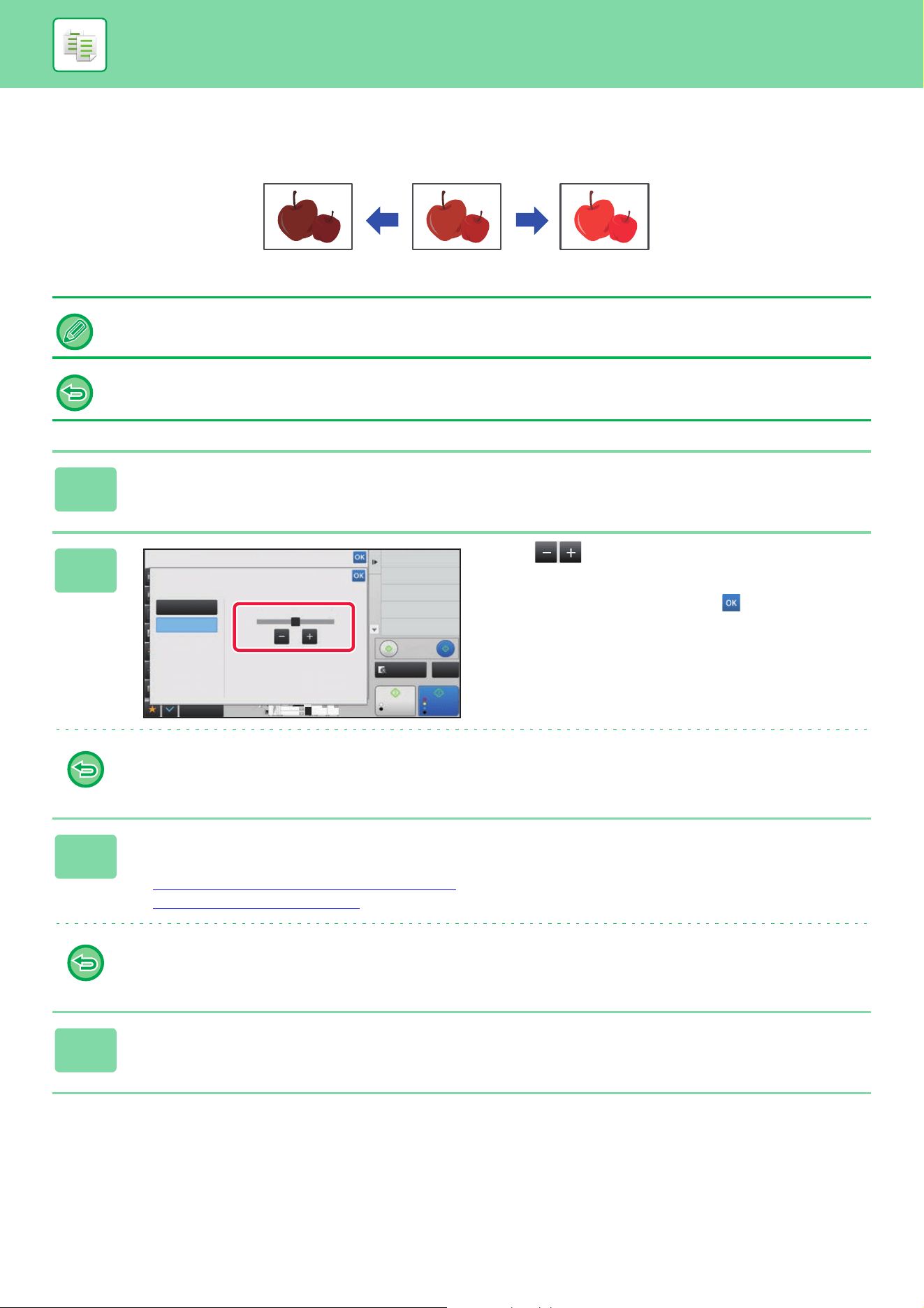
2-141
COPIER►OTHER FUNCTIONS
ADJUSTING THE INTENSITY OF A COPY (INTENSITY)
This function adjusts the intensity (saturation) of a color copy image.
You must set the intensity before scanning the original.
This function cannot be combined with [Copy of Copy] or [Color Tone Enhancement] in Exposure.
1
Tap the [Others] key, and tap the [Intensity] key.
2
Tap the key or slide the slider to
adjust the intensity.
After the settings are completed, tap twice.
To cancel the Intensity setting:
Tap the [Off] key.
3
Place the original.
Place the original in the document feeder tray of the automatic document feeder, or on the document glass.
► AUTOMATIC DOCUMENT FEEDER (page 1-90)
► DOCUMENT GLASS (page 1-92)
To cancel all settings:
Tap the [CA] key.
4
Tap the [Color Start] key to start copying.
Weakening the intensity Originals Strengthening the intensity
68
4
3
8½x11 8½x11
8½x14
11x17
Proof Copy
Others
Preview
Start Start
Back
Intensity
This setting is only applied to colour.
Color Mode
Exposure
Select Type/Exposure
Off
On
Darker
-2 -1 0
21
Change Size/Direction.
Original
Lighter
Adjust Thickness of RGB
RGB
Adjust Brightness
Brightness
CA
B/W Color
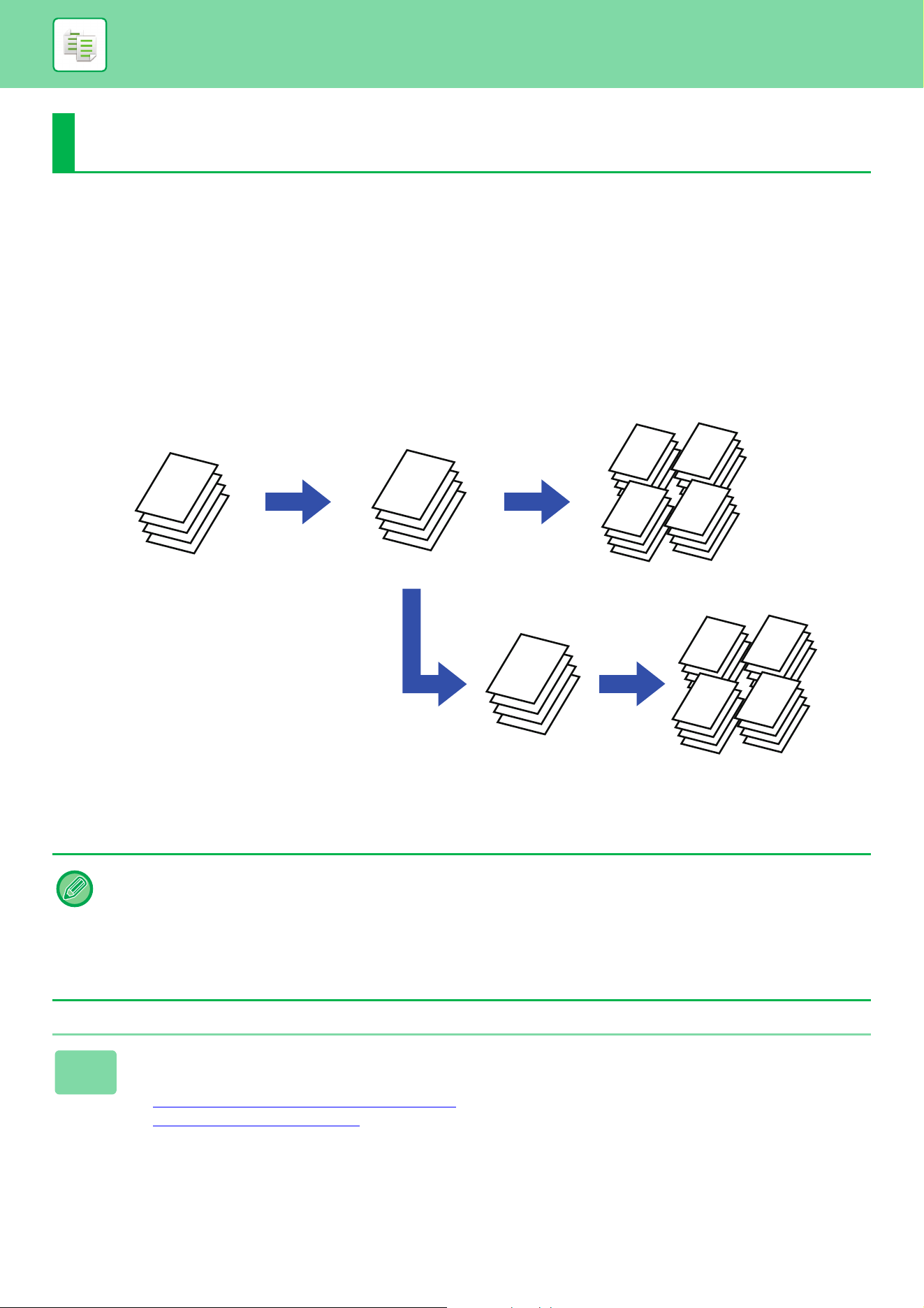
2-142
COPIER►CONVENIENT COPY FUNCTIONS
MAKING A PROOF COPY (PROOF COPY)
This function makes a proof copy before printing the specified number of copies. Check the preview image with a proof
copy. If necessary, change the settings. Using this function stores the scanned original in the machine, saving you the
trouble of re-scanning the original in the changed setting.
Proof copy flow
CONVENIENT COPY FUNCTIONS
• Proof Copy must be specified before scanning the original.
• If Proof Copy is executed while the machine is printing another job, the job in progress is interrupted, and a proof copy is
printed preferentially. The interrupted job will resume after proof copying has been completed.
However, if proof copy is executed during printing of a job for which both 2-sided printing and staple function are enabled,
the proof copy will be printed after the job in progress is finished.
If the [Start Print] key is tapped to execute printing of the remaining sets while the machine is printing another job, the
remaining sets will be printed after all previously reserved jobs are completed.
1
Place the original.
Place the original in the document feeder tray of the automatic document feeder, or on the document glass.
► AUTOMATIC DOCUMENT FEEDER (page 1-90)
► DOCUMENT GLASS (page 1-92)
A
A
A
A
A
A
A
A
A
A
A
A
A
A
A
A
A
A
A
A
A
A
A
A
A
A
A
A
A
A
A
A
A
A
A
A
A
A
A
A
A
A
A
A
One set of copies is
printed for you to check
Select "Proof Copy" and
set 5 sets of copies
The remaining 4 sets are printed
Adjust the settings
The remaining 4 sets are
printed
After adjustment, one set
is printed for you to
check
If OK
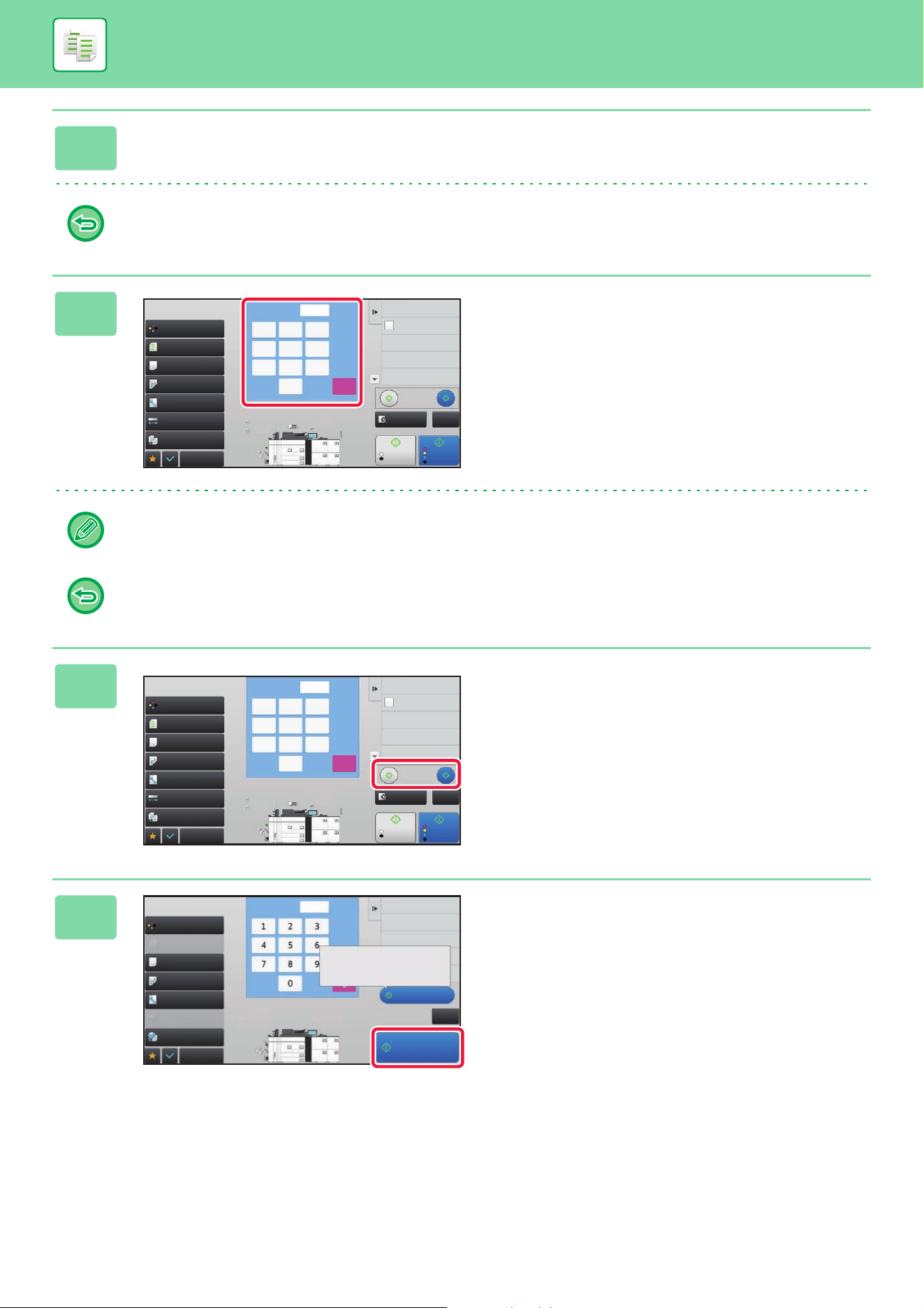
2-143
COPIER►CONVENIENT COPY FUNCTIONS
2
As necessary, specify the required functions such as "Exposure" and "Copy
Ratio".
To cancel all settings:
Tap the [CA] key.
3
Set the number of copies (number of
sets) using the numeric keys.
Up to 9999 copies (sets) can be set.
If an incorrect number of copies is set
Tap the [C] key, and enter the correct number.
4
Tap the [Proof Copy] key.
Tap the key to the left of [Proof Copy] to make a copy in
black and white. Tap the key to the right of [Proof Copy] to
make a copy in color.
Only one set of copies is printed.
5
Check the copy result. If no problem is
found, tap the [Start Print] key.
As necessary, change the settings and repeat proof copying
until you are satisfied with the copy result.
1
No. of copies
1
1
9
32
6
78
4
5
0 C
Plain 1
2
5
68
8½x11
7
1
3
4
Plain 1
8½x11
Plain 1
8½x11
8½x11 5½x8½
8½x11 8½x11
8½x11 8½x11
8½x14
11x17
Start Start
Color Mode
Full Color
Paper Select
Auto
Exposure
Auto
Original
2-Sided Copy
1-Sided→1-Sided
Output
Copy Ratio
100%
Others
Send and print
Call Eco Program
Store Data in Folder
File
Store Data Temporarily
Quick File
1
CA
B/W
Preview
Proof Copy
Auto
Color
1
No. of copies
1
1
9
32
6
78
4
5
0 C
Plain 1
2
5
68
8½x11
7
1
3
4
Plain 1
8½x11
Plain 1
8½x11
8½x11 5½x8½
8½x11 8½x11
8½x11 8½x11
8½x14
11x17
Start Start
Color Mode
Full Color
Paper Select
Auto
Exposure
Auto
Original
2-Sided Copy
1-Sided→1-Sided
Output
Copy Ratio
100%
Others
Send and print
Call Eco Program
Store Data in Folder
File
Store Data Temporarily
Quick File
1
CA
B/W
Preview
Proof Copy
Auto
Color
Paper Select
Exposure
Auto
Original
Auto
2-Sided Copy
Copy Ratio
Others
1
Register Current Settings
Program Registration
Adjust Print Position
Press [Start Print] to continue.
To make a proof copy again,
press [Proof Copy].
CA
Proof Copy
Start Print
2
5
68
7
1
3
4
No. of copies
Auto
1-Sided→1-Sided
100%
8½x11 5½x8½
8½x11 8½x11
8½x11 8½x11
8½x14
11x17
Color Mode
Full Color
Output
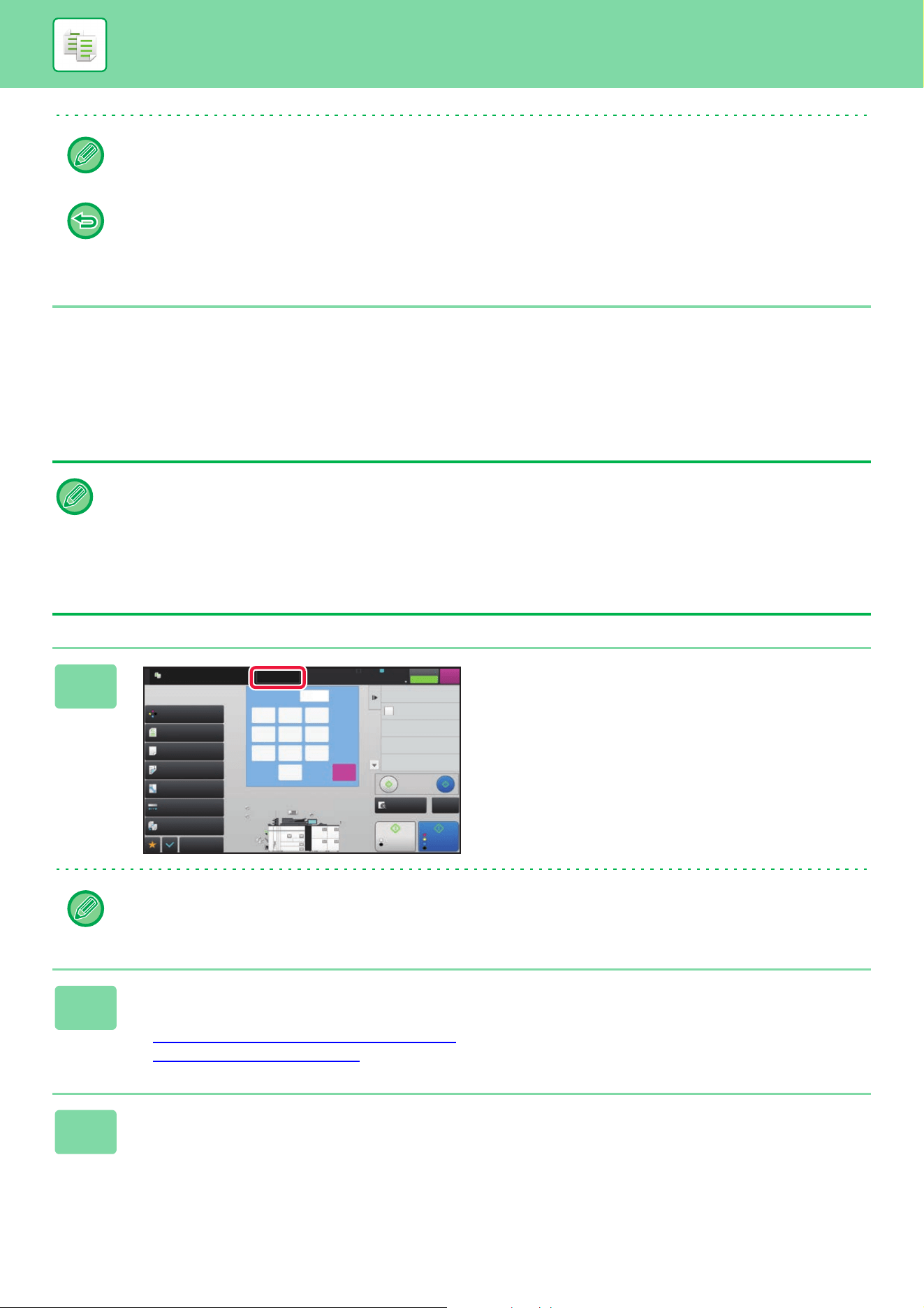
2-144
COPIER►CONVENIENT COPY FUNCTIONS
INTERRUPT COPY
This function suspends a job in progress, and preferentially prints the original specified with interrupt copy.
When you need to make an urgent copy and the machine is busy with a long copy run or other job, use interrupt copy.
You can also change the number of copies. To change the number of copies, use the numeric keys.
• In Proof Copy, unavailable function keys are not displayed.
• Some available functions may be restricted.
• To cancel all settings:
Tap the [CA] key.
• The [Interrupt] key does not appear while an original is being scanned.
• Depending on the settings of the job in progress, the [Interrupt] key may not appear.
• Interrupt copy cannot be used in combination with the following functions:
Job Build, Tandem Copy, Book Copy, Card Shot, Multi-Page Enlargement, Original Count, Proof Copy, Preview Setting,
and Book Divide.
• If you use the document glass for interrupt copy, you cannot select the booklet, covers/inserts function, or N-Up setting.
If any of these functions are necessary, use the automatic document feeder.
1
Tap the [Interrupt] key.
The interrupt mode screen appears.
If user authentication is specified:
Tap the [Interrupt] key to display the user authentication screen. Enter the login name and password to perform user
authentication.
2
Place the original.
Place the original in the document feeder tray of the automatic document feeder, or on the document glass.
► AUTOMATIC DOCUMENT FEEDER (page 1-90)
► DOCUMENT GLASS (page 1-92)
3
Configure copy settings.
No. of copies
Plain 1
8½x11
Plain 1
8½x11
Plain 1
8½x11
Full Color
Auto
Auto
1-Sided→1-Sided
100%
Auto
Start Start
Preview
Color Mode
Copy Interrupt
Paper Select
Exposure
Original
2-Sided Copy
Output
Copy Ratio
Others
Send and print
Call Eco Program
Store Data in Folder
File
Store Data Temporarily
Quick File
1
LINE PRINTER
Cancel
Print
Job Management
Tray 1
CA
B/W
8½x11
2
5
68
5½x8½
7
1
3
4
1
9
32
6
78
4
5
0 C
Proof Copy
8½x11 8½x11
8½x11 8½x11
8½x14
11x17
Color
2-145
COPIER►CONVENIENT COPY FUNCTIONS
To cancel interrupt copy, tap the [Cancel] key.
4
Tap the [Color Start] or [B/W Start] key to start interrupt copying.
When the interrupt copy job is completed, the interrupted job will resume.
The interrupt copy function does not display the preview of the scanned original.
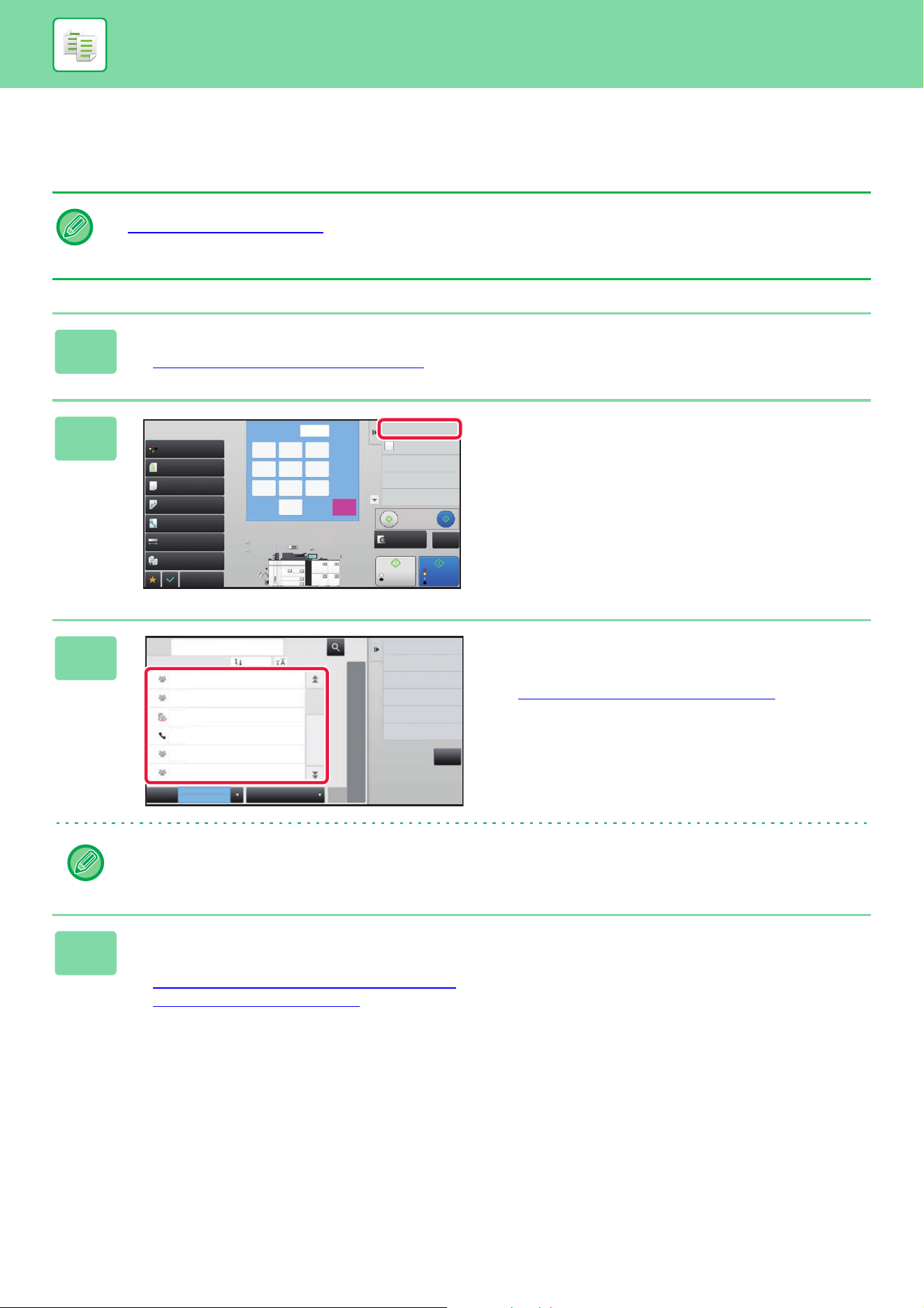
2-146
COPIER►CONVENIENT COPY FUNCTIONS
SEND DATA WHILE COPYING
This function allows you to send an e-mail with an image attached, or save data in the network folder.
You need to store the destination in the address book in advance.
► ADDRESS BOOK (page 1-103)
The image send transmission starts after the copy, and the settings same as the copy are used for transmission.
However, the same results as the copy may not be provided by some functions.
1
Tap the [Detail] key to change to normal mode.
► Changing mode from each mode (page 2-5)
2
Tap [Send and Print] on the action
panel.
3
Select a recipient from the address
book.
► ADDRESS BOOK SCREEN (page 1-104)
After you have selected the recipient, tap the [Enter
Address] key.
You cannot use the soft keyboard to enter an address. If you cannot find the recipient in the address book, enter it in the
address book.
4
Place the original.
Place the original in the document feeder tray of the automatic document feeder, or on the document glass.
► AUTOMATIC DOCUMENT FEEDER (page 1-90)
► DOCUMENT GLASS (page 1-92)
8½x11
2
5
68
5½x8½
8½x14
11x17
7
1
3
4
8½x11
8½x11 8½x11
8½x11
1
1
9
32
6
78
4
5
0 C
Proof Copy
Start
Colour
Start
Preview
Paper Select
Exposure
Original
2-Sided Copy
Output
Copy Ratio
Others
Send and print
Call Eco Program
Store Data in Folder
File
Store Data Temporarily
Quick File
1
4
CA
B/W
Color Mode
No. of copies
Plain 1
8½x11
Plain 1
8½x11
Plain 1
8½x11
Full Color
Auto
Auto
1-Sided→1-Sided
100%
Auto
Cancel and Return
A
D
G
J
M
P
W
Frequent
Use
All
Narrow Down
All
Category
Sort
BBB
AAA
CCC
AAA
CCC
ABC
T
BBB
Address
CA
2-147
COPIER►CONVENIENT COPY FUNCTIONS
5
Set each copy item as required.
You can preview the scanned original by tapping the [Preview] key.
6
Tap the [Color Start] or [B/W Start] key to start copying.
After the copy, the transmission starts.
After the copy, you cannot preview the settings before transmission.
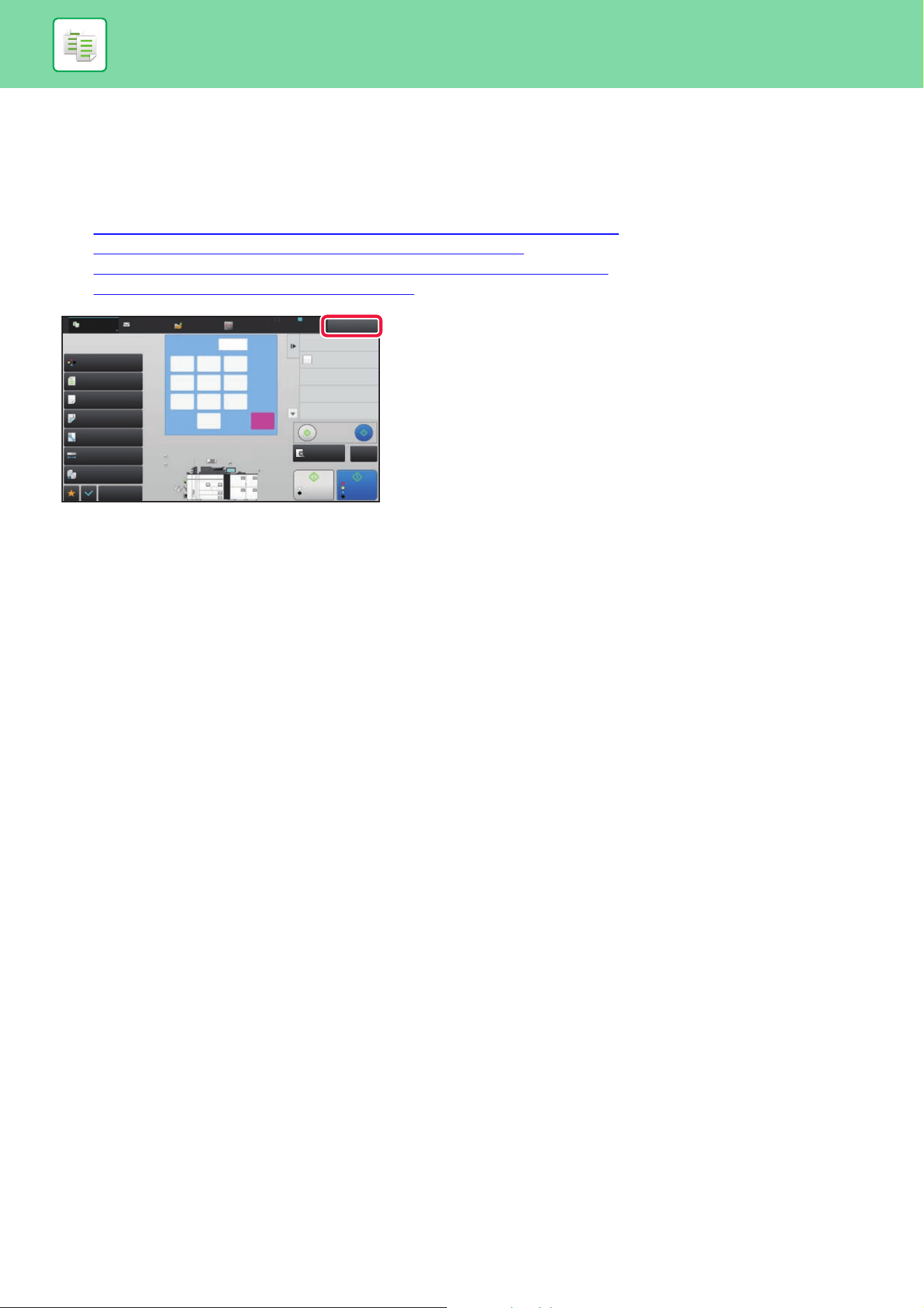
2-148
COPIER►CONVENIENT COPY FUNCTIONS
COPY JOBS
When you tap the job management display, jobs are displayed in a list. To check the status of a copy job, tap the [Print]
tab.
When you wish to stop or delete jobs or to perform priority processing, read the following items:
► STOPPING/DELETING A JOB IN PROGRESS OR RESERVED (page 1-96)
► PRIORITY PROCESSING OF A RESERVED JOB (page 1-97)
► CHECKING A RESERVED JOB OR THE JOB IN PROGRESS (page 1-99)
► CHECKING COMPLETED JOBS (page 1-100)
1
1
9
32
6
78
4
5
0 C
Proof Copy
2
5
68
7
1
3
4
8½x11 5½x8½
8½x11 8½x11
8½x11 8½x11
8½x14
11x17
Start Start
Preview
Paper Select
Exposure
Original
2-Sided Copy
Copy Ratio
Others
Send and print
Call Eco Program
Store Data in Folder
File
Store Data Temporarily
Quick File
LINE PRINT-
HDD
File retrieve
Sharp OSA
CA
B/W
E-mail
Job Management
No. of copies
Plain 1
8½x11
Plain 1
8½x11
Plain 1
8½x11
Auto
Auto
1-Sided→1-Sided
100%
Color Mode
Full Color
Output
Copy
Auto
Color
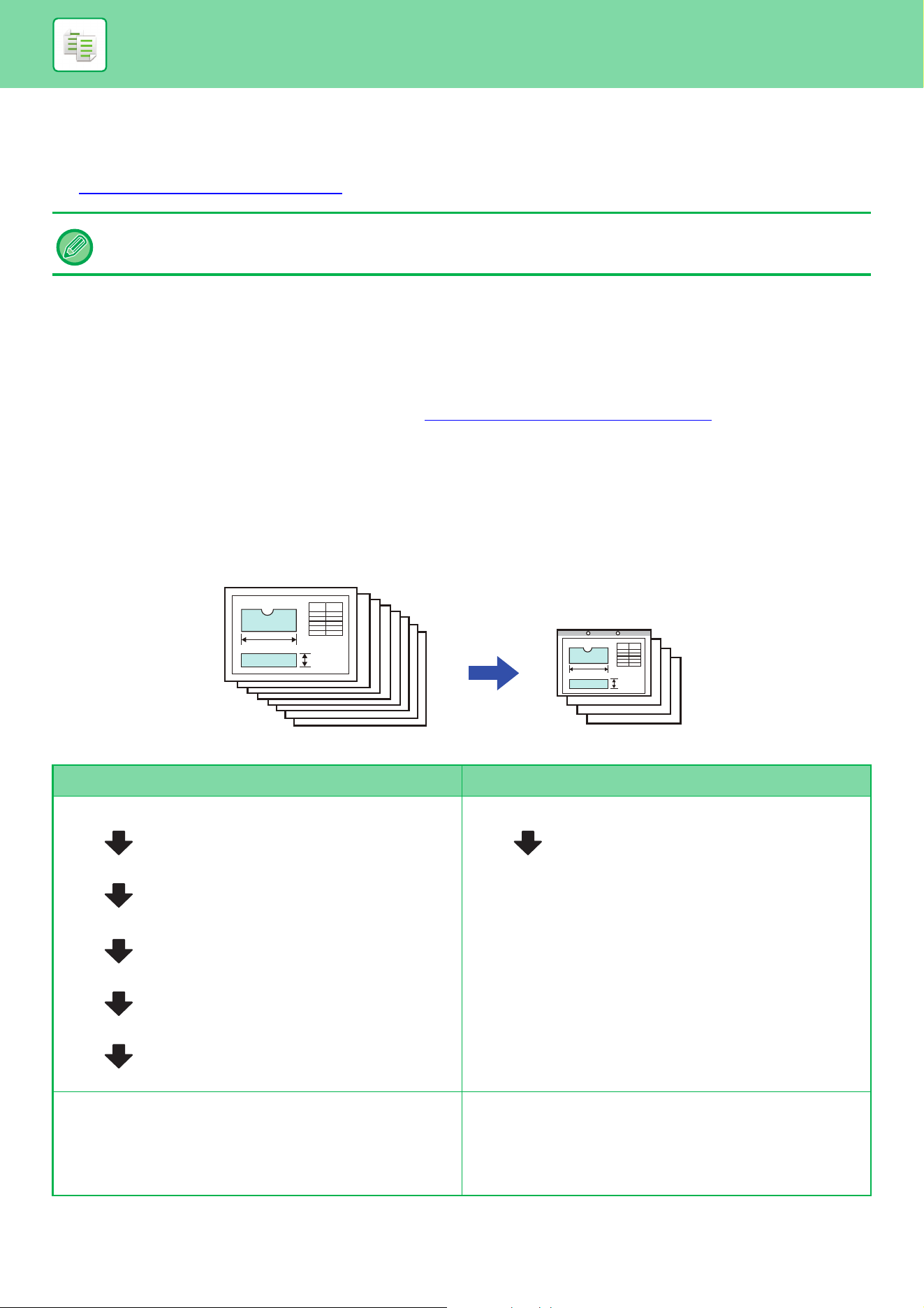
2-149
COPIER►CONVENIENT COPY FUNCTIONS
PROGRAMS
Programs are set from the base screen of normal mode.
► SELECTING COPY MODE (page 2-4)
STORING A PROGRAM
This function collectively stores copy settings as one program. The stored program can be retrieved using an easy
operation.
For information about how to retrieve a program, see "RETRIEVING A PROGRAM (page 2-151)
".
For example, suppose 11" x 17" (A3) size CAD drawings are copied once a month for archive purposes using the
following settings:
• The 11" x 17" (A3) size CAD drawings are reduced to 8-1/2" x 11" (A4) size.
• To reduce paper use by half, 2-sided copying is used.
• Margin shift is used to allow a margin to punch holes for filing.
Programs cannot be stored in easy mode.
When a job program is not stored When a job program is stored
Set reduction from 11" x 17" (A3) to 8-1/2" x 11" (A4)
Change the exposure setting.
Set 2-sided copying.
Set margins.
Set punch hole settings.
Tap the [Color Start] or [B/W Start] key.
Retrieve the stored program.
Tap the [Color Start] or [B/W Start] key.
Considerable time is required to copy the drawings each
month because the above settings must be selected.
In addition, mistakes are occasionally made when selecting
the settings, so some copies must be redone.
The settings are stored in a program, so they can be selected
by the touch of a key. This is simple and takes no time.
In addition, the settings are all stored so there are no chances
for mistakes, and thus no need to redo copies due to setting
mistakes.
A3 (11" x 17") size CAD drawings
Copy
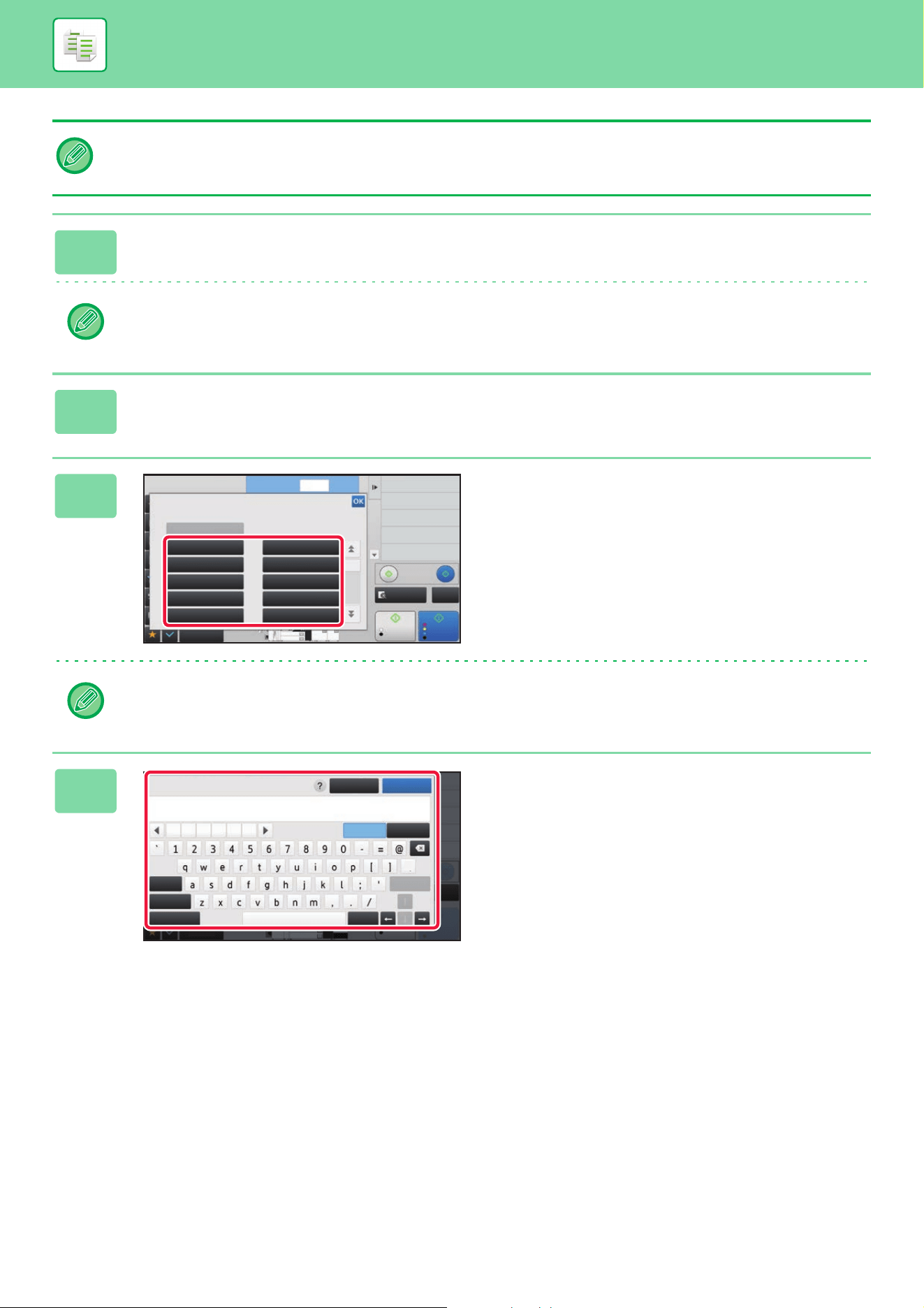
2-150
COPIER►CONVENIENT COPY FUNCTIONS
• Up to 48 programs can be stored.
• Program settings remains registered even when the main power has been turned off.
• A program can also be stored in the home screen or favorite as a shortcut; therefore, it is helpful when retrieving it.
1
Specify the copy function to be stored.
In the base screen, display [Program Registration] on the action panel.
2
Tap [Program Registration] on the action panel.
3
Tap an unused key.
A key with a program stored is displayed in color. Tap a key
with no program stored.
If you do not set a name for the program, a serial number will be automatically assigned as the name.
4
Set a name for the program and tap the
[OK] key.
A registration completion message appears.
5
68
7
3
4
8½x118½x11
8½x11 8½x11
8½x14
11x17
Start
Colour
Start
Preview
Others
1
01 02
03 04
05 06
07 08
09 10
Pre-Setting
Program
Program Registration
Select Program No. to Register
No. of copies
01
03
05
07
09
02
04
06
08
10
CA
B/W
Proof Copy
Black & White
Others
CA
4
11x17 8½x11
Program Name
Cancel OK
Space AltGrKeyboard Select
Shift
Caps
Characters Symbols
Enter
#
.com .net .org
http:/
/
.info
.biz
\
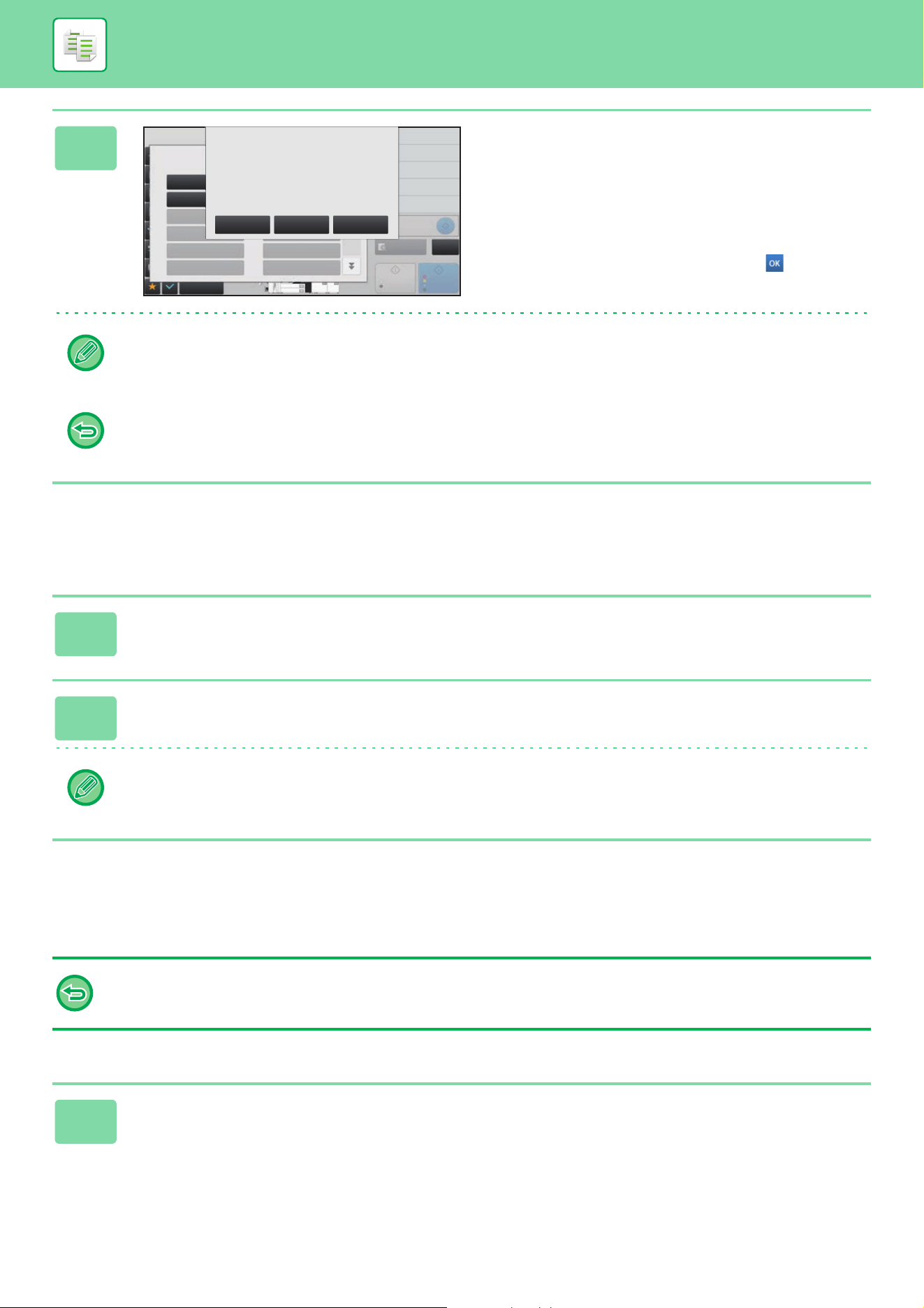
2-151
COPIER►CONVENIENT COPY FUNCTIONS
RETRIEVING A PROGRAM
DELETING AND RENAMING A PROGRAM
This section explains how to delete copy settings in a program and rename a program.
Deleting a program
5
Select whether or not the program will
be added to the home screen or the
favorites.
To specify print settings, you can select the required one
from pre-set text or use the soft keyboard. You can also print
serial number and account job ID.
When you have completed the settings, tap twice.
• If user authentication is enabled, the shortcut key for the program is registered in the user's home screen or favorite.
• If user authentication is disabled, the administrator password entry screen appears. When the administrator
password is entered, the registration is completed.
The number of copies cannot be stored.
1
Tap [Call Program] on the action panel.
2
Tap the key of the program you want to retrieve.
You can select a program key and tap [Register in Favorite] or [Register for Home] on the action panel to register a
shortcut key for the selected program in the favorite or home screen.
• A program that is already stored cannot be deleted.
• When "Settings (administrator)" - [System Settings] → [Common Settings] → [Enable/Disable Settings] → [Disabling of
Registration/Deletion of Program] is selected, a registered program cannot be deleted or renamed.
1
Tap [Call Program] on the action panel.
68
3
4
Proof Copy
8½x11 8½x11
8½x14
11x17
Start
Color
Start
Preview
Others
01
03
05
07 08
Pre-Setting
Program
Program Registration
Select Program No. to Register
01
03
05
07 08
10
10
09
09
CA
B/W
Cancel Registration
Register for
Home
Register for
Favorite
Program registration is completed.
At the same time, it can be registered
for Favorite or Home to use
as shortcut. Do you register?
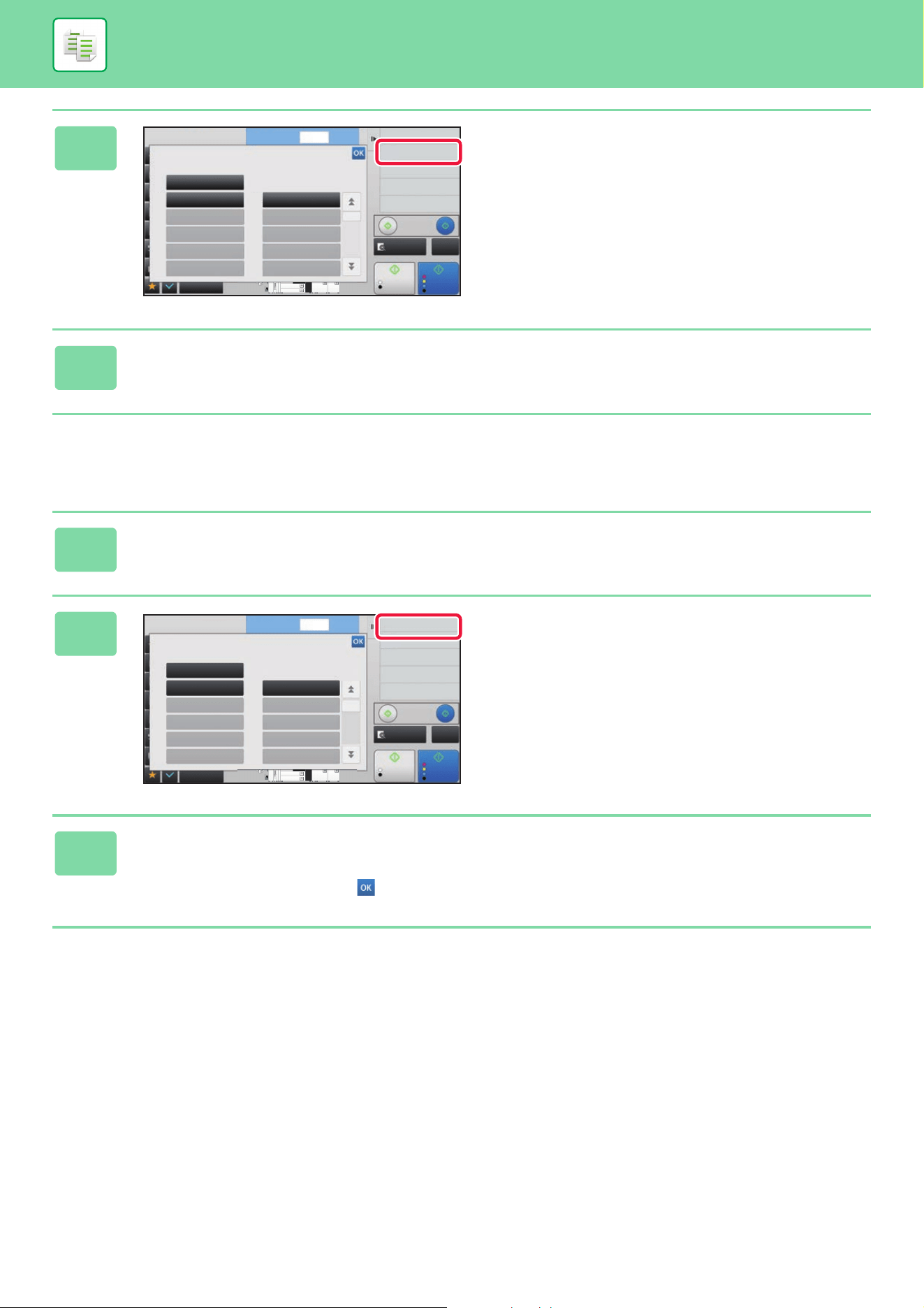
2-152
COPIER►CONVENIENT COPY FUNCTIONS
Renaming a program
2
Tap [Delete] on the action panel.
3
Tap the key of the program you want to delete, and tap [Delete].
1
Tap [Call Program] on the action panel.
2
Tap [Change Name] on the action
panel.
3
Tap the key of the required program, and rename the program. Then tap the
[OK] key.
After the settings are completed, tap .
21
5
8½x11
8½x11
Start
Color
Proof Copy
Preview CA
Start
B/W
68
3
4
8½x11 8½x11
8½x14
11x17
Others
01
03
05
07
08
Pre-Setting
Program
Call Program
01
03
05
07 08
10
10
09
09
02
04
06
02
04
06
1
No. of copies
Change Name
Register in Favorite
Register for Home
Call registered settings when touched.
Delete
Start
Color
Start
B/W
Proof Copy
Preview CA
Delete
68
3
4
8½x11 8½x11
8½x14
11x17
Others
01
03
05
07
08
Pre-Setting
Program
Call Program
Call registered settings when touched.
01
03
05
07 08
10
10
09
09
02
04
06
02
04
06
1
No. of copies
Change Name
Register in Favorite
Register for Home
3-1
PRINTER FUNCTION OF THE MACHINE
PRINTING IN A WINDOWS ENVIRONMENT
BASIC PRINTING PROCEDURE. . . . . . . . . . . . . . . 3-4
•
PRINTER DRIVER SETTINGS SCREEN /
REFERRING TO HELP . . . . . . . . . . . . . . . . . . . . .
3-6
• SELECTING THE PAPER. . . . . . . . . . . . . . . . . 3-7
• PRINTING ON ENVELOPES . . . . . . . . . . . . . . 3-8
PRINTING WHEN THE USER AUTHENTICATION
FUNCTION IS ENABLED. . . . . . . . . . . . . . . . . . . . . 3-9
FREQUENTLY USED FUNCTIONS. . . . . . . . . . . . . 3-10
• SAVING SETTINGS AT THE TIME OF
PRINTING . . . . . . . . . . . . . . . . . . . . . . . . . . . . . 3-10
• USING SAVED SETTINGS . . . . . . . . . . . . . . . . 3-11
• CHANGING THE PRINTER DRIVER DEFAULT
SETTINGS. . . . . . . . . . . . . . . . . . . . . . . . . . . . . 3-11
PRINTING IN A Mac OS ENVIRONMENT
BASIC PRINTING PROCEDURE. . . . . . . . . . . . . . . 3-13
• SELECTING THE PAPER. . . . . . . . . . . . . . . . . 3-14
• PRINTING ON ENVELOPES . . . . . . . . . . . . . . 3-15
PRINTING WHEN THE USER AUTHENTICATION
FUNCTION IS ENABLED. . . . . . . . . . . . . . . . . . . . . 3-16
FREQUENTLY USED FUNCTIONS
SELECTING THE COLOR MODE . . . . . . . . . . . . . . 3-18
SELECTING THE RESOLUTION. . . . . . . . . . . . . . . 3-20
2-SIDED PRINTING . . . . . . . . . . . . . . . . . . . . . . . . . 3-21
FITTING THE PRINT IMAGE TO THE PAPER . . . . 3-22
PRINTING MULTIPLE PAGES ON ONE PAGE . . . 3-24
PRINTING WHILE SKIPPING BLANK PAGES. . . . 3-26
STAPLING OUTPUT/PUNCHING HOLES IN
OUTPUT . . . . . . . . . . . . . . . . . . . . . . . . . . . . . . . . . . 3-27
Eco
Eco
Eco
Eco
CONVENIENT PRINTING FUNCTIONS
CONVENIENT FUNCTIONS FOR CREATING
PAMPHLETS AND POSTERS . . . . . . . . . . . . . . . . 3-36
• CREATE A PAMPHLET (BOOKLET/SADDLE
STITCH) . . . . . . . . . . . . . . . . . . . . . . . . . . . . . . 3-36
• TRIMMING THE EXCESS OF FOLDED
PAPER . . . . . . . . . . . . . . . . . . . . . . . . . . . . . . . 3-38
• PRINTING WITH MARGIN SHIFT SETTING
(MARGIN). . . . . . . . . . . . . . . . . . . . . . . . . . . . . 3-40
• CREATE A LARGE POSTER (POSTER
PRINTING) . . . . . . . . . . . . . . . . . . . . . . . . . . . . 3-42
FUNCTIONS TO ADJUST THE SIZE AND
ORIENTATION OF THE IMAGE . . . . . . . . . . . . . . . 3-43
• ADJUST PRINT POSITION ON ODD AND
EVEN PAGES SEPARATELY (PRINT
POSITION) . . . . . . . . . . . . . . . . . . . . . . . . . . . . 3-43
• ROTATING THE PRINT IMAGE 180
DEGREES (ROTATE 180 DEGREES) . . . . . . 3-44
•
ENLARGING/REDUCING THE PRINT IMAGE
(ZOOM SETTING/ENLARGE OR REDUCE) . . .
3-45
• ADJUST THE LINE THICKNESS (WIDTH) . . . 3-47
• PRINT A MIRROR-IMAGE (MIRROR-IMAGE
REVERSE/VISUAL EFFECTS) . . . . . . . . . . . . 3-50
COLOR MODE ADJUSTING FUNCTION. . . . . . . . 3-51
• ADJUST THE BRIGHTNESS AND CONTRAST
OF THE IMAGE (COLOR ADJUSTMENT/RGB
ADJUSTMENT) . . . . . . . . . . . . . . . . . . . . . . . . 3-51
• PRINTING FAINT TEXT AND LINES IN BLACK
(TEXT TO BLACK/VECTOR TO BLACK) . . . . 3-52
• SELECTING COLOR SETTINGS TO MATCH
THE IMAGE TYPE (ADVANCED COLOR
SETTINGS) . . . . . . . . . . . . . . . . . . . . . . . . . . . 3-53
FUNCTIONS TO COMBINE TEXT AND IMAGES . . .
3-56
• ADDING A WATERMARK TO PRINTED
PAGES (WATERMARK) . . . . . . . . . . . . . . . . . 3-56
• PRINTING AN IMAGE OVER THE PRINT
DATA (IMAGE STAMP) . . . . . . . . . . . . . . . . . . 3-58
• REGISTERING A CUSTOM IMAGE . . . . . . . . 3-59
• OVERLAY A FIXED FORM ON THE PRINT
DATA (OVERLAYS) . . . . . . . . . . . . . . . . . . . . . 3-60
•
ADDING THE NUMBER OF COPIES (COPIES
STAMP) . . . . . . . . . . . . . . . . . . . . . . . . . . . . . . . .
3-62
PRINTER
Icons
Eco-friendly functions
Functions for printing on special
media
Eco

3-2
PRINTER
PRINT FUNCTIONS FOR SPECIAL PURPOSES. . .
3-63
• PRINTING SPECIFIC PAGES ON DIFFERENT
PAPER (DIFFERENT PAPER) . . . . . . . . . . . . . 3-63
• ADDING INSERTS WHEN PRINTING ON
TRANSPARENCY FILM (TRANSPARENCY
INSERTS) . . . . . . . . . . . . . . . . . . . . . . . . . . . . . 3-65
• INSERTING SEPARATOR PAGES BETWEEN
JOBS OR COPIES . . . . . . . . . . . . . . . . . . . . . . 3-67
• PRINTING A CARBON COPY (CARBON
COPY) . . . . . . . . . . . . . . . . . . . . . . . . . . . . . . . . 3-68
•
PRINTING TEXT ON TABS OF TAB PAPER
(TAB SHIFT/TAB PAPER PRINT) . . . . . . . . . . .
3-69
• TWO-SIDED PRINTING WITH SPECIFIC
PAGES PRINTED ON THE FRONT SIDE
(CHAPTER INSERTS). . . . . . . . . . . . . . . . . . . . 3-72
•
FOLDING PAPER FOR PRINTING (FOLD). . . . .
3-73
• INSERT PRESET DATA BEFORE OR AFTER
EACH PAGE (PAGE INTERLEAVE) . . . . . . . . . 3-78
• PRINT THE SAME IMAGE IN TILE PATTERN
(REPEAT PRINT) . . . . . . . . . . . . . . . . . . . . . . . 3-79
• PRINTING PATTERN DATA (HIDDEN
PATTERN PRINT). . . . . . . . . . . . . . . . . . . . . . . 3-80
• CHANGING THE RENDERING METHOD AND
PRINTING JPEG IMAGES (USE DRIVER TO
RENDER JPEGS) . . . . . . . . . . . . . . . . . . . . . . . 3-82
• MAXIMIZING THE PRINT AREA ON THE
PAPER (PRINT AREA) . . . . . . . . . . . . . . . . . . . 3-83
• PRINTING AT AN ENHANCED RESOLUTION
(SMOOTHING) . . . . . . . . . . . . . . . . . . . . . . . . . 3-84
CONVENIENT PRINTER FUNCTIONS . . . . . . . . . . 3-85
• USING TWO MACHINES TO PRINT A LARGE
PRINT JOB (TANDEM PRINT) . . . . . . . . . . . . . 3-85
• SAVING AND USING PRINT FILES
(DOCUMENT FILING). . . . . . . . . . . . . . . . . . . . 3-87
•
AUTOMATICALLY PRINT ALL STORED DATA. . .
3-89
• PRINTING AND SENDING
SIMULTANEOUSLY . . . . . . . . . . . . . . . . . . . . . 3-90
• PS PASS-THROUGH . . . . . . . . . . . . . . . . . . . . 3-91
PRINTING WITHOUT THE PRINTER
DRIVER
EXTENSION OF PRINTABLE FILES. . . . . . . . . . . . 3-92
DIRECTLY PRINTING A FILE ON AN FTP
SERVER . . . . . . . . . . . . . . . . . . . . . . . . . . . . . . . . . . 3-92
DIRECTLY PRINTING A FILE IN USB MEMORY. . .
3-94
DIRECTLY PRINTING A FILE IN A NETWORK
FOLDER . . . . . . . . . . . . . . . . . . . . . . . . . . . . . . . . . . 3-95
DIRECTLY PRINTING FROM A COMPUTER . . . . . 3-98
• SUBMIT PRINT JOB . . . . . . . . . . . . . . . . . . . . . 3-98
• FTP PRINT . . . . . . . . . . . . . . . . . . . . . . . . . . . . 3-98
• E-MAIL PRINT. . . . . . . . . . . . . . . . . . . . . . . . . . 3-98
PRINTER JOBS
CHECKING THE PRINT STATUS . . . . . . . . . . . . . 3-100
PRINTING AN ENCRYPTED PDF FILE . . . . . . . . . 3-100
CHANGING TO ANOTHER PAPER SIZE AND
PRINTING WHEN PAPER RUNS OUT. . . . . . . . . . 3-101
APPENDIX
PRINTER DRIVER SPECIFICATIONS LIST. . . . . . 3-102
SPECIFYING A BILLING CODE USING THE
PRINTER DRIVER. . . . . . . . . . . . . . . . . . . . . . . . . . 3-106
AUTHENTICATION BY SINGLE SIGN-ON . . . . . . 3-108
3-3
PRINTER►PRINTER FUNCTION OF THE MACHINE
The machine is equipped with a full color printing function as standard. To enable printing from your computer, a printer
driver must be installed.
See the table below to determine which printer driver to use in your environment.
Windows environment
Mac OS Environment
PRINTER FUNCTION OF THE MACHINE
Printer driver type
PCL6
The machine support the Hewlett-Packard PCL6 printer control languages.
PS
• This printer driver supports the PostScript
®
3™ page description language developed by Adobe Systems Incorporated.
• If it is desired to use the Windows standard PS printer driver, the PPD driver must be used.
• To install the printer driver and configure settings in a Windows environment, see the Software Setup Guide.
• The User's Manual mainly uses PCL6 printer driver screens to explain how to print in a Windows environment. The printer
driver screens may differ slightly depending on the printer driver you are using.
• Maximum print area: 12-9/16" x 50-7/8" (319 mm x 1292 mm)
Printer driver type
PS
PS This printer driver supports the PostScript
®
3™ page description language developed by Adobe Systems Incorporated and
uses a PPD file.
• To install the printer driver and configure settings in a Mac OS environment, see the Software Setup Guide.
• Maximum print area: 12-9/16" x 50-7/8" (319 mm x 1292 mm)
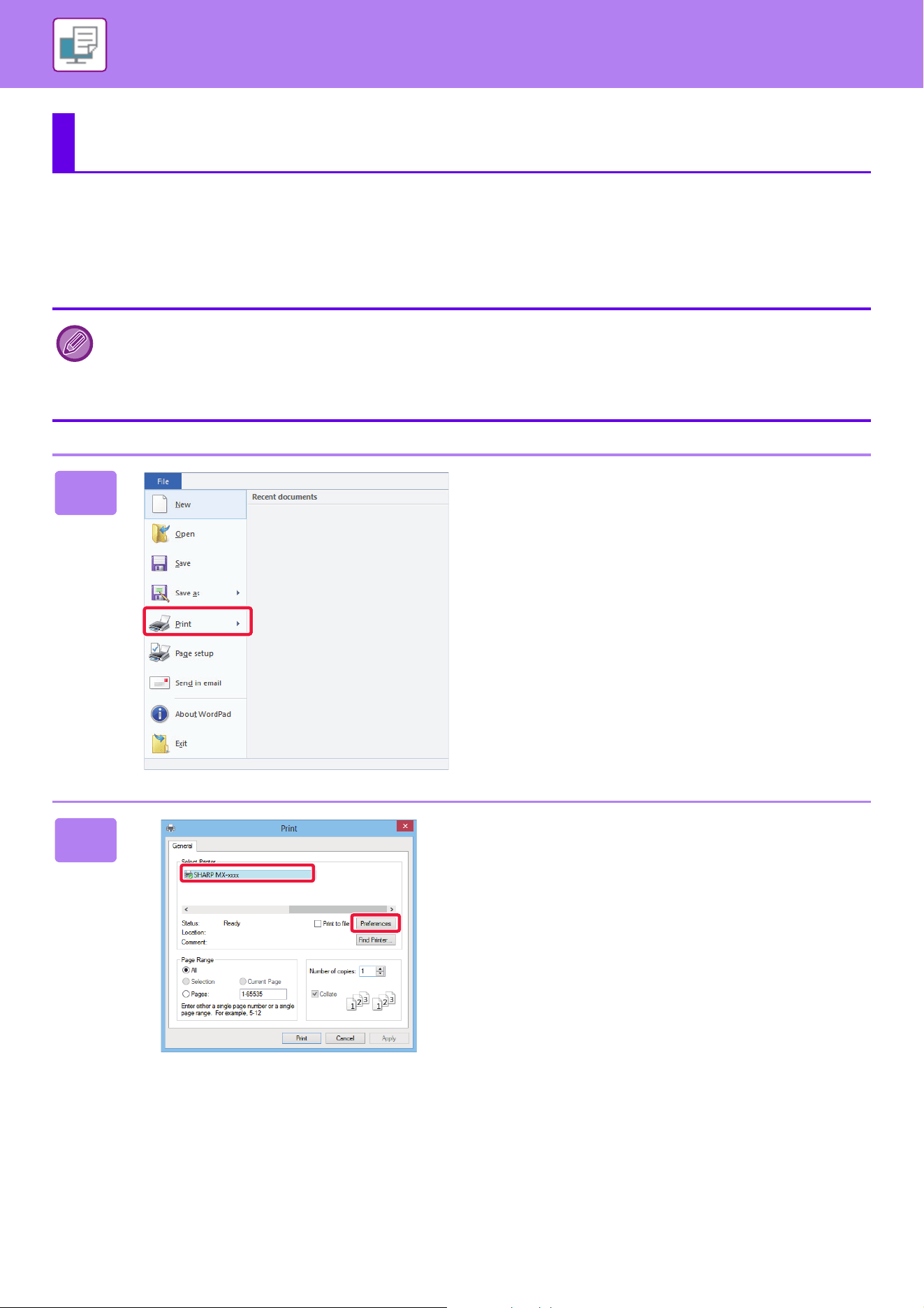
3-4
PRINTER►PRINTING IN A WINDOWS ENVIRONMENT
BASIC PRINTING PROCEDURE
The following example explains how to print a document from "WordPad", which is a standard accessory application in
Windows.
PRINTING IN A WINDOWS ENVIRONMENT
• The menu used to execute printing may vary depending on the application.
• The button that is used to open the printer driver properties window (usually [Property] or [Preferences]) may vary
depending on the application.
• The machine name that normally appears in the [Printer] menu is [MX-xxxx]. ("xxxx" is a sequence of characters that
varies depending on the machine model.)
1
Select [Print] from the [File] menu of
WordPad.
2
Select the printer driver for the
machine and click the [Preferences]
button.
The button that is used to open the printer driver properties
window (usually [Property] or [Preferences]) may vary
depending on the application.
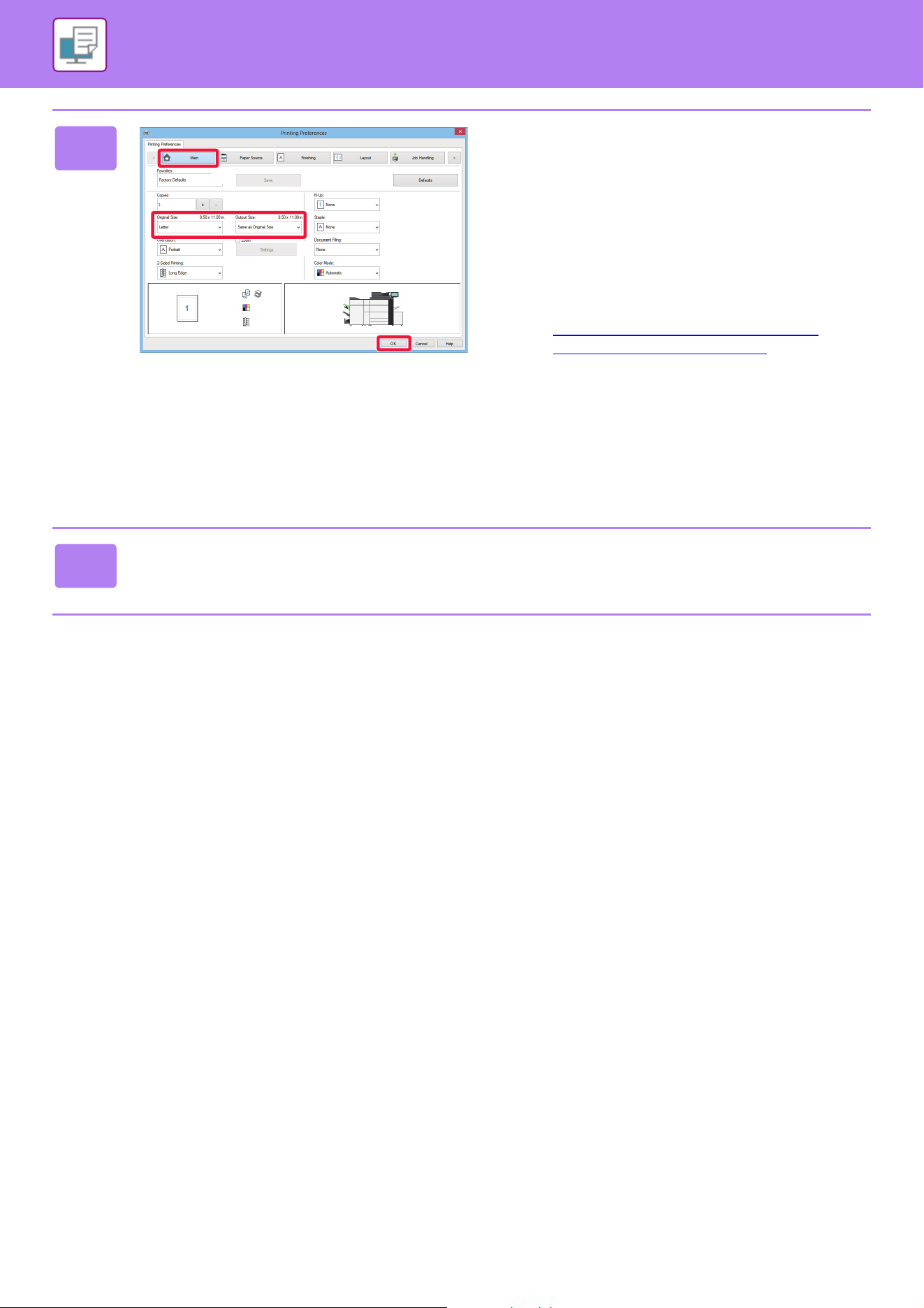
3-5
PRINTER►PRINTING IN A WINDOWS ENVIRONMENT
3
Select print settings.
(1) Click the [Main] tab.
(2) Select the original size.
• You can register up to seven user-defined sizes in
the menu. To store an original size, select [Custom
Paper] or one of [User1] to [User7] from the menu,
and click the [OK] button.
• To select settings on other tabs, click the desired tab
and then select the settings.
► PRINTER DRIVER SETTINGS SCREEN /
REFERRING TO HELP (page 3-6)
• If an original size larger than the largest paper size
that the machine supports is set, select the paper
size for printing in “Output Size”.
• If an "Output Size" different from the "Original Size"
is selected, the print image will be adjusted to match
the selected paper size.
(3) Click the [OK] button.
4
Click the [Print] button.
Printing begins.
(2)
(1)
(3)
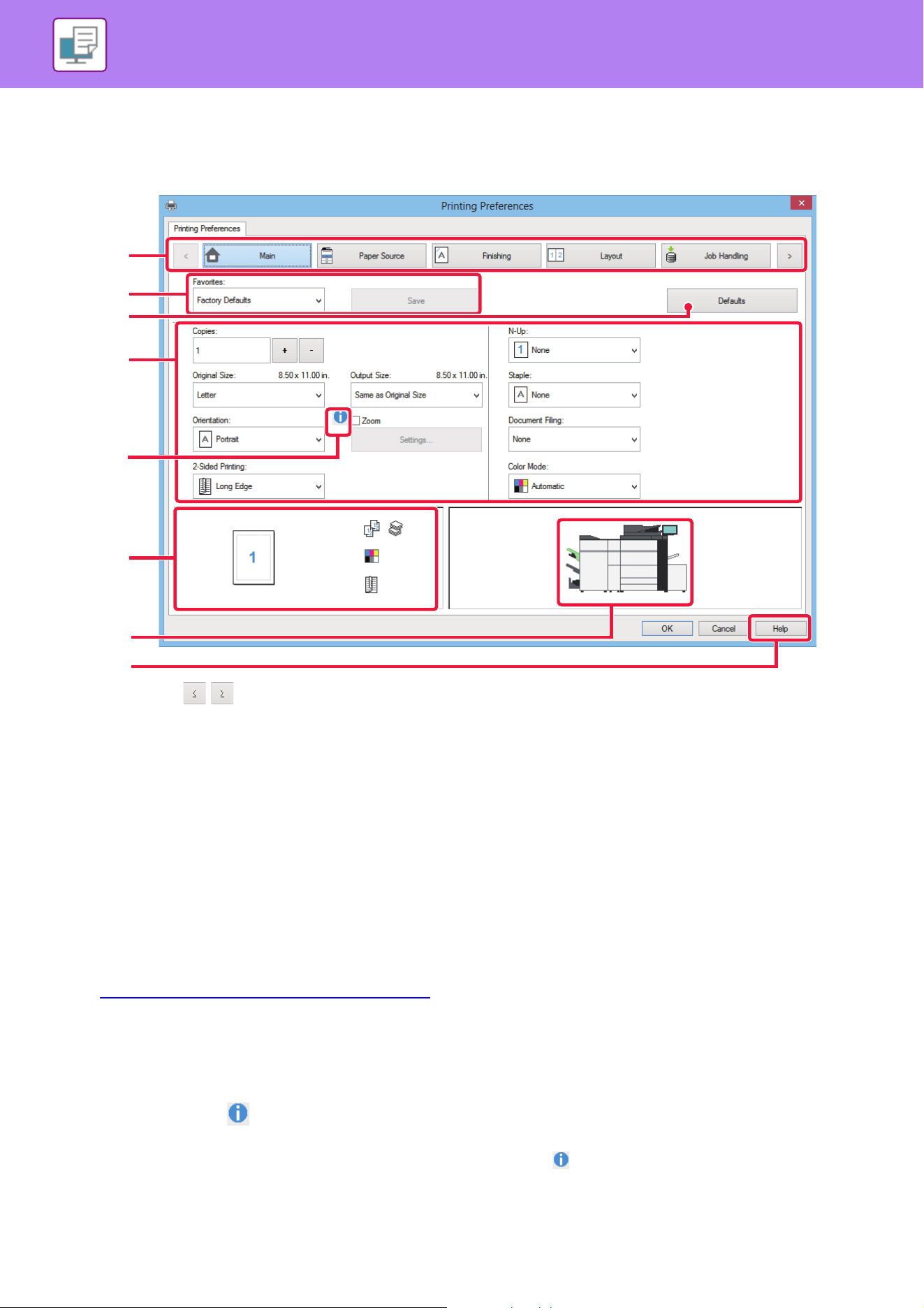
3-6
PRINTER►PRINTING IN A WINDOWS ENVIRONMENT
PRINTER DRIVER SETTINGS SCREEN / REFERRING TO HELP
The printer driver settings screen consists of 9 tabs. Click a tab to select the settings on that tab.
You can check information on each of the settings in the Help screen. Click the [Help] button at the bottom right of the screen.
(1) Tabs: Click to change the tabs shown.
•[Main]: Frequently used functions are grouped on this tab. The settings are also on other tabs,
and each setting on this tab is linked to the corresponding setting on the other tab.
•[Paper Source]: Set the size and type of paper used for printing, and the paper tray.
•[Finishing]: Select a finishing function such as stapling, punch, or folding, and set the output tray.
•[Layout]: Select functions related to the layout such as two-sided printing and booklet.
•[Job Handling]: Set Document Filing and user authentication.
•[Inserts]: Select insertion functions such as covers, inserts, and tab paper.
•[Stamp]: Select the watermark or stamp function.
•[Image Quality]: Select various image quality settings.
•[Color Profile]: Set the color profile.
•[Detailed Settings]: Select tandem print and other detailed print settings.
(2) Favorites
Settings configured on each tab at the time of printing can be saved as Favorite.
►FREQUENTLY USED FUNCTIONS (page 3-10)
(3) [Defaults]
Return the settings on the currently selected tab to their default state.
(4) Setup Items
Displays the settings on each tab.
(5) Information icon( )
Some restrictions exist on the combinations of settings that can be selected in the printer driver properties window.
When a restriction exists on a selected setting, an information icon ( ) will appear next to the setting. Click the
icon to view an explanation of the restriction.
(2)
(1)
(3)
(4)
(5)
(6)
(7)
(8)
3-7
PRINTER►PRINTING IN A WINDOWS ENVIRONMENT
(6) Print image
This lets you visually check how the current settings affect the print image. Finishing settings and the color mode
are indicated by icons.
(7) Machine image
This shows the options that are installed on the machine, and the paper trays and output trays that are used.
(8) [Help] button
Displays the Help window of the printer driver.
SELECTING THE PAPER
Before printing, check the paper sizes, paper types, and paper remaining in the machine's trays. To check the most
recent tray information, click the [Tray Status] button in the [Paper Source] tab.
The "Output Size" setting and the "Paper Tray" setting are related as follows:
• When "Paper Tray" is set to [Auto Select]
The tray that contains paper of the size and type selected in "Output Size" and "Paper Type" is automatically selected.
• When "Paper Tray" is set to any setting other than [Auto Select]
The specified tray is used for printing regardless of the "Output Size" setting.
When you have set "Paper Type" to [Bypass Tray], be sure to select "Paper Type". Check the paper type that is set for
the bypass tray of the machine, check that paper of that type is actually loaded into the bypass tray, and then select
the appropriate paper type.
• When "Paper Type" is set to [Auto Select]
A tray with plain paper or recycled paper of the size specified in "Output Size" is automatically selected. (The factory
default setting is plain paper only.)
• When "Paper Type" is set to anything other than [Auto Select]
A tray with the specified type of paper and the size specified in "Output Size" is used for printing.
• Help can be displayed for a setting by clicking the setting and pressing the [F1] key.
• You can click the button in the upper right corner of the settings screen and then click a setting to show Help for that
setting in a sub-window.
Special media can also be placed in the bypass tray.
For the procedure for loading paper in the bypass tray, see "LOADING PAPER INTO THE BYPASS TRAY (page 1-81)
".
When [Enable Detected Paper Size in Bypass Tray] (disabled by factory default) or [Enable Selected Paper Type in Bypass
Tray] (enabled by factory default), which you can reach by selecting [System Settings] in "Settings (administrator)" → [Printer
Settings] → [Condition Settings] → [Bypass Tray Settings] is enabled, printing will not take place if the paper size or paper
type specified in the printer driver is different from the paper size or paper type specified in the settings of the bypass tray.
To exclude the bypass tray from the trays that can be selected when [Auto Select] is selected:
In "Settings (administrator)", select [System Settings] → [Printer Settings] → [Condition Settings] → [Bypass Tray Settings]
→ [Exclude Bypass-Tray from Auto Paper Select].
If special media are frequently loaded in the bypass tray, it is recommended that this setting be enabled.
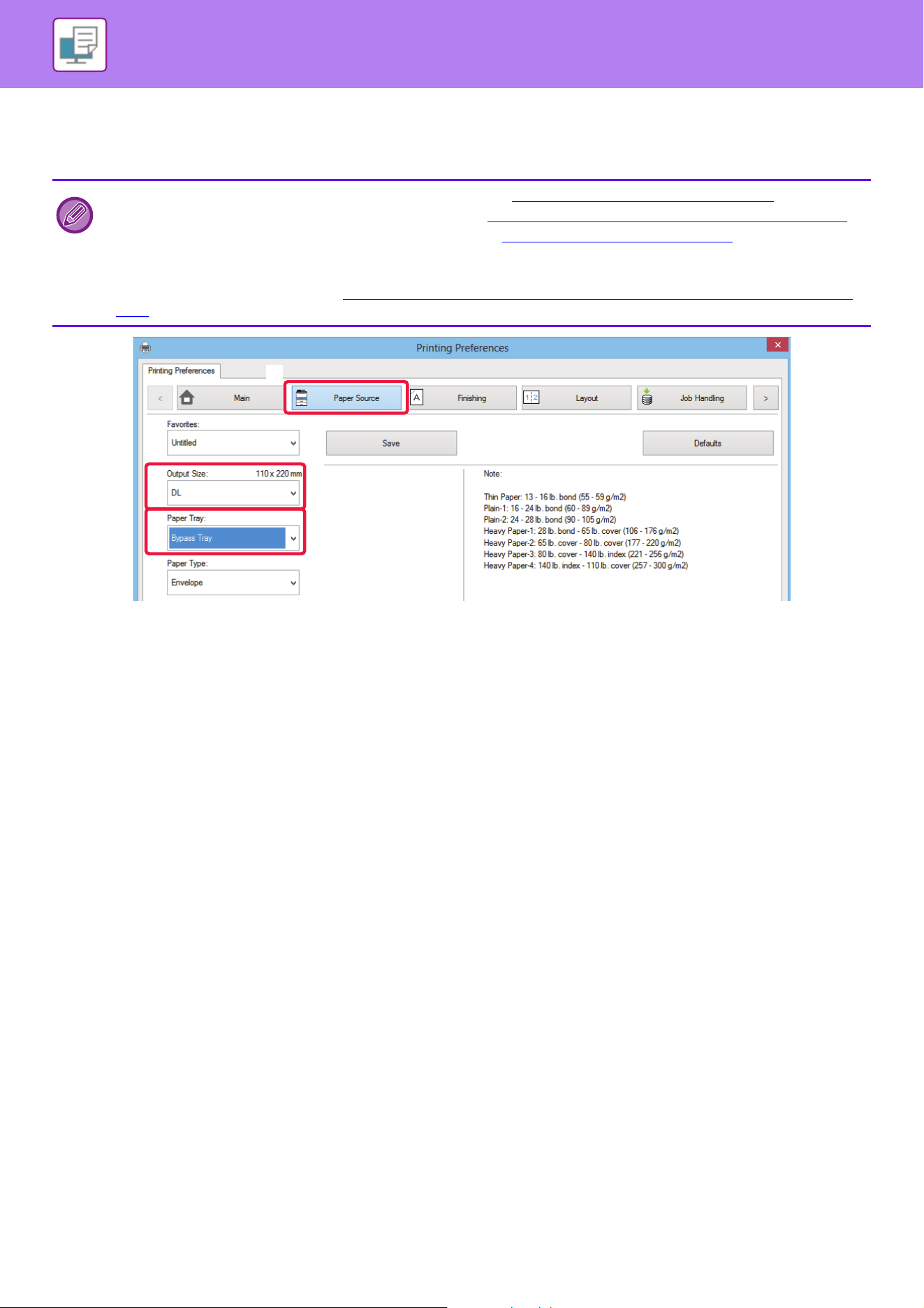
3-8
PRINTER►PRINTING IN A WINDOWS ENVIRONMENT
PRINTING ON ENVELOPES
The bypass tray can be used for envelope printing.
(1) Click the [Paper Source] tab.
(2) Select the envelope size from the "Output Size" menu.
When [Output Size] is set to envelope, [Paper Type] is automatically set to [Envelope].
When "Original Size" is set to envelope on the [Main] tab and "Output Size" is set to [Same as Original Size], "Paper Type" is
automatically set to [Envelope].
(3) Select [Bypass Tray] in "Paper Tray".
When [Enable Selected Paper Type in Bypass Tray] (enabled by factory default) is enabled in "Settings (administrator)", set the
paper type of the bypass tray to [Envelope].
• For the types of paper that can be used in the bypass tray, see "APPLICABLE PAPER TYPES (page 1-61)
".
• For the procedure for loading paper in the bypass tray, see "LOADING PAPER INTO THE BYPASS TRAY (page 1-81)
".
• For more information on the procedure for loading paper, see "SELECTING THE PAPER (page 3-7)
".
• It is recommended that you carry out a test print to check the print result before using an envelope.
• When using media such as envelopes that can be loaded only in a specific orientation, you can rotate the image 180
degrees. For more information, see "ROTATING THE PRINT IMAGE 180 DEGREES (ROTATE 180 DEGREES) (page
3-44)".
(1)
(2)
(3)
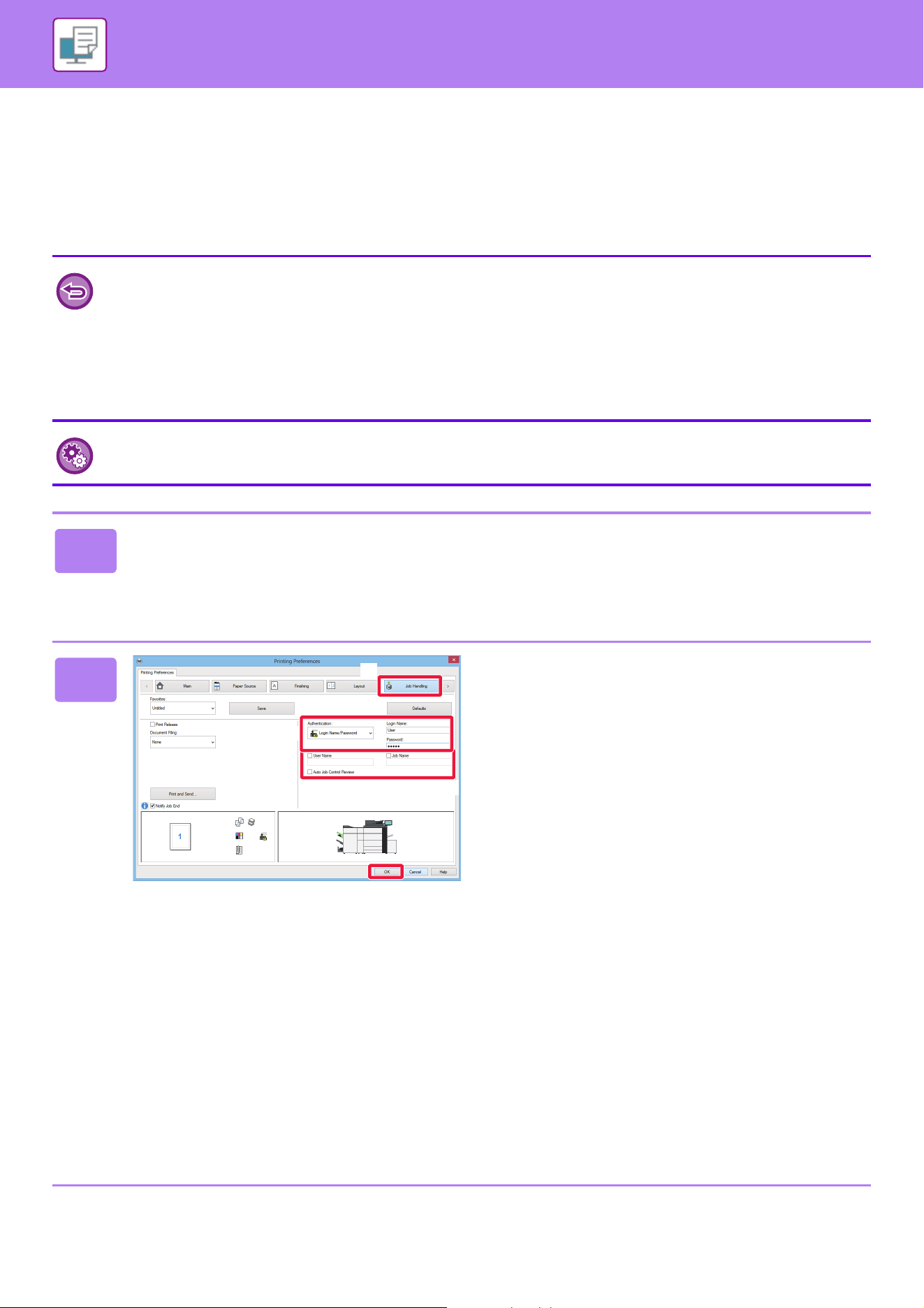
3-9
PRINTER►PRINTING IN A WINDOWS ENVIRONMENT
PRINTING WHEN THE USER
AUTHENTICATION FUNCTION IS ENABLED
The user information (such as login name and password) that must be entered varies depending on the authentication
method being used, so check with the administrator of the machine before printing.
• If you have configured "Printing Policy" on the [Configuration] tab so that user authentication is always performed, users
are required to be authenticated for each print job. This is done by entering authentication information in a dialog box that
appears each time printing is performed.
• The machine's user authentication function cannot be used when the PPD driver
*
is installed and the Windows standard
PS printer driver is used.
For this reason, the machine can be configured to prohibit users from executing printing unless their user information is
stored in the machine.
* The PPD driver enables the machine to print using the Windows standard PS printer driver.
To prohibit printing by users whose user information is not stored in the machine:
In "Settings (administrator)", select [User Control] → [Default Settings] → [Disable Printing by Invalid User].
1
In the printer driver properties window of the application, select the printer
driver of the machine and click the [Preferences] button.
The button that is used to open the printer driver properties window (usually [Property] or [Preferences]) may vary
depending on the application.
2
Enter your user information.
(1) Click the [Job Handling] tab.
(2) Enter your user information.
• When authentication is performed by login name,
select [Login Name] and enter your login name.
• When authentication is performed by login
name/password, click [Login Name/Password] and
enter your login name and password. Enter the
password using 1 to 32 characters.
•
When authentication is performed by user number, select
[User Number] and enter your 5 to 8 digit user number.
(3) Enter the user name and job name as
necessary.
• Click the [User Name] checkbox, and enter your user
name using up to 32 characters. The entered user
name will appear on the touch panel of the machine.
If you do not enter a user name, your PC login name
will appear.
• Click the [Job Name] checkbox, and enter a job
name using up to 30 characters. The entered job
name will appear as a file name on the touch panel
of the machine. If you do not enter a job name, the
file name set in the application will appear.
•
To have a confirmation window appear before printing
starts, select the [Auto Job Control Review] checkbox.
(4) Click the [OK] button to execute printing.
(2)
(1)
(3)
(4)
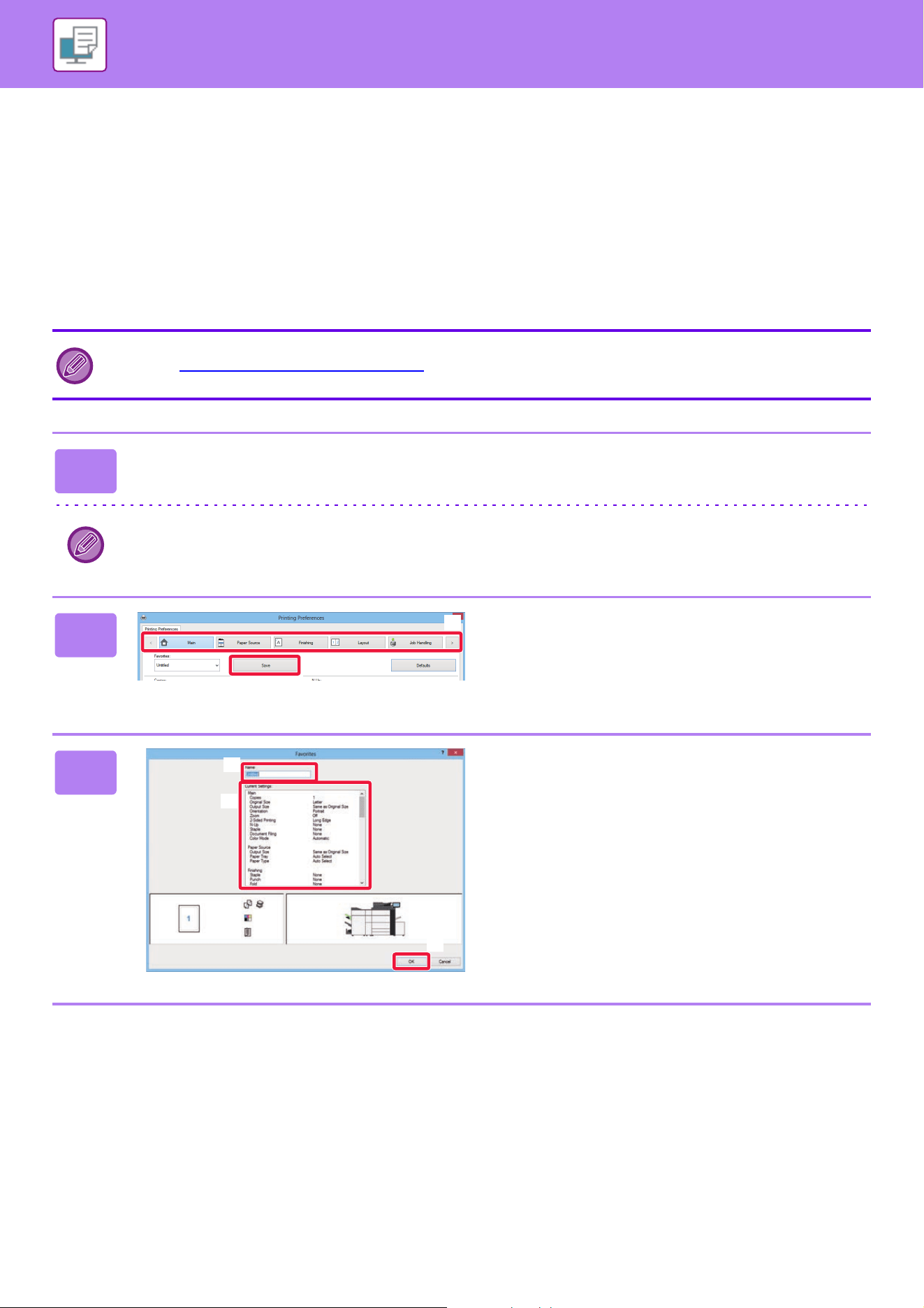
3-10
PRINTER►PRINTING IN A WINDOWS ENVIRONMENT
FREQUENTLY USED FUNCTIONS
SAVING SETTINGS AT THE TIME OF PRINTING
Settings configured on each of the tabs at the time of printing can be saved as Favorite. Saving frequently used settings
or complex color settings under an assigned name makes it easy to select those settings the next time you need to use
them.
Settings can be saved from any tab of the printer driver properties window. Settings configured on each tab are listed at
the time of saving, allowing you to check the settings as you save them.
Deleting saved settings
In step 2 of "USING SAVED SETTINGS (page 3-11)
", select the user settings that you want to delete and click the [Delete]
button.
1
Select the machine's printer driver from the print window of the application,
and click the [Preferences] button.
The button that is used to open the printer driver properties window (usually [Property] or [Preferences]) may vary
depending on the application.
2
Register Print Settings.
(1) Configure the print settings on each tab.
(2) Click the [Save] button.
3
Check and save the settings.
(1) Check the displayed settings.
(2) Enter a name for the settings using up to
20 characters.
(3) Click the [OK] button.
(2)
(1)
(2)
(1)
(3)
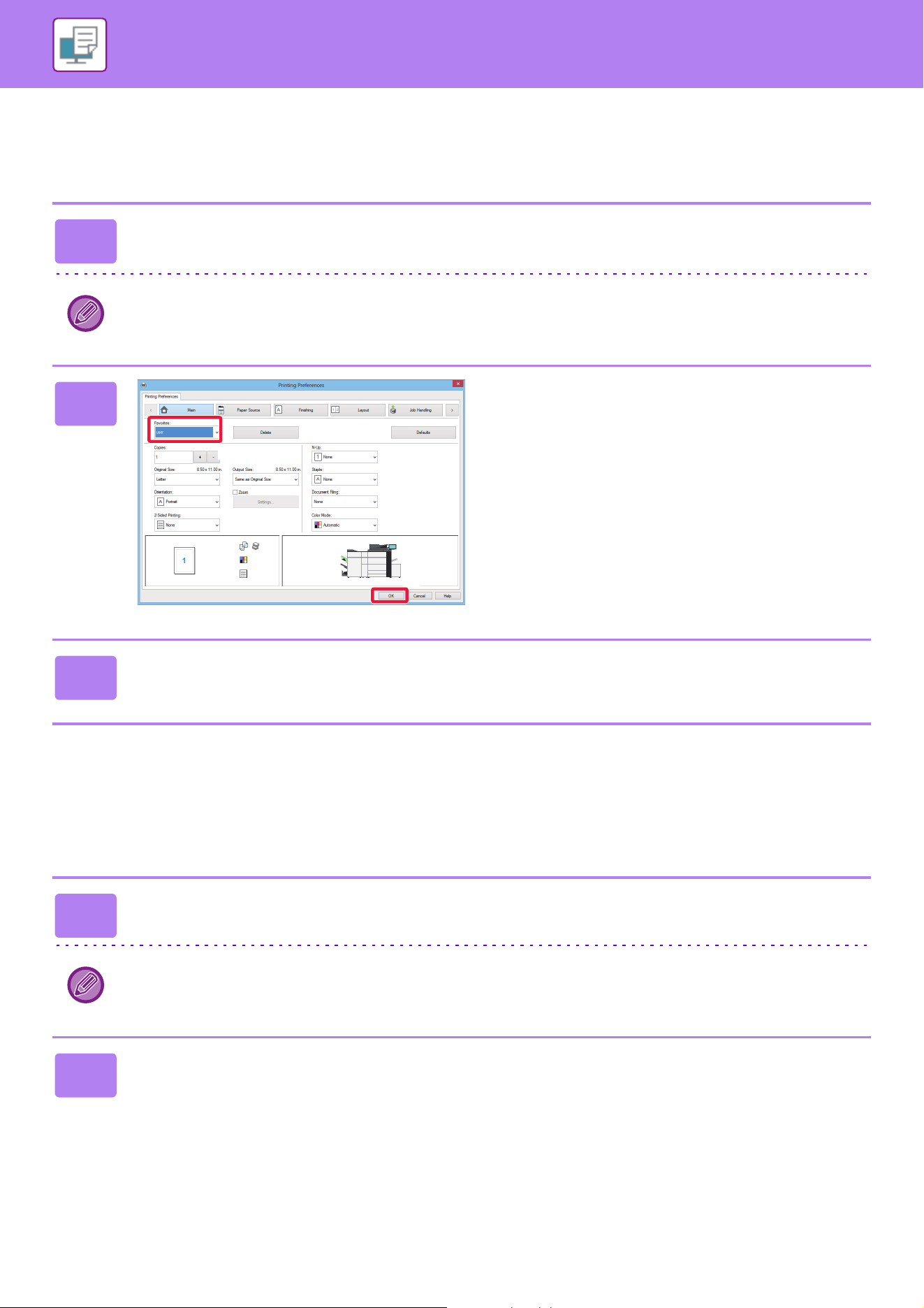
3-11
PRINTER►PRINTING IN A WINDOWS ENVIRONMENT
USING SAVED SETTINGS
You can specify the saved favorites through just one click to apply frequently used settings or complicated color settings
to your printing.
CHANGING THE PRINTER DRIVER DEFAULT SETTINGS
You can change the default settings of the printer driver.
Changes you have made in the printer driver properties window when you execute printing from the application are
returned to the default settings specified here when you exit the application.
1
Select the machine's printer driver from the print window of the application,
and click the [Preferences] button.
The button that is used to open the printer driver properties window (usually [Property] or [Preferences]) may vary
depending on the application.
2
Select favorite settings.
(1) Select the favorite settings you want to
use.
(2) Click the [OK] button.
3
Start printing.
1
Right-click the [Start] button and select [Control Panel].
In Windows 7, click the [Start] button, select [Devices and Printers], right-click the printer driver icon of the machine, and
click [Printer Properties].
2
Click [View devices and printers] in [Hardware and Sound].
(1)
(2)
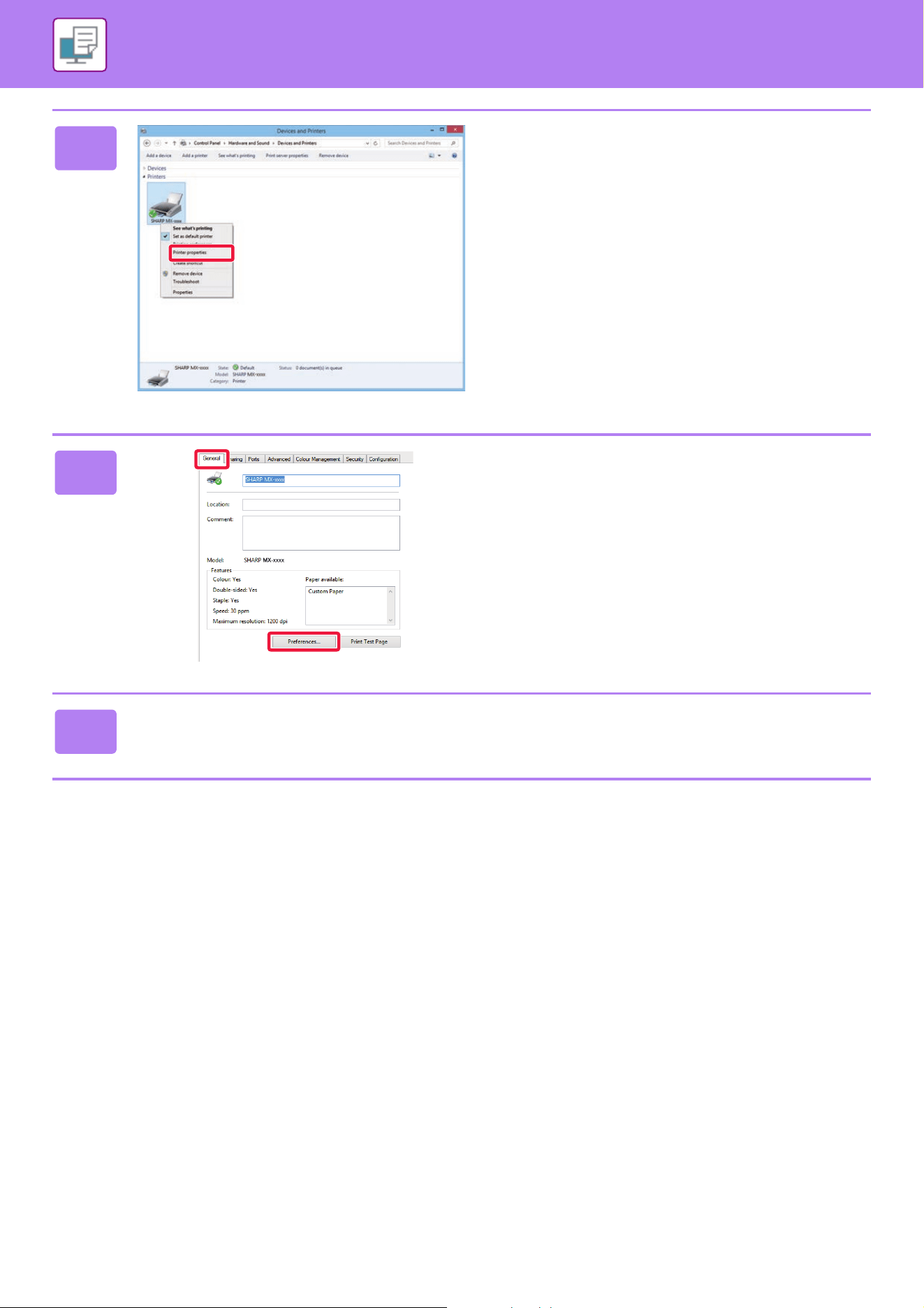
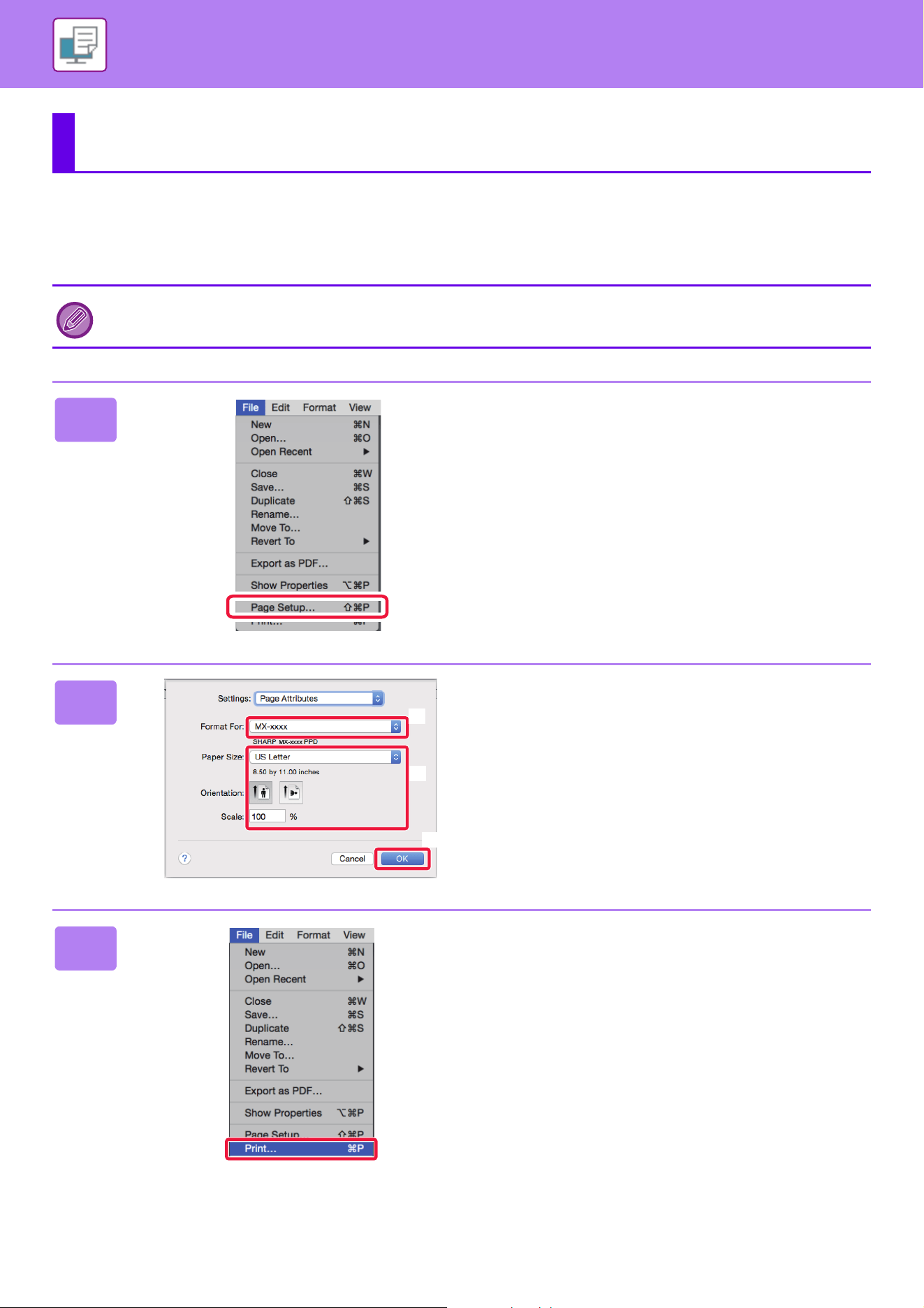
3-13
PRINTER►PRINTING IN A Mac OS ENVIRONMENT
BASIC PRINTING PROCEDURE
The following example explains how to print a document from the standard accessory application "TextEdit" in Mac OS X.
PRINTING IN A Mac OS ENVIRONMENT
• To install the printer driver and configure settings in a Mac OS environment, see the Software Setup Guide.
• The menu used to execute printing may vary depending on the application.
1
Select [Page Setup] from the [File]
menu and select the printer.
If the printer drivers appear as a list, select the name of the
printer driver to be used from the list.
2
Select paper settings.
(1) Make sure that the correct printer is
selected.
(2) Select paper settings.
Paper size, paper orientation, and enlarge/reduce
settings can be selected.
(3) Click the [OK] button.
3
Select [Print] from the [File] menu.
(1)
(2)
(3)
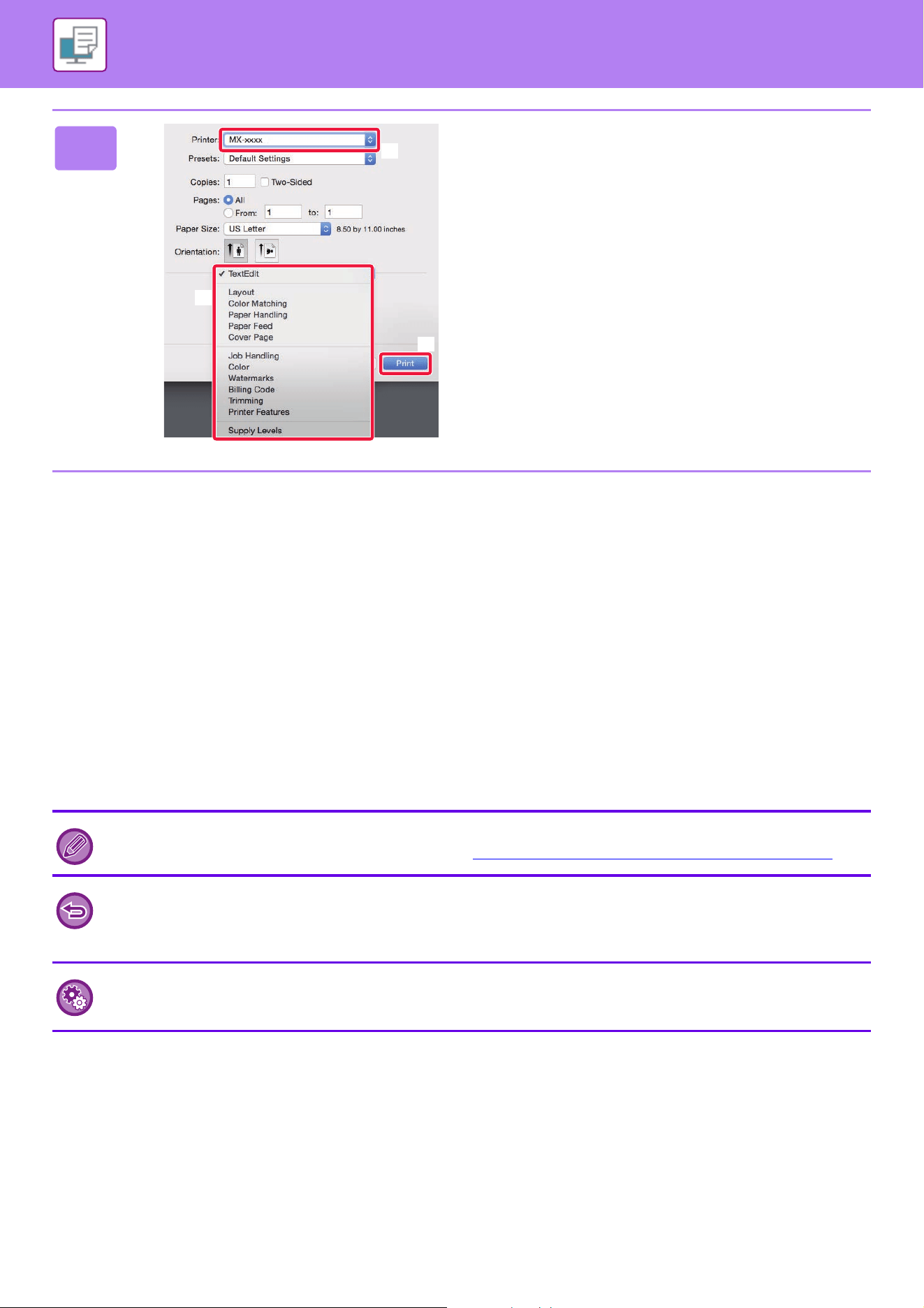
3-14
PRINTER►PRINTING IN A Mac OS ENVIRONMENT
SELECTING THE PAPER
This section explains the [Paper Feed] settings in the print settings window.
• When [Auto Select] is selected:
A tray that is set for plain or recycled paper (only plain paper in the factory default setting) of the size specified in
"Paper Size" on the page setup screen is automatically selected.
• When a paper tray is specified:
The specified tray is used for printing regardless of the "Paper Size" setting on the page setup screen.
For the bypass tray, also specify the paper type. Check that the paper type that is set for the bypass tray of the
machine, check that paper of that type is actually loaded into the bypass tray, and then select the appropriate bypass
tray (paper type).
• When a paper type is specified:
A tray with the specified type of paper and the size specified in "Paper Size" on the page setup screen is used for
printing.
4
Select print settings.
(1) Make sure that the correct printer is
selected.
(2) Select an item from the menu and
configure the settings as needed.
(3) Click the [Print] button.
Special media can also be placed in the bypass tray.
For the procedure for loading paper in the bypass tray, see "LOADING PAPER INTO THE BYPASS TRAY (page 1-81)
".
When [Enable Detected Paper Size in Bypass Tray] (disabled by factory default) or [Enable Selected Paper Type in Bypass
Tray] (enabled by factory default), which you can reach by selecting [System Settings] in "Settings (administrator)" → [Printer
Settings] → [Condition Settings] → [Bypass Tray Settings] is enabled, printing will not take place if the paper size or paper
type specified in the printer driver is different from the paper size or paper type specified in the settings of the bypass tray.
To exclude the bypass tray from the trays that can be selected when [Auto Select] is selected:
In "Settings (administrator)", select [System Settings] → [Printer Settings] → [Condition Settings] → [Bypass Tray Settings]
→ [Exclude Bypass-Tray from Auto Paper Select].
(1)
(2)
(3)
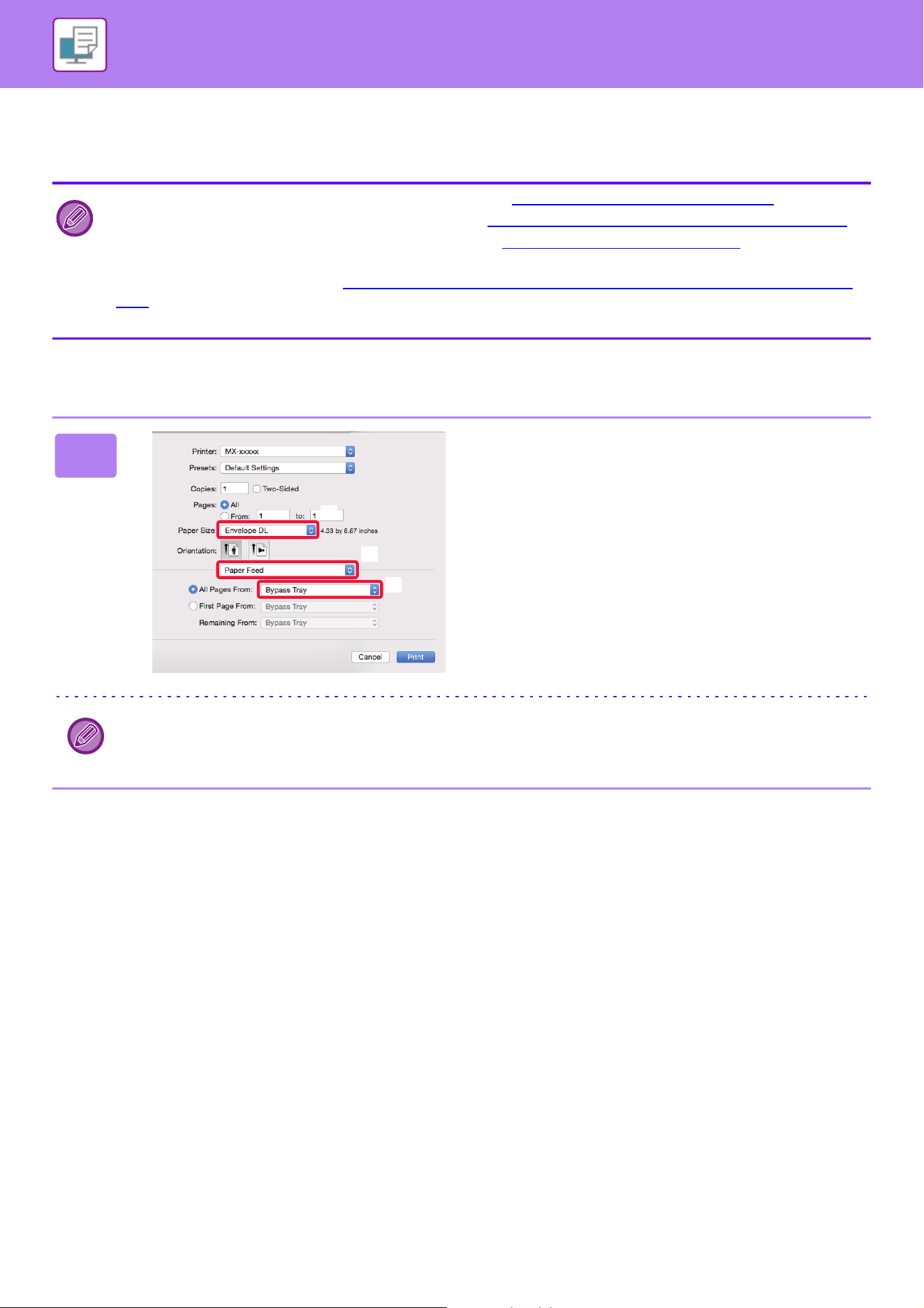
3-15
PRINTER►PRINTING IN A Mac OS ENVIRONMENT
PRINTING ON ENVELOPES
The bypass tray can be used for envelope printing.
Select the envelope size in the settings of the application ("Page Setup" in many applications) and then perform the
following steps.
• For the types of paper that can be used in the bypass tray, see "APPLICABLE PAPER TYPES (page 1-61)".
• For the procedure for loading paper in the bypass tray, see "LOADING PAPER INTO THE BYPASS TRAY (page 1-81)
".
• For more information on the procedure for loading paper, see "SELECTING THE PAPER (page 3-14)
".
• When using media such as envelopes that can be loaded only in a specific orientation, you can rotate the image 180
degrees. For more information, see "ROTATING THE PRINT IMAGE 180 DEGREES (ROTATE 180 DEGREES) (page
3-44)".
• It is recommended that you carry out a test print to check the print result before using an envelope.
1
Select print settings.
(1) Select the envelope size from the "Paper
Size" menu.
(2) Select [Paper Feed].
(3) Select the [Bypass Tray] from the "All
Pages From" menu.
When [Enable Selected Paper Type in Bypass Tray] (enabled by factory default) is enabled in "Settings (administrator)",
set the paper type of the bypass tray to [Envelope].
(2)
(1)
(3)
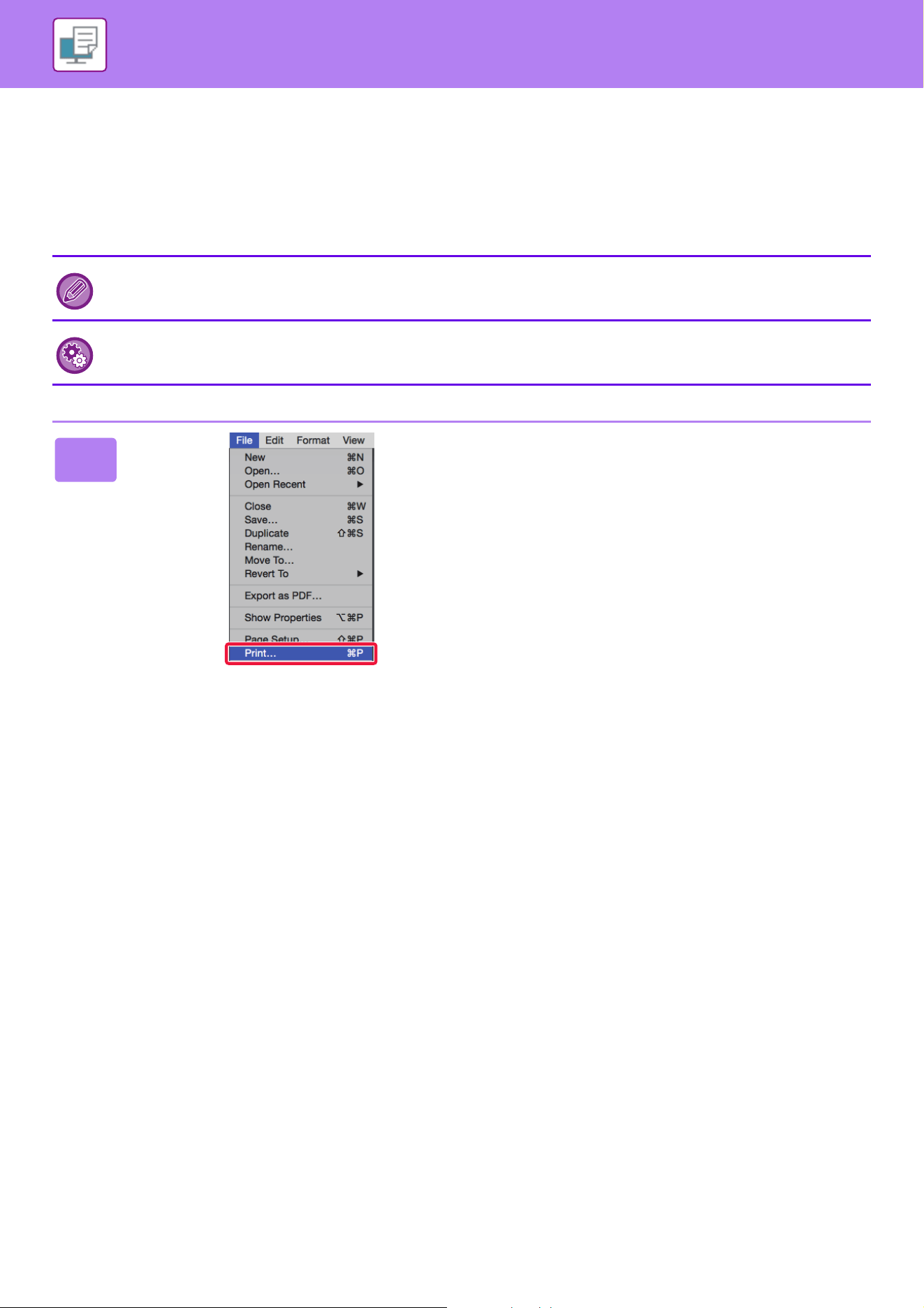
3-16
PRINTER►PRINTING IN A Mac OS ENVIRONMENT
PRINTING WHEN THE USER
AUTHENTICATION FUNCTION IS ENABLED
The user information (such as login name and password) that must be entered varies depending on the authentication
method being used, so check with the administrator of the machine before printing.
The menu used to execute printing may vary depending on the application.
To prohibit printing by users whose user information is not stored in the machine:
In "Settings (administrator)", select [User Control] → [Default Settings] → [Disable Printing by Invalid User].
1
In the application, select [Print] from
the [File] menu.
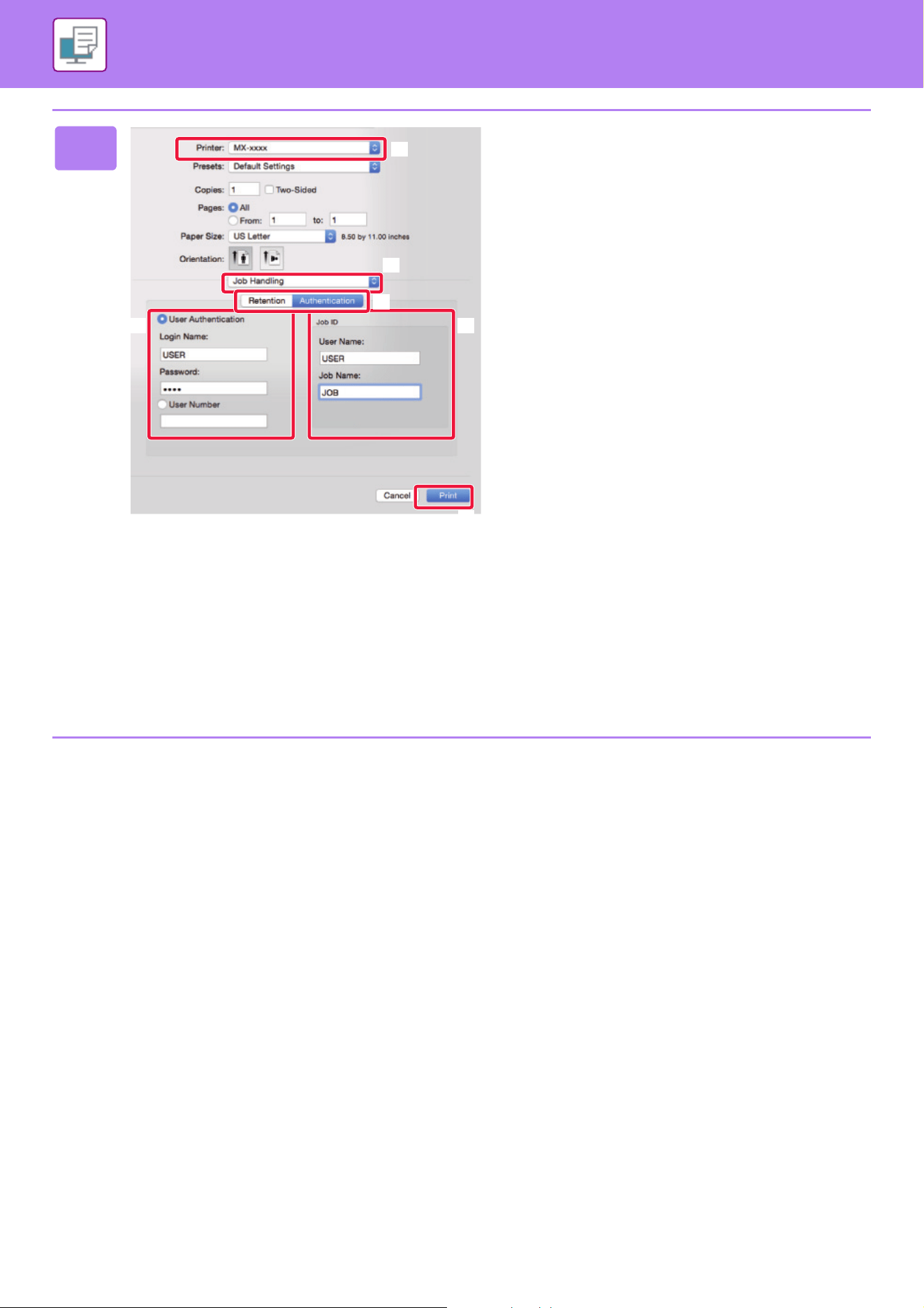
3-17
PRINTER►PRINTING IN A Mac OS ENVIRONMENT
2
Enter your user information.
(1) Make sure that the machine's printer
name is selected.
(2) Select [Job Handling].
(3) Click the [Authentication] tab.
(4) Enter your user information.
• When authentication is carried out using the login
name/password, enter your login name in "Login
Name" and your password (1 to 32 characters) in
"Password".
• When authentication is carried out using the user
number, enter your user number (5 to 8 digits) in
"User Number".
(5) Enter the user name and job name as
necessary.
•User Name
Enter your user name using up to 32 characters. The
entered user name will appear on the touch panel of
the machine. If you do not enter a user name, your
PC login name will appear.
•Job Name
Enter a job name using up to 32 characters. The
entered job name will appear as a file name on the
touch panel of the machine. If you do not enter a job
name, the file name set in the application will
appear.
(6) Click the [Print] button.
(3)
(4)
(1)
(2)
(5)
(6)
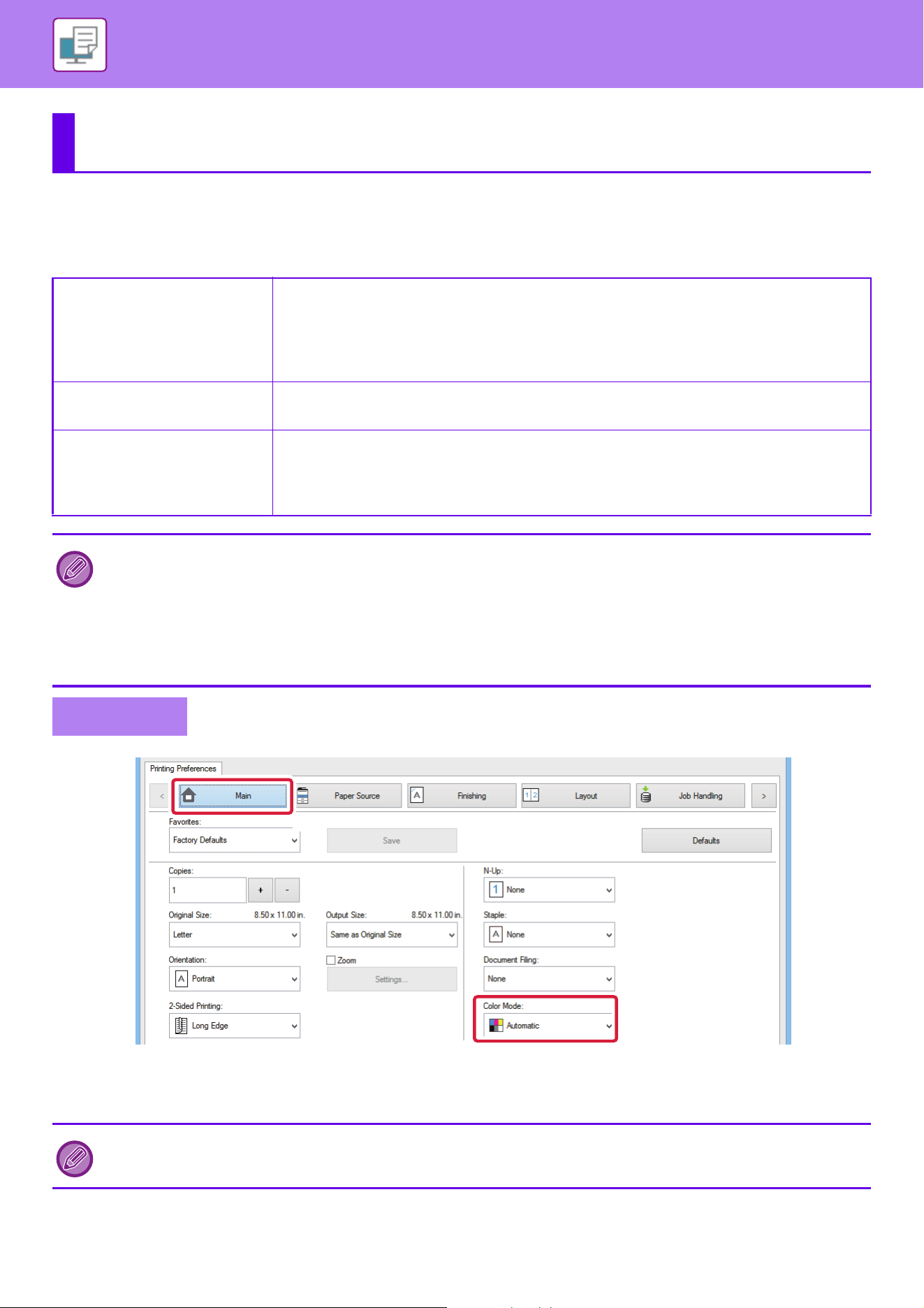
3-18
PRINTER►FREQUENTLY USED FUNCTIONS
SELECTING THE COLOR MODE
The following three selections are available for the "Color Mode" (a set of colors used for printing):
(1) Click the [Main] tab.
(2) Select "Color Mode".
FREQUENTLY USED FUNCTIONS
Automatic
The machine automatically determines whether each page is color or black and white and
prints the page accordingly. Pages with colors other than black and white are printed using Y
(Yellow), M (Magenta), C (Cyan) and Bk (Black) toner. Pages that are only black and white
are printed using Bk (Black) toner only. This is convenient when printing a document that has
both color and black and white pages, however, the printing speed is slower.
Color
All pages are printed in color. Both color data and black and white data are printed using Y
(Yellow), M (Magenta), C (Cyan) and Bk (Black) toner.
Black and White
All pages are printed in black and white. Color data such as images or materials for a
presentation is printed using black toner only. This mode helps conserve color toner when
you do not need to print in color, such as when proofreading or checking the layout of a
document.
When "Color Mode" is set to [Automatic]:
Even if the print result is black and white, the following types of print jobs will be counted as 4-color (Y (Yellow), M (Magenta),
C (Cyan), and Bk (Black)) print jobs.
When you want such jobs to be counted as black and white jobs, select [Black and White].
• When the data is created as color data.
• When the application treats the data as color data even though the data is black and white.
• When an image is hidden under a black and white image.
Windows
In addition to the [Main] tab, [Color Mode] can also be set on the [Image Quality] tab.
(2)
(1)
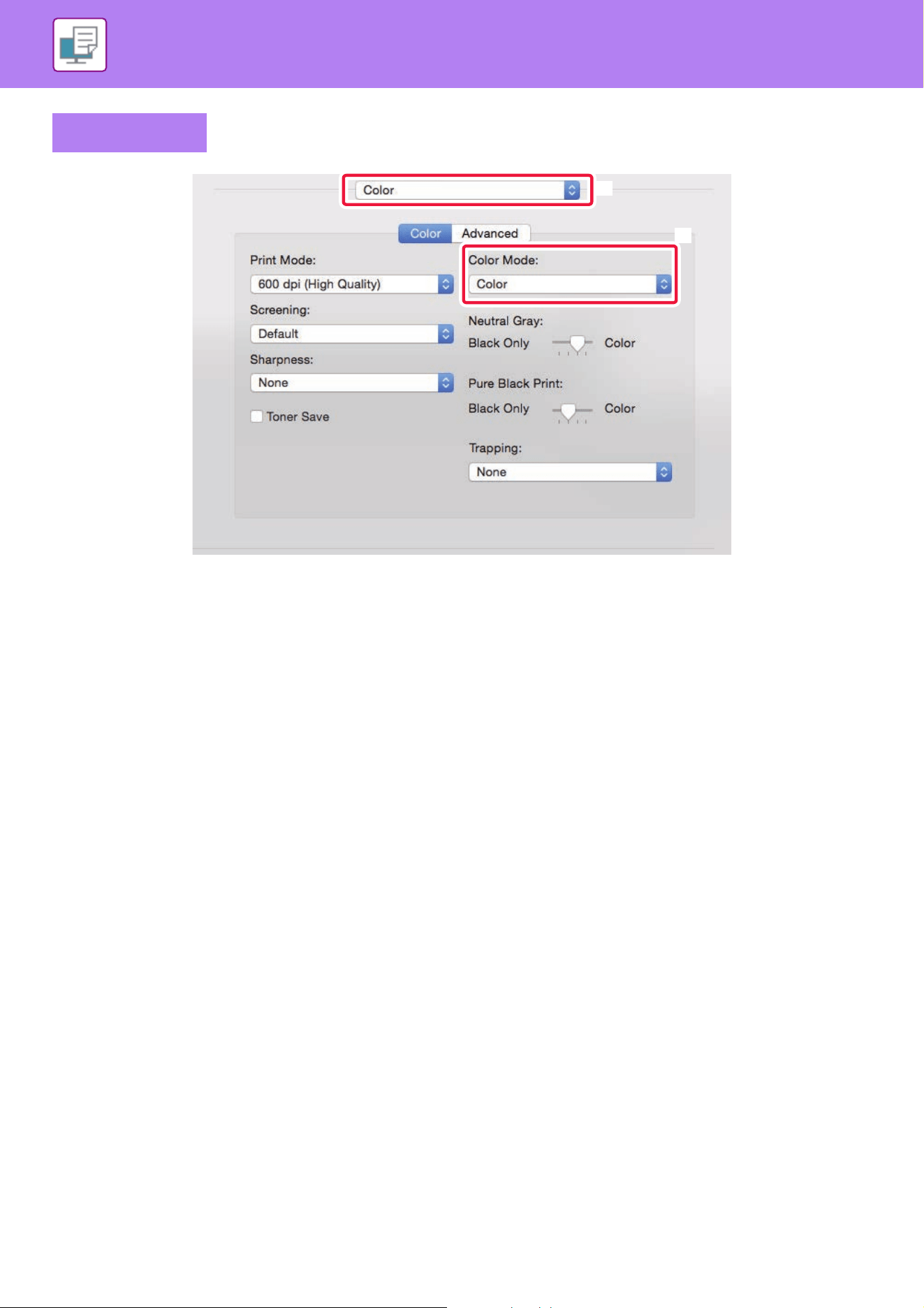
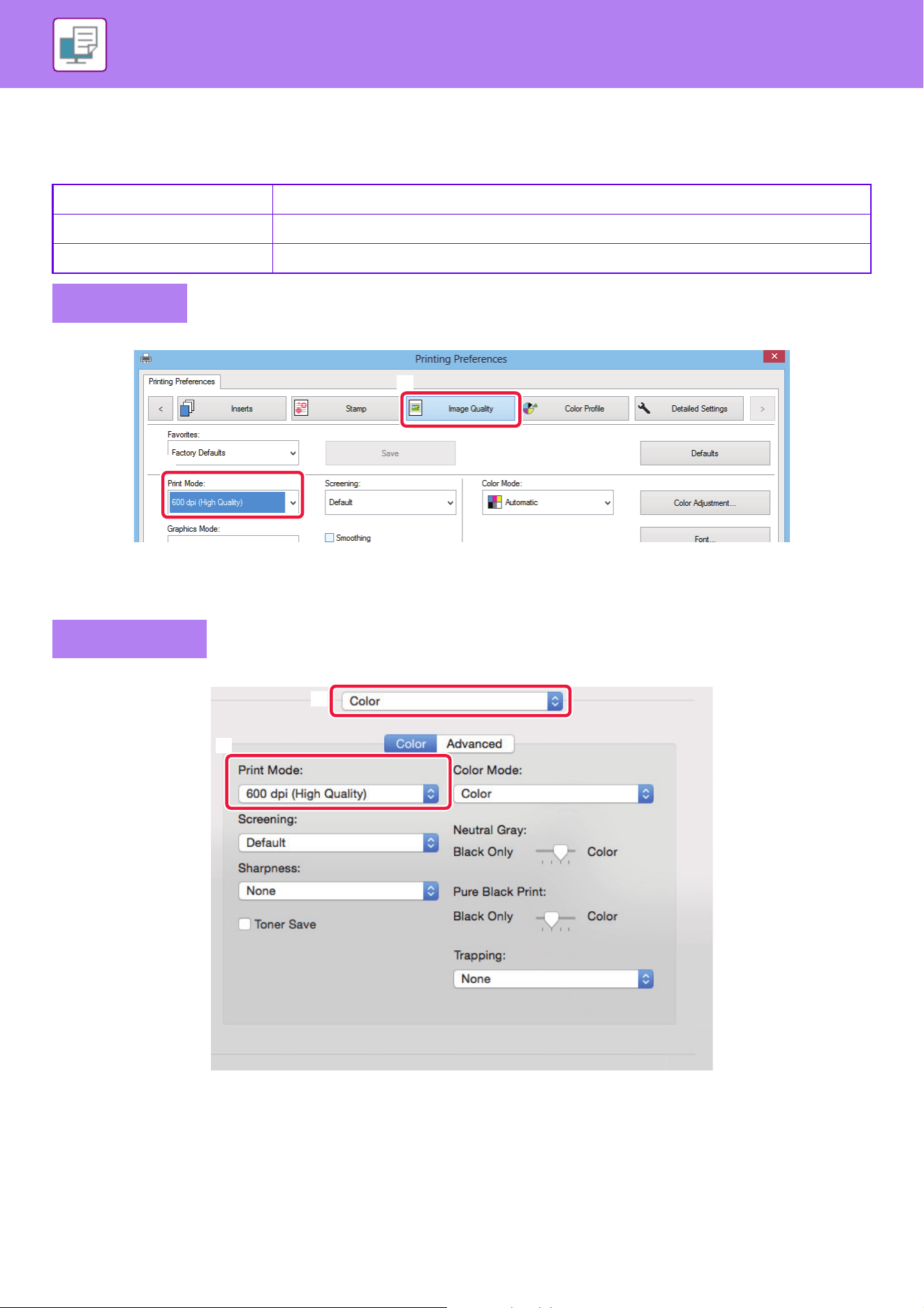
3-20
PRINTER►FREQUENTLY USED FUNCTIONS
SELECTING THE RESOLUTION
The following three selections are available for "Print Mode" (resolution):
(1) Click the [Image Quality] tab.
(2) Select "Print Mode".
(1) Select [Color].
(2) Select "Print Mode".
600 dpi This mode is suitable for printing data such as regular text or a table.
600 dpi (High Quality) The print quality of color photos and text are high.
1200 dpi Select this mode to print color photos with higher definition, and to print fine lines clearly.
Windows
Mac OS
(2)
(1)
(1)
(2)
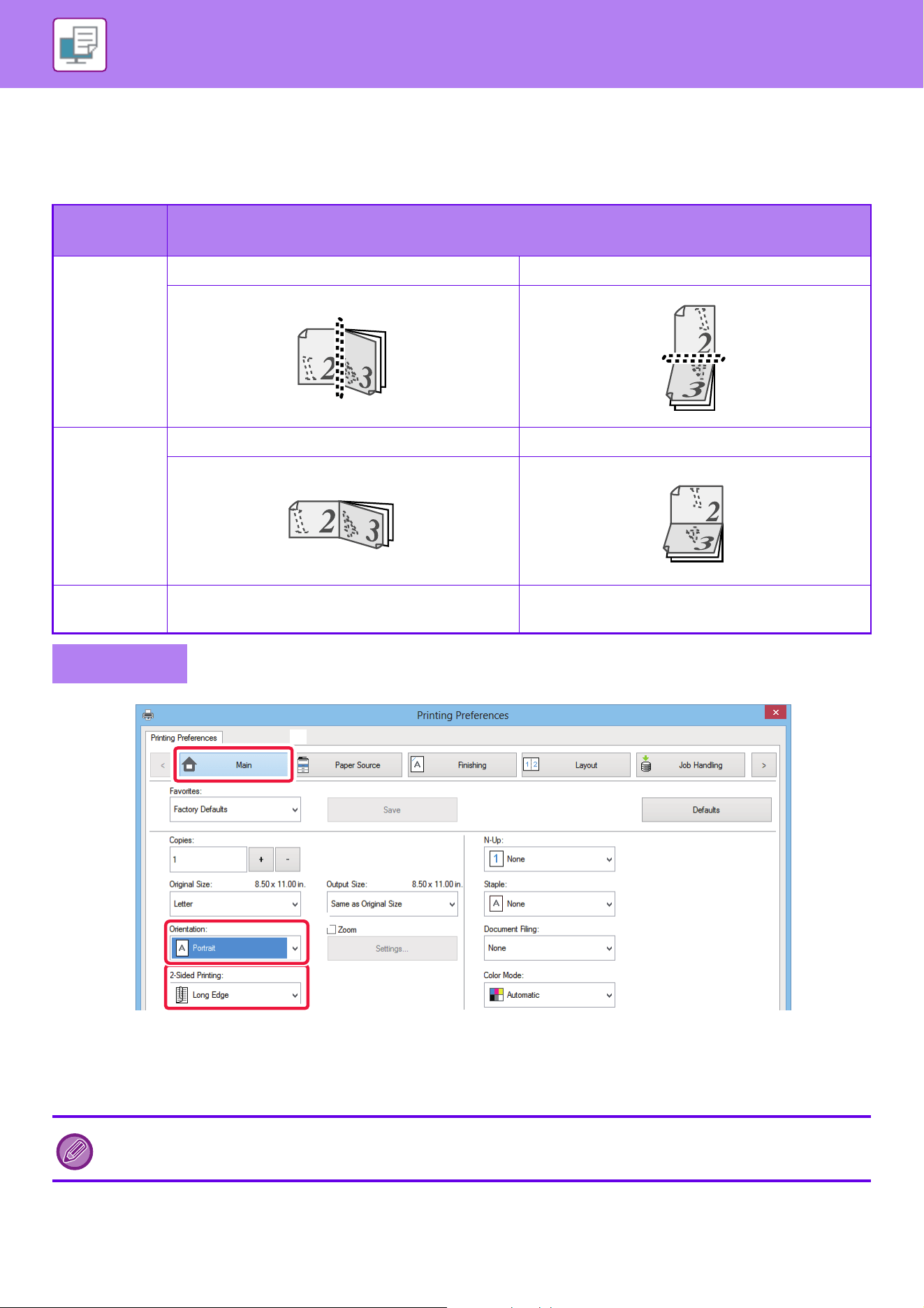
3-21
PRINTER►FREQUENTLY USED FUNCTIONS
2-SIDED PRINTING
The machine can print on both sides of the paper. This function is useful for many purposes, and is particularly
convenient when you want to create a simple pamphlet. 2-sided printing also helps conserve paper.
(1) Click the [Main] tab.
(2) Select the paper orientation.
(3) Select [Long Edge] or [Short Edge].
Paper
orientation
Print results
Portrait
Long Edge Short Edge
Landscape
Short Edge Long Edge
The pages are printed so that they can be bound at
the left or right side.
The pages are printed so that they can be bound at
the top.
Windows
If necessary, you can select the method of implementing 2-sided printing. Click the [Other Settings] button on the [Detailed
Settings] tab, and select the mode from "Duplex Style".
(2)
(3)
(1)
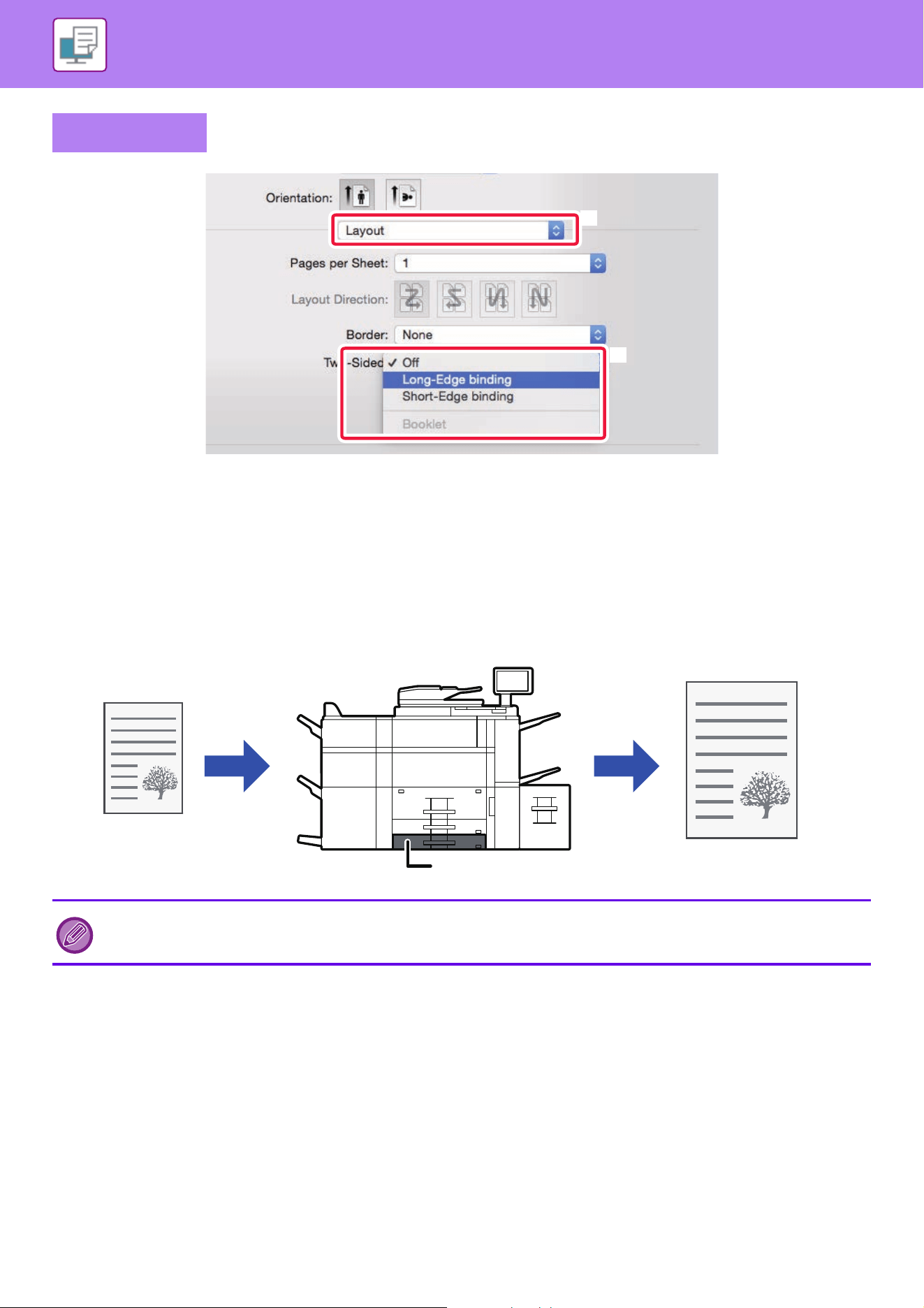
3-22
PRINTER►FREQUENTLY USED FUNCTIONS
(1) Select [Layout].
(2) Select [Long-Edge binding] or [Short-Edge binding].
FITTING THE PRINT IMAGE TO THE PAPER
This function automatically enlarges or reduces the print image to match the size of the paper loaded in the machine.
This function is convenient when enlarging a letter or A4 size document to ledger or A3 size to make it easier to view, or
when printing a document on paper that is different in size from the original document.
The following example explains how to print a letter
(or A4) size document on ledger (or A3) size paper.
Mac OS
If A0, A1, or A2 size is selected in "Original Size", Letter (or A4) is automatically selected in "Output Size".
(2)
(1)
Ledger (A3)
Letter (A4)
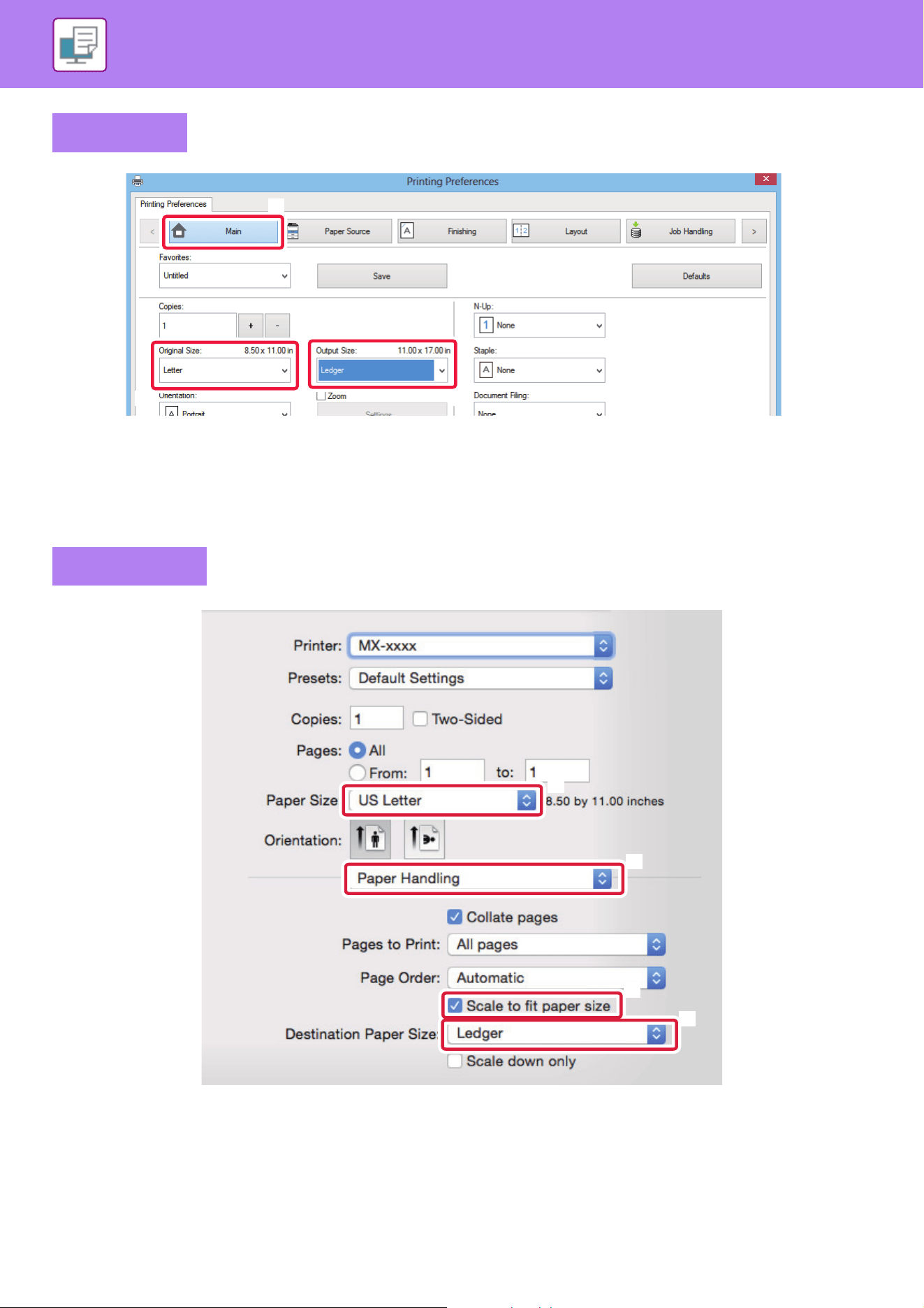
3-23
PRINTER►FREQUENTLY USED FUNCTIONS
(1) Click the [Main] tab.
(2) Select the original size from [Original Size] (for example: Letter).
(3) Select the actual paper size to be used for printing from [Output Size] (for example: Ledger).
If the output size is larger than the original size, the printed image will be automatically enlarged.
(1) Check the paper size for the print image (for example: Letter).
(2) Select [Paper Handling].
(3) Select [Scale to fit paper size].
(4) Select the actual paper size to be used for printing (for example: Ledger).
Windows
Mac OS
(2)
(1)
(3)
(2)
(1)
(3)
(4)
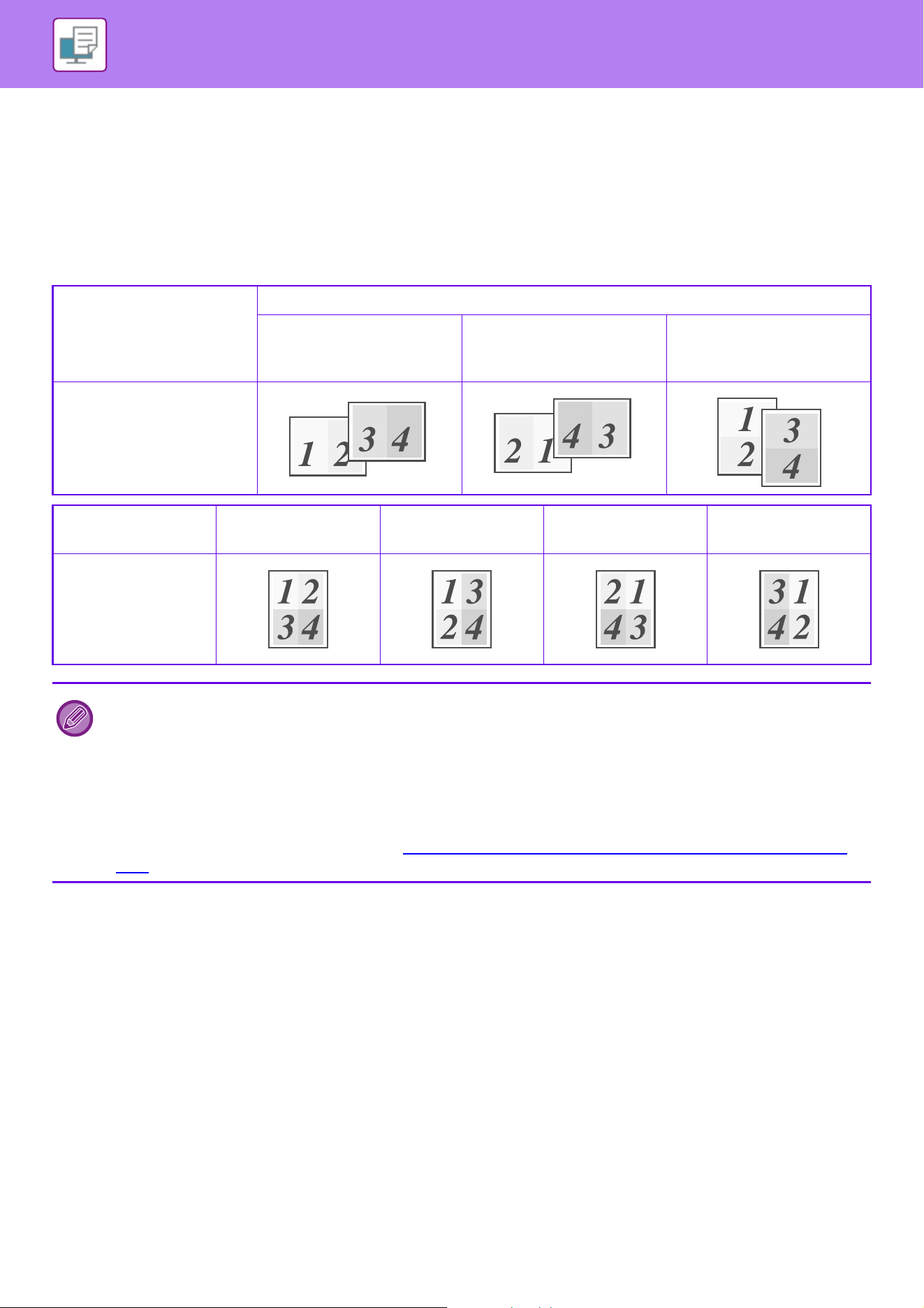
3-24
PRINTER►FREQUENTLY USED FUNCTIONS
PRINTING MULTIPLE PAGES ON ONE PAGE
This function reduces the print image and prints multiple pages on a single sheet of paper. You can print only the first
page in the original size and print multiple reduced pages on the subsequent sheets.
For example, when [2-Up] (2 pages per sheet) or [4-Up] (4 pages per sheet) is selected, the following print results will be
obtained, depending on the selected page order.
This is convenient when you want to print multiple images such as photos on a single sheet of paper, and when you
want to conserve paper. When used in combination with 2-sided printing, this function saves more paper.
N-Up
(Pages per sheet)
Print results
Left to Right Right to Left
Top To Bottom
(When the print orientation is
landscape)
2-Up
(2 pages per sheet)
N-Up
(Pages per sheet)
Right, and Down Down, and Right Left, and Down Down, and Left
4-Up
(4 pages per sheet)
• [N-Up] that can be set on the [Layout] tab can also be set on the [Main] tab. ("Order" can only be set in the [Layout] tab.)
• Note the following when printing multiple pages on one sheet:
• The page orders for 6-Up, 8-Up, 9-Up, and 16-Up are the same as for 4-Up.
• In a Windows environment, the page order can be viewed in the print image in the printer driver properties window.
• In a Mac OS environment, the page orders are displayed as selections.
• In a Mac OS environment, the number of pages that can be printed on a single sheet is 2, 4, 6, 9, or 16. Printing 8 pages
on one sheet is not supported.
• For information on the "Repeat" function, see "PRINT THE SAME IMAGE IN TILE PATTERN (REPEAT PRINT) (page
3-79)".
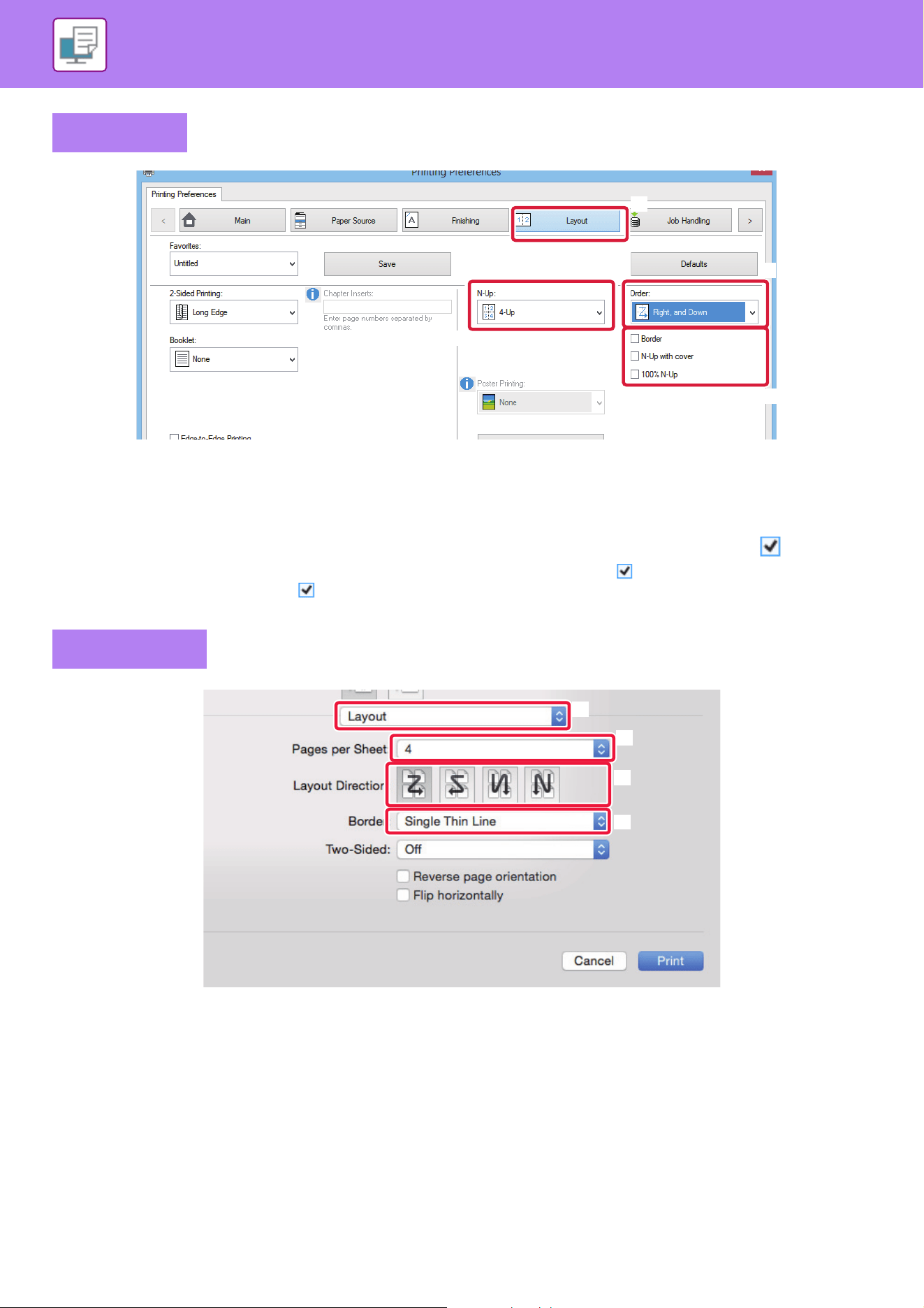
3-25
PRINTER►FREQUENTLY USED FUNCTIONS
(1) Click the [Layout] tab.
(2) Select the number of pages per sheet.
(3) Select the order of the pages.
(4) If you wish to print borderlines, click the [Border] checkbox so that the checkmark appears.
• To print the first page normally (as a cover), select the [N-Up with cover] checkbox ( ). (PCL6 only)
• When [100% N-Up] is selected ( ) for jobs such as N-Up copying of two A4 size pages onto one A3 sheet, the pages will be
printed at the full size of the original. If you select [Border] at this time, only the border will be printed.
(1) Select [Layout].
(2) Select the number of pages per sheet.
(3) Select the order of the pages.
(4) If you wish to print borderlines, select the desired type of borderline.
Windows
Mac OS
(3)
(1)
(2)
(4)
(2)
(1)
(3)
(4)
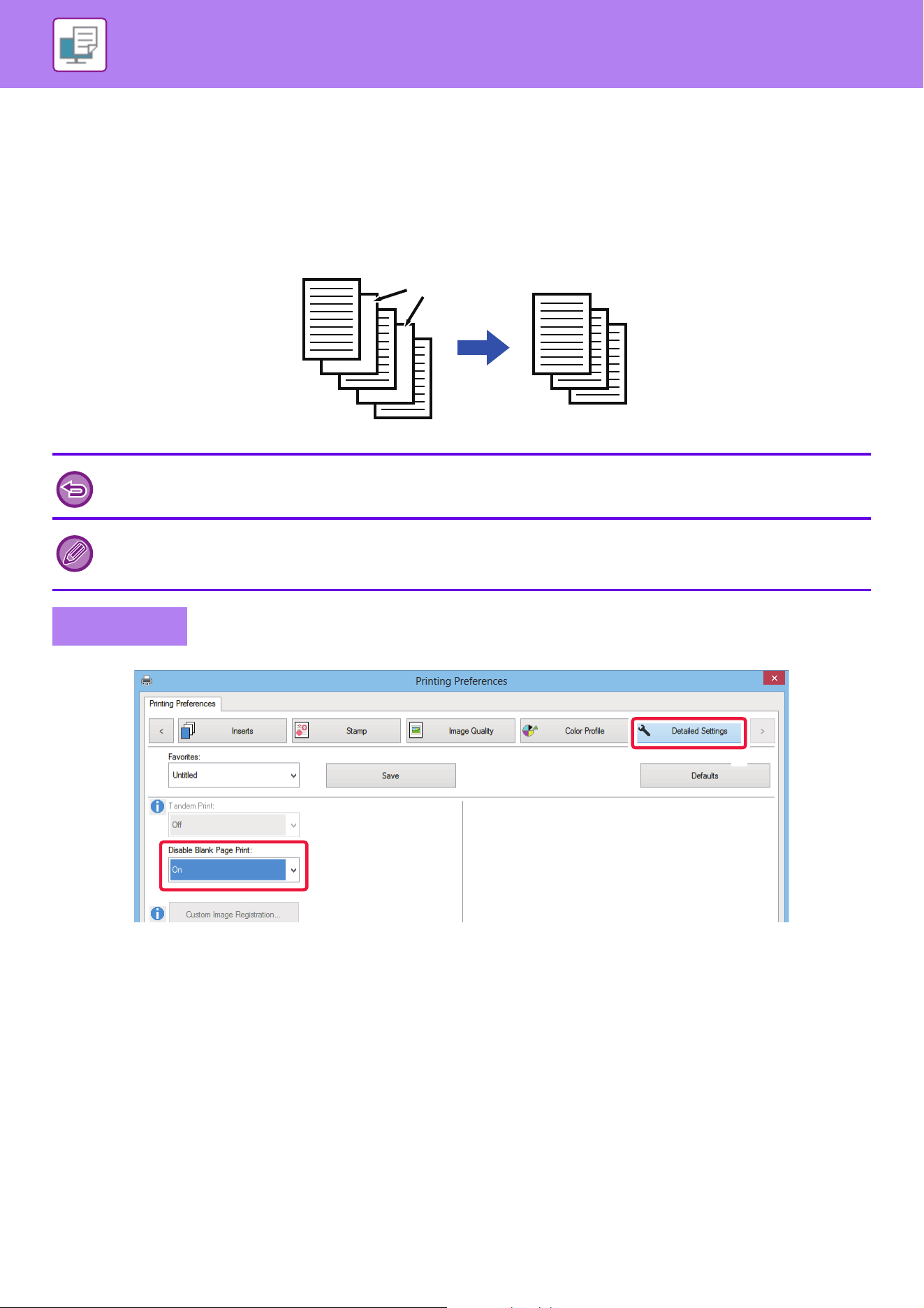
3-26
PRINTER►FREQUENTLY USED FUNCTIONS
PRINTING WHILE SKIPPING BLANK PAGES
If the scanned original contains blank pages, the blank pages are skipped during printing. The machine detects blank
pages and does not print them. This eliminates unnecessary printing without you having to check for blank pages before
printing.
(1) Click the [Detailed Settings] tab.
(2) Select [On] in [Disable Blank Page Print].
This function is available in a Windows environment.
• Depending on the state of the original, some pages that are not blank may be detected as blank pages and thus not being
printed, or some pages that are blank may not be detected as blank and thus printed.
• In N-Up Print, blank pages are not excluded and are printed.
Windows
Blank page
Print
Do not print blank pages
(2)
(1)
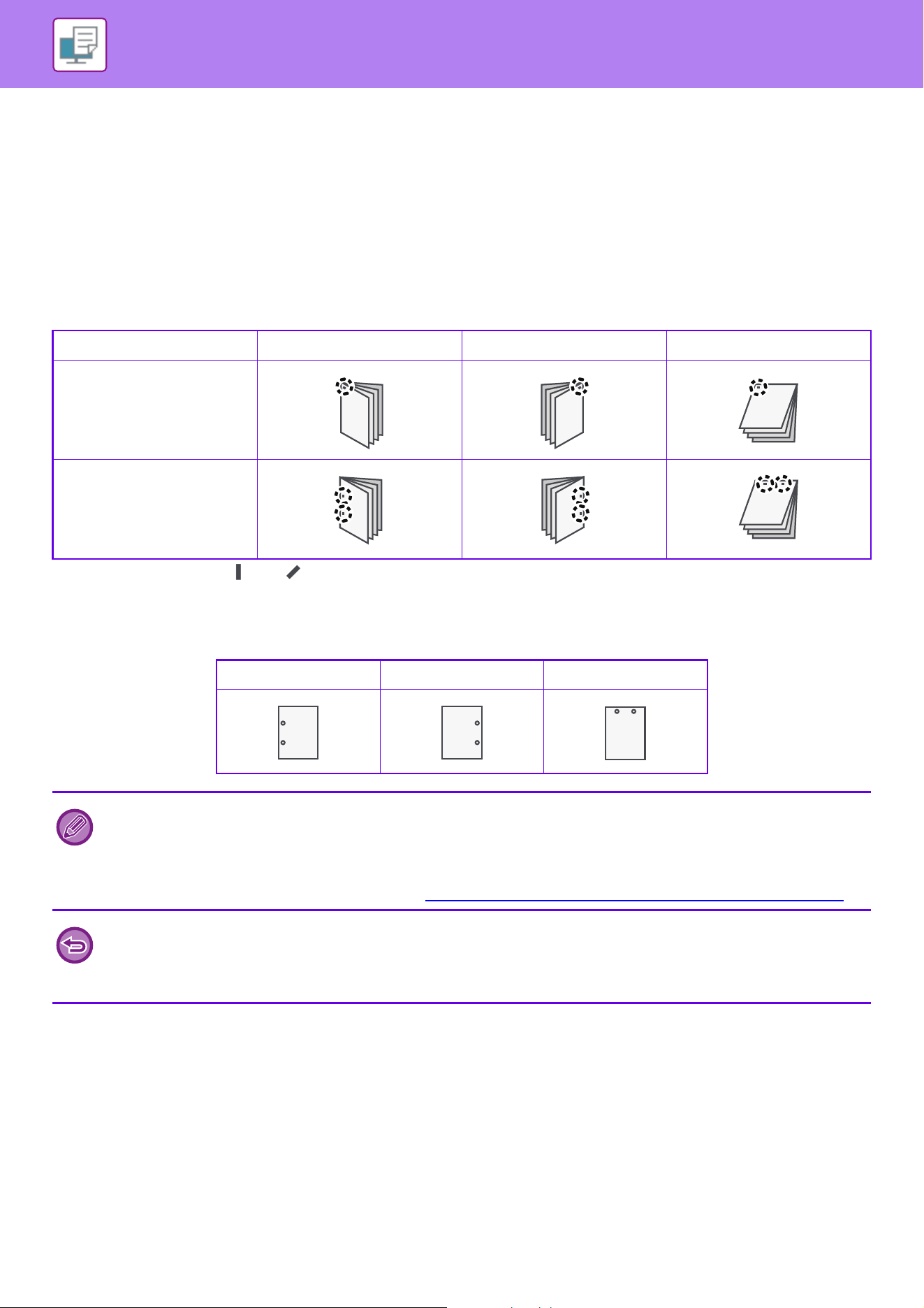
3-27
PRINTER►FREQUENTLY USED FUNCTIONS
STAPLING OUTPUT/PUNCHING HOLES IN
OUTPUT
Staple function
The staple function staples the output. To create materials with more sophisticated appearance, the staple function can
be used in combination with 2-sided printing.
This function saves considerable time when preparing handouts for a meeting or other stapled materials.
The stapling positions and the number of staples can be selected to obtain the following stapling results.
* The staple orientation (" " or " ") varies depending on the size and orientation of the paper.
Punch function
The punch function punches holes in the output. The punch hole positions are set by selecting the binding edge.
Staple Left Right Top
1 Staple*
2 Staples
Left Right Top
• A finisher or saddle stitch finisher is required to use the staple function.
• To use the punch function, installing a punch module in the finisher or saddle stitch finisher.
• For the maximum number of sheets that can be stapled, see "SPECIFICATIONS" in the Start Guide.
• The maximum number of sheets that can be stapled at once includes any covers and/or inserts that are inserted.
• For information on the saddle stitch function, see "CREATE A PAMPHLET (BOOKLET/SADDLE STITCH) (page 3-36)
".
• The staple and offset (shifting the position of the paper that is output for each job) functions cannot be used
simultaneously.
• When the finisher is disabled in the machine's settings, the staple function and punch function cannot be used.
• When the staple function or the punch function is disabled in the machine's settings, stapling or punching is not possible.
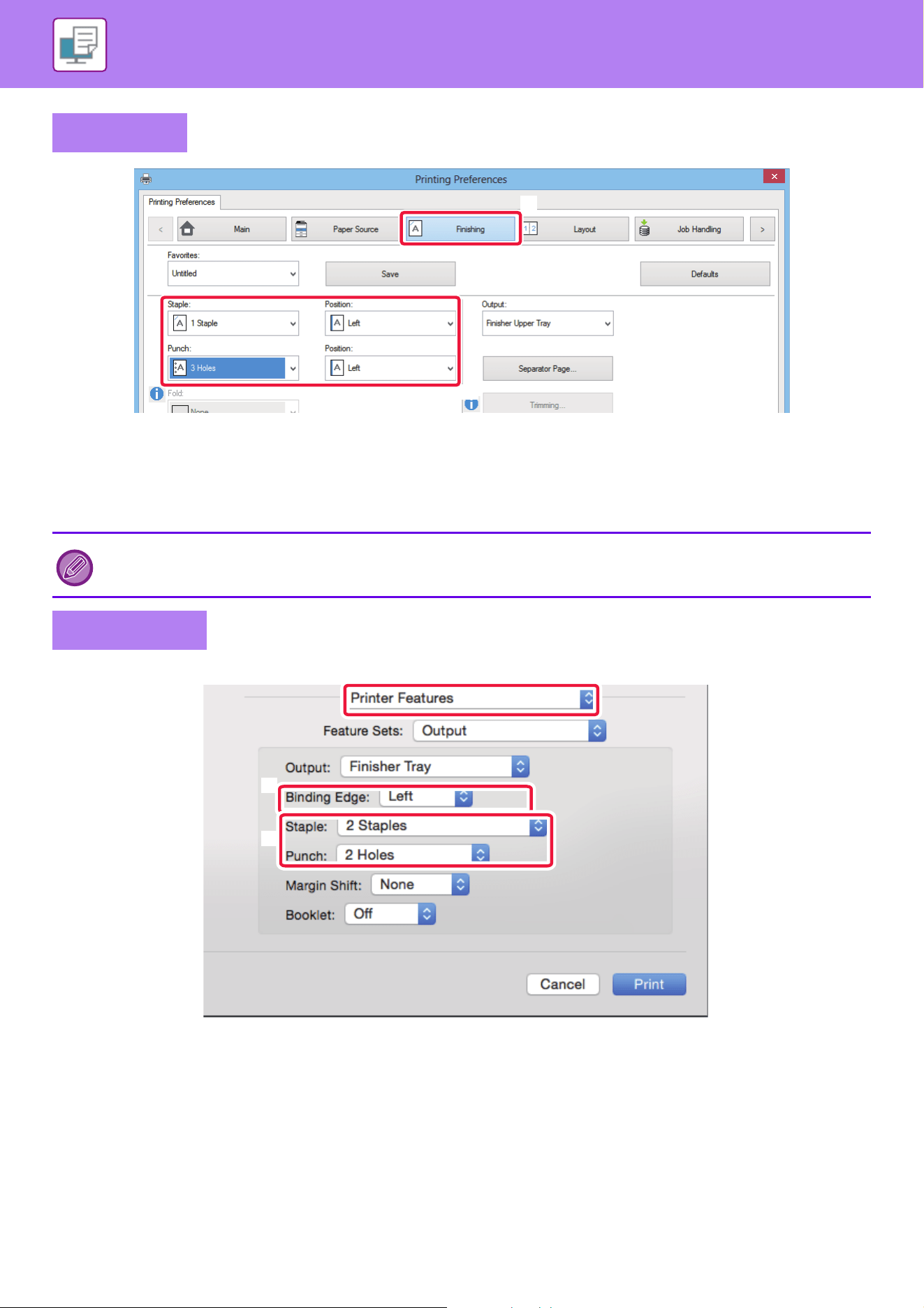
3-28
PRINTER►FREQUENTLY USED FUNCTIONS
(1) Click the [Finishing] tab.
(2) Select the staple function or the punch function.
• For the staple function, select the number of staples in the "Staple" menu and the staple position in the“Position”menu.
• For the punch function, select the type of punch in the "Punch" menu and the punch position in the "Position" menu.
(1) Select [Printer Features].
(2) Select "Binding Edge".
(3) Select the staple function or the punch function.
• For the staple function, select the number of staples in the "Staple" menu.
• For the punch function, select the type of punch in the "Punch" menu.
Windows
In addition to the [Finishing] tab, [Staple] can also be set on the [Main] tab.
Mac OS
(2)
(1)
(2)
(1)
(3)
3-29
PRINTER►FREQUENTLY USED FUNCTIONS
PRINTING WITHOUT TOP AND BOTTOM
MARGINS
This function enables printing without top and bottom margins. By combining this function with the saddle stitch printing
and trimming functions, a booklet or pamphlet without margins can be created.
Saddle stitch printing and 2-position stapling
This function can only be used for 11" x 17"/A3 and 8-1/2" x 11"/A4 sizes.* To use this function effectively, create document
data in the application that is 2 mm longer than the top and bottom of the paper, and 2 mm shorter in the direction of feeding.
When using any other document sizes, use the Fit to Page function.
* Paper size can be used to set a paper length from 279 mm to 297 mm (10-63/64" to 11-45/64"), and a paper width from
420 mm to 488 mm (16-17/32" to 19-14/64" ).
This function is available in a Windows environment.
Windows
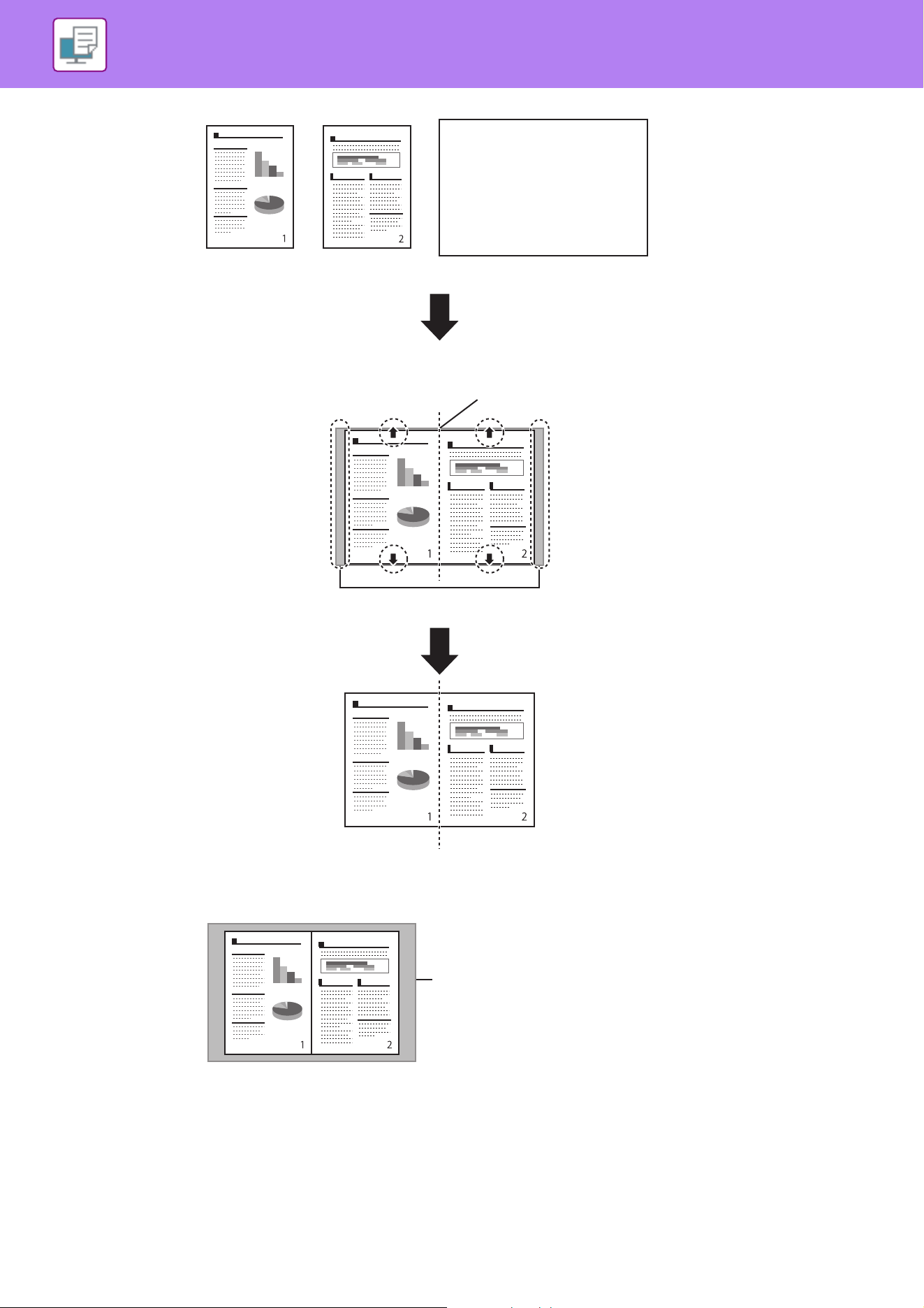
3-30
PRINTER►FREQUENTLY USED FUNCTIONS
Original 1
Fold position
Trim the sides
Margins appear on the sides
Margins appear on the top, bottom, and sides
With normal printing...
Margins
The margins on the sides are eliminated, and Edge-to -Edge printing
is completed.
Create document data of a suitable size in the application, or use the
Fit to Page function, to eliminate the top and bottom margins.
Original 2 Paper
(11’’x17’’/ A3)
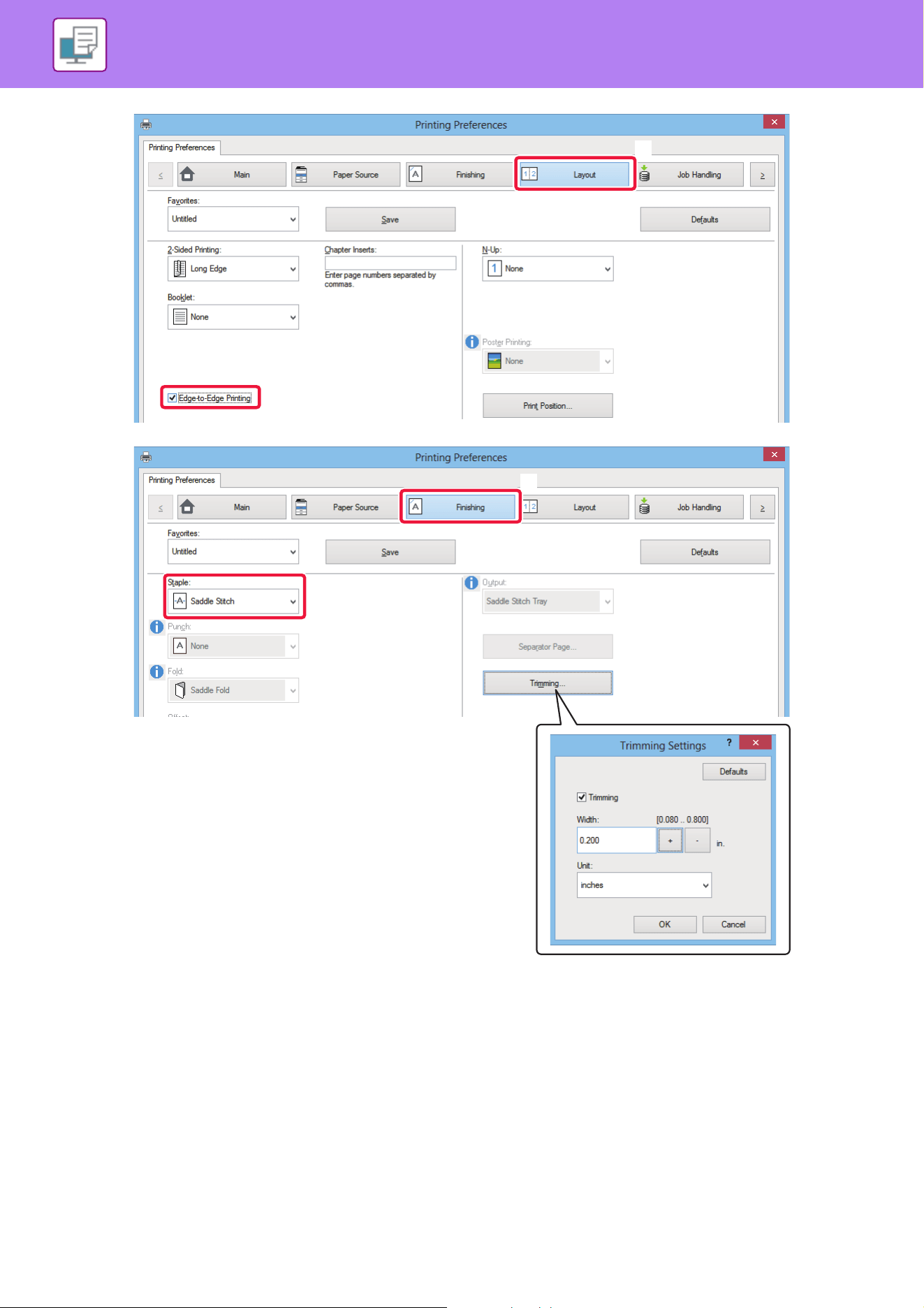
3-31
PRINTER►FREQUENTLY USED FUNCTIONS
(1) Click the [Layout] tab and set the [Edge-to-Edge Printing] checkbox to set to icon.
(2) Click the [Finishing] tab and select [Saddle Stitich].
(3) Configure Trimming settings.
(1) Click the [Trimming...] button.
(2) Set the [Trimming] checkbox to set to icon.
(3) Specify "0.200 inches (5.0 mm)".
(1)
(1)
(2)
(2)
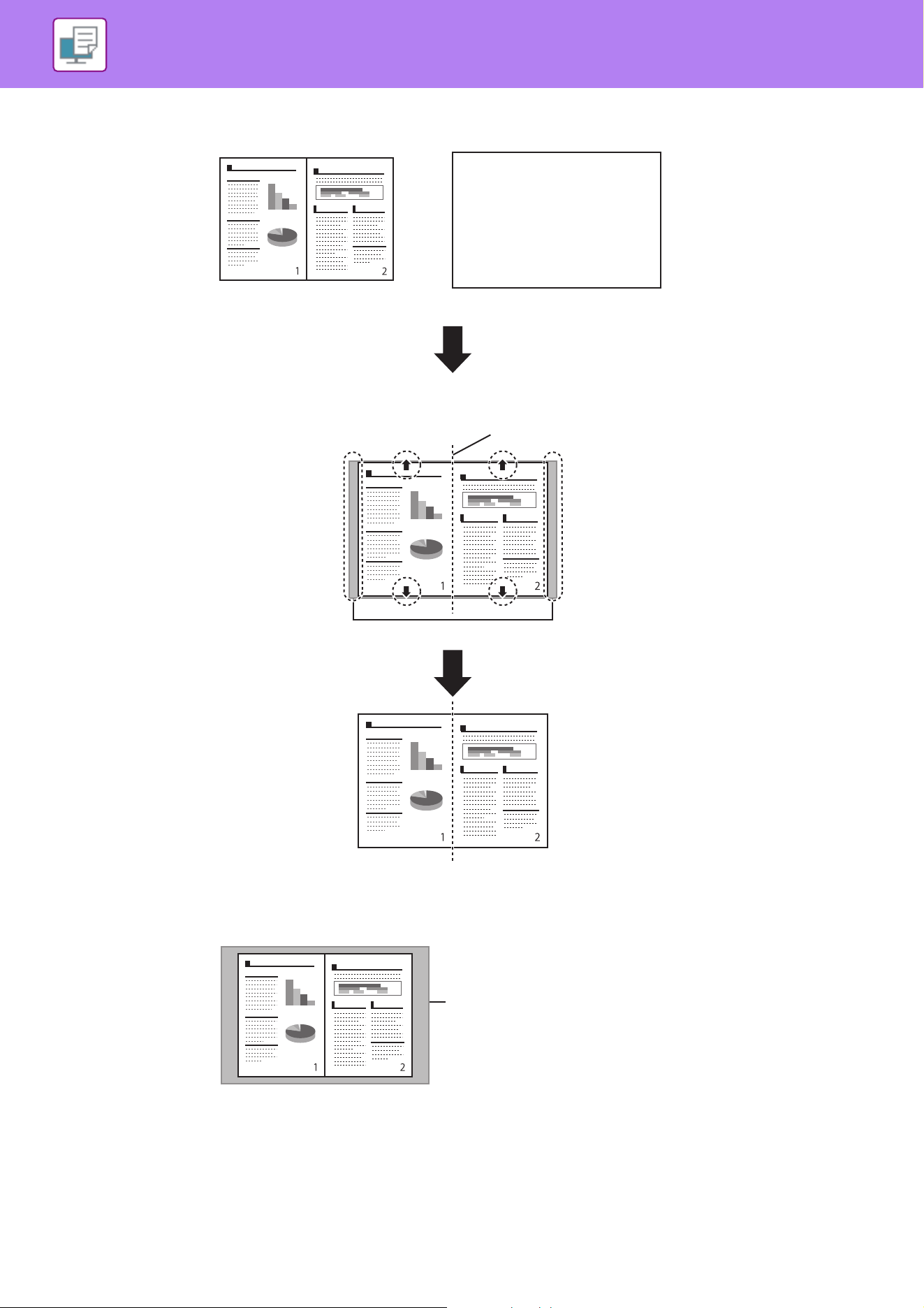
3-32
PRINTER►FREQUENTLY USED FUNCTIONS
Fold stapling
Original
Fold position
Trim the sides
Margins appear on the sides
Margins appear on the top, bottom, and sides
With normal printing...
Margins
The margins on the sides are eliminated, and Edge-to -Edge printing
is completed.
Create document data of a suitable size in the application, or use the
Fit to Page function, to eliminate the top and bottom margins.
Paper
(11’’x17’’/ A3)
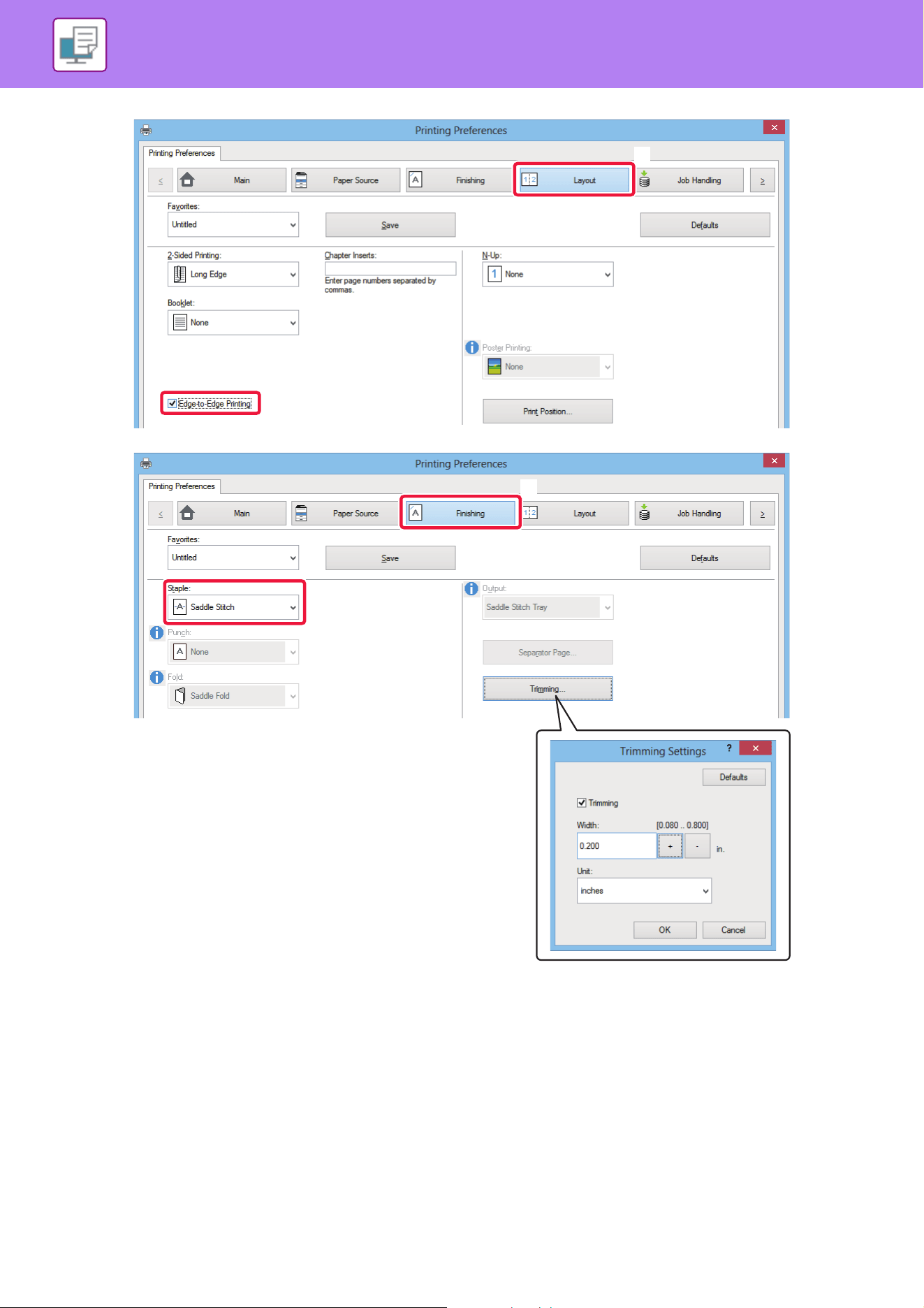
3-33
PRINTER►FREQUENTLY USED FUNCTIONS
(1) Click the [Layout] tab and set the [Edge-to-Edge Printing] checkbox to set to icon.
(2) Click the [Finishing] tab and select [Saddle Stitich].
(3) Configure Trimming settings.
(1) Click the [Trimming...] button.
(2) Set the [Trimming] checkbox to set to icon.
(3) Specify "0.200 inches (5.0 mm)".
(1)
(1)
(2)
(2)
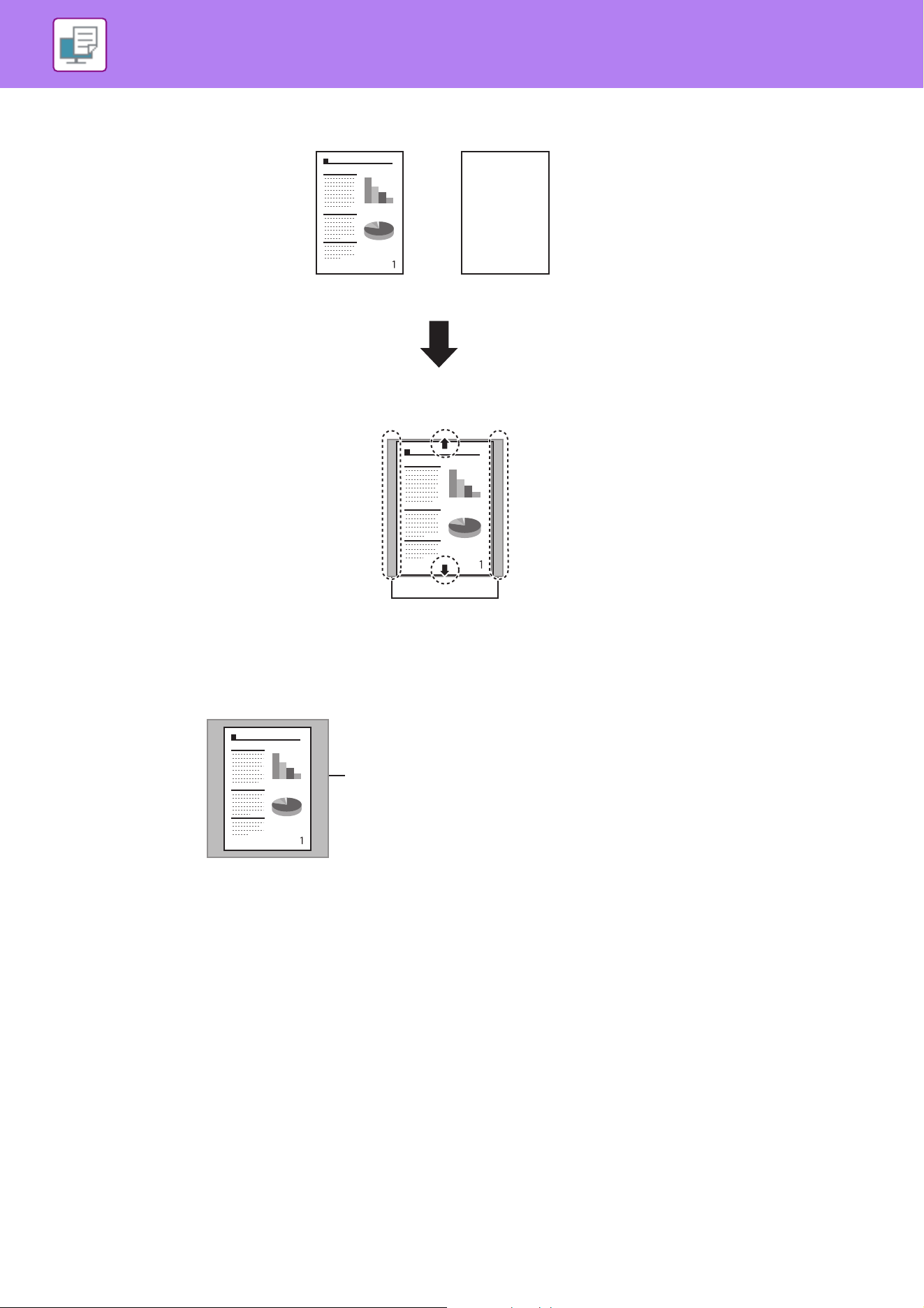
3-34
PRINTER►FREQUENTLY USED FUNCTIONS
Single Sheet
Original 1
Margins appear on the sides
Margins appear on the top, bottom, and sides
With normal printing...
Margins
The margins on the sides are eliminated, and Edge-to -Edge printing
is completed.
Create document data of a suitable size in the application, or use the
Fit to Page function, to eliminate the top and bottom margins.
Paper
(8-1/2” x 11”/A4)
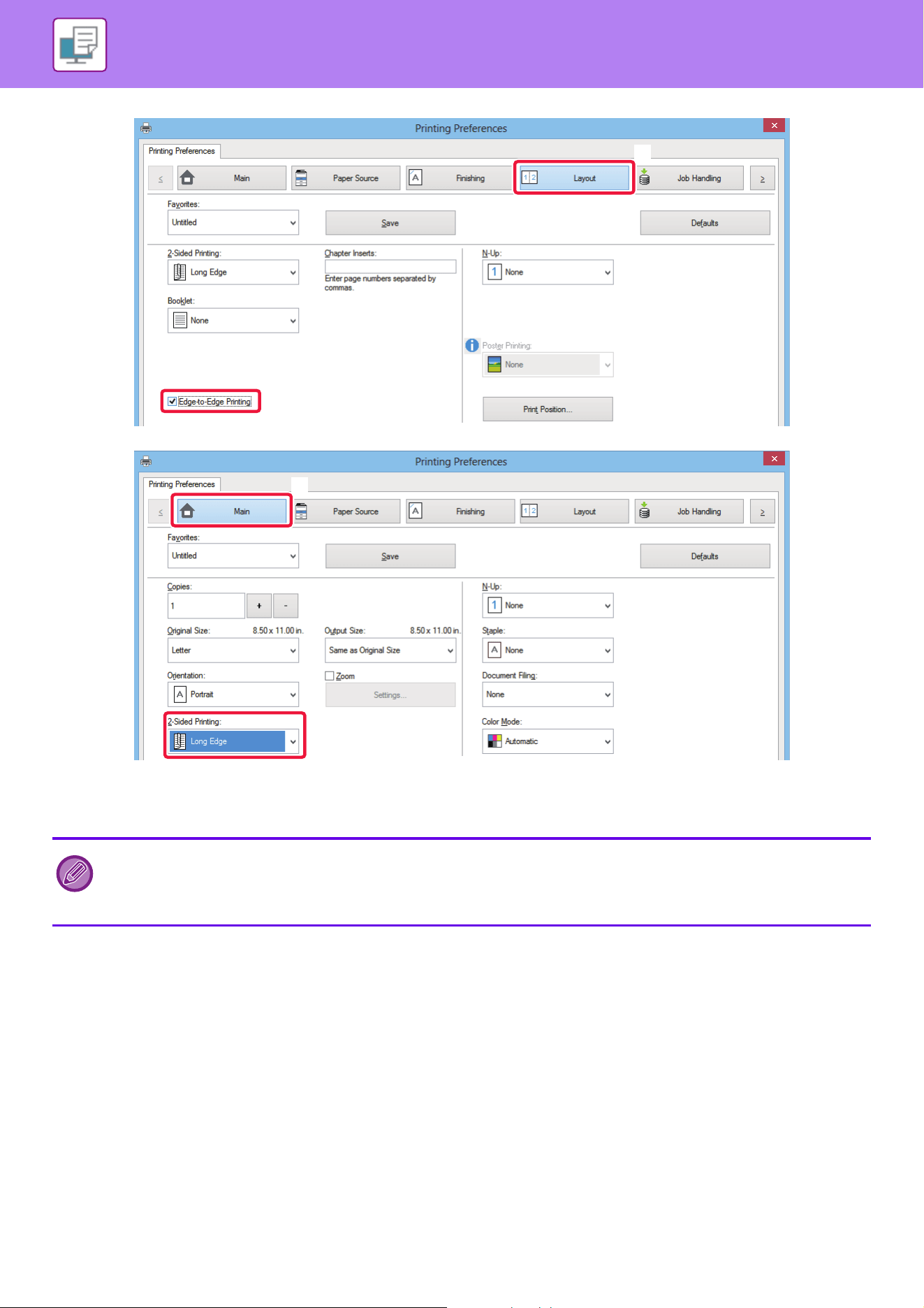
3-35
PRINTER►FREQUENTLY USED FUNCTIONS
(1) Click the [Layout] tab and set the [Edge-to-Edge Printing] checkbox to set to icon.
(2) Click the [Main] tab and select [None], [Long Edge] or [Short Edge] in 2-Sided Printing.
Check the actual print result. If margins appear, change the following settings.
"Trimming" in the Trimming Settings dialog
"Zoom Settings" in the [Main] tab
"Print Position" in the Compatibility dialog
(1)
(1)
(2)
(2)
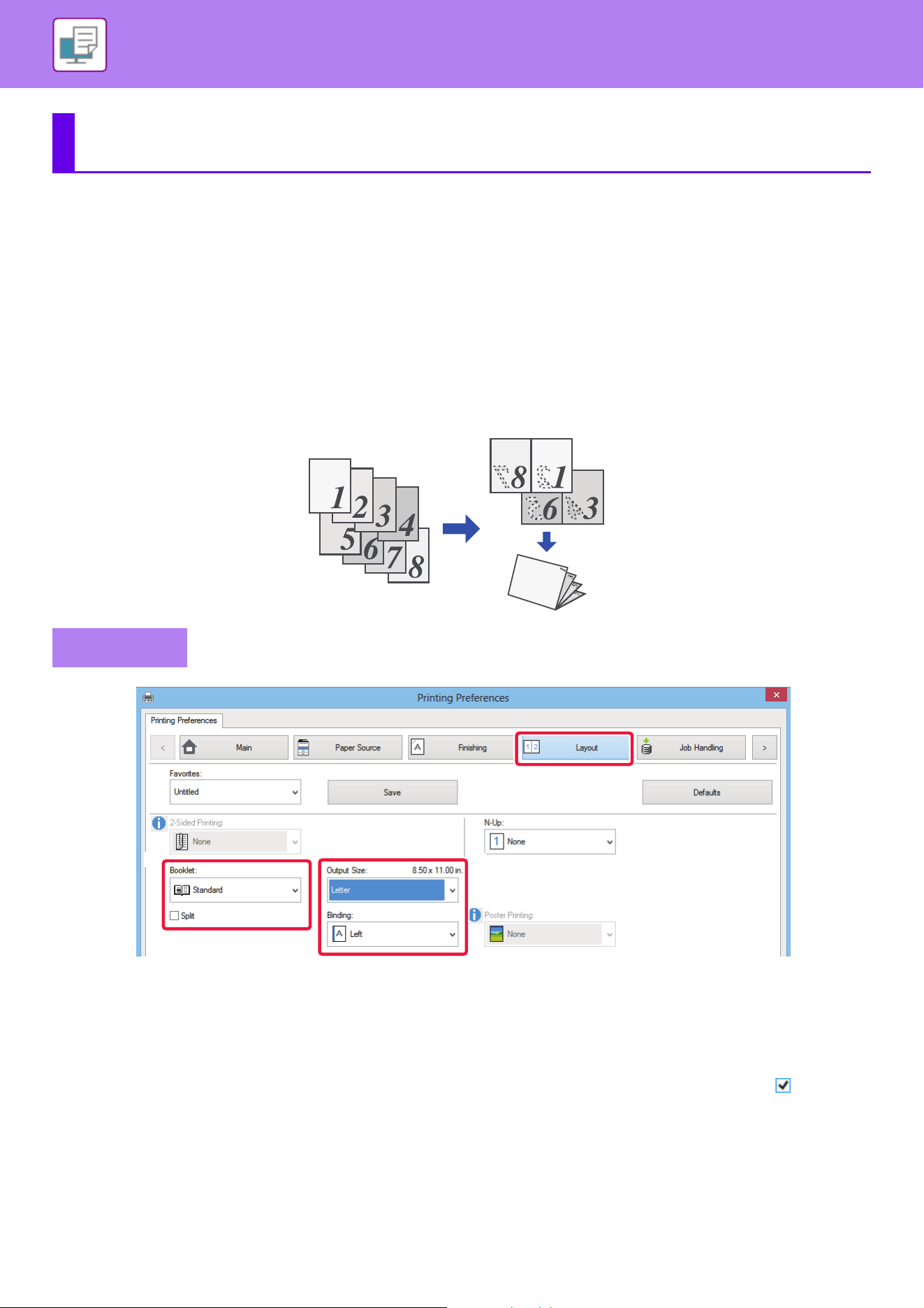
3-36
PRINTER►CONVENIENT PRINTING FUNCTIONS
CONVENIENT FUNCTIONS FOR CREATING
PAMPHLETS AND POSTERS
CREATE A PAMPHLET (BOOKLET/SADDLE STITCH)
The pamphlet function prints on the front and back of each sheet of paper so that the sheets can be folded and bound to
create a pamphlet.
If a saddle stitch finisher is installed and if "Booklet" and "Staple" are selected, this function automatically folds and
outputs the copies. This is convenient when you wish to compile printed output into a pamphlet.
(1) Click the [Layout] tab.
(2) Select [Standard] or [Full Image] in "Booklet".
• When [Standard] is selected, the printed image will be enlarged or reduced to fit the paper selected in "Output Size".
• When [Full Image] is selected, the printed image will be enlarged or reduced to fit the size selected in "Fit To Paper Size".
By
selecting a paper size that is larger than the print image, you can cut off the edges of the paper after making the booklet to create a
booklet with no margins.
•
When the number of output pages will exceed the number of sheets that can be stapled, you can select the [Split] checkbox ( ) to divide the
output into multiple sub-booklets that can each be stapled. When stacked, the sub-booklets will have the same page order as the original pages.
(3) Select the specified output size and the binding edge.
• When [Standard] is selected, select the output paper size.
•
When [Full Image] is selected, select the size to which you want to enlarge or reduce the print image in [Fit To Paper Size], and select
the paper size you want to use for printing in "Output Size".
CONVENIENT PRINTING FUNCTIONS
Windows
(2)
(1)
(3)
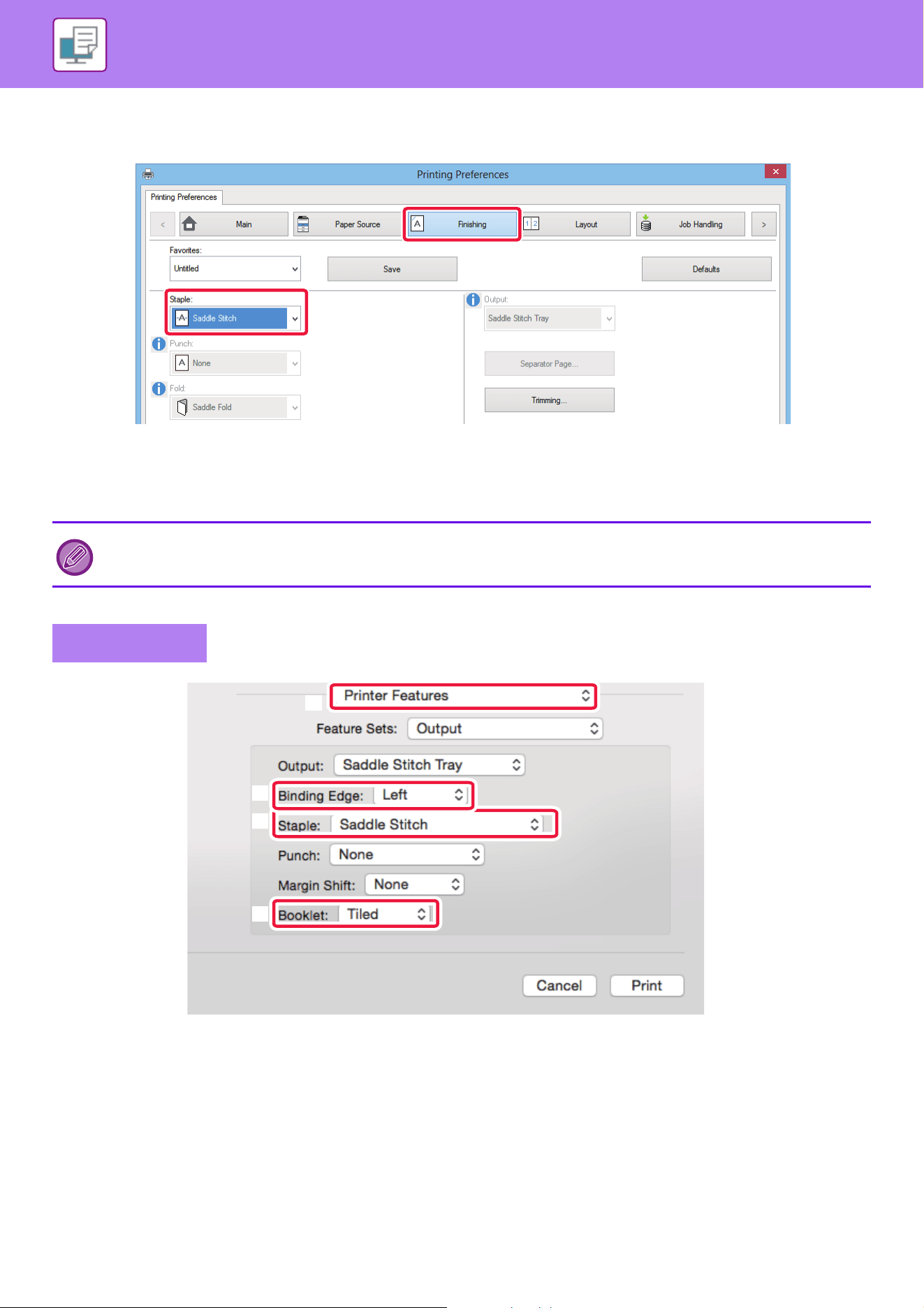
3-37
PRINTER►CONVENIENT PRINTING FUNCTIONS
If a saddle stitch finisher is installed
(4) Click the [Finishing] tab.
(5) Select [Saddle Stitch] from "Staple".
(1) Select [Printer Features].
(2) Select "Binding Edge".
(3) Select [Saddle Stitch].
(4) Select [Tiled] or [2-Up].
When a saddle stitch finisher (large capacity) is installed and the job is not output correctly with [Saddle Stitch], select
[Saddle Stitch (Reverse)].
Mac OS
(5)
(4)
(2)
(3)
(1)
(4)
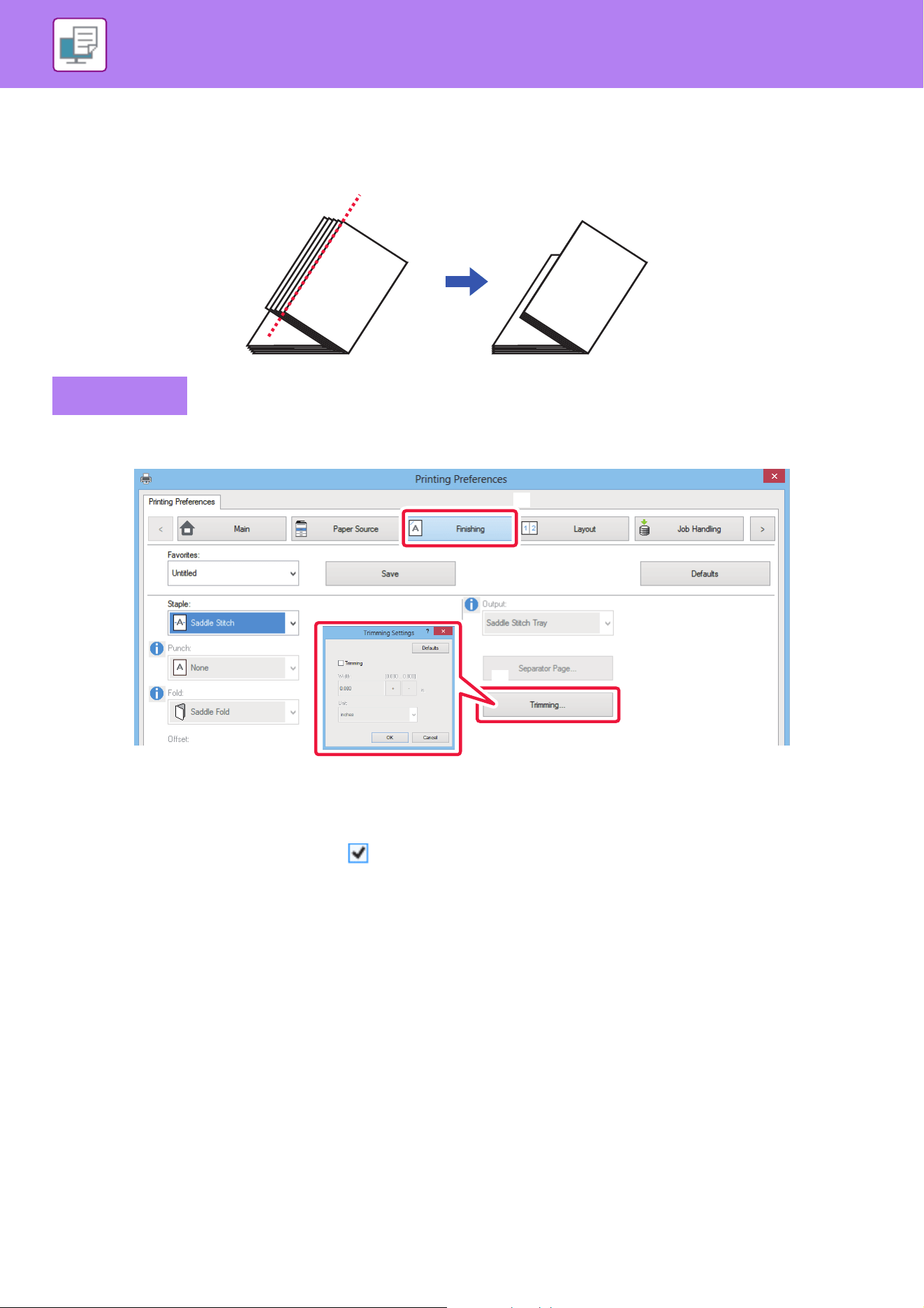
3-38
PRINTER►CONVENIENT PRINTING FUNCTIONS
TRIMMING THE EXCESS OF FOLDED PAPER
If a trimmer unit is installed, you can trim off excess edges of paper for a finer finish.
(1) Click the [Finishing] tab.
(2) Click the [Trimming] button.
(3) Set the [Trimming] checkbox to , and specify "Trimming Width".
Windows
(2)
(1)
(3)
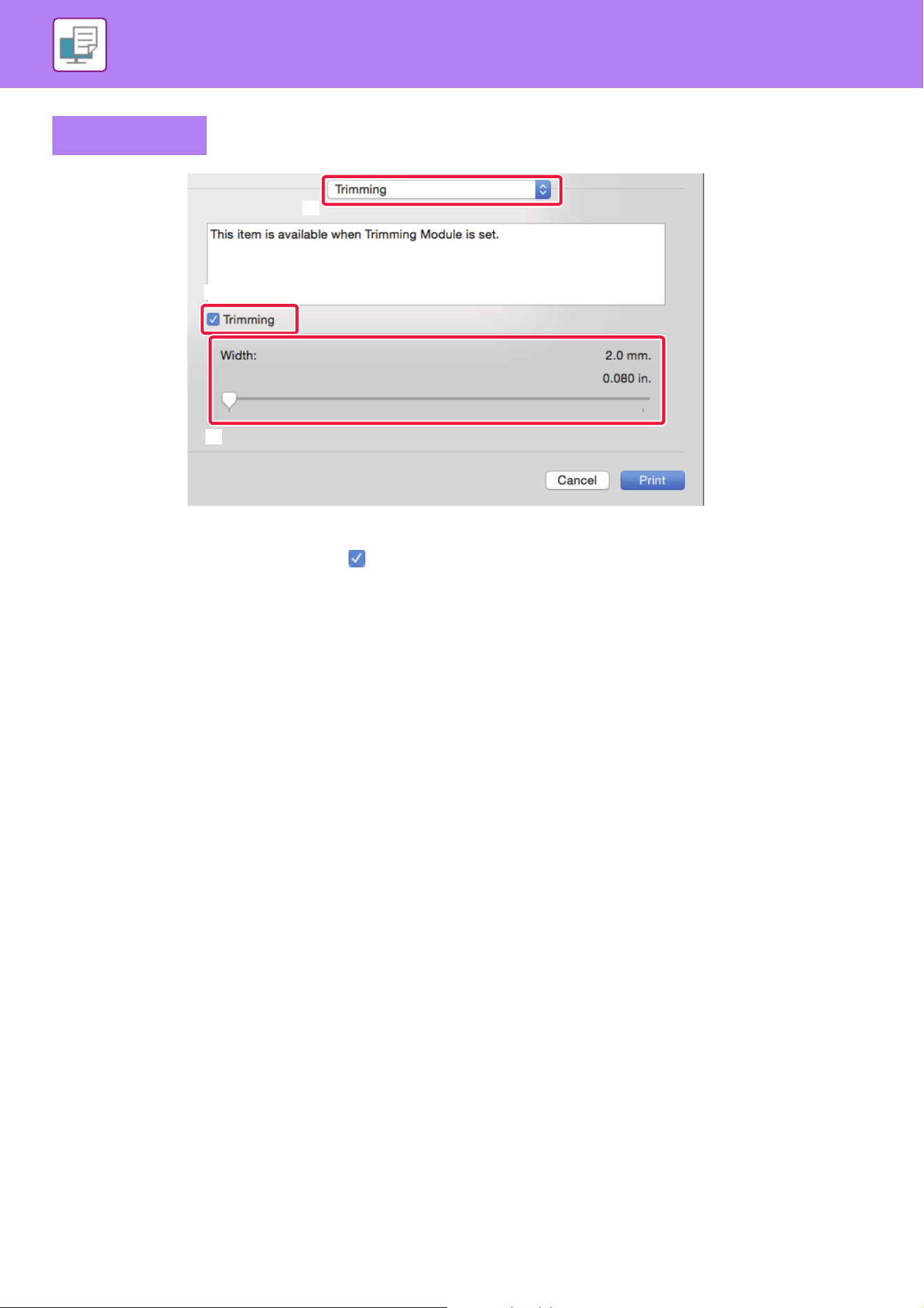
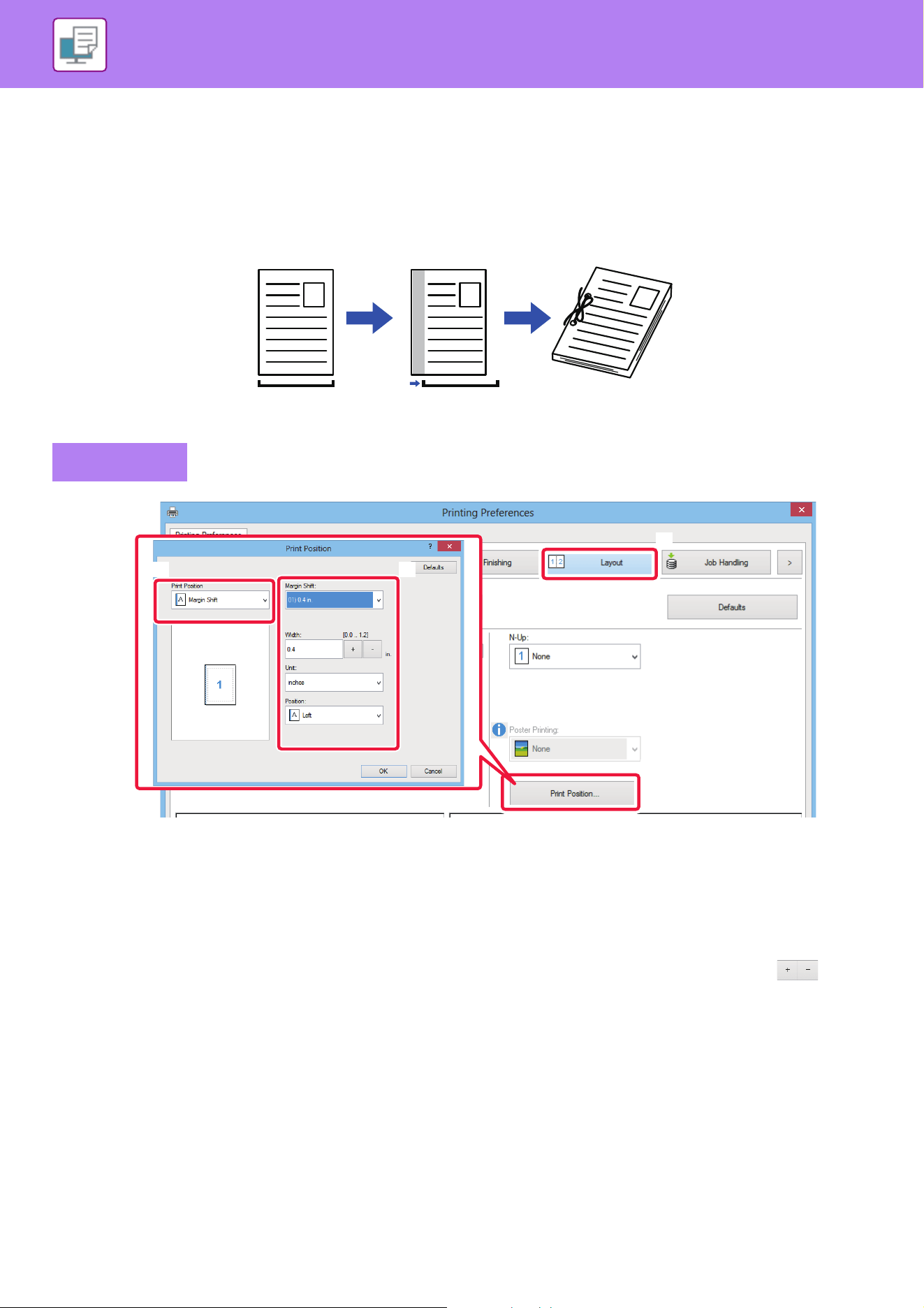
3-40
PRINTER►CONVENIENT PRINTING FUNCTIONS
PRINTING WITH MARGIN SHIFT SETTING (MARGIN)
This function shifts the print image to increase the margin at the left, the right, or the top of the paper.
If a finisher or saddle stitch finisher is installed, the staple and punch functions of the machine can also be used
together.
This is convenient when you wish to staple or punch the output but the binding area overlaps the text.
By shifting the image, the part of the image that is outside the print area will not be printed.
(1) Click the [Layout] tab.
(2) Click the [Print Position] button.
(3) Select [Margin Shift].
(4) Select the shift width.
Select from the "Margin Shift" menu. If you wish to configure another numeric setting, select the setting and click buttons
or directly enter the number.
Windows
(2)
(1)
(3) (4)
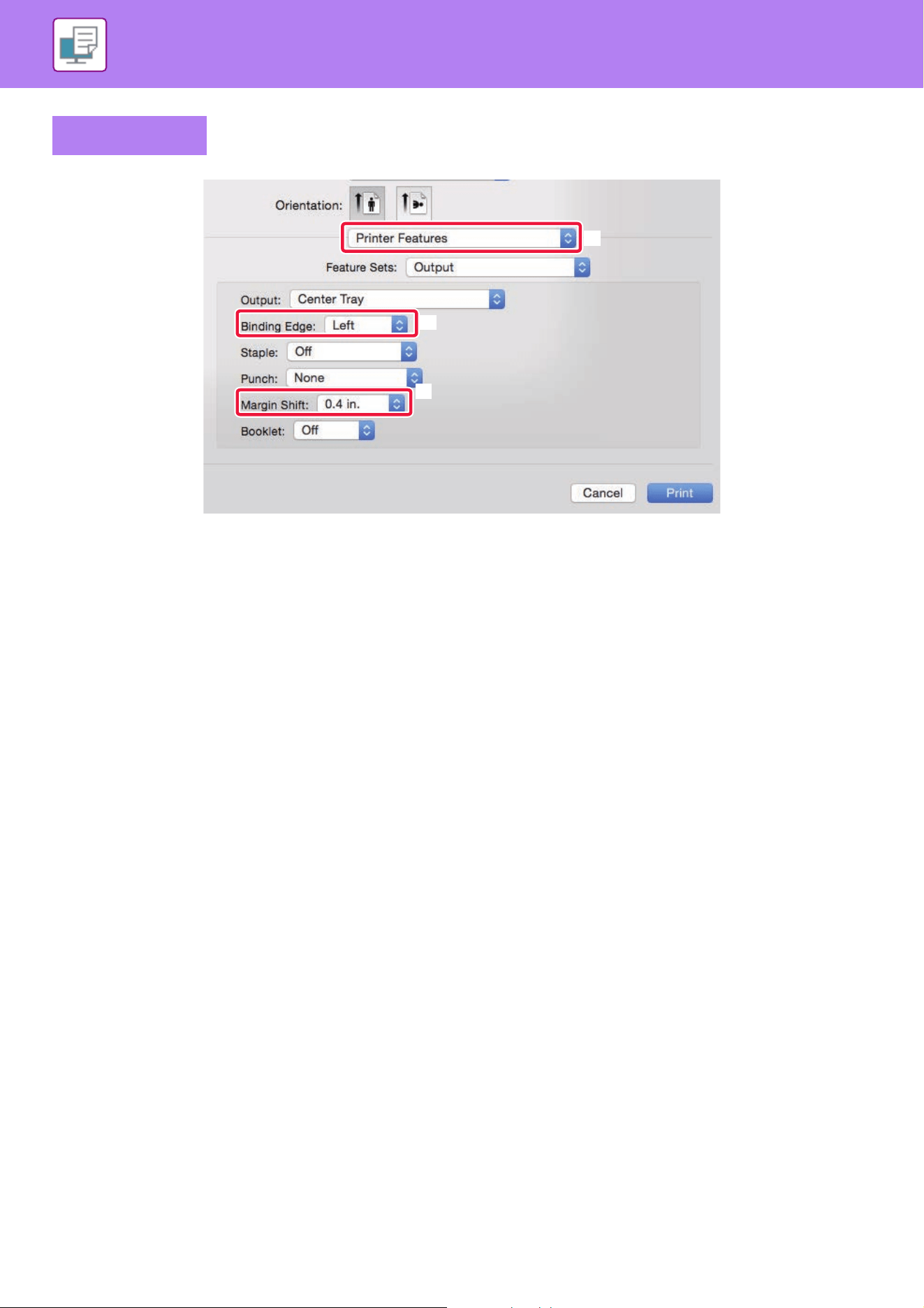
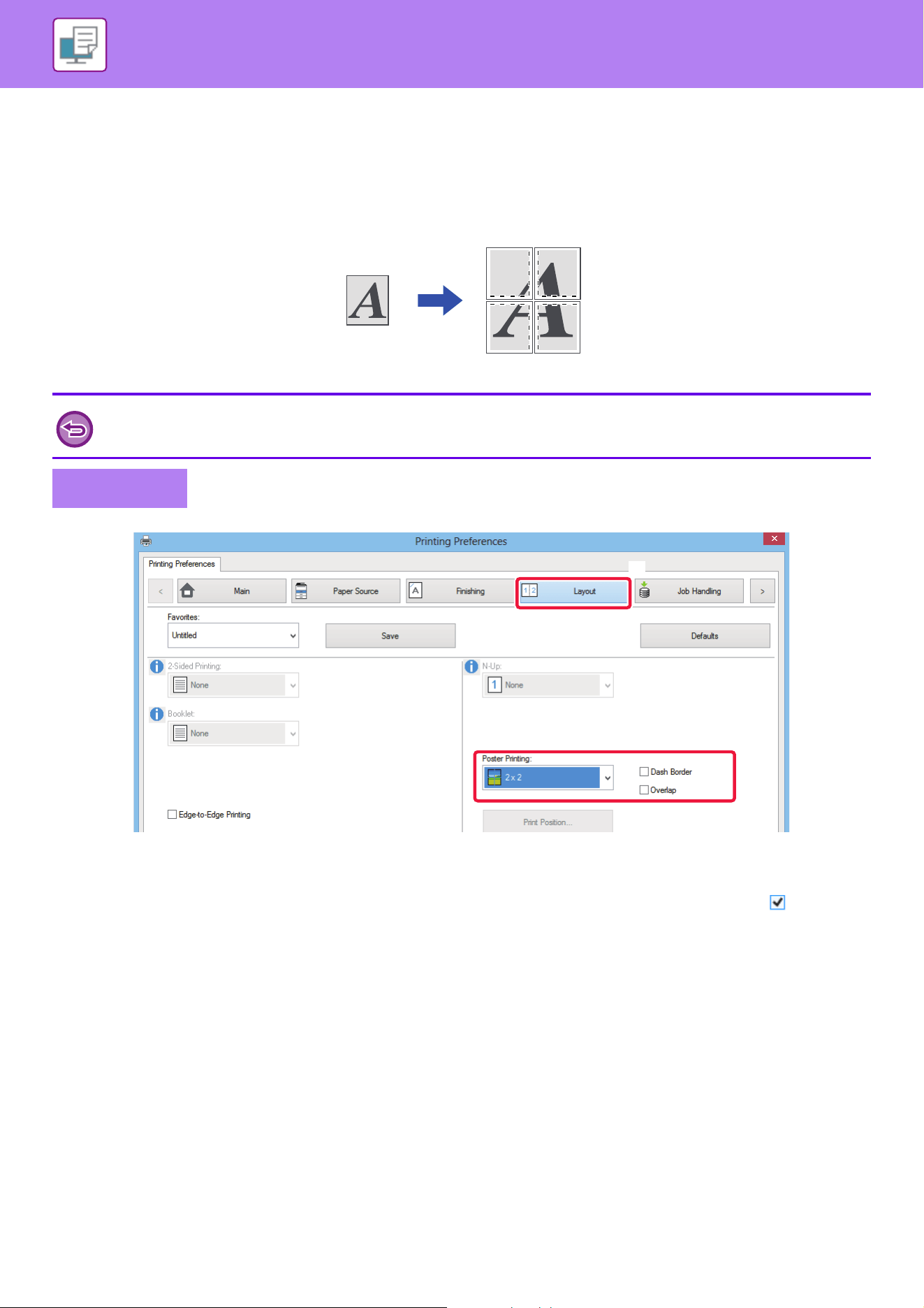
3-42
PRINTER►CONVENIENT PRINTING FUNCTIONS
CREATE A LARGE POSTER (POSTER PRINTING)
One page of print data is enlarged and printed using multiple sheets of paper (4 sheets (2 x 2), 9 sheets (3 x 3) or 16
sheets (4 x 4)). The sheets can then be attached together to create a large poster.
To enable precise alignment of the edges of the sheets during attachment, borderlines can be printed or overlapping
edges can be created (overlap function).
(1) Click the [Layout] tab.
(2) Select the number of sheets to be used in "Poster Printing".
If you wish to print borderlines and/or use the overlap function, click the corresponding checkboxes so that the appears.
This function is available in a Windows environment.
Windows
(2)
(1)
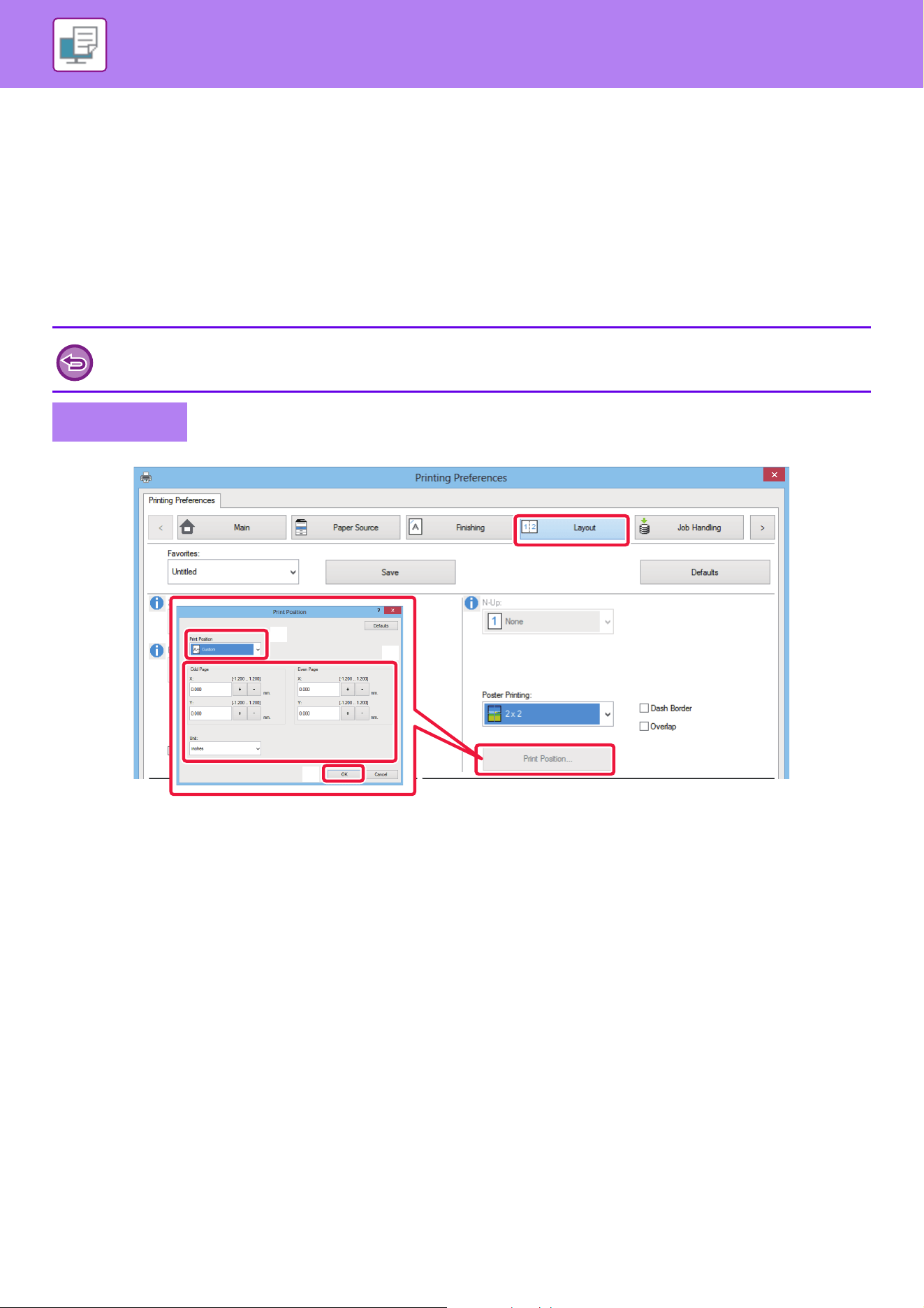
3-43
PRINTER►CONVENIENT PRINTING FUNCTIONS
FUNCTIONS TO ADJUST THE SIZE AND
ORIENTATION OF THE IMAGE
ADJUST PRINT POSITION ON ODD AND EVEN PAGES
SEPARATELY (PRINT POSITION)
This function sets different print positions (margins) separately for odd and even pages and prints the pages.
(1) Click the [Layout] tab.
(2) Click the [Print Position] button.
(3) Select [Custom].
(4) Set the amount of shifting of the print position for odd-numbered pages and even-numbered
pages.
(5) Click the [OK] button.
This function is available in a Windows environment.
Windows
(2)
(1)
(3)
(4)
(5)
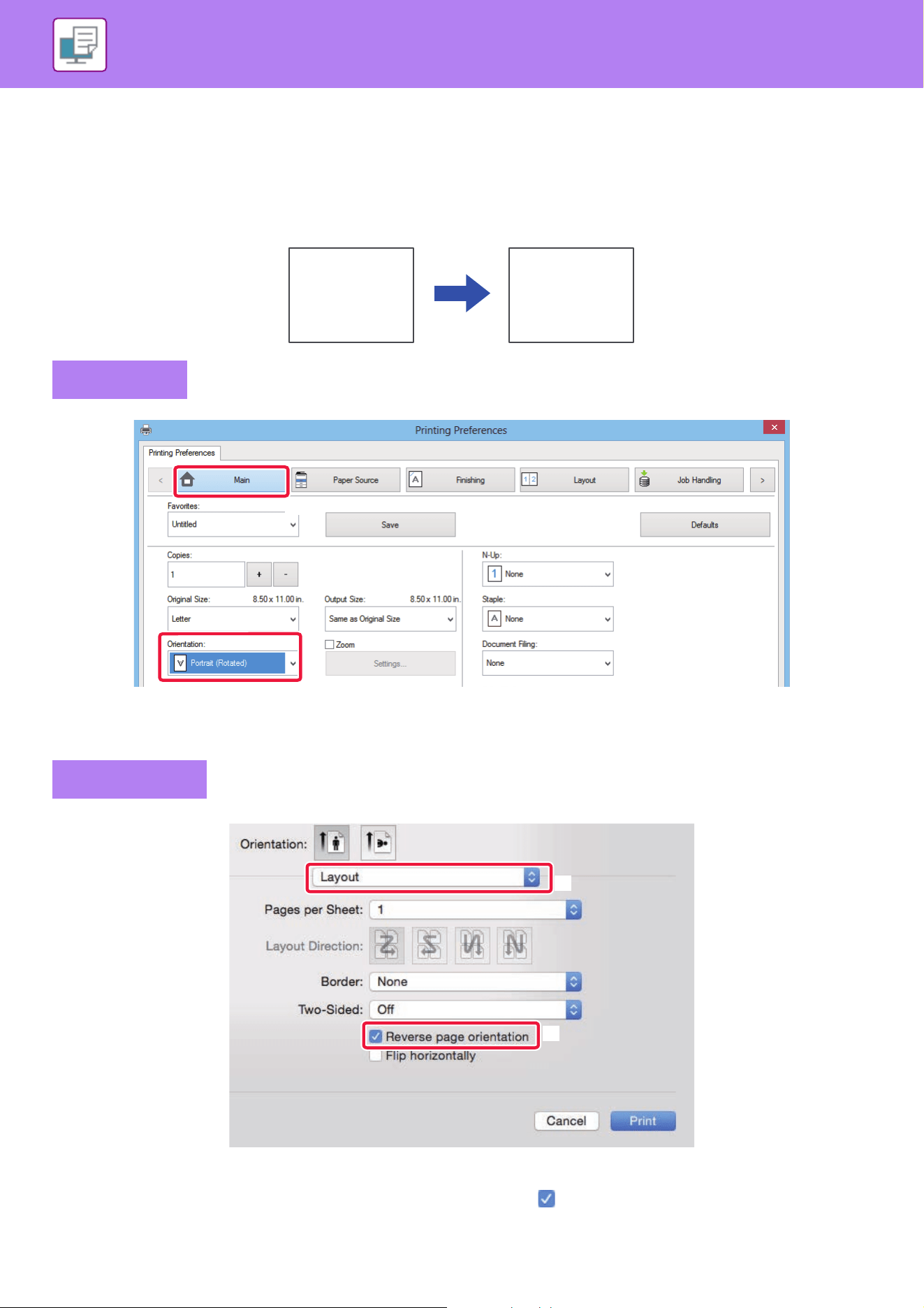
3-44
PRINTER►CONVENIENT PRINTING FUNCTIONS
ROTATING THE PRINT IMAGE 180 DEGREES (ROTATE
180 DEGREES)
This feature rotates the image 180 degrees so that it can be printed correctly on paper that can be loaded in only one
orientation (such as paper with punch holes).
(1) Click the [Main] tab.
(2) Select [Portrait (Rotated)] or [Landscape (Rotated)] in "Orientation".
(1) Select [Layout]
(2) Select the [Reverse page orientation] checkbox so that appears.
Windows
Mac OS
ABCD
ABCD
(1)
(2)
(2)
(1)
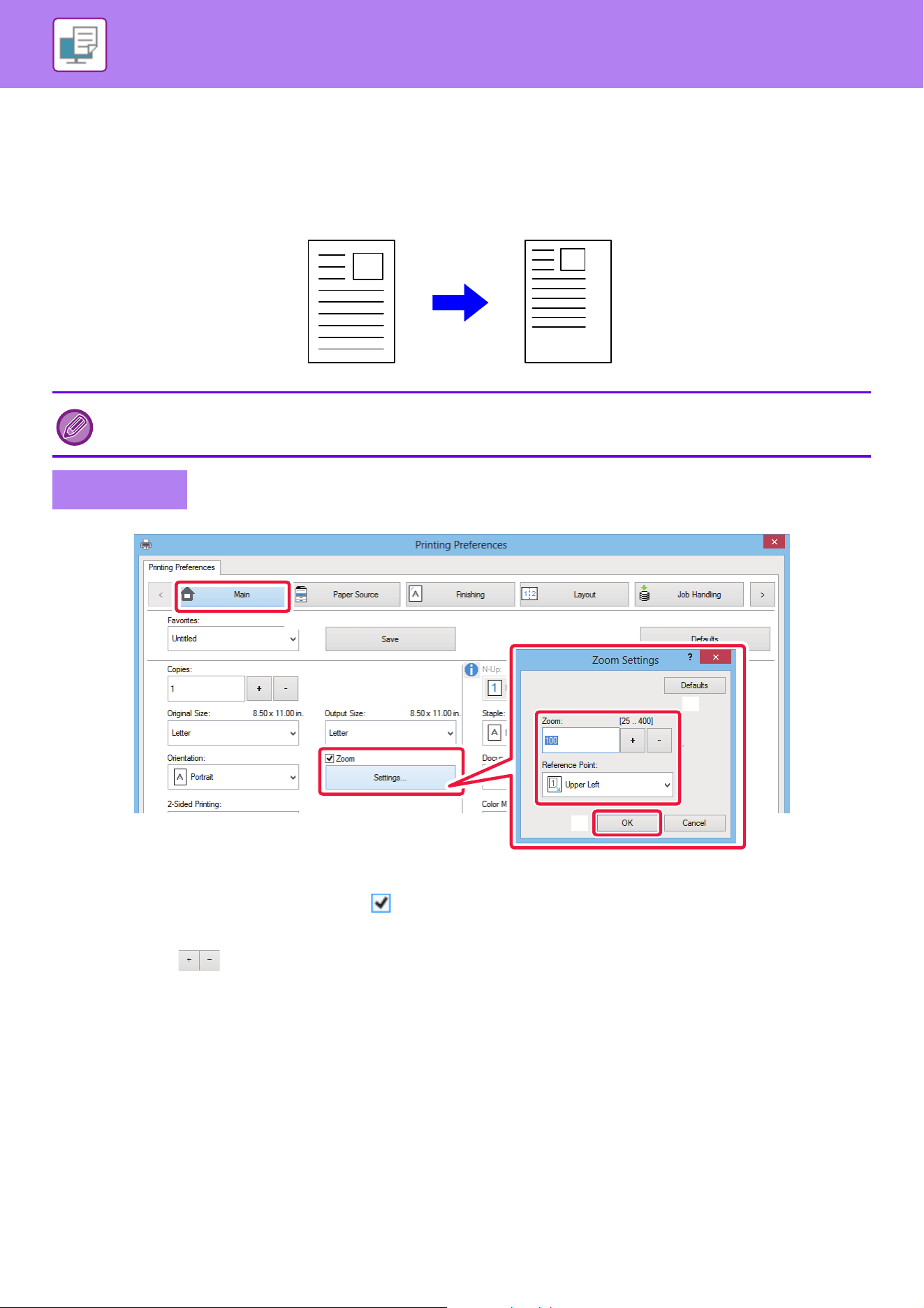
3-45
PRINTER►CONVENIENT PRINTING FUNCTIONS
ENLARGING/REDUCING THE PRINT IMAGE (ZOOM
SETTING/ENLARGE OR REDUCE)
This function enlarges or reduces the image to a selected percentage.
This allows you to enlarge a small image or add margins to the paper by slightly reducing an image.
(1) Click the [Main] tab.
(2) Click the [Zoom] checkbox so that appears, and click the [Settings] button.
(3) Enter the percentage.
By clicking the button, you can specify the value in increments of 1%. In addition, select [Upper Left] or [Center] for the
base point on the paper.
(4) Click the [OK] button.
When using the PS printer driver (Windows), you can set the width and length percentages separately to change the
proportions of the image.
Windows
(2)
(1)
(3)
(4)
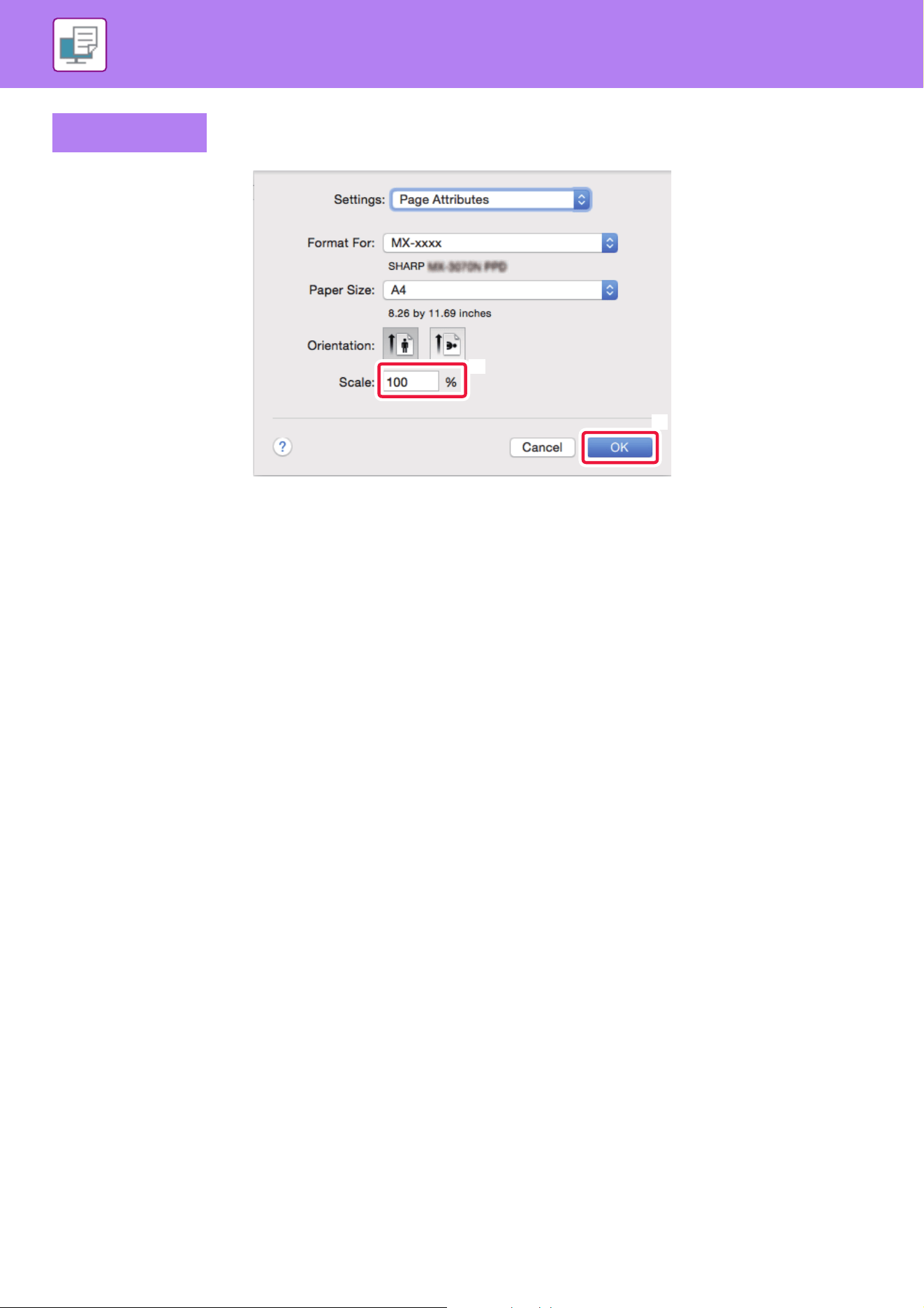
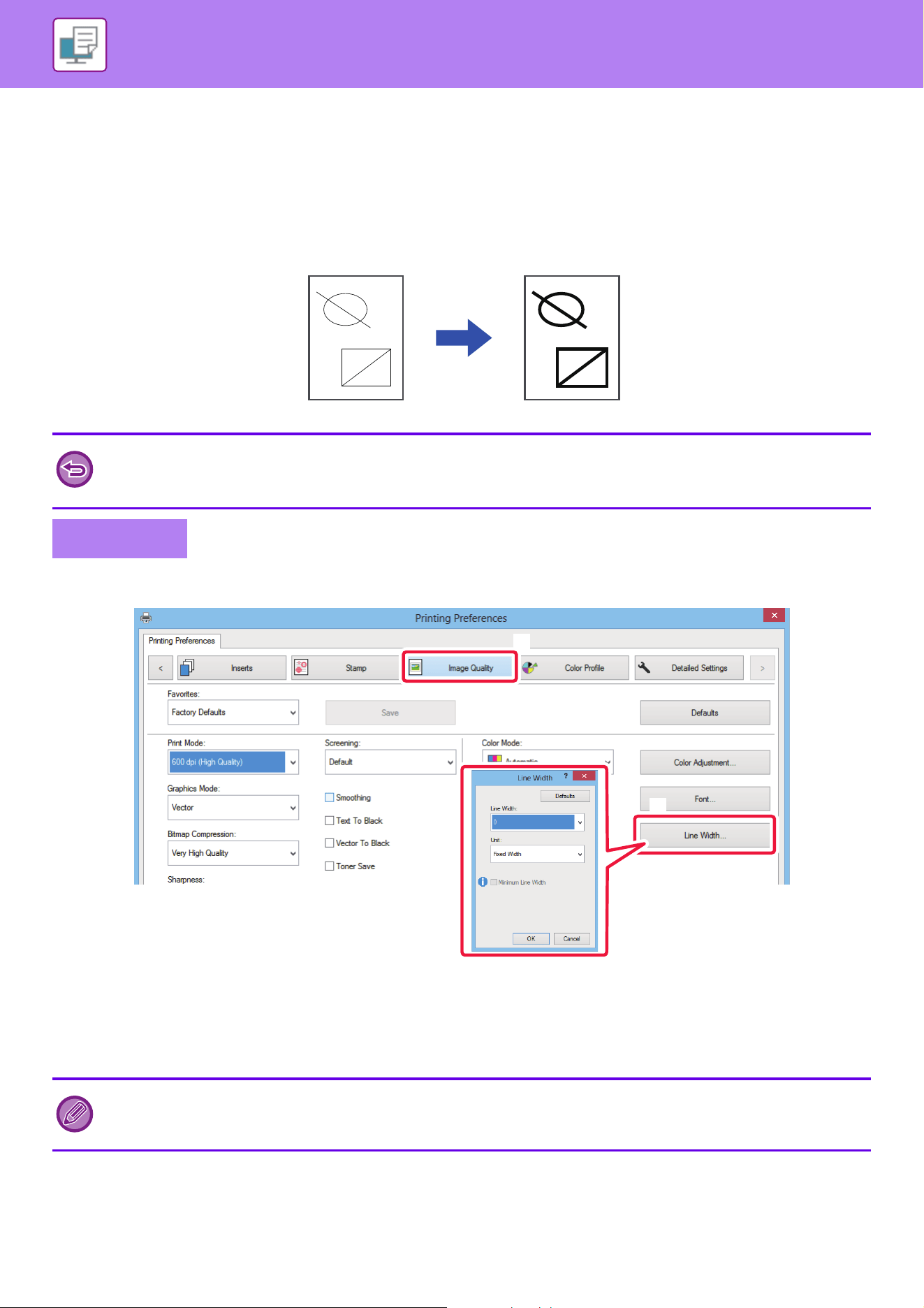
3-47
PRINTER►CONVENIENT PRINTING FUNCTIONS
ADJUST THE LINE THICKNESS (WIDTH)
Adjusting line widths used in data such as CAD
This function increases the thickness of the entire line when the print lines are not clear in CAD or other special
applications.
When the data includes lines of varying widths, you can print all lines at the minimum width as necessary.
(1) Click the [Image Quality] tab.
(2) Click the [Line Width] button.
(3) Set the line thickness and click the [OK] button.
• This function is available in a Windows environment.
• This function can be used when the PCL6 printer driver is used.
• When printing from an application that processes lines as raster graphics, line widths cannot be adjusted.
Windows
• The units of line-width adjustment can be set to "Fixed Width" or "Ratio".
Select from the "Unit" menu.
• To print all line data in the minimum line width, click the [Minimum Line Width] checkbox.
(2)
(1)
(3)
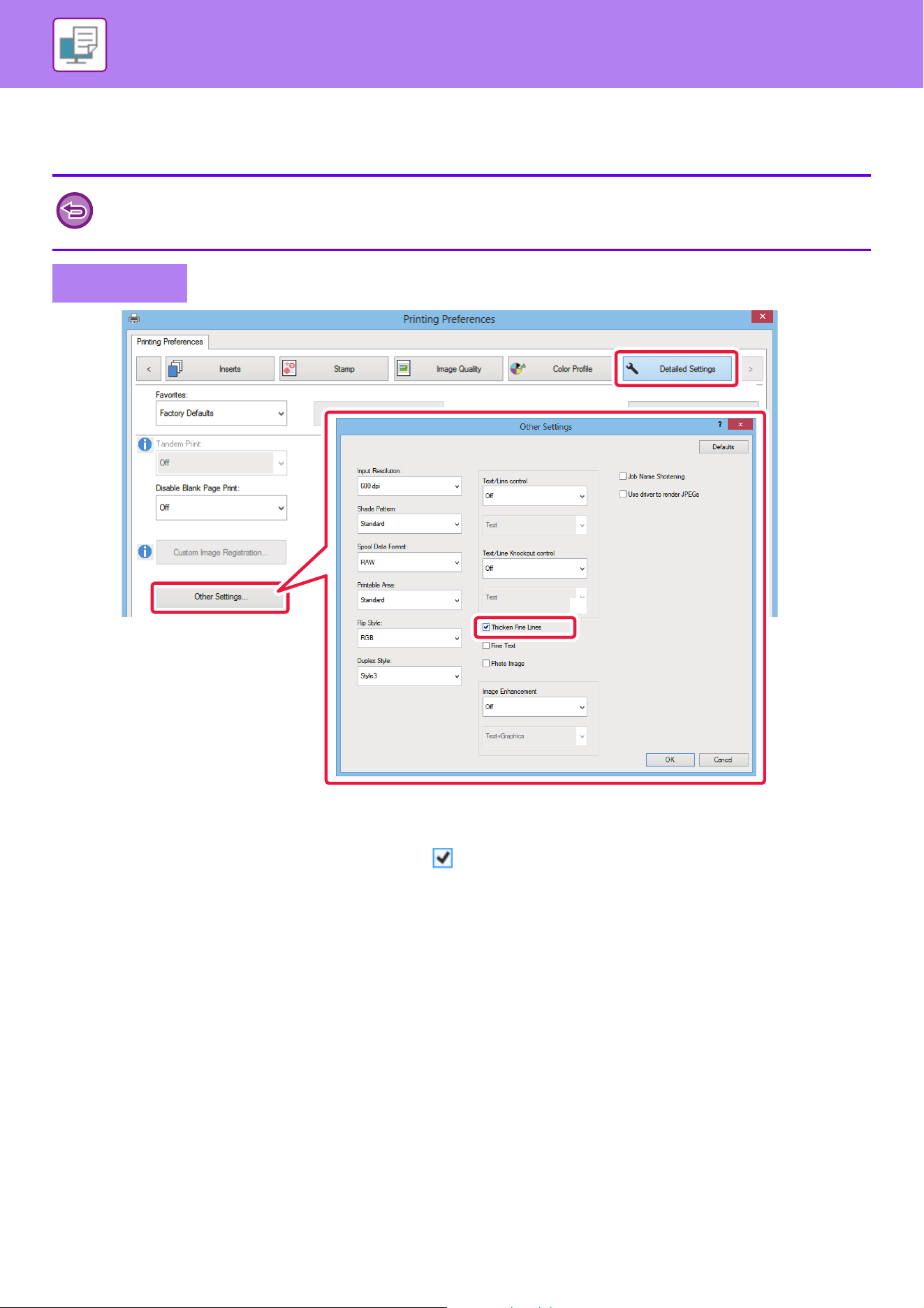
3-48
PRINTER►CONVENIENT PRINTING FUNCTIONS
Thickening fine lines in Excel
When fine border lines in Excel do not print correctly, you can make the lines thicker.
(1) Click the [Detailed Settings] tab.
(2) Click the [Other Settings] button.
(3) Select the [Thicken Fine Lines] checkbox ( ).
• This function is available in a Windows environment.
• This function can be used when the PCL6 printer driver is used.
• Normally this setting is not necessary.
Windows
(2)
(1)
(3)
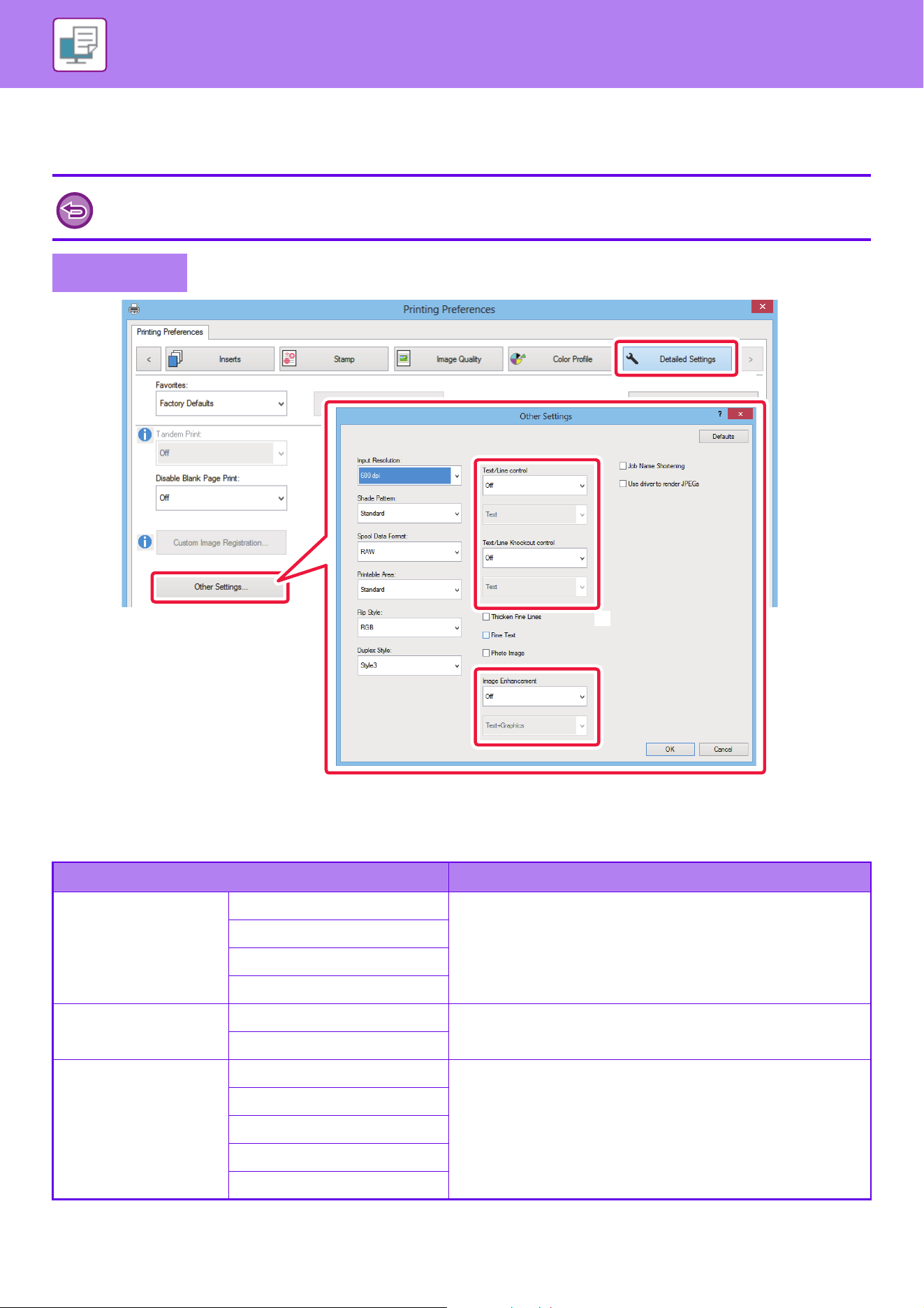
3-49
PRINTER►CONVENIENT PRINTING FUNCTIONS
Adjusting the thickness of text and lines
You can make text and lines thicker or thinner. You can also make edges smoother or sharper.
(1) Click the [Detailed Settings] tab.
(2) Click the [Other Settings] button.
(3) Specify the settings.
• This function is available in a Windows environment.
• This function can be used when the PCL6 or PS printer driver is used.
Windows
Item Description
Text/Line control Text You can make characters and text thicker or thinner.
Graphics
Text+Graphics
Text+Graphics+Photo
Text/Line Knockout
control
Text You can make knockout text and lines thicker.
Text+Graphics
Image Enhancement Text You can make the edges of text and graphics smoother or
sharper.
Text+Graphics
Text+knockout text
Text+Graphics+knockout text
Text+Graphics+knockout
(2)
(1)
(3)
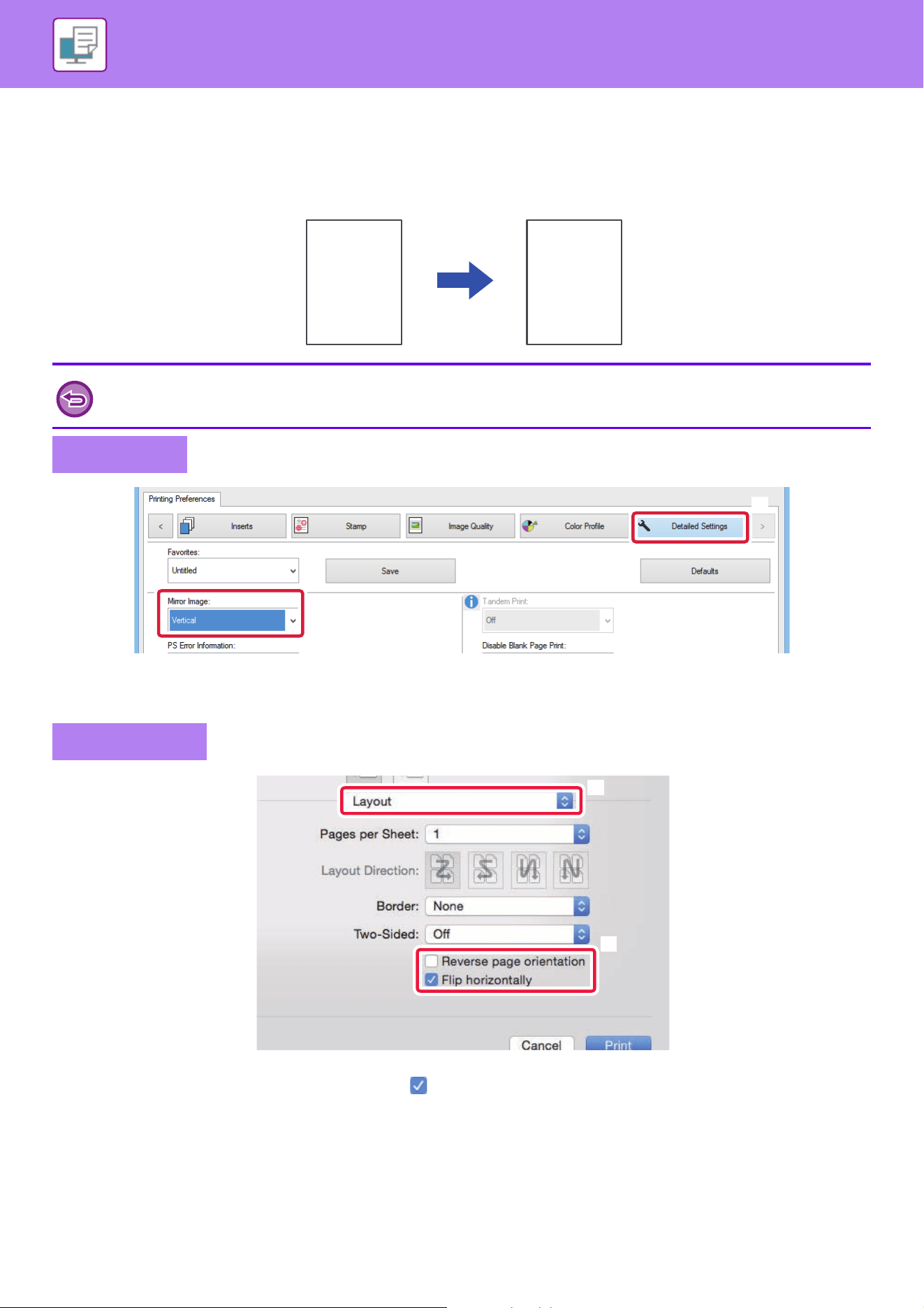
3-50
PRINTER►CONVENIENT PRINTING FUNCTIONS
PRINT A MIRROR-IMAGE (MIRROR-IMAGE REVERSE/VISUAL
EFFECTS)
The image is reversed to create a mirror image.
This function is conveniently used to print a design for a woodblock print or other printing medium.
(1) Click the [Detailed Settings] tab.
(2) If you wish to reverse the image horizontally, select [Horizontal]. If you wish to reverse the image
vertically, select [Vertical].
(1) Select [Layout].
(2) Select the [Flip horizontally] checkbox ( ).
In a Windows environment, this function is only available when using the PS printer driver.
Windows
Mac OS
B
B
(2)
(1)
(2)
(1)
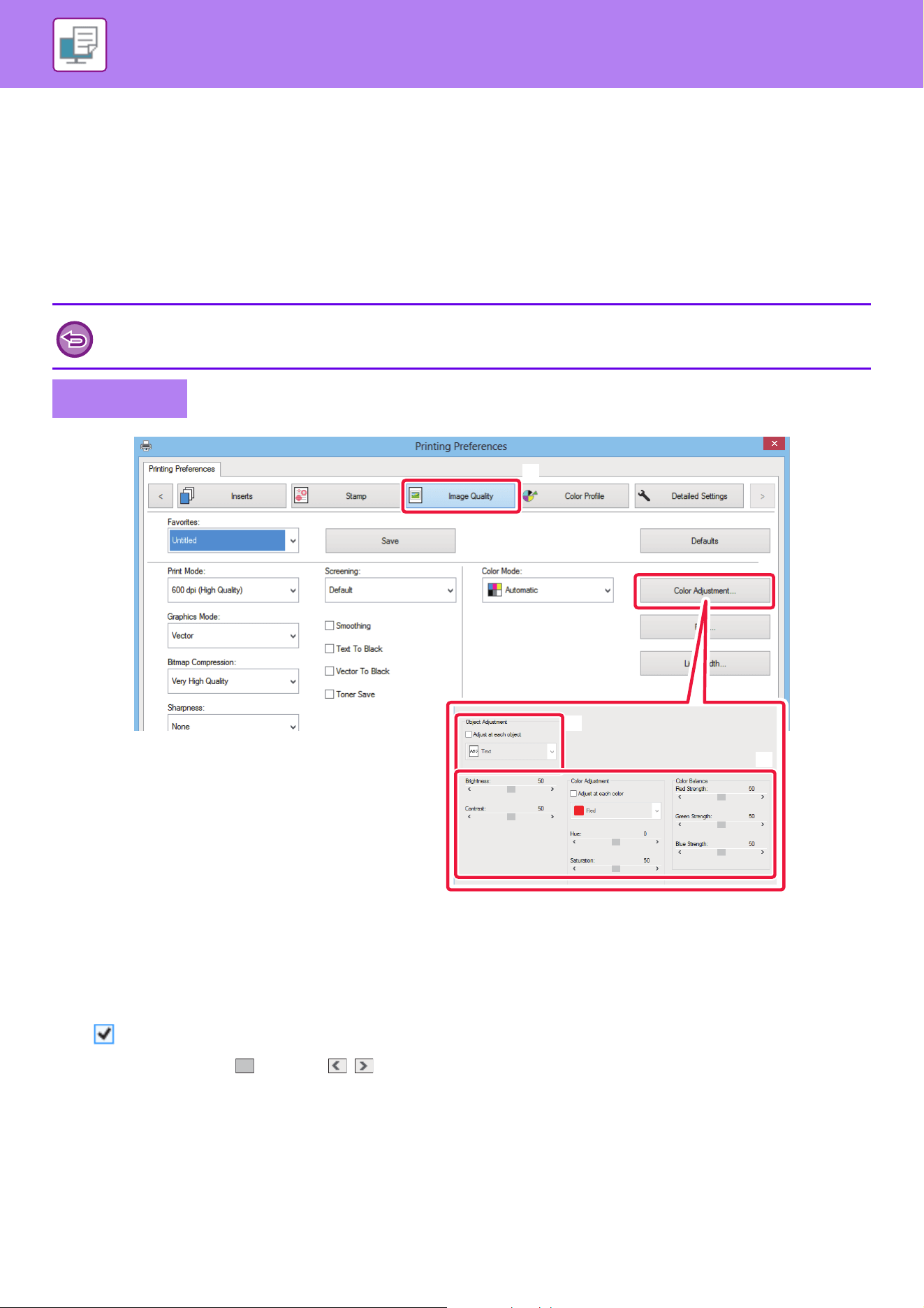
3-51
PRINTER►CONVENIENT PRINTING FUNCTIONS
COLOR MODE ADJUSTING FUNCTION
ADJUST THE BRIGHTNESS AND CONTRAST OF THE
IMAGE (COLOR ADJUSTMENT/RGB ADJUSTMENT)
This function adjusts the brightness and contrast in the print settings when a photo or other image is printed.
This function makes simple corrections even if image editing software is not installed on your computer.
(1) Click the [Image Quality] tab.
(2) Click the [Color Adjustment] button.
When using the PS printer driver, click the [RGB Adjustment] button. Proceed to step (4).
(3) To adjust objects (text, graphics, photos) individually, select the [Adjust at each object] checkbox
( ) and select the object.
(4) Drag the slide bar or click buttons to adjust the image.
This function can be used in a Windows environment.
Windows
(2)
(1)
(3)
(4)
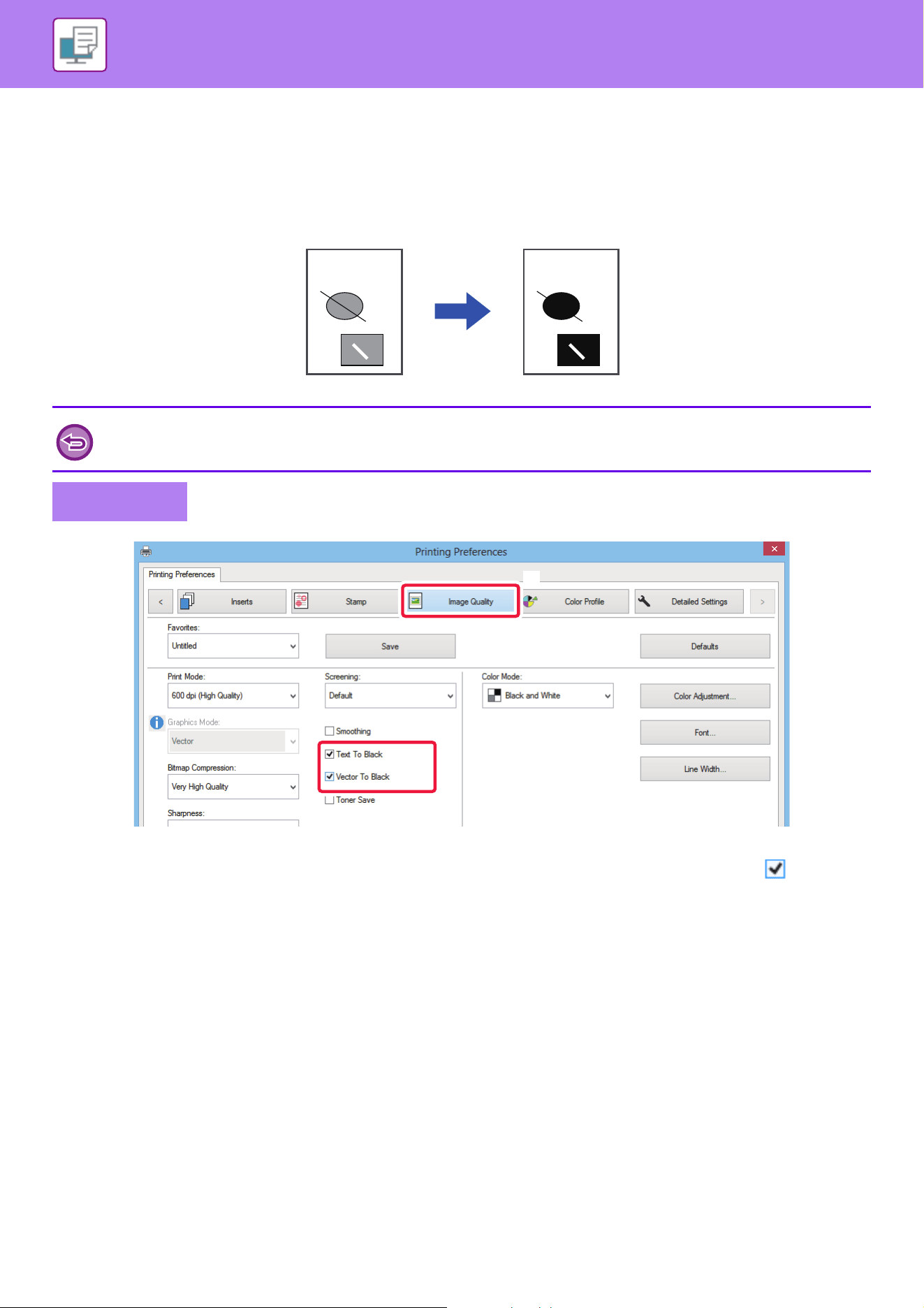
3-52
PRINTER►CONVENIENT PRINTING FUNCTIONS
PRINTING FAINT TEXT AND LINES IN BLACK (TEXT TO
BLACK/VECTOR TO BLACK)
When printing a color image in grayscale, text and lines that are drawn in faint colors are printed in black. This function
allows you to bring out color text and lines that are faint and difficult to see when printed in grayscale.
(1) Click the [Image Quality] tab.
(2) Select the [Text To Black] checkbox and/or the [Vector To Black] checkbox so that appears.
• When [Text To Black] is selected, all text other than white text is printed in black.
• When [Vector To Black] is selected, all vector graphics other than white lines and areas are printed in black.
• Raster data such as bitmap images cannot be adjusted.
• This function is available in a Windows environment.
Windows
ABCD ABCD
(1)
(2)
3-53
PRINTER►CONVENIENT PRINTING FUNCTIONS
SELECTING COLOR SETTINGS TO MATCH THE IMAGE
TYPE (ADVANCED COLOR SETTINGS)
Preset color settings are available in the machine's printer driver for various uses. These enable printing using the most
suitable color settings for the color image type.
Advanced color settings, such as the color management settings and the screening setting for adjusting the color tone
expression, are also available for meeting the needs of color image printing.
The following color management settings are available.
*1 Can only be used when using the PS printer driver (Windows/Mac OS).
*2 Can only be used when using the PCL6 printer driver.
Image Type Set the original type.
CMYK Simulation
*1
Adjusts the colors to simulate printing that would be obtained with the process colors used in
printing presses.
Simulation Profile
*1
Select the simulation target.
Output Profile Select a color profile for the image to be printed
Windows ICM Color management method in a Windows environment
ICM Method Set the ICM method.
ColorSync Color management method in a Mac OS environment
Source Profile Select a source color profile of color matching.
Rendering Intent The selections below provide the ability to modify color image processing to suit specific
preferences. (Color matching method: Method of color converting RGB colors on the display,
etc. into CMYK colors in the printer)
CMYK Correction*
2
Correct the image to obtain the optimum printing result when printing a CMYK image.
Neutral Gray Select a creating method of neutral gray.
Pure Black Print Select whether you want to print black data area with only black toner.
Black Overprint*
1
Prevents whitening of the outline of black text.
Trapping Select to prevent void area which may be generated around edge of colors.
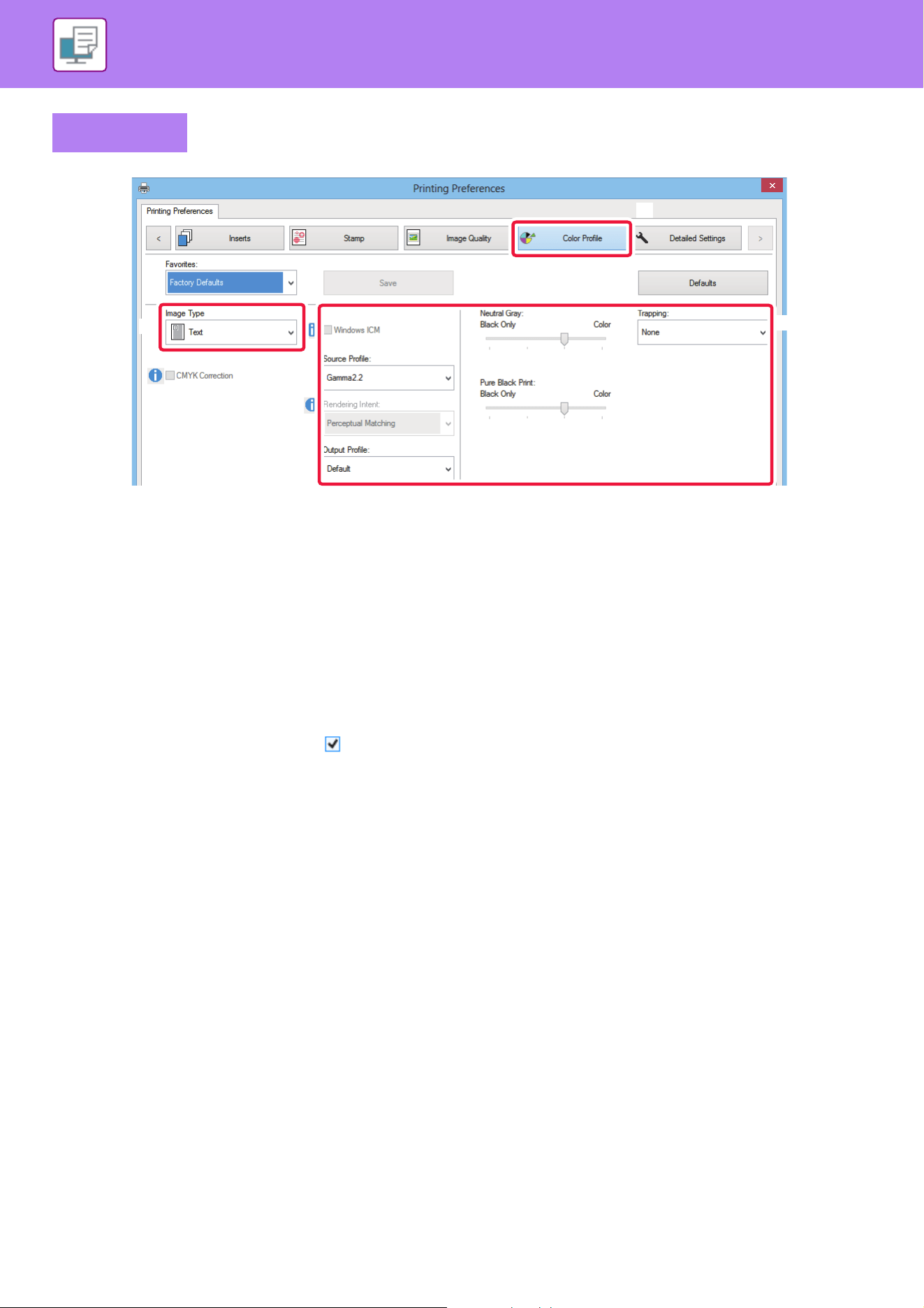
3-54
PRINTER►CONVENIENT PRINTING FUNCTIONS
(1) Click the [Color Profile] tab.
(2) Select [Image Type].
• Text: Data consisting mostly of text
• Presentation: Data with many photos or illustrations
• Photo: Photo data or data that uses photos
• CAD: Engineering drawing data
• Scan: Data scanned by a scanner
• Colorimetric: Data to be printed in colors as viewed on the screen
• Custom: Data to be printed with special settings
(3) Specify the settings.
To configure color management using the Windows OS ICM, set "Image Type" to [Custom] in step (2). Then, click the [Windows
ICM] checkbox so that the checkmark appears.
To configure "Source Profile" and other detailed color management tasks, select the desired settings from the menus.
Windows
(2)
(1)
(3)
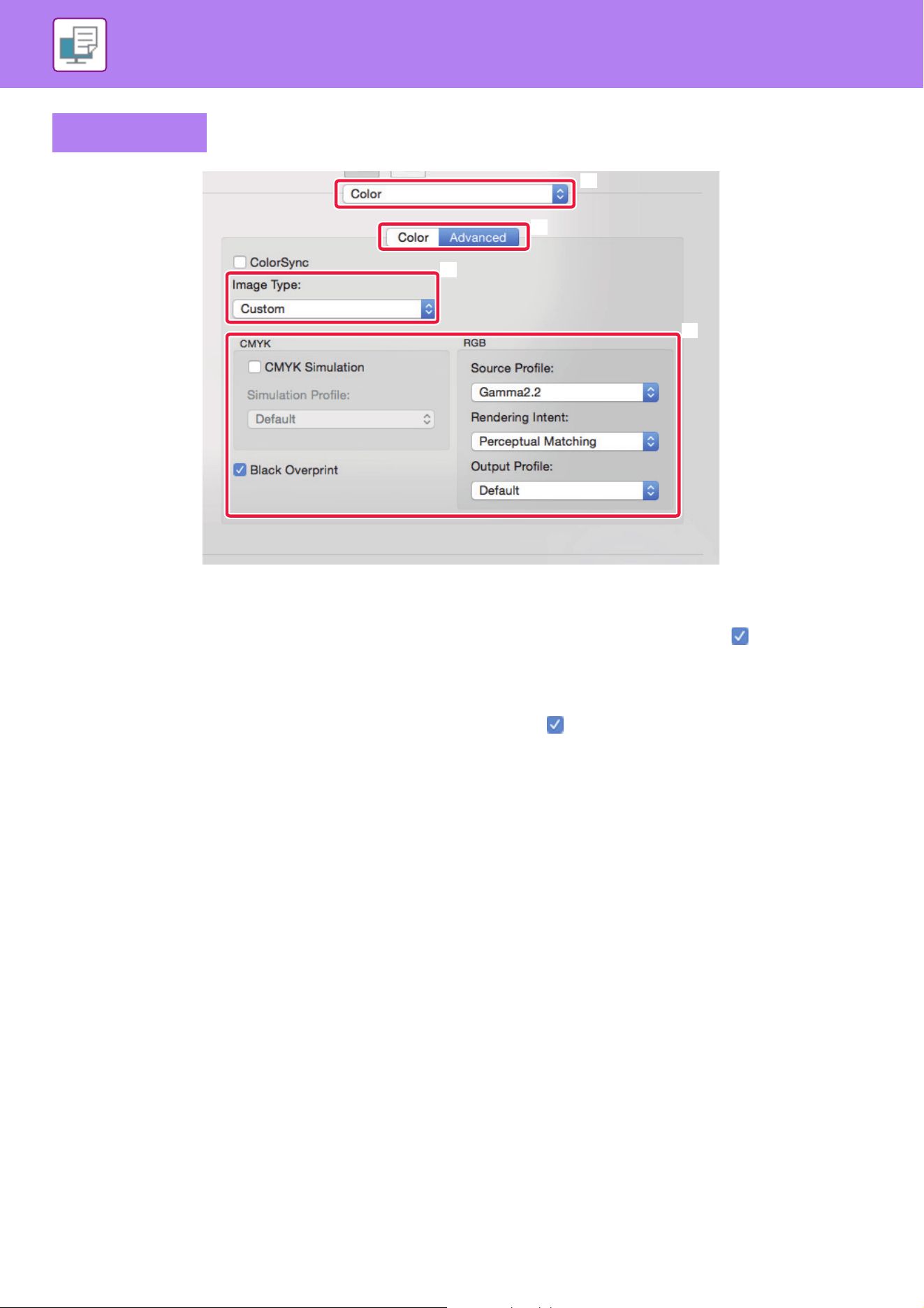
3-55
PRINTER►CONVENIENT PRINTING FUNCTIONS
(1) Select [Color].
(2) Click the [Advanced] tab.
To use the Mac OS color management function, select the [ColorSync] checkbox so that the checkmark appears. In this
case, you cannot select "Image Type".
(3) Select [Image Type].
To configure color management settings, select the desired settings from the menus. To select a "CMYK Simulation" setting,
select [Custom] in "Image Type", select the [CMYK Simulation] checkbox ( ), and then select the desired setting.
• Text: Data consisting mostly of text
• Presentation: Data with many photos or illustrations
• Photo: Photo data or data that uses photos
• CAD: Engineering drawing data
• Scan: Data scanned by a scanner
• Colorimetric: Data to be printed in colors as viewed on the screen
• Custom: Data to be printed with special settings
(4) Specify the settings.
Mac OS
(2)
(1)
(3)
(4)
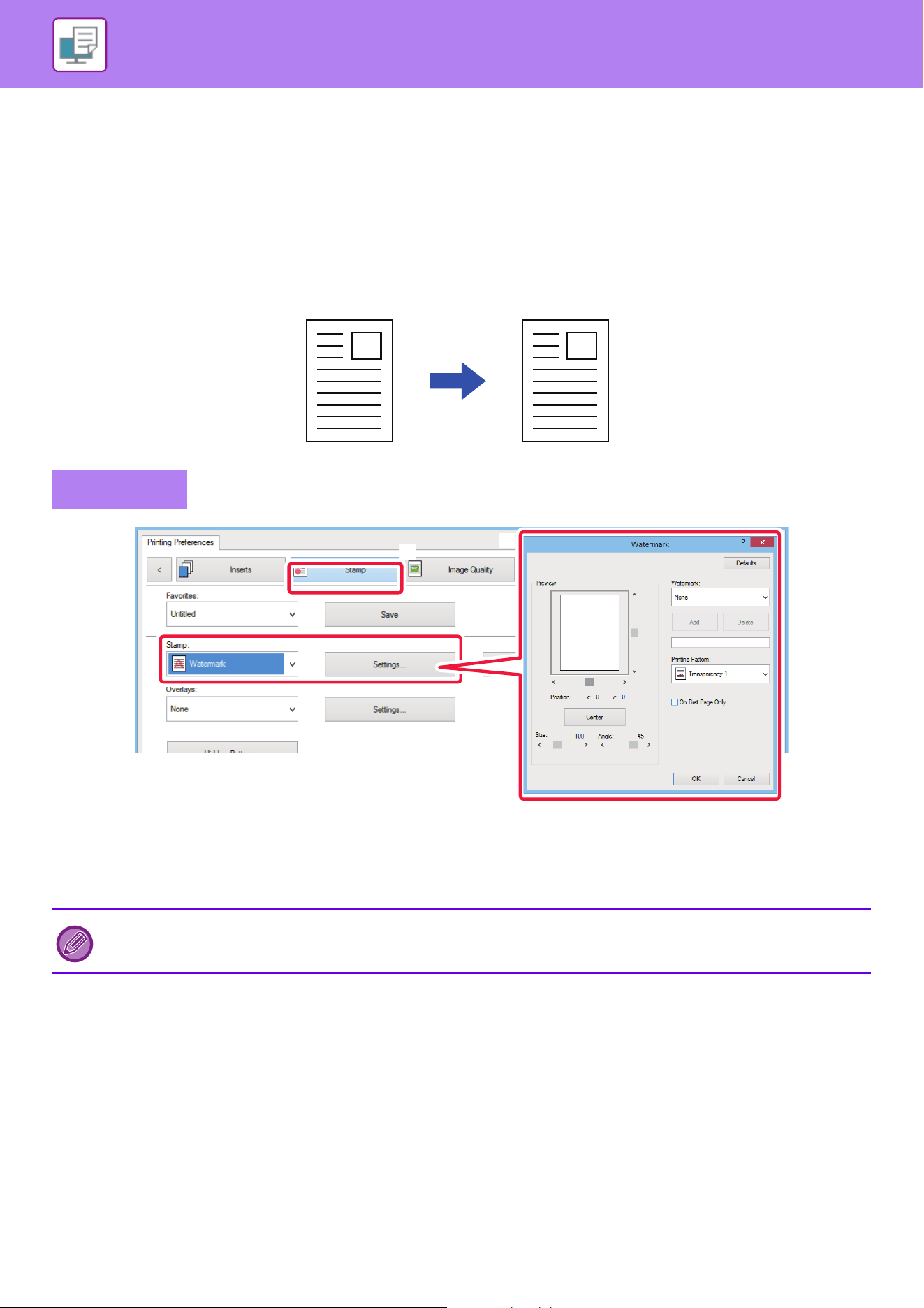
3-56
PRINTER►CONVENIENT PRINTING FUNCTIONS
FUNCTIONS TO COMBINE TEXT AND IMAGES
ADDING A WATERMARK TO PRINTED PAGES (WATERMARK)
This function adds faint shadow-like text as a watermark in the background of the printed image. The size and angle of
the watermark text can be adjusted.
The watermark text can be selected from the previously registered text in the list. When necessary, you can enter text to
create an original watermark.
(1) Click the [Stamp] tab.
(2) Select [Watermark] from "Stamp" and click the [Settings] button.
(3) Select the watermark to be used and click the [OK] button.
Windows
If you want to create a new watermark, enter the text of the watermark in the text box and click the [Add] button.
CONFIDENTIAL
(2)
(1)
(3)
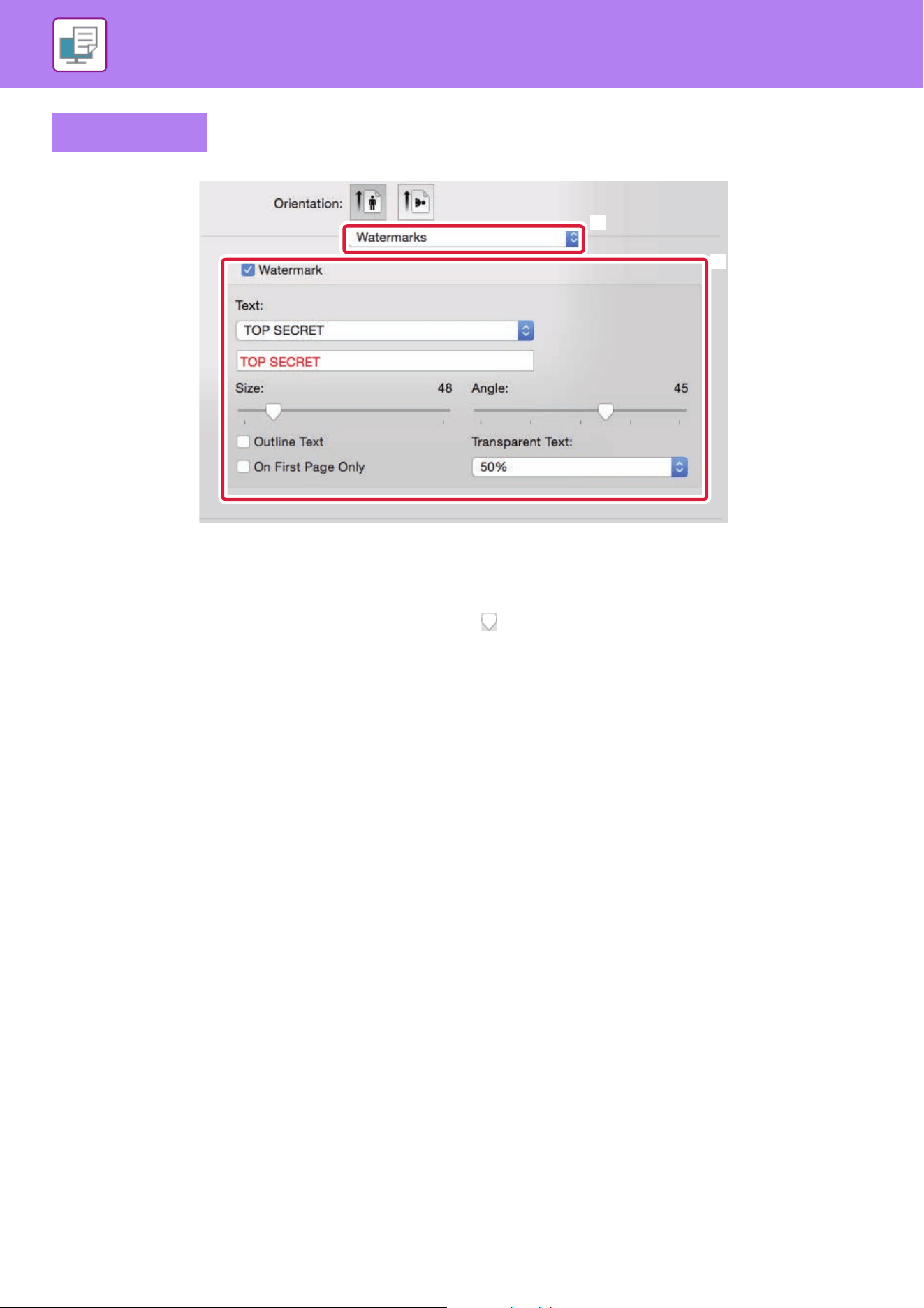
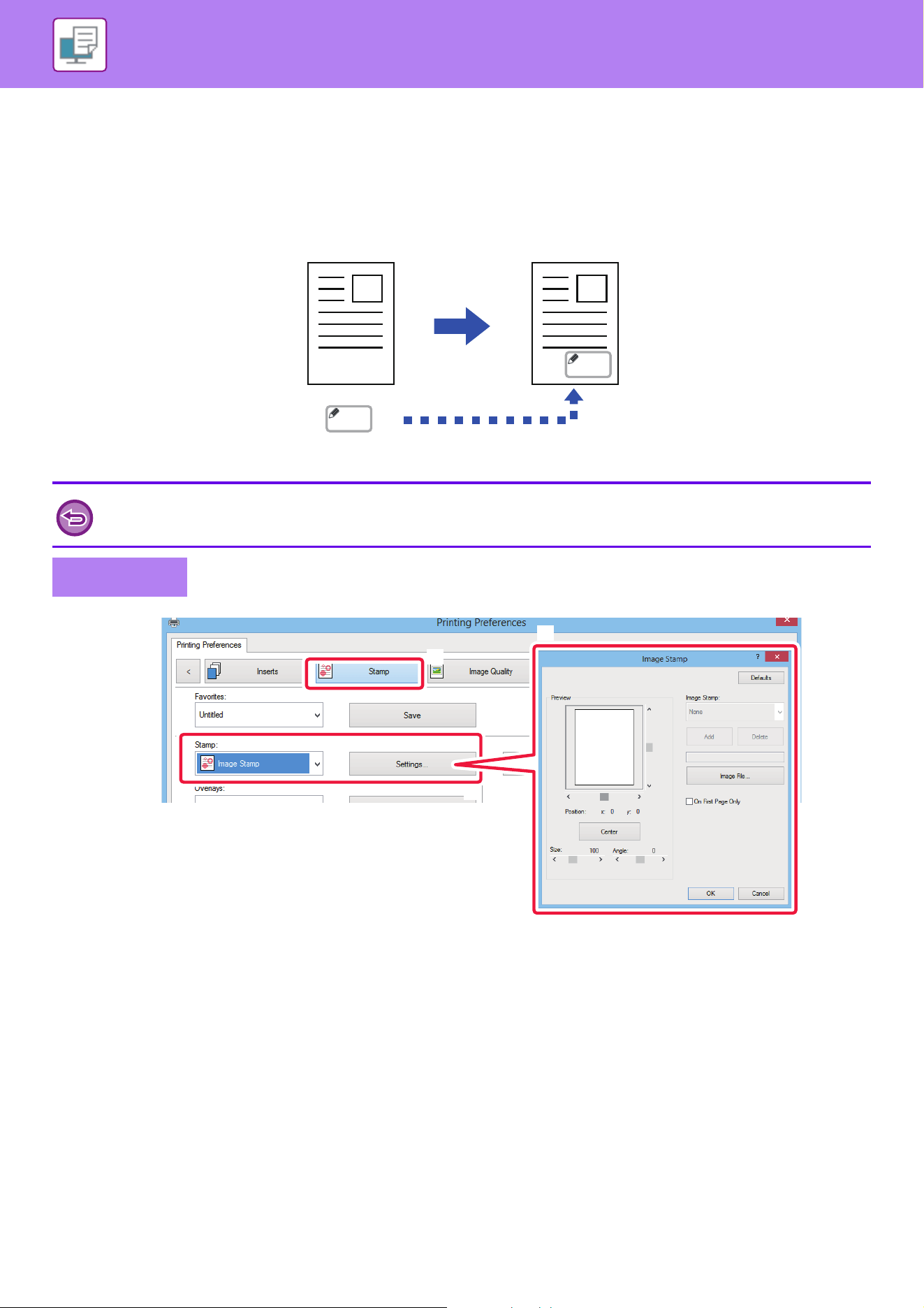
3-58
PRINTER►CONVENIENT PRINTING FUNCTIONS
PRINTING AN IMAGE OVER THE PRINT DATA (IMAGE
STAMP)
This function prints a bitmap or JPEG image stored on your PC over the print data.
This function prints a frequently used image or an icon of your own creation as if it is stamped on the print data. The size,
position, and angle of the image can be adjusted.
(1) Click the [Stamp] tab.
(2) Select [Image Stamp] from "Stamp" and click the [Settings] button.
(3) Select the image stamp to be used, and click the [OK] button.
• If an image stamp has already been stored, it can be selected from the menu.
• If you have not stored an image stamp, click the [Image File], select the file you wish to use for the image stamp, and click the
[Add] button.
This function is available in a Windows environment.
Windows
MEMO
MEMO
(2)
(1)
(3)
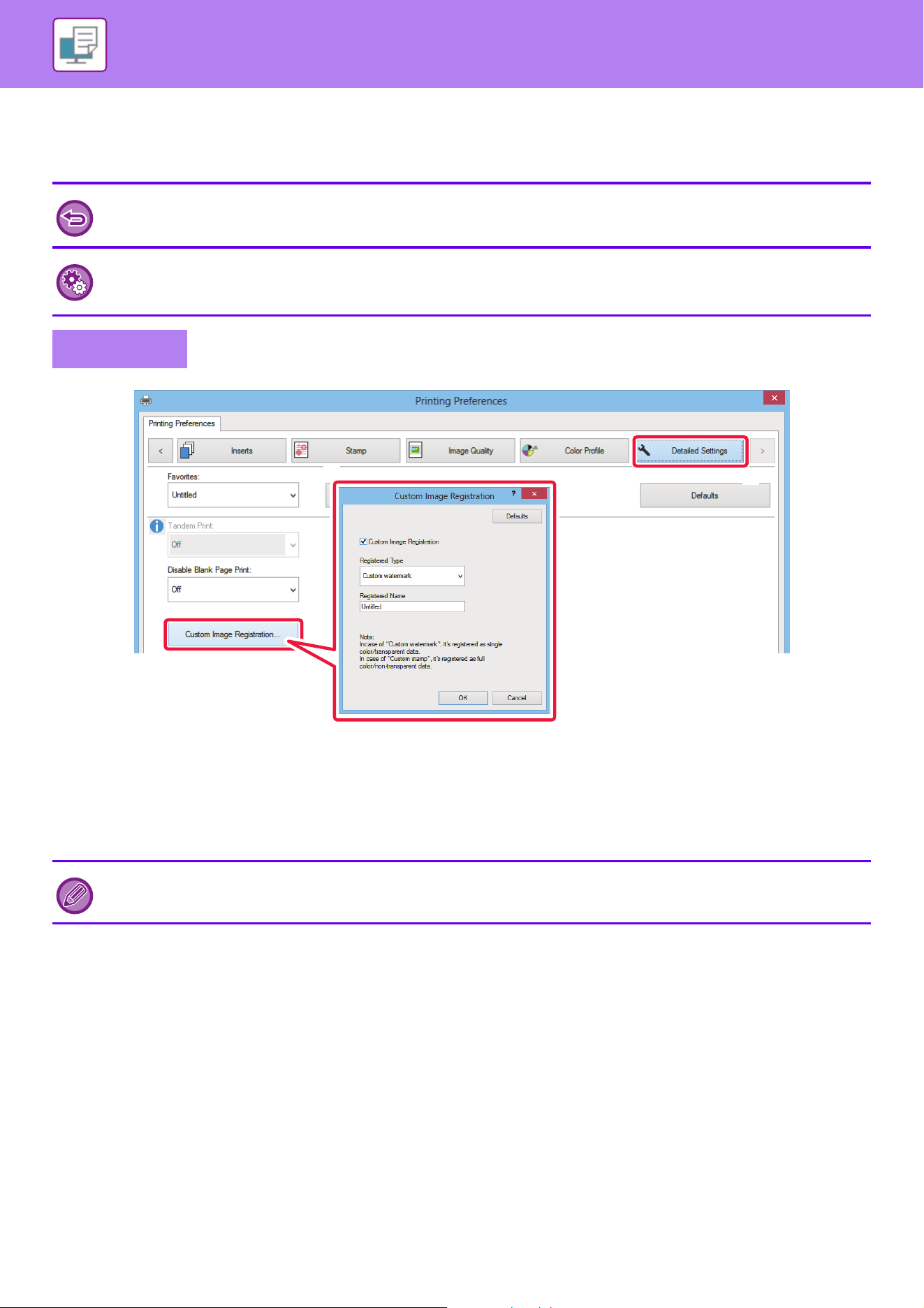
3-59
PRINTER►CONVENIENT PRINTING FUNCTIONS
REGISTERING A CUSTOM IMAGE
This function registers images used as custom images from the printer driver to the machine.
(1) Click the [Detailed Settings] tab.
(2) Click the [Custom Image Registration] button.
(3) Select the registration type and name of the custom image.
When [Custom stamp] is selected in "Registered Type", a full-color, non-transparent stamp image is registered. When [Custom
watermark] is selected, a single-color, transparent watermark image is registered.
• This function is available in a Windows environment.
• This function can be used when the PCL6 printer driver is used.
To prohibit the registration of custom images:
In "Settings (administrator)", select [System Settings] → [Common Settings] → [Enable/Disable Settings] → [Disabling
Registration of Custom Image] and configure the setting.
Windows
If you have attempted to store multiple pages of data, only the first page will be stored.
(2)
(1)
(3)
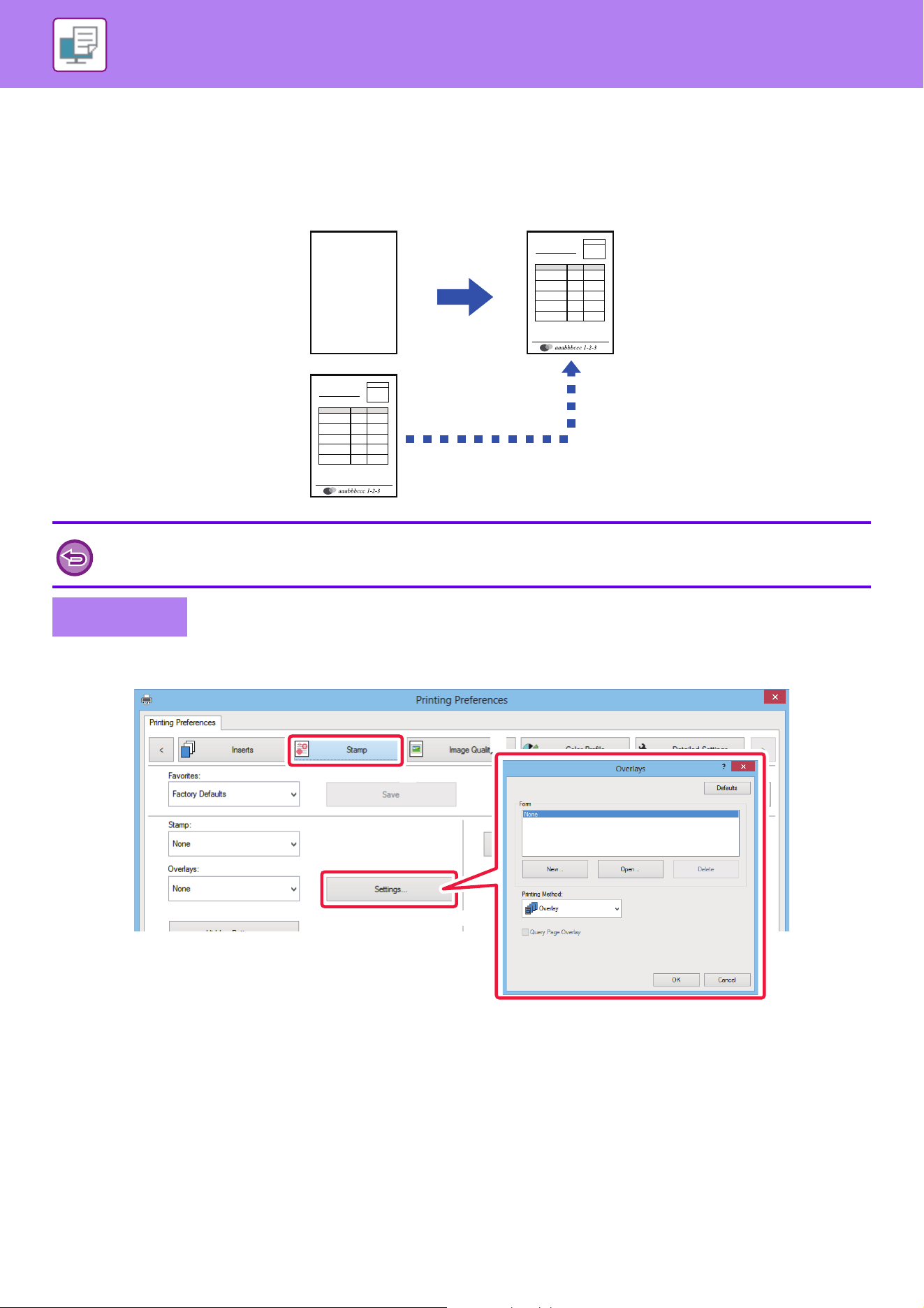
3-60
PRINTER►CONVENIENT PRINTING FUNCTIONS
OVERLAY A FIXED FORM ON THE PRINT DATA (OVERLAYS)
This function overlays data on a fixed form you have prepared.
By creating table rulings or a decorative frame in an application different from that of the text file and registering the data
as an overlay file, an attractive print result can be easily obtained without the need for complex manipulations.
Creating an overlay file
(1) Open the driver properties window from the application that is used for creating overlay data.
(2) Click the [Stamp] tab.
(3) Click the [Settings] button.
(4) Click the [New] button and specify the name and folder to be used for the overlay file that you
wish to create.
The file will be created when the settings are completed and printing is started.
This function is available in a Windows environment.
Windows
XXXX
XXX 1 100
XXXX 10 150
XXX 0 120
XXXX 10 250
XXXX
XXX 1 100
XXXX 10 150
XXX 0 120
XXXX 10 250
(3)
(2)
(4)
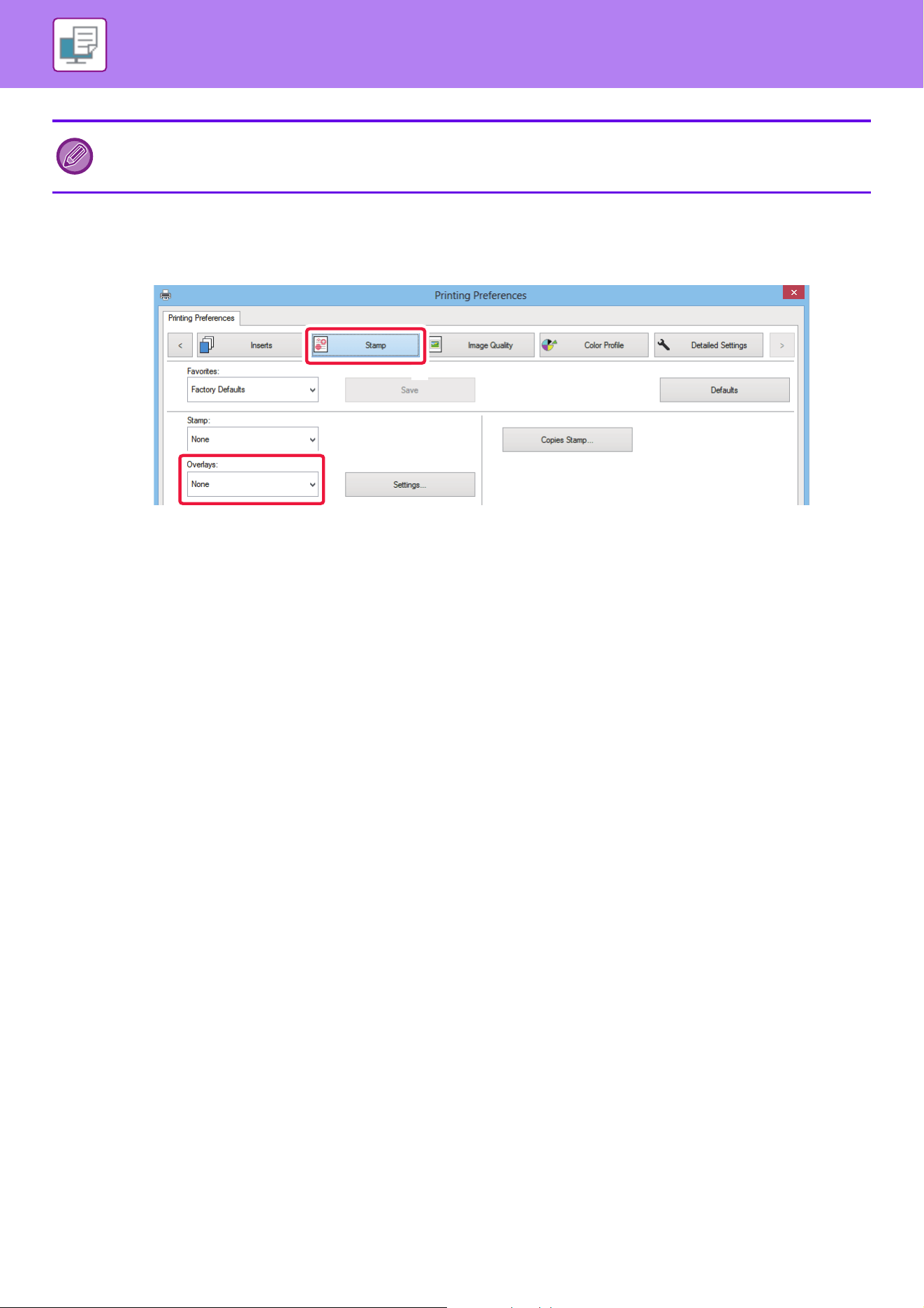
3-61
PRINTER►CONVENIENT PRINTING FUNCTIONS
Printing with an overlay file
(1) Open the driver properties window from the application that is used for printing with an overlay
file.
(2) Click the [Stamp] tab.
(3) Select an overlay file.
A previously created or stored overlay file can be selected from the menu.
• When printing is started, a confirmation message will appear. The overlay file will not be created until the [Yes] button is
clicked.
• When you click the [Open] button, the existing overlay file is registered.
(3)
(2)
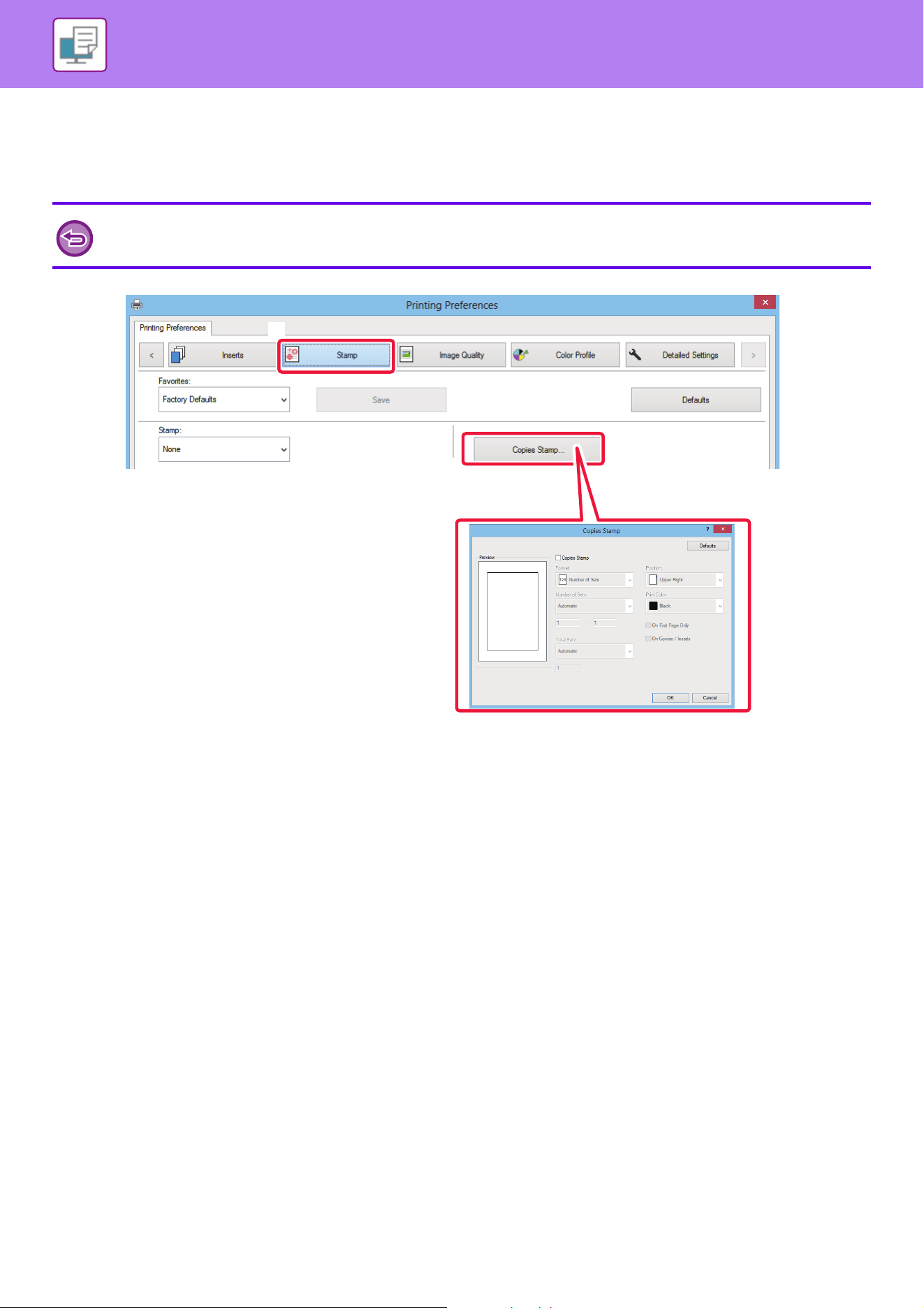
3-62
PRINTER►CONVENIENT PRINTING FUNCTIONS
ADDING THE NUMBER OF COPIES (COPIES STAMP)
You can add the number of copies to the header or footer of the print data. You can also set a copies number and print
position.
(1) Click the [Stamp] tab.
(2) Click the [Copies Stamp] button.
(3) Select the settings, and click the [OK] button.
This function is available in a Windows environment.
(2)
(1)
(3)
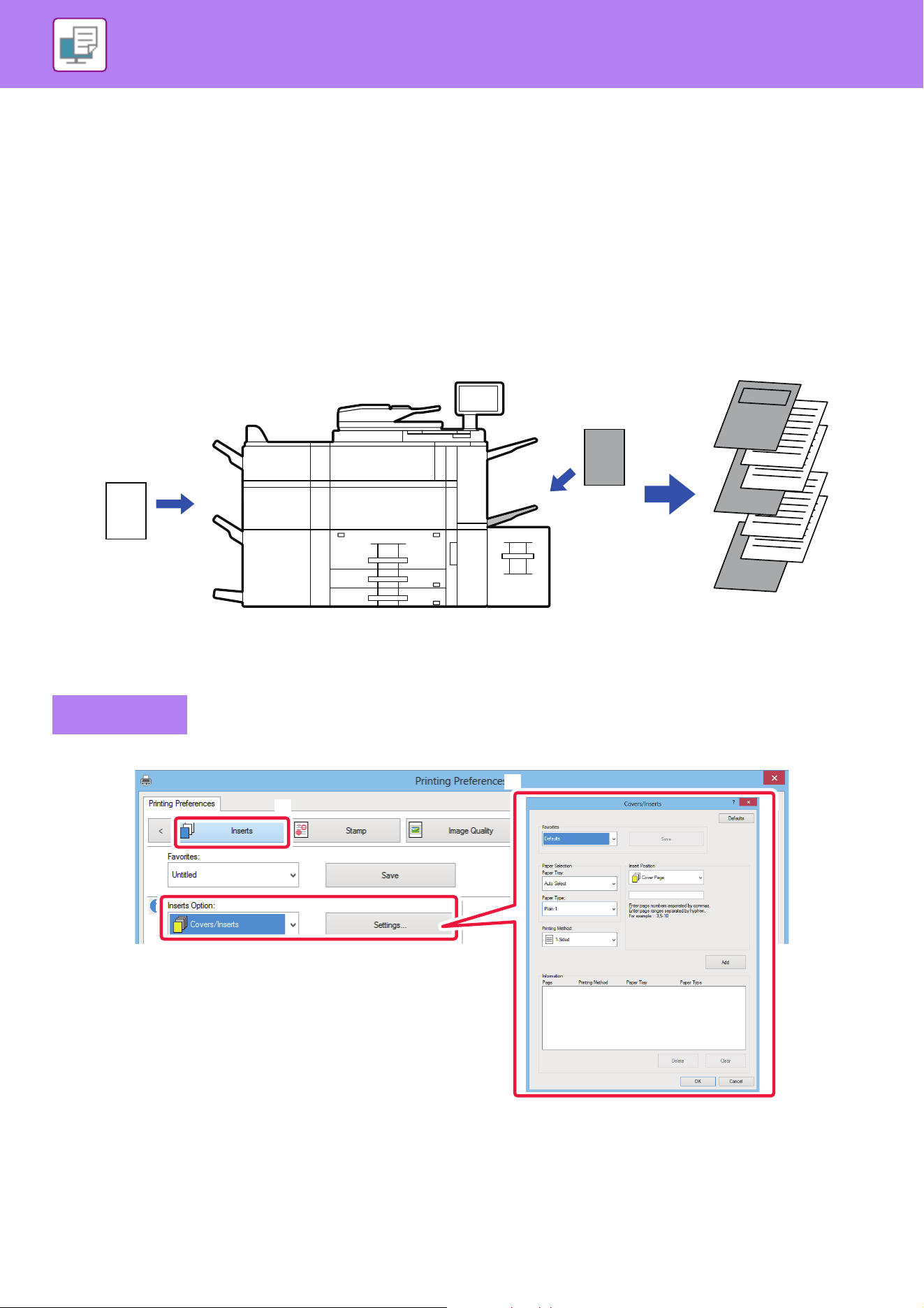
3-63
PRINTER►CONVENIENT PRINTING FUNCTIONS
PRINT FUNCTIONS FOR SPECIAL PURPOSES
PRINTING SPECIFIC PAGES ON DIFFERENT PAPER
(DIFFERENT PAPER)
In a Windows environment
The front and back covers and specified pages of a document are printed on paper that is different from the other pages.
Use this function when you wish to print the front and back covers on heavy paper, or insert colored paper or a different
paper type at specified pages.
As necessary, paper can be inserted as insertion sheets where nothing is printed.
In a Mac OS environment
The front and back covers are printed using paper that is different from the other pages. This function can be used, for
example, when you want to print only the front cover and last page on thick paper.
(1) Click the [Inserts] tab.
(2) Select [Covers/Inserts] from [Inserts Option], and click the [Settings] button.
(3) Select the paper insertion settings.
• Select the insertion position, paper source, and printing method from the corresponding menus.
Windows
5
4
3
2
1
(2)
(1)
(3)
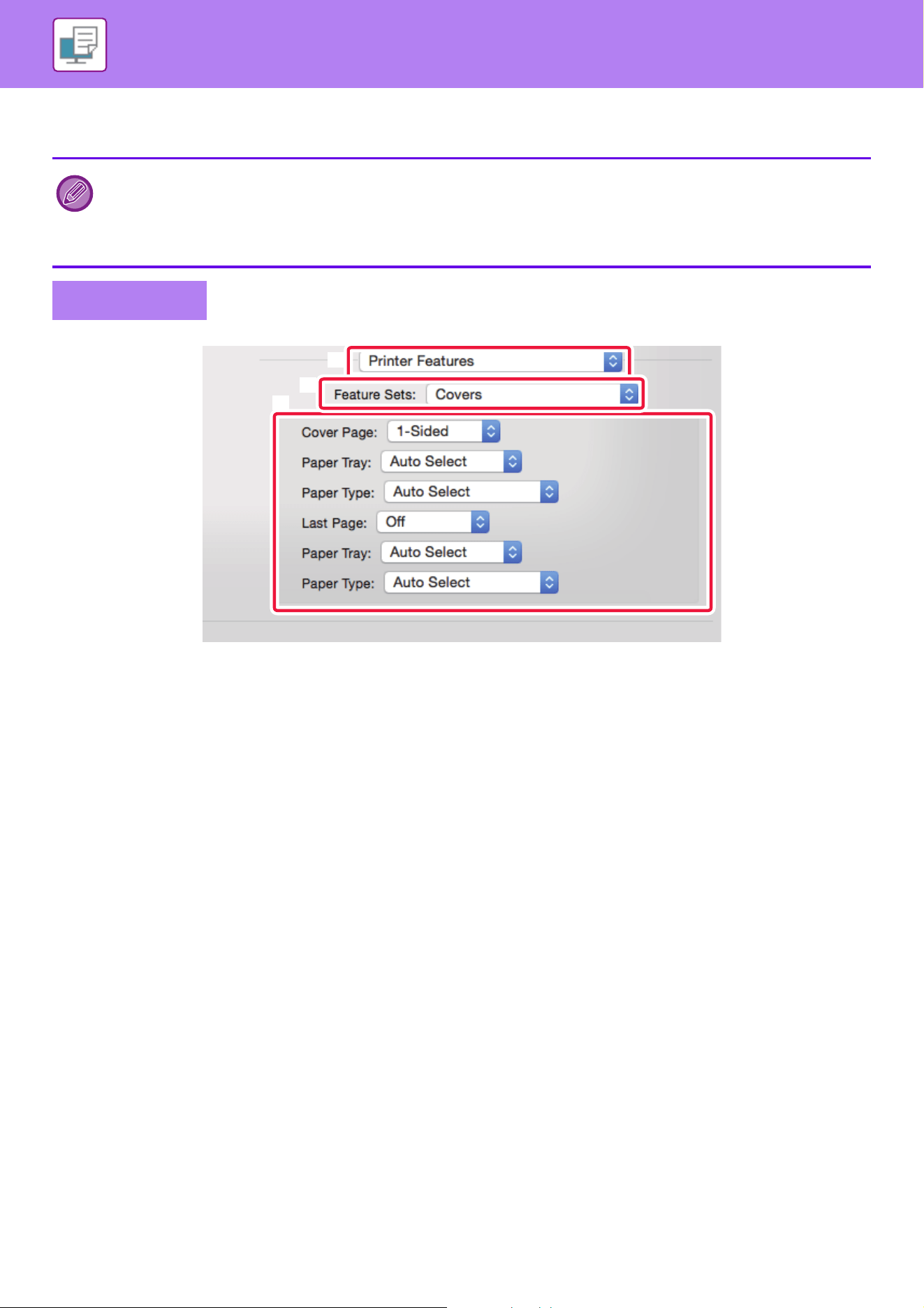
3-64
PRINTER►CONVENIENT PRINTING FUNCTIONS
• Click the [Add] button and your settings will appear in "Information".
• When you have finished selecting settings, click the [Save] button in "Favorites" to save the settings.
(1) Select [Printer Features].
(2) Select [Covers].
(3) Select the cover insertion settings.
Select the print setting, paper tray, and paper type for the front and back covers.
• When [Bypass Tray] is selected in "Paper Tray", be sure to select the "Paper Type" and load that type of paper in the
bypass tray.
• When [Other Page] is selected for "Insert Position", specify the insert position by directly entering a page number. When
"Printing Method" is set to [2-Sided Printing], the specified page and the next page after it will be printed on the front and
reverse side of the paper, and thus an insert setting at a page printed on the reverse side will not be effective.
Mac OS
(2)
(1)
(3)
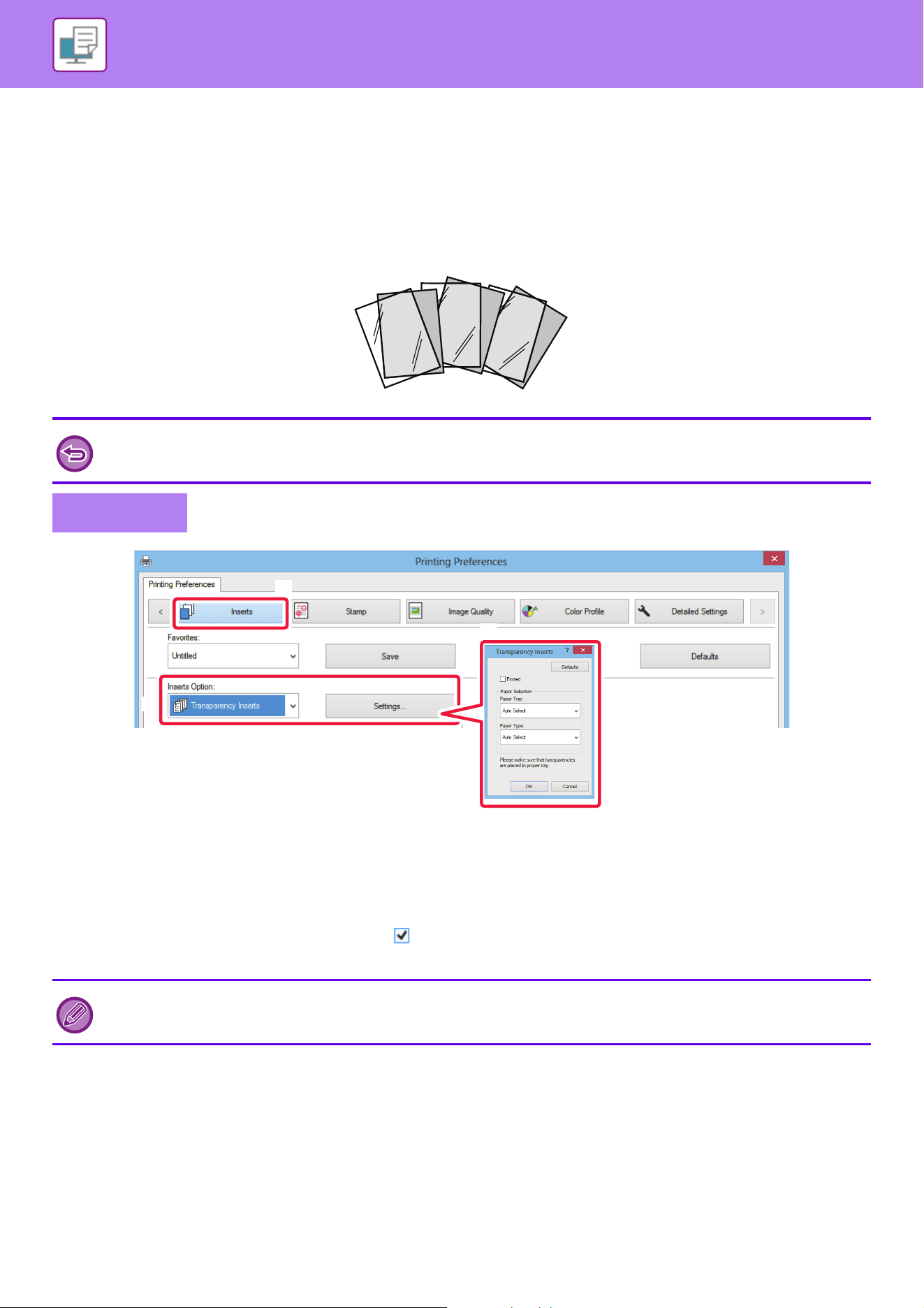
3-65
PRINTER►CONVENIENT PRINTING FUNCTIONS
ADDING INSERTS WHEN PRINTING ON
TRANSPARENCY FILM (TRANSPARENCY INSERTS)
When transparency film is used for printing, this function prevents the sheets of transparency film from sticking together
by inserting a sheet of paper between each sheet of film. As necessary, the same content as that printed on each sheet
of transparency film is also printed on the corresponding sheet of inserted paper.
(1) Click the [Inserts] tab.
(2) Select [Transparency Inserts] and click the [Settings] button.
Select the print setting, paper tray, and paper type for the front and back covers.
(3) Select the transparency insert settings.
When the [Printed] checkbox is selected to set to , the same content as that printed on the transparency film is also printed
on the insert. Select the paper source and type if needed.
This function is available in a Windows environment.
Windows
Set the paper type of the bypass tray to [Transparency] and load transparency film into the bypass tray.
C
B
A
(2)
(1)
(3)
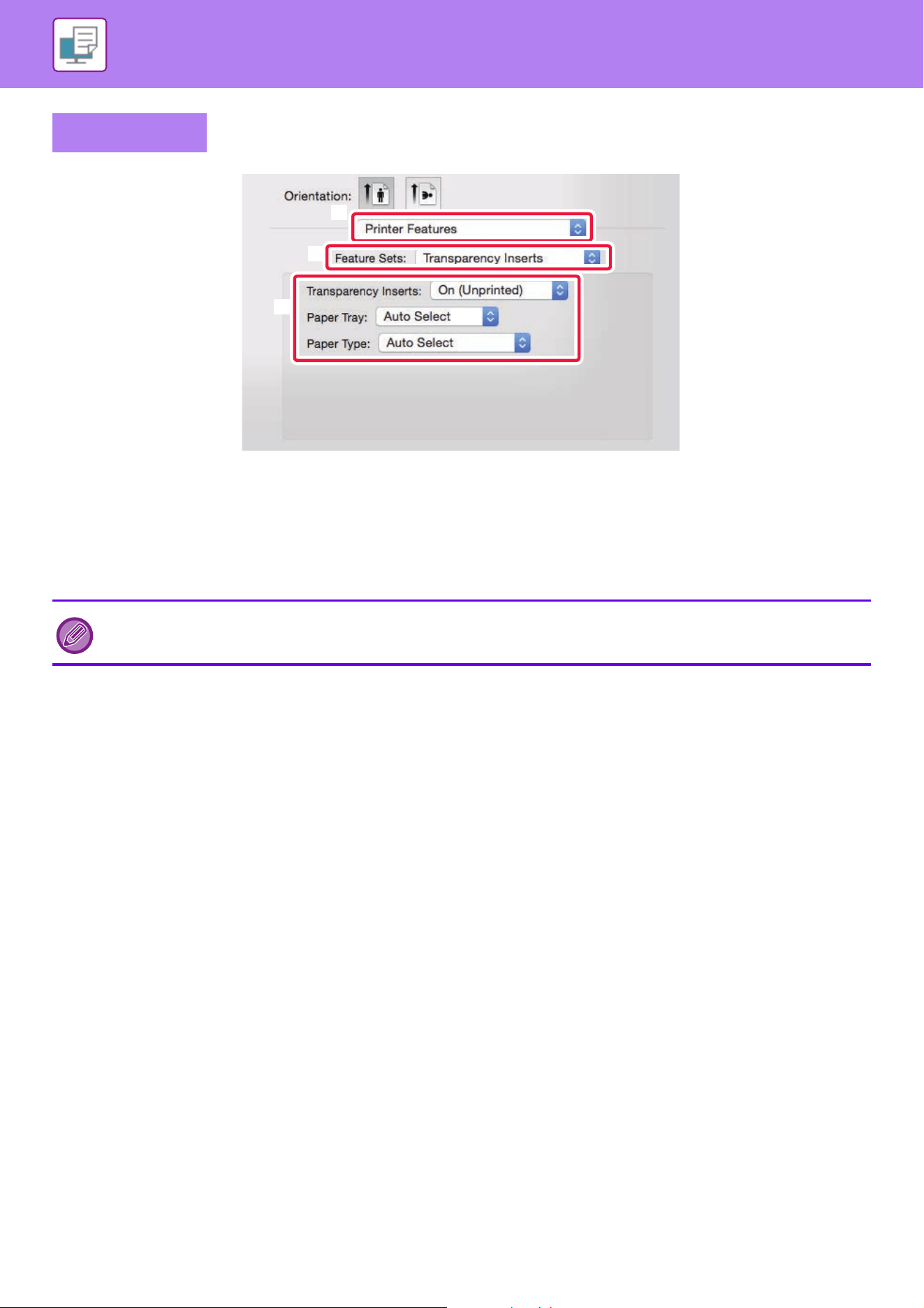
3-66
PRINTER►CONVENIENT PRINTING FUNCTIONS
(1) Select [Printer Features].
(2) Select [Transparency Inserts] in "Feature Sets".
(3) Select the transparency insert settings.
When [On (Printed)] is selected from "Transparency Inserts", the same content as that printed on the transparency film is also
printed on the insert. Select the paper source and type if needed.
Mac OS
Set the paper type of the bypass tray to [Transparency] and load transparency film into the bypass tray.
(2)
(1)
(3)
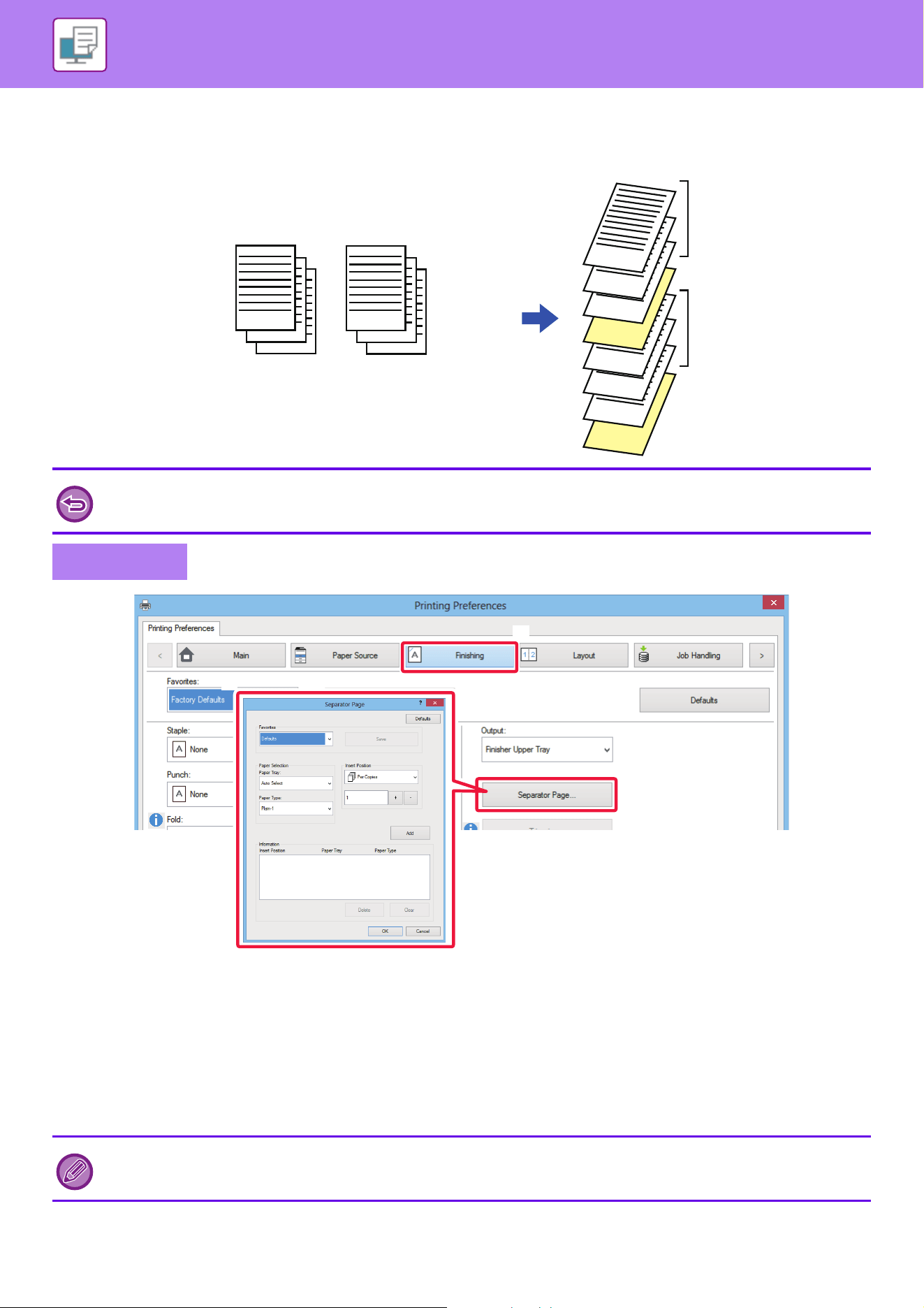
3-67
PRINTER►CONVENIENT PRINTING FUNCTIONS
INSERTING SEPARATOR PAGES BETWEEN JOBS OR COPIES
You can insert separator pages between jobs or the specified number of copies.
(1) Click the [Finishing] tab.
(2) Click the [Separator Page] button.
(3) Changing the settings
• Select the paper tray and paper type from "Paper Selection", and specify the separator page position in "Insert Position".
• To add a separator page each time printing of the set number of copies is completed, select [Per Copies] in "Insert Position".
• For example, if you are printing 10 copies and you select "5", a separator page will be added after the 5th copy and after the
10th copy.
This function is available in a Windows environment.
Windows
When the bypass tray is selected, be sure to select the "Paper Type".
3
2
1
3
2
1
3
2
1
3
2
1
Job 1 Job 2
Job 2
Job 1
(2)
(3)
(1)
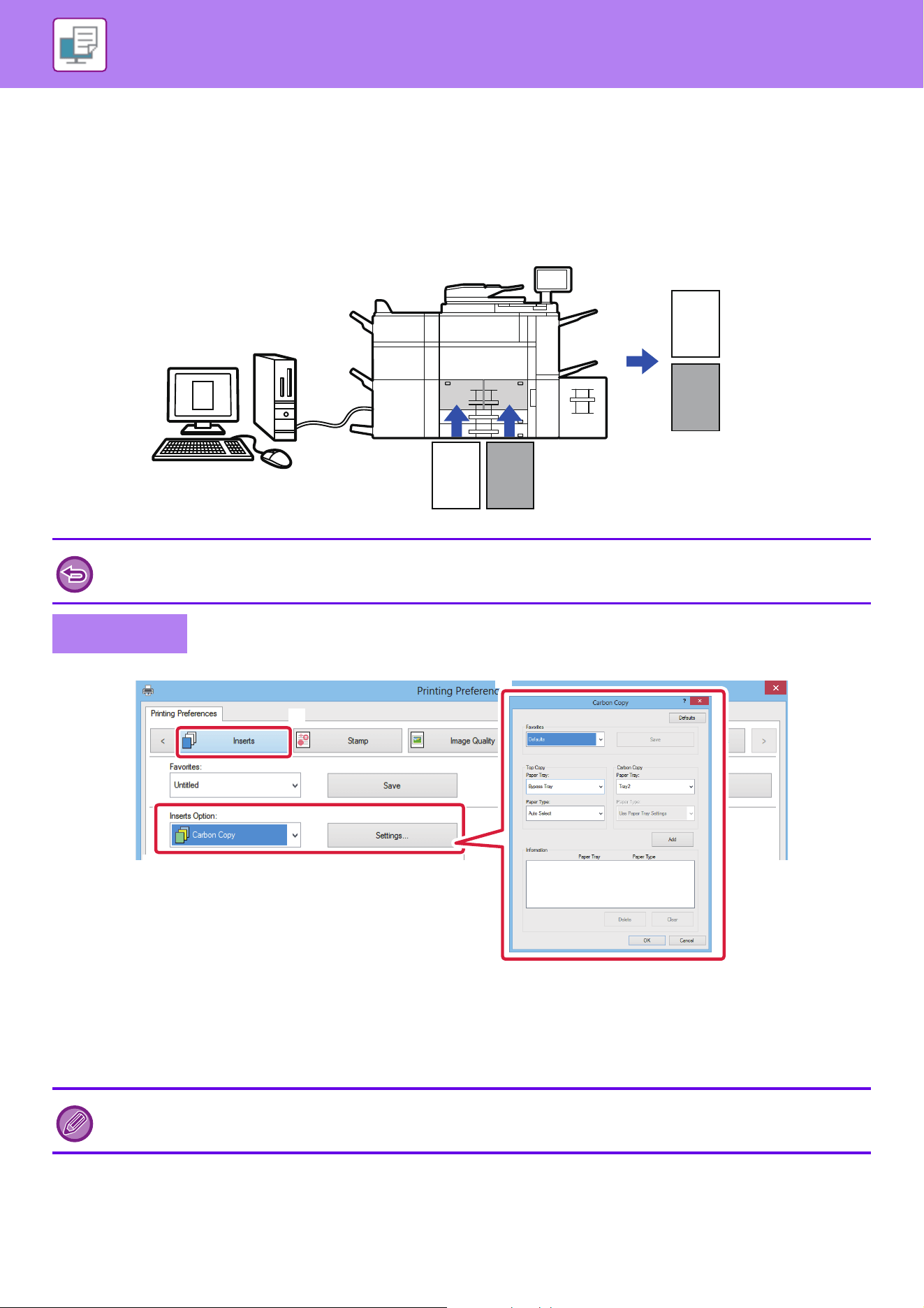
3-68
PRINTER►CONVENIENT PRINTING FUNCTIONS
PRINTING A CARBON COPY (CARBON COPY)
This function prints an additional copy of the print image on paper that is of the same size but from a different paper tray.
For example, if carbon copy print is selected when plain paper is loaded into tray 1 and colored paper is loaded into tray
2, a print result similar to a carbon copy slip is obtained with a single selection of the print command. If plain paper is
loaded into tray 1 and recycled paper is loaded into tray 2 as necessary, selecting Carbon Copy simultaneously prints
one copy for presentation and one copy as a duplicate.
(1) Click the [Inserts] tab.
(2) Select [Carbon Copy] from "Inserts Option"and click the [Settings] button.
(3) Select the tray for the first copy from "Top Copy", and then select the tray for the carbon copy
from "Carbon Copy".
This function is available in a Windows environment.
Windows
When the bypass tray is selected, be sure to select the "Paper Type".
A
A
A
(2)
(1)
(3)
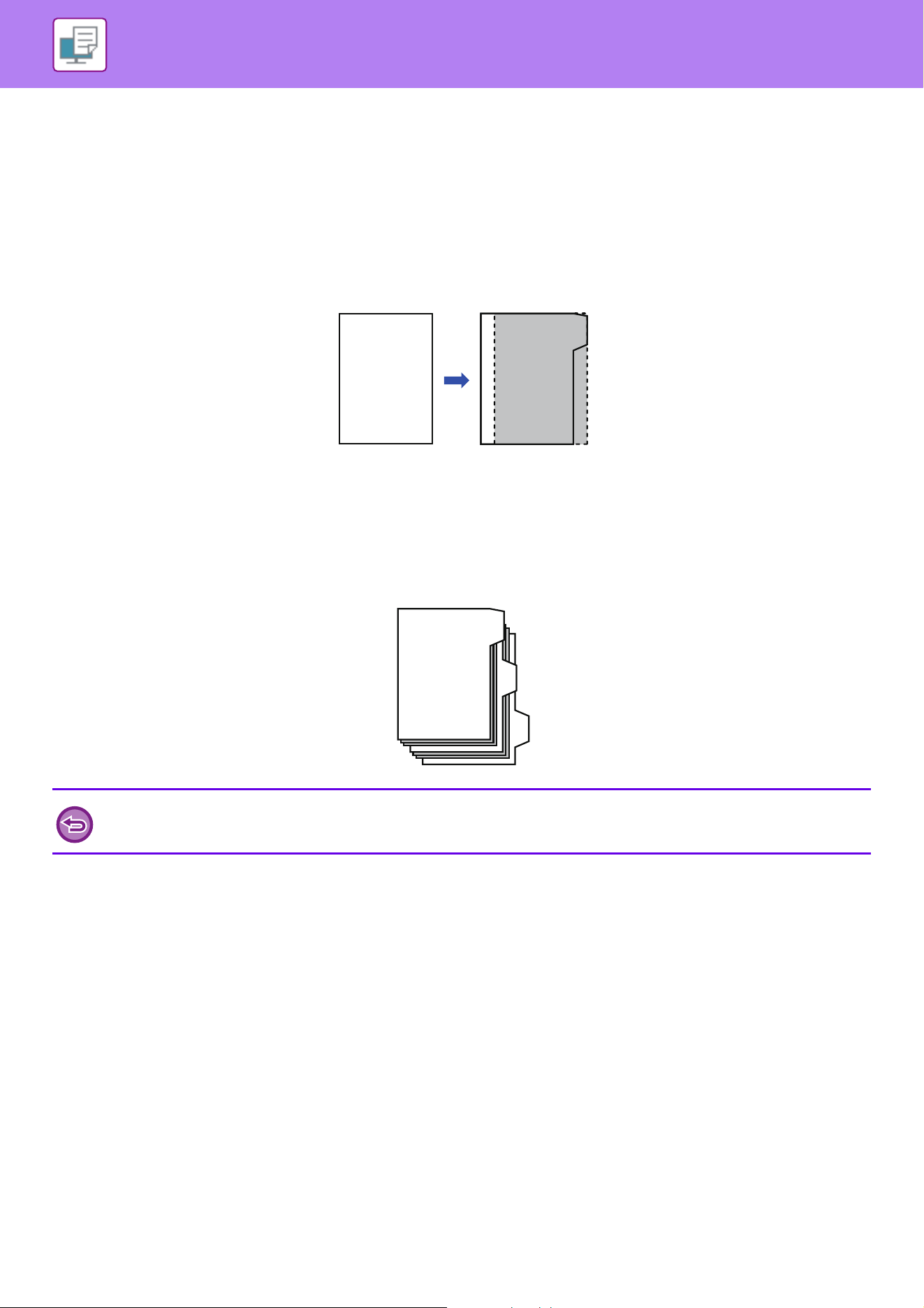
3-69
PRINTER►CONVENIENT PRINTING FUNCTIONS
PRINTING TEXT ON TABS OF TAB PAPER (TAB
SHIFT/TAB PAPER PRINT)
There are two methods of printing on the tabs of tab paper: "Tab Shift" and "Tab Paper Print".
Tab Shift
Create the text to be printed on tab paper in an application, and set the test shifting distance in [Print Position] on the
[Layout] tab of the printer driver property window. The text will be printed on the tabs.
Tab Paper Print (for PCL6 only)
Tab sheets are printed while they are inserted between the desired pages.
Select [Tab Paper] in [Inserts Option] on the [Inserts] tab of the printer driver properties window, and enter the text that
you want to print on the tabs. Specify the detailed settings such as the size of the tabs, the starting position, the distance
between tabs, and the page numbers where tab sheets will be inserted.
• These functions are available in a Windows environment.
• Tab paper must be loaded into the bypass tray.
ABC
ABC
GHI
DEF
ABC
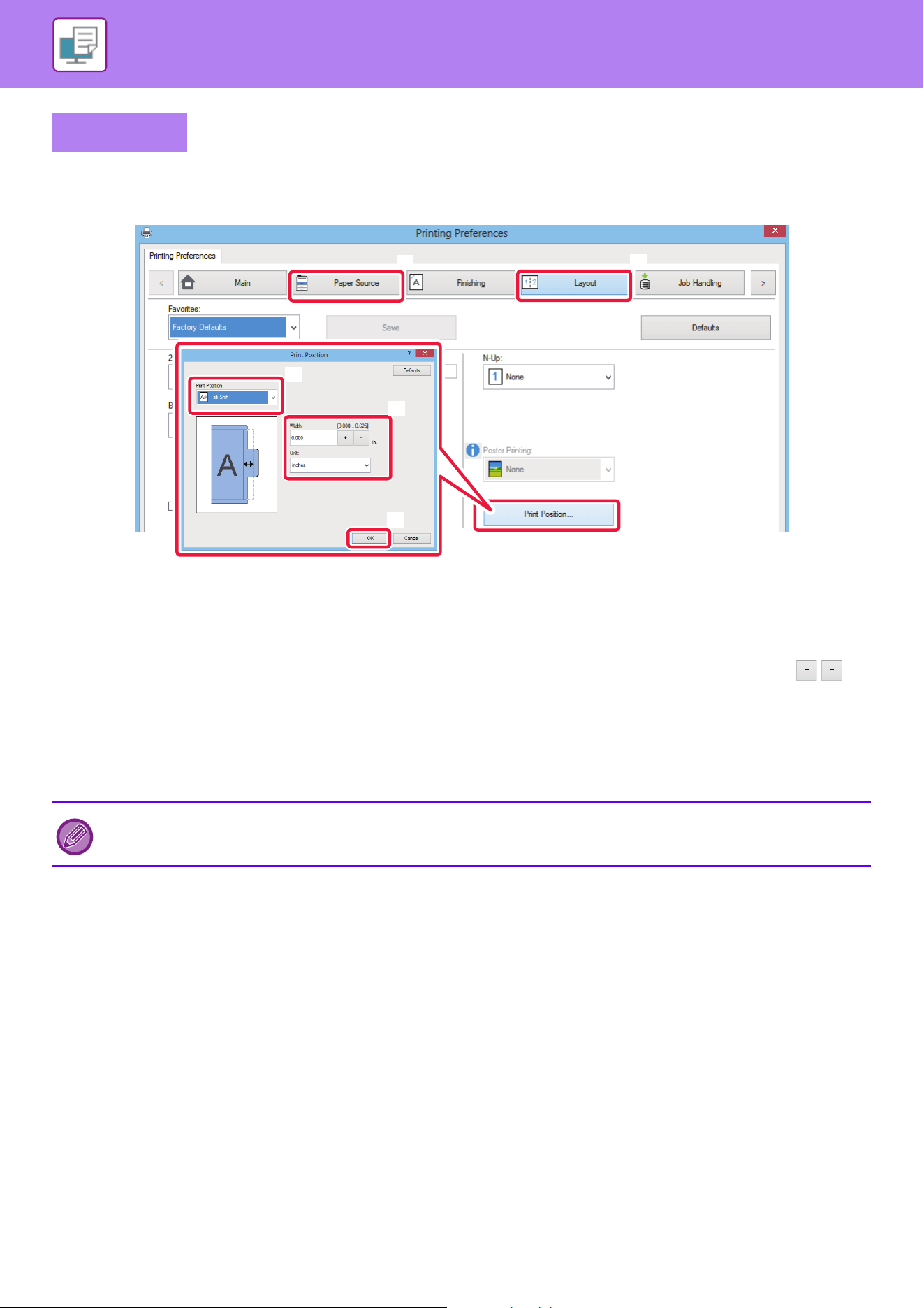
3-70
PRINTER►CONVENIENT PRINTING FUNCTIONS
Tab Shift
When you have finished preparing the data to be printed on tab papers in an application, take the following steps:
(1) Click the [Layout] tab.
(2) Click the [Print Position] button.
(3) Select [Tab Shift].
(4) Specify the distance of shifting the image by directly entering a value or by clicking the
button.
(5) Click the [OK] button.
(6) Select the paper source and type.
Click the [Paper Source] tab, and select [Bypass Tray] in "Paper Tray" and [Tab Paper] in "Paper Type".
Windows
Set the paper type of the bypass tray to [Tab Paper] and load tab papers into the bypass tray.
(2)
(1)
(3)
(4)
(6)
(5)
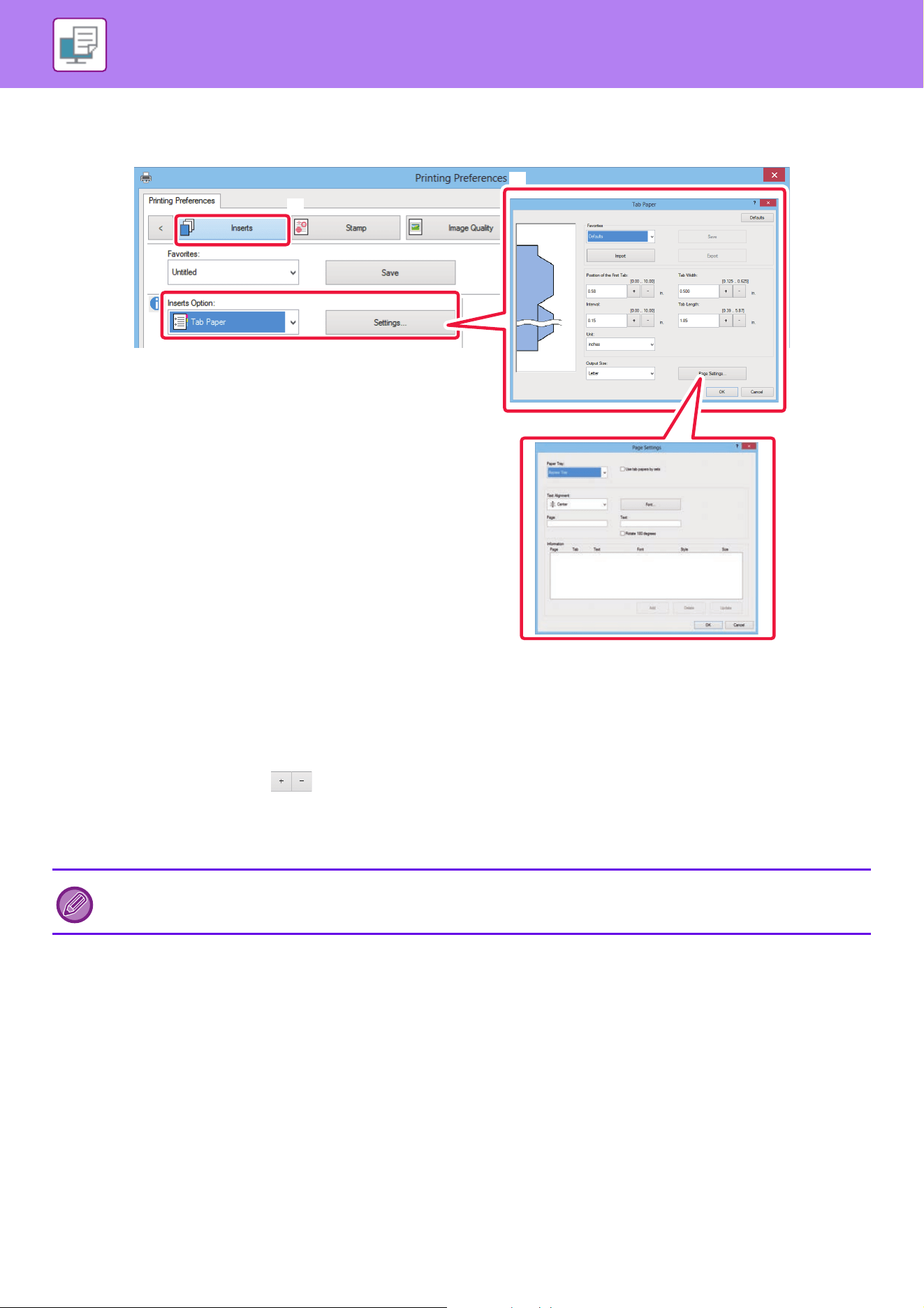
3-71
PRINTER►CONVENIENT PRINTING FUNCTIONS
Tab Paper Print (for PCL6 only)
Open the data into which you wish to insert tab paper, and then select the settings.
(1) Click the [Inserts] tab.
(2) Select [Tab Paper] from "Inserts Option", and click the [Settings] button.
(3) Select the tab position settings.
For commercially available tab paper, use the existing settings such as [A4-5tab-D] in "Favorites". For other types of tab paper,
the position of the first tab, the distance between tabs, and the horizontal and vertical dimensions of the tab can be directly
entered or changed using the button. In addition, select the size of the tab paper from "Output Size".
(4) Select the page settings.
Specify the pages where you wish to insert tab paper and enter the text that you wish to print on the tabs. Also select the Paper
Tray, font and adjust the layout.
• Set the paper type of the selected tray to [Tab Paper], and load tab paper in the selected tray.
• The tab paper settings can be stored and a stored file can be opened from "Favorites".
(2)
(1)
(3)
(4)
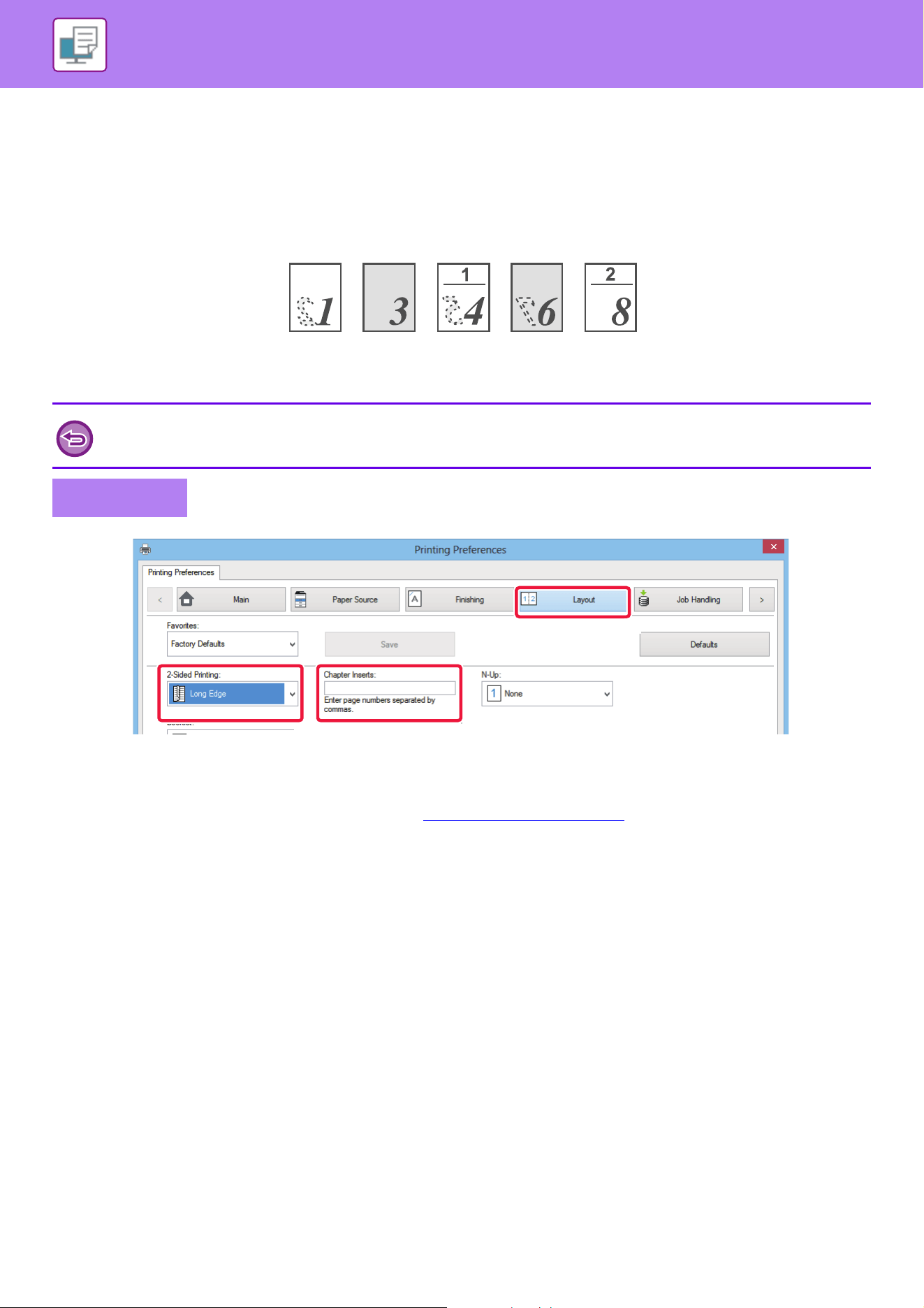
3-72
PRINTER►CONVENIENT PRINTING FUNCTIONS
TWO-SIDED PRINTING WITH SPECIFIC PAGES PRINTED
ON THE FRONT SIDE (CHAPTER INSERTS)
This function prints specific pages on the front side of the paper.
When you specify a page (such as a chapter cover page) to be printed on the front side of the paper, it is printed on the
front side of the next sheet even if it would normally be printed on the reverse side of the paper.
Example: When pages 4 and 8 are specified as page settings.
(Back is blank)
(1) Click the [Layout] tab.
(2) Select the 2-Sided Printing.
For information on the "2-Sided Printing" setting, see "2-SIDED PRINTING (page 3-21)".
(3) Enter the page numbers of the initial pages of the chapters, separating the numbers with
commas.
This function is available in a Windows environment.
Windows
(2)
(3)
(1)
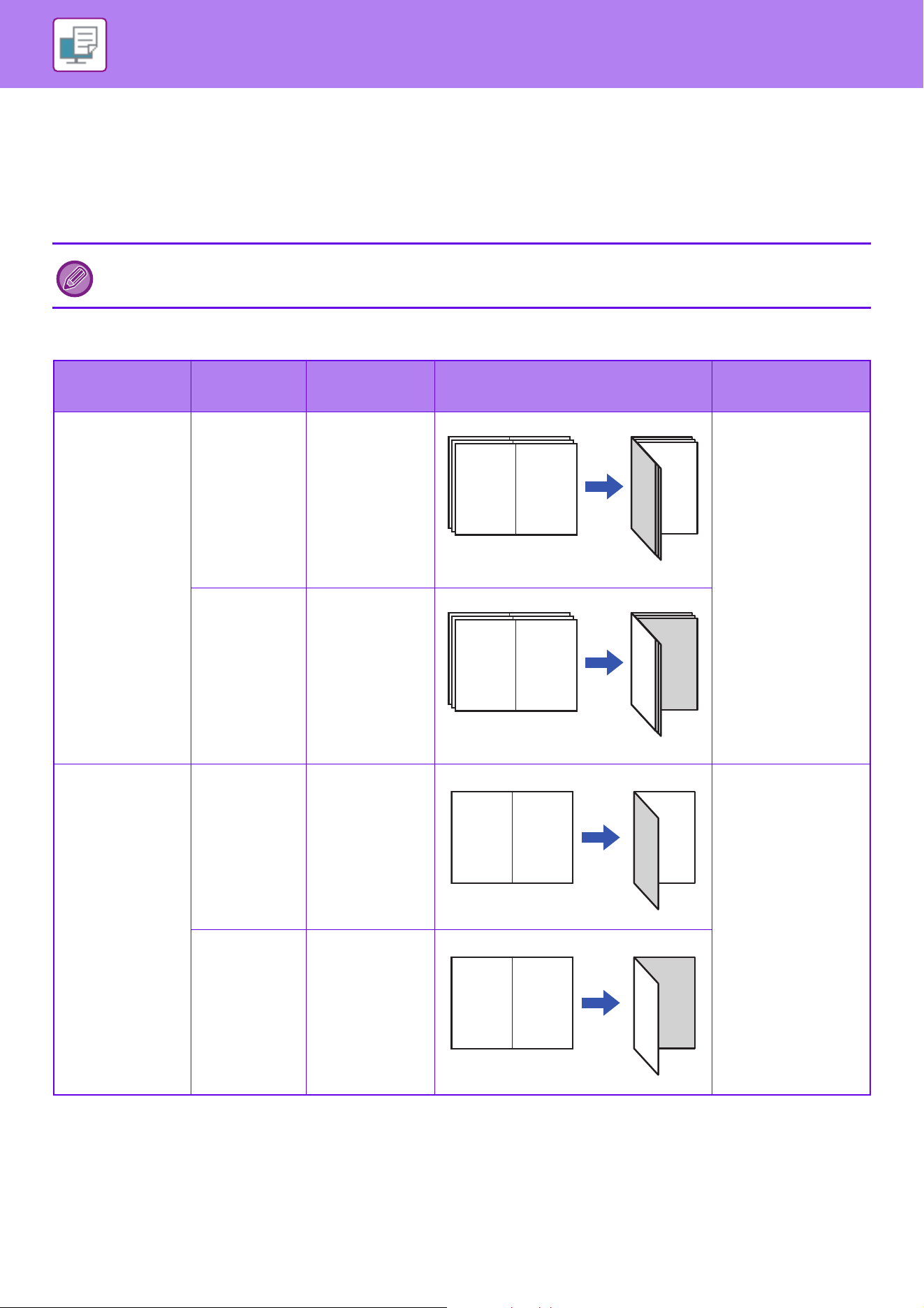
3-73
PRINTER►CONVENIENT PRINTING FUNCTIONS
FOLDING PAPER FOR PRINTING (FOLD)
If a folding unit is installed, print paper can be folded.
For example, if 8-1/2" × 11" (A4) and 11" × 17" (A3) size print images are mixed, you can fold 11" × 17" (A3) size paper
to the 8-1/2" × 11" (A4) size to adjust the width of the actual print paper to the 8-1/2" × 11" (A4) size. When necessary,
you can staple folded sheets.
Types of paper folding functions
To use the Half Fold and Saddle Fold (Staple) functions, you need to mount a saddle stitch finisher.
Folding types Print Side
Fold
Orientation
Folding results Description
Saddle Fold
Inside -
Multiple sheets are
collectively folded in
the center.
Outside -
Half Fold
Inside -
Paper is folded in the
center.
Copies are output
sheet by sheet.
Outside -
B
B
B
A
A
A
BA
BA
BA
B
A
B
A
B
A
BA
BA
BA
A
B
B
A
BA
BA
A
A
B
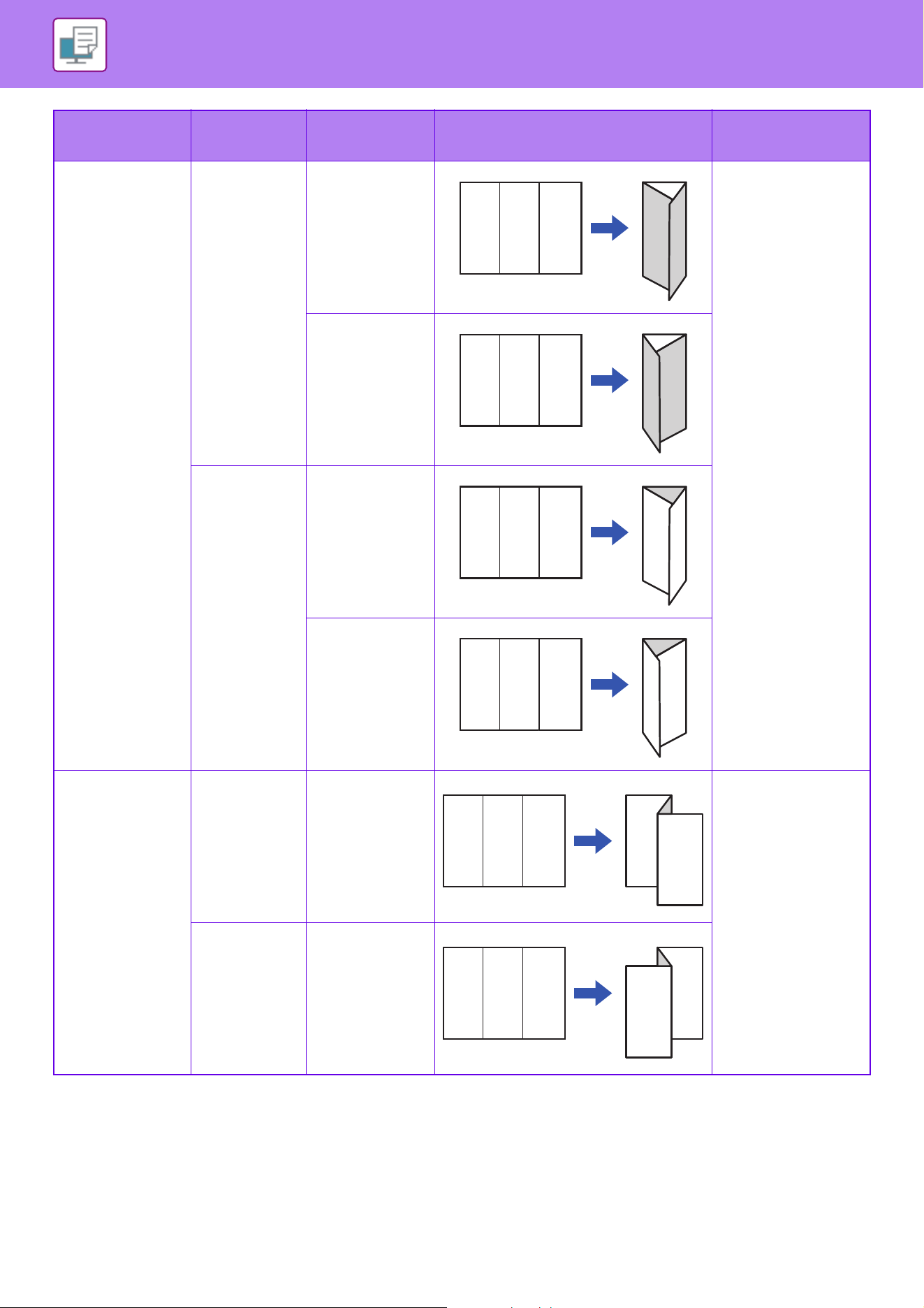
3-74
PRINTER►CONVENIENT PRINTING FUNCTIONS
C-Fold
Inside
Open Right
For example, paper
is folded in three so
that it can be put into
an envelope. Copies
are output sheet by
sheet.
Open Left
Outside
Open Right
Open Left
Accordion Fold
- Open Right
For example, paper
is folded in three so
that it can be put into
an envelope. Copies
are output sheet by
sheet.
- Open Left
Folding types Print Side
Fold
Orientation
Folding results Description
ABC
A
C
ABC
C
A
ABC
C
A
ABC
A
C
ABC
A
C
ABC
C
A
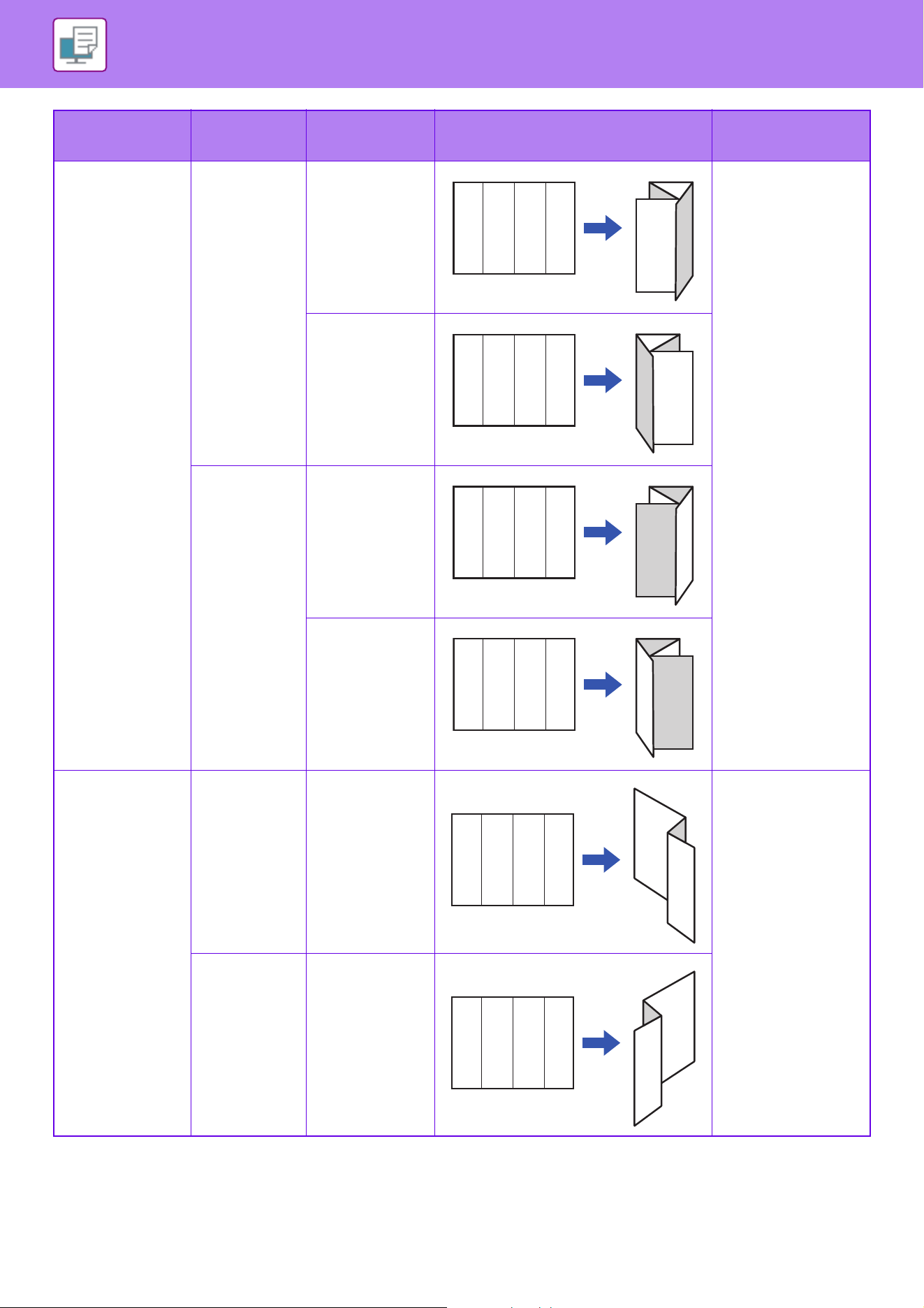
3-75
PRINTER►CONVENIENT PRINTING FUNCTIONS
Double Fold
Inside
Open Right
For example, paper
is folded in four so
that it can be put into
an envelope. Copies
are output sheet by
sheet.
Open Left
Outside
Open Right
Open Left
Z-Fold
- Open Right
For example, if 8-1/2"
× 11" (A4) and 11" ×
17" (A3) size print
images are mixed,
only the 11" × 17"
(A3) size paper is
folded and changed
to 8-1/2" × 11" (A4)
size paper.
Copies are output
sheet by sheet.
- Open Left
Folding types Print Side
Fold
Orientation
Folding results Description
ABCD
D
A
ABCD
A
D
ABCD
A
D
ABCD
D
A
ABCD
A
B
D
ABCD
D
C
A
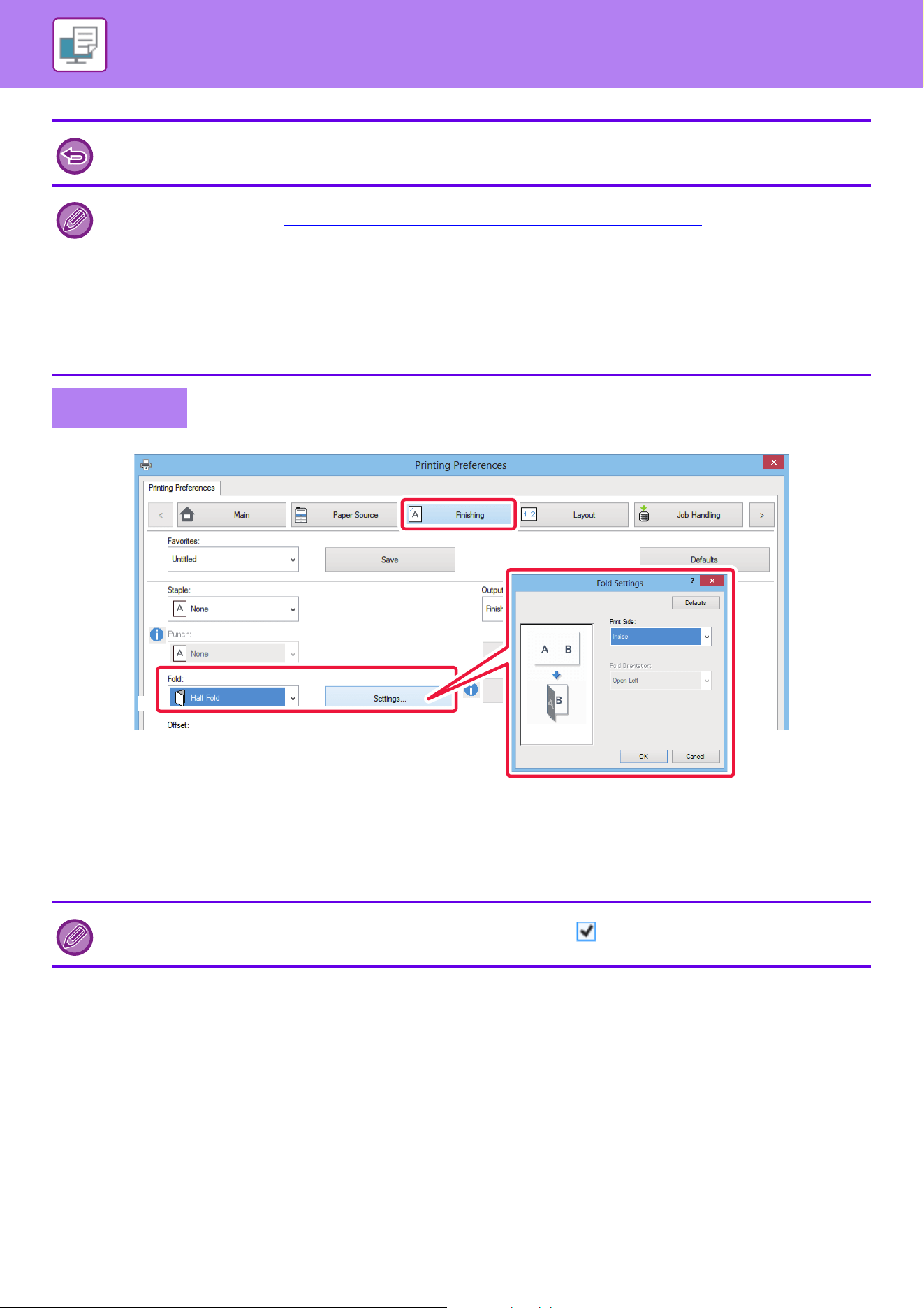
3-76
PRINTER►CONVENIENT PRINTING FUNCTIONS
(1) Click the [Finishing] tab.
(2) Select the folding method in "Fold", and click the [Settings] button.
(3) Select the desired folding method.
This function cannot be used when [Common Settings] in "Settings (administrator)" → [Device Control] → [Disabling of
Duplex] is selected.
• When printing data in a pamphlet layout, the "Booklet" function can be used to conveniently fold and staple printed output
to create a pamphlet. See "CREATE A PAMPHLET (BOOKLET/SADDLE STITCH) (page 3-36)
".
• The Fold function cannot be used together with the Punch and Staple functions. However, the Z-Fold function can be used
together with the punch and staple functions when one of the following paper size is specified.
• Ledger (11" × 17"), B4, A3
• When a saddle stitch finisher (100-sheet stapling) is mounted, the Saddle Fold function folds five sheets every set. For
example, if an original has 12 A4 size plain sheets, they are folded three times in total: 5 sheets + 5 sheets + 2 sheets.
Howerver, some types of paper reduces the number of sheets that are folded every set. For example, heavy paper is
folded on a three-sheet basis.
Windows
If you select "Z-Fold", set the checkbox of the paper size for paper folding to .
(2)
(1)
(3)
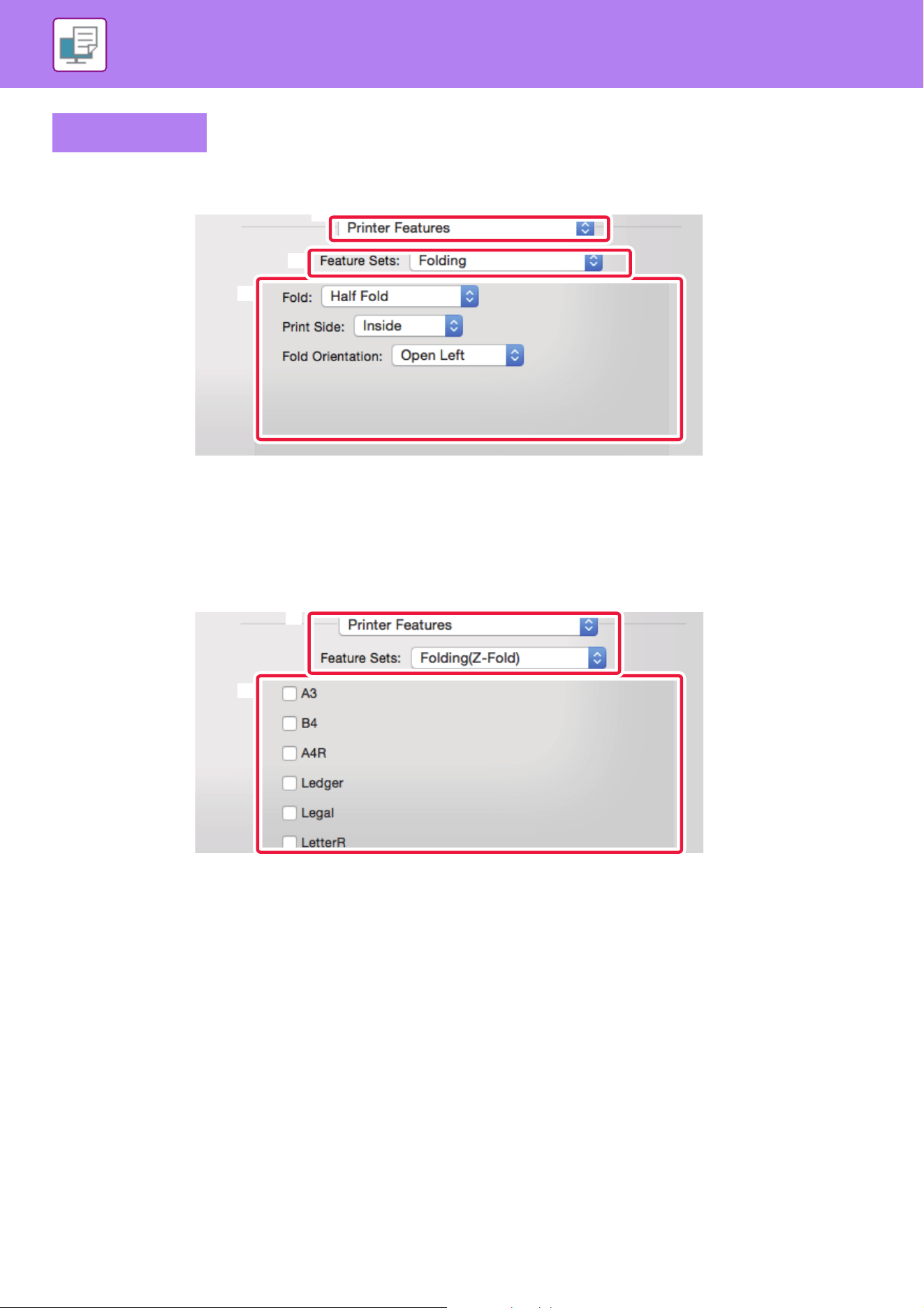
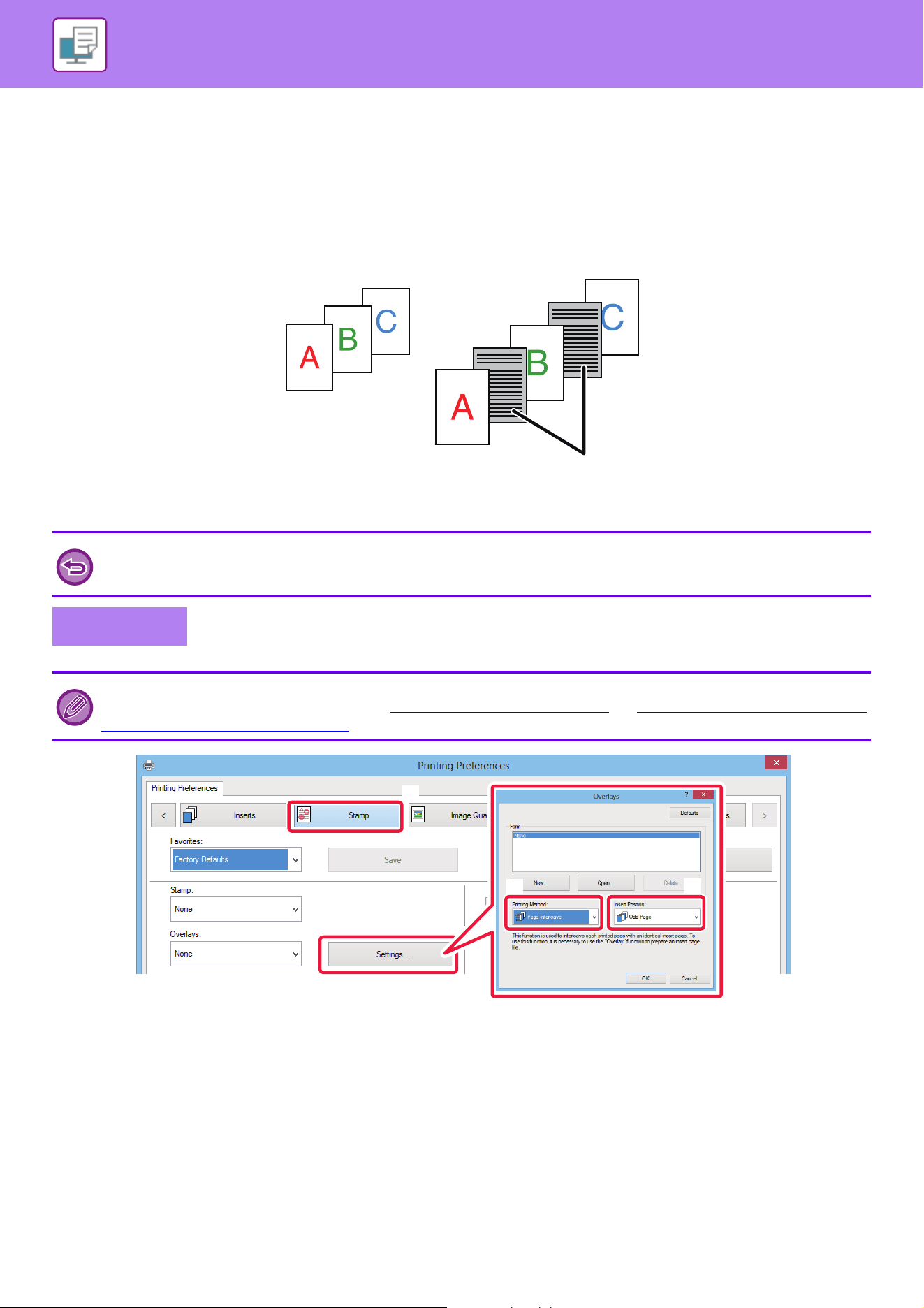
3-78
PRINTER►CONVENIENT PRINTING FUNCTIONS
INSERT PRESET DATA BEFORE OR AFTER EACH
PAGE (PAGE INTERLEAVE)
This function inserts a preset data item into every page during printing.
You can easily create documents with opened page spread that is made up of text on the left-hand page and a memo
space on the right-hand page.
(1) Click the [Stamp] tab.
(2) Click the [Settings] button.
(3) Select [Page Interleave] from the "Printing Method".
(4) Set the overlay data to be inserted and set its insertion position.
• This function is available in a Windows environment.
• This function can be used when the PCL6 printer driver is used.
Windows
You have to create page data to be inserted in advance.
For the procedure for creating page data, see "Creating an overlay file (page 3-60)
" in "OVERLAY A FIXED FORM ON THE
PRINT DATA (OVERLAYS) (page 3-60)".
Pre-set data
(2)
(1)
(3)
(4)
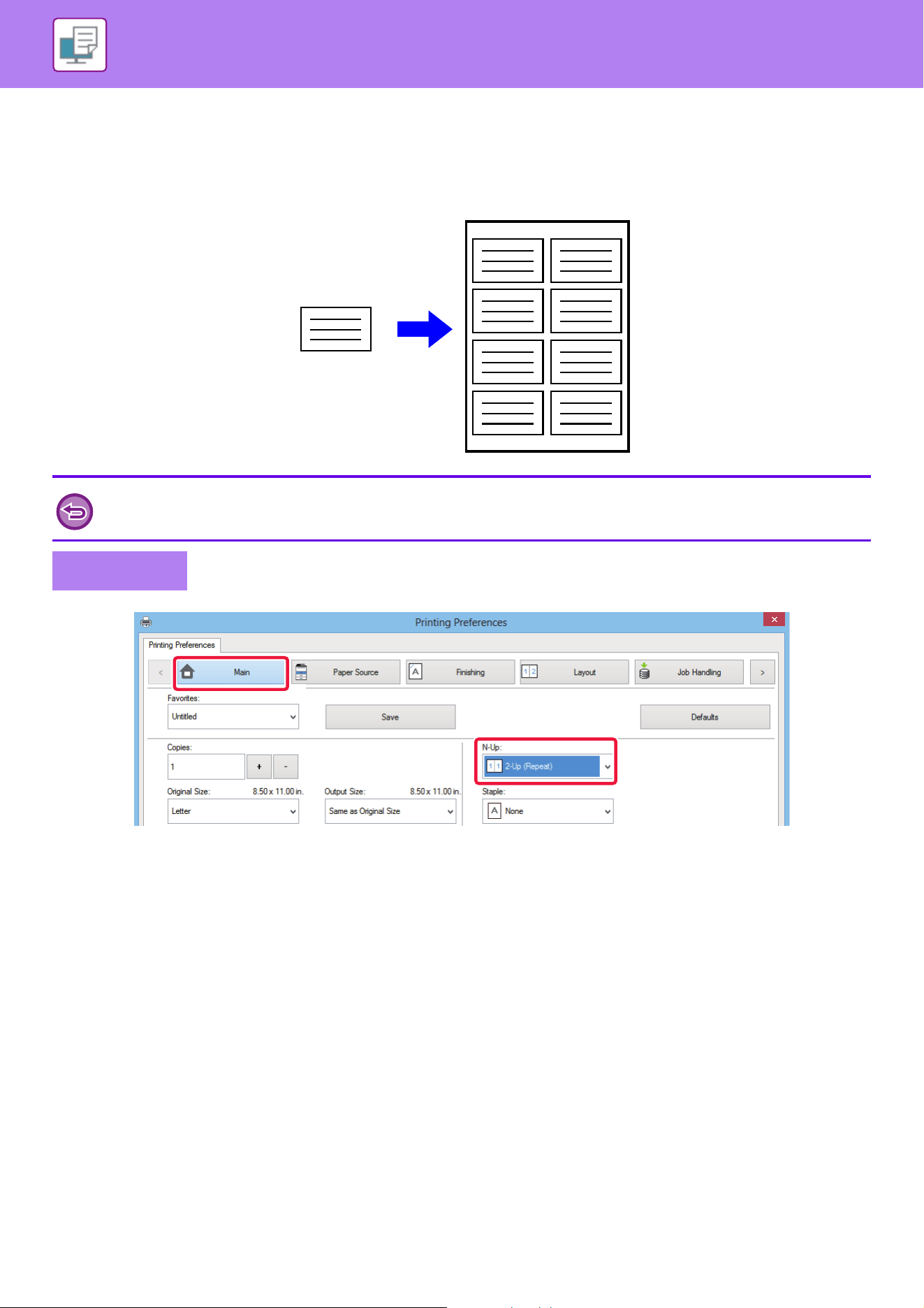
3-79
PRINTER►CONVENIENT PRINTING FUNCTIONS
PRINT THE SAME IMAGE IN TILE PATTERN (REPEAT
PRINT)
This function prints the same image in tile pattern on a sheet. This is useful for producing name cards and stickers.
(1) Click the [Main] tab.
(2) Select the repeat count in "N-Up".
• This function is available in a Windows environment.
• This function can be used when the PCL6 printer driver is used.
Windows
(2)
(1)
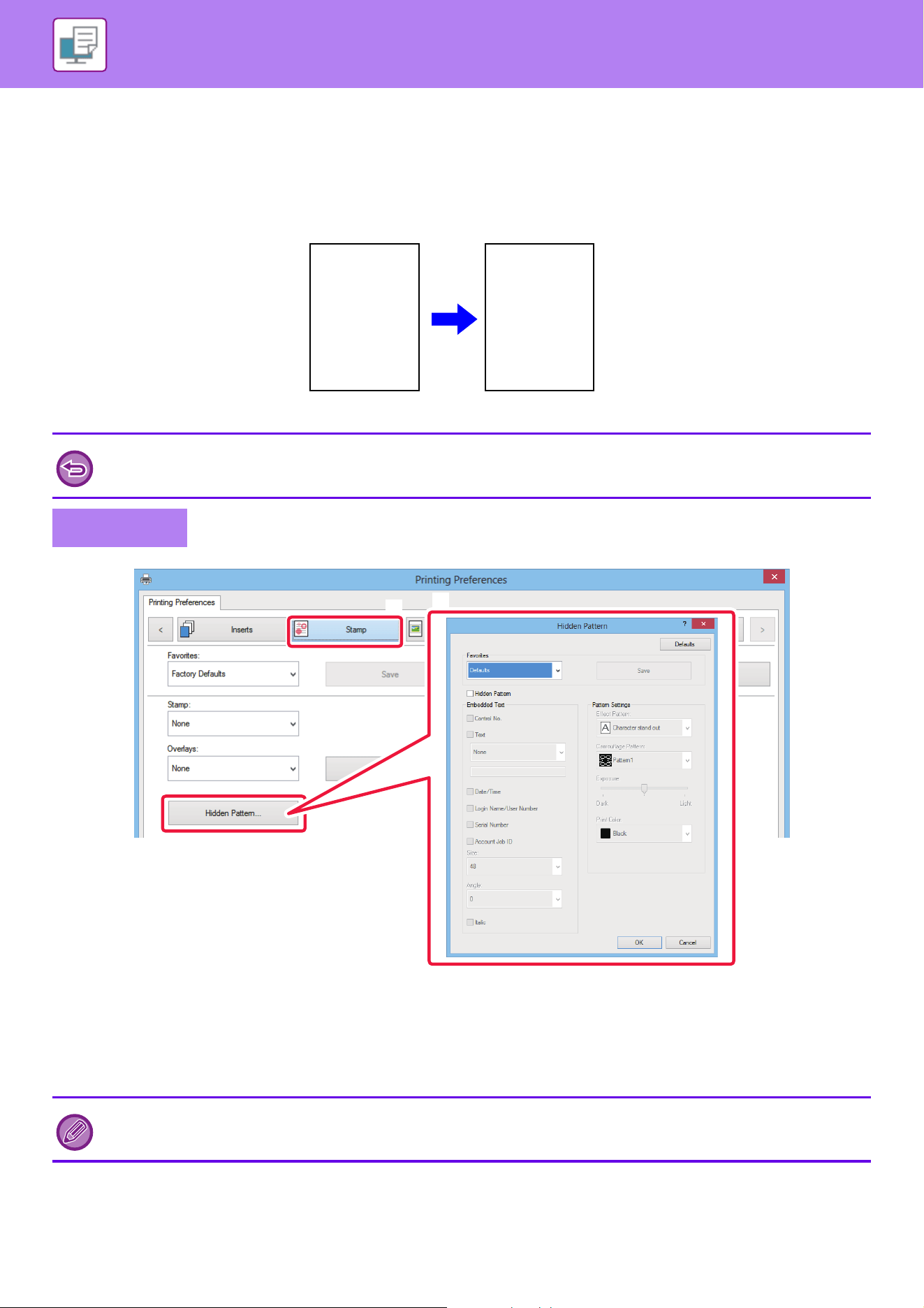
3-80
PRINTER►CONVENIENT PRINTING FUNCTIONS
PRINTING PATTERN DATA (HIDDEN PATTERN PRINT)
This function prints pattern data such as "DO NOT COPY" behind the print data.
If paper with pattern data is duplicated, the pattern data emerges in the background, which will help to prevent
information from being leaked through unauthorized document copying.
(1) Click the [Stamp] tab.
(2) Click the [Hidden Pattern] button.
(3) Configure the settings for hidden pattern printing and click the [OK] button.
• This function is available in a Windows environment.
• This function can be used when the PCL6 printer driver is used.
Windows
The hidden pattern printing function cannot be used when "Print Mode" is set to [1200 dpi].
AB
CD
AB
CD
DO’NOT COPY
DO’NOT COPY
AB
CD
(2)
(1)
(3)
3-81
PRINTER►CONVENIENT PRINTING FUNCTIONS
• "Hidden Pattern" is a function provided for the purpose of deterring unauthorized printing. It does not guarantee the
prevention of information leakage.
• Text may not be completely hidden on an output sheet with a pattern print under certain machine conditions. In "Settings
(administrator)", select [Security Settings] → [Hidden Pattern Print Setting] → [Contrast] if this is the case.
• The hidden pattern may not emerge on copies with certain types of devices or under certain setting conditions used to
copy an output sheet with a pattern print.
• When the color mode is set to [Black and White] or when it is set to [Automatic] and the original is recognized as black and
white, a black background pattern is printed even if a cyan or magenta pattern is selected.
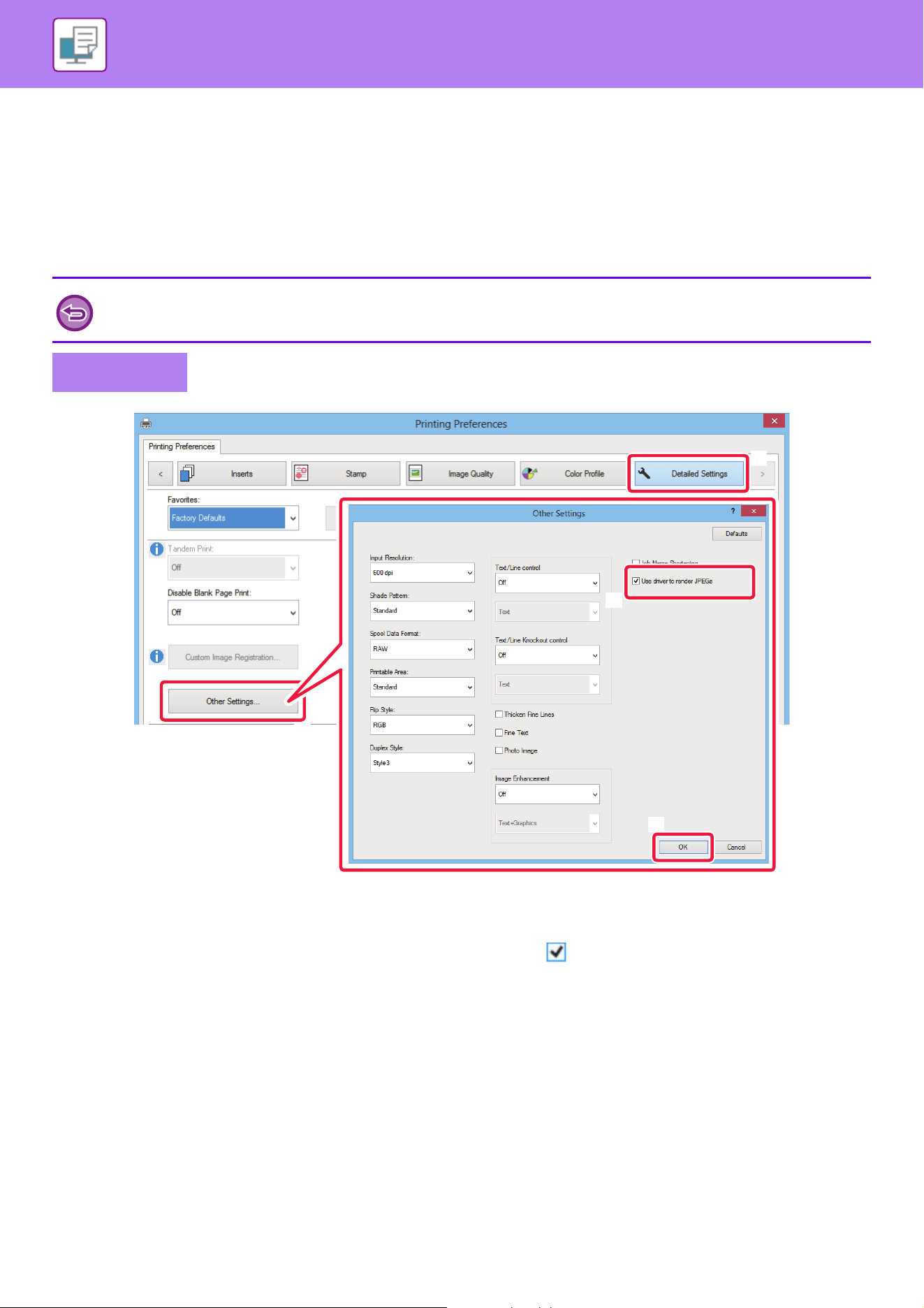
3-82
PRINTER►CONVENIENT PRINTING FUNCTIONS
CHANGING THE RENDERING METHOD AND PRINTING
JPEG IMAGES (USE DRIVER TO RENDER JPEGS)
In some situations, a document containing a JPEG image may not be printed correctly. This can be solved by changing
the way the JPEG image is rendered.
When you print an original containing JPEG images, this function allows you to select whether the images are rendered
in the printer driver or the machine.
(1) Click the [Detailed Settings] tab.
(2) Click the [Other Settings] button.
(3) Click the [Use driver to render JPEGs] checkbox so that appears.
(4) Click the [OK] button.
• This function is available in a Windows environment.
• When images are rendered in the printer driver, it may take time until the printing is completed.
Windows
(2)
(1)
(3)
(4)
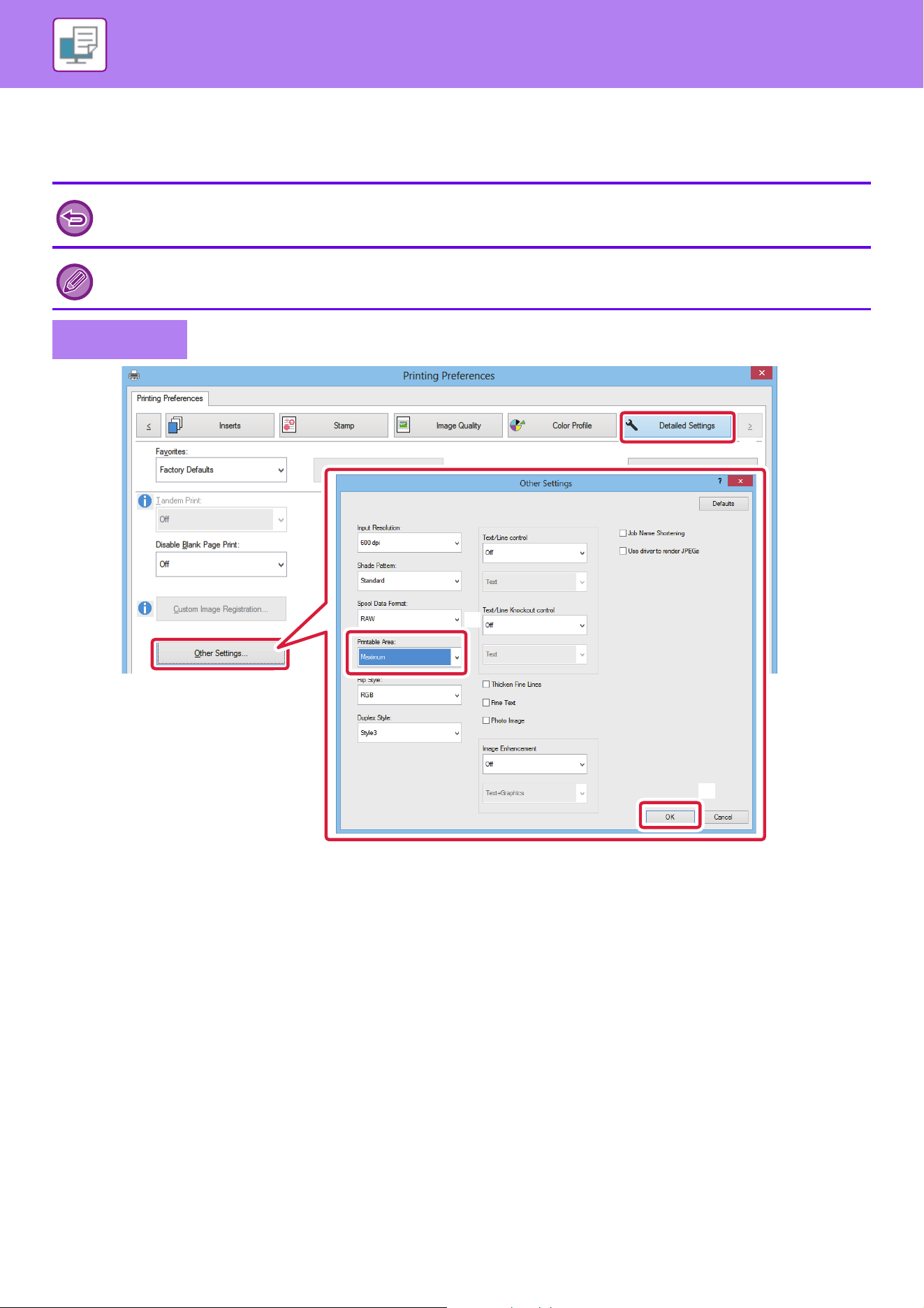
3-83
PRINTER►CONVENIENT PRINTING FUNCTIONS
MAXIMIZING THE PRINT AREA ON THE PAPER (PRINT AREA)
By maximizing the print area, you can print on the full paper size.
(1) Click the [Detailed Settings] tab.
(2) Click the [Other Settings] button.
(3) Select [Maximum] from the "Printable Area".
(4) Click the [OK] button.
This function is available in a Windows environment.
Even when the print area is maximized, edges may be cut off.
Windows
(2)
(1)
(3)
(4)
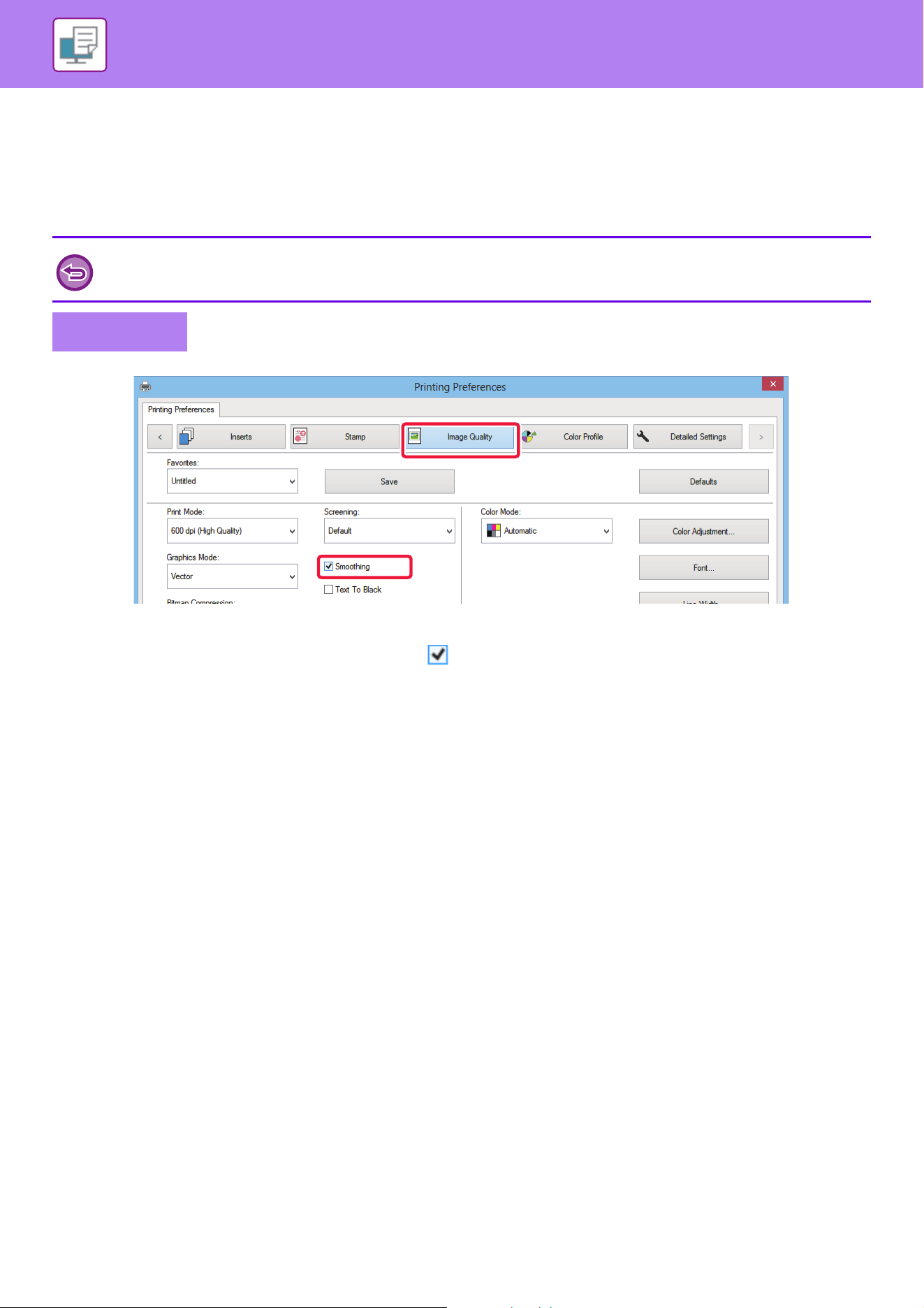
3-84
PRINTER►CONVENIENT PRINTING FUNCTIONS
PRINTING AT AN ENHANCED RESOLUTION
(SMOOTHING)
Resolution enhancement techniques (RETs) are used to smoothen the outlines of images. The images are printed at a
digitally enhanced resolution.
(1) Click the [Image Quality] tab.
(2) Select the [Smoothing] checkbox so that appears.
This function is available in a Windows environment.
Windows
(2)
(1)
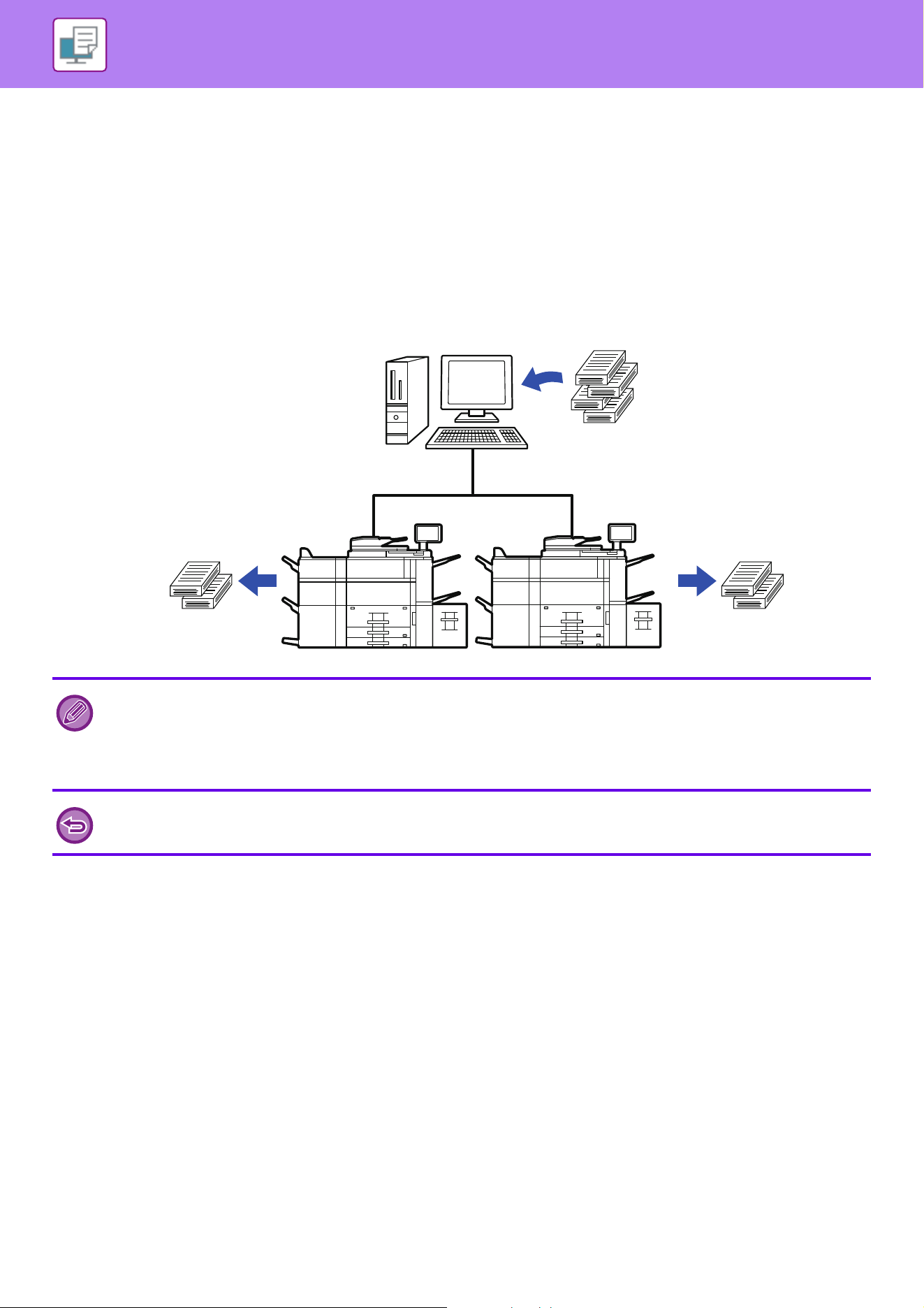
3-85
PRINTER►CONVENIENT PRINTING FUNCTIONS
CONVENIENT PRINTER FUNCTIONS
USING TWO MACHINES TO PRINT A LARGE PRINT
JOB (TANDEM PRINT)
To use this function, two machines that can perform tandem printing are required.
Two machines connected to the same network are used to run a large print job in parallel. This function reduces the
printing time when you handle a large number of prints.
To use the tandem print function, the IP address of the client machine must be registered in the printer driver.
• In a Windows environment, this is accomplished automatically by clicking the [Auto Configuration] button on the
[Configuration] tab of the printer driver.
• In Mac OS 10.6 to 10.8, this is accomplished automatically by clicking the [Update] button (or [Tandem Settings] button) on
the "Tandem Print" screen. In Mac OS 10.9, enter the IP address of the client machine.
This function cannot be used in Mac OS X 10.10 or later.
Example: Printing four sets of copies
2 sets of
copies
2 sets of
copies
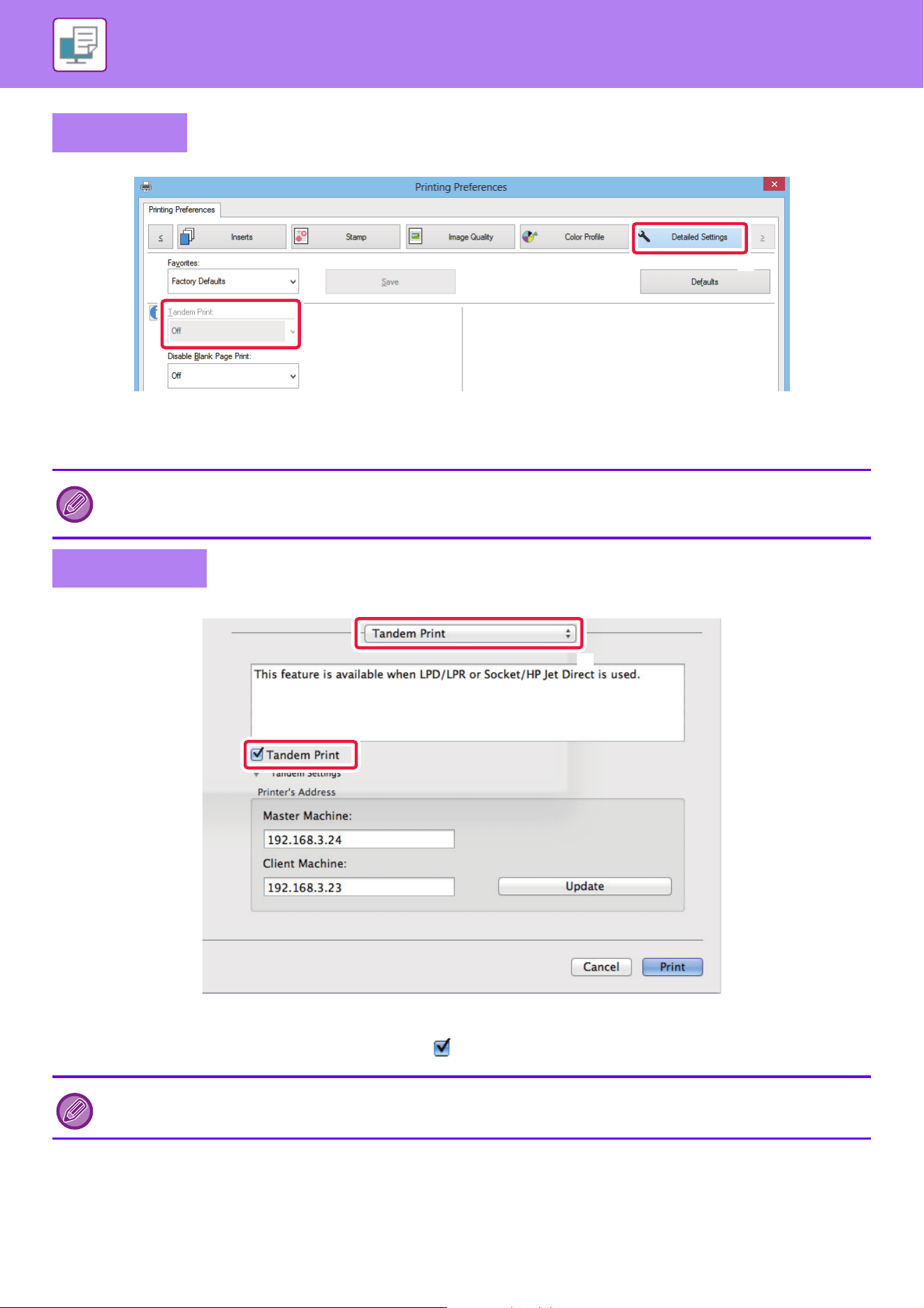
3-86
PRINTER►CONVENIENT PRINTING FUNCTIONS
(1) Click the [Detailed Settings] tab.
(2) Select [On] in "Tandem Print".
(1) Select [Tandem Print].
(2) Click the [Tandem Print] checkbox so that appears.
Windows
The tandem print function can be used only when the printer driver has been installed using "Custom Installation" with [LPR
Direct Print (Specify Address/Auto Search)] selected and with the [Yes] checkbox selected for "Do you want to use Tandem
print function?".
Mac OS
To use the tandem print function, you must select the protocol to be used as instructed in the message that appears when
you add the printer driver in the "Printer Setup Utility".
(2)
(1)
(2)
(1)
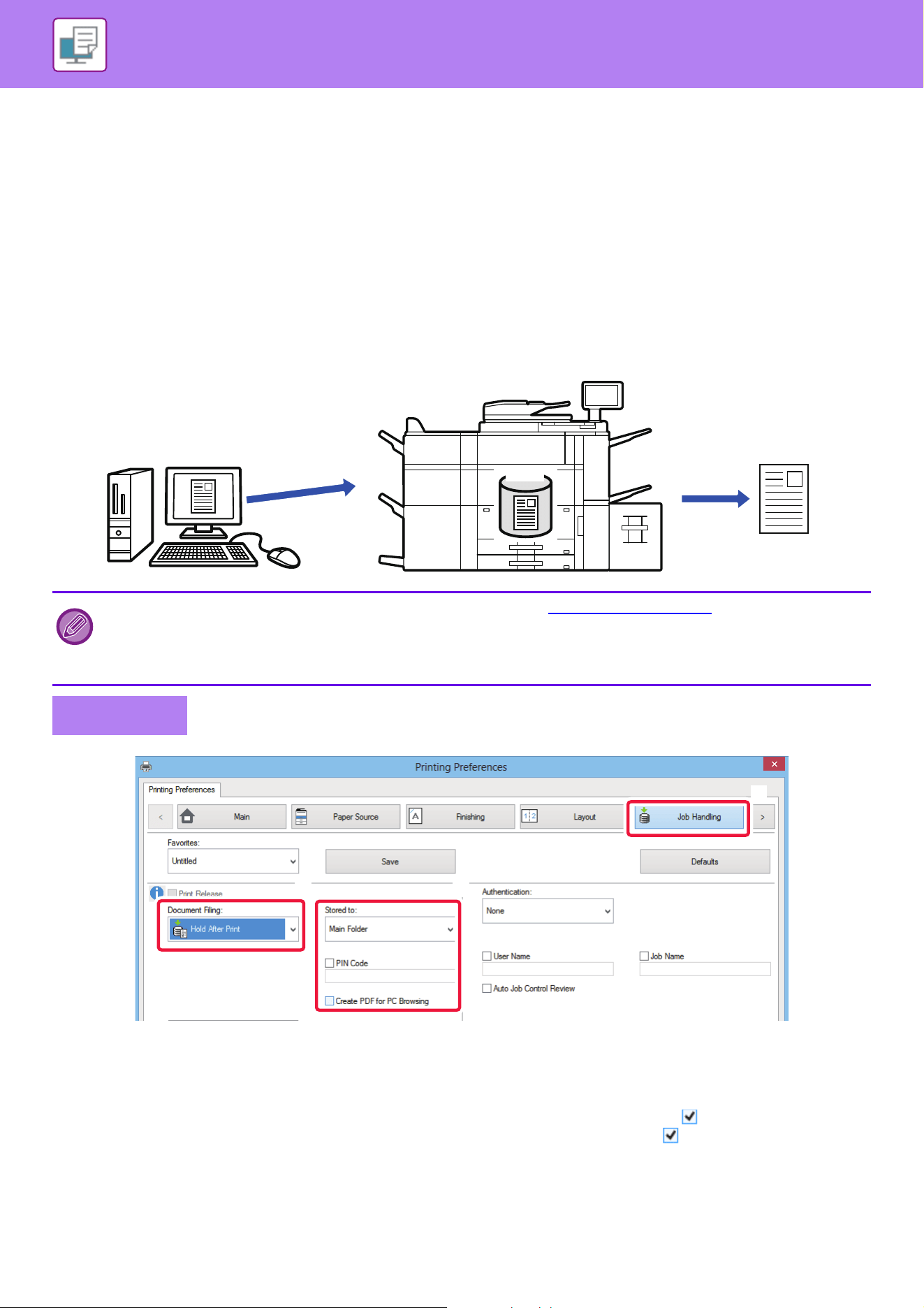
3-87
PRINTER►CONVENIENT PRINTING FUNCTIONS
SAVING AND USING PRINT FILES (DOCUMENT FILING)
This function stores a print job as a file on the machine's hard drive, allowing the job to be printed from the touch panel
when needed. The location for storing a file can be selected to prevent the file from being mixed together with files of
other users.
• Hold Only
This setting is used to hold a print job on the machine's hard drive without printing it.
• Hold After Print
This setting is used to hold a print job on the machine's hard drive after it is printed.
• Sample Print
When a print job is sent to the machine, only the first set of copies is printed. After checking the contents of the first set
of copies, you can print the remaining sets from the operation panel of the machine. This prevents the occurrence of
excessive misprints.
(1) Click the [Job Handling] tab.
(2) Select the function from the "Document Filing".
(3) Select the folder for storing the file in “Stored to”.
To enter a password (5 to 8 digit number), click the [PIN Code] checkbox so that the checkmark appears.
To create a public PDF for PC browsing, select the [Create PDF for PC Browsing] checkbox ( ).
•
For the procedure for printing files stored on the machine's hard drive, see "FILE PRINTING (page 5-22)" in "Document Filing".
• When printing from a PC, you can set a password (5 to 8 digits) to maintain the confidentiality of information in a stored file.
When a password is set, the password must be entered to print data.
• [Document Filing] that can be set on the [Job Handling] tab can also be set on the [Main] tab.
Windows
HDD
(2)
(1)
(3)
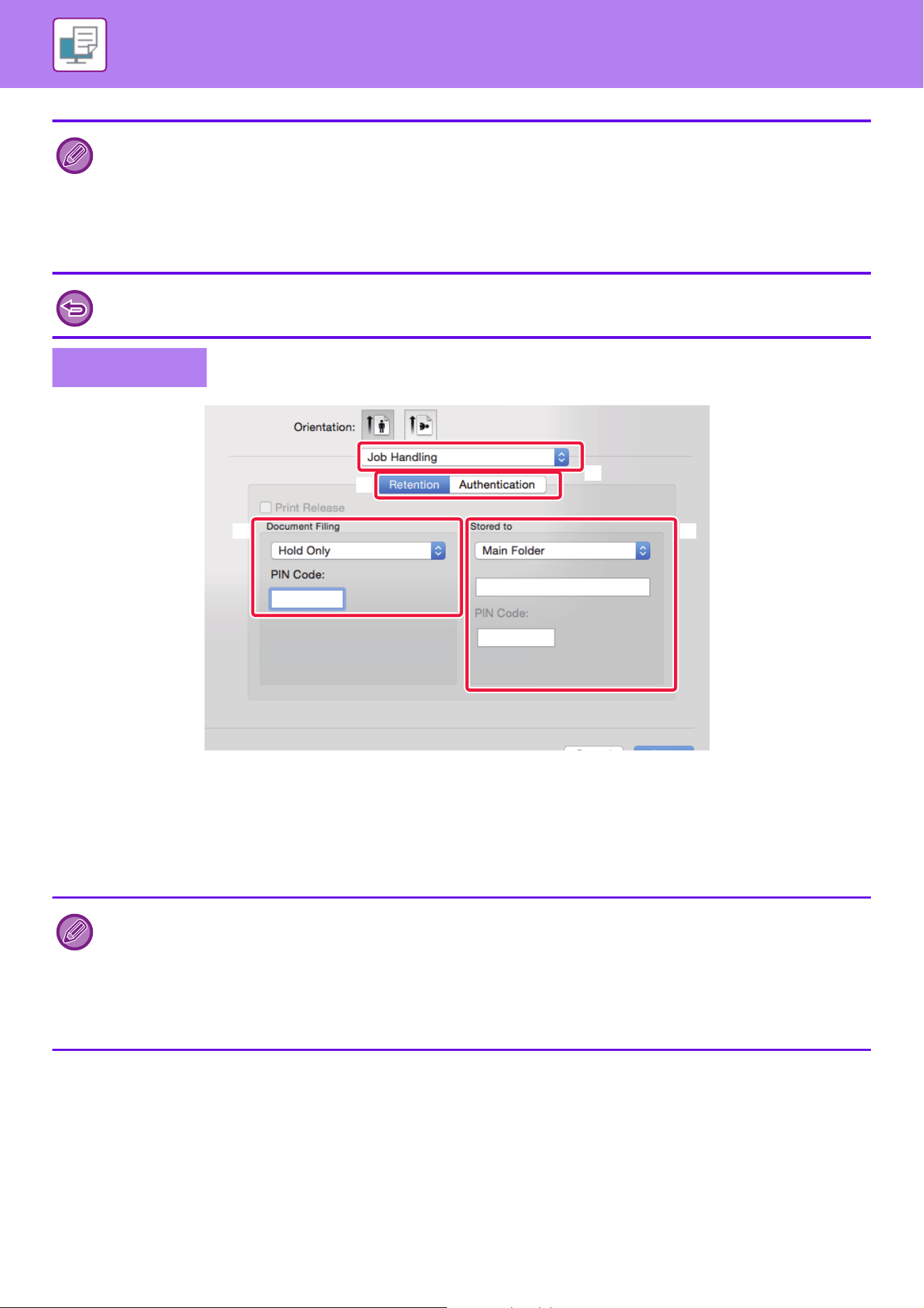
3-88
PRINTER►CONVENIENT PRINTING FUNCTIONS
(1) Select [Job Handling].
(2) Select [Retention].
(3) Select how to save the print data in "Document Filing".
(4) Select the folder to store the file in "Stored To".
If you selected [Custom Folder], enter the name of the custom folder where you want to save the file.
• When [Quick File] is selected, "Document Filing" will be set to [Hold After Print].
• When [Quick File] is selected, the password entered in "Document Filing" is cleared.
• If necessary, you can select the data format from CMYK and RGB for data to be stored in the machine. Click the [Other
Settings] button on the [Detailed Settings] tab and select the format from "Rip Style".
• To store a file in a custom folder, you must first create the custom folder using [Document Operations] in "Settings
(administrator)" → [Document Filing]. If you have set a password for the custom folder, enter the password (5 to 8 digit
number) in "PIN Code" on the stored to screen.
If you have configured to always use the force document filing function in "Printing Policy" on the [Configuration] tab, you
cannot clear the [Document Filing] checkbox.
Mac OS
• When [Quick File] is selected, "Document Filing" will be set to [Hold After Print].
• When [Quick File] is selected, the password entered in "Document Filing" is cleared.
• If necessary, you can select the data format from CMYK and RGB for data to be stored in the machine. Select [Advanced]
in [Printer Features] and select the format from "Rip Style".
• To store a file in a custom folder, you must first create the custom folder using [Document Operations] in "Settings
(administrator)" → [Document Filing]. If you have set a password for the custom folder, enter the password (5 to 8 digit
number) in "PIN Code" on the folder selection screen.
(2)
(1)
(3) (4)
3-89
PRINTER►CONVENIENT PRINTING FUNCTIONS
AUTOMATICALLY PRINT ALL STORED DATA
When user authentication is enabled on the machine, all document filing (stored) print jobs of the user who logs in are
automatically printed. After all jobs are printed, the stored jobs are deleted.
(1) Select [Job Handling].
At the time of document filing print, in addition to the user authentication information, enter the user name stored in the machine
in "User Name" in the printer driver.
(2) A confirmation prompt will appear. Tap the [OK] key.
The print files stored in the quick file folder, main folder, and custom folder will be printed automatically and then deleted.
To use the Print All function, the following steps are necessary:
• In "Settings (administrator)", select [User Control] → [Default Settings] and enable [Automatically print stored jobs after
login].
• When executing document filing print, in addition to the user authentication information, enter the user name stored in the
machine in "User Name" of "Default Job ID" in the printer driver.
► Using this function in a Windows environment: PRINTING IN A WINDOWS ENVIRONMENT (page 3-4)
► Using this function in a Mac OS environment: PRINTING IN A Mac OS ENVIRONMENT (page 3-13)
Files with a password and files that are protected by the document filing function of the machine will not be printed. Files in a
folder (excluding My Folder) that has a password will also not be printed.
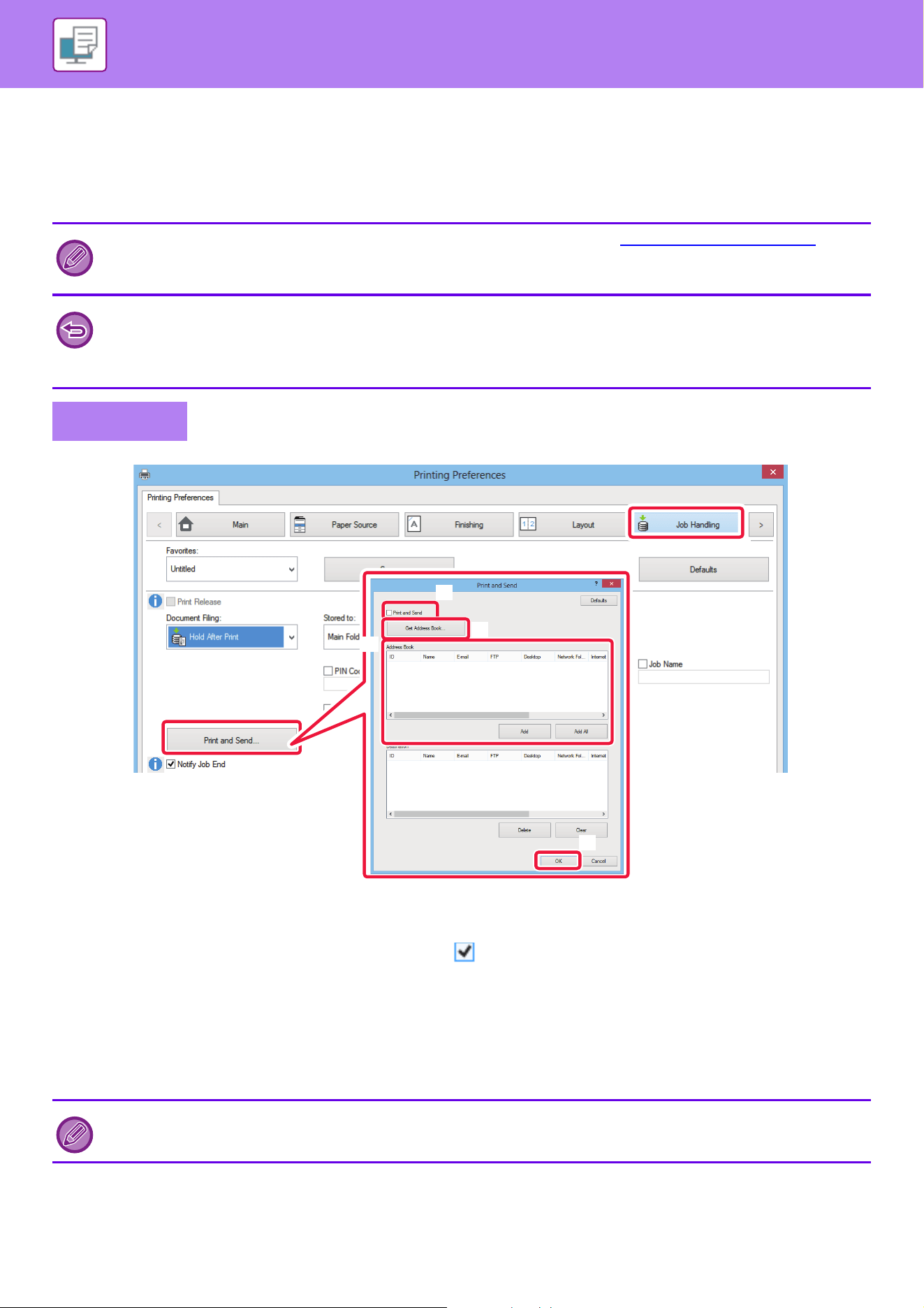
3-90
PRINTER►CONVENIENT PRINTING FUNCTIONS
PRINTING AND SENDING SIMULTANEOUSLY
This function prints data created in an application from the machine and simultaneously sends the data to the addresses
stored in the machine.
This function allows you to complete two tasks, printing and sending, with one operation from the printer driver.
(1) Click the [Job Handling] tab.
(2) Click the [Print and Send] button.
(3) Select the [Print and Send] checkbox so that appears.
(4) Click the [Get Address Book] button.
(5) From the "Address Book" list, select the address to which you wish to send the data, and click
the [Add] button to add the address to the "Destination" list.
• If you wish to send the data to all addresses, click the [Add All] button.
• To delete an address from the "Destination" list, select the address and click the [Delete] button. If you wish to delete all
addresses, click the [Delete All] button.
(6) Click the [OK] button.
The printer driver settings are applied to sending settings.
• Addresses must be stored in advance in the machine. For more information, see "ADDRESS BOOK (page 1-103)
".
• You must complete the preparatory steps for using each sending function of the machine. For more information, see the
explanation of each sending function.
• This function is available in a Windows environment.
• This function can be used when the PCL6 printer driver is used.
• You cannot print and send data simultaneously when [System Settings] in "Settings (administrator)" → [Printer Settings] →
[Condition Settings] → [Disabling sending while printing] is selected.
Windows
Up to 50 destinations can be specified.
(2)
(1)
(3)
(4)
(5)
(6)
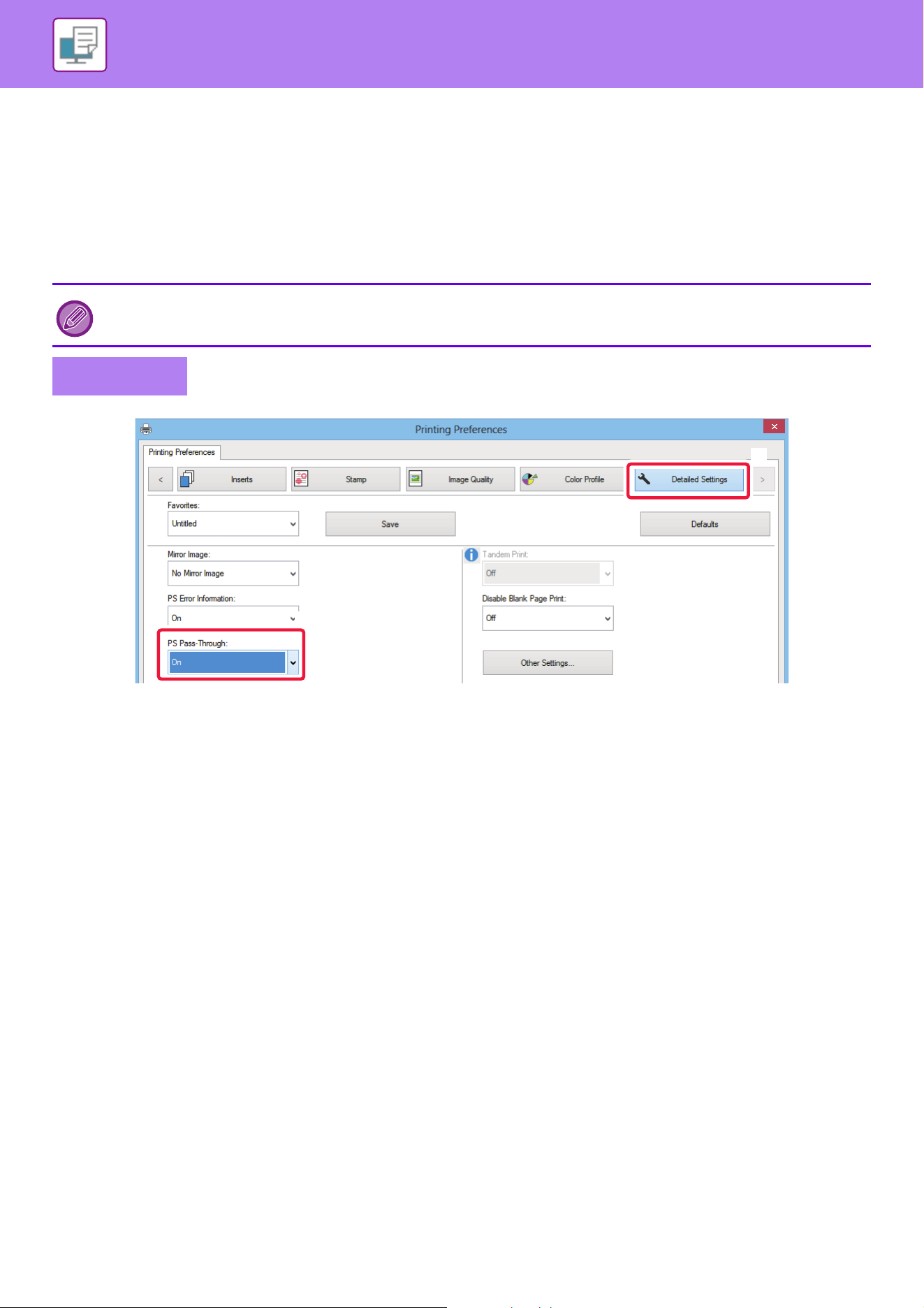
3-91
PRINTER►CONVENIENT PRINTING FUNCTIONS
PS PASS-THROUGH
Select whether PostScript commands are output directly from the application instead of from the printer driver.
Normally, "PS Pass-Through" must be checked for normal use. Some applications output PostScript code that cannot
be controlled by the printer driver and features such as N-up, Watermark are not set correctly by the driver. In this case,
cancel the check, and these feature settings of the driver might be available.
When this item is unchecked, EPS illustrations in the document may be printed at low-resolution image or may not be
printed.
(1) Click the [Detailed Settings] tab.
(2) Select the function from the "PS Pass-Through".
• This function is available in a Windows environment.
• Printer driver PS can use this function.
Windows
(2)
(1)
3-92
PRINTER►PRINTING WITHOUT THE PRINTER DRIVER
EXTENSION OF PRINTABLE FILES
When you do not have the printer driver installed on your PC, or when the application used to open a file that you wish to
print is not available, you can print directly to the machine without using the printer driver.
The file types (and corresponding extensions) that can be printed directly are shown below.
DIRECTLY PRINTING A FILE ON AN FTP
SERVER
When an FTP server is configured, you can directly select and print files on the FTP server from the touch panel of the
machine. This function eliminates the need for downloading the files from the FTP server to your PC and sending print
jobs from the PC to the machine.
PRINTING WITHOUT THE PRINTER
DRIVER
File Type TIFF JPEG PNG PCL PS
PDF,
Encrypt PDF
,
Compact PDF,
PDF/A,
Compact PDF/A
DOCX,
XLSX,
PPTX
Extension tiff, tif
jpeg, jpg,
jpe, jfif
png
pcl,
prn, txt
ps, prn pdf
docx, xlsx,
pptx
• Even if the print result is black and white, the following types of print jobs will be counted as 4-color (Y (Yellow), M
(Magenta), C (Cyan), and Bk (Black)) print jobs. When you want such jobs to be counted as black and white jobs, select
the black and white printing option.
• When the data is created as color data.
• When the application treats the data as color data even though the data is black and white.
• When an image is hidden under a black and white image.
• Some files may not print correctly even if shown in the above table.
To configure an FTP server:
In "Settings (administrator)", select [System Settings] → [Printer Settings] → [Direct Print Settings (FTP)]. (Administrator
rights are required.) Up to 20 FTP servers can be configured.
When you select a PDF file that has a password, you must enter the password in the job management screen to begin
printing.
► PRINTING AN ENCRYPTED PDF FILE (page 3-100)
1
Tap the [HDD File retrieve] key.
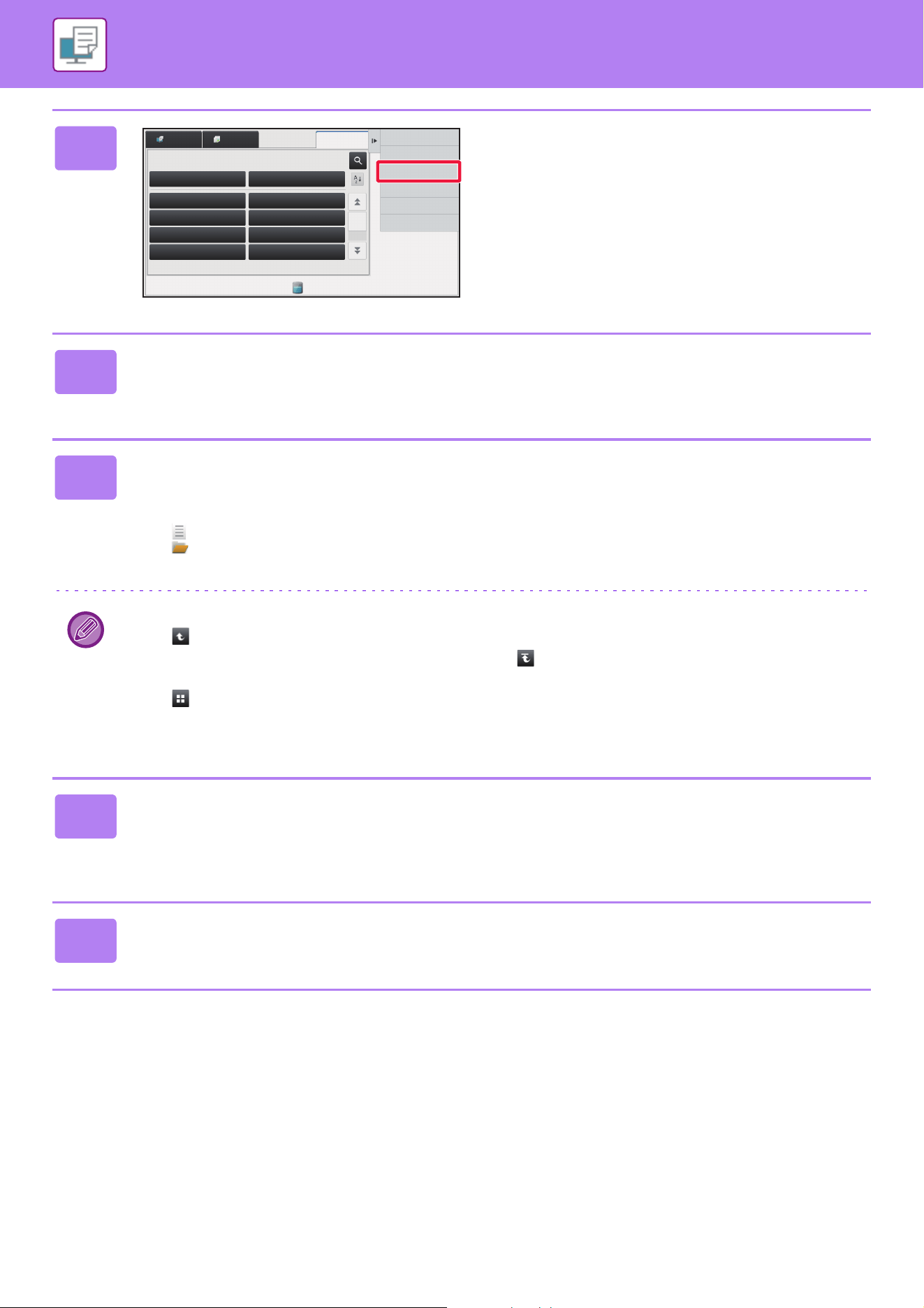
3-93
PRINTER►PRINTING WITHOUT THE PRINTER DRIVER
DirectOffice™ is a product of CSR Imaging US, LP.
DirectOffice™ is a trademark of CSR Imaging US, LP, registered in the United States and other countries, used with
permission.
2
Tap the [Select File from FTP to Print]
key on the action panel.
3
Tap the key of the FTP server that you wish to access.
When a server is selected, entry of a user name and password may be necessary. Enter your user name and password,
and tap the [Enter] key.
4
Tap the key of the file that you wish to print, and tap the [Choose Print
Settings] key on the action panel.
• When printing multiple files, tap the keys of the files you wish to print, and tap the [Print] key on the action panel.
• The icon appears to the left of keys of files that can be printed.
• The icon is displayed to the left of keys of folders on the FTP server. To display a folder or a file in a folder, tap this
key.
• A total of 100 keys of files and folders can be displayed.
• Tap to move up one folder level.
• When you move down a folder level by tapping a folder key, appears.
Tap this key to return to the file or folder name selection screen.
• Tap to switch to thumbnails.
• Tap the [File or Folder Name] key to change the order of the files and folders displayed on the screen. Each time the
key is tapped, the order changes between ascending and descending.
5
Select the print conditions.
• If you have selected multiple files in step 4, you can select only the number of prints.
• If you selected a PS or PCL file that includes print conditions in step 4, the print conditions in the file will be given
priority.
6
Tap the [Start] key.
Printing begins after the selected file is downloaded.
Print Scan File Retrieve
Scan to HDD
Scan to External
Memory Device
Select File from
FTP to Print
Select File from
USB Memory to Print
Main Folder Quick File Folder
Select File from
Network Folder to Print
AAA BBB
CCC DDD
EEE FFF
GGG HHH
Main Folder
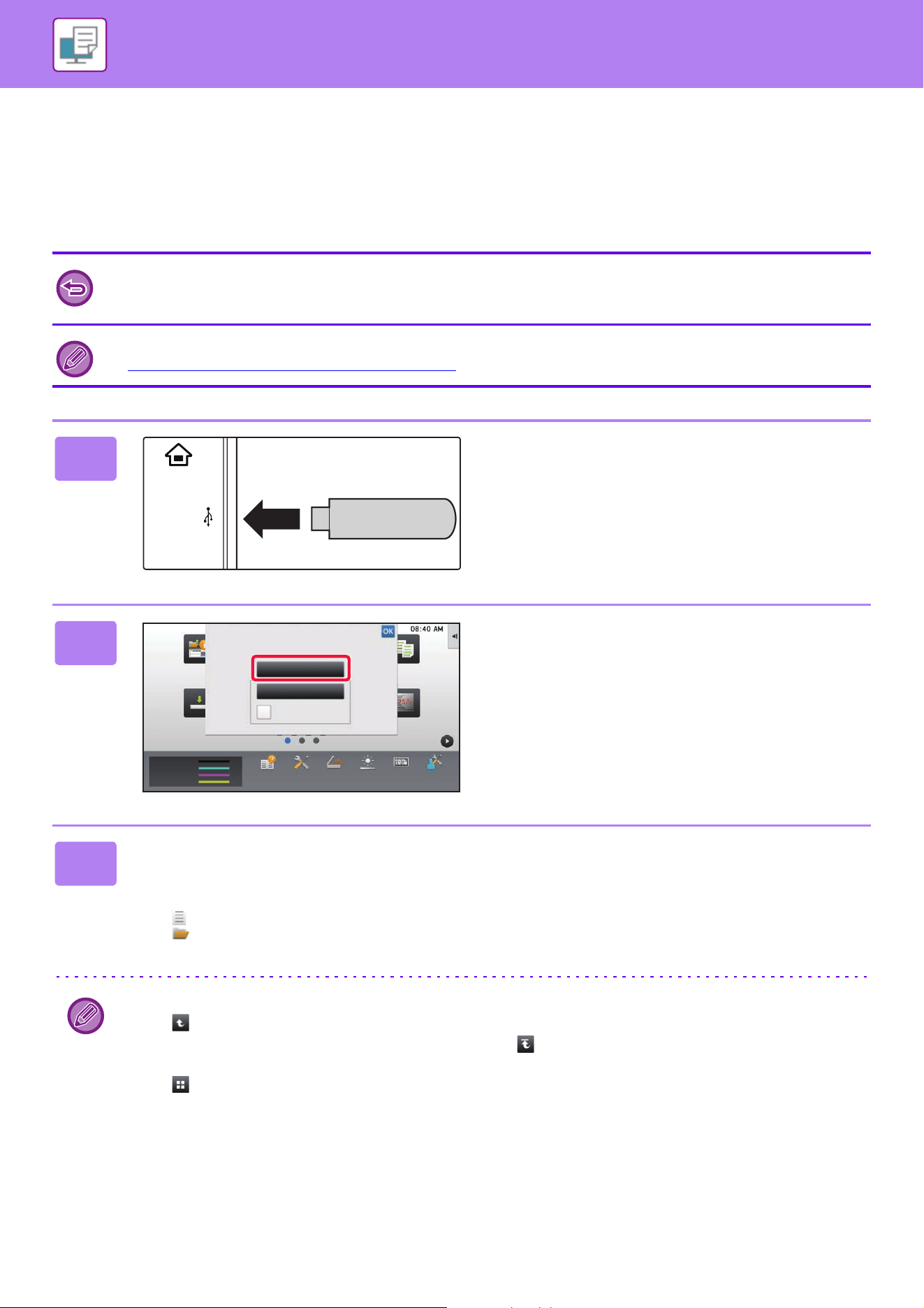
3-94
PRINTER►PRINTING WITHOUT THE PRINTER DRIVER
DIRECTLY PRINTING A FILE IN USB MEMORY
Files in a USB memory device connected to the machine are printed from the operation panel of the machine without
using the printer driver.
When the printer driver of the machine is not installed on your PC, you can copy a file into a commercially available USB
memory device and connect the device to the machine to print the file directly.
• Use a FAT32 USB memory device with a capacity of no more than 32 GB.
• Printing from a USB memory device is not possible when [System Settings] in "Settings (administrator)" → [Printer
Settings] → [Condition Settings] → [Disabling of USB Memory Direct Print] is selected.
When you select a PDF file that has a password, enter the password in the job management screen to begin printing.
► PRINTING AN ENCRYPTED PDF FILE (page 3-100)
1
Connect the USB memory device to
the machine.
2
When the screen for selecting the
action appears, tap [Print from
external memory device (USB)].
If the screen does not appear, follow the steps below.
(1) Tap the [HDD File retrieve] key.
(2) Tap the [Select File from USB Memory to
Print] key on the action panel.
3
Tap the key of the file that you wish to print, and tap the [Choose Print
Settings] key on the action panel.
• When printing multiple files, tap the keys of the files you wish to print, and tap the [Print] key on the action panel.
• The icon appears to the left of keys of files that can be printed.
• The icon is displayed to the left of keys of folders in the USB memory device. To display a folder or a file in a
folder, tap this key.
• A total of 100 keys of files and folders can be displayed.
• Tap to move up one folder level.
• When you move down a folder level by tapping a folder key, appears.
Tap this key to return to the file or folder name selection screen.
• Tap to switch to thumbnails.
• Tap the [File or Folder Name] key to change the order of the files and folders displayed on the screen. Each time the
key is tapped, the order changes between ascending and descending.
Job Management
Scan to HDD Sharp OSA
Copy
Operation
Guide
PC Scan Total Count Machine
Adjustment
LCD Control
Settings
Print from external
memory device (USB)
Scan to External
Memory Device
Perform Detail Setting
External memory device (USB) is connected.
Toner Quantity
M
C
Bk
Y
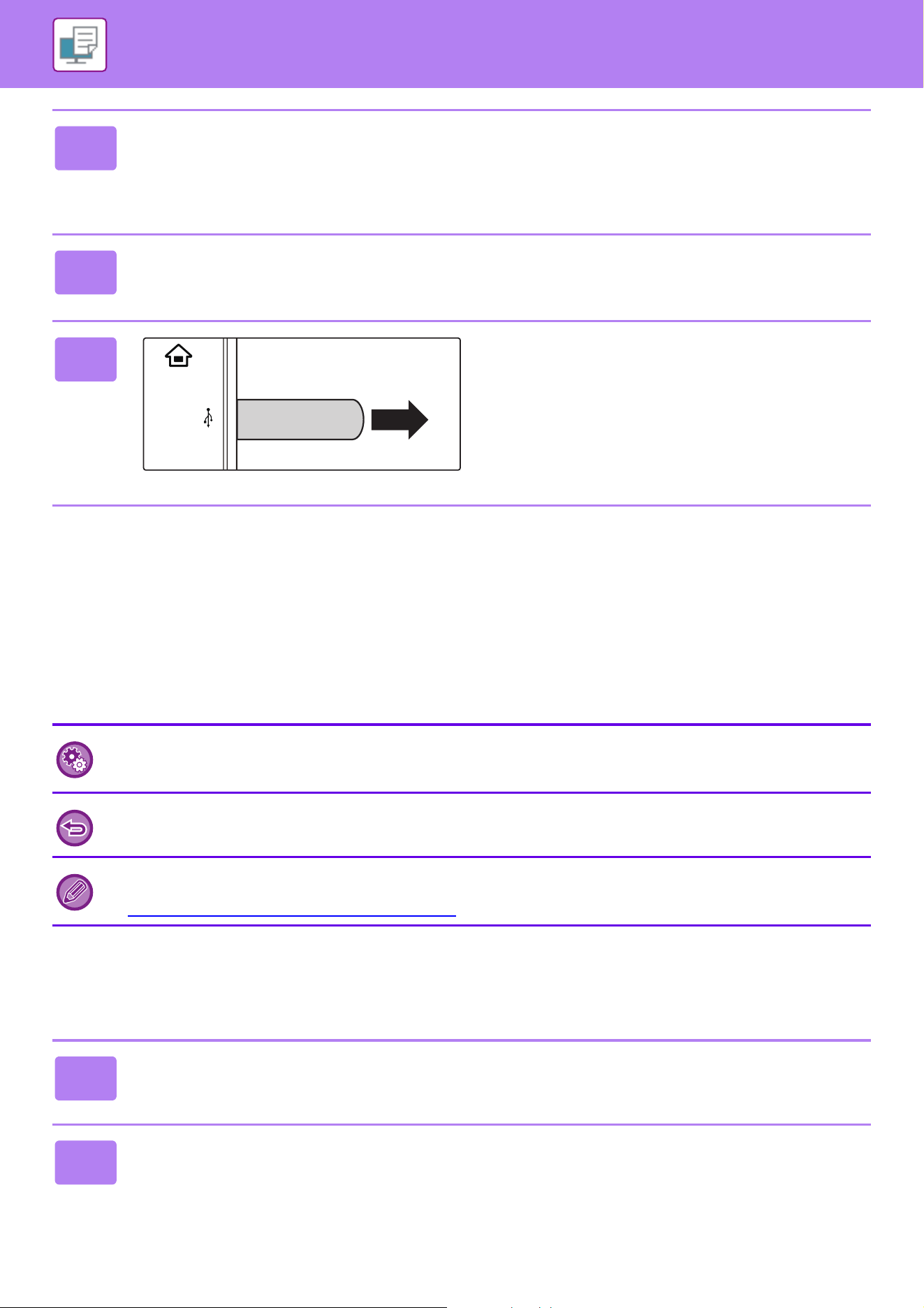
3-95
PRINTER►PRINTING WITHOUT THE PRINTER DRIVER
DIRECTLY PRINTING A FILE IN A NETWORK
FOLDER
You can specify and print a file in a network folder from the touch panel of the machine.
Even if the network folder is not registered, you can access the network folder by directly entering or referring to the path
to the folder in the workgroup.
Printing a file in the network folder you have configured in the machine's
settings
4
Select the print conditions.
• If you have selected multiple files in step 3, you can select only the number of prints.
• If you selected a PS or PCL file that includes print conditions in step 3, the print conditions in the file will be given
priority.
5
Tap the [Start] key.
• Printing begins after the selected file is transferred.
6
Remove the USB memory device from
the machine.
To register a network folder:
In "Settings (administrator)", select [System Settings] → [Printer Settings] → [Direct Print Settings (Network Folder)].
(Administrator rights are required.) Up to 20 network folders can be registered.
Printing from a network folder is not possible when [System Settings] in "Settings (administrator)" → [Printer Settings] →
[Condition Settings] → [Disabling of Network Folder Direct Print] is selected.
When you select a PDF file that has a password, you must enter the password in the job management screen to begin
printing.
► PRINTING AN ENCRYPTED PDF FILE (page 3-100)
1
Tap the [HDD File retrieve] key.
2
Tap the [Select File from Network Folder to Print] key on the action panel.
3-96
PRINTER►PRINTING WITHOUT THE PRINTER DRIVER
3
Tap the [Open Registered Network Folder.] key on the action panel and tap
the network folder that you wish to access.
If a screen appears prompting you to enter a user name and password, check with your server administrator and enter
the appropriate user name and password.
• When you tap the [Direct Input of Folder Path] key, a screen appears to allow direct input of the network folder path.
For more information, see "Entering the network folder path directly (page 3-97)
".
• When you select the workgroup, server, and network folder in sequence, you can access the network folder. For more
information, see "Referring to the network folder path (page 3-97)
".
4
Tap the key of the file that you wish to print, and tap the [Choose Print
Settings] key on the action panel.
• When printing multiple files, tap the keys of the files you wish to print, and tap [Print] on the action panel.
• The icon appears to the left of keys of files that can be printed.
• The icon is displayed to the left of keys of folders in the network folder. To display a folder or a file in a folder, tap
this key.
• A total of 100 keys of files and folders can be displayed.
• Tap to move up one folder level.
• To return to the network folder selection screen, tap .
• Tap to switch to thumbnails.
• Tap the [File or Folder Name] key to change the order of the files and folders displayed on the screen. Each time the
key is tapped, the order changes between ascending and descending.
5
Select the print conditions.
• If you have selected multiple files in step 4, you can select only the number of prints.
• If you selected a PS or PCL file that includes print conditions in step 4, the print conditions in the file will be given
priority.
6
Tap the [Start] key.
Printing begins after the selected file is transferred.
3-97
PRINTER►PRINTING WITHOUT THE PRINTER DRIVER
Entering the network folder path directly
Referring to the network folder path
1
Tap [Direct Input of Folder Path] in
step 3 of "Printing a file in the network
folder you have configured in the
machine's settings (page 3-95) ".
2
Enter the path to the folder, user name and password.
Access the network folder.
For the procedure for printing, see steps 4 to 6 of "Printing a file in the network folder you have configured in the machine's settings".
1
Tap the key of the workgroup that you
wish to access in step 3 of "Printing a
file in the network folder you have
configured in the machine's settings
(page 3-95)".
2
Tap the key of the server or computer that you wish to access.
If a screen appears prompting you to enter a user name and password, check with your server administrator and enter
the appropriate user name and password.
3
Tap the key of the network folder that you wish to access.
Access the network folder.
For the procedure for printing, see steps 4 to 6 of "Printing a file in the network folder you have configured in the
machine's settings (page 3-95)".
• Tap the icon and enter a keyword to search for a workgroup, server, or network folder. To enter text, see "NAMES
AND FUNCTIONS OF SOFT KEYBOARD KEYS (page 1-157)".
• Up to 100 workgroups, 100 servers, and 100 network folders are displayed.
• Tap to move up one folder level.
• To return to the workgroup selection screen, tap .
Direct Input of
Folder Path
Open Registered
Network Folder.
Refer to Folders
on Network
Path Input
to Folder
Workgroup
User Name
Password
Enter
CA
Direct Input of
Folder Path
Open Registered
Network Folder.
Workgroup Name
Workgroup
Work Group 1
Work Group 2
Work Group 3
Work Group 4
Work Group 5
Work Group 6
CA
3-98
PRINTER►PRINTING WITHOUT THE PRINTER DRIVER
DIRECTLY PRINTING FROM A COMPUTER
SUBMIT PRINT JOB
By selecting [Document Operations] → [Submit Print Job] from "Settings (Web version)" and specifying a file, you can
directly print the file without using the printer driver.
In addition to a file on your PC, this procedure can be used to print any file that can be accessed from your PC, such as
a file on another PC connected to the same network.
For the procedure for accessing the "Settings (Web version)", see "SETTING MODE (page 7-3)
".
FTP PRINT
You can print a file from your PC by simply dragging and dropping the file onto the FTP server of the machine.
Performing FTP print
Type "ftp://" and then the IP address of the machine in the address bar of your PC's Web browser as shown below.
Example: ftp://192.168.1.28
Drag and drop the file that you wish to print onto the "lp" folder that appears in your Web browser. Printing of the file
automatically begins.
E-MAIL PRINT
If you configure your e-mail account in the machine, the machine periodically checks your mail server and automatically
prints received e-mail attachments without using the printer driver.
• If you selected a PS or PCL file that includes print conditions, the print conditions in the file will be given priority.
• When user authentication is enabled in the settings of the machine, the print function may be restricted. For more
information, ask your administrator.
To perform FTP print:
In "Settings (administrator)", select [System Settings] → [Printer Settings] → [Print Setting from PC/Mobile Terminal], set
[FTP Print] to [Enable], and then configure the port number. (Administrator rights are required.)
• If you selected a PS or PCL file that includes print conditions, the print conditions in the file will be given priority.
• When user authentication is enabled in the settings of the machine, the print function may be restricted. For more
information, ask your administrator.
To perform e-mail print:
In "Settings (administrator)", select [System Settings] → [Printer Settings] → [E-mail Print Settings], and register your e-mail
account. (Administrator rights are required.)
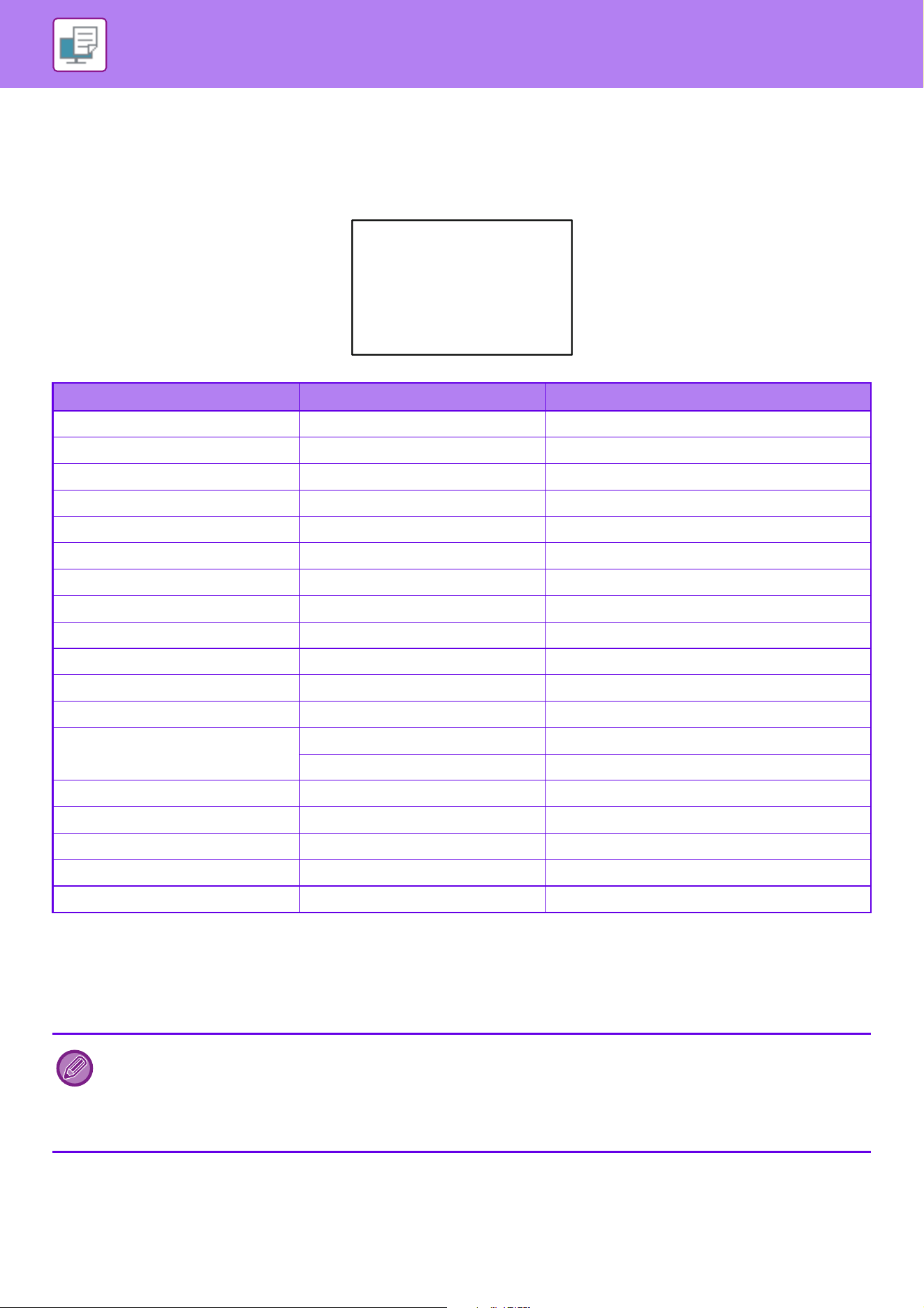
3-99
PRINTER►PRINTING WITHOUT THE PRINTER DRIVER
Performing e-mail print
Using your PC's e-mail software, specify the e-mail address of the machine in "Address" and send e-mail attached with
a file to be printed.
Control commands can be entered in the message of the e-mail to specify the number of copies and print format.
Commands are entered in the format "command name = value" as shown in the example to the right.
As an example, the control commands include the following:
*1 Enabled only when a finisher or saddle stitch finisher is installed.
*2 Enabled only when a punch module is attached to the finisher or saddle stitch finisher.
*3 Can be omitted except when authentication is by user number.
*4 Enabled only when a saddle stitch finisher is installed.
*5 Enabled only when a folding unit is installed.
*6 Only enabled when either "Document Filing" or "Quick File" is "ON". When both are "ON", this is disabled.
Function Command name Values
Copies COPIES 1 to 9999
Staple
*1
STAPLEOPTION NONE, ONE, TWO, SADDLE
Punch
*2
PUNCH OFF, ON
Punch number PUNCH-NUMBER TWO, THREE, FOUR, FOURWIDE
Collate COLLATE OFF, ON
2-sided Print DUPLEX OFF, TOP, LEFT, RIGHT
Account Number
*3
ACCOUNTNUMBER Number (5 to 8 digits)
File Format LANGUAGE PCL, PCLXL, POSTSCRIPT, PDF, TIFF, JPG
Glossy paper print MEDIATYPE GLOSSY
Paper PAPER Paper that can be used (LETTER, A4, or others)
Fold (Saddle Fold)
*4
V-FOLD OFF, INSIDE, OUTSIDE
Fold (Z-Fold)
*5
FOLD OFF, LEDGER, LEGAL, LETTER, A3, A4, B4
Document Filing
*6
FILE OFF, ON
FOLDERNAME Up to 28 characters
Quick File
*6
QUICKFILE OFF, ON
Output OUTTRAY CENTER, RIGHT, FINISHER, TOPTRAY
B/W Print B/W PRINT OFF, ON
Fit Page FITIMAGETOPAGE OFF, ON
Print Pages PRINTPAGES 1-2,5,9-
• The mail text must be in a text format. If entered in Rich Text format (HTML), the commands will have no effect.
• If you enter "Config" in the mail text, a list of control commands is returned.
• If nothing is entered in the body text (message) of the e-mail, printing will take place according to the settings configured in
"Settings (administrator)." → [System Settings] → [Printer Settings] → [Initial Status Settings]. If you selected a PS or PCL
file that includes print conditions, the print conditions in the file will be given priority.
•
Enter a file type only when you wish to specify the page-description language. Normally there is no need to enter a file type.
COPIES=2
DUPLEX=LEFT
ACCOUNTNUMBER=11111
PAPER=A4
B/W PRINT=ON
3-100
PRINTER►PRINTER JOBS
CHECKING THE PRINT STATUS
When you tap the job management display, jobs are displayed in a list. To check the status of a printer job, tap the [Print]
tab.
When you wish to stop or delete jobs or to perform priority processing, read the following items:
• STOPPING/DELETING A JOB IN PROGRESS OR RESERVED (page 1-96)
• PRIORITY PROCESSING OF A RESERVED JOB (page 1-97)
• CHECKING A RESERVED JOB OR THE JOB IN PROGRESS (page 1-99)
• CHECKING COMPLETED JOBS (page 1-100)
PRINTING AN ENCRYPTED PDF FILE
PDF encryption is used to protect a PDF file by requiring the entry of a password to print or edit the file.
To directly print an encrypted PDF file on an FTP server or in a USB memory device, etc. connected to the machine,
reset the password and begin printing.
(1) Tap the Job management display and tap the [Print] tab.
(2) Tap the [Spool] key.
When the list contains an encrypted PDF file, a message is displayed to indicate that an encrypted PDF file exists.
(3) Tap the print job key for the encrypted PDF file.
(4) Tap the [Enter Password for Encrypt PDF.] key on the action panel.
(5) Enter the password (32 characters or less) and tap the [Yes] key.
PRINTER JOBS
• To print an encrypted PDF file using the printer driver, enter the password when opening the file on your PC.
• Printing is not possible if you do not know the password for the encrypted PDF file.
• Encrypted PDF versions that can be directly printed are 1.6 (Adobe
®
Acrobat
®
7.0) and earlier.
You cannot select multiple encrypted PDF files.
When both a master password and a user password (which is used to open the file) have been set, enter the master
password.
Encrypt PDF
Spooling
User_1_User_1_User ---/0004
---/0004User_2_User_2_User
Print Scan File Retrieve
Back
Job Queue
Complete
Spool
Job Job Queue
Progress / Sets Status
3-101
PRINTER►PRINTER JOBS
CHANGING TO ANOTHER PAPER SIZE AND
PRINTING WHEN PAPER RUNS OUT
If printing stops because the machine ran out of paper, or if the size of paper specified in the printer driver is not loaded
in the machine, a message will appear in the touch panel.
Printing will begin automatically when paper is loaded in the machine. If paper of the desired size is not immediately
available, you can use paper that is set in a different tray.
(1) Tap the job management display.
(2) Tap the key of the job for which "Paper Empty" appeared.
(3) Tap the [Reselect Paper] key on the action panel.
(4) Tap the key for the tray containing the paper that you wish to use, and tap .
If you changed to a different paper size, printing may not take place correctly; for example part of the text or image may run
off the paper.
3-102
PRINTER►APPENDIX
PRINTER DRIVER SPECIFICATIONS LIST
For information on the setting items, refer to printer driver Help.
PRINTER DRIVER SETTINGS SCREEN / REFERRING TO HELP (page 3-6)
APPENDIX
Function PCL6 PS Windows
PPD
*1
Mac OS
PPD
*1
Tab
(Windows)
Item Page
Main
Copies - 1 - 9999 1 - 9999 1 - 9999 1 - 9999
Collate - Yes Yes Yes Yes
Original Size 3-4 Yes Yes Yes Yes
Output Size 3-4 Yes Yes Yes Yes
Orientation 3-44 Yes Yes Yes Yes
Adjust to Paper Size 3-22 Yes Yes No Yes
Zoom 3-45 Yes*
2
Yes Yes*
2
Yes*
2
2-Sided 3-21 Yes Yes Yes Yes
N-Up 3-24
2, 4, 6, 8, 9,
16
2, 4, 6, 8, 9,
16
2, 4, 6, 9,16 2, 4, 6, 9,16
Staple
*3
3-27 Yes Yes Yes Yes
Document Filing 3-87 Yes Yes No Yes
Color Mode 3-18 Yes Yes Yes Yes
Paper
Source
Output Size 3-4 Yes Yes Yes Yes
Paper Tray 3-7 Yes Yes Yes Yes
Paper Type 3-7 Yes Yes Yes Yes
Tray Status 3-7 Yes Yes No No
Finishing
Staple
*3
Saddle Stitch
*4
3-27 Yes Yes Yes Yes
Punch
*3
3-27 Yes Yes Yes Yes
Fold
*4
3-73 Half Fold Half Fold Half Fold Half Fold
Offset - Yes Yes Yes Yes
Output - Yes Yes Yes Yes
Separator Page 3-67 Yes Yes No No
Trimming 3-38 Yes Yes No Yes
3-103
PRINTER►APPENDIX
Layout
2-Sided 3-21 Yes Yes Yes Yes
Chapter Inserts 3-72 Yes No No No
Booklet 3-36 Yes Yes Yes Yes
N-Up
Page No. 3-24
2, 4, 6, 8, 9,
16
2, 4, 6, 8, 9,
16
2, 4, 6, 9,16 2, 4, 6, 9,16
Repeat 3-79 Yes No No No
Order 3-24 Yes Yes No Yes
Border 3-24 Yes Yes No Yes
N-Up with
cover
3-24 Yes No No No
100% N-Up 3-24 Yes Yes No No
Edge-to-Edge Printing 3-29 Yes Yes No No
Poster Printing 3-42 Yes Yes No No
Print Position
Margin Shift 3-40
0 inch to 1.2
inch (10mm
to 30mm)
0 inch to 1.2
inch (10mm
to 30mm)
Yes Yes
Tab Shift 3-69 Yes Yes No No
Custom 3-43 Yes Yes No No
Job Handling
Print Release - Yes Yes No Yes
Document Filing 3-87 Yes Yes No Yes
Create PDF for PC Browsing 3-87 Yes No No No
Print and Send 3-90 Yes No No No
Notify Job End - Yes Yes No No
Authentication 3-9 Yes Yes No Yes
Inserts
Covers/Inserts 3-63 Yes Yes Yes*
5
Yes*
5
Transparency Inserts 3-65 Yes Yes No Yes
Carbon Copy 3-68 Yes Yes No No
Tab Paper 3-69 Yes No No No
Stamp
Watermark 3-56 Yes Yes Yes Yes
Image Stamp 3-58 Yes Yes No No
Overlay 3-60 Yes Yes No No
Hidden Pattern 3-80 Yes No No No
Copies Stamp 3-62 Yes No No No
Image
Quality
Print Mode 3-20 Yes Yes Yes Yes
Graphics Mode - Yes No No No
Bitmap Compression - Yes Yes No No
Sharpness 3-53 Yes Yes Yes Yes
Screening 3-53 Yes Yes Yes Yes
Smoothing 3-84 Yes Yes No Yes
Function PCL6 PS Windows
PPD
*1
Mac OS
PPD
*1
Tab
(Windows)
Item Page
3-104
PRINTER►APPENDIX
Image
Quality
Text To Black 3-52 Yes Yes No No
Vector To Black 3-52 Yes Yes No No
Toner Save - Yes Yes Yes Yes
Color Mode 3-18 Yes Yes Yes Yes
Color Adjustment/
RGB Adjustment
3-51 Yes Yes No No
Font - Yes Yes No No
Line Width 3-47 Yes No No No
Color Profile
Image Type 3-53 Yes Yes Yes Yes
CMYK Simulation 3-53 No Yes Yes Yes
Simulation Profile 3-53 No Yes Yes Yes
Output Profile 3-53 No Yes Yes Yes
Windows ICM 3-53 Yes Yes No No
ICM Method 3-53 No No Yes No
ColorSync 3-53 No No No Yes
Source Profile 3-53 Yes Yes Yes Yes
Rendering Intent 3-53 Yes Yes Yes Yes
Output Profile 3-53 Yes Yes Yes Yes
CMYK Correction 3-53 Yes No Yes No
Neutral Gray 3-53 Yes Yes Yes Yes
Pure Black Print 3-53 Yes Yes Yes Yes
Black Overprint 3-53 No Yes Yes Yes
Trapping 3-53 Yes Yes Yes Yes
Function PCL6 PS Windows
PPD
*1
Mac OS
PPD
*1
Tab
(Windows)
Item Page
3-105
PRINTER►APPENDIX
*1 The specifications of each function in Windows PPD and Mac OS PPD vary depending on the operating system
version and the application.
*2 The horizontal and vertical proportion cannot be set separately.
*3 If a finisher or a saddle stitch finisher is installed (The punch module is also required in order to use the punch function.)
*4 If a saddle stitch finisher is installed
*5 Only covers can be inserted.
*6 This function cannot be used in Mac OS X 10.10/10.11/10.12
or later
.
Detailed
Settings
Mirror Image 3-50 No Yes Yes Yes
PS Error Information - No Yes Yes No
PS Pass-Through - No Yes No No
Job Compression - No Yes No No
Tandem Print 3-85 Yes Yes No Yes*
6
Disable Blank Page Print 3-26 Yes Yes No No
Custom Image Registration 3-59 Yes No No No
Other Settings
• Input Resolution - Yes Yes No No
• Shade Pattern - Yes No No No
• Spool Data Format - Yes Yes No No
• Printable Area 3-83 Yes Yes No No
• Rip Style 3-87 Yes Yes No Yes
• Duplex Style 3-21 Yes Yes No No
• Job Name Shortening - Yes Yes No No
• Use driver to render JPEGs 3-82 Yes Yes No No
• Thicken Fine Lines 3-48 Yes No No No
•Fine Text - Yes Yes Yes Yes
• Text/Line control 3-49 Yes Yes No No
• Text/Line Knockout control 3-49 Yes Yes No No
• Photo Image - Yes Yes No No
• Image Enhancement 3-49 Yes Yes No No
Function PCL6 PS Windows
PPD
*1
Mac OS
PPD
*1
Tab
(Windows)
Item Page
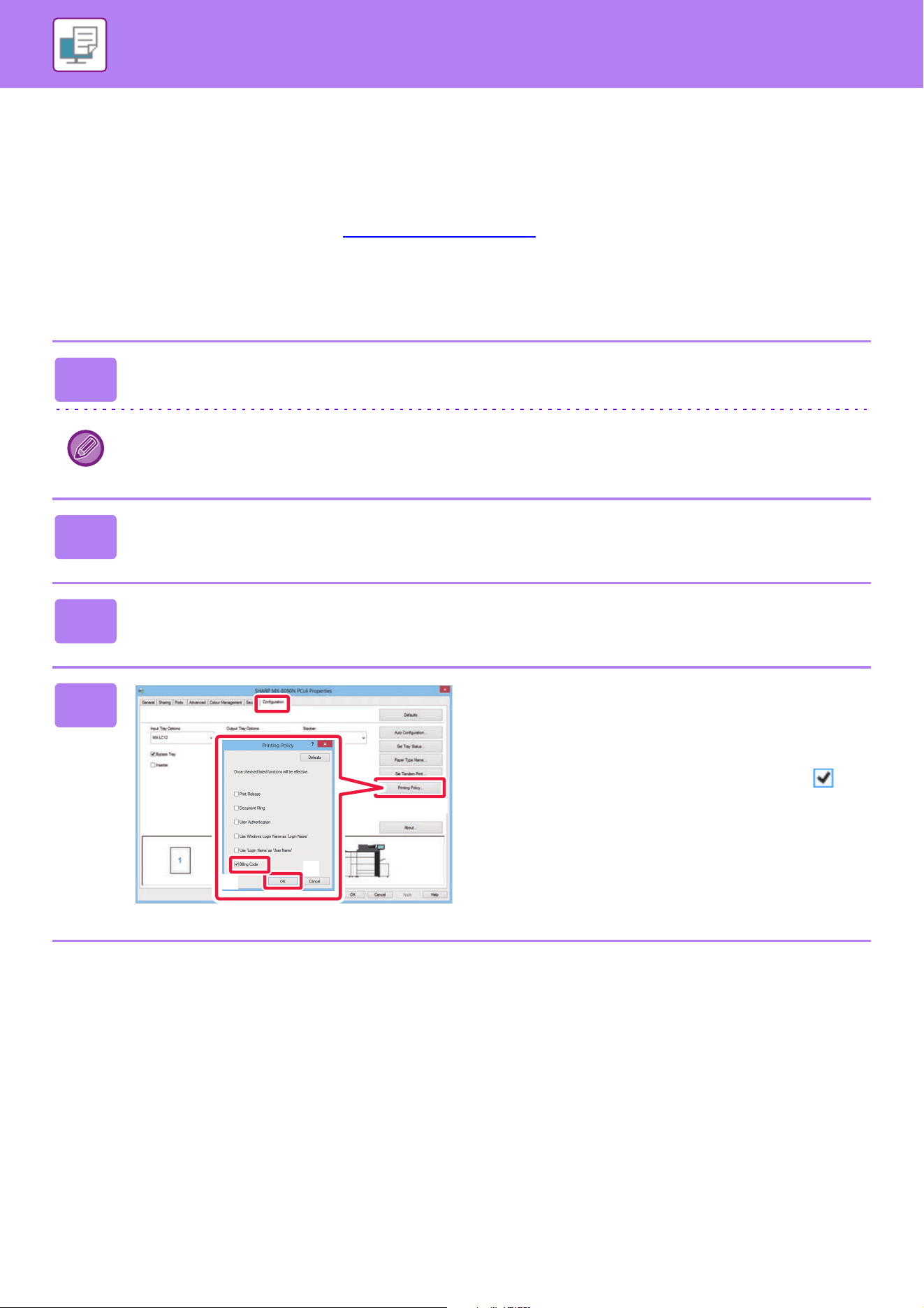
3-106
PRINTER►APPENDIX
SPECIFYING A BILLING CODE USING THE
PRINTER DRIVER
You can enter a billing code using the printer of the machine.
For an overview of a billing code, refer to "BILLING CODE (page 1-39)
".
Enable billing code
This setting is required only in the Windows environment. (Always usable under Mac OS environment)
1
Right-click the [Start] button and select [Control Panel].
In Windows 7, click the [Start] button, select [Devices and Printers], right-click the printer driver icon of the machine, and
click [Printer Properties].
2
Click [View devices and printers] in [Hardware and Sound].
3
Click [Printer Properties].
4
Specify a billing code
(1) Click the [Configuration] tab.
(2) Click the [Printing Policy] button.
(3) Set the [Billing Code] check box to .
(4) Click the [OK] button.
(2)
(1)
(3)
(4)
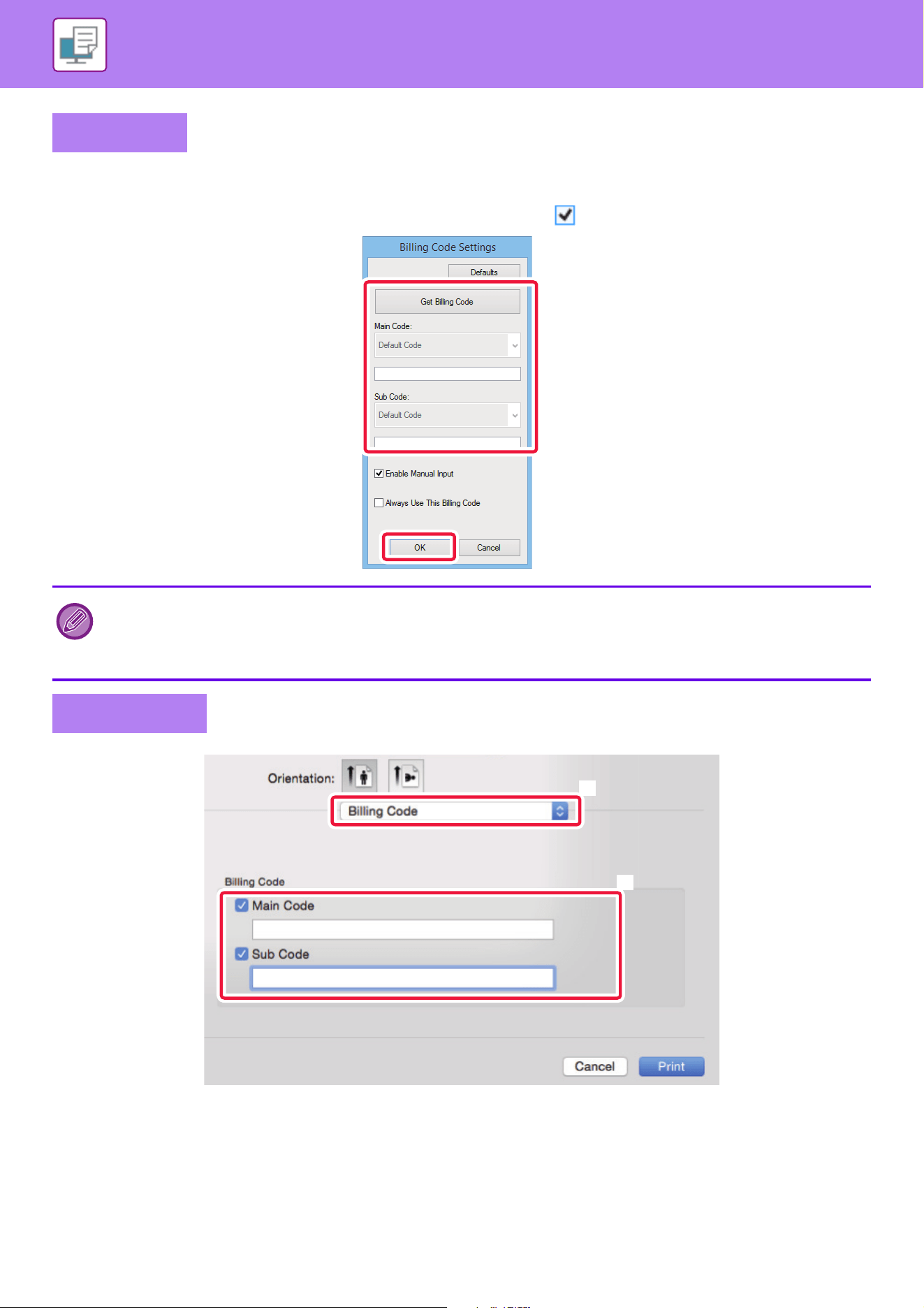
3-107
PRINTER►APPENDIX
When printing starts, the billing code setting screen appears.
Enter the main code and sub code, and click the [OK] button.
To retain the specified billing code, set [Always Use This Billing Code] to .
(1) Select [Billing Code].
(2) Enter the main code and sub code.
Windows
• You can click [Get Billing Code] to get the machine's billing code list and select the billing code from the list.
• If [Use Billing Code] is set to "Disable" in "Settings (administrator)" - [Billing Code Setting] - [Administration Settings], the
entered billing code is disabled and is not recorded in the job log.
• If you have started printing without specifying a billing code, a use code is recorded in the job log.
Mac OS
(2)
(1)
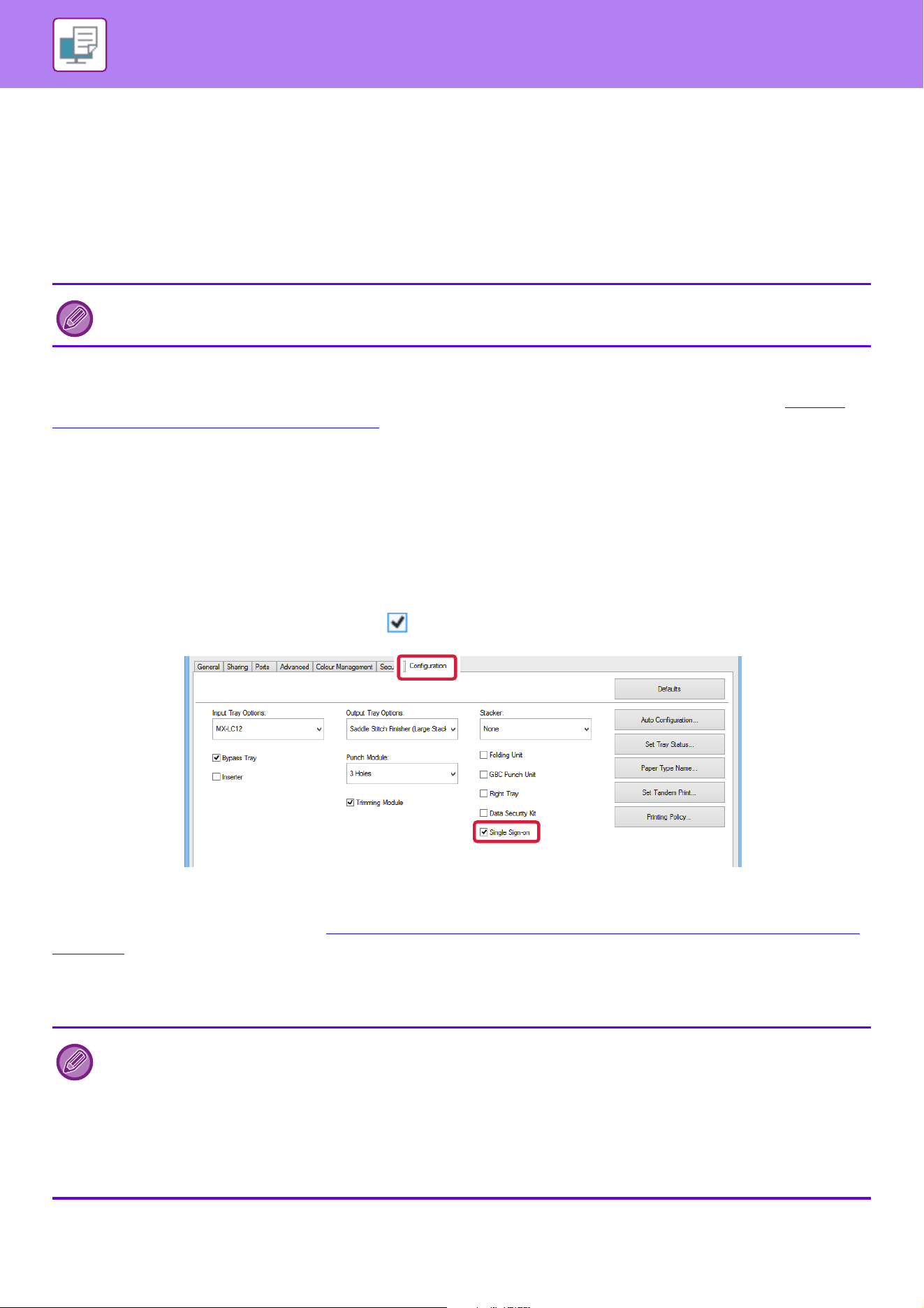
3-108
PRINTER►APPENDIX
AUTHENTICATION BY SINGLE SIGN-ON
When the user authentication is used, you must enter your user name and password to print from a printer driver.
The Single Sign-on function can be used when Active Directory authentication is used on both the machine and the
computer.
When you use this function and print from the printer driver, the print job is sent to the machine using the authentication
information that you used to log in to the computer. This allows easy printing of jobs from the printer driver without the
need to enter your user name or password each time you print when user authentication is enabled.
Settings
Active Directory must be enabled on the machine in advance. For information on Active Directory, refer to "ACTIVE
DIRECTORY LINKING FUNCTION (page 1-36)". After enabling Active Directory, configure the settings below in the
printer driver.
(1) Right-click on the Start window (or swipe up from the lower end of the window), and click the App
Bar → [All apps] → [Control Panel] → [Hardware and Sound] → [Devices and Printers].
In Windows 7/Server 2008, click the [Start] button → [Control Panel] → [Hardware and Sound] → [Devices and Printers].
(2) Right-click the machine's printer driver icon and select [Printer Properties].
The printer properties appear.
(3) Click the [Configuration] tab.
(4) Set the [Single Sign-on] checkbox to .
Authentication Option
For the authentication method, refer to "PRINTING WHEN THE USER AUTHENTICATION FUNCTION IS ENABLED
(page 3-9)".
(1) Click the [Job Handling] tab.
(2) In [Authentication], select [Single Sign-on].
Authentication by Single Sign-on requires that Active Directory authentication be performed on the machine and your
computer. This can only be used when your computer is running Windows.
• Single Sign-on authentication is also possible from the Job Handling dialog box and the User Authentication dialog box.
• When Single Sign-on is enabled, [Print and Send] cannot be used.
• If you logged in to the machine in advance before using Single Sign-on, you will have the permissions of the user account
you used to log in.
If you use Single Sign-on without logging in to the machine, the user permissions will be those of "User".
This may limit the functions that you can use.
• If Single Sign-on is used without logging in to the machine, the user name in the job log will be the name set by printer
driver. If the user name is not set by printer driver, the user name in the job log will be the computer login name.
(2)
(1)
4-1
BEFORE USING THE MACHINE AS A
NETWORK SCANNER
BEFORE USING THE MACHINE AS A NETWORK
SCANNER FUNCTION. . . . . . . . . . . . . . . . . . . . . . . 4-3
• USES OF THE NETWORK SCANNER. . . . . . . 4-3
•
BEFORE USING THE NETWORK SCANNER . . .
4-4
NETWORK SCANNER MODE. . . . . . . . . . . . . . . . . 4-6
• EASY MODE . . . . . . . . . . . . . . . . . . . . . . . . . . . 4-6
• NORMAL MODE . . . . . . . . . . . . . . . . . . . . . . . . 4-7
SELECTING NETWORK SCANNER MODE . . . . . . 4-7
IMAGE SEND SEQUENCE . . . . . . . . . . . . . . . . . . . 4-10
ORIGINAL SIZE . . . . . . . . . . . . . . . . . . . . . . . . . . . . 4-12
• TRANSMITTABLE ORIGINAL SIZES . . . . . . . . 4-12
• THE SIZE OF THE PLACED ORIGINAL. . . . . . 4-12
ENTERING DESTINATIONS
ENTERING DESTINATIONS . . . . . . . . . . . . . . . . . . 4-14
• RETRIEVING A DESTINATION FROM AN
ADDRESS BOOK . . . . . . . . . . . . . . . . . . . . . . . 4-14
• MY ADDRESS. . . . . . . . . . . . . . . . . . . . . . . . . . 4-16
• VIEWING A LIST OF THE SELECTED
DESTINATIONS . . . . . . . . . . . . . . . . . . . . . . . . 4-17
• USING A SEARCH NUMBER TO RETRIEVE A
DESTINATION. . . . . . . . . . . . . . . . . . . . . . . . . . 4-18
• ENTERING AN ADDRESS MANUALLY . . . . . . 4-19
• SPECIFYING A NETWORK FOLDER. . . . . . . . 4-20
• RETRIEVING A DESTINATION FROM A
GLOBAL ADDRESS BOOK. . . . . . . . . . . . . . . . 4-21
•
USING A TRANSMISSION LOG TO RESEND . . .
4-23
•
SENDING ONLY THE URL OF A SCANNED FILE
TO A SCAN DESTINATION. . . . . . . . . . . . . . . . . .
4-25
TRANSMITTING AN IMAGE
TRANSMITTING AN IMAGE . . . . . . . . . . . . . . . . . . 4-28
• SENDING AN IMAGE IN SCAN MODE . . . . . . 4-28
• CHANGING THE SUBJECT, FILE NAME,
REPLY-TO, AND BODY TEXT AT THE TIME
OF SCAN TRANSMISSION . . . . . . . . . . . . . . . 4-31
• SENDING THE SAME IMAGE TO MULTIPLE
DESTINATIONS (BROADCAST
TRANSMISSION) . . . . . . . . . . . . . . . . . . . . . . . 4-34
• RESENDING TO UNSUCCESSFUL
BROADCAST TRANSMISSION
DESTINATIONS. . . . . . . . . . . . . . . . . . . . . . . . 4-37
IMAGE SETTINGS . . . . . . . . . . . . . . . . . . . . . . . . . 4-39
• AUTOMATICALLY SCANNING BOTH SIDES
OF AN ORIGINAL (2-SIDED ORIGINAL). . . . . 4-39
• SCAN SIZE AND SEND SIZE
(ENLARGE/REDUCE) . . . . . . . . . . . . . . . . . . . 4-40
• SPECIFYING THE ORIGINAL SCAN SIZE IN
PAPER SIZE . . . . . . . . . . . . . . . . . . . . . . . . . . 4-41
• SPECIFYING THE ORIGINAL SCAN SIZE
USING NUMERIC VALUES . . . . . . . . . . . . . . . 4-42
• STORING FREQUENTLY USED ORIGINAL
SIZES . . . . . . . . . . . . . . . . . . . . . . . . . . . . . . . . 4-43
• SPECIFYING THE SEND SIZE OF THE
IMAGE . . . . . . . . . . . . . . . . . . . . . . . . . . . . . . . 4-46
• CHANGING THE EXPOSURE AND ORIGINAL
IMAGE TYPE . . . . . . . . . . . . . . . . . . . . . . . . . . 4-48
• CHANGING THE RESOLUTION . . . . . . . . . . . 4-50
• CHANGING FORMAT IN SCAN OR DATA
ENTRY MODE . . . . . . . . . . . . . . . . . . . . . . . . . 4-51
• CHANGING COLOR MODE. . . . . . . . . . . . . . . 4-56
• SETTING SCAN SETTINGS
AUTOMATICALLY (Auto Set) . . . . . . . . . . . . . 4-58
CHECKING THE IMAGE TO BE TRANSMITTED . . .
4-58
OTHER FUNCTIONS
STORING SCAN OPERATIONS (PROGRAM) . . . 4-59
SCANNING AND SENDING ORIGINALS
COLLECTIVELY . . . . . . . . . . . . . . . . . . . . . . . . . . . 4-62
• SCANNING ORIGINALS OF DIFFERENT
SIZES (MIXED SIZE ORIGINAL) . . . . . . . . . . . 4-62
• SCANNING BOTH SIDES OF A CARD ONTO
A SINGLE PAGE (CARD SHOT) . . . . . . . . . . . 4-64
•
SIMULTANEOUSLY SCANNING MULTIPLE CARDS,
RECEIPTS OR OTHER SMALL ORIGINALS TO
INDIVIDUAL FILES (MULTICROP). . . . . . . . . . . . . . .
4-66
•
SCANNING A BUSINESS CARD, READING THE
TEXT STRING, CREATING A FILE, AND SENDING
THE FILE (BUSINESS CARD SCAN). . . . . . . . . . . . .
4-68
•
SCANNING MANY ORIGINALS AT ONCE (JOB
BUILD). . . . . . . . . . . . . . . . . . . . . . . . . . . . . . . . . . . . .
4-72
SCANNING AND SENDING AN ORIGINAL AS
SEPARATE PAGES . . . . . . . . . . . . . . . . . . . . . . . . 4-74
• SCANNING AN ORIGINAL AS TWO
SEPARATE PAGES (DUAL PAGE SCAN) . . . 4-74
SCANNER
Icons
Functions you can use in Easy
Scan mode

4-2
SCANNER
• SPLITTING A PAMPHLET BY PAGE AND
TRANSMITTING THE PAGES
SUCCESSIVELY (BOOK DIVIDE) . . . . . . . . . . 4-77
ADJUSTING COLORS AND SHADING. . . . . . . . . . 4-79
•
ADJUSTING THE BACKGROUND BY MAKING
LIGHT AREAS OF THE ORIGINAL DARKER OR
LIGHTER (BACKGROUND ADJUSTMENT) . . . .
4-79
•
ADDING CONTRAST TO THE SCANNED ORIGINAL
BEFORE TRANSMISSION (CONTRAST). . . . . . . . .
4-81
• ENHANCING THE OUTLINE OF THE
SCANNED ORIGINAL BEFORE
TRANSMISSION (SHARPNESS) . . . . . . . . . . . 4-83
• REMOVING CHROMATIC COLORS FROM
THE SCANNED ORIGINAL BEFORE
TRANSMISSION (DROP OUT COLOR) . . . . . . 4-85
•
ADJUSTING RED/GREEN/BLUE (RGB Adjust) . . .
4-87
SCANNING ORIGINALS . . . . . . . . . . . . . . . . . . . . . 4-89
• ERASING PERIPHERAL SHADOWS ON THE
IMAGE (ERASE) . . . . . . . . . . . . . . . . . . . . . . . . 4-89
•
SCANNING A THIN ORIGINAL (SLOW SCAN MODE) . . .
4-92
• ELIMINATING BLANK PAGES FROM A
TRANSMISSION (BLANK PAGE SKIP) . . . . . . 4-94
• CHECKING THE NUMBER OF SCANNED
ORIGINAL SHEETS BEFORE
TRANSMISSION (ORIGINAL COUNT) . . . . . . . 4-96
• STAMPING SCANNED ORIGINALS
(VERIFICATION STAMP) . . . . . . . . . . . . . . . . . 4-98
SPECIFIC FUNCTIONS . . . . . . . . . . . . . . . . . . . . . . 4-100
•
STARTING A TRANSMISSION AT A
SPECIFIED TIME (TIMER TRANSMISSION). . .
4-100
• ADDING A SIGNATURE WHEN SENDING AN
IMAGE (ELECTRONIC SIGNATURE). . . . . . . . 4-103
• ENCRYPTING THE TRANSMITTED DATA
(ENCRYPTION). . . . . . . . . . . . . . . . . . . . . . . . . 4-105
SENDING A SCANNED DOCUMENT BY GMAIL
OR EXCHANGE . . . . . . . . . . . . . . . . . . . . . . . . . . . . 4-107
• GMAIL LINK FUNCTION . . . . . . . . . . . . . . . . . . 4-107
• EXCHANGE LINK FUNCTION . . . . . . . . . . . . . 4-109
• SETTINGS SCREEN. . . . . . . . . . . . . . . . . . . . . 4-111
CHECKING THE STATUS OF
TRANSMISSION/RECEPTION JOBS
IMAGE SEND JOBS . . . . . . . . . . . . . . . . . . . . . . . . 4-114
COMPLETED TRANSMISSION/RECEPTION
JOBS . . . . . . . . . . . . . . . . . . . . . . . . . . . . . . . . . . . . 4-115
SCANNING FROM A COMPUTER
(PC Scan Mode)
BASIC SCANNING PROCEDURE. . . . . . . . . . . . . . 4-116
METADATA DELIVERY
PREPARATIONS FOR METADATA DELIVERY . . .
4-121
• METADATA DELIVERY (DATA ENTRY) . . . . . 4-121
• SETTINGS REQUIRED IN THE SETTING
MODE (WEB VERSION) . . . . . . . . . . . . . . . . . 4-122
TRANSMITTING METADATA. . . . . . . . . . . . . . . . . 4-123
• TRANSMITTING METADATA . . . . . . . . . . . . . 4-123
• METADATA FIELDS . . . . . . . . . . . . . . . . . . . . 4-124

4-3
SCANNER►BEFORE USING THE MACHINE AS A NETWORK SCANNER
BEFORE USING THE MACHINE AS A
NETWORK SCANNER FUNCTION
USES OF THE NETWORK SCANNER
The network scanner allows you to create an image file from the original data scanned by the machine, and send the file
over a network to a PC, FTP server, or other destinations. If necessary, it scans the original using a TWAIN-compliant
application on your PC.
The network scanner function provides the following scanning modes.
Scanner mode
The scanner function of the machine sends a scanned original as described below based on the specification of the
destination.
• Scan to E-mail
A scanned file is attached to e-mail and sent.
• Scan to FTP
The scanned file is sent to a specified folder of an FTP server.
When the file is sent, it is also possible to send an e-mail to a previously stored e-mail address to inform the recipient
of the location of the file.
• Scan to Network Folder
The scanned file is sent to a network folder on a Windows PC on the same network as the machine.
When the file is sent, it is also possible to send an e-mail to a previously stored e-mail address to inform the recipient
of the location of the file.
For the operating procedure, see "SENDING AN IMAGE IN SCAN MODE (page 4-28)
".
BEFORE USING THE MACHINE AS A
NETWORK SCANNER
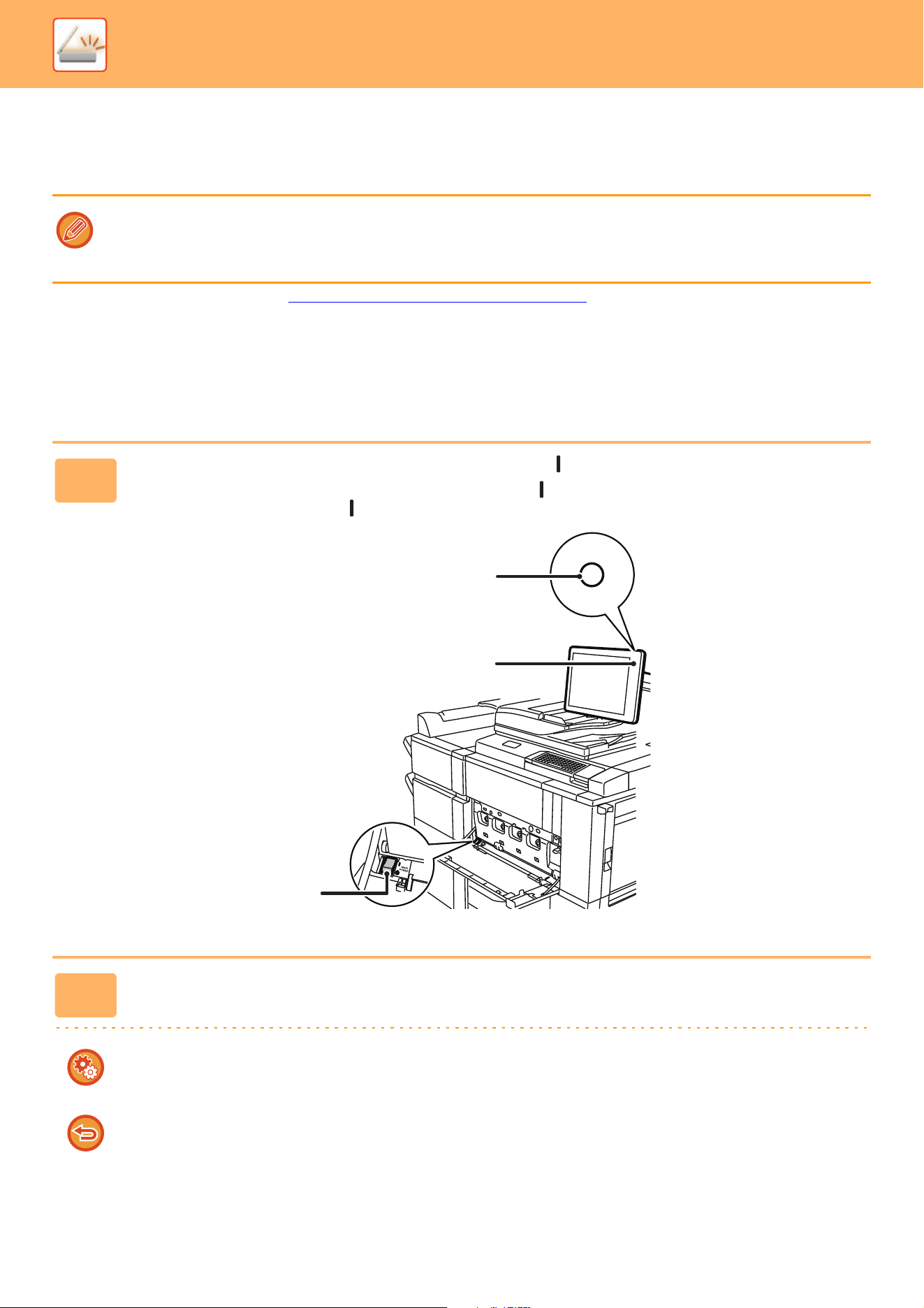
4-4
SCANNER►BEFORE USING THE MACHINE AS A NETWORK SCANNER
Data entry mode
In data entry mode, information entered using the touch panel or automatically generated by the machine is sent to a
directory on an FTP server or an application on a PC as a metadata file in XML format.
For the operating procedure, see "TRANSMITTING METADATA (page 4-123)
".
BEFORE USING THE NETWORK SCANNER
To use the machine as a network scanner, you must store sender information, configure server settings, store
destinations in the address book, and perform other required operations.
Installing the application integration module is required to use the metadata delivery function.
The application integration module can be combined with the network scanner to append a metadata file to a scanned image
file.
Metadata is information about a file, how it is to be processed, and its relation to other objects.
1
Make sure the main power switch is in the " " position.
When the main power indicator is lit up, the main power is in the " " position. If the main power indicator is not lit up,
turn the main power switch to the " " position and press the [POWER] button on the operation panel.
2
Check the date and time.
Verify that the correct date and time are set in the machine.
To set the date and time of the machine:
In "Settings", select [System Settings] → [Common Settings] → [Clock Adjust].
If [Disabling of Clock Adjustment] has been enabled, the date and time cannot be modified.
Select [System Settings] in "Settings (administrator)" → [Common Settings] → [Enable/Disable Settings] → [Operation
Settings] to disable the [Disabling of Clock Adjustment] setting.
[Power] button
Main power indicator
Main power switch
4-5
SCANNER►BEFORE USING THE MACHINE AS A NETWORK SCANNER
3
Store the sender information.
Before using Scan to E-mail:
Store a default sender name in "Sender Name" and a reply e-mail address in "Reply E-mail Address".
To store the sender's name and e-mail address that are used when a sender is not selected:
In "Settings (administrator)", select [System Settings] → [Image Send Settings] → [Scan Settings] → [Condition Settings]
→ [Default Reply.Address Set].
To store the sender's name and address:
In "Settings (administrator)", select
[System Settings] → [Image Send Settings] →
[Common Settings] → [Own Number
and Name Set] → [Sender Data Registration].
4
Configure settings required in the setting mode.
Configure server settings, default settings for the network scanner.
• To configure server settings:
In "Settings (administrator)", select [
System Settings
] → [Network Settings] → [Services Settings]. (Administrator
rights are required.)
• To configure basic settings for the network scanner:
In "Settings (administrator)", select [
System Settings
] → [
Image Send Settings
] → [Scan Settings]. (Administrator
rights are required.)
5
Store the destination addresses for each scan mode in the address book.
You can send an image by directly entering an address when using Scan to Image. It is convenient to previously store
addresses in the address book.
Up to 6000 addresses can be stored in the address book. For information on the address book, see "ADDRESS BOOK".
For how to use the address books and how to store addresses, see the following item.
► RETRIEVING A DESTINATION FROM AN ADDRESS BOOK (page 4-14)
► VIEWING A LIST OF THE SELECTED DESTINATIONS (page 4-17)
► USING A SEARCH NUMBER TO RETRIEVE A DESTINATION (page 4-18)
► ENTERING AN ADDRESS MANUALLY (page 4-19)
► SPECIFYING A NETWORK FOLDER (page 4-20)
► RETRIEVING A DESTINATION FROM A GLOBAL ADDRESS BOOK (page 4-21)
► USING A TRANSMISSION LOG TO RESEND (page 4-23)
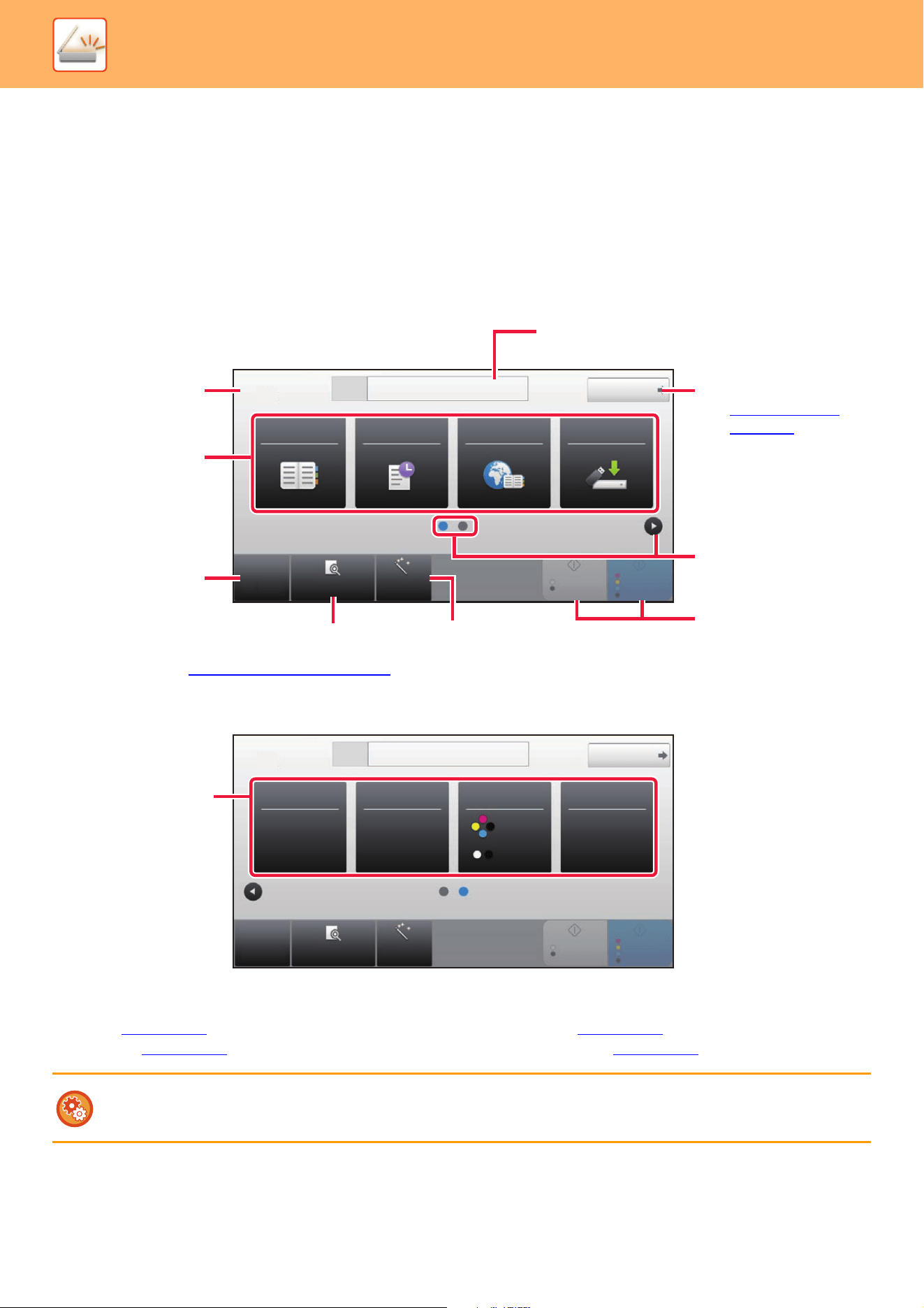
4-6
SCANNER►BEFORE USING THE MACHINE AS A NETWORK SCANNER
NETWORK SCANNER MODE
Network scanner mode has two modes: easy mode and normal mode.
Easy mode is limited to frequently used functions that allow you to smoothly perform most image send jobs.
If you need to select detailed settings or special functions, use normal mode. All functions can be used in normal mode.
EASY MODE
Easy mode makes it easy to select basic settings for network scanner mode.
You can select these functions in easy mode.
•Original ►page 4-48
•Resolution ►page 4-50
•File Format ►page 4-51
•Blank Page Skip ►page 4-94
Address Book
Global
Address Search
Scan to HDD/
USB
CA
Preview Auto Set
Original
Address E-mail Address
Detail
B/W
Start
Color
Start
Sending History
8½x11
Tap to display the soft keyboard.
Change the function
display.
Starts black and white or
color transmission.
Automatically set the original placement
orientation, resolution, and skipping of blank
pages.
Scans the original and shows a
preview image.
► PREVIEW SCREEN (page 1-17)
Change to normal mode.
► NORMAL MODE
(page 4-7)
Reset the address
and settings.
The original size is
displayed.
1st screen
2nd screen
Original
Auto 200x200dpi
PDF
PDF
Off
Resolution File Format
Blank Page
Skip
CA
Preview Auto Set
Original
Address E-mail Address
Detail
B/W
Start
Color
Start
8½x11
Select the function you
want to use.
Set an address.
To select a function in easy mode
In "Settings (administrator)", select [System Settings] → [Common Settings] → [Operation Settings] → [Easy Mode Settings]
→ [Easy Scan]
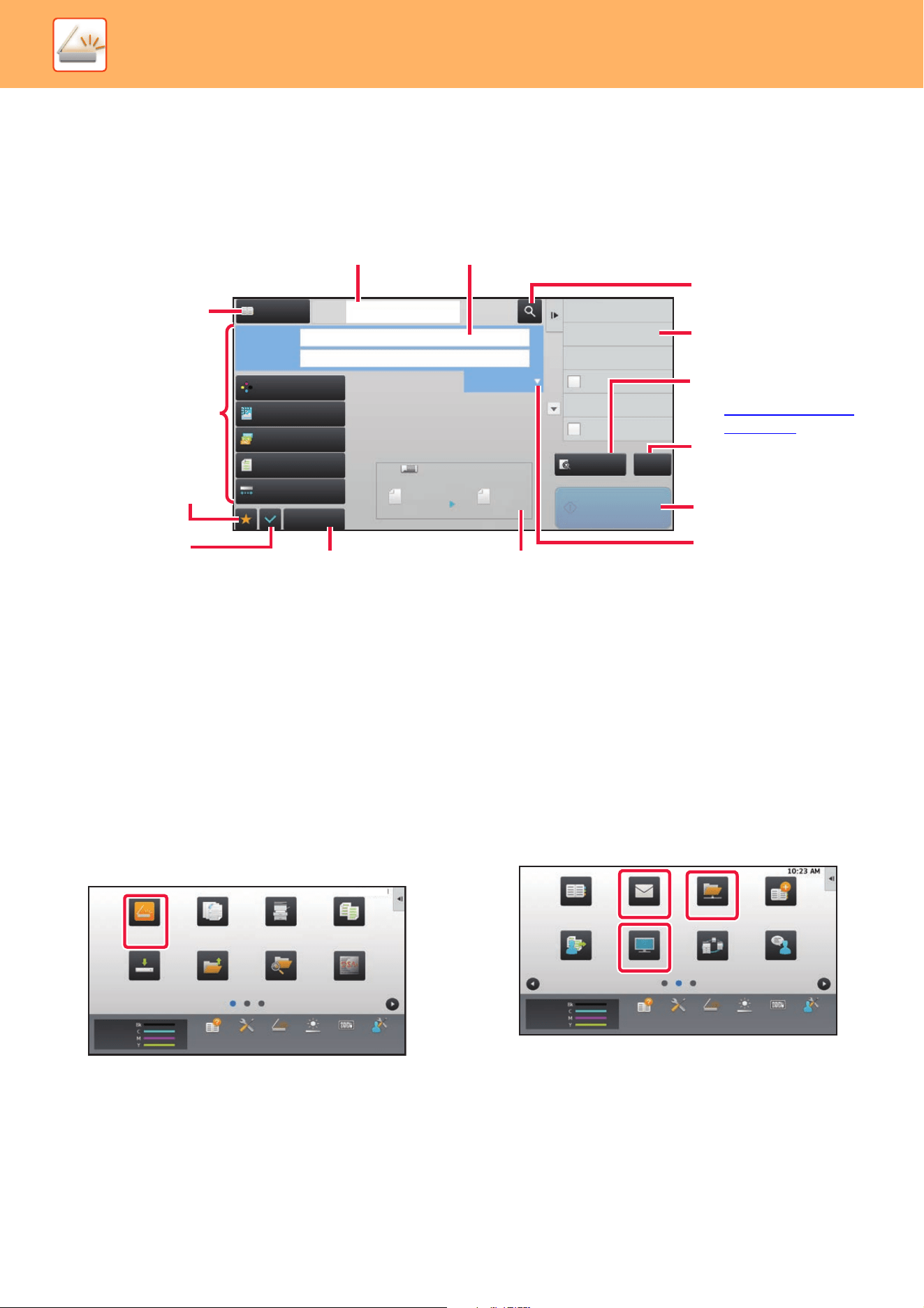
4-7
SCANNER►BEFORE USING THE MACHINE AS A NETWORK SCANNER
NORMAL MODE
Normal mode lets you select any function setting that can be used for network scanner.
This section explains the keys on a base screen, taking as an example the E-mail base screen. Several methods are
available in the Image Send mode, including Scan to E-mail and Scan to FTP. The base screen layout slightly differs
depending on how image is sent.
SELECTING NETWORK SCANNER MODE
You can select the network scanner mode from the Home Screen or from each operation mode as follows:
Changing modes from the Home Screen
Tap a mode icon to switch from the home screen to that mode.
Shift to Easy Mode
Tap the [Easy Scan] mode icon.
Shift to Normal Mode
Tap the [E-Mail], [FTP], or [Network Folder] mode icon.
CAPreview
Start
Scan Size
Auto Auto
Color Mode
Auto/Mono2
Resolution
200x200dpi
File Format
PDF
Original
Exposure
Auto
Others
8½x11 8½x11
100%
Send Size
Address Book
Subject
File Name
Address
Touch to input Address
Options
Global Address Search
Sending History
Call Search Number
Send
Destination Link
Verification Stamp
Specified by System Settings
Call Program
Call Registered settings
Tap to display the soft keyboard.
Enter subject, file name, and other items.
Searches for the address.
Displays the functions that
can be used in image send
mode.
Scans the original and
shows a preview image.
► PREVIEW SCREEN
(page 1-17)
Reset the address
and settings.
Transmission will
start immediately.
Displays the address
box to enter addresses.
Setting keys used for
image send operations.
Displays the list of
function keys. Frequently
used [Others], programs,
and other settings can be
registered.
Check the current
settings.
Displays keys other than
the function keys
indicated above.
Displays the sizes of the
original and the data to send.
Enter reply address
and body text.
Easy
Scan
Toner Quantity
Tray Settings/
Paper Settings
Scan to HDD Batch Print Sharp OSA
Manual
Finishing
HDD
File retrieve
Operation
Guide
PC Scan Total Count Machine
Adjustment
LCD Control
Settings
Copy
10:15 AM
Toner Quantity
Network Folder
Address
Control
Address Book
Print Release Language
Setting
E-Mail
FTP
Operation
Guide
PC Scan Total Count Machine
Adjustment
LCD Control
Settings
Program List
(Image Send)
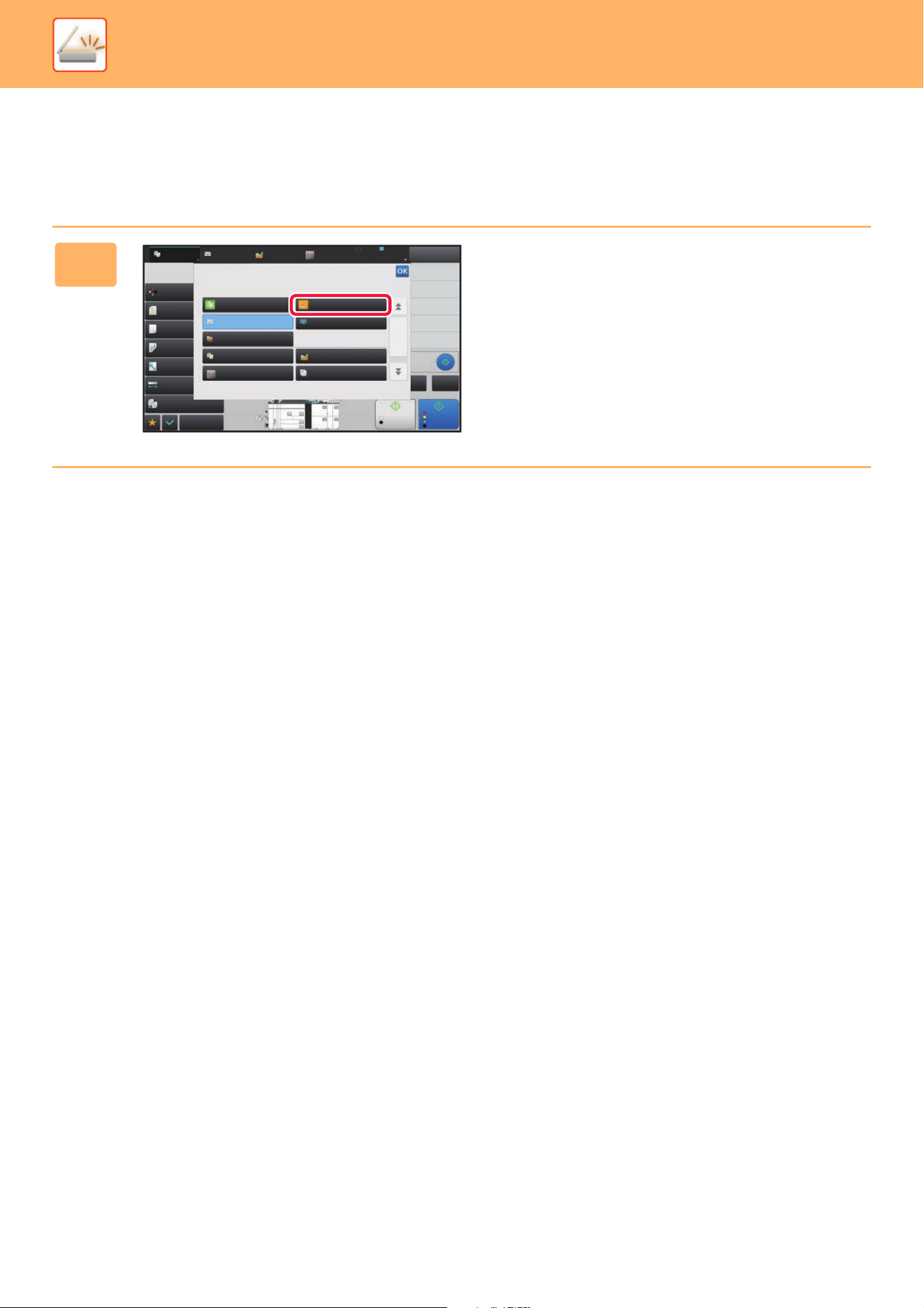
4-8
SCANNER►BEFORE USING THE MACHINE AS A NETWORK SCANNER
Changing mode from each mode
Tap the mode display to switch from each mode.
Shift to Easy Mode
1
Tap [Easy Scan].
The initial easy scan screen is displayed.
21
57
Proof Copy
68
3
4
8½x11
8½x11
8½x11 5½x8½
8½x14
11x17
8½x11
8½x11
8½x11
8½x11
Copy
B/W
Start Start
Preview
Paper Select
Auto
Exposure
Auto
Original
2-Sided Copy
1-Sided
Copy Ratio
100%
Others
Plain
Store Data Temporarily
Quick File
8½x
LINE PRINTER
E-mail
HDD
File retrieve
Sharp OSA
Job Management
CA
Color Mode
Full Color
Output
Color
HDD
File retrieve
Easy Copy
Network Folder
E-mail
Copy
Sharp OSA
Manual Finishing
FTP
Easy Scan
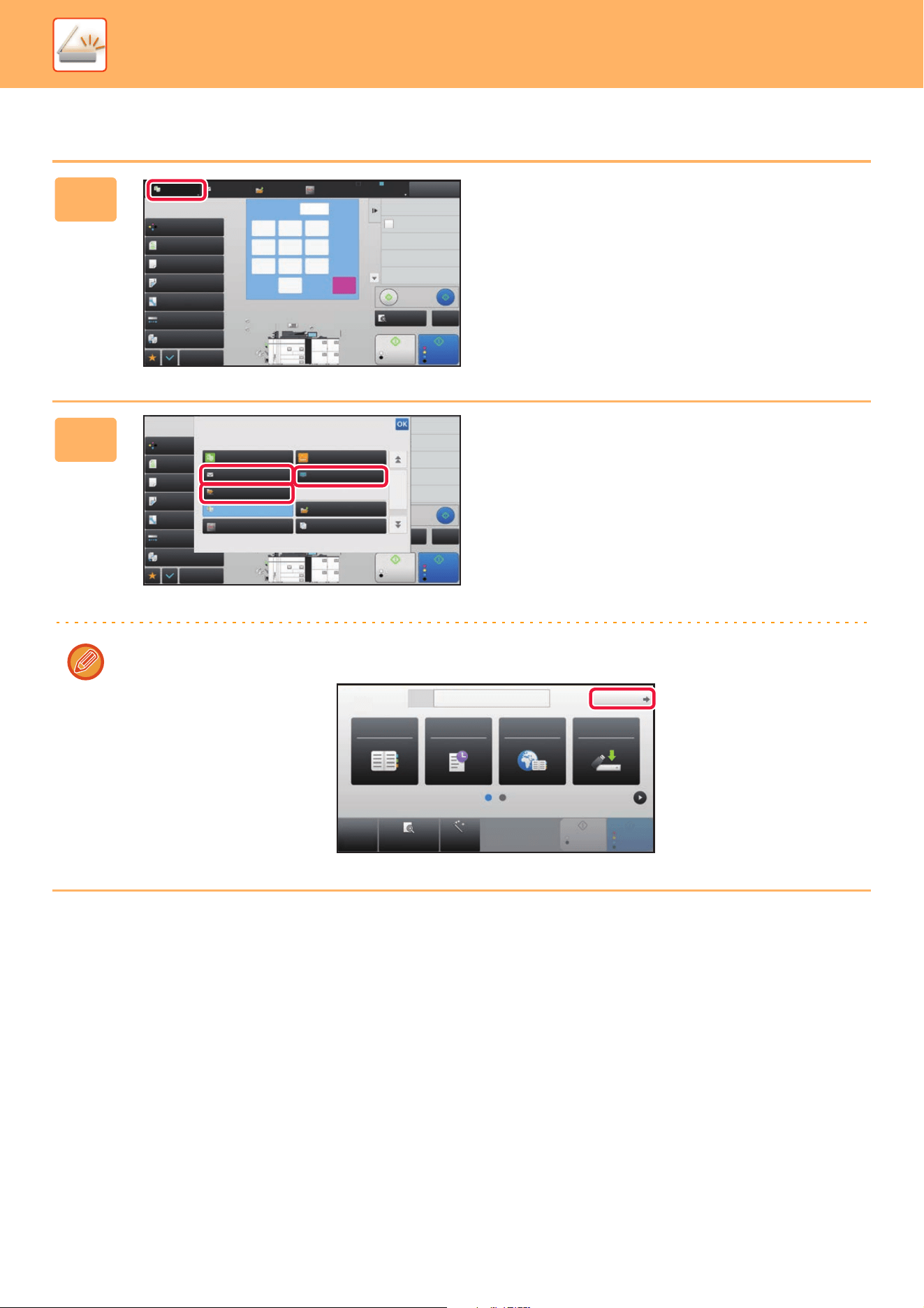
4-9
SCANNER►BEFORE USING THE MACHINE AS A NETWORK SCANNER
Shift to Normal Mode
1
Tap on the mode display
2
Tap the [E-Mail], [FTP], or [Network
Folder] key.
The initial screen of the selected mode is displayed.
To switch from the base screen of easy mode, tap the [Detail] key and then tap the [Yes] key in the confirmation screen.
21
57
Proof Copy
Plain 1
68
3
4
Plain 1
1
4
7
5
8
6
9
2
0
3
C
1
No. of copies
8½x11
8½x11
8½x11 5½x8½
8½x14
11x17
8½x11
8½x11
8½x11
8½x11
8½x11
B/W
Start Start
Preview
Color Mode
Full Color
Paper Select
Auto
Exposure
Auto
Original
2-Sided Copy
1-Sided→1-Sided
Output
Copy Ratio
100%
Others
Plain 1
Send and print
Call Eco Program
Store Data in Folder
File
Store Data Temporarily
Quick File
LINE
E-mail
HDD
File retrieve
Sharp OSA
CA
PRINTER
Job Management
Copy
Auto
Color
Colour Mode
Paper Select
Exposure
Original
2-Sided Copy
Sort/Group
Copy Ratio
Others
Preview
B/W
Start
Colour
Start
Send as well as print
Call Eco Program
Store Data in Folder
File
Store Data Temporarily
Quick File
Full Colour
Auto
Auto
Auto 8½
1-Sided→
Auto
100%
CA
Select the mode.
Proof Copy
21
57
Plain
8½x
68
3
4
8½x
Plain
Plain
8½x
B/W
Start Start
Preview
Color Mode
Paper Select
Auto
Exposure
Auto
Original
2-Sided Copy
1-Sided
Output
Copy Ratio
100%
Others
Store Data Temporarily
Quick File
CA
Proof Copy
8½x11
8½x11
8½x11 5½x8½
8½x14
11x17
8½x11
8½x11
8½x11
8½x11
8½x11
Color
HDD
File retrieve
Easy Copy
Network Folder
E-mail
Copy
Sharp OSA
FTP
Easy Scan
Manual Finishing
CA
Preview Auto Set
B/W
Start
Color
Start
Original
Address
Detail
Address Book
Sending History
Scan to HDD/
USB
Global
Address Search
E-mail Address
8½x11
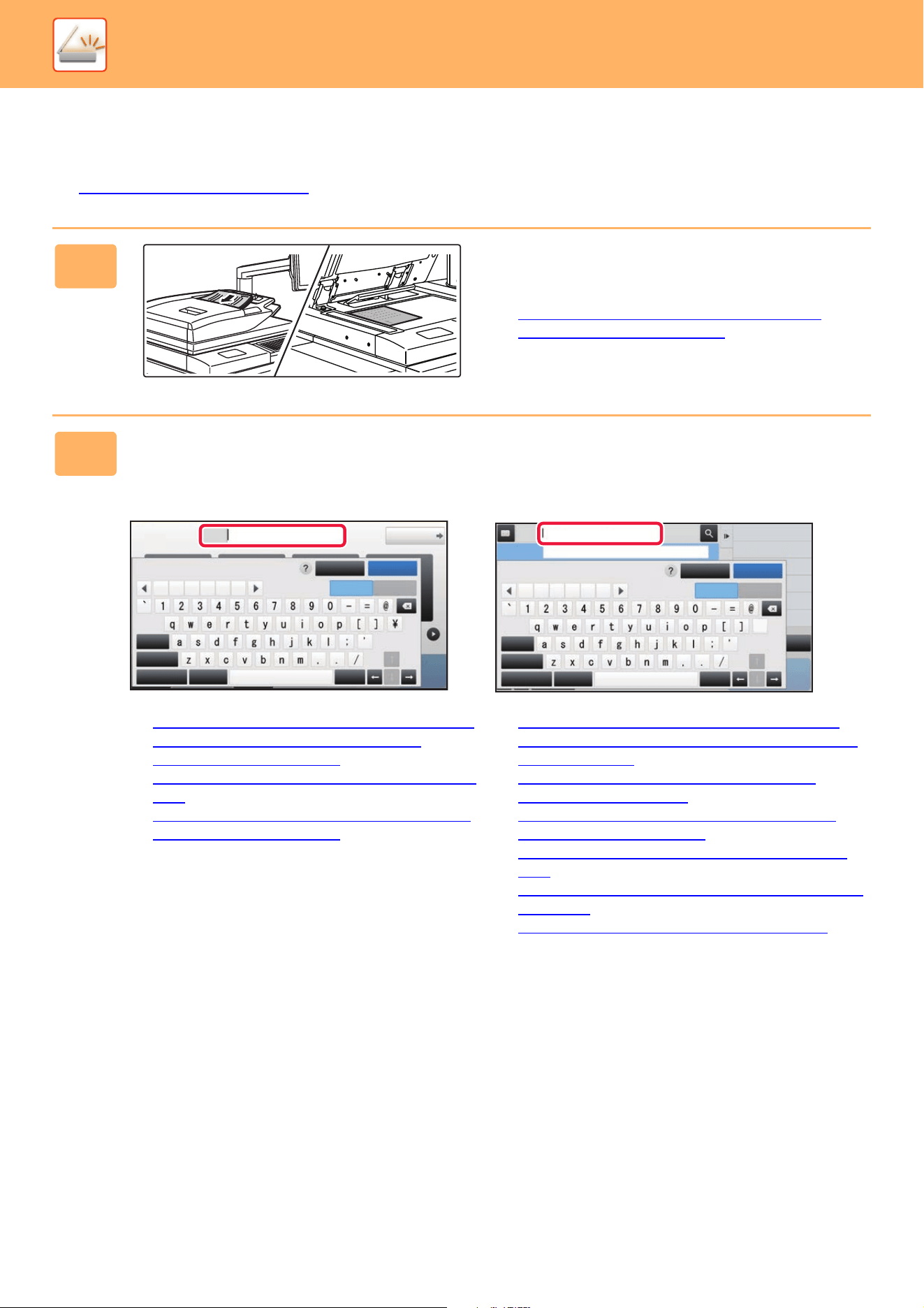
4-10
SCANNER►BEFORE USING THE MACHINE AS A NETWORK SCANNER
IMAGE SEND SEQUENCE
First, to place the machine in a desired image send mode, tap the appropriate icon in the Home screen.
► CHANGING MODES (page 1-16)
1
Place the original.
Place the original in the document feeder tray of the
automatic document feeder, or on the document glass.
► AUTOMATIC DOCUMENT FEEDER (page 1-90)
► DOCUMENT GLASS (page 1-92)
2
Enter the destination.
Tap the address key to directly enter the destination, or search and retrieve the address book or destination.
In Easy mode In Normal mode
► ENTERING AN ADDRESS MANUALLY (page 4-19)
► RETRIEVING A DESTINATION FROM AN
ADDRESS BOOK (page 4-14)
► USING A TRANSMISSION LOG TO RESEND (page
4-23)
► RETRIEVING A DESTINATION FROM A GLOBAL
ADDRESS BOOK (page 4-21)
► ENTERING AN ADDRESS MANUALLY (page 4-19)
► RETRIEVING A DESTINATION FROM AN ADDRESS
BOOK (page 4-14)
► USING A SEARCH NUMBER TO RETRIEVE A
DESTINATION (page 4-18)
► RETRIEVING A DESTINATION FROM A GLOBAL
ADDRESS BOOK (page 4-21)
► USING A TRANSMISSION LOG TO RESEND (page
4-23)
► VIEWING A LIST OF THE SELECTED DESTINATIONS
(page 4-17)
► SPECIFYING A NETWORK FOLDER (page 4-20)
Original
Address
Detail
Color
Start
SpaceFile Format AltGrKeyboard Select
Shift
Caps
Characters Symbols
Cancel OK
.com .net .org
.co.jp
.biz
.ne.jp
8½x11
CA
SpaceFile Format AltGrKeyboard Select
Shift
Caps
Characters Symbols
Cancel OK
E-Mail
Subject
Address
#
.biz .info
http:/
/
Sending History
Global Address Search
.com .net .org
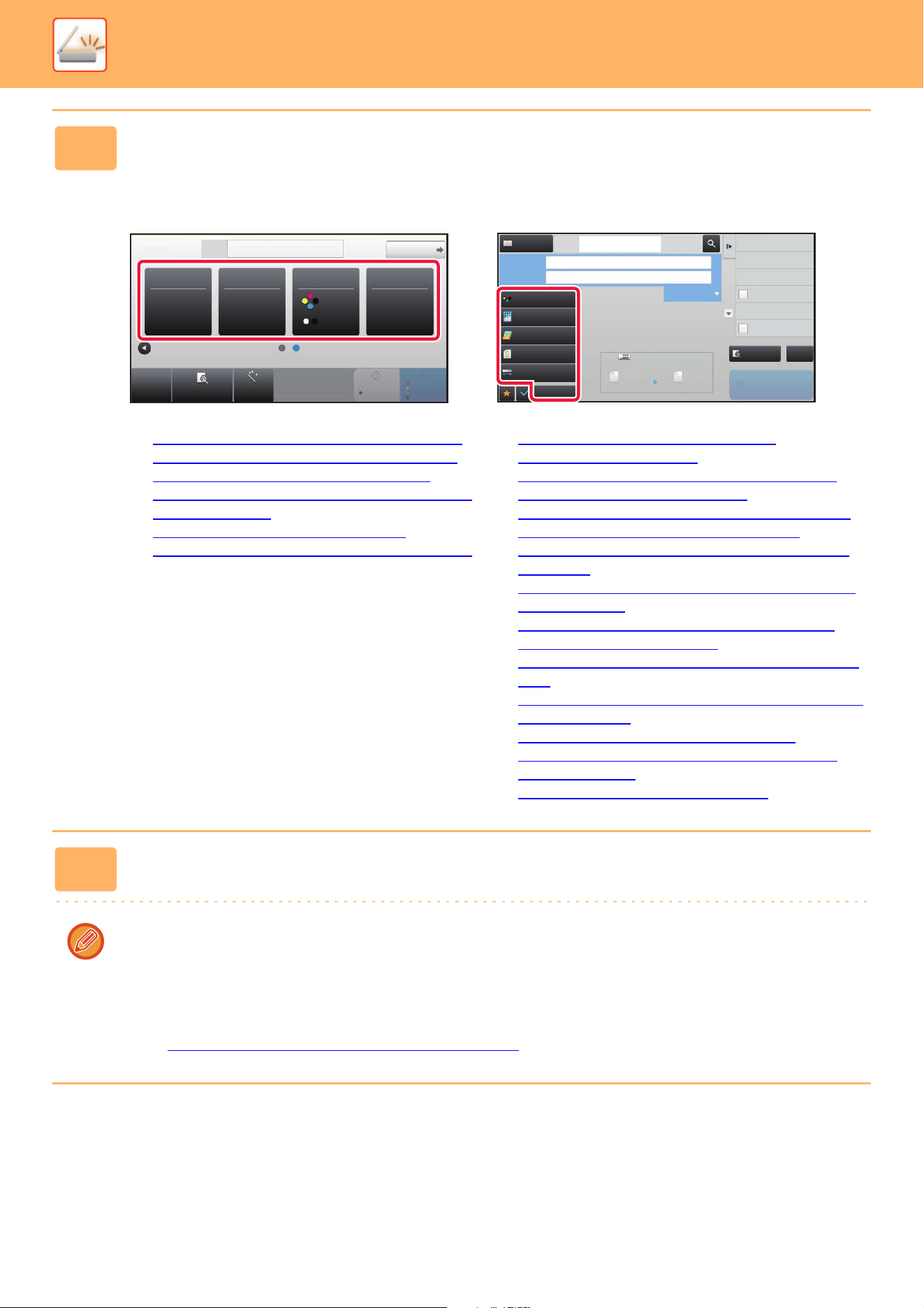
4-11
SCANNER►BEFORE USING THE MACHINE AS A NETWORK SCANNER
3
Select functions.
Specify the original scan size, exposure, file format, and other items.
If necessary, you can refer to the following functions for the setting.
In Easy mode In Normal mode
► AUTOMATICALLY SCANNING BOTH SIDES OF
AN ORIGINAL (2-SIDED ORIGINAL) (page 4-39)
► CHANGING THE RESOLUTION (page 4-50)
► CHANGING FORMAT IN SCAN OR DATA ENTRY
MODE (page 4-51)
► ELIMINATING BLANK PAGES FROM A
TRANSMISSION (BLANK PAGE SKIP) (page 4-94)
► SCANNING AND SENDING ORIGINALS
COLLECTIVELY (page 4-62)
► ADJUSTING COLORS AND SHADING (page 4-79)
► SCANNING ORIGINALS (page 4-89)
► AUTOMATICALLY SCANNING BOTH SIDES OF AN
ORIGINAL (2-SIDED ORIGINAL) (page 4-39)
► SCAN SIZE AND SEND SIZE (ENLARGE/REDUCE)
(page 4-40)
► SPECIFYING THE ORIGINAL SCAN SIZE IN PAPER
SIZE (page 4-41)
► SPECIFYING THE ORIGINAL SCAN SIZE USING
NUMERIC VALUES (page 4-42)
► SPECIFYING THE SEND SIZE OF THE IMAGE (page
4-46)
► CHANGING THE EXPOSURE AND ORIGINAL IMAGE
TYPE (page 4-48)
► CHANGING THE RESOLUTION (page 4-50)
► CHANGING FORMAT IN SCAN OR DATA ENTRY
MODE (page 4-51)
► CHANGING COLOR MODE (page 4-56)
4
Send the original.
Tap the [B/W Start] or [Color Start] key ([Start] key in normal mode).
• You can tap the [Preview] key before tapping the [B/W Start] key or the [Color Start] key (the [Start] key in normal
mode) to check a preview of the image.
• When the original is placed on the document glass, repeat the placing original and transmission procedures until all
originals have been sent. After scanning all originals, tap the [Read-End] key.
• In normal mode, if you tap the [File] or [Quick File] on the action panel before sending image, you can save the
scanned original as data.
► USING DOCUMENT FILING IN EACH MODE (page 5-7)
CA
Preview
Original
Address E-mail Address
Detail
Start
Color
Start
Original
Auto 200x200dpi
PDF
PDF
Off
Resolution File Format
Blank Page
Skip
Auto Set
B/W
8½x11
Preview
Start
Scan Size
Auto Auto
Color Mode
Auto/Mono2
Resolution
200x200dpi
File Format
PDF
Original
Auto
Others
100%
Send Size
Address Book
Subject
File Name
Address Touch to input Address
Options
Exposure
CA
Specified by System Settings
Global Address Search
Sending History
Call Search Number
Send
Destination Link
Verification Stamp
8½x11
8½x11
Call Program
Call Registered settings
4-12
SCANNER►BEFORE USING THE MACHINE AS A NETWORK SCANNER
ORIGINAL SIZE
TRANSMITTABLE ORIGINAL SIZES
The following original sizes can be transmitted
*A long original can be transmitted.
THE SIZE OF THE PLACED ORIGINAL
When a standard size original is placed, the original size is automatically detected and displayed in "Scan Size" on the
based screen.
► SCAN SIZE AND SEND SIZE (ENLARGE/REDUCE) (page 4-40)
Standard sizes are sizes that the machine can automatically detect. The standard sizes are set in "Original Size
Detector Setting" in "Settings".
Minimum original size Maximum original size
Using the automatic document feeder
5-1/8" (height) x 5-1/2" (width)
(131 mm (height) x 140 mm (width))
11-5/8" (height) x 39-3/8" (width)
(297 mm (height) x 1000 mm* (width))
Using the document glass -
11-5/8" (height) x 17" (width)
(297 mm (height) x 432 mm* (width))
When the automatic original detection function is operating and the original (of inch or non-standard size) is placed, the
closest standard size may be displayed or the original size may not appear. In this event, manually set the correct original
size.
►
SPECIFYING THE ORIGINAL SCAN SIZE IN PAPER SIZE (page 4-41)
► SPECIFYING THE ORIGINAL SCAN SIZE USING NUMERIC VALUES (page 4-42)
To specify the size that the machine can automatically detect:
Select the group of detected original sizes by selecting [System Settings] in “Settings (administrator)” → [Common Settings]
→ [Device Control] → [Original Size Detector Setting].
4-13
SCANNER►BEFORE USING THE MACHINE AS A NETWORK SCANNER
List of original size detector settings
* In the size notation above, when the size is suffixed by "R" like "A4R", it indicates a case where a sheet available in
both the vertical and horizontal orientations are set horizontally.
Selections
Standard sizes (detected original sizes)
Document glass Document feeder tray
(automatic document feeder)
Inch-1 11" x 17", 8-1/2" x 14", 8-1/2" x 11", 8-1/2" x 11"R,
5-1/2" x 8-1/2"
11" x 17", 8-1/2" x 14", 8-1/2" x 11", 8-1/2" x 11"R,
5-1/2" x 8-1/2", A3, A4
Inch-2 11" x 17", 8-1/2" x 13" (216 mm x 330 mm),
8-1/2" x 11", 8-1/2" x 11"R, 5-1/2" x 8-1/2"
11" x 17", 8-1/2" x 13" (216 mm x 330 mm),
8-1/2" x 11", 8-1/2" x 11"R, 5-1/2" x 8-1/2", A3, A4
Inch-3 11" x 17", 8-1/2" x 13-2/5" (216 mm x 340 mm),
8-1/2" x 11", 8-1/2" x 11"R, 5-1/2" x 8-1/2"
11" x 17", 8-1/2" x 13-2/5 (216 mm x 340 mm),
8-1/2" x 11", 8-1/2" x 11"R, 5-1/2" x 8-1/2", A3, A4
AB-1 A3, A4, A4R, A5, B4, B5, B5R A3, A4, A4R, A5, B4, B5, B5R, 11" x 17", 8-1/2" x 14",
8-1/2" x 11"
AB-2 A3, A4, A4R, A5, B5, B5R, 216 mm x 330 mm
(8-1/2" x 13")
A3, A4, A4R, A5, B4, B5, B5R, 216 mm x 330 mm
(8-1/2" x 13"), 11" x 17", 8-1/2" x 11"
AB-3 A4, A4R, A5, B4, 8K, 16K, 16KR A3, A4, A4R, A5, B4, 8K, 16K, 16KR, 11" x 17",
216 mm x 330 mm (8-1/2" x 13"), 8-1/2" x 11"
AB-4 A3, A4, A4R, A5, B5, B5R, 216 mm x 340 mm
(8-1/2" x 13-2/5")
A3, A4, A4R, A5, B4, B5, B5R, 11" x 17",
216 mm x 340 mm (8-1/2" x 13-2/5"), 8-1/2" x 11"
AB-5 A3, A4, A4R, A5, B5, B5R, 216 mm x 343 mm
(8-1/2" x 13-1/2")
A3, A4, A4R, A5, B4, B5, B5R, 11" x 17",
216 mm x 343 mm (8-1/2" x 13-1/2"), 8-1/2" x 11"
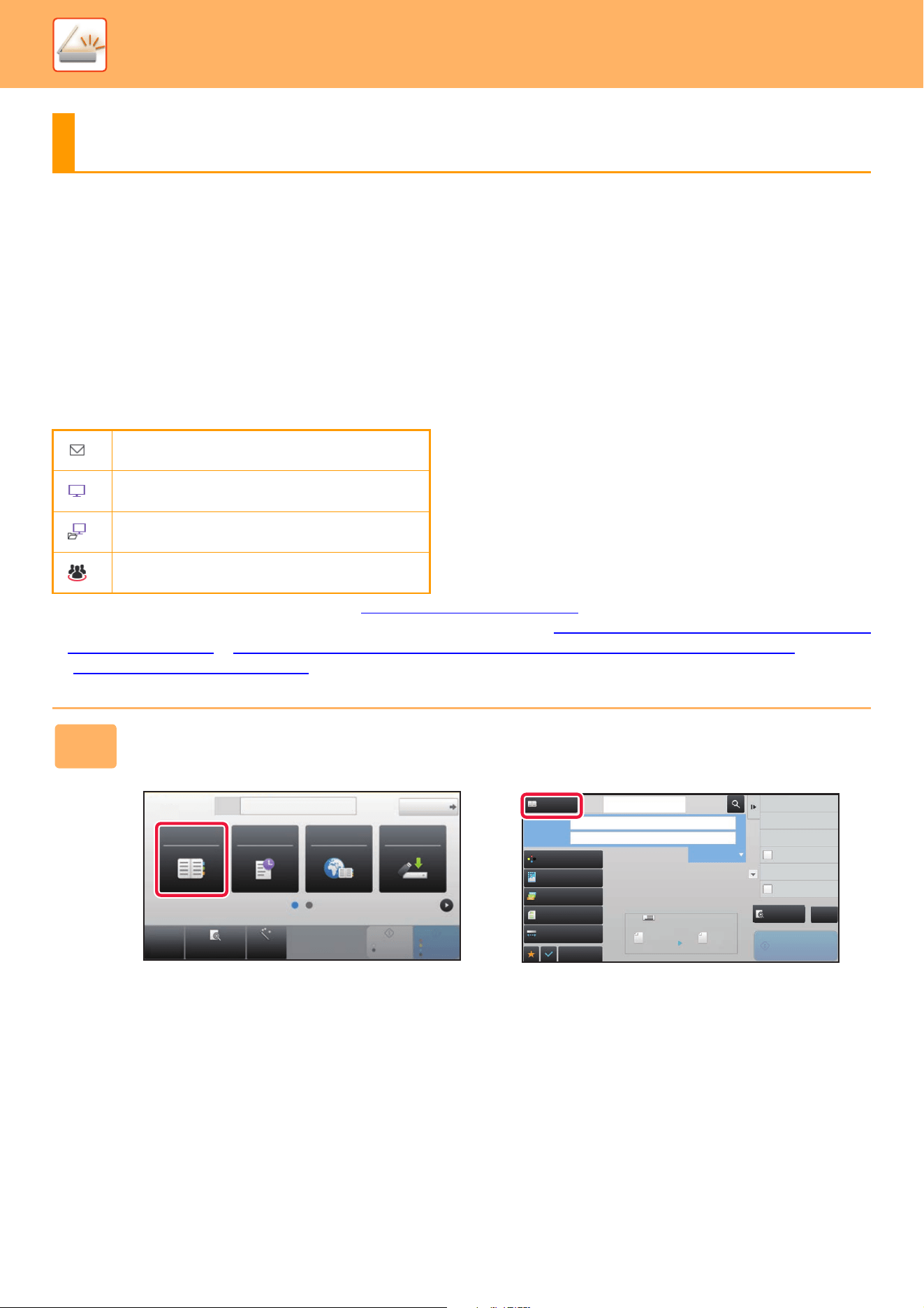
4-14
SCANNER►ENTERING DESTINATIONS
ENTERING DESTINATIONS
RETRIEVING A DESTINATION FROM AN ADDRESS
BOOK
In the address book screen, simply tap the one-touch key of a registered destination to retrieve the destination.
If necessary, store multiple destinations in a one-touch key. Tapping the key will retrieve all the stored destinations.
The address book screen shows all destinations used in each mode. Each one-touch key shows the name of the
destination and an icon indicating the mode used for the destination.
• For information on the address book, see "ADDRESS BOOK (page 1-103)
".
• For the procedure for storing the destinations in the address book, see "STORING ADDRESSES THROUGH DIRECT
ENTRY (page 1-107)", "STORING ADDRESSES THROUGH GLOBAL ADDRESS SEARCH (page 1-108)",and
"STORING GROUPS (page 1-111)
".
ENTERING DESTINATIONS
Scan to E-mail
Scan to FTP
Scan to Network Folder
Group key with multiple destinations
1
Tap the [Address Book] key.
In Easy mode In Normal mode
CA
Preview Auto Set
B/W
Start
Color
Start
Original
Address
Address Book
Sending History
Scan to HDD/
USB
Global
Address Search
Detail
E-mail Address
8½x11
Specified by System Settings
Preview
Start
Scan Size
Auto Auto
Auto/Mono2
Resolution
200x200dpi
File Format
PDF
Original
Auto
Others
8½x11
8½x11
100%
Send Size
Address Book
Subject
File Name
Address Touch to input Address
Options
Exposure
CA
Global Address Search
Sending History
Call Search Number
Send
Destination Link
Verification Stamp
Color Mode
Call Program
Call Registered settings
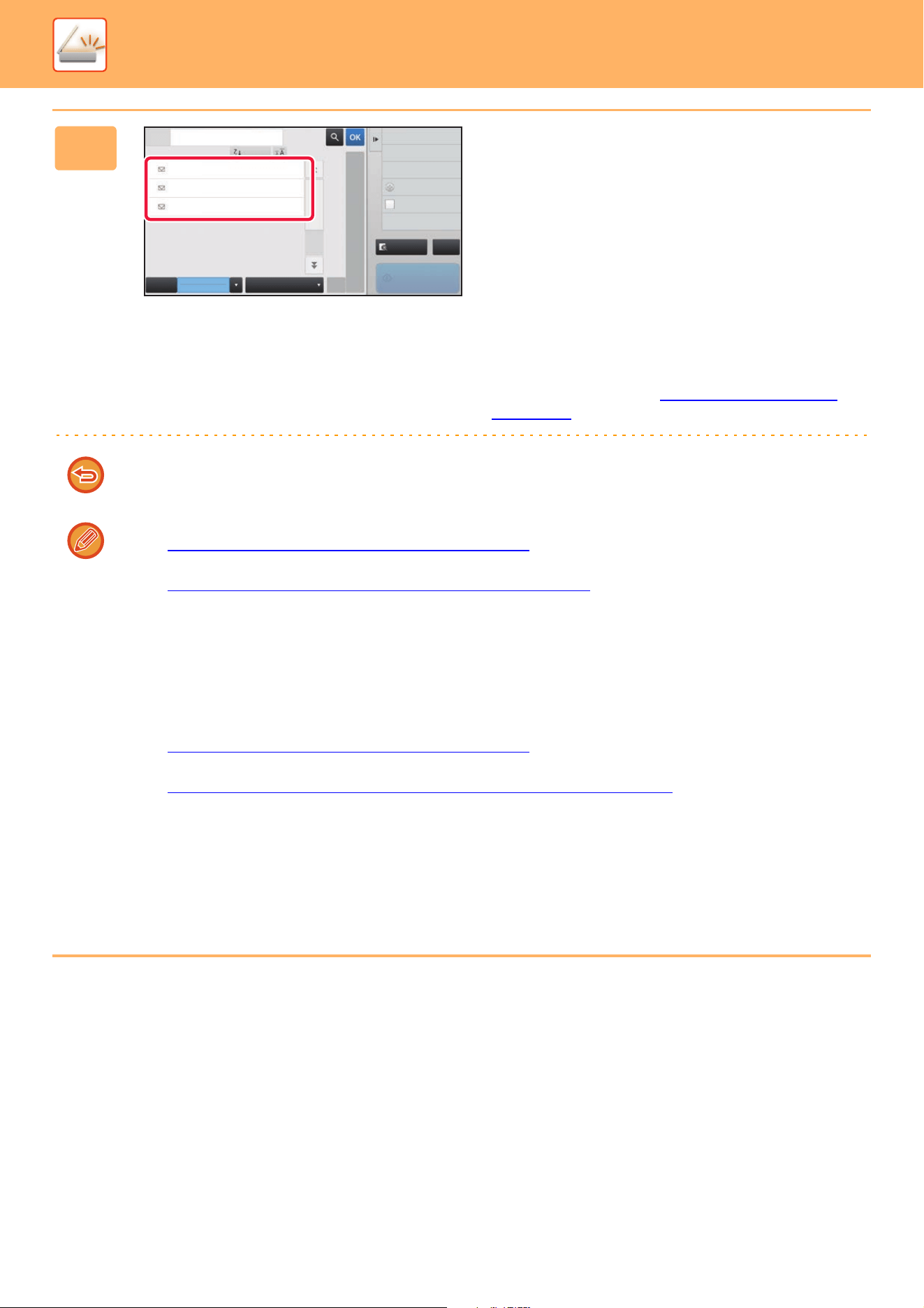
4-15
SCANNER►ENTERING DESTINATIONS
2
Tap the one-touch key of contact or
group that has a destination.
• The destinations displayed on the list can be narrowed
with categories, frequent use, indexes, and keywords. (In
normal mode you can narrow down by job type.)
• Tapping the [Sort] key allows you to change the order of
destinations displayed in the list.
• When adding a destination, tap another one-touch key.
• If two or more destinations are selected or specified, the
total number of addresses appears next to address.
• Even if only a single destination is selected, the number of
addresses appears when the destination is a contact or
group in which multiple addresses are stored.
For more information, see "ADDRESS BOOK SCREEN
(page 1-104)".
If you select an incorrect destination:
Tap the key again to cancel the selection.
• To select a destination from the transmission log, tap the [Sending History] key.
► USING A TRANSMISSION LOG TO RESEND (page 4-23)
• To check the entered destinations, tap the [Address Review] key.
► VIEWING A LIST OF THE SELECTED DESTINATIONS (page 4-17)
• The destination for transmission can be selected by tapping a stored destination.
• If an address that you do not have permission to use is included in the addresses, a message will appear when you
press the [Start] key. To send only to the permitted addresses, press the [OK] key and then the [Enter for send] key.
In Normal mode
• Tap the one-touch key, and then tap [Display Registered Information] on the action panel to display the detailed
information screen.
• To retrieve a destination by using a search number, tap [Call Search Number] on the action panel.
► USING A TRANSMISSION LOG TO RESEND (page 4-23)
• To retrieve a destination from a global address book, tap [Global Address Search] on the action panel.
► RETRIEVING A DESTINATION FROM A GLOBAL ADDRESS BOOK (page 4-21)
To cancel a specified destination:
Select the address you want to cancel in the address list screen, and tap the [Delete] key.
To enable transmission to addresses of modes other than the current mode:
Remove the checkmark from [System Settings] → [Image Send Settings] → [Common Settings] → [Condition Settings]
→ [Address Book Default Selection] → [Apply Addresses of Sending Modes Only] in "Settings (administrator)".
Frequent
Use
Address
E-mail
Narrow Down
All
Category
ABC
A
D
G
J
M
P
T
W
Sort
AAA
BBB
CCC
Preview
Start
CA
Global Address Search
Sending History
Send
Destination Link
Print Individual List
Add New
Call Search Number

4-16
SCANNER►ENTERING DESTINATIONS
MY ADDRESS
My Address is the user's own e-mail address, and is the e-mail address that has been registered in the user list or
network server.
My Address can be used when login by login name / password is enabled in user authentication.
Use this address when you want to send a scanned image to your own e-mail address.
In E-mail mode, [Find My Address] appears on the action panel to let you immediately find and use My Address.
When you use the address book in E-mail mode, the [Find My Address] button also appears at the top of the user list for
easy access from the address book.
• My Address cannot be used in the following instances:
• When address search from the user list is prohibited in the system settings
• When user authentication is disabled, or is only by user number
• When Sharp OSA external authentication is used
• When [Apply E-mail address of the user for login.] is enabled in [Default Address]
• When the e-mail address of the logged in user has not been registered
• After the [Next Address] key is pressed when [Be sure to press Next Address Key ([+]) before selecting the next address.]
is enabled in System Settings - [Image Send Settings]→[Common Settings]→[Condition Settings]
• When [S/MIME Settings]→[Disable sending to the addresses which cannot be encrypted.] is enabled in the security
settings
• You can register [Find My Address] in the home screen. This is convenient when you frequently use My Address.
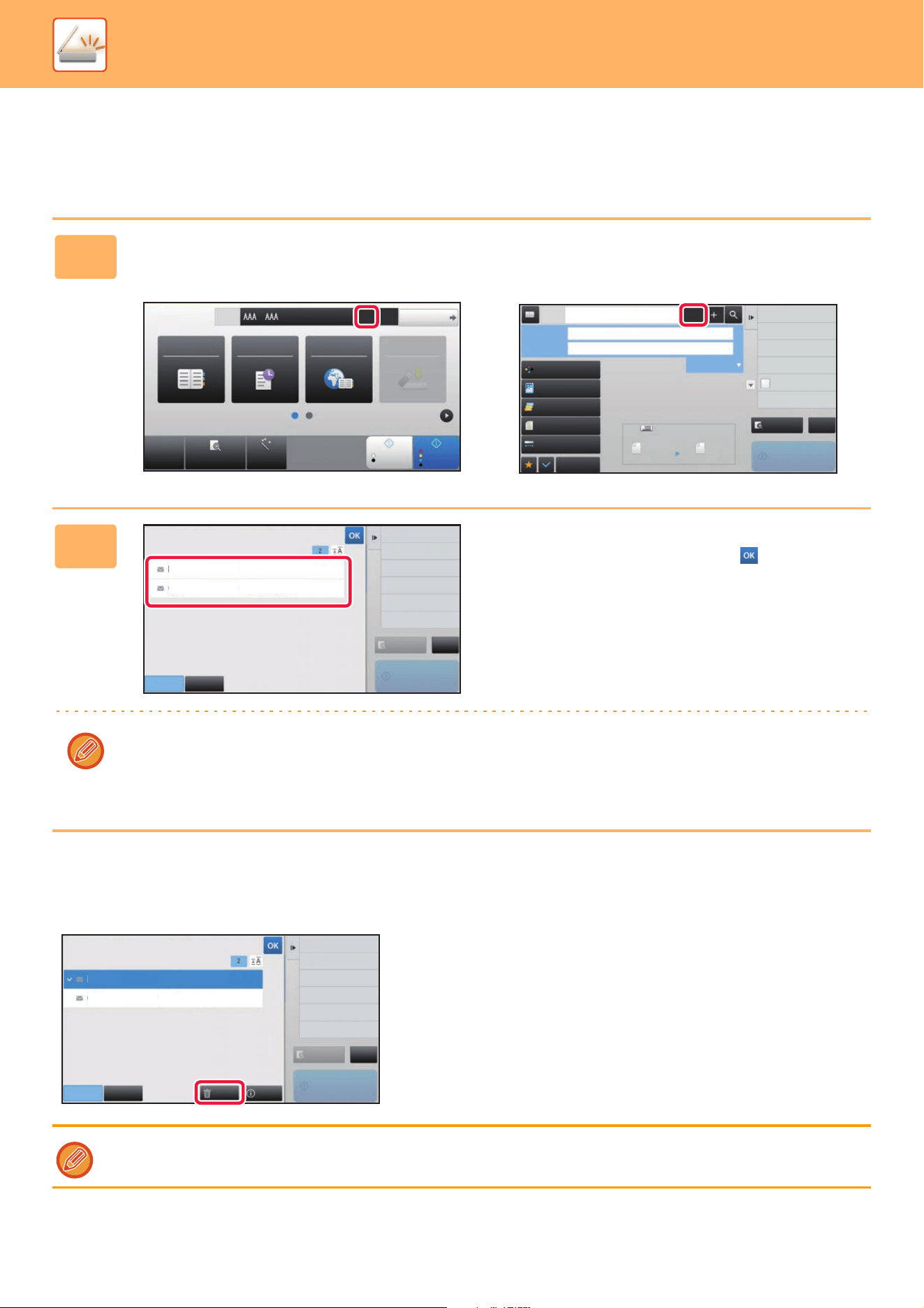
4-17
SCANNER►ENTERING DESTINATIONS
VIEWING A LIST OF THE SELECTED DESTINATIONS
When multiple destinations have been selected, you can display and check the destinations. You can also delete a
destination from the list (cancel selection of the destination).
Deleting Specified Destinations
In step 2 of "VIEWING A LIST OF THE SELECTED DESTINATIONS", select the destination and tap the [Delete] key.
1
Tap the [Address Review] key.
In Easy mode In Normal mode
2
Confirm the destination.
After the confirmation is completed, tap .
To confirm detailed information such as the type or name of the specified destination, tap the one-touch key of the target
destination, and then tap the [Info.] key.
In normal mode, you can change the delivery type (To/Cc/Bcc). Tap the address and then tap [Change to To], [Change
to Cc], or [Change to Bcc] on the action panel.
If you placed the original on the document glass and tapped the [Start] key, you cannot delete an address when changing
settings.
CA
Preview Auto Set
Original
Address
Detail
B/W
Start
Color
Start
Address Book Sending History
Global
Address Search
Scan to HDD/
USB
1+
8½x11
1
Preview
Start
Scan Size
Auto Auto
Color Mode
Auto/Mono2
Resolution
200x200dpi
File Format
PDF
Original
Auto
Others
8½x11
8½x11
100%
Send Size
Subject
File Name
Address
Options
Global Address Search
Address Review
Sending History
Call Search Number
Verification Stamp
Program Registration
Register Current Settings
Exposure
CA
Specified by System Settings
To Cc
Address Review
AAA
CCC
123
test@test.□□□
Preview
Start
CA
To Cc Delete Info.
All Destinations
Change to Cc
AAA
CCC
123
test@test.□□□
Preview
Start
CA
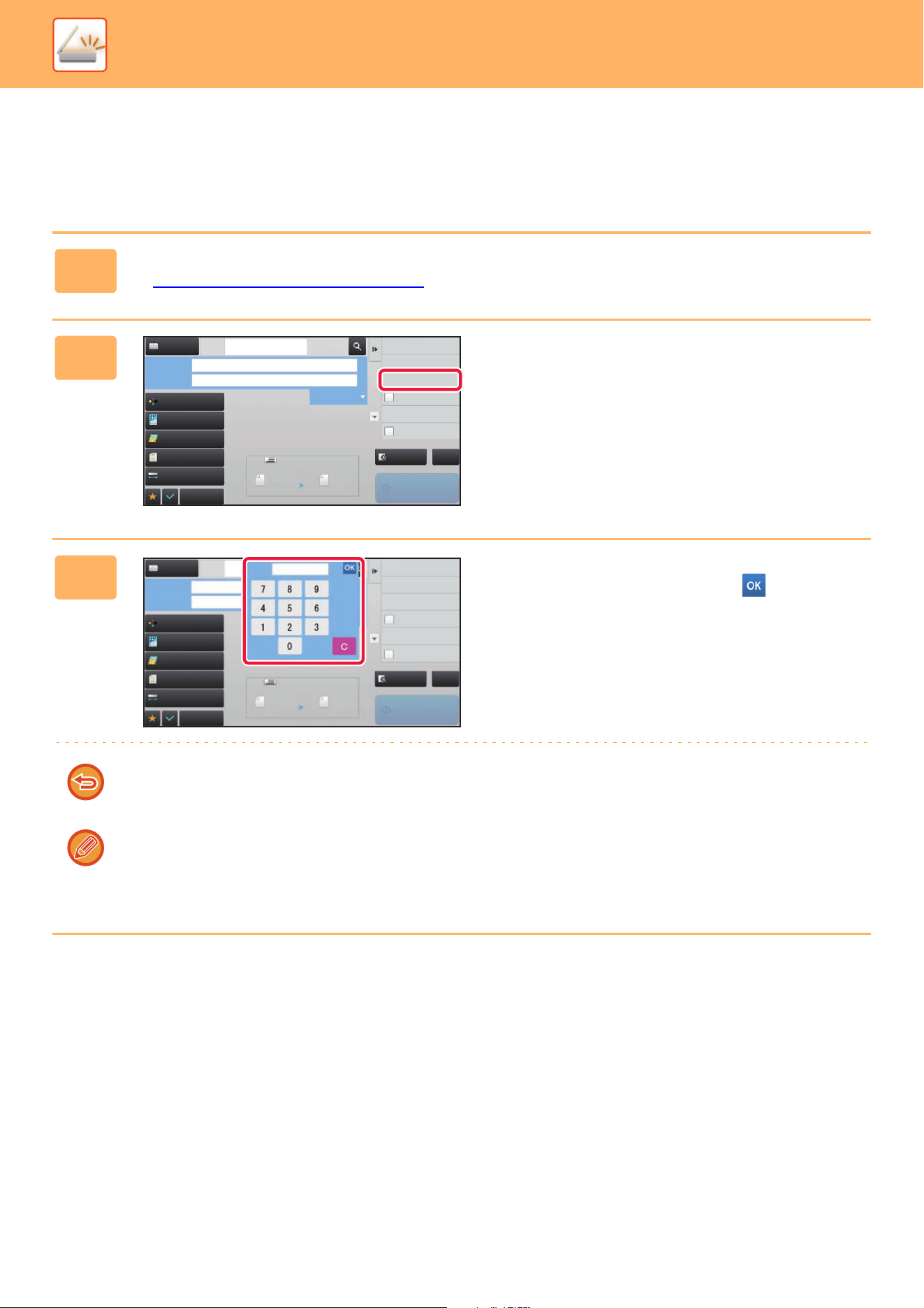
4-18
SCANNER►ENTERING DESTINATIONS
USING A SEARCH NUMBER TO RETRIEVE A
DESTINATION
The search number can be used to specify a destination stored in an address book.
1
Tap the [Detail] key to change to normal mode.
► Changing mode from each mode (page 4-8)
2
Tap [Call Search Number] on the
action panel.
3
Enter a search number (4 digits) using
the numeric keys and tap .
When the search number is entered, the stored address is
retrieved and specified as a destination.
If an incorrect search number is entered:
Tap the [C] key to clear the number and enter the correct number.
• The search number is programmed when the destination is stored in the address book.
• If you do not know the search number, tap [Print Individual List] on the action panel to print and check the address list.
• When entering search numbers such as "0001" and "0011", "0" can be omitted. For example to enter "0001", enter "1"
and tap the [OK] key.
Preview
Start
Scan Size
Auto Auto
Color Mode
Resolution
File Format
Original
Others
100%
Send Size
Address Book
Auto/Mono2
200x200dpi
PDF
Auto
Subject
File Name
Address Touch to input Address
Options
Sending History
Call Search Number
Verification Stamp
Exposure
CA
Specified by System Settings
Global Address Search
Send
Destination Link
8½x11
8½x11
Call Program
Call Registered settings
Preview
Start
Scan Size
Auto Auto
Color Mode
Resolution
File Format
Original
Others
100%
Send Size
Address Book
Subject
File Name
Address Touch to input Address
Specified by System Settings
Exposure
CA
Sending History
Call Search Number
Verification Stamp
Global Address Search
Send
Destination Link
Auto/Mono2
200x200dpi
PDF
Auto
8½x11
8½x11
Call Program
Call Registered settings
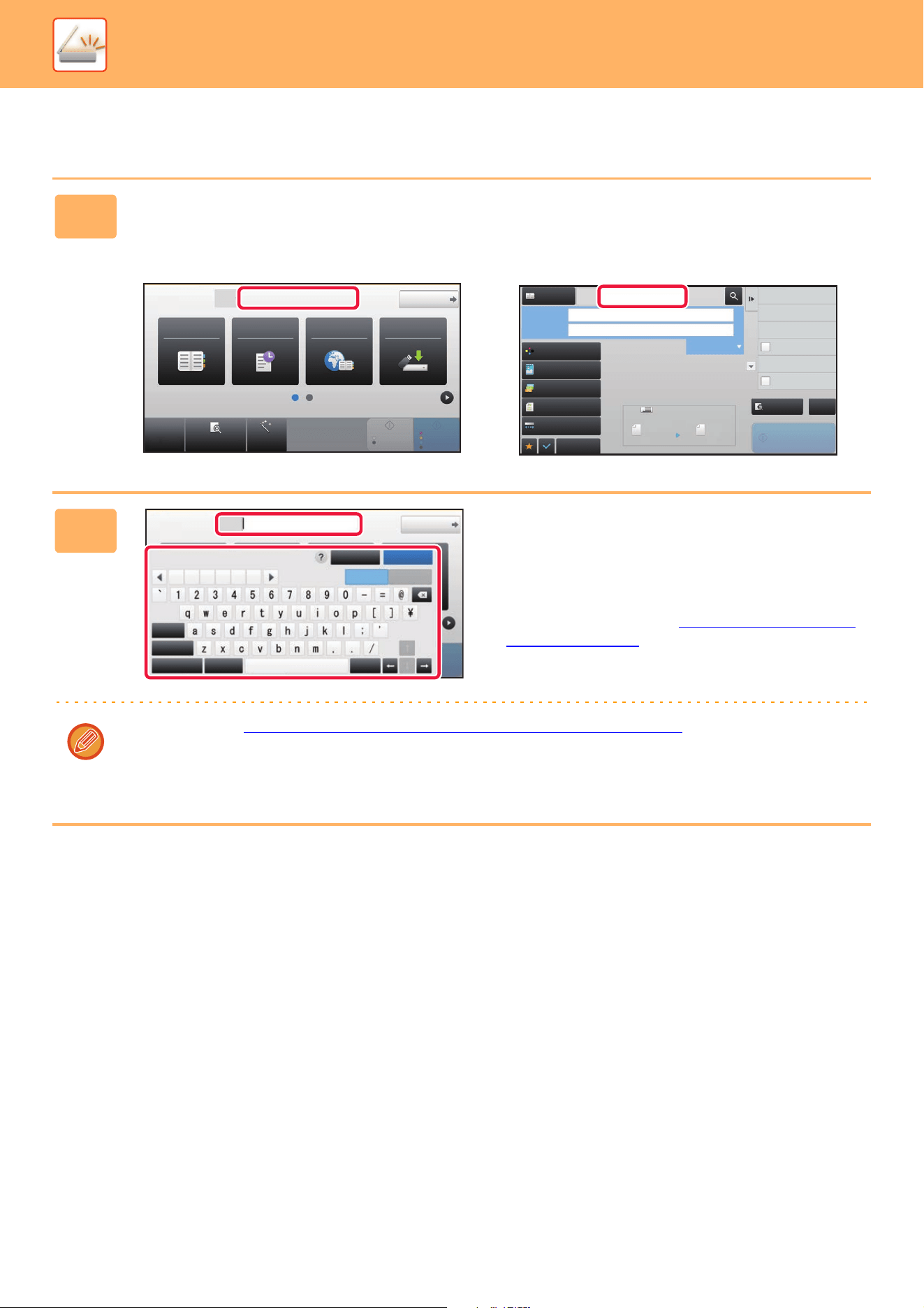
4-19
SCANNER►ENTERING DESTINATIONS
ENTERING AN ADDRESS MANUALLY
1
In the base screen of a mode, tap [Text Box].
In easy mode, only the e-mail addresses can be entered.
In Easy mode In Normal mode
2
Enter the destination address on the
soft keyboard that appears.
• In data entry mode, select the mode of the destination,
and enter the destination address.
• For Scan to Network Folder mode, the network folder
entry screen appears. See "SPECIFYING A NETWORK
FOLDER (page 4-20)".
• After entering the destination address, tap the [OK] key to
close the soft keyboard.
To enter text, see "NAMES AND FUNCTIONS OF SOFT KEYBOARD KEYS (page 1-157)" in the "BEFORE USING
THE MACHINE".
• You can select [Bcc] if [Image Send Settings] → [Scan Settings] → [Default Settings] → [Bcc Setting] → [Enable Bcc]
is enabled in [System Settings].
CA
Preview Auto Set
Original
Address E-mail Address
Detail
B/W
Start
Color
Start
Address Book
Global
Address Search
Scan to HDD/
USB
Sending History
8½x11
Preview
Start
Scan Size
Auto Auto
Resolution
File Format
Original
Exposure
Others
100%
Send Size
Subject
File Name
Address Touch to input Address
Specified by System Settings
Verification Stamp
Call Search Number
Options
Sending History
Global Address Search
CA
Address Book
Auto/Mono2
200x200dpi
PDF
Auto
8½x11
8½x11
Send
Destination Link
Color Mode
Call Program
Call Registered settings
Original
Address
Detail
Color
Start
SpaceFile Format AltGrKeyboard Select
Shift
Caps
Characters Symbols
Cancel OK
.com .net .org
.co.jp
.biz
.ne.jp
8½x11
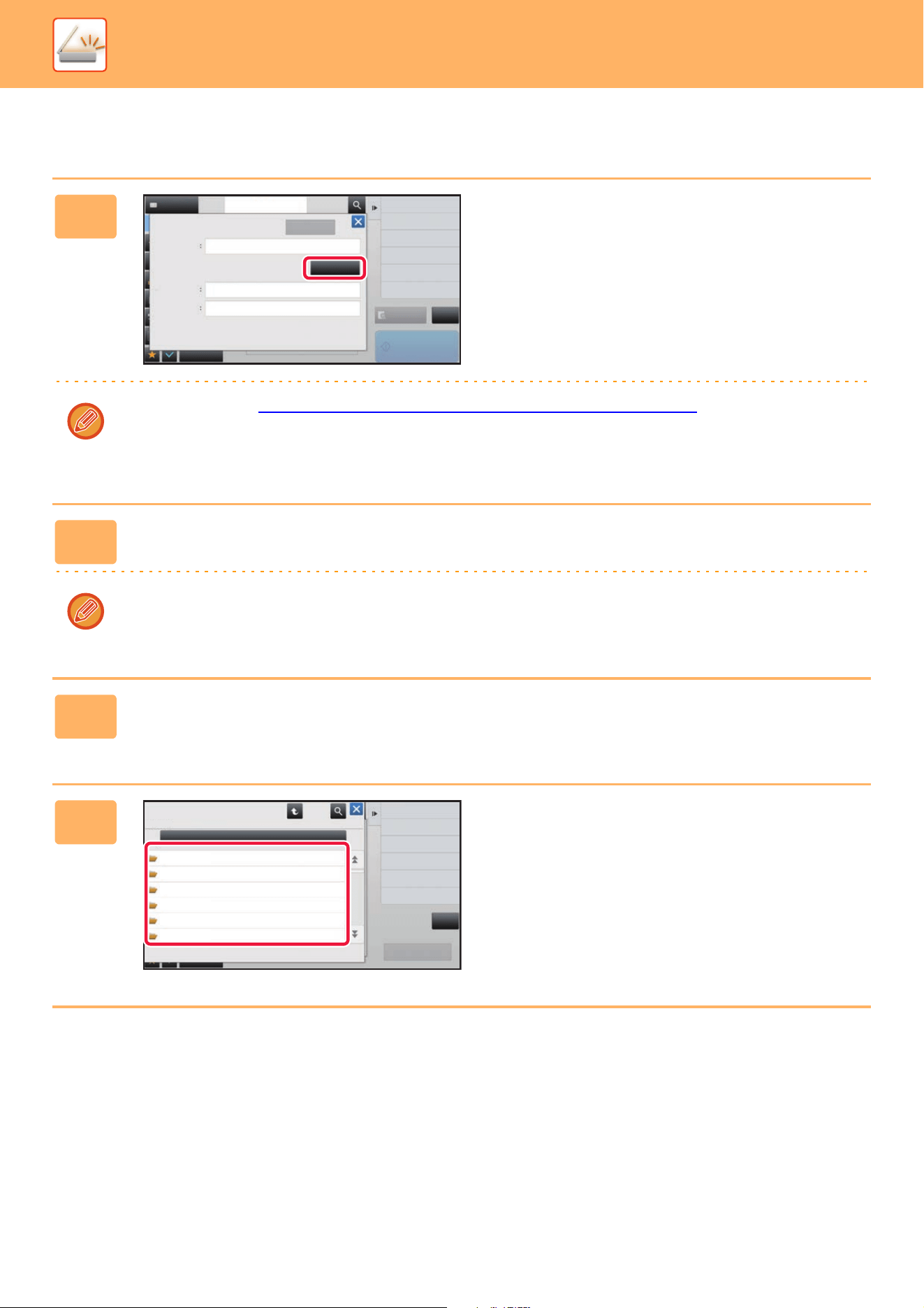
4-20
SCANNER►ENTERING DESTINATIONS
SPECIFYING A NETWORK FOLDER
1
Tap the [Browse] key in the network
folder entry screen.
• To directly enter a folder, tap the [Folder Path] box. The
soft keyboard is displayed.
• If a user name and password are required, check with the
administrator of the server and enter the user name and
password.
• To enter text, see "NAMES AND FUNCTIONS OF SOFT KEYBOARD KEYS (page 1-157)" in the "BEFORE USING
THE MACHINE"
• If a user authentication function other than authentication by user number is enabled, the login name of the current
user is automatically entered in the user name field.
2
Tap the key of the workgroup that you wish to access.
• Tap the [Search] key and enter a keyword to search for a workgroup, server, or network folder.
• Up to 100 workgroups, 100 servers, and 100 network folders are displayed.
• Tap the [Cancel] key to return to the screen of step 1.
3
Tap the key of the server or computer that you wish to access.
If a screen appears prompting you to enter a user name and password, check with your server administrator and enter
the appropriate user name and password.
4
Tap the key of the network folder.
After the settings are completed, tap the [OK] key. You will
return to the screen of step 1. Tap the [OK] key again to
accept the destination.
Preview
Start
Others
Address Book
Address Entry
Path Input
to Folder
User Name
Password
Address Touch to input Address
Browse
OK
CA
Start
Network Folder
Network Folder Name
Browse
\\Server3
Folder1
Folder2
Folder3
Folder4
Folder5
Folder6
CA
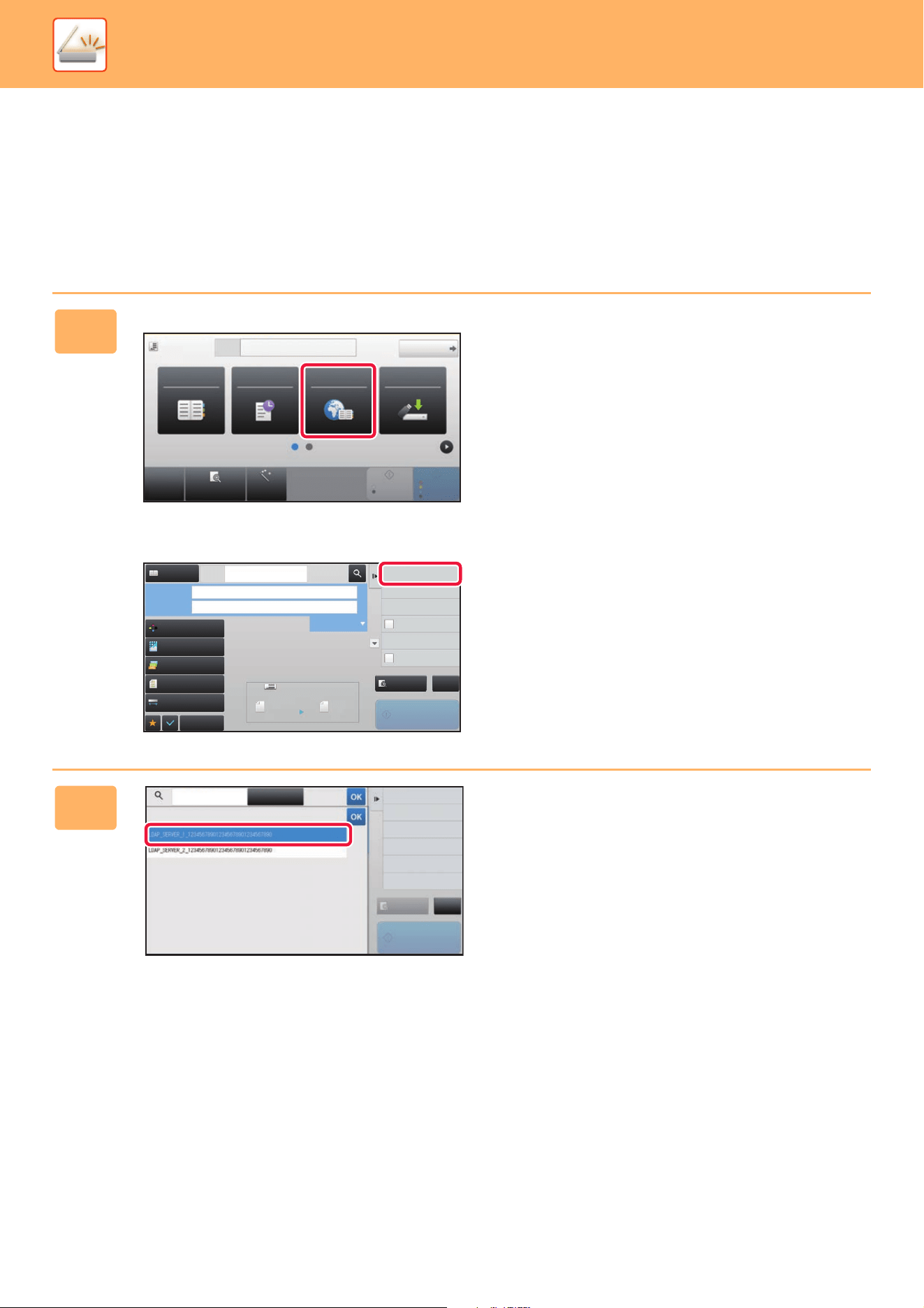
4-21
SCANNER►ENTERING DESTINATIONS
RETRIEVING A DESTINATION FROM A GLOBAL
ADDRESS BOOK
When an LDAP server is configured in the "Settings (Web version)", look up an address in a global address book and
retrieve the destination address for Scan to E-mail.
In normal mode, you can add an address retrieved by searching to the address book. However, addresses of the FTP
transmission cannot be stored from the machine.
1
In Easy mode
Tap the [Global Address Search] key.
In Normal mode
In the base screen or address book
screen, tap [Global Address Search]
on the action panel.
2
Tap [Destination] and tap the LDAP
server to be used.
• If an authentication screen for the LDAP server
appears, enter your user name and password.
• If only one LDAP server has been stored, it is not
necessary to take step 2. In this case, start from step 3.
CA
Preview Auto Set
Original
Address E-mail Address
Detail
Start
Color
Start
Address Book Sending History
Global
Address Search
Scan to HDD/
USB
B/W
8½x11
Preview
Start
Scan Size
Auto Auto
Color Mode
Resolution
File Format
Original
Exposure
Others
100%
Send Size
Subject
File Name
Address Touch to input Address
Verification Stamp
Call Search Number
Options
Sending History
Global Address Search
CA
Send
Destination Link
Address Book
Auto/Mono2
200x200dpi
PDF
Auto
8½x11
8½x11
Call Program
Call Registered settings
Specified by System Settings
Preview
Enter
Initials
Target
Start
Search Start
CA
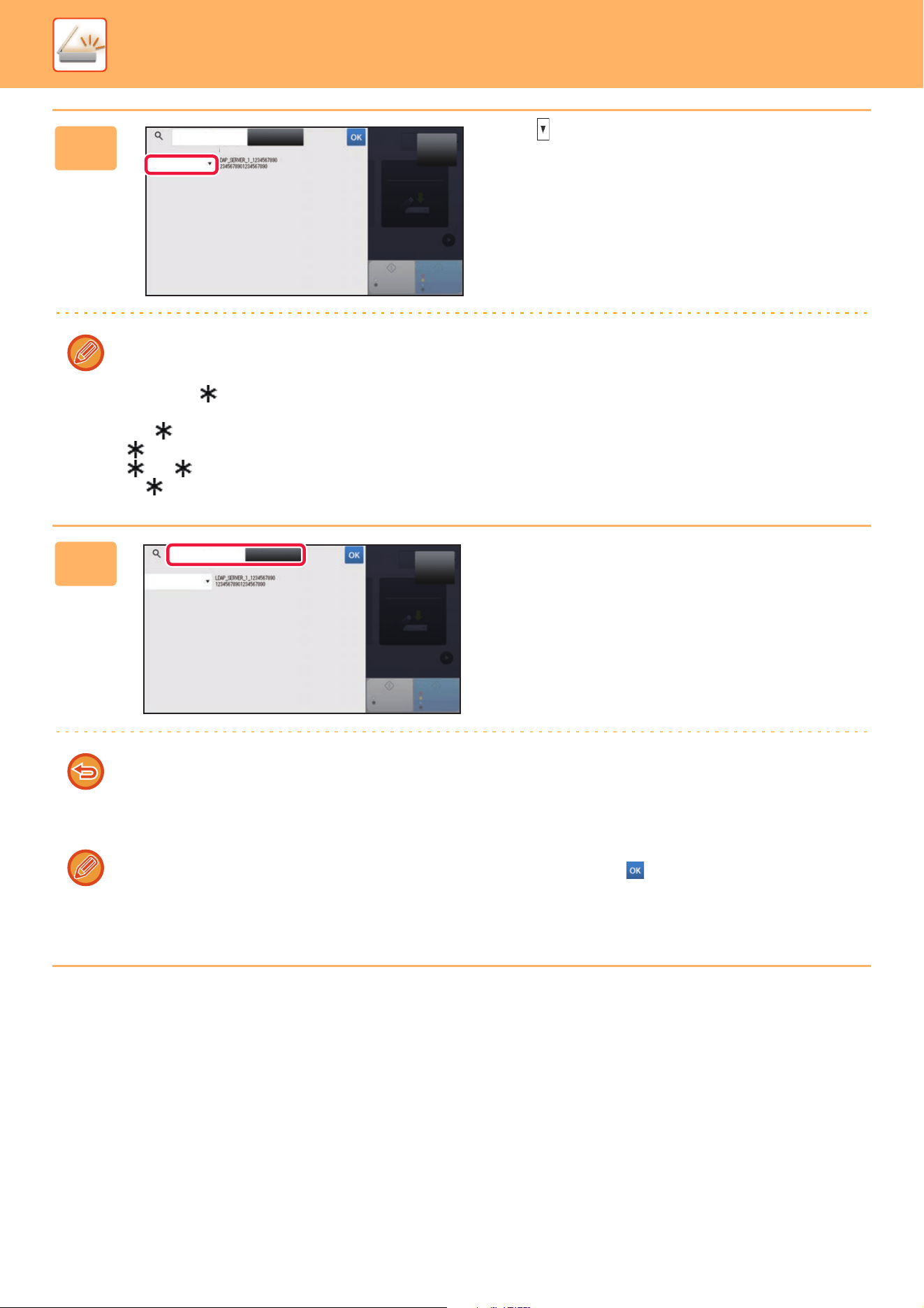
4-22
SCANNER►ENTERING DESTINATIONS
3
Tap of [Item], and select an item to
be searched from [Name] or
[Address].
How to search
Enter the search characters (maximum of 64 characters). The system will look for names starting with the entered
letters.
An asterisk is used as follows:
XXX : Names beginning with "XXX"
XXX : Names that end with "XXX"
XXX : Names containing "XXX"
AA XX : Names that start with "AA" and end with "XX".
4
Enter a keyword and tap the [Search
Start] key.
When you tap the keyword entry box, the soft keyboard
appears.
The search results will appear after a brief interval.
• If no destination is found:
Tap the [Search Again] key to add more search letters.
• To continuously add other destination.
Tap the destination.
To check the destination information:
Tap the one-touch key of the target destination, and then tap the [Info.] key. Tap to close the address information
screen.
In normal mode, you can select an address and tap [New Registration with Address Book] on the action panel to add the
address to the address book. This is convenient if you have entered a destination directly.
CA
Start
Color
Start
Scan to HDD/
USB
Enter
Initials
Item
Name
Enter Initial and press Enter key of
external keyboard or [Start Search] button.
Search Start
Target
B/W
CA
Start
Color
Start
Enter
Initials
Item
Name
Enter Initial and press Enter key of
external keyboard or [Start Search] button.
Target
Search Start
B/W
Scan to HDD/
USB
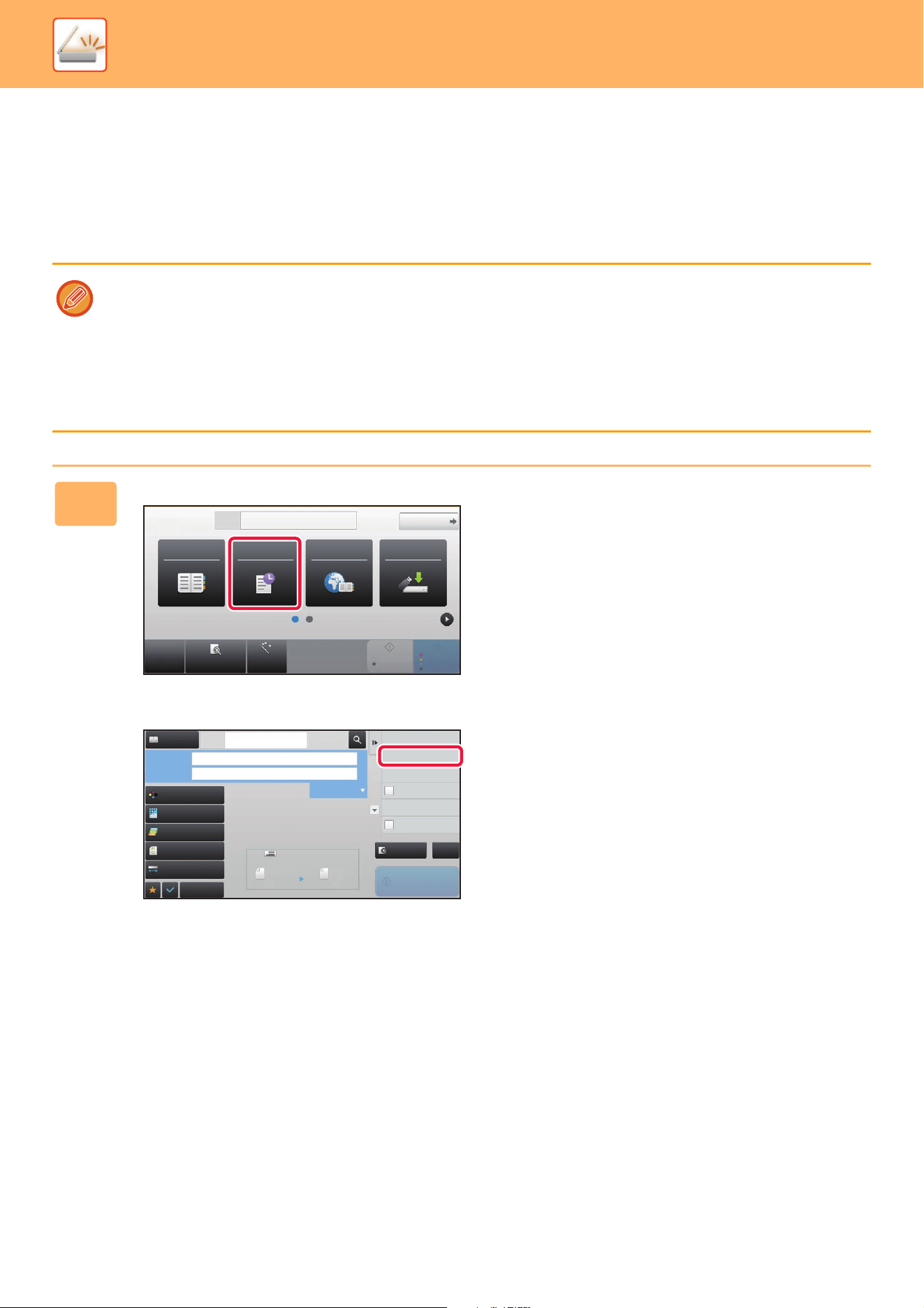
4-23
SCANNER►ENTERING DESTINATIONS
USING A TRANSMISSION LOG TO RESEND
Select a destination from a transmission log and resend the data.
The destinations of the most recent 50 transmissions by Scan to E-mail. Select one of these to resend to that
destination. The destinations of the Scan to FTP and Scan to Network Folder are also shown in the transmission log.
In normal mode, the addresses shown in the transmission log can also be stored in an address book. This is convenient
when storing an address that was manually entered.
• When a destination for retransmission is selected in the transmission log screen, the mode of the selected destination is
automatically selected.
• The following types of addresses are not stored for resending.
• One-touch key for a contact or group in which multiple destinations are stored.
• Group destinations
• Broadcasting destinations
• The user name and password are not stored for security reasons. If a screen requiring you to enter such information
appears, enter the information again.
1
In Easy mode
Tap the [Sending History] key
In Normal mode
In the base screen or address book
screen, tap [Sending History] on the
action panel.
CA
Preview Auto Set
Original
Address E-mail Address
Detail
B/W
Start
Color
Start
Address Book Sending History
Global
Address Search
Scan to HDD/
USB
8½x11
Preview
Start
Scan Size
Auto Auto
Color Mode
Resolution
File Format
Original
Exposure
Others
8½x11
8½x11
100%
Send Size
Subject
File Name
Address Touch to input Address
Verification Stamp
Call Search Number
Options
Call Program
Call Registered settings
Sending History
Global Address Search
CA
Address Book
Auto/Mono2
200x200dpi
PDF
Auto
Specified by System Settings
Send
Destination Link
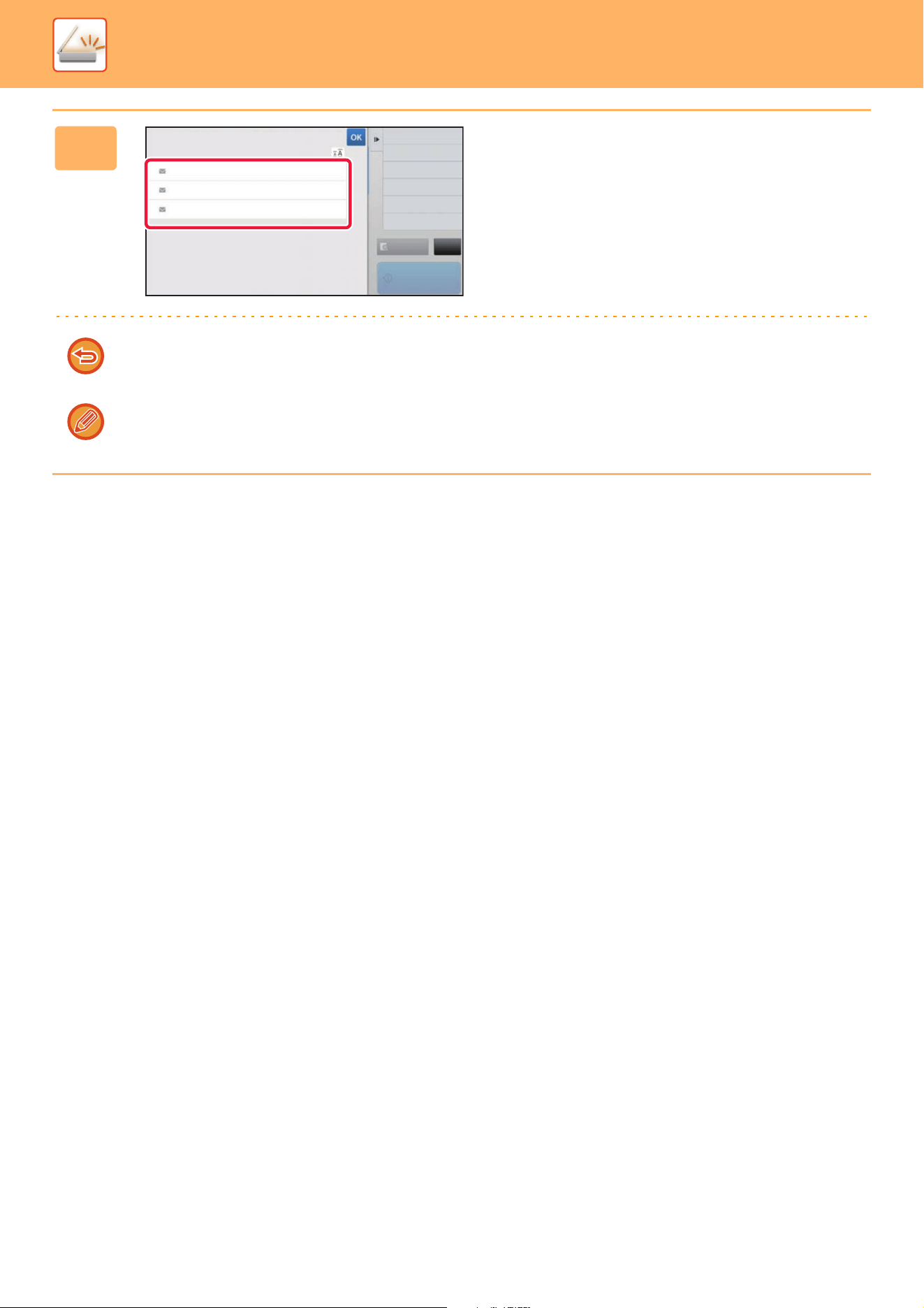
4-24
SCANNER►ENTERING DESTINATIONS
2
Tap the key of the destination to
resend.
The last 50 addresses used for transmission are displayed.
If a screen requiring you to enter the user name and
password appears, enter the information.
To cancel the resend setting:
Tap the highlighted key.
In normal mode, you can select an address and tap [New Registration with Address Book] on the action panel to add the
address to the address book. This is convenient if you have entered a destination directly.
Preview
Start
CA
Sending History
Delete All Histories
Select Address to Send Again.
Direct Entry
123
Direct Entry
456
Direct Entry
789
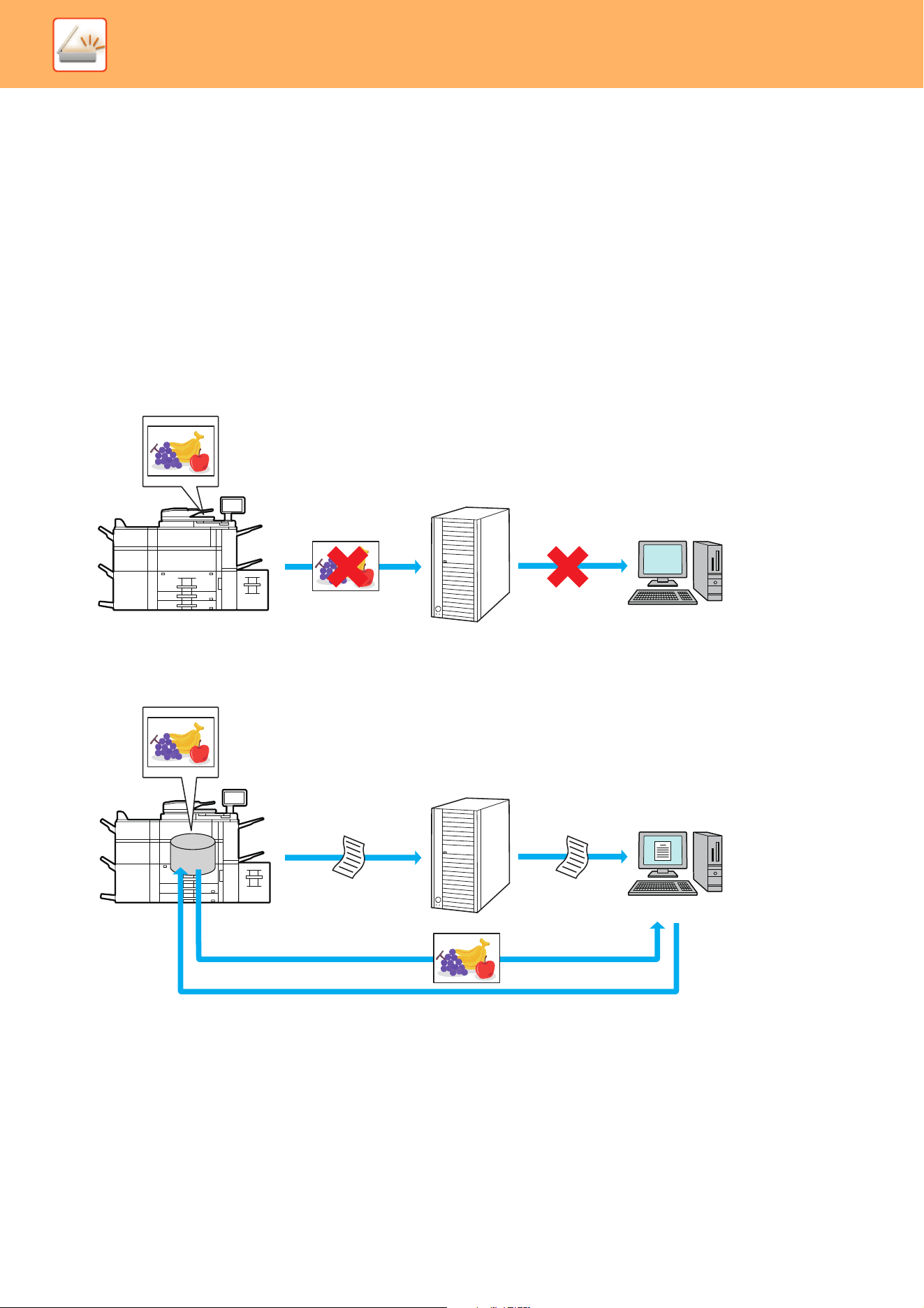
4-25
SCANNER►ENTERING DESTINATIONS
SENDING ONLY THE URL OF A SCANNED FILE TO A
SCAN DESTINATION
When using Scan to E-mail, some originals and/or scan settings may result in a large file.
When the file is large, there is a risk that the e-mail server may reject the file and it will not be sent.
This function saves the scanned file on the machine's hard disk, and sends an e-mail providing only the file's URL
information to the recipient.
This function helps reduce the load on the e-mail server and prevents non-delivery of scanned files caused by the e-mail
server.
Upon receiving the e-mail, the recipient can use the URL in the e-mail to download the scanned file.
When the scanned file is too large
HDD
Scanned file
Sending the file as an
e-mail attachment
The attachment is too
large and the e-mail
server rejects the
e-mail
Sending fails
Destination
E-mail server
Scanned file
Save to the machine's
hard disk
Send the URL of the
save location by
e-mail
Destination
E-mail server
The e-mail arrives
at the destination
The recipient uses the URL in the e-mail to download the scanned file
Scan to E-mail
Sending only a URL to the recipient
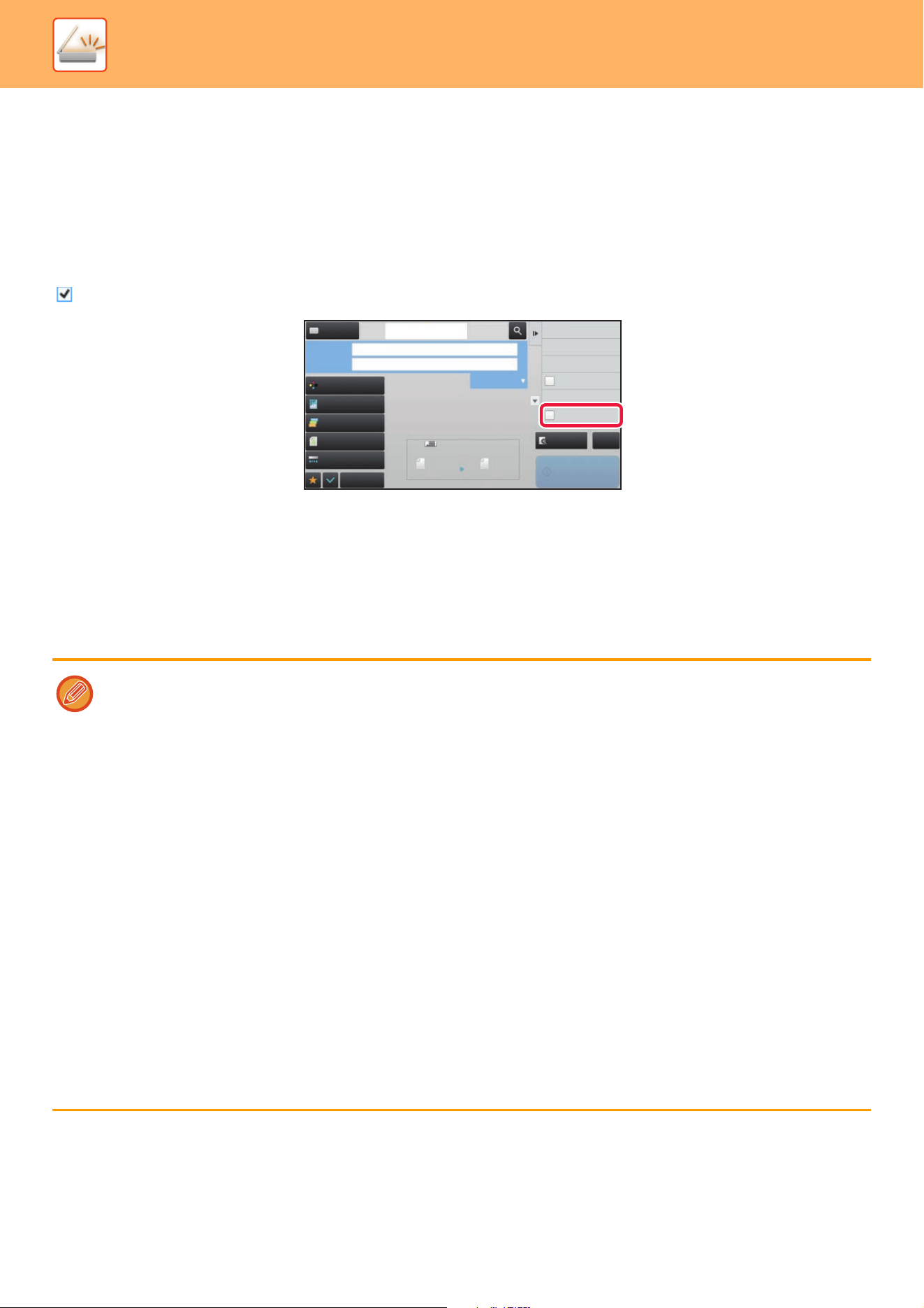
4-26
SCANNER►ENTERING DESTINATIONS
Sending only a URL to the recipient
Using simple mode
When [Enable Send Destination Link as Default] is enabled in the settings (administrator), the scanned data is saved in
the machine's hard disk, and URL information is sent to the e-mail destination. When disabled, scanned data is sent by
regular Scan to E-mail. This function enable/disable cannot be changed in the simple mode screen.
Using normal mode
[Send Destination Link] appears on the action panel of the home screen of Scan to E-mail. By selecting this checkbox
, you can use this function.
Number of URLs created
One URL is created per file to be downloaded.
Using [One Page per File]
Multiple scanned files will be created and saved at once, and a URL will be created for each file and sent to the recipient.
Using [Programmed]
Files will be created and saved in a format that varies by recipient, and a URL will be created for each file. A URL will be
sent to each recipient for the file in the format for that recipient.
• To use this function, [Send Destination Link Settings] must be enabled in the System Settings (administrator).
• This function cannot be used in combination with metadata transmission or resending from document filing.
• Scanned files are saved in the standard folder area.
• Scanned files cannot be browsed by a method other than downloading.
• Scanned files cannot be manually deleted, and are retained for the save period set in the System Settings. However,
scanned files will be deleted if Clear All Memory or Initialize Private Data/Data in Machine is executed, or you move to
Advanced Security Settings.
• When all destinations in a broadcast transmission are e-mail addresses, URL information is sent to all destinations.
If the file format of the saved scan data is the same for all destinations, the same URL will be sent. If the file format varies
by destination, separate URLs will be sent.
• If the transmission includes recipients for different jobs (Scan to FTP, etc.), transmission will take place by sending only a
URL to the recipient to any e-mail addresses, while the scanned file will be sent directly in the normal way to recipients for
other jobs.
• When [Document Administration Function] is enabled in the System Settings (administrator), the scanned file will be sent
directly to the administrator, not by URL.
• Even when [Send Destination Link Settings] is disabled in the System Settings (administrator), the URL can be accessed
and the scanned file downloaded during the file save period.
• The scanned file will be saved even if a send data limit is set in the System Settings (administrator) and the file exceeds
the limit. The scanned file will be saved as a single file even if [If the E-mail attachment(s) exceed maximum size, it will be
sent in multiple files.] is enabled in the System Settings (administrator) and the file exceeds the limit.
If there is a job other than a Scan to E-mail job in a broadcast transmission and the scanned file exceeds the [Maximum
Size of Data Attachments (FTP/Network Folder)] setting, transmission will not be possible.
Specified by System Settings
Auto
Original
Mixed Size Orig.
Original Count
Slow Scan Mode
Others
Address
Scan Size
Auto Auto
100%
Send Size
Preview
Start
Address Book
CA
Subject
File Name
Options
Touch to input Address
8½x11 8½x11
Resolution
200x200dpi
Global Address Search
Sending History
Call Program
Call Registered settings
Verification Stamp
Send
Destination Link
Call Search Number
4-27
SCANNER►ENTERING DESTINATIONS
• To use this function
Configure in "Settings (administrator)" - [
System Settings
] - [Image Send Settings] - [Scan Settings] - [Condition Settings] -
[Send Destination Link Settings].
• To always use this function in simple mode
Configure in "Settings (administrator)" - [
System Settings
] - [Image Send Settings] - [Scan Settings] - [Condition Settings] -
[Send Destination Link Settings] - [Enable Send Destination Link as Default].
When this function is enabled and e-mail is sent in normal mode, the [Send Destination Link] checkbox in the action panel
is always .
• Save period for scanned files saved using this function
Configure in "Settings (administrator)" - [
System Settings
] - [Image Send Settings] - [Scan Settings] - [Condition Settings] -
[Send Destination Link Settings] - [File Retention Period].
• Protecting the URL by SSL
Configure in "Settings (administrator)" - [
System Settings
] - [Image Send Settings] - [Scan Settings] - [Condition Settings] -
[Send Destination Link Settings] - [Enable SSL].
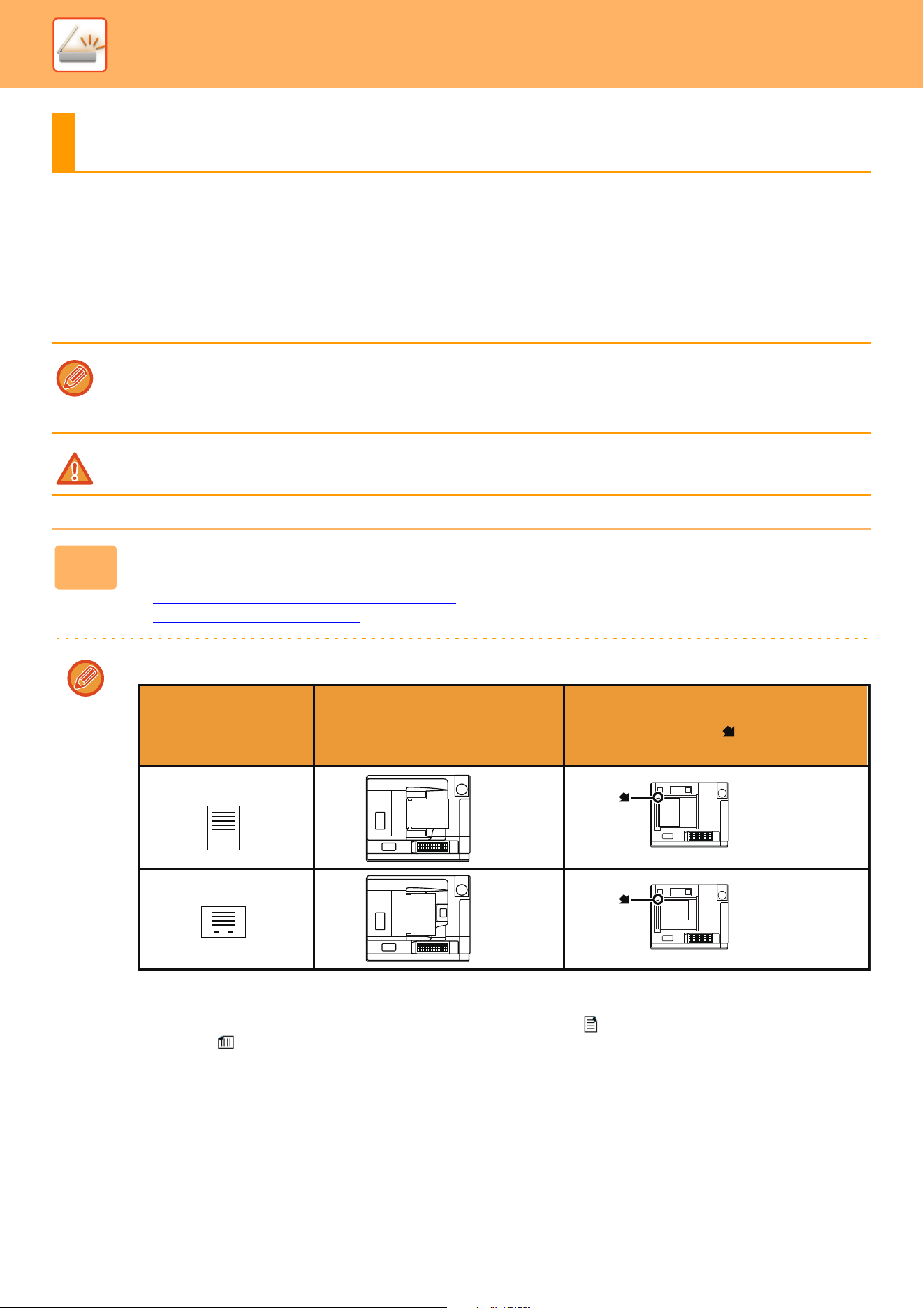
4-28
SCANNER►TRANSMITTING AN IMAGE
TRANSMITTING AN IMAGE
SENDING AN IMAGE IN SCAN MODE
An image can be sent in scan mode (Scan to E-mail, Scan to FTP, and Scan to Network Folder).
TRANSMITTING AN IMAGE
• If the memory becomes full while the originals are being scanned, a message will appear and scanning will stop.
• When performing Scan to E-mail, take care not to send a file that is too large. In particular, multi-page files tend to be large.
When sending a multi-page file or other large file, it may be necessary to reduce the number of scanned pages or reduce
the send size.
Do not place any objects under the original size detector. Closing the automatic document feeder with an object underneath
may damage the original size detector plate and prevent correct detection of the document size.
1
Place the original.
Place the original in the document feeder tray of the automatic document feeder, or on the document glass.
► AUTOMATIC DOCUMENT FEEDER (page 1-90)
► DOCUMENT GLASS (page 1-92)
• When placing the originals, orient them as shown below.
*To place a large portrait-oriented original, place it as shown in the figure titled "Landscape orientation" and specify the
placement orientation in step 4.
• Place 5-1/2" x 8-1/2" (A5) size originals in portrait (vertical) orientation ( ). If placed in landscape (horizontal)
orientation ( ), an incorrect size will be detected. For an 5-1/2" x 8-1/2"R (A5R) size original, enter the original size
manually.
1
1
ABC
ABC
ABC
ABC
Document feeder tray
Place the original face up.
Document glass
Place the original face down and align the
corner with the tip of the mark in the top left
corner of the document glass scale.
Originals
Portrait orientation*
Landscape orientation*
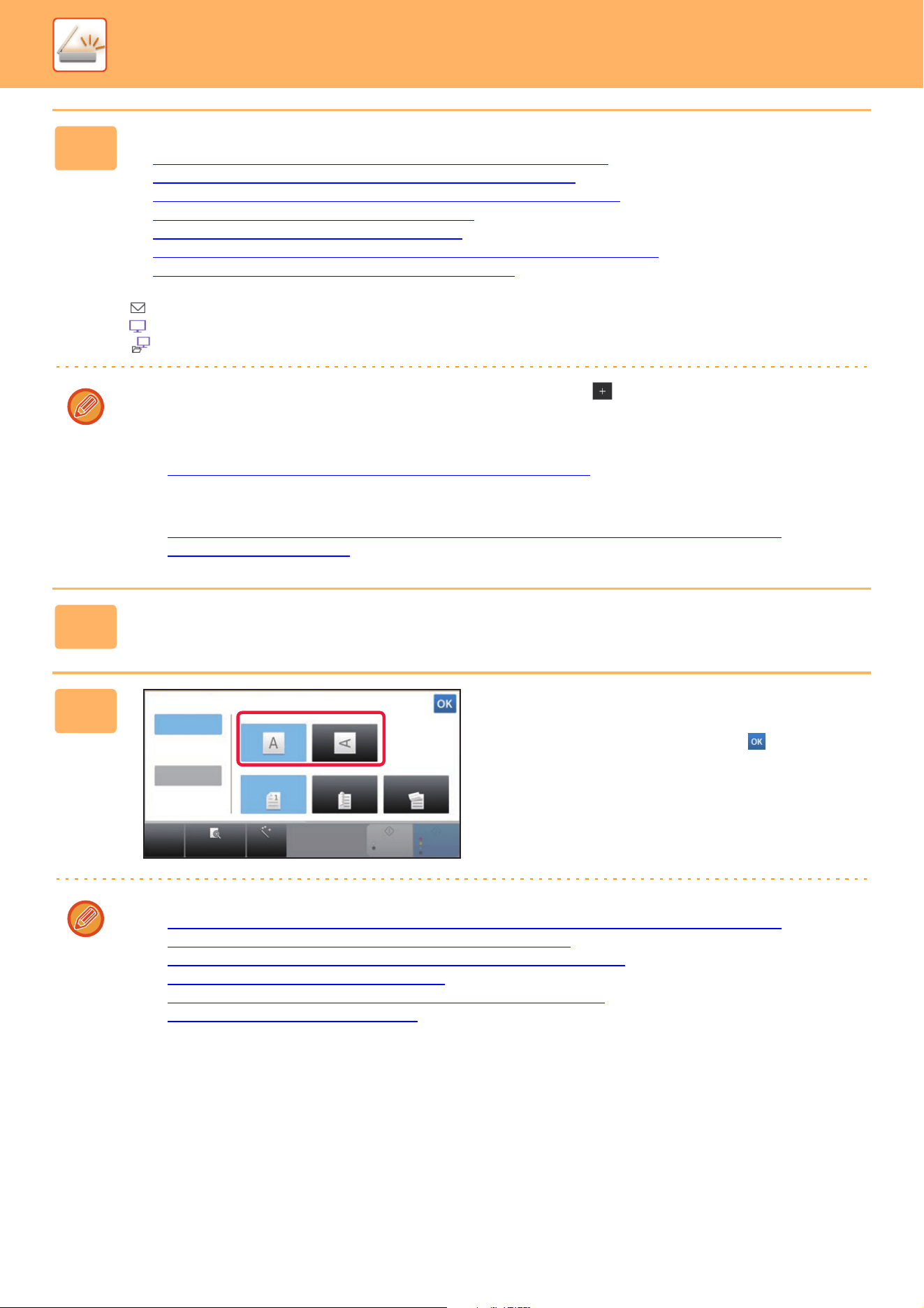
4-29
SCANNER►TRANSMITTING AN IMAGE
2
Specify the destination.
► RETRIEVING A DESTINATION FROM AN ADDRESS BOOK (page 4-14)
► VIEWING A LIST OF THE SELECTED DESTINATIONS (page 4-17)
► USING A SEARCH NUMBER TO RETRIEVE A DESTINATION (page 4-18)
► ENTERING AN ADDRESS MANUALLY (page 4-19)
► SPECIFYING A NETWORK FOLDER (page 4-20)
► RETRIEVING A DESTINATION FROM A GLOBAL ADDRESS BOOK (page 4-21)
► USING A TRANSMISSION LOG TO RESEND (page 4-23)
The icon on the key indicates the type of destination stored in the key.
Scan to E-mail
Scan to FTP
Scan to Network Folder
• After a one-touch key is tapped, if the screen is changed without tapping , the destination of the tapped key is
automatically specified.
• When performing Scan to E-mail, you can also send Cc or Bcc copies to other destinations. Tap the [Address Review]
key to select destinations.
► VIEWING A LIST OF THE SELECTED DESTINATIONS (page 4-17)
• Multiple destinations can be specified.
• To change [Subject], [File Name], [Reply-To], or [Body Text] in normal mode, tap a target entry box, or tap [Options].
► CHANGING THE SUBJECT, FILE NAME, REPLY-TO, AND BODY TEXT AT THE TIME OF SCAN
TRANSMISSION (page 4-31)
3
Tap the [Original] key.
4
Tap the appropriate orientation key.
Specify the orientation of the original placed in step 1.
After the settings are completed, tap .
• You can change exposure, resolution, file format, color mode, and other settings.
► AUTOMATICALLY SCANNING BOTH SIDES OF AN ORIGINAL (2-SIDED ORIGINAL) (page 4-39)
► SCAN SIZE AND SEND SIZE (ENLARGE/REDUCE) (page 4-40)
► CHANGING THE EXPOSURE AND ORIGINAL IMAGE TYPE (page 4-48)
► CHANGING THE RESOLUTION (page 4-50)
► CHANGING FORMAT IN SCAN OR DATA ENTRY MODE (page 4-51)
► CHANGING COLOR MODE (page 4-56)
• Tapping the [Others] key allows you to configure various functions, for example, collectively sending two original
pages as one sheet or original pages with different sizes.
CA
Preview Auto Set
B/W
Start
Color
Start
Auto
Original
Image Orientation
Duplex Setup
1-Sided Book Tablet
Long Size
4-30
SCANNER►TRANSMITTING AN IMAGE
5
Tap the [B/W Start] or [Color Start] key to start scanning of the original.
• If the original was inserted in the document feeder tray, a beep will sound when scanning is completed and
transmission will take place.
• If the original is placed on the document glass, the [Read-End] key appears in the touch panel. If the original is only
one page, go to step 7. To scan more pages, go to step 6.
• You can tap the [Preview] key to check a preview of the image before sending an image. For more information, see
"CHECKING THE IMAGE TO BE TRANSMITTED (page 4-58)
".
• If the file format is set to [PDF/Encry.], [PDF/Encry./Bk Letter Emphasis], [PDF/Encry./Compact], or
[PDF/Encry./Compact/U-Fine], you will be prompted to enter the password when you tap the [B/W Start] or [Color
Start] key.
Tap the password entry box to open the keyboard screen, enter a password using a maximum of 32 characters, and
tap the [OK] and [Send] key in sequence. The recipient must use the password entered here to open the Encrypt PDF
file.
To cancel Encrypt PDF, tap the [Cancel] key. The format settings screen will appear to let you change the file type.
Select a new file type and tap the [B/W Start] or [Color Start] key to begin transmission.
6
If the original was placed on the document glass, replace it with the next
original and tap the [B/W Start] or [Color Start] key.
Repeat until all originals have been scanned.
7
Tap the [Read-End] key.
A beep will sound to indicate that the operation is completed.
• If no action is taken for one minute after the confirmation screen is displayed, scanning automatically ends and the
transmission is reserved.
• Tap the [Change Setting] key to change the exposure, resolution, scan size, and send size for each original page
scanned. However, when "Card Shot" is selected in Others, change only the exposure when scanning an
even-numbered original page.
To change the time until transmission takes place automatically:
Select "Settings (administrator)" - [System Settings] → [Image Send Settings] → [Common Settings]
→ [Condition Settings] → [Job Auto Start Time During Scanning].
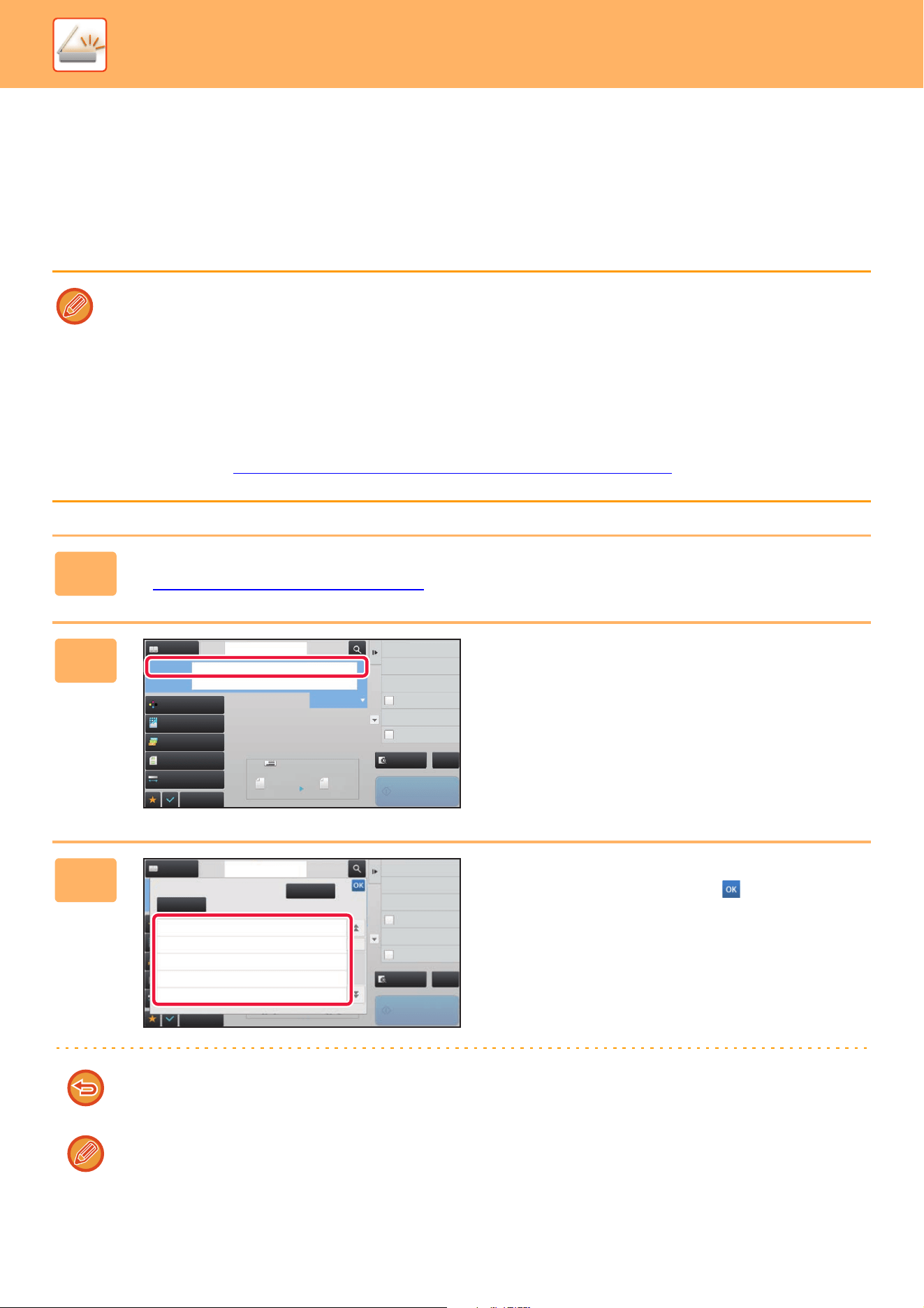
4-31
SCANNER►TRANSMITTING AN IMAGE
CHANGING THE SUBJECT, FILE NAME, REPLY-TO,
AND BODY TEXT AT THE TIME OF SCAN
TRANSMISSION
Change the subject, file name, reply-to, and body text when performing a scan transmission. If necessary, directly enter
the text.
• When performing Scan to FTP or Scan to Network Folder, only the file name is used.
• If the subject or file name is not changed, the settings in [System Settings] → [Image Send Settings] → [Scan Settings] →
[Administration Settings] in "Settings (administrator)" are used.
• If the reply-to address is not changed, the settings in [System Settings] → [Image Send Settings] → [Scan Settings] →
[Condition Settings] → [Default Reply.Address Set] in "Settings (administrator)" are used.
If this is not configured, the reply address configured in [Network Settings] → [Services Settings] → [SMTP] → [Sender
Address] in the "Settings" is used. (Administrator rights are required.)
• To configure the candidates for the subject, file name, and body text, select [System Settings] → [Image Send Settings] →
[Scan Settings] in "Settings (administrator)".
• To enter text, see "NAMES AND FUNCTIONS OF SOFT KEYBOARD KEYS (page 1-157)
" in the "BEFORE USING THE
MACHINE"
1
Tap the [Detail] key to change to normal mode.
► Changing mode from each mode (page 4-8)
2
To change the subject, tap the
[Subject] entry box.
3
Tap a pre-set text key.
After the settings are completed, tap .
To cancel the selection of the subject:
Tap the [Clear] key.
If you wish to directly enter the text, tap the [Direct Entry] key to open the soft keyboard.
Enter the text and tap the [OK] key.
Preview
Start
Scan Size
Auto Auto
Resolution
File Format
Original
Others
8½x11
8½x11
100%
Send Size
Subject
File Name
Address Touch to input Address
Options
Exposure
CA
Specified by System Settings
Verification Stamp
Call Search Number
Call Program
Call Registered settings
Sending History
Global Address Search
Send
Destination Link
Address Book
Auto/Mono2
200x200dpi
PDF
Auto
Color Mode
AAA
BBB
CCC
DDD
EEE
No.1
No.2
No.3
No.4
No.5
AAA
BBB
CCC
DDD
EEE
No.1
No.2
No.3
No.4
No.5
Preview
Start
Others
Address Book
Subject
Direct Entry
Clear
Address Touch to input Address
CA
AAA
BBB
CCC
DDD
EEE
No.1
No.2
No.3
No.4
No.5
Verification Stamp
Call Search Number
Call Program
Call Registered settings
Sending History
Global Address Search
Send
Destination Link
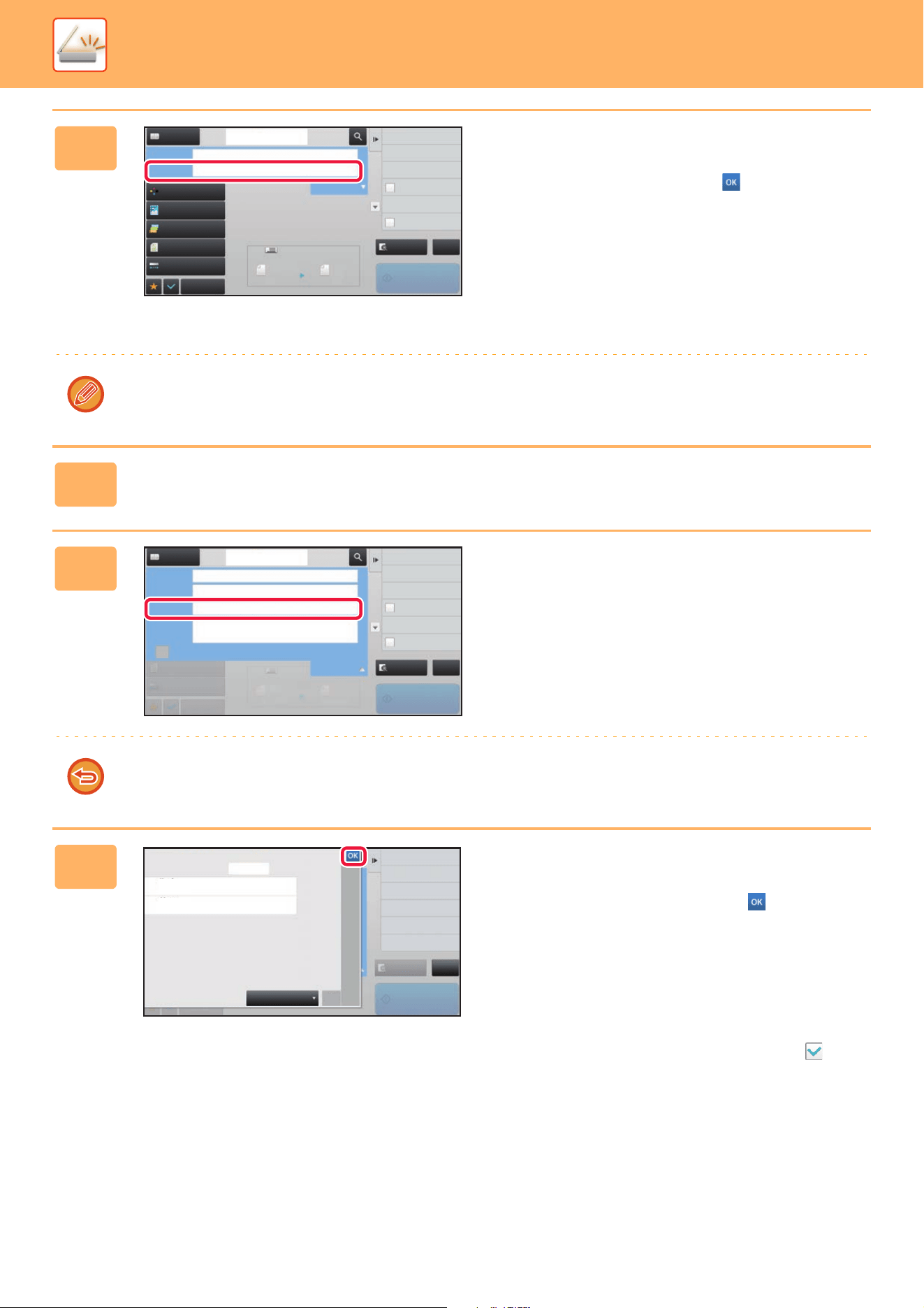
4-32
SCANNER►TRANSMITTING AN IMAGE
4
To change the file name, tap the [File
Name] entry box.
After the settings are completed, tap .
• Tap the key of the file name from the list.
• To directly enter the file name, tap the [Direct Entry] key.
• A prompt is displayed in the file name. The prompt is
changed according to the settings.
If the settings are not changed, "Following the System
Settings" is displayed.
When [File Name Auto Extraction] in [OCR Setting] is
enabled, "File Name Auto Extraction" is displayed.
When scanning to a shared folder, if you set a file name that is the same as an existing file name in the shared folder,
the file name will be changed to prevent overwriting of the existing file.
5
Tap [Options].
6
To change the reply address, tap the
[Reply-To] entry box.
If user authentication is being used, the information of the user that logged in will be applied, and thus the reply address
cannot be changed.
7
Tap the key that you wish to use for
the reply address.
After the settings are completed, tap .
• You can select addresses from the user list in the same
way as you would select the reply address. You can also
tap [Global Address Search] on the action panel to specify
a user stored in the global address book as the reply
address.
• Tapping [Direct Entry] on the action panel allows you to
directly enter the e-mail address.
• Selecting the [Add 'Reply to' to Cc] checkbox to adds
a reply address to the Cc address.
Preview
Send
Destination Link
Address Book
Auto/Mono2
200x200dpi
PDF
Auto
Start
Scan Size
Auto Auto
Resolution
File Format
Original
Others
100%
Send Size
Subject
File Name
Address Touch to input Address
Options
Exposure
CA
Verification Stamp
Call Search Number
Sending History
Global Address Search
8½x11
8½x11
Color Mode
Call Program
Call Registered settings
Specified by System Settings
Preview
Start
Scan Size
Auto Auto
Original
Auto
Others
100%
Send Size
Address Book
Subject
File Name
Reply-To
Body Text
Add 'Reply to' to Cc
Address Touch to input Address
Options
Exposure
CA
Verification Stamp
Call Search Number
Sending History
Global Address Search
Send
Destination Link
Call Program
Call Registered settings
8½x11 8½x11
Specified by System Settings
Reply to
User Name
All
Narrow Down by Index
ABC
A
D
G
J
M
P
T
W
Sort
Call by User Number
Direct Entry
User1
User1
tianne
tianne
Preview
Start
CA
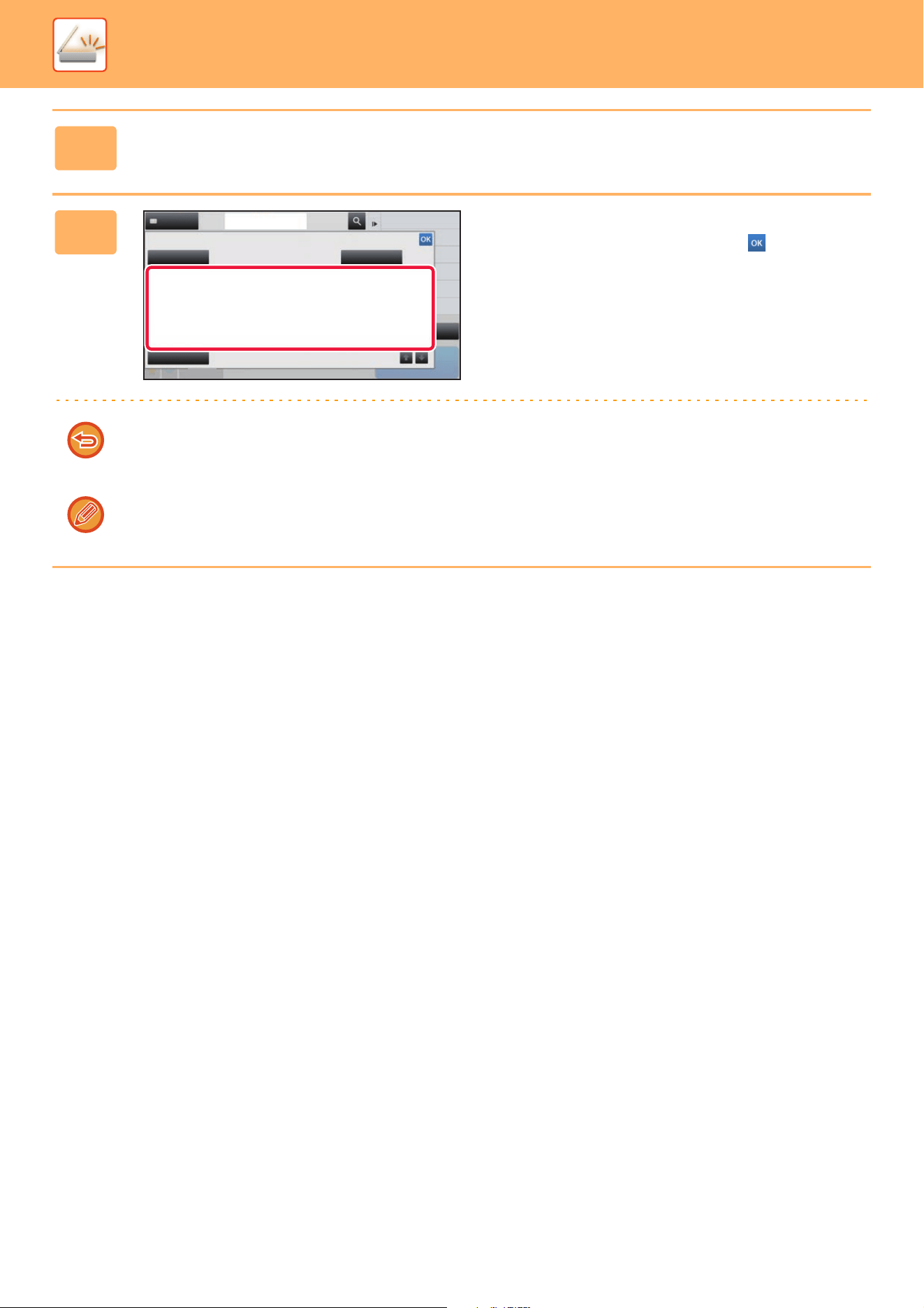
4-33
SCANNER►TRANSMITTING AN IMAGE
8
To change the body text, tap the [Body Text] entry box.
9
Enter the body text.
After the settings are completed, tap .
• To select a pre-set text previously stored in the Setting
mode (Web version), tap the [Pre-set Message] key.
• To directly enter the body text, tap the [Edit] key.
To clear all entered text:
Tap the [Clear All] key. When this key is tapped, the entire body of the message is erased immediately, not just the
selected line.
• Enter up to 1800 characters. (A line break counts as one character.)
• To edit the selected line, tap the [Edit] key. The soft keyboard will appear with the selected text entered.
Address Book
Body Entry
Address Touch to input Address
Clear AllPre-set Message
Edit
Sending History
Others
CA
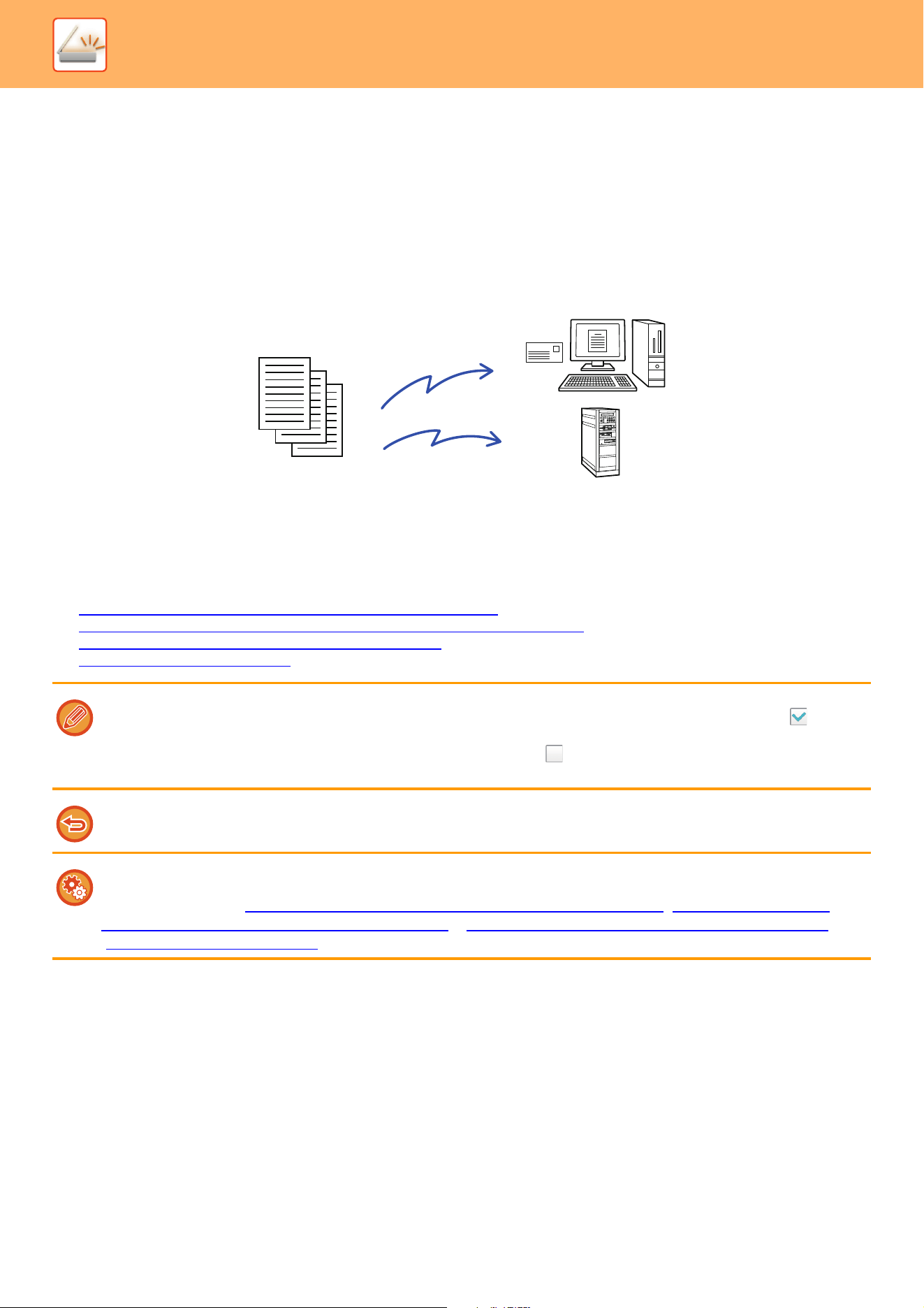
4-34
SCANNER►TRANSMITTING AN IMAGE
SENDING THE SAME IMAGE TO MULTIPLE
DESTINATIONS (BROADCAST TRANSMISSION)
Send the same scanned image to multiple scan destinations in a single operation.
One operation allows you to send data to up to 500 destinations, including the reserved send jobs. (For example, if
broadcast transmission jobs with 450 destinations are already reserved, data can be broadcasted to up to 50
destinations.)
It is convenient to store destinations you frequently use for broadcast transmission as contacts or groups.
A maximum of 500 destinations can be stored in one contact.
► STORING ADDRESSES THROUGH DIRECT ENTRY (page 1-107)
► STORING ADDRESSES THROUGH GLOBAL ADDRESS SEARCH (page 1-108)
► USING A TRANSMISSION LOG TO RESEND (page 4-23)
► STORING GROUPS (page 1-111)
When the checkbox of "Settings (administrator)" -[System Settings] → [Image Send Settings] → [Common Settings] →
[Condition Settings] → [Address Book Default Selection] → [Apply Addresses of Sending Modes Only] is set to (factory
default setting), the image is only sent to those destinations among the destinations that are set to [Set as Default used]
which are for the currently selected mode. If the checkmark is removed , the image can also be sent to destinations of
other modes.
A transmission is performed, ignoring hyperlinks with Scan to FTP and Scan to Network Folder addresses.
To register destinations in a contact or group:
In the address book screen, tap [Add New] on the action panel, or tap the [Address Control] icon in the home screen. For
more information, see "STORING ADDRESSES THROUGH DIRECT ENTRY (page 1-107)
,"STORING ADDRESSES
THROUGH GLOBAL ADDRESS SEARCH (page 1-108)", "USING A TRANSMISSION LOG TO RESEND (page 4-23)", or
"STORING GROUPS (page 1-111)
".
Originals
Transmission
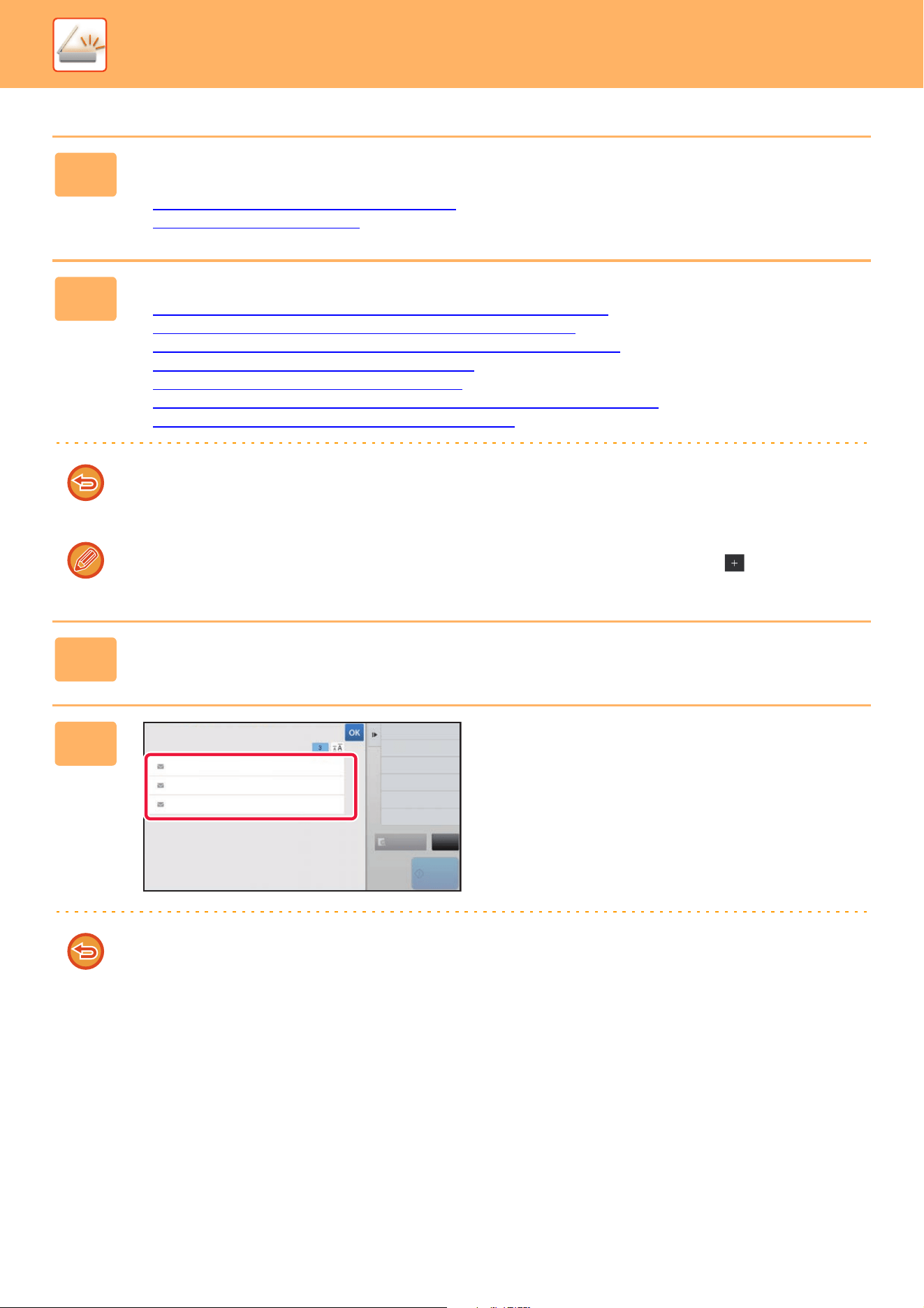
4-35
SCANNER►TRANSMITTING AN IMAGE
1
Place the original.
Place the original in the document feeder tray of the automatic document feeder, or on the document glass.
► AUTOMATIC DOCUMENT FEEDER (page 1-90)
► DOCUMENT GLASS (page 1-92)
2
Specify all destinations.
► RETRIEVING A DESTINATION FROM AN ADDRESS BOOK (page 4-14)
► VIEWING A LIST OF THE SELECTED DESTINATIONS (page 4-17)
► USING A SEARCH NUMBER TO RETRIEVE A DESTINATION (page 4-18)
► ENTERING AN ADDRESS MANUALLY (page 4-19)
► SPECIFYING A NETWORK FOLDER (page 4-20)
► RETRIEVING A DESTINATION FROM A GLOBAL ADDRESS BOOK (page 4-21)
► USING A TRANSMISSION LOG TO RESEND (page 4-23)
• One-touch keys that cannot be used for broadcast transmission are grayed out to prevent selection.
• If a Scan to FTP or Network Folder address is specified in a broadcast transmission, hyperlink e-mail transmission will
not take place.
If [System Settings] → [Image Send Settings] → [Common Settings] → [Condition Settings] → [Be sure to press Next
Address Key ([+]) before selecting the next address.] is enabled in "Settings (administrator)", tap before specifying
the next destination.
3
Tap [Address Review] on the action panel.
4
Confirm the destination.
• To cancel a specified destination:
Tap the key of the destination that you wish to cancel to release the selection.
• To switch delivery types (To/Cc/Bcc):
Tap the address that you want to change, and tap [Change to To], [Change to Cc], or [Change to Bcc] on the action
panel.
Start
Preview
All Destinations
AAA
BBB
CCC
CA
Direct Entry
AAA.□□□
BBB.□□□
CCC.□□□
Direct Entry
Direct Entry
4-36
SCANNER►TRANSMITTING AN IMAGE
5
Tap the [B/W Start] or [Color Start] key ([Start] key in normal mode) to start
scanning of the original.
• If you inserted the original pages in the document feeder tray, all pages are scanned.
A beep will sound to indicate that scanning and transmission have ended.
• When you place the original on the document glass, scan each page at a time.
When scanning finishes, place the next original and tap the [B/W Start] or [Color Start] key ([Start] key in normal
mode). Repeat until all pages have been scanned and then tap the [Read-End] key.
A beep will sound to indicate that transmission has ended.
You can tap the [Preview] key to check a preview of the image before sending an image. For more information, see
"CHECKING THE IMAGE TO BE TRANSMITTED (page 4-58)
".
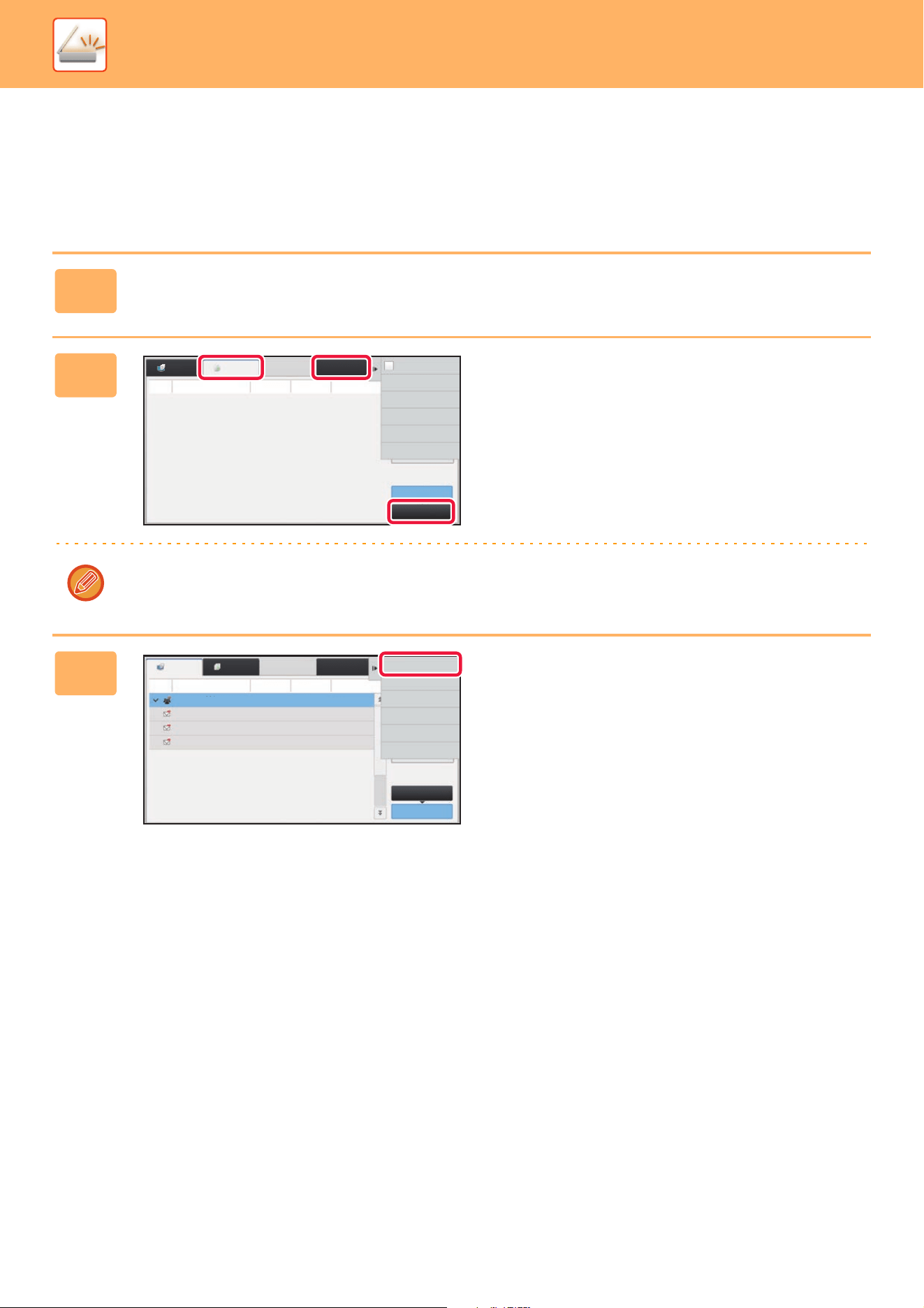
4-37
SCANNER►TRANSMITTING AN IMAGE
RESENDING TO UNSUCCESSFUL BROADCAST
TRANSMISSION DESTINATIONS
The results of a completed broadcast transmission can be checked in the job management screen. If transmission to
any of the destinations failed, resend the image to those destinations.
1
Tap the job management display.
2
Tap the [Scan] tab, and tap the
[Complete] key.
If the broadcast transmission included destinations of different modes, the same broadcast transmission key will appear
in each of those modes.
3
After tapping the key of the completed
broadcast transmission, tap [Check
Details of Selected Job] on the action
panel.
Job Queue
Complete
File RetrieveScan
Job
Address
Set Time Pages
Status
Enter Plural
Selection Mode
Back
Print
Job Queue
Complete
Job
Address
Set Time
Status
Print Image Sending
Activity Report
Check Details of
Selected Job
Back
0000/0002 OK
0000/0001
0000/000110:45 07/07
10:30 07/07
10:12 07/07
10:03 07/07
NG800000
NG800000
NG800000
0000/0001
0000/0001
bbb@bbb.□□□
ccc@ccc.□□□
ddd@ddd.□□□
Broadcast004
Pages
File RetrieveScanPrint
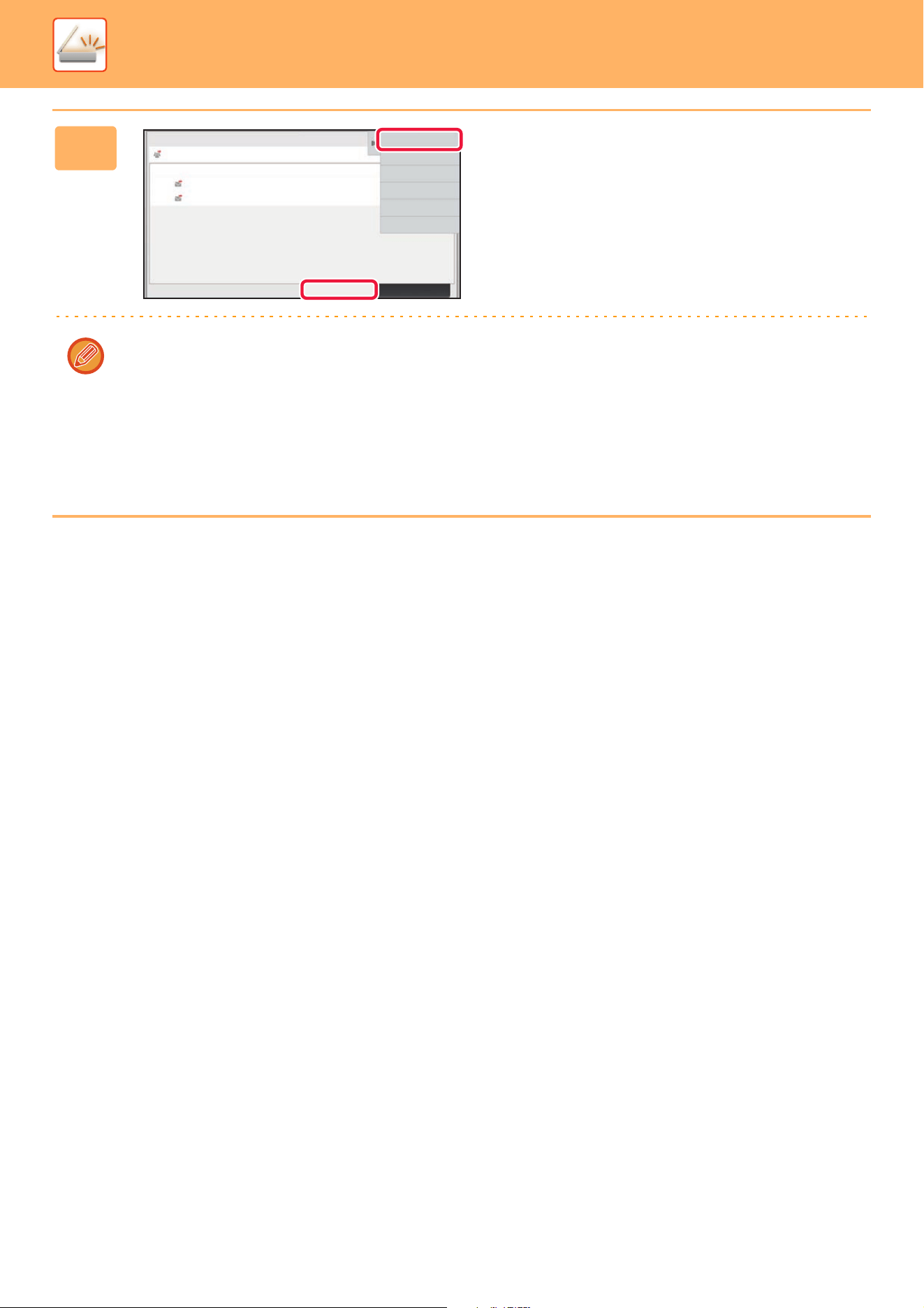
4-38
SCANNER►TRANSMITTING AN IMAGE
4
After tapping the [Failed] tab, tap
[Resend to All Addresses Which Failed
in Sending] on the action panel to
resend the image.
The steps to follow after [Resend to All Addresses Which Failed in Sending] is tapped differ depending on whether or not
document filing is used.
• Using document filing:
You will return to the document filing resend screen with the unsuccessful destinations entered.
Perform the document filing resend procedure. (There is no need to re-scan the original.)
• Not using document filing:
You will return to the base screen with the unsuccessful destinations entered. Place the original and perform the steps
of the broadcast transmission.
All DestinationsFailed
Details
Resend to All Addresses
Which Failed in Sending
Back
Address
aaa@aaa.□□□
bbb@bbb.□□□
001
002
Number: StatusStart Time
10:05 07/07
10:05 07/07
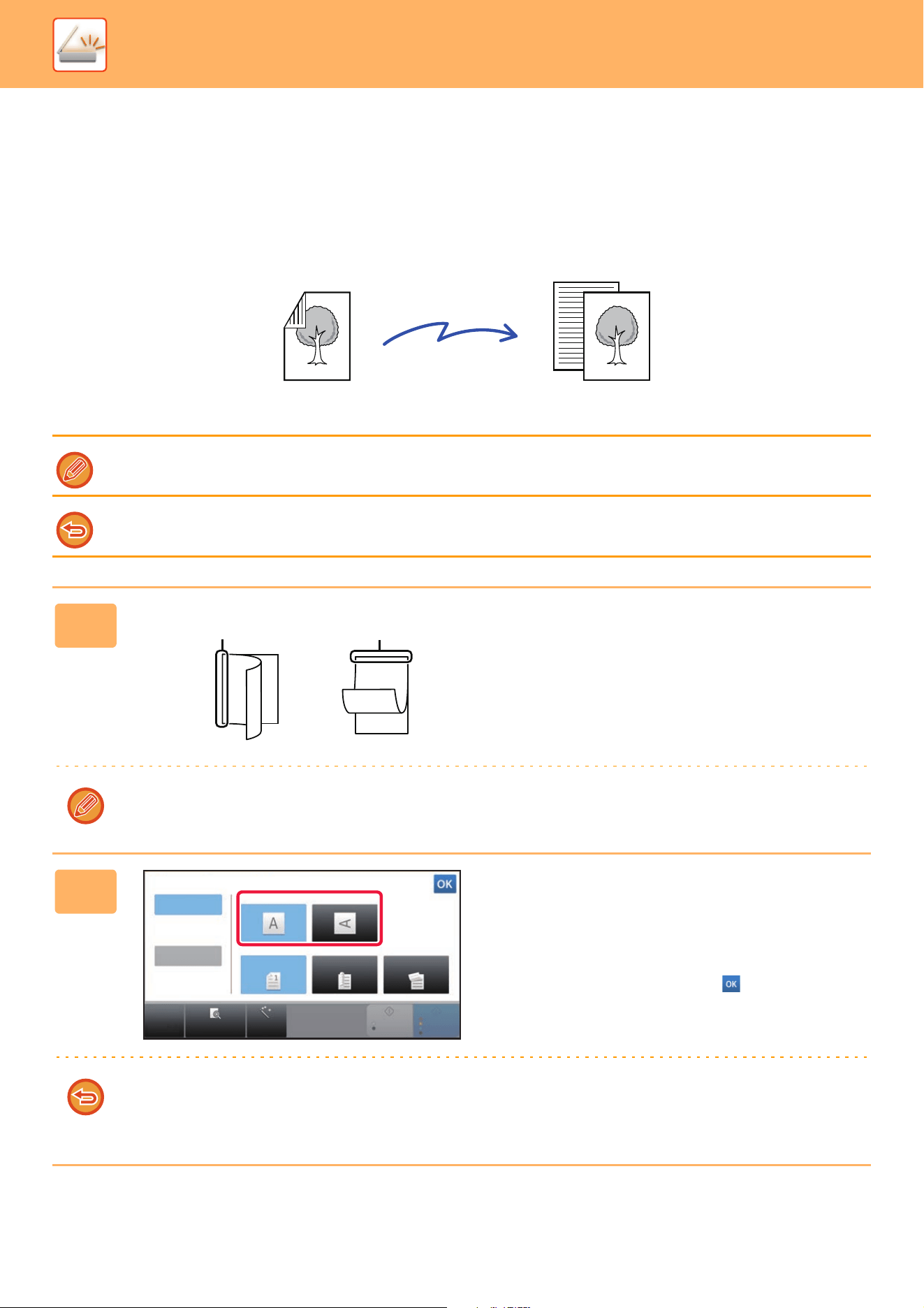
4-39
SCANNER►TRANSMITTING AN IMAGE
IMAGE SETTINGS
AUTOMATICALLY SCANNING BOTH SIDES OF AN
ORIGINAL (2-SIDED ORIGINAL)
The automatic document feeder is used to automatically scan both sides of an original.
The settings on 2-sided scanning are cleared when transmission has completed.
You cannot use 2-Sided scanning when the original size is set to Long Size.
1
After tapping the [Original] key, tap the
[Book] or [Tablet] key.
See the figure on the left to check the binding edge of the
original and select the key to be tapped.
In normal mode, tap the [2-Sided Tablet] or [2-Sided Book] key.
2
Tap the [Image Orientation] key with
the same orientation as the placed
original.
If this setting is not correct, a suitable image may not be
transmitted.
After the settings are completed, tap .
To cancel 2-sided scanning:
Tap the [1-Sided] key.
In normal mode, tap the [2-Sided Tablet] key or the [2-Sided Book] key that has been forcibly displayed and cancel the
display.
2-Sided
Original
Scan transmission
Front and reverse sides are scanned
A
C
G
AB
EF
J
L
KL
E
Book
Tablet
CA
Preview Auto Set
B/W
Start
Color
Start
Auto
Original
Image Orientation
Duplex Setup
1-Sided Book Tablet
Long Size
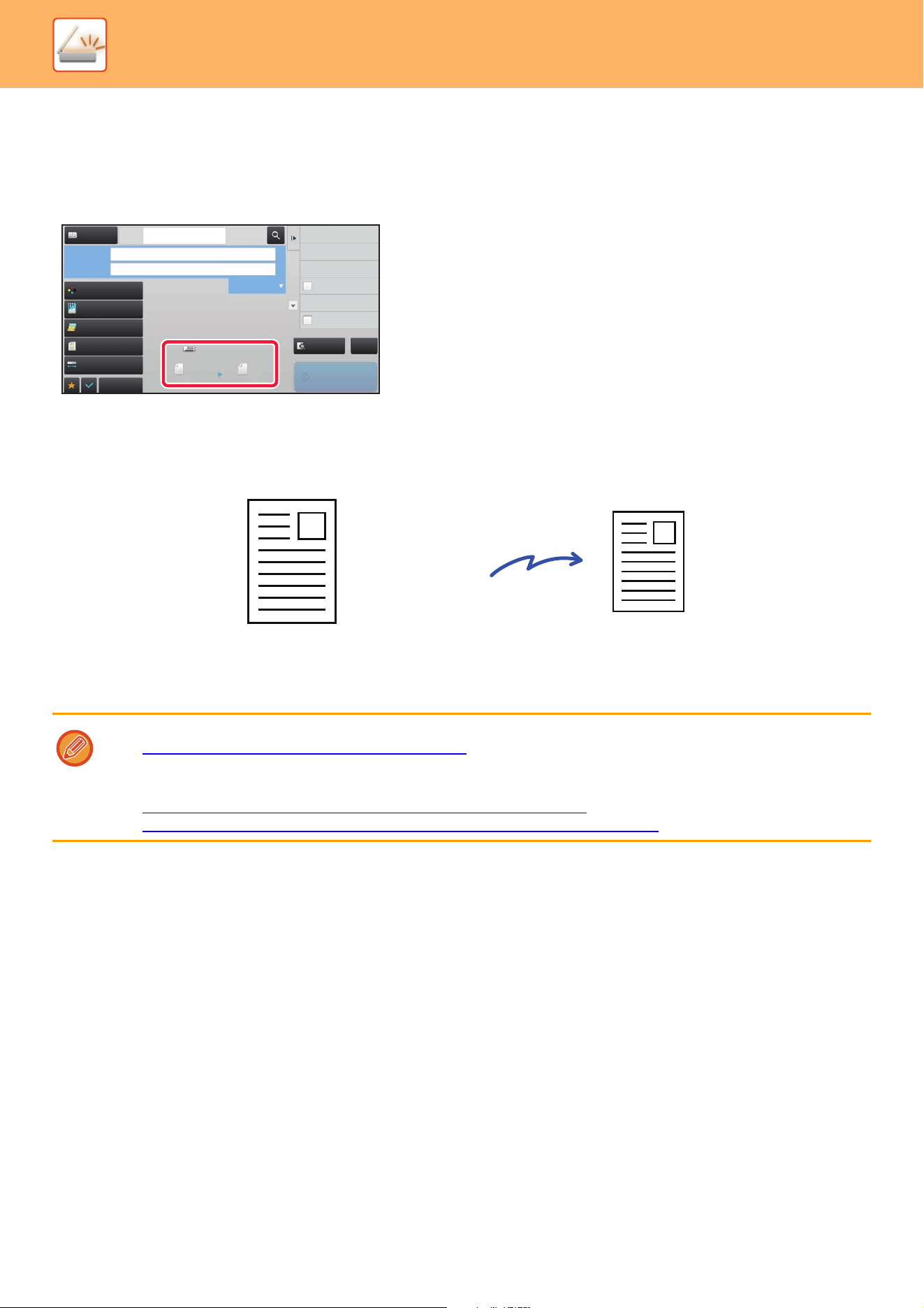
4-40
SCANNER►TRANSMITTING AN IMAGE
SCAN SIZE AND SEND SIZE (ENLARGE/REDUCE)
When the original is placed, its size is automatically detected.
In normal mode, the size of the placed original is indicated as the "Scan Size", and the size to be transmitted is indicated
as the "Send Size".
In the above screen, the scan size (the placed original) is 8-1/2" x 11" (A4) and the send size is auto. For example, if the
scan size is 8-1/2" x 11" (A4) and the send size is 5-1/2" x 8-1/2" (B5), the image will be reduced before transmission.
• Only standard original sizes can be automatically detected.
► THE SIZE OF THE PLACED ORIGINAL (page 4-12)
• When the original size is an inch size or a non-standard size, or if the size is not detected correctly, manually specify the
original scan size.
► SPECIFYING THE ORIGINAL SCAN SIZE IN PAPER SIZE (page 4-41)
► SPECIFYING THE ORIGINAL SCAN SIZE USING NUMERIC VALUES (page 4-42)
CA
Preview
Start
Scan Size
Auto Auto
Color Mode
Auto/Mono2
Resolution
200x200dpi
File Format
PDF
Original
Auto
Others
8½x11
8½x11
100%
Send Size
Address Book
Subject
File Name
Address Touch to input Address
Options
Exposure
Specified by System Settings
Verification Stamp
Call Search Number
Call Program
Call Registered settings
Sending History
Global Address Search
Send
Destination Link
Scan Size
A4
"Send Size" is set to
5-1/2" x 8-1/2" (B5)
Transmission
The image is reduced to
5-1/2" x 8-1/2" (B5) before
transmission
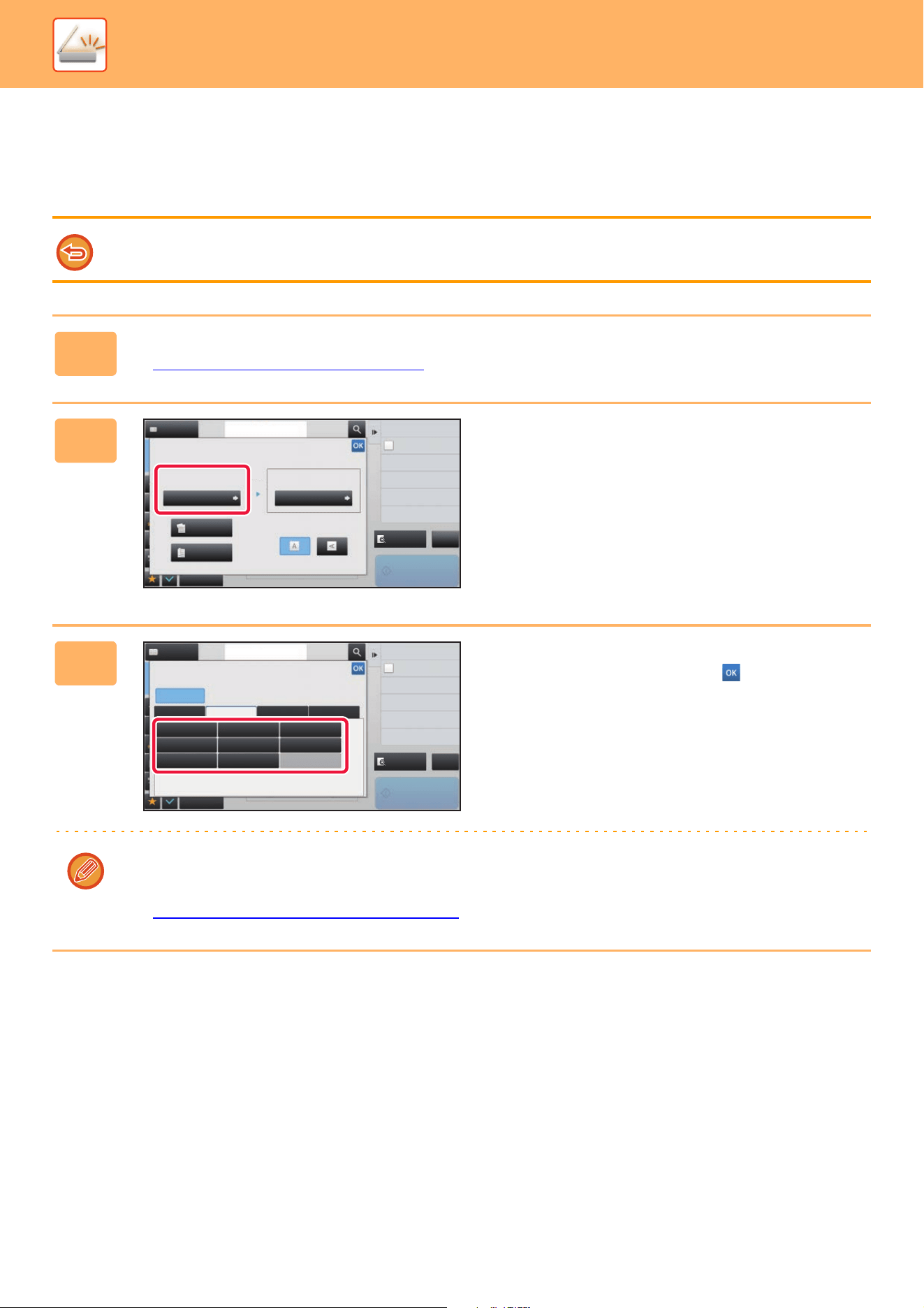
4-41
SCANNER►TRANSMITTING AN IMAGE
SPECIFYING THE ORIGINAL SCAN SIZE IN PAPER
SIZE
When the original size is a non-standard size or is not detected correctly, manually specify the original size.
When [Long Size] is selected, the 2-sided scanning setting and send size cannot be changed.
The image is sent in Mono2 only.
1
Tap the [Detail] key to change to normal mode.
► Changing mode from each mode (page 4-8)
2
After tapping the [Original] key, tap the
[Scan Size] key.
3
Tap the appropriate original size key.
After the settings are completed, tap .
If you are sending a long original, tap the [Long Size] key.
Use the automatic document feeder to scan a long original. The maximum width that can be scanned is 39-3/8" (1,000
mm) (the maximum height is 11-5/8" (297 mm)).
► TRANSMITTABLE ORIGINAL SIZES (page 4-12)
Preview
Start
Others
Original
Scan Size Send Size
Image Orientation
Auto
2-Sided
Tablet
2-Sided
Booklet
Auto
Address
Address Book
Touch to input Address
Background Adjustment
Color Mode
Skip Blank Page in Original
Blank Page Skip
Scan Thin Paper Original
Slow Scan Mode
Adjust Outline of Image
Sharpness
100%
CA
Preview
Start
Others
Scan Size
Auto
Background Adjustment
Color Mode
Skip Blank Page in Original
Blank Page Skip
Scan Thin Paper Original
Slow Scan Mode
Adjust Outline of Image
Sharpness
Address
Address Book
Touch to input Address
Direct EntryInchAB Custom Size
5½ x 8½
5½ x 8½R
8½ x 11 8½ x 14 Long Size
8½ x 13 8½ x 13
2
/
5
CA
5½ x 11R 11 x 17
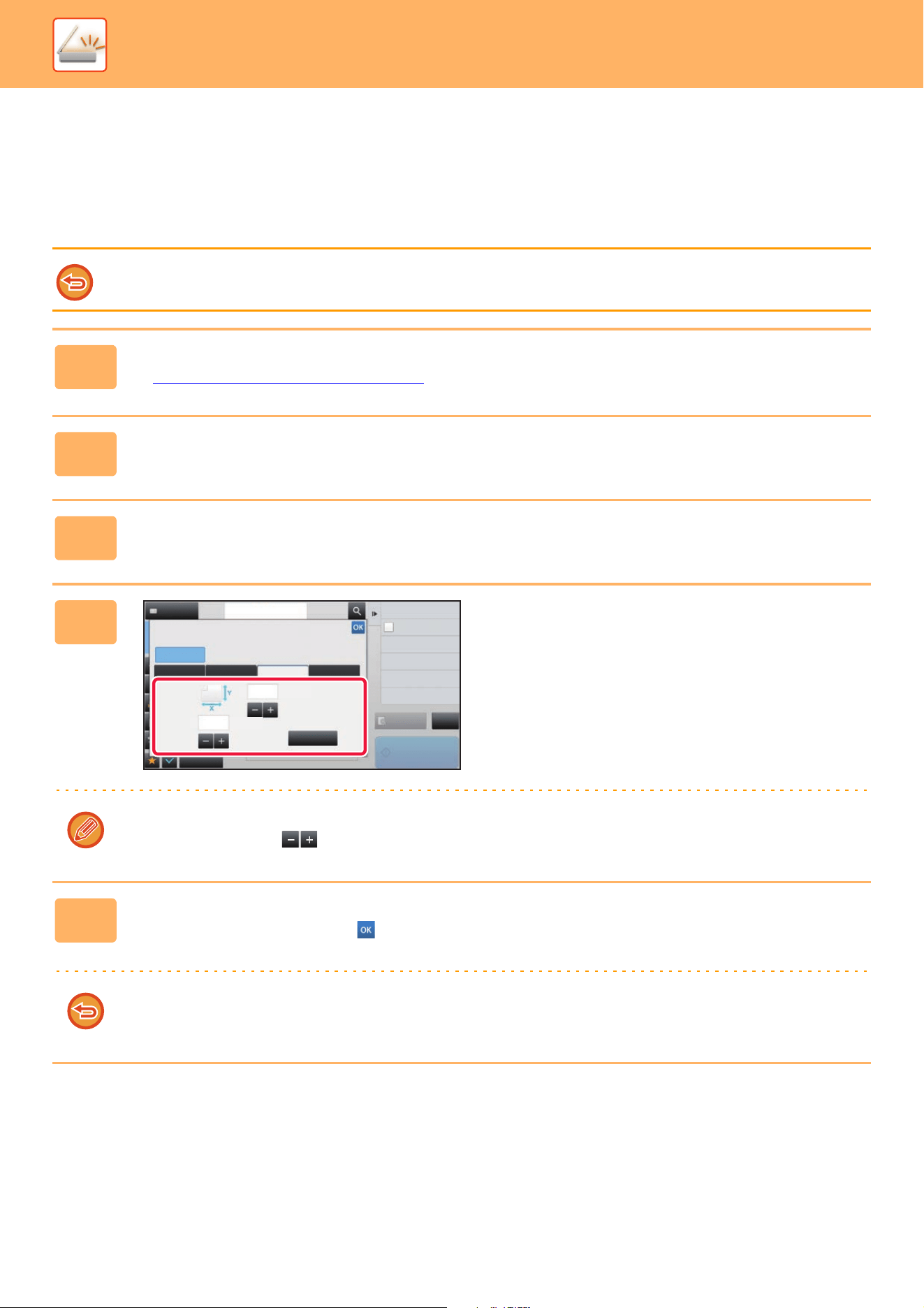
4-42
SCANNER►TRANSMITTING AN IMAGE
SPECIFYING THE ORIGINAL SCAN SIZE USING
NUMERIC VALUES
When scanning a non-standard size original such as a card or postcard, specify the original size using numeric values
after placing the original.
The width can be from 1" to 17" (25 mm to 432 mm), and the height can be from 1" to 11-5/8" (25 mm to 297 mm).
When the scan size is specified by numeric values, the send size cannot be specified.
1
Tap the [Detail] key to change to normal mode.
► Changing mode from each mode (page 4-8)
2
Tap the [Original] key.
3
After tapping the "Scan Size" key, tap the [Direct Entry] key.
4
Specify the original size.
• Tap the areas displaying width and height sizes respectively, and enter the sizes using the numeric keys.
• It is convenient to use to finely adjust the entered size.
5
Tap the [Execute] key.
After the settings are completed, tap twice.
On the base screen, check that the specified size is displayed on the [Original] key.
To cancel the specified size settings:
Tap the [Auto] key.
Preview
Start
Others
Address
Address Book
Touch to input Address
Background Adjustment
Skip Blank Page in Original
Blank Page Skip
Scan Thin Paper Original
Slow Scan Mode
Adjust Outline of Image
Sharpness
Scan Size
Auto
Direct EntryInchAB Custom Size
Execute
X
Y
CA
A4
Color Mode
( 1~11 5/8 )
inch
( 1~11 5/8 )
inch
11
17
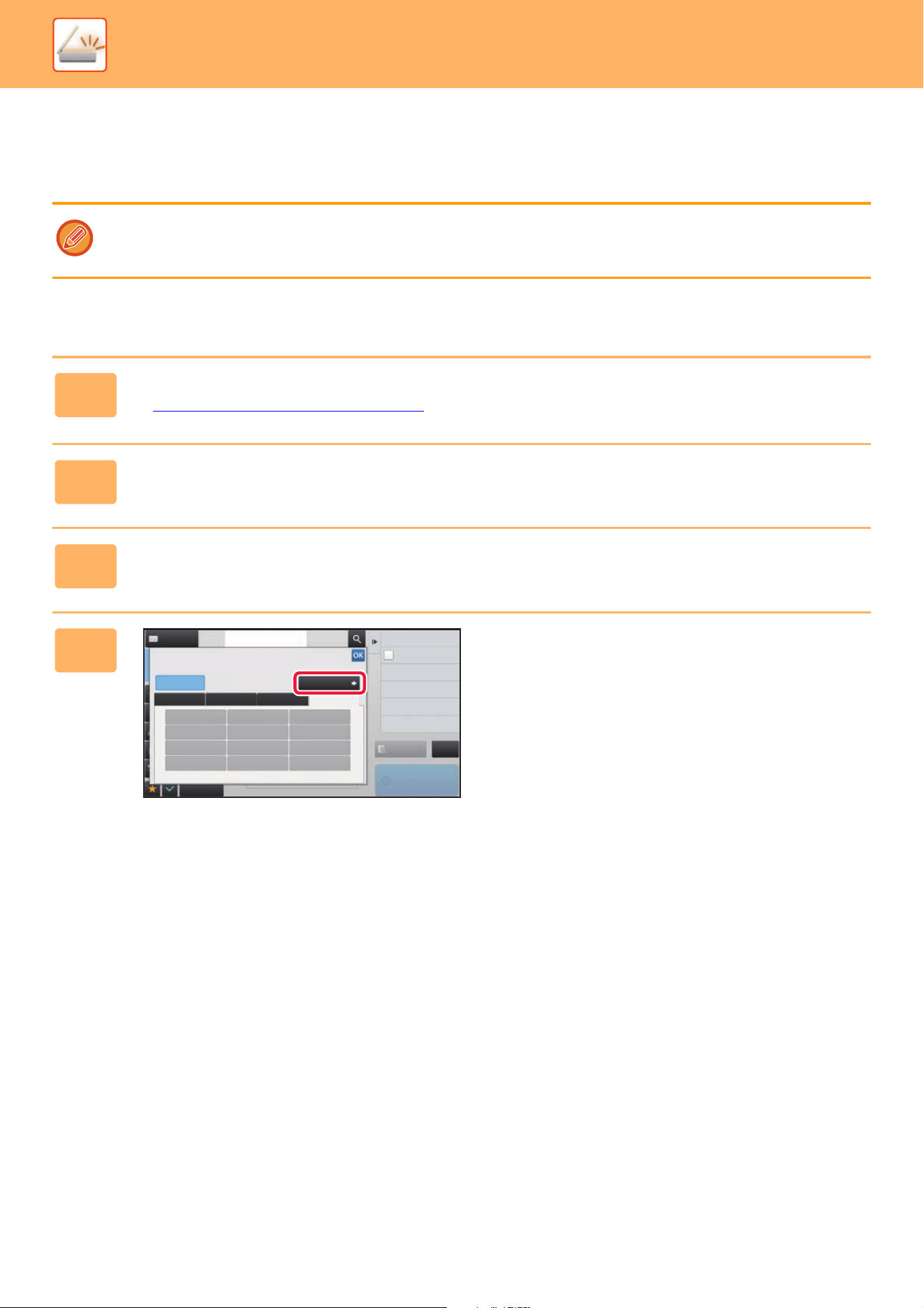
4-43
SCANNER►TRANSMITTING AN IMAGE
STORING FREQUENTLY USED ORIGINAL SIZES
Store the frequently used non-standard original sizes. This section explains how to store, retrieve, modify, and delete
non-standard original sizes.
Storing original sizes (Modify/Delete)
• The stored original size will be retained even if the main power is turned off.
• A total of up to 12 non-standard original sizes can be registered for copying and image sending.
• The added original sizes will also appear in other modes.
1
Tap the [Detail] key to change to normal mode.
► Changing mode from each mode (page 4-8)
2
Tap the [Original] key.
3
Tap the [Scan Size] key and tap the [Custom Size] tab.
4
Tap [Store/Delete] key.
Auto
Direct EntryInch
Store/Delete
AB Custom Size
Address
Address Book
Touch to input Address
Skip Blank Page in Original
Blank Page Skip
Scan Thin Paper Original
Slow Scan Mode
Background Adjustment
Color Mode
Adjust Outline of Image
Sharpness
Preview
Start
CA
Others
Scan Size
8½x11
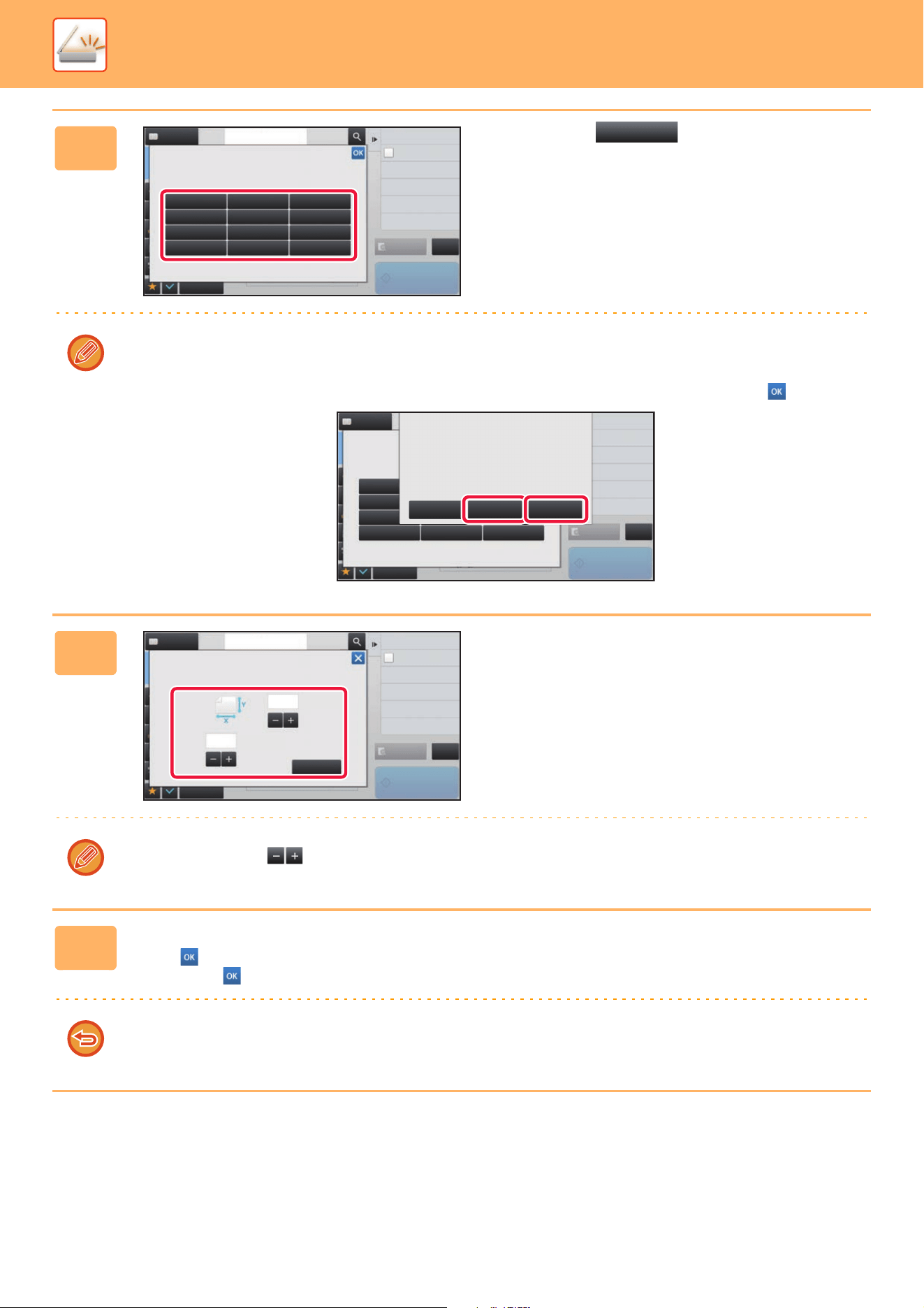
4-44
SCANNER►TRANSMITTING AN IMAGE
5
Tap a key ( ) for storing a
custom original size.
Tap a key that does not show a size.
To modify or delete a previously stored key:
Tap the key that you want to modify or delete. The following screen will appear.
• To modify the key, tap the [Modify] key and go to the next step.
• To delete the key, tap the [Delete] key. Make sure that the original size has been cleared and tap the key.
6
Specify the original size.
Tap the areas displaying width and height sizes respectively,
and enter the sizes using the numeric keys.
It is convenient to use to finely adjust the entered size.
7
Tap the [Execute] key.
Tap the key, and check that the key of the size stored on the Scan Size screen is added properly. After you have
checked it, tap .
To cancel the operation:
Tap the [CA] key.
Address
Address Book
Touch to input Address
Skip Blank Page in Original
Blank Page Skip
Scan Thin Paper Original
Slow Scan Mode
Background Adjustment
Color Mode
Adjust Outline of Image
Sharpness
Preview
Start
CA
Others
Scan Size
Store/Delete
Select the size key to store/delete
the custom original size.
Skip Blank Page in Original
Blank Page Skip
Scan Thin Paper Original
Slow Scan Mode
Background Adjustment
Color Mode
Adjust Outline of Image
Sharpness
Scan Size
Store/Delete
Select the size key to store/delete
the custom original size.
X17 Y11
Preview
Start
CA
Address Book
Others
A custom size has already been stored
in this location.
Delete ModifyCancel
Background Adjustment
Color Mode
Skip Blank Page in Original
Blank Page Skip
Scan Thin Paper Original
Slow Scan Mode
Adjust Outline of Image
Sharpness
Address
Address Book
Touch to input Address
Preview
Start
CA
Others
Execute
Scan Size
Size Input
Enter Size to Register.
( 1~11 5/8 )
inch
( 1~17 )
inch
11
17
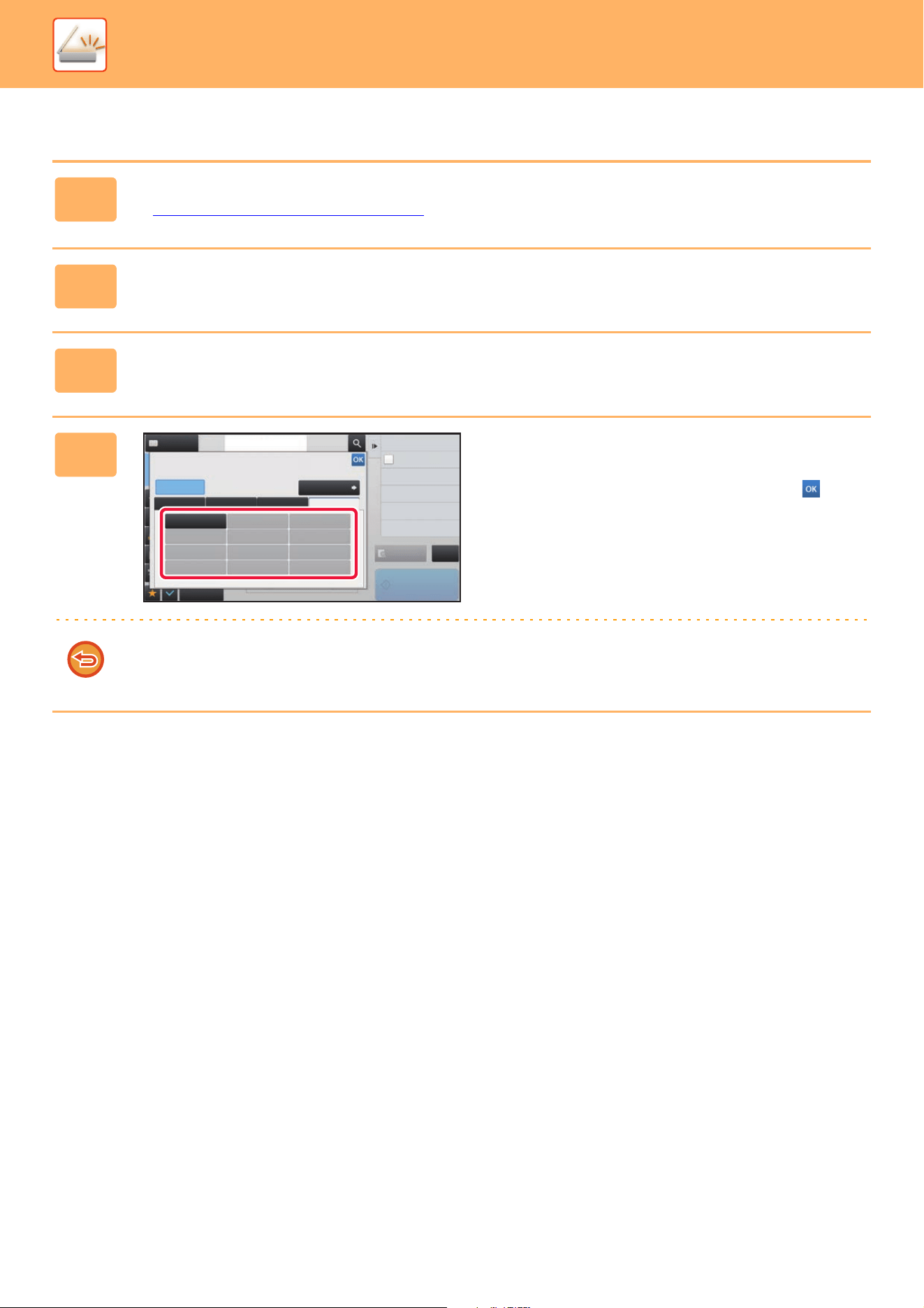
4-45
SCANNER►TRANSMITTING AN IMAGE
Retrieving a stored original size
1
Tap the [Detail] key to change to normal mode.
► Changing mode from each mode (page 4-8)
2
Tap the [Original] key.
3
Tap the [Scan Size] key and tap the [Custom Size] tab.
4
Tap the key of the original size that
you wish to retrieve.
After selecting the key of the original size, tap the key.
Check that the specified size is displayed on the Scan Size
screen.
To cancel the operation
Tap the [CA] key.
Address
Address Book
Touch to input Address
Skip Blank Page in Original
Blank Page Skip
Scan Thin Paper Original
Slow Scan Mode
Background Adjustment
Color Mode
Adjust Outline of Image
Sharpness
Preview
Start
CA
Others
Store/Delete
A4
Auto
Scan Size
Direct EntryInchAB Custom Size
X11 Y17
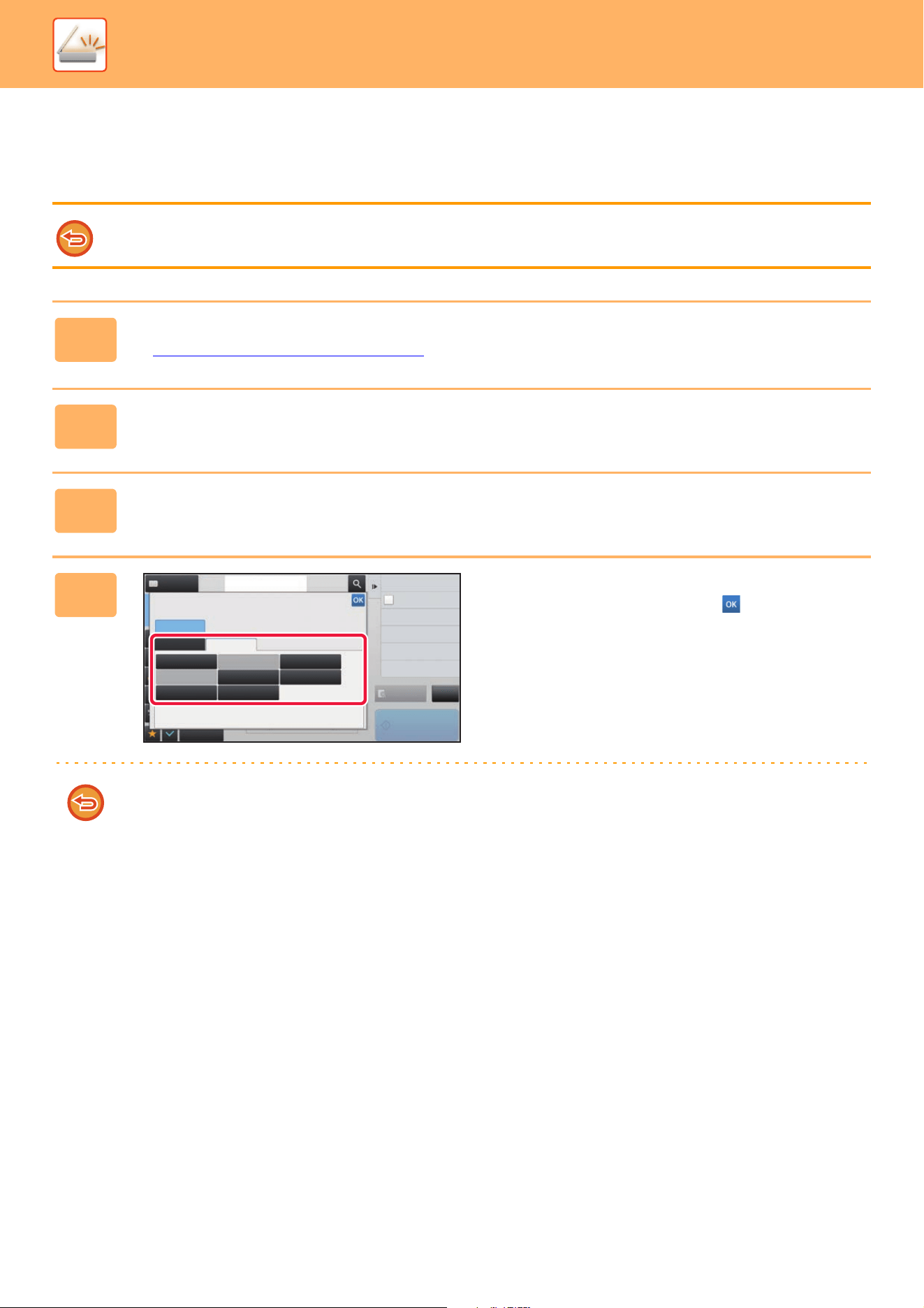
4-46
SCANNER►TRANSMITTING AN IMAGE
SPECIFYING THE SEND SIZE OF THE IMAGE
Tap this key to specify the send size as a paper size. If the specified send size is larger than the scan size, the image will
be enlarged. If the specified send size is smaller than the scan size, the image will be reduced.
The send size cannot be specified when [Long Size] is selected for the scan size, or when the scan size is specified by
numeric values.
1
Tap the [Detail] key to change to normal mode.
► Changing mode from each mode (page 4-8)
2
Tap the [Original] key.
3
Tap the [Send Size] key.
4
Tap the desired send size key.
After the settings are completed, tap .
Depending on the paper size specified for the "Scan Size", it may not be possible to select some sizes for the "Send
Size". You cannot tap size keys that are unavailable for the "Send Size".
Preview
Start
Others
Send Size
Auto
Background Adjustment
Color Mode
Skip Blank Page in Original
Blank Page Skip
Scan Thin Paper Original
Slow Scan Mode
Adjust Outline of Image
Sharpness
Address
Address Book
Touch to input Address
InchAB
CA
5½ x 8½
5½ x 8½R
8½ x 11 8½ x 14
8½ x 13 8½ x 13
2
/
5
5½ x 11R 11 x 17
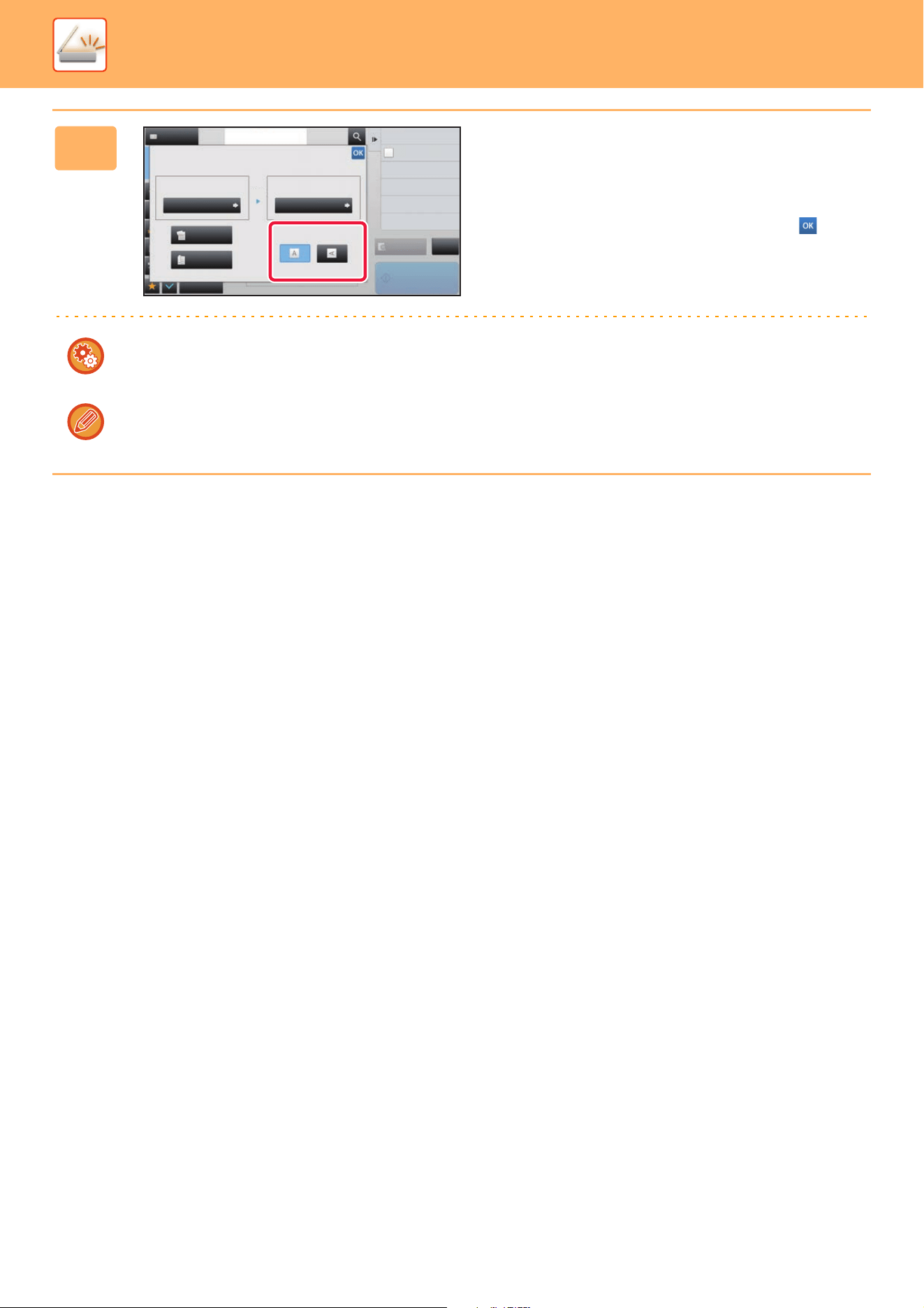
4-47
SCANNER►TRANSMITTING AN IMAGE
5
Tap the [Image Orientation] key with
the same orientation as the original
image.
If this setting is not correct, a suitable image may not be
transmitted. After the settings are completed, tap .
To configure the default setting of image orientation, select [System Settings] → [Image Send Settings] → [Common
Settings] → [Condition Settings] → [Image Orientation] in "Settings (administrator)".
The ratio used for reduction or enlargement of the original will appear between the "Scan Size" and the "Send Size".
Preview
Start
Others
Background Adjustment
Color Mode
Skip Blank Page in Original
Blank Page Skip
Scan Thin Paper Original
Slow Scan Mode
Adjust Outline of Image
Sharpness
Address
Address Book
Touch to input Address
Original
Scan Size Send Size
Image Orientation
Auto
2-Sided
Tablet
2-Sided
Booklet
Auto
100%
CA
4-48
SCANNER►TRANSMITTING AN IMAGE
CHANGING THE EXPOSURE AND ORIGINAL IMAGE TYPE
Optimum scanning is ensured by selecting exposure and original image type based on the original.
Exposure settings
How to select the original type (Scan mode, Data entry mode)
When using the document glass to scan multiple original pages, change the exposure setting each time you change pages.
When using the automatic document feeder, the exposure setting cannot be changed once scanning has begun. (If "Job
Build" is used in Others, change the exposure each time a new set of originals is inserted.)
Exposure Suggestion
Auto This setting automatically adjusts the exposure for light and dark parts of the original.
Manual 1-2 Select this setting when the original consists of dark text.
3 Select this setting for a normal original (neither dark nor light).
4-5 Select this setting when the original consists of light text.
Setup Items Description
Auto The original image type is automatically selected to match the original.
Manual
Text Use this mode for regular text documents.
Text/Printed
Photo
This mode provides the best balance for scanning an original which contains both text and
printed photographs, such as a magazine or catalogue.
Text/Photo This mode provides the best balance for scanning an original which contains both text and
photographs, such as a text document with a photo pasted on.
Printed Photo This mode is best for scanning printed photographs, such as photos in a magazine or catalogue.
Photo Use this mode to scan photos.
Map This mode is best for copying maps with light color shading and fine text.
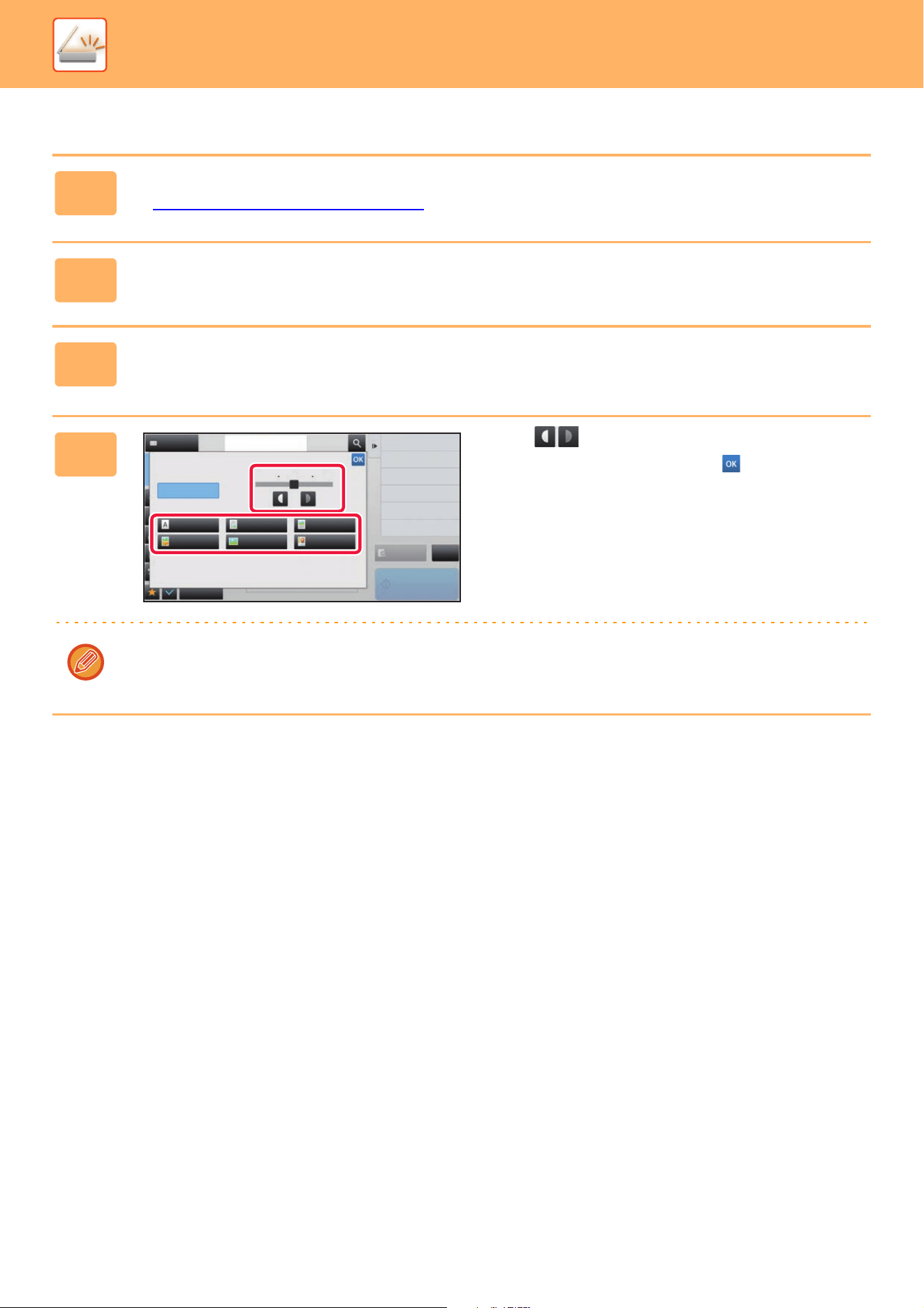
4-49
SCANNER►TRANSMITTING AN IMAGE
In Scan mode or Data entry mode
1
Tap the [Detail] key to change to normal mode.
► Changing mode from each mode (page 4-8)
2
Tap the [Exposure] key.
3
Tap the key assigned to the original type you wish to set based on the
original type.
4
Tap to adjust the exposure.
After the settings are completed, tap .
When [Auto] is selected, changing the exposure sets the original image type to [Text/Printed Photo] automatically.
Preview
Start
Others
Background Adjustment
Color Mode
Select File Format
File Format
Change Sending Resolution
Resolution
Skip Blank Page in Original
Blank Page Skip
Address
Address Book
Touch to input Address
E-mail/Exposure
Specify density of image to send.
Auto
Manual
Te xt
Text/
Prtd.Photo
Text/Photo
Printed Photo Photo Map
3 51
CA
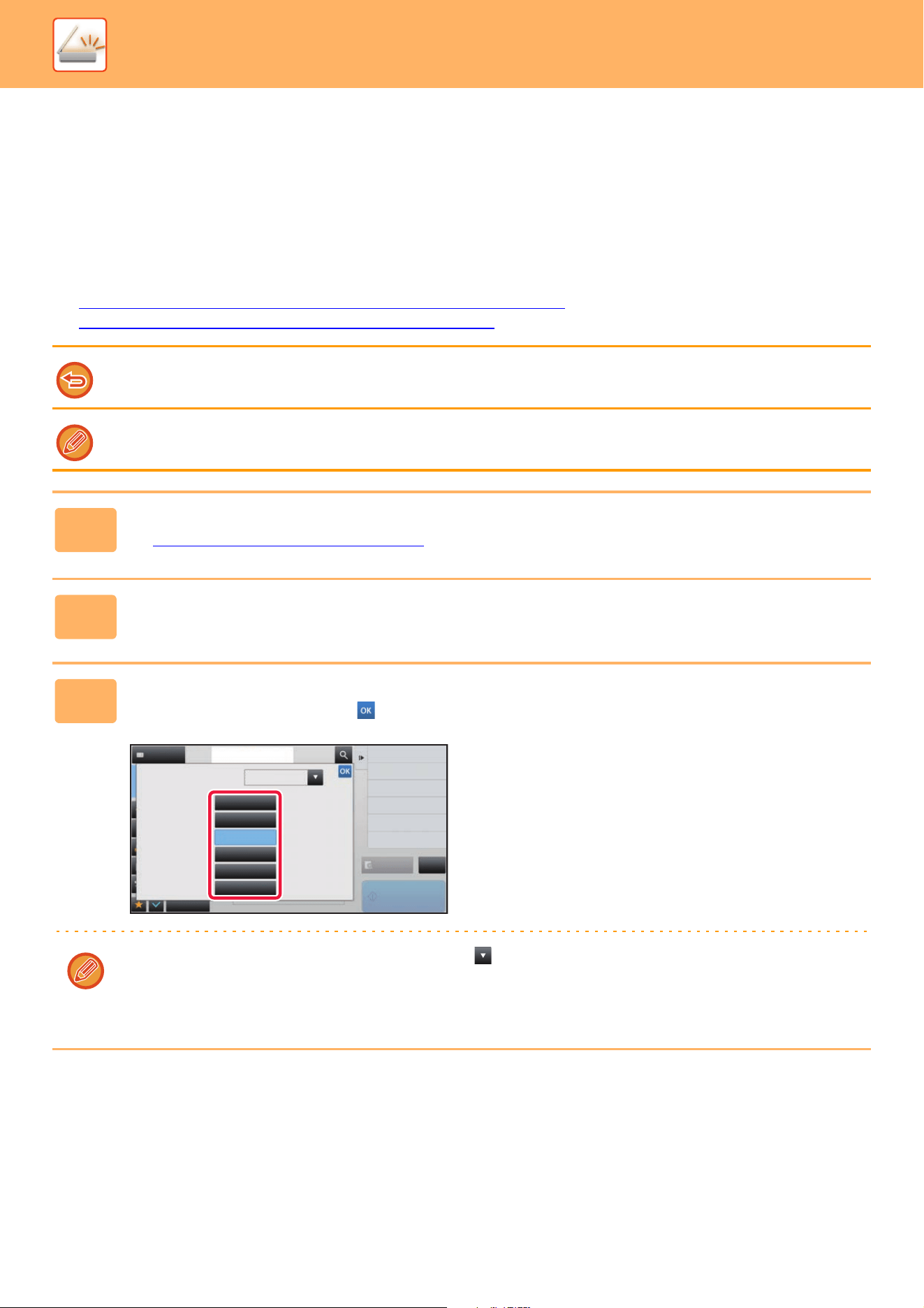
4-50
SCANNER►TRANSMITTING AN IMAGE
CHANGING THE RESOLUTION
Specify the resolution setting.
How to select the resolution
For normal text originals, 200 x 200 dpi produces an image that is sufficiently legible.
For photos and illustrations, a high resolution setting (600 x 600 dpi, etc.) will produce a sharp image.
However, a high resolution setting will result in a large file, and if the file is too large, transmission may not be possible.
In this event, reduce the number of pages scanned or take other measures to decrease the file size.
► CHANGING FORMAT IN SCAN OR DATA ENTRY MODE (page 4-51)
► SPECIFYING THE SEND SIZE OF THE IMAGE (page 4-46)
When using the automatic document feeder, the resolution setting cannot be changed after scanning has begun. (However,
when "Job Build" is used in Others, change the resolution each time a new set of originals is inserted.)
When using the document glass to scan multiple original pages, change the resolution setting each time you change pages.
1
Tap the [Detail] key to change to normal mode.
► Changing mode from each mode (page 4-8)
2
Tap the [Resolution] key.
3
Tap the key of the desired resolution.
After the settings are completed, tap .
•
If there is a mix of destinations in different modes, tap to switch modes to set the resolution in each mode.
However, FTP and Network Folder are set to the same mode.
• If you set the file format to [Compact PDF] in [Format], or the compression ratio to [Bk Letter Emphasis], the resolution
is set to [300x300dpi].
Preview
Others
Address
Address Book
Touch to input Address
Resolution
Start
100x100dpi
150x150dpi
200x200dpi
300x300dpi
400x400dpi
600x600dpi
E-mail
Color Mode
Background Adjustment
Skip Blank Page in Original
Specify density of image to send.
Exposure
Select File Format
File Format
CA
Blank Page Skip
4-51
SCANNER►TRANSMITTING AN IMAGE
CHANGING FORMAT IN SCAN OR DATA ENTRY MODE
Change the file format (file type and compression mode/compression ratio) for sending a scanned image at the time of
transmission. In addition, if the scanned originals are divided into separate files, the number of pages per file can be
changed.
File format combinations
*1 When PDF (including encrypted and compact) is selected for the file format, Flate Compression can be used to
reduce the file size.
*2
When using the compact PDF, data is always compressed by Flate Compression, regardless of whether Flate
Compression is enabled or disabled in the system settings.
The file type of [B/W] mode and the file type of [Color/Grayscale] mode are linked. The file type cannot be set separately for
each.
(When [JPEG] is selected for [Color/Grayscale] mode, [TIFF] is automatically selected for [B/W] mode.)
[Color/Grayscale] tab [B/W] tab
PDF
*1
PDF
*1
Compact PDF
*1, 2
PDF
*1
Compact PDF (Ultra Fine)
*1, 2
PDF
*1
PDF/A-1a
*1
PDF/A-1a
*1
PDF/A-1b
*1
PDF/A-1b
*1
Compact PDF/A-1a
*1, 2
PDF/A-1a
*1
Compact PDF/A-1b
*1, 2
PDF/A-1b
*1
Compact PDF/A-1a (Ultra Fine)
*1, 2
PDF/A-1a
*1
Compact PDF/A-1b (Ultra Fine)
*1, 2
PDF/A-1b
*1
Encrypt PDF
*1
Encrypt PDF
*1
Encrypt/Compact PDF
*1, 2
Encrypt PDF
*1
Encrypt/Compact PDF (Ultra Fine)
*1, 2
Encrypt PDF
*1
TIFF TIFF
JPEG TIFF
XPS XPS
TXT(UTF-8) TXT(UTF-8)
RTF RTF
DOCX DOCX
XLSX XLSX
PPTX PPTX
4-52
SCANNER►TRANSMITTING AN IMAGE
Flate Compression
After compressing a PDF file by JPEG compression, this function compresses the file by lossless compression to further
reduce the file size by a small amount. When the data contains significant solid color, this increases the effectiveness of
compression.
When sending a PDF file, Flate Compression enables greater reduction of the file size than conventional methods.
If the recipient's PDF viewer does not support Flate Compression, the recipient may not be able to view the PDF file. In
this case, Flate Compression can be disabled.
• The file format for sending a scanned image is specified when the destination is stored in a one-touch key; however, you
can change the format at the time of transmission.
• If [PDF/Encry.] is specified for the file format, the password entry screen appears when scanning. Enter a password with
up to 32 characters.
Note the following when [Compact] is specified in the [Color/Grayscale] file format.
• When broadcasting to an address with [Compact] specified, all files for the scanner will be sent as Compact PDF files.
• When broadcasting to an address with [Compact] and [PDF/Compact/U-Fine] specified, all files for the scanner will be sent
as Compact PDF (Ultra Fine) files.
•
If [Compact/PDF] is specified, the resolution cannot be changed in the scanner mode. The resolution is set to 300 x 300 dpi.
• If [Compact] is set when a resolution setting has been specified in scanner (or other) mode, the resolution setting will be
canceled and the Compact PDF resolution will be used for transmission.
• When [Compact] is selected, [Resolution] cannot be changed while waiting for the next original or in [Change Setting] in
the job build settings.
•
If [Compact] is set when an original type setting has been specified in scanner (or other) mode, [Photo] will change to
[Text/Photo] and [Map] will change to [Text/Printed Photo].
•
The condition of the original may prevent the OCR function from correctly recognizing some characters and graphics, and
omissions or incorrect recognition of characters may result.
•
The OCR function is not guaranteed to completely reproduce all characters, graphics, or other contents of a scanned original.
•
When a PDF file that was scanned and saved using the OCR function is opened, a link may be automatically in added in some
applications. If some characters were not correctly recognized due to the condition of the original, the link may not be correct.
To enable Flate Compression
Enable or disable Flate Compression in [System Settings] → [Image Send Settings] → [Scan Settings] → [Condition
Settings] → [PDF Compression Options] in "Settings (administrator)".
1
Tap the [File Format] key.
If you are in data input mode, start from step 5.
2
Tap the [Color/Grayscale] or [B/W] key.
• The format setting for [B/W] mode is the file format with the [B/W Start] key is tapped.
• The format setting for [Color/Grayscale] mode is the file format with the [Color Start] key is tapped.
4-53
SCANNER►TRANSMITTING AN IMAGE
3
Tap the key of the desired file type.
After the settings are completed, tap .
When the [B/W] key is selected When the [Color/Grayscale] key is selected
4
To enable OCR, select the [OCR] checkbox ( ) and tap [OCR Setting].
After the settings are completed, tap ( ).
• When "Long Size" is selected for the original, [OCR] cannot be used.
• Select the scanning language in the language settings. The following languages can be selected.
Japanese, English, Spanish, French, German, Italian, Dutch, Swedish, Norwegian, Finnish, Danish, Hungarian,
Czech, Polish, Russian, Greek, Portuguese, Turkish, Slovak, Catalan, Chinese, Traditional Chinese, Korean.
• When [RTF], [DOCX], [XLSX], or [PPTX] is selected for the file format, you can set the font of the output text.
• When the [Detect Image Direction] checkbox is selected ( ), the orientation of the original is detected and the
image is rotated before transmission.
• When the [File Name Auto Extraction] checkbox is selected ( ), the text string that is read from the file is included in
the file name. If a file name is set, the set file name will be used for transmission.
• You can set the accuracy of OCR in [OCR Accuracy]. Select from [Auto] or [Priority Text]. When [Priority Text] is
selected, the character reading accuracy is raised before scanning. When [Priority Text] is selected, accuracy in
diagram and table areas may be degraded. Only change the setting when you particularly want to increase the
accuracy of text areas.
5
To select more detailed settings, tap the [Detail] key to switch to normal mode.
► Changing mode from each mode (page 4-8)
CA
Preview Auto Set
B/W
Start
Color
Start
B/W
Prog.
PDF/A-1bPDF/A-1a
PPTXXLSX
XPS
PDF
DOCX
TXT(UTF-8)RTF
TIFF
File Format
CA
Preview Auto Set
B/W
Start
Color
Start
Color/
Grayscale
Prog.
PDF/A-1bPDF/A-1a
PPTXXLSX
XPS
PDF
DOCX
TXT(UTF-8)RTF
TIFF JPEG
File Format
English
Auto
Format
Language:
Font: OCR Accuracy:
Detect Image
Direction
File Name Auto Extraction
CA
Preview
B/W
Start Start
Auto Set
Color
4-54
SCANNER►TRANSMITTING AN IMAGE
6
Tap the [File Format] key.
7
Tap the [Color/Grayscale] or [B/W] tab and select the format mode for
scanning.
• The format setting for [B/W] mode is the file format with the color mode set to [Mono2].
• The format setting for [Color/Grayscale] mode is the file format with the color mode set to [Full Color] or [Grayscale].
8
Tap the key of the desired file type.
When the [B/W] key is selected When the [Color/Grayscale] key is selected
When [Color/Grayscale] mode is selected, the [Compact] and [U-Fine] checkboxes appear. To suppress image quality
deterioration and reduce the data size of a file to be transmitted, select Compact PDF. Select [U-Fine] only when you
select Compact PDF.
9
Tap the [Compression Mode] key or [Compression Ratio] key.
Start
Preview
Address
Address Book
Touch to input Address
Color/Grayscale B/W
Programmed
Compression Mode
MMR (G4)
TIFF XPS
PDF PDF/A-1b
Encry.
Specified Pages per File
Processing time is dependent
on the format.
File Format
E-mail
1
Color Mode
Background Adjustment
Skip Blank Page in Original
Blank Page Skip
Specify density of image to send.
Exposure
Change Sending Resolution
Resolution
Others
CA
PDF/A-1a
TXT(UTF-8)
RTF
XLSXDOCX PPTX
OCR
OCR Setting
Start
JPEG
Compact
U-Fine
Preview
Address
Address Book
Touch to input Address
Color/Grayscale B/W
Programmed
Compression Ratio
Middle
TIFF XPS
PDF PDF/A-1b
Encry.
OCR
Specified Pages per File
Processing time is dependent
on the format.
File Format
E-mail
1
Color Mode
Background Adjustment
Skip Blank Page in Original
Blank Page Skip
Specify density of image to send.
Exposure
Change Sending Resolution
Resolution
Others
CA
PDF/A-1a
TXT(UTF-8)
RTF
XLSXDOCX PPTX
OCR Setting
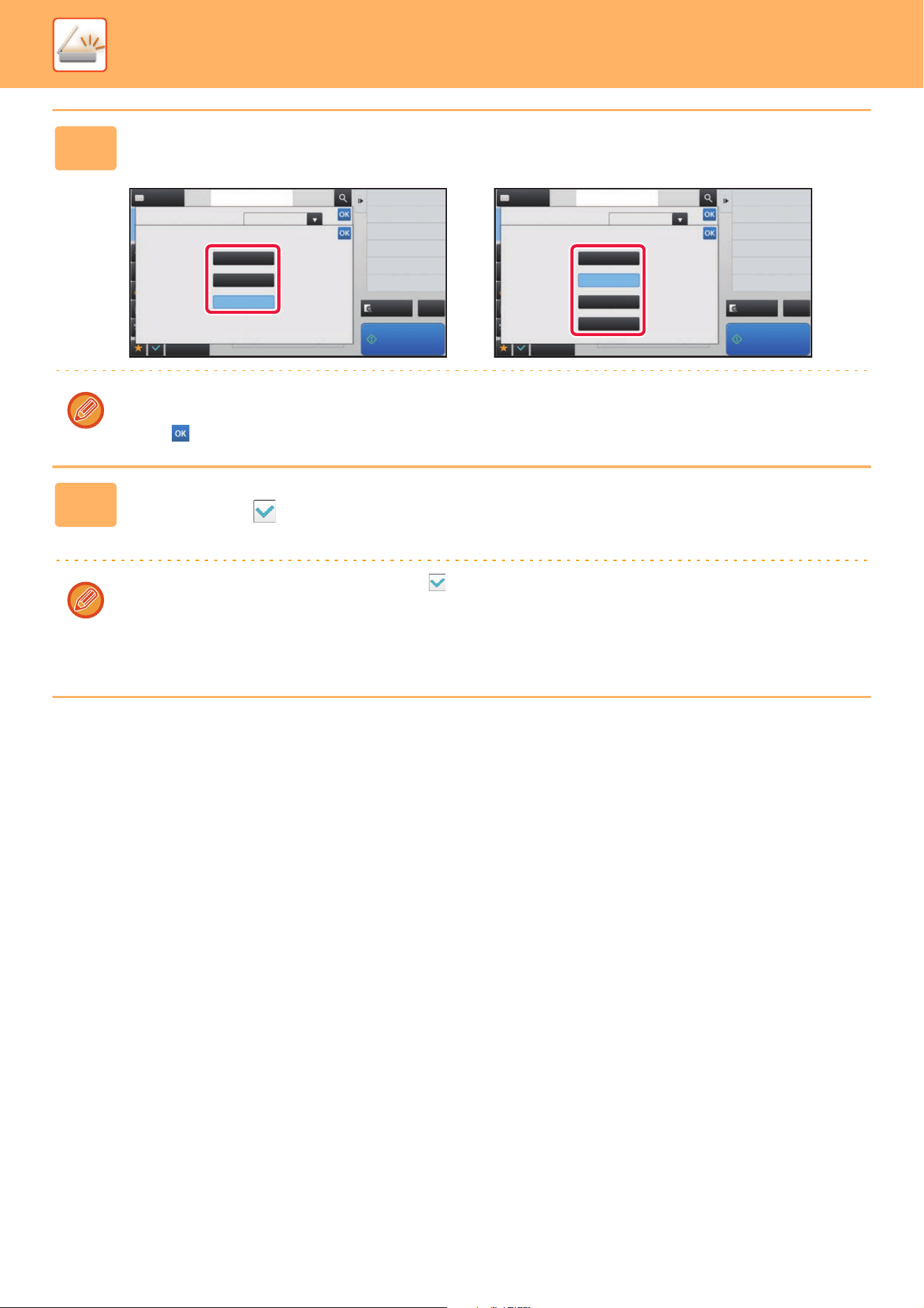
4-55
SCANNER►TRANSMITTING AN IMAGE
10
Tap the Compression key or Compression Ratio key.
When the [B/W] key is selected When the [Color/Grayscale] key is selected
• [Bk Letter Emphasis] in the [Color/Grayscale] tab is a file format that reduces the data size while suppressing
deterioration of black text.
• Tap when you have completed the settings.
11
To change the number of pages per file, set the [Specified Pages per File]
checkbox to , and use numeric keys to specify the number of pages per
file.
•
When the [Specified Pages per File] checkbox is , one file is created for each of the number of pages at the right. When
the checkmark is removed, one file is created for all pages.
• When [Specified Pages per File] is selected, consecutive numbers are added to the created file names.
•
When [JPEG] is selected for the file type, one file is created for each page. For this reason, the [Specified Pages per
File] checkbox does not appear.
Start
Processing time is dependent
on the format.
Preview
Color Mode
Address
Address Book
Touch to input Address
File Format
E-mail
MMR (G4)
MH (G3)
None
Compression Mode
Others
Background Adjustment
Skip Blank Page in Original
Blank Page Skip
Specify Send Exposure
Exposure
Change Sending Resolution
Resolution
CA
Start
Processing time is dependent
on the format.
Preview
Color Mode
Address
Address Book
Touch to input Address
File Format
Compression Ratio
E-mail
Bk Letter Emphasis
High
Middle
Low
Others
Background Adjustment
Skip Blank Page in Original
Blank Page Skip
Specify Send Exposure
Exposure
Change Sending Resolution
Resolution
CA
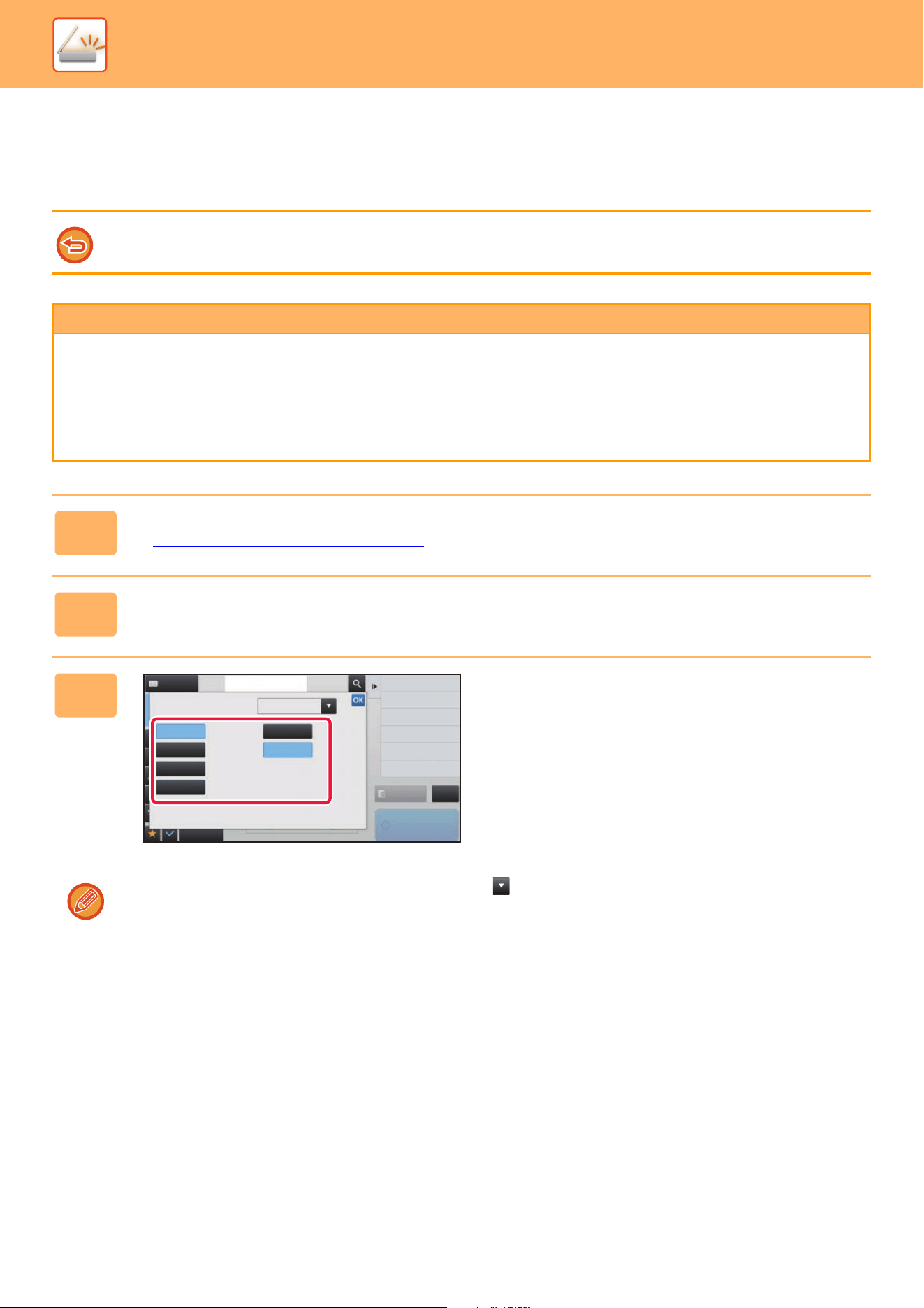
4-56
SCANNER►TRANSMITTING AN IMAGE
CHANGING COLOR MODE
Change the color mode used to scan the original.
In Easy mode
Tap the [B/W Start] or [Color Start] key when scanning the original.
In Normal mode
To set the settings used when each key is tapped, select "Settings (Web version)" - [System Settings]→ [Image Send
Settings] → [Scan Settings] → [Initial Status Settings] → [Easy Scan Settings].
Mode Scanning method
Auto The machine detects whether the original is color or black and white and automatically selects full color or
black and white (Mono2 or Grayscale) scanning.
Full Color The original is scanned in full color. This mode is best for full color originals such as catalogues.
Mono2 Colors in the original are scanned as black or white. This mode is best for text-only originals.
Grayscale The colors in the original are scanned in black and white as shades of gray (grayscale).
1
Tap the [Detail] key to switch to the normal mode.
► Changing mode from each mode (page 4-8)
2
Tap the [Color Mode] key.
3
Tap the key of the desired color mode
for the original.
If there is a mix of destinations in different send modes, tap to select a send mode (E-mail, FTP or Data Entry) to set
the color mode for each mode.
Address
Address Book
Touch to input Address
Color Mode
E-mail
Select B/W Mode
at Color Auto Select
Change Sending Resolution
Resolution
Others
Preview
Start
Erase Shadow Around
Erase
Skip Blank Page in Original
Blank Page Skip
Select File Format
File Format
Auto
Full Color
Grayscale
Mono2
Grayscale
Mono2
CA
4-57
SCANNER►TRANSMITTING AN IMAGE
4
Tap the [Grayscale] or [Mono2] key to set the B/W mode for automatic color
selection.
Specify whether Mono2 or grayscale is used when scanning black and white originals. Note that if the file format is set to
JPEG, scanning will take place in grayscale.
After the settings are completed, tap .
The B/W mode can be set only when the [Auto] key is selected in the color mode setting (step 3).
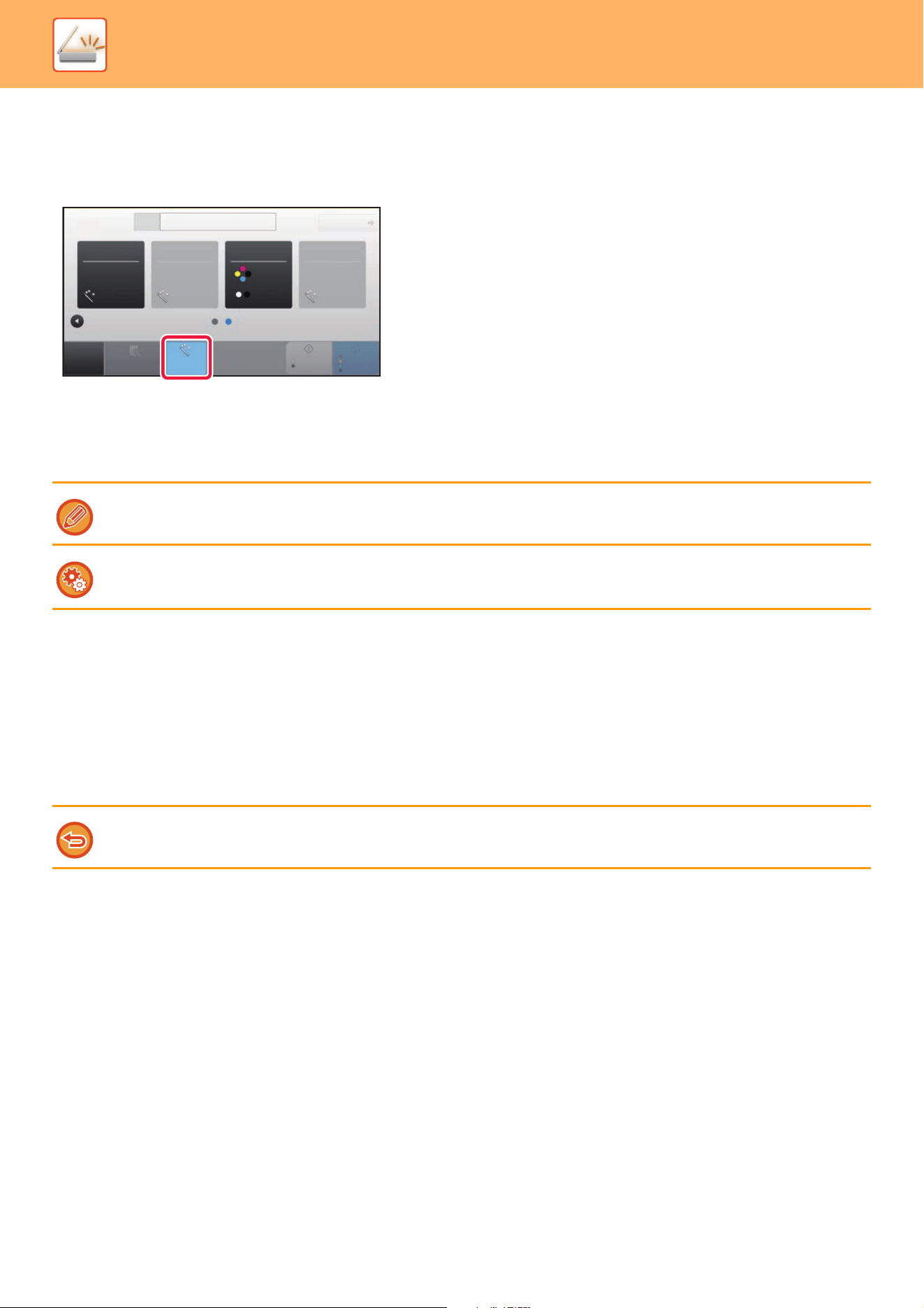
4-58
SCANNER►TRANSMITTING AN IMAGE
SETTING SCAN SETTINGS AUTOMATICALLY
(Auto Set)
To automatically set scan settings appropriate for the original, tap the [Auto Set] key in the base screen of Easy Mode.
The following functions are set automatically.
• Image Orientation
• Resolution
• Blank Page Skip
Each function setting value/parameter can be changed in setting mode.
CHECKING THE IMAGE TO BE
TRANSMITTED
Check the image that will be sent in the touch panel before transmission.
You can tap the [Preview] key to check a preview of the image before sending an image. As you can adjust the exposure
and resolution to scan the original while checking it in the preview screen, you can send a better quality original to the
destination.
When "Auto Set" is enabled, grayed out functions cannot be enabled.
To change the "Auto Set" setting, use "Settings (administrator)" - [System Settings] → [Image Send Settings] →
[Scan Settings] → [Condition Settings] → [Auto Scan Setting].
•
Depending on the size of the transmission data, part of the preview image may not appear in the preview screen in the touch panel.
• The preview function is not available when the original size is set to Long Size.
CA
Preview
Original
Address E-mail Address
Detail
Start
Color
Start
Original
2-Sided Auto
PDF
PDF
Auto
Resolution File Format
Blank Page
Skip
Auto Set
B/W
8½x11
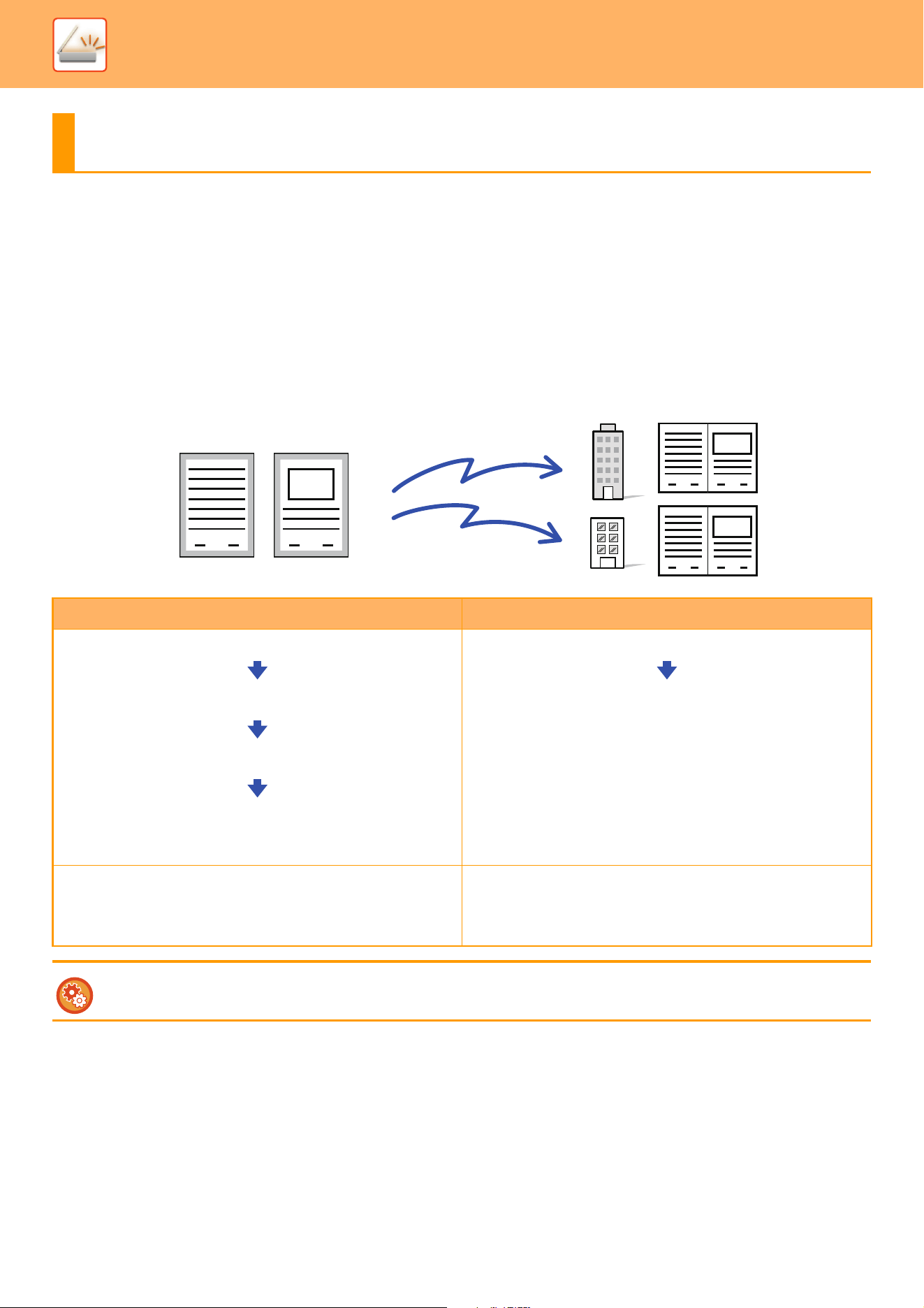
4-59
SCANNER►OTHER FUNCTIONS
STORING SCAN OPERATIONS (PROGRAM)
This function collectively stores various settings as one program. The stored program can be retrieved using an easy
operation.
For example, suppose 8-1/2" x 11" (A4) size documents are scanned into a file and sent to each branch office once a
month.
• The same documents are sent to each branch office
• Each page of a bound document is successively transmitted
• Smudges on the edges of the documents are erased before transmission
OTHER FUNCTIONS
When a job program is not stored When a job program is stored
Enter the address of each branch office. Tap the key of a stored program.
Select Dual Page Scan. Tap the [Start] key.
Scan and send the original.
Specify Erase.
Tap the [Start] key.
Scan and send the original.
Considerable time is required to send the documents each
month because the above settings must be selected.
In addition, mistakes are occasionally made when selecting
the settings.
When a program is stored, settings are selected with ease by
simply tapping the key of the program. In addition,
transmission takes place based on the stored settings so there
are no chances for mistakes.
To configure a program:
Tap [Program Registration - Register Current Settings] on the action panel that appears when you operate any mode
screens.
1 2
1 2
1 2
A4 (8-1/2" x 11") size documents to
be distributed
Received data by recipients.
4-60
SCANNER►OTHER FUNCTIONS
• The settings stored in a program will be retained even after the program is used for transmission. The same settings can
be used repeatedly for transmission.
• The following contents cannot be stored in programs:
• Tapping of the [Speaker] key
• Quick File
•File
• Page changes and unspecified erases during preview
• Metadata Settings
• Send Settings
• Own Name
• Sign E-mail
• Encrypt E-mail
• Up to 48 programs can be stored.
• Up to 500 destinations can be stored in one program.
•
A program in which sub addresses and passcodes are specified as an F-code destination records all sub addresses and
passcodes.
This function cannot be used in data entry mode.
1
Tap the [Detail] key to switch to the normal mode.
► Changing mode from each mode (page 4-8)
2
Place the original and tap [Call Program] on the action panel.
According to the function stored in the program, place the original in the document feeder tray of the automatic
document feeder, or on the document glass.
► AUTOMATIC DOCUMENT FEEDER (page 1-90)
► DOCUMENT GLASS (page 1-92)
3
Tap the desired program key.
4
Configure additional settings if needed.
Some settings cannot be added depending on the contents of the called program.
Address
Address Book
Touch to input Address
Call Program
Registered setting is called when touched.
Pre-Setting Program
Program 1
03
05
07
09
03
01
05
07
09
02
04
06
08
10
02
04
06
08
10
Others
Preview
Start
Change Name
Delete
Register in Favorite
Register for Home
CA
4-61
SCANNER►OTHER FUNCTIONS
5
Tap the [Start] key to start scanning of the original.
• A beep will sound to indicate that scanning and transmission have ended.
• When you place the original on the document glass, scan each page one at a time.
When scanning finishes, place the next original and tap the [Start] key.
Repeat until all pages have been scanned and then tap the [Read-End] key.
You can tap the [Preview] key to check a preview of the image before sending an image. For more information, see
"CHECKING THE IMAGE TO BE TRANSMITTED (page 4-58)
".
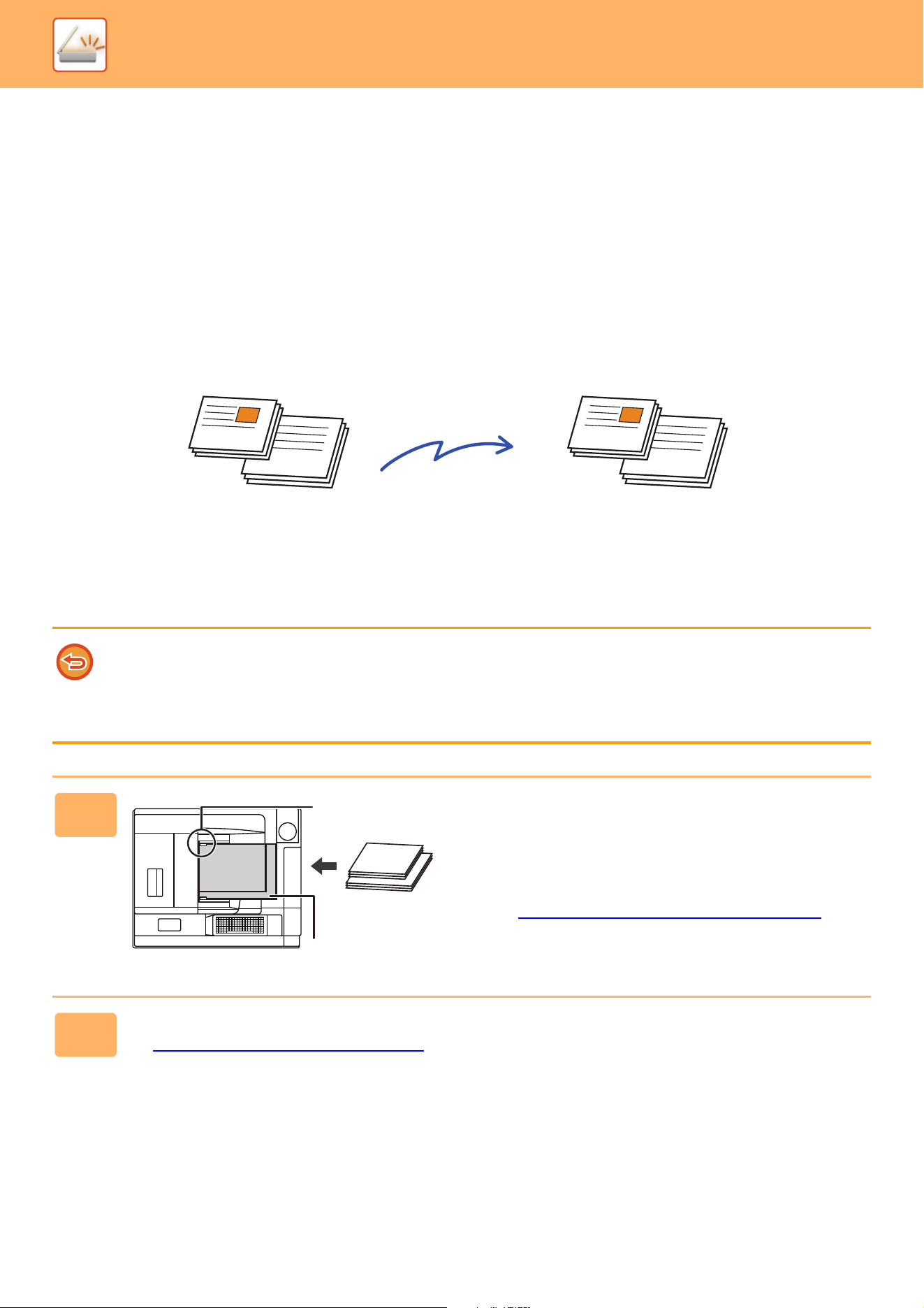
4-62
SCANNER►OTHER FUNCTIONS
SCANNING AND SENDING ORIGINALS
COLLECTIVELY
SCANNING ORIGINALS OF DIFFERENT SIZES
(MIXED SIZE ORIGINAL)
Scan originals of different sizes at the same time; for example, when 8-1/2" x 14" (B4) size originals are mixed together
with 11" x 17" (A3) size originals.
When scanning the originals, the machine automatically detects the size of each original.
This function can only be used with the combinations of original sizes as shown below.
• 11" x 17" and 8-1/2" x 14", 11" x 17" and 8-1/2" x 13", and 11" x 17" and 5-1/2" x 8-1/2"
• A3 and B4, A3 and B5, B4 and A4, and A4 and B5
• A4R and B5, B4 and A4R, B4 and A5, and B5 and A5
• When Mixed Size Original is selected, an original scan size cannot be specified.
• After the original scan size has been selected, Mixed Size Original cannot be specified.
• Rotate cannot be used when Mixed Size Original is enabled.
• This function is not available if [System Settings] → [Common Settings] → [Device Control] → [Original Size Detector
Setting] is set to "AB-3" in "Settings (administrator)".
1
Place the original in the document
feeder tray of the automatic document
feeder.
Insert the originals with the corners aligned together in the
far left corner of the document feeder tray.
► AUTOMATIC DOCUMENT FEEDER (page 1-90)
2
Tap the mode display to switch to the initial screen of each mode.
► Changing mode from each mode (page 4-8)
11" x 17"(A3)
8-1/2" x 14"(B4)
11" x 17"(A3)
8-1/2" x 14"(B4)
11" x 17"(A3)
8-1/2" x 14"(B4)
Place the originals with the
corners aligned together in
the far left corner.
11" x 17"(A3)
8-1/2" x 14"
(B4)
4-63
SCANNER►OTHER FUNCTIONS
3
Specify the destination.
► RETRIEVING A DESTINATION FROM AN ADDRESS BOOK (page 4-14)
► VIEWING A LIST OF THE SELECTED DESTINATIONS (page 4-17)
► USING A SEARCH NUMBER TO RETRIEVE A DESTINATION (page 4-18)
► ENTERING AN ADDRESS MANUALLY (page 4-19)
► SPECIFYING A NETWORK FOLDER (page 4-20)
► RETRIEVING A DESTINATION FROM A GLOBAL ADDRESS BOOK (page 4-21)
► USING A TRANSMISSION LOG TO RESEND (page 4-23)
4
Tap the [Mixed Size Original] key. Otherwise, tap the [Others] key, and tap the
[Mixed Size Original] key.
A checkmark appears on the icon.
After the settings are completed, tap .
For mixed size originals, set "Original" to "Auto".
To cancel the mixed size original setting
Tap the [Mixed Size Original] key to uncheck it.
5
Tap the [Start] key to start scanning of the original.
A beep will sound to indicate that scanning and transmission have ended.
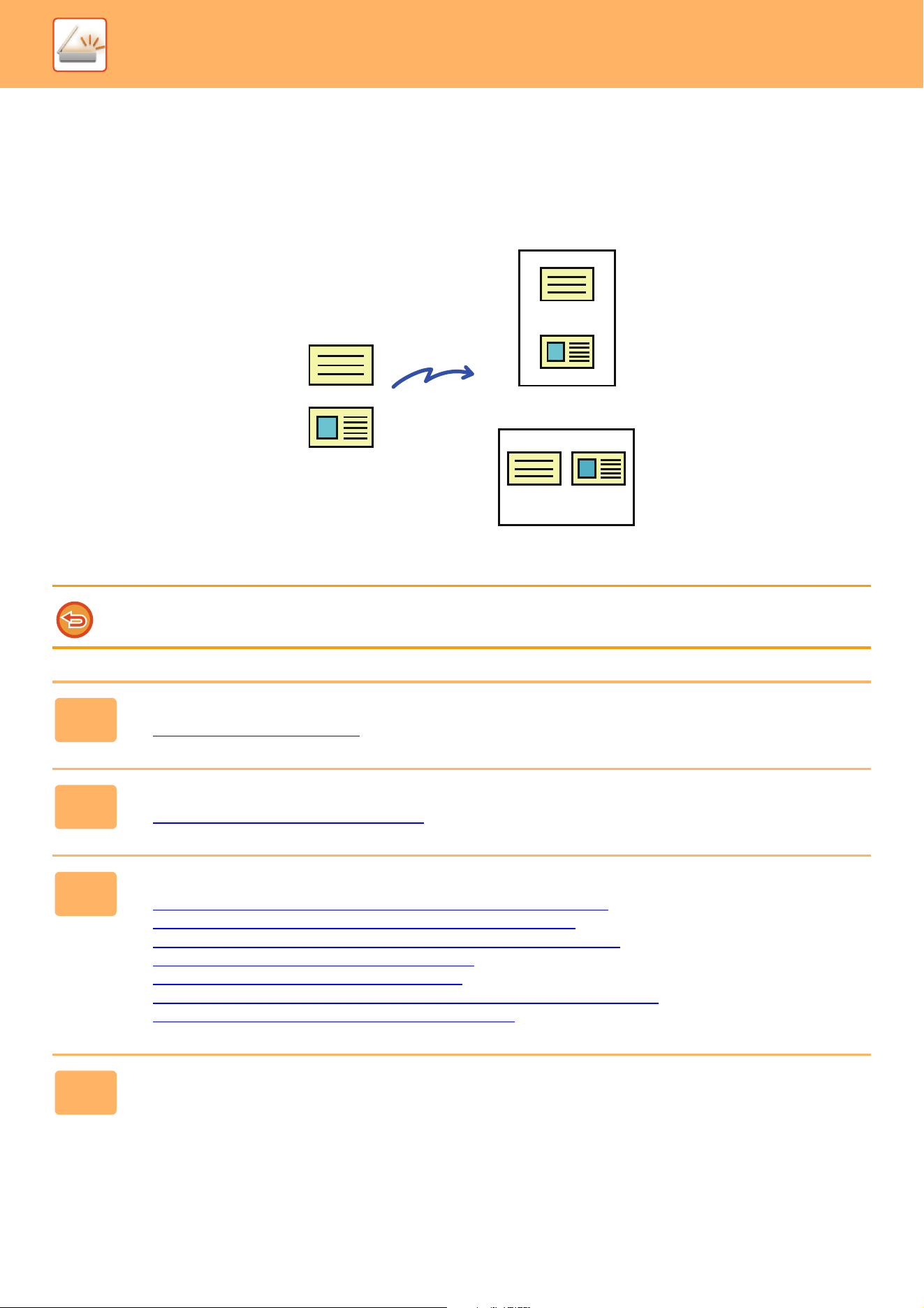
4-64
SCANNER►OTHER FUNCTIONS
SCANNING BOTH SIDES OF A CARD ONTO A SINGLE
PAGE (CARD SHOT)
Send the front and reverse sides of a card as a single page, without the need to send each side separately.
• If the scan size is larger than the send size, it will result in a sending failure.
• The ratio cannot be specified and "Rotation Sending Setting" cannot be selected.
1
Place a card face down on the document glass.
► DOCUMENT GLASS (page 1-92)
2
Tap the mode display to switch to the initial screen of each mode.
► Changing mode from each mode (page 4-8)
3
Specify the destination.
► RETRIEVING A DESTINATION FROM AN ADDRESS BOOK (page 4-14)
► VIEWING A LIST OF THE SELECTED DESTINATIONS (page 4-17)
► USING A SEARCH NUMBER TO RETRIEVE A DESTINATION (page 4-18)
► ENTERING AN ADDRESS MANUALLY (page 4-19)
► SPECIFYING A NETWORK FOLDER (page 4-20)
► RETRIEVING A DESTINATION FROM A GLOBAL ADDRESS BOOK (page 4-21)
► USING A TRANSMISSION LOG TO RESEND (page 4-23)
4
Tap the [Others] key, and tap the [Card Shot] key.
Originals
Transmission
Front
Back
Transmitted image
Example of an 8-1/2" x 11" (A4)
size portrait scan transmission
Example of an 8-1/2" x 11" (A4)
size landscape scan transmission
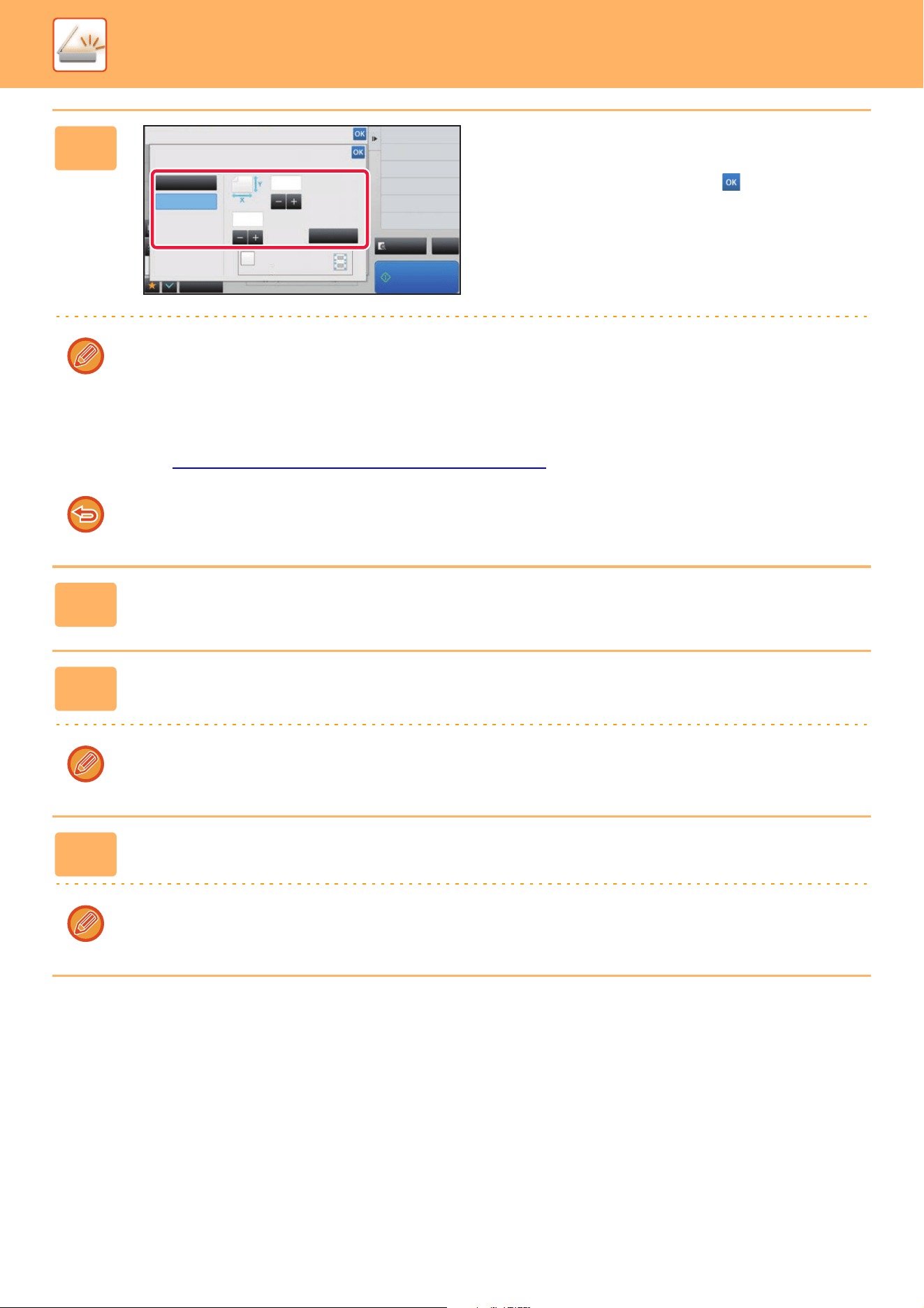
4-65
SCANNER►OTHER FUNCTIONS
5
Tap the [On] key, and specify the
original size as required.
After the settings are completed, tap twice.
• Tap the areas displaying width and height sizes respectively, and enter the sizes using the numeric keys.
• To quickly set the size, first specify a value close to the desired ratio value by the numeric keys, then tap [-] or [+] for
adjustment.
• To enlarge or reduce the images to fit the paper based on the entered original size, tap the [Fit to Send Size] key.
• After selecting Card Shot, tap the [Original] key in the base screen to change the original scan size or the send size. In
this case, the screen of this step appears when you tap the scan size key. For the procedure for setting the send size,
see "SPECIFYING THE SEND SIZE OF THE IMAGE (page 4-46)
".
To cancel the Card Shot settings
Tap the [Off] key.
6
Tap the [Start] key, and scan the front side.
7
Place a card face up on the document glass, and tap the [Start] key to scan
the reverse side.
Before scanning the back of the card, tap the [Change Setting] key on the touch panel to change the exposure.
8
Tap the [Read-End] key.
If you will continue by scanning the front of the card, you can tap the [Change Setting] key to change the exposure,
resolution, scan size, and send size.
Preview
Start
Others
Card Shot
Off
On
Drop Out Color
Color Mode
Adjust Contrast of Image
Contrast
Back
Adjust Outline of Image
Sharpness
Remove Chromatic Color
Background Adjustment
Reset
Fit to Send Size
Size
Y
:
X
CA
( 1~8 1/2 )
inch
( 1~8 1/2 )
inch
2 1/8
3 3/8
8½x11
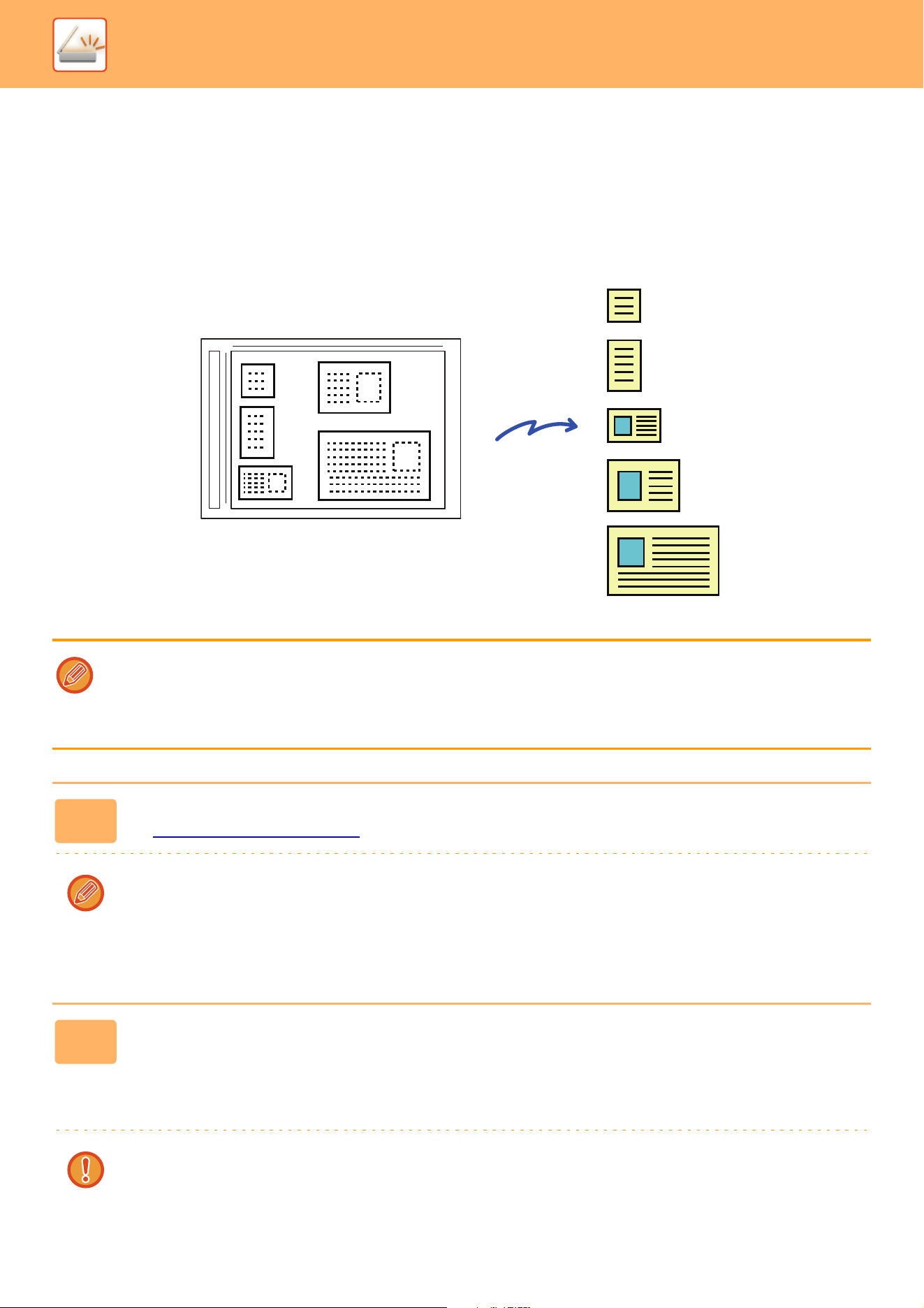
4-66
SCANNER►OTHER FUNCTIONS
SIMULTANEOUSLY SCANNING MULTIPLE CARDS,
RECEIPTS OR OTHER SMALL ORIGINALS TO
INDIVIDUAL FILES (MULTICROP)
This function automatically crops and scans multiple cards, receipts, or other small originals placed on the document
glass to individual files.
• This function can be used with Scan to E-mail, Scan to FTP, Scan to Network Folder, and Save to External Memory
Device.
• The e-mail will be sent without being divided if System Settings - [
Image Send Settings
]→[
Scan Settings
]→[Condition
Settings]→[If the E-mail attachment(s) exceed maximum size, it will be sent in multiple files.] is enabled and [Maximum
Size of E-mail Attachments(E-Mail)] is set. If the transmitted e-mail exceeds the limit, a send error occurs.
1
Place the multiple originals that you want to scan on the document glass.
► DOCUMENT GLASS (page 1-92)
Cautions when placing the originals
• Up to 50 originals can be placed at once.
• Separate the originals by at least 5 mm.
• Available originals sizes are 40 to 297 mm in height and 40 to 432 mm in width.
• If the shape of an original is not square or rectangular, the original may not be cropped correctly.
2
Keep the auto document feeder open, not closed.
If you scan the originals with the auto document feeder closed, it will not be possible to detect the outlines of the originals
and scanning will fail. Always use this function with the auto document feeder open. If a light source such as an electric
light shines onto the originals during scanning, cropping may not be successful. Adjust the angle of the automatic
document feeder so that the light source does not affect the image.
Do not look directly at the light during scanning.
4-67
SCANNER►OTHER FUNCTIONS
3
Tap the mode display and change to the base screen of the desired mode.
► Changing mode from each mode (page 4-8)
4
Specify the destination.
► RETRIEVING A DESTINATION FROM AN ADDRESS BOOK (page 4-14)
► VIEWING A LIST OF THE SELECTED DESTINATIONS (page 4-17)
► USING A SEARCH NUMBER TO RETRIEVE A DESTINATION (page 4-18)
► ENTERING AN ADDRESS MANUALLY (page 4-19)
► SPECIFYING A NETWORK FOLDER (page 4-20)
► RETRIEVING A DESTINATION FROM A GLOBAL ADDRESS BOOK (page 4-21)
► USING A TRANSMISSION LOG TO RESEND (page 4-23)
5
Tap the [Others] key, and tap the [Multicrop] key.
A checkmark appears on the icon. When you have completed the setting, tap .
When original count is enabled, the number of scanned originals will appear during scanning.
To cancel the multicrop setting
Tap the [Multicrop] key to remove the checkmark.
6
Tap the [Start] key to start scanning the originals.
When scanning is completed, place the next originals and tap the [Start] key.
Repeat the above step until you have scanned all originals, and then tap the [Read-End] key.
When transmission is completed, a beep sounds.
• Restrictions when multicrop is enabled
The following restrictions apply when multicrop is enabled. Restricted items may change automatically in some cases.
• Resolution: 600 x 600 dpi cannot be used.
• Scan size / send size: Only auto can be used.
• Two-sided original: Only one-sided original is enabled.
• Image Orientation: Cannot be used. (Each cropped original is corrected to the orientation that is least skewed.)
• Format: Compact and ultra-fine cannot be used.
• Compression / compression format: Black text emphasis cannot be used.
• One file per page: Cannot be set when the checkmark is enabled and the number is "1".
• The following functions cannot be used at the same time as multicrop.
Job Build, Slow Scan Mode, Mixed Size Original, Erase, Dual Page Scan, Book Divide, Card Shot, Verif. Stamp,
Blank Page Skip, File, Quick File, Preview, Business Card Scan
• When the Multicrop setting is canceled, the following items retain the setting changes that occurred when Multicrop
was enabled.
Resolution, Scan Size, Send Size, 2-Sided Original, File Type, OCR, Compression Mode/Compression Ratio,
Specified Pages per File
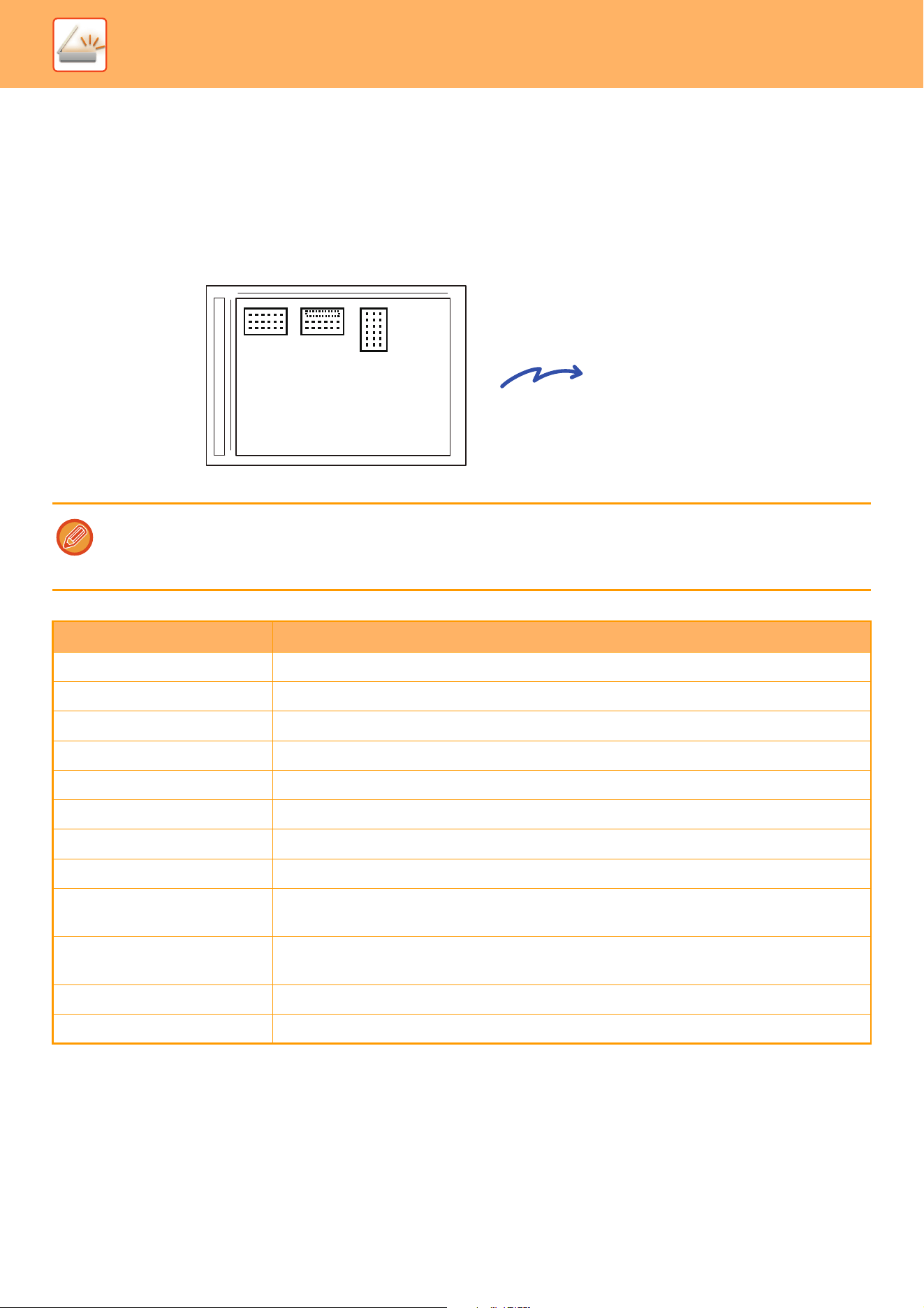
4-68
SCANNER►OTHER FUNCTIONS
SCANNING A BUSINESS CARD, READING THE TEXT
STRING, CREATING A FILE, AND SENDING THE FILE
(BUSINESS CARD SCAN)
You can scan a business card, extract the name and telephone number from the text string read by OCR, and create
and send a vCard or other file.
For the information that can be extracted and output from a scanned business card, refer to the table below.
This function can be used with Scan to E-mail, Scan to FTP, Scan to Network Folder, and Save to External Memory Device.
The e-mail will be sent without being divided if System Settings - [
Image Send Settings
]→[
Scan Settings
]→[Condition
Settings]→[If the E-mail attachment(s) exceed maximum size, it will be sent in multiple files.] is enabled and [Maximum Size
of E-mail Attachments(E-Mail)] is set. If the transmitted e-mail exceeds the limit, a send error occurs.
Item Description
Name The name is extracted.
Kana When the language is set to Japanese, you can convert the name to kana.
Pinyin When the language is set to Chinese, you can convert the name to pinyin.
Postal code The postal code is extracted.
Address The address is extracted.
Company/group name The company/organization name is extracted.
Department The department is extracted.
Job title The position is extracted.
Telephone number
The telephone number is extracted.
Up to five.
URL
The URL is extracted.
Up to five.
E-mail address The E-mail address is extracted.
Other Other is used if none of the above apply.
Send
vCard file
or
CSV file
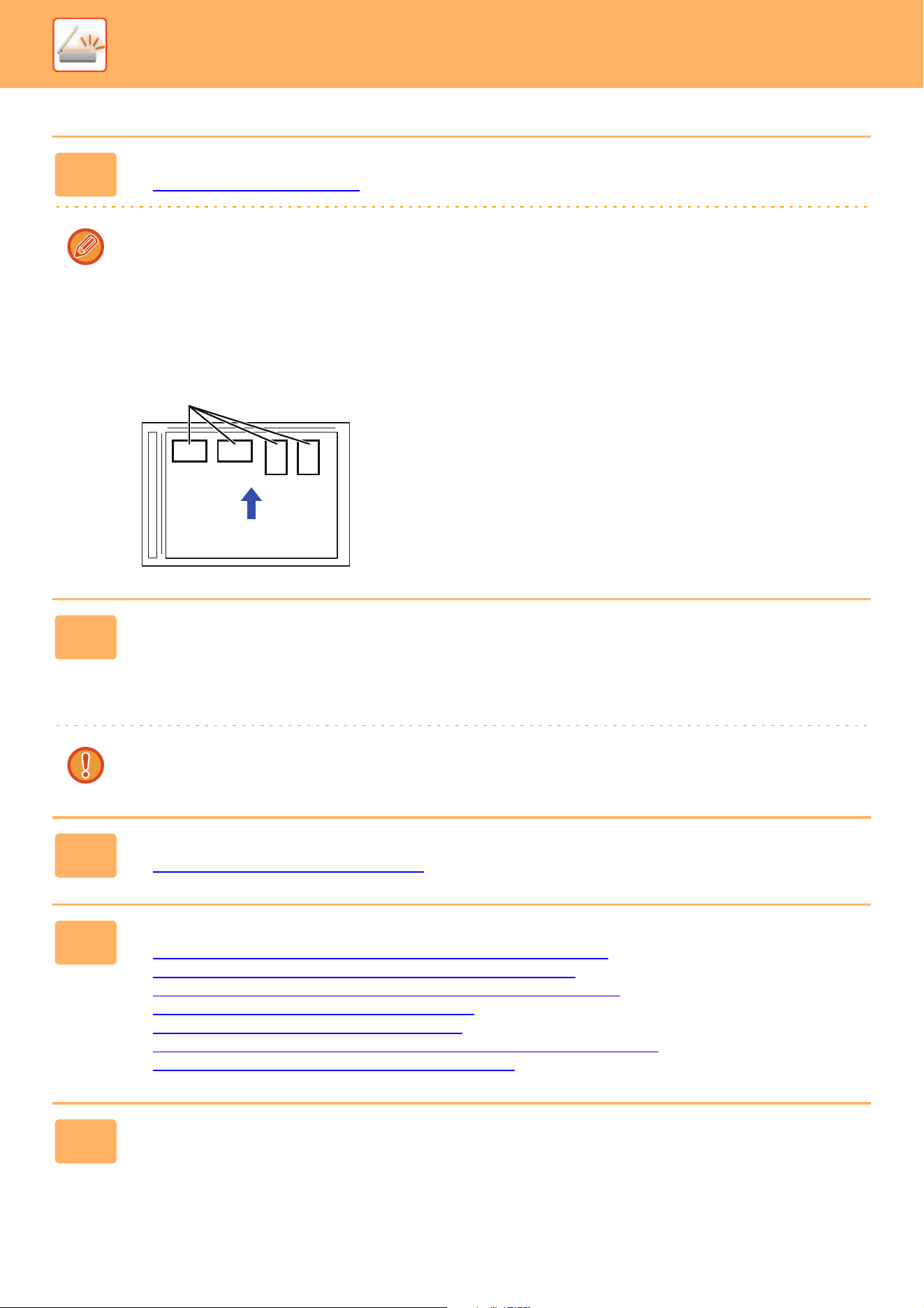
4-69
SCANNER►OTHER FUNCTIONS
1
Place the multiple business cards that you want to scan on the document glass.
► DOCUMENT GLASS (page 1-92)
Cautions when placing business cards
• Up to 20 business cards can be placed at once.
• Separate the business cards by at least 5 mm.
• Available business card sizes are 45 x 85 mm to 110 x 110 mm.
• If the shape of a business card is not square or rectangular, the business card may not be cropped correctly.
• Place the business cards with the top side of the cards at the far side of the document glass as shown. If the cards are
placed in the wrong orientation, it will not be possible to read the cards correctly.
2
Keep the auto document feeder open, not closed.
If you scan the business cards with the auto document feeder closed, it will not be possible to detect the outlines of the
business cards and scanning will fail. Always use this function with the auto document feeder open. If a light source such
as an electric light shines onto the originals during scanning, cropping may not be successful. Adjust the angle of the
automatic document feeder so that the light source does not affect the image.
Do not look directly at the light during scanning.
3
Tap the mode display and change to the base screen of the desired mode.
► Changing mode from each mode (page 4-8)
4
Specify the destination.
► RETRIEVING A DESTINATION FROM AN ADDRESS BOOK (page 4-14)
► VIEWING A LIST OF THE SELECTED DESTINATIONS (page 4-17)
► USING A SEARCH NUMBER TO RETRIEVE A DESTINATION (page 4-18)
► ENTERING AN ADDRESS MANUALLY (page 4-19)
► SPECIFYING A NETWORK FOLDER (page 4-20)
► RETRIEVING A DESTINATION FROM A GLOBAL ADDRESS BOOK (page 4-21)
► USING A TRANSMISSION LOG TO RESEND (page 4-23)
5
Tap the [Others] key, and tap the [Business Card Scan] key.
Top side
Far side
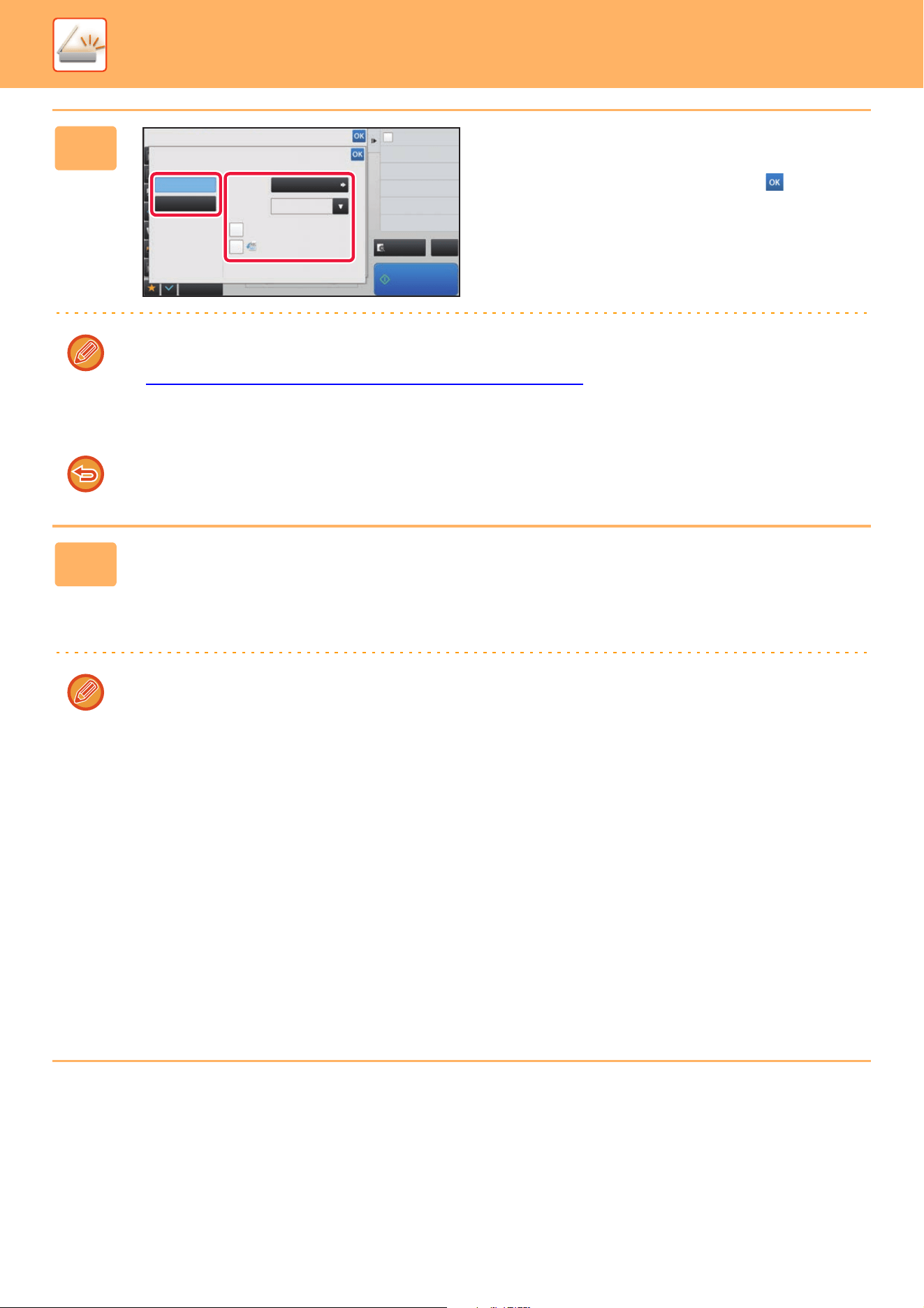
4-70
SCANNER►OTHER FUNCTIONS
6
Tap the [On] key, and change settings
as needed.
When you have completed the settings, tap twice.
• If original count is enabled, the number of scanned originals will appear during scanning.
• Change the language setting to match the language used on the business card. For the language settings, refer to
"CHANGING FORMAT IN SCAN OR DATA ENTRY MODE (page 4-51)
".
• To use the full name as the file name, enable [Use Full Name on Card as the File Name].
• To send the scanned image file together with the file format selected in [File Format], enable [Also Send Image].
To cancel the business card scan setting
Tap the [Off] key.
7
Tap the [Start] key to start scanning the originals.
When scanning is completed, place the next group of originals and tap the [Start] key.
Repeat the above step until you have scanned all originals, and then tap the [Read-End] key.
When transmission is completed, a beep sounds.
The image of the scanned business card is sent together with the VCard or CSV file set in File Format.
• Restrictions when Business Card Scan is enabled
The following restrictions apply when Business Card Scan is enabled. Restricted items may change automatically in
some cases.
• Resolution: Only 300 x 300 dpi or 400 x 400 dpi can be used.
• Scan size / send size: Only auto can be used.
• Two-sided original: Only one-sided original is enabled.
• Image Orientation: Cannot be used. (Each cropped original is corrected to the orientation that is least skewed.)
• Format: Compact and ultra-fine cannot be used.
The OCR function and file formats that require OCR cannot be used.
• Compression / compression format: Black text emphasis cannot be used.
• One file per page: Cannot be set when the checkmark is enabled and the number is "1".
• The following functions cannot be used at the same time as Business Card Scan.
Job Build, Slow Scan Mode, Mixed Size Original, Erase, Dual Page Scan, Book Divide, Card Shot, Verif. Stamp,
Blank Page Skip, File, Quick File, Preview, Multicrop
• When the Business Card Scan setting is canceled, the following items retain the setting changes that occurred when
Business Card Scan was enabled.
Resolution, Scan Size, Send Size, 2-Sided Original, File Type, OCR, Compression Mode/Compression Ratio,
Specified Pages per File
Business Card Scan
Others
Off
Also Send Image
On
Preview
Start
Back
vCard (*.vcf)File Format
Language
Setting
English
Original Count
CA
Use Full Name on Card
as the File Name
4-71
SCANNER►OTHER FUNCTIONS
File names
The user can assign any file name to a file.
When [Use Full Name on Card as the File Name] is enabled, the name on a scanned business card can be assigned as
the file name.
If you do not set a file name, the machine will assign an automatically generated file name.
File name rules
File names are assigned as follows in each setting.
Setting File File name Description
User entry vCard User_0001.vcf
User_0002.vcf
The name entered by the user
("User" in this case) is inserted at
the beginning of the file name.
CSV User.csv
Scanned image User_0001.jpg
User_0002.jpg
File name auto
extraction
vCard AAAAAA_0001.vcf
AAAAAA_0002.vcf
BBBBBB_0001.vcf
Untitled_0001.vcf
Untitled _0002.vcf
Example: The names read from
business cards are "AAAAAA",
"BBBBB"
When there are cards with the
same first and last name such as
"AAAAAA", the number at the end
is a serial number. If the name
could not be read, the file name is
"Untitled". If there are multiple
untitled files, the number at the end
is a serial number.
CSV AAAAAA_0001.csv
Scanned image AAAAAA_0001.jpg
AAAAAA_0002.jpg
BBBBBB_0001.jpg
Untitled _0001.jpg
Untitled _0002.jpg
Automatic generation vCard MXxxxx_yyyyyy_zzzzzz_0001.vcf
MXxxxx_yyyyyy_zzzzzz_0002.vcf
"xxxx" is the model name,"yyyyyy"
is the scan date, and "zzzzzz" is
the scan time.
CSV MXxxxx_yyyyyy_zzzzzz_0001.csv
Scanned image MXxxxx_yyyyyy_zzzzzz_0001.jpg
MXxxxx_yyyyyy_zzzzzz_0002.jpg
If the user sets a file name when file name auto extraction is enabled, the user's file name is given priority.
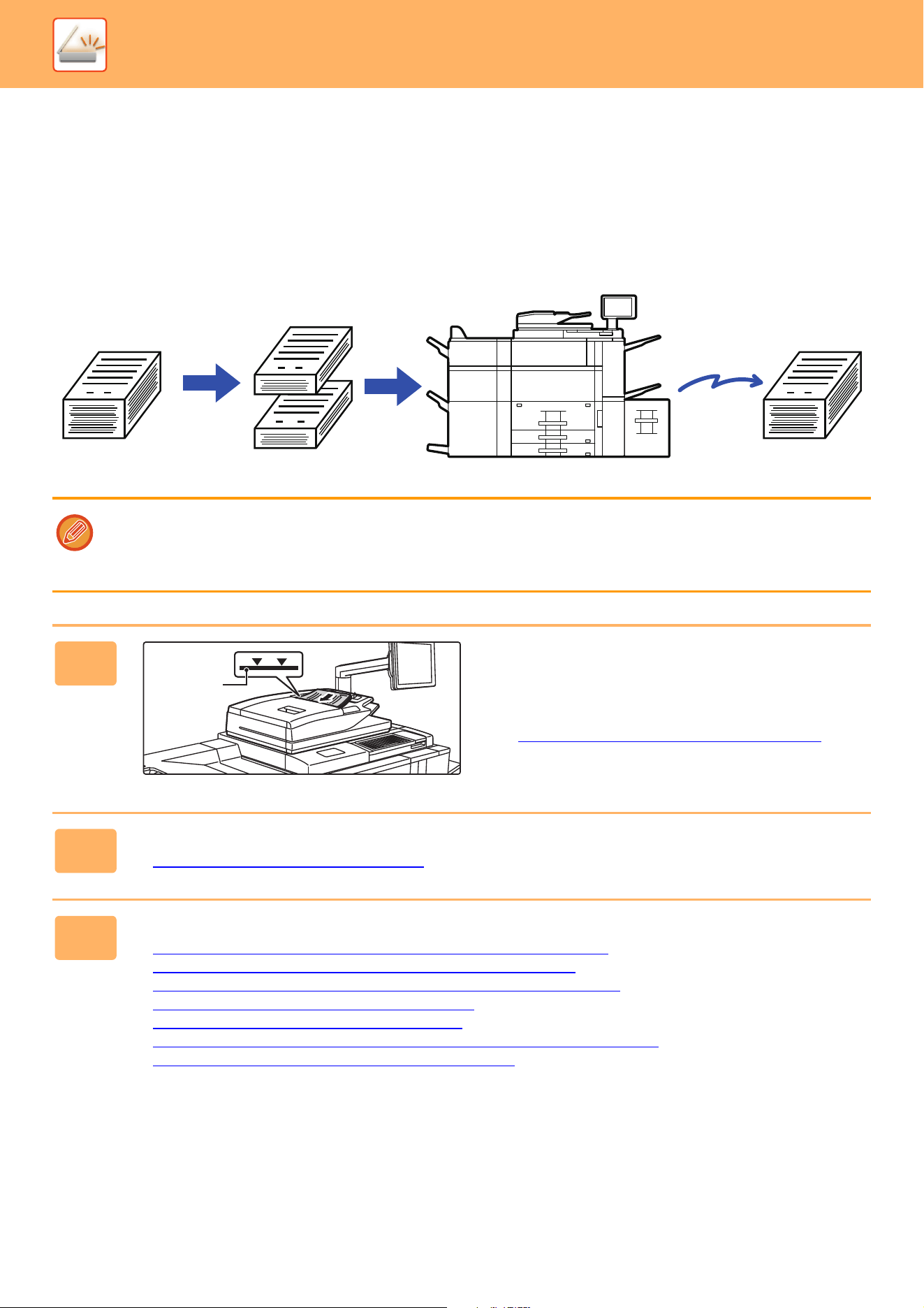
4-72
SCANNER►OTHER FUNCTIONS
SCANNING MANY ORIGINALS AT ONCE (JOB BUILD)
This function lets you separate an original consisting of numerous pages into sets, scan each set using the automatic
document feeder, and transmit the pages in a single transmission.
Use this function when there are more original pages than can be placed at once in the automatic document feeder.
When scanning originals that are separated into sets, scan the set that has the first page first.
The settings that you select for the first set can be used for all remaining sets.
• Up to 9999 pages can be scanned.
Note that when the memory is being used for other jobs, fewer pages can be scanned.
• If the memory becomes full during scanning, a message will appear and the transmission will be canceled.
• The scan settings can be changed for each set of originals.
1
Place originals in the automatic
document feeder.
Insert the originals all the way into the document feeder tray.
Originals can be stacked up to the indicator line.
► AUTOMATIC DOCUMENT FEEDER (page 1-90)
2
Tap the mode display to switch to the initial screen of each mode.
► Changing mode from each mode (page 4-8)
3
Specify the destination.
► RETRIEVING A DESTINATION FROM AN ADDRESS BOOK (page 4-14)
► VIEWING A LIST OF THE SELECTED DESTINATIONS (page 4-17)
► USING A SEARCH NUMBER TO RETRIEVE A DESTINATION (page 4-18)
► ENTERING AN ADDRESS MANUALLY (page 4-19)
► SPECIFYING A NETWORK FOLDER (page 4-20)
► RETRIEVING A DESTINATION FROM A GLOBAL ADDRESS BOOK (page 4-21)
► USING A TRANSMISSION LOG TO RESEND (page 4-23)
11
101
1
Originals
Originals are
scanned in
separate sets.
Indicator
line
4-73
SCANNER►OTHER FUNCTIONS
4
Tap the [Job Build] key.
A checkmark appears on the icon.
If you are performing Scan to E-mail, tap the [Others] key and then tap the [Job Build] key.
To cancel the job build setting:
Tap the [Job Build] key to uncheck it.
5
Change settings as needed.
6
Tap the [Start] key to scan the first original page.
7
Place the next set of originals and tap the [Start] key.
Repeat until all originals have been scanned.
• If needed, tap [Change Setting] before tapping the [Start] key, and change the original scan settings and send settings
for the next original. The setting changes will be applied to the next job.
• If you tap the [Preview] key, you cannot scan additional pages.
To cancel scanning:
Tap the [CA] key. All the settings including scanned data will be cleared.
8
Tap the [Read-End] key.
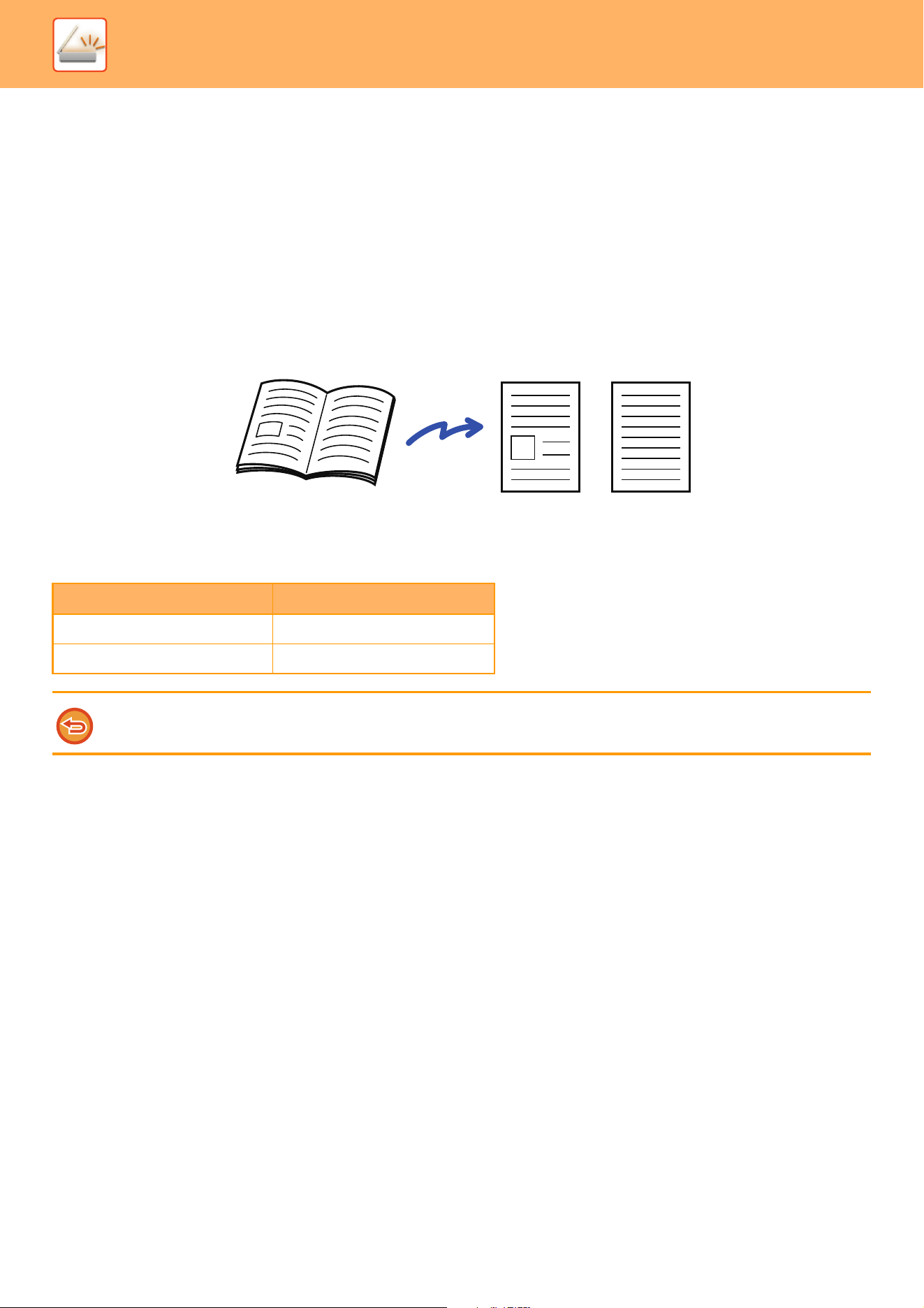
4-74
SCANNER►OTHER FUNCTIONS
SCANNING AND SENDING AN ORIGINAL AS
SEPARATE PAGES
SCANNING AN ORIGINAL AS TWO SEPARATE PAGES
(DUAL PAGE SCAN)
The left and right sides of an original are scanned as two separate pages. This function is useful when you wish to
successively scan each page of a book or other bound document.
When using dual page scan, the original must be placed on the document glass.
Original scan size Transmitted image
11" x 17" (A3) x 1 page 8-1/2" x 11" (A4) x 2 pages
8-1/2" x 14" (B4) x 1 pages 5-1/2" x 8-1/2" (B5) x 2 pages
• This function is available when the original size setting is set to [Auto].
• Note that "Center Erase" and "Edge+Center Erase" cannot be used.
Book or bound document
The left and right pages are sent as
two pages.
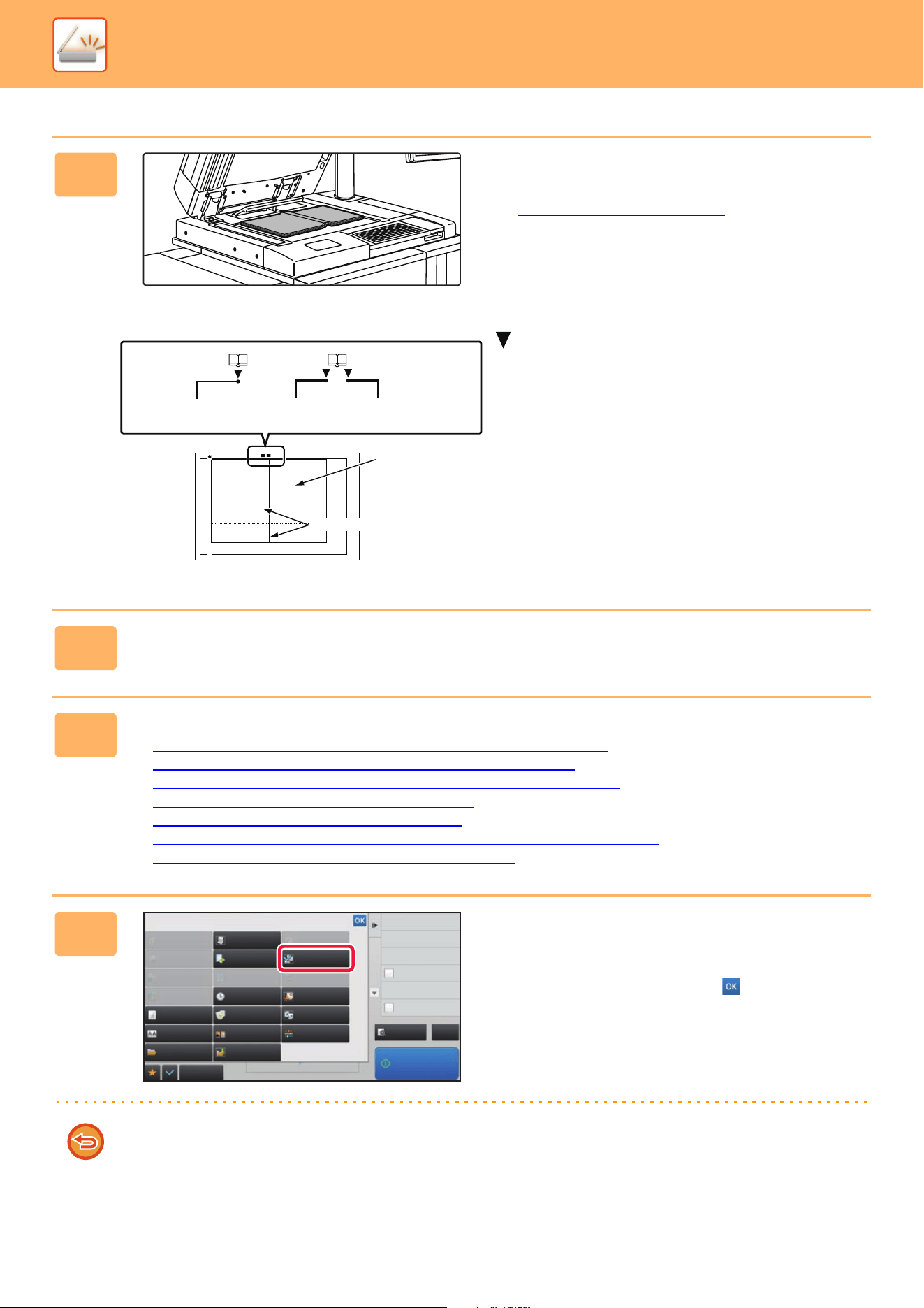
4-75
SCANNER►OTHER FUNCTIONS
1
Place the original on the document
glass.
► DOCUMENT GLASS (page 1-92)
Align the center of the original with the appropriate size mark
.
2
Tap the mode display to switch to the initial screen of each mode.
► Changing mode from each mode (page 4-8)
3
Specify the destination.
► RETRIEVING A DESTINATION FROM AN ADDRESS BOOK (page 4-14)
► VIEWING A LIST OF THE SELECTED DESTINATIONS (page 4-17)
► USING A SEARCH NUMBER TO RETRIEVE A DESTINATION (page 4-18)
► ENTERING AN ADDRESS MANUALLY (page 4-19)
► SPECIFYING A NETWORK FOLDER (page 4-20)
► RETRIEVING A DESTINATION FROM A GLOBAL ADDRESS BOOK (page 4-21)
► USING A TRANSMISSION LOG TO RESEND (page 4-23)
4
Tap the [Others] key, and tap the [Dual
Page Scan] key.
A checkmark appears on the icon.
After the settings are completed, tap .
To cancel the dual page scan setting
Tap the [Dual Page Scan] key to uncheck it.
Centerline of B4
original
Centerline of A3
original
Centerline of
11" x 17" original
Size mark
The page on
this side is
copied first.
Centerline of original
Back
Erase
Dual Page Scan
Book Divide
Job Build Slow Scan Mode
Original
Count
Card Shot
Timer
Blank Page
Skip
Send
Destination Link
Contrast
Sharpness
Mixed Size
Original
Verif.
Stamp
Background
Adjustment
Multicrop
Drop Out Colour
File
RGB Adjust
Others
Preview
Start
Quick File
CA
Business
Card Scan
Verification Stamp
Call Search Number
Sending History
Global Address Search
Call Program
Call Registered settings
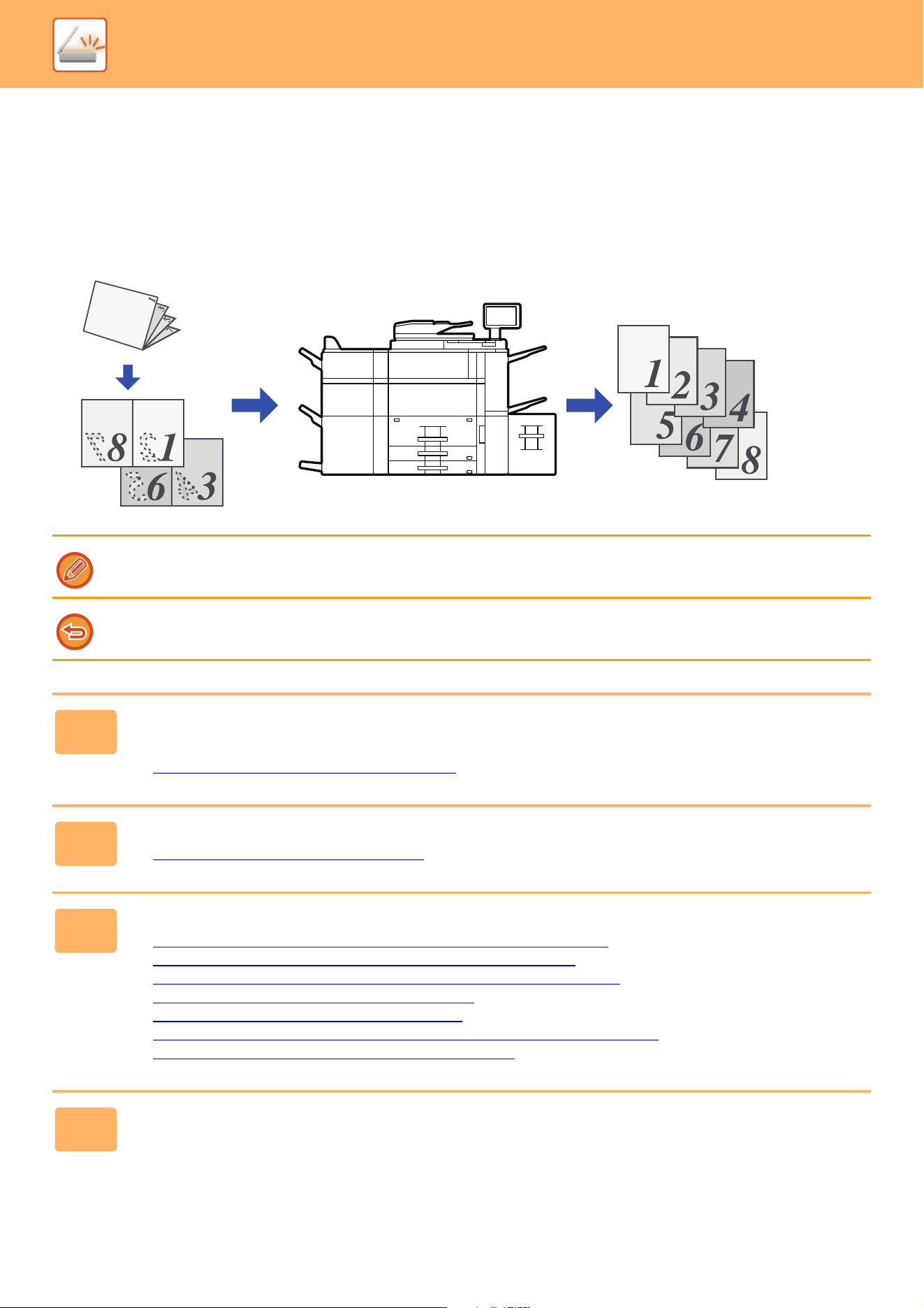
4-77
SCANNER►OTHER FUNCTIONS
SPLITTING A PAMPHLET BY PAGE AND
TRANSMITTING THE PAGES SUCCESSIVELY
(BOOK DIVIDE)
The opened pages of a saddle-stitch pamphlet are split by page according to actual page order before transmission.
When using this function, you do not need to sort the original pages to be sent.
This function can be enabled when the original size setting is set to [Auto].
The document glass is not available for this function.
1
Place the original in the document feeder tray of the automatic document
feeder.
► AUTOMATIC DOCUMENT FEEDER (page 1-90)
2
Tap the mode display to switch to the initial screen of each mode.
► Changing mode from each mode (page 4-8)
3
Specify the destination.
► RETRIEVING A DESTINATION FROM AN ADDRESS BOOK (page 4-14)
► VIEWING A LIST OF THE SELECTED DESTINATIONS (page 4-17)
► USING A SEARCH NUMBER TO RETRIEVE A DESTINATION (page 4-18)
► ENTERING AN ADDRESS MANUALLY (page 4-19)
► SPECIFYING A NETWORK FOLDER (page 4-20)
► RETRIEVING A DESTINATION FROM A GLOBAL ADDRESS BOOK (page 4-21)
► USING A TRANSMISSION LOG TO RESEND (page 4-23)
4
Tap the [Others] key, and tap the [Book Divide] key.
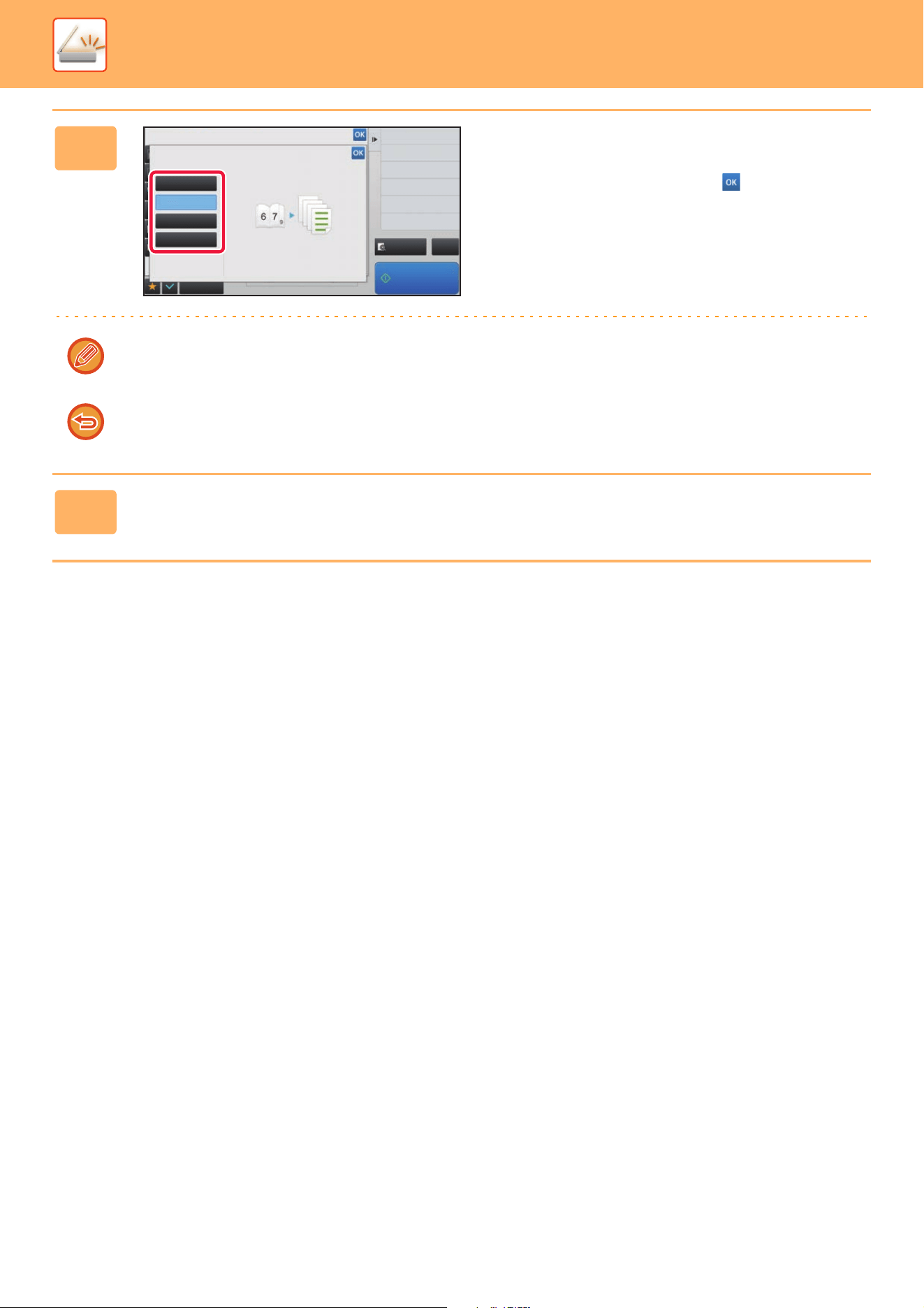
4-78
SCANNER►OTHER FUNCTIONS
5
Select the binding edge of the
pamphlet original.
After the settings are completed, tap twice.
Check the preview image displayed in the screen, and make sure that the binding edge is correct.
To cancel the Book Divide setting:
Tap the [Off] key.
6
Tap the [Start] key to start scanning of the original.
A beep will sound to indicate that scanning and transmission have ended.
Preview
Start
Back
Others
Skip Blank Page in Original
Erase Shadow Around
Erase
Background Adjustment
Color Mode
Change Sending Resolution
Resolution
Book Divide
Select Original Binding Edge.
Off
Left Binding
Right Binding
Tablet
CA
Blank Page Skip
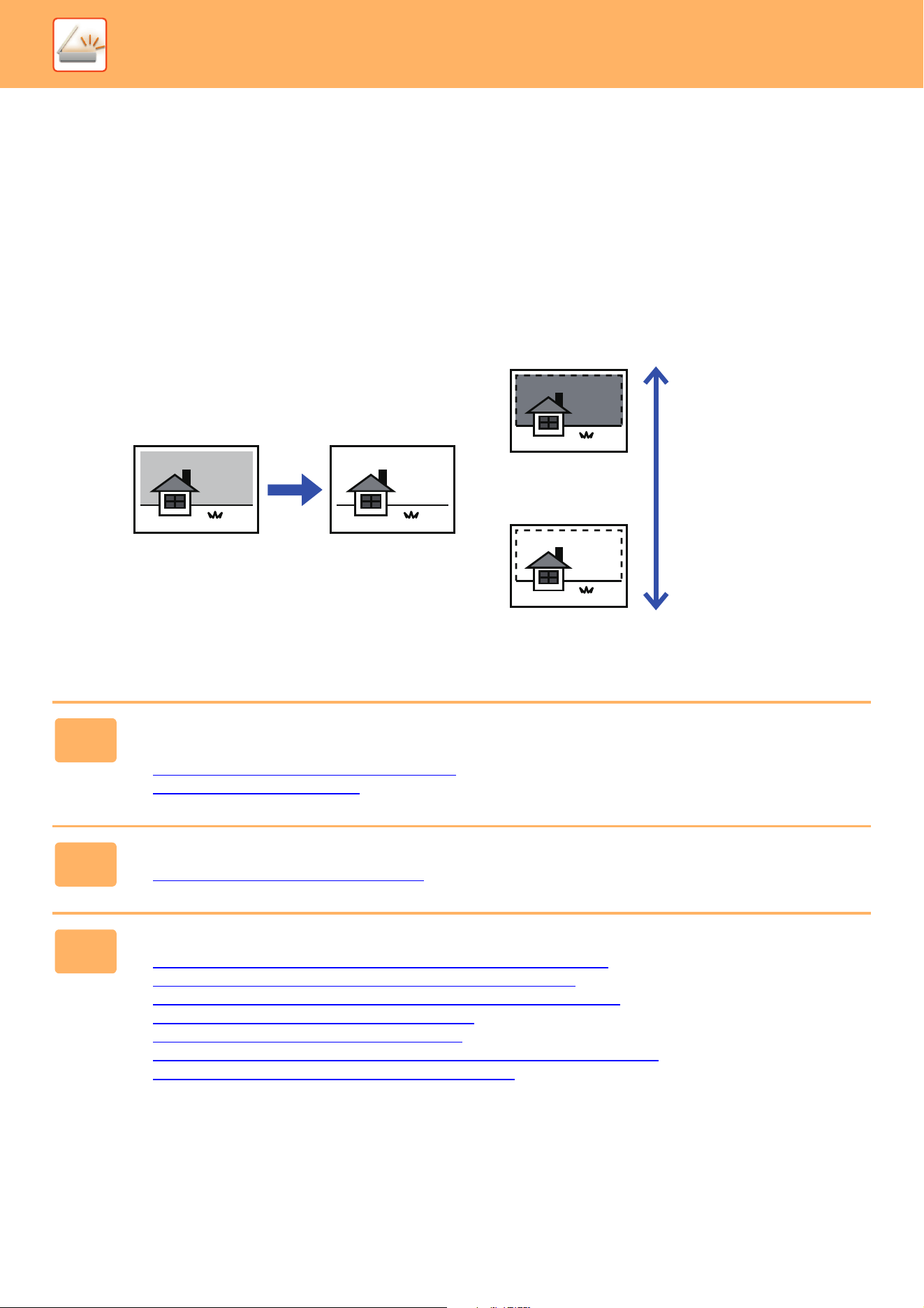
4-79
SCANNER►OTHER FUNCTIONS
ADJUSTING COLORS AND SHADING
ADJUSTING THE BACKGROUND BY MAKING LIGHT
AREAS OF THE ORIGINAL DARKER OR LIGHTER
(BACKGROUND ADJUSTMENT)
You can adjust the background by making light areas of the original darker or lighter.
1
Place the original.
Place the original in the document feeder tray of the automatic document feeder, or on the document glass.
► AUTOMATIC DOCUMENT FEEDER (page 1-90)
► DOCUMENT GLASS (page 1-92)
2
Tap the mode display to switch to the initial screen of each mode.
► Changing mode from each mode (page 4-8)
3
Specify the destination.
► RETRIEVING A DESTINATION FROM AN ADDRESS BOOK (page 4-14)
► VIEWING A LIST OF THE SELECTED DESTINATIONS (page 4-17)
► USING A SEARCH NUMBER TO RETRIEVE A DESTINATION (page 4-18)
► ENTERING AN ADDRESS MANUALLY (page 4-19)
► SPECIFYING A NETWORK FOLDER (page 4-20)
► RETRIEVING A DESTINATION FROM A GLOBAL ADDRESS BOOK (page 4-21)
► USING A TRANSMISSION LOG TO RESEND (page 4-23)
Adjust light areas in this way.
Level [+]
Level [-]
[+] makes the background
darker. [-] makes the
background lighter.
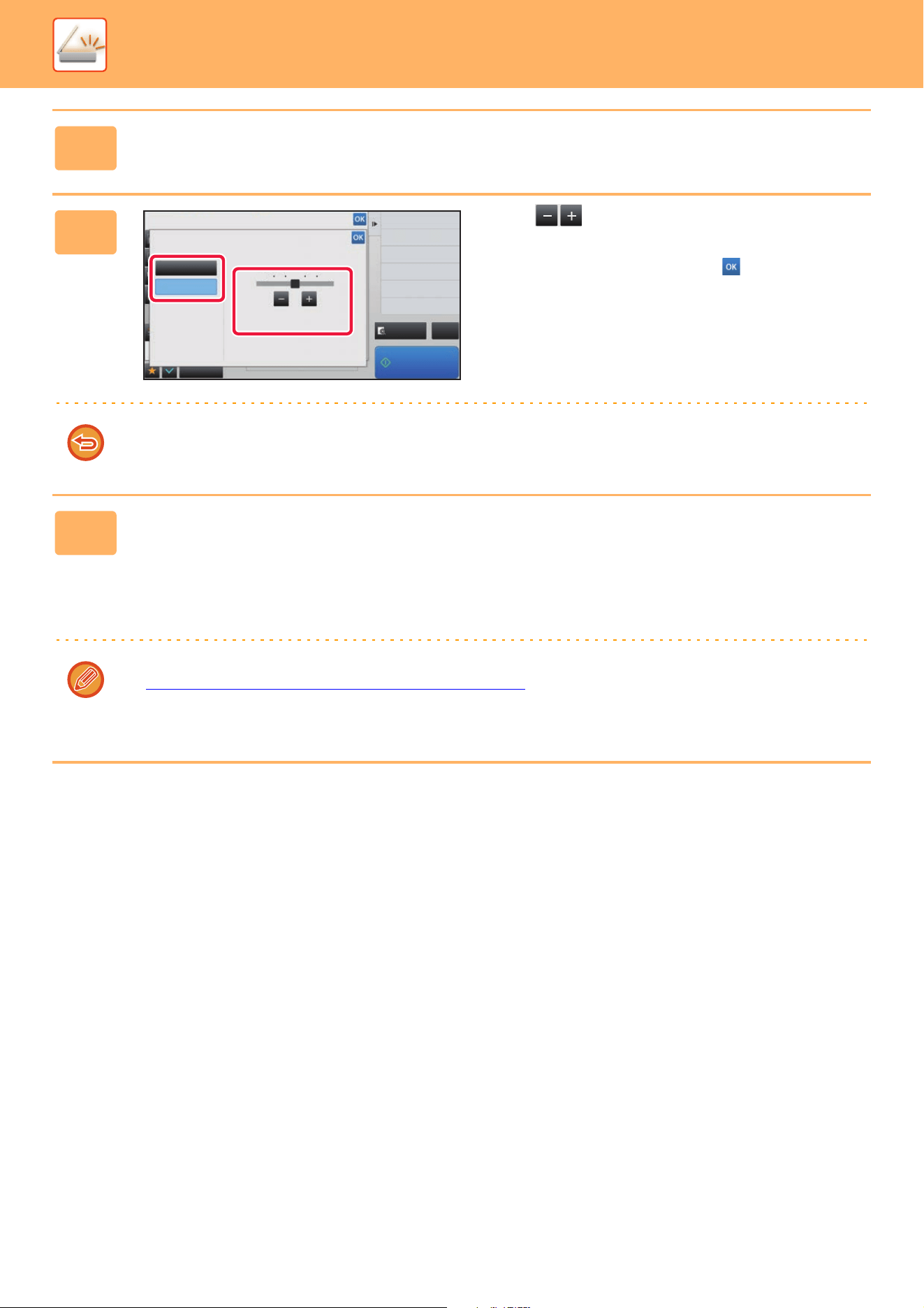
4-80
SCANNER►OTHER FUNCTIONS
4
Tap the [Others] key, and tap the [Background Adjustment] key.
5
Tap or slide the slider to adjust
the range to be suppressed.
After the settings are completed, tap twice.
To cancel the background adjustment setting:
Tap the [Off] key.
6
Tap the [Start] key to start scanning of the original.
• If you inserted the original pages in the document feeder tray, all pages are scanned.
A beep will sound to indicate that scanning and transmission have ended.
• When you place the original on the document glass, scan each page one at a time.
When scanning finishes, place the next original and tap the [Start] key.
A beep will sound to indicate that transmission has ended.
• You can tap the [Preview] key to check a preview of the image before sending an image. For more information, see
"CHECKING THE IMAGE TO BE TRANSMITTED (page 4-58)
". However, settings for this function cannot be
changed in the preview screen.
• When the color mode setting is [Mono2], the background adjustment function will not operate.
Preview
Start
Back
Others
Color Mode
Background Adjustment
Adjust Original Background Darkness.
Touch [+] darken background.
Touch [-] erase background.
Off
On
Adjust Outline of Image
Sharpness
Adjust Contrast of Image
Contrast
Select File Format
File Format
-3 0 3
CA
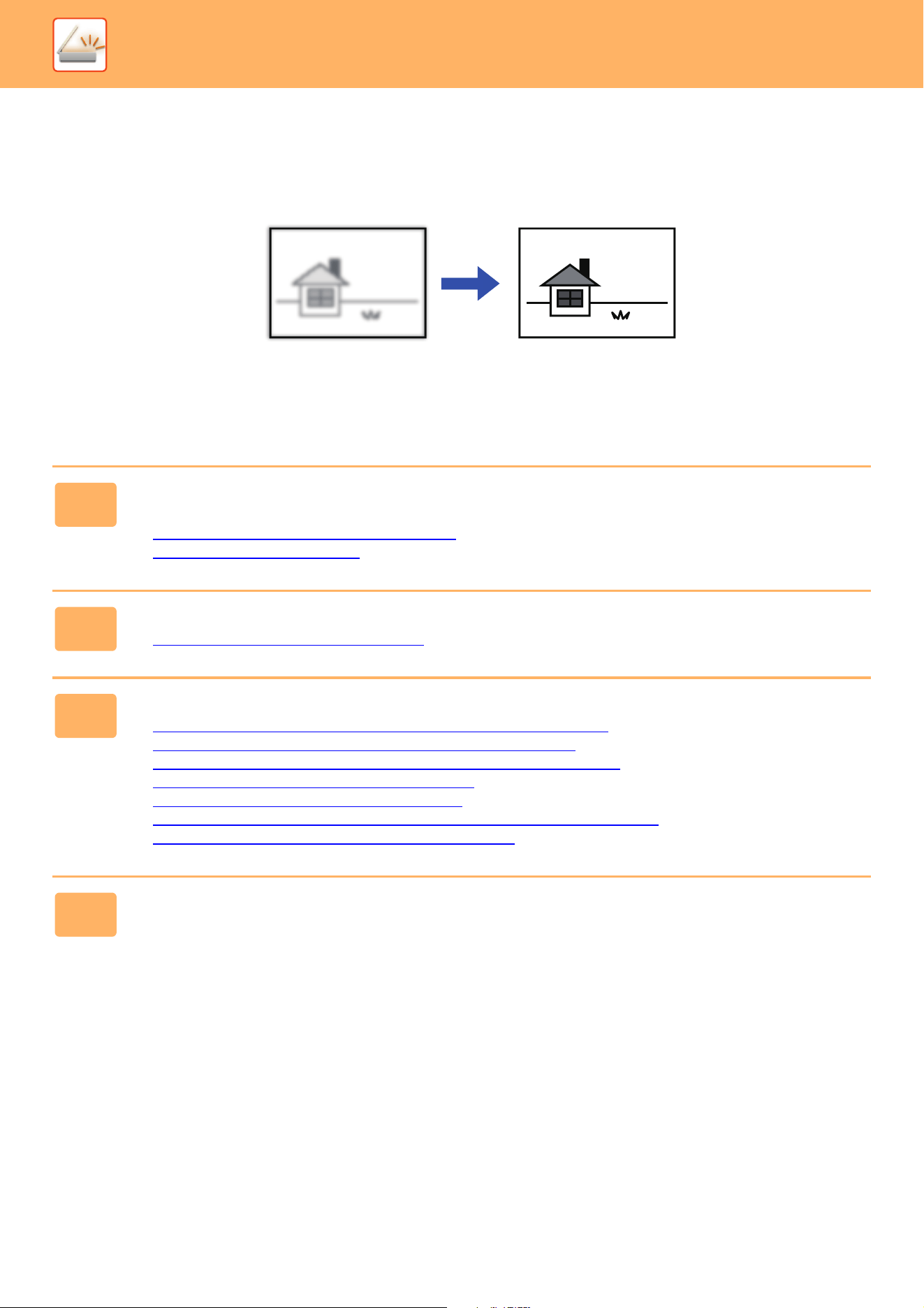
4-81
SCANNER►OTHER FUNCTIONS
ADDING CONTRAST TO THE SCANNED ORIGINAL
BEFORE TRANSMISSION (CONTRAST)
1
Place the original.
Place the original in the document feeder tray of the automatic document feeder, or on the document glass.
► AUTOMATIC DOCUMENT FEEDER (page 1-90)
► DOCUMENT GLASS (page 1-92)
2
Tap the mode display to switch to the initial screen of each mode.
► Changing mode from each mode (page 4-8)
3
Specify the destination.
► RETRIEVING A DESTINATION FROM AN ADDRESS BOOK (page 4-14)
► VIEWING A LIST OF THE SELECTED DESTINATIONS (page 4-17)
► USING A SEARCH NUMBER TO RETRIEVE A DESTINATION (page 4-18)
► ENTERING AN ADDRESS MANUALLY (page 4-19)
► SPECIFYING A NETWORK FOLDER (page 4-20)
► RETRIEVING A DESTINATION FROM A GLOBAL ADDRESS BOOK (page 4-21)
► USING A TRANSMISSION LOG TO RESEND (page 4-23)
4
Tap the [Others] key, and tap the [Contrast] key.
Blurry original
Contrast is added for a
clear image.
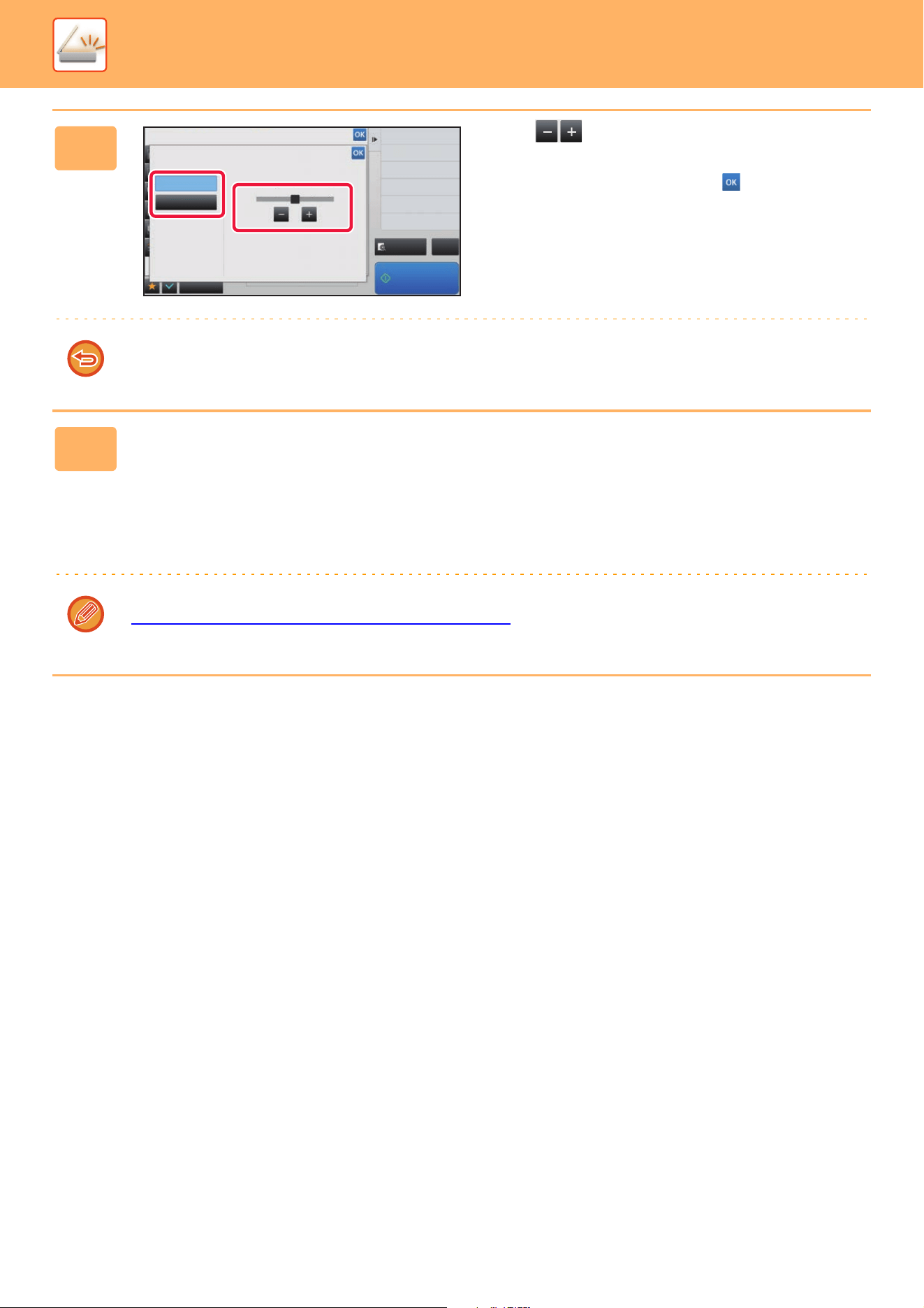
4-82
SCANNER►OTHER FUNCTIONS
5
Tap or slide the slider to adjust
the contrast level.
After the settings are completed, tap twice.
To cancel the contrast settings:
Tap the [Off] key.
6
Tap the [Start] key to start scanning of the original.
• If you inserted the original pages in the document feeder tray, all pages are scanned.
A beep will sound to indicate that scanning and transmission have ended.
• When you place the original on the document glass, scan each page one at a time.
When scanning finishes, place the next original and tap the [Start] key. Repeat the procedure until all pages have
been scanned and then tap the [Read-End] key.
A beep will sound to indicate that scanning and transmission have ended.
You can tap the [Preview] key to check a preview of the image before sending an image. For more information, see
"CHECKING THE IMAGE TO BE TRANSMITTED (page 4-58)
". However, settings for this function cannot be changed
in the preview screen.
Preview
Start
Back
Others
Color Mode
Contrast
Off
On
Specify density of image to send.
Exposure
1 2 3 54
Adjust Outline of Image
Sharpness
Change Sending Resolution
Resolution
Low High
CA
4-83
SCANNER►OTHER FUNCTIONS
ENHANCING THE OUTLINE OF THE SCANNED
ORIGINAL BEFORE TRANSMISSION (SHARPNESS)
1
Place the original.
Place the original in the document feeder tray of the automatic document feeder, or on the document glass.
► AUTOMATIC DOCUMENT FEEDER (page 1-90)
► DOCUMENT GLASS (page 1-92)
2
Tap the mode display to switch to the initial screen of each mode.
► Changing mode from each mode (page 4-8)
3
Specify the destination.
► RETRIEVING A DESTINATION FROM AN ADDRESS BOOK (page 4-14)
► VIEWING A LIST OF THE SELECTED DESTINATIONS (page 4-17)
► USING A SEARCH NUMBER TO RETRIEVE A DESTINATION (page 4-18)
► ENTERING AN ADDRESS MANUALLY (page 4-19)
► SPECIFYING A NETWORK FOLDER (page 4-20)
► RETRIEVING A DESTINATION FROM A GLOBAL ADDRESS BOOK (page 4-21)
► USING A TRANSMISSION LOG TO RESEND (page 4-23)
4
Tap the [Others] key, and tap the [Sharpness] key.
Blurry outlined
original
Enhance the outline
before transmitting.
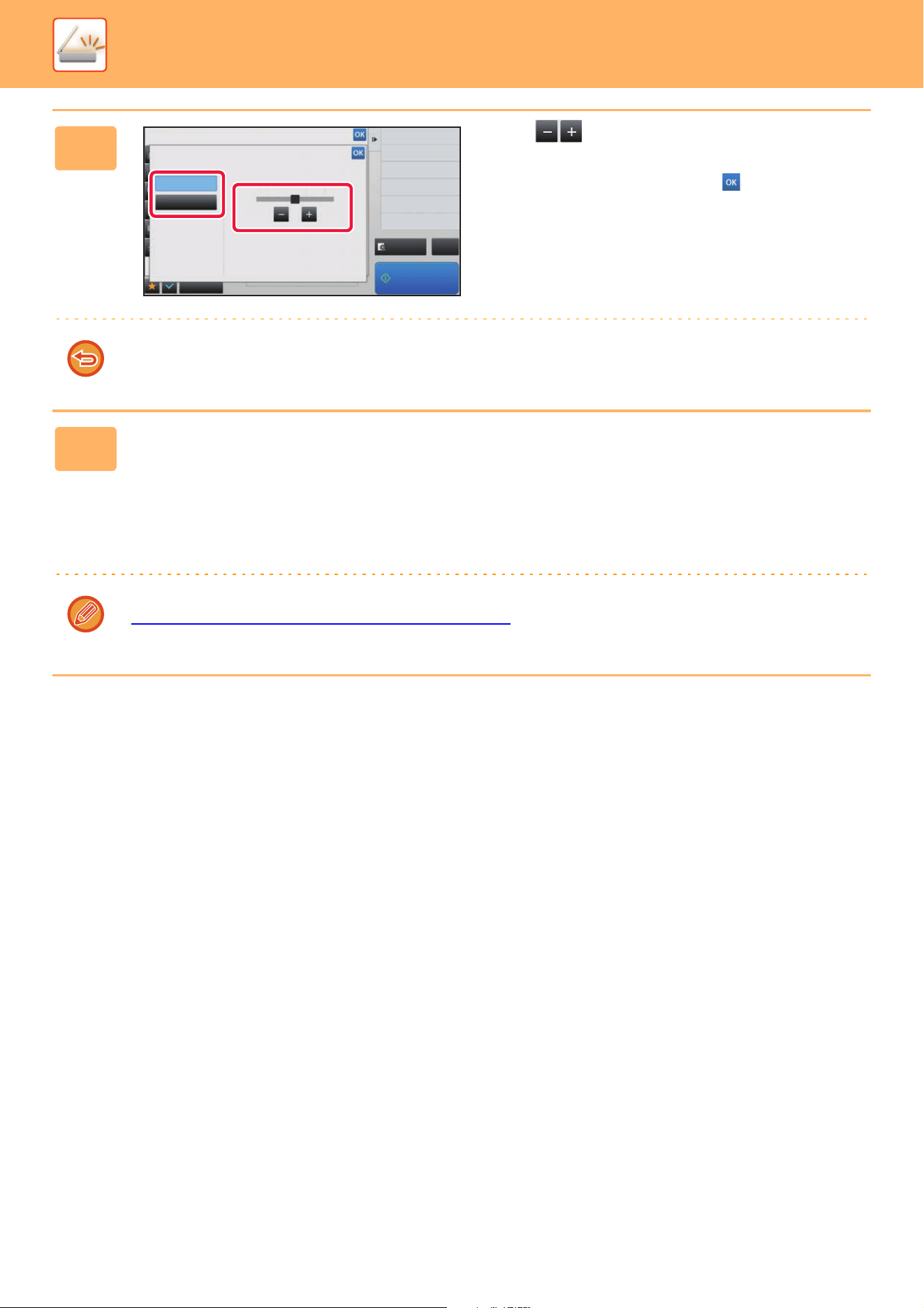
4-84
SCANNER►OTHER FUNCTIONS
5
Tap or slide the slider to adjust
the sharpness.
After the settings are completed, tap twice.
To cancel the sharpness setting:
Tap the [Off] key.
6
Tap the [Start] key to start scanning of the original.
• If you inserted the original pages in the document feeder tray, all pages are scanned.
A beep will sound to indicate that scanning and transmission have ended.
• When you place the original on the document glass, scan each page one at a time.
When scanning finishes, place the next original and tap the [Start] key. Repeat the procedure until all pages have
been scanned and then tap the [Read-End] key.
A beep will sound to indicate that scanning and transmission have ended.
You can tap the [Preview] key to check a preview of the image before sending an image. For more information, see
"CHECKING THE IMAGE TO BE TRANSMITTED (page 4-58)
". However, settings for this function cannot be changed
in the preview screen.
Preview
Start
Back
Others
Color Mode
Sharpness
Off
On
Specify density of image to send.
Exposure
1 2 3 54
Adjust Contrast of Image
Contrast
Change Sending Resolution
Resolution
Less Sharp More Sharp
CA
4-85
SCANNER►OTHER FUNCTIONS
REMOVING CHROMATIC COLORS FROM THE
SCANNED ORIGINAL BEFORE TRANSMISSION
(DROP OUT COLOR)
1
Place the original.
Place the original in the document feeder tray of the automatic document feeder, or on the document glass.
► AUTOMATIC DOCUMENT FEEDER (page 1-90)
► DOCUMENT GLASS (page 1-92)
2
Tap the mode display to switch to the initial screen of each mode.
► Changing mode from each mode (page 4-8)
3
Specify the destination.
► RETRIEVING A DESTINATION FROM AN ADDRESS BOOK (page 4-14)
► VIEWING A LIST OF THE SELECTED DESTINATIONS (page 4-17)
► USING A SEARCH NUMBER TO RETRIEVE A DESTINATION (page 4-18)
► ENTERING AN ADDRESS MANUALLY (page 4-19)
► SPECIFYING A NETWORK FOLDER (page 4-20)
► RETRIEVING A DESTINATION FROM A GLOBAL ADDRESS BOOK (page 4-21)
► USING A TRANSMISSION LOG TO RESEND (page 4-23)
4
Tap the [Others] key, and then tap the [Drop Out Color] key.
A checkmark appears on the icon.
After the settings are completed, tap .
To cancel the drop out color setting
Tap the [Drop Out Color] key to uncheck it.
4-86
SCANNER►OTHER FUNCTIONS
5
Tap the [Start] key to start scanning of the original.
• If you inserted the original pages in the document feeder tray, all pages are scanned.
A beep will sound to indicate that scanning and transmission have ended.
• When you place the original on the document glass, scan each page one at a time.
When scanning finishes, place the next original and tap the [Start] key. Repeat the procedure until all pages have
been scanned and then tap the [Read-End] key.
A beep will sound to indicate that scanning and transmission have ended.
You can tap the [Preview] key to check a preview of the image before sending an image. For more information, see
"CHECKING THE IMAGE TO BE TRANSMITTED (page 4-58)
".
Tap the [Change Setting] key in the scan-end confirmation screen to change the exposure, resolution, scan size, and
send size. (However, when scanning each even-numbered page of the original, only the exposure can be changed.)
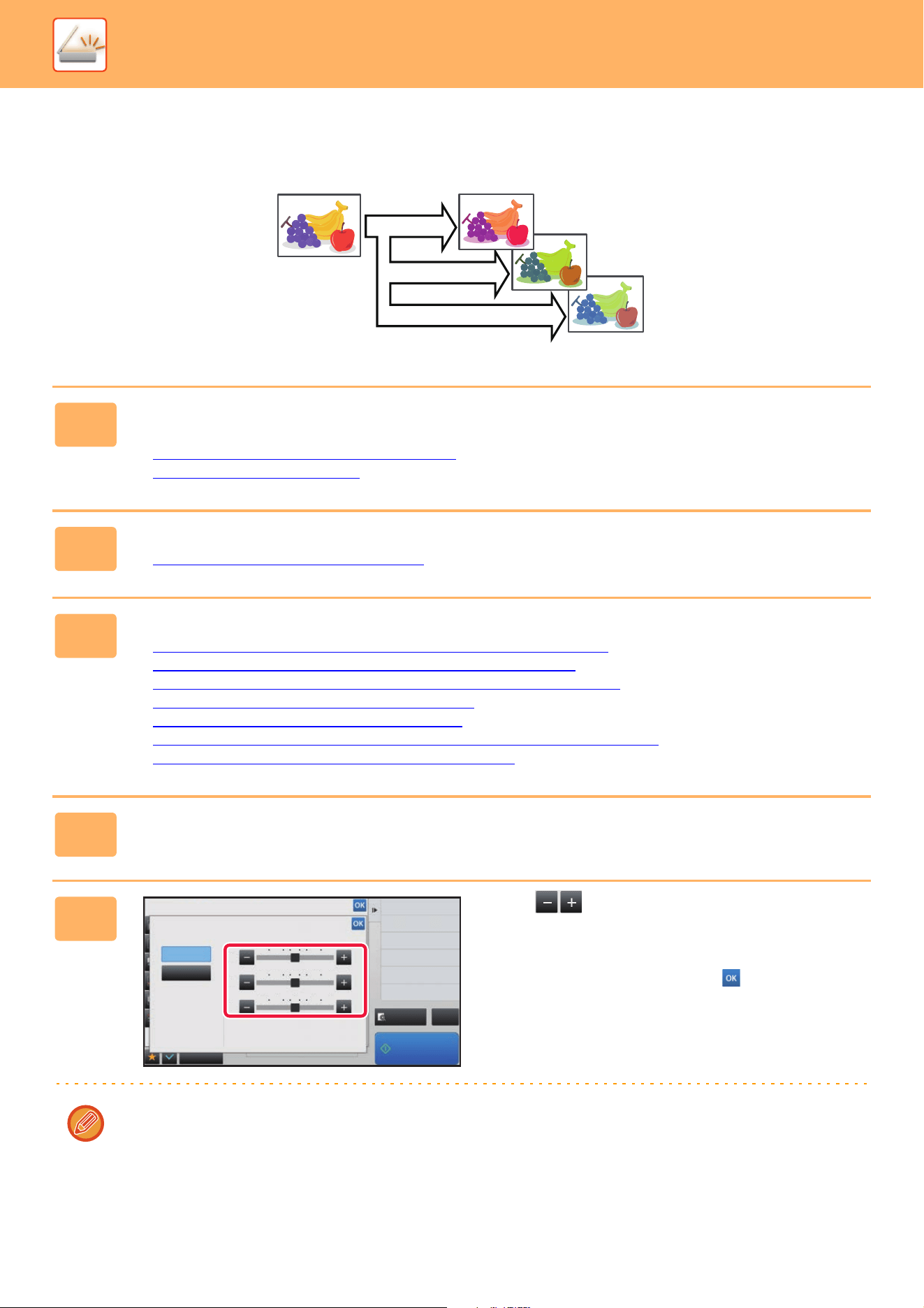
4-87
SCANNER►OTHER FUNCTIONS
ADJUSTING RED/GREEN/BLUE (RGB Adjust)
This function heightens or lightens any one of the three color components R (red), G (green), and B (blue).
1
Place the original.
Place the original in the document feeder tray of the automatic document feeder, or on the document glass.
► AUTOMATIC DOCUMENT FEEDER (page 1-90)
► DOCUMENT GLASS (page 1-92)
2
Tap the mode display to switch to the initial screen of each mode.
► Changing mode from each mode (page 4-8)
3
Specify the destination.
► RETRIEVING A DESTINATION FROM AN ADDRESS BOOK (page 4-14)
► VIEWING A LIST OF THE SELECTED DESTINATIONS (page 4-17)
► USING A SEARCH NUMBER TO RETRIEVE A DESTINATION (page 4-18)
► ENTERING AN ADDRESS MANUALLY (page 4-19)
► SPECIFYING A NETWORK FOLDER (page 4-20)
► RETRIEVING A DESTINATION FROM A GLOBAL ADDRESS BOOK (page 4-21)
► USING A TRANSMISSION LOG TO RESEND (page 4-23)
4
Tap the [Others] key, and tap the [RGB Adjust] key.
5
Tap of the color you want to
adjust or slide the slider to adjust the
coloring.
After the settings are completed, tap twice.
To cancel the RGB Adjust setting:
Tap the [Off] key.
R (Red)+
G (Green)+
B (Blue)+
Preview
Start
Back
Others
CA
Color Mode
RGB Adjust
This setting is only applied to color jobs.
Off
On
Specify density of image to send.
Exposure
-2
-1 0 21
-2
-1 0 21
-2
-1 0 21
R
G
B
Touch [+] to darken and [-] to lighten selected
color tone.
4-88
SCANNER►OTHER FUNCTIONS
6
Tap the [Start] key to start scanning of the original.
• If you inserted the original pages in the document feeder tray, all pages are scanned.
A beep will sound to indicate that scanning and transmission have ended.
• When you place the original on the document glass, scan each page one at a time.
When scanning finishes, place the next original and tap the [Start] key. Repeat the procedure until all pages have
been scanned and then tap the [Read-End] key.
A beep will sound to indicate that scanning and transmission have ended.
You can tap the [Preview] key to check a preview of the image before sending an image. For more information, see
"CHECKING THE IMAGE TO BE TRANSMITTED (page 4-58)
".
Tap the [Change Setting] key in the scan-end confirmation screen to change the exposure, resolution, scan size, and
send size. (However, when scanning each even-numbered page of the original, only the exposure can be changed.)
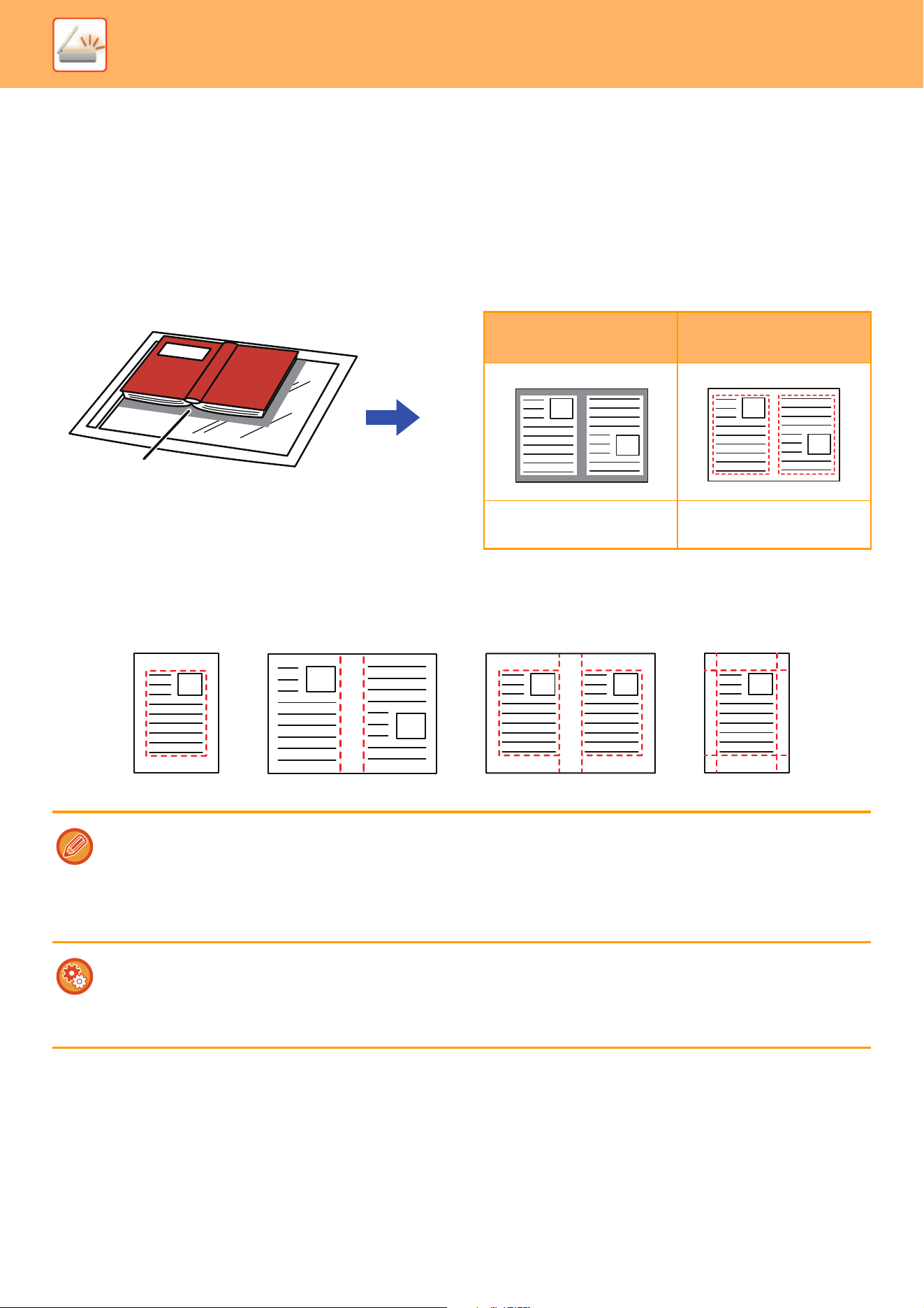
4-89
SCANNER►OTHER FUNCTIONS
SCANNING ORIGINALS
ERASING PERIPHERAL SHADOWS ON THE IMAGE
(ERASE)
When scanning thick originals or books, erase any peripheral shadows that may be produced on the image.
Scanning a thick book
Erase modes
Shadows appear here
Not using the erase
function
Using the erase
function
Shadows appear in the
image.
No shadows appear.
• This function erases the parts of the image where shadows tend to form, but does not detect shadows and erase only the
shadows.
• If a ratio setting is used in combination with an erase setting, the erase width will change according to the selected ratio.
For example, if you set an erase width of 1/2" (10 mm) and reduce the image to 70% before scanning it, the erase width
will be reduced to 3/8" (7 mm).
• When the erase setting is selected, the image orientation will be forcibly portrait.
To change the default erase width setting:
In "Settings (administrator)", select [System Settings] → [Image Send Settings] → [Common Settings] → [Condition Settings]
→ [Erase Width Adjustment].
The width can be set from 0" to 1" (0 mm to 20 mm). The factory default setting is 1/2" (10 mm). The setting changed here will
apply to [System Settings] → [Copy Settings] → [Condition Settings] → [Erase Width Adjustment] in "Settings".
Outer Frame Erase
Side EraseCenter Erase
Edge + Center Erase
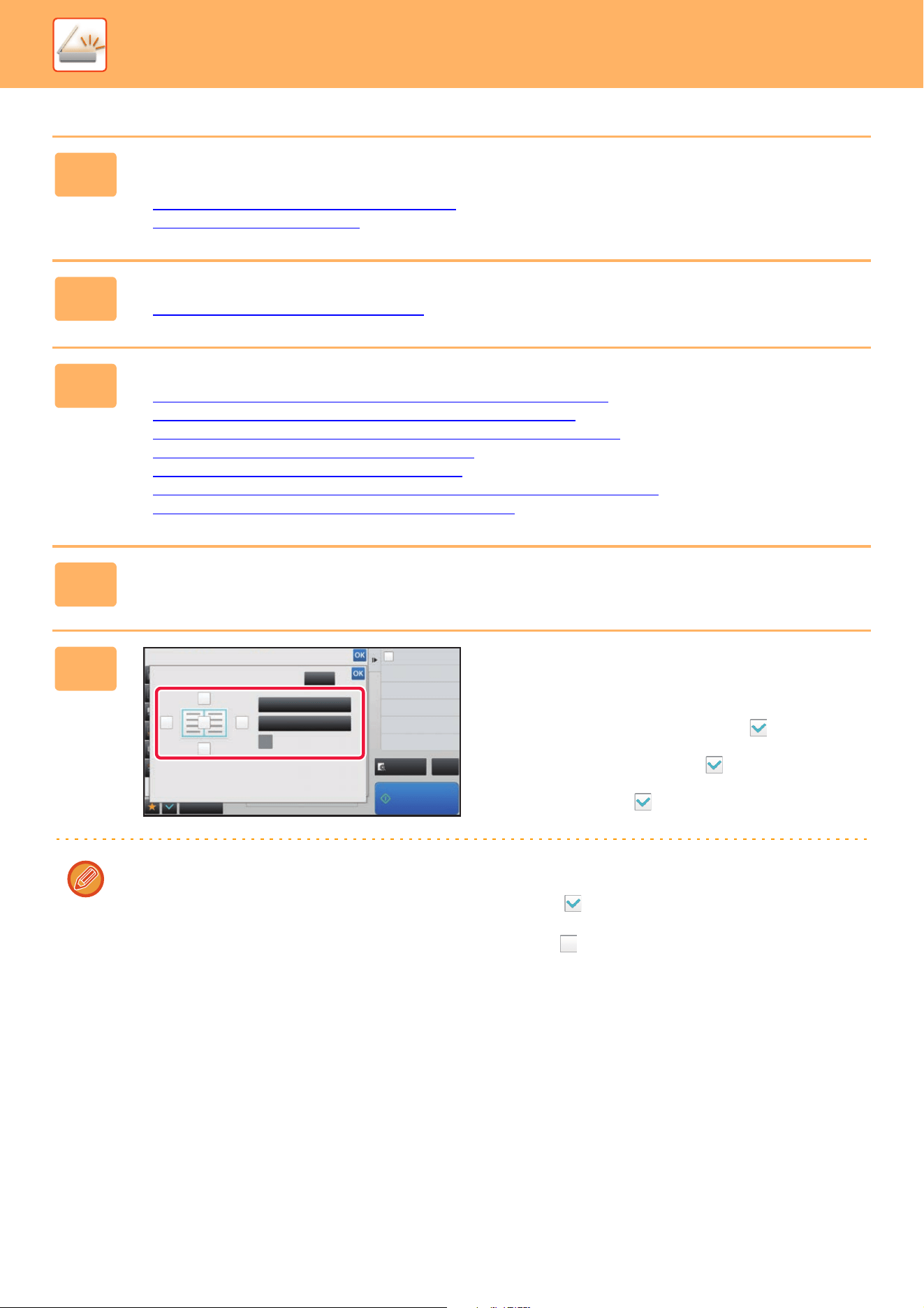
4-90
SCANNER►OTHER FUNCTIONS
1
Place the original.
Place the original in the document feeder tray of the automatic document feeder, or on the document glass.
► AUTOMATIC DOCUMENT FEEDER (page 1-90)
► DOCUMENT GLASS (page 1-92)
2
Tap the mode display to switch to the initial screen of each mode.
► Changing mode from each mode (page 4-8)
3
Specify the destination.
► RETRIEVING A DESTINATION FROM AN ADDRESS BOOK (page 4-14)
► VIEWING A LIST OF THE SELECTED DESTINATIONS (page 4-17)
► USING A SEARCH NUMBER TO RETRIEVE A DESTINATION (page 4-18)
► ENTERING AN ADDRESS MANUALLY (page 4-19)
► SPECIFYING A NETWORK FOLDER (page 4-20)
► RETRIEVING A DESTINATION FROM A GLOBAL ADDRESS BOOK (page 4-21)
► USING A TRANSMISSION LOG TO RESEND (page 4-23)
4
Tap the [Others] key, and tap the [Erase] key.
5
Tap the checkbox of the edge that you
wish to erase, and specify the erase
position.
Check that the tapped checkbox is set to .
If the [Specify Frame] key is tapped, the [Up], [Down], [Left],
and [Right] checkboxes are set to .
If the [Specify Frame+Center] key is tapped, all the
checkboxes are set to .
Specify the erase edge on the reverse side when erasing edges of one to three sides of Up, Down, Left, and Right on
the front side to scan a 2-sided original.
• If the [Reverse Erase Position of The Back Face] checkbox is set to , the edge in the position opposite to the
erased edge on the front side will be erased.
• If the [Reverse Erase Position of The Back Face] checkbox is set to , the edge in the same position as on the front
side will be erased.
Preview
CA
Start
Back
Others
Color Mode
Background Adjustment
Erase
Clear
Outer Frame
Specify Frame+Center
Specify Send Exposure
Exposure
Change Sending Resolution
Resolution
Reverse erase position of
back face
Down
Up
RightLeft
Divide into 2 Pages
Dual Page Scan
4-91
SCANNER►OTHER FUNCTIONS
6
Specify the erase width.
After the settings are completed, tap twice.
• Tap the numeric value display indicating the margin shift area on the front side or reverse side, and enter the area
using the numeric keys.
• To quickly set the area, first specify a value close to the desired value by the numeric keys, then adjust it with .
To cancel the erase setting:
Tap the [Clear] key.
7
Tap the [Start] key to start scanning of the original.
• If you inserted the original pages in the document feeder tray, all pages are scanned.
A beep will sound to indicate that scanning and transmission have ended.
• When you place the original on the document glass, scan each page one at a time.
When scanning finishes, place the next original and tap the [Start] key.
Repeat until all pages have been scanned and then tap the [Read-End] key.
A beep will sound to indicate that transmission has ended.
You can tap the [Preview] key to check a preview of the image before sending an image. For more information, see
"CHECKING THE IMAGE TO BE TRANSMITTED (page 4-58)
".
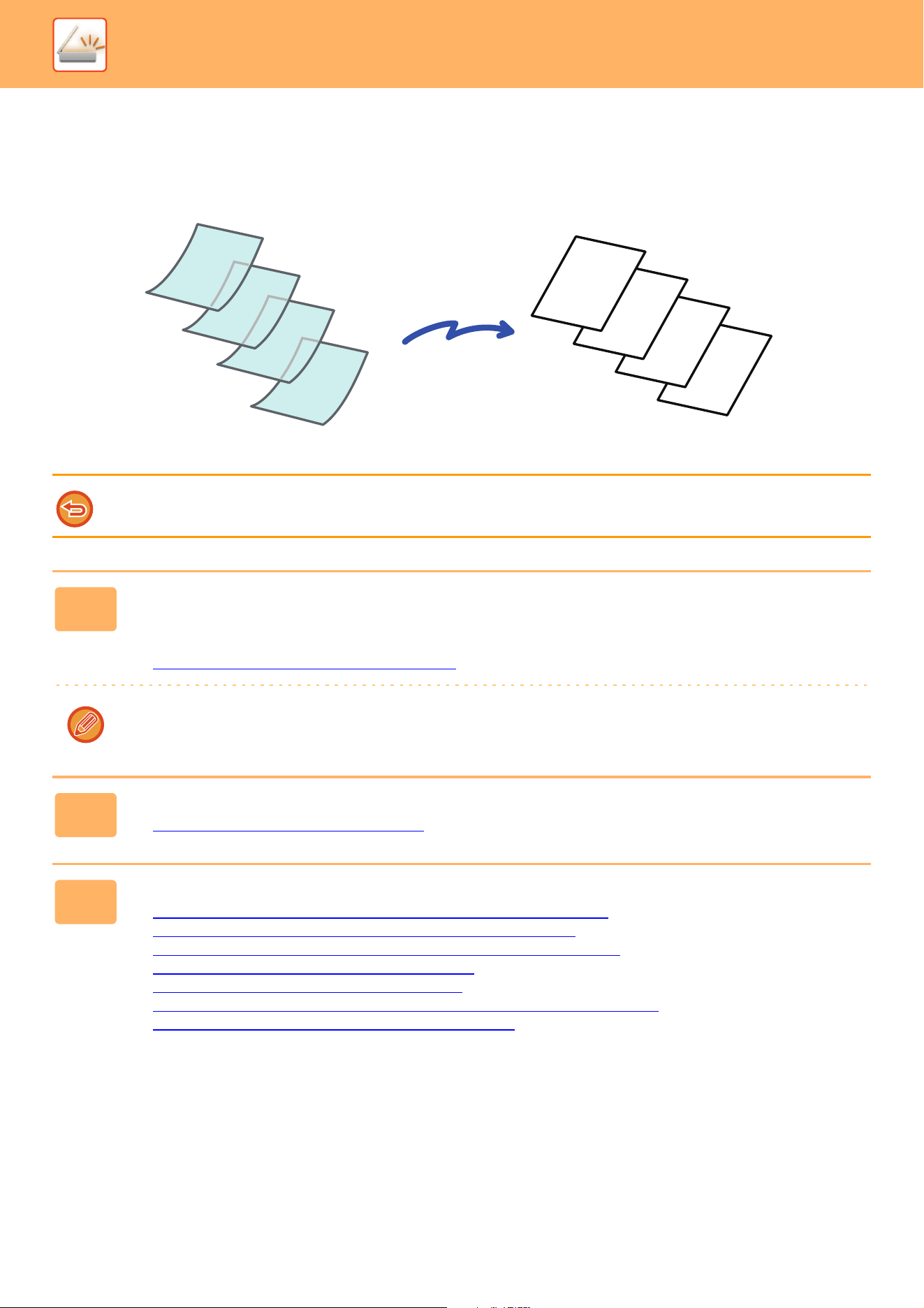
4-92
SCANNER►OTHER FUNCTIONS
SCANNING A THIN ORIGINAL (SLOW SCAN MODE)
Use this function when you wish to scan thin originals using the automatic document feeder. This function helps prevent
thin originals from misfeeding.
When slow scan mode is selected, 2-sided scanning is not possible.
1
Place the original in the document feeder tray of the automatic document
feeder.
Adjust the original guides slowly.
► AUTOMATIC DOCUMENT FEEDER (page 1-90)
If the originals are inserted with too much force, they may crumple and misfeed.
2
Tap the mode display to switch to the initial screen of each mode.
► Changing mode from each mode (page 4-8)
3
Specify the destination.
► RETRIEVING A DESTINATION FROM AN ADDRESS BOOK (page 4-14)
► VIEWING A LIST OF THE SELECTED DESTINATIONS (page 4-17)
► USING A SEARCH NUMBER TO RETRIEVE A DESTINATION (page 4-18)
► ENTERING AN ADDRESS MANUALLY (page 4-19)
► SPECIFYING A NETWORK FOLDER (page 4-20)
► RETRIEVING A DESTINATION FROM A GLOBAL ADDRESS BOOK (page 4-21)
► USING A TRANSMISSION LOG TO RESEND (page 4-23)
D
C
B
A
D
C
B
A
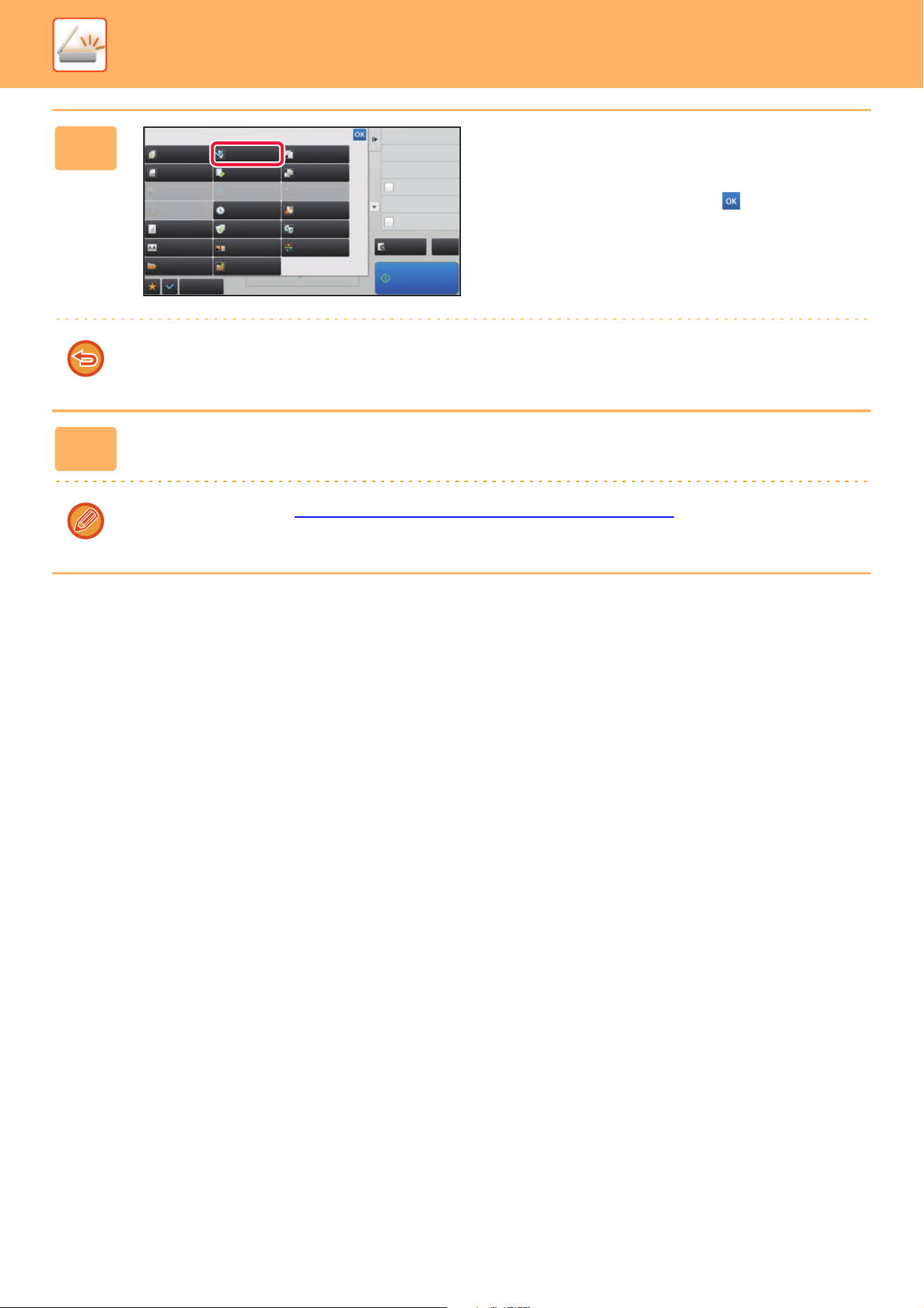
4-93
SCANNER►OTHER FUNCTIONS
4
Tap the [Others] key, and tap the [Slow
Scan Mode] key.
A checkmark appears on the icon.
After the settings are completed, tap .
To cancel the slow scan Mode setting
Tap the [Slow Scan Mode] key to uncheck it.
5
Tap the [Start] key to start scanning of the original.
A beep will sound to indicate that scanning and transmission have ended.
For more information, see "CHECKING THE IMAGE TO BE TRANSMITTED (page 4-58)". However, settings for this
function cannot be changed in the preview screen.
Back
Others
Preview
CA
Start
Erase
Dual Page Scan
Book Divide
Job Build Slow Scan Mode
Original
Count
Card Shot
Mixed Size
Original
Multicrop
Timer
Blank Page
Skip
Contrast
Sharpness
Verif.
Stamp
Background
Adjustment
Business
Card Scan
Drop Out Colour
File
RGB Adjust
Quick File
Verification Stamp
Call Search Number
Call Program
Call Registered settings
Sending History
Global Address Search
Send
Destination Link
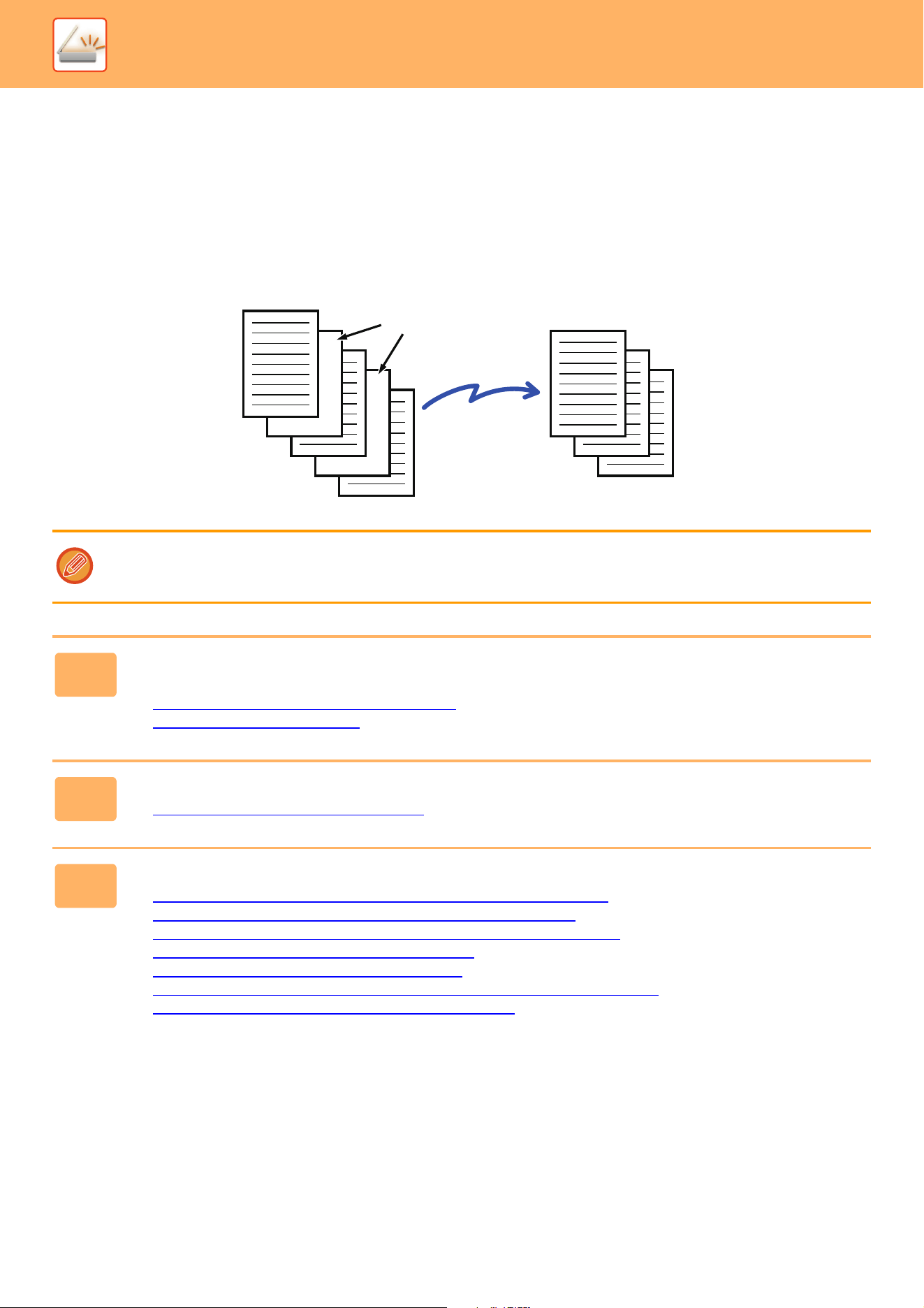
4-94
SCANNER►OTHER FUNCTIONS
ELIMINATING BLANK PAGES FROM A TRANSMISSION
(BLANK PAGE SKIP)
If the scanned original contains blank pages, this function skips them to send only non-blank pages.
The machine detects blank pages, enabling you to skip useless blank sheets without checking an original.
• If an original of which one side is blank is scanned, blank pages are skipped for 2-sided sending.
• Depending on the original, some pages that are not blank may be detected as blank pages and thus not being sent, and
some pages that are blank may not be detected as blank and thus sent.
1
Place the original.
Place the original in the document feeder tray of the automatic document feeder, or on the document glass.
► AUTOMATIC DOCUMENT FEEDER (page 1-90)
► DOCUMENT GLASS (page 1-92)
2
Tap the mode display to switch to the initial screen of each mode.
► Changing mode from each mode (page 4-8)
3
Specify the destination.
► RETRIEVING A DESTINATION FROM AN ADDRESS BOOK (page 4-14)
► VIEWING A LIST OF THE SELECTED DESTINATIONS (page 4-17)
► USING A SEARCH NUMBER TO RETRIEVE A DESTINATION (page 4-18)
► ENTERING AN ADDRESS MANUALLY (page 4-19)
► SPECIFYING A NETWORK FOLDER (page 4-20)
► RETRIEVING A DESTINATION FROM A GLOBAL ADDRESS BOOK (page 4-21)
► USING A TRANSMISSION LOG TO RESEND (page 4-23)
Blank page
Do not transmit
blank pages.
Transmission
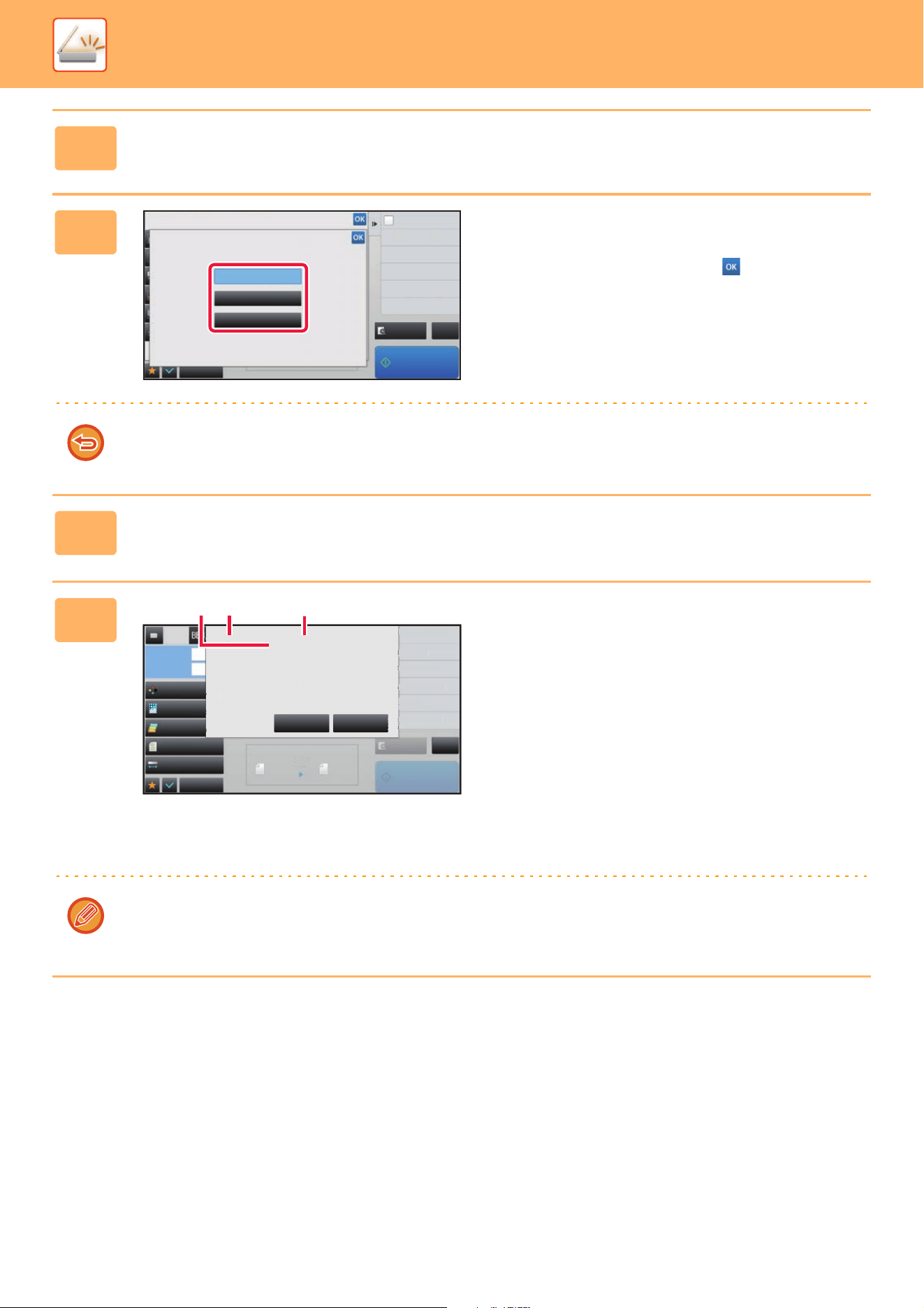
4-95
SCANNER►OTHER FUNCTIONS
4
Tap the [Others] key, and tap the [Blank Page Skip] key.
5
Tap the [Skip Blank Page] or [Skip
Blank and Back Shadow] key.
After the settings are completed, tap twice.
To cancel the Blank Page Skip setting:
Tap the [Off] key.
6
Tap the [Start] key to start scanning of the original.
A beep will sound to indicate that scanning has ended.
7
When scanning ends, check the
number of original sheets and the
number of sheets to be sent and tap
the [OK] key to start transmission.
• When Job Build mode is used, the confirmation message
will appear after the [Start] key is tapped.
• On the confirmation screen, the number of scanned
original sheets appears in (A), the number of scanned
sides in (B), and the number of sheets to be sent
excluding blank pages in (C).
For example, if five original sheets that include two blank
pages are scanned by duplex scanning, (A) will show "5",
(B) will show "10", and (C) will show "8".
If this step is not performed within one minute after the above confirmation screen appears, the scanned image and
settings will be cleared and the base screen will reappear.
Scanning will not be completed automatically and the image will not be reserved for transmission.
Preview
Start
Back
Others
CA
Color Mode
Original
Blank Page Skip
Off
Skip Blank Page
Skip Blank and Back Shadow
Specify Send Exposure
Exposure
Divide into 2 Pages
Dual Page Scan
Erase Shadow Around
Erase
CA
Preview
Start
Scan Size
Auto
Color Mode
Auto/Grayscale
Resolution
200x200dpi
File Format
PDF
Original
Auto
Others
100%
Send Size
Subject
File Name
Address
Verification Stamp
Call Search Number
Check Send/Receive
Status
Call Program
Call Registered settings
Sending History
Global Address Search
y
ysca
y
y
y
y
y
y
y
le
2
0
2
2
2
2
2
0d
p
i
P
P
PDF
P
P
P
P
P
P
V
V
V
Call S
S
S
C
C
Chec
c
c
C
C
C
C
C
C
C
C
C
C
C
C
C
S
S
Statu
u
u
S
S
S
S
S
S
S
S
S
u
S
S
u
Call
P
Call R
e
Send
d
d
Glob
a
a
5 pages of original have (P.8)
been scanned. 10 sheets of original
will be Perform the job?
Cancel OK
Exposure
8½x11 8½x11
(A)(C)
(B)
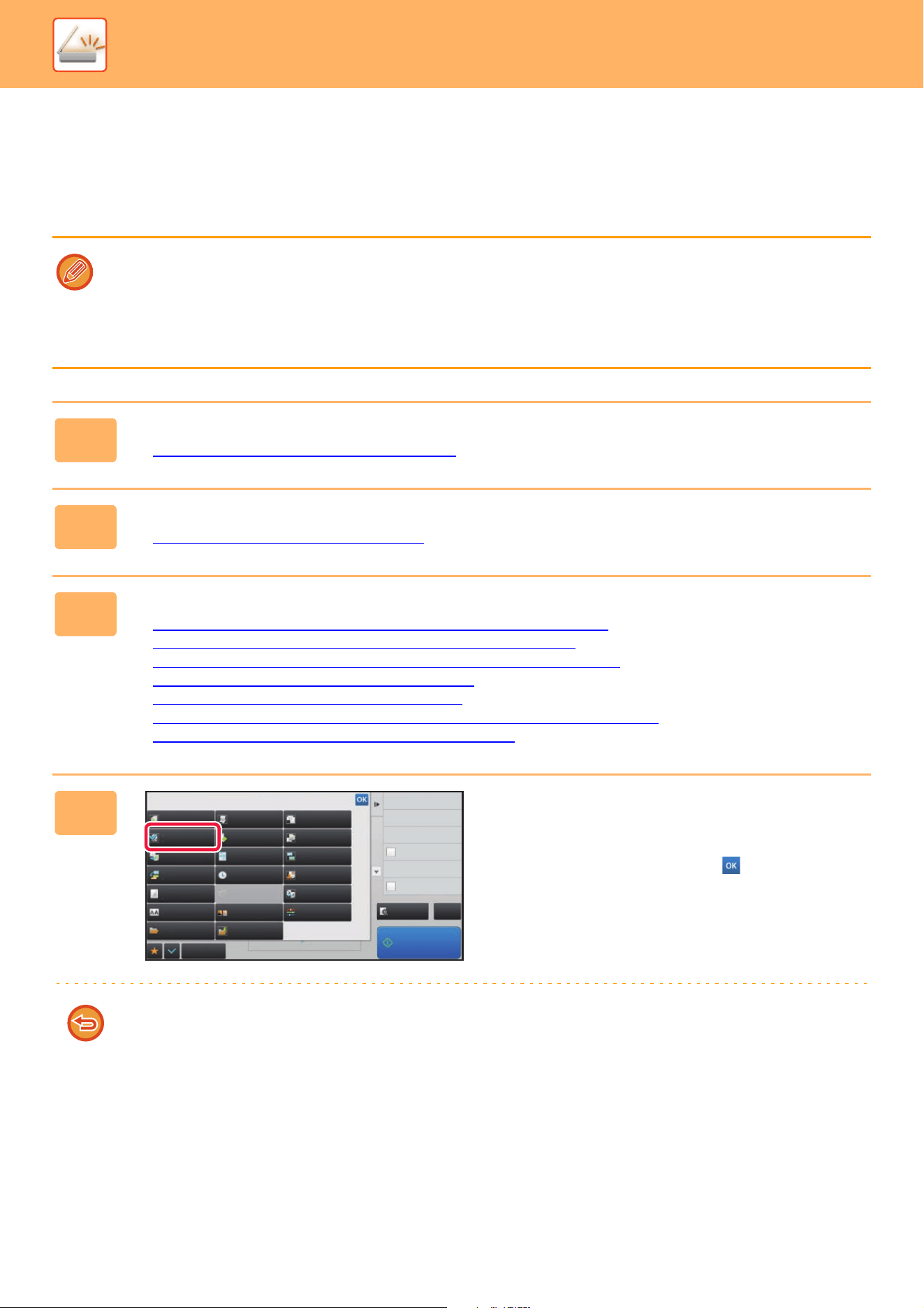
4-96
SCANNER►OTHER FUNCTIONS
CHECKING THE NUMBER OF SCANNED ORIGINAL
SHEETS BEFORE TRANSMISSION (ORIGINAL COUNT)
Count the number of scanned original sheets and display the count before transmission.
Checking the number of scanned original sheets before transmission helps prevent transmission mistakes.
• The count result is displayed with the number of scanned original sheets, not the number of scanned original pages. For
example, when a 2-sided original is transmitted, the number "1" will appear to indicate that one original sheet is
transmitted, not "2" to indicate the front-side page and the reverse side page.
• When a broadcast transmission is performed, if the original count function is selected in any of the modes, the function will
operate for all destinations.
• The setting should be enabled separately for each mode.
1
Place originals in the automatic document feeder.
► AUTOMATIC DOCUMENT FEEDER (page 1-90)
2
Tap the mode display to switch to the initial screen of each mode.
► Changing mode from each mode (page 4-8)
3
Specify the destination.
► RETRIEVING A DESTINATION FROM AN ADDRESS BOOK (page 4-14)
► VIEWING A LIST OF THE SELECTED DESTINATIONS (page 4-17)
► USING A SEARCH NUMBER TO RETRIEVE A DESTINATION (page 4-18)
► ENTERING AN ADDRESS MANUALLY (page 4-19)
► SPECIFYING A NETWORK FOLDER (page 4-20)
► RETRIEVING A DESTINATION FROM A GLOBAL ADDRESS BOOK (page 4-21)
► USING A TRANSMISSION LOG TO RESEND (page 4-23)
4
Tap the [Others] key, and tap the
[Original Count] key.
A checkmark appears on the icon.
After the settings are completed, tap .
To cancel the original count setting:
Tap the [Original Count] key to uncheck it.
Back
Others
Preview
Start
CA
Erase
Dual Page Scan
Book Divide
Job Build Slow Scan Mode
Original
Count
Card Shot
Mixed Size
Original
Multicrop
Timer
Blank Page
Skip
Contrast
Sharpness
Verif.
Stamp
Background
Adjustment
Drop Out Colour
File
RGB Adjust
Quick File
Business
Card Scan
Verification Stamp
Call Search Number
Sending History
Global Address Search
Send
Destination Link
Call Program
Call Registered settings
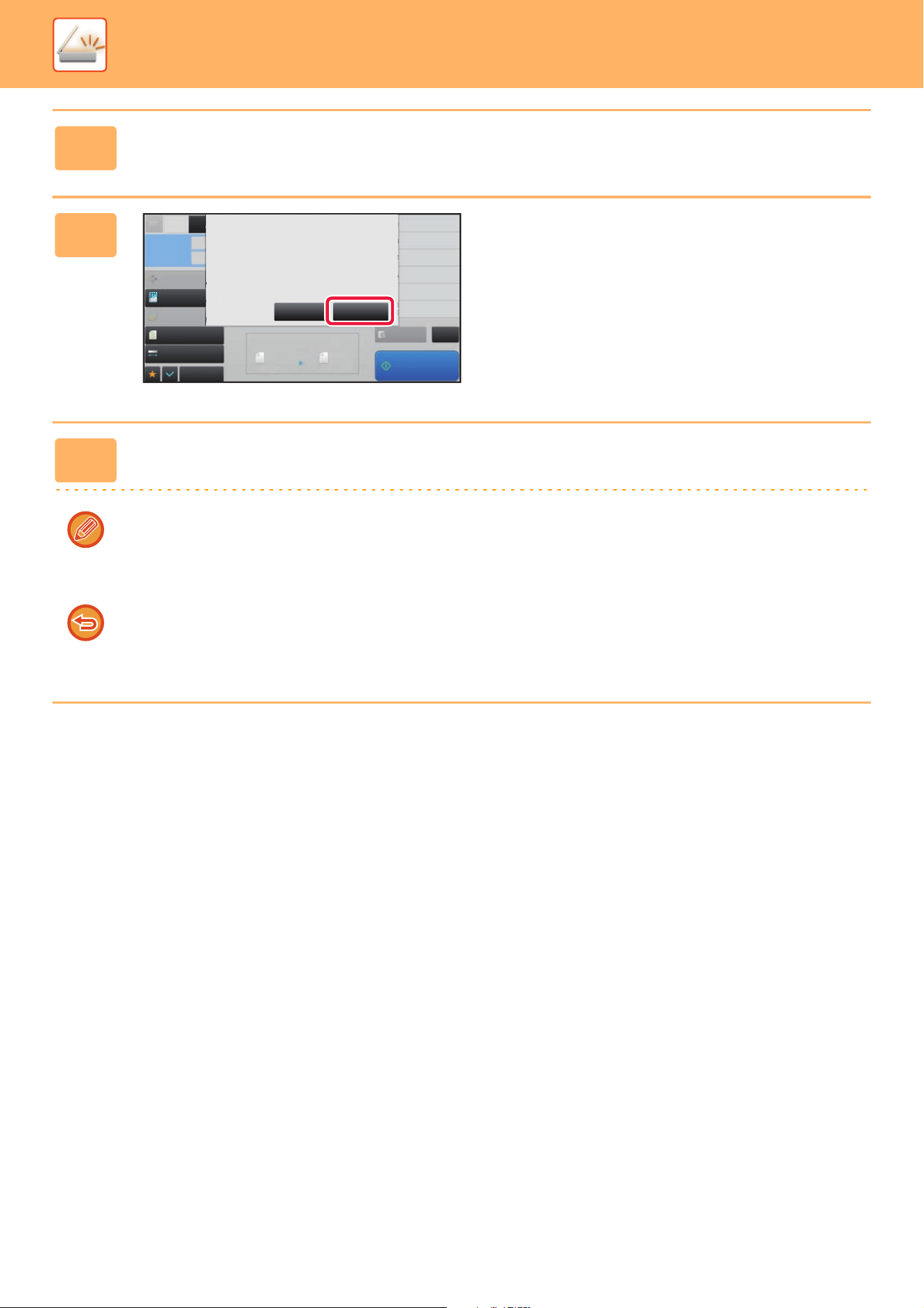
4-97
SCANNER►OTHER FUNCTIONS
5
Tap the [Start] key to start scanning of the original.
A beep will sound to indicate that scanning has ended.
6
Check the number of original sheets.
The number that is displayed is the number of scanned
original sheets, not the number of scanned original pages.
For example, when 2-sided copying is performed using one
original, the number "1" will appear to indicate that one
original sheet was scanned, not "2" to indicate the front-side
page and the reverse side page.
7
Tap the [OK] key to start transmission.
If this function is combined with [Job Build], the count result is displayed after the [Read-End] key has been tapped.
If this step is not performed within one minute after the above confirmation screen appears, the scanned image and
settings will be cleared and the base screen will reappear. Scanning will not be completed automatically and the image
will not be reserved for transmission.
If the displayed number of original sheets is different from the actual number of sheets:
Tap the [Cancel] key and then tap the [OK] key in the message screen to clear all scanned data. Scan settings and
destination settings will not be cleared. Insert the original sheets in the document feeder tray again and tap the [Start]
key to re-scan.
Preview
Start
Scan Size
AutoAuto
Color Mode
Auto/Mo
Resolution
200x200
File Format
PDF
Original
Auto
Others
8½x11
8½x11
100%
Send Size
Subject
File Name
Address
Verification Stamp
Call Search Number
Call Program
Call Registered settings
Sending History
Global Address Search
Exposure
CA
Send
Destination Link
to
t
o/M
t
t
t
to
t
t
to
t
t
to
o
0
0
0x20
0
0
0
0
0
0
0
0
0
0
0
0
F
F
F
F
F
F
F
F
F
F
F
F
V
V
V
Call S
S
S
Call
P
Call R
e
Send
d
d
Glob
a
a
S
S
S
D
D
D
1 pages of original
have been scanned.
Copy the scanned data?
Cancel OK
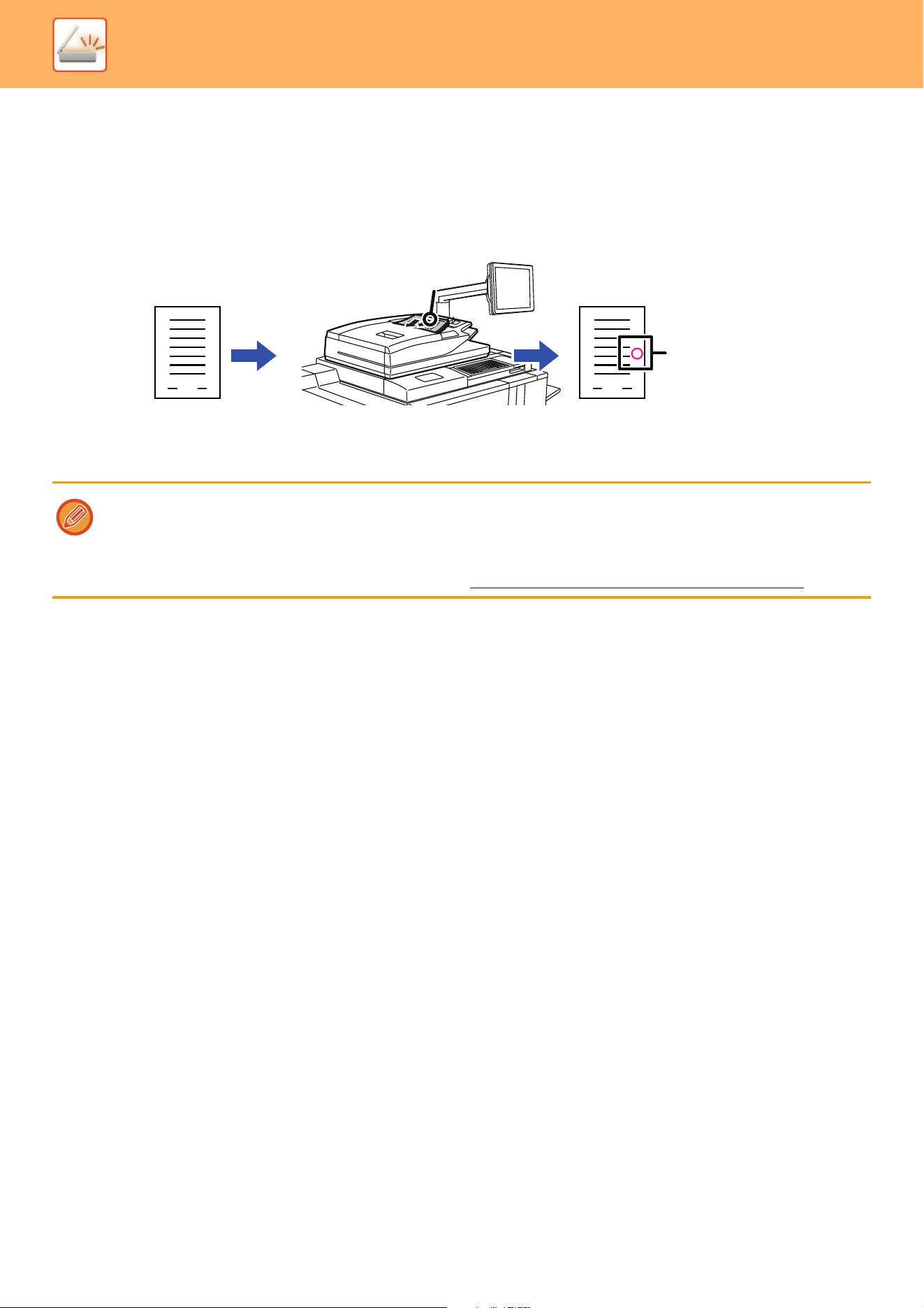
4-98
SCANNER►OTHER FUNCTIONS
STAMPING SCANNED ORIGINALS
(VERIFICATION STAMP)
This function stamps each original that is scanned using the automatic document feeder, allowing you to verify that all
originals were correctly scanned.
• To use the verification stamp function, the optional stamp unit must be installed.
• When 2-sided originals are used, the front of each original is stamped twice.
• If an error occurs during scanning, an original that was not scanned may be stamped.
• When the "O" mark that is stamped on originals starts to become faint, replace the stamp cartridge.
For the procedure for replacing the stamp cartridge, see "REPLACING THE STAMP CARTRIDGE (page 1-155)
".
11
Originals Originals are
scanned
An "O" mark is
stamped in
fluorescent pink.
Position of stamp
4-99
SCANNER►OTHER FUNCTIONS
1
Place originals in the automatic document feeder.
► AUTOMATIC DOCUMENT FEEDER (page 1-90)
2
Tap the mode display to switch to the initial screen of each mode.
► Changing mode from each mode (page 4-8)
3
Specify the destination.
► RETRIEVING A DESTINATION FROM AN ADDRESS BOOK (page 4-14)
► VIEWING A LIST OF THE SELECTED DESTINATIONS (page 4-17)
► USING A SEARCH NUMBER TO RETRIEVE A DESTINATION (page 4-18)
► ENTERING AN ADDRESS MANUALLY (page 4-19)
► SPECIFYING A NETWORK FOLDER (page 4-20)
► RETRIEVING A DESTINATION FROM A GLOBAL ADDRESS BOOK (page 4-21)
► USING A TRANSMISSION LOG TO RESEND (page 4-23)
4
Tap [Verification Stamp] on the action panel or [Others] key, and tap the
[Verif. Stamp] key.
The appropriate icon or checkbox is selected.
If you tap the [Others] key, tap after the settings have been completed.
To cancel the verification stamp setting:
Tap [Verification Stamp] on the action panel or the [Others] key, and tap [Verif. Stamp] to clear the checkmark.
5
Tap the [Start] key to start scanning of the original.
A beep will sound to indicate that scanning and transmission have ended.
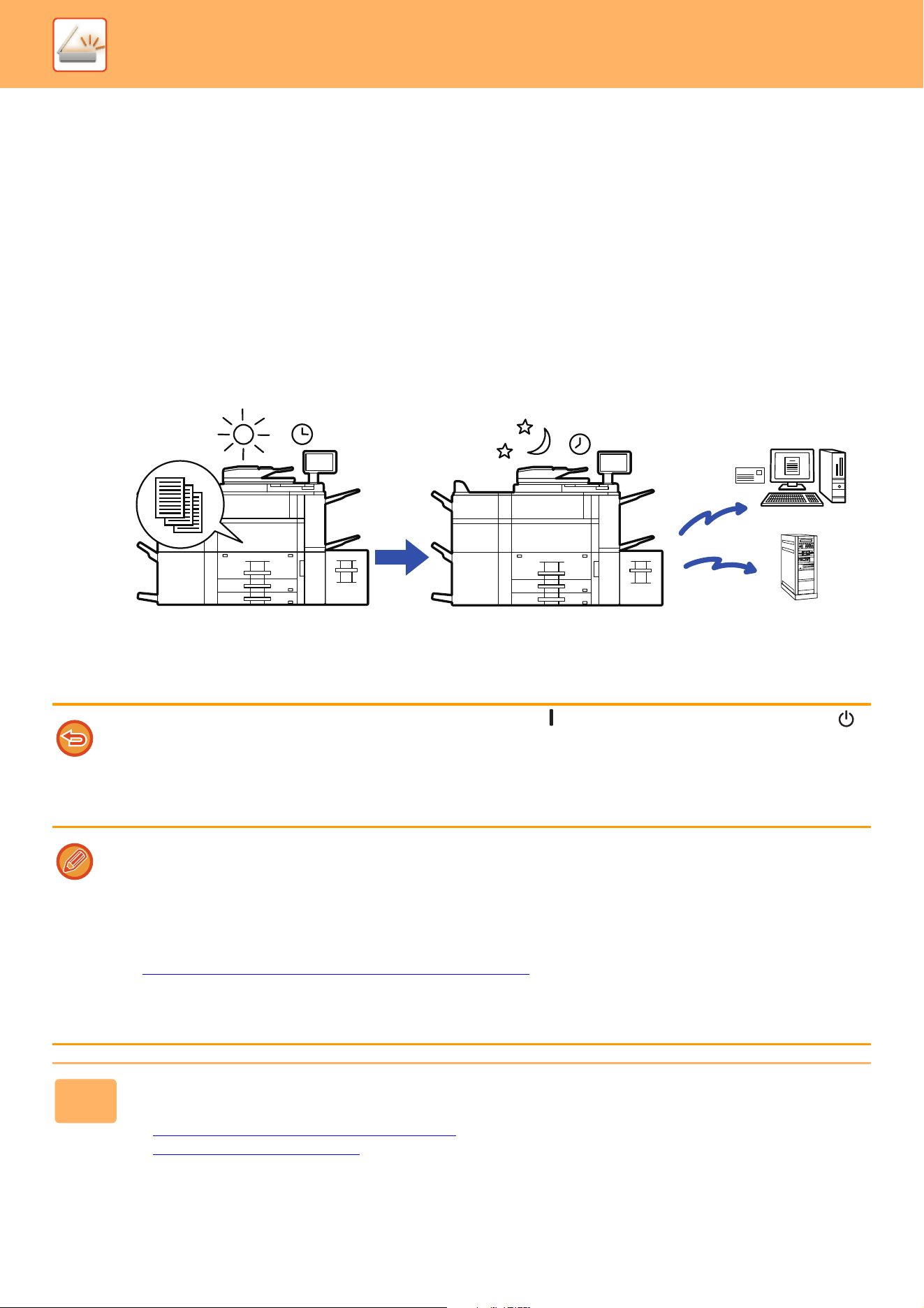
4-100
SCANNER►OTHER FUNCTIONS
SPECIFIC FUNCTIONS
STARTING A TRANSMISSION AT A SPECIFIED TIME
(TIMER TRANSMISSION)
Specify a time at which a transmission or broadcast transmission will automatically take place. Transmission begins
automatically at the specified time.
This function is helpful when you wish to perform reserved, broadcast or other transmissions during your absence or at
night or other times when communication fee is low.
• When a timer transmission is set, keep the main power switch in the " " position. If the main power switch is in the " "
position at the specified time, transmission will not take place.
• When performing a timer transmission, you must scan the original into memory when you set up the transmission. It is not
possible to leave the document in the document feeder tray or on the document glass and have it scanned at the reserved
time of transmission.
• Up to 100 timer transmissions can be stored at once.
• Settings selected for a timer transmission (exposure, resolution, and other functions) are automatically cleared after the
transmission is finished. (However, when the document filing function is used, the scanned original image and settings are
stored in the built-in hard drive.)
• If another transmission is in progress when the specified time arrives, the timer transmission will begin after that
transmission is finished.
• If a job scheduled for timer transmission is given priority on the job management screen, the timer will be canceled. The
transmission will begin as soon as the job in progress is completed.
► PRIORITY PROCESSING OF A RESERVED JOB (page 1-97)
• The time can be specified up to a week in advance.
• After the timer transmission settings are specified, start the transmission in the same way as other functions.
• A timer transmission can be deleted in the job management screen.
1
Place the original.
Place the original in the document feeder tray of the automatic document feeder, or on the document glass.
► AUTOMATIC DOCUMENT FEEDER (page 1-90)
► DOCUMENT GLASS (page 1-92)
During the day, configure the
setting to transmit received
data at 20:00.
At 20:00, the transmission
begins automatically.
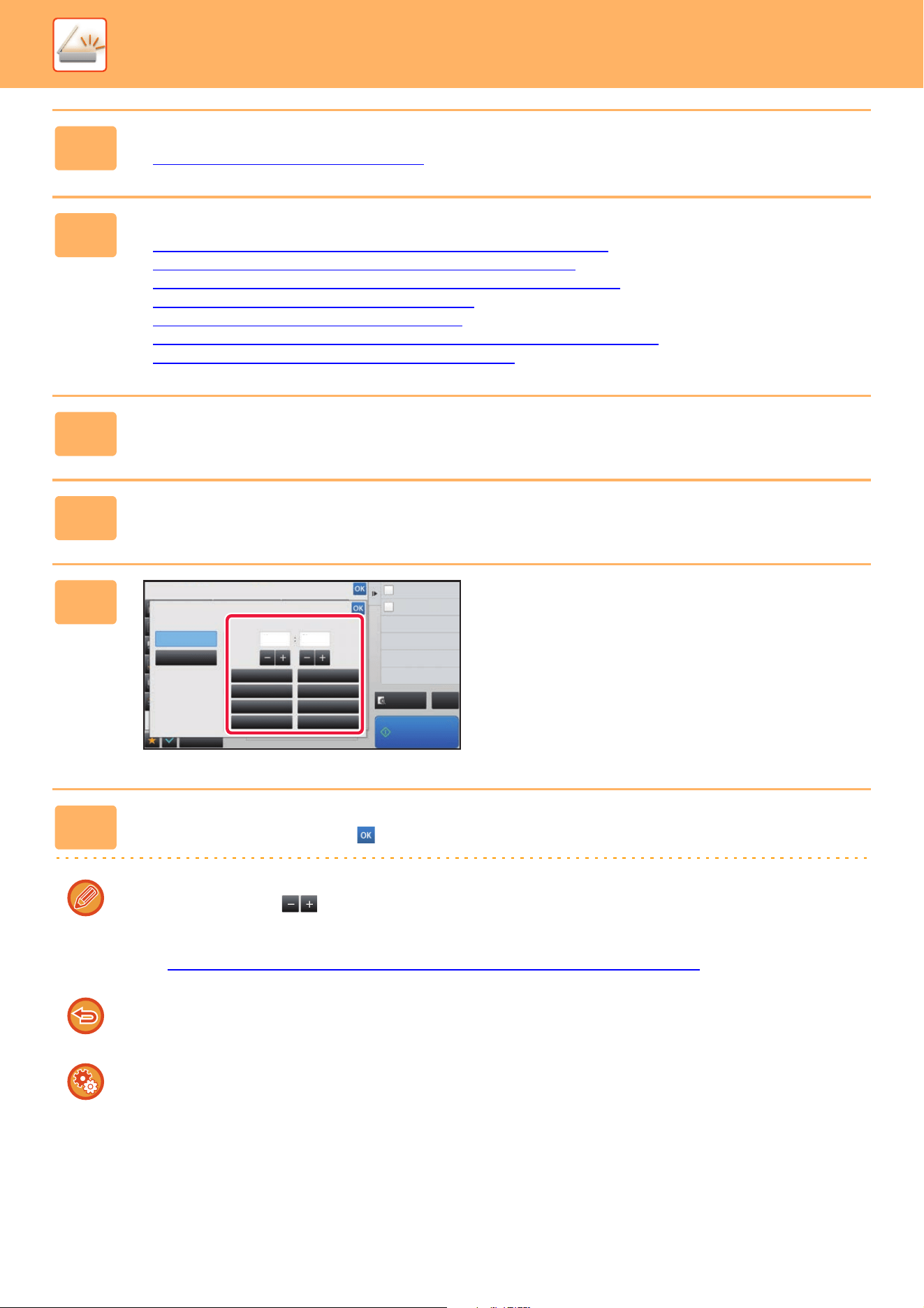
4-101
SCANNER►OTHER FUNCTIONS
2
Tap the mode display to switch to the initial screen of each mode.
► Changing mode from each mode (page 4-8)
3
Specify the destination.
► RETRIEVING A DESTINATION FROM AN ADDRESS BOOK (page 4-14)
► VIEWING A LIST OF THE SELECTED DESTINATIONS (page 4-17)
► USING A SEARCH NUMBER TO RETRIEVE A DESTINATION (page 4-18)
► ENTERING AN ADDRESS MANUALLY (page 4-19)
► SPECIFYING A NETWORK FOLDER (page 4-20)
► RETRIEVING A DESTINATION FROM A GLOBAL ADDRESS BOOK (page 4-21)
► USING A TRANSMISSION LOG TO RESEND (page 4-23)
4
Tap the [Others] key, and tap the [Timer] key.
5
Tap [On] key.
6
Specify the date.
7
Specify the time (hour and minute) in 24-hour format.
After the settings are completed, tap twice.
• Tap the areas displaying the hour and minute respectively, and enter the values using the numeric keys.
• It is convenient to use to finely adjust the time.
• The setting will show the current time. If the time is not correct, press the [CA] key to cancel the operation. Correct the
time in setting mode and then perform the timer transmission procedure.
► BEFORE USING THE MACHINE AS A NETWORK SCANNER FUNCTION (page 4-3)
To cancel the Timer Transmission settings:
Tap the [Off] key.
To set the date and time of the machine:
In "Settings", select [System Settings] → [Common Settings] → [Clock Adjust].
If [Disabling of Clock Adjustment] has been enabled, the date and time cannot be modified. Select [System Settings] in
"Settings (administrator)" and select [System Settings] → [Common Settings] → [Enable/Disable Settings] to disable the
[Disabling of Clock Adjustment] setting.
Preview
Start
Back
Others
CA
Timer
Off
On
Store Data in Folder
File
Receive Other's Original
Polling
Store Data Temporarily
Quick File
06/06/2015 Sat
10 15
To da y
Monday
Wednesday
Friday
Sunday
Tuesday
Thursday
Saturday
4-102
SCANNER►OTHER FUNCTIONS
8
Tap the [Start] key to start scanning of the original.
• If you inserted the original pages in the document feeder tray, all pages are scanned.
A beep will sound to indicate that scanning has ended, and the machine stands by for transmission.
• When you place the original on the document glass, scan each page one at a time.
When scanning finishes, place the next original and tap the [Start] key.
Repeat until all pages have been scanned and then tap the [Read-End] key.
A beep will sound to indicate that scanning has ended, and the machine stands by for transmission.
You can tap the [Preview] key to check a preview of the image before sending an image. For more information, see
"CHECKING THE IMAGE TO BE TRANSMITTED (page 4-58)
".
The original is scanned into memory. The original cannot be scanned at a specified time.
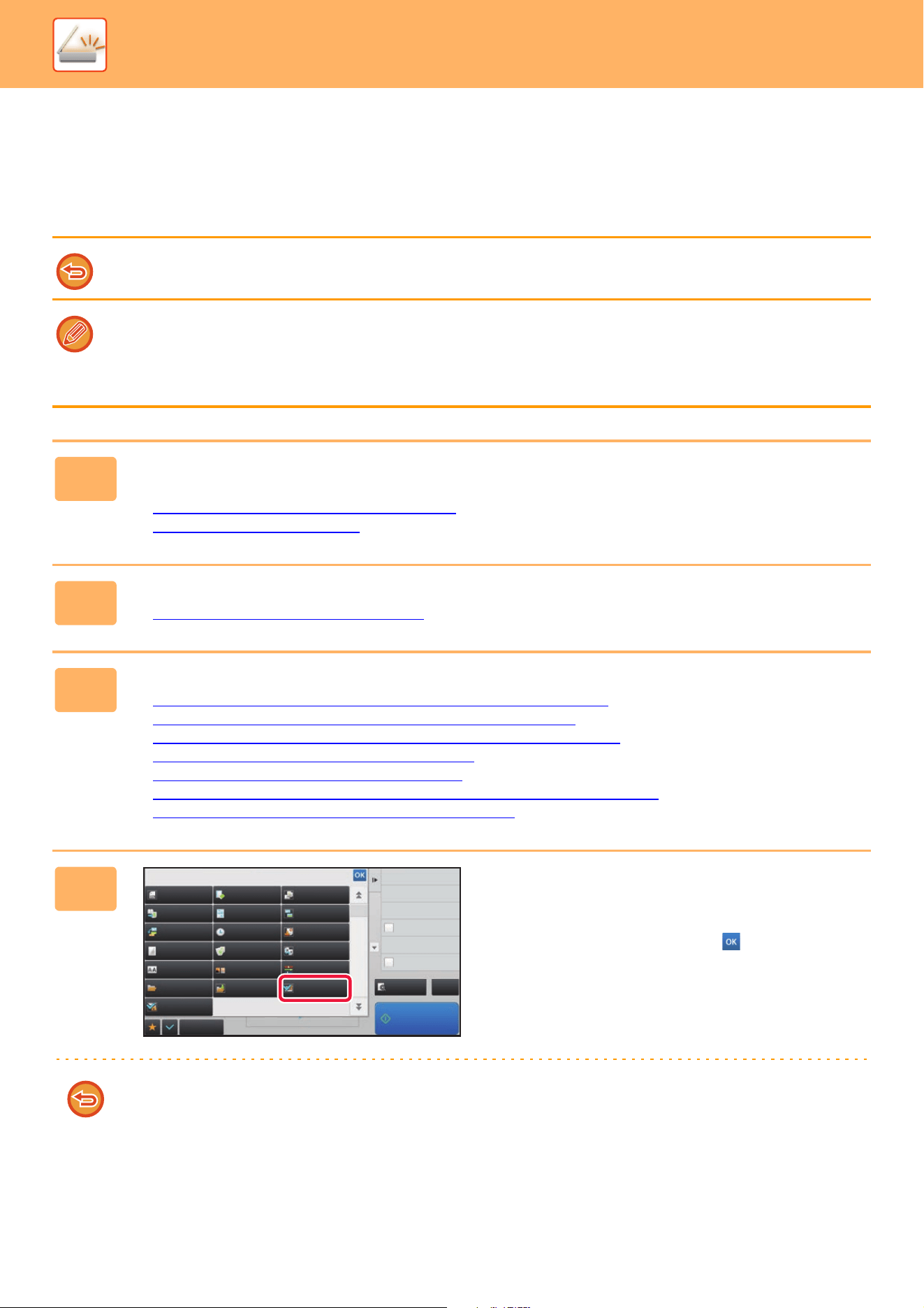
4-103
SCANNER►OTHER FUNCTIONS
ADDING A SIGNATURE WHEN SENDING AN IMAGE
(ELECTRONIC SIGNATURE)
You can add a signature when sending a scanned image. This allows the recipient to check your sender information in
the electronic signature.
This function is available for Scan to E-mail.
To add an electronic signature to a scanned image
• In "Settings (administrator)", select [System Settings] → [Security Settings] → [S/MIME Settings] → [Condition Settings].
• When [Select at Sending] is selected in "Sign E-mail" in "Settings (administrator)", you can specify whether or not an
electronic signature is added each time you send an image. When [Always Enable] is selected, the setting cannot be
changed.
1
Place the original.
Place the original in the document feeder tray of the automatic document feeder, or on the document glass.
► AUTOMATIC DOCUMENT FEEDER (page 1-90)
► DOCUMENT GLASS (page 1-92)
2
Tap the mode display to switch to the initial screen of E-mail mode.
► Changing mode from each mode (page 4-8)
3
Specify the destination.
► RETRIEVING A DESTINATION FROM AN ADDRESS BOOK (page 4-14)
► VIEWING A LIST OF THE SELECTED DESTINATIONS (page 4-17)
► USING A SEARCH NUMBER TO RETRIEVE A DESTINATION (page 4-18)
► ENTERING AN ADDRESS MANUALLY (page 4-19)
► SPECIFYING A NETWORK FOLDER (page 4-20)
► RETRIEVING A DESTINATION FROM A GLOBAL ADDRESS BOOK (page 4-21)
► USING A TRANSMISSION LOG TO RESEND (page 4-23)
4
Tap the [Others] key, and tap the [Sign
E-mail] key.
A checkmark appears on the icon.
After the settings are completed, tap .
To cancel the sign E-mail setting
Tap the [Sign E-mail] key to uncheck it.
Back
Encrypt E-mail
Sign E-mail
Sending History
Others
Call Search Number
Global Address Search
Verification Stamp
Preview
CA
Call Registered settings
Call Program
Start
Erase
Dual Page Scan
Book Divide
Original
Count
Card Shot
ContrastSharpness
Verif.
Stamp
Multicrop
Drop Out Colour
File
RGB Adjust
Quick File
Timer
Background
Adjustment
Blank Page
Skip
Business
Card Scan
Send
Destination Link
8½x11
8½x11
4-104
SCANNER►OTHER FUNCTIONS
5
Tap the [Start] key to start scanning of the original.
• If you inserted the original pages in the document feeder tray, all pages are scanned.
A beep will sound to indicate that scanning and transmission have ended.
• When you place the original on the document glass, scan each page one at a time.
When scanning finishes, place the next original and tap the [Start] key. Repeat the procedure until all pages have
been scanned and then tap the [Read-End] key.
A beep will sound to indicate that scanning and transmission have ended.
You can tap the [Preview] key to check a preview of the image before sending an image. For more information, see
"CHECKING THE IMAGE TO BE TRANSMITTED (page 4-58)
".
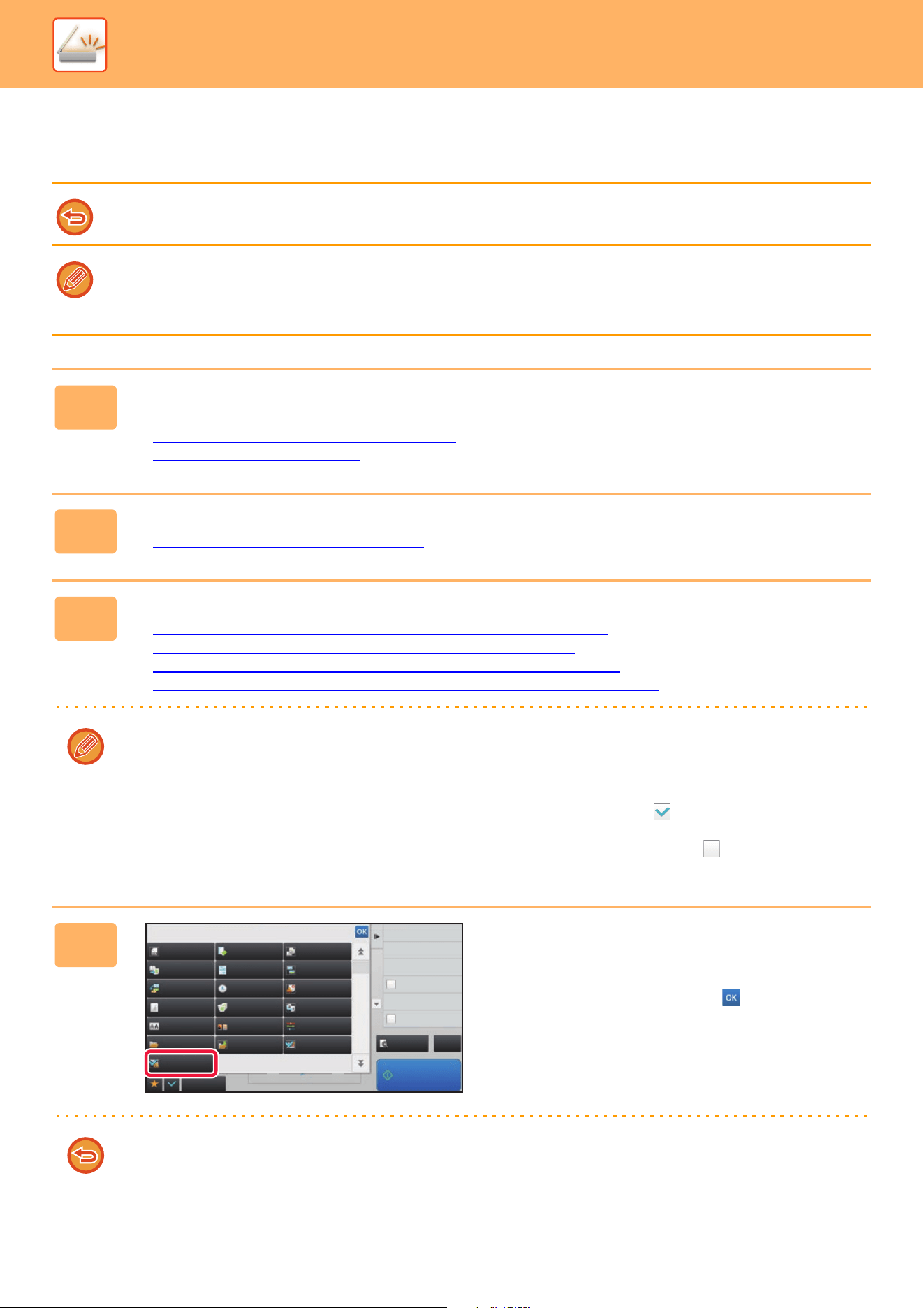
4-105
SCANNER►OTHER FUNCTIONS
ENCRYPTING THE TRANSMITTED DATA (ENCRYPTION)
You can encrypt the transmitted data to strengthen security.
This function is available for Scan to E-mail.
To encrypt transmitted data
•
In "Settings (administrator)", select [System Settings] → [Security Settings] → [S/MIME Settings] → [Condition Settings].
•
When [Select at Sending] is selected in "Encrypt E-mail" in "Settings (administrator)", you can specify whether or not the data
is encrypted each time you send an image. When [Always Enable] is selected, the setting cannot be changed.
1
Place the original.
Place the original in the document feeder tray of the automatic document feeder, or on the document glass.
► AUTOMATIC DOCUMENT FEEDER (page 1-90)
► DOCUMENT GLASS (page 1-92)
2
Tap the mode display to switch to the initial screen of E-mail mode.
► Changing mode from each mode (page 4-8)
3
Specify the destination.
► RETRIEVING A DESTINATION FROM AN ADDRESS BOOK (page 4-14)
► VIEWING A LIST OF THE SELECTED DESTINATIONS (page 4-17)
► USING A SEARCH NUMBER TO RETRIEVE A DESTINATION (page 4-18)
► RETRIEVING A DESTINATION FROM A GLOBAL ADDRESS BOOK (page 4-21)
• Data encryption is not possible when the address is directly entered.
• Encrypted data can only be sent to an address for which you have registered a user certificate.
Register a user certificate for the address in "Settings (Web version)" - [Address Book] → [E-mail]
→ "User Certificate". Only one E-mail address can be registered for an address that has a user certificate.
• If the "Disable sending to the addresses which cannot be encrypted." checkbox is ( ) in "Settings (administrator)" -
[System Settings] → [Security Settings] → [S/MIME Settings] → [Condition Settings] → [Encryption Settings],
addresses without a user certificate cannot be selected. When the checkmark is removed ( ), the data is sent
without encryption.
4
Tap the [Others] key, and tap the
[Encrypt E-mail] key.
A checkmark appears on the icon.
After the settings are completed, tap .
To cancel the encryption setting
Tap the [Encrypt E-mail] key to remove the checkmark.
Encrypt E-mail
Sign E-mail
Erase
Dual Page Scan
Book Divide
Original
Count
Card Shot
ContrastSharpness
Verif.
Stamp
Multicrop
Drop Out Colour
File
RGB Adjust
Quick File
Timer
Background
Adjustment
Blank Page
Skip
Business
Card Scan
Back
Sending History
Others
Call Search Number
Global Address Search
Direct TX
Preview
CA
Start
Send
Destination Link
8½x11
8½x11
Call Program
Call Registered settings
4-106
SCANNER►OTHER FUNCTIONS
5
Tap the [Start] key to start scanning of the original.
• If you inserted the original pages in the document feeder tray, all pages are scanned.
A beep will sound to indicate that scanning and transmission have ended.
• When you place the original on the document glass, scan each page one at a time.
When scanning finishes, place the next original and tap the [Start] key. Repeat the procedure until all pages have
been scanned and then tap the [Read-End] key.
A beep will sound to indicate that scanning and transmission have ended.
You can tap the [Preview] key to check a preview of the image before sending an image. For more information, see
"CHECKING THE IMAGE TO BE TRANSMITTED (page 4-58)
".
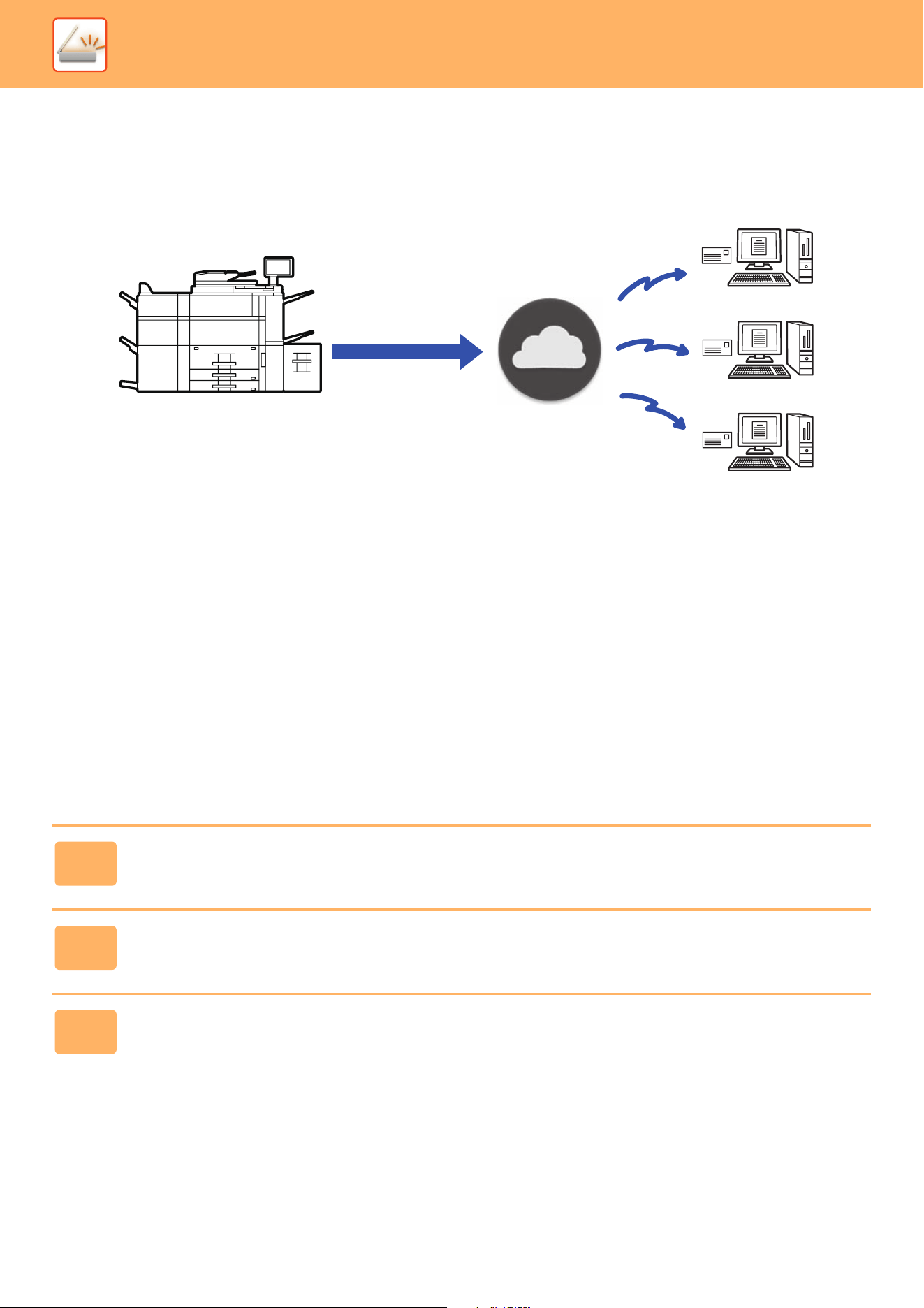
4-107
SCANNER►OTHER FUNCTIONS
SENDING A SCANNED DOCUMENT BY
GMAIL OR EXCHANGE
You can send e-mail from the machine using Gmail or Exchange.
GMAIL LINK FUNCTION
Gmail Connector is a function for sending scanned documents by e-mail via the Gmail server using a Google account.
To use Gmail Connector, you must log in using an account that has a Gmail address in the format "***@Gmail.com".
Before using Gmail link function
This section explains settings that must be configured before you can use Gmail link function.
Settings required on the machine
System settings
Enable the "Gmail" setting in "Settings (Administrator)" → [System Settings] → [Network Settings] → [External Service
Connect]
→ [E-mail Connect Settings].
Add the Gmail icon to the home screen
1
Tap [Edit Home] on the action panel.
2
In home edit mode, tap an unused shortcut key.
3
Tap the [Gmail] key.
Sending a scanned document
by Gmail or Exchange
4-108
SCANNER►OTHER FUNCTIONS
Sending a scanned document by Gmail link function
The steps for scanning a document on the machine and sending the scanned image by Gmail are explained below.
4
Tap [Exit Home Edit Mode] on the action panel.
You will exit home edit mode and return to the home screen.
To edit the home screen, refer to "U/I Customize Guide".
1
Tap the [Gmail] key in the home screen.
The Gmail login screen appears.
2
Enter your Google account information.
The settings screen appears.
3
Select the address of the recipient and scan settings.
For the address and scan settings, refer to "SETTINGS SCREEN (page 4-111)".
4
To view a preview of the scanned image, tap the [Preview] key.
5
Tap the [Start] key.
The sent e-mail is managed in “Sent Mail” of Gmail.
4-109
SCANNER►OTHER FUNCTIONS
EXCHANGE LINK FUNCTION
Exchange link function is a function for sending scanned documents by e-mail using an Exchange server offered by
Microsoft Corporation.
Versions that you can connect to are Microsoft Exchange Server 2010/2013.
Before using Exchange link function
This section explains the settings that must be configured before you can use Exchange link function.
Settings required on the machine
System settings
Enter the host name (FQDN) of the Exchange server in “Hostname” of "Settings (Administrator)" → [System Settings] →
[Network Settings] → [External Service Connect]
→ [E-mail Connect Settings]→[Exchange].
Add the Exchange Connector icon to the home screen
1
Tap [Edit Home] on the action panel.
2
In home edit mode, tap an unused shortcut key.
3
Tap the [Exchange (E-Mail)] key.
4
Tap [Exit Home Edit Mode] on the action panel.
Exit home edit mode and return to the home screen.
To edit the home screen, refer to "U/I Customize Guide".
4-110
SCANNER►OTHER FUNCTIONS
Sending a scanned document by Exchange
The steps for scanning a document on the machine and sending the scanned image by Exchange are explained below.
1
Tap the [Exchange (E-Mail)] key in the home screen.
The Exchange login screen appears.
2
Enter the user name and password used to connect to the Exchange server.
The settings screen appears.
3
Select the address of the recipient and scan settings.
For the address and scan settings, refer to "SETTINGS SCREEN (page 4-111)".
4
To view a preview of the scanned image, tap the [Preview] key.
5
Tap the [Start] key.
The sent e-mail is managed in “Sent Mail” of Exchange.
4-111
SCANNER►OTHER FUNCTIONS
SETTINGS SCREEN
This section explains the settings screen of Gmail link function and Exchange link function.
You can use this screen to enter recipient settings, the e-mail subject, a message, and the name of the file to be
attached. You can also change the account used to log in and select advanced scan settings.
Recipient settings
Enter the desired recipient addresses in the To, Cc, and Bcc text boxes.
To enter multiple addresses, separate the addresses by commas. You can also search for addresses in the address
book.
Search screen
You can tap next to the To, Cc, and Bcc text boxes to search for a saved address.
Enter the text you want to find in the text box and tap [Search Start]. A list of the addresses that begin with the entered
text will appear. You can select multiple addresses from the list.
When searching for an address, you can switch between the regular address book and a global address book.
To search again, enter the text you want to find in the text box and tap [Search Again].
Checking an address
You can tap the [Address List] key to show the list of addresses to be used.
You can check the addresses in To, Cc, and Bcc.
You can also remove addresses from the list. To remove an address, select the address and tap the [Delete] key.
Subject, message, and file name settings
Enter a subject for the e-mail, a message, and the file name of the scanned image to be attached.
Changing the login account
You can change the account currently used for login to a different account.
Tap the [Switch Accounts] key to open the Gmail or Exchange login screen, and enter the user name and password of
the account that you want to use.
When a contact is selected in the list, no additional contacts can be directly entered.
When an address is entered in To, Cc, or Bcc, appears. To cancel all addresses that are displayed, tap .
4-112
SCANNER►OTHER FUNCTIONS
Scan settings
To select advanced scan settings, tap the [Detail] key.
Details screen
The scan settings below can be selected.
Details and restrictions on each setting can be found on the indicated pages. Refer to these pages as needed.
Setting Description Page
Color Mode Auto, Mono2, Grayscale, Full Color 4-56
Resolution 100x100dpi, 150x150dpi, 200x200dpi, 300x300dpi, 400x400dpi, 600x600dpi 4-50
Format
[Color/Grayscale] tab
Format
PDF, Compact PDF, Compact PDF (Ultra Fine), PDF/A-1a, PDF/A-1b, PDF/A,
Compact PDF/A-1a, Compact PDF/A-1b, Compact PDF/A,
Compact PDF/A-1a (Ultra Fine), Compact PDF/A-1b (Ultra Fine),
Compact PDF/A (Ultra Fine), Encrypt PDF, Encrypt/Compact PDF,
Encrypt/Compact PDF (Ultra Fine), TIFF, JPEG, XPS, TXT(UTF-8), RTF,
DOCX, XLSX, PPTX
OCR Settings
Language Setting, Font, Detect Image Direction, File Name Auto Extraction, OCR Accuracy
Compression Ratio
Low, Middle, High, Bk Letter Emphasis
[B/W] tab
Format
PDF, PDF/A-1a, PDF/A-1b,
PDF/A, Encrypt PDF, TIFF, XPS, TXT(UTF-8), RTF,
DOCX, XLSX, PPTX
OCR Settings
Language Setting, Font, Detect Image Direction, File Name Auto Extraction, OCR Accuracy
Compression Mode
None, MH (G3), MMR (G4)
4-51
Original
Scan Size
Auto
[AB] tab
A5, A5R, B5, B5R, A4, A4R, B4, A3, 216 x 340, 216 x 343, Long Size
[Inch] tab
5-1/2" x 8-1/2", 8-1/2" x 11"R, 11" x 17", 5-1/2" x 8-1/2"R, 8-1/2" x 13", 8-1/2" x 13-1/2",
8-1/2" x 11", 8-1/2" x 14", Long Size
Image Orientation
Portrait, Landscape
Duplex Setup
1-Sided, Book, Tablet
4-39
Job Build Enabled, Disabled 4-72
Blank Page Skip Off, Skip Blank Page, Skip Blank and Back Shadow 4-94
4-113
SCANNER►OTHER FUNCTIONS
Gmail is a trademark of Google Inc.
• E-mail that is sent may be limited by the settings and specifications of the Gmail or Exchange server.
• In some network environments, the machine may not be able to use the Gmail or Exchange connection functions, or
sending may be slow or may stop before the job is completed.
• Sharp Corporation does not in any way guarantee the continuity or stability of Gmail or Exchange connection functions.
With the exception of instances provided for by law, Sharp Corporation bears no responsibility for any damages or loss
due to the customer’s use of these functions.
4-114
SCANNER►CHECKING THE STATUS OF TRANSMISSION/RECEPTION JOBS
IMAGE SEND JOBS
When you tap the job management display, jobs are displayed in a list. To check the status of a scanner mode job,
select the [Scan] tab.
When you wish to stop or delete jobs or to perform priority processing, see the following items:
► STOPPING/DELETING A JOB IN PROGRESS OR RESERVED (page 1-96)
► PRIORITY PROCESSING OF A RESERVED JOB (page 1-97)
► CHECKING A RESERVED JOB OR THE JOB IN PROGRESS (page 1-99)
► CHECKING COMPLETED JOBS (page 1-100)
CHECKING THE STATUS OF
TRANSMISSION/RECEPTION JOBS
Image send jobs include reception, timer transmission, and data forwarding as well as usual transmission. For the Image
Send job operations, see "COMPLETED TRANSMISSION/RECEPTION JOBS (page 4-115)
".
Job Queue
Complete
File retrieveScan
Job
Address
Set Time
Status
Check Details of
Selected Job
Send
Print Image Sending
Activity Report
Back
AAA AAA
Pages
Send OK
0001/000110:45 07/07
Print
Job Management Back
PRINTER
LINE

4-115
SCANNER►CHECKING THE STATUS OF TRANSMISSION/RECEPTION JOBS
COMPLETED TRANSMISSION/RECEPTION
JOBS
A usual transmission job moves to the job list when transmission is completed. Then the status field displays "Send OK".
Timer transmission jobs
A timer transmission job appears at the end of the job queue list until the specified time is reached.
Transmission begins at the specified time. When transmission is completed, the job moves to the completed job list and
the status field displays "Send OK".
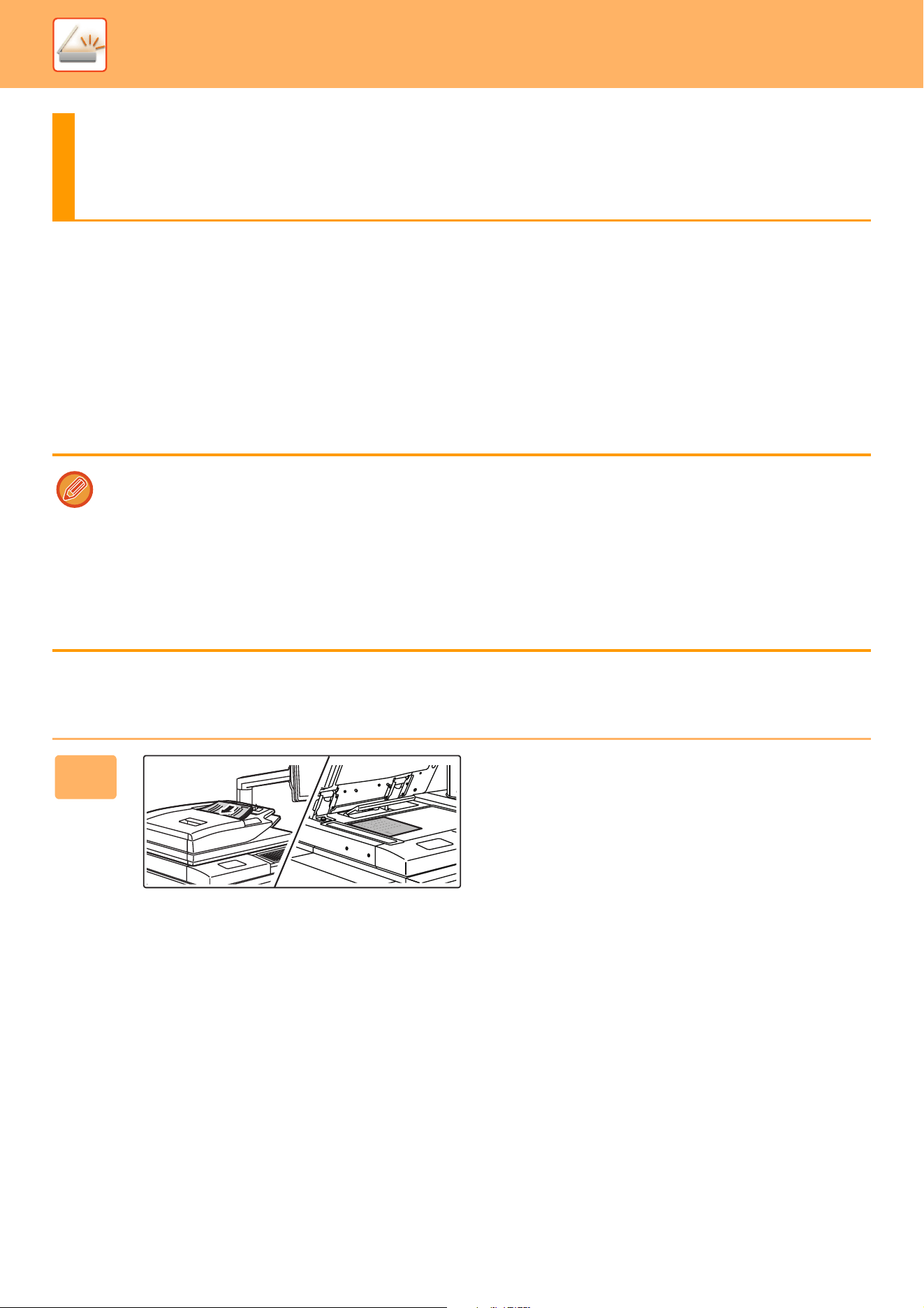
4-116
SCANNER►SCANNING FROM A COMPUTER (PC Scan Mode)
BASIC SCANNING PROCEDURE
You can install the scanner driver on your computer and use a TWAIN* compliant application to scan an image using
your computer.
Scanning from your computer is most useful for scanning a single original such as a photo, particularly when you want to
adjust scan settings as you scan. By contrast, scanning at the machine is most useful for continuous scanning of
multiple originals.
* An interface standard used for scanners and other image input devices. When the scanner driver is installed on your
computer, you can use any TWAIN-compliant application to scan an image.
[At the machine]
SCANNING FROM A COMPUTER
(PC Scan Mode)
• For the procedures for installing the scanner driver and configuring settings, see the Software Setup Guide.
• This function cannot be used when it has been disabled using "Disable Scan Function" in the system settings
(administrator).
• The procedures for selecting the scanner driver and starting scanning vary depending on the TWAIN-compliant
application. For more information, see the manual for the application or Help.
• When a large image is scanned at high resolution, the amount of data will be very large and scanning will take a long time.
Be sure to select appropriate scan settings for the original (text, photo, etc.).
• A print job cannot be printed while remote PC scan is in progress. The print job will print when remote PC scan ends.
• Remote PC scan cannot be performed while a print job is in progress.
1
Place the original.
Place the original face up in the document feeder tray, or
face down on the document glass.
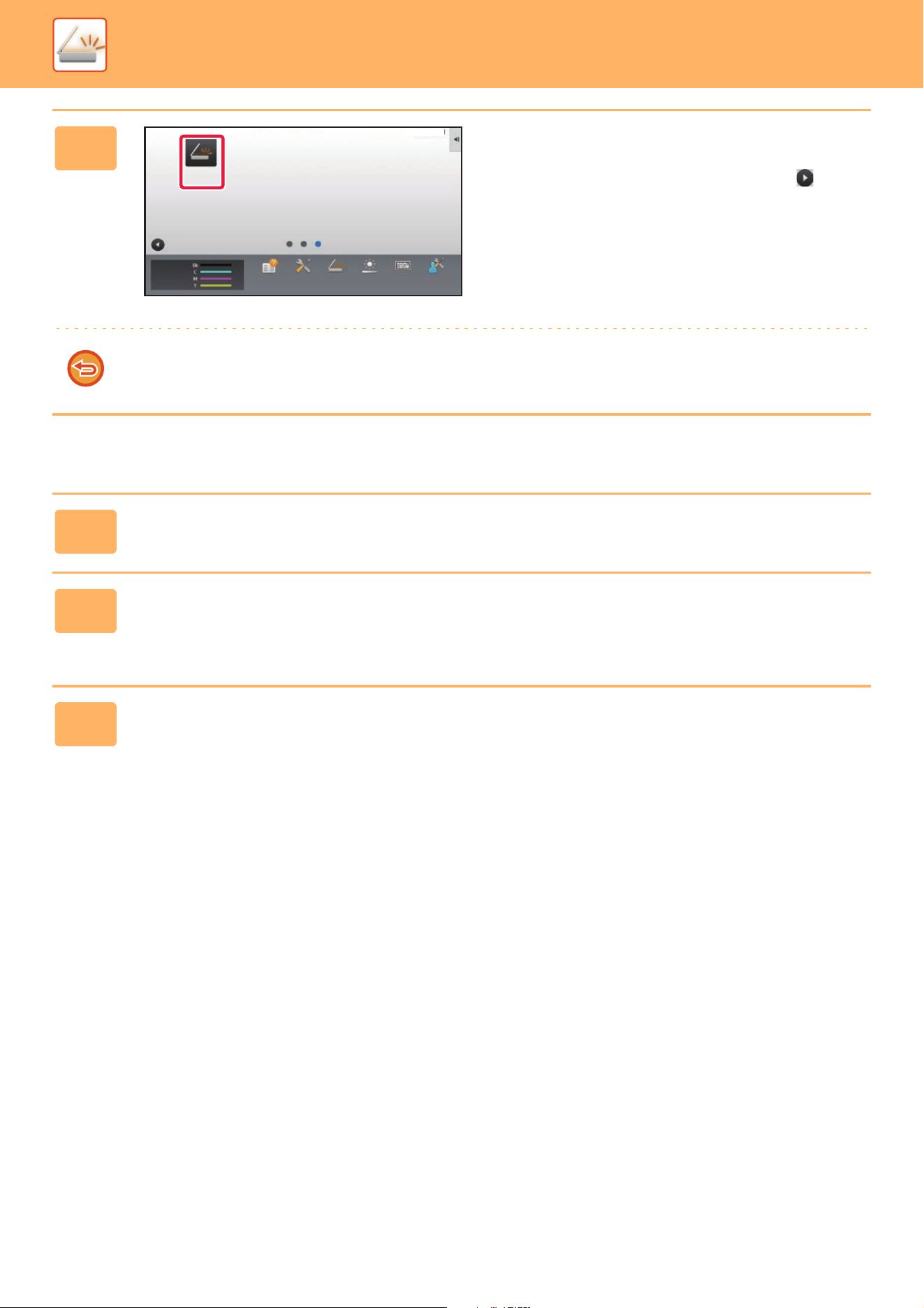
4-117
SCANNER►SCANNING FROM A COMPUTER (PC Scan Mode)
[At your computer]
2
Tap the [PC Scan] mode icon to switch
to PC Scan mode.
If the [PC Scan] mode icon does not appear, tap to
move the screen.
When PC scan mode is selected, only the [Exit] key displayed in the touch panel can be used on the machine; no other
keys can be used.
3
Start the TWAIN-compliant application on your computer and select [Select
Scanner] from the [File] menu.
4
Select the scanner driver of the machine.
(1) Select [SHARP MFP TWAIN K].
(2) Click the [Select] button.
5
Select [Acquire Image] from the [File] menu.
The scanner driver opens.
Toner Quantity
Operation
Guide
PC Scan Total Count Machine
Adjustment
LCD Control
Settings
10:15 AM
PC Scan
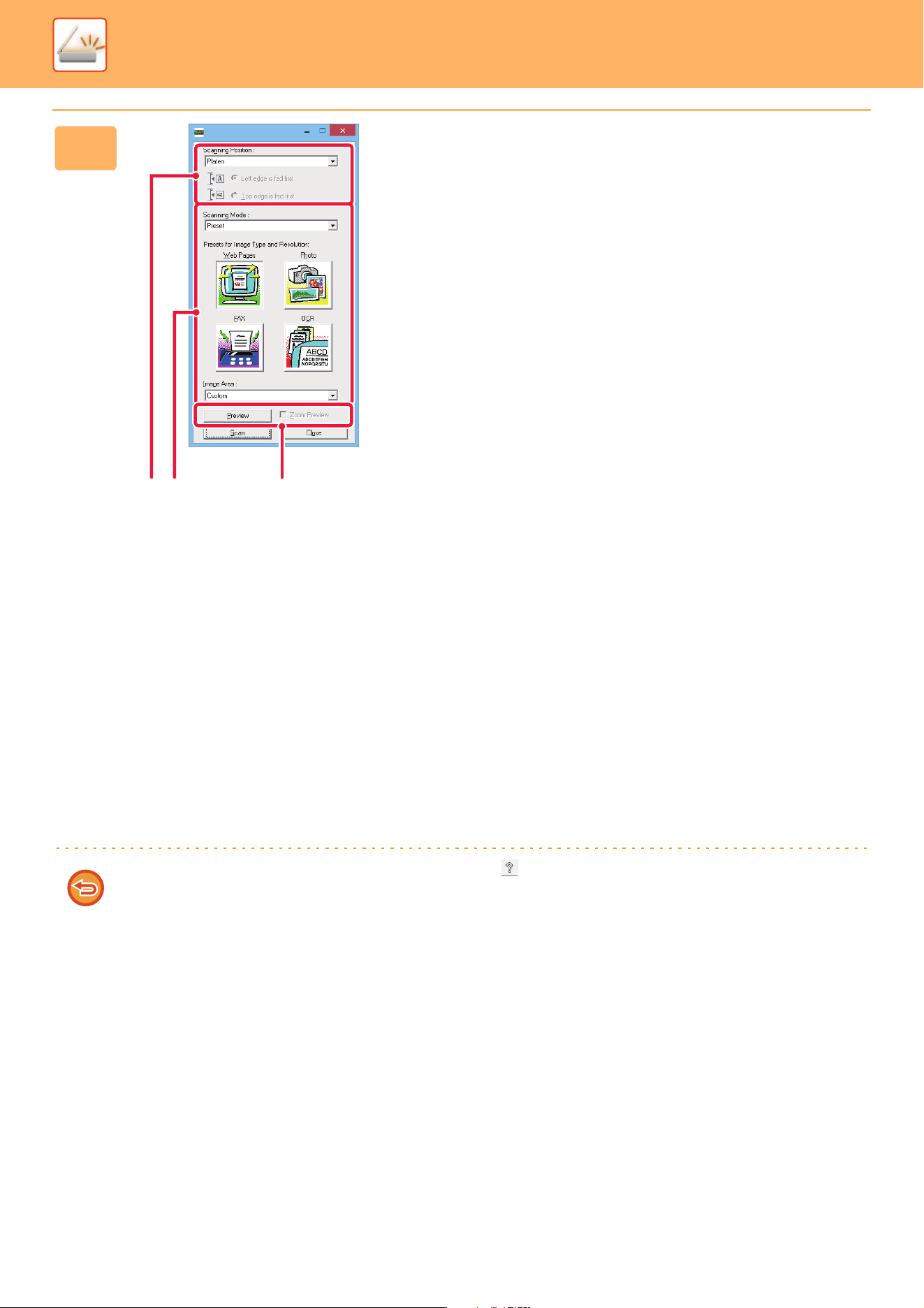
4-118
SCANNER►SCANNING FROM A COMPUTER (PC Scan Mode)
6
Preview the image.
(1) Select the location where the original is
placed.
"Scanning Position" menu:
• If the original is a one-sided original and is placed in
the document feeder tray, select [SPF(Simplex)].
• If the original is a 2-sided original and is placed in the
document feeder tray, select [SPF(Duplex - Book)]
or [SPF(Duplex - Tablet)] depending on whether the
original is a book-style or tablet-style original. In
addition, select [Left edge is fed first] or [Top edge is
fed first] depending on the orientation of the original.
(2) Select scan settings.
"Scanning Mode" menu:
Switch between the "Preset" screen and the "Custom
Settings" screen. In the "Preset" screen, select "Web
Pages", "Photo", "Fax" or "OCR" depending on the
original type and your scanning purpose.
If you wish to change the initial settings of any of the
four buttons or select the resolution or other advanced
settings, change to the "Custom Settings" screen.
"Image Area" menu:
Select the scan area. If "Auto" is selected, the original
size detected by the machine will be scanned. You can
also set the scanning area in the preview window with
your mouse.
(3) Click the [Preview] button.
The preview image will appear in the scanner driver.
If you are not satisfied with the preview image, repeat
(2) and (3).
If the [Zoom Preview] checkbox is selected before the
[Preview] button is clicked, the selected area will be
enlarged in the preview window. If the checkmark is
removed, the preview image will return to normal. Note
that if SPF is selected in the "Scanning Position" menu,
the [Zoom Preview] function cannot be used.
• For further information on the scan settings, click the button in the preview image screen of step 7 to
open scanner driver Help.
• If the [Preview] button is clicked when scanning from the document feeder tray, only one original page will be scanned
for the preview image. If you wish to include that original in the scan, return it to the document feeder tray.
(1) (3)(2)
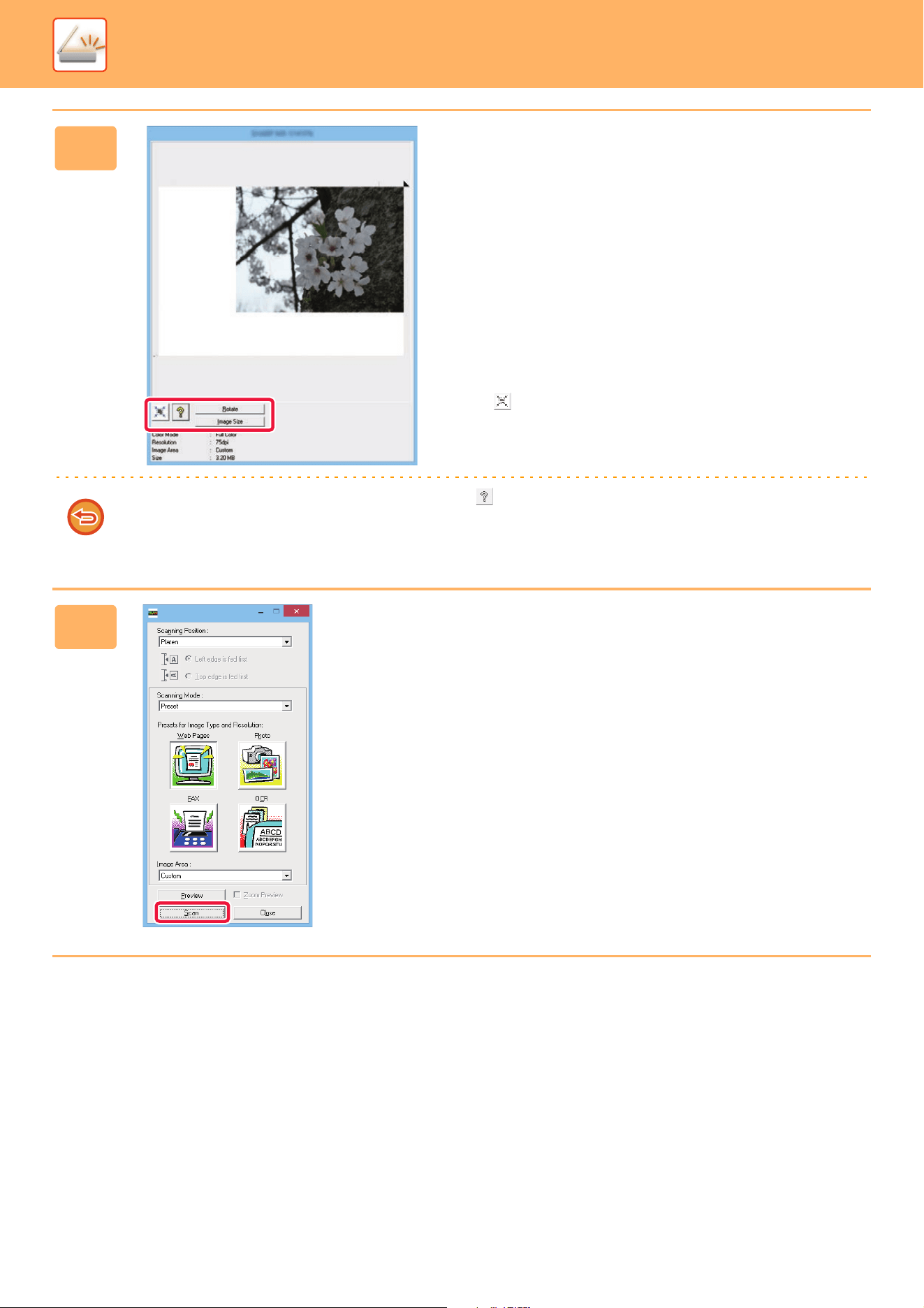
4-119
SCANNER►SCANNING FROM A COMPUTER (PC Scan Mode)
7
Select scanning settings while viewing
the image.
[Rotate] button:
Each time this button is clicked, the preview image rotates
90 degrees. This lets you change the orientation of the
image without picking up and placing the original again. The
image file will be created using the orientation that appears
in the preview window.
[Image Size] button:
Click this button to specify the scan area by entering
numerical values. Pixels, mm, or inches can be selected for
the units of the numerical values. If a scanning area has
already been specified, the entered numbers will change the
area relative to the top left corner of the specified area.
button:
When a preview image is displayed and a scanning area is
not specified, you can click the button to automatically set
the scanning area to the entire preview image.
• For further information on the scan settings, click button to open scanner driver Help.
• If the originals are placed in the document feeder tray, only the top page will be previewed. The top page will be
delivered to the original exit tray. Be sure to return the previewed page to the document feeder tray before previewing
again or scanning.
8
Click the [Scan] button.
Scanning begins. The image appears in your application.
Assign a file name to the scanned image and save it as
appropriate in the software application you are using.
4-120
SCANNER►SCANNING FROM A COMPUTER (PC Scan Mode)
[At the machine]
9
Tap the [Exit] key.
10
Tap the [Yes] key.
Toner Quantity
Operation
Guide
PC Scan Total Count Machine
Adjustment
Settings
PC Scan
LCD Control
10:15 AM
This machine is in the PC scan mode.
Do not remove the original.
Scanner IP address:0.0.0.0
Exit
10:15 AM
Toner Quantity
Operation
Guide
PC Scan Total Count Machine
Adjustment
Settings
PC Scan
LCD Control
PC scan in progress.
Finish PC scan mode?
YesNo
4-121
SCANNER►METADATA DELIVERY
PREPARATIONS FOR METADATA
DELIVERY
METADATA DELIVERY (DATA ENTRY)
When the application integration module kit is installed, metadata (data indicating the attributes of the image file and
how it is to be processed) is generated based on pre-stored information and transmitted separately from an image file
that is generated for sending a scanned image. The metadata file is created in XML format.
By linking the metadata with applications such as document management software, a workflow application, or an
encryption server, a sophisticated document solution environment can be built.
Using the application integration module kit, information on a generated image file can be entered at the touch panel and
transmitted along with the image as an XML file.
METADATA DELIVERY
Server
Fax server, document
management software,
workflow application, and
encryption server, etc.
Scan to E-mail
Scan to FTP
Scan to Network Folder
Image file

4-122
SCANNER►METADATA DELIVERY
SETTINGS REQUIRED IN THE SETTING MODE
(WEB VERSION)
To configure the settings related to metadata, select [System Settings] → [Image Send Settings] → [Metadata Settings]
→ [Metadata Entry] in "Settings (administrator)". (Administrator rights are required.)
Enable metadata delivery.
Storing Metadata Sets
Store the items (the metadata set) to write to the XML file that will be generated during scanning. Up to 10 metadata
items can be configured in a metadata set. A stored metadata set can be selected at the time of transmission.
Addresses specified in "Address Type Allowing Metadata Entry" when a metadata set is stored can be selected as
transmission destinations at the time of transmission using one-touch keys, manual entry, or a global address book
search. (Addresses for which metadata entry is not allowed cannot be specified as transmission destinations.)
4-123
SCANNER►METADATA DELIVERY
TRANSMITTING METADATA
TRANSMITTING METADATA
Select a metadata set, enter each item, and perform metadata delivery.
Metadata delivery is performed using the document filing function. The [Data Entry] tab appears in the transmission settings
screen of document filing mode to allow metadata delivery.
In addition, perform metadata delivery using document filing in [Metadata Entry] in "Settings (Web version)."
• In data entry mode, configure metadata settings to perform metadata delivery.
To perform transmission without sending metadata, switch the screen from data entry mode to a different mode and then
perform transmission.
• When metadata settings have been configured or an address is specified in data entry mode, it will not be possible to
switch to another mode.
• Before configuring metadata settings, specify addresses in all available modes. After metadata settings have been
configured, specify only addresses in modes that are allowed in the selected metadata.
1
Tap the [Data Entry] icon on the [Home Screen], and tap [Metadata Set].
If a specific metadata set has been specified as the default set, go to step 3.
If no metadata sets have been stored, Metadata Entry is unavailable. Store metadata set in the setting mode (Web
version) before performing transmission.
2
Tap the key for the desired metadata set.
3
The keys of the items stored in the metadata set will appear. Tap the key of
the item that you wish to enter.
4
Tap the key of the value that you wish to enter, and tap the [OK] key.
To directly enter the metadata value, tap the [Direct Entry] key. On the soft keyboard screen that appears, tap the [OK]
key. You will return to the screen shown in step 3.
After the settings are completed, tap .
To cancel the selection of the metadata value:Tap the [Clear] key.
5
Configure image or other settings, and perform the scan send procedure.
• Configure job detail settings and then start transmission using the same operations as in other modes.
• When directly entering an address, tap [Touch to input Address] to display the screen for selecting an address type. If
the address type such as E-mail, Network Folder or is selected, the address type entry screen appears.
4-124
SCANNER►METADATA DELIVERY
METADATA FIELDS
The following three types of metadata are included in the XML file that is transmitted.
• Data automatically generated by the machine
These data are always included in the XML file and are automatically stored on your PC.
• Previously defined fields
These fields are automatically recognized by the machine and assigned to appropriate XML tags. These fields can be
selected, and can only be included in the XML file if they are enabled in the setting mode (Web version).
• User defined fields
Custom fields are added to the XML file. These fields can be selected and are defined in the setting mode (Web
version).
If a defined metadata field is one of the following fields, a message will appear informing you that the field cannot be
filled in. Enter appropriate information in the related items of the send settings.
Name entered in
metadata fields
Description Where entered
formName Name of the user who sent the job. If the
name is not entered as metadata, the
sender name determined by the usual rules
for determining the sender name will be
applied as metadata.
[Reply-To]
(sender name of selected sender)
replyTo E-mail address to which the transmission
result will be sent.
[Reply-To]
(E-mail address of selected sender)
documentSubject Job name appearing in the E-mail "Subject"
line, or job name on the cover sheet. When
the user enters a [Subject] in the send
settings screen in the touch panel, the
entered value is applied as metadata.
[Subject]
(Blank until a value is set in the send settings
screen.)
fileName Enter the file name of the image to be sent. [File Name]
(Only when the [Allow Custom Filenames]
checkbox is selected in the metadata entry
screen in the setting mode (Web version))
(Blank until a value is set in the send settings
screen.)
5-1
DOCUMENT FILING
DOCUMENT FILING. . . . . . . . . . . . . . . . . . . . . . . . . 5-2
• TYPES OF DOCUMENT FILING. . . . . . . . . . . . 5-3
• BEFORE USING SCAN TO HDD IN
DOCUMENT FILING . . . . . . . . . . . . . . . . . . . . . 5-3
• IMPORTANT POINTS WHEN USING
DOCUMENT FILING . . . . . . . . . . . . . . . . . . . . . 5-6
•
USING DOCUMENT FILING IN EACH MODE . . .
5-7
BASE SCREEN OF DOCUMENT FILING MODE . . .
5-8
SAVING FILES WITH DOCUMENT FILING
FILING WHILE USING ANOTHER MODE. . . . . . . . 5-9
• QUICK FILE. . . . . . . . . . . . . . . . . . . . . . . . . . . . 5-9
• FILE . . . . . . . . . . . . . . . . . . . . . . . . . . . . . . . . . . 5-10
SAVING DOCUMENT DATA ONLY (SCAN TO
HDD) . . . . . . . . . . . . . . . . . . . . . . . . . . . . . . . . . . . . . 5-14
• SAVE ON HDD . . . . . . . . . . . . . . . . . . . . . . . . . 5-14
• SAVE IN EXTERNAL MEMORY DEVICE. . . . . 5-16
USING STORED FILES
SEQUENCE FOR USING A STORED FILE. . . . . . . 5-20
FILE SELECTION SCREEN. . . . . . . . . . . . . . . . . . . 5-21
SELECTING A FILE TO RETRIEVE . . . . . . . . . . . . 5-22
FILE PRINTING . . . . . . . . . . . . . . . . . . . . . . . . . . . . 5-22
MULTI-FILE PRINTING . . . . . . . . . . . . . . . . . . . . . . 5-24
• MULTI-FILE PRINTING. . . . . . . . . . . . . . . . . . . 5-24
• BATCH PRINTING . . . . . . . . . . . . . . . . . . . . . . 5-25
FILE TRANSMISSION . . . . . . . . . . . . . . . . . . . . . . . 5-26
FILE MOVING. . . . . . . . . . . . . . . . . . . . . . . . . . . . . . 5-27
DELETE FILE . . . . . . . . . . . . . . . . . . . . . . . . . . . . . . 5-28
FILE IMAGE CHECKING . . . . . . . . . . . . . . . . . . . . . 5-30
FILE MERGING . . . . . . . . . . . . . . . . . . . . . . . . . . . . 5-31
RETRIEVING AND USING A FILE FROM THE JOB
MANAGEMENT SCREEN . . . . . . . . . . . . . . . . . . . . 5-32
FILE SEARCH AND RETRIEVAL . . . . . . . . . . . . . . 5-33
PRINTING AN EXTERNAL FILE . . . . . . . . . . . . . . . 5-35
DOCUMENT FILING
Icons
Functions that you can use with
Easy Scan
5-2
DOCUMENT FILING►DOCUMENT FILING
DOCUMENT FILING
This function saves the original scanned on the machine or print data from a computer on the hard drive of the machine
or an external memory device as data.
The stored files can be printed or transmitted as required. Editing of the stored files, for example combining, is also
possible.
Uses of document filing
Using the document filing function allows you to additionally print out conference material with the same settings, or print
out ledger sheets used for routine tasks as required.
DOCUMENT FILING
A PDF file created for PC browsing can be displayed or printed on a computer.
Additionally printing out conference material with
the same settings
Printing out ledger sheets as required
Copying
File Store
Edit
Reuse
Print
Transmission
External memory device
Image send
Printer
Hard disk
Download
Your computer
1
Scanning is not
necessary.
Settings are
stored
together with
original data.
No settings
are necessary.
Printing only
1
Daily report
Business trip application
Printing only
Vacation application
5-3
DOCUMENT FILING►DOCUMENT FILING
TYPES OF DOCUMENT FILING
There are the following ways to save a file using document filing: [Quick File] and [File] in copy mode or image send
mode, and [Scan to HDD] and [Scan to External Memory Device] in document filing mode.
BEFORE USING SCAN TO HDD IN DOCUMENT FILING
Folder types
Three types of folders are used to store files on the hard drive using the document filing function.
Folders on the hard drive
Quick File Folder
Documents scanned using [Quick File] on the action panel are stored in this folder. A user name and file name are
automatically assigned to each job.
Main Folder
Scanned documents are stored in this folder.
When you store a job in the Main folder, you can specify a previously stored user name and assign a file name.
A password (5 to 32 characters) can also be set when storing a file ("Confidential" save) as required.
Custom Folder
Folders with custom names are stored inside this folder.
Scanned documents are stored in the stored folder.
Like the Main folder, a custom folder allows you to specify a previously stored user name and assign a file name when
storing a job.
Passwords (PIN code: 5 to 8 digits number) can be established for custom folders and for files saved in custom folders.
Quick File
As a copy, image send, or other job is performed, this function saves the document data to
the hard drive. Use this function when you want to quickly and easily store document data
without specifying a file name or other information. The stored file can also be used by
other people. Do not use this method to save files that you do not want others to use.
File
As a copy, image send, or other job is performed, this function saves the document data to
the hard drive. Unlike Quick File, various types of information can be appended to the file
when the file is saved to enable efficient file management. A password can also be
established.
Scan to HDD
This function scans an original and stores it to the hard drive. Like File, various types of
information can be appended.
Scan to External Memory
Device
This function scans an original and stores it in an external memory device such as a USB
memory device. Like File, various types of information can be appended.
A maximum of 1000 custom folders can be created on the hard drive.
Quick File
Folder
Main Folder Custom Folder
5-4
DOCUMENT FILING►DOCUMENT FILING
Convenient items to store
When storing a job using [File] in copy mode or image send mode, or [Scan to HDD] in document filing mode, it is
convenient to store the items below. These settings are not required when storing a job using [Quick File].
User Name
This is necessary if you will be assigning a user name to stored files. A user name is also
used as a search condition when searching for a file.
Custom Folder
The Main folder is initially available as a location for storing files by [File] and [File Store].
Store a custom folder and specify it as a location for storing files. Specify a password for the
user folder as required. Enter the PIN Code to use the folder.
My Folder
A previously created custom folder can be selected as "My Folder", or a new folder created as
"My Folder". When "My Folder" has been configured and user authentication is used, "My
Folder" will always be selected as the destination of [File] and [File Store].
• To store a custom folder for document filing:
On the Web page, select "Settings (administrator)" → [Document Operations] → [Document Filing] → [Custom Folder].
On the machine, select "Settings (administrator)" → [System Settings] → [Document Filing Settings] → [Document Filing
Control] → [Custom Folder].
• To store a user name and specify a folder as "My Folder":
In "Settings (administrator)", select [User Control] → [User List].
5-5
DOCUMENT FILING►DOCUMENT FILING
Approximate number of pages and files that can be stored
Combined total number of pages and total number of files that can be stored in custom
folders and in the Main folder
Number of pages and number of files that can be stored in the Quick File folder
* The indicated numbers are guidelines for the number of pages that can be stored when all pages are full color, and
when all pages are black & white.
Copying in sort mode uses the same memory area as the main folder and custom folder. For this reason, when too
much data has been stored in the main folder and custom folder, it may not be possible to perform a large copy job using
sort mode. Delete unnecessary files from the main folder and custom folder.
The original types above are examples to make the explanation easier to understand. The actual number of pages and
number of files that can be stored will vary depending on the contents of the original images and the settings when the
files are stored.
Examples of original types Number of pages* Number of files
Full color original
(Text and photo
example)
Size: A4
Max. 15000
Max. 5000
Black & white
original
(Text)
Size: A4
Max. 35000
Examples of original types Number of pages* Number of files
Full color original
(Text and photo
example)
Size: A4
Max. 700
Max. 1000
Black & white
original
(Text)
Size: A4
Max. 2000
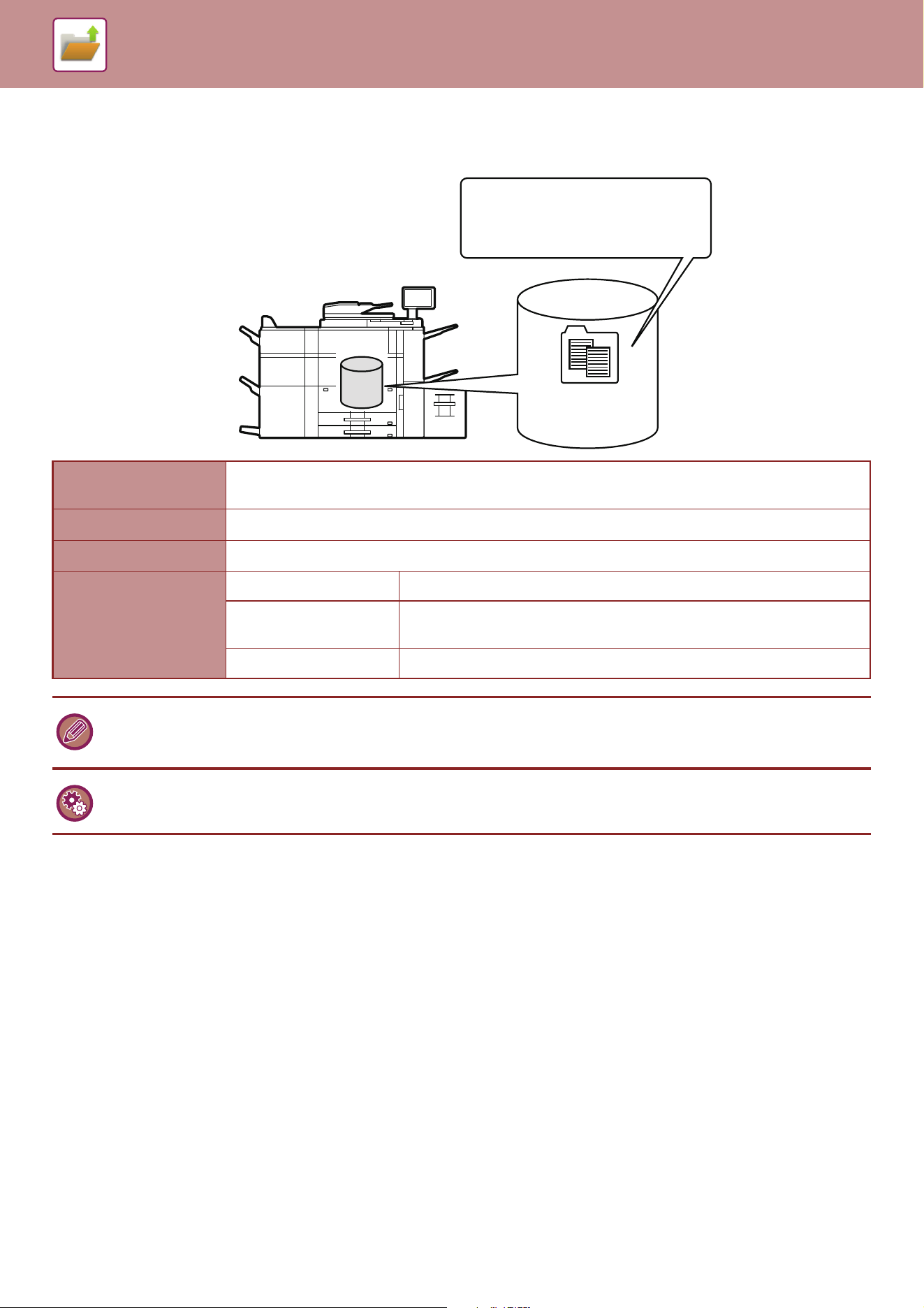
5-6
DOCUMENT FILING►DOCUMENT FILING
Information added to files
When saving a file using "File", add the following information to distinguish it from other files.
IMPORTANT POINTS WHEN USING DOCUMENT FILING
• Files stored using [Quick File] are provided with the "Sharing" property that can be accessed by any person for output
and sending. Therefore, do not store sensitive documents or documents that you do not want to be used by others
using the [Quick File] function.
• When saving a file with [File], you can save it with the "Confidential" property. Set a password for a "Confidential" file
to prevent the file from being used by other people. Exercise care to prevent other people from obtaining the
password.
• The property of a stored "Confidential" file can be changed to "Sharing" by "Property Change" as required. Do not
store sensitive documents or documents that you do not want to be used by others.
• Except in cases provided for by law, SHARP Corporation bears no responsibility for any damages that result from the
disclosure of sensitive information due to manipulation by a third party of any data saved using the Quick File function
or File function, or incorrect operation of the Quick File function or File function by the operator who saves the data.
User Name
The user name is required to enter a file ownership and other information. The user name must be
registered in advance.
File Name
Names a file.
Stored to
Specifies a folder to store files.
Property
Sharing Any user can display and operate files having the "Sharing" property.
Protect Once "Protect" is set, its file cannot be edited, moved, and deleted. No
password setting is required.
Confidential You can set a password (5 to 32 characters) for file protection.
• The above information cannot be specified when a file is saved with Quick File.
• When you select [Create Downloadable File] in Scan to HDD and save as a confidential file, the properties cannot be
changed.
To store a user name:
In "Settings (administrator)", select [User Control] → [User List].
User Name: Name1
File Name: Meeting handout
Password: 12345678
"Meeting minutes"
folder
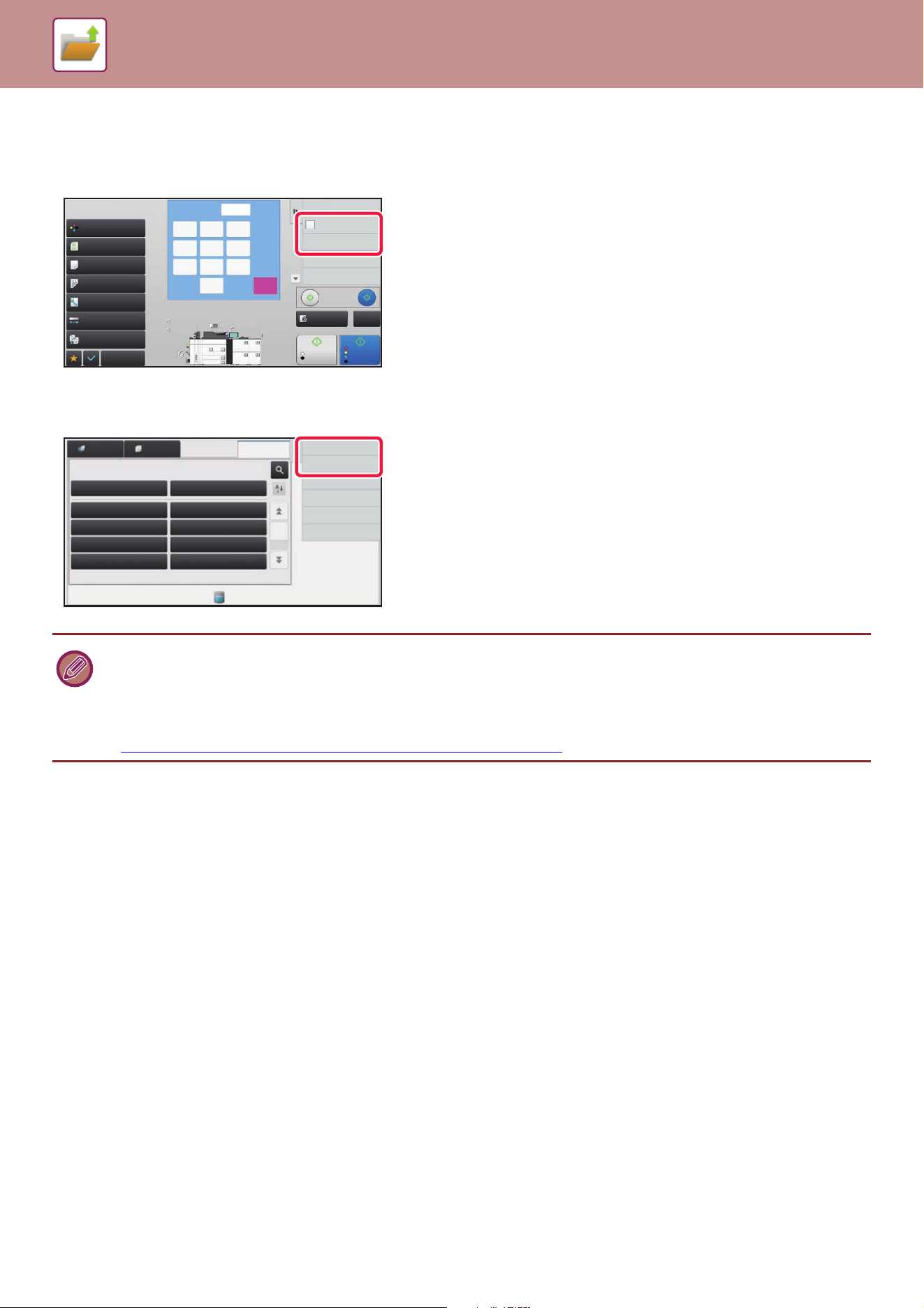
5-7
DOCUMENT FILING►DOCUMENT FILING
USING DOCUMENT FILING IN EACH MODE
To use Document Filing, select the action panel for each mode.
To save data simultaneously with a copy, tap [File] or [Quick File] on the action panel in each mode.
To use Document Filing from the beginning, select the action panel in the Document Filing mode. Tap any one of the
keys to scan and save the original.
• [File] and [Quick File]
These keys may not appear on the action panel depending on the mode or settings. In this case, tap [Others] on the base
screen in each mode, and then tap [Quick File] or [File].
• Using document filing in print mode
To use document filing in print mode, select document filing in the printer driver. For details on document filing, see
"SAVING AND USING PRINT FILES (DOCUMENT FILING) (page 3-87)
" in "PRINTER".
Proof Copy
1
9
32
6
78
4
5
0 C
Plain 1
Plain 1
2
5
68
7
1
3
4
Plain 1
8½x11
8½x11
8½x11 5½x8½
8½x14
11x17
8½x11
8½x11
8½x11
8½x11
8½x11
Start Start
CAPreview
Full Color
Paper Select
Auto
Exposure
Auto
Original
2-Sided Copy
1-Sided→1-Sided
Output
Copy Ratio
100%
Others
Send and print
Call Eco Program
Store Data in Folder
File
Store Data Temporarily
Quick File
1
No. of copies
B/W
Color Mode
Auto
Color
Scan to HDD
Scan to External
Memory Device
Select File from
FTP to Print
Select File from
USB Memory to Print
Main Folder
Print Scan File Retrieve
Foloder Select
AAA BBB
CCC DDD
EEE FFF
GGG HHH
Quick File Folder
Select File from
Network Folder to Print
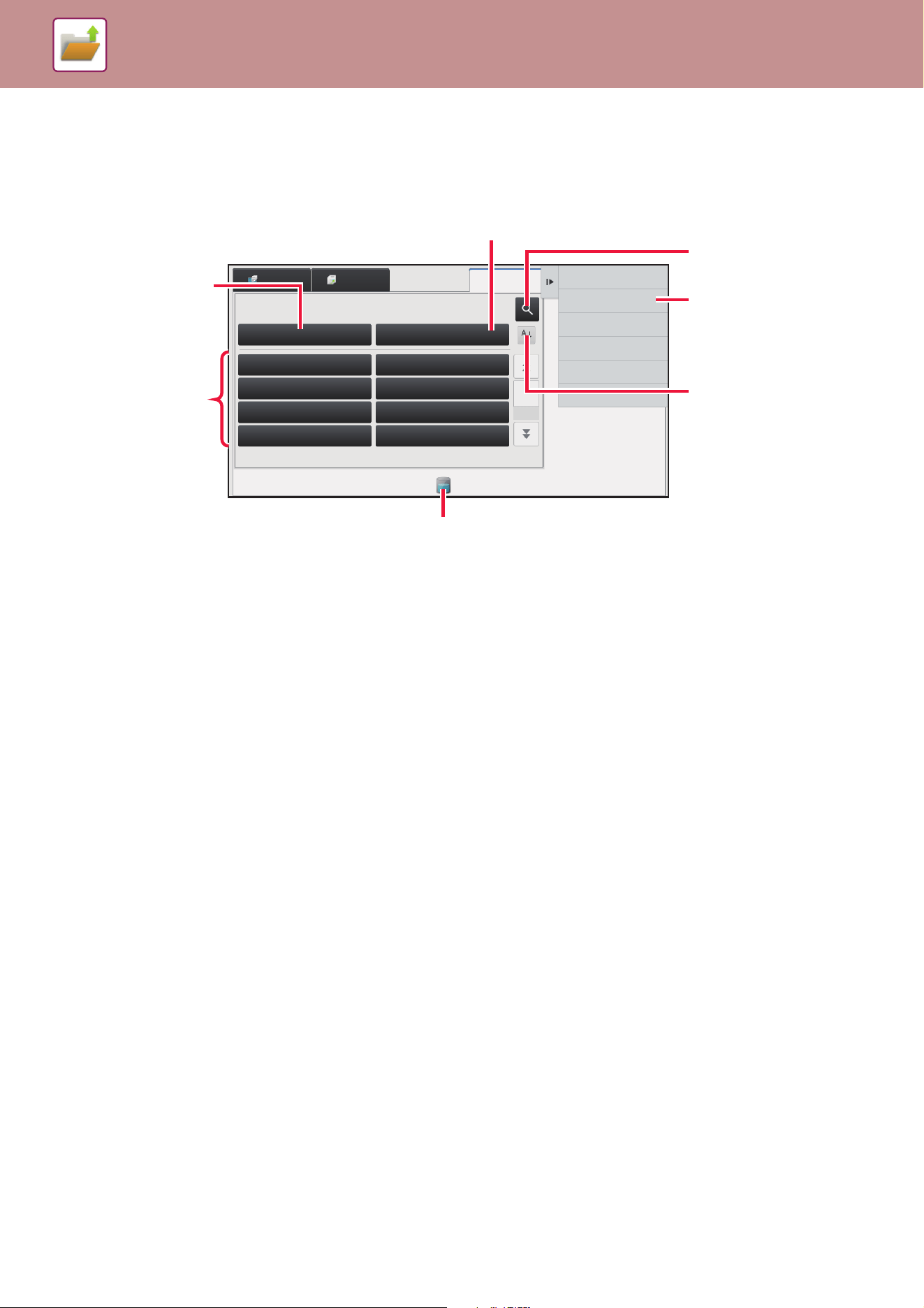
5-8
DOCUMENT FILING►DOCUMENT FILING
BASE SCREEN OF DOCUMENT FILING
MODE
Quick File FolderMain Folder
Scan to HDD
Scan to External
Memory Device
Select File from
FTP to Print
Select File from
USB Memory to Print
File Retrieve
ScanPrint
Folder Select
Select File from
Network Folder to Print
AAA BBB
CCC DDD
EEE FFF
GGG HHH
Use to save originals to
be shared among users.
The folder for the
registered user.
Displays the functions
available in document
filing mode.
Use to search for a file in
a folder.
Use to save a file temporarily.
Displays the usage status of the machine's
built-in hard disk drive. Tap the key to display
details.
Switch the custom folder
order between ascending
and descending.
5-9
DOCUMENT FILING►SAVING FILES WITH DOCUMENT FILING
FILING WHILE USING ANOTHER MODE
QUICK FILE
This function allows you to store an original in copy mode or image send mode as an image file in the Quick File folder
of the machine.
The image file stored in quick file mode can be retrieved at a later time, allowing you to copy the document or transmit it
in image send mode without having to locate the original.
As an example, the procedure for using "Quick File" in copy mode is explained below.
SAVING FILES WITH DOCUMENT FILING
• Quick File can be used in normal mode.
• When a file is stored using Quick File, the following user name and file name are automatically assigned to the file.
User Name: User Unknown
File Name: Mode_Month-Day-Year_Hour-Minute-Second
(Example: Copy_10102016_112030AM)
Save location: Quick File Folder
When user authentication is used, the user name that was used for login is automatically selected.
Only the file name and location of a file stored in the Quick File folder can be changed.
To delete all files in the Quick File folder with the exception of protected files:
In "Settings (administrator)", select [System Settings] → [Document Filing Settings] → [Condition Settings] → [Delete All
Quick Files]. Configure settings to have all files deleted when the power is turned on as required.
1
Place the original.
Place the original in the document feeder tray of the automatic document feeder, or on the document glass.
► SELECTING A PROCEDURE FOR PLACING THE ORIGINAL DEPENDING ON THE TYPE AND STATUS OF
THE ORIGINAL (page 1-89)
2
Change to normal mode and tap
[Quick File] on the action panel so that
it is selected .
When a message relating to saving confidential information appears, tap the [OK] key.
9
32
6
78
4
5
C
1
8½x11
8½x11
8½x11
2
5
68
5½x8½
8½x14
11x17
7
1
3
4
8½x11
8½x11
8½x11
8½x11
8½x11
Plain 1
Plain 1
Plain 1
Full Color
Auto
Auto
Auto
1-Sided→1-Sided
100%
No. of copies
Proof Copy
0
1
Start Start
CAPreview
Paper Select
Exposure
Original
2-Sided Copy
Output
Copy Ratio
Others
Send and print
Call Eco Program
Store Data in Folder
File
Store Data Temporarily
Quick File
1
B/W
Color Mode
Color
5-10
DOCUMENT FILING►SAVING FILES WITH DOCUMENT FILING
FILE
Tapping the [File] key of the document filing function when printing or transmitting an original in each mode allows you to
store the original in the Main folder or stored Custom folder as a file simultaneously with printing or transmission. The
stored file can be retrieved at a later time, allowing you to recopy or resend the original without having to locate it.
As an example, the procedure for using "File" in copy mode is explained below.
3
Start a copy or image sending.
When the function is executed, the image data of the original is stored in the Quick File folder.
To prevent accidental saving of the file, the message "The scanned data is stored in the quick file folder." appears for 6
seconds (default setting) after the [Start] key is tapped.
To change the message display time, in "Settings (administrator)" → [System Settings] → [Common Settings]
→ [Operation Settings] → [Condition Settings] → [Message Time Setting].
To cancel Quick File:
Tap [Quick File] to enable .
• File can be used in normal mode.
• When a file is stored using File without appending file information, the following user name and file name are automatically
assigned to the file.
User Name: User Unknown
File Name: Mode_Month-Day-Year_Hour-Minute-Second
(Example: Copy_10102016_112030)
Save location: Main Folder
1
Place the original.
Place the original in the document feeder tray of the automatic document feeder, or on the document glass.
► SELECTING A PROCEDURE FOR PLACING THE ORIGINAL DEPENDING ON THE TYPE AND STATUS OF
THE ORIGINAL (page 1-89)
There are also cases where settings are required to be made before a preview is carried out.
5-11
DOCUMENT FILING►SAVING FILES WITH DOCUMENT FILING
2
Change to normal mode and tap [File] on the action panel to specify the file
information.
To select the user name, file name, folder, and property setting, see "File Information (page 5-12)".
To save on the HDD:
► Changing the property (page 5-12)
► Specifying a user name (page 5-13)
► Assigning a file name (page 5-13)
► Specifying the folder (page 5-13)
► Creating PDF for PC browsing (page 5-13)
To save in an external memory device:
► Assigning a file name (page 5-13)
► Specifying the folder (page 5-13)
► Creating PDF for PC browsing (page 5-13)
After configuring the above settings, you will return to this
screen. Go to the next step.
If you do not wish to assign a user name or other information
to the file, go to the next step.
3
Tap .
You will return to the base screen of copy mode.
4
Select copy settings and then tap the [Color Start] key or the [B/W Start] key.
• Simultaneously with starting copy, the original is stored as a file.
The selected copy settings are also saved.
• For the procedure for placing the original, see "SELECTING A PROCEDURE FOR PLACING THE ORIGINAL
DEPENDING ON THE TYPE AND STATUS OF THE ORIGINAL (page 1-89)".
68
3
4
Proof Copy
8½x11 8½x11
8½x14
11x17
Start
Color
Start
CAPreview
2-Sided Copy
Color Mode
Change Size/Direction.
Original
Erase Shadow Around
Erase
Skip Blank Page in Original
Blank Page Skip
Others
On
Off
File Information
Sharing
User Name
Create PDF for PC Browsing
File Name
Stored to Main Folder
User Unknown
Password
Copy_20150619_134725
B/W
5-12
DOCUMENT FILING►SAVING FILES WITH DOCUMENT FILING
File Information
The procedure for detail settings is described below.
Specifying a property, user name, file name, and folder makes it easier to manage and search for a file. In addition,
when [Confidential] is selected for Property and a password is established, other people will not be able to view the file
without permission.
Changing the property
A protect setting can be selected for files saved with the document filing function. This prevents a file from being moved,
or automatically or manually deleted.
Three properties are available for saved files: "Sharing", "Protect", and "Confidential". When saved with the "Sharing"
property, a file is not protected. When saved with the "Protect" or "Confidential" property, a file is protected.
Files saved to the Quick File folder are all saved as "Sharing" files. When a file is saved to the Main folder or a custom
folder, "Sharing", "Protect" or "Confidential" can be selected.
Sharing
A "Sharing" file can be changed to "Protect" or "Confidential" using "Property Change" in the Job Settings.
Protect
"Protect" does not require setting of a password, but prevents a file from being moved, deleted or edited. A
password cannot be established.
Confidential
To protect a "Confidential" file, a password is set. (The password must be entered to retrieve the file.)
When a file is saved in encrypted PDF format, the file property is automatically set to "Confidential".
Restrictions on changing the property
• A file that is set to "Sharing" can be changed to "Protect" or "Confidential" as required. However, a "Sharing" file that is
saved in the Quick File folder can only be changed to "Protect".
• A file that is set to "Protect" can be changed to "Sharing" or "Confidential" as required. However, a "Protect" file that is
saved in the Quick File folder can only be changed to "Sharing".
• A file that is saved in the Quick File folder cannot be changed to "Confidential". If the file is moved to the Main folder or a
custom folder, the property can be changed to "Confidential".
• Two properties cannot be selected for a single file.
1
Select [Property] in the File Information screen.
2
When you have selected [Confidential], enter a password (5 to 32 characters).
Every time you enter one digit, " " is displayed.
5-13
DOCUMENT FILING►SAVING FILES WITH DOCUMENT FILING
Specifying a user name
Assigning a file name
A file name can be assigned to the file.
Specifying the folder
Specify the folder for storing the file.
Creating PDF for PC browsing
Tap the [Create PDF for PC Browsing] checkbox to , and a public PDF for PC browsing will be created when the file
is saved.
1
Tap the [User Name] text box.
When user authentication is used, the user name that was used for login is automatically selected. In this case, this step
is not necessary.
The user name must first be stored by selecting [User Control] in "Settings (administrator)" →[User List].
2
Tap the key of the user name.
Alternatively, you can select a user name by tapping the [Call with Registration Number] key and entering the user number.
The user number must be first set by selecting [User Control] in "Settings (administrator)" →[User List].
3
Tap .
The system goes back to the screen of step 1 to display the selected user name.
1
Tap the [File Name] text box and enter the file name.
Enter a file name using up to 30 characters.
File Name
• If a file name that already exists is specified, a tilde and a serial number are added after the file name and this file is
saved as a different file. The file name is not case-sensitive.
For example, if the "test.txt" file already exists and you specify the "TEST.TXT" file, the file will be saved as
"TEST.TXT~1" file.
• If the length of the file name exceeds the limit, excess characters will be omitted and a serial number will be added to
the end of the file name.
1
Tap the [Stored to] text box.
If a user name with a "My Folder" setting is selected, "My Folder" of that user will automatically be selected.
2
Tap the key of the folder where you want to store the file, and tap .
If a password has been set for the folder, a password entry screen appears. Enter the password (5 to 8 digits number)
using the numeric keys and tap the .
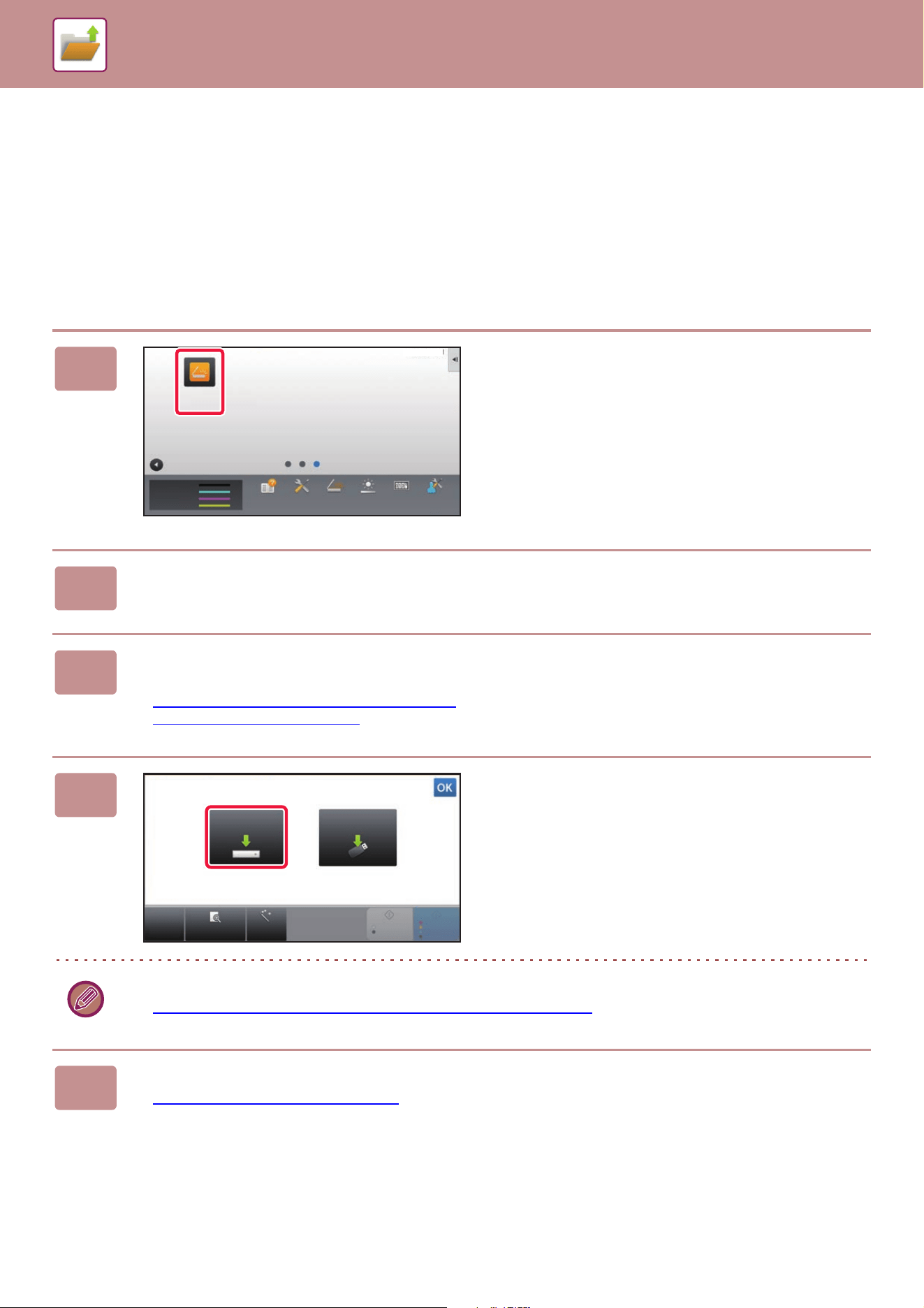
5-14
DOCUMENT FILING►SAVING FILES WITH DOCUMENT FILING
SAVING DOCUMENT DATA ONLY (SCAN TO
HDD)
SAVE ON HDD
Storing from Easy Scan
1
Tap the [Easy Scan] key on the Home
screen.
2
Tap [Scan to HDD/USB].
3
Place the original.
Place the original in the document feeder tray of the automatic document feeder, or on the document glass.
► AUTOMATIC DOCUMENT FEEDER (page 1-90)
► DOCUMENT GLASS (page 1-92)
4
Tap [Scan to HDD].
You can tap the [Auto Set] key to automatically set appropriate scan settings for the original.
► SETTING SCAN SETTINGS AUTOMATICALLY (Auto Set) (page 4-58)
5
To select settings, tap the key of each desired setting.
► IMAGE SEND SEQUENCE (page 4-10)
Operation
Guide
PC Scan Total Count Machine
Adjustment
Toner Quantity
LCD Control
Easy
Scan
10:15 AM
M
C
Bk
Y
Settings
CA
Preview Auto Set
B/W
Start
Color
Start
Scan to
USB
Scan to HDD
Scan to HDD/USB
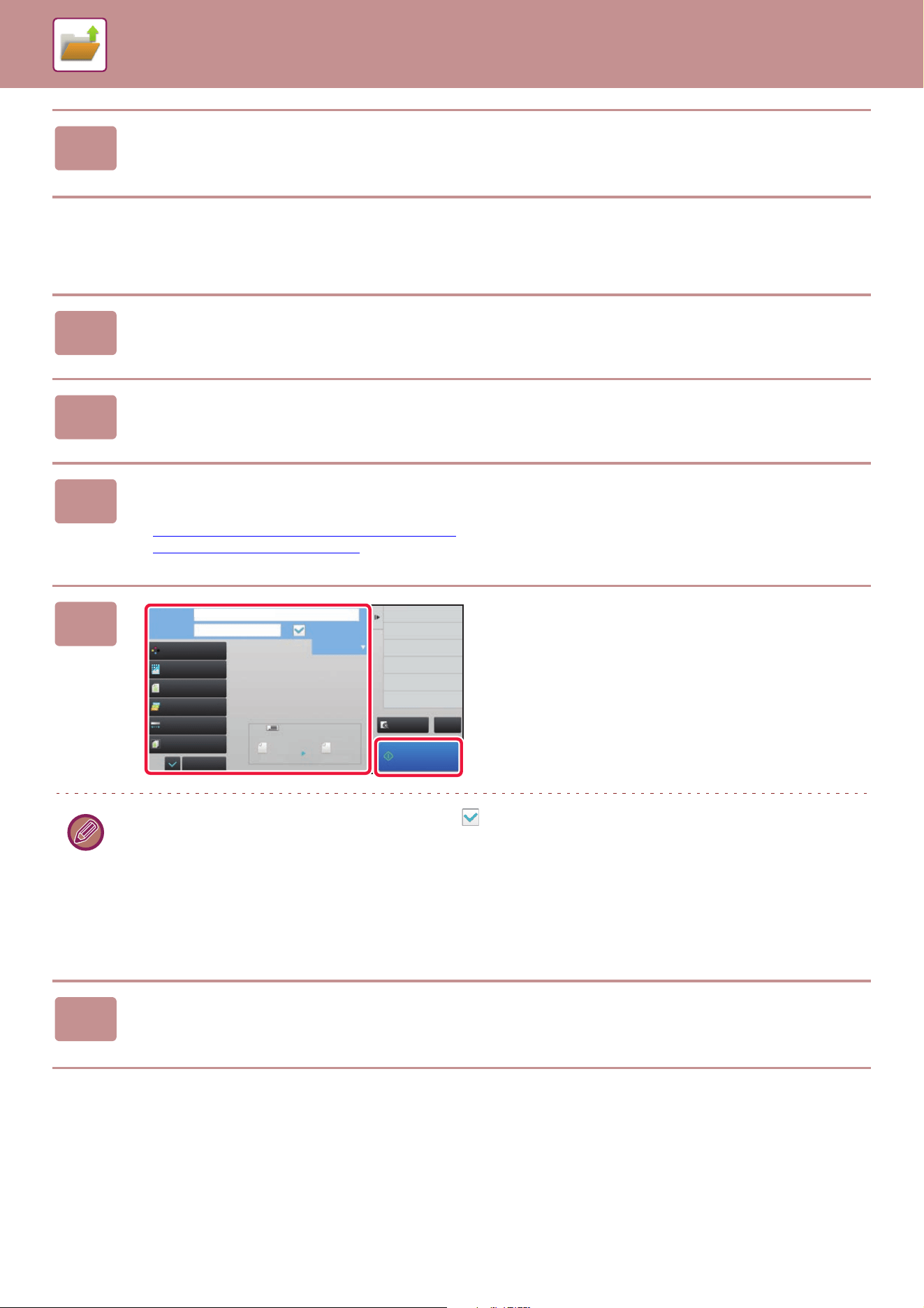
5-15
DOCUMENT FILING►SAVING FILES WITH DOCUMENT FILING
Storing from Document Filing
6
Tap the [Color Start] or [B/W Start] key to start scanning.
A beep will sound to indicate that scanning and file store have ended.
1
Tap the [HDD File retrieve] key on the Home screen.
2
Tap [Scan to HDD] on the action panel.
3
Place the original.
Place the original in the document feeder tray of the automatic document feeder, or on the document glass.
► AUTOMATIC DOCUMENT FEEDER (page 1-90)
► DOCUMENT GLASS (page 1-92)
4
Check the file name and save location,
and tap keys for any settings you want
to select.
• When the [Create Downloadable File] checkbox is ( ), the [File Format] key is grayed out and cannot be used. You
will not be able to download scan data in the specified format from the Web page.
• For original scan settings, see the explanation of the copy or image send mode.
• If the original is 2-sided, be sure to tap the [Original] key and then tap the [2-Sided Tablet] key or the [2-Sided Book]
key as appropriate for the original.
• To set a user name, file attribute, or password, tap [Options].
• When a file is created with [Create Downloadable File] disabled, this setting cannot be enabled later.
5
Tap the [Start] key to start scanning.
A beep will sound to indicate that scanning and file store have ended.
CA
Preview
Start
Scan Size
Auto Auto
Auto/Mono2
Resolution
200x200dpi
File Format
PDF
Original
Auto
Others
8½x11
8½x11
100%
Store Size
Main Folder
Options
Create
Downloadable File
Return to Folder
Selection Screen
Exposure
Job Build
HDD_201540919_140842
Stored To:
File Name:
Color Mode
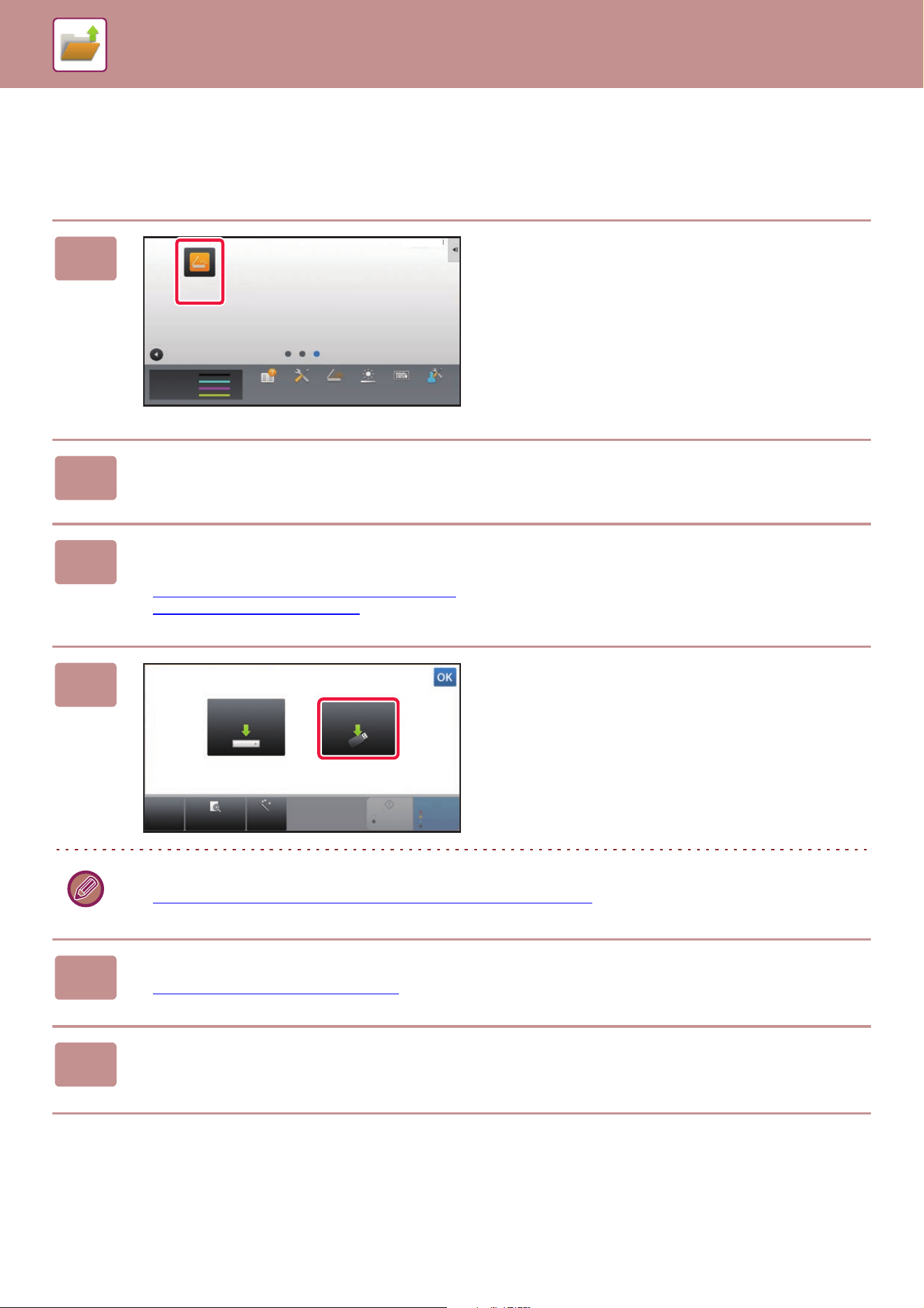
5-16
DOCUMENT FILING►SAVING FILES WITH DOCUMENT FILING
SAVE IN EXTERNAL MEMORY DEVICE
Storing from Easy Scan
1
Tap the [Easy Scan] key on the Home
screen.
2
Tap [Scan to HDD/USB].
3
Place the original.
Place the original in the document feeder tray of the automatic document feeder, or on the document glass.
► AUTOMATIC DOCUMENT FEEDER (page 1-90)
► DOCUMENT GLASS (page 1-92)
4
Tap [Scan to USB].
You can tap the [Auto Set] key to automatically set appropriate scan settings for the original.
► SETTING SCAN SETTINGS AUTOMATICALLY (Auto Set) (page 4-58)
5
To select settings, tap the key of each desired setting.
► IMAGE SEND SEQUENCE (page 4-10)
6
Tap the [Color Start] or [B/W Start] key to start scanning.
A beep will sound to indicate that scanning and file store have ended.
Operation
Guide
PC Scan Total Count Machine
Adjustment
Toner Quantity
LCD Control
Easy
Scan
10:15 AM
M
C
Bk
Y
Settings
CA
Preview Auto Set
B/W
Start
Color
Start
Scan to
USB
Scan to HDD
Scan to HDD/USB
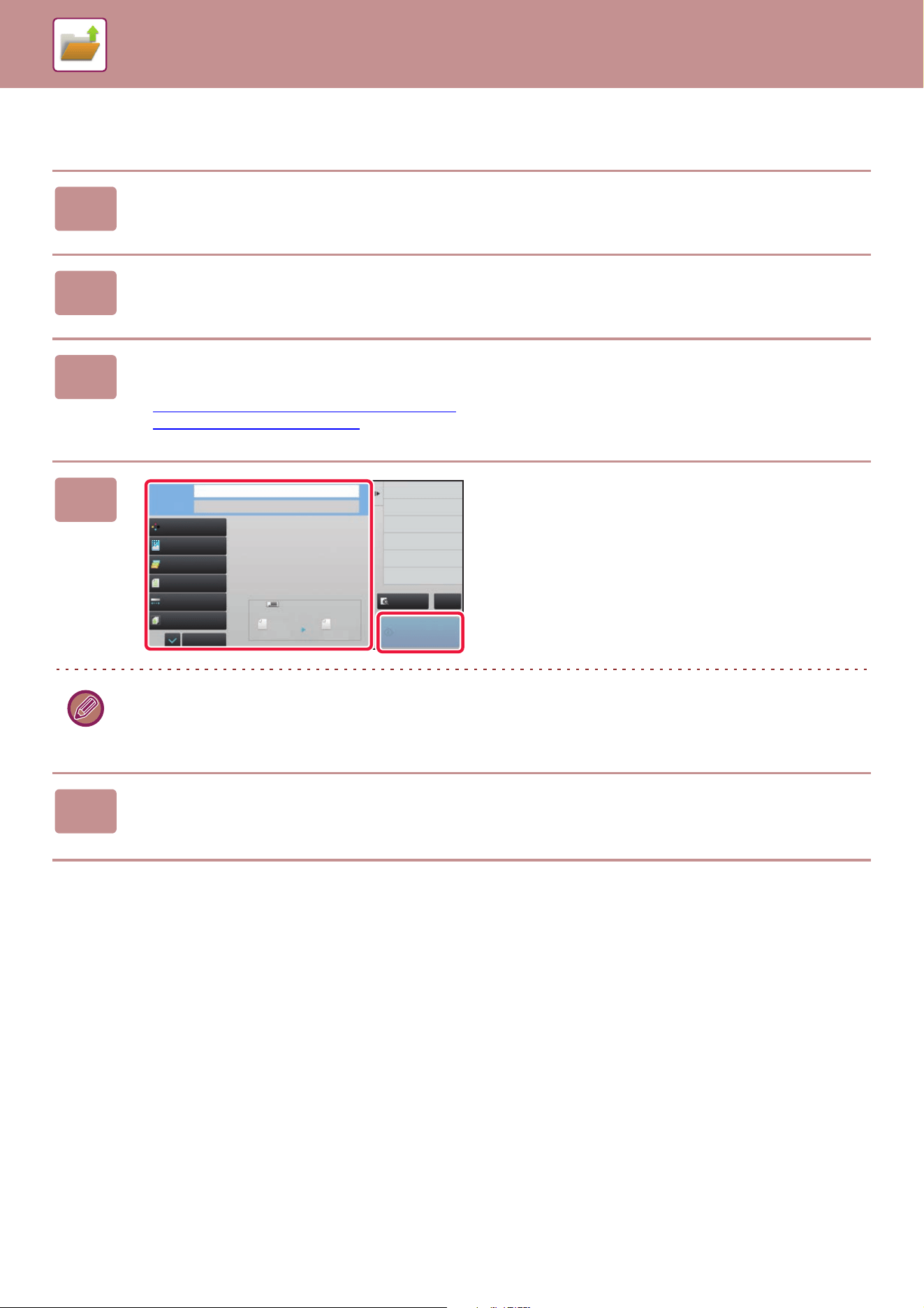
5-17
DOCUMENT FILING►SAVING FILES WITH DOCUMENT FILING
Storing from Document Filing
1
Tap the [HDD File retrieve] key on the Home screen.
2
Tap [Scan to External Memory Device] on the action panel.
3
Place the original.
Place the original in the document feeder tray of the automatic document feeder, or on the document glass.
► AUTOMATIC DOCUMENT FEEDER (page 1-90)
► DOCUMENT GLASS (page 1-92)
4
Check the file name and save location,
and tap keys for any settings you want
to select.
• For original scan settings, see the explanation of the copy or image send mode.
• If the original is 2-sided, be sure to tap the [Original] key and then tap the [2-Sided Tablet] key or the [2-Sided Book]
key as appropriate for the original.
5
Tap the [Start] key to start scanning.
A beep will sound to indicate that scanning and file store have ended.
CA
Preview
Start
Scan Size
Auto Auto
Resolution
200x200dpi
File Format
PDF
Original
Auto
Others
8½x11
8½x11
100%
Send Size
Return to Folder
Selection Screen
Exposure
Job Build
Auto/Mono2
Specified by System Settings
Stored To:
File Name:
Colour Mode
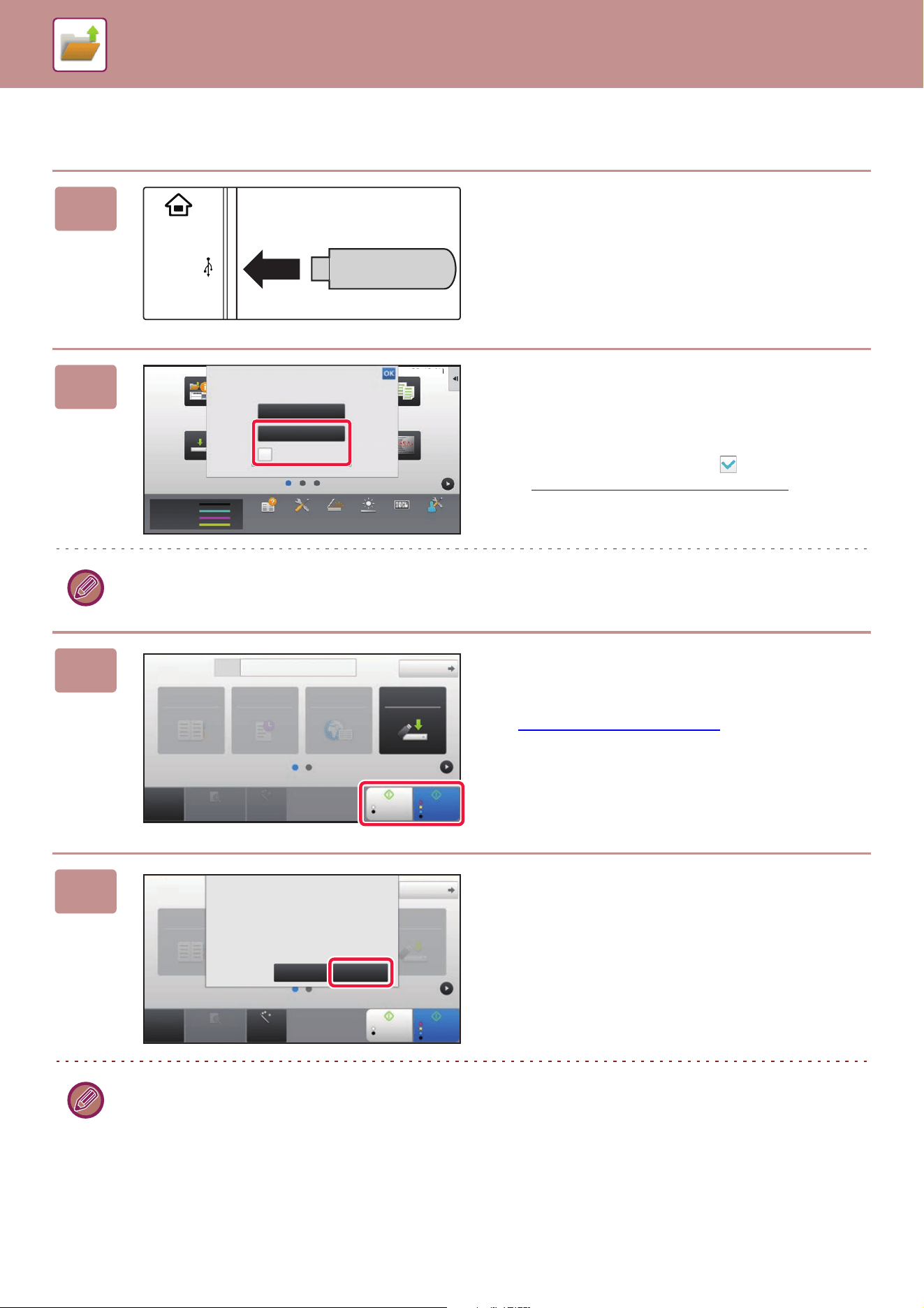
5-18
DOCUMENT FILING►SAVING FILES WITH DOCUMENT FILING
Scan to USB memory device
1
Connect the USB memory device to
the machine.
2
When a screen for selecting the action
appears, tap [Scan to External Memory
Device].
• To select detailed settings in normal mode, select the
[Perform Detail Setting] checkbox .
► NETWORK SCANNER MODE (page 4-6)
If the machine/device save screen is open, this screen will not appear.
3
Tap the [Color Start] key or [B/W Start]
key.
To check a preview of a document, tap the [Preview] key.
► PREVIEW SCREEN (page 1-17)
4
After scanning all originals, tap the
[Read-End] key.
When you scan the original using the automatic document feeder, this screen does not appear.
Job Management
Scan to HDD Sharp OSA
Copy
Print from external
memory device (USB)
Scan to External
Memory Device
Perform Detail Setting
External memory device (USB) is connected.
10:15 AM
Toner Quantity
M
C
Bk
Y
Operation
Guide
PC Scan Total Count Machine
Adjustment
LCD Control
Settings
CA
Preview Auto Set
Original
8½x11
Address External Memory Device
Detail
B/W
Start
Color
Start
Address Book History
Global
Address Search
Scan to HDD/
USB
Address Book
Scan to HDD/
USB
CA
Preview Auto Set
Original
8½x11
Detail
B/W
Start
Color
Start
Place next original. (Pg.No.1)
Press [Start].
When finished, press [Read-End].
Change Setting Read-End
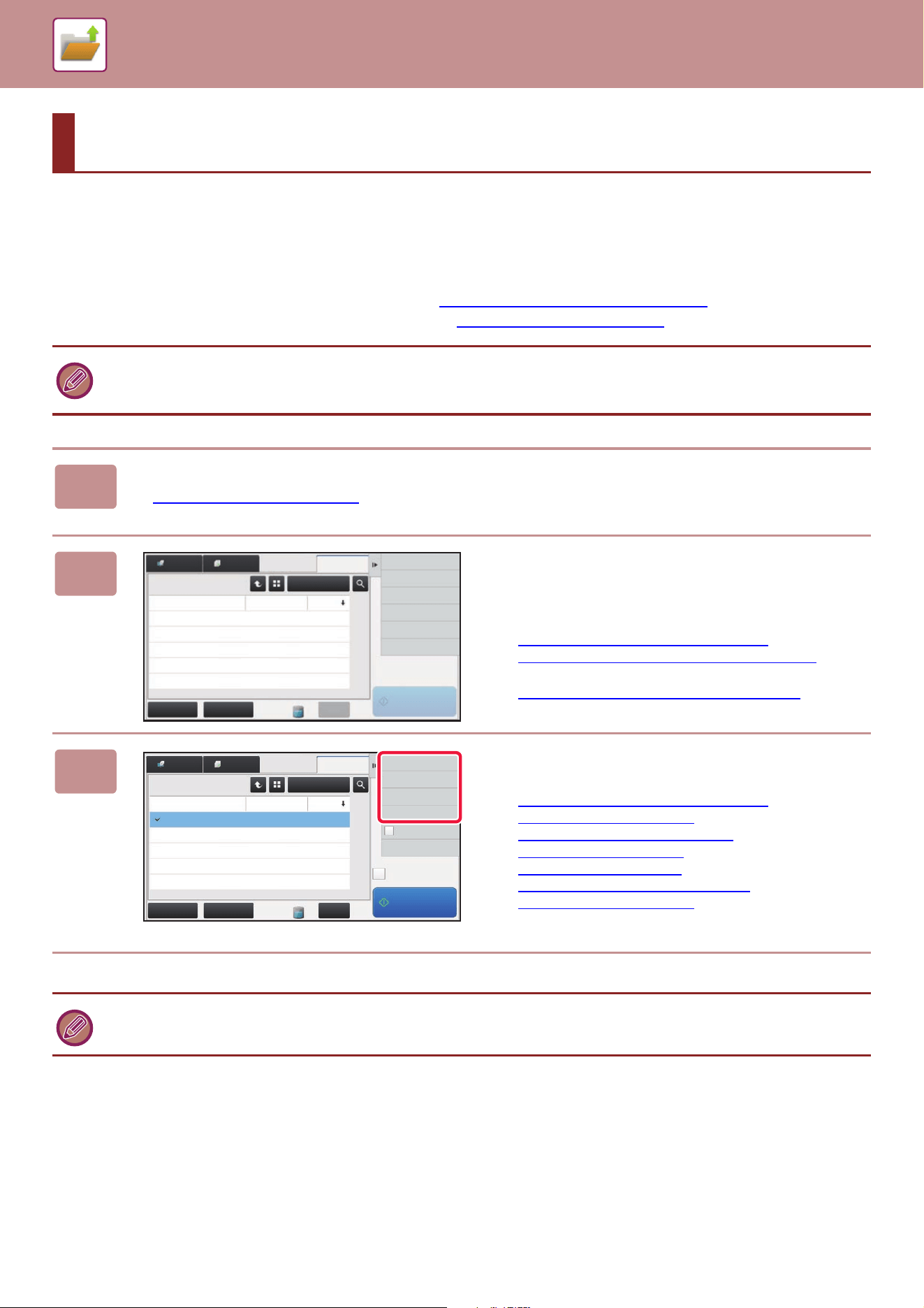
5-20
DOCUMENT FILING►USING STORED FILES
SEQUENCE FOR USING A STORED FILE
The screens and procedures differ depending on whether or not user authentication is enabled.
The sequence for using a stored file depending on the situation is explained.
For information on user authentication procedures, see "USER AUTHENTICATION (page 1-31)
". For information on
enabling user authentication and storing user names, see "USER CONTROL (page 7-54)
".
USING STORED FILES
Also in setting mode (Web version), you can use document filing. In setting mode (Web version), click [Document
Operations] → [Document Filing], and then click the folder that contains the file you wish to use.
You can also check a preview of a stored file in setting mode (Web version).
1
Switch to document filing mode.
► CHANGING MODES (page 1-16)
2
Select the file that you wish to retrieve.
When the folder is selected, the files in the folder will appear.
Select the file that you wish to retrieve.
Select a file from the thumbnail images of the stored files.
► FILE SELECTION SCREEN (page 5-21)
► SELECTING A FILE TO RETRIEVE (page 5-22)
Retrieve a file using the search function.
► FILE SEARCH AND RETRIEVAL (page 5-33)
3
Select an operation item.
Select the desired operation and configure settings.
► FILE SELECTION SCREEN (page 5-21)
► FILE PRINTING (page 5-22)
► FILE TRANSMISSION (page 5-26)
► FILE MOVING (page 5-27)
► DELETE FILE (page 5-28)
► FILE IMAGE CHECKING (page 5-30)
► FILE MERGING (page 5-31)
When retention is selected on the printer, reset items that cannot be set for retention do not appear.
Select All Batch Print
All Files
Delete
Main Folder
File Name User Name
User Unknown 2015/06/24
User Unknown 2015/06/24
User Unknown 2015/06/24
User Unknown 2015/06/24
User Unknown 2015/06/24
Date
Select File from
FTP to Print
Select File from
USB Memory to Print
Select File from
Network Folder to Print
Copy_04042015_112030
Copy_04042015_112100
Copy_04042015_112130
Copy_04042015_112200
Copy_04042015_112230
Print Now
Print Scan File Retrieve
Select All Batch Print
Delete
Change Setting to Print
Move
Check Image
See Detail Information
Print and Delete
the Data
Print B/W
Print Now
All Files
Main Folder
File Name User Name
User Unknown 2015/06/24
User Unknown 2015/06/24
User Unknown 2015/06/24
User Unknown 2015/06/24
User Unknown 2015/06/24
Date
Copy_04042015_112030
Copy_04042015_112100
Copy_04042015_112130
Copy_04042015_112200
Copy_04042015_112230
Print Scan File Retrieve
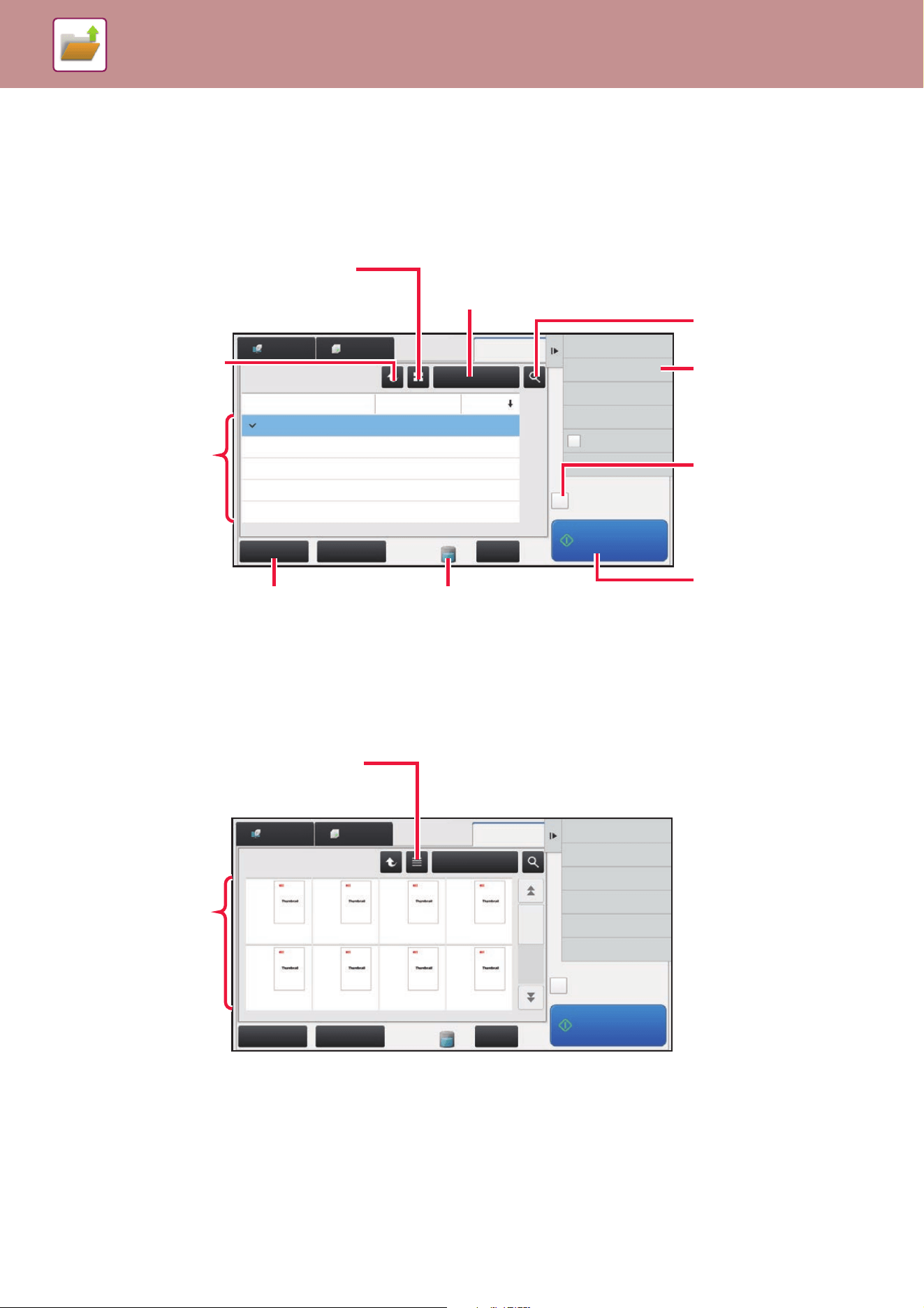
5-21
DOCUMENT FILING►USING STORED FILES
FILE SELECTION SCREEN
The file selection screen can be displayed in "List" format or "Thumbnail" format to display thumbnail images of files.
List display mode
Thumbnail display mode
Select All Batch Print
Delete
Print Now
File Name User Name
User Unknown 2015/06/24
User Unknown 2015/06/24
User Unknown 2015/06/24
2015/06/24
User Unknown
User Unknown 2015/06/24
Date
Change Setting to Print
Move
Check Image
See Detail Information
Print and Delete
the Data
Print B/W
Copy_04042015_112100
Copy_04042015_112130
Copy_04042015_112200
Copy_04042015_112230
Copy_04042015_112300
Main Folder
All Files
Print
Scan
File Retrieve
Switch the file key displayed for each
job type.
Search for a file saved in a
folder.
Displays the functions that
can be used.
Return to the base screen
of document filing mode.
Displays the saved
files.
Tap this key to display the
usage status of the
machine's built-in hard disk
drive.
Select or clear all files. Tapping
this key switches the key
display mode between [Select
All] and [Cancel All].
Start printing immediately.
Switch the file display mode
between list and thumbnail.
Print in black and white.
Select All Batch Print
Delete
Select File from
FTP to Print
Select File from
USB Memory to Print
Select File from
Network Folder to Print
Print Now
Copy_04042015_112030 Copy_04042015_112100 Copy_04042015_112130 Copy_04042015_112200
Copy_04042015_112230 Copy_04042015_112300 Copy_04042015_112330 Copy_04042015_112400
Main Folder
All Files
Print
Scan
File Retrieve
Print B/W
Switch the file display mode
between list and thumbnail.
Displays thumbnails of
the saved files.
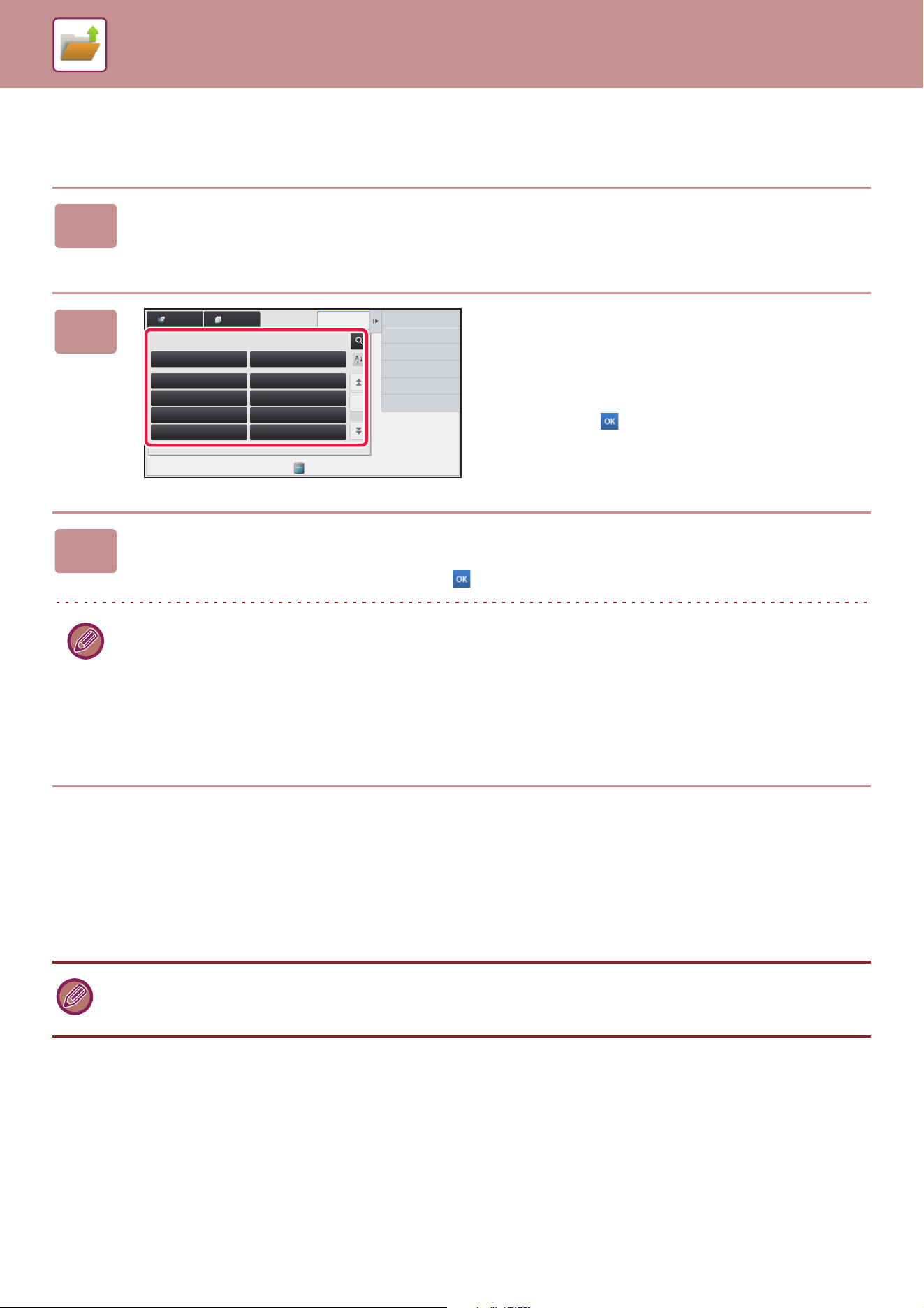
5-22
DOCUMENT FILING►USING STORED FILES
SELECTING A FILE TO RETRIEVE
FILE PRINTING
A file stored using document filing can be retrieved and printed when needed. The settings used when the file was
stored are also stored, and thus the file can be printed again using those settings. The file can also be modified before
printing by changing the print settings.
1
Tap the [HDD File retrieve] key.
When user authentication is enabled and "My Folder" is configured by selecting [User Control] in "Settings
(administrator)" → [User List], the custom folder specified as "My Folder" opens.
2
Tap the key of the folder that contains
the desired file.
If the folder with a PIN Code is tapped, a PIN Code entry
screen will appear.
Enter the PIN Code (5 to 8 digits number) using the numeric
keys and tap the .
3
Tap the key of the desired file.
If the folder with a PIN Code is tapped, a PIN Code entry screen will appear.
Enter the PIN Code (5 to 32 characters) and tap the .
• Tap the [Print Now] key to printed out the file with the settings used for its storage.
• Tap the [Filter by Job] key to display the keys of a particular mode such as copy or scanner mode, enabling quick data
search.
• Tap the [File Name] key, the [User Name] key, or the [Date] key to change the order of display of the files.
• Select [User Control] in "Settings (administrator)" → [Authority Group List]. Then, in authority group setting for the
users who are currently logged in, select [Job Settings] → [Document Filing] and enable [Display only the Files of
Logged-in Users] to display only files stored by the users who are currently logged in.
• Print settings that are changed by re-manipulation of the file cannot be saved.
• The printing speed may be somewhat slow depending on the resolution and exposure mode settings of the stored file.
• When retention is selected on the printer, reset items that cannot be set for retention do not appear.
Print Scan File Retrieve
Scan to HDD
Scan to External
Memory Device
Select File from
FTP to Print
Select File from
USB Memory to Print
Main Folder Quick File Folder
Select File from
Network Folder to Print
AAA BBB
CCC DDD
EEE FFF
GGG HHH
Main Folder
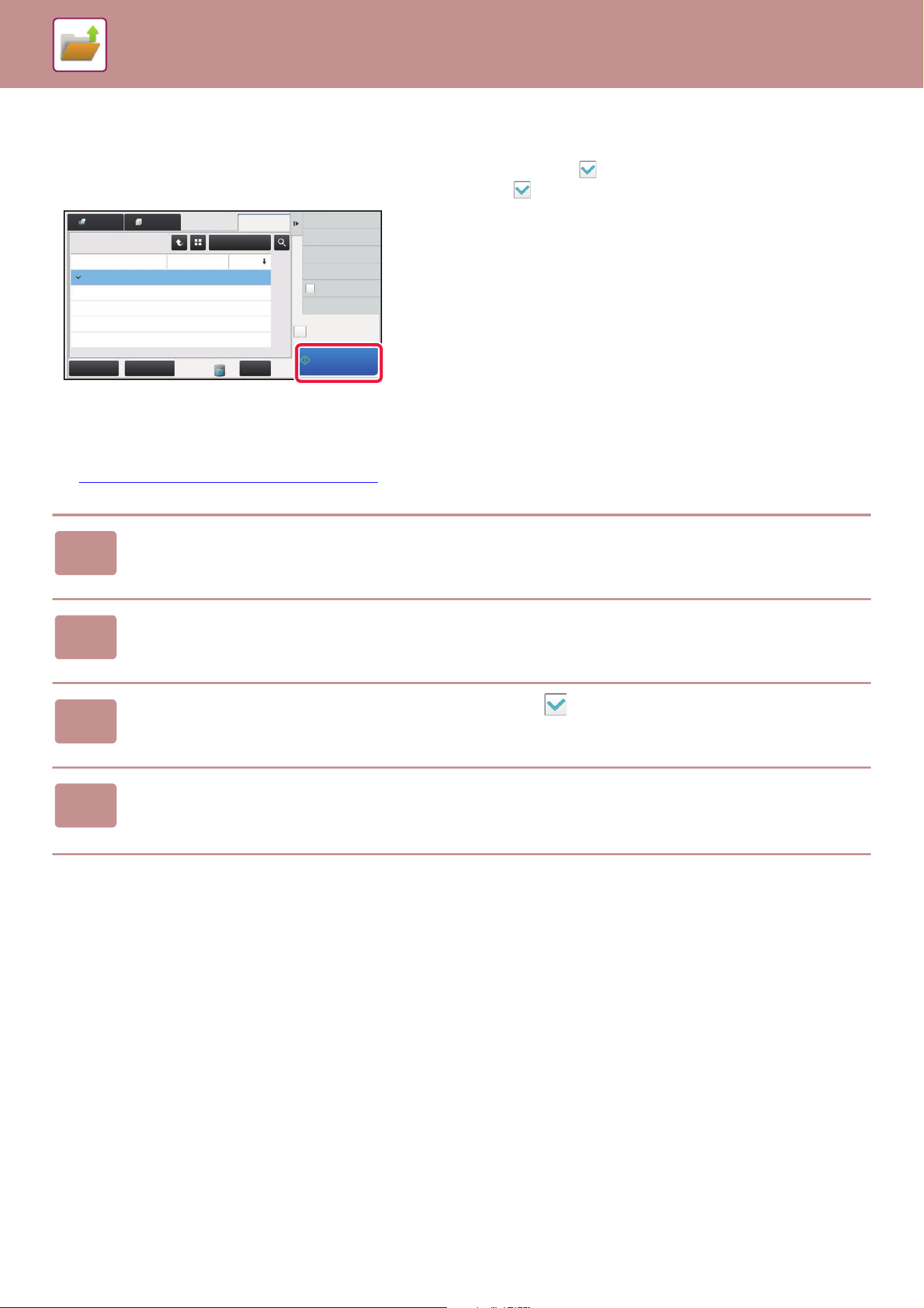
5-23
DOCUMENT FILING►USING STORED FILES
Quick printing
Prints a file with the various settings used when it was saved. Select a file and tap the [Print Now] key.
To delete data after printing, set the [Print and Delete the Data] checkbox to .
To print the file in black and white, select the [Print B/W] checkbox .
Changing settings before printing
After selecting the desired file, follow the steps below.
► SELECTING A FILE TO RETRIEVE (page 5-22)
1
Tap [Choose Print Settings] on the action panel.
2
Change the print settings.
3
Select the [Delete] or [Print B/W] checkbox when needed.
4
Tap the [Start] key.
The file will be printed.
Select All Batch Print
All Files
Delete
Main Folder
File Name User Name
User Unknown 2015/06/24
User Unknown 2015/06/24
User Unknown 2015/06/24
User Unknown 2015/06/24
User Unknown 2015/06/24
Date
Change Setting to Print
Move
Check Image
See Detail Information
Print and Delete
the Data
Print B/W
Print Now
Copy_04042015_112030
Copy_04042015_112100
Copy_04042015_112130
Copy_04042015_112200
Copy_04042015_112230
Print Scan File Retrieve
5-24
DOCUMENT FILING►USING STORED FILES
MULTI-FILE PRINTING
MULTI-FILE PRINTING
1
Select the keys of the multiple files that you wish to print.
• Confidential files cannot be printed simultaneously with other files.
• A file in the currently selected folder cannot be selected simultaneously with a file in a different folder.
• If the job type is changed with the By Job Display key or the screen is changed by being tapped while a file is
selected, the selection of the file will be canceled.
2
Tap [Print] on the action panel.
3
When not printing with the number of copies at data saving, tap the [Apply
the Number from Stored Setting of Each Job.] checkbox to set to .
When printing with the number of copies at data saving without specifying copies, go to step 5.
4
Use to specify the number of copies.
As required, directly tap the numeric value display key and change the value using the numeric keys.
5
To delete the file after printing, tap the [Delete] checkbox to set to .
6
Tap the [OK] key to start printing.
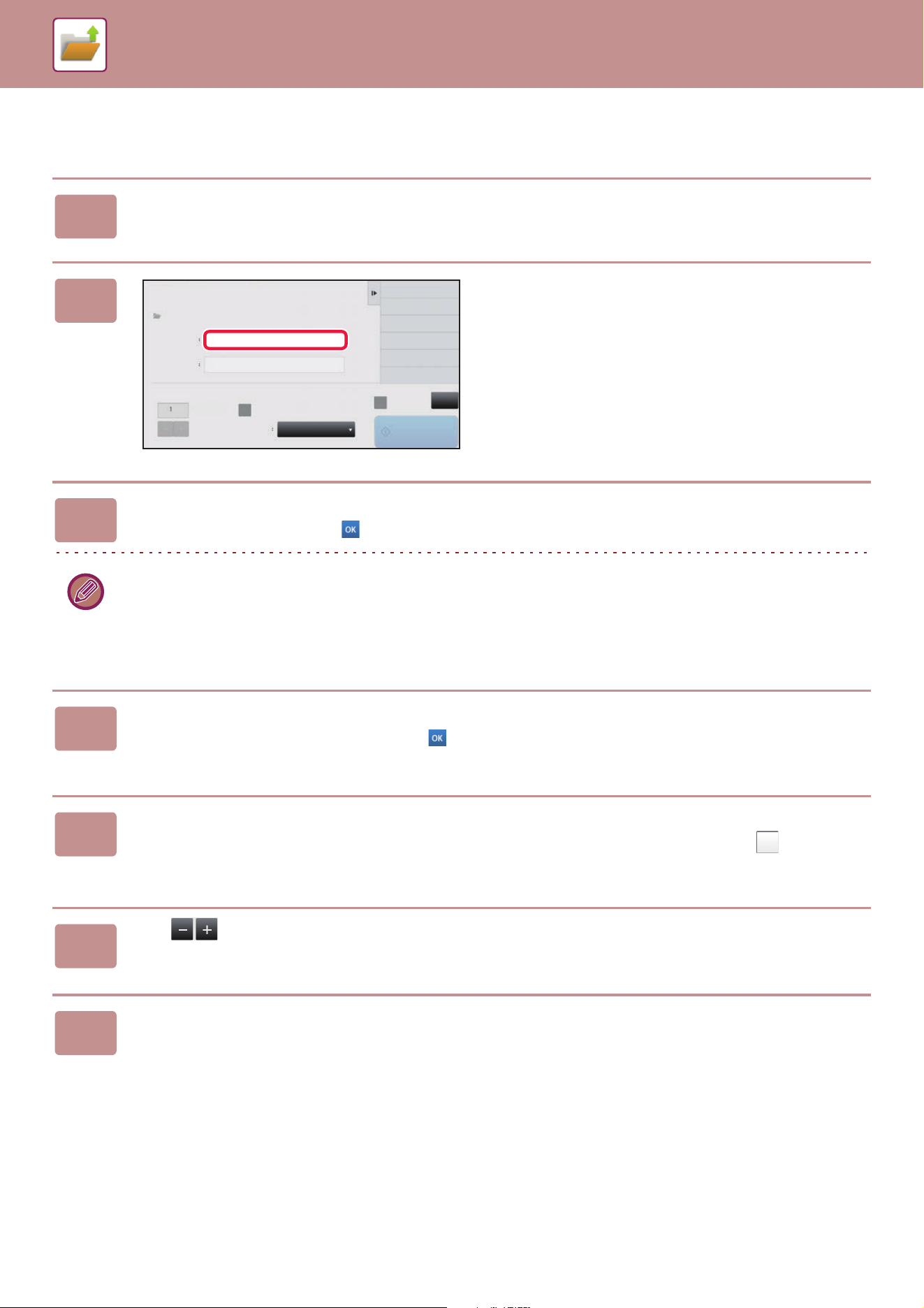
5-25
DOCUMENT FILING►USING STORED FILES
BATCH PRINTING
1
Tap the [Batch Print] key.
2
Tap the [User Name] text box.
3
Select the user name.
After selecting the user name, tap .
If you have selected [System Settings] in "Settings (administrator)" → [Document Filing Settings]
→ [Condition Settings] → [Batch Print Settings] and disabled the [Selection of [All Users] is not allowed.] checkbox and
[Selection of [User Unknown] is not allowed.] checkbox, select the [All Users] key and [User Unknown] key.
If you tap the [All Users] key, all files in the folder (the files of all users) are selected.
If you tap the [User Unknown] key, all files in the folder with no user name specified are selected.
4
If a password has been established, tap the [Password] key.
Enter the password (5 to 32 characters) and tap . Only files that have the same password will be selected.
If you do not wish to enter a password, go to the next step.
5
When not printing with the number of copies at data saving, tap the [Apply
the Number from Stored Setting of Each Job.] checkbox to set to .
When printing with the number of copies at data saving, go to step 7.
6
Use to specify the number of copies.
As required, directly tap the numeric value display key and change the value using the numeric keys.
7
To automatically delete the file after printing, tap the [Delete] key.
CA
Delete
Start
Return to File
Selection Screen
Batch Print
Main Folder
User Name
Password
Change Print Number
Print
Order
Apply the Number from Stored Setting of
Each Job.
All Files
Date (Dsc.)
( 1~9999 )
5-26
DOCUMENT FILING►USING STORED FILES
FILE TRANSMISSION
The settings used when the file was stored with document filing are stored, and thus the file can be transmitted using
those settings. If needed, you can also change the transmission settings to modify the retrieved file.
After selecting the desired file, follow the steps below.
► SELECTING A FILE TO RETRIEVE (page 5-22)
8
Tap the [Start] key to start printing.
If there are no files that match the search conditions, you will return to the file list screen.
It [Delete the Data] on the action panel is tapped, all files that match the current search conditions will be deleted.
• A file saved in black and white or grayscale cannot be transmitted in color.
• A stored print job cannot be transmitted. (However, if the job was filed in the printer driver, it can be transmitted if "Rip
Style" is set to [RGB]. This settings is accessed by selecting the [Other Settings] button on the [Detailed Settings] tab.)
• These transmission methods require installation of the corresponding options.
• If any of the following other modes were included in the saved file, the file cannot be transmitted.
"Stamp", "Photo Repeat", "Multi-Page Enlargement" for copying.
• If any of the following other modes were included in the saved file, the file can be transmitted, but other functions cannot be
executed.
"Margin Shift", "Transparency Inserts", "Book Copy", "Tab Copy", "Stamp", "Centering"
• Depending on the reduction or enlargement ratio used when storing a file, it may not be possible to send the stored file
using a selected resolution setting. In this event, try changing the resolution.
1
Tap [Send] on the action panel.
2
Select settings for sending.
3
Tap the [Start] key.
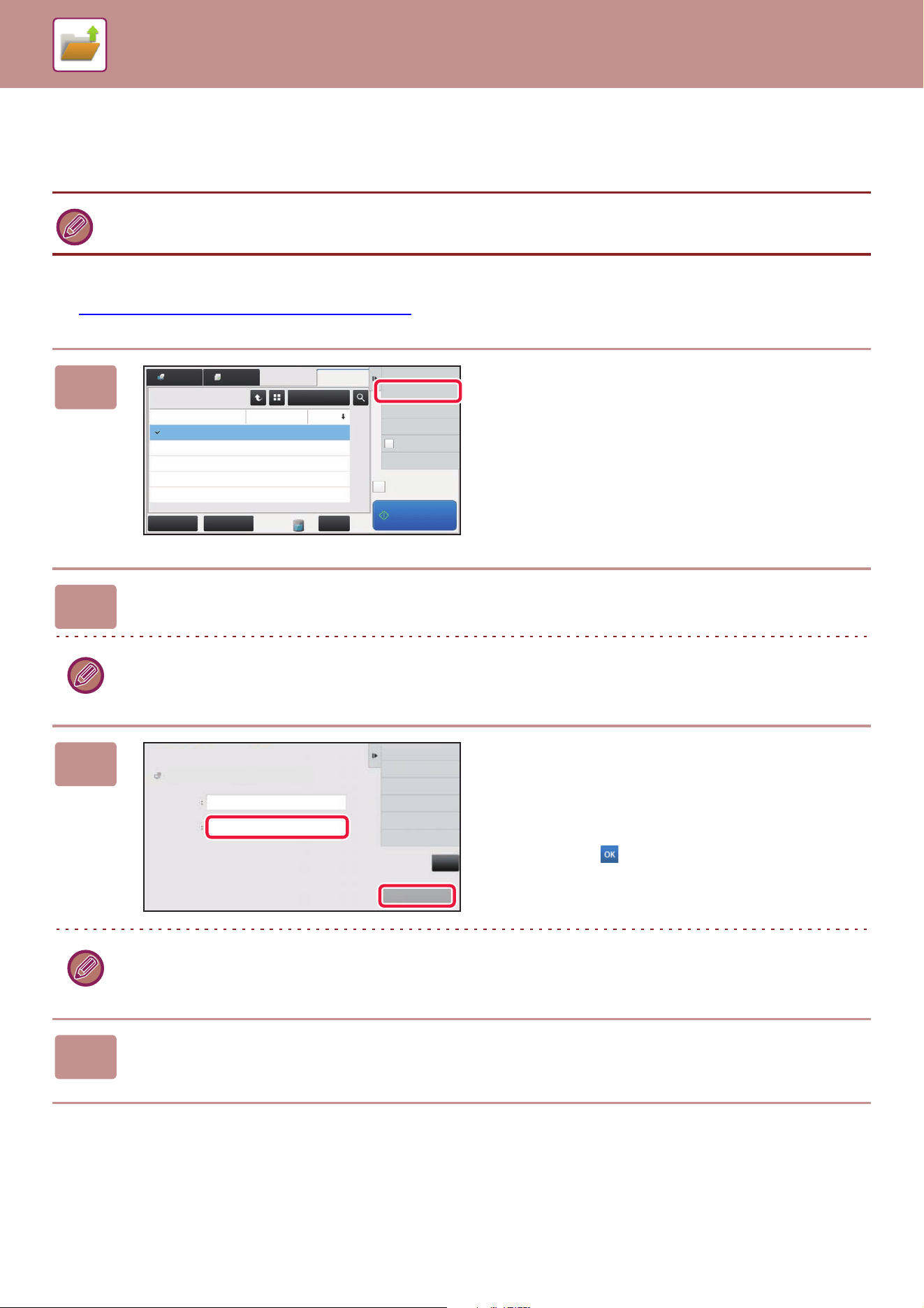
5-27
DOCUMENT FILING►USING STORED FILES
FILE MOVING
Changes the file storage location. (The file is moved to another folder.)
After selecting the desired file, follow the steps below.
► SELECTING A FILE TO RETRIEVE (page 5-22)
A file whose property is "Protect" cannot be moved. To move a protected file, change its property to "Sharing" or
"Confidential".
1
Tap [Move] on the action panel.
2
Tap the [Move to:] key.
• A file cannot be moved to the Quick File folder.
• To change the file name, tap the [File Name] key.
3
Tap the key of the folder to which you
want to move the file.
If the folder with a password is tapped, a password entry
screen will appear.
Enter the password (5 to 8 digits number) using the numeric
keys and tap the .
When multiple files are moved, file names cannot be changed.
4
Tap the [Move] key.
Select All Batch Print
All Files
Delete
Main Folder
File Name User Name
User Unknown 2015/06/24
User Unknown 2015/06/24
User Unknown 2015/06/24
User Unknown 2015/06/24
User Unknown 2015/06/24
Date
Change Setting to Print
Move
Check Image
See Detail Information
Print and Delete
the Data
Print B/W
Print Now
Copy_04042015_112030
Copy_04042015_112100
Copy_04042015_112130
Copy_04042015_112200
Copy_04042015_112230
Print Scan File Retrieve
CA
Move
Return to File
Selection Screen
Move File
File Name AAA
Move to:
Auto Color
AAA AAA 8½x11
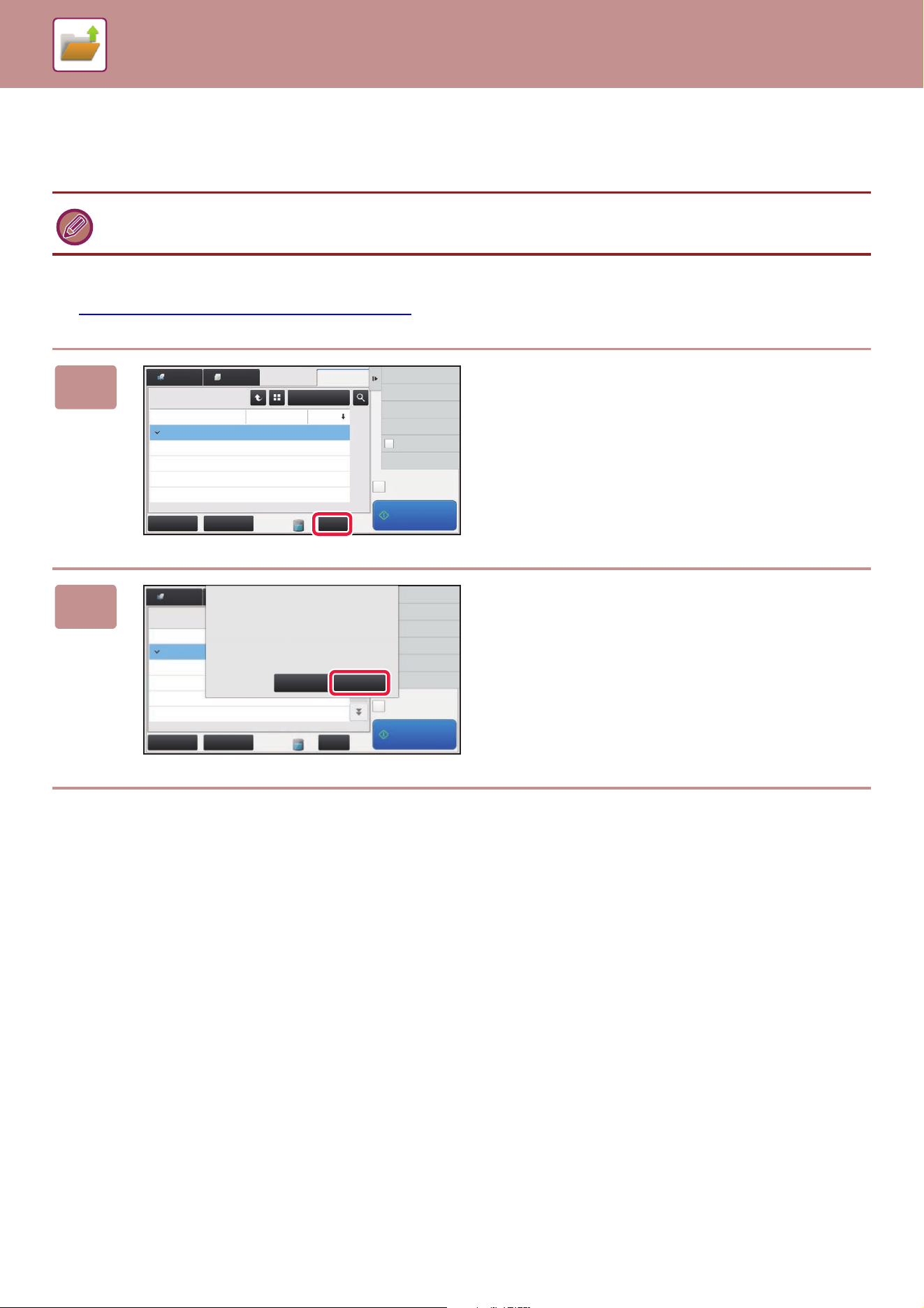
5-28
DOCUMENT FILING►USING STORED FILES
DELETE FILE
Stored files that are no longer required can be deleted.
After selecting the desired file, follow the steps below.
► SELECTING A FILE TO RETRIEVE (page 5-22)
A file whose property is "Protect" cannot be deleted. To delete a protected file, change its property to "Sharing" or
"Confidential".
1
Tap the [Delete] key.
2
Check the file and then tap the [Yes]
key.
Select All Batch Print
Delete
Print B/W
Print Now
All Files
Main Folder
File Name User Name
2015/06/24
2015/06/24
2015/06/24
2015/06/24
2015/06/24
Date
Copy_04042015_112030
Copy_04042015_112100
Copy_04042015_112130
Copy_04042015_112200
Copy_04042015_112230
Print Scan File Retrieve
User Unknown
User Unknown
User Unknown
User Unknown
User Unknown
Change Setting to Print
Move
Check Image
See Detail Information
Print and Delete
the Data
All Files
Main Folder
File Name User Name
User 2015/06/24
User 2015/06/24
User 2015/06/24
User Unknown 2015/06/24
User Unknown 2015/06/24
Date
Copy_04042015_112030
Copy_04042015_112100
Copy_04042015_112130
Copy_04042015_112200
Copy_04042015_112230
Print Scan File Retrieve
Select All Batch Print Delete
Change Setting to Print
Move
Check Image
See Detail Information
Print and Delete
the Data
Print B/W
Print Now
No Yes
Delete the file data?
5-29
DOCUMENT FILING►USING STORED FILES
Automatic Deletion of File
You can have document filing data in specified folders automatically deleted by specifying the folders and the time.
Periodic deletion of files stored in the machine helps to prevent the disclosure of sensitive information and frees space
on the hard drive.
When [Delete by Schedule] is selected, you can select every day, every week, or every month for the deletion cycle, and
set a scheduled time for each.
When [Delete at Specified Time after Specified Days Have Elapsed] is selected, you can select 1 to 7 days, 10 days, 20
days, or 30 days for the number of elapsed days, and set a scheduled time for each.
Example: Delete the data in the Quick File folder at 9:00 AM 1 day from now.
File Name Stored Date Deletion date and time
Document A 12/23/2016 2:22AM 12/25/2016 9:00AM
Document B 12/23/2016 11:59PM 12/25/2016 9:00AM
Document C 12/24/2016 0:01AM 12/26/2016 9:00AM
• To automatically delete document filing data periodically:
In "Settings (administrator)", select [System Settings] → [Document Filing Settings] → [Automatic Deletion of File
Settings].
• To check the set deletion cycle:
In "Settings (administrator)", select [Status] → [List Print] → [List for Administrator], and print a list of the administrator
settings including document filing settings.
• To check information on the folders selected for file deletion:
In "Settings", select [Status] → [List for User] → [Document Filing Folder List] and print a list of the folders of document
filing.
When you specify automatic deletion of document filing data takes place periodically, all files in the specified folders will be
deleted when the set time arrives. Exercise care not to store files that you wish to keep in folders specified for file deletion.
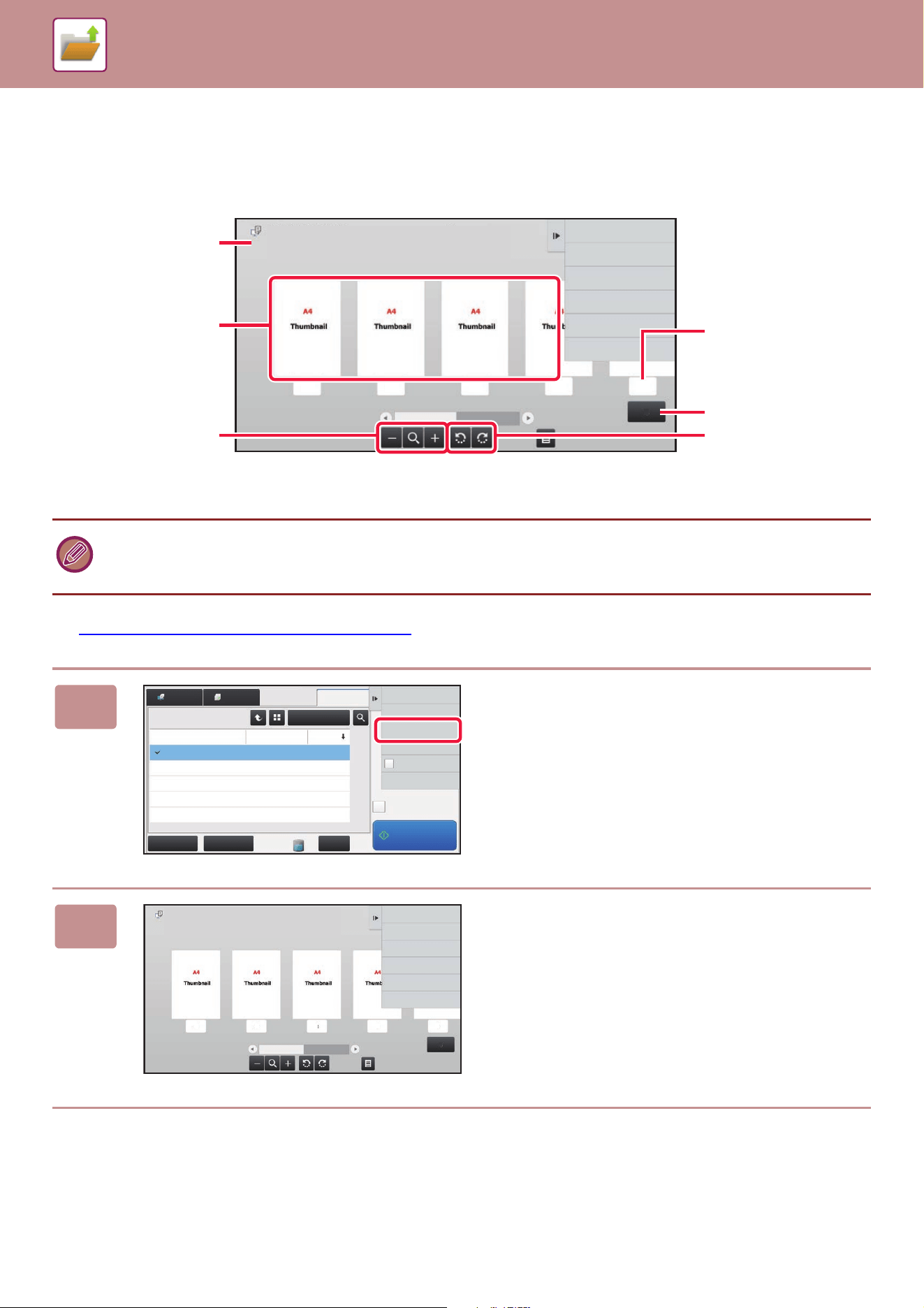
5-30
DOCUMENT FILING►USING STORED FILES
FILE IMAGE CHECKING
After selecting the desired file, follow the steps below.
► SELECTING A FILE TO RETRIEVE (page 5-22)
• Depending on the size of the image, part of the image may be clipped off in the image check screen on the touch panel.
• A preview image is an image for display on the touch panel. It will differ from the actual print result.
• The image check screen does not appear when multiple files are selected.
1
Tap [Check Image] on the action panel.
2
Check the image of the file.
Auto Color
12345
5
User UnknownHDD_06062015_112030AM
Return to File
Selection Screen
8½x11
8½x11
Displays file information.
Displays file preview
images.
Enlarge or reduce the
preview screen.
Displays the total page
count.
Displays the page
number.
Rotate the preview
screen in increments of
90 degrees.
Select All Batch Print
Delete
Print B/W
Print Now
All Files
Main Folder
File Name User Name
2015/06/24
2015/06/24
2015/06/24
2015/06/24
2015/06/24
Date
Copy_04042015_112030
Copy_04042015_112100
Copy_04042015_112130
Copy_04042015_112200
Copy_04042015_112230
Print Scan File Retrieve
User Unknown
User Unknown
User Unknown
User Unknown
User Unknown
Change Setting to Print
Move
Check Image
See Detail Information
Print and Delete
the Data
Auto Color
123 45
5
User Unknown
Return to File
Selection Screen
HDD_06062015_112030AM 8½x11
8½x11
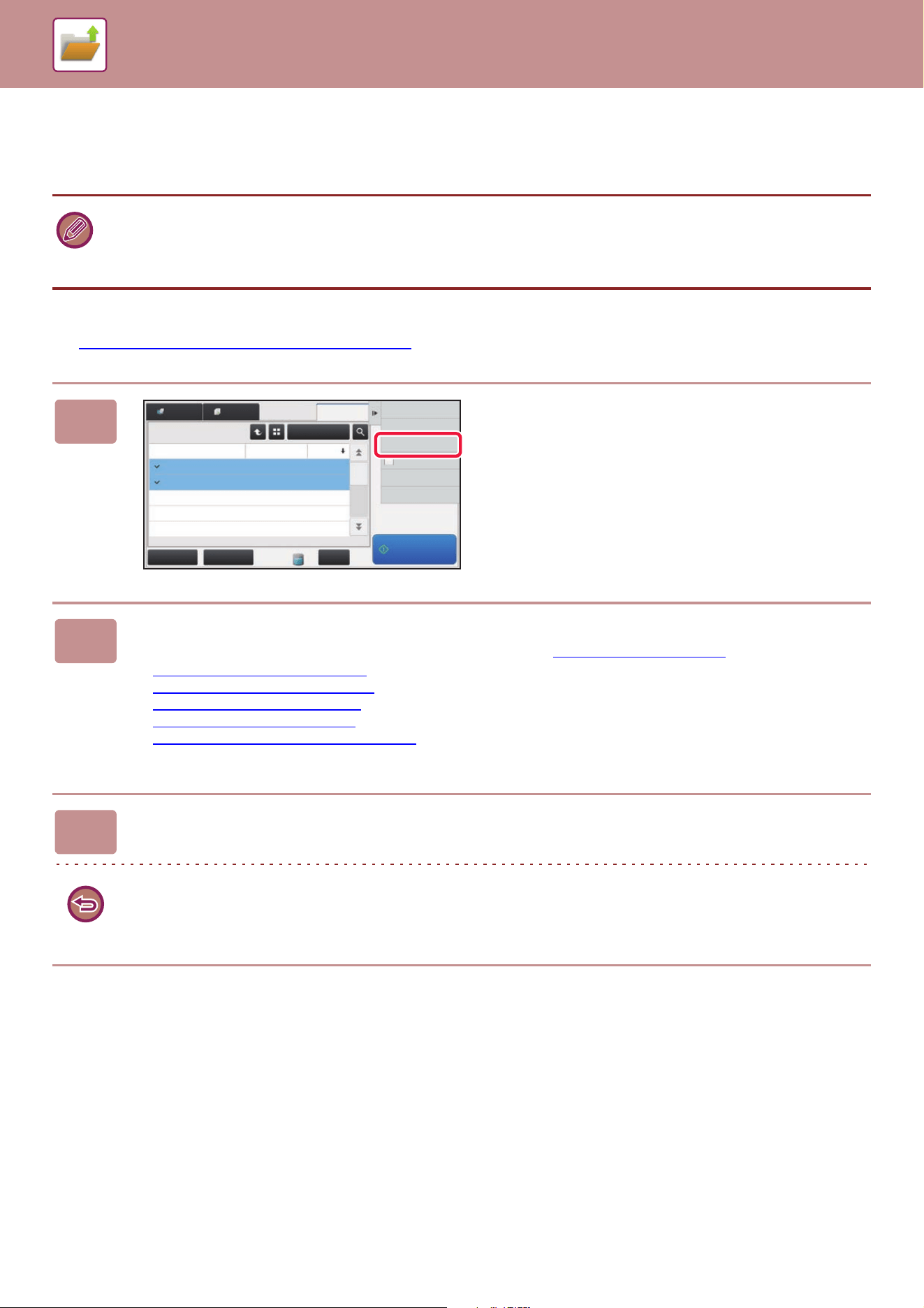
5-31
DOCUMENT FILING►USING STORED FILES
FILE MERGING
You can combine files that have been saved by Document Filing.
After selecting two desired files, follow the steps below.
► SELECTING A FILE TO RETRIEVE (page 5-22)
• If you have only selected a single file, the [Combine File] key is not displayed.
• The file name is a combination of "the first file name", "a tilde (~)", and "Serial No.". As required, change the file name at a
later time.
• The files are joined in the selected order.
1
Tap [Combine File] on the action
panel.
2
Append file information.
To select the user name, file name, folder, and property setting, see "File Information (page 5-12)".
► Changing the property (page 5-12)
► Specifying a user name (page 5-13)
► Assigning a file name (page 5-13)
► Specifying the folder (page 5-13)
► Creating PDF for PC browsing (page 5-13)
To delete the original file, select the [Delete Original File] checkbox.
3
Tap the [Execute] key.
Combining of files starts, and after the processing is finished, the "Combining complete" message appears.
To cancel the operation
Tap the [CA] key. Note that the operation cannot be canceled when the original file is being deleted after the files are
combined.
Select All Batch Print
Delete
Print
Move
Combine File
Print and Delete
the Data
Print Now
All Files
Main Folder
File Name User Name
2015/06/24
2015/06/24
2015/06/24
2015/06/24
2015/06/24
Date
Copy_04042015_112030
Copy_04042015_112100
Copy_04042015_112130
Copy_04042015_112200
Copy_04042015_112230
Print Scan File Retrieve
User Unknown
User Unknown
User Unknown
User Unknown
User Unknown
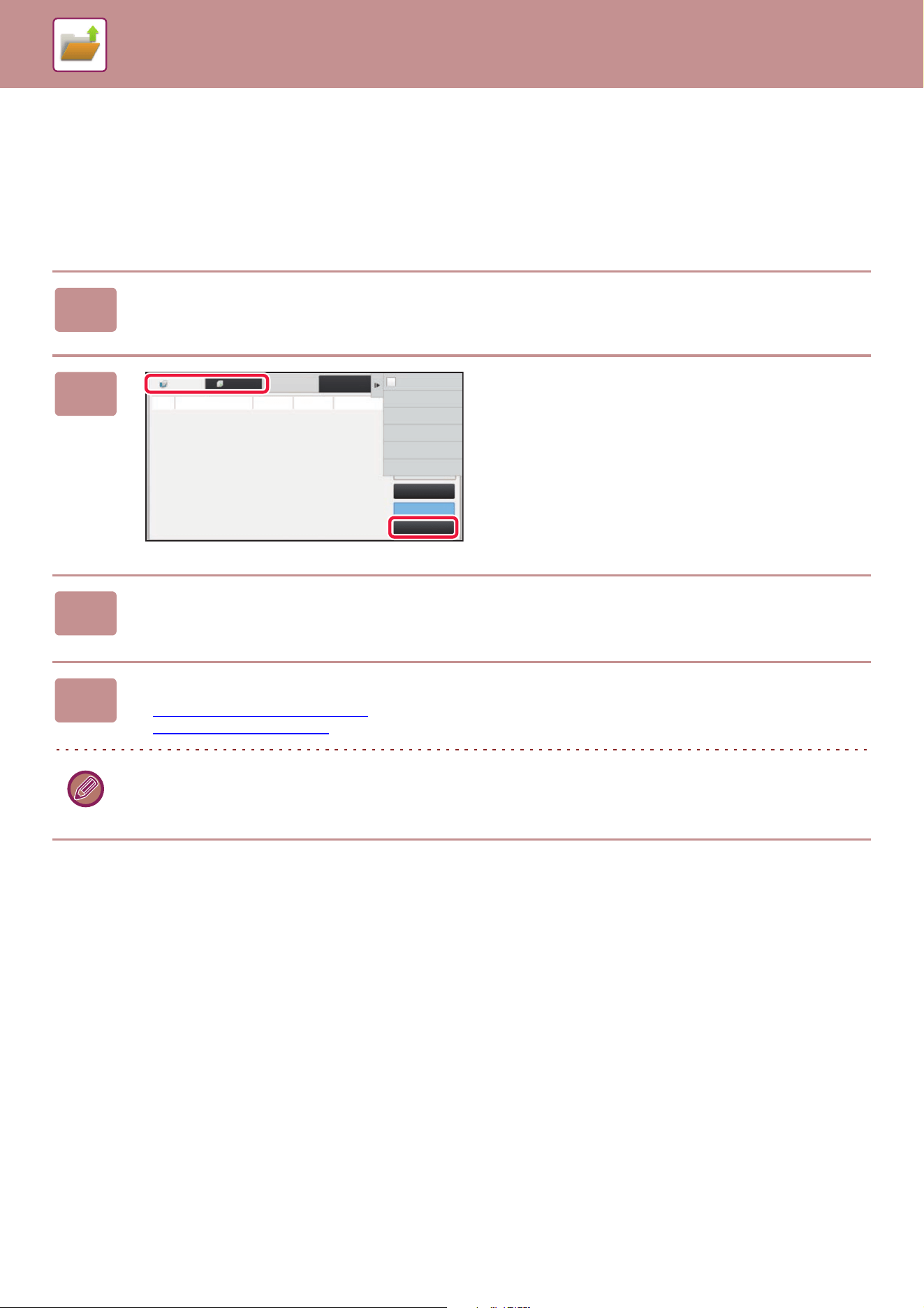
5-32
DOCUMENT FILING►USING STORED FILES
RETRIEVING AND USING A FILE FROM THE
JOB MANAGEMENT SCREEN
Files stored using File and Quick File appear as keys in the job management complete screen.
This is convenient when you need to quickly print the saved data of a copy job.
1
Tap the job management display.
2
Tap the tab with a file to be retrieved,
and tap the [Complete] key.
3
Tap the key of the desired file from the completed job.
A file that has been processed by Quick File or File can be selected for a job in the retrieve operation.
4
Tap [Send] or [Choose Print Settings] on the action panel.
► FILE TRANSMISSION (page 5-26)
► FILE PRINTING (page 5-22)
To view detailed information on a file, select the file, and then tap [Check Details of Selected Job] on the action panel.
Back
Job Queue
Complete
Spool
Job Job Queue
Progress / Sets
Start
Time
Status
Enter Plural
Selection Mode
Print Scan File Retrieve
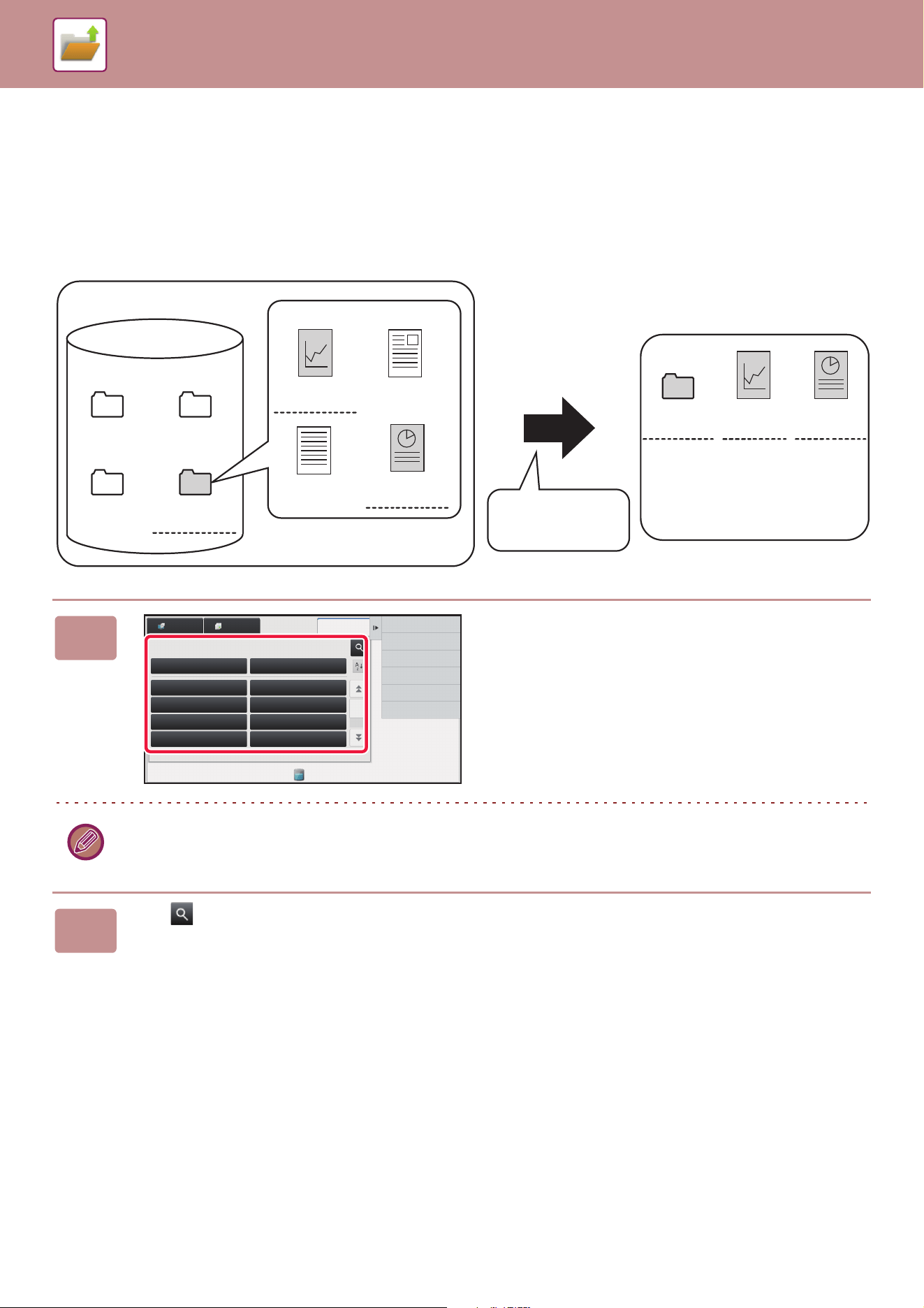
5-33
DOCUMENT FILING►USING STORED FILES
FILE SEARCH AND RETRIEVAL
When there are many stored files, it may take some time to locate a file. The search function of document filing mode
can be used to find a file quickly.
Searching is possible even when you only know part of the file name or folder name. As required, a folder can also be
specified as a search range.
Example: Only part of a file name is known: "Conference"
1
To search for a specific folder, tap its
key.
If the folder with a password is tapped, a password entry screen will appear. Enter the password (5 to 8 digits number)
using the numeric keys.
2
Tap .
Hard disk
Personal
use
Quick File
for
conference
Standard
Regular
conference
Text 1
Reports
Graph for
conference
When you search by
entering
"Conference"···
Graph for
conference
Regular
conference
for
conference
You can find all folders
and files that contain
the word "Conference".
Search result
Print Scan File Retrieve
Scan to HDD
Scan to External
Memory Device
Select File from
FTP to Print
Select File from
USB Memory to Print
Main Folder Quick File Folder
Select File from
Network Folder to Print
AAA BBB
CCC DDD
EEE FFF
GGG HHH
Main Folder
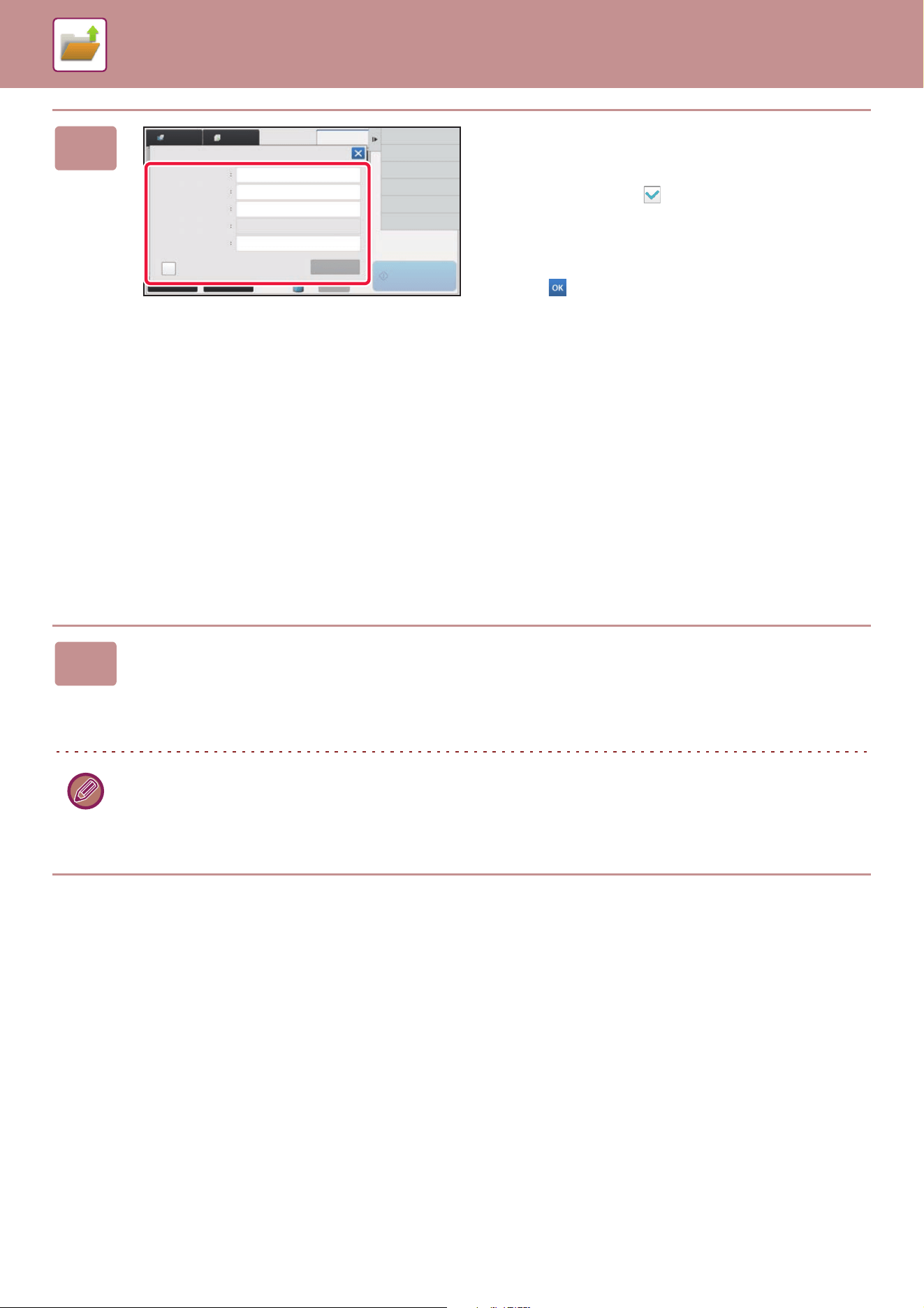
5-34
DOCUMENT FILING►USING STORED FILES
3
Select search conditions.
Tap each text box and set the search condition.
To search for the current folder, set the [Search Just Within
the Folder] checkbox to .
[User Name]
Search using the user name.
Select a user on the user selection screen that appears, and
then tap .
[Login Name]
Search using the login name.
Enter the login name on the soft keyboard that appears and
tap the [OK] key.
[File or Folder Name]
Search using the file name or folder name.
Enter the file name or folder name on the soft keyboard that
appears and tap the [OK] key.
[PIN Code/Password]
Search for files that have a password set.
Enter the password with the soft keyboard that appears, and
tap the [OK] key.
[Date]
Search using the date when the file was created.
When you have selected [Today] or [Date Set], set the time
and date.
4
Tap the [Search Start] key.
A list of the files that match your search conditions will appear. Select the desired file from the list. The job settings
screen will appear.
To return to the base screen of document filing mode, tap the [CA] key.
To return to the file search screen, tap the [Search Again] key.
• When you search using [File or Folder Name], custom folders that match the search characters will also appear in the
list. When a folder key is tapped, a list of the files in the folder appears. Tap the desired file in the list.
• Also in setting mode (Web version), you can use the file search function. Click [Document Operations] in "Settings
(Web version)" →[Document Filing] → [Search].
Search
User Name
Login Name
Date
Search Just Within the Folder
Search Start
File or Folder Name
PIN Code/Password
Select File from
FTP to Print
Select File from
USB Memory to Print
Select File from
Network Folder to Print
Print Now
Print Scan File Retrieve

5-35
DOCUMENT FILING►USING STORED FILES
PRINTING AN EXTERNAL FILE
A file stored in the FTP server, USB memory device, or network folder of a PC can be printed. The file can also be
modified before printing by changing the print settings.
On the action panel, tap [Select File from FTP to Print], [Select File from USB Memory to Print] or [Select File from
Network Folder to Print].
For more information, see "PRINTING WITHOUT THE PRINTER DRIVER (page 3-92)
".
6-1
MANUAL FINISHING
MANUAL FINISHING . . . . . . . . . . . . . . . . . . . . . . . . 6-2
SELECTING MANUAL FINISHING MODE . . . . . . . 6-3
BASE SCREEN OF MANUAL FINISHING MODE . . .
6-4
PAPERS
CHECKING TYPE AND SIZE OF PAPER . . . . . . . . 6-5
PAPER LOADING ORIENTATION . . . . . . . . . . . . . 6-6
• STAPLE. . . . . . . . . . . . . . . . . . . . . . . . . . . . . . . 6-6
• PUNCH . . . . . . . . . . . . . . . . . . . . . . . . . . . . . . . 6-7
• FOLD . . . . . . . . . . . . . . . . . . . . . . . . . . . . . . . . . 6-7
OPERATION OF MANUAL FINISHING
USING MANUAL FINISHING. . . . . . . . . . . . . . . . . . 6-9
STAPLE FUNCTION . . . . . . . . . . . . . . . . . . . . . . . . 6-11
• COPIES/PAGES FUNCTION . . . . . . . . . . . . . . 6-12
• TRIMMER SETTING . . . . . . . . . . . . . . . . . . . . . 6-13
PUNCH FUNCTION . . . . . . . . . . . . . . . . . . . . . . . . . 6-14
PAPER FOLDING FUNCTION. . . . . . . . . . . . . . . . . 6-15
•
MULTIPLE FOLD (WHEN SADDLE FOLD IS
SELECTED) . . . . . . . . . . . . . . . . . . . . . . . . . . . .
6-16
TO CHANGE THE PAPER TRAY . . . . . . . . . . . . . . 6-18
TO CHANGE THE OUTPUT TRAY . . . . . . . . . . . . . 6-18
MANUAL FINISHING
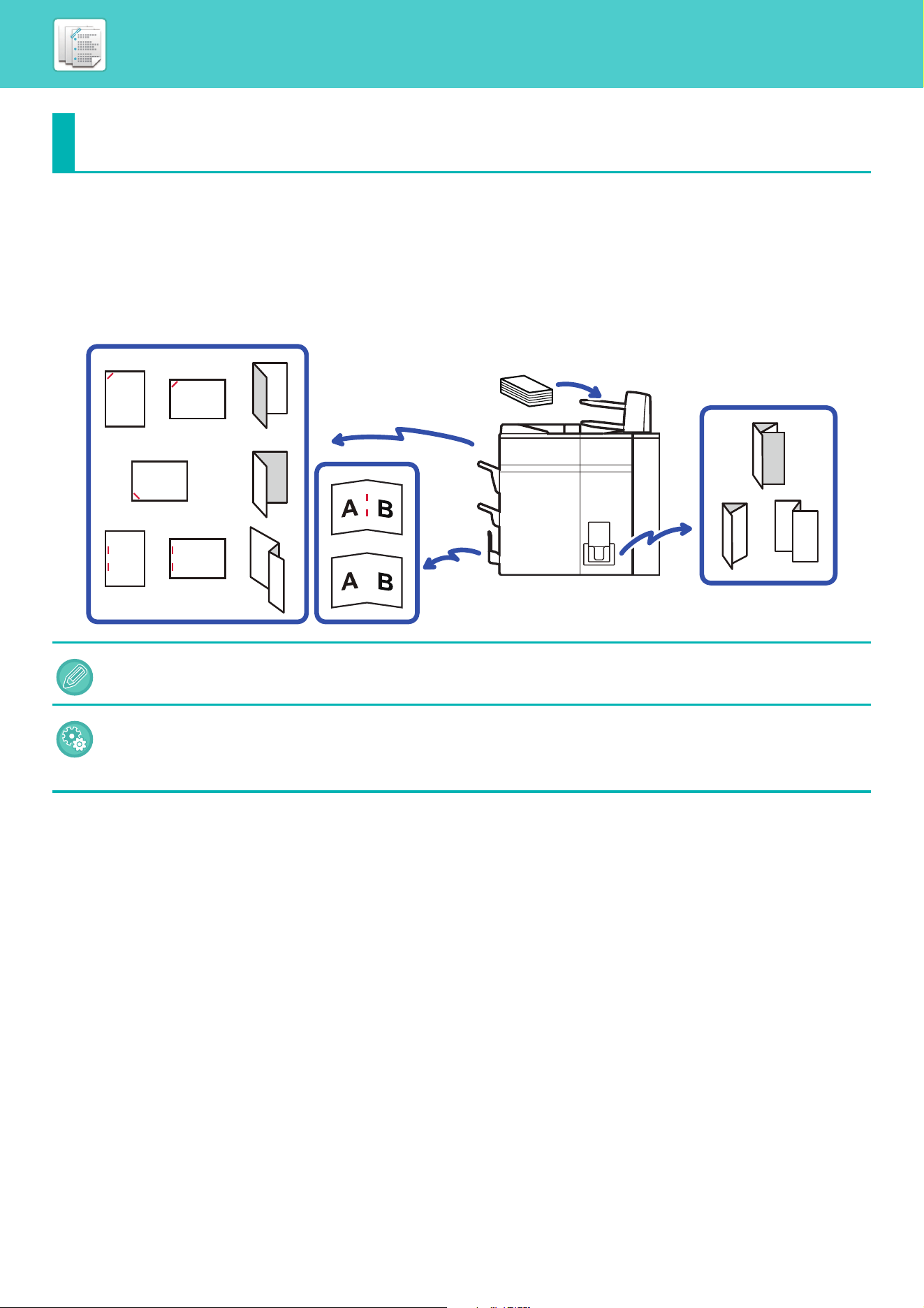
6-2
MANUAL FINISHING►MANUAL FINISHING
MANUAL FINISHING
In manual finishing mode, you can set for finish on copied or printed pages.
You can select the manual finishing mode if the inserter is installed. When the finisher (100-sheet stapling), saddle stitch
finisher (100-sheet stapling), punch module, or folding unit is installed, finishing operations, such as stapling, punching
or folding can be performed.
MANUAL FINISHING
Manual finishing cannot be used if the use of manual finishing or inserter is prohibited in "Settings".
To specify whether or not to prohibit the use of manual finishing or inserter:
In "Settings (administrator)", select [System Settings] → [Common Settings] → [Enable/Disable Settings] → [Disable Manual
Finishing] to set the use of manual finishing. Select [System Settings] → [Common Settings] → [Enable/Disable Settings] →
[Disabling of Inserter] to set the use of the inserter.
A
A
A
A
A
B
A
A
B
A
C
A
C
D
A
A
B
D
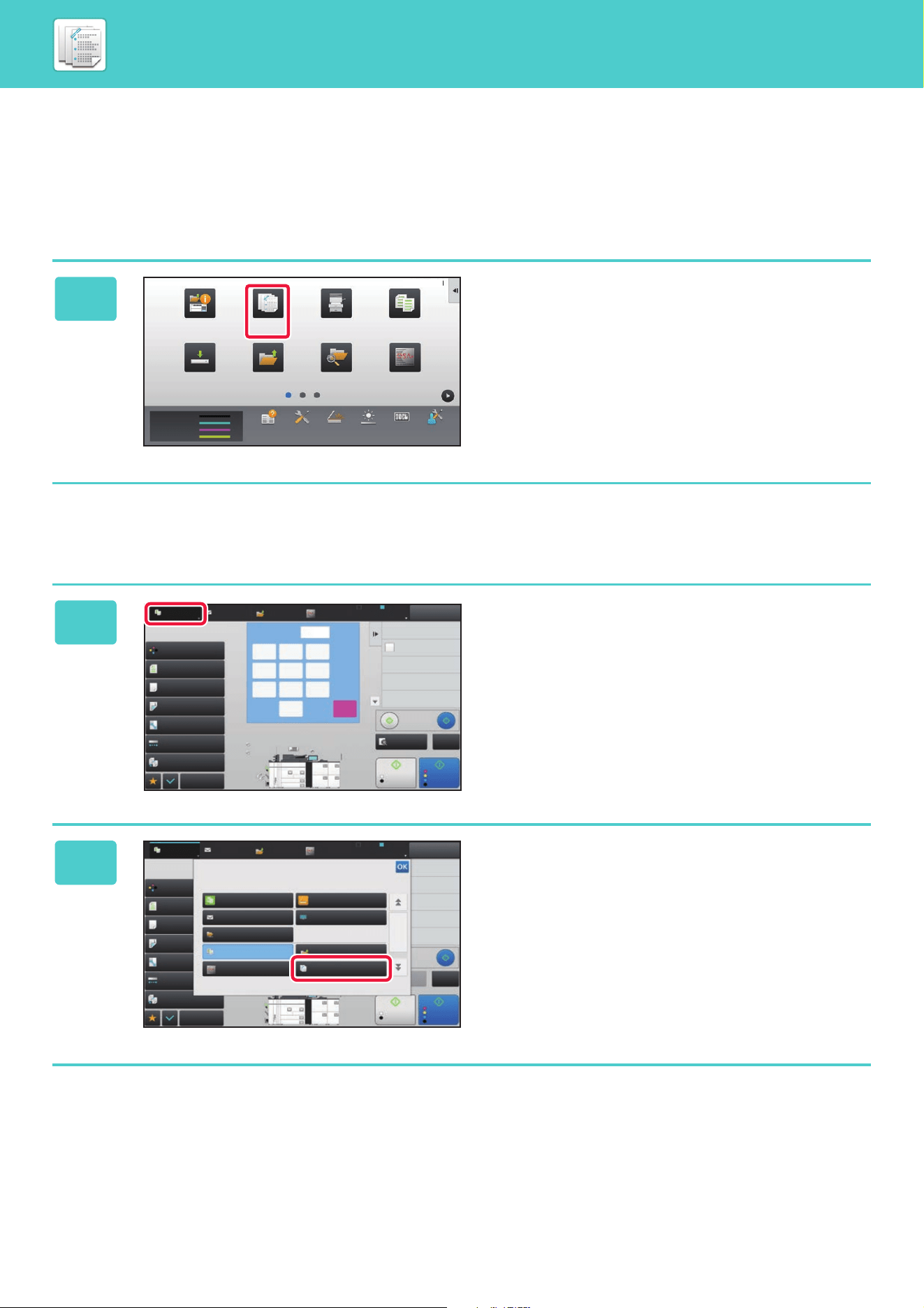
6-3
MANUAL FINISHING►MANUAL FINISHING
SELECTING MANUAL FINISHING MODE
You can select the manual finishing mode from the Home Screen or from each operation mode as follows:
Changing modes from the Home Screen
Changing mode from each mode
1
Tap the [Manual Finishing] mode icon.
The initial screen of the manual finishing mode is displayed.
1
Tap on the mode display.
2
Tap the [Manual Finishing] key.
The initial screen of manual finishing mode is displayed.
M
C
Bk
Y
Easy Copy
Toner Quantity
Tray Settings/
Paper Settings
Scan to HDD Batch Print Sharp OSA
Manual
Finishing
HDD
File retrieve
Operation
Guide
PC Scan Total Count Machine
Adjustment
LCD Control
Settings
Copy
10:15 AM
Start
Colour
Start
Preview
Color Mode
Full Color
Auto
Exposure
Auto
Original
2-Sided Copy
1-Sided→1-Sided
Output
Copy Ratio
100%
Others
Send and print
Call Eco Program
Store Data in Folder
File
Store Data Temporarily
Quick File
1
No. of copies
CA
B/W
Paper Select
Plain1
1
2
5
68
8½x11
7
1
3
4
Plain 1
8½x11
Plain 1
8½x11
1
9
32
6
78
4
5
0
Proof Copy
C
LINE PRINTER
Job Management
E-mail
HDD
File retrieve
Sharp OSA
8½x11 5½x8½
8½x14
11x17
8½x11
8½x11
8½x11
8½x11
Copy
Auto
LINE PRINTER
Job Management
Preview
E-mail
HDD
File retrieve
CA
Sharp OSA
Start Start
Preview
Color Mode
Full
Auto
Exposure
Auto
Original
8½
2-Sided Copy
1-Sided
Output
Copy Ratio
100%
Others
Send asand print
Call Eco Program
Store Data in Folder
File
Store Data Temporarily
Quick File
1
No. of
CA
B/W
Paper Select
Plain
1
2
5
68
8½x11
No. of
7
1
3
4
Plain
8½x11
Plain
8½x11
1
9
32
6
78
4
5
0
Proof Copy
C
8½x11
8½x11
8½x11 5½x8½
8½x14
11x17
8½x11
8½x11
8½x11
8½x11
8½x11
Copy
Color
HDD
File retrieve
Easy Copy
Network Folder
E-mail
COPY
Sharp OSA
Manual Finishing
FTP
Easy Scan
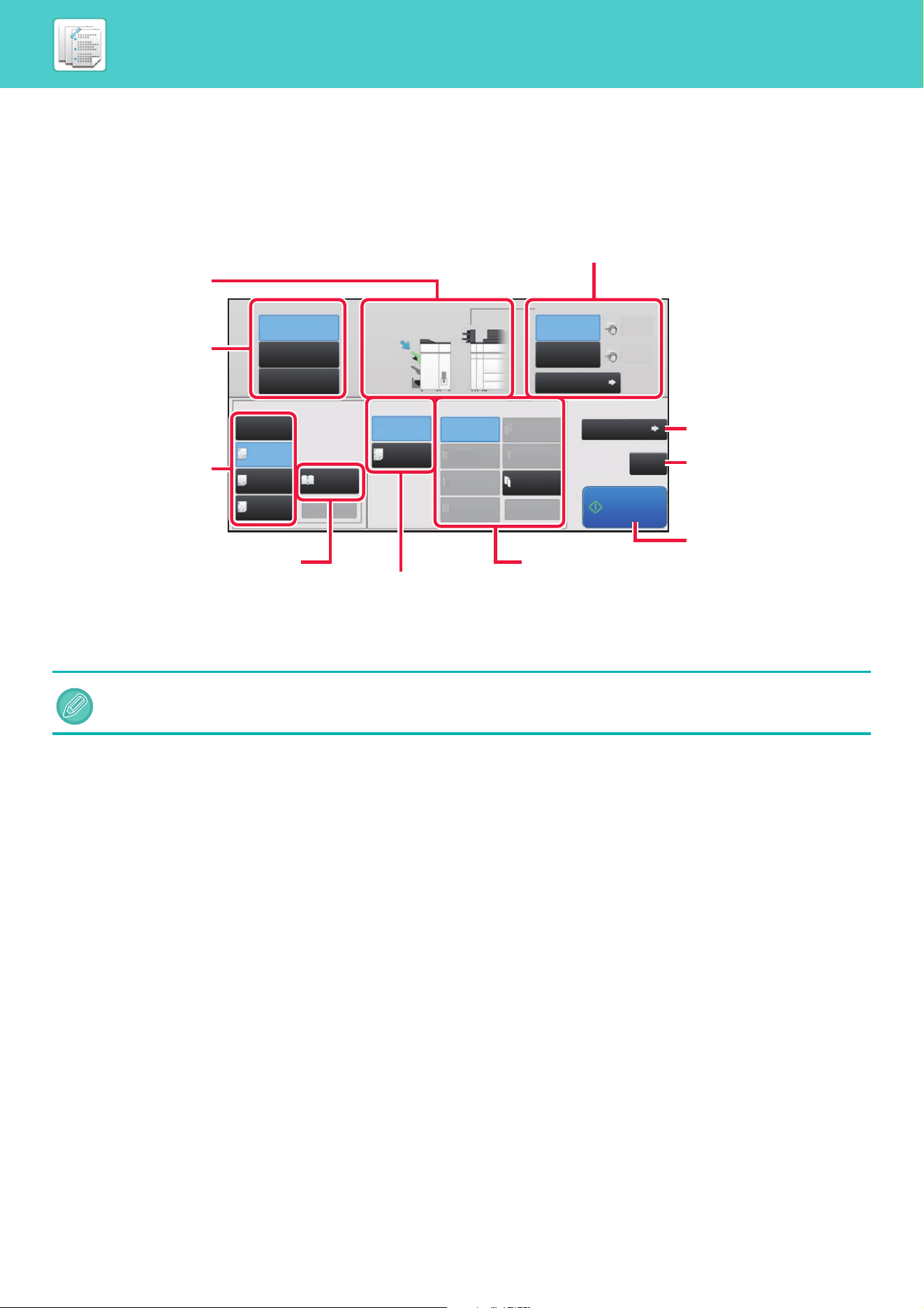
6-4
MANUAL FINISHING►MANUAL FINISHING
BASE SCREEN OF MANUAL FINISHING
MODE
The display will vary depending on the devices installed.
Upper Tray
Output Tray
Inserter
Staple
Off
1 Staple
at Back
Saddle
Fold
Half Fold
C-Fold
1 Staple
at Front
2 Staples
Trimmer
Setting
Saddle
Stitch
Off
Off
Accord-
ion Fold
Copies/Pages
Type and Size
Double
Fold
Z-Fold
Detail
Punch Fold
Middle Tray
Lower Tray
Start
CA
Upper Tray
Lower Tray
Plain 1
Plain 1
2/3-Hole
Punch
8½x11
8½x11
Shows the selected
paper and output trays.
Selects an output tray for
finished paper.
Staples each set of
output.
Selects a staple position.
Staples the center of the booklet and
folds the booklet along the center.
Trims the excessive parts of booklet
folded along the center.
Performs paper folding.
Selects the type of
folding.
Punches holes in paper.
Starts finishing.
Resets all settings.
Sets the number of copies
for output and the number of
sheets per set.
Selects a paper tray for finishing.
Tap the [Type and Size] key to set the paper
type and paper size.
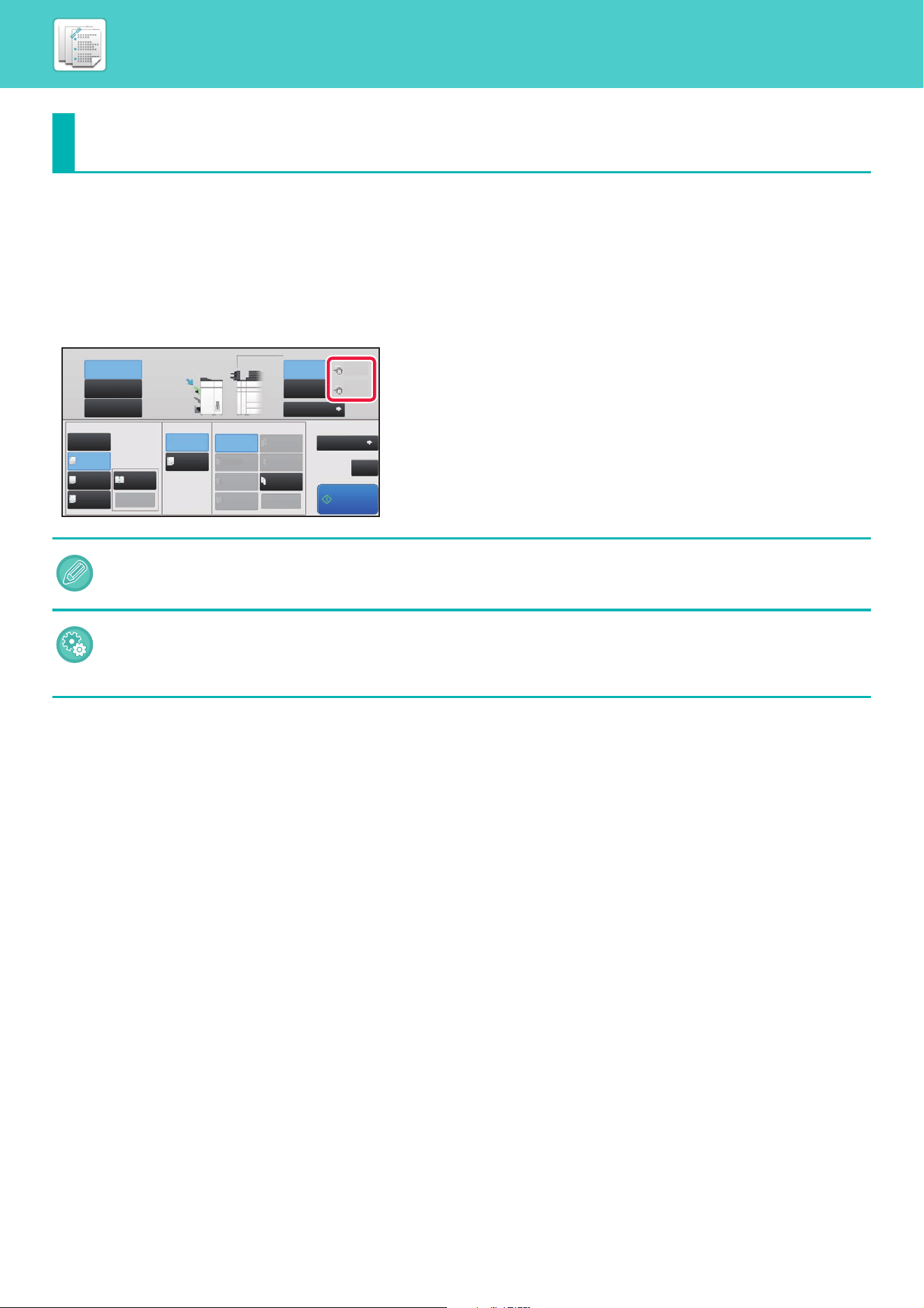
6-5
MANUAL FINISHING►PAPERS
CHECKING TYPE AND SIZE OF PAPER
You can check the type and size of paper loaded in the inserter on the display to the right of [Upper Tray] or [Lower Tray]
key.
The paper size is automatically detected when paper is loaded. To set the paper type and size, tap the [Type and Size]
key. Paper types and sizes can be specified for each of the upper and lower trays.
PAPERS
• If the paper loaded is different from the type that is indicated on the right of the key, tap the [Type and Size] key or change
the settings in "Settings".
• Special media such as transparency film and tab paper cannot be used.
To change the paper settings for the paper you load in the inserter:
Tap the [Type and Size] key or in "Settings", select [System Settings] → [Common Settings] → [Paper Settings] → [Paper
Tray Settings] → [Inserter(Upper)] or [Inserter(Lower)].
If the paper size is not correctly detected or paper of a non-standard size or type is loaded, specify this setting.
Upper Tray
Output Tray Inserter
Off
1 Staple
at Back
Saddle
Fold
Half Fold
C-Fold
1 Staple
at Front
2 Staples
Trimmer
Setting
Saddle
Stitch
Off
Off
Accord-
ion Fold
Copies/Pages
Type and Size
Double
Fold
Z-Fold
Detail
Punch Fold
Middle Tray
Lower Tray
Start
CA
Upper Tray
Lower Tray
Plain 1
Plain 1
2/3-Hole
Punch
8½x11
8½x11
Staple
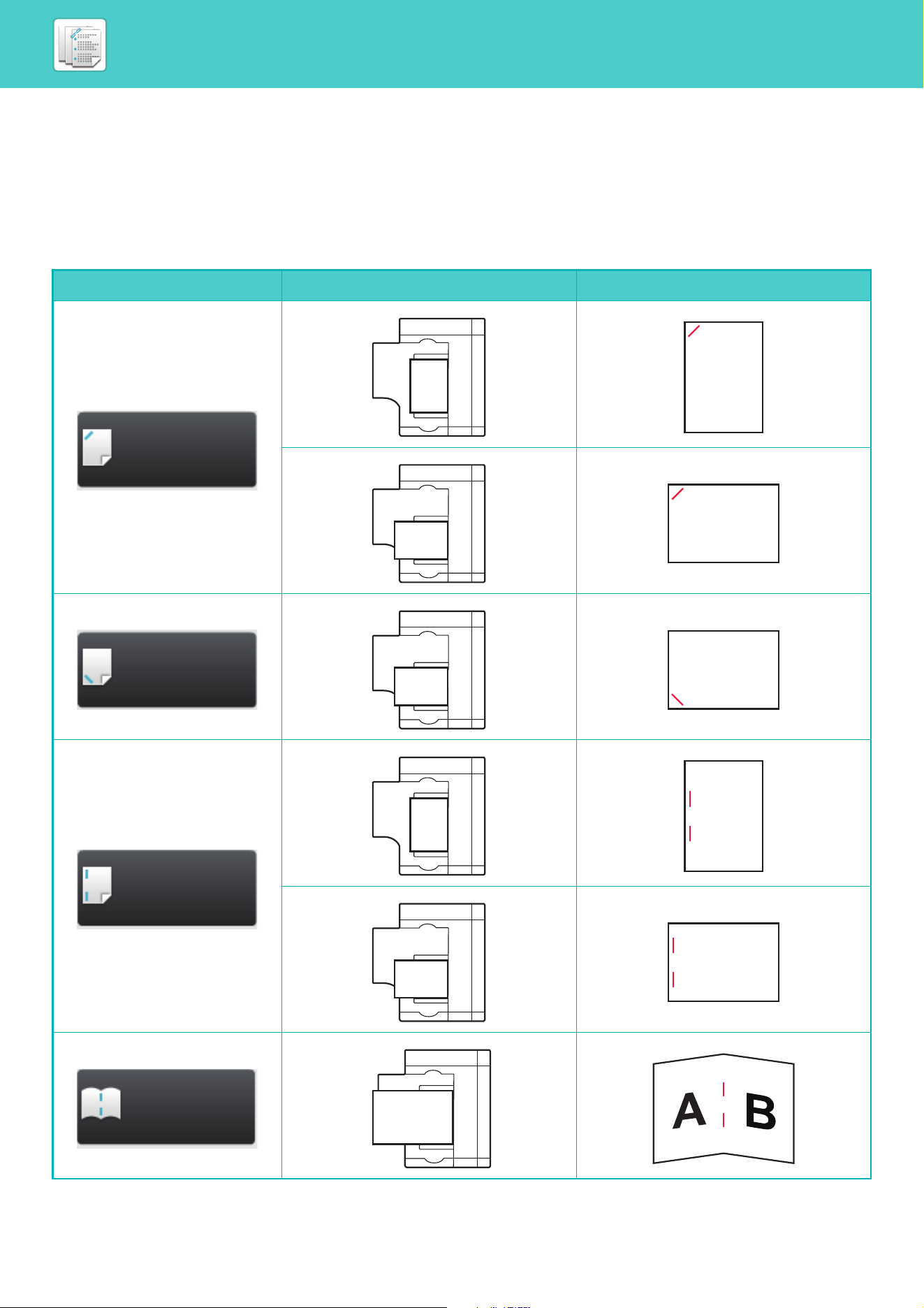
6-6
MANUAL FINISHING►PAPERS
PAPER LOADING ORIENTATION
When using the staple, punch or the paper folding function, the original must be placed as shown below to enable
stapling or punching in the desired position on the paper.
STAPLE
Touch panel key Orientation Result
1 Staple
at Back
A
A
A
A
1 Staple
at Front
A
A
2 Staples
A
A
A
A
Saddle
Stitch
AB
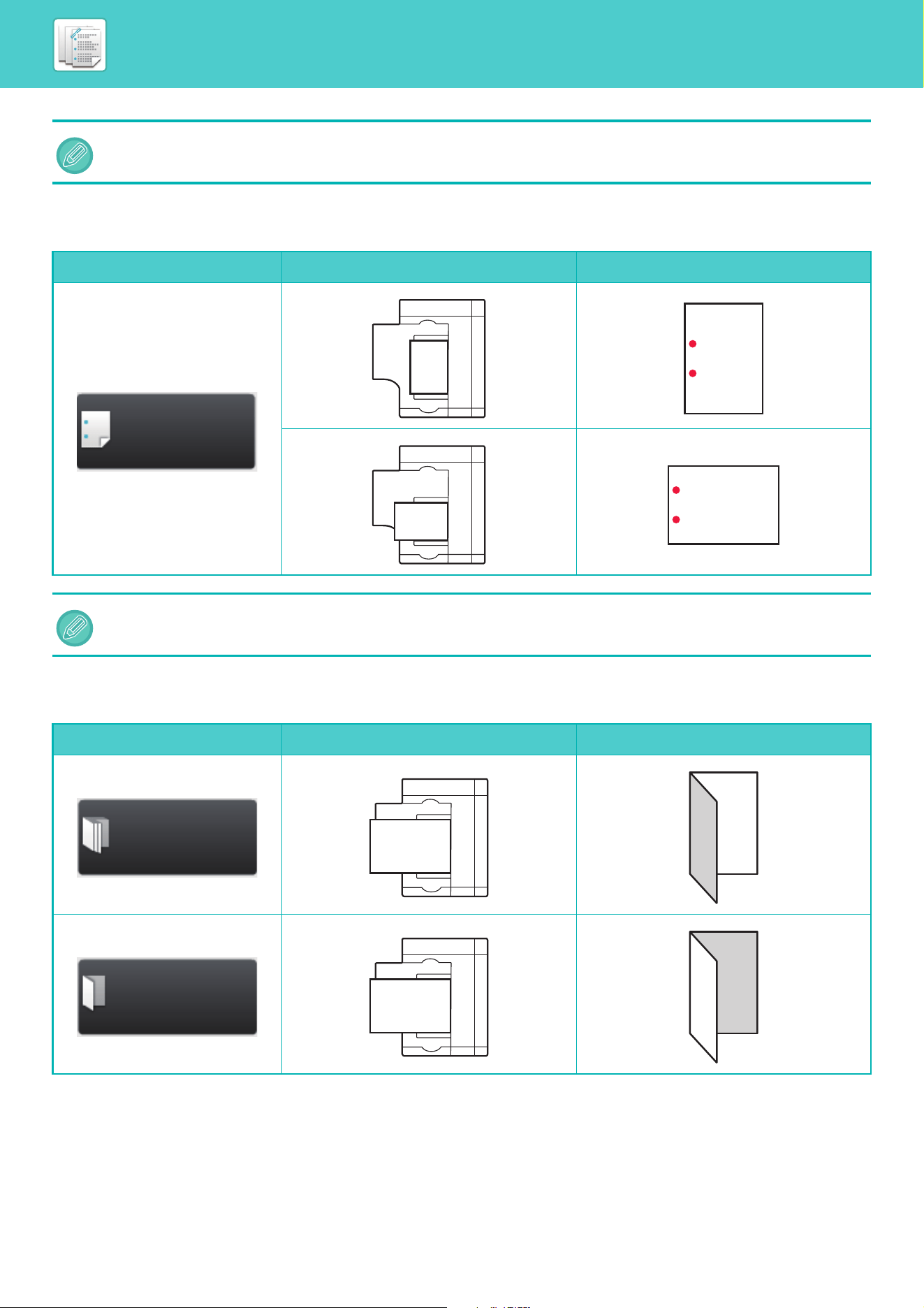
6-7
MANUAL FINISHING►PAPERS
PUNCH
FOLD
• To use the staple function, you need to mount a finisher (100-sheet stapling) or saddle stitch finisher (100-sheet stapling).
• To use the saddle stitch function, you need to mount a saddle stitch finisher (100-sheet stapling).
Touch panel key Orientation Result
• A punch module is required for paper punch.
• 2 Hole Punch is used as an example. The specifications of the punch module vary by country and region.
Touch panel key Orientation Result
2 Hole
Punch
A
A
A
A
Saddle
Fold
AB
B
A
Half Fold
AB
A
B
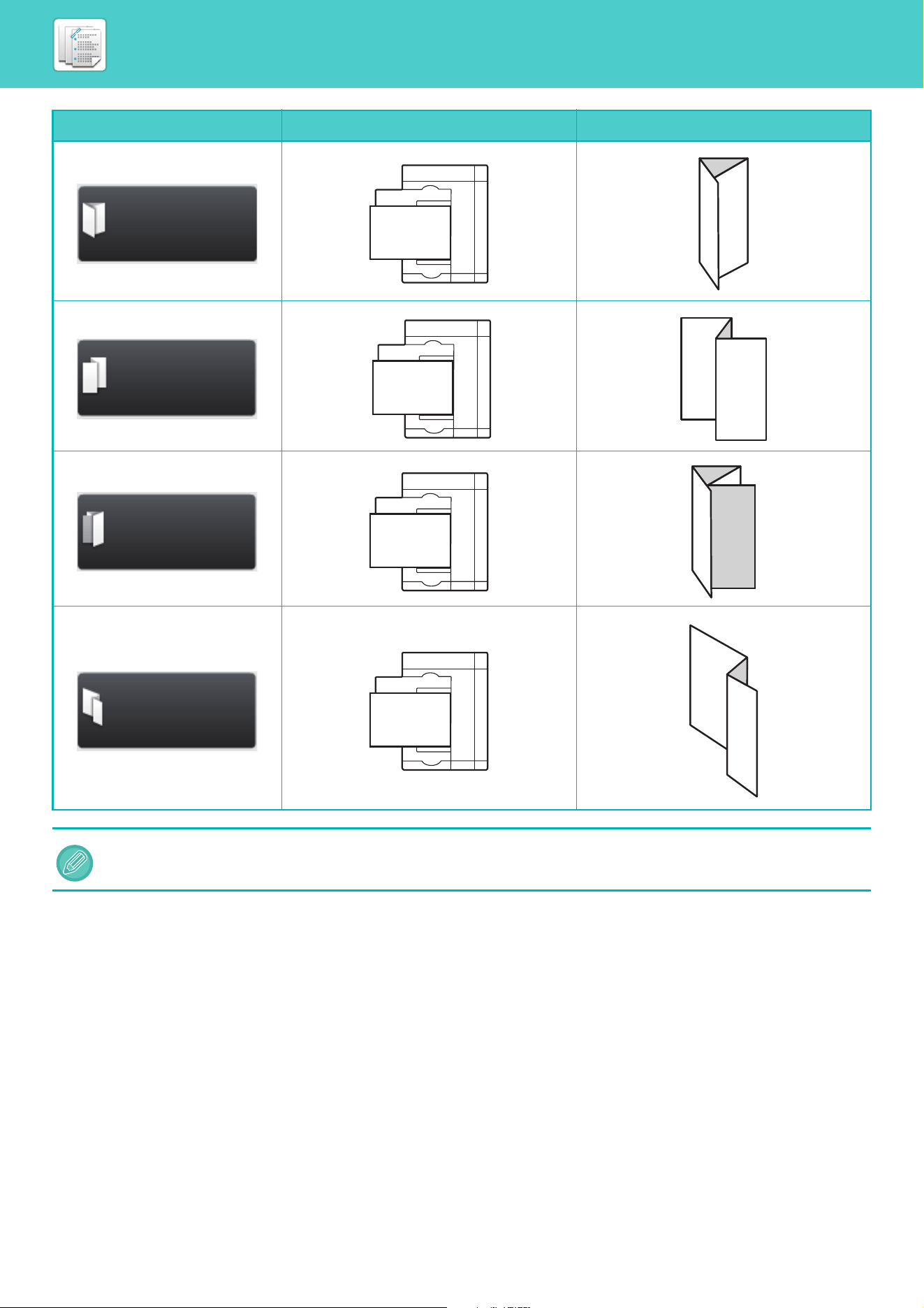
6-8
MANUAL FINISHING►PAPERS
• A folding unit is required to be installed in order to use paper folding functions other than saddle folds.
• To use the saddle fold function, you need to mount a saddle stitch finisher (100-sheet stapling).
Touch panel key Orientation Result
C-Fold
ABC
A
C
Accord-
ion Fold
ABC
A
C
Double
Fold
ABCD
D
A
Z-Fold
ABCD
A
B
D
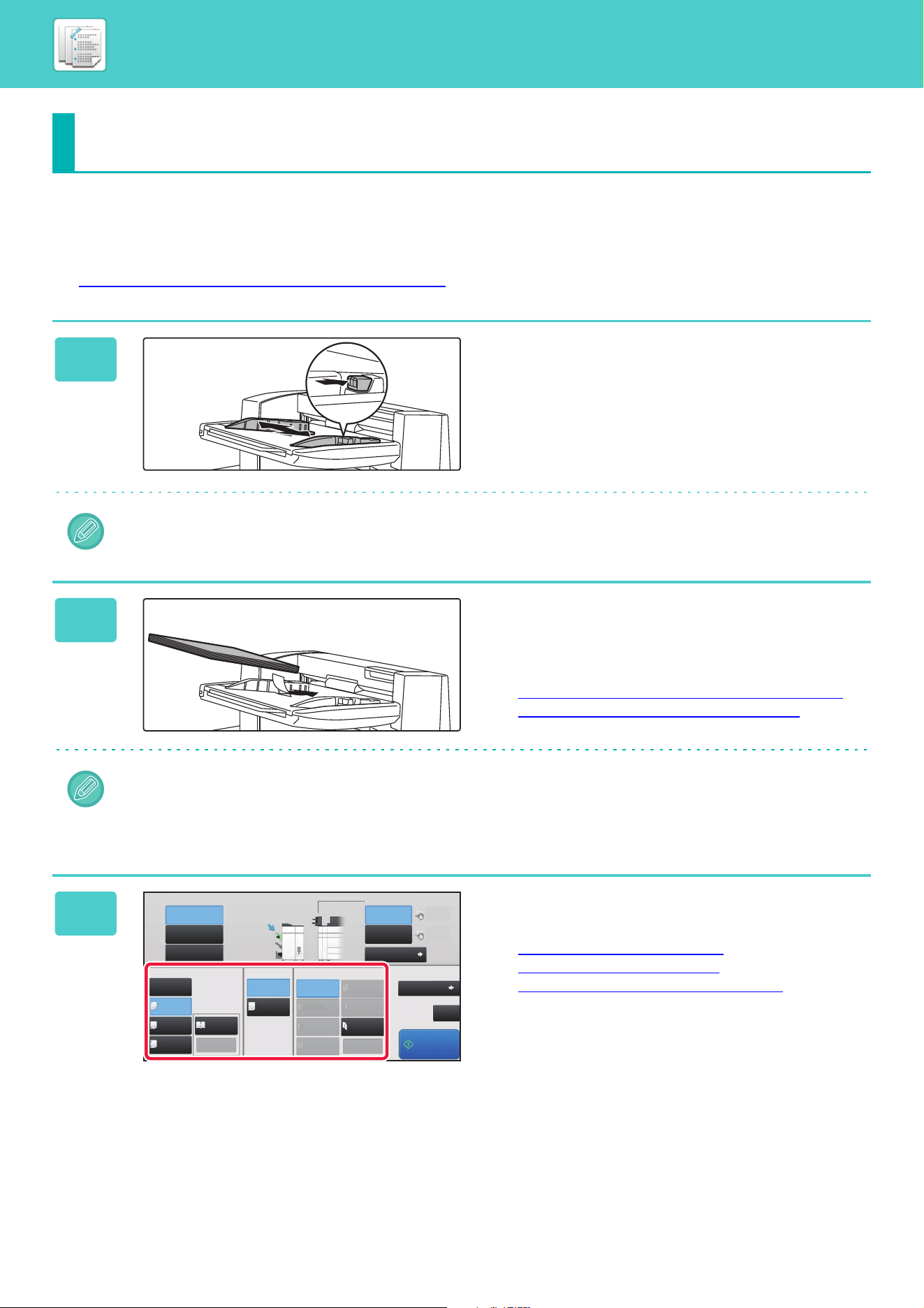
6-9
MANUAL FINISHING►OPERATION OF MANUAL FINISHING
USING MANUAL FINISHING
Change from the Home Screen or each mode to manual finishing mode, and carry out the following procedure.
► SELECTING MANUAL FINISHING MODE (page 6-3)
OPERATION OF MANUAL FINISHING
1
Set the guides to the size of the paper.
Grasp the guide lock lever to adjust the guide.
When you have finished the adjustment, release the lock
lever.
When loading paper larger than 8-1/2" × 11"R, or A4R, extend the bypass tray all the way out. If it is not pulled all the
way out, the size of the loaded paper will not be detected correctly.
2
Load paper into the upper or lower
tray.
The paper orientation varies depending on the manual
finishing function.
► CHECKING TYPE AND SIZE OF PAPER (page 6-5)
► PAPER LOADING ORIENTATION (page 6-6)
• Up to 200 sheets of paper can be loaded into each of the upper and lower trays.
• Insert the paper along the guides all the way into the tray.
• If the guide width is not correctly adjusted to match the paper width, paper may be jammed, skewed, or crease. Adjust
the paper guides to fit the width of the paper.
3
Select the appropriate finishing
method.
► STAPLE FUNCTION (page 6-11)
► PUNCH FUNCTION (page 6-14)
► PAPER FOLDING FUNCTION (page 6-15)
Upper Tray
Output Tray Inserter
Off
1 Staple
at Back
Saddle
Fold
Half Fold
C-Fold
1 Staple
at Front
2 Staples
Trimmer
Setting
Saddle
Stitch
Off
Off
Accord-
ion Fold
Copies/Pages
Type and Size
Double
Fold
Z-Fold
Detail
Punch Fold
Middle Tray
Lower Tray
Start
CA
Upper Tray
Lower Tray
Plain 1
Plain 1
2/3-Hole
Punch
8½x11
8½x11
Staple
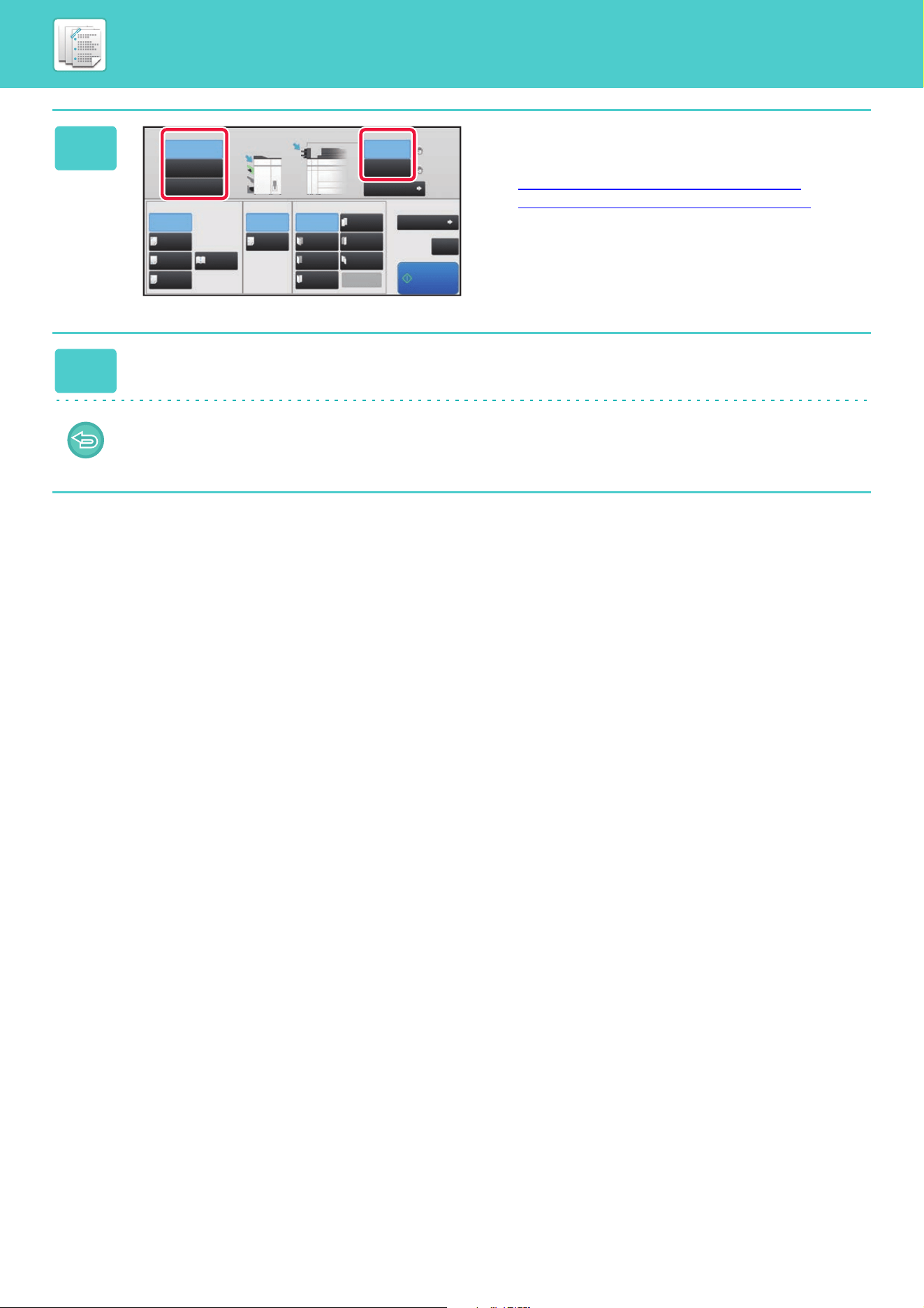
6-10
MANUAL FINISHING►OPERATION OF MANUAL FINISHING
4
Change the paper tray or output tray
as required.
► TO CHANGE THE PAPER TRAY (page 6-18)
► TO CHANGE THE OUTPUT TRAY (page 6-18)
5
Tap the [Start] key to begin manual finishing.
To stop manual finishing:
Tap the [Stop] key.
8½x11
8½x11
Upper Tray
Staple
Off
1 Staple
at Back
Saddle
Fold
Half Fold
C-Fold
1 Staple
at Front
2 Staples
Saddle
Stitch
Off
Off
Accord-
ion Fold
Copies/Pages
Type and Size
Output Tray Inserter
Double
Fold
Z-Fold
Detail
Punch Fold
Middle Tray
Lower Tray
Start
CA
Upper Tray
Lower Tray
Plain 1
Plain 1
2 Hole
Punch
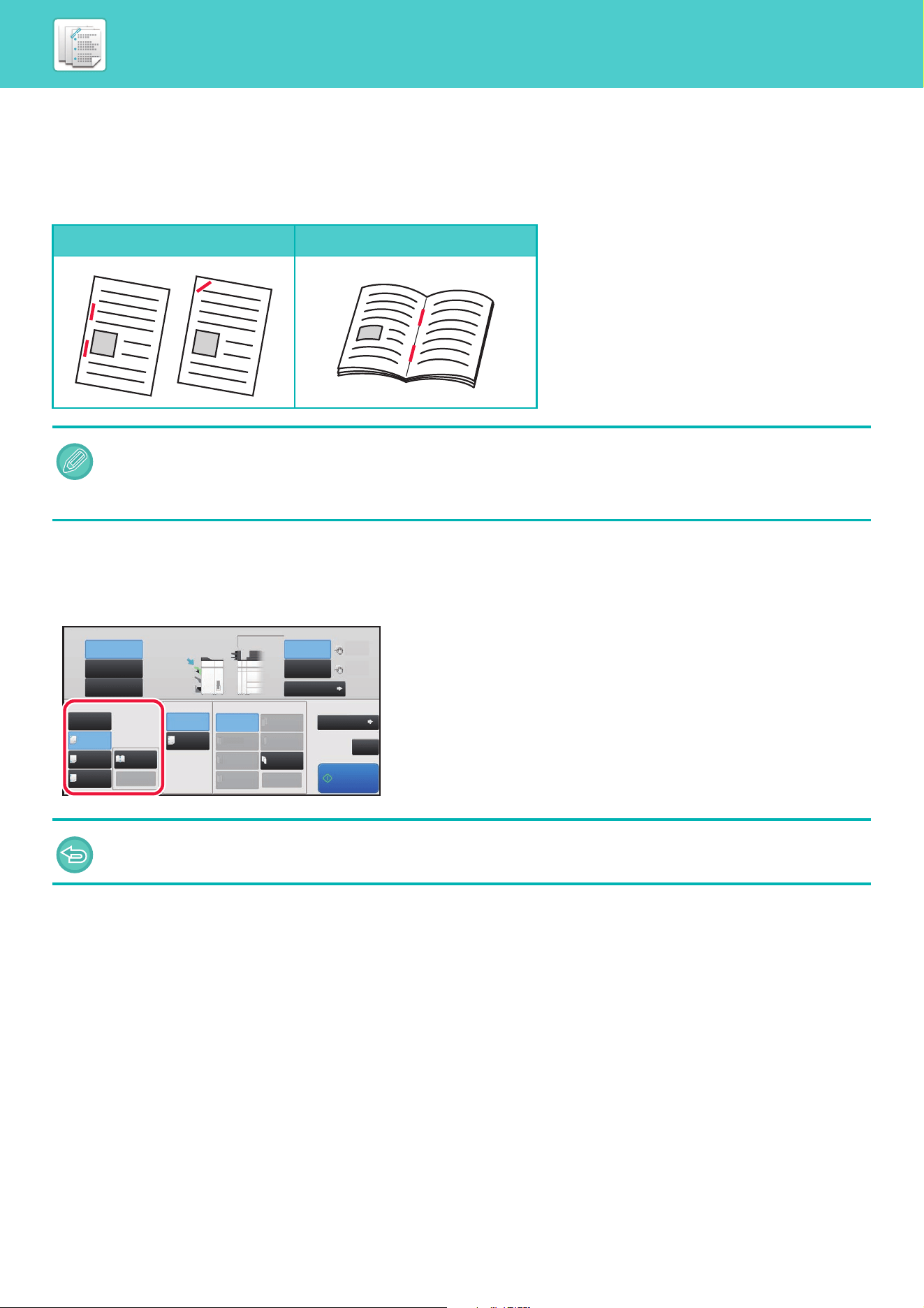
6-11
MANUAL FINISHING►OPERATION OF MANUAL FINISHING
STAPLE FUNCTION
When a finisher (100-sheet stapling) is installed, you can staple loaded papers into a sheaf. (Staple function)
When a saddle stitch
finisher (100-sheet stapling) is installed, you can staple papers in two places on the centerline and
fold them before being output. (Saddle stitch function)
Selecting staple function
Tap your desired staple key in the [Staple].
The output tray is automatically selected based on the selected staple key.
Staple Saddle Stitch
• You can use the saddle stitch function for size 8-1/2 " × 11"R to 12" × 18" (A4R to A3W) papers.
• The saddle stitch function cannot be used with other manual finishing functions.
• If you load only one sheet of paper while the staple function is ON, the staple function is temporarily turned OFF and the
sheet is not stapled.
To cancel the staple function:
Tap the [Off] key.
1
1
5
6
Upper Tray
Output Tray Inserter
Off
1 Staple
at Back
Saddle
Fold
Half Fold
C-Fold
1 Staple
at Front
2 Staples
Trimmer
Setting
Saddle
Stitch
Off
Off
Accord-
ion Fold
Copies/Pages
Type and Size
Double
Fold
Z-Fold
Detail
Punch Fold
Middle Tray
Lower Tray
Start
CA
Upper Tray
Lower Tray
Plain 1
Plain 1
2/3-Hole
Punch
8½x11
8½x11
Staple
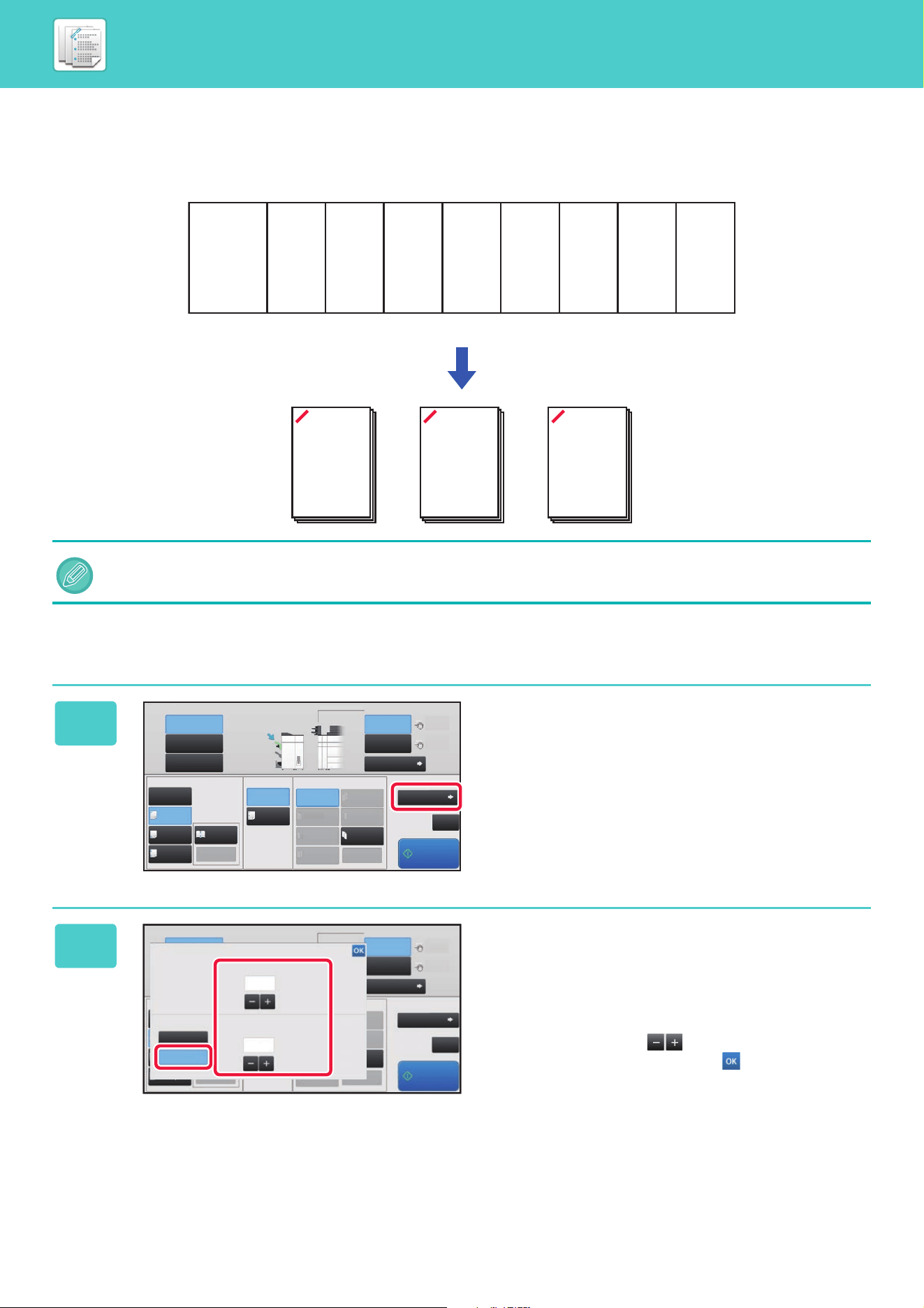
6-12
MANUAL FINISHING►OPERATION OF MANUAL FINISHING
COPIES/PAGES FUNCTION
If you wish to staple multiple sets at once, use the Copies/Pages.
Load sorted paper and tap the [Copies/Pages] key to enter the number of copies and the number of pages per set.
Setting the number of copies (number of pages)
The settings on the Copies/Pages will not be effective for the paper folding and punch functions.
1
Tap the [Copies/Pages] key.
2
Tap the [Manual] key and specify the
number of output copies and the
number of pages per set.
Tap the Number of Copies display and the Number of Pages
per Set display, and enter the values using the numeric
keys. Otherwise, tap the key to enter the values.
After the settings are completed, tap .
ABACBACBA
C
B
A
C
B
A
C
B
A
8½x11
8½x11
Upper Tray
Output Tray Inserter
Staple
Off
1 Staple
at Back
Saddle
Fold
Half Fold
C-Fold
1 Staple
at Front
2 Staples
Trimmer
Setting
Saddle
Stitch
Off
Off
Accord-
ion Fold
Copies/Pages
Type and Size
Double
Fold
Z-Fold
Detail
Punch Fold
Middle Tray
Lower Tray
Start
CA
Upper Tray
Lower Tray
Plain 1
Plain 1
2/3-Hole
Punch
8½x11
8½x11
Upper Tray
Output Tray Inserter
Staple
Off
1 Staple at
Back
Saddle Fold
Half Fold
C-Fold
1 Staple at
Front
2 Staples
Trimmer
Setting
Saddle
Stitch
Off
Off
Accord-
ion Fold
Copies/Pages
Type and Size
Double
Fold
Z-Fold
Detail
Punch Fold
Middle Tray
Lower Tray
Start
CA
Upper Tray
Lower Tray
Plain 1
Plain 1
2-Hole/3-
Hole Punch
8½x11
8½x11
(1-999)1
(1
1
1
1
1
1
1
1
1
1
1
All Pages
Manual
Copies/Pages
Copies
Pages
Specify Number of Sets to be printed.
Specify number of pages in each set.
(1-999)
(1-200)
1
1
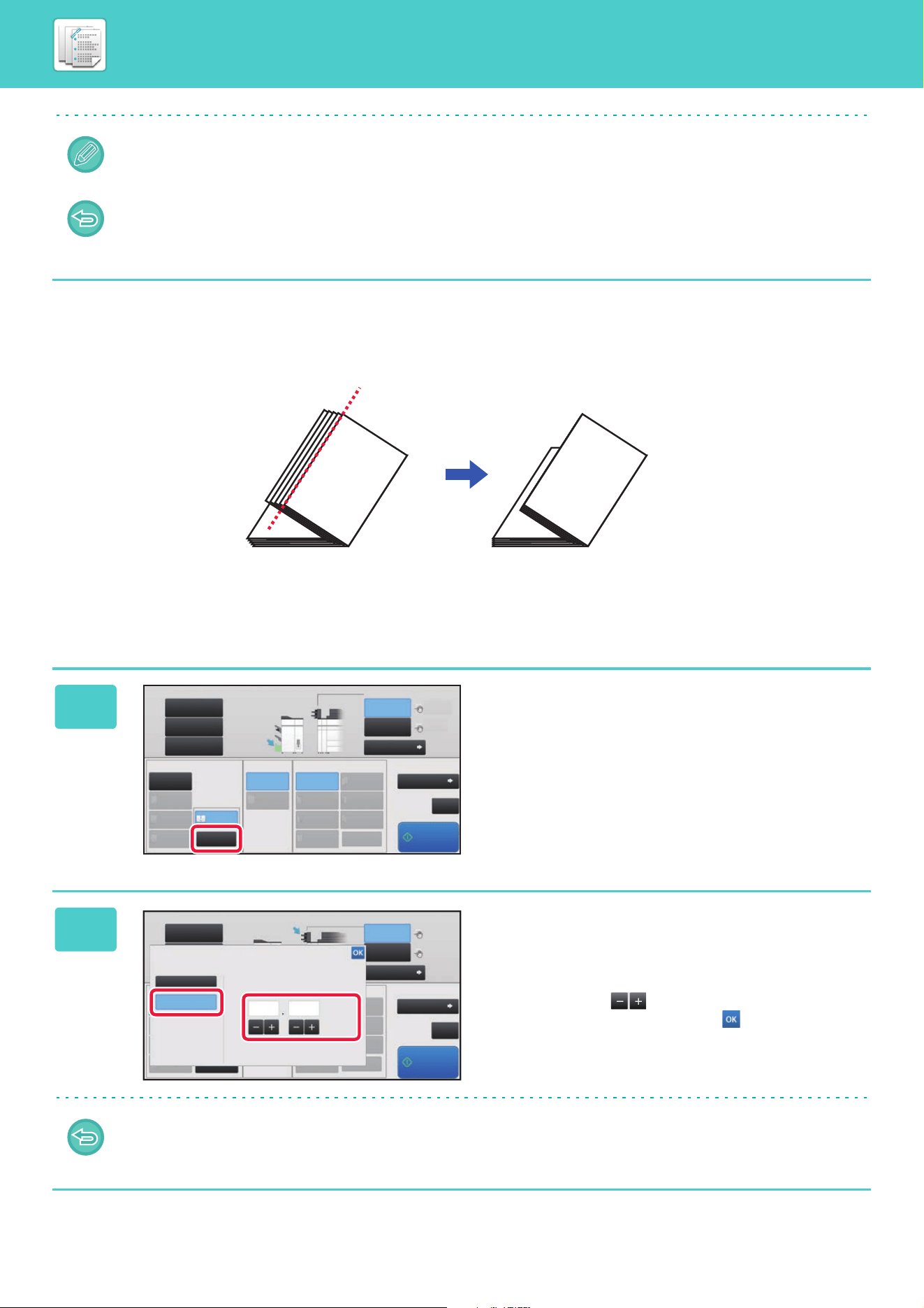
6-13
MANUAL FINISHING►OPERATION OF MANUAL FINISHING
TRIMMER SETTING
If a trimmer unit is installed, you can trim off excess edges of paper for a finer finish.
Trimmer Setting (when Saddle Stitch is selected)
To select the Trimmer Setting, a trimmer unit must be installed.
If you select [All Pages] for the number of copies/number of pages, specify "1" for the number of sets to be printed.
If you set more copies or pages than the number of copies or pages that can be stapled, a message is displayed and the
[Start] key is disabled.
See "Specifications" in the "Start Guide" and specify the number of copies or pages that can be stapled.
1
With Saddle Stitch selected, tap the
[Trimmer Setting] key.
2
Tap the [On] key, and specify the
trimming width.
Tap the numeric value display field of the trimming width,
and enter the allowable range using the numeric keys.
Otherwise, tap the key to enter the values.
After the settings are completed, tap .
To cancel the trimmer setting:
Tap the [Off] key.
Upper Tray
Output Tray Inserter
Off
1 Staple
at Back
Saddle
Fold
Half Fold
C-Fold
1 Staple
at Front
2 Staples
Trimmer
Setting
Saddle
Stitch
Off
Off
Accord-
ion Fold
Copies/Pages
Type and Size
Double
Fold
Z-Fold
Detail
Punch Fold
Middle Tray
Lower Tray
Start
CA
Upper Tray
Lower Tray
Plain 1
Plain 1
2/3-Hole
Punch
8½x11
8½x11
Staple
Upper Tray
Output Tray Inserter
Staple
Off
1 Staple at
Back
Saddle Fold
Half Fold
C-Fold
1 Staple at
Front
2 Staples
Trimmer
Setting
Saddle
Stitch
Off
Off
Accord-
ion Fold
Copies/Pages
Type and Size
Double
Fold
Z-Fold
Detail
Punch Fold
Middle Tray
Lower Tray
Start
CA
Upper Tray
Lower Tray
Plain 1
Plain 1
2-Hole/3-
Hole Punch
8½x11
8½x11
Trimmer Setting
Set Trimming Width.
On
(2.0
῀
20.0)
mm
2 0
Off
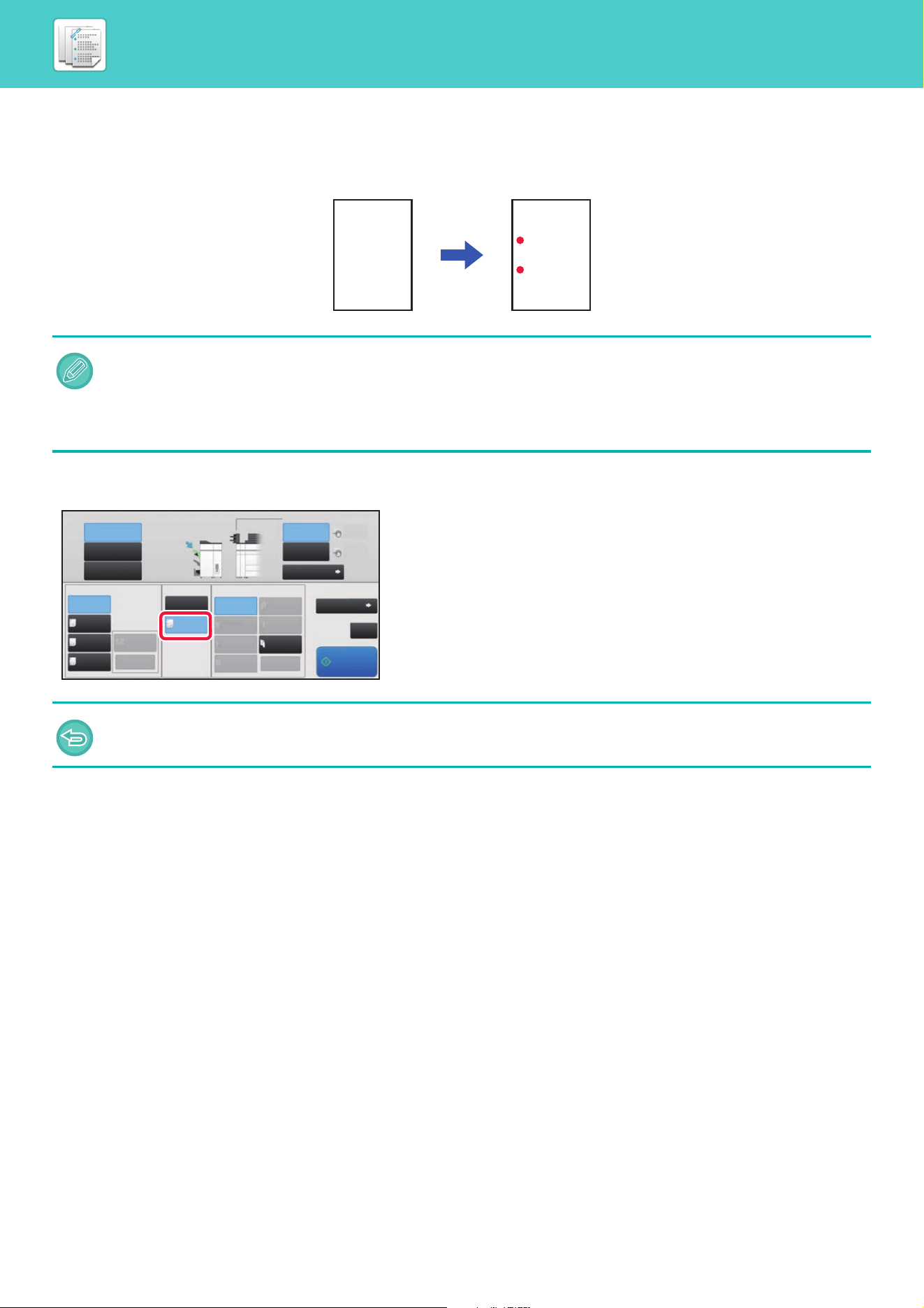
6-14
MANUAL FINISHING►OPERATION OF MANUAL FINISHING
PUNCH FUNCTION
If a punch module is installed, holes can be punched in paper.
Tap the [2 Hole Punch] key under "Punch".
• Paper sizes that are available for the punch function are 8-1/2 " × 11"R to 11" × 17" (B5R to A3).
• You cannot use 12" × 18" (A3W) size papers, and special media such as transparency film.
• The punch function cannot be used with the saddle stitch or paper folding functions. However, it can be used with them if
the paper size used is 11" × 17", A3 or B4 for Z-fold.
• 2 Hole Punch is used as an example. The specifications of the punch module vary by country and region.
To cancel the punch function:
Tap the [Off] key.
A A
Upper Tray
Output Tray Inserter
Off
1 Staple
at Back
Saddle
Fold
Half Fold
C-Fold
1 Staple
at Front
2 Staples
Trimmer
Setting
Saddle
Stitch
Off
Off
Accord-
ion Fold
Copies/Pages
Type and Size
Double
Fold
Z-Fold
Detail
Punch Fold
Middle Tray
Lower Tray
Start
CA
Upper Tray
Lower Tray
Plain 1
Plain 1
2/3-Hole
Punch
8½x11
8½x11
Staple
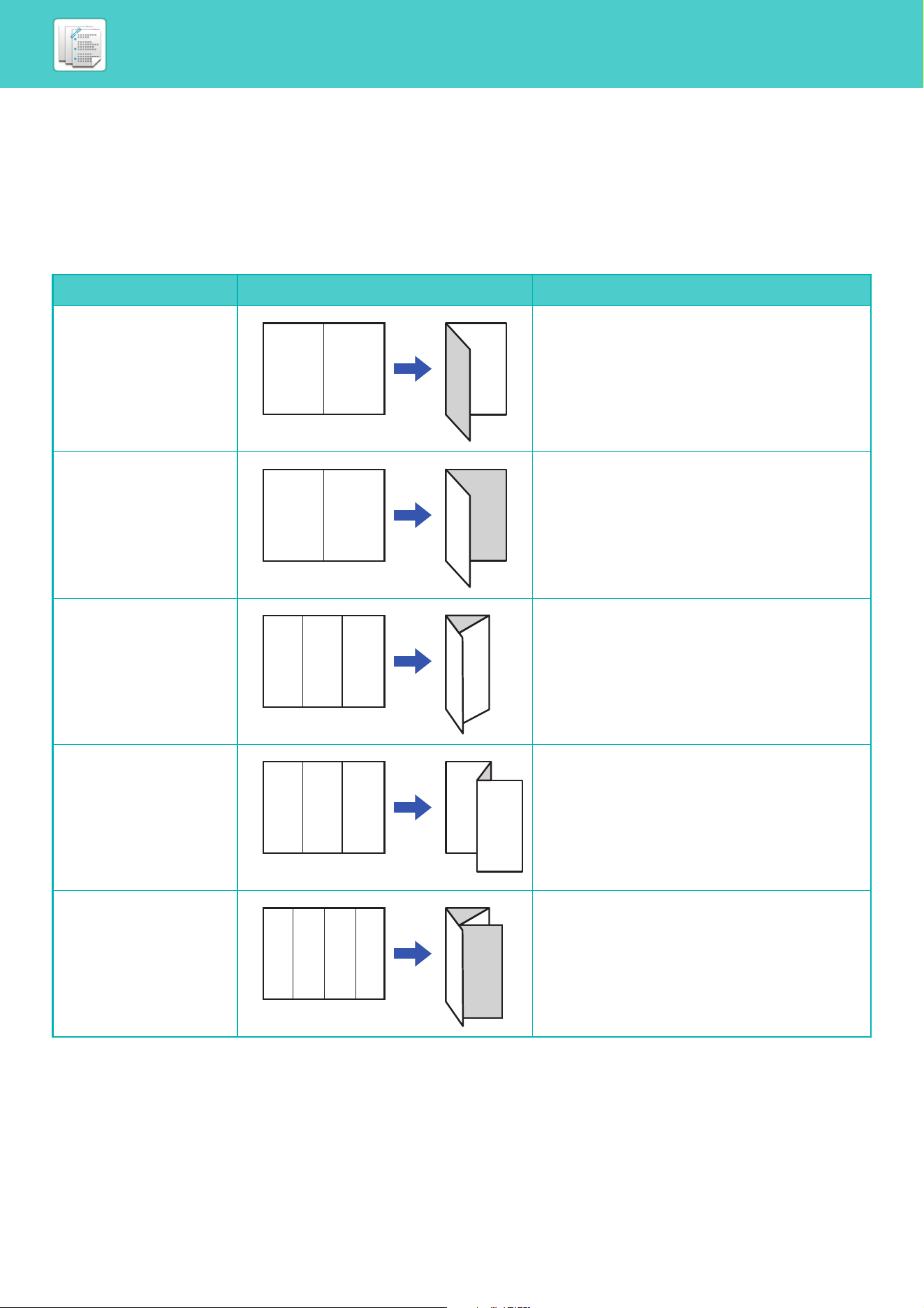
6-15
MANUAL FINISHING►OPERATION OF MANUAL FINISHING
PAPER FOLDING FUNCTION
When a paper folding unit is installed, you can fold papers in Z-fold and C-fold. When a saddle stitch finisher (100-sheet
stapling) is installed, you can use saddle folds.
The paper sizes that can be selected vary depending on the type of paper fold.
Types of folds and paper sizes available
Types of Folds Folding results Paper Size
Saddle Fold 13" × 19",12" × 18", 11" × 17", 8-1/2" × 14",
8-1/2" × 13-1/2", 8-1/2" × 13-2/5", 8-1/2" × 13",
8-1/2" × 11"R, A3W, A3, B4, A4R, SRA3, 8K
Half Fold 8-1/2" × 11"R, A4R
C-Fold 8-1/2" × 11"R, A4R
Accordion Fold 8-1/2" × 11"R, A4R
Double Fold 8-1/2" × 11"R, A4R
B
A
BA
BA
A
A
B
ABC
A
C
ABC
A
C
ABCD
D
A
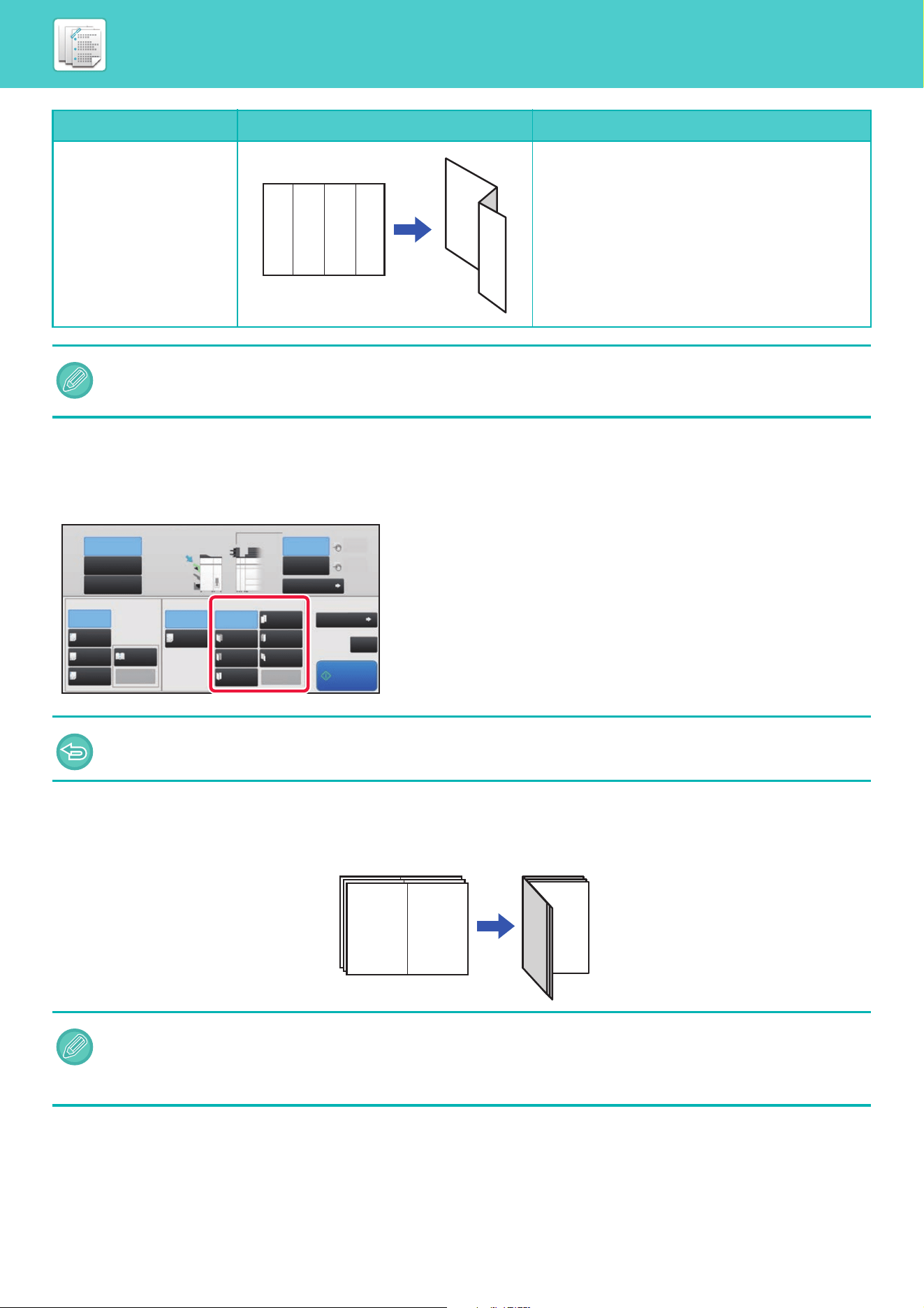
6-16
MANUAL FINISHING►OPERATION OF MANUAL FINISHING
Selecting the paper folding function
Tap your desired fold key in the "Fold".
The output tray is automatically selected based on the selected fold key.
MULTIPLE FOLD (WHEN SADDLE FOLD IS SELECTED)
If Saddle Fold is selected, multiple sheets can be folded together. Five sheets of paper are folded at a time.
Z-Fold 11" × 17", 8-1/2" × 14", 8-1/2" × 11"R, A3, B4, A4R
• Special media such as transparency film and tab paper cannot be used.
• The paper folding function cannot be used with the staple and hole punch function. However, it can be used with them if
the paper size for Z-fold is 11" × 17", A3 or B4.
To cancel the paper folding function:
Tap the [Off] key.
• When four or less papers are set, four or less papers are folded at a time.
• If five or more papers are set and if four or less papers remain, the remaining number of papers are folded at a time.
• Some types of paper reduces the number of sheets that are folded every set. For example, three sheets are folded at a
time in the case of heavy paper.
Types of Folds Folding results Paper Size
ABCD
A
B
D
Upper Tray
Output Tray Inserter
Off
1 Staple
at Back
Saddle
Fold
Half Fold
C-Fold
1 Staple
at Front
2 Staples
Trimmer
Setting
Saddle
Stitch
Off
Off
Accord-
ion Fold
Copies/Pages
Type and Size
Double
Fold
Z-Fold
Detail
Punch Fold
Middle Tray
Lower Tray
Start
CA
Upper Tray
Lower Tray
Plain 1
Plain 1
2/3-Hole
Punch
8½x11
8½x11
Staple
B
B
B
A
A
A
BA
BA
BA
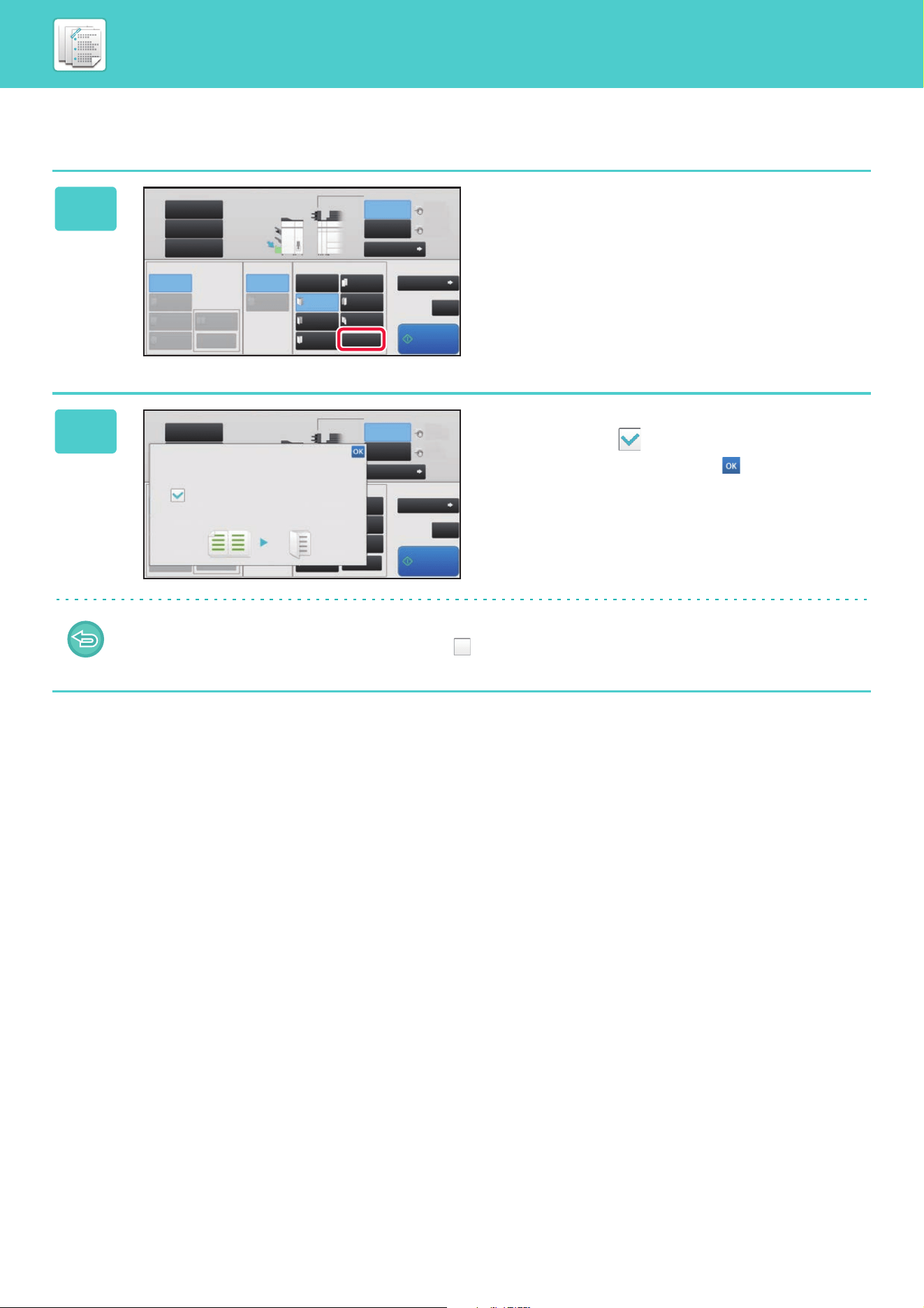
6-17
MANUAL FINISHING►OPERATION OF MANUAL FINISHING
Setting Multiple Fold (when Saddle Fold is selected)
1
With Saddle Fold selected, tap the
[Detail] key.
2
Set the [Fold Multiple Sheets Together]
checkbox to .
After the settings are completed, tap .
To cancel the multiple fold function:
Set the [Fold Multiple Sheets Together] checkbox to .
Upper Tray
Output Tray Inserter
Off
1 Staple
at Back
Saddle
Fold
Half Fold
C-Fold
1 Staple
at Front
2 Staples
Trimmer
Setting
Saddle
Stitch
Off
Off
Accord-
ion Fold
Copies/Pages
Type and Size
Double
Fold
Z-Fold
Detail
Punch Fold
Middle Tray
Lower Tray
Start
CA
Upper Tray
Lower Tray
Plain 1
Plain 1
2/3-Hole
Punch
8½x11
8½x11
Staple
Upper Tray
Output Tray Inserter
Staple
Off
1 Staple at
Back
Saddle Fold
Half Fold
C-Fold
1 Staple at
Front
2 Staples
Trimmer
Setting
Saddle
Stitch
Off
Off
Accord-
ion Fold
Copies/Pages
Type and Size
Double
Fold
Z-Fold
Detail
Punch Fold
Middle Tray
Lower Tray
Start
CA
Upper Tray
Lower Tray
Plain 1
Plain 1
2-Hole/3-
Hole Punch
8½x11
8½x11
Detail (Saddle Fold)
Fold Multiple Sheets Together
Multiple Fold
Original Image
Output Image
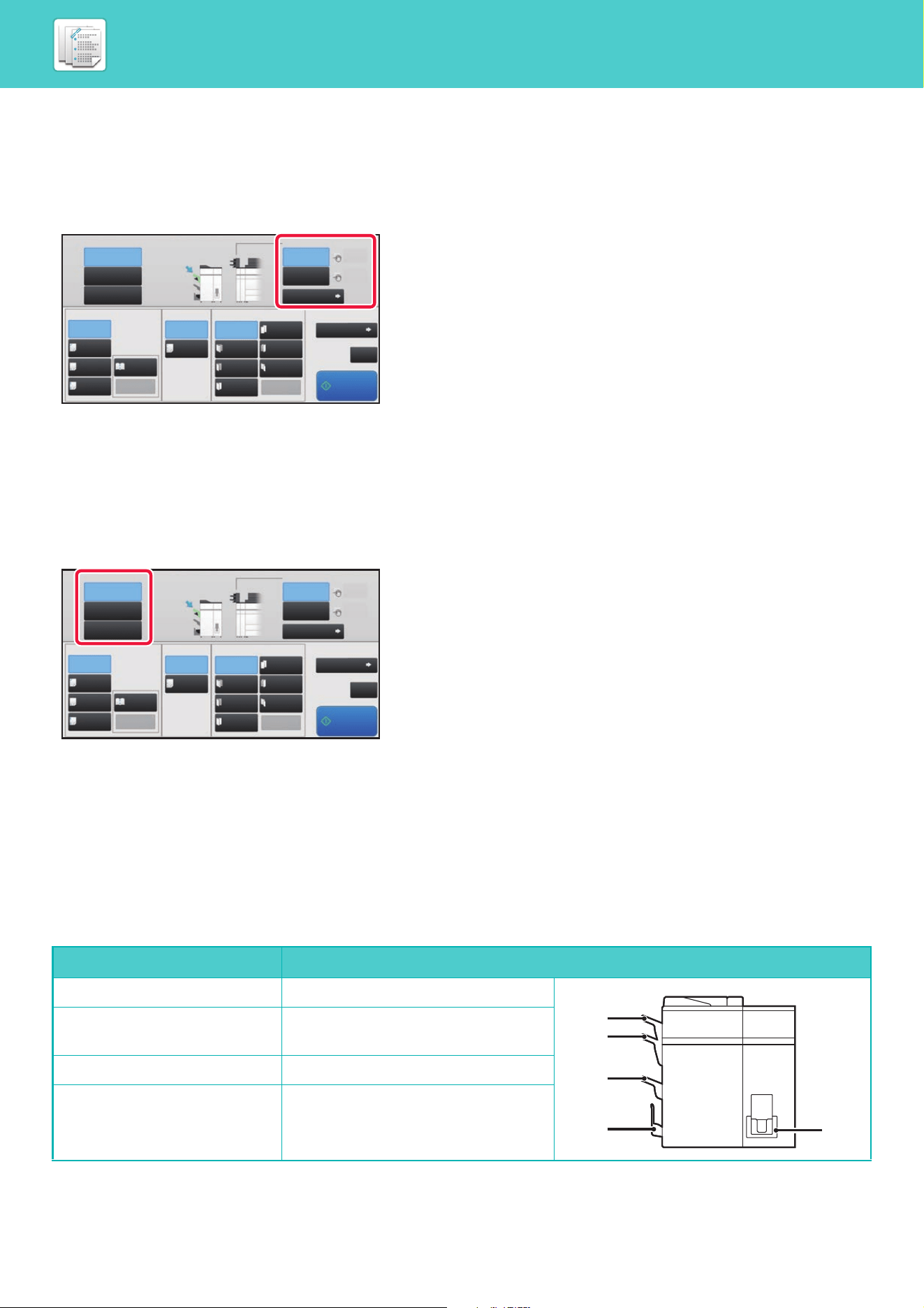
6-18
MANUAL FINISHING►OPERATION OF MANUAL FINISHING
TO CHANGE THE PAPER TRAY
The paper tray is automatically detected when paper is loaded in the inserter.
If you need to specify a paper tray when, for example, paper has been loaded into both the upper and lower trays on the
inserter, tap the [Upper Tray] or [Lower Tray] key to specify the appropriate paper tray.
TO CHANGE THE OUTPUT TRAY
The output tray is automatically selected based on the output function you set. If Z-Fold, Half Fold, or Punch is selected,
you can select the upper, middle or lower tray for the output tray.
Tap the [Upper Tray], [Middle Tray] or [Lower Tray] key in "Output Tray" and select the output tray you require.
Relation between output function and output tray
An output tray is automatically selected as shown below based on the output function you set. Depending on the output
function that is originally deselected, it may be deselected if you tap the [Upper Tray], [Middle Tray] or [Lower Tray] key
to change the output tray.
For example, if you tap the [Upper Tray], [Middle Tray] or [Lower Tray] key with "Saddle Stitch" selected, the setting for
"Saddle Stitch" is canceled.
Output function Deliver to
Staple Upper Tray (A) or Lower Tray (C)
Z-Fold/Half Fold/Punch Upper Tray (A), Middle Tray (B) or
Lower Tray (C)
Saddle Stitch/Saddle Fold Saddle Stitch Tray (D)
C-Fold/Accordion Fold/Double
Fold
Folding Unit Tray (E)
Upper Tray
Output Tray Inserter
Off
1 Staple
at Back
Saddle
Fold
Half Fold
C-Fold
1 Staple
at Front
2 Staples
Trimmer
Setting
Saddle
Stitch
Off
Off
Accord-
ion Fold
Copies/Pages
Type and Size
Double
Fold
Z-Fold
Detail
Punch Fold
Middle Tray
Lower Tray
Start
CA
Upper Tray
Lower Tray
Plain 1
Plain 1
2/3-Hole
Punch
8½x11
8½x11
Staple
Upper Tray
Output Tray Inserter
Off
1 Staple
at Back
Saddle
Fold
Half Fold
C-Fold
1 Staple
at Front
2 Staples
Trimmer
Setting
Saddle
Stitch
Off
Off
Accord-
ion Fold
Copies/Pages
Type and Size
Double
Fold
Z-Fold
Detail
Punch Fold
Middle Tray
Lower Tray
Start
CA
Upper Tray
Lower Tray
Plain 1
Plain 1
2/3-Hole
Punch
8½x11
8½x11
Staple
A
B
C
D
E
7-1
SETTING MODE
SETTING MODE LIST
SETTING MODE LIST . . . . . . . . . . . . . . . . . . . . . . . 7-5
• Status. . . . . . . . . . . . . . . . . . . . . . . . . . . . . . . . . 7-5
• Address Book . . . . . . . . . . . . . . . . . . . . . . . . . . 7-5
• Document Operations . . . . . . . . . . . . . . . . . . . . 7-6
• User Control. . . . . . . . . . . . . . . . . . . . . . . . . . . . 7-6
• System Settings. . . . . . . . . . . . . . . . . . . . . . . . . 7-9
STATUS
Status . . . . . . . . . . . . . . . . . . . . . . . . . . . . . . . . . . . . 7-42
• Machine Identification . . . . . . . . . . . . . . . . . . . . 7-42
• Total Count . . . . . . . . . . . . . . . . . . . . . . . . . . . . 7-43
• Device Status. . . . . . . . . . . . . . . . . . . . . . . . . . . 7-43
• Network Status . . . . . . . . . . . . . . . . . . . . . . . . . 7-44
• Firmware Version. . . . . . . . . . . . . . . . . . . . . . . . 7-45
• Power Reset . . . . . . . . . . . . . . . . . . . . . . . . . . . 7-45
• Data List. . . . . . . . . . . . . . . . . . . . . . . . . . . . . . . 7-45
ADDRESS BOOK
Address Book . . . . . . . . . . . . . . . . . . . . . . . . . . . . . 7-47
• Category Setting . . . . . . . . . . . . . . . . . . . . . . . . 7-49
DOCUMENT OPERATIONS
Document Operations. . . . . . . . . . . . . . . . . . . . . . . 7-50
• Document Filing. . . . . . . . . . . . . . . . . . . . . . . . . 7-50
• Submit Print Job . . . . . . . . . . . . . . . . . . . . . . . . 7-53
USER CONTROL
User Control . . . . . . . . . . . . . . . . . . . . . . . . . . . . . . 7-54
• User List. . . . . . . . . . . . . . . . . . . . . . . . . . . . . . . 7-54
• Custom Index. . . . . . . . . . . . . . . . . . . . . . . . . . . 7-57
• Organization /Group List . . . . . . . . . . . . . . . . . . 7-57
• Default Settings . . . . . . . . . . . . . . . . . . . . . . . . . 7-57
• Pages Limit Group. . . . . . . . . . . . . . . . . . . . . . . 7-63
• Machine Page Limit Setting. . . . . . . . . . . . . . . . 7-63
• Authority Group . . . . . . . . . . . . . . . . . . . . . . . . . 7-64
• Favorite Operation Group . . . . . . . . . . . . . . . . . 7-68
• User Count. . . . . . . . . . . . . . . . . . . . . . . . . . . . . 7-70
• Billing Code Setting . . . . . . . . . . . . . . . . . . . . . 7-72
• Card Setting . . . . . . . . . . . . . . . . . . . . . . . . . . . 7-74
SYSTEM SETTINGS
Home Screen Settings. . . . . . . . . . . . . . . . . . . . . . 7-75
• Condition Settings . . . . . . . . . . . . . . . . . . . . . . 7-75
• Icon. . . . . . . . . . . . . . . . . . . . . . . . . . . . . . . . . . 7-75
• Background Image . . . . . . . . . . . . . . . . . . . . . . 7-76
• Home Screen Registration . . . . . . . . . . . . . . . . 7-76
Copy Settings. . . . . . . . . . . . . . . . . . . . . . . . . . . . . 7-77
• Condition Settings . . . . . . . . . . . . . . . . . . . . . . 7-77
• Initial Status Settings . . . . . . . . . . . . . . . . . . . . 7-80
• Text /Image Printing . . . . . . . . . . . . . . . . . . . . . 7-80
Printer Settings . . . . . . . . . . . . . . . . . . . . . . . . . . . 7-81
• Condition Settings . . . . . . . . . . . . . . . . . . . . . . 7-81
• Interface Settings . . . . . . . . . . . . . . . . . . . . . . . 7-82
• Initial Status Settings . . . . . . . . . . . . . . . . . . . . 7-83
• PCL Settings. . . . . . . . . . . . . . . . . . . . . . . . . . . 7-85
• PostScript Settings . . . . . . . . . . . . . . . . . . . . . . 7-85
• OOXML Settings. . . . . . . . . . . . . . . . . . . . . . . . 7-85
• Print Release Settings . . . . . . . . . . . . . . . . . . . 7-85
• E-mail Print Settings. . . . . . . . . . . . . . . . . . . . . 7-86
• Direct Print Settings (FTP) . . . . . . . . . . . . . . . . 7-86
• Direct Print Settings (Network Folder) . . . . . . . 7-87
• Print Setting from PC/Mobile Terminal . . . . . . . 7-87
Image Send Settings . . . . . . . . . . . . . . . . . . . . . . . 7-88
• Common Settings. . . . . . . . . . . . . . . . . . . . . . . 7-88
• Scan Settings . . . . . . . . . . . . . . . . . . . . . . . . . . 7-91
• Metadata Settings. . . . . . . . . . . . . . . . . . . . . . . 7-96
Document Filing Settings . . . . . . . . . . . . . . . . . . . 7-97
• Condition Settings . . . . . . . . . . . . . . . . . . . . . . 7-97
• Automatic Deletion of File Settings. . . . . . . . . . 7-99
Sharp OSA Settings. . . . . . . . . . . . . . . . . . . . . . . . 7-100
• Standard Application Settings . . . . . . . . . . . . . 7-100
• External Accounting Application Settings . . . . . 7-101
• Embedded Application Settings . . . . . . . . . . . . 7-102
• Polling Setting. . . . . . . . . . . . . . . . . . . . . . . . . . 7-102
SYSTEM SETTINGS

7-2
SYSTEM SETTINGS
Common Settings . . . . . . . . . . . . . . . . . . . . . . . . . . 7-103
• Paper Settings . . . . . . . . . . . . . . . . . . . . . . . . . . 7-103
• Paper Type Registration . . . . . . . . . . . . . . . . . . 7-113
• Operation Settings. . . . . . . . . . . . . . . . . . . . . . . 7-114
• Keyboard Settings . . . . . . . . . . . . . . . . . . . . . . . 7-118
• Device Control . . . . . . . . . . . . . . . . . . . . . . . . . . 7-119
• Enable/Disable Settings. . . . . . . . . . . . . . . . . . . 7-123
• Machine Identification Settings . . . . . . . . . . . . . 7-126
• Clock Adjust. . . . . . . . . . . . . . . . . . . . . . . . . . . . 7-127
• Product Key . . . . . . . . . . . . . . . . . . . . . . . . . . . . 7-128
• Custom Link Setting. . . . . . . . . . . . . . . . . . . . . . 7-128
Network Settings. . . . . . . . . . . . . . . . . . . . . . . . . . . 7-129
• Quick Settings . . . . . . . . . . . . . . . . . . . . . . . . . . 7-129
• Network Name Setting. . . . . . . . . . . . . . . . . . . . 7-131
• Protocol Settings . . . . . . . . . . . . . . . . . . . . . . . . 7-131
• Services Settings. . . . . . . . . . . . . . . . . . . . . . . . 7-132
• Print Port Settings . . . . . . . . . . . . . . . . . . . . . . . 7-135
• External Service Connect . . . . . . . . . . . . . . . . . 7-136
• LDAP Settings . . . . . . . . . . . . . . . . . . . . . . . . . . 7-136
• Public Folder / NAS Setting . . . . . . . . . . . . . . . . 7-138
• Proxy Setting . . . . . . . . . . . . . . . . . . . . . . . . . . . 7-139
Security Settings. . . . . . . . . . . . . . . . . . . . . . . . . . . 7-140
• Restrict Device Web Page Access Via
Password. . . . . . . . . . . . . . . . . . . . . . . . . . . . . . 7-140
• Change Password . . . . . . . . . . . . . . . . . . . . . . . 7-140
• Port Control . . . . . . . . . . . . . . . . . . . . . . . . . . . . 7-140
• Filter Setting. . . . . . . . . . . . . . . . . . . . . . . . . . . . 7-141
• SSL Settings . . . . . . . . . . . . . . . . . . . . . . . . . . . 7-141
• S/MIME Settings . . . . . . . . . . . . . . . . . . . . . . . . 7-142
• IPsec Settings . . . . . . . . . . . . . . . . . . . . . . . . . . 7-143
• IEEE802.1X Setting. . . . . . . . . . . . . . . . . . . . . . 7-144
• Security Control . . . . . . . . . . . . . . . . . . . . . . . . . 7-145
• Document Administration Function . . . . . . . . . . 7-145
• Hidden Pattern Print Setting . . . . . . . . . . . . . . . 7-146
• Tracking Information Print . . . . . . . . . . . . . . . . . 7-147
• Audit Log . . . . . . . . . . . . . . . . . . . . . . . . . . . . . . 7-147
Energy Save . . . . . . . . . . . . . . . . . . . . . . . . . . . . . . 7-148
• Eco Setting . . . . . . . . . . . . . . . . . . . . . . . . . . . . 7-148
• Eco Scan Setting . . . . . . . . . . . . . . . . . . . . . . . . 7-152
• Energy Saving Pattern List . . . . . . . . . . . . . . . . 7-152
• Specific Date Operation Settings. . . . . . . . . . . . 7-153
• Power ON/OFF Schedule Setting . . . . . . . . . . . 7-154
• Toner Save Mode . . . . . . . . . . . . . . . . . . . . . . . 7-154
System Control . . . . . . . . . . . . . . . . . . . . . . . . . . . 7-155
• Job Log. . . . . . . . . . . . . . . . . . . . . . . . . . . . . . . 7-155
• Data Import/Export (CSV Format) . . . . . . . . . . 7-155
• Storage Backup . . . . . . . . . . . . . . . . . . . . . . . . 7-155
• Device Cloning . . . . . . . . . . . . . . . . . . . . . . . . . 7-156
• Address Book Forward. . . . . . . . . . . . . . . . . . . 7-156
• Filing Data Backup . . . . . . . . . . . . . . . . . . . . . . 7-156
• Storing/Calling of System Settings . . . . . . . . . . 7-157
• Reset Settings . . . . . . . . . . . . . . . . . . . . . . . . . 7-157
• Optimization of Hard Disk. . . . . . . . . . . . . . . . . 7-157
• E-mail Alert and Status. . . . . . . . . . . . . . . . . . . 7-158
Image Quality Adjustment. . . . . . . . . . . . . . . . . . . 7-159
• Collective Adjustment. . . . . . . . . . . . . . . . . . . . 7-159
• Copy Image Quality . . . . . . . . . . . . . . . . . . . . . 7-160
• Print Image Quality. . . . . . . . . . . . . . . . . . . . . . 7-160
• Scan Image Quality . . . . . . . . . . . . . . . . . . . . . 7-161
• Color Profile Settings . . . . . . . . . . . . . . . . . . . . 7-161
• Common Functions . . . . . . . . . . . . . . . . . . . . . 7-162
Initial Installation Settings . . . . . . . . . . . . . . . . . . 7-163
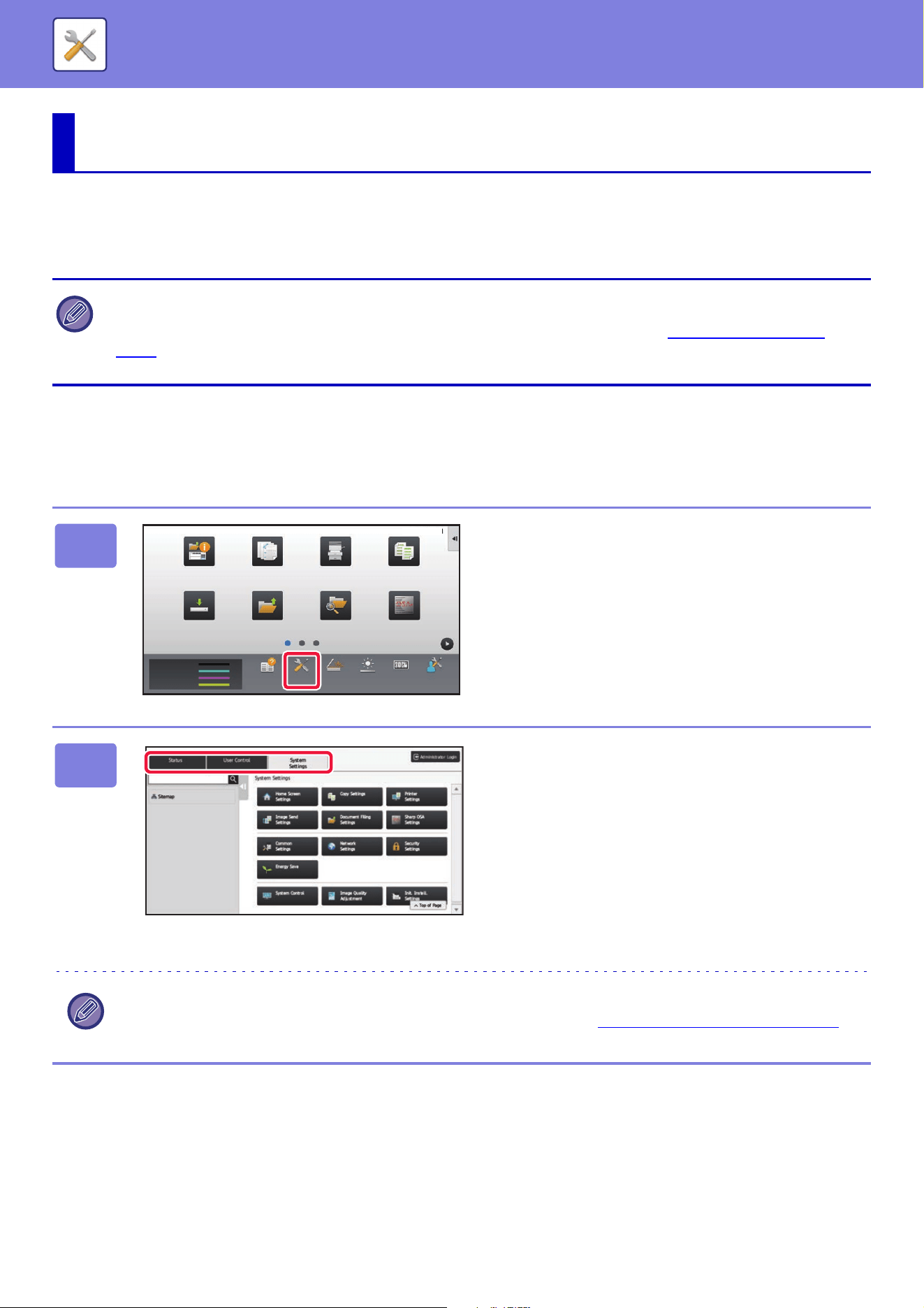
7-3
SYSTEM SETTINGS►SETTING MODE
"Settings" allows management of various functions that will make it easier to use the machine, such as default
registration for each function, network connection setting, and log check of operation status.
Setting mode can also be selected using the Web browser by accessing the machine from a PC connected to the same
network as the machine.
Displaying the setting mode on the machine
SETTING MODE
• Administrator password
To maintain security, the machine administrator should promptly change the password after the machine is purchased.
(For the default administrator password, see Start Guide.) To change the password, see "Change Password (page
7-140)".
* To ensure a high level of security, change the password at regular intervals.
1
Tap the [Settings] key.
Tap the [Settings] key on the home screen.
The setting mode screen appears on the touch panel.
The setting menu appears at the top of the displayed screen.
Tap the setting in the menu that you want to configure.
For details of the settings, see the explanation for each item.
2
On the upper tab, tap the item that you
want to set.
The setting menu appears on the left side of the displayed
screen.
Tap the setting in the menu that you want to configure.
When you tap the [System Settings] tab, item keys appear
on the screen.
When you tap the key of an item, a setting item menu
appears.
(When you tap the [Image Send Settings] key, further item
keys appear.)
• To quit the setting mode, tap the [Cancel] key in the upper right corner of the screen.
• For details on login procedures when user authentication is enabled, see "USER AUTHENTICATION (page 1-31)
".
10:15 AM
Job Management
Toner Quantity
M
C
Bk
Y
Copy
Scan to HDD Sharp OSA
Manual
Finishing
HDD
File retrieve
Operation
Guide
PC Scan Total Count Machine
Adjustment
Settings
LCD Control
Tray Settings/
Paper Settings
Batch Print
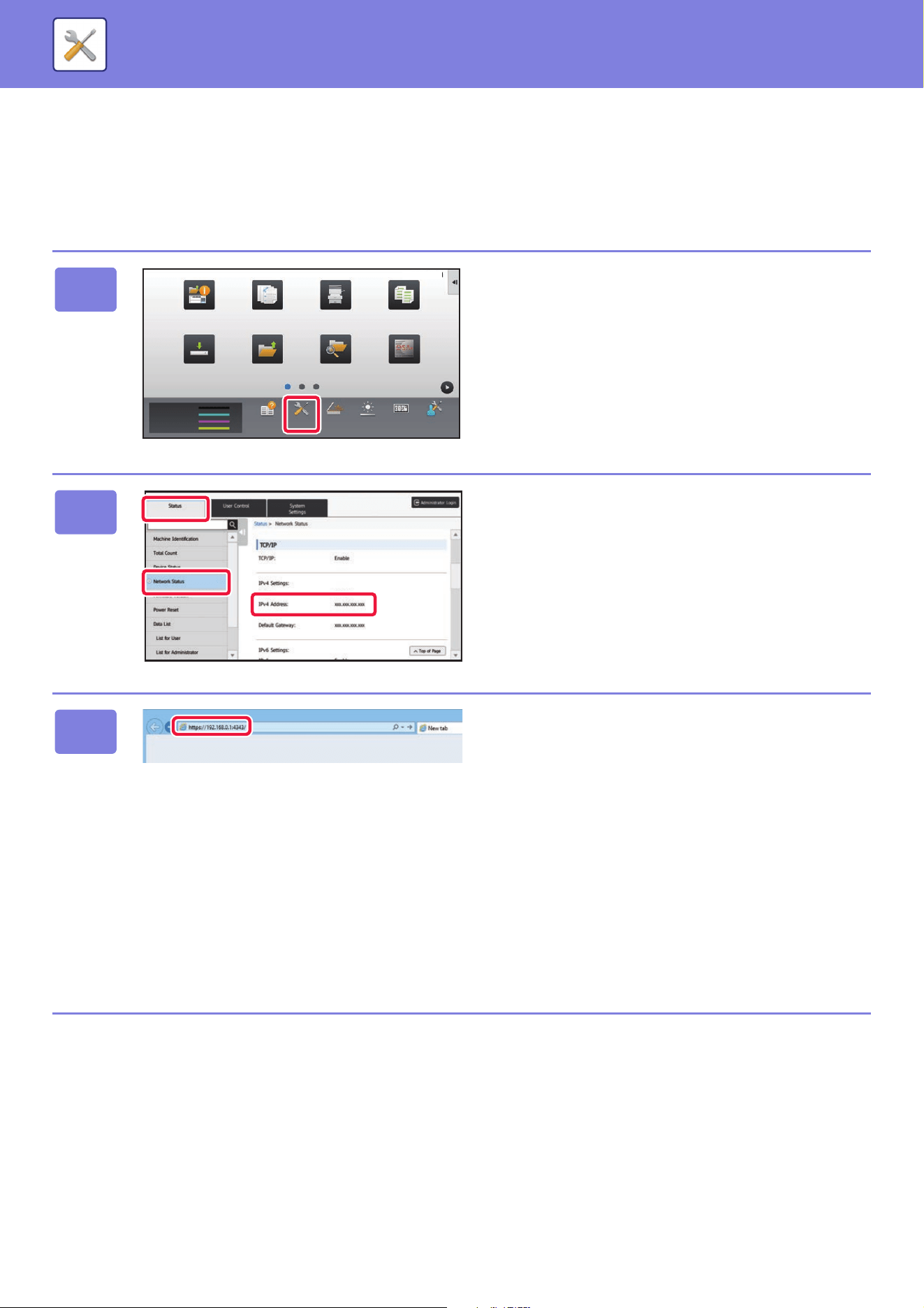
7-4
SYSTEM SETTINGS►SETTING MODE
Displaying the setting mode (Web version)
When the machine is connected to the network, access the built-in Web server of the machine using the PC’s Web
browser.
From the setting mode of the machine, print the IP address of the machine and enter the address on the PC’s Web
browser.
1
Tap the [Settings] key.
2
Tap [Status] → [Network Status] from
the menu, and then check the IP
address on the machine in "IPv4
Address".
Scroll until you see the "IPv4 Address".
3
Start the Web browser on the PC, and
enter the IP address of the machine
Start a Web browser on a PC on the same network the
machine is on, and enter the IP address of the machine.
Recommended Web browsers:
• Internet Explorer (Windows
®
): 9 or later
• Firefox (Windows
®
), Safari (Mac OS
®
),
Chrome (Windows
®
):
Latest version or immediately previous major release
Depending on the machine settings, user authentication
may be required to display the setting mode (Web version).
For password and other information required for user
authentication, contact the administrator of the machine.
10:15 AM
Job Management
Toner Quantity
M
C
Bk
Y
Copy
Scan to HDD Sharp OSA
Manual
Finishing
HDD
File retrieve
Operation
Guide
PC Scan Total Count Machine
Adjustment
Settings
LCD Control
Tray Settings/
Paper Settings
Batch Print
7-5
SYSTEM SETTINGS►SETTING MODE LIST
SETTING MODE LIST
The following is a list of setting mode items, factory default settings and restrictions for each item.
Status
U: General user; A: System administrator/Administrator
* Some settings can only be configured by the administrator.
Address Book
U: General user; A: System administrator/Administrator
*1 This setting is configured in setting mode on the web page.
*2 Set the Category Setting in System Settings→Image Send Settings→Common Settings→Category Setting of the machine's
setting mode.
SETTING MODE LIST
• Depending on the machine specifications and peripheral devices installed, it may not be possible to use some settings.
• Some setting items can only be configured on the Web page.
Setup Items Factory default setting U A
■ Status (page 7-42)
● Machine Identification (page 7-42) – Yes
*
Yes
● Total Count (page 7-43) – Yes Yes
● Device Status (page 7-43) – Yes Yes
● Network Status (page 7-44) – Yes Yes
● Firmware Version (page 7-45) – No Yes
● Power Reset (page 7-45) – No Yes
● Data List (page 7-45) – Yes Yes
List for User – Yes Yes
List for Administrator – No Yes
Setup Items Factory default setting U A
■ Address Book (page 7-47)*
1
● Address Book (page 7-47) – Yes Yes
● Category Setting (page 7-49)*
2
– Yes Yes
7-6
SYSTEM SETTINGS►SETTING MODE LIST
Document Operations
U: General user; A: System administrator/Administrator
*1 This setting is configured in setting mode on the web page.
*2 Set the Category Setting in System Settings→Document Filing Settings→Document Filing Control of the machine's setting mode.
*3 This appears when My Folder is set.
User Control
U: General user; A: System administrator/Administrator
Setup Items Factory default setting U A
■ Document Operations (page 7-50)*
1
● Document Filing (page 7-50) Yes Yes
Main Folder – Yes Yes
Quick File Folder – Yes Yes
Custom Folder*
2
– Yes Yes
My Folder*
3
– Yes Yes
Search – Yes Yes
File Batch Print – Yes Yes
● Submit Print Job (page 7-53) – Yes Yes
Setup Items Factory default setting U A
■ User Control (page 7-54)
● User List (page 7-54) – No Yes
● Custom Index (page 7-57) – No Yes
● Organization /Group List (page 7-57) – No Yes
● Default Settings (page 7-57) No Yes
User Authentication Disabled No Yes
Authentication Server Settings Login Locally No Yes
Default Network Authentication Server Setting*
1
Not Set No Yes
Perform network server access control Disabled No Yes
Authentication Method Setting Authenticate a User by Login
Name and Password
No Yes
Device Account Mode Setting No Yes
Device Account Mode Disabled No Yes
Allow Login by Different User Disabled No Yes
Login User – No Yes
Cache User Information Enabled No Yes
Cache Period Unlimited No Yes
Store user authentication information for External Connect Enabled No Yes
Card Setting No Yes
Use IC Card for Authentication Disabled No Yes
7-7
SYSTEM SETTINGS►SETTING MODE LIST
Actions when the Limit of Pages for Output Jobs*
2
Job is Completed even when the
Limit of Pages is Reached
No Yes
A Warning when Login Fails*
2
Disabled No Yes
Disabling of Printing by Invalid User*
2
Disabled No Yes
Allow Remote Scanner Using Before Login. Disabled No Yes
Automatically print stored jobs after login Disabled No Yes
Display Usage Status after Login*
2
Disabled No Yes
Login Name Display Display login name No Yes
Include Job Management in user authentication Disabled No Yes
Disable display/change of other users’ information in the
job management
Disabled
No Yes
Automatic Logout Setting Enabled (60sec.) No Yes
Case sensitivity of login name is enabled. Enabled No Yes
Apply login name to the user name of network folder Enabled No Yes
Edit Help Display of Login Screen – No Yes
User Information Print User List No Yes
Reset Counter After Sending E-mail Status Disabled No Yes
Enable IPP Authentication Except for Printer Driver Enabled No Yes
● Pages Limit Group (page 7-63) – No Yes
● Machine Page Limit Setting (page 7-63) – No Yes
● Authority Group (page 7-64) – No Yes
● Favorite Operation Group (page 7-68) – No Yes
Favorite Operation Group List – No Yes
Favorite Key List*
3
– No Yes
Home Screen List – No Yes
● User Count (page 7-70) No Yes
View User Count – No Yes
Save User Count*
3
– No Yes
● Billing Code Setting (page 7-72) No Yes
Administration Settings – No Yes
Use Billing Code Disabled No Yes
Default Code Setting Default Code No Yes
Remember Billing Code Between Modes Disabled No Yes
Disable Change of Billing Code Disabled No Yes
Apply Default Code when Billing Code not entered
Billing Code not Entered
Disabled
No Yes
Disable Billing Code for Selected Applications No Yes
•Sharp OSA All Invalid No Yes
Setup Items Factory default setting U A
7-8
SYSTEM SETTINGS►SETTING MODE LIST
*1 Appears when [LDAP] is set in "Authentication Settings".
*2 Appears when "
Settings (administrator)
" - [Sharp OSA Settings]
→
[External Accounting Application Settings]
→
[Set Authentication Server (Server 1)] is enabled.
*3 This setting is configured in setting mode on the web page.
*4 This setting is configured in setting mode on the machine.
Billing Code Display Name Setting No Yes
• Main Code Display Name Default No Yes
• Sub Code Display Name Default No Yes
Main Code List – No Yes
Sub Code List – No Yes
● Card Setting (page 7-74) No Yes
Card Area Setting (page 7-74) No Yes
Check System Code only in FeliCa User Area mode Disabled No Yes
Check Facility Code in HID mode Disabled No Yes
Facility Code – No Yes
Importing from the setup file – No Yes
Card Scan Test Disabled No Yes
Card Type / Card Reader Settings (page 7-74) No Yes
Card Type / Card Reader 200 No Yes
Card Reader Device Registration*
4
– No Yes
Setup Items Factory default setting U A
7-9
SYSTEM SETTINGS►SETTING MODE LIST
System Settings
Home Screen Settings
U: General user; A: System administrator/Administrator
* In the machine's setting mode, this can be set with a USB memory device connected.
Copy Settings
U: General user; A: System administrator/Administrator
Setup Items Factory default setting U A
● Home Screen Settings (page 7-75)
Condition Settings – No Yes
Icon* – No Yes
Background Image* – No Yes
Setup Items Factory default setting U A
● Copy Settings (page 7-77)
Condition Settings No Yes
Rotation Copy Setting Rotation Copy No Yes
Add or Change Extra Preset Ratios – No Yes
Setting a Maximum Number of Copies 9999 No Yes
Initial Margin Shift Setting No Yes
• Side 1 1/2" (10mm) No Yes
• Side 2 1/2" (10mm) No Yes
Erase Width Adjustment No Yes
• Edge Clearance Width 1/2" (10mm) No Yes
• Center Clearance Width 1/2" (10mm) No Yes
InitialN-Up Setting Off No Yes
• Layout Left to Right/Right, and Down No Yes
• Border No Print No Yes
Card Shot Settings No Yes
• Original Size X: 3-3/8" (86 mm), Y: 2-1/8" (54
mm)
No Yes
•Fit to Page Disabled No Yes
Automatic Saddle Stitch Enabled No Yes
Initial Tab Copy Setting 1/2" (10mm) No Yes
Disabling of Registration/Deletion of Program Disabled No Yes
Disabling of Bypass-Tray in Duplex Copy Disabled No Yes
Disabling of Auto Paper Selection Disabled No Yes
7-10
SYSTEM SETTINGS►SETTING MODE LIST
Auto Selection Setting of Tray that is Supplied the
Paper
Disabled
No Yes
Disabling Registration of Custom Image Disabled No Yes
Disabling sending while copying Disabled No Yes
High Quality Scan from Document Feeder (B/W) Disabled No Yes
Quick Scan from Document Glass (B/W) Disabled No Yes
Auto Clear Before Copy Execution Also Disabled No Yes
Initial Status Settings No Yes
Color Mode Full Color No Yes
Image Orientation Portrait No Yes
Paper Tray Varies depending on the machine
configuration
No Yes
Exposure Type Auto No Yes
• Copy of Copy Disabled No Yes
• Color Tone Enhancement Disabled No Yes
Copy Ratio 100% No Yes
• Select magnification automatically according to
paper size, when paper tray is selected.
Disabled
No Yes
2-Sided Copy 1-Sided→1-Sided No Yes
Original Binding Book No Yes
Output Binding Book No Yes
Output Auto No Yes
Output Tray Varies depending on the machine
configuration
No Yes
Offset Enabled No Yes
Separator Page No Yes
• Insert Before Job Disabled No Yes
• Insert After Job Disabled No Yes
Staple Sort*
1
1 Staple No Yes
Staple Position*
1
Left No Yes
Punch*
2
Disabled No Yes
Fold*
3,
*
4
Varies depending on the machine
configuration
No Yes
Saddle Fold*
3
No Yes
•Print Side Inside No Yes
• Fold Multiple Sheets Together Disabled No Yes
Paper Size for Z-Fold*
4
All Enabled No Yes
Setup Items Factory default setting U A
7-11
SYSTEM SETTINGS►SETTING MODE LIST
*1 When a finisher/saddle stitch finisher is installed
*2 When a finisher/saddle stitch finisher is installed and a punch module is installed
*3 When a saddle stitch finisher is installed
*4 When a folding unit is installed
*5 When a trimming module is installed
Printer Settings
U: General user; A: System administrator/Administrator
C-Fold
*4
Print Side: Inside
Fold Orientation: Open Right
No Yes
Accordion Fold
*4
Fold Orientation: Open Right No Yes
Double Fold
*4
Print Side: Inside
Fold Orientation: Open Right
No Yes
Half Fold
*4
Print Side: Inside No Yes
Trimming Width Settings
*5
No Yes
• Adjust Trimming Width 2.0 mm No Yes
Text /Image Printing No Yes
Text Settings (Stamp) – No Yes
Custom Stamp – No Yes
Custom Watermark – No Yes
Setup Items Factory default setting U A
● Printer Settings (page 7-81)
Condition Settings No Yes
Prohibit Notice Page Printing Enabled No Yes
Prohibit Test Page Printing Disabled No Yes
A4/Letter Size Auto Change Disabled No Yes
Bypass Tray Settings No Yes
• Enable Detected Paper Size in Bypass Tray Disabled No Yes
• Enable Selected Paper Type in Bypass Tray Enabled No Yes
• Exclude Bypass-Tray from Auto Paper Select Disabled No Yes
Job Spool Queuing Enabled No Yes
Disabling of USB Memory Direct Print Disabled No Yes
Disabling of Network Folder Direct Print Disabled No Yes
Disabling sending while printing Disabled No Yes
Interface Settings No Yes
Hexadecimal Dump Mode Disabled No Yes
I/O Timeout 60sec. No Yes
Enable Network Port Enabled No Yes
Setup Items Factory default setting U A
7-12
SYSTEM SETTINGS►SETTING MODE LIST
Network Port Emulation Switching Auto No Yes
Port Switching Method Switch at End of Job No Yes
Initial Status Settings Yes Yes
Copies 1 Yes Yes
Orientation Portrait Yes Yes
Paper Size Letter (8-1/2" x 11") Yes Yes
Output Tray Auto Yes Yes
Paper Type Plain Paper 1 Yes Yes
Resolution Setting 600dpi (High Quality) Yes Yes
Disable Blank Page Print Disabled Yes Yes
2-Sided Print 1-Sided Yes Yes
Color Mode Auto Yes Yes
N-Up 1-Up Yes Yes
Fit To Page Enabled Yes Yes
Output Varies depending on the machine
configuration
Yes Yes
• Print per Unit Enabled Yes Yes
• Separator Page Yes Yes
- Insert Before Job Disabled Yes Yes
- Insert After Job Disabled Yes Yes
•Staple Sort*
1
Disabled Yes Yes
• Punch*
2
Disabled Yes Yes
• Fold*
3, *4
Varies depending on the machine
configuration
Yes Yes
• Saddle Fold*
3
Yes Yes
-Print Side Inside Yes Yes
- Fold Multiple Sheets Together Disabled Yes Yes
• Paper Size for Z-Fold
*4
All Enabled Yes Yes
•C-Fold
*4
Print Side: Inside
Fold Orientation: Open Right
Yes Yes
• Accordion Fold
*4
Fold Orientation: Open Right Yes Yes
• Double Fold
*4
Print Side: Inside
Fold Orientation: Open Right
Yes Yes
•Half Fold
*4
Print Side: Inside Yes Yes
• Trimming Width Settings
*5
Yes Yes
- Adjust Trimming Width 2.0 mm Yes Yes
Quick File Disabled Yes Yes
Setup Items Factory default setting U A
7-13
SYSTEM SETTINGS►SETTING MODE LIST
*1 When a finisher/saddle stitch finisher is installed
*2 When a finisher/saddle stitch finisher is installed and a punch module is installed
*3 When a saddle stitch finisher is installed
*4 When a folding unit is installed
*5 When a trimming module is installed
PCL Settings Yes Yes
PCL Symbol Set Setting PC-8 Yes Yes
PCL Font Setting Internal Font, 0: Courier Yes Yes
PCL Line Feed Code 0.CR=CR; LF=LF; FF=FF Yes Yes
Wide A4 Disabled Yes Yes
PostScript Settings Yes Yes
Screen Settings Standard Yes Yes
Print PS Errors Disabled Yes Yes
Binary Processing Disabled Yes Yes
OOXML Settings Yes Yes
Print What Selected Sheet Yes Yes
Print Release Settings For information about each of the
print release settings, see "Print
Release Settings Guide".
No Yes
E-mail Print Settings No Yes
E-mail Print Disabled No Yes
POP3 Server – No Yes
Port Number 110 No Yes
POP Authentication Disabled No Yes
User Name – No Yes
Password – No Yes
• Change Password Disabled No Yes
Check Interval 5 minutes No Yes
Enable SSL Disabled No Yes
Connection Test – No Yes
Direct Print Settings (FTP) No Yes
Direct Print Settings (Network Folder) – No Yes
Print Setting from PC/Mobile Terminal No Yes
FTP Print Enabled No Yes
Port Number 21 No Yes
Use Banner Disabled No Yes
Setup Items Factory default setting U A
7-14
SYSTEM SETTINGS►SETTING MODE LIST
Image Send Settings
Common Settings
U: General user; A: System administrator/Administrator
Setup Items Factory default setting U A
● Common Settings (page 7-103)
Condition Settings No Yes
Hold settings for a while after scanning has been
completed
Disabled
No Yes
Job Auto Start Time During Scanning 60sec.
Default Display Setting E-mail No Yes
Address Book Default Selection No Yes
• Higher priority is given to the display of address
book.
Disabled
No Yes
• Apply Addresses of Sending Modes Only Enabled No Yes
Category Displayed as Default None No Yes
Display all address type regardless of the mode being
displayed currently.
Disabled
No Yes
Enlarge Address Book Enabled No Yes
Image Orientation Portrait No Yes
Default Exposure Settings Auto No Yes
Default Original Image Type Text No Yes
Be sure to press Next Address Key ([+]) before
selecting the next address.
Disabled
No Yes
Scan Complete Sound Setting Middle No Yes
Disable Switching of Display Order Disabled No Yes
Default Verification Stamp* No Yes
• E-mail/Scan/Data Entry Disabled No Yes
Erase Width Adjustment No Yes
• Edge Clearance Width 1/2" (10mm) No Yes
• Center Clearance Width 1/2" (10mm) No Yes
Enable/Disable Settings No Yes
Settings to Disable Registration No Yes
• Disable Registering Destination from Operation
Panel
All Invalid
No Yes
• Disable Registering Destination on Web Page Disabled No Yes
• Disable Registration/Delection of All Program Items Disabled No Yes
• Disable Destination Registration Using Global
Address Search
Disabled
No Yes
• Disabling of Forwarding via Network Disabled No Yes
Settings to Disable Transmission No Yes
• Disable [Resend] on Image Send Mode Disabled No Yes
• Disable Selection from Address Book All Invalid No Yes
7-15
SYSTEM SETTINGS►SETTING MODE LIST
* When a stamp unit is installed
Scan Settings
• Disable Direct Entry All Invalid No Yes
• Disabling of PC Scan Disabled No Yes
• Disable Storing to External Memory Device Disabled No Yes
• Disabling of Find My Address Disabled No Yes
Setup Items Factory default setting U A
● Scan Settings (page 7-91)
Scan Settings No Yes
Initial Status Settings No Yes
• Default Color Mode Settings No Yes
- Scanner Common Auto: Mono2 No Yes
+ Disable Change of B/W Setting in Auto
Mode
Disabled
No Yes
- E-mail Auto: Mono2 No Yes
+ Disable Change of B/W Setting in Auto
Mode
Disabled
No Yes
• Initial File Format Setting No Yes
- Scanner Common No Yes
+ File Type PDF No Yes
+OCR Disabled No Yes
+ Black & White Compression Mode: MMR (G4) No Yes
+ Color/Grayscale Compression Ratio: Medium No Yes
+ Bk Letter Emphasis Disabled No Yes
+ Specified Pages per File Disabled No Yes
- OCR Setting No Yes
+Font Western Languages: Arial No Yes
Japanese: MS Gothic No Yes
Chinese: SimSun No Yes
Traditional Chinese: MingLiU No Yes
Korean: Dotum No Yes
+ Detect Image Direction Enabled No Yes
+ File Name Extraction Disabled No Yes
- E-mail No Yes
+ File Type PDF No Yes
+OCR Disabled No Yes
+ Black & White Compression Mode: MMR (G4) No Yes
Setup Items Factory default setting U A
7-16
SYSTEM SETTINGS►SETTING MODE LIST
+ Color/Grayscale Compression Ratio: Medium No Yes
+ Bk Letter Emphasis Disabled No Yes
+ Specified Pages per File Disabled No Yes
- OCR Setting No Yes
+Font Western Languages: Arial No Yes
Japanese: MS Gothic No Yes
Chinese: SimSun No Yes
Traditional Chinese: MingLiU No Yes
Korean: Dotum No Yes
+ Detect Image Direction Enabled No Yes
+ File Name Extraction Disabled No Yes
• Easy Scan Settings No Yes
-Color Auto No Yes
-B/W Mono2 No Yes
• Resolution Setting No Yes
- Scan No Yes
+ Apply the Resolution Set when Stored Disabled No Yes
+ (No item) 200x200dpi No Yes
- E-mail No Yes
+ Apply the Resolution Set when Stored Disabled No Yes
+ (No item) 200x200dpi No Yes
Condition Settings No Yes
• Default Reply.Address Set – No Yes
• PDF Compression Options No Yes
- Flate Compression Enabled No Yes
• Compression Mode at Broadcasting No Yes
- Black & White MH (G3) No Yes
- Color/Grayscale Medium No Yes
+ Bk Letter Emphasis Disabled No Yes
• Send Destination Link Settings Enabled No Yes
- Enable Send Destination Link as Default Disabled No Yes
- File Retention Period 4 hour No Yes
- Enable SSL Enabled No Yes
• Maximum Size of E-mail Attachments(E-Mail) Unlimited No Yes
- If the E-mail attachment(s) exceed maximum
size, it will be sent in multiple files.
Disabled
No Yes
Setup Items Factory default setting U A
7-17
SYSTEM SETTINGS►SETTING MODE LIST
Metadata Settings
• Maximum Size of Data Attachments (FTP/Network
Folder)
Unlimited
No Yes
• Bcc Setting No Yes
- Enable Bcc Disabled No Yes
- Display Bcc Address on the Job Management
Screen
Disabled
No Yes
Default Address No Yes
• Default Address Setting Disabled No Yes
•Add Selected Select From Address Book No Yes
Administration Settings No Yes
• Advanced Settings No Yes
- Disable Selection of Reply-to. Disabled No Yes
• File Naming No Yes
- Unit Serial Number Disabled No Yes
-Text Disabled No Yes
- Sender Name Enabled No Yes
- Date & Time Enabled No Yes
- Session Page Counter Disabled No Yes
- Unique Identifier Disabled No Yes
• Default Subject – No Yes
• Add Job Information Automatically to the Mail
Message Body
Enabled
No Yes
• Add a Footer Automatically to the Mail Message
Body
Disabled
No Yes
• Mail Footer Registration – No Yes
Subject Name Settings – Yes Yes
File Name Settings – Yes Yes
Message Body Settings – Yes Yes
Setup Items Factory default setting U A
● Metadata Settings (page 7-96)
Metadata Settings No Yes
Metadata Settings Disabled No Yes
Metadata Set List – No Yes
Setup Items Factory default setting U A
7-18
SYSTEM SETTINGS►SETTING MODE LIST
Document Filing Settings
U: General user; A: System administrator/Administrator
Setup Items Factory default setting U A
● Document Filing Settings (page 7-97)
Condition Settings No Yes
Default Mode Settings Sharing Mode No Yes
Sort Method Setting Date No Yes
Administrator Authority Setting No Yes
• Delete File Disabled No Yes
• Delete Folder Disabled No Yes
• Change PIN Code/Password Disabled No Yes
Delete All Quick Files No Yes
• Delete – No Yes
• Delete quick files at power up.(Protected files
excluded)
Enabled
No Yes
Image Orientation Portrait No Yes
Default Color Mode Settings Auto, Mono2 No Yes
Disable Change of B/W Setting in Auto Mode Disabled No Yes
Default Exposure Settings Auto No Yes
Default Original Image Type Text No Yes
Initial Resolution Settings 200x200dpi No Yes
Scan Complete Sound Setting Middle No Yes
Default Output Tray Varies depending on the machine
configuration
No Yes
Disable Text/Stamp functions for Reprinting Disabled No Yes
Batch Print Settings No Yes
• Selection of [All Users] is not allowed. Enabled No Yes
• Selection of [User Unknown] is not allowed. Enabled No Yes
• Print Order Date (Dsc.) No Yes
Erase Width Adjustment No Yes
• Edge Clearance Width 1/2" (10mm) No Yes
• Center Clearance Width 1/2" (10mm) No Yes
Card Shot Settings No Yes
• Original Size X: 3-3/8" (86 mm), Y: 2-1/8" (54
mm)
No Yes
• Fit to Store Size Disabled No Yes
Setting of store/delete after file print Store No Yes
7-19
SYSTEM SETTINGS►SETTING MODE LIST
* This setting is configured in setting mode on the machine.
Default Setting of PDF Format for PC Browsing No Yes
B/W No Yes
• Compression Mode MMR (G4) No Yes
Color/Grayscale No Yes
• Compression Ratio Medium No Yes
Copies Disabled No Yes
• Apply the resolution at job execution Disabled No Yes
• Resolution 200×200dpi No Yes
Printer Disabled No Yes
• Apply the resolution at job execution Disabled No Yes
• Resolution 200×200dpi No Yes
Scan to Disabled No Yes
• Apply the resolution at job execution Disabled No Yes
• Resolution 200×200dpi No Yes
Scan to HDD Enabled No Yes
• Apply the resolution at job execution Disabled No Yes
• Resolution 200×200dpi No Yes
Document Output Options No Yes
Print No Yes
• Copies Enabled No Yes
•Printer Enabled No Yes
• Scan Send Disabled No Yes
• Scan to HDD Enabled No Yes
Scan Send No Yes
• Copies Disabled No Yes
•Printer Disabled No Yes
• Scan Send Enabled No Yes
• Scan to HDD Enabled No Yes
Document Filing Control* – Yes Yes
Automatic Deletion of File Settings All Invalid No Yes
Executing automatic deletion during Auto Power
Shut-Off
Disabled
No Yes
Setup Items Factory default setting U A
7-20
SYSTEM SETTINGS►SETTING MODE LIST
Sharp OSA Settings
U: General user; A: System administrator/Administrator
* This setting is configured in setting mode on the machine.
Common Settings
U: General user; A: System administrator/Administrator
Setup Items Factory default setting U A
● Sharp OSA Settings (page 7-100)
Condition Settings* No Yes
Cookie Setting – No Yes
Delete Cookie – No Yes
Standard Application Settings – No Yes
External Accounting Application Settings No Yes
External Account Control Disabled No Yes
Set Authentication Server (Server 1) No Yes
• Server 1-4 Disabled No Yes
- Application Name – No Yes
- Address for Application UI – No Yes
- Address for Web Service – No Yes
- Timeout 20 seconds No Yes
-Browser HTML Browser n2.0 No Yes
- Extended Platform Disabled No Yes
- Data Size Wide-SVGA No Yes
Communication Error Notification No Yes
• E-mail Address – No Yes
• Body Text – No Yes
Embedded Application Settings – No Yes
Polling Setting No Yes
Server 1 - Server 2 Disabled No Yes
• Polling Address – No Yes
• Check Interval 1min. No Yes
• Timeout 20 seconds No Yes
Setup Items Factory default setting U A
● Common Settings (page 7-103)
Paper Settings Yes Yes
Paper Tray Settings Yes Yes
• Auto Switching of Tray Enabled Yes Yes
7-21
SYSTEM SETTINGS►SETTING MODE LIST
• Display Paper Tray Settings when bypass tray
detects paper.
Enabled Yes Yes
• Tray 1 Plain Paper 1, 8-1/2" x 11" (A4) Yes Yes
• Tray 2 Plain Paper 1, 8-1/2" x 11" (A4) Yes Yes
• Tray 3
Plain Paper 1, Auto-Inch (Auto-AB)
Yes Yes
• Tray 4
Plain Paper 1, Auto-Inch (Auto-AB)
Yes Yes
•Tray 5*
1, 2, 3
Plain Paper 1, 8-1/2" x 11" (A4)*
1
Plain Paper 1, 11" x 17" (A3)*
2
Plain Paper 1, Auto-Inch
(Auto-AB)*
3
Yes Yes
•Tray 6*
3
Plain Paper 1,
Auto-Inch (Auto-AB)
Yes Yes
• Bypass Tray
Plain Paper 1, Auto-Inch (Auto-AB)
Yes Yes
• Inserter (Upper)
Plain Paper 1, Auto-Inch (Auto-AB)
Yes Yes
• Inserter (Lower)
Plain Paper 1, Auto-Inch (Auto-AB)
Yes Yes
Custom Size Registration (Bypass) Custom 1 to 7
Size Input-Inch
X=17" (420mm) Y=11" (297mm)
Yes Yes
Paper Settings – Yes Yes
Paper Type Registration – Yes Yes
Operation Settings No Yes
Condition Settings No Yes
• Enlarge Display Mode Disabled No Yes
• Message Time Setting 6 sec. No Yes
• Language Setting American English No Yes
• Default Display Setting Home Screen No Yes
• Display Favorite Menus as Default Disabled No Yes
• Display Action Panel as default. Enabled No Yes
• Icon is displayed when network cable is not
connected.
Enabled
No Yes
• Display Confirmation Dialog when job is canceled. Disabled No Yes
• Switch the Number of Sets to be Displayed for Job
Management
Progress
No Yes
• Display the estimated job start time Enabled No Yes
• Alignment Order of 10-Key Ascending order from upper left No Yes
• Setting Display from Main Unit No Yes
- Display Current Path Enabled No Yes
- Enable link of current path Enabled No Yes
• MFP Display Pattern Setting Pattern 1 No Yes
• Key Operation Setting No Yes
Setup Items Factory default setting U A
7-22
SYSTEM SETTINGS►SETTING MODE LIST
- Keys Touch Sound Middle No Yes
- Make Key Touch Sound at Default Setting Disabled No Yes
- Auto Clear Setting 60sec. No Yes
+Cancel Timer Disabled No Yes
- Key Operation Setting : Time for Accepting Key
Entry
0.0 seconds
No Yes
+ Disable Auto Key Repeat Disabled No Yes
- Time for Accepting Key Entry of Long Touch 0.5 seconds No Yes
- Double Tap Interval Setting 0.5 seconds No Yes
• Disabling of Job Priority Operation Disabled No Yes
• Disabling of Bypass Printing Disabled No Yes
• Disabling of Covers/Inserts Mode Disabled No Yes
• Disable Printing of Operation Manual from the
Operation Panel
Disabled
No Yes
• Disable Manual Finishing Disabled No Yes
• Initial Original Count Setting All Invalid No Yes
• Preview Setting No Yes
- Default List/Thumbnail Display No Yes
+ File Retrieve of Main Folder/Quick File
Folder
List
No Yes
+ File Retrieve of Custom Folder List No Yes
+ File Retrieve of Direct Print List No Yes
• Remote Operation Settings No Yes
- Remote Software Operation No Yes
+ Operational Authority Prohibited No Yes
+ View Password Entry Screen Display in Both PC and MFP No Yes
- Operation from Specified PC No Yes
+ Operational Authority Prohibited No Yes
+ Hostname or IP Address of PC – No Yes
+ View Password Entry Screen Display in Both PC and MFP No Yes
- Operation by User who Has Password No Yes
+ Operational Authority Prohibited No Yes
+ View Password Entry Screen Display in Both PC and MFP No Yes
Easy Mode Settings – No Yes
Favorite Key Setting – No Yes
Mode Key Display Setting No Yes
• Modes to Display – No Yes
Setup Items Factory default setting U A
7-23
SYSTEM SETTINGS►SETTING MODE LIST
• Display Mode Keys on Home Enabled No Yes
Keyboard Settings No Yes
Default Keyboard Setting No Yes
• Keyboard Select English (US) No Yes
• Set Keyboard Priority External Keyboard No Yes
Soft Keyboard Template Setting – No Yes
Device Control No Yes
Original Size Detector Setting No Yes
• Original Detection Size Combination Inch-1 No Yes
• Cancel Detection at Document Glass Disabled No Yes
Original Feeding Mode All Off No Yes
Automatic Saddle Stitch*
4
Enabled No Yes
Saddle Fold/Stitch Position Adjust*
4
– No Yes
Paper Type for Auto Paper Selection Plain Paper 1, Plain Paper 2 No Yes
Plain Paper Compatibility Settings Plain Paper 1 No Yes
Tandem Connection Setting No Yes
• IP Address of Client Machine 0.0.0.0 No Yes
• Port Number 50001 No Yes
• Tandem Mode No Yes
- Disabling of Master Machine Mode Disabled No Yes
- Disabling of Client Machine Mode Disabled No Yes
Detect Standard in Auto Color Mode 3 (Normal) No Yes
Status Indicator Setting*
5
Pattern 1 No Yes
• Status Indicator will blink if data is received*
5
Enabled No Yes
Auto Switching of Finisher Trays*
6
Enabled No Yes
Total Setting for Finish Specify Finishing Position Based
on Paper Selected.
No Yes
Paper Weight Setting*
7
No Yes
• Paper Weight 16 to 23 lbs. (60 to 89g/m
2
) No Yes
Data List One Sided No Yes
Disabling of Duplex Disabled No Yes
Disabling of Offset Disabled No Yes
Disabling of Stapler*
4
Disabled No Yes
Disabling of Punch*
8
Disabled No Yes
Disabling of Color Mode*
9
Disabled No Yes
Disabling of Document Feeder Disabled No Yes
Setup Items Factory default setting U A
7-24
SYSTEM SETTINGS►SETTING MODE LIST
Disabling of Large Capacity Cassette*
10
Disabled No Yes
Disabling of Tray Settings Disabled No Yes
Disabling of Inserter*
11
Disabled No Yes
Disabling of Finisher*
4
Disabled No Yes
Disabling of Folding Unit*
12
Disabled No Yes
Disabling of Trimming Module*
13
Disabled No Yes
Enable/Disable Settings No Yes
User Control No Yes
• Disabling of Printing by Invalid User Disabled No Yes
Copy Function Settings No Yes
• Disabling of Registration/Deletion of Program Disabled No Yes
• Disabling of Bypass-Tray in Duplex Copy Disabled No Yes
• Disabling of Auto Paper Selection Disabled No Yes
• Disabling Registration of Custom Image Disabled No Yes
• Disabling sending while copying Disabled No Yes
Printer Settings No Yes
• Prohibit Notice Page Printing Enabled No Yes
• Prohibit Test Page Printing Disabled No Yes
• Exclude Bypass-Tray from Auto Paper Select Disabled No Yes
• Disabling of USB Memory Direct Print Disabled No Yes
• Disabling of Network Folder Direct Print Disabled No Yes
• Disabling sending while printing Disabled No Yes
• Disable Blank Page Print Disabled No Yes
Image Send Settings No Yes
• Disable Switching of Display Order Disabled No Yes
• Disable Scan Function All Invalid No Yes
• Settings to Disable Registration No Yes
- Disable Registering Destination from Operation
Panel
All Invalid
No Yes
- Disable Registering Destination on Web Page All Invalid No Yes
- Disabling of Registration/Deletion of Program Disabled No Yes
- Disable Destination Registration Using Global
Address Search
All Invalid
No Yes
- Disabling of Forwarding via Network Disabled No Yes
• Settings to Disable Transmission No Yes
- Disable [Resend] on Image Send Mode Disabled No Yes
Setup Items Factory default setting U A
7-25
SYSTEM SETTINGS►SETTING MODE LIST
- Disable Selection from Address Book All Invalid No Yes
- Disable Direct Entry All Invalid No Yes
- Disabling of Find My Address Disabled No Yes
Document Filing Settings No Yes
• Disable Text/Stamp functions for Reprinting Disabled No Yes
• Batch Print Settings No Yes
- Selection of [All Users] is not allowed. Enabled No Yes
- Selection of [User Unknown] is not allowed. Enabled No Yes
Operation Settings No Yes
• Cancel Auto Clear Timer Disabled No Yes
• Disabling of Job Priority Operation Disabled No Yes
• Disabling of Bypass Printing Disabled No Yes
• Disable Auto Key Repeat Disabled No Yes
• Disabling of Clock Adjustment Disabled No Yes
• Disabling of Covers/Inserts Mode Disabled No Yes
• Disable Manual Finishing Disabled No Yes
• Disable Printing of Operation Manual from the
Operation Panel
Disabled
No Yes
Device Control No Yes
• Disabling of Document Feeder Disabled No Yes
• Disabling of Duplex Disabled No Yes
• Disabling of Large Capacity Cassette*
10
Disabled No Yes
• Disabling of Tray Settings Disabled No Yes
• Disabling of Finisher*
4
Disabled No Yes
• Disabling of Inserter*
11
Disabled No Yes
• Disabling of Offset Disabled No Yes
• Disabling of Stapler*
4
Disabled No Yes
• Disabling of Punch*
8
Disabled No Yes
• Disabling of Folding Unit*
12
Disabled No Yes
• Disabling of Trimming Module*
13
Disabled No Yes
• Disabling of Color Mode*
9
Disabled No Yes
• Disabling of Master Machine Mode Disabled No Yes
• Disabling of Client Machine Mode Disabled No Yes
Security Settings No Yes
• Hidden Pattern Print Setting No Yes
- Disable Direct Entry Disabled No Yes
Setup Items Factory default setting U A
7-26
SYSTEM SETTINGS►SETTING MODE LIST
*1 When a large capacity tray (MX-LC12) is installed
*2 When a large capacity tray (MX-LCX3 N) is installed
*3 When the large capacity trays are installed
*4 When a saddle stitch finisher is installed
*5 When a status indicator is installed
*6 When a finisher (100-sheet stapling)/saddle stitch finisher (100-sheet stapling) is installed
*7 This setting is configured in setting mode on the machine.
*8 When a finisher/saddle stitch finisher is installed and a punch module is installed
*9 When a color-related problem has occurred
*10 When a large capacity tray is installed
*11 When an Inserter is installed
*12 When a folding unit is installed
*13 When a trimming module is installed
*14 This setting is configured in setting mode on the web page.
Machine Identification Settings – No Yes
Clock Adjust No Yes
Clock Adjust No Yes
• Current Date – No Yes
• Specify Time Zone – No Yes
• Date&Time Settings – No Yes
• Synchronize with Internet Time Server Disabled No Yes
Daylight Saving Time Setting Disabled No Yes
Date Format No Yes
• Current Setting – No Yes
• Format [MM/DD/YYYY], [/], [Last],
[12-Hour Display]
No Yes
Product Key No Yes
Serial Number – No Yes
Font Kit for Barcode – No Yes
Application Integration Module – No Yes
Custom Links*
14
– No Yes
Setup Items Factory default setting U A
7-27
SYSTEM SETTINGS►SETTING MODE LIST
Network Settings
U: General user; A: System administrator/Administrator
Setup Items Factory default setting U A
● Network Settings (page 7-129)
Quick Settings No Yes
IPv4 Settings No Yes
• DHCP Enabled No Yes
• IPv4 Address 0.0.0.0 No Yes
• Subnet Mask 0.0.0.0 No Yes
• Default Gateway 0.0.0.0 No Yes
Network Name Settings No Yes
• Device Name – No Yes
• Domain Name – No Yes
DNS Settings No Yes
• Primary Server – No Yes
• Secondary Server – No Yes
• Domain Name – No Yes
SMTP Settings No Yes
• Primary Server – No Yes
• Sender Name – No Yes
• Sender Address – No Yes
• Enable SSL Disabled No Yes
• SMTP Authentication Disabled No Yes
• User Name – No Yes
•Password – No Yes
- Change Password Disabled No Yes
• Connection Test – No Yes
LDAP Settings No Yes
•Name – No Yes
• Search Root – No Yes
• LDAP Server – No Yes
• User Name – No Yes
•Password – No Yes
- Change Password Disabled No Yes
• Authentication Type Anonymous No Yes
•KDC Server – No Yes
• Realm – No Yes
• Allow selection on operation panel. Disabled No Yes
7-28
SYSTEM SETTINGS►SETTING MODE LIST
• Authenticate a User in Global Address Search Disabled No Yes
• Enable SSL Disabled No Yes
• Connection Test – No Yes
Public Folder / NAS Setting No Yes
• public No Yes
- Use of Storage Allowed No Yes
•shared No Yes
- Use of Storage Allowed No Yes
Network Name Setting No Yes
Device Name – No Yes
Domain Name – No Yes
Comment – No Yes
Protocol Settings No Yes
IPv4 Settings No Yes
• DHCP Enabled No Yes
• IPv4 Address – No Yes
• Subnet Mask – No Yes
• Default Gateway – No Yes
IPv6 Settings No Yes
•IPv6 Enabled No Yes
• DHCPv6 Enabled No Yes
• Manual Address / Prefix Length – No Yes
• Default Gateway – No Yes
MTU Settings No Yes
•MTU 1500 No Yes
SMB Settings No Yes
• Use SMB1.0 Enabled No Yes
• Use SMB2.0 Enabled No Yes
• Use SMB2.1 Enabled No Yes
• Use SMB3.0 Enabled No Yes
Ping Command No Yes
•IPv4 – No Yes
•IPv6 – No Yes
Services Settings No Yes
DNS No Yes
• DNS Settings No Yes
- IPv4 Settings No Yes
Setup Items Factory default setting U A
7-29
SYSTEM SETTINGS►SETTING MODE LIST
- Primary Server – No Yes
- Secondary Server – No Yes
- IPv6 Settings No Yes
- Primary Server – No Yes
- Secondary Server – No Yes
- Timeout 2 seconds No Yes
- Domain Name – No Yes
- DNS Update Disabled No Yes
- Update Interval 3 minutes No Yes
SMTP No Yes
• SMTP Settings No Yes
- Primary Server – No Yes
- Secondary Server – No Yes
- Port Number 25 No Yes
- Timeout 20 seconds No Yes
- Sender Name – No Yes
- Sender Address – No Yes
- Enable SSL Disabled No Yes
- SMTP Authentication Disabled No Yes
- User Name – No Yes
- Password – No Yes
- POP before SMTP Disabled No Yes
- Connection Test – No Yes
Kerberos No Yes
• Kerberos Authentication Settings No Yes
-KDC Server – No Yes
- Port Number 88 No Yes
- Realm – No Yes
SNTP No Yes
• SNTP Settings No Yes
-SNTP Disabled No Yes
- SNTP Server – No Yes
- Port Number 123 No Yes
- Timeout 5 seconds No Yes
- Synchronous Interval 6 hours No Yes
- Synchronize Upon Start Disabled No Yes
- Synchronize Now – No Yes
Setup Items Factory default setting U A
7-30
SYSTEM SETTINGS►SETTING MODE LIST
mDNS No Yes
• mDNS Settings No Yes
-mDNS Enabled No Yes
- Service Name Model Name (Serial Number) No Yes
- Domain Name Model Name-Serial
Number-.Local
No Yes
- Highest Priority Service LPD No Yes
SNMP No Yes
• SNMP v1 Settings No Yes
- SNMP v1 Settings Enabled No Yes
- Access Method Read-write Access No Yes
- GET Community public No Yes
- SET Community private No Yes
- Change SET Community Disabled No Yes
- TRAP Community public No Yes
- TRAP Target Address – No Yes
• SNMP v3 Settings – No Yes
- SNMP v3 Settings Disabled No Yes
- User Name – No Yes
- Authentication Key Algorithm: MD5: - No Yes
- Privacy Key Algorithm: DES: - No Yes
- Context Name – No Yes
WINS – No Yes
• WINS Settings – No Yes
- Primary Server – No Yes
- Secondary Server – No Yes
- Scope ID – No Yes
Print Port Settings No Yes
LPD No Yes
• LPD Settings No Yes
-LPD Enabled No Yes
- Timeout 90 seconds No Yes
- Use Banner Disabled No Yes
RAW No Yes
• Raw Print Settings No Yes
-Raw Print Enabled No Yes
- Port Number 9100 No Yes
Setup Items Factory default setting U A
7-31
SYSTEM SETTINGS►SETTING MODE LIST
- Timeout 90 seconds No Yes
- Use Bidirectional Disabled No Yes
WSD No Yes
•WSD Settings No Yes
- WSD Print Disabled No Yes
- Use Multicast Discovery Enabled No Yes
External Service Connect No Yes
Cloud Connect Settings No Yes
• Office 365 No Yes
- Domain Name – No Yes
• Google Drive No Yes
- Google Drive Enabled No Yes
E-mail Connect Settings No Yes
• Exchange No Yes
- Hostname – No Yes
•Gmail No Yes
-Gmail Disabled No Yes
LDAP Settings No Yes
LDAP Settings Enabled No Yes
Global Address Books List – No Yes
Active Directory Settings No Yes
Domain Name – No Yes
Search Attribute: cn No Yes
Linkage with User Control Function – No Yes
• Pages Limit Group pagelimit No Yes
• Authority Group authority No Yes
• Favorite Operation Group favorite No Yes
• My Folder myfolder No Yes
Device Registration Account – No Yes
• User Name – No Yes
•Password – No Yes
Public Folder / NAS Setting No Yes
public No Yes
• Use of Storage Allowed No Yes
shared No Yes
• Use of Storage Allowed No Yes
Proxy Setting No Yes
Setup Items Factory default setting U A
7-32
SYSTEM SETTINGS►SETTING MODE LIST
Security Settings
U: General user; A: System administrator/Administrator
Proxy Setting Disabled No Yes
Proxy Server Address – No Yes
User Name – No Yes
Password – No Yes
• Change Password Disabled No Yes
Port Number 8080 No Yes
Address without Using Proxy – No Yes
Device Web Page Setting No Yes
HTTP Access Settings No Yes
• Number of Users who can Log-in at the Same Time 32 No Yes
• Auto Logout Time 60 minutes No Yes
View Login User – No Yes
Logout All Users – No Yes
Setup Items Factory default setting U A
● Security Settings (page 7-140)
Password Change No Yes
Restrict Device Web Page Access Via Password Disabled No Yes
User Password No Yes
• Change Password Disabled No Yes
• Protect Settings by Password Disabled No Yes
Administrator Password No Yes
• Change Password Disabled No Yes
Port Control No Yes
Server Port No Yes
•HTTP Enabled No Yes
- Port Number 80 No Yes
•HTTPS Enabled No Yes
- Port Number 443 No Yes
• FTP Print Enabled No Yes
- Port Number 21 No Yes
•Raw Print Enabled No Yes
- Port Number 9100 No Yes
•LPD Enabled No Yes
- Port Number 515 No Yes
Setup Items Factory default setting U A
7-33
SYSTEM SETTINGS►SETTING MODE LIST
•IPP Enabled No Yes
- Port Number 631 No Yes
• IPP-SSL Disabled No Yes
- Port Number 443 No Yes
• Tandem Output Receive Enabled No Yes
- Port Number 50001 No Yes
•PC Scan Enabled No Yes
- Port Number 52000 No Yes
• Remote Operation Panel Enabled No Yes
- Port Number 5900 No Yes
•SNMPD Enabled No Yes
- Port Number 161 No Yes
• NBT/WINS Disabled No Yes
•SMTP Enabled No Yes
•WSD Disabled No Yes
• Print Release Enabled No Yes
- Port Number 53000 No Yes
• Sharp OSA (Expansion Platform) No Yes
-HTTPS Enabled No Yes
+ Port Number 10080 No Yes
-HTTPS Enabled No Yes
+ Port Number 10443 No Yes
Client Port No Yes
•HTTP Enabled No Yes
•HTTPS Enabled No Yes
• FTP Enabled No Yes
• FTPS Enabled No Yes
•SMTP Enabled No Yes
• SMTP-SSL Enabled No Yes
•POP3 Enabled No Yes
• POP3-SSL Enabled No Yes
• SNMP-TRAP Enabled No Yes
- Port Number 162 No Yes
• Notify Job End Enabled No Yes
•LDAP Enabled No Yes
• LDAP-SSL Enabled No Yes
• SMB/WINS Enabled No Yes
Setup Items Factory default setting U A
7-34
SYSTEM SETTINGS►SETTING MODE LIST
•SNTP Disabled No Yes
•mDNS Enabled No Yes
• Tandem Output Send Enabled No Yes
• Data Backup (Send) Enabled No Yes
• Print Release Enabled No Yes
•XMPP Disabled No Yes
• syslog Enabled No Yes
- Port Number 514 No Yes
• syslog-SSL Enabled No Yes
- Port Number 6514 No Yes
Filter Setting No Yes
Filter Disabled No Yes
IP Address Filter Settings No Yes
• Filter Mode Allowed No Yes
• Filter Address 1-4 No Yes
- Start IP Address 0.0.0.0 No Yes
- End IP Address 0.0.0.0 No Yes
MAC Address Filter Settings No Yes
• Filter Address 1-10 000000000000 No Yes
SSL Settings No Yes
Condition Settings No Yes
• Setting of SSL No Yes
-Server Port No Yes
+HTTPS Enabled No Yes
+ IPP-SSL Disabled No Yes
+ Redirect HTTP to HTTPS in Device Web
Page Access
Disabled
No Yes
- Client Port No Yes
+HTTPS Enabled No Yes
+FTPS Enabled No Yes
+ SMTP-SSL Enabled No Yes
+ POP3-SSL Enabled No Yes
+ LDAP-SSL Enabled No Yes
+ syslog-SSL Enabled No Yes
- Level of Encryption Low No Yes
• Device Certificate No Yes
- Certificate Status – No Yes
Setup Items Factory default setting U A
7-35
SYSTEM SETTINGS►SETTING MODE LIST
- Export Certificate and Private Key – No Yes
• Make of Certificate Signing Request(CSR) – No Yes
S/MIME Settings No Yes
Condition Settings No Yes
• S/MIME Settings Disabled No Yes
• Device Certificate No Yes
- Certificate Status – No Yes
• Sign Settings No Yes
- Sign E-mail Always Enable No Yes
- Signature Algorithm SHA-1 No Yes
• Encryption Settings No Yes
- Encrypt E-mail Always Enable No Yes
- Encrypt AES-128 No Yes
- Disable sending to the addresses which cannot
be encrypted.
Enabled
No Yes
Make of Certificate Signing Request(CSR) – No Yes
IPsec Settings No Yes
IPsec Settings Disabled No Yes
IKEv1 Settings No No
• Pre-Shared Key – No Yes
• SA Lifetime (time) 28800 seconds No Yes
• SA Lifetime (size) 28800KB No Yes
• IKE Lifetime 30sec. No Yes
IPsec Rules – No Yes
IEEE802.1X Setting No Yes
Condition Settings No Yes
• IEEE802.1X Authentication (Wired) Disabled No Yes
• EAP Authentication Method EAP-TLS No Yes
• EAP User Name – No Yes
•Password – No Yes
- Change Password Disabled No Yes
• Server Authentication Enabled No Yes
• EAP Timeout 10 seconds No Yes
• Number of EAP Retries 3 times No Yes
• Device Certificate No Yes
- Certificate Status – No Yes
- CA Certificate Status – No Yes
Setup Items Factory default setting U A
7-36
SYSTEM SETTINGS►SETTING MODE LIST
Make of Certificate Signing Request(CSR) – No Yes
Security Control No Yes
Restrict Print Jobs other than the current Print Hold
Job
Disabled
No Yes
Restrict Operation Force Retention No Yes
Reject Requests from External Sites Disabled No Yes
Document Administration Function No Yes
Forwarding Destination Settings (Send Data) No Yes
• Forward Send Data Disabled No Yes
• E-mail – No Yes
• Network Folder – No Yes
• FTP – No Yes
• File Format TIFF(Multi) No Yes
Forwarding Destination Settings (Received Data) No Yes
• Forward Received Data Disabled No Yes
• E-mail – No Yes
• Network Folder – No Yes
• FTP – No Yes
• File Format TIFF(Multi) No Yes
Hidden Pattern Print Setting No Yes
Initial Status Settings No Yes
• Default Settings No Yes
- Hidden Pattern Print Setting All Invalid No Yes
- Print Color Black No Yes
- Exposure Standard No Yes
-Font Size 48 points No Yes
-Angle 0° No Yes
- Font Style Standard No Yes
- Camouflage Pattern Pattern 1 No Yes
- Print Method Positive No Yes
• Print Contents Setting No Yes
- Pre-Set Word Enabled, DO NOT COPY No Yes
- Unit Serial Number Disabled No Yes
- Account Job ID Disabled No Yes
- Login Name/User Number Disabled No Yes
- Control No. Disabled No Yes
- Date/Time Disabled No Yes
Setup Items Factory default setting U A
7-37
SYSTEM SETTINGS►SETTING MODE LIST
- Disable Direct Entry Disabled No Yes
Contrast No Yes
•Black 5 No Yes
• Magenta 5 No Yes
• Cyan 5 No Yes
Custom Text Registration – No Yes
Tracking Information Print – No Yes
Tracking Information Print Setting Disabled No Yes
Print Information No Yes
• Unit Serial Number Enabled No Yes
•Text Disabled No Yes
• Account Job ID Enabled No Yes
• Login Name/User Number Enabled No Yes
• Date/Time Enabled No Yes
Print Color Black No Yes
Print Position No Yes
• Vertical position No Yes
- Print Upper Side of Paper Disabled No Yes
- Print Lower Side of Paper Enabled No Yes
• Horizontal position No Yes
- Print Left Side of Paper Enabled No Yes
- Print Right Side of Paper Disabled No Yes
Select the Job to Print No Yes
• Copy Enabled No Yes
•Print Enabled No Yes
• Prints(Doc.Filing) Enabled No Yes
• List Prints Enabled No Yes
Initialize Private Data/Data in Machine* – No Yes
Security code input*
*
– No Yes
Audit Log No Yes
Security Control No Yes
• Audit Log Disabled No Yes
Storage/Send Settings No Yes
• Store Setting No Yes
- Stored to Storage Enabled No Yes
• Send Settings No Yes
-Server Send Disabled No Yes
Setup Items Factory default setting U A
7-38
SYSTEM SETTINGS►SETTING MODE LIST
*1 This setting is configured in setting mode on the machine.
*2 This setting is configured in setting mode on the web page.
Energy Save
U: General user; A: System administrator/Administrator
- Hostname or IP Address (Required) – No Yes
- Enable SSL Off No Yes
- Port Number 514 No Yes
- Port Number (Use SSL) 6514 No Yes
Save/Delete Audit Log No Yes
• Audit Log – No Yes
• Save Audit Log*
*
– No Yes
• Delete Audit Log – No Yes
Setup Items Factory default setting U A
● Energy Save (page 7-148)
Eco Setting No Yes
Eco Recommendation Function Display Disabled No Yes
Display Message When Extending Transition Time to
Preheat/Auto Power Shut-Off Mode
Disabled
No Yes
Mode Setting Custom No Yes
Preheat Mode Setting 1min. No Yes
• Turn off Panel Display during pre-heat mode Enabled No Yes
Auto Power Shut-Off Enabled No Yes
As soon as the remote job is finished, enter Auto
power shut off mode.
Enabled
No Yes
Fix transition time. Enabled No Yes
• Auto Power Shut-Off Timer 15min. No Yes
Change transition time by time of day. Auto No Yes
Sleep Mode Power Level Low Power No Yes
Eco Scan Setting No Yes
Eco Scan Setting Enabled No Yes
• Home Screen Disabled No Yes
• Copy Disabled No Yes
Image Send All Enabled No Yes
Document Filing All Enabled No Yes
System Settings Enabled No Yes
Sharp OSA All Enabled No Yes
Energy Saving Pattern List No Yes
Automatic Update Pattern – No Yes
Setup Items Factory default setting U A
7-39
SYSTEM SETTINGS►SETTING MODE LIST
System Control
U: General user; A: System administrator/Administrator
*1 This setting is configured in setting mode on the web page.
*2 This setting is configured in setting mode on the machine.
Original Eco Pattern – No Yes
Specific Date Operation Settings – No Yes
Power ON/OFF Schedule Setting – No Yes
Toner Save Mode All Invalid No Yes
Setup Items Factory default setting U A
● System Control (page 7-155)
Job Log No Yes
Job Log Operation – No Yes
• Job Log – No Yes
• Save Job Log*
1
No Yes
- The Number of Job Log to Notify by E-mail 50000 No Yes
• Delete Job Log – No Yes
View Job Log – No Yes
Data Import/Export (CSV Format) – No Yes
Storage Backup – No Yes
Device Cloning – No Yes
Address Book Forward*
2
– No Yes
Filing Data Backup*
1
– No Yes
Storing/Calling of System Settings No Yes
Store Current Configuration – No Yes
Restore Configuration – No Yes
Reset Settings No Yes
Restore Factory Defaults – No Yes
Reset the NIC – No Yes
Optimization of a Hard Disk*
2
No Yes
Optimization of a Hard Disk – No Yes
E-mail Alert and Status No Yes
Status Message – No Yes
Alerts Message – No Yes
Setup Items Factory default setting U A
7-40
SYSTEM SETTINGS►SETTING MODE LIST
Image Quality Adjustment
U: General user; A: System administrator/Administrator
Setup Items Factory default setting U A
● Image Quality Adjustment (page 7-159)
Collective Adjustment No Yes
Registration Adjustment*
1
– No Yes
Fusing Cleaning Mode*
1
– No Yes
MC Cleaning Mode*
1
– No Yes
PTC Cleaning Mode*
1
– No Yes
Black Letter/Black Line Width Adjustment 0 No Yes
Black Streak Reduction Disabled No Yes
Display warning message for black streaks detection. Disabled No Yes
Copy Image Quality No Yes
Quick Image Quality Adjustment 2 No Yes
Color Balance (Color) All 0 No Yes
Color Balance (Black & White) All 0 No Yes
Color Copy Black Component Amount Adjustment All 0 No Yes
Density Adjustment when [Auto] is selected for Exposure No Yes
• Color Document Glass, Document
Feeder: 5 (Normal)
No Yes
•B/W Document Glass, Document
Feeder: 5 (Normal)
No Yes
Sharpness 2 No Yes
Image Quality Priority No Yes
•Auto 0 No Yes
• Text/Prtd.Photo 0 No Yes
Print Image Quality No Yes
Quick Image Quality Adjustment No Yes
• Color 2 No Yes
•B/W 2 No Yes
Color Balance (Color) All 0 No Yes
Color Balance (Black & White) All 0 No Yes
Exposure Adjustment No Yes
• Color 3 (Normal) No Yes
•B/W 3 (Normal) No Yes
Color Line Width Adjustment 5 No Yes
Scan Image Quality No Yes
RGB Adjust All 0 No Yes
7-41
SYSTEM SETTINGS►SETTING MODE LIST
*1 This setting is configured in setting mode on the machine.
*2 This setting is configured in setting mode on the web page.
Initial Installation Settings
U: General user; A: System administrator/Administrator
Sharpness 3 (Normal) No Yes
Contrast 3 (Normal) No Yes
Color Profile Settings*
2
– No Yes
Common Functions*
1
– No Yes
Auto Color Calibration (for Copy) – No Yes
Auto Color Calibration (for Print) – No Yes
Copy Calibration by Screen – No Yes
Printer Calibration by Screen – No Yes
Density Smoothing Adjustment Middle No Yes
Setup Items Factory default setting U A
● Initial Installation Settings
Condition Settings No Yes
Name – No Yes
Machine Code – No Yes
Machine Location – No Yes
Memo – No Yes
Clock Adjust – No Yes
• Current Date – No Yes
• Specify Time Zone – No Yes
• Date&Time Settings – No Yes
• Synchronize with Internet Time Server Disabled No Yes
Daylight Saving Time Setting – No Yes
Preheat Mode Setting 1min. No Yes
• Turn off Panel Display during pre-heat mode Enabled No Yes
Auto Power Shut-Off Enabled No Yes
• Fix transition time. Enabled No Yes
Display Message When Extending Transition Time to
Preheat/Auto Power Shut-Off Mode
Disabled
No Yes
Sleep Mode Power Level Low Power No Yes
Network Quick Settings – No Yes
Paper Tray Settings – No Yes
Product Key – No Yes
Setup Items Factory default setting U A
7-42
SYSTEM SETTINGS►STATUS
Status
Machine Identification
The Machine Identification displays the system information of the machine.
It displays the model name, current status, and machine location.
STATUS
Item Description
[Update] key Updates the information displayed.
Unit Serial Number Indicates the serial number of the machine.
Name
If [Name] is not set, [Not Set] appears.
When you tap the [Not Set] key, the [Machine Identification] screen appears.
Model Name Displays the standard model name of the machine.
Machine Location
The information entered in the [Machine Location] item in [Machine Identification] appears.
If no name has been set, [Not Set] appears.
Current Status
Displays the current status of the machine.
If two or more errors occur at the same time, only one status is displayed according to the
priority order.
The errors and machine conditions are displayed in the following priority order.
• Printer Error
• Account Limit
• Incorrect Paper
• Overdue service maintenance
• Paper jammed
• Marker supply missing
• No toner
• Replace waste toner bottle.
• Cover open
• The paper is not available.
• Input tray empty
• Specified input tray missing
• Specified output tray full
•Offline
• Printer Warning
• Toner low
• Paper low
• Input tray missing
• Output Tray Full
• Output tray near full
• Near to overdue service maintenance
• Ready
• Auto power shut-off
• Warming Up
•Busy
Memo
Displays text that the administrator entered.
If you have logged in as an administrator, you can enter a memo.
If no name has been set, [Not Set] appears.
When you tap the [Not Set] key, the Machine Identification screen appears.
7-43
SYSTEM SETTINGS►STATUS
Total Count
This function shows the page count in each mode.
Device Status
This screen shows the device status.
Supply Status
Displays the current status of supplies.
If staples are installed, their status is displayed.
Paper Input Tray Status Displays the current status of the paper trays installed in the machine.
Display Pattern Setting
Change the color scheme used for the Web page.
(Can only be set on the Web page.)
[Reboot the MFP] key
Displays the restart screen.
(Administrator rights are required.)
[Enter the Power Save Mode] key
Displays the power save mode screen.
(Administrator rights are required.)
• Pages printed directly from the machine such as list prints are included in the "Other Prints" count.
• The items displayed (or printed) will vary depending on the machine specifications and peripheral devices installed.
•
Before printing the number of pages used, select "Settings (administrator)" → [Status] → [Data List] → [List for
Administrator].
• In All Sending Address List, the following items are handled by 2-sided printing on an item basis.
• Individual List
• Group List
Item Description
[Update] button Updates the information displayed.
Paper Input Tray Status Displays the current status of the paper trays installed in the machine.
Output Tray Status Displays the current status of the output tray installed in the machine.
Supply Status
Displays the current status of supplies.
If staples are installed, their status is displayed.
Device Configuration Displays the information of options installed in the machine.
HDD Status Displays the usage status of the hard disk drive.
Item Description
7-44
SYSTEM SETTINGS►STATUS
Network Status
The Network Status screen shows the general status information and the statuses relevant to, TCP/IP, DNS, and WINS
protocols.
Item Description
General
Displays the information common to the network.
• Connection Type: Displays the network connection type.
• Link Status: Displays the data transfer rate of the NIC and cable
information.
• Duplex Mode: Displays the duplex mode of the NIC.
• Hardware Address: Displays the MAC address of the NIC.
• Device Name: Displays the device name.
• Domain Name: Displays the domain name.
TCP/IP
Displays the current status of the TCP/IP protocol.
• TCP/IP: Shows use of TCP/IP.
• IPv4 Settings: Displays the IPv4 protocol settings.
•DHCP: Selects whether or not the IP address is obtained from
the DHCP server.
•IPv4 Address:
Displays the IPv4 address to which the notification is sent.
•Subnet Mask: Displays the current subnet mask.
•Default Gateway: Displays the current default gateway.
• IPv6 Settings: Displays the IPv6 status.
•IPv6: Displays whether IPv6 is enabled.
•DHCPv6: Displays the status of the DHCPv6 server.
•Manual Address: Displays the IPv6 address that has been manually
specified.
•Default Gateway: Displays the current default gateway.
•Link-Local Address: Displays the link-local address.
•Stateless Address 1: Displays the stateless address.
•Stateless Address 2: Displays the stateless address.
•Stateful Address: Displays the stateful address.
DNS
Displays the status of the DNS server.
• IPv4 Settings:
•Primary Server: Displays the current IP address of the primary DNS
server.
•Secondary Server: Displays the current IP address of the secondary DNS
server.
• IPv6 Settings:
•Primary Server: Displays the current IP address of the primary DNS
server.
•Secondary Server: Displays the current IP address of the secondary DNS
server.
•Domain Name: Displays the current domain name of the DNS server.
WINS
Displays the status of the WINS server.
• Primary Server: Displays the current IP address of the primary WINS
server.
• Secondary Server: Displays the current IP address of the secondary WINS
server.
• Primary Server (DHCP): Displays the current IP address of the primary WINS
server (DHCP).
• Secondary Server (DHCP): Displays the current IP address of the secondary WINS
server (DHCP).
• Scope ID: Displays the current WINS scope ID.
• Scope ID (DHCP): Displays the current WINS scope ID (DHCP).
7-45
SYSTEM SETTINGS►STATUS
Firmware Version
Shows the firmware version of the machine as a list.
Power Reset
The Power Reset screen enables you to restart the machine or enter the power save mode.
Data List
Lists showing the settings and information registered in the machine can be printed.
List for User
This function requires administrator rights.
This function requires administrator rights.
Item Description
Reboot the MFP
Reboots the machine.
Tapping the [Execute] key opens the Restart screen, and then tapping the [Execute] key
again restarts the machine.
Enter the Power Save Mode
Shifts the machine to power save mode.
Tap the [Execute] key to open the power save mode screen.
The two-sided or one-sided list printing setting is determined by Device Control - Data List - 1-Sided/2-Sided.
List name Description
Machine Status List
This list shows information needed by regular users, such as hardware statuses, software
statuses, printer environment settings, and paper tray settings.
Printer Test Page
This is used to print the PCL Symbol Set List, various font lists, and the NIC page (network
interface settings, etc.).
•PCL Symbol Set List
• PCL Internal Font List
• PCL Extended Font List
• PS Font List
• NIC Page
Sending Address List
Lists can be printed of various addresses stored in the machine.
• Individual List
• Group List
• Memory Box List
Paper Settings List This shows the stored settings in Paper Settings.
Document Filing Folder List This shows the folder names for document filing.
7-46
SYSTEM SETTINGS►STATUS
List for Administrator
You can print out the lists and reports that only the administrator can refer to.
• Home Screen List
• Copy Settings List
• Printer Settings List
• Image Send Settings
• Metadata Set List
• Common Settings List
• Scan Settings List
• Document Filing Settings List
• Sharp OSA Settings List
Common
Lists of the administrator settings for the following modes can be printed.
• Paper Settings List
• Machine Identification Settings List
• Operation Settings List
• Keyboard Settings List
• Device Control List
Network Settings
• Network Settings List
Security Settings
• Security Settings List
Energy Save Setting
• Energy Save List
Image Quality Adjustment
• Image Quality Adjustment List
Image Sending Activity Report
The following Image Sending Activity Reports can each be separately printed.
• Image Sending Activity Report (Scan)
Data Receive/Forward List
The following lists showing reception settings and forwarding settings can be printed.
• Document Admin List
This function requires administrator rights.
7-47
SYSTEM SETTINGS►ADDRESS BOOK
Address Book
Transmission destinations (contacts) such as Scan to E-mail addresses, and groups of transmission destinations, can
be stored in the address book. For the procedure for storing contacts and groups using the machine's touch panel, see
"ADDRESS BOOK (page 1-103)
". In setting mode, a list of stored contact and group information is displayed.
To edit a contact or group, select the name of the contact/group. To add a new contact or group, click the [Add] key.
ADDRESS BOOK
Item Description
Type Select the contact or group.
Search Number Store a number that can be used to search for a contact or group.
Address Name Store a name for an address.
Initial Store an initial that can be used to search for a contact or group.
Category Enter a category for a contact or group.
Register this Address to be added
to the [Frequent Use] index.
Add a contact to the "Frequent Use" index.
Address Public Setting
Set whether the address will be shared with all users or only selected users.
If you select [Select user], click the user selection buttons to select the users with whom the
address will be shared.
Share also to the following group
When this function is enabled, you can select a previously stored group from the list below
and share the address with that group.
E-mail
E-mail Address
To store a new address, select [New Address] and enter the address in the address entry
field.
Global Address Search
To search for an address stored as a global address, click this key and select the address
from the list.
File Type
Select the file format used for a scanned image.
When [OCR] is enabled, text in the scanned data is automatically recognized. For PDF, the
text information is embedded in the PDF. For PDF, RTF, TXT(UTF-8), DOCX, XLSX, or
PPTX, the recognized text is saved in the corresponding format.
Black & white: Select the compression format used for saving black & white images.
Color/Grayscale: Select the compression format used for saving color/grayscale images.
To enhance black text when scanning, select "Bk Letter Emphasis".
Set as Default used Set an address as a default address.
FTP
FTP Address
To add a new address, select [New Address] and enter the address in [Hostname or IP
Address].
File Type
Select the file format used for a scanned image. When [OCR] is enabled, text in the
scanned data is automatically recognized. For PDF, the text information is embedded in the
PDF. For PDF, RTF, TXT(UTF-8), DOCX, XLSX, or PPTX, the recognized text is saved in
the corresponding format.
Black & white: Select the compression format used for saving black & white images.
Color/Grayscale: Select the compression format used for saving color/grayscale images.
To enhance black text when scanning, select "Bk Letter Emphasis".
7-48
SYSTEM SETTINGS►ADDRESS BOOK
Directory Specify a directory in the FTP server to be used for transmission.
User Name Enter a user name in the FTP server to be used for transmission.
Password Enter the password associated with the entered user name.
Enable SSL Use SSL to encrypt data before transmission.
Use PASV mode Send data to an FTP server in PASV mode.
Enable Hyperlink to FTP server to
be e-mailed
When sending data to an FTP server, send the data to the e-mail address that is specified
in the hyperlink to the FTP server.
Set as Default used Set an address as a default address.
Network Folder
Network Folder Path To store a new path, select [New Address] and enter the path in the path entry field.
User Name Enter a user name in the computer to be used for transmission.
Password Enter the password associated with the entered user name.
File Type
Select the file format used for a scanned image. When [OCR] is enabled, text in the
scanned data is automatically recognized. For PDF, the text information is embedded in the
PDF. For PDF, RTF, TXT(UTF-8), DOCX, XLSX, or PPTX, the recognized text is saved in
the corresponding format.
Black & white: Select the compression format used for saving black & white images.
Color/Grayscale: Select the compression format used for saving color/grayscale images.
To enhance black text when scanning, select "Bk Letter Emphasis".
Enable Hyperlink to Network
Folder to be e-mailed
When sending data to a shared folder, send the data to the e-mail address that is specified
in the hyperlink to the shared folder.
Set as Default used Set an address as a default address.
FTP
FTP Address
To add a new address, select [New Address] and enter the address in [Hostname or IP
Address].
File Type
Select the file format used for a scanned image. When [OCR] is enabled, text in the
scanned data is automatically recognized. For PDF, the text information is embedded in the
PDF. For PDF, RTF, TXT(UTF-8), DOCX, XLSX, or PPTX, the recognized text is saved in
the corresponding format.
Black & white: Select the compression format used for saving black & white images.
Color/Grayscale: Select the compression format used for saving color/grayscale images.
To enhance black text when scanning, select "Bk Letter Emphasis".
Directory Specify a directory in the FTP server to be used for transmission.
User Name Enter a user name in the FTP server to be used for transmission.
Password Enter the password associated with the entered user name.
Enable SSL Use SSL to encrypt data before transmission.
Use PASV mode Send data to an FTP server in PASV mode.
Enable Hyperlink to FTP server to
be e-mailed
When sending data to an FTP server, send the data to the e-mail address that is specified
in the hyperlink to the FTP server.
Set as Default used Set an address as a default address.
Item Description
7-49
SYSTEM SETTINGS►ADDRESS BOOK
Category Setting
A category can be renamed for greater ease of use.
Delete the previously entered characters and enter a new name (up to 127 characters).
The factory default names are "Category 1" to "Category 32".
Network Folder
Network Folder Path To store a new path, select [New Address] and enter the path in the path entry field.
User Name Enter a user name in the computer to be used for transmission.
Password Enter the password associated with the entered user name.
File Type
Select the file format used for a scanned image. When [OCR] is enabled, text in the
scanned data is automatically recognized. For PDF, the text information is embedded in the
PDF. For PDF, RTF, TXT(UTF-8), DOCX, XLSX, or PPTX, the recognized text is saved in
the corresponding format.
Black & white: Select the compression format used for saving black & white images.
Color/Grayscale: Select the compression format used for saving color/grayscale images.
To enhance black text when scanning, select "Bk Letter Emphasis".
Enable Hyperlink to Network
Folder to be e-mailed
When sending data to a shared folder, send the data to the e-mail address that is specified
in the hyperlink to the shared folder.
Set as Default used Set an address as a default address.
Item Description
7-50
SYSTEM SETTINGS►DOCUMENT OPERATIONS
Document Operations
Document Filing
Data saved by Document Filing can be manipulated from the Web.
Main Folder
The files that are in the Main Folder can be displayed. A specified file can be manipulated by clicking [Print], [Send],
[Move], or [Delete]. If the file to be manipulated has a password, enter the password in “PIN Code/Password of File”.
Quick File Folder
Files in the Quick File Folder can be displayed. A specified file can be manipulated by clicking [Print], [Send], [Move], or
[Delete].
Custom Folder
The files that are in the Custom Folder can be displayed. A specified file can be manipulated by clicking [Print], [Send],
[Move], or [Delete]. If the file to be manipulated has a password, enter the password in “PIN Code/Password of File”.
DOCUMENT OPERATIONS
Item Description
Display Style Saved files can be displayed in list format or thumbnail format.
Job Classification The saved files that are displayed can be filtered by job.
Display Items Set the number of files that are displayed.
Item Description
Display Style Saved files can be displayed in list format or thumbnail format.
Job Classification The saved files that are displayed can be filtered by job.
Display Items Set the number of files that are displayed.
Item Description
Index The displayed Custom Folder names can be filtered by index.
Display Items Set the number of files that are displayed.
7-51
SYSTEM SETTINGS►DOCUMENT OPERATIONS
Search
Search Condition
Use these settings to enter search conditions. A specified file can be manipulated by clicking [Print], [Send], [Move], or
[Delete]. If the file to be manipulated has a password, enter the password in “PIN Code/Password of File”.
Search Result
Use these settings to enter search conditions. A specified file can be manipulated by clicking [Print], [Send], [Move], or
[Delete]. If the file to be manipulated has a password, enter the password in “PIN Code/Password of File”.
Item Description
User Name Input User Name Enter the user name. (Up to 32 characters)
Select from User List Click the [Setup] button and search for
users from the list.
Login Name Set the number of files that are displayed.
Search Folder Set the folder.
File Name Enter a file name. (Up to 30 characters)
PIN Code/Password of File Enter the password that is set for the file (5 to 32 digits).
Stored Date Set the date and time the file was saved.
Item Description
Display Style The files that were found can be displayed in list format or thumbnail format.
Job Classification The found files can be filtered by job.
Display Items Set the number of files that are displayed.
7-52
SYSTEM SETTINGS►DOCUMENT OPERATIONS
File Batch Print
Multiple files can be printed at once by batch printing. Search for the files using search conditions, and then select
multiple files from the displayed search results.
If you want to use the number of copies set when each file was saved by Document Filing, select “Apply the Number of
Copies Stored in Each File”. If you want to set a different number of copies, enter the desired number in “Enter the
Number”. Click [Print] to print the file. To have the file deleted after printing, select the “Print and Delete the Data”
checkbox.
Item Description
Search Condition
User Name Input User Name Enter the user name. (Up to 32 characters)
Select from User List Click the [Setup] button and search for
users from the list.
Search Folder Set the folder.
File Name Enter a file name. (Up to 30 characters)
PIN Code/Password of File Enter the password that is set for the file. (5 to 32 digits)
Search Result
Job Classification The found files can be filtered by job.
Billing Code
Main Code
Select this checkbox, and then enter the main code.
(32 characters or less)
Sub Code
Select this checkbox, and then enter the sub code.
(32 characters or less)
7-53
SYSTEM SETTINGS►DOCUMENT OPERATIONS
Submit Print Job
You can print a file on your computer.
Files that can be printed are PDF, TIFF, JPEG, PCL, PS, XPS, DOCX, PPTX, and XLSX files with extensions pdf, tif, tiff,
jpeg, jpg, jpe, jfif, pcl, ps, xps, docx, pptx, and xlsx. Available only if the MFP supports PostScript.
Enter the password for the encrypted PDF data on Spool Queue of the Job Management screen.
Print Settings
Select print settings. Select the file you want to print in “Select File”, select settings, and then click [Print].
DirectOffice™ is a product of CSR Imaging US, LP.
DirectOffice™ is a trademark of CSR Imaging US, LP, registered in the United States and other countries, used with
permission.
Item Description
Copies Set the number of copies to be printed.
Paper Size Set the print size.
Orientation Select portrait or landscape for the print orientation.
2-Sided Print Select one-sided printing, two-sided printing (booklet), or two-sided printing (tablet).
Output If printing by set, select the “Print per Unit” checkbox.
Staple Select staple settings.
Separator Page
Select to insert separator pages. Specify whether separator pages are to be added in front
of or behind each set. Select the paper tray with the paper you want to use from the paper
trays.
Punch Configure punch settings.
Fold Configure fold settings.
Saddle Fold Configure saddle fold settings.
Paper Size for Z-Fold Sets the default paper size for Z-fold function.
C-Fold Configure C-fold settings.
Accordion Fold Configure accordion fold settings.
Double Fold Configure double fold settings.
Half Fold Configure half fold settings.
Trimming Width Settings Sets the default trimming width for trimmer function.
Print B/W Print the file in black & white.
Fit To Page Print with the file expanded to the full paper size.
Print What
Select whether blank sheets are to be deleted or the entire book is to be printed when
printing an Excel file.
Output Tray Select the output tray for the print job.
Quick File Save the print data in the Quick File Folder of the machine.
Print Glossy Select this checkbox if the print job will be printed on glossy paper.
Billing Code Select the checkbox of the Billing Code to assign, and then enter the billing code.
7-54
SYSTEM SETTINGS►USER CONTROL
User Control
User List
This is used to store, edit, and delete users when user authentication is enabled.
• [Add] key
Adds a new user.
• [Delete] key
Delete the selected user from the list.
• [Delete All Users] key
Deletes all registered users. (Excluding users stored as factory default.) Only the administrator of the machine can
use this function.
• [Delete All Auto-registered users] key
Deletes all auto-registered users.
► Users auto-registered (page 7-59)
• User List
This shows the users stored as factory default and the currently stored users. An asterisk [*] appears in front of the
user name of auto-registered users.
When you select a user name, the user edit or delete screen appears.
Storing a user
When you tap the [Add] key, the registration screen appears. Up to 1000 groups can be registered.
For information on the settings, see "User Registration (page 7-56)
".
Editing and deleting a user
When you select a user from the list, the user edit/delete screen appears.
For information on the settings, see "User Registration (page 7-56)
".
A user can be deleted using the [Delete] key.
USER CONTROL
The [Vender] and [Vender2] options are displayed only when the vender is connected.
• If the login authentication with a Fixed User is set, the "Delete All Users" option cannot be used.
• Users stored as factory default cannot be deleted.
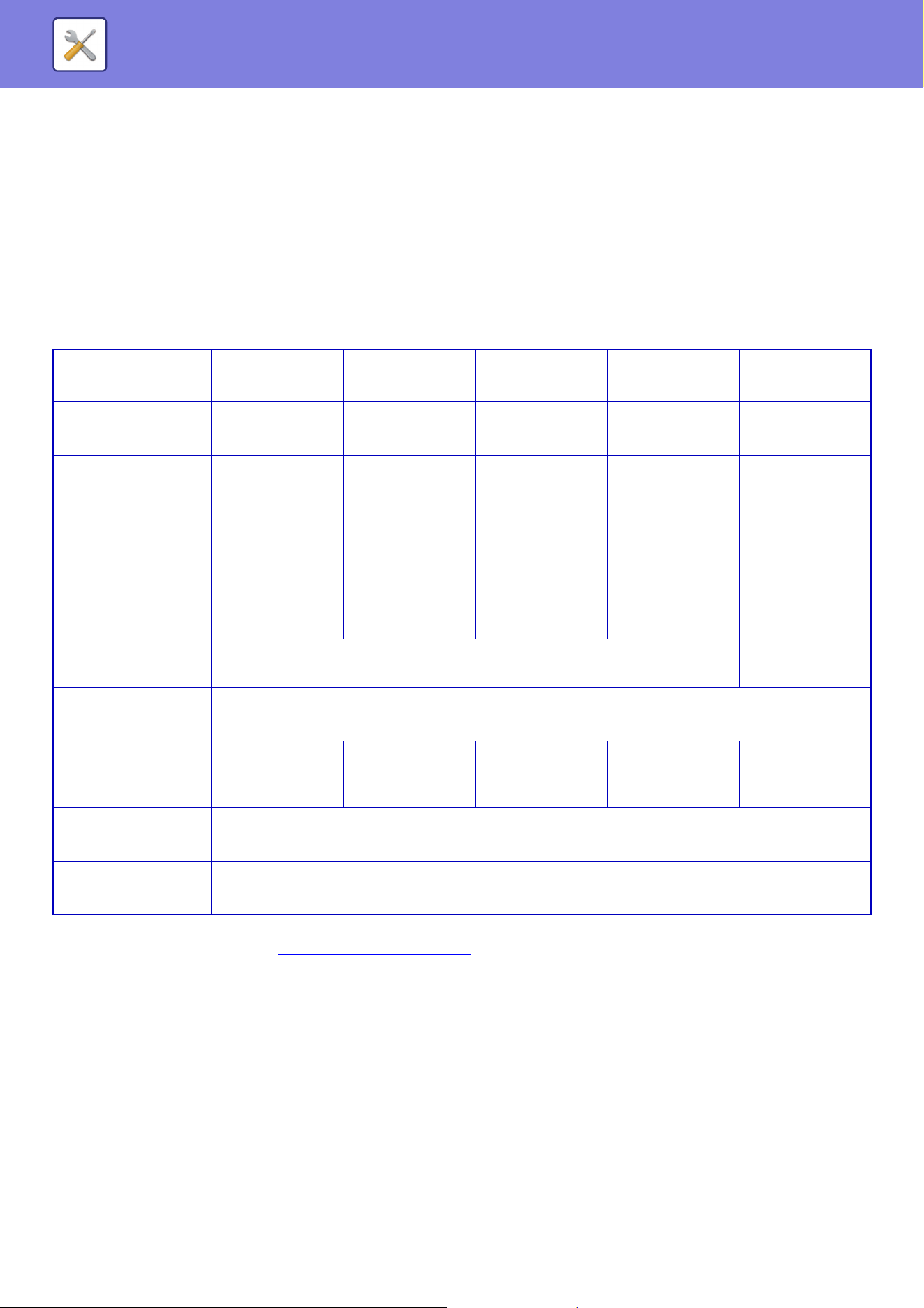
7-55
SYSTEM SETTINGS►USER CONTROL
Users stored as factory default
The following users are stored in the machine at the factory.
• Administrator: The administrator account of the machine, stored as factory default.
• System Administrator: The account for system maintenance, stored as factory default. This account cannot
execute jobs.
• User: This is used when network authentication is used and a login name that is not stored in the
machine is entered directly. (This cannot be selected from the login user screen.)
• Device Account: A user account to which user authority is granted.
• Other User: This is used when a print job is executed using invalid user information. (This cannot be
selected from the login user screen.)
For settings related to each of the users, see the following table.
*1 Items that can be changed
*2 For detailed information, see "Authority Group (page 7-64)
".
User Name Admin
System
Administrator
Users Device Account Other User
Login Name admin sysadmin users
device
account
Other
PIN Code/Password
(See "Start
Guide.")
*1
sysadmin
*1
users
*1
device
account
*1
–
My Folder No Main Folder No Main Folder No
Authentication
Server Settings
Login Locally –
Pages Limit Group Unlimited
*1
Authority Group
*2
Admin
System
Administrator
Authority
*1
User
*1
Color Prohibited
Authority
*1
Guest
*1
Favorite Operation
Group
Following the System Settings
*1
Default Billing Code Not Set
*1
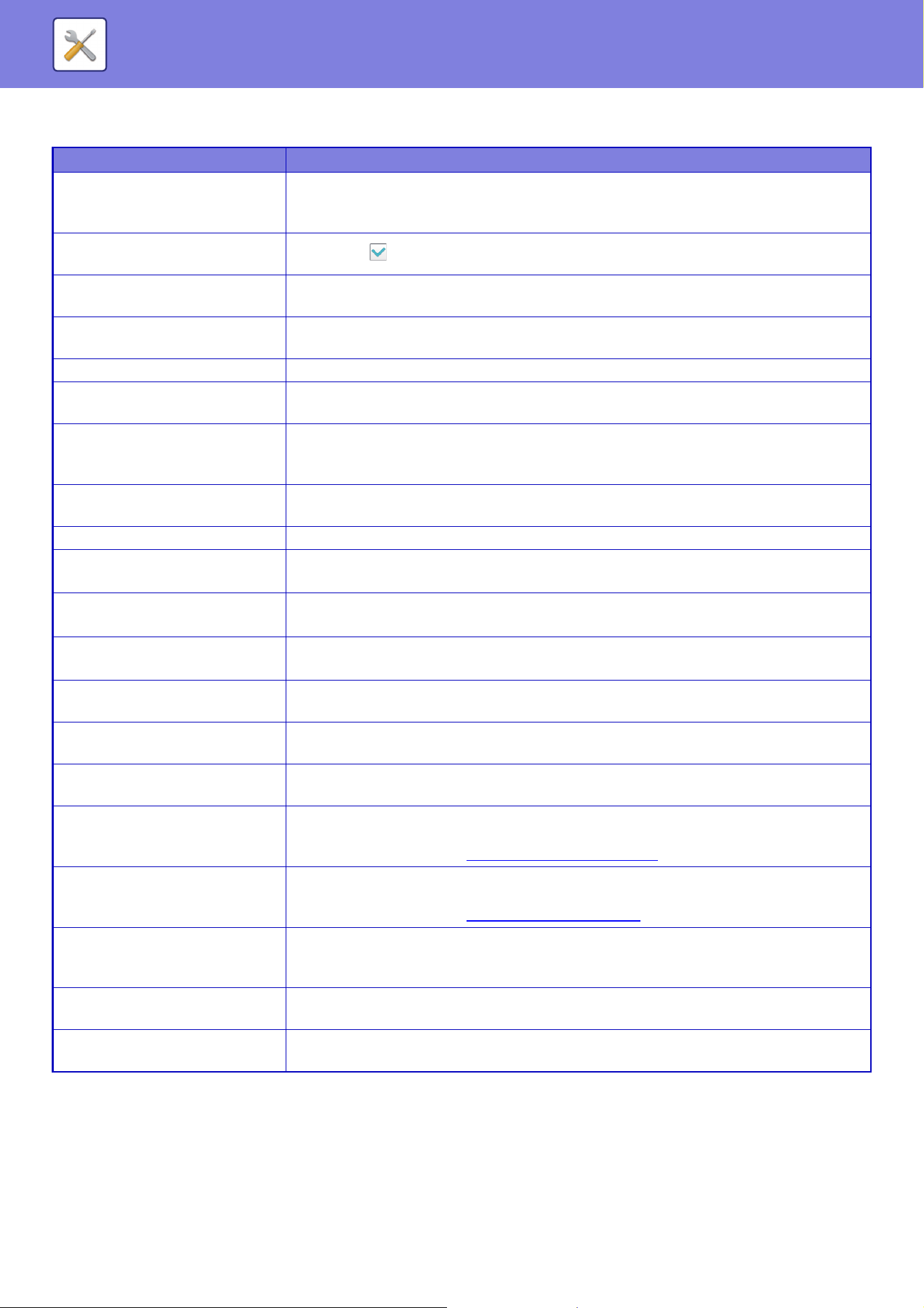
7-56
SYSTEM SETTINGS►USER CONTROL
User Registration
*1 It is not displayed when "User Number" is selected for the authentication method.
*2 It is displayed when "User Number" is selected for the authentication method.
*3 Not required when network authentication is used, as the password stored in the LDAP server is used.
Item Description
User Name
Store a user name consisting of up to 255 characters. This user name is used as the key
name in the authentication screen, the user name for document filing, and the sender
name.
Apply User Name to Log-in
Name.
*1
Select this to enter the entered user name in the login name.
Initial
This determines where the user name will appear in the user list. Enter a maximum of 10
characters for the initials.
Index
Select a custom index to be stored. The custom index names are the same as those used
in the address book.
User Number
*2
Enter a user number in 5 to 8 digits.
Login Name
*1
Enter the login name that is used when authentication by login name and password is
enabled (up to 255 characters). (The login name must be unique.)
Password
*1, 3
Enter the password, consisting of 1 to 255 characters, that is used for user authentication
by login name and password (the password is optional).
After entering the password, enter once again in "Password (confirmation)".
E-mail Address
Enter the e-mail address that is used in the sender list and for LDAP authentication (up to
255 characters).
Home Directory Path Enter a maximum of 127 characters for the home directory path.
Use Login Name And Password
for User Authentication
Set whether or not the login name / password for user authentication will be the same as
the user name / password for home directory path authentication.
User Name
Enter a maximum of 127 characters for the user name for home directory path
authentication.
Password
Enter a maximum of 255 numeric digits for the password for home directory path
authentication.
Authentication Settings
*1
Select either [Login Locally], [Network Authentication] (when LDAP is enabled) or [Active
Directory] (when Active Directory is enabled) for authentication.
Authentication Server
When the [Network Authentication] is selected, select the server to be used for user
authentication from the LDAP server list that is stored using Setting mode (Web version).
Organization/Group
Set a group to which the user belongs.
Up to 8 groups can be assigned.
Pages Limit Group
Specify the page limit for the user by selecting one of the stored page limit groups. The
factory default setting is [Unlimited].
For more information, see "Pages Limit Group (page 7-63)
".
Authority Group
Specify the user authority by selecting one of the stored authority groups. The factory
default setting is [User].
For more information, see "Authority Group (page 7-64)
".
Favorite Operation Group
The favorite operation group is displayed when the user logs in. The factory default setting
is [Following the System Settings].
To change the settings, select [User Control] in Setting mode (Web version).
Default Billing Code
Set the Main Code and Sub Code when the user logs in.
The factory default setting is [Not Set].
My Folder
Store a folder to be used for document filing as the dedicate user folder (or My Folder). A
stored folder can be selected, or you can create and specify a new folder.
7-57
SYSTEM SETTINGS►USER CONTROL
Custom Index
You can change the custom index name.
Tap the custom index name on the list to edit it.
Delete the previously entered characters and enter a new name (up to 127 characters).
Organization /Group List
This is used to store user groups.
Tap each group name to enter them directly.
Delete the previously entered characters and enter a new name (up to 255 characters).
Default Settings
User Authentication
This setting enables or disables user authentication and specifies the authentication method.
When the user authentication is enabled, each user of the machine is registered. When a user logs in, the separate
authentication settings apply to the user. This function allows greater control of security and cost management than that
on previous machines.
Even if user information is not stored on the machine, you can directly enter the user information stored in an LDAP
server to log in the machine if necessary. In this case, the authentication information of the "User" being stored as
factory default applies to the login user. For more information, see "Users stored as factory default (page 7-55)
".
User Authentication
When [User Authentication] is enabled, the authentication screen appears before an operation is carried out in any
mode except the job management screen*.
Log in as an already registered user.
After logging in, you can move freely through the modes.
*The login screen appears when a document filing file is used or when a broadcast transmission is reattempted from the
job management screen.
Authentication Server Settings
Set the location where user authentication is to be enabled.
Login Locally: User authentication by the machine.
LDAP: User authentication by LDAP server.
Active Directory: User authentication by Active Directory.
Default Network Authentication Server Setting
Use this to set the default network authentication server.
When you log into Setting mode (Web version) or send a print job to the machine using user information that is not
registered in the machine, the authentication server is not known. This setting is used to select one of the LDAP servers
registered in the machine as the authentication server.
• For the procedure for storing users, see "User List (page 7-54)".
• For details on login procedures when user authentication is enabled, see "USER AUTHENTICATION (page 1-31)".
When login is performed by network authentication using user information that is not registered in the machine, the login user
will be the "User" registered as factory default. For more information, see "Users stored as factory default (page 7-55)
".
7-58
SYSTEM SETTINGS►USER CONTROL
Perform network server access control
Register the access control information for page count limits, authorities, and favorite operations can be registered on a
network server in advance. By using this network server for network authentication, perform the user authentication
based on the registered access control information.
Use this function when user authentication is performed by network authentication using an LDAP server or a directory
service (Active Directory, etc.).
Before using this function, configure settings for authentication by network server, obtain control numbers for the "Pages
Limit Group", "Authority Group", "Favorite Operation Group", and "My Folder" (including base settings for each group),
and associate these with the control numbers registered in the machine.
To use this function, add the properties associated with "Pages Limit Group", "Authority Group", "Favorite Operation
Group", and "My Folder" to the directory information of the network server used for user authentication.
The property information is indicated below. Settings previously stored in the machine cannot be changed.
Rename the properties that the machine obtains from the LDAP server as follows. In "Settings", select [Network
Settings] → [LDAP Settings]. From the Global Address Book setting screen that is displayed, select [Linkage with User
Control Function] and then select [Pages Limit Group], [Authority Group], [Favorite Operation Group] and [My Folder].
The [Pages Limit Group], [Authority Group], and [Favorite Operation Group] information that is registered in each
machine determines the authority and settings that the user is actually granted. To use this function to ensure that users
are granted the same authority and settings on any machine, register the [Pages Limit Group], [Authority Group], and
[Favorite Operation Group] information with the same authority so that they will be registered in each machine using the
same registration numbers.
For [My Folder], register the folder having the same name in [Custom Folder] in each machine.
The directory information of the network server that is used cannot be changed from the machine. Consult the
administrator of the network server.
Property Name of property in factory
default state
Setting
Pages Limit Group pagelimit
Registration number of Pages Limit
Group registered in the machine, or a
group name previously registered in the
machine.
Unlimited: unlimited
Authority Group authority
Registration number of Authority Group
registered in the machine, or a group
name previously registered in the
machine.
Admin: admin
User: user
Guest: guest
Favorite Operation Group favorite
Registration number of Favorite
Operation Group registered in the
machine, or a group name previously
registered in the machine.
Following the System Settings:
systemsettings
My Folder myfolder
Folder name of user folder stored in the
machine.
Do not enter if the default folder is
specified.
7-59
SYSTEM SETTINGS►USER CONTROL
If 1000 users have already been manually registered, login will not be possible. Please delete old or unused user name.
Consult the administrator of the machine.
Users auto-registered
When you log in by network authentication, your user information is automatically registered in the machine.
The information stored is as follows:
* If the user name cannot be acquired by network authentication, the first 16 characters of the text string used as the
login name for network authentication is applied.
• If Access Control is enabled and the access control information cannot be acquired from the authentication server, user
authentication will not be possible.
• If a user that is registered in the machine is authenticated by network authentication, the user registration settings in the
machine will be given priority for the page count limit group, authority group, favorite operations group, and my folder.
• If the access control obtained from the server is not registered in the machine, the factory default user authority will be
applied.
• When this function is not enabled and a user is authenticated by network authentication as a non-registered user, the
factory default user authority will be applied.
Item Description
User Name This information is acquired from the authentication server.*
Initial 1
Index User1
Card ID –
PIN Code/Password –
Authentication Server Settings –
Authentication Server Network Authentication
E-mail Address
When Access Control is enabled, this information is acquired from the authentication
server.
My Folder
Pages Limit Group
Authority Group
Favorite Operation Group
7-60
SYSTEM SETTINGS►USER CONTROL
Authentication Method Setting
This selects the authentication method. When using user authentication, be sure to configure this setting first. The items
to be configured for users stored after setting the user authentication method vary depending on the selected
authentication method.
Authenticate a User by Login Name and Password
Standard authentication method using a login name and password.
Authenticate a User by Login Name, Password and E-mail Address
This authentication also checks the e-mail address, in addition to the login name and password of the user.
Authenticate a User by User Number Only
Use this option for simple authentication if you skip the network authentication.
Device Account Mode Setting
A specific user can be registered as an auto login user. When this option is enabled, the registered user can log in the
machine automatically.
Also, you can temporarily log in as a user other than the auto login user, and operate the machine with the privileges of
this user. To allow other users to log in temporarily when [Device Account Mode] is enabled, select [Allow Login by
Different User].
Login User
This setting is used to select the auto login user when auto user login is enabled.
Cache User Information
Select the cache period of user information when offline mode is enabled. For information on offline mode, consult your
service technician.
Store user authentication information for External Connect
You can specify whether or not authentication information for cloud linking is stored as cache information.
When this setting is enabled, once a user is successfully authenticated, the authentication information is retained to
enable smooth authentication the each time the user subsequently logs in.
When this setting is disabled, all user authentication information for cloud link is deleted, and authentication information
is no longer retained.
Card Setting
Use IC Card for Authentication
Use these settings for authentication and for use of a HID or other IC card.
Actions when the Limit of Pages for Output Jobs
This setting determines whether or not a job will be completed if the page limit is reached while the job is in progress.
The following settings can be configured.
• The login screen will vary depending on the authentication method that is selected.
For details, see "USER AUTHENTICATION (page 1-31)
".
• When "Authenticate a User by User Number Only" is selected for the authentication method, network authentication
cannot be used.
• If you have logged in as the Auto Login user, and if you have failed automatic login due to some reasons or if you do not
have the administrator's privileges, you cannot use the general setting modes or Setting mode. In that case, the
administrator should tap the [Admin Password] key on the Setting mode screen and log in again.
•
To log in as a user other than a fixed user when [Allow Login by Different User] is enabled, tap the [Logout] key to cancel the
fixed user login state. When the user authentication screen appears, log in as the desired user again. After you have used
the machine, tap the [Logout] key to log out as the current user.
7-61
SYSTEM SETTINGS►USER CONTROL
• Job is Completed even when the Limit of Pages is Reached
• Job is Stopped when the Limit of Pages is Reached
• After reaching to the page limit, cancel the job and delete the job during receiving
A Warning when Login Fails
When entering passwords, including administrator passwords, during user authentication, the number of incorrect
password attempts is counted, and if the number of attempts reaches the specified number (three), the user account is
locked, and the user is blocked from making any more attempts at authenticating their account until a period of five
minutes has elapsed.
The number of incorrect entries made is counted separately for each user, and the count is reset when the correct
password is entered.
This prevents an unauthorized person from attempting to guess a password. (The number of failed login attempts is
retained even if the power is turned off.)
Disabling of Printing by Invalid User
Printing by users whose information is not stored in the machine, such as printing without entering valid user information
in the printer driver or printing of a file on an FTP server in Setting mode (Web version), can be prohibited.
Allow Remote Scanner Using Before Login.
This setting specifies whether scanning can be performed by remote operation before a user has logged in.
Automatically print stored jobs after login
When retention is enabled in the printer driver and print data has been spooled to the machine, you can have the spooled
print data automatically print out when the user who enabled retention logs in.
Display Usage Status after Login
When user authentication is enabled, this setting specifies whether or not to display the page counts of a user when the
user logs in.
Login Name Display
When user authentication is enabled, select whether the login name is shown or asterisks are shown.
Include Job Management in user authentication
When user authentication is enabled, this setting specifies whether or not to include the job management in user
authentication.
Disable display/change of other users’ information in the job management
Prohibit display and changing of job information of other users in the job management.
•
Lockout only applies to the user who failed to login, not all users. Even if one user is locked out, the other users can still log in.
• When LDAP or Active Directory network authentication is used, lockout is executed by the server, not the machine. Select
appropriate lockout settings on the server.
• If the same user has been locked out, the [Release Operation Lock Status] key is displayed in the "User Registration"
screen for that user. An administrator can tap this key to carry out a manual clear.
Item Description
Display login name Show the login name.
Display Login Name with Asterisk " ".
Hide the login name with asterisks.
7-62
SYSTEM SETTINGS►USER CONTROL
Automatic Logout Setting
When user authentication is enabled, this setting specifies whether or not to enable automatic logout.
The time until logout can be specified up to 240 seconds in increments of 10 seconds.
Case sensitivity of login name is enabled.
Set whether or not to make login names used at the time of user authentication case sensitive. If the checkbox is set to
, login names with identical spelling but different cases (upper and lower) will be identified as different login names.
Therefore, login names with identical spelling but different cases will be authenticated as user names of different users.
If the checkbox is set to , case sensitivity for login names is disabled. Therefore, identically spelled user names with
upper and lower case character differences will be authenticated as the user name of the same user.
Apply login name to the user name of network folder
Apply login name to the user name of network folder
Edit Help Display of Login Screen
Settings you have created here is displayed on the login screen.
User Information Print
Prints the following item lists.
•User List
• List of Number of Pages Used
• Page Limit Group List
*
• Authority Group List
• Favorite Operation Group List
*
• All User Information Print
Select each item and tap the [Print] key to print it out.
* Cannot be printed when no groups are stored.
Reset Counter After Sending E-mail Status
After E-mail Status has been sent, the counter is reset.
This only appears when E-mail Status is enabled.
Enable IPP Authentication Except for Printer Driver
Enable IPP authentication for other than the printer driver.
If the selected checkbox is changed to , and identical user names with only upper and lower case character differences
exist, the user names that have already been registered are identified as user names of different users.
• To specify [One Sided] or [Two Sided] printing in List Print, select "Settings" → [System Settings] → [Common Settings] →
[Device Control] → [List Prints].
• In All User Information Print, the following items are handled by 2-sided printing on an item basis.
•User List
•List of Number of Pages Used
•Page Limit Group List
•Favorite Operation Group List
7-63
SYSTEM SETTINGS►USER CONTROL
Pages Limit Group
This is used to register the page limit settings in advance for each group.
The page limit for each user is specified by selecting one of these registered groups when the user is registered.
• [Add] key
Use this to add a new group.
•List
This shows the currently stored groups. Selecting a group name displays the edit screen for that group.
Storing page limit groups
When you tap the [Add] key, the registration screen appears. Up to 20 groups can be registered.
For information on the settings, see "Pages Limit Group Registration (page 7-63)
".
Editing a page limit group
Selecting a group from the list displays the edit screen for that group.
For information on the settings, see "Pages Limit Group Registration (page 7-63)
".
To return a group to the factory default state, set "Select the Group Name to be the Registration Model" to "Unlimited" on
the edit screen.
Pages Limit Group Registration
Machine Page Limit Setting
Sets the page limit for the machine.
Settings
Item Description
Group Name Store a name of group (up to 32 characters).
Select the Group Name to be the
Registration Model
Select one of the previously stored groups for use as a template for the new group. When
selected, the settings of this group are applied.
Function Names The name of the functions that can be configured is displayed. Set a limit for each function.
Page Limit
When [Prohibited] is selected for a mode, input from the mode is prohibited.
When [Unlimited] is selected for a mode, there is no limit to the number of pages that can
be input/output in that mode.
When [Limited] is selected, enter a page limit (1 to 99999999 pages).
Item Description
Function Names The name of the functions that can be configured is displayed. Set a limit for each function.
Page Limit
When [Prohibited] is selected for a mode, input from the mode is prohibited.
When [Unlimited] is selected for a mode, there is no limit to the number of pages that can
be input/output in that mode.
When [Limited] is selected, enter a page limit (1 to 99999999 pages).
7-64
SYSTEM SETTINGS►USER CONTROL
Authority Group
This is used to store the settings relevant to user authorities in advance for each group. The authority of each user is
specified by selecting one of these registered groups when the user is registered.
• [Add] key
Use this to add a new group.
•List
This shows the currently stored groups. Selecting a group name displays the edit screen for that group.
Storing authority groups
When you tap the [Add] key, the registration screen appears. Up to 20 groups can be registered.
For detailed information about each of the settings, see the following table.
Editing an authority group
Selecting a group from the list displays the edit screen for that group. For detailed information about each of the settings,
see the following table.
To return a group to the factory default state, select the group from the list and select any of options [Return to the
Administrator Authority], [Return to the system administrator authority.], [Return to the User Authority], [Return to the
Guest Authority] and [Return to the scanner prohibited authority.].
Tapping the [Execute] key resets the group status to the factory default.
Item Description
Group Name Store a name of group (up to 32 characters).
Select the Group Name to
be the Registration Model
Select one of the previously stored groups for use as a template for the new group. When
selected, the settings of this group are applied.
The factory default groups and their settings are shown below.
Admin
System
Administrator
Authority
User Guest Color
Prohibited
Authority
Scanner
Prohibited
Authority
Copy
Color Mode Approval Setting All allowed
All
prohibited
All allowed
Only Black
& White
Allowed
Only Black &
White
Allowed
All allowed
Special Modes Usage Allowed Prohibited Allowed Prohibited Prohibited Allowed
Sending while copying Allowed Allowed Allowed Allowed Allowed Allowed
Approval Setting to Use
Toner Save Mode
No Toner
Save
No Toner
Save
No Toner
Save
No Toner
Save
No Toner
Save
No Toner
Save
Creation of PDF for PC
Browsing
Allowed Prohibited Allowed Allowed Allowed Allowed
Printer
Color Mode Approval Setting Allowed
All
prohibited
Allowed
Only Black
& White
Allowed
Only Black &
White
Allowed
All allowed
FTP Pull Print Allowed Prohibited Allowed Prohibited Prohibited Allowed
USB Memory Direct Print Allowed Prohibited Allowed Prohibited Prohibited Allowed
Network Folder Pull Print Allowed Prohibited Allowed Prohibited Prohibited Allowed
Sending while printing Allowed Allowed Allowed Allowed Allowed Allowed
7-65
SYSTEM SETTINGS►USER CONTROL
Approval Setting to Use
Toner Save Mode
No Toner
Save
No Toner
Save
No Toner
Save
No Toner
Save
No Toner
Save
No Toner
Save
Creation of PDF for PC
Browsing
Allowed Prohibited Allowed Allowed Allowed Allowed
Image Send
Approval Settings for Each Mode
• E-mail
•FTP
• Network Folder
• Scan to Ext.Memory Dev.
•PC Scan
All allowed
All
prohibited
All allowed All allowed All allowed
All
prohibited
Color Scan Allowed Prohibited Allowed Prohibited Prohibited Allowed
Special Modes Usage Allowed Prohibited Allowed Prohibited Prohibited Allowed
Registration/Deletion of
Program
Allowed Prohibited Allowed Prohibited Prohibited Allowed
Creation of PDF for PC
Browsing
Allowed Prohibited Allowed Allowed Allowed Allowed
Approval Setting for Addressing
• Approval Setting for Direct
Entry
• Approval Setting to Use a
Local Address Book
• Approval Settings to Use
a Global Address Book
All allowed All allowed All allowed All allowed All allowed All allowed
Document Filing
Scan to HDD
Color Scan Allowed Prohibited Allowed
Only Black
& White
Allowed
Only Black &
White
Allowed
Allowed
Special Modes Usage Allowed Prohibited Allowed Prohibited Prohibited Allowed
Creating Downloadable File Allowed Prohibited Allowed Allowed Allowed Allowed
Prints (Document Filing)
Color Mode Approval Setting All allowed
All
prohibited
All allowed Allowed Allowed All allowed
Special Modes Usage Allowed Prohibited Allowed Prohibited Prohibited Allowed
Approval Setting to Use
Toner Save Mode
No Toner
Save
No Toner
Save
No Toner
Save
No Toner
Save
No Toner
Save
No Toner
Save
Document Filing Image Check
Approval Setting Allowed Prohibited Allowed Prohibited Prohibited Allowed
Display only the Files of
Logged-in Users
Prohibited Prohibited Prohibited Prohibited
Prohibited
Prohibited
Item Description
7-66
SYSTEM SETTINGS►USER CONTROL
SharpOSA
Approval Setting to Use a
Sharp OSA
Allowed Prohibited Allowed Allowed Allowed Allowed
Common Functions
Approval Settings for
2-Sided Print
All allowed All allowed All allowed All allowed All allowed All allowed
Change Billing Code Allowed Allowed Allowed Allowed Allowed Allowed
Output Approval Settings All allowed
All
prohibited
All allowed
All
prohibited
All
prohibited
All allowed
Security
Document Filing Approval
Setting: Quick File/
Sharing Mode
Prohibited Prohibited Prohibited Prohibited Prohibited Prohibited
Document Filing Approval
Setting:Confidential Mode
Allowed Prohibited Allowed Prohibited Prohibited Allowed
Print Jobs Other than Print
Hold Job
Allowed Allowed Allowed Allowed Allowed Allowed
Hidden Pattern Print Setting
- Direct Entry
Allowed Prohibited Allowed Prohibited Prohibited Allowed
Machine Settings
Machine Settings
Total Count Allowed Allowed Allowed Prohibited Allowed Allowed
Device / Network Status Allowed Allowed Allowed Prohibited Allowed Allowed
Power Reset Allowed Allowed Prohibited Prohibited Prohibited Prohibited
List for User Allowed Allowed Allowed Prohibited Allowed Allowed
List for Administrator Allowed Allowed Prohibited Prohibited Prohibited Prohibited
Address Registration Allowed Allowed Allowed Prohibited Allowed Allowed
Document Filing Folder
Registration
Allowed Allowed Allowed Prohibited Allowed Allowed
User Control (Admin) Allowed Allowed Prohibited Prohibited Prohibited Prohibited
User Control (User) Allowed Allowed Allowed Prohibited Allowed Allowed
Home Screen Settings Allowed Allowed Prohibited Prohibited Prohibited Prohibited
Copy Function Settings Allowed Allowed Prohibited Prohibited Prohibited Prohibited
Printer Settings (Admin) Allowed Allowed Prohibited Prohibited Prohibited Prohibited
Printer Settings (User) Allowed Allowed Allowed Prohibited Allowed Allowed
Image Send Settings >
Common Settings
Allowed Allowed Prohibited Prohibited Prohibited Prohibited
Scan Settings Allowed Allowed Prohibited Prohibited Prohibited Prohibited
Metadata Entry Allowed Allowed Prohibited Prohibited Prohibited Prohibited
Document Filing Settings Allowed* Allowed* Prohibited Prohibited Prohibited Prohibited
Item Description
7-67
SYSTEM SETTINGS►USER CONTROL
* For information on each setting, see the setting mode list.
Sharp OSA Settings Allowed Allowed Prohibited Prohibited Prohibited Prohibited
Paper Settings (Bypass Tray
Excluded)
Allowed Allowed Allowed Prohibited Allowed Allowed
Paper Settings (Bypass
Tray)
Allowed Allowed Allowed Prohibited Allowed Allowed
Operation Settings Allowed Allowed Prohibited Prohibited Prohibited Prohibited
Keyboard Settings Allowed Allowed Prohibited Prohibited Prohibited Prohibited
Device Control Allowed Allowed Prohibited Prohibited Prohibited Prohibited
Machine Identification
Settings
Allowed Allowed Prohibited Prohibited Prohibited Prohibited
Clock Adjust Allowed Allowed Prohibited Prohibited Prohibited Prohibited
Product Key Allowed Allowed Prohibited Prohibited Prohibited Prohibited
Custom Link Setting Allowed Allowed Prohibited Prohibited Prohibited Prohibited
Network Settings Allowed Allowed Prohibited Prohibited Prohibited Prohibited
Security Settings Allowed Allowed Prohibited Prohibited Prohibited Prohibited
Energy Save Allowed Allowed Prohibited Prohibited Prohibited Prohibited
System Control Allowed Allowed Prohibited Prohibited Prohibited Prohibited
Image Quality Adjustment Allowed Allowed Prohibited Prohibited Prohibited Prohibited
Operation Manual Download Allowed Allowed Allowed Allowed Allowed Allowed
Shortcut Page Setting Allowed Allowed Prohibited Prohibited Prohibited Prohibited
Depending on the machine specifications and peripheral devices installed, it may not be possible to use some settings.
Item Description
7-68
SYSTEM SETTINGS►USER CONTROL
Favorite Operation Group
Favorite Operation Group List
The preferred operation environment can be set for each group. For example, a user who speaks a different language
would normally have to change the display language each time he or she uses the machine; however, by registering the
language in a favorite operation group in advance, the language is automatically selected when the user logs in.
Adding/editing a group
Tap the [Add] key to display the favorite operation group registration screen.
Tap a group name to display the registration screen for that favorite operation group. You can edit the group in this
screen.
Favorite Operation Group Registration
• Depending on the machine specifications and peripheral devices installed, it may not be possible to use some settings.
• This setting can only be configured in Setting mode (Web version). It cannot be configured in the touch panel of the
machine.
Item Description
Group Name Store a name of group (up to 32 characters).
Select the Group Name to be the
Registration Model
Select one of the previously stored groups for use as a template for the new group. When
selected, the settings of this group are applied.
Copy
Initial Status Settings
Select settings for Color Mode, Image Orientation, Paper Tray, Exposure Type, Copy Ratio,
2-Sided, Original Binding, Output Binding, Output, Offset, Output Tray, Separator Page,
Staple Sort, Staple Position, Punch, and Fold.
Image Send
Initial Status Settings
Select settings for Image Orientation, Exposure, Resolution, Color Mode, File Format, and
Original Image Type. Select settings for Specified Pages per File.
Document Filing
Image Orientation Specify the image orientation.
Initial Status Settings Select settings for Color Mode, Exposure, Original Image Type, and Resolution.
Prints (Document Filing) Set the default output tray for document filing print.
System Settings
Enlarge Display Mode Turn this option ON to display large characters on the Setting mode screen.
Original Size Detector Setting
Select whether Inch sizes or AB sizes are detected, or disable detection on the document
glass.
Cancel Detection at Document
Glass
Original size detection on the document glass can be disabled. When this is done, all
originals placed on the document glass are treated as special size originals.
Language Setting Select the display language.
Switch the Number of Sets to be
Displayed for Job Management
Select whether to display the number of progress sets or remaining sets as the job
management.
Key Operation Setting Set the key input time and Auto Key Repeat setting.
Time for Accepting Key Entry of
Long Touch
Select a time when a long key touch is detected.
Double Tap Interval Setting Select an interval when a double tap is detected.
7-69
SYSTEM SETTINGS►USER CONTROL
Returning a favorite operation group to "Unlimited"
To return a selected favorite operation group to the factory default state, select the checkbox ( ) to the left of "No." and
tap the [Return to the Defaults] key.
Favorite Key List
Assign shortcut keys to frequently used functions.
They will be displayed in the base screen of each mode.
Settings
Keys Touch Sound Set the sound made when keys are touched.
Keyboard Select Set the language that appears on the keyboard.
MFP Display Pattern Setting Select the color pattern used in the touch panel.
Automatically print stored jobs
after login
When retention is enabled in the printer driver and print data has been spooled to the
machine, the spooled print data is automatically printed out when the user who enabled
retention logs in.
Favorite Key Setting
Select to use System Settings or use the registered Favorite key settings for performing
Favorite Key Setting.
Home Screen Settings
Select to use System Settings or use the stored home screen settings for performing Home
Screen Settings.
Preview Setting: Default List/Thumbnail Display
File Retrieve of Main
Folder/Quick File Folder
Select whether the default display format of the document filing main folder and temporary
folder screens is list or thumbnails.
File Retrieve of Custom Folder
Select whether the default display format of the document filing custom folder screen is list
or thumbnails.
File Retrieve of Direct Print
Select whether the default state of the file list screen for direct print shows the folders as a
list or as thumbnails.
Item Description
Key Name
Enter a maximum of 20 characters for the favorite key name.
(Up to 20 characters can be entered, but only 10 will be shown on the key.)
Function Menu/Program/
Others
Select the function that you wish to assign to the favorite key. The functions that can be
selected vary by mode.
No Display Enable this setting to not show favorite keys.
Item Description
7-70
SYSTEM SETTINGS►USER CONTROL
Home Screen List
Home screen settings must be previously stored. Select a home screen when registering Favorite Operation Group List.
User Count
This displays the total number of pages printed by each user.
• [Select All] key
This selects all users.
• [Clear Checked] key
This clears all selections.
• [Show] key
This shows the counts of the selected user.
• [Clear Count] key
Use this to reset the counts of the selected user.
•User List
This shows the users stored as factory default and the currently stored users. When you select a user name, the user
is selected.
View User Count
When you select a user and tap the [Show] key, this user count is displayed.
Item Description
Name Enter a maximum of 32 characters for the home screen name.
Select the Group Name to be the
Registration Model
Select one of the previously stored home screens as a template for the new home screen.
When selected, the settings of this home screen are applied.
Change Home Screen Name Enter a home screen name to change the existing name.
Template Select a layout pattern of the registered key.
Key Layout of the Screen The layout of the keys in the home screen is displayed.
Change Text Color On Home
Screen
Set the color of the text in the scroll area, fixed area, and clock.
Home Button Registers the function to use for the selected key number.
Fix Key
Registers the function to use for the selected key number. This button is displayed on all
pages of the home screen.
Display Toner Quantity Select this to display the toner level in the fixed area.
Item Description
Next Displays the next user (in the order of the registration numbers).
Previous Displays the previous user (in the order of the registration numbers).
Show Counts
Displays the counts and the number of pages remaining of the selected user for each
function.
Page Limit The page limit set for the user appears in parentheses below the count.
If peripheral devices are not mounted, their count is not displayed.
7-71
SYSTEM SETTINGS►USER CONTROL
Resetting user counts
Select a user in the setting screen and tap the [Clear Count] key. A count reset screen for that user will appear.
The reset screen will vary depending on whether a single user or multiple users were selected. The items displayed in
each case are described in the table below.
When a single user is selected
When multiple users are selected
Save User Count
Clicking the [Save] button saves the user count information as a data file.
To delete the user count information in the machine, click the checkbox next to the "Save and Delete the Data" so that it
is selected and click the [Save] button.
Item Description
Next Displays the next user (in the order of the registration numbers).
Previous Displays the previous user (in the order of the registration numbers).
Show Counts
Displays the counts and the number of pages remaining of the selected user for each
function.
Clear Count Reset the count of the selected item to "0".
Clear All Count Clears all counts of the selected user to zero (0).
Item Description
Show Counts
Displays the counts and the number of pages remaining of the selected user for each
function.
Clear Count Reset the count of the selected item to "0".
Clear All Count Clears all counts of the selected user to zero (0).
This setting can only be configured in Setting mode (Web version). It cannot be configured in the touch panel of the machine.
7-72
SYSTEM SETTINGS►USER CONTROL
Billing Code Setting
Administration Settings
Change the billing code setting.
Use Billing Code
Switch whether to enable or disable a billing code.
Default Code Setting
A use code is automatically assigned when no billing code is entered. Specify the code using up to 32 single-byte
characters.
Remember Billing Code Between Modes
If this function is enabled, the billing code entry window is not displayed at the time of mode transition.
Disable Change of Billing Code
If this function is enabled, you cannot register, edit, or delete a billing code.
In addition, you cannot directly type in a billing code in the billing code entry window.
Apply Default Code when Billing Code not entered Billing Code not Entered
If this function is enabled, a use code is always set while you are logging in with device account.
Disable Billing Code for Selected Applications
The billing code entry window is displayed when the external application that is set to enable is started.
The following settings can be configured.
• Application Name registered as Standard Application
Billing Code Display Name Setting
You can change the main code or sub code name displayed in the billing code entry window or billing code selection
window.
Main Code List
You can display a list of main codes to search for, register, correct, or delete a main code.
• [Search] key
Searches for a main code.
• [Add] key
Adds a new main code.
•List
Displays a list of registered main codes. Selecting each main code displays the window to correct the main code.
• [Delete] key
Set the check box on the left of each main code to , then tap the [Delete] key; the selected main code is deleted.
Register a main code
When you tap the [Add] key, the registration screen appears. A total of up to 2,000 main and sub codes can be
registered.
For information on the settings, see "Settings (page 7-73)
".
After the setting has been completed, tap the [Submit and Register Next] key; you can continuously register the next
main code. To end the registration process, tap the [Submit] key.
Correct a main code
Selecting a main code from the list displays the window to correct the main code.
For information on the settings, see "Settings (page 7-73)
".
After the setting has been completed, tap the [Submit] key; you can apply the corrected contents and complete
processing.
7-73
SYSTEM SETTINGS►USER CONTROL
Search for a main code
Enter the main code and main code name, then tap the [Search] key; the search result is displayed.
Settings
Sub Code List
You can display a list of sub codes to search for, register, correct, or delete a sub code.
• [Search] key
Searches for a sub code.
• [Add] key
Adds a new sub code.
•List
Displays a list of registered sub codes. Selecting each sub code displays the window to correct the sub code.
• [Delete] key
Set the check box on the left of each sub code to , then tap the [Delete] key; the selected sub code is deleted.
Register a sub code
When you tap the [Add] key, the registration screen appears. A total of up to 2,000 main and sub codes can be
registered.
For information on the settings, see "Settings (page 7-74)
".
After the setting has been completed, tap the [Next] key; you can continuously register the next sub code. To end the
registration process, tap the [Submit] key.
Correct a sub code
Selecting a sub code from the list displays the window to correct the sub code.
For information on the settings, see "Settings (page 7-74)
".
After the setting has been completed, tap the [Submit] key; you can apply the corrected contents and complete
processing.
Item Description
Main Code Enter the main code. Specify the code using up to 32 single-byte characters.
Main Code Name
Enter the main code. Specify the code name using up to 32 double- or single-byte
characters.
Available to
The registered billing codes can only be shared in the specified group.
When not specifying a public destination, select [All Users].
When specifying a public destination, select [Designate Public Address.], then specify a
group to share the billing code.
To register a group for specifying a public destination
In "Settings (administrator)", select [User Control] → [Organization /Group List].
7-74
SYSTEM SETTINGS►USER CONTROL
Search for a sub code
Enter the sub code and sub code name, then tap the [Search] key; the search result is displayed.
Settings
Card Setting
Card Area Setting
The data check during card reading can be set.
Settings
Card Type / Card Reader Settings
Use these settings for authentication and for use of a HID or other IC card.
Settings
Card Reader Device Registration
Add a card reader.
Item Description
Sub Code Enter the sub code. Specify the code using up to 32 single-byte characters.
Sub Code Name
Enter the sub code. Specify the code name using up to 32 double- or single-byte
characters.
Available to
The registered billing codes can only be shared in the specified group.
When not specifying a public destination, select [All Users].
When specifying a public destination, select [Designate Public Address.], then specify a
group to share the billing code.
To register a group for specifying a public destination
In "Settings (administrator)", select [User Control] → [Organization /Group List].
Item Description
Check System Code only in
FeliCa User Area mode
Check the System Code only in FeliCa User Area mode.
Check Facility Code in HID mode
Checks the facility code of a HID card.
Facility Code
Enters the facility code of a HID card. When you tap the [Store] key, the facility code is
stored.
Importing from the setup file
When you enter the configuration file name and tap the [Execute] key, the card area
settings are read from the configuration file. If you tap the [Clear] key, all files that match the
current search conditions are deleted.
Item Description
Card Type / Card Reader Enter the card type and card reader information.
7-75
SYSTEM SETTINGS►SYSTEM SETTINGS
Home Screen Settings
You can change the layout, icons, and background of the machine's home screen.
Condition Settings
Icon
Use this setting to register a key icon.
SYSTEM SETTINGS
Item Description
Template
You can change the layout of the keys by selecting a pattern saved in advance. The [Key
Layout of the Screen] image changes as you make selections.
Change Text Color On Home
Screen
Set the color of the text in the scroll area, fixed area, and clock.
Home Screen List
The order of arrangement of the shortcut keys in the home screen is indicated by the "No.",
and the displayed keys appear in the home button column. To edit the home buttons, click
the Home Button item.
Fixed area list
Set the keys (fixed keys) that appear in the fixed area below the home buttons. The order of
arrangement of the keys is indicated by the "No.", and the keys appear in the fixed key
column. To edit the fixed keys, click the Fix Key item.
Display Toner Quantity Select this to display the toner level in the fixed area.
Item Description
Icon list
Use this setting to register icons for home screen shortcut keys.
The image files of shortcut key icons are registered in a list. To register an image, click an
image file registered in "Name" or "Not Set". The icon registration screen appears. Register
the desired image.
Image formats that can be registered are JPEG, GIF, PNG (jpeg, jpg, jpe, jfif, gif, png).
The maximum image file size that can be registered is 50 KB.
To configure this setting on the machine, insert the USB memory device that contains the image into the machine.
7-76
SYSTEM SETTINGS►SYSTEM SETTINGS
Background Image
Use this setting to register a background image.
Home Screen Registration
You can click a home button in the home screen list to change the settings of the home button.
Select the function that you want to assign to the button. If you select [None], a home button will no longer appear in that
location. To register a key name, select [Custom] and enter the name (maximum 28 characters).
To change the image of a home button, register the desired icon in advance using [Icon], and then select the image with
[Select File].
Item Description
Background image list
Image files such as a background images are registered in the registered image list.
To register an image, click a name with a registered image or an unused name. The
background image registration screen will appear. Register the desired image.
The formats of images that can be registered are JPEG, GIF, and PNG (jpeg, jpg, jpe, jfif,
gif, png).
The maximum file size for a background image is 640 MB.
To configure this setting on the machine, insert the USB memory device that contains the image into the machine.
7-77
SYSTEM SETTINGS►SYSTEM SETTINGS
Copy Settings
Condition Settings
The following settings are related to copying.
Default settings selected with these settings apply to all functions of the machine (not just the copy function).
Rotation Copy Setting
When the original and paper are placed in different orientations, this function automatically rotates the image 90 degrees
to enable correct copying on the paper.
Add or Change Extra Preset Ratios
Add two enlargement preset ratio values (101% to 400%) and two reduction preset ratio values (25% to 99%).
Also, you can change the preset ratio if necessary.
Setting a Maximum Number of Copies
This is used to set the maximum number that can be entered for the number of copies (number of continuous copies).
Any number from 1 to 9999 can be specified.
Initial Margin Shift Setting
This is used to set the default margin shift amount. Specify a value from 0" (0 mm) to 2" (50 mm) in increments of 1/8" (3
mm) for both the front and reverse sides.
Erase Width Adjustment
This is used to set the default erase width for erase function. Specify a value from 0" (0 mm) to 1" (25 mm) in increments
of 1/8" (3 mm) for both edge erase and center erase.
InitialN-Up Setting
Set the default state for N-Up. Select the page layout for N-Up, whether or not borders are added, and if added, whether
the borders are solid lines or dotted lines.
Card Shot Settings
This is used to set the default original size for the card shot function.
Specify a value from 1" (25 mm) to 8-1/2" (216 mm) in increments of 1/8" (3 mm) for both the X (horizontal) and Y
(vertical) dimensions of the original.
Fit to Page
Enable this setting to have the [Fit to Page] key always appear in the card shot screen.
Automatic Saddle Stitch
Saddle stitch stapling take place automatically when the pamphlet copy function is used.
Enable the Rotation Copy setting to copy an 5-1/2" x 8-1/2" (A5) size original on 5-1/2" x 8-1/2"R (A5R) paper.
Preset ratios other than added preset ratios cannot be changed.
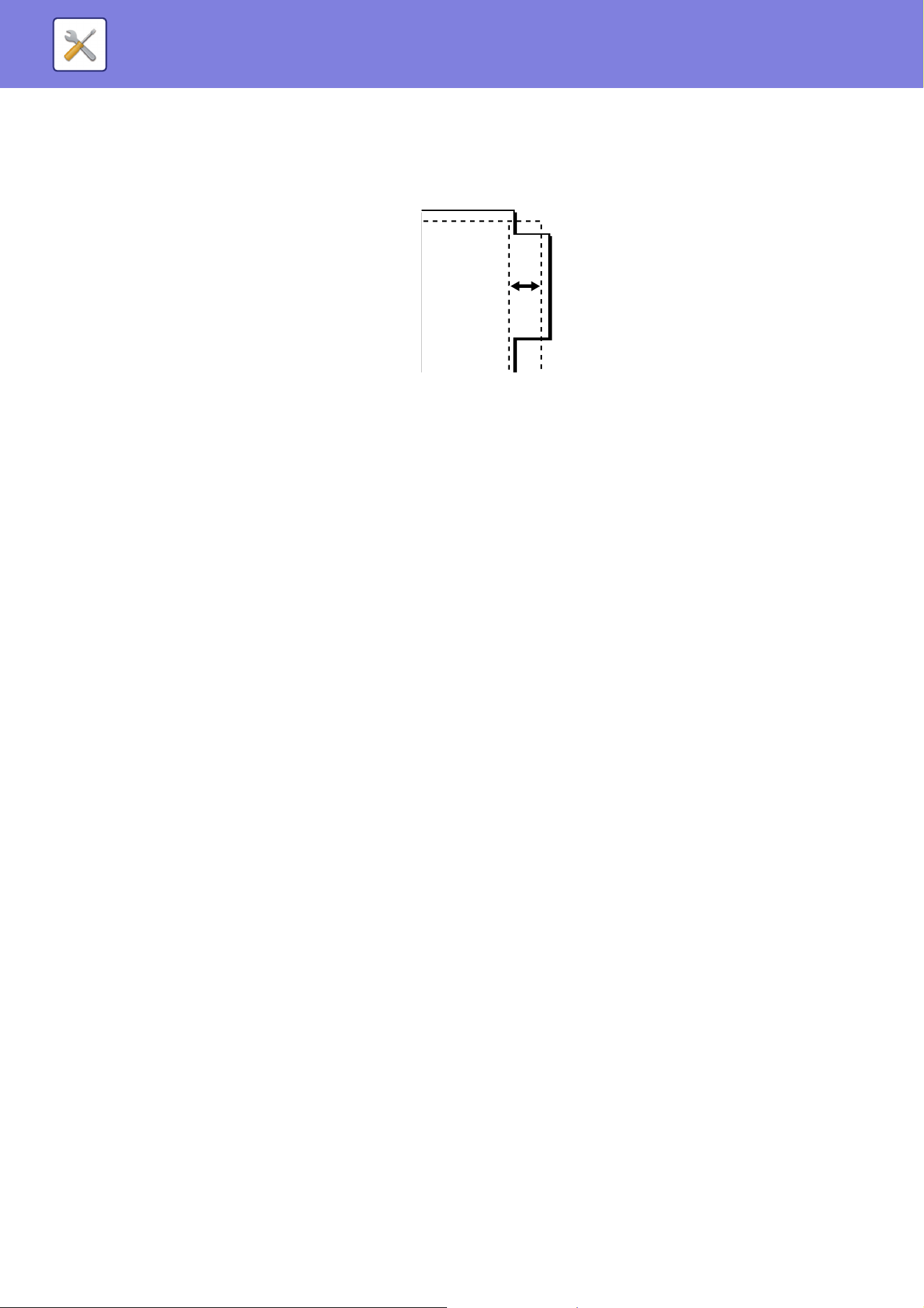
7-78
SYSTEM SETTINGS►SYSTEM SETTINGS
Initial Tab Copy Setting
This is used to set the default image shift width (tab width) for tab copying.
Specify a value from 0" (0 mm) to 1" (25 mm) in increments of 1/8" (3 mm).
Disabling of Registration/Deletion of Program
This is used to prohibit the deletion and change of copy settings stored in job programs.
Disabling of Bypass-Tray in Duplex Copy
Disables the use of the bypass tray when making 2-sided copies.
The bypass tray is often used to feed label sheets, transparency film, and other special media for which 2-sided copying
is prohibited. If a sheet of one of these special media enters the reversing unit, a misfeed or damage to the unit may
result. If special media for which 2-sided copying is prohibited is often used, it is recommended that you enable this
setting.
Disabling of Auto Paper Selection
Disables the Auto Paper Selection function.
When this setting is enabled, automatic selection of paper that is the same size as the original on the document glass or
in the automatic document feeder does not take place.
Auto Selection Setting of Tray that is Supplied the Paper
When this setting is enabled and paper is loaded into a tray while the machine is on standby in copy mode, that tray is
automatically selected.
Disabling Registration of Custom Image
Disables storage of a custom image.
Disabling sending while copying
Disables the Image Send function during copy.
7-79
SYSTEM SETTINGS►SYSTEM SETTINGS
High Quality Scan from Document Feeder (B/W)
The resolution for copying in black and white using the automatic document feeder can be changed from 600 x 400 dpi
to 600 x 600 dpi (high quality mode).
When high quality mode is used, fine print and thin lines are reproduced with greater clarity, however, the scanning speed
is slower.
Quick Scan from Document Glass (B/W)
The resolution for copying in black and white using the document glass can be changed from 600 x 600 dpi to 600 x 400
dpi (high speed mode).
When high speed mode is selected, the first copy time is quicker, however, the copy image is not as clear.
Auto Clear Before Copy Execution Also
Enables the Auto Clear function during copy even when a copy job is not completed. This protects the machine from
being held due to the incomplete copy job.
When high quality mode is not selected, the following conditions must be satisfied in order to scan at 600 x 400 dpi and attain
the fastest speed.
• The copy ratio must be set to 100%.
• Do not select a special mode that will change the ratio.
• [Copy of Copy] must not be enabled.
• Do not copy in black and white with the [Color Start] key.
When high quality mode is not selected, the following conditions must be satisfied in order to scan at 600 x 400 dpi and attain
the fastest speed.
• The copy ratio must be set to 100%.
• Do not select a special mode that will change the ratio.
• [Copy of Copy] must not be enabled.
• Do not copy in black and white with the [Color Start] key.
7-80
SYSTEM SETTINGS►SYSTEM SETTINGS
Initial Status Settings
The following settings are related to copying.
Initial Status Settings selected with these settings apply to all functions of the machine (not just the copy function).
The copier settings are reset to the initial state when the [Power] button is turned on, when the [CA] key is tapped, or
when the auto clear interval has elapsed. These settings are used to change the default settings for copy mode.
The following settings can be changed:
Text /Image Printing
Text Settings (Stamp)
You can add fixed text used in the [Stamp] in [Others] of copying.
Custom Stamp
You can set an image to be used in [Custom Stamp] in [Custom Image] of [Others] for copying.
Custom Watermark
You can set an image to be used in [Custom Watermark] in [Custom Image] of [Others] for copying.
Item Description
Color Mode Configure default color mode settings.
Image Orientation Specify the original orientation.
Paper Tray Specify the paper tray that is selected by default.
Exposure Type Configure default exposure mode settings.
Copy Ratio Specify the copy ratio that is selected by default.
2-Sided Copy
Configure the 2-sided mode settings that are selected by default.
If this setting is used to change the default setting for the duplex function to any setting
other than "1-Side to 1-Side" and the duplex function or automatic document feeder fails or
is disabled, the setting will revert to "1-Side to 1-Side".
Original Binding Set the original binding in 2-Sided copy.
Output Binding Set the output binding in 2-Sided copy.
Output Set the print output method and output tray that are selected by default.
Output Tray Specify the output tray.
Offset Set whether or not offset is performed in the default settings.
Separator Page
Separator pages can be inserted before or after jobs. Set the paper tray used for the
separator pages.
Staple Sort / Staple Position Configure staple and staple position settings.
Punch Configure punch settings.
Fold Configure fold settings.
Saddle Fold Configure saddle fold settings.
Paper Size for Z-Fold Sets the default paper size for Z-fold function.
C-Fold Configure C-fold settings.
Accordion Fold Configure accordion fold settings.
Double Fold Configure double fold settings.
Half Fold Configure half fold settings.
Trimming Width Settings Sets the default trimming width for trimmer function.
Factory defaults This returns all items to the factory default settings.

7-81
SYSTEM SETTINGS►SYSTEM SETTINGS
Printer Settings
Settings related to the printer function can be configured.
Condition Settings
Printer condition settings are described below.
Prohibit Notice Page Printing
Disables to print a notice page.
Prohibit Test Page Printing
Disables to print the test page.
When this setting is enabled, [Status] → [Data List] → [List for User] → [Printer Test Page] in "Settings" cannot be used
to print test pages.
A4/Letter Size Auto Change
When printing an 8-1/2" x 11" (letter) size image, this setting allows A4 size paper to be used if 8-1/2" x 11" size paper is
not loaded.
Bypass Tray Settings
Enable Detected Paper Size in Bypass Tray
This is used to prohibit printing when the paper size specified for a print job is different from the paper size inserted in
the bypass tray.
Enable Selected Paper Type in Bypass Tray
This is used to prohibit printing when the paper size specified for a print job is different from the paper size inserted in
the bypass tray.
Exclude Bypass-Tray from Auto Paper Select
When [Auto] is selected for paper type selection, the bypass tray is excluded from the trays that can be selected. This is
recommended when special paper is often placed in the bypass tray.
Job Spool Queuing
When this function is enabled, received print jobs are displayed in the spool queue of the job management screen. The
jobs are moved to the job queue after they have been analyzed by the machine.
Multiple jobs that have not yet been analyzed appear in the spool queue.
When this function is disabled, received print jobs are displayed in the job queue instead of being displayed in the spool
queue. However, when an encrypted PDF job is printed, the job appears in the spool queue.
Disabling of USB Memory Direct Print
Disables the function for directly printing of a file in a USB memory device.
Disabling of Network Folder Direct Print
Disables the direct printing from a network folder.
Disabling sending while printing
Disables the Image Send function during printing.
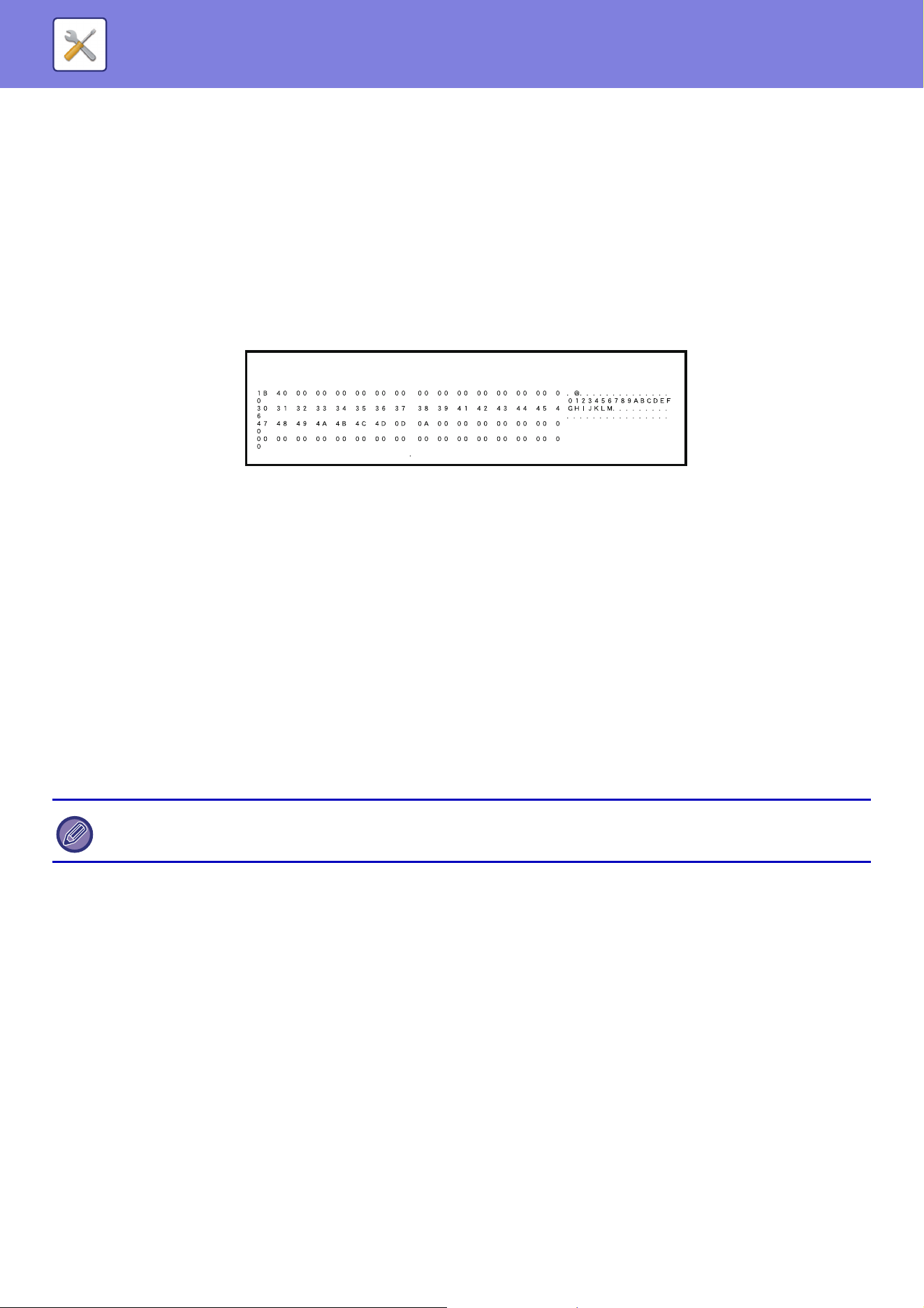
7-82
SYSTEM SETTINGS►SYSTEM SETTINGS
Interface Settings
Settings related to the printer function can be configured.
These settings are used to control and monitor data transmitted to the USB port or network port of the machine.
Hexadecimal Dump Mode
This function is used to print the print data from a computer in hexadecimal format together with the corresponding
ASCII text. This mode allows you to check whether or not print data from the PC is being transmitted to the printer
correctly.
Example of a hexadecimal dump
I/O Timeout
The I/O timeout can be set to any number of seconds from 1 to 999.
The I/O timeout function temporarily breaks the connection if the set duration of time elapses without any data being
received by the port. After the connection is broken, the port is set to auto selection or the next print job is begun.
Enable Network Port
Enables printing from the network port.
Network Port Emulation Switching
This setting is used to select the emulated printer language when the machine is connected by a network port.
The following settings can be configured.
•Auto
• PostScript
•PCL
Port Switching Method
Selects when port switching takes place.
Switch at End of Job
The port changes to auto selection when printing ends.
Switch after I/O Timeout
When the time set in "I/O Timeout" elapses, the port changes to Auto Selection.
Unless printer errors occur frequently, it is recommended that you use the factory default setting "Auto".
7-83
SYSTEM SETTINGS►SYSTEM SETTINGS
Initial Status Settings
If you print data in an environment where the printer driver is not used (that is, if you print data using the MS-DOS
system or if you print data using the PC that does not have the provided printer driver installed), set the detailed printing
conditions. (However, the "Disable Blank Page Print" function will be effective even when the PCL printer driver is used.)
Settings
Setup Items Description
Copies 1 - 9999 sets
Orientation
•Portrait
• Landscape
Paper Size Set the default paper size.
Output Tray Set the default delivery tray.
Paper Type Set the default paper type.
Resolution Setting
• 600dpi
• 600dpi (High Quality)
• 1200dpi
Disable Blank Page Print
• (Enabled)
• (Disabled)
2-Sided Print
• 1-Sided
• 2-Sided(Book)
• 2-Sided(Tablet)
Color Mode
•Auto
• Black & White
N-Up Print
*1
N-Up
•1-Up
•2-Up
•4-Up
•8-Up
Layout
• Left to Right
*2
• Right to Left
*2
• Right, and Down
*3
• Down, and Right
*3
• Left, and Down
*3
• Down, and Left
*3
Fit To Page
*4
• (Use Fit to Page)
• (Do not use Fit to Page)
Output
• (Use Print per Unit)
• (Do not use Print per Unit)
Separator Page
• Insert Before Job Paper Tray
• Insert After Job Paper Tray
Staple Sort • Staple Position
*5
: None, 1 Staple at Back, 2 Staples, 2 Staples (Top)
Punch
• (Use Punch)
*6
• (Do not use Punch)
*6
Fold*
7,
*
8
• Saddle Fold
*9
, Z-Fold
*9
, C-Fold
*9
, Accordion Fold
*9
, Double Fold
*9
, Half Fold
*9
7-84
SYSTEM SETTINGS►SYSTEM SETTINGS
*1 Paper sizes that can be used with this function are 11" x 17", 8-1/2" x 14", 8-1/2" x 11", A3, B4, and A4. (This
function may not take effect with some print methods.)
*2 Can be selected when 2-Up is selected.
*3 Can be selected when 4-Up/8-Up is selected.
*4 Only effective when printing PDF, JPEG, and TIFF files.
*5 When the finisher/saddle stitch finisher is installed.
*6 When finisher/saddle stitch finisher and punch module are installed.
*7 When the saddle stitch finisher is installed.
*8 When the folding unit is installed.
*9 Varies depending on the machine configuration.
Saddle Fold*
7
Print Side
• Outside, Inside
Fold Multiple Sheets Together
• (Do not use Fold Multiple Sheets Together)
• (Use Fold Multiple Sheets Together)
Paper Size for Z-Fold*
8
• 11" x 17", 8-1/2" x 14", 8-1/2" x 11"R, A3, B4, A4R
C-Fold*
8
Print Side
• Outside, Inside
Fold Orientation
• Open Left, Open Right
Accordion Fold*
8
Fold Orientation
• Open Left, Open Right
Double Fold*
8
Print Side
• Outside, Inside
Fold Orientation
• Open Left, Open Right
Half Fold*
8
Print Side
• Outside, Inside
Trimming Width Settings*
8
Adjust Trimming Width
• 2.0 mm to 20.0 mm
Quick File
• (Disabled)
• (Enabled)
Setup Items Description
7-85
SYSTEM SETTINGS►SYSTEM SETTINGS
PCL Settings
This is used to set the symbol sets, fonts, and line feed code used in a PCL environment.
Settings
PostScript Settings
When an error occurs during PostScript printing, these settings determine whether or not an error notice is printed and
whether or not the PostScript data is received in binary format.
OOXML Settings
To print an Excel file by direct print, select a sheet (with the part to be printed selected) or the entire book.
Print Release Settings
Select this option to use the E-mail printing. The memory area for saving print release jobs is 64 GB. For detailed
information, see "Print Release Settings Guide".
Setup Items Settings Setting
PCL Symbol Set Setting
Specify the symbol set used for printing. • Select from 35 items.
PCL Font Setting Select a font used for printing.
• Internal Font
• Extended Font
• (List of internal fonts when
extended fonts are not
installed.)
PCL Line Feed Code
This setting is used to select how the printer responds when a line
feed command is received.
• 0.CR=CR; LF=LF; FF=FF
• 1.CR=CR+LF;
LF=LF;FF=FF
• 2.CR=CR; LF=CR+LF;
FF=CR+FF
• 3.CR=CR+LF; LF=CR+LF;
FF=CR+FF
Wide A4
When this is enabled, 80 characters per line are printed on the
8-1/2" x 11" (A4) size paper using a 10-pitch font. (When this
setting is disabled, up to 78 characters are printed per line.)
• (Enabled)
• (Disabled)
Setup Items Settings Setting
Screen Settings Configure image settings for PostScript.
Standard, Text/Photo, Text,
Photo, Dot (High Line
Number), Dot (Low Line
Number)
Print PS Errors
When a PS (PostScript) error occurs during PostScript printing,
this setting determines whether or not an error notice is printed.
(Enabled)
(Disabled)
Binary Processing Configure image settings for PostScript.
(Enabled)
(Disabled)

7-86
SYSTEM SETTINGS►SYSTEM SETTINGS
E-mail Print Settings
Select this option to use the E-mail printing.
E-mail Print
Set whether or not E-mail print is performed.
POP3 Server
Set the POP3 server used for E-mail.
Port Number
Set the port number of the E-mail server.
POP Authentication
Set this to perform POP authentication for E-mail.
User Name
Set the E-mail user name.
Password
Set the password used for E-mail.
Check Interval
Set the automatic e-mail check frequency (polling interval).
Enable SSL
Use when SSL is used.
Direct Print Settings (FTP)
Configure these settings if you will be printing files on an FTP server by direct print.
A list of available FTP servers is shown. To add an FTP server, click the [Add] button and configure the settings.
FTP Server Registration
Configure FTP server settings.
Name
Set the name to be used for direct print.
FTP Server
Set the name of the FTP server.
Directory
Set the directory of the FTP server that has the files.
User Name
Set the user name used to log in to the FTP server.
Password
Set the password used to log in to the FTP server.
Enable SSL
Set to enable SSL.
Use PASV mode
Set to use PASV mode.

7-87
SYSTEM SETTINGS►SYSTEM SETTINGS
Direct Print Settings (Network Folder)
Configure these settings if you will be printing files on a network folder by direct print.
A list of available network folders is shown. To add a network folder, click the [Add] button and configure the settings.
Registration of Network Folder
Configure network folder settings.
Name
Set the name to be used for direct print.
Folder Path
Set the folder path that has the files.
User Name
Set the user name used to log in to the network folder.
Password
Set the password used to log in to the network folder.
Print Setting from PC/Mobile Terminal
Configure these settings to print files on a computer or mobile terminal by direct print.
FTP Print
Specify whether or not FTP print settings are used for direct print.
Port Number
Enter the port number used for direct print.
Use Banner
Specify whether or not a banner page showing print information is also printed.
7-88
SYSTEM SETTINGS►SYSTEM SETTINGS
Image Send Settings
Common Settings
Settings related to the image send function (E-mail, etc.) can be configured.
The operation settings below apply to all image send functions.
Condition Settings
Hold settings for a while after scanning has been completed
Use this setting to hold the settings after scanning is completed (until Auto Clear Mode activates).
Job Auto Start Time During Scanning
Set the time at which transmission is automatically started even if the original is still being scanned.
Default Display Setting
When resending by document filing or recalling by saved program settings that do not include an address, select from
the following 6 types of base screens that appear.
•E-Mail
• Network Folder
• FTP
• Data Entry
Address Book Default Selection
Higher priority is given to the display of address book.
If image send mode is enabled, the Address Book is displayed in place of the initial screen of this mode.
Apply Addresses of Sending Modes Only
When an address is selected from the address book, only the addresses displayed in narrowing mode are applied.
Category Displayed as Default
Select a category to be displayed with the default.
• None
• Frequent Use
• Categories 1 to 32
Display all address type regardless of the mode being displayed currently.
Displays all destinations regardless of the displayed mode when this setting is enabled.
Enlarge Address Book
An enlarged address book list appears.
Image Orientation
Sets the default image orientation.
Default Exposure Settings
This is used to set the default exposure settings for scanning a document in image send mode. Select [Auto] or
[Manual]. If you select [Manual], set the exposure to one of 5 levels.
In "Settings", if a default address has been configured by selecting [System Settings] → [Image Send Settings] → [Scan
Settings] → [Default Address] → [Default Address Setting], the [Higher priority is given to the display of address book.]
function cannot be used.
When the exposure is set to [Auto], a default original type cannot be selected.

7-89
SYSTEM SETTINGS►SYSTEM SETTINGS
Default Original Image Type
Select the original type beforehand to enable scanning at a resolution suitable for the original (only in scan mode and
USB memory device scan mode).
The following settings can be configured.
• Text/Printed Photo
• Text/Photo
•Text
•Photo
• Printed Photo
•Map
Be sure to press Next Address Key ([+]) before selecting the next address.
Set whether or not the Next Address ([+]) key must be pressed before an address is added for a multi-address job such
as broadcast transmission.
Scan Complete Sound Setting
Sets the scan complete sound to be heard when an original is scanned.
Disable Switching of Display Order
Disables to change the order of display (search number order, ascending, descending).
Once set, the display sequence is not changed. The display order will remain fixed at the order that is in effect when this
setting is enabled.
Default Verification Stamp
This is used to enable or disable the default setting. Enable this to always affix the verification stamp on the original that
has already been scanned using the automatic document feeder. Configure the setting for each of the following items:
• E-mail/Scan/Data Entry
Erase Width Adjustment
This is used to set the default erase width for erase function. Specify a value from 0" (0 mm) to 1" (25 mm) in increments
of 1/8" (3 mm) for both edge erase and center erase.
Enable/Disable Settings
Settings to Disable Registration
Storing from the machine, storing from Setting mode (Web version), and storing from the PC can each be separately
prohibited.
Disable Registering Destination from Operation Panel
Disables address control from the machine.
Configure the setting for each of the following items:
• Group (Direct Entry)
• Group (Address Book)
Select All: Selects all items.
Clear Checked: Clears all selections.

7-90
SYSTEM SETTINGS►SYSTEM SETTINGS
Disable Registering Destination on Web Page
Disables to store the destination from Setting mode (Web version).
Configure the setting for each of the following items:
• Group (Direct Entry)
• Group (Address Book)
• Contacts
Select All: Selects all items.
Clear Checked: Clears all selections.
Disable Registration/Delection of All Program Items
This is used to prohibit the deletion and changing of image send settings stored in job programs.
Disable Destination Registration Using Global Address Search
This disables address control from the global address search.
Configure the setting for each of the following items:
E-mail
Disabling of Forwarding via Network
This prohibits inbound routing.
Settings to Disable Transmission
These settings are used to disable the following transmission operations.
Disable [Resend] on Image Send Mode
This setting disables the [Resend] key in the base screen of image send mode.
Disable Selection from Address Book
Disables the selection of destinations from the address book.
Configure the setting for each of the following items:
•E-Mail
• FTP
• Network Folder
Select All: Selects all items.
Clear Checked: Clears all selections.
Disable Direct Entry
Disables the direct entry of destination address and others.
Configure the setting for each of the following items:
•E-Mail
• Network Folder
Select All: Selects all items.
Clear Checked: Clears all selections.
Disabling of PC Scan
This prohibits PC Scan transmission.
Disable Storing to External Memory Device
Disables to store to the external memory device.
Disabling of Find My Address
This prohibits Find My Address.
7-91
SYSTEM SETTINGS►SYSTEM SETTINGS
Scan Settings
Settings related to the image send function (E-Mail, FTP, etc.) can be configured.
Initial Status Settings
The following settings are related to the scanner.
Default Color Mode Settings
Select a default color mode setting for both color and black & white in e-mail address, network folder, and FTP. Specify
"Scanner Common" unless E-mail is specified.
Settings
Auto (Mono2, Grayscale
*
), Full Color, Grayscale, Mono2
* When scanning a black and white original with the color mode set to [Auto]
Disable Change of B/W Setting in Auto Mode: Disables black & white settings from the base screen when the color
mode is set to Auto.
Initial File Format Setting
Specify the initial file format for sending a file in E-mail, Network Folder, or FTP mode. Specify "Scanner Common"
unless E-mail is specified.
File Type
PDF, PDF/A, TIFF, JPEG
*
, Compact PDF, Compact PDF (Ultra Fine), Compact PDF/A, Compact PDF/A (Ultra Fine),
Encrypt PDF, Encrypt/Compact PDF, Encrypt/Compact PDF (Ultra Fine), XPS, RTF, TXT (UTF-8), DOCX, XLSX, PPTX
* When [Black & White] is selected, the format is [TIFF].
OCR
When the file format is PDF, characters in a scanned image are recognized and added to the PDF as text information.
Black & White
Compression Mode: None, MH (G3), MMR (G4)
Color/Grayscale
Data compression ratio: Low, Medium, High.
Bk Letter Emphasis
Specified Pages per File
Generates a separate file for each scanned page when multiple pages are scanned.
If this setting is enabled, a number of pages per file can be specified.
OCR Setting
Configure the settings that are required for OCR.
Font
Set the font used for each recognized character language.
Detect Image Direction
The orientation of the scanned original is automatically detected.
File Name Extraction
Extract the file name.
Specified Pages per File
Generates a separate file for each scanned page when multiple pages are scanned.
If this setting is enabled, a number of pages per file can be specified.
Page No.
Any number of pages can be specified as the number of pages per file. This setting can be used if [Specified Pages
per File] is enabled.
When [JPEG] is selected for the file type, [Specified Pages per File] cannot be selected.
7-92
SYSTEM SETTINGS►SYSTEM SETTINGS
Easy Scan Settings
Set the default color mode for Easy Scan.
Set [Color] for when the Color Start key is tapped, and [B/W] for when the B/W Start key is tapped.
Resolution Setting
The following settings are available for the default resolutions of common scan, and E-mail mode.
Scanner Common
100 X 100 dpi, 150 X 150 dpi, 200 X 200 dpi,
300 X 300 dpi, 400 X 400 dpi, 600 X 600 dpi
E-mail
100 X 100 dpi, 150 X 150 dpi, 200 X 200 dpi,
300 X 300 dpi, 400 X 400 dpi, 600 X 600 dpi
Apply the Resolution Set when Stored
When ON, the resolution set when the file was saved will be the default resolution for resending.
When OFF, the resolution set with "Resolution Setting" in the system settings will be the default resolution for resending.
Condition Settings
Default Reply.Address Set
The information stored here is used if you do not specify [Reply to] in the send settings when performing Scan to E-mail.
PDF Compression Options
Flate Compression
When sending a PDF file, you can compress the file by Flate Compression to reduce the file size.
Compression Mode at Broadcasting
Selects the compression mode for broadcasting using Scan to E-mail. The compression mode set here is used for all
destinations regardless of their individual compression mode settings.
Black & White
MH (G3), MMR (G4)
Color/Grayscale
Low, Medium, High
Bk Letter Emphasis
Send Destination Link Settings
Enable this to send only the URL of scanned data to the destination.
Enable Send Destination Link as Default
Enable this to always send only the URL of scanned data to the destination. When this function is enabled and you are
in simple mode, only the URL is sent to the e-mail address. When normal mode is used, the [Send Destination Link]
checkbox is always in the action panel that appears in the home screen of Scan to E-mail.
File Retention Period
Set the save period for scanned data saved in the machine when sending only the URL to the destination. When this
period elapses, the files are automatically deleted.
Enable SSL
Use this to protect files using SSL transmission.
Setup Items Setting
Color
Auto
Full Color
B/W
Grayscale
Mono2
7-93
SYSTEM SETTINGS►SYSTEM SETTINGS
Maximum Size of E-mail Attachments(E-Mail)
To prevent the transmission of excessively large image files by Scan to E-mail, a file size limit can be set from 1 MB to
10 MB in increments of 1 MB. If the total size of the image files created by scanning the original exceeds the limit, the
image files are discarded.
If you do not wish to set a limit, select [Unlimited].
If the E-mail attachment(s) exceed maximum size, it will be sent in multiple files.
If an E-mail attachment exceeds the maximum size, it will be sent in multiple files. If one of the divided files exceeds the
maximum size, it will be sent with the resolution automatically lowered.
When sending files in JPEG format, only one file is attached to one e-mail, regardless of the file size.
If a file scanned in TXT(UTF-8), RTF, DOCX, XLSX, or PPTX format exceeds the file size limit, the file will be discarded
without being sent even if this setting is selected.
Maximum Size of Data Attachments(FTP/Network Folder)
A limit can be set for the size of files that can be sent by Scan to FTP, and Scan to Network Folder. Limits that can be
selected are 50 MB, 150 MB, and 300 MB. If the total size of the image files created by scanning the original exceeds
the limit, the image files are discarded.
If you do not wish to set a limit, select [Unlimited].
Bcc Setting
Enable Bcc
Enable this setting if you wish to use Bcc delivery. Displays the [Bcc] key on the image send address book screen.
Display Bcc Address on the Job Management Screen
Displays Bcc addresses on the job management screen and address list tab.
• When a file scanned to a format other than TXT(UTF-8), RTF, DOCX, XLSX, or PPTX exceeds the size limit, this function
reduces the data size below the limit by lowering the resolution or other means, and thereby enables sending without
canceling the data.
• When multi-crop and card scan are used, the scanned data is not divided.
• If the e-mail exceeds the set size limit, a send error occurs.
During broadcasting that includes both e-mail destinations, the limit set in "Maximum Size of E-mail Attachments(E-Mail)
(page 7-93) " precedes.
7-94
SYSTEM SETTINGS►SYSTEM SETTINGS
Default Address
Default Address Setting
A default address can be stored that makes it possible to transmit by simply pressing the [Start] key (including the [Color
Start] key or the [B/W Start] key) without specifying an address. If [Apply E-mail address of the user for login.] is
selected, the E-mail address of the login user is set as the default destination. When [Apply Home Directory of The User
for Login] is selected, the default address is the home directory of the user that logged in.
When the user logs in by internal authentication (authentication by the machine), the home directory setting of the user
that logged in is configured in "User Registration" in "User List" in "User Control". When the user logs in by external
authentication (network authentication), the home directory setting is configured in "Global Address Book Settings" in
"LDAP Settings" in "Network Settings".
Add Selected
Select an address that is to be used by default.
Apply E-mail address of the user for login.
The E-mail address of the login user is set as the default address.
Select [Allow cancel of the first entered address] based on your intended use.
Apply Home Directory of The User for Login
The home directory of the login user is set as the default address.
Select [Allow cancel of the first entered address] based on your intended use.
Select From Address Book
• To display your desired address book, narrow the search by alphabet or category with the list of [Index]. You can
select the number of addresses that are to be displayed at a time with [Display Items].
• When you select the desired address name and tap the [Store] key, the selected address can be selected for the
default address.
Allow cancel of the first entered address
You can cancel the E-mail address of the login user that is entered automatically. To cancel, tap the [x] button next to
the address entry field.
When this setting is disabled, selection of an address other than the entered default address is prohibited.
Administration Settings
Advanced Settings
Disable Selection of Reply-to.
Prohibit select of transmission destinations.
File Naming
You can select the information included in the name of scanned files.
Unit Serial Number
You can add the machine's serial number to the file name.
Text
You can add any text to the file name. (Up to 64 characters)
Sender Name
You can add the sender's name to the file name.
Date & Time
You can add the date and time of transmission to the file name.
Only a single default address can be set for Scan to E-mail, Scan to FTP, and Scan to Network Folder.
If an e-mail address is not set for the logged-in user, scanner transmission cannot be used.

7-95
SYSTEM SETTINGS►SYSTEM SETTINGS
Session Page Counter
You can add counter information to the file name.
Unique Identifier
An ID number can be created for each file and added to the file name.
Note: To prevent duplicate file names, select Date or Unique Identifier.
Default Subject
Set a maximum of 80 characters for the default subject for E-mail transmission.
Add Job Information Automatically to the Mail Message Body
You can automatically add job information to the body message of e-mail.
Add a Footer Automatically to the Mail Message Body
You can add any text as a footer to the body message of e-mail.
Mail Footer Registration
When [Add a Footer Automatically to the Mail Message Body] is enabled, set a maximum of 900 characters for the footer.
Subject Name Settings
You can save a preset subject for transmitted files. Click the [Add] key and set a maximum of 80 characters for the subject.
File Name Settings
You can save a preset file name for transmitted files. Click the [Add] key and set a maximum of 80 characters for the file
name.
Message Body Settings
You can save a preset e-mail subject and body message (fixed text). Click the [Add] key and set a maximum of 80
characters for the subject, and a maximum of 1800 characters for the body message (fixed text).
7-96
SYSTEM SETTINGS►SYSTEM SETTINGS
Metadata Settings
If the Application Integration Kit is installed, you can control the metadata to be used in other applications.
The stored metadata is displayed on the metadata settings page. You can add a metadata, and edit or delete an existing
metadata.
• [Add] key
Adds a new metadata set.
• List
Lists the currently stored metadata sets.
Metadata Delivery
Enables or disables the metadata delivery function.
Metadata Set Registration
When you tap the [Add] key, the registration screen appears. Up to 10 items can be stored.
For information on the settings, see "Settings (page 7-96)
".
Edit or Delete Metadata Set
When you tap a title on the list, the edit screen appears for that metadata set.
Tap the [Delete] key to delete the metadata set.
Settings
Item Settings
Metadata Set Name Enter a metadata name.
Metadata Destination Select a destination where you wish to send the image and metadata.
Allow Custom Filenames
Enable or disable to edit the name of image file and XML file to be sent by the metadata
send job.
Address Type Allowing Metadata
Entry
Set the destination information to be used for metadata transmission.
Name Enter a metadata name to be displayed on the touch panel.
XML Tag Name XML Tag Name
Entry Type
• Direct entry: Allows direct entry of each metadata from the soft keyboard or the numeric
keypad.
• Metadata list: Allows a selection of metadata from the previously entered data list. You
must enter optional values for metadata selection in the input area. Entries must be
separated by semicolons or commas. Each option can be comprised of up to 70
characters.
• Initial entry by default: Uses a default value as the first value of the entered metadata list.
Include MFP Extended Scan
Settings in XML File.
When the machine generates metadata automatically, the "metadataSetName",
"userLoginId" (if user authentication is used), "pageSize", and "imageMode" are added to
the metadata.
To Be Used as Default The current metadata set is used as the default.
7-97
SYSTEM SETTINGS►SYSTEM SETTINGS
Document Filing Settings
Condition Settings
Document filing settings are described below.
Select [Document Filing Settings] to configure the settings.
Default Mode Settings
Specifies which mode, Sharing or Confidential, is used as the default mode when storing a file.
When [Confidential Mode] is selected, the [Confidential] checkbox is set to on the information screen for filing.
Sort Method Setting
Selects an order of display files stored in the Main Folder, Custom Folder, and Quick File Folder. Select one of the
following settings:
• File Name
• User Name
•Date
Administrator Authority Setting
For files and user folders that have a password, this setting allows the administrator password to be entered instead of
the password when accessing the file or folder.
Also, you can change the preset ratio if necessary.
Delete All Quick Files
Deletes all files from the Quick File folder except for protected files.
Delete
Tap this key to start deletion of all files immediately.
Delete quick files at power up. (Protected files excluded)
This is used to automatically delete all files in the Quick File Folder (with the exception of protected files) when the
[Power] button is turned "On".
Image Orientation
Changes the image orientation.
Default Color Mode Settings
Selects the default settings for black & white and color when Scan to HDD is used.
The following settings can be configured.
•Auto
• Full Color
• Grayscale
• Mono2
Disable Change of B/W Setting in Auto Mode
This setting disables selection of B/W settings from the base screen when the color mode is set to Auto.
Default Exposure Settings
Default exposure settings for document filing can be configured.
Select [Auto] or [Manual].
If you select [Manual], set the exposure to one of 5 levels.
The condition of the machine may prevent deletion in some cases.
7-98
SYSTEM SETTINGS►SYSTEM SETTINGS
Default Original Image Type
Select the original type beforehand to enable scanning at a resolution suitable for the original.
The following settings can be configured.
• Text/Printed Photo
• Text/Photo
•Text
•Photo
• Printed Photo
•Map
Initial Resolution Setting
One of the following resolutions can be selected for the default resolution for transmission.
• 100x100dpi
• 150x150dpi
• 200x200dpi
• 300x300dpi
• 400x400dpi
• 600x600dpi
Scan Complete Sound Setting
Adjusts the volume of the beep that sounds when scanning ends. The beep can also be turned off.
Default Output Tray
Selects the default output tray for printing a file stored by Scan to HDD.
The items that appear will vary depending the machine configuration.
Disable Text/Stamp functions for Reprinting
When a stored file is retrieved and printed, the printing functions are disabled.
This function prevents an inconsistency of the date between the original data and output data and others.
Batch Print Settings
Set whether or not the [All Users] key and the [User Unknown] key are prohibited in the user name selection screen
when printing all files, whether files are sorted by date in newest or oldest order, and whether file names are sorted in
ascending or descending order.
Erase Width Adjustment
This is used to set the default erase width for erase function.
Specify a value from 0" (0 mm) to 1" (25 mm) in increments of 1/8" (3 mm) for both edge erase and center erase.
Card Shot Settings
This is used to set the default original size for the card shot function.
Specify a value from 1" (25 mm) to 8-1/2" (216 mm) in increments of 1/8" (3 mm) for both the X (horizontal) and Y
(vertical) dimensions of the original.
Fit to Store Size
Always displays the [Fit to Store Size] key on the card shot screen.
Setting of store/delete after file print
Select whether or not to save or delete a file after printing.
Default Setting of PDF Format for PC Browsing
You can set the initial file format of public PDF or the file for download which is created during execution of each job.
B/W: Compression Mode
None, MH (G3), MMR (G4)
When the exposure is set to [Auto], a default original type cannot be selected.
7-99
SYSTEM SETTINGS►SYSTEM SETTINGS
Color / Grayscale: Compression Ratio
Low, Medium, High
Settings during each job execution
When each of copy, printer, scanner, or stored scan data is executed, you can specify to create a public PDF and to set
the resolution of public PDF.
Document Output Options
The use of a stored file can be allowed or prohibited by operation type and by the mode from which the file was stored.
Document Filing Control
The registration method is the same as for a custom folder.
► Custom Folder (page 7-50)
Automatic Deletion of File Settings
Document filing settings are described below. Tap the [Document Filing Settings] key to configure the settings.
Time and folder settings can be configured to have files in specified folders (stored by document filing) automatically
deleted at a specified time. Up to 3 settings can be stored to be automatically deleted.
The procedure for using this function is as follows:
(1) Select [Setting 1], [Setting 2], or [Setting 3].
(2) Set the time and date for automatic deletion.
(3) Select the desired folder.
(4) Specify whether or not protected files and confidential files are to be deleted.
(5) Enable the stored settings.
Delete Now
When this is executed with a folder selected, all files in the folder will be immediately deleted regardless of the date and
time setting.
The items that appear will vary depending on the functions that have been added to the machine.
Item Settings
Copy For each mode, select whether or not copying of stored files is allowed.
Print For each mode, select whether or not printing of stored files is allowed.
Scan Send For each mode, select whether or not scanning transmission of stored files is allowed.
Scan to HDD For each mode, select whether or not stored files is allowed.
Item Settings
Schedule
Select an automatic deletion cycle.
• Every Day: Auto deletion every day at the specified time.
• Every Week: Auto deletion at the specified time on the specified day of the week.
• Every Month: Auto deletion at the specified time on the specified day of the month.
Folders
To select the folder separately, select [Folder Select] and select the desired folder. To
select all folders, including the folder currently being created, select [All Folders (Including
folders registered hereafter)].
Delete Protected File Enable this setting to include protected files in the deletion.
Delete Confidential File Enable this setting to include confidential files in the deletion.
7-100
SYSTEM SETTINGS►SYSTEM SETTINGS
Execute Auto Delete Setting at Auto Power Shut-Off
(If this is not selected, the files will be deleted after the machine wakes from auto power shutoff mode.)
Execute Auto Deletion even if Auto Power Shut-Off is enabled. When the checkbox is not selected ( ), the files will be
deleted after the machine wakes from auto power shutoff mode.
Sharp OSA Settings
Condition Settings
Cookie Setting
Specify how application cookies are handled when using an application in Sharp OSA.
When "Hold Cookie" is selected, the machine holds cookies that are used in an application.
When "Not hold Cookie" is selected, cookies are not held when an application is used.
Delete Cookie
Delete cookies held by the machine.
Standard Application Settings
The standard application settings can be added and controlled.
• [Add] key
Adds a new standard application.
• [Delete] key
Delete the selected standard application.
•List
Lists the currently stored standard applications.
Store Standard Application
When you tap the [Add] key, the registration screen appears. Up to 16 items can be stored.
For information on the settings, see the following table.
Edit or Delete Standard Application
When you tap an application name on the list, the edit screen appears for that standard application.
Tap the [Delete] key to delete the standard application.
7-101
SYSTEM SETTINGS►SYSTEM SETTINGS
Standard Application Registration
* These functions can be set only in the Web page.
External Accounting Application Settings
An external account application can be added and controlled.
Set the server name where you have installed the external accounting application.
Item Settings
Application Name Enter an application name.
Address for Application UI Set an IP address of the application or a network name to control the UI of the machine.
Timeout Enter a timeout. The default setting is 20 seconds.
Browser Select the Web browser type.
Extended Platform Set this option to use the expansion platform.
Data Size Set the screen size of application.
Use Custom Icon* Select whether or not custom icon is used.
File Name* Reports file name.
Select File* Please enter File Name.
Item Settings
External Account Control
Enable the totalling function by the external accounting application.
If enabled, always enter the application name or Web service address.
Set Authentication Server (Server
1)
If the server is set, the external authentication mode is selected. Any access to the MFP is
controlled by the application that you set on this page. If set, always enter the application
name, application UI address, or Web service address of server 1.
If not set, the external totalling mode is selected.
Server 1-4 Set to enable each of the servers.
Application Name Enter an application name.
Address for Application UI Enter the URL of the login screen to be accessed first when the machine is turned on.
Address for Web Service
Enter the URL of the server or computer which sends commands and events by
XML/SOAP protocol.
Timeout Enter a timeout. The default setting is 20 seconds.
Browser Select the Web browser type.
Extended Platform Set this option to use the expansion platform.
Data Size Set the screen size of application.
Cache User Information
Select the cache period of user information when offline mode is enabled. For information
on offline mode, consult your service technician.
E-mail Address
Enter the address to which a notification e-mail is sent when an application connection error
occurs.
Body Text Enter the body message that appears in the notification e-mail for connection errors.
7-102
SYSTEM SETTINGS►SYSTEM SETTINGS
Embedded Application Settings
Store and manage “embedded applications” that are installed in the machine.
• [Add] key
Adds a new embedded application.
•List
Lists the currently installed embedded applications.
Install Embedded Application
When you tap the [Add] key, the registration screen appears. Up to 16 items can be installed.
Store Embedded Application
By storing an already installed embedded application in “standard application”, the application can be used. Select the
application name checkbox and tap the [Add Standard Applications] key.
Delete Embedded Application
Tap an application name in the list to display the information of that standard application.
After checking the information, delete the standard application with the [Delete] key.
Polling Setting
When linked to an external application, you can store and manage addresses in order to use a service that uses a
polling function.
• When installing from the operation panel of the machine, the files in the USB memory connected to the machine are
installed. When installing from the Web page, the files in the computer are installed.
• The maximum area of the hard disk that applications can use is 2 GB. If previously installed applications are already using
2 GB of area, a new application cannot be installed.
Item Settings
Server 1 - Server 2 Set to enable each of the servers.
Polling Address Enter the URL of the server or computer that the machine will poll.
Check Interval Enter the check interval for the server. The default is 1 minute.
Timeout Set the timeout time. The default setting is 20 seconds.
7-103
SYSTEM SETTINGS►SYSTEM SETTINGS
Common Settings
Paper Settings
Paper Tray Settings
Paper tray and paper type settings are explained in this section.
These settings specify the paper type, paper size, and functions allowed for each paper tray.
When [Paper Tray Settings] is selected, a list appears showing the trays and the current settings.
Auto Switching of Tray
When a tray runs out of paper during printing, this determines whether or not another tray with the same size and type of
paper is automatically selected and printing continues.
Display Paper Tray Settings when bypass tray detects paper.
You can have the paper tray settings appear automatically when paper is detected in the bypass tray.
Settings of each tray
When the [Change] key is tapped, the corresponding setting screen appears.
The following settings can be configured.
List name Description
Type
Select a type of paper to be loaded into the tray.
The paper types that can be selected vary by paper tray. For more information, see "Tray
Settings (page 7-104)".
To user type setup, see "Paper Type Registration (page 7-113)
".
Size
Select the paper size from the list. The paper sizes that can be selected vary by tray. The
sizes that can be selected may also be restricted by the paper type selected above. For
more information, see "Tray Settings (page 7-104)
".
If the desired size does not appear in the list, select [Custom Size] and directly enter the
size (only for the bypass tray). For more information, see "Tray Settings (page 7-104)
".
Sending Address List
Select the modes that can be used. If there is a function that you do not wish to be used
with the selected tray, disable the function.
• If the paper size specified here is different from the size of paper that is loaded into a tray, a problem or misfeed may occur
when printing.
• To change the paper size in a tray, see "LOADING PAPER (page 1-60)
".
• Paper properties such as "Fixed Paper Side" are automatically set when the paper type is selected. The paper tray
properties cannot be changed in this screen.
• If [System Settings] in "Settings" → [Common Settings] → [Device Control] → [Disabling of Tray Settings] is selected, the
tray settings (except for the bypass tray) cannot be configured.
• Tray settings can only be changed in setting mode of the machine.
7-104
SYSTEM SETTINGS►SYSTEM SETTINGS
Tray Settings
Paper Tray Paper Type Size
Tray 1
Plain Paper 1 to 2*
1
,
Recycled, Color, Letter
Head, Pre-Printed,
Pre-Punched, User Type
8-1/2" x 11", A4
Tray 2
Plain Paper 1 to 2*
1
,
Recycled, Color, Letter
Head, Pre-Printed,
Pre-Punched, User Type
8-1/2" x 11", A4
Tray 3
Plain Paper 1 to 2*
1
,
Recycled, Color, Letter
Head, Pre-Printed,
Pre-Punched, Heavy Paper
1 to 2*
2
, User Type
Auto-Inch (12" x 18", 11" x 17", 8-1/2" x 14", 8-1/2" x 11",
8-1/2" x 11"R, 7-1/4" x 10-1/2"R),
Auto-AB (A3W, A3, B4, A4, A4R, B5, B5R, 8-1/2" x 13"
(216 x 330 mm)*
3
),
9" x 12" (A4W), 8-1/2" x 13-1/2" (216 x 343 mm)*
3
, 8-1/2" x 13-2/5"
(216 x 340 mm)*
3
), 8K, 16K, 16KR
Tray 4
Plain Paper 1 to 2*
1
,
Recycled, Color, Letter
Head, Pre-Printed,
Pre-Punched, Heavy Paper
1 to 2*
2
, Embossed, Tab
Paper, Transparencies,
Labels, User Type
Auto-Inch (12" x 18", 11" x 17", 8-1/2" x 14", 8-1/2" x 11",
8-1/2" x 11"R, 7-1/4" x 10-1/2"R, 5-1/2" x 8-1/2"R),
Auto-AB (A3W, A3, B4, A4, A4R, B5, B5R, A5R, 8-1/2" x 13"
(216 x 330 mm)*
3
),
9" x 12" (A4W), 8-1/2" x 13-1/2" (216 x 343 mm)*
3
, 8-1/2" x 13-2/5"
(216 x 340 mm)*
3
), 8K, 16K, 16KR, custom size
Tray 5 (when a large
capacity tray (MX-LC12)
is installed)
Plain Paper 1 to 2*
1
,
Recycled, Color, Letter
Head, Pre-Printed,
Pre-Punched, Heavy Paper
1 to 2*
2
, User Type
8-1/2" x 11", A4, B5
Tray 5 (when a large
capacity tray
(MX-LCX3 N) is
installed)
Plain Paper 1 to 2*
1
,
Recycled, Color, Letter
Head, Pre-Printed,
Pre-Punched, Heavy Paper
1 to 2*
2
, User Type
13" x 19", 11"×17", 8-1/2" x 14", 8-1/2" x 13" (216 x 330 mm),
8-1/2" x 11", 8-1/2" x 11"R, A3, B4, A4, A4R, B5, 12" x 18" (A3W)
Tray 5/7 (when a large
capacity trays are
installed)
Plain Paper 1 to 2*
1
,
Recycled, Color, Letter
Head, Pre-Printed,
Pre-Punched, Thin Paper,
Heavy Paper 1 to 4*
2
,
Embossed, Tab Paper,
Transparencies, Labels,
Glossy Paper, User Type
Auto-Inch (13" x 19", 12" x 18", 9" x 12", 11" x 17", 8-1/2" x 14"*
3
,
8-1/2" x 13-1/2" (216 x 343 mm)*
3
, 8-1/2" x 13-2/5"
(216 x 340 mm)*
3
, 8-1/2" x 11", 8-1/2" x 11"R, 7-1/4" x 10-1/2"R,
SRA3, A3W, A3, B4, SRA4, A4W, A4, B5),
Auto-AB (SRA3, A3W, A3, B4, SRA4, A4W, A4, A4R, B5, B5R,
13" x 19", 12" x 18", 11" x 17", 8-1/2" x 13-1/2" (216 x 343 mm)*
3
,
8-1/2" x 13-2/5" (216 x 340 mm)*
3
, 8-1/2" x 13" (216 x 330 mm)*
3
,
8-1/2" x 11"),
8K, 16K, 16KR, custom size
Tray 6/8 (when a large
capacity trays are
installed)
Plain Paper 1 to 2*
1
,
Recycled, Color, Letter
Head, Pre-Printed,
Pre-Punched, Thin Paper,
Heavy Paper 1 to 4*
2
,
Embossed, Tab Paper,
Transparencies, Labels,
Glossy Paper, User Type
Auto-Inch (13" x 19", 12" x 18", 9" x 12", 11" x 17", 8-1/2" x 14"*
3
,
8-1/2" x 13-1/2" (216 x 343 mm)*
3
, 8-1/2" x 13-2/5"
(216 x 340 mm)*
3
, 8-1/2" x 11", 8-1/2" x 11"R, 7-1/4" x 10-1/2"R,
SRA3, A3W, A3, B4, SRA4, A4W, A4, B5),
Auto-AB (SRA3, A3W, A3, B4, SRA4, A4W, A4, A4R, B5, B5R,
13" x 19", 12" x 18", 11" x 17", 8-1/2" x 13-1/2" (216 x 343 mm)*
3
,
8-1/2" x 13-2/5" (216 x 340 mm)*
3
, 8-1/2" x 13" (216 x 330 mm)*
3
,
8-1/2" x 11"),
8K, 16K, 16KR, custom size
7-105
SYSTEM SETTINGS►SYSTEM SETTINGS
*1 Plain Paper 1: 16 to 24 lbs bond (60 to 89g/m
2
)
Plain Paper 2: 24 to 28 lbs bond (90 to 105g/m
2
)
*2 Heavy paper 1: 28 lbs bond to 65 lbs cover (106 g/m
2
to 176 g/m
2
)
Heavy paper 2: 65 lbs cover to 80 lbs cover (177 g/m
2
to 220 g/m
2
)
Heavy paper 3: 80 lbs cover to 140 lbs index (221 g/m
2
to 256 g/m
2
)
Heavy paper 4: 140 lbs index to 110 lbs cover (257 g/m
2
to 300 g/m
2
)
*3 The size that is automatically detected is set in "Select Paper Sizes for Auto Detection (page 7-106)
" in the bypass
tray settings screen.
Bypass tray
(on the machine)
Plain Paper 1 to 2*
1
,
Recycled, Color, Letter
Head, Pre-Printed,
Pre-Punched, Thin Paper,
Heavy Paper 1 to 4*
2
,
Embossed, Envelope, Tab
Paper, Transparencies,
Labels, Glossy Paper, User
Type
Auto-Inch (13" x 19", 12" x 18", 11" x 17", 8-1/2" x 14"*
3
,
8-1/2" x 13-1/2" (216 x 343 mm)*
3
, 8-1/2" x 13-2/5"
(216 x 340 mm)*
3
, 8-1/2" x 11", 8-1/2" x 11"R, 7-1/4" x 10-1/2"R,
5-1/2" x 8-1/2"R*
3
, SRA3, A3, B4, SRA4, A4, B5),
Auto-AB (SRA3, A3W, A3, B4, SRA4, A4, A4R*
3
, B5, B5R, A5R,
13" x 19", 11" x 17", 8-1/2" x 13-1/2" (216 x 343 mm)*
3
,
8-1/2" x 13-2/5" (216 x 340 mm)*
3
, 8-1/2" x 13" (216 x 330 mm),
8-1/2" x 11"),
Monarch, COM-9, COM-10, DL, C4, C5, C6,
9" x 12" (A4W), 8K, 16K, 16KR, custom size
Bypass tray (on the
large capacity trays)
Plain Paper 1 to 2*
1
,
Recycled, Color, Letter
Head, Pre-Printed,
Pre-Punched, Thin Paper,
Heavy Paper 1 to 2*
2
, Tab
Paper, Transparencies, User
Type
Auto-Inch (12" x 18", 11" x 17", 9" x 12", 8-1/2" x 14",
8-1/2" x 13-1/2" (216 x 343 mm)*
3
, 8-1/2" x 13-2/5"
(216 x 340 mm)*
3
, 8-1/2" x 11", 8-1/2" x 11"R*
3
,
7-1/4" x 10-1/2"R, 5-1/2" x 8-1/2"R, A3, B4, A4),
Auto-AB (A3W, A3, B4, A4W, A4, A4R*
3
, B5, B5R, A5R,
11" x 17", 8-1/2" x 13-1/2" (216 x 343 mm)*
3
, 8-1/2" x 13-2/5"
(216 x 340 mm)*
3
, 8-1/2" x 13" (216 x 330 mm)*
3
, 8-1/2" x 11"),
13" x 19", SRA3, SRA4, 8K, 16K, 16KR, custom size
Inserter (Upper tray)
Plain Paper 1 to 2*
1
,
Recycled, Color, Letter
Head, Pre-Printed,
Pre-Punched, Heavy Paper
1 to 2*
2
, User Type
Auto-Inch (12" x 18", 9" x 12", 11" x 17", 8-1/2" x 14"*
3
,
8-1/2" x 13-1/2" (216 x 343 mm)*
3
, 8-1/2" x 13-2/5"
(216 x 340 mm)*
3
, 8-1/2" x 11", 8-1/2" x 11"R*
3
, 7-1/4" x 10-1/2"R,
5-1/2" x 8-1/2"R, A3, B4, A4W, A4),
Auto-AB (A3W, A3, B4, A4W, A4, A4R*
3
, B5, B5R, A5R,
11" x 17", 8-1/2" x 13-1/2" (216 x 343 mm)*
3
, 8-1/2" x 13-2/5"
(216 x 340 mm)*
3
, 8-1/2" x 13" (216 x 330 mm)*
3
, 8-1/2" x 11"),
13" x 19", SRA3, SRA4, A5, 8K, 16K, 16KR, custom size
Inserter (Lower tray)
Plain Paper 1 to 2*1,
Recycled, Color, Letter
Head, Pre-Printed,
Pre-Punched, Heavy Paper
1 to 2*
2
, User Type
Auto-Inch (12" x 18", 9" x 12", 11" x 17", 8-1/2" x 14"*
3
,
8-1/2" x 13-1/2" (216 x 343 mm)*
3
, 8-1/2" x 13-2/5"
(216 x 340 mm)*
3
, 8-1/2" x 11", 8-1/2" x 11"R*
3
, 7-1/4" x 10-1/2"R,
5-1/2" x 8-1/2"R, A3, B4, A4W, A4),
Auto-AB (A3W, A3, B4, A4W, A4, A4R*
3
, B5, B5R, A5R,
11" x 17", 8-1/2" x 13-1/2" (216 x 343 mm)*
3
, 8-1/2" x 13-2/5"
(216 x 340 mm)*
3
, 8-1/2" x 13" (216 x 330 mm)*
3
, 8-1/2" x 11"),
13" x 19", SRA3, SRA4, A5, 8K, 16K, 16KR, custom size
Paper Tray Paper Type Size
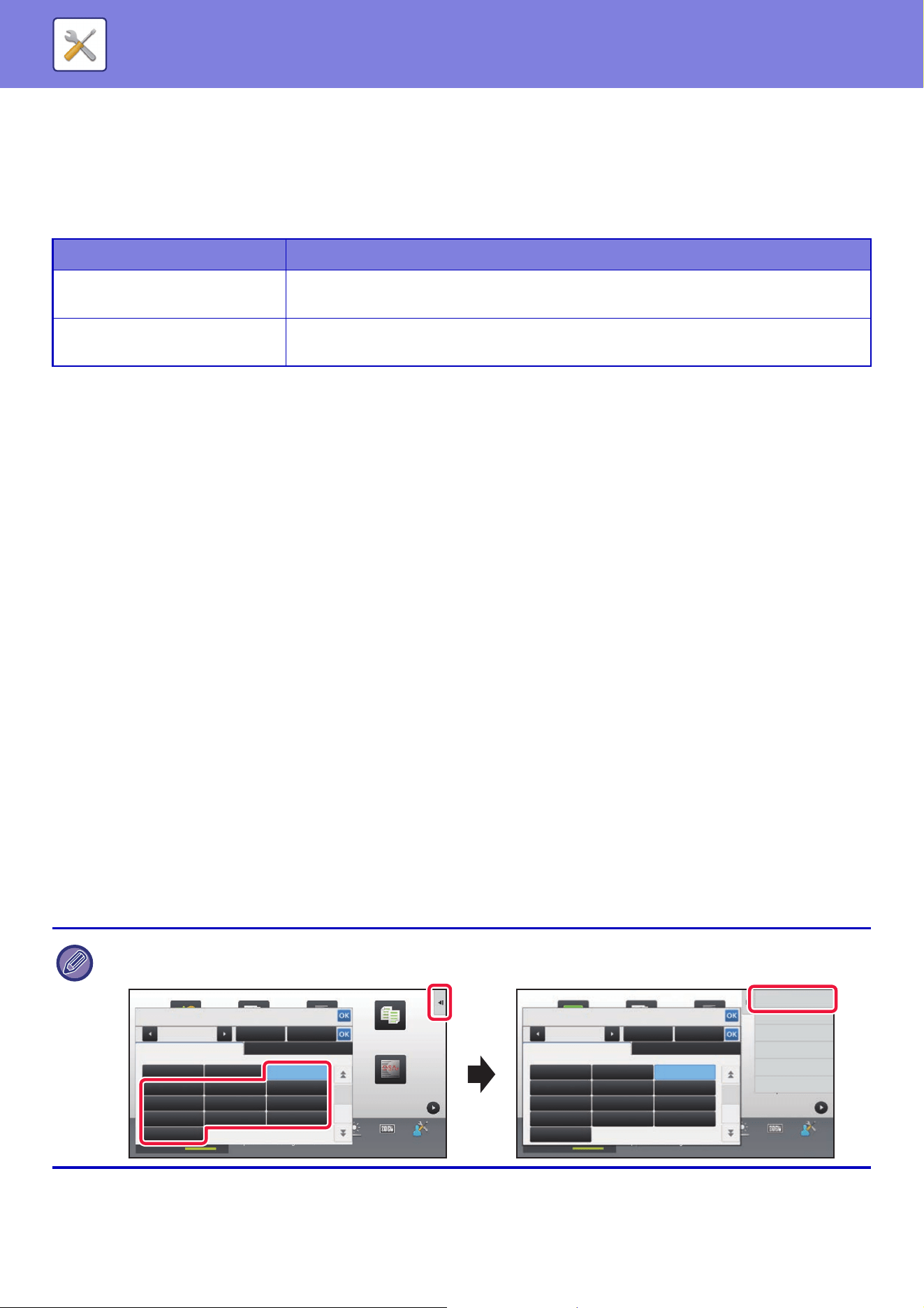
7-106
SYSTEM SETTINGS►SYSTEM SETTINGS
Select Paper Sizes for Auto Detection
"Select Paper Sizes for Auto Detection" in the bypass tray settings screen is used to select the paper size that is
automatically detected from similar sizes when the automatic paper size detection takes place.
Select one of two sizes when "Auto-Inch" is set. Select one of five sizes when "Auto-AB" is set.
When paper that is the same size as one of the paper sizes in the settings is placed in the bypass tray, the size that is
selected in the settings will be automatically detected.
*
This size cannot be set for some trays.
Custom Size Registration (Bypass)
Bypass tray and paper type settings are explained in this section.
If you frequently use a non-standard size paper in the bypass tray, register that paper size in advance.
Registering the paper size saves you the trouble of setting the size each time you need to use it.
Up to Seven paper sizes can be registered.
Tap the key ([Custom 1] to [Custom 7]) in which you wish to register or change a paper size, and the registration screen
appears.
Select whether you wish to enter the size in mm ("Size Input-AB") or inches ("Size Input-Inch"), and then set the X and Y
dimensions of the paper.
"Size Input-AB"
The X direction can be set between 140mm and 457mm. The factory default setting is 420mm.
The Y direction can be set between 90mm and 320mm. The factory default setting is 297mm.
"Size Input-Inch"
The X direction can be set between 5-1/2" and 18". The factory default setting is 17".
The Y direction can be set between 3-5/8" and 12-1/2". The factory default setting is 11".
Paper Settings
When [Add] is tapped in Paper Settings selection in the paper tray settings, the Paper Settings registration screen
appears. By selecting advanced settings in Paper Properties for the paper to be used, you can print using the most
suitable conditions for the printed mater.
A maximum of 1000 properties can be registered.
List name Description
Auto-Inch
8-1/2" x 14", 8-1/2" x 13-2/5" (216 mm x 340 mm), 8-1/2" x 13-1/2" (216 mm x 343 mm),
8-1/2" x 11"R
*
Auto-AB
8-1/2" x 13" (216 mm x 330 mm), 8-1/2" x 13-2/5" (216 mm x 340 mm), 8-1/2" x 13-1/2"
(216 mm x 343 mm), A4R
*
The Paper Settings can also be set from Tray Settings/Paper Settings in the Home screen. Select User Type for the paper
type selection, and tap "Add/Edit Paper Settings" in the action panel.
10:15 AM
Job Management
Toner Quantity
M
C
Bk
Y
Tray Settings/
Paper Settings
Scan to HDD Batch Print Sharp OSA
Manual
Finishing
HDD
File retrieve
Operation
Guide
PC Scan Total Count Machine
Adjustment
LCD Control
Settings
Copy
Y
Operation
Guide
PC Scan Total Count Machine
Adjustment
LCD Control
Settings
Add/Edit Paper Settings
Add Paper Property
Edit Home
MFP Display Pattern
Settings
Change Text Color
On Home Screen
Tray Settings
Feeding
Approved Job
Glossy Paper User Type 1
User Type 2 User Type 3 User Type 4
User Type 5 User Type 6 User Type 7
User Type 8
User Type 11
User Type 9 User Type 10
Embossed
Type: User Type 1
Please Select Paper Type.
Size: Auto-Inch
Paper Property
Bypass
Tray Settings
Feeding
Approved Job
Glossy Paper User Type 1
User Type 2 User Type 3 User Type 4
User Type 5 User Type 6 User Type 7
User Type 8
User Type 11
User Type 9 User Type 10
Embossed
Type: User Type 1
Please Select Paper Type.
Size: Auto-Inch
Paper Property
Bypass
7-107
SYSTEM SETTINGS►SYSTEM SETTINGS
Item Description
Name Enter a name for the Paper Settings (maximum of 50 half or full width characters).
Search Number Set a search number.
[Default Settings] tab
Paper Weight Setting Set the paper weight to be used.
Unit Set the units used for the Paper Weight.
Paper Type
Set the paper type.
Select the paper type based on the surface finish of the paper or select the envelope.
The following types can be selected.
• Uncoated Paper
• Coated Paper (Gloss)
• Coated Paper (Matt)
• Embossed
• Envelope
Paper Information Set when Color paper, Tab Paper, or Pre-Punched paper is used.
Paper Property
Set the properties of the paper to be used.
For the properties, refer to the settings in "Paper Type Registration".
[Detail] tab
Fusing Temperature Settings Set the appropriate fusing unit temperature for the paper to be used.
Fuser Pressure Setting
Adjust the pressure on the paper.
Some types of paper such as thick paper may not bend easily, and this may cause
transfer deviations.
You can use this setting to adjust the pressure on the paper and reduce transfer
deviations.
Double Feed Detection Setting
Specify whether double feeds are detected. This function cannot be used when paper
heavier than 68 lbs. (256 g/m
2
) is used.
Primary Transfer Current Value
Setting
Set the current of the primary transfer unit that is used to transfer toner to the transfer belt.
By adjusting the current of the primary transfer unit, transfer problems such as insufficient
transfer to the transfer belt can be improved.
Select settings for both black & white and 4 color (black, cyan, magenta, yellow).
Secondary Transfer Current Value
Setting
Set the current of the secondary transfer unit that is used to transfer toner from the
transfer belt to the paper. By adjusting the current of the secondary transfer unit, transfer
problems such as insufficient transfer to the paper can be improved.
When Uncoated Paper is selected for [Paper Type]
Set for the Side 1 and Side 2 for both black & white and color.
When other than Uncoated Paper is selected for [Paper Type]
Select settings for both black & white and color.
PTC Current Value Setting
Set the PTC discharge current. The PTC discharge current can be adjusted to obtain
transferability suitable for the paper being used.
When Embossed is selected for the [Paper Type]
Set for both black & white and color.
When other than Embossed is selected for [Paper Type]
Set for black & white and color at the same time.
Transfer Condition Adjustment
Setting
Set enable/disable of transfer environment correction of Primary Transfer Current Value,
Secondary Transfer Current Value and PTC Current Value.
Motor Speed Setting You can adjust the motor speed and the speed change timing.
Registration Adjustment This performs registration adjustment.
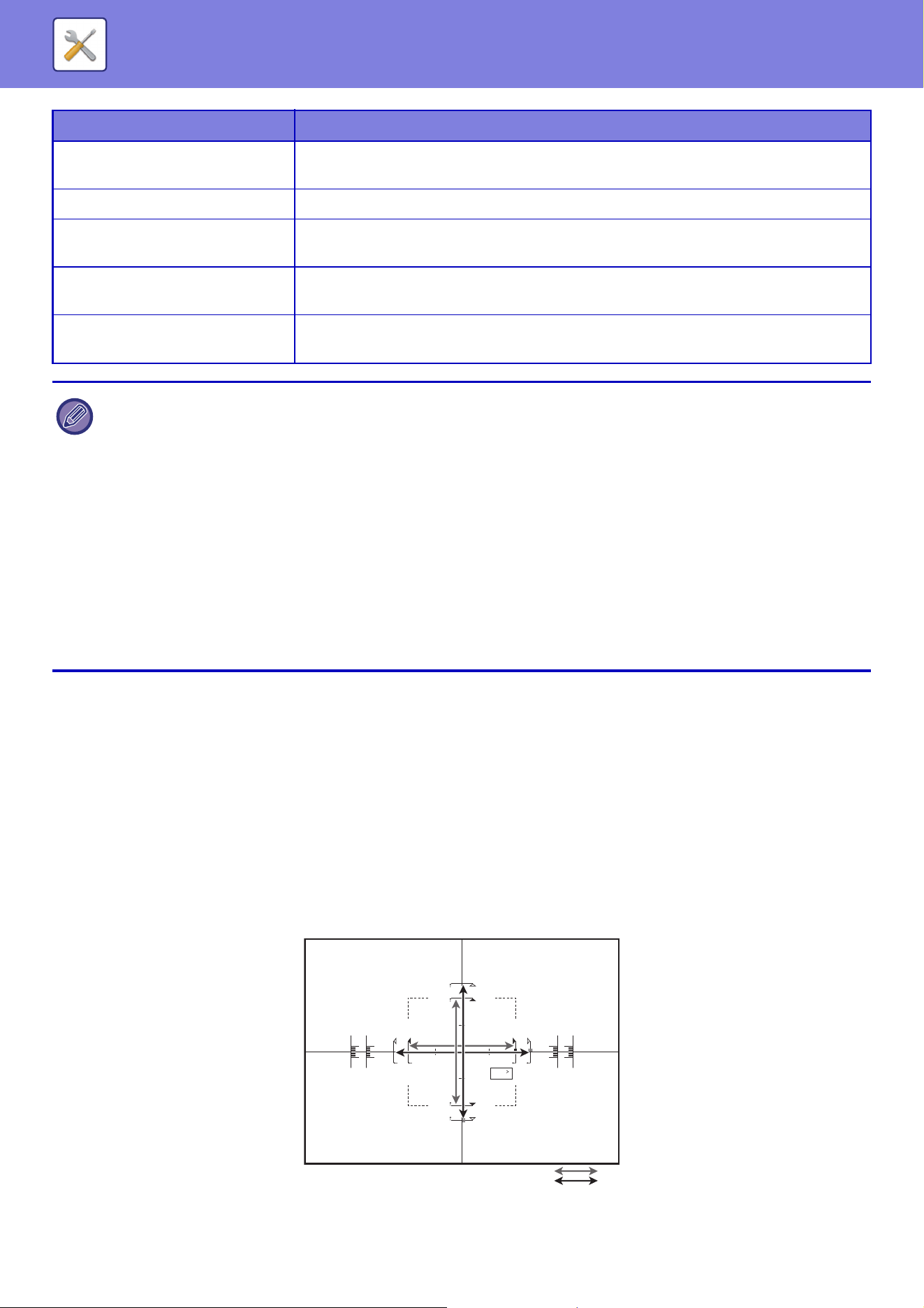
7-108
SYSTEM SETTINGS►SYSTEM SETTINGS
Side1/2, XY Ratio Settings / Side1/2, XY Print Position
Side1/2, XY Ratio Settings
The Side1/2, XY Ratio Settings are used to eliminate print deviation by changing the Side 1/Side 2 ratio so that the print
sizes match.
Tap [Change] in the Side1/2, XY Ratio Settings to display the advanced settings screen of the Side1/2, XY Ratio
Settings
(1) Print a test pattern
Before starting, print a test pattern from [Test Print] in Side1/2, XY Ratio Settings. One page of patterns for settings are printed
by duplex printing.
For the measurement patterns, refer to “Measurement patterns for Side1/2, XY Ratio Settings / Side1/2, XY Print Position”.
(2) Calculate the values from the pattern and enter the values.
Paper Reg. Adjustment
You need to bend the paper to print at the correct position on the paper.
This function adjusts the proper amount of deflection.
Maximum Density Setting This performs the adjustment of maximum density for each of Y/M/C/K.
Side1/2, XY Ratio Settings
Configure settings to equalize the size of the image in duplex printing. This adjusts the
size of the image on the Side 1 and Side 2 sides of the paper.
Side1/2, XY Print Position
Configure settings to make the Side 1 and Side 2 centers match in duplex printing. This
corrects Side 1 and Side 2 misalignment.
Print Void Settings
Adjust void areas at the top, bottom, and front/rear direction (leading and trailing ends) of
the paper.
• Depending on the tray being used, there may be restrictions on the setting options that can be selected, or a setting may
not be possible.
• The parameters that can be set vary depending on the peripheral devices that are installed.
• The Side1/2, XY Ratio Settings can only be selected when the machine is used as a printer.
• The characteristics of some paper types may not provide a suitable printing result.
• When "Envelope" is selected for the paper type, the below settings are fixed and cannot be changed.
• Paper Weight Setting
• Paper Information
• Paper Property
• Fuser Pressure Setting
• Double Feed Detection Setting
• Motor Speed Setting
• Side1/2, XY Ratio Settings
• Side1/2, XY Print Position
Item Description
Y +6 -6 mm
Y +6 -6 mm
Y +6 -6 mm
Y +6 -6 mm
X1 X1 X2 X2
Front
(Side1)
Y2
+1 -1
Y2 Y1 Y1
/10 mm : %(X) /5’’ : %(X)
-1+1
/5’’ :
100%
/100mm :
100%
AB
(a-1)
(b-1)
(a-2)
(b-2)
Inch
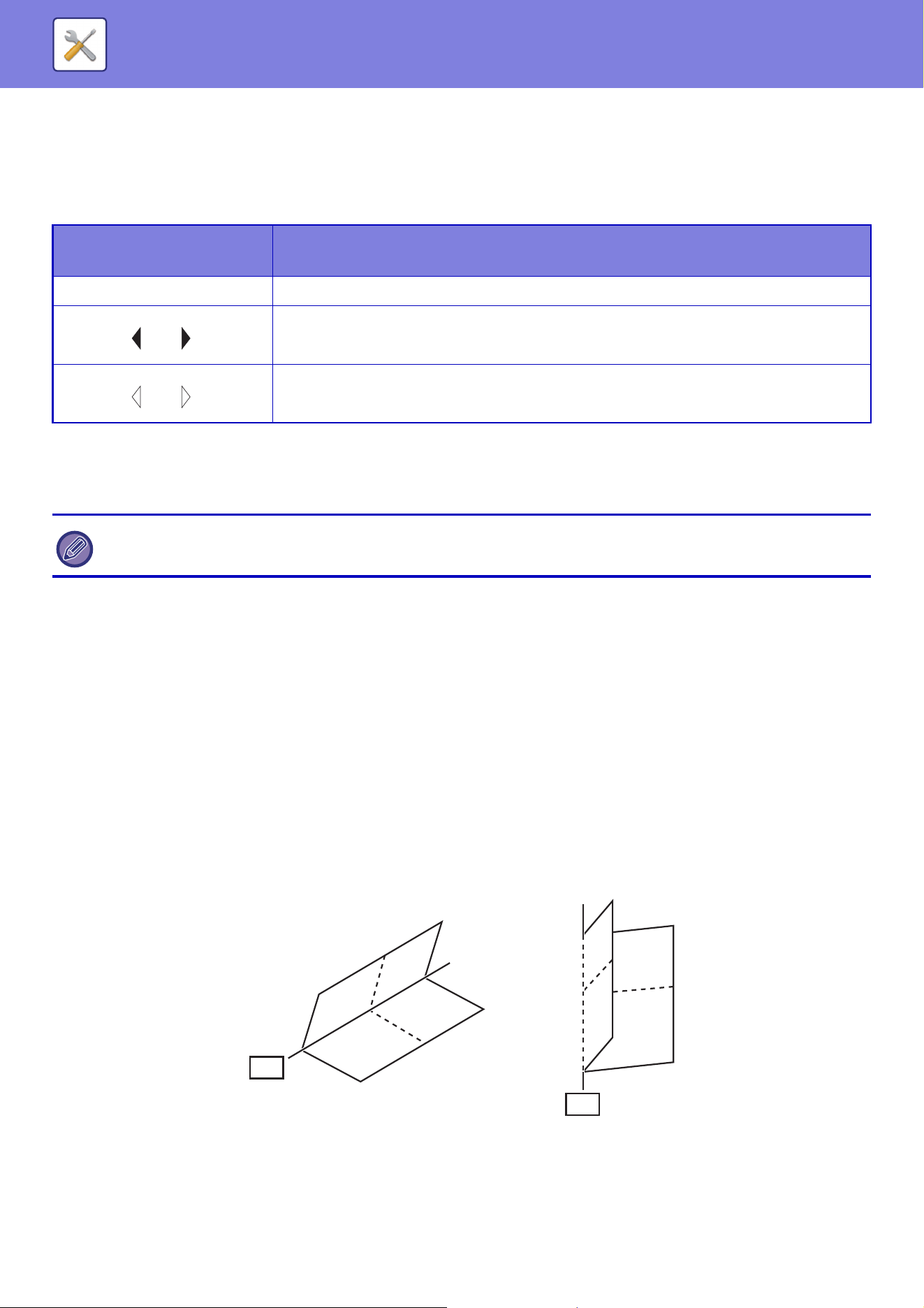
7-109
SYSTEM SETTINGS►SYSTEM SETTINGS
[AB sizes]
Measure the length of (a-1) in mm. Divide 10000 by the measured length of (a-1), and enter that value in [Y] for the Side 1.
Measure the length of (b-1) in mm. Divide 10000 by the measured length of (b-1), and enter that value in [X] for the Side 1.
[Inch sizes]
Measure the length of (a-2) in inches. Divide 500 by the measured length of (a-2), and enter that value in [Y] for the Side 1.
Measure the length of (b-2) in inches. Divide 500 by the measured length of (b-2), and enter that value in [X] for the Side 1.
(3) Tap [OK].
(4) Return to step 1 and check the result of adjustment.
If the size has deviated as a result of adjustment, repeat adjustment until the deviation is eliminated.
Side1/2, XY Print Position Settings
The Side1/2, XY Print Position Settings are used to make the centers of the Side 1 and Side 2 print positions match to
remove printing misalignment.
Tap the [Change] button in Side1/2, XY Print Position Settings to display the advanced settings screen of Side1/2, XY
Print Position Settings.
(1) Select the units used in the Side1/2, XY Print Position Settings
Tap [mm] to select the units used for the settings.
(2) Print a test pattern
Before starting, print a test pattern from [Test Print] in Side 1/2, XY Print Position. One page of patterns for settings are printed
by duplex printing.
For information on the measurement patterns, refer to "Measurement patterns for Side1/2, XY Ratio Settings / Side1/2, XY Print
Position Settings".
(3) Read the scale from the patterns and enter the values.
Fold the sheet in half with the center in the horizontal and vertical direction as folding lines respectively and put creases at both
ends, then unfold to return.
Measure the crease position of X and Y by scale for Side1 and Side2 respectively and input the values.
If the values of both ends are different, the average value should be input.
Measurement Line
(Measurement Marker)
Length specified by measurement line interval
Assistant Line 50 mm (1.969 inch)
100 mm
5 inch
• If the print position has shifted due to these settings, configure the Side1/2, XY Print Position Settings.
• The Side1/2, XY Ratio Settings can only be used when the machine is used as a printer.
Y
X
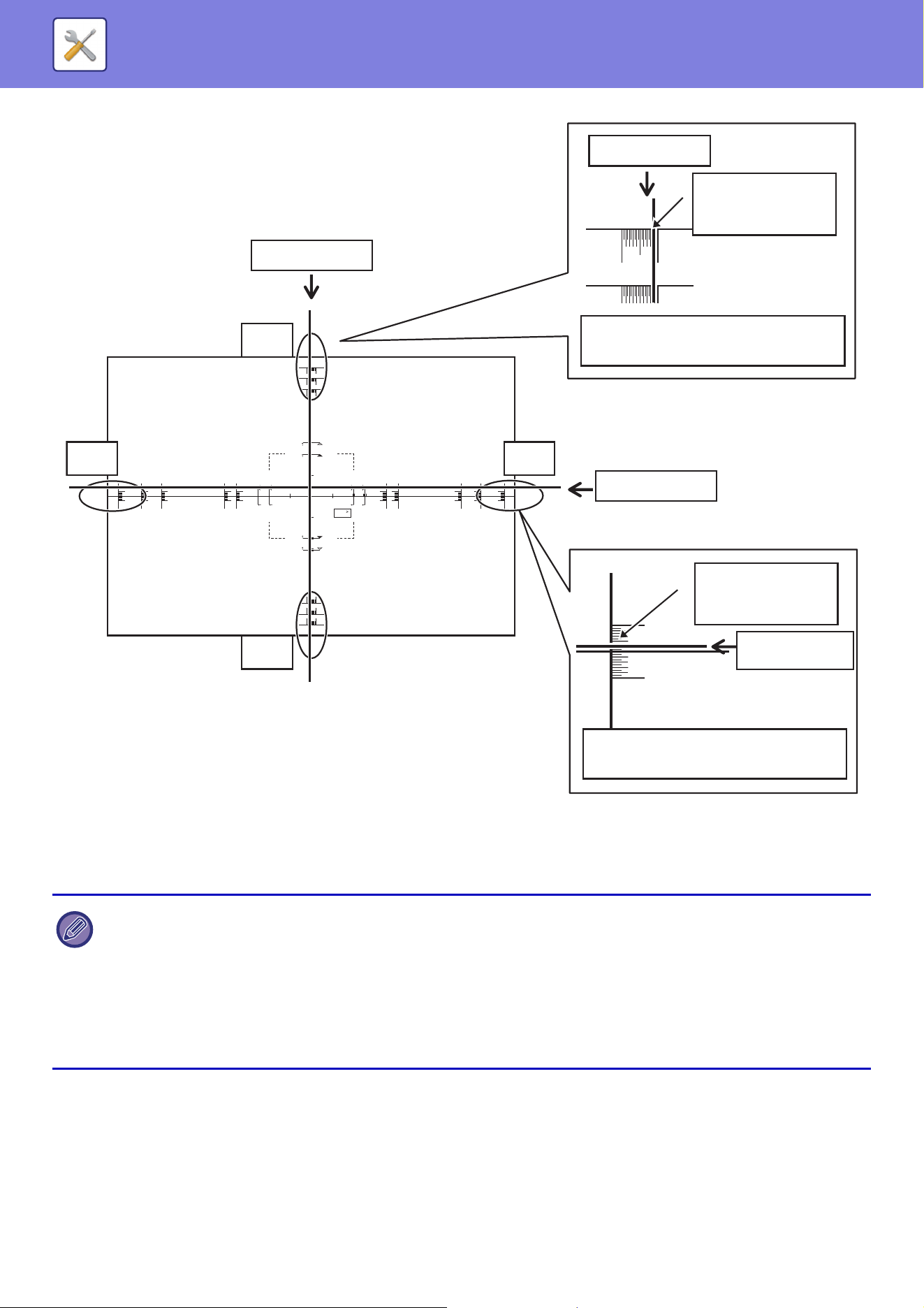
7-110
SYSTEM SETTINGS►SYSTEM SETTINGS
(4) Tap [OK].
(5) Return to step 2 and check the result of adjustment.
If the size has deviated as a result of adjustment, repeat adjustment until the deviation is eliminated.
• The measurement line content of the measurement pattern varies depending on the paper size. Measure from the
measurement line closest to the edge of the paper.
• It may not be possible to guarantee the operation adjustment range in the Y direction of (± 3 mm) depending on the
machine settings or paper size.
• When the vertical or horizontal width is 100 mm or less, measure from the assistant line.
• If you need to use this setting together with the Side1/2, XY Ratio Settings, specify the Side1/2, XY Ratio Settings first.
• Changes in the environment of the machine, such as humidity and temperature, may cause a deviation of about 1 mm in
the Side1/2, XY Print Position.
X +5 -5 mm
X +5 -5 mm
X +5 -5 mm
X +5 -5 mm
X +5 -5 mm
X +5 -5 mm
Y +6 -6 mm
Y +6 -6 mm
Y +6 -6 mm
Y +6 -6 mm
Y +6 -6 mm
Y +6 -6 mm
Y +6 -6 mm
Y +6 -6 mm
Y +6 -6 mm
Y +6 -6 mm
X1 X1 X2 X2
Front
(Side1)
Y2
+1 -1
Y2 Y1 Y1
/10 mm : %(X) /5’’ : %(X)
-1+1
/5’’ :
100%
/100mm :
100%
X +5 -5 mm
X +5 -5 mm
Y +5 -5 mm
Folding Line
YY
X
X
Folding Line
Read the scale
(Ex.)X=-2
Read the scale
(Ex.)Y=+1m
Fold line is at+side: Input plus value
Fold line is at-side: Input minus value
Fold line is at+side: Input plus value
Fold line is at-side: Input minus value
Folding Line
Folding Line
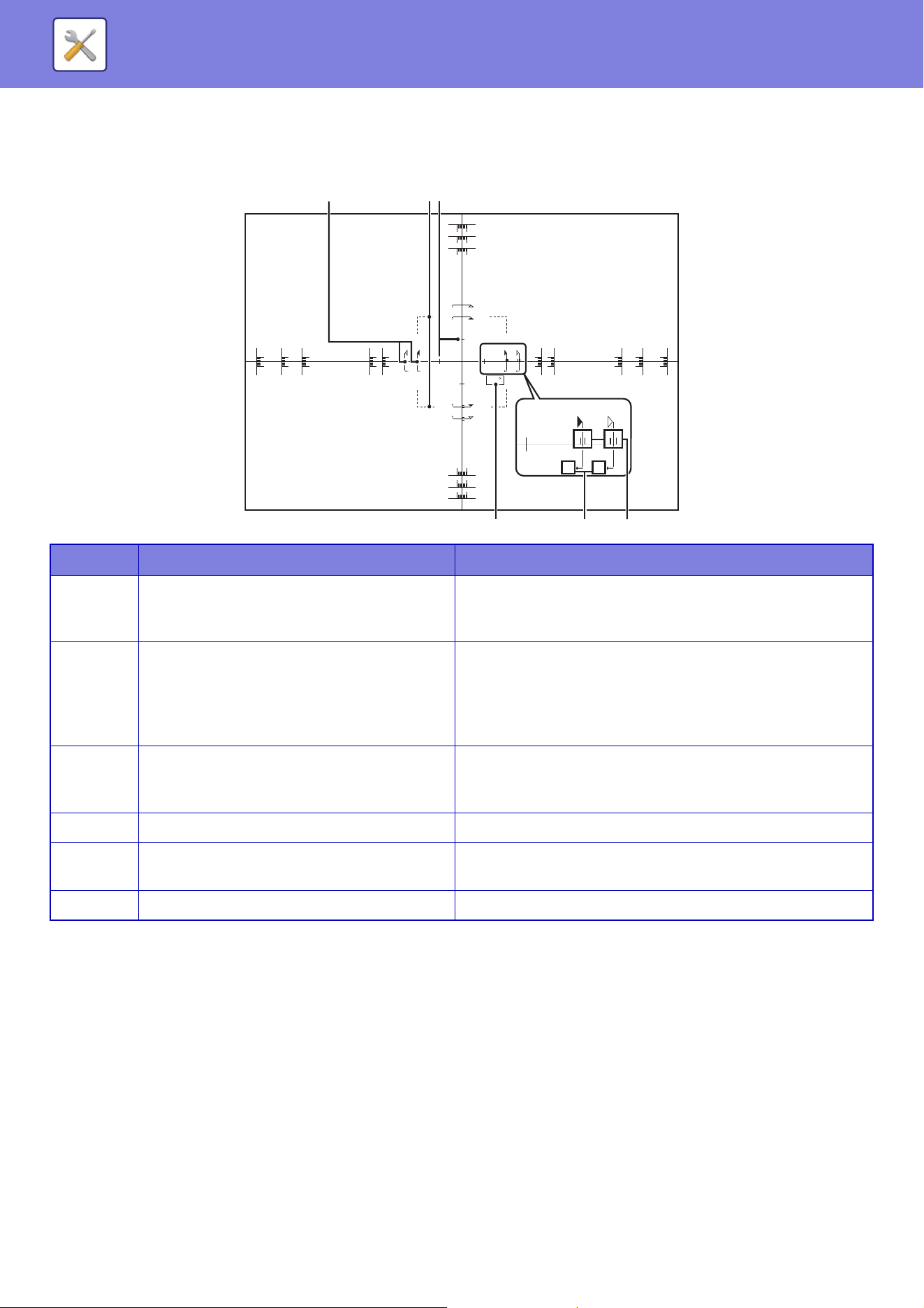
7-111
SYSTEM SETTINGS►SYSTEM SETTINGS
Measurement patterns for Side1/2, XY Ratio Settings / Side1/2, XY Print Position Settings
To specify Side1/2, XY Print Position Settings and Side1/2, XY Ratio Settings, print a pattern for measurement.
Content of the measurement pattern
The same measurement pattern content is printed at the same size, regardless of the paper size. The outer perimeter of
the measurement pattern is trimmed to match the paper size.
No. Item Description
1 Measurement Line
Reference line for measurement.
Measurement lines for AB sizes and inch sizes have been
created.
2 Dot Line
This line is visible through the Side 1 and Side 2 to let you
visually check for misalignment. The line is printed at the same
position on the Side 1 and Side 2. If visual inspection reveals
that the lines are not aligned, the print positions on the Side 1
and Side 2 are not aligned.
3 Assistant Line
Assistant line located 25 mm from the center of the paper.
When the paper size is 100 mm or less, use this line for
measurement.
4 Notes (Side 1/Side 2) These indicate the Side 1 and Side 2.
5 Notes (X/Y axis)
When entering the settings, these indicate the X and Y axes of
the paper.
6 Assistant Line (Magnification) Indicates a position that is ±1% of the measured distance.
X +5 -5 mm
X +5 -5 mm
X +5 -5 mm
X +5 -5 mm
X +5 -5 mm
X +5 -5 mm
Y +6 -6 mm
Y +6 -6 mm
Y +6 -6 mm
Y +6 -6 mm
Y +6 -6 mm
Y +6 -6 mm
Y +6 -6 mm
Y +6 -6 mm
Y +6 -6 mm
Y +6 -6 mm
X1 X1 X2 X2
Front
(Side1)
Y2
+1 -1
Y2 Y1 Y1
/10 mm : %(X) /5’’ : %(X)
/10 mm : %(X) /5’’ : %(X)
-1+1
/5’’ :
100%
/100mm :
100%
X2 X2
-1+1
(1) (2)(3)
(4)
(5) (6)
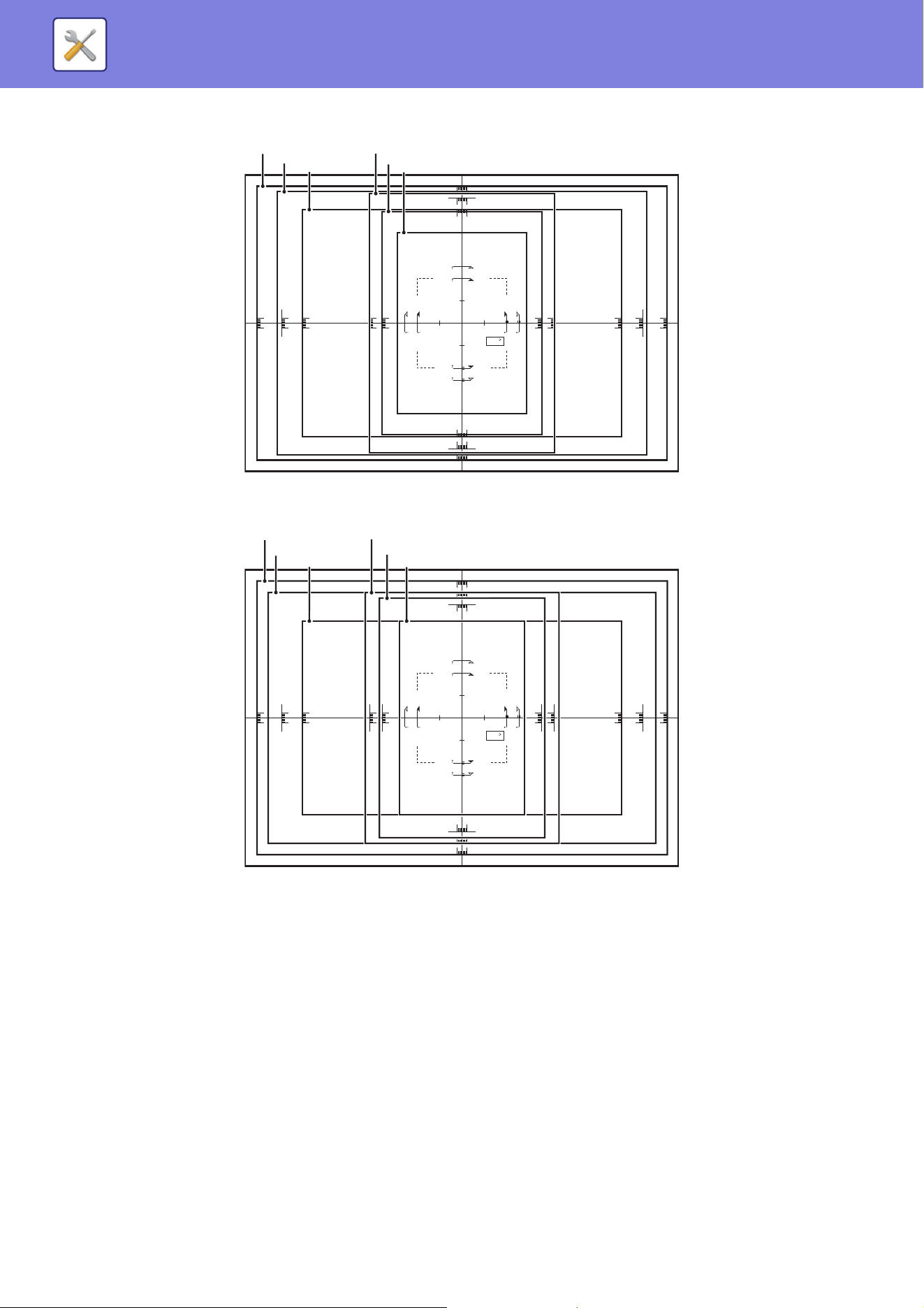
7-112
SYSTEM SETTINGS►SYSTEM SETTINGS
Example: Content trimmed for an AB size
Example: Content trimmed for an inch size
X +5 -5 mm
X +5 -5 mm
X +5 -5 mm
X +5 -5 mm
X +5 -5 mm
X +5 -5 mm
Y +6 -6 mm
Y +6 -6 mm
Y +6 -6 mm
Y +6 -6 mm
Y +6 -6 mm
Y +6 -6 mm
Y +6 -6 mm
Y +6 -6 mm
Y +6 -6 mm
Y +6 -6 mm
X1 X1 X2 X2
Front
(Side1)
Y2
+1 -1
Y2 Y1 Y1
/10 mm : %(X) /5’’ : %(X)
-1+1
/5’’ :
100%
/100mm :
100%
A3W
A3
B4
A4
B5
A5
X +5 -5 mm
X +5 -5 mm
X +5 -5 mm
X +5 -5 mm
X +5 -5 mm
X +5 -5 mm
Y +6 -6 mm
Y +6 -6 mm
Y +6 -6 mm
Y +6 -6 mm
Y +6 -6 mm
Y +6 -6 mm
Y +6 -6 mm
Y +6 -6 mm
Y +6 -6 mm
Y +6 -6 mm
X1 X1 X2 X2
Front
(Side1)
Y2
+1 -1
Y2 Y1 Y1
/10 mm : %(X) /5’’ : %(X)
-1+1
/5’’ :
100%
/100mm :
100%
12’’x18’’
11’’x17’’
8-1/2’’x14’’
8-1/2’’x14’’
7-1/4’’x10-1/2’’
5-1/2’’x8-1/2’’
7-113
SYSTEM SETTINGS►SYSTEM SETTINGS
Paper Type Registration
Store a paper type when the desired paper type does not appear as a selection or when you wish to create a new set of
paper properties.
Up to 9 paper types can be registered.
List name Description
Type Name
Register any name.
The factory default names are "User Type 1" to "User Type 9".
Fixed Paper Side Use this setting when paper with a front and reverse side is used.
Disable Duplex Use this setting when paper loaded cannot be used for 2-sided printing.
Disable Reverse Use this setting when using paper that cannot be reversed.
Disable Staple Use this setting when paper used cannot be stapled.
Disable Punch Use this setting when paper used cannot be punched.
Disable Fold Use this setting when paper used cannot be punched.
The settings that can be selected vary depending on the peripheral devices installed.
7-114
SYSTEM SETTINGS►SYSTEM SETTINGS
Operation Settings
Condition Settings
Enlarge Display Mode
Displays large characters on the screen.
appears in the system area when Large Character Mode is enabled.
Message Time Setting
The duration of time that messages appear in the touch panel (the time until a message is automatically cleared) can be
set to any number of seconds from 1 to 12.
Language Setting
The language that appears in the touch panel can be changed to any language.
Default Display Setting
Set the screen that appears after auto clear and login.
You can select from Easy Copy, Copy, Easy Scan, E-mail, Network Folder, FTP, Print Release, Data Entry, Address
Book, Address Book (Easy Scan), Document Filing, Home Screen, Exchange (E-Mail), Gmail, or the Sharp OSA
Screen.
Display Favorite Menus as Default
You can specify to display the "Favorite" first during mode selection.
Display Action Panel as default.
Specify whether or not to display with the action panel on the screen.
Icon is displayed when LAN cable is not connected.
Show an icon when a LAN cable is not connected.
Display Confirmation Dialog when job is canceled.
Show a confirmation dialog box when a job is canceled.
Switch the Number of Sets to be Displayed for Job Management
Set whether the remaining number of sets or the final number of sets is shown in the job management.
Alignment Order of 10-Key
Set whether the numeric keys are arranged in ascending order with "1" in the upper left corner, or "1" in the lower left
corner.
Setting Display from Main Unit
Select settings for the path information of the setting destination displayed when setting mode is set on the machine.
Display Current Path
Set whether or not the current setting items are shown in the path information.
Enable link of current path
Set whether the link at the top is enabled.
MFP Display Pattern Setting
Set the background color of the touch panel. Each time you change patterns, the touch panel image at the bottom of the
screen changes.
When user authentication is enabled and a display language is specified in the favorite operation group, that setting is given
priority.
7-115
SYSTEM SETTINGS►SYSTEM SETTINGS
Key Operation Setting
Keys Touch Sound
Controls the key touch sound level, or turns the sound off.
Make Key Touch Sound at Default Setting
When you specify the exposure in the exposure adjustment screen of each mode, a bleep sounds three times when the
reference value is reached.
Auto Clear Setting
The time until Auto Clear activates can be set to any number of seconds from 10 to 240 in increments of 10 seconds.
If the machine is not used for the duration of time set here, the auto clear function will clear any settings that have been
selected and return the screen to the base screen of copy mode or the job management screen.
Cancel Timer
This is used to disable the auto clear function.
Key Operation Setting
Time for Accepting Key Entry
This setting determines how long a key in the touch panel must be tapped until the key input is registered. The time
can be set from 0 to 2 seconds in increments of 0.5 seconds.
By lengthening the time setting, key input can be prevented when a key is tapped accidentally. Keep in mind,
however, that when a longer setting is selected more care is required when tapping keys to ensure that key input is
registered.
Disable Auto Key Repeat
This is used to disable key repeat.
Key repeat causes a setting to change continuously not only each time the key is tapped but while a key is tapped.
Time for Accepting Key Entry of Long Touch
Select a time when a long key touch is detected.
Double Tap Interval Setting
Select an interval when a double tap is detected.
Disabling of Job Priority Operation
Disables raising priority for printing and sending jobs from the job management screen.
Disabling of Bypass Printing
This setting is used to disable bypass printing (printing other jobs ahead of a job that has been stopped* because the
paper required for the job is not available in any of the trays).
* This does not include cases where the paper ran out during the job.
Disabling of Covers/Inserts Mode
Disables the use of the covers and inserts function.
Disable Printing of Operation Manual from the Operation Panel
Printing the manual from the operation guide embedded in the machine is prohibited.
Disable Manual Finishing
Disables the use of the manual finishing function.
Screen in which setting is effective Initial value
Ratio setting screen in base screen of copy mode Ratio 100%
Exposure setting screen in base screen of copy mode
Exposure level: 3 (medium)Exposure adjustment screen in base screen of network scanner modes
Exposure adjustment screen for Scan to HDD in document filing mode

7-116
SYSTEM SETTINGS►SYSTEM SETTINGS
Initial Original Count Setting
Specifies whether or not "Original Count" in Others is enabled for each function.
Copy
• Copy
Image Send
• Scan to
• Data Entry
Document Filing
• Scan to HDD
Preview Setting
Default List/Thumbnail Display
• File Retrieve of Main Folder/Quick File Folder: Select whether the default display format of the document filing main
folder and temporary folder screens is list or thumbnails.
• File Retrieve of Custom Folder: Select whether the default display format of the document filing
custom folder screen is list or thumbnails.
• File Retrieve of Direct Print Select whether the default state of the folder screen for direct print
shows the folders as a list or as thumbnails.
Remote Operation Settings
Configure settings required for remote operation of the machine from a PC connected to the same network.
Remote Software Operation
• Operational Authority: This is used when remote software is used to operate the machine remotely.
•
View Password Entry Screen: When operating the machine by remote control using the remote software, the
password entry screen will appear on both the computer and the machine, or on
only the computer.
Operation from Specified PC
• Operational Authority: This is used to allow remote operation of the machine using the specified PC.
• Hostname or IP Address of PC: Enter the host name or IP address of the PC to be connected to the machine.
• View Password Entry Screen: When operating the machine by remote control using the remote software, the
password entry screen will appear on both the computer and the machine, or on
only the computer.
Operation by User who Has Password
• Operational Authority: This is used to allow a user who has a password to operate the machine
remotely. For information on the password, consult your service technician.
• View Password Entry Screen: When operating the machine by remote control using the remote software, the
password entry screen will appear on both the computer and the machine, or on
only the computer.
7-117
SYSTEM SETTINGS►SYSTEM SETTINGS
Easy Mode Settings
Set the items that can be selected in Easy Copy and other Easy modes.
The items appear will appear in order on the screen starting from the item that is set in No. 1.
Items that can be set in Easy Copy
Paper Select, 2-Sided Copy, Copy Ratio, Staple / Punch, Image Orientation, Exposure and N-Up, Card Shot
Items that can be set in Easy Scan
Address Book, History, Global Address Search, Scan to HDD/USB, Original, Resolution, File Format, Blank Page Skip
and Card Shot.
Favorite Key Setting
Set the information that appears when favorite keys are tapped in normal mode.
Click the Copy, Scan, and Data Entry tabs to configure settings for the favorite key screens shown in each of the normal
modes.
Favorite Key Number
Sets the favorite key number.
The items appear will appear in order on the screen starting from the item that is set in No. 1.
Key Name
Enter a maximum of 20 characters for the favorite key name.
Function Menu
To set functions such as "Other Functions", select the functions from the pull-down menu.
Program
To set a program, select one of the preset programs from the program list.
No Display
You can hide a set key in the favorite key screen.
Mode Key Display Setting
Configure settings for the display of mode keys at the top of the screen.
Modes to Display
Select the mode keys that you want to display.
Display Mode Keys on Home
You can enable display of the mode keys in the home screen as well.
The items that can be set vary depending on the peripheral devices that are installed.

7-118
SYSTEM SETTINGS►SYSTEM SETTINGS
Keyboard Settings
Default Keyboard Setting
Configure settings for the keyboard used for entry on the text.
Keyboard Select
Change the key layout and display according to the set language.
Set Keyboard Priority
When an external keyboard is connected, set whether the external keyboard or the keyboard shown on the touch panel
(soft keyboard) is given priority.
Soft Keyboard Template Setting
Register a text that you frequently use when entering an address or domain name in advance. Enter a maximum of 16
characters.
7-119
SYSTEM SETTINGS►SYSTEM SETTINGS
Device Control
Various devices mounted on the machine can be set.
Original Size Detector Setting
One of the 8 groups of standard original sizes shown below can be selected for detection by the original size detection
function.
* In the size notation above, when the size is suffixed by "R" like "A4R", it indicates a case where a sheet available in both the vertical
and horizontal orientations are set horizontally.
Cancel Detection at Document Glass
Original size detection on the document glass can be disabled. When this is done, all originals placed on the document
glass are treated as special size originals.
Original Feeding Mode
The following original feeding modes can be set to operate by default in copy, image send, and scan to HDD. When a
mode is frequently used, this saves you from having to select the mode in another mode each time you need to use it.
• Mixed Size Doc. Same Width
• Mixed Size Doc. Different Width
• Slow Scan Mode
• Blank Page Skip
Automatic Saddle Stitch
Saddle stitch stapling take place automatically when the pamphlet copy function is used.
Saddle Fold/Stitch Position Adjust
This setting is used to adjust both the fold and staple positions when a saddle stitch finisher (100-sheet stapling) is
installed and the saddle stitch function is used.
Specify a value within +/- 2.0 mm in increments of 0.25 mm.
Selections
Standard sizes (detected original sizes)
Document glass Document feeder tray
(automatic document feeder)
Inch-1 11" x 17", 8-1/2" x 14", 8-1/2" x 11", 8-1/2" x 11"R,
5-1/2" x 8-1/2"
11" x 17", 8-1/2" x 14", 8-1/2" x 11", 8-1/2" x 11"R,
5-1/2" x 8-1/2", 5-1/2"x8-1/2"R, A3, A4, B4, B5, B5R
Inch-2 11" x 17", 8-1/2" x 13" (216 mm x 330 mm),
8-1/2" x 11", 8-1/2" x 11"R, 5-1/2" x 8-1/2"
11"x17", 8-1/2"x13" (216 mm x 330 mm), 8-1/2"x11",
8-1/2"x11"R, 5-1/2"x8-1/2", 5-1/2"x8-1/2"R, A3, A4,
B4, B5, B5R
Inch-3 11" x 17", 8-1/2" x 13-2/5" (216 mm x 340 mm),
8-1/2" x 11", 8-1/2" x 11"R, 5-1/2" x 8-1/2"
11"x17", 8-1/2"x13-2/5 (216 mm x 340 mm),
8-1/2"x11", 8-1/2"x11"R, 5-1/2"x8-1/2",
5-1/2"x8-1/2"R, A3, A4, B4, B5, B5R
AB-1 A3, A4, A4R, A5, B4, B5, B5R 8-1/2" x 11", 8-1/2" x 14", 11" x 17", A3, A4, A4R, A5,
A5R, B4, B5, B5R
AB-2 A3, A4, A4R, A5, B5, B5R, 216 mm x 330 mm
(8-1/2" x 13")
8-1/2" x 11", 11" x 17", A3, A4, A4R, A5, A5R, B4, B5,
B5R, 216 mm x 330 mm (8-1/2" x 13")
AB-3 A3, A4, A4R, A5, B4, 8K, 16K, 16KR 8-1/2" x 11", 11" x 17", 216 mm x 330 mm (8-1/2" x
13"), A3, A4, A4R, A5, A5R, B4, B5, B5R, 8K, 16K,
16KR
AB-4 216 mm x 340 mm (8-1/2" x 13-2/5"), A3, A4, A4R,
A5, B5, B5R
8-1/2" x 11", 11" x 17", 216 mm x 340 mm (8-1/2" x
13-2/5"), A3, A4, A4R, A5, A5R, B4, B5, B5R
AB-5 216 mm x 343 mm (8-1/2" x 13-1/2"), A3, A4, A4R,
A5, B5, B5R
8-1/2" x 11", 11" x 17", 216 mm x 343 mm (8-1/2" x
13-1/2"), A3, A4, A4R, A5, A5R, B4, B5, B5R
7-120
SYSTEM SETTINGS►SYSTEM SETTINGS
Paper Type for Auto Paper Selection
The paper types* that the Auto Paper Selection function will select can be specified. Select one of the following settings:
• Plain Paper 1
• Plain Paper 2
•Recycled
The Auto Paper Selection function will not select any paper types other than the paper types specified with this setting.
* The paper type set for each paper tray by selecting [System Settings] in "Settings" → [Paper Tray Settings].
Plain Paper Compatibility Settings
Set the weight of the plain paper that is regularly used. Select from Plain Paper 1 or Plain Paper 2.
The weight of Plain Paper 1 is 16 to 24 lbs bond (60 to 89 g/m
2
). The weight of Plain Paper 2 is 24 to 28 lbs bond (90 to
105 g/m
2
). Check the weight of the plain paper that you regularly use, and set accordingly.
Tandem Connection Setting
When two machines are used as network printers using TCP/IP protocol, use this setting to configure the port number
and IP address of the machine used as the tandem client machine.
Disabling of Master Machine Mode
To prohibit tandem transmission, enable this setting. (Normally this setting is not necessary.)
Disabling of Client Machine Mode
To prohibit tandem reception, enable this setting. (Normally this setting is not necessary.)
Detect Standard in Auto Color Mode
When the color mode is set to auto in color mode/image send mode, the discrimination point for detecting whether
originals are color or black and white can be set to one of 5 levels. When set to [Closer to B/W], the originals are easier
to recognize as black and white. When set to [Closer color], the originals are easier to recognize as black and white.
Status Indicator Setting
The status indicator on the back of the machine lights up or blinks according to the status of the machine.
You can change this setting to specify the machine status that causes the green indicator (status indicator) to light up or
blink. The indicator goes off when Auto Power Shut-Off is enabled.
Green indicator (Status indicator) : You can specify which job management and original scanning status respectively
cause the indicator to light up and blink.
Red indicator (Error indicator) : This indicator lights up or blinks when an error occurs on the machine.
Red indicator (Error indicator) lights up and blinks the same way regardless of the pattern you select.
• To use the tandem function when user authentication is enabled, the same login name and password must be used on
both the master machine and client machine. If the same login name and password are not used, the page count may not
be added to the appropriate user count or only the master machine may print.
• The factory default setting for the port number is [50001]. Unless you experience difficulty with this setting, do not change
the port number.
Status Pattern 1 Pattern 2 Pattern 3
Green
indicator
(Status
indicator)
Job in progress, such as paper
feeding or output.
Green: Light up - -
Ready state or other state
where jobs can be accepted.
- Green: Light up -
An original has been placed in
the document feeder.
- - Green: Light up
The machine is in a status other
than the above.
Green: Off Green: Off Green: Off
7-121
SYSTEM SETTINGS►SYSTEM SETTINGS
Total Setting for Finish
Select the finish setting. Set whether finishing positions are specified on the specified paper or on the original.
Auto Switching of Finisher Trays
When the Finisher Upper Tray is filled with papers, the output tray is switched to the Lower Output Tray automatically.
Paper Weight Setting
These are used to control the toner fusing temperature according to the weight of the paper.
These settings apply to plain paper, recycled paper, punched paper, pre-printed paper, letterhead paper, colored paper,
and user type paper.
You can select "16 - 23 lbs." or "23+ - 28 lbs." ("60g/m
2
to 89g/m
2
" or "90g/m
2
to 105g/m
2
").
Data List
To specify [One Sided] or [Two Sided] printing in Data List.
Disabling of Duplex
This is used to disable 2-sided printing, such as when the duplex module malfunctions.
Disabling of Offset
Disable offset output.
Disabling of Stapler
This setting is used to prohibit the use of staple, such as when the staple of finisher or saddle stitch finisher
malfunctions.
Disabling of Punch
This setting is used to prohibit the use of punch, such as when the punch module of finisher or saddle stitch finisher
malfunctions.
Disabling of Color Mode
When a color-related problem has occurred and printing is not possible, the use of color mode will be temporarily
blocked.
Disabling of Document Feeder
Use this setting to prohibit the use of the automatic document feeder, such as when the feeder malfunctions. (When the
setting is enabled, scanning is still possible using the document glass.)
Red
indicator
(Error
indicator)
Errors that do not stop machine
operation, such as almost out of
toner.
Red: Light up Red: Light up Red: Light up
Errors that stop machine
operation, such as misfeeds
and out of toner.
Red: Blink Red: Blink Red: Blink
The machine is in a status other
than the above.
Red: Off Red: Off Red: Off
If the Finisher Lower Tray is selected for paper output, papers are output to the Finisher Lower Tray only.
This can only be set on the machine's operation panel.
Be sure to use only paper that is in the same weight range as the weight range set here. Do not mix plain or other paper that
is outside the range with the paper in the tray.
When settings are changed, the changes will take effect after the machine is restarted. To restart the machine, see
"TURNING ON THE POWER (page 1-10)
".
Status Pattern 1 Pattern 2 Pattern 3

7-122
SYSTEM SETTINGS►SYSTEM SETTINGS
Disabling of Large Capacity Cassette
This setting is used to disable the large capacity cassette, such as when it malfunctions.
Disabling of Tray Settings
This setting is used to prohibit tray settings (except for the bypass tray).
Disabling of Inserter
Disables use of the inserter.
Disabling of Finisher
This setting is used to prohibit the use of finisher or saddle stitch finisher, such as when it malfunctions.
Disabling of Folding Unit
This setting is used to disable the folding unit.
Disabling of Trimming Module
This setting is used to disable the trimming module.

7-123
SYSTEM SETTINGS►SYSTEM SETTINGS
Enable/Disable Settings
The following settings enables or disables certain functions.
User Control
Disable Printing by Invalid User
Printing by users whose information is not stored in the machine, such as printing without entering valid user information
in the printer driver or printing of a file on an FTP server in Setting mode (Web version), can be prohibited.
Copy Function Settings
Disabling of Registration/Deletion of Program
This is used to prohibit the deletion and changing of copy settings stored in job programs.
Disabling of Bypass-Tray in Duplex Copy
Disables the use of the bypass tray when making 2-sided copies.
The bypass tray is often used to feed label sheets, transparency film, and other special media for which 2-sided copying
is prohibited. If a sheet of one of these special media enters the reversing unit, a misfeed or damage to the unit may
result. If special media for which 2-sided copying is prohibited is often used, it is recommended that you enable this
setting.
Disabling of Auto Paper Selection
Disables the Auto Paper Selection function.
When this setting is enabled, automatic selection of paper that is the same size as the original on the document glass or
in the automatic document feeder does not take place.
Disabling Registration of Custom Image
Disables storage of a custom image.
Disabling sending while copying
Disables the Image Send function during copy.
Printer Settings
Prohibit Notice Page Printing
Disables to print a notice page.
Prohibit Test Page Printing
Disables to print the test page.
When this setting is enabled, [Status] →[Data List] → [List for User] → [Printer Test Page] in "Settings" cannot be used
to print test pages.
Exclude Bypass-Tray from Auto Paper Select
When [Auto] is selected for paper type selection, the bypass tray is excluded from the trays that can be selected. This is
recommended when special paper is often placed in the bypass tray.
Disabling of USB Memory Direct Print
Disables the function for directly printing of a file in a USB memory device.
Disabling of Network Folder Direct Print
Disables the direct printing from a network folder.
Disabling sending while printing
Disables the Image Send function during printing.
Disable Blank Page Print
Disables to print a blank page.

7-124
SYSTEM SETTINGS►SYSTEM SETTINGS
Image Send Settings
Disable Switching of Display Order
Disables a change of display sequence (search number order, ascending, descending) in the address book and others.
If set, the display is not sorted even when you tap the tab on the address book screen.
The currently selected display order will be the order that is used after the setting is selected.
Disable Scan Function
Specify this to disable remote PC scanning and storing to external memory device.
Settings to Disable Registration
Disable Registering Destination from Operation Panel
Disables address control from the machine.
Configure the setting for each of the following items:
• Group (Direct Entry)
• Group (Address Book)
• Contacts
Select All: Selects all items.
Clear Checked: Clears all selections.
Disable Registering Destination on Web Page
Disables to store the destination from Setting mode (Web version).
Configure the setting for each of the following items:
• Group (Direct Entry)
• Group (Address Book)
• Contacts
Select All: Selects all items.
Clear Checked: Clears all selections.
Disable Registration/Delection of All Program Items
Disables the use of address book when a program is stored.
Disable Destination Registration Using Global Address Search
This disables address control from the global address search.
Configure the setting for each of the following items:
E-mail
Disabling of Forwarding via Network
This prohibits inbound routing.
Settings to Disable Transmission
These settings are used to disable the following transmission operations.
Disable [Resend] on Image Send Mode
This setting disables the [Resend] key in the base screen of image send mode.
Disable Selection from Address Book
Disables the selection of destinations from the address book.
Configure the setting for each of the following items:
•E-mail
• FTP
• Network Folder
Select All: Selects all items.
Clear Checked: Clears all selections.
7-125
SYSTEM SETTINGS►SYSTEM SETTINGS
Disable Direct Entry
Disables the direct entry of destination address and others.
Configure the setting for each of the following items:
•E-mail
• Network Folder
Select All: Selects all items.
Clear Checked: Clears all selections.
Disabling of PC Scan
Prohibit remote PC scan.
Disable Storing to External Memory Device
Prohibit saving to an external memory device.
Disabling of Find My Address
This prohibits Find My Address.
Document Filing Settings
Disable Text/Stamp functions for Reprinting
When a stored file is retrieved and printed, the printing functions are disabled.
This function prevents an inconsistency of the date between the original data and output data and others.
Batch Print Settings
When files are printed by batch printing, you can prohibit selection of the [All Users] key and [User Unknown] key in the
user selection screen, and set whether the file order is by date from the newest date or oldest date, or by file name in
ascending order or descending order.
Operation Settings
Cancel Auto Clear Timer
Disables the Auto Clear mode.
Disabling of Job Priority Operation
The job priority function can be disabled. If disabled, the [Priority] key is not shown on the job management screen.
Disabling of Bypass Printing
Disables bypass printing (printing other jobs ahead of a job that has been stopped
*
because the paper required for the
job is not in any of the trays).
* This option is ignored when paper runs out during the job.
Disable Auto Key Repeat
Disables the Auto Key Repeat function.
Disabling of Clock Adjustment
Disables the date and time from being changed.
Disabling of Covers/Inserts Mode
Disables the use of the covers and inserts function.
Disable Manual Finishing
Disables the use of the manual finishing function.
Disable Printing of Operation Manual from the Operation Panel
Printing the manual from the operation guide embedded in the machine is prohibited.
The Enable/Disable Settings control the same parameters as the enable/disable settings in other settings. The settings are
linked together (changing one setting changes the other).

7-126
SYSTEM SETTINGS►SYSTEM SETTINGS
Device Control
Disabling of Document Feeder
Use this setting to prohibit the use of the automatic document feeder, such as when the feeder malfunctions. (When the
setting is enabled, scanning is still possible using the document glass.)
Disabling of Duplex
This is used to disable 2-sided printing, such as when the duplex module malfunctions.
Disabling of Large Capacity Cassette
This setting is used to disable the large capacity cassette, such as when it malfunctions.
Disabling of Tray Settings
This setting is used to prohibit tray settings (except for the bypass tray).
Disabling of Finisher
This setting is used to prohibit the use of finisher or saddle stitch finisher, such as when it malfunctions.
Disabling of Inserter
Disables use of the inserter.
Disabling of Offset
Disable offset output.
Disabling of Stapler
This setting is used to prohibit the use of staple, such as when the staple of finisher or saddle stitch finisher
malfunctions.
Disabling of Punch
This setting is used to prohibit the use of punch, such as when the punch module of finisher or saddle stitch finisher
malfunctions.
Disabling of Folding Unit
This setting is used to disable the folding unit.
Disabling of Trimming Module
This setting is used to disable the trimming module.
Disabling of Color Mode
When a color-related problem has occurred and printing is not possible, the use of color mode will be temporarily
blocked.
Disabling of Master Machine Mode
Disables the Master Machine mode for tandem printing.
(Normally this setting is not necessary.)
Disabling of Client Machine Mode
Disables the client Machine mode for tandem printing.
(Normally this setting is not necessary.)
Security Settings
This setting is used to set the security enhancement functions.
Hidden Pattern Print Setting
Disables the direct entry of background pattern and others.
Machine Identification Settings
Enter a name or code to identify the machine.
7-127
SYSTEM SETTINGS►SYSTEM SETTINGS
Clock Adjust
This is the first and basic setting for operating the machine.
Use this to set the date and time in the machine's built-in clock.
Daylight Saving Time Setting
This is the first and basic setting for operating the machine.
Enable daylight saving time.
If [System Settings] in "Settings (administrator)" → [Common Settings] → [Enable/Disable Settings] → [Disabling of Clock
Adjustment] is enabled, the date and time cannot be set.
Item Description
Specify Time Zone
If your region is ahead of GMT (Greenwich Mean Time), select [+]. If your region is behind
GMT, select [-]. Next, specify the time difference between your region and GMT in hours
and minutes. (Example: If your region is Japan, + 9 hours 00 minutes.)
Date&Time Settings Select and set the year, month, day, hour, and minute.
Synchronize with Internet Time
Server
This can be used when the machine is connected to the Internet. The machine's time is
automatically adjusted to the time of an Internet time server.
If [System Settings] in "Settings (administrator)" → [Common Settings] → [Enable/Disable Settings] → [Disabling of Clock
Adjustment] is enabled, the date and time cannot be set.
Item Description
Daylight Saving Time Setting
Select whether or not the Daylight Saving Time Setting is enabled. If disabled, the following
settings will not be possible.
Select Setting Type
Specify whether the starting and ending day of daylight saving time are to be set using the
day of the week or the date.
Start Time
Set the starting time of daylight saving time. If you selected "Day of the Week" in "Select
Setting Type", set the starting week of daylight saving time and then the starting day. If you
selected "Date" in "Select Setting Type", set the starting date. Set the hour and minute and
the UTC (Coordinated Universal Time) setting.
End Time Set the ending time of daylight saving time in the same way as you set the starting time.
Adjustment Time Set the time to be adjusted when daylight saving time begins.
7-128
SYSTEM SETTINGS►SYSTEM SETTINGS
Date Format
This is the first and basic setting for operating the machine.
The format used to print the date on lists and other output can be changed.
Product Key
You must enter the machine product key to use the following advanced functions.
Serial Number
This displays the serial number that is required to obtain the product key.
Font Kit for Barcode
Enter the product key of the barcode font kit.
Application Integration Module
Enter the product key of the application integration module.
Custom Link Setting
The stored Web addresses can be displayed in the display area of the setting menu.
Click a custom link to jump to the website of the stored address.
If [System Settings] in "Settings (administrator)" → [Common Settings] → [Enable/Disable Settings] → [Disabling of Clock
Adjustment] is enabled, the date and time cannot be set.
Item Description
Current Setting The current time appears in the format set in Date Format.
Format Set the order of display of the year, month, and day (YYYY/MM/DD).
Separator Select one of three symbols or a blank space for the separator used in the date.
Day-Name Position Select whether the day name appears before or after the date.
Time Display
Select 12-hour format or 24-hour format for the time.
24-Hour Display: 00:00 to 23:59
12-Hour Display: 00:00 AM to 11:59 AM/00:00 PM to 11:59 PM
• It may not be possible to use some settings, depending on the peripheral devices installed.
• For the product key to be entered, contact your dealer.
7-129
SYSTEM SETTINGS►SYSTEM SETTINGS
Network Settings
Quick Settings
Select the minimum required settings for the machine connection to the network.
IPv4 Settings
When using the machine on a TCP/IP (IPv4) network, use this setting to configure the IP address of the machine.
DHCP
Use this setting to have the IP address obtained automatically using DHCP (Dynamic Host Configuration
Protocol)/BOOTP (Bootstrap Protocol). When this setting is enabled, it is not necessary to manually enter an IP
address.
IPv4 Address
Enter the IP address of the machine.
Subnet Mask
Enter the IP subnet mask.
Default Gateway
Enter the default gateway address.
DNS Settings
Primary Server
Enter the IP address of primary DNS server.
Secondary Server
Enter the IP address of secondary DNS server.
Domain Name
Enter the domain name where the selected DNS server exists.
SMTP Settings
Primary Server
Enter the IP address or the host name of the primary SMTP server.
Sender Name
Enter the sender name.
Sender Address
If data transmission has failed, the undelivered e-mail may be returned from the server. Enter an e-mail address (a
single address only) to receive such undelivered mails. Usually, enter the e-mail address of system administrator.
Enable SSL
If is selected, the SMTP-over-TLS encryption communication can be used by STARTTLS command.
This requires the server to support the STARTTLS command.
To allow SSL communication, set the "Port Number" to the same port number as the normal SMTP.
SMTP Authentication
If is set, the SMTP server authentication is carried out.
• If DHCP/BOOTP is used, the IP address assigned to the machine may change automatically. If the IP address changes,
printing will not be possible.
• If the machine is used on a TCP/IP network, be sure to enable the "TCP/IP (page 7-131)
" below.
7-130
SYSTEM SETTINGS►SYSTEM SETTINGS
User Name
Enter the user name.
Password
Enter the password.
Change Password
To change the password, set .
Connection Test
Tap the [Execute] button to test the connection to the SMTP server.
LDAP Settings
Name
Enter the address book name.
Search Root
Enters the search defaults to search for a specific area of the LDAP directory information tree.
Example: o = ABC, ou = NY, cn = Everyone
Entries must be separated from each other by semicolons or commas.
LDAP Server
Enter the IP address or host name of the LDAP server.
User Name
Enter the account name for LDAP setting.
Password
Enter the password.
Change Password
To change the password, set .
Authentication Type
Select the authentication server from the drop-down list.
KDC Server
Enter the IP address or host name of the Kerberos authentication server.
Realm
Enter the Kerberos realm.
Allow selection on operation panel.
Specify whether or not enable the global address to be selected on the operation panel of the machine.
Authenticate a User in Global Address Search
Select whether or not authenticate a user when a global address is searched for.
Enable SSL
If is set, the SSL encryption communication is enabled.
Connection Test
Tap the [Execute] button to test the connection to the LDAP server.
7-131
SYSTEM SETTINGS►SYSTEM SETTINGS
Public Folder / NAS Setting
Set each option to [Prohibited] if the storage is not used.
Network Name Setting
Device Name
Enter a device name.
Domain Name
Enter the domain name.
Comment
Enter a comment.
Protocol Settings
Select the general network settings.
The TCP/IP information can be set.
TCP/IP
IPv4 Settings
When using the machine on a TCP/IP (IPv4) network, use this setting to configure the IP address of the machine.
DHCP
Use this setting to have the IP address obtained automatically using DHCP (Dynamic Host Configuration Protocol) v6.
When this setting is enabled, it is not necessary to manually enter an IP address.
IPv4 Address
Enter the IP address of the machine.
Subnet Mask
Enter the IP subnet mask.
Default Gateway
Enter the default gateway address.
IPv6 Settings
When using the machine on a TCP/IP (IPv6) network, use this setting to configure the IP address of the machine.
IPv6
Enable this setting.
DHCPv6
Use this setting to have the IP address obtained automatically using DHCP (Dynamic Host Configuration Protocol) v6.
When this setting is enabled, it is not necessary to manually enter an IP address.
Manual Address / Prefix Length
Enter the IP address and the prefix length (0 to 128) of the machine.
Default Gateway
Enter the default gateway address.
When settings are changed, the changes will take effect after the machine is restarted. To restart the machine, see
"TURNING ON THE POWER (page 1-10)
".
If DHCP/BOOTP is used, the IP address assigned to the machine may change automatically. If the IP address changes,
printing will not be possible.
7-132
SYSTEM SETTINGS►SYSTEM SETTINGS
MTU Settings
Set the maximum data size that can be forwarded.
SMB Settings
Set the version of SMB protocol that is used for functions such as Scan to Network Folder.
Use this setting to connect to a device that cannot automatically change the SMB protocol version, or when there is a
problem in the connection with another device due to different versions.
Set the version to SMB2.0, SMB2.1, or SMB3.0.
Ping Command
Checks if the machine can communicate with the PC of the network.
Specify the IP address of the desired PC and tap the [Execute] key. A message indicating a response by the PC or not
is displayed.
Services Settings
Select the general network settings.
Select the DNS, SMTP, Kerberos authentication, SNTP, mDNS, SNMP, and WINS settings.
DNS
DNS Settings
IPv4 Settings
Primary Server
Enter the IP address of primary DNS server.
Secondary Server
Enter the IP address of secondary DNS server.
IPv6 Settings
Primary Server
Enter the IP address of primary DNS server.
Secondary Server
Enter the IP address of secondary DNS server.
Timeout
Enter a timeout. The default setting is 2 seconds.
This time is used until the connection to the DNS server is established according to the standard specifications.
Domain Name
Enter the domain name where the selected DNS server exists.
DNS Update
Set this option to use the dynamic updating of DNS server.
Update Interval
Enter an interval to update the DNS server.
• If DHCPv6 is used, the IP address assigned to the machine may change automatically. If the IP address changes, printing
will not be possible.
• In an IPv6 environment, the machine can use LPD or IPP protocol.
• One of the settings is SMB1.0, however, this is always enabled and cannot be disabled.
• When a version is disabled, version settings higher than that version are all disabled. When a version is enabled, all
version settings lower than that version are enabled.
7-133
SYSTEM SETTINGS►SYSTEM SETTINGS
SMTP
SMTP Settings
Primary Server
Enter the IP address or the host name of the primary SMTP server.
Secondary Server
Enter the IP address or the host name of the secondary SMTP server.
Port Number
Enter a port number. The default setting is port 25.
Timeout
Enter a timeout. The default setting is 20 seconds. This value is used for connection to the SMTP server and for data
transmission according to the e-mail system specifications.
Sender Name
Enter a maximum of 20 characters for the sender name.
Sender Address
Enter a maximum of 64 characters for the sender address.
Enable SSL
If
the SSL is enabled, the SMTP-over-TLS encryption communication can be used by STARTTLS command.
This requires the server to support the STARTTLS command.
To allow SSL communication, set the "Port Number" to the same port number as the normal SMTP.
SMTP Authentication
Carries out the SMTP server authentication.
If you use the Kerberos authentication, set the KDC server, port number, and realm on the Kerberos authentication
settings page.
User Name
Enter the user name.
Password
Enter the password.
To change the password, set [Change Password] to .
POP before SMTP
If is set, you are authenticated to the POP server before using the SMTP communication.
• POP3 Server: Enter the IP address or the host name of the secondary SMTP server.
• Port Number: Enter the POP3 port number for POP before SMTP communication. The default setting is port 110.
• POP Authentication: If is set, the authentication protocol (including APOP) is used for authentication to the POP3
server.
• User Name: Enter the user name for POP before SMTP communication.
• Password: Enter the password required for POP before SMTP communication. To change the password, set [Change
Password] to .
• Enable SSL: If set to , the POP over SSL communication or the POP over TLS communication by STLS command
is enabled.
This requires the server to support the POP over SSL communication or the STLS command.
To allow SSL communication, set the "Port Number" to the POP over SSL communication port number.
To allow POP over TLS communication, set the "Port Number" to the same port number as for the normal POP3
communication.
Connection Test
Tap the [Execute] button to test the connection to the SMTP server.

7-134
SYSTEM SETTINGS►SYSTEM SETTINGS
Kerberos
Kerberos Authentication Settings
KDC Server
Enter the IP address or host name of the Kerberos authentication server.
Port Number
Enter the port number of the Kerberos authentication server. The default setting is port 88.
Realm
Enter the Kerberos realm.
SNTP
SNTP Settings
SNTP
Set this option to use the SNTP protocol.
SNTP Server
Enter the IP address or host name of the SNTP server.
Port Number
Enter a port number. The default setting is port 123.
Timeout
Enter a timeout. The default setting is 5 seconds.
Synchronous Interval
Enter an interval to synchronize to the SNTP server.
Synchronize Upon Start
To establish synchronization during machine startup, set to .
Synchronize Now
When tapped, the machine is synchronized with the SNTP server time.
mDNS
mDNS Settings
mDNS
Set this option to use the mDNS settings.
Service Name
Enter a service name.
Domain Name
Display the domain name.
Highest Priority Service
Select a service you use with the priority.
SNMP
SNMP v1 Settings
SNMP v1 Settings
Set this option to use the SNMPv1 settings.
Access Method
Set an access method.
GET Community
Enter the GET community name to fetch the device information using SNMP.
SET Community
Enter the SET community name required for SNMP setting.
Change SET Community
To change the SET community, set .
7-135
SYSTEM SETTINGS►SYSTEM SETTINGS
TRAP Community
Enter the community name to be used for the SNMP TRAP sent from the device.
TRAP Target Address
Enter the IP address of the destination computer for SNMP TRAP communication.
SNMP v3 Settings
SNMP v3 Settings
Set this option to use the SNMPv3 settings.
User Name
Enter the user name.
Authentication Key
Enter the authentication key.
Privacy Key
Enter the privacy key.
Context Name
Display the context name.
WINS
WINS Settings
Primary Server
Enter the IP address of primary WINS server.
Secondary Server
Enter the IP address of secondary WINS server.
Scope ID
Enter the scope ID.
Print Port Settings
LPD
Enter a profile expiring date.
LPD Settings
LPD
Set this option to use LPD.
Timeout
Enter a timeout. The default setting is 90 seconds.
Use Banner
Set this option to use the banner. The default setting is "Invalid".
RAW
Raw Print Settings
Raw Print
Set this option to use RAW printing. The default setting is "Valid".
Port Number
Enter a port number. The default setting is port 9100.
Timeout
Enter a timeout. The default setting is 90 seconds.
Use Bidirectional
To use bidirectional communication, set to .
7-136
SYSTEM SETTINGS►SYSTEM SETTINGS
WSD
WSD Settings
WSD Print
Set this option to use WSD printing.
Use Multicast Discovery
Set this option to use multicast discovery.
External Service Connect
Cloud Connect Settings
Office 365
Domain Name
Set this when using the OneDrive for Business Link / SharePoint Online Link function.
Enter your Office 365 domain name (the ***** part of ******.onmicrosoft.com).
Google Drive
Google Drive
Specify whether or not the Google Drive is enabled.
E-mail Connect Settings
Exchange
Exchange
To enable Exchange, select using the Enable/Disable pull-down.
Hostname
Enter the host name (FQDN) of the Exchange server.
Gmail
Gmail
To enable Gmail, select using the Enable/Disable pull-down.
LDAP Settings
The following explains the LDAP settings.
When you tap the [Store] key, the LDAP settings are updated with your entries.
The default address book is set to .
Add
Tap the [Add] key for addition.
Delete
To delete an item, select it and tap the [Delete] key.
7-137
SYSTEM SETTINGS►SYSTEM SETTINGS
Settings
Setup Items Setting
Name Enter the address book name.
Search Root
Enters the search defaults to search for a specific area of the LDAP directory information tree.
Example: o = ABC, ou = NY, cn = Everyone
Entries must be separated from each other by semicolons or commas.
LDAP Server Enter the IP address or host name of the LDAP server.
Server Type
Select the Default or Custom from the service type list. The default setting is Default.
User Identity Attribute Set the user ID property. The default setting is "uid".
Search Attribute Set the LDAP search property. The default setting is "cn".
Obtain E-mail address from Set the e-mail address search. The default setting is "mail".
Public Key Search Sets the open key search. The default setting is "userCertificate".
Pages Limit Group Set the Storing Page Limit Group Search. The default setting is "pagelimit".
Authority Group Set the Storing Authority Group Search. The default setting is "authority".
Favorite Operation Group Set the Favorite Operation Group Search. The default setting is "favorite".
My Folder Set the My Folder Search. The default setting is "myfolder".
Card ID Sets the card ID search. The default setting is "cardid".
Custom Property 1-10 Enter each custom property.
Port Number Enter a port number. The default setting is port 389.
Timeout Enter a timeout. The default setting is 5 seconds.
User Name Enter the account name for LDAP setting.
Password
Enter the password.
To change the password, set [Change Password] to .
Authentication Type Select the authentication server from the drop-down list.
Bind Prefix Set the Bind prefix. The default setting is "uid".
Server Usage
Set the server application.
Set the address book and user authentication.
Applicable Destination Type Select the applicable destination type from E-mail Address.
Allow selection on operation
panel.
Specify whether or not enable the global address to be selected on the operation panel of
the machine.
To Be Used as Default Specify whether or not to use the selected global address as default.
Authenticate a User in Global
Address Search
Select whether or not authenticate a user when a global address is searched for.
Enable SSL Enables the SSL encryption communication.
Connection Test Tap the [Execute] button, and the connection test is executed and its result is displayed.
When settings are changed, the changes will take effect after the machine is restarted. To restart the machine, see
"TURNING ON THE POWER (page 1-10)
".
7-138
SYSTEM SETTINGS►SYSTEM SETTINGS
Active Directory Settings
Domain Name
Enter the domain name.
Search Attribute:
Set the lookup attribute. The default setting is cn.
Linkage with User Control Function
Pages Limit Group
Enter to set a page limit group. The default setting is pagelimit.
Authority Group
Enter to set an authority group. The default setting is authority.
Favorite Operation Group
Enter to set a favorite operation group. The default setting is favorite.
My Folder
Enter to set My Folder. The default setting is myfolder.
Device Registration Account
User Name
Enter the user name to be used.
Password
Enter a password.
Public Folder / NAS Setting
The "public" and "shared" folders of the MFP can be accessed as network folders from a network PC.
Settings
Item Settings
public
When [Use of Storage] is set to [Allow], the PDF files for PC viewing in the "public" folder
can be accessed.
shared If the [Use of Storage] is set to [Allow], you can use the "shared" folder as a network folder.
7-139
SYSTEM SETTINGS►SYSTEM SETTINGS
Proxy Setting
Access the network through a proxy server.
Settings
Device Web Page Setting
The following explains the access settings to Setting mode (Web version).
Number of Users who can Log-in at the Same Time
Enter a number of users who can access Setting mode (Web version) simultaneously.
Auto Logout Time
Enter a time to automatically log out when no communication continues with the machine.
View Login User
The user or users who have logged in this machine are displayed.
Current Login User
The currently logged in users are displayed.
Logout All Users
The current login users are logged out.
Item Description
Proxy Setting Set whether proxy settings are used.
Proxy Server Address Enter the proxy server address.
User Name Enter a user name to access the proxy server.
Password Enter a password to allow access to the proxy server.
Port Number Enter the proxy server port number.
Address without Using Proxy
Specify exception addresses for a proxy that is used in the external service connect
function and Sharp OSA.
[Entry method]
1) Can be set using a host name or an IP address.
2) When using a host name, you can use a wildcard (*) at the beginning of the domain
name.
(Example: "*example.□□□" (equivalent to "example.□□□", "sub.example.□□□",
"subexample.□□□", etc.)
3) When using an IP address, you can use a wildcard (*) at the end of the address.
(Example: "10*" (equivalent to 100.nnn.nnn.nnn to 109.nnn.nnn.nnn)
If the Sharp OSA application using "HTML Browser 3.5" is set to an exception address,
rule (3) cannot be used.
4) You can use a separator (semicolon (;)) to enter multiple addresses.
(Example: "99.99.99.99;example.□□□")
When settings are changed, the changes will take effect after the machine is restarted. To restart the machine, see
"TURNING ON THE POWER (page 1-10)
".
When settings are changed, the changes will take effect after the machine is restarted. To restart the machine, see
"TURNING ON THE POWER (page 1-10)
".
7-140
SYSTEM SETTINGS►SYSTEM SETTINGS
Security Settings
Password Change
Restrict Device Web Page Access Via Password
Use this setting to display the login screen and require login in order to access the Web server.
Change Password
The administrator password can be changed.
When changing the password, be sure to remember the new password.
(It is recommended that you periodically change the administrator password.)
Enter a password consisting of 5 to 32 characters, and tap the [Store] key.
Your setting is made valid only when the machine is turned On again.
• The user-level authentication password is required to add, edit or delete the destination. When you log on, enter
"users" as the user name. Then, enter the user password that you have registered with this option.
The administrator-level authentication password is required to select all settings and the same functions as those
available with the user-level password. When you log on, enter "admin" as the user name. Then, enter the
administrator password that you have registered with this option.
• If you tap the [Store] key without entering a password, the previously set value is assumed. Password protection is
enabled by default.
Port Control
Enable or disable main system ports, set the port numbers, and tap the [Store] key.
The following ports can be configured.
When settings are changed, the changes will take effect after the machine is restarted. To restart the machine, see
"TURNING ON THE POWER (page 1-10)
".
In the factory default state, the user password must be entered.
(For the default password, see "Start Guide".)
Server Port Client Port
•HTTP
•HTTPS
•FTP Print
•Raw Print
•LPD
•IPP
• IPP-SSL
• Tandem Output Receive
•PC Scan
• Remote Operation Panel
•SNMPD
• NBT/WINS
•SMTP
•BMLinkS
•WSD
• Print Release
• Sharp OSA (Expansion Platform)
•HTTP
•HTTPS
•HTTP
•HTTPS
•FTP
•FTPS
•SMTP
• SMTP-SSL
•POP3
• POP3-SSL
• SNMP-TRAP
• Notify Job End
•LDAP
• LDAP-SSL
• SMB/WINS
•SNTP
• mDNS
• Tandem Output Send
• Data Backup (Send)
•Print Release
•XMPP
• syslog
• syslog-SSL

7-141
SYSTEM SETTINGS►SYSTEM SETTINGS
Filter Setting
You can set the filter by an IP or MAC address to prevent an unauthorized access to the machine via a network.
Set the IP or MAC address filter and tap the [Store] key.
IP Address Filter Settings
This option sets an IP address.
You can specify whether to allow or prohibit access to the machine from the IP address you set.
MAC Address Filter Settings
This option sets a MAC address.
It allows access to the machine from the MAC address you set.
SSL Settings
SSL can be used for data transmission over a network.
SSL is a protocol that enables the encryption of information communicated over a network. Encrypting data makes it
possible to transmit and receive sensitive information safely.
Data encryption can be set by the following protocols.
Server Port
• HTTPS: Apply SSL encryption to HTTP communication.
• IPP-SSL: Apply SSL encryption to IPP communication.
• Redirect HTTP to HTTPS in Setting mode (Web version) Access:
When this setting is enabled, all communication that attempts to access the machine by HTTP is redirected
to HTTPS.
Client Port
• HTTPS: Apply SSL encryption to HTTP communication.
• FTPS: Apply SSL encryption to FTP communication.
• SMTP-SSL: Apply SSL encryption to SMTP communication.
• POP3-SSL: Apply SSL encryption to POP3 communication.
• LDAP-SSL: Apply SSL encryption to LDAP communication.
• syslog-SSL: Apply SSL encryption to syslog communication.
Level of Encryption
The encryption strength can be set to one of three levels.
Device Certificate
Certificate Status
Shows the status of the certificate required for transmission using SSL. To install a certificate, click [Install].
Export Certificate and Private Key
When a certificate is installed, you can export the certificate.
Make of Certificate Signing Request(CSR)
Enter the information below and click the [Execute] key to create a Certificate Signing Request (CSR).
Common Name (Required)
Enter the name to be used.
Organization
Enter the name of the organization.
Organizational Unit
Enter the name of the unit within the organization.
City/Locality
Enter the city or locality.
State/Province
Enter the state or province.

7-142
SYSTEM SETTINGS►SYSTEM SETTINGS
Country/Region (Required)
Enter the country code.
Key Length of Certificate
Enter the key length of the certificate.
Certificate Signing Request (CSR)
When you create a certificate signing request (CSR) with [Make of Certificate Signing Request(CSR)], the content of the
certificate signing request (CSR) appears.
S/MIME Settings
Condition Settings
Set whether S/MIME is used for transmission.
Device Certificate
Certificate Status
Shows the status of the certificate required for transmission using S/MIME. To install a certificate, click [Install].
Sign Settings
Sign E-mail
Enable "Sign E-mail" to use a signature.
Signature Algorithm
Set the algorithm for the signature.
Encryption Settings
Sign E-mail
Enable "Sign E-mail" to use a signature.
Encrypt
Enable encryption.
Disable sending to the addresses which cannot be encrypted.
Prohibit transmission to addresses that cannot be encrypted.
Make of Certificate Signing Request(CSR)
Enter the information below and click the [Execute] key to create a Certificate Signing Request (CSR).
Common Name (Required)
Enter the name to be used.
Organization
Enter the name of the organization.
Organizational Unit
Enter the name of the unit within the organization.
City/Locality
Enter the city or locality.
State/Province
Enter the state or province.
Country/Region (Required)
Enter the country code.
Sender Address (Required)
Enter the address of the sender.
Key Length of Certificate
Enter the key length of the certificate.
Certificate Signing Request (CSR)
When you create a certificate signing request (CSR) with [Make of Certificate Signing Request(CSR)], the content of the
certificate signing request (CSR) appears.

7-143
SYSTEM SETTINGS►SYSTEM SETTINGS
IPsec Settings
IPsec can be used for data transmission/reception on a network.
When IPsec is used, data can be sent and received safely without the need to configure settings for IP packet encryption
in a Web browser or other higher-level application.
When enabling this settings, take the following notes.
• It may take some time to reflect on the machine settings, and you cannot connect to the machine during this time.
• If the Setting mode (Web version) settings are not correctly selected, connection to the machine may not be allowed,
or the settings may not allow printing, scanning, or Setting mode (Web version) display. In this case, deselect this
setting and change the System Settings (on Web pages).
Condition Settings
IPsec Settings
Specify whether or not IPsec is used for transmission.
IKEv1 Settings
Pre-Shared Key
Enter the Pre-Shared Key to be used for IKEv1.
SA Lifetime (time)
Set the SA lifetime.
SA Lifetime (size)
Set the SA lifetime size.
IKE Lifetime
Set the IKE lifetime.
IPsec Rules
The registered IPsec rules are displayed.
To add a new rule, click the [Add] key.
To delete a rule, select the rule you want to delete and click the [Delete] key.
IPsec Rule Registration
Rule Name
Enter a name for the IPsec rule.
Priority
Set the priority level.
Select the Rule Name to be the Registration Model
If there is a previously registered rule that is similar to the rule you want to create, you can create the new rule based on
the registered rule.
Device Address
Set the type of IP address to be used on the machine and the port number (for IPv6, set the port number / prefix length).
Client Address
Set the destination IP address type and port number (for IPv6, set the port number / prefix length).
Communication Type
Set the communication type used for IPsec.
Protocol
Set the protocol to be used.
Filter Mode
Set the filter to be used for IPsec.
IPsec Encryption
Configure settings for the authentication method used for IPsec.
ESP
Select to use ESP authentication.
Allow Communication not using ESP
Specify whether or not communication that does not use ESP is allowed.

7-144
SYSTEM SETTINGS►SYSTEM SETTINGS
AH
Select to use AH authentication.
Allow Communication not using AH
Specify whether or not communication that does not use AH is allowed.
IEEE802.1X Setting
IEEE802.1X can be used to authenticate a user to allow use of the machine.
IEEE802.1X protocol defines port-based authentication for both wired and wireless networks.
Use IEEE802.1X authentication to allow only authenticated devices to use network, and protect against network abuse
by third parties.
You can enable or disable IEEE802.1X authentication with this setting. The IEEE802.1X details can be set with Setting
mode (Web version). Depending on the Web page settings, connection to the machine may not be allowed, or the
settings may not allow printing, scanning, or Setting mode (Web version) display. In this case, deselect this setting and
change the Setting mode (Web version) settings.
Condition Settings
IEEE802.1X Authentication
Set whether IEEE802.1X authentication is used.
EAP Authentication Method
Set the EAP authentication method in IEEE802.1X.
EAP User Name
Enter a maximum of 64 characters for the EAP user name used for authentication.
Password
Enter a maximum of 64 characters for the EAP password used for authentication.
Server Authentication
Set whether server authentication is used.
EAP Timeout
Set the EAP Timeout.
Number of EAP Retries
Set the number of EPS re-access times when transmission fails.
Device Certificate
Certificate Status
Shows the status of the certificate required for transmission using IEEE802.1X. To install a certificate, click [Install].
CA Certificate Status
Shows the status of the CA certificate required for transmission using IEEE802.1X. To install a certificate, click [Install].
Make of Certificate Signing Request(CSR)
Enter the information below and click the [Execute] key to create a Certificate Signing Request (CSR).
Common Name (Required)
Enter the name to be used.
Organization
Enter the name of the organization.
Organizational Unit
Enter the name of the unit within the organization.
City/Locality
Enter the city or locality.
7-145
SYSTEM SETTINGS►SYSTEM SETTINGS
State/Province
Enter the state or province.
Country/Region (Required)
Enter the country code.
Key Length of Certificate
Enter the key length of the certificate.
Certificate Signing Request (CSR)
When you create a certificate signing request (CSR) with [Make of Certificate Signing Request(CSR)], the content of the
certificate signing request (CSR) appears.
Security Control
Restrict Print Jobs other than the current Print Hold Job
You can select settings to cancel print jobs that are not print hold jobs, or force all print jobs to be held. When [Restrict
Print Jobs other than the current Print Hold Job] is turned ON, the settings below can be selected.
Reject Requests from External Sites
You can reject the request from external sites.
Document Administration Function
All of the transmitted image data (sent or received by e-mail transfer) can be forwarded to any destination.
Item Settings
Force Retention
This setting forcibly sets all print jobs as print hold jobs, even jobs for which print hold is not
selected.
Disable Job Prohibit all print jobs other than print hold jobs.
List name Settings
Forwarding Destination Settings (Send Data)
Forward Send Data Set a destination to forward the send data.
E-mail/Network Folder/FTP
Select a forwarding type of the send or received image data. When determined, select the
destination from the address book.
You can enter an e-mail directly.
• Format: Select a format for data forwarding.
Clear Setting Releases the destination settings.
File Format Select the file format for inbound routing.
Forwarding Destination Settings (Received Data)
Forward Received Data Set a destination to forward the received data.
E-mail/Network Folder/FTP
Select a forwarding type of the send or received image data. When determined, select the
destination from the address book.
You can enter an e-mail directly.
• Format: Select a format for data forwarding.
Clear Setting Releases the destination settings.
File Format Select the file format for inbound routing.
7-146
SYSTEM SETTINGS►SYSTEM SETTINGS
Hidden Pattern Print Setting
Select Hidden Pattern Print Setting.
The hidden pattern print function is effective at preventing unauthorized copying as the specified text emerges in the
background on output sheets.
Initial Status Settings
Default Settings
Print Contents Setting
Item Settings
Hidden Pattern Print Setting
A pattern print can be printed with this settings.
Print Color Select a print color.
Exposure Select an exposure.
Font Size Select a font size.
Angle Select a character angle.
Font Style Select the standard or italic character settings.
Camouflage Pattern Set a camouflage pattern.
Print Method
Select a character display pattern.
• Positive
• Negative
Item Settings
Pre-Set Word
Allows you to select a preset character string.
The following character strings can be selected.
• DO NOT COPY, Copy Ban, Internal Use Only, Handle with Care, CONFIDENTIAL, Copy
Invalid, IMPORTANT, COPY
Fixed Phrase
Select a stored preset character string.
This setting is ignored if [Direct Entry] is enabled.
• DO NOT COPY, Copy Ban, Internal Use Only, Handle with Care, CONFIDENTIAL, Copy
Invalid, IMPORTANT, COPY
Information Printing
Enables simultaneous printing of the following information sets.
• Serial number, account job ID, login name/user number, number of copy control, date
and time
Disable Direct Entry
Directly enters the user name.
This setting is ignored if [Pre-set Text] is enabled.
7-147
SYSTEM SETTINGS►SYSTEM SETTINGS
Contrast
Set a character contrast.
The black, magenta, and cyan can be set in any of 9 levels.
Custom Text Registration
Stores the user-created print characters. Up to 30 characters can be stored.
Tracking Information Print
Prints the tracking information at the top or bottom of output pages when copy or print job is executed.
Audit Log
Logs are created and saved for various events relating to security functions and settings.
Audit logs are created and saved in English. However, setting values such as filenames which are input from external
sources are saved as-is.
Audit logs which have been saved in the internal storage can be exported by an administrator to a PC as TSV files.
You can select either the internal storage or an external server as the destination for saving audit logs.
Audit Log
"Audit Log" can be carried out as follows.
In "Settings (administrator)", select [System Settings] → [Security Settings] → [Audit Log]
Select "Security Control", "Storage/Send Settings" or "Save/Delete Audit Log".
Storage/Send Settings
"Storage/Send Settings" can be carried as follows.
In "Settings (administrator)", select [System Settings] → [Security Settings] → [Audit Log]→ [Storage/Send Settings]
Then make the storage and transmission settings.
Save/Delete Audit Log
"Save/Delete Audit Log" can be carried out as follows.
In "Settings (administrator)", select [System Settings] → [Security Settings] → [Audit Log]→ [Save/Delete Audit Log]
Select "Save Audit Log" or "Delete Audit Log".
Item Settings
Tracking Information Print Setting Set this option to print the tracking information.
Print Information
The following information can be printed.
• Serial number, characters, account job ID, login name/user number, date and time
Select the Print Color Select a print color.
Position Set a print position on each page.
Select the Job to Print Set a job to print the tracking information.
When the space for saving audit logs internally becomes full, the logs are overwritten starting from the oldest ones.
"Save Audit Log" can only be carried out from the web page.
7-148
SYSTEM SETTINGS►SYSTEM SETTINGS
Energy Save
Eco Setting
The machine's power consumption can be reduced by Eco Mode setting. Although each function setting can be
changed separately, the machine has the "Custom" and "Eco Mode" to allow simultaneous changing of settings.
Eco Recommendation Function Display
You can display eco-recommended functions such as two-sided printing and N-Up during copying, document filing print,
and direct print.
Setting values applied by each mode is as follows.
Display Message When Extending Transition Time to Preheat/Auto Power
Shut-Off Mode
Set whether a message is displayed 15 seconds before Preheat Mode or Auto Power Shutoff Mode is entered.
Mode Setting
Energy Save Custom Mode Eco Mode
Eco Scan
On
(Sending Modes Only)
On
(All Modes Except Copy)
Auto Power Shut-Off Timer
Fix transition time.: 15min.
Fix transition time.: 1min.
As soon as the remote job is finished, enter Auto power shut off
mode.
On On
Preheat Mode Setting 1min. 1min.
Turn off Panel Display during pre-heat mode On On
Each Energy Save settings in System Settings is not applied when Custom/Eco mode is used.
Item Settings
Custom Mode Allows easy machine operation with reduced power consumption.
Eco Mode Minimizes the machine's power consumption.
7-149
SYSTEM SETTINGS►SYSTEM SETTINGS
Preheat Mode Setting
Set the number of minutes until preheat mode activates. Set a number from 1 to 120 in increments of 1 minute.
Preheat Mode will activate when the set duration of time elapses after printing ends and no further operations are
performed. This function reduces your power costs, and at the same time helps conserve natural resources and reduce
pollution.
Select the time that best suits the needs of your workplace.
The panel display can be turned Off in the Preheat mode.
Turn off Panel Display during pre-heat mode
Set whether the lights on the operation panel turn off in preheat mode.
Auto Power Shut-Off
When the machine is idle for the set time after printing, it enters auto power shutoff mode. In this mode, the machine
waits on standby using a minimum amount of power.
Use this setting to specify whether auto power shutoff is used.
As soon as the remote job is finished, enter Auto power shut off mode.
This function works in Auto Power Shut-Off mode. When the machine completes a print job received from the PC, the
machine immediately returns to the Auto Power Shut-Off mode.
Fix transition time.
The Auto Power-Off transition time is fixed.
When this setting is enabled, the [Change transition time by time of day.] option is disabled.
Preheat mode cannot be disabled.
If the Auto Power-Off is disabled, the time you have set here is disabled.
7-150
SYSTEM SETTINGS►SYSTEM SETTINGS
Change transition time by time of day.
This function controls the transition to Auto Power Shut-Off mode optimally for each time period by analyzing the use of
the machine based on job logs obtained during a 4-week period.
When this setting is enabled, the [Fix transition time.] option is disabled.
Transition to Energy Saving and Auto Power Shut-Off modes
* Factory default setting
Automatic
This function controls the power optimally for each time period by analyzing the use of machine based on job logs
obtained during a certain time period.
• The image transfer control settings are not changed.
• This does not link to the Power On/Off Scheduling. If both of them are enabled, the Power On/Off Scheduling settings
precede.
• Pages are counted for each paper size separately.
• When the power supply of the machine was off, there was no job during this time.
Pattern Transition time
Average outputs per
hour *
Mode1 (Job Start
Priority1)
After 1 hour 1000 or more
Mode2 (Job Start
Priority2)
After 30 minutes 250 to 999
Mode3 (Energy Saving
Priority1)
After 5 minutes 60 to 249
Mode4 (Energy Saving
Priority2)
After the minimum time period Up to 59
Sleep Mode Power
Level
Low Power :The machine switches to the power saving mode, but it
takes some time to recover.
Fast Wake Up :Compared with Low Power, the power value rises
by a certain degree, but it results in faster recovery.
–
If the machine does not have the 4-week job log information, the machine enters the template2 (Mode3 (Energy Saving
Priority1) between 8:00 and 18:00 hours). Then after that, it enters Mode4 (Energy Saving Priority2).
7-151
SYSTEM SETTINGS►SYSTEM SETTINGS
Manual
You can set a pattern for each time band.
The machine already has the 3-pattern template. The Energy Save pattern can be added to the "Original Eco Patterns 1
to 4".
Three-pattern template
Sleep Mode Power Level
Low Power: The machine switches to the power saving mode, but it takes some time to recover.
Fast Wake Up: Compared with Low Power, the power value rises by a certain degree, but it results in faster recovery.
Template Pattern
Description of mode
Template 1
All Day "Energy Save
Priority2"
The machine runs in the "Mode4 (Energy Saving Priority2)" all the
time.
Template 2
8:00-18:00 "Energy Save
Priority1"
The machine runs in "Mode3 (Energy Saving Priority1)" between 8:00
and 18:00, and in "Mode4 (Energy Saving Priority2)" at other times.
Template 3
8:00-18:00 "Job Start
Priority1"
The machine runs in "Mode1 (Job Start Priority1)" between 8:00 and
18:00, and in "Mode4 (Energy Saving Priority2)" at other times.
7-152
SYSTEM SETTINGS►SYSTEM SETTINGS
Eco Scan Setting
Eco Scan Setting is used to execute a non-print operation such as image sending and scan to HDD while the fusing unit
is turned Off.
Set "Eco Scan Setting" to , and select a mode or screen in which to enable Eco Scan Setting.
The following modes and screens can be set.
• Home Screen
• Copy
• Image Send
• Document Filing
•System Settings
• Sharp OSA
• Manual Finishing
Energy Saving Pattern List
This function analyzes machine usage and controls entry into auto power shutoff mode based on frequency of use.
If you want to manage machine power by using an energy saving pattern list, select [Manual] in [System Settings] - [Eco
Setting] - [Change transition time by time of day.], and select an Automatic Update Pattern from the pull-down list or one
of Original Eco Patterns 1 to 4.
To automatically analyze machine usage and update the pattern as needed, set Automatic Update Pattern.
Edit Pattern
Set the Original Eco Pattern.
Item Description
Change Pattern Name To change the pattern name, enter the desired name.
Pattern to Be Modeled
Select the stored pattern that you want to base the new pattern on. To copy the settings of
a selected pattern, select [Copy the selected pattern.].
Energy Save Setting
Set time periods for machine modes. Select a mode from 1 to 4, and select a day of the
week, start time, and end time.
Day of the Week
Set the day of week on which you want to enable the mode selected in the Energy Save
Setting.
Start Time/Completing Time
Set the period of time during which you want to enable the mode selected in the Energy
Save Setting.
7-153
SYSTEM SETTINGS►SYSTEM SETTINGS
Specific Date Operation Settings
You can configure a day on which you have high-output printing or want to perform a special operation as the "specific
date" and set a specific energy saving pattern only for that specific date.
"Specific Date" tab
A period of up to 7 days can be set for Specific Date. Set the specific date, energy saving pattern to be applied, and the
operation that takes place if the specific date falls on a non-work day.
"Pattern" tab
This tab is used to configure the details of an energy saving pattern.
"Holiday" tab
Specify a holiday. The day you specified as the holiday will not be a specific date.
The specific date operation is performed on the day configured as the specific date regardless of the setting on Auto
Power-Off transition time (enabled or disabled).
Item Description
Date Setting
Configure the date on which you want to operate the machine with a specific pattern.
Select a day between 1 and 31 in Every Month or from End of Every Month.
Applied Energy Saving Operation
Select an energy saving pattern you want to apply.
Use the "Pattern" tab (page 7-153)
to specify the details of the energy saving pattern.
Operation for Holiday
Configure how the machine operates if the preset specific date falls on a holiday.
Use the "Holiday" tab (page 7-153)
to specify the day as the holiday.
• If a specific date that is initially specified coincides with the one that is moved because it falls on a holiday, the setting for
the former takes precedence.
• If specific dates of the same dates are configured, they are used in ascending order between 1 and 7 (specific date
numbers).
Item Description
Energy Save Operation Select a specific date pattern you want to specify.
Change Pattern Name Enter a pattern name when you want to change the name of a specific date pattern.
Pattern to Be Modeled Select a source pattern when you create a pattern using a stored or preset pattern.
Add new schedule. Add a schedule.
Item Description
Holiday List
When you tap this option, the dates and days of the week for the holidays you have set for
two years.
Day of Week Use this option to specify a holiday using a day of the week.
Set Period
Use this to specify a holiday using a date.
"Final Registered Time" shows when the holiday that is stored with Set Period was stored.
7-154
SYSTEM SETTINGS►SYSTEM SETTINGS
Power ON/OFF Schedule Setting
The machine operator panel can be turned On or Off at a preset time. Up to three (3) patterns can be set. The "Setting
1", "Setting 2" and "Setting 3" are executed in this sequence if set at the same day of week or at the same clock time.
Toner Save Mode
This mode is used to reduce toner consumption.
Toner consumption can be set for each print job of "Copy", "Printer", and "Prints (Document Filing)".
Toner consumption can be selected from three levels.
• Toner Save1 (Toner Consumption: Much)
• Toner Save2 (Toner Consumption: Middle)
• Toner Save3 (Toner Consumption: Little)
• The scheduling function does not support the power management settings in the Preheat Mode and Auto Power Shut-Off
Mode.
• The preset power-off time is subject to the following restrictions:
• If the machine is running due to the current job execution or other reasons, the machine is turned off only after the job has
finished.
• The machine cannot receive printer jobs.
• If the Time Specified Output of Received Data setting is enabled, they are output next time the machine is turned on.
• If the power management setting is also enabled, the Power On/Off Scheduling settings precede.
• If the same time is specified, settings are applied in the order of "Setting 1", "Setting 2", and "Setting 3".
• The power is not turned off in the following cases:
• "Power Up Auto Clear" is in progress.
• While the optimization of the hard disk is in progress or while a restart is in progress after the setting mode has been
changed.
• The preset power on/off time is within one minute from when the setting is accepted.
7-155
SYSTEM SETTINGS►SYSTEM SETTINGS
System Control
Job Log
Job Log Operation
Deletes or stores log of a job executed on the machine.
Set the number of jobs for [The Number of Job Log to Notify by E-mail] and click [Store].
Tap the [Delete] key to delete the job log.
View Job Log
Views log of a job executed on the machine.
Select a view item and period, and tap the [Show] key.
Data Import/Export (CSV Format)
You can import or export data.
Export Settings
Export Settings Type
Select the data to be exported from the address book or registered user information. Once you have selected the data,
click the [Execute] key. The data will be exported in CSV format.
Import Settings
Import settings from file
You can import data that was exported in CSV format into the machine.
Storage Backup
Address book information and user information stored in the machine can be saved to and retrieved from a USB
memory device. To use the machine to manipulate a file, first insert the USB memory device in the machine. If you need
to select settings on the Web page, use your computer to manipulate the file.
Export
Exports data.
Import
Imports data into the machine.
You can save the job log by selecting the [Job Log] in Setting mode (Web version).
7-156
SYSTEM SETTINGS►SYSTEM SETTINGS
Device Cloning
Saves the machine setting information in XML format and copies the information to another machine.
This function saves you the trouble of repeatedly configuring the same settings in multiple machines. To use the
machine to manipulate a file, first insert the USB memory device in the machine. If you need to select settings on the
Web page, use your computer to manipulate the file.
Export
Exports data.
Import
Imports data into the machine.
Address Book Forward
Forward the data stored in the address book of the machine to another machine.
To forward the address book contents, enter the IP address of the destination machine and the password of the
administrator of that machine, and tap the [Execute] key.
Filing Data Backup
You can back up a file saved with Document Filing, and restore a backed up file to the machine.
Export Settings
Select the folder you want to back up and click [Execute]. The files are saved to your computer.
Import Settings
You can restore a file to the machine that was saved with “Export Settings”. Enter a maximum of 200 characters for the
path of the saved file in “Import settings from file”, and click [Execute].
• For the devices that can be imported, consult your dealer.
• The following data is not copied when device cloning is performed:
• List print.
• Count and device status display items.
• IP address of the machine, device name, administrator password, sender names for image send, and other information
that is specific to the machine.
• The settings specific to each hardware such as screen contrast, color adjustment, and saddle stitch position adjustment
Use setting mode (Web) to create backups of filed data.
Item Description
Index The displayed Folder names can be filtered by index.
Display Items Set the number of files that are displayed.
7-157
SYSTEM SETTINGS►SYSTEM SETTINGS
Storing/Calling of System Settings
You can reset the current Setting mode settings to the previously stored settings or to the factory default settings.
Store Current Configuration
Stores the currently configured Setting mode in the machine memory.
The stored settings will be retained even if the [Power] button is turned off. To retrieve the stored settings, use "Restore
Configuration" below.
Items not stored
• Network Settings: These are not stored as unexpected settings may cause damage to the network.
• Product Keys: Product Keys are not stored as reissue of keys may be necessary.
Restore Configuration
Restores the settings stored with "Store Current Configuration".
The current settings are replaced by the retrieved settings.
Reset Settings
Restore Factory Defaults
Restores the current settings (you have selected in Setting mode) to the factory default settings. If you wish to create a
record of the current settings before restoring, print the current settings by selecting [Status] in "Settings (administrator)"
→ [Data List] → [List for Administrator]".
Reset the NIC
This returns all "Network Settings" to the factory default settings.
Optimization of Hard Disk
Various devices mounted on the machine can be set.
This function optimizes the hard drive of the machine by defragmenting data. If a job is in progress, a message will
appear and optimization will not begin until the job is finished. During optimization, the following operations are not
possible:
• Access to Setting mode (Web version), and reception of print data
• Use of keys on the operation panel
• Turning off the power with the main power switch of the machine.
• Auto Power Shut-Off
When optimization is completed, the machine will automatically restart.
When settings are changed, the changes will take effect after the machine is restarted. To restart the machine, see
"TURNING ON THE POWER (page 1-10)
".
When the document filing function is frequently used and output of files seems somewhat slow, optimizing the hard drive may
improve performance.
7-158
SYSTEM SETTINGS►SYSTEM SETTINGS
E-mail Alert and Status
Status Message
Selects the Standard E-mail Status function or Advanced E-mail Status function settings.
The E-mail Status function can periodically transmit the machine status information to the stored address.
Standard
Sets the E-mail status address list 1, E-mail status address list 2, and E-mail status dealer address list separately.
Advanced
Bi-directional status message
Select whether or not bi-directional messages are enabled.
Alerts Message
Selects the E-mail Alert function settings.
The E-mail Alert function can report a trouble of the machine to the administrator or dealer using e-mail.
Sets the E-mail Alert Message List 1, E-mail Alert Message List 2, and Dealer E-mail Alert Message List separately.
E-mail Address
Enter the destination E-mail address for alert message transmission. You can enter multiple addresses by separating
them by a semicolon or comma.
Example: aaa@xxxxx.□□□; bbb@xxxxx.□□□
A report will be sent by e-mail in the following situations.
Jam, Toner Low, Toner Empty, Paper Empty, Service Request, PM Request, Waste Toner Almost Full, Waste Toner
Full, Job Log Full
Item Description
E-mail Address
Enter the destination e-mail address for transmission of machine status information. When
you enter multiple addresses, separate them by a semicolon (;) or a comma (,).
Send Now When tapped, the status message is sent to the destination of the e-mail address list.
Send on Schedule 1 If checked as , an E-mail is sent periodically according to the preset schedule.
Send on Schedule 2 If checked as , an E-mail is sent periodically according to the preset schedule.
Time Schedule Select a schedule to send E-mails.
Item Description
POP3 Server Enter the IP address or host name of the POP3 server.
Port Number Enter the port number of the POP3 server. The default setting is port 110.
POP Authentication The authentication protocol (including APOP) is used for authentication to the POP3 server.
User Name
Enter the user name. The special user account is required for bi-directional e-mail status
transmission.
Password
Enter the password.
To change the password, set [Change Password] to .
Check Interval Enter the polling interval for the POP3 server. The default setting is five minutes.
Enable SSL
Allows the POP over SSL communication or the POP over TLS communication by
STLS command.
This requires the server to support the POP over SSL communication or the STLS
command.
To allow SSL communication, set the "Port Number" to the POP over SSL communication
port number.
To allow POP over TLS communication, set the "Port Number" to the same port number as
for the normal POP3 communication.
Connection Test Tap the [Execute] button to test the connection to the POP3 server.
7-159
SYSTEM SETTINGS►SYSTEM SETTINGS
Image Quality Adjustment
Collective Adjustment
Various devices mounted on the machine can be set.
Registration Adjustment
If color shift occurs on the printed side when color printing is performed, the print positions of the colors can be adjusted
to reduce color shift.
Tap the [Execute] key.
Fusing Cleaning Mode
Use this function to clean the machine's fusing unit when dots or other dirt appear on the printed side of the paper. When
this function is executed, "V" printed paper is output and the fusing unit is cleaned.
MC Cleaning Mode
This machine periodically executes automatic cleaning and normally it is not necessary to execute this mode. Only in
case, however, that black lines appear on the printed paper, execute this mode.
PTC Cleaning Mode
If black lines or colored lines appear even after you have cleaned the document glass, automatic document feeder and
main charger, execute this mode.
Black Letter/Black Line Width Adjustment
Adjust black text and the width of black lines. After using this function to perform adjustment, perform [System Settings]
- [Common Functions] - [Auto Color Calibration (for Copy)] - [Auto Color Calibration (for Print)].
Black Streak Reduction
Specify to use the black streak reduction or not.
The black streak reduction can be used for Scan Original, Copy, Image Send, and Scan to HDD functions.
If the black streak reduction is enabled, select any of the following options.
• Treat Thin Black Streaks: Use this setting to make thin black streaks less apparent. (Low level)
• Normal: Use this setting to make black streaks less apparent. (Medium level)
• Treat Up to Thick Black Streaks: Use this setting to make thick black streaks less apparent. (High level)
• Registration Adjustment and Fusing Cleaning Mode in [Collective Adjustment], all Common Functions, and removal of a
toner cartridge can only be executed in setting mode on the machine.
• Color Profile Settings can only be configured on the Web page.
If improvement is not noticed after the first time you use the function, try executing the function again.
Do not use this function when no black lines appear. Using this function under the normal condition may cause deterioration
of the cleaner.
Increasing the level of black streak treatment may result in faint text and poor reproduction of lines.

7-160
SYSTEM SETTINGS►SYSTEM SETTINGS
Display warning message for black streaks detection.
Set this option to display a warning message when black streaks are detected by the document feeder.
Copy Image Quality
Quick Image Quality Adjustment
You can easily perform copy quality adjustment in the default state.
You can change the default setting ([2]) to [1 (Smooth)] or [3 (Sharp)].
Color Balance (Color / B/W)
You can adjust the default color, gradation, and density of color copies and black & white copies.
The density of each color is divided into 3 ranges and you can adjust the level of each.
Color Copy Black Component Amount Adjustment
Adjust the proportion of the black component in copy quality settings.
Set this for auto, text / printed photo, text, printed photo, photo-paper photo, text / photo-paper photo, map, and faint
original in the original type settings, and for text / printed photo, text, and printed photo when the original is a copy.
Density Adjustment when [Auto] is selected for Exposure
Configure settings for copying when [Auto] is selected for the copy exposure. The exposure can be adjusted separately
for copying using the document glass and copying using the auto document feeder.
Sharpness
You can make copy images in the default state sharper or softer.
Image Quality Priority
Specify image quality priority. Set this for the auto copy exposure and text / printed photo settings.
Print Image Quality
Quick Image Quality Adjustment
Perform quick adjustment of print quality.
You can change the default setting ([2]) to [1 (Smooth)] or [3 (Sharp)].
Color Balance (Color / B/W)
You can adjust the tone and density of color in color printing and black & white printing.
You can adjust the default color, gradation, and density of color copies and black & white copies.
The density of each color is divided into 3 ranges and you can adjust the level of each.
Exposure Adjustment
Set the density of printing.

7-161
SYSTEM SETTINGS►SYSTEM SETTINGS
Color Line Width Adjustment
When color lines do not print correctly in special applications such as CAD, you can make lines thicker.
Scan Image Quality
RGB Adjust
Set the color tone (RGB) for scanning.
Sharpness
Use this setting to obtain a sharp image when scanning an original.
Contrast
You can adjust the contrast of scanned images.
Color Profile Settings
Set color profiles used for printing.
Custom CMYK Simulation Profile
Current Profile Name
This shows the currently set profile name.
Profile Update
Select the updated color profile and click the [Store] key.
Custom Input Profile
This shows the currently set profile name.
Profile Update
Select the color profile you want to update and click [Store].
7-162
SYSTEM SETTINGS►SYSTEM SETTINGS
Common Functions
Auto Color Calibration (for Copy)
Auto Color Calibration (for Print)
Copy Calibration by Screen
Printer Calibration by Screen
Performs automatic color correction when the color is off.
For copying, adjust with [Auto Color Calibration (for Copy)]. For printing, adjust with [Auto Color Calibration (for Print)].
You can use [Copy Calibration by Screen] and [Printer Calibration by Screen] to perform even higher precision
adjustment of each mode.
The machine prints a test patch, the test patch is scanned, and the color is automatically corrected.
After the [Execute] key is tapped and a test patch is printed, a message appears prompting you to begin automatic
calibration.
Follow the instructions in the message to perform color adjustment.
Density Smoothing Adjustment
If uneven density occurs in a copy and others, use this function to smooth the density.
The uneven density is automatically corrected by scanning a test patch that you print.
After the [Execute] key is tapped and a test patch is printed, a message appears prompting you to begin automatic
adjustment.
Follow the instructions in the message to perform density smoothing.
If there are no problems after adjustment, perform "Auto Color Calibration (for Copy)" and "Auto Color Calibration (for
Print)".
To return the adjusted values to their factory default state, tap [Return Density Smoothing Adjustment Value to Defaults].
If you tapped [Return to the Defaults], perform adjustment of the density that you want to readjust (medium density in the
default mode).
• Before executing Auto Color Calibration, check to see if the registration adjustment is correct.
If the registration adjustment is not correct, perform "Registration Adjustment."
• If the color is still off after performing Auto Color Calibration, repeating Auto Color Calibration once again may improve the
color.
If the density is still uneven after you have performed density smoothing, repeating the procedure may provide improvement.
To repeat density smoothing, you can either start from the beginning, or press the [Back] button after performing smoothing
the first time.
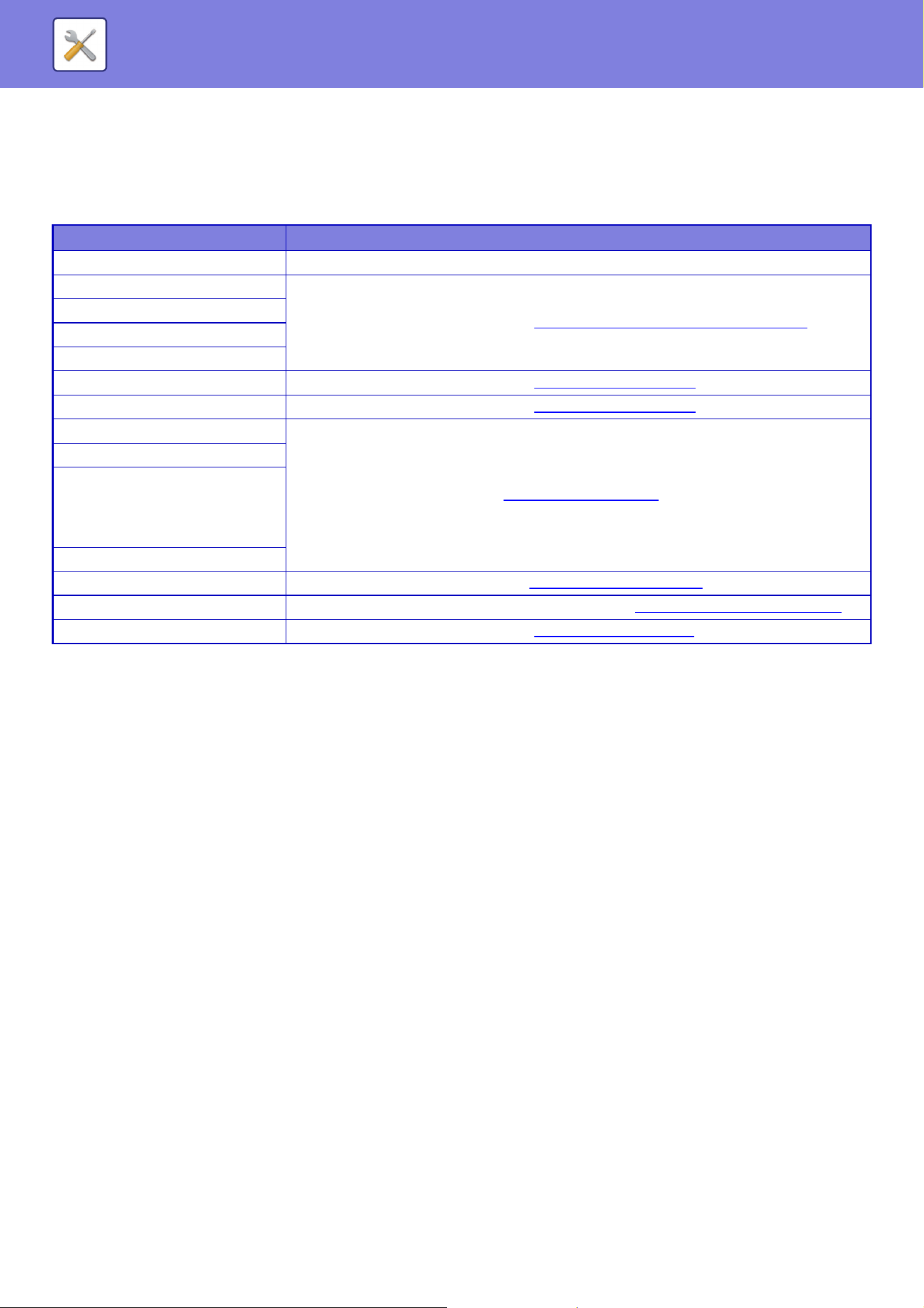
7-163
SYSTEM SETTINGS►SYSTEM SETTINGS
Initial Installation Settings
This groups together the items that were set initially when the machine was installed. The initial installation setting items
are the same as the regular setting items that have the same name. For information on a setting item, see the
explanation of the regular item.
Item Description
Condition Settings
Name
System Settings - Common Settings - Machine Identification Settings (page 7-126)
Machine Code
Machine Location
Memo
Clock Adjust System Settings - Common Settings - Clock Adjust (page 7-127)
Daylight Saving Time Setting System Settings - Common Settings - Clock Adjust (page 7-127)
Preheat Mode Setting
System Settings - Energy Save - Eco Setting (page 7-148)
Auto Power Shut-Off
Display Message When
Extending Transition Time to
Preheat/Auto Power Shut-Off
Mode
Sleep Mode Power Level
Network Quick Settings System Settings - Network Settings - Quick Settings (page 7-129)
Tray Settings System Settings - Common Settings - Paper Settings- Paper Tray Settings (page 7-103)
Product Key System Settings - Common Settings - Product Key (page 7-128)

LICENSE INFORMATION
Information on the Software License for This Product
Software composition
The software included in this product is comprised of various software components whose individual copyrights are held
by SHARP or by third parties.
Software developed by SHARP and open source software
The copyrights for the software components and various relevant documents included with this product that were
developed or written by SHARP are owned by SHARP and are protected by the Copyright Act, international treaties, and
other relevant laws. This product also makes use of freely distributed software and software components whose
copyrights are held by third parties. These include software components covered by a GNU General Public License
(hereafter GPL), a GNU Lesser General Public License (hereafter LGPL) or other license agreement.
Obtaining source code
Some of the open source software licensors require the distributor to provide the source code with the executable
software components. GPL and LGPL include similar requirements. For information on obtaining the source code for the
open source software and for obtaining the GPL, LGPL, and other license agreement information, visit the following
website:
http://sharp-world.com/products/copier/source/download/index.html
We are unable to answer any questions about the source code for the open source software. The source code for the
software components whose copyrights are held by SHARP is not distributed.
Software Copyrights
Copyright (c) 2000 Carnegie Mellon University. All rights reserved.
Redistribution and use in source and binary forms, with or without modification, are permitted provided that the following
conditions are met:
1.Redistributions of source code must retain the above copyright notice, this list of conditions and the following
disclaimer.
2.Redistributions in binary form must reproduce the above copyright notice, this list of conditions and the following
disclaimer in the documentation and/or other materials provided with the distribution.
3.The name "Carnegie Mellon University" must not be used to endorse or promote products derived from this software
without prior written permission. For permission or any other legal details, please contact
Office of Technology Transfer Carnegie Mellon University 5000 Forbes Avenue Pittsburgh, PA 15213-3890
(412) 268-4387, fax: (412) 268-7395
tech-transfer@andrew.cmu.edu
4.Redistributions of any form whatsoever must retain the following acknowledgment:
"This product includes software developed by Computing Services at Carnegie Mellon University
(http://www.cmu.edu/computing/)."
CARNEGIE MELLON UNIVERSITY DISCLAIMS ALL WARRANTIES WITH REGARD TO THIS SOFTWARE,
INCLUDING ALL IMPLIED WARRANTIES OF MERCHANTABILITY AND FITNESS, IN NO EVENT SHALL CARNEGIE
MELLON UNIVERSITY BE LIABLE FOR ANY SPECIAL, INDIRECT OR CONSEQUENTIAL DAMAGES OR ANY
DAMAGES WHATSOEVER RESULTING FROM LOSS OF USE, DATA OR PROFITS, WHETHER IN AN ACTION OF
CONTRACT, NEGLIGENCE OR OTHER TORTIOUS ACTION, ARISING OUT OF OR IN CONNECTION WITH THE
USE OR PERFORMANCE OF THIS SOFTWARE.

Copyright (c) 1995 - 2008 Kungliga Tekniska Högskolan (Royal Institute of Technology,
Stockholm, Sweden). All rights reserved.
All rights reserved. Export of this software from the United States of America may require a specific license from the
United States Government. It is the responsibility of any person or organization contemplating export to obtain such a
license before exporting.
WITHIN THAT CONSTRAINT, permission to use, copy, modify, and distribute this software and its documentation for
any purpose and without fee is hereby granted, provided that the above copyright notice appear in all copies and that
both that copyright notice and this permission notice appear in supporting documentation, and that the name of M.I.T.
not be used in advertising or publicity pertaining to distribution of the software without specific, written prior permission.
Furthermore if you modify this software you must label your software as modified software and not distribute it in such a
fashion that it might be confused with the original MIT software. M.I.T. makes no representations about the suitability of
this software for any purpose. It is provided "as is" without express or implied warranty.
THIS SOFTWARE IS PROVIDED "AS IS" AND WITHOUT ANY EXPRESS OR IMPLIED WARRANTIES, INCLUDING,
WITHOUT LIMITATION, THE IMPLIED WARRANTIES OF MERCHANTIBILITY AND FITNESS FOR A PARTICULAR
PURPOSE.
Individual source code files are copyright MIT, Cygnus Support, OpenVision, Oracle, Sun Soft, FundsXpress, and
others.
Project Athena, Athena, Athena MUSE, Discuss, Hesiod, Kerberos, Moira, and Zephyr are trademarks of the
Massachusetts Institute of Technology (MIT). No commercial use of these trademarks may be made without prior written
permission of MIT.
"Commercial use" means use of a name in a product or other for-profit manner. It does NOT prevent a commercial firm
from referring to the MIT trademarks in order to convey information (although in doing so, recognition of their trademark
status should be given).
OpenSSL License
---------------
Copyright (c) 1998-2004 The OpenSSL Project. All rights reserved.
Redistribution and use in source and binary forms, with or without modification, are permitted provided that the following
conditions are met:
1.Redistributions of source code must retain the above copyright notice, this list of conditions and the following
disclaimer.
2.Redistributions in binary form must reproduce the above copyright notice, this list of conditions and the following
disclaimer in the documentation and/or other materials provided with the distribution.
3.All advertising materials mentioning features or use of this software must display the following acknowledgment: "This
product includes software developed by the OpenSSL Project for use in the OpenSSL Toolkit.
(http://www.openssl.org/)"
4.The names "OpenSSL Toolkit" and "OpenSSL Project" must not be used to endorse or promote products derived from
this software without prior written permission. For written permission, please contact openssl-core@openssl.org.
5.Products derived from this software may not be called "OpenSSL" nor may "OpenSSL" appear in their names without
prior written permission of the OpenSSL Project.
6.Redistributions of any form whatsoever must retain the following acknowledgment: "This product includes software
developed by the OpenSSL Project for use in the OpenSSL Toolkit. (http://www.openssl.org/
)"

THIS SOFTWARE IS PROVIDED BY THE OpenSSL PROJECT "AS IS" AND ANY EXPRESSED OR IMPLIED
WARRANTIES, INCLUDING, BUT NOT LIMITED TO, THE IMPLIED WARRANTIES OF MERCHANTABILITY AND
FITNESS FOR A PARTICULAR PURPOSE ARE DISCLAIMED. IN NO EVENT SHALL THE OpenSSL PROJECT OR
ITS CONTRIBUTORS BE LIABLE FOR ANY DIRECT, INDIRECT, INCIDENTAL, SPECIAL, EXEMPLARY, OR
CONSEQUENTIAL DAMAGES (INCLUDING, BUT NOT LIMITED TO, PROCUREMENT OF SUBSTITUTE GOODS
OR SERVICES; LOSS OF USE, DATA, OR PROFITS; OR BUSINESS INTERRUPTION) HOWEVER CAUSED AND
ON ANY THEORY OF LIABILITY, WHETHER IN CONTRACT, STRICT LIABILITY, OR TORT (INCLUDING
NEGLIGENCE OR OTHERWISE) ARISING IN ANY WAY OUT OF THE USE OF THIS SOFTWARE, EVEN IF
ADVISED OF THE POSSIBILITY OF SUCH DAMAGE.
This product includes cryptographic software written by Eric Young ([email protected]
). This product includes software
written by Tim Hudson (tjh@cryptsoft.com
).
Original SSLeay License
---------------
Copyright (C) 1995-1998 Eric Young ([email protected]) All rights reserved.
This package is an SSL implementation written by Eric Young ([email protected]). The implementation was written so
as to conform with Netscapes SSL.
This library is free for commercial and non-commercial use as long as the following conditions are aheared to. The
following conditions apply to all code found in this distribution, be it the RC4, RSA,lhash, DES, etc., code; not just the
SSL code. The SSL documentation included with this distribution is covered by the same copyright terms except that the
holder is Tim Hudson ([email protected]
).
Copyright remains Eric Young's, and as such any Copyright notices in the code are not to be removed. If this package is
used in a product, Eric Young should be given attribution as the author of the parts of the library used. This can be in the
form of a textual message at program startup or in documentation (online or textual) provided with the package.
Redistribution and use in source and binary forms, with or without modification, are permitted provided that the following
conditions are met:
1.Redistributions of source code must retain the copyright notice, this list of conditions and the following disclaimer.
2.Redistributions in binary form must reproduce the above copyright notice, this list of conditions and the following
disclaimer in the documentation and/or other materials provided with the distribution.
3.All advertising materials mentioning features or use of this software must display the following acknowledgement:
"This product includes cryptographic software written by Eric Young ([email protected]
)" The word 'cryptographic'
can be left out if the rouines from the library being used are not cryptographic related :-).
4.If you include any Windows specific code (or a derivative thereof) from the apps directory (application code) you must
include an acknowledgement: "This product includes software written by Tim Hudson (tjh@cryptsoft.com
)"
THIS SOFTWARE IS PROVIDED BY ERIC YOUNG "AS IS" AND ANY EXPRESS OR IMPLIED WARRANTIES,
INCLUDING, BUT NOT LIMITED TO, THE IMPLIED WARRANTIES OF MERCHANTABILITY AND FITNESS FOR A
PARTICULAR PURPOSE ARE DISCLAIMED. IN NO EVENT SHALL THE AUTHOR OR CONTRIBUTORS BE LIABLE
FOR ANY DIRECT, INDIRECT, INCIDENTAL, SPECIAL, EXEMPLARY, OR CONSEQUENTIAL DAMAGES
(INCLUDING, BUT NOT LIMITED TO, PROCUREMENT OF SUBSTITUTE GOODS OR SERVICES; LOSS OF USE,
DATA, OR PROFITS; OR BUSINESS INTERRUPTION) HOWEVER CAUSED AND ON ANY THEORY OF LIABILITY,
WHETHER IN CONTRACT, STRICT LIABILITY, OR TORT (INCLUDING NEGLIGENCE OR OTHERWISE) ARISING
IN ANY WAY OUT OF THE USE OF THIS SOFTWARE, EVEN IF ADVISED OF THE POSSIBILITY OF SUCH
DAMAGE.

The licence and distribution terms for any publically available version orderivative of this code cannot be changed. i.e.
this code cannot simply becopied and put under another distribution licence [including the GNU Public Licence.]
D3DES License
---------------
Copyright (c) 1988,1989,1990,1991,1992 by Richard Outerbridge. (GEnie : OUTER; CIS :
[71755,204]) Graven Imagery, 1992.
GNU GENERAL PUBLIC LICENSE
Version 2, June 1991
Copyright (C) 1989, 1991 Free Software Foundation, Inc., 51 Franklin Street, Fifth Floor, Boston, MA 02110-1301
USA Everyone is permitted to copy and distribute verbatim copies of this license document, but changing it is not
allowed.
Preamble
The licenses for most software are designed to take away your freedom to share and change it. By contrast, the GNU
General Public License is intended to guarantee your freedom to share and change free software--to make sure the
software is free for all its users. This General Public License applies to most of the Free Software Foundation's software
and to any other program whose authors commit to using it. (Some other Free Software Foundation software is covered
by the GNU Lesser General Public License instead.) You can apply it to your programs, too.
When we speak of free software, we are referring to freedom, not price. Our General Public Licenses are designed to
make sure that you have the freedom to distribute copies of free software (and charge for this service if you wish), that
you receive source code or can get it if you want it, that you can change the software or use pieces of it in new free
programs; and that you know you can do these things.
To protect your rights, we need to make restrictions that forbid anyone to deny you these rights or to ask you to
surrender the rights. These restrictions translate to certain responsibilities for you if you distribute copies of the software,
or if you modify it.
For example, if you distribute copies of such a program, whether gratis or for a fee, you must give the recipients all the
rights that you have. You must make sure that they, too, receive or can get the source code. And you must show them
these terms so they know their rights.
We protect your rights with two steps: (1) copyright the software, and (2) offer you this license which gives you legal
permission to copy, distribute and/or modify the software.
Also, for each author's protection and ours, we want to make certain that everyone understands that there is no
warranty for this free software. If the software is modified by someone else and passed on, we want its recipients to
know that what they have is not the original, so that any problems introduced by others will not reflect on the original
authors' reputations.

Finally, any free program is threatened constantly by software patents. We wish to avoid the danger that redistributors
of a free program will individually obtain patent licenses, in effect making the program proprietary. To prevent this, we
have made it clear that any patent must be licensed for everyone's free use or not licensed at all.
The precise terms and conditions for copying, distribution and modification follow.
GNU GENERAL PUBLIC LICENSE
TERMS AND CONDITIONS FOR COPYING, DISTRIBUTION AND MODIFICATION
0. This License applies to any program or other work which contains a notice placed by the copyright holder saying it
may be distributed under the terms of this General Public License. The "Program", below, refers to any such program or
work, and a "work based on the Program" means either the Program or any derivative work under copyright law: that is
to say, a work containing the Program or a portion of it, either verbatim or with modifications and/or translated into
another language. (Hereinafter, translation is included without limitation in the term "modification".) Each licensee is
addressed as "you".
Activities other than copying, distribution and modification are not covered by this License; they are outside its scope.
The act of running the Program is not restricted, and the output from the Program is covered only if its contents
constitute a work based on the Program (independent of having been made by running the Program). Whether that is
true depends on what the Program does.
1. You may copy and distribute verbatim copies of the Program's source code as you receive it, in any medium,
provided that you conspicuously and appropriately publish on each copy an appropriate copyright notice and disclaimer
of warranty; keep intact all the notices that refer to this License and to the absence of any warranty; and give any other
recipients of the Program a copy of this License along with the Program.
You may charge a fee for the physical act of transferring a copy, and you may at your option offer warranty protection in
exchange for a fee.
2. You may modify your copy or copies of the Program or any portion of it, thus forming a work based on the Program,
and copy and distribute such modifications or work under the terms of Section 1 above, provided that you also meet all
of these conditions:
a) You must cause the modified files to carry prominent notices stating that you changed the files and the date of any
change.
b) You must cause any work that you distribute or publish, that in whole or in part contains or is derived from the
Program or any part thereof, to be licensed as a whole at no charge to all third parties under the terms of this License.
c) If the modified program normally reads commands interactively when run, you must cause it, when started running
for such interactive use in the most ordinary way, to print or display an announcement including an appropriate
copyright notice and a notice that there is no warranty (or else, saying that you provide a warranty) and that users
may redistribute the program under these conditions, and telling the user how to view a copy of this License.
(Exception: if the Program itself is interactive but does not normally print such an announcement, your work based on
the Program is not required to print an announcement.)
These requirements apply to the modified work as a whole. If identifiable sections of that work are not derived from the
Program, and can be reasonably considered independent and separate works in themselves, then this License, and its
terms, do not apply to those sections when you distribute them as separate works. But when you distribute the same

sections as part of a whole which is a work based on the Program, the distribution of the whole must be on the terms of
this License, whose permissions for other licensees extend to the entire whole, and thus to each and every part
regardless of who wrote it.
Thus, it is not the intent of this section to claim rights or contest your rights to work written entirely by you; rather, the
intent is to exercise the right to control the distribution of derivative or collective works based on the Program.
In addition, mere aggregation of another work not based on the Program with the Program (or with a work based on the
Program) on a volume of a storage or distribution medium does not bring the other work under the scope of this License.
3. You may copy and distribute the Program (or a work based on it, under Section 2) in object code or executable form
under the terms of Sections 1 and 2 above provided that you also do one of the following:
a) Accompany it with the complete corresponding machine-readable source code, which must be distributed under
the terms of Sections 1 and 2 above on a medium customarily used for software interchange; or,
b) Accompany it with a written offer, valid for at least three years, to give any third party, for a charge no more than
your cost of physically performing source distribution, a complete machine-readable copy of the corresponding
source code, to be distributed under the terms of Sections 1 and 2 above on a medium customarily used for software
interchange; or,
c) Accompany it with the information you received as to the offer to distribute corresponding source code. (This
alternative is allowed only for noncommercial distribution and only if you received the program in object code or
executable form with such an offer, in accord with Subsection b above.)
The source code for a work means the preferred form of the work for making modifications to it. For an executable work,
complete source code means all the source code for all modules it contains, plus any associated interface definition
files, plus the scripts used to control compilation and installation of the executable. However, as a special exception, the
source code distributed need not include anything that is normally distributed (in either source or binary form) with the
major components (compiler, kernel, and so on) of the operating system on which the executable runs, unless that
component itself accompanies the executable.
If distribution of executable or object code is made by offering access to copy from a designated place, then offering
equivalent access to copy the source code from the same place counts as distribution of the source code, even though
third parties are not compelled to copy the source along with the object code.
4. You may not copy, modify, sublicense, or distribute the Program except as expressly provided under this License.
Any attempt otherwise to copy, modify, sublicense or distribute the Program is void, and will automatically terminate
your rights under this License. However, parties who have received copies, or rights, from you under this License will not
have their licenses terminated so long as such parties remain in full compliance.
5. You are not required to accept this License, since you have not signed it. However, nothing else grants you
permission to modify or distribute the Program or its derivative works. These actions are prohibited by law if you do not
accept this License. Therefore, by modifying or distributing the Program (or any work based on the Program), you
indicate your acceptance of this License to do so, and all its terms and conditions for copying, distributing or modifying
the Program or works based on it.
6. Each time you redistribute the Program (or any work based on the Program), the recipient automatically receives a
license from the original licensor to copy, distribute or modify the Program subject to these terms and conditions. You

may not impose any further restrictions on the recipients' exercise of the rights granted herein. You are not responsible
for enforcing compliance by third parties to this License.
7. If, as a consequence of a court judgment or allegation of patent infringement or for any other reason (not limited to
patent issues), conditions are imposed on you (whether by court order, agreement or otherwise) that contradict the
conditions of this License, they do not excuse you from the conditions of this License. If you cannot distribute so as to
satisfy simultaneously your obligations under this License and any other pertinent obligations, then as a consequence
you may not distribute the Program at all. For example, if a patent license would not permit royalty-free redistribution of
the Program by all those who receive copies directly or indirectly through you, then the only way you could satisfy both it
and this License would be to refrain entirely from distribution of the Program.
If any portion of this section is held invalid or unenforceable under any particular circumstance, the balance of the
section is intended to apply and the section as a whole is intended to apply in other circumstances.
It is not the purpose of this section to induce you to infringe any patents or other property right claims or to contest
validity of any such claims; this section has the sole purpose of protecting the integrity of the free software distribution
system, which is implemented by public license practices. Many people have made generous contributions to the wide
range of software distributed through that system in reliance on consistent application of that system; it is up to the
author/donor to decide if he or she is willing to distribute software through any other system and a licensee cannot
impose that choice.
This section is intended to make thoroughly clear what is believed to be a consequence of the rest of this License.
8. If the distribution and/or use of the Program is restricted in certain countries either by patents or by copyrighted
interfaces, the original copyright holder who places the Program under this License may add an explicit geographical
distribution limitation excluding those countries, so that distribution is permitted only in or among countries not thus
excluded. In such case, this License incorporates the limitation as if written in the body of this License.
9. The Free Software Foundation may publish revised and/or new versions of the General Public License from time to
time. Such new versions will be similar in spirit to the present version, but may differ in detail to address new problems
or concerns.
Each version is given a distinguishing version number. If the Program specifies a version number of this License which
applies to it and "any later version", you have the option of following the terms and conditions either of that version or of
any later version published by the Free Software Foundation. If the Program does not specify a version number of this
License, you may choose any version ever published by the Free Software Foundation.
10. If you wish to incorporate parts of the Program into other free programs whose distribution conditions are different,
write to the author to ask for permission. For software which is copyrighted by the Free Software Foundation, write to the
Free Software Foundation; we sometimes make exceptions for this. Our decision will be guided by the two goals of
preserving the free status of all derivatives of our free software and of promoting the sharing and reuse of software
generally.
NO WARRANTY
11. BECAUSE THE PROGRAM IS LICENSED FREE OF CHARGE, THERE IS NO WARRANTY FOR THE
PROGRAM, TO THE EXTENT PERMITTED BY APPLICABLE LAW. EXCEPT WHEN OTHERWISE STATED IN
WRITING THE COPYRIGHT HOLDERS AND/OR OTHER PARTIES PROVIDE THE PROGRAM "AS IS" WITHOUT
WARRANTY OF ANY KIND, EITHER EXPRESSED OR IMPLIED, INCLUDING, BUT NOT LIMITED TO, THE IMPLIED
WARRANTIES OF MERCHANTABILITY AND FITNESS FOR A PARTICULAR PURPOSE. THE ENTIRE RISK AS TO

THE QUALITY AND PERFORMANCE OF THE PROGRAM IS WITH YOU. SHOULD THE PROGRAM PROVE
DEFECTIVE, YOU ASSUME THE COST OF ALL NECESSARY SERVICING, REPAIR OR CORRECTION.
12. IN NO EVENT UNLESS REQUIRED BY APPLICABLE LAW OR AGREED TO IN WRITING WILL ANY
COPYRIGHT HOLDER, OR ANY OTHER PARTY WHO MAY MODIFY AND/OR REDISTRIBUTE THE PROGRAM AS
PERMITTED ABOVE, BE LIABLE TO YOU FOR DAMAGES, INCLUDING ANY GENERAL, SPECIAL, INCIDENTAL
OR CONSEQUENTIAL DAMAGES ARISING OUT OF THE USE OR INABILITY TO USE THE PROGRAM
(INCLUDING BUT NOT LIMITED TO LOSS OF DATA OR DATA BEING RENDERED INACCURATE OR LOSSES
SUSTAINED BY YOU OR THIRD PARTIES OR A FAILURE OF THE PROGRAM TO OPERATE WITH ANY OTHER
PROGRAMS), EVEN IF SUCH HOLDER OR OTHER PARTY HAS BEEN ADVISED OF THE POSSIBILITY OF SUCH
DAMAGES.
END OF TERMS AND CONDITIONS
How to Apply These Terms to Your New Programs
If you develop a new program, and you want it to be of the greatest possible use to the public, the best way to achieve
this is to make it free software which everyone can redistribute and change under these terms.
To do so, attach the following notices to the program. It is safest to attach them to the start of each source file to most
effectively convey the exclusion of warranty; and each file should have at least the "copyright" line and a pointer to
where the full notice is found.
<one line to give the program's name and a brief idea of what it does.> Copyright (C) <year> <name of author>
This program is free software; you can redistribute it and/or modify it under the terms of the GNU General Public
License as published by the Free Software Foundation; either version 2 of the License, or (at your option) any later
version.
This program is distributed in the hope that it will be useful, but WITHOUT ANY WARRANTY; without even the
implied warranty of MERCHANTABILITY or FITNESS FOR A PARTICULAR PURPOSE. See the GNU General
Public License for more details.
You should have received a copy of the GNU General Public License along with this program; if not, write to the Free
Software Foundation, Inc., 51 Franklin Street, Fifth Floor, Boston, MA 02110-1301 USA.
Also add information on how to contact you by electronic and paper mail.
If the program is interactive, make it output a short notice like this when it starts in an interactive mode:
Gnomovision version 69, Copyright (C) year name of author Gnomovision comes with ABSOLUTELY NO
WARRANTY; for details type `show w'. This is free software, and you are welcome to redistribute it under certain
conditions; type `show c' for details.
The hypothetical commands `show w' and `show c' should show the appropriate parts of the General Public License. Of
course, the commands you use may be called something other than `show w' and `show c'; they could even be
mouse-clicks or menu items--whatever suits your program.

You should also get your employer (if you work as a programmer) or your school, if any, to sign a "copyright disclaimer"
for the program, if necessary. Here is a sample; alter the names:
Yoyodyne, Inc., hereby disclaims all copyright interest in the program `Gnomovision' (which makes passes at
compilers) written by James Hacker.
<signature of Ty Coon>, 1 April 1989
Ty Coon, President of Vice
This General Public License does not permit incorporating your program into proprietary programs. If your program is a
subroutine library, you may consider it more useful to permit linking proprietary applications with the library. If this is
what you want to do, use the GNU Lesser General Public License instead of this License.
GNU LESSER GENERAL PUBLIC LICENSE
Version 2.1, February 1999
Copyright (C) 1991, 1999 Free Software Foundation, Inc. 51 Franklin Street, Fifth Floor, Boston, MA 02110-1301
USA Everyone is permitted to copy and distribute verbatim copies of this license document, but changing it is not
allowed.
[This is the first released version of the Lesser GPL. It also counts as the successor of the GNU Library Public
License, version 2, hence the version number 2.1.]
Preamble
The licenses for most software are designed to take away your freedom to share and change it. By contrast, the GNU
General Public Licenses are intended to guarantee your freedom to share and change free software--to make sure the
software is free for all its users.
This license, the Lesser General Public License, applies to some specially designated software packages--typically
libraries--of the Free Software Foundation and other authors who decide to use it. You can use it too, but we suggest
you first think carefully about whether this license or the ordinary General Public License is the better strategy to use in
any particular case, based on the explanations below.
When we speak of free software, we are referring to freedom of use, not price. Our General Public Licenses are
designed to make sure that you have the freedom to distribute copies of free software (and charge for this service if you
wish); that you receive source code or can get it if you want it; that you can change the software and use pieces of it in
new free programs; and that you are informed that you can do these things.
To protect your rights, we need to make restrictions that forbid distributors to deny you these rights or to ask you to
surrender these rights. These restrictions translate to certain responsibilities for you if you distribute copies of the library
or if you modify it.
For example, if you distribute copies of the library, whether gratis or for a fee, you must give the recipients all the rights
that we gave you. You must make sure that they, too, receive or can get the source code. If you link other code with the

library, you must provide complete object files to the recipients, so that they can relink them with the library after making
changes to the library and recompiling it. And you must show them these terms so they know their rights.
We protect your rights with a two-step method: (1) we copyright the library, and (2) we offer you this license, which
gives you legal permission to copy, distribute and/or modify the library.
To protect each distributor, we want to make it very clear that there is no warranty for the free library. Also, if the library
is modified by someone else and passed on, the recipients should know that what they have is not the original version,
so that the original author's reputation will not be affected by problems that might be introduced by others.
Finally, software patents pose a constant threat to the existence of any free program. We wish to make sure that a
company cannot effectively restrict the users of a free program by obtaining a restrictive license from a patent holder.
Therefore, we insist that any patent license obtained for a version of the library must be consistent with the full freedom
of use specified in this license.
Most GNU software, including some libraries, is covered by the ordinary GNU General Public License. This license, the
GNU Lesser General Public License, applies to certain designated libraries, and is quite different from the ordinary
General Public License. We use this license for certain libraries in order to permit linking those libraries into non-free
programs.
When a program is linked with a library, whether statically or using a shared library, the combination of the two is
legally speaking a combined work, a derivative of the original library. The ordinary General Public License therefore
permits such linking only if the entire combination fits its criteria of freedom. The Lesser General Public License permits
more lax criteria for linking other code with the library.
We call this license the "Lesser" General Public License because it does Less to protect the user's freedom than the
ordinary General Public License. It also provides other free software developers Less of an advantage over competing
non-free programs. These disadvantages are the reason we use the ordinary General Public License for many libraries.
However, the Lesser license provides advantages in certain special circumstances.
For example, on rare occasions, there may be a special need to encourage the widest possible use of a certain library,
so that it becomes a de-facto standard. To achieve this, non-free programs must be allowed to use the library. A more
frequent case is that a free library does the same job as widely used non-free libraries. In this case, there is little to gain
by limiting the free library to free software only, so we use the Lesser General Public License.
In other cases, permission to use a particular library in non-free programs enables a greater number of people to use a
large body of free software. For example, permission to use the GNU C Library in non-free programs enables many
more people to use the whole GNU operating system, as well as its variant, the GNU/Linux operating system.
Although the Lesser General Public License is Less protective of the users' freedom, it does ensure that the user of a
program that is linked with the Library has the freedom and the wherewithal to run that program using a modified version
of the Library.

The precise terms and conditions for copying, distribution and modification follow. Pay close attention to the difference
between a "work based on the library" and a "work that uses the library". The former contains code derived from the
library, whereas the latter must be combined with the library in order to run.
GNU LESSER GENERAL PUBLIC LICENSE
TERMS AND CONDITIONS FOR COPYING, DISTRIBUTION AND MODIFICATION
0. This License Agreement applies to any software library or other program which contains a notice placed by the
copyright holder or other authorized party saying it may be distributed under the terms of this Lesser General Public
License (also called "this License"). Each licensee is addressed as "you".
A "library" means a collection of software functions and/or data prepared so as to be conveniently linked with
application programs (which use some of those functions and data) to form executables.
The "Library", below, refers to any such software library or work which has been distributed under these terms. A "work
based on the Library" means either the Library or any derivative work under copyright law: that is to say, a work
containing the Library or a portion of it, either verbatim or with modifications and/or translated straightforwardly into
another language. (Hereinafter, translation is included without limitation in the term "modification".)
"Source code" for a work means the preferred form of the work for making modifications to it. For a library, complete
source code means all the source code for all modules it contains, plus any associated interface definition files, plus the
scripts used to control compilation and installation of the library.
Activities other than copying, distribution and modification are not covered by this License; they are outside its scope.
The act of running a program using the Library is not restricted, and output from such a program is covered only if its
contents constitute a work based on the Library (independent of the use of the Library in a tool for writing it). Whether
that is true depends on what the Library does and what the program that uses the Library does.
1. You may copy and distribute verbatim copies of the Library's complete source code as you receive it, in any medium,
provided that you conspicuously and appropriately publish on each copy an appropriate copyright notice and disclaimer
of warranty; keep intact all the notices that refer to this License and to the absence of any warranty; and distribute a copy
of this License along with the Library.
You may charge a fee for the physical act of transferring a copy, and you may at your option offer warranty protection
in exchange for a fee.
2. You may modify your copy or copies of the Library or any portion of it, thus forming a work based on the Library, and
copy and distribute such modifications or work under the terms of Section 1 above, provided that you also meet all of
these conditions:
a) The modified work must itself be a software library.
b) You must cause the files modified to carry prominent notices stating that you changed the files and the date of any
change.

c) You must cause the whole of the work to be licensed at no charge to all third parties under the terms of this
License.
d) If a facility in the modified Library refers to a function or a table of data to be supplied by an application program
that uses the facility, other than as an argument passed when the facility is invoked, then you must make a good faith
effort to ensure that, in the event an application does not supply such function or table, the facility still operates, and
performs whatever part of its purpose remains meaningful.
(For example, a function in a library to compute square roots has a purpose that is entirely well-defined independent
of the application. Therefore, Subsection 2d requires that any application-supplied function or table used by this
function must be optional: if the application does not supply it, the square root function must still compute square
roots.)
These requirements apply to the modified work as a whole. If identifiable sections of that work are not derived from the
Library, and can be reasonably considered independent and separate works in themselves, then this License, and its
terms, do not apply to those sections when you distribute them as separate works. But when you distribute the same
sections as part of a whole which is a work based on the Library, the distribution of the whole must be on the terms of
this License, whose permissions for other licensees extend to the entire whole, and thus to each and every part
regardless of who wrote it.
Thus, it is not the intent of this section to claim rights or contest your rights to work written entirely by you; rather, the
intent is to exercise the right to control the distribution of derivative or collective works based on the Library.
In addition, mere aggregation of another work not based on the Library with the Library (or with a work based on the
Library) on a volume of a storage or distribution medium does not bring the other work under the scope of this License.
3. You may opt to apply the terms of the ordinary GNU General Public License instead of this License to a given copy
of the Library. To do this, you must alter all the notices that refer to this License, so that they refer to the ordinary GNU
General Public License, version 2, instead of to this License. (If a newer version than version 2 of the ordinary GNU
General Public License has appeared, then you can specify that version instead if you wish.) Do not make any other
change in these notices.
Once this change is made in a given copy, it is irreversible for that copy, so the ordinary GNU General Public License
applies to all subsequent copies and derivative works made from that copy.
This option is useful when you wish to copy part of the code of the Library into a program that is not a library.
4. You may copy and distribute the Library (or a portion or derivative of it, under Section 2) in object code or executable
form under the terms of Sections 1 and 2 above provided that you accompany it with the complete corresponding
machine-readable source code, which must be distributed under the terms of Sections 1 and 2 above on a medium
customarily used for software interchange.
If distribution of object code is made by offering access to copy from a designated place, then offering equivalent
access to copy the source code from the same place satisfies the requirement to distribute the source code, even
though third parties are not compelled to copy the source along with the object code.
5. A program that contains no derivative of any portion of the Library, but is designed to work with the Library by being
compiled or linked with it, is called a "work that uses the Library". Such a work, in isolation, is not a derivative work of the
Library, and therefore falls outside the scope of this License.

However, linking a "work that uses the Library" with the Library creates an executable that is a derivative of the Library
(because it contains portions of the Library), rather than a "work that uses the library". The executable is therefore
covered by this License. Section 6 states terms for distribution of such executables.
When a "work that uses the Library" uses material from a header file that is part of the Library, the object code for the
work may be a derivative work of the Library even though the source code is not. Whether this is true is especially
significant if the work can be linked without the Library, or if the work is itself a library. The threshold for this to be true is
not precisely defined by law.
If such an object file uses only numerical parameters, data structure layouts and accessors, and small macros and
small inline functions (ten lines or less in length), then the use of the object file is unrestricted, regardless of whether it is
legally a derivative work. (Executables containing this object code plus portions of the Library will still fall under Section
6.)
Otherwise, if the work is a derivative of the Library, you may distribute the object code for the work under the terms of
Section 6. Any executables containing that work also fall under Section 6, whether or not they are linked directly with the
Library itself.
6. As an exception to the Sections above, you may also combine or link a "work that uses the Library" with the Library
to produce a work containing portions of the Library, and distribute that work under terms of your choice, provided that
the terms permit modification of the work for the customer's own use and reverse engineering for debugging such
modifications.
You must give prominent notice with each copy of the work that the Library is used in it and that the Library and its use
are covered by this License. You must supply a copy of this License. If the work during execution displays copyright
notices, you must include the copyright notice for the Library among them, as well as a reference directing the user to
the copy of this License. Also, you must do one of these things:
a) Accompany the work with the complete corresponding machine-readable source code for the Library including
whatever changes were used in the work (which must be distributed under Sections 1 and 2 above); and, if the work
is an executable linked with the Library, with the complete machine-readable "work that uses the Library", as object
code and/or source code, so that the user can modify the Library and then relink to produce a modified executable
containing the modified Library. (It is understood that the user who changes the contents of definitions files in the
Library will not necessarily be able to recompile the application to use the modified definitions.)
b) Use a suitable shared library mechanism for linking with the Library. A suitable mechanism is one that (1) uses at
run time a copy of the library already present on the user's computer system, rather than copying library functions into
the executable, and (2) will operate properly with a modified version of the library, if the user installs one, as long as
the modified version is interface-compatible with the version that the work was made with.
c) Accompany the work with a written offer, valid for at least three years, to give the same user the materials specified
in Subsection 6a, above, for a charge no more than the cost of performing this distribution.
d) If distribution of the work is made by offering access to copy from a designated place, offer equivalent access to
copy the above specified materials from the same place.
e) Verify that the user has already received a copy of these materials or that you have already sent this user a copy.

For an executable, the required form of the "work that uses the Library" must include any data and utility programs
needed for reproducing the executable from it. However, as a special exception, the materials to be distributed need not
include anything that is normally distributed (in either source or binary form) with the major components (compiler,
kernel, and so on) of the operating system on which the executable runs, unless that component itself accompanies the
executable.
It may happen that this requirement contradicts the license restrictions of other proprietary libraries that do not normally
accompany the operating system. Such a contradiction means you cannot use both them and the Library together in an
executable that you distribute.
7. You may place library facilities that are a work based on the Library side-by-side in a single library together with
other library facilities not covered by this License, and distribute such a combined library, provided that the separate
distribution of the work based on the Library and of the other library facilities is otherwise permitted, and provided that
you do these two things:
a) Accompany the combined library with a copy of the same work based on the Library, uncombined with any other
library facilities. This must be distributed under the terms of the Sections above.
b) Give prominent notice with the combined library of the fact that part of it is a work based on the Library, and
explaining where to find the accompanying uncombined form of the same work.
8. You may not copy, modify, sublicense, link with, or distribute the Library except as expressly provided under this
License. Any attempt otherwise to copy, modify, sublicense, link with, or distribute the Library is void, and will
automatically terminate your rights under this License. However, parties who have received copies, or rights, from you
under this License will not have their licenses terminated so long as such parties remain in full compliance.
9. You are not required to accept this License, since you have not signed it. However, nothing else grants you
permission to modify or distribute the Library or its derivative works. These actions are prohibited by law if you do not
accept this License. Therefore, by modifying or distributing the Library (or any work based on the Library), you indicate
your acceptance of this License to do so, and all its terms and conditions for copying, distributing or modifying the
Library or works based on it.
10. Each time you redistribute the Library (or any work based on the Library), the recipient automatically receives a
license from the original licensor to copy, distribute, link with or modify the Library subject to these terms and conditions.
You may not impose any further restrictions on the recipients' exercise of the rights granted herein. You are not
responsible for enforcing compliance by third parties with this License.
11. If, as a consequence of a court judgment or allegation of patent infringement or for any other reason (not limited to
patent issues), conditions are imposed on you (whether by court order, agreement or otherwise) that contradict the
conditions of this License, they do not excuse you from the conditions of this License. If you cannot distribute so as to
satisfy simultaneously your obligations under this License and any other pertinent obligations, then as a consequence
you may not distribute the Library at all. For example, if a patent license would not permit royalty-free redistribution of the
Library by all those who receive copies directly or indirectly through you, then the only way you could satisfy both it and
this License would be to refrain entirely from distribution of the Library.

If any portion of this section is held invalid or unenforceable under any particular circumstance, the balance of the
section is intended to apply, and the section as a whole is intended to apply in other circumstances.
It is not the purpose of this section to induce you to infringe any patents or other property right claims or to contest
validity of any such claims; this section has the sole purpose of protecting the integrity of the free software distribution
system which is implemented by public license practices. Many people have made generous contributions to the wide
range of software distributed through that system in reliance on consistent application of that system; it is up to the
author/donor to decide if he or she is willing to distribute software through any other system and a licensee cannot
impose that choice.
This section is intended to make thoroughly clear what is believed to be a consequence of the rest of this License.
12. If the distribution and/or use of the Library is restricted in certain countries either by patents or by copyrighted
interfaces, the original copyright holder who places the Library under this License may add an explicit geographical
distribution limitation excluding those countries, so that distribution is permitted only in or among countries not thus
excluded. In such case, this License incorporates the limitation as if written in the body of this License.
13. The Free Software Foundation may publish revised and/or new versions of the Lesser General Public License from
time to time. Such new versions will be similar in spirit to the present version, but may differ in detail to address new
problems or concerns.
Each version is given a distinguishing version number. If the Library specifies a version number of this License which
applies to it and "any later version", you have the option of following the terms and conditions either of that version or of
any later version published by the Free Software Foundation. If the Library does not specify a license version number,
you may choose any version ever published by the Free Software Foundation.
14. If you wish to incorporate parts of the Library into other free programs whose distribution conditions are
incompatible with these, write to the author to ask for permission. For software which is copyrighted by the Free
Software Foundation, write to the Free Software Foundation; we sometimes make exceptions for this. Our decision will
be guided by the two goals of preserving the free status of all derivatives of our free software and of promoting the
sharing and reuse of software generally.
NO WARRANTY
15. BECAUSE THE LIBRARY IS LICENSED FREE OF CHARGE, THERE IS NO WARRANTY FOR THE LIBRARY,
TO THE EXTENT PERMITTED BY APPLICABLE LAW. EXCEPT WHEN OTHERWISE STATED IN WRITING THE
COPYRIGHT HOLDERS AND/OR OTHER PARTIES PROVIDE THE LIBRARY "AS IS" WITHOUT WARRANTY OF
ANY KIND, EITHER EXPRESSED OR IMPLIED, INCLUDING, BUT NOT LIMITED TO, THE IMPLIED WARRANTIES
OF MERCHANTABILITY AND FITNESS FOR A PARTICULAR PURPOSE. THE ENTIRE RISK AS TO THE QUALITY
AND PERFORMANCE OF THE LIBRARY IS WITH YOU. SHOULD THE LIBRARY PROVE DEFECTIVE, YOU
ASSUME THE COST OF ALL NECESSARY SERVICING, REPAIR OR CORRECTION.
16. IN NO EVENT UNLESS REQUIRED BY APPLICABLE LAW OR AGREED TO IN WRITING WILL ANY
COPYRIGHT HOLDER, OR ANY OTHER PARTY WHO MAY MODIFY AND/OR REDISTRIBUTE THE LIBRARY AS
PERMITTED ABOVE, BE LIABLE TO YOU FOR DAMAGES, INCLUDING ANY GENERAL, SPECIAL, INCIDENTAL
OR CONSEQUENTIAL DAMAGES ARISING OUT OF THE USE OR INABILITY TO USE THE LIBRARY (INCLUDING
BUT NOT LIMITED TO LOSS OF DATA OR DATA BEING RENDERED INACCURATE OR LOSSES SUSTAINED BY

YOU OR THIRD PARTIES OR A FAILURE OF THE LIBRARY TO OPERATE WITH ANY OTHER SOFTWARE), EVEN
IF SUCH HOLDER OR OTHER PARTY HAS BEEN ADVISED OF THE POSSIBILITY OF SUCH DAMAGES.
END OF TERMS AND CONDITIONS
How to Apply These Terms to Your New Libraries
If you develop a new library, and you want it to be of the greatest possible use to the public, we recommend making it
free software that everyone can redistribute and change. You can do so by permitting redistribution under these terms
(or, alternatively, under the terms of the ordinary General Public License).
To apply these terms, attach the following notices to the library. It is safest to attach them to the start of each source file
to most effectively convey the exclusion of warranty; and each file should have at least the "copyright" line and a pointer
to where the full notice is found.
<one line to give the library's name and a brief idea of what it does.> Copyright (C) <year> <name of author>
This library is free software; you can redistribute it and/or modify it under the terms of the GNU Lesser General Public
License as published by the Free Software Foundation; either version 2.1 of the License, or (at your option) any later
version.
This library is distributed in the hope that it will be useful, but WITHOUT ANY WARRANTY; without even the implied
warranty of MERCHANTABILITY or FITNESS FOR A PARTICULAR PURPOSE. See the GNU Lesser General
Public License for more details.
You should have received a copy of the GNU Lesser General Public License along with this library; if not, write to the
Free Software Foundation, Inc., 51 Franklin Street, Fifth Floor, Boston, MA 02110-1301 USA
Also add information on how to contact you by electronic and paper mail.
You should also get your employer (if you work as a programmer) or your school, if any, to sign a "copyright disclaimer"
for the library, if necessary. Here is a sample; alter the names:
Yoyodyne, Inc., hereby disclaims all copyright interest in the library `Frob' (a library for tweaking knobs) written by
James Random Hacker.
<signature of Ty Coon>, 1 April 1990
Ty Coon, President of Vice
That's all there is to it!

GNU GENERAL PUBLIC LICENSE
Version 3, 29 June 2007
Copyright (C) 2007 Free Software Foundation, Inc. <http://fsf.org/>
Everyone is permitted to copy and distribute verbatim copies of this license document, but changing it is not allowed.
Preamble
The GNU General Public License is a free, copyleft license for software and other kinds of works.
The licenses for most software and other practical works are designed to take away your freedom to share and
change the works. By contrast, the GNU General Public License is intended to guarantee your freedom to share and
change all versions of a program--to make sure it remains free software for all its users. We, the Free Software
Foundation, use the GNU General Public License for most of our software; it applies also to any other work released this
way by its authors. You can apply it to your programs, too.
When we speak of free software, we are referring to freedom, not price. Our General Public Licenses are designed to
make sure that you have the freedom to distribute copies of free software (and charge for them if you wish), that you
receive source code or can get it if you want it, that you can change the software or use pieces of it in new free
programs, and that you know you can do these things.
To protect your rights, we need to prevent others from denying you these rights or asking you to surrender the rights.
Therefore, you have certain responsibilities if you distribute copies of the software, or if you modify it: responsibilities to
respect the freedom of others.
For example, if you distribute copies of such a program, whether gratis or for a fee, you must pass on to the recipients
the same freedoms that you received. You must make sure that they, too, receive or can get the source code. And you
must show them these terms so they know their rights.
Developers that use the GNU GPL protect your rights with two steps:
(1) assert copyright on the software, and (2) offer you this License giving you legal permission to copy, distribute and/or
modify it.
For the developers' and authors' protection, the GPL clearly explains that there is no warranty for this free software. For
both users' and authors' sake, the GPL requires that modified versions be marked as changed, so that their problems
will not be attributed erroneously to authors of previous versions.
Some devices are designed to deny users access to install or run modified versions of the software inside them,
although the manufacturer can do so. This is fundamentally incompatible with the aim of protecting users' freedom to
change the software. The systematic pattern of such abuse occurs in the area of products for individuals to use, which is
precisely where it is most unacceptable. Therefore, we have designed this version of the GPL to prohibit the practice for
those products. If such problems arise substantially in other domains, we stand ready to extend this provision to those
domains in future versions of the GPL, as needed to protect the freedom of users.
Finally, every program is threatened constantly by software patents. States should not allow patents to restrict
development and use of software on general-purpose computers, but in those that do, we wish to avoid the special
danger that patents applied to a free program could make it effectively proprietary. To prevent this, the GPL assures that
patents cannot be used to render the program non-free.
The precise terms and conditions for copying, distribution and modification follow.
TERMS AND CONDITIONS
0. Definitions.

"This License" refers to version 3 of the GNU General Public License.
"Copyright" also means copyright-like laws that apply to other kinds of works, such as semiconductor masks.
"The Program" refers to any copyrightable work licensed under this License. Each licensee is addressed as "you".
"Licensees" and "recipients" may be individuals or organizations.
To "modify" a work means to copy from or adapt all or part of the work in a fashion requiring copyright permission, other
than the making of an exact copy. The resulting work is called a "modified version" of the earlier work or a work "based
on" the earlier work.
A "covered work" means either the unmodified Program or a work based on the Program.
To "propagate" a work means to do anything with it that, without permission, would make you directly or secondarily
liable for infringement under applicable copyright law, except executing it on a computer or modifying a private copy.
Propagation includes copying, distribution (with or without modification), making available to the public, and in some
countries other activities as well.
To "convey" a work means any kind of propagation that enables other parties to make or receive copies. Mere
interaction with a user through a computer network, with no transfer of a copy, is not conveying.
An interactive user interface displays "Appropriate Legal Notices" to the extent that it includes a convenient and
prominently visible feature that (1) displays an appropriate copyright notice, and (2) tells the user that there is no
warranty for the work (except to the extent that warranties are provided), that licensees may convey the work under this
License, and how to view a copy of this License. If the interface presents a list of user commands or options, such as a
menu, a prominent item in the list meets this criterion.
1. Source Code.
The "source code" for a work means the preferred form of the work for making modifications to it. "Object code" means
any non-source form of a work.
A "Standard Interface" means an interface that either is an official standard defined by a recognized standards body,
or, in the case of interfaces specified for a particular programming language, one that is widely used among developers
working in that language.
The "System Libraries" of an executable work include anything, other than the work as a whole, that (a) is included in
the normal form of packaging a Major Component, but which is not part of that Major Component, and (b) serves only to
enable use of the work with that Major Component, or to implement a Standard Interface for which an implementation is
available to the public in source code form. A "Major Component", in this context, means a major essential component
(kernel, window system, and so on) of the specific operating system (if any) on which the executable work runs, or a
compiler used to produce the work, or an object code interpreter used to run it.
The "Corresponding Source" for a work in object code form means all the source code needed to generate, install, and
(for an executable work) run the object code and to modify the work, including scripts to control those activities.
However, it does not include the work's System Libraries, or general-purpose tools or generally available free programs
which are used unmodified in performing those activities but which are not part of the work. For example, Corresponding
Source includes interface definition files associated with source files for the work, and the source code for shared
libraries and dynamically linked subprograms that the work is specifically designed to require, such as by intimate data
communication or control flow between those subprograms and other parts of the work.
The Corresponding Source need not include anything that users can regenerate automatically from other parts of the
Corresponding Source.

The Corresponding Source for a work in source code form is that same work.
2. Basic Permissions.
All rights granted under this License are granted for the term of copyright on the Program, and are irrevocable provided
the stated conditions are met. This License explicitly affirms your unlimited permission to run the unmodified Program.
The output from running a covered work is covered by this License only if the output, given its content, constitutes a
covered work. This License acknowledges your rights of fair use or other equivalent, as provided by copyright law.
You may make, run and propagate covered works that you do not convey, without conditions so long as your license
otherwise remains in force. You may convey covered works to others for the sole purpose of having them make
modifications exclusively for you, or provide you with facilities for running those works, provided that you comply with the
terms of this License in conveying all material for which you do not control copyright. Those thus making or running the
covered works for you must do so exclusively on your behalf, under your direction and control, on terms that prohibit
them from making any copies of your copyrighted material outside their relationship with you.
Conveying under any other circumstances is permitted solely under the conditions stated below. Sublicensing is not
allowed; section 10 makes it unnecessary.
3. Protecting Users' Legal Rights From Anti-Circumvention Law.
No covered work shall be deemed part of an effective technological measure under any applicable law fulfilling
obligations under article 11 of the WIPO copyright treaty adopted on 20 December 1996, or similar laws prohibiting or
restricting circumvention of such measures.
When you convey a covered work, you waive any legal power to forbid circumvention of technological measures to the
extent such circumvention is effected by exercising rights under this License with respect to the covered work, and you
disclaim any intention to limit operation or modification of the work as a means of enforcing, against the work's users,
your or third parties' legal rights to forbid circumvention of technological measures.
4. Conveying Verbatim Copies.
You may convey verbatim copies of the Program's source code as you receive it, in any medium, provided that you
conspicuously and appropriately publish on each copy an appropriate copyright notice; keep intact all notices stating
that this License and any non-permissive terms added in accord with section 7 apply to the code; keep intact all notices
of the absence of any warranty; and give all recipients a copy of this License along with the Program.
You may charge any price or no price for each copy that you convey, and you may offer support or warranty protection
for a fee.
5. Conveying Modified Source Versions.
You may convey a work based on the Program, or the modifications to produce it from the Program, in the form of
source code under the terms of section 4, provided that you also meet all of these conditions:
a) The work must carry prominent notices stating that you modified it, and giving a relevant date.
b) The work must carry prominent notices stating that it is released under this License and any conditions added under
section
7. This requirement modifies the requirement in section 4 to "keep intact all notices".
c) You must license the entire work, as a whole, under this License to anyone who comes into possession of a copy.
This License will therefore apply, along with any applicable section 7 additional terms, to the whole of the work, and all
its parts, regardless of how they are packaged. This License gives no permission to license the work in any other way,
but it does not invalidate such permission if you have separately received it.

d) If the work has interactive user interfaces, each must display Appropriate Legal Notices; however, if the Program
has interactive interfaces that do not display Appropriate Legal Notices, your work need not make them do so.
A compilation of a covered work with other separate and independent works, which are not by their nature extensions
of the covered work, and which are not combined with it such as to form a larger program, in or on a volume of a storage
or distribution medium, is called an "aggregate" if the compilation and its resulting copyright are not used to limit the
access or legal rights of the compilation's users beyond what the individual works permit. Inclusion of a covered work in
an aggregate does not cause this License to apply to the other parts of the aggregate.
6. Conveying Non-Source Forms.
You may convey a covered work in object code form under the terms of sections 4 and 5, provided that you also
convey the machine-readable Corresponding Source under the terms of this License, in one of these ways:
a) Convey the object code in, or embodied in, a physical product (including a physical distribution medium),
accompanied by the Corresponding Source fixed on a durable physical medium customarily used for software
interchange.
b) Convey the object code in, or embodied in, a physical product (including a physical distribution medium),
accompanied by a written offer, valid for at least three years and valid for as long as you offer spare parts or customer
support for that product model, to give anyone who possesses the object code either (1) a copy of the Corresponding
Source for all the software in the product that is covered by this License, on a durable physical medium customarily used
for software interchange, for a price no more than your reasonable cost of physically performing this conveying of
source, or (2) access to copy the Corresponding Source from a network server at no charge.
c) Convey individual copies of the object code with a copy of the written offer to provide the Corresponding Source.
This alternative is allowed only occasionally and noncommercially, and only if you received the object code with such an
offer, in accord with subsection 6b.
d) Convey the object code by offering access from a designated place (gratis or for a charge), and offer equivalent
access to the Corresponding Source in the same way through the same place at no further charge. You need not require
recipients to copy the Corresponding Source along with the object code. If the place to copy the object code is a network
server, the Corresponding Source may be on a different server (operated by you or a third party) that supports
equivalent copying facilities, provided you maintain clear directions next to the object code saying where to find the
Corresponding Source. Regardless of what server hosts the Corresponding Source, you remain obligated to ensure that
it is available for as long as needed to satisfy these requirements.
e) Convey the object code using peer-to-peer transmission, provided you inform other peers where the object code
and Corresponding Source of the work are being offered to the general public at no charge under subsection 6d.
A separable portion of the object code, whose source code is excluded from the Corresponding Source as a System
Library, need not be included in conveying the object code work.
A "User Product" is either (1) a "consumer product", which means any tangible personal property which is normally
used for personal, family, or household purposes, or (2) anything designed or sold for incorporation into a dwelling. In
determining whether a product is a consumer product, doubtful cases shall be resolved in favor of coverage. For a
particular product received by a particular user, "normally used" refers to a typical or common use of that class of
product, regardless of the status of the particular user or of the way in which the particular user actually uses, or expects
or is expected to use, the product. A product is a consumer product regardless of whether the product has substantial
commercial, industrial or non-consumer uses, unless such uses represent the only significant mode of use of the
product.
"Installation Information" for a User Product means any methods, procedures, authorization keys, or other information
required to install and execute modified versions of a covered work in that User Product from a modified version of its

Corresponding Source. The information must suffice to ensure that the continued functioning of the modified object code
is in no case prevented or interfered with solely because modification has been made.
If you convey an object code work under this section in, or with, or specifically for use in, a User Product, and the
conveying occurs as part of a transaction in which the right of possession and use of the User Product is transferred to
the recipient in perpetuity or for a fixed term (regardless of how the transaction is characterized), the Corresponding
Source conveyed under this section must be accompanied by the Installation Information. But this requirement does not
apply if neither you nor any third party retains the ability to install modified object code on the User Product (for example,
the work has been installed in ROM).
The requirement to provide Installation Information does not include a requirement to continue to provide support
service, warranty, or updates for a work that has been modified or installed by the recipient, or for the User Product in
which it has been modified or installed. Access to a network may be denied when the modification itself materially and
adversely affects the operation of the network or violates the rules and protocols for communication across the network.
Corresponding Source conveyed, and Installation Information provided, in accord with this section must be in a format
that is publicly documented (and with an implementation available to the public in source code form), and must require
no special password or key for unpacking, reading or copying.
7. Additional Terms.
"Additional permissions" are terms that supplement the terms of this License by making exceptions from one or more of
its conditions. Additional permissions that are applicable to the entire Program shall be treated as though they were
included in this License, to the extent that they are valid under applicable law. If additional permissions apply only to part
of the Program, that part may be used separately under those permissions, but the entire Program remains governed by
this License without regard to the additional permissions.
When you convey a copy of a covered work, you may at your option remove any additional permissions from that copy,
or from any part of it. (Additional permissions may be written to require their own removal in certain cases when you
modify the work.) You may place additional permissions on material, added by you to a covered work, for which you
have or can give appropriate copyright permission.
Notwithstanding any other provision of this License, for material you add to a covered work, you may (if authorized by
the copyright holders of that material) supplement the terms of this License with terms:
a) Disclaiming warranty or limiting liability differently from the terms of sections 15 and 16 of this License; or
b) Requiring preservation of specified reasonable legal notices or author attributions in that material or in the
Appropriate Legal Notices displayed by works containing it; or
c) Prohibiting misrepresentation of the origin of that material, or requiring that modified versions of such material be
marked in reasonable ways as different from the original version; or
d) Limiting the use for publicity purposes of names of licensors or authors of the material; or
e) Declining to grant rights under trademark law for use of some trade names, trademarks, or service marks; or
f) Requiring indemnification of licensors and authors of that material by anyone who conveys the material (or modified
versions of it) with contractual assumptions of liability to the recipient, for any liability that these contractual assumptions
directly impose on those licensors and authors.
All other non-permissive additional terms are considered "further restrictions" within the meaning of section 10. If the
Program as you received it, or any part of it, contains a notice stating that it is governed by this License along with a term
that is a further restriction, you may remove that term. If a license document contains a further restriction but permits

relicensing or conveying under this License, you may add to a covered work material governed by the terms of that
license document, provided that the further restriction does not survive such relicensing or conveying.
If you add terms to a covered work in accord with this section, you must place, in the relevant source files, a statement
of the additional terms that apply to those files, or a notice indicating where to find the applicable terms.
Additional terms, permissive or non-permissive, may be stated in the form of a separately written license, or stated as
exceptions; the above requirements apply either way.
8. Termination.
You may not propagate or modify a covered work except as expressly provided under this License. Any attempt
otherwise to propagate or modify it is void, and will automatically terminate your rights under this License (including any
patent licenses granted under the third paragraph of section 11).
However, if you cease all violation of this License, then your license from a particular copyright holder is reinstated (a)
provisionally, unless and until the copyright holder explicitly and finally terminates your license, and (b) permanently, if
the copyright holder fails to notify you of the violation by some reasonable means prior to 60 days after the cessation.
Moreover, your license from a particular copyright holder is reinstated permanently if the copyright holder notifies you
of the violation by some reasonable means, this is the first time you have received notice of violation of this License (for
any work) from that copyright holder, and you cure the violation prior to 30 days after your receipt of the notice.
Termination of your rights under this section does not terminate the licenses of parties who have received copies or
rights from you under this License. If your rights have been terminated and not permanently reinstated, you do not
qualify to receive new licenses for the same material under section 10.
9. Acceptance Not Required for Having Copies.
You are not required to accept this License in order to receive or run a copy of the Program. Ancillary propagation of a
covered work occurring solely as a consequence of using peer-to-peer transmission to receive a copy likewise does not
require acceptance. However, nothing other than this License grants you permission to propagate or modify any
covered work. These actions infringe copyright if you do not accept this License. Therefore, by modifying or propagating
a covered work, you indicate your acceptance of this License to do so.
10. Automatic Licensing of Downstream Recipients.
Each time you convey a covered work, the recipient automatically receives a license from the original licensors, to run,
modify and propagate that work, subject to this License. You are not responsible for enforcing compliance by third
parties with this License.
An "entity transaction" is a transaction transferring control of an organization, or substantially all assets of one, or
subdividing an organization, or merging organizations. If propagation of a covered work results from an entity
transaction, each party to that transaction who receives a copy of the work also receives whatever licenses to the work
the party's predecessor in interest had or could give under the previous paragraph, plus a right to possession of the
Corresponding Source of the work from the predecessor in interest, if the predecessor has it or can get it with
reasonable efforts.
You may not impose any further restrictions on the exercise of the rights granted or affirmed under this License. For
example, you may not impose a license fee, royalty, or other charge for exercise of rights granted under this License,
and you may not initiate litigation (including a cross-claim or counterclaim in a lawsuit) alleging that any patent claim is
infringed by making, using, selling, offering for sale, or importing the Program or any portion of it.
11. Patents.

A "contributor" is a copyright holder who authorizes use under this License of the Program or a work on which the
Program is based. The work thus licensed is called the contributor's "contributor version".
A contributor's "essential patent claims" are all patent claims owned or controlled by the contributor, whether already
acquired or hereafter acquired, that would be infringed by some manner, permitted by this License, of making, using, or
selling its contributor version, but do not include claims that would be infringed only as a consequence of further
modification of the contributor version. For purposes of this definition, "control" includes the right to grant patent
sublicenses in a manner consistent with the requirements of this License.
Each contributor grants you a non-exclusive, worldwide, royalty-free patent license under the contributor's essential
patent claims, to make, use, sell, offer for sale, import and otherwise run, modify and propagate the contents of its
contributor version.
In the following three paragraphs, a "patent license" is any express agreement or commitment, however denominated,
not to enforce a patent (such as an express permission to practice a patent or covenant not to sue for patent
infringement). To "grant" such a patent license to a party means to make such an agreement or commitment not to
enforce a patent against the party.
If you convey a covered work, knowingly relying on a patent license, and the Corresponding Source of the work is not
available for anyone to copy, free of charge and under the terms of this License, through a publicly available network
server or other readily accessible means, then you must either (1) cause the Corresponding Source to be so available,
or (2) arrange to deprive yourself of the benefit of the patent license for this particular work, or (3) arrange, in a manner
consistent with the requirements of this License, to extend the patent license to downstream recipients. "Knowingly
relying" means you have actual knowledge that, but for the patent license, your conveying the covered work in a country,
or your recipient's use of the covered work in a country, would infringe one or more identifiable patents in that country
that you have reason to believe are valid.
If, pursuant to or in connection with a single transaction or arrangement, you convey, or propagate by procuring
conveyance of, a covered work, and grant a patent license to some of the parties receiving the covered work authorizing
them to use, propagate, modify or convey a specific copy of the covered work, then the patent license you grant is
automatically extended to all recipients of the covered work and works based on it.
A patent license is "discriminatory" if it does not include within the scope of its coverage, prohibits the exercise of, or is
conditioned on the non-exercise of one or more of the rights that are specifically granted under this License. You may
not convey a covered work if you are a party to an arrangement with a third party that is in the business of distributing
software, under which you make payment to the third party based on the extent of your activity of conveying the work,
and under which the third party grants, to any of the parties who would receive the covered work from you, a
discriminatory patent license (a) in connection with copies of the covered work conveyed by you (or copies made from
those copies), or (b) primarily for and in connection with specific products or compilations that contain the covered work,
unless you entered into that arrangement, or that patent license was granted, prior to 28 March 2007.
Nothing in this License shall be construed as excluding or limiting any implied license or other defenses to infringement
that may otherwise be available to you under applicable patent law.
12. No Surrender of Others' Freedom.
If conditions are imposed on you (whether by court order, agreement or otherwise) that contradict the conditions of this
License, they do not excuse you from the conditions of this License. If you cannot convey a covered work so as to satisfy
simultaneously your obligations under this License and any other pertinent obligations, then as a consequence you may
not convey it at all. For example, if you agree to terms that obligate you to collect a royalty for further conveying from
those to whom you convey the Program, the only way you could satisfy both those terms and this License would be to
refrain entirely from conveying the Program.
13. Use with the GNU Affero General Public License.

Notwithstanding any other provision of this License, you have permission to link or combine any covered work with a
work licensed under version 3 of the GNU Affero General Public License into a single combined work, and to convey the
resulting work. The terms of this License will continue to apply to the part which is the covered work, but the special
requirements of the GNU Affero General Public License, section 13, concerning interaction through a network will apply
to the combination as such.
14. Revised Versions of this License.
The Free Software Foundation may publish revised and/or new versions of the GNU General Public License from time
to time. Such new versions will be similar in spirit to the present version, but may differ in detail to address new problems
or concerns.
Each version is given a distinguishing version number. If the Program specifies that a certain numbered version of the
GNU General Public License "or any later version" applies to it, you have the option of following the terms and
conditions either of that numbered version or of any later version published by the Free Software Foundation. If the
Program does not specify a version number of the GNU General Public License, you may choose any version ever
published by the Free Software Foundation.
If the Program specifies that a proxy can decide which future versions of the GNU General Public License can be used,
that proxy's public statement of acceptance of a version permanently authorizes you to choose that version for the
Program.
Later license versions may give you additional or different permissions. However, no additional obligations are
imposed on any author or copyright holder as a result of your choosing to follow a later version.
15. Disclaimer of Warranty.
THERE IS NO WARRANTY FOR THE PROGRAM, TO THE EXTENT PERMITTED BY APPLICABLE LAW. EXCEPT
WHEN OTHERWISE STATED IN WRITING THE COPYRIGHT HOLDERS AND/OR OTHER PARTIES PROVIDE THE
PROGRAM "AS IS" WITHOUT WARRANTY OF ANY KIND, EITHER EXPRESSED OR IMPLIED, INCLUDING, BUT
NOT LIMITED TO, THE IMPLIED WARRANTIES OF MERCHANTABILITY AND FITNESS FOR A PARTICULAR
PURPOSE. THE ENTIRE RISK AS TO THE QUALITY AND PERFORMANCE OF THE PROGRAM IS WITH YOU.
SHOULD THE PROGRAM PROVE DEFECTIVE, YOU ASSUME THE COST OF ALL NECESSARY SERVICING,
REPAIR OR CORRECTION.
16. Limitation of Liability.
IN NO EVENT UNLESS REQUIRED BY APPLICABLE LAW OR AGREED TO IN WRITING WILL ANY COPYRIGHT
HOLDER, OR ANY OTHER PARTY WHO MODIFIES AND/OR CONVEYS THE PROGRAM AS PERMITTED ABOVE,
BE LIABLE TO YOU FOR DAMAGES, INCLUDING ANY GENERAL, SPECIAL, INCIDENTAL OR CONSEQUENTIAL
DAMAGES ARISING OUT OF THE USE OR INABILITY TO USE THE PROGRAM (INCLUDING BUT NOT LIMITED
TO LOSS OF DATA OR DATA BEING RENDERED INACCURATE OR LOSSES SUSTAINED BY YOU OR THIRD
PARTIES OR A FAILURE OF THE PROGRAM TO OPERATE WITH ANY OTHER PROGRAMS), EVEN IF SUCH
HOLDER OR OTHER PARTY HAS BEEN ADVISED OF THE POSSIBILITY OF SUCH DAMAGES.
17. Interpretation of Sections 15 and 16.
If the disclaimer of warranty and limitation of liability provided above cannot be given local legal effect according to their
terms, reviewing courts shall apply local law that most closely approximates an absolute waiver of all civil liability in
connection with the Program, unless a warranty or assumption of liability accompanies a copy of the Program in return
for a fee.

END OF TERMS AND CONDITIONS
How to Apply These Terms to Your New Programs
If you develop a new program, and you want it to be of the greatest possible use to the public, the best way to achieve
this is to make it free software which everyone can redistribute and change under these terms.
To do so, attach the following notices to the program. It is safest to attach them to the start of each source file to most
effectively state the exclusion of warranty; and each file should have at least the "copyright" line and a pointer to where
the full notice is found.
<one line to give the program's name and a brief idea of what it does.>
Copyright (C) <year> <name of author>
This program is free software: you can redistribute it and/or modify it under the terms of the GNU General Public
License as published by the Free Software Foundation, either version 3 of the License, or (at your option) any later
version.
This program is distributed in the hope that it will be useful, but WITHOUT ANY WARRANTY; without even the implied
warranty of MERCHANTABILITY or FITNESS FOR A PARTICULAR PURPOSE. See the GNU General Public License
for more details.
You should have received a copy of the GNU General Public License along with this program. If not, see
<http://www.gnu.org/licenses/>.
Also add information on how to contact you by electronic and paper mail.
If the program does terminal interaction, make it output a short notice like this when it starts in an interactive mode:
<program> Copyright (C) <year> <name of author>
This program comes with ABSOLUTELY NO WARRANTY; for details type `show w'.
This is free software, and you are welcome to redistribute it under certain conditions; type `show c' for details.
The hypothetical commands `show w' and `show c' should show the appropriate parts of the General Public License.
Of course, your program's commands might be different; for a GUI interface, you would use an "about box".
You should also get your employer (if you work as a programmer) or school, if any, to sign a "copyright disclaimer" for
the program, if necessary.
For more information on this, and how to apply and follow the GNU GPL, see <http://www.gnu.org/licenses/>.
The GNU General Public License does not permit incorporating your program into proprietary programs. If your
program is a subroutine library, you may consider it more useful to permit linking proprietary applications with the library.
If this is what you want to do, use the GNU Lesser General Public License instead of this License. But first, please read
<http://www.gnu.org/philosophy/why-not-lgpl.html>.

---------------------------------------------------------------------------libtiff---------------------------------------------------------------------------
Copyright (c) 1988-1997 Sam Leffler
Copyright (c) 1991-1997 Silicon Graphics, Inc.
Permission to use, copy, modify, distribute, and sell this software and its documentation for any purpose is hereby
granted without fee, provided that (i) the above copyright notices and this permission notice appear in all copies of the
software and related documentation, and (ii) the names of Sam Leffler and Silicon Graphics may not be used in any
advertising or publicity relating to the software without the specific, prior written permission of Sam Leffler and Silicon
Graphics.
THE SOFTWARE IS PROVIDED "AS-IS" AND WITHOUT WARRANTY OF ANY KIND, EXPRESS, IMPLIED OR
OTHERWISE, INCLUDING WITHOUT LIMITATION, ANY WARRANTY OF MERCHANTABILITY OR FITNESS FOR A
PARTICULAR PURPOSE.
IN NO EVENT SHALL SAM LEFFLER OR SILICON GRAPHICS BE LIABLE FOR ANY SPECIAL, INCIDENTAL,
INDIRECT OR CONSEQUENTIAL DAMAGES OF ANY KIND, OR ANY DAMAGES WHATSOEVER RESULTING
FROM LOSS OF USE, DATA OR PROFITS, WHETHER OR NOT ADVISED OF THE POSSIBILITY OF DAMAGE,
AND ON ANY THEORY OF LIABILITY, ARISING OUT OF OR IN CONNECTION WITH THE USE OR
PERFORMANCE OF THIS SOFTWARE.
--------------------------------------------------------------------------libjpeg--------------------------------------------------------------------------
This software is based in part on the work of the Independent JPEG Group.

SOFTWARE LICENSE
PLEASE READ THIS LICENSE CAREFULLY BEFORE USING THE SOFTWARE. BY USING THE SOFTWARE,
YOU ARE AGREEING TO BE BOUND BY THE TERMS OF THIS LICENSE.
1. License
The application, demonstration, system and other software accompanying this License, whether on disk, in read only
memory, or on any other media (the "Software") and related documentation are licensed to you by SHARP. You own
the disk on which the Software is recorded but SHARP and/or SHARP's Licensors retain title to the Software and
related documentation. This License allows you to use the Software on one or more computers connected to a single
printer and make one copy of the Software in machine-readable form for backup purposes only. You must reproduce
on such copy the SHARP copyright notice, the copyright notice of SHARP’s Licensors and any other proprietary
legends of SHARP and/or its Licensors that were on the original copy of the Software. You may also transfer all your
license rights in the Software, the backup copy of the Software, the related documentation and a copy of this License
to another party, provided the other party reads and agrees to the terms and conditions of this License.
2. Restrictions
The Software contains copyrighted material, trade secrets and other proprietary material which is owned by SHARP
and/or its Licensors and in order to protect them you may not decompile, reverse engineer, disassemble or otherwise
reduce the Software to a human-perceivable form. You may not modify, network, rent, lease, loan, distribute or create
derivative works based upon the Software in whole or in part. You may not electronically transmit the Software from
one computer to another or over a network.
3. Termination
This license is effective until terminated. You may terminate this License at any time by destroying the Software and
related documentation and all copies thereof. This License will terminate immediately without notice from SHARP
and/or SHARP’s Licensors if you fail to comply with any provision of this License. Upon termination you must destroy
the Software and related documentation and all copies thereof.
4. Export Law Assurances
You agree and certify that neither the Software nor any other technical data received from SHARP, nor the direct
product thereof, will be exported outside the United States except as authorized and as permitted by the laws and
regulations of the United States. If the Software has been rightfully obtained by you outside of the United States, you
agree that you will not re-export the Software nor any other technical data received from SHARP, nor the direct
product thereof, except as permitted by the laws and regulations of the United states and the laws and the regulation
of the jurisdiction in which you obtained the Software.
5. Government End Users
If you are acquiring the Software on behalf of any unit or agency of the United States Government, the following
provisions apply. The Government agrees:
(i) if the Software is supplied to the Department of Defense (DoD), the Software is classified as "Commercial
Computer Software" and the Government is acquiring only "restricted rights" in the Software and its
documentation as that term is defined in Clause 252.227-7013 (c)(1) (Oct., 1988) of the DFARS; and
(ii) if the Software is supplied to any unit or agency of the United States Government other than DoD, the Software is
classified as "Commercial" that term is defined at 48 C.F.R. 2.101 and as "Commercial Computer Software" that
term is defined in 48 C.F.R. 12.212, and the Government's rights in the Software and its documentation will be as
defined in Clause 52.227-19 (c)(2) of the FAR or, in the case of NASA, in Clause 18-52.227-86 (d) of the NASA
Supplement to the FAR.

6. Limited Warranty on Media.
SHARP warrants the disks on which the Software is recorded to be free from defects in materials and workmanship
under normal use for a period of ninety (90) days from the date of purchase as evidenced by a copy of the receipt.
The entire liability of SHARP and/or its Licensors and your exclusive remedy will be replacement of the disk which
fails to meet the limited warranty provided by this Clause 6. A disk will be replaced when it is returned to SHARP or a
SHARP authorized representative with a copy of the receipt. SHARP will have no responsibility to replace a disk
damaged by accident, abuse or misapplication.
ANY IMPLIED WARRANTIES ON THE DISKS, INCLUDING THE IMPLIED WARRANTIES OF MERCHANTABILITY
AND FITNESS FOR A PARTICULAR PURPOSE, ARE LIMITED IN DURATION TO NINETY (90) DAYS FROM THE
DATE OF DELIVERY. THIS WARRANTY GIVES YOU SPECIFIC LEGAL RIGHTS, AND YOU MAY ALSO HAVE
OTHER RIGHTS WHICH VARY FROM JURISDICTION TO JURISDICTION.
7. Disclaimer of Warranty on Software
You expressly acknowledge and agree that use of the Software is at your sole risk. The Software and related
documentation are provided "AS IS" and without warranty of any kind and SHARP and SHARP's Licensor(s) (for the
purpose of provisions 6 and 7, SHARP and SHARP's Licensor(s) shall be collectively referred to as "SHARP")
EXPRESSLY DISCLAIM ALL WARRANTIES, EXPRESS OR IMPLIED, INCLUDING, BUT NOT LIMITED TO, THE
IMPLIED WARRANTIES OF MERCHANTABILITY AND FITNESS FOR A PARTICULAR PURPOSE. SHARP DOES
NOT WARRANT THAT THE FUNCTIONS CONTAINED IN THE SOFTWARE WILL MEET YOUR REQUIREMENTS,
OR THAT THE OPERATION OF THE SOFTWARE WILL BE UNINTERRUPTED OR ERROR-FREE, OR THAT
DEFECTS IN THE SOFTWARE WILL BE CORRECTED. FURTHERMORE, SHARP DOES NOT WARRANT OR
MAKE ANY REPRESENTATIONS REGARDING THE USE OR THE RESULTS OF THE USE OF THE SOFTWARE
OR RELATED DOCUMENTATION IN TERMS OF THEIR CORRECTNESS, ACCURACY, RELIABILITY, OR
OTHERWISE. NO ORAL OR WRITTEN INFORMATION OR ADVICE GIVEN BY SHARP OR A SHARP
AUTHORIZED REPRESENTATIVE SHALL CREATE A WARRANTY OR IN ANY WAY INCREASE THE SCOPE OF
THIS WARRANTY. SHOULD THE SOFTWARE PROVE DEFECTIVE, YOU (AND NOT SHARP OR A SHARP
AUTHORIZED REPRESENTATIVE) ASSUME THE ENTIRE COST OF ALL NECESSARY SERVICING, REPAIR OR
CORRECTION, SOME JURISDICTIONS DO NOT ALLOW THE EXCLUSION OF IMPLIED WARRANTIES, SO THE
ABOVE EXCLUSION MAY NOT APPLY TO YOU.
8. Limitation of Liability
UNDER NO CIRCUMSTANCES INCLUDING NEGLIGENCE, SHALL SHARP BE LIABLE FOR ANY INCIDENTAL,
SPECIAL OR CONSEQUENTIAL DAMAGES THAT RESULT FROM THE USE OR INABILITY TO USE THE
SOFTWARE OR RELATED DOCUMENTATION, EVEN IF SHARP OR A SHARP AUTHORIZED
REPRESENTATIVE HAS BEEN ADVISED OF THE POSSIBILITY OF SUCH DAMAGES. SOME JURISDICTIONS
DO NOT ALLOW THE LIMITATION OR EXCLUSION OF LIABILITY FOR INCIDENTAL OR CONSEQUENTIAL
DAMAGES SO THE ABOVE LIMITATION OR EXCLUSION MAY NOT APPLY TO YOU.
In no event shall SHARP's total liability to you for all damages, losses, and causes of action (whether in contract, tort
(including negligence) or otherwise) exceed the amount paid by you for the Software.
9. Controlling Law and Severability
For a portion of the Software related with Apple Macintosh and Microsoft Windows, this license shall be governed by
and construed in accordance with the laws of the state of California and Washington, respectively. If for any reason a
court of competent jurisdiction finds any provision of this License, or portion thereof, to be unenforceable, that
provision of the License shall be enforced to the maximum extent permissible so as to effect the intent of the parties,
and the remainder of this License shall continue in full force and effect.
10. Complete Agreement
This License constitutes the entire agreement between the parties with respect to the use of the Software and
related documentation, and supersedes all prior or contemporaneous understandings or agreements, written or oral,
regarding such subject matter. No amendment to or modification of this License will be binding unless in writing and
signed by a duly authorized representative of SHARP.

2017G-US1

