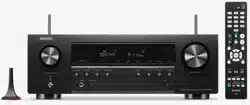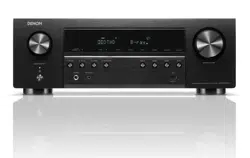
Accessories
8
Inserting the batteries
9
Operating range of the remote control unit
9
Features
10
High quality sound
10
High performance
10
Easy operation
14
Part names and functions
15
Front panel
15
Display
18
Rear panel
20
Remote control unit
23
Connections
Speaker installation
27
Connecting speakers
29
Before connecting speakers
29
Connecting speakers to the speaker terminals
32
Connecting 5.1-channel speakers
33
Connecting a TV
34
Connection 1 : TV equipped with an HDMI connector and
compatible with the ARC / eARC
35
Connection 2 : TV equipped with an HDMI connector and
incompatible with the ARC / eARC
36
Connecting a playback device
37
Connecting a set-top box (Satellite tuner/cable TV)
38
Connecting a media player
39
Connecting a Blu-ray Disc player or DVD player
40
Connecting a game console or player device compatible with 8K
41
Connecting a turntable
42
Connecting a USB memory device to the USB port
43
Connecting FM/AM antennas
44
Connecting to a home network (LAN)
46
Wired LAN
46
Wireless LAN
47
Connecting the power cord
48
Contents Connections Playback Settings Tips Appendix
2
Front panel Display Rear panel Remote Index
Playback
Basic operation
50
Turning the power on
50
Selecting the input source
50
Adjusting the volume
51
Turning off the sound temporarily (Muting)
51
Playback a Blu-ray Disc player/DVD player
51
Playing a USB memory device
52
Playing files stored on USB memory devices
53
Listening to music on a Bluetooth device
56
Playing music from Bluetooth device
57
Pairing with other Bluetooth devices
58
Reconnecting to this unit from a Bluetooth device
59
Listening to audio on Bluetooth headphones
60
Listening to audio on Bluetooth headphones
61
Adjusting the volume of Bluetooth headphones
62
Reconnecting to a Bluetooth headphones
62
Disconnecting Bluetooth headphones
63
Listening to FM/AM broadcasts
64
Listening to FM/AM broadcasts
65
Tuning in by entering the frequency (Direct Tune)
67
RDS Search
67
PTY Search
68
TP Search
69
Radio text
69
Changing the tune mode (Tune Mode)
70
Tuning in to stations and presetting them automatically (Auto
Preset Memory)
70
Presetting the current broadcast station (Preset Memory)
71
Listening to preset stations
71
Specify a name for the preset broadcast station (Preset Name)
72
Skipping preset broadcast stations (Preset Skip)
73
Cancelling Preset Skip
74
Listening to Internet Radio
75
Listening to Internet Radio
76
Playing back files stored on a PC or NAS
77
Playing back files stored on a PC or NAS
78
Getting the HEOS App
81
HEOS Account
82
Playing from streaming music services
83
Listening to the same music in multiple rooms
86
Contents Connections Playback Settings Tips Appendix
3
Front panel Display Rear panel Remote Index
AirPlay function
90
Playing songs from your iPhone, iPod touch or iPad
91
Playing iTunes music with this unit
91
Play a song from your iPhone, iPod touch or iPad on multiple
synced devices (AirPlay 2)
92
Spotify Connect function
93
Playing Spotify music with this unit
93
Convenience functions
94
Playing back HEOS Favorites
95
Adding to HEOS Favorites
96
Deleting a HEOS Favorites
96
Adjusting the audibility of dialog and vocals (Dialog Enhancer)
96
Adjusting the volume of each channel to match the input source
(Channel Level Adjust)
97
Adjusting the tone (Tone)
98
Adjusting audio delay (Audio Delay)
99
Displaying your desired video during audio playback (Video
Select)
100
Selecting a sound mode
101
Selecting a sound mode
102
Direct playback
103
Pure Direct playback
104
Auto surround playback
104
Description of sound mode types
105
Sound mode that can be selected for each input signal
108
HDMI Control function
111
Setting procedure
111
Sleep timer function
112
Using the sleep timer
113
Quick select plus function
114
Calling up the settings
115
Changing the settings
116
Panel lock function
117
Disabling all key button operations
117
Disabling all button operations except VOLUME
117
Canceling the Panel lock function
118
Contents Connections Playback Settings Tips Appendix
4
Front panel Display Rear panel Remote Index
Remote lock function
119
Disabling the sensor function of the remote control unit
119
Enabling the remote sensor function
119
Web control function
120
Controlling the unit from a web control
120
Settings
Menu map
122
Menu operations
127
Audio
128
Subwoofer Level Adjust
128
Surround Parameter
128
Restorer
134
Volume
135
Audyssey
®
136
Graphic EQ
138
Video
140
HDMI Setup
140
HDMI Upscaler
144
On-Screen Display
145
Screensaver
146
4K/8K Signal Format
146
HDCP Setup
148
Inputs
149
Input Assign
149
Source Rename
152
Hide Sources
152
Source Level
152
Speakers
153
Audyssey
®
Setup
153
Procedure for speaker settings (Audyssey
®
Setup)
155
Error messages
160
Retrieving Audyssey
®
Setup settings
161
Contents Connections Playback Settings Tips Appendix
5
Front panel Display Rear panel Remote Index
Manual Setup
162
Speaker Layout
162
Front/Center/Surround
162
Subwoofer
163
View Terminal Config.
163
Distances
163
Levels
164
Crossovers
165
Advanced
165
Subwoofer Output
166
Low Pass Filter
167
Network
168
Information
168
Connection
168
Wi-Fi Setup
169
Settings
171
Network Control
172
Friendly Name
173
Diagnostics
173
AirPlay
174
Spotify Connect
175
Wi-Fi and Bluetooth
175
HEOS
176
You have not signed in
176
You have already signed in
176
General
177
Language
177
Owner's Manual
177
ECO
177
Bluetooth Transmitter
181
Quick Select
182
Front Display
182
Firmware
183
Information
185
Usage Data
187
Save & Load
187
Setup Lock
188
Reset
188
Contents Connections Playback Settings Tips Appendix
6
Front panel Display Rear panel Remote Index
Tips
Tips
190
Troubleshooting
192
Power does not turn on / Power is turned off
193
Operations cannot be performed through the remote control unit
194
Display on this unit shows nothing
194
No sound comes out
195
Desired sound does not come out
196
Sound is interrupted or noise occurs
199
No video is shown on the TV
200
The menu screen is not displayed on the TV
201
The color of the menu screen and operations content displayed
on the television is different from normal
201
AirPlay cannot be played back
202
USB memory devices cannot be played back
203
Bluetooth cannot be played back
204
The Internet radio cannot be played back
206
Music files on PC or NAS cannot be played back
207
Various online services cannot be played
208
The HDMI Control function does not work
208
Cannot connect to a wireless LAN network
209
Update error messages
210
Resetting factory settings
211
Resetting network settings
212
Factory Restore
213
Appendix
About HDMI
214
Relationship between video signals and TV output
218
Playing back a USB memory devices
220
Playing back a Bluetooth device
221
Playing back a file saved on a PC or NAS
222
Playing back Internet Radio
223
Personal memory plus function
223
Last function memory
223
Sound modes and channel output
224
Sound modes and surround parameters
225
Types of input signals, and corresponding sound modes
228
Explanation of terms
229
Trademark information
237
Specifications
239
Audio section
239
Tuner section
241
Wireless LAN section
241
Bluetooth section
242
General
243
Index
245
Contents Connections Playback Settings Tips Appendix
7
Front panel Display Rear panel Remote Index
Thank you for purchasing this Denon product.
To ensure proper operation, please read this owner’s manual carefully before using the product.
After reading this manual, be sure to keep it for future reference.
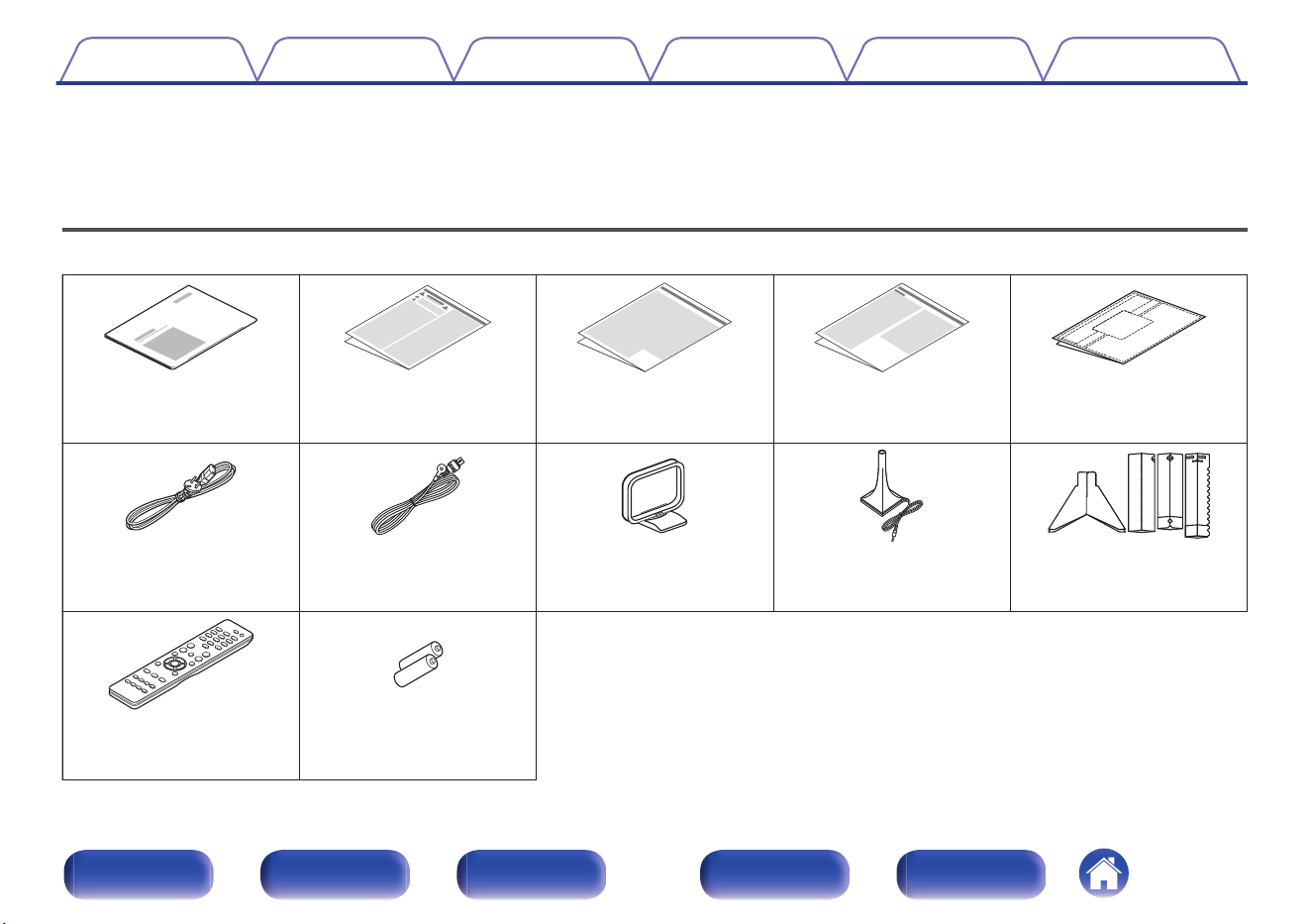
Accessories
Check that the following parts are supplied with the product.
Cable labelsNotes on radioSafety InstructionsQuick Start Guide
Sound calibration
microphone stand
Sound calibration
microphone
AM loop antennaFM indoor antennaPower cord
Cautions on Using Batteries
2× R03/AAA batteries
Remote control unit
(RC-1258)
Contents Connections Playback Settings Tips Appendix
8
Front panel Display Rear panel Remote Index
Inserting the batteries
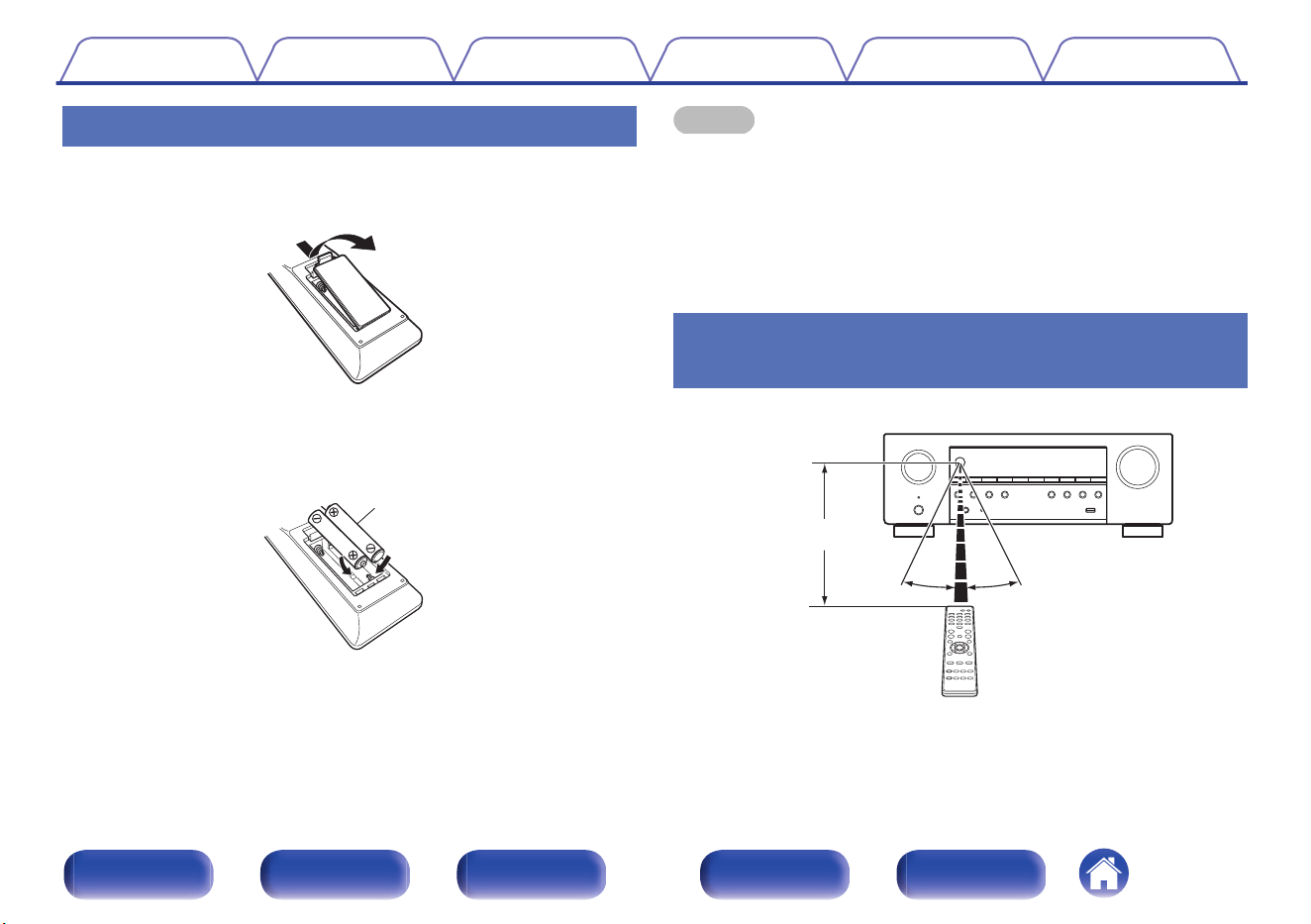
1
Remove the rear lid in the direction of the arrow and
remove it.
2
Insert two batteries correctly into the battery
compartment as indicated.
Batteries
3
Put the rear cover back on.
NOTE
0
To prevent damage or leakage of battery fluid:
0
Do not use a new battery together with an old one.
0
Do not use two different types of batteries.
0
Remove the batteries from the remote control unit if it will not be in use for long
periods.
0
If the battery fluid should leak, carefully wipe the fluid off the inside of the battery
compartment and insert new batteries.
Operating range of the remote control
unit
Point the remote control unit at the remote sensor when operating it.
30° 30°
Approx. 7 m
Contents Connections Playback Settings Tips Appendix
9
Front panel Display Rear panel Remote Index
Features
High quality sound
0
Powerful 5-channel Amplifier with the Latest Home Cinema Specs
Featuring discrete high-current amplifiers on all channels, this unit
delivers high-power performance of 75 watts per channel (8 Ω/ohms, 20
Hz - 20 kHz, T.H.D.: 0.08 %, 2ch. driven). Low impedance drivers
provide operational stability for a wide range of speakers and create a
balanced, tonal sound.
Upgrade your expectations in home theater entertainment.
High performance
0
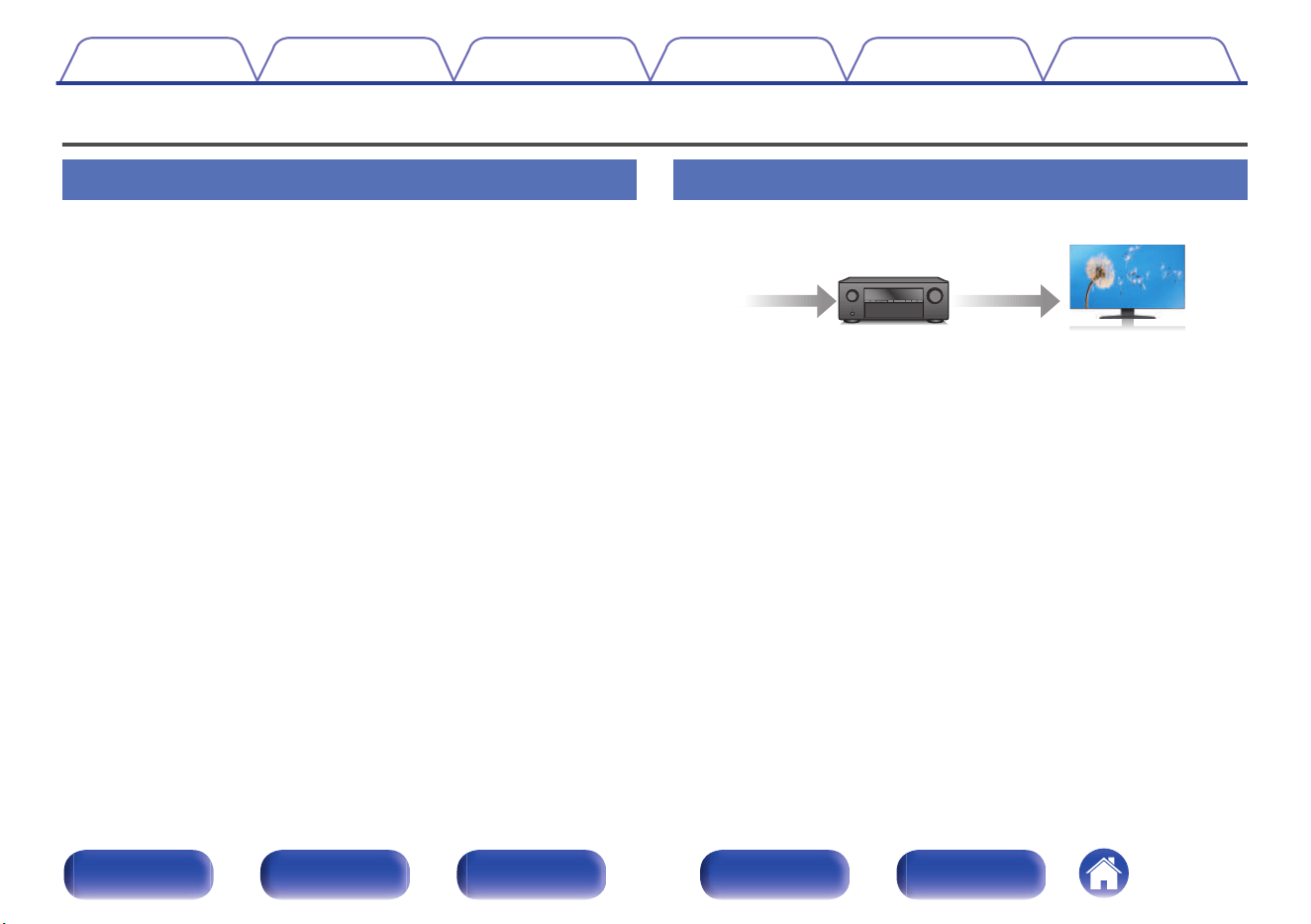
8K 60Hz input/output supported
8K,
4K 120Hz
8K,
4K 120Hz
When 8K Ultra HD (High Definition) is used, an input/output speed of 60
frames per second (60p) is achieved for video signals. When connected
to 8K Ultra HD and 60p video signal input compatible TV, you can enjoy
the sense of realism only available from high-definition images, even
when viewing fast-moving video.
This unit supports a wide range of HDR content, delivering even higher
definition video.
0
HDCP 2.3
This unit is compatible with HDCP 2.3 copyright protection standard.
Contents Connections Playback Settings Tips Appendix
10
Front panel Display Rear panel Remote Index
0
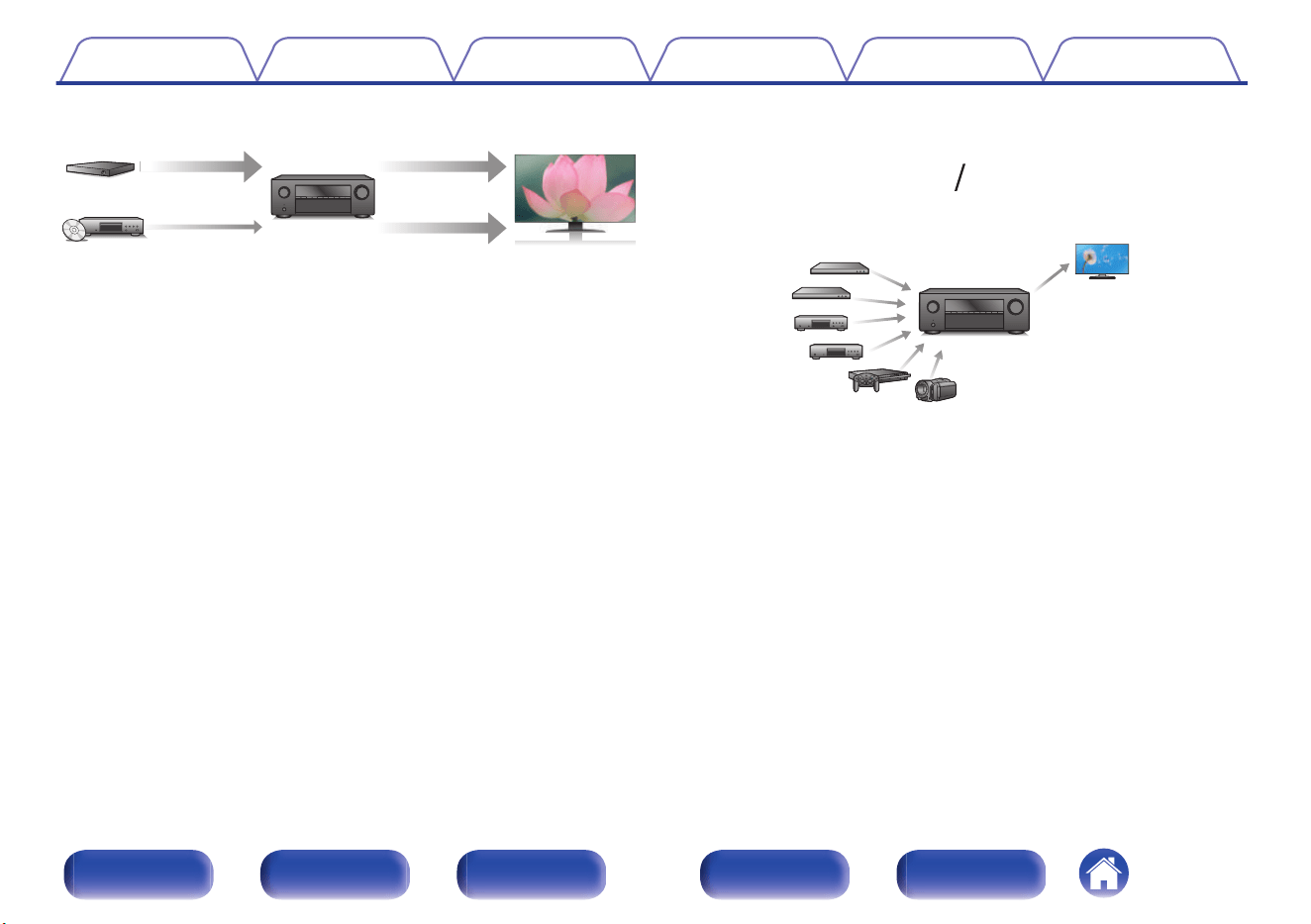
Digital video processor upscales 1080p / 4K to 8K
8K Ultra HD
8K 8K
1080p/4K 60Hz
8K
up scaling
This unit is equipped with a 8K video upscaling function that allows
1080p/4K video to be output via HDMI at 8K (7680 × 4320 pixels)
resolution. This function enables the device to be connected to a TV
using a single HDMI cable, and produces high definition images for any
video source.
0
eARC (Enhanced Audio Return Channel) function compatibility
The eARC function is compatible with conventional ARC function-
compatible audio formats in addition to multichannel linear PCM, Dolby
TrueHD, DTS-HD and other audio formats a conventional ARC function
cannot transmit.
Additionally, connecting to an eARC function-compatible television
enables enjoyment of higher-quality surround playback of the audio
content played from your television.
0
HDMI connections enable connection to various digital AV
devices (6 inputs, 1 output)
61
OutIn
This unit is equipped with 6 HDMI inputs and 1 HDMI output enabling
connection to various HDMI compatible devices such as Blu-ray Disc
players, game consoles and HD video camcorders.
Contents Connections Playback Settings Tips Appendix
11
Front panel Display Rear panel Remote Index
0
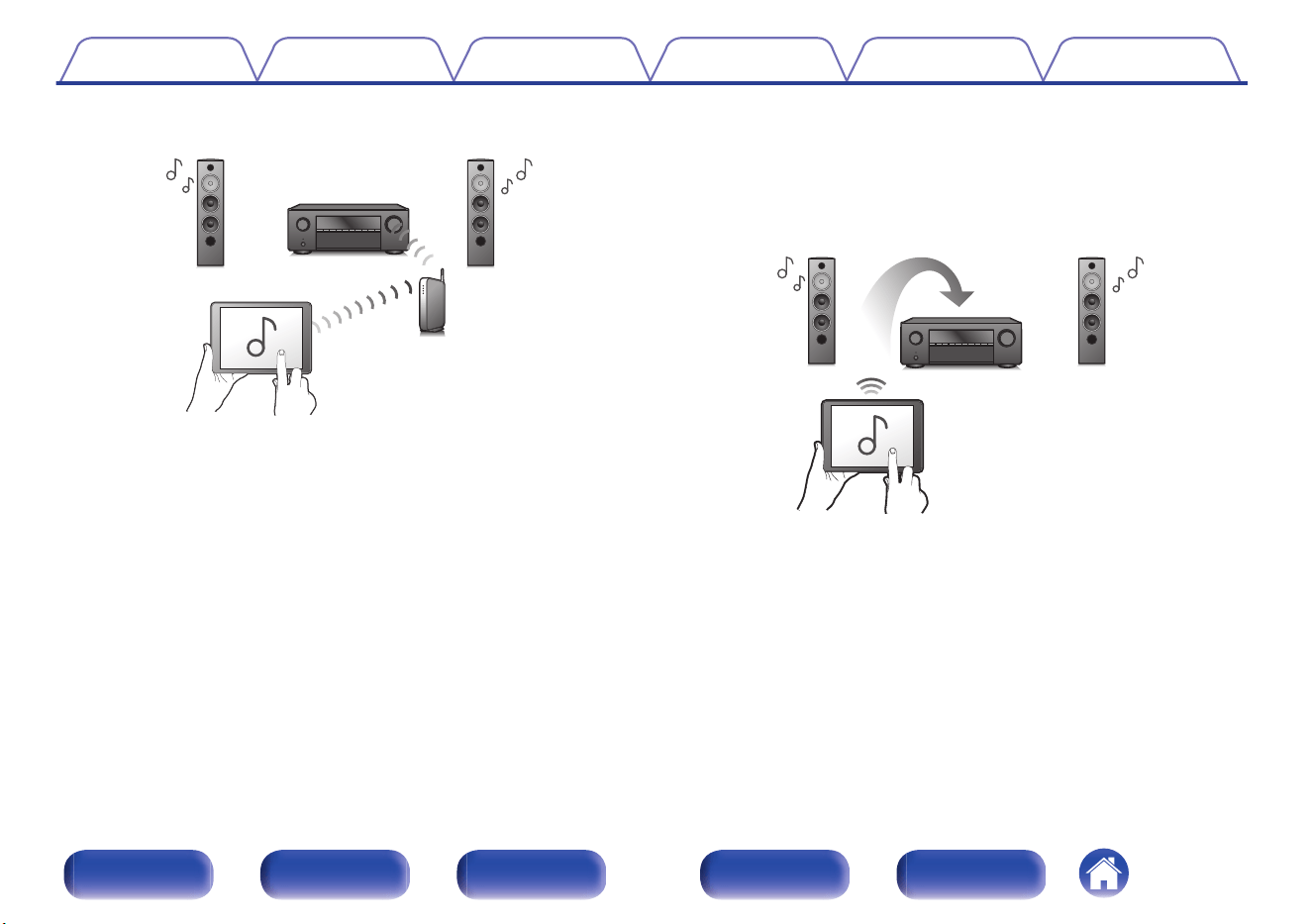
The device is equipped with a AirPlay
®
function in addition to
network functions such as Internet radio etc. (v p. 90)
You can enjoy a wide variety of content, including listening to Internet
Radio, playing audio files stored on your PC.
This unit also supports Apple AirPlay which lets you stream your music
library from an iPhone
®
, iPad
®
, iPod touch
®
or iTunes
®
.
0
Supports AirPlay 2
®
wireless audio
Sync multiple AirPlay 2 compatible devices/speakers for simultaneous
playback.
This unit supports AirPlay 2 and requires iOS 11.4 or later.
0
Playback of DSD and FLAC files via USB and networks
This unit supports the playback of high resolution audio formats such as
DSD (5.6 MHz) and FLAC 192 kHz files. It provides high quality
playback of high resolution files.
0
Wireless connection with Bluetooth devices can be carried out
easily (v p. 56)
You can enjoy music simply by connecting wirelessly with your
smartphone, tablet, PC, etc.
Contents Connections Playback Settings Tips Appendix
12
Front panel Display Rear panel Remote Index
0
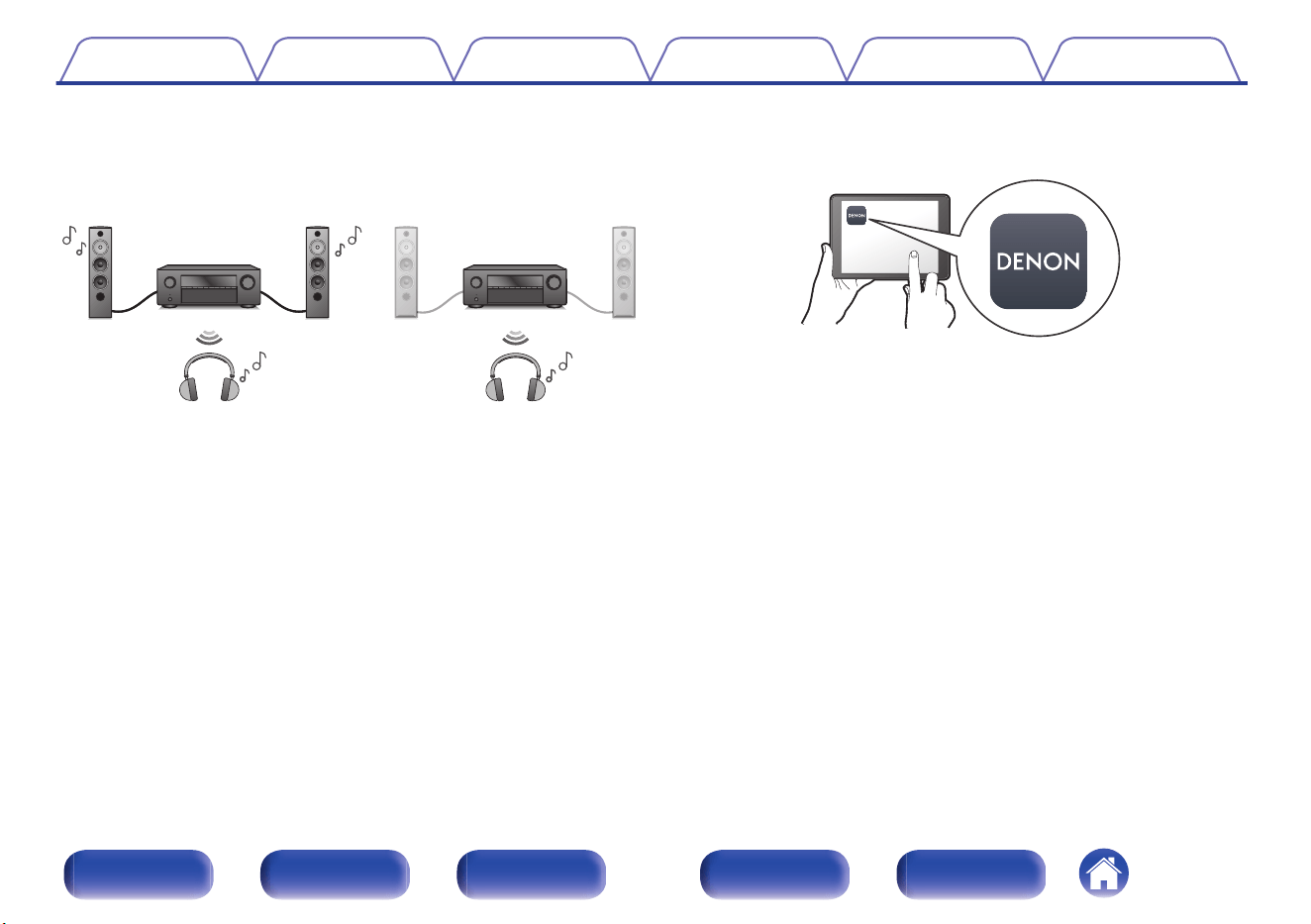
Connect Bluetooth headphones
This unit can transmit Bluetooth so you can enjoy audio wirelessly
through your Bluetooth headphones.
Playback can be performed using connected speakers and Bluetooth
headphones simultaneously, or only using Bluetooth headphones.
0
Energy-saving design
This unit is equipped with an ECO Mode function that allows you to
enjoy music and movies while reducing the power consumption during
use, and also an auto-standby function that automatically turns off the
power supply when the unit is not in use. This helps reduce
unnecessary power use.
0
Compatible with the “Denon AVR Remote” App
z
for performing
basic operations of the unit with an iPad, iPhone or Android™
devices (Google, Amazon Kindle Fire)
The Denon AVR Remote app gives you full control of this unit as well as
access to its setup menu for detailed adjustments from your phones or
tablets. “Denon AVR Remote” App also gives you quick access to the
receiver's status display, option menus, Denon Blu-ray Disc player
control, and online owner's manual for your convenience.
z
Download the appropriate “Denon AVR Remote” App for your iOS or Android
devices. This unit needs to be connected to the same LAN or Wi-Fi (wireless
LAN) network that the iPad, iPhone or Android™ is connected to.
Contents Connections Playback Settings Tips Appendix
13
Front panel Display Rear panel Remote Index
0
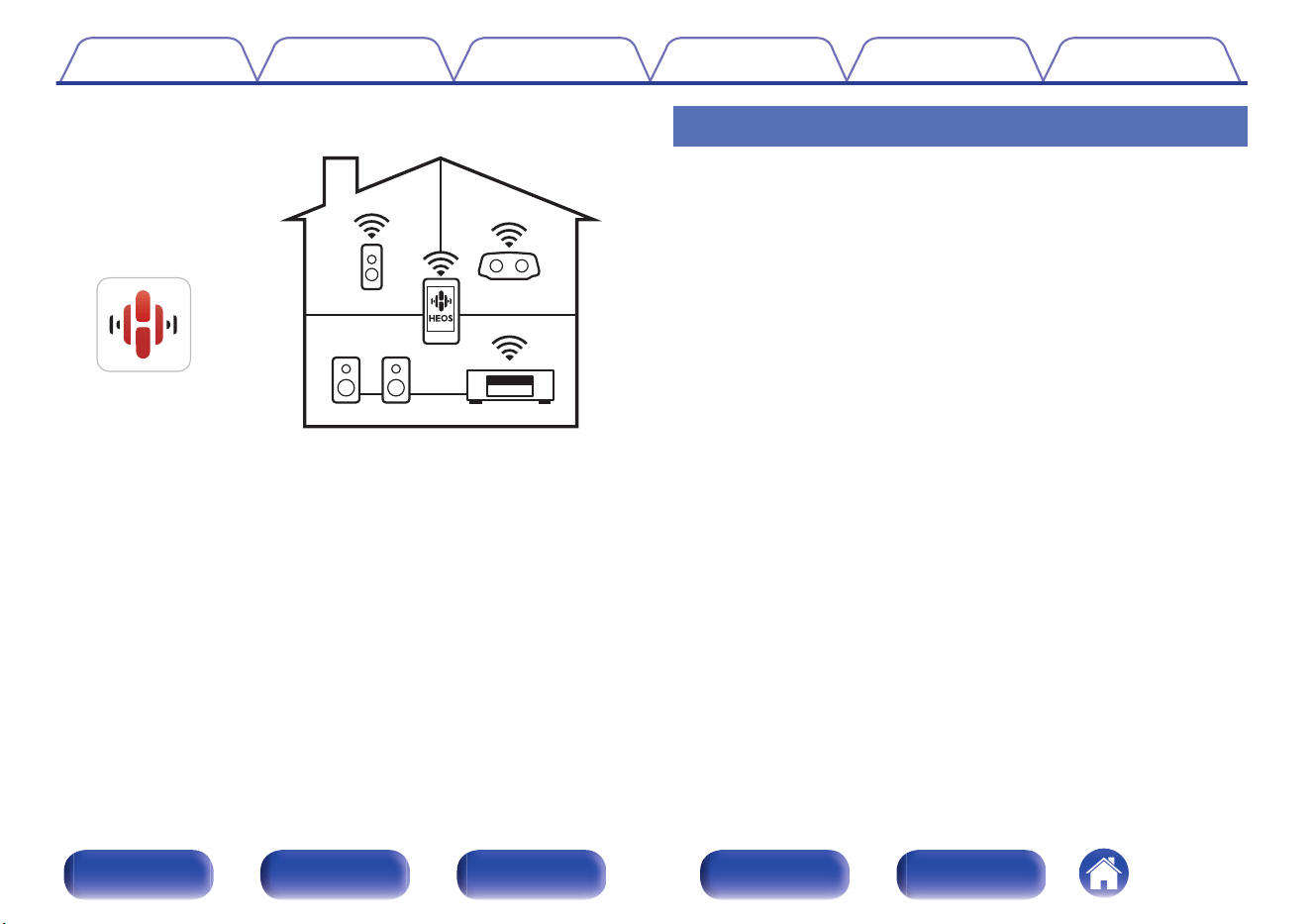
HEOS provides streaming music from your favorite online music
sources
HEOS wireless multi-room sound system that enables you to enjoy your
favorite music anywhere and everywhere around your home. By utilizing
your existing home network and the HEOS App (available for iOS,
Android and Amazon devices), you can explore, browse, and play
music from your own music library or from many online streaming music
services.
When multiple products with HEOS Built-in are connected to the same
network, they can be grouped to play the same music on all products
simultaneously, or different music can be played on each one.
Easy operation
0
“Setup Assistant” provides easy-to-follow setup instructions
First select the language when prompted. Then simply follow the
instructions displayed on the TV screen to set up the speakers, network,
etc.
0
Easy to use Graphical User Interface
This unit is equipped with a Graphical User Interface for improved
operability.
Contents Connections Playback Settings Tips Appendix
14
Front panel Display Rear panel Remote Index
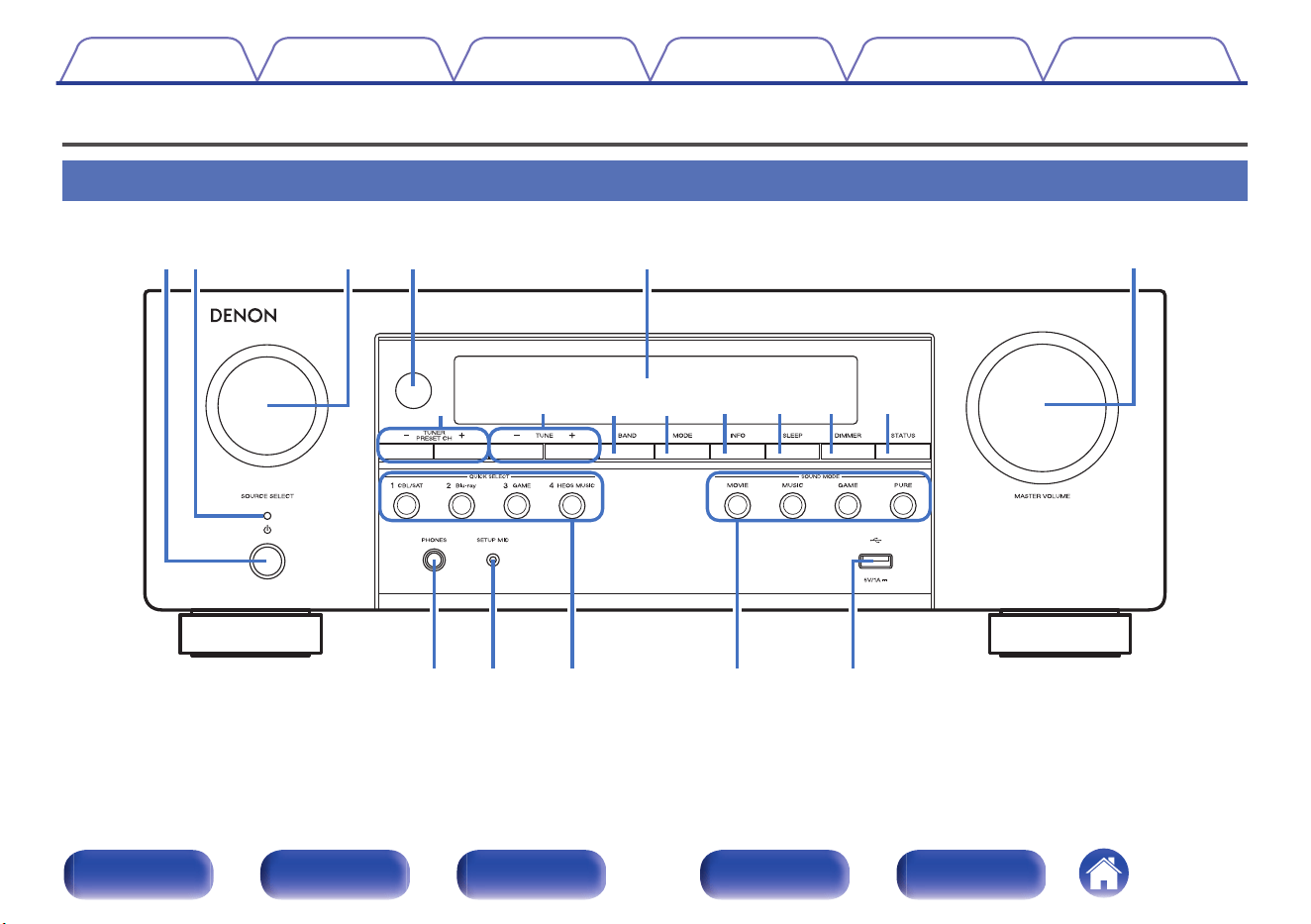
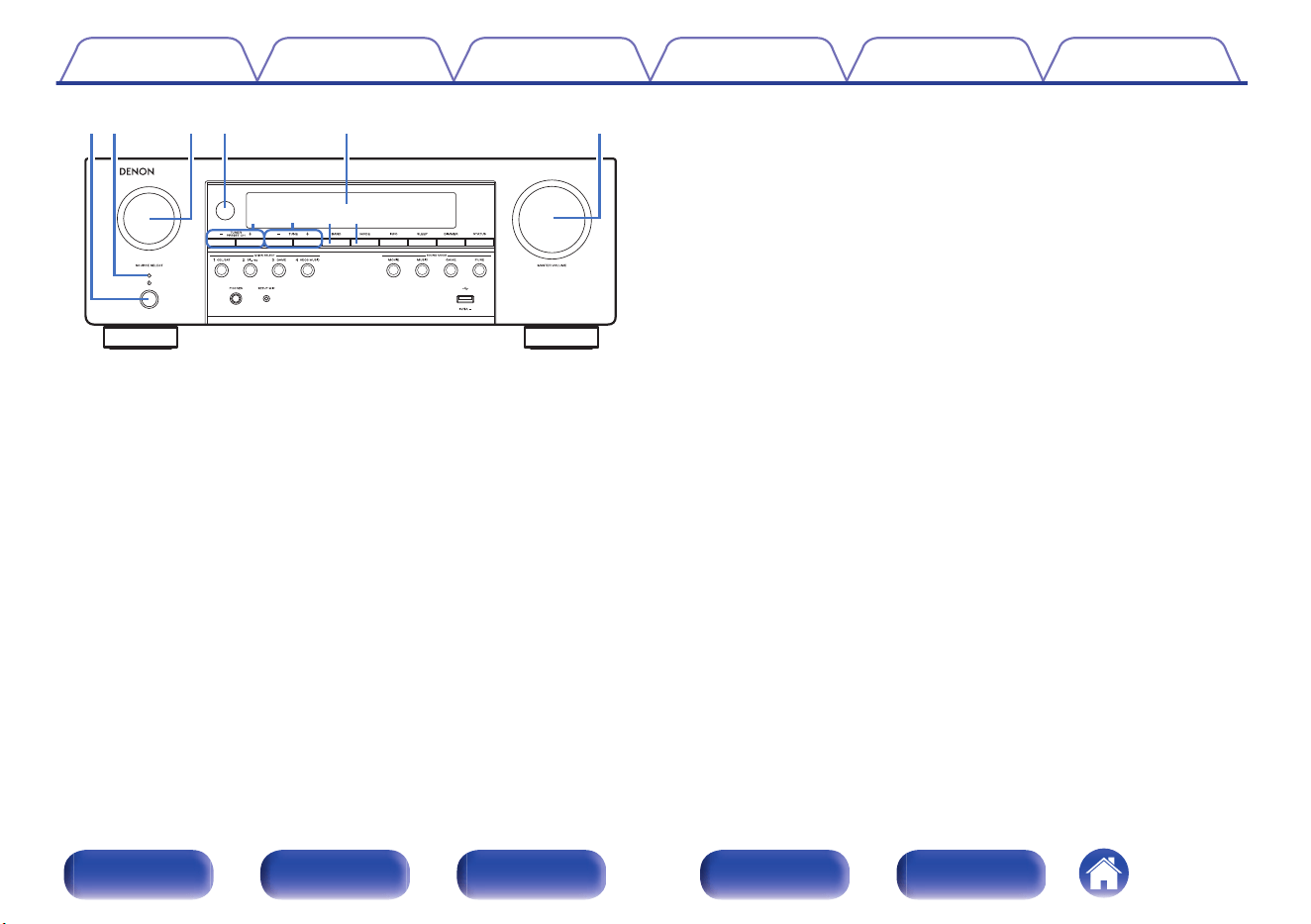
iuQ0o
er t yqw
A
Power operation button (X)
Used to turn the power on/off (standby). (v p. 50)
B
Power indicator
This is lit as follows according to the power status:
0
Green: Power on
0
Off: Normal standby
0
Red:
0
When “HDMI Pass Through” is set to “On” (v p. 140)
0
When “HDMI Control” is set to “On” (v p. 142)
0
When “Network Control” is set to “Always On” (v p. 172)
C
SOURCE SELECT knob
This selects the input source. (v p. 50)
D
Remote control sensor
This receives signals from the remote control unit. (v p. 9)
E
Display
This displays various pieces of information. (v p. 18)
F
MASTER VOLUME knob
This adjusts the volume level. (v p. 51)
G
Tuner preset channel buttons
(TUNER PRESET CH +, –)
These select preset broadcast stations. (v p. 71)
H
Tuning up / Tuning down buttons (TUNE +, –)
Select either FM broadcast or AM broadcast. (v p. 65)
I
Reception band select button (BAND)
This switches the reception band. (v p. 65)
J
Tune mode select button (MODE)
This switches the tuning mode. (v p. 70)
Contents Connections Playback Settings Tips Appendix
16
Front panel Display Rear panel Remote Index
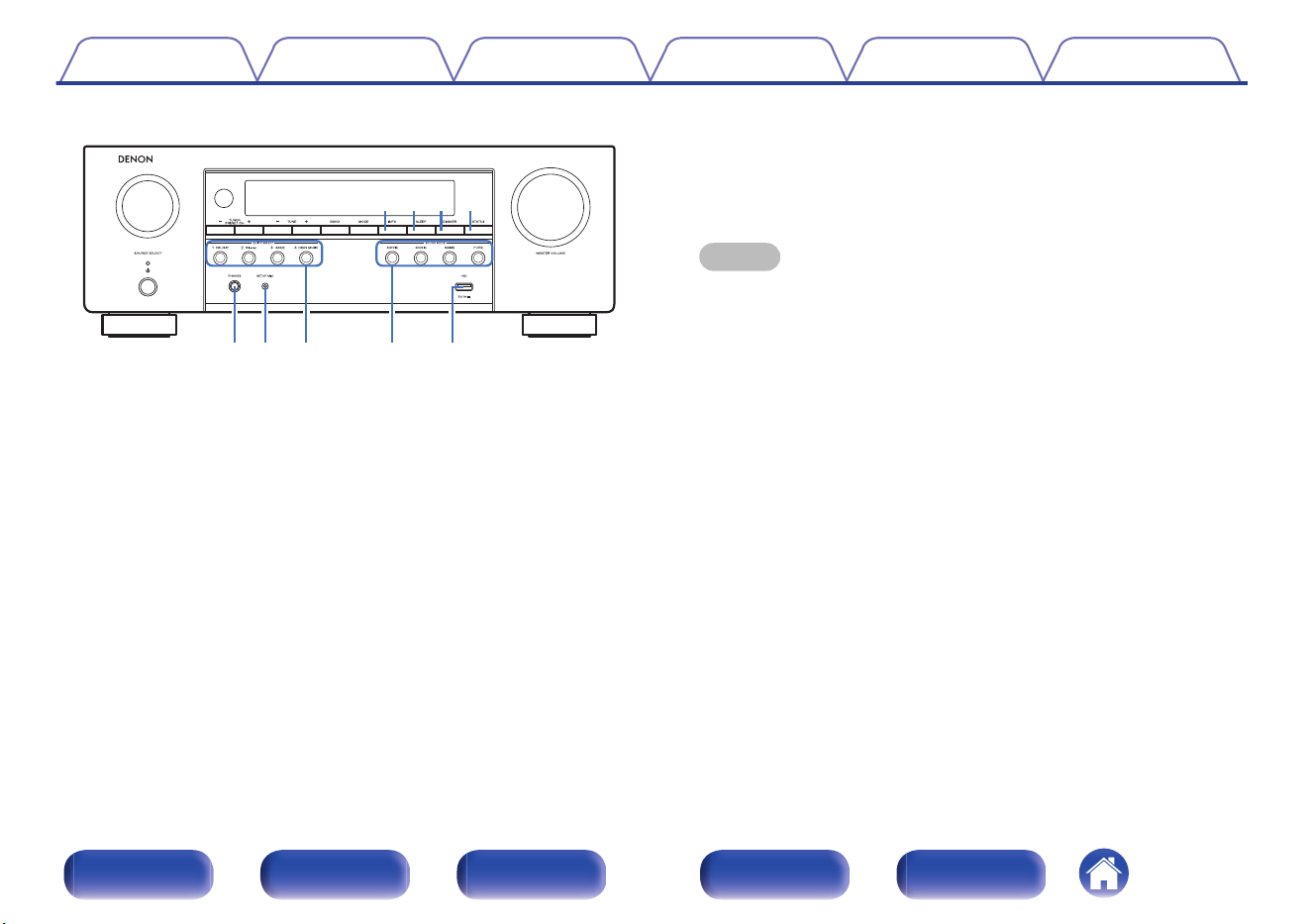
Q11 Q2 Q3 Q4
Q
9
Q
5
Q
6
Q
7
Q
8
K
Information button (INFO)
This displays the status information on the TV screen. (v p. 186)
L
SLEEP button
This sets the sleep timer. (v p. 112)
M
DIMMER button
Each press of this switches the brightness of the display. (v p. 182)
N
STATUS button
Each press of this switches the status information that is shown on the
display.
O
Headphones jack (PHONES)
This is used to connect headphones.
When the headphones are plugged into this jack, audio will no longer
be output from the connected speakers or from the SUBWOOFER
connectors.
NOTE
0
To prevent hearing loss, do not raise the volume level excessively when using
headphones.
P
SETUP MIC jack
This is used to connect the supplied Sound calibration microphone.
(v p. 156)
Q
QUICK SELECT buttons
With a single press of any of these buttons, you can call up various
settings you’ve registered to each button such as the input source,
volume level and sound mode settings. (v p. 114)
R
SOUND MODE buttons
These select the sound mode. (v p. 101)
S
USB port (T)
This is used to connect USB storages (such as USB memory devices).
(v p. 43)
Contents Connections Playback Settings Tips Appendix
17
Front panel Display Rear panel Remote Index
Display
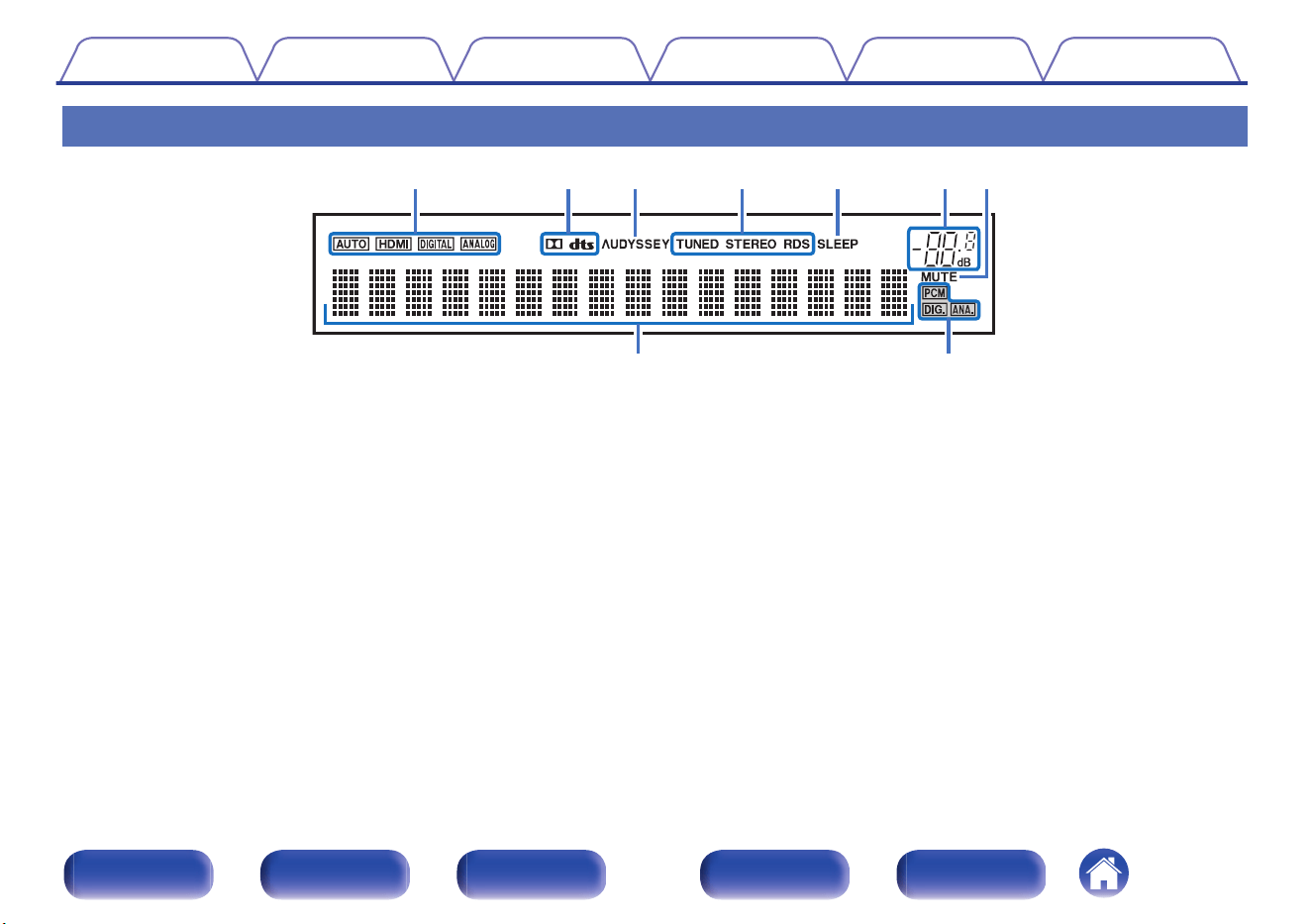
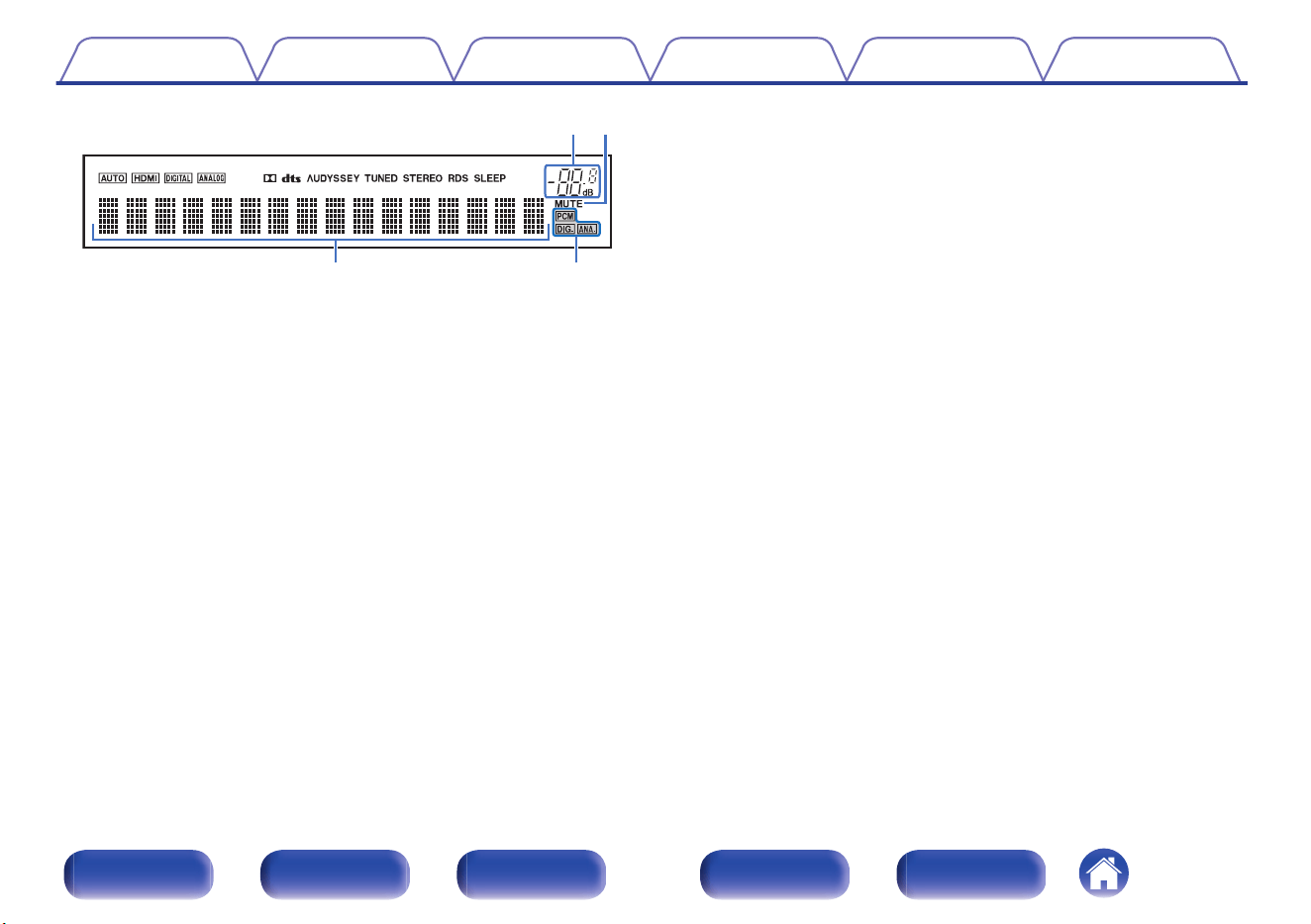
yutrewq
io
A
Input mode indicators
These light according to the audio input mode settings of each input
source. (v p. 151)
B
Decoder indicators
These light when Dolby or DTS signals are input or when the Dolby or
DTS decoder is running.
C
Audyssey
®
indicator
This lights when “MultEQ
®
”, “Dynamic EQ” or “Dynamic Volume” has
been set up. (v p. 136)
D
Tuner reception mode indicators
These light up according to the reception conditions when the input
source is set to “Tuner”.
TUNED: Lights up when the broadcast is properly tuned in.
STEREO: Lights up when receiving FM stereo broadcasts.
RDS: Lights up when receiving RDS broadcasts.
E
Sleep timer indicator
This lights when the sleep mode is selected. (v p. 112)
Contents Connections Playback Settings Tips Appendix
18
Front panel Display Rear panel Remote Index
yu
oi
F
Volume indicator
G
MUTE indicator
This blinks while the sound is muted. (v p. 51)
H
Information display
The input source name, sound mode, setting values and other
information are displayed here.
I
Input signal indicators
The respective indicator will light corresponding to the input signal.
(v p. 151)
Contents Connections Playback Settings Tips Appendix
19
Front panel Display Rear panel Remote Index
qq
er
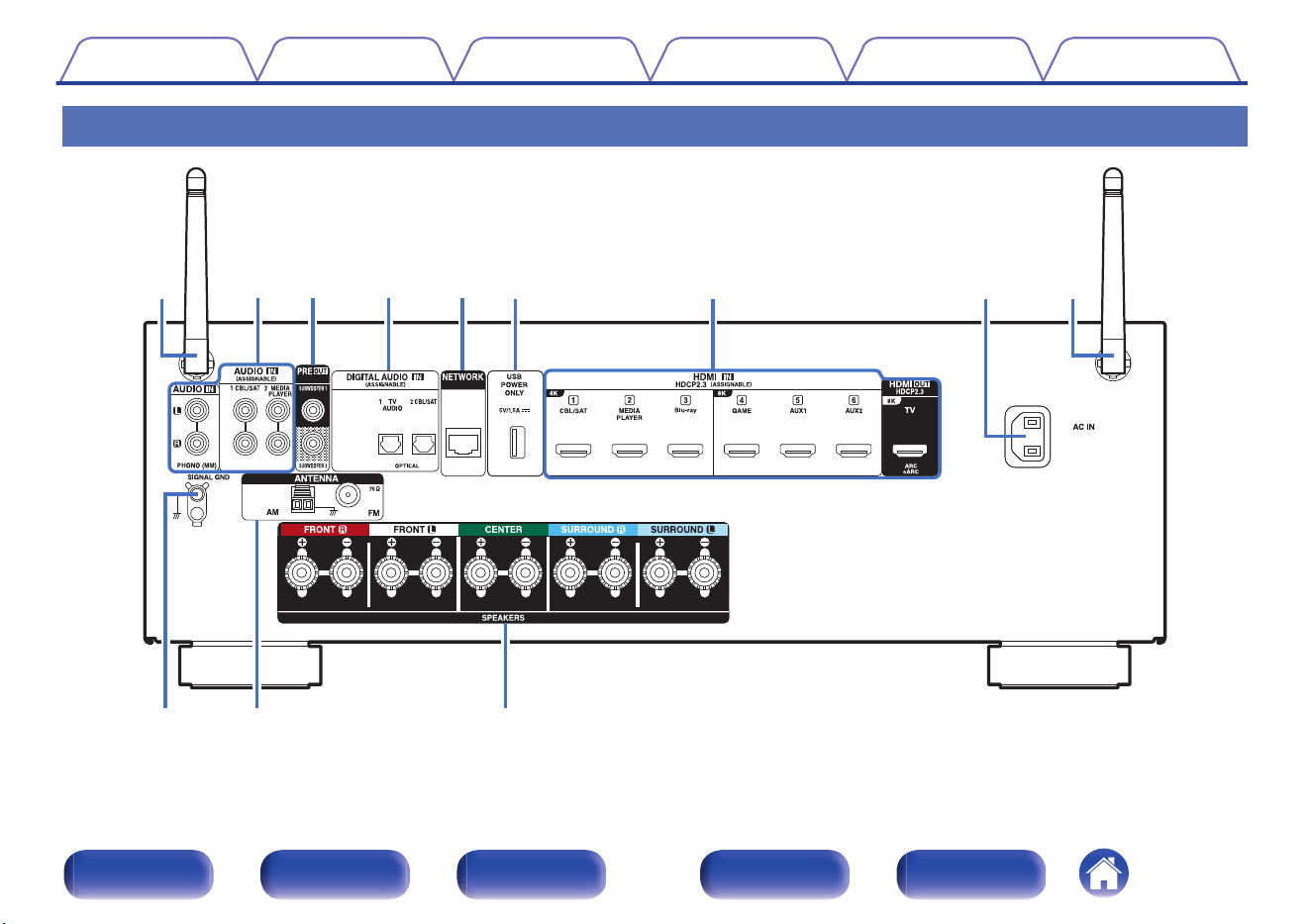
w
A
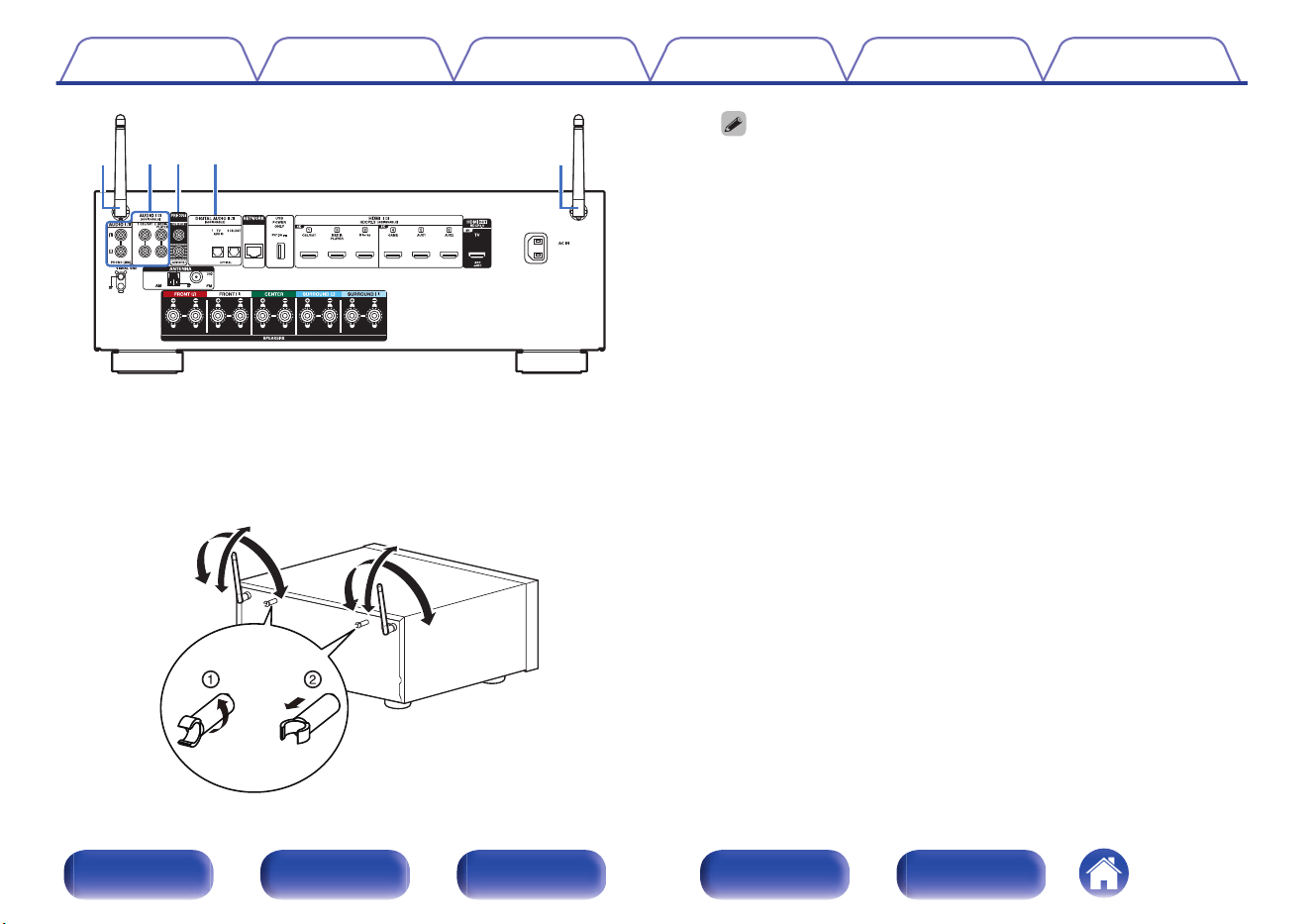
Rod antennas for Bluetooth/wireless LAN
Stand this antenna upright when connecting to a network via wireless
LAN, or when connecting to a handheld device via Bluetooth.
(v p. 47)
90°
320°
320°
90°
0
The antenna clip can be removed from the rear panel.
A
Rotate the antenna clip 90 degrees to the left.
B
Pull the antenna clip out towards yourself.
0
The antenna clip is needed when transporting this unit. Keep it in a
safe place.
0
Attach the antenna clip by following the steps for removing it in
reverse.
B
Analog audio connectors (AUDIO)
Used to connect devices equipped with analog audio connectors.
0
“Connecting a set-top box (Satellite tuner/cable TV)” (v p. 38)
0
“Connecting a media player” (v p. 39)
0
“Connecting a turntable” (v p. 42)
C
PRE OUT connectors
Used to connect a subwoofer with a built-in amplifier. (v p. 30)
D
Digital audio connectors (DIGITAL AUDIO)
Used to connect devices equipped with digital audio connectors.
0
“Connection 2 : TV equipped with an HDMI connector and
incompatible with the ARC / eARC” (v p. 36)
0
“Connecting a set-top box (Satellite tuner/cable TV)” (v p. 38)
Contents Connections Playback Settings Tips Appendix
21
Front panel Display Rear panel Remote Index
ty u i
o
Q1Q0
E
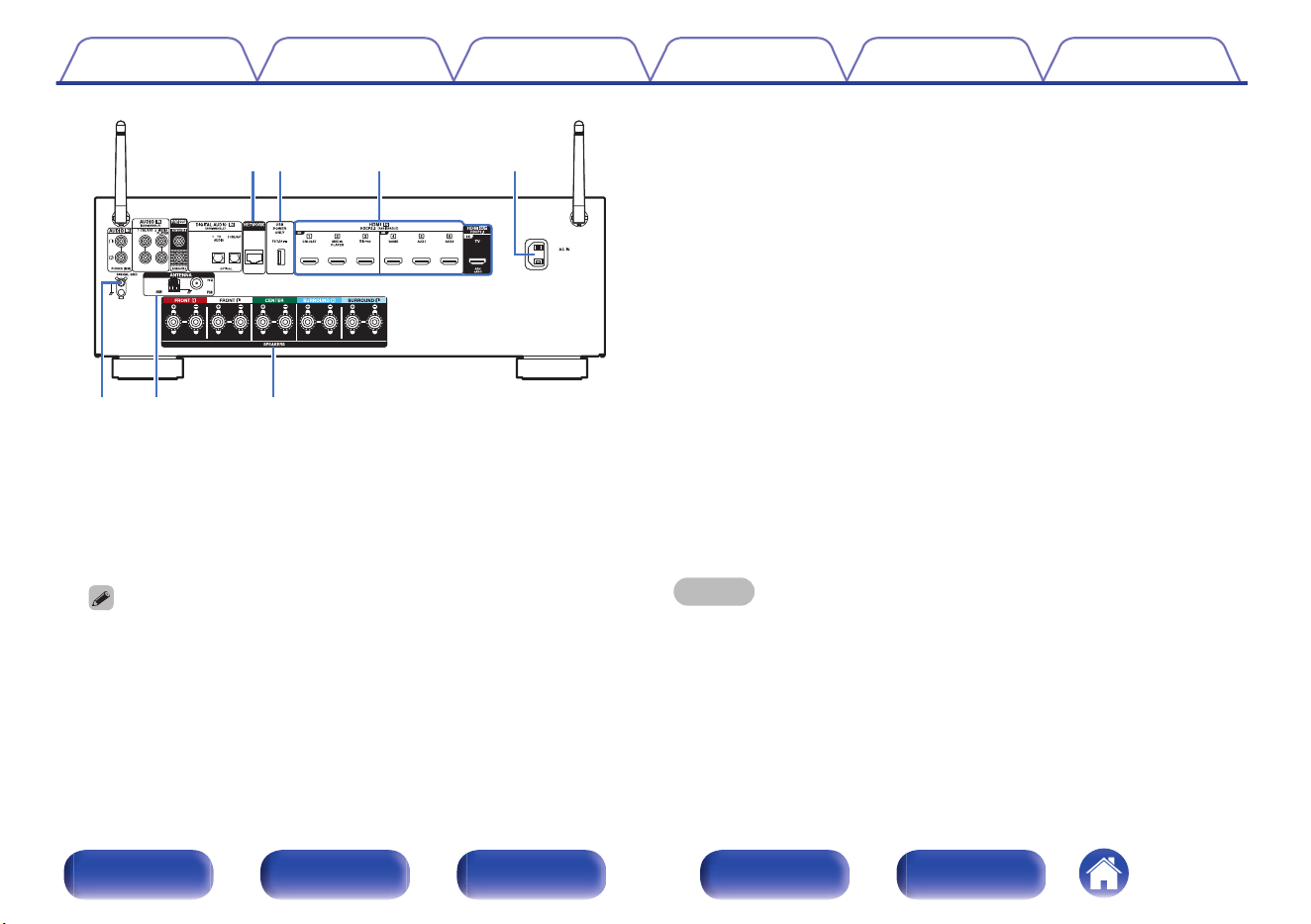
NETWORK connector
Used to connect to a LAN cable when connecting to a wired LAN
network. (v p. 46)
F
USB port (POWER SUPPLY)
Can be used to power streaming media players, etc.
0
Use a device’s supplied AC adapter when a power supply of 5 V/1.5 A or more
is required.
0
Connect to the USB port on the front panel to play content from a USB
memory device.
G
HDMI connectors
Used to connect devices equipped with HDMI connectors.
0
“Connection 1 : TV equipped with an HDMI connector and
compatible with the ARC / eARC” (v p. 35)
0
“Connection 2 : TV equipped with an HDMI connector and
incompatible with the ARC / eARC” (v p. 36)
0
“Connecting a set-top box (Satellite tuner/cable TV)” (v p. 38)
0
“Connecting a media player” (v p. 39)
0
“Connecting a Blu-ray Disc player or DVD player” (v p. 40)
0
“Connecting a game console or player device compatible with
8K” (v p. 41)
H
AC inlet (AC IN)
Used to connect the power cord. (v p. 48)
I
SIGNAL GND terminal
Used to connect a ground wire for the turntable. (v p. 42)
J
FM/AM antenna terminals (ANTENNA)
Used to connect FM antennas and AM loop antennas. (v p. 44)
K
Speaker terminals (SPEAKERS)
Used to connect speakers. (v p. 29)
NOTE
0
Do not touch the inner pins of the connectors on the rear panel. Electrostatic
discharge may cause permanent damage to the unit.
Contents Connections Playback Settings Tips Appendix
22
Front panel Display Rear panel Remote Index
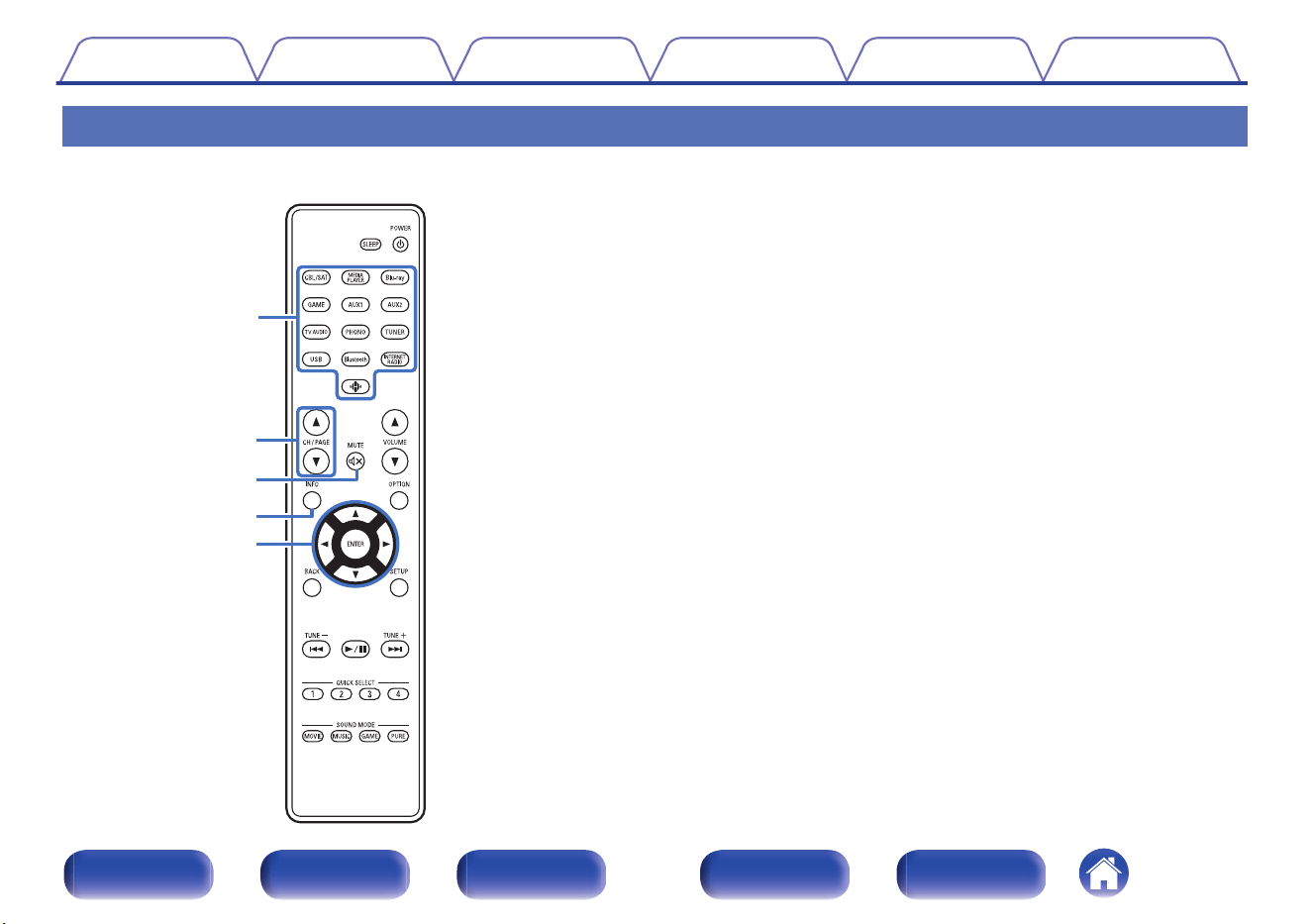
Remote control unit
A
Input source select buttons
These selects the input source. (v p. 50)
B
Channel/page search buttons (CH/PAGE df)
These select radio stations registered to presets or switch pages.
(v p. 71)
C
MUTE button (:)
This mutes the output audio. (v p. 51)
D
Information button (INFO)
This displays the status information on the TV screen. (v p. 186)
E
Cursor buttons
These select items.
w
r
e
t
q
Contents Connections Playback Settings Tips Appendix
23
Front panel Display Rear panel Remote Index
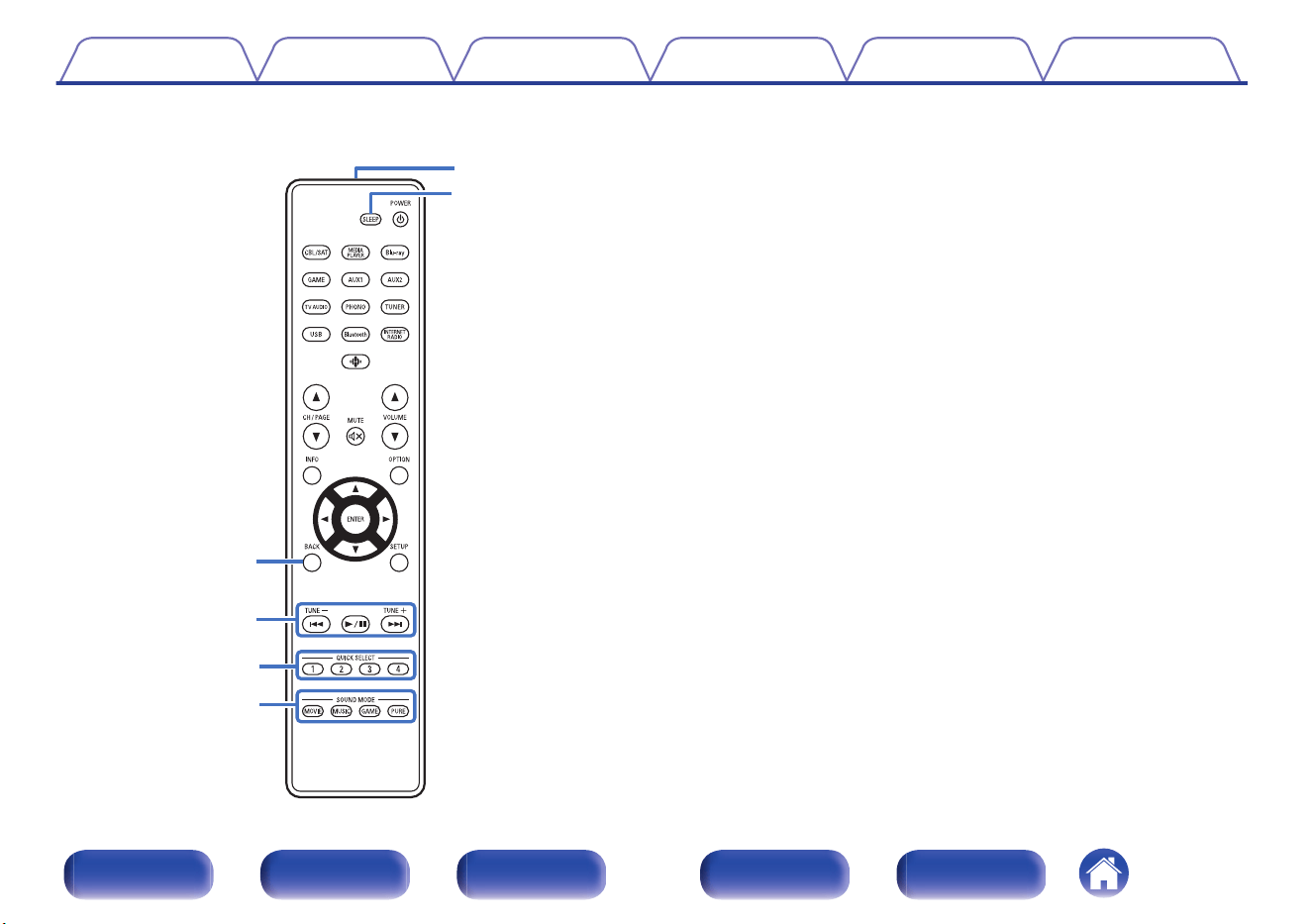
F
BACK button
This returns to the previous screen.
G
System buttons
These perform playback related operations.
Tuning up / Tuning down buttons (TUNE +, –)
These select either FM broadcast or AM broadcast. (v p. 65)
H
QUICK SELECT buttons (1 – 4)
These call up settings registered to each button, such as input source,
volume level and sound mode settings. (v p. 114)
I
SOUND MODE buttons
These select the sound mode. (v p. 101)
J
Remote control signal transmitter
This transmits signals from the remote control unit. (v p. 9)
K
SLEEP button
This sets the sleep timer. (v p. 112)
Q0
o
i
u
y
Q1
Contents Connections Playback Settings Tips Appendix
24
Front panel Display Rear panel Remote Index
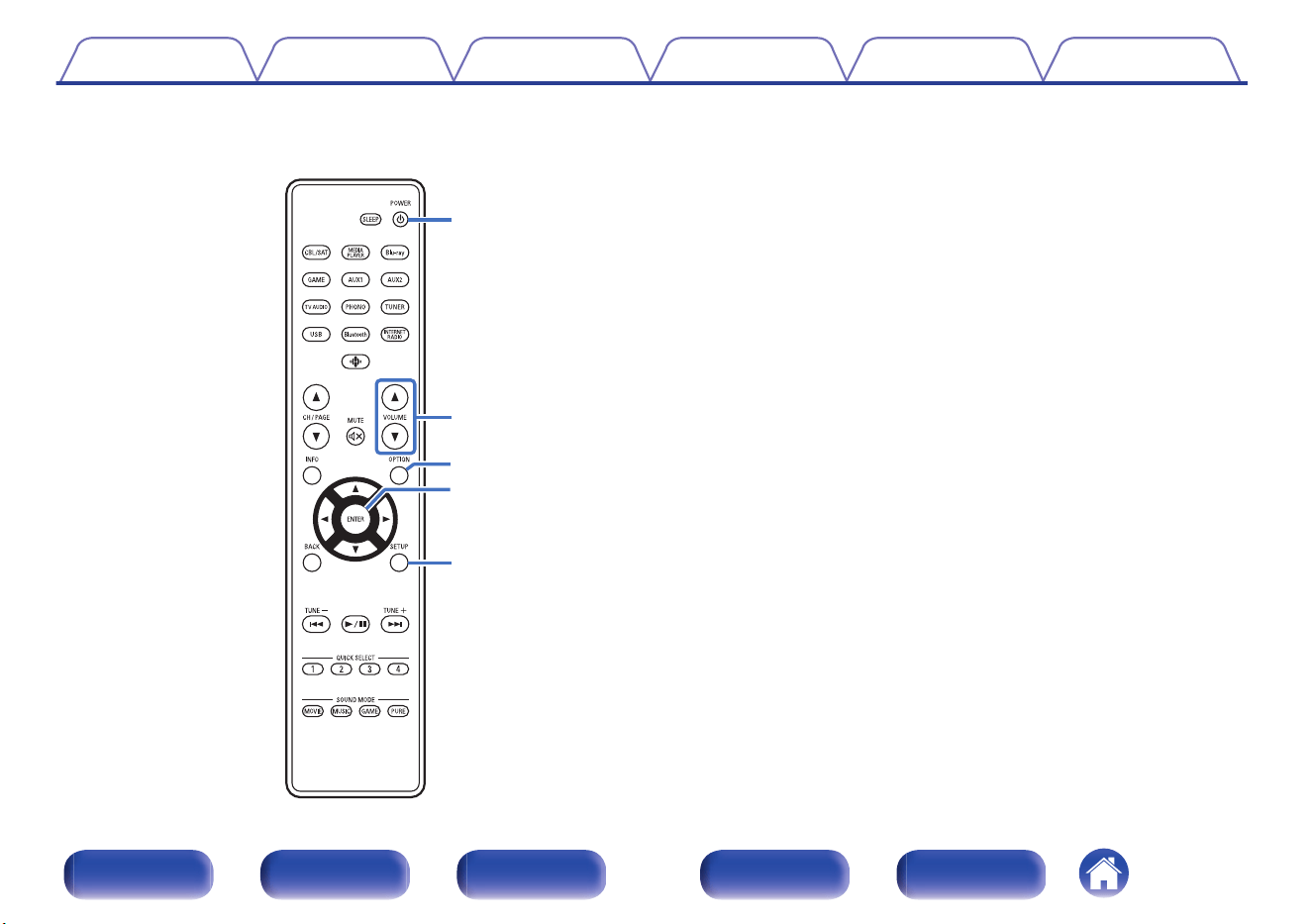
L
POWER button (X)
This turns the power on/off. (v p. 50)
M
VOLUME buttons (df)
These adjusts the volume level. (v p. 51)
N
OPTION button
This displays the option menu on the TV screen.
O
ENTER button
This determines the selection.
P
SETUP button
This displays the menu on the TV screen. (v p. 127)
Q2
Q3
Q6
Q4
Q5
Contents Connections Playback Settings Tips Appendix
25
Front panel Display Rear panel Remote Index
o
Contents
Speaker installation 27
Connecting speakers 29
Connecting a TV 34
Connecting a playback device 37
Connecting a USB memory device to the USB port 43
Connecting FM/AM antennas 44
Connecting to a home network (LAN) 46
Connecting the power cord 48
NOTE
0
Do not plug in the power cord until all connections have been completed.
However, when the “Setup Assistant” is running, follow the instructions in the
“Setup Assistant” (page 9 in the separate “Quick Start Guide”) screen for making
connections. (During “Setup Assistant” operation, the input/output connectors do
not conduct current.)
0
Do not bundle power cords together with connection cables. Doing so can result in
noise.
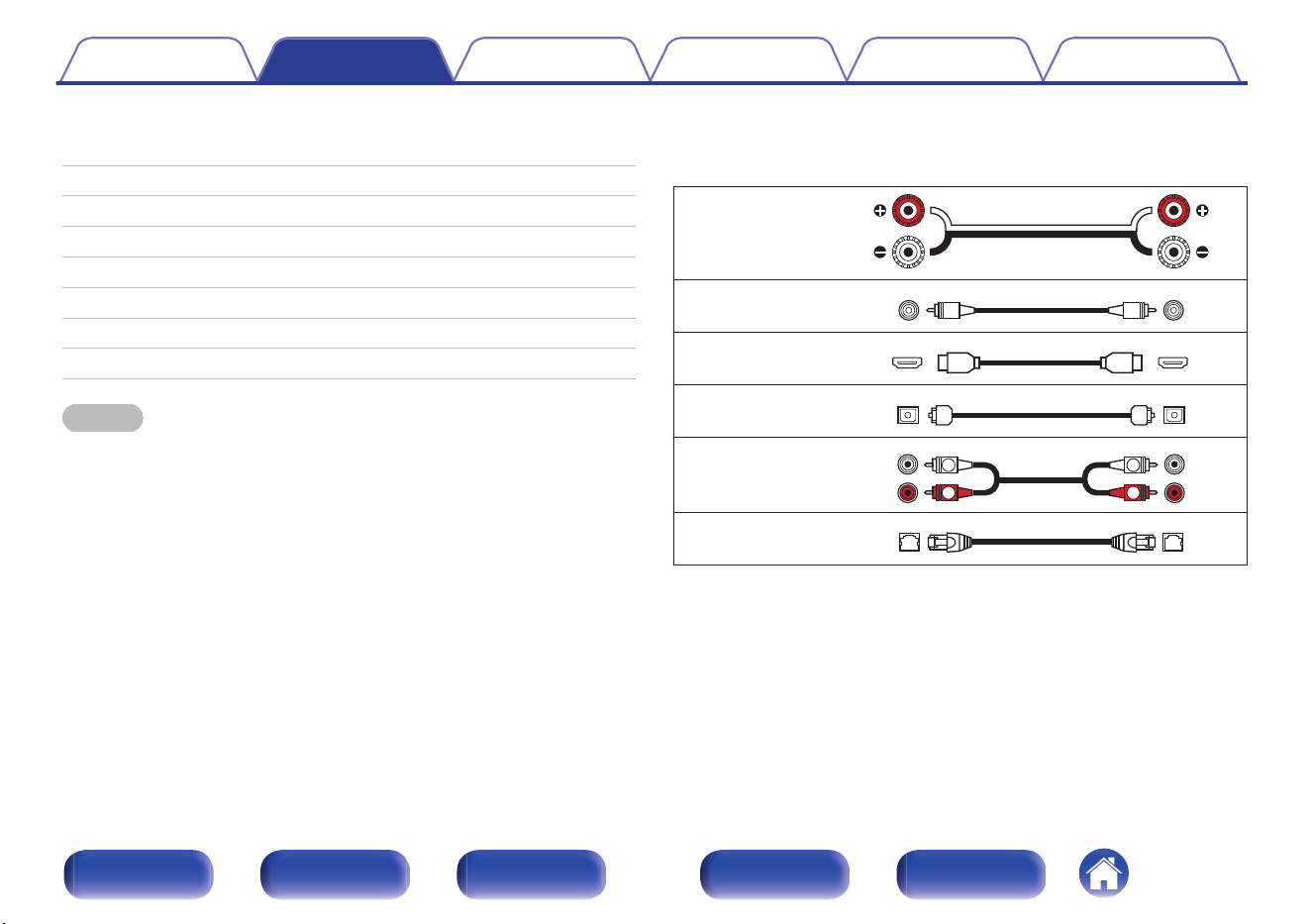
o
Cables used for connections
Provide necessary cables according to the devices you want to
connect.
Speaker cable
Subwoofer cable
HDMI cable
Optical cable
Audio cable
R
L
R
L
LAN cable
Contents Connections Playback Settings Tips Appendix
26
Front panel Display Rear panel Remote Index
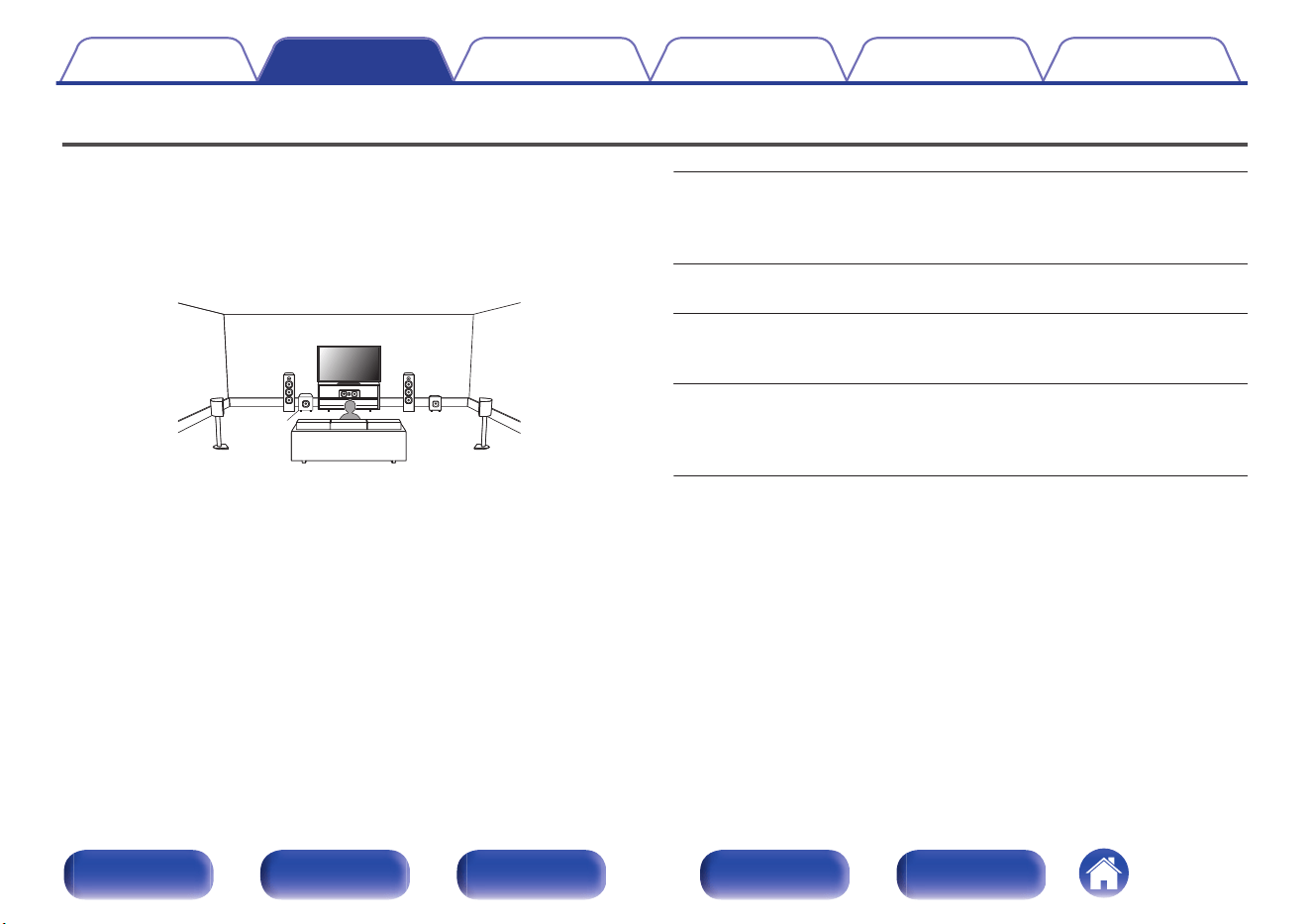
Speaker installation
Determine the speaker system depending on the number of speakers you
are using and install each speaker and subwoofer in the room.
Speaker installation is explained using this example of a typical
installation.
C
FL FR
SW1
SW2
SL SR
FL/FR
(Front speaker left/
right):
Place the FRONT left and right speakers an
equal distance from the main listening position.
The distance between each speaker and your TV
should also be the same.
C
(Center speaker):
Place the CENTER speaker in between the front
speakers and above or below your TV.
SL/SR
(Surround speaker left/
right):
Place the SURROUND left and right speakers an
equal distance to the left and right sides of the
main listening position.
SW 1/2
(Subwoofer):
Place the SUBWOOFER at a convenient location
near the front speakers. If you have two
subwoofers, place them asymmetrically across
the front of your room.
Contents Connections Playback Settings Tips Appendix
27
Front panel Display Rear panel Remote Index
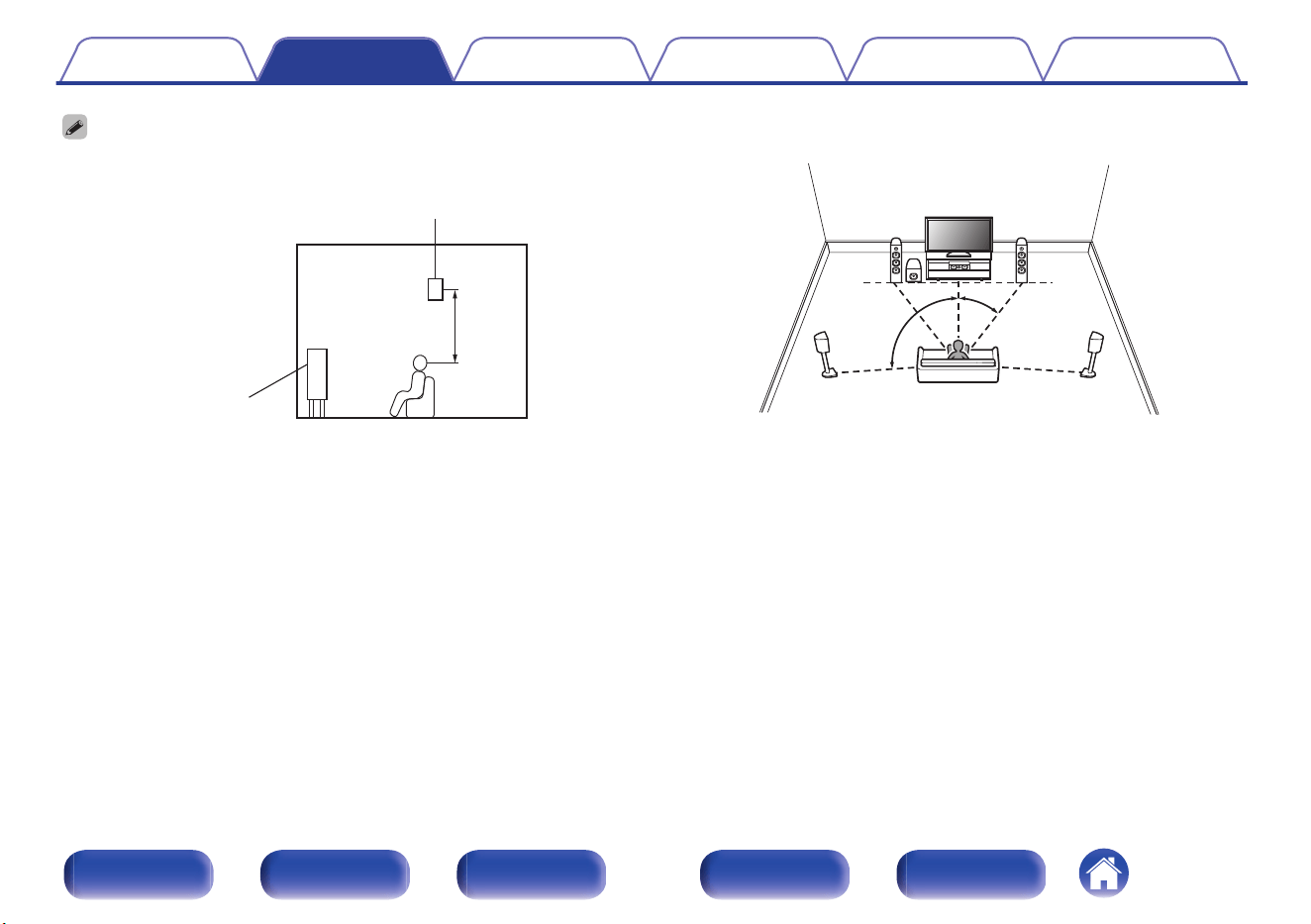
0
Use the illustration below as a guide for how high each speaker should be
installed. The height does not need to be exactly the same.
GViewed from the sideH
Front speaker
Surround speaker
60 – 90 cm
o
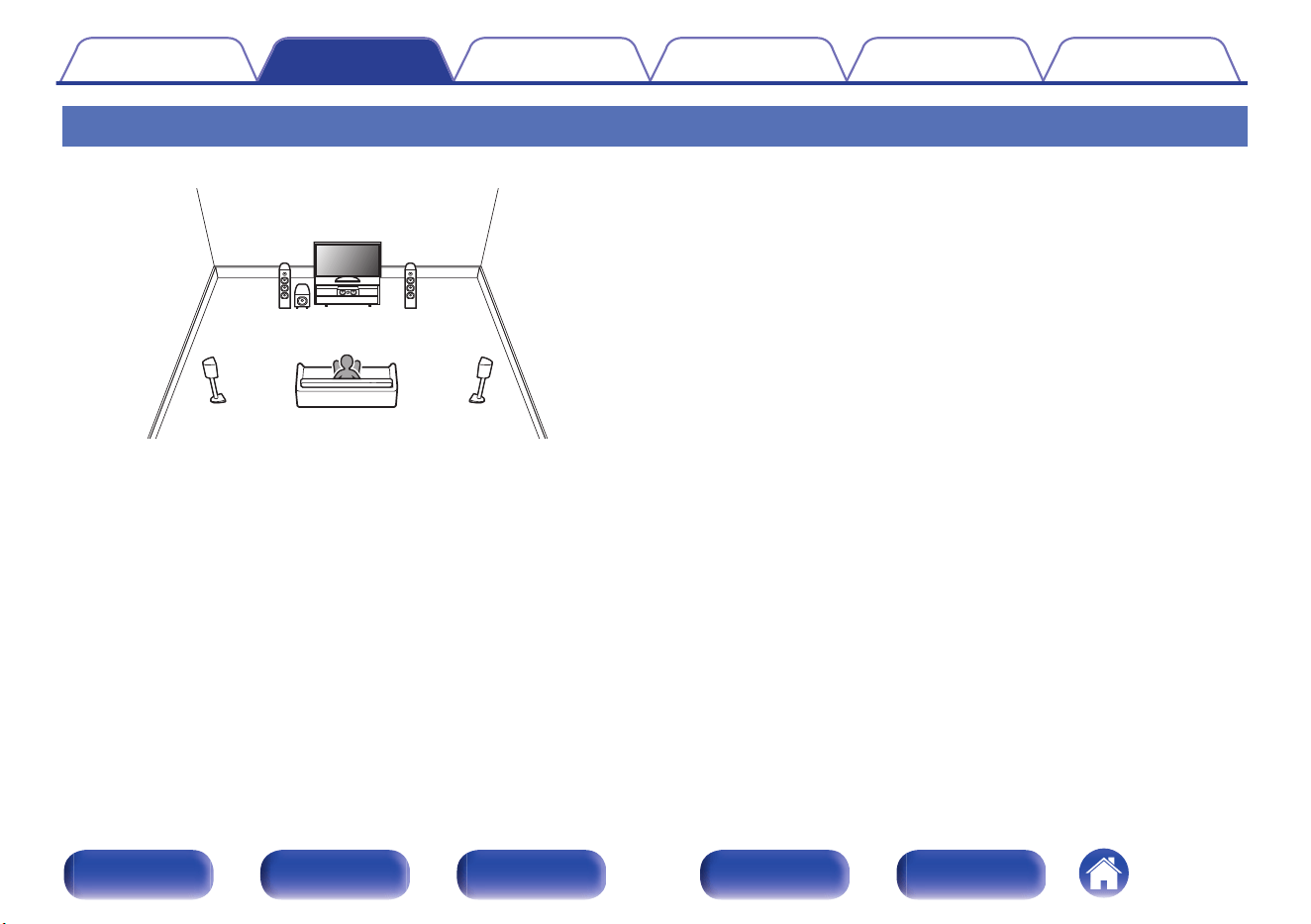
When 5.1-channel speakers are installed
z1
z2
FL
SW
C
SL
FR
SR
z1 22° - 30° z2 120°
Contents Connections Playback Settings Tips Appendix
28
Front panel Display Rear panel Remote Index
Connecting speakers
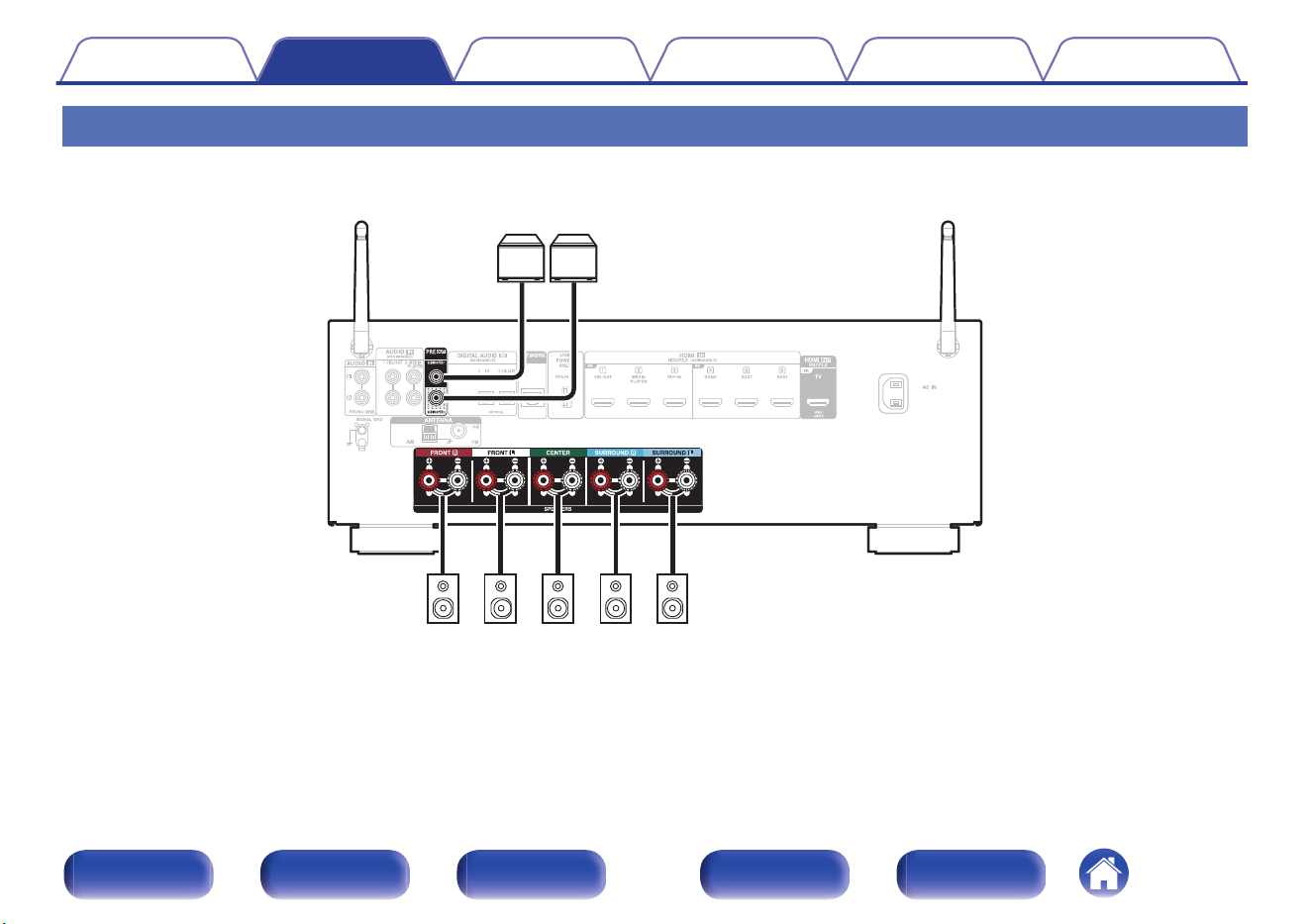
Here we connect the speakers in the room to this unit.
Before connecting speakers
NOTE
0
Disconnect this unit’s power plug from the power outlet before connecting the
speakers. Also, turn off the subwoofer.
0
Connect so that the speaker cable core wires do not protrude from the speaker
terminal. The protection circuit may be activated if the core wires touch the rear
panel or if the + and - sides touch each other. (“Protection circuit” (v p. 236))
0
Never touch the speaker terminals while the power cord is connected. Doing so
could result in electric shock. When the “Setup Assistant” (page 9 in the separate
“Quick Start Guide”) is running, follow the instructions in the “Setup Assistant”
screen for making connections. (Power is not supplied to the speaker terminals
while the “Setup Assistant” is running.)
0
Use speakers with an impedance of 4 – 16 Ω/ohms.
0
When connecting speakers with different impedances, set the impedance based
on the speaker with the lowest impedance.
NOTE
0
Carry out the following settings when using a speaker with an impedance of 4 – 6
Ω/ohms.
1. Press and hold the main unit’s TUNE + and MODE at the same time for at least
3 seconds.
“4K/8K <Enhanced>” appears on the display.
2. Press DIMMER on the main unit twice.
“Sp.Imp.:<8ohms>” appears on the display.
3. Press TUNE + or TUNE - on the main unit to select the impedance.
8ohms
(Default):
Select when the impedance for all of the
connected speakers is 8 Ω/ohms or over.
6ohms:
Select when the impedance for any of the
connected speakers is 6 Ω/ohms.
4ohms:
Select when the impedance for any of the
connected speakers is 4 Ω/ohms.
4. Press the main unit’s STATUS to complete the setting.
Contents Connections Playback Settings Tips Appendix
29
Front panel Display Rear panel Remote Index
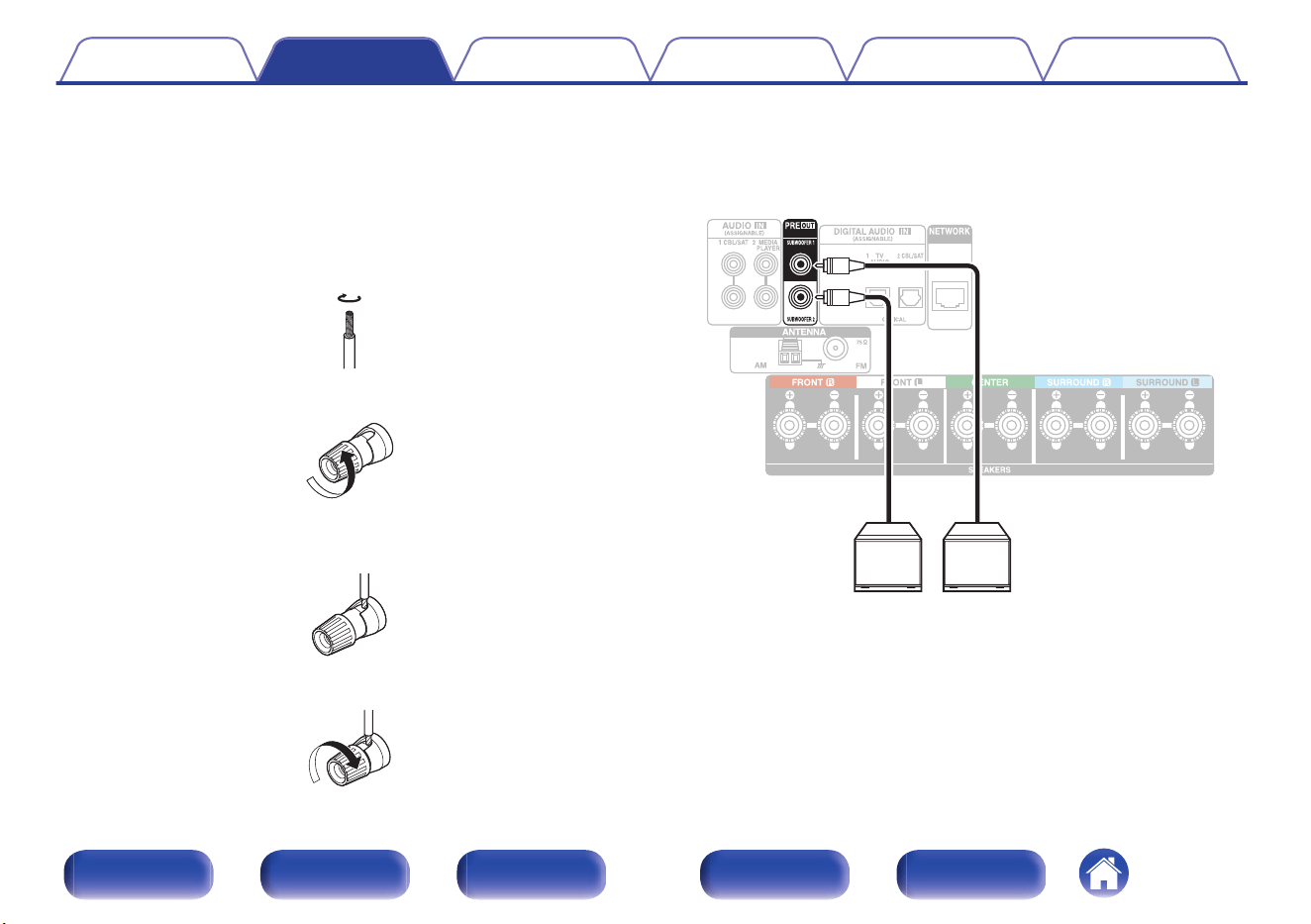
o
Connecting the speaker cables
Carefully check the left (L) and right (R) channels and + (red) and –
(black) polarities on the speakers being connected to this unit, and be
sure to connect the channels and polarities correctly.
1
Peel off about 10 mm of sheathing from the tip of the
speaker cable, then either twist the core wire tightly or
terminate it.
2
Turn the speaker terminal counterclockwise to loosen it.
3
Insert the speaker cable’s core wire to the hilt into the
speaker terminal.
4
Turn the speaker terminal clockwise to tighten it.
o
Connecting the subwoofer
Use a subwoofer cable to connect the subwoofer. Two subwoofers can
be connected to this unit.
The same signal is output from the respective subwoofer terminals.
SW1SW2
Contents Connections Playback Settings Tips Appendix
30
Front panel Display Rear panel Remote Index
o
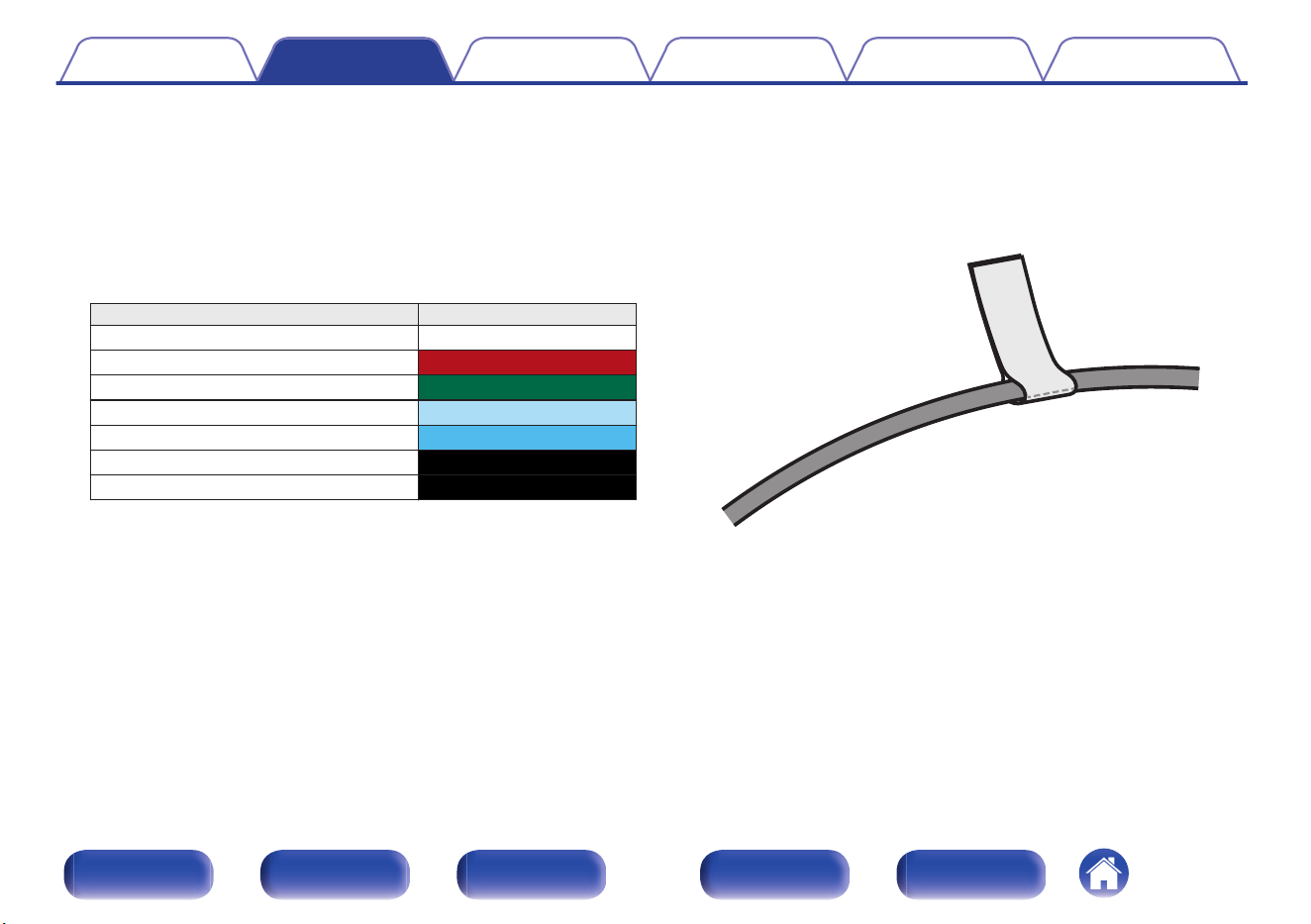
About the cable labels (supplied) for channel
identification
The channel display section for speaker terminals on the rear panel is
color-coded for each channel to be identifiable.
Attach the cable label corresponding to each speaker to each speaker
cable.
This makes it easy to connect the correct cable to the speaker
terminals on the rear panel.
Speaker Color
FRONT L White
FRONT R Red
CENTER Green
SURROUND L Light Blue
SURROUND R Blue
SUBWOOFER 1 Black
SUBWOOFER 2 Black
The supplied cable labels include labels for the speaker and HDMI
cables. Attach a cable label to each cable that matches the speakers
and HDMI devices being connected, as shown below. This makes it
easy to identify and properly connect the cables between your
components.
G How to attach the cable labels H
Contents Connections Playback Settings Tips Appendix
31
Front panel Display Rear panel Remote Index
Connecting a TV
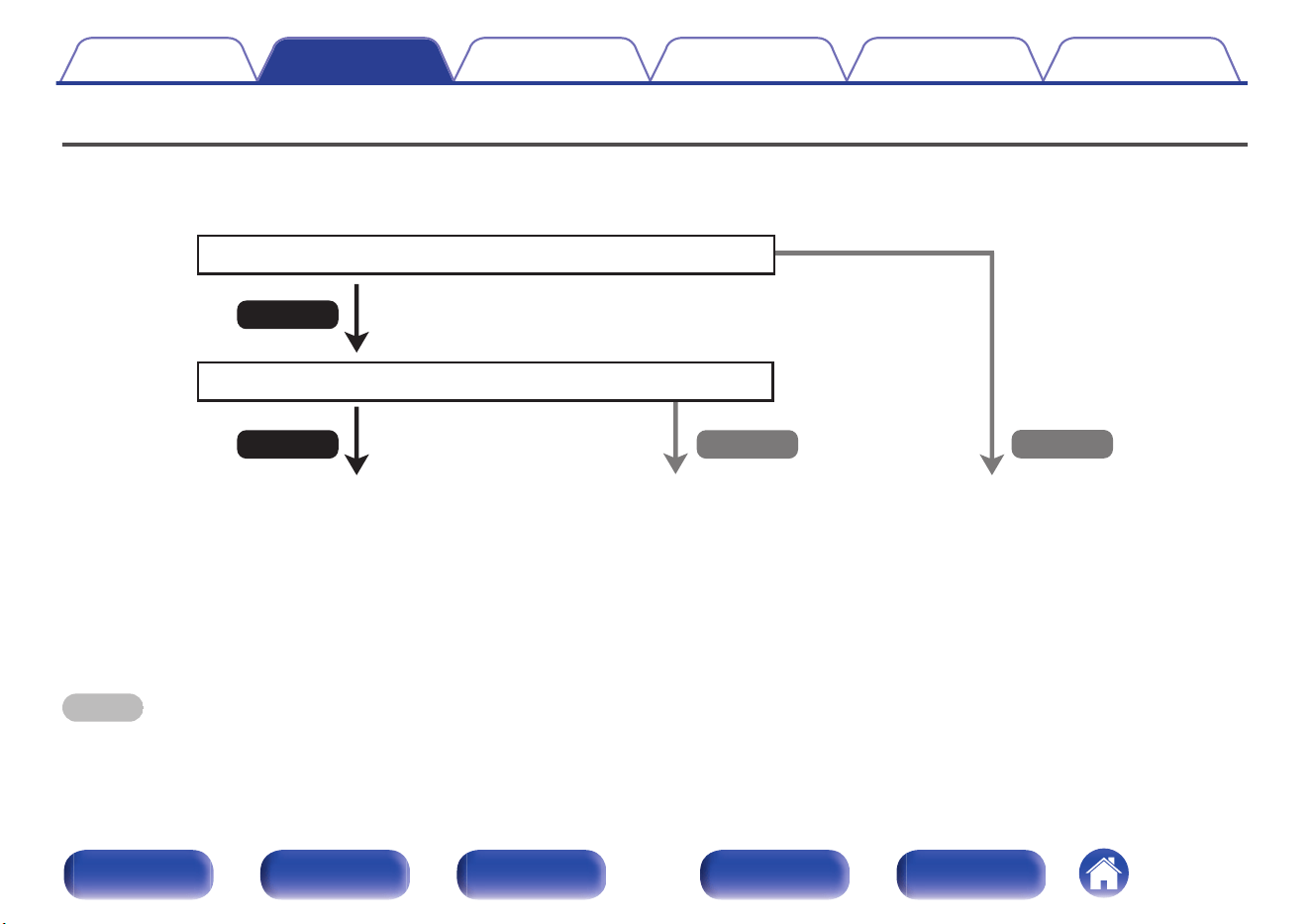
Connect a TV to this unit so that the input video is output to the TV. You can also enjoy audio from the TV on this unit.
How to connect a TV depends on the connectors and functions equipped on the TV.
No
Yes
Is the TV equipped with an HDMI connector?
Yes No
Is the TV compatible with the ARC / eARC?
z
“Connection 1 : TV equipped with an HDMI
connector and compatible with the ARC /
eARC” (v p. 35)
“Connection 2 : TV equipped with an HDMI
connector and incompatible with the ARC /
eARC” (v p. 36)
You cannot connect the TV to this
unit.
z
What is ARC and eARC?
ARC (Audio Return Channel) sends audio back to this unit using the same HDMI cable that sends video from this unit to your TV.
This allows this unit to process the sound from your TV’s built-in tuner and apps.
TVs with eARC (Enhanced Audio Return Channel) port provide additional support for high bitrate multichannel audio (Dolby TrueHD, DTS-HD and DTS:X).
Please refer to your TV Owner’s Manual for details about eARC support for your particular model.
NOTE
0
Use a TV with a 2 prong power plug for this unit. Do not connect a TV with a 3 prong power plug, as this may cause noise.
Contents Connections Playback Settings Tips Appendix
34
Front panel Display Rear panel Remote Index
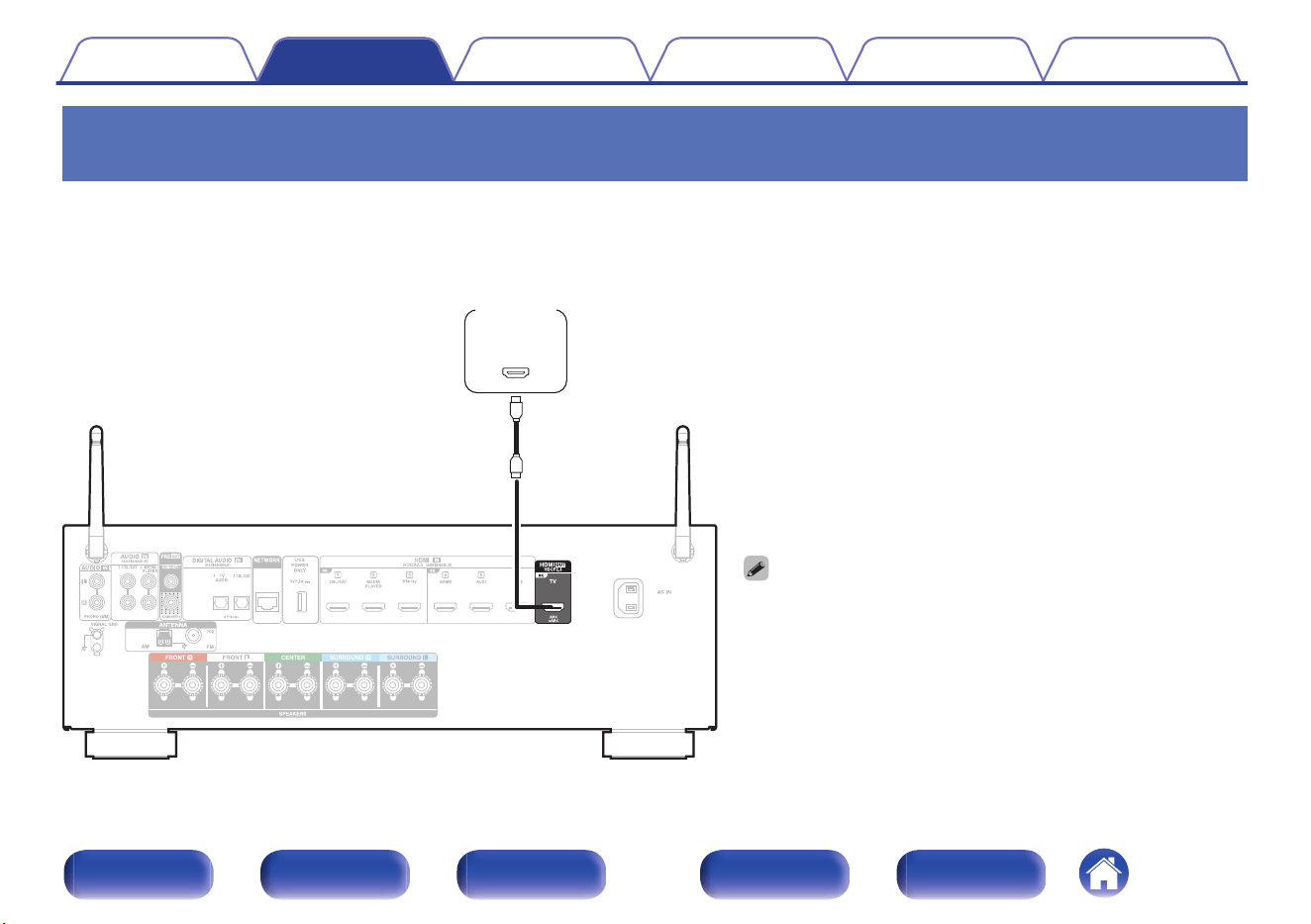
Connection 1 : TV equipped with an HDMI connector and compatible with the ARC /
eARC
Using a high quality HDMI cable
z
, connect one end to the HDMI port labeled “eARC” or “ARC” on your TV. Connect the other end to the HDMI OUT port
on this unit.
When a TV with eARC support is connected, the eARC function of this unit is enabled automatically and the television audio is played back. When a TV
with ARC support is connected, set “ARC” in the menu to “On”. (v p. 142)
z
For 4K TVs we recommend using an HDMI cable labeled “High Speed”
and “with Ethernet”.
z
For 8K TVs we recommend using an HDMI cable labeled “Ultra High
Speed”.
0
eARC function settings may be required depending on the eARC
function-compatible television you are using. Make sure eARC is set to
on if this setting exists on your television. For more information, check
your television’s owner’s manual.
0
Set “4K/8K Signal Format” to “8K Enhanced” in the menu to enjoy 8K
video. (v p. 146)
(ARC / eARC)
IN
HDMI
TV
Contents Connections Playback Settings Tips Appendix
35
Front panel Display Rear panel Remote Index
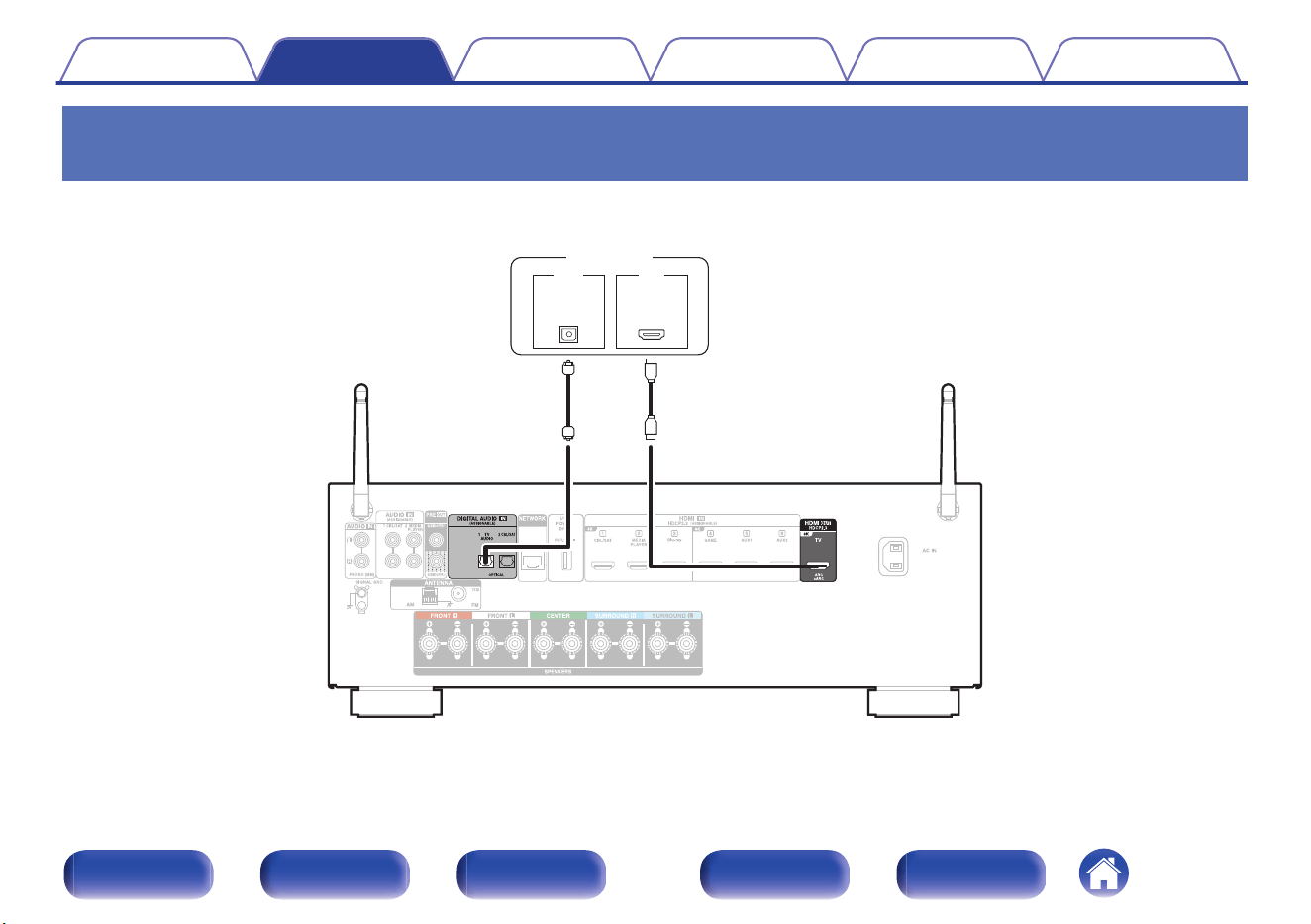
Connection 2 : TV equipped with an HDMI connector and incompatible with the
ARC / eARC
Use an HDMI cable to connect the TV to this unit.
To listen to audio from TV on this unit, use an optical cable to connect the TV to this unit.
OUT
OPTICAL
OUT IN
IN
HDMI
TV
Contents Connections Playback Settings Tips Appendix
36
Front panel Display Rear panel Remote Index
Connecting a playback device
This unit is equipped with HDMI video input connectors and three types of audio input connectors (HDMI, digital audio and audio).
Select input connectors on this unit according to the connectors equipped on the device you want to connect.
If the device connected to this unit is equipped with an HDMI connector, it is recommended to use HDMI connections.
In the HDMI connection, audio and video signals can be transmitted through a single HDMI cable.
0
“Connecting a set-top box (Satellite tuner/cable TV)” (v p. 38)
0
“Connecting a media player” (v p. 39)
0
“Connecting a Blu-ray Disc player or DVD player” (v p. 40)
0
“Connecting a game console or player device compatible with 8K” (v p. 41)
0
“Connecting a turntable” (v p. 42)
0
Connect devices to this unit as indicated by the input sources printed on the audio/video input connectors of this unit.
0
The source that is assigned to the HDMI IN, DIGITAL AUDIO IN and AUDIO IN connectors can be changed. See “Input Assign” on how to change the input source assigned
to the input connectors. (v p. 149)
0
To play back audio signals that are input to this unit on a TV connected via HDMI, set in the menu “HDMI Audio Out” to “TV”. (v p. 140)
0
To enjoy content that is copyright protected by HDCP 2.2 or HDCP 2.3, use a playback device and TV compatible with HDCP 2.2 or HDCP 2.3.
Contents Connections Playback Settings Tips Appendix
37
Front panel Display Rear panel Remote Index
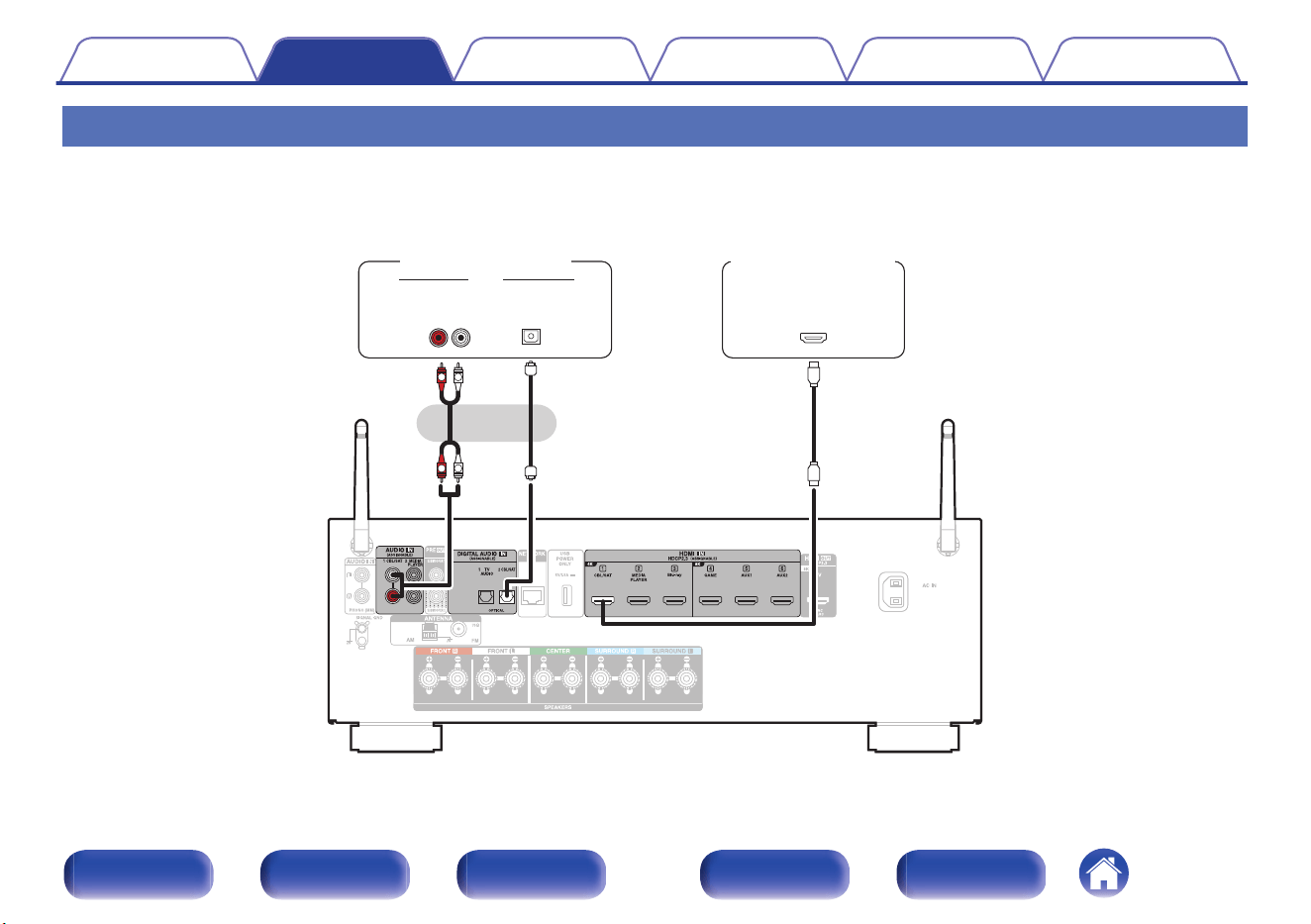
Connecting a set-top box (Satellite tuner/cable TV)
This explanation uses the connection with a satellite tuner/cable TV STB as an example.
Select the input connectors on this unit to match the connectors on the device that you want to connect to.
R
L
R
L
OUT
HDMI
OUT
OPTICAL
AUDIO
AUDIO
RL
OUT
or
Satellite tuner /
Cable TV
Satellite tuner /
Cable TV
(HDMI incompatible device)
Contents Connections Playback Settings Tips Appendix
38
Front panel Display Rear panel Remote Index
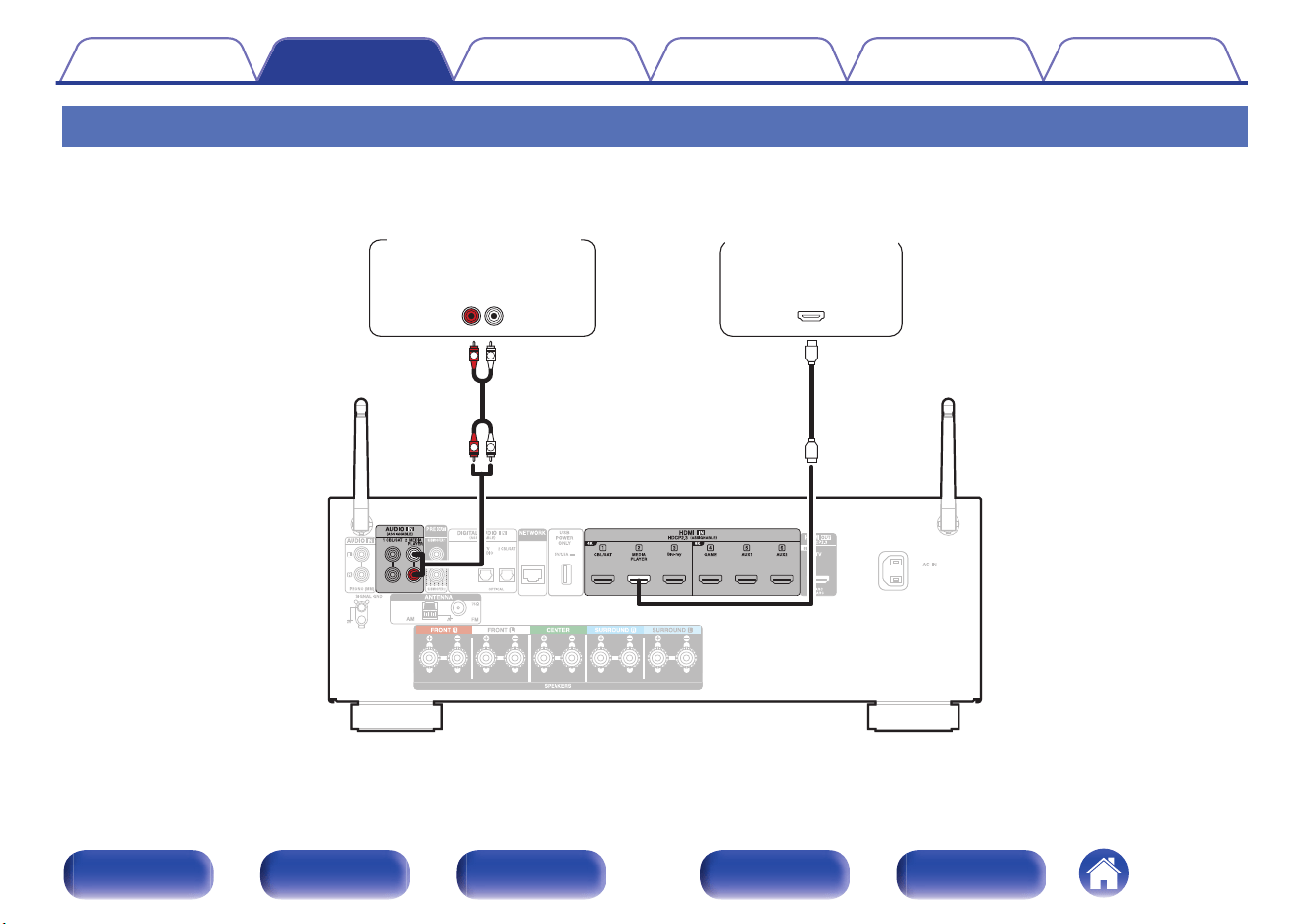
Connecting a media player
This explanation uses the connection with a media player as an example.
Select the input connectors on this unit to match the connectors on the device that you want to connect to.
R
L
R
L
OUT
HDMI
AUDIO
AUDIO
RL
OUT
(HDMI incompatible device)
Media player Media player
Contents Connections Playback Settings Tips Appendix
39
Front panel Display Rear panel Remote Index
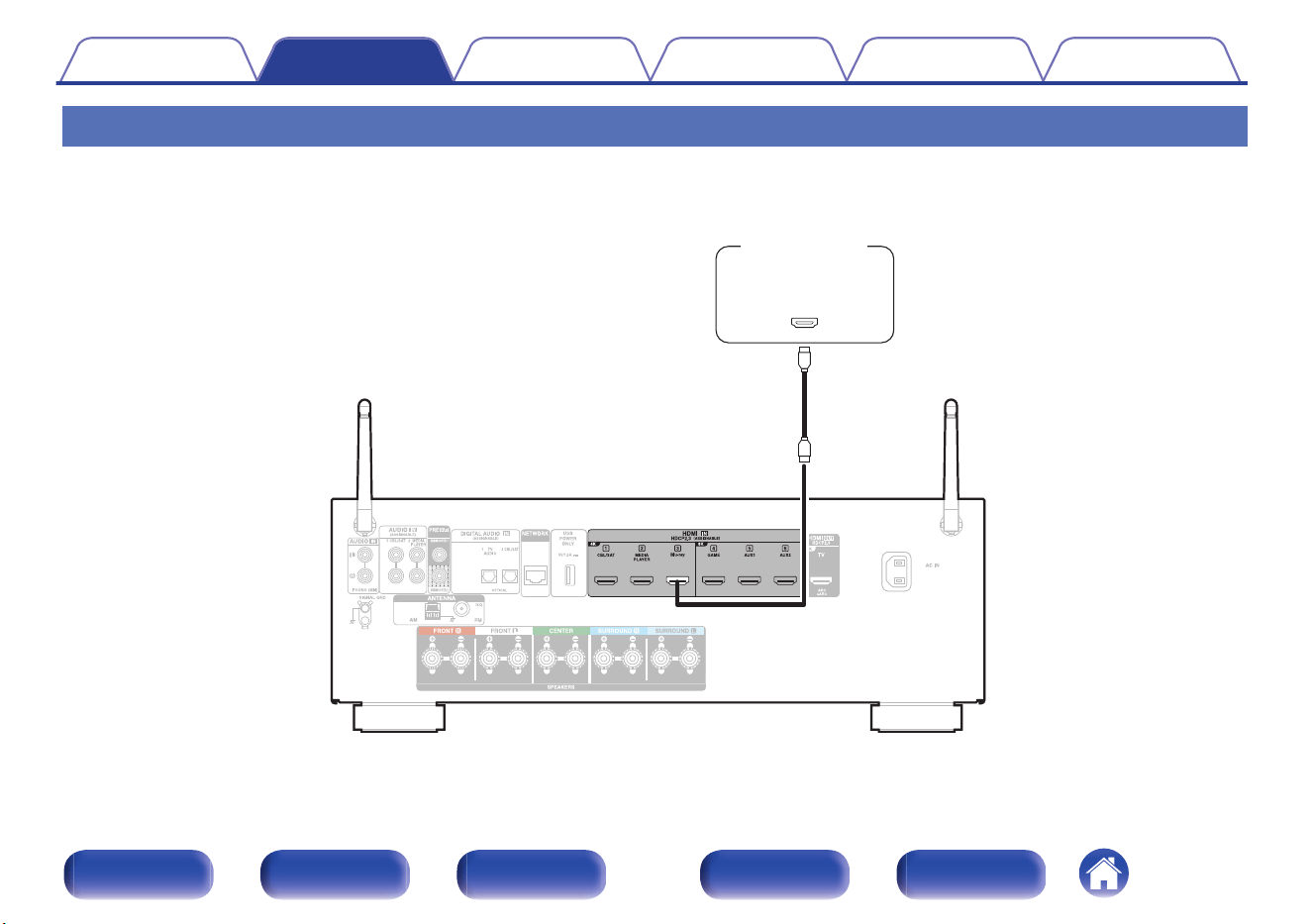
Connecting a Blu-ray Disc player or DVD player
This explanation uses the connection with a Blu-ray Disc player or DVD player as an example.
Select the input connectors on this unit to match the connectors on the device that you want to connect to.
OUT
HDMI
Blu-ray Disc player /
DVD player
Contents Connections Playback Settings Tips Appendix
40
Front panel Display Rear panel Remote Index
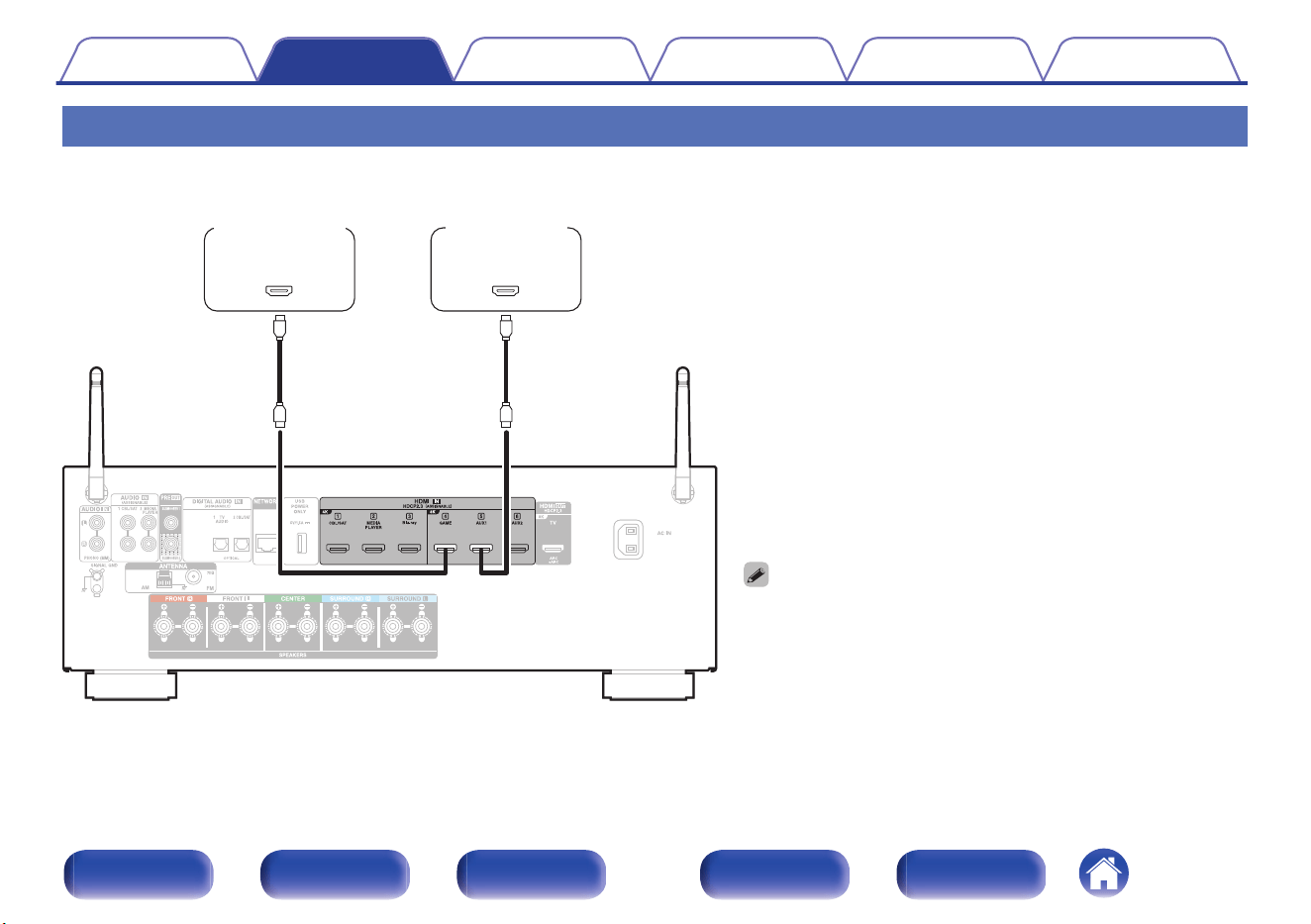
Connecting a game console or player device compatible with 8K
This unit supports 8K HDMI video signals.
If your game console or player device supports 8K, connect it to the HDMI 4, HDMI 5 or HDMI 6 connector on your device.
0
Use a certified “Ultra High Speed HDMI cable” to enjoy 8K or 4K
120Hz video.
0
Set “4K/8K Signal Format” to “8K Enhanced” in the menu to enjoy 8K
video. (v p. 146)
OUT
HDMI
OUT
HDMI
Game console 8K player
Contents Connections Playback Settings Tips Appendix
41
Front panel Display Rear panel Remote Index
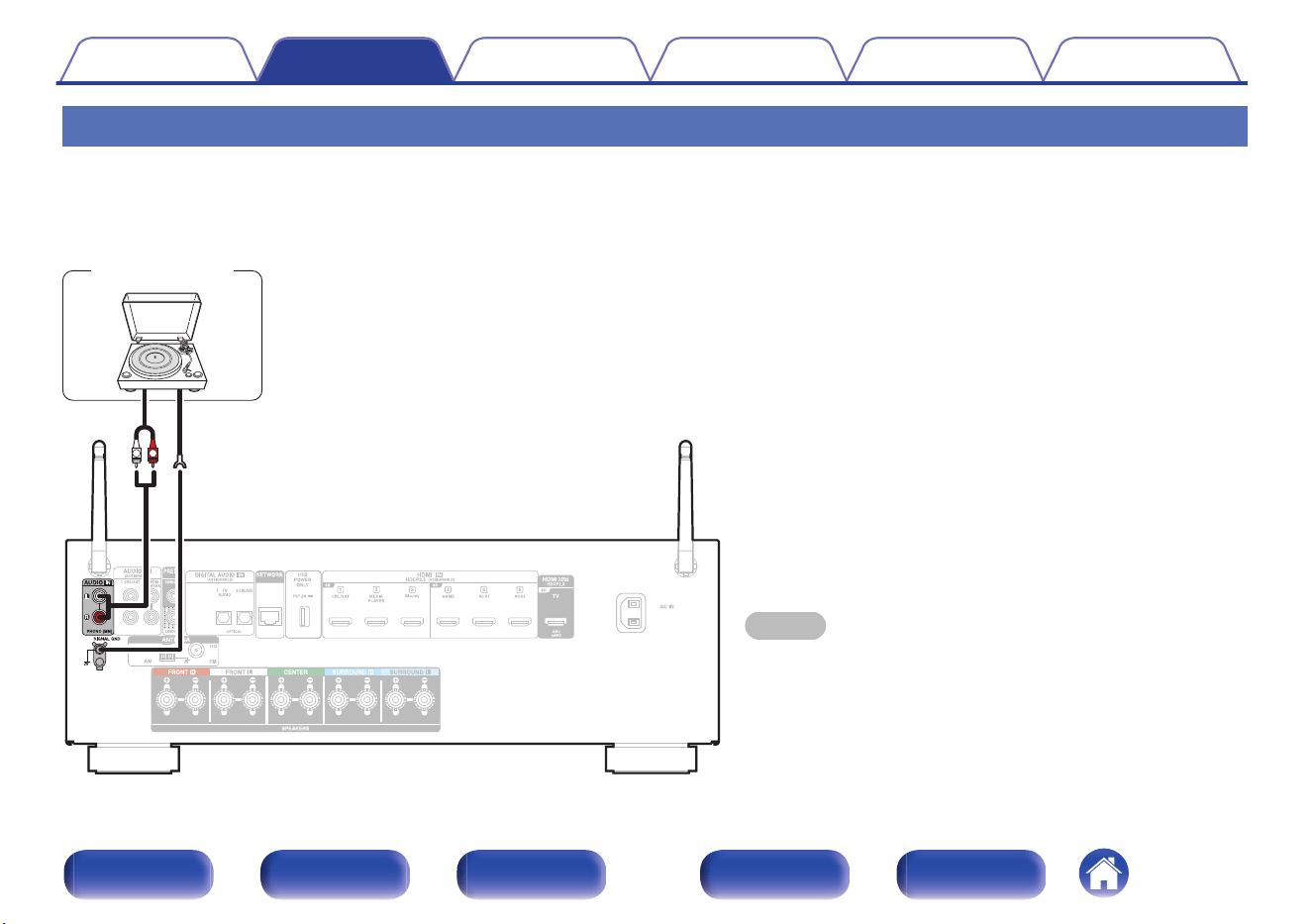
Connecting a turntable
This unit is compatible with turntables equipped with a moving magnet (MM) phono cartridge. When you connect to a turntable with a low output moving
coil (MC) cartridge, use a commercially available MC head amp or a step-up transformer.
If you set this unit’s input source to “Phono” and you accidentally increase the volume without having a turntable connected, you may hear a hum noise
from the speakers.
NOTE
0
The earth terminal (SIGNAL GND) of this unit is not for safety grounding
purposes. If this terminal is connected when there is a lot of noise, the
noise can be reduced. Note that depending on the turntable,
connecting the ground line may have the reverse effect of increasing
noise. In this case, it is not necessary to connect the ground line.
GND
AUDIO
OUT
L
R
(MM cartridge)
Turntable
Contents Connections Playback Settings Tips Appendix
42
Front panel Display Rear panel Remote Index
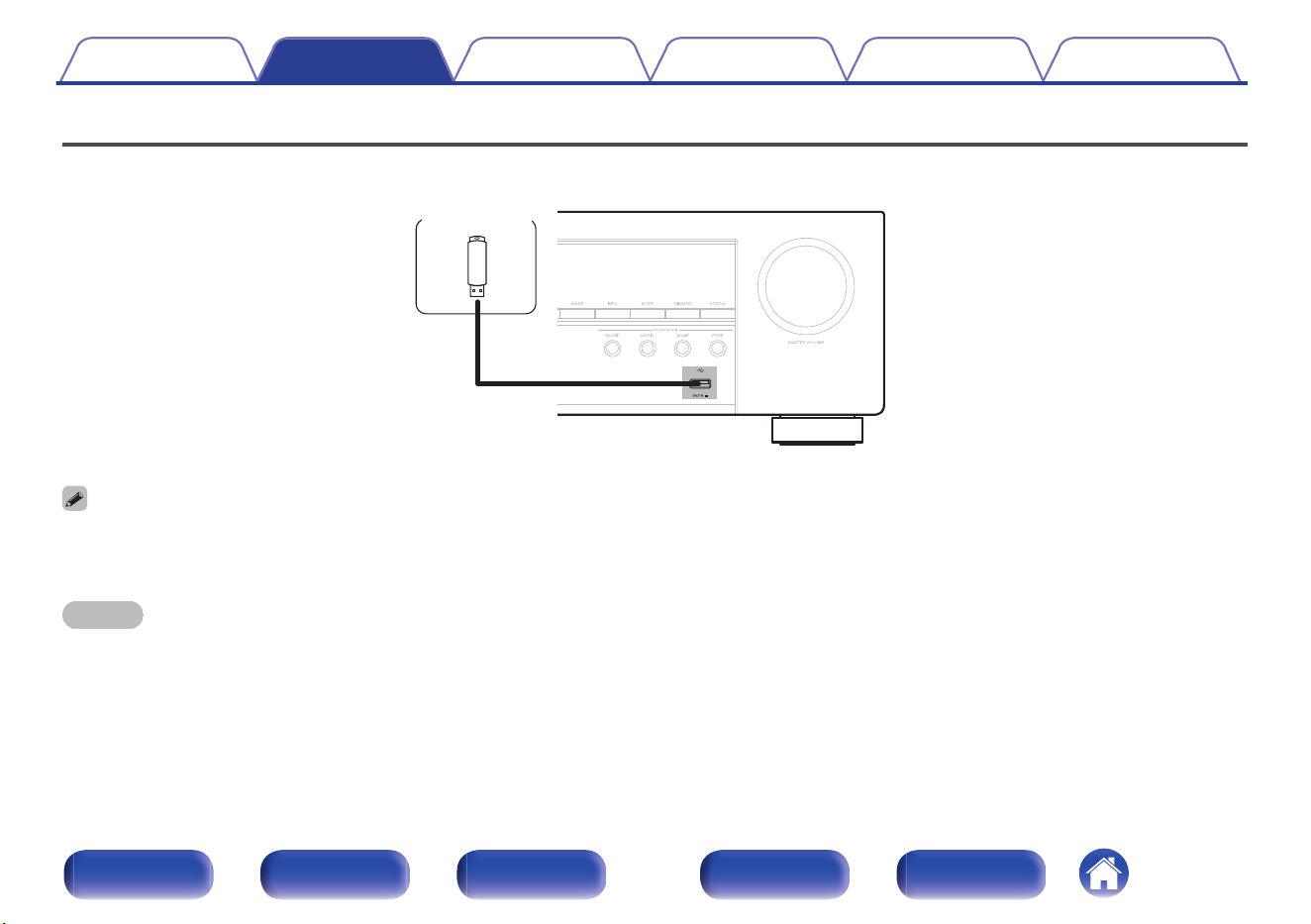
Connecting a USB memory device to the USB port
For operating instructions see “Playing a USB memory device” (v p. 52).
USB memory
device
0
Denon does not guarantee that all USB memory devices will operate or receive power. When using a portable USB hard disk drive (HDD) which came with an AC adapter,
use that device’s supplied AC adapter.
0
The USB port on the rear panel can only be used to supply power (5 V/1.5 A). It cannot be used to play music files. (v p. 22)
NOTE
0
USB memory devices will not work via a USB hub.
0
It is not possible to use this unit by connecting the unit’s USB port to a PC via a USB cable.
0
Do not use an extension cable when connecting a USB memory device. This may cause radio interference with other devices.
Contents Connections Playback Settings Tips Appendix
43
Front panel Display Rear panel Remote Index
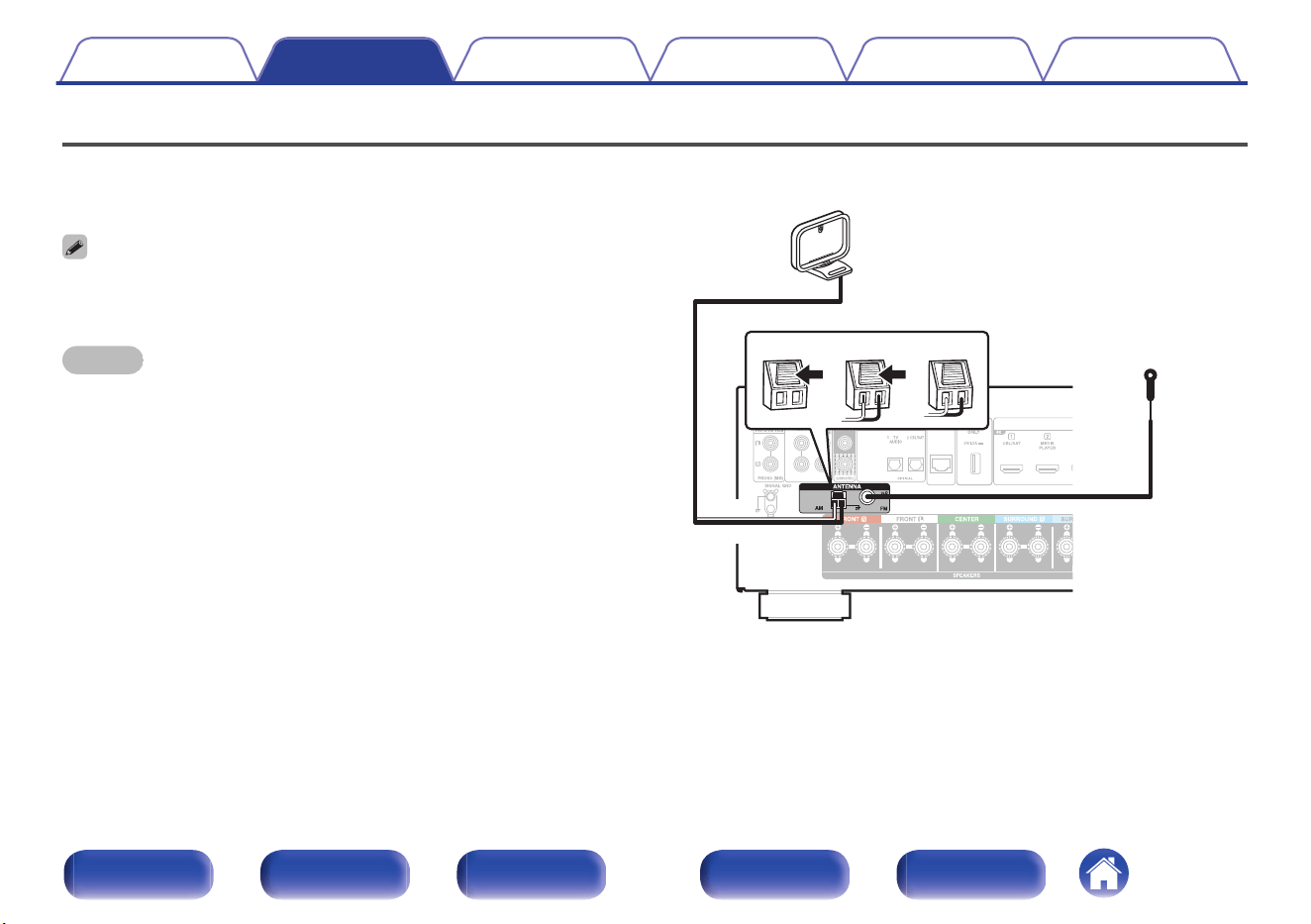
Connecting FM/AM antennas
Connect the antenna, tune in to a broadcast and then move the antenna to
the location where there is least noise. Then use tape, etc. to fix the
antenna in this location. (“Listening to FM/AM broadcasts” (v p. 64))
0
If you are unable to receive a good broadcast signal, we recommend installing an
outdoor antenna. For details, inquire at the retail store where you purchased the
unit.
NOTE
0
Make sure the AM loop antenna lead terminals do not touch metal parts of the
panel.
wqe
Black
AM loop antenna
(supplied)
FM indoor antenna
(supplied)
White
Contents Connections Playback Settings Tips Appendix
44
Front panel Display Rear panel Remote Index
o
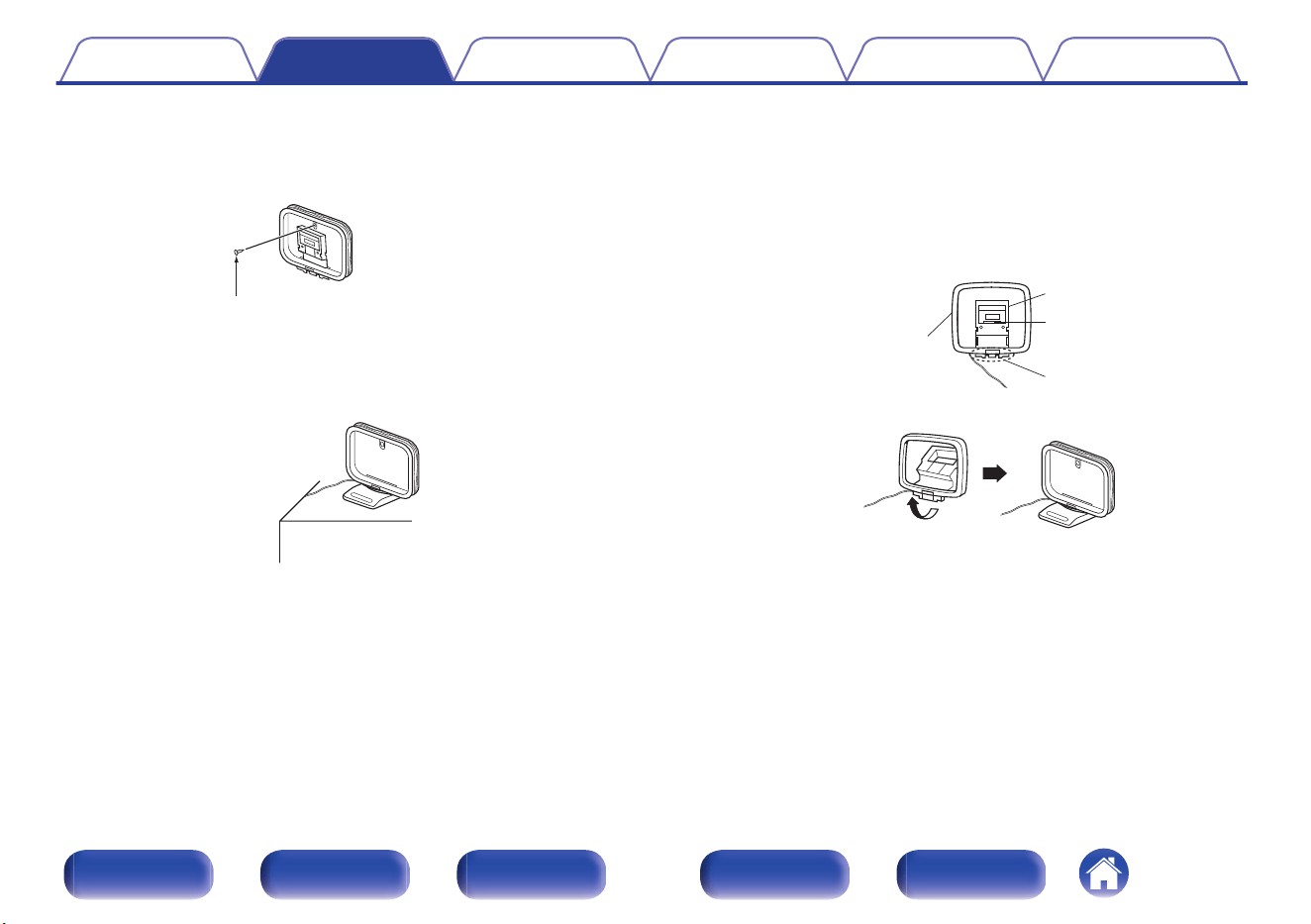
Using the AM loop antenna
Suspending on a wall
Suspend directly on a wall without assembling.
Nail, tack, etc.
Standing alone
Use the procedure shown above to assemble.
When assembling, refer to “AM loop antenna assembly”.
o
AM loop antenna assembly
1
Put the stand section through the bottom of the loop
antenna from the rear and bend it forward.
2
Insert the projecting part into the square hole in the
stand.
Projecting part
Square hole
Stand
Loop antenna
Contents Connections Playback Settings Tips Appendix
45
Front panel Display Rear panel Remote Index
Connecting to a home network (LAN)
This unit can connect to a network using a wired LAN or wireless LAN.
You can connect this unit to your home network (LAN) to enable various
types of playback and operations as described below.
0
Playback of network audio such as Internet Radio and from your media
server(s)
0
Playback of streaming music services
0
Using the Apple AirPlay function
0
Operation on this unit via the network
0
Operation with the HEOS wireless multi-room sound system
0
Firmware Update
For connections to the Internet, contact an ISP (Internet Service
Provider) or a computer shop.
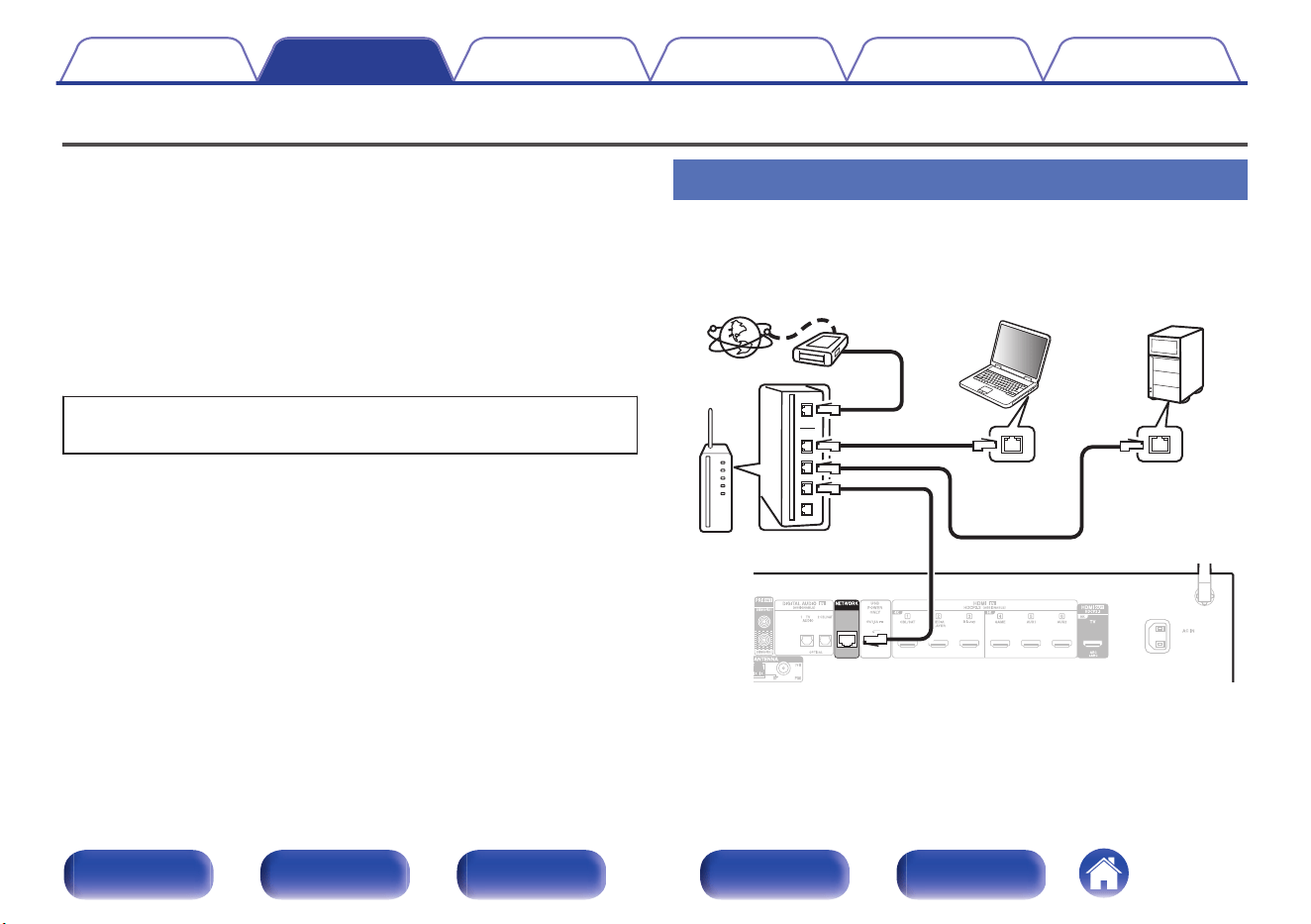
Wired LAN
To make connections via wired LAN, use a LAN cable to connect the
router to this unit as shown in the figure below.
Internet
Modem
PC
Router
To WAN side
To LAN port
To LAN port
NAS
(Network Attached
Storage)
LAN port /
Ethernet
connector
LAN port /
Ethernet
connector
Contents Connections Playback Settings Tips Appendix
46
Front panel Display Rear panel Remote Index
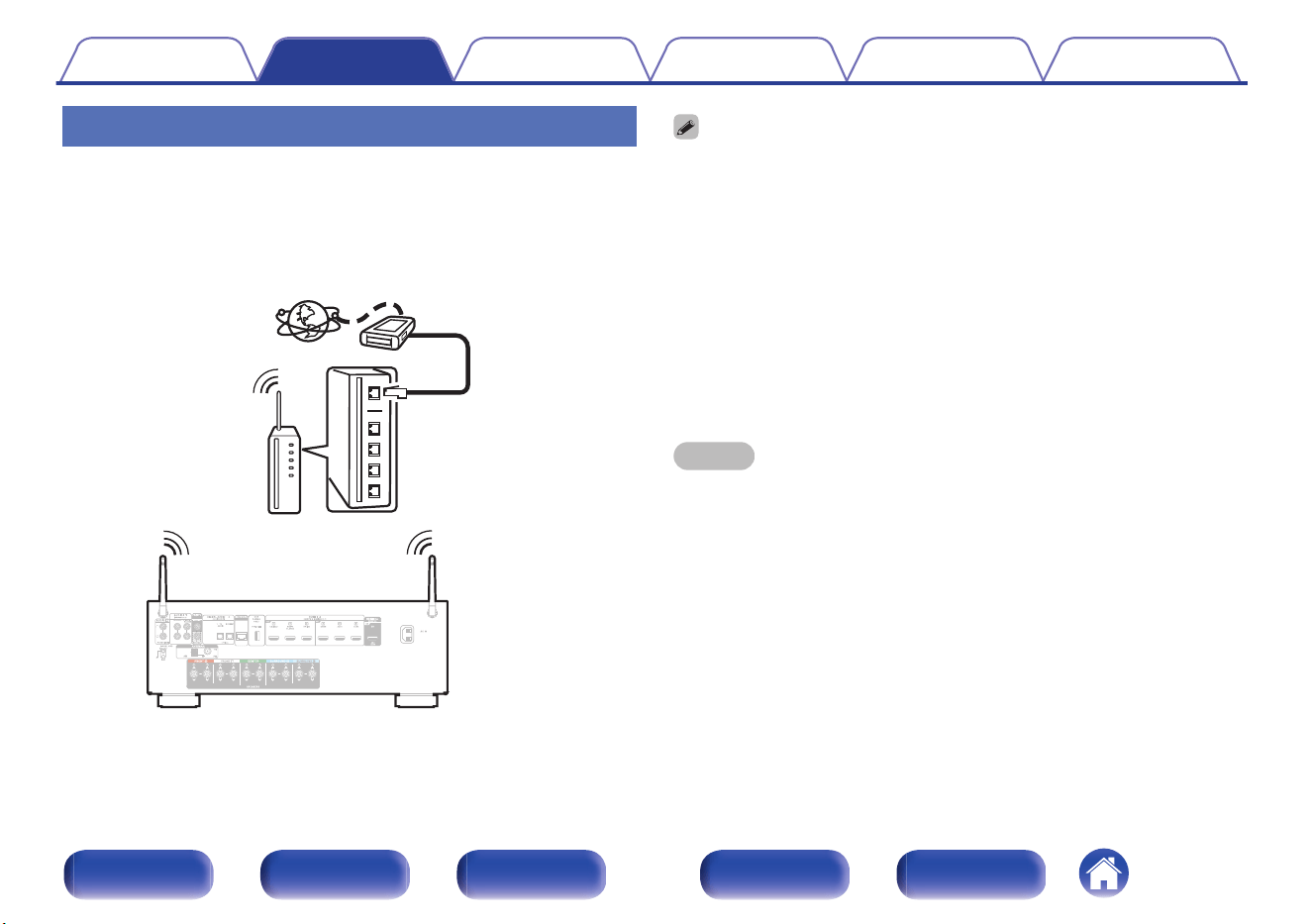
Wireless LAN
When connecting to the network via wireless LAN, connect the external
antennas for Bluetooth/wireless connectivity connection to the rear panel
and stand them upright.
See “Wi-Fi Setup” on how to connect to a wireless LAN router.
(v p. 169)
Internet
Modem
Router with access point
To WAN side
0
When using this unit, we recommend you use a router equipped with the following
functions:
0
Built-in DHCP server
This function automatically assigns IP addresses on the LAN.
0
Built-in 100BASE-TX switch
When connecting multiple devices, we recommend a switching hub with a
speed of 100 Mbps or greater.
0
Only use a shielded STP or ScTP LAN cable (readily available at electronics
stores). (CAT-5 or greater recommended)
0
The normal shielded-type LAN cable is recommended.
If a flat-type cable or unshielded-type cable is used, other devices could be
affected by noise.
0
When using this unit connected to a network with no DHCP function, configure the
IP address, etc. in “Network”. (v p. 168)
NOTE
0
The types of routers that can be used depend on the ISP. Contact your ISP or a
computer shop for details.
0
This unit is not compatible with PPPoE. A PPPoE compatible router is required if
your contracted line is not set using PPPoE.
0
Do not connect a NETWORK connector directly to the LAN port / Ethernet
connector on your computer.
0
Various online services may be discontinued without prior notice.
Contents Connections Playback Settings Tips Appendix
47
Front panel Display Rear panel Remote Index
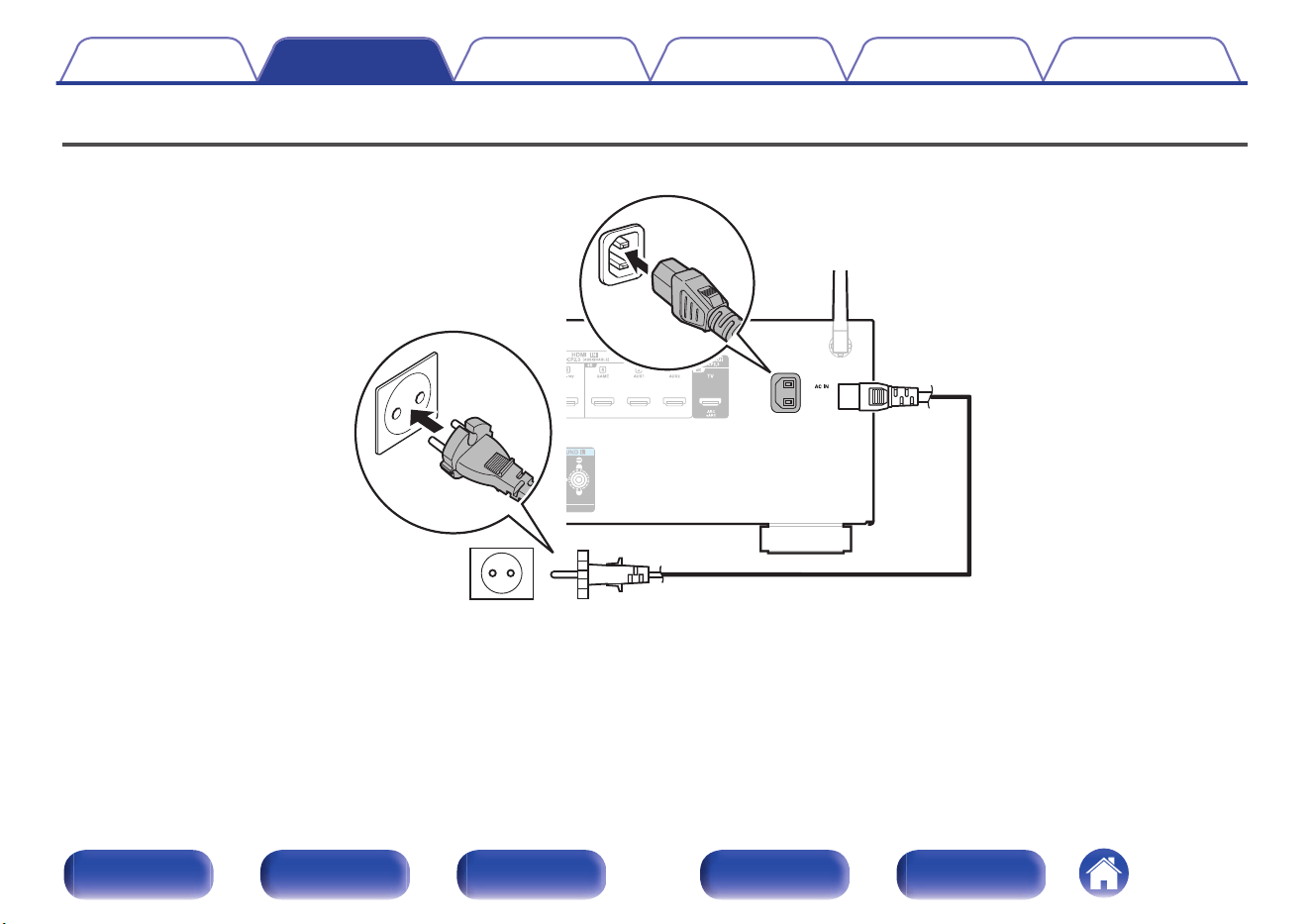
o
Contents
Basic operation
Turning the power on 50
Selecting the input source 50
Adjusting the volume 51
Turning off the sound temporarily (Muting) 51
Selecting a sound mode 101
Playback a device
Playing a Blu-ray Disc player/DVD player 51
Playing a USB memory device 52
Listening to music on a Bluetooth device 56
Listening to audio on Bluetooth headphones 60
Listening to FM/AM broadcasts 64
Playback network audio/service
Listening to Internet Radio 75
Playing back files stored on a PC or NAS 77
Getting the HEOS App 81
AirPlay function 90
Spotify Connect function 93
Convenience functions
Convenience functions 94
HDMI Control function 111
Sleep timer function 112
Quick select plus function 114
Panel lock function 117
Remote lock function 119
Other functions
Web control function 120
Contents Connections Playback Settings Tips Appendix
49
Front panel Display Rear panel Remote Index
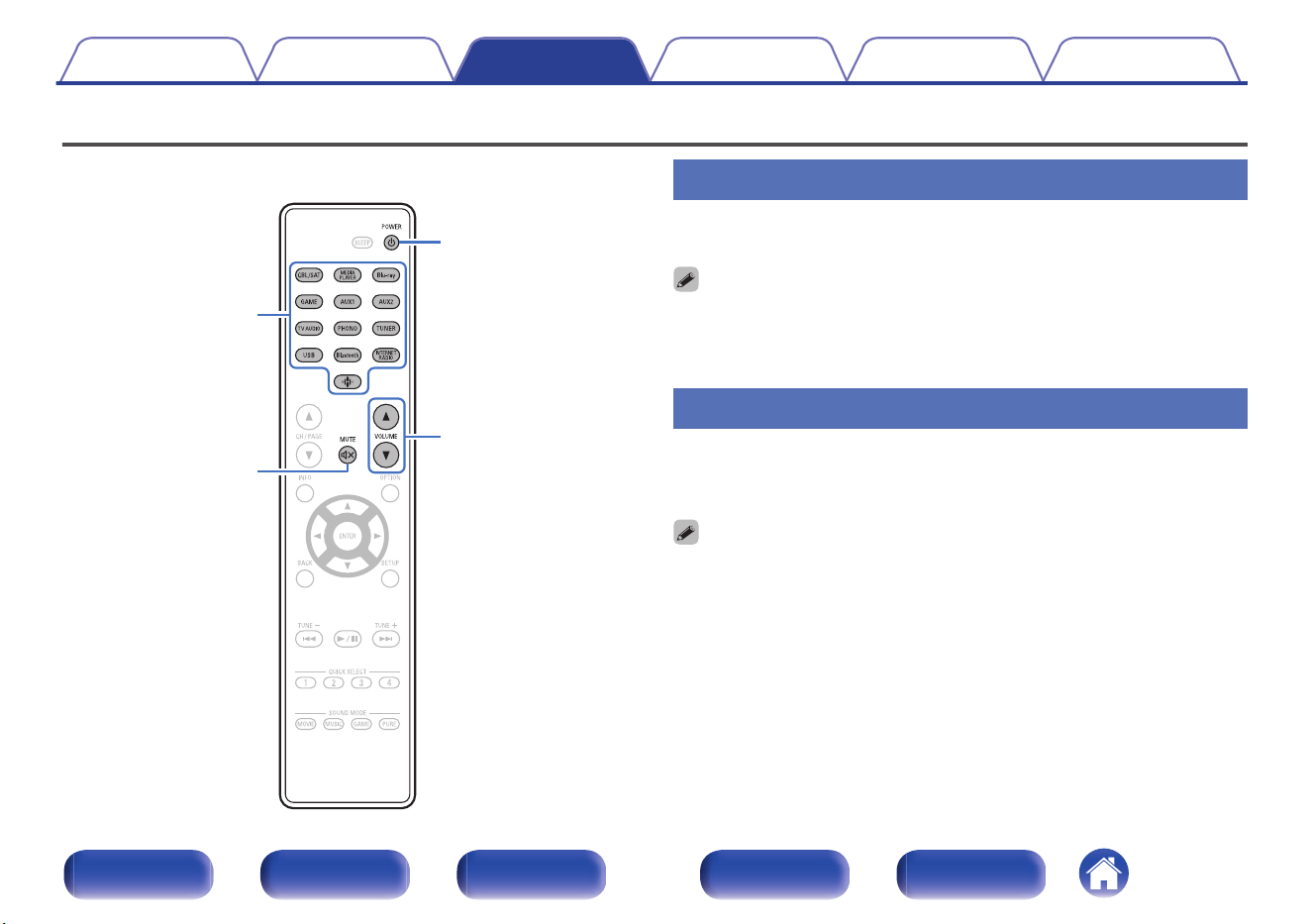
Basic operation
MUTE
:
VOLUME
df
POWER
X
Input source
select buttons
Turning the power on
1
Press POWER X to turn on power to the unit.
0
You can press the input source select button when the unit is in standby mode to
turn on the power.
0
You can also switch the power to standby by pressing X on the main unit.
Selecting the input source
1
Press the input source select button to be played back.
The desired input source can be selected directly.
0
You can also select the input source by turning SOURCE SELECT on the main
unit.
Contents Connections Playback Settings Tips Appendix
50
Front panel Display Rear panel Remote Index
Adjusting the volume
1
Use VOLUME df to adjust the volume.
0
The variable range differs according to the input signal and channel level setting.
0
You can also adjust the master volume by turning MASTER VOLUME on the main
unit.
Turning off the sound temporarily
(Muting)
1
Press MUTE :.
0
MUTE indicator on the display flashes.
0
h appears on the TV screen.
0
The sound is reduced to the level set at “Mute Level” in the menu. (v p. 135)
0
To cancel mute, either adjust the sound volume or press MUTE : again.
0
If h is displayed on the TV screen for more than 5 minutes when the “Screen
Saver” is set to “On”, the h symbol moves randomly over the TV screen.
(v p. 146)
Playback a Blu-ray Disc player/DVD
player
The following describes the procedure for playing Blu-ray Disc player/DVD
player.
1
Prepare for playback.
A
Turn on the power of the TV, subwoofer and player.
B
Change the TV input to the input of this unit.
2
Press POWER X to turn on power to the unit.
3
Press Blu-ray or DVD to switch an input source for a
player used for playback.
4
Play the Blu-ray Disc player or DVD player.
o
Surround playback (v p. 101)
Contents Connections Playback Settings Tips Appendix
51
Front panel Display Rear panel Remote Index
Playing a USB memory device
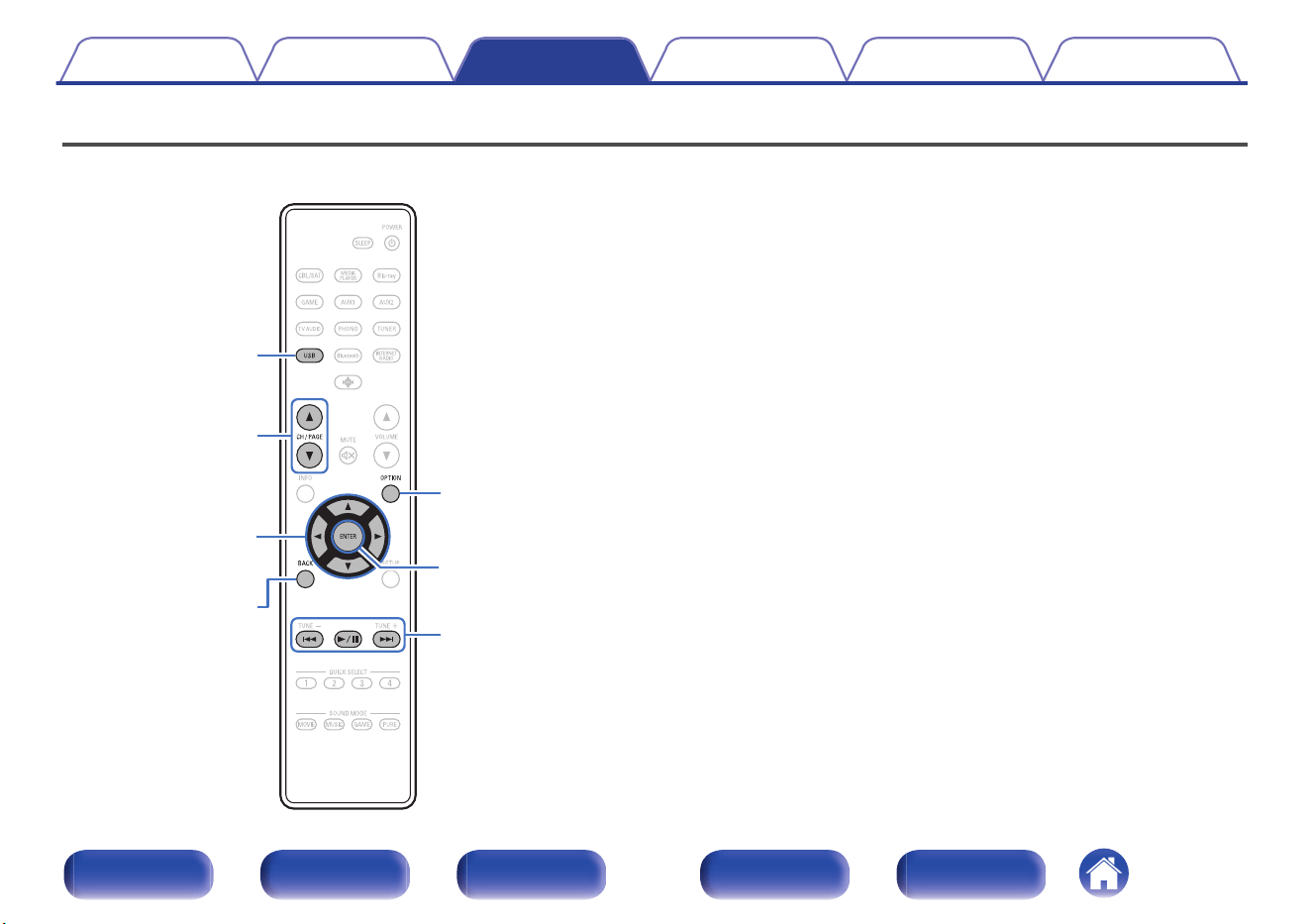
CH/PAGE
df
USB
BACK
OPTION
ENTER
1
/
3
8
9
Cursor Up/Down/
Left/Right
0
Playing back music files stored on a USB memory device.
0
Only USB memory devices conforming to mass storage class standards
can be played on this unit.
0
This unit is compatible with USB memory devices in “FAT32” or “NTFS”
format.
0
The audio format types and specifications supported by this unit for
playback are as follows.
See “Playing back a USB memory devices” (v p. 220) for details.
0
WMA
0
MP3
0
WAV
0
MPEG-4 AAC
0
FLAC
0
Apple Lossless
0
DSD
Contents Connections Playback Settings Tips Appendix
52
Front panel Display Rear panel Remote Index
Playing files stored on USB memory
devices
1
Insert a “FAT32” or “NTFS” formatted USB memory
device into the USB port.
2
Press USB to switch the input source to “USB”.
3
Select the name of this unit.
4
Browse the music on your USB memory device and
select something to play.
0
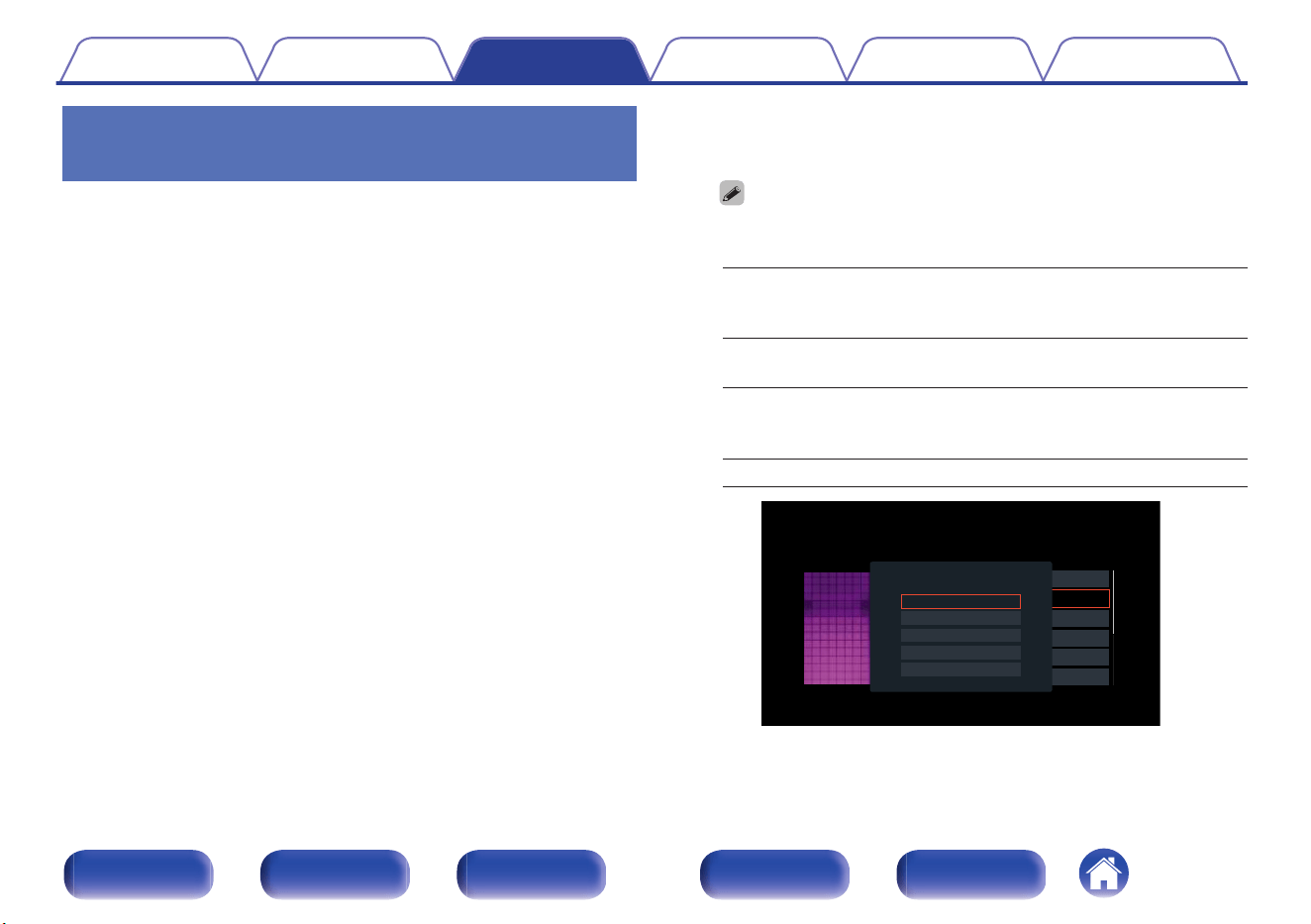
When you select something to play you will be asked how you want to
queue up your music.
Play Now:
Inserts the item into the queue after the
currently playing track and plays the
selected item immediately.
Play Now & Replace
Queue:
Clears the queue and plays the
selected item immediately.
Play Next:
Inserts the item into the queue after the
current song and plays it when the
current song ends.
Add to End of Queue: Adds the item to the end of the queue.
Nature 01
USB Music - Nature
Play Now
Play Now & Replace Queue
Play Next
Add to End of Queue
Cancel
Contents Connections Playback Settings Tips Appendix
53
Front panel Display Rear panel Remote Index
5
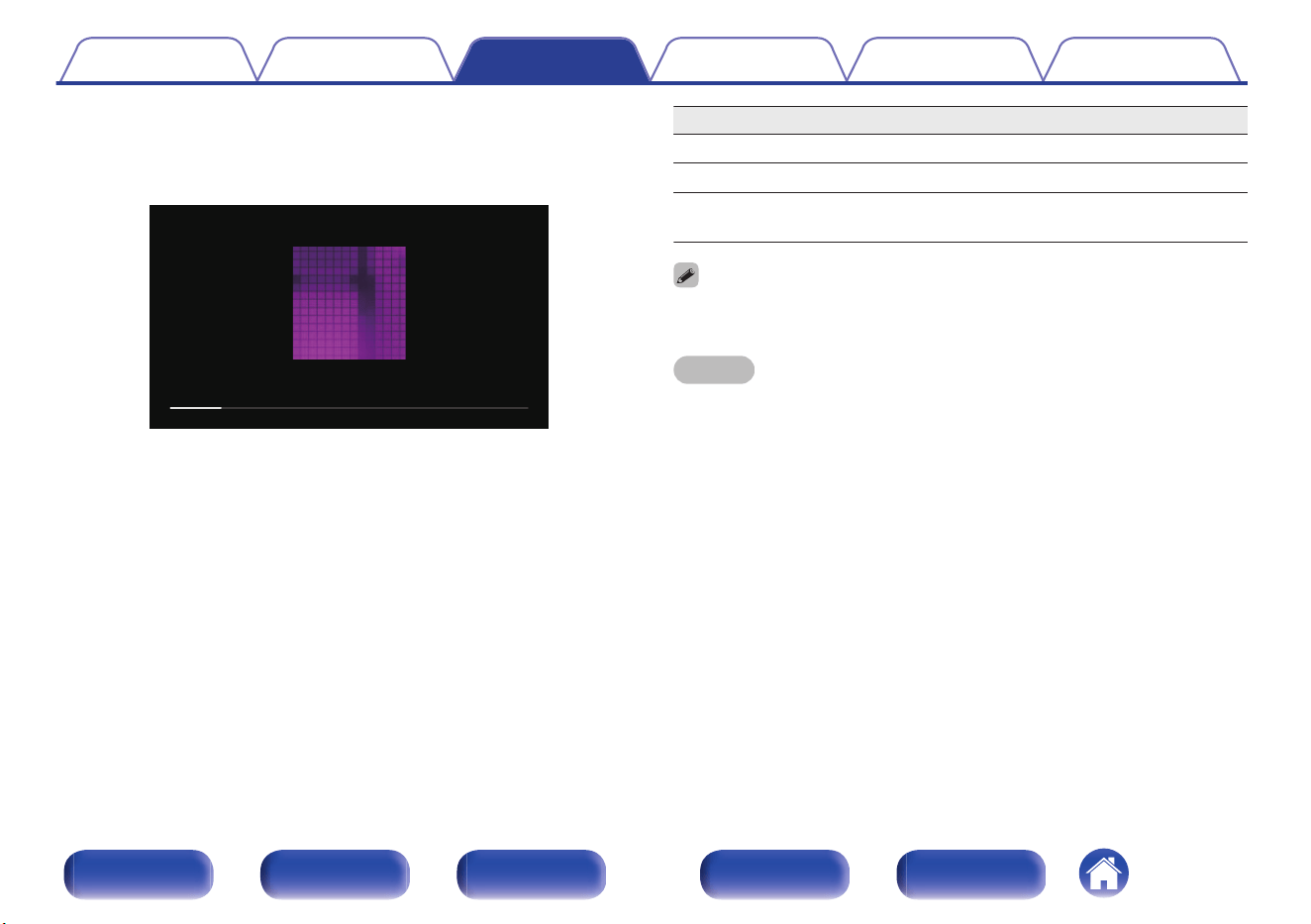
Use cursor Up/Down to select the “Play Now” or “Play
Now & Replace Queue”, then press ENTER.
Playback starts.
2:45
-14:21
Nature
Nature 01
-
Various Artists
Now Playing
Operation buttons Function
1/3
Playback / Pause
8 9
Skip to previous track / Skip to next track
CH/PAGE d f
Switch to the previous page/next page in
the list display
0
When an MP3 music file includes album art data, the album art can be displayed
while playing the file.
NOTE
0
Note that Denon will accept no responsibility whatsoever for any problems arising with
the data on a USB memory device when using this unit in conjunction with the USB
memory device.
0
When a USB memory device is connected to this unit, the unit loads all of the files
on the USB memory device. Loading may take a while if the USB memory device
contains a large number of folders and/or files.
Contents Connections Playback Settings Tips Appendix
54
Front panel Display Rear panel Remote Index
o
Operations accessible through the option
menu
0
“Adjusting the audibility of dialog and vocals (Dialog
Enhancer)” (v p. 96)
0
“Adjusting the volume of each channel to match the input source
(Channel Level Adjust)” (v p. 97)
0
“Adjusting the tone (Tone)” (v p. 98)
0
“Adjusting audio delay (Audio Delay)” (v p. 99)
0
“Displaying your desired video during audio playback (Video
Select)” (v p. 100)
Contents Connections Playback Settings Tips Appendix
55
Front panel Display Rear panel Remote Index
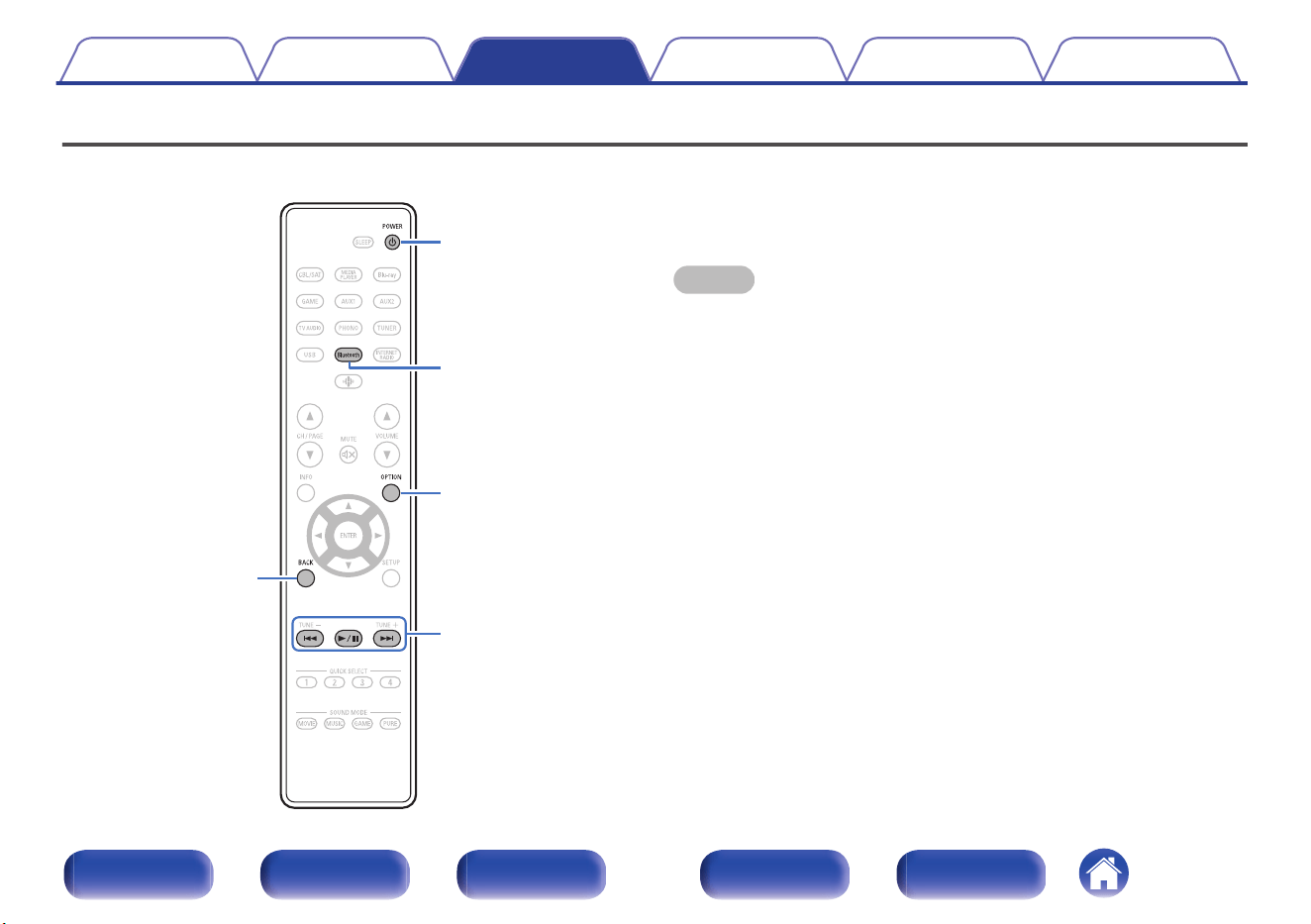
Listening to music on a Bluetooth device
1
/
3
8
9
OPTION
Bluetooth
POWER
X
BACK
Music files stored on Bluetooth devices such as smartphones, digital
music players, etc. can be enjoyed on this unit by pairing and connecting
this unit with the Bluetooth device.
Communication is possible up to a range of about 30 m.
NOTE
0
To play back music from a Bluetooth device, the Bluetooth device needs to
support the A2DP profile.
Contents Connections Playback Settings Tips Appendix
56
Front panel Display Rear panel Remote Index
Playing music from Bluetooth device
In order to enjoy music from a Bluetooth device on this unit, the Bluetooth
device must first be paired with this unit.
Once the Bluetooth device has been paired, it does not need to be paired
again.
1
Press POWER X to turn on power to the unit.
2
Press Bluetooth.
When using for the first time, the unit will go into the pairing mode
automatically and “Pairing...” will appear on the display of the unit.
3
Activate the Bluetooth settings on your mobile device.
4
Select this unit when its name appears in the list of
devices displayed on the screen of the Bluetooth
device.
Connect to the Bluetooth device while “Pairing” is being displayed
on the display of the unit.
Perform the connection with the Bluetooth device close to the unit
(about 1 m).
5
Play music using any app on your Bluetooth device.
0
The Bluetooth device can also be operated with the remote
control of this unit.
0
The next time the Bluetooth button is pressed on the remote
control unit, this unit automatically connects to the last Bluetooth
device that was connected.
Operation buttons
Function
1/3
Playback / Pause
8 9
Skip to previous track / Skip to next track
0
Press STATUS on this unit during playback to switch the display between Title
name, Artist name, Album name, etc.
Contents Connections Playback Settings Tips Appendix
57
Front panel Display Rear panel Remote Index
Pairing with other Bluetooth devices
Pair a Bluetooth device with this unit.
1
Activate the Bluetooth settings on your mobile device.
2
Press and hold Bluetooth on the remote control unit for
at least 3 seconds.
This unit will go into the pairing mode.
3
Select this unit when its name appears in the list of
devices displayed on the screen of the Bluetooth
device.
0
This unit can be paired with a maximum of 8 Bluetooth devices. When a 9th
Bluetooth device is paired, it will be registered in place of the oldest registered
device.
0
You can also enter pairing mode by pressing the OPTION button when the
Bluetooth playback screen is displayed and selecting “Pairing Mode” from the
displayed option menu.
NOTE
0
To operate the Bluetooth device with the remote control of this unit, the Bluetooth
device needs to support the AVRCP profile.
0
The remote control of this unit is not guaranteed to work with all Bluetooth devices.
0
Depending on the type of Bluetooth device, this unit outputs audio that is coupled
to the volume setting on the Bluetooth device.
o
Operations accessible through the option
menu
0
“Pairing with other Bluetooth devices” (v p. 58)
0
“Adjusting the audibility of dialog and vocals (Dialog
Enhancer)” (v p. 96)
0
“Adjusting the volume of each channel to match the input source
(Channel Level Adjust)” (v p. 97)
0
“Adjusting the tone (Tone)” (v p. 98)
0
“Adjusting audio delay (Audio Delay)” (v p. 99)
0
“Displaying your desired video during audio playback (Video
Select)” (v p. 100)
Contents Connections Playback Settings Tips Appendix
58
Front panel Display Rear panel Remote Index
Reconnecting to this unit from a
Bluetooth device
After pairing is completed, the Bluetooth device can be connected without
performing any operations on this unit.
This operation also needs to be performed when switching the Bluetooth
device for playback.
1
If a Bluetooth device is currently connected, deactivate
the Bluetooth setting of that device to disconnect it.
2
Activate the Bluetooth setting of the Bluetooth device
to be connected.
3
Select this unit from the Bluetooth device list on your
Bluetooth device.
4
Play music using any app on your Bluetooth device.
0
The screen automatically switches to the “Bluetooth” playback screen if a
Bluetooth device is connected while the power of this unit is on.
0
When the “Network Control” setting of this unit is set to “Always On” and a
Bluetooth device is connected with the unit in the standby state, the power of the
unit will be turned on automatically. (v p. 172)
Contents Connections Playback Settings Tips Appendix
59
Front panel Display Rear panel Remote Index
Listening to audio on Bluetooth headphones
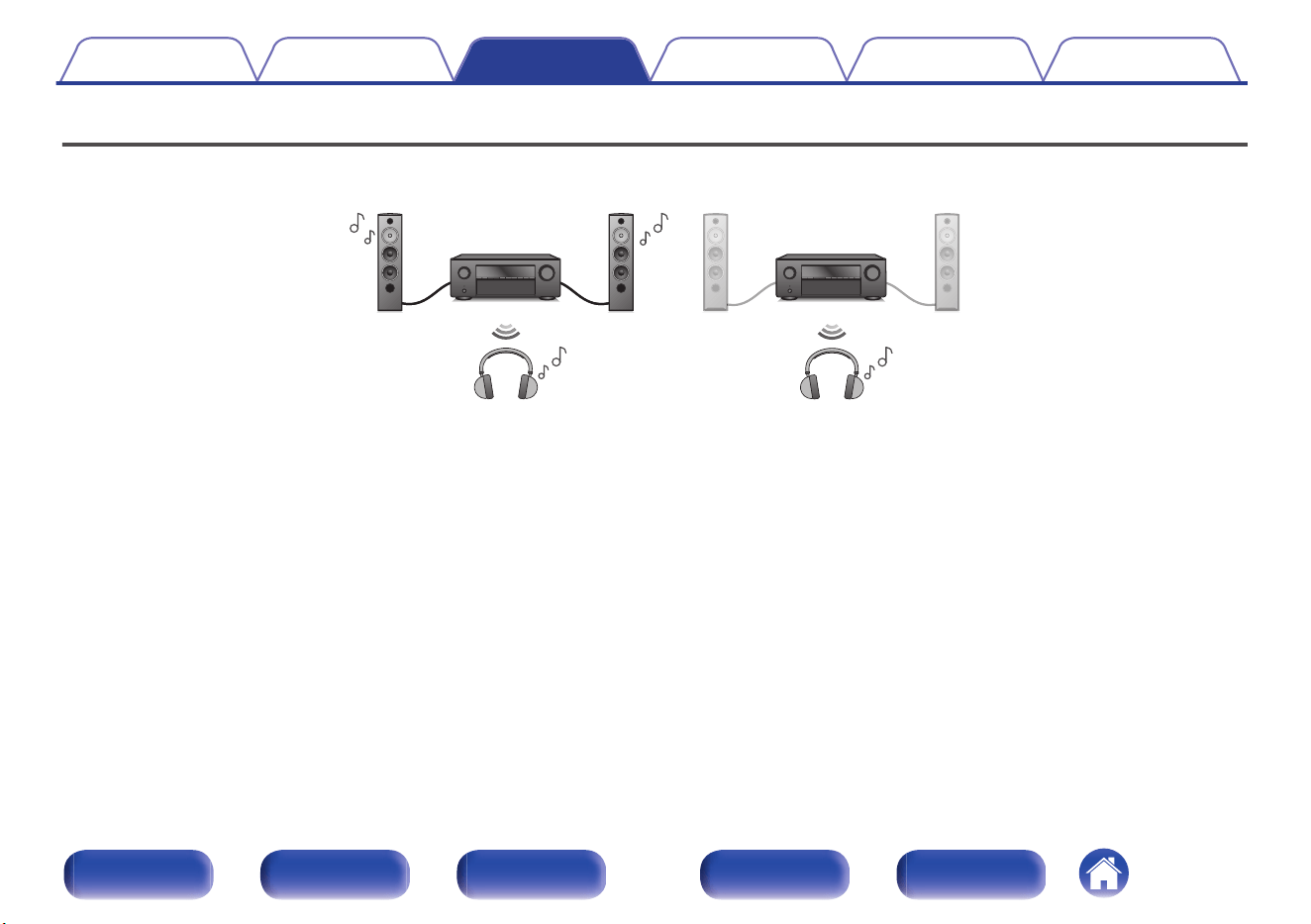
You can listen to audio playing through this unit on Bluetooth headphones.
Output audio from connected speakers and Bluetooth headphones simultaneously, or only using Bluetooth headphones.
(Output Mode: Bluetooth Only)(Output Mode: Bluetooth + Speakers)
Contents Connections Playback Settings Tips Appendix
60
Front panel Display Rear panel Remote Index
Listening to audio on Bluetooth
headphones
1
Set “Transmitter” to “On” from the “General” -
“Bluetooth Transmitter” setting in the menu.
(v p. 181)
2
Select “Output Mode”, and set audio output method.
Bluetooth + Speakers
(Default):
Audio is output to Bluetooth
headphones and speakers.
This simultaneous output is suitable for
family movie night and other group
activities.
Bluetooth Only:
Audio is output to Bluetooth
headphones only.
This is suitable for listening to music or
watching movies by yourself at night
when you need to keep quiet.
3
Enter pairing mode on the Bluetooth headphones you
want to connect to this unit.
4
Select “Device List” and select the name of the
Bluetooth headphones from the device list.
5
Adjust the volume of connected Bluetooth headphones
after the connection is completed.
0
“Output Mode” can also be set from “Bluetooth Transmitter” in the option menu.
0
A2DP profile-compatible Bluetooth speakers can be connected following the same
steps used to connect Bluetooth headphones.
NOTE
0
The volume of Bluetooth headphones cannot be adjusted through this unit’s
MASTER VOLUME or the VOLUME on the remote control unit. Adjust the volume
through the Bluetooth headphones.
0
If you are using Bluetooth headphones that do not have volume control, or if the
volume is insufficient, you can control the volume by adjusting the “Level” of the
“Bluetooth Transmitter” from the options menu. (v p. 62)
0
Stereo mode is fixed as the sound mode when using Bluetooth headphones. Any
sound modes and other audio settings are not reflected in audio output on
Bluetooth headphones.
Audio settings and sound modes are not available while using Bluetooth
headphones and “Output Mode” is set to “Bluetooth Only”.
0
Audio may be delayed when sent over Bluetooth.
0
Bluetooth headphones cannot be connected when use a Bluetooth input source.
Furthermore, selecting a Bluetooth input source will terminate the connection
between this unit and Bluetooth headphones.
0
Bluetooth headphones cannot be connected when this unit is grouped in the
HEOS App.
Contents Connections Playback Settings Tips Appendix
61
Front panel Display Rear panel Remote Index
Adjusting the volume of Bluetooth
headphones
If you are using Bluetooth headphones that do not have volume control, or
if the volume is insufficient, you can control the volume by adjusting the
“Level” of the “Bluetooth Transmitter” from the options menu.
1
Press OPTION.
An option menu screen is displayed.
0
When the input source is “HEOS Music”, an option menu for
online music is displayed. Select “AVR Options…”, then press
ENTER.
2
Use cursor Up/Down to select “Bluetooth Transmitter”,
then press ENTER.
The “Bluetooth Transmitter” screen is displayed.
3
Use cursor Up/Down to select “Level”.
4
Use cursor Left/Right to adjust the volume, then press
ENTER.
–50 dB – +10 dB (Default: 0 dB)
0
This setting applies to all connected Bluetooth headphones, regardless of type.
Reconnecting to a Bluetooth
headphones
Follow any of the steps below to reconnect the most recently used
Bluetooth headphones:
0
Reconnect to this unit with Bluetooth headphone's reconnect function.
0
Go to “Bluetooth Transmitter” and then select “Reconnect” within the
options menu.
0
If “Output Mode” is set to “Bluetooth + Speakers”, this unit will
automatically connect to the most recently used Bluetooth headphones
when power is turned on.
0
Select the device you wish to connect from the “Device List” under
“Bluetooth Transmitter” in the menu. (v p. 181)
Contents Connections Playback Settings Tips Appendix
62
Front panel Display Rear panel Remote Index
Disconnecting Bluetooth headphones
Complete any of the following steps to disconnect your Bluetooth
headphones:
0
Turn off your Bluetooth headphones.
0
Go to “Bluetooth Transmitter” and then select “Disconnect” within the
options menu.
0
In the setup menu, go to “General” - “Bluetooth Transmitter”, and set
“Transmitter” to Off. (v p. 181)
Contents Connections Playback Settings Tips Appendix
63
Front panel Display Rear panel Remote Index
Listening to FM/AM broadcasts
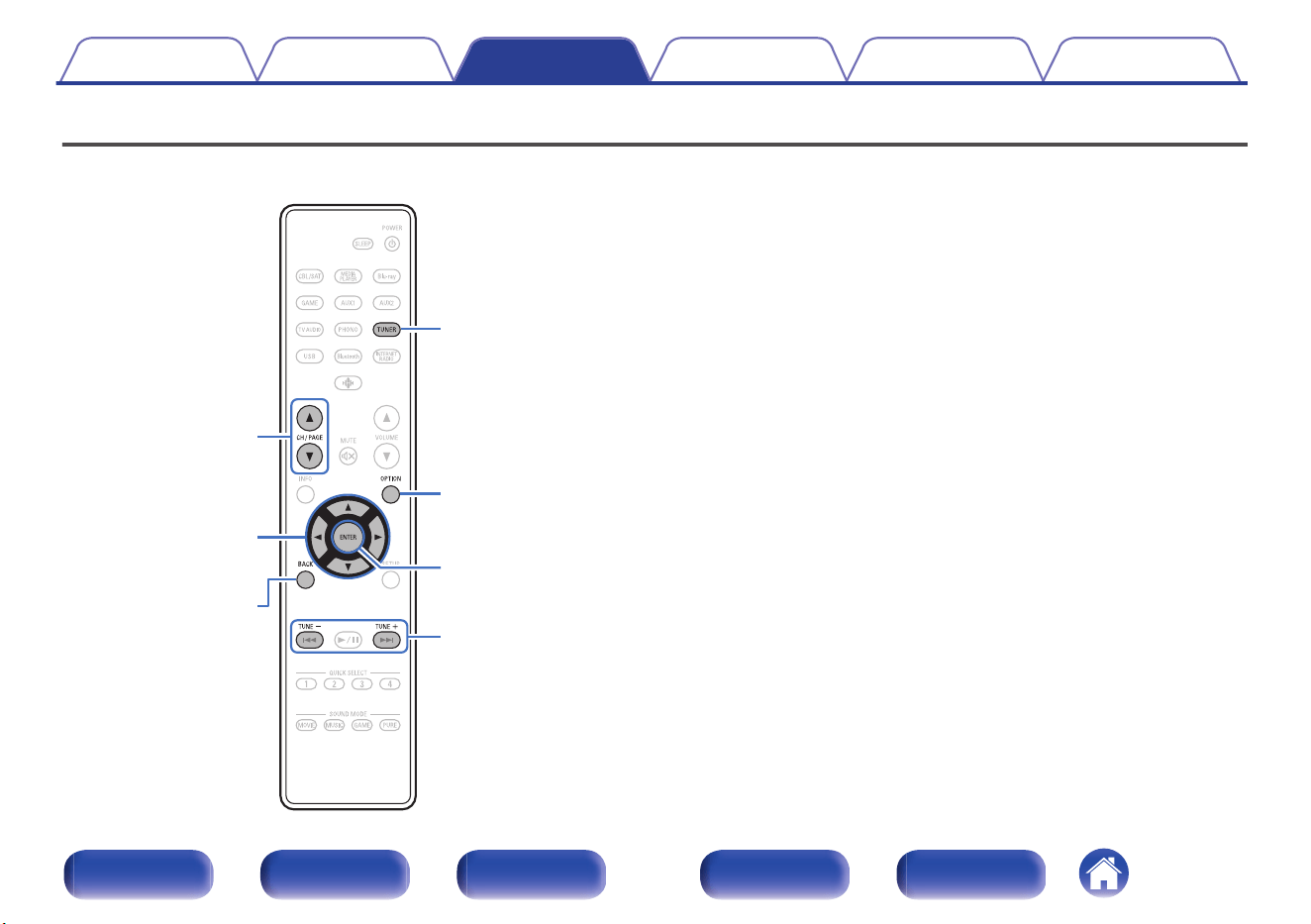
CH/PAGE
BACK
OPTION
TUNE +, –
TUNER
df
ENTER
Cursor Up/Down/
Left/Right
You can use the built-in tuner of this unit to listen to FM broadcasts and
AM broadcasts.
Make sure the FM antenna and AM loop antenna are connected to this
unit first.
Contents Connections Playback Settings Tips Appendix
64
Front panel Display Rear panel Remote Index
Listening to FM/AM broadcasts
1
Connect the antenna. (“Connecting FM/AM
antennas” (v p. 44))
2
Press TUNER to switch the input source to “Tuner”.
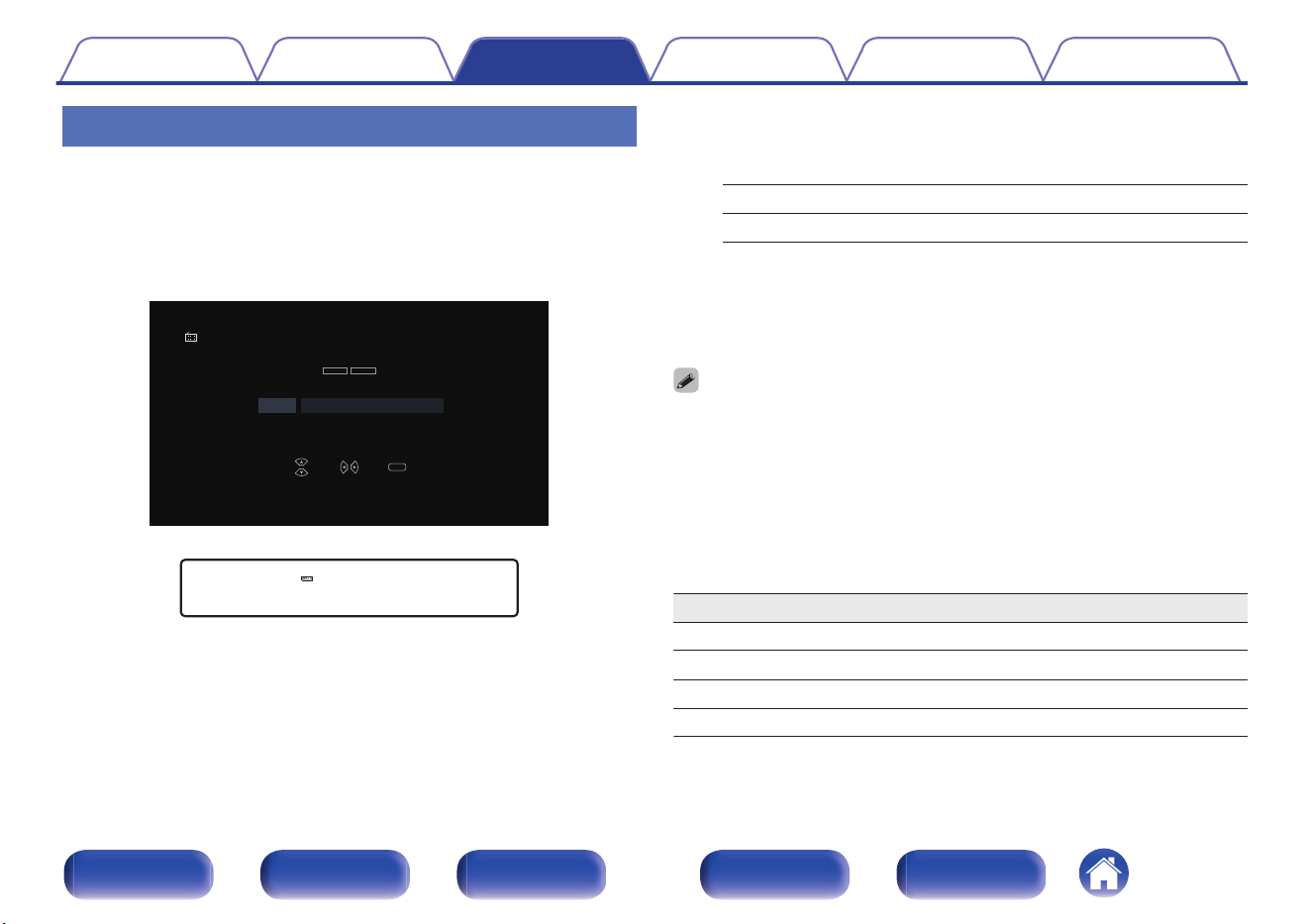
G TV screen H
OPTION
STEREO AUTO
CH 1
FM 87.50 MHz
Tuner
Tune Preset
Option
Now Playing
01 FM 87.50MHz
GDisplay of this unitH
3
Press OPTION.
The option menu screen is displayed.
4
Use cursor Up/Down to select “FM/AM”, then press
ENTER.
This displays the reception band input screen.
5
Use cursor Left/Right to select “FM” or “AM”, then
press ENTER.
FM: When listening to an FM broadcast.
AM: When listening to an AM broadcast.
6
Press TUNE + or TUNE – to select the station you want
listen to.
Scanning is performed until it finds an available radio station. When
it finds a radio station, it stops the scan automatically and tunes in.
0
The modes for receiving FM broadcasts consists of “Auto” mode that automatically
searches available broadcast stations and “Manual” mode that lets you tune in
using buttons to change the frequency. The default setting is “Auto”. You can also
use “Direct Tune” to tune in by entering the frequency directly.
In “Auto” mode, you cannot tune in to radio stations if the reception is not good.
If this is the case, then use the “Manual” mode or “Direct Tune” mode to tune in.
0
You can also switch the reception band by pressing BAND on the unit.
0
You can also scan the broadcast station by pressing TUNE + or TUNE – on the
unit.
Operation buttons Function
TUNE +, – Selects the radio station (up/down)
CH/PAGE d f
Selects preset radio stations
Cursor Up/Down Selects the radio station (up/down)
Cursor Left/Right Selects preset radio stations
Contents Connections Playback Settings Tips Appendix
65
Front panel Display Rear panel Remote Index
o
Operations accessible through the option
menu
0
“Tuning in by entering the frequency (Direct Tune)” (v p. 67)
0
“RDS Search” (v p. 67)
0
“PTY Search” (v p. 68)
0
“TP Search” (v p. 69)
0
“Radio text” (v p. 69)
0
“Changing the tune mode (Tune Mode)” (v p. 70)
0
“Tuning in to stations and presetting them automatically (Auto Preset
Memory)” (v p. 70)
0
“Presetting the current broadcast station (Preset
Memory)” (v p. 71)
0
“Specify a name for the preset broadcast station (Preset
Name)” (v p. 72)
0
“Skipping preset broadcast stations (Preset Skip)” (v p. 73)
0
“Adjusting the audibility of dialog and vocals (Dialog
Enhancer)” (v p. 96)
0
“Adjusting the volume of each channel to match the input source
(Channel Level Adjust)” (v p. 97)
0
“Adjusting the tone (Tone)” (v p. 98)
0
“Adjusting audio delay (Audio Delay)” (v p. 99)
0
“Displaying your desired video during audio playback (Video
Select)” (v p. 100)
Contents Connections Playback Settings Tips Appendix
66
Front panel Display Rear panel Remote Index
Tuning in by entering the frequency
(Direct Tune)
You can enter the receiving frequency directly to tune in.
1
Press OPTION when the input source is “Tuner”.
The option menu screen is displayed.
2
Use cursor Up/Down to select “Direct Tune”, then
press ENTER.
The screen that lets you enter the frequency is displayed.
3
Use cursor Up/Down to select a number, then press
cursor Right.
0
If cursor Left is pressed, the immediately preceding input is
cancelled.
4
Repeat step 3 and enter the frequency of the radio
station you want to hear.
5
When setting is completed, press ENTER.
The preset frequency is tuned in.
RDS Search
RDS is a broadcasting service which allows a station to send additional
information along with the regular radio program signal.
Use this function to automatically tune to FM stations that provide the RDS
service.
Note that the RDS function only works when receiving RDS compatible
stations.
1
Press OPTION when the input source is “Tuner”.
The option menu screen is displayed.
2
Use cursor Up/Down to select “RDS Search”, then
press ENTER.
3
Press ENTER.
The search for RDS stations begins automatically.
0
If you use cursor Left/Right within 5 seconds after the broadcast station name is
shown on the display, you can search for a different station.
Contents Connections Playback Settings Tips Appendix
67
Front panel Display Rear panel Remote Index
PTY Search
Use this function to find RDS stations broadcasting a designated program
type (PTY).
PTY identifies the type of RDS program.
The program types and their displays are as follows:
NEWS
News
WEATHER
Weather
AFFAIRS
Current Affairs
FINANCE
Finance
INFO
Information
CHILDREN
Children’s program
SPORT
Sports
SOCIAL
Social Affairs
EDUCATE
Education
RELIGION
Religion
DRAMA
Drama
PHONE IN
Phone In
CULTURE
Culture
TRAVEL
Travel
SCIENCE
Science
LEISURE
Leisure
VARIED
Varied
JAZZ
Jazz Music
POP M
Pop Music
COUNTRY
Country Music
ROCK M
Rock Music
NATION M
National Music
EASY M
Easy Listening Music
OLDIES
Oldies Music
LIGHT M
Light Classical
FOLK M
Folk Music
CLASSICS
Serious Classical
DOCUMENT
Documentary
OTHER M
Other Music
1
Press OPTION when the input source is “Tuner”.
The option menu screen is displayed.
2
Use cursor Up/Down to select “PTY Search”, then
press ENTER.
3
Use cursor Up/Down to call out the desired program
type.
4
Press ENTER.
PTY search begins automatically.
0
If you use cursor Left/Right within 5 seconds after the broadcast station name is
shown on the display, you can search for a different station.
Contents Connections Playback Settings Tips Appendix
68
Front panel Display Rear panel Remote Index
TP Search
TP identifies programs that carry traffic announcements.
This allows you to easily find out the latest traffic conditions in your area
before leaving home.
Use this function to find RDS stations broadcasting traffic programs (TP
stations).
1
Press OPTION when the input source is “Tuner”.
The option menu screen is displayed.
2
Use cursor Up/Down to select “TP Search”, then press
ENTER.
3
Press ENTER.
TP search begins automatically.
0
If you use cursor Left/Right within 5 seconds after the broadcast station name is
shown on the display, you can search for a different station.
Radio text
RT allows RDS stations to send text messages that appear on the display.
“Radio text” appears on the display when radio text data is received.
1
Press OPTION when the input source is “Tuner”.
The option menu screen is displayed.
2
Use cursor Up/Down to select “Radio text”, then press
ENTER.
3
Use cursor Left/Right to select “On”, then press
ENTER.
0
While receiving an RDS broadcast station, the text data
broadcast from the station is displayed.
0
If no text data is being broadcast, “NO TEXT DATA” is displayed.
Contents Connections Playback Settings Tips Appendix
69
Front panel Display Rear panel Remote Index
Changing the tune mode (Tune Mode)
You can change the mode for tuning into FM and AM broadcasts. If you
cannot tune in automatically with “Auto” mode, change the mode to
“Manual” and tune in manually.
1
Press OPTION when the input source is “Tuner”.
The option menu screen is displayed.
2
Use cursor Up/Down to select “Tune Mode”, then press
ENTER.
3
Use cursor Left/Right to select the tune mode, then
press ENTER.
Auto:
Automatically search for and tune to a
receivable radio station.
Manual:
Manually change the frequency one
step at a time each time the button is
pressed.
0
You can also select the tuning mode by pressing MODE on the main unit.
Tuning in to stations and presetting
them automatically (Auto Preset
Memory)
A maximum of 56 radio stations can be automatically preset.
1
Press OPTION when the input source is “Tuner”.
The option menu screen is displayed.
2
Use cursor Up/Down to select “Auto Preset Memory”,
then press ENTER.
3
Press ENTER.
The unit starts to tune in to radio stations automatically and preset
them.
0
When presetting is completed, “Completed” is displayed for about
5 seconds and the option menu screen turns off.
0
The preset memory is overwritten.
Contents Connections Playback Settings Tips Appendix
70
Front panel Display Rear panel Remote Index
Presetting the current broadcast
station (Preset Memory)
Your favorite broadcast stations can be preset so that you can tune them
in easily.
Up to 56 stations can be preset.
1
Tune in the broadcast station you want to preset.
(“Listening to FM/AM broadcasts” (v p. 65))
2
Press OPTION.
The option menu screen is displayed.
3
Use cursor Up/Down to select “Preset Memory”, then
press ENTER.
The list of already preset channels is displayed.
4
Use cursor Up/Down to select the channel you want to
preset, then press ENTER.
The current broadcast station that is preset.
0
To preset other stations, repeat steps 1 to 4.
Channel Default settings
1 – 8
87.50 / 89.10 / 98.10 / 108.00 / 90.10 / 90.10 / 90.10 /
90.10 MHz
9 – 16
90.10 / 90.10 / 90.10 / 90.10 / 90.10 / 90.10 / 90.10 / 90.10
MHz
17 – 24
90.10 / 90.10 / 90.10 / 90.10 / 90.10 / 90.10 / 90.10 / 90.10
MHz
25 – 32
90.10 / 90.10 / 90.10 / 90.10 / 90.10 / 90.10 / 90.10 / 90.10
MHz
33 – 40
90.10 / 90.10 / 90.10 / 90.10 / 90.10 / 90.10 / 90.10 / 90.10
MHz
41 – 48
90.10 / 90.10 / 90.10 / 90.10 / 90.10 / 90.10 / 90.10 / 90.10
MHz
49 – 56
90.10 / 90.10 / 90.10 / 90.10 / 90.10 / 90.10 / 90.10 / 90.10
MHz
Listening to preset stations
1
Use CH/PAGE df to select the desired preset channel.
0
You can also select preset broadcast stations by pressing TUNER PRESET CH +
or TUNER PRESET CH – on the main unit.
Contents Connections Playback Settings Tips Appendix
71
Front panel Display Rear panel Remote Index
Specify a name for the preset
broadcast station (Preset Name)
You can set the name to the preset broadcast station or change it.
Up to 8 characters can be input.
1
Press OPTION when the input source is “Tuner”.
The option menu screen is displayed.
2
Use cursor Up/Down to select “Preset Name”, then
press ENTER.
The “Preset Name” screen is displayed.
3
Use cursor Left/Right to select the group of the
broadcast station you want to name.
4
Use cursor Up/Down to select the broadcast station
you want to name, then press ENTER.
The screen that lets you edit the Preset Name is displayed.
0
If you select “Clear”, then the unit returns to displaying the
frequency.
5
Enter the characters, then press “OK”.
6
Press OPTION to return to the previous screen.
Contents Connections Playback Settings Tips Appendix
72
Front panel Display Rear panel Remote Index
Skipping preset broadcast stations
(Preset Skip)
Perform auto preset memory to save all the broadcasting stations that can
be received in the memory. Selecting a broadcast station becomes easier
by skipping unnecessary memories.
1
Press OPTION when the input source is “Tuner”.
The option menu screen is displayed.
2
Use cursor Up/Down to select “Preset Skip”, then press
ENTER.
The “Preset Skip” screen is displayed.
3
n
To set the stations you want to skip by groups
A
Use cursor Left/Right to select the group of broadcast stations
you want to skip.
B
Press cursor Up to select “Set z – z to Skip”, then press
ENTER.
Skip all the broadcast stations that are included in the
selected group “z-z”.
(z is the selected group number.)
n
To set the stations you want to skip by stations
A
Use cursor Left/Right to select the group of broadcast
stations you want to skip.
B
Use cursor Up/Down to select the broadcast station you
want to skip.
C
Use cursor Left/Right to select “Skip”.
The station you selected is not displayed.
4
Press OPTION to return to the previous screen.
Contents Connections Playback Settings Tips Appendix
73
Front panel Display Rear panel Remote Index
Cancelling Preset Skip
1
While the “Preset Skip” screen is displayed, use cursor
Left/Right to select a group containing a broadcast
station to cancel the skip for.
2
Use cursor Up/Down to select a broadcast station to
cancel the skip for.
3
Use cursor Left/Right to select “On”.
The skip is cancelled.
NOTE
0
“Preset Skip” cannot be cancelled for groups.
Contents Connections Playback Settings Tips Appendix
74
Front panel Display Rear panel Remote Index
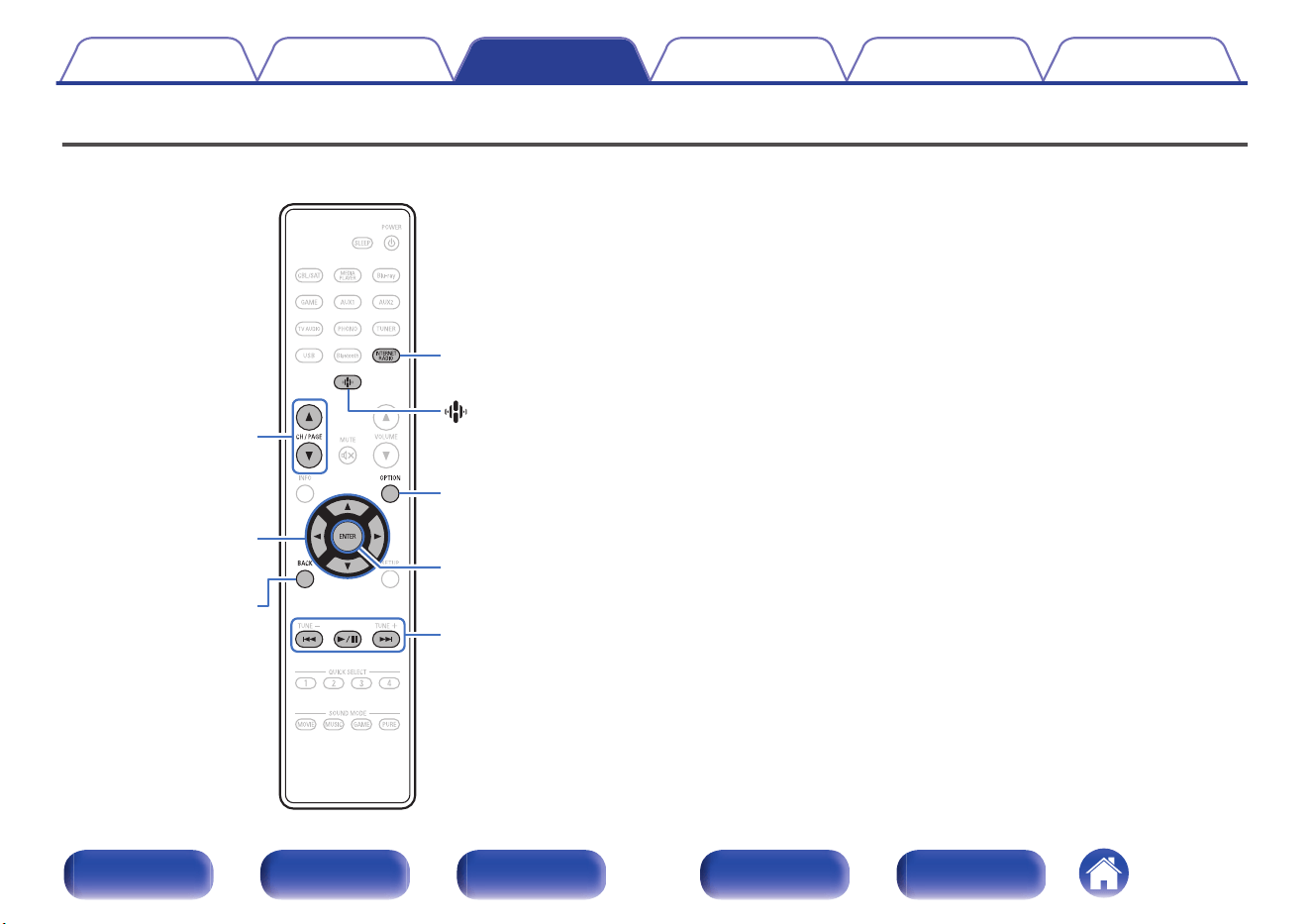
Listening to Internet Radio
CH/PAGE
df
BACK
OPTION
INTERNET
RADIO
1
/
3
8
9
ENTER
(HEOS Music)
Cursor Up/Down/
Left/Right
0
Internet Radio refers to radio broadcasts distributed over the Internet.
Internet Radio stations from around the world can be received.
0
The Internet Radio station list on this unit the database service provided
by TuneIn Radio service.
0
The audio format types and specifications supported by this unit for
playback are as follows.
See “Playing back Internet Radio” (v p. 223) for details.
0
WMA
0
MP3
0
MPEG-4 AAC
Contents Connections Playback Settings Tips Appendix
75
Front panel Display Rear panel Remote Index
Listening to Internet Radio
1
Press INTERNET RADIO.
0
You can also press R (HEOS Music). Use cursor Up/Down to
select “TuneIn Internet Radio”, then press ENTER.
2
Select the station you want to play.
Operation buttons Function
1/3
z
Playback / Pause
8 9
z
Skip to previous track / Skip to next track
CH/PAGE d f
Switch to the previous page/next page in
the list display
z Enabled when playing Podcasts.
0
The display switches between track title and radio station name etc. each time the
main unit’s STATUS is pressed.
NOTE
0
The radio station database service may be suspended or be otherwise unavailable
without notice.
o
Operations accessible through the option
menu
0
“Adding to HEOS Favorites” (v p. 96)
0
“Adjusting the audibility of dialog and vocals (Dialog
Enhancer)” (v p. 96)
0
“Adjusting the volume of each channel to match the input source
(Channel Level Adjust)” (v p. 97)
0
“Adjusting the tone (Tone)” (v p. 98)
0
“Adjusting audio delay (Audio Delay)” (v p. 99)
0
“Displaying your desired video during audio playback (Video
Select)” (v p. 100)
Contents Connections Playback Settings Tips Appendix
76
Front panel Display Rear panel Remote Index
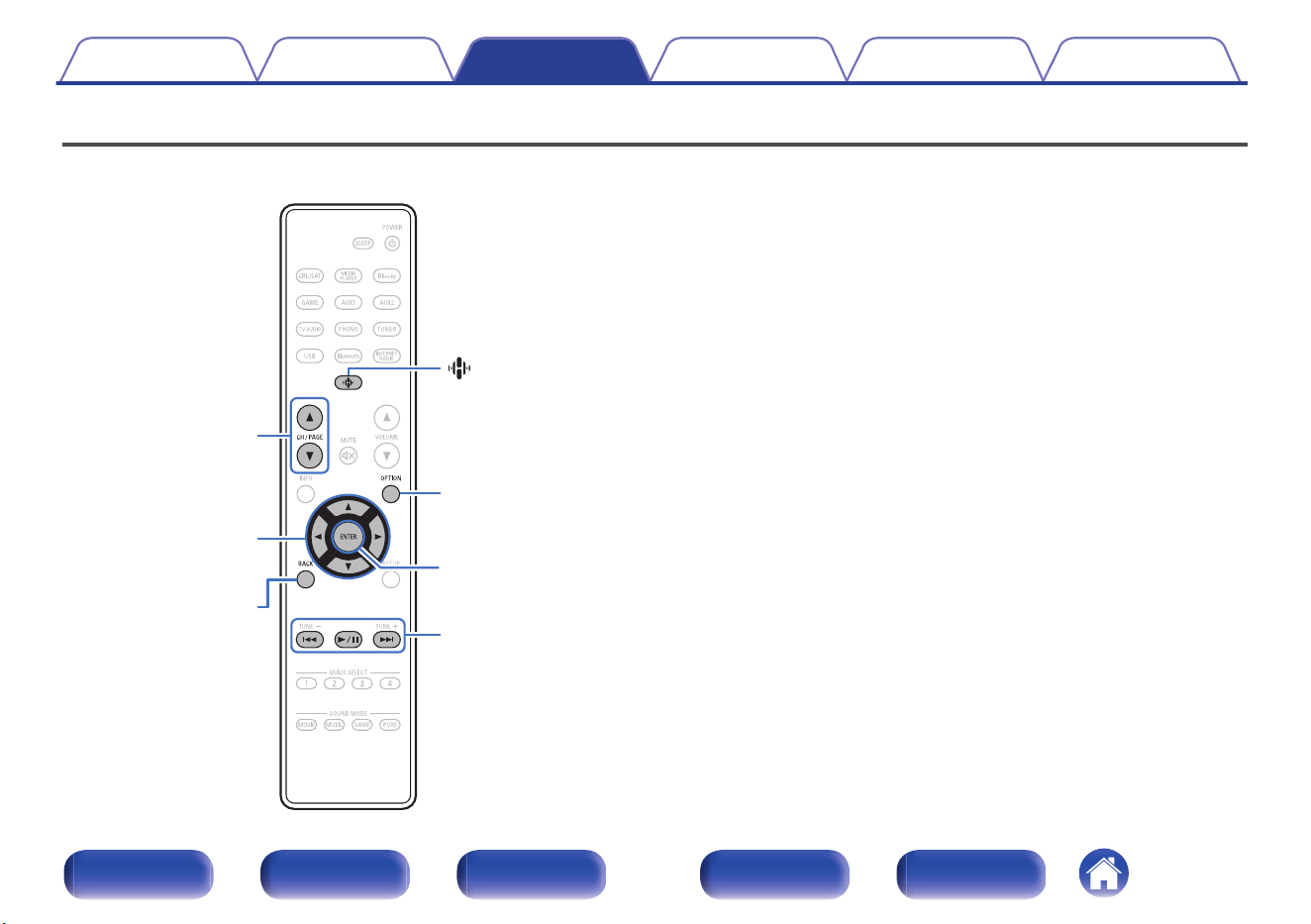
Playing back files stored on a PC or NAS
CH/PAGE
df
BACK
OPTION
1
/
3
8
9
BACK
(HEOS Music)
ENTER
Cursor Up/Down/
Left/Right
0
This unit can play back music files and playlists (m3u, wpl) from DLNA
compatible servers including PCs and NAS devices on your network.
0
Supported file formats:
For details, see “Playing back a file saved on a PC or
NAS” (v p. 222).
0
WMA
0
MP3
0
WAV
0
MPEG-4 AAC
0
FLAC
0
Apple Lossless
0
DSD
Contents Connections Playback Settings Tips Appendix
77
Front panel Display Rear panel Remote Index
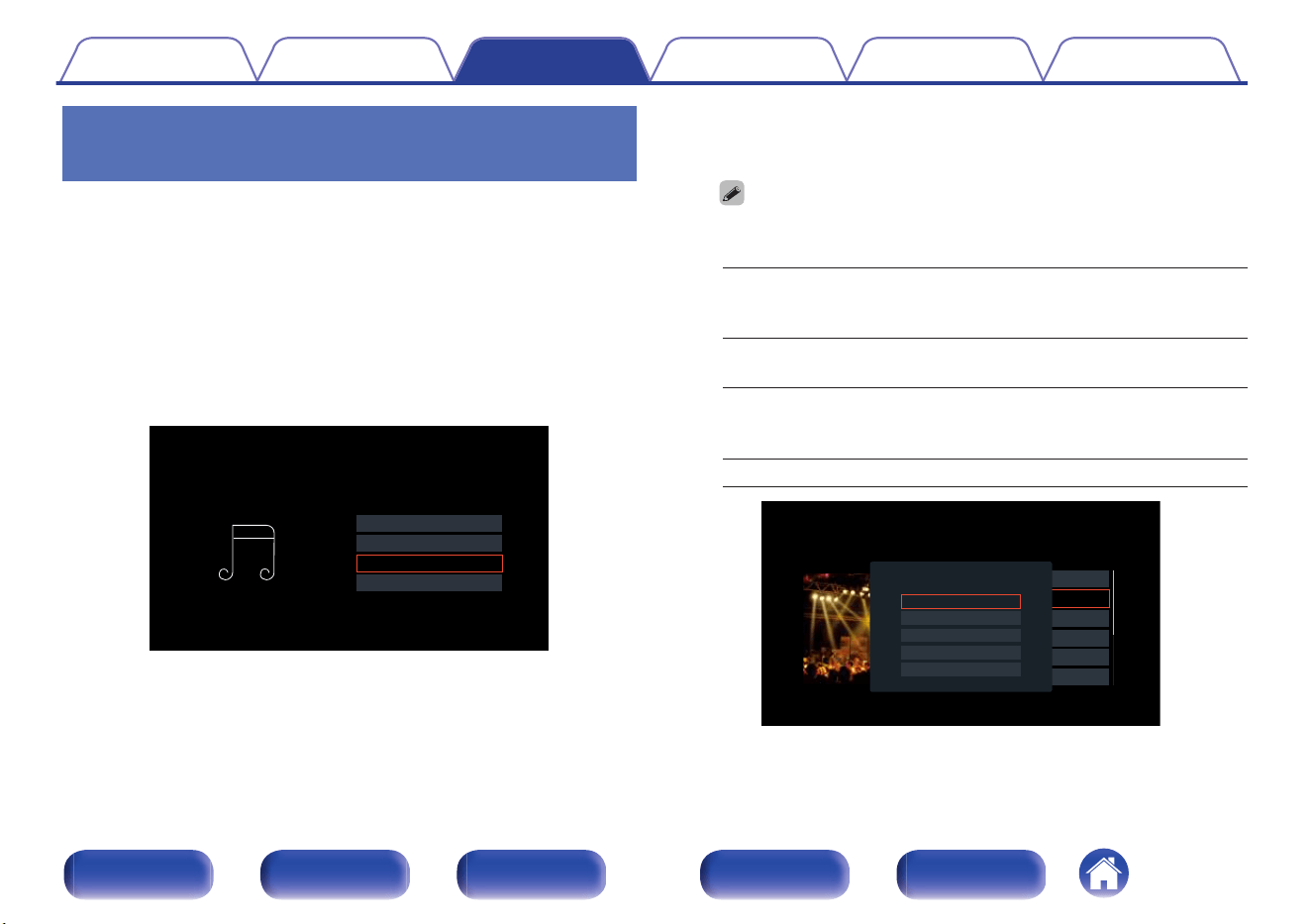
Playing back files stored on a PC or
NAS
Use this procedure to play music files or playlists stored on DLNA files
servers on your local network.
1
Press R (HEOS Music).
If a playback history is present, the last Internet radio station or song
played is played back. Pressing R (HEOS Music) again displays the
HEOS Music top menu.
2
Use cursor Up/Down to select “Music Servers”, then
press ENTER.
USB Music
Music Servers
HEOS Favorites
TuneIn Internet Radio
Music
3
Select the name of your networked PC or NAS
(Network Attached Storage) server.
4
Browse the music on your PC/NAS and select
something to play.
0
When you select something to play you will be asked how you want to
queue up your music.
Play Now:
Inserts the item into the queue after the
currently playing track and plays the
selected item immediately.
Play Now & Replace
Queue:
Clears the queue and plays the
selected item immediately.
Play Next:
Inserts the item into the queue after the
current song and plays it when the
current song ends.
Add to End of Queue: Adds the item to the end of the queue.
Nature 01
Play Now
Play Now & Replace Queue
Play Next
Add to End of Queue
Cancel
Music Servers - Live
Contents Connections Playback Settings Tips Appendix
78
Front panel Display Rear panel Remote Index
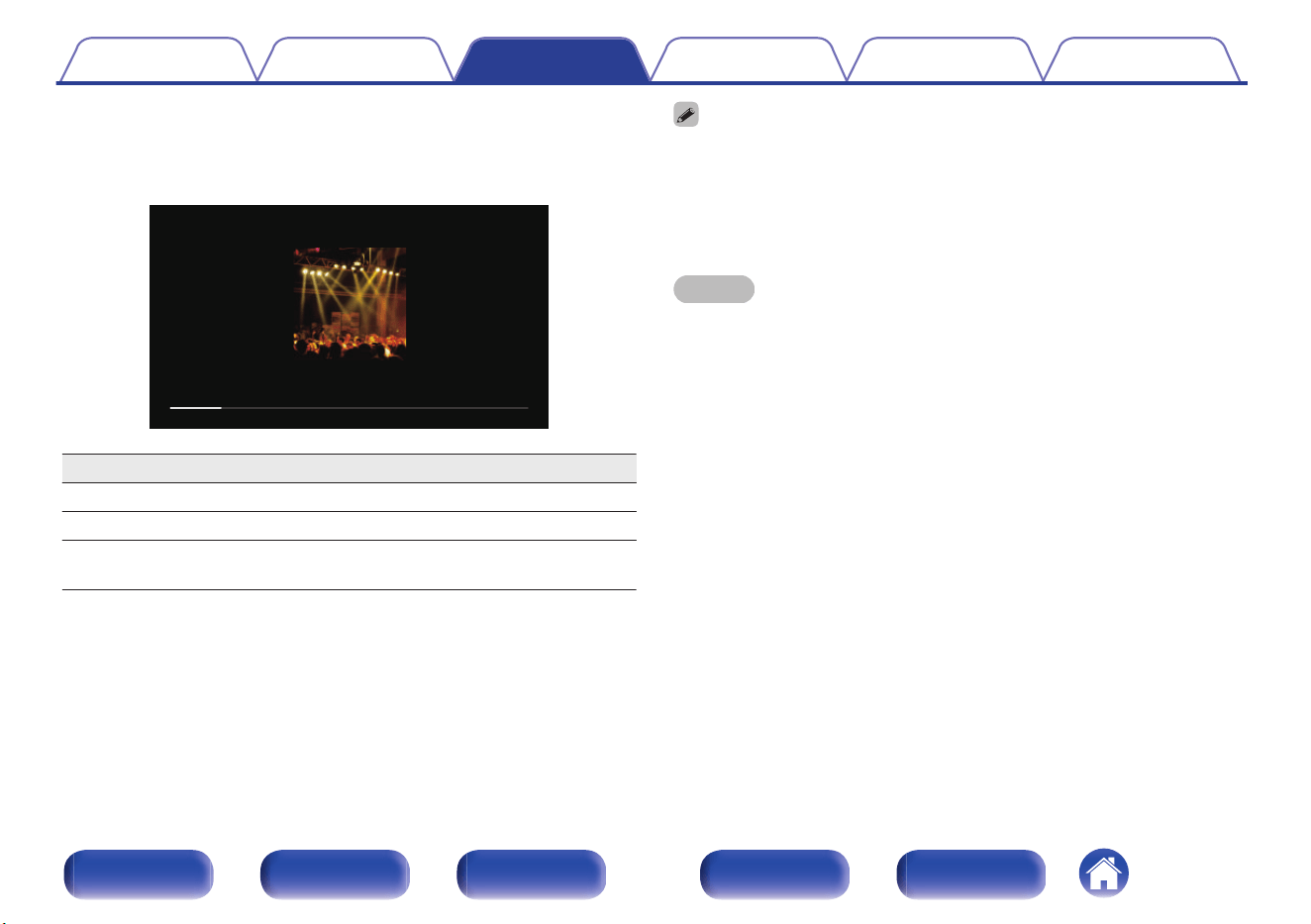
5
Use cursor Up/Down to select the “Play Now” or “Play
Now & Replace Queue”, then press ENTER.
Playback starts.
2:45
-14:21
Live
Live 01
-
Various Artists
Now Playing
Operation buttons Function
1/3
Playback / Pause
8 9
Skip to previous track / Skip to next track
CH/PAGE d f
Switch to the previous page/next page in
the list display
0
The display switches between track title, artist name, and album title each time the
main unit’s STATUS is pressed.
0
When a WMA (Windows Media Audio), MP3 or MPEG-4 AAC file includes album
art data, the album art can be displayed while the music files are playing.
0
If you use Ver.11 or later of Windows Media Player, the album art for WMA files
can be displayed.
NOTE
0
When playing back music files with your PC or NAS connected through wireless
LAN, audio may be interrupted depending on your wireless LAN environment. In
this case, connect using a wired LAN.
0
The order in which the tracks/files are displayed depends on the server
specifications. If the tracks/files are not displayed in alphabetical order due to the
server specifications, searching by the first letter may not work properly.
Contents Connections Playback Settings Tips Appendix
79
Front panel Display Rear panel Remote Index
o
Operations accessible through the option
menu
0
“Adjusting the audibility of dialog and vocals (Dialog
Enhancer)” (v p. 96)
0
“Adjusting the volume of each channel to match the input source
(Channel Level Adjust)” (v p. 97)
0
“Adjusting the tone (Tone)” (v p. 98)
0
“Adjusting audio delay (Audio Delay)” (v p. 99)
0
“Displaying your desired video during audio playback (Video
Select)” (v p. 100)
Contents Connections Playback Settings Tips Appendix
80
Front panel Display Rear panel Remote Index
Getting the HEOS App
You can use many online music streaming services from the HEOS App. Depending upon your geographical location, there are several options to choose
from.
Download the HEOS App for iOS or Android by searching App Store, Google Play store or Amazon Appstore for “HEOS”.
Contents Connections Playback Settings Tips Appendix
81
Front panel Display Rear panel Remote Index
HEOS Account
HEOS Accounts can be registered by tapping “Music” tab - “Settings” icon
in the HEOS App.
Once you create or sign into your HEOS Account, you can use the HEOS
Favorites feature to save and recall your favorite streaming radio stations
using the on-screen user interface on your AVR.
o
What is a HEOS Account?
A HEOS Account is master account or “keychain” for managing all of
your HEOS music services with one single username and password.
o
Why do I need a HEOS Account?
With the HEOS Account you just have to enter your music services
login names and passwords one time. This allows you to easily and
quickly use multiple controller apps on different devices.
You just log into your HEOS Account on any device and you will have
access to all of your associated music services, play history and
custom playlists, even if you are at a friend’s house listening to music
on their HEOS system.
o
Signing up for a HEOS Account
You will be instructed to signup for a HEOS Account the first time you
try to access any music service from the main “Music” menu of the
HEOS App.
o
Changing your HEOS Account
1
Tap the “Music” tab.
2
Select the Settings icon in the upper left corner of
the screen.
3
Select “HEOS Account”.
4
Change your location, change your password, delete
your account or sign out of your account.
0
This unit automatically synchronizes when you change your settings or sign out of
your account in the HEOS App.
Contents Connections Playback Settings Tips Appendix
82
Front panel Display Rear panel Remote Index
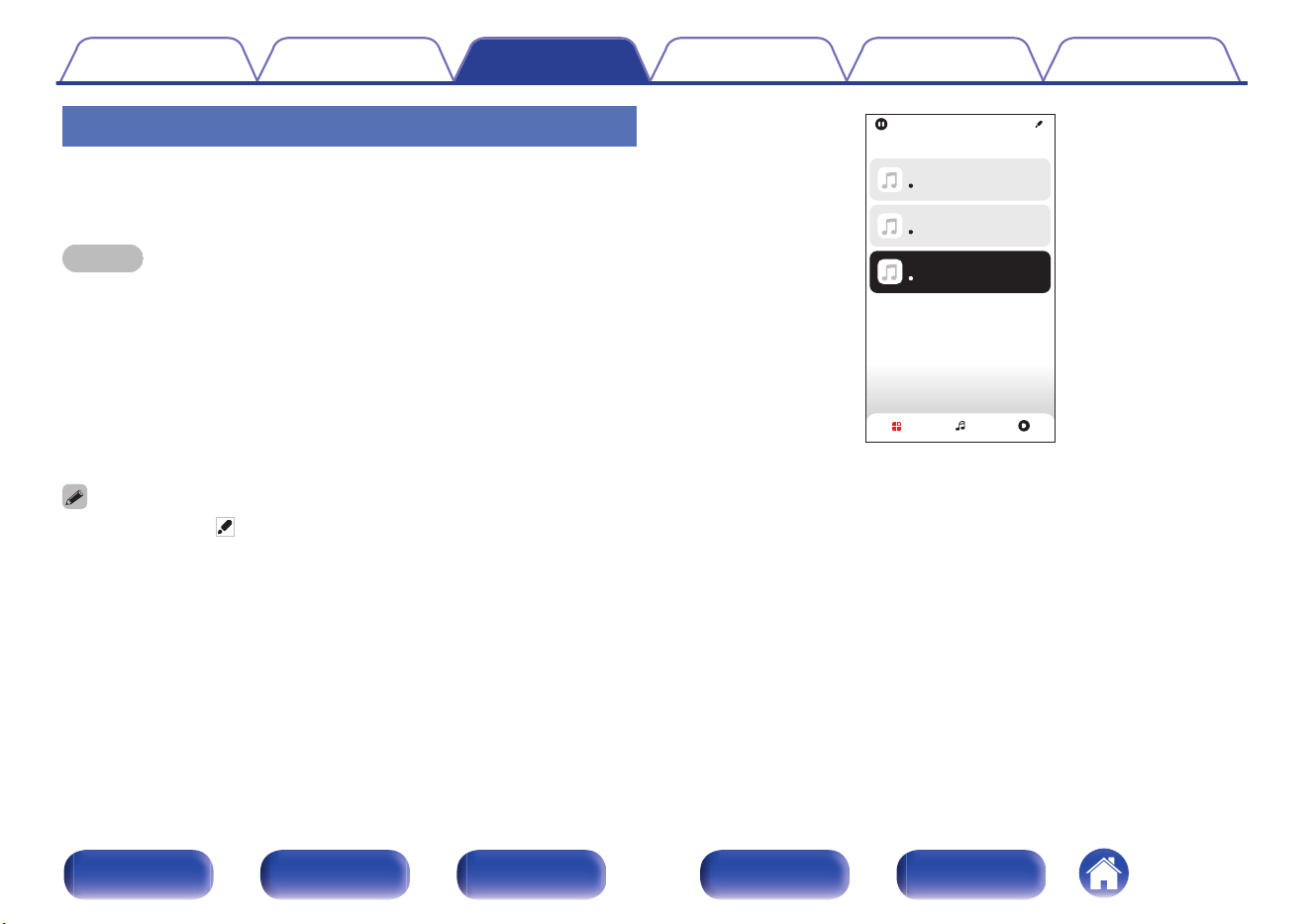
Playing from streaming music services
A music service is an online music company that provides access to vast
music collections via free and/or paid subscriptions. Depending upon your
geographical location, there are several options to choose from.
NOTE
0
The HEOS App and brand is not affiliated with any manufacturer of any mobile
device. Availability of music services may vary by region. Not all services may be
available at time of purchase. Some services may be added or discontinued from
time to time based on decisions of the music service providers or others.
o
Selecting a room/device
1
Tap the “Rooms” tab, and select “Denon AVR-S670H” if
there are multiple products with HEOS Built-in.
0
Tap the Pencil icon
at the top right to switch edit mode. You can change the
displayed name.
Song Name 1
Dining L + Dining R
Song Name 2
Kitchen
Song Name 3
Denon AVR-S670H
Drag one room into another to group them
Rooms
Rooms Now PlayingMusic
Contents Connections Playback Settings Tips Appendix
83
Front panel Display Rear panel Remote Index
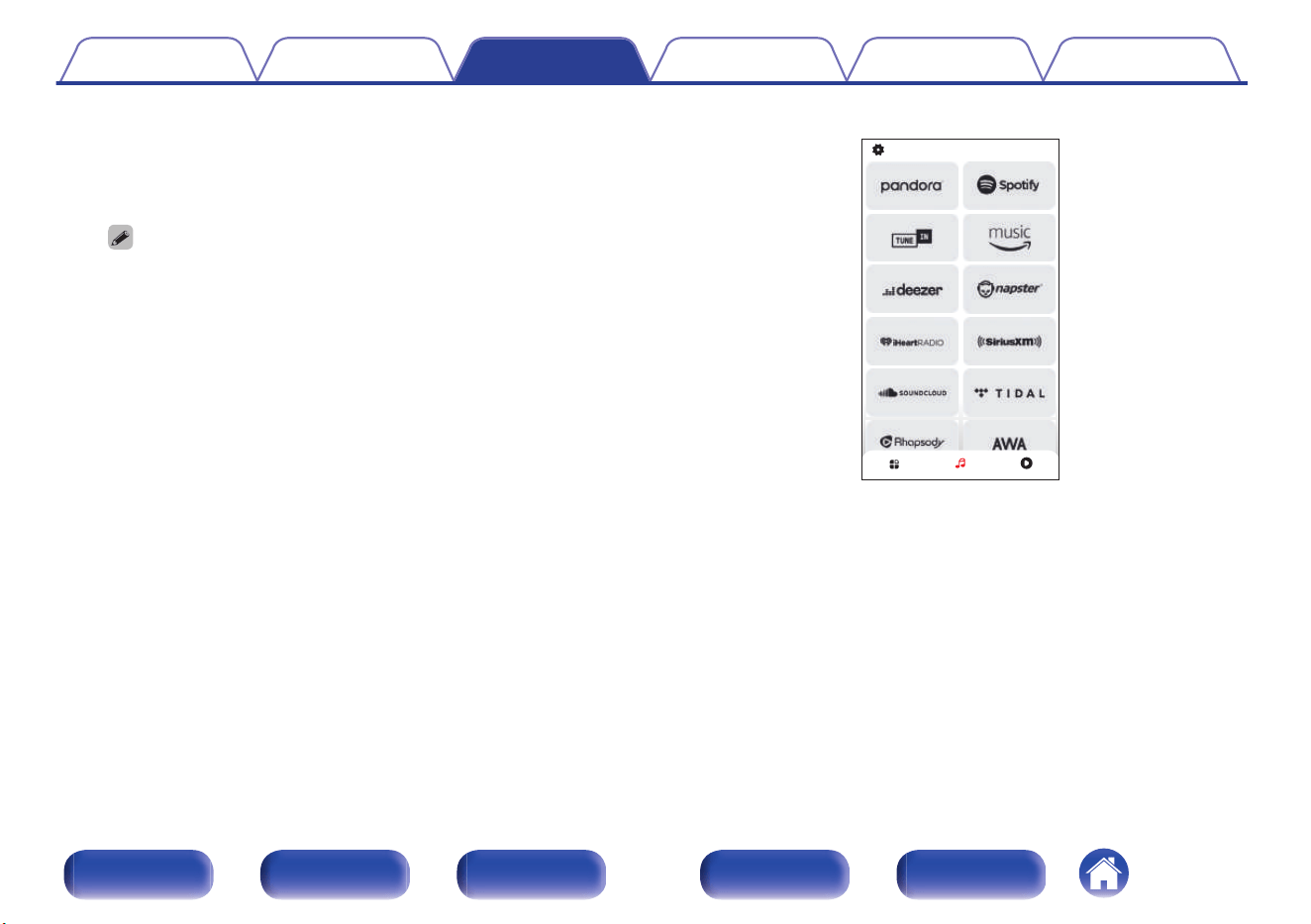
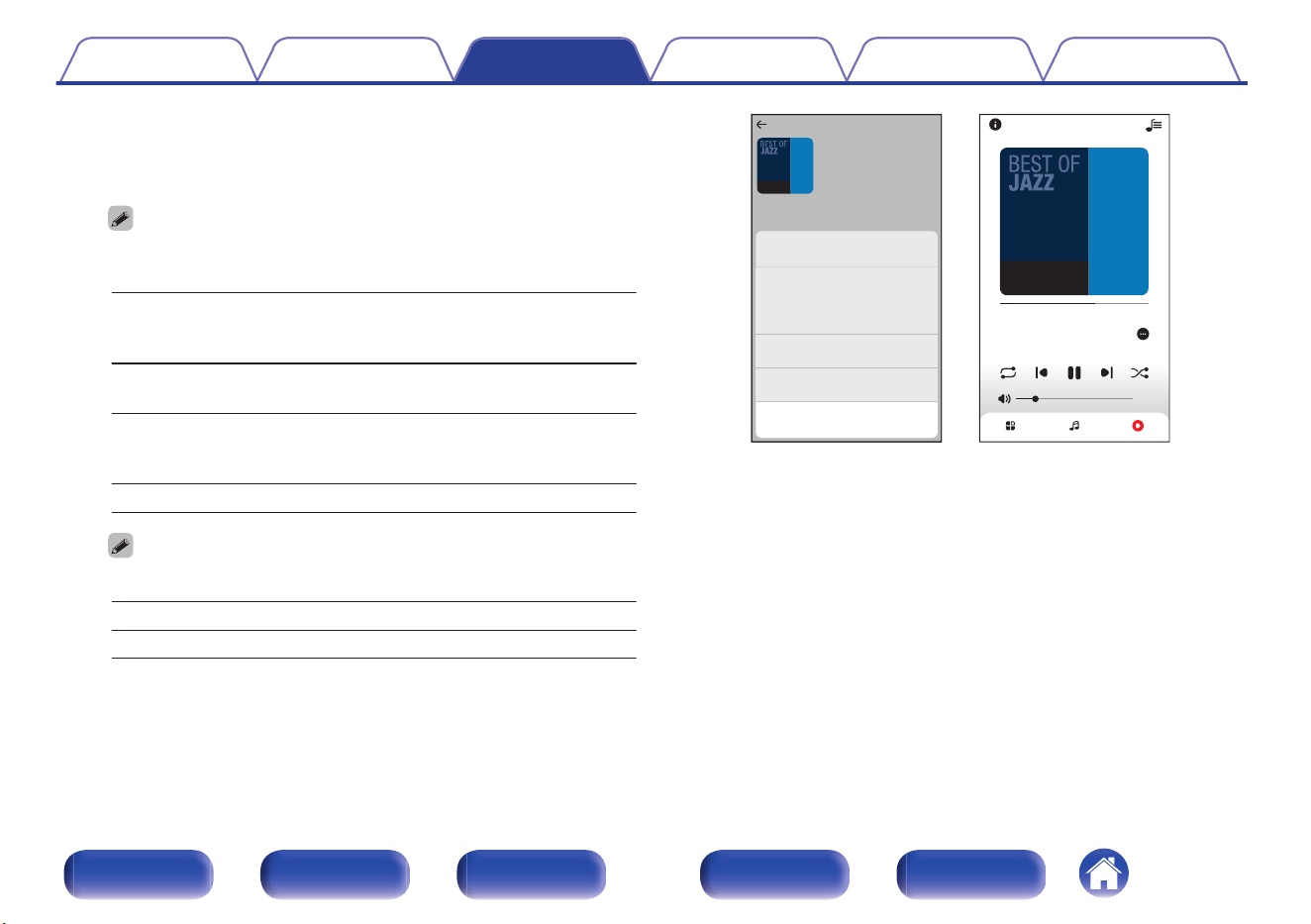
2
Browse the music to play.
After selecting a music track or radio station the app will
automatically change to the “Now Playing” screen.
0
When you select a music track to play you will be asked how you want to
queue up your music.
Play Now:
Inserts the item into the queue after the
currently playing track and plays the
selected item immediately.
Play Now & Replace
Queue:
Clears the queue and plays the
selected item immediately.
Play Next:
Inserts the item into the queue after the
current song and plays it when the
current song ends.
Add to End of Queue: Adds the item to the end of the queue.
0
When you select a radio station the following items are displayed.
Play Now: Plays the selected item immediately.
Add to HEOS Favorites: Adds to HEOS Favorites.
1 Track 1
2 Track 2
0:50
0:20
Now Playing
Track 01
Artist
2:51
-
1:40
Album
Play Now
HEOS 3 Now PlayingMusic
Cancel
Play Now & Replace Queue
Play Next
Add to End of Queue
Track 01
Rooms
Album
Album
10 Tracks,60 Mins.,2014
Artist
Rooms Now PlayingMusic
Contents Connections Playback Settings Tips Appendix
85
Front panel Display Rear panel Remote Index
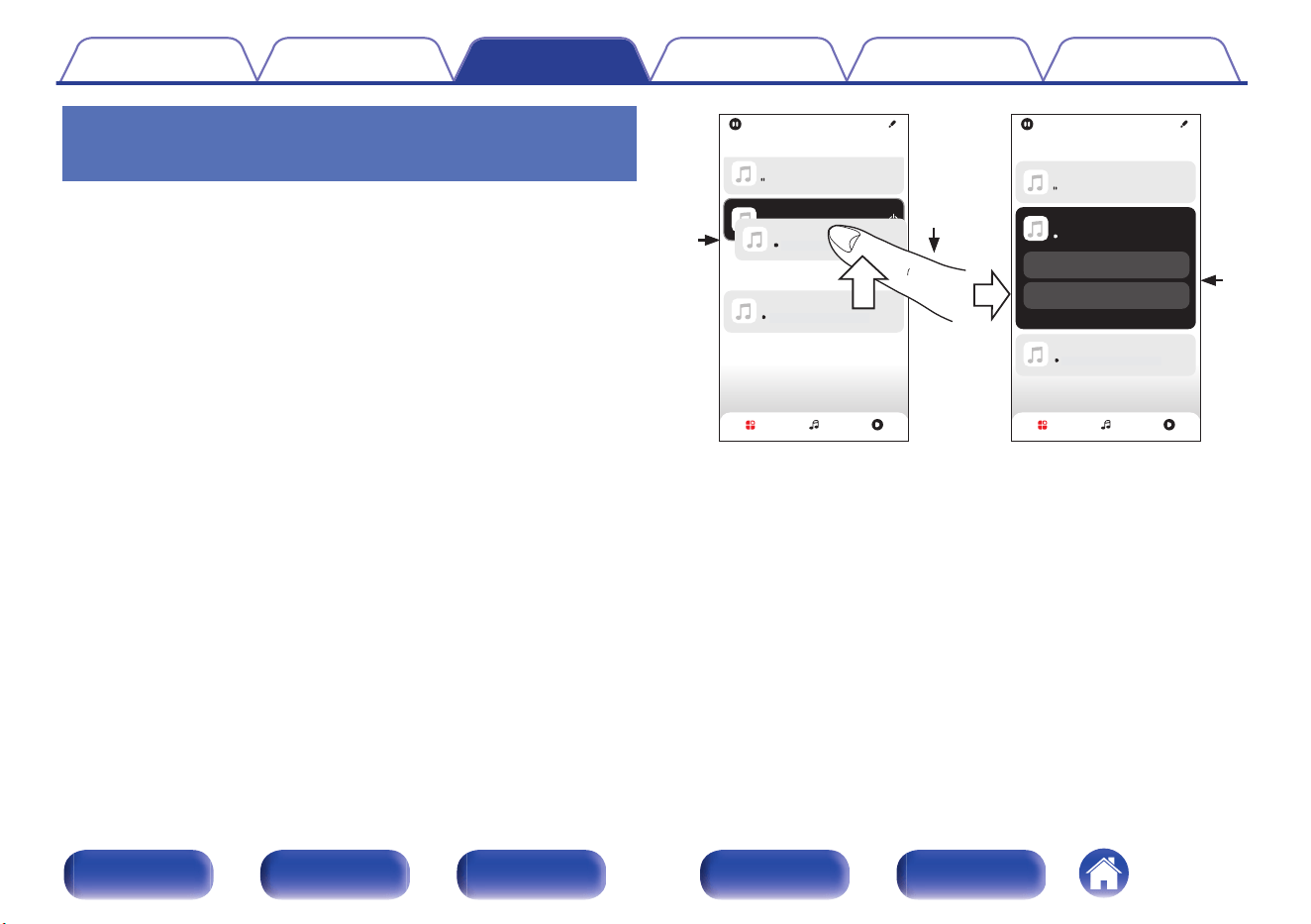
Listening to the same music in multiple
rooms
This system is a true multi-room audio system. You can create one or
more HEOS groups to automatically synchronize audio playback between
multiple products with HEOS Built-in so that the music playing different
rooms is perfectly in sync and always sounds amazing! You can easily
add up to 32 products to your system in total. You can group up to 16
individual products to have them play the same song fully synchronized.
o
Grouping rooms
1
Press and hold your finger on room that is not playing
music.
2
Drag it into the room that is playing music and lift your
finger.
3
The two rooms will be grouped together into a single
device group and both rooms will be playing the same
music in perfect sync.
Drag one room into another to group them
Song Name 1
Dining
Rooms
Drag one room into another to group them
Song Name 1
Dining
Rooms
Rooms Now PlayingMusic
Rooms Now PlayingMusic
Song Name 3
Bedroom
Living
Song Name 2
Kitchen
Song Name 3
Bedroom
Living+Kitchen
Living
Kitchen
Song Name 2
Drag a room out of this group to ungroup it
2
1
3
Contents Connections Playback Settings Tips Appendix
86
Front panel Display Rear panel Remote Index
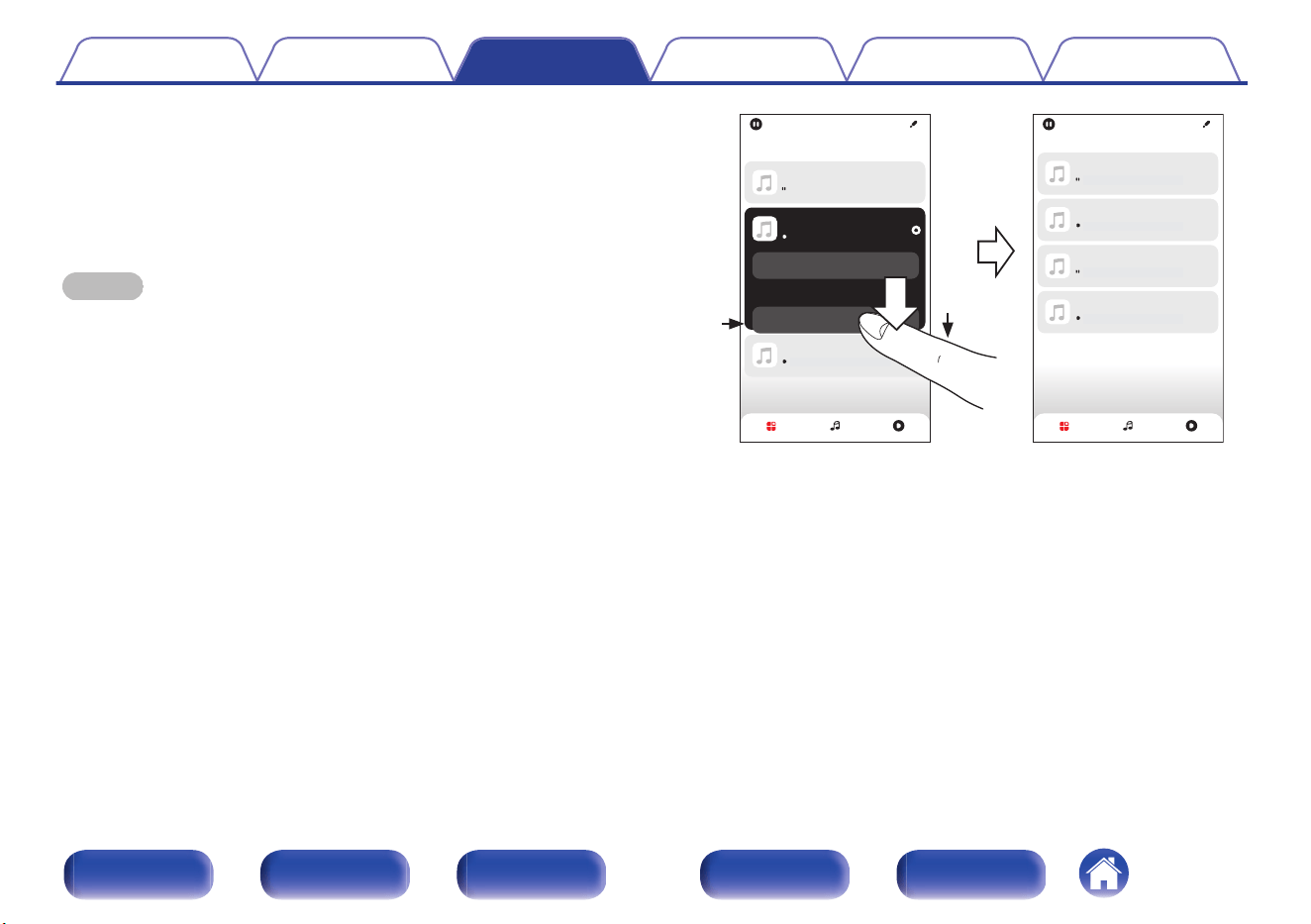
o
Ungrouping rooms
1
Press and hold your finger on room that you want to
remove from the group.
2
Drag it out of the group and lift your finger.
NOTE
0
You can not remove the first room that started playing the music before grouping.
Rooms
Song Name 4
Kitchen
Drag one room into another to group them
Song Name 1
Dining
Rooms
Song Name 3
Bedroom
Living
Song Name 2
Kitchen
Rooms Now PlayingMusic
Rooms Now PlayingMusic
Song Name 3
Bedroom
Song Name 2
Living
Song Name 1
Dining
Drag one room into another to group them
Living
2
1
Contents Connections Playback Settings Tips Appendix
87
Front panel Display Rear panel Remote Index
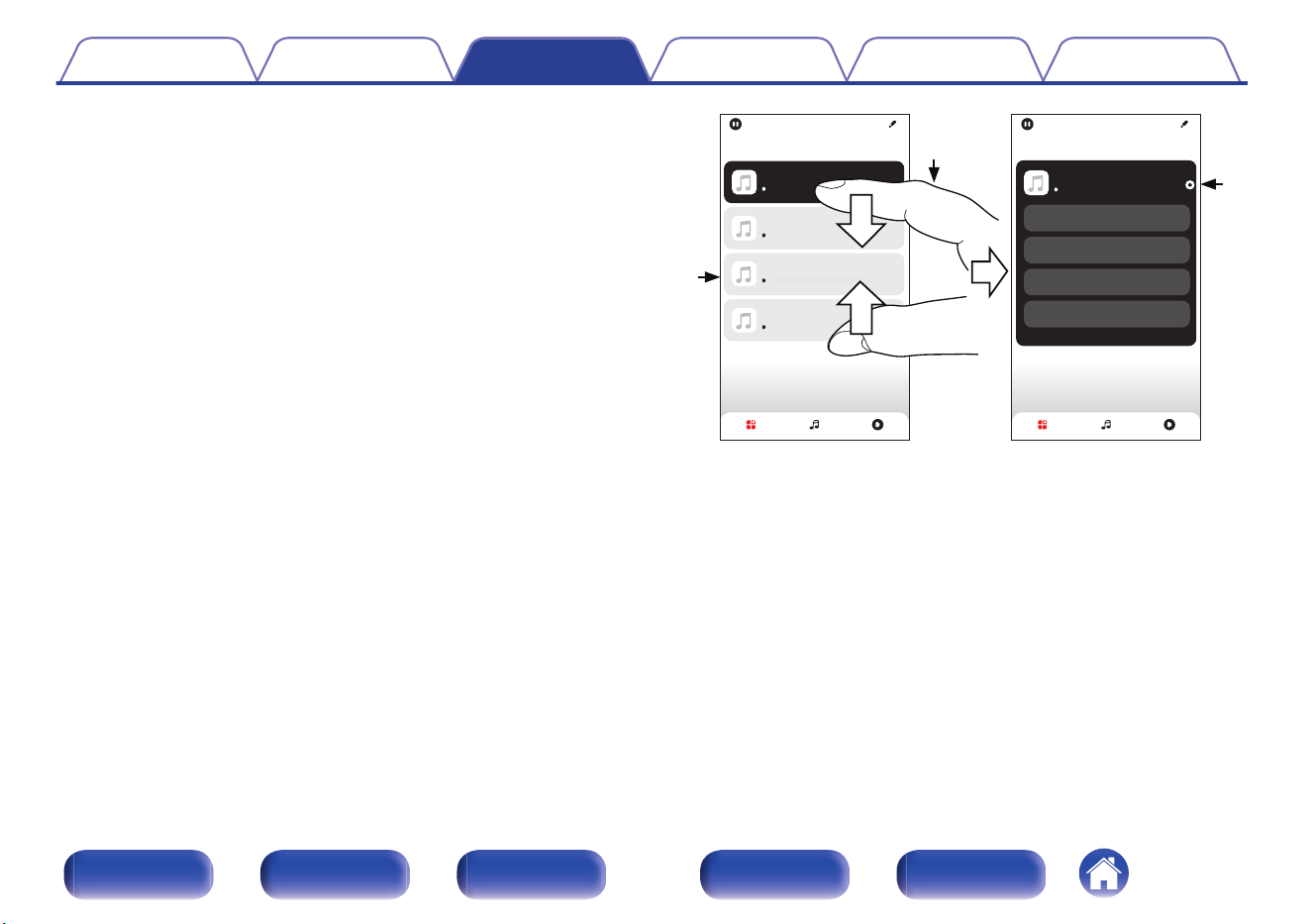
o
Grouping all rooms (party mode)
You can easily group 16 rooms together into Party Mode by using a
"pinch" gesture.
1
Place two fingers on the screen over the list of rooms.
2
Quickly pinch your two fingers together and release.
3
All of your rooms will be joined together and begin
playing the same music in perfect sync.
Drag one room into another to group them
Rooms
Bedroom
Kitchen
Living
Dining
Drag a room out of this group to ungroup it
Song Name 1
Dining+Living+...
Drag one room into another to group them
Song Name 2
Living
Rooms
Song Name 3
Kitchen
Song Name 4
Bedroom
Rooms Now PlayingMusic
Rooms Now PlayingMusic
Song Name 1
Dining
1
2
3
Contents Connections Playback Settings Tips Appendix
88
Front panel Display Rear panel Remote Index
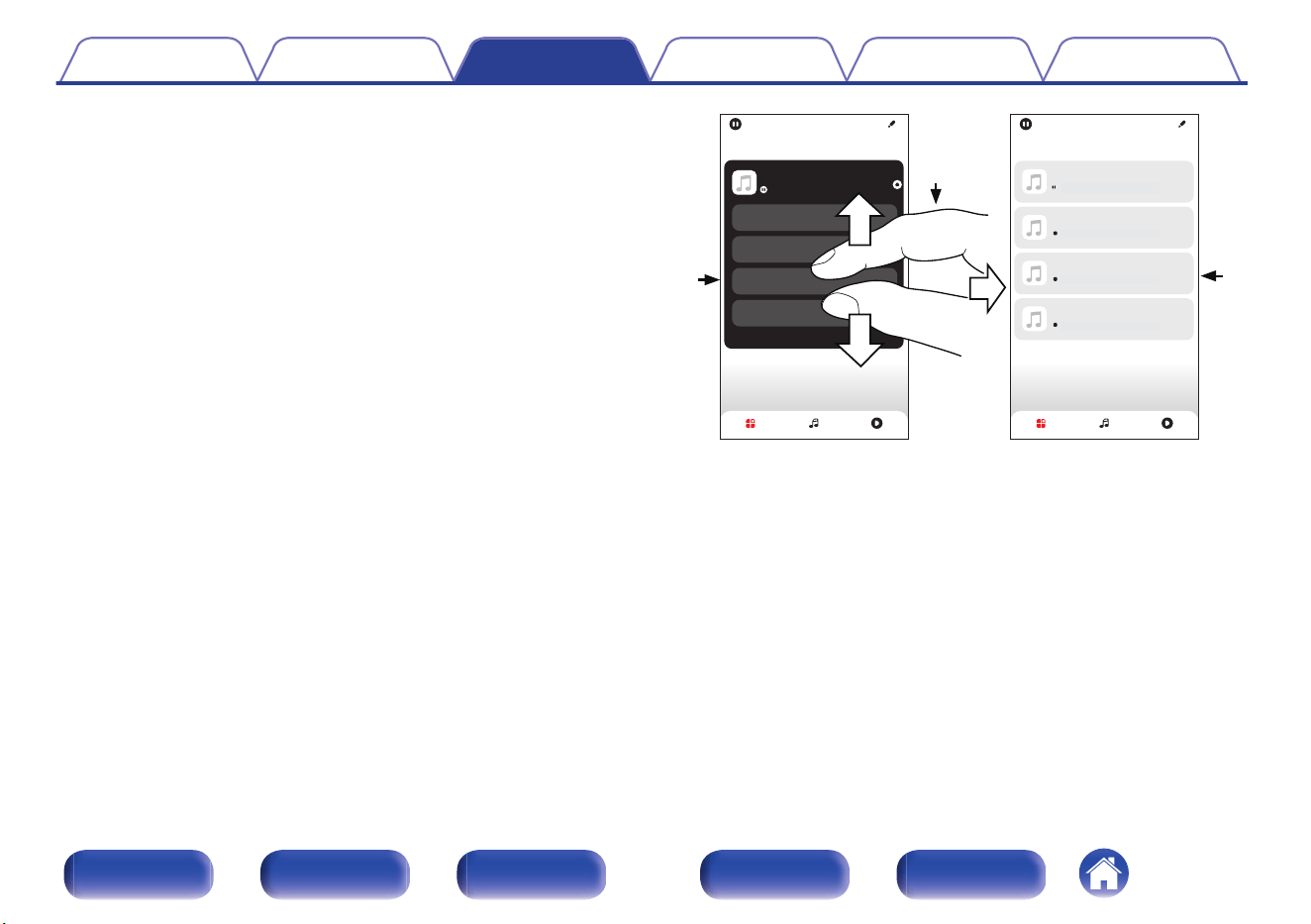
o
Ungrouping all rooms
You can easily ungroup all of your rooms and exit Party Mode by using
a "spread" gesture.
1
Place two fingers close together on the screen over list
of rooms.
2
Quickly spread your two fingers apart from each other
and release.
3
All of your rooms will be ungrouped.
Rooms
Drag one room into another to group them
Rooms
Bedroom
Kitchen
Living
Dining
Drag a room out of this group to ungroup it
Song Name 1
Dining
Rooms Now PlayingMusic Rooms Now PlayingMusic
Song Name 3
Kitchen
Song Name 4
Bedroom
Song Name 2
Living
Song Name 1
Dining
Drag one room into another to group them
1
2
3
Contents Connections Playback Settings Tips Appendix
89
Front panel Display Rear panel Remote Index
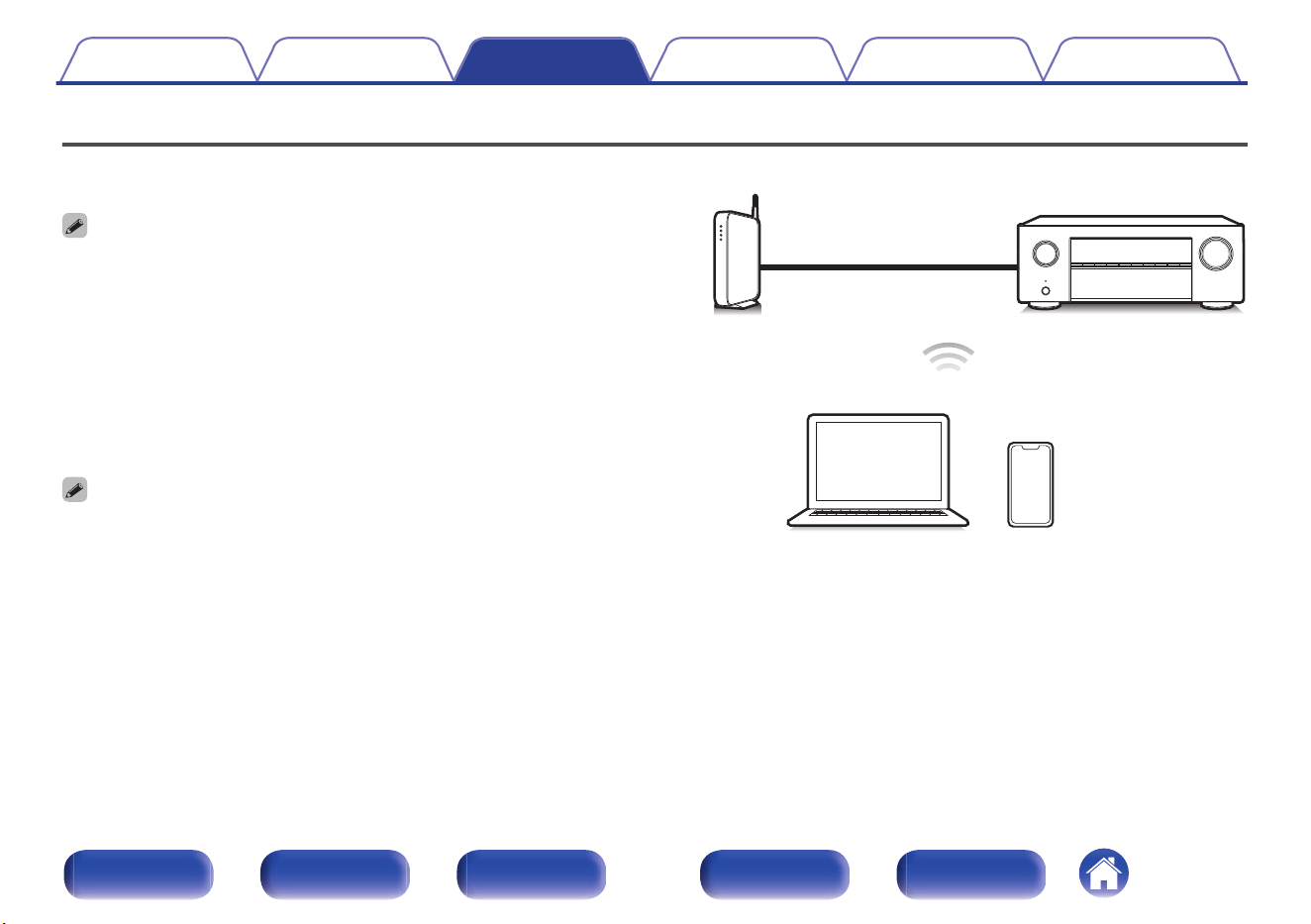
AirPlay function
Music files stored on your iPhone, iPod touch, iPad or iTunes can be
played on this unit via the network.
0
Source input will be switched to “HEOS Music” when AirPlay playback is started.
0
You can stop AirPlay playback by choosing other input source.
0
To see song and artist names together, press STATUS on the main unit.
0
For information about how to use iTunes, also see the Help for iTunes.
0
The screen may differ depending on the OS and software versions.
This unit supports AirPlay 2.
Sync multiple AirPlay 2 compatible devices/speakers for simultaneous
playback.
0
This unit supports AirPlay 2 and requires iOS 11.4 or later.
PC
Router
This unit
Contents Connections Playback Settings Tips Appendix
90
Front panel Display Rear panel Remote Index
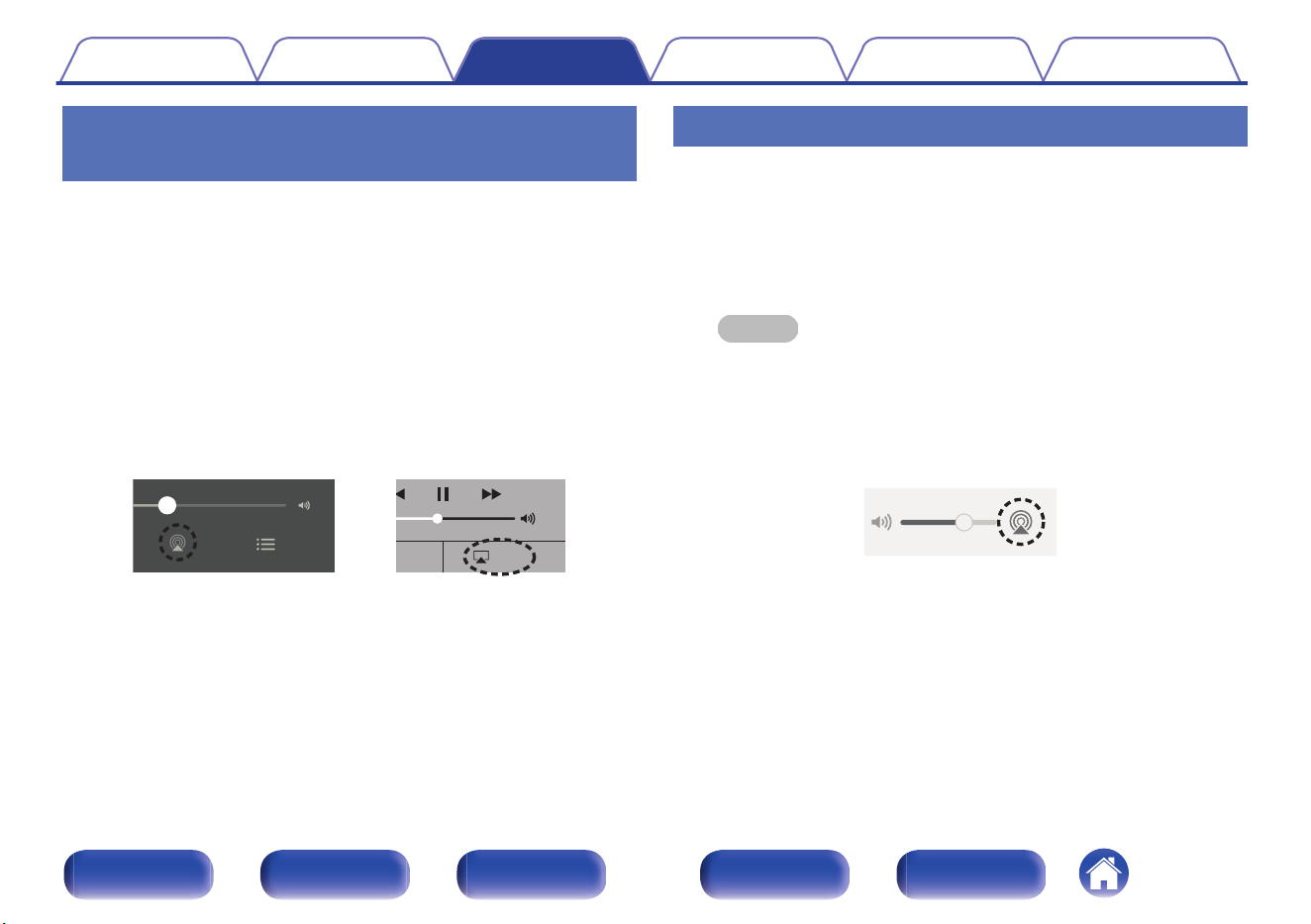
Playing songs from your iPhone, iPod
touch or iPad
If you update your “iPhone/iPod touch/iPad” to iOS 10.0.2 or later, you can
stream music stored in your “iPhone/iPod touch/iPad” directly to this unit.
1
Connect your iPhone, iPod touch or iPad Wi-Fi to the
same network as this unit.
0
For details, see your device’s manual.
2
Play the song on your iPhone, iPod touch or iPad.
AirPlay icon is displayed on the iPhone, iPod touch or iPad screen.
3
Tap the AirPlay icon and select this unit.
AirPlay
AirPlay
D
rop:
AirDrop:
ryone
ryone
[Example] iOS 15
[Example] iOS 10
Playing iTunes music with this unit
1
Install iTunes 10, or later, on a Mac or Windows PC that
is connected to the same network as this unit.
2
Turn this unit ON.
Set “Network Control” to “Always On” for this unit. (v p. 172)
NOTE
0
When “Network Control” is set to “Always On”, the unit consumes more
standby power.
3
Start iTunes and click the AirPlay icon to select this
unit.
[Example] iTunes
4
Choose a song and click play in iTunes.
The music will stream to this unit.
Contents Connections Playback Settings Tips Appendix
91
Front panel Display Rear panel Remote Index
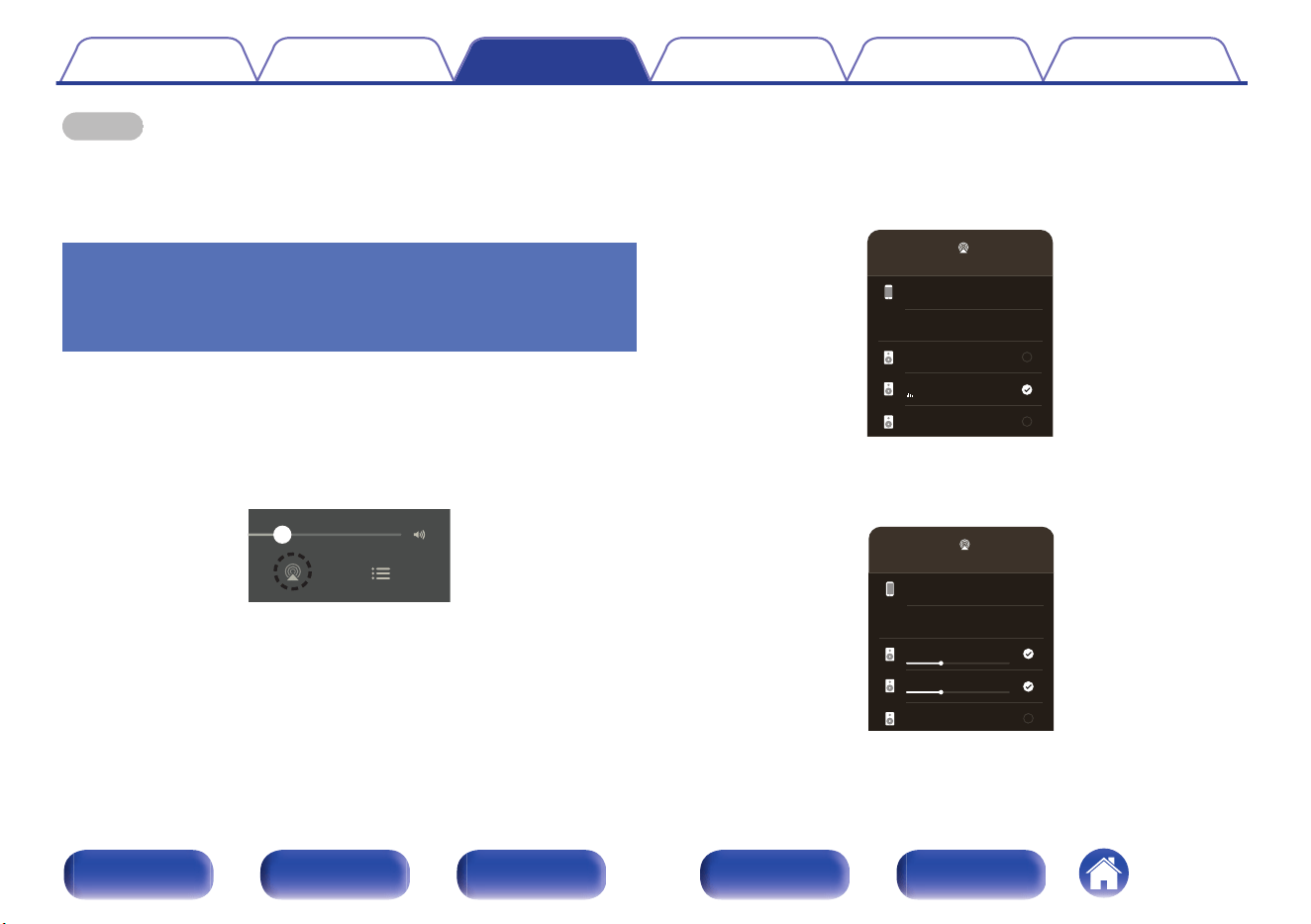
NOTE
0
In playback using the AirPlay function, the sound is output at the iPhone, iPod
touch, iPad or iTunes volume setting level.
You should turn down the iPhone, iPod touch, iPad or iTunes volume prior to
playback and then adjust it to a suitable level.
Play a song from your iPhone, iPod
touch or iPad on multiple synced
devices (AirPlay 2)
Songs from an iPhone, iPod touch or iPad operating iOS 11.4 or later can
be synced with multiple AirPlay 2 supported devices for simultaneous
playback.
1
Play the song on your iPhone, iPod touch or iPad.
AirPlay icon is displayed on the iPhone, iPod touch or iPad screen.
2
Tap the AirPlay icon and select this unit.
Displays a list of devices/speakers that can be played back on the
same network.
0
A circle is displayed to the right of AirPlay 2 compatible devices.
iPhone
AirPlay
Living Room
Denon xxxxxxxx
Song - Artist
Bedroom
Speakers & TVs
3
Tap the devices/speakers you want to use.
0
Multiple AirPlay 2 compatible devices can be selected.
iPhone
AirPlay
Living Room
Denon xxxxxxxx
Bedroom
Speakers & TVs
Contents Connections Playback Settings Tips Appendix
92
Front panel Display Rear panel Remote Index
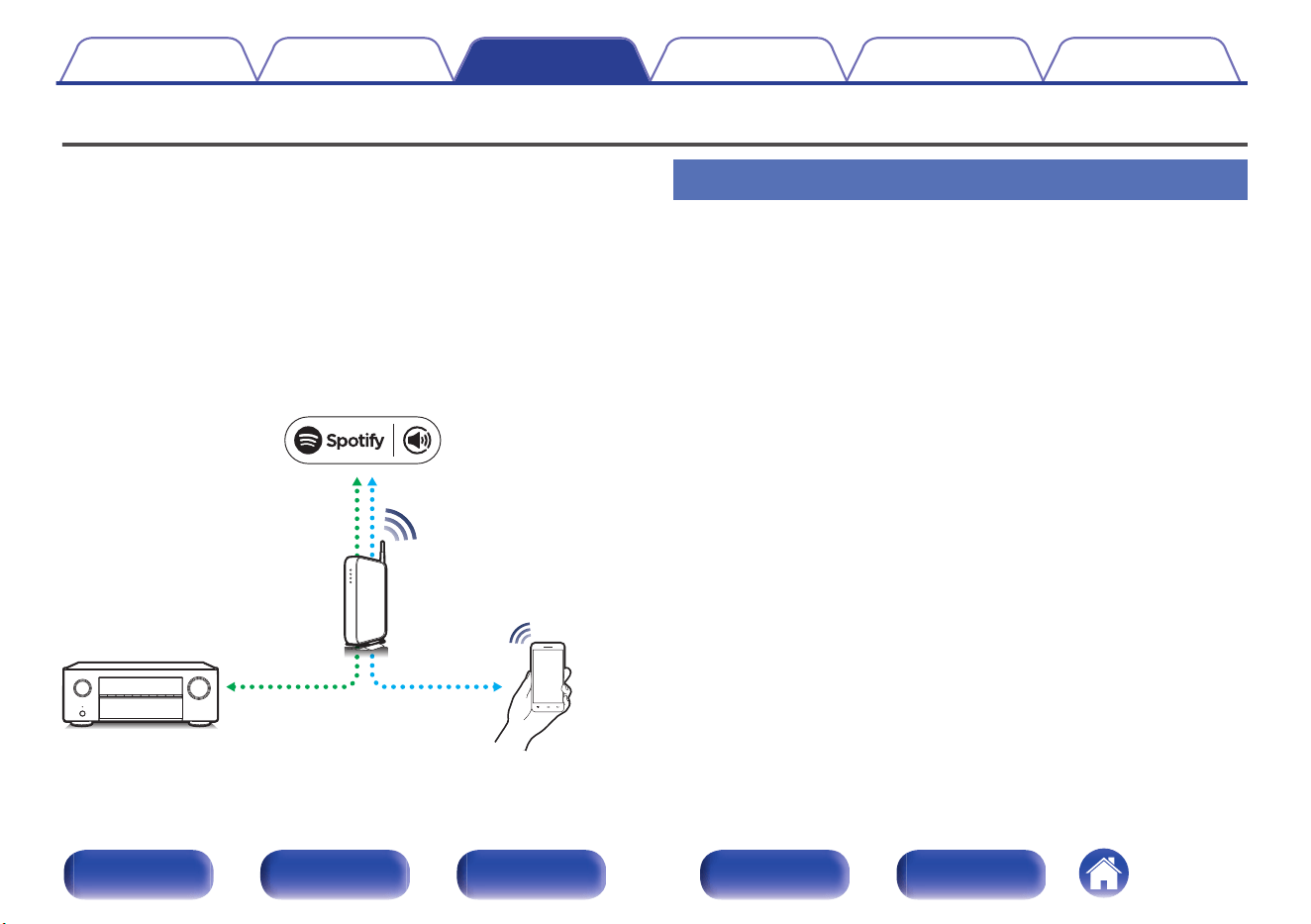
Spotify Connect function
Spotify is all the music you’ll ever need. Millions of songs available
instantly. Just search for the music you love, or let Spotify play you
something great. Spotify works on your phone, tablet, computer and home
speakers. So you’ll always have the perfect soundtrack for whatever
you’re doing. Now you can enjoy Spotify with your free account as well as
Premium account.
Use your phone, tablet or computer as a remote control for Spotify.
Go to www.spotify.com/connect to learn how.
The Spotify software is subject to third party licenses found here:
www.spotify.com/connect/third-party-licenses
Spotify server
Control
This unit
Spotify App
Audio
streaming /
control
Playing Spotify music with this unit
Download the “Spotify App” onto your Android or iOS device beforehand.
1
Connect the Wi-Fi settings of the iOS or Android device
in the same network as this unit.
2
Launch the Spotify App.
3
Play back the Spotify track.
4
Tap the Spotify icon F to select the unit.
The music will stream to this unit.
Contents Connections Playback Settings Tips Appendix
93
Front panel Display Rear panel Remote Index
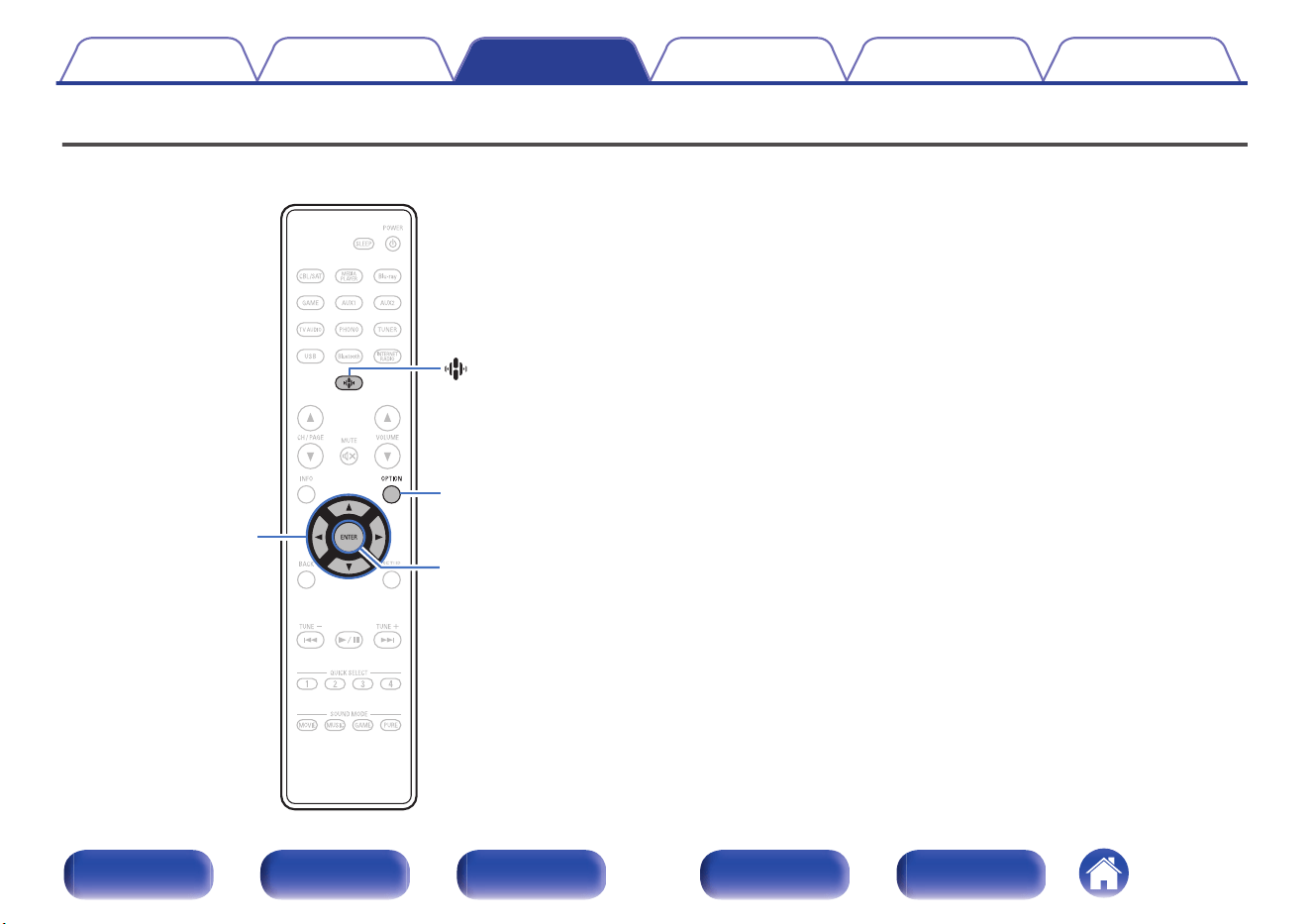
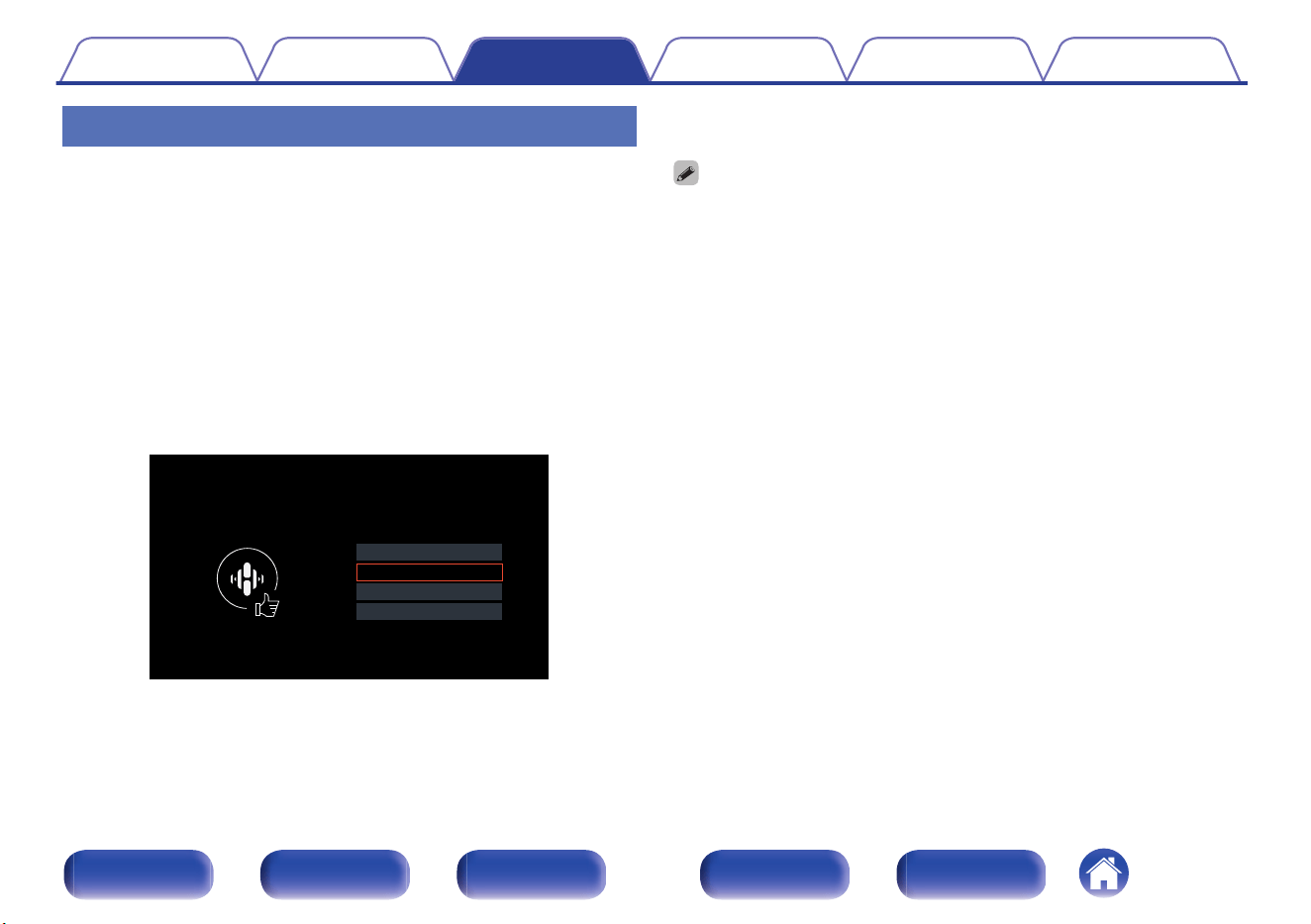
Playing back HEOS Favorites
When using the HEOS Favorites function for the first time on this unit,
create a HEOS Account on the HEOS App or sign in to your account.
Once you create or sign into your HEOS Account, you can use the HEOS
Favorites feature to save and recall your favorite streaming radio stations
using the on-screen user interface on your AVR.
1
Press R (HEOS Music).
If a playback history is present, the last Internet radio station or song
played is played back. Pressing R (HEOS Music) again displays the
HEOS Music top menu.
2
Use cursor Up/Down to select “HEOS Favorites”, then
press ENTER.
USB Music
Music Servers
HEOS Favorites
TuneIn Internet Radio
Music
3
Browse the content and select something to play.
0
“HEOS Favorites - Use HEOS app” is displayed when this unit is not synced with a
HEOS Account in the HEOS App.
Contents Connections Playback Settings Tips Appendix
95
Front panel Display Rear panel Remote Index
Adding to HEOS Favorites
1
While content is playing, press OPTION.
The option menu screen is displayed.
2
Use cursor Up/Down to select “Add to HEOS
Favorites”, then press ENTER.
Deleting a HEOS Favorites
1
While the HEOS Favorites content list is displayed, use
cursor Up/Down to select the item you want to remove
from HEOS Favorites, then press OPTION.
2
Use cursor Up/Down to select “Remove from HEOS
Favorites”, then press ENTER.
Adjusting the audibility of dialog and
vocals (Dialog Enhancer)
This function adjusts the center channel frequency band to enhance the
dialog in the movies and vocals in music for easier listening.
1
Press OPTION.
An option menu screen is displayed.
0
When the input source is “HEOS Music”, an option menu for
online music is displayed. Select “AVR Options…”, then press
ENTER.
2
Use cursor Up/Down to select “Dialog Enhancer”, then
press ENTER.
The “Dialog Enhancer” screen is displayed.
3
Use cursor Left/Right to select your favorite
enhancement effect.
Low / Medium / High: Enhances the dialog and vocals.
Off
(Default):
Does not enhance the dialog or vocals.
4
Press ENTER.
0
“Dialog Enhancer” settings are stored for each source.
0
This cannot be set when the sound mode is set to “Direct” or “Pure Direct”.
Contents Connections Playback Settings Tips Appendix
96
Front panel Display Rear panel Remote Index
Adjusting the volume of each channel
to match the input source (Channel
Level Adjust)
The volume of each channel can be changed while listening to music. You
can set this for each input source.
1
Press OPTION.
An option menu screen is displayed.
0
When the input source is “HEOS Music”, an option menu for
online music is displayed. Select “AVR Options…”, then press
ENTER.
2
Use cursor Up/Down to select “Channel Level Adjust”,
then press ENTER.
The “Channel Level Adjust” screen is displayed.
3
Use cursor Up/Down to select the channel that you
wish to adjust.
4
Use cursor Left/Right to adjust the volume.
–12.0 dB – +12.0 dB (Default: 0.0 dB)
5
Use cursor Up/Down/Left/Right to select “Exit”, then
press ENTER.
0
Select “Reset” and press ENTER if you want to restore the adjustment values of
the various channels to “0.0 dB” (Default).
0
Headphone volume can be adjusted when a headphone is connected.
0
“Channel Level Adjust” settings are stored for each input source.
0
You can only set this for speakers that output audio. In addition, you cannot set
this when in the menu “HDMI Audio Out” is set to “TV”. (v p. 140)
Contents Connections Playback Settings Tips Appendix
97
Front panel Display Rear panel Remote Index
Adjusting the tone (Tone)
Adjusts the tonal quality of the sound.
1
Press OPTION.
An option menu screen is displayed.
0
When the input source is “HEOS Music”, an option menu for
online music is displayed. Select “AVR Options…”, then press
ENTER.
2
Use cursor Up/Down to select “Tone”, then press
ENTER.
The “Tone” screen is displayed.
3
Use cursor Left/Right to set the tone control function to
on/off.
On: Allow tone adjustment (bass, treble).
Off
(Default):
Playback without tone adjustment.
4
Select “On” in step 3 and press cursor Down to select
the sound range to be adjusted.
Bass: Adjust bass.
Treble: Adjust treble.
5
Use cursor Left/Right to adjust the tone, then press
ENTER.
-6 dB – +6 dB (Default : 0 dB)
0
“Tone” settings are stored for each input source.
0
This cannot be set when the sound mode is set to “Direct” or “Pure Direct”.
0
This item cannot be set when “Dynamic EQ” is set to “On”. (v p. 137)
0
You cannot set this when no audio signal is input or in the menu “HDMI Audio Out”
is set to “TV”. (v p. 140)
Contents Connections Playback Settings Tips Appendix
98
Front panel Display Rear panel Remote Index
Adjusting audio delay (Audio Delay)
Compensates for incorrect timing between video and audio.
1
Press OPTION.
An option menu screen is displayed.
0
When the input source is “HEOS Music”, an option menu for
online music is displayed. Select “AVR Options…”, then press
ENTER.
2
Use cursor Up/Down to select “Audio Delay”, then
press ENTER.
The “Audio Delay” screen is displayed.
3
Use cursor Left/Right to set the auto lip sync function
to on/off.
On
(Default):
Automatically adjusts the audio
processing time to compensate for
delays in audio/video timing from TV
compatible with Auto Lip Sync.
Off: Do not adjust automatically.
4
Press cursor Down to select “Adjust” if the timing
mismatch between the picture and sound need to be
corrected manually, then use cursor Left/Right to
adjust the timing.
0 ms – 500 ms (Default : 0 ms)
0
“Audio Delay” settings are stored for each input source.
0
Automatic correction may not be performed depending on the specifications of
your TV even when “Auto Lip Sync” is set to “On”.
0
You can also finely adjust the delay correction value set by “Auto Lip Sync”.
Contents Connections Playback Settings Tips Appendix
99
Front panel Display Rear panel Remote Index
Displaying your desired video during
audio playback (Video Select)
This unit can display video from a different source on TV during audio
playback. You can set this for each input source.
n
Supported input sources:
Tuner / HEOS Music / Phono
1
Press OPTION.
An option menu screen is displayed.
0
When the input source is “HEOS Music”, an option menu for
online music is displayed. Select “AVR Options…”, then press
ENTER.
2
Use cursor Up/Down to select “Video Select”, then
press ENTER.
The “Video Select” screen is displayed.
3
Use cursor Left/Right to select the Video Select mode.
Off
(Default):
Disable Video Select mode.
On: Enable Video Select mode.
4
If you selected “On” in step 3, press cursor Down and
select “Source”.
5
Use cursor Left/Right to select the input source for
video you want to play back, then press ENTER.
Last
(Default):
Plays the video from the last input
source that was played.
CBL/SAT /
Media Player /
Blu-ray / Game /
AUX1 / AUX2:
Plays the video from the selected input
source.
z
z
You can select the input source to which the HDMI terminal is assigned.
0
“Video Select” settings are stored for each input source.
Contents Connections Playback Settings Tips Appendix
100
Front panel Display Rear panel Remote Index
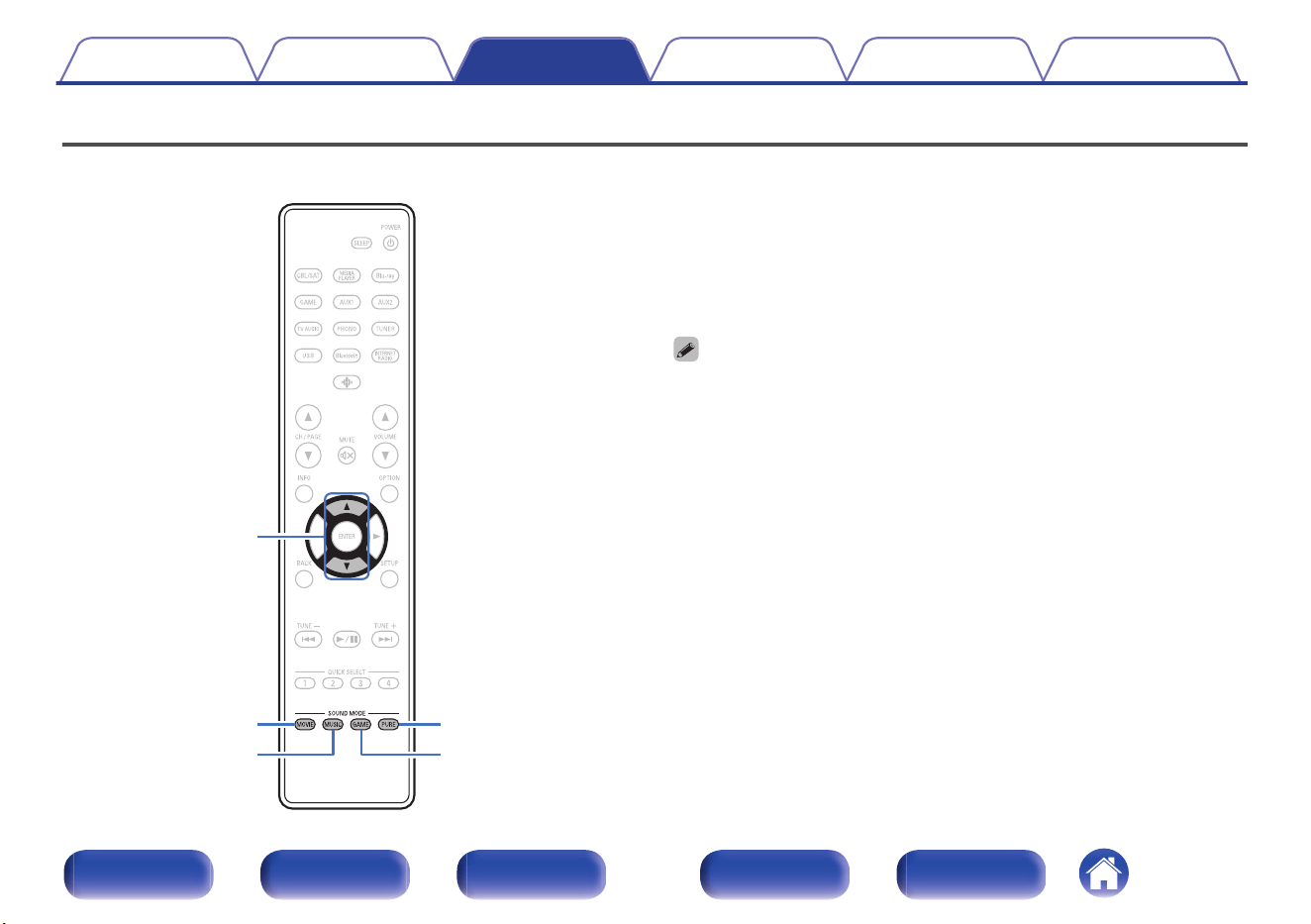
Selecting a sound mode
PURE
MOVIE
MUSIC
GAME
Cursor Up/Down
This unit allows you to enjoy various kinds of surround and stereo
playback modes.
Disc formats such as Blu-ray Disc and DVD, as well as being supported by
digital broadcasting, and even by streaming movies and music from
internet-based subscription services.
This unit supports playback of almost all of these multi-channel audio
formats. It also supports surround playback of audio formats other than
multi-channel audio such as 2-channel stereo audio.
0
For audio formats recorded on a disc, see the disc jacket or label.
Contents Connections Playback Settings Tips Appendix
101
Front panel Display Rear panel Remote Index
Selecting a sound mode
1
Press MOVIE, MUSIC or GAME to select a sound mode.
MOVIE :
Switches to the sound mode suitable for
enjoying movies and TV programs.
MUSIC :
Switches to the sound mode suitable for
enjoying music.
GAME :
Switches to the sound mode suitable for
enjoying games.
0
The MOVIE, MUSIC, or GAME button memorizes the last sound mode selected for
its button. Pressing MOVIE, MUSIC, or GAME recalls the same sound mode as
the one selected at the previous playback.
0
If the content played back does not support the previously selected sound mode,
the most appropriate sound mode for the content is automatically selected.
o
Switching the sound mode
0
Press MOVIE, MUSIC or GAME to display a list of the sound modes
that can be selected. Each time you press MOVIE, MUSIC or GAME,
the sound mode changes.
0
While the list is displayed, you can also use cursor Up/Down to select
a sound mode.
0
Try out various sound modes and enjoy sound mode in your favorite
mode.
Contents Connections Playback Settings Tips Appendix
102
Front panel Display Rear panel Remote Index
[Example] When MOVIE is pressed
MOVIE SOUND
Stereo
Mono Movie
Dolby Pro Logic II Movie
DTS Neo:6 Cinema
Multi Ch Stereo
This unit provides not only sound modes that conform to the formats
recorded on discs such as Dolby and DTS, but also extended types of
modes that match your speaker configuration and “original sound modes”
that create atmosphere of Rock Arena and Jazz Club, etc.
Direct playback
Sound recorded in source is played as is.
1
Press PURE to select “Direct”.
Direct playback begins.
Contents Connections Playback Settings Tips Appendix
103
Front panel Display Rear panel Remote Index
Pure Direct playback
This mode is for playback with higher sound quality than in Direct playback
mode.
This mode turns off the main unit display. Doing so suppresses noise
sources that affect sound quality.
1
Press PURE to select “Pure Direct”.
The display goes dark, and Pure Direct playback begins.
0
In Direct and Pure Direct sound modes, the following items cannot be adjusted.
0
Dialog Enhancer (v p. 96)
0
Tone (v p. 98)
0
Restorer (v p. 134)
0
MultEQ
®
(v p. 136)
0
Dynamic EQ (v p. 137)
0
Dynamic Volume (v p. 138)
0
Graphic EQ (v p. 138)
NOTE
0
When the Pure Direct mode has been selected, the display turns off after about 5
seconds.
Auto surround playback
This mode detects the type of input digital signal, and automatically
selects the corresponding mode for playback.
Perform stereo playback when the input signal is PCM. When the input
signal is Dolby Digital or DTS, the music is played back according to the
respective channel number.
1
Press PURE to select “Auto”.
Auto surround playback begins.
Contents Connections Playback Settings Tips Appendix
104
Front panel Display Rear panel Remote Index
Description of sound mode types
Dolby sound mode
Sound mode type Description
Dolby PLg This mode can be selected when the Dolby PLg decoder is used to play back 2-channel sources in 5.1-channel surround
sound with an enveloping surround sound experience.
Dolby Digital This mode can be selected when playing sources recorded in Dolby Digital.
Dolby TrueHD This mode can be selected when playing sources recorded in Dolby TrueHD.
Dolby Digital Plus This mode can be selected when playing sources recorded in Dolby Digital Plus.
DTS sound mode
Sound mode type Description
DTS Neo:6 This mode can be selected when the DTS Neo:6 decoder is used to play back 2-channel sources in 5.1-channel surround
sound.
There are two playback modes: “Cinema” mode that is optimized for movie playback, “Music” mode that is optimized for
music playback.
DTS Surround This mode can be selected when playing sources recorded in DTS.
DTS-HD This mode can be selected when playing sources recorded in DTS-HD.
Contents Connections Playback Settings Tips Appendix
105
Front panel Display Rear panel Remote Index
PCM multi-channel sound mode
Sound mode type Description
Multi Ch In This mode can be selected when playing multi-channel PCM sources.
Original sound mode
Sound mode type Description
Multi Ch Stereo This mode is for enjoying stereo sound from all speakers.
Rock Arena This mode simulates the expansive sound of a live concert in an arena.
Jazz Club This mode simulates the experience of being in an intimate jazz club.
Mono Movie This mode works with monaural audio sources and delivers a surround sound effect. For optimum channel balance and
surround sound effects, connect the monaural source to both of the front (L/R) audio inputs.
Video Game This mode provides an exciting, dynamic surround sound effect with your favorite action video games.
Matrix This mode adds a spacious surround sound effect with stereo music sources.
Contents Connections Playback Settings Tips Appendix
106
Front panel Display Rear panel Remote Index
Auto sound mode
Sound mode type Description
Auto In this mode, the type of digital signal input, such as Dolby Digital, Dolby TrueHD, Dolby Digital Plus, DTS, DTS-HD, PCM
(multi-channel) is detected, and the playback mode switches automatically to the corresponding mode.
If the input signal is analog or PCM (2-channel), stereo playback is used. For Dolby Digital or DTS, the music is played
back according to the respective channel number.
Stereo sound mode
Sound mode type Description
Stereo This mode plays 2-channel stereo audio with no additional surround sound processing.
0
Sound is output from the front left and right speakers, and subwoofer if connected.
0
When multi-channel signals are inputted, they are mixed down to 2-channel audio and are played back with no
additional surround sound processing.
Direct sound mode
Sound mode type Description
Direct This mode plays back audio as recorded in the source.
Pure Direct This mode plays back an even higher quality sound than the “Direct” mode.
The following circuits are stopped in order to further improve sound quality.
0
Display indicator circuit of the main body (display will go off.)
Contents Connections Playback Settings Tips Appendix
107
Front panel Display Rear panel Remote Index
Sound mode that can be selected for each input signal
0
The following sound modes can be selected using the MOVIE, MUSIC and GAME buttons.
0
Adjust the sound field effect with the menu “Surround Parameter” to enjoy surround sound the way you like it. (v p. 128)
Stereo
SSS
Multi Ch Stereo S
Mono Movie
S
Rock Arena
S
Jazz Club
S
S
Matrix
S
Video Game
Dolby PLg Movie z2 S
Dolby PLg Music z2 S
Dolby PLg Game z2 S
DTS Neo:6 Cinema z2 S
DTS Neo:6 Music z2 S
GAME buttonMUSIC buttonMOVIE buttonSound modeInput signal
2-channel z1
z1
2-channel also includes analog input.
z2
This mode plays back 2-channel sources in 5.1-channel playback. It cannot be selected when headphones are used or when the speaker configuration is front speakers
only.
Contents Connections Playback Settings Tips Appendix
108
Front panel Display Rear panel Remote Index
Stereo
SSS
Dolby Digital Dolby Digital
SSS
Dolby Digital Plus Dolby Digital Plus
SSS
Dolby TrueHD Dolby TrueHD
SSS
DTS DTS Surround
DTS-HD DTS-HD
SSS
SSS
Multi Ch In
SSS
Multi Ch Stereo
SSS
Mono Movie
S
Rock Arena
S
Jazz Club
S
Matrix
S
Video Game
S
GAME buttonMUSIC buttonMOVIE buttonSound modeInput signal
Multi-channel z3
PCM multi-channel
z3
The sound mode that can be selected differs depending on the audio format of the input signal and the number of channels. For details, see “Types of input signals, and
corresponding sound modes” (v p. 228).
Contents Connections Playback Settings Tips Appendix
109
Front panel Display Rear panel Remote Index
HDMI Control function
A recent addition to the HDMI standard is CEC (Consumer Electronics Control), which allows control signals from one device to communicate with
another device via the HDMI cable connection.
Setting procedure
1
Enable the HDMI Control function of this unit.
Set “HDMI Control” to “On”. (v p. 142)
2
Turn the power on for all the devices connected by
HDMI cable.
3
Set the HDMI Control function for all devices connected
by HDMI cable.
0
Please consult the operating instructions for the connected
devices to check the settings.
0
Carry out steps 2 and 3 should any of the devices be unplugged.
4
Switch the television input to the HDMI input connected
to this unit.
5
Switch the input source of this unit to check that video
from the player connected by HDMI is played back
correctly.
6
When you turn the TV’s power to standby, check that
the power of this unit also goes to standby.
NOTE
0
Some functions may not operate depending on the connected TV or player. Check
the owner’s manual of each device for details beforehand.
Contents Connections Playback Settings Tips Appendix
111
Front panel Display Rear panel Remote Index
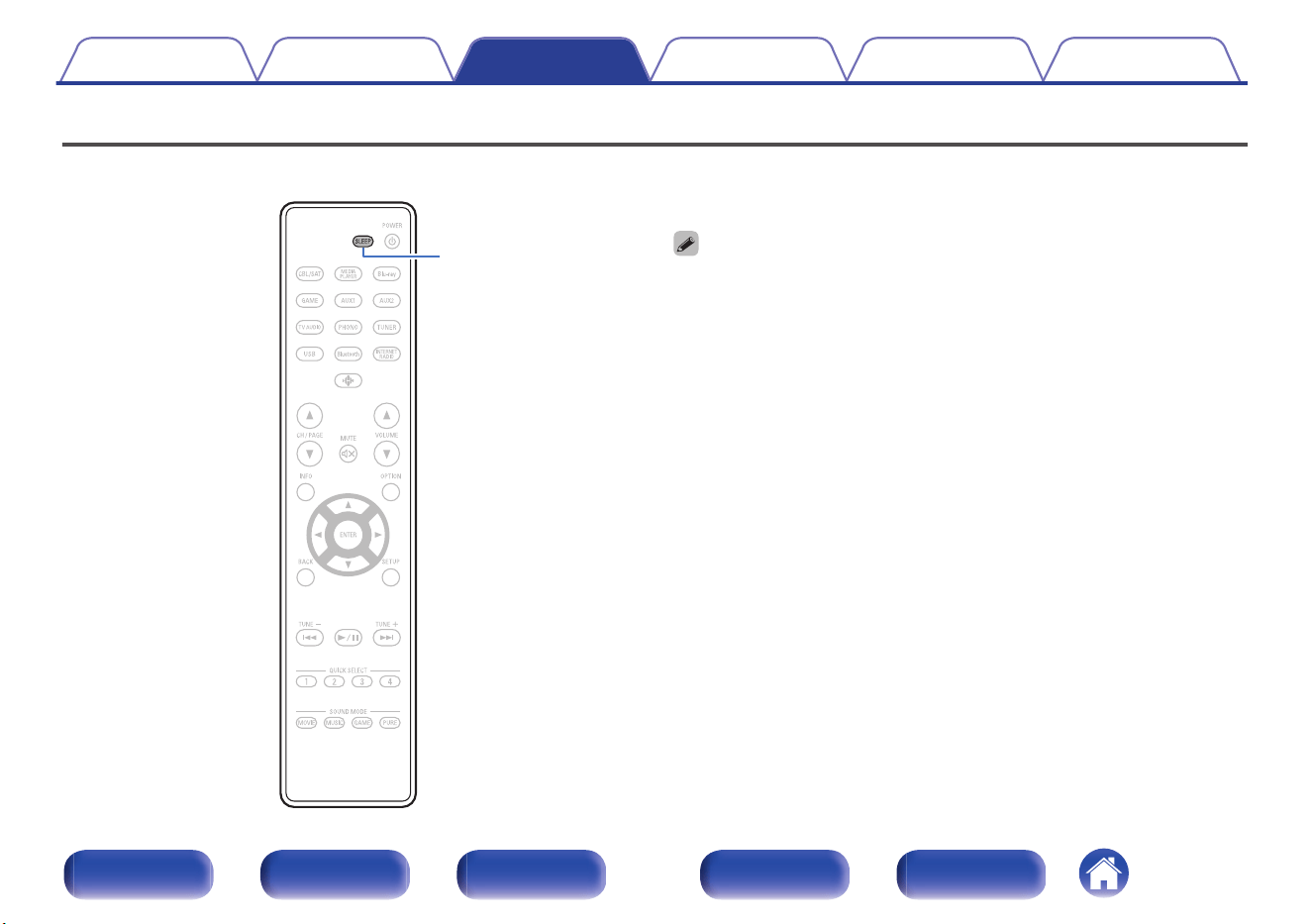
Sleep timer function
SLEEP
You can have the power automatically switched to standby once a set time
has elapsed. This is convenient for viewing and listening while going to
sleep.
0
The sleep timer can be set by pressing SLEEP on the main unit.
Contents Connections Playback Settings Tips Appendix
112
Front panel Display Rear panel Remote Index
Using the sleep timer
1
Press SLEEP and display the time you want to set.
0
The SLEEP indicator lights up on the display and the sleep timer
starts.
0
You can set the sleep timer in the range from 10 to 120 minutes in
steps of 10 minutes.
o
Checking the remaining time
Press SLEEP when the sleep timer is in operation.
The remaining time appears on the display.
o
To cancel the sleep timer
Press SLEEP to select “Off”.
The SLEEP indicator on the display turns off.
0
The sleep timer setting is canceled when the unit switches to standby mode.
NOTE
0
The sleep timer function cannot turn off the power of devices connected to this
unit. To turn off the power of those connected devices, set up sleep timers on the
connected devices themselves.
Contents Connections Playback Settings Tips Appendix
113
Front panel Display Rear panel Remote Index
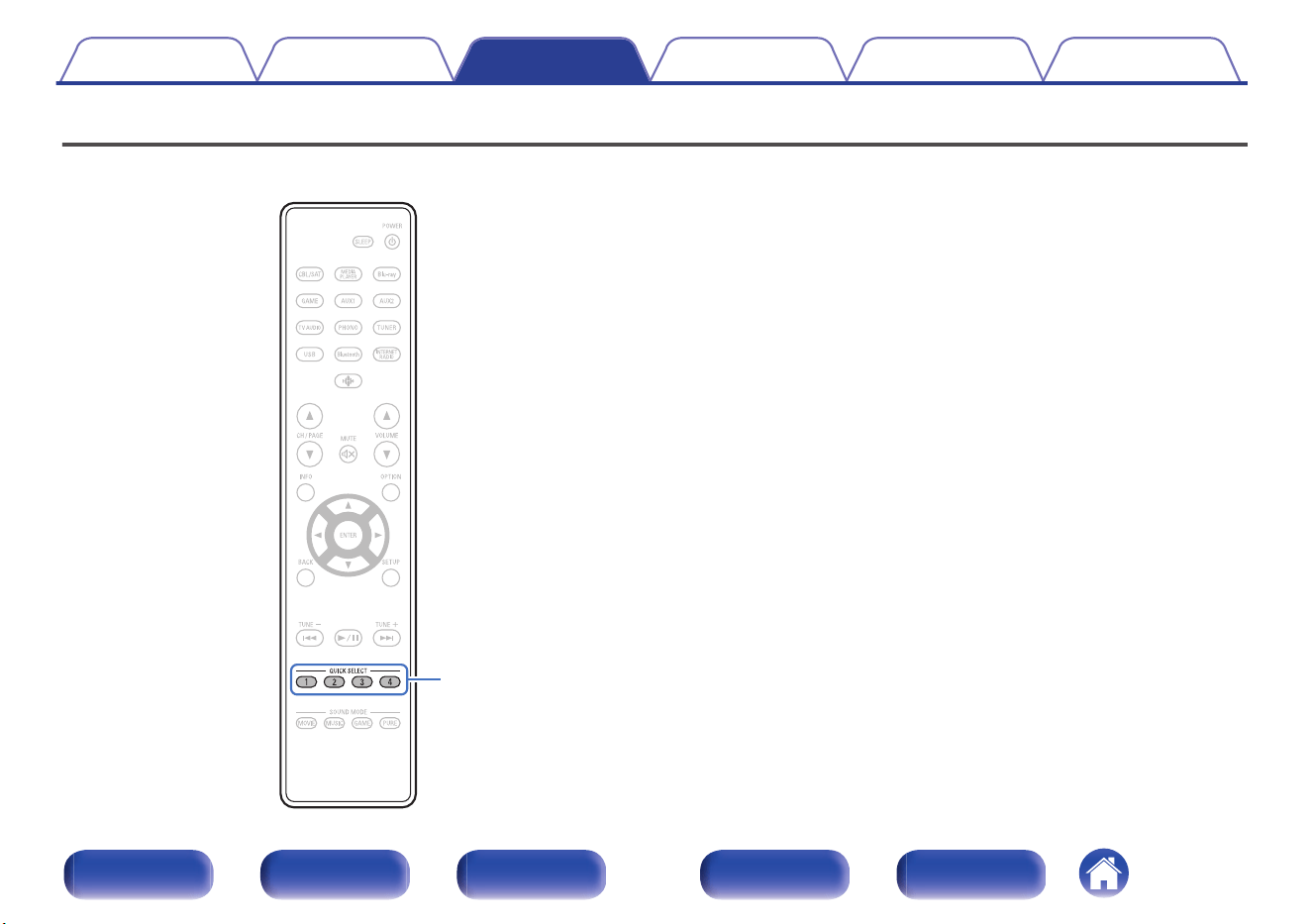
Quick select plus function
QUICK
SELECT
1 – 4
Settings such as the input source, volume level and sound mode can be
registered to the QUICK SELECT 1 - 4 buttons.
You can simply press one of the registered QUICK SELECT buttons in
subsequent playbacks to switch to the group of saved settings in a batch.
By saving frequently used settings at the QUICK SELECT 1 – 4 buttons,
you will always be able to easily call up the same playback environment.
Contents Connections Playback Settings Tips Appendix
114
Front panel Display Rear panel Remote Index
Calling up the settings
1
Press QUICK SELECT.
The Quick Select settings registered to the button you pressed are
called up.
0
The default settings for the input source are as shown below.
Button Input source
QUICK SELECT 1 CBL/SAT
QUICK SELECT 2 Blu-ray
QUICK SELECT 3 Game
QUICK SELECT 4 HEOS Music
0
Volume is not registered to Quick Select Plus in the factory default settings.
See “Changing the settings” to register volume to Quick Select Plus. (v p. 116)
Contents Connections Playback Settings Tips Appendix
115
Front panel Display Rear panel Remote Index
Changing the settings
1
Set the items below to the settings you want to
register.
A
Input source (v p. 50)
B
Volume (v p. 51)
C
Sound mode (v p. 101)
D
Audyssey (Audyssey MultEQ
®
, Audyssey Dynamic EQ
®
,
Audyssey Dynamic Volume
®
) (v p. 136)
E
“Restorer” (v p. 134)
F
“Adjusting the volume of each channel to match the input source
(Channel Level Adjust)” (v p. 97)
G
“Displaying your desired video during audio playback (Video
Select)” (v p. 100)
0
Press and hold QUICK SELECT while a radio station is being received is
being played back with any of the following sources, the current radio
station is memorized.
0
Tuner / Internet Radio Station / Spotify
2
Press and hold the desired QUICK SELECT until
“Quickz Memory” appears on the display.
The current settings will be memorized.
z is displayed the number for the QUICK SELECT button you
pressed.
o
Changing setting items in Quick Select
You can change the MAIN ZONE Quick Select names displayed on
the TV screen or this unit’s display and saved setting items.
See “Quick Select” in the menu for details on how to make these
changes. (v p. 182)
Contents Connections Playback Settings Tips Appendix
116
Front panel Display Rear panel Remote Index
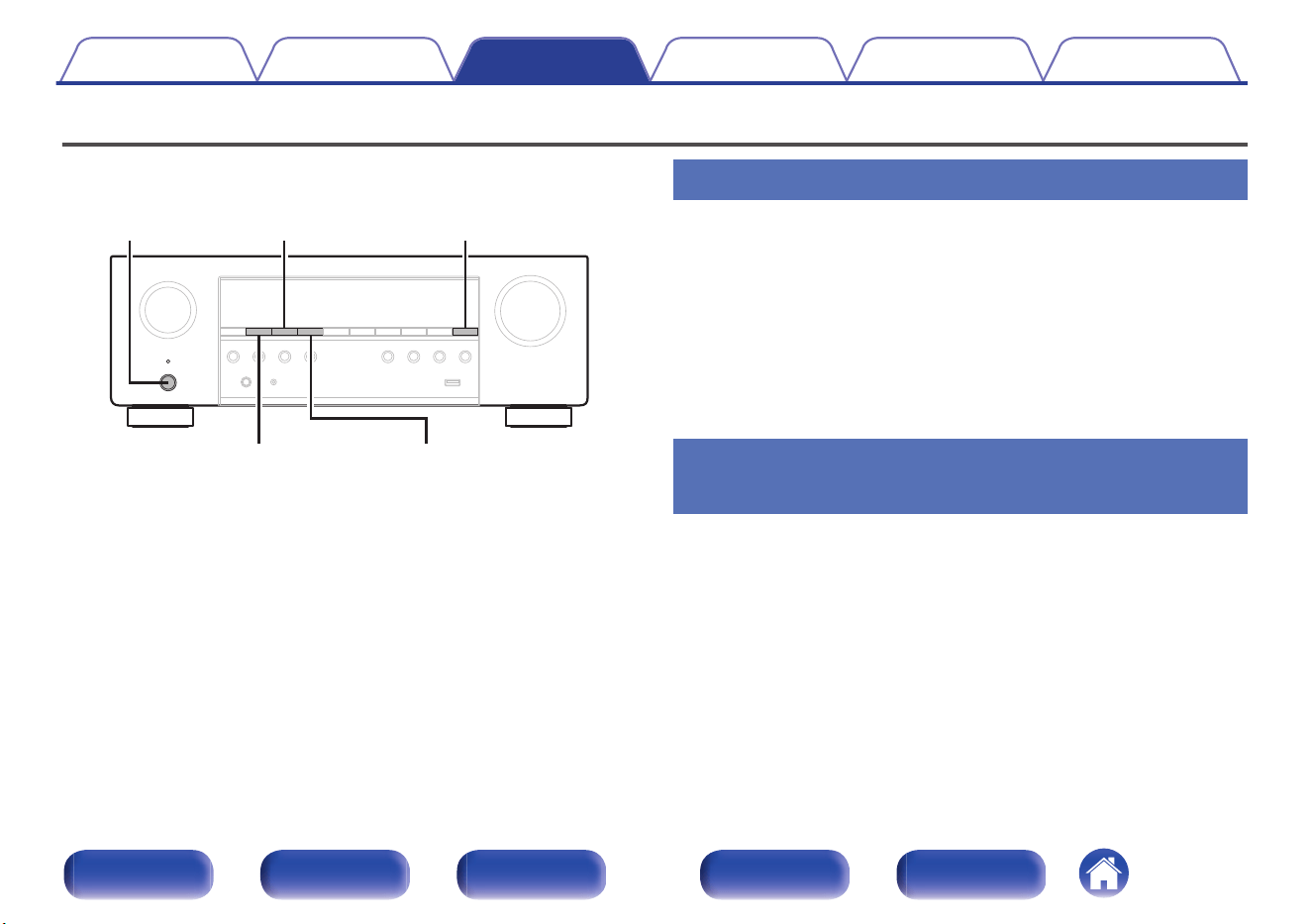
Panel lock function
To prevent accidental operation of this unit, you can disable operation of
the buttons on the front panel.
X
TUNER PRESET CH + TUNE +
TUNE – STATUS
Disabling all key button operations
1
Press X while you press and hold TUNER PRESET CH
+ and TUNE + with the unit in standby mode.
2
Use TUNE + or TUNE – to select “FP/VOL LOCK On”.
3
Press STATUS to enter the setting.
All button operations except X are disabled.
Disabling all button operations except
VOLUME
1
Press X while you press and hold TUNER PRESET CH
+ and TUNE + with the unit in standby mode.
2
Use TUNE + or TUNE – to select “FP LOCK On”.
3
Press STATUS to enter the setting.
All button operations except X and VOLUME are disabled.
Contents Connections Playback Settings Tips Appendix
117
Front panel Display Rear panel Remote Index
Canceling the Panel lock function
1
Press X while you press and hold TUNER PRESET CH
+ and TUNE + with the unit in standby mode.
2
Press TUNE + or TUNE – to select “FP LOCK zOff”.
(z The currently set mode.)
3
Press STATUS to enter the setting.
The Panel lock function is canceled.
0
Even when the Panel lock function is set, you can operate the unit using the
remote control unit.
Contents Connections Playback Settings Tips Appendix
118
Front panel Display Rear panel Remote Index
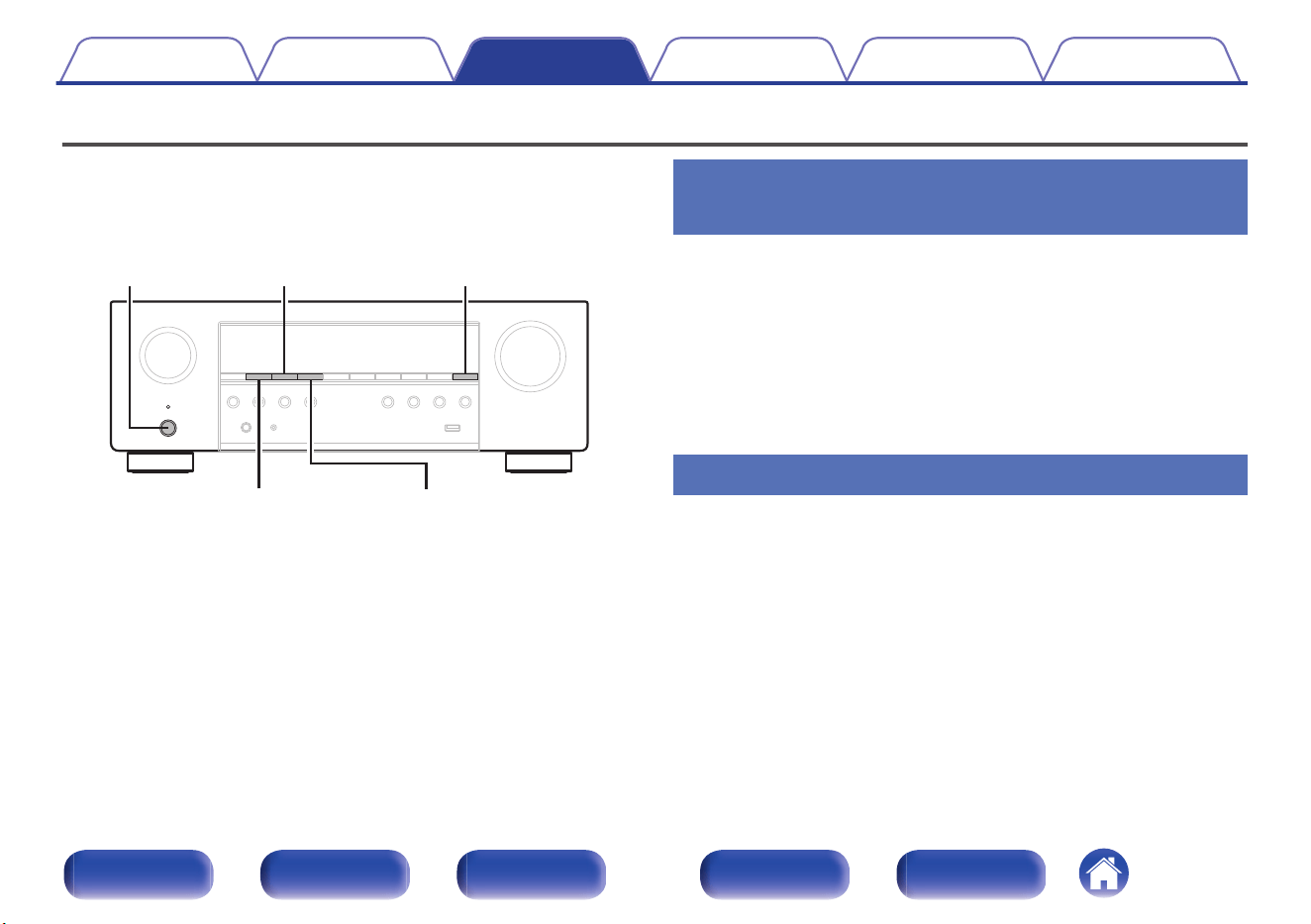
Remote lock function
When connecting an IR receiver, enable the Remote lock function. When
the function is enabled, you can not perform operations with the remote
control unit.
By default, this function is disabled.
X
TUNER PRESET CH + TUNE +
TUNE – STATUS
Disabling the sensor function of the
remote control unit
1
Press X while you press and hold TUNER PRESET CH
+ and TUNE + with the unit in standby mode.
2
Use TUNE + or TUNE – to select “RC LOCK On”.
3
Press STATUS to enter the setting.
The infrared light receiving function is disabled.
Enabling the remote sensor function
1
Press X while you press and hold TUNER PRESET CH
+ and TUNE + with the unit in standby mode.
2
Press TUNE + or TUNE – to select “RC LOCK zOff”.
(z The currently set mode.)
3
Press STATUS to enter the setting.
Infrared light receiving function on the main unit is enabled.
Contents Connections Playback Settings Tips Appendix
119
Front panel Display Rear panel Remote Index
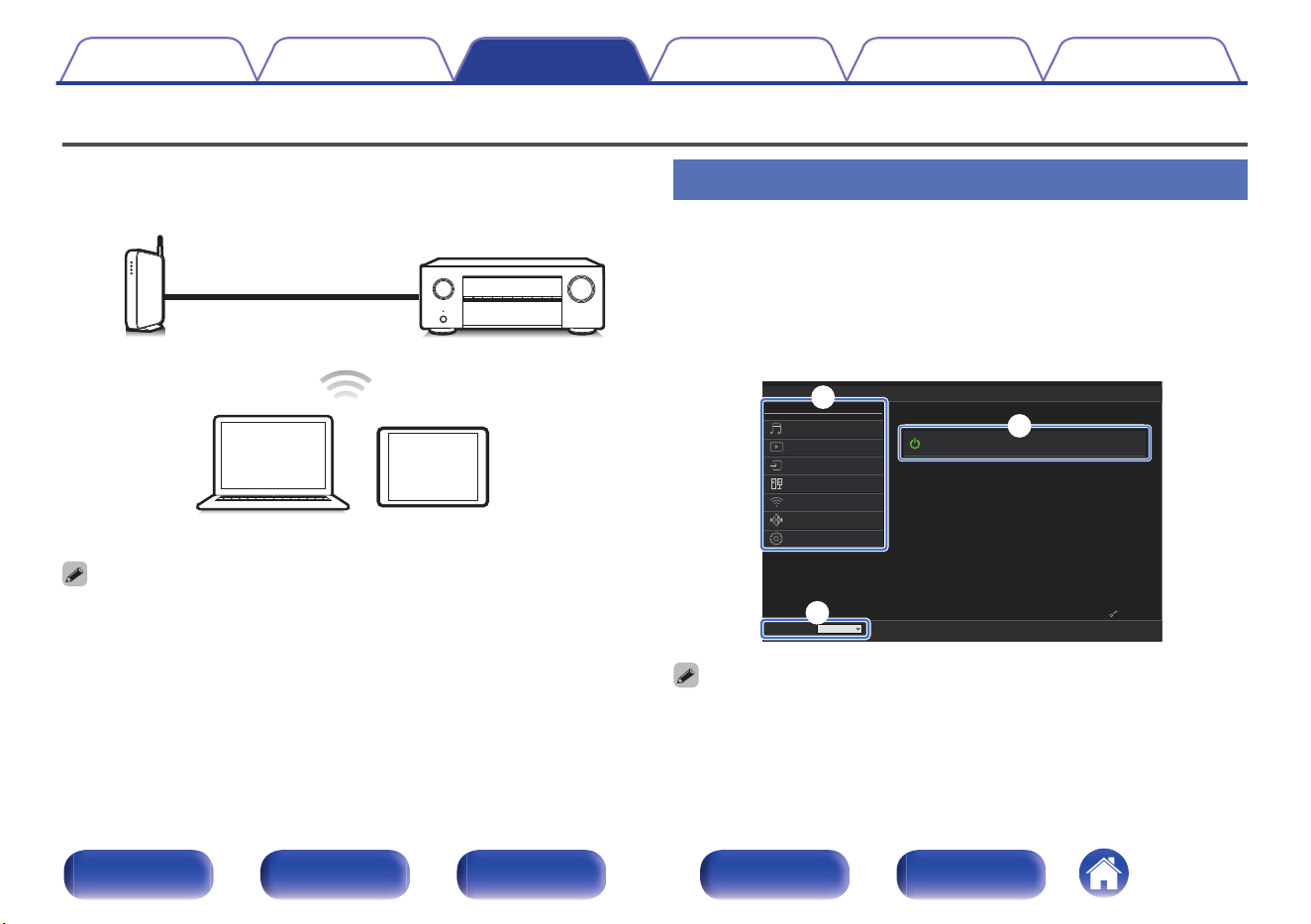
Web control function
You can control and configure this unit from a web control screen on a
web browser.
PC
Router
This unit
Tablet
0
This unit and the PC or tablet need to be connected correctly to the network in
order to use the web control function. (v p. 46)
0
Depending on the settings of your security-related software, you may not be able
to access this unit from your PC. If this is the case, then change the settings of the
security-related software.
Controlling the unit from a web control
The web control screen supports the following functions.
A
Setup Menu
B
Power ON/OFF
C
MAIN ZONE input source switching
Web control screen
Top menu
Denon XXXXXXXXXX
CBL/SAT
Denon XXXXXXXXXX
CBL/SAT
Setup Menu
Audio
Advanced
Video
Inputs
Speakers
Network
HEOS Account
General
MAIN ZONE
MAIN ZONE
q
w
e
0
Audyssey Setup is not supported on the web control screen. If you wish to perform
measurement, perform measurement from the on-screen Setup Menu.
0
“Advanced” contains settings for use by custom installers and should not be used
at any other time.
Contents Connections Playback Settings Tips Appendix
120
Front panel Display Rear panel Remote Index
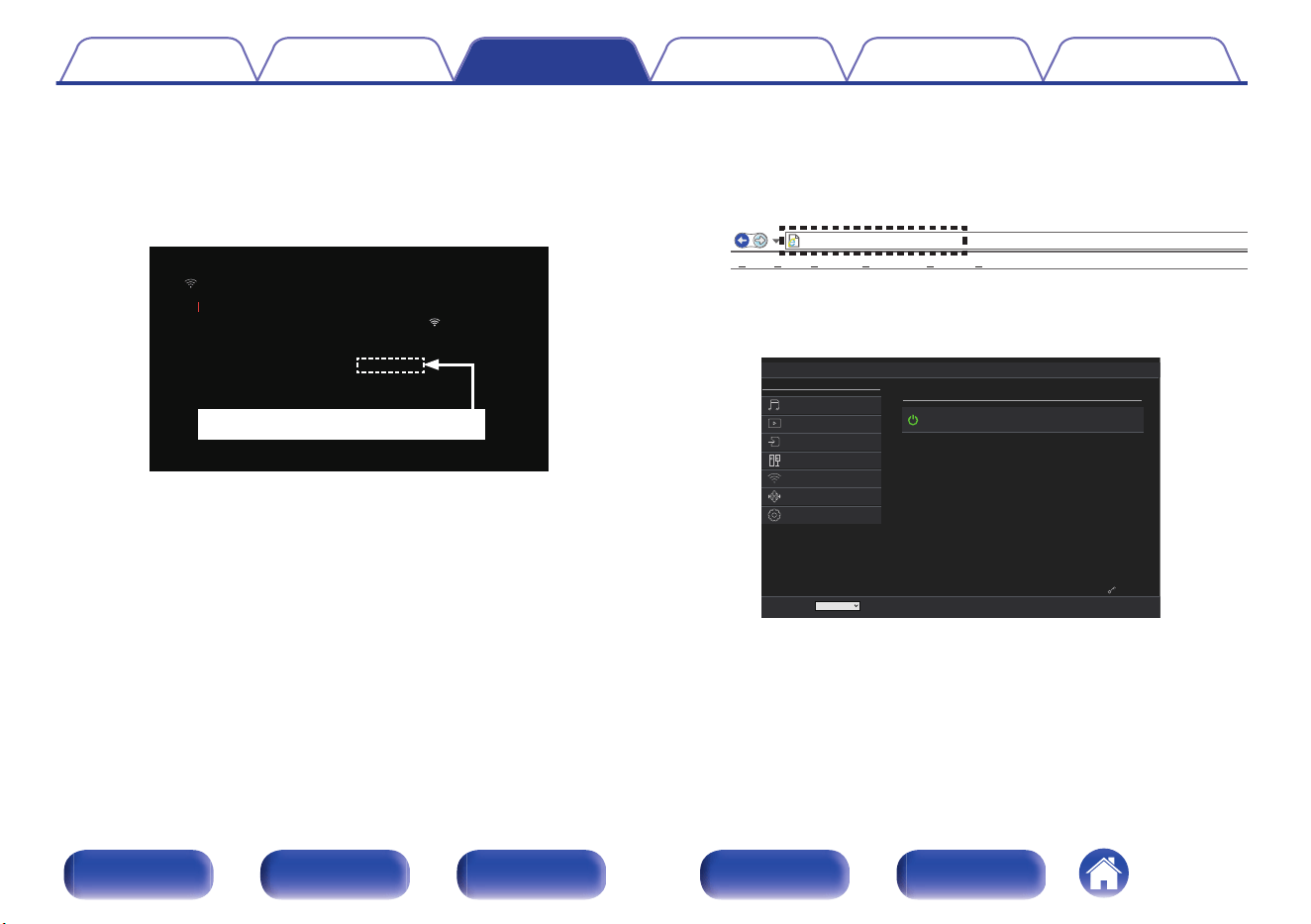
1
Switch the “Network Control” setting to “Always On”.
(v p. 172)
2
Check the IP address of this unit with “Information”.
(v p. 168)
000000-000000
000000-000000
Denon AVR-S670H
SSID-01
192.168.100.19
SSID
DHCP
Checking the IP address.
Friendly Name
Connection
SSID
DHCP
IP Address
MAC Address (Ethernet)
MAC Address (Wi-Fi)
Wireless (Wi-Fi)
On
Displays the current network settings of the AVR.
Network/Information
3
Open a web browser on a PC or tablet.
4
Enter the IP address of this unit in browser’s address
box.
For example, if the IP address of this unit is “192.168.100.19”, enter
“http://192.168.100.19”.
http://192.168.100.19
File
Edit View Tools HelpFavorites
5
When the top menu is displayed on the web browser,
click on the menu item you want to operate.
Denon XXXXXXXXXX
CBL/SAT
Denon XXXXXXXXXX
CBL/SAT
Setup Menu
Audio
Advanced
Video
Inputs
Speakers
Network
HEOS Account
General
MAIN ZONE
MAIN ZONE
Contents Connections Playback Settings Tips Appendix
121
Front panel Display Rear panel Remote Index
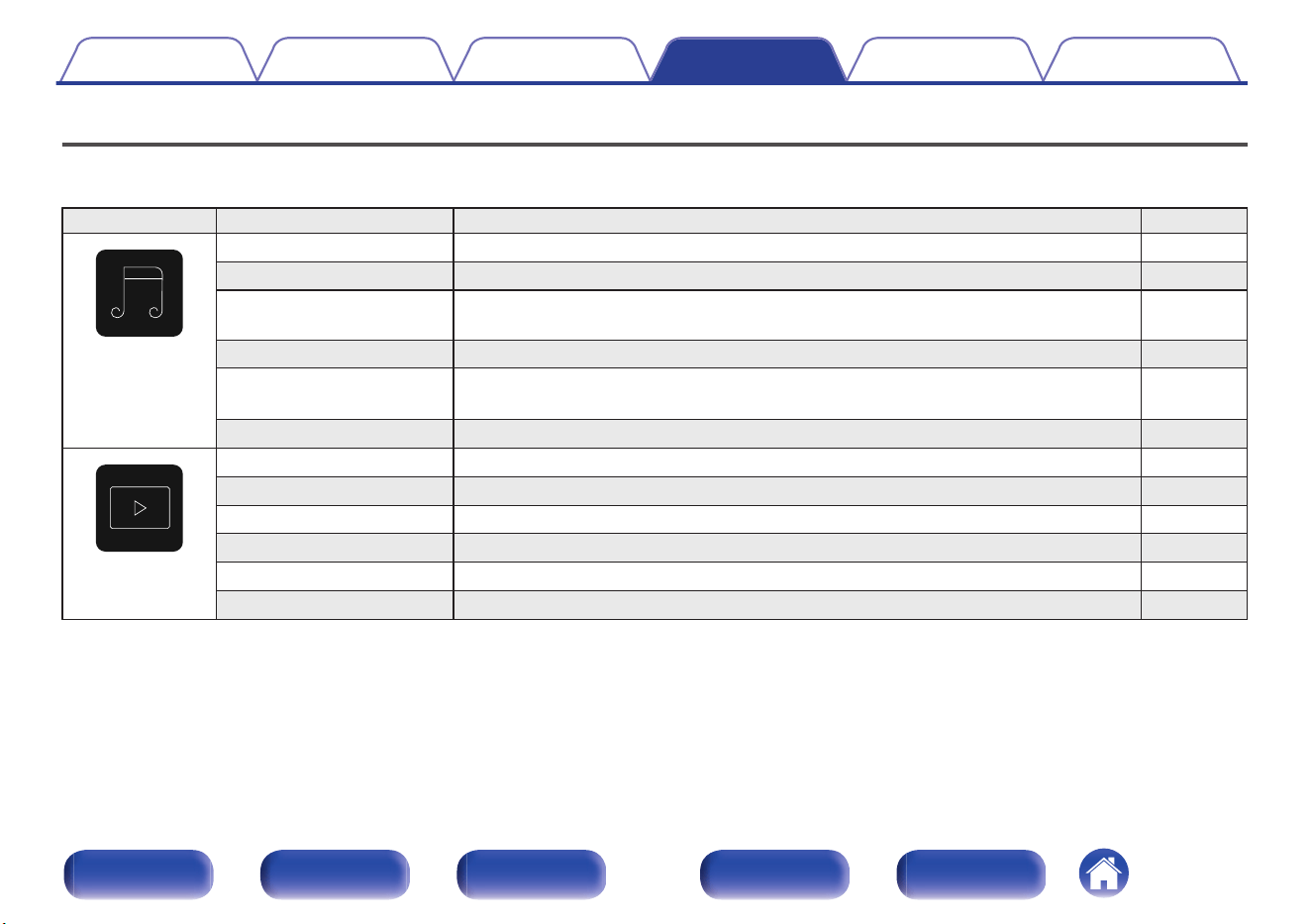
Menu map
When using menu operations, connect this unit to a TV and operate this unit while viewing the TV.
The recommended settings are configured for this unit by default. You can customize this unit based on your existing system and your preferences.
Setting items Detailed items Description Page
Audio
Subwoofer Level Adjust Adjusts the subwoofer channel volume for all input sources. 128
Surround Parameter Adjusts surround sound parameters. 128
Restorer Expands the low and high frequency components of compressed audio content such as
MP3 files to enable richer audio playback.
134
Volume Sets the volume setting. 135
Audyssey
Makes Audyssey MultEQ
®
, Audyssey Dynamic EQ
®
and Audyssey Dynamic Volume
®
settings.
136
Graphic EQ Adjusts the tonal quality for each speaker using a graphic equalizer. 138
Video
HDMI Setup Makes settings for HDMI Audio Out, HDMI Pass Through and HDMI Control settings. 140
HDMI Upscaler Sets the mode for upscaling 1080p and 4K HDMI content to 8K. 144
On-Screen Display Selects the on-screen display user interface preferences. 145
Screensaver Sets the screen saver setting. 146
4K/8K Signal Format Sets signal format options for your 4K or 8K video equipment. 146
HDCP Setup Sets the HDCP version for each HDMI input source. 148
Contents Connections Playback Settings Tips Appendix
122
Front panel Display Rear panel Remote Index
Setting items Detailed items Description Page
Inputs
Input Assign Changes input connector assignment and the audio input mode. 149
Source Rename Changes the display name for input source. 152
Hide Sources Selects source inputs to hide on the user interface and front panel displays. 152
Source Level Adjusts the input level for the current source. 152
Speakers
Audyssey
®
Setup
The acoustic characteristics of the connected speakers and listening room are
measured and the optimum settings are made automatically.
153
Manual Setup
Sets up the speakers manually or changes Audyssey
®
Setup settings.
162
Network
Information Displays network information. 168
Connection Configures the network connection. 168
Settings Configures the network settings (DHCP and IP address). 171
Network Control Enables network communication in standby power mode. 172
Friendly Name Edits the name of this unit that is displayed on the network. 173
Diagnostics Tests the network connection. 173
AirPlay Settings for Apple AirPlay. 174
Spotify Connect Toggles access to Spotify Connect. 175
Wi-Fi and Bluetooth Toggles power to the Wi-Fi and Bluetooth radios. 175
Contents Connections Playback Settings Tips Appendix
123
Front panel Display Rear panel Remote Index
Setting items Detailed items Description Page
HEOS
[When the user is signed out of the HEOS account]
“–” A guidance to download the HEOS app. 176
[When the user is signed in to the HEOS account]
Signed in as Displays your HEOS account. 176
Contents Connections Playback Settings Tips Appendix
124
Front panel Display Rear panel Remote Index
Setting items Detailed items Description Page
General
Language Selects the language for the on-screen user interface. 177
Owner's Manual Access the online Owner's Manual from your mobile device. 177
ECO Configures the ECO Mode and Auto Standby energy-saving functions. 177
Bluetooth Transmitter Sets Bluetooth transmitter settings. 181
Quick Select Sets the “Quick Select” parameters and display name. 182
Front Display Makes settings related to the display on this unit. 182
Firmware Checks for the latest firmware information about updates and updates the firmware, and
sets up the notification message display.
183
Information Shows information about this unit settings, input signals, etc. 185
Usage Data Selects whether or not to send anonymous usage data to Denon. 187
Save & Load Save and restore device settings by using a USB memory device. 187
Setup Lock Protects settings from inadvertent changes. 188
Reset Various settings are reset to the factory default values. 188
Contents Connections Playback Settings Tips Appendix
125
Front panel Display Rear panel Remote Index
Setting items Detailed items Description Page
Setup Assistant
Begin Setup... Performs basic installation/connections/settings from the beginning according to the
guidance indicated on the TV screen.
Page 9 of
the separate
manual
“Quick Start
Guide”
Language Select Sets individual setting items according to the guidance displayed on the TV screen.
Speaker Setup
Speaker Calibration
Network Setup
TV Audio Setup
Input Setup
Mobile Apps
Contents Connections Playback Settings Tips Appendix
126
Front panel Display Rear panel Remote Index
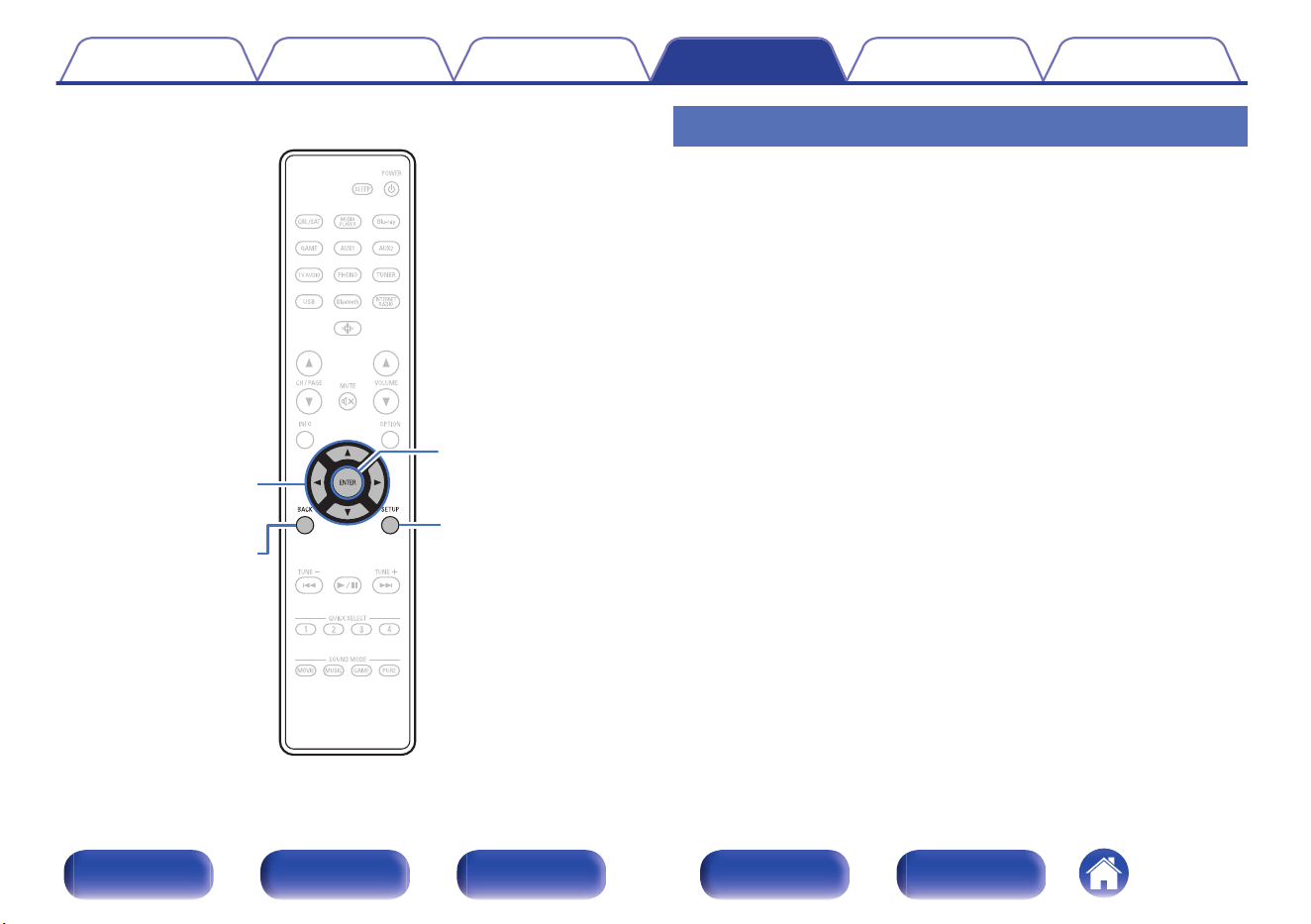
SETUP
BACK
ENTER
Cursor Up/Down/
Left/Right
Menu operations
1
Press SETUP.
The menu is displayed on the TV screen.
2
Use cursor Up/Down/Right to select the menu to be set
or operated, then press ENTER.
3
Use cursor Left/Right to change to desired setting.
4
Press ENTER to enter the setting.
0
To return to the previous item, press BACK.
0
Exiting the menu, press SETUP while the menu is displayed. The
menu display disappears.
Contents Connections Playback Settings Tips Appendix
127
Front panel Display Rear panel Remote Index
Audio
Make audio-related settings.
Subwoofer Level Adjust
Adjusts the subwoofer channel volume for all input sources.
o
Subwoofer
Adjusts the volume level for the subwoofer.
–12.0 dB – +12.0 dB (Default: 0.0 dB)
0
This setting is also reflected in the subwoofer channel level in the “Speakers” -
“Levels” menu settings. (v p. 164)
Surround Parameter
You can adjust the surround audio sound field effects to match your
preferences.
The items (parameters) that can be adjusted depend on the signal being
input and the currently set sound mode.
0
Some setting items cannot be set while playback is stopped. Make the settings
during playback.
0
“Surround Parameter” settings are stored for each sound mode.
o
Cinema EQ
Gently softens the upper treble range of movie soundtracks to reduce
possible harshness and improve clarity.
On:
“Cinema EQ” is used.
Off
(Default):
“Cinema EQ” is not used.
0
This item cannot be set when sound mode is “Direct”, “Pure Direct”, “Stereo”
and “Original sound mode”.
Contents Connections Playback Settings Tips Appendix
128
Front panel Display Rear panel Remote Index
o
Loudness Management
This sets whether to output as specified in “Dynamic Compression” or
output directly without compressing the dynamic range of audio
recorded in the disc.
On
(Default):
Outputs are given based on enabling the
settings made in “Dynamic Compression”
and Dialogue normalization function.
Off:
“Dynamic Compression” settings and
Dialogue normalization are disabled, and
the signals on the disc are output as is.
0
“Loudness Management” can be set when Dolby TrueHD signal is input.
o
Dynamic Compression
Compress dynamic range (difference between loud and soft sounds).
Auto:
Automatic dynamic range compression
on/off control according to source.
Low / Medium / High: These set the compression level.
Off
(Default):
Dynamic range compression is always
off.
0
“Dynamic Compression” can be set when Dolby Digital, Dolby Digital Plus,
Dolby TrueHD or DTS signal is input.
0
“Auto” cannot be set when inputting a DTS signal.
Contents Connections Playback Settings Tips Appendix
129
Front panel Display Rear panel Remote Index
o
Low Frequency Effects
Adjust the low frequency effects level (LFE).
-10 dB – 0 dB (Default: 0 dB)
0
This can be set when the LFE signal is included in the input signal.
0
This item can be selected when a Dolby Digital or DTS signal or DVD-Audio is
played.
0
For proper playback of the different sources, we recommend setting to the
values below.
0
Dolby Digital sources: 0 dB
0
DTS movie sources: 0 dB
0
DTS music sources: -10 dB
o
Center Image
Distributes the dialogue output from the center channel to the front left
and right channels and widens the sound image in the front.
0.0 – 1.0 (Default : 0.3)
0
You can set this when the sound mode is DTS Neo:6 in the “Music” mode.
0
The larger the value, the more dialogue is concentrated on the center channel.
The smaller the value, the more dialogue is distributed to front left and right
channels, and the more the sound image widens in the front.
Contents Connections Playback Settings Tips Appendix
130
Front panel Display Rear panel Remote Index
o
Panorama
The front sound field is expanded further towards the back to create a
seamlessly inclusive sound impression.
On: Use “Panorama”.
Off
(Default):
Do not use “Panorama”.
0
You can set this when the sound mode is Dolby PLg in the “Music” mode.
o
Dimension
Shift sound image center to front or rear to adjust playback balance.
0 – 6 (Default : 3)
0
You can set this when the sound mode is Dolby PLg in the “Music” mode.
0
As you set a smaller number, the surround sound field shifts backward; as you
set a larger number, the surround sound field shifts forward.
o
Center Width
Distributes the dialogue output from the center channel to left and right
channels and widens the sound image in the front.
0 – 7 (Default : 3)
0
You can set this when the sound mode is Dolby PLg in the “Music” mode.
0
The smaller the value, the more dialogue is concentrated on the center
channel. The larger the value, the more dialogue is distributed to front left and
right channels, and the more the sound image widens in the front.
Contents Connections Playback Settings Tips Appendix
131
Front panel Display Rear panel Remote Index
o
Delay Time
Adjusts delay time for surround channels.
0 ms – 300 ms (Default: 30 ms)
0
You can set this when the sound mode is “Matrix”.
o
Effect Level
Adjust the sound effect level of the current sound mode.
1 – 15 (Default: 10)
0
This item can be set when sound mode is “Rock Arena”, “Jazz Club”, “Mono
Movie” and “Video Game”.
0
Set to a lower level if the positioning and sense of phase of the surround
signals seems unnatural.
o
Room Size
Determine size of acoustic environment.
Small: Simulate acoustics of a small room.
Medium small:
Simulate acoustics of a medium-small
room.
Medium
(Default):
Simulate acoustics of a medium room.
Medium large:
Simulate acoustics of a medium-large
room.
Large: Simulate acoustics of a large room.
0
This item can be set when sound mode is “Rock Arena”, “Jazz Club”, “Mono
Movie” and “Video Game”.
0
“Room Size” does not indicate the size of the room in which sources are
played.
Contents Connections Playback Settings Tips Appendix
132
Front panel Display Rear panel Remote Index
o
Subwoofer
Turn subwoofer output on and off.
On
(Default):
The subwoofer is used.
Off: The subwoofer is not used.
0
You can set this when the sound mode is “Direct” or “Stereo” and in the menu
“Subwoofer Output” is set to “LFE + Main”. (v p. 166)
o
Set Defaults
The “Surround Parameter” settings are returned to the default settings.
Contents Connections Playback Settings Tips Appendix
133
Front panel Display Rear panel Remote Index
Restorer
Compressed audio formats such as MP3 and WMA (Windows Media
Audio) reduce the amount of data by eliminating signal components that
are hard for the human ear to hear. The “Restorer” function generates the
signals eliminated upon compression, restoring the sound to conditions
near those of the original sound before compression. It also restores the
original bass characteristics for a rich and expanded tonal range.
o
Mode
High:
Optimized mode for compressed sources
with very weak highs (64 kbps and
under).
Medium:
Apply suitable bass and treble boost for
all compressed sources (96 kbps and
under).
Low:
Optimized mode for compressed sources
with normal highs (96 kbps and over).
Off
(Default):
Do not use “Restorer”.
0
This item can be set with analog signals or PCM signal (Sample Rate =
44.1/48 kHz) is input.
0
This cannot be set when the sound mode is set to “Direct” or “Pure Direct”.
0
“Restorer” settings are stored for each input source.
Contents Connections Playback Settings Tips Appendix
134
Front panel Display Rear panel Remote Index
Volume
Set the volume setting.
o
Scale
Set how volume is displayed.
0 - 98
(Default):
Display in the range 0 (Min) to 98.
-79.5 dB - 18.0 dB:
Display ---dB (Min), in the range –79.5 dB
to 18.0 dB.
o
Limit
Make a setting for maximum volume.
60 – 80 (–20 dB – 0 dB)
Off (Default)
0
The dB value is displayed when the “Scale” setting is “-79.5 dB - 18.0
dB”. (v p. 135)
o
Power On Level
Sets the initial volume level when the power is turned on.
Last
(Default):
Sets the power-on level to the last-used
volume level.
Mute: Sets the power-on level to mute level.
1 – 98 (–79 dB – 18 dB) : Sets a specific power-on level.
0
The dB value is displayed when the “Scale” setting is “-79.5 dB - 18.0
dB”. (v p. 135)
o
Mute Level
Set the amount of attenuation when mute is on.
Full
(Default):
Sets the mute level to full mute (no
sound).
–40 dB :
Sets the mute level to 40 dB lower than
the current volume level.
–20 dB :
Sets the mute level to 20 dB lower than
the current volume level.
Contents Connections Playback Settings Tips Appendix
135
Front panel Display Rear panel Remote Index
Audyssey
®
Set Audyssey MultEQ
®
, Audyssey Dynamic EQ
®
and Audyssey Dynamic
Volume
®
. These can be selected after Audyssey
®
Setup has been
performed.
For additional information on Audyssey technology, please see
“Explanation of terms” (v p. 229).
0
“MultEQ
®
”, “Dynamic EQ”, “Reference Level Offset” and “Dynamic Volume”
settings are stored for each input source.
0
When the sound mode is in the “Direct” or “Pure Direct” mode, “MultEQ
®
”,
“Dynamic EQ” and “Dynamic Volume” settings cannot be configured.
o
MultEQ
®
MultEQ
®
compensates for both time and frequency characteristics of
the listening area based on “Audyssey
®
Setup” measurement results.
Selection is done from three types of compensation curves. We
recommend the “Reference” setting.
Reference
(Default):
Selects the default calibrated setting with
a slight roll off at high frequencies.
Optimal for movies.
L/R Bypass:
Selects the reference setting, but
bypasses MultEQ
®
on the front left and
right speakers.
Flat:
Selects the calibrated setting which is
optimized for small rooms where your
listening position is closer to the
speakers.
Off:
Do not use “MultEQ
®
”.
0
When using headphones, “MultEQ
®
” is automatically set to “Off”.
Contents Connections Playback Settings Tips Appendix
136
Front panel Display Rear panel Remote Index
o
Dynamic EQ
Solves the problem of deteriorating sound quality as volume is
decreased by taking into account human perception and room
acoustics.
Works with MultEQ
®
.
On
(Default):
Use “Dynamic EQ”.
Off: Do not use “Dynamic EQ”.
0
When the menu “Dynamic EQ” setting is “On”, it is not possible to do “Tone”
adjustment. (v p. 98)
0
This item cannot be set when “MultEQ
®
” in the menu is set to “Off”.
o
Reference Level Offset
Audyssey Dynamic EQ
®
is referenced to the standard film mix level. It
makes adjustments to maintain the reference response and surround
envelopment when the volume is turned down from 0 dB. However,
film reference level is not always used in music or other non-film
content. Dynamic EQ Reference Level Offset provides three offsets
from the film level reference (5 dB, 10 dB, and 15 dB) that can be
selected when the mix level of the content is not within the standard.
Recommended setting levels for content are shown below.
0 dB (Film Reference)
(Default):
Optimized for content such as movies.
5 dB :
Select this setting for content that has a
very wide dynamic range, such as
classical music.
10 dB :
Select this setting for jazz or other music
that has a wider dynamic range. This
setting should also be selected for TV
content as that is usually mixed at 10 dB
below film reference.
15 dB :
Select this setting for pop/rock music or
other program material that is mixed at
very high listening levels and has a
compressed dynamic range.
0
Setting is enabled when “Dynamic EQ” is “On”. (v p. 137)
Contents Connections Playback Settings Tips Appendix
137
Front panel Display Rear panel Remote Index
o
Dynamic Volume
Solves the problem of large variations in volume level between TV,
movies and other content (between quiet passages and loud
passages, etc.) by automatically adjusting to the user’s preferred
volume setting.
Works with MultEQ
®
.
Heavy:
Most adjustment to softest and loudest
sounds.
Medium:
Medium adjustment to loudest and
softest sound.
Light:
Least adjustment to loudest and softest
sounds.
Off
(Default):
Do not use “Dynamic Volume”.
0
If “Dynamic Volume” is set to “Yes” in “Audyssey
®
Setup”, the setting is
automatically changed to “Medium”. (v p. 153)
0
This item cannot be set when “MultEQ
®
” in the menu is set to “Off”.
Graphic EQ
Uses the graphic equalizer to adjust the tone of each speaker.
0
Speakers for which “Graphic EQ” can be set differ according to the sound mode.
0
This can be set when “MultEQ
®
” setting is “Off”. (v p. 136)
0
This cannot be set when the sound mode is set to “Direct” or “Pure Direct”.
0
If you are using headphones, you can set the equalizer for headphones.
(v p. 138)
o
Graphic EQ / Headphone EQ
Set whether to use the graphic equalizer or not.
On:
Use the graphic equalizer.
Off
(Default):
Do not use the graphic equalizer.
0
“Headphone EQ” is set in the menu when headphones are used.
Contents Connections Playback Settings Tips Appendix
138
Front panel Display Rear panel Remote Index
o
Speaker Selection
Select whether to adjust tones for individual speakers or for all
speakers.
All: Adjust all speaker tones together.
Left/Right
(Default):
Adjust the left and right speaker tones
together.
Each: Adjust the tone for each speaker.
o
Adjust EQ
Adjust tonal balance for each frequency band.
1. Select the speaker.
2. Select the adjustment frequency band.
63 Hz / 125 Hz / 250 Hz / 500 Hz / 1 kHz / 2 kHz / 4 kHz / 8 kHz /
16 kHz
3. Adjust the level.
–20.0 dB – +6.0 dB (Default: 0.0 dB)
o
Curve Copy
Copy the Flat correction curve created in Audyssey
®
Setup.
0
“Curve Copy” is displayed after Audyssey
®
Setup has been performed.
0
“Curve Copy” cannot be used when using headphones.
o
Set Defaults
The “Graphic EQ” settings are returned to the default settings.
Contents Connections Playback Settings Tips Appendix
139
Front panel Display Rear panel Remote Index
Video
Make video-related settings.
HDMI Setup
Make settings for HDMI Audio Out, HDMI Pass Through and HDMI
Control settings.
NOTE
0
When “HDMI Pass Through” and “HDMI Control” is set to “On”, it consumes more
standby power. (“HDMI Pass Through” (v p. 140), “HDMI Control” (v p. 142))
If you are not using this unit for an extended period, it is recommended that you
unplug the power cord from the power outlet.
o
HDMI Audio Out
Selects the audio output speakers.
AVR
(Default):
Play back through speakers connected to
the unit.
TV:
Play back through TV connected to the
unit.
0
When the HDMI Control function is activated, priority is given to the TV audio
setting. (v p. 111)
0
When the power of this unit is on and “HDMI Audio Out” is set to “TV”, audio is
output as 2-channel from the HDMI OUT connector.
o
HDMI Pass Through
Selects how this unit will transmit HDMI signals to the HDMI output in
standby power mode.
On:
Transmits the selected HDMI input
through this unit’s HDMI output when this
unit is in standby power mode.
Off
(Default):
No HDMI signals are transmitted through
this unit’s HDMI output in standby power
mode.
Contents Connections Playback Settings Tips Appendix
140
Front panel Display Rear panel Remote Index
o
Pass Through Source
Selects the HDMI input to pass through the HDMI output when this unit
is in standby power mode.
Last
(Default):
Selects the last used HDMI input.
CBL/SAT / Media Player /
Blu-ray / Game / AUX1 /
AUX2 / TV Audio:
Selects the HDMI input as the standby
source.
0
“Pass Through Source” can be set when “HDMI Control” is set to “On” or
“HDMI Pass Through” is set to “On”. (“HDMI Pass Through” (v p. 140),
“HDMI Control” (v p. 142))
o
RC Source Select
Set whether to allow this unit to be turned on by the input source select
button on the remote control when this unit is in standby power mode.
Power On + Source
(Default):
The power of this unit is turned on and
the input source changes.
Source Select Only:
This unit remains in standby but switches
the HDMI input source when you press
an input source button. The power
display of this unit blinks when the input
source select button of the remote control
is pressed.
0
“RC Source Select” can be set when “HDMI Control” is set to “On” or “HDMI
Pass Through” is set to “On”. (“HDMI Pass Through” (v p. 140), “HDMI
Control” (v p. 142))
Contents Connections Playback Settings Tips Appendix
141
Front panel Display Rear panel Remote Index
o
HDMI Control
You can link operations with devices connected to HDMI and
compatible with HDMI Control.
On: Use HDMI Control function.
Off
(Default):
Do not use HDMI Control function.
0
If using the HDMI Control function, connect a TV compatible with HDMI control
to the HDMI OUT connector.
0
Please consult the operating instructions for each connected device to check
the settings.
0
When “HDMI Control” is set to “On”, the power to this unit can be linked to the
TV power and the volume of this unit can be controlled using the TV remote
control.
0
Refer to “HDMI Control function” for more information about the HDMI Control
function. (v p. 111)
NOTE
0
If the “HDMI Control” settings have been changed, always reset the power to
connected devices after the change.
o
ARC
On the TV connected to the HDMI OUT connector, set whether to
receive sound from the TV via HDMI.
On: Use ARC function.
Off
(Default):
Do not use ARC function.
0
If using this function, use a TV compatible with ARC (Audio Return Channel)
and enable the HDMI Control function of the TV.
0
When “ARC” is set to “On”, the volume of this unit can be controlled using the
TV remote control even when “HDMI Control” is set to “Off” on this unit.
NOTE
0
If the “ARC” settings have been changed, always reset the power to
connected devices after the change.
0
Using an eARC function-compatible television enables audio playback from
the speaker connected to this unit, regardless of “ARC” settings in the menu.
Contents Connections Playback Settings Tips Appendix
142
Front panel Display Rear panel Remote Index
o
TV Audio Switching
Sets automatic switching to the “TV Audio” input when a TV connected
via HDMI sends an appropriate CEC control command to this unit.
On
(Default):
Select the “TV Audio” input automatically
when receiving a command from the TV.
Off:
Do not select the “TV Audio” input
automatically when receiving a command
from the TV.
0
“TV Audio Switching” can be set when “HDMI Control” is set to “On”.
(v p. 142)
o
Power Off Control
Links the power standby of this unit to external devices.
All
(Default):
If power to a connected TV is turned off
independently of the input source, power
to this unit is automatically set to standby.
Video:
With an input source being selected that
is assigned “HDMI”, when you turn the
power of the TV off, power to this unit is
automatically set to standby.
(v p. 150)
Off: This unit does not link with power to a TV.
0
“Power Off Control” can be set when “HDMI Control” is set to “On”.
(v p. 142)
Contents Connections Playback Settings Tips Appendix
143
Front panel Display Rear panel Remote Index
o
Power Saving
Enables the Power Saving feature of the AVR to reduce energy costs
when using the TV's speakers.
This function is activated in the following cases.
0
When “TV Audio” is selected as the input source of this unit
0
When playing content from a device connected by HDMI
On: Use Power Saving feature.
Off
(Default):
Do not use Power Saving feature.
0
“Power Saving” can be set when “HDMI Control” is set to “On”. (v p. 142)
HDMI Upscaler
Sets the mode for upscaling 1080p and 4K HDMI content to 8K.
Auto:
Upscale 1080p and 4K HDMI video to 8K
based on the TV’s capabilities.
Off
(Default):
8K upscaler is disabled.
0
This item can be set when “HDMI” is assigned for each input source.
0
This function is not effective when the input signal is “x.v.Color”, 3D, sYCC601
color, Adobe RGB color, Adobe YCC601 color, computer resolutions, compressed
video or HDR.
Contents Connections Playback Settings Tips Appendix
144
Front panel Display Rear panel Remote Index
On-Screen Display
Select the on-screen display user interface preferences.
o
Volume
Sets where to display the volume level.
Bottom
(Default):
Display at the bottom.
Top: Display at the top.
Off: Turn display off.
0
When the master volume display is hard to see when superimposed text
(closed captioning) or movie subtitles are present, set to “Top”.
o
Info
Displays status of operation temporarily when the input source is
switched.
On
(Default):
Turn display on.
Off: Turn display off.
o
Now Playing
Sets the display time for the playback display when the input source is
“HEOS Music” or “Tuner”.
Always On
(Default):
Show display continuously.
Auto Off:
Show display for 30 seconds after
operation.
Contents Connections Playback Settings Tips Appendix
145
Front panel Display Rear panel Remote Index
Screensaver
Select the screen saver setting.
A screen saver is activated if no operation is performed for more than 5
minutes when no video signal is input or when the same screen (e.g. the
setup menu) is displayed.
Use cursor Up/Down/Left/Right to clear the screen saver.
On: Turns screen saver on.
Off
(Default):
Turns screen saver off.
0
The screen saver is activated in the following cases.
0
When the setup menu is displayed
0
When no video signal is input
0
When the HEOS Music, USB, Bluetooth or Tuner playback screen is displayed
4K/8K Signal Format
Set the format of 4K and 8K signal to be played back by this unit when the
TV or playback device connected to this unit is HDMI 4K or 8K signal
compatible.
o
4K/8K Signal Format
Sets the signal format options for devices connected to each input on
this unit.
Standard:
Select if your TV and the source device
support 4K 60Hz 4:2:0 8 bit video signals.
Enhanced
(Default):
Select if your TV, the source device, and
cables support high quality 4K 60Hz
4:4:4 8 bit, 4:2:2 or 4:2:0 10 bit video
signals.
8K Enhanced:
Select if your TV, the source device, and
cables support high quality 8K 60Hz or
4K 120Hz video signals.
Contents Connections Playback Settings Tips Appendix
146
Front panel Display Rear panel Remote Index
GRelation between the “4K/8K Signal Format” setting and supported
resolutionsH
Support
Resolution
Color
Space
Pixel
Depth
4K/8K Signal Format
Standard Enhanced
8K
Enhanced
4K 24Hz,
4K 30Hz,
4K 25Hz
RGB /
YCbCr 4:4:4
8 bit
P P P
10,12 bit –
P P
YCbCr 4:2:2 12 bit
P P P
4K 60Hz,
4K 50Hz
YCbCr 4:2:0
8 bit
P P P
10,12 bit –
P P
RGB /
YCbCr 4:4:4
8 bit –
P P
10,12 bit – –
P
YCbCr 4:2:2 12 bit –
P P
4K 120Hz,
4K 100Hz
YCbCr 4:2:0
8,10,12
bit
– –
P
RGB /
YCbCr 4:4:4
8,10 bit – –
P
YCbCr 4:2:2 12 bit – –
P
8K 24Hz,
8K 30Hz,
8K 25Hz
YCbCr 4:2:0
8,10,12
bit
– –
P
RGB /
YCbCr 4:4:4
8,10 bit – –
P
YCbCr 4:2:2 12 bit – –
P
8K 60Hz,
8K 50Hz
YCbCr 4:2:0 8, 10 bit – –
P
0
When setting this to “Enhanced”, we recommend using a “Premium High
Speed HDMI Cable” or “Premium High Speed HDMI Cable with Ethernet” that
has an “HDMI Premium Certified Cable” label attached to the product
package.
0
When setting this to “8K Enhanced”, we recommend using a certified “Ultra
High Speed HDMI cable”.
0
When this setting is “8K Enhanced”, configure the television or playback
device settings to match this setting.
0
When this setting is “8K Enhanced”, video may not be output correctly
depending on the connected playback device or HDMI cable. In this case,
change this setting to “Enhanced” or “Standard”.
0
“Custom” is displayed for the setting item if our service engineers or custom
installers has configured the HDMI signal format for this unit.
0
“4K/8K Signal Format” can also be set by the following procedure. However,
the menu screen is not displayed. Watch the display while configuring the
setting.
1. Press and hold the main unit’s TUNE + and MODE at the same time for at
least 3 seconds.
“4K/8K <Enhanced>” appears on the display.
2. Use the main unit's TUNE + or TUNE – and select the 4K/8K Signal Format.
3. Press the main unit’s STATUS to complete the setting.
Contents Connections Playback Settings Tips Appendix
147
Front panel Display Rear panel Remote Index
HDCP Setup
Sets the HDCP version for each HDMI input source.
Video may not be output depending on the HDCP version of your player
and the TV.
If this issue occurs, use this setting to set one version of HDCP. This may
be able to output video.
Auto
(Default):
Automatically applies the HDCP version of
this unit according to TV.
1.4: Fixes the HDCP version of this unit to 1.4.
2.3: Fixes the HDCP version of this unit to 2.3.
0
“Custom” is displayed for the setting item if our service engineers or custom
installers has configured the HDCP version for this unit.
Contents Connections Playback Settings Tips Appendix
148
Front panel Display Rear panel Remote Index
Inputs
Perform settings related to input source playback.
You do not have to change the settings to use the unit. Make settings when needed.
Input Assign
By making connections as indicated by the input sources printed on the
audio/video input connectors of this unit, you can just press one of the
input source select buttons to easily play back audio or video from a
connected device.
Please change the assignment of the HDMI input connector, digital audio
input connector and analog audio input connector when connecting an
input source that differs from that printed to the audio/video input
connectors of this unit.
Sets the audio input mode for each “INPUT MODE” source. “AUTO” is
normally recommended for this setting. This automatically detects and
plays signal input to this unit prioritized in the following order: HDMI >
DIGITAL > ANALOG.
CBL/SAT
Media Player
Blu-ray
Game
AUX1
AUX2
TV Audio
1
[ HDMI ] [ DIGITAL ] [ ANALOG ] [ INPUT MODE ]
2
3
4 (8K)
5 (8K)
6 (8K)
-
1
2
-
-
-
-
-
OPT2
-
-
-
-
-
OPT1
AUTO
AUTO
HDMI
HDMI
HDMI
HDMI
DIGITAL
Inputs/Input Assign
Changes HDMI input assignments.
Set Defaults
0
By default, each item is set as follows.
Input source
Input connector
INPUT
MODE
HDMI DIGITAL
ANALOG
CBL/SAT 1 OPT2 1 AUTO
Media Player 2 – 2 AUTO
Blu-ray 3 – – HDMI
Game 4 (8K) – – HDMI
AUX1 5 (8K) – – HDMI
AUX2 6 (8K) – – HDMI
TV Audio – OPT1 – DIGITAL
Contents Connections Playback Settings Tips Appendix
149
Front panel Display Rear panel Remote Index
n
TV set top box/satellite users please note
When using the digital audio output on a TV/satellite box:
To play the video signal assigned to “HDMI” combined with the audio
signal assigned at “Input Assign” - “DIGITAL”, you will also need to
select “DIGITAL” in the “INPUT MODE”.
0
The same input connector can be assigned to multiple input sources. For example,
assign the same HDMI input connector to multiple sources to use each input
source in combination with analog or digital audio as you prefer. In such cases, set
the audio connector for playback in “INPUT MODE”.
o
HDMI
Set this to change the HDMI input connectors assigned to the input
sources.
1 / 2 / 3 / 4(8K) / 5(8K) /
6(8K):
Assign an HDMI input connector to the
selected input source.
– :
Do not assign an HDMI input connector
to the selected input source.
0
When “HDMI Control” or “ARC” is set to “On” in the menu, “HDMI” cannot be
assigned to “TV Audio”. (“HDMI Control” (v p. 142), “ARC” (v p. 142))
0
The eARC function does not operate when “HDMI” is set as the “TV Audio”
input source.
o
DIGITAL
Set this to change the digital audio input connectors assigned to the
input sources.
OPT1 (Optical) / OPT2:
Assign a digital audio input connector to
the selected input source.
– :
Do not assign a digital audio input
connector to the selected input source.
o
ANALOG
Set this to change the analog audio input connectors assigned to the
input sources.
1 / 2 :
Assign a analog audio input connector to
the selected input source.
– :
Do not assign a analog audio input
connector to the selected input source.
Contents Connections Playback Settings Tips Appendix
150
Front panel Display Rear panel Remote Index
o
INPUT MODE
Set the audio input modes for each input source.
It is normally recommended to set the audio input mode to “AUTO”.
AUTO
(Default):
Automatically detect input signal and
perform playback.
HDMI: Play only signals from HDMI input.
DIGITAL: Play only signals from digital audio input.
ANALOG: Play only signals from analog audio input.
0
When digital signals are properly input, the ~ indicator lights on the display.
If the ~ indicator does not light, check “Input Assign” and the connections.
(v p. 149)
0
If “ARC” is set to “On” and a TV compatible with the ARC is connected via the
HDMI OUT connectors, the input mode whose input source is “TV Audio” is
fixed to ARC.
0
When an eARC function-compatible television is connected to the HDMI OUT
connector, the input mode whose input source is “TV Audio” is fixed to eARC.
o
Set Defaults
The “Input Assign” settings are returned to the default settings.
Contents Connections Playback Settings Tips Appendix
151
Front panel Display Rear panel Remote Index
Source Rename
0
Changes the display name of the input source.
Once changed, the name is displayed on the display and menu screens
of this unit.
0
If the device name can be acquired from a connected HDMI device, the
display name is changed automatically.
Use this function to change names as needed when the device you are
using differs from the input source on this unit.
CBL/SAT / Media Player /
Blu-ray / Game / AUX1 /
AUX2 / TV Audio / Phono:
Change the display name for input source.
Set Defaults:
The “Source Rename” settings are returned
to the default settings.
0
Up to 16 characters can be input.
Hide Sources
Remove from the display input sources that are not used.
Show
(Default):
Use this source.
Hide: Do not use this source.
Source Level
This function corrects the playback level of the selected input source’s
audio input.
Make this setting if there are differences in the input volume levels
between the different sources.
-12 dB – +12 dB (Default : 0 dB)
0
“Source Level” settings are stored for each input source.
Contents Connections Playback Settings Tips Appendix
152
Front panel Display Rear panel Remote Index
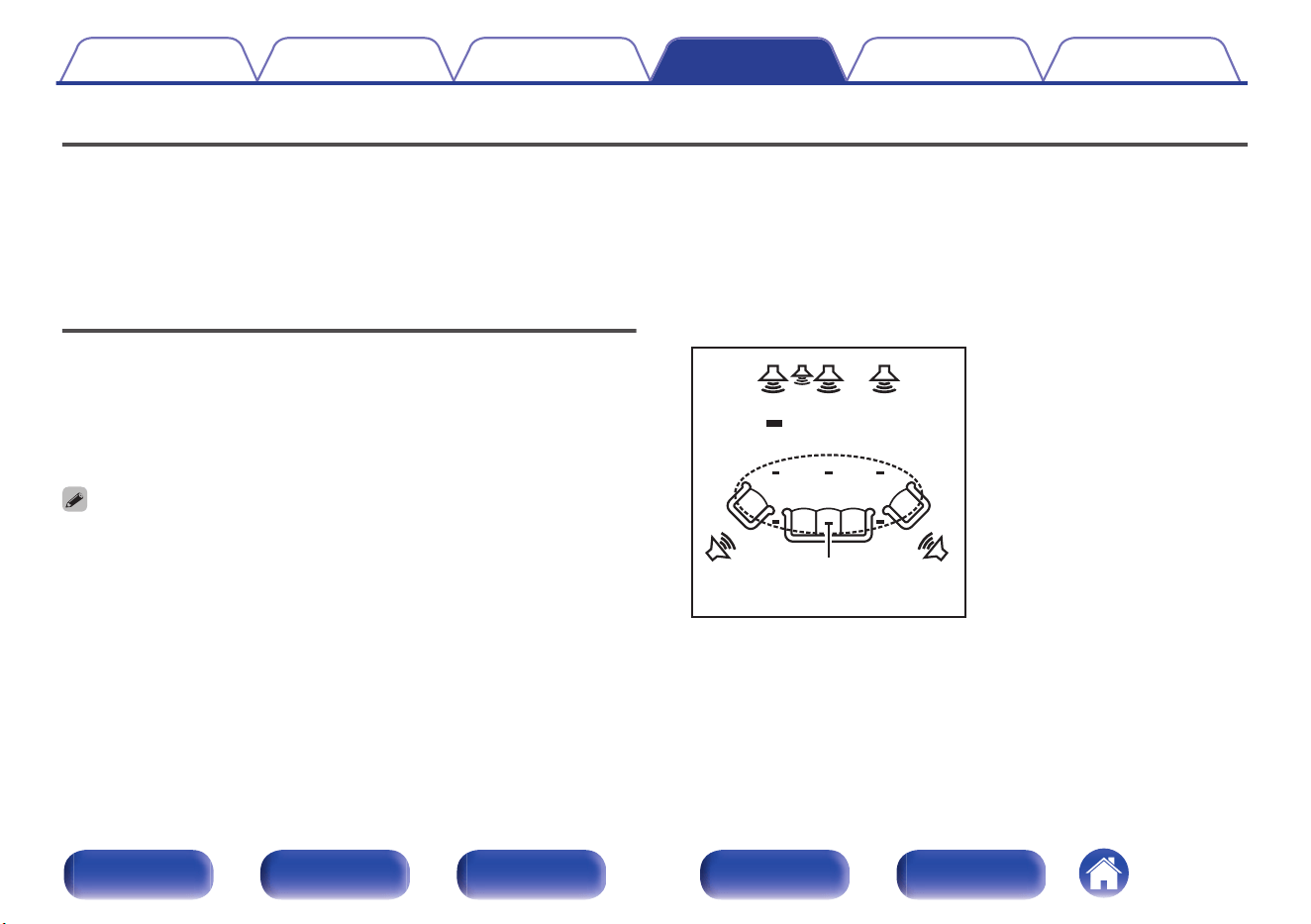
Speakers
The acoustic characteristics of the connected speakers and listening room are measured and the optimum settings are made automatically. This is called
“Audyssey
®
Setup”.
You do not have to perform Audyssey
®
Setup when you have already performed “Speaker Calibration” in “Setup Assistant”.
To set up the speakers manually, use “Manual Setup” on the menu. (v p. 162)
Audyssey
®
Setup
To perform measurement, place the Sound calibration microphone in
multiple locations all around the listening area. For best results, we
recommend you measure in six positions, as shown in the illustration.
When measuring the second and subsequent positions, install the Sound
calibration microphone within 60 cm of the first measurement position
(main listening position).
0
If you perform Audyssey
®
Setup, Audyssey MultEQ
®
, Audyssey Dynamic EQ
®
and Audyssey Dynamic Volume
®
functions are enabled. (v p. 136)
FL SW C FR
SRSL
Surround speaker (R)
Surround speaker (L)
Subwoofer
Center speaker
Front speaker (R)
Front speaker (L)
( :Measuring positions)
FL
FR
C
SW
SL
SR
Listening position
Contents Connections Playback Settings Tips Appendix
153
Front panel Display Rear panel Remote Index
o
About the main listening position
The main listening position is the position where listeners would
normally sit or where one would normally sit alone within the listening
environment. Before starting Audyssey
®
Setup, place the Sound
calibration microphone in the main listening position.
Audyssey MultEQ
®
uses the measurements from this position to
calculate speaker distance, level, polarity, and the optimum crossover
value for the subwoofer.
NOTE
0
Make the room as quiet as possible. Background noise can disrupt the room
measurements. Close windows and turn off the power on electronic devices
(radios, air conditioners, fluorescent lights, etc.). The measurements could be
affected by the sounds emitted by such devices.
0
During the measurement process, place cell phones outside the listening room.
Cell phone signals could disrupt the measurements.
0
Do not stand between the speakers and Sound calibration microphone or allow
obstacles in the path while the measurements are being made. Also, install the
Sound calibration microphone at least 50 cm away from the wall. Failure to do so
will result in inaccurate readings.
0
During the measurement process, audible test tones will come from the speakers
and subwoofer(s), but this is part of normal operation. If there is background noise
in the room, these test signals will increase in volume.
0
Operating VOLUME d f on the remote control unit or MASTER VOLUME on the
main unit during the measurements will cancel the measurements.
0
Measurement cannot be performed when headphones are connected. Unplug the
headphones before performing Audyssey
®
Setup.
Contents Connections Playback Settings Tips Appendix
154
Front panel Display Rear panel Remote Index
Procedure for speaker settings
(Audyssey
®
Setup)
Finish
Check
Calculation & Store
Measurement
Preparation
1
Attach the Sound calibration microphone to the
supplied microphone stand or own tripod and install it
at the main listening position.
When installing the Sound calibration microphone, point the tip of
the microphone toward the ceiling and adjust the height to match the
height of the ears of a listener in a seated position.
2
If using a subwoofer capable of the following
adjustments, set up the subwoofer as shown below.
n
When using a subwoofer with a direct mode
Set the direct mode to “On” and disable the volume adjustment
and crossover frequency setting.
n
When using a subwoofer without a direct mode
Make the following settings:
0
Volume : 10 o’clock position
0
Crossover frequency : Maximum/Highest Frequency
0
Low pass filter : Off
0
Standby mode : Off
Contents Connections Playback Settings Tips Appendix
155
Front panel Display Rear panel Remote Index
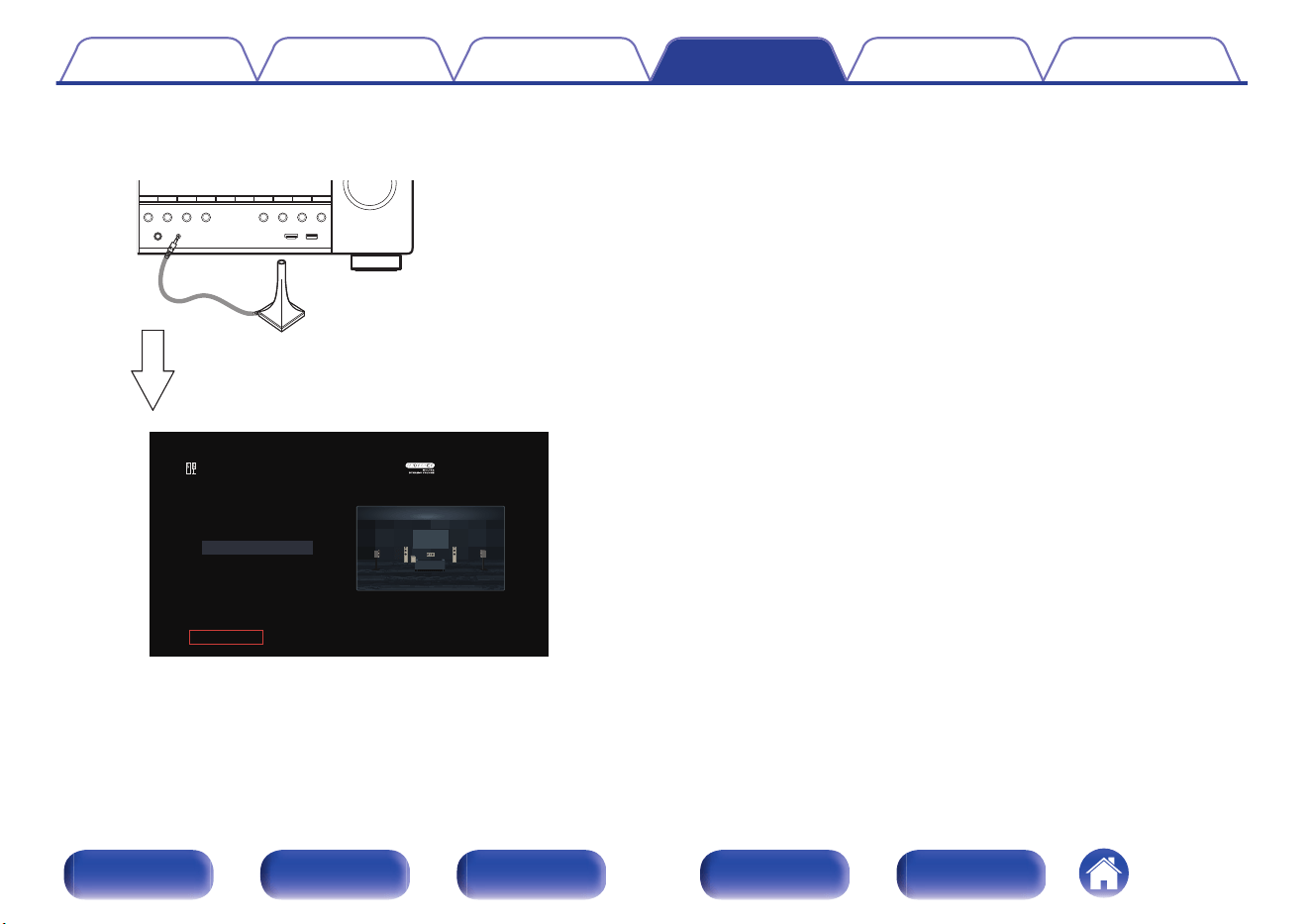
3
Connect the Sound calibration microphone to the
SETUP MIC jack of this unit.
When the Sound calibration microphone is
connected, the following screen is displayed.
Speaker Layout
Start
Audyssey Setup
Your AVR can automatically measure the acoustics of your
room then optimize your speakers using the included
microphone and microphone stand.
Set the following items if necessary.
4
Select “Start”, then press ENTER.
Audyssey
®
Setup can also make the following settings.
0
Speaker Layout
Set the Speaker Layout to suit your speaker environment.
5
Follow the instructions on the screen display and press
“Next” to proceed further.
Contents Connections Playback Settings Tips Appendix
156
Front panel Display Rear panel Remote Index
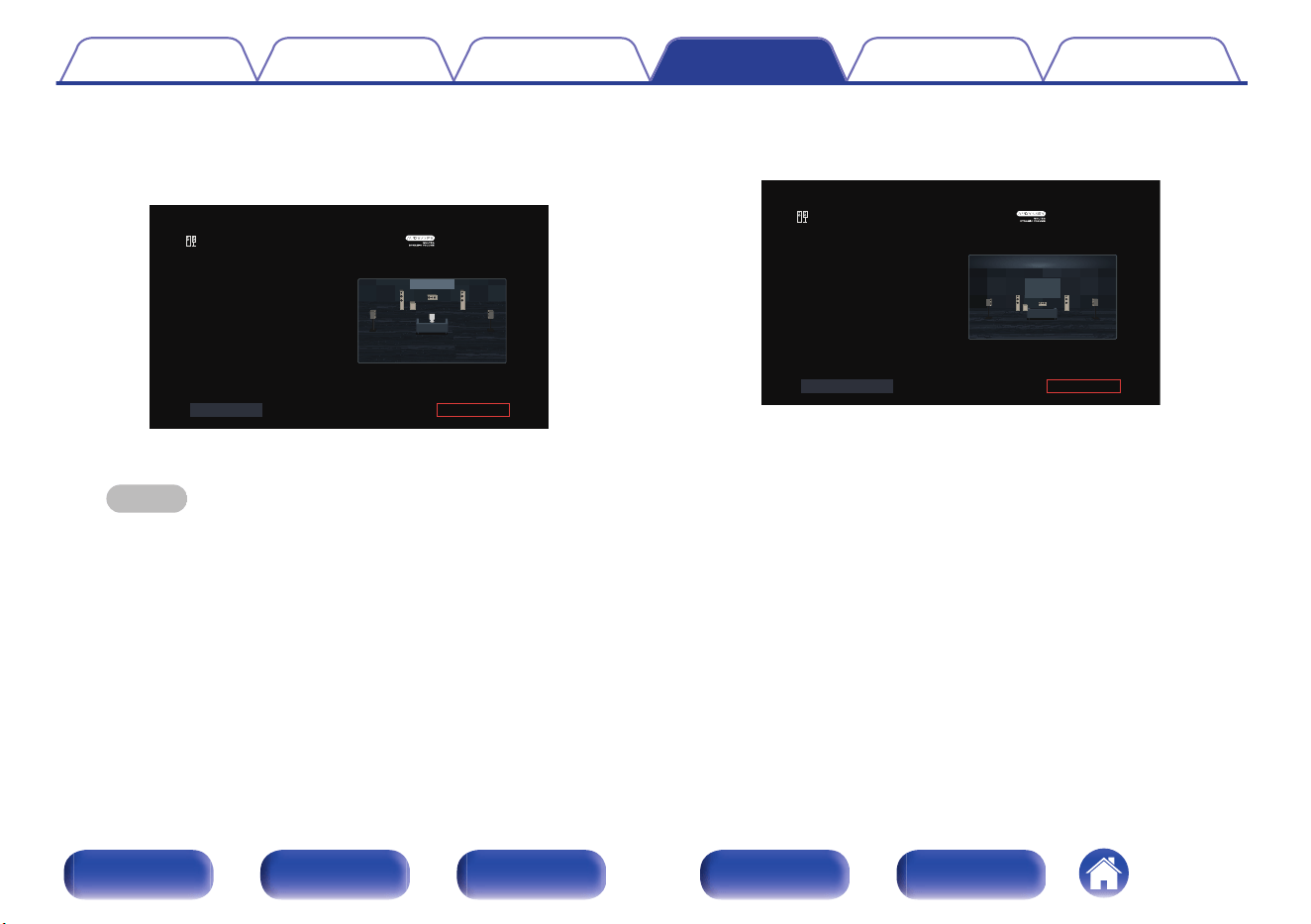
6
When the following screen is displayed, select “Begin
Test” and then press ENTER.
Start the measurement of the first position.
1
Audyssey Setup
Select "Begin Test" to start the calibration.
NOTE: You will hear a series of loud chirps starting and
stopping during the tests.
Do not stand or place any objects between the speakers
and microphone while the measurements are being
made.
Back
Begin Test
0
Measurement requires several minutes.
NOTE
0
If “ERROR” or “CAUTION” is displayed on TV screen:
0
Go to “Error messages” (v p. 160). Check any related items, and
perform the necessary procedures.
7
When the detected speaker is displayed, select “Next”
and then press ENTER.
Audyssey Setup
Speaker Detection
Front Yes
Yes
Yes
Yes
Center
Subwoofer
Surround
Repeat Last Test Next
Contents Connections Playback Settings Tips Appendix
157
Front panel Display Rear panel Remote Index
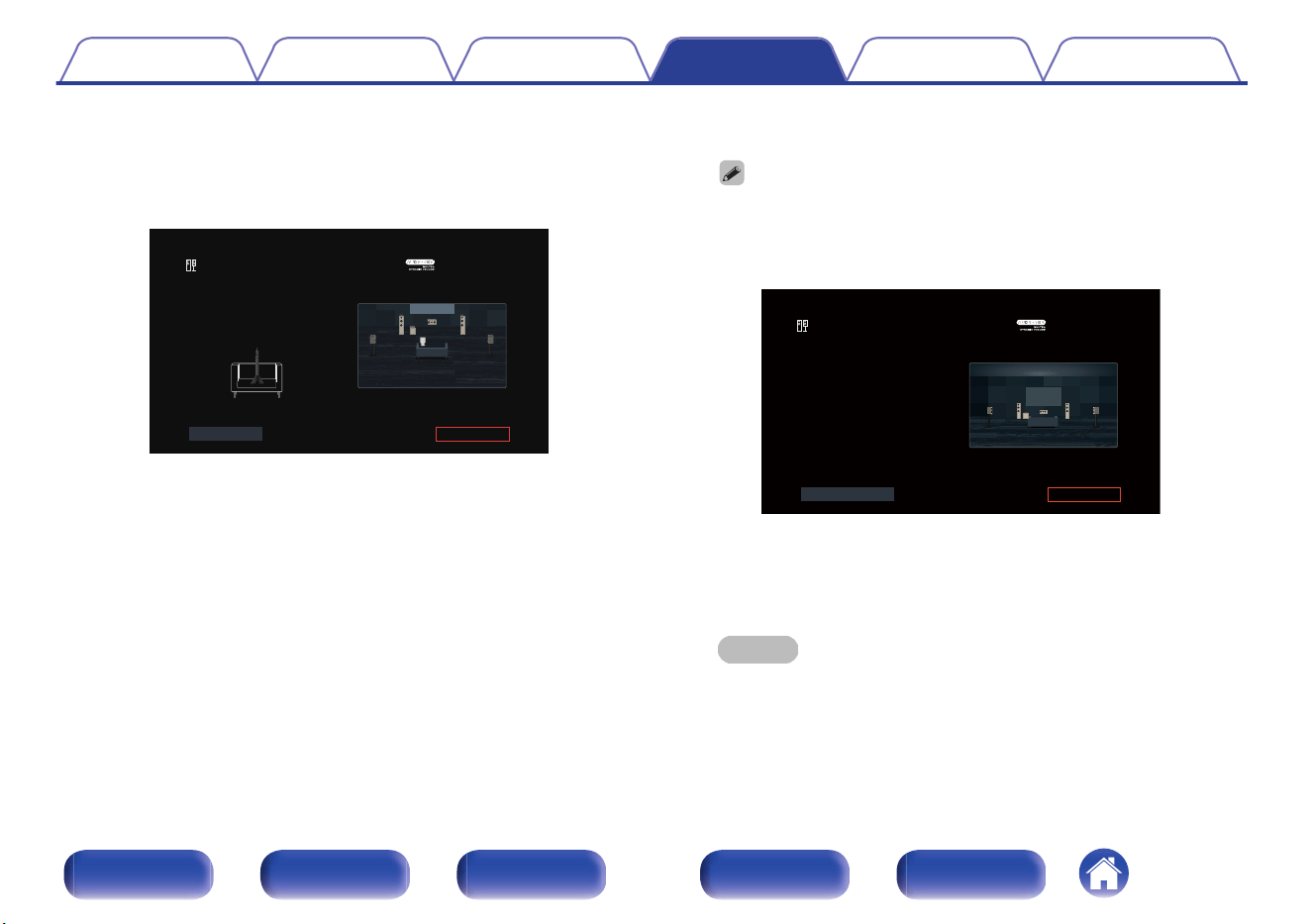
8
Move the Sound calibration microphone to position 2,
select “Continue”, then press ENTER.
The measurement of the second position starts.
Measurements can be made in up to six positions.
2
Audyssey Setup
•••••••••• Ear Height
Back
Place the microphone at the ear level of the listener seated
at the 2nd listening position, which should be no more
than 60 cm away from the 1st listening position, then
select "Continue ...
Continue
n
Stopping Audyssey
®
Setup
A
Press BACK to display the popup screen.
B
Press cursor Left to select “Yes”, then press ENTER.
9
Repeat step 8, measuring positions 3 to 6.
0
To skip measuring the fourth and subsequent listening position, press
cursor Left to select “Complete” and press ENTER to proceed to step 11.
10
Select “Continue”, then press ENTER.
Audyssey Setup
Repeat Last Test
Continue
Measurements complete.
Select "Continue" to analyze the data...
Start the analysis and storage of the measurement results.
0
Analysis takes several minutes to complete.
The more speakers and measurement positions that there are,
the more time it takes to perform the analysis.
NOTE
0
When the measurement results are being saved, make sure the power is
not turned off.
Contents Connections Playback Settings Tips Appendix
158
Front panel Display Rear panel Remote Index
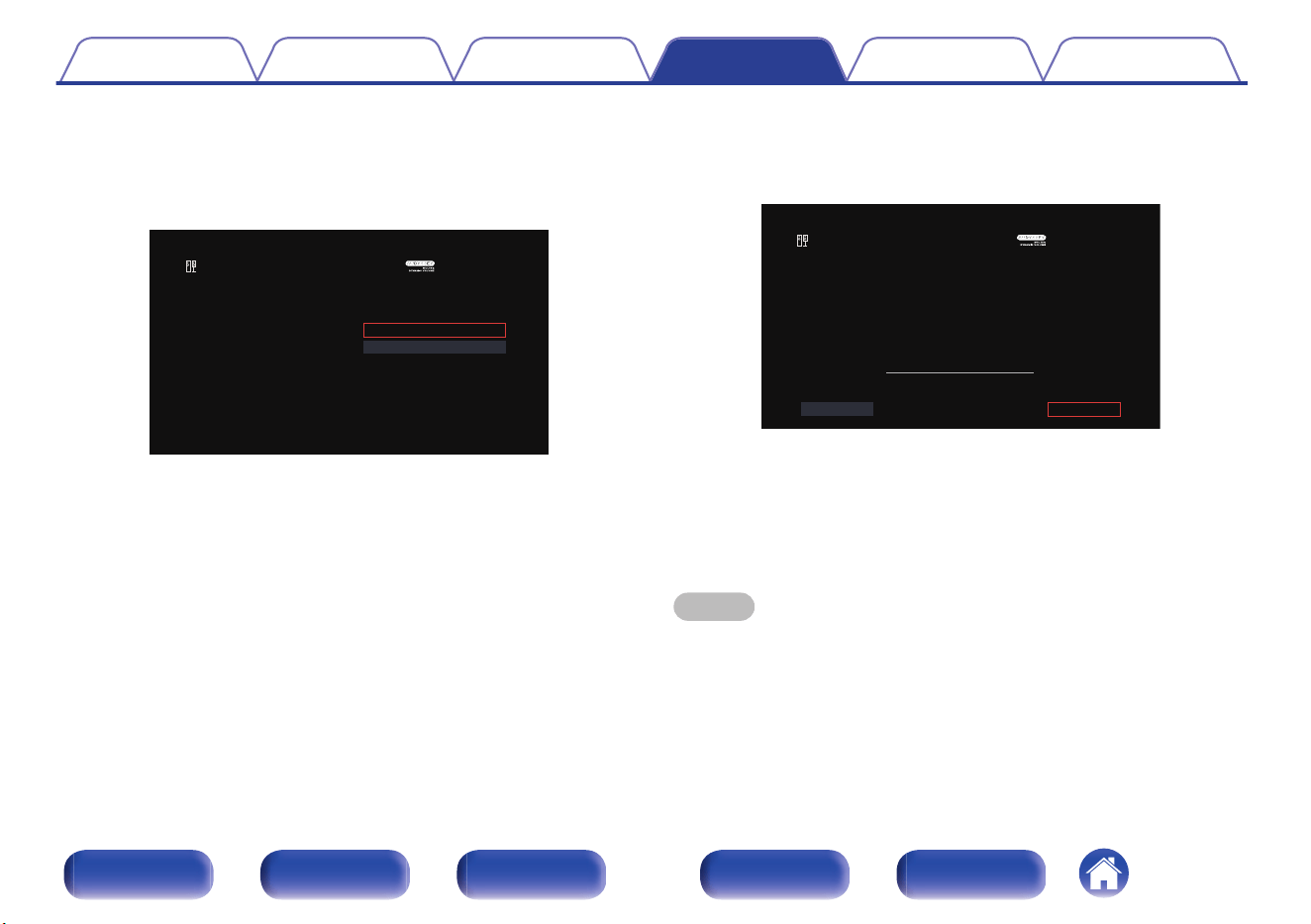
11
Perform the settings for Audyssey Dynamic EQ
®
and
Audyssey Dynamic Volume
®
.
The following screen is displayed during the analysis. Configure the
settings as preferred.
Audyssey Setup
Audyssey Dynamic EQ maintains bass, clarity and
surround sound at low volumes letting you enjoy late-night
movies and television. Turn on Dynamic EQ?
No
Ye s
0
Dynamic EQ corrects the frequency response in consideration of
the audio characteristics of the room and human hearing ability so
that sound can be heard even at low volume.
This is recommended when using the unit with the volume turned
down, e.g. when enjoying a movie or TV program in the middle of
the night.
0
Dynamic Volume adjusts the output volume to the optimal level
while constantly monitoring the level of the audio input to the unit.
Optimal volume control is performed automatically without any
loss in the dynamism and clarity of the sound when, for example,
the volume suddenly increases for commercials shown during
television programs.
12
When the analysis and storage ends, unplug the Sound
calibration microphone from the SETUP MIC jack on the
main unit and then press “Next”.
100%
Audyssey Setup
Back
Next
Now Analyzing and correcting your room data.
Please disconnect the microphone from your AVR.
Applying room corrections.
13
Select “Details” and press ENTER to verify the
measurement results.
0
Subwoofers may measure a greater reported distance than the
actual distance due to added electrical delay common in
subwoofers.
NOTE
0
Do not enable new speakers in speaker configuration menu after Audyssey
®
Setup. If it is changed, run Audyssey
®
Setup again in order to configure the
optimum equalizer settings.
Contents Connections Playback Settings Tips Appendix
159
Front panel Display Rear panel Remote Index
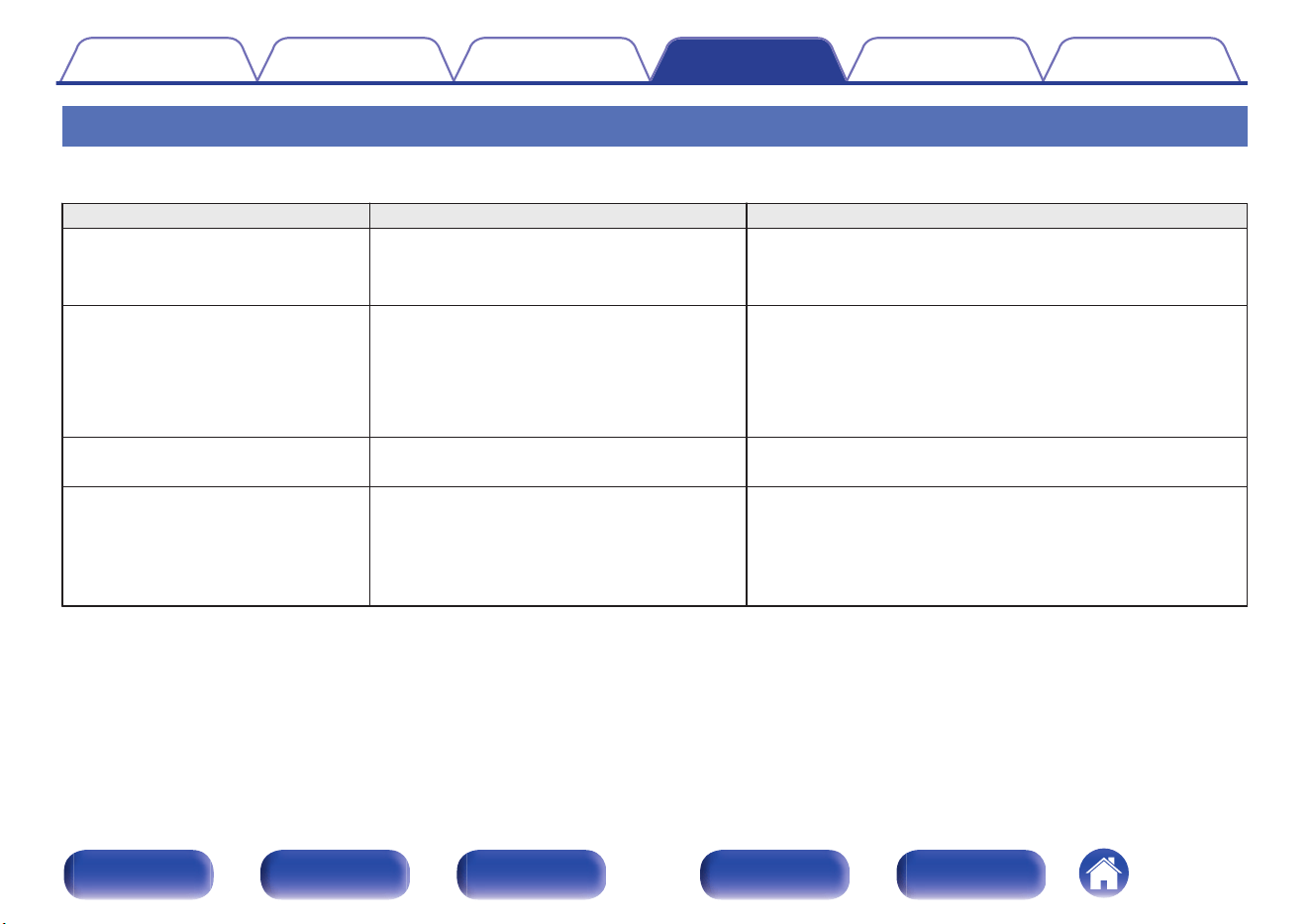
Error messages
An error message is displayed if Audyssey
®
Setup could not be completed due to speaker placement, the measurement environment, etc. If an error
message is displayed, check the relevant items and perform the necessary measures. Be sure to turn off the power before checking speaker connections.
Examples Error details Measures
No speakers found.
0
Sound calibration microphone is not
detected.
0
Connect the included Sound calibration microphone to the
SETUP MIC jack of this unit.
0
Not all speakers could be detected.
0
Check the speaker connections.
Ambient noise is too high or level is too
low
0
There is too much noise in the room.
0
Either turn off any device generating noise or move it away.
0
Perform again when the surroundings are quieter.
0
Speaker or subwoofer sound is too low.
0
Check the speaker installation and the direction in which the
speakers are facing.
0
Adjust the subwoofer’s volume.
Front R : None
0
The displayed speaker could not be
detected.
0
Check the connections of the displayed speaker.
Front R : Phase
0
The displayed speaker is connected with the
polarity reversed.
0
Check the polarity of the displayed speaker.
0
For some speakers, this error message may be displayed
even if the speaker is properly connected. If you are sure the
connection is correct, press cursor Right to select “Ignore”,
then press ENTER.
Contents Connections Playback Settings Tips Appendix
160
Front panel Display Rear panel Remote Index
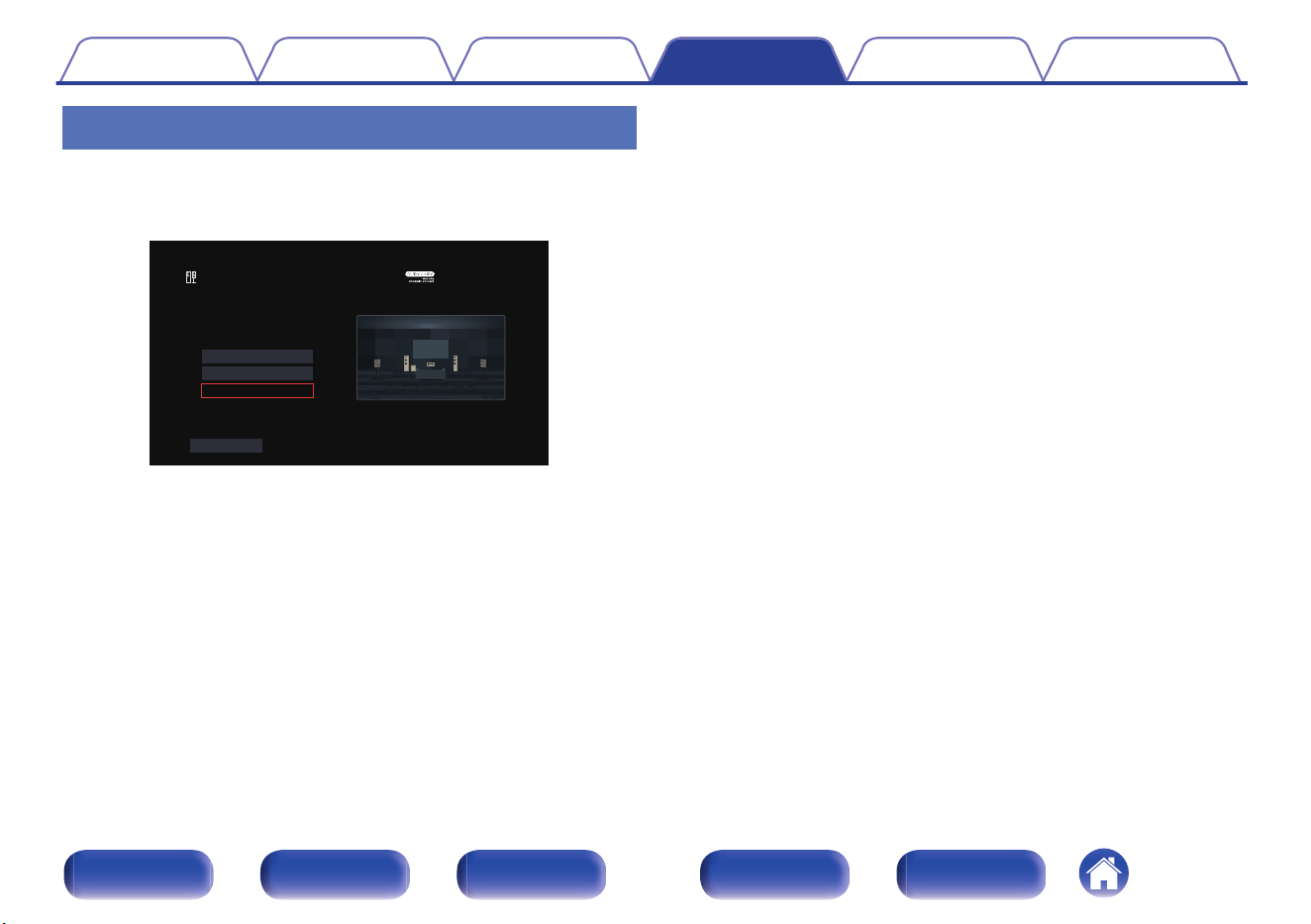
Retrieving Audyssey
®
Setup settings
If you set “Restore...” to “Restore”, you can return to Audyssey
®
Setup
measurement result (value calculated at the start by MultEQ
®
) even when
you have changed each setting manually.
Start
Audyssey Setup
Your AVR can automatically measure the acoustics of your
room then optimize your speakers using the included
microphone and microphone stand.
Set the following items if necessary.
Check Results
Restore...
Speaker Layout
Contents Connections Playback Settings Tips Appendix
161
Front panel Display Rear panel Remote Index
Manual Setup
Perform when setting the speakers manually or when changing settings
made in Audyssey
®
Setup.
0
If you enable new speakers in the Speaker Layout menu after
performing Audyssey
®
Setup, you will no longer be able to select
Audyssey MultEQ
®
, Audyssey Dynamic EQ
®
or Audyssey Dynamic
Volume
®
. (v p. 136)
0
Changing the following settings:
Distances / Levels / Crossovers settings will not disable Audyssey
®
or
require running Audyssey
®
Setup again.
0
“Manual Setup” can be used without changing the settings. Please set if
necessary.
Speaker Layout
Select a suitable speaker layout for your speaker system.
o
Front/Center/Surround
Set the correct audio output terminals for your speaker system.
n
Configuration
Select whether or not each speaker exists.
[Front/Center/Surround]
Yes
(Default):
The selected speakers will be used.
No: The selected speakers will not be used.
0
“Front” is fixed as “Yes” as it is required for playback.
Contents Connections Playback Settings Tips Appendix
162
Front panel Display Rear panel Remote Index
o
Subwoofer
Set the presence of a subwoofer.
Yes
(Default):
Use a subwoofer.
No:
Select when a subwoofer is not
connected.
o
View Terminal Config.
This shows how to connect the speaker terminals for your “Speaker
Layout” setting on the menu screen.
Distances
Set distance from listening position to speakers.
Measure beforehand the distance from the listening position to each
speaker.
o
Unit
Set the unit of distance.
Meters (Default)
Feet
o
Step
Set the minimum variable width of the distance.
0.1 m / 0.01 m (Default: 0.1 m)
1 ft / 0.1 ft
Contents Connections Playback Settings Tips Appendix
163
Front panel Display Rear panel Remote Index
o
Set the distance
0.00 m – 18.00 m / 0.0 ft – 59.1 ft
0
The speakers that can be selected differ depending on the “Speaker Layout”
settings. (v p. 162)
0
Default settings:
Front L / Front R / Center / Subwoofer: 3.60 m (11.8 ft)
Speakers other than the above: 3.00 m (9.8 ft)
0
Set the difference in the distance between the speakers to less than 6.00 m
(19.7 ft).
o
Set Defaults
The “Distances” settings are returned to the default settings.
Levels
Set the volume of the test tone to be the same at the listening position
when it is output from each speaker.
o
Test Tone Start
A test tone is output from the selected speaker.
While listening to the test tone, adjust the volume output from the
selected speaker.
–12.0 dB – +12.0 dB (Default : 0.0 dB)
0
The set “Levels” are reflected in all sound modes.
0
If you wish to adjust the channel level for each input source, carry out the
settings in “Channel Level Adjust”. (v p. 97)
0
When headphones are connected to the PHONES connector on this unit, you
cannot set “Levels”.
o
Set Defaults
The “Levels” settings are returned to the default settings.
Contents Connections Playback Settings Tips Appendix
164
Front panel Display Rear panel Remote Index
Crossovers
Set in accordance with the lower limit frequency of the base frequencies
that can be played back through each speaker. See the speaker manual
for information concerning speaker crossover frequency.
o
Set the crossover frequency
Full Range:
Select “Full Range” to set the speaker to
play full-range audio.
40 Hz / 60 Hz / 80 Hz /
90 Hz / 100 Hz / 110 Hz /
120 Hz / 150 Hz / 180 Hz /
200 Hz / 250 Hz
(Default: Front=Full Range,
Other than Front=80 Hz)
Selects the crossover point to send the
low frequency sound to the subwoofer.
0
The default crossover frequency is “80 Hz”, which will work best with the
widest variety of speakers. We recommend setting to a higher frequency that
the crossover frequency when small speakers are used. For example, set to
“250 Hz” when the frequency range of the speakers is 250 Hz – 20 kHz.
0
Sound below the crossover frequency is cut off from the output of the
speakers. This cut off bass frequency is output from the subwoofer or front
speakers.
0
The “Front” is automatically set to “Full Range” when “Subwoofer” is set to
“No” in the “Speaker Layout”.
0
Each speaker can only be set to “Full Range” if the Front is set to “Full Range”.
Advanced
The following advanced speaker settings are available.
o
Low Frequency Effects
0
“Subwoofer Output” (v p. 166)
0
“Low Pass Filter” (v p. 167)
Contents Connections Playback Settings Tips Appendix
165
Front panel Display Rear panel Remote Index
Subwoofer Output
Selects which low frequency signals are sent to the subwoofer outputs.
o
Subwoofer Output
LFE
(Default):
The subwoofer outputs receive the LFE
track, plus any redirected bass from
speakers with crossovers set. Use this
setting as the default for home theater
bass management in a typical room.
LFE + Main:
The subwoofer outputs receive the LFE
track, plus redirected bass, and a copy of
the low frequency signals from all full-
range speakers.
o
Bass Extraction LPF
Selects the low-pass filter point for the full-range speaker to copy the
low frequency signal to subwoofer.
40 Hz / 60 Hz / 80 Hz / 90 Hz / 100 Hz / 110 Hz / 120 Hz / 150 Hz /
200 Hz / 250 Hz (Default: 80 Hz)
0
“Subwoofer Output” can be set when “Speaker Layout” - “Subwoofer” in the
menu is set to other than “No”. (v p. 163)
0
Play music or a movie source and select the mode offering the strongest bass.
0
If “Crossovers” - “Front” and “Center” are set to “Full Range”, and “Subwoofer
Output” is set to “LFE”, no sound may be output from the subwoofers,
depending on the input signal or selected sound mode. (v p. 165)
Select “LFE + Main” if you want the bass signals to always be produced from
the subwoofer.
0
“Bass Extraction LPF” can only be set for channels with “Crossovers” set to
“Full Range”.
Contents Connections Playback Settings Tips Appendix
166
Front panel Display Rear panel Remote Index
Low Pass Filter
Selects the crossover point for the LFE channel. Set this when you want to
change the playback LFE signal of the subwoofer.
o
Low Pass Filter
80 Hz / 90 Hz / 100 Hz / 110 Hz / 120 Hz / 150 Hz / 200 Hz /
250 Hz (Default: 120 Hz)
Contents Connections Playback Settings Tips Appendix
167
Front panel Display Rear panel Remote Index
Network
To use this unit by connecting it to a home network (LAN), you must configure network settings.
If you set up your home network (LAN) via DHCP, set “DHCP” to “On”. (Use the default setting.) This allows this unit to use your home network (LAN).
When assigning an IP address to each device manually, you need to assign an IP address to this unit using the “IP Address” settings, and enter
information about your home network (LAN) such as the gateway address and subnet mask, etc.
Information
Display network information.
Friendly Name / Connection / SSID / DHCP / IP Address /
MAC Address (Ethernet) / MAC Address (Wi-Fi) /
Wi-Fi signal strength
Connection
Choose whether to connect the home network to a wireless LAN or a
wired LAN.
When connecting to the network using wired LAN, select “Wired
(Ethernet)” after connecting a LAN cable.
When connecting to the network using wireless LAN, select “Wireless (Wi-
Fi)” and configure the “Wi-Fi Setup”. (v p. 169)
o
Connect Using
Select the method for connecting to the home network (LAN).
Wired (Ethernet): Use a LAN cable to connect to a network.
Wireless (Wi-Fi)
(Default):
Use the wireless LAN (Wi-Fi) function to
connect to a network.
0
“Wired (Ethernet)” is set when “Wi-Fi” is set to “Disabled”. (v p. 175)
Contents Connections Playback Settings Tips Appendix
168
Front panel Display Rear panel Remote Index
Wi-Fi Setup
Connect to a wireless LAN (Wi-Fi) router.
The router can be connected in the following ways. Select the connection
method to suit your home environment.
o
Scan Networks
Select the network you wish to connect to from the list of possible
networks shown on the TV screen.
1. Select the network you wish to connect to from the list of wireless
networks.
Select “Rescan” if the network cannot be found.
2. Enter your password and select “OK”.
o
Use iOS Device
Use your iOS device (iPhone/iPod/iPad) to connect to the network. By
connecting your iOS device to this unit using Wi-Fi, the unit can be
automatically connected to the same network as your device.
1. Select “Use iOS Device” on the TV screen.
2. Check that your iOS device is connected to the wireless LAN (Wi-
Fi) router and select “Denon AVR-S670H” from “SET UP NEW
AIRPLAY SPEAKER...” at the bottom of the Wi-Fi configuration
screen of your iOS device.
3. Tap “Next” on the screen of the iOS device.
0
The iOS device firmware version needs to support iOS 10.0.2 or later.
Contents Connections Playback Settings Tips Appendix
169
Front panel Display Rear panel Remote Index
o
WPS Router
Use a WPS-compatible router to connect using the push button
method.
1. Select “Push Button” on the TV screen.
2. Switch to the WPS mode by pressing the WPS button of the router
you wish to connect to.
0
The time for pressing the button varies depending on the router.
3. Select “Connect” on the TV screen within 2 minutes.
o
Manual
Enter the name (SSID) and password of the network you wish to
connect to.
1. Set the following items.
SSID:
Input the name of the wireless network
(SSID).
Security:
Select the encryption method according
to the encryption setting of the access
point you are using.
Password: Input the password.
2. Select “Connect” at the end of the setting.
0
The Default key of this unit is fixed at “1”. Set Default key of the router to “1” to use.
Contents Connections Playback Settings Tips Appendix
170
Front panel Display Rear panel Remote Index
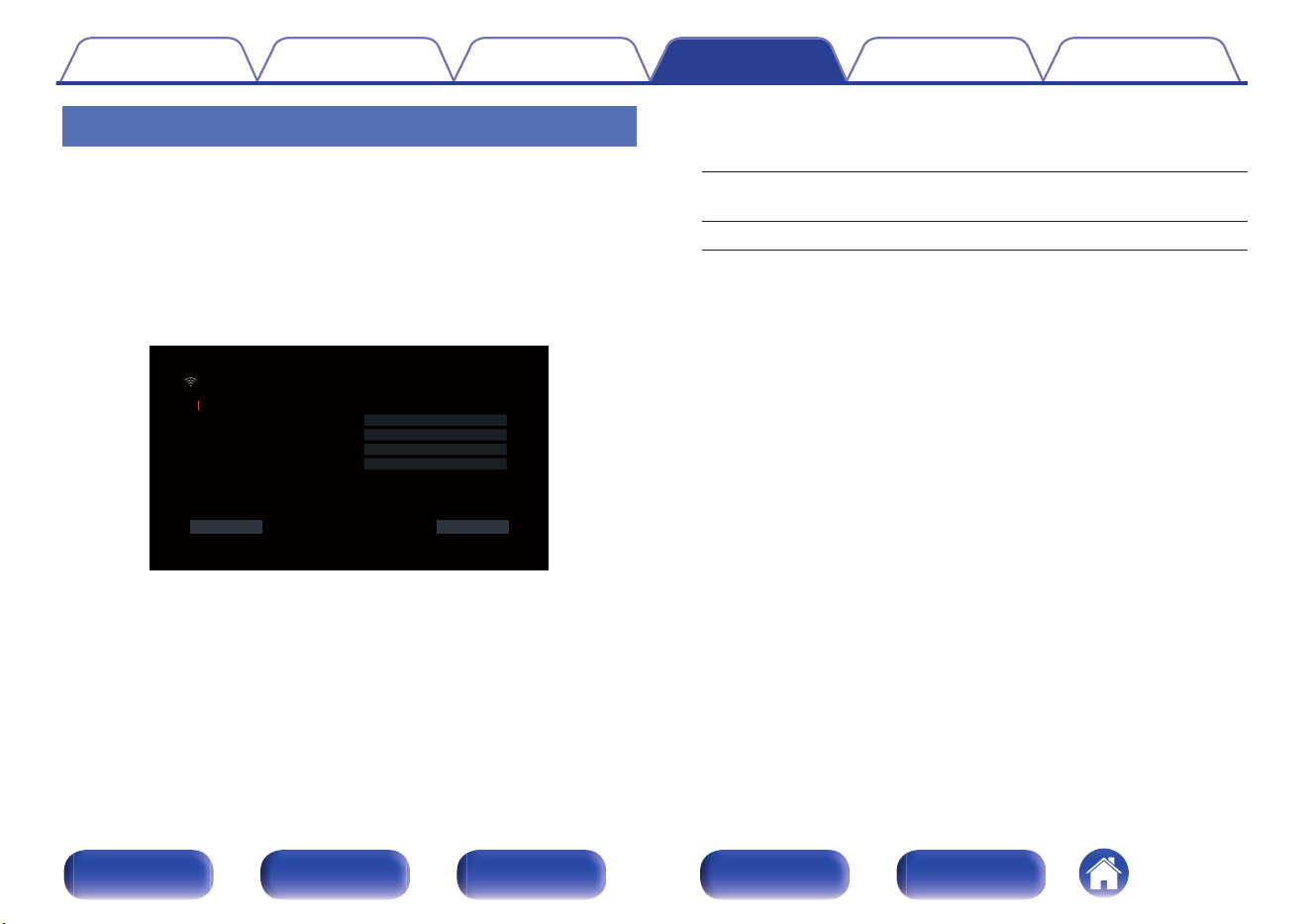
Settings
Configure the IP address.
0
If you are using a broadband router (DHCP function), the information
required for network connection such as the IP address will be
automatically configured since the DHCP function is set to “On” in the
default settings of this unit.
0
Set up the IP Address, Subnet Mask, Default Gateway and DNS server
information only when assigning a fixed IP address or when connecting
to a network without DHCP function.
000.000.000.000
000.000.000.000
000.000.000.000
000.000.000.000
Network/Settings
Configures the network settings automatically or manually.
DHCP
IP Address
Subnet Mask
Default Gateway
DNS
Off
Cancel Save
o
DHCP
Selects how to connect to the network.
On
(Default):
Configure the network settings
automatically from your router.
Off: Configure the network settings manually.
o
IP Address
Set the IP address within the ranges shown below.
0
The Network Audio function cannot be used if other IP addresses
are set.
CLASS A: 10.0.0.1 - 10.255.255.254
CLASS B: 172.16.0.1 - 172.31.255.254
CLASS C: 192.168.0.1 - 192.168.255.254
o
Subnet Mask
When connecting an xDSL modem or connector adapter directly to
this unit, input the subnet mask indicated in the documentation
supplied by your provider. Normally input “255.255.255.0”.
Contents Connections Playback Settings Tips Appendix
171
Front panel Display Rear panel Remote Index
o
Default Gateway
When connected to a gateway (router), input its IP address.
o
DNS
Enter the DNS address indicated in the documentation supplied by
your provider.
0
If you cannot connect to the Internet, recheck the connections and settings.
(v p. 46)
0
If you do not understand about Internet connection, contact your ISP (Internet
Service Provider) or the store from which you purchased your computer.
Network Control
Enables network communication in standby power mode.
Off In Standby
(Default):
Suspend network function during standby.
Always On:
Network is on during standby. Main unit
operable with a network compatible
controller.
0
When using the web control function, Denon AVR Remote App or HEOS App, use
with the “Network Control” setting set to “Always On”.
NOTE
0
When “Network Control” is set to “Always On”, the unit consumes more standby
power.
Contents Connections Playback Settings Tips Appendix
172
Front panel Display Rear panel Remote Index
Friendly Name
The Friendly Name is the name of this unit displayed on the network. You
can change the Friendly Name according to your preferences.
o
Friendly Name
Selects Friendly Name from the list.
When you select “Other”, you can change the Friendly Name
according to your preferences.
Home Theater /Living Room / Family Room / Guest Room /
Kitchen / Dining Room / Master Bedroom / Bedroom / Den /
Office / Other
0
Up to 30 characters can be input.
0
The default Friendly Name on first use is “Denon AVR-S670H”.
o
Set Defaults
Restores Friendly Name, which you had changed, to the default
setting.
Diagnostics
Used to check the network connection.
o
Physical Connection
Checks the physical LAN port connection.
OK
Error:
The LAN cable is not connected. Check
the connection.
0
When connected using a wireless LAN, “Connection Wireless (Wi-Fi)” will
be displayed.
o
Router Access
Checks the connection from this unit to the router.
OK
Error:
Failed to communicate with the router.
Check the router settings.
Contents Connections Playback Settings Tips Appendix
173
Front panel Display Rear panel Remote Index
o
Internet Access
Checks whether this unit has access to the Internet (WAN).
OK
Error:
Failed to connect to the Internet. Check
the Internet connection environment or
router settings.
AirPlay
Settings for Apple AirPlay.
o
AirPlay Name
Displays the name which identifies this unit on Apple devices.
0
If you registered this unit to the Apple Home app, use the app to change the
name.
o
AirPlay
Enables/disables the Apple AirPlay.
On
(Default):
Enables Apple AirPlay.
Off: Disables Apple AirPlay.
Contents Connections Playback Settings Tips Appendix
174
Front panel Display Rear panel Remote Index
Spotify Connect
Toggles access to Spotify Connect.
On
(Default):
Enables Spotify Connect.
Off: Disables Spotify Connect.
Wi-Fi and Bluetooth
Enables/disables the Wi-Fi and Bluetooth radios.
o
Wi-Fi
The Wi-Fi function can be stopped to prevent noise that affects the
sound quality. Using a wired LAN to connect this unit to the network
enables playback with a high sound quality.
Enabled
(Default):
Enables the Wi-Fi function.
Disabled: Disables the Wi-Fi function.
o
Bluetooth
Stopping Bluetooth receiver and transmitter functions reduces a
source of noise that affects sound quality, enabling higher sound
quality playback.
Enabled
(Default):
Enables the Bluetooth function.
Disabled: Disables the Bluetooth function.
Contents Connections Playback Settings Tips Appendix
175
Front panel Display Rear panel Remote Index
HEOS
HEOS Account is needed in order to use HEOS Favorites.
The menu displayed differs depending on the status of the HEOS Account.
You have not signed in
A QR code is displayed on the TV screen.
Scan the QR code with your mobile device and download the HEOS App.
After creating or signing in to your HEOS Account in the HEOS App, you
can save and call up your favorite streaming music services from this
unit’s screen. (v p. 95)
See “Getting the HEOS App” (v p. 81) for details about the HEOS App.
0
This unit’s HEOS Account setting information is synced with the HEOS App.
Change settings and sign out of your account through the HEOS App.
You have already signed in
o
Signed in as
The currently signed in HEOS Account is displayed.
0
This unit automatically syncs when you change your account settings or sign out
through the HEOS App. To switch HEOS accounts, play back music from an
HEOS App signed in to the account you wish to sync to this unit. The “HEOS
Account” switches automatically.
Contents Connections Playback Settings Tips Appendix
176
Front panel Display Rear panel Remote Index
General
Make various other settings.
Language
Set the language for display the menu on the TV screen.
English / Deutsch / Français / Italiano / Español / Nederlands /
Svenska / Pусский / Polski (Default : English)
0
“Language” can also be set up by the following operation. However, the menu
screen is not displayed. Watch the display while configuring the settings.
1. Press and hold the main unit’s TUNE + and MODE at the same time for at least
3 seconds.
“4K/8K <Enhanced>” appears on the display.
2. Press DIMMER on the main unit once.
“Lang.:<ENGLISH >” appears on the display.
3. Use the main unit’s TUNE + or TUNE – and set the language.
4. Press the main unit’s STATUS to complete the setting.
Owner's Manual
Shows URL and QR code to access the online Owner's Manual from your
mobile device.
ECO
Configure the ECO Mode and auto standby mode settings.
o
ECO Mode
This mode can reduce the power consumption and heat generation of
this unit when power on.
This is done by reducing the power supply line to the power amplifier,
in turn the maximum power output.
Contents Connections Playback Settings Tips Appendix
177
Front panel Display Rear panel Remote Index
On:
Power savings are always active,
regardless of volume or input signal.
Auto
(Default):
Gives you the best balance between
power savings and maximum power
output:
For low volume levels, the power savings
are active. If you increase the volume
level, the power savings are switched off
automatically, so you can enjoy
maximum output power without
distortion.
If the volume is set to a high level but no
input signal is detected for more than 2
minutes, this unit will enable power
savings. When an input signal is detected
again or the input source is changed, this
unit will automatically turn off power
savings again at high volume levels.
Off:
No power savings.
0
When the unit is switching between the different power saving states in “ECO
Mode: Auto”, you may notice a click noise from the inside of this unit, this is
normal.
0
If content is paused for more than 2 minutes and playback is resumed from the
same source at these high volume levels, there may be short delay before
maximum power is restored.
0
“ECO Mode” cannot be set when speaker impedance is set to 4 Ω/ohms.
(v p. 29)
Contents Connections Playback Settings Tips Appendix
178
Front panel Display Rear panel Remote Index
o
Power On Default
Set the mode to ECO when the power is on.
Last
(Default):
The ECO Mode will be set to the previous
setting before the power was switched
off.
On:
When power is turned on, the mode will
always be switched to the ECO Mode in
“On”.
Auto:
When power is turned on, the mode will
always be switched to the ECO Mode in
“Auto”.
Off:
When power is turned on, the mode will
always be switched to the ECO Mode in
“Off”.
o
On Screen Display
Display the power consumption of this unit using a meter on the TV
screen.
Always On:
Always display the meter on the TV
screen.
Auto
(Default):
Display the meter when changing the
mode or volume.
Off: Do not display the meter.
Contents Connections Playback Settings Tips Appendix
179
Front panel Display Rear panel Remote Index
o
Auto Standby
Set so the unit power automatically switches to standby.
Sets the time for switching to auto standby when there are no audio or
video signals input into this unit.
Before the unit enters standby mode, “Auto Standby” is displayed on
the unit display and the menu screen.
60 min:
The unit goes into standby after 60 minutes.
30 min:
The unit goes into standby after 30 minutes.
15 min
(Default):
The unit goes into standby after 15 minutes.
Off:
The unit does not go into standby
automatically.
Contents Connections Playback Settings Tips Appendix
180
Front panel Display Rear panel Remote Index
Bluetooth Transmitter
Sets this unit's Bluetooth transmitter.
Set to use Bluetooth headphones to listen to audio playing.
o
Transmitter
Enables or disables the Bluetooth transmitter.
On: Enables the Bluetooth transmitter feature.
Off
(Default):
Disables the Bluetooth transmitter
feature.
o
Output Mode
Selects the audio output method.
Bluetooth + Speakers
(Default):
Audio is output to Bluetooth headphones
and speakers.
Bluetooth Only:
Audio is output to Bluetooth headphones
only.
o
Connected device
Displays the Bluetooth device connected to this unit.
o
Device List
0
Available devices are displayed in the list once you start pairing
mode on the Bluetooth headphones you want to connect. Select
your Bluetooth headphones from the list to pair them.
0
This unit can only pair with one Bluetooth headphone at a time.
However, up to 8 Bluetooth headphones can be registered. Switch
between registered devices from Device List in the “Bluetooth
Transmitter” setup menu.
0
To remove a saved Bluetooth device from the list, use the cursor
Up/Down buttons to select it, then press the OPTION button and
select “Forget This Device”.
0
“Output Mode” can also be set from “Bluetooth Transmitter” in the option menu.
0
A2DP profile-compatible Bluetooth speakers can be connected following the same
steps used to connect Bluetooth headphones.
NOTE
0
Bluetooth transmitter and Bluetooth receiver function cannot be used at the same
time. Settings in this menu are not available when listening to music on a Bluetooth
device.
0
Even when “Transmitter” is set to “On”, press Bluetooth on the remote control to
select the “Bluetooth” source and enable the Bluetooth receiver function.
To listen to music stored on Bluetooth devices such as smartphones on this unit,
press Bluetooth on the remote control to switch the input source to Bluetooth, then
reconnect the Bluetooth device.
0
Menu settings for Bluetooth Transmitter are not available when this unit is grouped
within the HEOS App.
Contents Connections Playback Settings Tips Appendix
181
Front panel Display Rear panel Remote Index
Quick Select
Sets the “Quick Select” parameters and display name.
o
Name
Change the Name that appears on the TV screen to one you prefer.
0
Up to 16 characters can be input.
o
Input Source/Master Volume/Sound Mode/
Channel Level/Audyssey Parameters/Restorer/
Playback Content/Speaker Preset
Enabled
(Default):
The current settings are registered when
Quick Select is registered. In addition,
when Quick Select is called up, the
content of the registered settings is called
up.
Disabled:
Settings are not registered when Quick
Select is registered. In addition, when
Quick Select is called up, the content of
the registered settings is not called up.
0
“Quick Select” can be set for each Quick Select.
0
When “Input Source” is “Disabled”, Video Select information is not registered/
called up either.
Front Display
Makes settings related to the display on this unit.
o
Brightness
Adjust the display brightness of this unit.
Bright
(Default):
Normal display brightness.
Dim: Reduced display brightness.
Dark: Very low display brightness.
Off: Turns the display off.
0
You can also adjust the display by pressing DIMMER on the main unit.
Contents Connections Playback Settings Tips Appendix
182
Front panel Display Rear panel Remote Index
Firmware
Checks for the latest firmware information about updates, updates the
firmware.
o
Check for Update
Check for firmware updates.
The firmware can be updated if a firmware update has been released.
Update Now:
Execute the update process. When the
update starts, the menu screen is shut
down. During the update, the progress is
shown on the display.
Update Later: Update later.
0
This unit automatically retries updating if updating fails. If an update still
cannot be performed, an “Update Error” message appears in the display. See
“Troubleshooting” – “Update error messages” for information on update error
messages. (v p. 210)
Check the conditions according to the message and try the update again.
0
This menu cannot be selected when “Allow Update” is set to “Off”.
o
Auto-Update
Turns on Automatic Updates so that feature updates are automatically
downloaded and installed when this unit is in standby mode.
n
Auto-Update
This unit will automatically update to the newest firmware when in
standby mode.
On: Turns on Automatic Updates.
Off
(Default):
Turns off Automatic Updates.
n
Time Zone
Change the time zone.
Set the time zone that matches the area where you live.
0
This menu cannot be selected when “Allow Update” is set to “Off”.
Contents Connections Playback Settings Tips Appendix
183
Front panel Display Rear panel Remote Index
o
Allow Update
Enable or disable updates for this unit.
On
(Default):
Enables this unit to receive updates.
Off: Prevents this unit from receiving update.
0
This setting causes Incompatibilities between this unit and HEOS App.
Notes concerning use of “Update”
0
In order to use these functions, you must have the correct system
requirements and settings for an Internet connection. (v p. 46)
0
Do not turn off the power until updating is completed.
0
Approximately 1 hour is required for the updating procedure to be
completed.
0
Once updating starts, normal operations on this unit cannot be
performed until updating is completed. Furthermore, there may be
cases where backup data is reset for the parameters, etc., set on this
unit.
0
If the update fails, press and hold the X on the main unit for more than
5 seconds, or remove and re-insert the power cord. After about 1
minute, “Please wait” appears on the display and update restarts. If the
error continues, check the network environment.
Contents Connections Playback Settings Tips Appendix
184
Front panel Display Rear panel Remote Index
Information
Show information about this unit settings, input signals, etc.
o
Audio
Show the audio information.
Sound Mode: The currently set sound mode.
Input Signal: The input signal type.
Format:
The number of input signal channels
(presence of front, surround, LFE).
Sample Rate: The input signal’s sampling frequency.
Offset:
The dialogue normalization correction
value.
Flag:
This is displayed when inputting signals
including a surround back channel.
“MATRIX” is displayed with DTS-ES
Matrix input signals, “DISCRETE” with
DTS-ES Discrete signals.
o
Video
Show the HDMI input/output signals and HDMI TV information.
HDMI Signal Info.
Resolution / HDR / Color Space / Pixel Depth / ALLM / QFT / FRL
Rate
TV Info.
Interface / HDR / Resolutions / Enhanced Features / Max FRL
Rate
0
A or B may be displayed at the end of resolution. A represents uncompressed
video and B represents compressed video.
0
Refer to “About HDMI” for more information about ALLM, QFT and FRL.
(v p. 216)
o
Status
Show information about current settings.
This item shows information about settings for this unit. The
information displayed differs according to the input source.
Contents Connections Playback Settings Tips Appendix
185
Front panel Display Rear panel Remote Index
o
Firmware
Version:
Displays information for the current
firmware.
o
Notifications
Displays and sets notifications.
Also, sets whether or not to display the notification when the power is
turned on.
Notification Alerts
On
(Default):
Notification messages are displayed.
Off: Notification messages are not displayed.
0
Pressing INFO on the remote control switches the display to show information
such as the input source name, the volume, the sound mode name, the video
input/output signals, and other information. The FRL Rate is displayed when the
“4K/8K Signal Format” setting of this unit is “8K Enhanced” and the connected TV
supports FRL transmission mode.
EXT
LFE
SB
SBR
SBL
C
FR
FWR
FHR
FL
FHL
FWL
SR
SL
SW
C
FR
FL
SR
SL
40.0
SOURCE
Blu-ray
SIGNAL
Dolby Audio
-
Dolby
TrueHD
SOUND
Dolby
Audio - TrueHD
INPUT
SIGNAL
ACTIVE
SPEAKERS
40.0
AUDYSSEY
SOURCE
Blu-ray
SIGNAL
Dolby Audio
-
Dolby
TrueHD
SOUND
Dolby
Audio - TrueHD
MultEQ
: Reference
Dynamic
EQ
: On
Dynamic
Volume
: Medium
:8K24A
:HDR10
:YCbCr
4:2:2/BT.2020
:12bits
:40Gbps
=
>8K24A
=
>HDR10
=
>YCbCr
4:2:2/BT.2020
=
>12bits
=
>40Gbps
ALLM
SOURCE
Blu-ray
SIGNAL
Dolby Audio
-
Dolby
TrueHD
SOUND
Dolby
Audio - TrueHD
Resolution
HDR
Color Space
Pixel Depth
FRL Rate
Contents Connections Playback Settings Tips Appendix
186
Front panel Display Rear panel Remote Index
Usage Data
To help us improve our products and customer service, Denon collects
anonymous information about how you use this unit (such as frequently
used input sources and sound modes and speaker settings).
Denon will never provide any information we collect to third parties.
Yes:
Provide information on the operating status
of this unit.
No:
Do not provide information on the operating
status of this unit.
Save & Load
Save and restore device settings by using a USB memory device.
0
Use a USB memory device that has at least 128 MB of free space and is formatted
to FAT32. Data may not Save/Load correctly to some USB memory devices.
0
It may take up to 10 minutes for data to Save/Load. Do not turn off the power until
the process is complete.
o
Save Configuration
Current unit settings are stored on the USB memory device.
When the settings are saved correctly, “Saved” appears on the display
and the file “config.avr” is created on the USB memory device.
0
Do not change the file name of the created file. Doing so will prevent the file
from being recognized as a settings file when restoring.
o
Load Configuration
Settings saved on the USB memory device are restored.
When the saved settings are restored correctly, “Loaded” appears on
the display and the unit automatically restarts.
Contents Connections Playback Settings Tips Appendix
187
Front panel Display Rear panel Remote Index
Setup Lock
Protect settings from inadvertent changes.
o
Lock
On: Turn protection on.
Off
(Default):
Turn protection off.
0
When cancelling the setting, set “Lock” to “Off”.
NOTE
0
When “Lock” is set to “On”, no setting items are displayed except for “Setup
Lock”.
Reset
Returns settings to the factory default.
Initialization can be performed for all unit settings or for Network settings
only.
o
All Settings
All settings are reset to the factory default values.
o
Network Settings
Only network settings are reset to the factory default values.
0
Before returning the settings to the default settings, use the “Save & Load” function
from the menu to save and restore the details of various settings configured on the
unit. (v p. 187)
0
The “Reset” operation can also be performed by using the button on the main unit.
For details on resetting all of the settings to the factory defaults see “Resetting
factory settings” (v p. 211), and for details on resetting the network settings to
the factory defaults see “Resetting network settings” (v p. 212).
NOTE
0
Do not disconnect the power or turn the device off during network settings
initialization.
Contents Connections Playback Settings Tips Appendix
188
Front panel Display Rear panel Remote Index
o
Contents
Tips
I want the volume not to become too loud by mistake 190
I want to keep the volume at the same level when I turn the power
on
190
I want to have the subwoofer always output audio 190
I want to make human voices in the movies clearer 190
I want to keep bass and clarity during playback at a lower volume
level
190
I want to automatically adjust the volume level difference in content
such as TV and movies
190
I want to set the optimized listening environment after changing the
configuration/position of the speakers or changing a speaker to a
new one
191
I want to combine a desired video with the current music 191
I want to skip unused input sources 191
Troubleshooting
Power does not turn on / Power is turned off 193
Operations cannot be performed through the remote control unit 194
Display on this unit shows nothing 194
No sound comes out 195
Desired sound does not come out 196
Sound is interrupted or noise occurs 199
No video is shown on the TV 200
The menu screen is not displayed on the TV 201
The color of the menu screen and operations content displayed on
the television is different from normal
201
AirPlay cannot be played back 202
USB memory devices cannot be played back 203
Bluetooth cannot be played back 204
The Internet radio cannot be played back 206
Music files on PC or NAS cannot be played back 207
Various online services cannot be played 208
The HDMI Control function does not work 208
Cannot connect to a wireless LAN network 209
Update error messages 210
Contents Connections Playback Settings Tips Appendix
189
Front panel Display Rear panel Remote Index
Tips
I want the volume not to become too loud by mistake
0
Set the volume upper limit for “Limit” in the menu beforehand. This prevents children or others from increasing the volume too much by mistake.
(v p. 135)
I want to keep the volume at the same level when I turn the power on
0
By default, the volume setting when power was previously set to standby on this unit is applied at next power on with no change. To use a fixed volume
level, set the volume level at power on for “Power On Level” in the menu. (v p. 135)
I want to have the subwoofer always output audio
0
Depending on the input signals and sound mode, the subwoofer may not output audio. When “Subwoofer Output” in the menu is set to “LFE + Main”,
you can have the subwoofer always output audio. (v p. 166)
I want to make human voices in the movies clearer
0
Select a setting that makes the dialog easier to hear in the option menu “Dialog Enhancer”. (v p. 96)
I want to keep bass and clarity during playback at a lower volume level
0
Set “Dynamic EQ” in the menu to “On”. This setting corrects the frequency characteristics to allow you to enjoy clear sound without the bass being lost
even during playback at a lower volume level. (v p. 137)
I want to automatically adjust the volume level difference in content such as TV and movies
0
Set “Dynamic Volume” in the menu. Volume level changes (between quiet scenes and loud scenes) in TV shows or movies are automatically adjusted
to your desired level. (v p. 138)
Contents Connections Playback Settings Tips Appendix
190
Front panel Display Rear panel Remote Index
I want to set the optimized listening environment after changing the configuration/position of the speakers or changing a speaker to a new
one
0
Perform Audyssey
®
Setup. This automatically makes the optimized speaker settings for the new listening environment. (v p. 153)
I want to combine a desired video with the current music
0
Set “Video Select” in the option menu to “On”. You can combine the current music with your desired video source from a Set-top Box or Blu-ray, etc.
while listening to music from the Tuner, Phono, HEOS Music, USB or Bluetooth. (v p. 100)
I want to skip unused input sources
0
Set unused input sources for “Hide Sources” in the menu. This allows you to skip unused input sources when turning the SOURCE SELECT knob on
this unit. (v p. 152)
Contents Connections Playback Settings Tips Appendix
191
Front panel Display Rear panel Remote Index
Troubleshooting
If a problem should arise, first check the following:
1. Are the connections correct?
2. Is the set being operated as described in the owner’s manual?
3. Are the other devices operating properly?
0
If steps 1 to 3 above do not improve the problem, restarting the device may improve the problem.
Continue pressing the X button on the unit until “Restart” appears in the display, or remove and re-insert the power cord of the unit.
If this unit does not operate properly, check the corresponding symptoms in this section.
If the symptoms do not match any of those described here, consult your dealer as it could be due to a fault in this unit. In this case, disconnect the power
immediately and contact the store where you purchased this unit.
Contents Connections Playback Settings Tips Appendix
192
Front panel Display Rear panel Remote Index
Power does not turn on / Power is turned off
Power does not turn on.
0
Check whether the power plug is correctly inserted into the power outlet. (v p. 48)
Power automatically turns off.
0
The sleep timer is set. Turn on the power again. (v p. 112)
0
“Auto Standby” is set. “Auto Standby” is triggered when there is no operation for a set amount of time. To disable “Auto Standby”, set “Auto Standby” on
the menu to “Off”. (v p. 180)
Power turns off and the power indicator flashes in red approx. every 2 seconds.
0
The protection circuit has been activated due to a rise in temperature within this unit. Turn the power off, wait about an hour until this unit cools down
sufficiently, and then turn the power on again. (v p. 236)
0
Please re-install this unit in a place having good ventilation.
Power turns off and the power indicator flashes in red approx. every 0.5 seconds.
0
Check the speaker connections. The protection circuit may have been activated because speaker cable core wires came in contact with each other or a
core wire was disconnected from the connector and came in contact with the rear panel of this unit. After unplugging the power cord, take corrective
action such as firmly re-twisting the core wire or taking care of the connector, and then reconnect the wire. (v p. 29)
0
Turn down the volume and turn on the power again. (v p. 50)
0
This unit’s amplifier circuit has failed. Unplug the power cord and contact our customer service center.
Contents Connections Playback Settings Tips Appendix
193
Front panel Display Rear panel Remote Index
Operations cannot be performed through the remote control unit
Operations cannot be performed through the remote control unit.
0
Batteries are worn out. Replace with new batteries. (v p. 9)
0
Operate the remote control unit within a distance of about 7 m from this unit and at an angle of within 30°. (v p. 9)
0
Remove any obstacle between this unit and the remote control unit.
0
Insert the batteries in the proper direction, checking the q and w marks. (v p. 9)
0
The set’s remote control sensor is exposed to strong light (direct sunlight, inverter type fluorescent bulb light, etc.). Move the set to a place in which the
remote control sensor will not be exposed to strong light.
0
When using a 3D video device, the remote control unit of this unit may not function due to effects of infrared communications between units (such as TV
and glasses for 3D viewing). In this case, adjust the direction of units with the 3D communications function and their distance to ensure they do not
affect operations from the remote control unit of this unit.
Display on this unit shows nothing
Display is off.
0
Set “Brightness” on the menu to something other than “Off”. (v p. 182)
0
When the sound mode is set to “Pure Direct”, the display is off. (v p. 104)
Contents Connections Playback Settings Tips Appendix
194
Front panel Display Rear panel Remote Index
No sound comes out
No sound comes out of speakers.
0
Check the connections for all devices. (v p. 29)
0
Insert connection cables all the way in.
0
Check that input connectors and output connectors are not reversely connected.
0
Check cables for damage.
0
Check that speaker cables are properly connected. Check that cable core wires come in contact with the metal part on speaker terminals. (v p. 29)
0
Securely tighten the speaker terminals. Check speaker terminals for looseness. (v p. 29)
0
Check that a proper input source is selected. (v p. 50)
0
Adjust the volume. (v p. 51)
0
Cancel the mute mode. (v p. 51)
0
Check the digital audio input connector setting. (v p. 149)
0
Check the digital audio output setting on the connected device. On some devices, the digital audio output is set to off by default.
0
When a headphone is plugged into the PHONES jack on the main unit, sound is not output from the speaker terminal and PRE OUT connector.
0
Audio is output to your Bluetooth headphones, but not to speakers or pre-outs when “Output Mode” set to “Bluetooth Only”. Change “Output Mode” to
“Bluetooth + Speakers” to output audio from your Bluetooth headphones as well as your speakers or pre-outs. (v p. 181)
No sound comes out when using the DVI-D connection.
0
When this unit is connected to a device equipped with a DVI-D connector, no sound is output. Make a separate audio connection.
Contents Connections Playback Settings Tips Appendix
195
Front panel Display Rear panel Remote Index
Desired sound does not come out
The volume does not increase.
0
The maximum volume is set too low. Set the maximum volume using “Limit” on the menu. (v p. 135)
0
Appropriate volume correction processing is performed according to the input audio format and settings, so the volume may not reach the upper limit.
The Bluetooth headphones do not have volume control and the volume is too low or too high.
0
Control the volume by adjusting the “Level” of the “Bluetooth Transmitter” from the option menu. (v p. 62)
The Bluetooth headphones have a volume control function but the volume is still too low or too high.
0
Control the volume by adjusting the “Level” of the “Bluetooth Transmitter” from the option menu. (v p. 62)
No sound comes out with the HDMI connection.
0
Check the connection of the HDMI connectors. (v p. 35)
0
When outputting HDMI audio from the speakers, set “HDMI Audio Out” on the menu to “AVR”. To output from the TV, set “TV”. (v p. 140)
0
When using the HDMI Control function, check that the audio output is set to the AV amplifier on the TV. (v p. 111)
When an eARC function-compatible television is connected, television audio is not output from the speaker connected to this unit
0
eARC function settings may be required depending on the eARC function-compatible television you are using. Make sure eARC is set to on if this
setting exists on your television. For more information, check your television’s owner’s manual.
0
Make sure the input source of this unit is “TV Audio”.
0
The eARC function does not operate when the HDMI input connector is set to the “TV Audio” input source. To enable eARC function operation, remove
the HDMI input connector setting, then restart this unit and the television. (v p. 150)
No sound comes out of a specific speaker.
0
Check that speaker cables are properly connected.
0
Check that a selection other than “No” is set for the “Speaker Layout” setting in menu. (v p. 162)
0
Check the “Amp Assign” setting in the menu. (v p. 162)
0
When the sound mode is “Stereo”, audio is only output from the front speakers and subwoofer.
Contents Connections Playback Settings Tips Appendix
196
Front panel Display Rear panel Remote Index
No sound is produced from subwoofer.
0
Check the subwoofer connections.
0
Turn on the subwoofer’s power.
0
Set “Speaker Layout” – “Subwoofer” on the menu to “Yes”. (v p. 163)
0
When “Crossovers” - “Front” in the menu is set to “Full Range”, depending on the input signal and the sound mode, no sound may be output from the
subwoofer. (v p. 165)
0
When no subwoofer audio signal (LFE) is included in the input signals, no sound may be output from the subwoofer. (v p. 166)
0
You can make the subwoofer always output sound by setting the “Subwoofer Output” to “LFE + Main”. (v p. 166)
DTS sound is not output.
0
Check that the digital audio output setting on the connected device is set to “DTS”.
Dolby TrueHD, DTS-HD, Dolby Digital Plus audio is not output.
0
Make HDMI connections. (v p. 38)
0
Check the digital audio output setting on the connected device. On some devices, “PCM” is set by default.
Dolby PLg mode or DTS Neo:6 mode cannot be selected.
0
It cannot be selected when “Speaker Layout” - “Surround” is set for “No”. (v p. 162)
0
Dolby PLg or DTS Neo:6 cannot be selected when using headphones.
Contents Connections Playback Settings Tips Appendix
197
Front panel Display Rear panel Remote Index
Audyssey MultEQ
®
, Audyssey Dynamic EQ
®
and Audyssey Dynamic Volume
®
cannot be selected.
0
These cannot be selected when you have not performed Audyssey
®
Setup. (v p. 153)
0
Switch to a sound mode other than “Direct” or “Pure Direct”. (v p. 103)
0
These cannot be selected when using the headphones.
“Restorer” cannot be selected.
0
Check that an analog signal or PCM signal (Sample Rate = 44.1/48 kHz) is input. For playback of multichannel signals such as Dolby Digital or DTS
surround, “Restorer” cannot be used. (v p. 134)
0
Switch to a sound mode other than “Direct” or “Pure Direct”. (v p. 103)
Sound mode settings are not available when using Bluetooth headphones. Audio menu settings are also not available.
0
This unit cannot change sound mode or audio menu settings for audio output to Bluetooth headphones.
Contents Connections Playback Settings Tips Appendix
198
Front panel Display Rear panel Remote Index
Sound is interrupted or noise occurs
During playback from the Internet radio or USB memory device, sound is occasionally interrupted.
0
When the transfer speed of the USB memory device is slow, sound may occasionally be interrupted.
0
The network communication speed is slow or the radio station is busy.
When making a call on iPhone, noise occurs in audio output on this unit.
0
When making a call, keep a distance of 20 cm or longer between iPhone and this unit.
Noise often occurs in FM/AM broadcasting.
0
Change the antenna orientation or position. (v p. 44)
0
Separate the AM loop antenna from the unit.
0
Use an outdoor antenna. (v p. 44)
0
Separate the antenna from other connection cables. (v p. 44)
The sounds appear to be distorted.
0
Lower the volume. (v p. 51)
0
Set “Off” to the “ECO Mode”. When “On” or “Auto” is in the “ECO Mode”, the audio may by distorted when the playback volume is high. (v p. 177)
Sound cuts out when using Wi-Fi connection.
0
The frequency band used by the wireless LAN is also used by microwave ovens, cordless telephones, wireless game controllers and other wireless
LAN devices. Using such devices at the same time as this unit may cause sound to cut out due to electronic interference. Sound cut out can be
improved using the following methods. (v p. 46)
- Install devices that cause interference away from this unit.
- Turn off the power supply to devices that cause interference.
- Change the settings of the router channel to which this unit is connected to. (See the instruction manual of the wireless router for details on how to
change the channel.)
- Switch to a wired LAN connection.
0
Particularly when you play back large music files, depending on your wireless LAN environment, the playback sound may be interrupted. In this case,
make the wired LAN connection. (v p. 169)
Contents Connections Playback Settings Tips Appendix
199
Front panel Display Rear panel Remote Index
No video is shown on the TV
No picture appears.
0
Check the connections for all devices. (v p. 35)
0
Insert connection cables all the way in.
0
Check that input connectors and output connectors are not reversely connected.
0
Check cables for damage.
0
Match the input settings to the input connector of the TV connected to this unit. (v p. 149)
0
Check that the proper input source is selected. (v p. 50)
0
Check the video input connector setting. (v p. 149)
0
Check that the resolution of the player corresponds to that of the TV. (v p. 185)
0
Check whether the TV is compatible with copyright protection (HDCP). If connected to a device not compatible with HDCP, video will not be output
correctly. (v p. 217)
0
To enjoy content that is copyright protected by HDCP 2.2 or HDCP 2.3, use a playback device and TV compatible with HDCP 2.2 or HDCP 2.3.
0
To play back a 4K video, use a “High Speed HDMI Cable” or a “High Speed HDMI Cable with Ethernet”. In order to achieve a higher fidelity for 4K
videos, it is recommended to use a “Premium High Speed HDMI Cables” or a “Premium High Speed HDMI Cables with Ethernet” that has an HDMI
Premium Certified Cable label on the product package.
0
Use a certified “Ultra High Speed HDMI cable” to enjoy 8K or 4K 120Hz video. If you use a different HDMI cable, the video may not display or other
problems may occur.
No video is shown on the TV with the DVI-D connection.
0
With the DVI-D connection, on some device combinations, devices may not function properly due to the copy guard copyright protection (HDCP).
(v p. 217)
While the menu is being displayed, no video is shown on the TV.
0
The video being played will not appear in the background of the menu when the menu is operated.
Contents Connections Playback Settings Tips Appendix
200
Front panel Display Rear panel Remote Index
The menu screen is not displayed on the TV
The menu screen or status information screen is not displayed on the TV.
0
The status information will not appear on the TV when the following video signals are being played.
- Some images of 3D video content
- Computer resolution images (example: VGA)
- Video with an aspect ratio other than 16:9 or 4:3
- Some kind of HDR signals
- Some kind of game contents
- Compressed video
0
When a 2D video is converted to a 3D video on the TV, the menu screen or status information screen is not displayed properly. (v p. 186)
0
In the pure direct playback mode, the menu screen or status information is not displayed. Switch to a sound mode other than the pure direct mode.
(v p. 102)
The color of the menu screen and operations content displayed on the television is
different from normal
The color of the menu screen and operations content displayed on the television is different.
0
Performing operations on this unit during playback of a Dolby Vision signal may cause variance in the color display of the menu screen and operations
content. This is a characteristic of the Dolby Vision signal and is not a malfunction.
Contents Connections Playback Settings Tips Appendix
201
Front panel Display Rear panel Remote Index
AirPlay cannot be played back
The AirPlay icon is not displayed on iTunes / iPhone / iPod touch / iPad.
0
This unit and PC / iPhone / iPod touch / iPad are not connected to the same network (LAN). Connect it to the same LAN as this unit. (v p. 46)
0
The firmware on iTunes / iPhone / iPod touch / iPad is not compatible with AirPlay. Update the firmware to the latest version.
Audio is not output.
0
The volume on iTunes / iPhone / iPod touch / iPad is set to the minimum level. The volume on iTunes / iPhone / iPod touch / iPad is linked with the
volume on this unit. Set a proper volume level.
0
The AirPlay playback is not performed, or this unit is not selected. Click the AirPlay icon on the iTunes / iPhone / iPod touch / iPad screen and select this
unit. (v p. 91)
Audio is interrupted during the AirPlay playback on iPhone / iPod touch / iPad.
0
Quit the application running in the background of the iPhone/iPod touch/iPad, and then play using AirPlay.
0
Some external factors may be affecting the wireless connection. Modify the network environment by taking measures such as shortening the distance
from the wireless LAN access point.
iTunes cannot be played back through the remote control unit.
0
Enable the “Allow iTunes audio control from remote speakers” setting on iTunes. Then, you can perform playback, pause, and skip operations through
the remote control unit.
Contents Connections Playback Settings Tips Appendix
202
Front panel Display Rear panel Remote Index
USB memory devices cannot be played back
USB memory device is not recognized.
0
Disconnect and reconnect the USB memory device. (v p. 43)
0
Mass storage class compatible USB memory devices are supported.
0
This unit does not support a connection through a USB hub. Connect the USB memory device directly to the USB port.
0
The USB memory device must be formatted to “FAT32” or “NTFS”.
0
Not all USB memory devices are guaranteed to work. Some USB memory devices are not recognized. When using a type of portable hard disc drive
compatible with the USB connection that requires power from an AC adapter, use the AC adapter that came with the drive.
Files on the USB memory device are not displayed.
0
Files of a type not supported by this unit are not displayed. (v p. 52)
0
This unit is able to display files in a maximum of eight folder layers. A maximum of 5000 files (folders) can also be displayed for each layer. Modify the
folder structure of the USB memory device.
0
When multiple partitions exist on the USB memory device, only files on the first partition are displayed.
iOS and Android devices are not recognized.
0
The USB port of this unit does not support playback from iOS and Android devices.
Files on a USB memory device cannot be played.
0
Files are created in a format that is not supported by this unit. Check the formats supported by this unit. (v p. 220)
0
You are attempting to play a file that is copyright protected. Files that are copyright protected cannot be played on this unit.
0
Playback may not be possible if the album art file size exceeds 2 MB.
Contents Connections Playback Settings Tips Appendix
203
Front panel Display Rear panel Remote Index
Bluetooth cannot be played back
Bluetooth devices cannot be connected to this unit.
0
The Bluetooth function in the Bluetooth device has not been enabled. See the Owner’s Manual of the Bluetooth device to enable the Bluetooth function.
0
Bring the Bluetooth device near to this unit.
0
The Bluetooth device cannot connect with this unit if it is not compatible with the A2DP profile.
0
Turn the power of the Bluetooth device off and on again, and then try again.
Smartphones and other Bluetooth devices cannot be connected.
0
Smartphones and other Bluetooth devices cannot be connected when “Transmitter” is set to “On”. Press Bluetooth on the remote control to switch the
input source to Bluetooth, then connect the device. (v p. 181)
Cannot connect Bluetooth headphones.
0
Bring the Bluetooth headphones near to this unit.
0
Turn the power of the Bluetooth headphones off and on again, and then try again.
0
Go to “General” - “Bluetooth Transmitter”, and set “Transmitter” to “On” within the menu. (v p. 181)
0
Make sure this unit is not already connected to another pair of Bluetooth headphones. Check the currently connected Bluetooth headphones by
pressing INFO on the remote control or STATUS button on the unit.
Disconnect the connected Bluetooth headphones before connecting the ones you want to use.
0
Bluetooth headphones cannot be connected if Bluetooth is being used as an input source.
0
Bluetooth headphones cannot be connected if this unit is grouped in the HEOS App. Remove this unit from the group to enable Bluetooth headphones
connection.
0
The Bluetooth headphones cannot connect with this unit if it is not compatible with the A2DP profile.
0
Connection and operation are not guaranteed for all Bluetooth-enabled devices.
0
This unit can only connect to one Bluetooth headphone at a time. However, up to 8 Bluetooth headphones can be registered. You can switch between
registered devices from “Device List” in the “Bluetooth Transmitter” menu. (v p. 181)
Contents Connections Playback Settings Tips Appendix
204
Front panel Display Rear panel Remote Index
The sound is cut off.
0
Bring the Bluetooth device near to this unit.
0
Remove obstructions between the Bluetooth device and this unit.
0
To prevent electromagnetic interference, locate this unit away from microwave ovens, wireless LAN devices and other Bluetooth devices.
0
Reconnect the Bluetooth device.
The sound is cut off or noise occurs when using Bluetooth headphones.
0
Move the Bluetooth headphones closer to this unit.
0
Remove obstructions between the Bluetooth headphones and this unit.
0
Reconnect the Bluetooth headphones.
0
To prevent electromagnetic interference, locate this unit away from microwave ovens, wireless LAN devices and other Bluetooth devices.
0
We recommend using wired LAN to connect this unit and other devices.
0
Bluetooth transmits on the 2.4 GHz band which may interfere with Wi-Fi transmitted on this band. Connect this unit and other devices to Wi-Fi network
on a 5 GHz band if available on your Wi-Fi router.
Audio is delayed on my Bluetooth headphones.
0
This unit cannot adjust audio delay on Bluetooth headphones.
Contents Connections Playback Settings Tips Appendix
205
Front panel Display Rear panel Remote Index
The Internet radio cannot be played back
A list of broadcasting stations is not displayed.
0
The LAN cable is not properly connected, or the network is disconnected. Check the connection status. (v p. 46)
0
Perform the network diagnostic mode.
Internet Radio cannot be played.
0
The selected radio station is broadcasting in a format that is not supported by this unit. Formats that can be played back in this unit are MP3, WMA and
AAC. (v p. 223)
0
The firewall function is enabled on the router. Check the firewall setting.
0
The IP address is not properly set. (v p. 171)
0
Check the power of the router is on.
0
To obtain the IP address automatically, enable the DHCP server function on the router. Also, set the DHCP setting to “On” on this unit. (v p. 171)
0
To obtain the IP address manually, set the IP address on this unit. (v p. 171)
0
Some radio stations broadcast silently during some time period. In this case, no audio is output. Wait for a while and select the same radio station, or
select another radio station. (v p. 76)
0
The selected radio station is not in service. Select a radio station in service.
Cannot connect to favorite radio stations.
0
Radio station is not currently in service. Register radio stations in service.
Contents Connections Playback Settings Tips Appendix
206
Front panel Display Rear panel Remote Index
Music files on PC or NAS cannot be played back
Files stored on a computer cannot be played.
0
Files are stored in a non-compatible format. Record in a compatible format. (v p. 222)
0
Files that are copyright protected cannot be played on this unit.
0
The USB port of this unit cannot be used for connection to a computer.
0
Media sharing settings on the server or NAS do not allow this unit. Change the settings to allow this unit. For details, see the owner’s manual of the
server or NAS.
Server is not found, or it is not possible to connect to the server.
0
The computer’s or router’s firewall is activated. Check the computer’s or router’s firewall settings.
0
Computer’s power is not turned on. Turn on the power.
0
Server is not running. Launch the server.
0
IP address of this unit is wrong. Check the IP address of this unit. (v p. 168)
Music files on PC cannot be played back.
0
Even if PC is connected to the USB port on this unit, music files on it cannot be played back. Connect PC to this unit through the network. (v p. 46)
Files on PC or NAS are not displayed.
0
Files of a type not supported by this unit are not displayed. (v p. 222)
Music stored on a NAS cannot be played.
0
If you use a NAS in conformity with the DLNA standard, enable the DLNA server function in the NAS setting.
0
If you use a NAS that does not conform with the DLNA standard, play the music via a PC. Set Windows Media Player’s media sharing function and add
NAS to the selected play folder.
0
If connection is restricted, set audio equipment as the connection target.
Contents Connections Playback Settings Tips Appendix
207
Front panel Display Rear panel Remote Index
Various online services cannot be played
Various online services cannot be played.
0
The online service may have been discontinued.
The HDMI Control function does not work
The HDMI Control function does not work.
0
Check that “HDMI Control” in the menu is set to “On”. (v p. 142)
0
You cannot operate devices that are not compatible with the HDMI Control function. In addition, depending on the connected device or the settings, the
HDMI Control function may not work. In this case, operate the external device directly. (v p. 111)
0
Check that the HDMI Control function setting is enabled on all devices connected to this unit. (v p. 111)
0
When you make connection related changes such as connecting an additional HDMI device, the link operation settings may be initialized. Turn off this
unit and devices connected via HDMI, and turn them on again. (v p. 111)
Contents Connections Playback Settings Tips Appendix
208
Front panel Display Rear panel Remote Index
Cannot connect to a wireless LAN network
Cannot connect to the network.
0
The network name (SSID), password and encryption setting have not been set up correctly. Configure the network settings according to the setting
details of this unit. (v p. 170)
0
Shorten the distance from the wireless LAN access point and remove any obstructions to improve access first before re-connecting again. Place the
unit away from microwave ovens and other network access points.
0
Configure the access point channel settings away from channels that are being used by other networks.
0
This unit is not compatible with WEP (TSN).
Cannot connect to a WPS Router.
0
Check that the WPS mode of the router is operating.
0
Press the WPS button on the router and then press the “Connect” button displayed on the TV within 2 minutes.
0
A router/settings that are compatible with WPS 2.0 standards are required. Set the encryption type to “None”, “WPA-PSK (AES)” or WPA2-PSK (AES).
(v p. 170)
0
If the router encryption method is WEP/WPA-TKIP/WPA2-TKIP/WPA3-SAE (AES), you cannot connect by using the WPS button on the router. In this
case, use the “Scan Networks” or “Manual” method to connect.
Cannot connect to the network using iPhone/iPod touch/iPad.
0
Update the iPhone/iPod touch/iPad firmware to the latest version.
0
When configuring the settings via a wireless connection, iOS 10.0.2 or later needs to be supported.
Contents Connections Playback Settings Tips Appendix
209
Front panel Display Rear panel Remote Index
Update error messages
If an update is interrupted or fails, an error message appears.
Display Description
Connection failed. Please check your network, then try
again.
The network connection is unstable.
Connection to the server failed.
Check your network environment and try the update again.
Update failed. Please check your network, then try
again.
The download of the firmware failed.
Check your network environment and try the update again.
Please check your network, unplug and reconnect the
power cord, and try again.
The update failed.
Press and hold the X on the main unit for more than 5 seconds, or remove and re-insert the
power cord.
The update restarts automatically.
Please contact customer service in your area. This unit may be broken.
Contact our Customer Service Center in your area.
Contents Connections Playback Settings Tips Appendix
210
Front panel Display Rear panel Remote Index
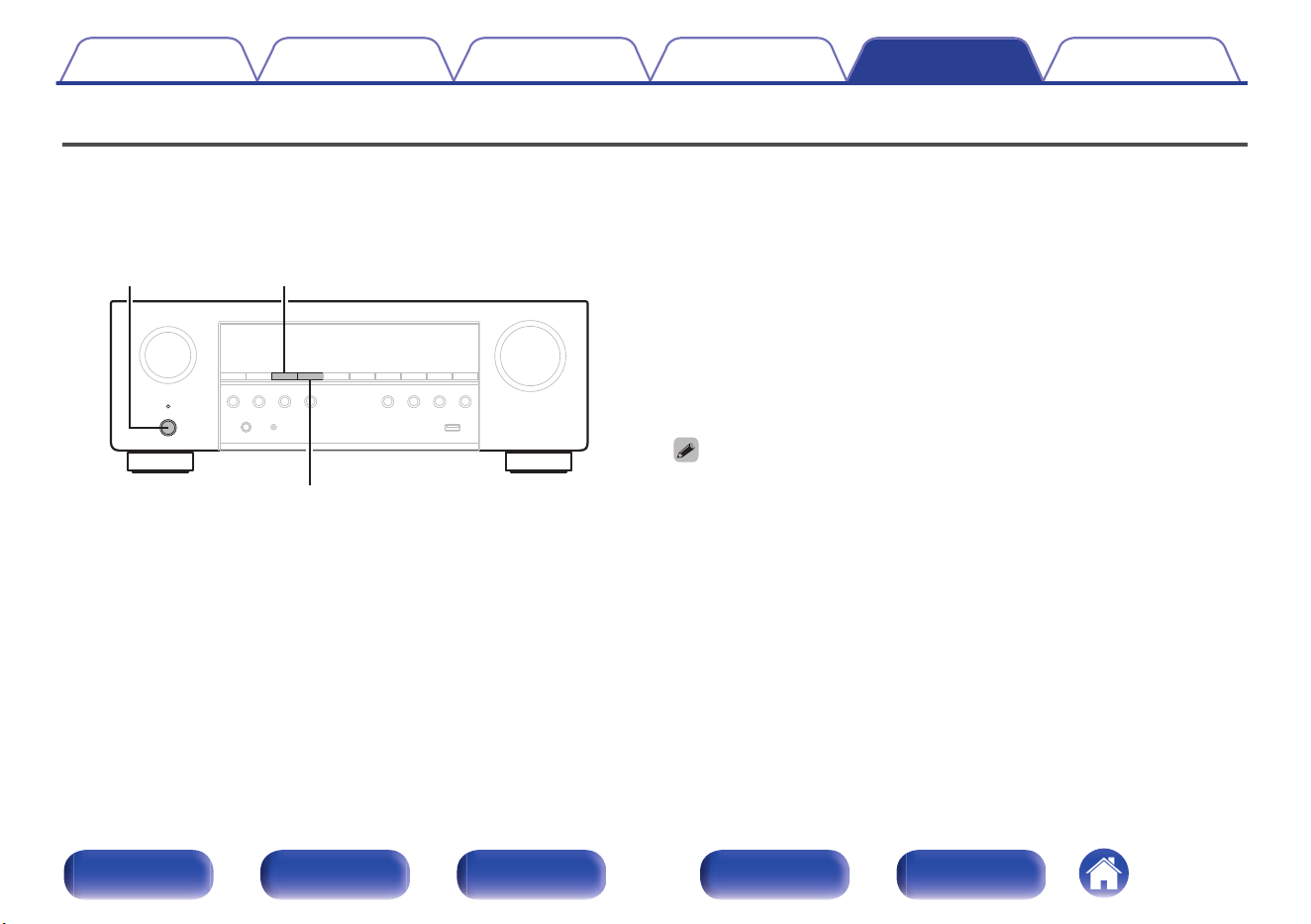
Resetting factory settings
If the indicators are incorrect or the unit cannot be operated, restarting the unit may improve the problem. We recommend restarting the unit before
returning the settings to the default settings. (v p. 192)
If the operations are not improved by restarting the unit, follow the steps below.
Various settings are reset to the factory default values. Make settings again.
X
TUNE +
TUNE –
1
Turn off the power using X.
2
Press X while simultaneously pressing TUNE + and
TUNE –.
3
Remove your fingers from the two buttons when
“Initialized” appears on the display.
0
Before returning the settings to the default settings, use the “Save & Load” function
from the menu to save and restore the details of various settings configured on the
unit. (v p. 187)
0
You can also reset all settings to the factory defaults using “Reset” - “All Settings”
in the menu. (v p. 188)
Contents Connections Playback Settings Tips Appendix
211
Front panel Display Rear panel Remote Index
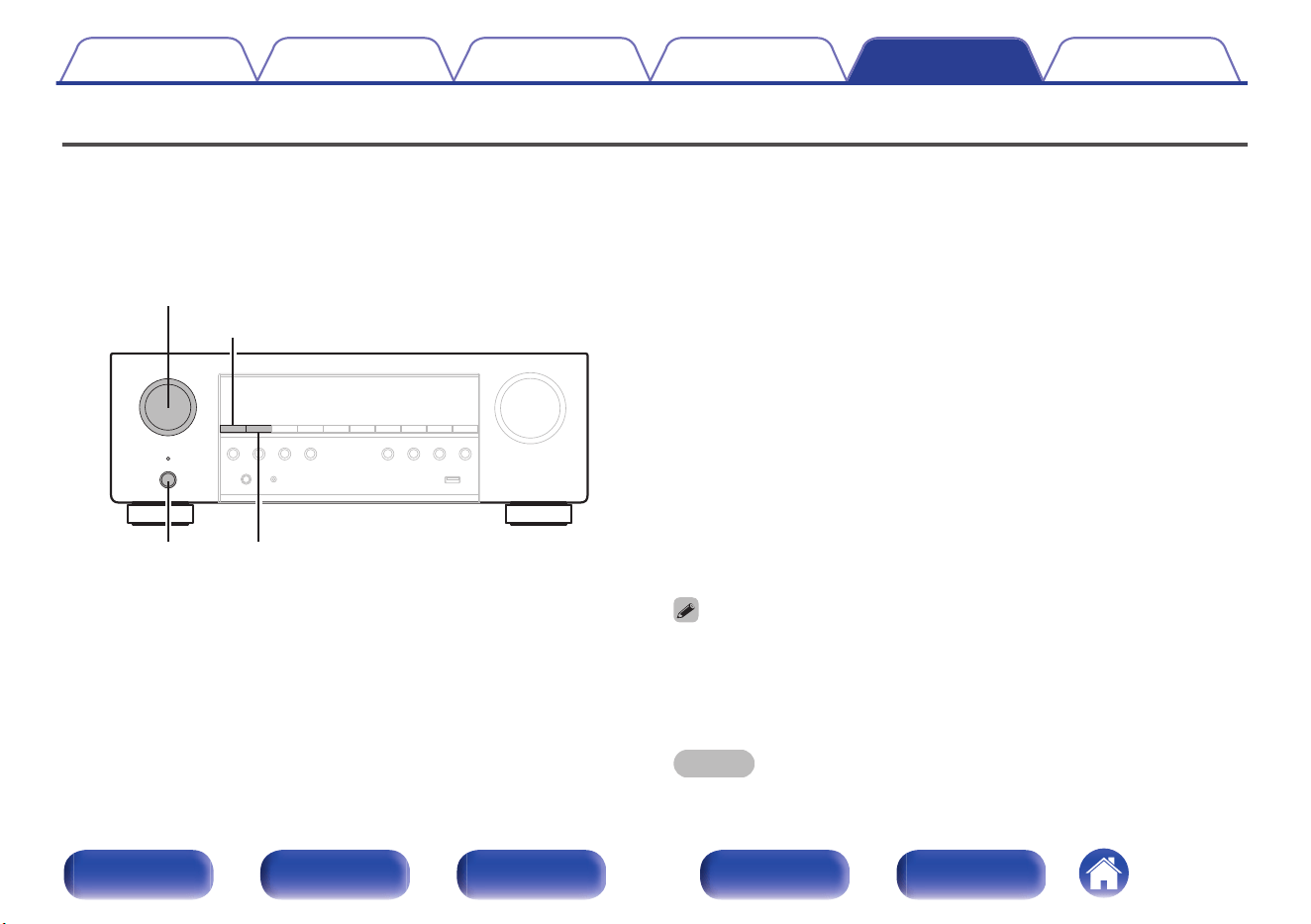
Resetting network settings
If network contents cannot be played or the unit cannot connect to the network, restarting the unit may improve the problem. We recommend restarting the
unit before returning the settings to the default settings. (v p. 192)
If the operations are not improved by restarting the unit, follow the steps below.
Network settings are reset to the factory default values. Make settings again.
However, the menu “Speaker Layout” and “Video” settings are not reset.
X
SOURCE SELECT
TUNER PRESET CH +
TUNER PRESET CH –
1
Press X to turn on power to the unit.
2
Turn SOURCE SELECT to select “HEOS Music”.
3
Press and hold the main unit's TUNER PRESET CH +
and TUNER PRESET CH – at the same time for at least 3
seconds.
4
Remove your fingers from the two buttons when
“Network Reset...” appears on the display.
5
“Completed” is shown in the display when reset is
complete.
0
Before returning the settings to the default settings, use the “Save & Load” function
from the menu to save and restore the details of various settings configured on the
unit. (v p. 187)
0
You can also reset the network settings to the factory defaults using “Reset” -
“Network Settings” in the menu. (v p. 188)
NOTE
0
Do not turn the power off until reset is complete.
Contents Connections Playback Settings Tips Appendix
212
Front panel Display Rear panel Remote Index
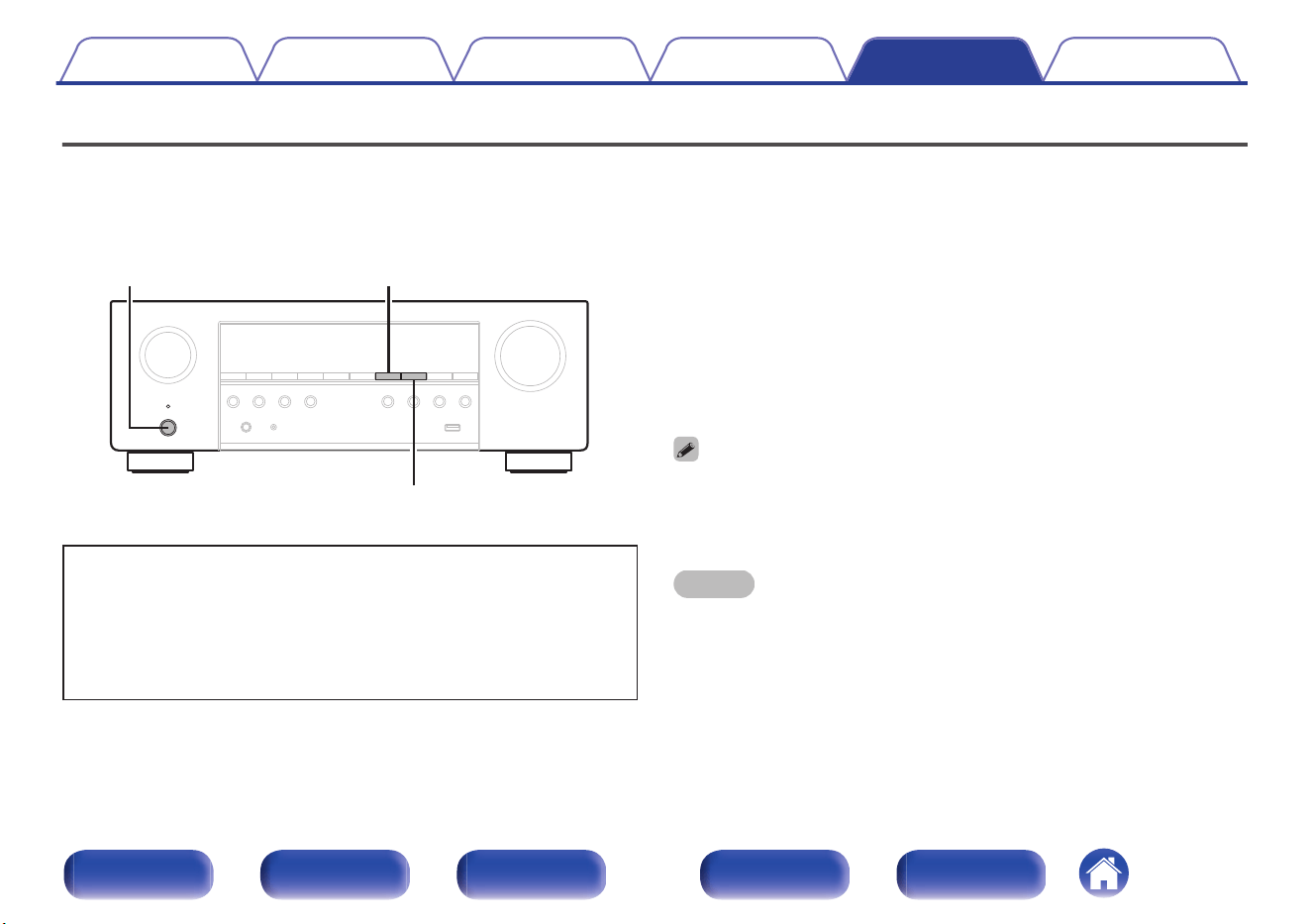
Factory Restore
When the unit or the network functions do not work properly, operation may be improved by performing the Factory Restore.
Do this when the unit still does not work properly even after trying the steps for “Resetting factory settings” or “Resetting network settings”. (v p. 211,
212)
After performing the Factory Restore, various settings are reset to the default settings. Configure the network settings and update the firmware again.
X
SLEEP
INFO
WARNING
By initiating Factory Restore mode, you will be installing limited
recovery firmware on this unit. Functionality will remain limited
until a firmware update is performed over the Internet. Do not
perform a Factory Restore if you do not have this unit connected
to your home network.
1
Press X while simultaneously pressing SLEEP and
INFO.
2
When “Restoring” appears on the display, release the
buttons.
When the Factory Restore is complete, “Completed” appears on the
display for about 5 seconds, and the unit automatically restarts.
0
This operation takes time because it requires reconnecting to the network,
restoring and updating the firmware.
0
If this operation does not improve the problem, contact our customer service
center.
NOTE
0
Do not turn off the power until the Factory Restore is complete.
Contents Connections Playback Settings Tips Appendix
213
Front panel Display Rear panel Remote Index
About HDMI
HDMI is an abbreviation of High-Definition Multimedia Interface, which is
an AV digital interface that can be connected to a TV or amplifier.
With the HDMI connection, high definition video and high quality audio
formats adopted by Blu-ray Disc players (Dolby Digital Plus, Dolby
TrueHD, DTS-HD) can be transmitted, which is not possible with the
analog video transmission.
Furthermore, in the HDMI connection, audio and video signals can be
transmitted through a single HDMI cable, while in conventional
connections it is necessary to provide audio and video cables separately
for connection between devices. This allows you to simplify the wiring
configuration that tends to be quite complex in a home theater system.
This unit supports the following HDMI functions.
0
Deep Color
An imaging technology supported by HDMI. Unlike RGB or YCbCr,
which uses 8 bits (256 shades) per color, it can use 10 bits (1024
shades), 12 bits (4096 shades), or 16 bits (65536 shades) to produce
colors in higher definition.
Both devices linked via HDMI must support Deep Color.
0
x.v.Color
This function lets HDTVs display colors more accurately. It enables
display with natural, vivid colors.
“x.v.Color” is trademark of Sony Corporation.
0
3D
This unit supports input and output of 3D (3 dimensional) video signals
of HDMI. To play back 3D video, you need a TV and player that
provide support for the HDMI 3D function and a pair of 3D glasses.
0
4K / 8K
This unit supports input and output of 4K (3840 x 2160 pixels) and 8K
(7680 x 4320 pixels) video signals of HDMI.
0
Content Type
It automatically makes settings suitable for the video output type
(content information).
0
Adobe RGB color, Adobe YCC601 color
The color space defined by Adobe Systems Inc. Because it is a wider
color space than RGB, it can produce more vivid and natural images.
0
sYCC601 color
Each of these color spaces defines a palette of available colors that is
larger than the traditional RGB color model.
Contents Connections Playback Settings Tips Appendix
214
Front panel Display Rear panel Remote Index
0
Auto Lip Sync
This function can automatically correct delay between the audio and
video.
Use a TV that is compatible with the Auto Lip Sync function.
0
HDMI Pass Through
Even when the power to this unit is set to standby, signals input from
the HDMI input connector are output to a TV or other device that is
connected to the HDMI output connector.
0
HDMI Control
If you connect the unit and an HDMI Control function compatible TV or
player with an HDMI cable and then enable the HDMI Control function
setting on each device, the devices will be able to control each other.
0
Power off link
This unit power off can be linked to the TV power off step.
0
Audio output destination switching
From the TV, you can switch whether to output audio from the TV or
the AV amplifier.
0
Volume adjustment
You can adjust this unit’s volume in the TV volume adjustment
operation.
0
Input source switching
You can switch this unit input sources through linkage to TV input
switching.
When playing the player, this unit input source switches to the
source for that player.
0
ARC (Audio Return Channel)
This function transmits audio signals from the TV to this unit through
the HDMI cable and plays back the audio from the TV on this unit
based on the HDMI Control function.
If a TV without the ARC function is connected via HDMI connections,
video signals of the playback device connected to this unit are
transmitted to the TV, but this unit can not play back the audio from the
TV. If you want to enjoy surround audio for TV program, a separate
audio cable connection is required.
In contrast, if a TV with the ARC function is connected via HDMI
connections, no audio cable connection is required. Audio signals from
the TV can be input to this unit through the HDMI cable between this
unit and the TV. This function allows you to enjoy surround playback
on this unit for the TV.
0
eARC (Enhanced Audio Return Channel)
The eARC function is an extension of the conventional ARC function. It
utilizes dedicated eARC function control to play back television audio
from this unit without passing through HDMI control. Furthermore, the
eARC function can transmit multichannel linear PCM, Dolby TrueHD,
DTS-HD and other audio formats not compatible with conventional
ARC. Connecting to an eARC function-compatible television also
enables enjoyment of higher-quality surround playback of the audio
content played from your television.
Contents Connections Playback Settings Tips Appendix
215
Front panel Display Rear panel Remote Index
0
ALLM (Auto Low Latency Mode)
This unit automatically switches to low latency mode depending on
playback contents when using a combination of television and game
console compatible with the ALLM function.
0
VRR (Variable Refresh Rate):
VRR reduces or eliminates lag, stutter and frame tearing for more fluid
and better detailed gameplay.
0
QFT (Quick Frame Transport):
QFT reduces latency for smoother no-lag gaming, and real-time
interactive virtual reality.
0
FRL (Fixed Rate Link):
FRL (Fixed Rate Link) is transmission technology that is required to
provide higher resolutions such as ultra high speed bandwidths of 4K
60Hz or higher.
NOTE
0
Some functions may not operate depending on the connected TV or player. Check
the owner’s manual of each device for details beforehand.
o
Supported audio formats
2-channel Linear PCM 2-channel, 32 kHz – 192 kHz, 16/20/24 bit
Multi-channel Linear PCM 7.1-channel, 32 kHz – 192 kHz, 16/20/24 bit
Bitstream
Dolby Digital / DTS / Dolby TrueHD /
Dolby Digital Plus / DTS-HD
o
Supported video signals
0
480i
0
480p
0
576i
0
576p
0
720p 60/50Hz
0
1080i 60/50Hz
0
1080p 120/100/60/50/24Hz
0
4K 120/100/60/50/30/25/24Hz
0
8K 60/50/30/25/24Hz
Contents Connections Playback Settings Tips Appendix
216
Front panel Display Rear panel Remote Index
Copyright protection system
In order to play back digital video and audio such as BD video or DVD
video via HDMI connection, both this unit and the TV or player must to
support the copyright protection system known as HDCP (High-
bandwidth Digital Content Protection System). HDCP is copyright
protection technology comprised of data encryption and authentication of
the connected AV devices. This unit supports HDCP.
0
If a device that does not support HDCP is connected, video and audio
are not output correctly. Read the owner’s manual of your television or
player for more information.
Contents Connections Playback Settings Tips Appendix
217
Front panel Display Rear panel Remote Index
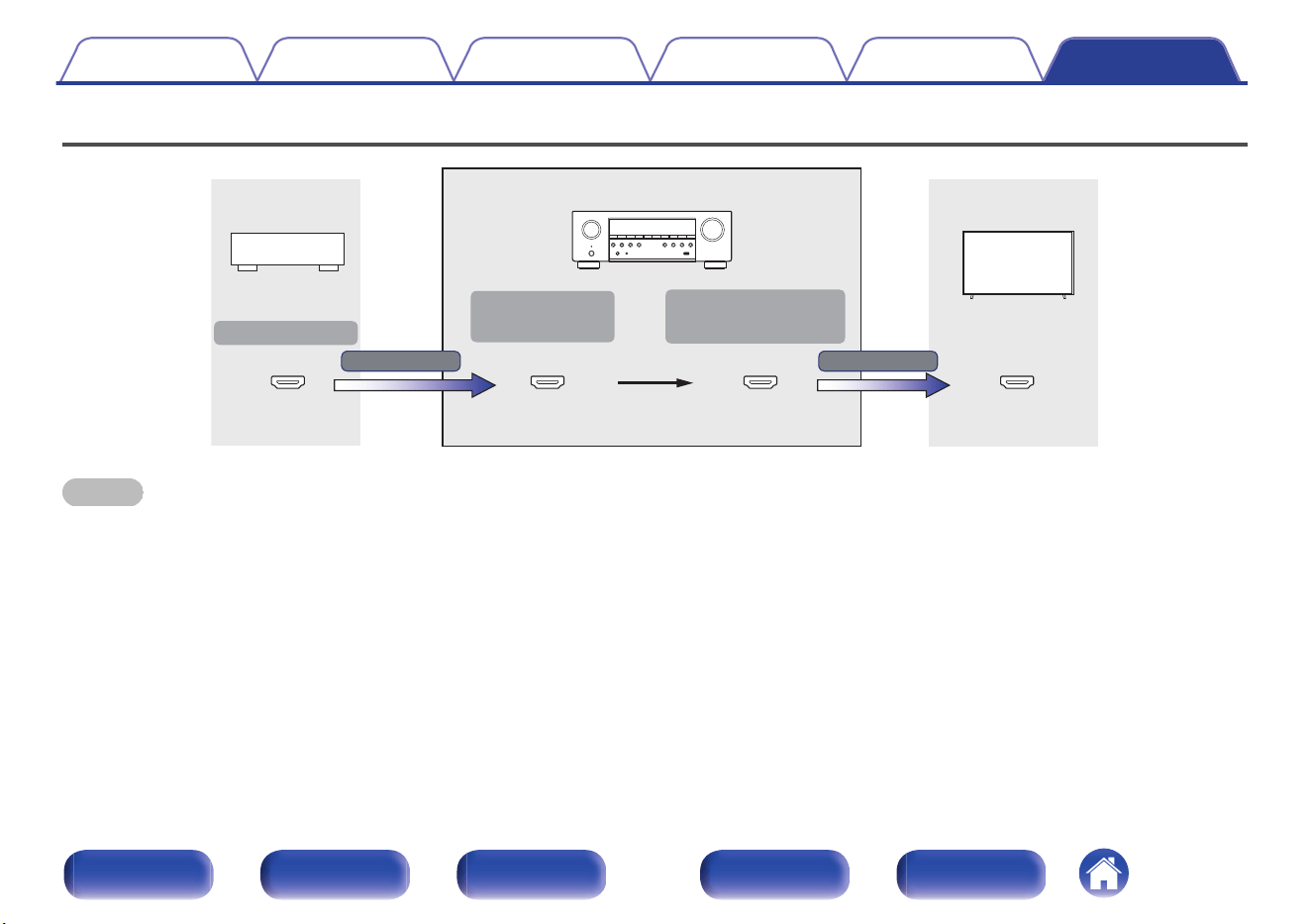
Relationship between video signals and TV output
HDMI-compatible TV
Output
(HDMI OUT)
Input (IN)
HDMI signal
Output
Video device
HDMI signal
HDMI connector HDMI connector HDMI connector HDMI connector
This unit
NOTE
0
Only HDMI connections are available for the video input/output of this unit.
Contents Connections Playback Settings Tips Appendix
218
Front panel Display Rear panel Remote Index
When “HDMI Upscaler” in the menu is set to “Auto”, this unit upscales the input HDMI video signal and then outputs it to the TV. (v p. 144)
HDMI
480i/576i
480p/576p
720p 1080i
1080p
30/25/24Hz
1080p
60/50Hz
1080p
120/100Hz
4K
30/25/24Hz
4K
60/50Hz
4K
120/100Hz
8K
30/25/24Hz
8K
60/50Hz
HDMI
480i/576i
480p/576p
720p
1080i
1080p 30/25/24Hz
1080p 60/50Hz
1080p 120/100Hz
4K 30/25/24Hz
4K 60/50Hz
4K 120/100Hz
z
8K 30/25/24Hz
z
8K 60/50Hz
z
Output signal
Input signal
z
Supported by the HDMI 4, 5 and 6 connectors.
Contents Connections Playback Settings Tips Appendix
219
Front panel Display Rear panel Remote Index
Playing back a USB memory devices
0
This unit is compatible with MP3 ID3-Tag (Ver. 2) standard.
0
This unit can show the artwork that was embedded by using MP3 ID3-Tag Ver. 2.3 or 2.4.
0
This unit is compatible with WMA META tags.
0
If the image size (pixels) of an album artwork exceeds 500 × 500 (WMA/MP3/Apple Lossless/DSD) or 349 × 349 (MPEG-4 AAC), then music may not
be played back properly.
o
Compatible formats
Sampling frequency Channel Bit rate Extension
WMA
z
1
32/44.1/48 kHz 2-channel 48 – 192 kbps .wma
MP3 32/44.1/48 kHz 2-channel 32 – 320 kbps .mp3
WAV
32/44.1/48/88.2/
96/176.4/192 kHz
2-channel – .wav
MPEG-4 AAC
z
1
32/44.1/48 kHz 2-channel 48 - 320 kbps .aac/.m4a
FLAC
44.1/48/88.2/
96/176.4/192 kHz
2-channel – .flac
Apple Lossless
z
2
44.1/48/88.2/
96/176.4/192 kHz
2-channel – .m4a
DSD 2.8/5.6 MHz 2-channel – .dsf/.dff
z1
Only files that are not protected by copyright can be played on this unit.
Content downloaded from pay sites on the Internet are copyright protected. Also, files encoded in WMA format when ripped from a CD, etc. on a computer may be
copyright protected, depending on the computer’s settings.
z2
The Apple Lossless Audio Codec (ALAC) decoder is distributed under the Apache License, Version 2.0 (http://www.apache.org/licenses/LICENSE-2.0).
Contents Connections Playback Settings Tips Appendix
220
Front panel Display Rear panel Remote Index
o
Maximum number of playable files and folder
The limits on the number of folders and files that can be displayed by
this unit are as follows.
Media
Item
USB memory device
Number of folder directory levels
z
1
8 levels
Number of folders 500
Number of files
z
2
5000
z1
The limited number includes the root folder.
z2
The allowable number of files may differ according to the USB memory device
capacity and the file size.
Playing back a Bluetooth device
This unit supports the following Bluetooth profile.
0
A2DP (Advanced Audio Distribution Profile):
When a Bluetooth device that supports this standard is connected,
monaural and stereo sound data can be streamed at a high quality.
0
AVRCP (Audio/Video Remote Control Profile):
When a Bluetooth device that supports this standard is connected, the
Bluetooth device can be operated from this unit.
o
About Bluetooth communications
Radio waves broadcast from this unit may interfere with the operation
of medical devices. Make sure you turn off the power of this unit and
Bluetooth device in the following locations as radio wave interference
may cause malfunctions.
0
Hospitals, trains, aircraft, petrol kiosks and places where flammable
gases are generated
0
Near automatic doors and fire alarms
Contents Connections Playback Settings Tips Appendix
221
Front panel Display Rear panel Remote Index
Playing back a file saved on a PC or NAS
0
This unit is compatible with MP3 ID3-Tag (Ver. 2) standard.
0
This unit can show the artwork that was embedded by using MP3 ID3-Tag Ver. 2.3 or 2.4.
0
This unit is compatible with WMA META tags.
0
If the image size (pixels) of an album artwork exceeds 500 × 500 (WMA/MP3/WAV/FLAC/Apple Lossless/DSD) or 349 × 349 (MPEG-4 AAC), then
music may not be played back properly.
0
A server or server software compatible with distribution in the corresponding formats is required to play music files via a network.
For playing mentioned audio formats via a network a server software, for example Twonky Media Server or jRiver Media Server, needs to be installed
on your computer or NAS for full support. There are other server software available too. Please check supported formats.
o
Specifications of supported files
Sampling frequency Channel Bit rate Extension
WMA
z
1
32/44.1/48 kHz 2-channel 48 – 192 kbps .wma
MP3 32/44.1/48 kHz 2-channel 32 – 320 kbps .mp3
WAV
32/44.1/48/88.2/
96/176.4/192 kHz
2-channel – .wav
MPEG-4 AAC
z
1
32/44.1/48 kHz 2-channel 48 - 320 kbps .aac/.m4a
FLAC
44.1/48/88.2/
96/176.4/192 kHz
2-channel – .flac
Apple Lossless
z
2
44.1/48/88.2/
96/176.4/192 kHz
2-channel – .m4a
DSD 2.8/5.6 MHz 2-channel – .dsf/.dff
z1
Only files that are not protected by copyright can be played on this unit.
Content downloaded from pay sites on the Internet are copyright protected. Also, files encoded in WMA format when ripped from a CD, etc. on a computer may be
copyright protected, depending on the computer’s settings.
z2
The Apple Lossless Audio Codec (ALAC) decoder is distributed under the Apache License, Version 2.0 (http://www.apache.org/licenses/LICENSE-2.0).
Contents Connections Playback Settings Tips Appendix
222
Front panel Display Rear panel Remote Index
Playing back Internet Radio
o
Playable broadcast station specifications
Sampling frequency Bit rate
Extension
WMA 32/44.1/48 kHz
48 – 192
kbps
.wma
MP3 32/44.1/48 kHz
32 – 320
kbps
.mp3
MPEG-4 AAC 32/44.1/48 kHz
48 - 320
kbps
.aac/
.m4a
Personal memory plus function
The most recently used settings (input mode, HDMI output mode, sound
mode, tone control, channel level, MultEQ
®
, Dynamic EQ, Dynamic
Volume, Restorer and audio delay, etc.) are saved for each input source.
0
“Surround Parameter” settings are stored for each sound mode.
Last function memory
This function stores the settings which were made before going into the
standby mode.
Contents Connections Playback Settings Tips Appendix
223
Front panel Display Rear panel Remote Index
Sound modes and channel output
S This indicates the audio output channels or surround parameters that can be set.
D This indicates the audio output channels. The output channels depend on the settings of “Speaker Layout”. (v p. 162)
S
Dz
SDD D
Stereo
S D
Dolby TrueHD
SDD D
Dolby Digital Plus
SDD D
Dolby Digital
SDD D
Dolby Pro Logic g
SDD D
DTS-HD
SDD D
DTS Surround
SDD D
DTS Neo:6
SDD D
Multi Ch In
SDD D
Video Game
Matrix
SDD D
SDD D
SDD D
SDD D
SDD D
SDD D
Multi Ch Stereo
Rock Arena
Jazz Club
Mono Movie
Sound mode
Channel output
Front
L/R
Center
Surround
L/R
Subwoofer
Direct/Pure Direct (2-channel)
Direct/Pure Direct (Multi-channel)
z Audio is output when “Low Frequency Effects” - “Subwoofer Output” in the menu is set to “LFE + Main”. (v p. 166)
Contents Connections Playback Settings Tips Appendix
224
Front panel Display Rear panel Remote Index
Sound modes and surround parameters
SS
SS S
Stereo
SS S
Dolby TrueHD
S
S
SS S
Dolby Digital Plus
SSSS
Dolby Digital
SSSS
Dolby Pro Logic g
SSS SSS
DTS-HD
SS
DTS Surround
SSS
DTS Neo:6
SSS
Rock Arena
Jazz Club
S
Mono Movie
S
Video Game
S
Matrix
SS
Multi Ch In
SS
Multi Ch Stereo
SS
S
S
S
S
S
S
S
S
S
S
S
S
S
S
S
S
S
S
S
S
S
Surround Parameter
Dolby Pro Logic g Music mode Only
Cinema EQ
Loudness
Management
Dynamic
Compression
Low Frequency
Eects
Delay Time Room SizeEect Level
Panorama Center WidthDimension
Sound mode
Direct/Pure Direct (2-channel)
Direct/Pure Direct (Multi-channel)
z1
z1
z2 z3 z4
z1 - z4 : “Sound modes and surround parameters” (v p. 227)
Contents Connections Playback Settings Tips Appendix
225
Front panel Display Rear panel Remote Index
Audyssey
z9
MultEQ®
z
6
z
7
Dynamic EQ
z
8
z
8
Dynamic Volume
Sz10 Sz10
S
Stereo
Sz11
SS
Sz11
SSS S
Dolby TrueHD
SS S S S S
Dolby Digital Plus
SS S S S S
Dolby Digital
SS S S S S
Dolby Pro Logic g
SS S S S S S
DTS-HD
SS S S S S
DTS Surround
SS S S S S
DTS Neo:6
SSSSSSSS
Rock Arena
SS S S S
Jazz Club
SS S S S S S
Mono Movie
SS S S S S S
Video Game
SS S S S S
Matrix
SS S S S S
S
S
Multi Ch In
SS S S S S
Multi Ch Stereo
SS S S S S
SS
S
Surround Parameter
Dialog
Enhancer
Subwoofer
Level Adjust
Tone
Subwoofer
Sound mode
Direct/Pure Direct (2-channel)
Direct/Pure Direct (Multi-channel)
z1
z1
z5
Center Image
DTS Neo:6
Music mode only
Restorer
z1, z5 - z11: “Sound modes and surround parameters” (v p. 227)
Contents Connections Playback Settings Tips Appendix
226
Front panel Display Rear panel Remote Index
z1
During playback in Pure Direct mode, the surround parameters are the same as in Direct mode.
z2
This item can be selected when a Dolby TrueHD signal is played.
z3
This item can be selected when a Dolby Digital, Dolby Digital Plus, Dolby TrueHD or DTS signal is played.
z4
This can be set when the LFE signal is included in the input signal.
z5 This item cannot be set when “Dynamic EQ” is set to “On”. (v p. 137)
z6
This item cannot be set when Audyssey
®
Setup (Speaker Calibration) has not been performed.
z7
This item cannot be selected when the Dolby TrueHD or DTS-HD input signal sampling frequency exceeds 96 kHz.
z8
This item cannot be set when “MultEQ
®
” in the menu is set to “Off”. (v p. 136)
z9
This item can be set when the input signal is analog, PCM 48 kHz or 44.1 kHz.
z10 This setting is available when “Low Frequency Effects” - “Subwoofer Output” in the menu is set to “LFE + Main”. (v p. 166)
z11 This item can be set when “Crossovers” - “Front” is set to other than “Full Range” or “Low Frequency Effects” - “Subwoofer Output” is set to “LFE + Main”. (v p. 165,
166)
Contents Connections Playback Settings Tips Appendix
227
Front panel Display Rear panel Remote Index
Types of input signals, and corresponding sound modes
F This indicates the default sound mode.
S This indicates the selectable sound mode.
Dolby
TrueHD
Dolby
Digital
Plus
Dolby
Digital
DTS-HD DTS
Dolby
TrueHD
Dolby
Digital
Plus
Dolby
Digital
(EX)
DTS-HD DTS
Direct
Direct
SSSS S
Sz3
SSS
SS S
Pure Direct
Pure Direct
SSSS SS
SSS
SS S
Stereo
Stereo
SSSS SF
SSS
SS S
Dolby Surround
z1
z2
Dolby TrueHD
F
F
Dolby Digital Plus
F
F
Dolby Digital
F
F
Dolby Pro Logic g
DTS Surround
DTS-HD
F
DTS Surround
SS
SSSF F
F
DTS Neo:6
Multi Ch In
Multi Ch In
F
Multi Ch Stereo
Rock Arena
Jazz Club
Mono Movie
Video Game
Matrix
SSSSSSSSSSSS
SSSSSSSSSSSS
SSSSSSSSSSSS
SSSSSSSSSSSS
SSSSSSSSSSSS
SSSSSSSSSSSS
Sound mode NOTE
2-channel signal Multi-channel signal
Analog /
PCM
PCM
multi-
channel
Original sound mode
z1
The “Movie” mode, “Music” mode or “Game” mode can be selected.
z2
The “Cinema” mode or “Music” mode can be selected.
z3
The default sound mode for the AirPlay playback is “Direct”.
Contents Connections Playback Settings Tips Appendix
228
Front panel Display Rear panel Remote Index
Explanation of terms
o
Audyssey
Audyssey Dynamic EQ
®
Audyssey Dynamic EQ
®
solves the problem of deteriorating sound quality
as volume is decreased by taking into account human perception and
room acoustics.
Audyssey Dynamic EQ
®
works in tandem with Audyssey MultEQ
®
to
provide well-balanced sound for every listener at any volume level.
Audyssey Dynamic Volume
®
Dynamic Volume solves the problem of large variations in volume level
between television programs, commercials, and between the soft and loud
passages of movies. Audyssey Dynamic EQ
®
is integrated into Dynamic
Volume so that as the playback volume is adjusted automatically, the
perceived bass response, tonal balance, surround impression, and dialog
clarity remain the same.
Audyssey MultEQ
®
Audyssey MultEQ
®
is a room equalization solution that calibrates any
audio system so that it can achieve optimum performance for every
listener in a large listening area. Based on several room measurements,
MultEQ
®
calculates an equalization solution that corrects for both time and
frequency response problems in the listening area and also performs a
fully automated surround system setup.
Contents Connections Playback Settings Tips Appendix
229
Front panel Display Rear panel Remote Index
o
Dolby
Dolby Digital
Dolby Digital is a multi-channel digital signal format developed by Dolby
Laboratories.
A total of 5.1-channels are played: 3 front channels (“FL”, “FR” and “C”), 2
surround channels (“SL” and “SR”) and the “LFE” channel for low
frequency effects.
Because of this, there is no crosstalk between channels and a realistic
sound field with a “three-dimensional” feeling (sense of distance,
movement and positioning) is achieved. This delivers a thrilling surround
sound experience in the home.
Dolby Digital Plus
Dolby Digital Plus is an improved Dolby Digital signal format that is
compatible with up to 7.1-channels of discrete digital sound and also
improves sound quality thanks to extra data bit rate performance. It is
upwardly compatible with conventional Dolby Digital, so it offers greater
flexibility in response to the source signal and the conditions of the
playback device.
Dolby Pro Logic g
Dolby Pro Logic g is a matrix decoding technology developed by Dolby
Laboratories.
Regular music such as that on CDs is encoded into 5-channels to achieve
an excellent surround effect.
The surround channel signals are converted into stereo and full band
signals (with a frequency response of 20 Hz to 20 kHz or greater) to create
a “three-dimensional” sound image offering a rich sense of presence for all
stereo sources.
Dolby TrueHD
Dolby TrueHD is a high definition audio technology developed by Dolby
Laboratories, using lossless coding technology to faithfully reproduce the
sound of the studio master.
This format provides the facility to support up to 8 audio channels with a
sampling frequency of 96 kHz/24 bit resolution and up to 6 audio channels
with a sampling frequency of 192 kHz/24 bit resolution.
Contents Connections Playback Settings Tips Appendix
230
Front panel Display Rear panel Remote Index
o
DTS
DTS
This is an abbreviation of Digital Theater System, which is a digital audio
system developed by DTS. DTS delivers a powerful and dynamic
surround sound experience, and is found in the world’s finest movie
theaters and screening rooms.
DTS 96/24
DTS 96/24 is a digital audio format enabling high sound quality playback in
5.1-channels with a sampling frequency of 96 kHz and 24 bit quantization
on DVD-Video.
DTS Digital Surround
DTS™ Digital Surround is the standard digital surround format of DTS,
Inc., compatible with a sampling frequency of 44.1 or 48 kHz and up to
5.1-channels of digital discrete surround sound.
DTS Express
DTS Express is an audio format supporting low bit rates (max. 5.1-
channels, 24 to 256 kbps).
DTS-HD
This audio technology provides higher sound quality and enhanced
functionality than the conventional DTS and is adopted as an optional
audio for Blu-ray Disc.
This technology supports multi-channel, high data transfer speed, high
sampling frequency, and lossless audio playback. Maximum 7.1-channels
are supported in Blu-ray Disc.
Contents Connections Playback Settings Tips Appendix
231
Front panel Display Rear panel Remote Index
DTS-HD High Resolution Audio
DTS-HD High Resolution Audio is an improved version of the conventional
DTS, DTS-ES and DTS 96/24 signals formats, compatible with sampling
frequencies of 96 or 48 kHz and up to 7.1-channels of discrete digital
sound. High data bit rate performance provides high quality sound. This
format is fully compatible with conventional products, including
conventional DTS digital surround 5.1-channel data.
DTS-HD Master Audio
DTS-HD Master Audio is a lossless audio format created by Digital
Theater System (DTS). This format provides the facility to support up to 8
audio channels with a sampling frequency of 96 kHz/24 bit resolution and
up to 6 audio channels with a sampling frequency of 192 kHz/24 bit
resolution. It is fully compatible with conventional products, including
conventional DTS digital surround 5.1-channel data.
DTS Neo:6™ Surround
DTS Neo:6™ is a matrix decoding technology for achieving 6.1-channel
surround playback with 2-channel sources. It includes “DTS Neo:6
Cinema” suite for playing movies and “DTS Neo:6 Music” suited for
playing music.
o
Audio
Apple Lossless Audio Codec
This is a codec for lossless audio compression method developed by
Apple Inc. This codec can be played back on iTunes, iPod or iPhone. Data
compressed to approximately 60 – 70 % can be decompressed to exactly
the same original data.
FLAC (Free Lossless Audio Codec)
FLAC stands for Free lossless Audio Codec, and is a lossless free audio
file format. Lossless means that the audio is compressed without any loss
in quality.
The FLAC license is as shown below.
Copyright (C) 2000, 2001, 2002, 2003, 2004, 2005, 2006, 2007, 2008,
2009 Josh Coalson
Redistribution and use in source and binary forms, with or without
modification, are permitted provided that the following conditions are met:
0
Redistributions of source code must retain the above copyright notice,
this list of conditions and the following disclaimer.
0
Redistributions in binary form must reproduce the above copyright
notice, this list of conditions and the following disclaimer in the
documentation and/or other materials provided with the distribution.
0
Neither the name of the Xiph.org Foundation nor the names of its
contributors may be used to endorse or promote products derived from
this software without specific prior written permission.
Contents Connections Playback Settings Tips Appendix
232
Front panel Display Rear panel Remote Index
THIS SOFTWARE IS PROVIDED BY THE COPYRIGHT HOLDERS AND
CONTRIBUTORS “AS IS” AND ANY EXPRESS OR IMPLIED
WARRANTIES, INCLUDING, BUT NOT LIMITED TO, THE IMPLIED
WARRANTIES OF MERCHANTABILITY AND FITNESS FOR A
PARTICULAR PURPOSE ARE DISCLAIMED. IN NO EVENT SHALL THE
FOUNDATION OR CONTRIBUTORS BE LIABLE FOR ANY DIRECT,
INDIRECT, INCIDENTAL, SPECIAL, EXEMPLARY, OR
CONSEQUENTIAL DAMAGES (INCLUDING, BUT NOT LIMITED TO,
PROCUREMENT OF SUBSTITUTE GOODS OR SERVICES; LOSS OF
USE, DATA, OR PROFITS; OR BUSINESS INTERRUPTION) HOWEVER
CAUSED AND ON ANY THEORY OF LIABILITY, WHETHER IN
CONTRACT, STRICT LIABILITY, OR TORT (INCLUDING NEGLIGENCE
OR OTHERWISE) ARISING IN ANY WAY OUT OF THE USE OF THIS
SOFTWARE, EVEN IF ADVISED OF THE POSSIBILITY OF SUCH
DAMAGE.
LFE
This is an abbreviation of Low Frequency Effect, which is an output
channel that emphasizes low frequency effect sound. Surround audio is
intensified by outputting 20 Hz to 120 Hz deep bass to the system
subwoofer(s).
MP3 (MPEG Audio Layer-3)
This is an internationally standardized audio data compression scheme,
using the “MPEG-1” video compression standard. It compresses the data
volume to about one eleventh its original size while maintaining sound
quality equivalent to a music CD.
MPEG (Moving Picture Experts Group), MPEG-2, MPEG-4
These are the names for digital compression format standards used for
the encoding of video and audio. Video standards include “MPEG-1
Video”, “MPEG-2 Video”, “MPEG-4 Visual”, “MPEG-4 AVC”. Audio
standards include “MPEG-1 Audio”, “MPEG-2 Audio”, “MPEG-4 AAC”.
WMA (Windows Media Audio)
This is audio compression technology developed by Microsoft
Corporation.
WMA data can be encoded using Windows Media
®
Player.
To encode WMA files, only use applications authorized by Microsoft
Corporation. If you use an unauthorized application, the file may not work
properly.
Sampling frequency
Sampling involves taking a reading of a sound wave (analog signal) at
regular intervals and expressing the height of the wave at each reading in
digitized format (producing a digital signal).
The number of readings taken in one second is called the “sampling
frequency”. The larger the value, the closer the reproduced sound is to the
original.
Contents Connections Playback Settings Tips Appendix
233
Front panel Display Rear panel Remote Index
Speaker impedance
This is an AC resistance value, indicated in Ω (ohms).
Greater power can be obtained when this value is smaller.
Dialogue normalization function
This function operates automatically during playback of Dolby Digital,
Dolby Digital Plus, Dolby TrueHD, DTS or DTS-HD sources.
It automatically corrects the standard signal level for individual program
sources.
Dynamic range
The difference between the maximum undistorted sound level and the
minimum discernible level above the noise emitted by the device.
Downmix
This function converts the number of channels of surround audio to a
lower number of channels and plays back according to the system’s
configuration.
o
Video
Progressive (sequential scanning)
This is a scanning system of the video signal that displays 1 frame of video
as one image. Compared to the interlace system, this system provides
images with less flickering and jagged edges.
Contents Connections Playback Settings Tips Appendix
234
Front panel Display Rear panel Remote Index
o
Network
AirPlay
AirPlay sends (plays) contents recorded in iTunes or on an iPhone/iPod
touch/iPad to a compatible device via the network.
WEP Key (network key)
This is key information used for encrypting data when conducting data
transfer. On this unit, the same WEP key is used for data encryption and
decryption, so the same WEP key must be set on both devices in order for
communications to be established between them.
Wi-Fi
®
Wi-Fi Certification assures tested and proven interoperability by the Wi-Fi
Alliance, a group certifying interoperability among wireless LAN devices.
WPA (Wi-Fi Protected Access)
This is a security standard established by the Wi-Fi Alliance. In addition to
the conventional SSID (network name) and WEP key (network key), it also
uses a user identification function and encrypting protocol for stronger
security.
WPA2 (Wi-Fi Protected Access 2)
This is a new version of the WPA established by the Wi-Fi Alliance,
compatible with more secure AES encryption.
WPA/WPA2-Personal
This is a simple authentication system for mutual authentication when a
preset character string matches on the wireless LAN access point and
client.
WPA2/WPA3-Personal
WPA2/WPA3-Personal Mode was defined by Wi-Fi Alliance
®
to minimize
user disruption and provide a gradual migration path to WPA3-Personal
while maintaining interoperability with WPA2-Personal only devices.
WPA3-Personal
WPA3-Personal replaces the WPA2-Personal Pre-Shared Key (PSK)
authentication with Simultaneous authentication of equals (SAE). Unlike
PSK, SAE is resistant to offline dictionary attacks.
Network Names (SSID: Service Set Identifier)
When forming wireless LAN networks, groups are formed to prevent
interference, data theft, etc. These groups are based on “SSID (network
names)”. For enhanced security, a WEP key is set so that communication
is unavailable unless both the “SSID” and the WEP key match. This is
suitable for constructing a simplified network.
Contents Connections Playback Settings Tips Appendix
235
Front panel Display Rear panel Remote Index
o
Others
HDCP
When transmitting digital signals between devices, this copyright
protection technology encrypts the signals to prevent content from being
copied without authorization.
Pairing
Pairing (registration) is an operation that is required in order to connect a
Bluetooth device to this unit using Bluetooth. When paired, the devices
authenticate each other and can connect without mistaken connections
occurring.
When using Bluetooth connection for the first time, you need to pair this
unit and the Bluetooth device to be connected.
Protection circuit
This is a function to prevent damage to devices within the power supply
when an abnormality such as an overload, excess voltage occurs or over
temperature for any reason.
Contents Connections Playback Settings Tips Appendix
236
Front panel Display Rear panel Remote Index
Trademark information
Apple, AirPlay, iPad, iPad Air, iPad Pro and iPhone are trademarks of
Apple Inc., registered in the U.S. and other countries.
The trademark “iPhone” is used in Japan with a license from Aiphone
K.K.
Use of the Works with Apple badge means that an accessory has been
designed to work specifically with the technology identified in the badge
and has been certified by the developer to meet Apple performance
standards.
Manufactured under license from Audyssey Laboratories™. U.S. and
foreign patents pending. Audyssey MultEQ
®
, Audyssey Dynamic EQ
®
and Audyssey Dynamic Volume
®
are registered trademarks of Audyssey
Laboratories.
The Bluetooth
®
word mark and logos are registered trademarks owned
by the Bluetooth SIG, Inc. and any use of such marks by D&M Holdings
Inc. is under license. Other trademarks and trade names are those of
their respective owners.
Manufactured under license from Dolby Laboratories.
Dolby, Dolby Audio, Pro Logic, Dolby Vision, and the double-D symbol
are trademarks of Dolby Laboratories Licensing Corporation.
Confidential unpublished works. Copyright © 1992-2022 Dolby
Laboratories. All rights reserved.
Contents Connections Playback Settings Tips Appendix
237
Front panel Display Rear panel Remote Index
For DTS patents, see http://patents.dts.com. Manufactured under
license from DTS, Inc. or DTS Licensing Limited. DTS, DTS-HD, and the
DTS-HD logo are registered trademarks or trademarks of DTS, Inc. in the
United States and other countries. © 2021 DTS, Inc. ALL RIGHTS
RESERVED.
The terms HDMI, HDMI High-Definition Multimedia Interface, HDMI
Trade dress and the HDMI Logos are trademarks or registered
trademarks of HDMI Licensing Administrator, Inc.
HDR10+™ logo is a trademark of HDR10+ Technologies, LLC.
The Wi-Fi CERTIFIED logo is a registered trademark of the Wi-Fi
Alliance.
Wi-Fi Certification provides assurance that the device has passed the
interoperability test conducted by the Wi-Fi Alliance, a group that certifies
interoperability among wireless LAN devices.
App Store
®
is registered in the U.S. and other countries.
Google Play and the Google Play logo are trademarks of Google LLC.
Contents Connections Playback Settings Tips Appendix
238
Front panel Display Rear panel Remote Index
Specifications
Audio section
0
Power amplifier
Rated output: Front:
75 W + 75 W (8 Ω/ohms, 20 Hz – 20 kHz with 0.08 % T.H.D.)
100 W + 100 W (6 Ω/ohms, 1 kHz with 0.7 % T.H.D.)
Center:
75 W (8 Ω/ohms, 20 Hz – 20 kHz with 0.08 % T.H.D.)
100 W (6 Ω/ohms, 1 kHz with 0.7 % T.H.D.)
Surround:
75 W + 75 W (8 Ω/ohms, 20 Hz – 20 kHz with 0.08 % T.H.D.)
100 W + 100 W (6 Ω/ohms, 1 kHz with 0.7 % T.H.D.)
Output connectors: 4 – 16 Ω/ohms
Contents Connections Playback Settings Tips Appendix
239
Front panel Display Rear panel Remote Index
0
Analog
Input sensitivity: 200 mV
Frequency response: 10 Hz – 100 kHz — +1, –3 dB (Direct mode)
S/N: 98 dB (IHF–A weighted, Direct mode)
0
Phono equalizer
Input sensitivity: 2.5 mV
RIAA deviation: ±1 dB (20 Hz to 20 kHz)
S/N: 74 dB (IHF-A)
Distortion factor: 0.03 % (1 kHz, 3 V)
Contents Connections Playback Settings Tips Appendix
240
Front panel Display Rear panel Remote Index
Tuner section
[FM] [AM]
(Note: μV at 75 Ω/ohms, 0 dBf = 1 x 10
–15
W)
Reception frequency range: 87.5 MHz – 108.0 MHz 522 kHz – 1611 kHz
Effective sensitivity: 1.2 μV (12.8 dBf) 18 μV
50 dB sensitivity: MONO ― 2.8 μV (20.2 dBf)
S/N ratio: MONO ― 70 dB (IHF–A weighted, Direct mode)
STEREO ― 67 dB (IHF–A weighted, Direct mode)
Distortion: MONO ― 0.7 % (1 kHz)
STEREO ― 1.0 % (1 kHz)
Wireless LAN section
Network type (wireless LAN standard): Conforming to IEEE 802.11a/b/g/n/ac
(Wi-Fi
®
compliant)
z
1
Security: WEP 64 bit, WEP 128 bit
WPA/WPA2-PSK (AES)
WPA/WPA2-PSK (TKIP)
WPA3-SAE (AES)
Used frequency range: 2.4 GHz, 5 GHz
z1
The Wi-Fi
®
CERTIFIED Logo and the Wi-Fi CERTIFIED On-Product Logo are registered trademarks of the Wi-Fi Alliance.
Contents Connections Playback Settings Tips Appendix
241
Front panel Display Rear panel Remote Index
Bluetooth section
Communications system: Bluetooth Specification Version 5.0
Transmission power: Bluetooth Specification Power Class 1
Maximum communication range:
Approx. 30 m in line of sight
z
2
Used frequency range: 2.4 GHz
Modulation scheme: FHSS (Frequency-Hopping Spread Spectrum)
Supported profiles: Receiver function
A2DP (Advanced Audio Distribution Profile) 1.2
AVRCP (Audio Video Remote Control Profile) 1.5
Transmitter function
A2DP (Advanced Audio Distribution Profile) 1.2
Corresponding codec: SBC
Transmission range (A2DP): 20 Hz – 20,000 Hz
z2
The actual communication range varies depending on the influence of such factors as obstructions between devices, electromagnetic waves from
microwave ovens, static electricity, cordless phones, reception sensitivity, antenna performance, operating system, application software etc.
Contents Connections Playback Settings Tips Appendix
242
Front panel Display Rear panel Remote Index
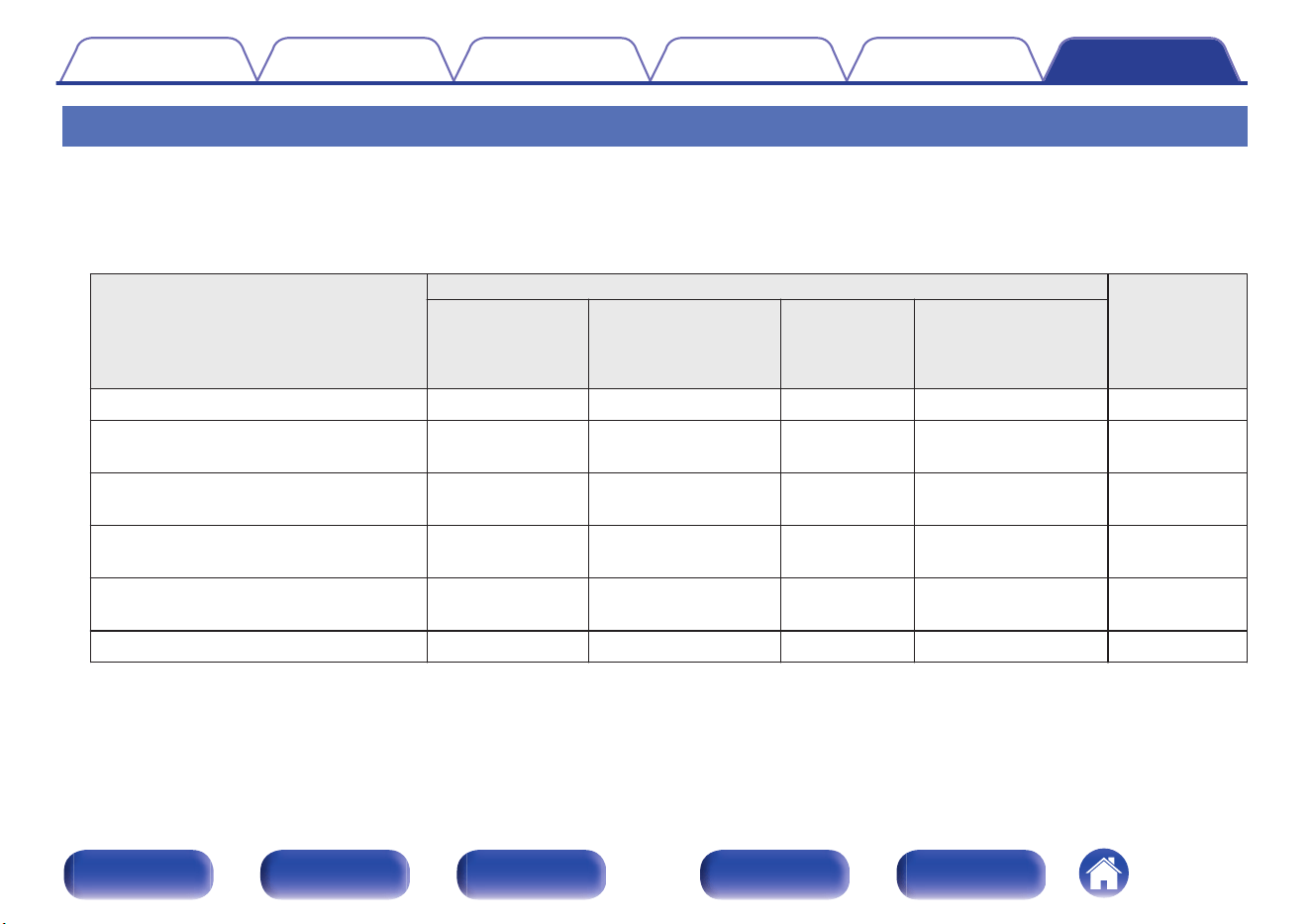
General
Operating temperature: 5 °C - 35 °C
Power supply: AC 230 V, 50/60 Hz
Power consumption: 340 W
Power consumption in standby modes:
Standby modes
Setting items in the menu
Power
consumption
Network Control
(v p. 172)
Wi-Fi and Bluetooth
(v p. 175)
Allow Update
(v p. 184)
HDMI Pass Through
(v p. 140) /
HDMI Control
(v p. 142)
Normal standby Off In Standby – Off Off 0.1 W
Network control (Bluetooth) Always On
Wi-Fi:Disabled /
Bluetooth:Enabled
– Off 2.0 W
Network control (Ethernet) Always On
Wi-Fi:Disabled /
Bluetooth:Disabled
– Off 2.0 W
Network control (Wi-Fi) Always On
Wi-Fi:Enabled /
Bluetooth:Disabled
– Off 2.0 W
Network control (Wi-Fi, Bluetooth, CEC) Always On
Wi-Fi:Enabled /
Bluetooth:Enabled
– On 2.5 W
CEC standby Off In Standby – Off On 0.5 W
For purposes of improvement, specifications and design are subject to change without notice.
Contents Connections Playback Settings Tips Appendix
243
Front panel Display Rear panel Remote Index
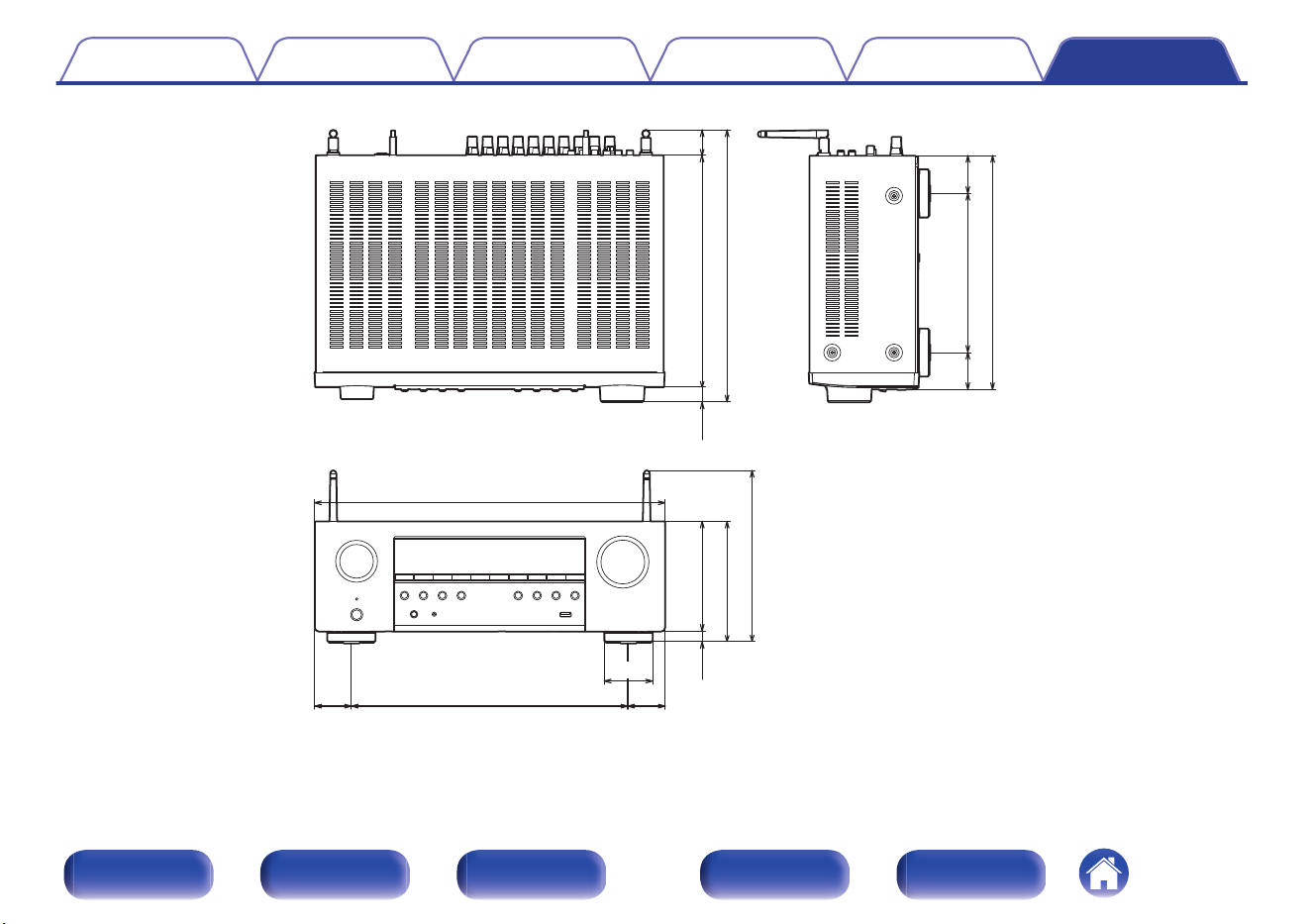
Index
v Numerics
3D ................................................................ 214
4K/8K ........................................................... 214
5.1-channel .................................................... 33
v A
AirPlay ............................................................ 90
Audio formats ....................... 216, 220, 222, 223
Audio settings ....................................... 122, 128
Audyssey Dynamic EQ® ............................. 229
Audyssey Dynamic Volume® ...................... 229
Audyssey MultEQ® ..................................... 229
Audyssey settings ................................ 136, 155
Audyssey® Setup ........................................ 153
Auto sound mode ......................................... 104
Auto Standby ............................................... 180
v B
Bluetooth device ............................................ 57
Blu-ray Disc player ................................... 40, 51
v C
Cable TV ........................................................ 38
v D
Direct sound mode ....................................... 107
Display ........................................................... 18
Dolby sound mode ............................... 105, 230
DTS sound mode ................................. 105, 231
DVD player ............................................... 40, 51
v E
ECO Mode ................................................... 177
v F
Firmware Update .......................................... 183
FM/AM antenna ........................................ 44, 65
Front panel ..................................................... 15
v G
Game console ................................................ 41
General settings ................................... 125, 177
v H
HDCP ........................................................... 217
HDMI Control ....................................... 111, 142
HEOS Account ....................................... 82, 176
HEOS Favorites ............................................. 96
Contents Connections Playback Settings Tips Appendix
245
Front panel Display Rear panel Remote Index
v I
Input Assign ................................................. 149
Input settings ........................................ 123, 149
Input source ................................................... 50
Internet Radio ................................................. 75
v L
Listening position ......................................... 153
v M
Menu map .................................................... 122
Muting ............................................................ 51
v N
NAS ............................................................... 77
Network settings .......................................... 168
v O
Original sound mode .................................... 106
v P
Pairing ...................................................... 57, 58
PC .................................................................. 77
PCM multi-channel sound mode .................. 106
Protection circuit .......................................... 236
Pure direct .................................................... 104
v Q
Queue ................................................ 53, 78, 85
Quick select plus .......................................... 114
v R
Rear panel ...................................................... 20
Remote control unit ........................................ 23
Resetting factory settings ............................. 211
Resetting network settings ........................... 212
Restorer ....................................................... 134
v S
Satellite tuner ................................................. 38
Set-top box ..................................................... 38
Setup Assistant ............................................ 126
Sleep timer ................................................... 112
Sound mode ................................................. 102
Speaker connection ....................................... 29
Speaker settings .................................. 123, 153
Spotify ............................................................ 93
Stereo sound mode ...................................... 107
Contents Connections Playback Settings Tips Appendix
246
Front panel Display Rear panel Remote Index
v T
Tips .............................................................. 190
Troubleshooting ........................................... 192
TV ............................................................ 35, 36
v U
USB memory device ................................ 43, 52
v V
Video Select ................................................. 100
Video settings ....................................... 122, 140
Volume ..................................................... 51, 97
v W
Web control .................................................. 120
Wi-Fi settings ............................................... 169
Wired LAN .............................................. 46, 168
Wireless LAN ......................................... 47, 169
Contents Connections Playback Settings Tips Appendix
247
Front panel Display Rear panel Remote Index

www.denon.com
3520 10929 00AS
©2023 DEI Sales, Inc. All Rights Reserved.
248