

X7503333700
© 11/2020 ECHO Incorporated
Operator’s
Manual
CS-2511P
Chain Saw
The engine exhaust from this product contains chemicals
known to the State of California to cause cancer, birth defects,
or other reproductive harm.
Read and understand all provided literature before use.
Failure to do so could result in serious injury.
Note:This product complies with CAN ICES-2/NMB-2.

TABLE OF CONTENTS CS-2511P
2 X7503333700
© 11/2020 ECHO Incorporated
TABLE OF CONTENTS
Introduction................................................................................................................. 3
Servicing Information.................................................................................................. 3
Parts/Serial Number........................................................................................... 3
Service ............................................................................................................... 4
ECHO Consumer Product Support .................................................................... 4
Product Registration........................................................................................... 4
Additional Literature ........................................................................................... 4
Packing List................................................................................................................ 4
Safety ......................................................................................................................... 5
Rules For Safe Operation .................................................................................. 5
Correct Use Of Chain Brake .............................................................................. 6
Personal Condition and Safety Equipment ...................................................... 12
International Symbols....................................................................................... 16
Manual Safety Symbols and Important Information ......................................... 18
Emission Control . (Exhaust & Evaporative) ............................................................ 19
CARB And EPA Emissions Control Information ............................................... 19
Description ............................................................................................................... 20
Preparation For Use......................................................................................... 22
Operation.................................................................................................................. 26
Fuel .................................................................................................................. 26
Chain Lubricant................................................................................................ 29
Winter Operation.............................................................................................. 30
Start Cold Engine............................................................................................. 31
Start Warm Engine........................................................................................... 33
Running............................................................................................................ 35
Stopping........................................................................................................... 36
Checking Chain Tension .................................................................................. 36
Chain Lubrication Test...................................................................................... 36
Cutting Instructions .......................................................................................... 37
Chain And Guide Bar Combination .................................................................. 41
Kick Guard
TM
................................................................................................... 42
Guide Bar ......................................................................................................... 42
Saw Chain........................................................................................................ 42
Maintenance............................................................................................................. 43
Skill Levels ....................................................................................................... 43
Maintenance Intervals ...................................................................................... 44
Carburetor Adjustment ..................................................................................... 45
Air Filter............................................................................................................ 46
Spark Plug........................................................................................................ 47
Check Fuel System .......................................................................................... 47
Fuel Filter ......................................................................................................... 48
Automatic Oiler................................................................................................. 49
Oil Filter............................................................................................................ 49
Guide Bar ......................................................................................................... 50
Sprocket........................................................................................................... 50
Cooling System Cleaning................................................................................. 50
Spark Arrestor Muffler ...................................................................................... 51
Spark Arrestor Screen...................................................................................... 52
Setting The Saw Chain .................................................................................... 52
Troubleshooting........................................................................................................ 55
Storage..................................................................................................................... 56
Storage After Use............................................................................................. 56
Specifications ........................................................................................................... 57
Product Registration................................................................................................. 58
CS-2511P INTRODUCTION
X7503333700 3
© 11/2020 ECHO Incorporated
INTRODUCTION
Specifications, descriptions and illustrative material in this literature are as
accurate as known at the time of publication, but are subject to change
without notice. Illustrations may include optional equipment and
accessories, and may not include all standard equipment.
Read and understand all provided literature.
Literature contains specifications and
information for safety, operation,
maintenance, storage, and assembly
specific to this product. Scan QR codes for
more information.
For additional literature, including safety manuals where applicable, or
questions regarding terms used in this manual, visit:
https://www.echo-usa.com/manuals
OR
https://www.shindaiwa-usa.com/manuals
SERVICING INFORMATION
Parts/Serial Number
Genuine ECHO Parts and
Assemblies for your ECHO products
are available only from an
Authorized ECHO Dealer. When
you do need to buy parts always
have the Model Number and Serial
Number of the unit with you. For
future reference write them in the
space provided below.
Model No. _______________ Serial No. _______________

PACKING LIST CS-2511P
4 X7503333700
© 11/2020 ECHO Incorporated
Service
Service of this product during the warranty period must be performed by an
Authorized ECHO Service Dealer. For the name and address of the
Authorized ECHO Service Dealer nearest you, ask your retailer or call:
1-800-432-ECHO (3246). Dealer information is also available on our Web
Site www.echo-usa.com. When presenting your unit for Warranty service/
repairs, proof of purchase is required.
ECHO Consumer Product Support
If you require assistance or have questions concerning the application,
operation, or maintenance of this product, call the ECHO Consumer
Product Support Department at 1-800-432-ECHO (3246) from 8:00 am to
5:00 pm (Central Standard Time) Monday through Friday. Before calling,
please know the model and serial number of your unit.
Product Registration
Register your ECHO equipment on-line at www.echo-usa.com or by filling
out the product registration sheet included in this manual. Registering your
product confirms warranty coverage and provides a direct link to ECHO if
we find it necessary to contact you.
Additional Literature
In addition to finding information online, information is available from your
Authorized ECHO Service Dealer, or by contacting ECHO Incorporated,
400 Oakwood Road, Lake Zurich, IL 60047, 1-800-432-ECHO (3246).
PACKING LIST
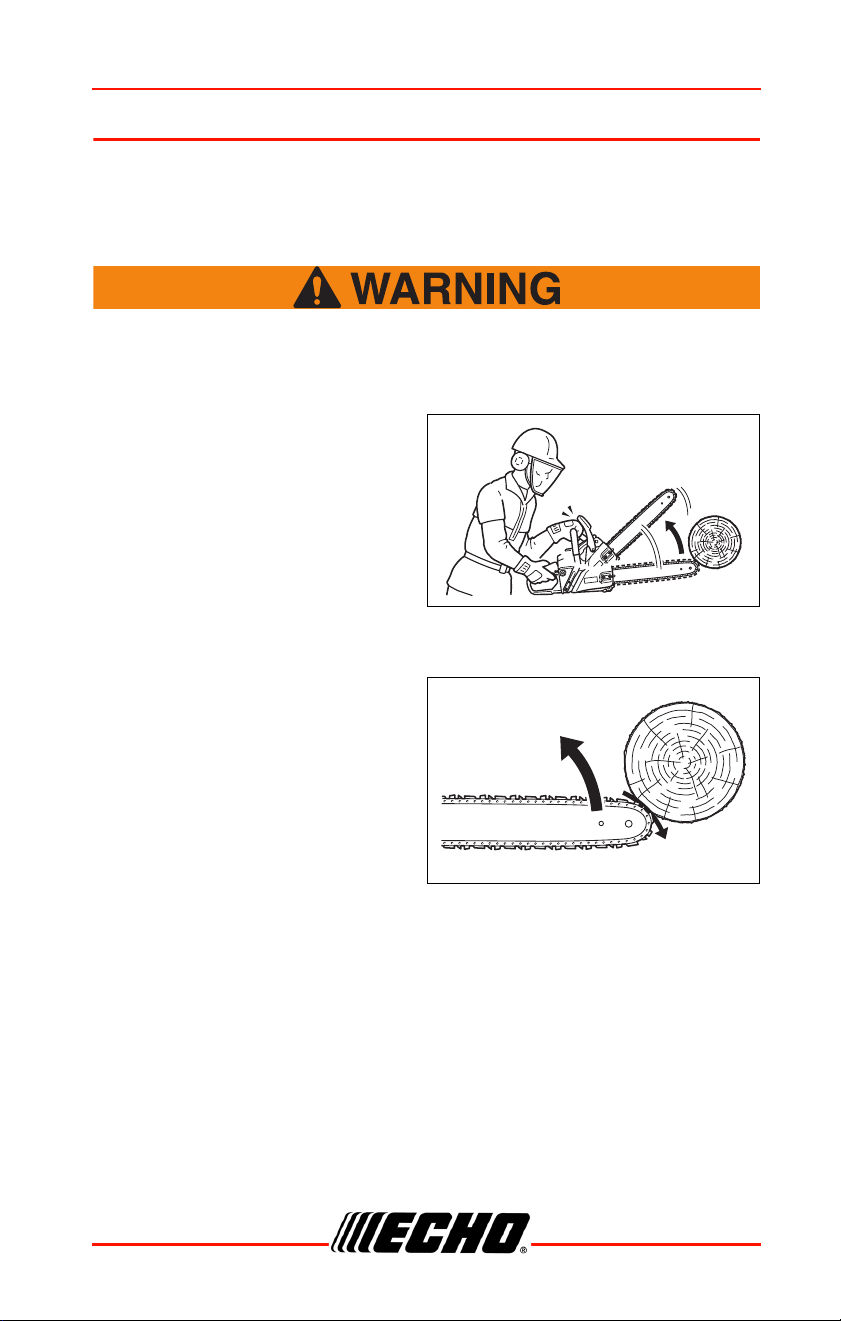
The ECHO product you purchased has been factory pre-assembled for your
convenience. Due to packaging restrictions, some assembly may be
necessary.
After opening the carton, check for damage. Immediately notify your retailer
or ECHO Dealer of damaged or missing parts. Use the contents list to check
for missing parts.
1 Power Head
1 Operator's Manual
1 Warranty Statement
1 Guide Bar
1 Saw Chain
CS-2511P SAFETY
X7503333700 5
© 11/2020 ECHO Incorporated
SAFETY
Rules For Safe Operation
Kickback Safety Precautions for Chain Saw Users
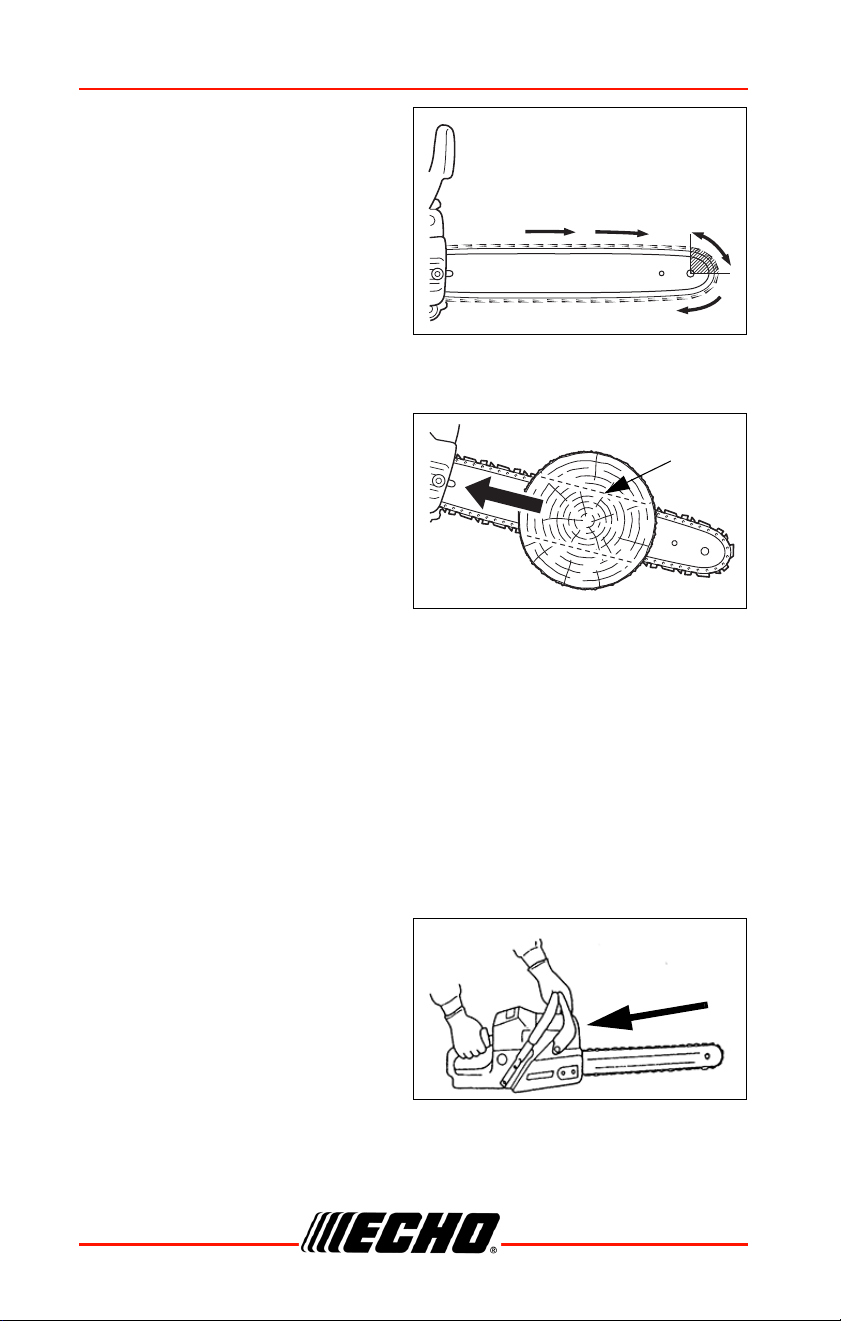
KICKBACK may occur when the nose or tip of the guide bar
touches an object, or when the wood closes in and pinches the
saw chain in the cut.
Tip contact in some cases may
cause a lightning fast reverse
REACTION, kicking the guide bar
up and back towards the operator.
Pinching the saw chain along the
top of the guide bar may push the
guide bar rapidly back towards the
operator. Either of these reactions
may cause you to lose control of the
saw which could result in serious
personal injury.
The optional Kick Guard
TM
device is
not installed on the guide bar when
you purchase your chain saw. The
optional Kick Guard
TM
can be used
in a majority of cutting operations,
and is especially recommended for
beginners, homeowners, or chain
saw novices. Most cutting
operations can be accomplished
with the optional Kick Guard
TM
in
place.
Do not rely exclusively upon the safety devices built into your saw. As a
chain saw user, you should take several steps to keep your cutting jobs free
from accident or injury.
Rotational kickback
Rotational kickback
Chain moving downward at impact
SAFETY CS-2511P
6 X7503333700
© 11/2020 ECHO Incorporated
1. With a basic understanding of
kickback, you can reduce or
eliminate the element of
surprise. Sudden surprise
contributes to accidents.
2. Keep a good firm grip on the
saw with both hands, the right
hand on the rear handle, and
the left hand on the front
handle, when the engine is
running. Use a firm grip with
thumbs and fingers encircling the chain saw handles. A firm grip will
help you reduce kickback and maintain control of the saw. Don’t let go.
3. Make sure that the area in
which you are cutting is free
from obstructions. Do not let
the nose of the guide bar
contact a log, branch, or any
other obstruction which could
be hit while you are operating
the saw.
4. Cut at high engine speeds.
5. Do not overreach or cut above shoulder height.
6. Follow manufacturer’s sharpening and maintenance instructions for the
saw chain.
7. Only use replacement bars and chains specified by the manufacturer or
the equivalent.
Correct Use Of Chain Brake
Chain Brake Operation
• Set the lever in the unlocked position before starting to cut.
• If the brake is tripped by kickback
reaction, the chain will stop
immediately. Release the throttle
to avoid possible damage to the
engine or clutch.
• Do not attempt to operate the
engine with the brake locked.
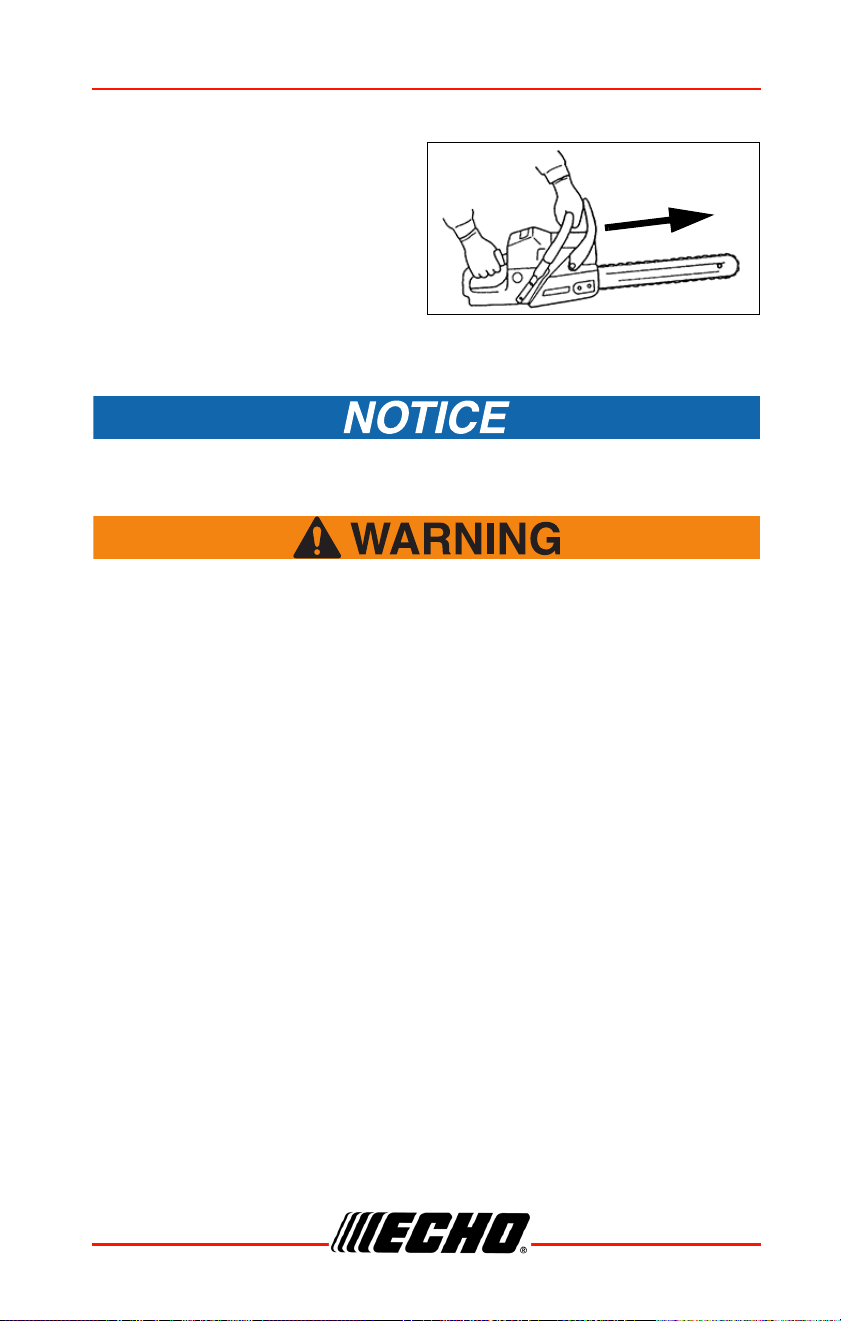
Kickback Danger Zone
Linear kickback
Kickback
Pinch
Unlocked
CS-2511P SAFETY
X7503333700 7
© 11/2020 ECHO Incorporated
Testing The Brake
• Start the engine on a solid level
surface and run at a fast idle until
warm.
• Hold the saw firmly by the
handles and accelerate the
engine to a fast idle.
• Slowly operate the chain brake
lever while holding the saw firmly on the ground. When the brake lever
trips, the chain should stop. Immediately release the throttle trigger.
Do not allow the saw to tip forward in order to avoid damage to the
chain.
If the chain does not stop immediately, return the saw to your
authorized dealer for repair.
Note:
• For practice, while cutting a small tree, push the lever forward to lock
the brake.
• Confirm that the brake works properly before each use.
• If the chain brake is clogged with wood chips, function of the brake may
deteriorate. Always keep the device clean.
• Do not increase engine RPM while the chain brake is locked.
Do not use a bar and chain combination other than those specified in this
manual.
For your own safety, do not remove the chain brake system.
The installation of a chain brake may be mandatory by law or as stipulated
by insurance regulations in your area of operation. You should inquire
through local government offices, your employer or your local dealer to
ensure that your chain saw conforms to the required safety standard.
Chain brakes have been designed and tested to comply with international
safety standards as follows:
USA: ANSI Standard B175.1 Safety Requirement for chain saws
Canada: CSA Standard Z62.1, Z62.3
Locked
SAFETY CS-2511P
8 X7503333700
© 11/2020 ECHO Incorporated
ANSI Standard B175.1 and
CSA Z62.1.3 stipulate that the
brake shall stop the chain 0.12
seconds at an engine speed of
13,500 r/min. It is the
responsibility of the owner/
operator to ensure that the
brake is serviced, adjusted
and tested strictly in
accordance with the
instructions as detailed here
in order to ensure that the
brake performance is
maintained in compliance with
the Standards B175.1 and CSA
Z62.1.3
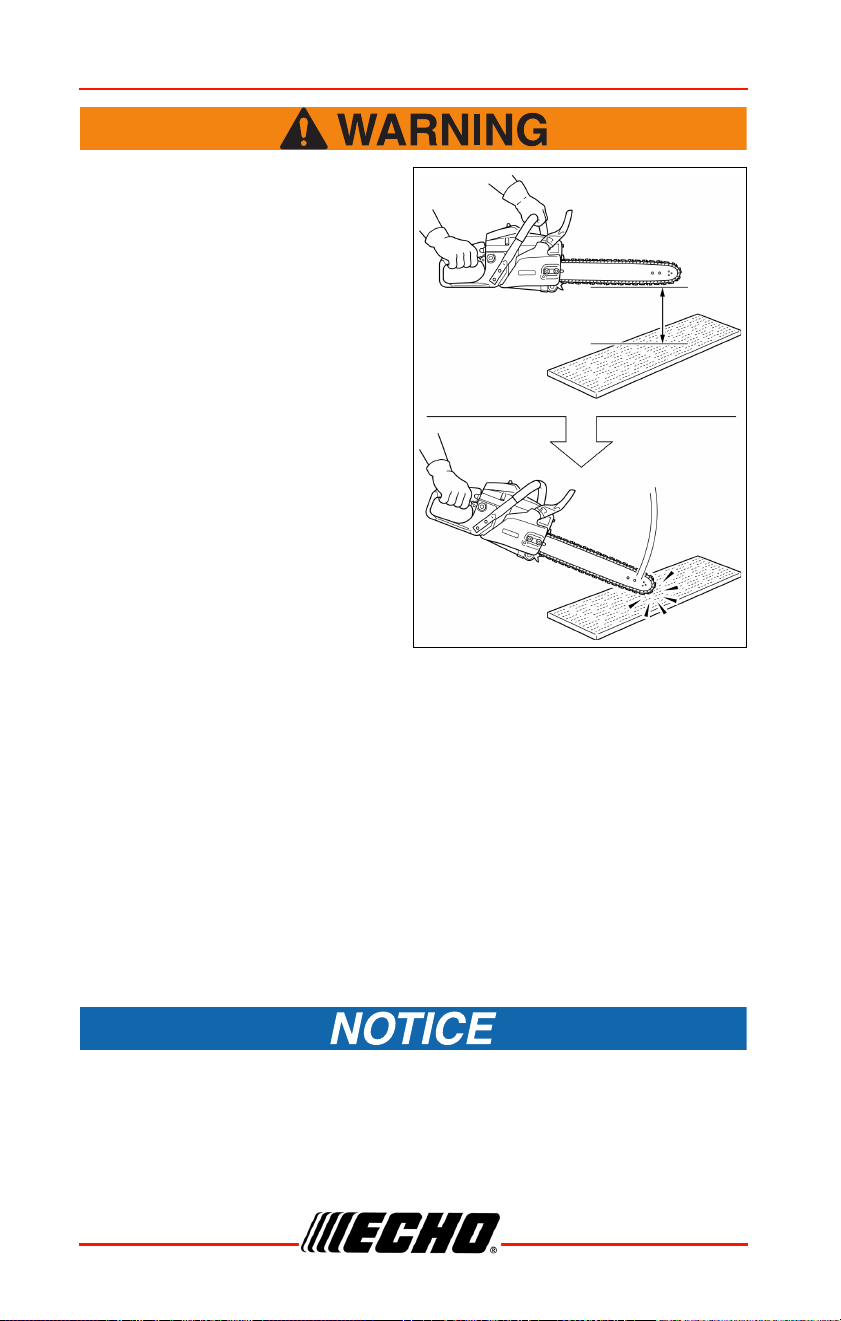
Automatic Chain Brake
Kickback produced from the tip of the guide bar will trip the automatic chain
brake. To make sure that the automatic chain brake operates properly,
follow these steps:
1. Stop the engine.
2. Hold the saw with the guide bar approximately 35 cm (14 inches) above
a wooden surface. Right hand should hold the rear handle, and left
hand should hold the front handle.
3. Release the front handle and drop the end of the guide bar against the
wooden surface.
4. The impact should lock the chain brake.
When checking the operation of the automatic chain brake, use a soft
surface substance like wood to absorb the impact so the chain is not
damaged.
35 cm
(14 in.)

CS-2511P SAFETY
X7503333700 9
© 11/2020 ECHO Incorporated
Other Safety Precautions
1. Do not operate a chain saw with one hand! Serious injury to the
operator, helpers, bystanders, or any combination of these persons
may result from one-handed operation. A chain saw is intended for two-
handed use.
2. Do not operate a chain saw when you are fatigued.
3. Use safety footwear, snug-fitting clothing and protective gloves. Wear
eye, hearing, and head protection devices.
4. Use caution when handling fuel. Move the chain saw at least 3 m
(10 feet) from the fueling point before starting the engine.
5. Do not allow other persons to be near the chain saw when starting or
cutting with the chain saw. Keep bystanders and animals out of the
work area.
6. Do not start cutting until you have a clear work area, secure footing,
and a planned retreat path from the falling tree.
7. Keep all parts of your body away from the saw chain when the engine is
running.
8. Before you start the engine, make sure that the saw chain is not
contacting anything.
9. Carry the chain saw with the engine stopped, the guide bar and saw
chain to the rear, and the muffler away from your body.
10. Do not operate a chain saw that is damaged, improperly adjusted, or
not completely and securely assembled. Be sure that the saw chain
stops moving when the throttle control trigger is released.
11. Shut off the engine before setting the chainsaw down.
12. Use extreme caution when cutting small size brush and saplings
because slender material may catch the saw chain and be whipped
toward you or pull you off balance.
13. When cutting a limb that is under tension, be alert for spring-back so
that you will not be struck when the tension in the wood fibers is
released.
14. Keep the handles dry, clean, and free of oil or fuel mixture.
15. Operate the chainsaw only in well ventilated areas.
16. Do not operate a chainsaw in a tree unless you have been specifically
trained to do so.
17. All chain saw service, other than items listed in the Operator’s manual
maintenance instructions, should be performed by competent service
personnel. (For example, if improper tools are used to remove the
flywheel or if an improper tool is used to hold the flywheel in order to
remove the clutch, structural damage to the flywheel could occur and
could subsequently cause the flywheel to burst.)
SAFETY CS-2511P
10 X7503333700
© 11/2020 ECHO Incorporated
18. When transporting your chain saw, use the appropriate guide bar
scabbard.
19. A spark arrestor muffler approved to SAE Standard J335 is standard on
this chain saw to reduce the possibility of forest fires. Do not operate
the chain saw with a loose or defective muffler. Do not remove the
spark arrestor screen.
20. When using a chainsaw a fire extinguisher should be available.
21. When felling, keep at least 2 tree lengths between yourself and your
fellow workers.
22. Follow instructions in your operator’s manual for starting the chain saw.
23. Never adjust the guide bar or saw chain with the engine operating.
24. When boring with the chainsaw, the initial cut should be introduced with
the lower part of the nose (tip) until the hole is sufficiently large so as to
introduce the entire nose (tip) of the guide bar. This technique should
reduce the danger of kickback.
25. Allow your chainsaw to cool before refueling, and do not smoke while
refueling.
Chain saws shall be used in accordance with the operating
instructions and safety precautions listed in the operator's
manual(s). It shall be the responsibility of the owner to see that
such instructions and precautions are given to every operator
who uses the saw.
During operation, the muffler or catalytic muffler and
surrounding cover become hot.
Never suspend the saw on a lanyard with the engine
running.
Always use the saw from the right-hand side of your body –
NEVER from the left side.
Always wear proper safety clothing to protect your lower
body from sharp saw chain and hot muffler.
Always keep exhaust area clear of flammable debris during
transportation or when storing, otherwise serious property
damage or personal injury may result.

CS-2511P SAFETY
X7503333700 11
© 11/2020 ECHO Incorporated
Moving parts can amputate fingers or cause severe injuries.
Keep hands, clothing and loose objects away from all openings.
ALWAYS stop engine, disconnect spark plug, and make
sure all moving parts have come to a complete stop before
removing obstructions, clearing debris, or servicing unit.
DO NOT start or operate unit unless all guards and
protective covers are properly assembled to unit.
NEVER reach into any opening while the engine is running.
Moving parts may not be visible through openings.
Using improper replacement components or removing safety
devices may result in serious or fatal injury.
Unit includes safety devices that reduce the likelihood of
kickback:
◆ Chain brake - brake actuated by kickback energy, not
manual activation.
◆ Reduced-kickback guide bar - reduced nose radius guide
bar.
◆ Low-kickback saw chain - saw chain that meets ANSI
kickback performance requirements when configured with
the bar/chain recommendations in this manual.
◆ Front hand guard - a structural barrier between the front
handle of a chain saw and the guide bar.
Periodically Check fuel system (fuel lines, vent, grommet, fuel
tank, and fuel cap) for leaks especially if the unit is dropped. If
damage or leaks are found, do not use unit, otherwise serious
personal injury or property damage may occur. Have unit
repaired by an authorized servicing dealer before using.
SAFETY CS-2511P
12 X7503333700
© 11/2020 ECHO Incorporated
Personal Condition and Safety Equipment
Cancer and Reproductive Harm
www.P65Warnings.ca.gov
The muffler or catalytic muffler and surrounding cover
may become extremely hot. Always keep clear of
exhaust and muffler area, otherwise serious personal
injury might occur.
Users of this product risk injury to themselves and others if the
unit is used improperly and/or safety precautions are not
followed. Proper clothing and safety gear must be worn when
operating unit.
Physical Condition
Your judgment and physical dexterity may not be good:
• If you are tired or sick
• If you are taking medication
• If you have taken alcohol or drugs
Operate unit only if you are physically and mentally well.
Eye Protection
◆ Eye protection that meets ANSI Z87.1 or CE requirements
must be worn whenever you operate the unit.
◆ For additional safety, a full-face shield can be worn over
safety glasses or goggles to provide protection from sharp
branches or flying debris.

CS-2511P SAFETY
X7503333700 13
© 11/2020 ECHO Incorporated
Hand Protection
Wear sturdy, no-slip, rubber work gloves to improve your grip on the
handles. Gloves also provide protection against cuts and scratches, cold
environments, and reduce the transmission of machine vibration to your
hands.
Hearing/Ear Protection
ECHO recommends wearing personal protective equipment whenever unit
is used.
Breathing Protection
Operators who are sensitive to dust or other common airborne allergens
may need to wear a dust mask to prevent inhaling these materials while
operating unit. Dust masks can provide protection against dust, plant debris,
and other plant matter such as pollen. Make sure the mask does not impair
your vision, and replace the mask as needed to prevent air restrictions.
Proper Clothing
Wear snug-fitting, durable clothing:
• Pants should have long legs, shirts should have long sleeves.
• DO NOT WEAR SHORTS.
• DO NOT WEAR TIES, SCARVES, JEWELRY, or clothing with loose or
hanging items that could become entangled in moving parts or
surrounding growth.
• Keep clothing buttoned or zipped, and keep shirt tails tucked in.
• Wear sturdy work shoes with nonskid rubber soles.
• DO NOT WEAR OPEN TOED SHOES.
• DO NOT OPERATE UNIT WITH BARE FEET.
Keep long hair away from engine and air intake. Retain hair with cap or net.
Heavy protective clothing can increase operator fatigue, which may lead to
heat stroke. Schedule heavy work for early morning or late afternoon hours
when temperatures are cooler.

SAFETY CS-2511P
14 X7503333700
© 11/2020 ECHO Incorporated
The components of this machine generate an electromagnetic
field during operation, which can interfere with some
pacemakers. To reduce the risk of serious or fatal injury,
persons with pacemakers should consult with their physician
and the pacemaker manufacturer before operating this
machine. In the absence of such information, ECHO does not
recommend the use of this machine by anyone who has a
pacemaker.
Extended Operation / Extreme Conditions
Prolonged exposure to cold and/or vibration can result in injury.
Read and follow all safety and operation instructions to
minimize risk of injury. Failure to follow instructions can result
in painful wrist/hand/arm injuries.
It is believed that a condition called Raynaud’s Phenomenon, which affects
the fingers of certain individuals, may be brought about by exposure to
vibration and cold. Exposure to vibration and cold may cause tingling and
burning sensations, followed by loss of color and numbness in the fingers.
The following precautions are strongly recommended, because the
minimum exposure, which might trigger the ailment, is unknown.
• Keep your body warm, especially the head, neck, feet, ankles, hands, and
wrists.
• Maintain good blood circulation by performing vigorous arm exercises
during frequent work breaks, and also by not smoking.
• Limit the hours of operation. Try to fill each day with jobs where operating
the unit or other hand-held power equipment is not required.
• If you experience discomfort, redness, and swelling of the fingers
followed by whitening and loss of feeling, consult your physician before
further exposing yourself to cold and vibration.
CS-2511P SAFETY
X7503333700 15
© 11/2020 ECHO Incorporated
Repetitive Stress Injuries (RSI)
It is believed that overusing the muscles and tendons of the fingers, hands,
arms, and shoulders may cause soreness, swelling, numbness, weakness,
and extreme pain in those areas. Certain repetitive hand activities may put
you at a high risk for developing a Repetitive Stress Injury (RSI). An
extreme RSI condition is Carpal Tunnel Syndrome (CTS), which could occur
when your wrist swells and squeezes a vital nerve that runs through the
area. Some believe that prolonged exposure to vibration may contribute to
CTS. CTS can cause severe pain for months or even years.
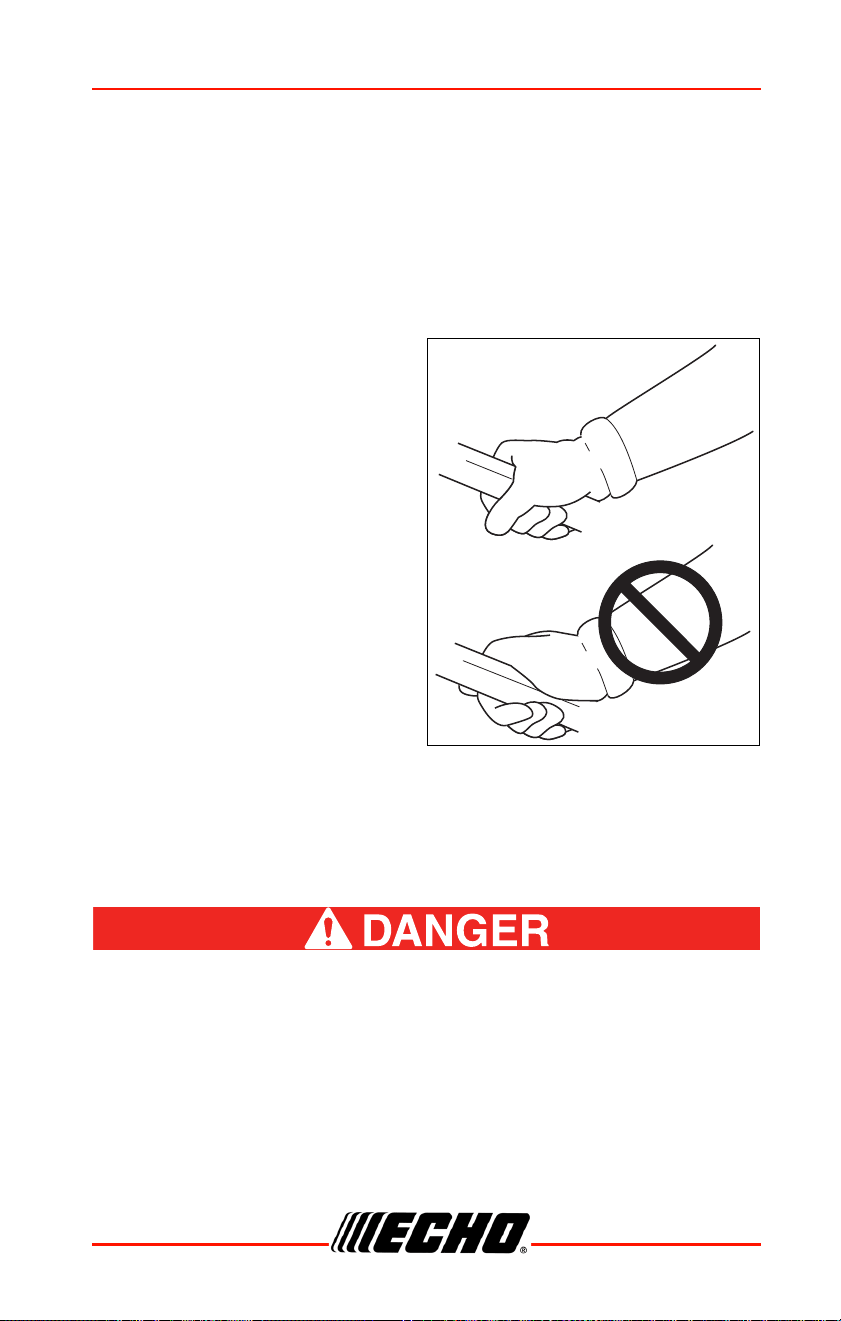
To reduce the risk of RSI/CTS, do
the following:
• Avoid using your wrist in a bent,
extended, or twisted position.
Instead try to maintain a straight
wrist position. Also, when
grasping, use your whole hand,
not just the thumb and index
finger.
• Take periodic breaks to minimize
repetition and rest your hands.
• Reduce the speed and force with
which you do the repetitive
movement.
• Do exercises to strengthen the hand and arm muscles.
• Immediately stop using all power equipment and consult a doctor if you
feel tingling, numbness, or pain in the fingers, hands, wrists, or arms. The
sooner RSI/CTS is diagnosed, the more likely permanent nerve and
muscle damage can be prevented.
All over head electrical conductors and communications wires
can have electricity flow with high voltages. This unit is not
insulated against electrical current. Never touch wires directly
or indirectly, otherwise serious injury or death can result.
SAFETY CS-2511P
16 X7503333700
© 11/2020 ECHO Incorporated
Do not operate this product indoors or in inadequately
ventilated areas. Engine exhaust contains poisonous emissions
and can cause serious injury or death.
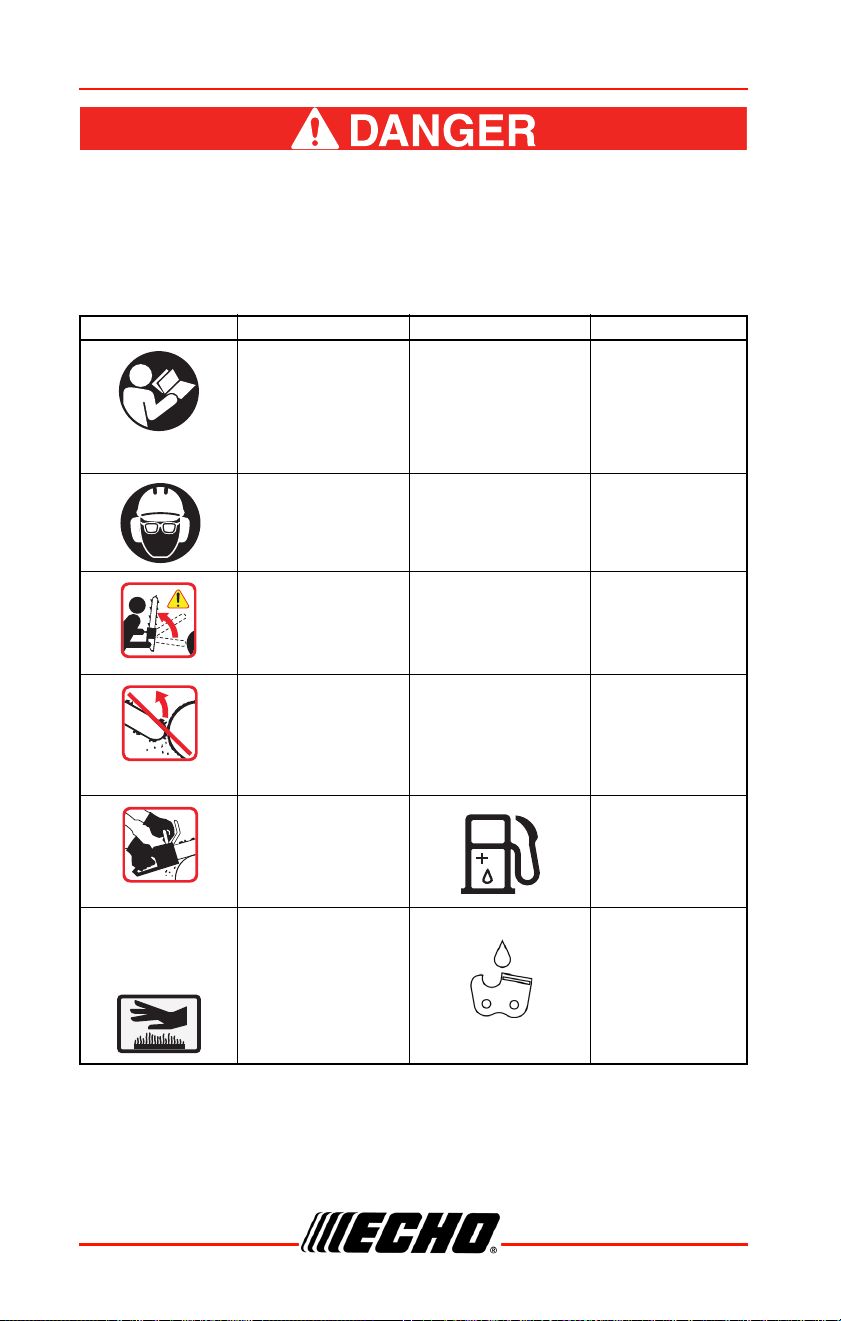
International Symbols
Symbol Description Symbol Description
WARNING!
Read and follow all
safety precautions in
the instruction manual.
Failure to follow
instructions could result
in serious personal
injury.
Carburetor
Adjustment - High
Speed Mixture
Wear Eye, Ear and
Head Protection
Carburetor
Adjustment - Idle
Speed
Tip contact may cause
the guide bar to move
suddenly upward and
backward, which may
cause serious injury
Carburetor
Adjustment - Low
Speed Mixture
Contact of the guide bar
tip with any object
should be avoided
Measured maximum
kickback value,
without brake, for
approved bar and
chain combinations.
Both of the operator’s
hands must be used to
operate the chain saw
Fuel and Oil Mixture
Hot Surface Chain Oil Fill
H
T
L
CS-2511P SAFETY
X7503333700 17
© 11/2020 ECHO Incorporated
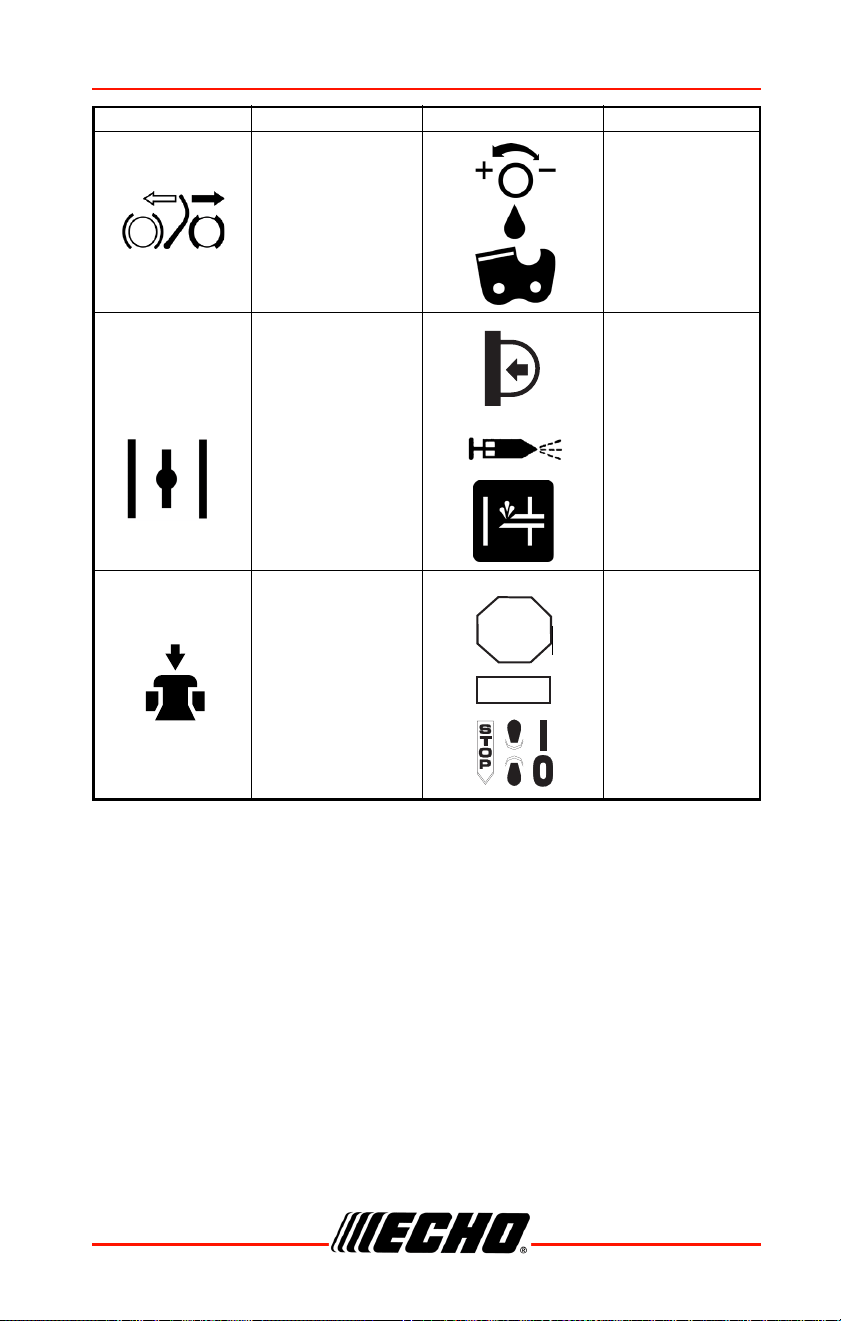
Note: Not all symbols will appear on your unit.
Chain Brake Operation
Chain Oiler
Adjustment
Choke Control “COLD
START” Position
(Choke Closed)
Choke Control “RUN”
Position (Choke Open)
Purge Pump
De-Compression
Device
STOP / Momentary
STOP Switch
Symbol Description Symbol Description
STOP
STOP

SAFETY CS-2511P
18 X7503333700
© 11/2020 ECHO Incorporated
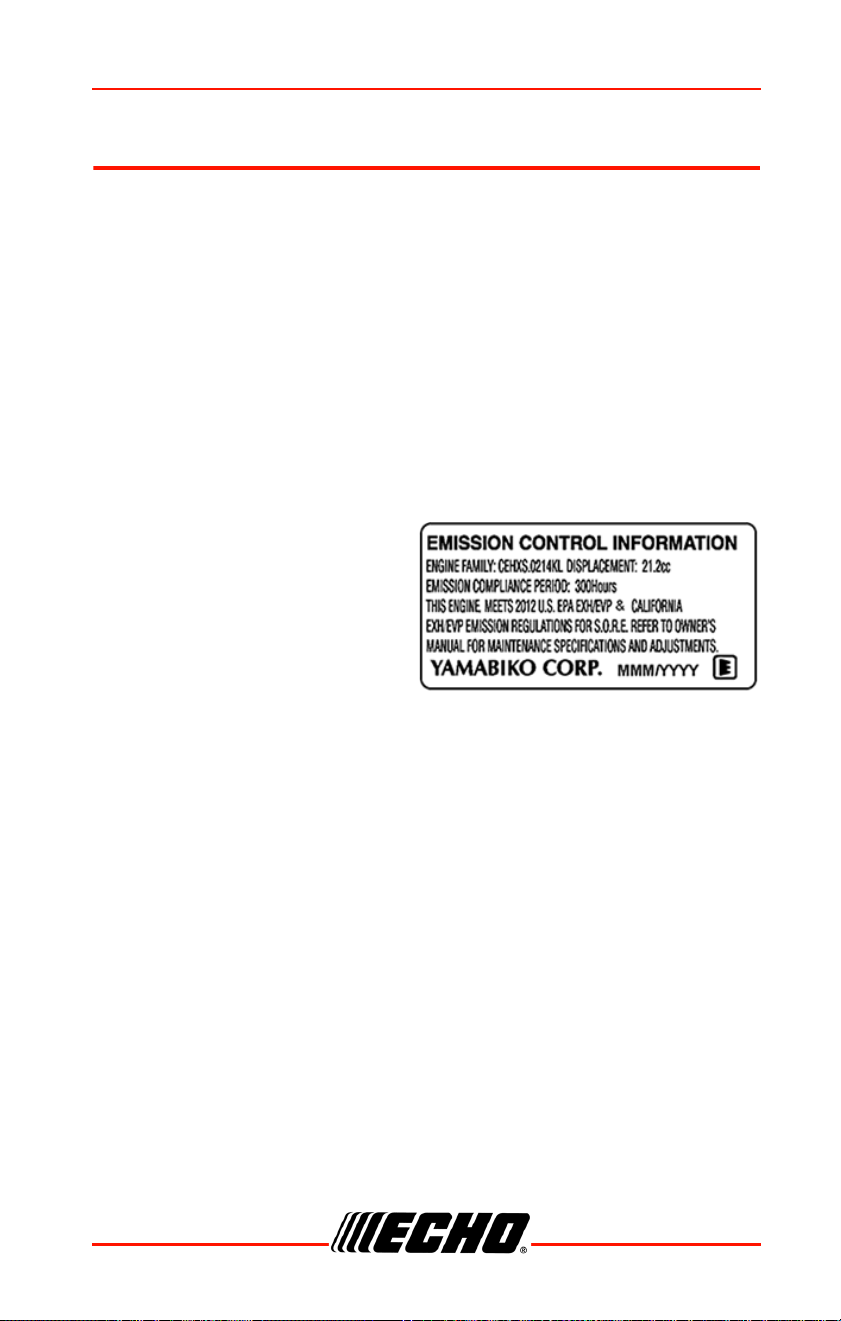
Manual Safety Symbols and Important Information
Throughout this manual and on the product itself, you will find safety alerts
and helpful, informational messages preceded by symbols or key words.
The following is an explanation of those symbols and key words and what
they mean to you.
The safety alert symbol accompanied by the word “DANGER”
calls attention to an act or condition which WILL lead to serious
personal injury or death if not avoided.
The safety alert symbol accompanied by the word “WARNING”
calls attention to an act or condition which CAN lead to serious
personal injury or death if not avoided.
The safety alert symbol accompanied by the word “CAUTION”
calls attention to an act or condition which might lead to minor
or moderate personal injury if not avoided.
The enclosed message provides information necessary for the
protection of the unit.
Note: This enclosed message provides tips for use, care and
maintenance of the unit.
CIRCLE AND SLASH SYMBOL
This symbol means the specific action shown is prohibited.
Ignoring these prohibitions can result in serious or fatal injury.
CS-2511P EMISSION CONTROL
X7503333700 19
© 11/2020 ECHO Incorporated
EMISSION CONTROL (EXHAUST &
EVAPORATIVE)
CARB And EPA Emissions Control Information
The emission control system for
the engine is EM (engine
modification) and, if the second to
last character of the Engine Family
on the Emission Control
Information label (sample below) is
“B”, “C”, “K”, or “T”, the emission
control system is EM and TWC
(3-way catalyst). The fuel tank/fuel
line emission control system is EVAP (evaporative emissions). Evaporative
emissions for California models are only applicable to fuel tanks and fuel
feed lines.
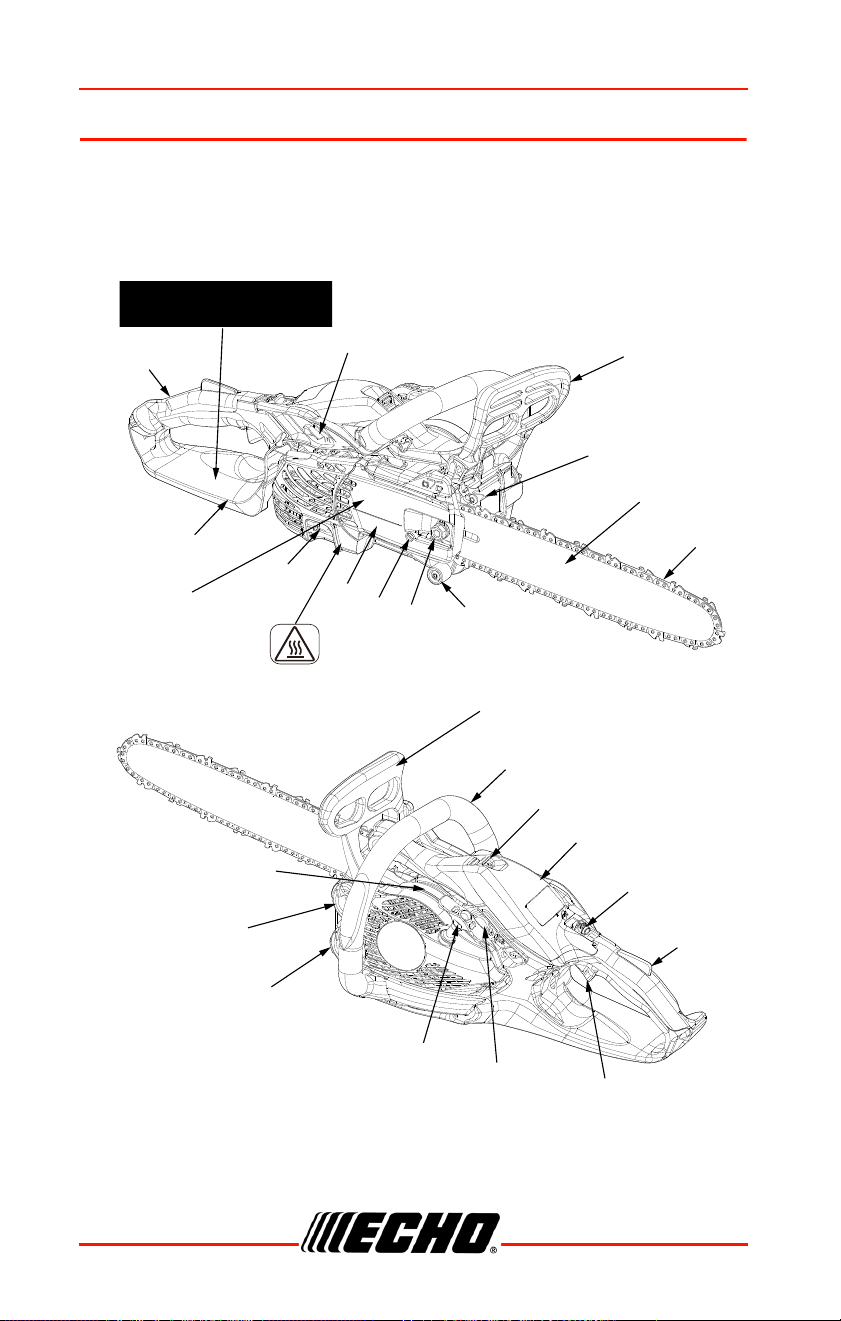
An Emission Control Label is
located on the engine. (This is an
EXAMPLE ONLY, information on
label varies by engine FAMILY).
Product Emission Durability
(Emission Compliance
Period)
The 50 or 300 hour emission compliance period is the time span selected by
the manufacturer certifying the engine emissions output meets applicable
emissions regulations, provided that approved maintenance procedures are
followed as listed in the Maintenance Section of this manual.
DESCRIPTION CS-2511P
20 X7503333700
© 11/2020 ECHO Incorporated
DESCRIPTION
Locate the safety decal(s) on your unit. Make sure the decal(s) is legible
and that you understand and follow the instructions on it. If a decal cannot
be read, a new one can be ordered from your ECHO dealer. Safety label is
for example only. Your label my appear slightly different.
1
2
3
4
5
6
8
9
10
11
12
13
14
15
16
17
18
19
20
21
22
23
7

CS-2511P DESCRIPTION
X7503333700 21
© 11/2020 ECHO Incorporated
CHAIN SAW TERMS
• FAST IDLE -Throttle setting that causes engine to operate at a faster
speed for easier starting.
• THROTTLE LATCH - Device that sets idle speed to fast idle when choke
control is operated.
• CHAIN BRAKE - Stops the saw chain.
• DRIVE SPROCKET - Drives saw chain.
• CLUTCH - Turns drive sprocket when engine rpm is fast enough to
provide the power needed for cutting.
1. Rear Handle - For Right Hand
2. Choke Control Knob
3. Front Hand Guard / Chain Brake Lever
4. Spiked Bumper
5. Guide Bar
6. Saw Chain
7. Chain Catcher
8. Chain Brake / Sprocket Guard Nut
9. Chain Tension Adjuster
10. Chain Brake / Sprocket Guard Cover
11. Muffler Cover
12. Rear Hand Guard
13. Front Support Handle - For Left Hand
14. Air Cleaner Cover Latch
15. Air Cleaner Cover
16. STOP Switch
17. Throttle Trigger Lockout
18. Throttle Trigger
19. Purge Bulb
20. Starter Handle
21. Oil Tank Cap
22. Fuel Tank Cap
23. Type and Serial Number
DESCRIPTION CS-2511P
22 X7503333700
© 11/2020 ECHO Incorporated
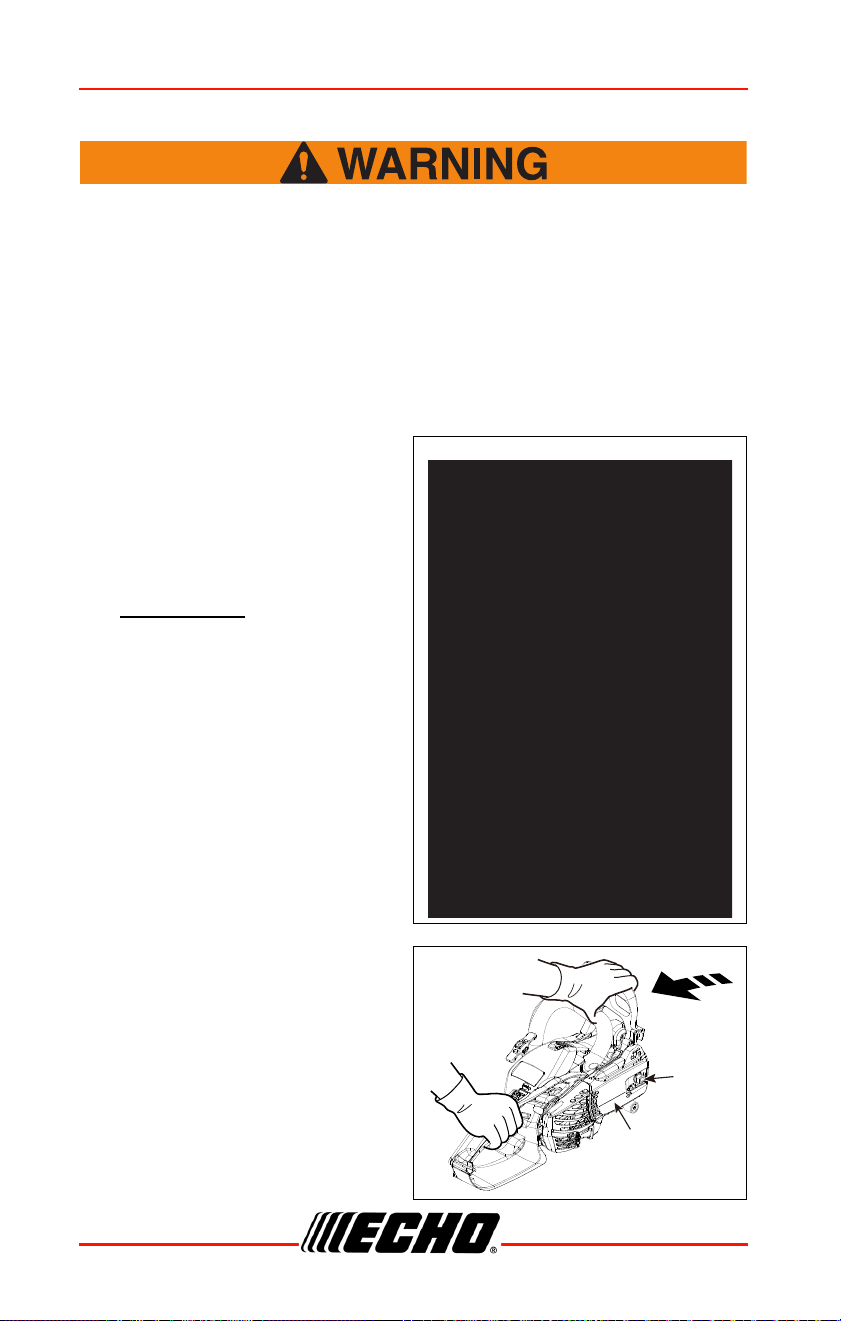
Preparation For Use
Make sure engine is stopped before performing any of the
procedures that follow. Saw chain is sharp! Always wear gloves
when handling assembly. Failure to follow instructions can
cause serious personal injury.
Note: The machine may be delivered with guide bar, and saw chain
not installed. Install guide bar, saw chain, and optional Kick
Guard
TM
as follows.
Instructions to Install Optional Kick Guard
TM
to Bar
Tools Needed: Two 11 mm (7/16 in.)
Wrenches.
1. Install bolt (A) in rear hole (B) of
optional Kick Guard
TM
and
through front hole (C) in guide
bar.
2. IMPORTANT:
Dimple (D) in
optional Kick Guard
TM
must
engage recess (E) in guide bar.
3. Securely tighten nut (F) and
bolt (A).
Guide Bar and Saw Chain
Installation / Removal
1. Use T-Wrench to open air
cleaner cover latch. Disconnect
spark plug lead.
2. Unlock chain brake (A).
3. Remove sprocket guard nut (B)
and remove sprocket guard
cover (C).
A
D
B
E
C
F
Optional
Kick Guard
TM
A
B
C
CS-2511P DESCRIPTION
X7503333700 23
© 11/2020 ECHO Incorporated
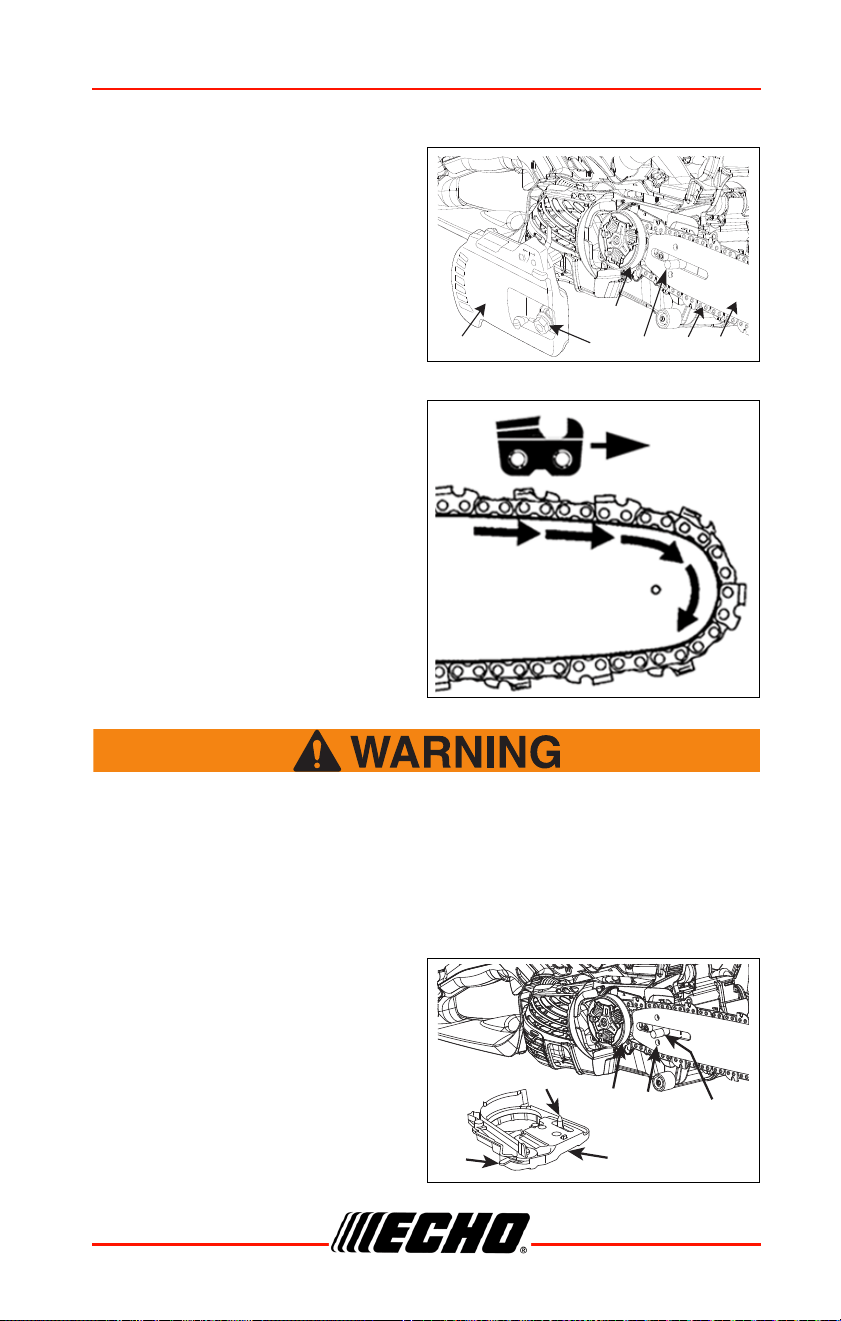
4. Remove guide bar (D) and saw
chain (E) as necessary.
Note: See “Maintenance”
section for Guide Bar,
Sprocket, and Setting the
Saw Chain for
maintenance procedures.
5. Mount guide bar (D) on stud (F)
and slide toward clutch drum
sprocket (G) to make saw chain
(E) installation easier. Install
saw chain around clutch drum
sprocket and guide bar as
shown, with saw chain cutters
on top of guide bar facing
forward.
Do not start or operate saw if brake band is not in place on
clutch drum. Make sure you check chain brake operation after
sprocket guard is replaced. Do not use saw if chain brake does
not function properly. Improper sprocket guard assembly can
result in serious injury, and will cause severe saw damage if unit
is started.
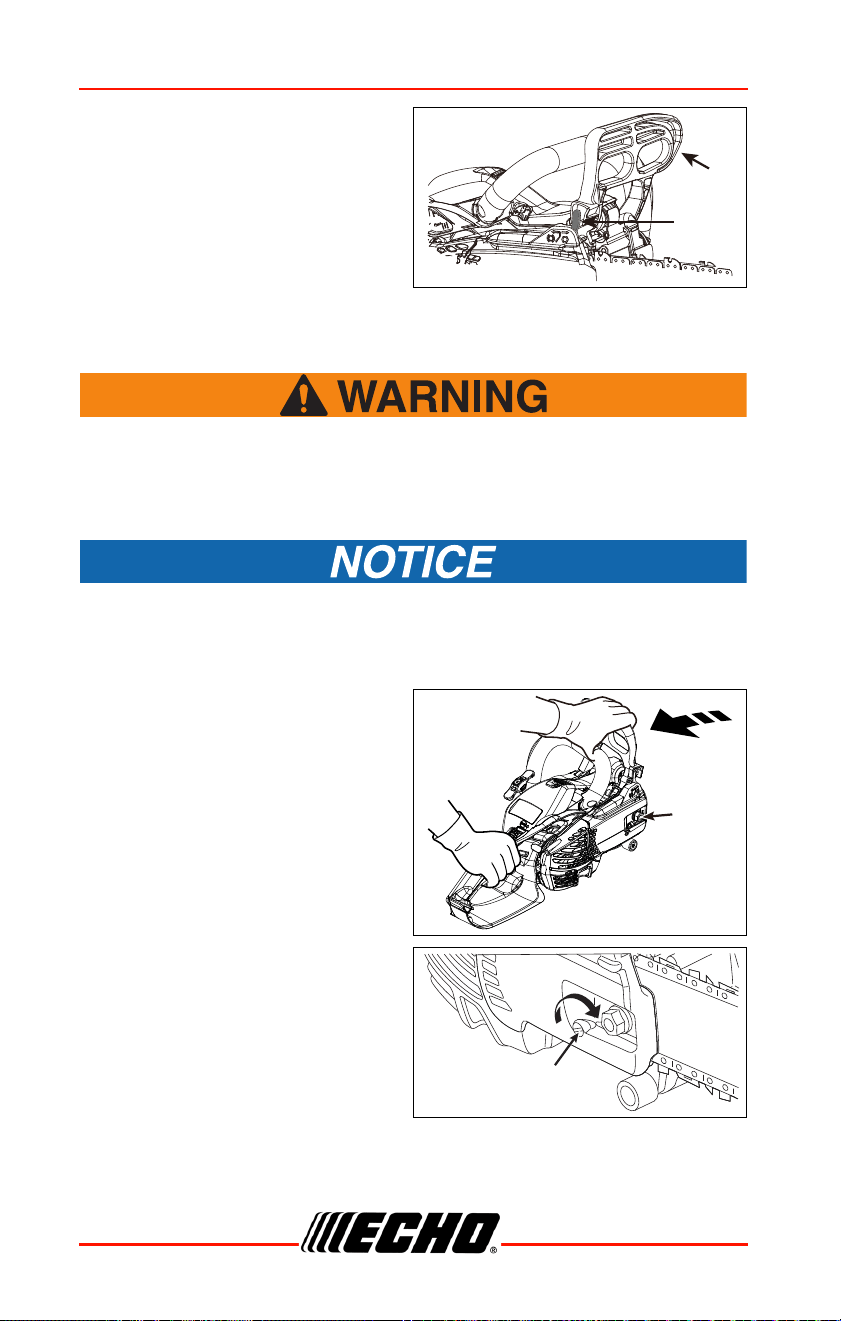
6. Install sprocket guard cover (C)
over guide bar studs (F). Make
sure chain tension adjuster pin
(H) fits into the guide bar
adjuster hole (J), and brake
band in sprocket guard cover
must be positioned around
clutch drum sprocket (G).
B
C
D
E
F
G
F
H
G
C
K
J
DESCRIPTION CS-2511P
24 X7503333700
© 11/2020 ECHO Incorporated
7. Align brake connector (K) on
sprocket guard cover (C) to
groove on the side of the front
hand guard (A). Install and
tighten sprocket guard nut (B),
finger tight.
8. Adjust saw chain tension, as
instructed in “Adjust Chain
Tension”.
Adjust Chain Tension
Make sure engine is stopped before performing any of the
procedures that follow. Saw chain is sharp! Always wear gloves
when handling assembly. Failure to follow instructions can
cause serious personal injury.
Make sure you loosen sprocket guard nut before chain tension
adjuster is turned. Failure to follow instructions can damage the
sprocket guard and tensioner.
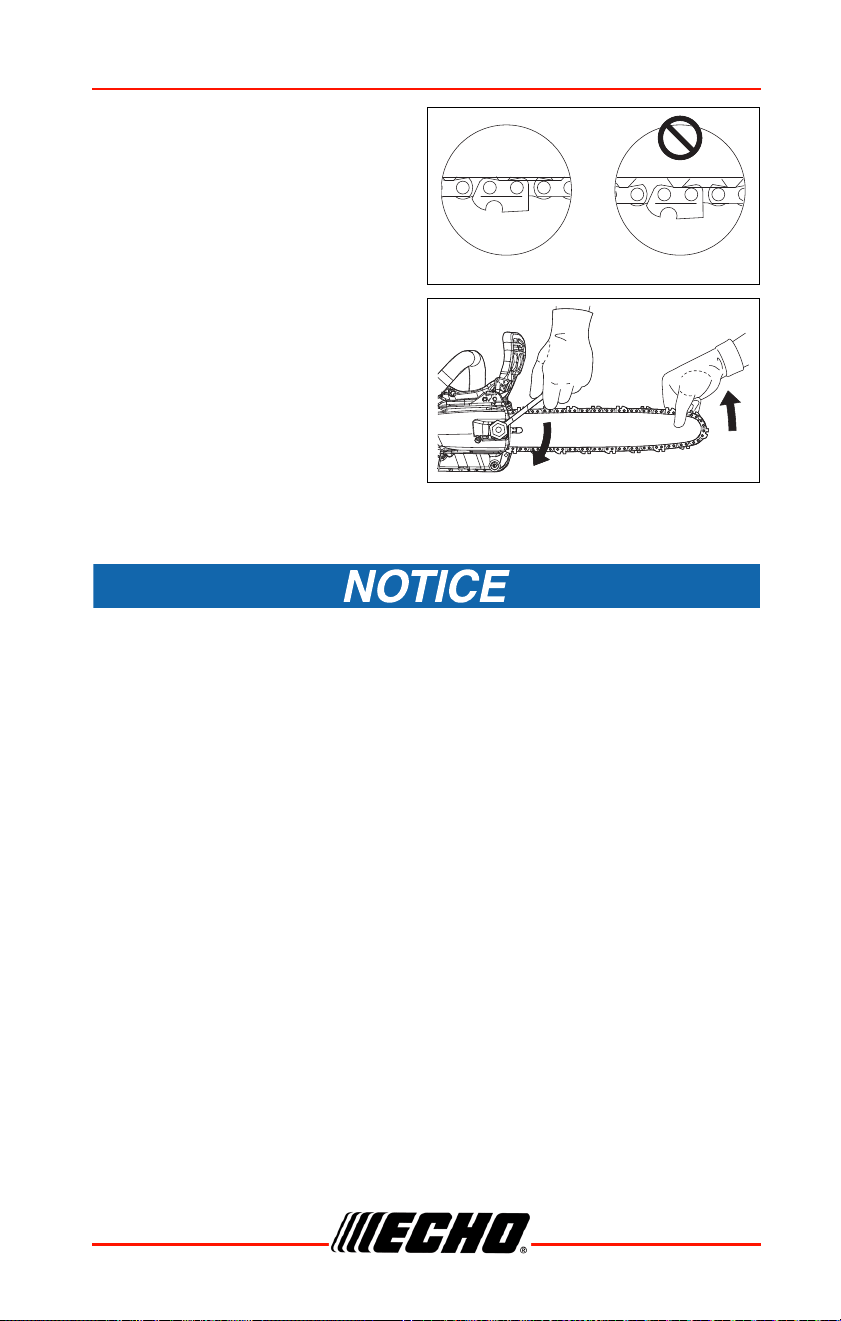
1. Use T-Wrench to open air
cleaner cover latch. Disconnect
spark plug lead.
2. Unlock chain brake (A).
3. Loosen sprocket guard nut (B).
4. Hold the bar nose up, and turn
the adjuster screw (C) toward
(+) until chain contacts
underside of the bar.
A
K
A
B
C
CS-2511P DESCRIPTION
X7503333700 25
© 11/2020 ECHO Incorporated
5. A: Correct Chain Tension
B: Incorrect Chain Tension
6. Tighten sprocket guard nut (B)
with the bar nose held up.
7. Pull the chain around the bar by hand. Loosen the adjustment if you
feel tight spots.
Tighten guide bar nut to 15-20 N•m (153 to 204 kgf•cm,
133-177 in•lbf). DO NOT over-tighten nut. Damage to saw can result.
8. Connect spark plug, assemble components in reverse order.
9. Keep chain properly tensioned at all times.
Note: All chains require frequent adjustments.
AB

OPERATION CS-2511P
26 X7503333700
© 11/2020 ECHO Incorporated
OPERATION
Fuel
Diesel fuels and alternative fuels, such as E-15 (15% ethanol),
E-85 (85% ethanol) or any fuels not meeting ECHO requirements
are NOT approved for use in ECHO 2-stroke gasoline engines.
Use of diesel or alternative fuels can cause performance
problems, loss of power, overheating, fuel vapor lock, and
unintended machine operation, including, but not limited to,
improper clutch engagement. Diesel or alternative fuels can
also cause premature deterioration of fuel lines, gaskets,
carburetors and other engine components.
Fuel Requirements
Gasoline - Use fresh (purchased within the last 30 days from the pump) 89
Octane [R+M/2] (mid grade or higher) gasoline known to be good quality.
Gasoline may contain up to 10% Ethanol (grain alcohol) or 15% MTBE
(methyl tertiary-butyl ether). Gasoline containing methanol (wood alcohol) is
NOT approved. Use of ECHO branded fuel is recommended to extend
engine life in all air-cooled 2-stroke and 2/4-stroke hybrid engines.
Two Stroke Oil - A two-stroke engine oil, such as ECHO branded 2-stroke
oils, meeting ISO-L-EGD (ISO/CD 13738) and J.A.S.O. FD Standards must
be used. ECHO branded 2-stroke oils meet these standards. Engine
problems due to inadequate lubrication caused by failure to use an ISO-L-
EGD (ISO/CD 13738) and J.A.S.O. M345-FD certified oil will void the two-
stroke engine warranty.
2-Stroke engine oil contains petroleum distillates and other
additives that may be harmful if swallowed. Heated oil can
release vapors that can cause flash fire, or ignite with explosive
force. Read and follow the oil manufacturer’s instructions, and
observe all safety warnings and precautions for handling
flammable liquids. For more detailed safety and first aid
information, visit www.echo-usa.com for a copy of the Material
Safety Data Sheet.
◆ KEEP OUT OF REACH OF CHILDREN.
CS-2511P OPERATION
X7503333700 27
© 11/2020 ECHO Incorporated
◆ If swallowed, do not induce vomiting. CALL PHYSICIAN OR
A POISON CONTROL CENTER IMMEDIATELY.
◆ WEAR SAFETY GLASSES when mixing or handling.
◆ AVOID repeated or prolonged skin contact.
◆ AVOID inhaling oil mists or vapors.
ECHO branded 2-stroke oils may be mixed at 50:1 ratio for
application in all ECHO engines sold in the past regardless of ratio
specified in those manuals.
Handling Fuel
Fuel is VERY flammable. Use extreme care when mixing, storing
or handling, or serious personal injury will result.
◆ Use an approved fuel container. Mark fuel containers as
containing 2-stroke mixture fuel.
◆ DO NOT smoke near fuel.
◆ DO NOT allow flames or sparks near fuel.
◆ Fuel tanks/cans may be under pressure. Always loosen
fuel caps slowly allowing pressure to equalize.
◆ NEVER refuel a unit when the engine is HOT or RUNNING!
◆ DO NOT fill fuel tanks indoors. ALWAYS fill fuel tanks
outdoors over bare ground.
◆ DO NOT overfill fuel tank. Wipe up spills immediately.
◆ Securely tighten fuel tank cap and close fuel container
after refueling.
◆ Inspect for fuel leakage. If fuel leakage is found, do not
start or operate unit until leakage is repaired.
◆ Move at least 3 m (10 ft.) from refueling location before
starting the engine.
Gasoline vapor is heavier than air, and can travel along the
ground to nearby sources of ignition such as electrical motors,
pilot lights, and hot or running engines. Vapors ignited by an
ignition source can flash back to the fuel container, resulting in
an explosion, fire, serious or fatal injuries, and extensive
property damage.
OPERATION CS-2511P
28 X7503333700
© 11/2020 ECHO Incorporated
Mixing Instructions
Stored fuel ages. Do not mix more fuel than you expect to use in 30
days, 90 days when a fuel stabilizer is added.
1. Fill an approved fuel container
with half of the required
amount of gasoline.
2. Add the proper amount of
2-stroke oil to gasoline.
3. Close container and shake to
mix oil with gasoline.
4. Add remaining gasoline, close
fuel container, and remix.
Spilled fuel is a leading cause of hydrocarbon emissions. Some
locations may require the use of automatic fuel shut-off containers to
reduce fuel spillage.
Storage - Fuel storage laws vary by locality. Contact your local government
for the laws affecting your area. As a precaution, store fuel in an approved,
airtight container. Store in a well-ventilated, unoccupied building, away from
sparks and flames.
• Empty the fuel tank prior to storing the unit. Return unused fuel to an
approved fuel storage container.
Stored two-stroke fuel can separate. ALWAYS shake fuel container
thoroughly before each use.
Used oil and gasoline, and soiled towels are hazardous waste
materials. Disposal laws vary by locality.
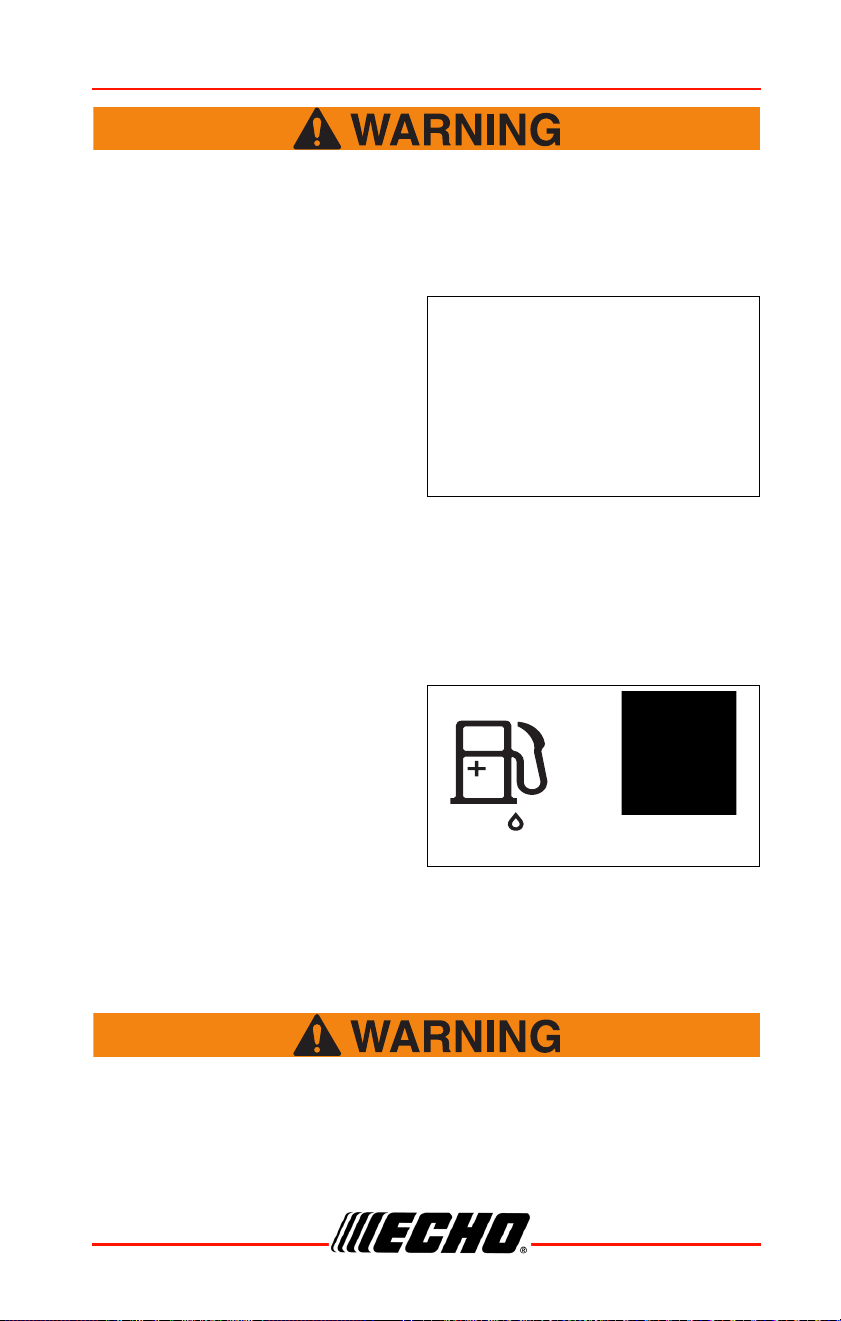
Fuel to Oil Mix – 50:1 Ratio
US Metric
Gas Oil Gas Oil
gal. fl.oz. L cc
12.65100
2 5.2 10 200
51325500
CS-2511P OPERATION
X7503333700 29
© 11/2020 ECHO Incorporated
Make sure STOP switch is in OFF position. Engine can start
unintentionally. Always remove spark plug lead from spark plug
before assembling or performing maintenance procedures,
otherwise, serious personal injury can result.
Servicing Fuel and Oil
When the fuel tank cap or oil tank
cap is difficult to remove, remove
the spark plug lead, pull the starter
handle slowly, and use the starter
handle to assist in removal of the
cap.
Chain Lubricant
Note: Cap indication - Fuel/oil tanks are indicated by the following
illustrations
Proper lubrication of the chain while in operation reduces friction between
the chain and the guide bar to a minimum and assures a longer service life.
• Use bar and chain oil of high
quality for this purpose.
• Do not use used or reclaimed oil
to avoid various oiler problems.
• Use high quality bar and chain oil.
• Use bar and chain oil of the
following grades:
• SAE No. 30....in summer
• SAE No. 10....in winter or when cutting resinous trees.
• When refueling, also refill chain oil.
Moving parts can amputate fingers or cause severe injuries.
Keep hands, clothing and loose objects away from all openings.
Always stop engine, disconnect spark plug, and make sure all
moving parts have come to a complete stop before removing
obstructions, clearing debris, or servicing unit.
Oil tank cap
Fuel tank cap
OPERATION CS-2511P
30 X7503333700
© 11/2020 ECHO Incorporated
Engine exhaust IS HOT, and contains Carbon Monoxide (CO), a
poison gas. Breathing CO can cause unconsciousness, serious
injury, or death. Exhaust can cause serious burns. ALWAYS
position unit so that exhaust is directed away from your face
and body.
Operation of this equipment may create sparks that can start
fires around dry vegetation. This unit is equipped with a spark
arrestor to prevent discharge of hot particles from the engine.
Metal cutters can also create sparks if the cutter strikes rocks,
metal, or other hard objects. Contact local fire authorities for
laws or regulations regarding fire prevention requirements.
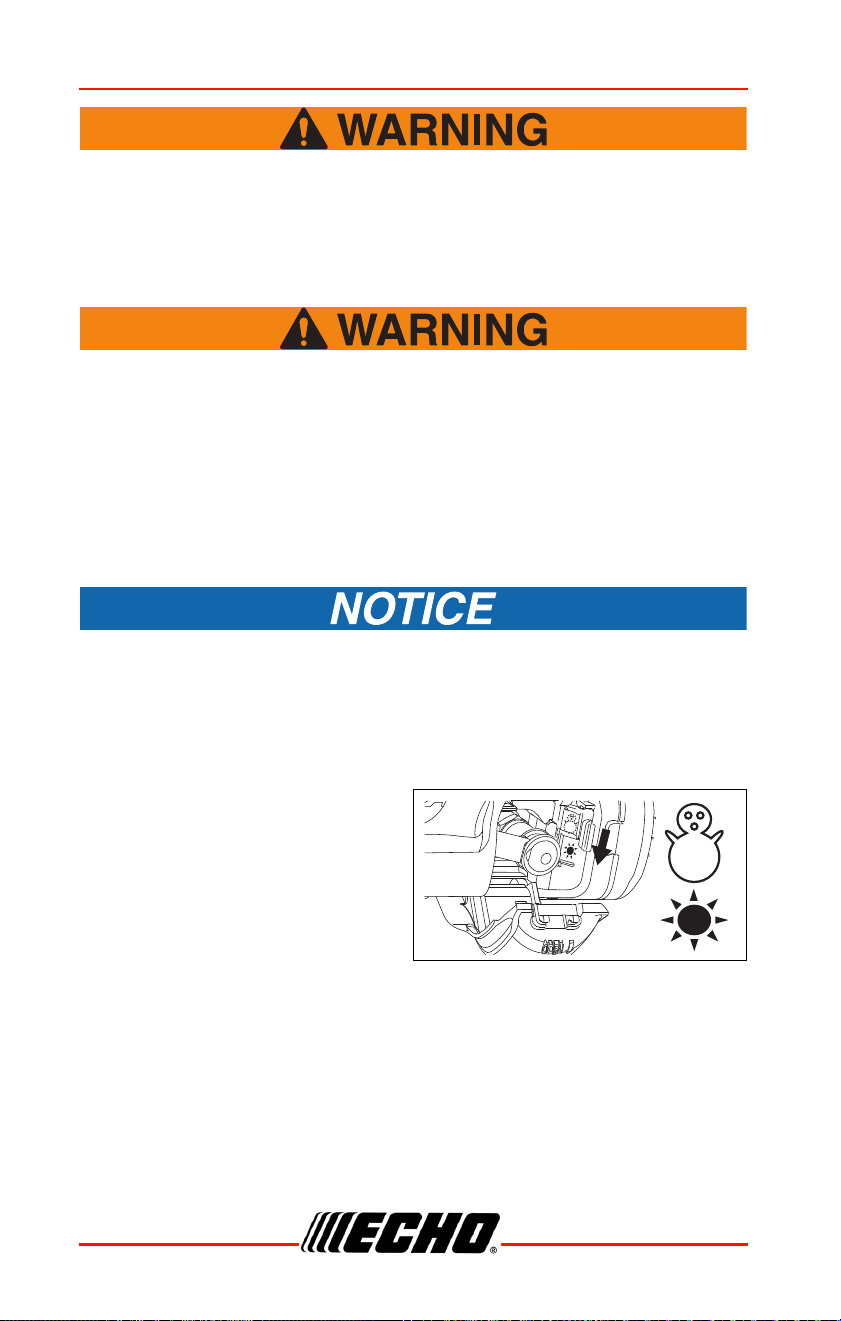
Winter Operation
Push the air shutter DOWN to cold position (snowman mark is
shown) when outside air temperature is 5° C (4° F) or lower. For
operation above 5° C (41° F) return the air shutter to the original UP
position (sun mark is shown). Failure to follow instructions can cause
engine to overheat.
1. Use the air shutter to prevent
carburetor troubles in cold
weather.
2. Use T-Wrench to open air
cleaner cover latch. Disconnect
spark plug lead.
3. Push the air shutter DOWN to
cold position (snowman mark is
shown) when outside air temperature is 5° C (41° F) or lower.
4. For operation above 5° C (41° F) return the air shutter to the original UP
position (sun mark is shown).
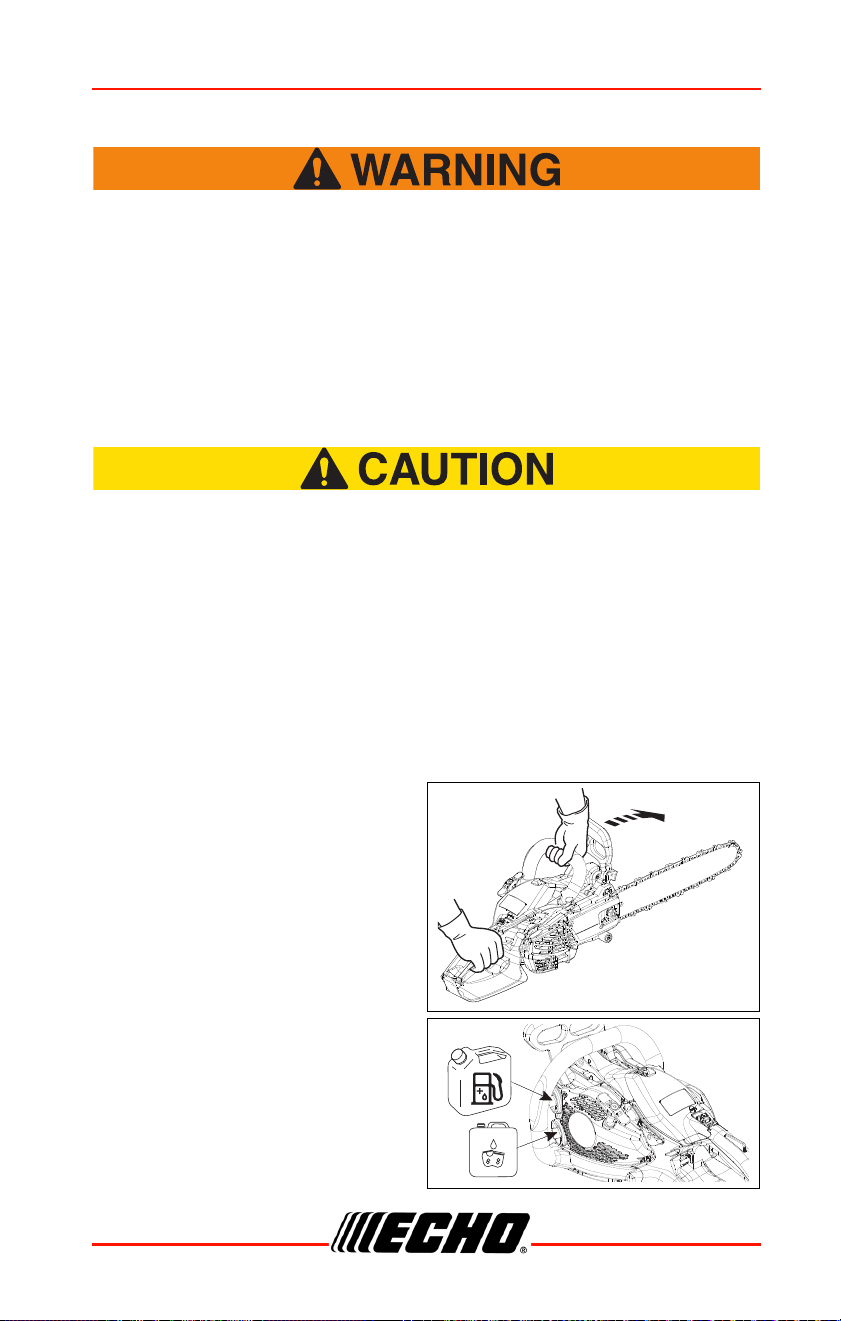
CS-2511P OPERATION
X7503333700 31
© 11/2020 ECHO Incorporated
Start Cold Engine
◆ Do not start engine unless chain brake is LOCKED (forward
position).
◆ After choke control knob is turned and the knob returned
to original position, throttle will remain slightly open (latch
condition).
◆ If engine is started in this latch condition, chain starts to
turn. Make sure bar and chain are free from any
obstruction when chain saw is started.
◆ Failure to follow instructions can cause serious injury.
◆ After engine starts, immediately squeeze and release
throttle trigger to disengage throttle latch and return
engine to idle, and pull front hand guard towards the
operator immediately. (Chain brake RELEASED position).
◆ Do not increase engine speed while chain brake is
engaged.
◆ Use the chain brake only to start engine or stop the chain
in emergencies.
◆ Never use throttle latch for cutting. Use it only when
starting the engine.
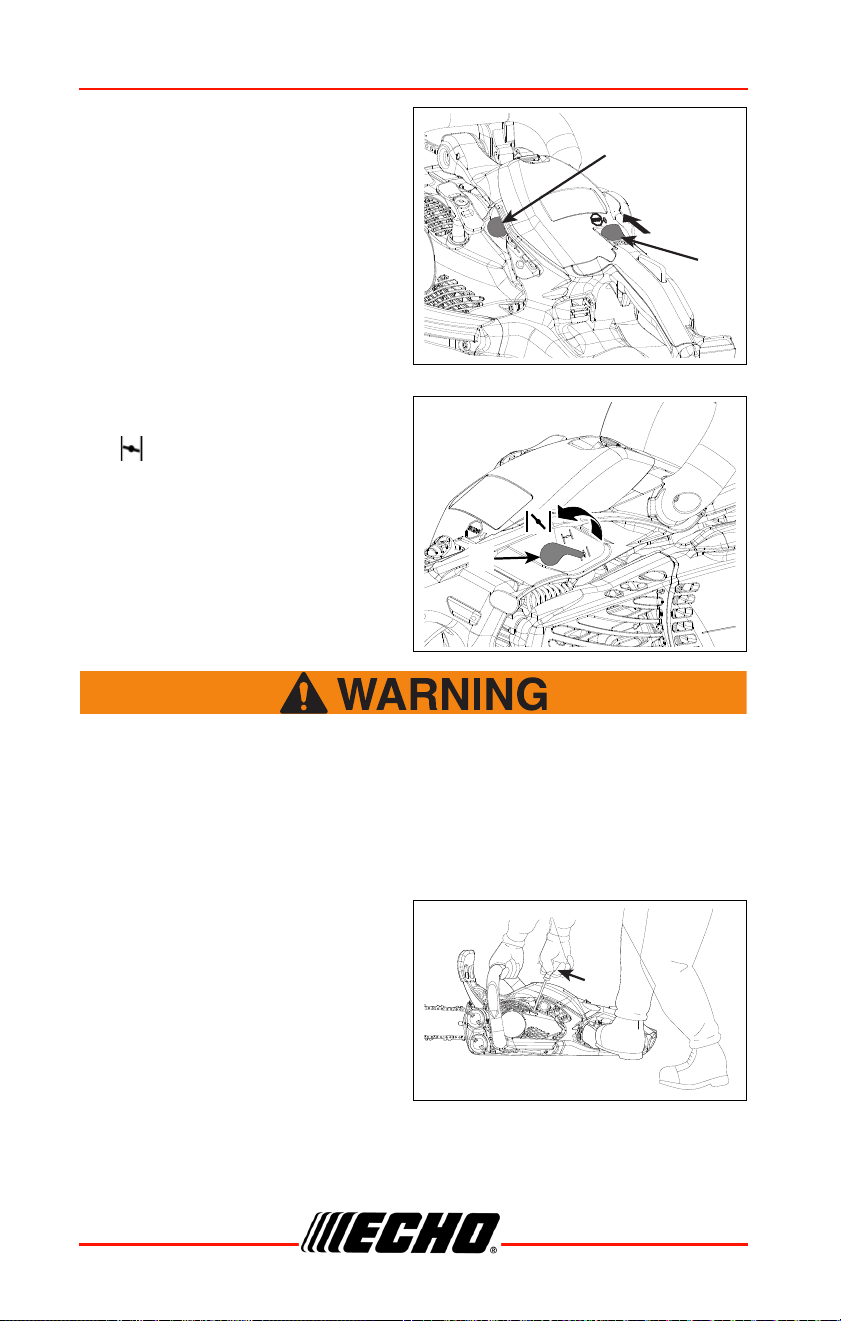
1. Move chain brake lever (A) fully
FORWARD to LOCK chain
brake before starting.
2. Fill the fuel tank with fuel
mixture. Do not over fill.
3. Fill the chain oil tank with
lubricant. Do not over fill.
A
OPERATION CS-2511P
32 X7503333700
© 11/2020 ECHO Incorporated
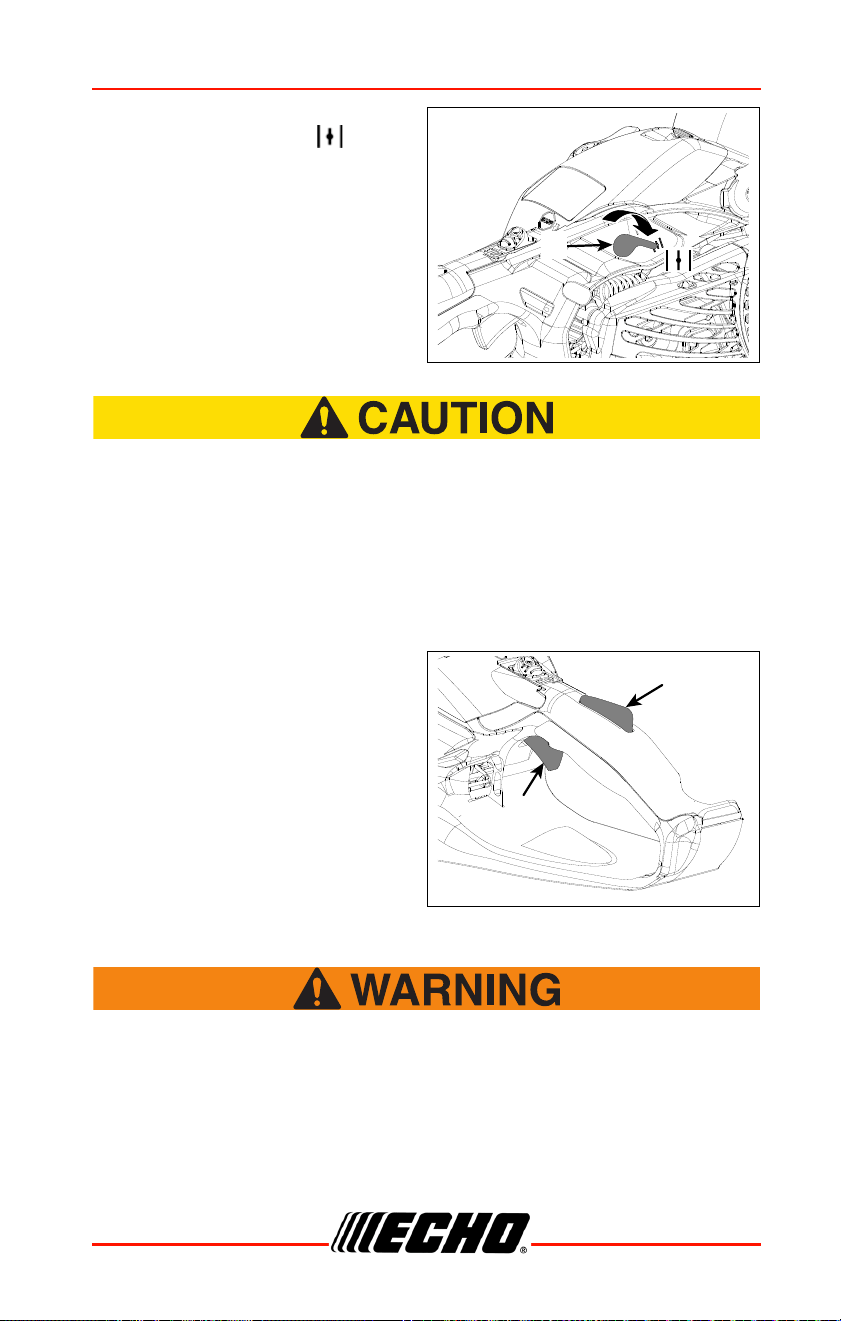
4. Move STOP switch (B) to RUN
position.
5. Press purge bulb (C) 8 times or
until fuel is visible in the purge
bulb.
6. Turn choke control knob (D)
counterclockwise to (CLOSED
choke position).
◆ After choke control knob is turned and the knob returned
to original position, throttle will remain slightly open (latch
condition).
◆ The chain will attempt to move when engine is started with
fast idle throttle latch engaged.
◆ Do not start engine before chain brake is locked.
7. Securely hold the chain saw
and pull starter handle (E)
several times until first starting
sound.
Note: Do not pull starter rope
out to the maximum
possible position. Do not
allow starter handle to
snap back against the
casing. If engine does
not start after 5 pulls, repeat instructions.
B
C
D
E
CS-2511P OPERATION
X7503333700 33
© 11/2020 ECHO Incorporated
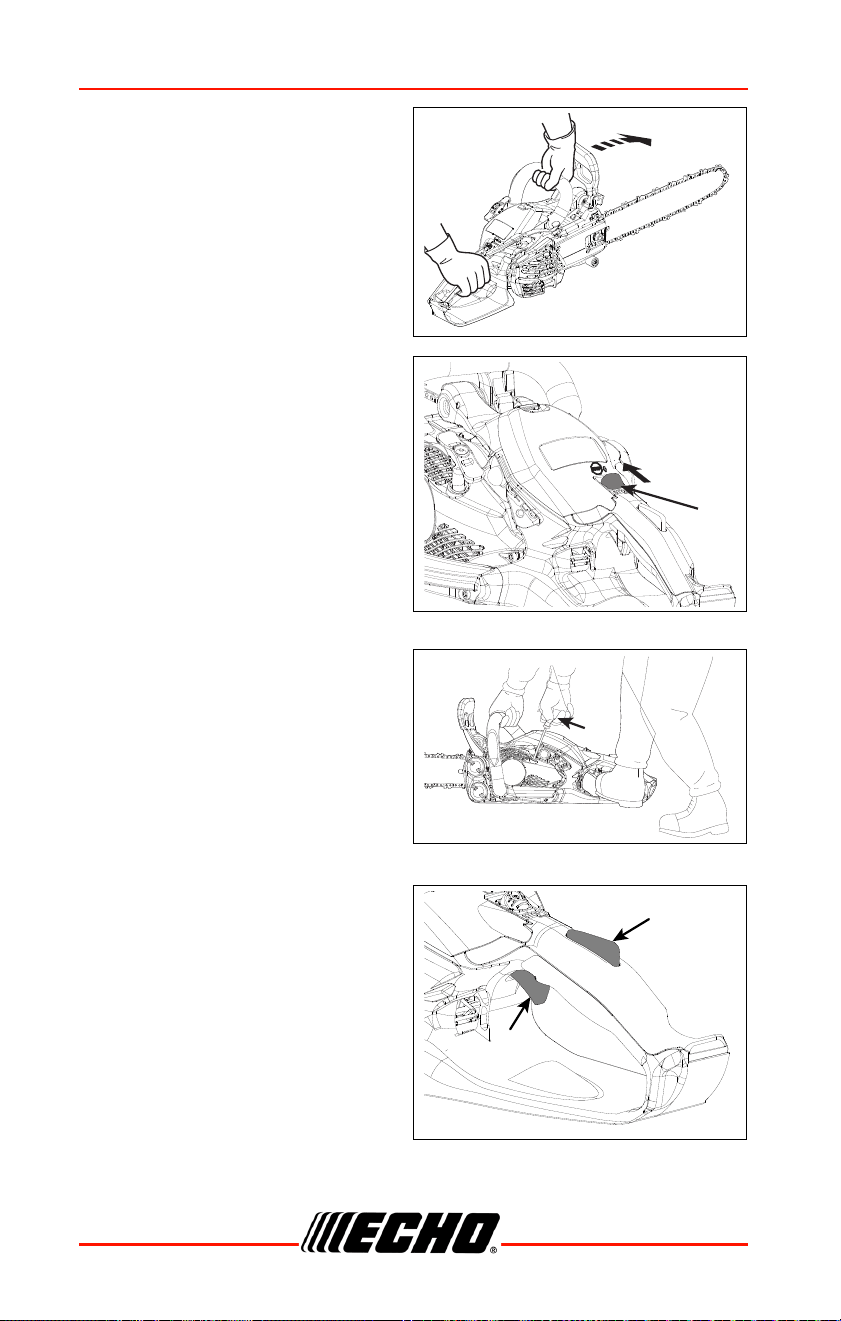
8. Turn choke control knob (D)
clockwise to (OPEN choke
position).
9. Pull starter handle (E) to start
the engine.
◆ After starting the engine, immediately squeeze and then
release throttle trigger to release fast idle throttle latch,
otherwise severe brake damage may occur.
◆ Never use fast idle throttle latch for cutting.
◆ Use the fast idle throttle latch only in starting.
◆ Do not increase engine speed while chain brake (A) is
locked. Severe brake damage will result.
10. When engine starts,
immediately squeeze and
release throttle trigger (F) to
disengage throttle latch (G) and
return engine to idle. Pull front
hand guard (A) towards the
operator immediately. (Chain
brake unlocked position).
Start Warm Engine
Make sure bar and chain are free from any obstruction when
chain saw is started.
Do not increase engine speed while chain brake (A) is locked.
Severe brake damage will result.
The saw chain should not move at idle, otherwise serious injury
can occur.
D
G
F
OPERATION CS-2511P
34 X7503333700
© 11/2020 ECHO Incorporated
1. Move chain brake lever (A) fully
FORWARD to LOCK chain
brake before starting.
2. Confirm there is fuel and chain
oil in the tanks.
3. Move STOP switch (B) to RUN
position.
4. Securely hold the chain saw as
shown and pull starter handle
(E).
5. Choke can be used if
necessary, but after first starting
sound, squeeze throttle trigger
lock (G) and throttle trigger (F)
to release choke and return
engine to idle.
Note: If engine does not start
after 5 pulls, use “Start
Cold Engine” procedure.
A
B
E
G
F
CS-2511P OPERATION
X7503333700 35
© 11/2020 ECHO Incorporated
Running
Make sure bar and chain are free from any obstruction when
chain saw is started.
Do not increase engine speed while chain brake (A) is locked.
Severe brake damage will result.
The saw chain should not move at idle, otherwise serious injury
can occur.
The saw chain should not move at idle, otherwise serious injury
can result.
Note: If saw chain moves adjust carburetor according to
“Carburetor Adjustment” instructions in this manual, or see
your dealer.
1. After engine starts, allow it to
return to idle and warm up
before use.
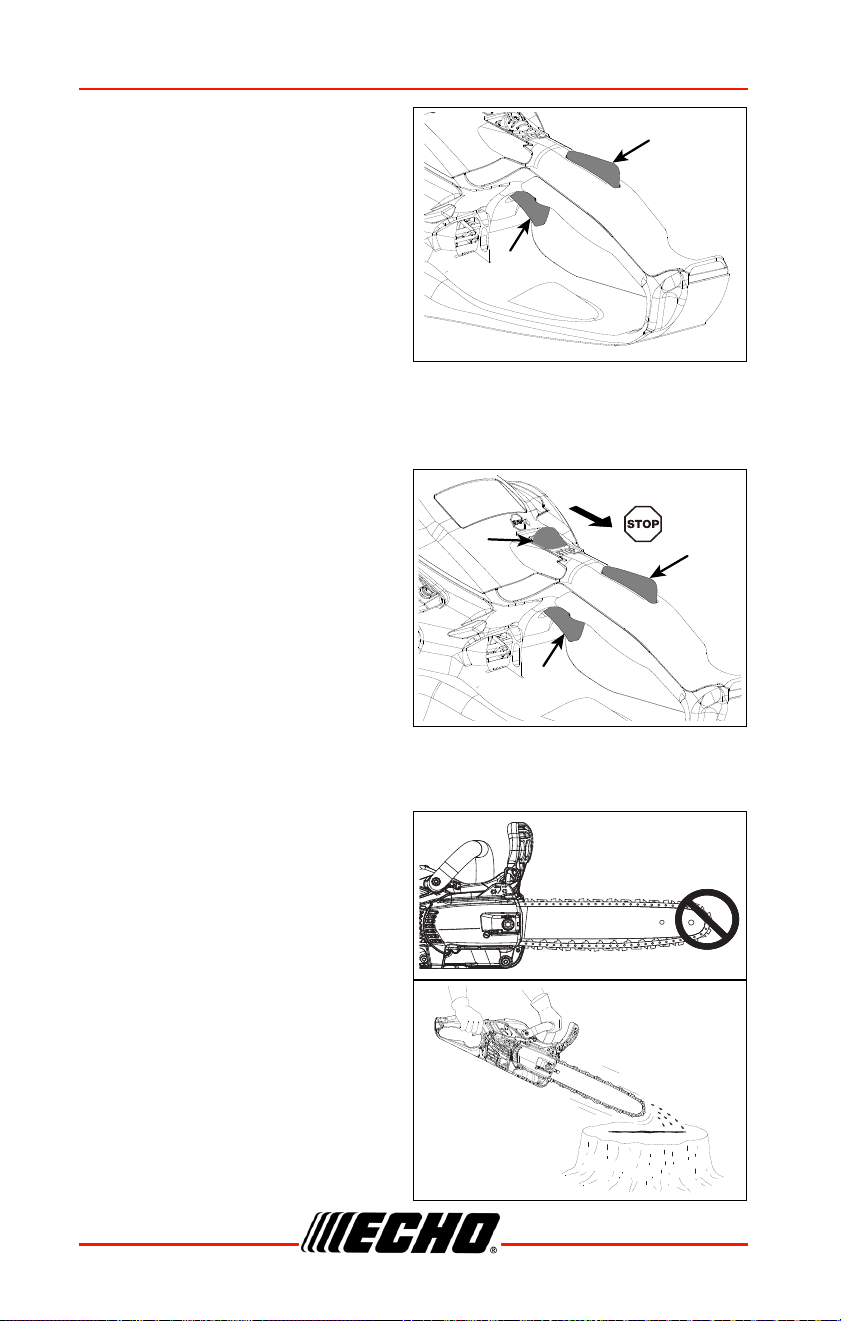
2. Move chain brake lever (A) fully
REARWARD to UNLOCK chain
brake.
3. Squeeze throttle trigger lock
(G) and throttle trigger (F)
gradually to increase engine
speed.
A
OPERATION CS-2511P
36 X7503333700
© 11/2020 ECHO Incorporated
4. The chain starts running when
the engine reaches clutch
engagement speed (see
“Specifications” page).
5. Confirm proper acceleration
and lubrication of chain and
bar.
6. Do not run the engine at high
speed unnecessarily.
7. Make sure saw chain stops
moving when throttle trigger
lock (G) and throttle trigger (F) are released.
Stopping
1. Release throttle trigger lock (G)
and throttle trigger (F) and
allow engine to idle.
2. Move STOP switch (B) DOWN
to “STOP” position.
Note: If engine does not stop,
turn choke control knob
fully counterclockwise
stop engine.
Note: Return the unit to your
authorized dealer to
check and repair stop
switch before starting the engine again.
Checking Chain Tension
Chain tension should be checked
frequently during work and
corrected as necessary. See
“Description”, Adjust Chain Tension.
Chain Lubrication Test
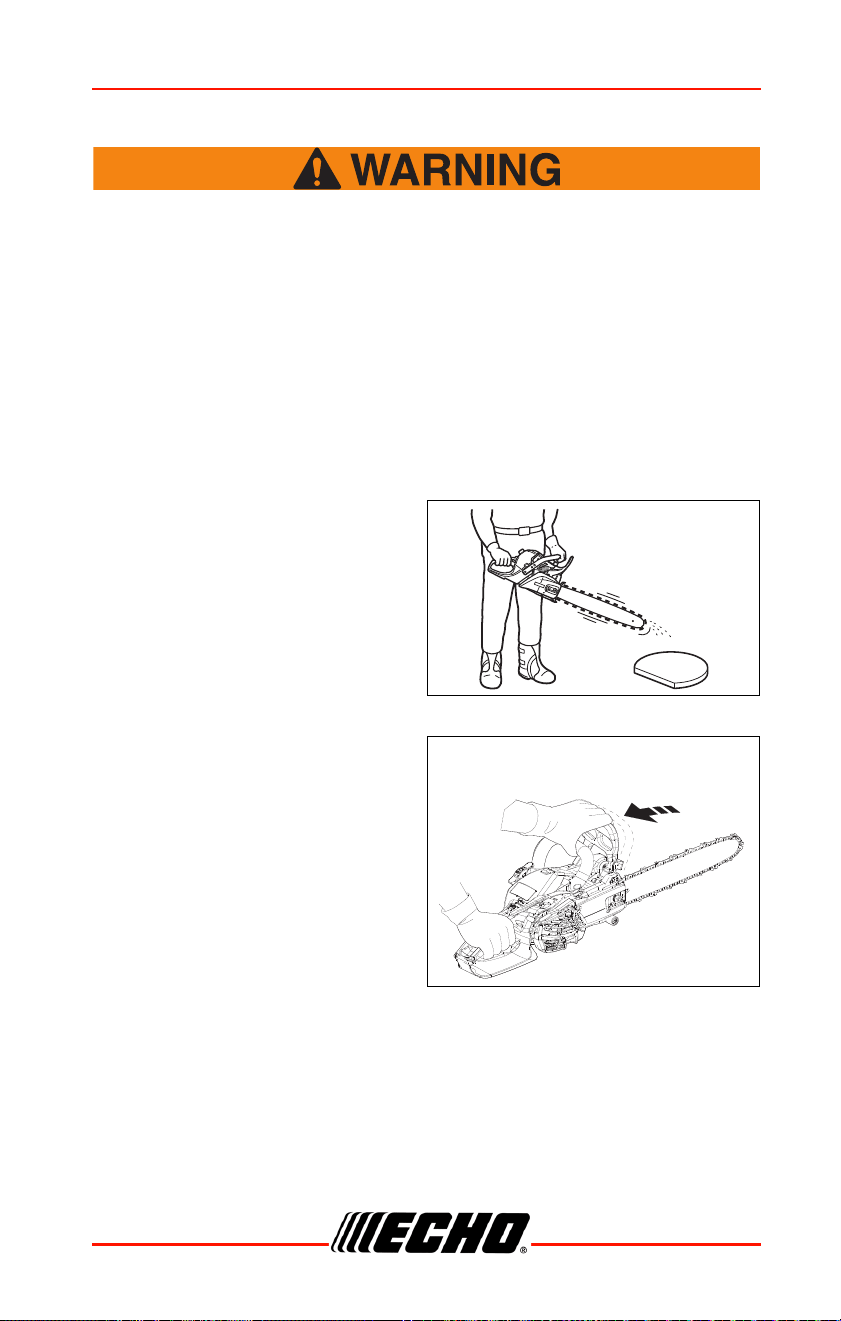
Hold the chain just above a dry
surface and open the throttle to half
speed for 30 seconds.
A thin line of “thrown” oil should be
seen on the dry surface.
G
F
G
F
B
CS-2511P OPERATION
X7503333700 37
© 11/2020 ECHO Incorporated
Cutting Instructions
General
◆ This chain saw is designed for cutting wood. Do not cut
metal, plastic or any non-wood material.
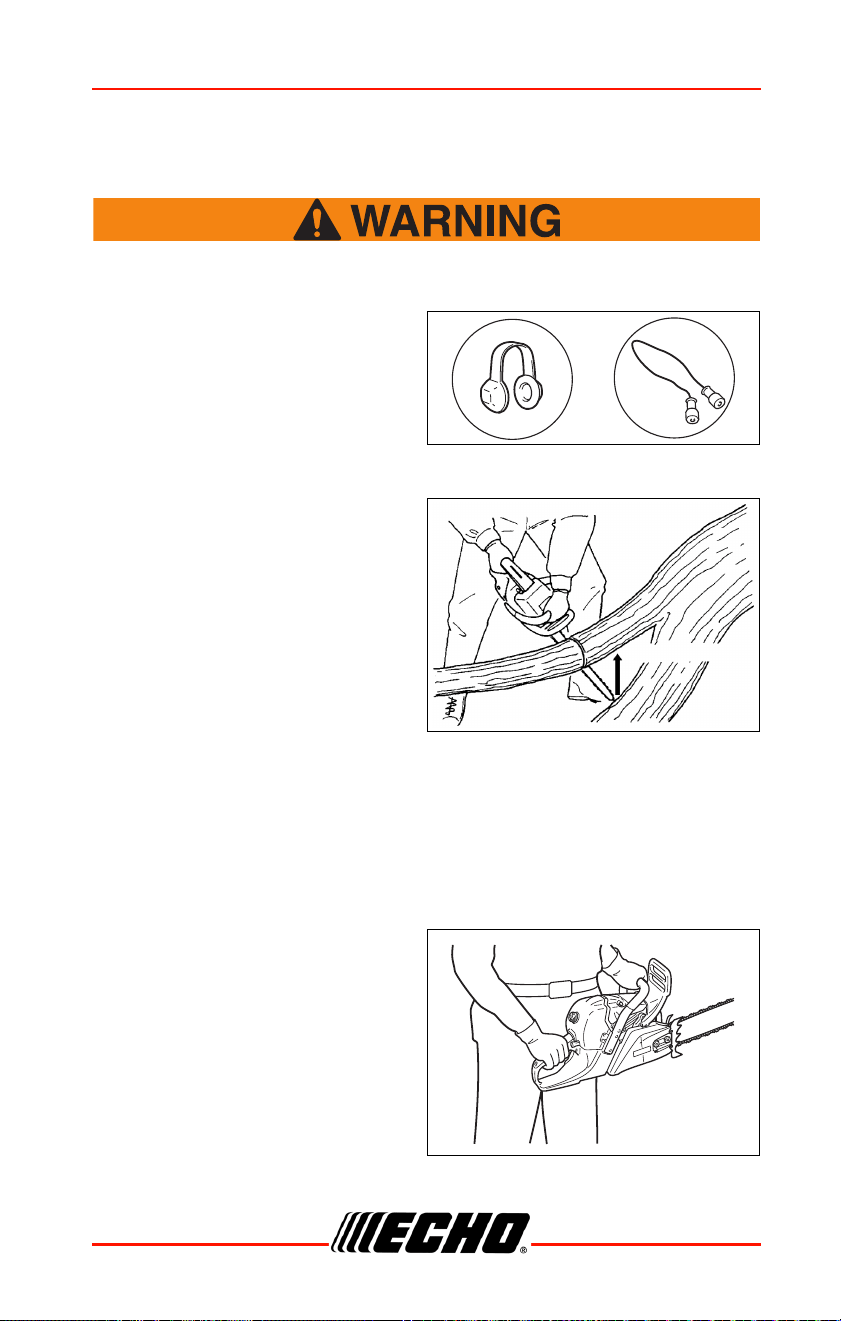
◆ Wear suitable hearing
protection such as
earmuffs or earplugs to
protect against
objectionable or
uncomfortable loud
noises.
◆ Do not let the tip of the
bar touch anything while
the engine is running. At
cutting speed the chain is
moving at a high rate of
speed. Should the tip
contact a limb or log while
the chain is moving, the
tip will be pushed upward
with considerable force.
This is known as kickback. Avoid it!
In all circumstances the operation of the chain saw is a one-man job. It is
difficult at times to take care for your own safety, so don’t assume the
responsibility for a helper as well. After you have learned the basic
techniques of using the saw, your best aid will be your own good common
sense.
The accepted way to hold the saw is
to stand to the left of the saw with
your left hand on the front handle
and your right hand on the rear
handle so you can operate the
throttle trigger with your right index
finger. Before attempting to fell a
tree, cut some small logs or limbs.
Become thoroughly familiar with the
controls and the responses of the
saw.
Kickback
OPERATION CS-2511P
38 X7503333700
© 11/2020 ECHO Incorporated
Start the engine, see that it is
running properly. Squeeze the
trigger to open the throttle wide
open and start the cut. If the chain is
properly sharpened, the cutting
should be relatively effortless. It is
not necessary to press down hard to
make the saw cut. Pushing the saw
too hard will slow the engine and
cutting will actually be more difficult.
Sap from palm trees may corrode metal parts unless proper saw
maintenance is performed. Make sure to clean metal parts from palm
sap immediately after use.
• Remove sprocket guard. Clean wood chips and sawdust from guard and
engine crankcase.
• Never use metal tools for cleaning which can scratch the metal paint and
allow corrosion to develop.
• Clean sap accumulation from metal parts with cloth and warm water with
soap.
• Rinse with clean water and dry metal surfaces.
• Apply a light coating of engine or bar and chain oil to metal parts after
they are cleaned.
• Install and properly tension guide bar and chain. Run engine for one
minute alternating engine speed between full throttle for 5 seconds and
idle for 5 seconds to coat metal parts with additional protective chain oil.
◆ Do not run a chainsaw not under cutting load at wide open
throttle longer than 5 seconds or engine damage can
occur.
◆ Keep chain properly tensioned during operation to prevent
the chain from jumping out of the guide bar rail slot and
damaging metal engine parts.
CS-2511P OPERATION
X7503333700 39
© 11/2020 ECHO Incorporated
Felling The Tree
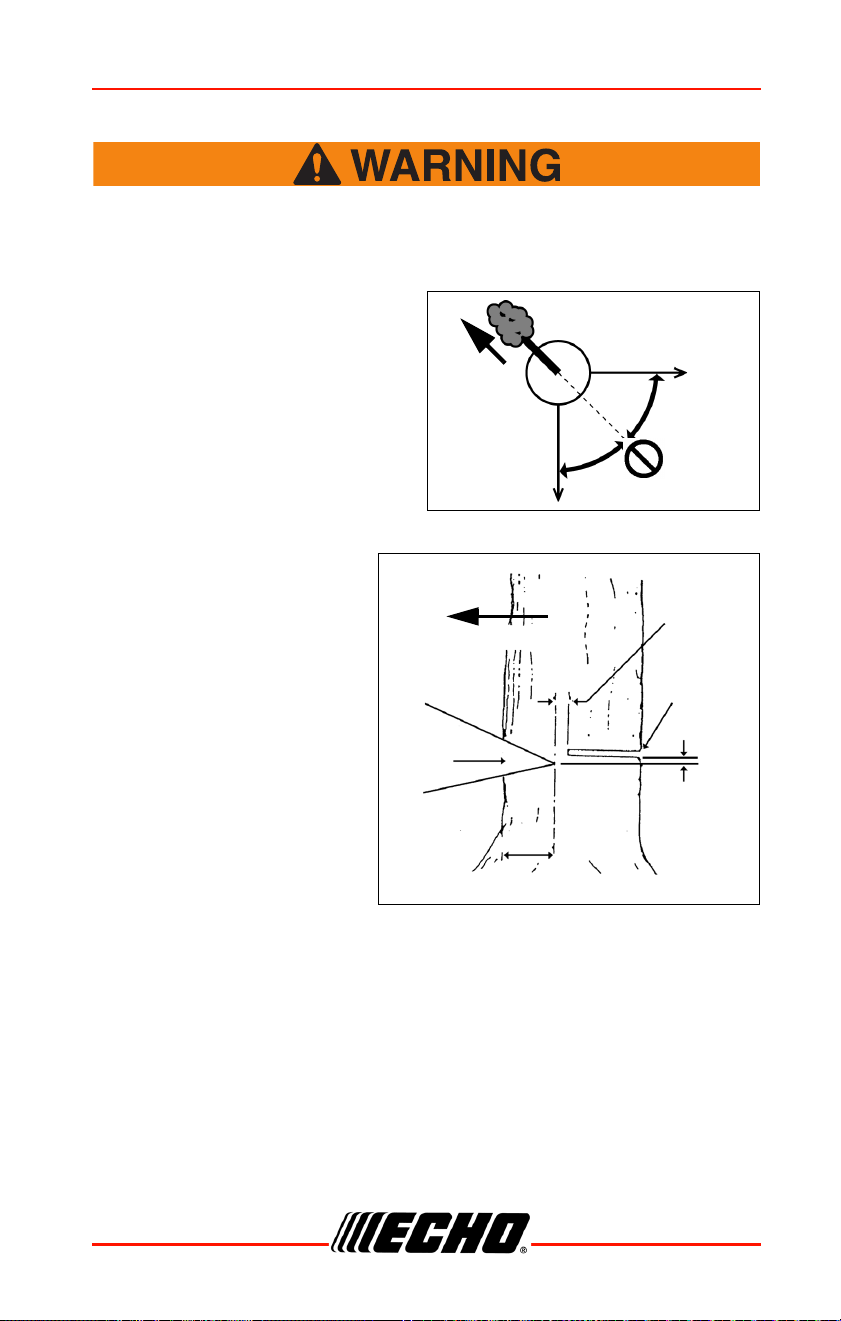
A falling tree can seriously damage anything it may hit - a car, a
house, a fence, a power line, or another tree. There are ways to
make a tree fall where you want it, so first decide where that is!
Before cutting, clear the area
around the tree. You will need good
footing while working and you
should be able to work the saw
without hitting any obstacles. Next,
select a path of retreat. When the
tree begins to fall you should retreat
away from the direction of fall at a
45-degree angle and at least 3 m
(10 feet) from the trunk to avoid the
trunk kicking back over the stump.
Begin the cut on the side to
which the tree is to fall. Cut a
notch about 1/3 of the way into
the tree. The position of this
notch is important since the
tree will try to fall “into” the
notch. The felling cut is made
on the side opposite the notch
and at a level about 5 cm (2
in.) above the bottom of the
notch. Do not try to cut through
to the notch with the felling cut.
The remaining wood between
the notch cut and felling cut
about 5 cm (2 in.) will act as a
hinge when the tree falls,
guiding it in the desired
direction. When the tree starts to fall, kill the engine, place the saw on the
ground and make your retreat quickly.
Retreat
Retreat
Direction
45°
45°
3 m (10 feet)
Not this way
of fall
Direction of fall
First cut
Notch
Second cut
One-third tree diameter
5 cm (2 in.)
Felling cut
Hinge
5 cm (2 in.)
OPERATION CS-2511P
40 X7503333700
© 11/2020 ECHO Incorporated
To fell big trees with a diameter
exceeding twice the bar length, start
the notching cuts from one side and
draw the saw through to the other
side of the notch. Start the back cut
on one side of the tree, pivoting the
saw through to form the desired
hinge on that side. Then remove the
saw for the second cut. Insert the
saw in the first cut, very carefully so
as not to cause kickback. The final
cut is made by drawing the saw forward in the cut to reach the hinge.
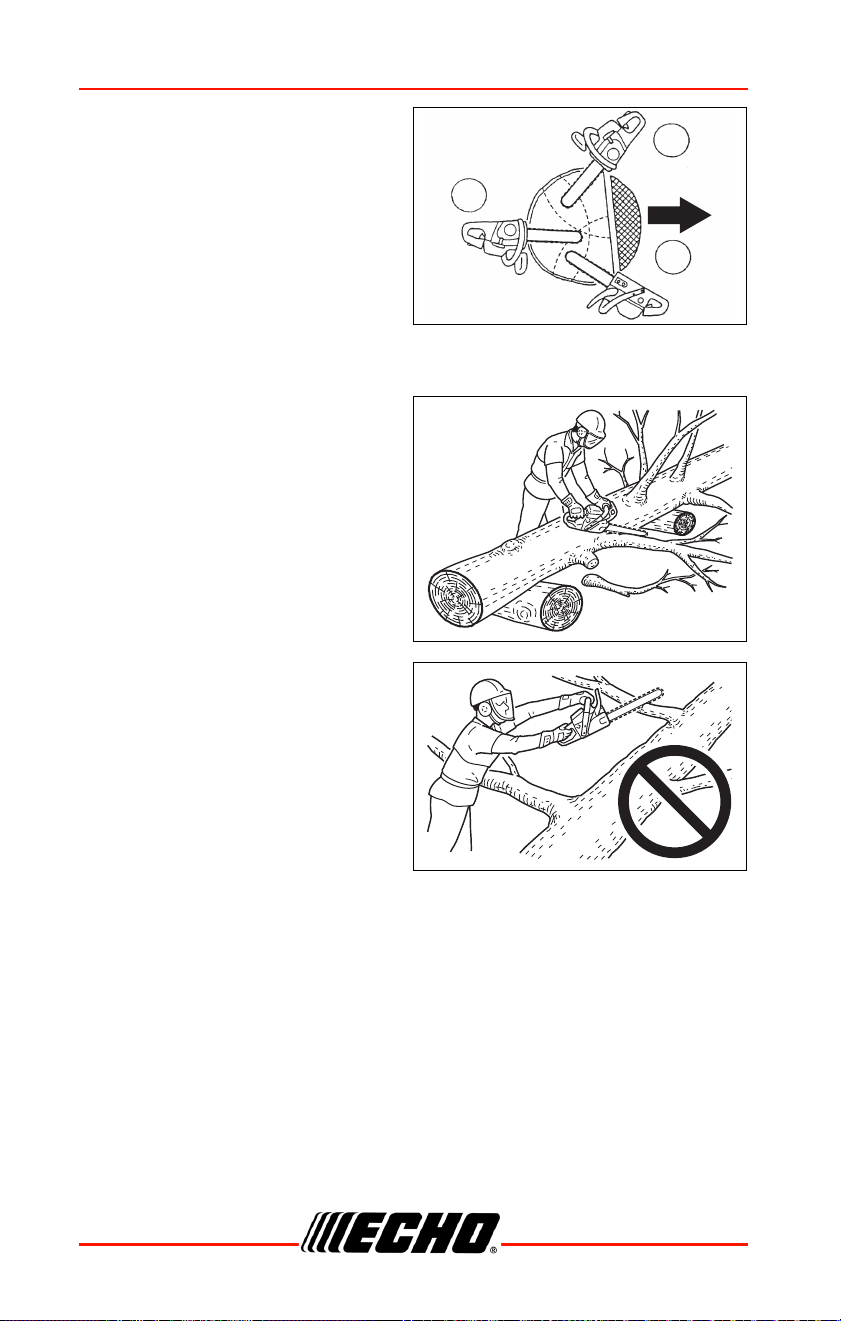
Limbing
Limbing a fallen tree is much the
same as bucking. Never stand on
the tree that you are limbing. When
limbing, caution is the word. Be
careful of the tip touching other
limbs. Always use both hands.
Don’t cut with the saw overhead or
aligned vertically with your body. If
the saw should kick back, you may
not have enough control to prevent
possible injury.
1
2
3
CS-2511P OPERATION
X7503333700 41
© 11/2020 ECHO Incorporated
Bucking
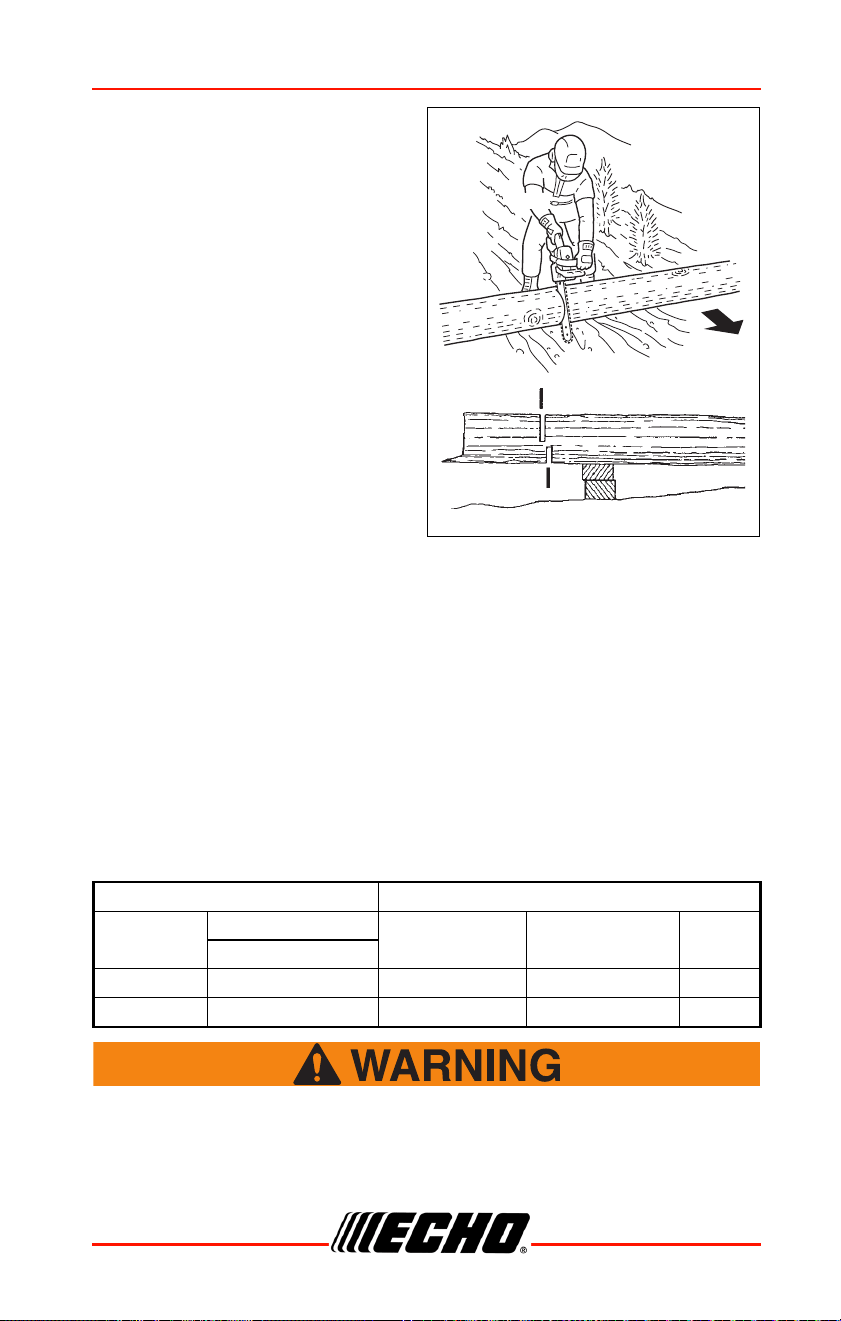
Bucking is the sawing of a log or
fallen tree into smaller pieces. There
are a few basic rules which apply to
all bucking operations.
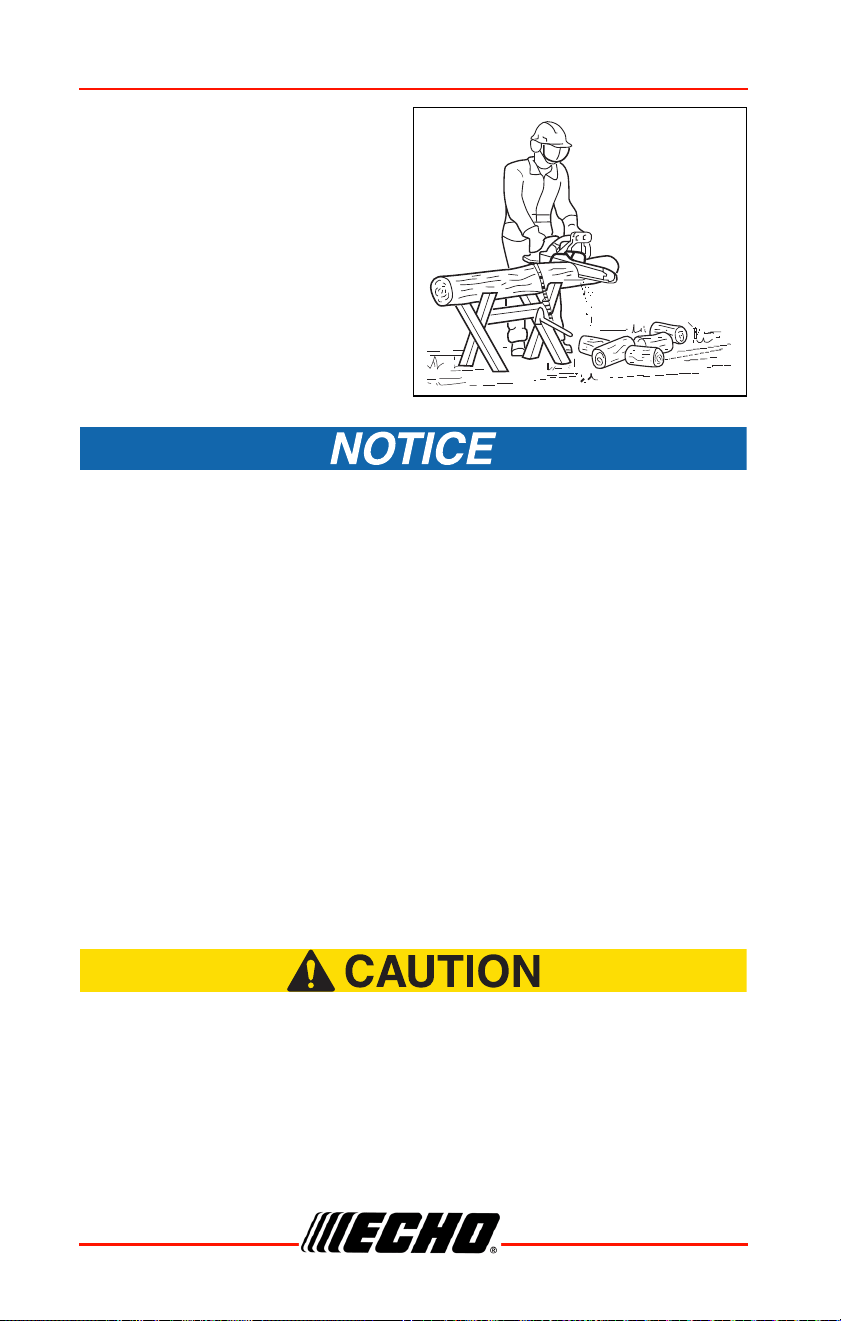
• Keep both hands on the handles
at all times.
• Support logs if possible.
• When cutting on a slope or
hillside, always stand uphill.
Keep in mind that the wood is heavy and that it will bend and pinch the saw
if improperly supported. The trunk will weaken at the point where you make
the cut unless the tree is lying on perfectly flat ground or supported as
shown. If you make the cut with the tree on the ground, don’t let the saw’s
chain dig into the earth; it is harmful for the saw, and you stand a good
chance of being struck by flying debris.
To cut the trunk, use the bucking and two-cut sequence shown. The first cut
should be no deeper than one-third the trunk diameter.
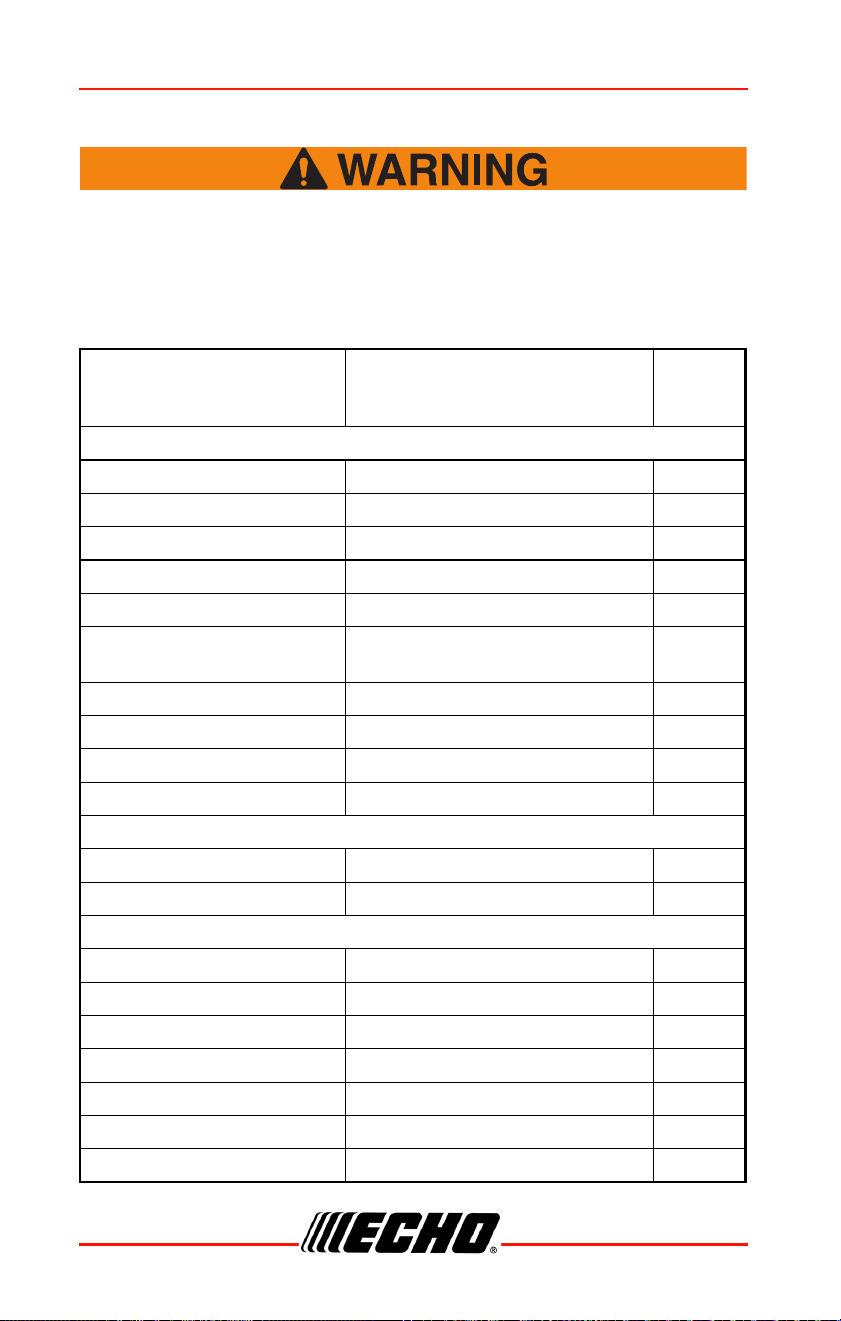
Chain And Guide Bar Combination
The following combinations are recommended for model CS-2511P.
Use of replacement saw chain and/or guide bar other than that
specified, or operation without the optional Kick Guard
TM
in
place, may cause severe kickback resulting in serious injury.
Guide Bar Saw Chain
Length mm
(in.)
ECHO Part No.
Pitch mm (in.) Type Links
Low-kickback
305 (12) 12A0CD3745 0.05 (1.05) 91PXL45CQ 45
356 (14) 14A0CD3752 0.05 (1.05) 91PLX52CQ 52
Support
Finish cut
Uphill Position
First cut

OPERATION CS-2511P
42 X7503333700
© 11/2020 ECHO Incorporated
Chain and guide bar gauge size must be identical. Use Bar/Chain
combinations shown in table above.
Kick Guard
TM
(Optional)
To purchase an optional Kick Guard
TM
contact your ECHO dealer. For the
name of the ECHO dealer nearest you, Call: 1-800-432-ECHO (3246) or on
the web at www.echo-usa.com
Guide Bar
(Low-kickback)
Replacement guide bars.
The following guide bars may be considered to have equivalent kickback
energy.
• Sprocket nose guide bars of the same length and nose radius, same pitch
and having the same number of teeth.
• Hard nose guide bars of the same length and nose radius as a sprocket
nose bar.
Saw Chain
(Low-kickback)
Only use saw chain designated as, “LOW-KICKBACK,” that
meets ANSI B175.1 or CSA Z62.1, .3 Standard when tested on
the representative sample of chain saws below 3.8 C.I.D., and
ECHO guide bar specified.

CS-2511P MAINTENANCE
X7503333700 43
© 11/2020 ECHO Incorporated
MAINTENANCE
Moving parts can amputate fingers or cause severe injuries.
Keep hands, clothing and loose objects away from all openings.
Always stop engine, disconnect spark plug, and make sure all
moving parts have come to a complete stop before removing
obstructions, clearing debris, or servicing unit. Allow unit to
cool before performing service. Wear gloves to protect hands
from sharp edges and hot surfaces.
Operating a poorly maintained unit can result in serious injuries
to operator or bystanders. Always follow all maintenance
instructions as written, otherwise serious personal injury can
result.
Your unit is designed to provide many hours of trouble free service. Regular
scheduled maintenance will help your unit achieve that goal. If you are
unsure or are not equipped with the necessary tools, we recommend that
you take your unit to a Servicing Dealer for maintenance. To help you
decide whether you want to DO-IT-YOURSELF or have the Dealer do it,
each maintenance task has been graded. If the task is not listed, see your
Dealer for repairs.
The use of emission control components other than those specifically
designed for this unit is a violation of federal law.
Skill Levels
Level 1 = Easy to do. Common tools may be required.
Level 2 = Moderate difficulty. Some specialized tools may be required.
Level 3 = See your dealer.
Click HERE or go to http://www.echo-usa.com/products/maintenance-kit
or
HERE https://www.shindaiwa-usa.com/you-can.aspx
For information about maintenance kits.
MAINTENANCE CS-2511P
44 X7503333700
© 11/2020 ECHO Incorporated
Maintenance Intervals
Units equipped with a Momentary STOP Switch automatically
return to RUN position. Engine can start unintentionally. Always
remove spark plug lead from spark plug before assembling or
performing maintenance procedures, otherwise serious
personal injury can result.
COMPONENT / SYSTEM MAINTENANCE PROCEDURE
REQ’D
SKILL
LEVEL
Daily or Before Use
Air Filter Inspect / Clean * 1
Automatic Oiler Inspect / Adjust 1
Oil Filter Inspect 1
Fuel System Inspect 1
Guide Bar & Sprocket Nose Inspect / Clean * 1
Saw Chain
Inspect / Sharpen / Replace / Ten-
sioning *
2
Sprocket Inspect / Replace * 2
Cooling System Inspect / Clean 2
Recoil Starter Rope Inspect / Clean * 1
Screws / Nuts / Bolts Inspect / Tighten / Replace * 1
Every Refuel
Fuel System Inspect 1
Guide Bar & Sprocket Nose Inspect 1
3 Months
Air Filter Replace * 1
Oil Filter Inspect / Replace * 1
Fuel Filter Inspect * 1
Fuel Cap Gasket Inspect * 1
Spark Plug Inspect / Clean / Replace * 1
Muffler Spark Arrestor Inspect/Clean/Replace * 2
Cylinder Exhaust Port Inspect / Clean / De-carbon 2

CS-2511P MAINTENANCE
X7503333700 45
© 11/2020 ECHO Incorporated
IMPORTANT NOTE - Time intervals shown are maximum. Actual use and
your experience will determine the frequency of required maintenance.
MAINTENANCE PROCEDURE NOTES:
* Replacement is recommended based on the finding of damage or wear
during inspection.
Carburetor Adjustment
Every unit is run at the factory and the carburetor is set in compliance with
Emission Regulations. In addition, the carburetor is equipped with “H” (High
Speed) and (“L” (Low Speed) needle adjustment limiters that prevent
settings outside acceptable limits.
Engine Break-In
New engines must be operated a minimum duration of two tanks of fuel
break-in before carburetor adjustments can be made. During the break-in
period your engine performance will increase and exhaust emissions will
stabilize. Idle speed can be adjusted as required.
High Altitude Operation
This engine has been factory adjusted to maintain satisfactory starting and
durability performance up to 1,100 feet above sea level (ASL) (96.0 kPa). To
maintain proper engine operation above 1,100 feet ASL the carburetor
might
need to be adjusted by an authorized service dealer.
If the engine is adjusted for operation above 1,100 feet ASL, the
carburetor must be re-adjusted when operating the engine below
1,100 feet ASL, otherwise severe engine damage can result.
1. Before adjusting carburetor clean or replace air filter and muffler “Spark
Arrestor Screen”.
2. Make sure the bar and chain are properly adjusted.
3. Start engine and run several minutes to bring to operating temperature.
Flash choke twice during warm-up to clear any air from the fuel system.
Yearly
Fuel Filter Inspect / Replace * 1
Fuel Cap Gasket Replace * 1
COMPONENT / SYSTEM MAINTENANCE PROCEDURE
REQ’D
SKILL
LEVEL
MAINTENANCE CS-2511P
46 X7503333700
© 11/2020 ECHO Incorporated
4. Stop engine. Turn “H” High Speed needle counterclockwise (CCW) to
stop. Turn “L” Low Speed needle midway between full clockwise (CW)
stop and CCW stop.
5. Idle Speed Adjustment:
• Start engine, turn Idle Speed Adjustment Screw “T” CW until the saw
chain begins to move, then turn screw out CCW until the saw chain
stops moving. Turn screw out, CCW, an additional 1/4 turn.
When carburetor adjustment is completed, the saw chain
should not move at idle, otherwise serious personal injury can
result.
6. Accelerate to full throttle for 2 - 3 seconds to clear any excess fuel in
the engine, then return to idle. Accelerate engine to full throttle to check
for smooth transition from idle to high speed. If engine hesitates turn “L”
needle CCW 1/8 turn and repeat acceleration. Continue adjustment
until smooth acceleration results.
7. Check idle speed and reset if necessary as described in item 5. If a
tachometer is available idle speed should be set to value listed on
specifications page.
When starting, idling adjustment speed should be adjusted to
prevent the saw chain from moving. When you experience
trouble with the carburetor, contact your dealer.
Air Filter
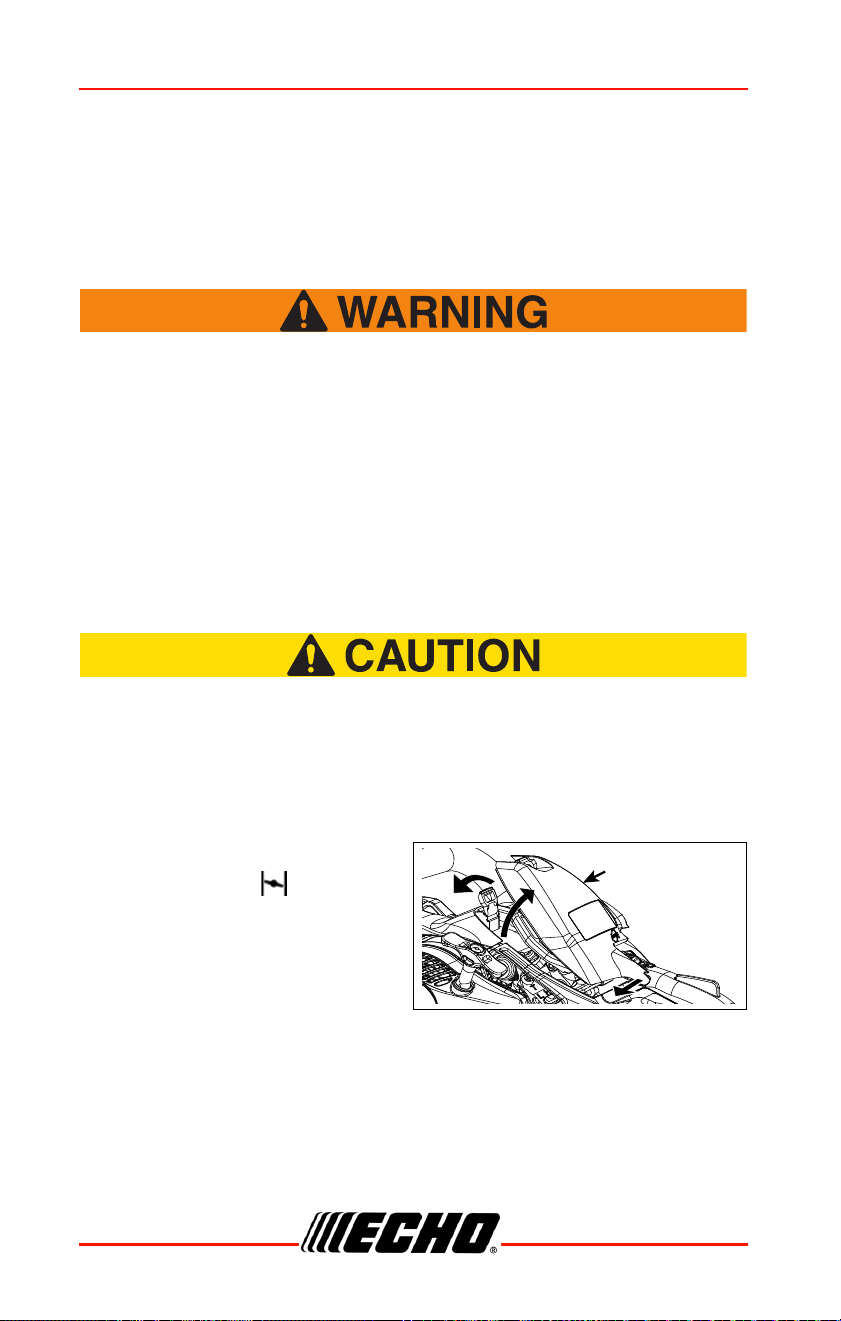
1. Check before every use.
2. CLOSE choke ( )
A
B
CS-2511P MAINTENANCE
X7503333700 47
© 11/2020 ECHO Incorporated
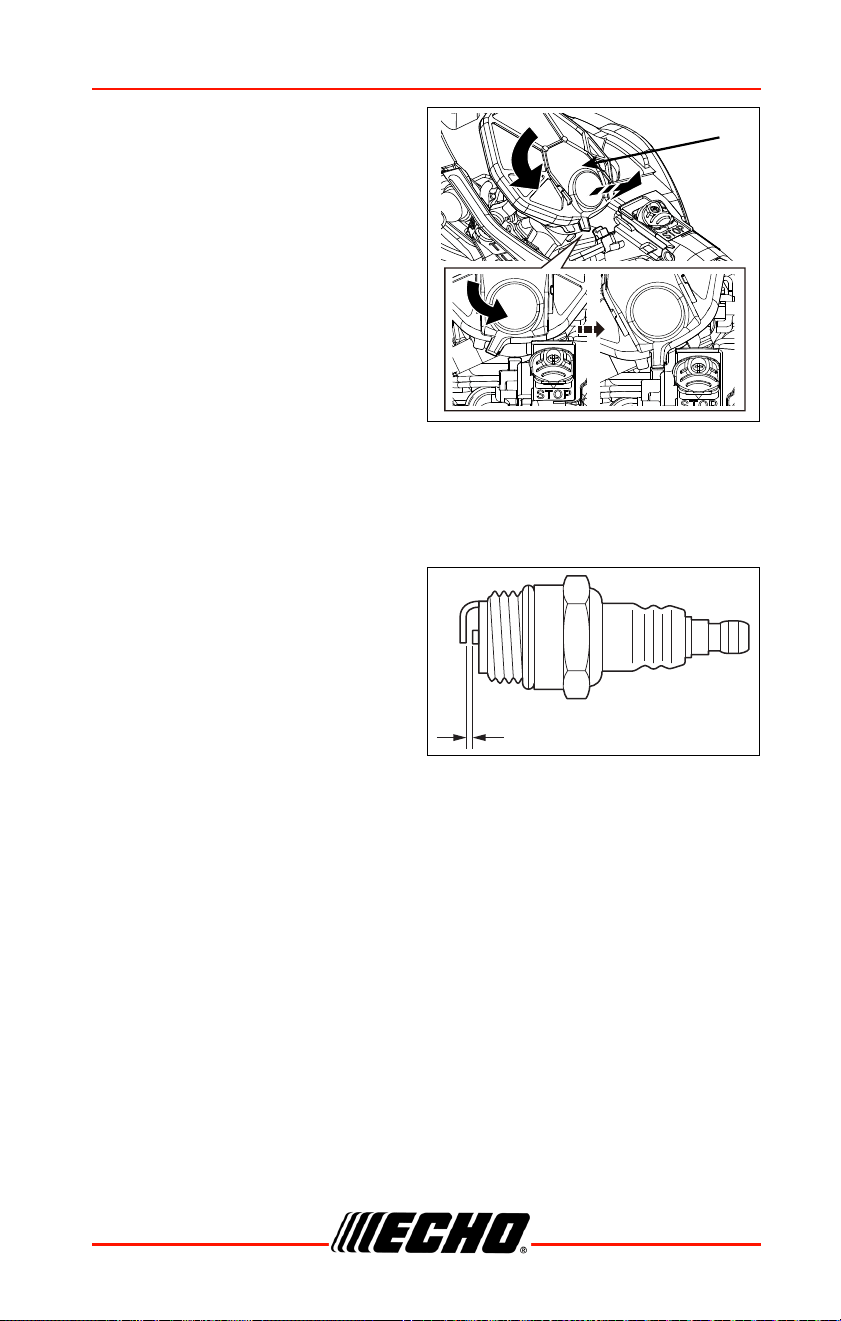
3. Undo the cleaner cover latch
(A), lift the tip of the air cleaner
cover (B), then slide it sideways
and remove it.
4. Remove the air filter (C) by
turning it counter-clockwise by
hand.
5. Lightly brush dust off air filter, or
clean with compressed air, or
replace the air filter.
6. Align the air filter mark with the
mark on the body then turn the
air filter (C) to the right and
attach it.
7. Insert the air cleaner cover (B) into the rear handle side and push it
forward, then fix it with the cleaner cover latch (A).
Spark Plug
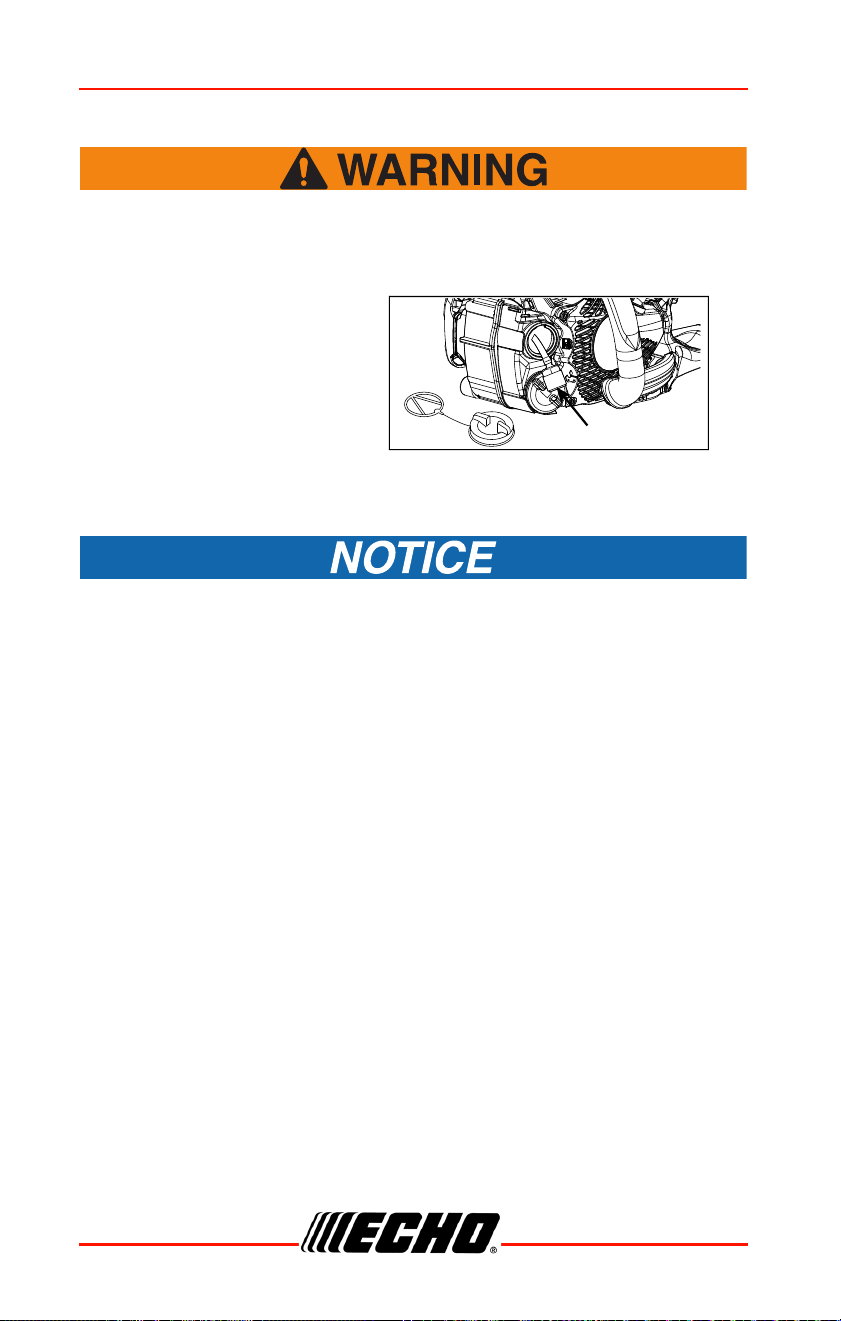
• Check periodically.
• The standard spark gap is 0.65
mm (0.026 in.).
• Fastening torque: 15-17 N•m
(130-150 in•lbf).
1. Remove air cleaner cover and
remove spark plug.
2. Correct the spark gap if it is wider or narrower than the standard gap.
Check Fuel System
• Check before every use.
• After refueling, make sure fuel does not leak from around fuel pipe, fuel
grommet or fuel tank cap.
• In case of fuel leakage there is a danger of fire. Stop using the machine
immediately and request your dealer to inspect or replace.
C
0.65 mm (0.026 in.)
MAINTENANCE CS-2511P
48 X7503333700
© 11/2020 ECHO Incorporated
Fuel Filter
Fuel is extremely flammable. Use extreme caution when
handling fuel. Failure to follow instructions can cause serious
injury.
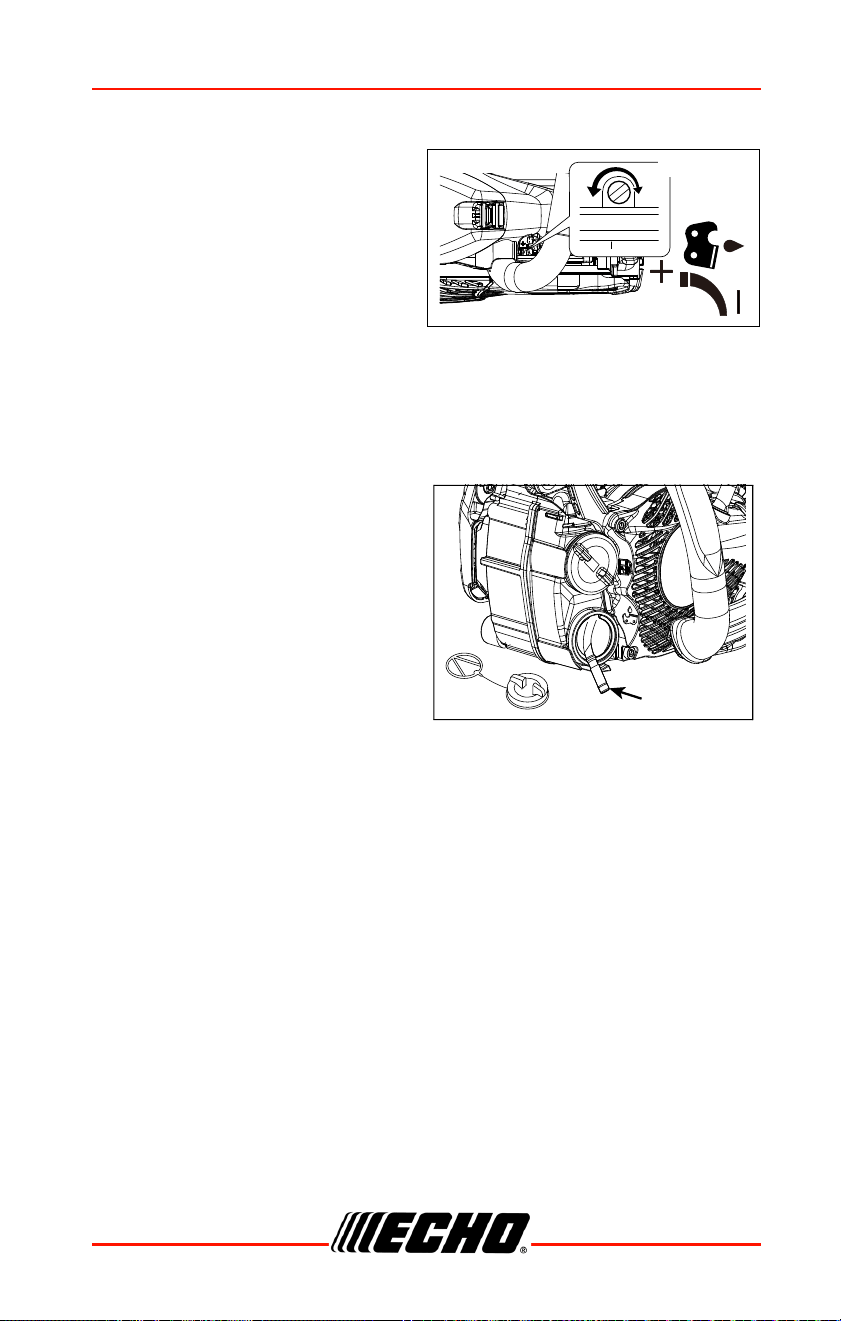
• Check periodically.
• Do not allow dust to enter fuel
tank.
• A clogged filter (A) will cause
difficulty in starting engine or
abnormalities in engine
performance.
1. Pull filter out through gas port, and inspect filter.
Do not damage fuel line while removing fuel filter from tank.
2. When the filter is dirty, replace it as follows:
3. Do not remove the wire coil clamp to remove the fuel filter. Pinch the
fuel filter with the fingers on one hand and the fuel line with the other
hand. Pull and twist slightly to separate.
4. Install the new filter with the reverse action.
5. When the inside of the fuel tank is dirty, rinse the tank out with gasoline
to clean it.
Note: Federal EPA regulations require all model year 2012 and
later gasoline powered engines produced for sale in the
United States to be equipped with a special low permeation
fuel supply hose between the carburetor and fuel tank. When
servicing model year 2012 and later equipment, only fuel
supply hoses certified by EPA can be used to replace the
original equipment supply hose. Fines up to $37,500 may be
enforced for using an un-certified replacement part.
A
CS-2511P MAINTENANCE
X7503333700 49
© 11/2020 ECHO Incorporated
Automatic Oiler
• The discharge volume of the
automatic oiler is adjusted to
approximately 6 mL/min at 7000
r/min, prior to shipment from
factory.
• Always check oil discharge when
in use.
• Turn adjusting screw (A)
counterclockwise to increase oil volume, clockwise to decrease oil
volume.
• Do not turn the adjusting screw beyond the maximum or minimum limit of
volume adjustment.
Oil Filter
• Check periodically.
• Do not allow dust to enter into oil
tank.
• A clogged oil filter (A) will affect
the normal lubricating system.
1. Pull filter out through oil port,
and inspect filter.
2. If the filter is dirty, wash it in
gasoline or replace it as
follows:
3. Do not remove the wire coil clamp to remove the filter. Pinch the filter
with the fingers on one hand and the line with the other hand. Pull and
twist slightly to separate.
4. Install the new filter with the reverse action.
5. When the inside of the tank gets dirty, rinse the tank out with gasoline to
clean it.
A
A
MAINTENANCE CS-2511P
50 X7503333700
© 11/2020 ECHO Incorporated
Guide Bar
1. Clean before using.
2. Clean the groove of the guide
bar (A) with a small
screwdriver.
3. Clean oil holes (B) with a wire.
4. Invert guide bar periodically.
5. Clean the guide bar mount area
before installing the guide bar.
Sprocket
• A damaged sprocket will cause
premature damage or wear of
saw chain.
• When the sprocket has worn 0.5
mm (0.020 in.) or more, replace it.
• Check sprocket when you install
new chain. Replace it if worn.
Some tree sap and resins are corrosive. Thoroughly wash the guide
bar and sprocket areas after each use, then coat metal parts with light
oil.
Cooling System Cleaning
• Check periodically.
• Clogged fins will result in poor
engine cooling.
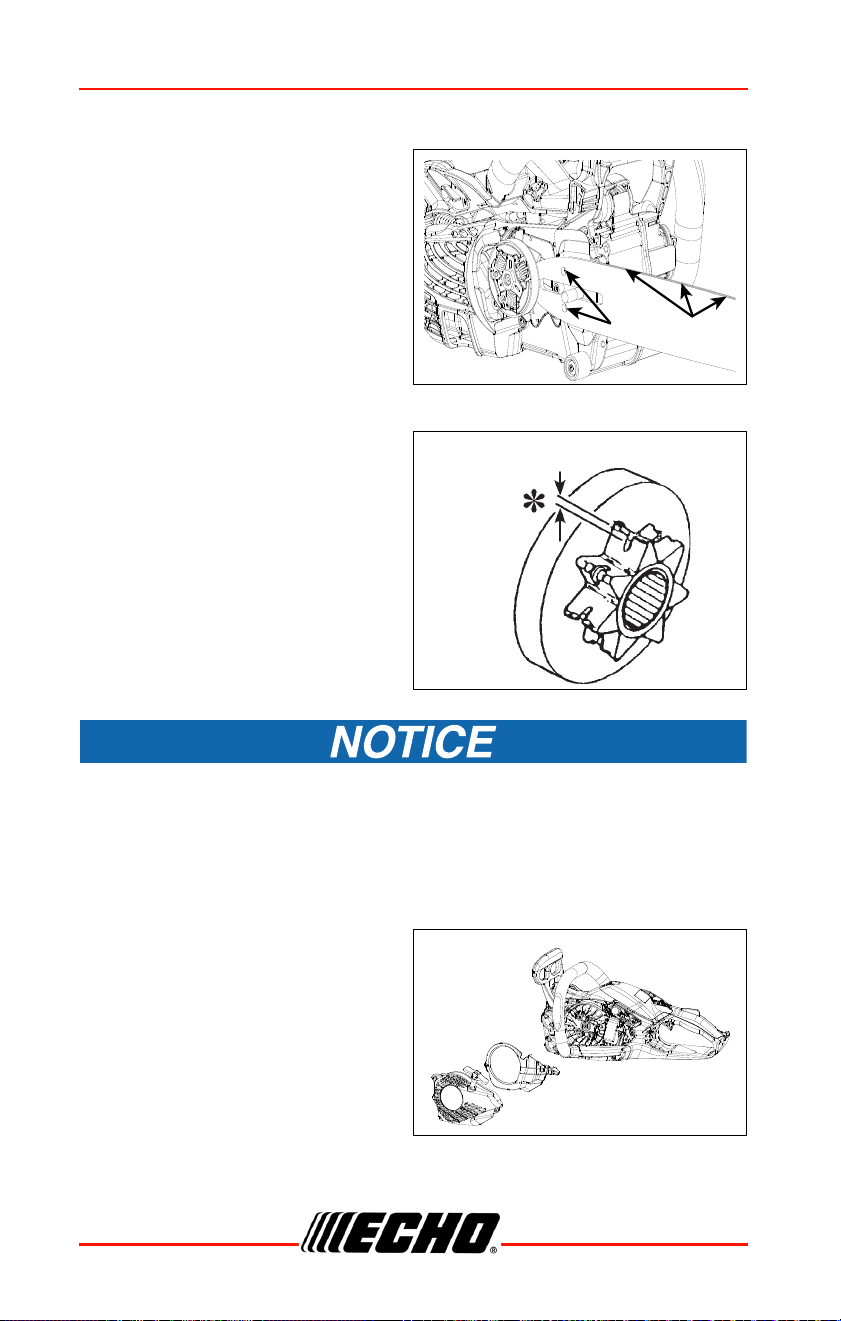
1. Remove the recoil starter and
the air guide plate.
2. Use compressed air or wooden
tool to remove dirt and dust
from between fins to let cooling
air pass easily.
A
B
Worn: 0.5 mm (0.020 in.)
CS-2511P MAINTENANCE
X7503333700 51
© 11/2020 ECHO Incorporated
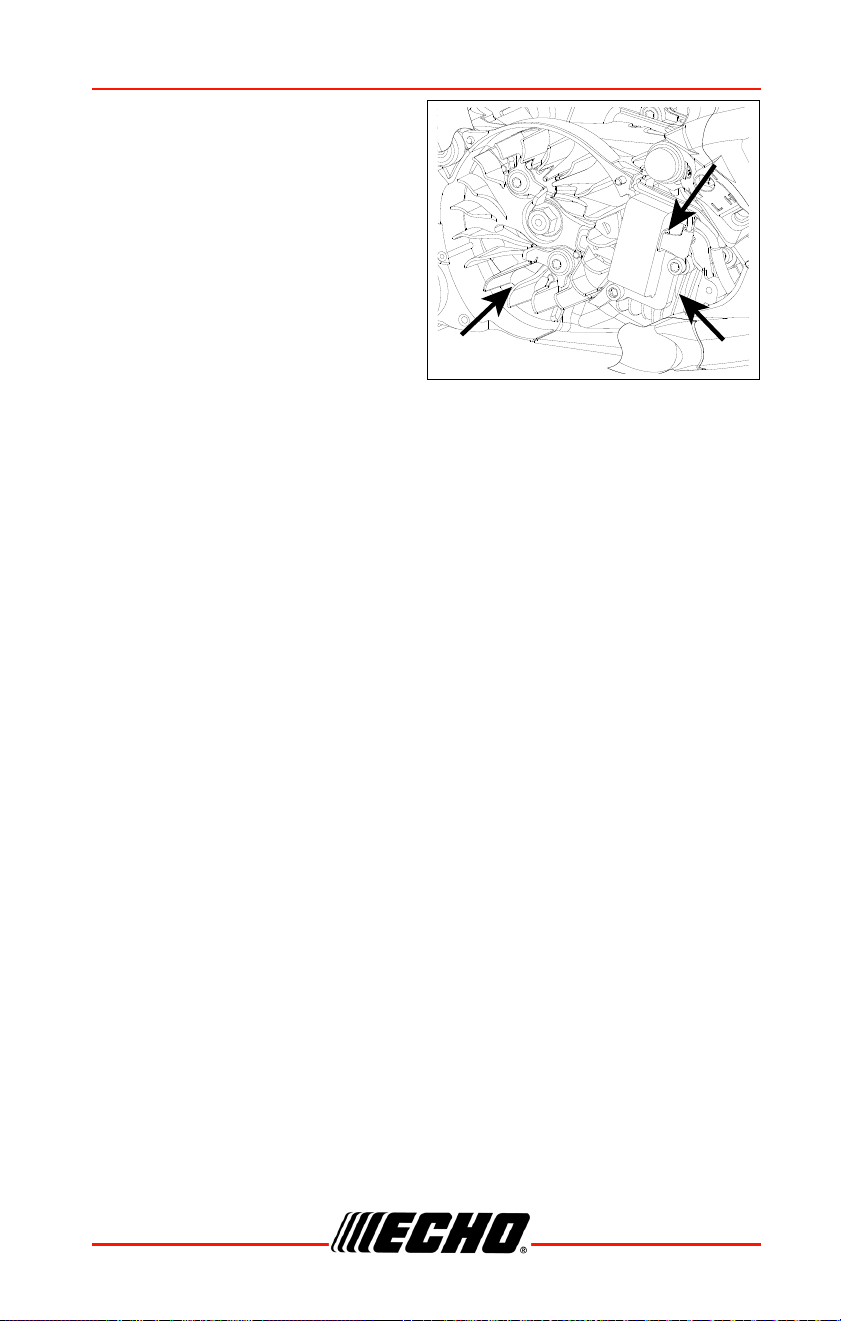
3. Use compressed air or wooden
tool to remove dirt and dust
from between fins to let cooling
air pass easily.
4. Clean the periphery of the
ignition coil and the flywheel
magneto.
5. Assemble the components in
reverse order.
Spark Arrestor Muffler
• The spark arrestor muffler controls the exhaust noise and prevents hot,
glowing particles of carbon from leaving the muffler.
• Make sure the spark arrestor screen is in good repair and properly seated
in the muffler.
• Certain internal combustion engines operated on forest, brush, and/or
grass-covered areas in the states of Washington, Oregon, Idaho,
California, Minnesota, New Jersey and Maine, are required to be
equipped with a spark arrestor.
This requirement also applies to all U.S. Forest Service lands. In some of
these areas, the spark arrestor system must be certified per USDA Forest
Service Regulation SAE J335.
Check with your local or state authorities for specific regulations in your
area. Failure to follow these requirements is a violation of the law.
MAINTENANCE CS-2511P
52 X7503333700
© 11/2020 ECHO Incorporated
Spark Arrestor Screen
Carbon deposits in muffler will cause drop in engine output and
overheating. Spark arrestor screen must be checked periodically.
1. Remove air cleaner cover and
remove spark plug lead.
2. Remove two bolts and muffler
cover.
3. Remove the spark arrester
screen from the muffler body.
4. Clean carbon deposits from
muffler components.
5. Replace screen if it is cracked,
or has holes burned through.
6. Assemble components in
reverse order.
Setting The Saw Chain
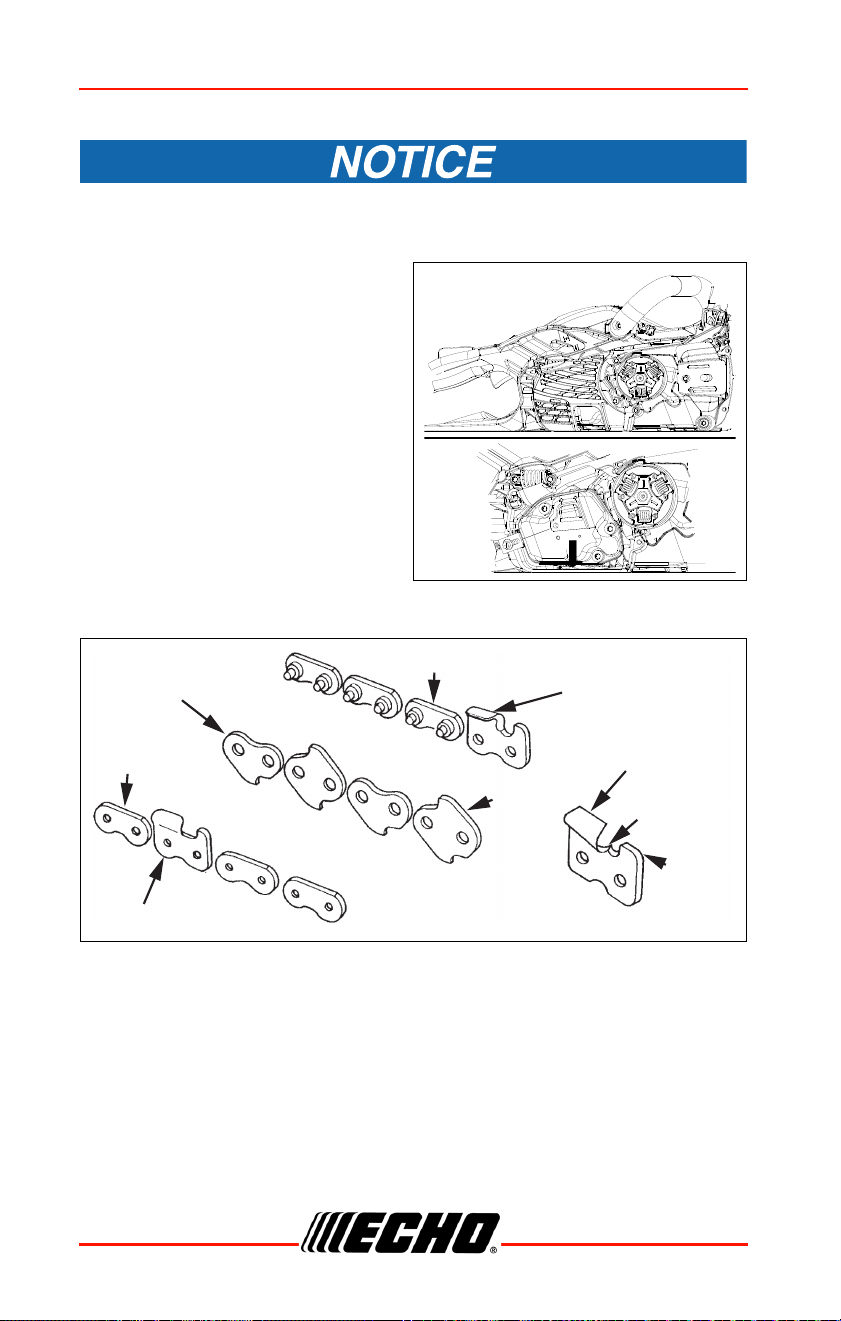
Important points for proper maintenance of saw chain:
• Keep the cutters sharp at all times.
• Keep the left and the right cutters properly aligned.
• Note that blunt or irregular cutters will result in poor cutting performance,
increased vibration of chains and premature breakage of the saw chain.
Tie Strap
Right Hand Cutter
Drive Link
Preset Tie Strap
Left Hand Cutter
Top
Plate
Side
Plate
Depth
Gauge
Guard
Link
CS-2511P MAINTENANCE
X7503333700 53
© 11/2020 ECHO Incorporated
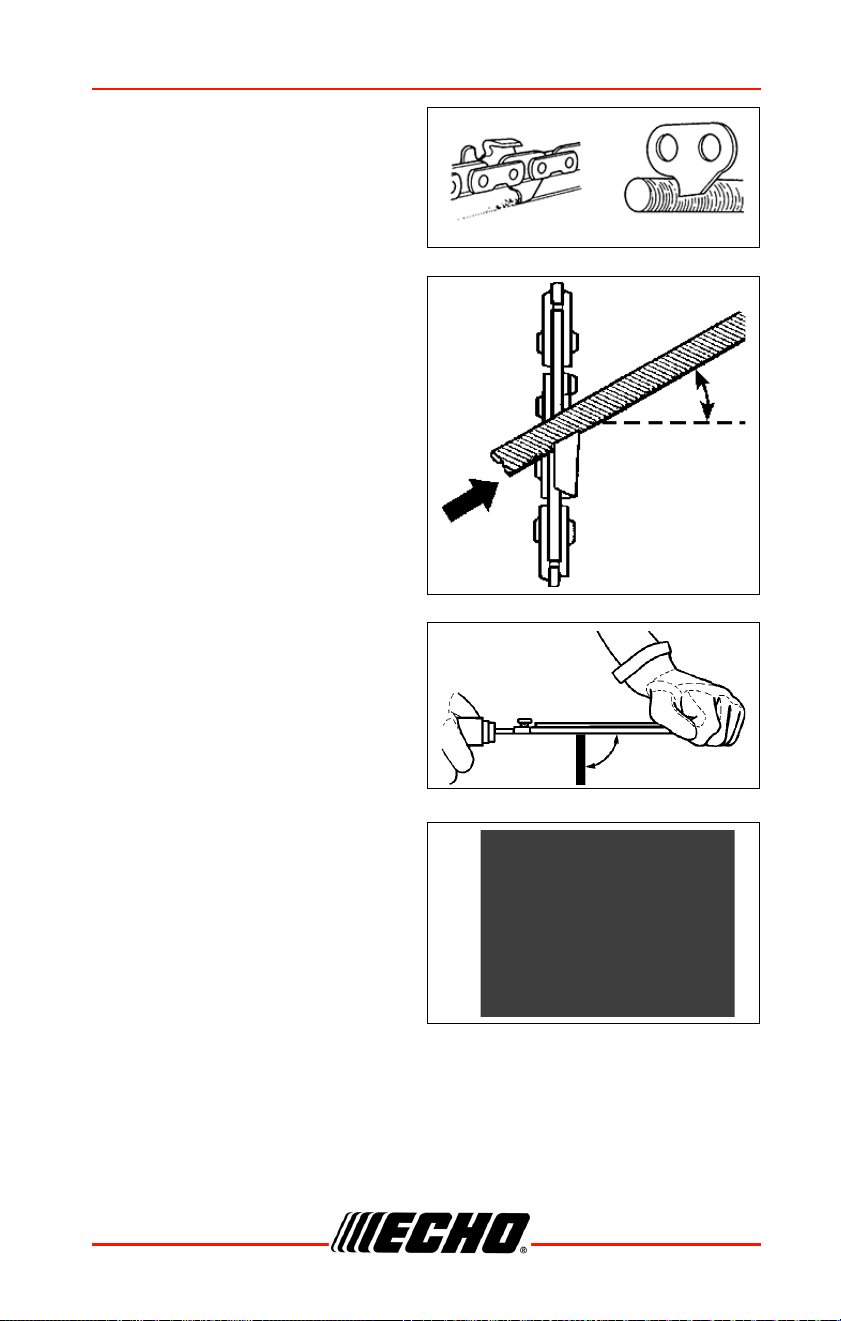
• Drive link serves to remove
sawdust from the groove of the
guide bar. Keep the lower edge of
the drive link sharp where
indicated.
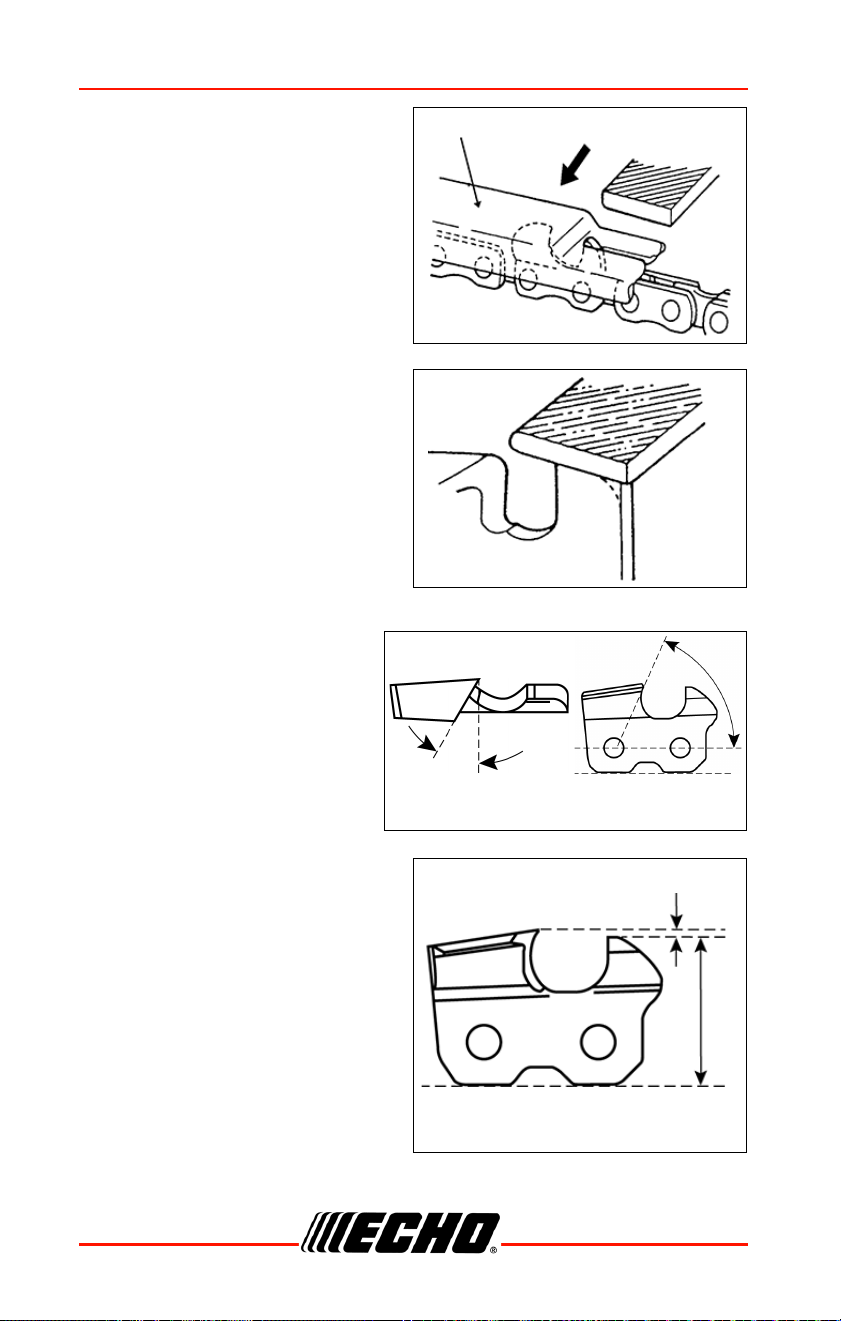
Setting Saw Chain
• For setting saw chain, round file
(4.0 mm [5/32 in.] diam.) and flat
file are used.
• Push file as shown.
• To keep correct position and
correct angle, use a file holder.
• Hold the file horizontally.
• Place the depth gauge tool firmly
on guide bar so that depth gauge
protrudes. Then file top of depth
gauge with the flat file until flat
with top of the depth gauge tool.
• One fifth of the file diameter
remains above cutter edge.
Sharpen lower edge
30°
Keep this angle
90°
1/5
MAINTENANCE CS-2511P
54 X7503333700
© 11/2020 ECHO Incorporated
• Be sure to round off the front edge
of the depth gauge.
• Properly filed cutters are shown in
illustration.
• When setting of the chain is
finished, soak it in oil and
wash away filings completely
before using.
• When chain has been filed on the
bar, supply sufficient oil to it,
move the chain slowly to wash
away the filings before using
again.
• If the chain saw is operated with
filings clogged in the groove, the
saw chain and the guide bar will
be damaged prematurely.
• If the saw chain becomes soiled
with resin, for instance, clean it
with kerosene and soak in it oil.
Depth gauge tool
55°
Side plate angle
30°
Top plate
filing angle
0.64 mm (0.025 in.)
Parallel
Depth gauge
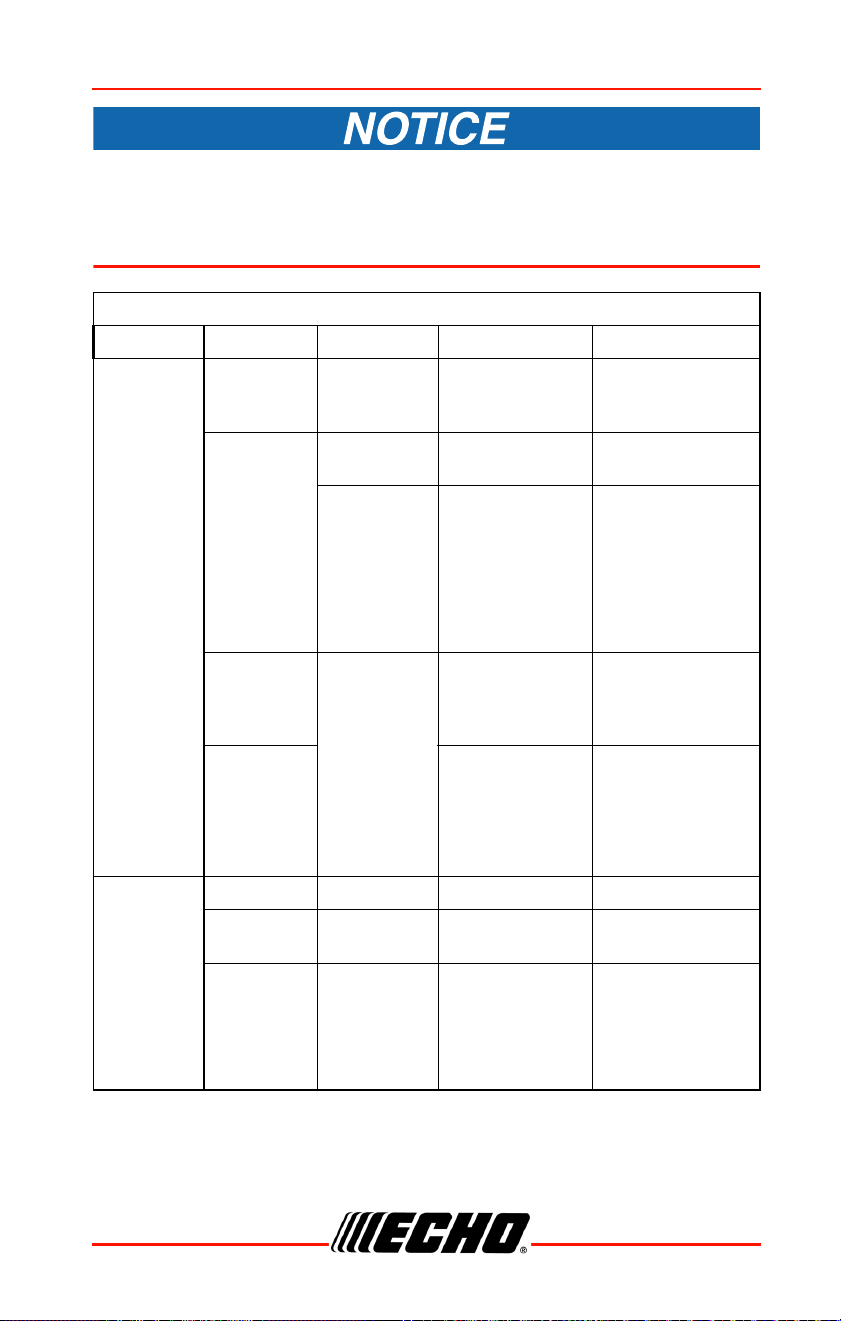
CS-2511P TROUBLESHOOTING
X7503333700 55
© 11/2020 ECHO Incorporated
To sharpen other chains, follow chain manufacturer’s instructions.
TROUBLESHOOTING
ENGINE PROBLEM TROUBLESHOOTING CHART
Problem Check Status Cause Remedy
Engine
starts hard
or
Engine
does not
start
Fuel at
carburetor
No fuel at
carburetor
Fuel strainer or
fuel line
obstructed
Clean or replace
See your dealer
Fuel at
cylinder
No fuel at
cylinder
Carburetor See your dealer
Muffler wet
with fuel
Fuel mixture too
rich
OPEN choke
Clean or replace
air filter
Adjust carburetor
See your dealer
Spark at
end of plug
wire
No spark
STOP switch
OFF - Electrical
problem -
Interlock switch
Turn switch to
ON
See your dealer
Spark at
plug
Incorrect gap -
Covered with
carbon - Fouled
with fuel - Plug
defective
Adjust to
0.65 mm
(0.026 in.)
Clean or replace
plug
Engine
runs, but
dies
or
Engine
does not
accelerate
properly
Air filter Air filter dirty Normal wear Clean or replace
Fuel filter
Fuel filter
dirty
Contaminants
or residue in fuel
Replace filter or
replace fuel
Fuel vent
Fuel vent
plugged
Contaminated
fuel
Clean or replace
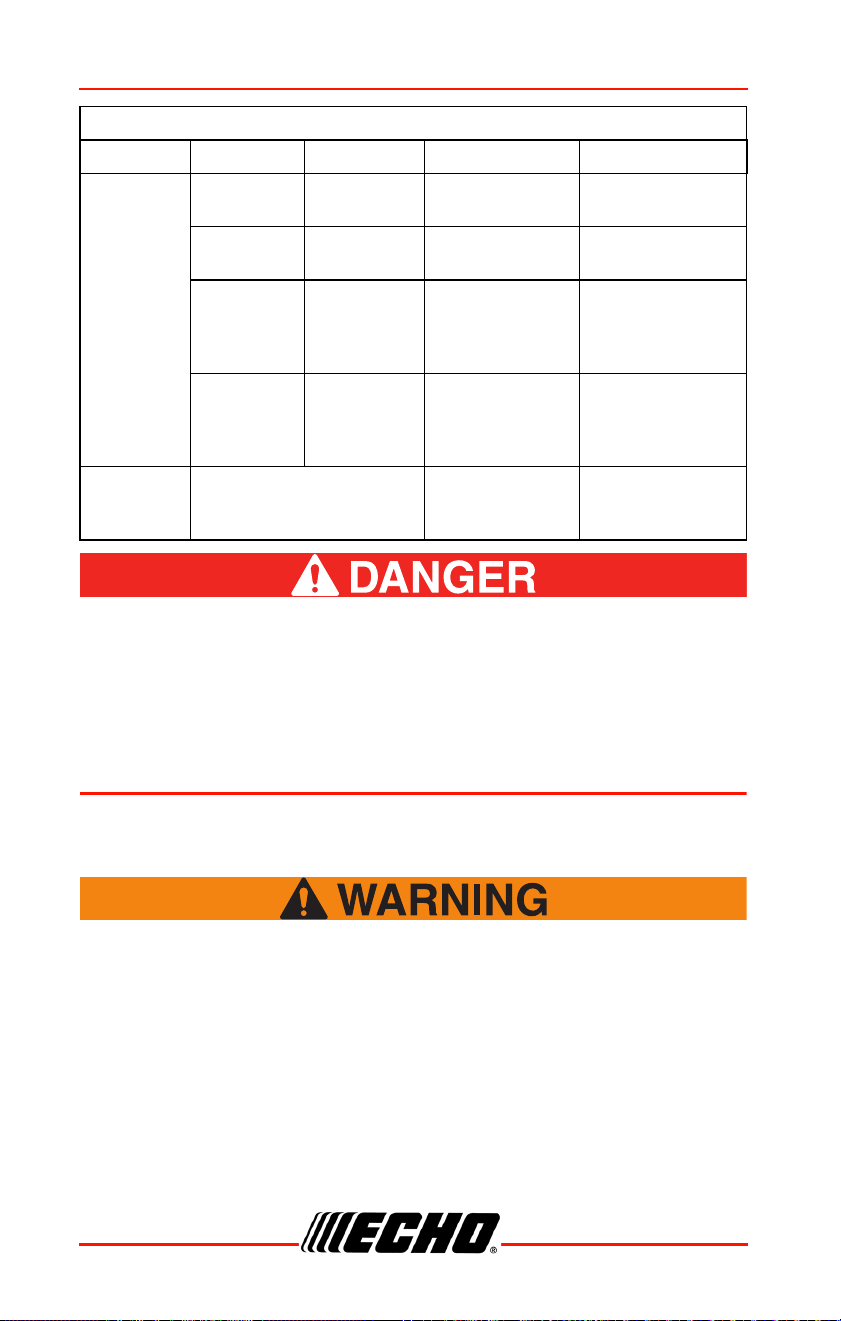
STORAGE CS-2511P
56 X7503333700
© 11/2020 ECHO Incorporated
Fuel vapors are extremely flammable and can cause fire and/or
explosion. Never test for ignition spark by grounding spark plug
near cylinder plug hole, otherwise serious personal injury can
result.
STORAGE
Storage After Use
Units equipped with a Momentary STOP Switch automatically
return to RUN position. Engine can start unintentionally. Always
remove spark plug lead from spark plug before assembling or
performing maintenance procedures. Serious personal injury
can result.
• Inspect and adjust every part of the chain saw.
• Completely clean every part and repair if necessary.
• Apply thin coating of oil on metal parts to prevent rust.
• Remove chain and guide bar.
Engine
runs, but
dies
or
Engine
does not
accelerate
properly
Spark plug
Plug dirty or
worn
Normal wear
Clean and adjust
or replace
Carburetor
Improper
adjustment
Vibration Adjust
Cooling
system
Cooling
system dirty
or plugged
Extended
operation in
dirty or dusty
locations
Clean
Spark
arrestor
screen
Spark
arrestor
screen
plugged
Normal wear Replace
Engine
does not
crank
N/A
Internal engine
problem
See your dealer
ENGINE PROBLEM TROUBLESHOOTING CHART
Problem Check Status Cause Remedy
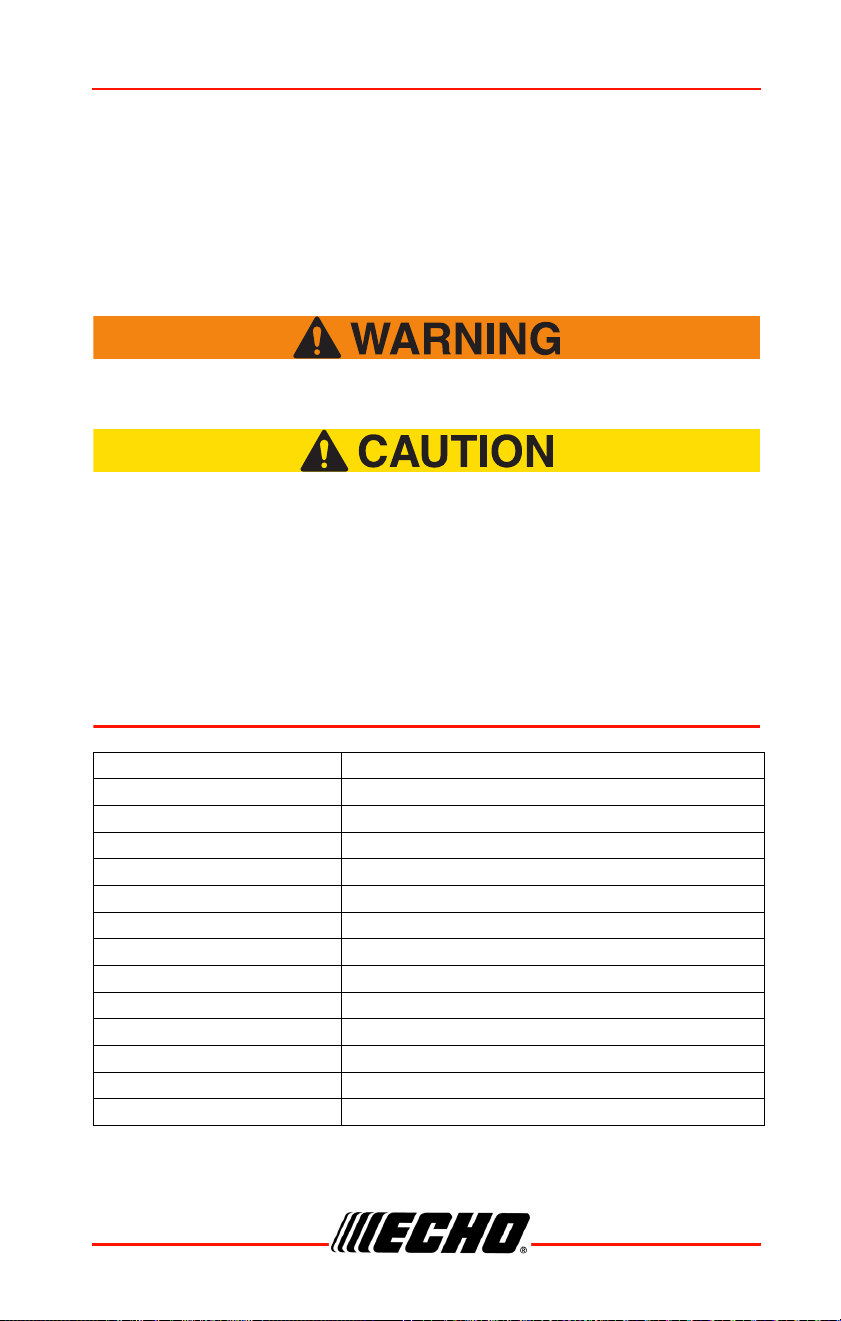
CS-2511P SPECIFICATIONS
X7503333700 57
© 11/2020 ECHO Incorporated
• Drain fuel tank completely. Press purge bulb 6-7 times to remove
remaining fuel from carburetor then drain the tank again. Close choke,
start and run the engine until it stops due to lack of fuel.
• Allow engine to cool. Remove the spark plug lead from the spark plug.
Remove the spark plug. Pour 7 cc (0.25 oz.) of fresh, clean, two-stroke
engine oil into the cylinder through the spark plug hole.
• Store in a dry area, free from dust.
Do not store in an enclosure where fuel fumes may accumulate
or reach an open flame or spark.
Do not lend or rent your chain saw without the Operator’s
Manual.
Note:
• For future reference, you should keep this Operator’s Manual.
• If this Operator’s Manual becomes illegible or is lost, please contact
your ECHO dealer, or go to www.echo-usa.com.
SPECIFICATIONS
MODEL CS-2511P
Length 400 mm (15.7 in.)
Width 213 mm (8.4 in)
Height 210 mm (8.3 in.)
Dry weight 2.6 kg (5.7 lb.) Without chain and guide bar
Engine Air-cooled two-stroke single cylinder
Displacement 25.0 ml (1.53 cu. in.)
Bore 35.0 mm (1.38 in.)
Stroke 26.0 mm (1.02 in.)
Compressions ratio 7.85:1
Carburetor Diaphragm type
Spark plug NGK CMR7H (Gap 0.65 mm [0.026 in.])
Fuel tank capacity 190 ml (6.42 US. fl. oz.)
Gasoline/Oil Ratio 50:1
PRODUCT REGISTRATION CS-2511P
58 X7503333700
© 11/2020 ECHO Incorporated
PRODUCT REGISTRATION
Thank you for choosing ECHO Power Equipment
Please go to http://www.echo-usa.com/Warranty/Register-Your-ECHO to
register your new product on-line. It's FAST and EASY! NOTE: your
information will never be sold or misused by ECHO, Incorporated.
Registering your purchase enables us to contact you in the unlikely event of
a service update or product recall, and verifies your ownership for warranty
consideration.
If you do not have access to the Internet, you can complete the form below
and mail to:
ECHO Incorporated, Product Registration, PO Box 1139, Lake Zurich
IL 60047.
Gasoline
Use 89 octane unleaded. Do not use fuel containing
methyl alcohol, more than 10% ethyl alcohol or 15%
MTBE. Do not use alternative fuels such as E-15 or
E-85.
Oil
ISO-L-EGD (ISO/CD 13738) and JASO M345-FD
two-stroke, air-cooled engine oil.
Oiling system Adjustable automatic oiler
Chain oil capacity 140 ml (4.73 US. fl. oz.)
Starter system Automatic rewind starter
Clutch Centrifugal type
Sprocket type Spur type, 6-tooth, 3/8 in. pitch
Chain brake Manual and Non-manual band brake type
Idle speed 3,200 RPM
Clutch engagement speed 4,300 RPM
Wide open throttle speed
(W.O.T.)
12,700 RPM
Chain tensioner Side access system
Guide bar 12, 14 in.
Saw chain 91PXL
Standard features
Front hand guard, Rear hand guard, Anti-vibration
device, Spiked bumper, Throttle control lockout,
Chain catcher, Spark arrestor muffler, Kick Guard
TM
(optional)
MODEL CS-2511P
CS-2511P PRODUCT REGISTRATION
X7503333700 59
© 11/2020 ECHO Incorporated