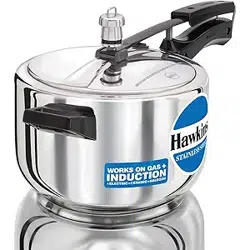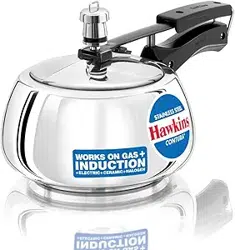
Size: W 23 x H 17.5 cms
27940 5 Litre Contura Ceramic cookbook cover
Instruction Manual
with 27 tested recipes
•
16 Indian Recipes
•
11 International Recipes
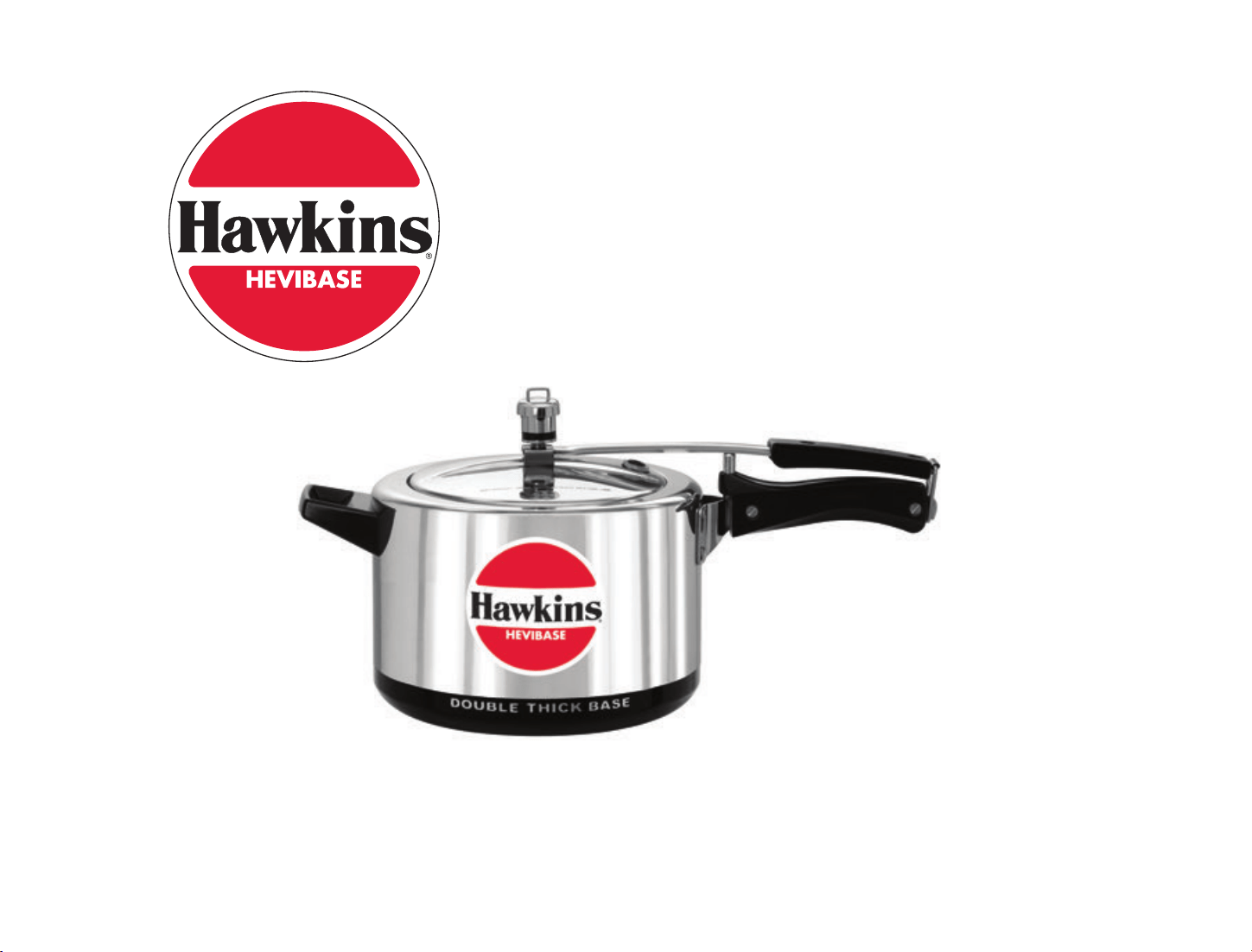
HAWKINS HEVIBASE
PRESSURE COOKER
INSTRUCTION MANUAL
with 27 tested recipes
Hawkins is a Registered Trademark of Hawkins Cookers Limited in India and in various other countries throughout the world. Ha wkins Cookers Limited is also the
registered proprietor of the Contura and Hawkins Hevibase label trademarks and the proprietor of the Hawkins Contura, Hawkins Contura Black, Hawkins Contura
Black XT, Hawkins Hevibase and Hevibase trademarks. Product design of the 3L Hawkins Hevibase pressure cooker registered in India under
registration no. 228103. Product design registration application for the 5L Hawkins Hevibase pressure cooker pending in India. 2015 Copyright reserved
in respect of logos, pictures, text, layout, design and recipes in this Manual. All Rights Reserved. Edited and published by Neil Vasudeva on behalf of
Hawkins Cookers Limited, Maker Tower F 101, Cuffe Parade, Mumbai 400 005, India. Corporate Identity Number: L99999MH1959PLC011304;
Tel: (91 22) 2218 6607, Fax: (91 22) 22181190, Email: [email protected]; Website: www.hawkinscookers.com. Printed in 2015 at
Colour Count, Matunga (E), Mumbai 400 018, India.
Hawkins is a Registered Trademark of Hawkins Cookers Limited in India and in various other countries throughout the world. Hawkins Cookers Limited is also
the registered proprietor of the Contura and Hawkins Hevibase label trademarks and the proprietor of the Hawkins Contura, Mustard Yellow Hawkins Contura,
Tomato Red Hawkins Contura, Apple Green Hawkins Contura, Hawkins Contura Black, Hawkins Contura Black XT, Hawkins Hevibase and Hevibase trademarks.
Product design of the 3L Hawkins Hevibase pressure cooker registered in India under registration no. 228103. Product design registration application for the
5L Hawkins Hevibase pressure cooker pending in India. 2015 Copyright reserved in respect of logos, pictures, text, layout, design and recipes in this Manual.
All Rights Reserved. Edited and published by Neil Vasudeva on behalf of Hawkins Cookers Limited, Maker Tower F 101, Cuffe Parade, Mumbai 400 005, India.
Corporate Identity Number: L99999MH1959PLC011304; Tel: (91 22) 2218 6607, Fax: (91 22) 2218 1190, Email: [email protected];
Website: www.hawkinscookers.com. Printed in 2015 at Colour Count, Matunga (E), Mumbai 400 019, India.
Hawkins Hevibase IM_Issue 2_Sep 2015.indd 1 28-09-2015 15:18:02

IMPORTANT SAFEGUARDS
1. Read all instructions.
2. Do not touch hot surfaces. Use handles.
3. Close supervision is necessary when the
pressure cooker is used near children.
4. Use the appropriate heat source(s)
according to the instructions for use.
5. Do not place the pressure cooker in a
heated oven.
6. Do not wash in a dishwasher.
7. Extreme care must be used when moving
a pressure cooker containing hot liquids.
8. Do not use the pressure cooker for any
use other than its intended use.
9. This appliance cooks under pressure
of 103 kPa (15 lbs/in
2
). Improper use may
result in scalding injury. Do not use it unless
it is properly closed. See "How to Close the
Hawkins Hevibase" on the inside front cover.
10. Always check that the vent tube is clear
immediately before closing the lid for pressure
cooking.
11. The vent weight is an accurately weighted
device to regulate operating pressure. Never
place anything over the vent weight while
cooking.
12. When starting to pressure cook, close the
lid WITHOUT the vent weight in position on
the vent tube. Place the vent weight on the
vent tube ONLY AFTER steam starts to come
out of the vent tube steadily. See "Operating
Instructions" i.e. "Trial Run" on page 9.
13. Always place water as indicated in each
recipe or chart in the pressure cooker body
before pressure cooking. As a general rule,
place a minimum of one cup water for the
first 10 minutes of pressure cooking time plus
one-half cup for every subsequent 10 minutes
or part thereof. Total contents including
water should not exceed as stated in the next
point.
14. Do not fill the unit over
2
/3 full. When
cooking foods that expand during cooking
such as rice or dried vegetables, do not fill the
unit over
1
/2 full. When cooking dal/pulses
which sprout, never fill the cooker more
than
1
/3 full. Overfilling may cause a risk of
clogging the vent tube and developing excess
pressure. See "Food Preparation Instructions"
i.e. "Product Information" on page 6.
15. Be aware that certain foods, such as
applesauce, cranberries, pearl barley, oatmeal
or other cereals, split peas, noodles, macaroni,
rhubarb, or spaghetti can foam, froth and
sputter, and clog the pressure release device
(vent tube). These foods should not be
cooked in a pressure cooker.
16. After cooking meat with a skin which
may swell under the effect of pressure, do not
prick the meat while the skin is swollen; you
might be scalded.
17. When the normal operating pressure is
reached, turn the heat down so all the liquid,
which creates the steam, does not evaporate.
18. Never attempt to force open the pressure
cooker. Do not open the pressure cooker until
the unit has cooled and internal pressure has
been released. If the handles are difficult to
move apart, this indicates that the cooker is
still pressurised – do not force it open. Any
pressure in the cooker can be hazardous. See
"Operating Instructions" i.e. "Easy Tips for
Better Cooking" on page 15.
19. Never lift vent weight for reducing
pressure in the case of liquid or frothing foods.
20. Do not use the pressure cooker for
pressure frying with oil.
21. Never use the cooker body for deep frying
or light frying for more than 20 minutes at a
time or as an oven for dry heating or baking,
since the strength of the metal may decrease
to a dangerous level.
22. The safety valve fuses and operates
automatically in the event of excess pressure.
If it fuses, please shut off the heat. When
cool, replace the safety valve with a genuine
Hawkins safety valve. See page 37.
23. Do not attempt to make any changes
to the vent weight and safety valve. Repairs
other than the replacement of gasket, body
handles, safety valve and the vent weight
must be done only by an authorised service
centre/representative. All replacement parts
must be genuine Hawkins parts.
24. In case of use on an electric hot plate, use
a plate of diameter equal to or less than that
of the base of the pressure cooker.
25. SAVE THESE
INSTRUCTIONS.
2
Hawkins Hevibase IM_Issue 2_Sep 2015.indd 2 28-09-2015 15:18:02
Important
Additional
Information
for
this
Ceramic
-
Coated
Hawkins
Contura
Pressure
Cooker
i
3L & 5L Ceramic-Coated Contura_Issue 1-Sep 2015
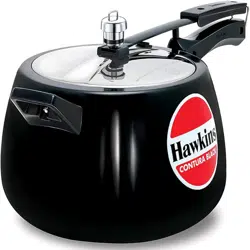
This Ceramic-Coated Hawkins Contura Pressure
Cooker has these important features:
1. The body is made from commercially pure, virgin
aluminium with a high-quality, German ceramic
coating on the exterior and the base.
2. The ceramic coating is scratch- and stain-resistant
and easy to clean.
3. The ceramic coating has no heavy metals or other
toxic substances.
4. The black base heats quickly and retains heat
well.
5. It has curved sides for easy stirring.
6. The lid is stainless
steel.
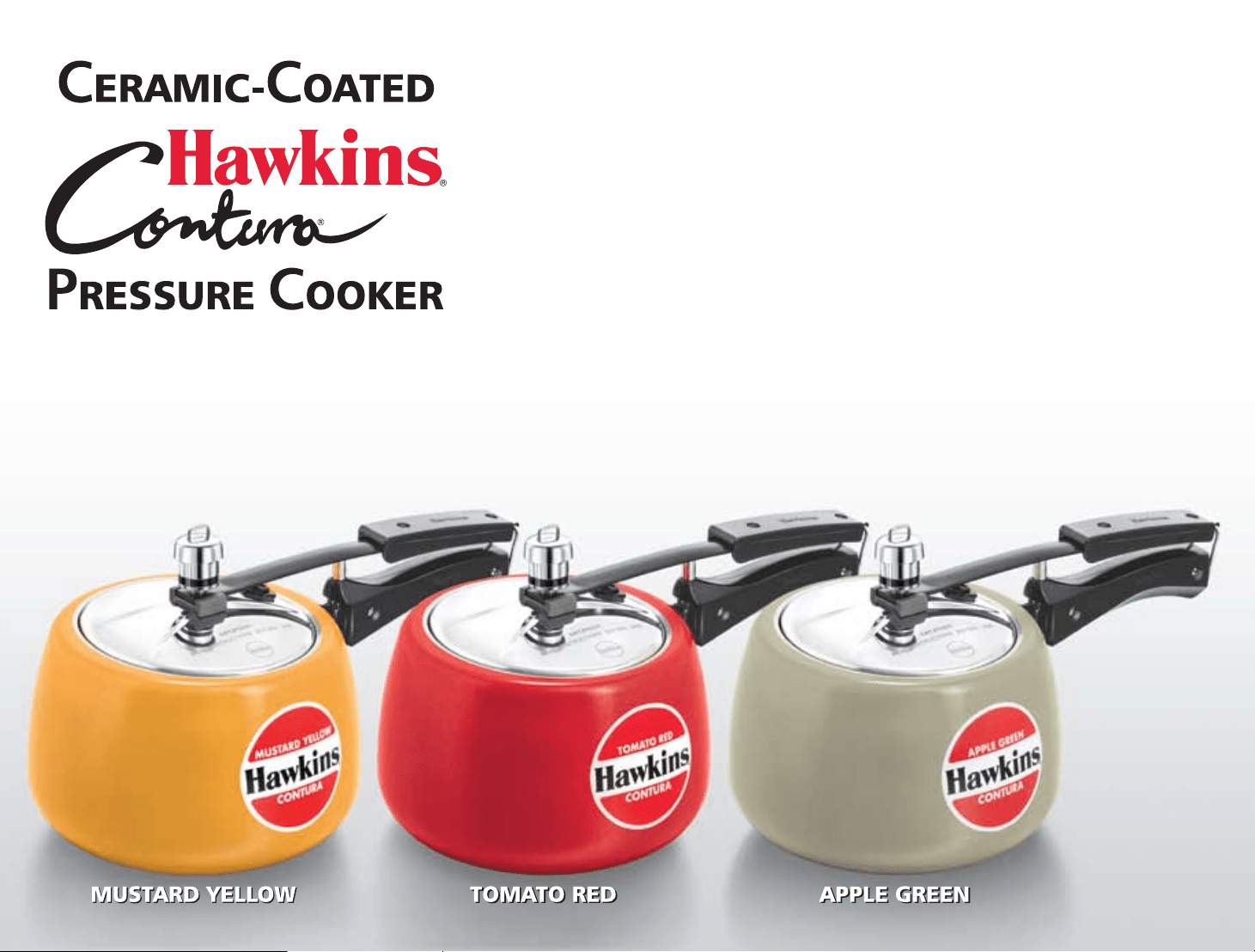
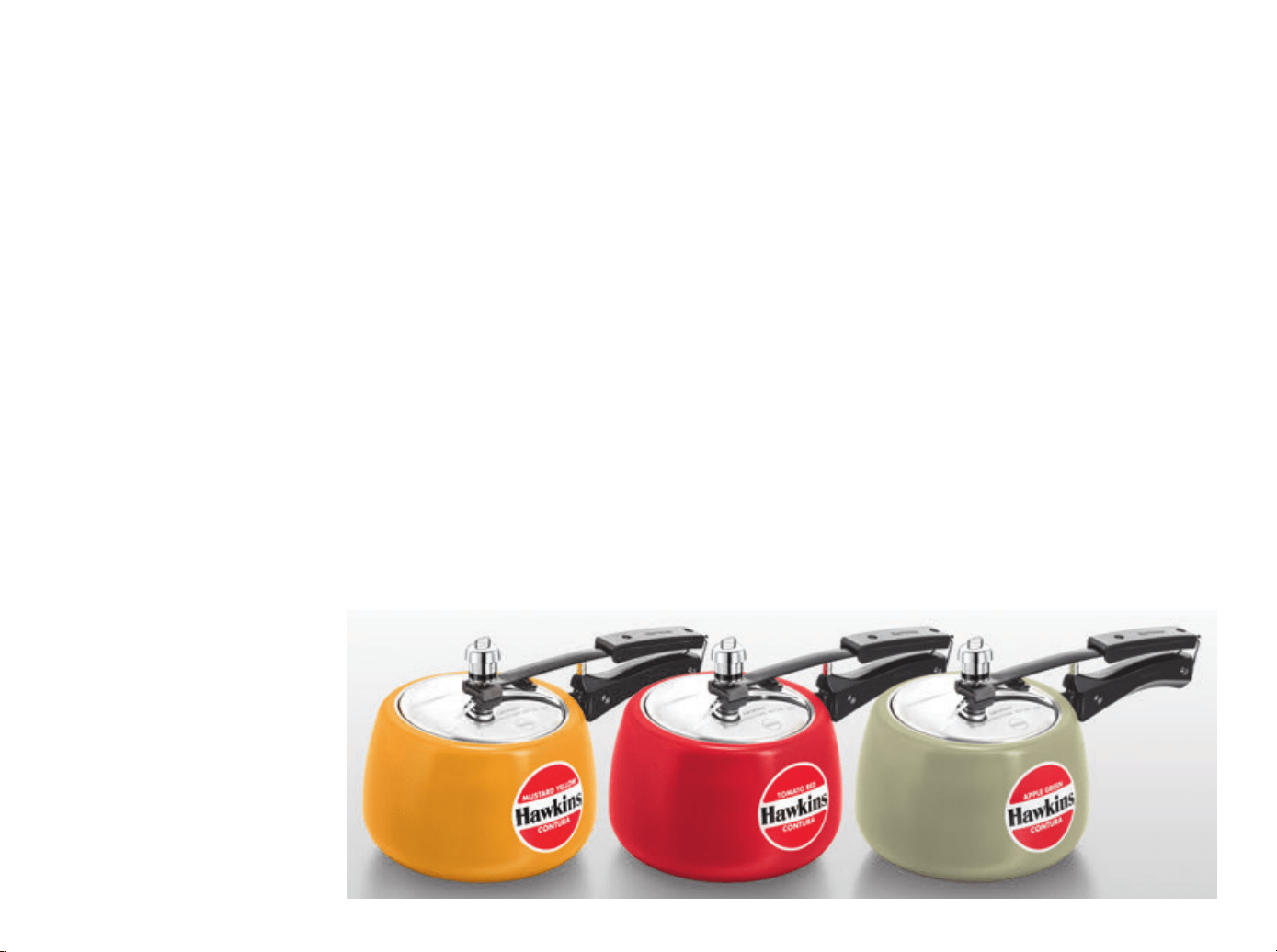
7. The Ceramic-
Coated Hawkins
Contura is available
in three colours –
Tomato Red, Mustard
Yellow and Apple
Green.
This Manual was written for the Hawkins Hevibase Pressure
Cooker. All the instructions and recipes in this Manual are
valid for this Ceramic-Coated Hawkins Contura Pressure
Cooker except as stated in this chapter of 6 pages.
The Ceramic-Coated Hawkins Contura (3 Litre) is depicted
only on the front cover and in this chapter. Inside the Manual,
the pressure cooker shown in pictures is the Hawkins Hevibase.
READ THE NEXT FIVE PAGES BEFORE USING THIS COOKER.
ALSO, READ IMPORTANT SAFEGUARDS (ON PAGE 2 OF
THE MANUAL) AND PAGES 3 TO 38 OF THE MANUAL.

ii
CAUTION
1. Do not hit, bang, cut or rub the cooker with hard or sharp
objects – while cooking, while cleaning or while storing.
2. This pressure regulator is different from that used in Hawkins
cookers up to 2004. Counting whistles may give you the wrong time
required for cooking. Use the time for cooking at full pressure as
given in the Manual.
3. Do not put the hot cooker in cold water.
4. On the ceramic coating, do not use any abrasive or caustic
cleaning products such as abrasive cleaning powders or bars, steel
wool, abrasive scrubbers or oven cleaners, bleach or floor cleaners.
Product Information
•
Trouble-Free (page 4 of the Manual, second column, last
paragraph): Disregard existing paragraph and replace
with: Black,
Ceramic-coated, Energy-efficient Base
heats quickly and evenly;
will not tarnish, pit or corrode.
•
Product Information: Getting to Know Your Hawkins Hevibase
(page 7, second column, last paragraph) and Using Grid and Molds
(page 30, first column): Replace first sentence with: A grid does not
come with this cooker. It is available separately as an accessory.
•
Heat Source (page 12, second column):
1. Disregard first paragraph and replace
with:
The Ceramic-Coated
Hawkins Contura is specially suitable for use on domestic gas and
kerosene stoves. After some use, the cooker base may not retain
the flatness required for use on an electric hot plate. This cooker is
not Induction Compatible.
2. When cooking in the 3 Litre Ceramic-Coated Hawkins Contura
pressure cooker, use the small burner or do not exceed the medium
heat setting of a large burner.
•
Releasing Pressure (page 15, first paragraph): DO NOT use the
third method (point 3, "Release pressure by placing cooker in
up to 4 inches/10 cm of cold water in a basin or in a sink for a
few minutes"). One alternative to this method is to reduce the
pressure cooking time and allow to cool naturally. In case it is not
possible to reduce the pressure cooking time at full pressure (because
it is 0 minute or if the step in the recipe requires the pressure cooker
to be removed from heat immediately once full operating pressure is
reached) the food may be cooked without the vent weight; see
examples in the section Adapting Recipes on page iii of this chapter,
namely, Mutton Biryani and Vegetable Biryani.
Adapting Recipes to the
Ceramic-Coated Hawkins Contura
The recipes in this Manual have been written for
the 5 Litre Hawkins Hevibase Pressure Cooker and apply to the
5 Litre Ceramic-Coated Hawkins Contura Pressure Cooker except
as stated in this section.
The quantities given in this Manual for the 3 Litre Hawkins
Hevibase apply to the 3 Litre Ceramic-Coated Hawkins Contura.
To adapt the recipes in this Manual to the 3 Litre model, follow the
instructions in Adapting Recipes for the 3 Litre Hawkins Hevibase,
page 29.
iii
The following instructions apply to both the 3 Litre and 5 Litre
pressure cookers:
•
Because the Ceramic-Coated Hawkins Contura cannot be put in
water to reduce pressure, the statements and recipes in this Manual
require change as follows:
1. Pressure Cooking Legumes (page 28, point 5): DO NOT
place cooker in cold water in a basin or in a sink.
2. Sambar (page 43): Replace fourth sentence in step 8 in
the recipe with the following: "Allow to cool naturally 5 minutes.
Release pressure with slight lifting of vent weight."
3. Mutton Biryani (page 44/45):
Replace steps 6, 7 and 8 in the recipe with the following:
"6. Pour water (3 cups
/
720 ml for 3 Litre cooker; 5 cups
/
1.2 litres
for 5 Litre cooker) in cooker. Bring to boil on high heat with lid
closed without the vent weight. Open cooker. Add remaining salt
(1
1
∕2 tsp
/
7.5 ml for 3 Litre cooker; 2
1
∕2 tsp
/
12.5 ml for 5 Litre
cooker), cardamoms, cloves, bay leaf, cinnamon and rice. Stir.
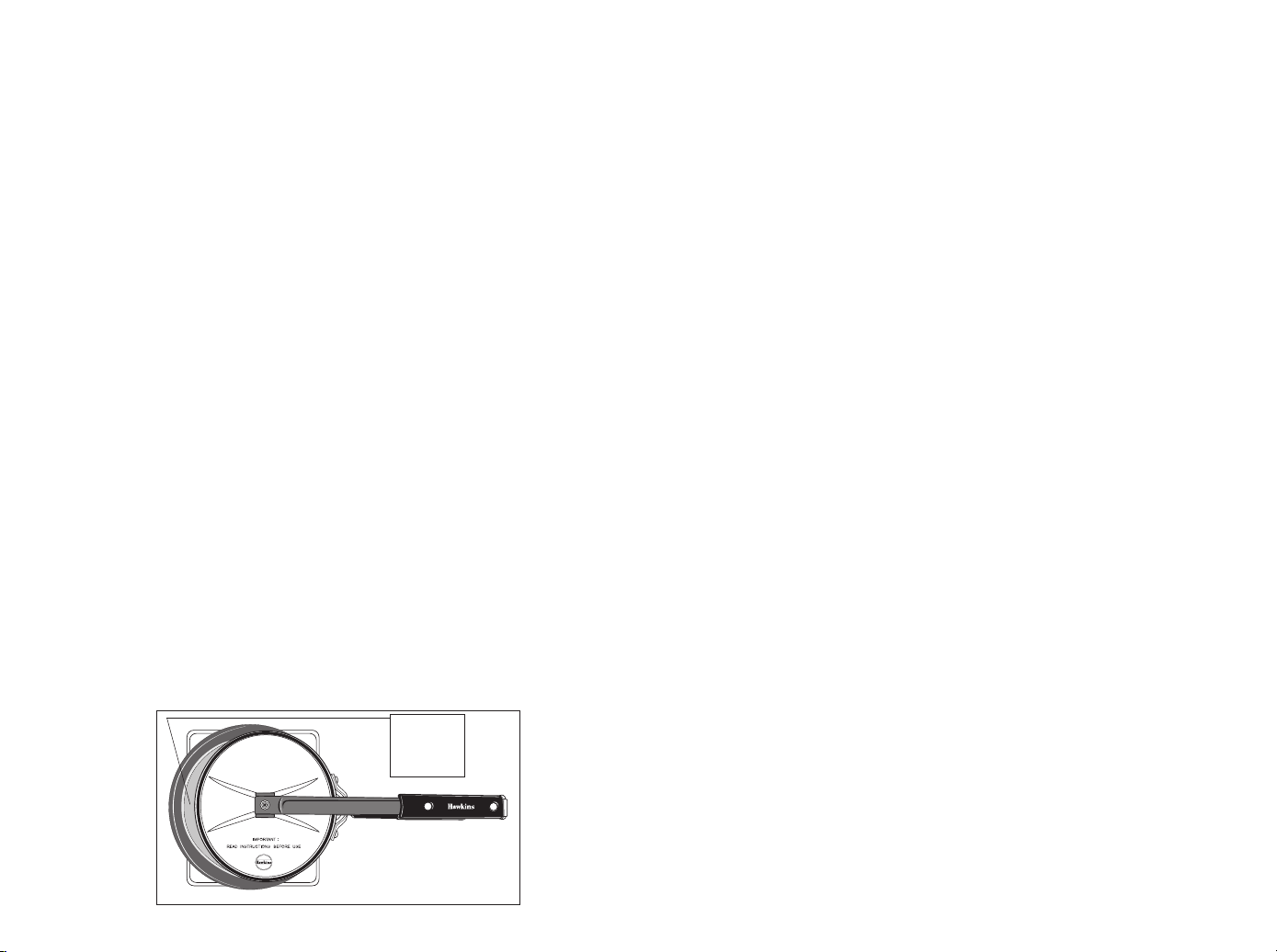
7. Bring to boil in open cooker body. Reduce heat to medium. Place
lid on top of the mouth of cooker body such that there is a gap of
about
1
∕5 inch
/
5 mm from the edge of the lid to the cooker body
on the side opposite the cooker body handle (see sketch below).
Cook till rice just turns opaque (about 5 minutes). 8. Remove lid.
Remove cooker from heat. Immediately transfer rice to a colander
and drain. Wash and wipe dry cooker."
4. Vegetable Biryani (page 50/51):
(1) Replace steps 3, 4 and 5 in the recipe with the following:
"3. Pour water (3 cups
/
720 ml for 3 Litre cooker; 5 cups
/
1.2 litres
for 5 Litre cooker) in cooker. Bring to boil on high heat with lid closed
without the vent weight. Open cooker. Add salt (1
1
∕2 tsp
/
7.5 ml for
3 Litre cooker; 2
1
∕2 tsp
/
12.5 ml for 5 Litre cooker), cardamoms,
cloves, bay leaves, cinnamon and rice. Stir. 4. Bring to boil in open
cooker body. Reduce heat to medium. Place lid on top of the mouth
of cooker body such that there is a gap of about
1
∕5 inch
/
5 mm
from the edge of the lid to the cooker body on the side opposite
the cooker body handle (see sketch alongside). Cook till rice just
turns opaque (about 5 minutes). 5. Remove lid. Remove cooker
from heat. Immediately transfer rice to a colander and drain. Wash
and wipe dry cooker."
(2) Replace step 10 with the following: "10. Remove cooker from
heat. Allow to cool naturally 5 minutes. Release pressure with slight
lifting of vent weight."
5. Minestrone Soup (page 54): In step 2, reduce pressure
cooking time to 3 minutes. In step 3, do not release pressure by
placing hot cooker in cold water; instead, allow cooker to cool
naturally about 10 minutes. Release pressure with slight lifting of
vent weight.
Gap of
1
∕5 inch
or 5 mm
Care and Cleaning
The instructions on pages 32, 33 and 34 of the Manual should be
used after noting the following corrections and additions:
Body and Lid (page 32):
•
Protect the exterior ceramic coating from chipping and
scratching by not hitting, cutting or banging it or the rim of
the cooker body with any hard or sharp objects.
•
Do not bang cooker down on the pan supports. Lift cooker
from the pan supports – do not drag it across the pan
supports.
•
When storing, ensure that the ceramic coating is not hit,
gouged or rubbed against any hard or sharp surfaces. Do not
stack other utensils on the cooker without protecting it.
•
After use, faint scratches or marks may appear on the exterior
ceramic coating. These are marks of normal wear and tear
and do not affect the performance of the cooker. The coating
is non-toxic and inert.
General Cleaning (page 32):
•
Do not put the hot cooker in cold water – allow cooker to cool
before cleaning.
•
First paragraph: Disregard existing paragraph and replace
with:
DO NOT WASH THE LID ASSEMBLY IN A DISHWASHER.
Hand wash. We recommend hand washing the cooker body
but it may be washed in a dishwasher. Please be aware,
however, that dishwasher detergents may contain harsh
chemicals or abrasive substances that may tarnish the
aluminium and dull the plastic handles and the ceramic
iv
coating over time. Remove white marks caused by hard water
in a dishwasher by wiping with a damp cloth.
•
Third paragraph: Delete the first sentence and replace
with the
following:
Wash all parts of the cooker in hot water with a
mild, liquid utensil soap or detergent such as 'Pril' or 'Vim Liquid'
and a dishcloth or non-abrasive sponge. For the ceramic-coated
exterior: Do not use abrasive cleaning powders or bars or abrasive
plastic scrubbers on the ceramic coating. For the Aluminium
interior: Cleaning powders, cleaning bars and non-abrasive plastic
scrubbers may be used on the aluminium interior.
•
Do not use harsh abrasives such as steel wool, steel brushes, ash
or mud to clean the cooker. This can cause scratches and could lead
to pitting.
•
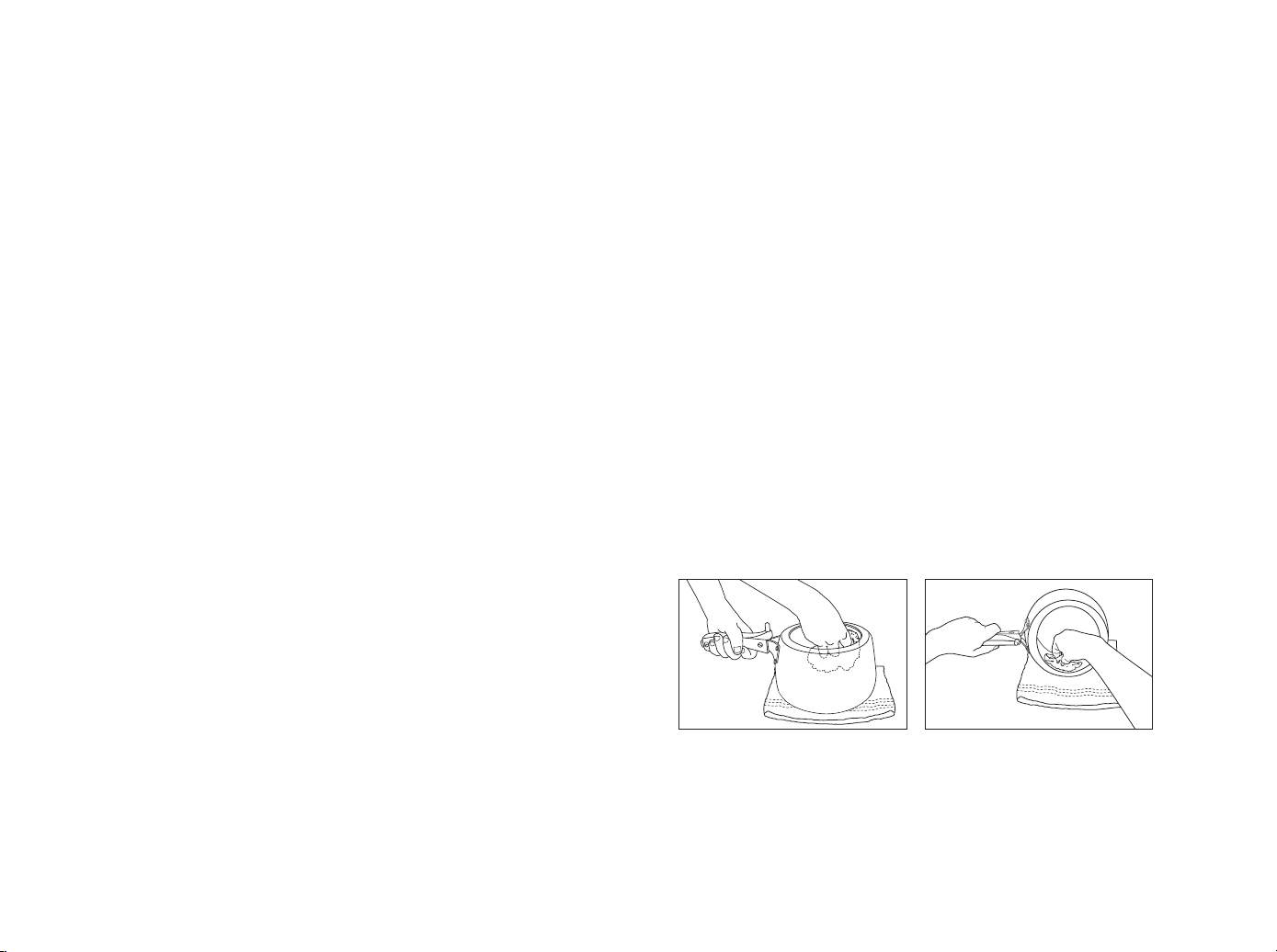
To avoid spoiling the ceramic coating on the outside surface
of the cooker body, keep a folded kitchen cloth or a piece of
any other soft material such as a rubber mat underneath
while cleaning, whether cooker body is upright (Figure A) or
on its side (Figure B).
•
Page 33, first column: delete third paragraph.
FIGURE A FIGURE B

v
Baked-on Stains (page 33): Second and third paragraphs: Disregard
existing paragraphs and replace
with:
•
To remove badly stuck or burned-on food: Tackle stains while
still fresh and before cooking again in the cooker. Soak the
cooker in hot water for 30 minutes before washing to remove
burned food more easily. Use the procedure given below for
the specific surface with the burned-on food stain:
1. Ceramic-coated exterior: Wash with a mild liquid
utensil soap or detergent and a non-abrasive plastic scrubber,
removing all superficial food, and dry. Make a paste with
equal parts of baking soda and warm water and apply it
to the area of the ceramic coating with the stain. Wait
5-10 minutes. Rub paste with a non-abrasive plastic scrubber
using a circular motion until stains are removed. Wash cooker
in hot soapy water and wipe dry.
2. Aluminium interior: The following procedure may help
dislodge food particles of burned-on food and make cleaning
easier: pour into cooker enough water (not above half full and
a minimum of 1 cup) to cover the area of burned food. Close
cooker. Bring to full pressure on high heat. Reduce heat and
boil 5 minutes. Allow to cool naturally. Open cooker. Wash
and wipe dry. For stubborn spots, make a paste of cleansing
powder and water, apply to stain and rub in a circular motion
with a fine steel wool pad.
3. Hard anodised parts: The Lid Handle Bar and the part
on the top of the lid which holds the Lid Handle Bar to the lid
are hard anodised. To remove stains of burned-on food,
make a thick paste of a chlorine-based cleaning powder and
apply it to the surface. Wait 5-10 minutes. Rub paste with
a fine steel wool pad using a circular motion. Wash. This
treatment, however, may somewhat lighten the colour of the
hard anodised finish.
Loss of Shine (page 33): This section is applicable only to the
aluminium interior and rim of the cooker body.
Parts and Service
This product can be serviced by any of the around
700 Hawkins Authorised Service Centres in India whose
contact details are given in the Service Centre Directory included in the
carton of this product.
Service Centre and other details are also available on
www.hawkinscookers.com.
Do-it-Yourself Repairs
Safety Valve Replacement (page 37, point 2): Instead of 17mm/
11
∕16 inch spanners, use 19mm/
3
∕4 inch.
vi
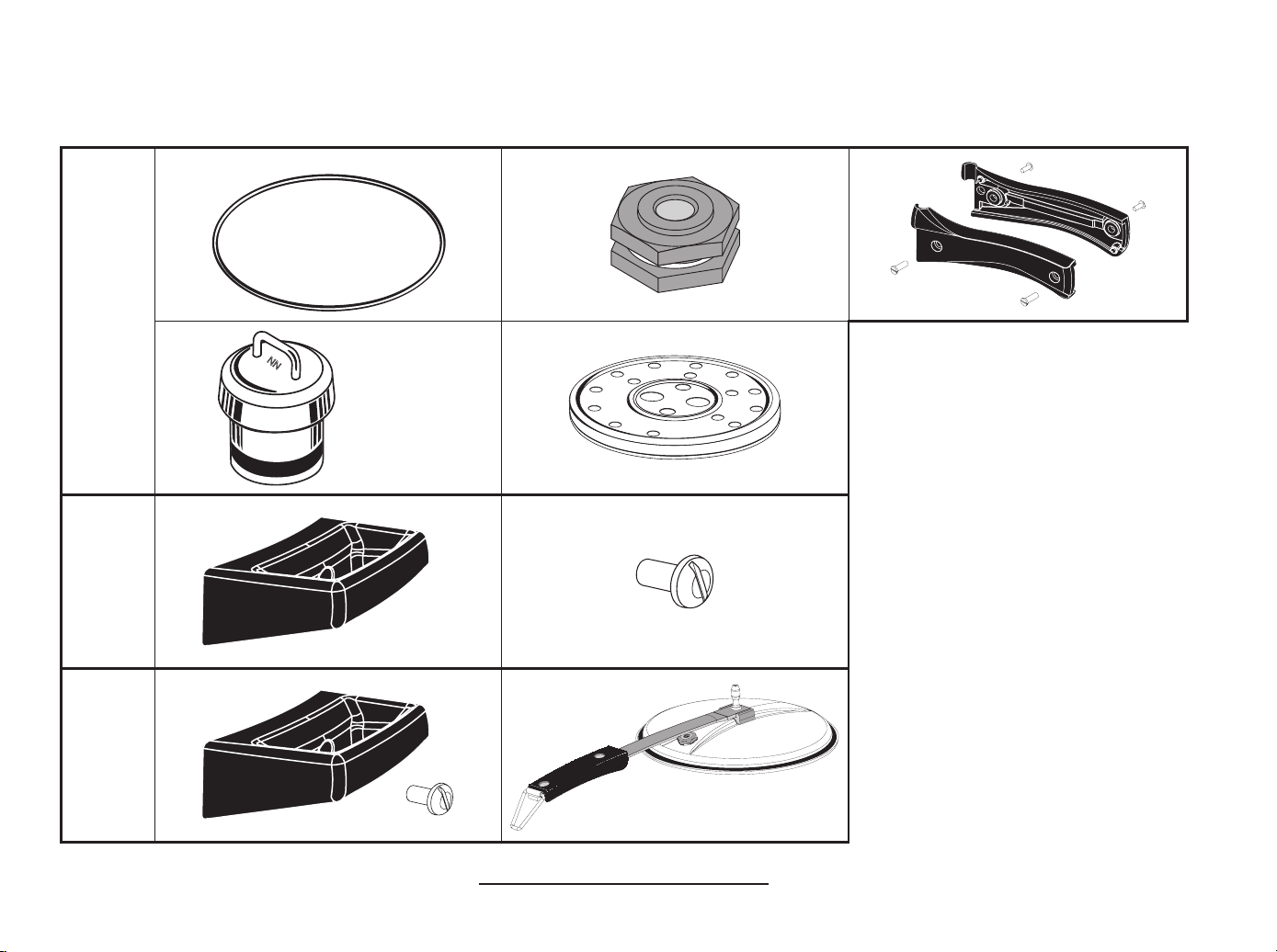
Commonly Required Parts and Part Codes
GASKET/SEALING RING
B10 - 09
SAFETY VALVE
B30 - 10
SUBSIDIARY HANDLE
M11 - 05
BODY HANDLE
B21 - 01
SUBSIDIARY HANDLE
M19 - 05
GRID
B10 - 73
SUB. HANDLE SCREW
B11 - 06
LID ASSEMBLY
M59 - 07
For
All
Countries
For
India
For
Other
Countries
Use the following chart instead of the chart on page 36 of the Manual:
VENT WEIGHT/PRESSURE
REGULATOR
H10 - 20

CONTENTS
IMPORTANT SAFEGUARDS 2
OPERATING INSTRUCTIONS 4
Useful General Information 4
Parts of the Hawkins Hevibase
Pressure Cooker 5
Product Information: Getting to
Know Your Hawkins Hevibase 6
Trial Run 9
Easy Tips for Better Cooking 11
Measurements 17
Cooking Rice 18
Cooking Dal 20
Pressure Cooking Time Charts 22
Rice 22
Meat 23
Poultry 24
Seafood 24
Vegetables 25
Legumes 27
Cooking Capacities in Different Sizes
of the Hawkins Hevibase and
Adapting Recipes
for Different Sizes 29
Using Grid and Molds 30
Care and Cleaning 32
What to Do if This Happens 34
Parts and Service 35
Do-it-Yourself Repairs 37
RECIPES 39
Indian
Chana Pindi
(Chickpeas – Rawalpindi Style) 39
Chola Dal
(Bengal Gram with Coconut) 40
Mixed Vegetable Pulao 40
Ma ki Dal (Whole Black Gram) 41
Rogan Josh (Mutton in Rich Gravy) 42
Sambar (Red Gram and
Vegetable Curry – Tamil Style) 43
Mutton Biryani (Rice Layered with
Spicy Mutton – Moghul Style) 44
Illish Sarse Bata (Hilsa Fish in Mustard) 45
Khichuri (Soft Rice with
Green Gram and Vegetables) 46
Hirva Masalyachi Bhaji
(Vegetables in Green Masala) 47
Rajma (Kidney Bean Curry) 48
Gajar Halwa (Carrot Pudding) 48
Kozhi Kuttan (Chicken Curry –
Kerala Style) 49
Vegetable Biryani (Rice Layered with
Spicy Vegetables) 50
Mansam Chops (Mutton Chops –
Andhra Style) 51
Masala Gobi (Spicy Cauliflower) 52
International
Tomato Soup 53
Vegetable Stock 53
Minestrone Soup 54
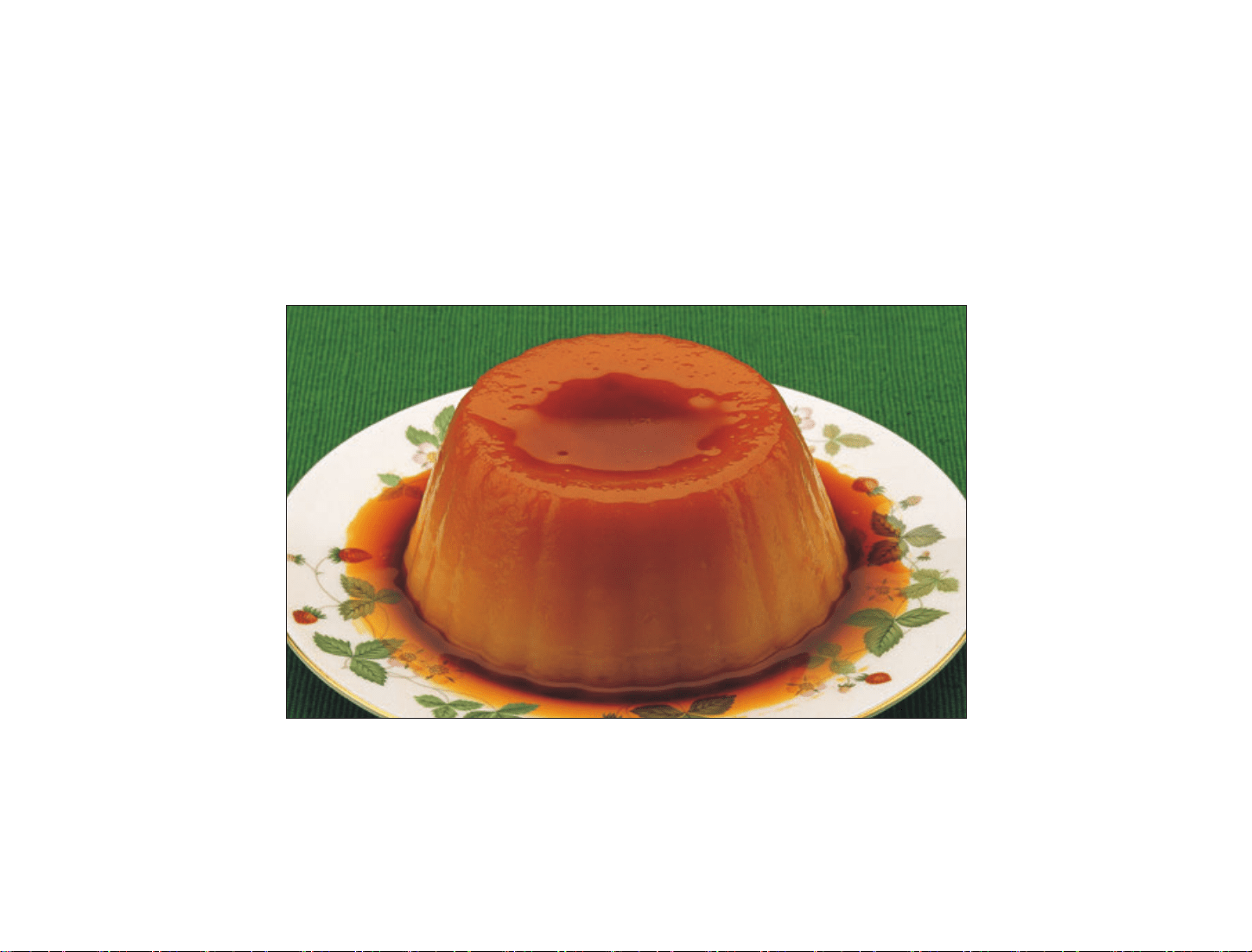
Crème Caramel 54
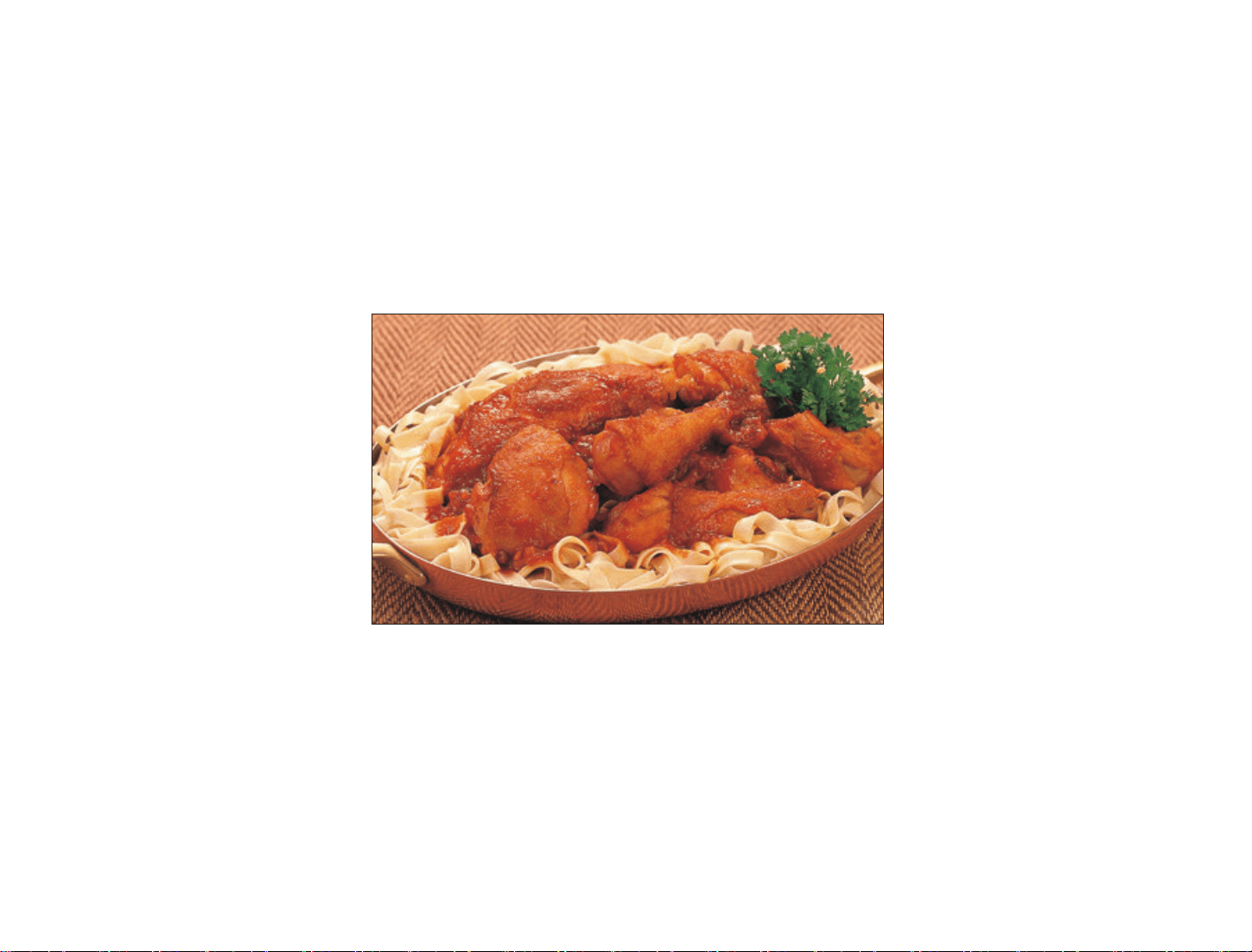
Marinated Chicken 55
Lamb Stew 56
Stuffed Pork Chops 56
Spanish Rice Casserole 57
Beef Stew 58
Beef Stroganoff 58
Pâté 59
Glossary (Meanings and Methods) 60
Translations to Hindi & English 63
PAGE PAGE PAGE
3
Hawkins Hevibase IM_Issue 2_Sep 2015.indd 3 28-09-2015 15:18:02

Principles of Pressure Cooking
Ordinary open-pot cooking is done at the boiling point of water
which produces steam at sea level at 100°C (212°F). Pressure cooking
works by sealing the steam in a pot so that there is a rise in pressure
to a safe, controlled extent which raises the boiling point of water and
therefore the cooking temperature. The steam permeates through the
food, tenderising it, infusing it with flavour, preserving nutrients, colour,
texture and juices and cooking much faster. The Hawkins Hevibase
Pressure Cooker cooks food at 121°C (250°F) at a pressure of 15 lb per
square inch (psi) or 1 kg per square cm.
Benefits of Hawkins Hevibase Pressure Cooking
Hawkins Hevibase pressure cooking can reduce normal cooking
times by as much as half. Economical foods such as legumes (lentils,
dried peas and beans) and tough cuts of meat can be cooked to
perfection in a fraction of the normal time. Because food cooks faster
in a pressure cooker, you save fuel, and therefore money. Scientific
literature indicates that certain nutritive elements such as proteins and
vitamins are better retained by pressure cooking. Steaming is ideal for
low-calorie, low-fat cooking. The higher temperature while pressure
cooking gives more hygienic food. Closed cooking in steam under
pressure may better evoke the natural flavours of the food – producing
delicious results. A wide range of foods, whether parts of recipes or
entire meals, can be cooked in your Hawkins Hevibase.
Advantages of Hawkins Hevibase
Safe
•
Pressure-locked Safety Lid. When there is pressure inside the
cooker, the lid is pressure-locked like a modern jetliner door.
It cannot be opened until the pressure has fallen to a safe level.
•
Automatic Safety Valve is positioned such that, if it operates,
the steam and food are deflected safely downwards.
Better Pressure Regulation
•
New Improved Vent Weight regulates pressure better, cooks
faster, saves more fuel, is easier to insert and remove and reduces
dal sprouting.
Trouble-Free
•
Longer Lasting Gasket. As the lid fits from inside, the gasket
does not get rubbed sideways every time the pressure cooker is
opened or closed. Also, the gasket is not exposed to food acids in the
pressure cooker due to the protection given to it by the rim of the lid.
•
Double thick (6.35 mm), Black, Hard Anodised, Energy-efficient
Base stays flat and absorbs heat quickly and evenly; will not
tarnish, pit or corrode. The base is ideal for light, shallow frying
before pressure cooking and for quick and economical cooking on
electric, gas, ceramic and halogen stoves.
OPERATING INSTRUCTIONS
Useful General Information
4
Hawkins Hevibase IM_Issue 2_Sep 2015.indd 4 28-09-2015 15:18:02
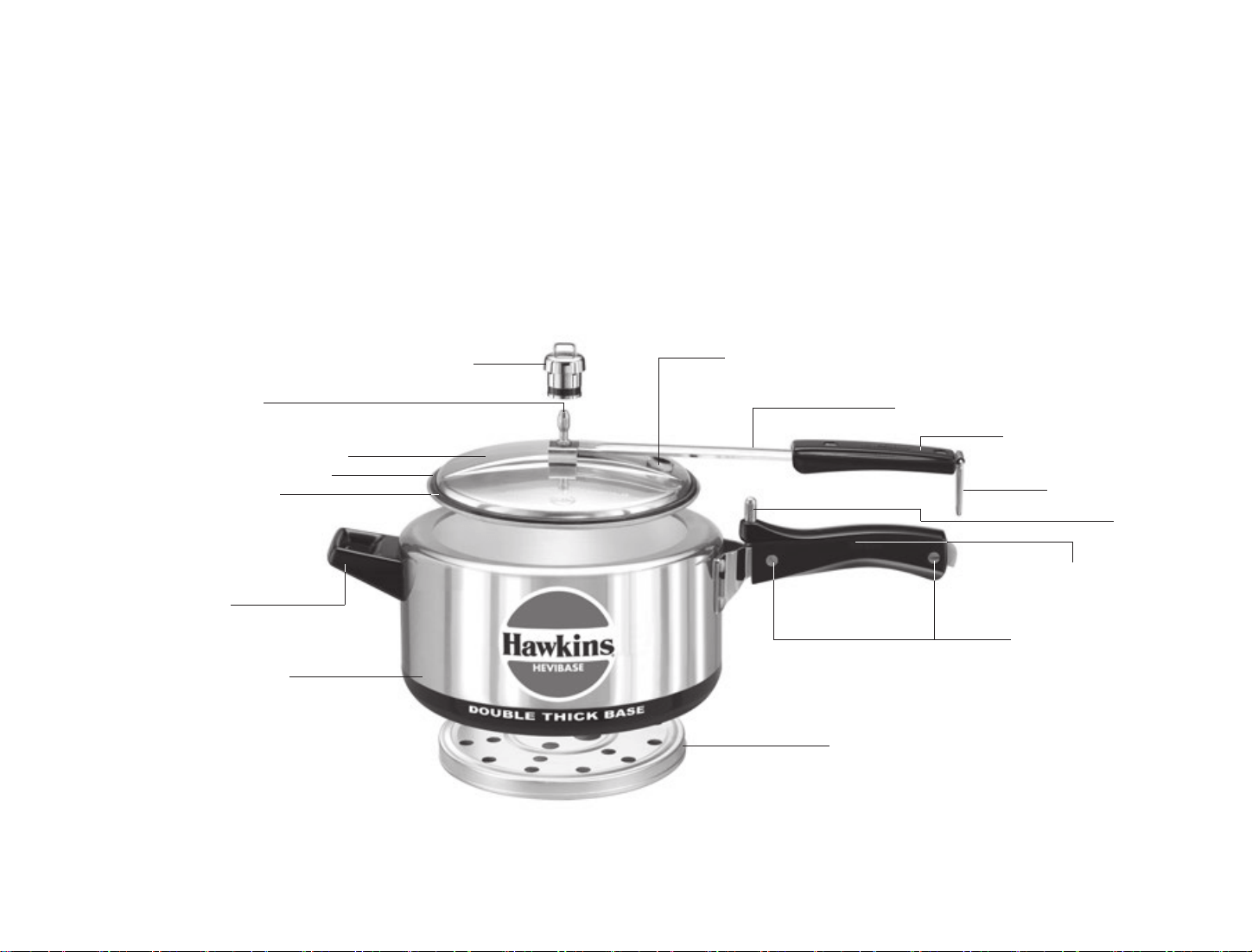
Parts of the Hawkins Hevibase Pressure Cooker
VENT WEIGHT/PRESSURE REGULATOR
VENT TUBE/STEAM VENT
LID
GASKET/SEALING RING
SUBSIDIARY BODY HANDLE
COOKER BODY
GRID
STUDS AND SCREWS
PIVOT
LOCKING LOOP
LID HANDLE
LID HANDLE BAR
SAFETY VALVE
BODY HANDLE
•
Rust Proof Components. The Hawkins Hevibase Pressure Cooker
has special metal alloy handle bar and handle brackets to withstand
rust.
Using Your Own Recipes
We recommend the recipes we have actually tested and included
in this Manual. Once you are familiar with cooking with your Hawkins
Hevibase Pressure Cooker, you may adapt recipes from other cookbooks
or use your own, making sure that you adjust cooking time, food and
water quantities as may be needed (see Easy Tips for Better Cooking
pages 11 to 16).
DO NOT ATTEMPT TO COOK IN THE HAWKINS HEVIBASE WITHOUT
FIRST READING CAREFULLY THE REMAINING INSTRUCTIONS.
•
5
LID CURL
Hawkins Hevibase IM_Issue 2_Sep 2015.indd 5 28-09-2015 15:18:03
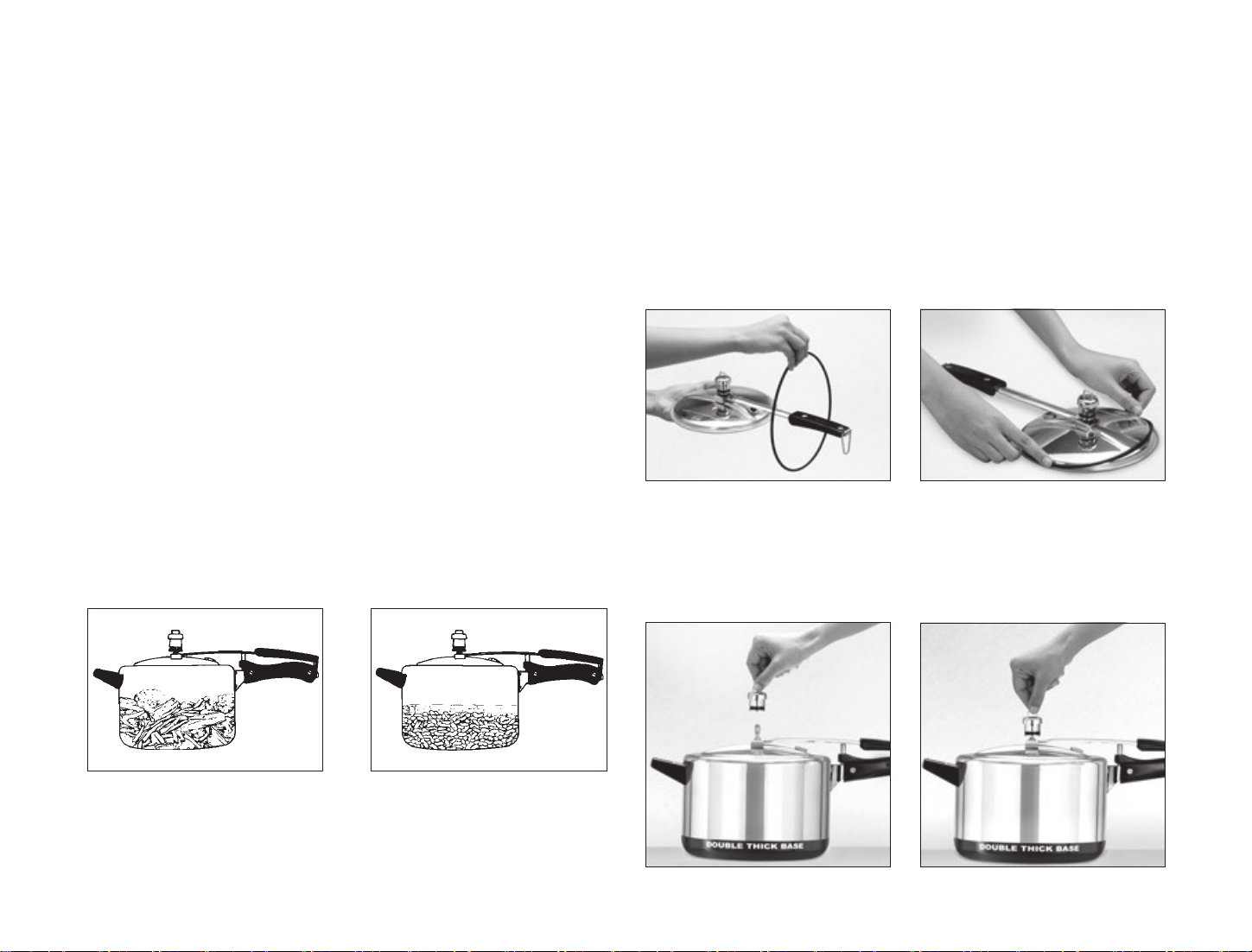
CAPACITY FOR SOLID FOODS:
TWO-THIRDS FULL
CAPACITY FOR LIQUID OR
FROTHING FOODS: HALF FULL
Product Information: Getting to Know Your Hawkins Hevibase
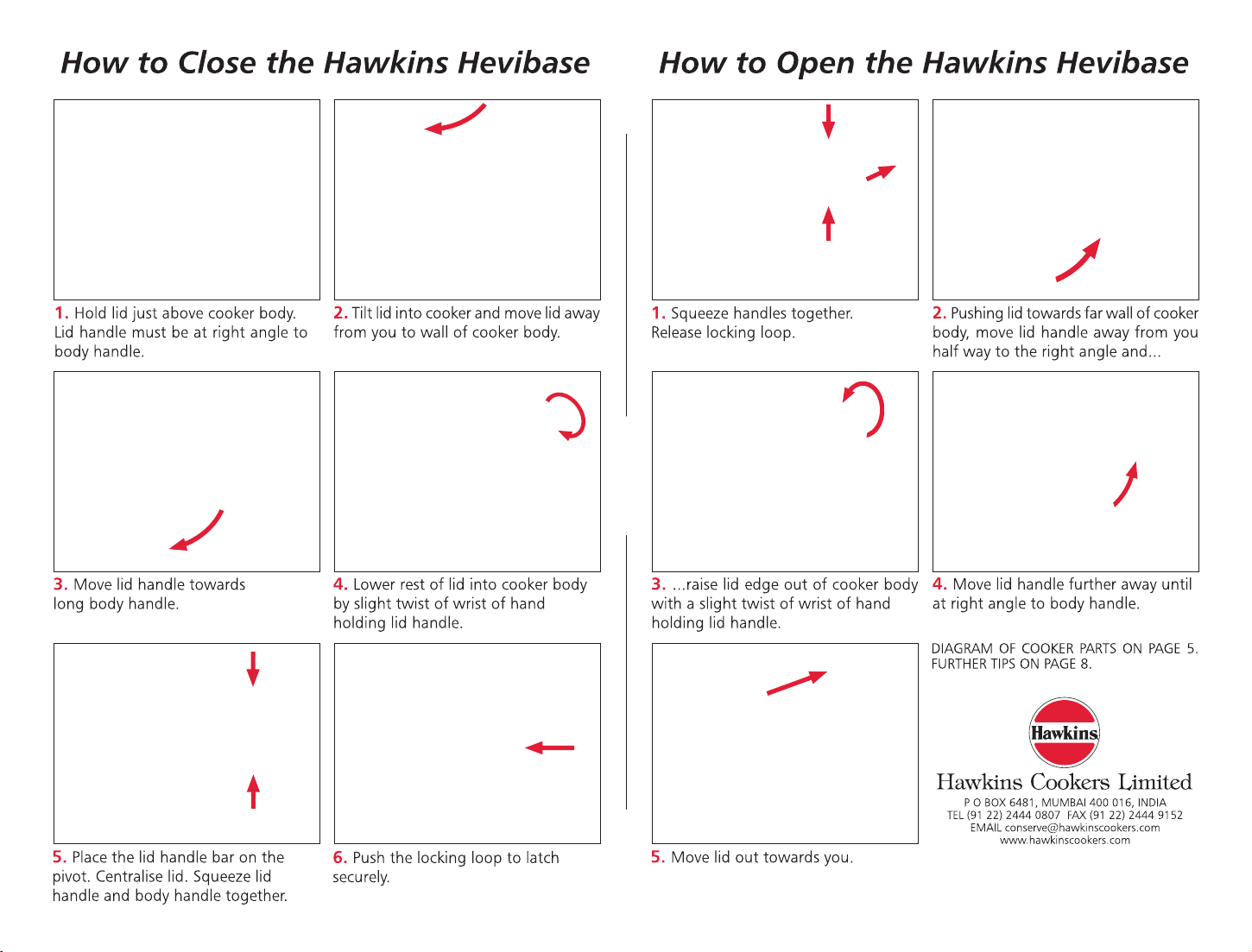
Illustrated instructions on how to close and open the Hawkins
Hevibase are given on the inside front cover. Additional tips are on
page 8. Closing and opening is easy once you have understood it and
practiced it a few times.
The stated volume of all pressure cookers is that of the cooker body.
Cooking capacity in a pressure cooker is less than its full volume. The
pressure cooker body should never be filled more than two-thirds its
capacity. This is to safeguard against blocking the vent tube and to
leave enough space to allow steam to circulate. Certain foods, however
– liquid foods such as soups and foods such as lentils, beans and rice
which expand during cooking and/or froth – should not be loaded
more than half the capacity of the cooker body. Any food which froths
excessively and sprouts out of the cooker – such as soybeans and Indian
lentils (especially tuvar dal and moong dal) – should not be loaded
more than one-third the capacity of the cooker; if sprouting still occurs,
reduce quantity further suitably until sprouting stops. The volumes of
the two-thirds, half and one-third capacities for each size of Hawkins
Hevibase Pressure Cooker are given in a chart on page 29.
The cooker body comes fitted with a body handle attached to
the cooker body. There is a subsidiary body handle attached to the
cooker body in all models of 3.5 Litre capacity and larger, which helps
carry the cooker when it is loaded.
The lid comes assembled with the detachable rubber gasket. It can
be removed from the lid curl with the fingers. The gasket can be easily
put back by slipping the lid handle through the gasket and patting
and pushing it down all along the lid curl until it is seated properly.
The vent weight automatically maintains the cooking pressure of
about 15 pounds per square inch. The vent weight has to be placed
on the vent tube and pressed into position. When the vent weight is
pressed down on the vent tube, there is a slight click which indicates
the vent weight is in the correct position.
6
Hawkins Hevibase IM_Issue 2_Sep 2015.indd 6 28-09-2015 15:18:07
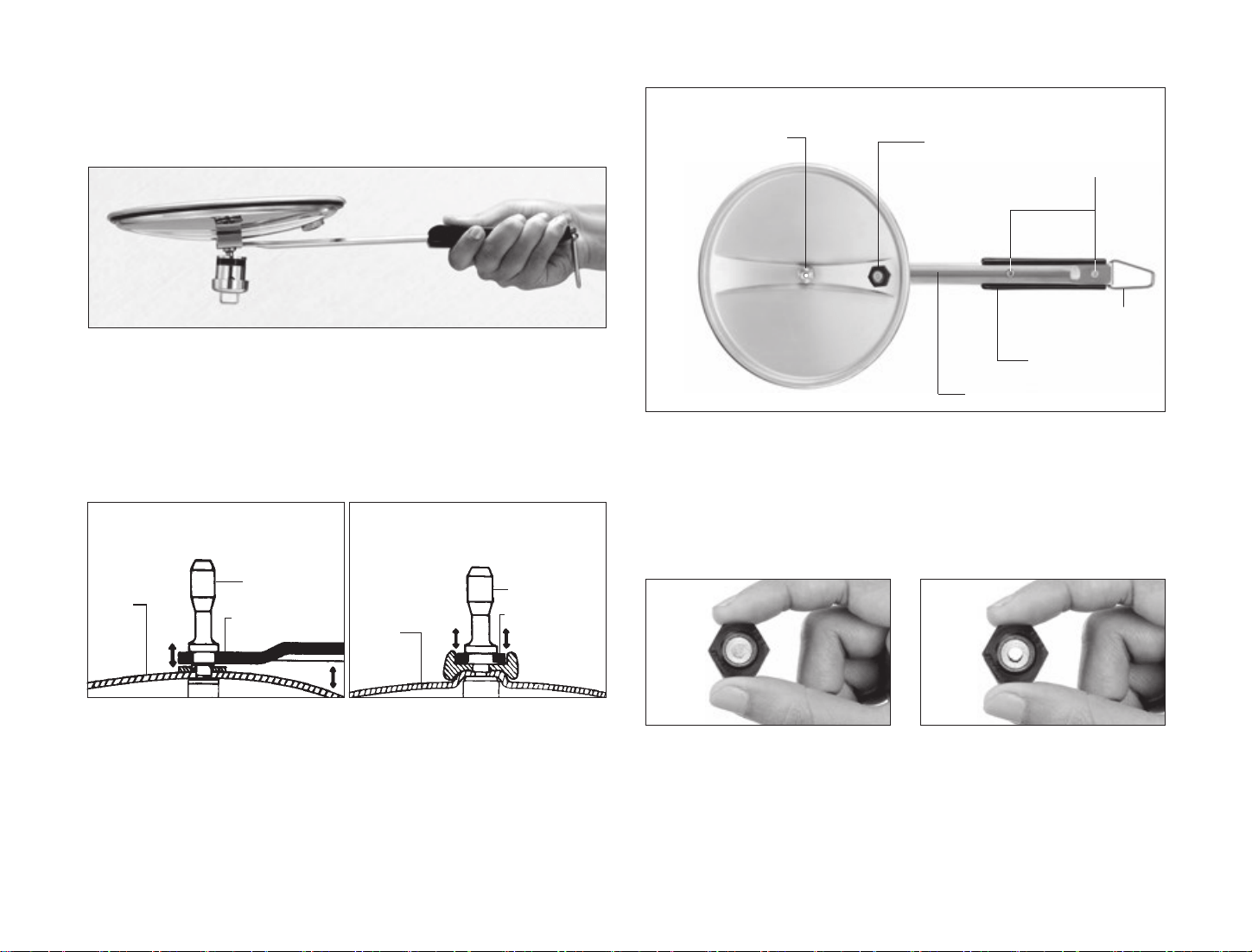
The vent weight has a spring mechanism which holds the vent
weight on to the vent tube and is strong enough to prevent it from
falling off should the lid be inverted.
The vent tube seats the vent weight and is the outlet for excess
steam. The vent tube is also the point at which the lid handle is
connected to the lid.
The lid handle bar is so attached to the lid that there is extra
space for deliberate "play" or movement. This ensures better sealing of
the lid with the rim of the cooker body.
On the underside of the lid, the vent tube nut secures the vent
tube. The vent tube nut has seven holes so that even if a few holes are
clogged, the other holes will allow the escape of steam. Always keep
the vent tube clean and check before every use by looking through it.
If the normal escape of steam is blocked, the safety valve will
operate. The safety valve will also operate if there is insufficient water
in the pressure cooker and it boils dry, causing the temperature to rise
beyond the normal operating range. The fusible alloy in the safety valve
melts at the required temperature and releases pressure. The safety
valve can be replaced as shown on page 37.
A grid comes with every Hawkins Hevibase. The use of the grid is
explained on page 30.
MOVEMENT OF LID HANDLE BAR:
SIDE VIEW
VENT TUBE
LID HANDLE BAR
LID
MOVEMENT OF LID HANDLE BAR:
FRONT VIEW
VENT TUBE
LID HANDLE BAR
LID
UNDERSIDE OF LID
RIVETS
LOCKING LOOP
LID HANDLE
LID HANDLE BAR
SAFETY VALVE
VENT TUBE NUT
...WHICH MELTS WHEN REQUIRED
FUSIBLE ALLOY...
7
Hawkins Hevibase IM_Issue 2_Sep 2015.indd 7 28-09-2015 15:18:08
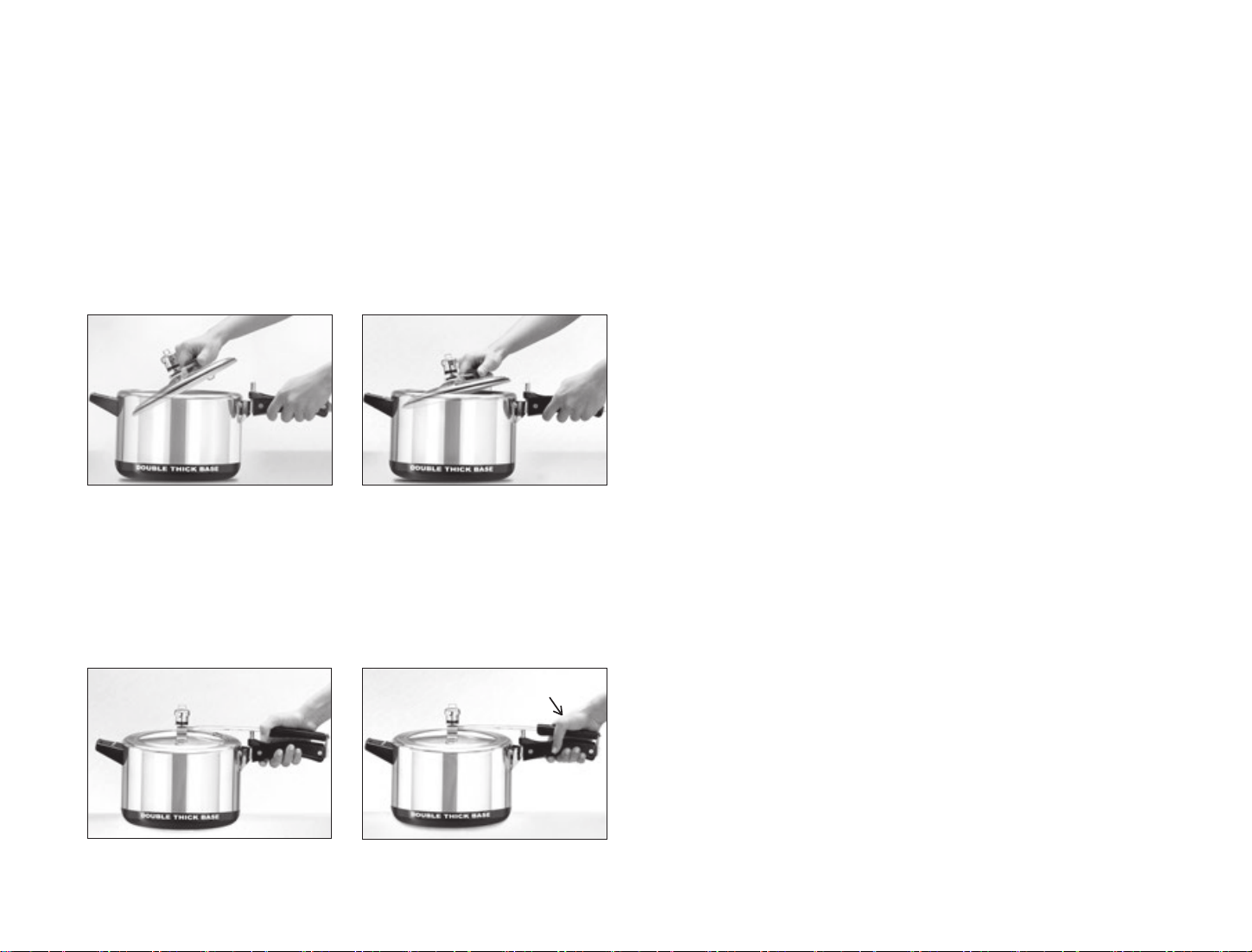
How to Close and Open the Hawkins Hevibase
For instructions on how to close and open the Hawkins Hevibase,
see inside front cover.
Here are some tips to make the closing and opening easier:
1. While closing and opening, do not tilt the lid deeply into the cooker
body. The minimum tilt that will get the lid into and out of the cooker
body should be used so that the lid does not touch the food inside the
cooker.
2. Before latching the handles together, centralise the lid so that the
gasket is in even contact with the rim of the cooker body.
3. When opening after releasing locking loop, do not let go of the lid
handle or the lid will fall into the cooker.
4. Squeeze the lid and body handles together at the end away from
the cooker body. This requires the least force.
WRONG
RIGHT
8
EASY WHEN YOU POSITION HAND
HERE
DIFFICULT
•
Hawkins Hevibase IM_Issue 2_Sep 2015.indd 8 28-09-2015 15:18:13
9
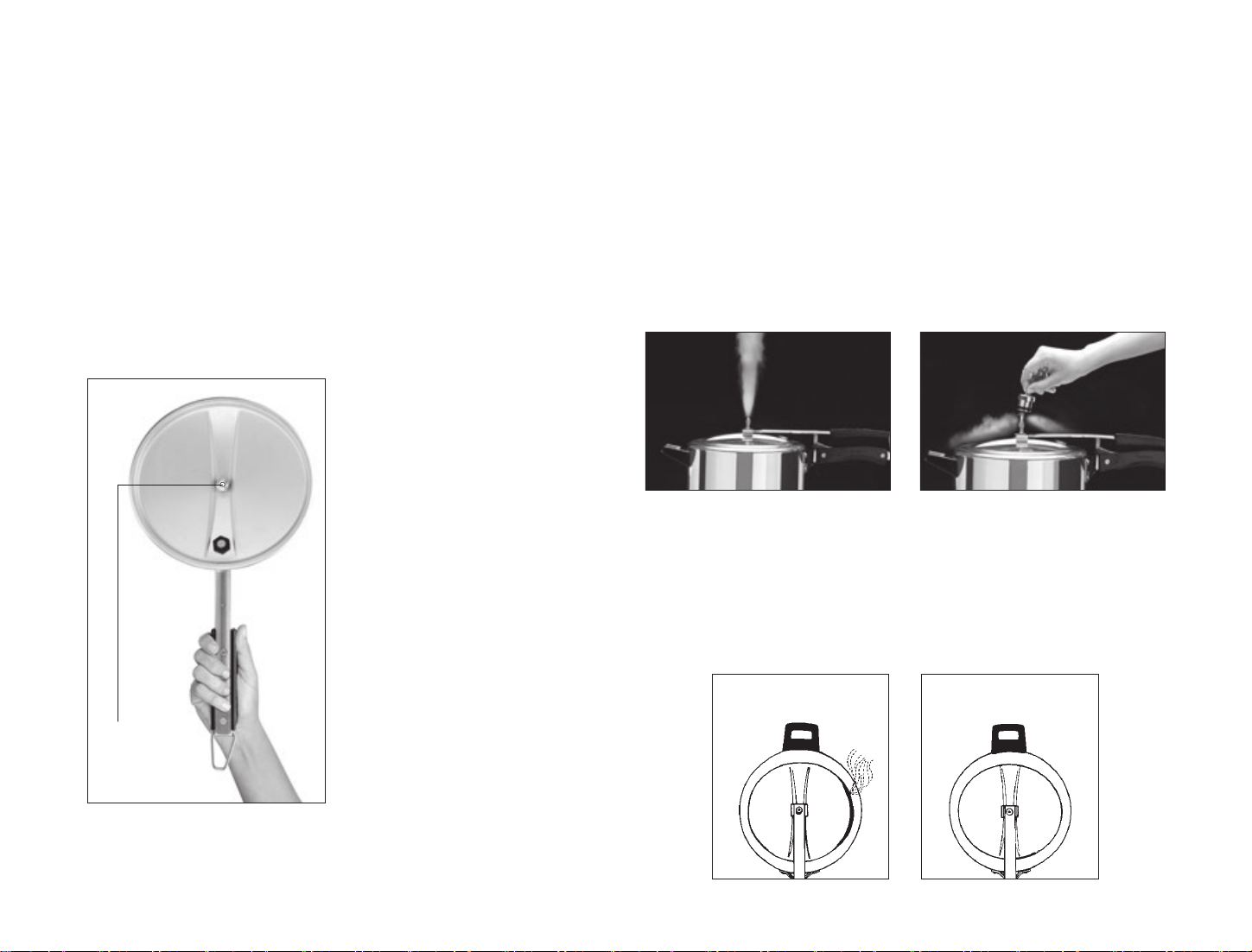
WRONG: STEAM COMING
OUT FROM EDGE OF LID
RIGHT: NO STEAM
LEAKAGE
Trial Run
Even if you have used a pressure cooker previously, take a trial run
before cooking in your Hawkins Hevibase. This section will take you
step-by-step through your trial run in about 30 minutes.
1. Preliminary Steps
Remove label and wash cooker, removing any adhesive with
vegetable oil. Read pages 2 to 8. Identify parts. Remove and place
the vent weight on the vent tube, the gasket on the lid curl. Close and
open the pressure cooker a few times.
2. Placing Cooker on Stove
Pour 2 cups/480 ml water in
cooker body. Add 1 teaspoon/5 ml
lemon juice or vinegar to prevent
discolouring the cooker. Remove
vent weight from vent tube. Look
through vent tube and ensure
it is clear.
Check and adjust the seating
of the gasket on the lid curl by
patting down snugly. Close cooker
(without vent weight). Place
cooker on high heat.
3. Placing the Vent Weight
Once steam is coming out of the vent tube steadily, place the vent
weight on the vent tube and press down firmly. Keep fingers on top
of the vent weight and away from the steam when placing the vent
weight on the vent tube. A click indicates that the vent weight is in
position. In about 2 minutes, the cooker should come to full operating
pressure.
4. Ensuring a Steam-tight Seal
When water boils, hot air and/or steam should issue only from the
vent tube. If steam comes out around the edge of the lid, check the
centralisation of the lid thus: unlatch and reposition the lid by moving
the lid slightly towards the spot where steam is escaping and relatch.
DO NOT TOUCH LID with bare hands since it will be hot.
VENT TUBE
Hawkins Hevibase IM_Issue 2_Sep 2015.indd 9 28-09-2015 15:18:15
10
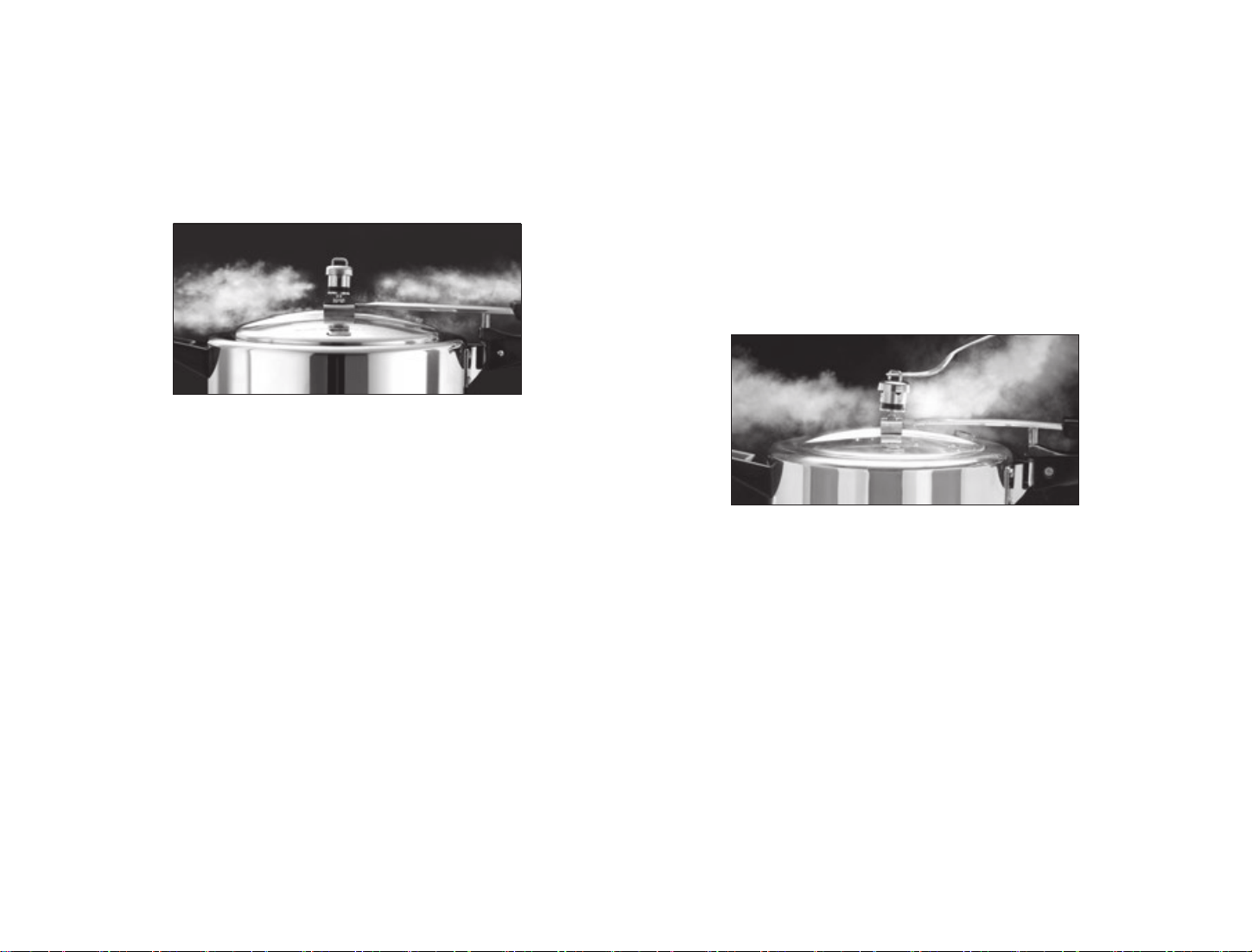
5. How to Recognise Full Operating Pressure
After the vent weight is placed on the vent tube, there is at first
a very low hissing sound of steam from the vent weight. Then steam
emission increases to full force and the vent weight lifts with a whistling
sound.
The pressure cooker is now at full operating pressure. When
cooking, this is the point at which to reduce the heat and start timing
the recipe. When cooking, the time between the start of the steam
coming out of the vent weight and the cooker reaching full operating
pressure may vary from a few seconds to about one minute depending
upon the type and quantity of food in the pressure cooker.
6. Maintaining Pressure on Reduced Heat
Once full pressure is reached, reduce heat from HIGH to MEDIUM
or lower. When cooking, the correct heat setting to maintain pressure
on reduced heat will vary with the type and quantity of food and also
your stove. The pressure inside the cooker will be maintained at about
15 pounds per square inch. If the cooker whistles too frequently (more
than 4 whistles per minute), reduce the heat still further.
If there is no steam coming out of the vent weight for a few
minutes, increase the heat gradually until the steam comes out.
RELEASE PRESSURE WITH SLIGHT LIFTING OF VENT WEIGHT WITH A FORK
COOKER WHISTLES AT FULL OPERATING PRESSURE
Please remember that, particularly on electric heat, it may take
some time for heat level adjustments to have an effect on the frequency
of whistles. A little practice will make clear the correct heat setting and
adjustments, if any, that may be required.
7. Releasing Pressure
Turn off heat. Remove pressure cooker from heat. With a fork,
slightly lift vent weight to release steam. Do not remove vent weight.
When cooking, release pressure as indicated in the recipe or on
page 15.
8. Final Steps
With a fork, slightly lift vent weight once again to ensure that there
is zero extra or unsafe pressure in the cooker. Open cooker. Empty out
water. Remove vent weight. Wash and wipe dry body, lid and vent
weight. Store without closing the pressure cooker. Before cooking in
your Hawkins Hevibase, READ THE REMAINING INSTRUCTIONS.
•
Hawkins Hevibase IM_Issue 2_Sep 2015.indd 10 28-09-2015 15:18:16
11
Easy Tips for Better Cooking
Read this section after you have taken the Trial Run and before
you attempt to cook in the Hawkins Hevibase.
Ingredients
•
See Measurements page 17 for information on weights and
measures.
•
The pressure cooker should not be filled more than its
appropriate capacity. See
Product Information page 6
and the chart on page 29.
QUANTITY
•
The recipes in this Manual are
for the maximum quantities
which should be cooked in the
5 Litre Hawkins Hevibase
Pressure Cooker. When
cooking reduced quantities,
always ensure there is enough
cooking liquid for the entire
pressure cooking time as
explained in various parts of
this section.
•
To adapt these recipes to other sizes of the Hawkins Hevibase,
see Cooking Capacities in Different Sizes of the Hawkins
Hevibase and Adapting Recipes for Different Sizes page 29.
•
Never reduce cooking liquid in recipes/charts where the total liquid
is
3
/4 cup (or less).
SIZE
•
The size of the individual pieces of food and not the total quantity
determines the cooking time.
•
Cut food in even sizes for even cooking.
•
Smaller individual pieces of food will cook faster than larger pieces
of the same food.
COMBINING FOODS
•
Ingredients requiring roughly
the same cooking time can
be cooked together without
mixing their flavours if kept
physically separated and not
mixed in the same liquid.
•
Ingredients with different
cooking times may be cooked
together by using the
following techniques:
1. Speed up cooking time
by cutting food into smaller
pieces and by presoaking lentils, beans and cereals.
2. Slow down cooking time by cutting food into larger
pieces and by wrapping in foil.
3. Start longer-cooking ingredients first, interrupt pressure
cooking to add quicker-cooking ingredients and then complete
pressure cooking.
Hawkins Hevibase IM_Issue 2_Sep 2015.indd 11 28-09-2015 15:18:16
12
SUBSTITUTIONS
The salt and other seasonings in the recipes may be varied or
eliminated according to your taste or health requirements.
Adapting Your Own Recipes
•
Most foods that can be cooked with moist heat – boiled, steamed,
braised and stewed – are suitable for pressure cooking.
•
The recipes and charts in this Manual are examples of the correct
way to cook in the Hawkins Hevibase Pressure Cooker. Find a
recipe in the Manual similar
to yours and use broadly
similar methods, food and
water quantities and cooking
times.
•
If there is no similar recipe to
match for timing, a general
rule is to pressure cook
one-third the normal cooking
time and then check the food
for doneness. If undercooked,
reclose the pressure cooker
and cook for a suitable amount
of additional time.
•
There is little evaporation in pressure cooking so liquid quantity
ordinarily has to be reduced – always ensuring there is enough
liquid for the entire cooking time (see page 13).
•
Pressure cooking retains flavours so season with restraint. Taste
and add more seasoning, if
required, after pressure cooking.
•
Milk, cream and yogurt tend to curdle and froth when
pressure cooked in the base of the cooker and should generally
be added to recipes after pressure cooking.
Heat Source
•
The Hawkins Hevibase can be used on domestic electric, gas,
halogen, ceramic and kerosene stoves. It is not suitable for
induction stoves.
•
Use a burner to suit the size of the cooker – gas flames should not
lick the sides of the cooker and the hot plate of an electric stove
should be equal to or less than the diameter of the base of the
pressure cooker. When cooking in the 3 Litre Hawkins Hevibase
on a gas stove, use the small
burner or do not exceed the
medium heat setting of a large
burner. See page 29, Adapting
Recipes for the 3 Litre.
•
The cooker can be used on
wood or coal fires provided
it is not in direct contact with
hot coals. WARNING:
DIRECT CONTACT WITH
HOT COALS CAN DAMAGE
THE METAL. There should
be at least a 1 inch/2.5 cm
gap between the burning
coals and the base of the
cooker. On improvised fires or commercial burners, limit the heat
to the level usually found in domestic stoves. This pressure cooker
must not be used on an industrial burner.
•
When cooking foods that may sprout such as pulses or legumes,
bring cooker to full operating pressure on medium heat and reduce
heat as soon as full pressure is reached. Remove cooker briefly
from heat if the steam seems to be evacuating too forcefully.
Hawkins Hevibase IM_Issue 2_Sep 2015.indd 12 28-09-2015 15:18:17
13
Frying Prior to Pressure Cooking
•
Some recipes require light, shallow frying before pressure cooking.
Frying or browning in a small amount of butter, oil or other fat can
be done in the pressure cooker body without the lid.
•
Browning meat and poultry before pressure cooking helps to seal
in the juices and improves the appearance and taste of the food.
If you want to eliminate the additional fat and/or save time,
browning can be omitted – it is not necessary for pressure cooking.
•
Brown pieces of food in small
batches to keep the oil
temperature high so the food
is seared but does not cook.
Brown all sides evenly.
•
After frying, remove cooker
body from heat before adding
liquid to the cooker.
•
It is a safety requirement
that deep-frying, involving
more than
1
/2 cup oil or
frying for more than
20 minutes at a time, is not
done in the pressure
cooker body.
•
Do not pressure fry in the pressure cooker. It is designed to
be operated only with liquid which produces steam.
Water
•
There must be enough water (or stock, juice, vinegar, beer or wine)
in the pressure cooker to make steam throughout the entire
pressure cooking time and to prevent burning. Oils and fats do not
produce steam and should not be counted as cooking liquid
for steam. Cooking liquid should always be water or a liquid which
produces steam.
•
The minimum quantity of cooking liquid required is 1 cup/240 ml
for the first 10 minutes of pressure cooking time plus
1
/2 cup/
120 ml for every subsequent 10 minutes or part thereof. This
quantity will prevent boiling dry provided you reduce the heat
when cooker has reached full operating pressure.
•
Some of the recipes have less
(or more) cooking liquid
than the amount prescribed
in the preceding paragraph.
Foods such as meat, fish,
poultry, tomatoes and other
vegetables give off juices
during cooking (whereas
pulses or legumes and rice
absorb liquid). The recipes
and charts reflect this.
•
Do not cook with less cooking
liquid than stated in the recipe
as you run the risk of either a
ruined recipe or having to replace a safety valve – or both.
•
If you open the cooker and decide to pressure cook longer, always
check that there is enough cooking liquid to bring the cooker back
to full pressure and cook the additional time.
•
The Hawkins Hevibase Pressure Cooker should never be
used as an oven for dry heating or baking as it may reduce
the strength of the metal.
Hawkins Hevibase IM_Issue 2_Sep 2015.indd 13 28-09-2015 15:18:17
14
Vent Weight
Allow steam to start issuing from the vent tube in a steady stream
before placing the vent weight (see page 9, point 3).
Reducing Heat
•
When the Hawkins Hevibase has reached full operating pressure
(see page 10, point 5), reduce the heat to medium or lower. If
the cooker whistles too frequently (more than 4 whistles per
minute), reduce the heat still further. If there is no steam coming
out of the vent weight for a
few minutes, increase the heat
gradually until the steam
comes out. The heat setting
required varies according to
the type and quantity of food
in the cooker and the stove.
•
Cooking on high heat after
full pressure is reached does
not result in faster cooking. It
wastes energy and increases
the likelihood of boiling dry
and/or spoiling the food.
•
When cooking on wood stoves
or camp fires, move the pressure cooker to a cooler part of the
stove or shift cooker partly off the burner to cook at reduced heat
ensuring that cooker is not tilted.
Timing
•
Reaching full operating pressure (first whistle) is also the signal to
start timing the recipe/food.
•
Use a kitchen timer or watch/clock. Exact timing is critical to
successful pressure cooking. Counting whistles may give you the
wrong time required for cooking any particular food or recipe.
Pressure cooking is much faster than conventional cooking so
timing errors have greater consequences. If in doubt, cook for
less time rather than more. It is possible to correct undercooking
by cooking or pressure cooking more.
•
If the food is only slightly undercooked, you may be able to
complete the cooking without pressure. This method is especially
suitable for foods which are easily
overcooked. If the food requires
more pressure cooking, decide
how many minutes, ensure there
is enough cooking liquid for the
extra time, and bring cooker back
to full operating pressure and cook
the additional time.
•
Cooking times given in this
Manual are a guide. More
or less time may be necessary
depending on the age,
tenderness and variety of the
ingredients and how well
cooked you prefer the food to be. Experience will enable you to
adjust the times suitably.
•
"Pressure Cooking Time 0 minute" in the charts and recipes signifies
that the pressure cooker is to be taken off the heat as soon as the
pressure cooker has reached full operating pressure.
Hawkins Hevibase IM_Issue 2_Sep 2015.indd 14 28-09-2015 15:18:18
15
Releasing Pressure
•
There are three methods to release pressure in the Hawkins
Hevibase Pressure Cooker.
1. "Allow to cool naturally" means to remove the cooker from
heat and leave it until the pressure has dropped to normal and
the lid can be opened. This takes from 10 to 20 minutes, depending
on the type and quantity of food and the size of the cooker. This
method is required for soups, legumes, custards and recipes
containing leavening agents.
2. "Release pressure
immediately" means to
remove the cooker from heat
and lift the vent weight
slightly with a fork, allowing
steam to escape so the lid can
be opened immediately. This
method is required for easily
overcooked foods such as
delicate vegetables and fish.
This method cannot be used
when the cooker contains
predominantly liquid or
frothing foods as the food/liquid may come out of the vent tube.
3. "Release pressure by placing cooker in up to 4 inches/10 cm
of cold water in a basin or in a sink for a few minutes." The height
of the water depends on the size of the cooker. Place a small cooker in
about 2 inches/5 cm of cold water. Open when the pressure has fallen.
Do not run water over the lid. This method is required when the cooker
contains liquid or frothing foods and you wish to open immediately.
•
Each recipe indicates the method of releasing pressure. Some foods,
such as rice, are cooled naturally for 5 minutes before releasing steam.
•
The method of releasing pressure has a bearing on the pressure
cooking time. If you change from immediate opening to cooling
naturally, reduce pressure cooking time by 2 to 3 minutes. Similarly,
if you change from cooling naturally to immediate opening,
increase pressure cooking time by 2 to 3 minutes.
•
Beyond the requirements discussed above, how to release
pressure is one of personal preference. Some cooks believe that
the texture, tenderness and taste of food, especially meat,
are improved by releasing
pressure gradually using
Method #1 above whenever
possible.
How to Get the Best Out of
Recipes
•
Read the entire recipe before
beginning to work. Assemble
and prepare ingredients as
required.
•
Unless otherwise noted, in the
recipes:
1. All foods are to be
appropriately cleaned and washed.
2. Onions, potatoes, turnips, carrots, drumsticks, garlic and fresh
ginger are to be peeled.
3. Remove excess fat from meat.
•
If you come across a term you do not know, check Glossary
(Meanings and Methods) page 60.
•
All Hindi words used in the recipes are translated to English on
page 63 or explained in the Glossary.
Hawkins Hevibase IM_Issue 2_Sep 2015.indd 15 28-09-2015 15:18:18
16
Saving Energy
To obtain optimum energy efficiency while cooking with the
Hawkins Hevibase Pressure Cooker:
1. Place the vent weight on the vent tube as soon as the steam is
coming out of the vent tube steadily (see Trial Run page 9, point 3).
2. Reduce heat as soon as the Hawkins Hevibase has reached full
operating pressure (see Trial Run page 10, point 5). Reduce heat to a
heat setting such that the pressure inside the cooker will be maintained
as stated on page 10, point 6. If the cooker whistles too frequently (more
than 4 whistles per minute), reduce the heat still further. If there is no
steam coming out of the vent weight for a few minutes, increase the heat
gradually until the steam comes out.
•
Hawkins Hevibase IM_Issue 2_Sep 2015.indd 16 28-09-2015 15:18:19

17
Measurements
The quantities of ingredients in the recipes are given in
two measuring systems – U.S. and metric – separated by this mark "
/
".
Use any one of the measurements.
Measurements of ghee in the recipes are for ghee at room temperature.
Volume
All measurements are level, not heaped.
Measurement Equivalent
1 teaspoon 5 ml
1
/2 tablespoon 1
1
/2 teaspoons
/
7.5 ml
1 tablespoon 3 teaspoons
/
15 ml
1
/4 cup 4 tablespoons
/
60 ml
1
/3 cup 5 tablespoons +
1 teaspoon
/
80 ml
1
/2 cup 8 tablespoons
/
120 ml
3
/4 cup 12 tablespoons
/
180 ml
1 cup 16 tablespoons
/
240 ml
1 litre 1000 ml
Weight
Metric Equivalent
28 g (rounded off to 30 g) 1 oz
450 g 16 oz
/
1 lb
1 kg 2.2 lb
Length
Measurement Equivalent
1
/4 inch 6 mm
3
/8 inch 9 mm
1
/2 inch 1.3 cm
5
/8 inch 1.6 cm
3
/4 inch 1.9 cm
7
/8 inch 2.2 cm
1 inch 2.5 cm
Abbreviations
Abbreviation Equivalent Abbreviation Equivalent Abbreviation Equivalent
tsp teaspoon lb pound cm centimetre
tbsp tablespoon g gram °C degree centigrade
ml millilitre kg kilogram °F degree Fahrenheit
oz ounce mm millimetre
Hawkins Hevibase IM_Issue 2_Sep 2015.indd 17 28-09-2015 15:18:19

18
Cooking Rice
The basic steps to pressure cook rice are:
1. Pour water in cooker. Bring to boil on high heat. Add rice and
seasonings (if desired). Stir. It is also possible to add rice, water and
seasoning all together in the beginning.
2. Close cooker. Bring to full pressure on high heat. Reduce heat and
cook the required time.
3. Remove cooker from heat. Release pressure according to the chart.
4. Open cooker. Fluff up rice gently with a fork to separate grains.
There are many varieties of rice and some amount of experimentation
with water and cooking time may be necessary to suit your taste.
•
Do not fill cooker more than half.
•
The grid is not required unless cooking rice in a mold.
•
Pick over rice to remove foreign objects. Wash rice by rinsing in
water until water is clear. Drain.
•
Various stocks, spices and flavourings may be added to rice.
•
When frying rice, stir gently with a wooden spoon to avoid breaking
the grains.
•
1 cup of dry rice yields 2 to 3 cups cooked rice.
•
Some varieties of rice, especially white rice, froth out of the vent
tube unless they are cooked with oil or butter or in a mold.
To pressure cook Basmati rice in a mold, such as a metal bowl:
1. Put 1 cup
/
200 g rice and 1
1
/8 cups
/
270 ml water in a mold (large
enough to hold 3
1
/2 cups
/
840 ml).
2. Pour 1 cup
/
240 ml water in cooker. Put grid in cooker. Place mold
on grid.
3. Close cooker. Bring to full pressure on high heat. Reduce heat and
cook 3 minutes.
4. Remove cooker from heat. Allow to cool naturally 5 minutes.
Release pressure with slight lifting of vent weight.
5. Open cooker.
Hawkins Hevibase IM_Issue 2_Sep 2015.indd 18 28-09-2015 15:18:19
19
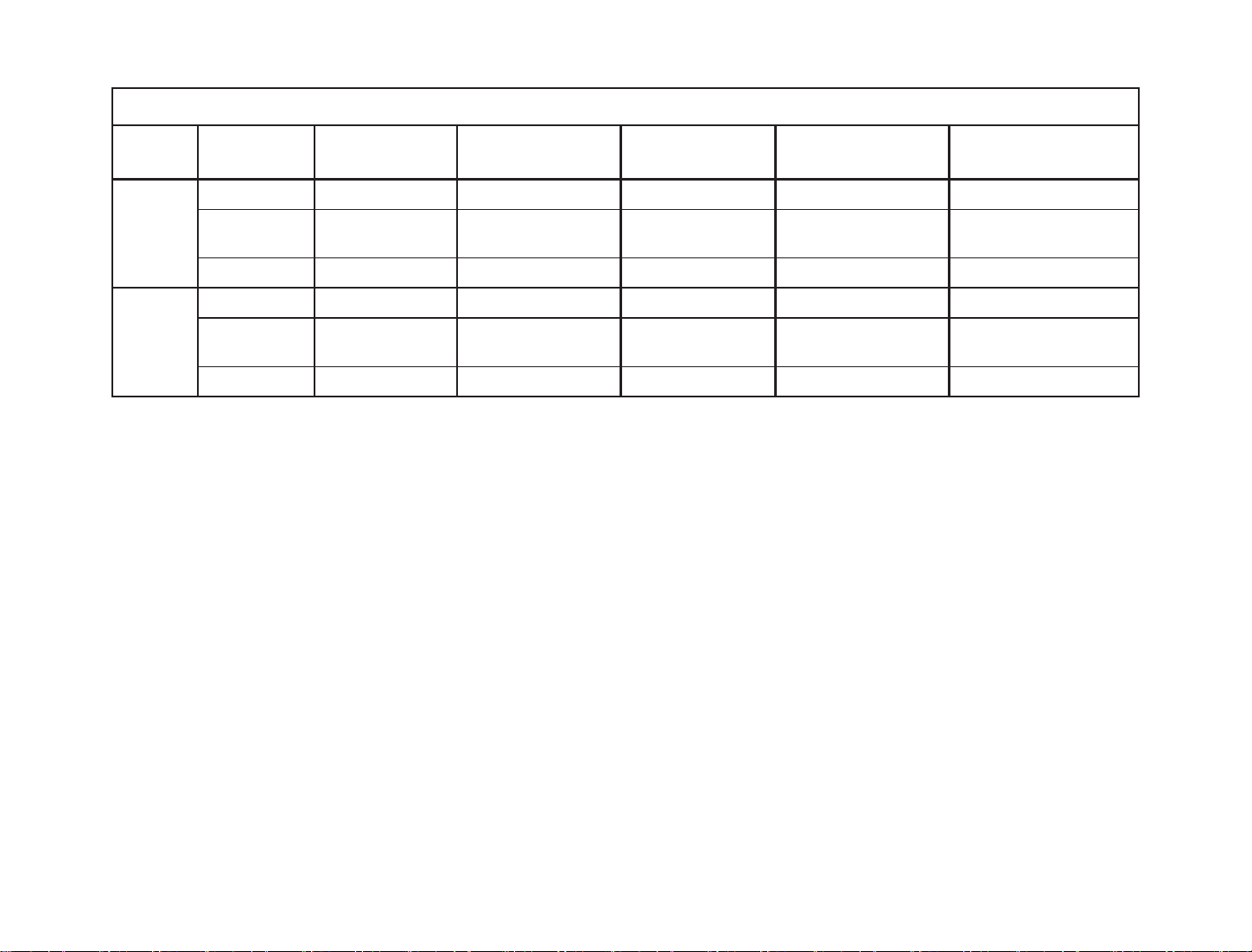
Rice Chart
Size of
Cooker
Rice Maximum
Quantity
Water
Quantity
Water Quantity
for 1 cup Rice
Pressure Cooking
Time in Minutes
Pressure Release
3 Litre Colam Rice 2 cups
/
400 g 2 cups
/
480 ml
1
1
/4 cups
/
300 ml
2 Allow to cool naturally
Basmati Rice 2 cups
/
400 g 2 cups
/
480 ml
1
1
/8 cups
/
270 ml
3
Allow to cool 5 minutes
and release pressure
Parboiled Rice
1
3
/4 cups
/
350 g 2
3
/4 cups
/
660 ml 1
2
/3 cups
/
400 ml
7 Allow to cool naturally
5 Litre Colam Rice
4
1
/2 cups
/
900 g 5
1
/2 cups
/
1.3 litres 1
1
/4 cups
/
300 ml
2 Allow to cool naturally
Basmati Rice
4
1
/2 cups
/
900 g
5 cups
/
1.2 litres
1
1
/8 cups
/
270 ml
3
Allow to cool 5 minutes
and release pressure
Parboiled Rice 4 cups
/
800 g
6
1
/2 cups
/
1.6 litres 1
2
/3 cups
/
400 ml
7 Allow to cool naturally
Hawkins Hevibase IM_Issue 2_Sep 2015.indd 19 28-09-2015 15:18:19

20
Cooking Dal
Dal is the Indian term for various dried edible seeds such as lentils.
The basic steps to pressure cook dal are:
1. Put dal, water and seasonings (if desired) in cooker. Stir.
2. Close cooker. Bring to full pressure on high heat. Reduce heat and
cook the required time.
3. Remove cooker from heat. Allow to cool naturally.
4. Open cooker. Add tempering with spices as desired.
Some dals such as tuvar, moong and chana, tend to sprout while
cooking. Pressure cooking these dals in a mold eliminates sprouting.
For example,
3
/4 cup
/
150 g tuvar dal and 2 cups
/
480 ml water
may be pressure cooked in a 1 litre (1 quart) mold on the grid. Water in
cooker body: 1 cup
/
240 ml water. Pressure cooking time: 10 minutes.
Yield: 2
1
/2 cups. See Molds on page 30 and 31.
See the following suggestions to reduce sprouting when cooking
dal directly in the cooker.
To Reduce Dal Sprouting
1. Do not fill the cooker body (dal and water combined) to more
than one-third. Do not exceed dal and water quantities and cooking
times given in the following chart.
2. Do soak dal (in enough water to cover dal) for 15 minutes before
pressure cooking and add 1 tsp
/
5 ml salt, plus
1
/4 tsp
/
1.3 ml turmeric
plus 1 tsp
/
5 ml vegetable oil per cup of dal, to dal and water in cooker
before closing the lid.
3. Do reduce heat to medium or lower immediately when the pressure
cooker reaches "Full Operating Pressure".
4. Do not release pressure by lifting the vent weight.
5. If sprouting persists, bring to full pressure on medium heat and
reduce heat immediately when the pressure cooker reaches "Full
Operating Pressure".
There are many varieties of dal and some amount of experimentation with water and cooking time
may be necessary to suit your taste. A few examples are given in the charts below and alongside.
Rajma Pressure Cooking Chart
Rajma
(1 cup)
Water
Quantity
Pressure Cooking
Time in Minutes
Pressure Release
Soaked 3 cups
/
720 ml 11 Allow to cool naturally
Unsoaked 4 cups
/
960 ml 60 Allow to cool naturally
•
For soaking methods, see Soaking Legumes page 28.
•
Some varieties of rajma may take longer to cook than stated in the chart.
Hawkins Hevibase IM_Issue 2_Sep 2015.indd 20 28-09-2015 15:18:19
21
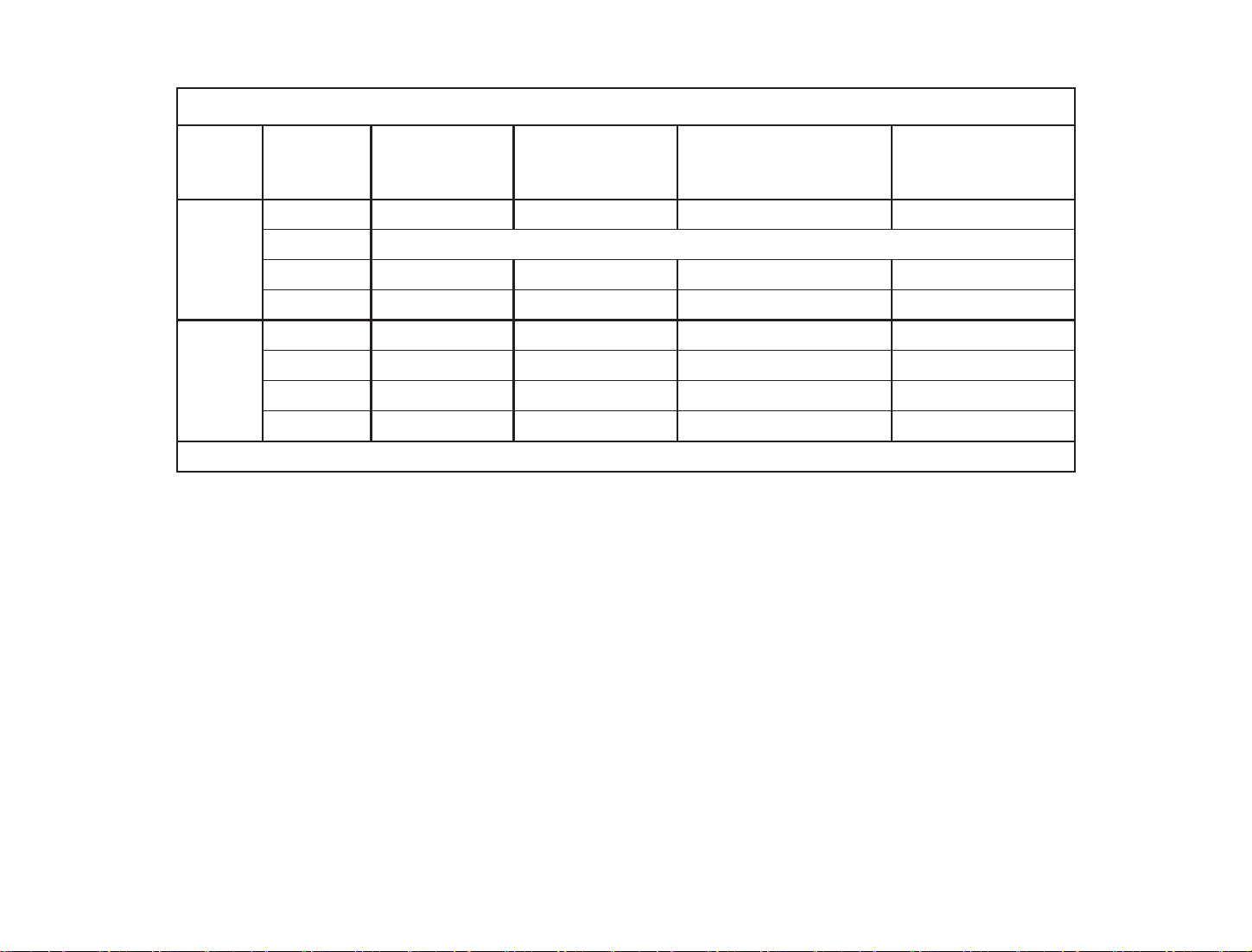
Dal Chart
Size of
Cooker
Dal Maximum
Quantity
Water
Quantity
Pressure Cooking
Time in Minutes
(soaked or unsoaked)
Pressure Release
3 Litre
Tuvar dal
*
3
/4 cup
/
150 g
2 cups
/
480 ml 3 Allow to cool naturally
Moong dal Do not cook this dal in this size of cooker
Chana dal
*
1
1
/2 cups
/
300 g 2
3
/4 cups
/
660 ml
8 Allow to cool naturally
Sabat Urad
1
1
/8 cups
/
225 g 5
1
/4 cups
/
1.3 litres
25 (Do not soak) Allow to cool naturally
5 Litre
Tuvar dal
*
1
3
/4 cups
/
350 g 4
3
/4 cups
/
1.1 litres
1 Allow to cool naturally
Moong dal
*
1
1
/2 cups
/
300 g 3
3
/4 cups
/
900 ml
1 Allow to cool naturally
Chana dal
*
2
1
/2 cups
/
500 g 4
1
/4 cups
/
1 litre
6 Allow to cool naturally
Sabat Urad
1
3
/4 cups
/
350 g
8 cups
/
1.9 litres 25 (Do not soak) Allow to cool naturally
*
To reduce frothing: Soak 15 minutes in water and drain; add salt, turmeric and oil.
Hawkins Hevibase IM_Issue 2_Sep 2015.indd 21 28-09-2015 15:18:20
22
Pressure Cooking Time Charts
The charts in this section were compiled in our North American Test Kitchen using the food available. You may need to
modify some of the pressure cooking times when cooking food from different regions.
Rice Pressure Cooking Chart
Rice (1 cup) Water Oil
/
Butter Pressure Cooking
Time in Minutes
Pressure Release
Basmati Rice
1
1
/8 cups
3 Allow to cool 5 minutes and release pressure
Brown Rice 2 cups 18 Allow to cool 5 minutes and release pressure
White Rice
1
1
/2 cups
1 tablespoon 5 Allow to cool 5 minutes and release pressure
Wild Rice 3 cups 25 Release pressure immediately. Drain
1
/2 teaspoon salt optional
•
Cooking time is affected by the thickness, the cut, the quality, the
preparation (boneless, rolled etc.) of the meat and personal
preference. The smaller the piece of meat, the greater its tenderness,
the higher the quality and the bigger the bone
-
the shorter the
cooking time required. Meat varies widely from region to region.
The times given in the chart and recipes are for specific cuts and
should serve as guides to be modified according to your ingredients,
experience and taste.
•
The pressure cooking time for large pieces of meat, called roasts,
is according to weight
-
minutes of cooking per lb/kg of meat.
The shape and thickness of the roast affect the cooking time. Short,
fat roasts take longer to cook than long, flat roasts. Boneless and
rolled roasts take longer to cook than roasts with bones. Allow enough
space around the roast in the cooker for steam circulation to ensure
even cooking. For a more "roasted" effect, cook roast on grid.
•
All the times in the Poultry Pressure Cooking Chart except turkey
are for poultry which has been lightly browned. The amount of
browning can affect the cooking time
-
the less the browning the
longer the pressure cooking time. You may have to adjust the
cooking time to reflect the degree of browning you prefer.
•
Cooking times in the Poultry Pressure Cooking Chart are based on
medium-sized pieces of young poultry. Increase time when cooking
larger and/or older pieces.
Meat and Poultry
For cooking methods, see Cooking Rice page 18.
Hawkins Hevibase IM_Issue 2_Sep 2015.indd 22 28-09-2015 15:18:20
23
Meat Pressure Cooking Chart
Meat Description Use
Grid?
Water in
Pressure Cooker
Pressure Cooking
Time in Minutes
Pressure Release
Lamb Leg Yes 1 cup 11 per lb
/
450 g Allow to cool naturally
Shank about 1lb
/
450 g No
1
1
/2 cups
30 Allow to cool naturally
Shoulder Chops 1 inch
/
2.5 cm thick Yes 1 cup 18 Allow to cool naturally
Stew Meat (shoulder) 1
1
/2
inch
/
3.8 cm cubes
No 1 cup 10-12 Allow to cool naturally
Beef Brisket (Corned Beef) No Fill to Half 20 per lb
/
450 g Allow to cool naturally
Flank Steak stuffed and rolled No 1 cup 20 Allow to cool naturally
Ground Beef Patties 1 inch
/
2.5 cm thick Yes
3
/4 cup
*
5 Release pressure immediately
Oxtail cut in pieces No
1
1
/2 cups
45
Allow to cool 5 minutes and
release pressure immediately
Roast (blade, chuck, round, rump) Yes 1 cup 20 per lb
/
450 g Allow to cool naturally
Round (Swiss) Steak 1 inch
/
2.5 cm thick No 1 cup 22 Allow to cool naturally
Shank Steak 1 inch
/
2.5 cm thick No 1 cup 30 Allow to cool naturally
Short Ribs Yes
1
1
/2 cups
30 Allow to cool naturally
Stew Meat (chuck, rib, round)
about 1
1
/2 inch
/
3.8 cm cubes
No 1 cup 14 Allow to cool naturally
Tongue (fresh) No Fill to Half 60 Allow to cool naturally
Veal Arm Steak
1
/2 inch
/
1.3 cm thick
No 1 cup 12 Allow to cool naturally
1
1
/2 inch
/
3.8 cm thick
No 1 cup 20 Allow to cool naturally
Roast (rump or shoulder) boned and rolled No 1 cup 15 per lb
/
450 g Allow to cool naturally
Shank No 1 cup 20 Allow to cool naturally
Stew Meat about 1 inch
/
2.5 cm cubes No 1 cup 10-12 Allow to cool naturally
Pork Boneless Loin Roast Yes 1 cup 15 per lb
/
450 g Allow to cool naturally
Boneless Shoulder Roast Yes 1 cup 20 per lb
/
450 g Allow to cool naturally
Chops 1 inch
/
2.5 cm thick Yes 1 cup 15 Allow to cool naturally
1
/2 inch
/
1.3 cm thick
Yes 1 cup 10 Allow to cool naturally
Spareribs Yes
1
1
/2 cups
20 Allow to cool naturally
Stew Meat 1
1
/2 inch
/
3.8 cm cubes
No 1 cup 14 Allow to cool naturally
*
NEVER reduce water quantity.
Hawkins Hevibase IM_Issue 2_Sep 2015.indd 23 28-09-2015 15:18:20
24
Seafood Pressure Cooking Chart
Seafood Shape and Size Water in
Pressure Cooker*
Pressure Cooking
Time in Minutes
Cod
Fillet
3
/4 inch
/
1.9 cm to
1 inch
/
2.5 cm thick
3
/4 cup
3
Halibut
Steak 1 inch
/
2.5 cm thick
1 cup
6
Ocean Perch
Fillet
3
/4 inch
/
1.9 cm thick
3
/4 cup
2
Red Snapper
Fillet
3
/4 inch
/
1.9 cm thick
3
/4 cup
2
Salmon Steak
1 inch
/
2.5 cm thick
1 cup
6
1
1
/2 inch
/
3.8 cm thick
1 cup
9
Scallops
–
3
/4 cup
1-2
Sole Fillet
1
/4 inch
/
6 mm thick
3
/4 cup
0
1
/2 inch
/
1.3 cm thick
3
/4 cup
1
Trout
Small, whole (10 oz
/
280 g)
3
/4 cup
4
Tuna
Steak
3
/4 inch
/
1.9 cm thick
3
/4 cup
3
•
For each item: Use grid and release pressure
immediately.
•
When pressure cooking seafood, even a few
extra seconds can overcook. Do not leave the
Poultry Pressure Cooking Chart
Poultry Description Use
Grid?
Pressure Cooking
Time in Minutes
Pressure Release
Chicken Pieces Yes 7 Allow to cool naturally
Yes
9
Release pressure immediately
Whole Fryer (3 lb
/
1.4 kg) No 11 Allow to cool naturally
Duck (domestic)
Pieces No 13-15 Allow to cool naturally
Rock Cornish Hen
Whole (1
1
/4 lb
/
560 g) stuffed
Yes 12-15 Allow to cool naturally
Turkey
Breast half (2
1
/2 lb
/
1.1 kg)
Yes 28 Allow to cool naturally
Thigh No 20 Allow to cool naturally
Leg No 20 Allow to cool naturally
Water: 1 cup for all of the above.
cooker once it is on the heat – cooking times are so
short. Pressure cook seafood without delays: time
accurately, remove cooker from heat quickly and
release pressure immediately.
*
NEVER reduce water quantity.
Hawkins Hevibase IM_Issue 2_Sep 2015.indd 24 28-09-2015 15:18:20

25
Vegetable Pressure Cooking Chart
Vegetable Description
Water in
Pressure Cooker
Pressure Cooking
Time in Minutes
Artichokes
Whole stems cut short
1
1
/2 cups
11
Asparagus
Tough ends removed
1
/2 cup
1-2 depending on size
Beets
Whole unpeeled, root and 1 inch
/
2.5 cm
of stem remaining
small 1 cup 10
medium
1
1
/2 cups
12-16 depending on size
Broccoli
Flowerettes
1
/2 cup
1
Full stalks stems scored
1
/2 cup
2
Brussels Sprouts
Whole ends trimmed 1 cup 3
Cabbage
Quartered 1 cup 5-6 depending on size
Carrots
Sliced (foil on grid)
1
/2 cup
1
Whole baby or large cut into halves lengthwise
1
/2 cup
2
Whole 1 cup 4-7 depending on size
Cauliflower
Flowerettes
1
/2 cup
2
Whole small stems and leaves removed, core hollowed 1 cup 5
Celery
Cut into 1 inch
/
2.5 cm pieces
1
/2 cup
2
Collards
Stems (spines removed) cut crosswise in 1 inch
/
2.5 cm pieces
1 cup 5
Corn on the Cob Whole 1 cup 4-5 depending on size and
tenderness
Eggplant
Cut into
1
/2 inch
/
1.3 cm slices
1
/2 cup
0
Green Beans Whole ends trimmed
1
/2 cup
1-2 depending on
tenderness
Cut into 1 inch
/
2.5 cm pieces
1
/2 cup
0-1 depending on
tenderness
Chart continued overleaf
Note: NEVER reduce water quantity. Also, see notes on page 26.
Hawkins Hevibase IM_Issue 2_Sep 2015.indd 25 28-09-2015 15:18:20
26
Vegetable Pressure Cooking Chart
Vegetable Description Water in
Pressure Cooker
Pressure Cooking
Time in Minutes
Kale Cut in 1 inch
/
2.5 cm sections
1
/2 cup
2
Kohlrabi
Cut into
1
/2 inch
/
1.3 cm slices
1 cup 4
Mustard Greens Stalks removed
1
/2 cup
2
Onions Whole small
1 cup 5
Parsnips
Whole
1 cup 8-10 depending on size
Cut into 1 inch
/
2.5 cm pieces
1 cup 3-4 depending on size
Peas Shelled (foil on grid)
small
1
/2 cup
1
medium
1
/2 cup
2
Potatoes
Cut into
1
/2 inch
/
1.3 cm slices
1
/2 cup
2
Peeled and cut into 1
1
/2 inch
/
3.8 cm pieces
1 cup 6
Whole peeled
or
unpeeled
small (3 oz
/
85 g)
1 cup 10
medium (5 oz
/
140 g)
1
1
/2 cups
15
Rutabagas Cut into 1 inch
/
2.5 cm pieces
1 cup 5
Spinach Stalks removed
1
/2 cup
0
Squash, Acorn Halved, seeds removed
1 cup 7
Squash, Zucchini
Cut into
1
/2 inch
/
1.3 cm slices
1
/2 cup
1-2 depending on size
Sweet Potatoes Halved lengthwise
1 cup 6-8 depending on size
Turnips
Cut into
1
/2 inch
/
1.3 cm slices or 1 inch
/
2.5 cm pieces
1 cup
3-4 depending on
tenderness
•
For each item:
-
Use grid.
-
NEVER reduce water quantity.
-
Release pressure immediately.
•
Times given in the chart are for fresh vegetables. For old and tough vegetables, increase
zero pressure cooking time up to 1 minute, other times up to double.
•
When pressure cooking vegetables with short pressure cooking times of 0 to 2 minutes
and
1
/2 cup water do not leave the cooker once it is on heat. Pressure cook without delays:
time accurately, remove cooker from heat quickly and release pressure immediately.
Hawkins Hevibase IM_Issue 2_Sep 2015.indd 26 28-09-2015 15:18:20
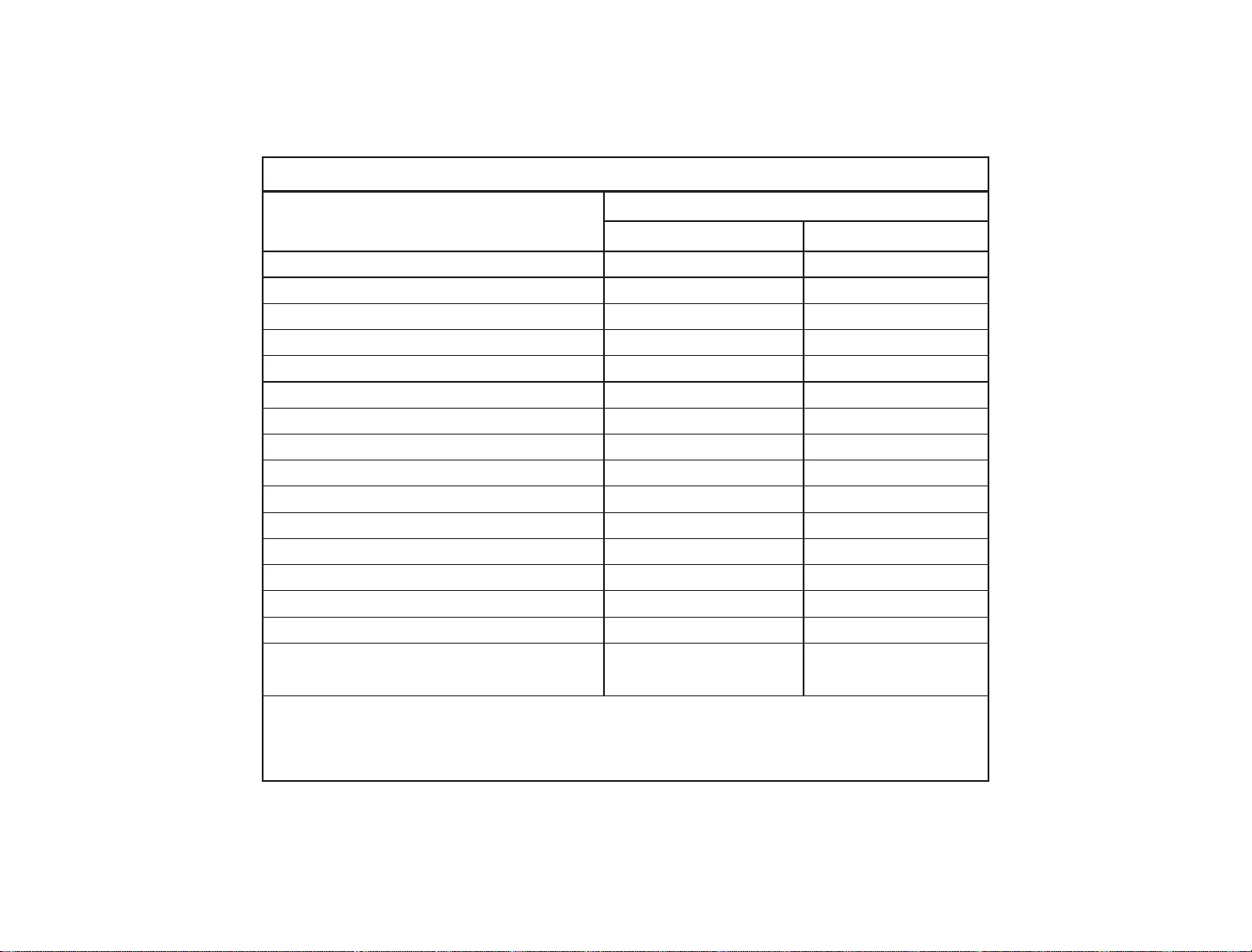
27
Legumes are cholesterol-free, low in fat and high in proteins, minerals, B vitamins and fiber. They are particularly
valuable for vegetarians and those wishing to reduce meat consumption.
Legumes tend to foam while cooking. This can be messy and/or block the steam vent unless you FOLLOW THE
INSTRUCTIONS GIVEN ON THE NEXT PAGE.
Legume Pressure Cooking Chart
Legume (1 cup) Pressure Cooking Time in Minutes
Soaked Unsoaked
Adzuki Beans 6 14
Anasazi Beans 5 22
Black (Turtle) Beans 7 23
Black-eyed Beans 6 15
Cranberry Beans 10 30
Flageolet Beans 10 23
Garbanzo Beans (Chickpeas) 12 48
Great Northern Beans 5 35
Kidney Beans 11 40
Lentils Do not soak 6
Mung Beans Do not soak 8
Pinto Beans 6 30
Red Beans 6 30
Scarlet Runner Beans 12 22
Small Navy Beans 5 30
Soybeans (Add 2 tablespoons vegetable
oil to reduce frothing.)
25 50
•
Do not pressure cook lima beans.
•
For each item: Water: 3 cups. Allow to cool naturally.
•
Always ensure there is enough water to last the entire pressure cooking time.
See page 13, Water.
•
For Rajma, see page 20.
Hawkins Hevibase IM_Issue 2_Sep 2015.indd 27 28-09-2015 15:18:20

28
Precautions
•
Never fill cooker more than half. If frothing occurs, reduce quantity
by a further 10%. Legumes expand when cooked and absorb
water. Do not reduce water quantity below 1
1
/2 cups.
•
Measure legumes. Pick over to remove stones, dirt and shriveled,
broken pieces and wash before cooking. To wash: place legumes
in a bowl. Cover with water and agitate gently. Remove and
discard floating pieces. Tip bowl to one side to drain off water,
keeping one hand on the edge of the bowl to prevent legumes
spilling. Repeat several times.
•
Most varieties of beans yield about 2
1
/2 cups cooked beans for
every 1 cup dry beans.
Soaking Legumes
You may or may not soak most legumes before pressure cooking.
Soaked legumes cook more evenly, more quickly and may taste better.
Soaking legumes and then discarding the soaking water can reduce the
water soluble complex sugars which may cause the discomfort some
people experience digesting legumes. If you soak legumes, adding
1 tablespoon of vegetable oil for each cup of legumes while pressure
cooking helps reduce frothing. Unsoaked legumes froth less and hold
their shape better. Some legumes also retain more of their colour when
unsoaked. Two methods of soaking are:
1. To soak overnight: Put legumes in double their volume (enough to
cover) of cold water overnight.
2. To "quick soak" one hour: Put legumes in a pan. Pour over legumes
3-4 cups of water for every 1 cup of legumes. Bring to rapid boil; boil
2 minutes. Remove from heat. Cover the pan and allow to stand 1 hour.
Drain and rinse legumes. Remove any floating, loose skins before
cooking.
Pressure Cooking Legumes
1. Put legumes and water in cooker. The grid is not required. A
standard proportion is 3 cups of water for every 1 cup of legumes.
The quantity of water can be reduced or increased according to your
experience. Be sure the legumes are well covered with water. Legumes
absorb water while cooking. Do not fill cooker more than half.
2. Adding 1 tablespoon of vegetable oil for every cup of legumes helps
reduce frothing – especially with soaked beans. Add 2 tablespoons of
oil for every 1 cup of soybeans. Salt and acidic foods such as tomatoes,
ketchup, lemon juice, vinegar and molasses cause the skins of the
beans to harden and extend the cooking times substantially. These
are not ordinarily added while cooking. You may add flavourings such
as 1 clove garlic (minced or whole), 1 bay leaf and/or a whole onion,
according to your taste.
3. Boil. Skim off any scum with a slotted spoon. Close cooker. Bring to
full pressure on medium heat. Reduce heat immediately when
full pressure has been reached to prevent frothing. Remove
cooker briefly from heat if the steam seems to be evacuating too
forcefully. Heat should be the minimum necessary to maintain pressure.
4. Time according to the chart. The times given are approximate –
the variety of legume, freshness and growing conditions affect cooking
time. Cook until ALL the legumes are cooked. Beans should be cooked
until they can be squeezed with thumb and finger or mashed with
your tongue against the roof of your mouth quite easily. Do not eat
legumes which are undercooked. The times given in the chart are for
"just cooked" legumes. Cook longer when softer legumes are required,
as for purées and soups.
5. When cooking is complete, remove cooker from heat and allow
to cool naturally or place cooker in 2 inches/5 cm to 4 inches/10 cm of
cold water (depending upon the size of the cooker) in a basin or in a
Legumes (continued)
Hawkins Hevibase IM_Issue 2_Sep 2015.indd 28 28-09-2015 15:18:20

29
sink for a few minutes. NEVER release pressure by lifting the vent
weight. Open cooker. Check doneness. If necessary, bring back to
pressure and cook more or simmer without the lid until done. We do
not recommend bringing soybeans back to pressure as they tend to
froth out of the vent tube. Drain.
•
Cooking Capacities in Different Sizes of the Hawkins Hevibase
and Adapting Recipes for Different Sizes
The recipes in this Manual have been written for the 5 Litre
Hawkins Hevibase Pressure Cooker. To adapt the recipes in this
Manual to the 3 Litre model, reduce all ingredients in the recipes by
40% without any other changes (pressure cooking times remain the
same) except as mentioned in the recipes or as stated below:
•
Heat Source: Use the small burner of a gas stove or do not exceed
the medium heat setting of a large burner or an electric hot plate
or halogen cooktop.
•
NEVER reduce the water quantities given in the Seafood Pressure
Cooking Chart on page 24 or the Vegetable Pressure Cooking
Chart on pages 25 and 26.
•
Most roasts, large pieces of meat, whole birds, whole artichokes,
whole cauliflowers, whole green peppers and whole tomatoes are
too big to fit in this model.
•
Cooking moong dal is not recommended in this model.
•
Do not cook more than 1 cup soybeans (in 3 cups water) in this model.
•
Chola Dal (page 40): Reduce water by only 25%. Pressure cooking
time: 11 minutes.
•
Mutton Biryani (page 44): Do not reduce water in step 9
(
1
∕4 cup
/
60 ml) at all.
•
If you do not have a 1 litre/1quart mold which fits in this cooker,
Crème Caramel and Pâté may also be cooked in small individual
molds as explained below:
1. To cook Crème Caramel (page 54) in 4 small individual
molds: Reduce custard quantity by 33%. Keep caramel quantity
same. Use 1 cup
/
240 ml water in cooker body. Pressure cooking
time: 5 minutes.
2. To cook Pâté (page 59) in 4 small individual molds: Use
1
1
∕2 cups
/
360 ml water in cooker body. Pressure cooking time:
20 minutes.
•
As explained on page 6, the pressure cooker body should
never be filled with food and water to more than two-thirds
capacity. Certain foods should be filled to half or one-third
capacity. The volumes of the two-thirds, half and one-third
capacities are given in the chart alongside.
Size of
Pressure Cooker
Two-Thirds
Capacity
Half
Capacity
One-Third
Capacity
3 Litre 8 cups (2 litres)
6
1
/4 cups (1.5 litres)
4 cups (1 litre)
5 Litre 14 cups (3.4 litres)
10
1
/2 cups (2.5 litres)
7 cups (1.7 litres)
Cooking Capacities/Volumes for the Hawkins Hevibase
Adapting Recipes for the 3 Litre Hawkins Hevibase
Hawkins Hevibase IM_Issue 2_Sep 2015.indd 29 28-09-2015 15:18:21
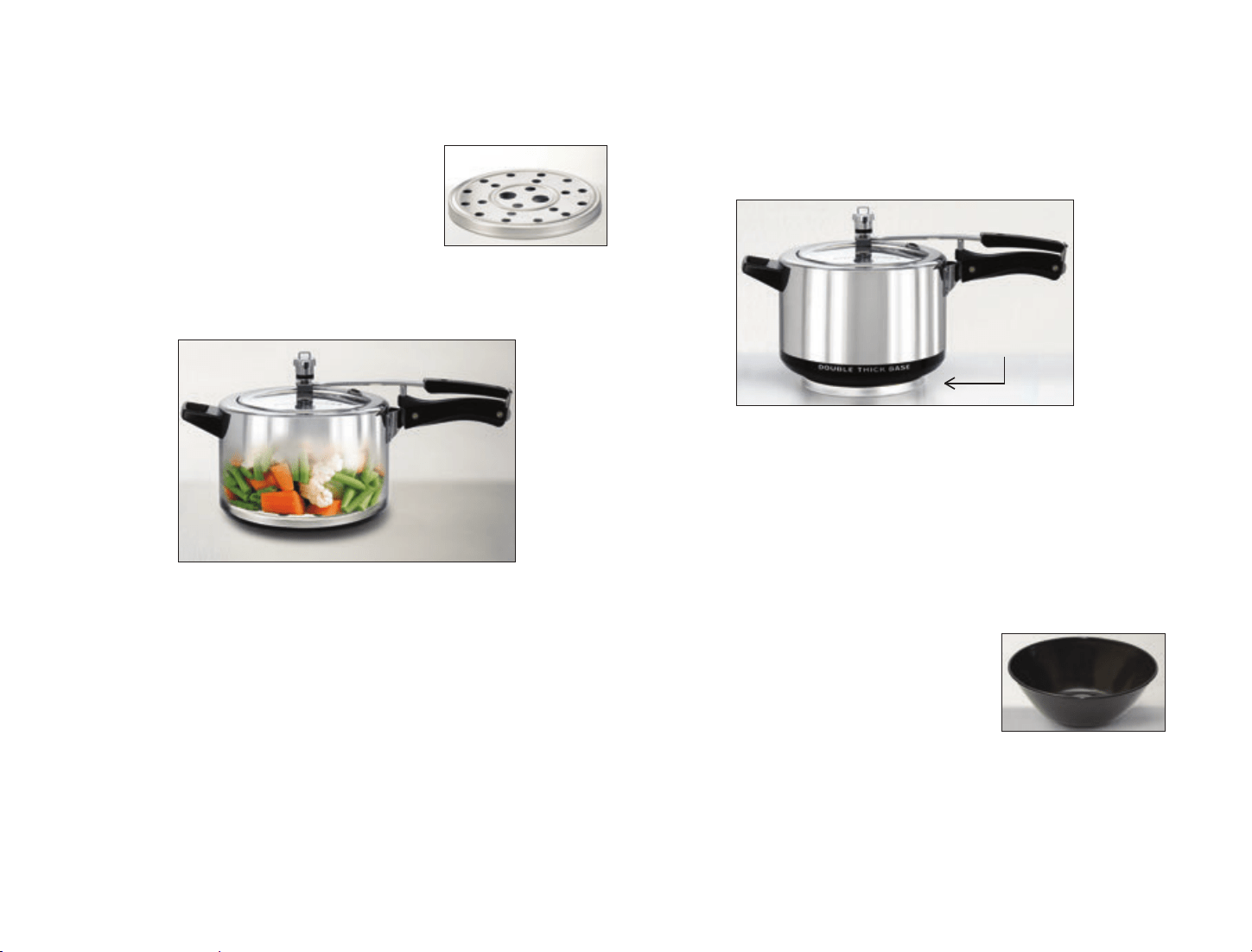
30
Using Grid and Molds
Grid
Every Hawkins Hevibase Pressure Cooker
comes with a grid. The grid is used for
minimising the contact between food and
the cooking liquid and/or the base.
•
Use the grid to steam food above the water when you so desire it
(rather than immersed in liquid with flavours blending).
•
Use the grid when steaming foods in molds or other containers
(not provided).
•
Use the grid to separate layers of food and to stack custard cups
(not provided), always ensuring that the cooker is no more than
two-thirds full.
•
The height of the grid is about
3
/8 inch/1 cm. This height should be
taken into consideration when calculating how much remaining
space is available for food.
•
The grid should not be used when cooking soups, stews, rice
dishes, dals, pulses or legumes and similar foods.
•
Use grid as a coaster or pad for the hot cooker body (except on
fine furniture).
Molds
Molds are not supplied with the Hawkins Hevibase. You may use
your own molds as explained herein below.
•
The recipes for Crème Caramel and Pâté and some desserts
such as custards, steamed puddings and fruit crumbles require
cooking in a mold (not provided) which is put inside the cooker.
Foods such as rice, lentils and fish may also be cooked in molds.
•
A Futura mold (1 Litre/1 Quart) is
available separately as an accessory. It
is made of hard anodised aluminium.
It fits inside the Hawkins Hevibase
pressure cookers which are 5 Litre
or larger.
GRID FOR STEAMING VEGETABLES
GRID
GRID
AS A COASTER
FUTURA MOLD
Hawkins Hevibase IM_Issue 2_Sep 2015.indd 30 28-09-2015 15:18:25
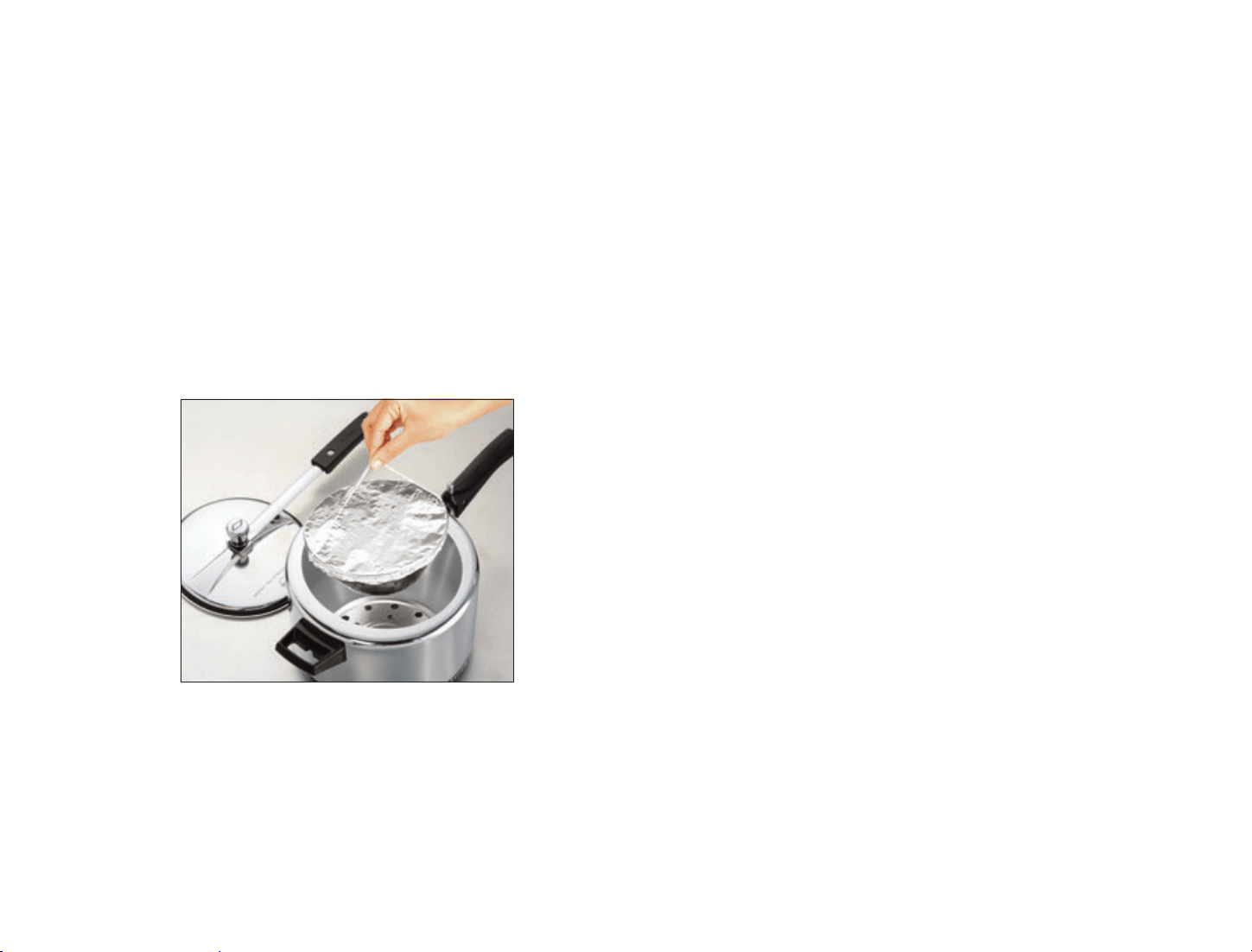
31
•
Molds made of oven-proof metal, glass or ceramic can also be
used if they fit inside the cooker. The thicker the mold, the longer
the cooking time.
•
A mold should fit inside the cooker such that the top of the
mold (when placed on the grid) is not above two-thirds up the
cooker body.
•
Molds should be placed on the grid.
•
When required, cover the mold with foil or a double thickness of
greaseproof paper and tie securely.
•
A handle made from string is useful for transferring molds in and
out of the cooker.
•
In the base of the cooker use a minimum 1 cup/240 ml water for
the first 10 minutes of pressure cooking time plus
1
/2 cup/120 ml
for every subsequent 10 minutes or part thereof.
•
For pre-steaming plus pressure cooking or for steaming without
pressure (without the vent weight) use 2 cups/240 ml water for
the first 10 minutes plus
1
/2 cup/120 ml for every subsequent
10 minutes or part thereof.
•
To prevent discolouring aluminium when steaming in molds add
1 teaspoon/5 ml lemon juice or tartaric acid for every 2 cups/
480 ml of water in the base of the cooker. Do not do this when
using a hard anodised mold as it may affect the finish of such
a mold.
•
Reheating/Thawing. Molds can be used to reheat food,
including precooked frozen food, in the cooker. To reheat food
in a mold: put food in the mold. Cover with aluminium foil unless
steam/moisture will improve the food. Cooked rice, for instance,
should be reheated uncovered. Estimate the cooking time
according to the type, size, volume and temperature of the food to
be heated. A mold full of cooked rice will require 2 minutes
pressure cooking time. A commercially-prepared individual frozen
meal requires about 10 minutes at pressure. With experience you
will be able to judge the time. Add water according to the cooking
time. Put grid in cooker. Place mold on grid. Close cooker. Bring
to full pressure on high heat. Reduce heat and cook. Remove
cooker from heat. Release pressure immediately.
•
Hawkins Hevibase IM_Issue 2_Sep 2015.indd 31 28-09-2015 15:18:30
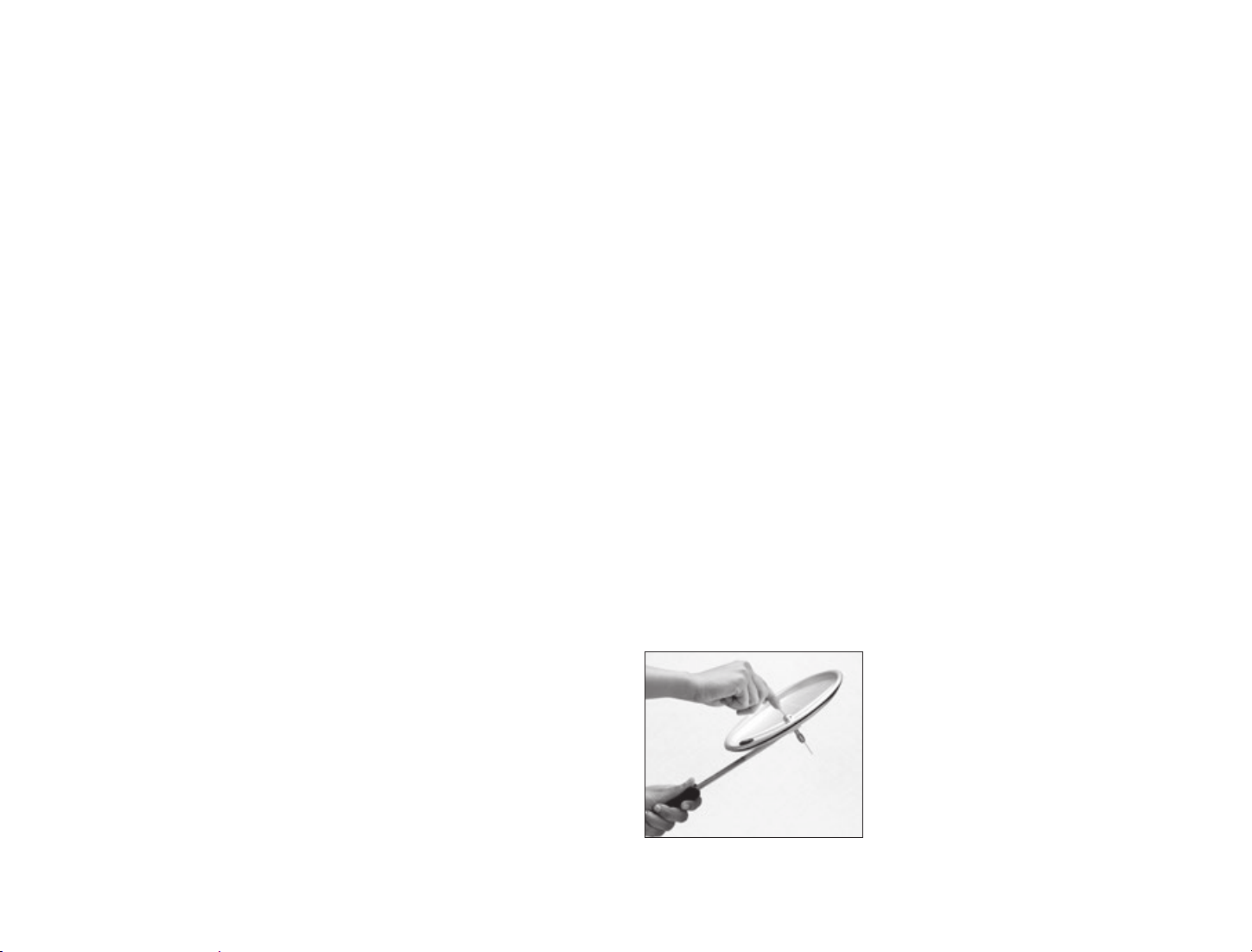
32
Care and Cleaning
To get the best use from your Hawkins Hevibase Pressure Cooker,
observe the following directions.
Body and Lid
•
Remove label, wash, rinse and dry cooker before use (do not wash
in a dishwasher).
•
Remove any adhesive with vegetable oil.
•
Do not hit or knock the rim of the cooker body with a ladle, spoon
or any other object and protect the edge of the lid from dents
which may disturb sealing.
•
Do not leave food or water in the cooker for more than 8 hours.
Do not leave the cooker lying in water or with dirty dishes for
long. Chemicals and natural salts in the water and decomposing
food can cause pitting of the metal. Do not leave salted liquid,
vinegar, lemon juice, mayonnaise or mustard in the cooker. Never
add salt to the cooker when there is no liquid in the cooker. First
add the liquid, warm it, then add the salt and stir until the salt is
completely dissolved.
Handles
•
Plastic handles are liable to break under a blow.
•
Do not attempt to remove the "play" or movement provided for
the lid handle bar where it is attached to the lid. The "play" is
essential for proper sealing.
Rubber Gasket
•
Do not stretch the gasket, particularly when it is hot, as it
may distort.
•
Replace the gasket when it no longer seals, becomes hard or
cracked. Before replacing at the first sign of not sealing, however,
check that the gasket is sitting flush in the lid curl and that the
lid is properly centered. Sometimes just moving the gasket around
or inverting it stops the leak.
General Cleaning
•
DO NOT WASH PRESSURE COOKER OR ANY OF ITS PARTS IN A
DISHWASHER. Dishwasher detergents may contain harsh chemicals
or abrasive substances which may damage the hard anodised finish.
•
Always wash and dry every surface of the cooker soon after use.
Food, if not removed, can corrode the metal over a period of time.
•
Wash all parts of the cooker in hot water with a mild soap or
detergent and a dishcloth or sponge. Rinse and wipe dry.
Aluminium can become pitted if left wet.
•
Carefully remove the gasket when washing the lid. Gently wipe or
wash and rinse the gasket without stretching it. If food is lodged in
the lid curl, remove the gasket and clean the lid curl with a sponge
or a brush. Dry lid and gasket thoroughly before reassembling.
•
Check that the vent tube
is clear after rinsing. If it is
clogged, clean by carefully
pushing a wire through the
vent tube. Rinse with running
water. A needle may be used
to remove food from the vent
tube nut.
CLEAN VENT TUBE
BY PUSHING
A WIRE THROUGH IT
Hawkins Hevibase IM_Issue 2_Sep 2015.indd 32 28-09-2015 15:18:30

33
•
The vent weight can be cleaned with a jet of water to clear the
holes inside. The colour of the black spring of the vent weight
may wear off over time. This is normal wear and does not affect
its functioning.
•
Clean the area between the lid and the lid handle bar with a brush
as required.
•
Metallic marks – most often from gas stove pan supports – may
appear on the black hard anodised base. To remove metallic marks
from base: apply a kitchen cleanser to the marks and rub with an
abrasive kitchen scrubber such as Scotch-Brite or fine steel wool.
Baked-on Stains
•
If the pressure cooker is not cleaned thoroughly after each use, a
thin layer of food or grease may remain. When the cooker is
heated next, this food/grease becomes "baked-on" and very
difficult to remove. Avoid "baked-on" fat or gravy stains; wipe
off any fat or gravy on the cooker base before placing on hot
stove. Ensure stove surface in contact with pressure cooker is free
of fat drippings.
•
If you do get "baked-on" stains on the hard anodised base, tackle
them while they are still fresh. Soak in hot water. Make a thick
paste of a chlorine-based kitchen cleanser and apply it to the
surface. Wait 5 to 10 minutes, then scour lightly with fine steel
wool using a circular motion. Wash and wipe dry.
•
If food is stuck to the cooker, remove with a plastic scrubber and a
non-abrasive cleanser or an aluminium cleanser. If food is badly
stuck or burned the following procedure helps dislodge food
particles and makes cleaning easier: pour into cooker enough
water (not above half full) to cover the area of burned food. Close
cooker. Bring to full pressure on high heat. Reduce heat and cook
5 minutes. Allow to cool naturally. Open cooker. Wash and wipe
dry. Do not use abrasive powders, ash or mud or bleach or soda.
For stubborn spots, a fine soap-impregnated steel wool pad may
be used gently.
Loss of Shine
With use, the aluminium cooker body and lid may lose their shine.
The loss of shine is the normal behaviour of the metal over time.
Removing Stains Caused by Chemicals in the Water
The inside of the cooker body may become darker due to minerals
in the water. This darkening is neither injurious to health nor does
it affect the taste and quality of food. To remove stains from inside
the cooker body: fill cooker with water to half its capacity. Add
2 teaspoons/10 ml tartaric acid (cream of tartar) or lemon juice for
each quart/litre of water. Bring cooker to full pressure on high heat
and cook 15 minutes. If you wish to remove stains from the upper
half of the cooker body, do not pressure cook. Fill cooker with
enough of the same water-tartaric acid solution to cover the stains.
Boil 30 minutes. Wash and then dry with a soft, clean cloth. Do not
apply the lemon juice or tartaric acid solutions to the black base.
Storing
•
Allow the cooker and all its parts to dry completely before storing.
•
The gasket should be stored fitted in the lid curl.
•
Store the cooker open to avoid mustiness.
How to Prevent Unnecessary Fusing of the Safety Valve
1. Check that the vent tube is clear by looking through it.
2. Do not fill the cooker more than
2
/3 (for liquid foods, not more
than half; for foods that froth/sprout, not more than one-third).
Hawkins Hevibase IM_Issue 2_Sep 2015.indd 33 28-09-2015 15:18:30

34
What to Do if This Happens
If This Happens... Cause Remedy
Steam leaks around
Lid not centralised Centralise the lid
edge of lid
Dent on lid or rim Repair or replace
of cooker dented part
Gasket not seated Check the gasket
properly and adjust the
seating properly
Gasket is worn-out Replace gasket
or distorted
Safety valve fused
•
Insufficient water/ Replace safety valve
cooking liquid
•
Vent tube
blocked
•
Excess heat
3. Do put enough water for the cooking time. (Check water quantities
in this Manual.)
4. Do not place the pressure cooker on an industrial burner or
stove – use only a domestic stove.
5. Do reduce heat to medium or lower when the pressure cooker
reaches "Full Operating Pressure" (see Trial Run page 10, point 5).
6. Do take the pressure cooker off the stove when the cooking time is
complete (check cooking time in chart or recipe as appropriate).
Replaceable Parts
Always use genuine Hawkins spare parts for your safety and the
proper working and durability of the cooker. See page 35 for Parts and
Service and page 37 for Do-it-Yourself Repairs.
•
The possible causes of and solutions to various problems that may
occur are given in the chart alongside.
•
Hawkins Hevibase IM_Issue 2_Sep 2015.indd 34 28-09-2015 15:18:30
35
35
Parts and Service
There is available a full range of genuine replacement parts that
may be required through the entire useful life of any Hawkins pressure
cooker. Always use genuine Hawkins spare parts for your safety and
the proper working and durability of the cooker. These parts are
available with Hawkins Authorised Dealers in India and with Hawkins
Importers/Distributors abroad. These Dealers/Distributors also carry a
Parts Catalogue with the help of which the part(s) required for your
particular model of pressure cooker can be identified precisely. Some
commonly required parts and their Part Codes are shown in the
chart on page 36.
Expert service is available
from over 700 Hawkins
Authorised Service Centres
in India. Pressure cookers
distributed in India carry a
Service Centre Directory
giving the names and contact
details of the Service Centres
in India. Pressure cookers
exported out of India carry
the name and contact details of the Importer/Distributor
who should be contacted in case of a requirement for parts or
service (if applicable, see page 36).
Replacement of simple parts such as gasket, safety valve
and plastic handles can be done by consumers themselves as
explained in the section on Do-it-Yourself Repairs starting
on page 37.
PARTS CATALOGUE
How to use this catalogue Issued: August 2011
1.
Identify the size and model of cooker. See
Page 1 for Classic Hawkins, Hawkins Ekobase.
Page 8 for Hawkins Polished and Hard Anodised Contura
Page 13 for Hawkins Stainless Steel.
Page 16 for Hawkins Bigboy.
Page 20 for Hawkins Ventura.
Page 23 for Futura.
2.
Familiarise yourself with Position & Names of Parts in a Typical Pressure
Cooker. See
Page 2 for Classic Hawkins, Hawkins Ekobase, Contura and Stainless Steel.
Page 16 for Hawkins Bigboy.
Page 20 for Hawkins Ventura.
Page 23 for Futura.
3.
Check the version of the pressure cooker to be serviced/part(s) to be replaced on page 3
for Classic Hawkins, Hawkins Ekobase, Contura and Stainless Steel and page 24 for
Futura. Hawkins Bigboy and Hawkins Ventura do not have a version variation.
4.
Identify the part(s) that needs to be replaced in the Table of Parts beginning on:
Page 4 for Classic Hawkins and Hawkins Ekobase
Page 8 for Hawkins Polished and Hard Anodised Contura
Page 13 for Hawkins Stainless Steel.
Page 17 for Hawkins Bigboy.
Page 21 for Hawkins Ventura.
Page 25 for Futura.
around 700
Hawkins Hevibase IM_Issue 2_Sep 2015.indd 35 28-09-2015 15:18:31
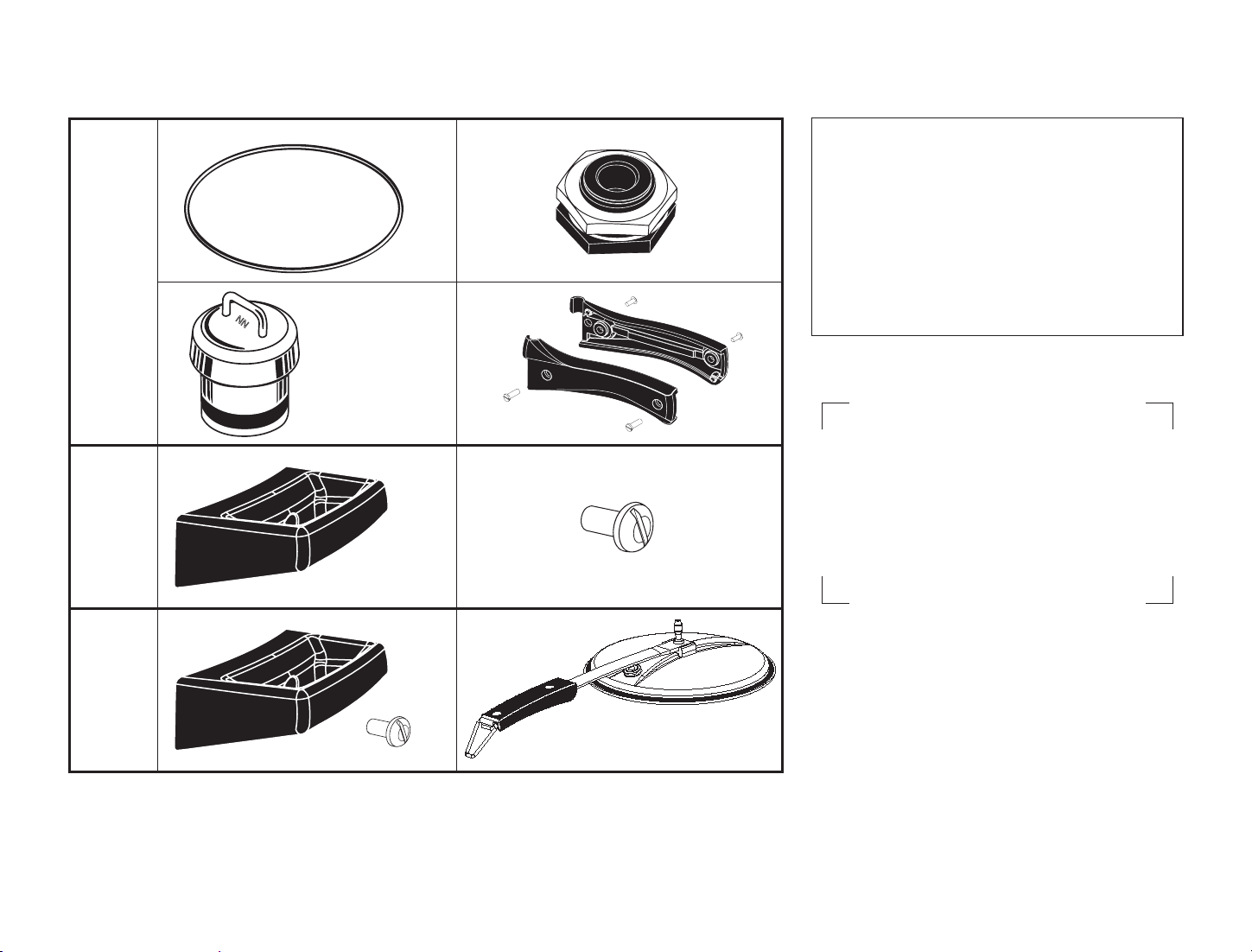
36
Commonly Required Parts and Part Codes
For any help, contact:
Hawkins Cookers Limited
P O Box 6481
Mumbai 400 016, India
TEL (91 22) 2444 0807
FAX (91 22) 2444 9152
EMAIL [email protected]
WEBSITE www.hawkinscookers.com
For
All
Countries
For
India
For
Other
Countries
SUBSIDIARY HANDLE
B11 - 05
GASKET/SEALING RING
B10 - 09
SUBSIDIARY HANDLE
B19 - 05
VENT WEIGHT/PRESSURE
REGULATOR
H10 - 20
SAFETY VALVE
B10 - 10
SUB. HANDLE SCREW
B11 - 06
LID ASSEMBLY
B20 - 07
BODY HANDLE
B21 - 01
•
Hawkins Hevibase IM_Issue 2_Sep 2015.indd 36 28-09-2015 15:18:32
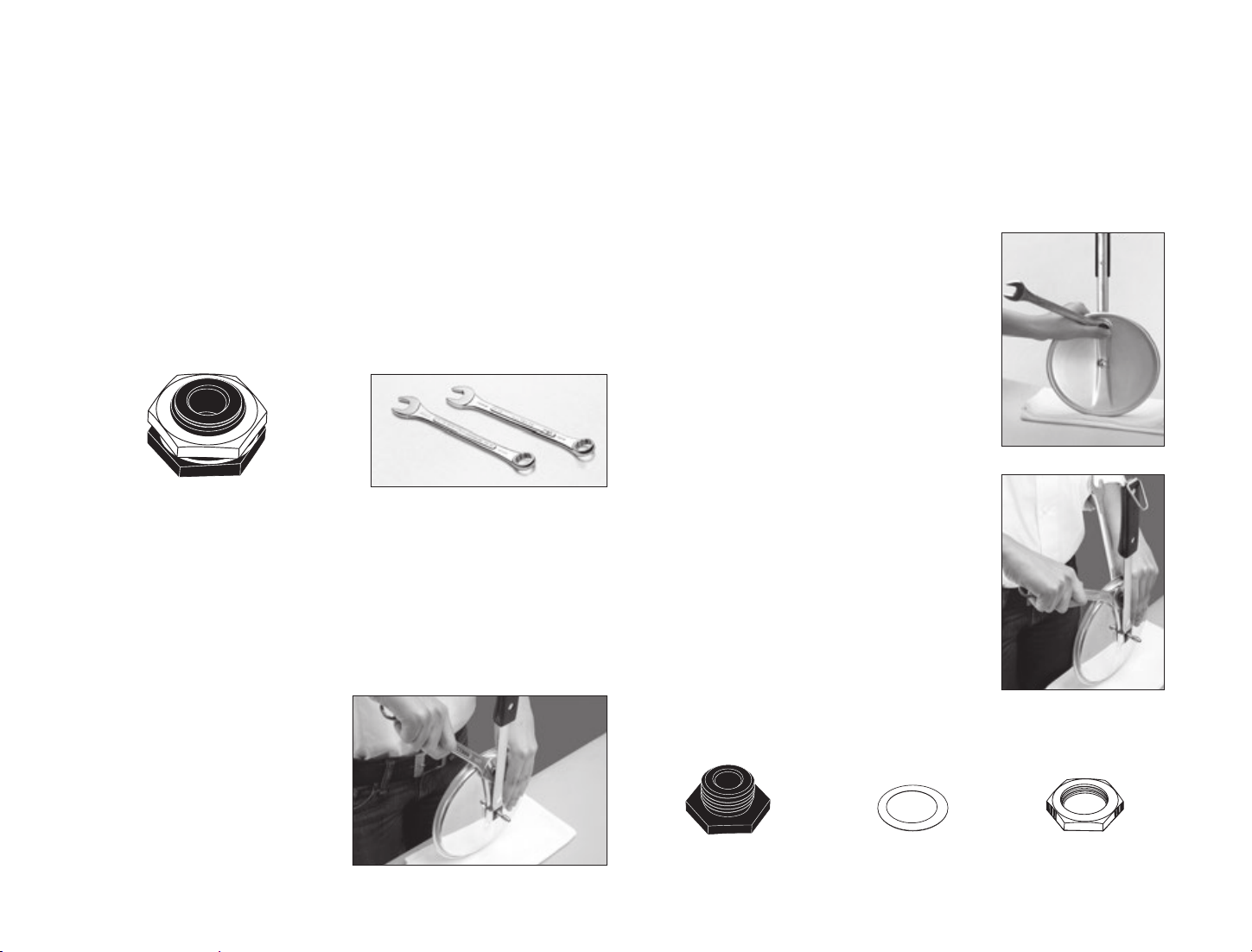
PICTURE 1
PICTURE 3
Do-it-Yourself Repairs
Gasket Replacement
If leakage develops along the rim of the cooker body which is not
due to the misalignment of the lid or a dent on the rim or lid curl, the
gasket needs to be replaced. This is simply done by changing it with
a replacement genuine Hawkins gasket to fit the size of your Hawkins
Hevibase (see page 6).
Safety Valve Replacement
1. Get a genuine Hawkins safety valve.
2. Two 17mm/
11
/16 inch spanners (wrenches) are required to replace
the safety valve – one for holding the valve on the underside of the lid
and one for turning the nut on the top of the lid.
3. A food compatible sealant or glue is recommended.
4. One strong person can replace the safety valve as stated alongside.
TO REMOVE
1. Remove the gasket and vent
weight from the lid.
2. Hold and brace the lid on
a soft surface such as a folded
cloth with the left hand. Take
care not to bend or warp the lid
curl. Do not hold the lid by the
handle. With the right hand, place the spanner around the nut on the
top of the lid (see Picture 1). Exert downward pressure on the nut just
until it loosens.
3. Place the ring end of one spanner on the
valve on the underside of the lid and hold
it in place with the thumb of the left hand
while grasping the lid with the same hand
(see Picture 2). With the right hand, place
the other spanner around the nut on the top
of the lid (see Picture 3). Exert downward
pressure on the nut. Remove and re-apply
spanner to the nut on the top of the lid at
a higher angle. Repeat downward pressure.
Repeat procedure until the nut can be
unscrewed from valve with fingers. Remove
nut, washer and valve. A factory-fitted safety
valve does not include a washer. Discard all
parts; do not reuse any part.
TO REPLACE
1. Clean all surfaces around the lid hole
where the safety valve will sit.
2. Unscrew the new nut and remove the
washer and keep them to one side, with the chamfered side of the nut up.
SPANNERS
PICTURE 2
VALVE WASHER NUT
37
Hawkins Hevibase IM_Issue 2_Sep 2015.indd 37 28-09-2015 15:18:38
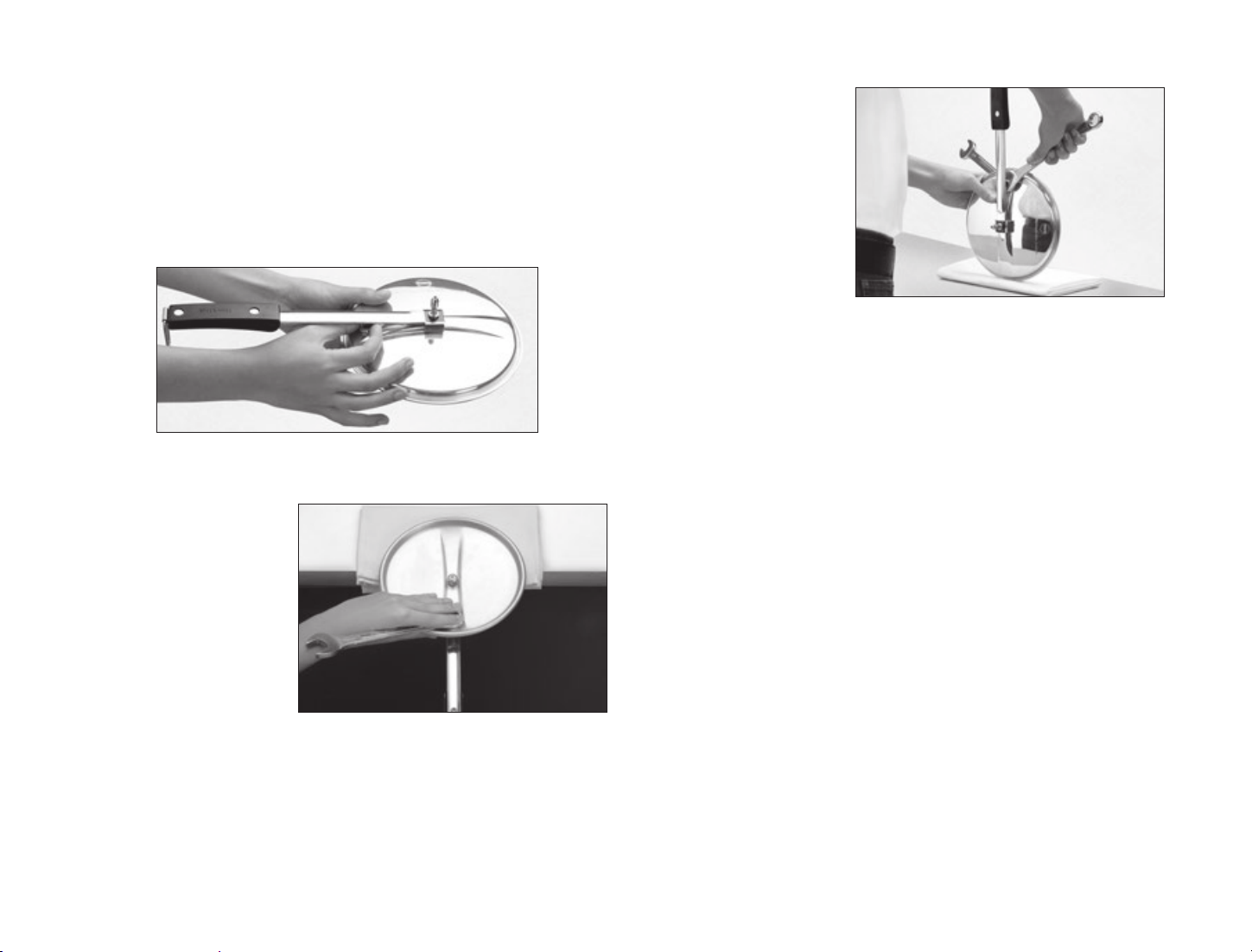
3. Hold the valve and apply a small amount of food compatible
sealant or glue on the valve threads (to prevent any leakage). Push the
valve into the safety valve hole from the underside of the lid and hold
in place with the left hand. Place the washer around the threads of the
valve on the top surface of the lid. Place the nut (chamfered side up) on
the washer and screw the nut in a clockwise direction with your fingers
until tight (see Picture 4).
4. Wipe off any sealant or glue that may have squeezed out while it is
still fresh and soft.
5. Hold the lid handle
in your right hand and
turn the lid upside
down, that is, with the
underside of the lid
facing you and the top
side of the lid lying flat
on the soft, folded cloth
on a table. With the left
hand, position the ring
end of one spanner around the valve on the underside of the lid and
hold it in place with the fingers of the left hand while grasping the lid
with the same hand (see Picture 5).
6. Raise the lid
vertically, holding the lid
with your left hand with
the ring spanner in place
on the safety valve (to
stop its rotation when
you tighten the nut).
Now the underneath of
the lid will be away from
you and the top of the lid
will be facing you. With the right hand, position the second spanner
around the nut under the lid handle bar at an upward angle and exert
downward pressure on the spanner (see Picture 6). Tighten the nut
securely by repeating the downward strokes of the spanner until the
nut stops moving.
Replacement of Plastic Handles
The subsidiary body handle and the body handle are replaceable
by unscrewing the existing handle and screwing on the replacement
handle with a screwdriver. For the body handle: place the two halves
of plastic body handle on either side of the metal bracket. Join them
together, insert studs and tighten the screws into studs from the
opposite side.
If the subsidiary or the body handle is difficult to unscrew, a second
person holding the cooker body firmly while one person turns the
handle screws anti-clockwise will make it easier.
•
PICTURE 4
PICTURE 5
PICTURE 6
38
Hawkins Hevibase IM_Issue 2_Sep 2015.indd 38 28-09-2015 15:18:42

RECIPES
Indian
1
∕2 cup
/
120 ml vegetable oil
1
∕2 cup
/
110 g ghee
1 medium (3
1
∕2 oz
/
100 g) onion sliced
2 lemons cut into wedges
1. In a pan, roast together pomegranate and cumin seeds (see
page 62) and grind to a powder.
2. Pour water in cooker. Add chana, 1 tbsp + 1 tsp
/
20 ml salt,
cardamoms, cinnamon and cloves. Stir.
3. Close cooker. Bring to full pressure on high heat. Reduce heat and
cook 18 minutes.
4. Remove cooker from heat. Allow to cool naturally.
5. Open cooker. Drain off cooking liquid and reserve. Add
pomegranate-cumin mixture, coriander, garam masala and mango
powders, remaining salt (1 tbsp +
1
∕2 tsp
/
17.5 ml) and pepper. Mix
till chana are evenly coated with spices. Sprinkle chillies and ginger on
top.
6. In a pan, heat oil and ghee together about 3 minutes and pour
evenly over chana. Add cooking liquid.
7. Place cooker with chana on medium heat and cook till liquid dries
up and oil shows separately (about 10 minutes), stirring occasionally.
8. Remove cooker from heat. Transfer chana onto a serving dish.
Serve hot, garnished with onion and lemons.
•
Chana Pindi
(Chickpeas – Rawalpindi Style)
Serves 12 Pressure Cooking Time 18 minutes
2
1
∕2 tbsp
/
37.5 ml pomegranate seeds
2 tbsp
/
30 ml cumin seeds
4 cups
/
960 ml water
4 cups
/
800 g kabuli chana soaked overnight
or in hot water for 2 hours
and drained
2
1
∕2 tbsp
/
37.5 ml salt
4 brown cardamoms
5 x 1 inch
/
2.5 cm sticks cinnamon
10 cloves
1
∕4 cup
/
60 ml coriander powder
2 tsp
/
10 ml garam masala powder
(see page 61)
3 tbsp
/
45 ml mango powder
2
1
∕2 tsp
/
12.5 ml pepper
6 green chillies slit
1 x 1
1
∕2 inch
/
3.8 cm piece fresh ginger cut into thin strips
(
1
∕2 oz
/
15 g)
39
Hawkins Hevibase IM_Issue 2_Sep 2015.indd 39 28-09-2015 15:18:42

40
Chola Dal
(Bengal Gram with Coconut)
Serves 8 Pressure Cooking Time 9 minutes
2 tbsp
/
30 ml ghee
1
∕4 cup
/
60 ml coconut cut into
1
∕8 inch
/
3 mm
thick
1
∕4 inch
/
6 mm squares
1
∕4 cup + 1 tbsp
/
75 ml mustard oil
4 whole dry red chillies
3 bay leaves
6 cloves
1 x 2 inch
/
5 cm stick cinnamon
4 green cardamoms
1 tsp
/
5 ml cumin seeds
1 x 1 inch
/
2.5 cm piece fresh ginger chopped
(
1
∕3 oz
/
10 g)
6 green chillies slit
2 tsp
/
10 ml jaggery packed firmly
2 cups
/
400 g chana dal
1 tsp
/
5 ml turmeric
1 tbsp +
1
∕2 tsp
/
17.5 ml salt
3
1
∕4 cups
/
780 ml water
1. In a pan, heat 1 tbsp
/
15 ml ghee about 1 minute. Add coconut
pieces and fry till light brown. Remove and keep aside.
2. Heat oil in cooker about 2 minutes. Add red chillies, bay leaves,
cloves, cinnamon, cardamoms and cumin seeds. Stir a few seconds.
Add fried coconut and all other ingredients except water and remaining
ghee (1 tbsp
/
15 ml). Stir and fry about 2 minutes. Add water. Stir.
3. Close cooker. Bring to full pressure on high heat. Reduce heat and
cook 9 minutes.
4. Remove cooker from heat. Allow to cool naturally.
5. Open cooker. Warm remaining ghee (1 tbsp
/
15 ml) and pour
evenly over dal. Serve hot.
•
Mixed Vegetable Pulao
Serves 8 Pressure Cooking Time 3 minutes
1
∕4 cup + 3 tbsp
/
105 ml vegetable oil
1 tsp
/
5 ml cumin seeds
2 bay leaves
1 x 2 inch
/
5 cm stick cinnamon
4 brown cardamoms
5 cloves
3 medium (9 oz
/
250 g) carrots cut into strips 1 inch
/
2.5 cm long and about
1
∕4 inch
/
6 mm wide
3
∕4 cup
/
90 g green beans cut diagonally into
thin strips 1 inch
/
2.5 cm long
1 cup
/
150 g peas shelled or frozen
3 cups
/
600 g Basmati rice washed and
drained
1 tbsp + 1 tsp
/
20 ml salt
3
1
∕2 cups
/
840 ml water
Hawkins Hevibase IM_Issue 2_Sep 2015.indd 40 28-09-2015 15:18:42

41
1. Heat oil in cooker about 2 minutes. Add cumin seeds, bay
leaves, cinnamon, cardamoms and cloves. Stir a few seconds. Add
carrots, beans and peas. Stir and fry about 2 minutes. Add rice. Fry till
rice turns opaque (about 3 minutes). Add salt and water. Stir.
2. Close cooker. Bring to full pressure on high heat. Reduce heat and
cook 3 minutes.
3. Remove cooker from heat. Allow to cool naturally 5 minutes.
Release pressure with slight lifting of vent weight.
4. Open cooker. Serve hot.
•
Ma ki Dal
(Whole Black Gram)
Serves 10 Pressure Cooking Time 50 minutes
6
1
∕2 cups
/
1.6 litres water
1
1
∕4 cups
/
250 g sabat urad
1
∕4 cup
/
60 ml rajma "quick soaked" 1 hour
(see page 28) and drained
2 medium (7 oz
/
200 g) tomatoes chopped
1 x
1
∕2 inch
/
1.3 cm piece fresh ginger cut into thin strips
(
1
∕6 oz
/
5 g)
6 small cloves garlic chopped
4 green chillies chopped
2 whole
dry
Kashmiri
red
chillies
(see page 62)
1
1
∕2 tbsp
/
22.5 ml salt
1
∕2 tsp
/
2.5 ml red chilli powder
1 tbsp
/
15 ml ghee
Tempering
2 tbsp
/
30 ml ghee
1 small (1
3
∕4 oz
/
50 g) onion chopped
1 x
1
∕2 inch
/
1.3 cm piece fresh ginger finely chopped
(
1
∕6 oz
/
5 g)
1
∕2 tsp
/
2.5 ml red chilli powder
1. Pour water in cooker. Bring to boil on high heat. Add remaining
ingredients except those for Tempering. Stir.
2. Close cooker. Bring to full pressure on high heat. Reduce heat and
cook 50 minutes.
3. Remove cooker from heat. Allow to cool naturally.
4. Open cooker. Partially mash dal with back of a ladle.
5. Place cooker with dal on low heat. Simmer to obtain a creamy
consistency (about 7 minutes), stirring occasionally.
6. Tempering: In a pan, heat ghee about 1 minute. Add onion
and fry till transparent. Add ginger and continue frying till onion is
golden brown (see page 61, Frying onions in Indian recipes).
Remove pan from heat. Add chilli powder and pour evenly over dal.
Serve hot.
•
Hawkins Hevibase IM_Issue 2_Sep 2015.indd 41 28-09-2015 15:18:42

Rogan Josh
(Mutton in Rich Gravy)
Serves 8 Pressure Cooking Time 12 minutes
1 tbsp
/
15 ml coriander seeds
2 tsp
/
10 ml cumin seeds
1 tbsp
/
15 ml poppy seeds
16 almonds shelled
2 brown cardamoms seeds taken
out and kept, pods discarded
1
∕4 tsp
/
1.3 ml peppercorns
4 cloves
a large pinch mace
2 tbsp
/
30 ml coconut grated
5 whole
dry
Kashmiri
red
chillies
(see page 62) soaked in
1
∕2 cup
/
120 ml hot water for 15 minutes,
water drained and reserved
1 x 2 inch
/
5 cm piece fresh ginger
(
2
∕3 oz
/
20 g)
8 small cloves garlic
a large pinch nutmeg grated
1
∕2 cup
/
120 ml vegetable oil
2 bay leaves
1 x 1 inch
/
2.5 cm stick cinnamon
5 green cardamoms cracked just
till a seam opens slightly
2 medium (9 oz
/
250 g) onions grated
2 medium (7 oz
/
200 g) tomatoes chopped
1 tsp
/
5 ml turmeric
1 tbsp
/
15 ml red chilli powder
3
∕4 cup
/
180 ml curd beaten
2
3
∕4 lb
/
1.2 kg mutton shoulder cut into
1
1
∕2 inch
/
3.8 cm pieces
1 tbsp + 1 tsp
/
20 ml salt
1 cup
/
240 ml water
1. In a pan, roast together coriander, cumin and poppy seeds,
almonds, brown cardamom seeds, peppercorns, cloves, mace, coconut
(see page 62) and grind into a paste with whole chillies, ginger,
garlic and nutmeg, adding a little water in which chillies were soaked
(
1
∕2 cup
/
120 ml) from time to time.
2. Heat oil in cooker about 2 minutes. Add bay leaves, cinnamon and
green cardamoms. Stir a few seconds. Add onions and fry till golden
brown (see page 61, Frying onions in Indian recipes). Add ground
paste, tomatoes, turmeric and chilli powder. Mix.
3. Add 1 tbsp
/
15 ml curd. Stir and fry until curd is well blended
(about
1
∕2 minute). Add remaining curd (
1
∕2 cup + 3 tbsp
/
165 ml)
in the same way, a tablespoon at a time, till all curd is used. Fry till
oil shows separately (about 3 minutes). Add meat and salt. Boil
10 minutes, stirring constantly. Add water. Mix.
4. Close cooker. Bring to full pressure on high heat. Reduce heat and
cook 12 minutes.
5. Remove cooker from heat. Allow to cool naturally.
6. Open cooker. Serve hot.
•
42
Hawkins Hevibase IM_Issue 2_Sep 2015.indd 42 28-09-2015 15:18:42

Sambar
(Red Gram and Vegetable Curry – Tamil
Style)
Serves 8 Pressure Cooking Time 4 minutes
1
∕4 cup + 1 tbsp
/
25 g tamarind seeds removed before
measuring
1 cup
/
240 ml hot water
1
1
∕2 tbsp
/
22.5 ml vegetable oil
6 whole dry red chillies
3 whole
dry
Kashmiri
red
chillies
(see page 62)
1 tbsp
/
15 ml chana dal
1 x
1
∕2 inch
/
1.3 cm piece asafoetida
1
∕2 cup
/
40 g coconut grated
2 sprigs curry leaves
1
∕4 cup
/
60 ml coriander seeds
1
∕2 tsp
/
2.5 ml cumin seeds
1
∕2 tsp
/
2.5 ml fenugreek seeds
5
1
∕2 cups
/
1.3 litres water
1 cup
/
200 g tuvar dal
1
∕2 tsp
/
2.5 ml turmeric
1 tbsp + 1 tsp
/
20 ml salt
1 medium (3
1
∕2 oz
/
100 g) onion cut into 6 pieces
2 drumsticks cut into 2 inch
/
5 cm long pieces
Tempering
2 tbsp
/
30 ml vegetable oil
1
∕2 tsp
/
2.5 ml mustard seeds
1. Put tamarind in a stainless steel or glass bowl. Add hot water.
Keep covered 30 minutes. To extract tamarind pulp: Place a sieve
over a stainless steel or glass bowl. Put soaked tamarind into sieve,
reserving liquid. Push tamarind through sieve adding a little of the
reserved liquid from time to time. Scrape pulp off sieve into the bowl.
Using all reserved liquid, keep rubbing tamarind through sieve till all
pulp has been extracted. Discard tamarind in sieve.
2. In a pan, heat oil on medium heat about 1 minute and roast
together whole chillies, chana dal, asafoetida, coconut, 1 sprig curry
leaves, coriander, cumin and fenugreek seeds till coconut turns golden
brown (see page 62).
3. Grind roasted ingredients into a paste, adding a little water
(
1
∕2 cup
/
120 ml) from time to time.
4. Pour 3 cups
/
720 ml water in cooker. Add tuvar dal, turmeric and
salt. Stir.
5. Close cooker. Bring to full pressure on high heat. Reduce heat and
cook 4 minutes.
6. Remove cooker from heat. Allow to cool naturally.
7. Open cooker. Mash dal completely with back of a ladle to blend
with liquid. Add tamarind pulp, ground paste, onion, drumsticks,
remaining curry leaves (1 sprig) and water (2 cups
/
480 ml). Stir.
8. Close cooker. Bring to full pressure on high heat. Remove cooker
immediately from heat. Release pressure by placing cooker in up to
4 inches
/
10 cm of cold water in a basin or in a sink for a few minutes
(see page 15, Releasing Pressure, point 3). Open cooker.
9. Tempering: In a pan, heat oil about 1 minute. Add mustard seeds.
When crackling, pour into sambar. Stir and serve hot.
•
43
Hawkins Hevibase IM_Issue 2_Sep 2015.indd 43 28-09-2015 15:18:43

44
Mutton Biryani
(Rice Layered with Spicy Mutton –
Moghul Style)
Serves 6 Pressure Cooking Time 10 minutes
1 x 2 inch
/
5 cm piece fresh ginger
(
2
∕3 oz
/
20 g)
13 small cloves garlic
5 green chillies
5
1
∕4 cups + 2 tbsp
/
1.3 litres water
*
1
1
∕3 lb
/
600 g mutton leg cut into 1
1
∕2 inch
/
3.8 cm pieces
1 medium (3
1
∕2 oz
/
100 g) tomato chopped
2 tbsp
/
30 ml lemon juice
1 tbsp + 2
1
∕2 tsp
/
27.5 ml salt
2
1
∕2 tsp
/
12.5 ml red chilli powder
2
1
∕2 tsp
/
12.5 ml cumin powder
1 tbsp +
3
∕4 tsp
/
20 ml garam masala powder
(see page 61)
1
1
∕2 tbsp
/
22.5 ml coriander leaves chopped
2 tbsp
/
30 ml mint leaves chopped
1 cup
/
240 ml curd beaten
1 cup
/
240 ml vegetable oil
2 medium (9 oz
/
250 g) potatoes cut into 1
1
∕2 inch
/
3.8 cm long, 1
1
∕2 inch
/
3.8 cm
wide and 1 inch
/
2.5 cm thick
pieces (see page 60)
*
To cook reduced quantities:
do not reduce water in step 9
(
1
∕4 cup
/
60 ml) at all.
3 large (1 lb
/
450 g) onions thinly sliced
a large pinch saffron threads
1
∕4 cup
/
60 ml milk
3 green cardamoms
4 cloves
1 bay leaf
1 x 1 inch
/
2.5 cm stick cinnamon
2 cups
/
400 g Basmati rice
1
∕4 cup + 3
1
∕2 tbsp
/
100 g ghee or vegetable oil
(115 ml)
1
∕4 tsp
/
1.3 ml cumin seeds
6 almonds blanched, skins
removed and halved lengthwise
1. Grind into a paste ginger, garlic and chillies, gradually adding
2 tbsp
/
30 ml water.
2. In a bowl, rub ginger paste all over mutton. Add tomato, lemon
juice, 2
1
∕2 tsp
/
12.5 ml salt, chilli, cumin and garam masala powders,
coriander and mint leaves and curd. Mix. Cover and keep aside 4 hours
or in refrigerator overnight.
3. In a deep-frying pan, heat oil about 5 minutes. Add potatoes. Fry
till light brown (about 3 minutes), stirring occasionally. Remove and
drain. Remove mutton-curd mixture from refrigerator. Add potatoes.
Mix.
4. Divide onions into 2 batches. Add half onions and
1
∕4 tsp
/
1.3 ml
salt to oil remaining in pan. Fry till golden brown and crisp. Remove
and drain. Fry remaining onions with
1
∕4 tsp
/
1.3 ml salt in the same
way. Reserve 2 tbsp
/
30 ml fried onions. Crumble remaining onions.
Add to mutton-curd mixture. Mix.
5. In a small bowl, stir saffron and milk. Keep aside.
Hawkins Hevibase IM_Issue 2_Sep 2015.indd 44 28-09-2015 15:18:43

45
6. Pour 5 cups water in cooker. Bring to boil on high heat. Add
remaining salt (2
1
∕2 tsp
/
12.5 ml), cardamoms, cloves, bay leaf,
cinnamon and rice. Stir.
7. Close cooker. Bring to full pressure on high heat. Remove cooker
immediately from heat. Release pressure by placing cooker in up to
4 inches
/
10 cm of cold water in a basin or in a sink for a few minutes
(see page 15, Releasing Pressure, point 3).
8. Open cooker. Immediately transfer rice to a colander and drain.
Wash and wipe dry cooker.
9. Heat
1
∕4 cup + 1
1
∕2 tbsp
/
75 g ghee in cooker about 2 minutes.
Add mutton with curd mixture. Mix. Add remaining water (
1
∕4 cup
/
60 ml). Stir.
10. Remove cooker from heat. Place rice evenly on mutton. Dribble
saffron milk over rice.
11. In a small pan, heat remaining ghee (2 tbsp
/
30 ml) on medium
heat about 2 minutes. Add cumin seeds. When cumin seeds begin to
darken, immediately pour over rice in cooker.
12. Close cooker. Bring to full pressure on high heat. Reduce heat and
cook 10 minutes.
13. Remove cooker from heat. Allow to cool naturally 10 minutes.
Release pressure with slight lifting of vent weight.
14. Open cooker. Place rice on a serving dish. Put mutton and gravy
on rice. Garnish with reserved onions and almonds.
•
Illish Sarse Bata
(Hilsa Fish in Mustard)
Serves 3 Pressure Cooking Time 2 minutes
1
2
∕3 lb
/
750 g Hilsa fish cut into
1
∕2 inch
/
1.3 cm thick slices
1
1
∕2 tsp
/
7.5 ml salt
3
∕4 tsp
/
3.8 ml turmeric
2 tbsp
/
30 ml mustard seeds
6 green chillies 3 whole, 3 slit
1
∕2 cup + 2 tbsp
/
150 ml water
2 tsp
/
10 ml curd
1
∕4 cup
/
60 ml mustard oil
1. Rub fish with salt and turmeric.
2. Grind together mustard seeds and whole chillies into a paste,
adding a little water (2 tbsp
/
30 ml) from time to time. Blend curd
with ground paste and mix with fish.
3. Heat 3 tbsp
/
45 ml oil in cooker about 3 minutes. Add fish
with paste, slit chillies, remaining water (
1
∕2 cup
/
120 ml) and oil
(1 tbsp
/
15 ml).
4. Close cooker. Bring to full pressure on high heat. Reduce heat and
cook 2 minutes.
5. Remove cooker from heat. Release pressure with slight lifting of
vent weight.
6. Open cooker. Serve hot.
•
Hawkins Hevibase IM_Issue 2_Sep 2015.indd 45 28-09-2015 15:18:43

Khichuri
(Soft Rice with Green Gram and
Vegetables)
Serves 10 Pressure Cooking Time 4 minutes
1 x 2 inch
/
5 cm piece fresh ginger
(
2
∕3 oz
/
20 g)
10 small cloves garlic
6 green cardamoms seeds taken
out and kept, pods discarded
1 x 2 inch
/
5 cm stick cinnamon
4 cloves
8 cups + 1 tsp
/
1.9 litres water
1 cup
/
200 g moong dal unwashed
1
∕2 cup
/
120 ml mustard oil
4 bay leaves
2 tsp
/
10 ml cumin seeds
1 large (5 oz
/
140 g) onion chopped
1 cup
/
200 g Basmati rice
1 small head (10
1
∕2 oz
/
290 g) cauliflower cut into flowerettes
of about 1 inch
/
2.5 cm
2 medium (7 oz
/
200 g) potatoes cut into 1
1
∕2 inch
/
3.8 cm long, 1
1
∕2 inch
/
3.8 cm
wide and
3
∕4 inch
/
1.9 cm thick
pieces (see page 60)
1 cup
/
150 g peas shelled or frozen
1
∕2 tsp
/
2.5 ml turmeric
2 tbsp
/
30 ml coriander powder
1 tbsp
/
15 ml red chilli powder
2 tsp
/
10 ml sugar
1 tbsp + 1 tsp
/
20 ml salt
2 tbsp
/
30 ml ghee
1. Grind together ginger and garlic into a paste.
2. Separately grind together cardamom seeds, cinnamon and cloves
into a paste adding a little water (1 tsp
/
5 ml) from time to time.
3. In a pan, stir moong dal constantly on medium heat till dal turns
golden brown (about 7 minutes). Remove from heat, spread dal on a
plate and allow to cool. Wash dal.
4. Heat oil in cooker about 5 minutes. Add bay leaves and cumin
seeds. Stir a few seconds. Add onion and fry till golden brown (see
page 61, Frying onions in Indian recipes). Add ginger-garlic paste.
Stir a few seconds. Add washed dal, rice and all other ingredients
except water, ground spices and ghee. Mix. Add remaining water
(8 cups
/
1.9 litres). Stir.
5. Close cooker. Bring to full pressure on high heat. Reduce heat and
cook 4 minutes.
6. Remove cooker from heat. Allow to cool naturally.
7. Open cooker. Stir in ground spices. Warm ghee and pour evenly
over khichuri. Serve hot.
•
46
Hawkins Hevibase IM_Issue 2_Sep 2015.indd 46 28-09-2015 15:18:43

Hirva Masalyachi Bhaji
(Vegetables in Green Masala)
Serves 10 Pressure Cooking Time 2 minutes
2
1
∕2 cups
/
200 g coconut coarsely grated
3
1
∕2 cups
/
840 ml water
2 medium (9 oz
/
250 g) onions
2
1
∕4 tsp
/
11.3 ml aniseed
8 green chillies
1 cup
/
50 g coriander leaves chopped
6 cloves
1 x 2 inch
/
5 cm stick cinnamon
4 brown cardamoms seeds
taken out and kept, pods
discarded
1
∕4 cup + 3 tbsp
/
105 ml vegetable oil
2 medium (9 oz
/
250 g) onions thinly sliced
3 large (1 lb
/
450 g) potatoes cut into 1
1
∕2 inch
/
3.8 cm long, 1
1
∕2 inch
/
3.8 cm
wide and
3
∕4 inch
/
1.9 cm thick
pieces (see page 60)
1
1
∕2 cups
/
225 g peas shelled or frozen
5 medium (14 oz
/
400 g) carrots quartered lengthwise
and cut into 1 inch
/
2.5 cm
pieces
1
1
∕4 cups
/
150 g green beans cut into 1 inch
/
2.5 cm pieces
1 small head (14 oz
/
400 g) cauliflower cut into flowerettes
of about 1 inch
/
2.5 cm
2 tbsp
/
30 ml salt
1 tbsp
/
15 ml lemon juice
1. Extract 1
1
∕2 cups
/
360 ml milk from coconut using 1
1
∕2 cups
/
360 ml water (see page 60).
2. Grind together onions, aniseed, chillies and coriander leaves into
a paste.
3. In a pan, roast together cloves, cinnamon, cardamom seeds (see
page 62) and grind to a powder.
4. Heat oil in cooker about 2 minutes. Add sliced onions and fry
till golden brown (see page 61, Frying onions in Indian recipes).
Add ground paste. Stir and fry about 2 minutes. Add potatoes, peas,
carrots, beans and cauliflower. Stir and fry about 2 minutes. Add
powdered spices and salt. Stir a few seconds. Add remaining water
(2 cups
/
480 ml). Stir.
5. Close cooker. Bring to full pressure on high heat. Reduce heat and
cook 2 minutes.
6. Remove cooker from heat. Release pressure with slight lifting of
vent weight.
7. Open cooker.
8. Place cooker with vegetables on medium heat. Add coconut milk
and bring to boil, stirring carefully.
9. Remove cooker from heat. Stir in lemon juice. Serve hot.
•
47
Hawkins Hevibase IM_Issue 2_Sep 2015.indd 47 28-09-2015 15:18:43

Rajma
(Kidney Bean Curry)
Serves 10 Pressure Cooking Time 20 minutes
1 x 1 inch
/
2.5 cm piece fresh ginger
(
1
∕3 oz
/
10 g)
12 small cloves garlic
1
∕2 cup
/
120 ml vegetable oil
3 whole
dry
Kashmiri
red
chillies
(see page 62)
2 large (10
1
∕2 oz
/
290 g) onions grated
3 large (1 lb
/
450 g) tomatoes chopped
1 tbsp
/
15 ml red chilli powder
1 tbsp + 2
1
∕2 tsp
/
27.5 ml salt
2
1
∕2 cups
/
500 g rajma
*
soaked overnight
or "quick soaked" 1 hour
(see page 28) and drained
4
1
∕4 cups
/
1 litre water
1 tsp
/
5 ml garam masala powder
(see page 61)
1. Grind together ginger and garlic into a paste.
2. Heat oil in cooker about 3 minutes. Add chillies. Stir a few seconds.
Add onions and fry till golden brown (see page 61, Frying onions
in Indian recipes). Add ginger-garlic paste. Stir a few seconds.
Add tomatoes, chilli powder and salt. Cook till tomatoes are pulpy
and oil shows separately (about 5 minutes), stirring occasionally. Add
rajma and water. Mix.
*
Some varieties of rajma may take longer to cook (up to double the
time) than stated in the recipe. If the gravy thickens too much, add
water as desired after cooking.
3. Close cooker. Bring to full pressure on high heat. Reduce heat and
cook 20 minutes.
4. Remove cooker from heat. Allow to cool naturally.
5. Open cooker. Partially mash rajma with back of a ladle till gravy is
creamy. Stir in garam masala powder. Serve hot.
•
Gajar Halwa
(Carrot Pudding)
Serves 12 Pressure Cooking Time 0 minute
10 large (4 lb
/
1.8 kg) red carrots grated
1
∕4 cup
/
60 ml milk
2 cups
/
400 g sugar
2
2
∕3 cups
/
400 g mava crumbled
1
∕4 cup + 3 tbsp
/
90 g ghee
20 almonds blanched, skins
removed and sliced
1. Put carrots and milk in cooker.
2. Close cooker. Bring to full pressure on high heat. Remove cooker
immediately from heat. Release pressure with slight lifting of vent
weight. Open cooker.
3. Place open cooker with carrots and milk on high heat. Add sugar.
Cook till liquid dries up (about 15 minutes), stirring occasionally. Add
mava and ghee. Cook till ghee shows separately (about 10 minutes),
stirring constantly. Serve hot, garnished with almonds.
•
48
Hawkins Hevibase IM_Issue 2_Sep 2015.indd 48 28-09-2015 15:18:43

Kozhi Kuttan
(Chicken Curry – Kerala Style)
Serves 8 Pressure Cooking Time 7 minutes
3
1
∕4 lb
/
1.5 kg chicken pieces
1
1
∕2 tsp
/
7.5 ml turmeric
1 tbsp + 1 tsp
/
20 ml salt
1 tbsp
/
15 ml curd
2
1
∕2 cups
/
200 g coconut coarsely grated
2
1
∕4 cups
/
540 ml water
1
∕4 cup
/
60 ml coconut oil
5 whole
dry
Kashmiri
red
chillies
(see page 62)
6 whole dry red chillies
1 x 1 inch
/
2.5 cm piece fresh ginger chopped
(
1
∕3 oz
/
10 g)
16 small cloves garlic
1
∕2 tsp
/
2.5 ml peppercorns
1 tsp
/
5 ml aniseed
1 x 2 inch
/
5 cm stick cinnamon
10 cloves
3 green cardamoms seeds taken
out and kept, pods discarded
1
∕4 cup + 1 tbsp
/
25 g coriander seeds
1
∕2 tsp
/
2.5 ml cumin seeds
2 medium (9 oz
/
250 g) onions chopped
2 green chillies slit
2 medium (7 oz
/
200 g) tomatoes puréed (see page 62)
1. Rub chicken pieces with 1 tsp
/
5 ml turmeric, 1 tsp
/
5 ml salt and
curd. Keep aside.
2. Extract 1 cup
/
240 ml thick milk from coconut using 1 cup
/
240 ml water. Add
3
∕4 cup
/
180 ml water to the same coconut and
extract
3
∕4 cup
/
180 ml thin milk (see page 60).
3. In a pan, heat 1 tbsp
/
15 ml coconut oil on medium heat about
1
∕2 minute. Roast all other ingredients (see page 62) except onions,
green chillies and tomato purée. Grind together roasted ingredients
into a paste, adding a little water (
1
∕2 cup
/
120 ml) from time to time.
4. Heat remaining oil (3 tbsp
/
45 ml) in cooker about 2 minutes.
Add onions and fry till golden brown (see page 61, Frying onions in
Indian recipes).
5. Add remaining turmeric (
1
∕2 tsp
/
2.5 ml), ground paste, chillies
and tomato purée. Cook about 3 minutes, stirring constantly. Add
chicken and remaining salt (1 tbsp
/
15 ml). Mix. Add thin coconut
milk. Stir.
6. Close cooker. Bring to full pressure on high heat. Reduce heat and
cook 7 minutes.
7. Remove cooker from heat. Allow to cool naturally.
8. Open cooker. Stir in thick coconut milk. Serve hot.
•
49
Hawkins Hevibase IM_Issue 2_Sep 2015.indd 49 28-09-2015 15:18:43

50
Vegetable Biryani
(Rice Layered with Spicy Vegetables)
Serves 7 Pressure Cooking Time 3 minutes
1 x 1
1
∕2 inch
/
3.8 cm piece fresh ginger
(
1
∕2 oz
/
15 g)
10 small cloves garlic
2 green chillies
6 cups + 2 tbsp
/
1.5 litres water
a large pinch saffron threads
1
∕4 cup
/
60 ml milk
1 tbsp + 2 tsp
/
25 ml salt
3 green cardamoms
4 cloves
2 small bay leaves
1 x 1 inch
/
2.5 cm stick cinnamon
2 cups
/
400 g Basmati rice
1
∕4 cup + 1 tbsp
/
75 ml ghee
2 large (10
2
∕3 oz
/
300 g) onions thinly sliced
2 medium (7 oz
/
200 g) potatoes cut into
3
∕4 inch
/
1.9 cm long,
3
∕4 inch
/
1.9 cm
wide and
1
∕2 inch
/
1.3 cm thick
pieces (see page 60)
1 small head (14 oz
/
400 g) cauliflower cut into flowerettes
of about 1 inch
/
2.5 cm (200 g)
1
∕2 +
1
∕8 cup (2
1
∕2 oz
/
75 g) green beans cut into 1 inch
/
2.5 cm pieces
2 medium (5
1
∕3 oz
/
150 g) carrots cut into
1
∕2 inch
/
1.3 cm cubes
2
∕3 cup (3
1
∕2 oz
/
100 g) peas shelled or frozen
1
∕2 tsp
/
2.5 ml red chilli powder
2
1
∕2 tsp
/
12.5 ml cumin powder
1 tsp
/
5 ml garam masala powder
(see page 61)
2 medium (7 oz
/
200 g) tomatoes chopped
1
1
∕2 tbsp
/
22.5 ml coriander leaves chopped,
lightly pressed into tbsp
2 tbsp
/
30 ml mint leaves chopped, lightly
pressed into tbsp
1 tbsp
/
15 ml lemon juice
7 oz
/
200 g paneer cut into
1
∕2 inch
/
1.3 cm
cubes (see page 62)
1
∕4 tsp
/
1.3 ml cumin seeds
6 almonds blanched, skins
removed and halved lengthwise
a few sprigs mint leaves whole for garnish
1. Grind into a paste ginger, garlic and chillies, gradually adding
2 tbsp
/
30 ml water.
2. In a small bowl, stir saffron and milk. Keep aside.
3. Pour 5 cups
/
1.2 litres water in cooker. Bring to boil on high heat.
Add 2
1
∕2 tsp
/
12.5 ml salt, cardamoms, cloves, bay leaves, cinnamon
and rice. Stir.
4. Close cooker. Bring to full pressure on high heat. Remove cooker
immediately from heat. Release pressure by placing cooker in up to
4 inches
/
10 cm of cold water in a basin or in a sink for a few minutes
(see page 15, Releasing Pressure, point 3).
5. Open cooker. Immediately transfer rice to a colander and drain.
Wash and wipe dry cooker.
Hawkins Hevibase IM_Issue 2_Sep 2015.indd 50 28-09-2015 15:18:43

51
6. Heat
1
∕4 cup
/
60 ml ghee in cooker about 2 minutes. Add onions and
fry till golden brown (see page 61, Frying onions in Indian recipes).
Add ginger paste. Stir a few seconds. Add potatoes and cauliflower.
Stir and fry about 3 minutes. Add beans, carrots and peas. Stir and fry
about 2 minutes. Add red chilli, cumin and garam masala powders. Mix.
Add tomatoes, coriander and mint leaves, lemon juice and remaining
salt (2
1
∕2 tsp
/
12.5 ml). Fry about 3 minutes, stirring occasionally. Add
paneer. Mix gently. Add remaining water (1 cup
/
240 ml). Stir.
7. Remove cooker from heat. Place rice evenly on vegetables. Dribble
saffron milk over rice.
8. In a small pan, heat remaining ghee (1 tbsp
/
15 ml) on medium
heat about 2 minutes. Add cumin seeds. When cumin seeds begin to
darken, immediately pour over rice in cooker.
9. Close cooker. Bring to full pressure on high heat. Reduce heat and
cook 3 minutes.
10. Remove cooker from heat. Allow to cool naturally 10 minutes.
Release pressure with slight lifting of vent weight.
11. Open cooker. Place rice on a serving dish. Put vegetables and
gravy on rice. Garnish with almonds and mint leaves.
12. Serve hot with butter or curds.
•
Mansam Chops
(Mutton Chops – Andhra Style)
Serves 10 Pressure Cooking Time 10 minutes
1
∕2 cup
/
40 g coconut grated
1 x 4 inch
/
10 cm piece fresh ginger
(1
1
∕3 oz
/
40 g)
28 small cloves garlic
1
1
∕2 tbsp
/
22.5 ml peppercorns
5 green cardamoms seeds taken
out and kept, pods discarded
8 cloves
1 x 2 inch
/
5 cm stick cinnamon
1 tbsp +
1
∕2 tsp
/
17.5 ml cumin seeds
2
∕3 cup
/
160 ml water
2
3
∕4 lb
/
1.2 kg mutton chops
2 medium (9 oz
/
250 g) tomatoes cut into quarters
1
∕2 tsp
/
2.5 ml turmeric
3
∕4 cup
/
180 ml vegetable oil
2 sprigs curry leaves
6 green chillies sliced
1
∕4 cup
/
60 ml cashew nuts broken into pieces
4 medium (14 oz
/
400 g) onions sliced
1
1
∕2 tbsp
/
22.5 ml salt
1. Grind together coconut, ginger, garlic, peppercorns, cardamom
seeds, cloves, cinnamon and cumin seeds into a paste, adding a little
water (
2
∕3 cup
/
160 ml) from time to time.
2. Put chops, tomatoes and turmeric in cooker. Mix.
3. Close cooker. Bring to full pressure on high heat. Reduce heat
and cook 10 minutes.
4. Remove cooker from heat. Allow to cool naturally.
5. Open cooker. Remove chops. Reserve cooking liquid.
6. In a pan, heat oil about 3 minutes. Add curry leaves, chillies,
cashew nuts and onions. Fry till onions are light golden. Add ground
paste. Stir and fry about 3 minutes. Add cooking liquid and salt. Cook
till liquid dries up and oil shows separately (about 5 minutes), stirring
constantly. Add chops. Stir fry about 5 minutes. Serve hot.
•
Hawkins Hevibase IM_Issue 2_Sep 2015.indd 51 28-09-2015 15:18:43

Masala Gobi
(Spicy Cauliflower)
Serves 12 Pressure Cooking Time 2 minutes
11
1
∕4 cups
/
2.7 litres water
3 tbsp + 2 tsp
/
55 ml salt
3 medium heads (4
1
∕4 lb
/
2 kg) cauliflower cut into 1
1
∕4-1
1
∕2 inch
/
3-4 cm flowerettes with
1
∕2 inch
/
1 cm stalks; cut remaining
tender stalks into
1
∕2 inch
/
1 cm
cubes (1.2 kg)
2
1
∕2 tbsp
/
37.5 ml poppy seeds
1
∕4 cup + 1 tbsp
/
50 g cashew nuts broken into
pieces
1 x 2
1
∕2 inch
/
6.3 cm piece fresh ginger
(
5
∕6 oz
/
25 g)
15 small cloves garlic
5 green chillies
1
1
∕4 cups
/
300 ml vegetable oil
5 large (1
2
∕3 lb
/
750 g) onions grated
4 medium (1 lb 6 oz
/
625 g) tomatoes blanched,
skins removed and chopped
1
1
∕4 tsp
/
6.3 ml turmeric
2
1
∕2 tsp
/
12.5 ml coriander powder
1
1
∕4 tsp
/
6.3 ml cumin powder
2
1
∕2 tsp
/
12.5 ml red chilli powder
1
1
∕4 cups
/
300 ml curd beaten
2
1
∕2 tbsp
/
37.5 ml coriander leaves chopped
1. In a bowl, add 9
1
∕2 cups
/
2.3 litres water with 1 tbsp + 2 tsp
/
25 ml
salt. Put cauliflower in bowl and keep about 30 minutes. Drain.
2. Grind together poppy seeds and cashew nuts into a paste,
gradually adding
1
∕2 cup
/
120 ml water time to time.
3. Separately grind together ginger, garlic and green chillies into a
paste.
4. Heat oil in cooker about 2 minutes. Add onions and fry till golden
brown (see page 61, Frying onions in Indian recipes).
5. Add ginger paste, tomatoes, turmeric, coriander, cumin and red
chilli powders and remaining salt (2 tbsp
/
30 ml). Cook till tomatoes
are pulpy, stirring occasionally.
6. Add 1 tbsp
/
15 ml curd. Stir and fry until curd is well blended (about
1
∕2 minute). Add remaining curd in the same way, a tablespoon
at a time, till all curd is used. Stir and fry till oil shows separately (about
3 minutes).
7. Add cauliflower. Stir fry about 5 minutes. Add remaining water
(1
1
∕4 cups
/
300 ml). Mix.
8. Close cooker. Bring to full pressure on high heat. Reduce heat and
cook 2 minutes.
9. Remove cooker from heat. Release pressure with slight lifting
of vent weight.
10. Open cooker. Add cashew nut paste. Return cooker to medium
heat. Cook about 2 minutes, stirring gently. Serve hot, garnished with
coriander leaves.
•
52
Hawkins Hevibase IM_Issue 2_Sep 2015.indd 52 28-09-2015 15:18:43

53
Vegetable Stock
Yield: 5 cups Pressure Cooking Time 15 minutes
1 medium (5 oz
/
140 g) carrot unpeeled, cut into
1 inch
/
2.5 cm pieces
1 medium (5 oz
/
140 g) onion thickly sliced
1 small (5 oz
/
140 g) turnip unpeeled, cut into
1 inch
/
2.5 cm pieces
2 stalks celery with leaves cut into
2 inch
/
5 cm pieces
3 sprigs parsley
10 pea pods emptied
1 bay leaf
1 clove garlic
2 tsp
/
10 ml salt
1
∕2 tsp
/
2.5 ml dried thyme leaves
4 peppercorns
6 cups
/
1.4 litres water
1. Put all ingredients in cooker. Stir.
2. Close cooker. Bring to full pressure on high heat. Reduce heat and
cook 15 minutes.
3. Remove cooker from heat. Allow to cool naturally.
4. Open cooker. Strain stock through a fine sieve.
•
International Recipes
Tomato Soup
Serves 6 Pressure Cooking Time 10 minutes
4 large (2
1
∕4 lb
/
1 kg) ripe tomatoes cores removed
2 medium (10 oz
/
280 g) onions sliced
2 medium (10 oz
/
280 g) carrots cut into
1
∕2 inch
/
1.3 cm slices
3 cups
/
720 ml water
2 tbsp
/
30 ml lemon juice
1 tbsp
/
15 ml sugar
2
1
∕2 tsp
/
12.5 ml salt
1
∕8 tsp
/
0.6 ml pepper
1
∕4 cup
/
60 ml butter
1. Put tomatoes, onions, carrots and water in cooker.
2. Close cooker. Bring to full pressure on high heat. Reduce heat and
cook 10 minutes.
3. Remove cooker from heat. Allow to cool naturally.
4. Open cooker. Mix the soup smooth in a blender or mash it through
a sieve.
5. Return soup to cooker.
6. Place cooker on high heat and bring to boil. Add lemon juice,
1 tsp
/
5 ml sugar, 1 tsp
/
5 ml salt and pepper. Stir.
7. Reduce heat to low. Simmer 10 minutes, stirring occasionally. Add,
according to taste, remaining sugar (2 tsp
/
10 ml) and remaining salt
(1
1
∕2 tsp
/
7.5 ml). Stir.
8. Bring
to
boil
on
high
heat.
Add
butter.
Stir
till
melted.
Serve
hot.
•
Hawkins Hevibase IM_Issue 2_Sep 2015.indd 53 28-09-2015 15:18:44

Minestrone Soup
Serves 6 Pressure Cooking Time 11 minutes
1 tbsp
/
15 ml olive oil
1 medium (6 oz
/
170 g) onion chopped
1 clove garlic crushed
1
∕2 cup
/
100 g kidney beans soaked overnight
or in hot water for 2 hours
and drained
5 cups
/
1.2 litres vegetable stock (see recipe
page 53)
1
∕3 cup
/
40 g macaroni
a pinch sage ground
1 medium (4 oz
/
115 g) carrot cut into
1
∕4 inch
/
6 mm
pieces
1 large (11 oz
/
310 g) potato cut into 1 inch
/
2.5 cm
long,
1
∕2 inch
/
1.3 cm wide and
1
∕2 inch
/
1.3 cm thick pieces
(see page 60)
1 small (3 oz
/
85 g) zucchini chopped
2 medium (10 oz
/
280 g) tomatoes chopped or 1 can
(14
1
∕2 oz
/
415 g) precut,
peeled tomatoes
1
∕2 cup
/
50 g cabbage chopped
1
∕4 tsp
/
1.3 ml dried basil leaves
1
∕2 tsp
/
2.5 ml dried oregano leaves
1
1
∕4 tsp
/
6.3 ml salt
1
∕2 tsp
/
2.5 ml pepper
1 tbsp
/
15 ml parsley chopped
1
∕2 cup
/
60 g Parmesan cheese grated
1. Heat oil in cooker about 1 minute. Add onion and garlic. Stir fry
till onion is transparent. Add beans and stock. Stir.
2. Close cooker. Bring to full pressure on high heat. Reduce heat
and cook 5 minutes.
3. Remove cooker from heat. Release pressure by placing cooker in up
to 4 inches
/
10 cm of cold water in a basin or in a sink for a few minutes
(see page 15, Releasing Pressure, point 3).
4. Open cooker. Place cooker on high heat. Bring to boil. Add
remaining ingredients except parsley and cheese. Stir.
5. Close cooker. Bring to full pressure on high heat. Reduce heat and
cook 6 minutes.
6. Remove cooker from heat. Allow to cool naturally.
7. Open cooker. Add parsley. Serve hot, garnished with cheese.
•
Crème Caramel
Serves 6 Pressure Cooking Time 10 minutes
3
∕4 cup
/
150 g sugar
1
1
∕4 cups
/
300 ml water
2 cups
/
480 ml milk
3 eggs
1
∕2 tsp
/
2.5 ml vanilla extract
1. To make caramel: In a small, heavy saucepan, combine
1
∕2 cup
/
100 g sugar and
1
∕4 cup
/
60 ml water. Place pan on low heat and
stir till sugar is completely dissolved. After all sugar is dissolved,
increase heat to medium. Bring to boil and continue cooking till
54
Hawkins Hevibase IM_Issue 2_Sep 2015.indd 54 28-09-2015 15:18:44

Marinated Chicken
Serves 4 Pressure Cooking Time 11 minutes
1 (3 lb
/
1.3 kg) whole chicken
1
∕2 tsp
/
2.5 ml salt
1
∕4 tsp
/
1.3 ml pepper
3 cloves garlic crushed
1 tbsp
/
15 ml ketchup
1 tbsp
/
15 ml Worcestershire sauce
1 tbsp
/
15 ml soy sauce
1 tbsp
/
15 ml vinegar
1 tbsp
/
15 ml vegetable oil
1
∕4 cup
/
60 ml water
*
1. In a bowl, rub chicken with salt, pepper and garlic.
2. Combine ketchup, Worcestershire sauce, soy sauce and vinegar.
Rub sauce mixture all over chicken. Cover and keep aside 2 hours.
3. Remove chicken. Reserve sauce mixture.
4. Heat oil in cooker about 2 minutes. Brown chicken on all sides and
remove.
5. Remove cooker from heat. Pour water and sauce mixture in cooker.
Stir to remove any frying residue attached to base. Add chicken.
6. Close cooker. Bring to full pressure on high heat. Reduce heat and
cook 11 minutes.
7. Remove cooker from heat. Allow to cool naturally.
8. Open cooker. Leaving cooking liquid in cooker, place chicken on
serving dish. Keep hot.
9. To make gravy: Skim off and remove fat from cooking liquid
with a small ladle or spoon. Return cooker to medium heat and boil
till liquid is reduced to half, stirring occasionally. Serve chicken hot,
with gravy.
•
*
To cook reduced quantities:
do not reduce water at all.
syrup turns a deep golden colour. Remove pan from heat. Wearing
oven mitts, pour caramel in a 1 quart
/
1 litre mold and tip and turn
the mold to coat evenly bottom and sides.
2. Scald milk and allow to cool slightly.
3. In a bowl, beat eggs lightly to mix yolks and whites. Add vanilla
and remaining sugar (
1
∕4 cup
/
60 ml). Stir. Gradually add milk, stirring
constantly.
4. Pour milk mixture in caramel coated mold. Cover mold with
aluminium foil securely tied.
5. Pour remaining water (1 cup
/
240 ml) in cooker. Place grid in
cooker. Place mold on grid.
6. Close cooker. Bring to full pressure on high heat. Reduce heat
and cook 10 minutes.
7. Remove cooker from heat. Allow to cool naturally.
8. Open cooker. Take out and uncover mold. (Custard will continue
to set as it cools.) Allow to cool to room temperature. Refrigerate.
9. Place a serving dish (large enough to accommodate caramel
sauce) on top of mold and invert. Shake gently to release. Remove
mold. Serve cold.
•
55
Hawkins Hevibase IM_Issue 2_Sep 2015.indd 55 28-09-2015 15:18:44

Lamb Stew
Serves 6 Pressure Cooking Time 10 minutes
1 tbsp
/
15 ml vegetable oil
1 tbsp
/
15 ml butter
2 lb
/
900 g boneless lamb shoulder
and neck cut into 1
1
∕2 inch
/
3.8 cm pieces
1 small (4 oz
/
115 g) onion chopped
1 clove garlic finely chopped
2 tbsp
/
30 ml flour
2 sprigs parsley tied together
1
∕4 tsp
/
1.3 ml dried basil leaves
1
∕4 tsp
/
1.3 ml dried thyme leaves
1 bay leaf
1
1
∕2 tsp
/
7.5 ml salt
1
∕4 tsp
/
1.3 ml pepper
2 tbsp
/
30 ml tomato paste
2
1
∕2 cups
/
600 ml water
4 medium (1 lb
/
450 g) carrots cut into 1
1
∕2 inch
/
3.8 cm long and
3
∕4 inch
/
1.9 cm thick pieces
1 small (4 oz
/
115 g) turnip cut into quarters
2 large (1 lb
/
450 g) potatoes cut into 1
1
∕2 inch
/
3.8 cm long, 1
1
∕2 inch
/
3.8 cm
wide and
3
∕4 inch
/
1.9 cm thick
pieces (see page 60)
1 cup
/
150 g peas shelled
8 (
1
∕2 lb
/
225 g) 'boiling onions'
(white, small onions – about
1
1
∕2 inch
/
3.8 cm diameter)
1 tbsp
/
15 ml parsley chopped
1. Heat oil and butter in cooker about 1 minute. Brown lamb on all
sides and remove.
2. To oil and butter remaining in cooker, add onion and garlic. Stir
fry till onion is transparent. Add lamb and flour. Stir. Add remaining
ingredients except carrots, turnip, potatoes, peas, 'boiling onions' and
chopped parsley. Mix.
3. Close cooker. Bring to full pressure on high heat. Reduce heat and
cook 8 minutes.
4. Remove cooker from heat. Release pressure with slight lifting of
vent weight.
5. Open cooker. Add remaining ingredients except parsley.
Submerge vegetables in cooking liquid.
6. Close cooker. Bring to full pressure on high heat. Reduce heat and
cook 2 minutes.
7. Remove cooker from heat. Allow to cool naturally.
8. Open cooker. Discard bay leaf and parsley sprigs. Serve hot,
garnished with parsley.
•
Stuffed Pork Chops
Serves 4 Pressure Cooking Time 10 minutes
4 (3
1
∕3 lb
/
1.5 kg) double pork chops
1
1
∕4 inch
/
3 cm thick
1
∕4 cup + 1 tbsp
/
65 g butter
1 medium (5 oz
/
140 g) onion finely chopped
56
Hawkins Hevibase IM_Issue 2_Sep 2015.indd 56 28-09-2015 15:18:44

Spanish Rice Casserole
Serves 6 Pressure Cooking Time 6 minutes
2 cups
/
480 ml water
2 cups
/
400 g long-grain white rice
1 large (
1
∕2 lb
/
225 g) onion finely chopped
2 medium (
1
∕2 lb
/
225 g) green peppers de-seeded and
chopped
2 cups (about 1
1
∕4 lb
/
560 g) tomatoes blanched,
skins removed and chopped
2
∕3 cup
/
90 g celery chopped
1 tsp
/
5 ml dried oregano leaves
1 tsp
/
5 ml dried basil leaves
2 tsp
/
10 ml salt
1
∕4 tsp
/
1.3 ml pepper
1
∕8 tsp
/
0.6 ml red chilli powder
1 cup
/
115 g Cheddar cheese grated
1. Pour water in cooker. Bring to boil on high heat. Add rice and
remaining ingredients except cheese. Mix.
2. Close cooker. Bring to full pressure on high heat. Reduce heat and
cook 6 minutes.
3. Remove cooker from heat. Allow to cool naturally 5 minutes.
Release pressure with slight lifting of vent weight.
4. Open cooker. Add cheese. Mix gently. Serve hot.
•
1
∕4 cup
/
60 ml celery finely chopped
1
1
∕2 cups
/
90 g fresh bread crumbled
1
∕4 tsp
/
1.3 ml sage
1
∕4 tsp
/
1.3 ml basil ground
1
∕4 tsp
/
1.3 ml aniseeds coarsely ground
1
∕2 cup
/
20 g parsley chopped
1
∕2 tsp
/
2.5 ml salt
1
∕4 tsp
/
1.3 ml pepper
2 tbsp
/
30 ml heavy cream
1 cup
/
240 ml dry white wine or water
*
1. Slit chops at lower end to make pockets.
2. In a pan, melt 3 tbsp
/
45 ml butter. Add onion and celery. Stir fry
till onion is light brown. Add remaining ingredients except cream and
wine. Mix.
3. Remove pan from heat. Allow to cool. Add cream. Mix.
4. Divide mixture into 4 portions and fill each chop. Secure pockets
with toothpicks.
5. Melt remaining butter (2 tbsp
/
30 ml) in cooker. Brown chops on
both sides and remove.
6. Pour wine in cooker. Place grid in cooker. Place chops on grid.
7. Close cooker. Bring to full pressure on high heat. Reduce heat and
cook 10 minutes.
8. Remove cooker from heat. Allow to cool naturally.
9. Open cooker. Place chops on serving dish. Remove toothpicks.
Serve hot.
•
*
To cook reduced quantities:
do not reduce wine/water at all.
57
Hawkins Hevibase IM_Issue 2_Sep 2015.indd 57 28-09-2015 15:18:44

Beef Stew
Serves 6 Pressure Cooking Time 14 minutes
2 lb
/
900 g boneless beef chuck cut into
1
1
∕2 inch
/
3.8 cm cubes
3 tbsp
/
45 ml flour
1
∕4 cup
/
60 ml vegetable oil
1 large (
1
∕2 lb
/
225 g) onion chopped
2 tsp
/
10 ml salt
1
∕2 tsp
/
2.5 ml pepper
1 bay leaf
1 tsp
/
5 ml thyme ground
1 clove garlic finely chopped
2 stalks celery cut diagonally into
1
∕4 inch
/
6 mm pieces
1
∕2 cup
/
120 ml red wine
1 cup
/
240 ml beef stock or water
2 large (1 lb
/
450 g) potatoes cut into 1
1
∕2 inch
/
3.8 cm long, 1
1
∕2 inch
/
3.8 cm
wide and
3
∕4 inch
/
1.9 cm thick
pieces (see page 60)
4 medium (1 lb
/
450 g) carrots cut into 1
1
∕2 inch
/
3.8 cm long and
3
∕4 inch
/
1.9 cm thick pieces
1 cup
/
125 g green beans cut into 1 inch
/
2.5 cm pieces
1. Roll beef cubes in flour.
2. Group beef into 2 batches. Heat oil in cooker about 2 minutes.
Brown each batch on all sides and remove.
3. To oil remaining in cooker, add onion. Stir fry till onion is
transparent (about 2 minutes). Add beef and remaining ingredients
except potatoes, carrots and beans. Stir.
4. Close cooker. Bring to full pressure on high heat. Reduce heat and
cook 12 minutes.
5. Remove cooker from heat. Release pressure with slight lifting of
vent weight.
6. Open cooker. Add remaining ingredients. Submerge vegetables in
cooking liquid.
7. Close cooker. Bring to full pressure on high heat. Reduce heat and
cook 2 minutes.
8. Remove cooker from heat. Allow to cool naturally.
9. Open cooker. Discard bay leaf. Serve hot.
•
Beef Stroganoff
Serves 10 Pressure Cooking Time 8 minutes
3
3
∕4 lb
/
1.7 kg beef round steak
3
∕4 inch
/
1.9 cm thick, cut into
1
∕2 inch
/
1.3 cm wide and 2 inch
/
5 cm
long strips
1
∕2 cup
/
110 g butter
2 large (1 lb
/
450 g) onions sliced
2 cloves garlic crushed
5 cups (
3
∕4 lb
/
350 g) mushrooms thinly sliced
2 tsp
/
10 ml salt
1
∕2 tsp
/
2.5 ml pepper
1 cup
/
240 ml beef stock
58
Hawkins Hevibase IM_Issue 2_Sep 2015.indd 58 28-09-2015 15:18:44

1
∕4 cup
/
60 ml tomato paste
1
∕4 tsp
/
1.3 ml dry mustard
1
1
∕2 cups
/
360 ml sour cream
1. Group beef into 3 batches. Melt butter in cooker. Brown each
batch on all sides and remove.
2. To butter remaining in cooker, add onions and garlic. Stir fry till
onions are light golden.
3. Add beef and remaining ingredients except mustard and sour
cream. Stir.
4. Close cooker. Bring to full pressure on high heat. Reduce heat and
cook 8 minutes.
5. Remove cooker from heat. Allow to cool naturally.
6. Open cooker. Place cooker on medium heat. Add mustard and
bring to boil. Remove from heat. Add sour cream. Mix. Serve hot with
noodles or rice.
•
Pâté
Serves 6 Pressure Cooking Time 25 minutes
5 oz
/
140 g boneless veal
5 oz
/
140 g boneless pork
4 oz
/
115 g ham
2
1
∕2 oz
/
70 g bacon strips rind removed
1 tbsp
/
15 ml butter
1 small (4 oz
/
115 g) onion chopped
3 cloves garlic crushed
1 egg
1 tbsp
/
15 ml heavy cream
3 tbsp
/
45 ml cognac
1 tbsp
/
15 ml Dijon mustard
1 tsp
/
5 ml dried thyme leaves
1
1
∕2 tsp
/
7.5 ml salt
1
∕2 tsp
/
2.5 ml white pepper
1
∕4 tsp
/
1.3 ml bay leaf ground
a pinch allspice ground
2 cups
/
480 ml water
1. Grind together veal, pork, ham and bacon.
2. Melt butter in a pan. Add onion and garlic. Stir fry till onion is
transparent.
3. Combine onion, ground meat and remaining ingredients except
water. Mix the mixture smooth in a food processor.
4. Put meat mixture in a 1 quart
/
1 litre mold, pressing down firmly.
Cover mold with aluminium foil securely tied.
5. Pour water in cooker. Place grid in cooker. Place mold on grid.
6. Close cooker. Bring to full pressure on high heat. Reduce heat and
cook 25 minutes.
7. Remove cooker from heat. Allow to cool naturally.
8. Open cooker. Take out mold and place on splash tray.
9. Weigh pâté down by placing a can or other object weighing at
least 1 lb
/
450 g. Refrigerate overnight.
10. Remove weight and foil. Spoon out and discard solidified fat. Run
a blunt knife around inside edge of mold.
11. Place serving dish over mold and invert. Remove mold. Cut pâté
into thin slices. Serve cold.
•
59
Hawkins Hevibase IM_Issue 2_Sep 2015.indd 59 28-09-2015 15:18:44
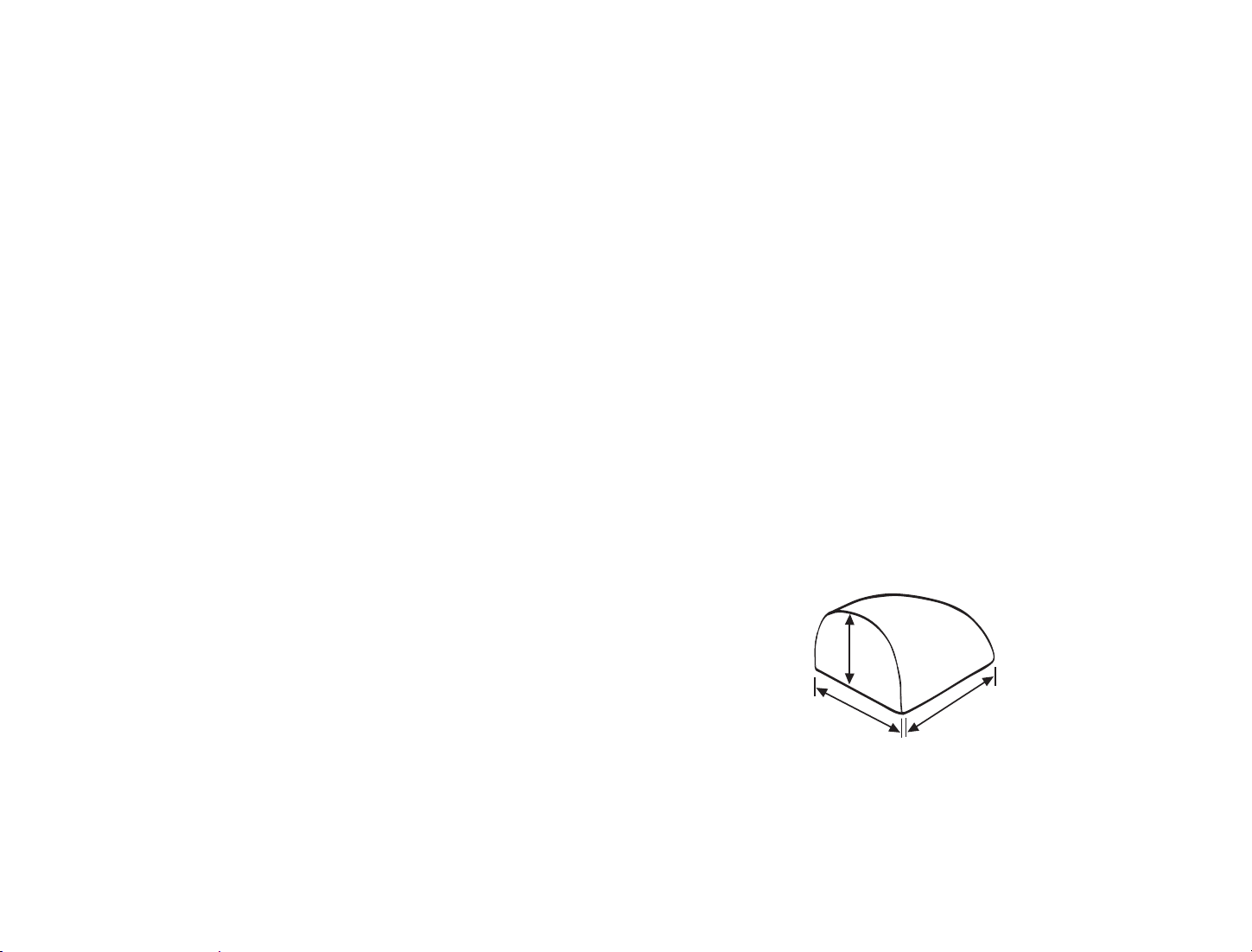
Glossary (Meanings and Methods)
Allspice: A spice made from the dried berry of allspice tree. Substitute
equal quantities of cinnamon, cardamoms and cloves roasted together
and ground.
Beat: To mix with an instrument such as a spoon, whisk or electric
beater using a regular, rapid, rhythmic movement.
Blanch: To plunge food in boiling water. To blanch almonds: Pour
boiling water over nuts, cover and allow to cool. Slip off skins. To
blanch and peel tomatoes: Immerse tomatoes in rapidly boiling water
for 1 to 2 minutes and remove. Allow to cool. Remove core and skin.
Blend: To combine two or more ingredients till they mix thoroughly.
Celery: A green vegetable. Stalks used for flavouring.
Clove of garlic: One of the small curved segments which make up
one whole garlic bulb. Small cloves specified in the recipes weigh
about 1 g and measure about 2 cm from tip to tip and about 1 cm
at the widest part. If you have larger cloves, adjust the quantity
appropriately. Large cloves can be five times larger than small cloves.
Coconut milk: Select a coconut without cracks or mold on the
shell. Shake coconut; you should be able to hear liquid inside; stale
coconuts contain little or no liquid.
To make coconut milk: Break open coconut by holding the coconut
in one hand against a hard surface and hitting the coconut with the
blunt side of a heavy cleaver all around its 'equator'. At the first sign
of a crack, hold the coconut over a bowl to collect coconut water.
Though not coconut milk, it makes a refreshing drink. Taste a piece
of coconut to check if it is rancid. Break the halves into smaller pieces.
Slip a knife between coconut meat and the shell and pry loose the
meat. It is customary to remove the brown skin from the meat,
which is done with a potato peeler or paring knife. In the Hawkins
Test Kitchen we have compared coconut milk made from coconut
with and without the brown skin and found there is no difference
in taste but the milk made with the brown skin is slightly less white.
Coarsely grate the coconut or cut the coconut meat into pieces of
about
1
∕2 inch
/
1.3 cm.
To extract good coconut milk always use the precise quantity of fresh
coconut and water stated in the particular recipe. It is advisable to use
hot water. Put coconut and the required water in a blender and mix
the mixture until finely ground (about 5 minutes). Place muslin or a
double thickness of cheesecloth over a bowl. Put mixture into cloth.
After cooling, gather up the corners and squeeze through as much
milk as possible. Measure the required milk and keep aside. The milk
extracted first is called thick coconut milk.
To make thin coconut milk: Put the same coconut and the specified
quantity of water in a blender. Repeat the same process of blending
and extracting. Extra coconut can be grated and frozen.
Cognac: Substitute any brandy.
Colander: A perforated bowl-shaped utensil for draining off liquids
and rinsing food.
Cutting potatoes: Cut the potatoes approximately, taking care not
to exceed the stated dimensions. Potatoes are curved and in different
shapes – the curves and shapes may be left as they are. What is meant
by 'thick', 'wide' and 'long' is illustrated below.
Dried basil leaves: Aromatic herb. Imparts a distinctive flavour.
Dried oregano leaves: See Dried basil leaves.
Dried thyme leaves: See Dried basil leaves.
Flour (Maida): White flour made from wheat which has had the
bran and germ removed before grinding.
60
long
wide
thick
Hawkins Hevibase IM_Issue 2_Sep 2015.indd 60 28-09-2015 15:18:44

Frying onions in Indian recipes: Some Indian recipes require the
onions to be fried until they are a colour described as "golden brown"
in this Manual. "Golden brown" means that the onions should be
uniformly brown in colour but NOT dark brown or black. Frying
onions to this colour requires time (more than is usual in International
cooking) and attention so that the onions are fried evenly and just
to the right colour. For example, it takes about 20 minutes to fry the
1
2
∕3 lb
/
750 g grated onions in the Masala Gobi recipe (page 52) to
"golden brown" in a 5 Litre Hawkins Hevibase. Correctly fried onions are
important to the taste and texture of the recipe.
Garam Masala Powder:
Yield: About 2
1
∕2 tbsp
/
37.5 ml
1 tsp
/
5 ml peppercorns
3
∕4 tsp
/
3.8 ml cloves
7 x 1 inch
/
2.5 cm sticks cinnamon
4 brown cardamoms
seeds taken out and kept,
pods discarded. Measure
3
∕4 tsp
/
3.8 ml seeds.
3
∕4 tsp
/
3.8 ml black cumin seeds
(shah jeera) or cumin seeds
1. Roast together all ingredients in a small, heavy skillet (pan) on
medium heat. Stir continuously until the spices darken by a few shades
and give out their distinct aromas (about 5 minutes). Remove from
heat, spread on a plate and allow to cool.
2. Grind to a powder. Store in an air-tight jar.
Ghee: Clarified butter.
Ginger, fresh (Adrak): Peel off the smooth brown skin before
grating or chopping. The recipes give the weight as well as the length
of fresh ginger required. Since the width and thickness of ginger
pieces vary, the width of a piece of ginger is taken to be 1 inch
/
2.5 cm
for quantities specified in the recipes. A 1 inch
/
2.5 cm long and
1 inch
/
2.5 cm wide piece of ginger is taken to weigh
1
∕3 oz
/
10 g.
Grate (Kasna): To reduce food to fine particles by rubbing it against
the surface of a grater (an abrasive implement with sharp-edged, raised
perforations).
Grind: To crush into bits or fine particles by rubbing between two hard
surfaces. The traditional way to grind fresh herbs, dry spices, pulses,
coconut etc. is to use grinding stones (a hollow or flat stone slab and
a stone roller called sil batta) or mortar and pestle. The modern and
easier method is to use any of the various electric mixers, blenders or
grinders.
Dry spices may be ground to a powder in a mortar and pestle,
an electric coffee grinder or other spice grinder and a mixer-grinder.
Place spices in grinder and operate machine until the spices are the
required texture.
"Wet" ingredients such as chillies, garlic, ginger, coconut and
onions – and whenever liquid is added – can be ground with a sil
batta, in small electric choppers, mixer-grinders or food processors.
For small quantities use the mixer’s small grinding attachment. Cut
food into small pieces or grate for easier grinding. When using an
electric chopper, blend on high speed about a minute. Stop. Stir the
ingredients preferably with a rubber spatula, scraping mixture from
the sides of the jar. Continue electric mixing at high speed, stopping
the machine and stirring occasionally until the mixture is the desired
consistency. Adding liquid enables chopped items to become a
smoother paste.
Some recipes require grinding both wet and dry ingredients into a
paste. If you do not have a powerful machine for grinding, it may be
easier to grind the dry ingredients separately (for instance, in a spice
grinder) and add them to the wet ingredients while they are being
ground (for instance, in a mixer-grinder). A little experimentation with
your equipment will show the easiest way.
Long-grain white rice: Polished Basmati rice is one type.
Mango powder (Amchur): Unripe mango which has been dried
and then ground. It imparts a sour, fruity flavour. May be substituted
with lemon juice.
61
Hawkins Hevibase IM_Issue 2_Sep 2015.indd 61 28-09-2015 15:18:45

Mava (Khoya): Milk which has been boiled down until all moisture
has been removed. Available at dairy shops.
Muslin: A thin, plain-weaved cotton cloth.
Paneer:
Yield: 7 oz
/
200 g
4
3
∕4 cups
/
1.2 litres whole milk
1 tbsp + 2 tsp
/
25 ml lemon juice
1. Place a strainer over a bowl large enough to hold the milk. Line
strainer with a muslin cloth large enough to hold the curds and then
be tied by winding one corner around the others and knotting. Keep
aside.
2. Pour milk into a pan and bring to boil on high heat, stirring
occasionally to prevent skin from forming on top. Reduce heat to
medium. Add lemon juice. Stir till milk curdles (curds separate from
whey). Cook till whey has a yellow tint and has turned from cloudy to
clear (about 2 minutes), stirring and scraping the sides and base of pan.
Remove pan from heat.
3. Stir curdled milk and pour into muslin-lined strainer over the
bowl (kept aside in step 1). Allow to strain till whey is drained into
bowl.
4. Gather up corners of muslin and tie a knot above curds to make
a bag. Place bag on a thali, plate or board with knot on top and press
gently for a few seconds on knot to level curds. Tilt thali slightly to
drain and leave 20 minutes. Untie bag and remove paneer.
5. Cut paneer as desired or as per recipe requirement. Paneer may be
stored submerged in the whey for moister paneer. Whey may also be
used to make soups, thin gravies and added to flour while kneading;
or it may be discarded.
Parsley: A green herb used mainly as a garnish.
Puréed: Puréed food is a paste or thick liquid suspension made by
grinding. Tomatoes may be puréed in a blender: remove cores first,
blend till pulpy. Alternatively, rub tomatoes on a grater. Discard the
hard skin and core, if any.
Red chilli powder: Whole dried red chillies which have been ground.
Roasting of spices: Before grinding, spices are sometimes roasted
to bring out the characteristic aromas and to intensify their flavour.
To roast, place spices in a small, heavy skillet (pan) on medium heat.
Stir continuously until the spices darken by a few shades and give out
their distinct aromas. Remove from heat, spread on a plate and allow
to cool. The term 'roast' is also used in some recipes in this Manual
when the above mentioned procedure is to be followed except that
the spices are first added to oil, as noted in the recipes.
Sage: See Dried basil leaves.
Scald: To heat liquid to a temperature just below the boiling point
and stop.
Sieve: Utensil having a perforated or meshed bottom for separating
solids or coarse material from liquid or fine particles.
Sift: To pass dry ingredients through a sieve.
Simmer: To cook gently just at or below the boiling point; adjust
heat so that bubbles form, rise and break very slowly.
Sour cream: Cream which has been allowed to sour by being cultured
with a bacillus similar to the curd bacillus. The cream used should be
unpasteurised.
Thali: A round, flat, metal plate with a short straight rim; used for
food preparation, serving or eating.
Tomato paste: Concentrated tomato purée.
Vanilla extract: Vanilla essence.
Whey: The watery part of milk that separates from the solid part or
curd.
Whole dry Kashmiri red chillies: A type of chilli of mild to medium
pungency used primarily to give red colour to food. The whole dry
Kashmiri red chillies may be omitted in Ma ki Dal and Rajma. Substitute
sweet paprika for colour in Rogan Josh, Sambar and Kozhi Kuttan.
Zucchini: Substitute peeled bottlegourd, lauki, dudhi or ghia.
•
62
Hawkins Hevibase IM_Issue 2_Sep 2015.indd 62 28-09-2015 15:18:45

Translations to Hindi & English
Almonds Badam
Aniseed Saunf
Asafoetida Hing
Bay leaves Tej patta
Butter Makkhan
Cabbage Bandh gobi
Cardamoms (brown) Moti elaichi
Cardamoms (green) Choti elaichi
Carrots Gajar
Cashew nuts Kaju
Cauliflower Phulgobi
Celery Ajwain ke patte
Chana dal Bengal gram
Cinnamon Dalchini
Cloves Laung
Coconut Nariyal
Coriander leaves Hara dhania ke
patte
Coriander powder Pissa sukha dhania
Coriander seeds Sukha dhania
Cumin powder Pissa jeera
Cumin seeds Jeera
Curd Dahi; Yogurt
Curry leaves Kadi patta/Meethi
neem ke patte
Dijon mustard Rai ka paste
Drumsticks Sahjan ki phali
Dry mustard Rai ka dal
Fenugreek seeds Methi dana
Flour Maida
Garlic Lassan
Ginger, fresh Adrak
Green beans Pharasbeen;
French beans
Green chillies Hari mirch
Green peppers Simla mirch;
Capsicum
Jaggery Gur
Kabuli chana Chickpeas
Lemon Nimbu
Mace Javitri
Mango Powder Amchur
Mint leaves Pudina
Moong dal Split skinned green
gram
Mushroom Khumbhi/Dhingri
Mustard oil Sarson ka tel
Mustard seeds Rai
Nutmeg Jaiphal
Olive oil Jaitoon ka tel
Parsley Ajmooda ke patte
Peapods Matar ke chilke
Peas Matar
Pepper Pissi kali mirch
Peppercorns Kali mirch
Pomegranate seeds Anardana
Poppy seeds Khuskhus
Rajma Kidney beans
Red chilli powder Pissi lal mirch
Sabat urad Whole black gram
Saffron threads Kesar
Sour cream Khatti ki hui malai
Tamarind Imli
Turmeric Haldi
Turnip Shalgam
Tuvar dal Red gram
Vinegar Sirka
Whey Phata hua dudh
ka paani
Whole dry red chillies Sabat sukhi lal
mirch
63
Hawkins Hevibase IM_Issue 2_Sep 2015.indd 63 28-09-2015 15:18:45

Space for your Notes/Recipes
64
Hawkins Hevibase IM_Issue 2_Sep 2015.indd 64 28-09-2015 15:18:45