Printed In USA
Safe Operation Practices • Set-Up • Operation • Maintenance • Service • Troubleshooting • Warranty
WARNING
READ AND FOLLOW ALL SAFETY RULES AND INSTRUCTIONS IN THIS MANUAL
BEFORE ATTEMPTING TO OPERATE THIS MACHINE.
FAILURE TO COMPLY WITH THESE INSTRUCTIONS MAY RESULT IN PERSONAL INJURY.
Op e r a t O r ’s Ma n u a l
CUB CADET LLC, P.O. BOX 361131 CLEVELAND, OHIO 44136-0019
FORM NO. 769-04978
(June 26, 2009)
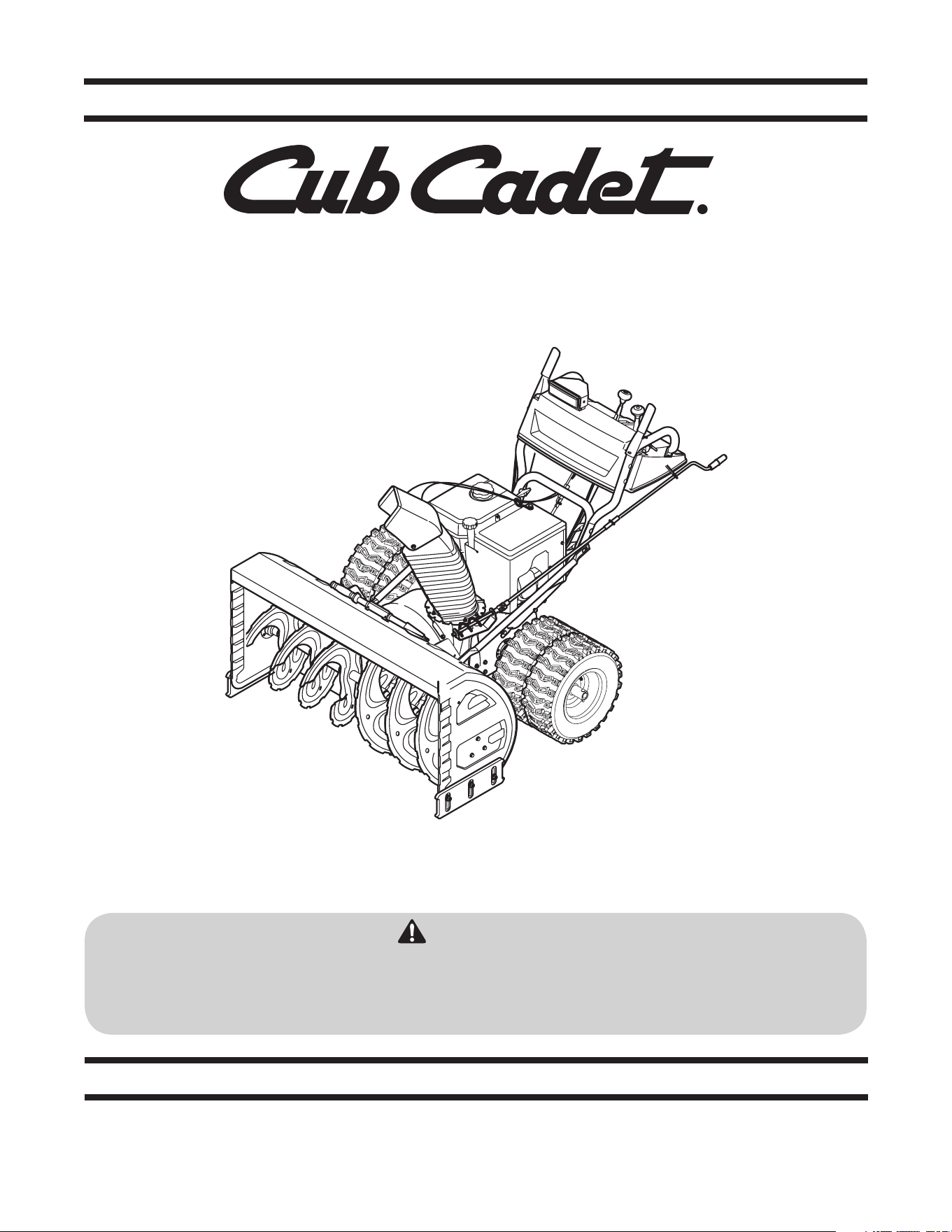
Two Stage Snow Thrower — Model 945 SWE
To The Owner
1
2
Record Product Information
Before setting up and operating your new equipment, please
locate the model plate on the equipment and record the
information in the provided area to the right. You can locate the
model plate by standing at the operator’s position and looking
at the lower, rear section of the frame. This information will
be necessary, should you seek technical support via our web
site, Customer Support Department, or with a local authorized
service dealer.
Important Safe Operation Practices...................... 3
Assembly & Set-Up .................................................. 7
Controls and Features ...........................................13
Operation ...............................................................16
Maintenance & Adjustment..................................18
Service .................................................................... 22
Troubleshooting .................................................... 27
Replacement Parts ................................................ 28
Warranty ..................................................Back Cover
Table of Contents
MO d e l nu M b e r
se r i a l nu M b e r
Customer Support
If you have difficulty assembling this product or have any questions regarding the controls, operation, or maintenance of
this unit, you can seek help from the experts. Choose from the options below:
Visit us on the web at www.cubcadet.com◊
Locate your nearest Cub Cadet Dealer at (877) 282-8684◊
Write us at Cub Cadet LLC • P.O. Box 361131 • Cleveland, OH • 44136-0019◊
Thank you for purchasing a Snow Thrower manufactured by
Cub Cadet LLC. It was carefully engineered to provide excellent
performance when properly operated and maintained.
Please read this entire manual prior to operating the equipment.
It instructs you how to safely and easily set up, operate and
maintain your machine. Please be sure that you, and any other
persons who will operate the machine, carefully follow the
recommended safety practices at all times. Failure to do so could
result in personal injury or property damage.
All information in this manual is relative to the most recent
product information available at the time of printing. Review
this manual frequently to familiarize yourself with the unit, its
features and operation. Please be aware that this Operator’s
Manual may cover a range of product specifications for various
models. Characteristics and features discussed and/or illustrated
in this manual may not be applicable to all models. Cub Cadet
LLC reserves the right to change product specifications, designs
and equipment without notice and without incurring obligation.
If you have any problems or questions concerning the unit,
phone your local Cub Cadet dealer or contact us directly. Cub
Cadet’s Customer Support telephone numbers, website address
and mailing address can be found on this page. We want to
ensure your complete satisfaction at all times.
Throughout this manual, all references to right and left side of the
machine are observed from the operating position
The engine manufacturer is responsible for all engine-related
issues with regards to performance, power-rating, specifications,
warranty and service. Please refer to the engine manufacturer’s
Owner’s/Operator’s Manual, packed separately with your unit, for
more information.
Thank You
Important Safe Operation Practices
2
3
Training
Read, understand, and follow all instructions on the 1.
machine and in the manual(s) before attempting to
assemble and operate. Keep this manual in a safe place for
future and regular reference and for ordering replacement
parts.
Be familiar with all controls and their proper operation. 2.
Know how to stop the machine and disengage them
quickly.
Never allow children under 14 years of age to operate this 3.
machine. Children 14 and over should read and understand
the instructions and safe operation practices in this manual
and on the machine and be trained and supervised by an
adult.
Never allow adults to operate this machine without proper 4.
instruction.
Thrown objects can cause serious personal injury. Plan 5.
your snow-throwing pattern to avoid discharge of material
toward roads, bystanders and the like.
Keep bystanders, pets and children at least 75 feet from the 6.
machine while it is in operation. Stop machine if anyone
enters the area.
Exercise caution to avoid slipping or falling, especially 7.
when operating in reverse.
Preparation
Thoroughly inspect the area where the equipment is to be used.
Remove all doormats, newspapers, sleds, boards, wires and other
foreign objects, which could be tripped over or thrown by the
auger/impeller.
Always wear safety glasses or eye shields during operation 1.
and while performing an adjustment or repair to protect
your eyes. Thrown objects which ricochet can cause serious
injury to the eyes.
Do not operate without wearing adequate winter outer 2.
garments. Do not wear jewelry, long scarves or other loose
clothing, which could become entangled in moving parts.
Wear footwear which will improve footing on slippery
surfaces.
Use a grounded three-wire extension cord and receptacle 3.
for all machines with electric start engines.
Adjust collector housing height to clear gravel or crushed 4.
rock surfaces.
Disengage all control levers before starting the engine. 5.
Never attempt to make any adjustments while engine is 6.
running, except where specifically recommended in the
operator’s manual.
Let engine and machine adjust to outdoor temperature 7.
before starting to clear snow.
WARNING! This symbol points out important safety instructions which, if not followed,
could endanger the personal safety and/or property of yourself and others. Read and follow
all instructions in this manual before attempting to operate this machine. Failure to comply
with these instructions may result in personal injury.
When you see this symbol. HEED ITS WARNING!
DANGER: This machine was built to be operated according to the safe operation practices in
this manual. As with any type of power equipment, carelessness or error on the part of the
operator can result in serious injury. This machine is capable of amputating fingers, hands,
toes and feet and throwing foreign objects. Failure to observe the following safety
instructions could result in serious injury or death.
CALIFORNIA PROPOSITION 65
WARNING! Engine Exhaust, some of its constituents, and certain vehicle components
contain or emit chemicals known to State of California to cause cancer and birth defects
or other reproductive harm.

4 se c t i O n 2 — iM p O r t a n t sa f e Op e r a t i O n pr a c t i c e s
Safe Handling of Gasoline
To avoid personal injury or property damage use extreme care
in handling gasoline. Gasoline is extremely flammable and the
vapors are explosive. Serious personal injury can occur when
gasoline is spilled on yourself or your clothes which can ignite.
Wash your skin and change clothes immediately.
Use only an approved gasoline container.a.
Extinguish all cigarettes, cigars, pipes and other b.
sources of ignition.
Never fuel machine indoors. c.
Never remove gas cap or add fuel while the engine is d.
hot or running.
Allow engine to cool at least two minutes before e.
refueling.
Never over fill fuel tank. Fill tank to no more than ½ f.
inch below bottom of filler neck to provide space for
fuel expansion.
Replace gasoline cap and tighten securely.g.
If gasoline is spilled, wipe it off the engine and h.
equipment. Move machine to another area. Wait 5
minutes before starting the engine.
Never store the machine or fuel container inside i.
where there is an open flame, spark or pilot light
(e.g. furnace, water heater, space heater, clothes
dryer etc.).
Allow machine to cool at least 5 minutes before j.
storing.
Never fill containers inside a vehicle or on a truck k.
or trailer bed with a plastic liner. Always place
containers on the ground away from your vehicle
before filling.
If possible, remove gas-powered equipment from l.
the truck or trailer and refuel it on the ground. If this
is not possible, then refuel such equipment on a
trailer with a portable container, rather than from a
gasoline dispenser nozzle.
Keep the nozzle in contact with the rim of the fuel m.
tank or container opening at all times until fueling is
complete. Do not use a nozzle lock-open device.
Operation
Do not put hands or feet near rotating parts, in the auger/1.
impeller housing or chute assembly. Contact with the
rotating parts can amputate hands and feet.
The auger/impeller control lever is a safety device. Never 2.
bypass its operation. Doing so makes the machine unsafe
and may cause personal injury.
The control levers must operate easily in both directions 3.
and automatically return to the disengaged position when
released.
Never operate with a missing or damaged chute assembly. 4.
Keep all safety devices in place and working.
Never run an engine indoors or in a poorly ventilated area. 5.
Engine exhaust contains carbon monoxide, an odorless
and deadly gas.
Do not operate machine while under the influence of 6.
alcohol or drugs.
Muffler and engine become hot and can cause a burn. Do 7.
not touch. Keep children away.
Exercise extreme caution when operating on or crossing 8.
gravel surfaces. Stay alert for hidden hazards or traffic.
Exercise caution when changing direction and while 9.
operating on slopes.
Plan your snow-throwing pattern to avoid discharge 10.
towards windows, walls, cars etc. Thus, avoiding possible
property damage or personal injury caused by a ricochet.
Never direct discharge at children, bystanders and pets or 11.
allow anyone in front of the machine.
Do not overload machine capacity by attempting to clear 12.
snow at too fast of a rate.
Never operate this machine without good visibility or light. 13.
Always be sure of your footing and keep a firm hold on the
handles. Walk, never run.
Disengage power to the auger/impeller when transporting 14.
or not in use.
Never operate machine at high transport speeds on 15.
slippery surfaces. Look down and behind and use care
when backing up.
If the machine should start to vibrate abnormally, stop 16.
the engine, disconnect the spark plug wire and ground it
against the engine. Inspect thoroughly for damage. Repair
any damage before starting and operating.
Disengage all control levers and stop engine before you 17.
leave the operating position (behind the handles). Wait
until the auger/impeller comes to a complete stop before
unclogging the chute assembly, making any adjustments,
or inspections.
Never put your hand in the discharge or collector openings. 18.
Always use the clean-out tool provided to unclog the
discharge opening. Do not unclog chute assembly while
engine is running. Shut off engine and remain behind
handles until all moving parts have stopped before
unclogging.
Use only attachments and accessories approved by the 19.
manufacturer (e.g. wheel weights, tire chains, cabs etc.).
When starting engine, pull cord slowly until resistance 20.
is felt, then pull rapidly. Rapid retraction of starter cord
(kickback) will pull hand and arm toward engine faster than
you can let go. Broken bones, fractures, bruises or sprains
could result.
If situations occur which are not covered in this manual, use 21.
care and good judgment. Contact Customer Support for
assistance and the name of your nearest servicing dealer.

5se c t i O n 2 — iM p O r t a n t sa f e Op e r a t i O n pr a c t i c e s
Clearing a Clogged Discharge Chute
Hand contact with the rotating impeller inside the discharge
chute is the most common cause of injury associated with snow
throwers. Never use your hand to clean out the discharge chute.
To clear the chute:
SHUT THE ENGINE OFF!1.
Wait 10 seconds to be sure the impeller blades have 2.
stopped rotating.
Always use a clean-out tool, not your hands.3.
Maintenance & Storage
Never tamper with safety devices. Check their proper 1.
operation regularly. Refer to the maintenance and
adjustment sections of this manual.
Before cleaning, repairing, or inspecting machine 2.
disengage all control levers and stop the engine. Wait until
the auger/impeller come to a complete stop. Disconnect
the spark plug wire and ground against the engine to
prevent unintended starting.
Check bolts and screws for proper tightness at frequent 3.
intervals to keep the machine in safe working condition.
Also, visually inspect machine for any damage.
Do not change the engine governor setting or over-speed 4.
the engine. The governor controls the maximum safe
operating speed of the engine.
Snow thrower shave plates and skid shoes are subject to 5.
wear and damage. For your safety protection, frequently
check all components and replace with original equipment
manufacturer’s (OEM) parts only. “Use of parts which do
not meet the original equipment specifications may lead to
improper performance and compromise safety!”
Check control levers periodically to verify they engage 6.
and disengage properly and adjust, if necessary. Refer
to the adjustment section in this operator’s manual for
instructions.
Maintain or replace safety and instruction labels, as 7.
necessary.
Observe proper disposal laws and regulations for gas, oil, 8.
etc. to protect the environment.
Prior to storing, run machine a few minutes to clear snow 9.
from machine and prevent freeze up of auger/impeller.
Never store the machine or fuel container inside where 10.
there is an open flame, spark or pilot light such as a water
heater, furnace, clothes dryer etc.
Always refer to the operator’s manual for proper 11.
instructions on off-season storage.
Check fuel line, tank, cap, and fittings frequently for cracks 12.
or leaks. Replace if necessary.
Do not crank engine with spark plug removed.13.
According to the Consumer Products Safety Commission 14.
(CPSC) and the U.S. Environmental Protection Agency (EPA),
this product has an Average Useful Life of seven (7) years,
or 60 hours of operation. At the end of the Average Useful
Life have the machine inspected annually by an authorized
service dealer to ensure that all mechanical and safety
systems are working properly and not worn excessively.
Failure to do so can result in accidents, injuries or death.
Do not modify engine
To avoid serious injury or death, do not modify engine in any
way. Tampering with the governor setting can lead to a runaway
engine and cause it to operate at unsafe speeds. Never tamper
with factory setting of engine governor.
Notice Regarding Emissions
Engines which are certified to comply with California and federal
EPA emission regulations for SORE (Small Off Road Equipment)
are certified to operate on regular unleaded gasoline, and
may include the following emission control systems: Engine
Modification (EM), Oxidizing Catalyst (OC), Secondary Air
Injection (SAI) and Three Way Catalyst (TWC) if so equipped.
Spark Arrestor
WARNING! This machine is equipped with an
internal combustion engine and should not be used
on or near any unimproved forest-covered, brush
covered or grass-covered land unless the engine’s
exhaust system is equipped with a spark arrester
meeting applicable local or state laws (if any).
If a spark arrester is used, it should be maintained in effective
working order by the operator. In the State of California the
above is required by law (Section 4442 of the California Public
Resources Code). Other states may have similar laws. Federal laws
apply on federal lands.
A spark arrester for the muffler is available through your
nearest engine authorized service dealer or contact the service
department, P.O. Box 361131 Cleveland, Ohio 44136-0019.
6 se c t i O n 2 — iM p O r t a n t sa f e Op e r a t i O n pr a c t i c e s
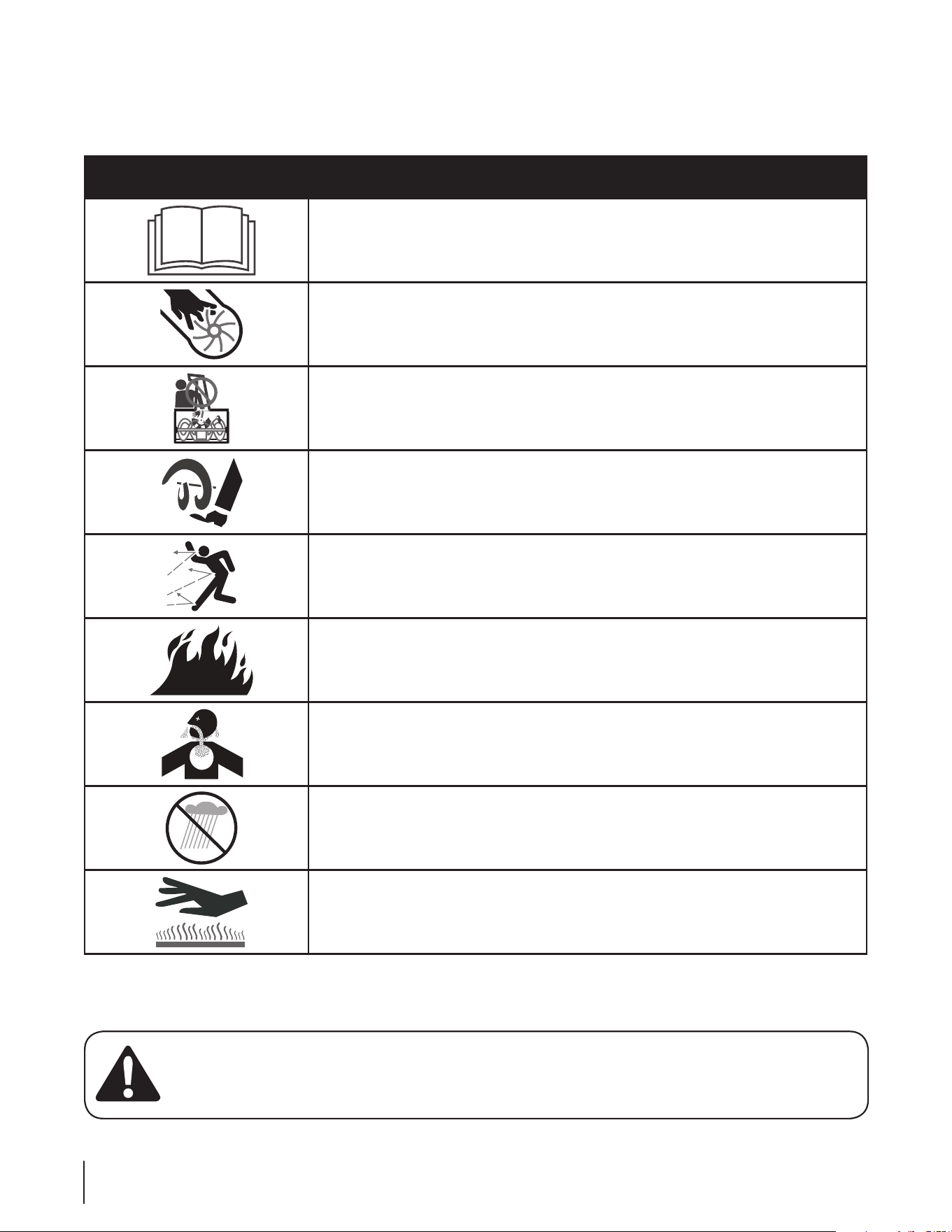
Safety Symbols
This page depicts and describes safety symbols that may appear on this product. Read, understand, and follow all instructions on the
machine before attempting to assemble and operate.
Symbol Description
READ THE OPERATOR’S MANUAL(S)
Read, understand, and follow all instructions in the manual(s) before attempting to
assemble and operate
WARNING— ROTATING BLADES
Keep hands out of inlet and discharge openings while machine is running. There are rotating
blades inside
WARNING— ROTATING BLADES
Keep hands out of inlet and discharge openings while machine is running. There are rotating
blades inside
WARNING— ROTATING AUGER
Do not put hands or feet near rotating parts, in the auger/impeller housing or chute
assembly. Contact with the rotating parts can amputate hands and feet.
WARNING—THROWN OBJECTS
This machine may pick up and throw and objects which can cause serious personal injury.
WARNING—GASOLINE IS FLAMMABLE
Allow the engine to cool at least two minutes before refueling.
WARNING— CARBON MONOXIDE
Never run an engine indoors or in a poorly ventilated area. Engine exhaust contains carbon
monoxide, an odorless and deadly gas.
WARNING— ELECTRICAL SHOCK
Do not use the engine’s electric starter in the rain
WARNING— HOT SURFACE
Engine parts, especially the muffler, become extremely hot during operation. Allow engine
and muffler to cool before touching.
WARNING! Your Responsibility—Restrict the use of this power machine to persons who read, understand and
follow the warnings and instructions in this manual and on the machine.
SAVE THESE INSTRUCTIONS!
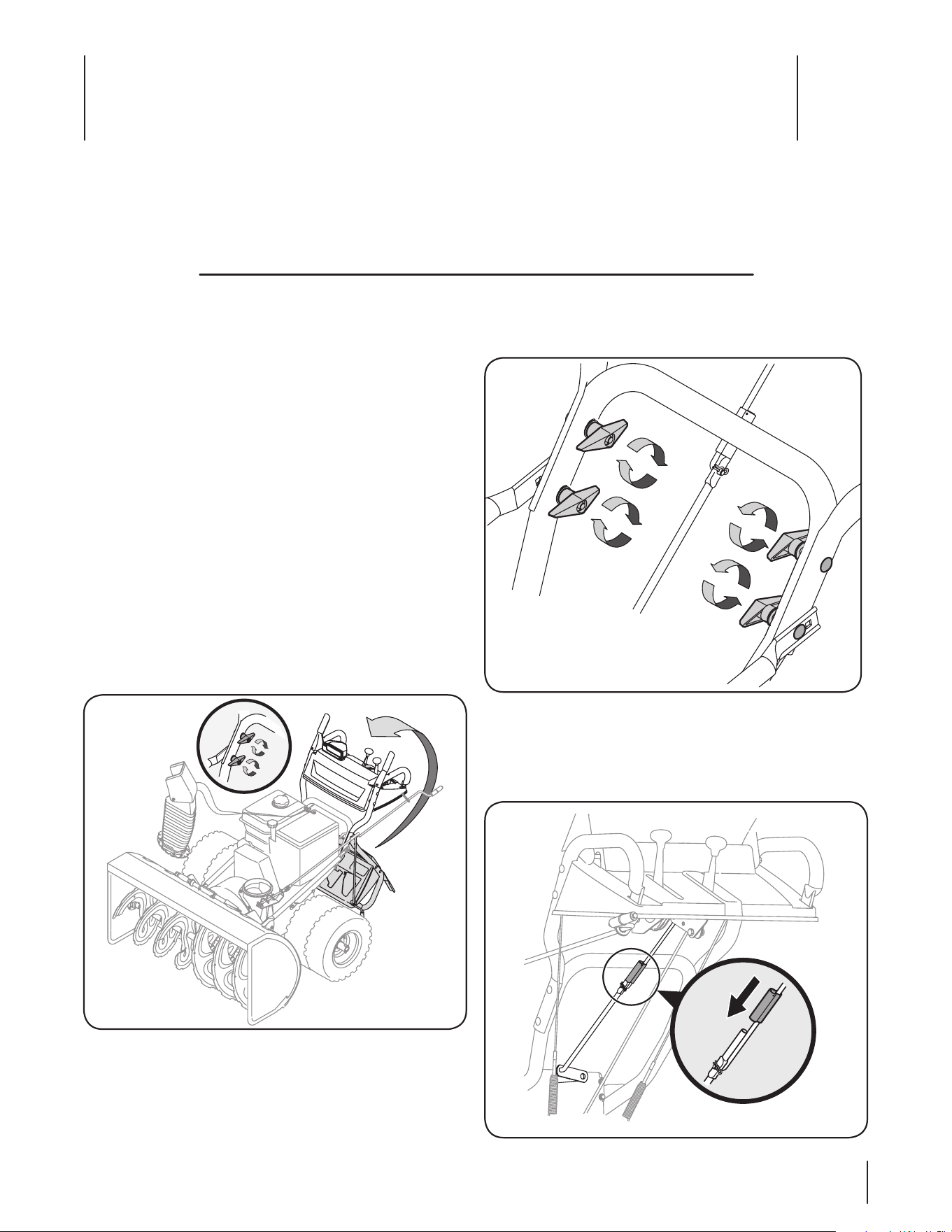
Secure the upper handle and lower handle with the two wing 4.
nuts and carriage bolts removed earlier. Tighten the two
wing nuts already installed in the upper holes to firmly
secure the upper handle and support tubes. See Fig. 3-2.
Align the upper and lower shift rods, then slide the shift 5.
rod connector down over the end of the lower shift
rod. Tap the connector until the lower rod is completely
through the connector. See Fig. 3-3.
Assembly
IMPORTANT: Two replacement auger shear pins are included
with this manual (or stowed in the plastic handle panel). Refer to
the Maintenance section for more information regarding shear
pin replacement.
NOTE: All references in this manual to the left or right side of the
snow thrower is from the operating position only. Exceptions, if
any, will be specified.
IMPORTANT: This unit is shipped with the engine full of oil.
After assembly, refer to the separate Engine Owner’s Manual
included with this unit for fuel and oil fill-up details.
NOTE: Specifications are subject to change without notification
or obligation. Images may not reflect your exact model and are
for reference purposes only.
Handle
Remove any packaging material from the upper handle. 1.
Remove the lower plastic wing nut, belleville washer and 2.
carriage bolt from each side of the upper handle; then raise
the upper handle assembly until it snaps over the lower
handle. See Fig. 3-1.
Looking beneath the handle panel, check that all of the cables 3.
(steering, auger, and drive) are properly routed and not
pinched or kinked. Make certain the springs at the lower
end of the auger and drive cables are securely hooked into
their respective actuator bracket.
Figure 3-3
Contents of Carton
One Snow Thrower• Two Replacement Auger Shear Pins• One Chute Assembly•
One Snow Thrower Operator’s •
Manual
One Product Registration Card•
Figure 3-1
Figure 3-2
Assembly & Set-Up
3
7
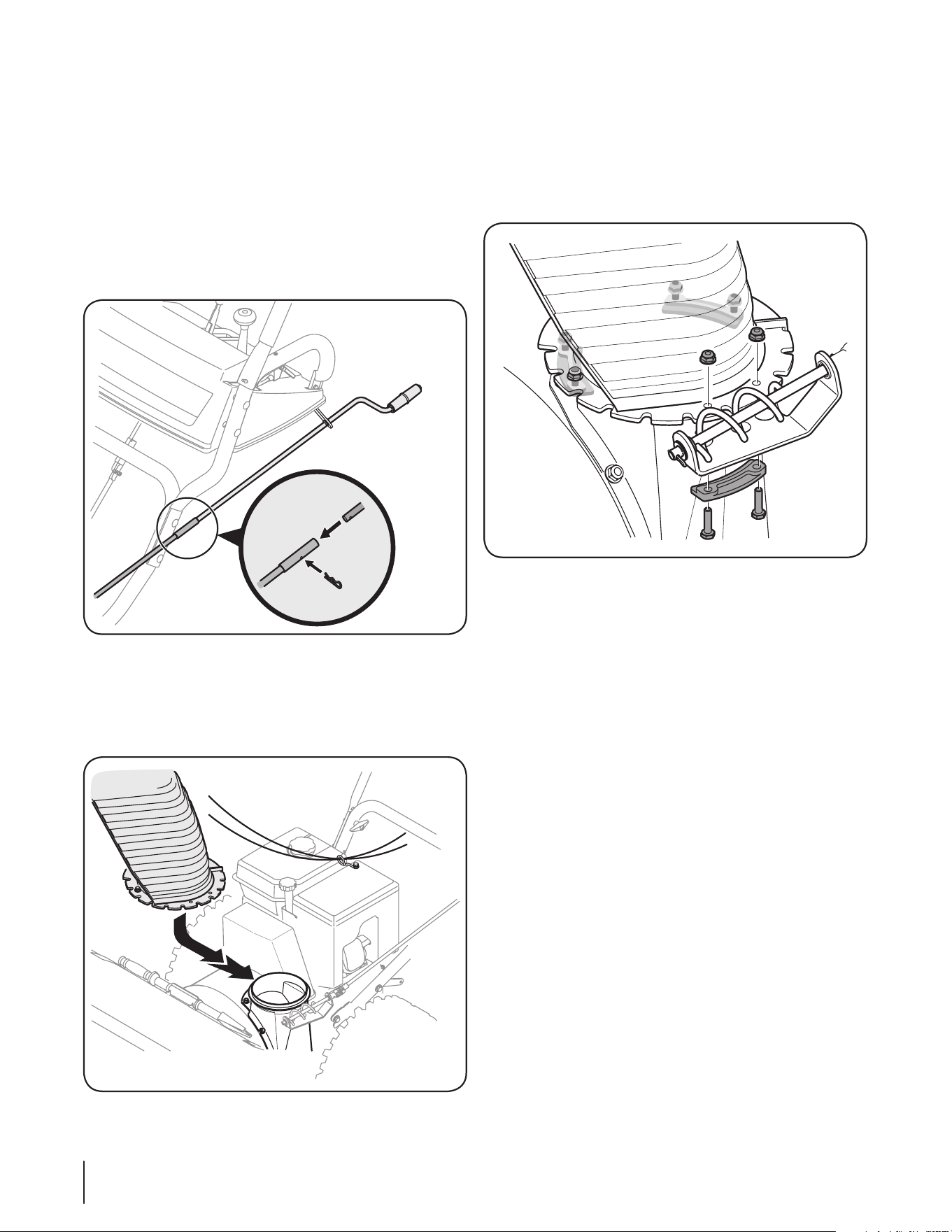
Place chute assembly onto chute base as shown in Fig. 3-5. Make
sure that the chute notches engage with the spiral end of chute
directional control, and the two flange keepers are beneath the
flange on the chute base.
Secure flange keeper removed earlier with lock nuts and screws.
Tighten down nuts securing the other two flange keepers. See
Fig. 3-6.
Check that the chute cables are properly routed through the
cable guide attached to the lower handle assembly. See Fig. 3-5.
NOTE: If the connector is not properly assembled, the shift rod
will pivot and you will not be able to change speeds or direction.
If the full range of speeds (forward and reverse) can not be
achieved, refer to the “Maintenance and Adjustments” section.
Chute Directional Control
Remove the internal cotter pin from the upper chute crank. Slide
the upper chute crank into the sleeve on the lower chute crank.
Align the hole in the upper chute crank with the hole in the
sleeve (If necessary, use a pair of pliers to assist in aligning holes).
Insert the internal cotter pin through the holes to secure the
chute crank. See Figure 3-4.
Chute Assembly
Remove lock nuts and screws securing one of the flange keepers
to the chute assembly. Loosen the fasteners of the other two
flange keepers. See Fig. 3-5.
Figure 3-4
Figure 3-5
Figure 3-6
a
b
8 se c t i O n 3— as s e M b l y & se t -up
Adding Fuel
WARNING! Use extreme care when handling
gasoline. Gasoline is extremely flammable and the
vapors are explosive. Never fuel the machine
indoors or while the engine is hot or running.
Extinguish cigarettes, cigars, pipes and other
sources of ignition.
WARNING! Always keep hands and feet clear of
equipment moving parts. Do not use a pressurized
starting fluid. Vapors are flammable.
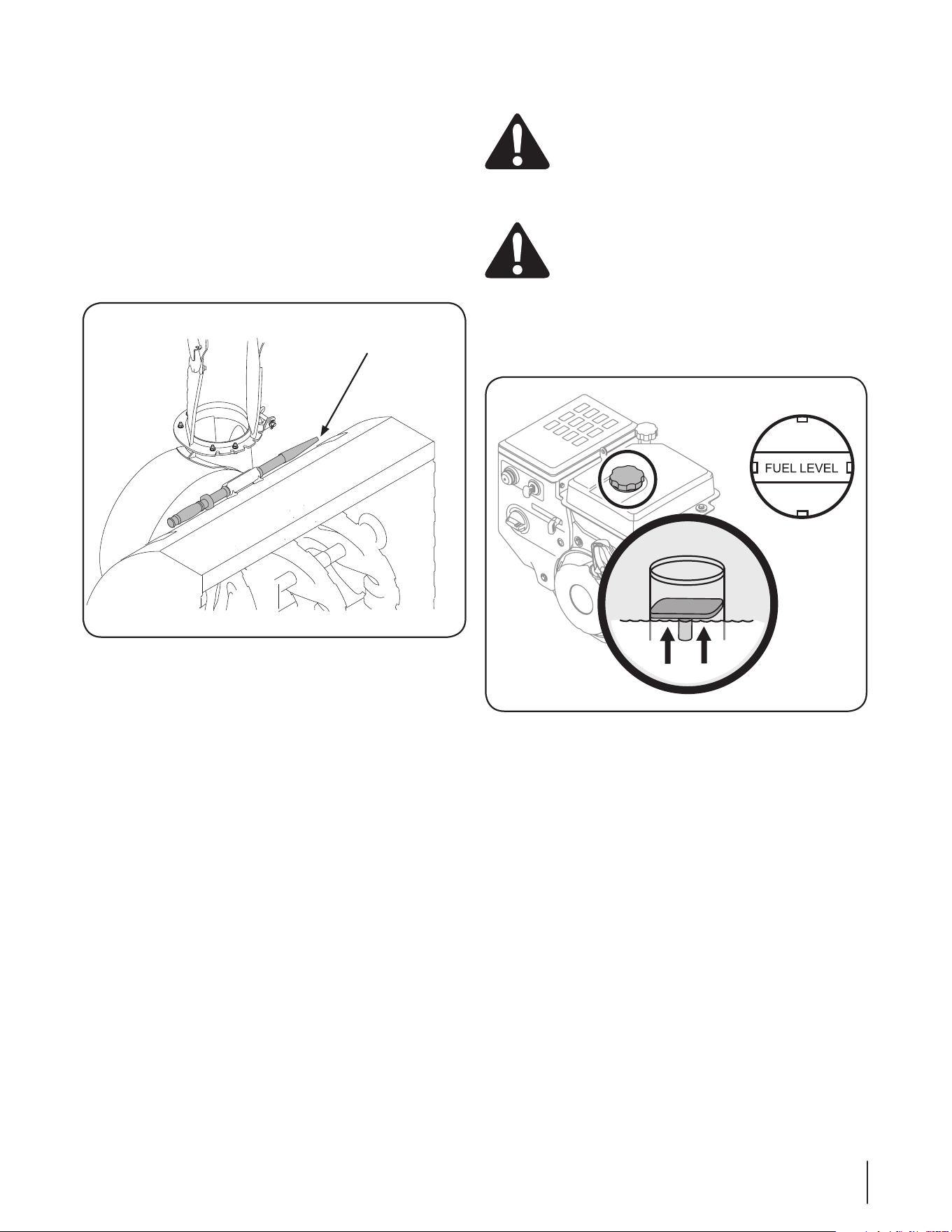
Clean around fuel fill before removing cap to fuel.1.
A fuel level indicator is located in the fuel tank. Fill tank 2.
until fuel reaches the fuel level indictor, Fig. 3-8. Be careful
not to overfill.
Set-Up
Shear Pins
A pair of replacement auger shear pins and bow tie cotter pins
have been included with your snow thrower. Store the pins in
a convenient place for use if an original equipment shear pin
should break.
Chute Clean-Out Tool
The chute clean-out tool is fastened to the top of the auger
housing with a mounting clip and a cable tie at the factory. Cut
the cable tie before operating the snow thrower. See Fig. 3-7.
Fuel Recommendations
Use automotive gasoline (unleaded or low leaded to minimize
combustion chamber deposits) with a minimum of 87 octane.
Gasoline with up to 10% ethanol or 15% MTBE (Methyl Tertiary
Butyl Ether) can be used. Never use an oil/gasoline mixture or
dirty gasoline. Avoid getting dirt, dust, or water in the fuel tank.
DO NOT use E85 gasoline.
Refuel in a well-ventilated area with the engine stopped. •
Do not smoke or allow flames or sparks in the area where
the engine is refueled or where gasoline is stored.
Do not overfill the fuel tank. After refueling, make sure the •
tank cap is closed properly and securely.
Be careful not to spill fuel when refueling. Spilled fuel or •
fuel vapor may ignite. If any fuel is spilled, make sure the
area is dry before starting the engine.
Avoid repeated or prolonged contact with skin or •
breathing of vapor.
Figure 3-7
Clean-out Tool
Fuel Level Indicator
Top View
Figure 3-8
9se c t i O n 3 — as s e M b l y & se t -up
Adjustments
Skid Shoes
The snow thrower skid shoes are adjusted upward at the factory
for shipping purposes. Adjust them downward prior to operating
the snow thrower.
CAUTION: It is not recommended that you operate
this snow thrower on gravel as it can easily pick up
and throw loose gravel, causing personal injury or
damage to the snow thrower and surrounding
property.
For close snow removal on a smooth surface, adjust the skid
shoes so that the shave plate on the bottom of the auger
housing is just off the ground.
Adjust the skid shoes to a lower position to raise the shave plate
off the ground when clearing uneven areas, such as a ribbon
type driveway or a gravel driveway
NOTE: If you choose to operate the snow thrower on a gravel
surface, keep the skid shoes in position for maximum clearance
between the ground and the shave plate.
CAUTION: Operating a snow thrower equipped
with steel skid shoes may result in damage to
natural stone paver surfaces (e.g. sandstone,
bluestone, limestone). Refer to the Replacement
Parts or Attachments & Accessories sections for
information on available polymer skid shoes.
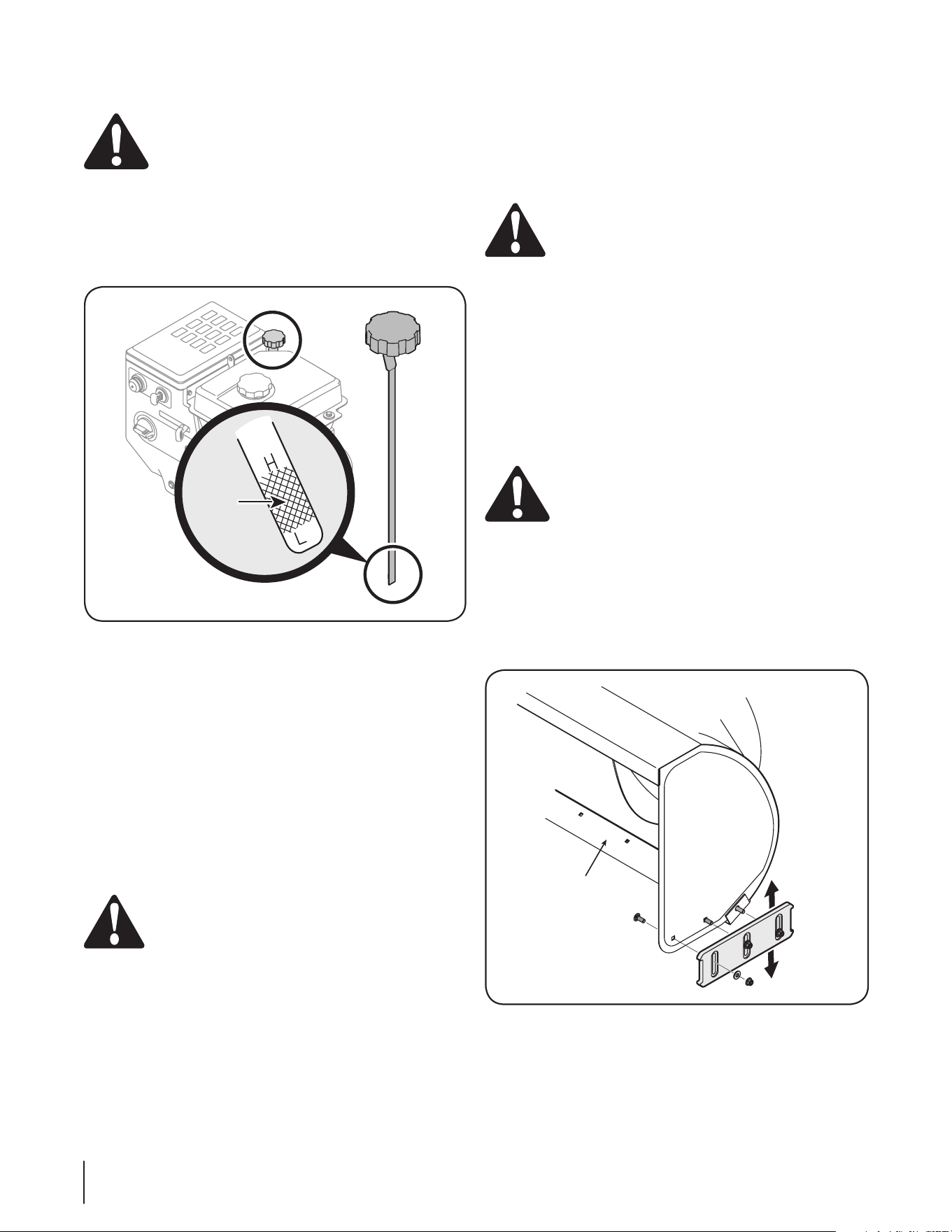
To adjust the skid shoes:
Adjust skid shoes by loosening the six (three on each side) 1.
hex nuts, washers, and carriage bolts securing the skid
shoes to the auger housing. Refer to Fig. 3-10.
While observing the distance between the shave plate and 2.
the ground, adjust the skids shoes up or down to achieve
the desired shave plate height. See Fig. 3-10.
Checking Oil Level
CAUTION: The engine is shipped with oil in the
engine. You must, however, check the oil level prior
to operating the snow thrower. Running the engine
with insufficient oil can cause serious engine
damage and void the engine warranty.
NOTE: Be sure to check the engine on a level surface with the
engine stopped.
Remove the oil filler cap/dipstick and wipe the dipstick clean. See 1.
Fig. 3-9.
Insert the cap/dipstick into the oil filler neck, 2. but do not
screw it in.
Remove the oil filler cap/dipstick. If the level is low, slowly add 3.
oil until oil level registers between high (H) and low (L), Fig.
3-9. Refer to the Engine Maintenance section for correct oil
viscosity and engine oil capacity.
NOTE: Do not overfill. Overfilling with oil may result in
engine smoking, hard starting or spark plug fouling.
Replace and tighten cap/dipstick firmly before starting 4.
engine.
Tire Pressure
WARNING: Under any circumstance do not exceed
manufacturer’s recommended psi. Equal tire pressure
should be maintained at all times. Excessive pressure
when seating beads may cause tire/rim assembly to
burst with force sufficient to cause serious injury.
Refer to sidewall of tire for recommended pressure.
The tires are over-inflated for shipping purposes.
Check the tire pressure before operating the snow thrower. Refer
to the tire side wall for tire manufacturer’s recommended psi and
deflate (or inflate) the tires as necessary.
Note: Equal tire pressure is to be maintained at all times for
performance purposes.
Figure 3-10
Raise
Shave
Plate
Lower
Shave
Plate
Shave Plate
Fill
between
high
and low
marks
Figure 3-9
10 se c t i O n 3— as s e M b l y & se t -up
Make certain the entire bottom surface of skid shoes are 3.
against the ground to avoid uneven wear on the skid shoes;
then tighten nuts and bolts securely.
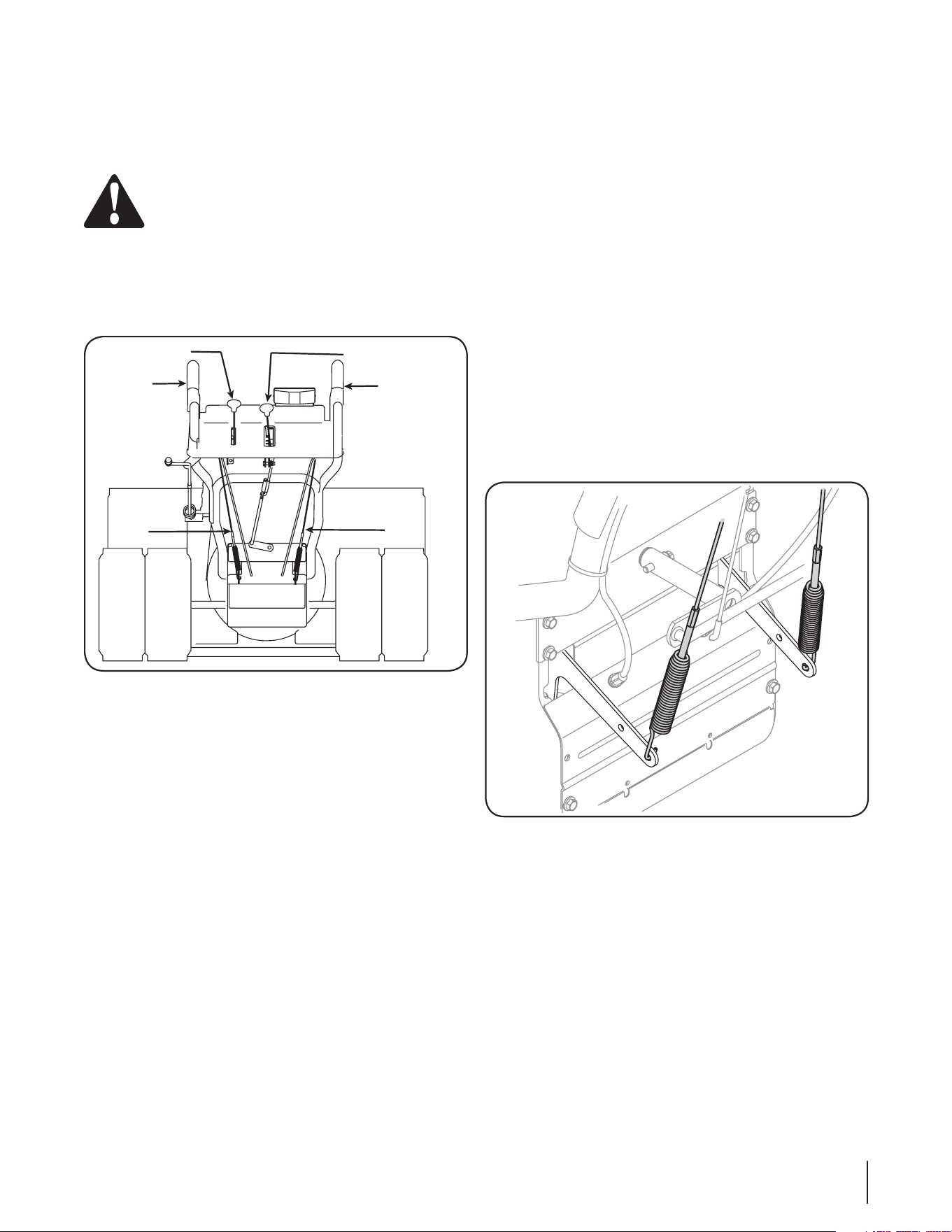
Auger and Drive Control Cables
WARNING! Prior to operating your snow thrower,
carefully read and follow all instructions below.
Perform all adjustments to verify your snow thrower
is operating safely and properly.
Testing Auger Drive Control
When the auger control is released and in the disengaged “up”
position, the cable should have very little slack. It should NOT be
tight. Refer to Fig. 3-11.
In a well-ventilated area, start the snow thrower engine as 1.
instructed in Section 5 - Operation.
While standing in the operator’s position (behind the snow 2.
thrower), engage the auger.
Allow the auger to remain engaged for approximately ten 3.
(10) seconds before releasing the auger control. Repeat this
several times.
With the auger control in the disengaged “up” position, 4.
walk to the front of the machine.
Confirm that the auger has completely stopped rotating 5.
and shows NO signs of motion. If the auger shows ANY
signs of rotating, immediately return to the operator’s
position and shut off the engine. Wait for ALL moving parts
to stop before re-adjusting the auger control.
Testing Drive Control & Shift Lever
With the engine turned off, move the shift lever into sixth 1.
(6) position. Refer to Fig. 3-11.
With the wheel drive control released, push the snow 2.
thrower forward, then pull it back. The machine should
move freely.
Engage the drive control and attempt to move the machine 3.
both forward and back, resistance should be felt.
Move the shift lever into the fast reverse (R2) position and 4.
repeat the previous two steps.
If you experienced resistance rolling the unit, either 5.
when repositioning the shift lever from 6 to R2 or when
attempting to move the machine with the drive control
released, adjust the drive control immediately. See
Adjusting Drive and Auger Controls.
Adjusting Drive and Auger Controls
From beneath the handle, pull downward on the 1.
appropriate cable and unhook the spring found on the end
of the cable from its respective actuator bracket. Refer to
Fig. 3-11 and 3-12.
Figure 3-12
Drive
Control
Drive
Control
Cable
Auger
Control
Auger
Control
Cable
Shift Speed Selector Lever
Chute Tilt Control
Figure 3-11
11se c t i O n 3 — as s e M b l y & se t -up
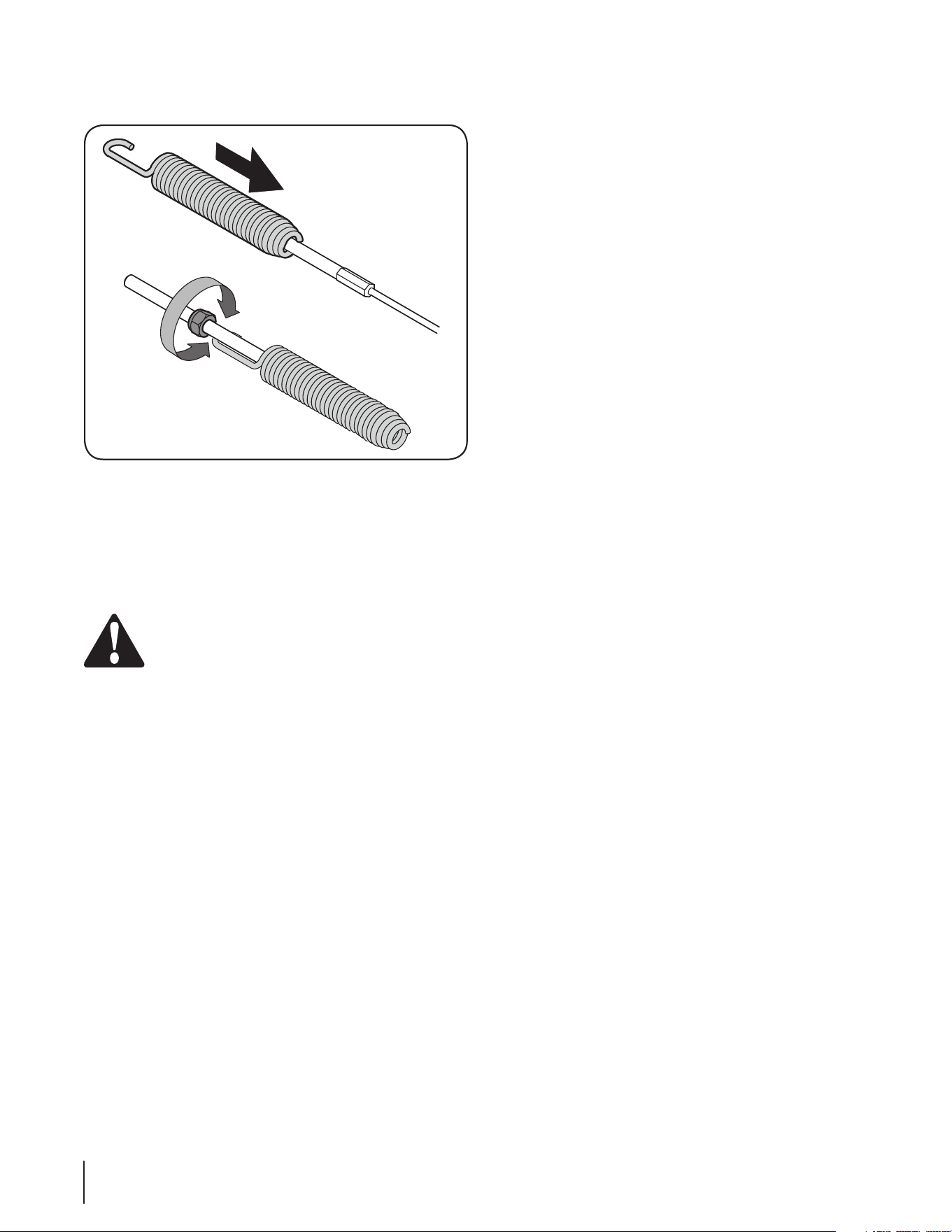
Slide the spring up the cable to expose the cable coupler 2.
threads and lock nut. Refer to Fig. 3-13.
Adjust the lock nut as follows: If adjusting the drive 3.
cable, thread the lock nut outward (down the coupler) to
lengthen the cable and allow the unit to move freely when
the control is released. Thread the lock nut inward (up
the coupler) to shorten the cable to reduce slippage and
prevent the machine from being easily moved with the
drive control engaged.
WARNING! Do not over-tighten the cable. Over-
tightening may prevent the auger from disengaging
and compromise the safety of the snow thrower.
If adjusting the auger cable, thread the lock nut down to 4.
lengthen the cable as necessary to stop the auger from
turning when the control is released.
Securely hook the cable’s spring into the rear most hole of 5.
the respective actuator bracket.
Repeat the wheel drive and auger control tests to verify 6.
proper adjustment. Repeat previous steps if necessary to
attain proper adjustment of each cable
Figure 3-13
12 se c t i O n 3— as s e M b l y & se t -up
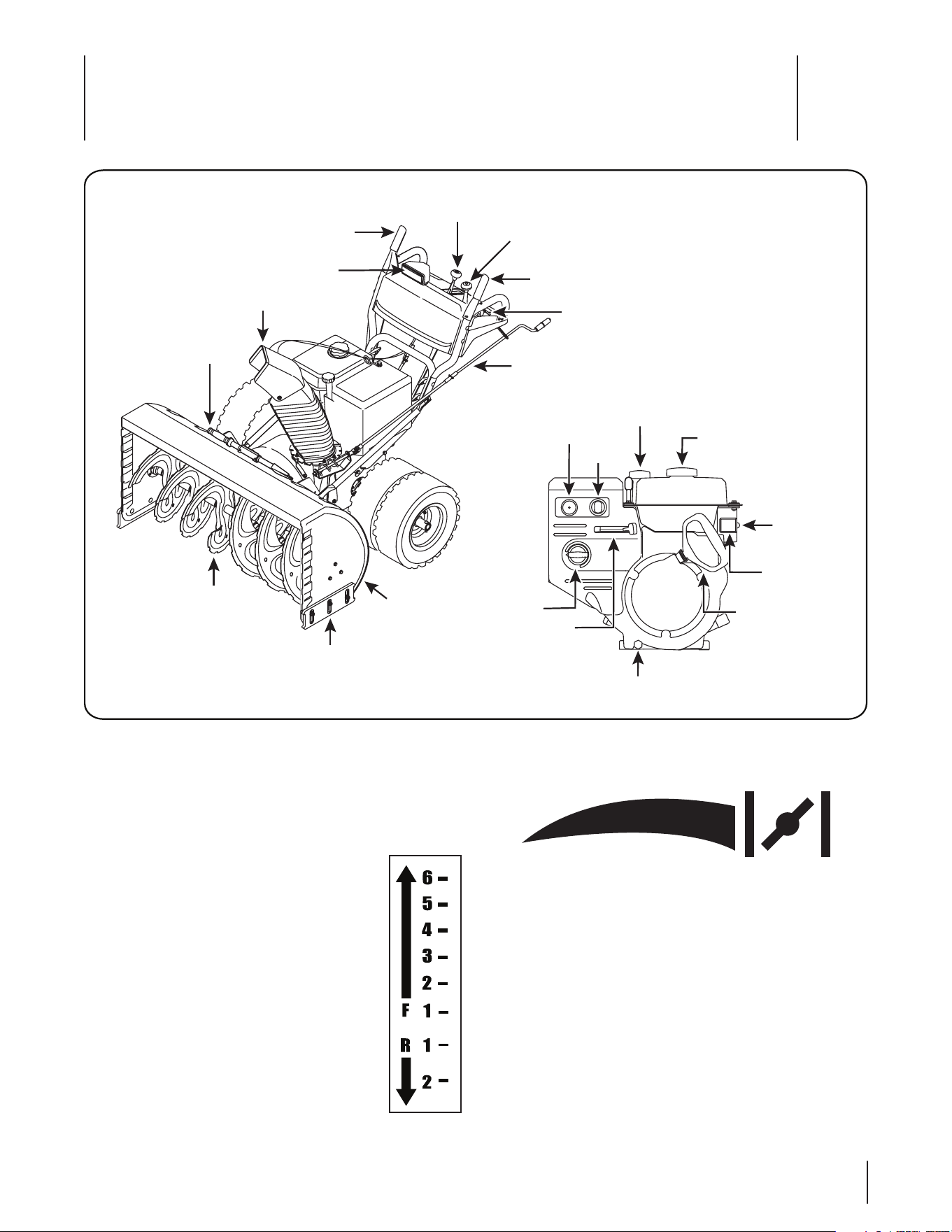
Snow thrower controls and features are described below and
illustrated in Fig. 4-1.
NOTE: For detailed information on all engine controls, refer to
the separate Tecumseh Engine Operator’s Manual.
Speed Selector Shift Lever
The speed selector shift lever is located in the right
side of the handle panel and is used to determine
ground speed and direction of travel.
Forward
There are six forward (F) speeds. Position one (1) is
the slowest and position six (6) is the fastest.
Reverse
There are two reverse (R) speeds. One (1) is the
slower and two (2) is the faster.
Choke Control
The choke control is found on the rear of the engine and is
activated by rotating the knob counter-clockwise. Activating the
choke control closes the choke plate on the carburetor and aids
in starting the engine.
Key
The key is a safety devise. It must be fully inserted in order for the
engine to start. Remove the key when the snow thrower is not in
use.
Important: Do not turn the key in an attempt to start the
engine. Doing so may cause it to break.
Figure 4-1
Chute Assembly
Augers
Auger
Housing
Skid Shoes
Clean-out Tool
Drive Control
Auger Control
Primer
Choke
Throttle
Recoil Starter
Handle
Oil Drain
Electric
Starter Outlet
Electric
Start
Button
Chute
Directional
Control
Wheel Steering Control
Headlight
Oil Filler
Cap/Dipstick
Key
Gas Cap
Speed Selector
Shift Lever
Two-way Chute Control™
Controls and Features
4
13
Throttle Control
The throttle control is located on the rear of the engine. It
regulates the speed of the engine and will shut off the engine
when moved into the STOP position.
Primer Bulb
Pressing the primer bulb forces fuel directly
into the engine’s carburetor to aid in starting
a “Cold” engine.
NOTE: Do not use the primer bulb to restart a
warm engine after a short shutdown.
Oil Filler Cap / Dipstick
Engine oil level can be checked and oil added through the oil fill.
Skid Shoes
Position the skid shoes based on surface conditions. Adjust
upward for hard-packed snow. Adjust downward when
operating on gravel or crushed rock surfaces.
Electric Starter Outlet
Requires the use of a three-prong outdoor extension cord and a
120V power source/wall outlet.
Recoil Starter Handle
This handle is used to manually start the engine.
Electric Start Button
Pressing the button on the top of the electric starter switch
engages the engine’s electric starter when plugged into a 120V
power source.
Augers
When engaged, the augers rotate and draw snow into the auger
housing.
Chute Assembly
Snow drawn into the auger housing is discharged out the chute
assembly.
Gas Cap
Unthread the gas cap to add gasoline to the fuel tank.
Headlight
The headlight is located on top of the handle panel. It may be
adjusted by loosening the two screws on each side of the light
housing, pivoting the light up or down, and retightening the
screws.
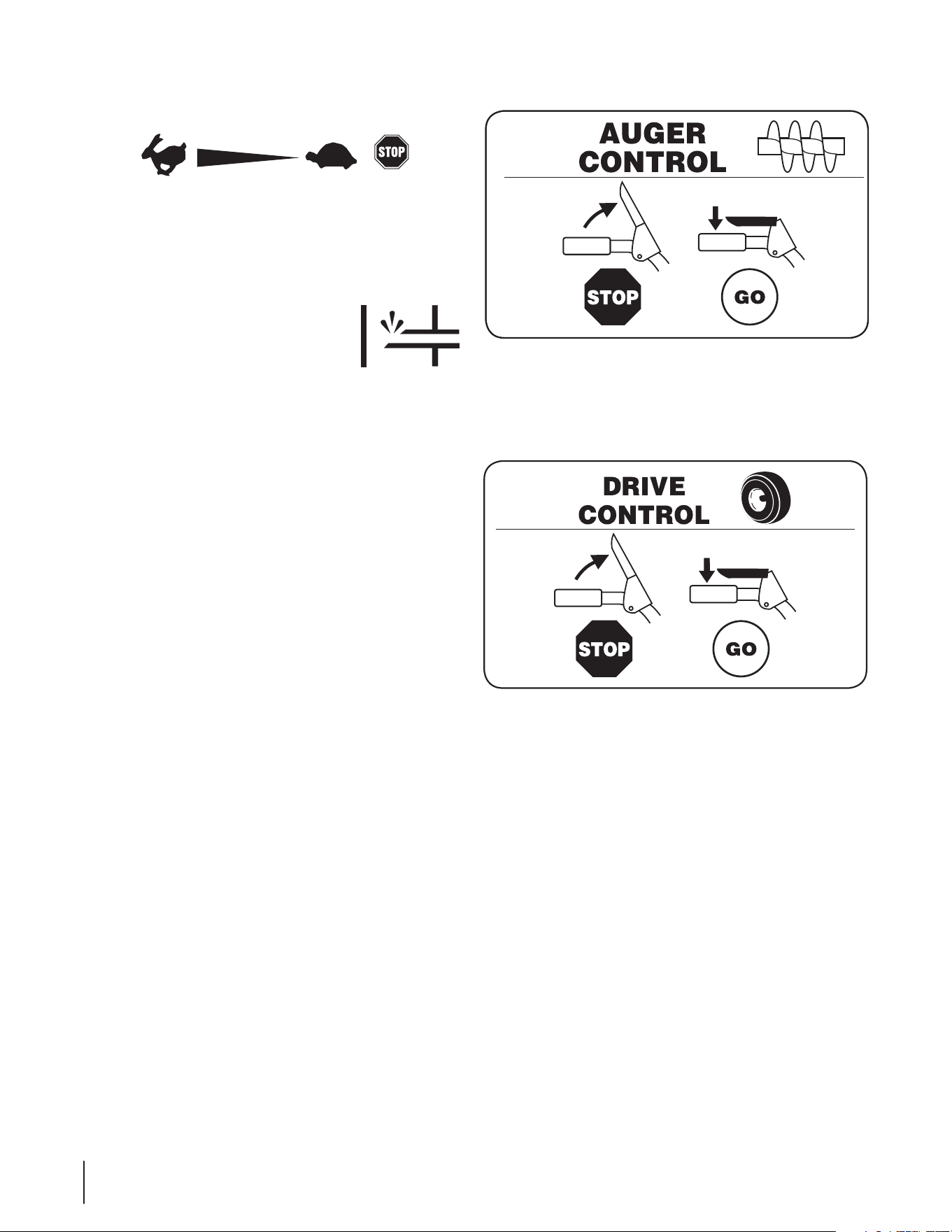
Auger Control
The auger control is located on the left handle. Squeeze the
control grip against the handle to engage the augers and start
snow throwing action. Release to stop.
Drive Control / Auger Clutch Lock
The drive control is located on the right handle. Squeeze the
control grip against the handle to engage the wheel drive.
Release the handle to stop.
The drive control also locks the auger control so that you can
operate the chute directional control without interrupting
the snow throwing process. If the auger control is engaged
simultaneously with the drive control, the operator can release
the auger control (on the left handle) and the augers will remain
engaged. Release both controls to stop the augers and wheel
drive.
NOTE: Always release the drive control before changing speeds.
Failure to do so will result in increased wear on your machine’s
drive system.
14 se c t i O n 4— cO n t r O l s a n d fe a t u r e s
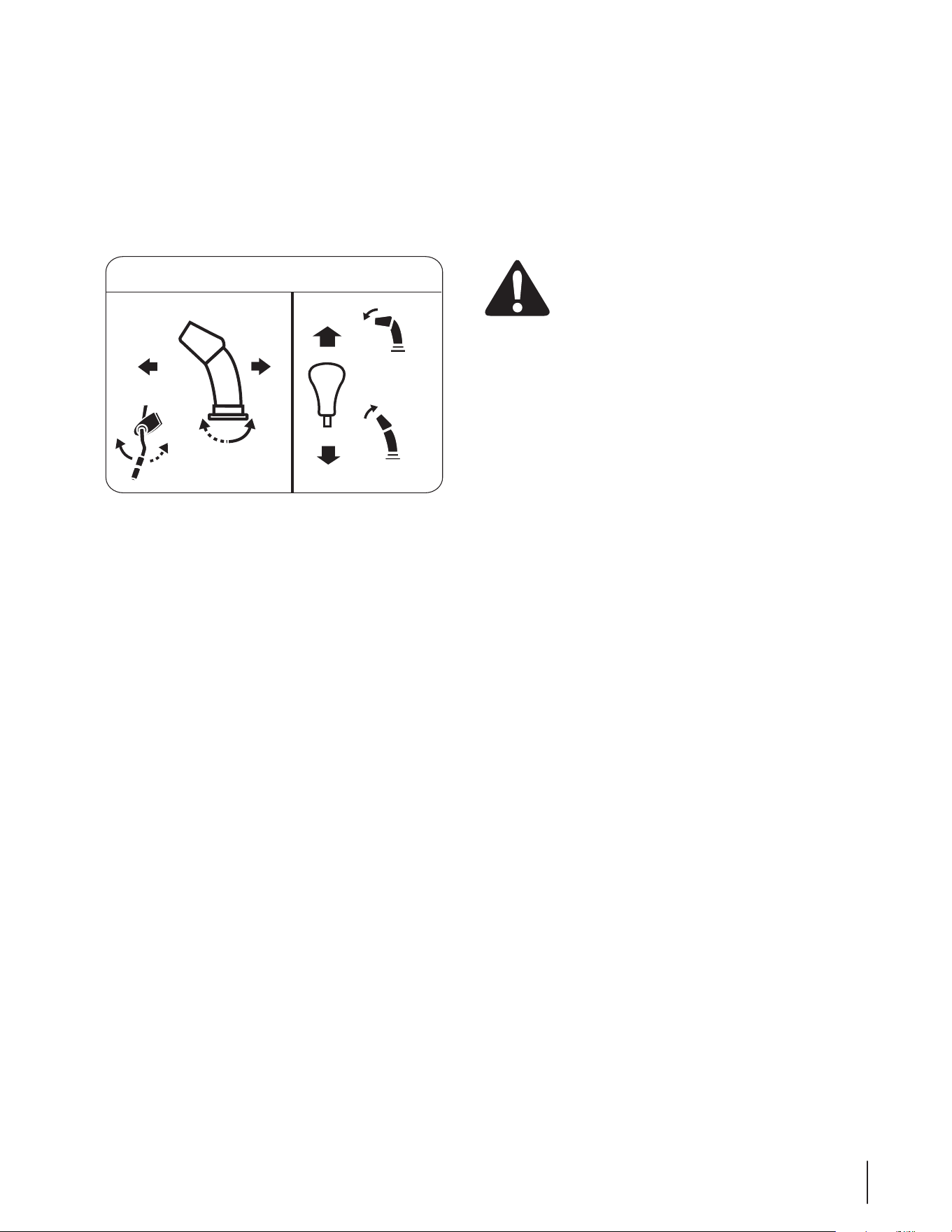
Two-Way Chute Control™
The two-way chute control is located on the left side of the dash
panel and is used to control the distance of snow discharge from
the chute.
To change the upper chute angle to control the distance •
that snow is thrown, pivot the lever forward or backward.
Move the lever forward to pivot the upper chute down and •
reduce the distance snow is thrown.
Move the lever rearward to pivot the upper chute upward •
and increase the distance snow is thrown.
Chute Directional Control
The chute directional control is located on the left side of the
snow thrower.
To change the direction in which snow is thrown, crank •
clockwise to discharge to the left and counterclockwise to
discharge to the right.
Wheel Steering Controls
The left and right wheel steering controls are located on the
underside of the handles. Squeeze the right control to turn right;
squeeze the left control to turn left.
NOTE: Operate the snow thrower in open areas until you are
familiar with these controls.
Chute Clean-Out Tool
WARNING! Never use your hands to clear a
clogged chute assembly. Shut off engine and remain
behind handles until all moving parts have stopped
before unclogging.
The chute clean-out tool is conveniently fastened to the rear of
the auger housing with a mounting clip. Should snow and ice
become lodged in the chute assembly during operation, proceed
as follows to safely clean the chute assembly and chute opening:
Release both the Auger Control and the Drive Control.1.
Stop the engine by removing the key. 2.
Remove the clean-out tool from the clip which secures it to the 3.
rear of the auger housing.
Use the shovel-shaped end of the clean-out tool to dislodge and 4.
scoop any snow and ice which has formed in and near the
chute assembly.
Refasten the clean-out tool to the mounting clip on the 5.
rear of the auger housing, reinsert the key and start the
snow thrower’s engine.
While standing in the operator’s position (behind the snow 6.
thrower), engage the auger control for a few seconds to
clear any remaining snow and ice from the chute assembly.
CHUTE DIRECTIONAL CONTROL
DISCHARGE
LEFT
DISCHARGE
RIGHT
CHUTE TILT
DOWN
CHUTE TILT
UP
DESCARGA
A LA
DERECHA
DESCARGA A
LA IZQUIERDA
INCLINACIÓN DEL
CANAL HACIA
ABAJO
INCLINACIÓN DEL
CANAL HACIA ARRIBA
CONTROL DIRECCIONAL DEL CANAL
15se c t i O n 4 — cO n t r O l s a n d fe a t u r e s

Starting The Engine
Attach spark plug wire to spark plug. Make certain the 1.
metal loop on the end of the spark plug wire (inside the
rubber boot) is fastened securely over the metal tip on the
spark plug.
Make certain both the auger control and drive control are 2.
in the disengaged (released) position.
Move throttle control up to FAST position. Insert key into 3.
the ignition switch. Make sure it snaps into place. Do not
attempt to turn the key.
NOTE: The engine cannot start unless the key is inserted
into ignition switch.
Electric Starter
Determine that your home’s wiring is a three-wire grounded
system. Ask a licensed electrician if you are not certain.
WARNING! The optional electric starter is
equipped with a grounded three-wire power cord
and plug, and is designed to operate on 120 volt AC
household current. It must be used with a properly
grounded three-prong receptacle at all times to
avoid the possibility of electric shock. Follow all
instructions carefully prior to operating the electric
starter.
If you have a grounded three-prong receptacle, proceed as follows:
Plug the extension cord into the outlet located on the 1.
engine’s surface. Plug the other end of extension cord
into a three-prong 120-volt, grounded, AC outlet in a well-
ventilated area.
Rotate the choke control to the CHOKE position (for a cold 2.
engine start).
NOTE: If the engine is already warm, place choke control in
the RUN position instead of CHOKE.
Push the primer three to five times for cold engine start, 3.
making sure to cover vent hole in the center of the primer
when pushing.
NOTE: DO NOT use primer to restart a warm engine after a
short shutdown.
Push starter button to start engine. Once the engine starts, 4.
release starter button.
NOTE: Do NOT hold the button down for longer than seven
(7) seconds at a time. Doing so may damage your engine’s
electric starter.
As the engine warms, slowly rotate the choke control to the 5.
RUN position. If the engine falters, quickly rotate the choke
control back toward CHOKE, and then slowly into the RUN
position again.
When disconnecting the extension cord, always unplug the 6.
end at the three-prong wall outlet before unplugging the
opposite end from the snow thrower.
Recoil Starter
Rotate choke control to CHOKE position (cold engine start). 1.
NOTE: If the engine is already warm, place choke control in
the RUN position instead of CHOKE.
Push the primer three to five times for cold engine start, 2.
making sure to cover vent hole in the center of the primer
when pushing.
NOTE: DO NOT use primer to restart a warm engine after a
short shutdown.
NOTE: Additional priming may be necessary if the
temperature is below 15° Fahrenheit.
Grasp the recoil starter handle and slowly pull the rope out. 3.
At the point where it becomes slightly harder to pull the
rope, stop pulling and allow the rope to slowly recoil.
Pull the starter handle with a firm, rapid stroke. Do not 4.
release the handle and allow it to snap back. Keep a firm
hold on the starter handle and allow it to slowly recoil.
As the engine warms, slowly rotate the choke control to the 5.
RUN position. If the engine falters, quickly rotate the choke
control back toward the CHOKE position, and then slowly
into the RUN position again.
NOTE: Allow the engine to warm up for a few minutes after
starting. The engine will not develop full power until it
reaches operating temperatures.
Stopping The Engine
Run engine for a few minutes before stopping to help dry RUN
any moisture on the engine.
Move throttle control to STOP position.1.
Remove the ignition key and store in a safe place.2.
Wipe all snow and moisture from the area around the 3.
engine as well as the area in and around the drive control
and auger control. Also, engage and release both controls
several times.
Operation
5
16
Operating Tips
NOTE: Allow the engine to warm up for a few minutes. The
engine will not develop full power until it reaches operating
temperature.
WARNING: The temperature of the muffler and the
surrounding areas may exceed 150° F. Avoid these
areas.
If possible, remove snow immediately after it falls.1.
Discharge snow downwind whenever possible. 2.
Slightly overlap each previous path.3.
Set the skid shoes 1/4” below the shave plate for normal 4.
usage. Adjust them upward for hard-packed snow and
downward when using on gravel or crushed rock.
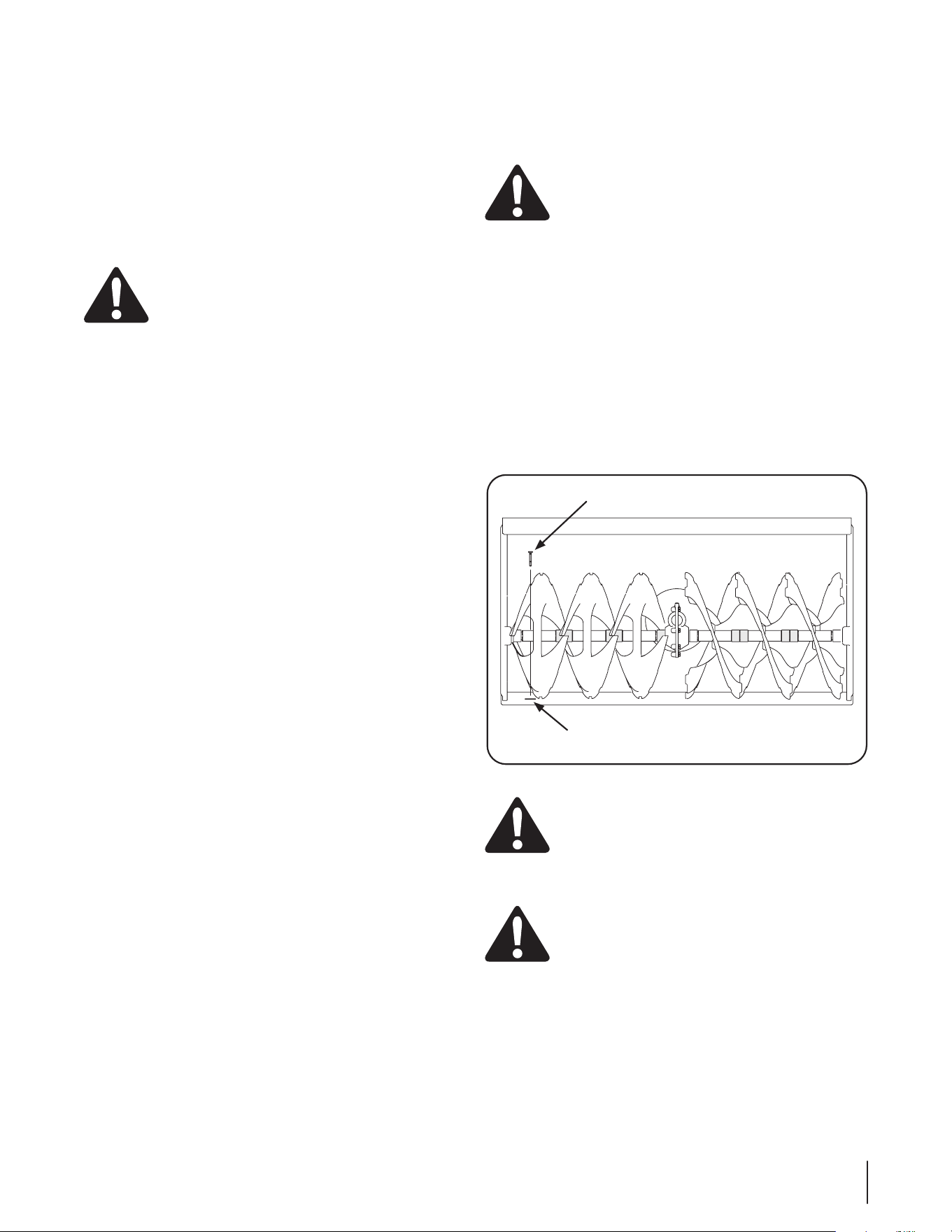
Replacing Shear Pins
Each of the six auger spiral assemblies are secured to the spiral
shaft with a shear pin and bow-tie cotter pin. If the auger should
strike a foreign object or ice jam, the snow thrower is designed so
that the pins may shear. If the augers will not turn, check to see if
the pins have sheared. See Fig. 5-1.
CAUTION: NEVER replace the auger shear pins with
anything other than OEM Part No. 738-04155
replacement shear pins. Any damage to the auger
gearbox or other components as a result of failing to
do so will NOT be covered by your snow thrower’s
warranty.
WARNING! Always turn RUN the snow thrower’s
engine and remove the key prior to replacing shear
pins.
To Engage Drive
With the throttle control in the Fast (rabbit) position, move 1.
shift lever into one of the six forward (F) positions or two
reverse (R) positions. Select a speed appropriate for the
snow conditions and a pace you’re comfortable with.
NOTE: Use slower speeds in higher snow and/or until you
are familiar with the snow thrower operation.
Squeeze the drive control against the handle the snow 2.
thrower will move. Release it and drive motion will stop.
CAUTION: NEVER move the shift lever without first
releasing the wheel drive control. Doing so will
cause premature wear on the drive system’s friction
wheel
To turn the snow thrower to the left or right, squeeze the 3.
respective wheel steering control. Refer to Figure 4-1.
To Engage Augers
To engage the augers and start throwing snow, squeeze 1.
the auger control against the left handle. Release to stop
the augers.
While the auger control is engaged, squeeze the drive 2.
control to engage the interlock mechanism and to drive
the snow thrower. The interlock mechanism locks the
auger control so you can turn the chute control without
interrupting the snow throwing process.
Release the auger control; the interlock mechanism should 3.
keep the auger control engaged until the drive control is
released.
Release the drive control to stop both the augers and 4.
the wheel drive. To stop the auger, both levers must be
released.
Figure 5-1
Bow-tie Cotter Pin
Shear Pin
17se c t i O n 5 — Op e r a t i O n
WARNING! Before performing any type of
maintenance/service, disengage all controls and stop
the engine. Wait until all moving parts have come to a
complete stop. Remove the key to prevent unintended
starting. Always wear safety glasses during operation
or while performing any adjustments or repairs.
ENGINE MAINTENANCE
Checking Engine Oil
WARNING! Before lubricating, repairing, or
inspecting, disengage all controls and stop engine.
Wait until all moving parts have come to a complete
stop. Remove the ignition key to prevent unintended
firing of the engine.
NOTE: Check the oil level before each use to be sure correct oil
level is maintained.
When adding oil to the engine, refer to viscosity chart below.
Engine oil capacity is approximately 37 ounces. Do not over-fill.
Use a 4-stroke, or an equivalent high detergent, premium
quality motor oil certified to meet or exceed U.S. automobile
manufacturer’s requirements for service classification SG, SF.
Motor oils classified SG, SF will show this designation on the
container.
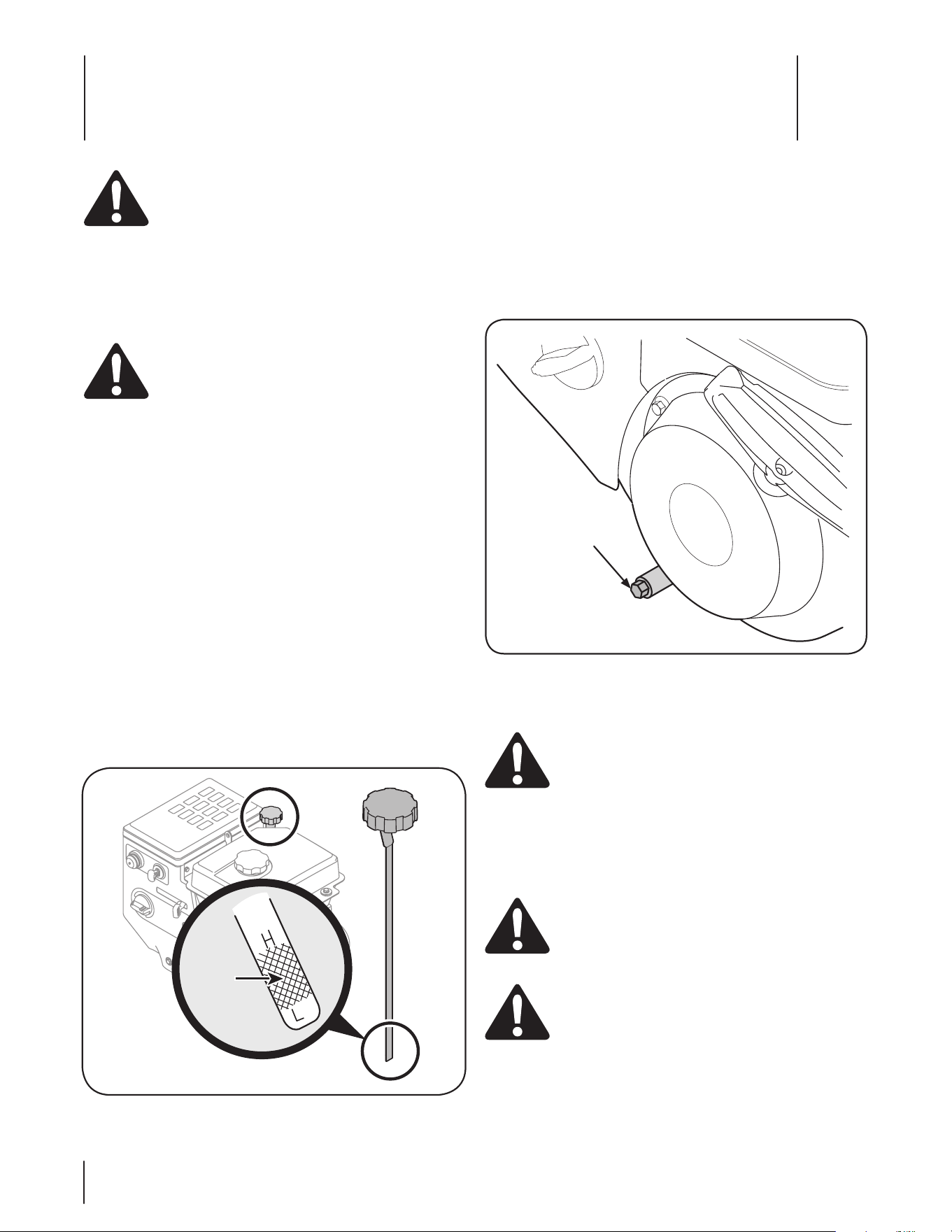
Remove the oil filler cap/dipstick and wipe the dipstick 1.
clean.
Insert the cap/dipstick into the oil filler neck, but do NOT 2.
screw it in.
Remove the oil filler cap/dipstick. If level is low, slowly add 3.
oil until oil level registers between high (H) and low (L). See
Fig. 6-1.
Replace and tighten cap/dipstick firmly before starting 4.
engine.
Changing Engine Oil
NOTE: Change the engine oil after the first 5 hours of operation
and once a season or every 50 hours thereafter.
Drain fuel from tank by running engine until the fuel tank is 1.
empty. Be sure fuel fill cap is secure.
Place suitable oil collection container under oil drain plug. 2.
Remove oil drain plug. See Figure 6-2.3.
Tip engine to drain oil into the container. Used oil must be 4.
disposed of at a proper collection center.
CAUTION: Used oil is a hazardous waste product.
Dispose of used oil properly. Do not discard with
household waste. Check with your local authorities
or Sears Service Center for safe disposal/recycling
facilities.
Reinstall the drain plug and tighten it securely. 5.
Refill with the recommended oil and check the oil level. See 6.
Recommended Oil Usage chart. The engine’s oil capacity is
37 ounces.
CAUTION: DO NOT use non-detergent oil or
2-stroke engine oil. It could shorten the engine’s
service life.
Reinstall the oil filler cap/dipstick securely.7.
CAUTION: Thoroughly wash your hands with soap
and water as soon as possible after handling used
oil.
Fill
between
high
and low
marks
Figure 6-1
Figure 6-2
Oil Drain
Plug
Maintenance & Adjustments
6
18
Checking Spark Plug
WARNING! DO NOT check for spark with spark
plug removed. DO NOT crank engine with spark
plug removed.
WARNING! If the engine has been running, the
muffler will be very hot. Be careful not to touch the
muffler.
NOTE: Check the spark plug once a season or every 25 hours of
operation. Change the spark plug once a season or every 100
hours.
To ensure proper engine operation, the spark plug must be
properly gapped and free of deposits.
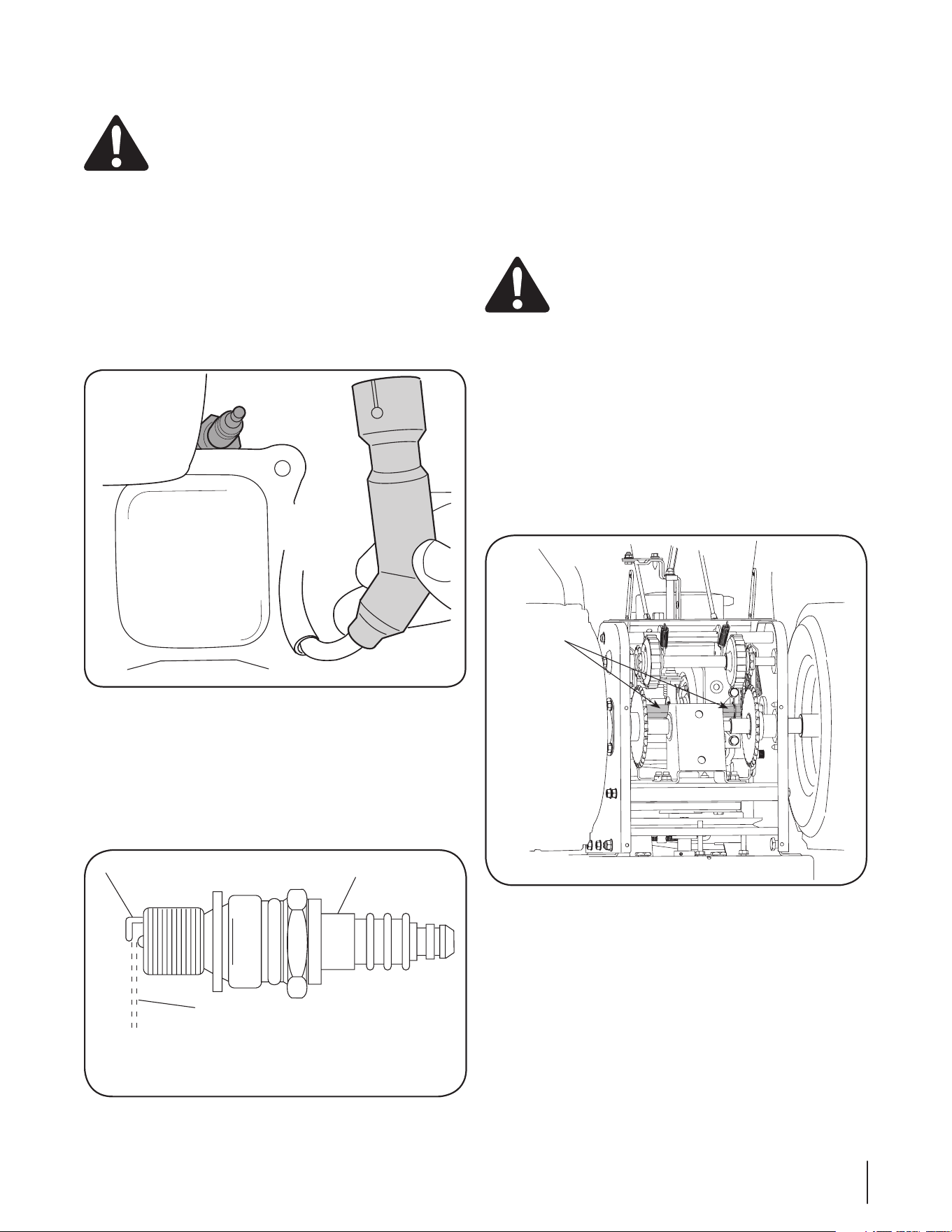
Remove the spark plug boot and use a spark plug wrench 1.
to remove the plug. See Figure 6-3.
Visually inspect the spark plug. Discard the spark plug 2.
if there is apparent wear, or if the insulator is cracked or
chipped. Clean the spark plug with a wire brush if it is to be
reused.
Measure the plug gap with a feeler gauge. Correct as 3.
necessary by bending side electrode. See Figure 6-4. The
gap should be set to .02-.03 inches (0.60-0.80 mm).
Check that the spark plug washer is in good condition 4.
and thread the spark plug in by hand to prevent cross-
threading.
After the spark plug is seated, tighten with a spark plug 5.
wrench to compress the washer.
NOTE: When installing a new spark plug, tighten 1⁄2-turn after
the spark plug seats to compress the washer. When reinstalling a
used spark plug, tighten 1⁄8- to 1⁄4-turn after the spark plug seats
to compress the washer.
CAUTION: The spark plug must be tightened
securely. A loose spark plug can become very hot
and can damage the engine.
Carburetor Adjustment
The carburetor is not user adjustable. Contact your authorized
service dealer for adjustment.
Lubrication
Drive and Shifting Mechanism
At least once a season or after every 25 hours of operation,
remove rear cover. Lubricate all chains, sprockets, gears,
bearings, shafts, and the shifting mechanism. Use engine oil or a
spray lubricant. Refer to Figure 6-5.
NOTE: Be careful not to get any oil on the aluminum drive plate
or rubber friction wheel. Doing so will hinder the snow thrower’s
drive system. Wipe off any excess or spilled oil.
Wheels
At least once a season, remove both wheels. Clean and coat the
axles with a multipurpose automotive grease before reinstalling
wheels.
Chute Directional Control
Once a season, lubricate the eye bolt bushing and the spiral with
3-in-1 oil.
Figure 6-3
Figure 6-5
Figure 6-4
Spark Plug
Spark Plug Boot
2
3
1
1. .030 (.76 mm) Gap
2. Electrodes
3. Porcelain
Hex Shaft
19se c t i O n 6 — Ma i n t e n a n c e & ad j u s t M e n t s
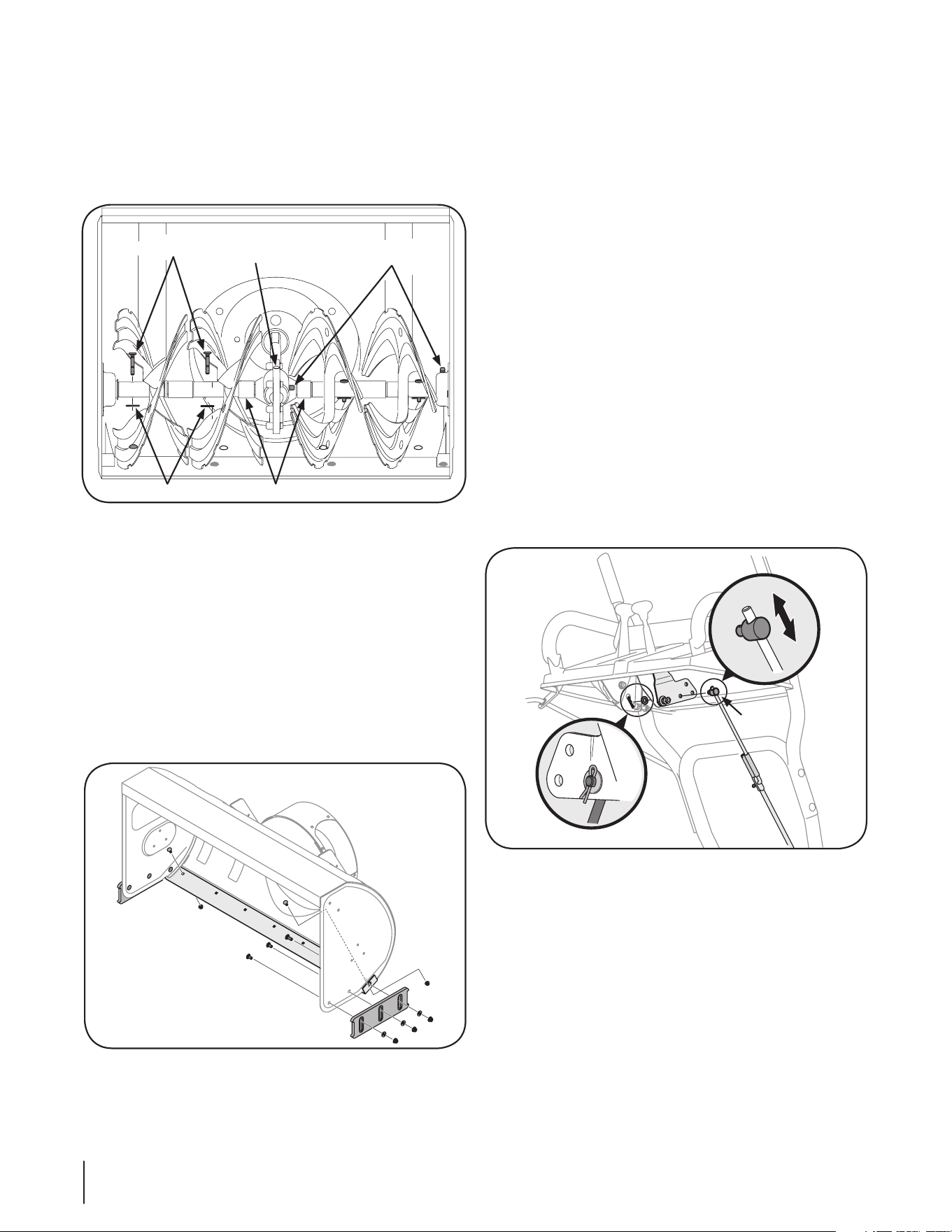
Auger Shaft
At least once a season, one at a time, remove all of the shear pins
from the auger shaft. Spray lubricant inside the hub of each
auger spiral assembly and around the spacers on the auger shaft.
Grease fittings can also be found at each end of the auger shaft.
Lubricate with a grease gun once a season. See Figure 6-6.
Shave Plate and Skid Shoes
The shave plate and skid shoes on the bottom of the snow
thrower are subject to wear. They should be checked periodically
and replaced when necessary.
Skid Shoes
NOTE: The skid shoes on this machine have two wear edges.
When one side wears out, they can be rotated 180° to use the
other edge.
Remove the six carriage bolts, flat washers and hex nuts that 1.
secure the two skid shoes to the sides of the auger housing.
Refer to Fig. 6-7.
Position the new skid shoes and secure with the carriage 2.
bolts, flat washers and hex nuts. Make certain the skid
shoes are adjusted to be level.
Shave Plate
Remove the hex nuts and carriage bolts that secure the 1.
shave plate to the bottom of the housing. See Fig. 6-7.
Remove the rear most hex nut and carriage bolt securing 2.
the back of each skid shoe to the sides of the housing.
Loosen the four remaining hex nuts securing the skid
shoes.
Slide the shave plate out of the off-set slot at the bottom 3.
of the housing, and from between the skid shoes and side
panels of the housing.
With the mounting holes toward the back of the unit, slide 4.
the new shave plate into position and secure with the
fasteners removed previously.
Adjustments
Speed selector Rod
If the full range of speeds (forward and reverse) cannot be
achieved, refer to Figure 6-8 and adjust the speed selector rod as
follows:
Looking underneath the handle panel, note which of 1.
the three holes in the speed selector lever the ferrule is
inserted into. Also note the direction of insertion. Then
remove the internal cotter pin and flat washer from the
ferrule and withdraw the ferrule from the speed selector
lever. See Figure 6-8.
Place speed selector lever in sixth (6) position or fastest 2.
forward speed.
Push speed selector rod and speed selector arm assembly 3.
down sharply as far as it will go to put the drive into the
fastest forward position.
As necessary, rotate the ferrule up or down the speed 4.
selector rod until the ferrule lines up with the hole from
which it was earlier removed. See Figure 6-8.
From the direction noted earlier, insert the ferrule into the 5.
proper hole.
Reinstall the washer and the internal cotter pin.6.
Grease Fitting
SpacersBow-Tie Pins
Vent Plug
Shear Pins
Figure 6-6
Figure 6-7
Figure 6-8
Ferrule
20 se c t i O n 6— Ma i n t e n a n c e & ad j u s t M e n t s
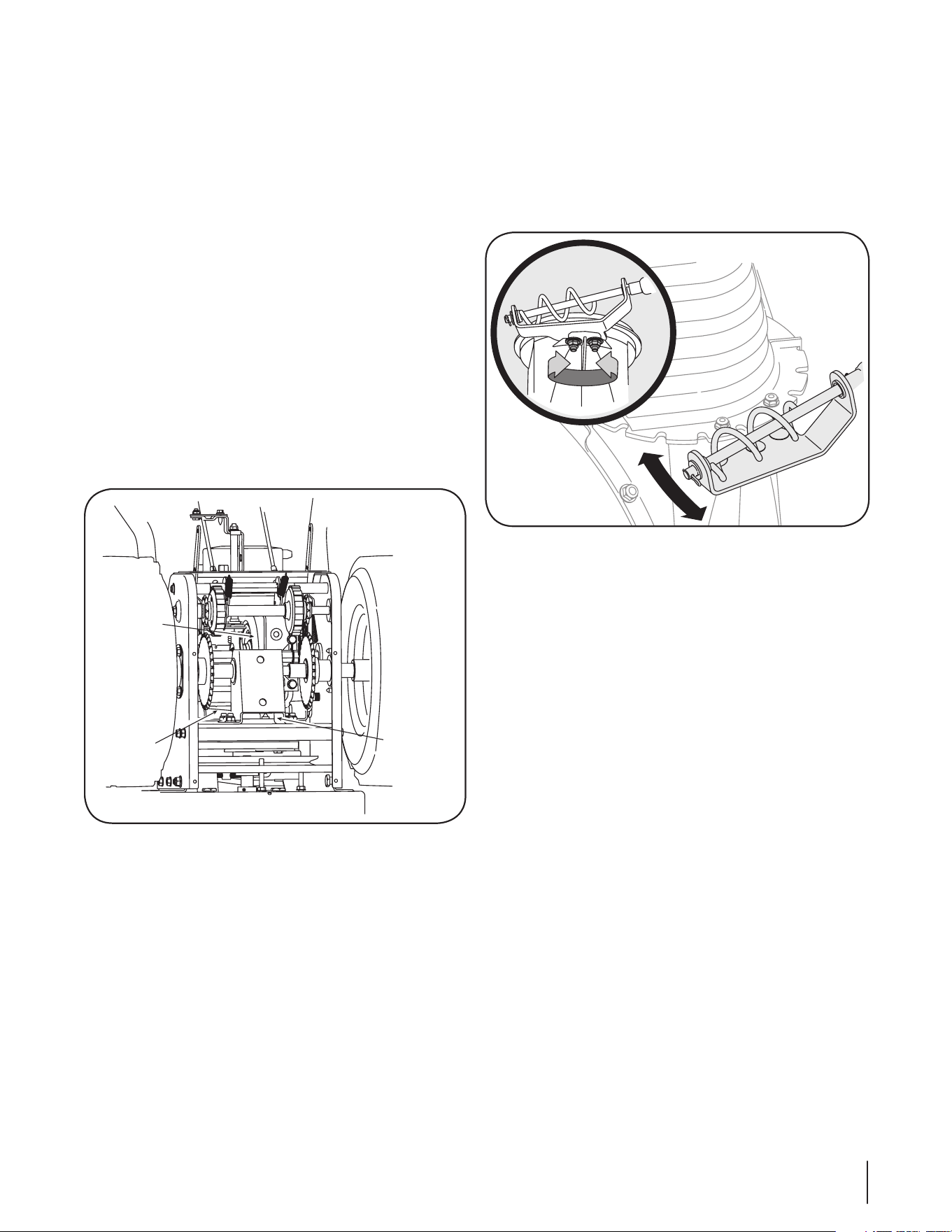
Chute Control
The distance snow is thrown can be adjusted by adjusting the
angle of the chute assembly. Refer to the Operation section for
instructions.
The remote chute control cables have been pre-adjusted at
the factory. Move the remote chute lever on the control panel
forward to pivot the upper chute down; move the lever rearward
to pivot the upper chute up.
Wheel drive control
Refer to the Adjustment section of the Assembly instructions to
adjust the wheel drive control. To further check the adjustment,
proceed as follows:
With the snow thrower tipped forward (be certain to run 1.
the fuel tank dry before tipping the unit forward), remove
the frame cover underneath the snow thrower by removing
the self-tapping screws.
Locate the opening between the axle support bracket and 2.
the front frame support (See Figure 6-9). Looking through
this opening, with the wheel drive control released, there
must be clearance between the friction wheel and the
drive plate in all positions of the speed selector lever.
With the wheel drive control engaged, the friction wheel 3.
must contact the drive plate. See Figure 6-9.
If there is no friction wheel clearance, or the friction wheel 4.
does not solidly contact the drive plate, re-adjust the
lock nut on the lower end of the drive cable following the
instructions in the Assembly section.
Reassemble the frame cover.5.
Chute Bracket
If the spiral at the bottom of the chute directional control is not
fully engaging with the chute assembly, the chute bracket can be
adjusted. To do so:
Loosen the two nuts which secure the chute bracket and 1.
reposition it slightly. See Figure 6-10.
Retighten the nuts. 2.
Auger Control
Refer to the Assembly section for instructions on adjusting the
auger control cable.
Skid Shoes
Refer to the Assembly section for instructions on adjusting the
skid shoes.
Figure 6-9
Figure 6-10
Axle Supp.
Bracket
Opening
Drive
Plate
Friction
Wheel
21se c t i O n 6 — Ma i n t e n a n c e & ad j u s t M e n t s
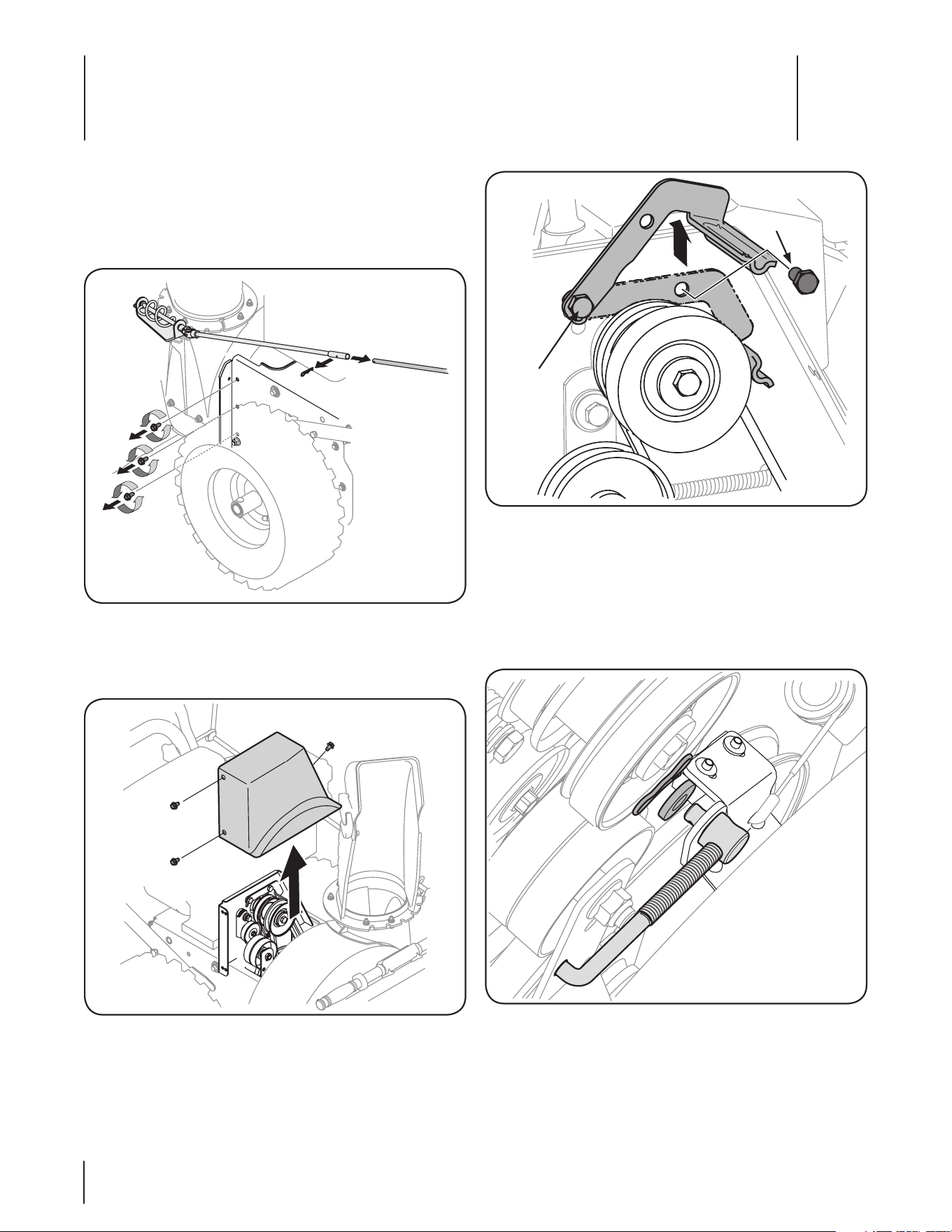
Belt Replacement
Belt Removal Preparation
Remove the cotter pin which secures the upper chute 1.
crank to the lower chute crank. Refer to Figure 7-1.
Remove the plastic belt cover on the front of the engine 2.
by removing the three self-tapping screws. See Fig. 7-2.
Loosen the bolt shown in Fig. 7-3 securing the belt 3.
keeper bracket and remove the other bolt. Push the belt
keeper bracket up off the engine pulley. See Fig. 7-3.
Auger Belt Replacement
To remove and replace your snow thrower’s auger belt,
proceed as follows:
Remove the bow tie clip and flat washer from the 1.
ferrule in order to disconnect the auger idler rod from
the brake bracket assembly. See Fig. 7-4.
NOTE: Make sure to maintain the location of the
ferrule on the idler rod.
Slip the auger control belt (the front belt) off the engine 2.
pulley.
Figure 7-4
Figure 7-1
Figure 7-2
Figure 7-3
Loosen
Remove
Service
7
22
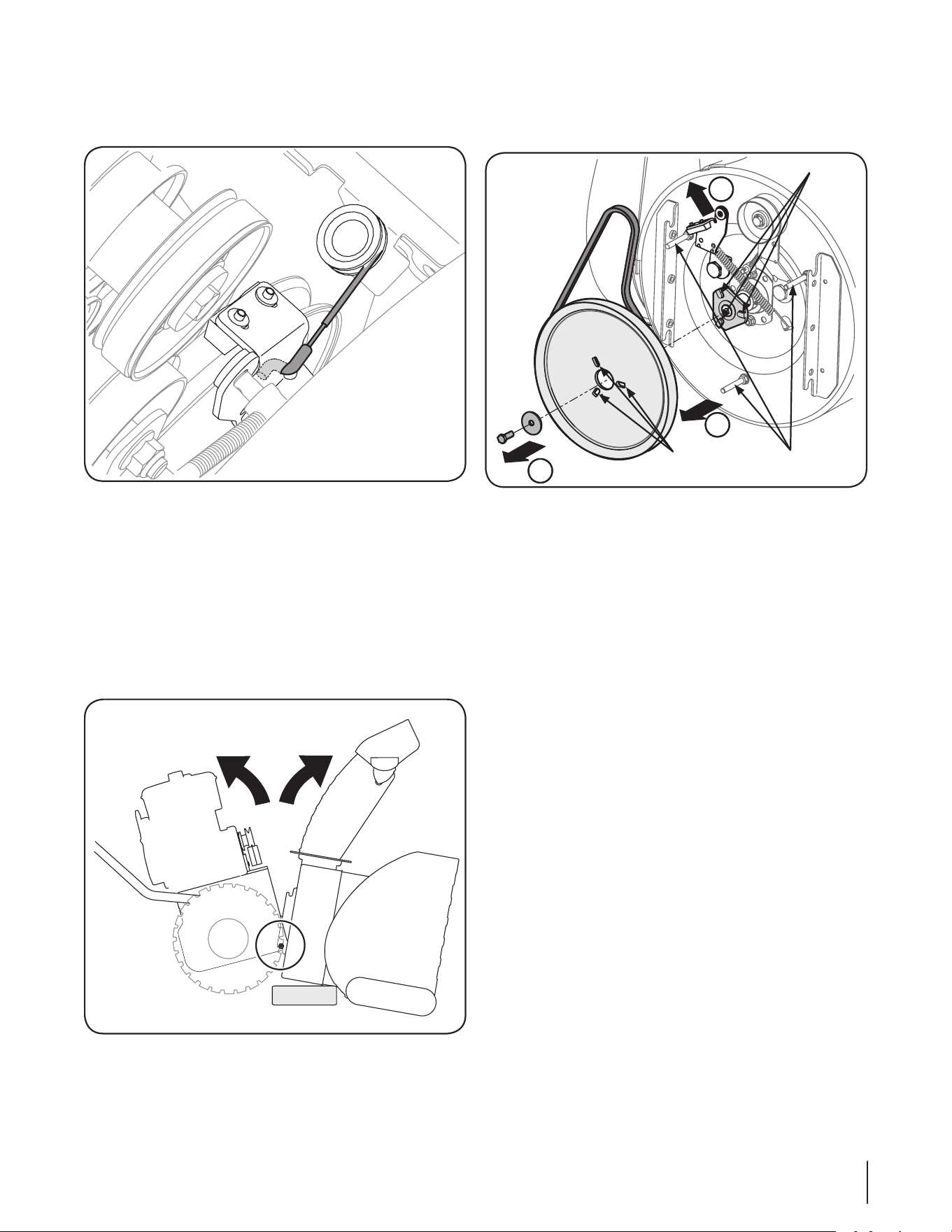
Pull the brake bracket assembly towards the cable 3.
guide roller and unhook the auger cable “Z” fitting.
Refer to Fig. 7-5.
From b4. oth sides of the frame assembly, use a 1/2"
wrench to remove the three hex tap screws securing
the transmission frame to the auger housing assembly.
Refer to Fig. 7-1. NOTE: Do not remove the lower hex
flange lock nut on each side.
Place a bloc5. k of wood underneath the auger housing as
shown in Fig. 7-6 and separate auger housing from the
transmission frame by tilting the housing forward and
pulling up the handles.
Block the impeller with a piece of wood to prevent 6.
from spinning and use a 1/2” wrench to remove the
hex screw and flat washer from the center of the auger
input shaft and auger pulley adapter. Refer to Fig. 7-7.
Lift the brake bracket assembly out of the pulley groove 7.
and slide the pulley assembly off the posts of the auger
pulley adapter to remove the old belt. Refer to Fig. 7-7.
NOTE: The pulley adapter may slide off the auger input
shaft when removing the pulley. Use extra caution to
ensure the adapter does not fall and get damaged when
removing the pulley.
Place the new auger belt in the V-groove of the auger 8.
pulley and place the pulley w/belt inside the belt
keepers.
Turn the pulley as necessary to align its three slots 9.
approximately with the posts of the pulley adapter,
then move the brake bracket assembly away from the
input shaft. While aligning the pulley slots and adapter
posts, push the auger pulley fully onto the adapter.
Refer to Fig. 7-7.
NOTE: If the pulley adapter was removed with the pulley,
align the splines of the pulley adapter and auger input
shaft, and push the pulley and adapter onto the input
shaft. Refer to Fig. 7-7.
Slide the washer onto the hex screw removed earlier 10.
and apply Loctite 262 to the threads of the hex screw.
Insert the hex screw through the pulley assembly and 11.
into the threads of the input shaft. Torque the hex
screw to 250-325 in. /lbs. to secure the auger pulley
assembly on the input shaft.
If also replacing the drive belt, proceed to the “Drive 12.
Belt” instruction. If not, reposition the transmission
frame back onto the auger housing. Install the drive
belt on the engine pulley, re-connect the auger cable
“Z” fitting and auger idler rod ferrule to the brake
bracket. Reposition and secure the engine pulley belt
guard, and re-install the belt cover.
Figure 7-7
Figure 7-6
Figure 7-5
A
C
B
Adapter Post
Belt Keeper
Pulley Slot
23se c t i O n 7 — se r v i c e
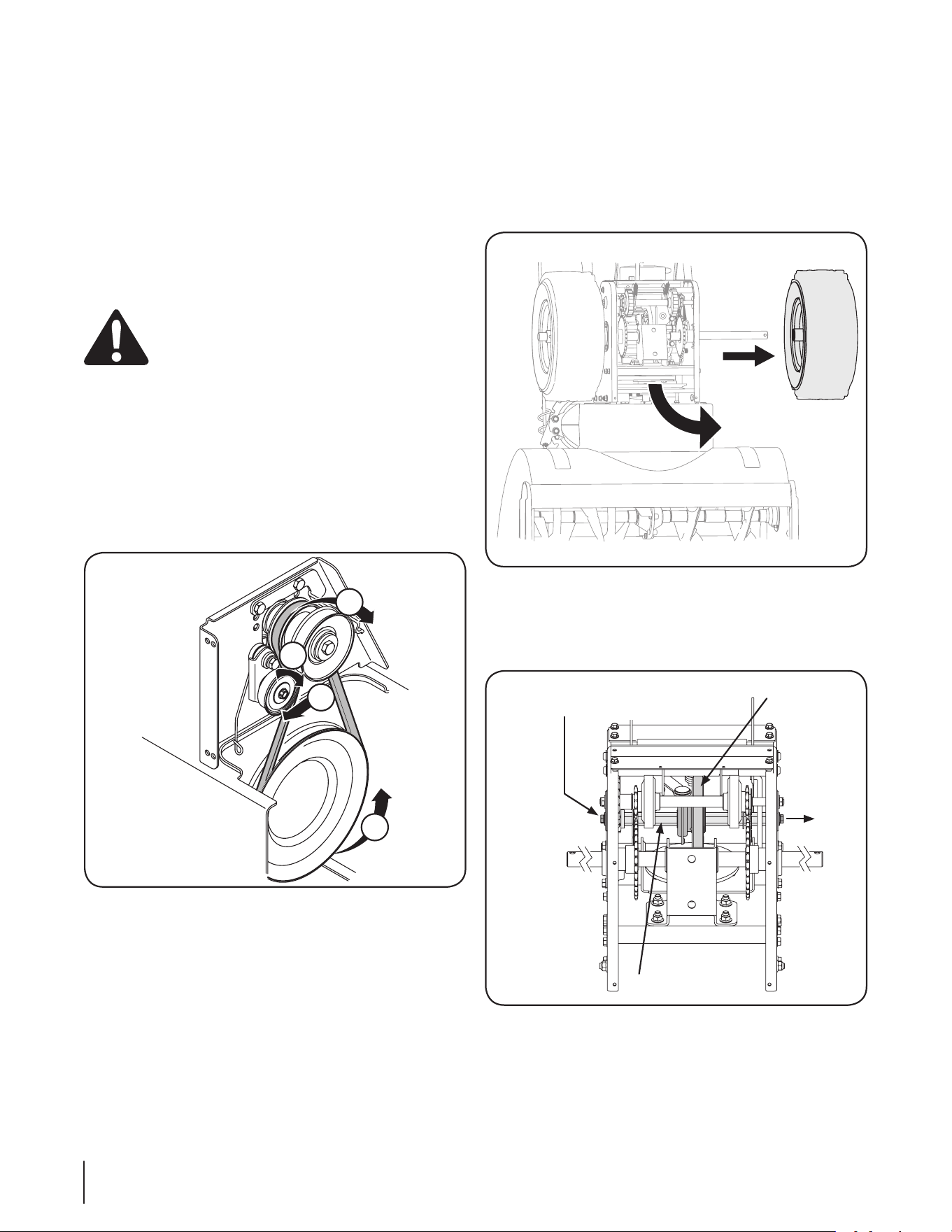
NOTE: Make sure to remove the piece of wood blocking the
impeller.
Check the auger drive belt adjustment. With the auger
clutch lever in the disengaged position, the top surface of
the new belt should be even with the outside diameter of
the pulley.
To adjust, disconnect ferrule from brake bracket assembly.
Thread ferrule in (towards idler) to increase tension on belt,
or out to decrease belt tension.
NOTE: The brake puck must always be firmly seated in the
pulley groove when auger control is disengaged.
CAUTION: Repeat the “Testing Auger Drive
Control” from the Assembly and Set-up section
before operating the snow thrower.
Drive Belt Replacement
If not already done, remove the auger drive belt from the
front pulley of the engine double pulley. Refer to “Auger
Belt Replacement” instructions in the previous sub-section.
Use a wrench to rotate the idler pulley away from the 1.
backside of the drive belt to relieve the tension and slip
the drive belt off the idler pulley. Carefully release the
idler pulley. See Fig. 7-8.
Roll the drive belt off the lower drive pulley and then 2.
remove the belt from the engine pulley.
Install the new belt on the engine pulley, then seat around 3.
the lower drive pulley and re-tension with the idler pulley.
Reassemble by performing the previous steps in the 4.
opposite order and manner of removal.
Changing Friction Wheel
The rubber on the friction wheel is subject to wear and
should be checked after the first 25 hours of operation,
and periodically thereafter. Replace the friction wheel if
any signs of wear or cracking are found.
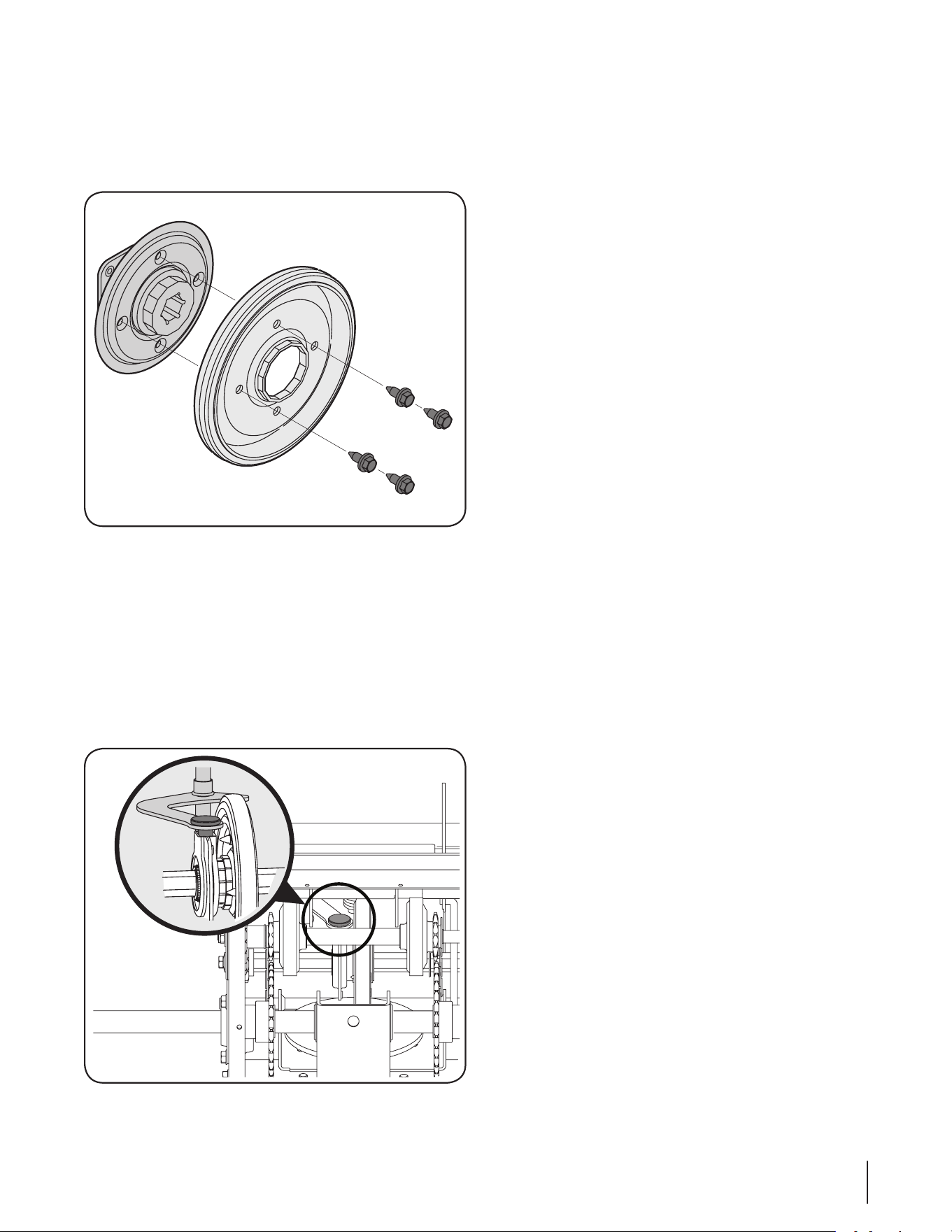
Drain the gasoline from the snow thrower, or place a 1.
piece of plastic under the gas cap.
Tip the snow thrower up and forward, so that it rests on 2.
the housing.
Remove screws from the frame cover underneath the 3.
snow thrower (refer to Fig. 7-9). Remove the right wheel
from the axle.
Using a 3/4” wrench, hold the hex shaft and remove the 4.
hex screw and belleville washer and bearing from left
side of the frame. Refer to Fig. 7-10.
Holding the friction wheel assembly, slide the hex shaft 5.
out of the right side of the frame. The spacer on the left
side of the hex shaft will fall and the sprocket should
remain hanging lose in the chain.
Figure 7-8
2
3
1a
1b
Figure 7-9
Figure 7-10
Friction Wheel Assembly
Hex Shaft
Remove Hex Screw &
Belleville Washer
Slide Hex
Shaft Out
Right Side
24 se c t i O n 7 — se r v i c e
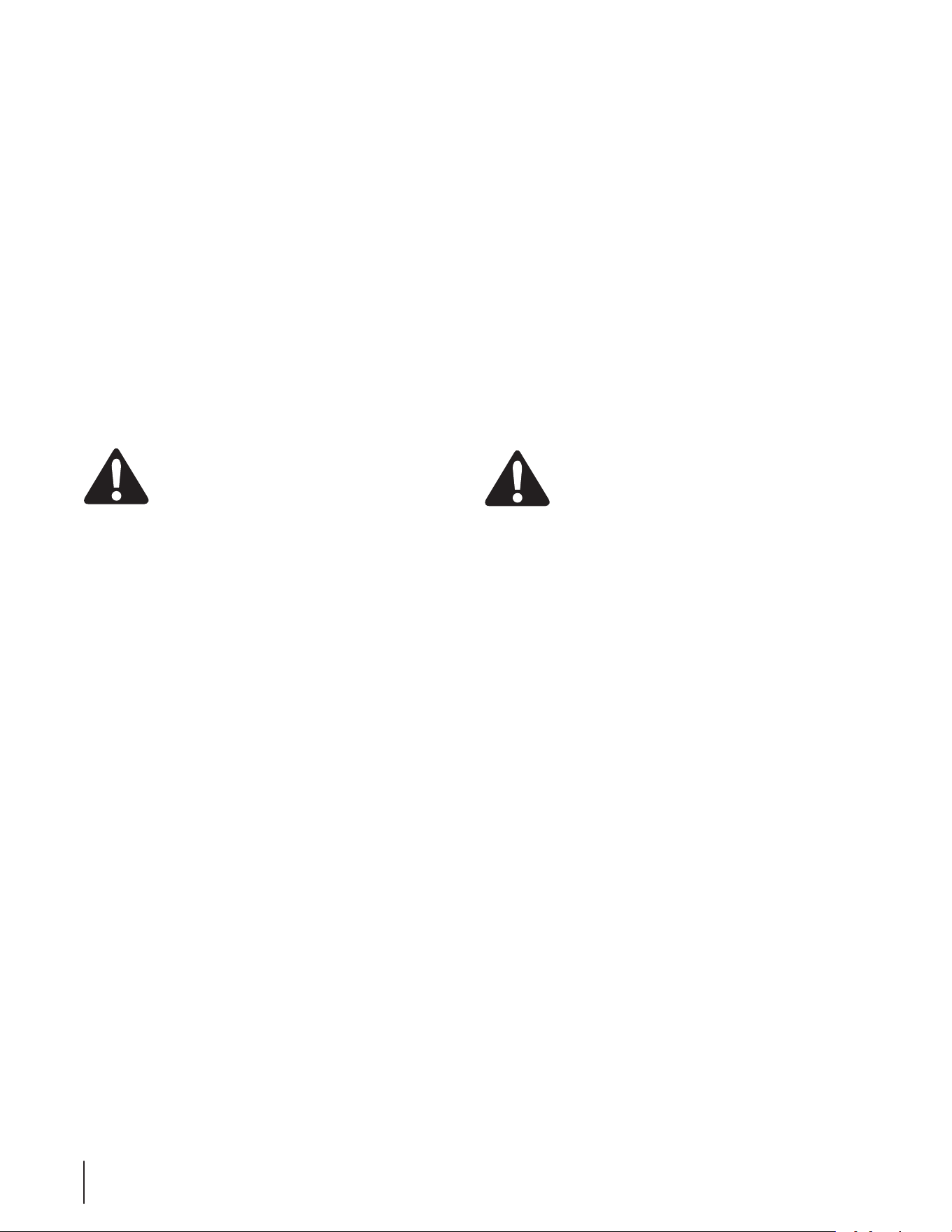
Lift the friction wheel assembly out between the axle 6.
shaft and the drive shaft assemblies.
Remove four screws securing the friction wheel to the 7.
hub assembly (refer to Fig. 7-11). Discard old friction
wheel.
Reassemble the new friction wheel onto the hub 8.
assembly, tightening the four screws in rotation and
with equal force. It is important to assemble the friction
wheel symmetrically for proper functioning. Refer to
Fig. 7-11.
Reposition the friction wheel assembly in the snow 9.
thrower frame. Insert the pin from the shift arm
assembly into the friction wheel assembly and hold
assembly in position. Refer to Fig. 7-12.
Figure 7-11
Figure 7-12
Slide the hex shaft through the right side of the frame 10.
toward the left side and through the friction wheel
assembly.
NOTE: If the sprocket fell from the snow thrower chain
while removing the hex shaft, position the hex hub of the
sprocket toward the friction wheel and place the sprocket
in the chain.
After making certain that the chain is on both the large 11.
and the small sprocket, align the hex shaft with the hex
hub of the small sprocket, and slide the shaft through
the sprocket.
Slide the spacer onto the end of the hex shaft.12.
Align the bearing on the right end of the hex shaft with 13.
the hole in the right side of the frame, then push the
hex shaft to the left into position in the frame.
Slide the bearing onto the left end of the hex shaft and 14.
press into the hole on the left side the frame.
Place the belleville washer (rounded side toward head) 15.
onto the hex screw removed earlier, and insert the
screw into the threaded hole of the hex shaft.
Gradually tighten the hex screw to fully seat the 16.
bearings in each side of the frame and to secure the
hex shaft.
Position the frame cover on the bottom of the frame 17.
and secure with the self-tapping screws. Pivot the snow
thrower down to its normal operating position.
IMPORTANT: Repeat the drive control test from the Set-Up
& Assembly section of this manual before operating the
snow thrower.
NOTE: If you placed plastic film under the gas cap, be
certain to remove it.
25se c t i O n 7 — se r v i c e
Off-Season Storage
If the snow thrower will not be used for 30 days or longer,
the equipment needs to be stored properly. Follow storage
instructions below to ensure top performance from the
snow thrower for many more years.
Short-Term Storage
It is important to prevent gum deposits from forming
in essential fuel system parts of the engine such as the
carburetor, fuel filter, fuel hose, or tank during short-term
storage (15-30 days). To prevent this, treat the fuel system
using a fuel stabilizer.
Fuel stabilizer (such as STA-BIL™ or ULTRA-FRESH™) is an
acceptable alternative in minimizing the formation of fuel
gum deposits during storage. Add stabilizer to gasoline
in fuel tank or storage container. Always follow mix ratio
found on stabilizer container. Run engine at least 10
minutes after adding stabilizer to allow it to reach the
carburetor.
WARNING! Never store snow thrower with fuel
in tank indoors or in poorly ventilated areas,
where fuel fumes may reach an open flame,
spark or pilot light as on a furnace, water
heater, clothes dryer or gas appliance.
Long-Term Storage
Engines stored over 30 days need to be drained of fuel
to prevent deterioration and gum from forming in fuel
system or on essential carburetor parts. If the gasoline in
your engine deteriorates during storage, you may need to
have the carburetor, and other fuel system components,
serviced or replaced.
Remove all of the fuel from the fuel tank by running 1.
the engine until the fuel tank is empty and it stops due
to lack of fuel. Do not attempt to pour fuel from the
engine.
Change the engine oil as instructed in the Maintenance 2.
section of this manual.
Remove the spark plug and pour one (1) ounce (30 ml) 3.
of clean engine oil through the spark plug hole and into
the cylinder. Cover spark plug hole with a rag and crank
the engine several times to distribute the oil. Replace
spark plug.
WARNING! Never use engine or carburetor
cleaning products in the fuel tank or
permanent damage may occur.
Clean debris from around engine, and under, around, and
behind muffler. Apply a light film of oil on any areas that
are susceptible to rust.
Store in a clean, dry and well ventilated area away from •
any appliance that operates with a flame or pilot light,
such as a furnace, water heater, or clothes dryer. Avoid
any area with a spark producing electric motor, or
where power tools are operated.
If possible, avoid storage areas with high humidity.•
Keep the engine level in storage. Tilting can cause fuel •
or oil leakage.
26 se c t i O n 7 — se r v i c e
Troubleshooting
8
27
Problem Cause Remedy
Engine fails to start Choke not in CHOKE position.1.
Spark plug wire disconnected.2.
Fuel tank empty or stale fuel.3.
Engine not primed.4.
Faulty spark plug. 5.
Safety key not in ignition on engine.6.
Extension cord not connected (when 7.
using electric start button, on models so
equipped).
Move choke to CHOKE position.1.
Connect wire to spark plug.2.
Fill tank with clean, fresh gasoline.3.
Prime engine as instructed in “Operating 4.
Your Snow Thrower”.
Clean, adjust gap, or replace.5.
Insert key fully into the switch.6.
Connect one end of the extension cord to 7.
the electric starter outlet and the other end
to a three-prong 120-volt, grounded, AC
outlet.
Engine runs erratic /
inconsistent RPM (hunting
or surging)
Engine running on CHOKE.1.
Stale fuel.2.
Water or dirt in fuel system.3.
Carburetor out of adjustment.4.
Over-governed engine.5.
Move choke lever to RUN position.1.
Fill tank with clean, fresh gasoline.2.
Drain fuel tank. Refill with fresh fuel.3.
Contact an authorized Service Center.4.
Contact an authorized Service Center.5.
Engine overheats Carburetor not adjusted properly.1. Contact an authorized Service Center.1.
Excessive vibration Loose parts or damaged auger.1. Stop engine immediately and disconnect 1.
spark plug wire. Tighten all bolts and nuts. If
vibration continues, have unit serviced by an
authorized Service Center.
Loss of power Spark plug wire loose.1.
Gas cap vent hole plugged.2.
Connect and tighten spark plug wire.1.
Remove ice and snow from gas cap. Be 2.
certain vent hole is clear.
Unit fails to propel itself Drive control cable in need of adjustment. 1.
Drive belt loose or damaged.2.
Friction wheel worn.3.
Adjust drive control cable. Refer to 1.
Maintenance section
Replace drive belt.2.
Replace Friction Wheel.3.
Unit fails to discharge snow Chute assembly clogged. 1.
Foreign object lodged in auger. 2.
Auger control cable in need of adjustment.3.
Auger belt loose or damaged.4.
Shear pin(s) sheared.5.
Stop engine immediately and disconnect 1.
spark plug wire. Clean chute assembly and
inside of auger housing with clean-out tool
or a stick.
Stop engine immediately and disconnect 2.
spark plug wire. Remove object from auger
with clean-out tool or a stick.
Refer to Auger Control Test.3.
Refer to Maintenance section.4.
Replace with new shear pin(s).5.
Phone (800) 965-4CUB (4282) to order replacement parts or a complete Parts Manual (have your full model number and
serial number ready). Parts Manual downloads are also available free of charge at www.cubcadet.com.
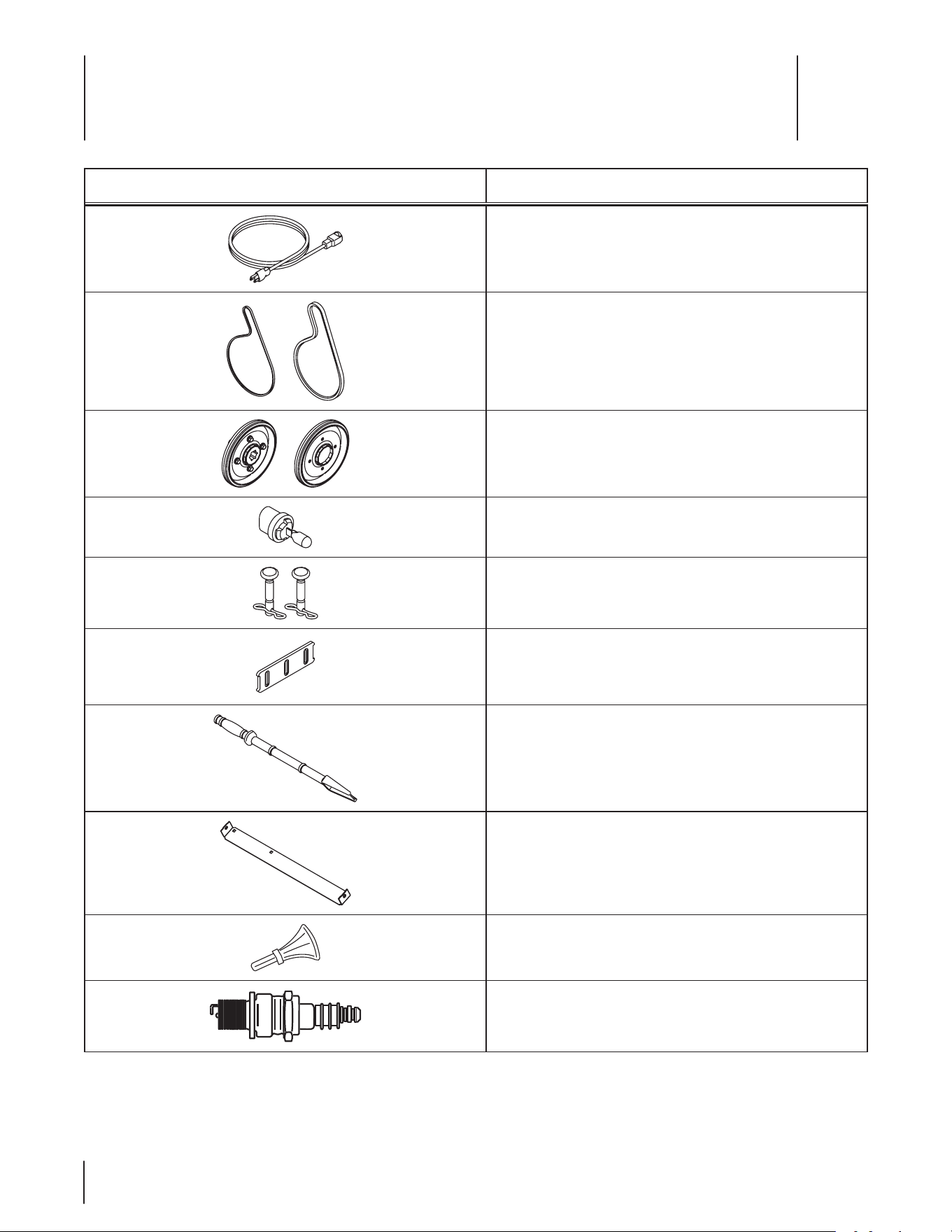
Component Part Number and Description
929-0071 Extension Cord, 110V
954-04194A Auger Drive Belt
954-04202 Wheel Drive Belt
918-04178 Friction Wheel Assembly
718-04034 Friction Wheel w/Bonded Rubber
725-1658 Lamp
738-04155 Shear Pin
714-04040 Bow-tie Cotter Pin
731-07032 Slide Shoe, Deluxe
731-2643 Chute Clean-out Tool
790-00195A Shave Plate, Stainless Steel
731-05632 Key
951-10292 Spark Plug
Replacement Parts
9
28

Notes
10
29

MTD CONSUMER GROUP INC (MTD), the California Air Resources Board (CARB)
and the United States Environment Protection Agency (U. S. EPA)
Emission Control System Warranty Statement
(Owner’s Defect Warranty Rights and Obligations)
EMISSION CONTROL SYSTEM COVERAGE IS APPLICABLE TO CERTIFIED ENGINES PURCHASED IN CALIFORNIA IN 2005 AND THERE-
AFTER, WHICH ARE USED IN CALIFORNIA, AND TO CERTIFIED MODEL YEAR 2005 AND LATER ENGINES WHICH ARE PURCHASED AND
USED ELSEWHERE IN THE UNITED STATES.
California and elsewhere in the United States Emission Control Defects Warranty Coverage
The California Air Resources Board (CARB), U. S. EPA and MTD are pleased to explain the emissions control system warranty on your model year
2006 and later small off-road engine. In California, new small off-road engines must be designed, built and equipped to meet the States anti-smog
standards. Elsewhere in the United States, new non-road, spark-ignition engines certified for model 2005 and later, must meet similar standards set
forth by the U. S. EPA. MTD must warranty the emission control system on your engine for the period of time listed below, provided there has been
no abuse, neglect or improper maintenance of your small off-road engine.
Your emission control system may include parts such as the carburetor, fuel-injection system, the ignition system, and catalytic converter, fuel tanks,
fuel lines, fuel caps, valves, canisters, filters, vapor hoses, clamps, connectors, and other associated emission-related components.
Where a warrantable condition exists, MTD will repair your small off-road engine at no cost to your including diagnosis, parts and labor.
MANUFACTURER’S WARRANTY COVERAGE:
This emissions control system is warranted for two years. If any emission-related part on your engine is defective, the part will be repaired or
replaced by MTD.
OWNER’S WARRANTY RESPONSIBILITIES:
As the small off-road engine owner, you are responsible for the performance of the required maintenance listed in your Owner’s Manual. MTD
recommends that you retain all your receipts covering maintenances on your small off-road engine, but MTD can not deny warranty solely for the
lack of receipts or for your failure to ensure the performance to all scheduled maintenance.
As the small off-road engine owner, you should however be aware that MTD may deny your warranty coverage if your small off-road engine or part
has failed due to abuse, neglect, improper maintenance or unapproved modifications.
You are responsible for presenting your small off-road engine to an Authorized MTD Service Dealer as soon as a problem exists. The warranted
repairs should be completed in a reasonable amount of time, not to exceed 30 days.
If you have any questions regarding your warranty rights and responsibilities, you should contact a MTD Service Representative at 1-800-800-7310
and address is MTD CONSUMER GROUP, P.O. Box 361131, Cleveland OH, 44136-0019.
DEFECTS WARRANTY REqUIREMENTS FOR 1995 AND LATER SMALL OFF-ROAD ENGINES:
This section applies to 1995 and later small off-road engines. The warranty period begins on the date the engine or equipment is delivered to an
ultimate purchaser.
(a) General Emissions Warranty Coverage
MTD must warrant to the ultimate purchaser and each subsequent purchaser that the engine is:
(1) Designed, built, and equipped so as to conform with all applicable regulations adopted by the Air Resources Board pursuant to its authority in
Chapters 1 and 2,Part 5, Division 26 of the Health and Safety Code; and
(2) Free from defects in materials and workmanship that cause the failure of a warranted part to be identical in all material respects to the part as
described in the engine manufacturer’s application for certification for a period of two years.
(b) The warranty on emissions-related parts will be interpreted as follows:
(1) Any warranted part that is not scheduled for replacement as required maintenance in the written instructions required by Subsection (c)
must be warranted for the warranty period defined in Subsection (a)(2). If any such part fails during the period of warranty coverage, it must be
repaired or replaced by MTD according to Subsection (4) below. Any such part repaired or replaced under the warranty must be warranted for
the remaining warranty period.
(2) Any warranted part that is scheduled only for regular inspection in the written instructions required by Subsection (c) must be warranted for
the warranty period defined in Subsection (a)(2). A statement in such written instructions to the effect of “repair or replace as necessary” will
not reduce the period of warranty coverage. Any such part repaired or replaced under warranty must be warranted for the remaining warranty
period.
(3) Any warranted part that which is scheduled for replacement as required maintenance in the written instructions required by Subsection (c)
must be warranted for the period of time prior to the first scheduled replacement point for that part. If the part fails prior to the first scheduled
replacement, the part must be repaired or replaced by MTD according to Subsection (4) below. Any such part repaired or replaced under
warranty must be warranted for the remainder of the period prior to the first scheduled replacement point for the part.

(4) Repair or replacement of any warranted part under the warranty provisions of this article must be performed at no charge to the owner at a
warranty station.
(5) Notwithstanding the provisions of Subsection (4) above, warranty services or repairs must be provided at all MTD distribution centers that
are franchised to service the subject engines.
(6) The owner must not be charged for diagnostic labor that leads to the determination that a warranted part is in fact defective, provided that
such diagnostic work is performed at a warranty station.
(7) The engine manufacturer is liable for damages to other engine components proximately caused by a failure under warranty of any warranted
part.
(8) Throughout the engine’s warranty period defined in Subsection (a)(2), MTD will maintain a supply of warranted parts sufficient to meet the
expected demand for such parts.
(9) Any replacement part may be used in the performance of any warranty maintenance or repairs and must be provided without charge to the
owner. Such use will not reduce the warranty obligations of MTD.
(10) Add-on or modified parts that are not exempted by the Air Resources Board may not be used. The use of any non-exempted add-on or
modified parts shall be grounds for disallowing a warranty claim made in accordance with this article. The engine manufacturer shall not be
liable under this article to warrant failures of warranted parts caused by the use of non-exempted add-on or modified part.
(c) MTD will include a copy of the following emission warranty parts list with each new engine, using those portions of the list applicable to the
engine.
(1) Fuel Metering System
•Coldstartenrichmentsystem(softchoke)
•Carburetorandinternalparts
•FuelPump
•FuelTank
(2) Air Induction System
•Aircleaner
•Intakemanifold
(3) Ignition System
•Sparkplug(s)
•MagnetoIgnitionSystem
(4) Exhaust System
•Catalyticconverter
•SAI(Reedvalve)
(5) Miscellaneous Items Used in Above System
•Vacuum,temperature,position,timesensitivevalvesandswitches
•Connectorsandassemblies
(6) Evaporative control
•FuelHosecertifiedforARBevaporativeemissionof2006.
•FuelHoseClamps
•Tetheredfuelcap
•Carboncanister
•Vaporlines
GDOC-100174 Rev. B

The limited warranty set forth below is given by Cub Cadet LLC with
respect to new merchandise purchased and used in the United States,
its possessions and territories, and by MTD Products Limited with
respect to new merchandise purchased and used in Canada and/or its
territories and possessions.
For non-commercial use: Cub Cadet warrants this product (excluding
Normal Wear Parts, as described below) against defects in material
and workmanship for a period of three (3) years from the date of
original retail purchase or lease.
For commercial uses and applications: Cub Cadet warrants this
product (excluding Normal Wear Parts, as described below) against
defects in material and workmanship for a period of one (1) year from
the date of original retail purchase or lease.
“Cub Cadet” will, at its option, repair or replace, free of charge, any
part found to be defective in materials or workmanship. This limited
warranty shall only apply if this product has been operated and
maintained in accordance with the Operator’s Manual furnished with
the product, and has not been subject to misuse, abuse, neglect,
accident, improper maintenance, alteration, vandalism, theft, fire,
water, or damage because of other peril or natural disaster. Damage
resulting from the installation or use of any part, accessory or
attachment not approved by Cub Cadet for use with the product(s)
covered by this manual will void your warranty as to any resulting
damage.
Normal Wear Parts are warranted to be free from defects in material
and workmanship for a period of thirty (30) days from the date of
purchase. Normal wear parts include, but are not limited to items
such as: belts, skid shoes, shave plates and tires.
HOW TO OBTAIN SERVICE: Warranty service is available, WITH
PROOF OF PURCHASE, through your local authorized service
dealer. To locate the dealer in your area:
In the U.S.A.
To locate the dealer in your area, check your Yellow Pages, or contact
Cub Cadet LLC at P.O. Box 361131, Cleveland, Ohio 44136-0019, or
call 1-877-282-8684, or log on to our Web site at www.cubcadet.
com.
In Canada
Contact MTD Products Limited, Kitchener, ON N2G 4J1, or call
1-800-668-1238 or log on to our Web site at www.mtdcanada.
com.
This limited warranty does not provide coverage in the following
cases:
a. Routine maintenance items such as lubricants, filters, blade
sharpening, tune-ups, brake adjustments, clutch adjustments,
deck adjustments, and normal deterioration of the exterior finish
due to use or exposure.
b. Cub Cadet does not extend any warranty for products sold or
exported outside of the United States and/or Canada, and their
respective possessions and territories, except those sold through
Cub Cadet’s authorized channels of export distribution.
c. Replacement parts that are not genuine Cub Cadet parts.
d. Service completed by someone other than an authorized service
dealer.
e. Transportation charges and service calls.
No implied warranty, including any implied warranty of mer-
chantability of fitness for a particular purpose, applies after the
applicable period of express written warranty above as to the
parts as identified. No other express warranty, whether written
or oral, except as mentioned above, given by any person or
entity, including a dealer or retailer, with respect to any product,
shall bind Cub Cadet. During the period of the warranty, the
exclusive remedy is repair or replacement of the product as set
forth above.
The provisions as set forth in this warranty provide the sole and
exclusive remedy arising from the sale. Cub Cadet shall not be
liable for incidental or consequential loss or damage including,
without limitation, expenses incurred for substitute or replace-
ment lawn care services or for rental expenses to temporarily
replace a warranted product.
Some states do not allow the exclusion or limitation of incidental
or consequential damages, or limitations on how long an implied
warranty lasts, so the above exclusions or limitations may not apply
to you.
In no event shall recovery of any kind be greater than the amount
of the purchase price of the product sold. Alteration of safety
features of the product shall void this warranty. You assume the
risk and liability for loss, damage, or injury to you and your property
and/or to others and their property arising out of the misuse or
inability to use the product.
This limited warranty shall not extend to anyone other than the
original purchaser or to the person for whom it was purchased as a
gift.
HOW STATE LAW RELATES TO THIS WARRANTY: This limited
warranty gives you specific legal rights, and you may also have other
rights that vary in different jurisdictions.
IMPORTANT: Owner must present Original Proof of Purchase to
obtain warranty coverage.
Cub Cadet LLC, P.O. BOX 361131 CLEVELAND, OHIO 44136-0019; Phone: 1-877-282-8684
MTD Canada Limited - KITCHENER, ON N2G 4J1; Phone 1-800-668-1238
GDOC-100160 REV. A
CUB CADET LLC
MANUFACTURER’S LIMITED WARRANTY FOR
SNOW THROWERS

