

Visit Our Website
SCAN ME
PyleUSA.com
USER GUIDE
Beginners 6-String
Acoustic Guitar
Guitar with Accessory Kit

www.PyleUSA.com
2
Please take a few moments to read through this booklet.
In it you will nd answers to many of your questions and other invaluable information about tuning
and changing strings.
Protection from Temperature and Humidity
The most important thing you can do to ensure the structural integrity of your instrument over time, is to maintain
the moisture content of the wood consistently at the appropriate level.
It is 100% certain that an acoustic guitar will be exposed to varied and multiple environmental/climatic conditions from
the time it leaves the maker’s hands until it reaches its ultimate owner. The environment where you live may be a
complete polar opposite from that of the climate where the instrument was produced. It is of paramount importance to
evaluate, measure and stabilize the moisture content in the wood as soon as possible after bringing an instrument into
a new environment.
In the winter, the forced air systems used to heat most homes can drive temperatures up and humidity levels dangerously
low for guitars. Extremely low levels of humidity will result in low moisture content in the wood and ultimately, damage
to the guitar. A good measure of protection against drying out your guitar is to use a room humidier to maintain the
ideal relative humidity of between 40% and 50%.
When the instrument is not in use, we recommend that you keep it in its case with a hygrometer to monitor the humidity
level. Do not leave the guitar out of the case for long periods near a heating vent, radiator or in direct sunlight near a
window. Do not leave your guitar in the trunk or the cabin of a car for long periods and keep it away from excessive heat
and cold.
Please Note: Damage caused to the guitar as the result of exposure to variations in temperature and/or humidity will
not be covered under the PyleUSA warranty.

www.PyleUSA.com
3
Tuning 6-string Guitars
Something as simple as how you wind the strings onto the tuning machine posts when changing your strings, will
determine tuning stability and even string tension. It’s also a good idea to stretch your strings just a little as you tune to
make sure that each string is seated well and snugged down on the tuning machine post. This will save you some tuning
frustration down the road. Just grab the string in the middle, lightly tug it up and down to remove slack, and then retune.
There are a couple of dierent methods for tuning a guitar, depending on whether your guitar is acoustic, or an acoustic
with a pickup and onboard tuner. If your guitar does not have an onboard tuner and you don’t own an electronic
chromatic tuner with a reference tone, you may want to purchase one. It will dramatically simplify tuning your acoustic
or electric guitar.
Always tune from below pitch, up to the correct pitch instead of down from a higher pitch. This will help eliminate string
slack from the tuning machine and decrease the possibility of slippage and tuning changes as you play.
If using the onboard tuner on your guitar, simply plug in, activate the tuner, turn the volume up and starting from the
thickest (bottom) string to the thinnest (top), tune the strings to: E, A, D, G, B, E.
If you do not have an onboard or an electronic tuner, use a guitar pitch pipe, an A-440 tuning fork or some other
pitch reference, and begin by:
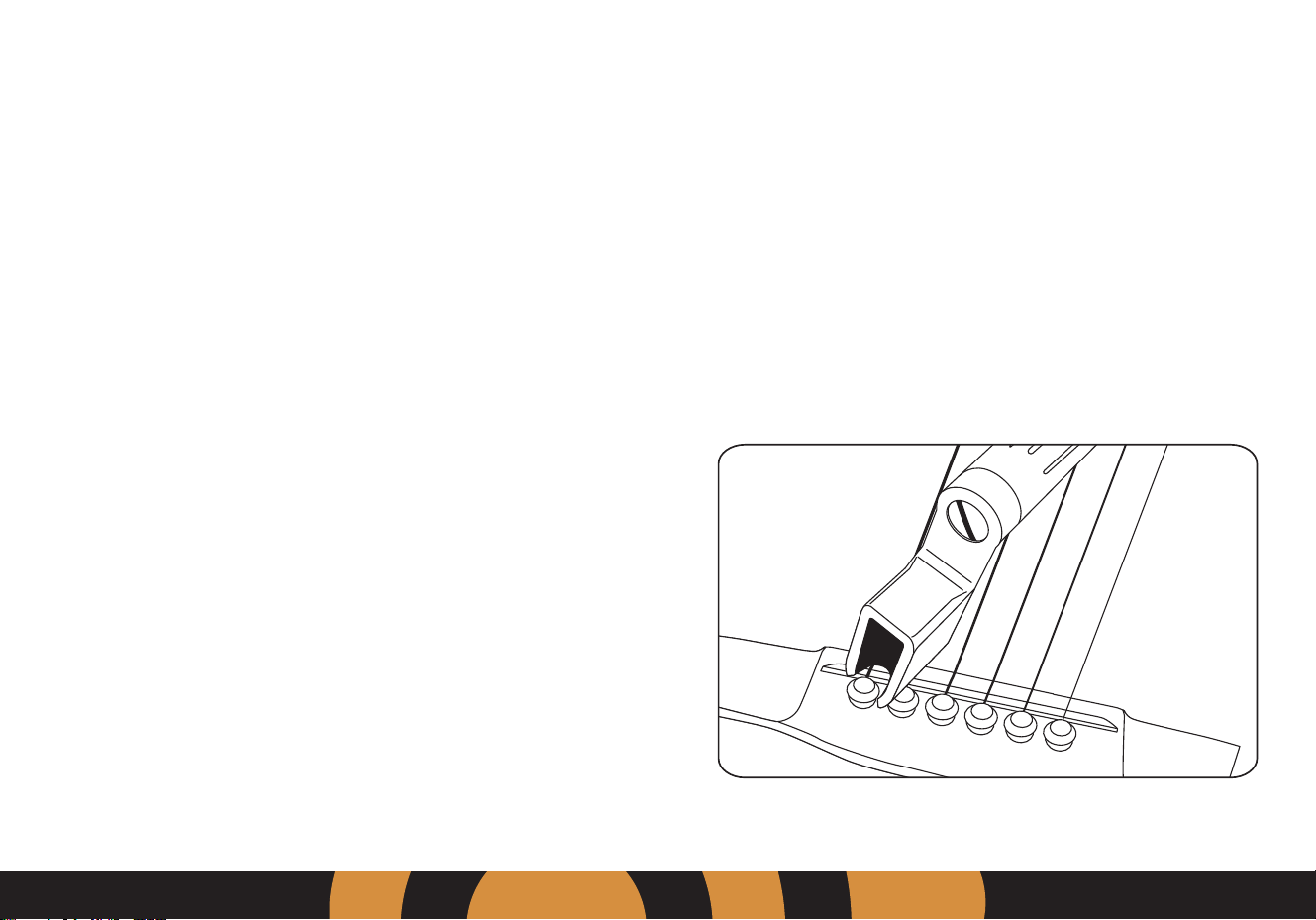
• Tuning the second string, “A” to pitch.
• Then, depress the second, or “A” string at the 5th fret, to produce a “D”, and tune the “D” string to that same pitch.
• Next, depress the “D” string at the 5th fret, to produce a “G”, and tune the “G” string until the pitches match.
• Next, depress the “G” string at the 4th fret, to produce a “B”, and tune the “B” string until the pitches match.
• Next, depress the “B” string at the 5th fret, to produce an “E” and tune the thinnest string to a matching “E”.
• Finally, go back and play the thickest “E” string and tune it until the pitch at the 5th fret, an “A”, matches the “A”
on the adjacent string.
www.PyleUSA.com
4
Changing Strings
A fresh new set of strings can breathe renewed life into your instrument. That is why many “tone-conscious” touring
professionals change their strings before every performance. While there is no set rule on how often to change strings,
we have found that most players do not change them nearly as often as they should.
Body oils, acids and salts from sweaty hands and humidity all interact with the metals in guitar strings and cause a
corrosion and breakdown of the materials. Don’t wait until your strings break and fall o from old age before you change
them. Worn, oxidized, pitted and dirty strings will not hold pitch, and simply sound bad. If you are an average player,
playing several times a week, we suggest that you change the strings at least once a month.
When changing strings, we recommend that you remove and replace each string one at a time, instead of all at once.
This will prevent sudden and potentially damaging changes in neck tension. Each new string should be tuned up to
correct pitch before the next one is removed. When tuning a brand new string, always bring it up to pitch slowly.
Otherwise, the rapid stretching may cause the string to break.
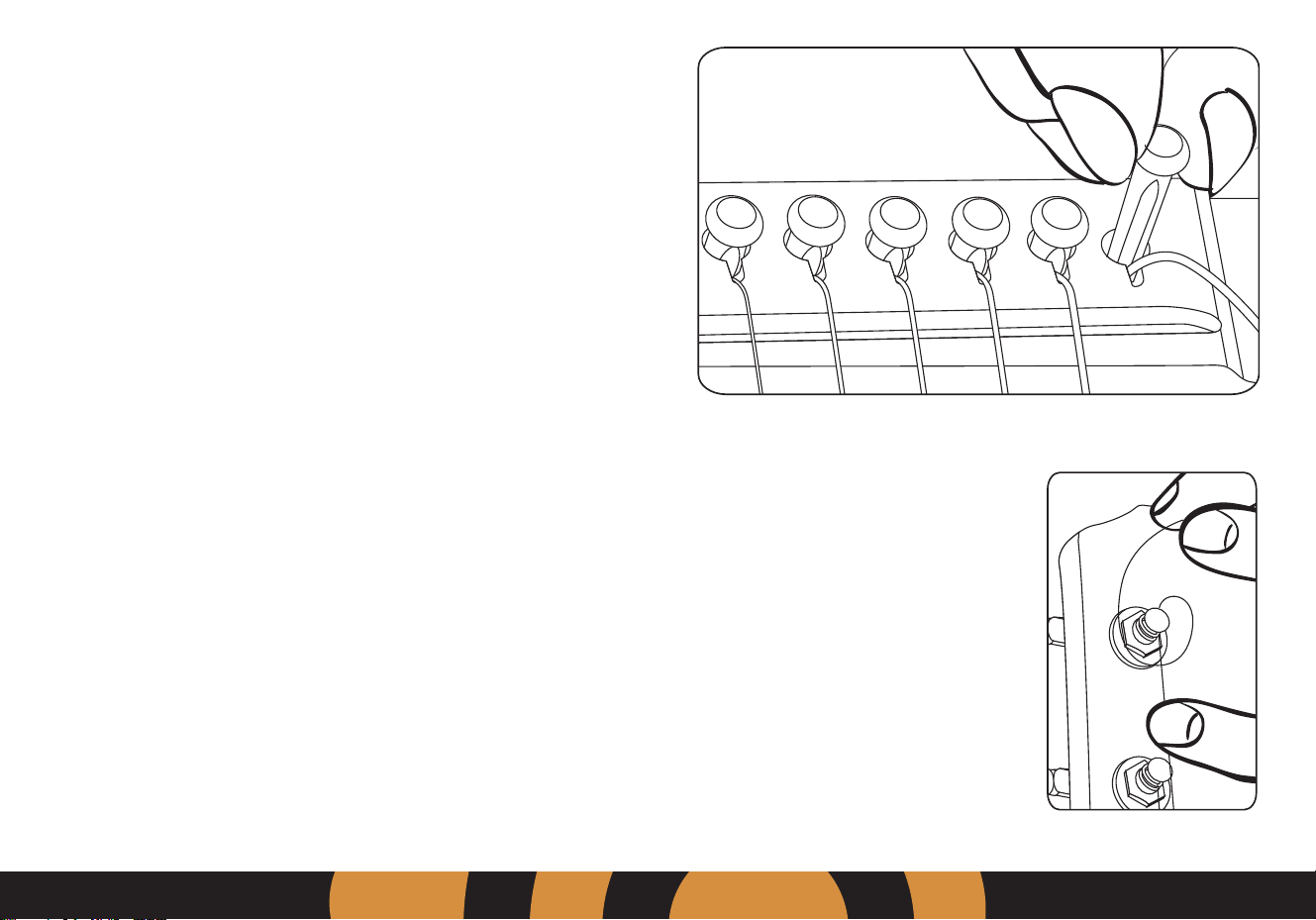
illustration 4
Re-Stringing Your Guitar
The procedure for re-stringing at-top acoustic guitars and
basses is quite similar in the way that the strings are wound
onto the tuning machines.
There are dierences though, in how the strings are attached
to the bridges of acoustic at-top and classical guitars.
Please Note: When changing strings, change them one at a
time. Do not remove all of the strings at the same time, as
doing so will release all of the tension at once from the neck
and body, which may potentially cause distortion and
damage to the instrument.
www.PyleUSA.com
5
illustration 5
illustration 6
Stringing Flat-Top, Steel String Acoustic Guitars:
Flat-top acoustics have a surface mounted pin style bridge
with holes and bridge pins to hold the strings in place. To
re-string a attop, remove the bridge pin and the old string.
If the bridge pin is dicult to remove, you may want to
purchase a combination string winder/bridge pin puller from
your local Dealer, (Figure 4). Feed the ball end of the new
string into the corresponding hole in the bridge, and then
reinsert the bridge pin snugly to keep the string in place.
Make sure that the bridge pin is positioned with the grooved
side riding over the string, (Figure 5). Do not hammer the
bridge pin in. A rm twisting push with the thumb should
secure it in place.
Next, pull the string up over the nut towards the headstock and bend it around the tuning
machine post toward the tuning machine button, (Figure 6) Thread the string through the hole
in the post and begin winding the button to remove the slack in the string.
Continue winding to form a neat coil.
Finally, tune the string to the appropriate pitch. Pull up gently at the center point of the string to
stretch it. Retune, and repeat, until unwanted slack is eliminated and the tuning of the strings is
stabilized this will prevent slipping and save you tuning frustrations down the road.
www.PyleUSA.com
6
• INGESTION HAZARD: This product contains a button cell or coin battery.
• DEATH or serious injury can occur if ingested.
• A swallowed button cell or coin battery can cause Internal Chemical
Burns in as little as 2 hours.
• KEEP new and used batteries OUT OF REACH of CHILDREN
• Seek immediate medical attention if a battery is suspected to be
swallowed or inserted inside any part of the body.
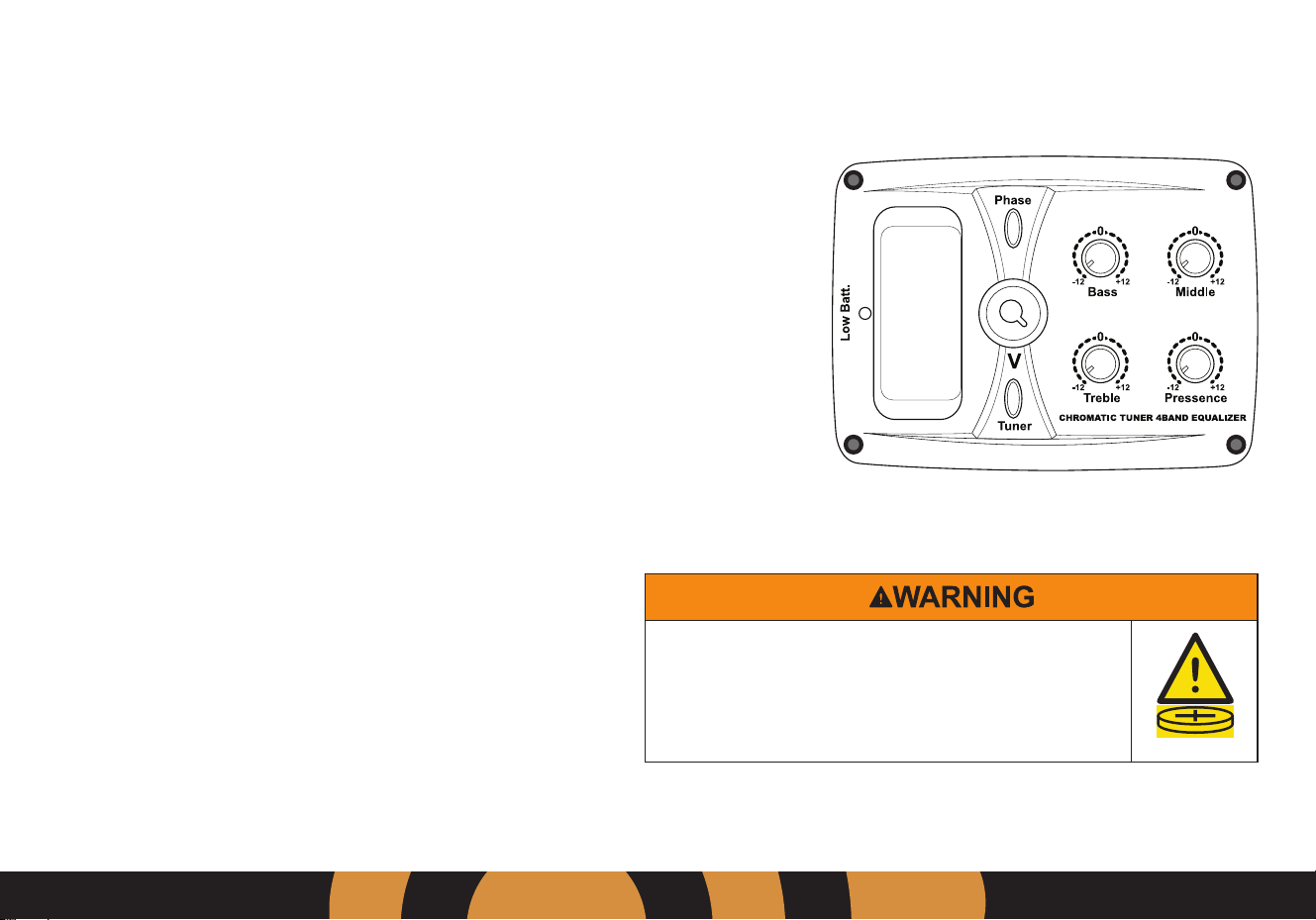
EQ Controls
Before using your guitar, make sure all the volume knobs are turned down to zero.
1. Plug In: Use an instrument cable to connect your guitar to an amplier.
The BATT light will ash once—this means it’s on.
2. Tuner: Press the TUNER button to turn on the tuner.
The guitar will be muted, and the screen will show the note you’re
playing. Tune any string—if it’s sharp or at, the screen will show it.
3. Phase: Press the PHASE button for a warmer sound with more bass.
Turn it o to reduce bass - this helps prevent feedback during live shows.
4. Bass: Adjusts the low tones.
• Left: less bass
• Right: more bass
• Set it how you like
5. Middle: Adjusts the mid-range tones in your sound.
6. Treble (Treb): Adjusts the high tones.
7. Presence: Adds brightness or clarity to your sound.
Adjust to your preference.
8. Volume (V): Controls how loud your guitar sounds.
9. Low Battery Light: Lights up when the battery needs
to be changed.
Tip: Always unplug your cable when you’re done playing. The battery will keep draining if the cable stays plugged in.
www.PyleUSA.com
7
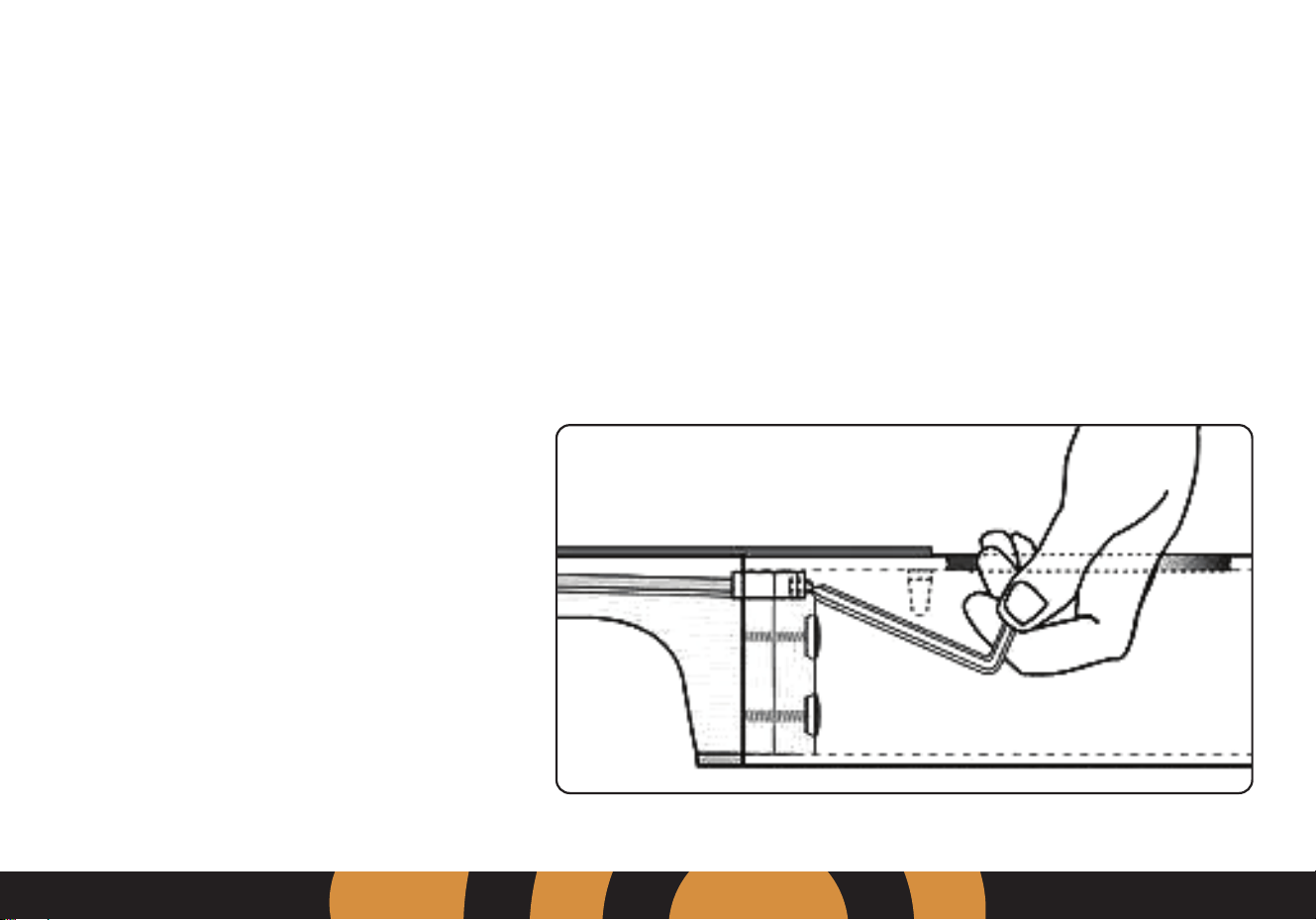
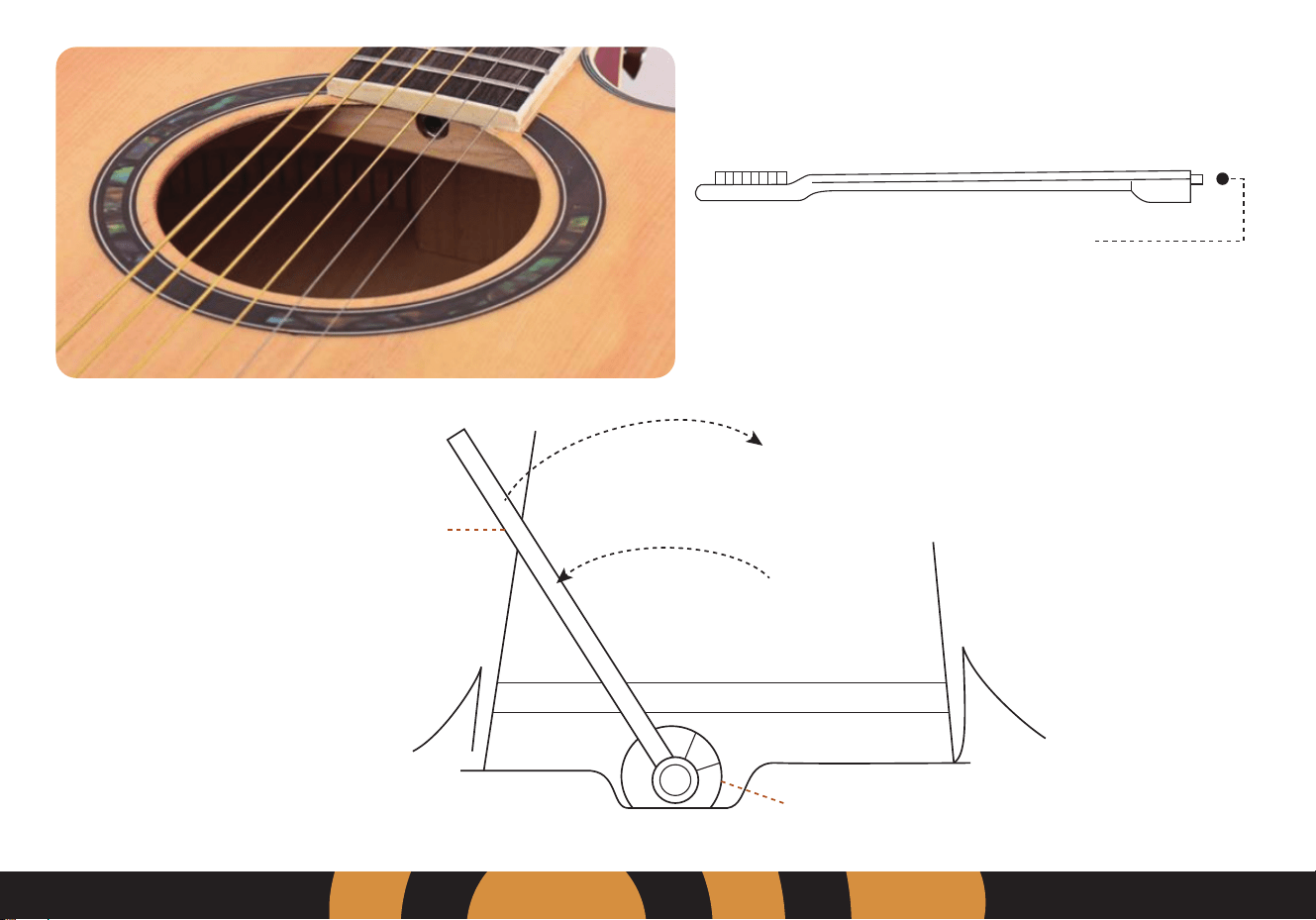
How to Adjust an Acoustic Guitar Truss Rod
Your truss rod needs adjustment when the neck of your guitar has too much or too little upbow or too much backbow.
Tightening or loosening the adjustment nut adds or lessens pressure on the rod and neck. As a general rule, tightening
the nut moves the neck away from the string pull and removes upbow; loosening the nut allows the neck to relax into
an upbow again (especially when helped by the strings’ pull). Controlled upbow is known as relief.
However, with a one-way truss rod, if the neck warps away from the string pull, no amount of loosening the truss rod
will pull the neck straight, because the truss rod only works against the pull of the strings.
Two primary signs tell you that your truss rod needs adjusting:
1. There’s a noticeable change in the action;
the height of the strings over the frets has
become either too high or too low.
The most common scenario is that the strings
get higher as the nec upbows from the string
pull.
2. Some strings buzz on the frets between the
nut and the fth fret. This indicates that the
neck is either too straight or it is backbowed
from the truss rod’s slow, constant pressure
over time.
www.PyleUSA.com
8
Wrench
Adjustment Nut
Loosen for “hump”
Tighten for “bow”
ADJUSTMENT NUT
www.PyleUSA.com
9
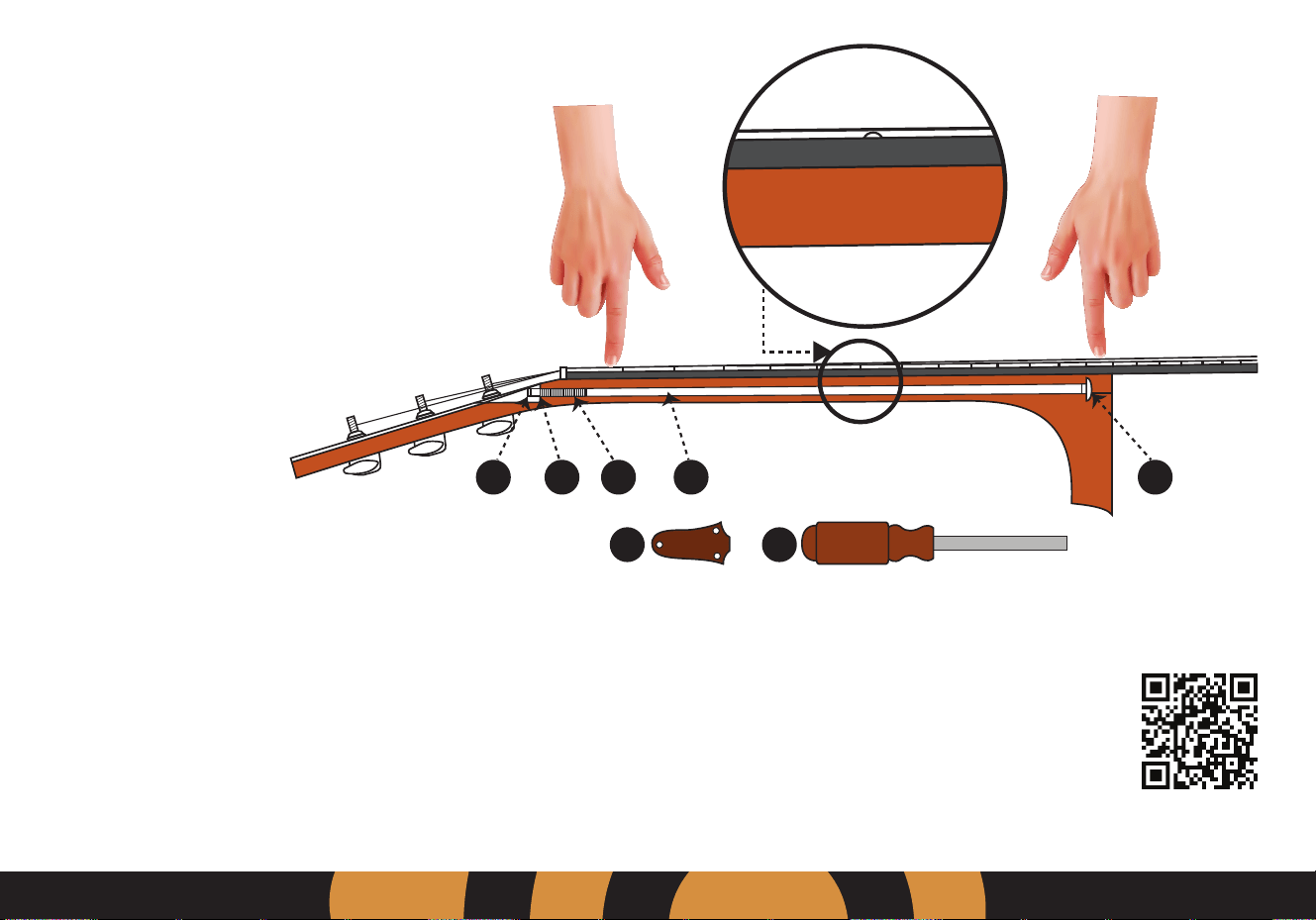
1. 1/4” nut
2. 3/16” washer
3. Threads
4. Main shaft of the truss rod
5. Truss rod anchor
6. Truss rod compartment cover
7. 1/4” nut driver
As you press the string down at the 1st and 14th frets, the string should be approximately .010” away from the 6th fret -
about the thickness of a business card
Register Product
Thank you for choosing PyleUSA. By registering your product, you ensure that you receive the full benets
of our exclusive warranty and personalized customer support. Complete the form to access expert
support and to keep your PyleUSA purchase in perfect condition.
1 2 3 4 5
6 7
Start Here
PyleUSA.com/pages/register
Model Number:
PEAG99

Questions or Comments
We are here to help!
Phone: 1.718.535.1800
PyleUSA.com/ContactUs