
DIGITAL FULL COLOR PRINTER
MX-C407P
User's Guide
Machine type(s):
5029
Model(s):
696

Contents
Safety information........................................................................................5
Conventions..........................................................................................................................................................5
Product statements.............................................................................................................................................5
Learning about the printer...........................................................................8
Selecting a location for the printer..................................................................................................................8
Printer configurations.........................................................................................................................................9
Attaching cables.................................................................................................................................................10
Installing the printer software.........................................................................................................................10
Using the control panel...............................................................................11
Panel with touch-screen display...................................................................................................................11
Understanding the status of the power button and indicator light........................................................11
Setting up and using the home screen applications..............................13
Using the home screen.....................................................................................................................................13
Customizing the home screen........................................................................................................................14
Managing bookmarks........................................................................................................................................14
Managing contacts.............................................................................................................................................15
Loading paper and specialty media..........................................................17
Setting the paper size and type......................................................................................................................17
Configuring Universal paper settings............................................................................................................17
Loading trays.......................................................................................................................................................17
Loading the multipurpose feeder..................................................................................................................19
Loading the manual feeder.............................................................................................................................21
Linking trays.........................................................................................................................................................21
Paper support..............................................................................................23
Supported paper sizes.....................................................................................................................................23
Supported paper types....................................................................................................................................25
Supported paper weights...............................................................................................................................26
Printing.........................................................................................................28
Printing from a computer.................................................................................................................................28
Contents 2

Printing from a mobile device........................................................................................................................28
Printing from a flash drive...............................................................................................................................29
Supported flash drives and file types..........................................................................................................30
Configuring confidential jobs..........................................................................................................................31
Printing confidential and other held jobs.....................................................................................................31
Printing a font sample list................................................................................................................................32
Printing a directory list.....................................................................................................................................32
Understanding the printer menus............................................................33
Menu map............................................................................................................................................................33
Device...................................................................................................................................................................34
Print.......................................................................................................................................................................43
Paper....................................................................................................................................................................52
USB Drive............................................................................................................................................................54
Network/Ports....................................................................................................................................................55
Security................................................................................................................................................................68
Reports.................................................................................................................................................................75
Help.......................................................................................................................................................................76
Troubleshooting.................................................................................................................................................77
Printing the Menu Settings Page...................................................................................................................77
Securing the printer....................................................................................78
Locating the security slot.................................................................................................................................78
Erasing printer memory....................................................................................................................................78
Erasing printer hard disk memory.................................................................................................................78
Encrypting the printer hard disk....................................................................................................................79
Restoring factory default settings.................................................................................................................79
Statement of Volatility......................................................................................................................................79
Maintaining the printer...............................................................................81
Networking...........................................................................................................................................................81
Cleaning the printer..........................................................................................................................................82
Ordering parts and supplies...........................................................................................................................83
Replacing parts and supplies.........................................................................................................................84
Moving the printer.............................................................................................................................................90
Saving energy and paper.................................................................................................................................91
Contents 3

Clearing jams..............................................................................................92
Avoiding jams.....................................................................................................................................................92
Identifying jam locations..................................................................................................................................93
Paper jam in trays..............................................................................................................................................94
Paper jam in door A..........................................................................................................................................94
Paper jam in the standard bin........................................................................................................................98
Paper jam in the multipurpose feeder.........................................................................................................98
Paper jam in the manual feeder....................................................................................................................99
Troubleshooting.........................................................................................101
Configuring the SMTP server........................................................................................................................101
Network connection problems......................................................................................................................101
Hardware options problems.........................................................................................................................103
Issues with supplies........................................................................................................................................104
Paper feed problems......................................................................................................................................105
Printing problems.............................................................................................................................................109
Color quality problems...................................................................................................................................128
Contacting your dealer...................................................................................................................................130
Notices........................................................................................................131
Index...........................................................................................................143
Contents 4
Safety information
Conventions
Note: A note identifies information that could help you.
Warning: A warning identifies something that could damage the product hardware or software.
CAUTION: A caution indicates a potentially hazardous situation that could injure you.
Different types of caution statements include:
CAUTION—POTENTIAL INJURY: Indicates a risk of injury.
CAUTION—SHOCK HAZARD: Indicates a risk of electrical shock.
CAUTION—HOT SURFACE: Indicates a risk of burn if touched.
CAUTION—TIPPING HAZARD: Indicates a crush hazard.
CAUTION—PINCH HAZARD: Indicates a risk of being caught between moving parts.
Product statements
CAUTION—POTENTIAL INJURY: To avoid the risk of fire or electrical shock, connect the power cord to
an appropriately rated and properly grounded electrical outlet that is near the product and easily
accessible.
CAUTION—POTENTIAL INJURY: To avoid the risk of fire or electrical shock, use only the power cord
provided with this product or the manufacturer's authorized replacement.
CAUTION—POTENTIAL INJURY: Do not use this product with extension cords, multioutlet power strips,
multioutlet extenders, or UPS devices. The power capacity of these types of accessories can be easily
overloaded by a laser printer and may result in a risk of fire, property damage, or poor printer
performance.
CAUTION—POTENTIAL INJURY: Do not use this product with an inline surge protector. The use of a
surge protection device may result in a risk of fire, property damage, or poor printer performance.
CAUTION—SHOCK HAZARD: To avoid the risk of electrical shock, do not place or use this product near
water or wet locations.
CAUTION—SHOCK HAZARD: To avoid the risk of electrical shock, do not set up this product or make
any electrical or cabling connections, such as the power cord, fax feature, or telephone, during a
lightning storm.
CAUTION—POTENTIAL INJURY: Do not cut, twist, bind, crush, or place heavy objects on the power
cord. Do not subject the power cord to abrasion or stress. Do not pinch the power cord between objects
such as furniture and walls. If any of these things happen, a risk of fire or electrical shock results. Inspect
the power cord regularly for signs of such problems. Remove the power cord from the electrical outlet
before inspecting it.
Safety information 5
CAUTION—SHOCK HAZARD: To avoid the risk of electrical shock, make sure that all external
connections (such as Ethernet and telephone system connections) are properly installed in their marked
plug-in ports.
CAUTION—SHOCK HAZARD: To avoid the risk of electrical shock, if you are accessing the controller
board or installing optional hardware or memory devices sometime after setting up the printer, then turn
the printer off, and unplug the power cord from the electrical outlet before continuing. If you have any
other devices attached to the printer, then turn them off as well, and unplug any cables going into the
printer.
CAUTION—SHOCK HAZARD: To avoid the risk of electrical shock when cleaning the exterior of the
printer, unplug the power cord from the electrical outlet and disconnect all cables from the printer
before proceeding.
CAUTION—POTENTIAL INJURY: If the printer weight is greater than 20 kg (44 lb), then it may require
two or more people to lift it safely.
CAUTION—POTENTIAL INJURY: When moving the printer, follow these guidelines to avoid personal
injury or printer damage:
• Make sure that all doors and trays are closed.
• Turn off the printer, and then unplug the power cord from the electrical outlet.
• Disconnect all cords and cables from the printer.
• If the printer has separate floor-standing optional trays or output options attached to it, then disconnect
them before moving the printer.
• If the printer has a caster base, then carefully roll it to the new location. Use caution when passing over
thresholds and breaks in flooring.
• If the printer does not have a caster base but is configured with optional trays or output options, then remove
the output options and lift the printer off the trays. Do not try to lift the printer and any options at the same
time.
• Always use the handholds on the printer to lift it.
• Any cart used to move the printer must have a surface able to support the full footprint of the printer.
• Any cart used to move the hardware options must have a surface able to support the dimensions of the
options.
• Keep the printer in an upright position.
• Avoid severe jarring movements.
• Make sure that your fingers are not under the printer when you set it down.
• Make sure that there is adequate clearance around the printer.
CAUTION—TIPPING HAZARD: Installing one or more options on your printer or MFP may require a
caster base, furniture, or other feature to prevent instability causing possible injury. For more information
on supported configurations, contact the place where you purchased the printer.
CAUTION—TIPPING HAZARD: To reduce the risk of equipment instability, load each tray separately.
Keep all other trays closed until needed.
CAUTION—HOT SURFACE: The inside of the printer might be hot. To reduce the risk of injury from a
hot component, allow the surface to cool before touching it.
CAUTION—PINCH HAZARD: To avoid the risk of a pinch injury, use caution in areas marked with this
label. Pinch injuries may occur around moving parts, such as gears, doors, trays, and covers.
Safety information 6

CAUTION—POTENTIAL INJURY: This product uses a laser. Use of controls or adjustments or
performance of procedures other than those specified in the User’s Guide may result in hazardous
radiation exposure.
CAUTION—POTENTIAL INJURY: The lithium battery in this product is not intended to be replaced.
There is a danger of explosion if a lithium battery is incorrectly replaced. Do not recharge, disassemble,
or incinerate a lithium battery. Discard used lithium batteries according to the manufacturer's instructions
and local regulations.
This product is designed, tested, and approved to meet strict global safety standards with the use of specific
manufacturer's components. The safety features of some parts may not always be obvious. The manufacturer
is not responsible for the use of other replacement parts.
Refer service or repairs, other than those described in the user documentation, to a service representative.
This product uses a printing process that heats the print media, and the heat may cause the media to release
emissions. You must understand the section in your operating instructions that discusses the guidelines for
selecting print media to avoid the possibility of harmful emissions.
This product may produce small amounts of ozone during normal operation, and may be equipped with a filter
designed to limit ozone concentrations to levels well below the recommended exposure limits. To avoid high
ozone concentration levels during extensive usage, install this product in a well-ventilated area and replace
the ozone and exhaust filters if instructed to do so in the product maintenance instructions. If there are no
references to filters in the product maintenance instructions, then there are no filters requiring replacement for
this product.
SAVE THESE INSTRUCTIONS.
Safety information 7
Learning about the printer
Selecting a location for the printer
• Leave enough room to open trays, covers, and doors and to install hardware options.
• Set up the printer near an electrical outlet.
CAUTION—POTENTIAL INJURY: To avoid the risk of fire or electrical shock, connect the power cord
to an appropriately rated and properly grounded electrical outlet that is near the product and easily
accessible.
CAUTION—SHOCK HAZARD: To avoid the risk of electrical shock, do not place or use this product
near water or wet locations.
• Make sure that airflow in the room meets the latest revision of the ASHRAE 62 standard or the CEN Technical
Committee 156 standard.
• Provide a flat, sturdy, and stable surface.
• Keep the printer:
– Clean, dry, and free of dust
– Away from stray staples and paper clips
– Away from the direct airflow of air conditioners, heaters, or ventilators
– Free from direct sunlight and humidity extremes
• Observe the temperature range.
Operating temperature 10 to 32.2°C (50 to 90°F)
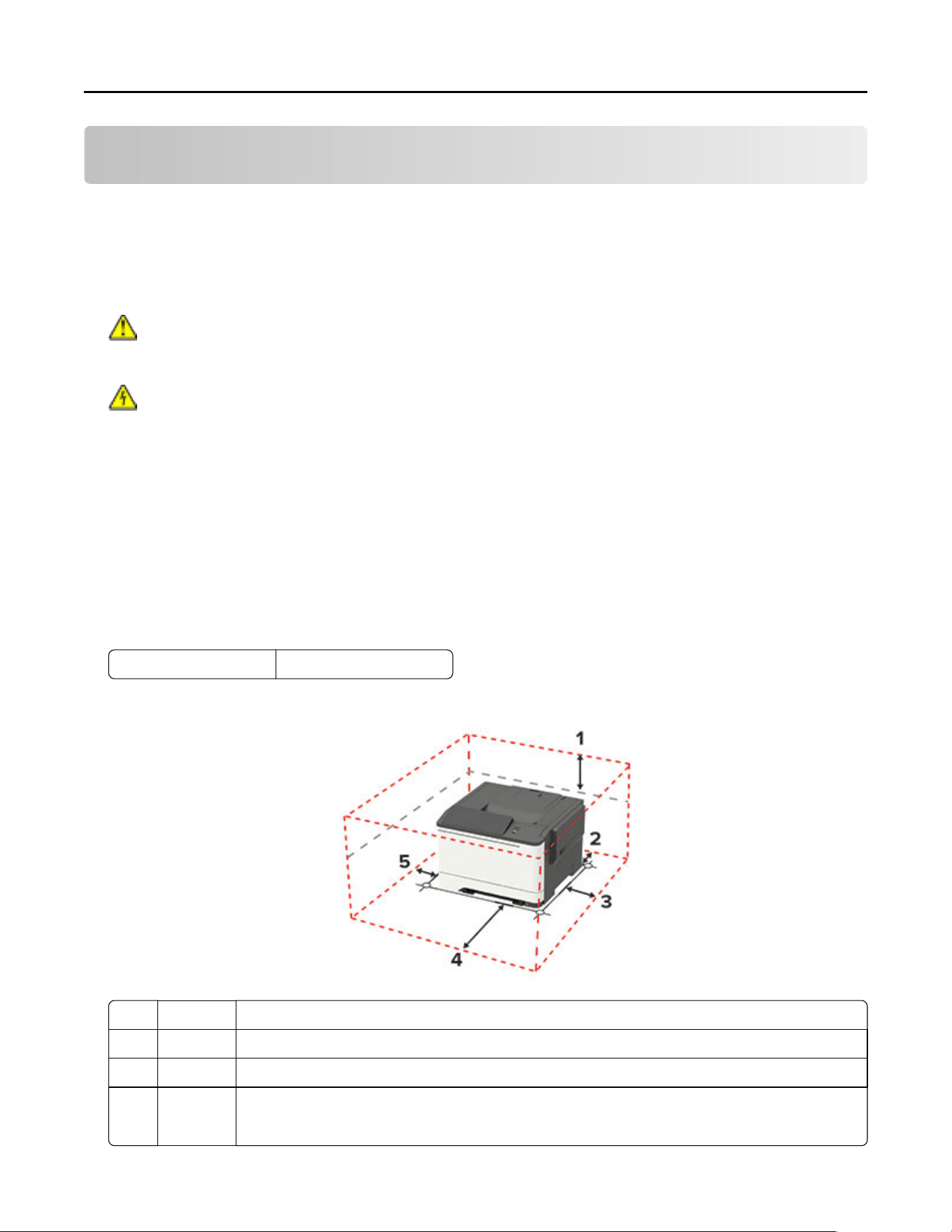
• Allow the following recommended amount of space around the printer for proper ventilation:
1 Top 254 mm (10 in.)
2 Rear 102 mm (4 in.)
3 Right side 76 mm (3 in.)
4 Front 508 mm (20 in.)
Note: The minimum space needed in front of the printer is 76 mm (3 in.).
Learning about the printer 8
5 Left side 76 mm (3 in.)
Printer configurations
CAUTION—TIPPING HAZARD: Installing one or more options on your printer or MFP may require a
caster base, furniture, or other feature to prevent instability causing possible injury. For more information
on supported configurations, contact the place where you purchased the printer.
CAUTION—TIPPING HAZARD: To reduce the risk of equipment instability, load each tray separately.
Keep all other trays closed until needed.
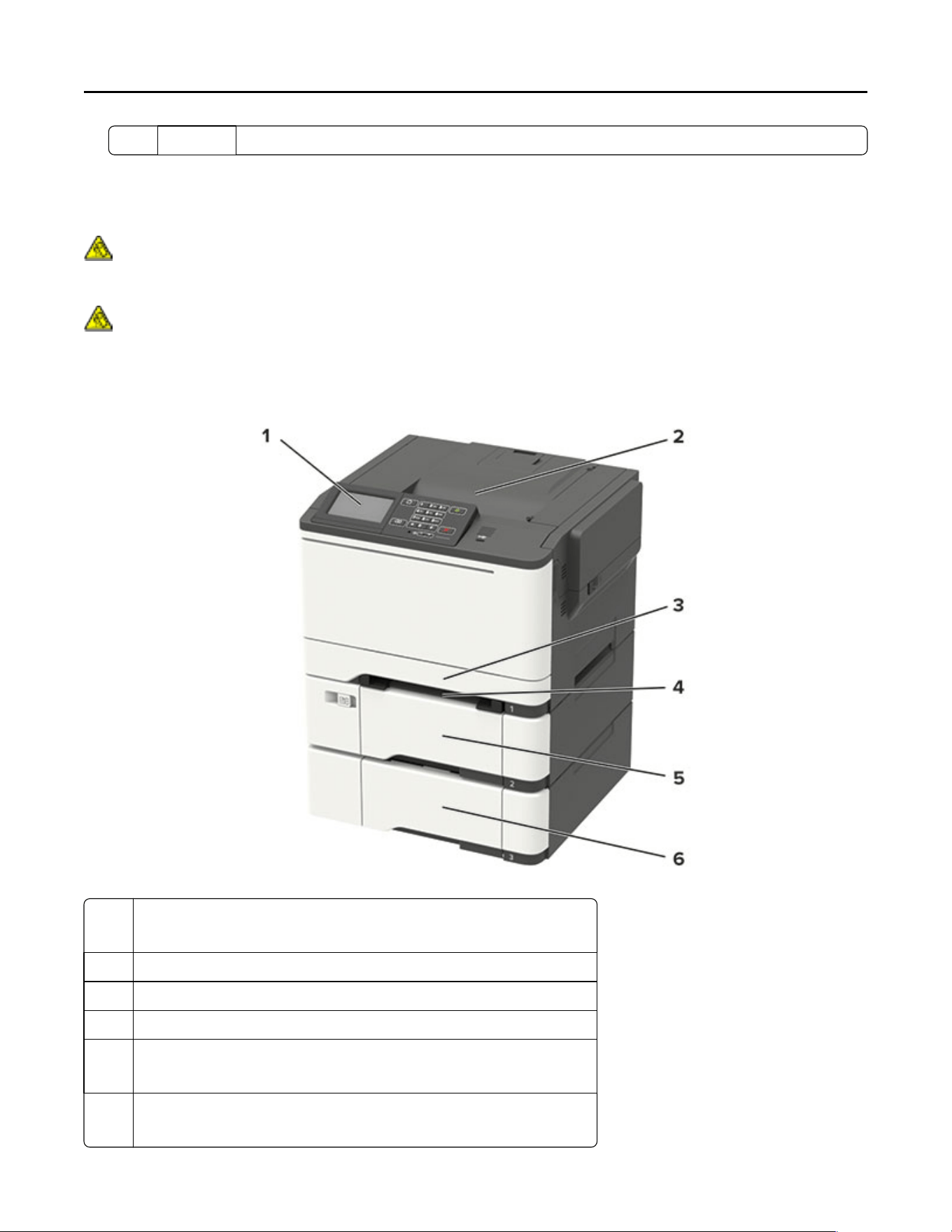
Depending on your printer model, you can configure your printer by adding an optional 650‑sheet duo tray or
both the 650‑sheet duo tray and 550‑sheet tray.
1 Control panel
Note: The appearance may vary depending on your printer model.
2 Standard bin
3 Standard 250‑sheet tray
4 Manual feeder
5 Optional 650‑sheet duo tray
Note: Available only in some printer models.
6 Optional 550‑sheet tray
Note: Available only in some printer models.
Learning about the printer 9
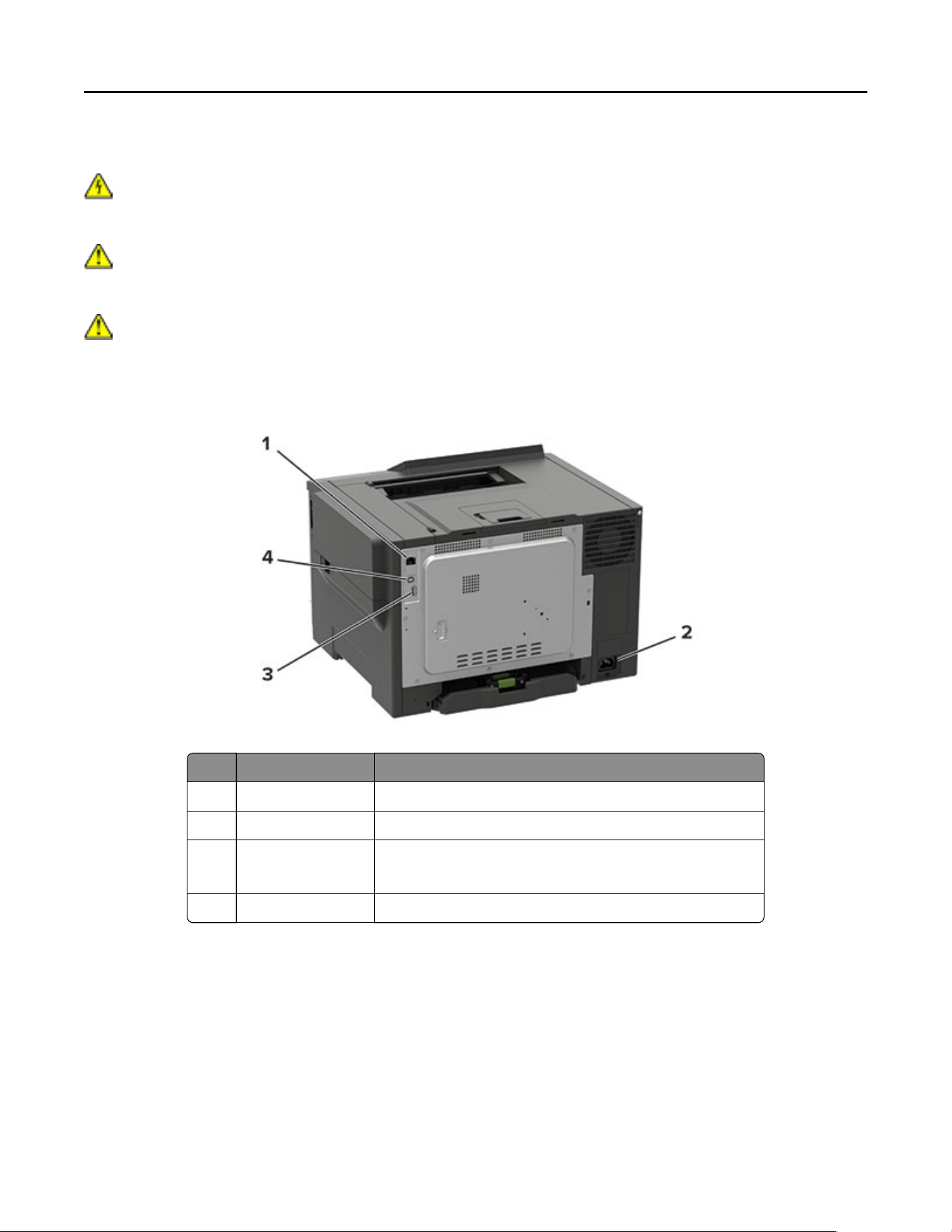
Attaching cables
CAUTION—SHOCK HAZARD: To avoid the risk of electrical shock, do not set up this product or make
any electrical or cabling connections, such as the power cord, fax feature, or telephone, during a
lightning storm.
CAUTION—POTENTIAL INJURY: To avoid the risk of fire or electrical shock, connect the power cord to
an appropriately rated and properly grounded electrical outlet that is near the product and easily
accessible.
CAUTION—POTENTIAL INJURY: To avoid the risk of fire or electrical shock, use only the power cord
provided with this product or the manufacturer's authorized replacement.
Warning—Potential Damage: To avoid loss of data or printer malfunction, do not touch the USB cable, any
wireless network adapter, or the printer in the areas shown while actively printing.
Use the To
1 Ethernet port Connect the printer to a network.
2 Power cord socket Connect the printer to an electrical outlet.
3 USB port Attach a keyboard or any compatible option.
Note: This port is available only in some printer models.
4 USB printer port Connect the printer to a computer.
Installing the printer software
1 Obtain a copy of the software installer package.
• From our website.
• From the place where you purchased the printer.
2 Run the installer, and then follow the instructions.
Learning about the printer 10
Using the control panel
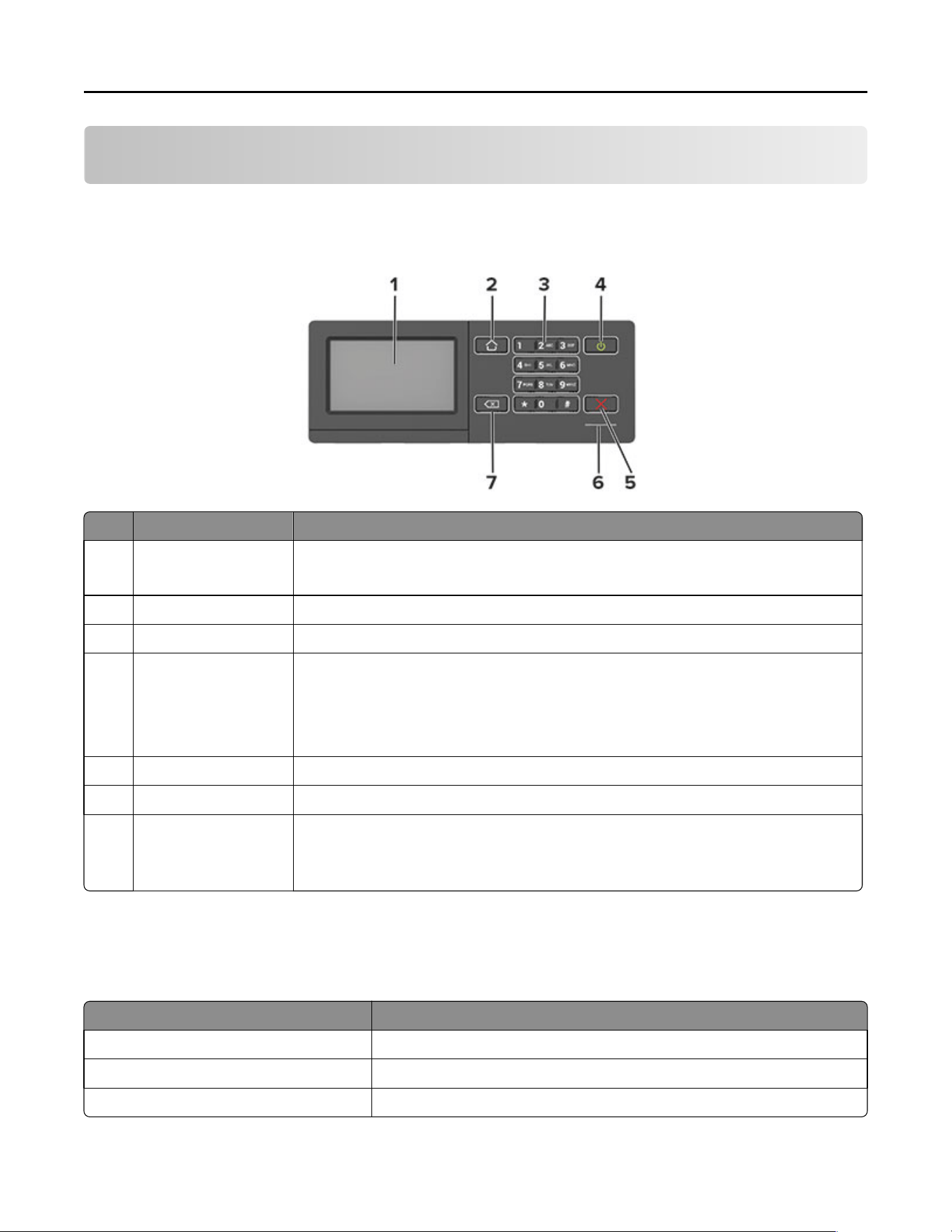
Panel with touch-screen display
Use the To
1 Display
• View printer messages and supply status.
• Set up and operate the printer.
2 Home button Go to the home screen.
3 Numeric keypad Enter numbers or symbols in an input field.
4 Power button
• Turn on or turn off the printer.
Note: To turn off the printer, press and hold the power button for five seconds.
• Set the printer to Sleep or Hibernate mode.
• Wake the printer from Sleep or Hibernate mode.
5 Stop or Cancel button Stop the current printer task.
6 Indicator light Check the printer status.
7 Back button Return to the previous screen.
• Select a menu option.
• Save the changes in a setting.
Understanding the status of the power button and
indicator light
Indicator light Printer status
Off The printer is off or in Hibernate mode.
Blue The printer is ready or processing data.
Red The printer requires user intervention.
Using the control panel 11

Power button light Printer status
Off The printer is off, ready, or processing data.
Solid amber The printer is in Sleep mode.
Blinking amber The printer is in Hibernate mode.
Using the control panel 12
Setting up and using the home screen
applications
Note: These applications are supported only in some printer models.
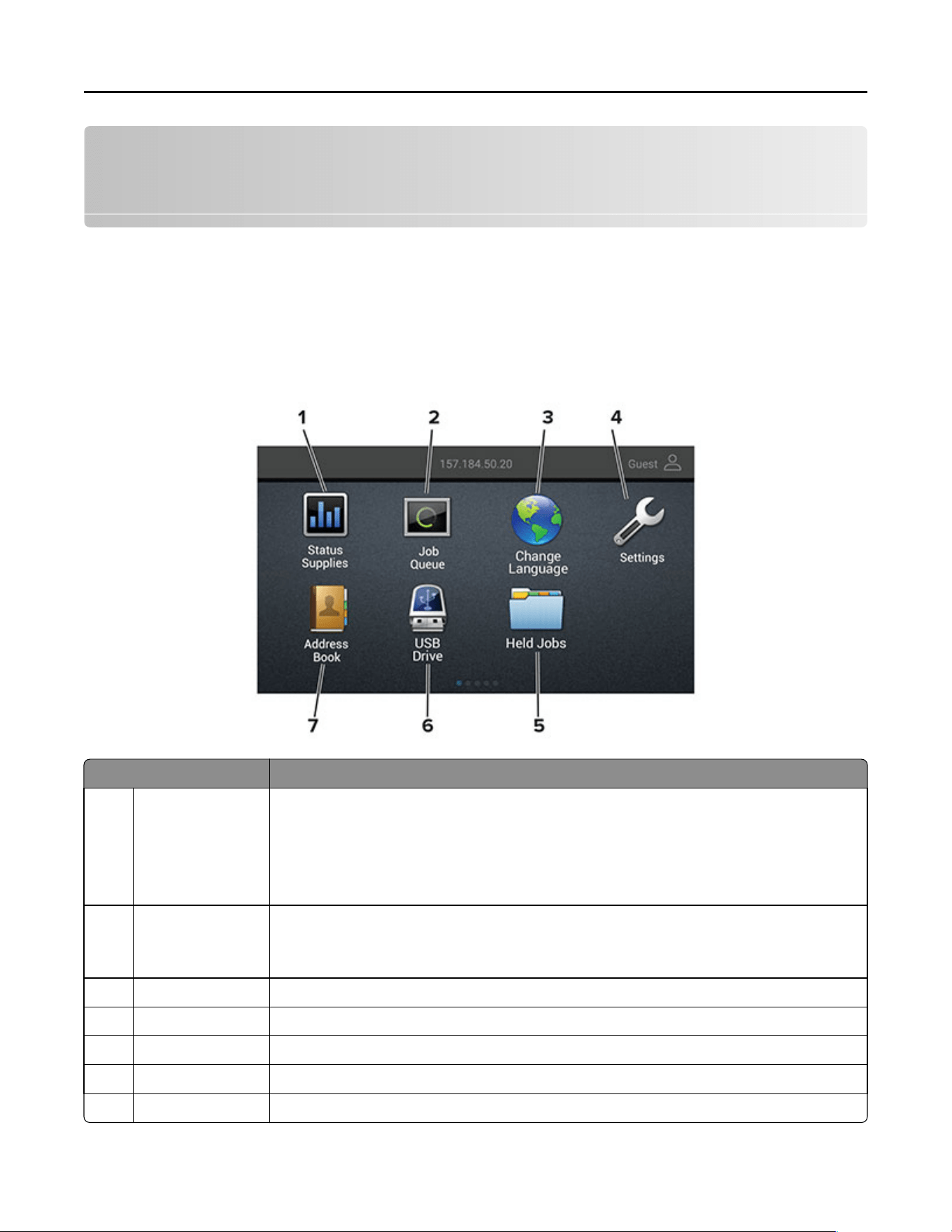
Using the home screen
Note: Your home screen may vary depending on your home screen customization settings, administrative
setup, and active embedded solutions.
Touch To
1 Status/Supplies
• Show a warning or error message whenever the printer requires intervention to
continue processing.
• View more information on the printer warning or message, and on how to clear it.
Note: You can also access this setting by touching the top section of the home
screen.
2 Job Queue Show all the current print jobs.
Note: You can also access this setting by touching the top section of the home
screen.
3 Change Language Change the language on the display.
4 Settings Access the printer menus.
5 Held Jobs Show the print jobs that are held in the printer memory.
6 USB Drive Print photos and documents from a flash drive.
7 Address Book Manage a contact list that other applications on the printer can access.
Setting up and using the home screen applications 13

Customizing the home screen
1 Open a web browser, and then type the printer IP address in the address field.
Notes:
• View the printer IP address on the printer home screen. The IP address appears as four sets of
numbers separated by periods, such as 123.123.123.123.
• If you are using a proxy server, then temporarily disable it to load the web page correctly.
2 Click Settings > Device > Visible Home Screen Icons.
3 Select the icons that you want to appear on the home screen.
4 Apply the changes.
Managing bookmarks
Creating bookmarks
Use bookmarks to print frequently accessed documents that are stored in servers or on the web.
1 Open a web browser, and then type the printer IP address in the address field.
Notes:
• View the printer IP address on the printer home screen. The IP address appears as four sets of
numbers separated by periods, such as 123.123.123.123.
• If you are using a proxy server, then temporarily disable it to load the web page correctly.
2 Click Bookmarks > Add Bookmark, and then type a bookmark name.
3 Select an Address protocol type, and then do one of the following:
• For HTTP and HTTPS, type the URL that you want to bookmark.
• For HTTPS, make sure to use the host name instead of the IP address. For example, type
myWebsite.com/sample.pdf instead of typing 123.123.123.123/sample.pdf. Make sure that
the host name also matches the Common Name (CN) value in the server certificate. For more information
on obtaining the CN value in the server certificate, see the help information for your web browser.
• For FTP, type the FTP address. For example,
myServer/myDirectory. Enter the FTP port. Port 21 is
the default port for sending commands.
• For SMB, type the network folder address. For example,
myServer/myShare/myFile.pdf. Type the
network domain name.
• If necessary, select the Authentication type for FTP and SMB.
To limit access to the bookmark, enter a PIN.
Note: The application supports the following file types: PDF, JPEG, TIFF, and HTML-based web pages.
Other file types such as DOCX and XLXS are supported in some printer models.
4 Click Save.
Setting up and using the home screen applications 14

Creating folders
1 Open a web browser, and then type the printer IP address in the address field.
Notes:
• View the printer IP address on the printer home screen. The IP address appears as four sets of
numbers separated by periods, such as 123.123.123.123.
• If you are using a proxy server, then temporarily disable it to load the web page correctly.
2 Click Bookmarks > Add Folder, and then type a folder name.
Note: To limit access to the folder, enter a PIN.
3 Click Save.
Note: You can create folders or bookmarks inside a folder. To create a bookmark, see “Creating bookmarks”
on page 14.
Managing contacts
Adding contacts
1 Open a web browser, and then type the printer IP address in the address field.
Notes:
• View the printer IP address on the printer home screen. The IP address appears as four sets of
numbers separated by periods, such as 123.123.123.123.
• If you are using a proxy server, then temporarily disable it to load the web page correctly.
2 Click Address Book.
3 From the Contacts section, add a contact.
Note: You can assign the contact to one or more groups.
4 If necessary, specify a login method to allow application access.
5 Apply the changes.
Adding groups
1 Open a web browser, and then type the printer IP address in the address field.
Notes:
• View the printer IP address on the printer home screen. The IP address appears as four sets of
numbers separated by periods, such as 123.123.123.123.
• If you are using a proxy server, then temporarily disable it to load the web page correctly.
2 Click Address Book.
Setting up and using the home screen applications 15

3 From the Contact Groups section, add a group name.
Note: You can assign one or more contacts to the group.
4 Apply the changes.
Editing contacts or groups
1 Open a web browser, and then type the printer IP address in the address field.
Notes:
• View the printer IP address on the printer home screen. The IP address appears as four sets of
numbers separated by periods, such as 123.123.123.123.
• If you are using a proxy server, then temporarily disable it to load the web page correctly.
2 Click Address Book.
3 Do either of the following:
• From the Contacts section, click a contact name, and then edit the information.
• From the Contact Groups section, click a group name, and then edit the information.
4 Apply the changes.
Deleting contacts or groups
1 Open a web browser, and then type the printer IP address in the address field.
Notes:
• View the printer IP address on the printer home screen. The IP address appears as four sets of
numbers separated by periods, such as 123.123.123.123.
• If you are using a proxy server, then temporarily disable it to load the web page correctly.
2 Click Address Book.
3 Do either of the following:
• From the Contacts section, select a contact that you want to delete.
• From the Contact Groups section, select a group name that you want to delete.
Setting up and using the home screen applications 16
Loading paper and specialty media
Setting the paper size and type
1 From the control panel, navigate to:
Settings > Paper > Tray Configuration > Paper Size/Type > select a paper source
For non-touch-screen printer models, press to navigate through the settings.
2 Set the paper size and type.
Configuring Universal paper settings
1 From the control panel, navigate to:
Settings > Paper > Media Configuration >
Universal Setup
For non-touch-screen printer models, press to navigate through the settings.
2 Configure the settings.
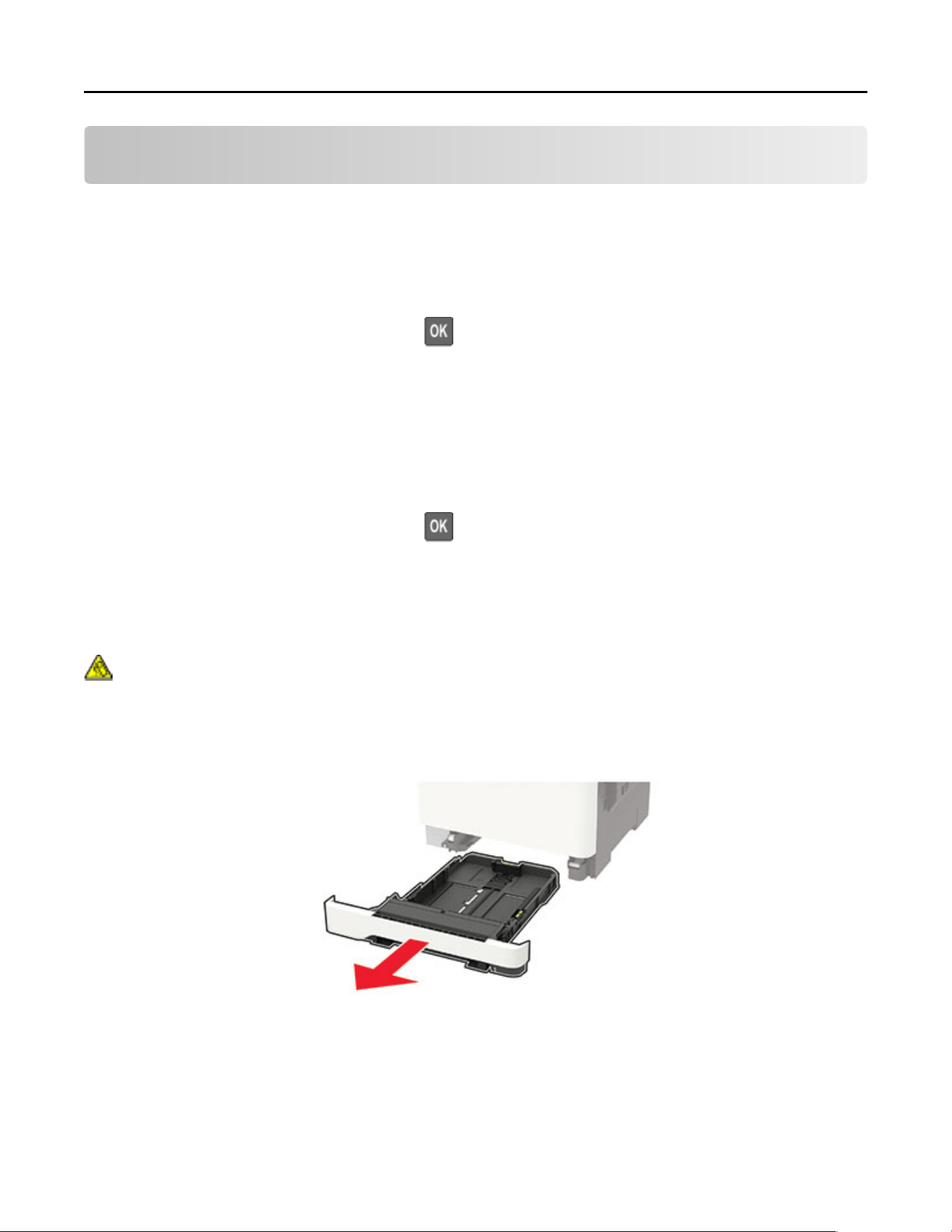
Loading trays
CAUTION—TIPPING HAZARD: To reduce the risk of equipment instability, load each tray separately.
Keep all other trays closed until needed.
1 Remove the tray.
Note: To avoid paper jams, do not remove trays while the printer is busy.
2 Adjust the guides to match the size of the paper that you are loading.
Note: Use the indicators on the bottom of the tray to position the guides.
Loading paper and specialty media 17
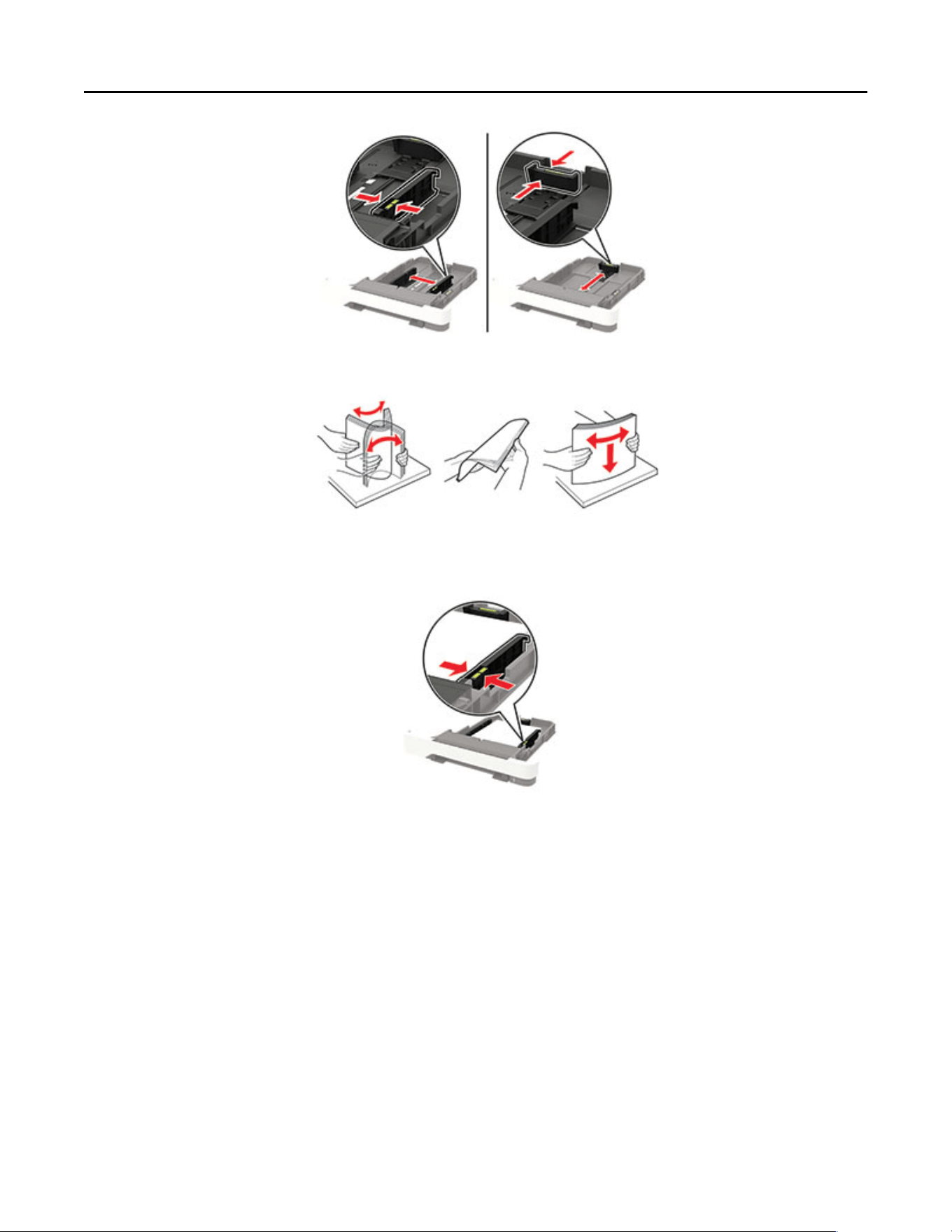
3 Flex, fan, and align the paper edges before loading.
4 Load the paper stack with the printable side faceup, and then make sure that the side guides fit snugly
against the paper.
Notes:
• Load letterhead faceup with the header toward the front of the tray for one‑sided printing.
• Load letterhead facedown with the header toward the back of the tray for two‑sided printing.
• Do not slide paper into the tray.
• To avoid paper jams, make sure that the stack height is below the maximum paper fill indicator.
Loading paper and specialty media 18
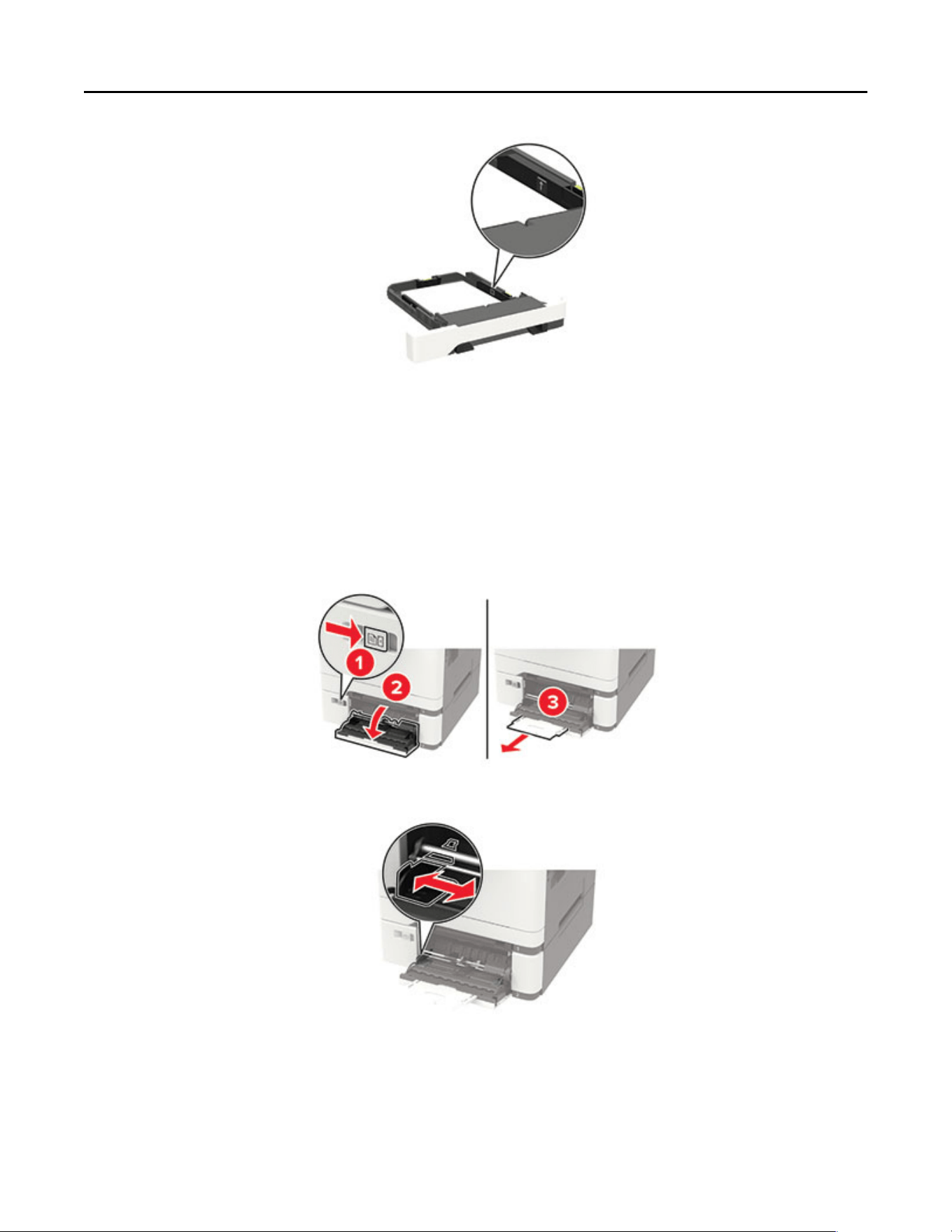
5 Insert the tray.
If necessary, set the paper size and paper type from the control panel to match the paper loaded.
Loading the multipurpose feeder
1 Open the multipurpose feeder.
Note: The multipurpose feeder is available only in some printer models.
2 Adjust the guide to match the size of the paper that you are loading.
Loading paper and specialty media 19
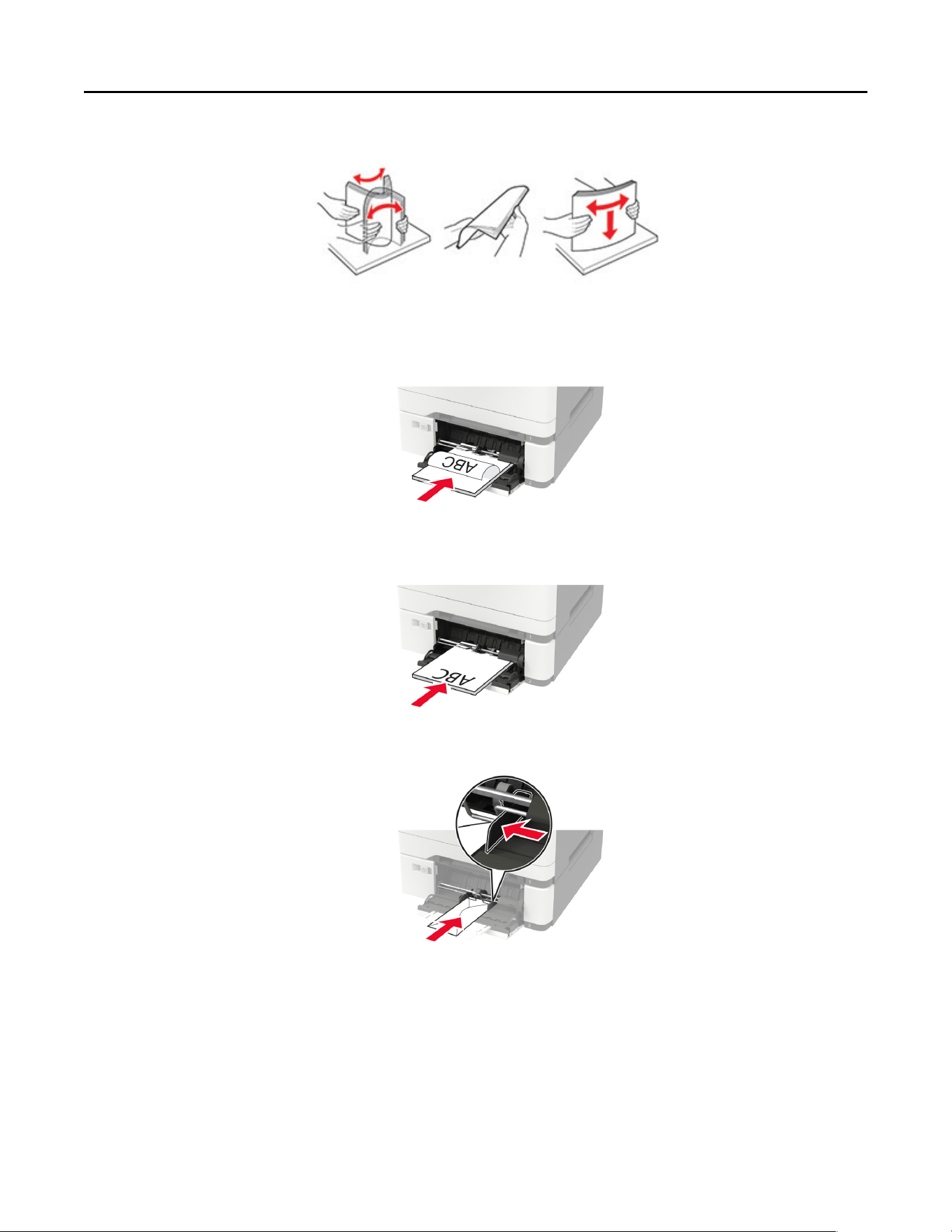
3 Flex, fan, and align the paper edges before loading.
4 Load paper with the printable side facedown.
• Load letterhead with the printable side facedown and the top edge entering the printer first for one‑sided
printing.
• Load letterhead with the printable side faceup and the top edge entering the printer last for two‑sided
printing.
• Load envelopes with the flap side up and against the right side of the paper guide.
Warning—Potential Damage: Do not use envelopes with stamps, clasps, snaps, windows, coated
linings, or self‑stick adhesives.
5 From the control panel, set the paper size and paper type to match the paper loaded.
Loading paper and specialty media 20
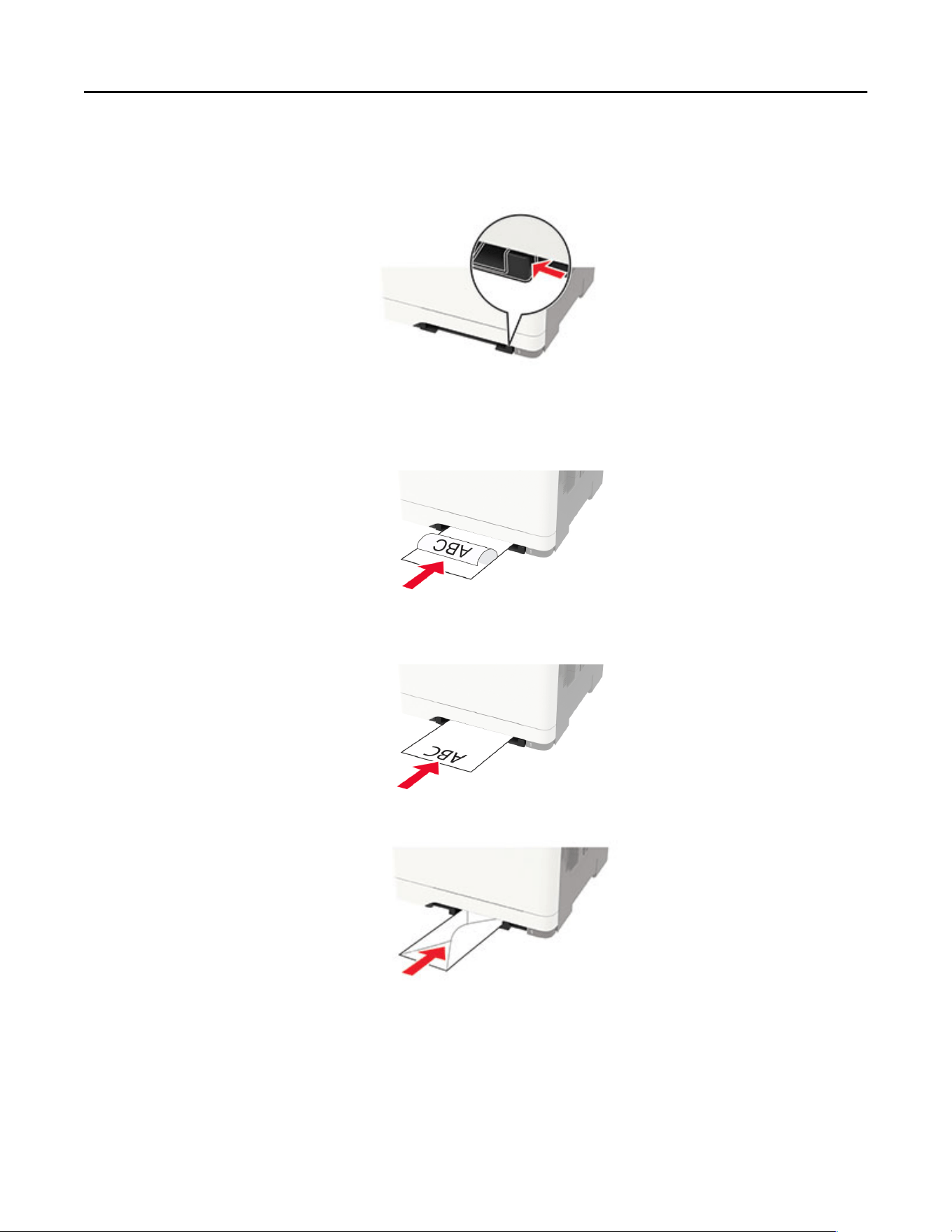
Loading the manual feeder
1 Adjust the guide to match the size of the paper that you are loading.
2 Load a sheet of paper with the printable side facedown.
• Load letterhead with the printable side facedown and the top edge entering the printer first for one‑sided
printing.
• Load letterhead with the printable side faceup and the top edge entering the printer last for two‑sided
printing.
• Load envelope with the flap side up and against the right side of the paper guide.
3 Feed the paper until its leading edge gets pulled in.
Warning—Potential Damage: To avoid paper jams, do not force paper into the manual feeder.
Linking trays
1 Open a web browser, and then type the printer IP address in the address field.
Loading paper and specialty media 21

Notes:
• View the printer IP address on the printer home screen. The IP address appears as four sets of
numbers separated by periods, such as 123.123.123.123.
• If you are using a proxy server, then temporarily disable it to load the web page correctly.
2 Click Settings > Paper > Tray Configuration.
3 Set the same paper size and paper type for the trays that you are linking.
4 Save the settings.
5 Click Settings > Device > Maintenance >
Configuration Menu > Tray Configuration.
6 Set Tray Linking to Automatic.
7 Save the settings.
To unlink trays, make sure that no trays have the same paper size and paper type settings.
Warning—Potential Damage: The temperature of the fuser varies according to the specified paper type. To
avoid printing issues, match the paper type setting in the printer with the paper loaded in the tray.
Loading paper and specialty media 22
Paper support
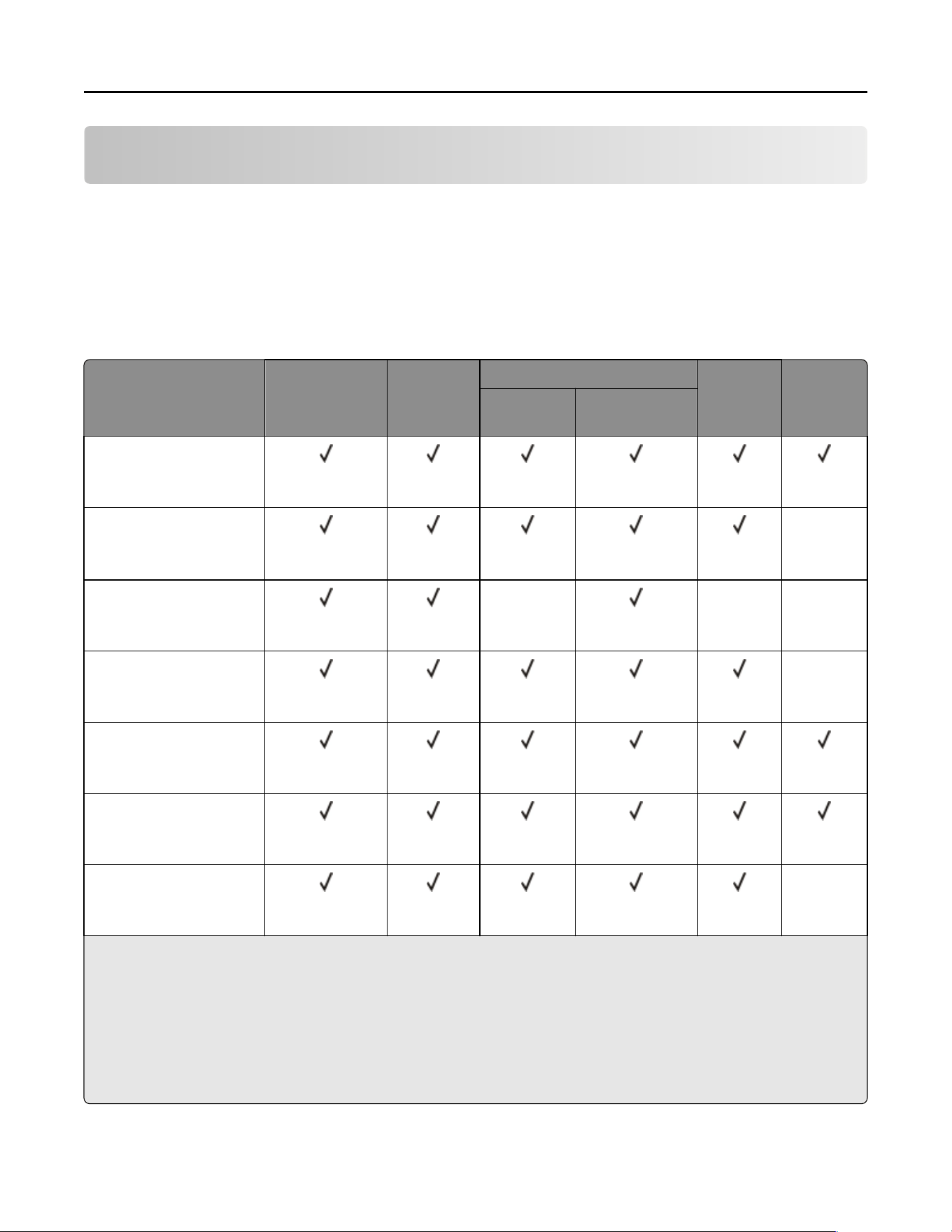
Supported paper sizes
Note: Your printer model may have a 650‑sheet duo tray, which consists of a 550‑sheet tray and an
integrated 100‑sheet multipurpose feeder. The 550‑sheet tray of the 650‑sheet duo tray supports the same
paper sizes as the optional 550‑sheet tray. The integrated multipurpose feeder supports different paper
sizes, types, and weights.
Paper size and
dimension
Standard
250‑sheet tray
Manual
feeder
Optional 650‑sheet duo tray Optional
550‑sheet
tray
Two‑sided
printing
550‑sheet
tray
Multipurpose
feeder
A4
210 x 297 mm
(8.27 x 11.7 in.)
A5
1,2
148 x 210 mm
(5.83 x 8.27 in.)
X
A6
105 x 148 mm
(4.13 x 5.83 in.)
X X X
JIS B5
182 x 257 mm
(7.17 x 10.1 in.)
X
Letter
215.9 x 279.4 mm
(8.5 x 11 in.)
Legal
215.9 x 355.6 mm
(8.5 x 14 in.)
Executive
184.2 x 266.7 mm
(7.25 x 10.5 in.)
X
1
Load this paper size into tray 1 and the manual feeder with the long edge entering the printer first.
2
Load this paper size into tray 2, tray 3, and the multipurpose feeder with the short edge entering the printer first.
3
When Universal is selected, the page is formatted for 215.9 x 355.6 mm (8.5 x 14 in.) unless the size is specified
by the software application.
4
Load narrow paper with the short edge entering the printer first.
5
When Other Envelope is selected, the page is formatted for 215.9 x 355.6 mm (8.5 x 14 in.) unless the size is
specified by the software application.
Paper support 23
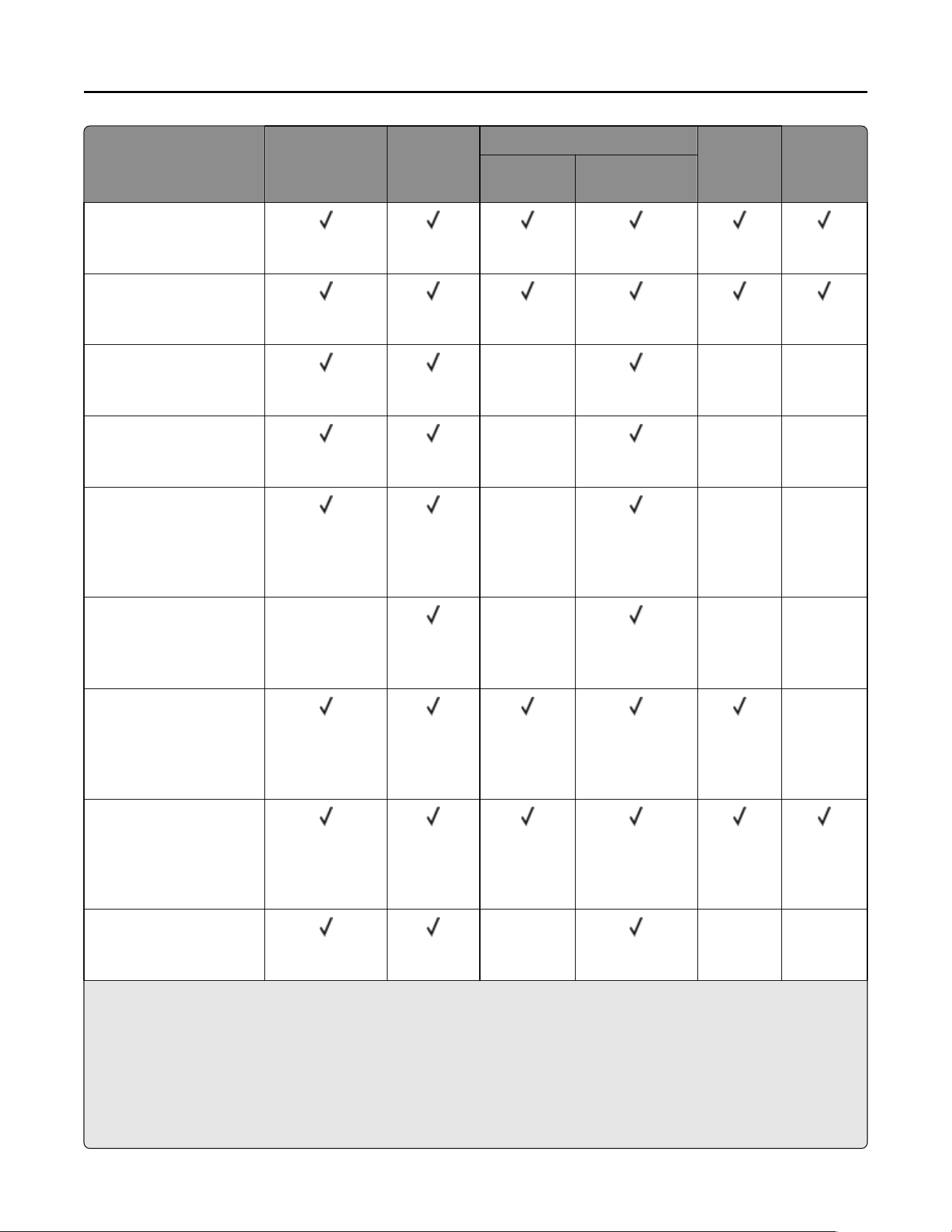
Paper size and
dimension
Standard
250‑sheet tray
Manual
feeder
Optional 650‑sheet duo tray Optional
550‑sheet
tray
Two‑sided
printing
550‑sheet
tray
Multipurpose
feeder
Oficio (Mexico)
215.9 x 340.4 mm
(8.5 x 13.4 in.)
Folio
215.9 x 330.2 mm
(8.5 x 13 in.)
Statement
139.7 x 215.9 mm
(5.5 x 8.5 in.)
X X X
Hagaki
100 x 148 mm
(3.94 x 5.83 in.)
X X X
Universal
3,4
98.4 x 148 mm to
215.9 x 355.6 mm
(3.87 x 5.83 in. to
8.5 x 14 in.)
X X X
Universal
3,4
76.2 x 127 mm to
215.9 x 355.6 mm
(3 x 5 in. to 8.5 x 14 in.)
X X X X
Universal
3,4
148 x 210 mm to
215.9 x 355.6 mm
(5.83 x 8.27 in. to
8.5 x 14 in.)
X
Universal
3,4
210 x 250 mm to
215.9 x 355.6 mm
(8.27 x 9.84 in. to
8.5 x 14 in.)
7 3/4 Envelope
98.4 x 190.5 mm
(3.875 x 7.5 in.)
X X X
1
Load this paper size into tray 1 and the manual feeder with the long edge entering the printer first.
2
Load this paper size into tray 2, tray 3, and the multipurpose feeder with the short edge entering the printer first.
3
When Universal is selected, the page is formatted for 215.9 x 355.6 mm (8.5 x 14 in.) unless the size is specified
by the software application.
4
Load narrow paper with the short edge entering the printer first.
5
When Other Envelope is selected, the page is formatted for 215.9 x 355.6 mm (8.5 x 14 in.) unless the size is
specified by the software application.
Paper support 24
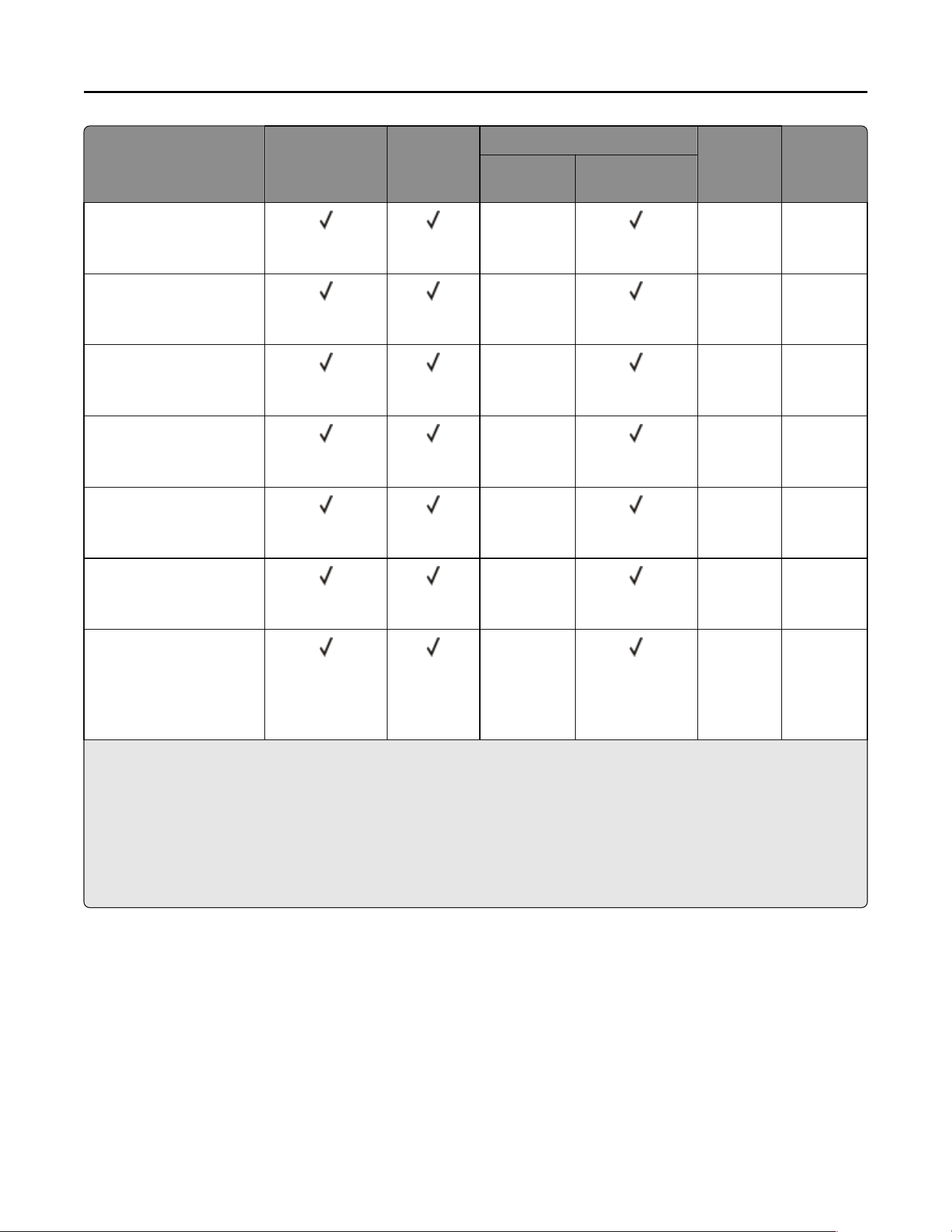
Paper size and
dimension
Standard
250‑sheet tray
Manual
feeder
Optional 650‑sheet duo tray Optional
550‑sheet
tray
Two‑sided
printing
550‑sheet
tray
Multipurpose
feeder
9 Envelope
98.4 x 225.4 mm
(3.875 x 8.9 in.)
X X X
10 Envelope
104.8 x 241.3 mm
(4.12 x 9.5 in.)
X X X
DL Envelope
110 x 220 mm
(4.33 x 8.66 in.)
X X X
C5 Envelope
162 x 229 mm
(6.38 x 9.01 in.)
X X X
B5 Envelope
176 x 250 mm
(6.93 x 9.84 in.)
X X X
Monarch
98.425 x 190.5 mm
(3.875 x 7.5 in.)
X X X
Other Envelope
5
98.4 x 162 mm to
176 x 250 mm
(3.87 x 6.38 in. to
6.93 x 9.84 in.)
X X X
1
Load this paper size into tray 1 and the manual feeder with the long edge entering the printer first.
2
Load this paper size into tray 2, tray 3, and the multipurpose feeder with the short edge entering the printer first.
3
When Universal is selected, the page is formatted for 215.9 x 355.6 mm (8.5 x 14 in.) unless the size is specified
by the software application.
4
Load narrow paper with the short edge entering the printer first.
5
When Other Envelope is selected, the page is formatted for 215.9 x 355.6 mm (8.5 x 14 in.) unless the size is
specified by the software application.
Supported paper types
Notes:
• Your printer model may have a 650‑sheet duo tray, which consists of a 550‑sheet tray and an integrated
100‑sheet multipurpose feeder. The 550‑sheet tray of the 650‑sheet duo tray supports the same paper
types as the 550‑sheet tray. The integrated multipurpose feeder supports different paper sizes, types,
and weights.
• Labels, envelopes, and card stock always print at 25 pages per minute.
Paper support 25
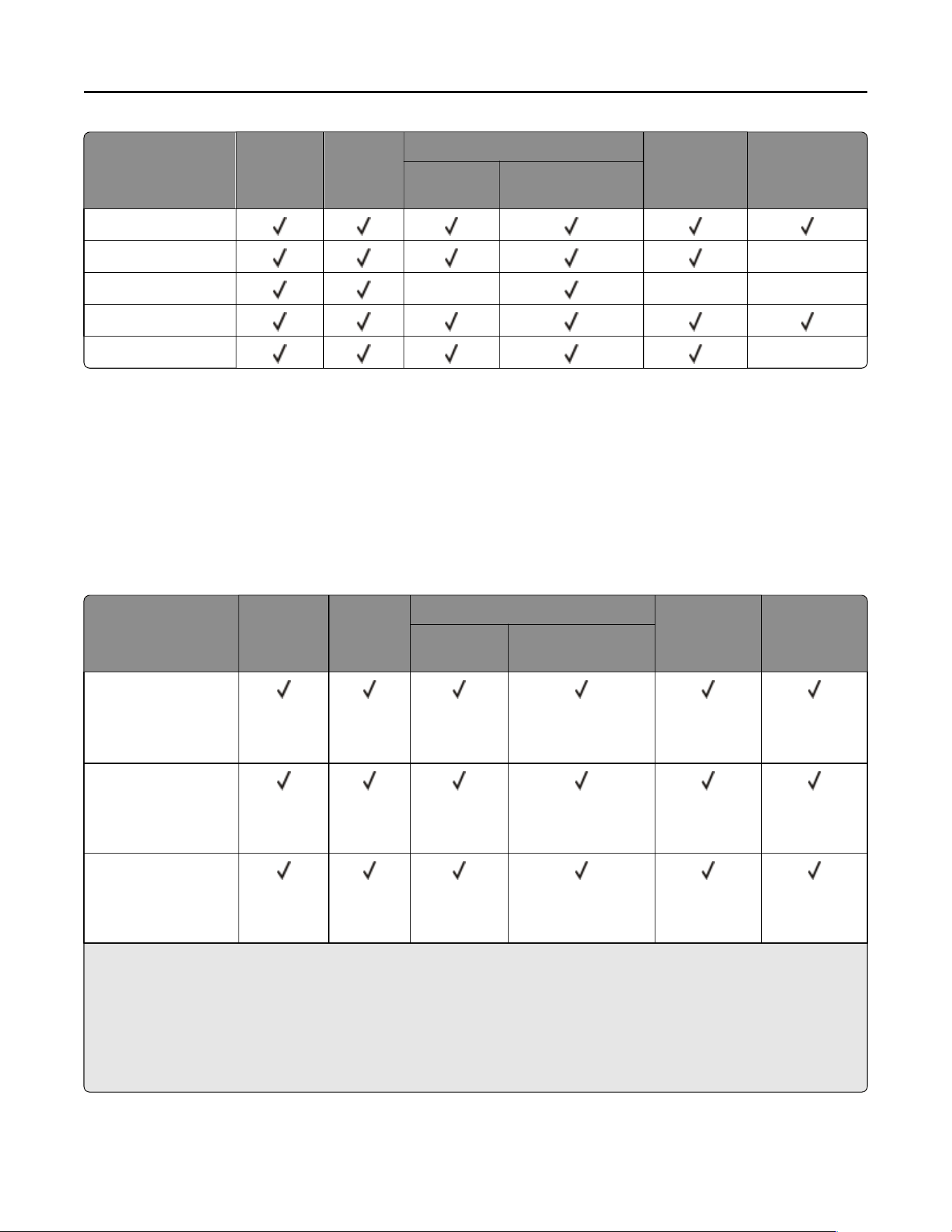
Paper type Standard
250‑sheet
tray
Manual
feeder
Optional 650‑sheet duo tray Optional
550‑sheet
tray
Two‑sided
printing
550‑sheet
tray
Multipurpose
feeder
Plain paper
Card stock X
Envelopes X X X
Paper labels
Vinyl labels X
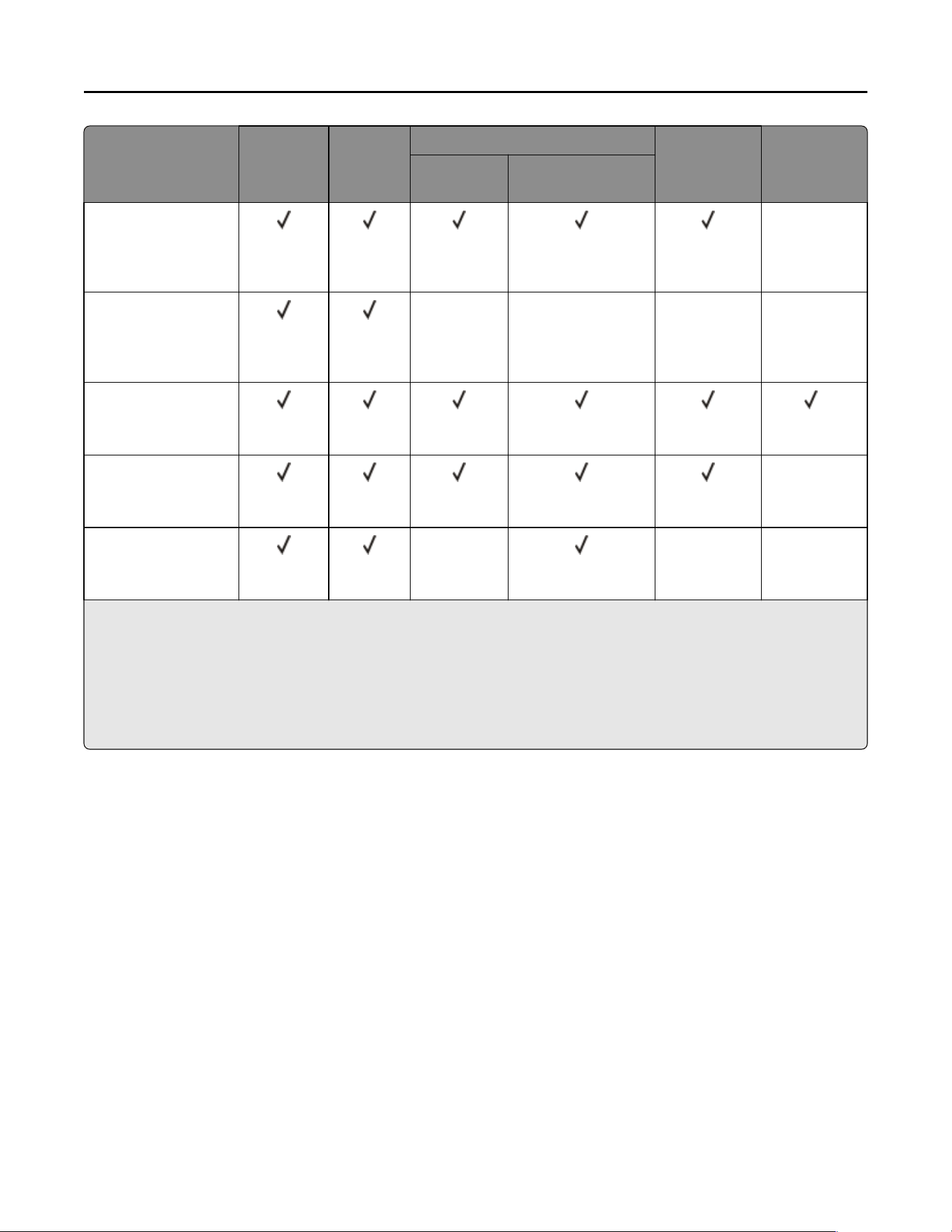
Supported paper weights
Notes:
• Your printer model may have a 650‑sheet duo tray, which consists of a 550‑sheet tray and an integrated
100‑sheet multipurpose feeder. The 550‑sheet tray of the 650‑sheet duo tray supports the same paper
types as the 550‑sheet tray. The integrated multipurpose feeder supports different paper sizes, types,
and weights.
• Labels, envelopes, and card stock always print at 25 pages per minute.
Paper type and
weight
Standard
250‑sheet
tray
Manual
feeder
Optional 650‑sheet duo tray Optional
550‑sheet
tray
Two‑sided
printing
550‑sheet
tray
Multipurpose
feeder
Light paper
1
60–74.9 g/m
2
grain long (16–
19.9‑lb bond)
Plain paper
75–90.3 g/m
2
grain long (20–
24‑lb bond)
Heavy paper
90.3–105 g/m
2
grain long (24.1–
28‑lb bond)
1
Paper less than 75 g/m
2
(20 lb) must be printed with Paper Type set to Light Paper. Failure to do so may cause
excessive curl which can lead to feeding errors, especially in more humid environments.
2
Labels and other specialty media are supported for occasional use and must be tested for acceptability.
3
Paper labels up to 105 g/m
2
(28‑lb bond) are supported.
4
100% cotton content maximum weight is 24‑lb bond.
5
28‑lb bond envelopes are limited to 25% cotton content.
Paper support 26
Paper type and
weight
Standard
250‑sheet
tray
Manual
feeder
Optional 650‑sheet duo tray Optional
550‑sheet
tray
Two‑sided
printing
550‑sheet
tray
Multipurpose
feeder
Card stock
105.1–162 g/m
2
grain long (28.1–
43‑lb bond)
X
Card stock
105.1–200 g/m
2
grain long (28.1–
53‑lb bond)
X X X X
Paper Labels
2
131 g/m
2
(35‑lb
bond)
3
Vinyl Labels
2
131 g/m
2
(35‑lb
bond)
X
Envelopes
4,5
60–105 g/m
2
(16–
28‑lb bond)
X X X
1
Paper less than 75 g/m
2
(20 lb) must be printed with Paper Type set to Light Paper. Failure to do so may cause
excessive curl which can lead to feeding errors, especially in more humid environments.
2
Labels and other specialty media are supported for occasional use and must be tested for acceptability.
3
Paper labels up to 105 g/m
2
(28‑lb bond) are supported.
4
100% cotton content maximum weight is 24‑lb bond.
5
28‑lb bond envelopes are limited to 25% cotton content.
Paper support 27
Printing
Printing from a computer
Note: For labels, card stock, and envelopes, set the paper size and type in the printer before printing the
document.
1 From the document that you are trying to print, open the Print dialog.
2 If necessary, adjust the settings.
3 Print the document.
Printing from a mobile device
Note: Mobile printing is available only in some printer models.
Printing from a mobile device using Google Cloud Print
Google Cloud Print
TM
is a printing service that allows you to print to any Google Cloud Print‑ready printer.
Before you begin, make sure that:
• The printer is registered to the Google Cloud Print server.
• The Cloud Print plugin is downloaded from the Google Play
TM
store and is enabled in the mobile device.
1 From your Android
TM
mobile device, open a document or select a document from your file manager.
2 Tap > Print.
3 Select a printer, and then tap
.
Printing from a mobile device using AirPrint
The AirPrint software feature is a mobile printing solution that allows you to print directly from Apple devices
to an AirPrint‑certified printer.
Notes:
• Make sure that the Apple device and the printer are connected to the same network. If the network has
multiple wireless hubs, then make sure that both devices are connected to the same subnet.
• This application is supported only in some Apple devices.
1 From your mobile device, select a document from your file manager or launch a compatible application.
2 Tap the share icon, and then tap Print.
Printing 28
3 Select a printer.
If necessary, adjust the settings.
4 Print the document.
Printing from a mobile device using Wi‑Fi Direct®
Wi‑Fi Direct
®
is a printing service that lets you print to any Wi‑Fi Direct‑ready printer.
Note: Make sure that the mobile device is connected to the printer wireless network. For more information,
see “Connecting a mobile device to the printer wireless network” on page 82.
1 From your mobile device, launch a compatible application or select a document from your file manager.
2 Depending on your mobile device, do one of the following:
• Tap >
Print.
• Tap
> Print.
• Tap > Print.
3 Select a printer, and then adjust the settings, if necessary.
4 Print the document.
Printing from a flash drive
This feature is available only in some printer models.
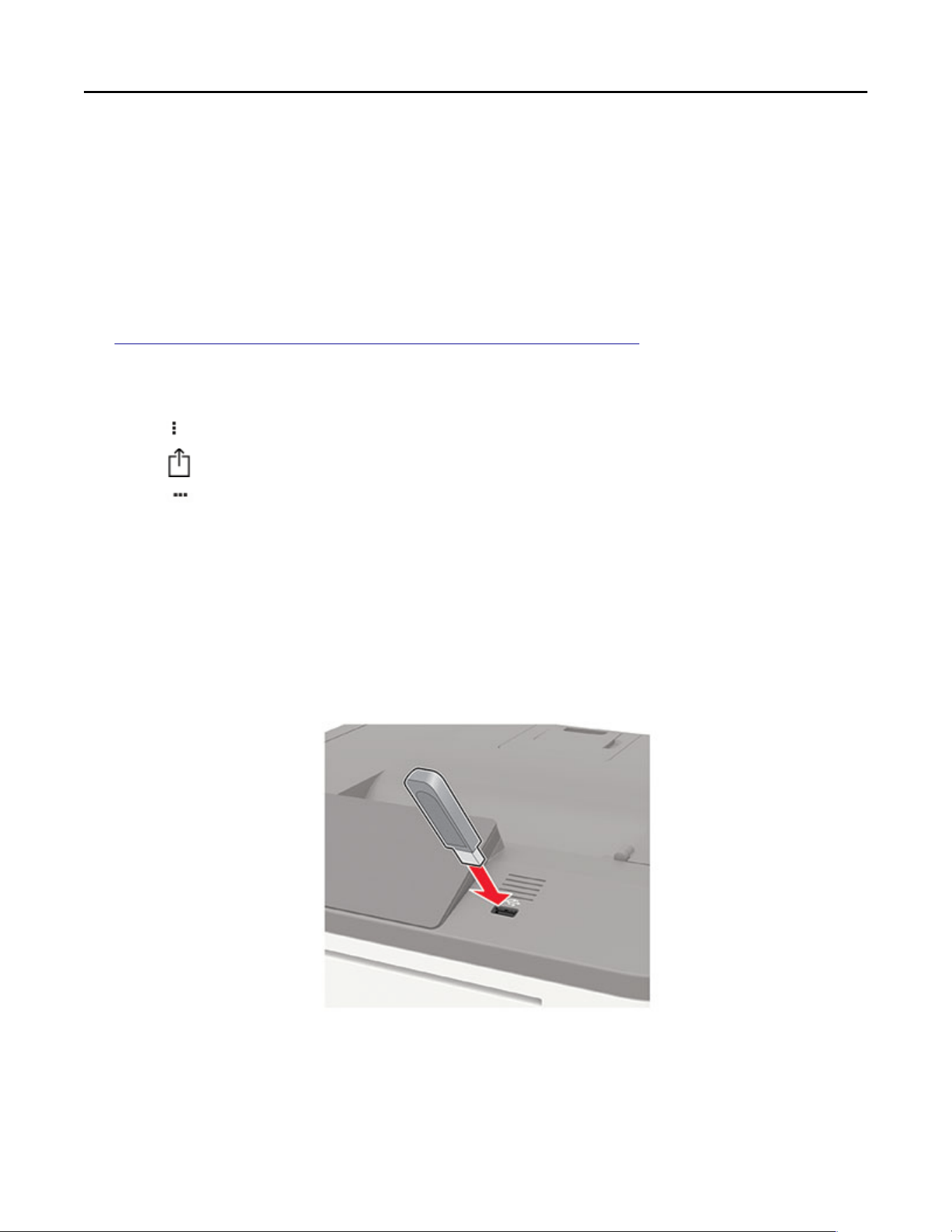
1 Insert the flash drive.
Notes:
• If you insert the flash drive when an error message appears, then the printer ignores the flash drive.
• If you insert the flash drive while the printer is processing other print jobs, then Busy appears on the
display.
Printing 29
2 Select the document that you want to print.
If necessary, configure other print settings.
3 Print the document.
To print another document, select USB Drive.
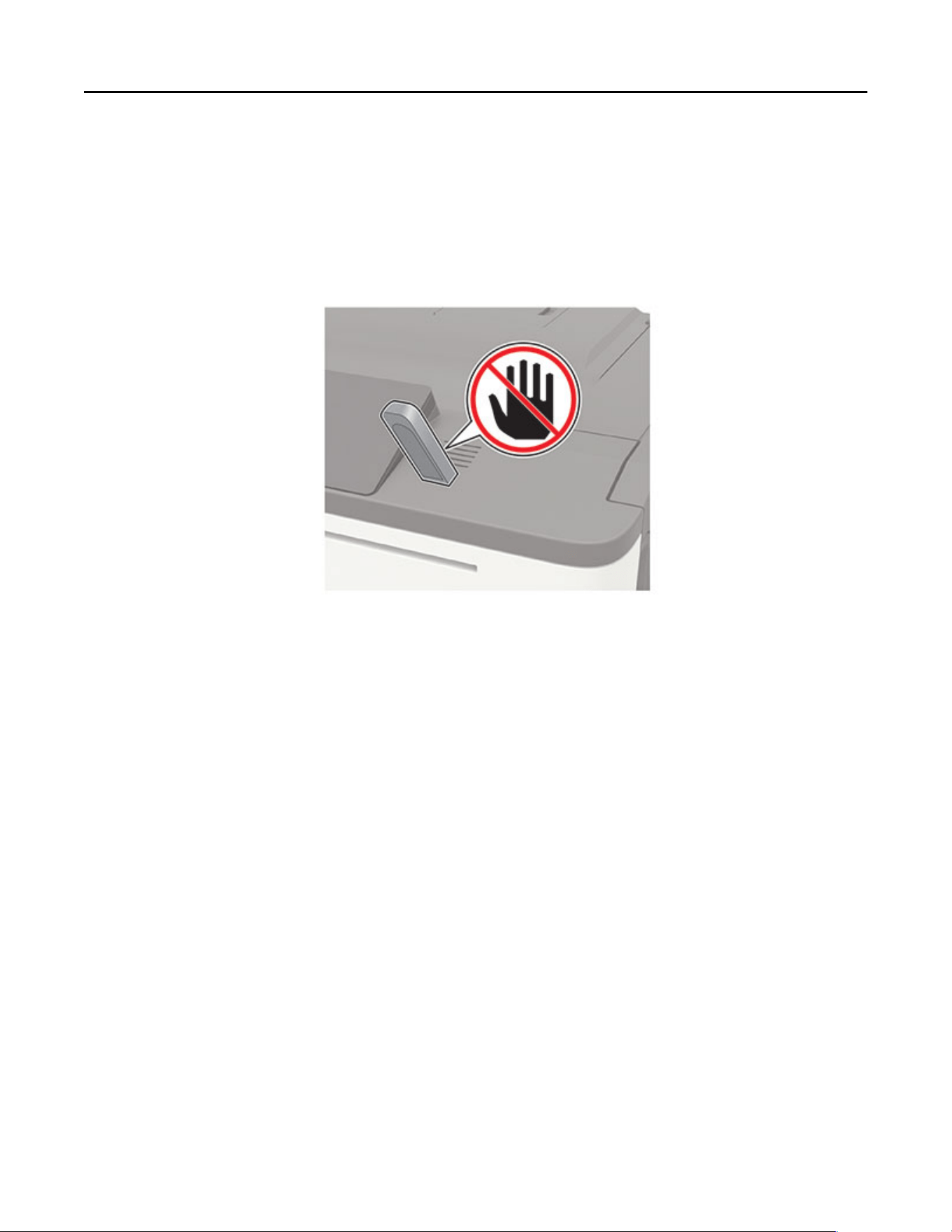
Warning—Potential Damage: To avoid loss of data or printer malfunction, do not touch the flash drive or
the printer in the area shown while actively printing, reading, or writing from the memory device.
Supported flash drives and file types
Flash drives
Notes:
– The printer supports high‑speed USB flash drives with full‑speed standard.
– USB flash drives must support the File Allocation Table (FAT) system.
Many flash drives are tested and approved for use with the printer. For more information, contact the place
where you purchased the printer.
File types
Documents
• PDF (version 1.7 or earlier)
• XPS
• Microsoft file formats (.doc, .docx, .xls, .xlsx, .ppt, .pptx) are supported only in some printer models.
Images
• .dcx
• .gif
• .JPEG or .jpg
• .bmp
• .pcx
Printing 30
• .TIFF or .tif
• .png
Configuring confidential jobs
1 From the control panel, navigate to:
Settings > Security > Confidential Print Setup
For non‑touch‑screen printer models, press to navigate through the settings.
2 Configure the settings.
Use To
Max Invalid PIN Set the number of times an invalid PIN can be entered.
Note: When the limit is reached, the print jobs for that user name are deleted.
Confidential Job
Expiration
Set the expiration time for confidential print jobs.
Note: Confidential held jobs are stored in the printer until they are released or
deleted manually.
Repeat Job Expiration Set the expiration time for a repeat print job.
Note: Repeat held jobs are stored in the printer memory for reprinting.
Verify Job Expiration Set the expiration time that the printer prints a copy before printing the remaining
copies.
Note: Verify jobs print one copy to check if it is satisfactory before printing the
remaining copies.
Reserve Job Expiration Set the expiration time that the printer stores print jobs.
Note: Reserve held jobs are automatically deleted after printing.
Require All Jobs to be
Held
Set the printer to hold all print jobs.
Keep duplicate
documents
Set the printer to print all documents with the same file name.
Printing confidential and other held jobs
1 With a document open, click File > Print.
2 Click Properties, Preferences, Options, or Setup.
3 Click Print and Hold.
4 Select Use Print and Hold, and then assign a user name.
5 Select the print job type (Confidential, Repeat, Reserve, or Verify).
If the print job is confidential, then enter a four‑digit PIN.
6 Click OK or Print.
Printing 31

7 From the printer home screen, release the print job.
• For confidential print jobs, navigate to:
Held jobs > select your user name > Confidential > enter the PIN > select the print job > configure the
settings > Print
• For other print jobs, navigate to:
Held jobs > select your user name > select the print job > configure the settings > Print
Printing a font sample list
1 From the control panel, navigate to:
Settings > Reports > Print > Print Fonts
For non-touch-screen printer models, press to navigate through the settings.
2 Select a font sample.
Printing a directory list
From the control panel, navigate to:
Settings > Reports > Print > Print Directory
For non-touch-screen printer models, press to navigate through the settings.
Printing 32
Understanding the printer menus
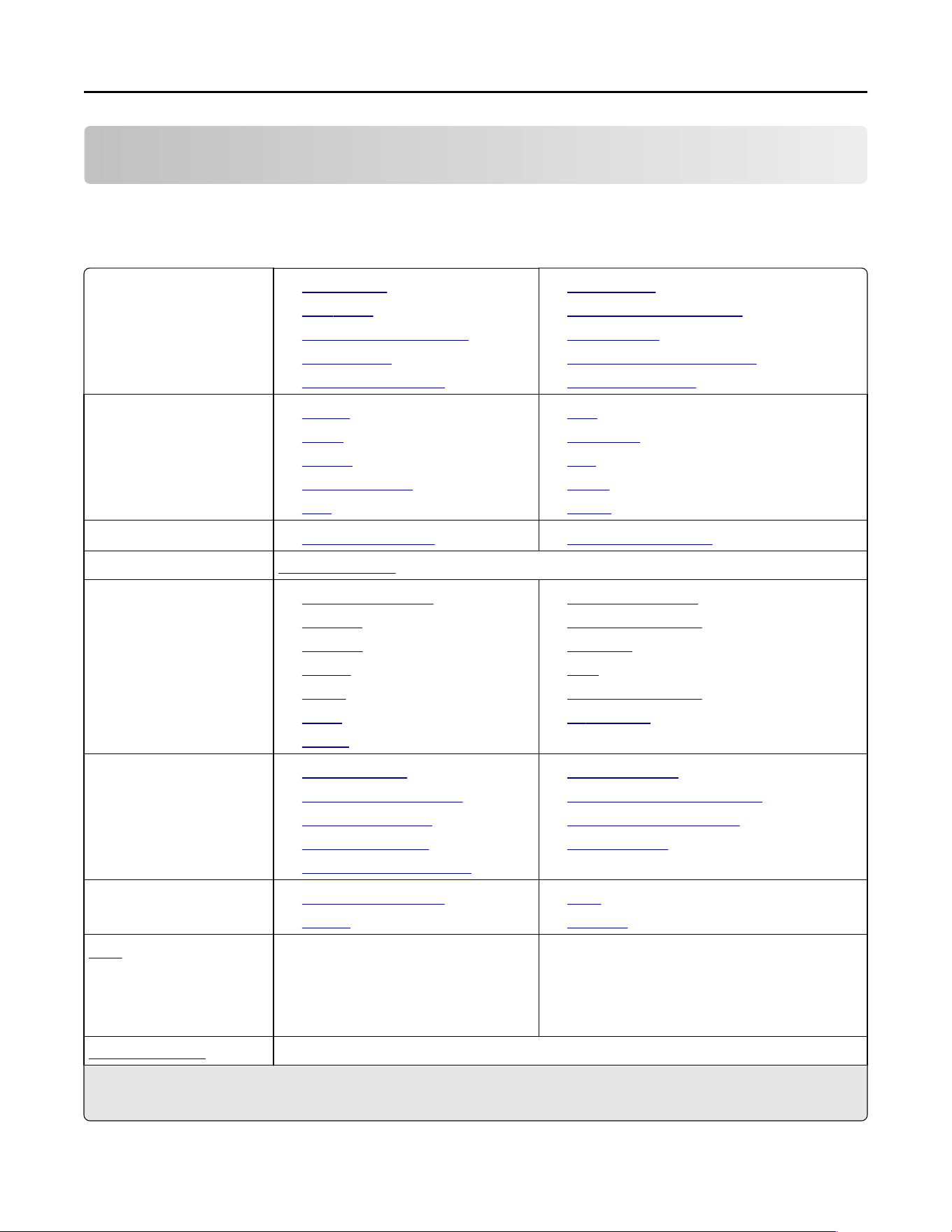
Menu map
Device
• Preferences
• Eco‑Mode
• Remote Operator Panel
• Notifications
• Power Management
• Accessibility
• Restore Factory Defaults
• Maintenance
• Visible Home Screen Icons
• About This Printer
Print
• Layout
• Setup
• Quality
• Job Accounting
• XPS
• PDF
• PostScript
• PCL
• HTML
• Image
Paper
• Tray Configuration • Media Configuration
USB Drive Flash Drive Print
Network/Ports
• Network Overview
• Wireless
• Ethernet
• TCP/IP
• SNMP
• IPSec
• 802.1x
• LPD Configuration
• HTTP/FTP Settings
• ThinPrint
• USB
• Google Cloud Print
• Wi‑Fi Direct
Security
1
• Login Methods
• Schedule USB Devices
• Security Audit Log
• Login Restrictions
• Confidential Print Setup
• Disk Encryption
• Erase Temporary Data Files
• Solutions LDAP Settings
• Miscellaneous
Reports
• Menu Settings Page
• Device
• Print
• Network
Help
2
• Print All Guides
• Color Quality Guide
• Connection Guide
• Information Guide
• Media Guide
• Moving Guide
• Print Quality Guide
• Supplies Guide
Troubleshooting Print Quality Test Pages
1
In some printer models, this menu can be configured only from the Embedded Web Server.
2
This menu is available only in some printer models.
Understanding the printer menus 33
Device
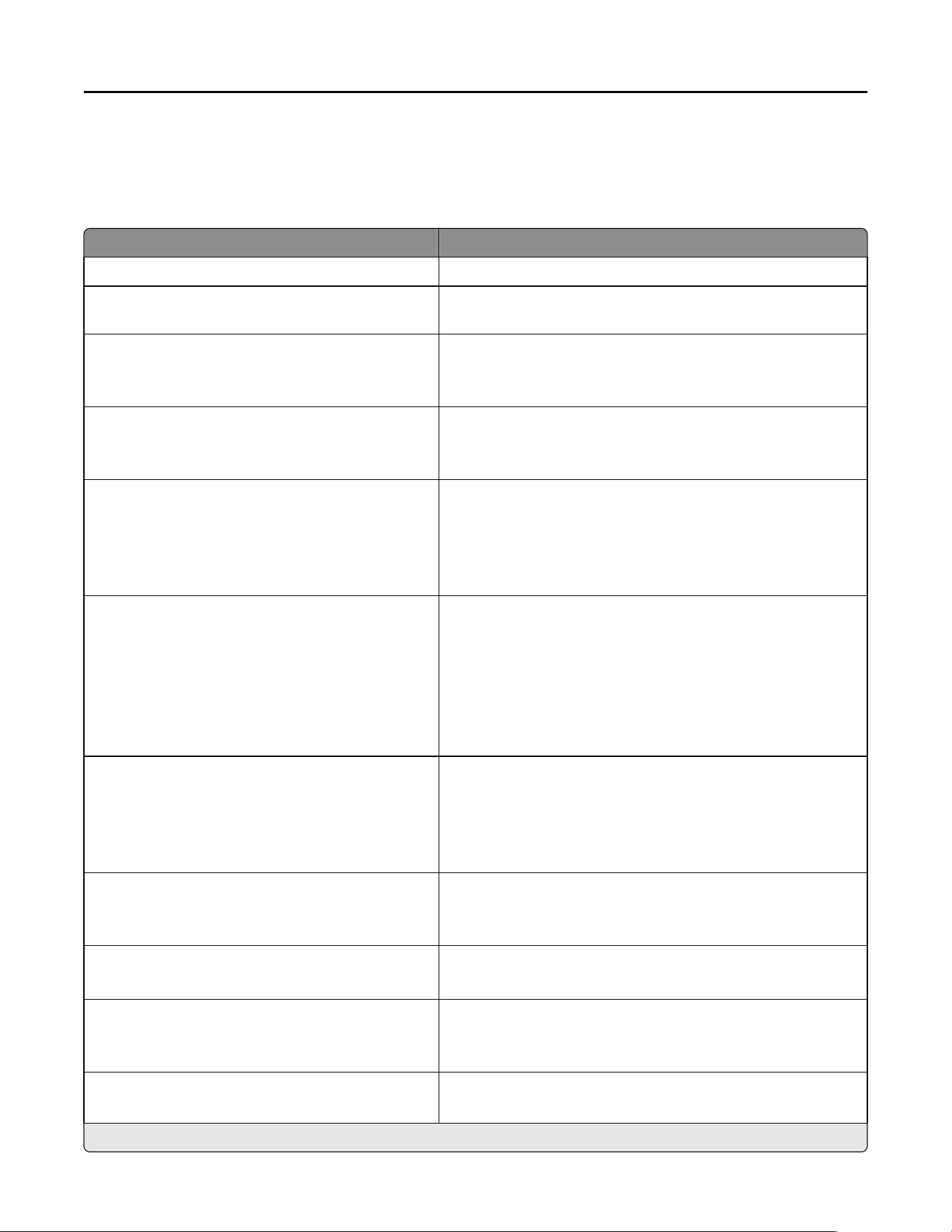
Preferences
Menu item Description
Display Language Set the language of the text that appears on the display.
Country/Region Identify the country or region that the printer is configured to
operate.
Run initial setup
No*
Yes
Run the setup wizard.
Keyboard
Keyboard Type
Select a language as a keyboard type.
Note: All the Keyboard Type values may not appear or may
require special hardware be installed to appear.
Displayed information
Display Text 1 (IP Address*)
Display Text 2 (Date/Time*)
Custom Text 1
Custom Text 2
Specify the information to appear on the home screen.
Date and Time
Configure
Current Date and Time
Manually Set Date and Time
Date Format (DD‑MM‑YYYY*)
Time Format (12 hour A.M./P.M.*)
Time Zone (Beijing (CST)*)
Configure the printer date and time.
Date and Time
Network Time Protocol
Enable NTP (On*)
NTP Server
Enable Authentication (None*)
Configure the settings for Network Time Protocol (NTP).
Note: When Enable Authentication is set to MD5 key, Key ID
and Password appear.
Paper Sizes
U.S.
Metric*
Specify the unit of measurement for paper sizes.
Note: The country or region selected in the initial setup
wizard determines the initial paper size setting.
Screen Brightness
20–100% (100*)
Adjust the brightness of the display.
Note: This menu item appears only in some printer models.
Flash Drive Access
Enabled*
Disabled
Enable access to the flash drive.
Note: This menu item appears only in some printer models.
Screen Timeout
5–300 seconds (60*)
Set the idle time before the display shows the home screen or
before the printer logs out a user account automatically.
Note: An asterisk (*) next to a value indicates the factory default setting.
Understanding the printer menus 34
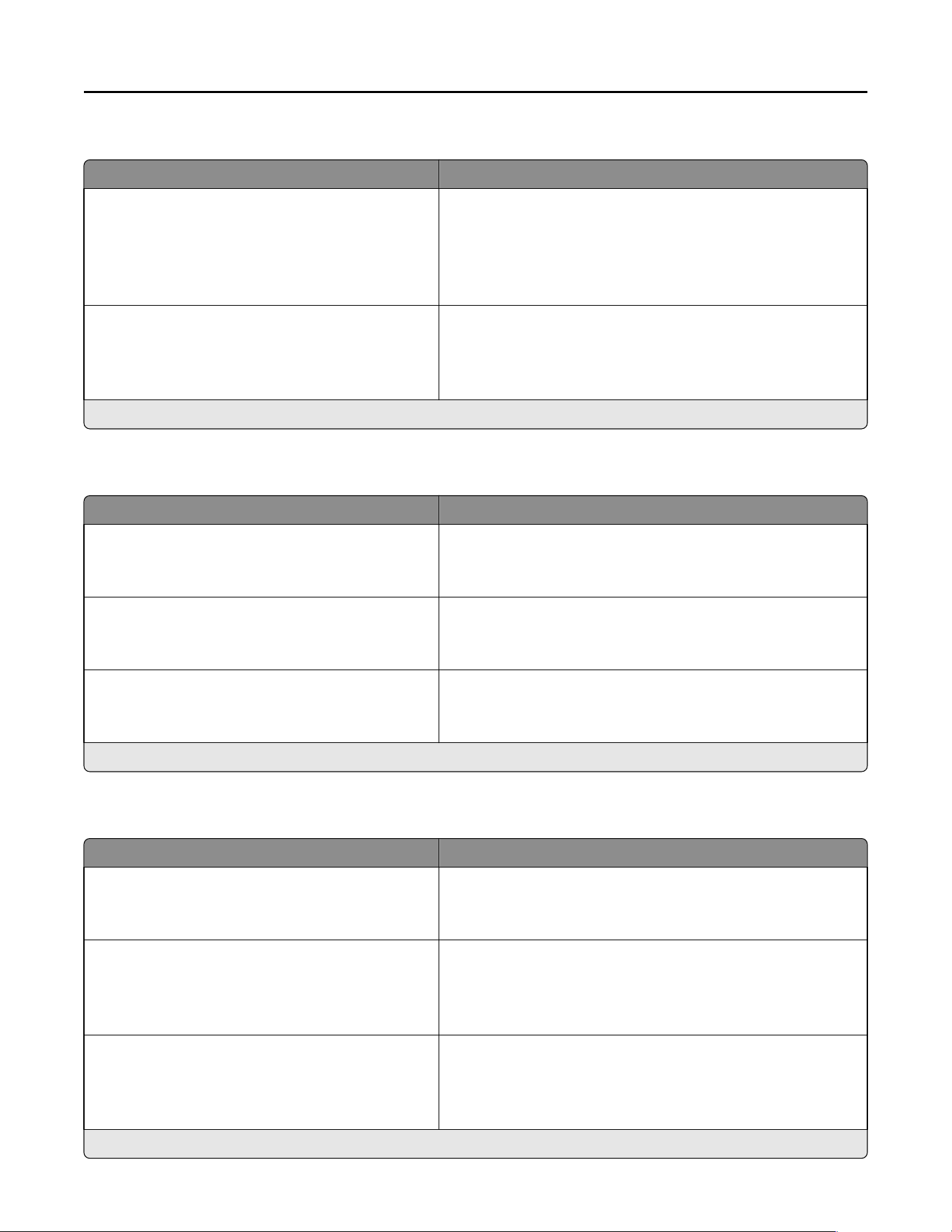
Eco-Mode
Menu item Description
Print
Sides (1‑Sided*)
Pages per Side (Off*)
Toner Darkness (4*)
Color Saver (Off*)
Configure the print settings of the printer.
Copy
Sides (1 sided to 1 sided*)
Pages per Side (Off*)
Darkness (5*)
Configure the copy settings of the printer.
Note: An asterisk (*) next to a value indicates the factory default setting.
Remote Operator Panel
Menu item Description
External VNC Connection
Don’t Allow*
Allow
Connect an external Virtual Network Computing (VNC) client
to the remote control panel.
Authentication Type
None*
Standard Authentication
Set the authentication type when accessing the VNC client
server.
VNC Password Specify the password to connect to the VNC client server.
Note: This menu item appears only if Authentication Type is
set to Standard Authentication.
Note: An asterisk (*) next to a value indicates the factory default setting.
Notifications
Menu item Description
Error Lighting
Off
On*
Set the indicator light to come on when a printer error occurs.
Note: This menu item appears only in some printer models.
Alarm Control
Off
Single*
Continuous
Set the number of times that the alarm sounds when the printer
requires user intervention.
Supplies
Show Supply Estimates
Show estimates*
Do not show estimates
Show the estimated status of the supplies.
Note: An asterisk (*) next to a value indicates the factory default setting.
Understanding the printer menus 35

Menu item Description
Supplies
Cartridge Alarm
Off
Single*
Continuous
Set the number of times that the alarm sounds when the toner
cartridge is low.
E‑mail Alerts Setup
E‑mail Setup
Primary SMTP Gateway
Primary SMTP Gateway Port (25*)
Secondary SMTP Gateway
Secondary SMTP Gateway Port (25*)
SMTP Timeout (30 seconds*)
Reply Address
Always use SMTP default Reply
Address(Off*)
Use SSL/TLS(Disabled*)
Require Trusted Certificate(On*)
SMTP Server Authentication
(No authentication required*)
Device‑Initiated E‑mail(None*)
User‑Initiated E‑mail(None*)
Use Active Directory Device
Credentials(Off*)
Device Userid
Device Password
Kerberos 5 REALM
NTLM Domain
Disable “SMTP server not set up” error(Off*)
Configure the e‑mail settings of the printer.
Error Prevention
Jam Assist
Off
On*
Set the printer to flush blank pages or pages with partial prints
automatically after a jammed page has been cleared.
Error Prevention
Auto Continue
Off*
On
Let the printer continue processing or printing a job
automatically after clearing certain printer conditions that
require user intervention.
Error Prevention
Auto Reboot
Auto Reboot
Reboot when idle
Reboot always*
Reboot never
Set the printer to restart when an error occurs.
Note: An asterisk (*) next to a value indicates the factory default setting.
Understanding the printer menus 36
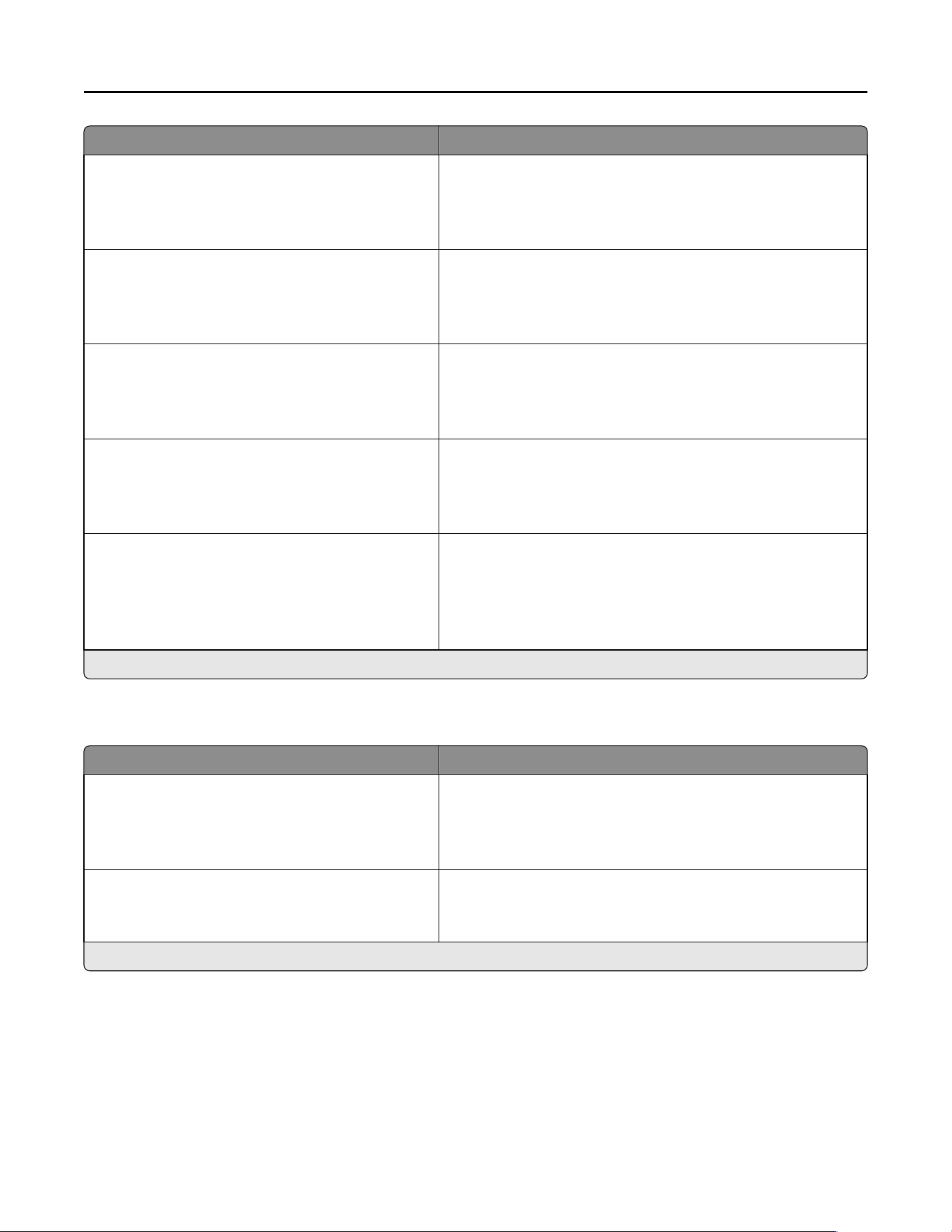
Menu item Description
Error Prevention
Auto Reboot
Max Auto Reboots
1–20 (2*)
Set the number of automatic reboots that the printer can
perform.
Error Prevention
Auto Reboot
Auto Reboot Window
1–525600 seconds (720*)
Set the time before the printer performs an automatic reboot.
Error Prevention
Display Short Paper Error
On
Auto‑clear*
Set the printer to show a message when a short paper error
occurs.
Note: Short paper refers to the size of the paper loaded.
Error Prevention
Page Protect
Off*
On
Set the printer to process the entire page into the memory
before printing it.
Jam Content Recovery
Jam Recovery
Off
On
Auto*
Set the printer to reprint jammed pages.
Note: An asterisk (*) next to a value indicates the factory default setting.
Power Management
Menu item Description
Sleep Mode Profile
Print from Sleep Mode
Stay awake after printing
Enter Sleep Mode after printing*
Set the printer to stay in Ready mode or return to Sleep mode
after printing.
Timeouts
Sleep Mode
1–120 minutes (15*)
Set the idle time before the printer begins operating in Sleep
mode.
Note: An asterisk (*) next to a value indicates the factory default setting.
Understanding the printer menus 37
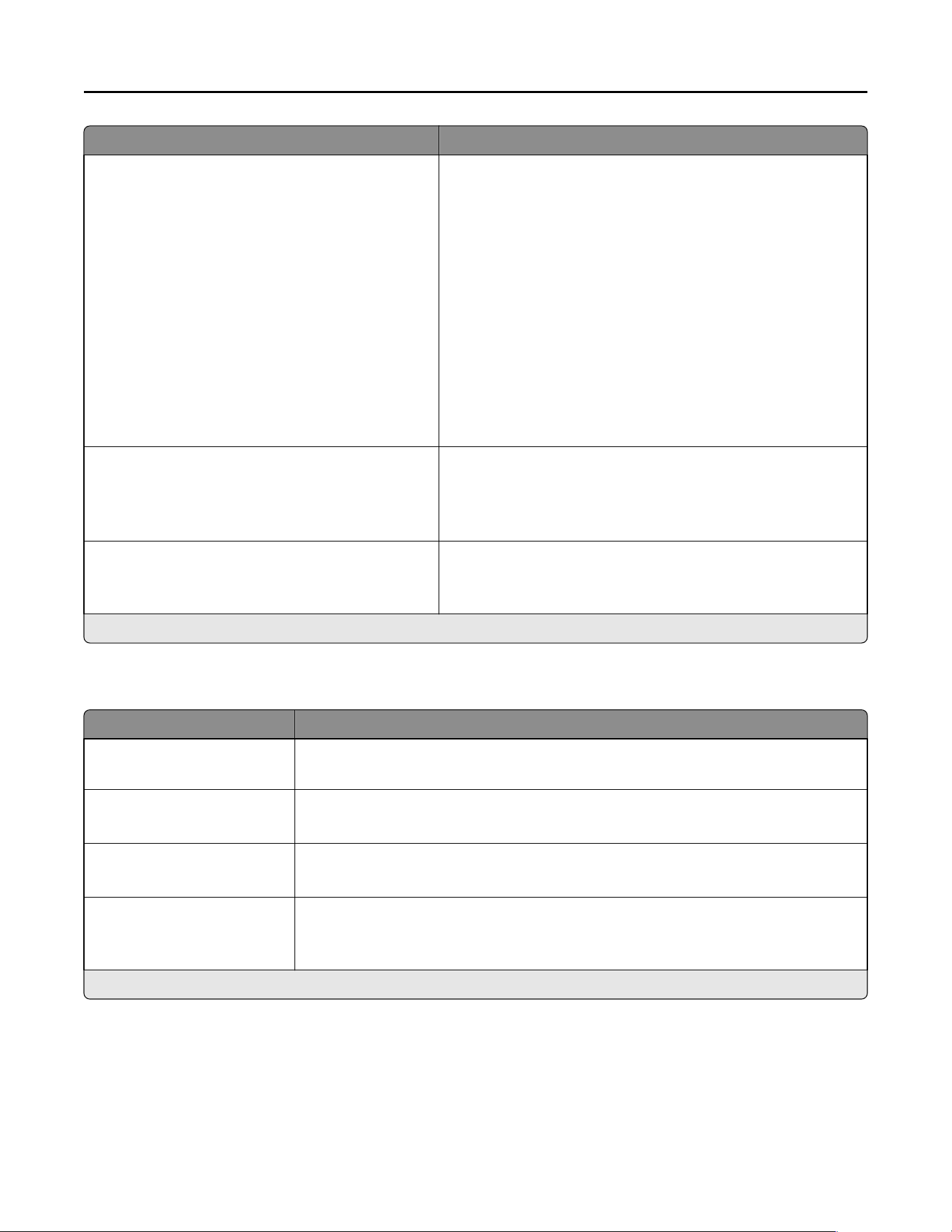
Menu item Description
Timeouts
Hibernate Timeout
Disabled
1 hour
2 hours
3 hours
6 hours
1 day
2 days
3 days*
1 week
2 weeks
1 month
Set the time before the printer turns off.
Timeouts
Hibernate Timeout on Connection
Hibernate
Do Not Hibernate*
Set Hibernate Timeout to turn off the printer while an active
Ethernet connection exists.
Schedule Power Modes
Schedules
Add New Schedule
Schedule the printer when to enter Sleep or Hibernate mode.
Note: An asterisk (*) next to a value indicates the factory default setting.
Accessibility
Menu item Description
Duplicate Key Strike Interval
0–5 seconds (0*)
Set the interval during which the printer ignores duplicate key presses on an
attached keyboard.
Key Repeat Initial Delay
0.25–5 seconds (1*)
Set the initial length of delay before a repeating key starts repeating.
Note: Appears only when a keyboard is attached to the printer.
Key Repeat Rate
0.5–30 (30*)
Set the number of presses per second for a repeating key.
Note: Appears only when a keyboard is attached to the printer.
Prolong Screen Timeout
Off*
On
Let the user remain in the same location and reset the Screen Timeout timer when
it expires instead of returning to the home screen.
Note: An asterisk (*) next to a value indicates the factory default setting.
Understanding the printer menus 38
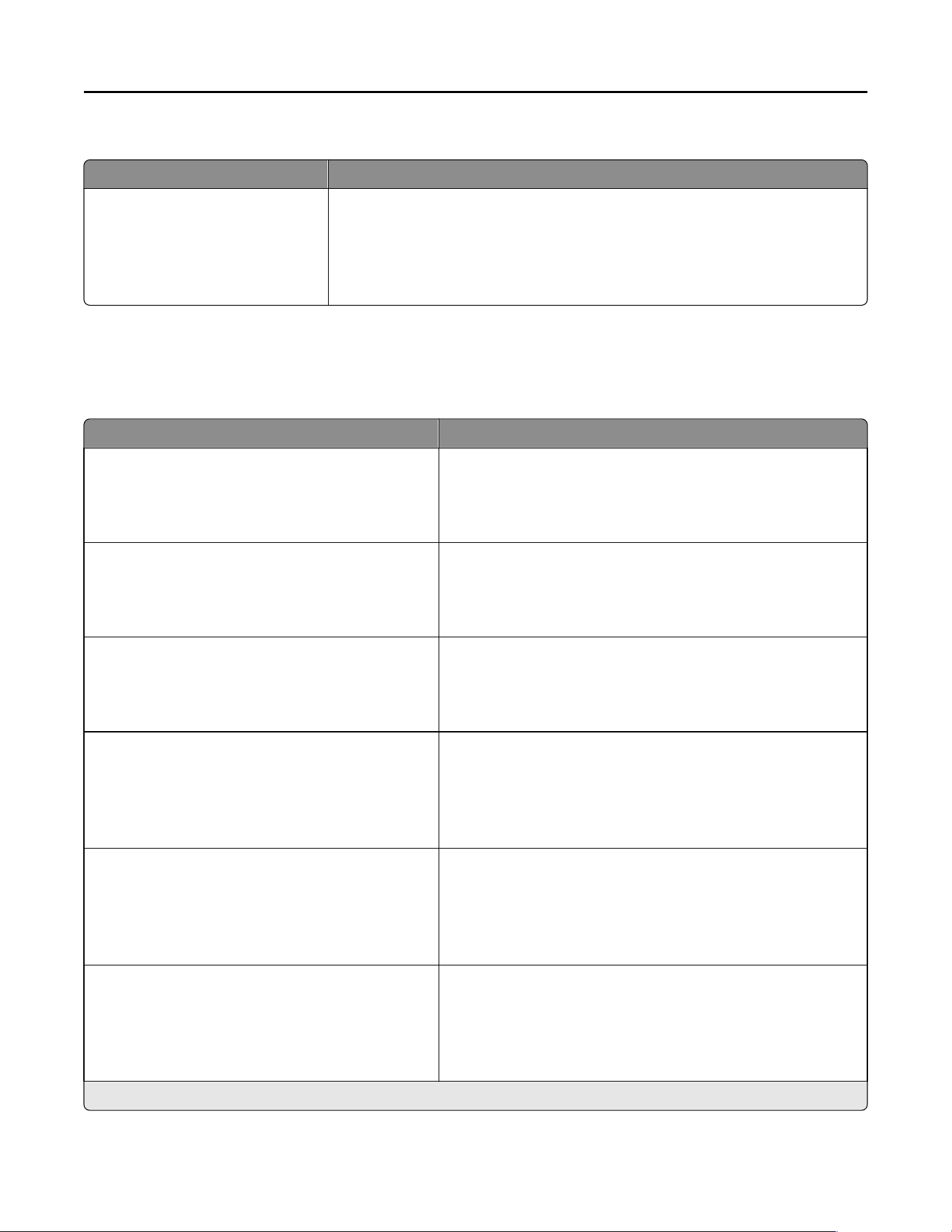
Restore Factory Defaults
Menu item Description
Restore Settings
Restore all settings
Restore printer settings
Restore network settings
Restore app settings
Restore the printer factory default settings.
Note: Restore app settings appears only in some printer models.
Maintenance
Configuration Menu
Menu item Description
USB Configuration
USB PnP
1*
2
Change the USB driver mode of the printer to improve its
compatibility with a personal computer.
Note: This menu item appears only in some printer models.
USB Configuration
USB Speed
Full
Auto*
Set the USB port to run at full speed and disable its high‑speed
capabilities.
Note: This menu item appears only in some printer models.
Tray Configuration
Tray Linking
Automatic*
Off
Set the printer to link the trays that have the same paper type
and paper size settings.
Tray Configuration
Show Tray Insert Message
Off
Only for unknown sizes*
Always
Show the Tray Insert message.
Tray Configuration
Paper Prompts
Auto*
Multipurpose Feeder
Manual Paper
Set the paper source that the user fills when a prompt to load
paper appears.
Note: The multipurpose feeder is available only in some
printer models.
Tray Configuration
Envelope Prompts
Auto*
Multipurpose Feeder
Manual Envelope
Set the paper source that the user fills when a prompt to load
envelope appears.
Note: The multipurpose feeder is available only in some
printer models.
Note: An asterisk (*) next to a value indicates the factory default setting.
Understanding the printer menus 39
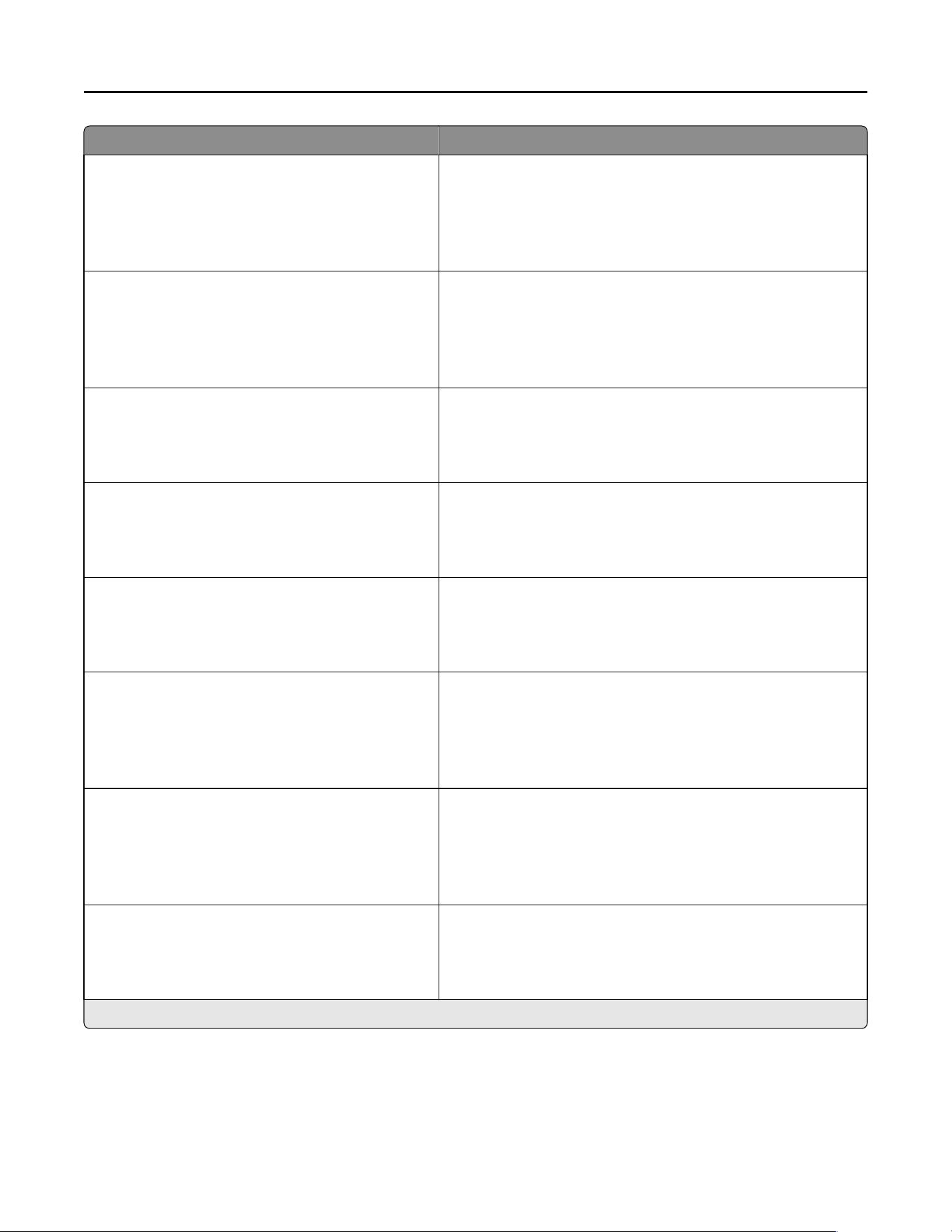
Menu item Description
Tray Configuration
Action for Prompts
Prompt user*
Continue
Use current
Set the printer to resolve paper- or envelope-related change
prompts.
Reports
Menu Settings Page
Event Log
Event Log Summary
HealthCheck Statistics
Print reports about printer menu settings, status, and event
logs.
Printer Emulations
PPDS Emulation
Off*
On
Set the printer to recognize and use the PPDS data stream.
Printer Emulations
PS Emulation
Off
On*
Set the printer to recognize and use the PS data stream.
Printer Emulations
Emulator Security
Page Timeout
0–60 (60*)
Set the page timeout during emulation.
Printer Emulations
Emulator Security
Reset Emulator After Job
Off*
On
Reset the emulator after a print job.
Printer Emulations
Emulator Security
Disable Printer Message Access
Off
On*
Disable access to printer message during emulation.
Print Configuration
Black Only Mode
Off*
On
Print color content in grayscale.
Note: An asterisk (*) next to a value indicates the factory default setting.
Understanding the printer menus 40
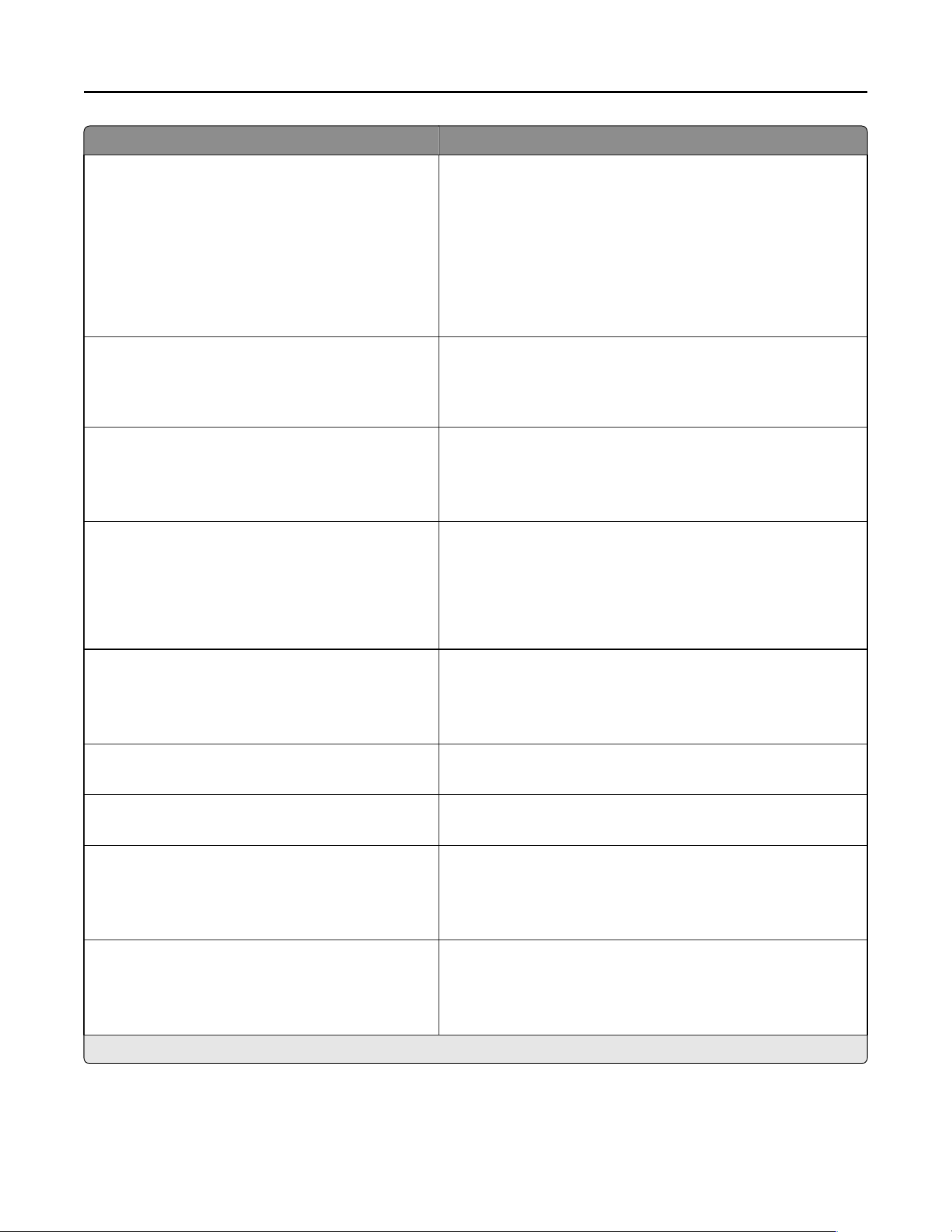
Menu item Description
Print Configuration
Color Trapping
Off
1
2*
3
4
5
Enhance the printed output to compensate for misregistration
in the printer.
Print Configuration
Font Sharpening
0–150 (24*)
Set a text point-size value below which the high‑frequency
screens are used when printing font data.
For example, if the value is 24, then all fonts sized 24 points or
less use the high‑frequency screens.
Device Operations
Quiet Mode
Off*
On
Set the printer to operate in Quiet Mode.
Note: Enabling this setting slows down the printer
performance.
Device Operations
Safe Mode
Off
On*
Set the printer to operate in a special mode, in which it attempts
to continue offering as much functionality as possible, despite
known issues.
For example, when set to On, and the duplex motor is
nonfunctional, the printer performs one‑sided printing of the
documents even if the job is two‑sided printing.
Device Operations
Custom Supply Levels
Off*
On
Let printservice read and edit values from the Embedded Web
Server.
Device Operations
Clear Custom Status
Erase user‑defined strings for the Default or Alternate custom
messages.
Device Operations
Clear all remotely‑installed messages
Erase messages that were remotely installed.
Device Operations
Automatically Display Error Screens
Off
On*
Show existing error messages on the display after the printer
remains inactive on the home screen for a length of time equal
to the Screen Timeout setting.
Device Operations
Enable Optional Parallel Port
Off*
On
Enable an optional parallel port.
Note: When set to On, the printer restarts.
Note: An asterisk (*) next to a value indicates the factory default setting.
Understanding the printer menus 41
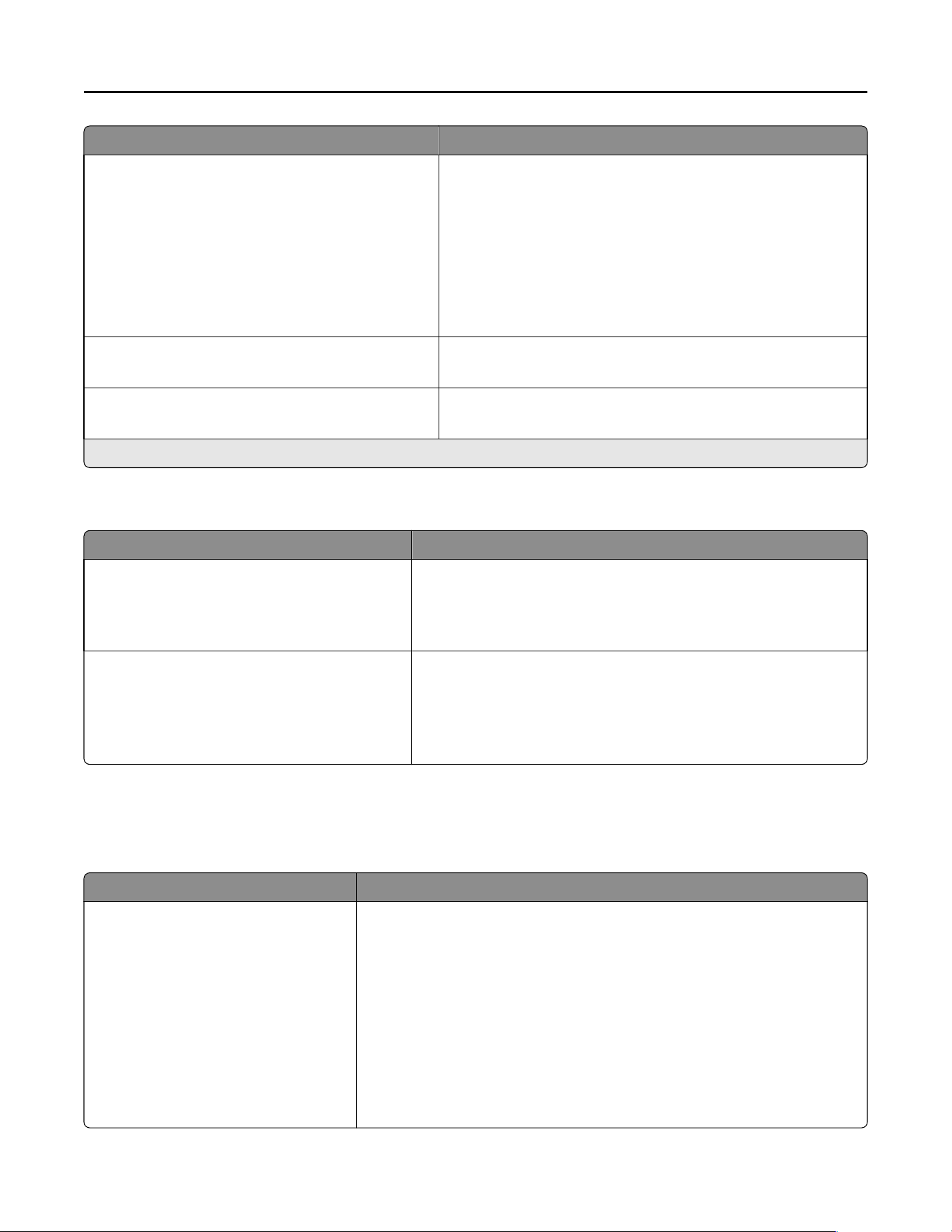
Menu item Description
Toner patch sensor setup
Calibration frequency preference
Disabled
Fewest color adjustment
Fewer color adjustment
Normal*
Better color accuracy
Best color accuracy
Set the printer to put down the correct amount of toner to
maintain color consistency.
Toner patch sensor setup
Full calibration
Run the full color calibration.
Toner patch sensor setup
Print TPS information page
Print a diagnostic page that contains information on toner
patch sensor calibration.
Note: An asterisk (*) next to a value indicates the factory default setting.
Out of Service Erase
Menu item Description
Out of Service Erase
Memory Last Sanitized
Hard Disk Last Sanitized
Show information on when the printer memory or hard disk was
last sanitized.
Note: Hard Disk Last Sanitized appears only in printers with a
hard disk installed.
Out of Service Erase
Sanitize all information on nonvolatile
memory
Sanitize all information on hard disk
Erase all printer and network settings
Clear all settings and applications that are stored in the printer
memory or hard disk.
Note: Sanitize all information on hard disk appears only in
printers with a hard disk installed.
Visible Home Screen Icons
Note: This menu appears only in some printer models.
Menu Description
Status/Supplies
Job Queue
Change Language
Address Book
Bookmarks
Held Jobs
USB
App Profiles
Display Customization
Eco‑Settings
Specify which icons to show on the home screen.
Understanding the printer menus 42
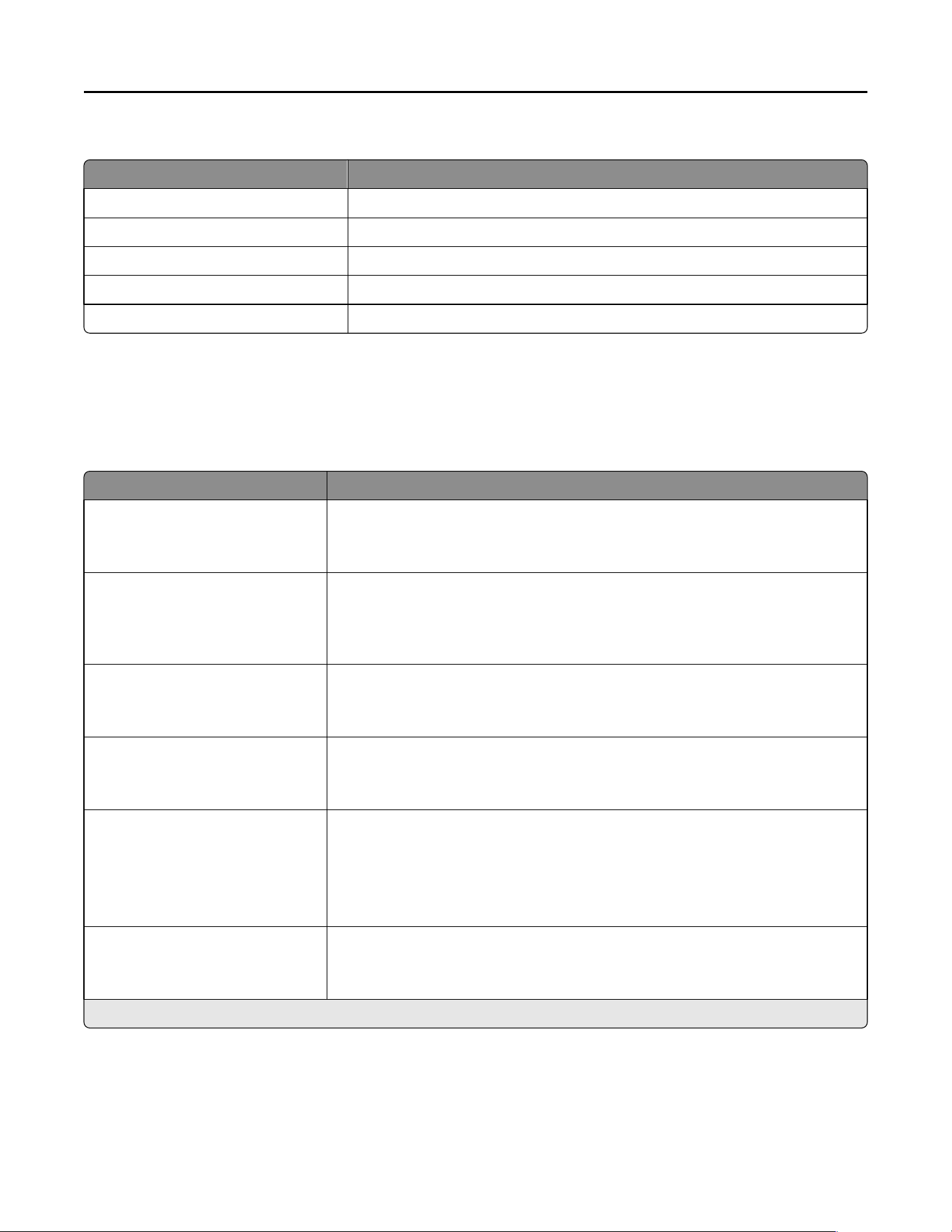
About this Printer
Menu item Description
Asset Tag Show the serial number of the printer.
Printer’s Location Identify the printer location. The maximum length is 63 characters.
Contact Personalize the printer name. The maximum length is 63 characters.
Export Configuration File to USB Export the configuration file to a flash drive.
Export Compressed Logs to USB Export the compressed log files to a flash drive.
Print
Layout
Menu item Description
Sides
1‑sided*
2‑sided
Specify whether to print on one side or two sides of the paper.
Flip Style
Long Edge*
Short Edge
Determine which side of the paper (long edge or short edge) is bound when
performing two‑sided printing.
Note: Depending on the option selected, the printer automatically offsets
each printed information of the page to bind the job correctly.
Blank Pages
Print
Do Not Print*
Print blank pages that are included in a print job.
Collate
Off [1,1,1,2,2,2]*
On [1,2,1,2,1,2]
Keep the pages of a print job stacked in sequence, particularly when printing
multiple copies of the job.
Separator Sheets
None*
Between Copies
Between Jobs
Between Pages
Insert blank separator sheets when printing.
Separator Sheet Source
Tray [x] (1*)
Multipurpose Feeder
Specify the paper source for the separator sheet.
Note: The multipurpose feeder is available only in some printer models.
Note: An asterisk (*) next to a value indicates the factory default setting.
Understanding the printer menus 43
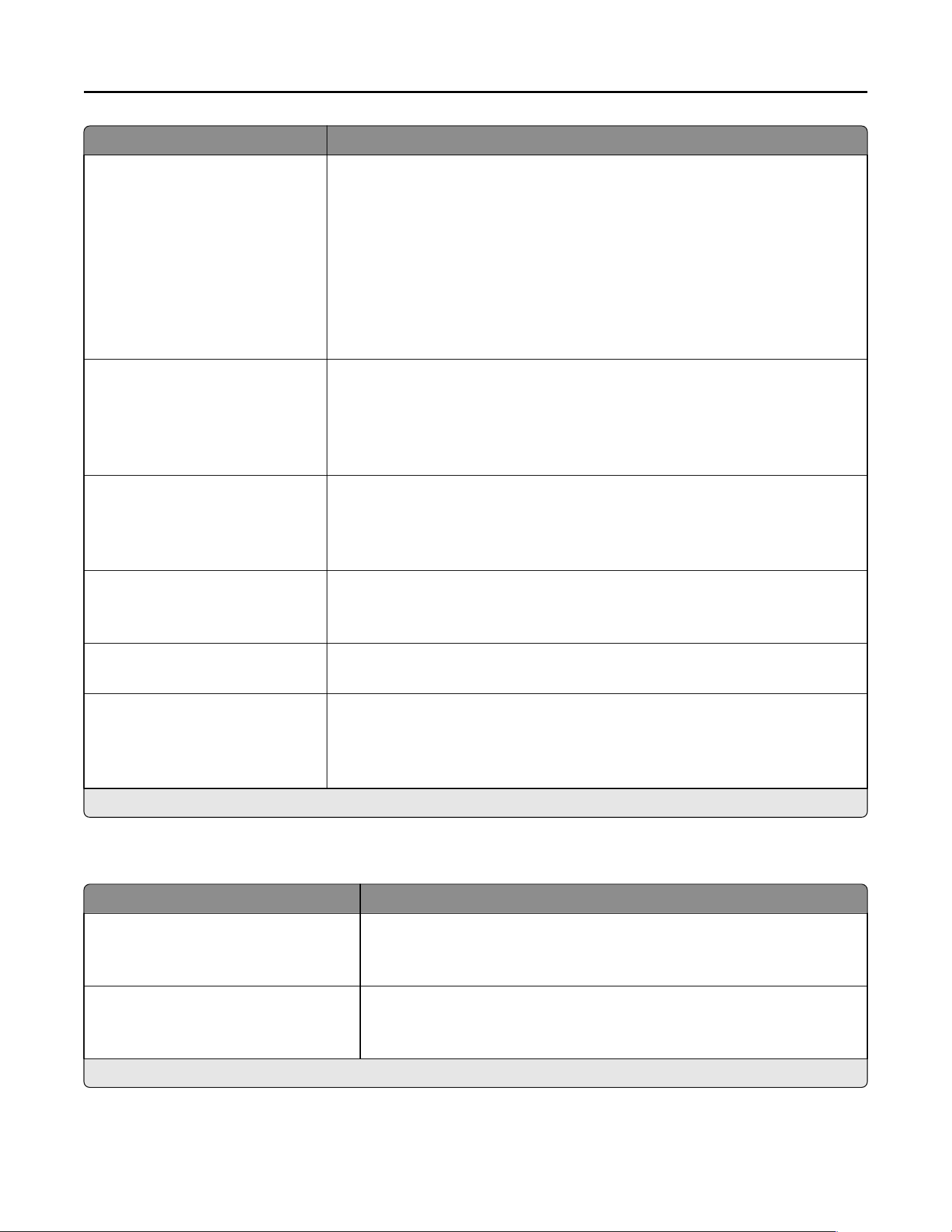
Menu item Description
Pages per Side
Off*
2 pages per side
3 pages per side
4 pages per side
6 pages per side
9 pages per side
12 pages per side
16 pages per side
Print multiple page images on one side of a sheet of paper.
Pages per Side Ordering
Horizontal*
Reverse Horizontal
Vertical
Reverse Vertical
Specify the positioning of multiple page images when using Pages per Side.
Note: The positioning depends on the number of page images and their
page orientation.
Pages per Side Orientation
Auto*
Landscape
Portrait
Specify the orientation of a multiple‑page document when using Pages per
Side.
Pages per Side Border
None*
Solid
Print a border around each page image when using Pages per Side.
Copies
1–9999 (1*)
Specify the number of copies for each print job.
Print Area
Normal*
Fit to page
Whole Page
Set the printable area on a sheet of paper.
Note: An asterisk (*) next to a value indicates the factory default setting.
Setup
Menu item Description
Printer Language
PCL Emulation
PS Emulation*
Set the printer language.
Note: Setting a printer language default does not prevent a software
program from sending print jobs that use another printer language.
Job Waiting
Off*
On
Preserve print jobs requiring supplies so that jobs not requiring the missing
supplies can print.
Note: This menu item appears only when a printer hard disk is installed.
Note: An asterisk (*) next to a value indicates the factory default setting.
Understanding the printer menus 44
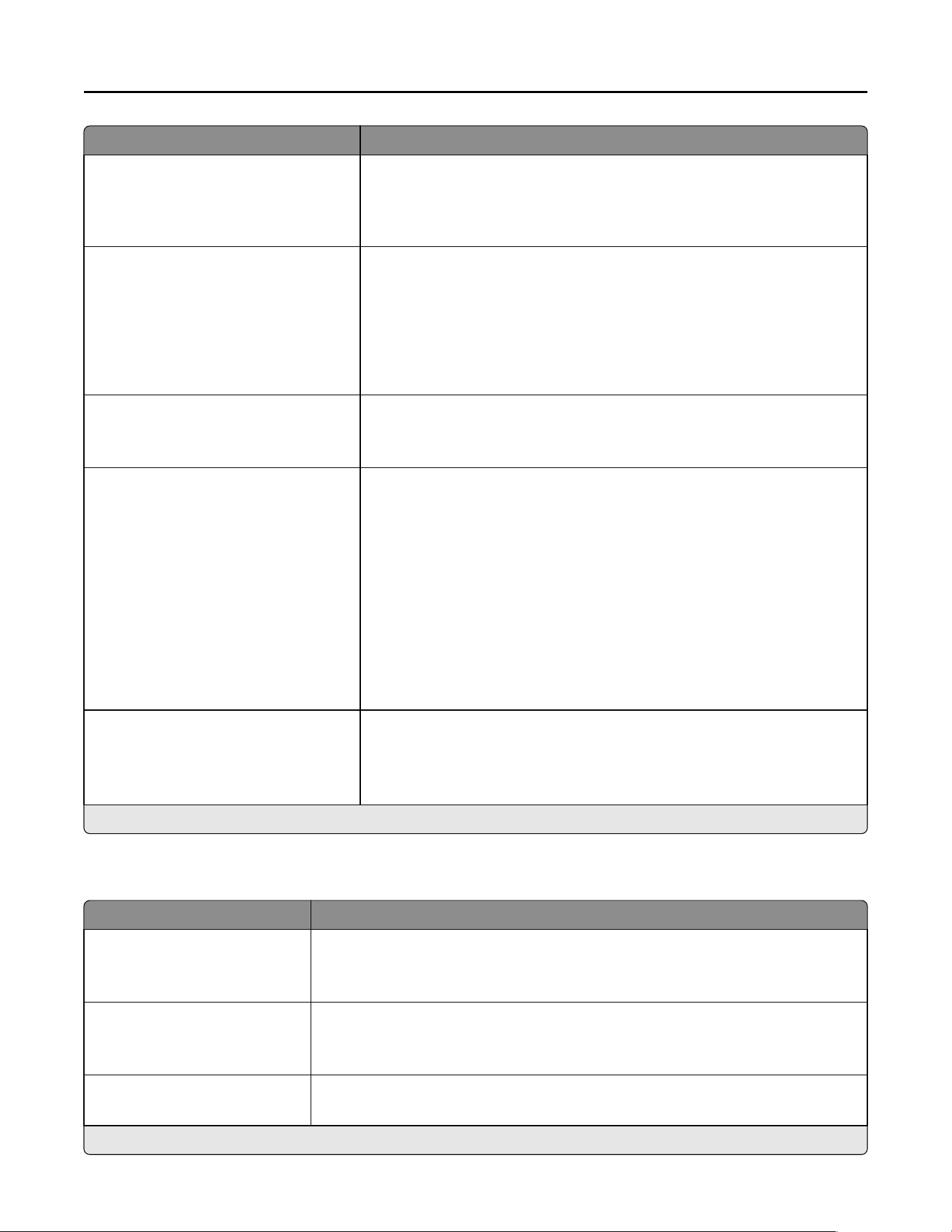
Menu item Description
Job Hold Timeout
0–255 (30*)
Set the time in seconds that the printer waits for user intervention before
it holds jobs that require unavailable resources and continues to print other
jobs in the print queue.
Note: This menu item appears only when a printer hard disk is installed.
Printer Usage
Max Speed
Max Yield*
Determine how the color imaging kit operates during printing.
Notes:
• When set to Max Yield, the color imaging kit slows or stops while
printing groups of black-only pages.
• When set to Max Speed, the color imaging kit always runs while
printing, whether color or black pages are being printed.
Download Target
RAM*
Disk
Specify where to save all permanent resources, such as fonts and macros,
that have been downloaded to the printer.
Note: This menu item appears only when a printer hard disk is installed.
Resource Save
Off*
On
Determine what the printer does with downloaded resources, such as
fonts and macros, when it receives a job that requires more than the
available memory.
Notes:
• When set to Off, the printer retains downloaded resources only until
memory is needed. Resources associated with the inactive printer
language are deleted.
• When set to On, the printer preserves all the permanent
downloaded resources across all language switches. When
necessary, the printer shows memory full messages instead of
deleting permanent resources.
Print All Order
Alphabetical*
Newest First
Oldest First
Specify the order when you choose to print all held and confidential jobs.
Note: This menu item appears only when a printer hard disk is installed.
Note: An asterisk (*) next to a value indicates the factory default setting.
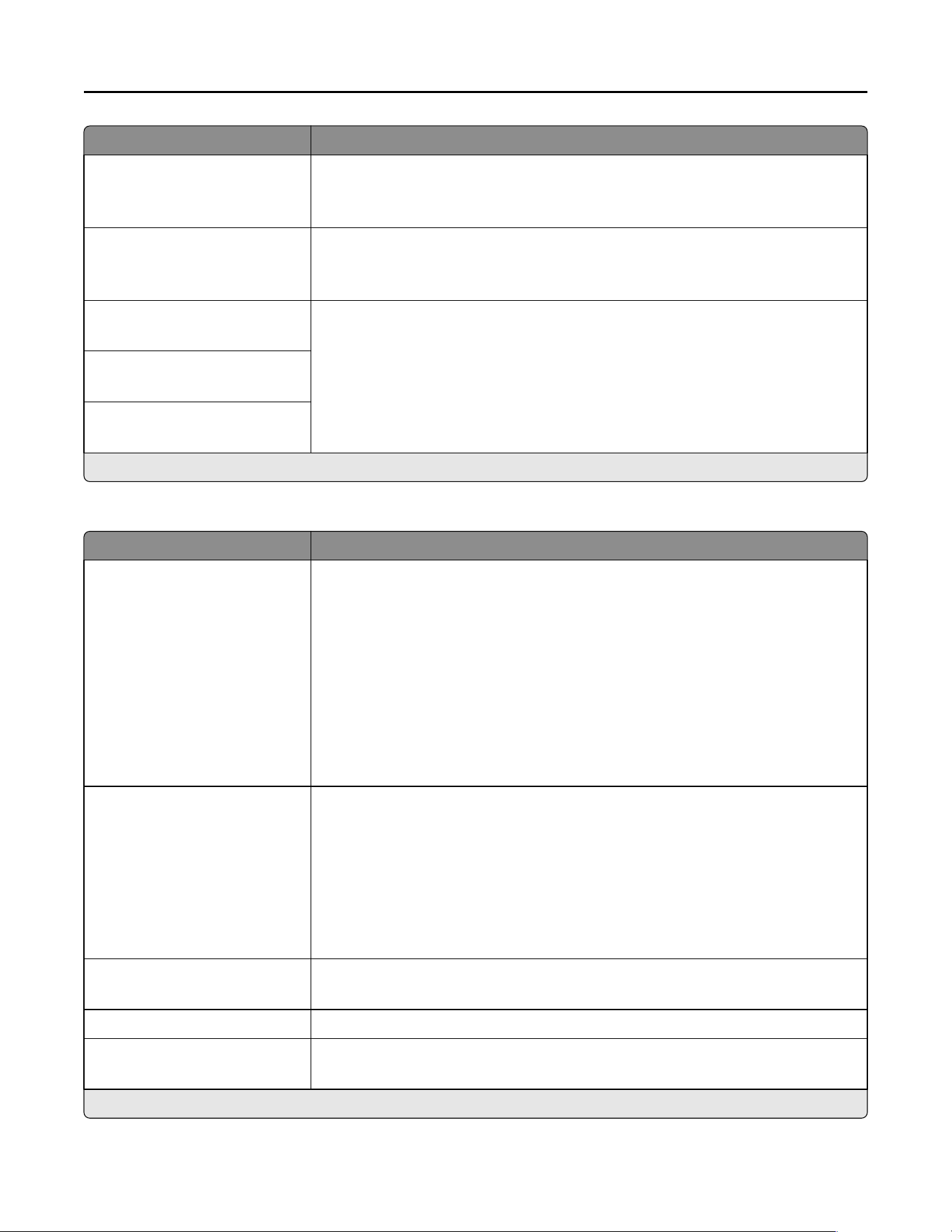
Quality
Menu item Description
Print Mode
Black and White
Color*
Set how the printer generates color content.
Print Resolution
4800 CQ*
1200 dpi
Set the resolution for the printed output.
Note: 4800 CQ provides high‑quality output at maximum speed.
Toner Darkness
1 to 5 (4*)
Determine the lightness or darkness of text images.
Note: An asterisk (*) next to a value indicates the factory default setting.
Understanding the printer menus 45
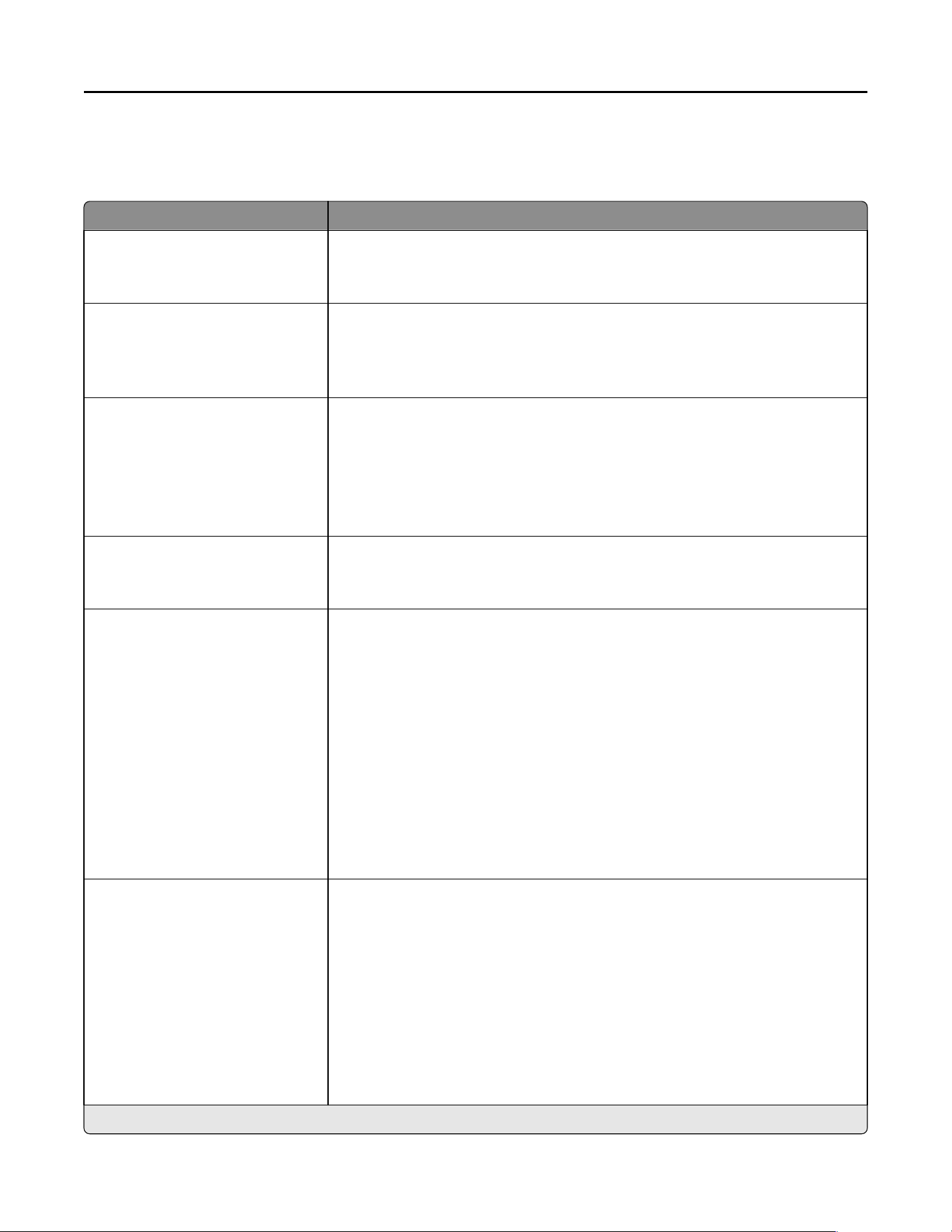
Menu item Description
Halftone
Normal*
Detail
Enhance the printed output to have smoother lines with sharper edges.
Color Saver
Off*
On
Reduce the amount of toner used to print graphics and images.
Note: When set to On, this setting overrides the value of the Toner Darkness
setting.
RGB Brightness
‑6 to 6 (0*)
Adjust the brightness, contrast, and saturation for color output.
Note: This setting does not affect files where CMYK color specifications are
used.
RGB Contrast
0 to 5 (0*)
RGB Saturation
0 to 5 (0*)
Note: An asterisk (*) next to a value indicates the factory default setting.
Advanced Imaging
Menu item Description
Color Balance
Cyan
‑5 to 5 (0*)
Magenta
‑5 to 5 (0*)
Yellow
‑5 to 5 (0*)
Black
‑5 to 5 (0*)
Reset Defaults
Adjust the amount of toner that is used for each color.
Color Correction
Off
Auto*
Manual
Modify the color settings used to print documents.
Notes:
• Off sets the printer to receive the color correction from the software.
• Auto sets the printer to apply different color profiles to each object on the
printed page.
• Manual allows the customization of the RGB or CMYK color conversions
applied to each object on the printed page.
Color Samples
Print Color Samples
Print sample pages for each of the RGB and CMYK color conversion tables used
in the printer.
Color Adjust Calibrate the printer to adjust color variations in the printed output.
Spot Color Replacement
Set Custom CMYK
Assign specific CMYK values to twenty named spot colors.
Note: An asterisk (*) next to a value indicates the factory default setting.
Understanding the printer menus 46
Job Accounting
Note: This menu appears only when a printer hard disk is installed.
Menu item Description
Job Accounting
Off*
On
Set the printer to create a log of the print jobs that it receives.
Accounting Log Frequency
Daily
Weekly
Monthly*
Specify how often the printer creates a log file.
Log Action at End of Frequency
None*
E‑mail Current Log
E‑mail & Delete Current Log
Post Current Log
Post & Delete Current Log
Specify how the printer responds when the frequency threshold expires.
Note: The value defined in Accounting Log Frequency determines when this
action is triggered.
Log Near Full Level
Off*
On
Specify the maximum size of the log file before the printer executes the Log
Action at Near Full.
Log Action at Near Full
None*
E‑mail Current Log
E‑mail & Delete Current Log
E‑mail & Delete Oldest Log
Post Current Log
Post & Delete Current Log
Post & Delete Oldest Log
Delete Current Log
Delete Oldest Log
Delete All But Current
Delete All Logs
Specify how the printer responds when the hard disk is nearly full.
Note: The value defined in Log Near Full Level determines when this action
is triggered.
Log Action at Full
None*
E‑mail & Delete Current Log
E‑mail & Delete Oldest Log
Post & Delete Current Log
Post & Delete Oldest Log
Delete Current Log
Delete Oldest Log
Delete All But Current
Delete All Logs
Specify how the printer responds when disk usage reaches the maximum limit
(100MB).
Note: An asterisk (*) next to a value indicates the factory default setting.
Understanding the printer menus 47
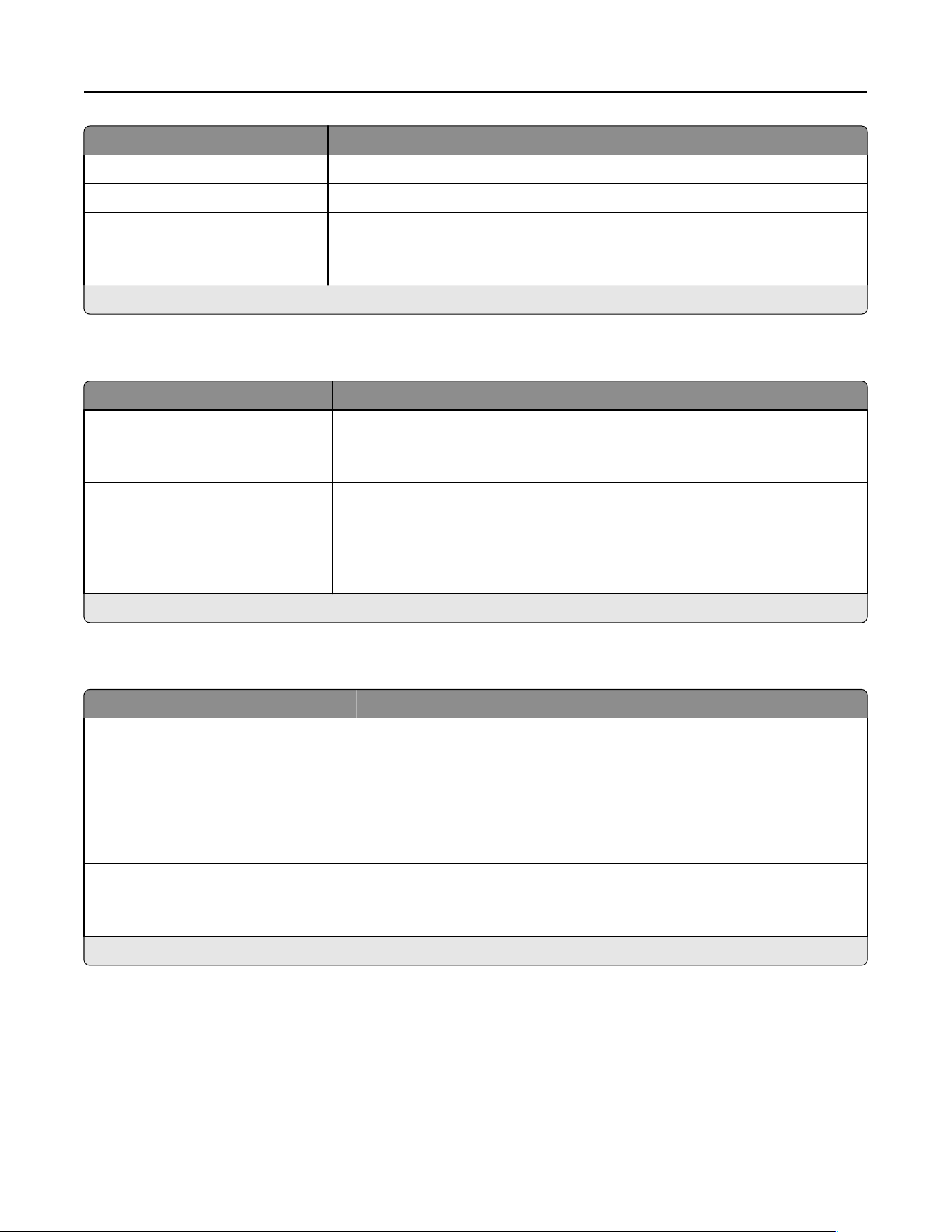
Menu item Description
URL to Post Log Specify where the printer posts job accounting logs.
E‑mail Address to Send Logs Specify the e‑mail address to which the printer sends job accounting logs.
Log File Prefix Specify the prefix for the log file name.
Note: The current host name defined in the TCP/IP menu is used as the
default log file prefix.
Note: An asterisk (*) next to a value indicates the factory default setting.
XPS
Menu item Description
Print Error Pages
Off*
On
Print the error pages that the printer encountered while processing an XPS
file.
Minimum Line Width
1–30 (2*)
Set the minimum stroke width.
Notes:
• Jobs printed in 1200 dpi use the value directly.
• Jobs printed in 4800 CQ use half the value.
Note: An asterisk (*) next to a value indicates the factory default setting.
PDF
Menu item Description
Scale To Fit
Off*
On
Scale the page content to fit the selected paper size.
Annotations
Print
Do Not Print*
Specify whether to print annotations in the PDF.
Print PDF Error
Off
On*
Enable the printing of PDF error.
Note: An asterisk (*) next to a value indicates the factory default setting.
Understanding the printer menus 48
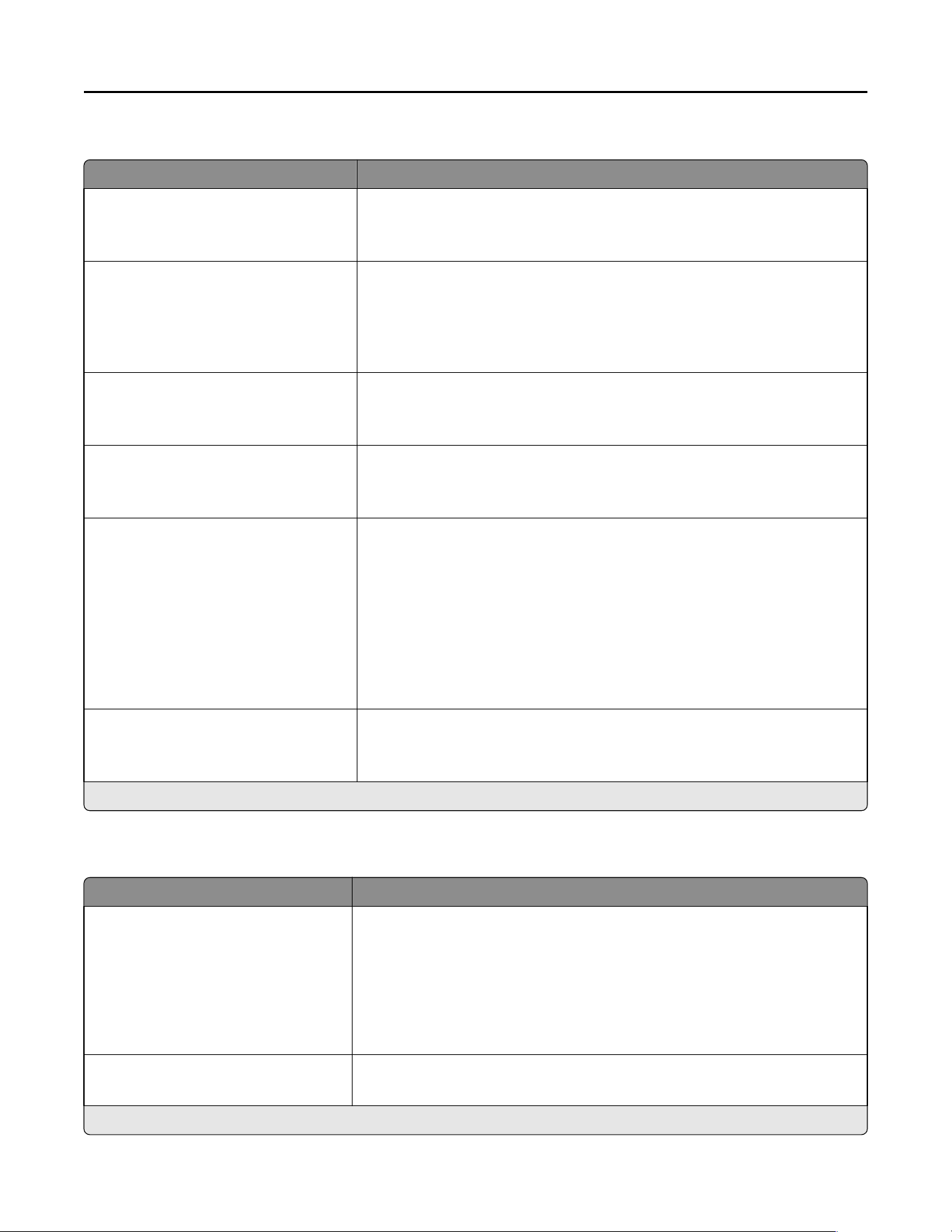
PostScript
Menu item Description
Print PS Error
Off*
On
Print a page that describes the PostScript® error.
Note: When an error occurs, processing of the job stops, the printer
prints an error message, and the rest of the print job is flushed.
Minimum Line Width
1–30 (2*)
Set the minimum stroke width.
Notes:
• Jobs printed in 1200 dpi use the value directly.
• Jobs printed in 4800 CQ use half the value.
Lock PS Startup Mode
Off*
On
Disable the SysStart file.
Image Smoothing
Off*
On
Enhance the contrast and sharpness of low‑resolution images.
Note: This setting has no effect on images with a resolution of 300 dpi or
higher.
Font Priority
Resident*
Flash/Disk
Establish the font search order.
Notes:
• Resident sets the printer to search its memory for the requested font
before searching the flash memory or printer hard disk.
• Flash/Disk sets the printer to search the flash memory or printer hard
disk for the requested font before searching the printer memory.
• This menu item appears only when a flash memory or printer hard
disk is installed.
Wait Timeout
Off
On* (40 seconds)
Set the printer to wait for more data before canceling a print job.
Note: An asterisk (*) next to a value indicates the factory default setting.
PCL
Menu item Description
Font Source
Resident*
Disk
Flash
All
Choose the source which contains the default font selection.
Notes:
• Flash and Disk appear only when a flash memory or hard disk is
installed.
• For Flash and Disk to appear, make sure that they are not read‑ or
write‑protected.
Font Name
Courier*
Select a font from the specified font source.
Note: An asterisk (*) next to a value indicates the factory default setting.
Understanding the printer menus 49
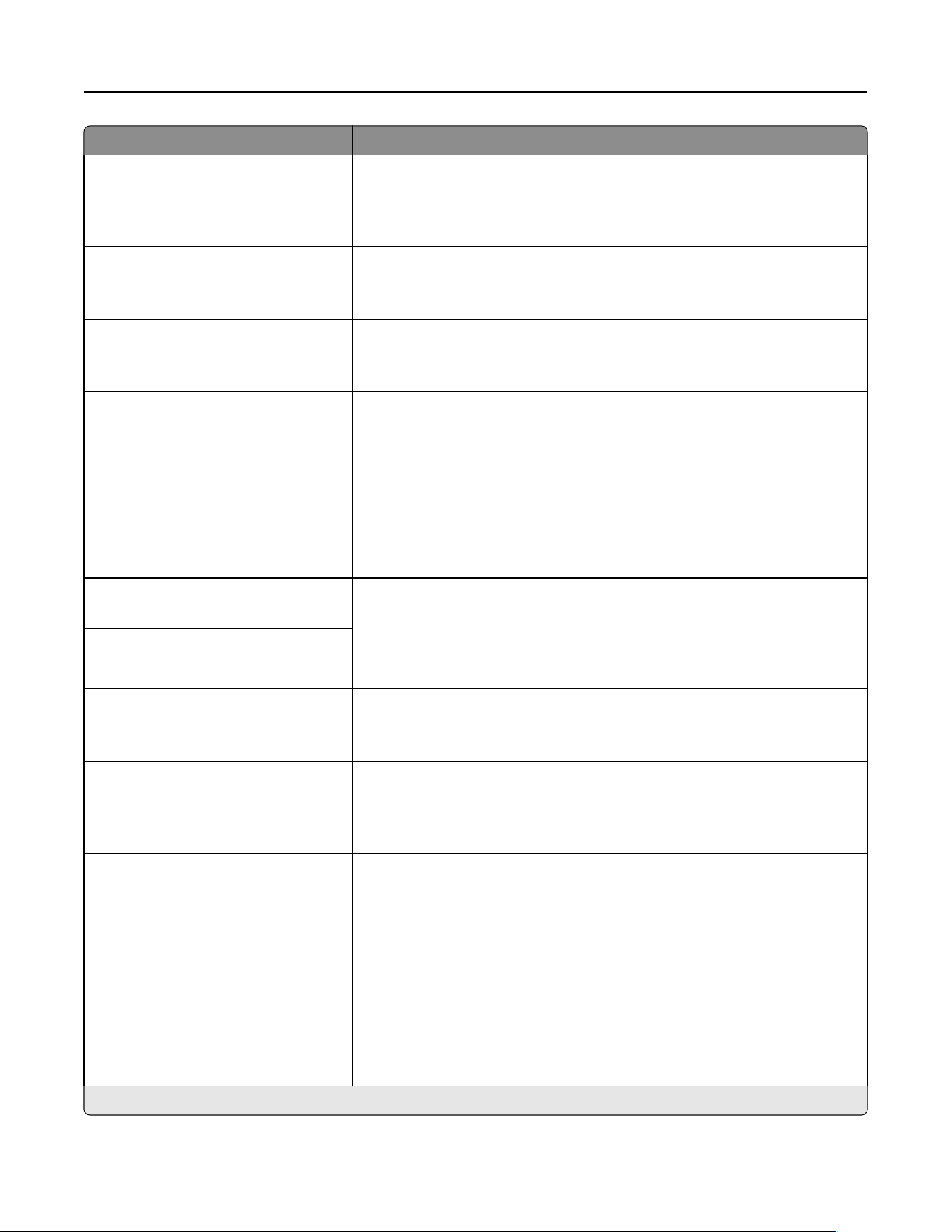
Menu item Description
Symbol Set
10U PC‑8*
Specify the symbol set for each font name.
Note: A symbol set is a set of alphabetic and numeric characters,
punctuation, and special symbols. Symbol sets support the different
languages or specific programs such as math symbols for scientific text.
Pitch
0.08–100 (10*)
Specify the pitch for fixed or monospaced fonts.
Note: Pitch refers to the number of fixed‑space characters in a horizontal
inch of type.
Orientation
Portrait*
Landscape
Specify the orientation of text and graphics on the page.
Lines per Page
1–255
Specify the number of lines of text for each page printed through the PCL®
data stream.
Notes:
• This menu item activates vertical escapement that causes the
selected number of requested lines to print between the default
margins of the page.
• 60 is the U.S. factory default setting. 64 is the international factory
default setting.
PCL5 Minimum Line Width
1–30 (2*)
Set the initial minimum stroke width.
Notes:
• Jobs printed in 1200 dpi use the value directly.
• Jobs printed in 4800 CQ use half the value.
PCLXL Minimum Line Width
1–30 (2*)
A4 Width
198 mm*
203 mm
Set the width of the logical page on A4‑size paper.
Note: Logical page is the space on the physical page where data is
printed.
Auto CR after LF
Off*
On
Set the printer to perform a carriage return after a line feed control
command.
Note: Carriage return is a mechanism that commands the printer to move
the position of the cursor to the first position on the same line.
Auto LF after CR
Off*
On
Set the printer to perform a line feed after a carriage return control
command.
Tray Renumber
Assign MP Feeder
Assign Tray [x]
Assign Manual Paper
Assign Manual Envelope
View Factory Defaults
Restore Defaults
• Configure the printer to work with a different print driver or custom
application that uses a different set of source assignments to request a
given paper source.
• Show the factory default value assigned for each paper source.
• Restore the tray renumber values to their factory defaults.
Note: An asterisk (*) next to a value indicates the factory default setting.
Understanding the printer menus 50
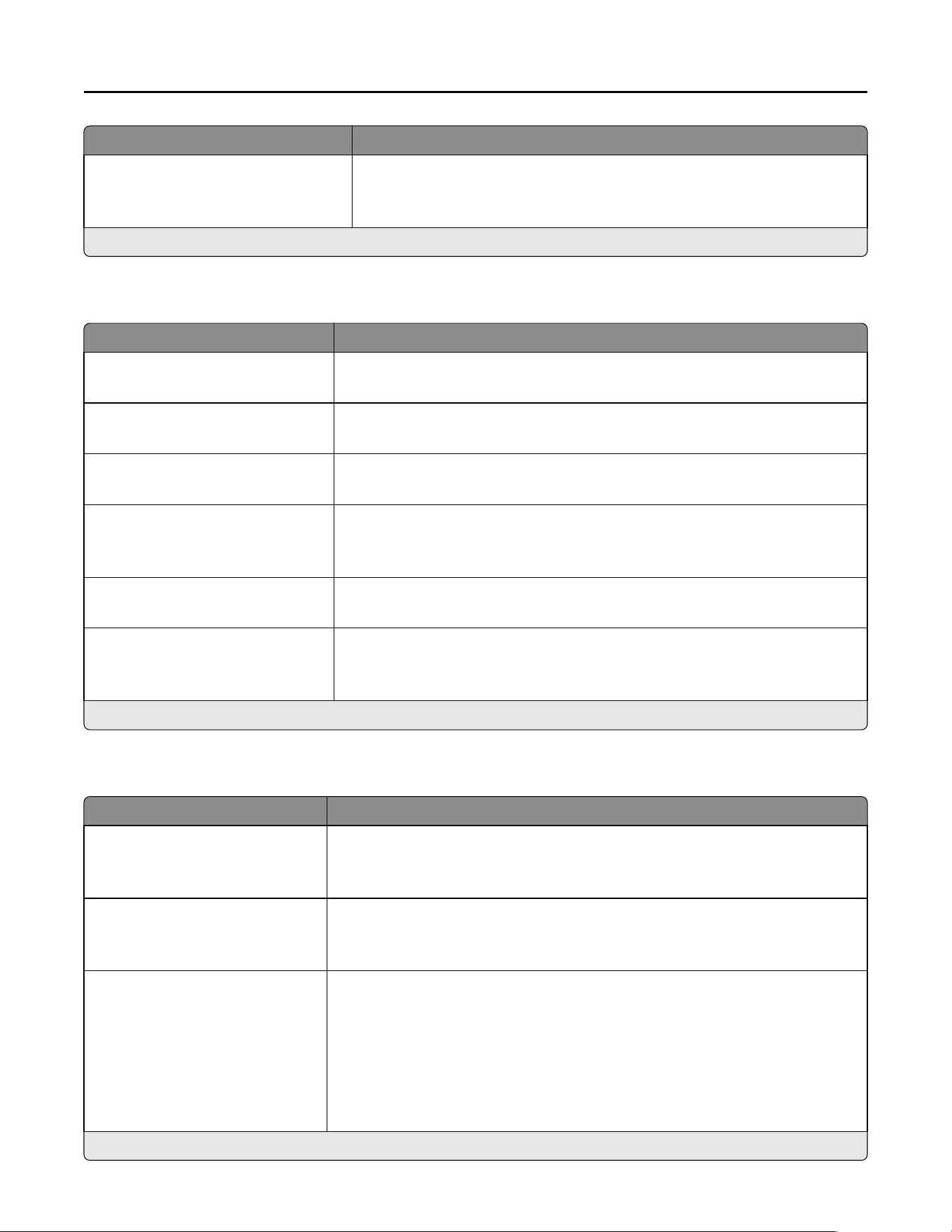
Menu item Description
Print Timeout
Off
On* (90 seconds)
Set the printer to end a print job after it has been idle for the specified
amount of time.
Note: An asterisk (*) next to a value indicates the factory default setting.
HTML
Menu item Description
Font Name
Times*
Set the font to use when printing HTML documents.
Font Size
1–255 (12*)
Set the font size to use when printing HTML documents.
Scale
1–400% (100*)
Scale HTML documents for printing.
Orientation
Portrait*
Landscape
Set the page orientation for HTML documents.
Margin Size
8–255 mm (19*)
Set the page margin for HTML documents.
Backgrounds
Do Not Print
Print*
Print background information or graphics in HTML documents.
Note: An asterisk (*) next to a value indicates the factory default setting.
Image
Menu item Description
Auto Fit
On
Off*
Select the best available paper size and orientation setting for an image.
Note: When set to On, this menu item overrides the scaling and orientation
settings for the image.
Invert
Off*
On
Invert bitonal monochrome images.
Note: This menu item does not apply to GIF or JPEG image formats.
Scaling
Anchor Top Left
Best Fit*
Anchor Center
Fit Height/Width
Fit Height
Fit Width
Adjust the image to fit the printable area.
Note: When Auto Fit is set to On, Scaling is automatically set to Best Fit.
Note: An asterisk (*) next to a value indicates the factory default setting.
Understanding the printer menus 51
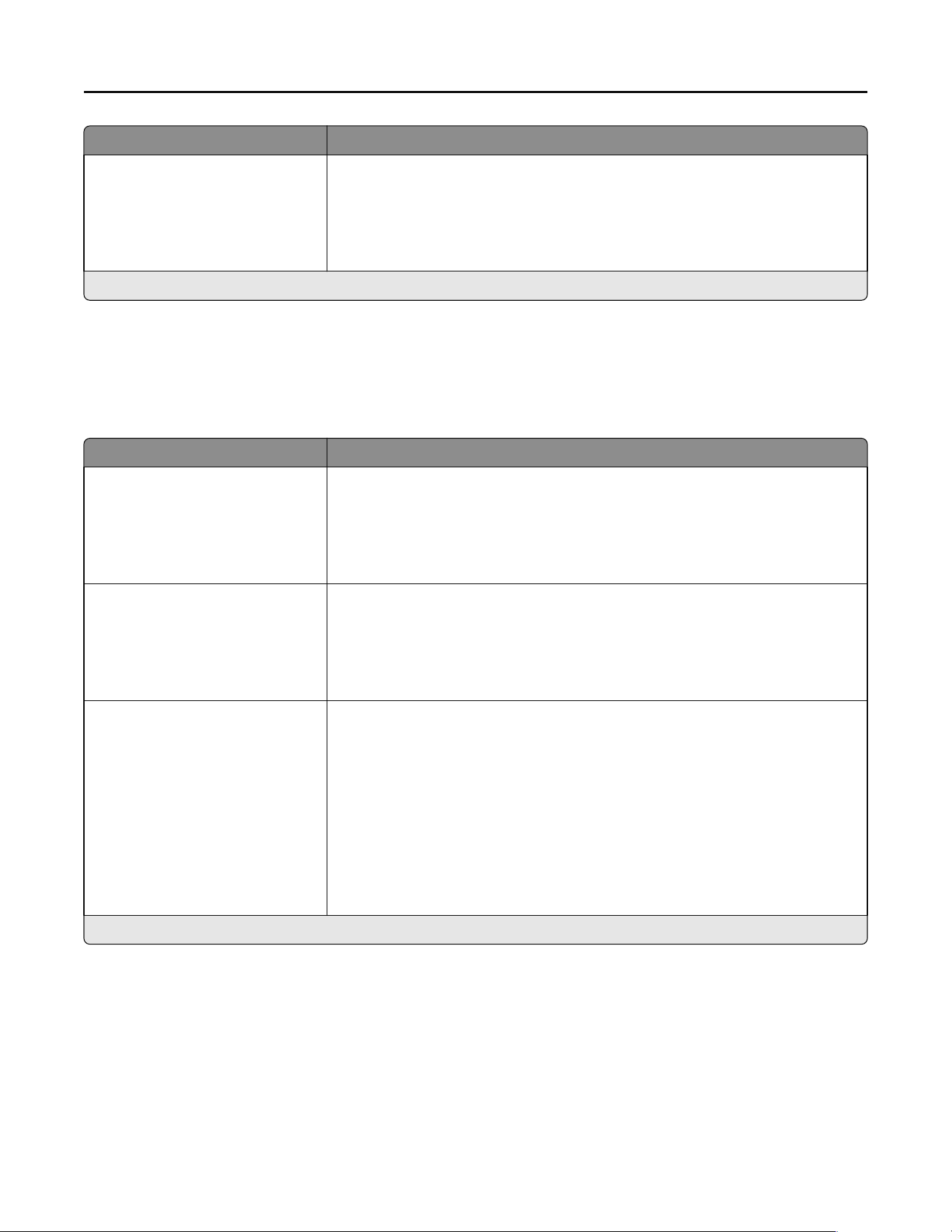
Menu item Description
Orientation
Portrait*
Landscape
Reverse Portrait
Reverse Landscape
Specify the orientation of text and graphics on the page.
Note: An asterisk (*) next to a value indicates the factory default setting.
Paper
Tray Configuration
Menu item Description
Default Source
Tray [x] (1*)
Multipurpose Feeder
Manual Paper
Manual Envelope
Set the paper source for all print jobs.
Note: The multipurpose feeder is available only in some printer models.
Paper Size/Type
Tray [x]
Multipurpose Feeder
Manual Paper
Manual Envelope
Specify the paper size or paper type loaded in each paper source.
Note: The multipurpose feeder is available only in some printer models.
Substitute Size
Off
Statement/A5
Letter/A4
All Listed*
Set the printer to substitute a specified paper size if the requested size is not
loaded in any paper source.
Notes:
• Off prompts the user to load the required paper size.
• Statement/A5 prints an A5‑size document on statement when loading
statement, and statement‑size jobs on A5 paper size when loading A5.
• Letter/A4 prints an A4‑size document on letter when loading letter, and
letter‑size jobs on A4 paper size when loading A4.
• All Listed substitutes Letter/A4.
Note: An asterisk (*) next to a value indicates the factory default setting.
Understanding the printer menus 52
Media Configuration
Universal Setup
Menu item Description
Units of Measure
Inches
Millimeters
Specify the unit of measurement for the universal paper.
Note: Inches is the U.S. factory default setting. Millimeters is the
international factory default setting.
Portrait Width
3–14.17 inches (8.50*)
76–359.91 mm (216*)
Set the portrait width of the universal paper.
Portrait Height
3–14.17 inches (14*)
76–359.91 mm (356*)
Set the portrait height of the universal paper.
Feed Direction
Short Edge*
Long Edge
Set the printer to pick paper from the short edge or long edge
direction.
Note: Long Edge appears only when the longest edge is shorter
than the maximum width supported.
Note: An asterisk (*) next to a value indicates the factory default setting.
Media Types
Menu item Description
Plain
Card Stock
Recycled
Glossy
Labels
Vinyl Labels
Bond
Envelope
Letterhead
Preprinted
Colored Paper
Light
Heavy
Rough/Cotton
Custom Type [X]
Specify the texture, weight, and orientation of the paper.
Understanding the printer menus 53
USB Drive
Note: This menu appears only in some printer models.
Flash Drive Print
Menu item Description
Number of Copies
1–9999 (1*)
Set the number of copies.
Paper Source
Tray [x] (1*)
Multipurpose Feeder
Manual Paper
Manual Envelope
Set the paper source for the print job.
Color
Off
On*
Print a flash drive file in color.
Collate
(1,1,1) (2,2,2)
(1,2,3) (1,2,3)*
Keep the pages of a print job stacked in sequence, particularly when printing multiple
copies of the job.
Sides
1‑Sided*
2‑Sided
Specify whether to print on one side or both sides of the paper.
Flip Style
Long Edge*
Short Edge
Determine which side of the paper is bound when performing two‑sided printing.
Pages per Side
Off*
2 pages per side
3 pages per side
4 pages per side
6 pages per side
9 pages per side
12 pages per side
16 pages per side
Print multiple page images on one side of a sheet of paper.
Pages per Side Ordering
Horizontal*
Reverse Horizontal
Reverse Vertical
Vertical
Specify the positioning of multiple page images when using Pages per Side menu.
Note: An asterisk (*) next to a value indicates the factory default setting.
Understanding the printer menus 54
Menu item Description
Pages per Side Orientation
Auto*
Landscape
Portrait
Specify the orientation of multiple page images when using Pages per Side menu.
Pages per Side Border
None*
Solid
Print a border around each page image when using Pages per Side menu.
Separator Sheets
Off*
Between Copies
Between Jobs
Between Pages
Insert blank separator sheets when printing.
Separator Sheet Source
Tray [x] (1*)
Multipurpose Feeder
Specify the paper source for the separator sheet.
Blank Pages
Do Not Print*
Print
Print blank pages in a print job.
Note: An asterisk (*) next to a value indicates the factory default setting.
Network/Ports
Network Overview
Menu item Description
Active Adapter
Auto*
Standard Network
Wireless
Specify the type of the network connection.
Note: Wireless is available only in printers connected to a wireless network.
Network Status Show the connectivity status of the printer network.
Display Network Status on
Printer
Off
On*
Show the network status on the display.
Speed, Duplex Show the speed of the currently active network card.
IPv4 Show the IPv4 address.
All IPv6 Addresses Show all IPv6 addresses.
Note: An asterisk (*) next to a value indicates the factory default setting.
Understanding the printer menus 55
Menu item Description
Reset Print Server Reset all active network connections to the printer.
Note: This setting removes all network configuration settings.
Network Job Timeout
Off
On* (90 seconds)
Set the time before the printer cancels a network print job.
Banner Page
Off*
On
Print a banner page.
Scan to PC Port Range Specify a valid port range for printers that are behind a port blocking firewall.
Enable Network Connections
Off
On*
Enable the printer to connect to a network.
Enable LLDP
Off*
On
Enable Link Layer Discovery Protocol (LLDP) in the printer.
Note: An asterisk (*) next to a value indicates the factory default setting.
Wireless
Note: This menu is available only in printers connected to a Wi‑Fi network or printers that have a wireless
network adapter.
Menu item Description
Setup On Printer Panel
Choose Network
Add Wi‑Fi Network
Network Name
Network Mode
Infrastructure
Wireless Security Mode
Disabled*
WEP
WPA2/WPA - Personal
WPA2 - Personal
802.1x - RADIUS
Configure the Wi‑Fi connection using the control panel.
Note: 802.1x - RADIUS can be configured only from the Embedded
Web Server.
Understanding the printer menus 56
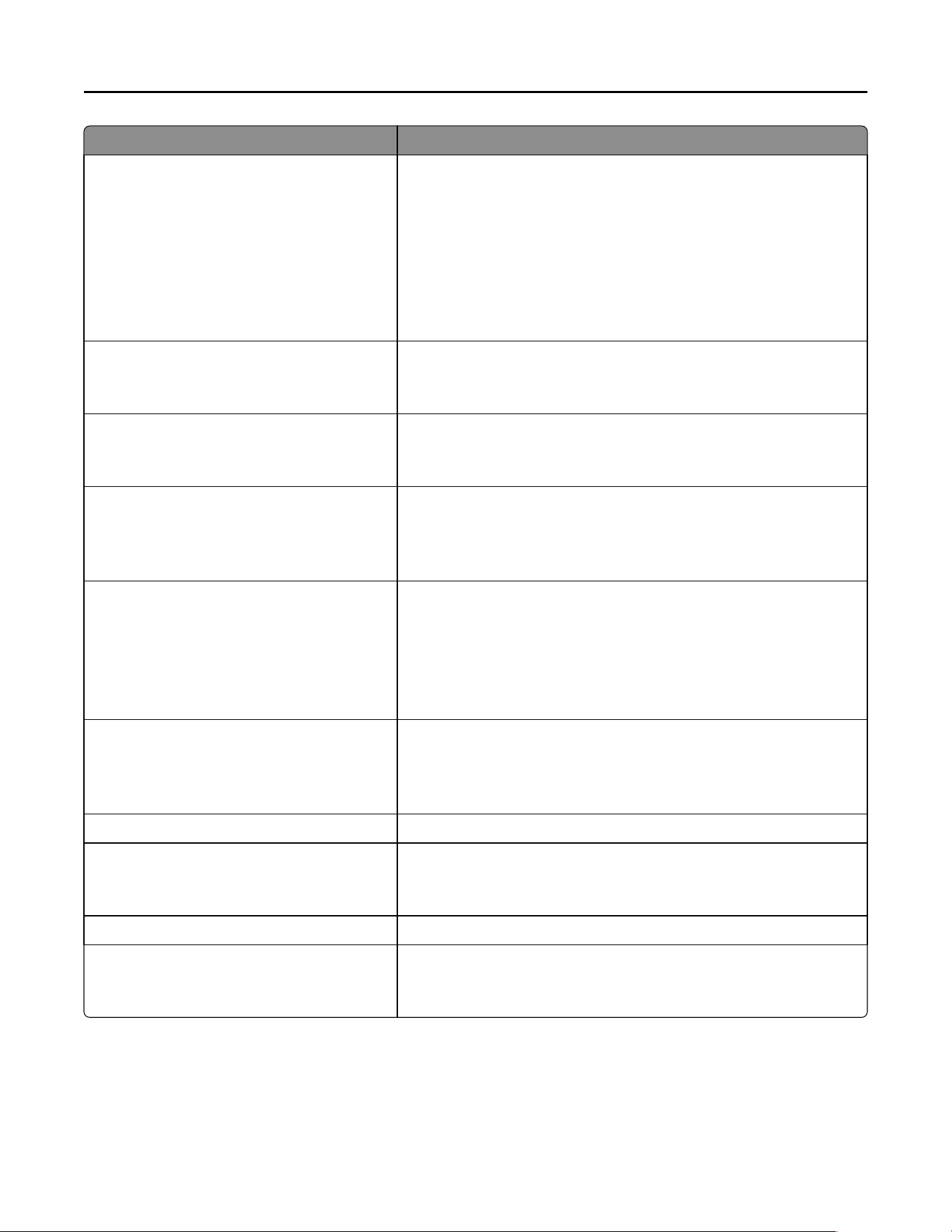
Menu item Description
Wi‑Fi Protected Setup
Start Push Button Method
Start PIN Method
Establish a Wi‑Fi network and enable network security.
Notes:
• Start Push-Button Method connects the printer to a Wi‑Fi
network when buttons on both the printer and the access point
(wireless router) are pressed within a given time.
• Start PIN Method connects the printer to a Wi‑Fi network when
a PIN on the printer is entered into the wireless settings of the
access point.
Network Mode
BSS Type
Infrastructure*
Set the network mode.
Enable Wi‑Fi Direct
On
Off*
Enable Wi-Fi Direct‑capable devices to connect directly to the printer.
Compatibility
802.11b/g/n (2.4GHz)*
802.11a/b/g/n/ac (2.4GHz/5GHz)
802.11a/n/ac (5GHz)
Specify the standard for the Wi‑Fi network.
Note: 802.11a/b/g/n/ac (2.4GHz/5GHz) and 802.11a/n/ac (5GHz)
only appear when a Wi‑Fi option is installed.
Wireless Security Mode
Disabled*
WEP
WPA2/WPA-Personal
WPA2-Personal
802.1x - RADIUS
Set the security mode for connecting the printer to Wi‑Fi devices.
Note: 802.1x - RADIUS can be configured only from the Embedded
Web Server.
WEP Authentication Mode
Auto*
Open
Shared
Set the type of Wireless Encryption Protocol (WEP) for the printer.
Note: This menu item appears only when the Wireless Security
Mode is set to WEP.
Set WEP Key Specify a WEP password for secure Wi‑Fi connection.
WPA2/WPA Personal
AES
Enable Wi‑Fi security through Wi-Fi Protected Access (WPA).
Note: This menu item appears only when the Wireless Security
Mode is set to WPA2/WPA-Personal.
Set Pre‑Shared Key Set the password for secure Wi‑Fi connection.
WPA2-Personal
AES
Enable Wi‑Fi security through WPA2.
Note: This menu item appears only when the Wireless Security
Mode is set to WPA2-Personal.
Understanding the printer menus 57
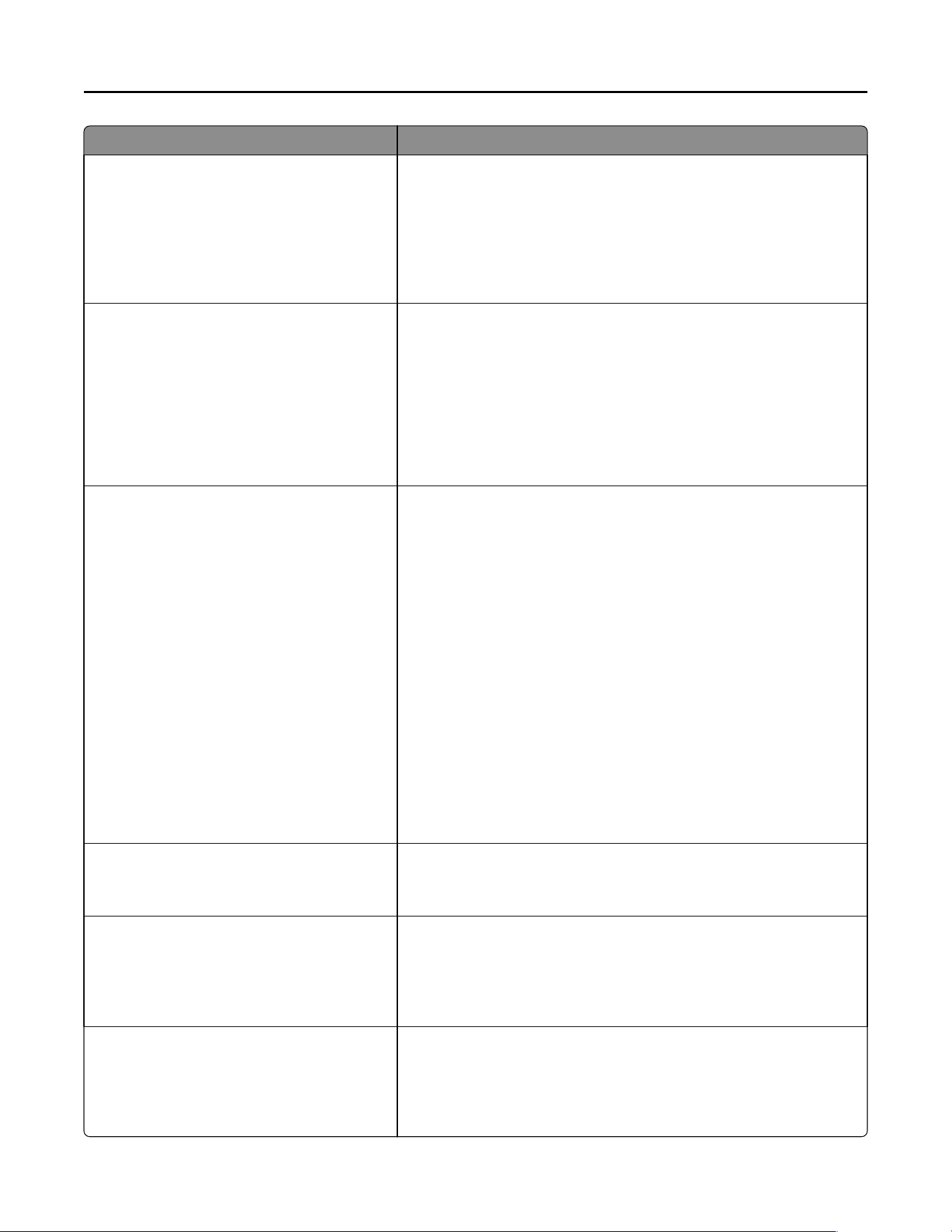
Menu item Description
802.1x Encryption Mode
WPA+
WPA2*
Enable Wi‑Fi security through 802.1x standard.
Notes:
• This menu item appears only when the Wireless Security Mode
is set to 802.1x - RADIUS.
• 802.1x - RADIUS can be configured only from the Embedded
Web Server.
IPv4
Enable DHCP
On*
Off
Set Static IP Address
IP Address
Netmask
Gateway
Enable Dynamic Host Configuration Protocol (DHCP) and configure
static IP address.
Note: DHCP is a standard protocol that allows a server to distribute
IP addressing and configuration information dynamically to clients.
IPv6
Enable IPv6
On*
Off
Enable DHCPv6
On
Off*
Stateless Address Autoconfiguration
On*
Off
DNS Server Address
Manually Assigned IPv6 Address
Manually Assigned IPv6 Router
Address Prefix
All IPv6 Addresses
All IPv6 Router Addresses
Enable and configure IPv6 settings in the printer.
Network Address
UAA
LAA
View the network addresses.
PCL SmartSwitch
Off
On*
Set the printer to switch automatically to PCL emulation when a print
job requires it, regardless of the default printer language.
Note: If PCL SmartSwitch is off, then the printer does not examine
incoming data and uses the default printer language specified in
the Setup menu.
PS SmartSwitch
Off
On*
Set the printer to switch automatically to PS emulation when a print
job requires it, regardless of the default printer language.
Note: If PS SmartSwitch is off, then the printer does not examine
incoming data and uses the default printer language specified in
the Setup menu.
Understanding the printer menus 58
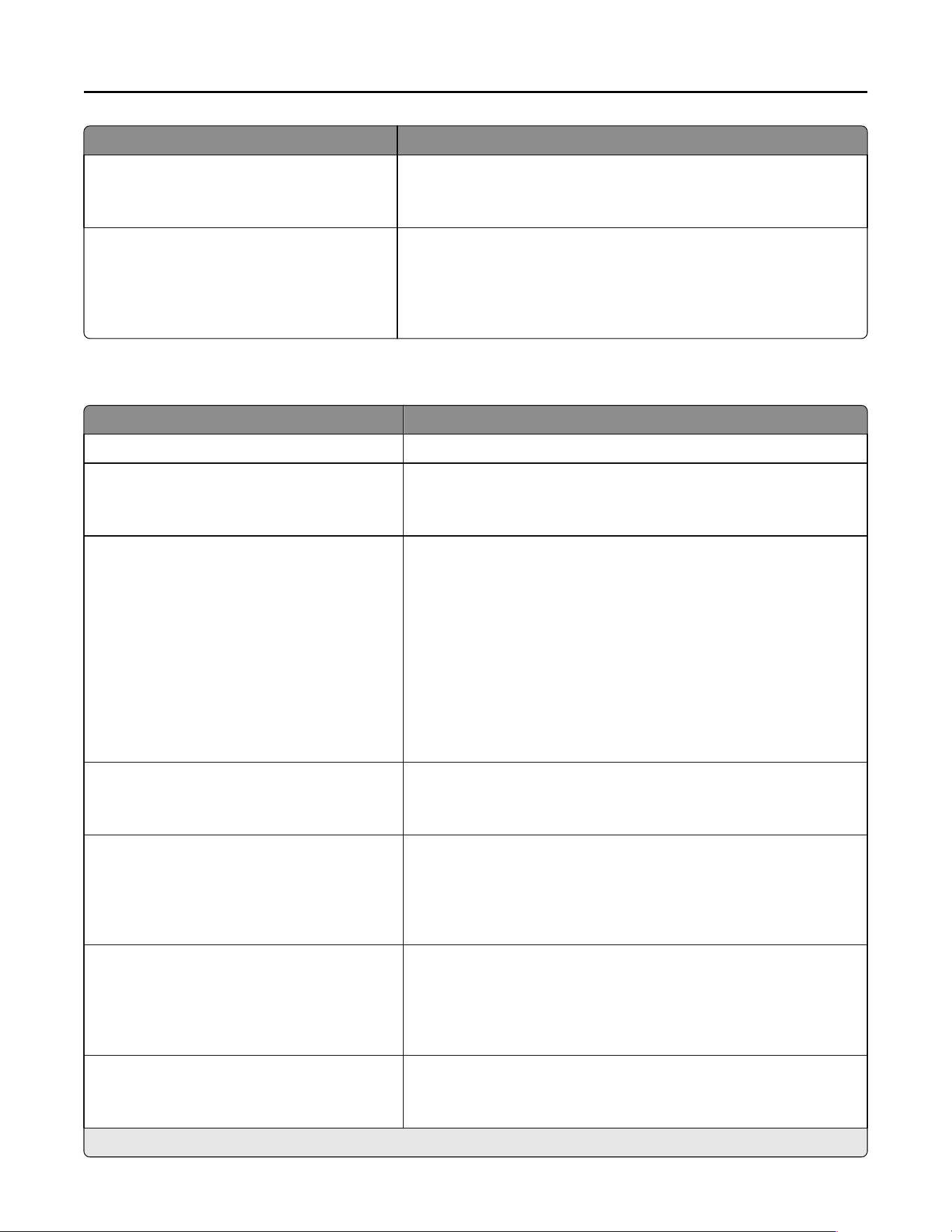
Menu item Description
Job Buffering
On
Off*
Temporarily store print jobs in the printer hard disk before printing.
Note: This menu item appears only when a hard disk is installed.
Mac Binary PS
Auto*
On
Off
Set the printer to process Macintosh binary PostScript print jobs.
Notes:
• On processes raw binary PostScript print jobs.
• Off filters print jobs using the standard protocol.
Ethernet
Menu item Description
Network Speed Show the speed of the active network adapter.
IPv4
Enable DHCP (On*)
Set Static IP Address
Configure the IPv4 settings.
IPv6
Enable IPv6 (On*)
Enable DHCPv6 (Off*)
Stateless Address Autoconfiguration (On*)
DNS Server Address
Manually Assigned IPv6 Address
Manually Assigned IPv6 Router
Address Prefix (64*)
All IPv6 Addresses
All IPv6 Router Addresses
Configure the IPv6 settings.
Network Address
UAA
LAA
Specify the network address.
PCL SmartSwitch
Off
On*
Set the printer to switch automatically to PCL emulation when a print
job requires it, regardless of the default printer language.
Note: When this setting is disabled, the printer does not examine
incoming data and uses the default printer language specified in
the Setup menu.
PS SmartSwitch
Off
On*
Set the printer to switch automatically to PostScript emulation when
a print job requires it, regardless of the default printer language.
Note: When this setting is disabled, the printer does not examine
incoming data and uses the default printer language specified in
the Setup menu.
Job Buffering
Off*
On
Temporarily store jobs on the hard disk before printing.
Note: This menu item appears only when a hard disk is installed.
Note: An asterisk (*) next to a value indicates the factory default setting.
Understanding the printer menus 59
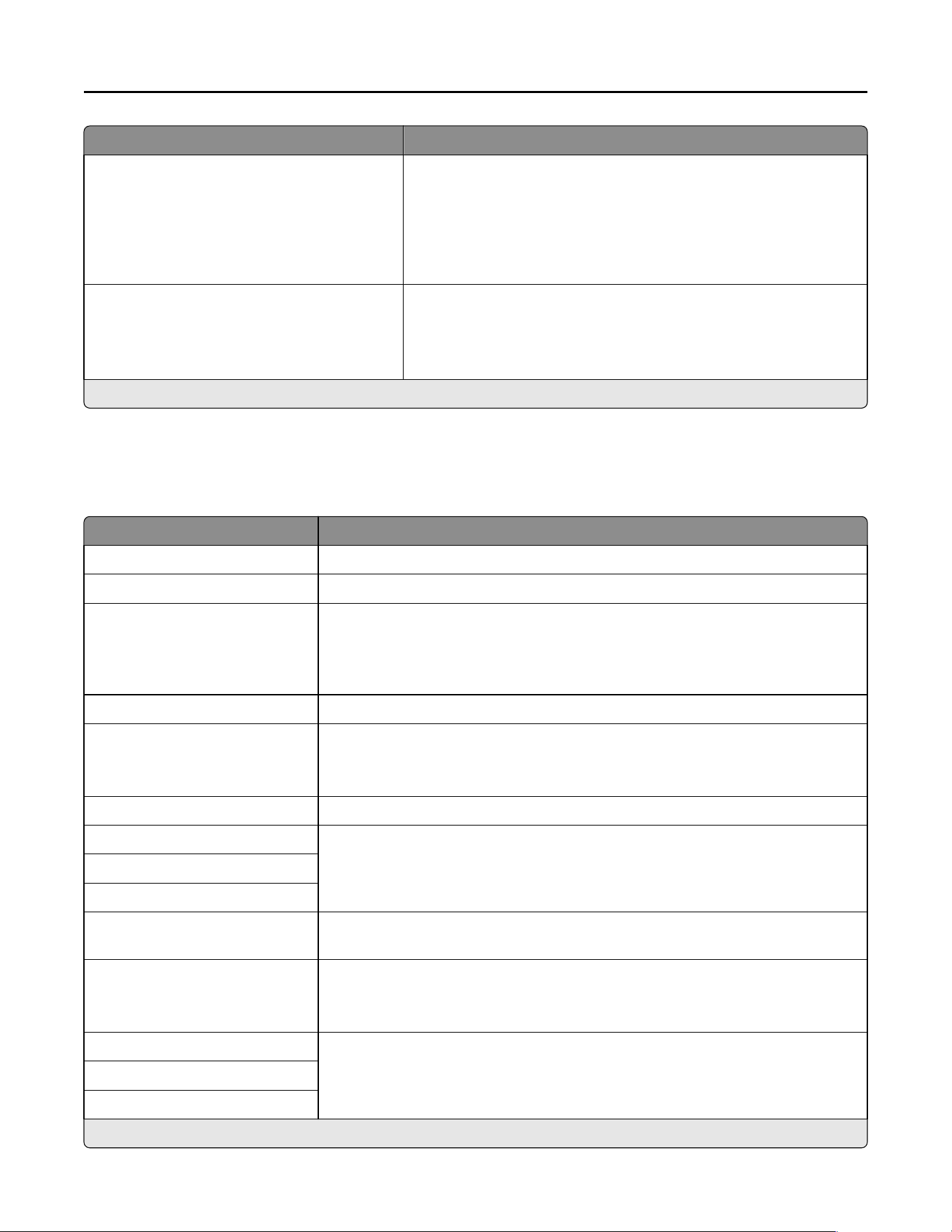
Menu item Description
Mac Binary PS
Auto*
On
Off
Set the printer to process Macintosh binary PostScript print jobs.
Notes:
• Auto processes print jobs from computers using either
Windows or Macintosh operating systems.
• Off filters PostScript print jobs using the standard protocol.
Energy Efficient Ethernet
On
Off
Auto*
Reduce power consumption when the printer does not receive data
from the Ethernet network.
Note: An asterisk (*) next to a value indicates the factory default setting.
TCP/IP
Note: This menu appears only in network printers or printers attached to print servers.
Menu item Description
Set Hostname Set the current TCP/IP host name.
Domain Name Set the domain name.
Allow DHCP/BOOTP to update
NTP server
On*
Off
Allow the DHCP and BOOTP clients to update the NTP settings of the printer.
Zero Configuration Name Specify a service name for the zero configuration network.
Enable Auto IP
Off*
On
Assign an IP address automatically.
DNS Server Address Specify the current Domain Name System (DNS) server address.
Backup DNS Address Specify the backup DNS server addresses.
Backup DNS Address 2
Backup DNS Address 3
Domain Search Order Specify a list of domain names to locate the printer and its resources that reside
in different domains on the network.
Enable DDNS
Off*
On
Update the Dynamic DNS settings.
DDNS TTL Specify the current DDNS settings.
Default TTL
DDNS Refresh Time
Note: An asterisk (*) next to a value indicates the factory default setting.
Understanding the printer menus 60
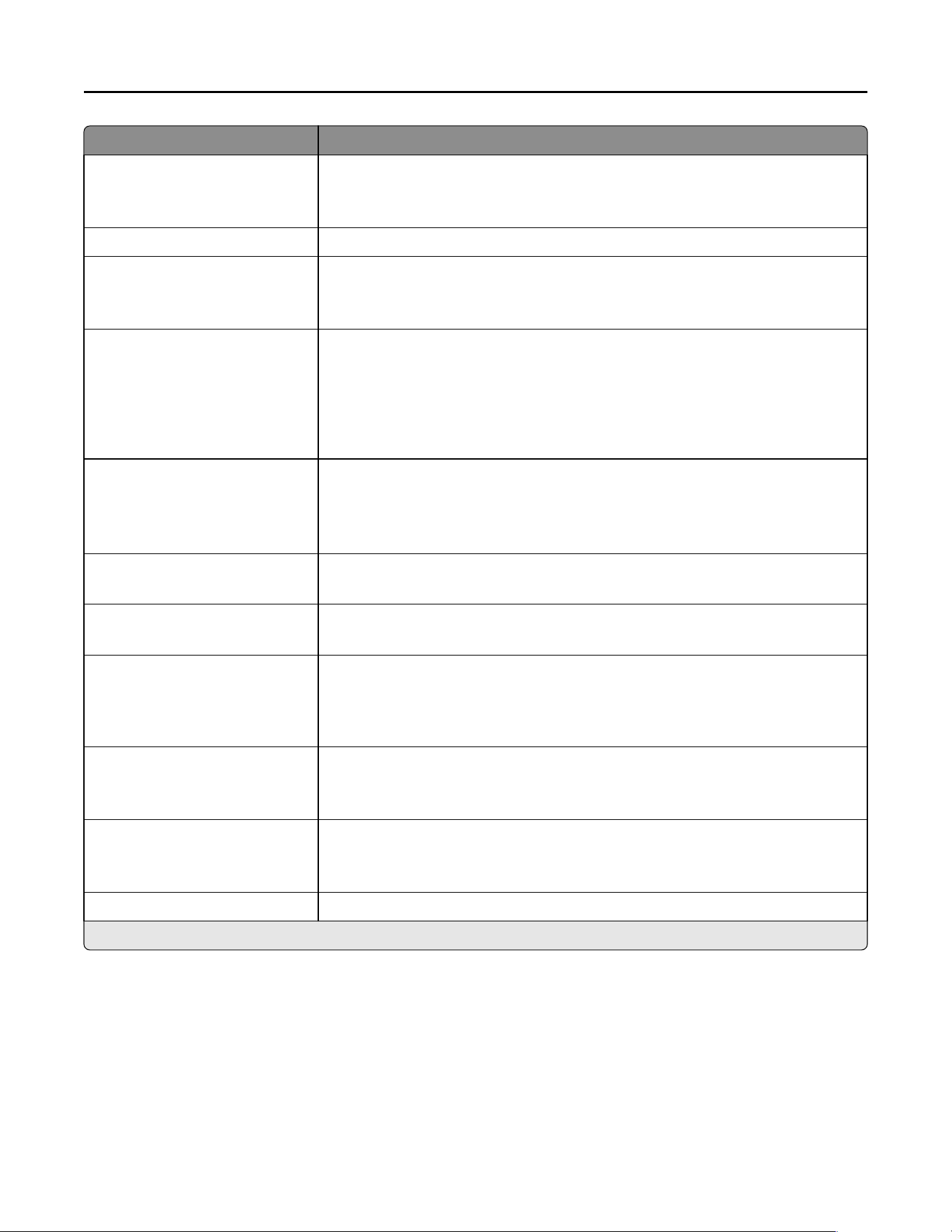
Menu item Description
Enable mDNS
Off
On*
Update the multicast DNS settings.
WINS Server Address Specify a server address for Windows Internet Name Service (WINS).
Enable BOOTP
Off*
On
Allow the BOOTP to assign a printer IP address.
Restricted Server List Specify the IP addresses that are allowed to communicate with the printer over
TCP/IP.
Notes:
• Use a comma to separate each IP address.
• You can add up to 50 IP addresses.
Restricted Server List Options
Block All Ports*
Block Printing Only
Block Printing and HTTP Only
Specify the access option for IP addresses that are not in the list.
MTU
256–1500 Ethernet (1500*)
Specify a maximum transmission unit (MTU) parameter for the TCP connections.
Raw Print Port
1–65535 (9100*)
Specify a raw port number for printers connected on a network.
Outbound Traffic Maximum
Speed
Off*
On
Set the maximum transfer rate of the printer.
Note: When enabled, the option for this setting is 100–1000000
Kilobits/second.
Enable TLSv1.0
Off
On*
Enable the TLSv1.0 protocol.
Enable TLSv1.1
Off
On*
Enable the TLSv1.1 protocol.
SSL Cipher List Specify the cipher algorithms to use for the SSL or the TLS connections.
Note: An asterisk (*) next to a value indicates the factory default setting.
SNMP
Note: This menu appears only in network printers or printers that are attached to print servers.
Understanding the printer menus 61
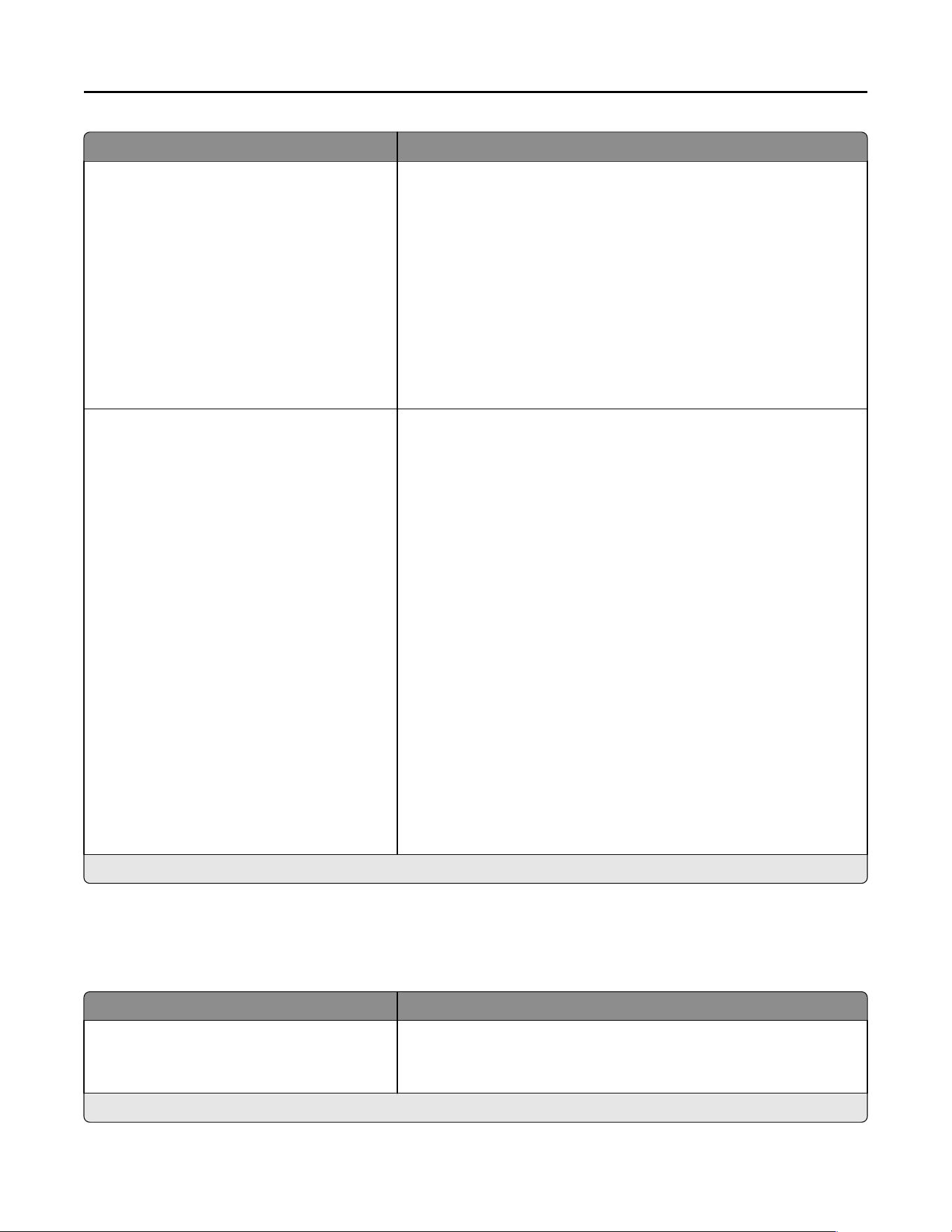
Menu item Description
SNMP Versions 1 and 2c
Enabled
Off
On*
Allow SNMP Set
Off
On*
Enable PPM MIB
Off
On*
SNMP Community
Configure Simple Network Management Protocol (SNMP) versions 1
and 2c to install print drivers and applications.
SNMP Version 3
Enabled
Off
On*
Set Read/Write Credentials
User Name
Password
Set Read‑only Credentials
User Name
Password
Authentication Hash
MD5
SHA1*
Minimum Authentication Level
No Authentication, No Privacy
Authentication, No Privacy
Authentication, Privacy*
Privacy Algorithm
DES
AES‑128*
Configure SNMP version 3 to install and update the printer security.
Note: An asterisk (*) next to a value indicates the factory default setting.
IPSec
Note: This menu appears only in network printers or printers that are attached to print servers.
Menu item Description
Enable IPSec
Off
On*
Enable Internet Protocol Security (IPSec).
Note: An asterisk (*) next to a value indicates the factory default setting.
Understanding the printer menus 62
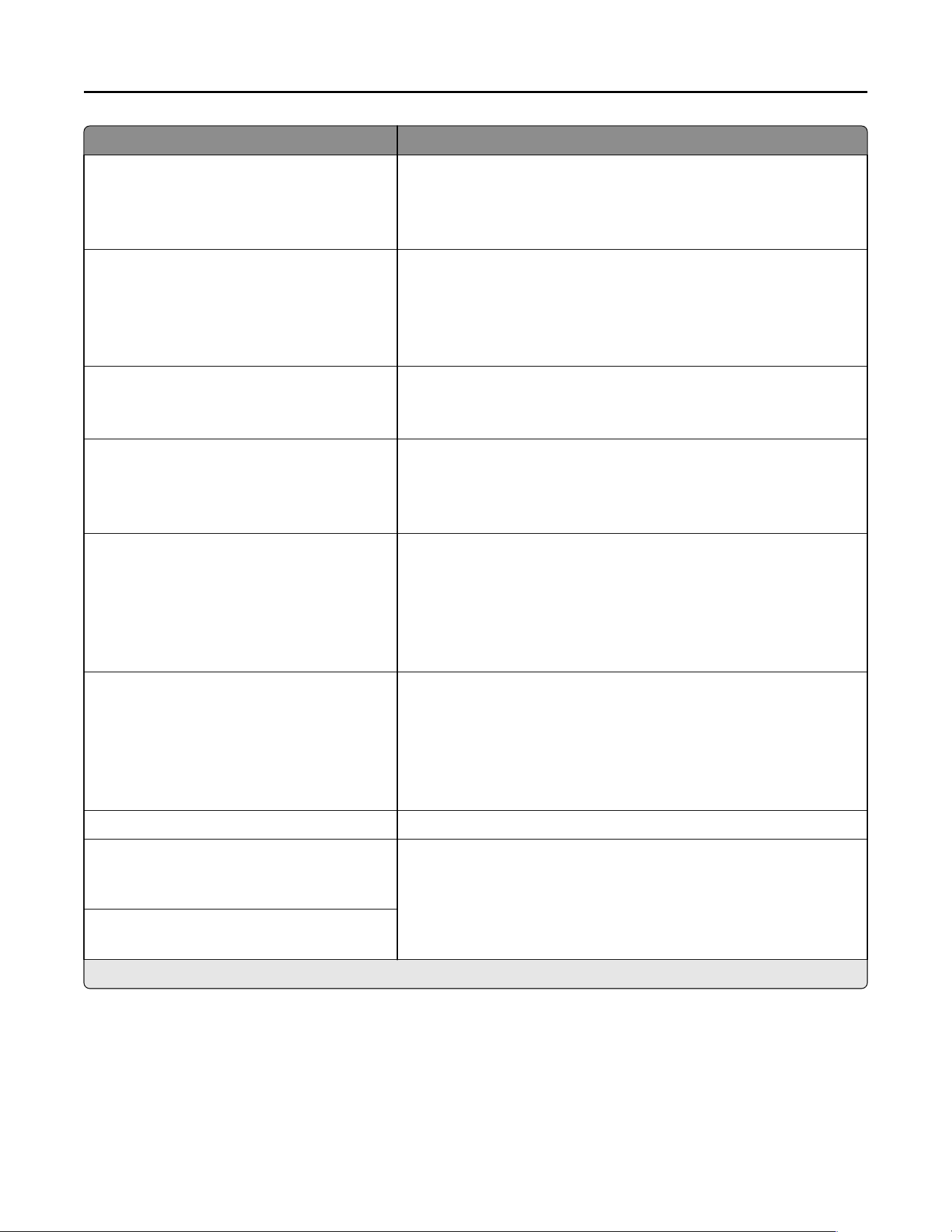
Menu item Description
Base Configuration
Default*
Compatibility
Secure
Set the IPSec base configuration.
DH (Diffie‑Hellman) Group Proposal
modp2048 (14)*
modp3072 (15)
modp4096 (16)
modp6144 (17)
Set the IPSec base configuration.
Note: This menu item appears only when Base Configuration is set
to Compatibility.
Proposed Encryption Method
3DES
AES*
Set the encryption method.
Note: This menu item appears only when Base Configuration is set
to Compatibility.
Proposed Authentication Method
SHA1
SHA256*
SHA512
Set the authentication method.
Note: This menu item appears only when Base Configuration is set
to Compatibility.
IKE SA Lifetime (Hours)
1
2
4
8
24*
Specify the IKE SA expiry period.
Note: This menu item appears only when Base Configuration is set
to Secure.
IPSec SA Lifetime (Hours)
1
2
4
8*
24
Specify the IPSec SA expiry period.
Note: This menu item appears only when Base Configuration is set
to Secure.
IPSec Device Certificate Specify an IPSec certificate.
Pre‑Shared Key Authenticated
Connections
Host [x]
Configure the authenticated connections of the printer.
Certificate Authenticated Connections
Host [x] Address[/subnet]
Note: An asterisk (*) next to a value indicates the factory default setting.
802.1x
Note: This menu appears only in network printers or printers that are attached to print servers.
Understanding the printer menus 63
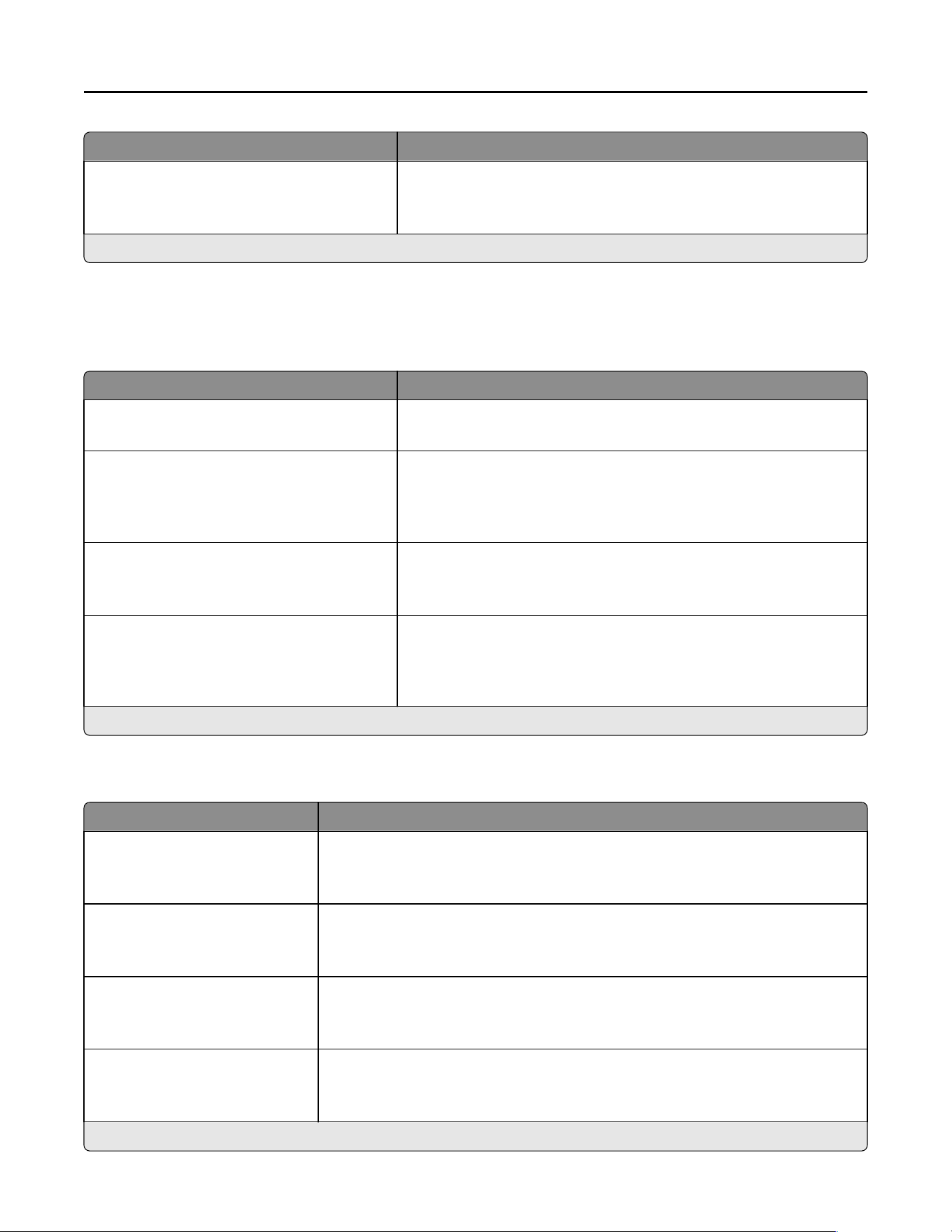
Menu item Description
Active
Off*
On
Let the printer join networks that require authentication before
allowing access.
Note: An asterisk (*) next to a value indicates the factory default setting.
LPD Configuration
Note: This menu appears only in network printers or printers that are attached to print servers.
Menu item Description
LPD Timeout
0–65535 seconds (90*)
Set the time‑out value to stop the Line Printer Daemon (LPD) server
from waiting indefinitely for hung or invalid print jobs.
LPD Banner Page
Off*
On
Print a banner page for all LPD print jobs.
Note: A banner page is the first page of a print job used as a
separator of print jobs and to identify the originator of the print job
request.
LPD Trailer Page
Off*
On
Print a trailer page for all LPD print jobs.
Note: A trailer page is the last page of a print job.
LPD Carriage Return Conversion
Off*
On
Enable carriage return conversion.
Note: Carriage return is a mechanism that commands the printer to
move the position of the cursor to the first position on the same
line.
Note: An asterisk (*) next to a value indicates the factory default setting.
HTTP/FTP Settings
Menu item Description
Enable HTTP Server
Off
On*
Access the Embedded Web Server to monitor and manage the printer.
Enable HTTPS
Off
On*
Enable Hypertext Transfer Protocol Secure (HTTPS) to encrypt data transferring
to and from the print server.
Force HTTPS Connections
On
Off*
Force the printer to use HTTPS connections.
Enable FTP/TFTP
Off
On*
Send files using FTP/TFTP.
Note: An asterisk (*) next to a value indicates the factory default setting.
Understanding the printer menus 64
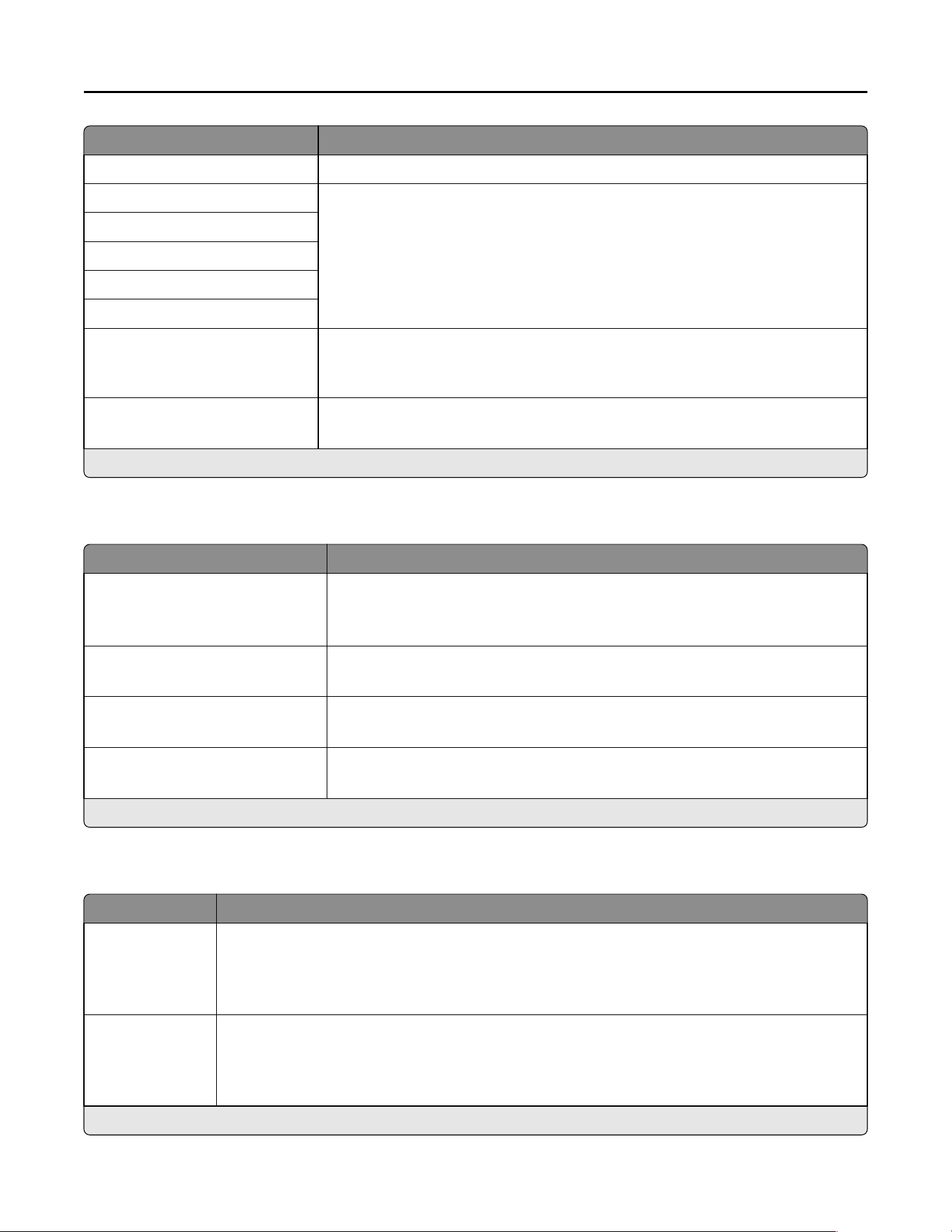
Menu item Description
Local Domains Specify domain names for HTTP and FTP servers.
HTTP Proxy IP Address Configure the HTTP and FTP server settings.
FTP Proxy IP Address
HTTP Default IP Port
HTTPS Device Certificate
FTP Default IP Port
Timeout for HTTP/FTP
Requests
1–299 (30*)
Specify the amount of time before the server connection stops.
Retries for HTTP/FTP Requests
1–299 (3*)
Set the number of retries to connect to the HTTP/FTP server.
Note: An asterisk (*) next to a value indicates the factory default setting.
ThinPrint
Menu item Description
Enable ThinPrint
Off*
On
Print using ThinPrint.
Port Number
4000–4999 (4000*)
Set the port number for the ThinPrint server.
Bandwidth (bits/sec)
100–1000000 (0*)
Set the speed to transmit data in a ThinPrint environment.
Packet Size (kbytes)
0–64000 (0*)
Set the packet size for data transmission.
Note: An asterisk (*) next to a value indicates the factory default setting.
USB
Menu item Description
PCL SmartSwitch
Off
On*
Set the printer to switch to PCL emulation when a print job received through a USB port requires
it, regardless of the default printer language.
Note: When this setting is disabled, the printer does not examine incoming data and uses the
default printer language specified in the Setup menu.
PS SmartSwitch
Off
On*
Set the printer to switch to PostScript emulation when a print job received through a USB port
requires it, regardless of the default printer language.
Note: When this setting is disabled, the printer does not examine incoming data and uses the
default printer language specified in the Setup menu.
Note: An asterisk (*) next to a value indicates the factory default setting.
Understanding the printer menus 65
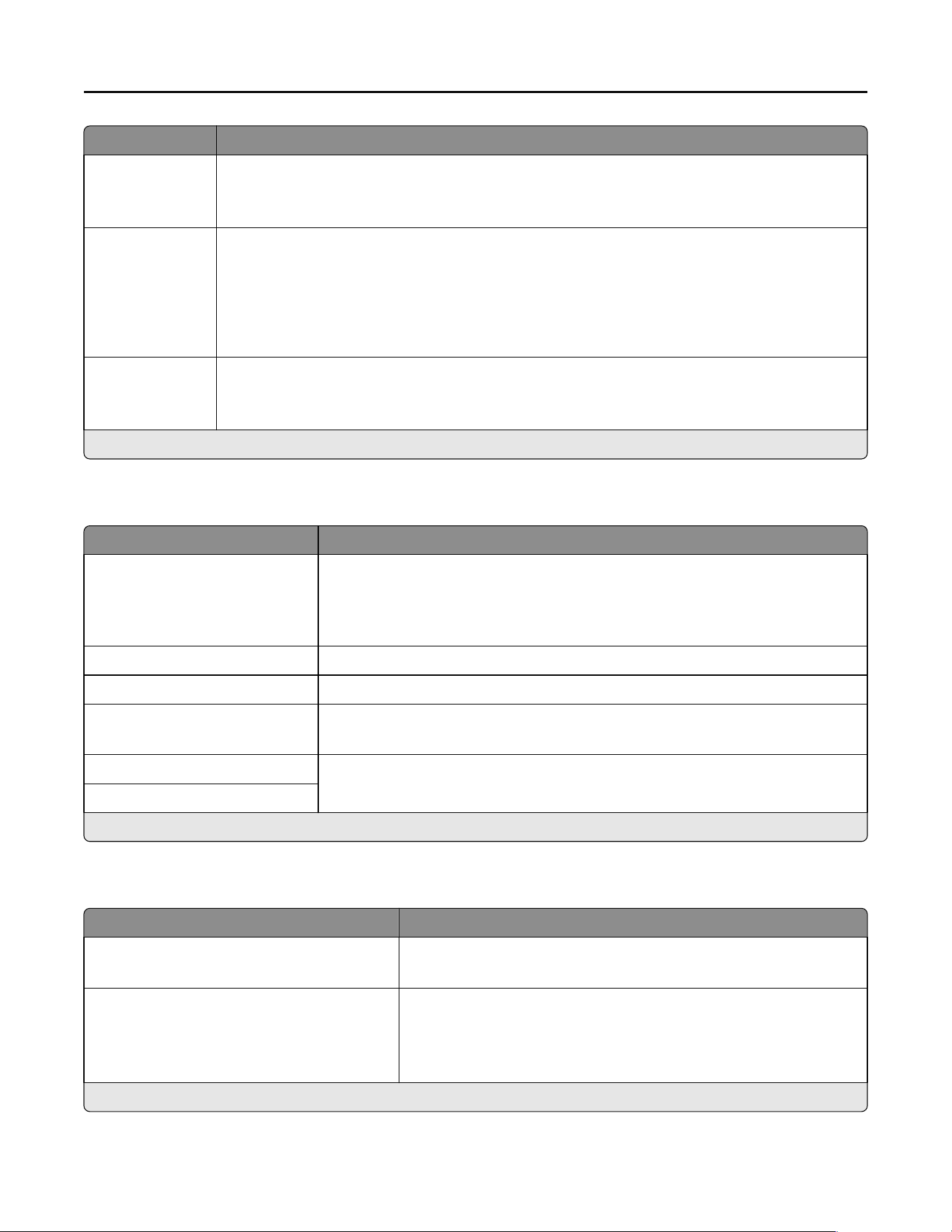
Menu item Description
Job Buffering
Off*
On
Temporarily store jobs on the hard disk before printing.
Note: This menu item appears only when a hard disk is installed.
Mac Binary PS
Auto*
On
Off
Set the printer to process Macintosh binary PostScript print jobs.
Notes:
• Auto processes print jobs from computers using either Windows or Macintosh operating
systems.
• Off filters PostScript print jobs using the standard protocol.
Enable USB Port
Off
On*
Enable the front USB drive port.
Note: An asterisk (*) next to a value indicates the factory default setting.
Restrict external network access
Menu item Description
Restrict external network
access
Off*
On
Restrict access to network sites.
External network address Specify the network addresses with restricted access.
E‑mail address for notification Specify an e‑mail address to send a notification of logged events.
Ping frequency
1–300 (10*)
Specify the network query interval in seconds.
Subject Specify the subject and message of the notification e‑mail.
Message
Note: An asterisk (*) next to a value indicates the factory default setting.
Google Cloud Print
Menu item Description
Registration
Register
Register the printer to the Google Cloud Print server.
Options
Enable Google Cloud Print
Off
On*
Print directly from your Google account.
Note: An asterisk (*) next to a value indicates the factory default setting.
Understanding the printer menus 66
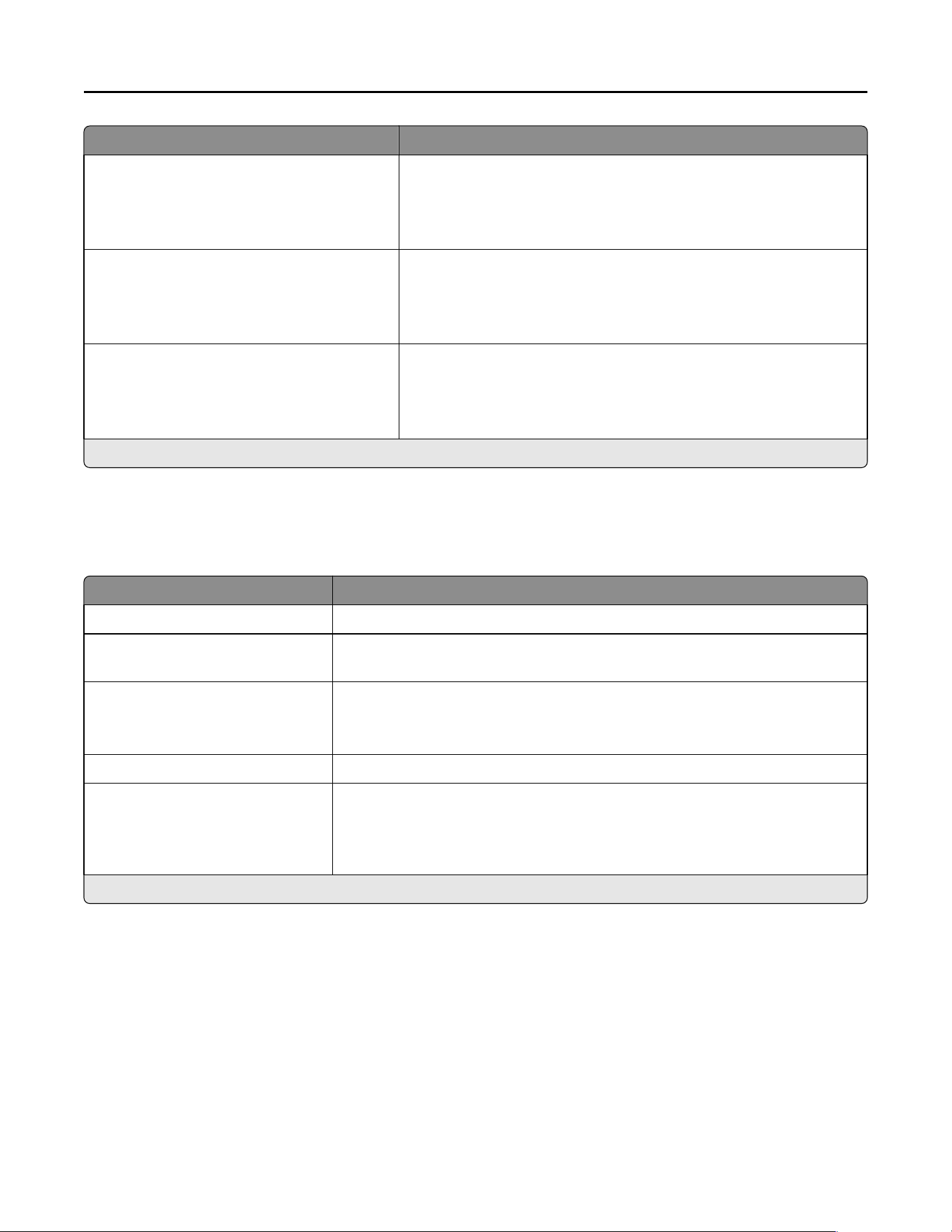
Menu item Description
Options
Enable Local Discovery
Off
On*
Allow the registered user and other users on the same subnet to
send jobs to the printer locally.
Options
Enable SSL Peer Verification
Off
On*
Verify authenticity of the peer certificate to connect to your Google
account.
Options
Always Print As Image
Off*
On
Set the printer to process PDF files as an image for faster printing.
Note: An asterisk (*) next to a value indicates the factory default setting.
Wi‑Fi Direct
Note: This menu appears only when a direct Wi‑Fi network is the active network.
Menu item Description
SSID Specify the service set identifier (SSID) of the Wi‑Fi network.
Set Preshared Key Set the preshared key (PSK) to authenticate and validate users on a Wi‑Fi
connection.
Show PSK on Setup Page
Off
On*
Show the PSK on the Network Setup Page.
Group Owner IP Address Specify the IP address of the group owner.
Auto‑Accept Push Button
Requests
Off*
On
Accept requests to connect to the network automatically.
Note: Accepting clients automatically is not secured.
Note: An asterisk (*) next to a value indicates the factory default setting.
Understanding the printer menus 67

Security
Note: In some printer models, this menu can be configured only from the Embedded Web Server.
Login Methods
Manage Permissions
Menu item Description
Function Access
Manage Shortcuts
Modify Address Book
Create Profiles
Manage Bookmarks
Flash Drive Print
Flash Drive Color Printing
Held Jobs Access
Use Profiles
Cancel Jobs at the Device
Change Language
Internet Printing Protocol (IPP)
B/W Print
Color Print
Control access to the printer functions.
Administrative Menus
Security Menu
Network/Ports Menu
Paper Menu
Reports Menu
Function Configuration Menus
Supplies Menu
Option Card Menu
SE Menu
Device Menu
Control access to the printer menu settings.
Device Management
Remote Management
Firmware Updates
Apps Configuration
Import / Export All Settings
Out of Service Erase
Control access to the printer management options.
Understanding the printer menus 68
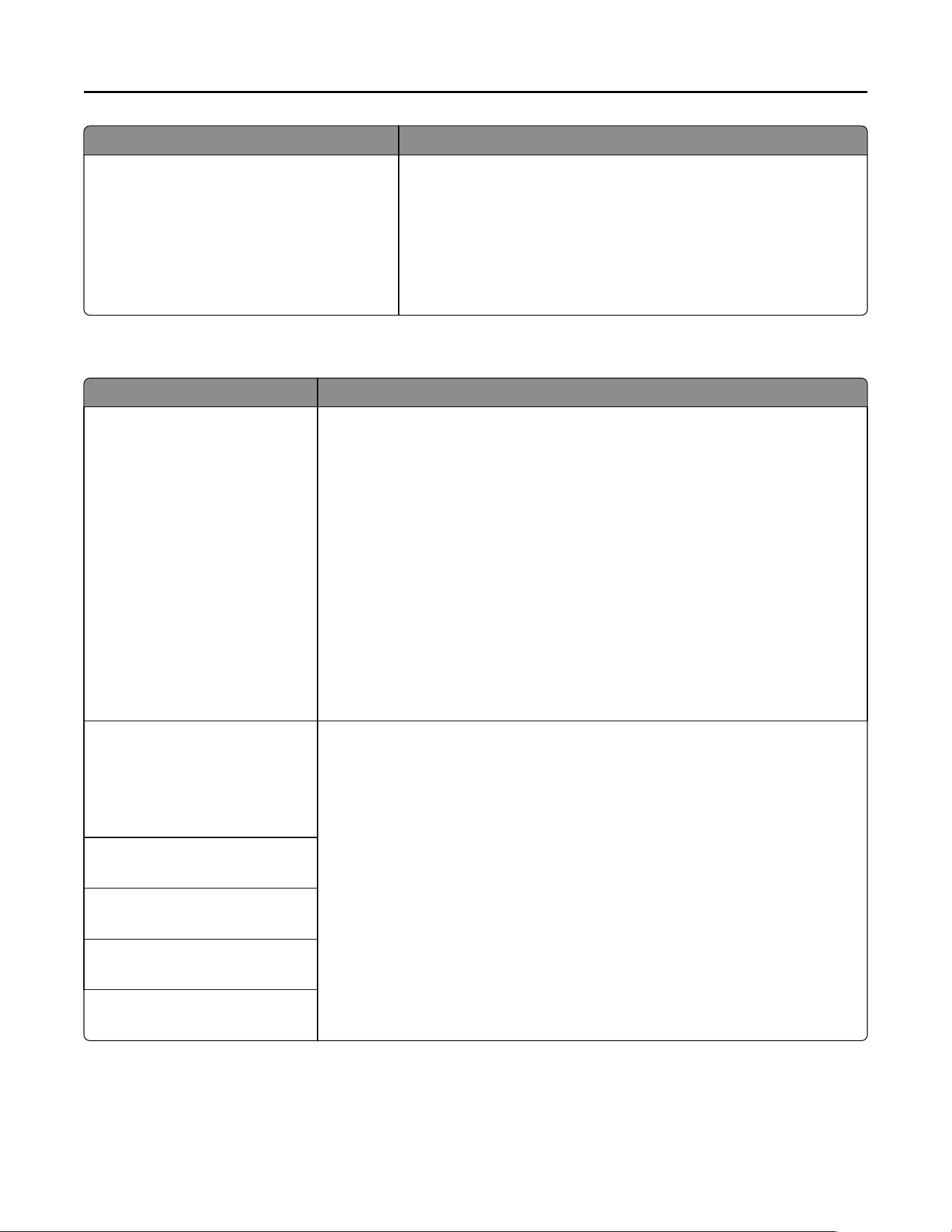
Menu item Description
Apps
New Apps
Slideshow
Change Wallpaper
Screen Saver
Forms and Favorites
Eco‑Settings
Control access to printer applications.
Local Accounts
Menu item Description
Manage Groups/Permissions
Add Group
Import Access Controls
Function Access
Administrative Menus
Device Management
Apps
All Users
Import Access Controls
Function Access
Administrative Menus
Device Management
Apps
Admin
Control group or user access to the printer functions, applications, and security
settings.
Add User
User Name/Password
User Name
Password
PIN
Create local accounts to manage access to the printer functions.
User Name/Password Accounts
Add User
User Name Accounts
Add User
Password Accounts
Add User
PIN Accounts
Add User
Understanding the printer menus 69
Schedule USB Devices
Menu item Description
Schedules
Add New Schedule
Schedule access to the front USB port.
Security Audit Log
Menu item Description
Enable Audit
Off*
On
Record the events in the secure audit log and remote syslog.
Enable Remote Syslog
Off*
On
Send audit logs to a remote server.
Remote Syslog Server Specify the remote syslog server.
Remote Syslog Port
1–65535 (514*)
Specify the remote syslog port.
Remote Syslog Method
Normal UDP*
Stunnel
Specify a syslog method to transmit logged events to a remote server.
Note: An asterisk (*) next to a value indicates the factory default setting.
Understanding the printer menus 70

Menu item Description
Remote Syslog Facility
0 ‑ Kernel Messages
1 ‑ User‑Level Messages
2 ‑ Mail System
3 ‑ System Daemons
4 ‑ Security/Authorization
Messages*
5 ‑ Messages Generated
Internally by Syslogs
6 ‑ Line Printer Subsystem
7 ‑ Network News Subsystem
8 ‑ UUCP Subsystem
9 ‑ Clock Daemon
10 ‑ Security/Authorization
Messages
11 ‑ FTP Daemon
12 ‑ NTP Subsystem
13 ‑ Log Audit
14 ‑ Log Alert
15 ‑ Clock Daemon
16 ‑ Local Use 0 (local0)
17‑ Local Use 1 (local1)
18 ‑ Local Use 2 (local2)
19 ‑ Local Use 3 (local3)
20 ‑ Local Use 4 (local4)
21 ‑ Local Use 5 (local5)
22 ‑ Local Use 6 (local6)
23 ‑ Local Use 7 (local7)
Specify a facility code that the printer uses when sending log events to a remote
server.
Severity of Events to Log
0 ‑ Emergency
1 ‑ Alert
2 ‑ Critical
3 ‑ Error
4 ‑ Warning*
5 ‑ Notice
6 ‑ Informational
7 ‑ Debug
Specify the priority level cutoff for logging messages and events.
Remote Syslog Non‑Logged
Events
Off*
On
Send all events, regardless of severity level, to the remote server.
Admin’s E‑mail Address Send e‑mail notification of logged events to the administrator.
Note: An asterisk (*) next to a value indicates the factory default setting.
Understanding the printer menus 71
Menu item Description
E‑mail Log Cleared Alert
Off*
On
Send e‑mail notification to the administrator when a log entry is deleted.
E‑mail Log Wrapped Alert
Off*
On
Send e‑mail notification to the administrator when the log becomes full and
begins to overwrite the oldest entries.
Log Full Behavior
Wrap Over Older Entries*
E‑mail Log Then Delete All
Entries
Resolve log storage issues when the log fills its allotted memory.
E‑mail % Full Alert
Off*
On
Send e‑mail notification to the administrator when the log fills its allotted
memory.
% Full Alert Level
1–99 (90*)
E‑mail Log Exported Alert
Off*
On
Send e‑mail notification to the administrator when a log is exported.
E‑mail Log Settings Changed
Alert
Off*
On
Send e‑mail notification to the administrator when Enable Audit is set.
Log Line Endings
LF (\n)*
CR (\r)
CRLF (\r\n)
Specify how the log file terminates the end of each line.
Digitally Sign Exports
Off*
On
Add a digital signature to each exported log file.
Clear Log Delete all audit logs.
Export Log
Syslog (RFC 5424)
Syslog (RFC 3164)
CSV
Export a security log to a flash drive.
Note: An asterisk (*) next to a value indicates the factory default setting.
Understanding the printer menus 72
Login Restrictions
Menu item Description
Login failures
1–10 (3*)
Specify the number of failed login attempts before the user gets locked out.
Failure time frame
1–60 minutes (5*)
Specify the time frame between failed login attempts before the user gets locked out.
Lockout time
1–60 minutes (5*)
Specify the lockout duration.
Web Login Timeout
1–120 minutes (10*)
Specify the delay for a remote login before the user is logged off automatically.
Note: An asterisk (*) next to a value indicates the factory default setting.
Confidential Print Setup
Menu item Description
Max Invalid PIN
2–10
Set the number of times an invalid PIN can be entered.
Notes:
• A value of zero turns off this setting.
• When the limit is reached, the print jobs for that user name and PIN are
deleted.
Confidential Job Expiration
Off*
1 Hour
4 Hours
24 Hours
1 Week
Set the expiration time for confidential print jobs.
Notes:
• If this menu item is changed while confidential print jobs reside in the printer
memory or hard disk, then the expiration time for those print jobs does not
change to the new default value.
• If the printer is turned off, then all confidential jobs held in the printer memory
are deleted.
Repeat Job Expiration
Off*
1 Hour
4 Hours
24 Hours
1 Week
Set the expiration time for a print job that you want to repeat.
Verify Job Expiration
Off*
1 Hour
4 Hours
24 Hours
1 Week
Set the expiration time that the printer prints a copy for the user to examine its quality,
before printing the remaining copies.
Note: An asterisk (*) next to a value indicates the factory default setting.
Understanding the printer menus 73
Menu item Description
Reserve Job Expiration
Off*
1 Hour
4 Hours
24 Hours
1 Week
Set the expiration time that the printer stores print jobs for printing later.
Require All Jobs to be Held
Off*
On
Set the printer to hold all print jobs.
Keep duplicate documents
Off*
On
Set the printer to print other documents with the same file name without overwriting
any of the print jobs.
Note: An asterisk (*) next to a value indicates the factory default setting.
Disk Encryption
Note: This menu appears only when a hard disk is installed.
Menu item Description
Status
Enabled
Disabled
Enable disk encryption.
Start encryption
Erase Temporary Data Files
Menu item Description
Stored in onboard memory
Off*
On
Delete all files stored on the printer memory.
Stored on hard disk
1 Pass Erase*
3 Pass Erase
7 Pass Erase
Delete all files stored on the printer hard disk.
Note: This menu item appears only when a printer hard disk is installed.
Note: An asterisk (*) next to a value indicates the factory default setting.
Understanding the printer menus 74
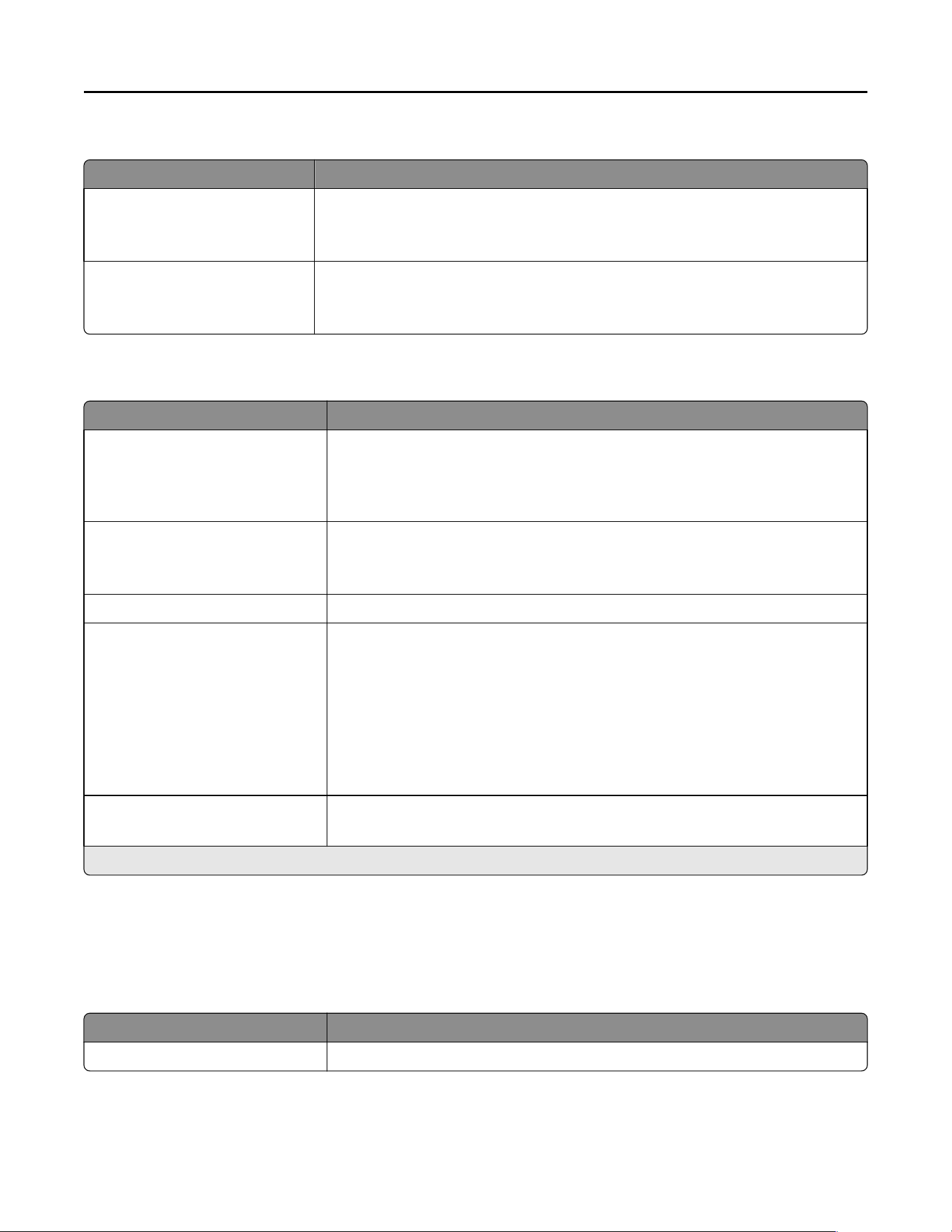
Solutions LDAP Settings
Menu item Description
Follow LDAP Referrals
Off*
On
Search the different servers in the domain for the logged-in user account.
LDAP Certificate Verification
Yes
No*
Enable verification of LDAP certificates.
Miscellaneous
Menu item Description
Protected Features
Show*
Hide
Show all the features that Function Access Control (FAC) protects regardless
of the security permission that the user has.
Note: FAC manages access to specific menus and functions or disables them
entirely.
Print Permission
Off*
On
Let the user log in before printing.
Default Print Permission Login Set the default login for Print Permission.
Security Reset Jumper
Enable “Guest” access*
No Effect
Specify the effect of using the security reset jumper.
Notes:
• The jumper is located beside a lock icon on the controller board.
• Enable “Guest” access provides full access control to users who are not
logged in.
• No Effect means that the reset has no effect on the printer security
configuration.
Minimum Password Length
0–32 (0*)
Specify the minimum characters that are allowed for a password.
Note: An asterisk (*) next to a value indicates the factory default setting.
Reports
Menu Settings Page
Menu item Description
Menu Settings Page Print a report that contains the printer menus.
Understanding the printer menus 75
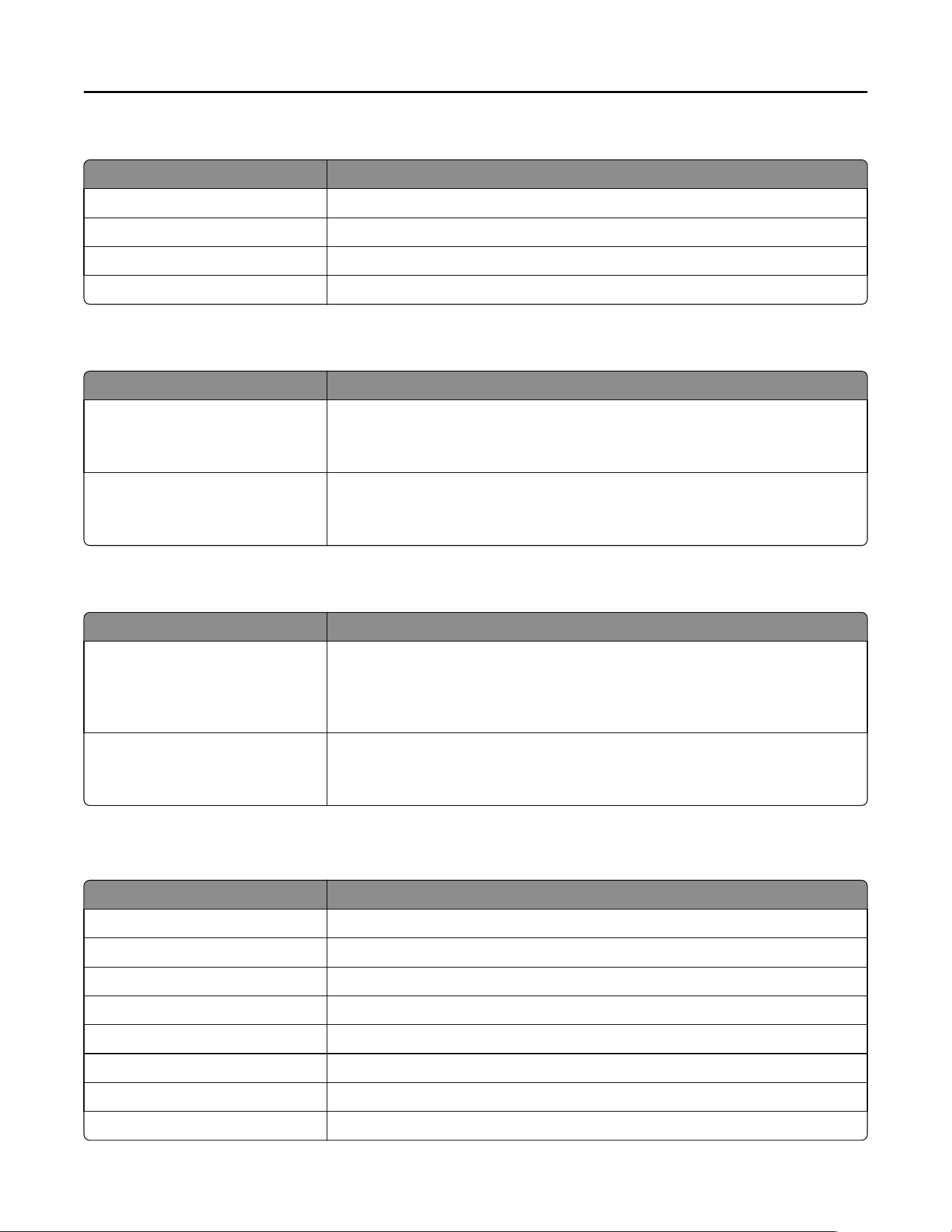
Device
Menu item Description
Device Information Print a report that contains information about the printer.
Device Statistics Print a report about printer usage and supply status.
Profile List Print a list of profiles that are stored in the printer.
Asset Report Print a report that contains the printer serial number and model name.
Print
Menu item Description
Print Fonts
PCL Fonts
PS Fonts
Print samples and information about the fonts that are available in each printer
language.
Print Directory Print the resources that are stored in the flash drive or hard disk.
Note: This menu item appears only when a flash drive or hard disk is
installed.
Network
Menu item Description
Network Setup Page Print a page that shows the configured network and wireless settings on the
printer.
Note: This menu item appears only in network printers or printers connected
to print servers.
Wi‑Fi Direct Connected Clients Print a page that shows the list of devices that are connected to the printer using
Wi‑Fi Direct.
Note: This menu item appears only when Enable Wi‑Fi Direct is set to On.
Help
Menu item Description
Print All Guides Prints all the guides
Color Quality Guide Provides information about solving color quality issues
Connection Guide Provides information about connecting the printer locally (USB) or to a network
Information Guide Provides information about the printer
Media Guide Provides information about loading paper and specialty media
Moving Guide Provides information about moving, locating, or shipping the printer
Print Quality Guide Provides information about solving print quality issues
Supplies Guide Provides information about ordering supplies
Understanding the printer menus 76

Troubleshooting
Menu item Description
Print Quality Test Pages Print sample pages to identify and correct print quality defects.
Printing the Menu Settings Page
1 From the control panel, navigate to:
> Settings > >
Reports >
2 Select Menu Settings Page, and then press .
Understanding the printer menus 77
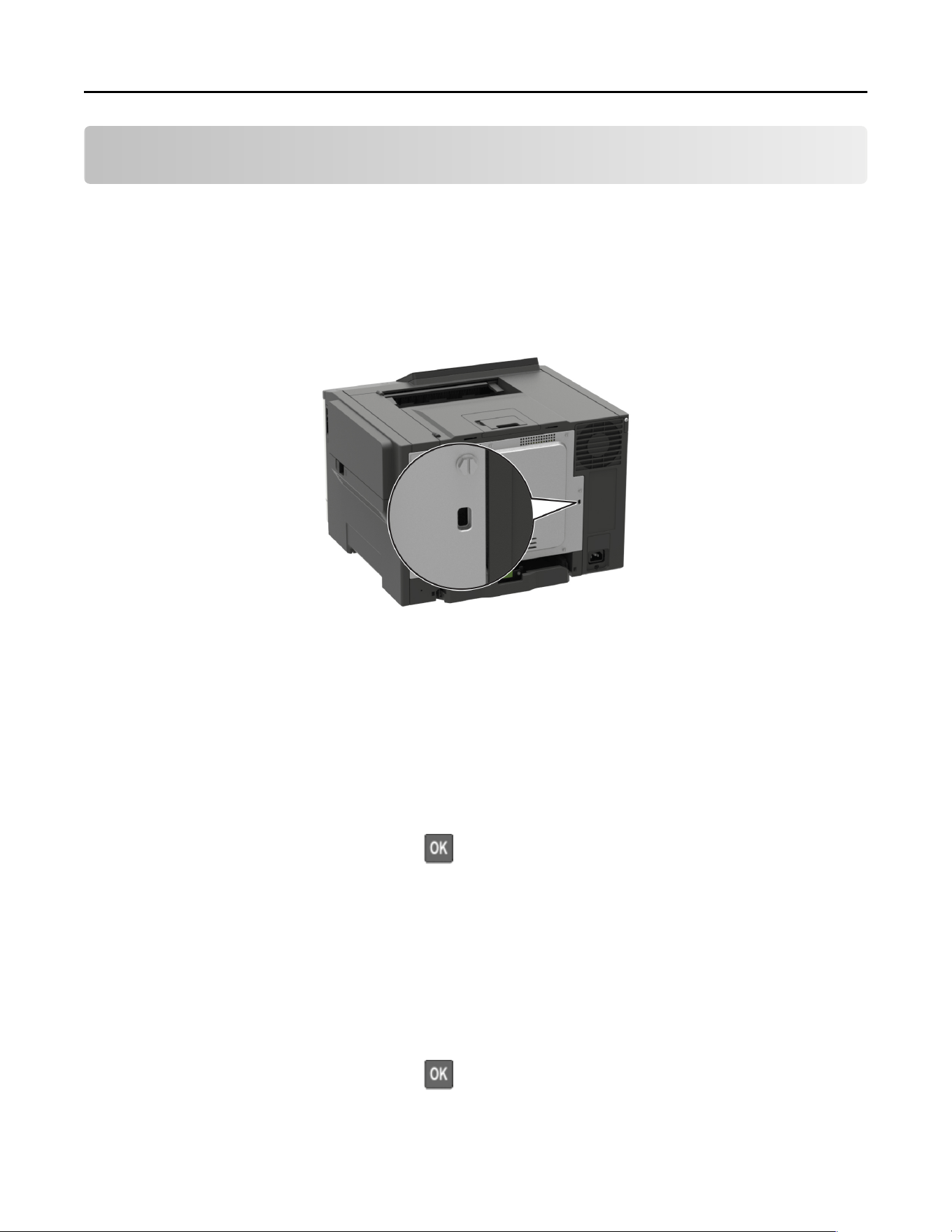
Securing the printer
Note: The hard disk is supported only in some printer models.
Locating the security slot
The printer is equipped with a security lock feature. Attach a security lock compatible with most laptop
computers in the location shown to secure the printer in place.
Erasing printer memory
To erase volatile memory or buffered data in your printer, turn off the printer.
To erase non‑volatile memory or individual settings, device and network settings, security settings, and
embedded solutions, do the following:
1 From the control panel, navigate to:
Settings > Device > Maintenance > Out of Service Erase > Sanitize all information on nonvolatile memory
For non-touch-screen printer models, press to navigate through the settings.
2 Depending on your printer model, select ERASE or Continue.
3 Follow the instructions on the display.
Erasing printer hard disk memory
1 From the control panel, navigate to:
Settings > Device > Maintenance >
Out of Service Erase > Sanitize all information on hard disk
For non-touch-screen printer models, press to navigate through the settings.
2 Depending on your printer model, select ERASE or Continue.
3 Follow the instructions on the display.
Securing the printer 78
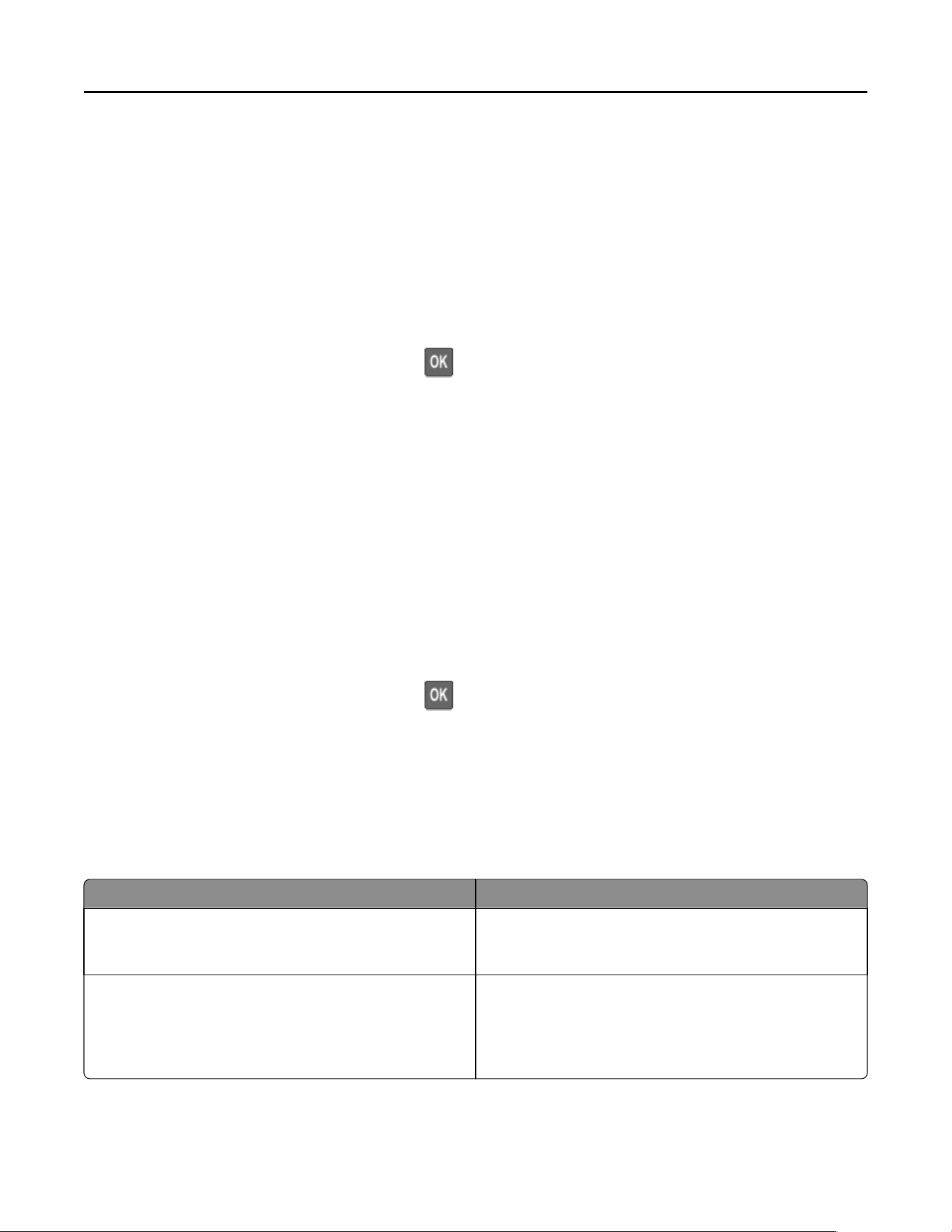
Note: This process can take from several minutes to more than an hour, making the printer unavailable
for other tasks.
Encrypting the printer hard disk
This process erases all contents in the hard disk. If necessary, back up important data from the printer before
starting the encryption.
1 From the control panel, navigate to:
Settings > Security > Disk Encryption >
Start encryption
For non-touch-screen printer models, press to navigate through the settings.
2 Follow the instructions on the display.
Notes:
• To avoid loss of data, do not turn off the printer during the encryption process.
• This process can take from several minutes to more than an hour, making the printer unavailable for
other tasks.
• After encryption, the printer automatically restarts.
Restoring factory default settings
1 From the control panel, navigate to:
Settings > Device > Restore Factory Defaults
For non-touch-screen printer models, press to navigate through the settings.
2 In the Restore Settings menu, select the settings that you want to restore.
3 Select RESTORE.
4 Follow the instructions on the display.
Statement of Volatility
Type of memory Description
Volatile memory The printer uses standard random access memory (RAM)
to buffer temporarily user data during simple print and
copy jobs.
Non-volatile memory The printer may use two forms of non-volatile memory:
EEPROM and NAND (flash memory). Both types are used
to store the operating system, printer settings, network
information, scanner and bookmark settings, and
embedded solutions.
Securing the printer 79

Type of memory Description
Hard disk memory Some printers may have a hard disk drive installed. The
printer hard disk is designed for printer-specific
functionality. The hard disk lets the printer retain buffered
user data from complex print jobs, form data, and font
data.
Erase the content of any installed printer memory in the following circumstances:
• The printer is decommissioned.
• The printer hard disk is replaced.
• The printer is moved to a different department or location.
• The printer is serviced by someone from outside your organization.
• The printer is removed from your premises for service.
• The printer is sold to another organization.
Disposing of a printer hard disk
•
Degaussing—Flushes the hard disk with a magnetic field that erases stored data
• Crushing—Physically compresses the hard disk to break component parts and render them unreadable
• Milling—Physically shreds the hard disk into small metal bits
Note: To guarantee that all data are completely erased, destroy physically each hard disk where data is
stored.
Securing the printer 80

Maintaining the printer
Warning—Potential Damage: Failure to maintain optimum printer performance, or to replace parts and
supplies, may cause damage to your printer.
Networking
Connecting the printer to a Wi‑Fi network
1 From the printer control panel, navigate to:
Settings > Network/Ports > Wireless
For non-touch-screen printer models, press to navigate through the settings.
2 Select Setup On Printer Panel and then follow the instructions on the display.
Note: For Wi‑Fi‑network‑ready printer models, a prompt for Wi‑Fi network setup appears during initial setup.
Connecting the printer to a wireless network using Wi‑Fi Protected Setup
(WPS)
Before you begin, make sure that:
• The access point (wireless router) is WPS‑certified or WPS‑compatible. For more information, see the
documentation that came with your access point.
• A wireless network adapter is installed in your printer. For more information, see the instructions that came
with the adapter.
Using the Push Button method
1 From the control panel, navigate to:
Settings > Network/Ports > Wireless > Wi‑Fi Protected Setup > Start Push Button Method
2 Follow the instructions on the display.
Using the personal identification number (PIN) method
1 From the control panel, navigate to:
Settings > Network/Ports > Wireless > Wi‑Fi Protected Setup > Start PIN Method
2 Copy the eight‑digit WPS PIN.
3 Open a Web browser, and then type the IP address of your access point in the address field.
Notes:
• View the printer IP address on the printer home screen. The IP address appears as four sets of
numbers separated by periods, such as 123.123.123.123.
• If you are using a proxy server, then temporarily disable it to load the Web page correctly.
Maintaining the printer 81
4 Access the WPS settings. For more information, see the documentation that came with your access
point.
5 Enter the eight‑digit PIN, and then save the changes.
Connecting a mobile device to the printer wireless network
1 Enable Wi‑Fi Direct in the printer. From the home screen, navigate to:
Settings > Network/Ports > Wireless > Enable Wi‑Fi Direct
For non-touch-screen printer models, press to navigate through the settings.
Notes:
• The Wi‑Fi Direct SSID and password are generated automatically. To view the Wi‑Fi Direct SSID and
password, go to the Wi‑Fi Direct menu.
• You can also change the SSID and password, if necessary.
2 Connect your mobile device to the printer wireless network.
Deactivating the Wi‑Fi network
1 From the printer control panel, navigate to:
Settings > Network/Ports > Network Overview > Active Adapter > Standard Networking
For non-touch-screen printer models, press to navigate through the settings.
2 Follow the instructions on the display.
Cleaning the printer
CAUTION—SHOCK HAZARD: To avoid the risk of electrical shock when cleaning the exterior of the
printer, unplug the power cord from the electrical outlet and disconnect all cables from the printer
before proceeding.
Notes:
• Perform this task after every few months.
• Damage to the printer caused by improper handling is not covered by the printer warranty.
1 Turn off the printer, and then unplug the power cord from the electrical outlet.
2 Remove paper from the standard bin and multipurpose feeder.
3 Remove any dust, lint, and pieces of paper around the printer using a soft brush or vacuum.
4 Wipe the outside of the printer with a damp, soft, lint‑free cloth.
Notes:
• Do not use household cleaners or detergents, as they may damage the finish of the printer.
Maintaining the printer 82

• Make sure that all areas of the printer are dry after cleaning.
5 Connect the power cord to the electrical outlet, and then turn on the printer.
CAUTION—POTENTIAL INJURY: To avoid the risk of fire or electrical shock, connect the power cord
to an appropriately rated and properly grounded electrical outlet that is near the product and easily
accessible.
Ordering parts and supplies
To order parts and supplies, contact the place where you purchased the printer.
Note: All life estimates for printer supplies assume printing on letter‑ or A4‑size plain paper.
Checking the status of parts and supplies
1 From the control panel, navigate to:
Settings > Reports > Device > Device Statistics
For non‑touch‑screen printer models, press to navigate through the settings.
2 From the Supply Information section of the pages printed, check the status of parts and supplies.
Ordering a toner cartridge
Notes:
•
The estimated cartridge yield is based on the ISO/IEC 19798 standard.
• Extremely low print coverage for extended periods of time may negatively affect actual yield.
To order a toner cartridge, contact the place where you purchased the printer.
Ordering an imaging kit
To order an imaging kit, contact the place where you purchased the printer.
Ordering a waste toner bottle
To order a waste toner bottle, contact the place where you purchased the printer.
Ordering a maintenance kit
To order a maintenance kit, contact the place where you purchased the printer.
Configuring supply notifications
1 Open a web browser, and then type the printer IP address in the address field.
Maintaining the printer 83
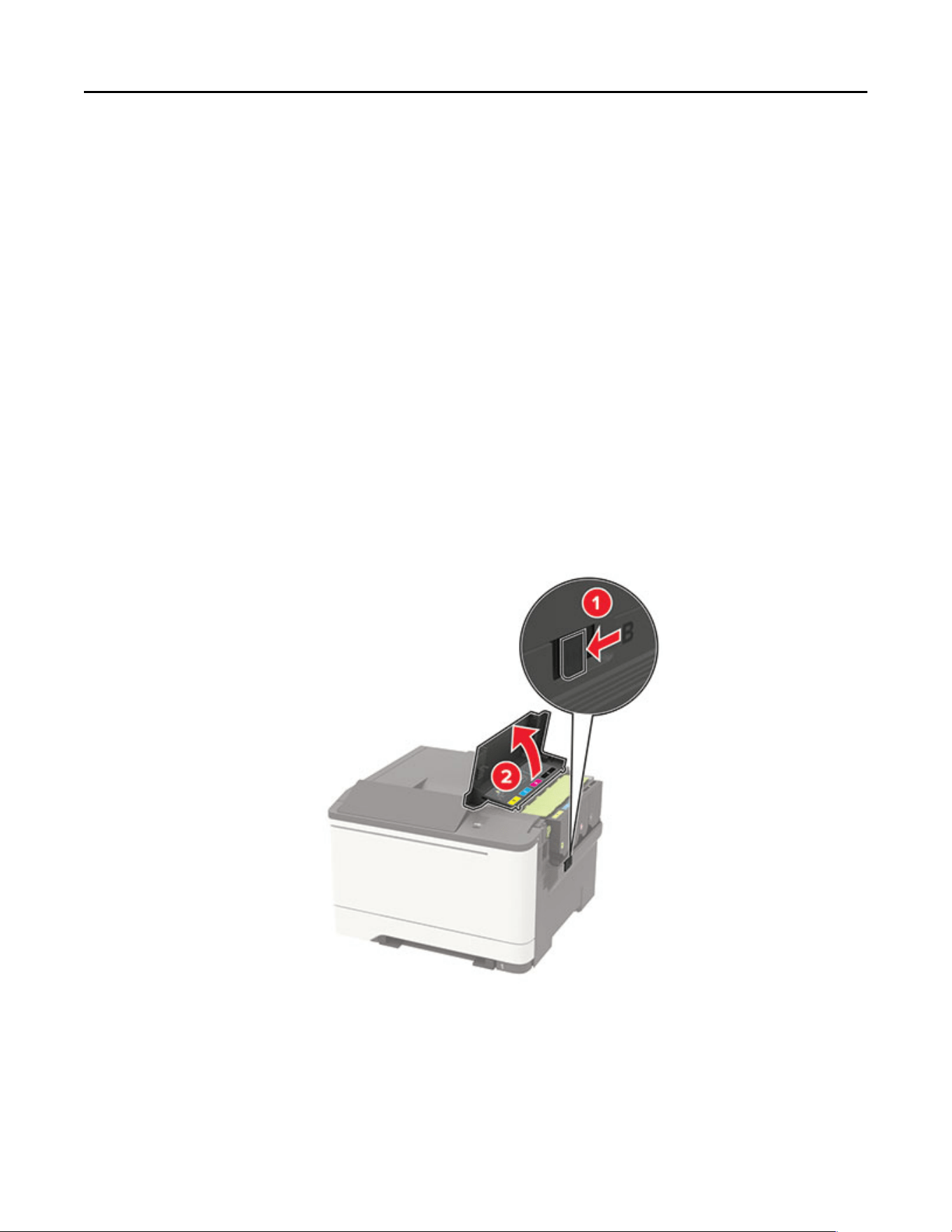
Notes:
• View the printer IP address on the printer home screen. The IP address appears as four sets of
numbers separated by periods, such as 123.123.123.123.
• If you are using a proxy server, then temporarily disable it to load the web page correctly.
2 Click Settings > Device > Notifications
.
3 From the Supplies menu, click Custom Supply Notifications.
4 Select a notification for each supply item.
5 Apply the changes.
Replacing parts and supplies
Replacing a toner cartridge
1 Open door B.
Warning—Potential Damage: To prevent damage from electrostatic discharge, touch any exposed metal
frame of the printer before accessing or touching interior areas of the printer.
Maintaining the printer 84
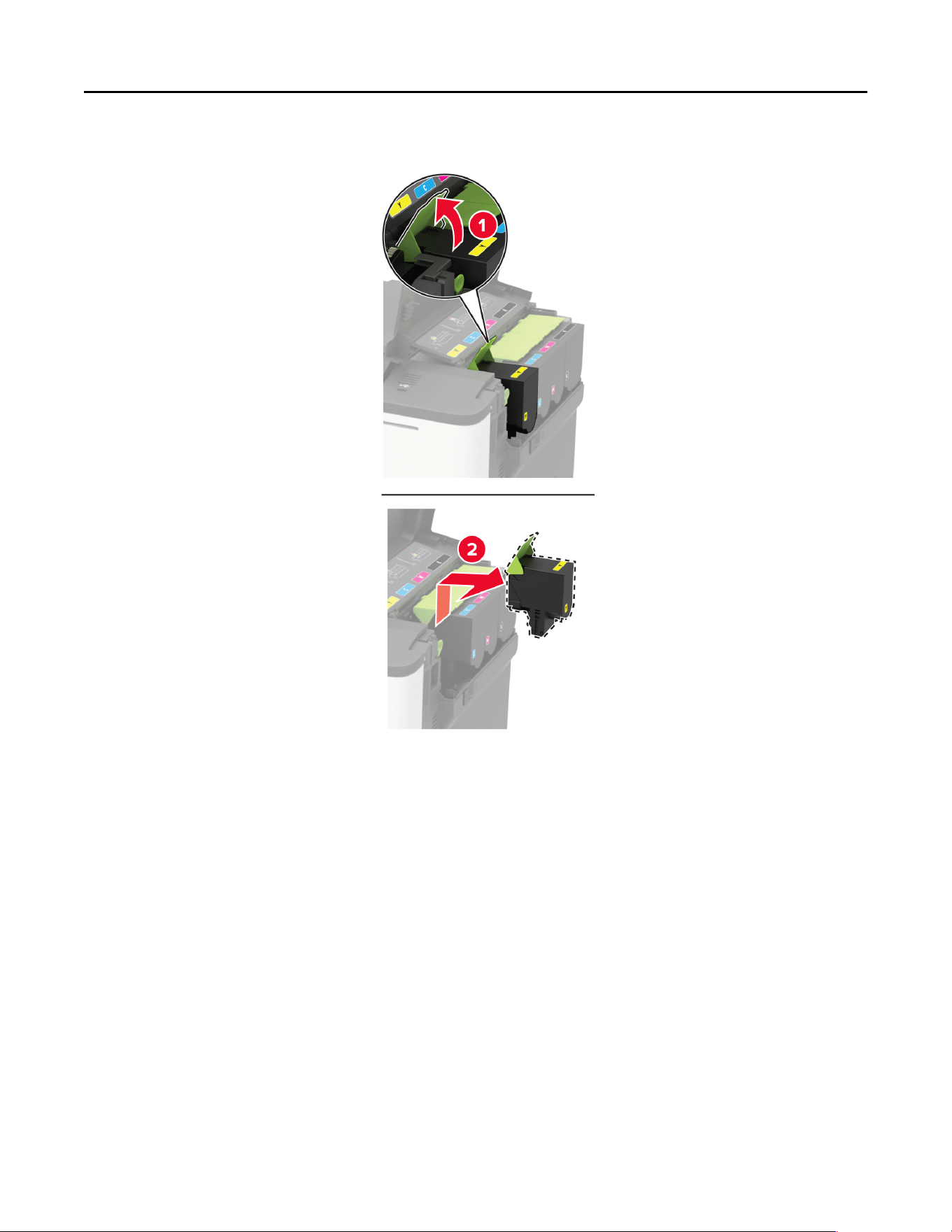
2 Remove the used toner cartridge.
3 Unpack the new toner cartridge.
Maintaining the printer 85
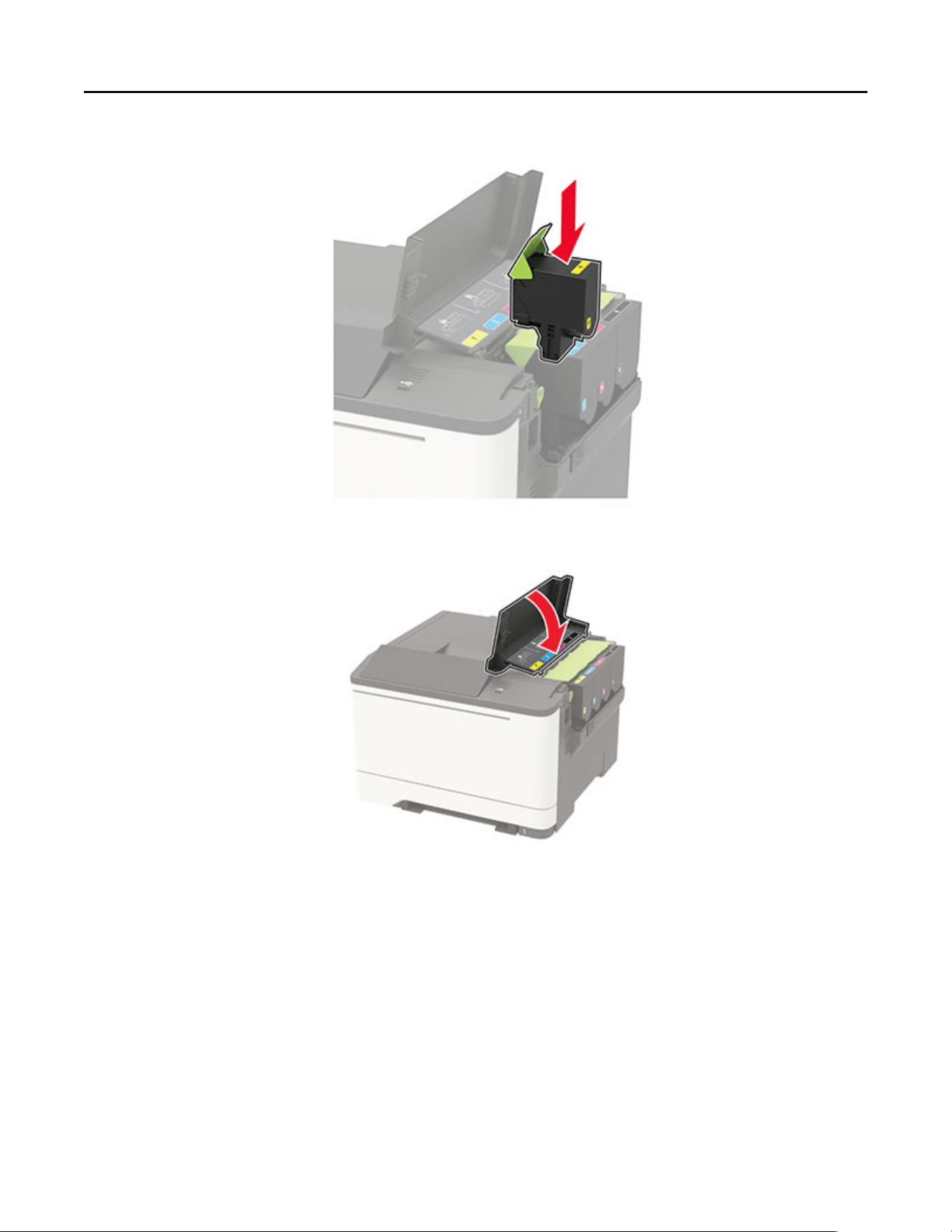
4 Insert the new toner cartridge.
5 Close door B.
Replacing the waste toner bottle
1 Open door B.
Warning—Potential Damage: To prevent damage from electrostatic discharge, touch any exposed metal
frame of the printer before accessing or touching interior areas of the printer.
Maintaining the printer 86
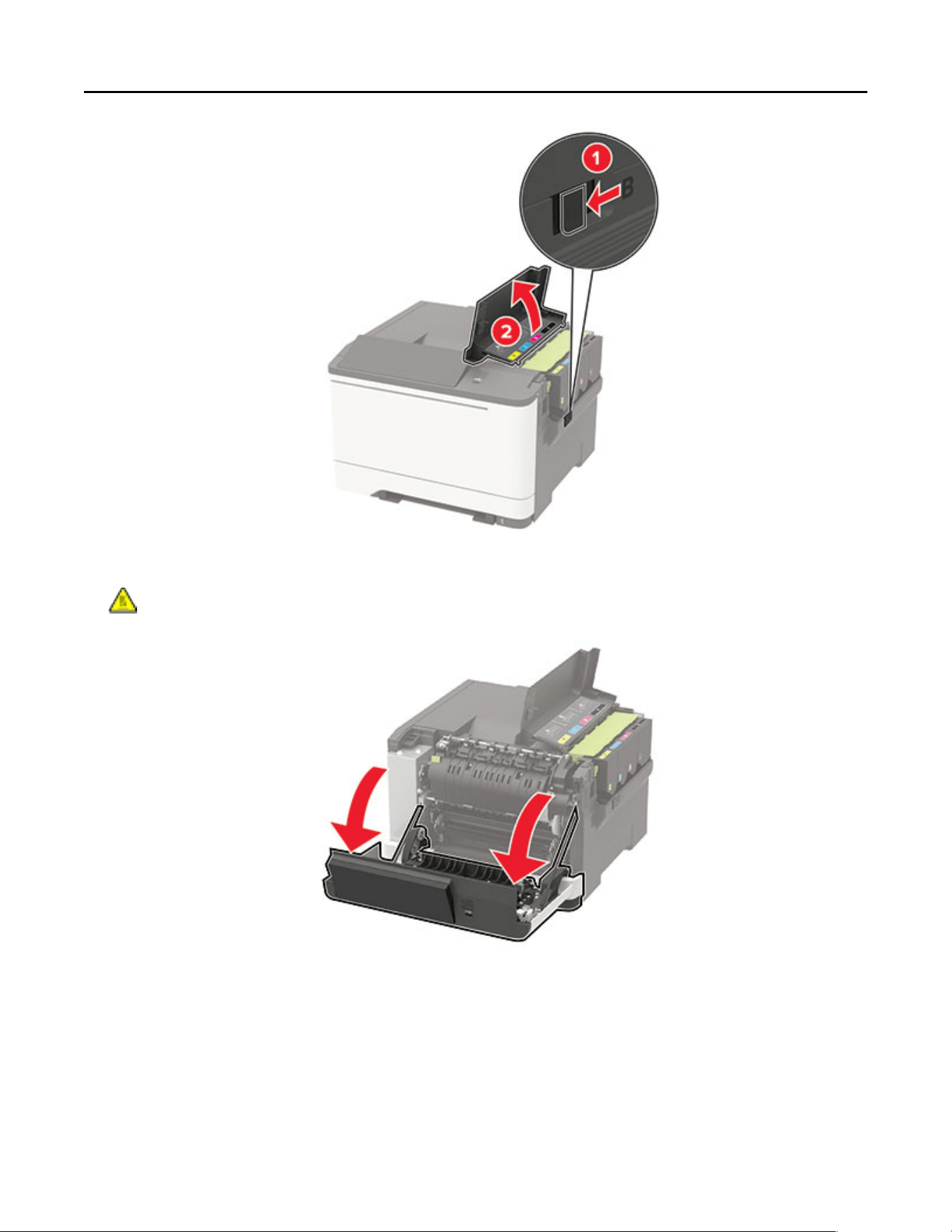
2 Open door A.
CAUTION—HOT SURFACE: The inside of the printer might be hot. To reduce the risk of injury from a
hot component, allow the surface to cool before touching it.
Maintaining the printer 87
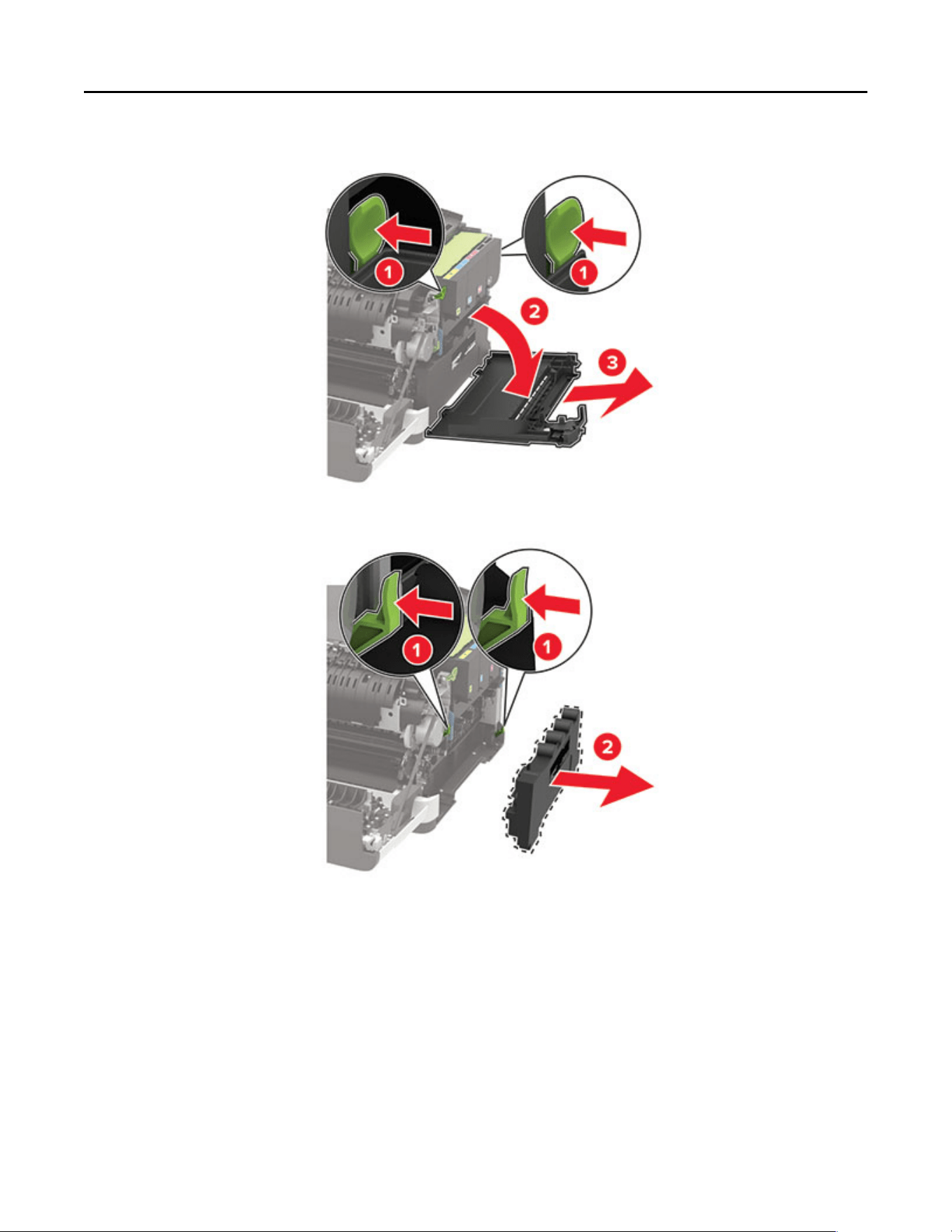
3 Remove the right side cover.
4 Remove the used waste toner bottle.
Note: To avoid spilling the toner, place the bottle in an upright position.
5 Unpack the new waste toner bottle.
Maintaining the printer 88
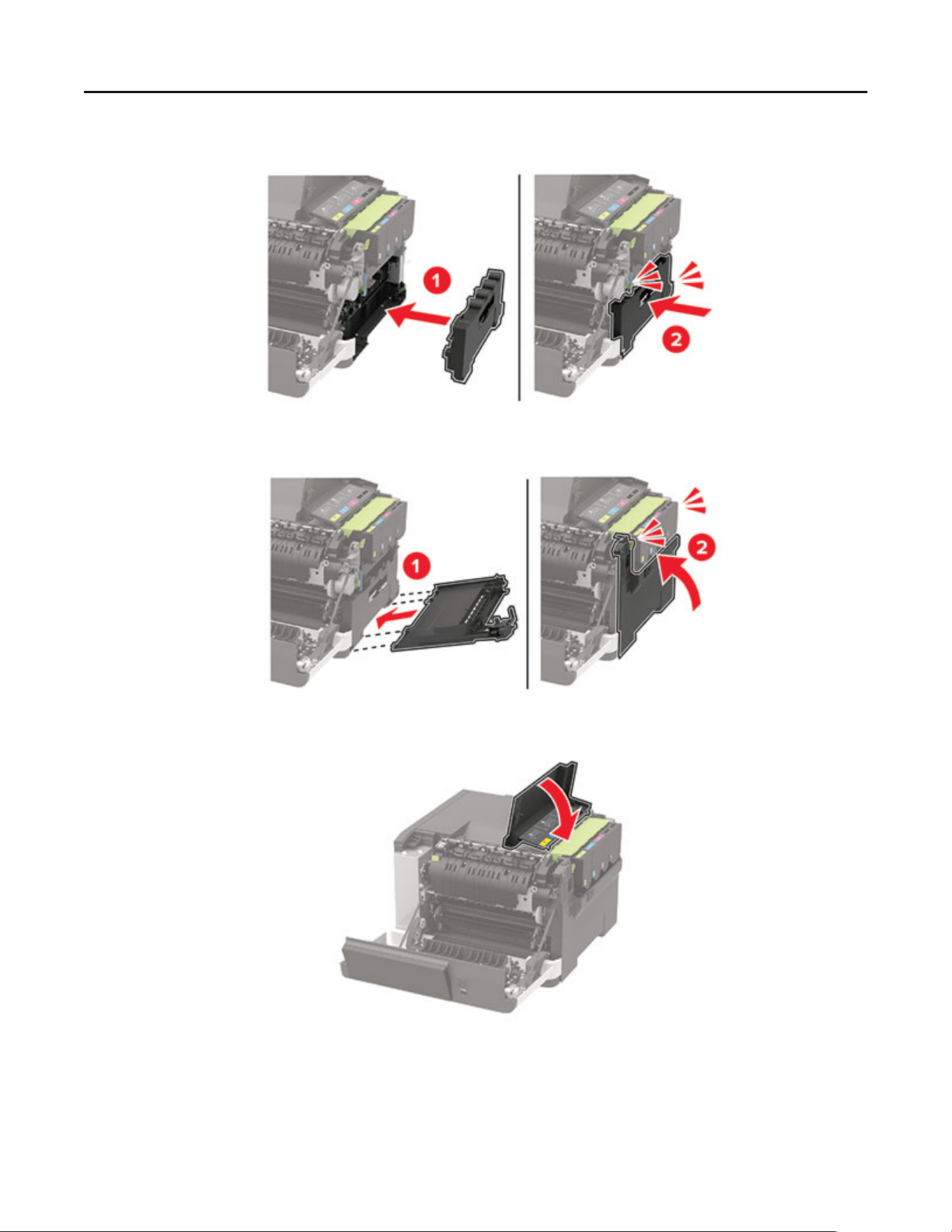
6 Insert the new waste toner bottle.
7 Insert the right side cover.
8 Close door B.
9 Close door A.
Maintaining the printer 89

Moving the printer
Moving the printer to another location
CAUTION—POTENTIAL INJURY: If the printer weight is greater than 20 kg (44 lb), then it may require
two or more people to lift it safely.
CAUTION—POTENTIAL INJURY: To avoid the risk of fire or electrical shock, use only the power cord
provided with this product or the manufacturer's authorized replacement.
CAUTION—POTENTIAL INJURY: When moving the printer, follow these guidelines to avoid personal
injury or printer damage:
• Make sure that all doors and trays are closed.
• Turn off the printer, and then unplug the power cord from the electrical outlet.
• Disconnect all cords and cables from the printer.
•
If the printer has separate floor-standing optional trays or output options attached to it, then disconnect
them before moving the printer.
• If the printer has a caster base, then carefully roll it to the new location. Use caution when passing over
thresholds and breaks in flooring.
• If the printer does not have a caster base but is configured with optional trays or output options, then remove
the output options and lift the printer off the trays. Do not try to lift the printer and any options at the same
time.
• Always use the handholds on the printer to lift it.
• Any cart used to move the printer must have a surface able to support the full footprint of the printer.
• Any cart used to move the hardware options must have a surface able to support the dimensions of the
options.
• Keep the printer in an upright position.
• Avoid severe jarring movements.
• Make sure that your fingers are not under the printer when you set it down.
• Make sure that there is adequate clearance around the printer.
Note: Damage to the printer caused by improper moving is not covered by the printer warranty.
Shipping the printer
When shipping the printer, use the original packaging or contact the place where you purchased the printer.
Maintaining the printer 90

Saving energy and paper
Configuring the power save mode settings
Sleep mode
1 From the control panel, navigate to:
Settings > Device > Power Management > Timeouts
> Sleep Mode
For non-touch-screen printer models, press to navigate through the settings.
2 Specify the amount of time that the printer stays idle before it enters Sleep Mode.
Hibernate mode
1 From the control panel, navigate to:
Settings > Device > Power Management > Timeouts > Hibernate Timeout
For non-touch-screen printer models, press to navigate through the settings.
2 Select the amount of time that the printer stays idle before it enters Hibernate mode.
Notes:
• For Hibernate Timeout to work, set Hibernate Timeout on Connection to Hibernate.
• The Embedded Web Server is disabled when the printer is in Hibernate mode.
Adjusting the brightness of the display
Note: This setting is available only in some printer models.
1 From the control panel, navigate to:
Settings > Device > Preferences
For non-touch-screen printer models, press to navigate through the settings.
2 In the Screen Brightness menu, adjust the setting.
Conserving supplies
• Print on both sides of the paper.
Note: Two-sided printing is the default setting in the print driver.
• Print multiple pages on a single sheet of paper.
• Use the preview feature to see how the document looks like before printing it.
• Print one copy of the document to check its content and format for accuracy.
Maintaining the printer 91
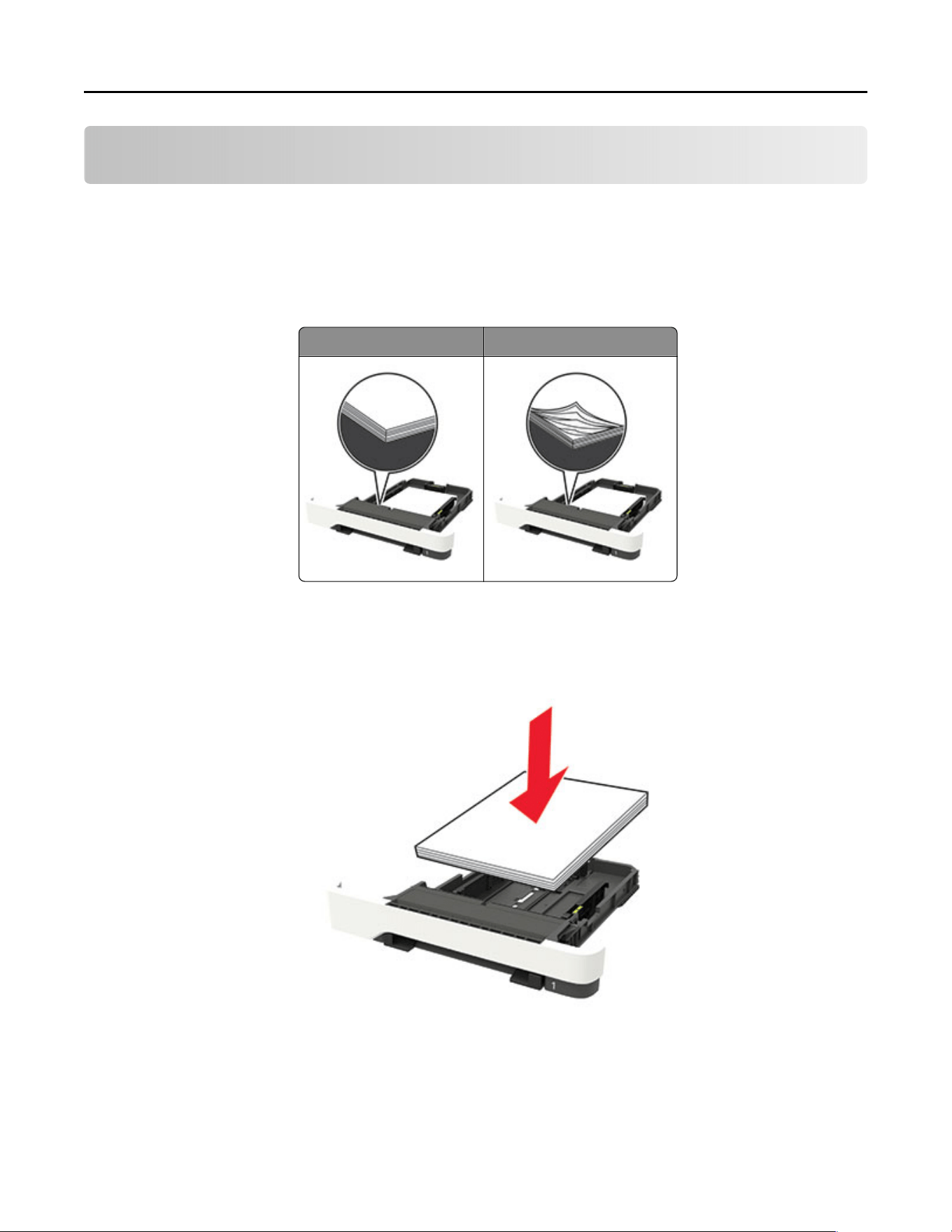
Clearing jams
Avoiding jams
Load paper properly
• Make sure that the paper lies flat in the tray.
Correct loading of paper Incorrect loading of paper
• Do not load or remove a tray while the printer is printing.
• Do not load too much paper. Make sure that the stack height is below the maximum paper fill indicator.
• Do not slide paper into the tray. Load paper as shown in the illustration.
• Make sure that the paper guides are positioned correctly and are not pressing tightly against the paper or
envelopes.
• Push the tray firmly into the printer after loading paper.
Clearing jams 92
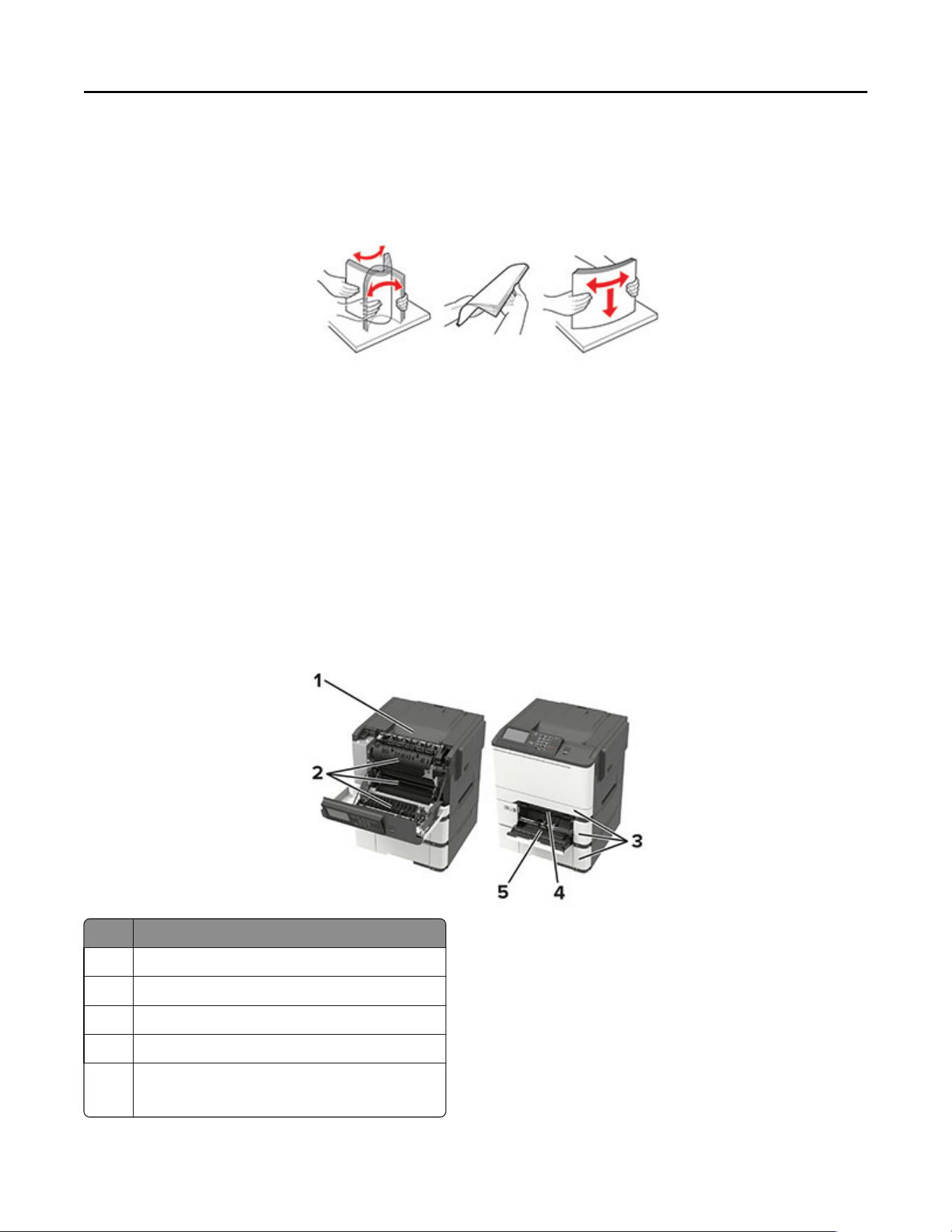
Use recommended paper
• Use only recommended paper or specialty media.
• Do not load paper that is wrinkled, creased, damp, bent, or curled.
• Flex, fan, and align the paper edges before loading.
• Do not use paper that has been cut or trimmed by hand.
• Do not mix paper sizes, weights, or types in the same tray.
• Make sure that the paper size and type are set correctly on the computer or printer control panel.
• Store paper according to manufacturer recommendations.
Identifying jam locations
Notes:
• When Jam Assist is set to On, the printer flushes blank pages or pages with partial prints after a jammed
page has been cleared. Check your printed output for blank pages.
• When Jam Recovery is set to On or Auto, the printer reprints jammed pages.
Jam location
1 Standard bin
2 Door A
3 Trays
4 Manual feeder
5 Multipurpose feeder
Note: Available only in some printer models.
Clearing jams 93
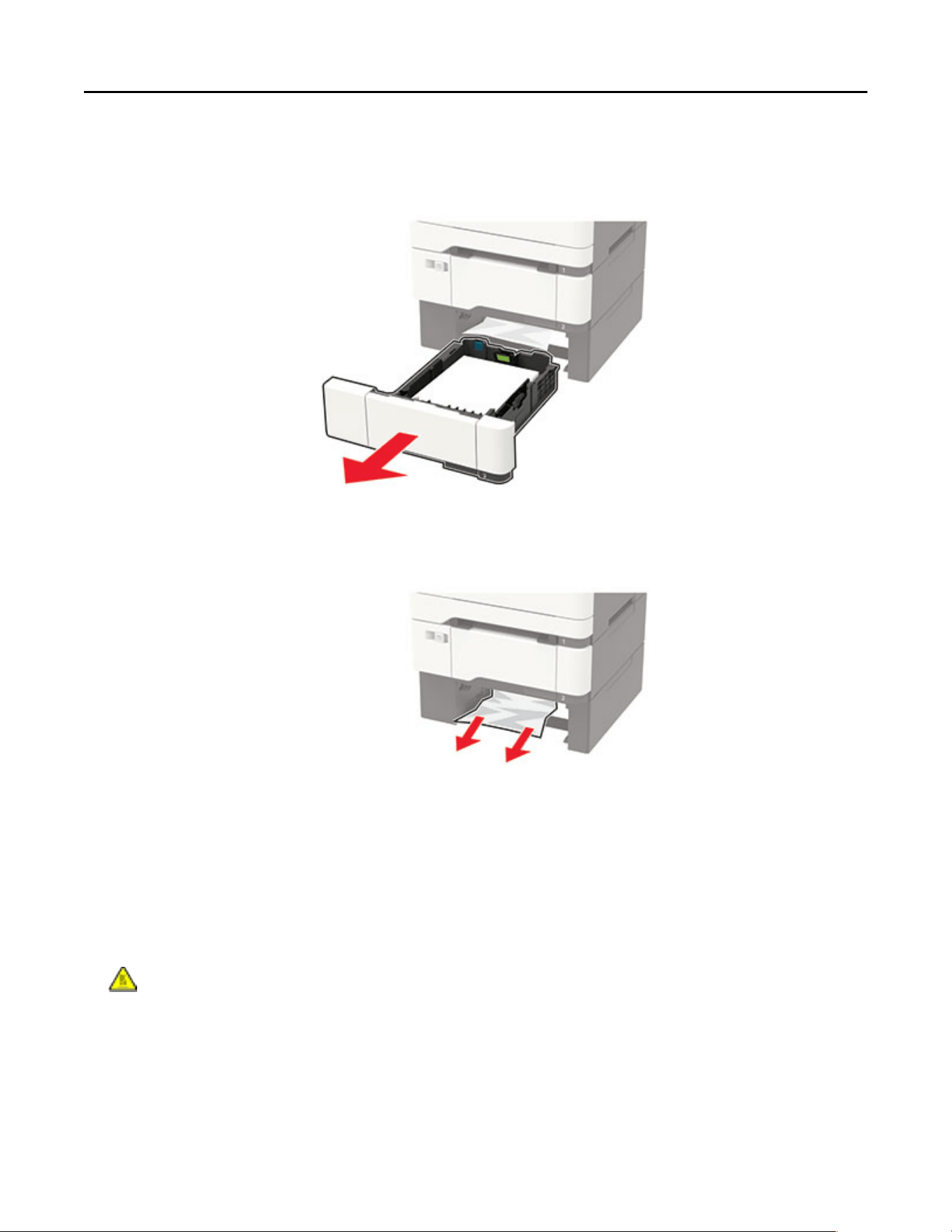
Paper jam in trays
1 Remove the tray.
2 Remove the jammed paper.
Note: Make sure that all paper fragments are removed.
3 Insert the tray.
Paper jam in door A
Paper jam below the fuser
1 Open door A.
CAUTION—HOT SURFACE: The inside of the printer might be hot. To reduce the risk of injury from a
hot component, allow the surface to cool before touching it.
Warning—Potential Damage: To prevent damage from electrostatic discharge, touch any exposed metal
frame of the printer before accessing or touching interior areas of the printer.
Clearing jams 94
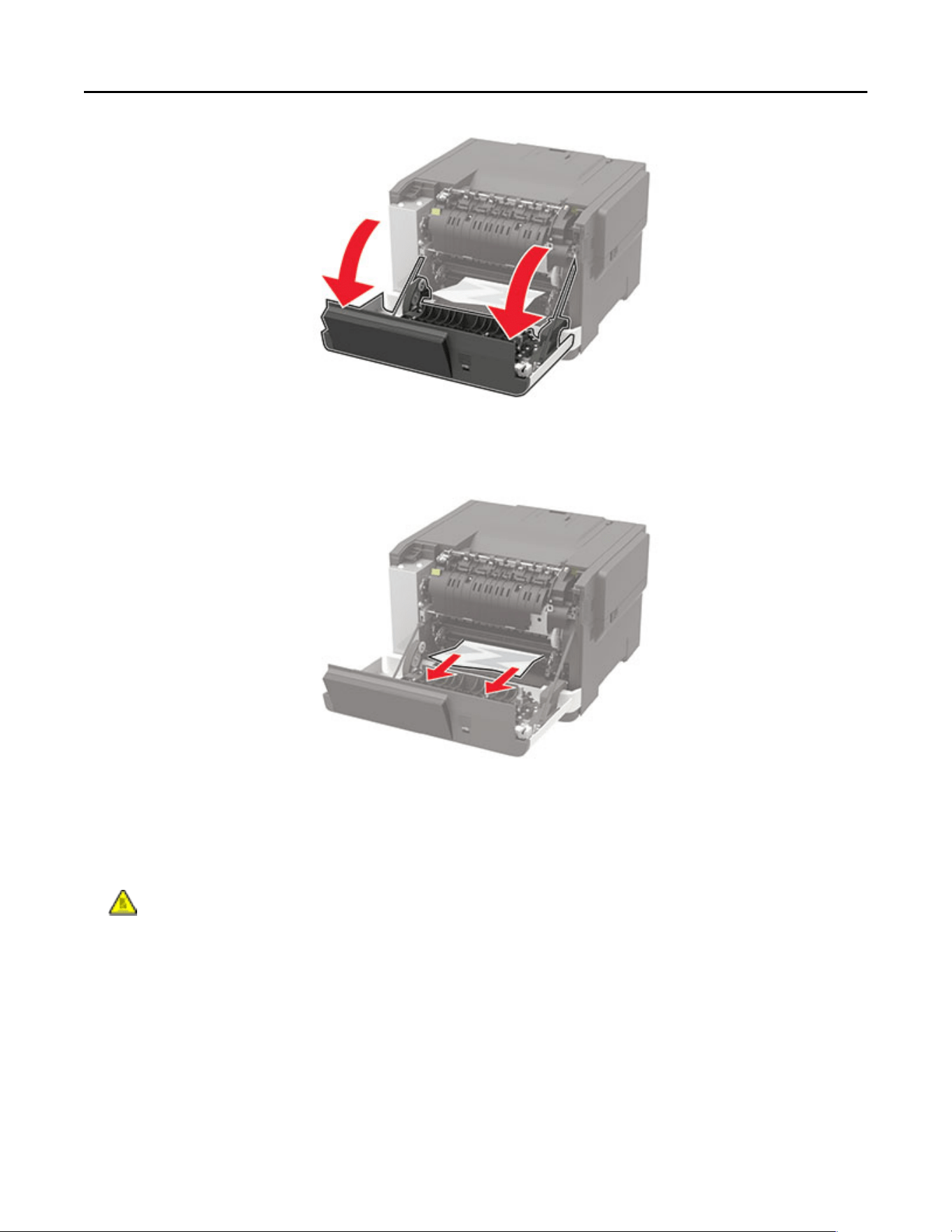
2 Remove the jammed paper.
Note: Make sure that all paper fragments are removed.
3 Close door A.
Paper jam in the fuser
1 Open door A.
CAUTION—HOT SURFACE: The inside of the printer might be hot. To reduce the risk of injury from a
hot component, allow the surface to cool before touching it.
Warning—Potential Damage: To prevent damage from electrostatic discharge, touch any exposed metal
frame of the printer before accessing or touching interior areas of the printer.
Clearing jams 95
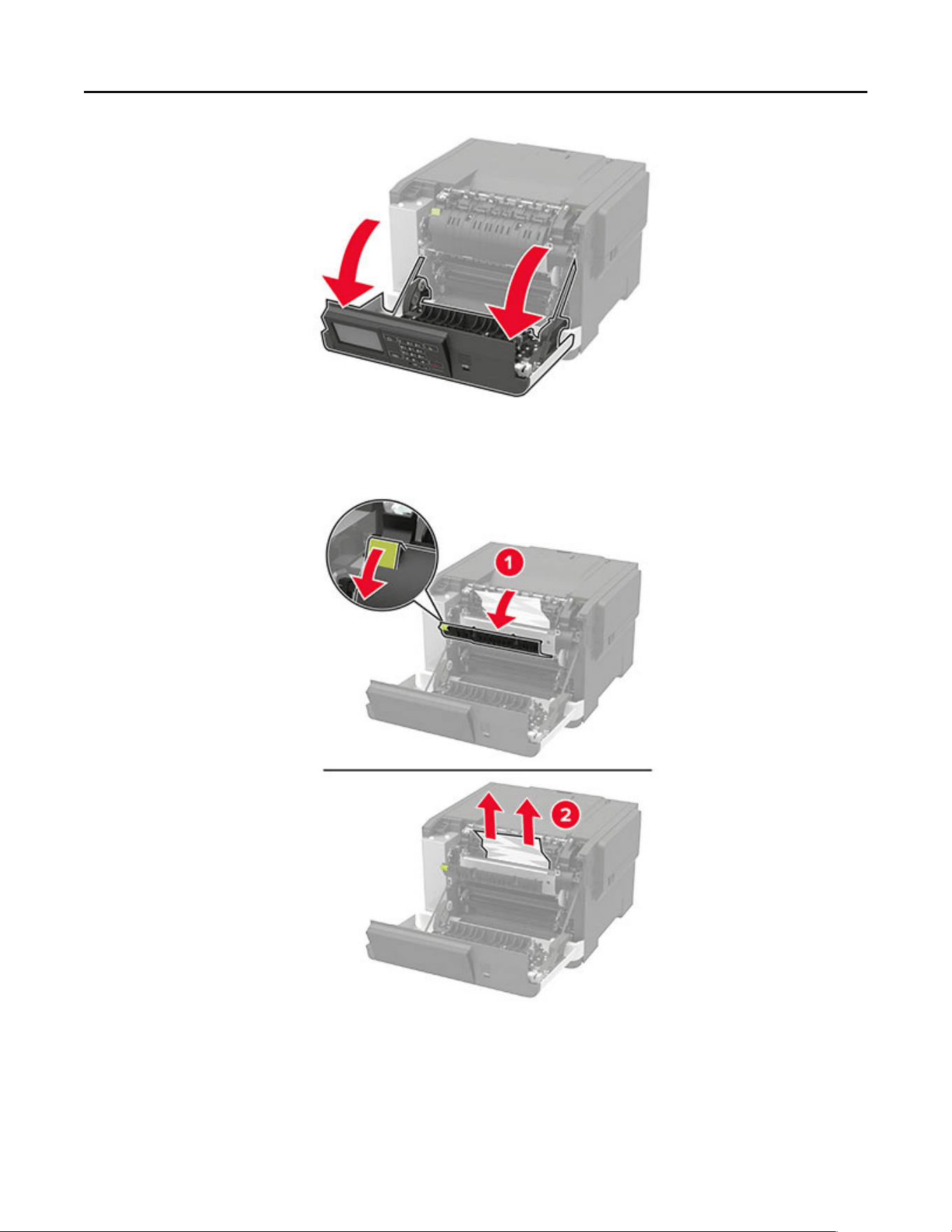
2 Open the fuser access door, and then remove the jammed paper.
Note: Make sure that all paper fragments are removed.
3 Close door A.
Paper jam in the duplex unit
1 Open door A.
Clearing jams 96
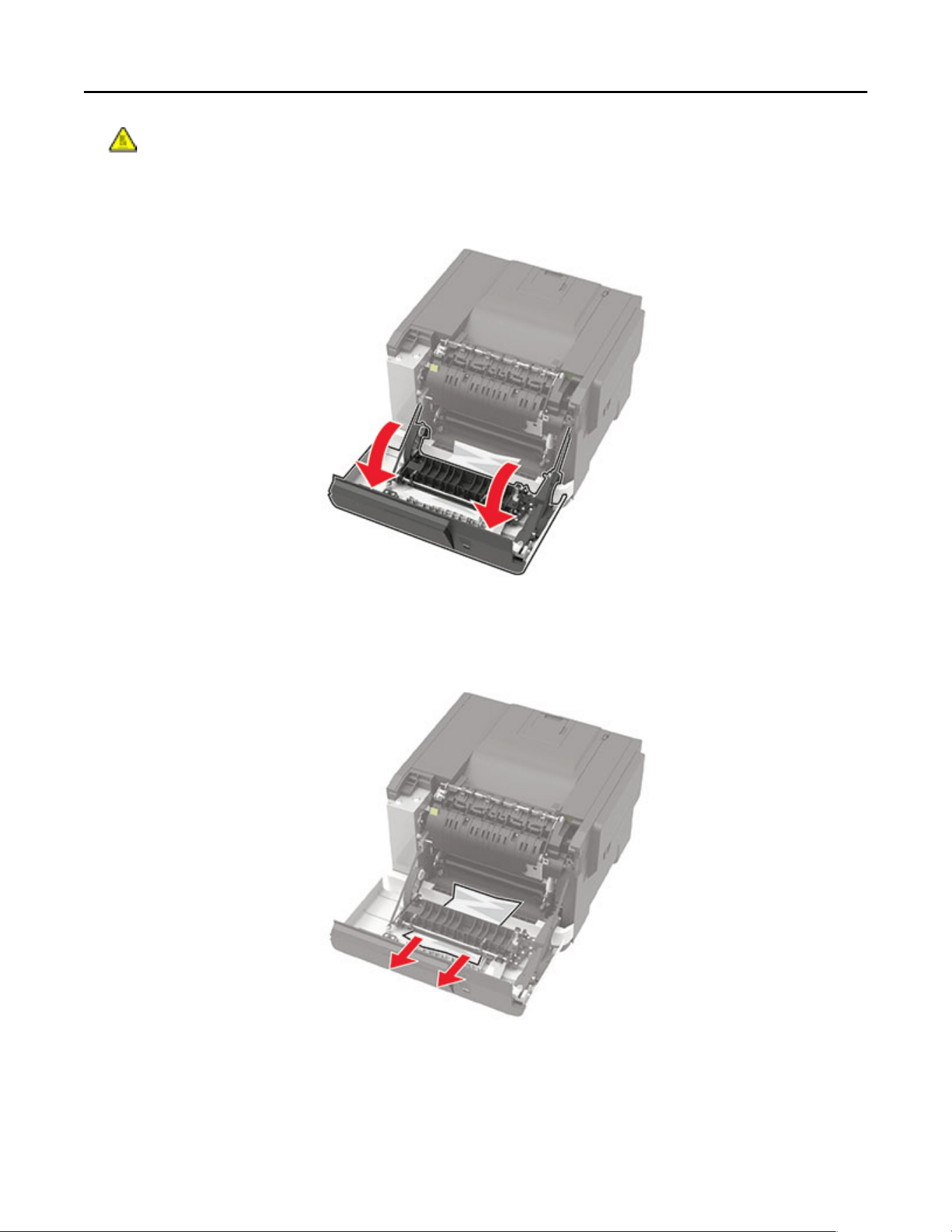
CAUTION—HOT SURFACE: The inside of the printer might be hot. To reduce the risk of injury from a
hot component, allow the surface to cool before touching it.
Warning—Potential Damage: To prevent damage from electrostatic discharge, touch any exposed metal
frame of the printer before accessing or touching interior areas of the printer.
2 Remove the jammed paper.
Note: Make sure that all paper fragments are removed.
3 Close door A.
Clearing jams 97
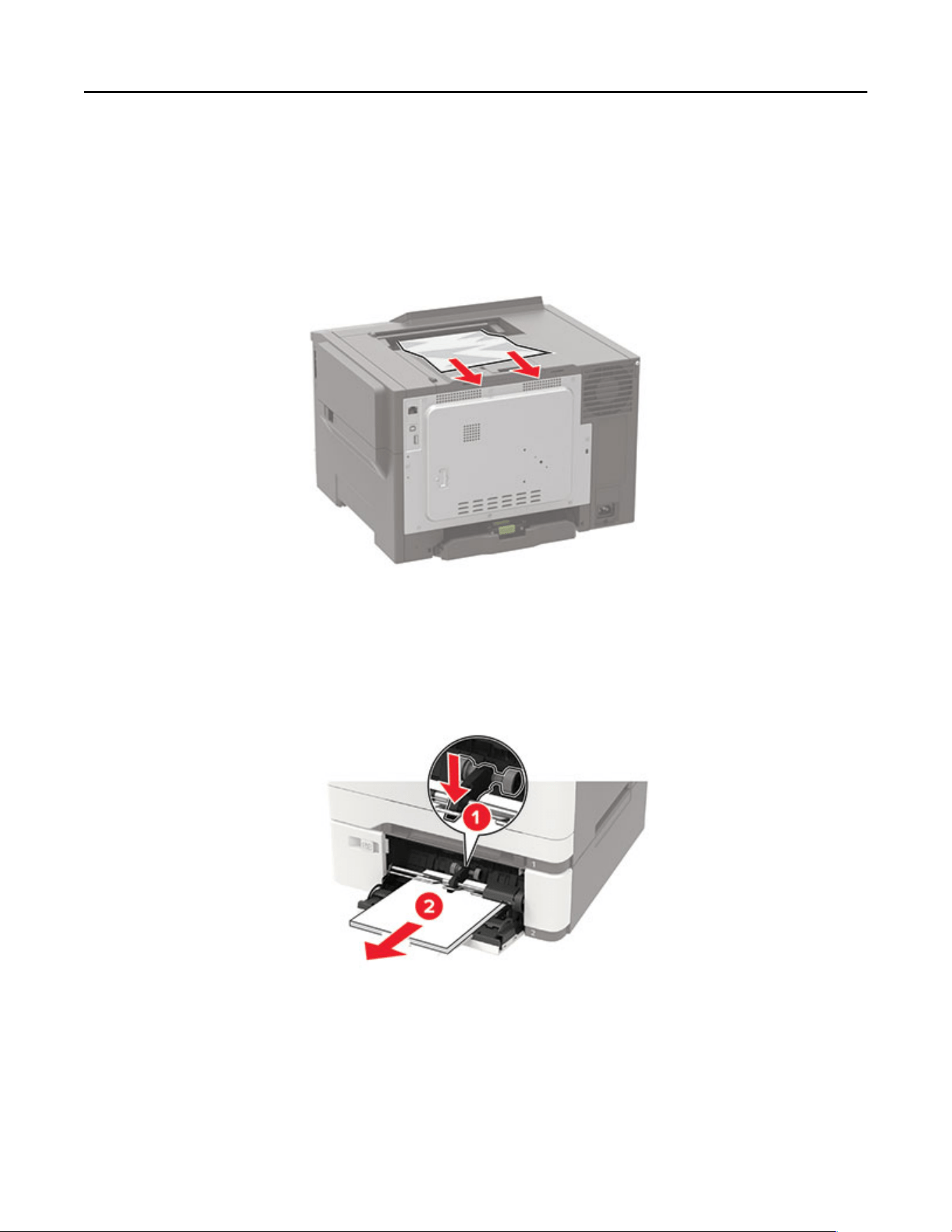
Paper jam in the standard bin
Remove the jammed paper.
Warning—Potential Damage: To prevent damage from electrostatic discharge, touch any exposed metal
frame of the printer before accessing or touching interior areas of the printer.
Note: Make sure that all paper fragments are removed.
Paper jam in the multipurpose feeder
Note: The multipurpose feeder is available only in some printer models.
1 Remove paper from the multipurpose feeder.
2 Remove the jammed paper.
Note: Make sure that all paper fragments are removed.
Clearing jams 98
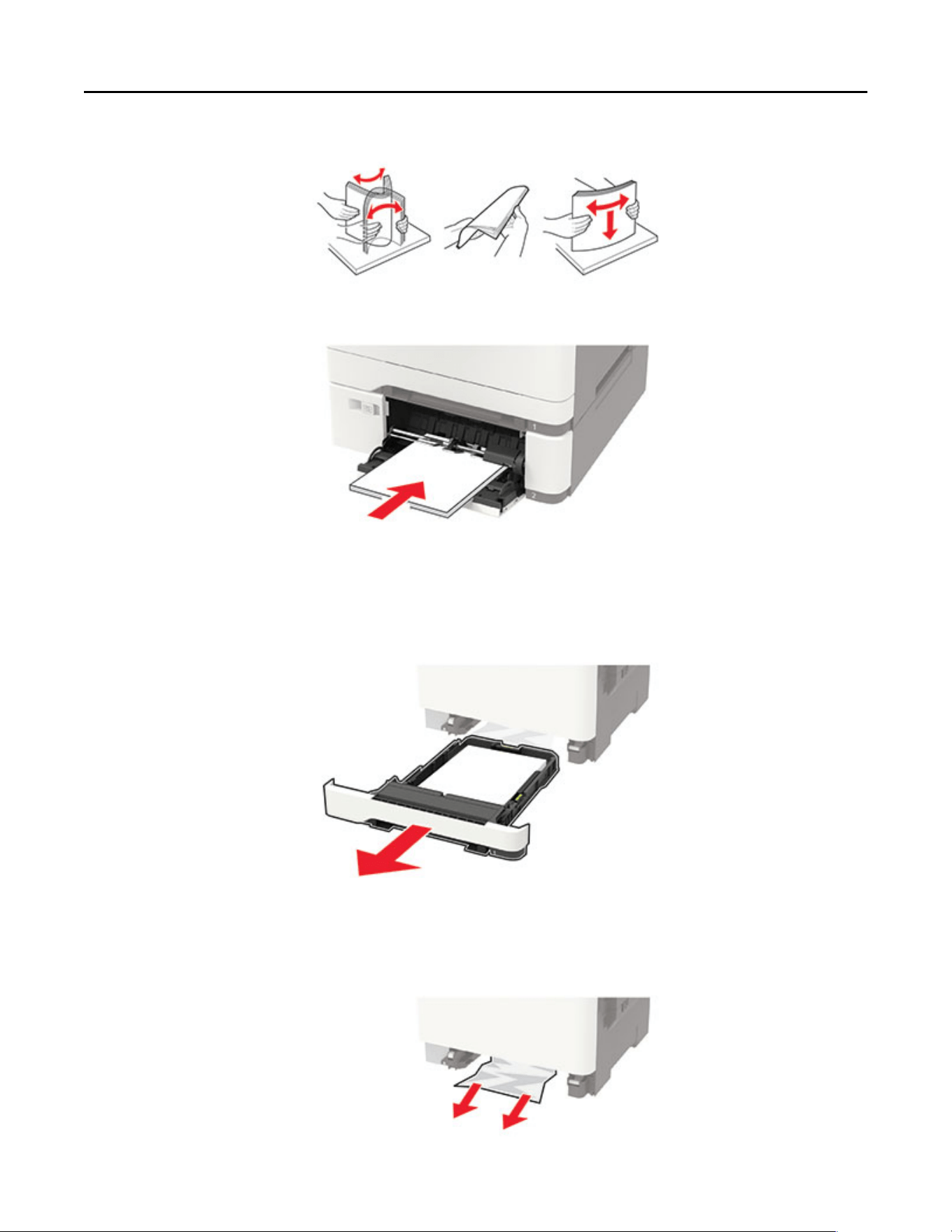
3 Flex, fan, and align the paper edges before loading.
4 Reload paper.
Paper jam in the manual feeder
1 Remove the tray.
2 Remove the jammed paper.
Note: Make sure that all paper fragments are removed.
Clearing jams 99

3 Insert the tray.
Clearing jams 100
Troubleshooting
Configuring the SMTP server
Note: In some printer models, this setting can be configured only from the Embedded Web Server.
From the control panel
1 From the control panel, navigate to:
Settings > Device > Notifications > E‑mail Alerts Setup > E‑mail Setup
2 Configure the settings.
From the Embedded Web Server
1 Open a web browser, and then type the printer IP address in the address field.
Notes:
• View the printer IP address on the printer home screen. The IP address appears as four sets of
numbers separated by periods, such as 123.123.123.123.
• If you are using a proxy server, then temporarily disable it to load the web page correctly.
2 Click Settings > Device > Notifications
> E‑mail Alerts Setup.
3 From the E‑mail Setup section, configure the settings.
4 Click Save.
Network connection problems
Cannot open Embedded Web Server
Action Yes No
Step 1
Check if the printer is on.
Is the printer on?
Go to step 2. Turn on the printer.
Step 2
Make sure that the printer IP address is correct.
Notes:
• View the IP address on the home screen.
• An IP address appears as four sets of numbers separated by
periods, such as 123.123.123.123.
Is the printer IP address correct?
Go to step 3. Type the correct
printer IP address in
the address field.
Troubleshooting 101
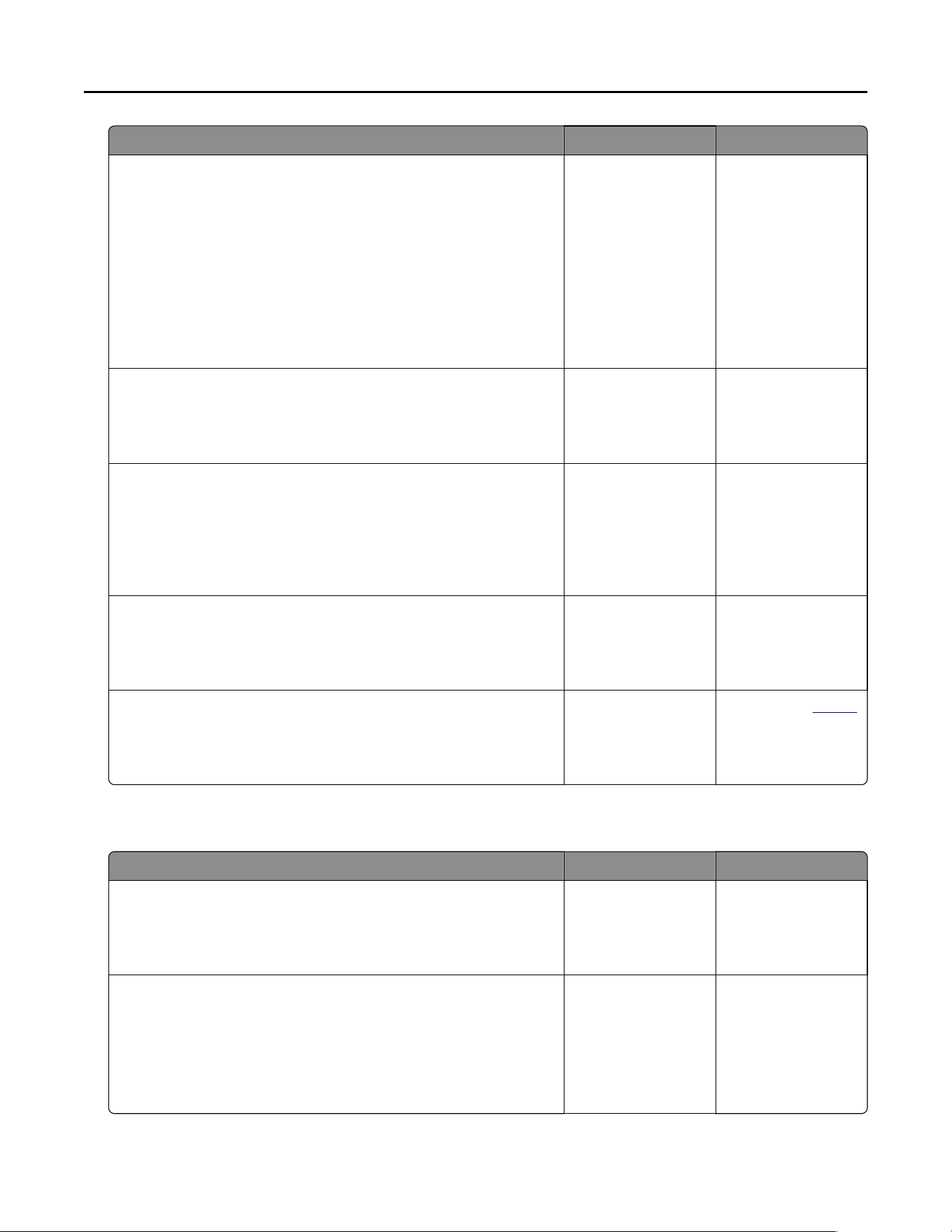
Action Yes No
Step 3
Check if you are using a supported browser:
• Internet Explorer version 11 or later
• Microsoft Edge
• Safari version 6 or later
• Google Chrome
TM
version 32 or later
• Mozilla Firefox version 24 or later
Is your browser supported?
Go to step 4. Install a supported
browser.
Step 4
Check if the network connection is working.
Is the network connection working?
Go to step 5. Contact your
administrator.
Step 5
Make sure that the cable connections to the printer and print server
are secure. For more information, see the documentation that
came with the printer.
Are the cable connections secure?
Go to step 6. Secure the cable
connections.
Step 6
Check if the web proxy servers are disabled.
Are the web proxy servers disabled?
Go to step 7. Contact your
administrator.
Step 7
Access the Embedded Web Server.
Did the Embedded Web Server open?
The problem is
solved.
Contact your dealer.
Unable to read flash drive
Action Yes No
Step 1
Check if the printer is not busy processing another job.
Is the printer ready?
Go to step 2. Wait for the printer to
finish processing the
other job.
Step 2
Check if the flash drive is inserted into the front USB port.
Note: The flash drive does not work when it is inserted into the
rear USB port.
Is the flash drive inserted into the correct port?
Go to step 3. Insert the flash drive
into the correct port.
Troubleshooting 102
Action Yes No
Step 3
Check if the flash drive is supported. For more information, see
“Supported flash drives and file types” on page 30.
Is the flash drive supported?
Go to step 4. Insert a supported
flash drive.
Step 4
a Check if the USB port is enabled. For more information, see
“Enabling the USB port” on page 103.
b Remove, and then insert the flash drive.
Does the printer recognize the flash drive?
The problem is
solved.
Contact your dealer.
Enabling the USB port
From the control panel, navigate to:
Settings > Network/Ports > USB > Enable USB Port
For non-touch-screen printer models, press to navigate through the settings.
Checking the printer connectivity
1 Print the Network Setup Page.
From the control panel, navigate to:
Settings > Reports > Network > Network Setup Page
For non-touch-screen printer models, press to navigate through the settings.
2 Check the first section of the page and confirm that the status is connected.
If the status is not connected, then the LAN drop may be inactive or the network cable may be unplugged
or malfunctioning. Contact your administrator for assistance.
Hardware options problems
Defective flash detected
Contact your
dealer.
Not enough free space in flash memory for resources
Contact your dealer.
Troubleshooting 103

Unformatted flash detected
Try one or more of the following:
• From the control panel, select Continue to stop the defragmentation and continue printing.
• Format the flash memory.
Note: If the error message remains, then the flash memory may be defective and needs to be
replaced. To replace the flash memory, contact your dealer.
Issues with supplies
Replace cartridge, printer region mismatch
Install the correct toner cartridge.
Non‑Printer Manufacturer supply
The printer has detected an unrecognized supply or part installed in the printer.
Your printer is designed to function best with genuine supplies and parts made by the printer manufacturer.
Use of third-party supplies or parts may affect the performance, reliability, or life of the printer and its imaging
components.
All life indicators are designed to function with supplies and parts from the printer manufacturer and may
deliver unpredictable results if third-party supplies or parts are used. Imaging component usage beyond
the intended life may damage your printer or associated components.
Warning—Potential Damage: Use of third-party supplies or parts can affect warranty coverage.
Damage caused by the use of third-party supplies or parts may not be covered by the warranty.
To accept any and all of these risks and to proceed with the use of non-genuine supplies or parts in your
printer, depending on your printer model, from the control panel, press and hold X
and #, or X and
,
simultaneously for 15 seconds.
If you do not want to accept these risks, then remove the third-party supply or part from your printer and
install a genuine supply or part from the printer manufacturer.
Troubleshooting 104
Paper feed problems
Envelope seals when printing
Action Yes No
Step 1
a Use an envelope that has been stored in a dry environment.
Note: Printing on envelopes with high moisture content can
seal the flaps.
b Send the print job.
Does the envelope seal when printing?
Go to step 2. The problem is
solved.
Step 2
a Make sure that paper type is set to Envelope.
From the control panel, navigate to:
Settings > Paper > Tray Configuration > Paper Size/Type
For non‑touch‑screen printer models, press to navigate
through the settings.
b Send the print job.
Does the envelope seal when printing?
Contact your
dealer. The problem is
solved.
Collated printing does not work
Action Yes No
Step 1
a From the control panel, navigate to:
Settings > Print > Layout >
Collate > On [1,2,1,2,1,2]
For non‑touch‑screen printer models, press to navigate
through the settings.
b Print the document.
Is the document collated correctly?
The problem is
solved.
Go to step 2.
Step 2
a From the document that you are trying to print, open the Print
dialog, and then select Collate.
b Print the document.
Is the document collated correctly?
The problem is
solved.
Go to step 3.
Step 3
a Reduce the number of pages to print.
b Print the document.
Are the pages collated correctly?
The problem is
solved.
Contact your
dealer.
Troubleshooting 105
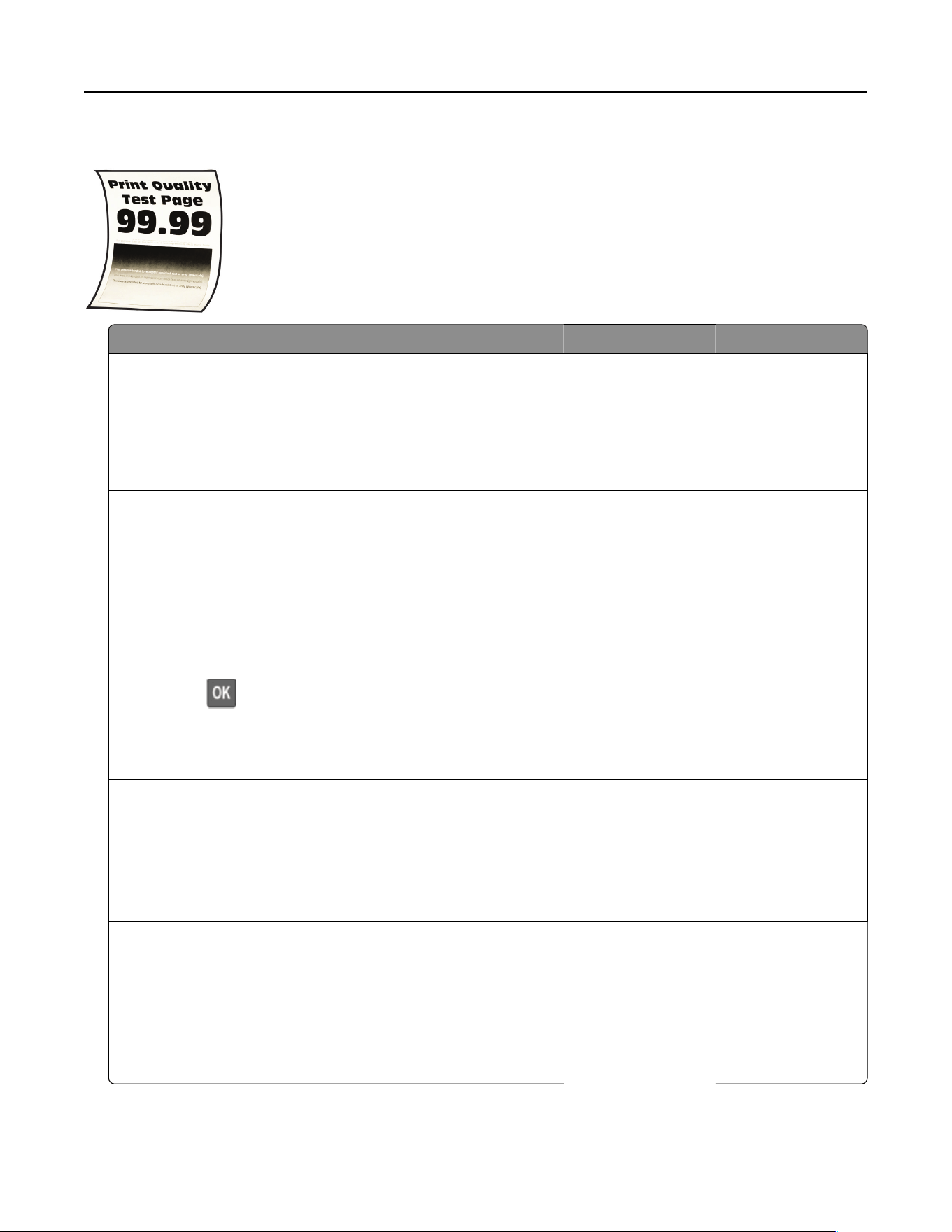
Paper curl
Action Yes No
Step 1
a Adjust the guides in the tray to the correct position for the paper
loaded.
b Print the document.
Is the paper curled?
Go to step 2. The problem is
solved.
Step 2
a Depending on your operating system, specify the paper type
from the Printing Preferences or Print dialog.
Notes:
• Make sure that the setting matches the paper loaded.
• You can also change the setting on the printer control
panel. Navigate to Settings > Paper > Tray Configuration
> Paper Size/Type. For non‑touch‑screen printer models,
press to navigate through the settings.
b Print the document.
Is the paper curled?
Go to step 3. The problem is
solved.
Step 3
Print on the other side of the paper.
a Remove paper, flip it over, and then reload paper.
b Print the document.
Is the paper curled?
Go to step 4. The problem is
solved.
Step 4
a Load paper from a fresh package.
Note: Paper absorbs moisture due to high humidity. Store
paper in its original wrapper until you are ready to use it.
b Print the document.
Is the paper curled?
Contact your dealer. The problem is
solved.
Troubleshooting 106
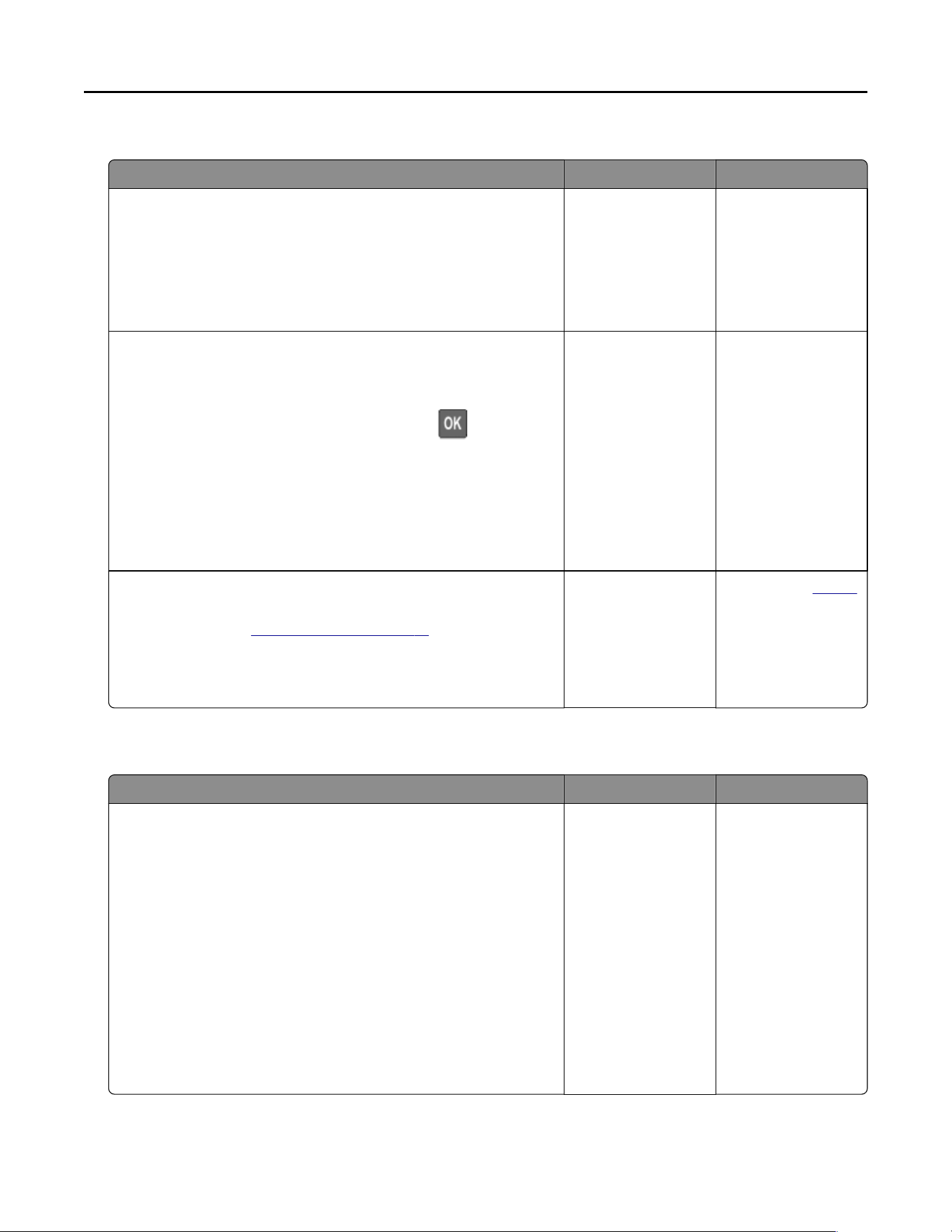
Tray linking does not work
Action Yes No
Step 1
a Check if the trays contain the same paper size and paper type.
b Check if the paper guides are positioned correctly.
c Print the document.
Do the trays link correctly?
The problem is
solved.
Go to step 2.
Step 2
a From the control panel, navigate to:
Settings > Paper > Tray Configuration > Paper Size/Type
For non‑touch‑screen printer models, press to navigate
through the settings.
b Set the paper size and paper type to match the paper loaded
in the linked trays.
c Print the document.
Do the trays link correctly?
The problem is
solved.
Go to step 3.
Step 3
a Make sure that Tray Linking is set to Automatic. For more
information, see “Linking trays” on page 21.
b Print the document.
Do the trays link correctly?
The problem is
solved.
Contact your dealer.
Paper frequently jams
Action Yes No
Step 1
a Remove the tray.
b Check if paper is loaded correctly.
Notes:
• Make sure that the paper guides are positioned correctly.
• Make sure that the stack height is below the maximum
paper fill indicator.
• Make sure to print on recommended paper size and type.
c Insert the tray.
d Print the document.
Do paper jams occur frequently?
Go to step 2. The problem is
solved.
Troubleshooting 107
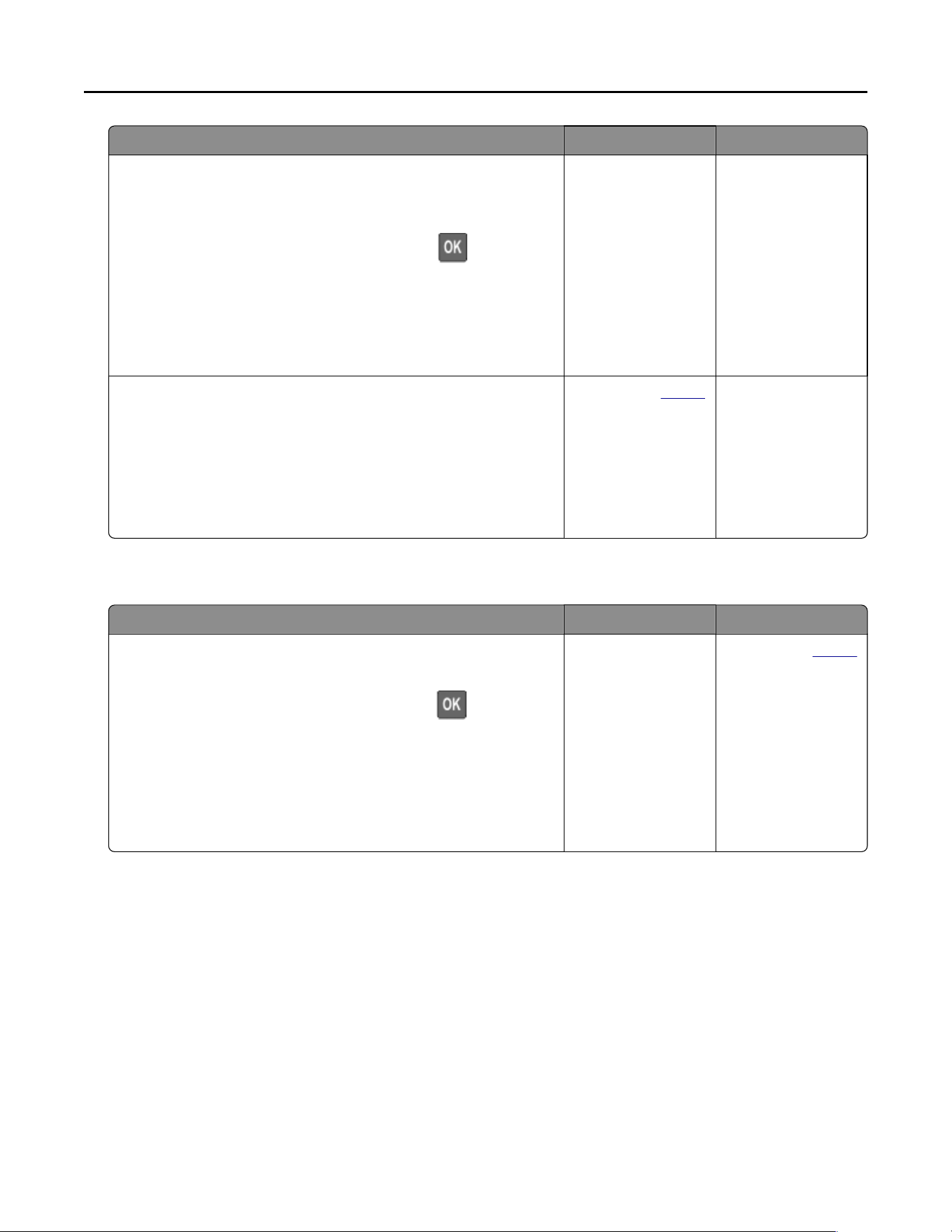
Action Yes No
Step 2
a From the control panel, navigate to:
Settings > Paper > Tray Configuration > Paper Size/Type
For non‑touch‑screen printer models, press to navigate
through the settings.
b Set the correct paper size and type.
c Print the document.
Do paper jams occur frequently?
Go to step 3. The problem is
solved.
Step 3
a Load paper from a fresh package.
Note: Paper absorbs moisture due to high humidity. Store
paper in its original wrapper until you are ready to use it.
b Print the document.
Do paper jams occur frequently?
Contact your dealer. The problem is
solved.
Jammed pages are not reprinted
Action Yes No
a From the control panel, navigate to:
Settings > Device > Notifications > Jam Content Recovery
For non-touch-screen printer models, press to navigate
through the settings.
b In the Jam Recovery menu, select On or Auto, and then apply
the changes.
c Print the document.
Are the jammed pages reprinted?
The problem is
solved.
Contact your
dealer.
Troubleshooting 108
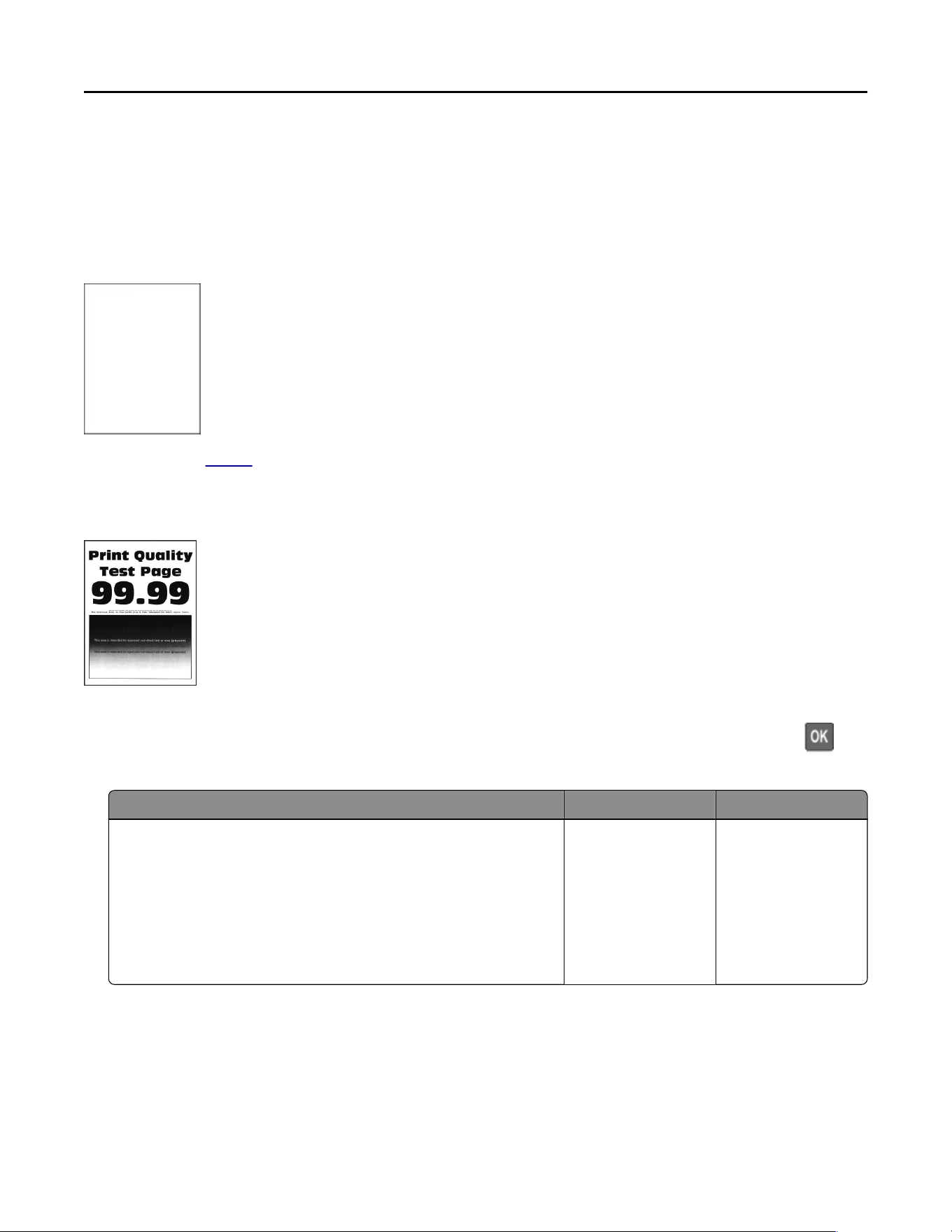
Printing problems
Print quality is poor
Blank or white pages
Contact your dealer.
Dark print
Note: Before solving the problem, print the Print Quality Test Pages. From the control panel, navigate to
Settings > Troubleshooting > Print Quality Test Pages. For non-touch-screen printer models, press to
navigate through the settings.
Action Yes No
Step 1
a Perform Color Adjust.
From the control panel, navigate to:
Settings > Print > Quality > Advanced Imaging > Color Adjust
b Print the document.
Is the print too dark?
Go to step 2. The problem is
solved.
Troubleshooting 109

Action Yes No
Step 2
a Depending on your operating system, reduce toner darkness
from the Printing Preferences or Print dialog.
Note: You can also change the setting on the printer control
panel. Navigate to Settings >
Print > Quality > Toner
Darkness.
b Print the document.
Is the print too dark?
Go to step 3. The problem is
solved.
Step 3
a Depending on your operating system, specify the paper type
from the Printing Preferences or Print dialog.
Notes:
• Make sure that the setting matches the paper loaded.
• You can also change the setting on the printer control
panel. Navigate to Settings > Paper > Tray Configuration
> Paper Size/Type.
b Print the document.
Is the print too dark?
Go to step 4. The problem is
solved.
Step 4
Check if the paper has texture or rough finishes.
Are you printing on textured or rough paper?
Go to step 5. Go to step 6.
Step 5
a Replace textured or rough paper with plain paper.
b Print the document.
Is the print too dark?
Go to step 6. The problem is
solved.
Step 6
a Load paper from a fresh package.
Note: Paper absorbs moisture due to high humidity. Store
paper in its original wrapper until you are ready to use it.
b Print the document.
Is the print too dark?
Contact your dealer. The problem is
solved.
Troubleshooting 110
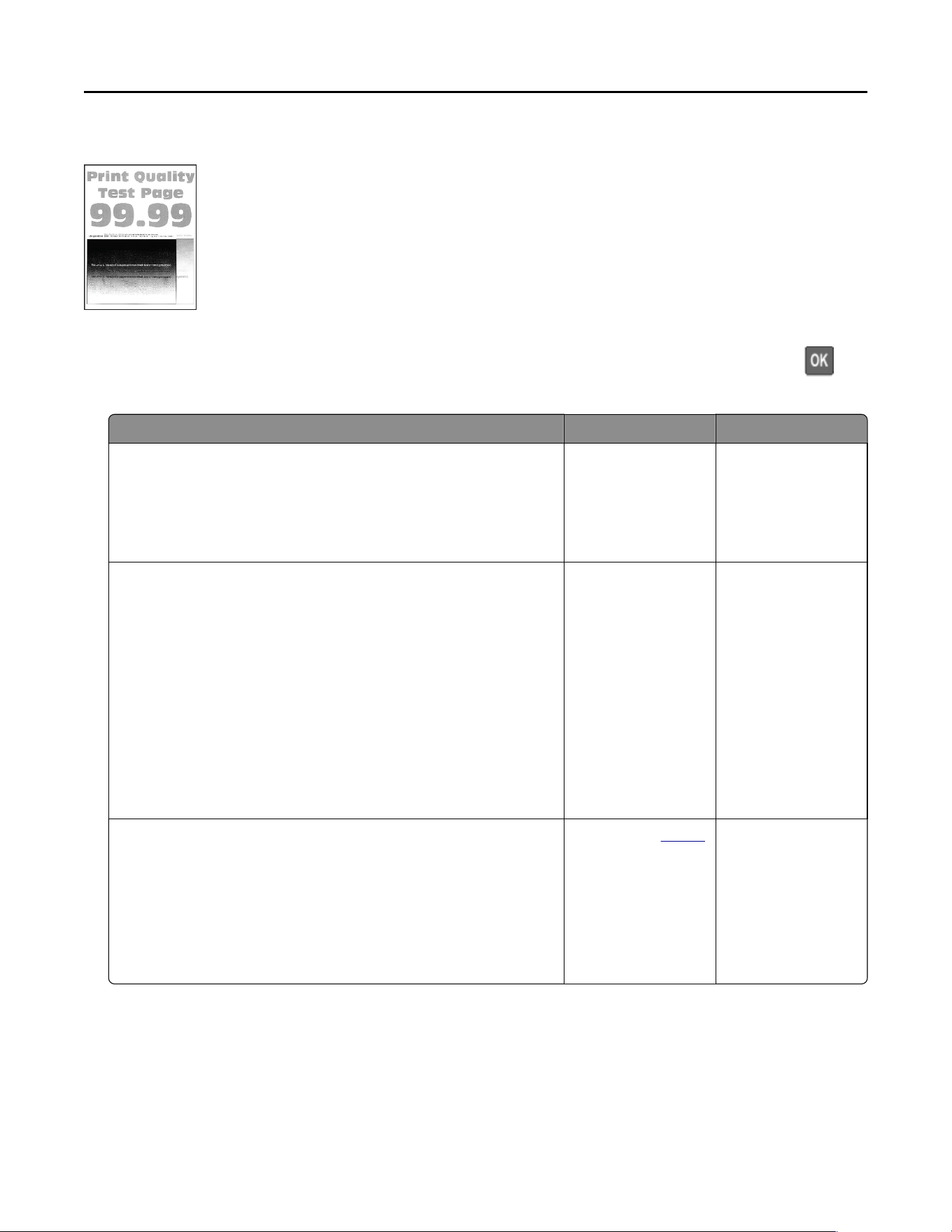
Ghost images
Note: Before solving the problem, print the Print Quality Test Pages. From the control panel, navigate to
Settings > Troubleshooting > Print Quality Test Pages. For non-touch-screen printer models, press to
navigate through the settings.
Action Yes No
Step 1
a Load the tray with the correct paper type.
b Print the document.
Do ghost images appear on prints?
Go to step 2. The problem is
solved.
Step 2
a Depending on your operating system, specify the paper type
from the Printing Preferences or Print dialog.
Notes:
• Make sure that the setting matches the paper loaded.
• You can also change the setting on the printer control
panel. Navigate to Settings > Paper > Tray Configuration
> Paper Size/Type.
b Print the document.
Do ghost images appear on prints?
Go to step 3. The problem is
solved.
Step 3
a Perform Color Adjust.
From the control panel, navigate to:
Settings > Print > Quality > Advanced Imaging > Color Adjust
b Print the document.
Do ghost images appear on prints?
Contact your
dealer. The problem is
solved.
Troubleshooting 111
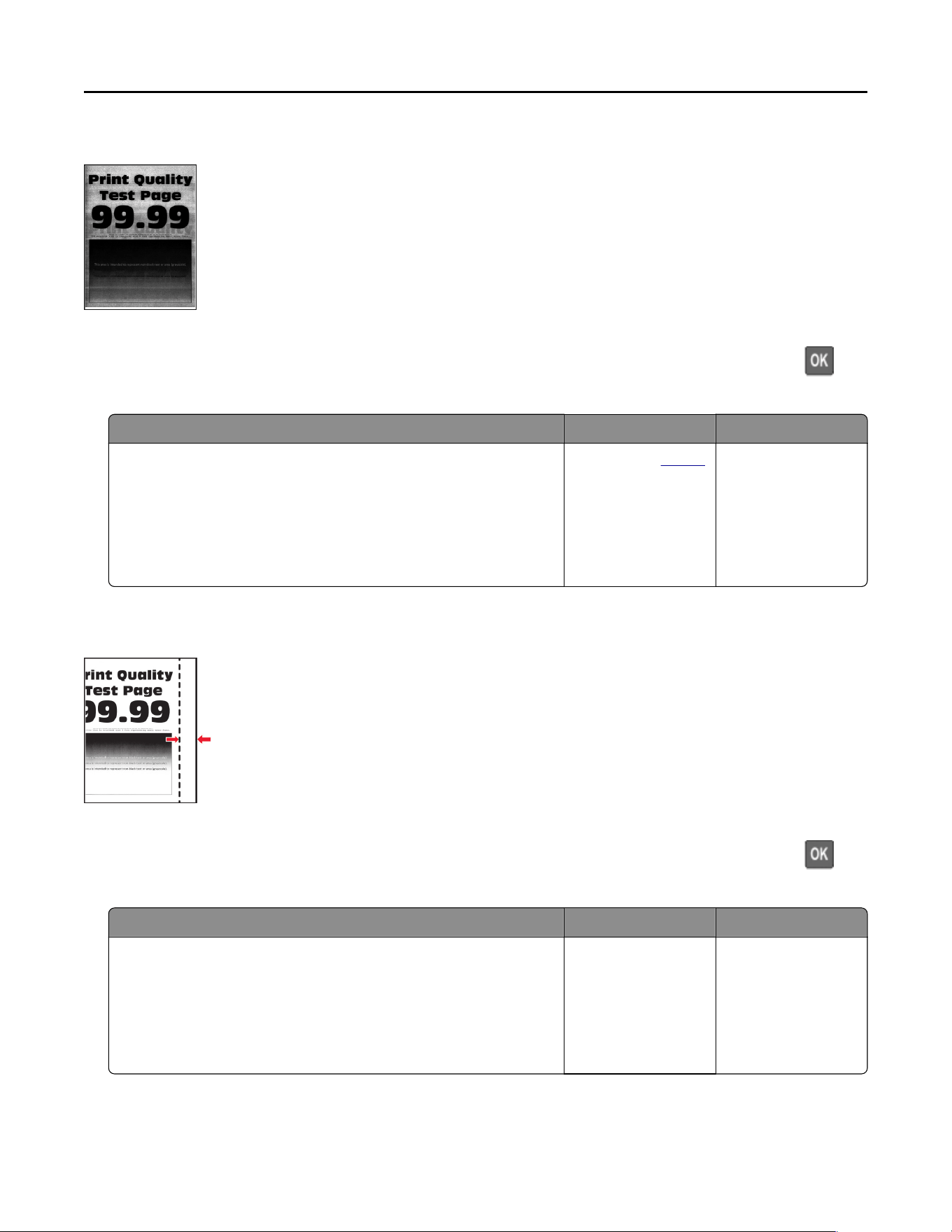
Gray or colored background
Note: Before solving the problem, print the Print Quality Test Pages. From the control panel, navigate to
Settings > Troubleshooting > Print Quality Test Pages. For non-touch-screen printer models, press to
navigate through the settings.
Action Yes No
a Perform Color Adjust.
From the control panel, navigate to:
Settings > Print > Quality > Advanced Imaging > Color Adjust
b Print the document.
Does gray or colored background appear on prints?
Contact your dealer. The problem is
solved.
Incorrect margins
Note: Before solving the problem, print the Print Quality Test Pages. From the control panel, navigate to
Settings > Troubleshooting > Print Quality Test Pages. For non-touch-screen printer models, press to
navigate through the settings.
Action Yes No
Step 1
a Adjust the paper guides to the correct position for the paper
loaded.
b Print the document.
Are the margins correct?
The problem is
solved.
Go to step 2.
Troubleshooting 112
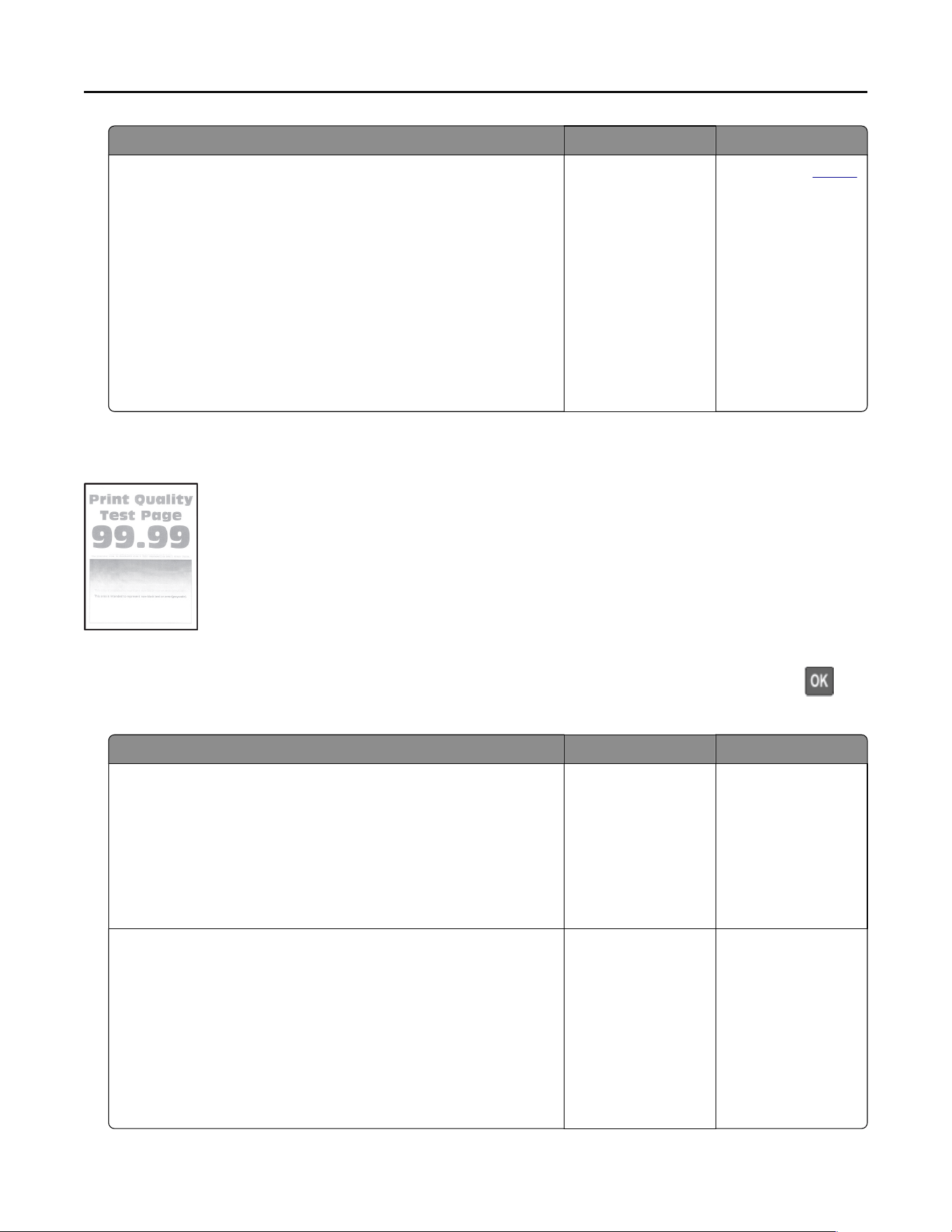
Action Yes No
Step 2
a Depending on your operating system, specify the paper size
from the Printing Preferences or Print dialog.
Notes:
• Make sure that the setting matches the paper loaded.
• You can also change the setting from the printer control
panel. Navigate to Settings > Paper
> Tray Configuration
>
Paper Size/Type.
b Print the document.
Are the margins correct?
The problem is
solved.
Contact your dealer.
Light print
Note: Before solving the problem, print the Print Quality Test Pages. From the control panel, navigate to
Settings > Troubleshooting > Print Quality Test Pages. For non-touch-screen printer models, press to
navigate through the settings.
Action Yes No
Step 1
a Perform Color Adjust.
From the control panel, navigate to:
Settings > Print > Quality > Advanced Imaging > Color Adjust
b Print the document.
Is the print light?
Go to step 2. The problem is
solved.
Step 2
a Depending on your operating system, increase toner darkness
from the Printing Preferences or Print dialog.
Note: You can also change the setting on the printer control
panel. Navigate to Settings > Print > Quality > Toner
Darkness.
b Print the document.
Is the print light?
Go to step 3. The problem is
solved.
Troubleshooting 113
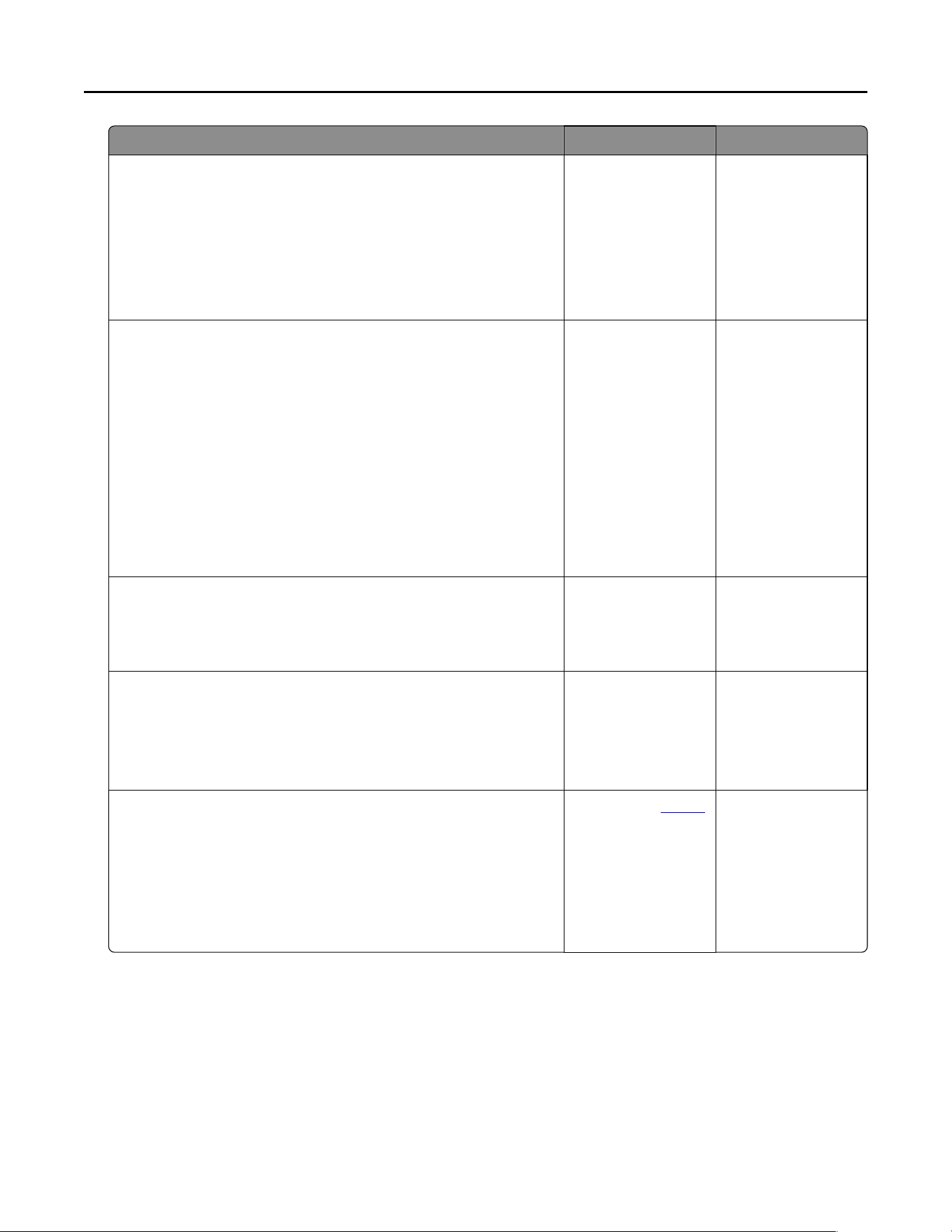
Action Yes No
Step 3
a Turn off Color Saver.
From the control panel, navigate to:
Settings > Print > Quality >
Color Saver
b Print the document.
Is the print light?
Go to step 4. The problem is
solved.
Step 4
a Depending on your operating system, specify the paper type
from the Printing Preferences or Print dialog.
Notes:
• Make sure that the setting matches the paper loaded.
• You can also change the setting on the printer control
panel. Navigate to Settings
> Paper > Tray Configuration
>
Paper Size/Type.
b Print the document.
Is the print light?
Go to step 5. The problem is
solved.
Step 5
Check if paper has texture or rough finishes.
Are you printing on textured or rough paper?
Go to step 6. Go to step 7.
Step 6
a Replace textured or rough paper with plain paper.
b Print the document.
Is the print light?
Go to step 7. The problem is
solved.
Step 7
a Load paper from a fresh package.
Note: Paper absorbs moisture due to high humidity. Store
paper in its original wrapper until you are ready to use it.
b Print the document.
Is the print light?
Contact your dealer. The problem is
solved.
Troubleshooting 114
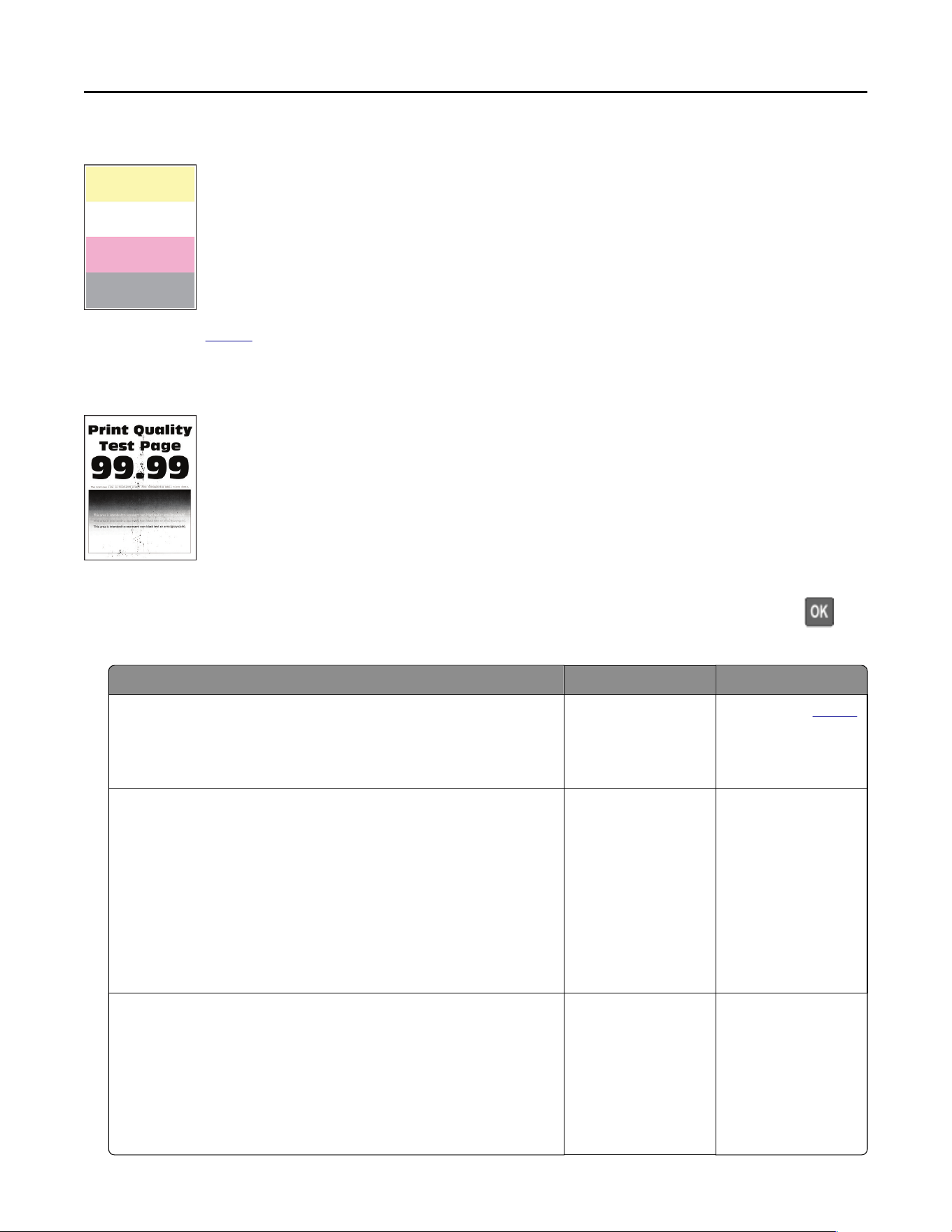
Missing colors
Contact your dealer.
Mottled print and dots
Note: Before solving the problem, print the Print Quality Test Pages. From the control panel, navigate to
Settings > Troubleshooting > Print Quality Test Pages. For non-touch-screen printer models, press to
navigate through the settings.
Action Yes No
Step 1
Check the printer for leaked toner contamination.
Is the printer free of leaked toner?
Go to step 2. Contact your dealer.
Step 2
a From the control panel, navigate to:
Settings > Paper > Tray Configuration > Paper Size/Type
b Check if the paper size and paper type settings match the
paper loaded.
Note: Make sure that paper does not have texture or rough
finishes.
Do the settings match?
Go to step 4. Go to step 3.
Step 3
a Depending on your operating system, specify the paper size
and paper type from the Printing Preferences or Print dialog.
Note: Make sure that the settings match the paper loaded.
b Print the document.
Is the print mottled?
Go to step 4. The problem is
solved.
Troubleshooting 115
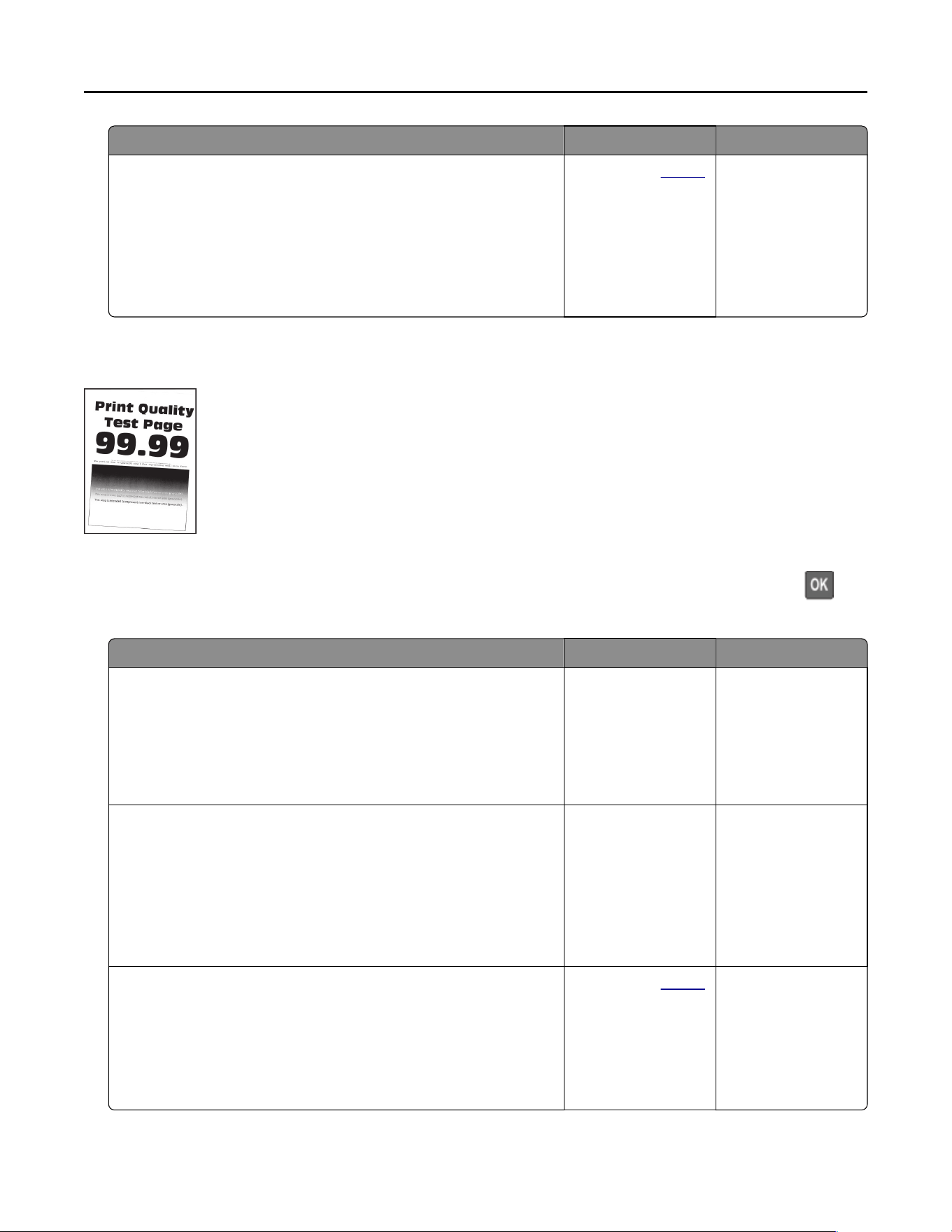
Action Yes No
Step 4
a Load paper from a fresh package.
Note: Paper absorbs moisture due to high humidity. Store
paper in its original wrapper until you are ready to use it.
b Print the document.
Is the print mottled?
Contact your dealer. The problem is
solved.
Print crooked or skewed
Note: Before solving the problem, print the Print Quality Test Pages. From the control panel, navigate to
Settings > Troubleshooting > Print Quality Test Pages. For non-touch-screen printer models, press to
navigate through the settings.
Action Yes No
Step 1
a Adjust the paper guides in the tray to the correct position for
the paper loaded.
b Print the document.
Is the print crooked or skewed?
Go to step 2. The problem is
solved.
Step 2
a Load paper from a fresh package.
Note: Paper absorbs moisture due to high humidity. Store
paper in its original wrapper until you are ready to use it.
b Print the document.
Is the print crooked or skewed?
Go to step 3. The problem is
solved.
Step 3
a Check if the paper loaded is supported.
Note: If paper is not supported, then load a supported paper.
b Print the document.
Is the print crooked or skewed?
Contact your
dealer. The problem is
solved.
Troubleshooting 116
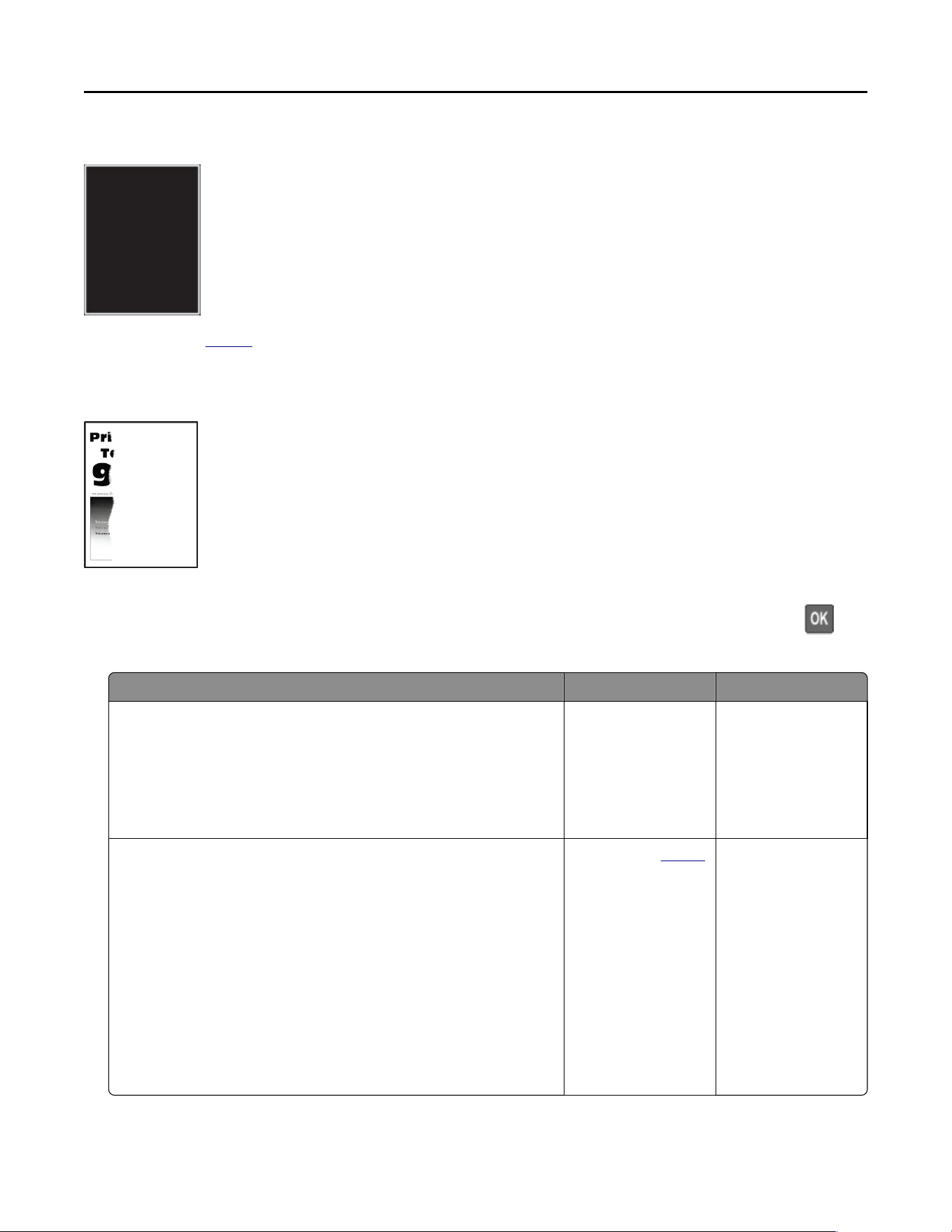
Solid color or black images
Contact your dealer.
Text or images cut off
Note: Before solving the problem, print the Print Quality Test Pages. From the control panel, navigate to
Settings > Troubleshooting > Print Quality Test Pages. For non-touch-screen printer models, press to
navigate through the settings.
Action Yes No
Step 1
a Adjust the paper guides in the tray to the correct position for
the paper loaded.
b Print the document.
Are text or images cut off?
Go to step 2. The problem is
solved.
Step 2
a Depending on your operating system, specify the paper size
from the Printing Preferences or Print dialog.
Notes:
• Make sure that the setting matches the paper loaded.
• You can also change the setting on the printer control
panel. Navigate to Settings > Paper > Tray Configuration
> Paper Size/Type.
b Print the document.
Are text or images cut off?
Contact your
dealer. The problem is
solved.
Troubleshooting 117
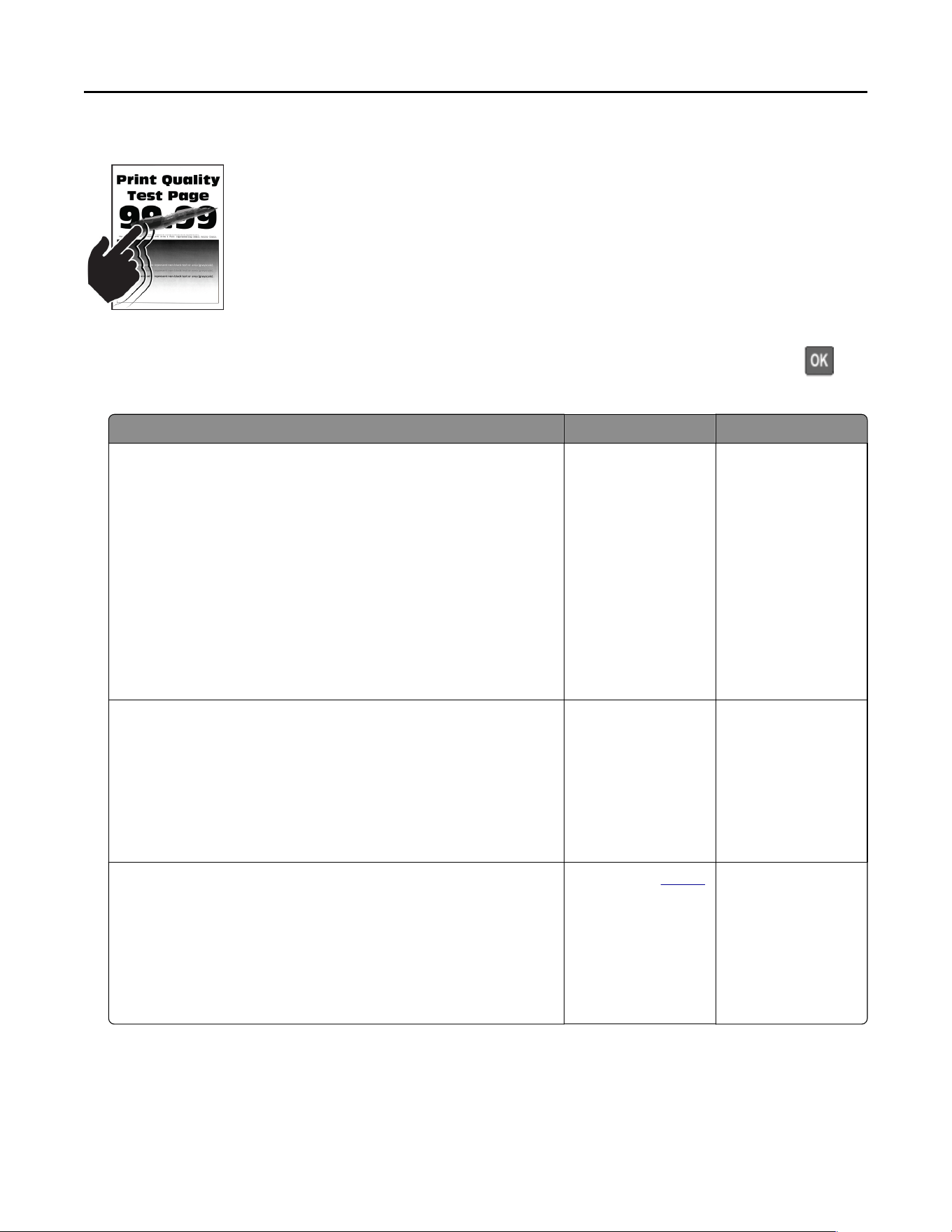
Toner easily rubs off
Note: Before solving the problem, print the Print Quality Test Pages. From the control panel, navigate to
Settings > Troubleshooting > Print Quality Test Pages. For non-touch-screen printer models, press to
navigate through the settings.
Action Yes No
Step 1
a Depending on your operating system, specify the paper type
from the Printing Preferences or Print dialog.
Notes:
• Make sure that the setting matches the paper loaded.
• You can also change the setting on the printer control
panel. Navigate to Settings > Paper > Tray Configuration
> Paper Size/Type.
b Print the document.
Does toner easily rub off?
Go to step 2. The problem is
solved.
Step 2
a Check if the paper weight is supported.
Note: If paper weight is not supported, then load a supported
one.
b Print the document.
Does toner easily rub off?
Go to step 3. The problem is
solved.
Step 3
a Load paper from a fresh package.
Note: Paper absorbs moisture due to high humidity. Store
paper in its original wrapper until you are ready to use it.
b Print the document.
Does toner easily rub off?
Contact your
dealer. The problem is
solved.
Troubleshooting 118
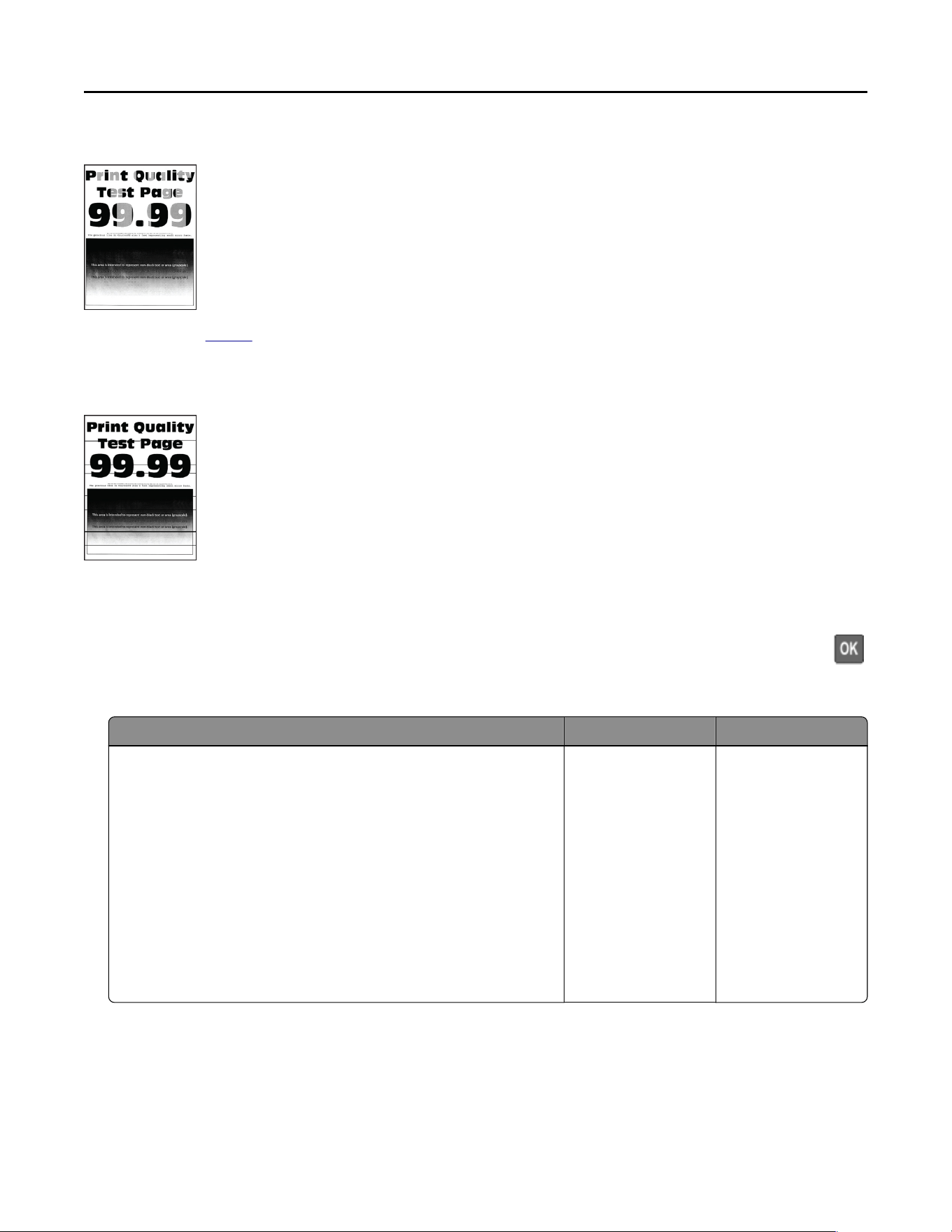
Uneven print density
Contact your dealer.
Horizontal dark lines
Notes:
• Before solving the problem, print the Print Quality Test Pages. From the control panel, navigate to
Settings > Troubleshooting > Print Quality Test Pages. For non-touch-screen printer models, press
to navigate through the settings.
• If horizontal dark lines keep appearing on the prints, then see the “Repeating defects” topic.
Action Yes No
Step 1
a Depending on your operating system, specify the paper type
from the Printing Preferences or Print dialog.
Notes:
• Make sure that the setting matches the paper loaded.
• You can also change the setting on the printer control
panel. Navigate to Settings > Paper > Tray Configuration
> Paper Size/Type.
b Print the document.
Do dark lines appear on prints?
Go to step 2. The problem is
solved.
Troubleshooting 119
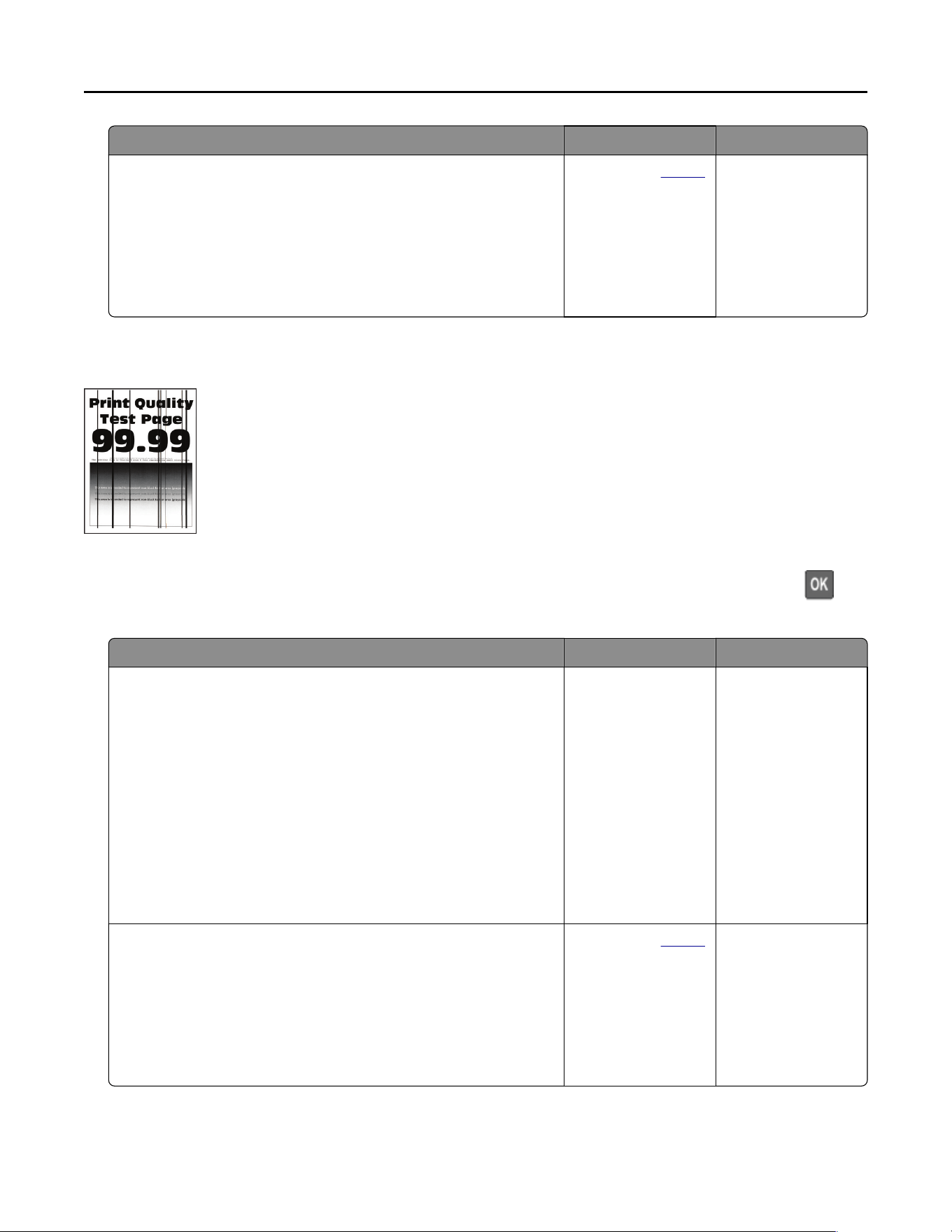
Action Yes No
Step 2
a Load paper from a fresh package.
Note: Paper absorbs moisture due to high humidity. Store
paper in its original wrapper until you use it.
b Print the document.
Do dark lines appear on prints?
Contact your dealer.
s
The problem is
solved.
Vertical dark lines
Note: Before solving the problem, print the Print Quality Test Pages. From the control panel, navigate to
Settings > Troubleshooting > Print Quality Test Pages. For non-touch-screen printer models, press to
navigate through the settings.
Action Yes No
Step 1
a Depending on your operating system, specify the paper type
from the Printing Preferences or Print dialog.
Notes:
• Make sure that the setting matches the paper loaded.
• You can also change the setting on the printer control
panel. Navigate to Settings > Paper > Tray Configuration
> Paper Size/Type.
b Print the document.
Do vertical dark lines appear on prints?
Go to step 2. The problem is
solved.
Step 2
a Load paper from a fresh package.
Note: Paper absorbs moisture due to high humidity. Store
paper in its original wrapper until you use it.
b Print the document.
Do vertical dark lines appear on prints?
Contact your
dealer. The problem is
solved.
Troubleshooting 120
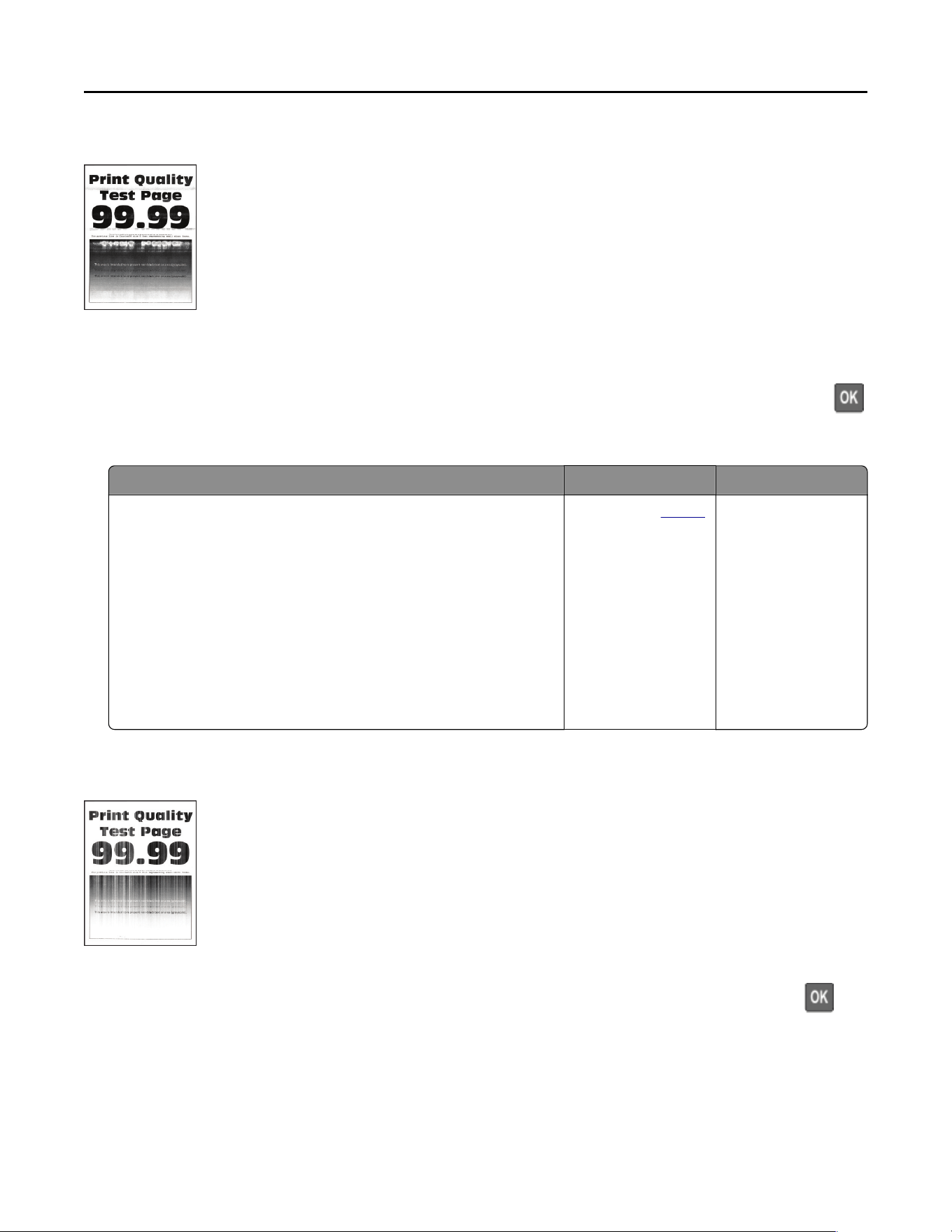
Horizontal white lines
Notes:
• Before solving the problem, print the Print Quality Test Pages. From the control panel, navigate to
Settings > Troubleshooting > Print Quality Test Pages. For non-touch-screen printer models, press
to navigate through the settings.
• If horizontal white lines keep appearing on your prints, then see the “Repeating defects” topic.
Action Yes No
a Depending on your operating system, specify the paper type
from the Printing Preferences or Print dialog.
Notes:
• Make sure that the setting matches the paper loaded.
• You can also change the setting on the printer control
panel. Navigate to Settings >
Paper > Tray Configuration
>
Paper Size/Type.
b Print the document.
Do horizontal white lines appear on prints?
Contact your
dealer. The problem is
solved.
Vertical white lines
Note: Before solving the problem, print the Print Quality Test Pages. From the control panel, navigate to
Settings > Troubleshooting > Print Quality Test Pages. For non-touch-screen printer models, press to
navigate through the settings.
Troubleshooting 121
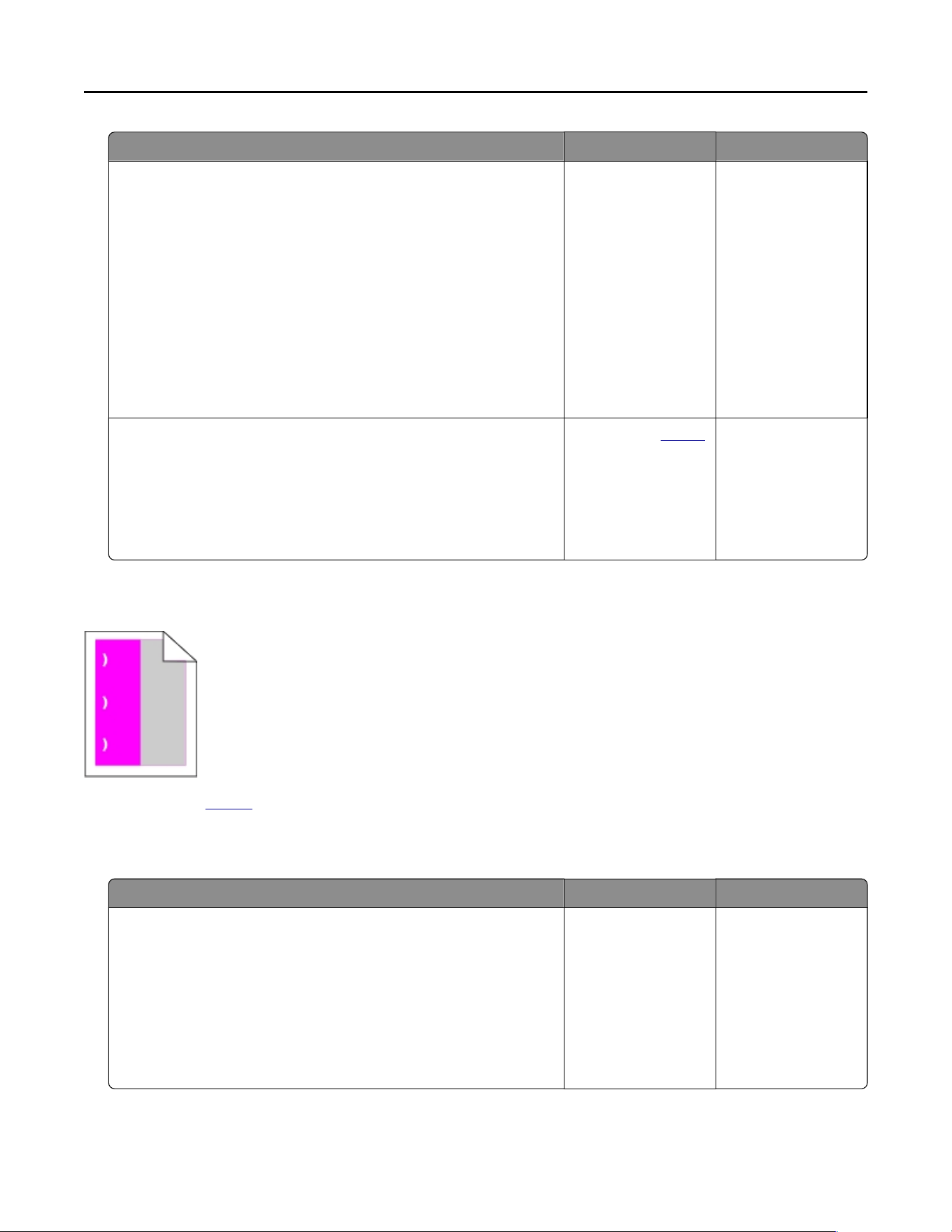
Action Yes No
Step 1
a Depending on your operating system, specify the paper type
from the Printing Preferences or Print dialog.
Notes:
• Make sure that the setting matches the paper loaded.
• You can also change the setting on the printer control
panel. Navigate to Settings > Paper > Tray Configuration
> Paper Size/Type.
b Print the document.
Do vertical white lines appear on prints?
Go to step 2. The problem is
solved.
Step 2
Check if you are using the recommended paper type.
a Load the paper source with the recommended paper type.
b Print the document.
Do vertical white lines appear on prints?
Contact your
dealer. The problem is
solved.
Repeating defects
Contact your dealer.
Confidential and other held documents do not print
Action Yes No
Step 1
a From the control panel, check if the documents appear in the
Held Jobs list.
Note: If the documents are not listed, then print the
documents using the Print and Hold options.
b Print the documents.
Are the documents printed?
The problem is
solved.
Go to step 2.
Troubleshooting 122
Action Yes No
Step 2
The print job may contain a formatting error or invalid data.
• Delete the print job, and then send it again.
• For PDF files, generate a new file, and then print the
documents.
Are the documents printed?
The problem is
solved.
Go to step 3.
Step 3
If you are printing from the Internet, then the printer may be reading
the multiple job titles as duplicates.
a Open the Printing Preferences dialog.
b From the Print and Hold tab, click Use Print and Hold, and then
click Keep duplicate documents.
c From the Confidential Print section, enter a PIN.
d Print the documents.
Are the documents printed?
The problem is
solved.
Go to step 4.
Step 4
a Delete some held jobs to free up printer memory.
b Print the documents.
Are the documents printed?
The problem is
solved.
Contact your
dealer.
Slow printing
Action Yes No
Step 1
Make sure that the printer cable is securely connected to the
printer and to the computer, print server, option, or other network
device.
Is the printer printing slow?
Go to step 2. The problem is
solved.
Step 2
a Make sure that the printer is not in Quiet Mode.
From the control panel, navigate to:
Settings > Device > Maintenance > Configuration Menu >
Device Operations > Quiet Mode
For non‑touch‑screen printer models, press to navigate
through the settings.
b Print the document.
Is the printer printing slow?
Go to step 3. The problem is
solved.
Troubleshooting 123

Action Yes No
Step 3
a Depending on your operating system, specify the print
resolution from the Printing Preferences or Print dialog.
b Set the resolution to 4800 CQ.
c Print the document.
Is the printer printing slow?
Go to step 4. The problem is
solved.
Step 4
a From the control panel, navigate to:
Settings > Print > Quality > Print Resolution
b Set the resolution to 4800 CQ.
c Print the document.
Is the printer printing slow?
Go to step 5. The problem is
solved.
Step 5
a Depending on your operating system, specify the paper type
from the Printing Preferences or Print dialog.
Notes:
• Make sure that the setting matches the paper loaded.
• You can also change the setting on the printer control
panel. Navigate to Settings
> Paper > Tray Configuration
>
Paper Size/Type.
• Heavier paper prints more slowly.
• Paper narrower than letter, A4, and legal may print more
slowly.
b Print the document.
Is the printer printing slow?
Go to step 6. The problem is
solved.
Step 6
a Make sure that the printer settings for Media Texture and Media
Weight match the paper being loaded.
From the control panel, navigate to:
Settings > Paper > Media Configuration > Media Types
Note: Rough paper texture and heavy paper weight may print
more slowly.
b Print the document.
Is the printer printing slow?
Go to step 7. The problem is
solved.
Step 7
Remove held jobs.
Is the printer printing slow?
Go to step 8. The problem is
solved.
Troubleshooting 124
Action Yes No
Step 8
a Make sure that the printer is not overheating.
Notes:
• Allow the printer to cool down after a long print job.
• Observe the recommended ambient temperature for the
printer. For more information, see “Selecting a location
for the printer” on page 8.
b Print the document.
Is the printer printing slow?
Contact your dealer. The problem is
solved.
Print jobs do not print
Action Yes No
Step 1
a From the document you are trying to print, open the Print
dialog, and then check if you have selected the correct printer.
b Print the document.
Is the document printed?
The problem is
solved.
Go to step 2.
Step 2
a Check if the printer is on.
b Resolve any error messages that appear on the display.
c Print the document.
Is the document printed?
The problem is
solved.
Go to step 3.
Step 3
a Check if the ports are working and if the cables are securely
connected to the computer and the printer.
For more information, see the setup documentation that came
with the printer.
b Print the document.
Is the document printed?
The problem is
solved.
Go to step 4.
Step 4
a Turn off the printer, wait for about 10 seconds, and then turn on
the printer.
b Print the document.
Is the document printed?
The problem is
solved.
Go to step 5.
Troubleshooting 125
Action Yes No
Step 5
a Remove, and then reinstall the print driver.
b Print the document.
Is the document printed?
The problem is
solved.
Contact your dealer.
The printer is not responding
Action Yes No
Step 1
Check if the power cord is connected to the electrical outlet.
CAUTION—POTENTIAL INJURY: To avoid the risk of fire or
electrical shock, connect the power cord to an appropriately
rated and properly grounded electrical outlet that is near the
product and easily accessible.
Is the printer responding?
The problem is
solved.
Go to step 2.
Step 2
Check if the electrical outlet is turned off by a switch or breaker.
Is the electrical outlet turned off by a switch or breaker?
Turn on the switch or
reset the breaker.
Go to step 3.
Step 3
Check if the printer is on.
Is the printer on?
Go to step 4. Turn on the printer.
Step 4
Check if the printer is in Sleep or Hibernate mode.
Is the printer in Sleep or Hibernate mode?
Press the power
button to wake the
printer.
Go to step 5.
Step 5
Check if the cables connecting the printer and the computer are
inserted to the correct ports.
Are the cables inserted to the correct ports?
Go to step 6. Insert the cables to
the correct ports.
Step 6
Install the correct print driver.
Is the printer responding?
The problem is
solved.
Go to step 7.
Troubleshooting 126
Action Yes No
Step 7
Turn off the printer, wait for about 10 seconds, and then turn on the
printer.
Is the printer responding?
The problem is
solved.
Contact your dealer.
Job prints from the wrong tray or on the wrong paper
Action Yes No
Step 1
a Check if you are printing on the correct paper.
b Print the document.
Is the document printed on the correct paper?
Go to step 2. Load the correct
paper size and paper
type.
Step 2
a Depending on your operating system, specify the paper size
and paper type from the Printing Preferences or Print dialog.
Note: You can also change the settings on the printer control
panel. Navigate to:
Settings > Paper > Tray Configuration
>
Paper Size/Type
For non‑touch‑screen printer models, press to navigate
through the settings.
b Make sure that the settings match the paper loaded.
c Print the document.
Is the document printed on the correct paper?
The problem is
solved.
Go to step 3.
Step 3
a Check if the trays are linked.
For more information, see “Linking trays” on page 21.
b Print the document.
Is the document printed from the correct tray?
The problem is
solved.
Contact your
dealer.
Troubleshooting 127
Color quality problems
Adjusting toner darkness
1 From the control panel, navigate to:
Settings > Print > Quality > Toner Darkness
For non-touch-screen printer models, press to navigate through the settings.
2 Adjust the setting.
3 Apply the changes.
Modifying the colors in printed output
For non-touch-screen printer models, press
to navigate through the settings.
1 From the control panel, navigate to:
Settings > Print > Quality > Advanced Imaging > Color Correction
2 From the Color Correction menu, select Manual > Color Correction Content.
3 Choose the appropriate color conversion setting.
Object type Color conversion tables
RGB Image
RGB Text
RGB Graphics
• Vivid—Produces brighter, more saturated colors and may be
applied to all incoming color formats.
• sRGB Display—Produces an output that approximates the colors
displayed on a computer monitor. Black toner usage is optimized
for printing photographs.
• Display‑True Black—Produces an output that approximates the
colors displayed on a computer monitor. This setting uses only
black toner to create all levels of neutral gray.
• sRGB Vivid—Provides an increased color saturation for the sRGB
Display color correction. Black toner usage is optimized for
printing business graphics.
• Off
CMYK Image
CMYK Text
CMYK Graphics
• US CMYK—Applies color correction to approximate the
Specifications for Web Offset Publishing (SWOP) color output.
• Euro CMYK—Applies color correction to approximate Euroscale
color output.
• Vivid CMYK—Increases the color saturation of the US CMYK color
correction setting.
• Off
Troubleshooting 128

FAQ about color printing
What is RGB color?
RGB color is a method of describing colors by indicating the amount of red, green, or blue used to produce
a certain color. Red, green, and blue light can be added in various amounts to produce a large range of colors
observed in nature. Computer screens, scanners, and digital cameras use this method to display colors.
What is CMYK color?
CMYK color is a method of describing colors by indicating the amount of cyan, magenta, yellow, and black
used to reproduce a particular color. Cyan, magenta, yellow, and black inks or toners can be printed in various
amounts to produce a large range of colors observed in nature. Printing presses, inkjet printers, and color
laser printers create colors in this manner.
How is color specified in a document to be printed?
Software programs are used to specify and modify the document color using RGB or CMYK color
combinations. For more information, see the software program Help topics.
How does the printer know what color to print?
When printing a document, information describing the type and color of each object is sent to the printer and
is passed through color conversion tables. Color is translated into the appropriate amounts of cyan, magenta,
yellow, and black toner used to produce the color you want. The object information determines the
application of color conversion tables. For example, it is possible to apply one type of color conversion table
to text while applying a different color conversion table to photographic images.
What is manual color correction?
When manual color correction is enabled, the printer employs user‑selected color conversion tables to
process objects. Manual color correction settings are specific to the type of object being printed (text,
graphics, or images). It is also specific to how the color of the object is specified in the software program
(RGB or CMYK combinations). To apply a different color conversion table manually, see “Modifying the colors
in printed output” on page 128.
If the software program does not specify colors with RGB or CMYK combinations, then manual color correction
is not useful. It is also not effective if the software program or the computer operating system controls the
adjustment of colors. In most situations, setting the Color Correction to Auto generates preferred colors for
the documents.
How can I match a particular color (such as a corporate logo)?
From the printer Quality menu, nine types of Color Samples sets are available. These sets are also available
from the Color Samples page of the Embedded Web Server. Selecting any sample set generates
multiple‑page prints consisting of hundreds of colored boxes. Each box contains a CMYK or RGB combination,
depending on the table selected. The observed color of each box is obtained by passing the CMYK or RGB
combination labeled on the box through the selected color conversion table.
By examining Color Samples sets, you can identify the box with color closest to the color being matched.
The color combination labeled on the box can then be used for modifying the color of the object in a software
program. For more information, see the software program Help topics. Manual color correction may be
necessary to use the selected color conversion table for the particular object.
Selecting which Color Samples set to use for a particular color‑matching problem depends on:
• The Color Correction setting being used (Auto, Off, or Manual)
• The type of object being printed (text, graphics, or images)
• How the color of the object is specified in the software program (RGB or CMYK combinations)
Troubleshooting 129
If the software program does not specify colors with RGB or CMYK combinations, then the Color Samples
pages are not useful. Additionally, some software programs adjust the RGB or CMYK combinations specified
in the program through color management. In these situations, the printed color may not be an exact match
of the Color Samples pages.
The print appears tinted
Action Yes No
Step 1
Perform Color Adjust.
a From the control panel, navigate to:
Settings > Print > Quality > Advanced Imaging > Color Adjust
For non-touch-screen printer models, press to navigate
through the settings.
b Print the document.
Does the print appear tinted?
Go to step 2. The problem is
solved.
Step 2
a From the control panel, navigate to:
Settings > Print > Quality > Advanced Imaging > Color
Balance
For non-touch-screen printer models, press to navigate
through the settings.
b Adjust the settings.
c Print the document.
Does the print appear tinted?
Contact your
dealer. The problem is
solved.
Contacting your dealer
Before contacting your dealer, make sure to have the following information:
• Printer problem
• Error message
• Printer model type and serial number
Visit the place where you purchased your printer.
Troubleshooting 130

Notices
Product information
Product name:
DIGITAL FULL COLOR PRINTER
MX-C407P
Machine type:
5029
Model(s):
696
Edition notice
May 2020
The following paragraph does not apply to any country where such provisions are inconsistent with local
law: THIS PUBLICATION IS PROVIDED “AS IS” WITHOUT WARRANTY OF ANY KIND, EITHER EXPRESS OR
IMPLIED, INCLUDING, BUT NOT LIMITED TO, THE IMPLIED WARRANTIES OF MERCHANTABILITY OR FITNESS
FOR A PARTICULAR PURPOSE. Some states do not allow disclaimer of express or implied warranties in certain
transactions; therefore, this statement may not apply to you.
This publication could include technical inaccuracies or typographical errors. Changes are periodically made
to the information herein; these changes will be incorporated in later editions. Improvements or changes in the
products or the programs described may be made at any time.
GOVERNMENT END USERS
The Software Program and any related documentation are "Commercial Items," as that term is defined in 48
C.
F.R. 2.101, "Computer Software" and "Commercial Computer Software Documentation," as such terms are
used in 48 C.F.R. 12.212 or 48 C.F.R. 227.7202, as applicable. Consistent with 48 C.F.R. 12.212 or 48 C.F.R.
227.7202-1 through 227.7207-4, as applicable, the Commercial Computer Software and Commercial Software
Documentation are licensed to the U.S. Government end users (a) only as Commercial Items and (b) with only
those rights as are granted to all other end users pursuant to the terms and conditions herein.
Supplies
Standard supplies for this product that can be replaced by the user include toner cartridges.
Be sure to use only SHARP-specified products for the toner cartridges.
Notices 131
GENUINE SUPPLIES
For best copying results, be sure to use only Sharp Genuine Supplies which are designed,
engineered, and tested to maximize the life and performance of Sharp products. Look for the
Genuine Supplies label on the toner package.
Hot surface notice
此符號表示該表面或元件會發熱。
請當心:為避免被發熱表面或元件燙傷的危險,請先讓該表面或元件冷卻之後再觸摸。
Hinweis zum GS-Zeichen
Modell 696
Gerätetyp 5029
Noise emission levels
The following measurements were made in accordance with ISO 7779 and reported in conformance with ISO
9296.
Note: Some modes may not apply to your product.
1-meter average sound pressure, dBA
Printing Two-sided, mono: 52
Two-sided, color: 53
One-sided, mono: 50
One-sided, color: 51
Ready 15
Waste from Electrical and Electronic Equipment (WEEE) directive
Notices 132
The WEEE logo signifies specific recycling programs and procedures for electronic products in countries of the
European Union. We encourage the recycling of our products. If you have further questions about recycling
options, contact your local sales office.
India E-Waste notice
This product complies with the India E-Waste (Management and Handling) Rules, 2011, which prohibit use of
lead, mercury, hexavalent chromium, polybrominated biphenyls, or polybrominated diphenyl ethers in
concentrations exceeding 0.1% by weight and 0.01% by weight for cadmium, except for the exemption set in
Schedule II of the Rules.
Product disposal
Do not dispose of the printer or supplies in the same manner as normal household waste. Consult your local
authorities for disposal and recycling options.
Taiwan waste dry cell batteries recycle logo notice
According to Article 15 of the Waste Disposal Act in the announcement of Taiwan EPA, the producing or the
importing manufacturer is responsible for recycling, clearance, and disposal of dry cell batteries, batteries
packaged with products and sold, given, and promoted with products to consumers may be labeled with the
recycling mark with the remark "please recycle waste batteries" on the product package, the label, or the
product manual. Enclosed please find the waste dry cell batteries recycle logo with the remark. Please give the
waste dry cell batteries to a company who has the waste dry cell batteries recycle logo and provides the recycle
service in order to have the appropriate process for the waste dry cell batteries.
Notices 133
BSMI battery notice
Taiwan RoHS information 限用物質含有情況標示
適用於印表機、雷射印表機、多功能複合機或多功能印表機。
Applies to Printer, Laser Printer, Multifunction Machine, or Multifunction Printer.
型號(型式):請參閱「注意事項」章節或「控管資訊」章節。
Type designation (Type): Please see the “Notices” section or the “Regulatory information” section.
單元 限用物質及其化學符號
鉛
(Pb)
汞
(Hg)
鎘
(Cd)
六價鉻
(Cr
+6
)
多溴聯苯
(PBB)
多溴二苯醚
(PBDE)
電路板
電源供應器
電源線
連接器
機械組件—軸,滾軸
機械組件—馬達
機械組件—其他
液晶/LED 顯示面板
備考 1.〝 〞係指該項限用物質之百分比含量未超出百分比含量基準值。
備考 2.〝 〞係指該項限用物質為排除項目。
Static sensitivity notice
Notices 134
This symbol identifies static-sensitive parts. Do not touch the areas near these symbols without first touching
a metal surface in an area away from the symbol.
To prevent damage from electrostatic discharge when performing maintenance tasks such as clearing paper
jams or replacing supplies, touch any exposed metal frame of the printer before accessing or touching interior
areas of the printer even if the symbol is not present.
ENERGY STAR
Products that have earned the ENERGY STAR® are designed to protect the environment through superior
energy efficiency.
The products that meet the ENERGY STAR® guidelines carry the ENERGY STAR® logo.
The products without the logo may not meet the ENERGY STAR® guidelines.
Temperature information
Operating temperature and relative humidity 10 to 32.2°C (50 to 90°F) and 15 to 80% RH
15.3 to 32.2°C (60 to 90°F) and 8 to 80% RH
Maximum wet bulb temperature: 22.8°C (73°F)
Non-condensing environment
Printer / cartridge / imaging unit long-
term storage
1
Printer / cartridge / imaging unit short-term
shipping
-40 to 43.3°C (-40 to 110°F)
1
Supplies shelf life is approximately 2 years. This is based on storage in a standard office environment at 22°C (72°F)
and 45% humidity.
2
Wet-bulb temperature is determined by the air temperature and the relative humidity.
Información de la energía de México
Consumo de energía en operación:
570 Wh
Consumo de energía en modo de espera:
0.2 Wh
Cantidad de producto por unidad de energía consumida:
4.21 Wh
Notices 135
Laser notice
The printer is certified in the U.S. to conform to the requirements of DHHS 21 CFR, Chapter I, Subchapter J for
Class I (1) laser products, and elsewhere is certified as a Class I laser product conforming to the requirements
of IEC 60825-1: 2014.
Class I laser products are not considered to be hazardous. The printer contains internally a Class IIIb (3b) AlGaInP
laser that is nominally 15 milliwatts operating in the wavelength region of 650–670 nanometers and enclosed
in a non-serviceable printhead assembly. The laser system and printer are designed so there is never any
human access to laser radiation above a Class I level during normal operation, user maintenance, or prescribed
service conditions.
Power consumption
Product power consumption
The following table documents the power consumption characteristics of the product.
Note: Some modes may not apply to your product.
Mode Description Power consumption (Watts)
Printing The product is generating hard‑copy output from electronic inputs.
One-sided: 570
Two-sided: 380
Copy The product is generating hard‑copy output from hard‑copy original
documents.
N/A
Scan The product is scanning hard‑copy documents. N/A
Ready The product is waiting for a print job.
Higher power usage: 37
Lower power usage: 22.5
Sleep Mode The product is in a high‑level energy‑saving mode. 1.42
Hibernate The product is in a low‑level energy‑saving mode. 0.2
Off The product is plugged into an electrical outlet, but the power switch
is turned off.
0.2
The power consumption levels listed in the previous table represent time-averaged measurements.
Instantaneous power draws may be substantially higher than the average.
Sleep Mode
This product is designed with an energy-saving mode called Sleep Mode. The Sleep Mode saves energy by
lowering power consumption during extended periods of inactivity. The Sleep Mode is automatically engaged
after this product is not used for a specified period of time, called the Sleep Mode Timeout.
Factory default Sleep Mode Timeout for this product (in minutes): 15
By using the configuration menus, the Sleep Mode Timeout can be modified between 1 minute and 120 minutes.
If the print speed is less than or equal to 30 pages per minute, then you can set the timeout only up to 60
minutes. Setting the Sleep Mode Timeout to a low value reduces energy consumption, but may increase the
Notices 136

response time of the product. Setting the Sleep Mode Timeout to a high value maintains a fast response, but
uses more energy.
Hibernate Mode
This product is designed with an ultra‑low power operating mode called Hibernate mode. When operating in
Hibernate Mode, all other systems and devices are powered down safely.
The Hibernate mode can be entered in any of the following methods:
• Using the Hibernate Timeout
• Using the Schedule Power modes
Factory default Hibernate Timeout for this product in all countries or regions 3 days
The amount of time the printer waits after a job is printed before it enters Hibernate mode can be modified
between one hour and one month.
Off mode
If this product has an off mode which still consumes a small amount of power, then to completely stop product
power consumption, disconnect the power supply cord from the electrical outlet.
Total energy usage
It is sometimes helpful to estimate the total product energy usage. Since power consumption claims are
provided in power units of Watts, the power consumption should be multiplied by the time the product spends
in each mode in order to calculate energy usage. The total product energy usage is the sum of each mode's
energy usage.
Environmental information
Please read this part carefully. It will help you to reduce your impact on the environment and help you to
reduce your costs at the same time.
Saving paper
1 The automated duplex printing function is for printing both sides of paper automatically without turning over
the paper manually. If the machine is equipped with the automated duplex printing function, set up your
print settings on your computer to automatically print double-sided. Please use the automatic duplex printing
function of this machine wherever possible.
2 By printing on recycled paper and thin 64 g/m
2
paper that meet the standard EN12281:2002 and similar
quality standards, you can reduce the impact on the environment.
Saving energy
The ENERGY STAR® program is a voluntary scheme to promote the development and purchase of energy
efficient models, which help to minimize environmental impact. Products which meet the stringent requirements
of the ENERGY STAR program for both environmental benefits and the amount of energy consumption may
carry the ENERGY STAR logo in case they have been registered with an ENERGY STAR program.
Notices 137

Regulatory notices for wireless products
This section contains regulatory information that applies only to wireless models.
If in doubt as to whether your model is a wireless model, go to our website.
Modular component notice
Wireless models contain one of the following modular components:
Regulatory Type/Model LEX-M07-001; FCC ID:IYLLEXM07001; IC:2376A-LEXM07001
To determine which modular components are installed in your particular product, refer to the labeling on your
actual product.
Exposure to radio frequency radiation
The radiated output power of this device is far below the radio frequency exposure limits of the FCC and other
regulatory agencies. A minimum separation of 20 cm (8 inches) must be maintained between the antenna and
any persons for this device to satisfy the RF exposure requirements of the FCC and other regulatory agencies.
Industry Canada (Canada)
This device complies with Industry Canada license-exempt RSS standards. Operation is subject to the following
two conditions: (1) this device may not cause interference, and (2) this device must accept any interference,
including interference that may cause undesired operation of the device.
Industrie Canada (Canada)
Cet appareil est conforme aux normes RSS exemptes de licence d'Industrie Canada. Son fonctionnement est
soumis aux deux conditions suivantes : (1) cet appareil ne doit pas causer d'interférences et (2) il doit accepter
toutes les interférences, y compris les celles qui peuvent entraîner un fonctionnement indésirable.
European Community (EC) directives conformity
This product is in conformity with the protection requirements of EC Council directive 2014/53/EU on the
approximation and harmonization of the laws of the Member States relating to radio equipment.
A declaration of conformity to the requirements of the Directives is available upon request from Lexmark
International Technology Hungária Kft., 8 Lechner Ödön fasor, Millennium Tower III, 1095 Budapest HUNGARY.
Compliance is indicated by the CE marking:
Notices 138
EU statement of radio transmitter operational frequency bands and maximum RF power
This radio product transmits in the 2.4GHz (2.412–2.472GHz) band in the EU. The maximum transmitter EIRP
power output, including antenna gain, is ≤ 20dBm.
Taiwan NCC RF notice statements
NCC 型式認證設備注意事項
台灣低功率射頻電機設備之使用注意事項
依據低功率電波輻射性電機管理辦法
第十二條 經型式認證合格之低功率射頻電機,非經許可,公司、商號或使用者均不得擅自變更頻率、加大功
率或變更原設計之特性及功能。
第十四條 低功率射頻電機之使用不得影響飛航安全及干擾合法通信;經發現有干擾現象時,應立即停用,並
改善至無干擾時方得繼續使用。前項合法通信,指依電信法規定作業之無線電通信。低功率射頻電機須忍受合
法通信或工業、科學及醫療用電波輻射性電機設備之干擾。
在 5.25 ~ 5.35 秭赫頻帶內操作之無線資訊傳輸設備,限於室內使用。
使用此產品時應避免影響附近雷達系統之操作。
高增益指向性天線只得應用於固定式點對點系統。
Information for China RoHS program
Part name Toxic and hazardous substances or elements
Lead
(Pb)
Mercury
(Hg)
Cadmium
(Cd)
Hexavalent
Chromium (Cr
VI)
Polybrominated
biphenyl (PBB)
Polybrominated
diphenylether
(PBDE)
Circuit boards X O O O O O
Power supply X O O O O O
Power cords X O O O O O
Connectors X O O O O O
Mechanical
assemblies—
shafts, rollers
X O O O O O
Mechanical
assemblies—
motors
X O O O O O
Mechanical
assemblies—
other
X O O O O O
Scanner
assembly, for
multifunction
device only
X O O O O O
Notices 139
LCD/LED display X O O O O O
This table is based on SJ/T 11364 regulations.
O: Indicates that the content of the toxic and hazardous substance in all the homogenous materials of the part is
below the concentration limit requirement as described in GB/T 26572.
X: Indicates that the content of the toxic and hazardous substance in at least one homogenous material of the part
exceeds the concentration limit requirement as described in GB/T 26572.
This product is compliant with the China RoHS Directive concerning the restriction of use of certain hazardous
substances.
The Environmentally Friendly Use Period (EFUP) for all enclosed products and their components are per the symbol
shown here, unless otherwise marked. Certain components may have a different EFUP and so are marked to reflect
such. The Environmentally Friendly Use Period is valid only when the product is operated under the conditions
defined in the product manual.
Model‑specific information
The following information applies only to the 5029-636 and 5029-696 printer models.
Federal Communications Commission (FCC) compliance information
statement
This product has been tested and found to comply with the limits for a Class A digital device, pursuant to Part
15 of the FCC Rules. Operation is subject to the following two conditions: (1) this device may not cause harmful
interference, and (2) this device must accept any interference received, including interference that may cause
undesired operation.
The FCC Class A limits are designed to provide reasonable protection against harmful interference when the
equipment is operated in a commercial environment. This equipment generates, uses, and can radiate radio
frequency energy and, if not installed and used in accordance with the instruction manual, may cause harmful
interference to radio communications. Operation of this equipment in a residential area is likely to cause harmful
interference, in which case the user will be required to correct the interference at his own expense.
The manufacturer is not responsible for any radio or television interference caused by using other than
recommended cables or by unauthorized changes or modifications to this equipment. Unauthorized changes
or modifications could void the user's authority to operate this equipment.
Note: To assure compliance with FCC regulations on electromagnetic interference for a Class A computing
device, use a properly shielded and grounded cable such as Lexmark part number 1021231 for parallel attach
or 1021294 for USB attach. Use of a substitute cable not properly shielded and grounded may result in a
violation of FCC regulations.
Notices 140
Any questions regarding this compliance information statement should be directed to:
Director of Lexmark Technology & Services
Lexmark International, Inc.
740 West New Circle Road
Lexington, KY 40550
Telephone: (859) 232–2000
E-mail: [email protected]
BSMI EMC notice
Warning to user:
This is a Class A ITE. In a residential area, this product may cause radio interference, in which case the user may
be required to take adequate measures.
Industry Canada compliance statement
This Class A digital apparatus meets all requirements of the Canadian Interference-Causing Equipment
Standard ICES-003.
Avis de conformité aux normes de l’industrie du Canada
Cet appareil numérique de classe A est conforme aux exigences de la norme canadienne relative aux
équipements pouvant causer des interférences NMB-003.
CCC EMC notice
Japanese VCCI notice
Notices 141
Korean KC statement
Notice to users of Class A products in Brazil
Este produto não é apropriado para uso em ambientes domésticos, pois poderá causar interferências
eletromagnéticas que obrigam o usuário a tomar medidas necessárias para minimizar estas interferências.
European Community (EC) directives conformity
This product is in conformity with the protection requirements of EC Council directives 2014/30/EU, 2014/35/EU,
and 2011/65/EU on the approximation and harmonization of the laws of the Member States relating to
electromagnetic compatibility, safety of electrical equipment designed for use within certain voltage limits, and
on the restrictions of use of certain hazardous substances in electrical and electronic equipment.
A declaration of conformity to the requirements of the Directives is available upon request from Lexmark
International Technology Hungária Kft., 8 Lechner Ödön fasor, Millennium Tower III, 1095 Budapest HUNGARY.
This product satisfies the Class A limits of EN 55022 and EN55032 and safety requirements of EN 60950‑1 or
EN 62368-1.
Radio interference notice
Warning
This is a product that complies with the emission requirements of EN55022 and EN55032 Class A limits and
immunity requirements of EN55024. This product is not intended to be used in residential/domestic
environments.
This is a Class A product. In a domestic environment, this product may cause radio interference, in which case
the user may be required to take adequate measures.
Notices 142

Index
A
adding contacts 15
adding groups 15
adjusting the brightness
display 91
adjusting toner darkness 128
AirPrint
using 28
Android device
printing from 28
attaching cables 10
avoiding paper jams 92
B
bookmarks
creating 14
creating folders for 15
C
cannot open Embedded Web
Server 101
card stock
loading 19
checking the printer
connectivity 103
checking the status of parts and
supplies 83
cleaning
exterior of the printer 82
interior of the printer 82
cleaning the printer 82
clearances around the printer 8
clearing jam
below the fuser 94
in the duplex unit 94
in the fuser 94
in the multipurpose feeder 98
in trays 94
clearing jams
in the standard bin 98
collated printing does not
work 105
Color Correction
manual 128
Color Correction Content 128
confidential print jobs 31
printing 31
configuring supply
notifications 83
configuring the SMTP server 101
configuring Universal paper 17
connecting the mobile device
to the printer wireless
network 82
connecting the printer
to a wireless network 81
connecting to a wireless network
using PIN method 81
using Push Button method 81
conserving supplies 91
contacting your dealer 130
contacts
adding 15
deleting 16
editing 16
creating bookmarks 14
creating folders
for bookmarks 15
crooked print 116
D
deactivating the Wi‑Fi
network 82
dealer
contacting 130
Defective flash detected 103
deleting contacts 16
deleting groups 16
directory list
printing 32
display brightness
adjusting 91
documents, printing
from a computer 28
E
editing contacts 16
editing groups 16
emission
notices 132, 138, 141, 142
enabling the USB port 103
enabling Wi‑Fi Direct 82
encrypting the printer hard
disk 79
envelopes
loading 19, 21
environmental setting
Hibernate mode 91
sleep mode 91
erasing memory
from the printer hard disk 78
erasing non‑volatile memory 78
erasing printer hard disk
memory 78
erasing printer memory 78, 79
erasing volatile memory 78
Ethernet port 10
e‑mail server
setting up 101
F
factory default settings
restoring 79
FAQ about color printing 129
FCC notices 138
flash drive
printing from 29
font sample list
printing 32
fuser maintenance kit
ordering 83
G
Google Cloud Print
using 28
groups
adding 15
deleting 16
editing 16
H
held jobs 31
printing 31
Hibernate mode
configuring 91
home screen
customizing 14
showing icons 14
using 13
horizontal dark lines 119
horizontal white lines 121
Index 143

humidity around the printer 135
I
icons on the home screen
showing 14
imaging kit
ordering 83
indicator light
understanding the status 11
installing the printer software 10
J
jams
avoiding 92
locating jam areas 93
locations 93
jams, clearing
in the manual feeder 99
L
letterhead
loading 19, 21
linking trays 21
loading the manual feeder 21
loading the multipurpose
feeder 19
loading trays 17
locating the security slot 78
M
manual color correction
applying 128
manual feeder
loading 21
menu
802.1x 63
About this Printer 43
Accessibility 38
Confidential Print Setup 73
Configuration Menu 39
Device 76
Disk Encryption 74
Eco‑Mode 35
Erase Temporary Data Files 74
Ethernet 59
Flash Drive Print 54
Google Cloud Print 66
Help 76
HTML 51
HTTP/FTP Settings 64
Image 51
IPSec 62
Job Accounting 47
Layout 43
Local Accounts 69
Login Restrictions 73
LPD Configuration 64
Manage Permissions 68
Media Types 53
Menu Settings Page 75
Miscellaneous 75
Network 76
Network Overview 55
Notifications 35
Out of Service Erase 42
PCL 49
PDF 48
PostScript 49
Power Management 37
Preferences 34
Print 76
Quality 45
Remote Operator Panel 35
Restore Factory Defaults 39
Restrict external network
access 66
Schedule USB Devices 70
Security Audit Log 70
Setup 44
SNMP 61
Solutions LDAP Settings 75
TCP/IP 60
ThinPrint 65
Tray Configuration 52
Troubleshooting 77
Universal Setup 53
USB 65
Visible Home Screen Icons 42
Wireless 56
Wi‑Fi Direct 67
XPS 48
Menu Settings Page
printing 77
mobile device
printing from 28, 29
moving the printer 90
multipurpose feeder
loading 19
N
noise emission levels 132
Non‑Printer Manufacturer
supply 104
non‑volatile memory 79
Not enough free space in flash
memory for resources 103
notices 132, 133, 136, 137, 138,
140, 141, 142
O
ordering
fuser maintenance kit 83
ordering a black and color
imaging kit 83
ordering a black imaging kit 83
ordering a waste toner bottle 83
ordering supplies
imaging kit 83
toner cartridge 83
waste toner bottle 83
P
paper jam in door A 94
paper jam in the multipurpose
feeder 98
paper jam in the standard bin 98
paper jam in trays 94
paper jam, clearing
in the standard bin 98
paper jams
avoiding 92
paper jams, clearing
in the manual feeder 99
personal identification number
method 81
power button light
understanding the status 11
power cord socket 10
print jobs not printed 125
Print Quality Test Pages 77
print quality troubleshooting
blank pages 109
crooked print 116
dark print 109
ghost images on prints 111
gray or colored background 112
horizontal dark lines 119
horizontal white lines 121
light print 113
missing colors 115
mottled print and dots 115
paper curl 106
print appears tinted 130
repeating print defects 122
Index 144

skewed print 116
solid color or black images 117
text or images cut off 117
toner easily rubs off 118
uneven print density 119
vertical dark lines 120
vertical white lines 121
white pages 109
print troubleshooting
collated printing does not
work 105
confidential and other held
documents do not print 122
envelope seals when
printing 105
incorrect margins 112
jammed pages are not
reprinted 108
job prints from the wrong
tray 127
job prints on the wrong
paper 127
paper frequently jams 107
print jobs do not print 125
slow printing 123
tray linking does not work 107
unable to read flash drive 102
printer
shipping 90
printer configurations 9
printer connectivity
checking 103
printer hard disk
encrypting 79
printer hard disk memory 79
erasing 78
printer is not responding 126
printer location
selecting 8
printer menus 33
printer messages
Defective flash detected 103
Non‑Printer Manufacturer
supply 104
Not enough free space in flash
memory for resources 103
Replace cartridge, printer region
mismatch 104
Unformatted flash detected 104
printer ports 10
printer settings
restoring factory default 79
printer software
installing 10
printer status 11
printer wireless network
connecting the mobile device
to 82
printing
directory list 32
font sample list 32
from a computer 28
from a flash drive 29
from a mobile device 28, 29
from an Android device 28
Menu Settings Page 77
using Google Cloud Print 28
using Wi‑Fi Direct 29
printing confidential and other
held jobs 31
printing from a computer 28
printing from a flash drive 29
Push Button method 81
R
removing paper jam
below the fuser 94
in the duplex unit 94
in the fuser 94
in the multipurpose feeder 98
in trays 94
repeat print jobs 31
printing 31
repeating print defects 122
Replace cartridge, printer region
mismatch 104
replacing supplies
toner cartridge 84
waste toner bottle 86
reserve print jobs
printing 31
restoring factory default
settings 79
S
safety information 5, 6, 7, 133
securing printer memory 79
security slot
locating 78
selecting a location for the
printer 8
setting the paper size 17
setting the paper type 17
setting up e‑mail 101
shipping the printer 90
showing icons on the home
screen 14
skewed print 116
sleep mode
configuring 91
slow printing 123
SMTP server
configuring 101
solid color or black images 117
statement of volatility 79
status of parts
checking 83
status of supplies
checking 83
storing print jobs 31
supplies
conserving 91
supply notifications
configuring 83
supported file types 30
supported flash drives 30
supported paper sizes 23
supported paper types 25
supported paper weights 26
T
temperature around the
printer 8, 135
text or images cut off 117
toner cartridge
ordering 83
replacing 84
toner darkness
adjusting 128
toner easily rubs off 118
tray linking does not work 107
trays
loading 17
troubleshooting
cannot open Embedded Web
Server 101
FAQ about color printing 129
printer is not responding 126
troubleshooting, print
collated printing does not
work 105
confidential and other held
documents do not print 122
envelope seals when
printing 105
Index 145

incorrect margins 112
jammed pages are not
reprinted 108
job prints from the wrong
tray 127
job prints on the wrong
paper 127
paper frequently jams 107
print jobs do not print 125
slow printing 123
troubleshooting, print quality
blank pages 109
crooked print 116
dark print 109
ghost images on prints 111
gray or colored background 112
horizontal dark lines 119
horizontal white lines 121
light print 113
missing colors 115
mottled print and dots 115
paper curl 106
print appears tinted 130
repeating print defects 122
skewed print 116
solid color or black images 117
uneven print density 119
vertical dark lines 120
vertical white lines 121
white pages 109
U
unable to read flash drive
troubleshooting, print 102
uneven print density 119
Unformatted flash detected 104
Universal paper
configuring 17
unlinking trays 21
USB port 10
enabling 103
using the control panel
touch-screen display 11
using the home screen 13
V
verify print jobs 31
printing 31
volatile memory 79
W
waste toner bottle
replacing 86
wireless network
connecting the printer to 81
Wi‑Fi Protected Setup 81
wireless networking 81
Wi‑Fi Direct
enabling 82
printing from a mobile
device 29
Wi‑Fi network
deactivating 82
Wi‑Fi Protected Setup
wireless network 81
Index 146

