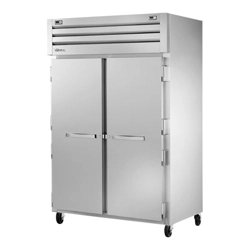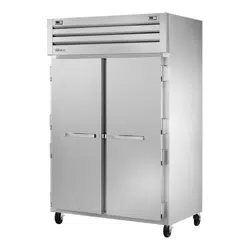
SPEC SERIES: STR, STA & STG
TRUE FOOD SERVICE EQUIPMENT, INC.
2001 East Terra Lane • O’Fallon, Missouri 63366-4434
(636)-240-2400 • FAX (636)-272-2408 • INT'L FAX (636)272-7546 • (800)-325-6152
Parts Department (800)-424-TRUE • Parts Department FAX# (636)-272-9471
Web: www.truemfg.com
CONGRATULATIONS!
You have just purchased the finest commercial refrigerator
available. You can expect many years of trouble-free operation.
TRUE
food service equipment, inc.
INSTALLATION MANUAL
INSTALLATION MANUAL
SPEC SERIES®: STR, STA & STG REFRIGERATOR/FREEZER
TABLE OF CONTENTS
SAFETY INFORMATION
Safety Precautions 1
Proper Disposal, Connecting Electricity, and Adapter Plugs 2
INSTALLATION
Ownership and Uncrating 3
How to Connect to Electricity and Wire Gauge Chart 4
Locating and Installation of Legs or Castors 5
Leveling and Sealing Cabinet to the Floor 6
SETUP
Standard Accessories 7
OPERATION
Startup 13
Electronic Temperature Controls Sequence of Operation 14
MAINTENANCE, CARE, CLEANING
Cleaning Condenser Coil 23
Important Warranty Information 24
Stainless Steel Equipment Care and Cleaning 25
WARRANTY
Warranty 26
#975527 • LM • 6/15
1
TRUE
SPEC SERIES: STR, STA & STG
www.truemfg.com
Loss or spoilage of products in your refrigerator/
freezer is not covered by warranty. In addition to
following recommended installation procedures
you must run the refrigerator/freezer 24 hours
prior to usage.
NOTICE TO CUSTOMER
WARNING: Use this appliance for its intended purpose as described in this Owner Manual.
How to Maintain Your True Refrigerator to Receive the Most Efficient and Successful Operation.
You have selected one of the finest commercial refrigeration units made. It is manufactured under strict quality controls with only the best
quality materials available. Your TRUE cooler when properly maintained will give you many years of trouble-free service.
TO LOCATE REFRIGERANT TYPE, SEE SERIAL LABEL INSIDE CABINET. This cabinet may contain fluorinated greenhouse
gas covered by the Kyoto Protocol (please refer to cabinet’s inner label for type and volume, GWP of 134a= 1,300. R404a= 3,800).
FOR HYDROCARBON REFRIGERATION ONLY (R-290) SEE BELOW:
• DANGER - Risk of fire or explosion. Flammable refrigerant used. Do not use mechanical devices to defrost refrigerator. Do not
puncture refrigerant tubing.
• DANGER - Risk of fire or explosion. Flammable refrigerant used. To be repaired only by trained service personnel. Do not puncture
refrigerant tubing.
• CAUTION - Risk of fire or explosion. Flammable refrigerant used. Consult repair manual/owner’s guide before attempting to service
this product. All safety precautions must be followed.
• CAUTION - Risk of fire or explosion. Dispose of properly in accordance with federal or local regulations. Flammable refrigerant used.
• CAUTION - Risk of fire or explosion due to puncture of refrigerant tubing; follow handling instructions carefully. Flammable refrigerant
used.
• CAUTION - Keep clear of obstruction all ventilation openings in the appliance enclosure or in the structure for building-in.
SAFETY INFORMATION
SAFETY PRECAUTIONS
When using electrical appliances, basic safety precautions should be
followed, including the following:
• This unit must be properly installed and located in accordance
with the Installation Instructions before it is used.
• Do not allow children to climb, stand or hang on the shelves
in the refrigerator. They could damage the unit and seriously
injure themselves.
• Do not touch the cold surfaces in the freezer compartment
when hands are damp or wet. Skin may stick to these
extremely cold surfaces.
• Do not store or use gasoline or other flammable vapors and
liquids in the vicinity of this or any other appliance. Do not store
explosive substances such as aerosol cans with a flammable
propellant in this appliance.
• Keep fingers out of the “pinch point” areas; clearances between
the doors and between the doors and cabinet are necessarily
small; be careful closing doors when children are in the area.
• Unplug the refrigerator before cleaning and making repairs.
• Setting temperature controls to the 0 position does not
remove power to the light circuit, perimeter heaters, or
evaporator fans.
• While cleaning condenser coil lift and hold top louvered grill.
Any servicing to condensing unit remove top louvered grill.
NOTE: We strongly recommend that any servicing be preformed
by a qualified technician.

2
TRUE
SPEC SERIES: STR, STA & STG
www.truemfg.com
RISK OF CHILD
ENTRAPMENT
PROPER DISPOSAL OF THE REFRIGERATOR
Child entrapment and suffocation are not problems of the past.
Junked or abandoned refrigerators are still dangerous… even if they
will sit for “just a few days.” If you are getting rid of your old refrigera-
tor, please follow the instructions below to help prevent accidents.
BEFORE YOU THROW AWAY YOUR OLD
REFRIGERATOR OR FREEZER:
• Take off the doors.
• Leave the shelves in place so that children may not easily climb
inside.
APPLIANCE DISPOSAL
When recycling appliance please make sure that the refrigerants are
handled according to local and national codes, requirements and
regulations.
REFRIGERANT DISPOSAL
Your old refrigerator may have a cooling system that uses “Ozone
Depleting” chemicals. If you are throwing away your old refrigerator,
make sure the refrigerant is removed for proper disposal by a quali-
fied service technician. If you intentionally release any refrigerants you
can be subject to fines and imprisonment under provisions of the
environmental regulations.
USE OF EXTENSION CORDS
NEVER USE AN EXTENSION CORD! TRUE will not war-
ranty any refrigerator that has been connected to an extension cord.
REPLACEMENT PARTS
• Component parts shall be replaced with like components.
• Servicing shall be done by authorized service personnel, to
minimize the risk of possible ignition due to incorrect parts or
improper service.
• Lamps must be replaced by identical lamps only.
• If the supply cord is damaged, it must be replaced by a special
cord or assembly available from the manufacturer or its service
agent.
HOW TO CONNECT ELECTRICITY
DO NOT, UNDER ANY CIRCUMSTANCES, CUT OR
REMOVE THE GROUND PRONG FROM THE POWER
CORD. FOR PERSONAL SAFETY, THIS APPLIANCE
MUST BE PROPERLY GROUNDED.
The power cord from this appliance is equipped with a grounding
plug which minimizes the possibility of electric shock hazard.
Have the wall outlet and circuit checked by a qualified electrician to
make sure the outlet is properly grounded.
If the outlet is a standard 2-prong outlet, it is your personal respon-
sibility and obligation to have it replaced with the properly grounded
wall outlet.
The refrigerator should always be plugged into it’s own individual
electrical circuit, which has a voltage rating that matches the rating
plate.
This provides the best performance and also prevents overloading
building wiring circuits which could cause a fire hazard from over-
heated wires.
Never unplug your refrigerator by pulling on the power cord. Always
grip plug firmly and pull straight out from the outlet.
Repair or replace immediately all power cords that have become
frayed or otherwise damaged. Do not use a cord that shows cracks
or abrasion damage along its length or at either end.
When removing the refrigerator away from the wall, be careful not
to roll over or damage the power cord.
If supply power cord is damaged it should be replaced with original
equipment manufacture parts. To avoid hazard this should be done
by a qualified service technician.
USE OF ADAPTER PLUGS
NEVER USE AN ADAPTER PLUG! Because of potential safety
hazards under certain conditions, we strongly recommend against the
use of an adapter plug.
The incoming power source to the cabinet including any adapters
used must have the adequate power available and must be properly
grounded. Only adapters listed with UL should be used.
NORTH AMERICA USE ONLY!
NEMA plugs
TRUE uses these types of plugs. If you do not have the right outlet
have a certified electrician install the correct power source.
NOTE: International plug configurations vary by voltage and country.
115/60/1
NEMA-5-15R
115/208-230/1
NEMA-14-20R
115/60/1
NEMA-5-20R
WARNING!DANGER!
3
TRUE
SPEC SERIES: STR, STA & STG
www.truemfg.com
OWNERSHIP
To ensure that your unit works properly from the first day, it must
be installed properly. We highly recommend a trained refrigeration
mechanic and electrician install your TRUE equipment. The cost of a
professional installation is money well spent.
Before you start to install your TRUE unit, carefully inspect it for
freight damage. If damage is discovered, immediately file a claim with
the delivery freight carrier.
TRUE is not responsible for damage incurred during shipment.
UNCRATING
TOOLS REQUIRED
• Adjustable Wrench
• 1/2 inch socket (Castor Bolts)
• 3/4 inch socket (Skid Bolts)
• Level
The following procedure is recommended for uncrating the unit:
A. Remove the outer packaging, (cardboard and bubbles or
Styrofoam corners and clear plastic). Inspect for concealed
damage. Again, immediately file a claim with the freight carrier
if there is damage.
B. Move your unit as close to the final location as possible before
removing the wooden skid.
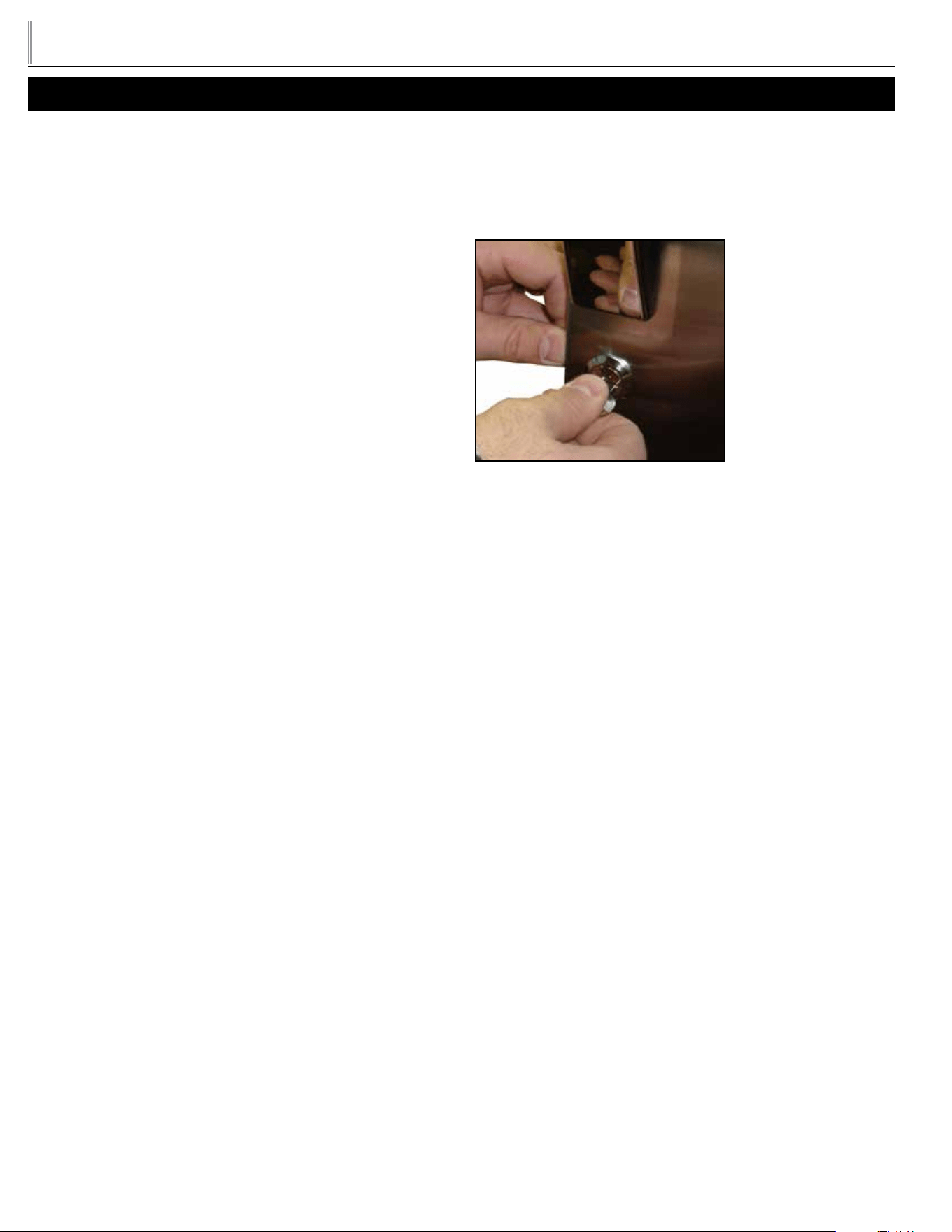
NOTE: KEYS FOR COOLERS WITH DOOR LOCKS
ARE LOCATED IN WARRANTY PACKETS.
LOCK AND KEYS
The following procedure is for locking and unlock unit:
A. Insert the key and turn.
B. Remove the key.
INSTALLATION
Insert key

4
TRUE
SPEC SERIES: STR, STA & STG
www.truemfg.com
230 Volts Distance In Feet To Center of Load
Amps 20 30 40 50 60 70 80 90 100 120 140 160
5 14 14 14 14 14 14 14 14 14 14 14 14
6 14 14 14 14 14 14 14 14 14 14 14 12
7 14 14 14 14 14 14 14 14 14 14 12 12
8 14 14 14 14 14 14 14 14 14 12 12 12
9 14 14 14 14 14 14 14 14 12 12 12 10
10 14 14 14 14 14 14 14 12 12 12 10 10
12 14 14 14 14 14 14 12 12 12 10 10 10
14 14 14 14 14 14 12 12 12 10 10 10 8
16 14 14 14 14 12 12 12 10 10 10 8 8
18 14 14 14 12 12 12 10 10 10 8 8 8
20 14 14 14 12 10 10 10 10 10 8 8 8
25 14 14 12 12 10 10 10 10 8 8 6 6
30 14 12 12 10 10 10 8 8 8 6 6 6
35 14 12 10 10 10 8 8 8 8 6 6 5
40 14 12 10 10 8 8 8 6 6 6 5 5
50 12 10 10 8 6 6 6 6 6 5 4 4
60 12 10 8 6 6 6 6 6 5 4 4 3
70 10 10 8 6 6 6 5 5 4 4 2 2
80 10 8 8 6 6 5 5 4 4 3 2 2
90 10 8 6 6 5 5 4 4 3 3 1 1
100 10 8 6 6 5 4 4 3 3 2 1 1
115 Volt s Distance In Feet To Center of Load
Amps 20 30 40 50 60 70 80 90 100 120 140 160
2 14 14 14 14 14 14 14 14 14 14 14 14
3 14 14 14 14 14 14 14 14 14 14 14 12
4 14 14 14 14 14 14 14 14 14 12 12 12
5 14 14 14 14 14 14 14 12 12 12 10 10
6 14 14 14 14 14 14 12 12 12 10 10 10
7 14 14 14 14 14 12 12 12 10 10 10 8
8 14 14 14 14 12 12 12 10 10 10 8 8
9 14 14 14 12 12 12 10 10 10 8 8 8
10 14 14 14 12 12 10 10 10 10 8 8 8
12 14 14 12 12 10 10 10 8 8 8 8 6
14 14 14 12 10 10 10 8 8 8 6 6 6
16 14 12 12 10 10 8 8 8 8 6 6 6
18 14 12 10 10 8 8 8 8 8 8 8 5
20 14 12 10 10 8 8 8 6 6 6 5 5
25 12 10 10 8 8 6 6 6 6 5 4 4
30 12 10 8 8 6 6 6 6 5 4 4 3
35 10 10 8 6 6 6 5 5 4 4 3 2
40 10 8 8 6 6 5 5 4 4 3 2 2
45 10 8 6 6 6 5 4 4 3 3 2 1
50 10 8 6 6 5 4 4 3 3 2 1 1
HOW TO CONNECT ELECTRICITY
Do not, under any circumstances, cut or remove the ground prong
from the power cord. For personal safety, this appliance must be
properly grounded.
The power cord of this appliance is equipped with a grounding plug
which mates with a standard grounding wall outlet to minimize the
possibility of electric shock hazard from this appliance. Have the
wall outlet and circuit checked by a qualified electrician to make sure
the outlet is properly grounded. If the outlet is a standard 2-prong
outlet, it is your personal responsibility and obligation to have it replaced
with the properly grounded wall outlet. The unit should always be
plugged into its own individual electrical circuit, which has a voltage
rating that matches the rating plate. This provides the best perfor-
mance and also prevents overloading building wiring circuits which
could cause a fire hazard from overheated wires. Never unplug your
unit by pulling on the power cord. Always grip plug firmly and pull
straight out from the outlet. Repair or replace immediately all power
cords that have become frayed or otherwise damaged. Do not use
a cord that shows cracks or abrasion damage along its length or at
either end. When removing the unit away from the wall, be careful
not to roll over or damage the power cord.
ELECTRIC INSTALLATION & SAFETY
INFORMATION
• If the supply cord is damaged, it must be replaced by a special
cord or assembly available from the manufacturer or its service
agent.
• Lamps must be replaced by identical lamps only.
• Appliance tested according to the climate classes 5 and 7
temperature and relative humidity.
ELECTRICAL INSTRUCTIONS
A. Before your new unit is connected to a power supply, check the
incoming voltage with a voltmeter. If anything less than 100% of
the rated voltage for operation is noted, correct immediately.
B. All units are equipped with a service cord, and must be
powered at proper operating voltage at all times. Refer to
cabinet data plate for this voltage.
TRUE RECOMMENDS THAT A SOLE USE CIRCUIT BE
DEDICATED FOR THE UNIT.
WARNING: Compressor warranties are void if compressor burns
out due to low voltage.
WARNING: Power supply cord ground should not be removed!
WARNING: Do not use electrical appliances inside the food
storage compartments of the appliances unless they are of the type
recommended by the manufacturer.
NOTE: To reference wiring diagram, remove front louvered grill,
wiring diagram is positioned on the inside cabinet wall.
WIRE GAUGE CHART
5
TRUE
SPEC SERIES: STR, STA & STG
www.truemfg.com
LOCATING
1. Make sure unit is as close to the final location as possible.
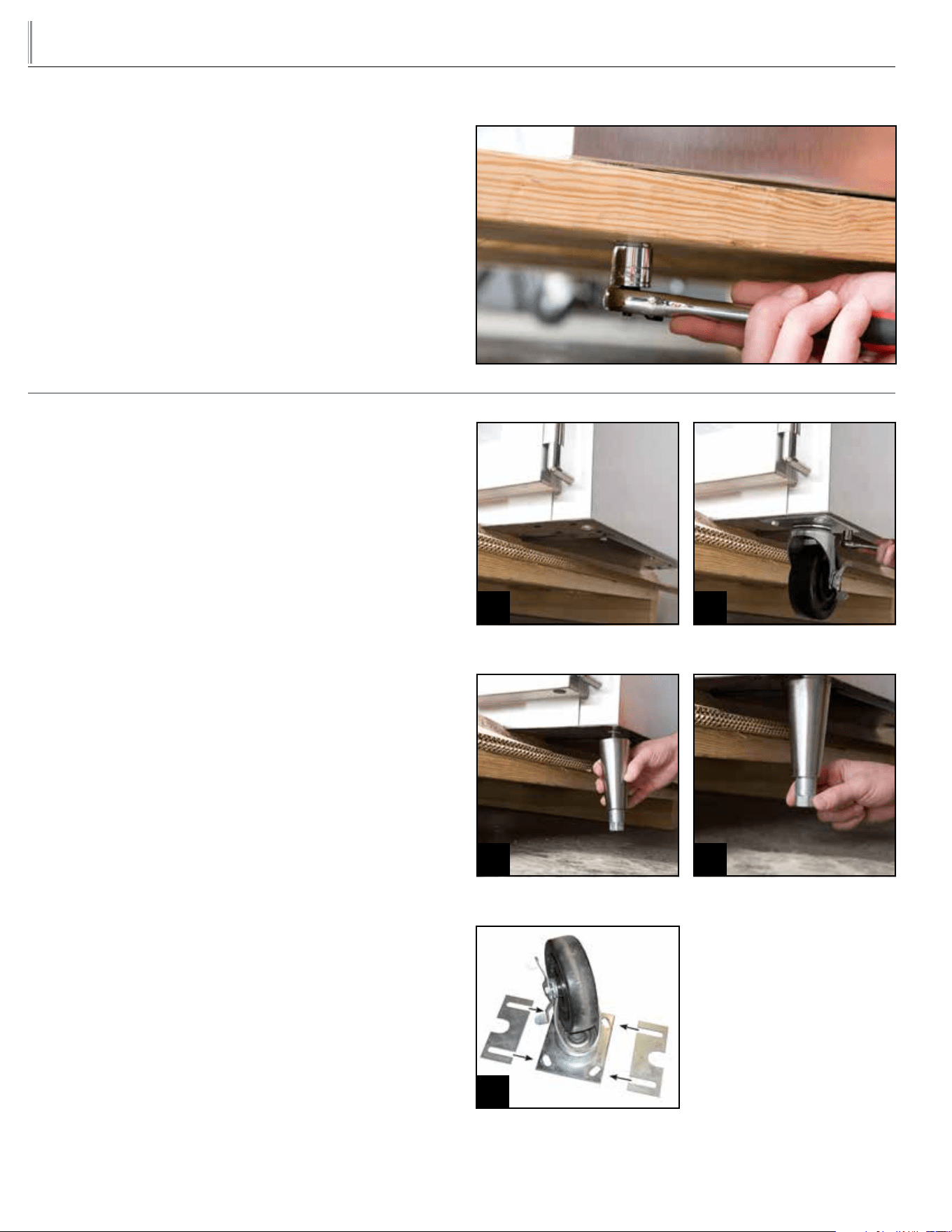
2. Remove the shipping bolts located at the bottom of the
wooden skid.
3. Carefully slide the unit off the wooden skid. Slide packing
material underneath the side of the unit hanging off the skid.
Then install castors or legs for that side of the unit.
4. Then carefully slide the other side of the unit off one corner
at a time while installing castors or legs for each corner. Use
packing material for under each corner of the unit before
installing a castor or leg.
INSTALLATION OF CASTORS OR
OPTIONAL LEGS
Important Safeguard for installation of leg/castor. Images 1-5 demon-
strate procedure.
SECURING CASTORS AND LEGS
To obtain maximum strength and stability of the unit, it is important
that you make sure each castor is secure. Optional legs are hand-
tightened securely against the lower rail assembly. The bearing race
on the castor or the top edge of the leg must make firm contact
with the rail.
LEVELING SHIMS
Four leveling shims have been provided for leveling castored units
positioned on uneven floors. Shims must be positioned between rail
end and bearing race.
A. Turn the bearing race counter-clockwise until the cabinet is
level. Level front to back and side to side. (diagonally)
B. Install the desired number of shims, making sure the slot of the
shim is in contact with the threaded stem of the castor.
C. If more than one shim is used, turn the slot at a 90° angle so
they are not in line.
D. Turn the bearing race clockwise to tighten and secure the
castor by tightening the anchoring bolt with a 3/4 inch open-
end wrench or the tool provided.
CAUTION: TO AVOID DAMAGE TO LOWER RAIL
ASSEMBLY, SLOWLY RAISE UNIT TO UPRIGHT
POSITION.
NOTE: OPEN HOLES LOCATED ON THE CROSS
MEMBERS OF THE FRAME RAIL SHOULD BE
PLUGGED BEFORE UNIT IS IN USE.
Removing shipping bolts
Slide packing material under the unit.
1
Anchor castor.
2
Thread leg into cabinet bottom
cabinet.
3
The end of the leg is adjustable for
easy leveling.
4
Castor with leveling shims.
5
6
TRUE
SPEC SERIES: STR, STA & STG
www.truemfg.com
LEVELING
A. Set unit in its final location. Be sure there is adequate ventilation
in your room. Under extreme heat conditions, (100°F+,
38°C+), you may want to install an exhaust fan.
WARNING: WARRANTY IS VOID IF VENTILATION IS
INSUFFICIENT.
B. Proper leveling of your TRUE cooler is critical to operating
success (for non-mobile models). Effective condensate removal
and door operation will be effected by leveling.
C. The cooler should be leveled front to back and side to side with
a level.
D. Ensure that the drain hose or hoses are positioned in the pan.
E. Free plug and cord from inside the lower rear of the cooler
(do not plug in).
F. The unit should be placed close enough to the electrical supply
so that extension cords are never used.
G. Applicance tested according to the climate classes 5 and 7 for
temperature and relative humidity.
WARNING: CABINET WARRANTIES ARE VOID
IF OEM POWER CORD IS TAMPERED WITH. TRUE
WILL NOT WARRANTY ANY UNITS THAT ARE
CONNECTED TO AN EXTENSION CORD.
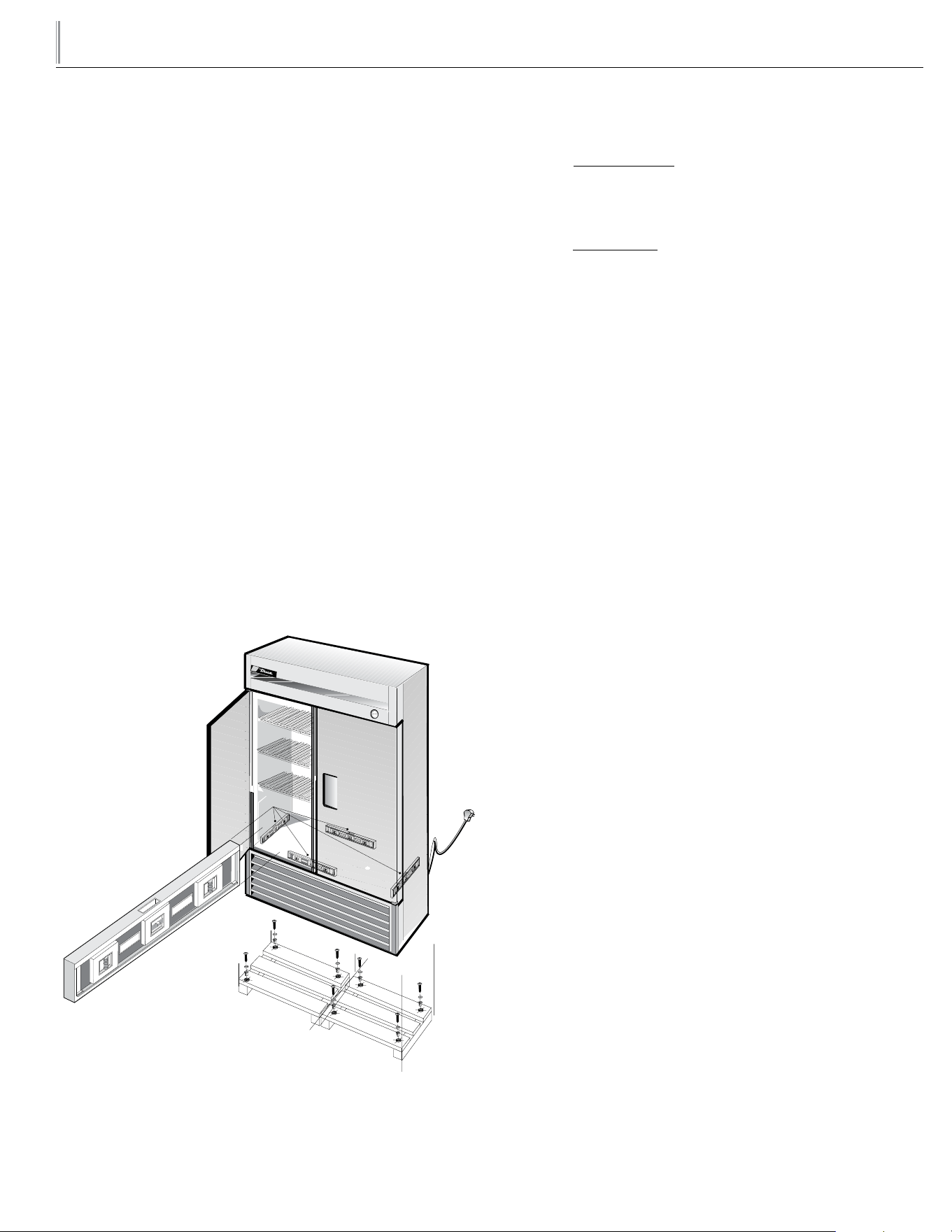
SEALING CABINET TO FLOOR
STEP 1 - Position Cabinet - Allow one inch between the wall and
rear of the refrigerator to assure proper ventilation. For freezers 3
inches between the wall and rear of the cabinet will assure proper
ventilation.
STEP 2 - Level Cabinet - Cabinet should be level, side to side and
front to back. Place a carpenter’s level in the interior floor in four
places:
A. Position level in the inside floor of the unit near the doors.
(Level should be parallel to cabinet front). Level cabinet.
B. Position level at the inside rear of cabinet. (Again level should
be placed parallel to cabinet back).
C. Perform similar procedures to steps A & B by placing the level
on inside floor (left and right sides - parallel to the depth of the
cooler). Level cabinet.
STEP 3 - Draw an outline on the base on the floor.
STEP 4 - Raise and block the front side of the cabinet.
STEP 5 - Apply a bead of “NSF Approved Sealant”, (see list below),
to floor on half inch inside the outline drawn. The bead must be heavy
enough to seal the entire cabinet surface when it is down on the
sealant.
STEP 6 - Raise and block the rear of the cabinet
STEP 7 - Apply sealant on floor as outlined in Step 5 on other
three sides.
STEP 8 - Examine to see that cabinet is sealed to floor around
entire perimeter.
NOTE: Asphalt floors are very susceptible to chemical attack. A
layer of tape on the floor prior to applying the sealant will protect
the floor.
NSF APPROVED SEALANTS:
1. Minnesota Mining #ECU800 Caulk
2. Minnesota Mining #ECU2185 Caulk
3. Minnesota Mining #ECU1055 Bead
4. Minnesota Mining #ECU1202 Bead
5. Armstrong Cork - Rubber Caulk
6. Products Research Co. #5000 Rubber Caulk
7. G.E. Silicone Sealer
8. Dow Corning Silicone Sealer
P
7
TRUE
SPEC SERIES: STR, STA & STG
www.truemfg.com
STANDARD ACCESSORIES
PILASTER INSTALLATION & OPERATION
TRUE STR, STA, and STG cabinets are available with four different
shelving / tray slide options.
Type Kit #1. Angle Type Tray Slide
Type Kit #2. Rod Style Tray Slide
Type Kit #3. Universal Tray Slide
Type Kit #4. Shelf Standards (shelf clips)
REQUIRED TOOLS:
• Standard Screwdriver (Flathead)
• Rubber / Plastic Mallet
• Tape Measure
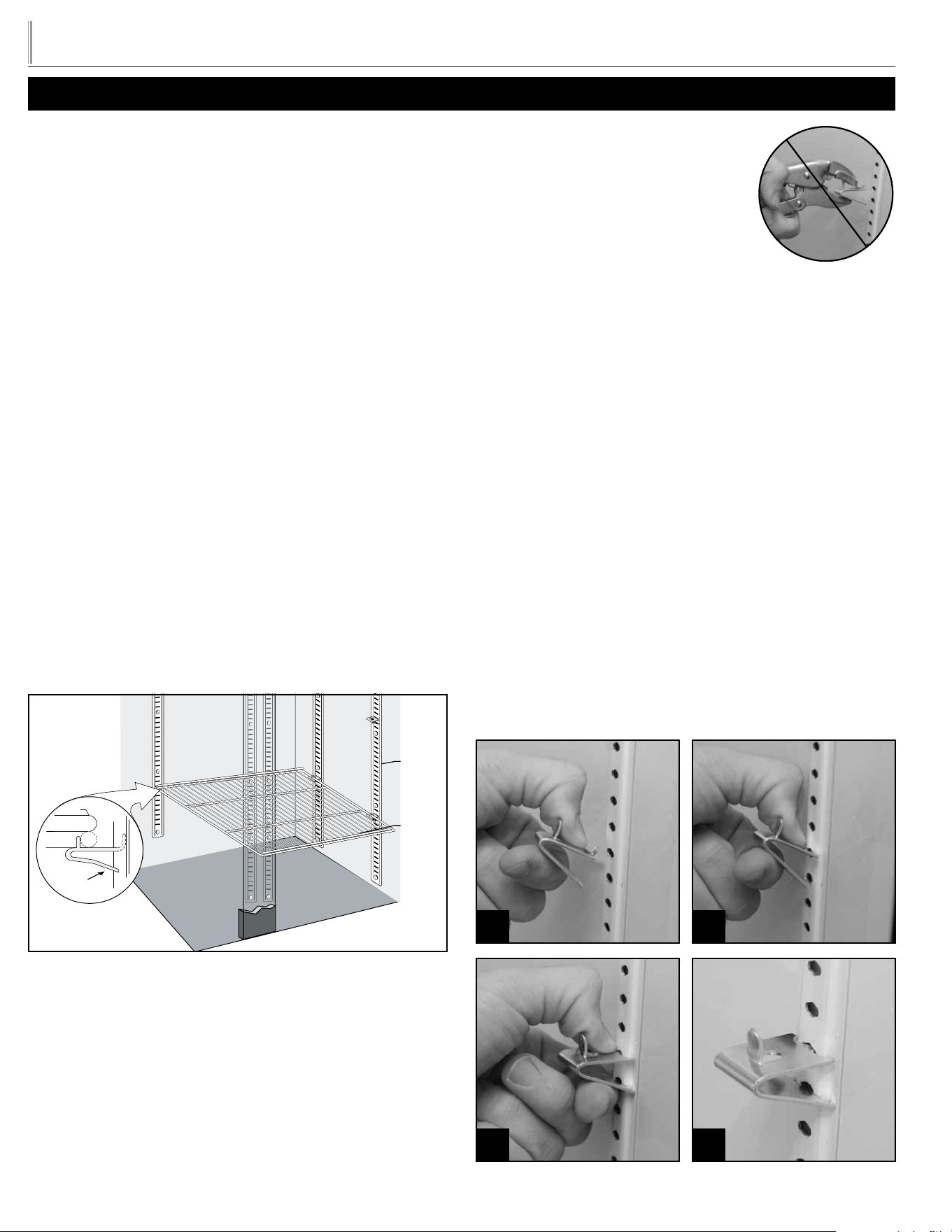
INSTALLATION PROCEDURES (WIRE SHELVES):
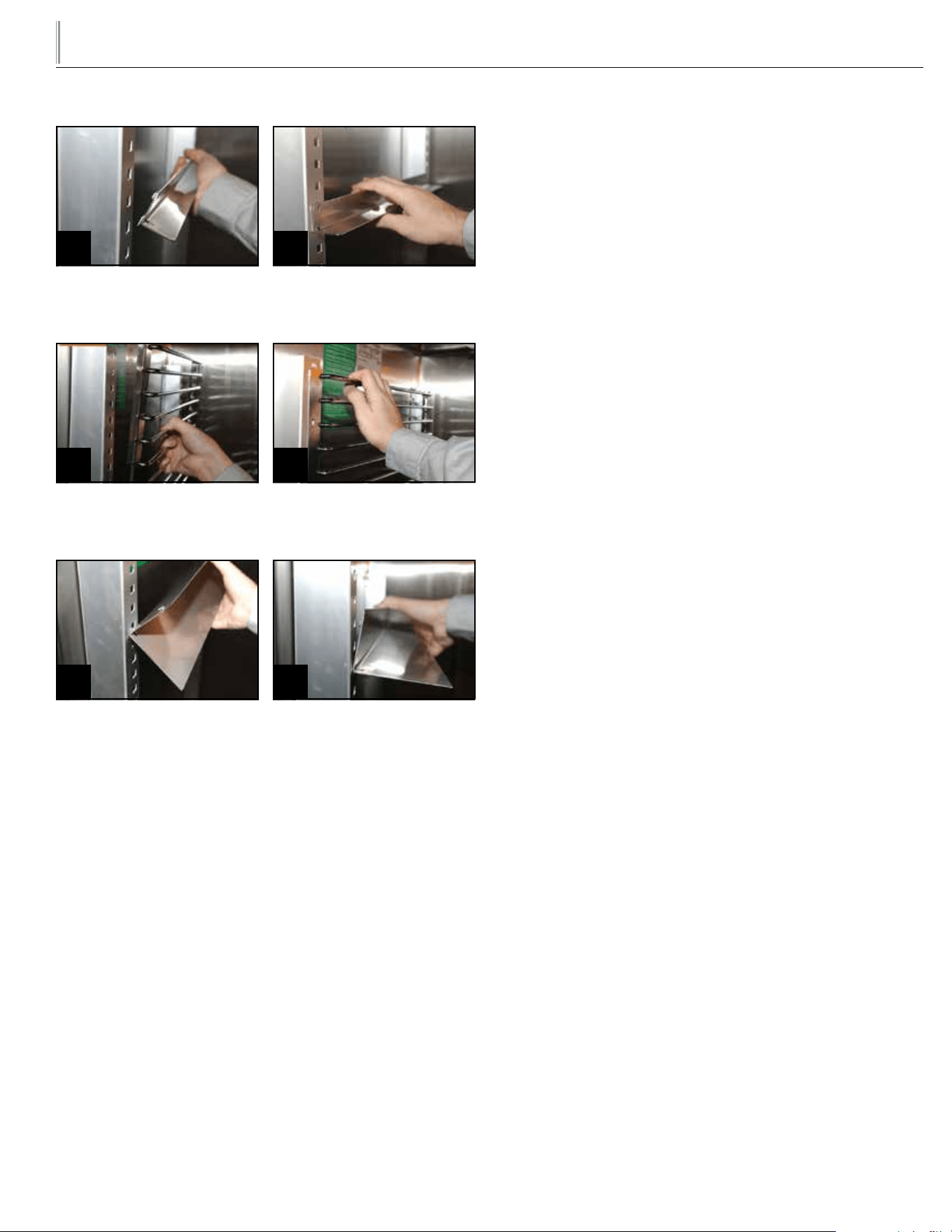
Wire shelves come with shelf clips (image 1).
Properly insert the shelf clips in the desired height (remember all
shelf clips will need to be installed at the same height to keep the
shelf level.)
Once the shelves are installed the remaining threaded holes will have
thumb screws inserted. These thumb screws are provided in the unit.
SETUP
SHELF INSTALLATION:
For Proper Shelf Clip Installation Please Read The Following
Instructions.
STEP 1
Install the top tab of the shelf clip into the proper hole. Push up on
the bottom of the clip. (See image 1).
STEP 2
Bottom tab of the shelf clip will fit tightly. You may need to squeeze or
twist the bottom of the shelf clip to install. (See image 2 & 3).
STEP 3
After installation, the shelf clip will fit snug into the shelf standard.
The shelf clip should not be loose or able to wiggle out of the shelf
standard.
SHELF INSTALLATION TIPS
1. Install all the shelf clips before installing the shelves.
2. Start at the bottom in terms of shelf installation and work your
way up.
3. Always lay the back of each shelf down on the rear clips before
the front.
WARNING!
Do not use pliers or any crimping tools
when installing shelf clips. Altering shelf clips
in any way can lead to shelving instability.
1
3
2
4
Type Kit #4 (Shelf Standards / Shelf Clips)
Shelf
Shelf
Standards
Shelf
Clip
Shelf
8
TRUE
SPEC SERIES: STR, STA & STG
www.truemfg.com
CONFIGURATION (PILASTERS):
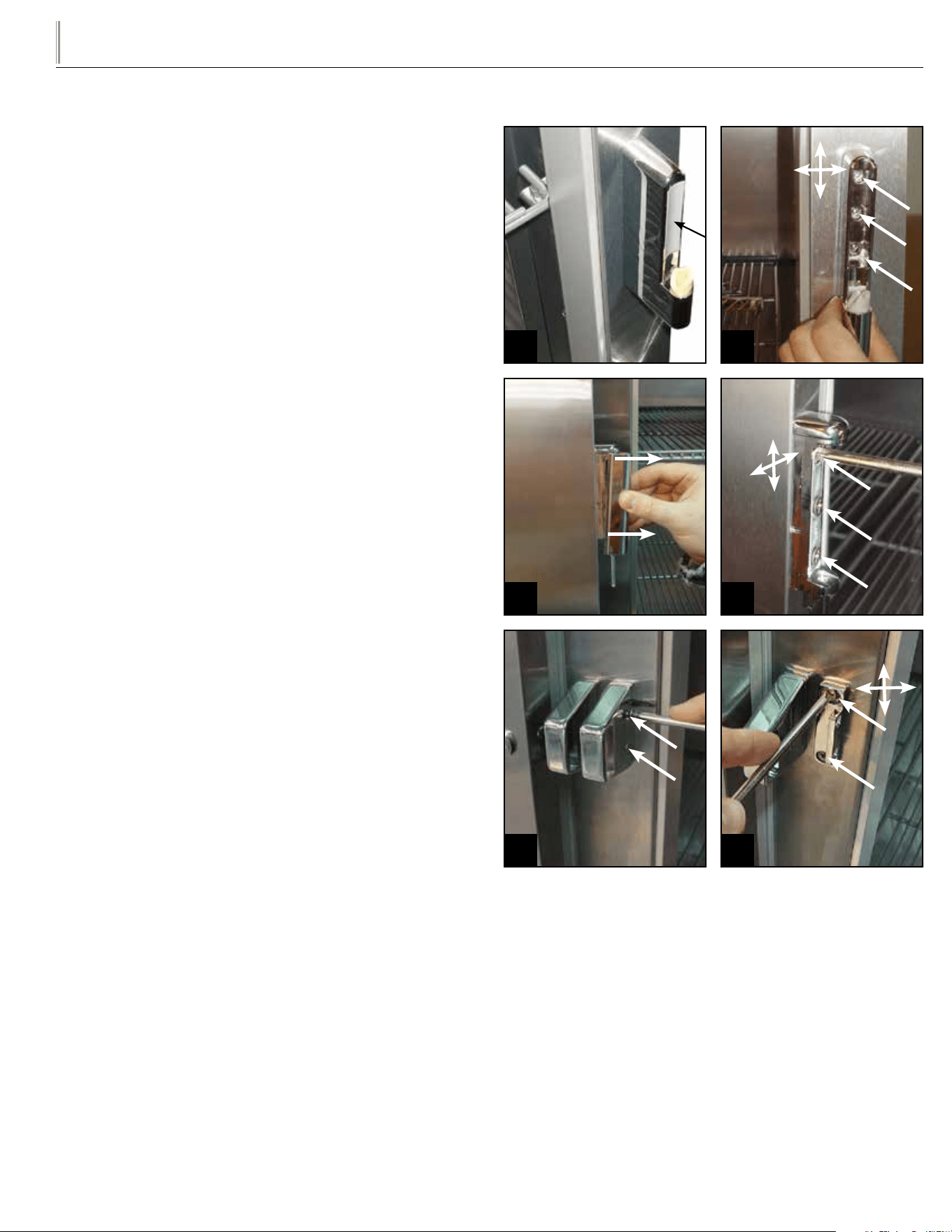
Each TRUE Specification Series (STR, STA, and STG) is available with
two pilaster configurations. Each configuration depends on the end
user preference. Multiple door units can have two configurations for
each section. See image 7.
INSTALLATION PROCEDURES (PILASTERS):
Install slotted thumb screws into threaded holes along the inside wall
of the cabinet.
Slide pilasters into position behind the slotted screws. Leave all of the
thumb screws loose for adjustments when installing tray slides.
It is critical to measure from the center of the square hole on the
front pilaster to the center hole of the rear pilaster. This measurement
should be 24 5/8" (625 mm) (see image 8). Do the same on the
opposite side of cabinet for single door. Make sure the measurement
of 24 5/8" (625 mm) is the same in the center pilasters in 2 and 3
door units. Tap the tray slides into the Pilasters with a rubber Mallet.
Angle & Rod Type shelving uses a 18 1/8" (460 mm) distance
between Pilasters. Universal Tray slides have a 21 1/4" (540 mm)
distance between Pilasters. See image 9.
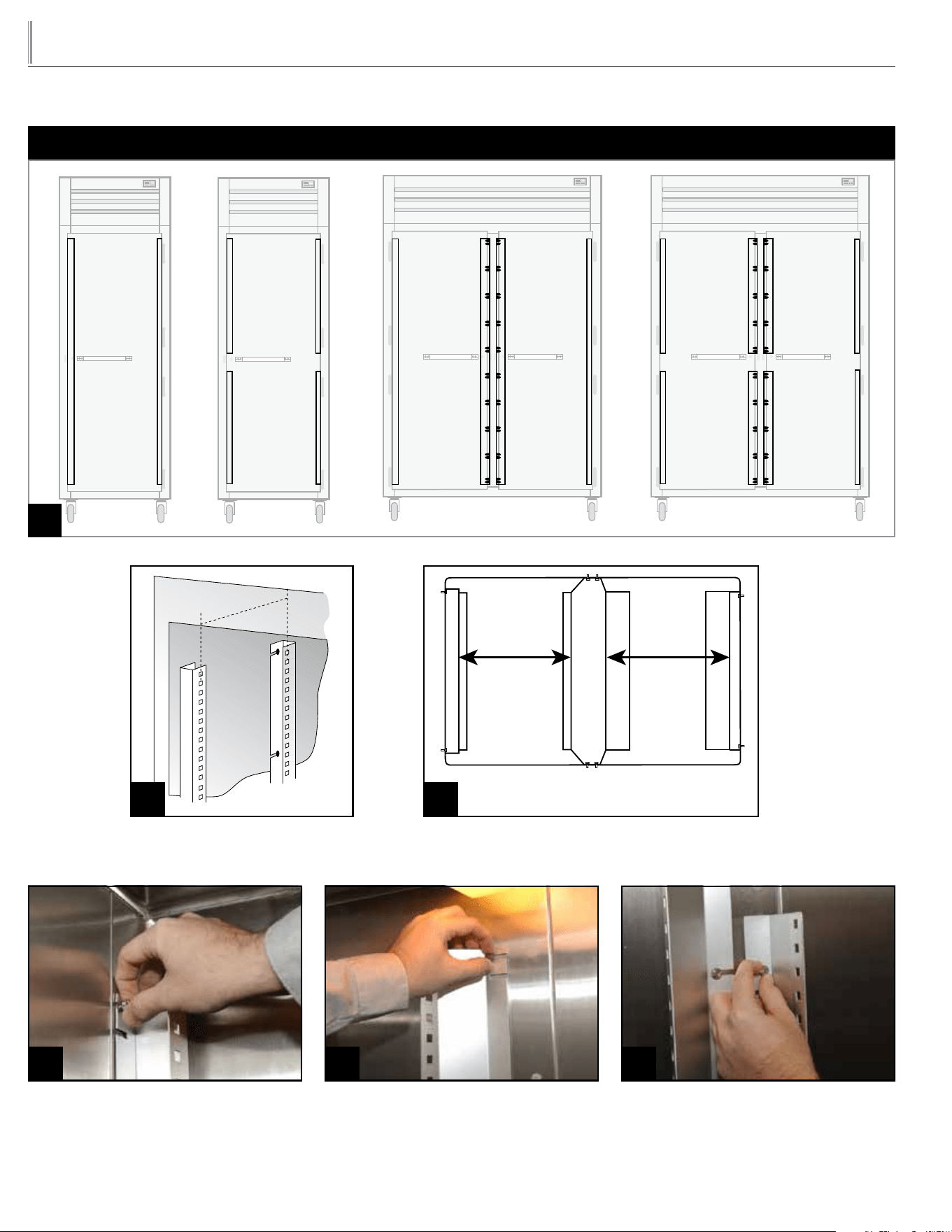
After the pilasters are installed the Universal Tray, Angle Type Tray,
and Rod Style Tray Slides will slide into the pilasters. See images 1-6.
When disassembling or changing tray slides a rubber mallet may be
used to take out the different tray slides. Gently tap on the under side
of the tray slide to loosen it from the pilaster.
Type Kit #3 (Universal Tray Slide)
5 6
Type Kit #2 (Rod Style Tray Slide)
3 4
Type Kit #1 (Angle Type Tray Slide)
1 2
9
TRUE
SPEC SERIES: STR, STA & STG
www.truemfg.com
24 5/8 inches
625.5 mm
8
Critical measurement front to rear
pilasters
18 1/8"
460 mm
Angle Type
& Rod Type
21 1/4"
540 mm
Universal
Tray Slide
9
Top view: Critical Measurement side to side
Pilaster installation (side wall of cabinet)
10
Pilaster installation two and three door models
(middle of wall in rear of cabinet)
11
Pilaster installation (back wall of cabinet for two
& three door models)
12
7
EXAMPLES OF POSSIBLE CONFIGURATIONS FOR TRAY SLIDES OR SHELVES
Kit #1 Kit #3
Kit #2
Kit #2 Kit #2
Kit #1
Kit #3 Kit #4
Kit #3
10
TRUE
SPEC SERIES: STR, STA & STG
www.truemfg.com
DOOR OPERATION
DOOR CONFIGURATION:
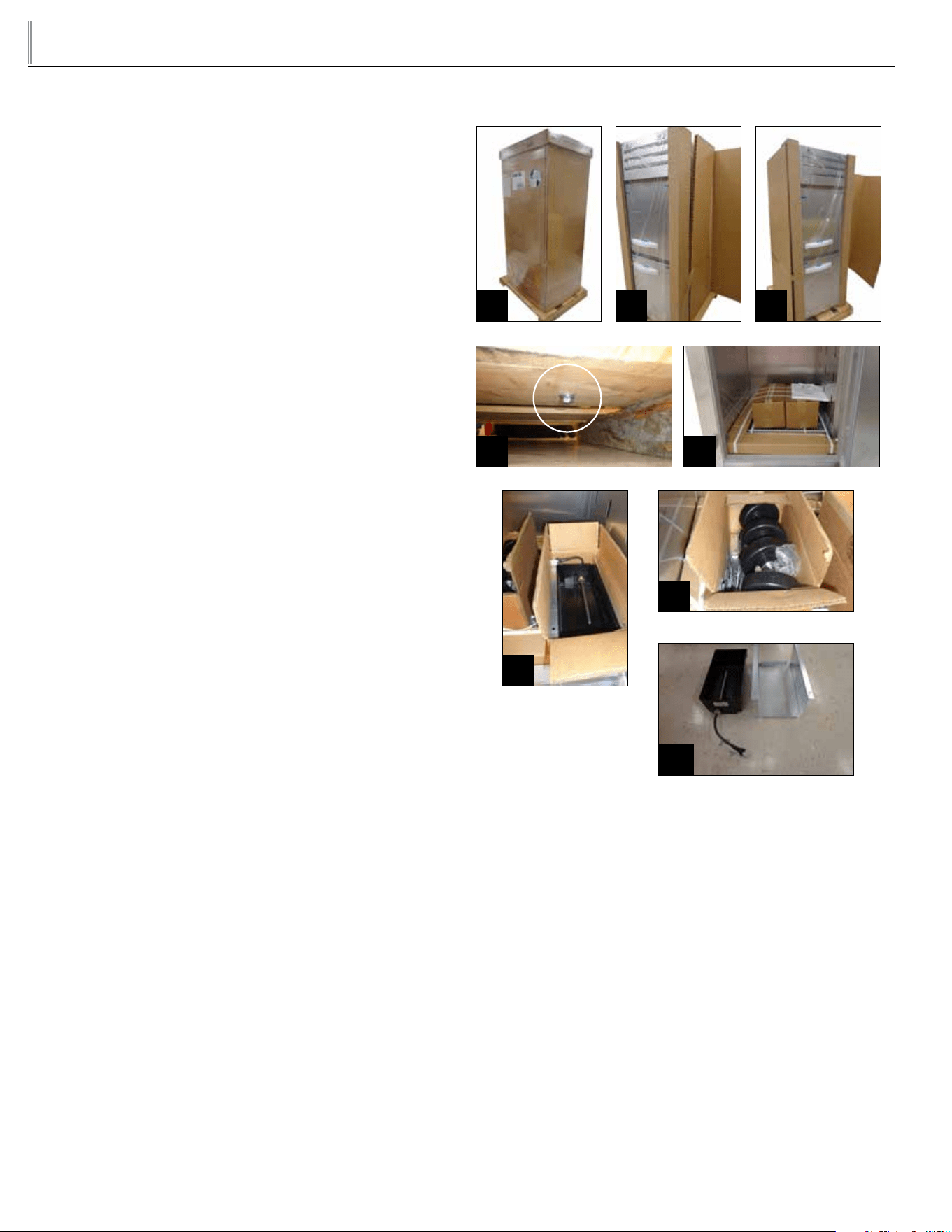
After installing, cabinet doors can be adjusted for alignment. The hinge
on the door and hinge on the cabinet can be adjusted accordingly.
STEP 1
To remove door open at a 90˚ angle from the cabinet and lift door
up and out from the cabinet hinges carefully avoiding rainshield. Rest
the door in a safe area.
STEP 2
Remove gray plastic cover from hinge located on the cabinet. (See
image 1). Use a standard screw driver and pry out the gray cover.
This exposes the three Phillips screws anchoring the hinge to the
cabinet. (See image 2). Loosen these three screws but don’t remove
them. Adjustment can be made slightly up/down and side to side.
STEP 3
The hinge on the cabinet door can also be adjusted. Remove cover
from hinge located on the door. Pull on the cover directly out from
the door. (See image 3). This exposes the three Phillips screws
anchoring the hinge to the door. Loosen these three screws but
don’t remove them. The hinge can be moved side to side, up and
down. (See image 4).
NOTE: WHEN TIGHTENING THE HINGES TO THE
CABINET AND DOOR DO NOT APPLY PRESSURE
TO THE PHILLIPS SCREWS. CAREFULLY ANCHOR
THEM WITHOUT APPLYING EXTREME AMOUNTS
OF PRESSURE.
STEP 4
To adjust the lock latch remove two Phillips screws and the latch can
be put to the side for later reinstallation. (See image 5). The lock
base that anchors the latch can be adjusted simply by loosening the
two Phillips screws, but not removing them. Then the lock base can
be moved side to side for adjustment. (See image 6). After adjust-
ment is complete tighten the lock base and install the latch back into
place.
1
3
5
2
4
6
11
TRUE
SPEC SERIES: STR, STA & STG
www.truemfg.com
INSTALLING THE HEATING CONDENSATE
PAN ON A SPEC SERIES DUAL TEMP MODEL
STA/STG/STR1DT
TOOLS REQUIRED:
• Cordless Drill
• 1/4" Nut Driver Bit
• Socket Set
• 3/4" Socket
STEP 1: Remove all the packing material from the cabinet. See
images 1, 2 & 3.
STEP 2: Unbolt the cabinet from the skid. See image 4.
STEP 3: Open up the cabinet and locate the two boxes inside
the cabinet. One box should contain the castors, castor shims and
castor plate screws. The other box should contain the condensate
pan, bracket and bracket screws. Place the box that contains the
condensate pan and its contents off to the side for now. See images
5, 6 & 7.
STEP 4: Place the castors on the cabinet per the instructions in
the owner’s manual.
NOTE: Should the castors need to be leveled once the cabinet is
in place refer to the instructions on page 6 of the owner’s manual.
STEP 5: Locate the box containing the condensate pan, bracket
and screws. See image 8.
1 3
5
7
2
4
6
8
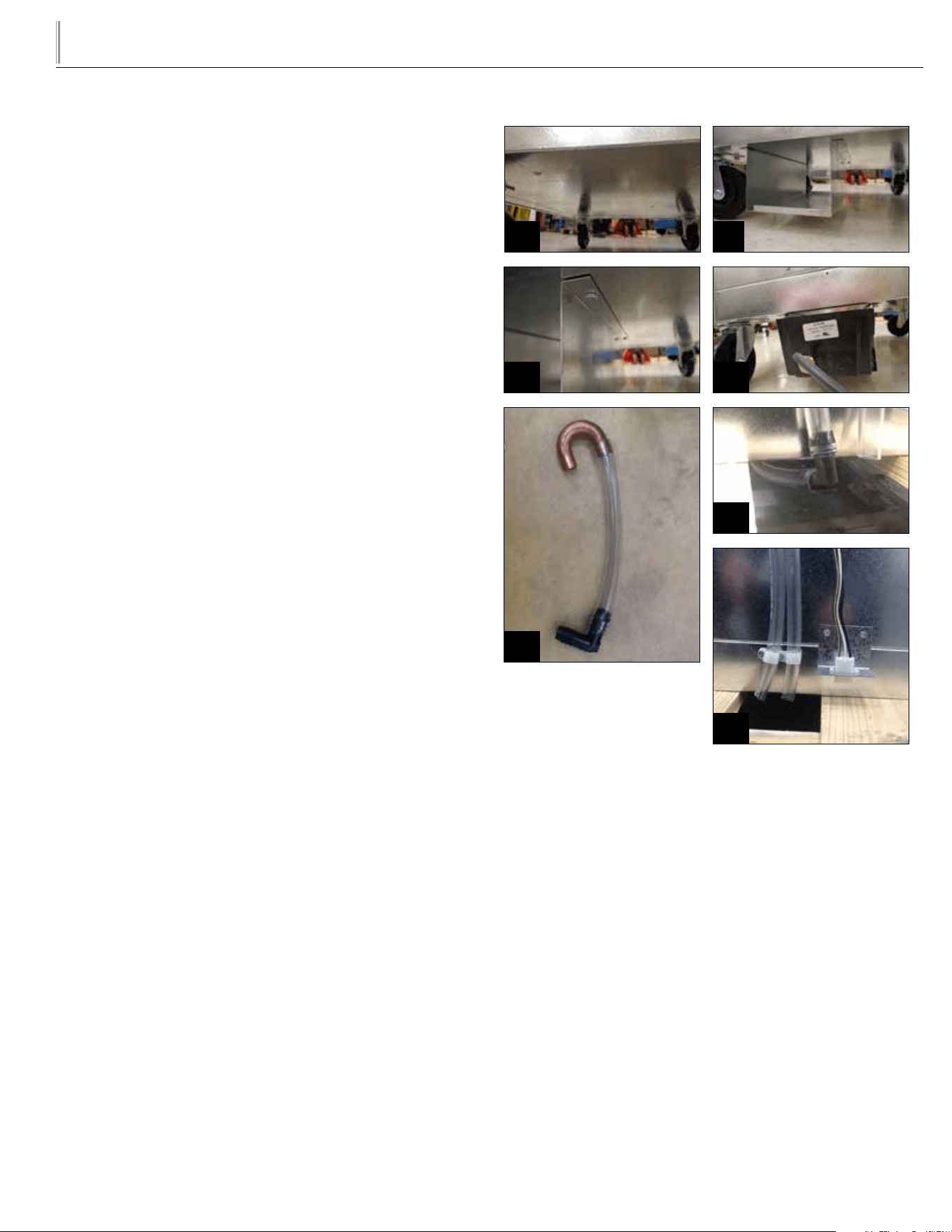
12
TRUE
SPEC SERIES: STR, STA & STG
www.truemfg.com
9 10
11 12
13
14
15
STEP 6: With the four (4) screws provided, install the metal
condensate pan bracket under the cabinet. See images 9, 10 & 11.
STEP 7: Place the condensate pan in the bracket. See image 12.
STEP 8: Place the loose drain hoses with the barbed 90º fittings and
the copper fitting into the drain pan and push the barbed end into
each drain hose. See images 13 & 14.
STEP 9: Connect the male power cord coming from the condensate
pan to the female connector on the back of the cabinet. See image
15.
NOTE: If you cannot make this connection you may have to remove
the back cover on the cabinet.
You are now ready to install the shelves in the cabinet and then plug
the cabinet in place.

13
TRUE
SPEC SERIES: STR, STA & STG
www.truemfg.com
STARTUP
A. The compressor is ready to operate. Plug in the cooler.
B. Temperature controls are factory-set to give refrigerators
an approximate temperature of 35°F (1.6°C) and freezers
an approximate temperature of -10°F (-23.3°C). Allow unit
to function several hours, completely cooling cabinet before
changing the control setting.
Temperature Control Location and Settings.
• Electronic temperature control is located on rear of unit,
behind access grill or inside of unit.
• LAE temperature control is located on the front of cabinet
countertop or in/behind louvered grill.
See website for adjustments, sequence of operation, and more
information.
C. Excessive tampering with the control could lead to service
difficulties. Should it ever become necessary to replace
temperature control, be sure it is ordered from your TRUE
dealer or recommended service agent.
D. Good air flow in your TRUE unit is critical. Be careful to
load product so that it neither presses against the back wall,
nor comes within four inches of the evaporator housing.
Refrigerated air off the coil must circulate down the back wall.
NOTE: If the unit is disconnected or shut off, wait five minutes
before starting again.
RECOMMENDATION - Before loading product we recommend
you run your TRUE unit empty for two to three days. This allows
you to be sure electrical wiring and installation are correct and no
shipping damage has occurred. Remember, our factory warranty does
not cover product loss!
OPERATION
14
TRUE
SPEC SERIES: STR, STA & STG
www.truemfg.com
ELECTRONIC TEMPERATURE CONTROLS
LAE ELECTRONIC CONTROL GENERAL SEQUENCE OF OPERATION
1. Cabinet is plugged in.
a. Display will illuminate.
b. Interior light will illuminate on Glass Door Models only. Solid door cabinet lights are controlled by the door switch.
2. After the LAE control preprogrammed time delay of up to 6 minutes, the compressor and evaporator fan(s) will
start if the control is calling for cooling.
a. Control may be already pre-programmed from the factory so at the start of every compressor cycle or during a
defrost cycle, the condenser fan(s) will reverse for 30 seconds to blow dirt off the condensing coil.
3. The LAE control will cycle the compressor but may also cycle evaporator fan(s) on and off determined by the
Set-Point and Differential temperatures.
a. The Set-Point is the adjustable preprogrammed temperature which shuts off the compressor and evaporator fan(s).
This is not the programmed cabinet temperature.
b. The Differential is the non adjustable preprogrammed temperature that is added to the Set-Point temperature that
will restart the compressor and evaporator fan(s).
c. The LAE control is designed to read and display a cabinet temperature not a product temperature.
This cabinet temperature may reflect the refrigeration cycle of the Set-Point and it’s Differential.
The most accurate temperature on a cabinets operation is to verify the product temperature.
Example: If the Set-Point is -9°F/-23°C and the Differential is 10°F/5°C
(Set-Point) -9°F + 10 (Differential) = 1°F
Or
(Set-Point) -23°C + 5 (Differential) = -18°C
The compressor and evaporator fan(s) will cycle off -9°F/-23°C and back on at 1°F/-18°C
4. The LAE control may be preprogrammed to initiate defrost by interval or at specific times of day.
a. At this time the “dEF” will appear on the display and compressor will turn off until a preprogrammed temperature
or duration is reached. During this time for freezers only, evaporator fan(s) will also turn off and the coil heater and
drain tube heaters will also be energized. Some cabinets may also change the rotation of the reversing condenser
fan motor.
b. After the preprogrammed temperature or duration for defrost has been reached there may be a short delay
for both the compressor and evaporator fans to restart. At this time “dEF” may still appear on the display for a
short time.
LAE ELECTRONIC TEMPERATURE CONTROL GENERAL SEQUENCE OF OPERATION
t1 = supply air / return air* (thermostat)
t2 = coil / copper line (defrost)
t3 = return air / supply air* (display)
t3 probe is not installed and / or activated in all applications
with t3 is not installed and / or activated, the display probe is t1.
* STA, STG, STM, STR Models.
15
TRUE
SPEC SERIES: STR, STA & STG
www.truemfg.com
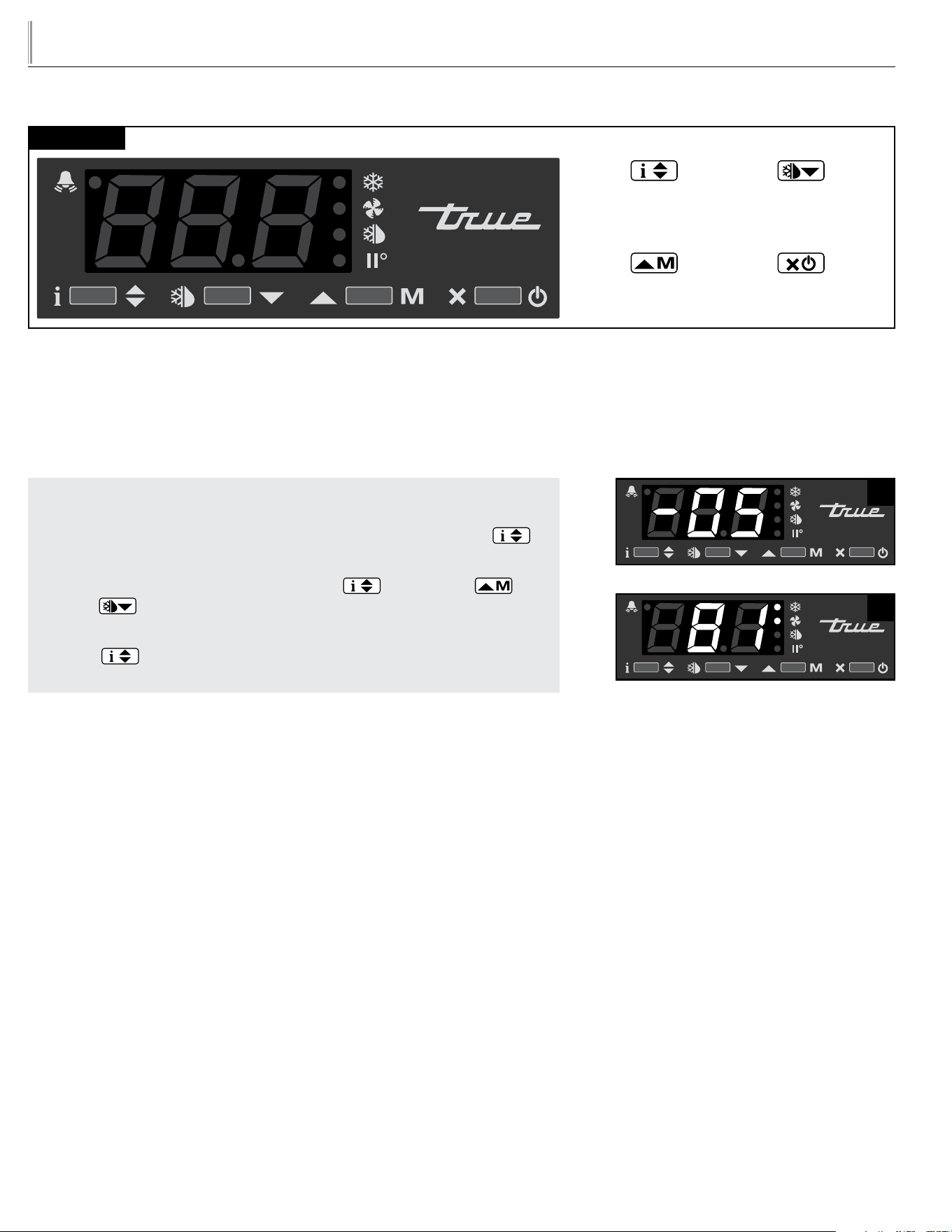
HOW TO DIAGNOSE AN LAE ELECTRONIC CONTROL
HOW TO LOCK AND UNLOCK LAE CONTROLLER:
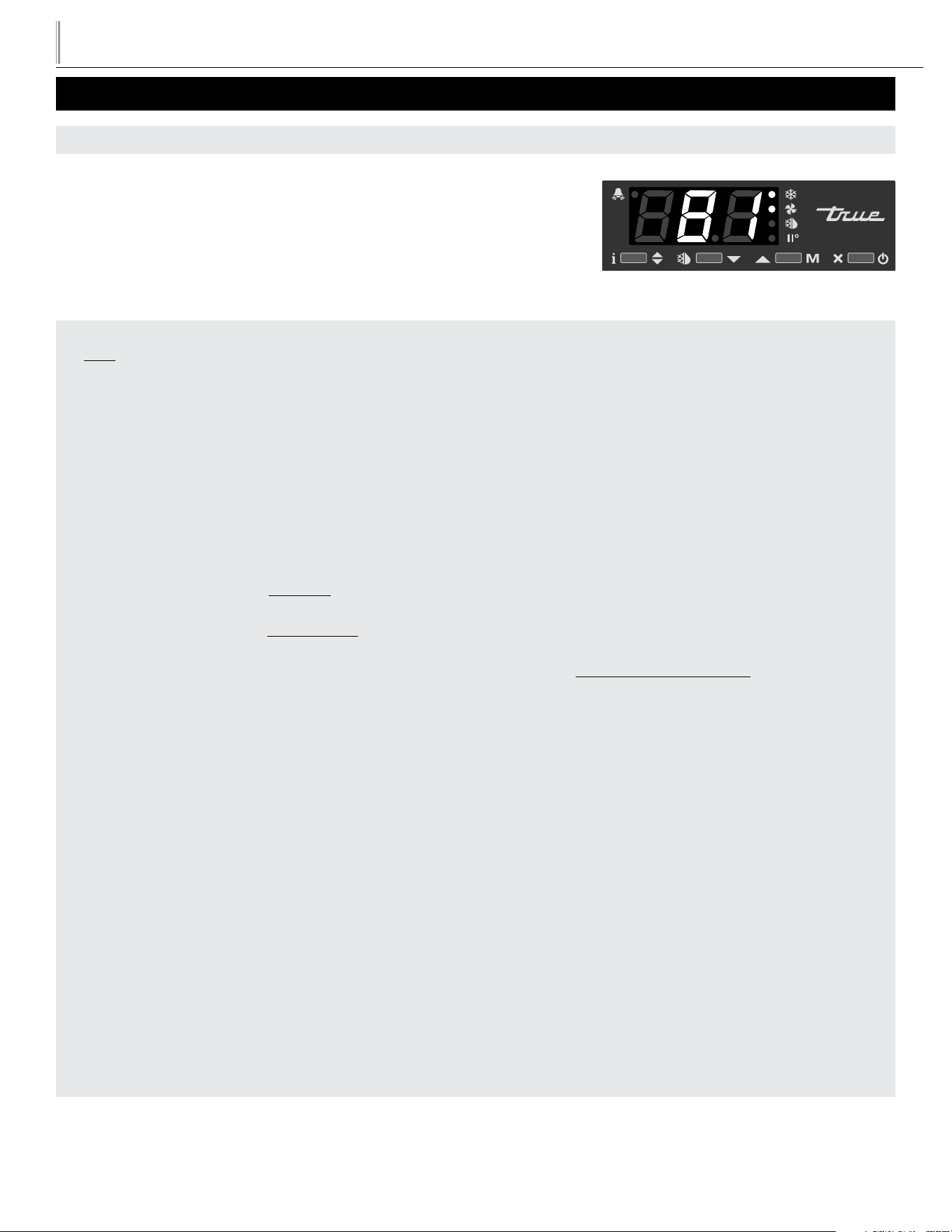
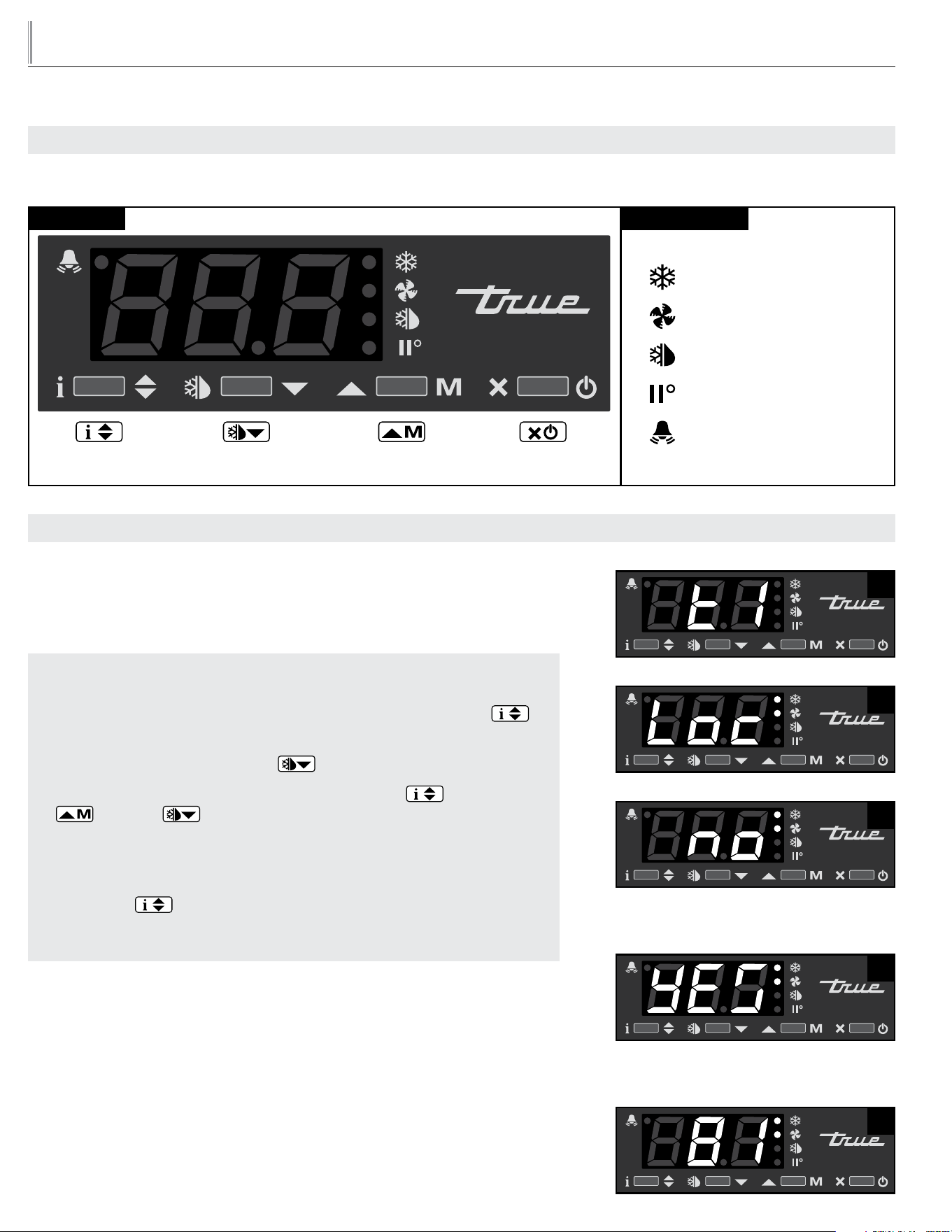
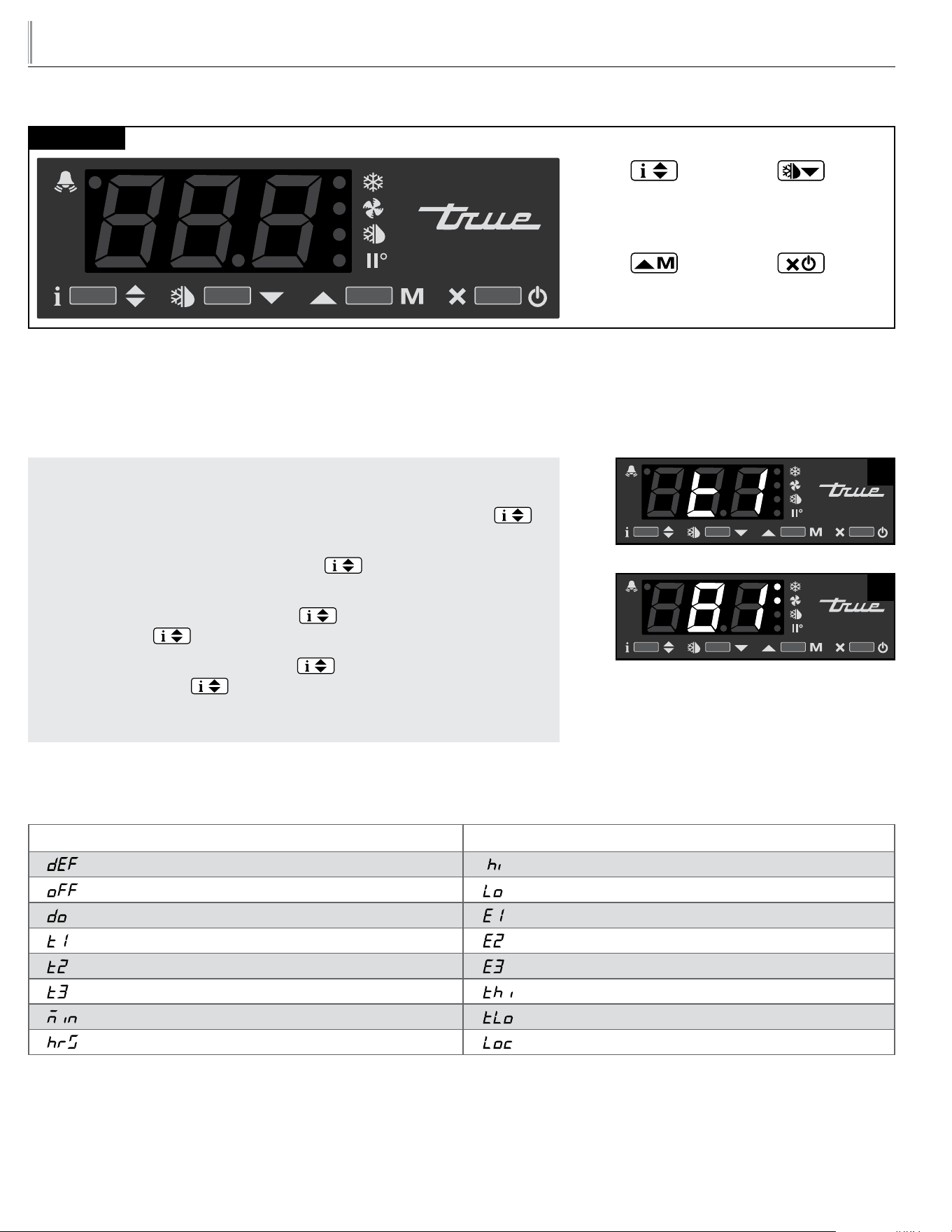
STEP 1 - To change lock setting press and release the Info button .
“t1” will appear. See image 1.
STEP 2 - Press the Down button
until “Loc” appears. See image 2.
STEP 3 - While pressing and holding the Info button
press the Up
or Down button to change the lock settings. If “no” appears,
the controller is unlocked. If “yes” appears, the controller is locked. See
images 3 and 4.
STEP 4 - Once the lock setting has been set correctly release the
info button . Wait 5 seconds for the display to show temperature.
See image 5.
USING THE LAE ELECTRONIC CONTROL
LOCKING AND UNLOCKING THE LAE CONTROLLER:
WHY: Locking of control is necessary to prevent changes to program that may affect
cabinet operation.
Image 3: If “no” appears on screen,
the controller is unlocked.
3
2
1
5
4
Image 4: If “yes” appears on screen, the
controller is locked.
Indicator lights for Refrigeration/Heating Mode, Fan Operation, Defrost Mode.
LAE Control
Info / Set Point
Button
Manual Activation
Up Button
Manual Defrost /
Down Button
Stand-By
Button
LAE Control Icons
Compressor Running
Activation of 2nd Parameter Set
Alarm
Cabinet in Defrost
Evaporator Fan Running
16
TRUE
SPEC SERIES: STR, STA & STG
www.truemfg.com
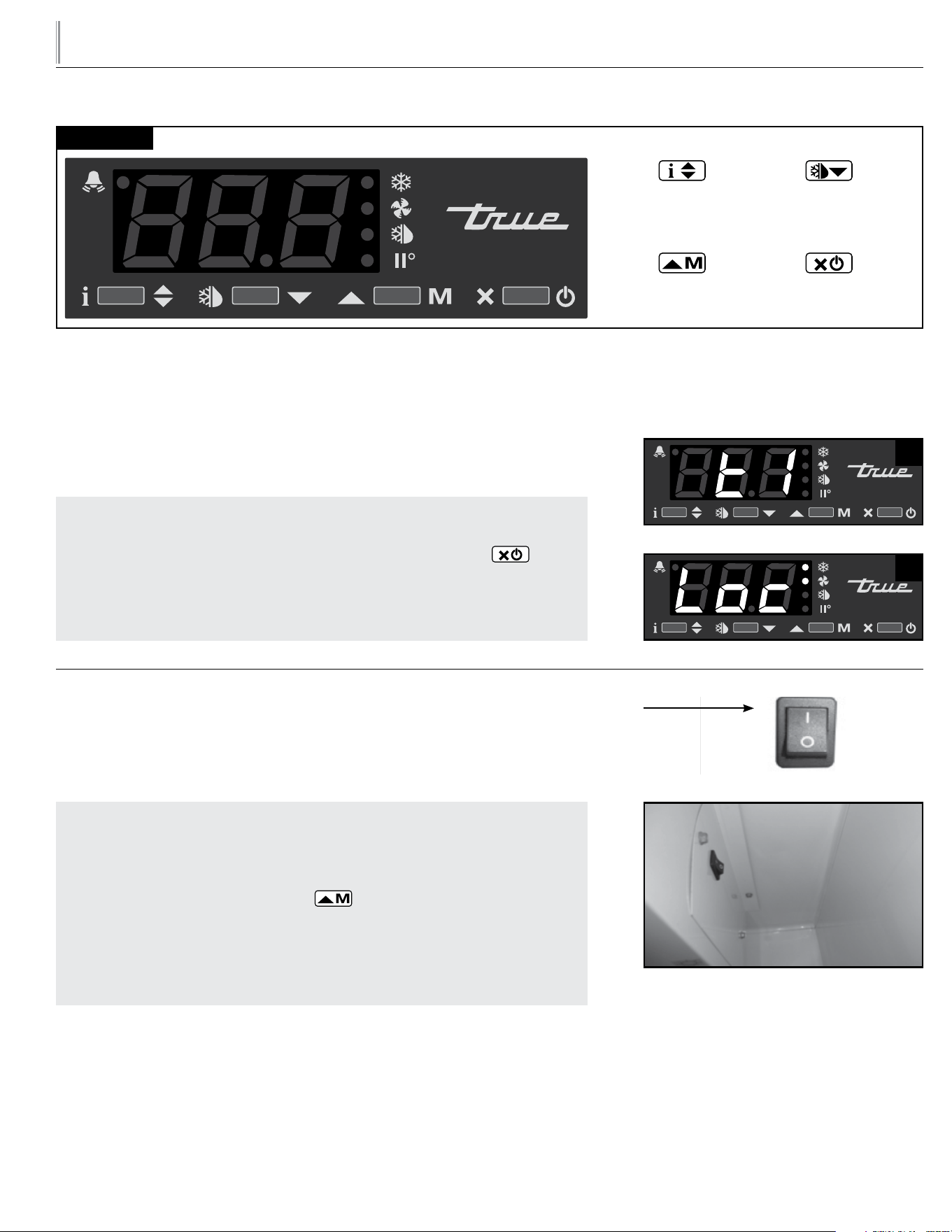
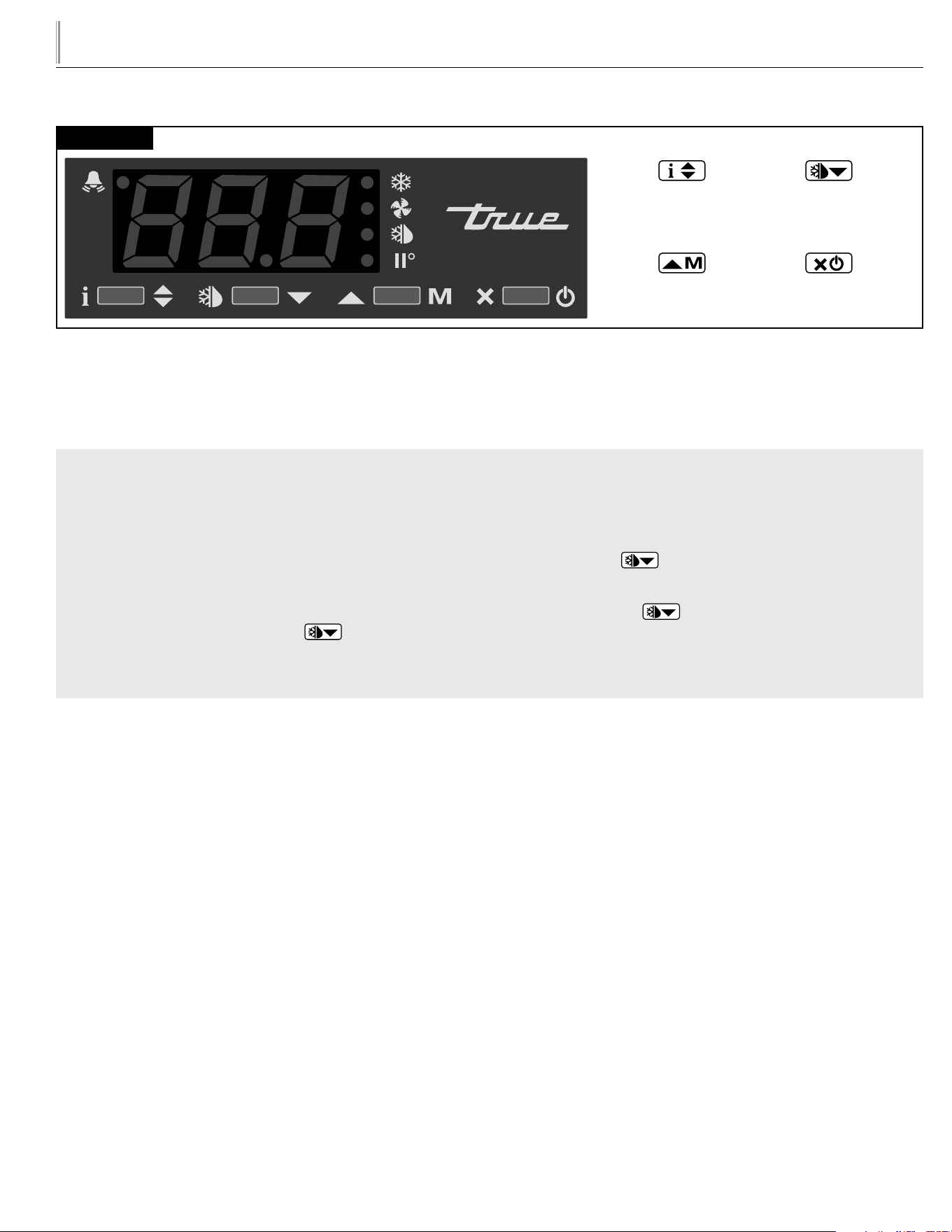
HOW TO TURN OFF THE LAE ELECTRONIC CONTROL:
May need to unlock control.
WHY: Turning off the control will deactivate all electrical components.
CAUTION: Turning off the control will not shut off power to the cabinet. Cabinet
must be unplugged prior to any repair.
HOW TO TURN OFF THE LAE ELECTRONIC CONTROL:
STEP 1 - To turn off control, press and hold the Stand-by button until
"OFF" appears. Release Stand-by button. See Image 2.
STEP 2 - To turn on control, repeat prior steps and a temperature will appear.
ON Position
TURNING THE GLASS DOOR MODEL LIGHTS ON AND OFF:
May need to unlock control.
WHY: Light may be controlled by LAE Controller or interior light switch.
(Solid Door model lights are controlled by a
door switch)
HOW TO TURN THE GLASS DOOR MODEL LIGHT ON
AND OFF:
STEP 1 - To control interior / sign lights by the LAE Controller, press and
release the Manual Activation button .
STEP 2 - To control interior / sign lights by the interior door switch, depress
the rocker switch to the “ON” position. Light switch is located on inside top
right of the ceiling.
1
2
LAE Control
Manual Activation
Up Button
Info / Set Point
Button
Stand-By
Button
Manual Defrost /
Down Button
17
TRUE
SPEC SERIES: STR, STA & STG
www.truemfg.com
CHANGING THE "SET POINT":
May need to unlock control.
WHY: The set point is the temperature at which the compressor will shut off.
NOTE: The “set point” IS NOT the cabinet holding temperature.
HOW TO CHANGE THE “SET POINT”:
STEP 1 - To see the set point, press and hold the Info button .
See image 1.
STEP 2 - While still holding the Info button , press the Up or
Down button to change the “set point”.
STEP 3 - Once the “set point” has been set correctly release the Info
button . The display will show temperature. See image 2.
1
2
LAE Control
Manual Activation
Up Button
Info / Set Point
Button
Stand-By
Button
Manual Defrost /
Down Button
18
TRUE
SPEC SERIES: STR, STA & STG
www.truemfg.com
INITIATE A MANUAL DEFROST:
May need to unlock control.
WHY: A one time additional defrost may be necessary to clear accumulated frost / ice from evaporator coil.
HOW TO INITIATE A MANUAL DEFROST:
The method to initiate a manual defrost is determined by the Defrost Mode Parameter “DTM” preprogrammed in the controller.
REGULAR TIME DEFROST (TIM)
If controller is preprogrammed for “TIM”, press and release the Manual Defrost button until “dEF” appears.
REAL TIME CLOCK (RTC)
If controller is preprogrammed for “RTC” press the and hold the Manual Defrost button for 5 seconds until “dh1” appears.
Release the Manual Defrost button and then press and hold for an additional 5 seconds until “dEF” appears.
NOTE: Defrost will only terminate once a specific preset temperature or a preset time duration is reached.
LAE Control
Manual Activation
Up Button
Info / Set Point
Button
Stand-By
Button
Manual Defrost /
Down Button
19
TRUE
SPEC SERIES: STR, STA & STG
www.truemfg.com
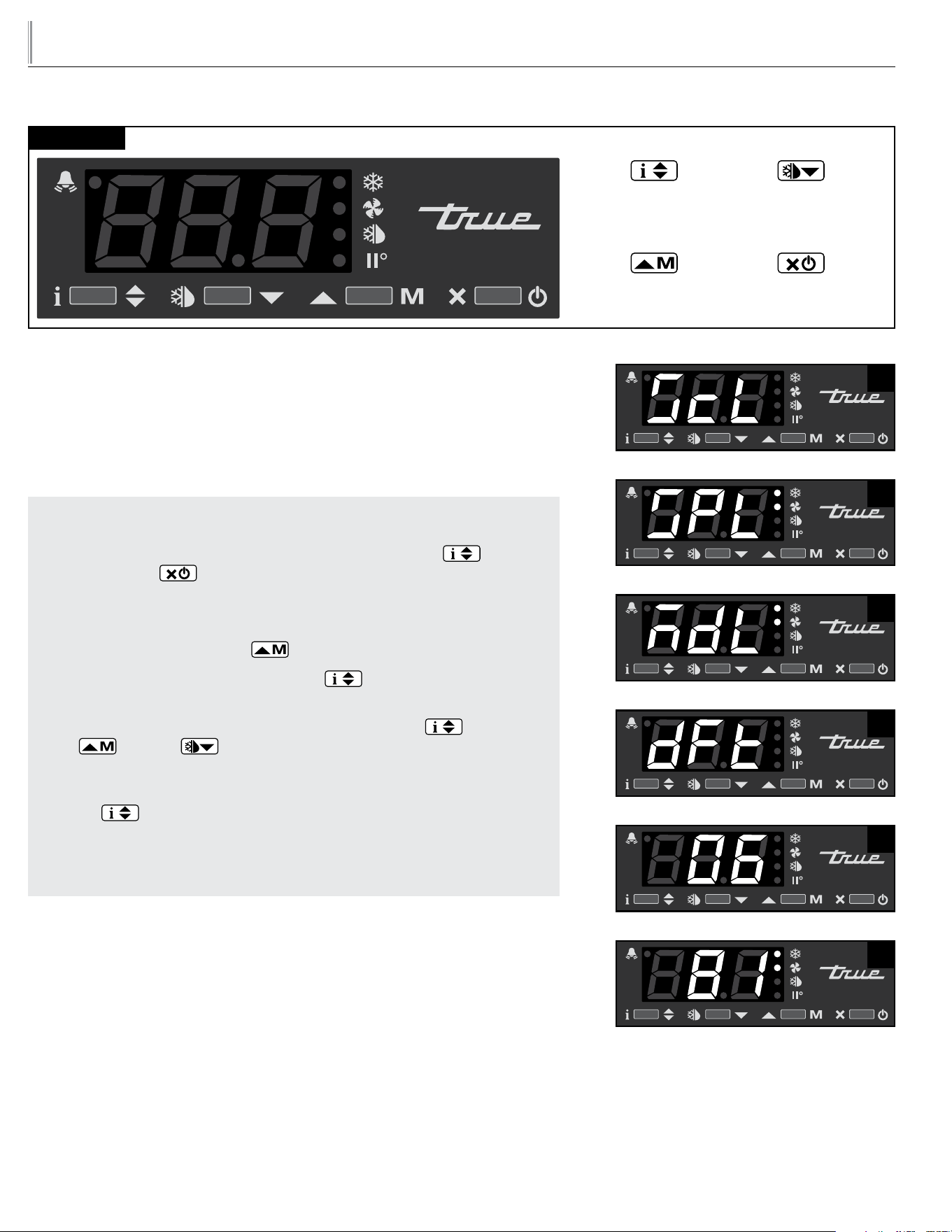
CHANGING “DEFROST INTERVALS”:
May need to unlock control.
This can only be changed if defrost mode parameter “DFM” is set for “TIM”.
WHY: The defrost interval is the time duration between defrost cycles. The defrost
interval time starts when the cabinet is supplied power or after a manual defrost.
1a
1c
1b
2
3
4
HOW TO CHANGE “DEFROST INTERVALS":
STEP 1 - To see the set point, press and hold the Info button
and the
Stand-by button
at the same time.
NOTE: Depending on the version of control, one of three parameters will
appear: “ScL” image 1a, “SPL” image 1b, “MdL” image 1c.
STEP 2 - Push the Up button
until “dFt” appears. See image 2.
STEP 3 - Press and hold the Info button
to see the defrost interval
time. See image 3.
STEP 4 - While pressing and holding the Info button
, press the
Up
or Down button to change the defrost interval times (higher
the number the less frequent the cabinet will defrost).
STEP 5 - Once the defrost interval time has been changed, release the Info
button
.
STEP 6 - Wait 30 seconds for the display to show temperature.
See image 4.
LAE Control
Manual Activation
Up Button
Info / Set Point
Button
Stand-By
Button
Manual Defrost /
Down Button
20
TRUE
SPEC SERIES: STR, STA & STG
www.truemfg.com
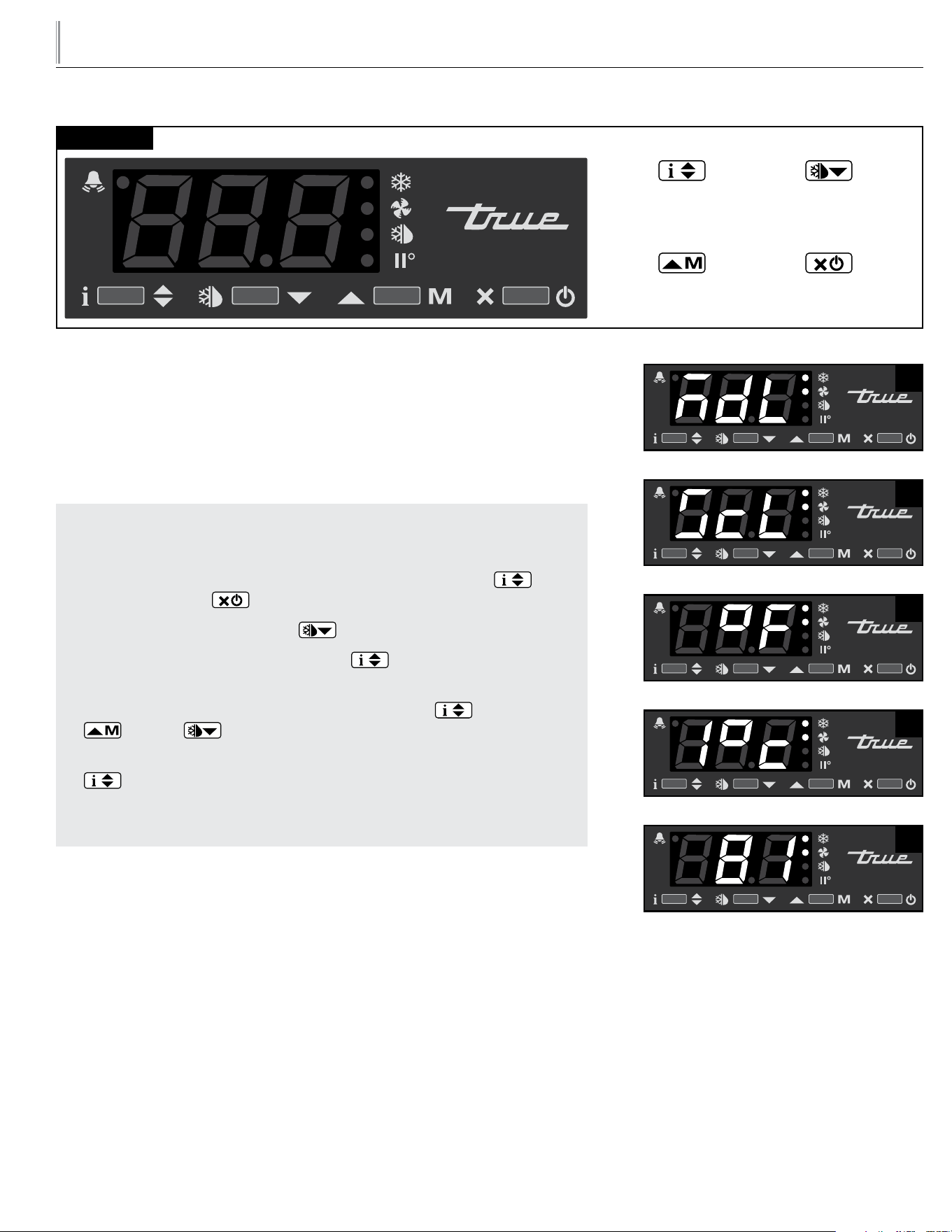
HOW TO CHANGE DISPLAY READOUT FROM
FAHRENHEIT TO CELSIUS:
May need to unlock control.
This can only be changed with the LAE model BR1 version of the control.
WHY: Changing readout will assist with customer application.
HOW TO CHANGE DISPLAY READOUT FROM
FAHRENHEIT TO CELSIUS:
STEP 1 - To change the display, press and hold the Info button and
the Stand-by button at the same time. “MdL” will appear. See image 1.
STEP 2 - Push the Down button until “ScL” appears. See image 2.
STEP 3 - Press and hold the Info button to see the “readout scale”.
See image 3.
STEP 4 - While pressing and holding the Info button , press the up
or down button to change the “readout scale". See image 4.
STEP 5 - Once the “readout scale” has been changed, release the info button
.
STEP 6 - Wait 30 seconds for the display to show temperature. See image 5.
1
2
3
4
5
LAE Control
Manual Activation
Up Button
Info / Set Point
Button
Stand-By
Button
Manual Defrost /
Down Button
21
TRUE
SPEC SERIES: STR, STA & STG
www.truemfg.com
2
1
HOW TO DISPLAY PROBE TEMPERATURES:
STEP 1 - To display T1 temperature, press and release the info button
. “t1” will appear. See image 1.
STEP 2 - Press and hold the info button . This is the temperature of
the T1 Probe. See image 2.
STEP 3 - By releasing the info button , “t2” will appear. Press and hold
the info button to display the temperature of the T2 probe.
STEP 4 - By releasing the info button again, “t3” will appear. Press and
hold the info button to display the temperature of the T3 probe. (If
probe T3 is not activated, “t3” will not appear of the display.)
DISPLAYING TEMPERATURE PROBES, T1, T2, T3:
WHY: To display temperature probe readings in different locations of the cabinet.
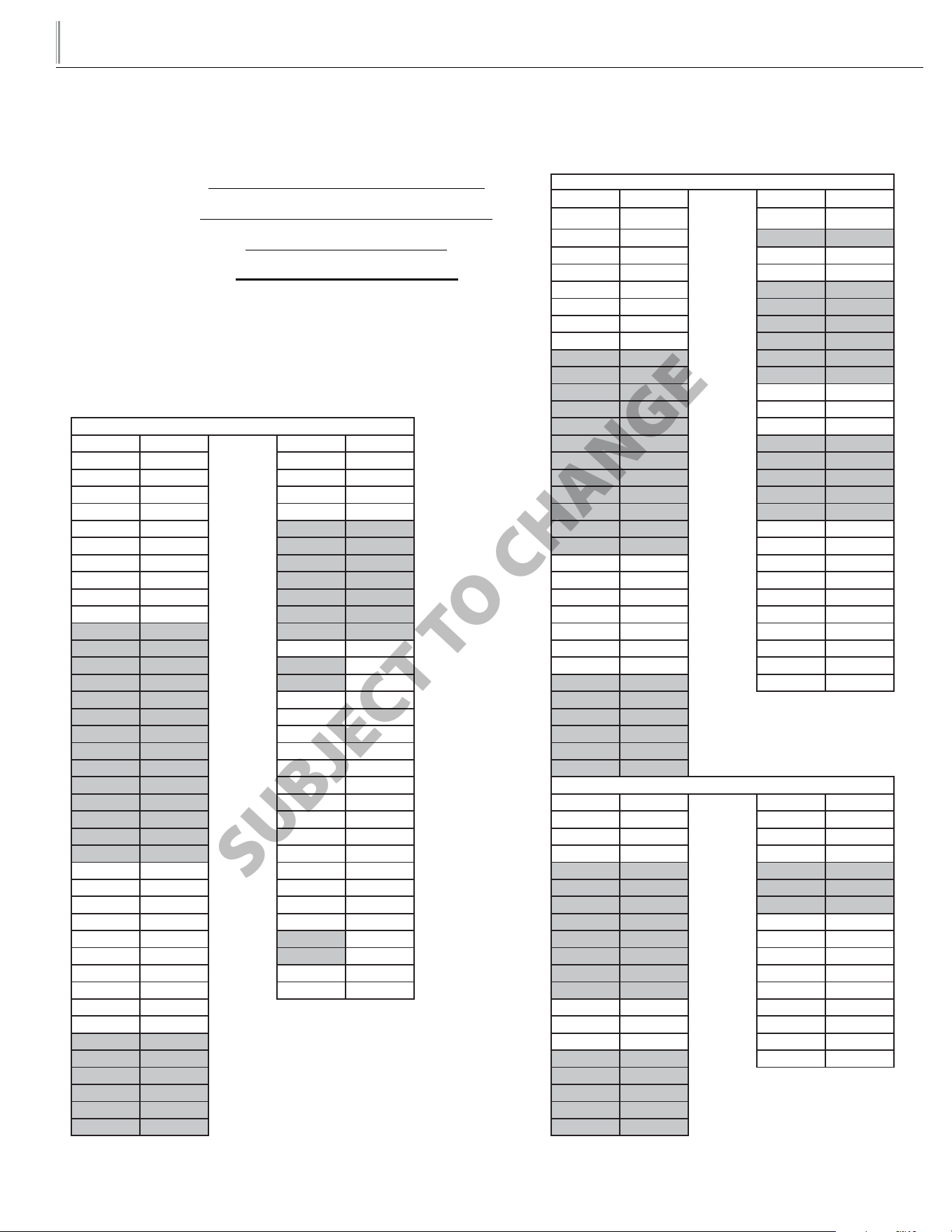
DISPLAY CODES
DISPLAY
Defrost in progress Room high temperature alarm
Controller in stand-by Room low temperature alarm
Door open alarm Probe T1 failure
Instant Probe 1 temperature Probe T2 failure
Instant Probe 2 temperature Probe T3 failure
Instant Probe 3 temperature Maximum probe 1 temperature recorded
Minutes of the Real Time Clock Minimum probe 1 temperature recorded
Hours of the Real Time Clock Keypad state lock
LAE Control
Manual Activation
Up Button
Info / Set Point
Button
Stand-By
Button
Manual Defrost /
Down Button
22
TRUE
SPEC SERIES: STR, STA & STG
www.truemfg.com
SPL
(X-32) / 1.8
ADO
SPH
(X-32) / 1.8
AHM
SP
(X-32) / 1.8
AHT
(X-32) / 1.8
HYS
(X) / 1.8
ACC
LSII1TC
(X-32) / 1.8
HSII2TC
(X-32) / 1.8
PSIIDSC
(X-32) / 1.8
YHIIMFD
(X) / 1.8
CFIITFD
FDIIBFD
DLI
(X-32) / 1.8
SB
1IDOTD
2IDYTD
SCL
1C
M3TDPDODA
SPL
(X-32) / 1.8
3SONRDMHA
(X) / 1.8
SPH
(X-32) / 1.8
AHT
(X-32) / 1.8
LSPMDD
(X-32) / 1.8
SP
(X-32) / 1.8
RSPYDDCCA
(X-32) / 1.8
FOPDIFMSIIH-C
HYS
(X) / 1.8
IISL
(X-32) / 1.8
FDD
(X-32) / 1.8
LSM
HSIITRC
(X-32) / 1.8
1AOOTF
PSII1TC
(X-32) / 1.8
2AOMCF
YHII2TC
(X) / 1.8
FDT
(X) / 1.8
OS1
(X) / 1.8
HDFCFIIDSC
(X) / 1.8
T2
2SO1TFSDHMFD
(X) / 1.8
DLT2TFFDIITFD
LCS3TFBS1HD
1C
MISMTASD2HD
ALAMSD3HD
(X-32) / 1.8
ADR
AHA2ID4HD
(X-32) / 1.8
RLATTS5HD
(X) / 1.8
RHATDE6HD
(X) / 1.8
DLI
(X-32) / 1.8
ITAMSL
DTA1AOOTD
2AOYTD
LPSDCDPD
(X-32) / 1.8
ADO
HPSPNINRD
(X-32) / 1.8
SB
1SOMDD
(X) / 1.8
SP
(X-32) / 1.8
DI1
2IDMC2TYDD
2SODIF
(X) / 1.8
HYS
(X) / 1.8
PSL
(X-32) / 1.8
FDD
(X-32) / 1.8
RSPNOT3T
(X-32) / 1.8
3SOOTF
(X) / 1.8
FOPFOT
MSDBPDLTMCF
FDT
(X) / 1.8
MSLTISDT
FDH
(X) / 1.8
1AOTDGVA
2AORAMIS1TF
1SOTCRDA2TF
(X) / 1.8
FT3 DLTFP
ATM LCSDSH
1C
ALA
(X-32) / 1.8
MISMTA
AHA
(X-32) / 1.8
ALA
(X-32) / 1.8
ADR
ALR
(X) / 1.8
AHA
(X-32) / 1.8
AHR
(X) / 1.8
ALR
(X) / 1.8
ATI AHR
(X) / 1.8
ATD ATD
BIT25
BIT25 Heating
AR2-28
SUBJECT TO CHANGE
EXCEPT MODEL: BR1
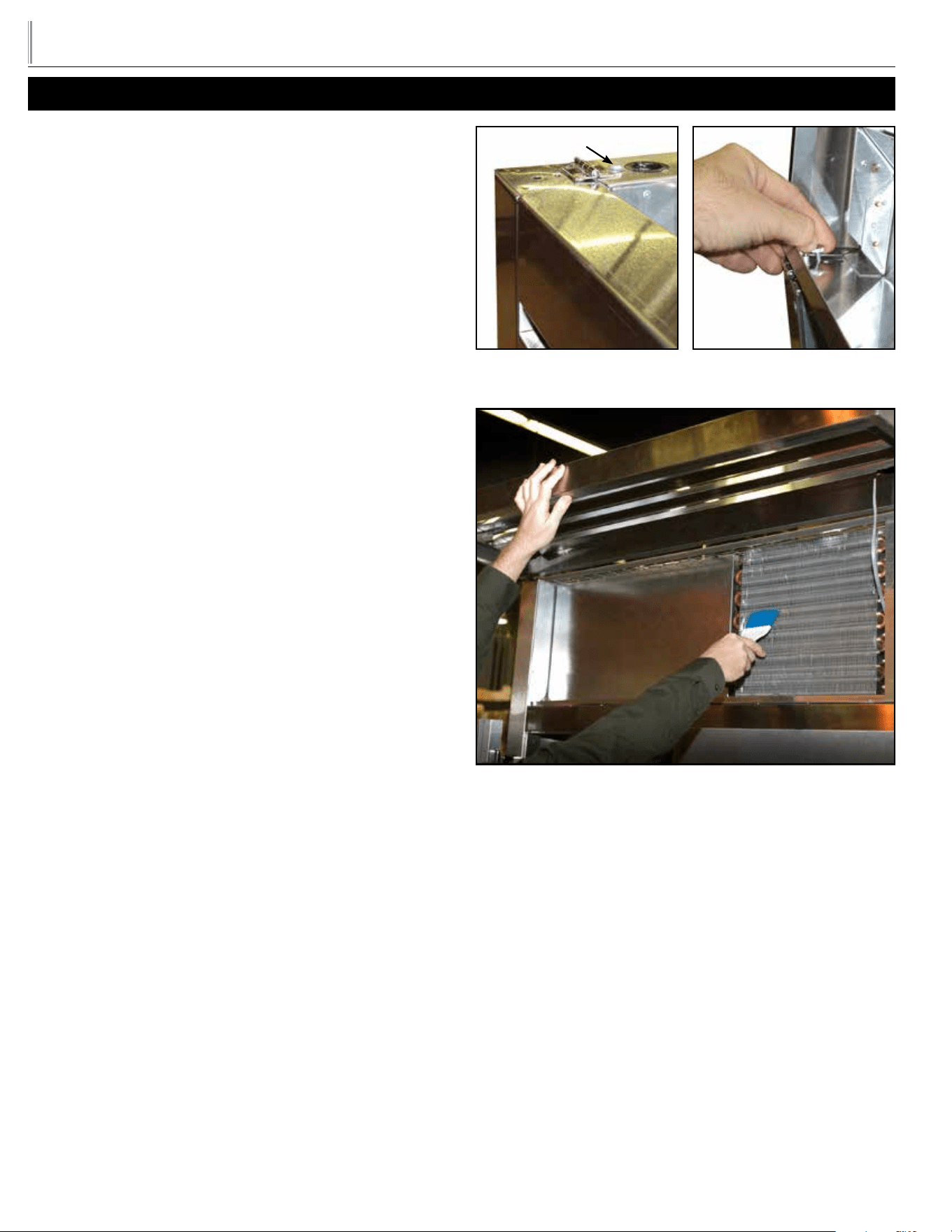
EXAMPLE:
If current SPL is set for 20 degrees F,
the formula is (X-32) / 1.8
(20-32) / 1.8 = -6.7 Celcius
For every model / version of the LAE controller,
ALL parameters with a formula shown need to be
converted for Celsius applications.
LAE Controller Parameter Settings
for Celsius
23
TRUE
SPEC SERIES: STR, STA & STG
www.truemfg.com
MAINTENANCE, CARE, CLEANING
CLEANING THE CONDENSER COIL
When using electrical appliances, basic safety precautions should be
followed, including the following. Disconnect power to unit.
TOOLS REQUIRED
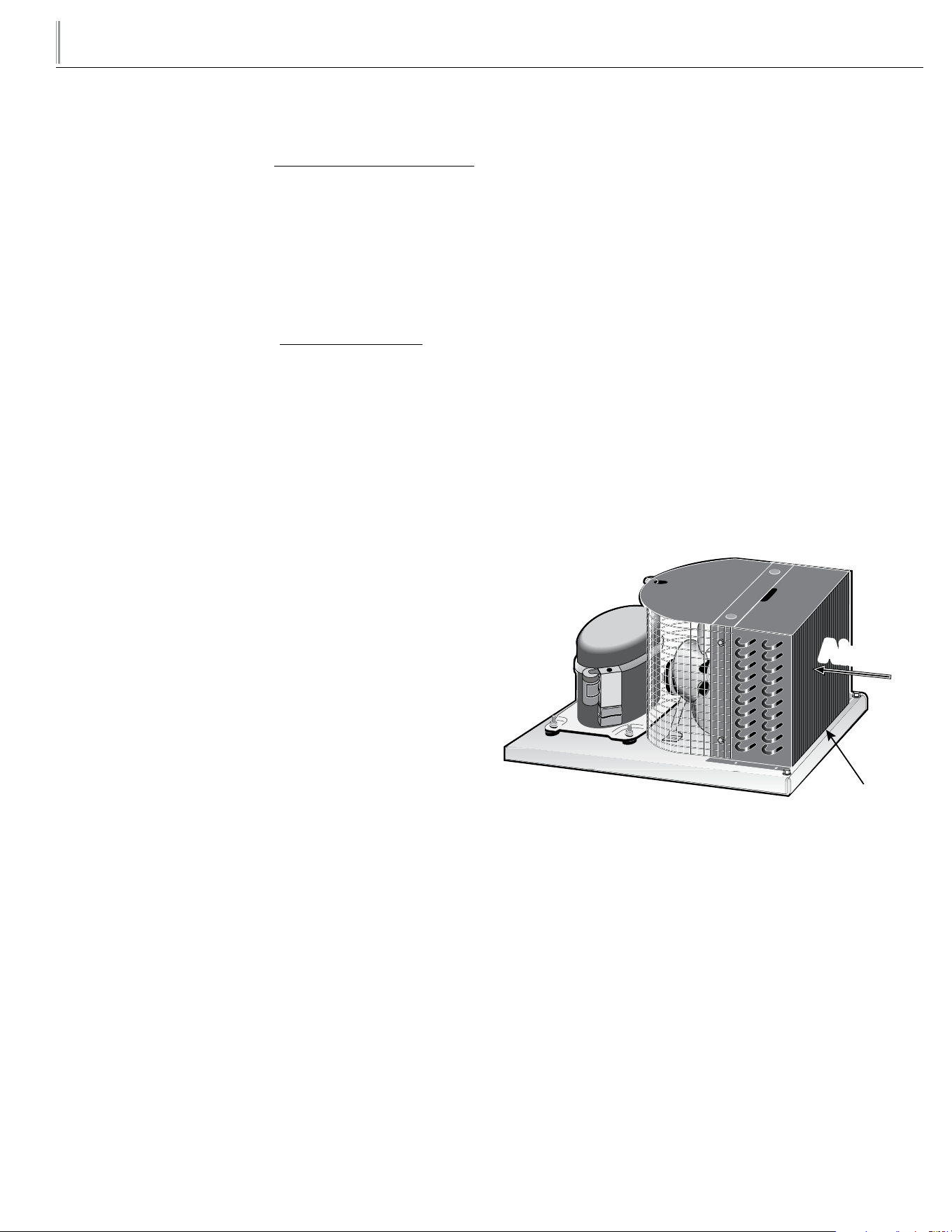
CAUTION: Before performing service or maintenance make sure
louver grill is secured in open position. Use instructions and photos
below to secure louver grill.
1. Remove thumbscrews on the top of each cabinet end.
2. Lift louver grill (careful not to pull on any wires)
3. Reinstall thumbscrews
A. The thumbscrews should be put through louver grill holes
and fastened into previous position in cabinet end.
CAUTION: Make sure top louver grill is correctly seated in the
open position when servicing or cleaning.
B. When servicing is complete remove thumbscrews and
close louver grill. Then reinstall thumbscrews into original
location.
• While cleaning condenser coil lift and hold top louvered grill.
Clean off accumulated dirt from the condenser coil with a
stiff bristle brush. Vacuum all dirt residue from the coil and
surrounding areas while holding the top louvered grill. Any
servicing to condensing unit remove top louvered grill. On top
of the cabinet are two screws are located on either side of the
louver grill. Remove these screws from the hinges and keep
them in a safe place while servicing the unit. These screws are
needed for later re-install of the louver grill.
• Phillips Screwdriver
• Stiff Bristle Brush
• Adjustable Wrench
• Air Tank or CO2 Tank
• Vacuum Cleaner
Condenser Cleaning
Louver grill in upright positionThumbscrew location
Thumbscrews located
on cabinet ends
24
TRUE
SPEC SERIES: STR, STA & STG
www.truemfg.com
IMPORTANT WARRANTY INFORMATION
Condensers accumulate dirt and require cleaning every 30 days.
Dirty condensers result in compressor failure, product loss, and lost
sales... which are not covered by warranty.
If you keep the Condenser clean you will minimize your service
expense and lower your electrical costs. The Condenser requires
scheduled cleaning every thirty days or as needed.
Air is pulled through the Condenser continuously, along with dust,
lint, grease, etc.
A dirty Condenser can result in NON-WARRANTEED part &
Compressor Failures, Product Loss, and Lost Sales.
Proper cleaning involves removing dust from the Condenser. By using
a soft brush, or vacuuming the Condenser with a shop vac, or using
CO2, nitrogen, or pressurized air.
If you cannot remove the dirt adequately, please call your refrigera-
tion service company.
On the Spec Series units the condenser is accessible on the top of
the unit. You must lift open the cabinet rainshield to expose the
Condenser. (Spec Series models)
The Condenser looks like a group of vertical fins. You need to be able
to see through the condenser for the unit to function at maximum
capacity. Do not place filter material in front of condensing coil. This
material blocks air-flow to the coil similar to having a dirty coil.
THE CLEANING OF THE CONDENSER IS NOT
COVERED BY THE WARRANTY!
HOW TO CLEAN THE CONDENSER:
1. Disconnect the electrical power to the unit.
2. Open the rainshield.
3. Vacuum or brush the dirt, lint, or debris from the finned
condenser coil.
4. If you have a significant dirt build up you can blow out the
condenser with compressed air.
(CAUTION MUST BE USED TO AVOID EYE INJURY.
EYE PROTECTION IS RECOMMENDED.)
5. When finished be sure to close the rainshield.
6. Reconnect the electrical power to the unit.
If you have any questions, please call TRUE Manufacturing at 636-240-
2400 or 800-325-6152 and ask for the Service Department. Direct
to Service Department 1(855)372-1368. Service Department
Availability Monday-Thursday 7:00 a.m. to 7:00 p.m., Friday 7:00 a.m.
to 6:00 p.m. and Saturday 8:00 a.m. to 12:00 p.m. CST.
Condensing Unit
Airflow
Condenser

25
TRUE
SPEC SERIES: STR, STA & STG
www.truemfg.com
STAINLESS STEEL EQUIPMENT CARE
AND CLEANING
CAUTION: Do not use any steel wool, abrasive or chlorine based
products to clean stainless steel surfaces.
STAINLESS STEEL OPPONENTS
There are three basic things which can break down your stainless
steel’s passivity layer and allow corrosion to rear its ugly head.
1. Scratches from wire brushes, scrapers, and steel pads are just
a few examples of items that can be abrasive to stainless steel’s
surface.
2. Deposits left on your stainless steel can leave spots. You may have
hard or soft water depending on what part of the country you live
in. Hard water can leave spots. Hard water that is heated can leave
deposits if left to sit too long. These deposits can cause the
passive layer to break down and rust your stainless steel.
All deposits left from food prep or service should be removed
as soon as possible.
3. Chlorides are present in table salt, food, and water. Household
and industrial cleaners are the worst type of chlorides
to use.
RECOMMENDED CLEANERS FOR CERTAIN
SITUATIONS / ENVIRONMENTS OF STAINLESS
STEEL
A. Soap, ammonia and detergent medallion applied with a cloth or
sponge can be used for routine cleaning.
B. Arcal 20, Lac-O-Nu Ecoshine applied provides barrier film for
fingerprints and smears.
C. Cameo, Talc, Zud First Impression is applied by rubbing in
the direction of the polished lines for stubborn stains and
discoloring.
D. Easy-off and De-Grease It oven aid are excellent for removals
on all finishes for grease-fatty acids, blood and burnt-on foods.
E. Any good commercial detergent can be applied with a sponge
or cloth to remove grease and oil.
F. Benefit, Super Sheen, Sheila Shine are good for restoration /
passivation.
NOTE: The use of stainless steel cleaners or other such solvents is
not recommended on plastic parts. Warm soap and water will suffice.
8 STEPS THAT CAN HELP PREVENT RUST ON
STAINLESS STEEL:
1. USING THE CORRECT CLEANING TOOLS
Use non-abrasive tools when cleaning your stainless steel
products. The stainless steel’s passive layer will not be harmed
by soft cloths and plastic scouring pads. Step 2 tells you how to
find the polishing marks.
2. CLEANING ALONG THE POLISH LINES
Polishing lines or “grain” are visible on some stainless steels.
Always scrub parallel to visible lines on some stainless steels.
Use a plastic scouring pad or soft cloth when you cannot see
the grain.
3. USE ALKALINE, ALKALINE CHLORINATED OR
NON-CHLORIDE CONTAINING CLEANERS
While many traditional cleaners are loaded with chlorides, the
industry is providing an ever increasing choice of non-chloride
cleaners. If you are not sure of your cleaner’s chloride content
contact your cleaner supplier. If they tell you that your present
cleaner contains chlorides, ask if they have an alternative. Avoid
cleaners containing quaternary salts as they can attack stainless
steel, causing pitting and rusting.
4. WATER TREATMENT
To reduce deposits, soften the hard water when possible.
Installation of certain filters can remove corrosive and distasteful
elements. Salts in a properly maintained water softener can be
to your advantage. Contact a treatment specialist if you are not
sure of the proper water treatment.
5. MAINTAINING THE CLEANLINESS OF YOUR
FOOD EQUIPMENT
Use cleaners at the recommended strength (alkaline chlorinated
or non-chloride). Avoid build-up of hard stains by cleaning
frequently. When boiling water with your stainless steel
equipment, the single most likely cause of damage is chlorides in
the water. Heating any cleaners containing chlorides will have
the same damaging effects.
6. RINSE
When using chlorinated cleaners you must rinse and wipe dry
immediately. It is better to wipe standing cleaning agents and
water as soon as possible. Allow the stainless steel equipment
to air dry. Oxygen helps maintain the passivity film on stainless
steel.
7. HYDROCHLORIC ACID (MURIATIC ACID)
SHOULD NEVER BE USED ON STAINLESS STEEL
8. REGULARLY RESTORE/PASSIVATE STAINLESS
STEEL
FOR ADDITIONAL MAINTENANCE INSTRUCTION,
PLEASE VISIT THE MEDIA CENTER AT
WWW.TRUEMFG.COM

26
TRUE
SPEC SERIES: STR, STA & STG
www.truemfg.com
THIS WARRANTY ONLY APPLIES TO UNITS SHIPPED FROM TRUE’S MANUFACTURING FACILITIES AFTER JULY 1, 2014.
THREE YEAR PARTS & LABOR WARRANTY
ADDITIONAL TWO YEAR COMPRESSOR WARRANTY
404A/134A COMPRESSOR WARRANTY
WARRANTY CLAIMS
WHAT IS NOT COVERED BY THIS WARRANTY
TRUE warrants to the original purchaser of every new TRUE refrigerated unit, the cabinet and all parts thereof, to be free from defects in material or workmanship, under normal and
proper use and maintenance service as specified by TRUE and upon proper installation and start-up in accordance with the instruction packet supplied with each TRUE unit. TRUE’s
obligation under this warranty is limited to a period of three (3) years from the date of original installation or 39 months after shipment date from TRUE, whichever occurs first.
Any part covered under this warranty that are determined by TRUE to have been defective within three (3) years of original installation or thirty-nine (39) months after shipment date
from manufacturer, whichever occurs first, is limited to the repair or replacement, including labor charges, of defective parts or assemblies. The labor warranty shall include standard straight
time labor charges only and reasonable travel time, as determined by TRUE.
Warranty does not cover standard wear parts which include door gaskets, incandescent bulbs or fluorescent bulbs. Warranty also does not cover issues caused by improper installation
or lack of basic preventative maintenance which includes regular cleaning of condenser coils.
In addition to the Three (3) year warranty stated above, TRUE warrants its hermetically and semi-hermetically sealed compressor to be free from defects in both material and workman
-
ship under normal and proper use and maintenance service for a period of two (2) additional years from the date of original installation but not to exceed five (5) years and three (3)
months after shipment from the manufacturer.
Compressors determined by TRUE to have been defective within this extended time period will, at TRUE’s option, be either repaired or replaced with a compressor or compressor parts
of similar design and capacity.
The two (2) year extended compressor warranty applies only to hermetically and semi-hermetically sealed parts of the compressor and does not apply to any other parts or components,
including, but not limited to: cabinet, paint finish, temperature control, refrigerant, metering device, driers, motor starting equipment, fan assembly or any other electrical component, etcetera.
The two year compressor warranty detailed above will be voided if the following procedure is not carefully adhered to:
1. This system contains R404A or R134A refrigerant and polyol ester lubricant. The polyol ester lubricant has rapid moisture absorbing qualities. If long exposure to
the ambient conditions occur, the lubricant must be removed and replaced with new. For oil amounts and specifications please call TRUE technical service department
(855-372-1368). Failure to comply with recommended lubricant specification will void the compressor warranty.
2. Drier replacement is very important and must be changed when a system is opened for servicing. A drier using XH-7 desiccant or an exact replacement solid core drier
must be used. The new drier must also be the same capacity as the drier being replaced.
3. Micron level vacuums must be achieved to insure low moisture levels in the system. 500 microns or lower must be obtained.
All claims for labor or parts must be made directly through TRUE. All claims should include: model number of the unit, the serial number of the cabinet, proof of purchase, date of instal-
lation, and all pertinent information supporting the existence of the alleged defect.
In case of warranty compressor, the compressor model tag must be returned to TRUE along with above listed information.
Any action or breach of these warranty provisions must be commenced within one (1) year after that cause of action has occurred.
TRUE’s sole obligation under this warranty is limited to either repair or replacement of parts, subject to the additional limitations below. This warranty neither assumes nor authorizes any
person to assume obligations other than those expressly covered by this warranty.
NO CONSEQUENTIAL DAMAGES. TRUE IS NOT RESPONSIBLE FOR ECONOMIC LOSS; PROFIT LOSS; OR SPECIAL, INDIRECT, OR CONSEQUENTIAL DAMAGES, INCLUDING
WITHOUT LIMITATION, LOSSES OR DAMAGES ARISING FROM FOOD OR PRODUCT SPOILAGE CLAIMS WHETHER OR NOT ON ACCOUNT OF REFRIGERATION FAILURE.
WARRANTY IS NOT TRANSFERABLE. This warranty is not assignable and applies only in favor of the original purchaser/user to whom delivered. ANY SUCH ASSIGNMENT OR
TRANSFER SHALL VOID THE WARRANTIES HEREIN MADE AND SHALL VOID ALL WARRANTIES, EXPRESS OR IMPLIED, INCLUDING ANY WARRANTY OF MERCHANTABILITY
OR FITNESS FOR A PARTICULAR PURPOSE.
IMPROPER USAGE. TRUE ASSUMES NO LIABILITY FOR PARTS OR LABOR COVERAGE FOR COMPONENT FAILURE OR OTHER DAMAGES RESULTING FROM IMPROPER
USAGE OR INSTALLATION OR FAILURE TO CLEAN AND/OR MAINTAIN PRODUCT AS SET FORTH IN THE WARRANTY PACKET PROVIDED WITH THE UNIT.
RELOCATION OF CABINET FOR REPAIR: True is not responsible for the cost to move a cabinet for any reason from its position of operation on the customer’s premises to make a
warranty repair.
RESIDENTIAL APPLICATIONS: TRUE assumes no liability for parts or labor coverage for component failure or other damages resulting from installation in non-commercial or residential
applications.
ALTERATION, NEGLECT, ABUSE, MISUSE, ACCIDENT, DAMAGE DURING TRANSIT OR INSTALLATION, FIRE, FLOOD, ACTS OF GOD. TRUE is not responsible for the repair or
replacement of any parts that TRUE determines have been subjected after the date of manufacture to alteration, neglect, abuse, misuse, accident, damage during transit or installation, fire,
flood, or act of God.
IMPROPER ELECTRICAL CONNECTIONS. TRUE IS NOT RESPONSIBLE FOR THE REPAIR OR REPLACEMENT OF FAILED OR DAMAGED COMPONENTS RESULTING FROM
INCORRECT SUPPLY VOLTAGE, THE USE OF EXTENSION CORDS, LOW VOLTAGE, OR UNSTABLE SUPPLY VOLTAGE. NO IMPLIED WARRANTY OF MERCHANTABILITY
OR FITNESS FOR A PARTICULAR PURPOSE: THERE ARE NO OTHER WARRANTIES, EXPRESSED, IMPLIED OR STATUTORY, EXCEPT THE THREE (3) YEAR PARTS & LABOR
WARRANTY AND THE ADDITIONAL TWO (2) YEAR COMPRESSOR WARRANTY AS DESCRIBED ABOVE. THESE WARRANTIES ARE EXCLUSIVE AND IN LIEU OF ALL OTHER
WARRANTIES, INCLUDING IMPLIED WARRANTY AND MERCHANTABILITY OR FITNESS FOR A PARTICULAR PURPOSE. THERE ARE NO WARRANTIES WHICH EXTEND
BEYOND THE DESCRIPTION ON THE FACE HEREOF.
OUTSIDE U.S./Canada: This warranty does not apply to, and TRUE is not responsible for, any warranty claims made on products sold or used outside the United States/Canada.
This warranty only applies to units shipped from True’s manufacturing facilities after July 1, 2014.
WARRANTY INFORMATION (U.S.A & CANADA ONLY!)
T
RUE
R
EFRIGERATION
MADE IN
SINCE 1945
U.S.A.
®