1
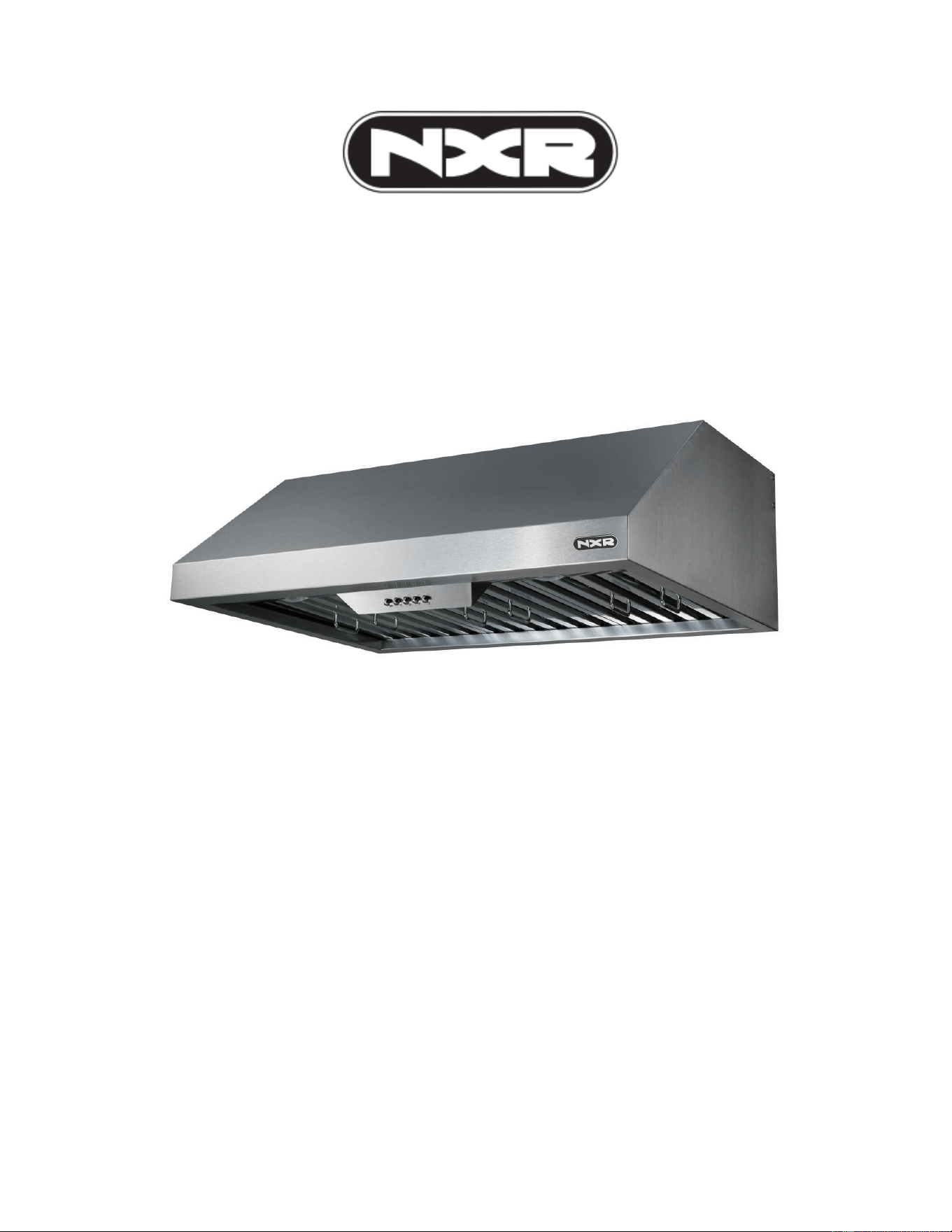
UNDER CABINET RANGE HOODS
USER INSTRUCTIONS
IMPORTANT SAFETY INSTRUCTIONS
Carefully read the following important information regarding
installation safety and maintenance.
Keep these instructions for future reference.

Important Safety Notice
Read
all
Instructions
before
Installing
and
operating
this
appliance
Page 1
• The installation in this manual is intended for qualified installers, service technicians or persons with similar
qualified background experiences. Installation and electrical wiring must be done by qualified professionals
in accordance with all applicable codes along with the standards including fire-rated construction.
• DO NOT attempt to install this appliance yourself. Injury could result from installing the unit due to lack of
appropriate electrical and technical background.
• The range hood may have very sharp edges. Please wear protective gloves if necessary to remove any parts for
installing, cleaning or servicing.
• Activating the switch ON mode before completing installation may cause ignition or an explosion.
• Due to the size and weight of this range hood, it’s recommended to have two people set up the hood during
installation.
To reduce the risk of fire, electric shock, or injury to persons:
• For general ventilating use only. DO NOT use to exhaust hazardous or explosive materials and vapors.
• The combustion air flow needed for safe operation of fuel-burning equipment may be affected by this unit’s
operation. Follow the heating equipment manufacturer’s guideline and safety standards such as those
published by the National Fire Protection Association (NFPA), the American Society of Heating,
Refrigeration and Air Conditioning Engineers (ASHRAE), and the local code authorities.
• Before servicing or cleaning unit, switch power OFF at service panel and lock service panel to prevent
power from being switched ON accidentally.
• Clean grease laden surfaces frequently. To reduce the risk of fire and to disperse air properly, make sure to
vent the air outside. DO NOT vent exhaust into spaces between walls, crawl spaces, ceiling, attics or garages.
• Ducted fans MUST always be vented to the outdoors.
• Use only metal ductwork and this unit MUST be grounded.
• Sufficient air is needed for proper combustion and exhausting of gases through the duct to prevent back
drafting.
• When cutting and drilling into wall or ceiling, be careful not to damage electrical wiring or other hidden
utilities.
• All electrical wiring must be properly installed, insulated, and grounded.
• Old duct work should be cleaned or replaced if necessary to avoid the possibility of a grease fire.
• Check all joints on the duct work to ensure everything is properly connected and taped.
• Use this unit only in the manner intended by the manufacturer. If you have questions, contact the vendor.
To reduce the risk of a stove top grease fire:
• Keep all fan, baffle, spaces, filter, grease tunnel, oil container and grease-laden surfaces clean. Grease should
not be allowed to accumulate on fan, baffle, spaces, filter, grease tunnel, and oil container.
• Always turn range hood ON when cooking at high heat or when cooking flaming foods.
• Use high settings on cooking range only when necessary.
• Never leave surface units unattended at high settings. Boil overs cause smoking and greasy spillovers that
may ignite. Heat oils slowly on low or medium settings.

Important Safety Notice
Read
all
Instructions
before
Installing
and
operating
this
appliance
Page 2
WARNING
• Clean ventilating fan frequently.
• Always use appropriate cookware and utensils size.
• Always use cookware appropriate for the size of the surface element.
To reduce the risk of injury to persons in the event of a stove top grease fire:
• SMOTHER FLAMES with a close-fitting lid, cookie sheet, or metal tray, then turn OFF the burner.
BE CAREFUL TO PREVENT BURNS. NEVER PICK UP A FLAMING PAN—you may get burned. KEEP
FLAMMABLE OR COMBUSTIBLE MATERIAL AWAY FROM FLAMES. If the flames DO NOT go out
immediately, EVACUATE AND CALL THE FIRE DEPARTMENT or 911.
• DO NOT USE WATER, including wet dishcloths or towels — a violent steam explosion will result.
• Use an extinguisher ONLY if:
• You know you have a Class A, B, C extinguisher, and you already know how to operate it.
• The fire is small and contained in the area where it is started.
• The fire department is being called.
• You can fight the fire with your back to an exit.
To reduce the risk of injury to persons in the event of a gas leaks:
• Extinguish any open flame.
• DO NOT turn on the lights or any type of appliance.
• Open all doors and windows to disperse the gas. If you still smell gas, call the gas company and fire department, or
911 immediately.
Your safety and the safety of others is very important. We have provided many important safety messages in this manual
and on your appliance. Always read and obey all safety messages. All safety messages will tell you what the potential
hazard is, how to reduce the chance of injury, and what can happen if the instructions are not followed correctly.
This is the safety alert symbol. This symbol alerts you to potential hazards that can hurt you and others. All safety
messages will follow the safety alert symbol and the word “WARNING”.
Page 3
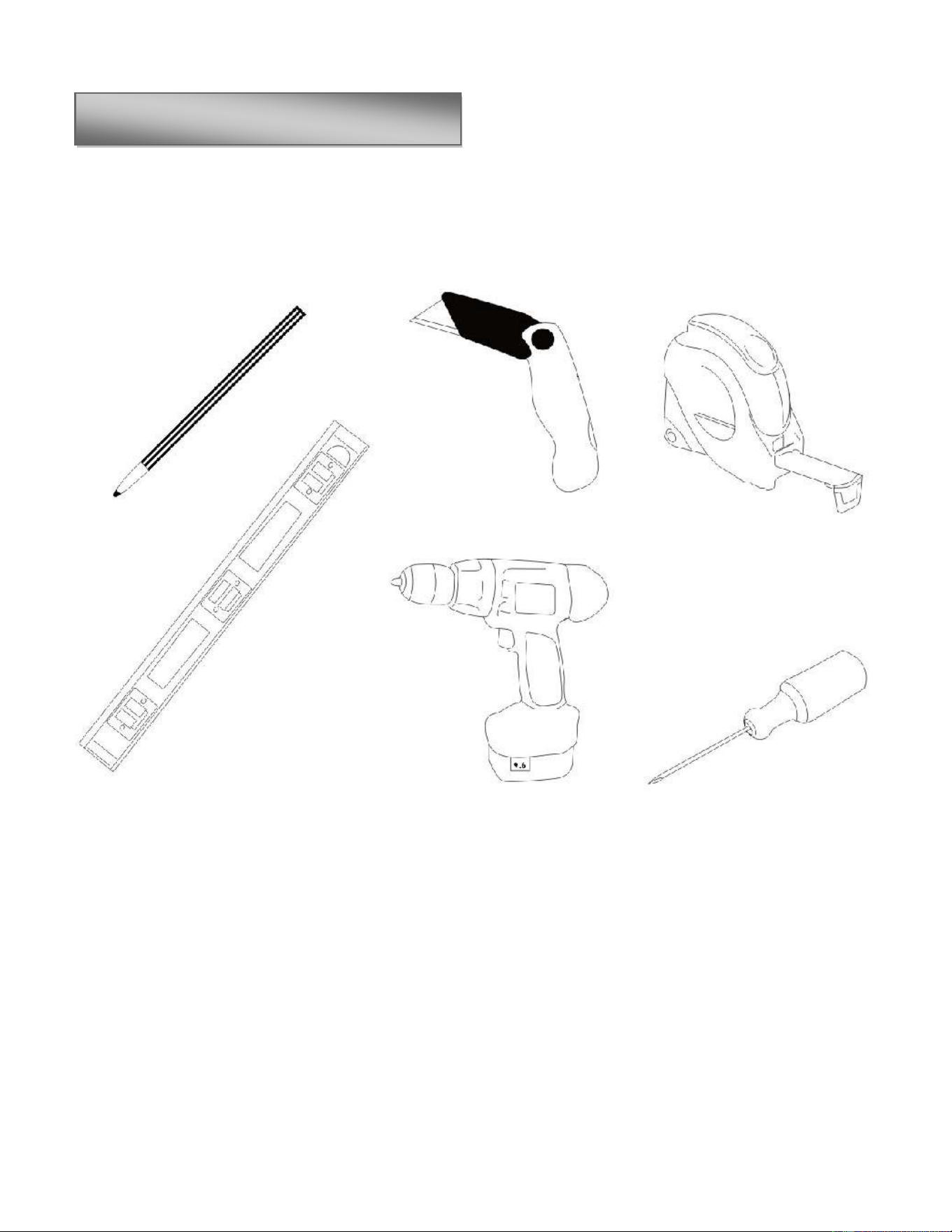
Marker or
pencil
Utility knife
Measuring
tape
Level
Powered
screwdriver
or drill
Flat-blade
and Phillips
screwdrivers
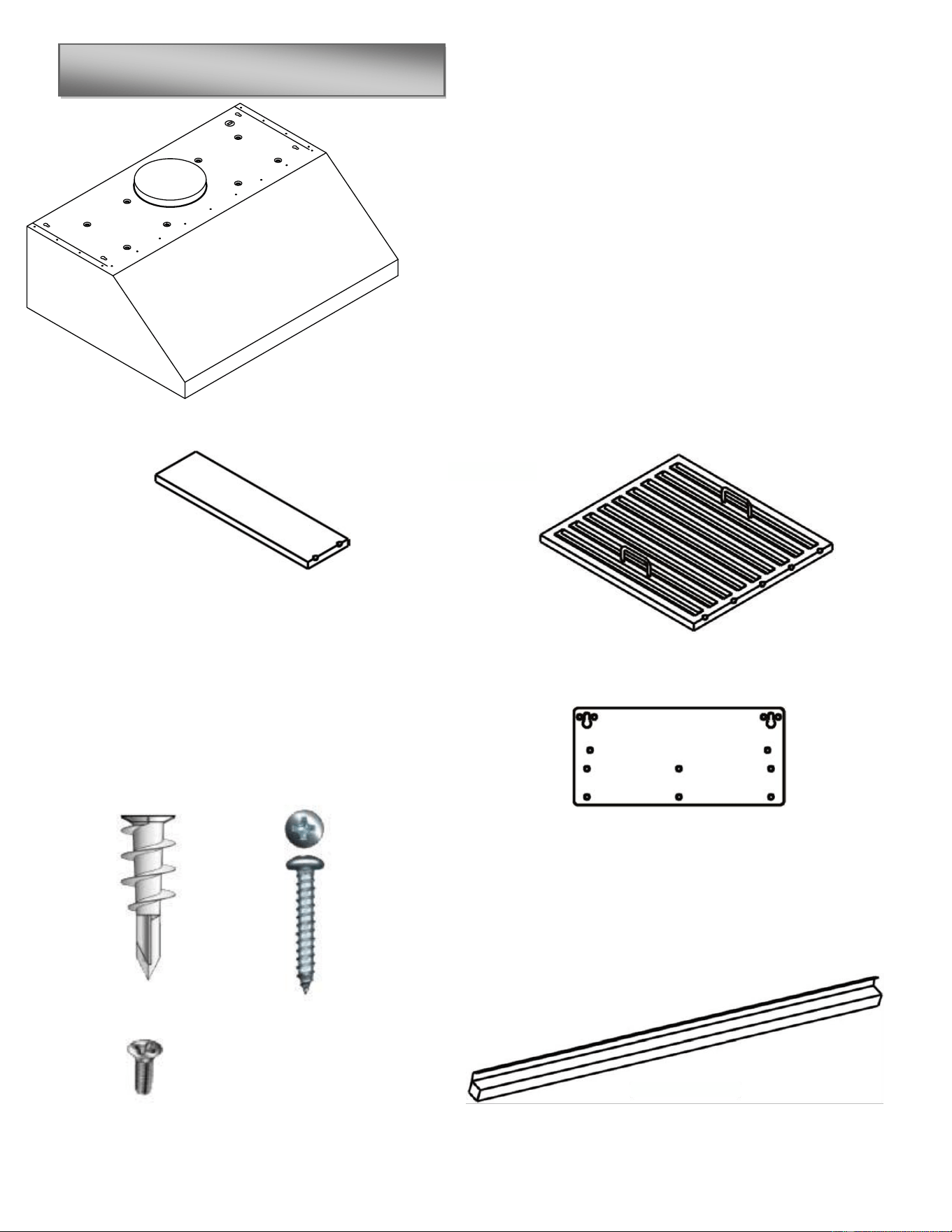
Tools needed:
Page 4
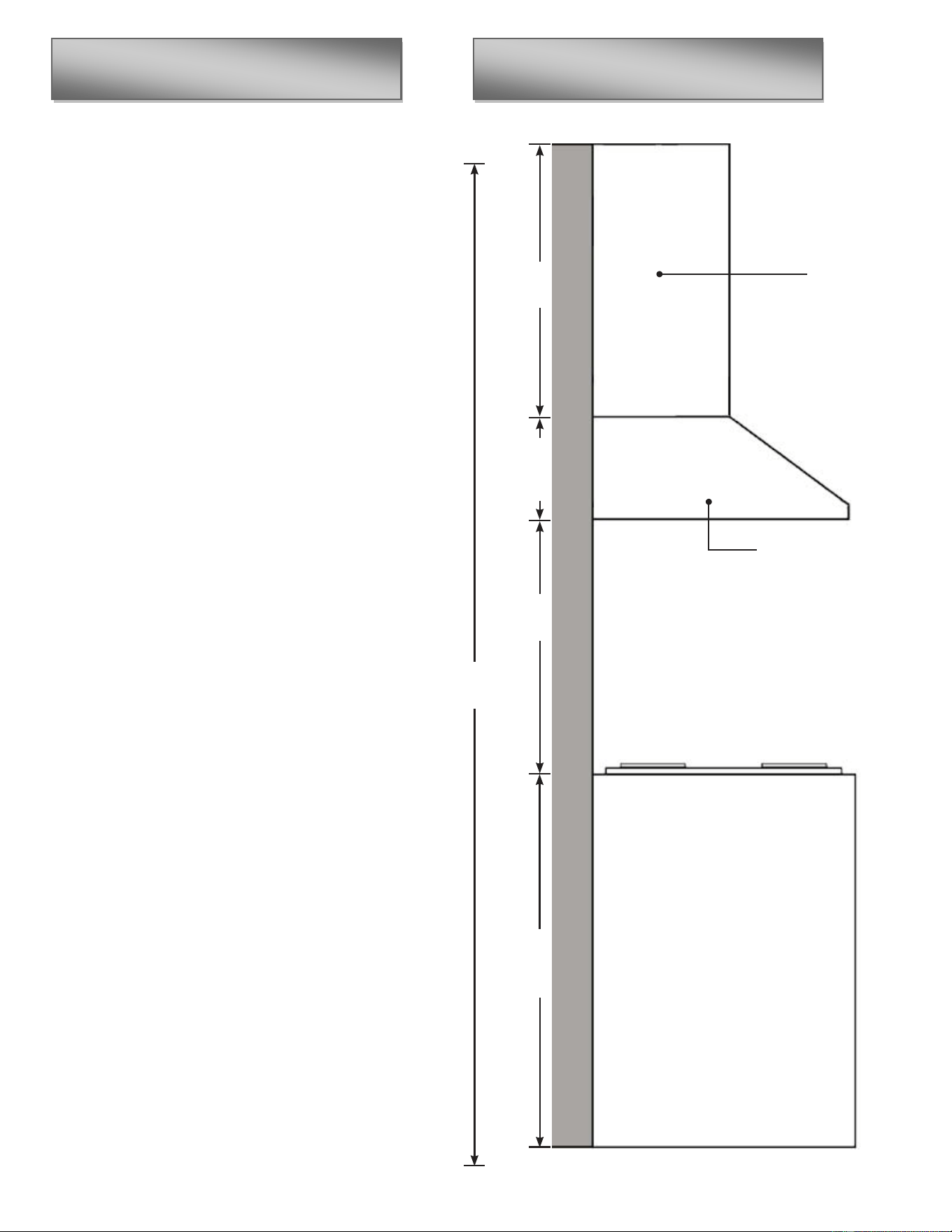
Parts supplied:
Grease Tunnel
r
Under Cabinet Range Hood
Baffle Filter Spacer
Baffle Filters
Qty: 2 PCS
(For sheet rock only)
Qty: 2 PCS
Hood-mounting Bracket
Qty: 6 PCS
Grease Tunnel
Venting Requirements:
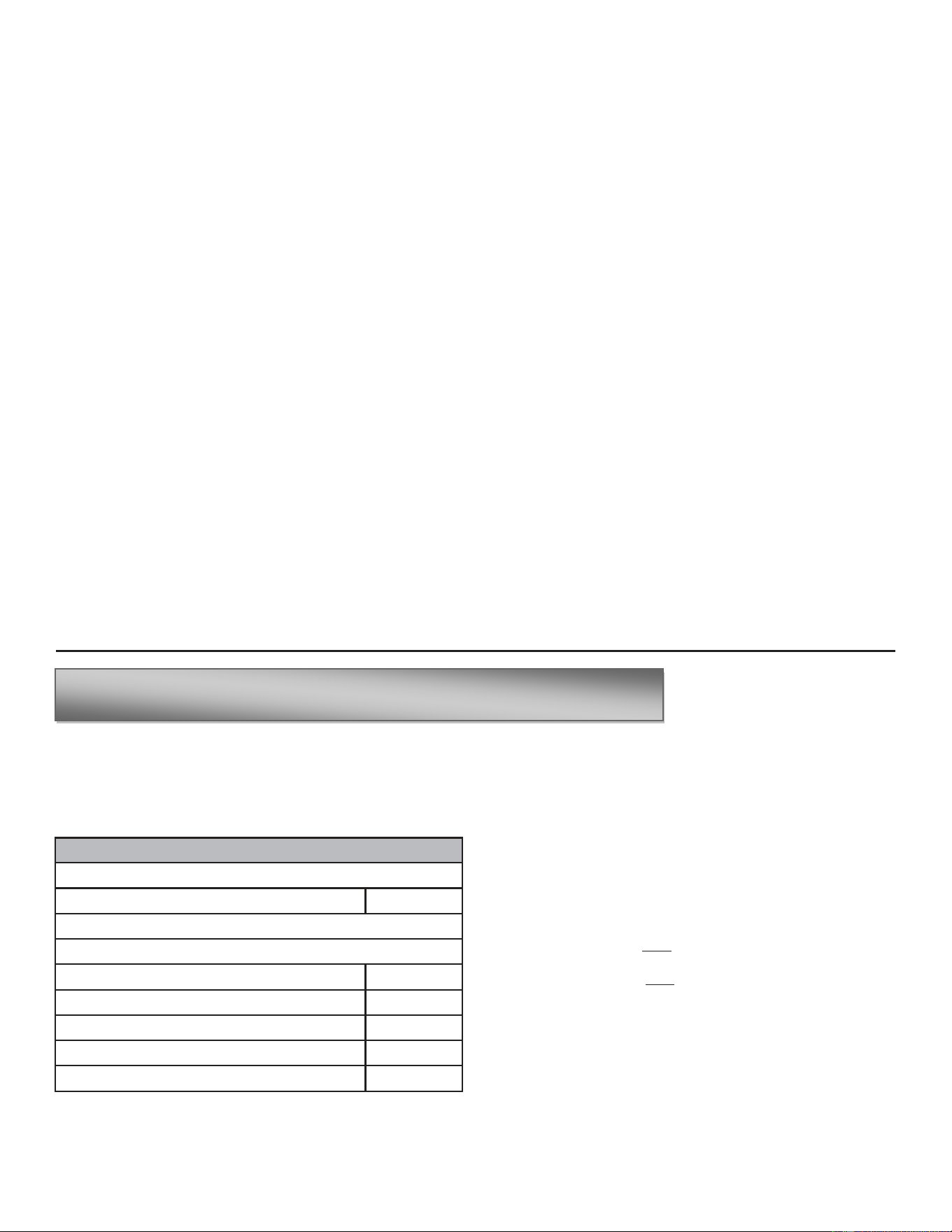
Height & Clearance:
5
• Vent system must terminate to the outside
(roof or side wall).
• DO NOT terminate the vent system in an
attic or other enclosed area.
• DO NOT use 4” (10.2 cm) laundry-type wall
caps.
• Use metal/aluminum vent only. Rigid metal/
aluminum vent is recommended.
• DO NOT use plastic vent.
• Always keep the duct clean to ensure proper
airflow.
• Calculate the following figures before
installation:
1. Distance from the floor to the ceiling.
2. Distance between the floor to the
countertop/stove
3. Distance between the cooking surface
to the range hood (recommend 24” to
30”) minimum of 30” is required for
gas stove top
4. Height of hood and duct cover.
Cabinet
Height
Range
Hood
Height
Cabinet
Under Cabinet
For the most efficient & quiet operation:
Range hood
• A distance of 24” to 30” is recommended
between stove top and the bottom of range
hood. 30” minimum is required for gas
stove tops
• It is recommended that the range hood is
vented vertically through the roof through 7”
(17.8 cm) or bigger round metal/aluminum
vent work.
• The size of the vent should be uniform.
• Use no more than three 90° elbows.
• Make sure there is a minimum of 24” (61
cm) of straight vent between the elbows if
more than one elbow is used.
• DO NOT install two elbows together.
• The length of vent system and number of
elbows should be kept to a minimum to
provide efficient performance.
• The vent system must have a damper. If
roof or wall cap has a damper, DO NOT
use damper (if supplied) on top of the range
hood.
• Use silver tape or duct tape to seal all joints
in the vent system.
• Use caulking to seal exterior wall or roof
opening around the cap.
Ceiling
Height
Min: 24”
Max: 30”
36”
Counter
Top
Countertop/Stove
Page 5
Page 6
Duct Run Calculation:
Recommended maximum run
7” or 3-1/4 x 10” duct
50 ft
Vent piece deduction
Each 90º elbow used
9 ft
Each 45º elbow used
5 ft
Each 7” to 3/14 x 10” transition used
7 ft
Side wall cap with damper
0 ft
Roof cap
0 ft
IMPORTANT:
• A minimum of 7” round (standard for this range hood) or 3-1/4 x 10” rectangular duct (purchased
separately) must be used to maintain maximum airflow efficiency.
• Always use rigid type metal/aluminum ducts if available to maximize airflow when connecting to provided
duct.
• Please use Duct Run Calculation below to compute total available duct run when using elbows, transitions
and caps.
• ALWAYS, when possible, reduce the number of transitions and turns. If long duct run is required, increase
duct size from 7” to 8” or 9”. If a reducer is used, install a long reducer instead of a pancake reducer.
Reducing duct size will restrict airflow and decrease airflow, thus reduce duct size as far away from opening
as possible.
• If turns or transitions are required: Install as far away from the opening and as far apart between 2 as possible.
• Minimum mount height between stove top to hood bottom should be no less than 24-inch for electric cook
tops and minimum of 30” for the stove tops and no higher than 30 inch for electric cook tops.
• It is important to install the hood at the proper mounting height. Hoods mounted too low could result in heat
damage and fire hazard; while hoods mounted too high will be hard to reach and will lose it’s performance
and efficiency.
• If available, also refer to stove top manufacturer’s height clearance requirements and recommended hood
mounting height above range.
Minimum Duct Size:
• Round - 7” minimum
• Rectangular - 3-1/4 x 10” minimum (requires a 7” to 3-1/4x10” adaptor, not supplied)
To calculate the length of the system you need, deduct the equivalent feet for each vent piece used in the system
from the recommended maximum duct run.
Duct Run Calcuation example:
One roof cap, two 90º elbow, and one 45º elbow used:
0ft + 9ft + 9ft + 5ft = 23ft used.
Deduct 23ft from 50ft, 27ft maximum available for
straight duct run.
Calculating Vent System Lenght :
Page 7
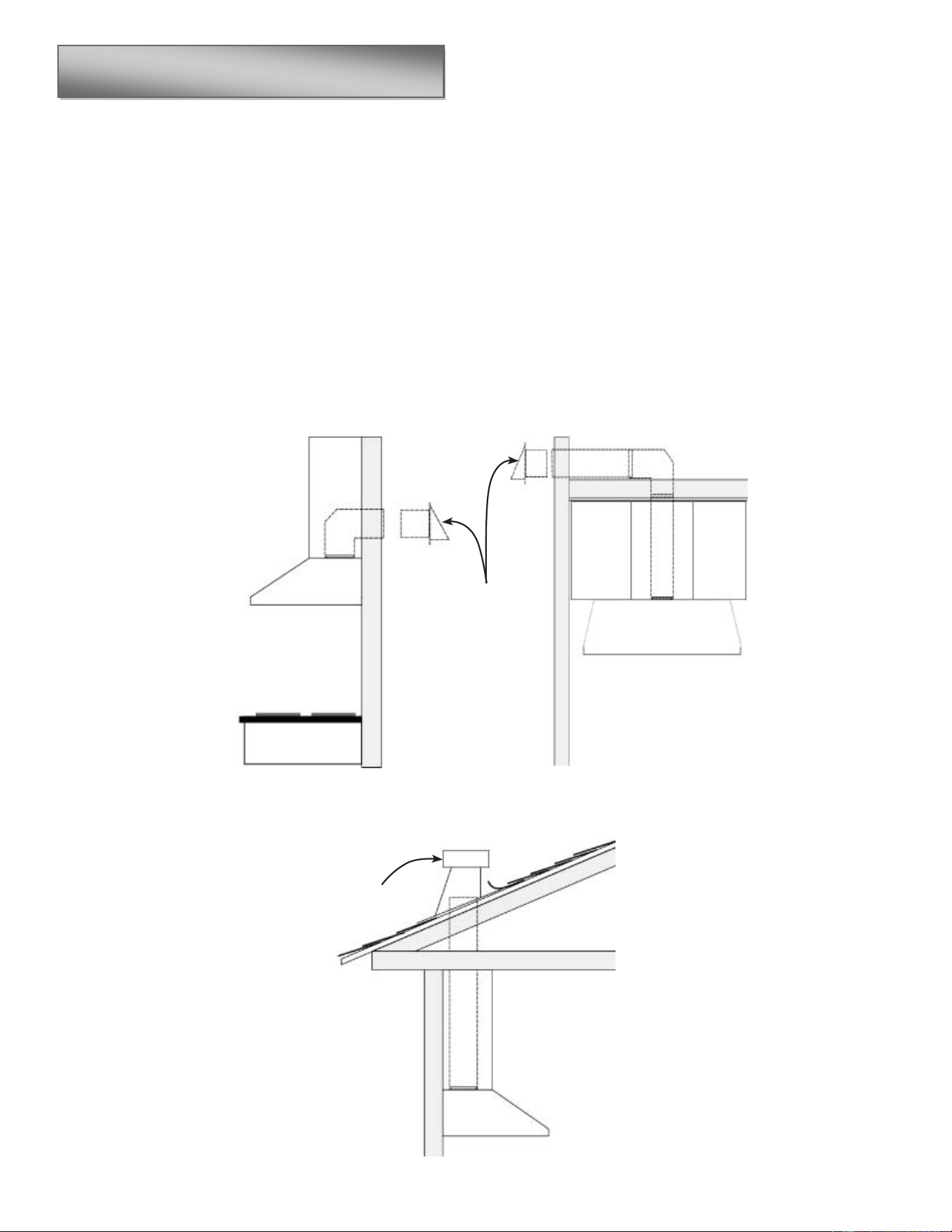
Venting methods :
• This range hood is factory set for venting through the roof or wall.
• Vent work can terminate either through the roof or wall. To vent through a wall, a 90° elbow is needed.
IMPORTANT:
• NEVER exhaust air or terminate duct work into spaces between walls, crawl spaces, ceiling, attics or
garages. All exhaust must be ducted to the outside.
• Use metal/aluminum duct work only.
• Fasten all connections with sheet metal screws and tape all joints with certified Silver Tape or Duct Tape.
• Use caulking to seal exterior wall or roof opening around the cap.
Option 1:
Horizontal wall venting
Option 2:
Side wall cap
Vertical roof venting
Roof cap

Page 8
Electrical Requirements:
IMPORTANT: Observe all governing codes and
ordinances.
It is the customer’s responsibility:
• To contact a qualified electrical installer.
If codes permit and a separate ground wire is used, it is recommended that a qualified electrician determine that
the ground path is adequate.
A 120-Volt, 60 Hz, AC-only, fused electrical supply is required on a separate 15-amp circuit, fused on both sides
of the line.
DO NOT ground to a gas pipe.
Check with a qualified electrician if you are not sure that the range hood is properly grounded.
DO NOT have a fuse in the neutral or ground circuit.
IMPORTANT: Save this Installation Guide for electrical inspector’s use.
The range hood must be connected with copper wire/plug only.
The range hood should be connected directly to the fused disconnect (or circuit breaker) box through flexible
armored or non-metallic sheathed copper cable. ETL. - listed strain relief must be provided at each
end of the power supply cable.
Page 9
Advanced Preparations:
• Be familiar with the controls of the range hood by
reading through Range Hood Operations, Page 12.
• Place the range hood on a flat, stable surface.
Connect the range hood to a designated standard
outlet (120-Volt, 60Hz, AC only) and turn on the
range hood. Verify all operations of the range hood by
referring to Range Hood Operations, Page 13.
• Place all supplied parts and required hardware on a flat, stable surface and verify
the existence of all supplied parts listed on Page 4.
• Carefully remove the white plastic protective coat from the range hood.
Preparations:
NOTE: To avoid damage to your hood, prevent debris from entering the vent opening.
• Decide the location of the venting pipe from the hood to the outside. Refer to Venting Methods on Page 7.
• A straight, short vent run will allow the hood to perform more efficiently.
• Try to avoid as many transitions, elbows, and long run as possible. This may reduce the performance of the
hood.
• IMPORTANT: Peel white plastic protective coat off the hood if any.
• Use silver tape or duct tape to seal joints between pipe sections.
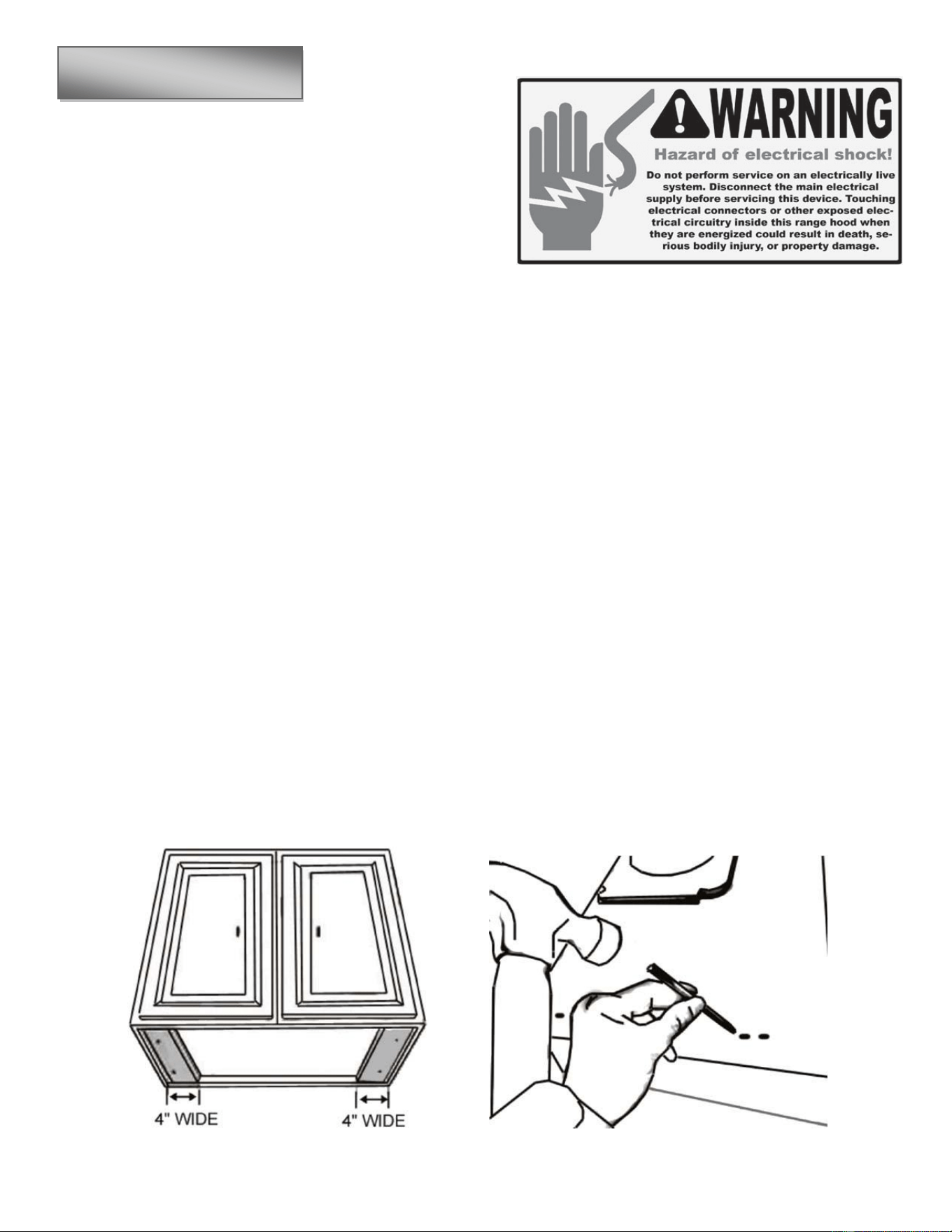
• For installing under the cabinet with recessed bottom, attach 4-inch wide wood filler strips (not provided) on
each side. Refer to Figure 1.
• Using references in Measurements and Diagrams on Page 16, create access opening for electrical wires and
hood exhaust under the cabinet.
CAUTION: If moving the cooking range is necessary to install the hood, turn OFF the power on an
electric range at the main electrical box. SHUT OFF THE GAS BEFORE MOVING A GAS RANGE.
• Puncture the knockout holes (for mounting under the cabinet) on the hood as shown in Figure 2.
• If necessary, attach two rubber stands with 3M adhesive tapes to the back corners of the hood.
Figure 1 Figure 2
Preparation:
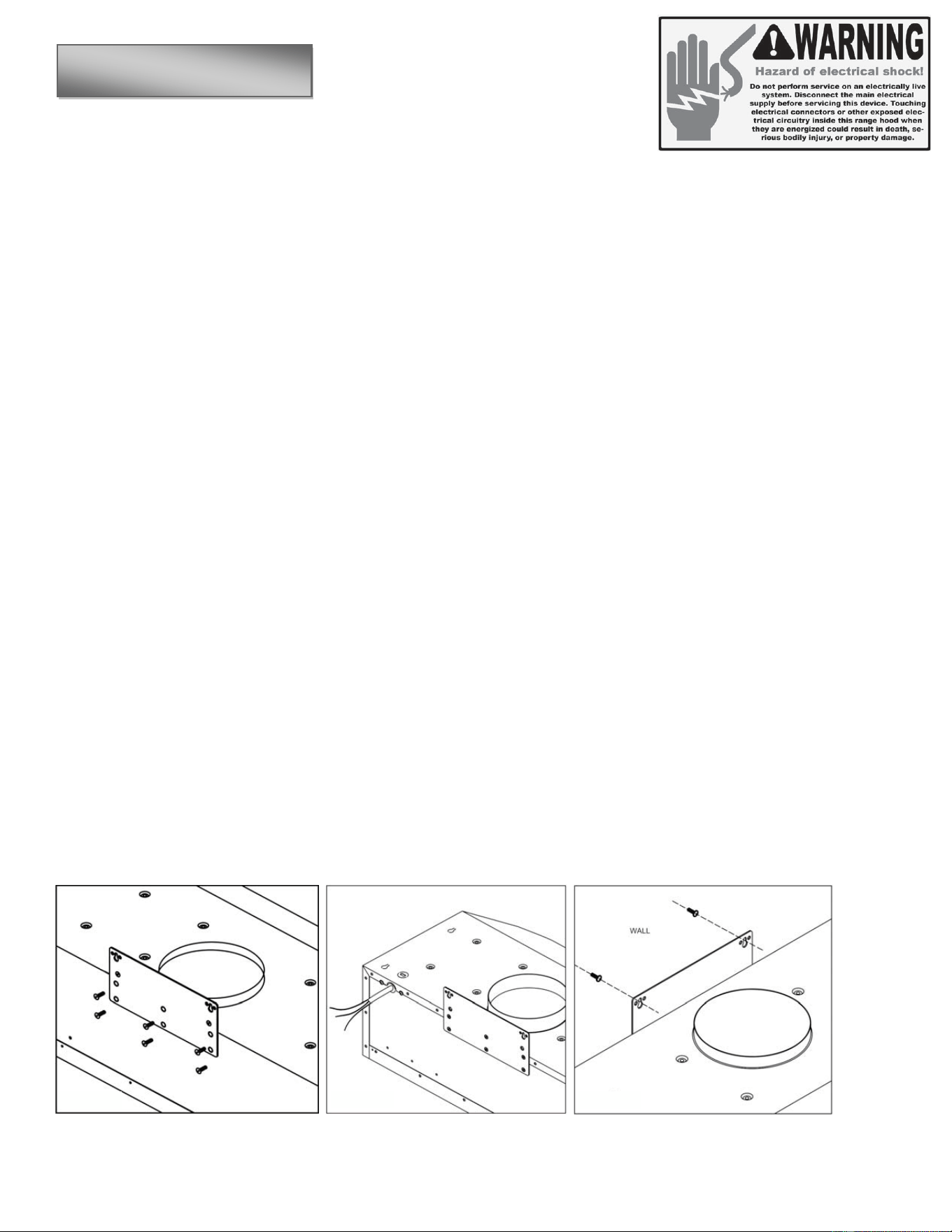
Figure 4
Figure 3
Figure 5
Page 10
Installation:
Installations (refer to Page 4 for parts):
1. Measure the distance between stove top and the bottom of range hood. A
distance of 24” to 30” is recommended with a minimum of 30” for gas stove tops.
1. You have two ways (A or B) to mount this range hood:
A–1.
A–2.
A–3.
A–4.
B–1.
B–2.
B–3.
B–4.
B–5.
Proceed if you would like to mount this range hood without using the hood-mounting bracket.
Using references in Height & Clearance on Page 5 and Measurements and Diagrams on Page 16,
center the hood beneath the cabinet and flush with the front of the cabinet.
Draw electrical wires through cabinet access opening and center the hood beneath the cabinet.
From inside of the hood, place screws into the exact center of each knockout hole and secure to cabinet
bottom. Finish tightening all screws until secure. Be careful when using electrical screwdriver, damage
to the range hood may occur. Skip Part B below and proceed to Step 2.
CAUTION: Make certain the range hood is secure before releasing!
Proceed if you would like to mount this range hood using the provided hood-mounting bracket.
Using references in Height & Clearance on Page 5 and Measurements and Diagrams on Page 17, mark
the leveling point of the hood. Position two mounting screws on the wall, leaving 1/8” space away from
the wall. Mounting the hood on wall studs or lumbars is highly recommended.
Attach the hood-mounting bracket to the back of the hood with six screws as shown in Figure 3.
Puncture the knockout wire access hole at the back of the hood and draw the electrical wires through
as shown in Figure 4.
Align hood-mounting bracket to the screws on the wall and hook the hood into place as shown in
Figure 5. Tighten screws to secure hood to the wall.
CAUTION: Make certain the range hood is secure before releasing!
2. For safety purposes, pre-drilled the mounting holes that are provided through the back of the hood. For a
more secure installation, use as many mounting holes as needed to secure from the inside of hood.
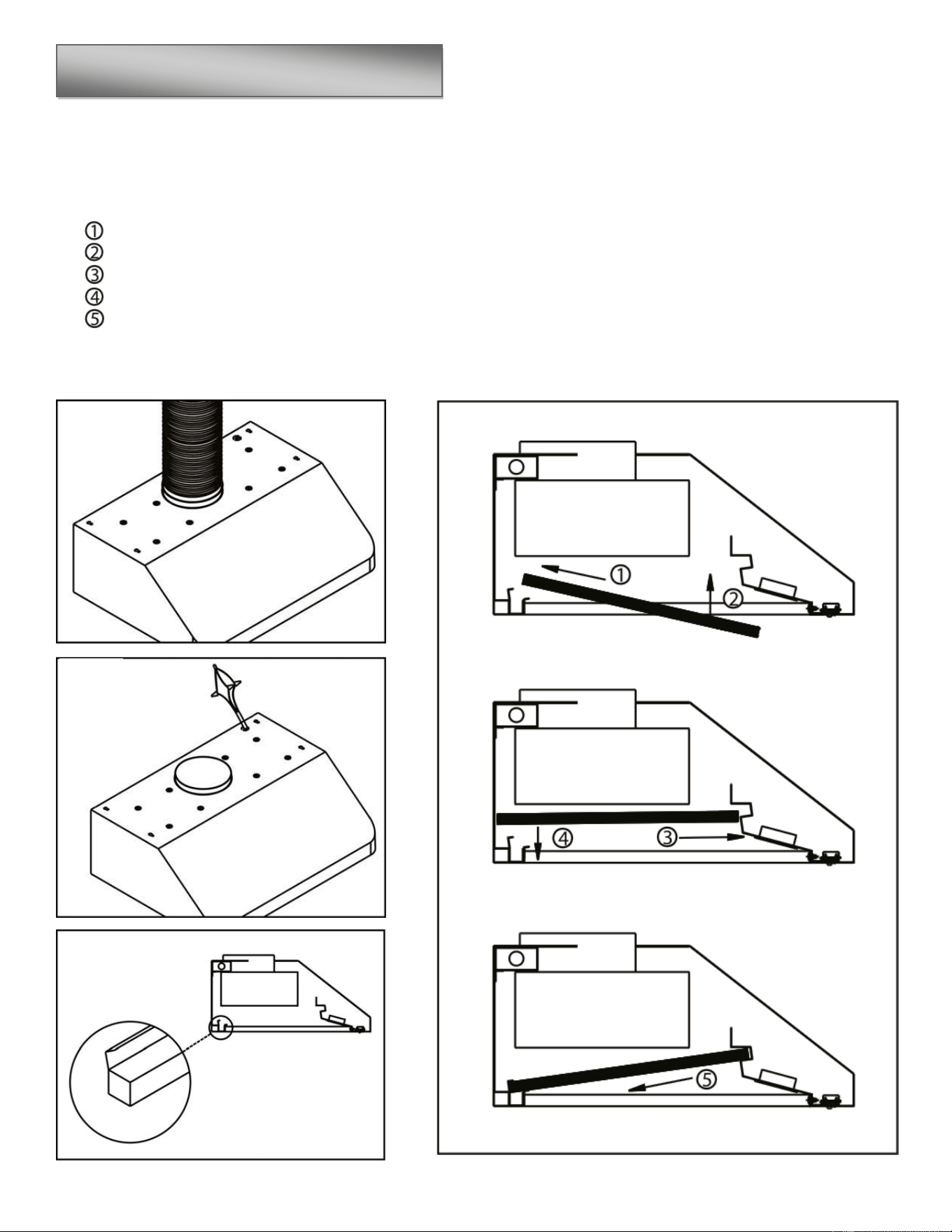
3. Use 7” round steel pipe (follow building codes in your area) to connect the exhaust on the hood to the
ductwork above. Use silver tape or duct tape to make all joints secure and air tight. Refer to Figure 6.
SAFETY WARNING: Risk of electrical shock. This range hood must be properly grounded. Make sure
this is done by qualified electrician in accordance with all applicable national and local electrical codes.
Before connecting wires, switch power off at service panel and lock service panel to prevent power
from being switched on accidentally.
4. Connect the range hood to a designated standard outlet (120-Volt, 60Hz, AC only) or cut off the plug and
connect three wires (black, white and green) to house wires and cap with wire connectors. Connect according to
colors (i.e. black to black, white to white, and green to green) as shown in Figure 7.
Page 11
Installation (Continued):
5. Store excess wires in the wiring box.
6. Drop oil tunnel into recess support near rear of hood. Refer to Figure 8.
7. To install baffle filters and stainless spacer(s), refer to Baffle Filters and Stainless Steel Spacers on Page 18 for
baffle filter and stainless spacer placement. Refer to Figure 9 for the following five steps:
Angle baffle filter toward back of hood.
Push baffle filter up until almost level.
Slide forward into recess behind the front of hood.
Lower baffle filter.
Slide back until it fits into resting positions.
8. Repeat Step 7 to install all baffle filters and stainless spacers.
9. Turn power ON in control panel. Check all lights and fan operations.
10. Make sure to leave this Installation Guide for the homeowner.
Figure 6 Figure 9
Figure 7
Figure 8
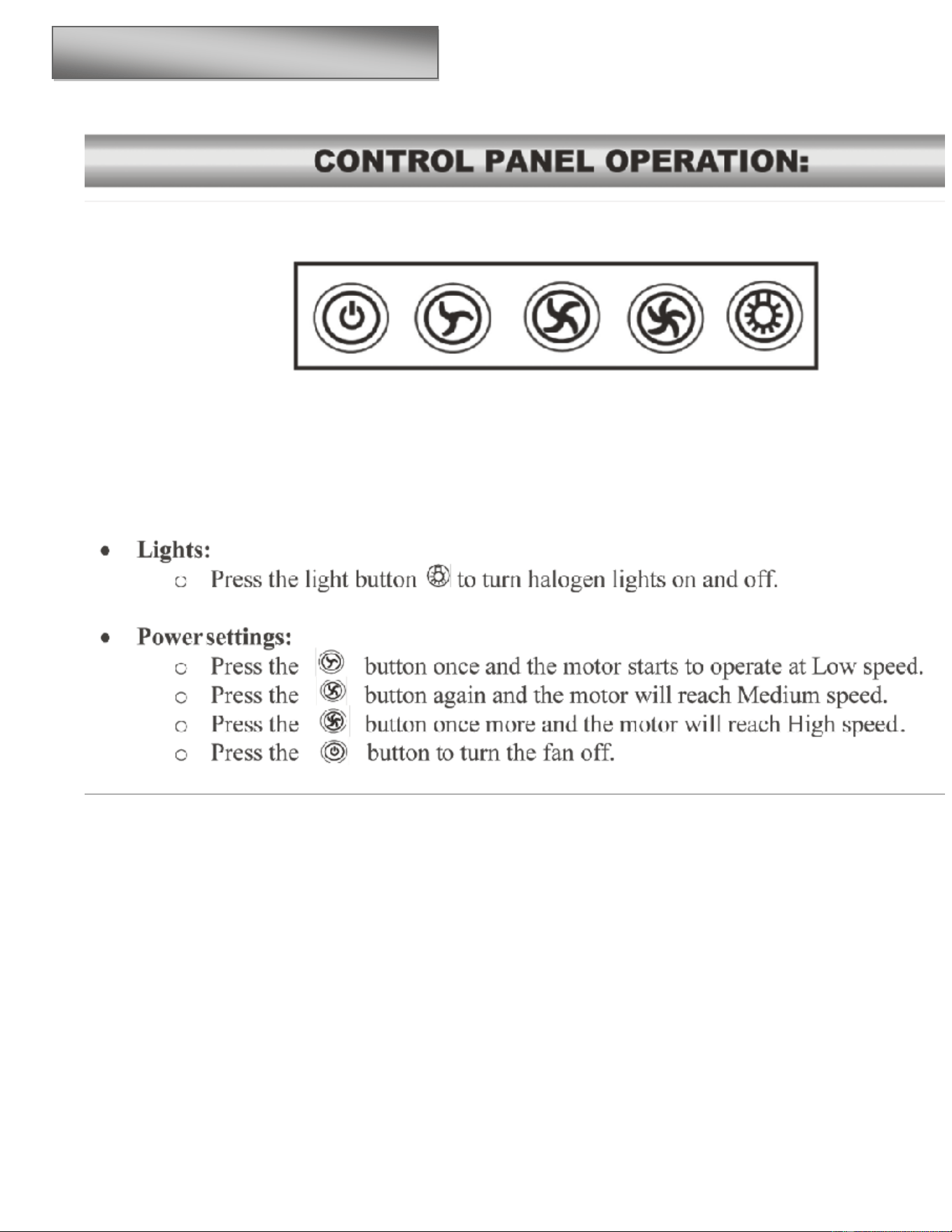
Control Panel Layout and Buttons Configurations:
Page 12
Range Hood Operations:

Page 13
Troubleshooting
1. If the range hood or halogen light does not operate •
after installation:
Check if the range hood has been plugged in, make
sure that all power has been turned back ON, fused
not blown and all electrical wiring are properly
connected.
Swap out light assembly to working ones to
determine whether it is caused by defective
bulbs. See Replacing the light bulbs on Page 22.
2. The range hood vibrates when the blower is on: • The range hood might not have been secured
properly on to the ceiling or wall.
3. The blower or fan seems weak: • Check that the duct sized used is at least 7” or 3
1/4’’ x 10”. Range hood WILL NOT function
efficiently with insufficient duct size. For example:
8” duct over 7” hole and loosely secured.
• Check if duct is clogged or if damper unit (half-
circular flapper) is not installed correctly or
opening properly. A tight mesh on a side wall cap
unit might also cause restriction to the air flow.
4. The lights work but the blower is not spinning at all, •
is stuck or is rattling.
The blower might be jammed or scraping the
bottom due to shipping damage. Please contact us
immediately.
5. The hood is not venting out properly: • Make sure the distance between the stove top and
the bottom of the hood is within 24” and 30” in
distance; with minimum 30” for gas stove top.
• Reduce the number of elbows and length of duct
work. Check if all joints are properly connected,
sealed, and taped.
• Make sure the power is on high speed for heavy
cooking.
Page 14
Use and Care Information:
Operations:
• Read and understand all instructions and warnings in this manual before operating the appliance. Save these
instructions for future reference.
• Always leave safety grills and filters in place. Without these components, operating blowers could catch on to
hair, fingers and loose clothing.
• NEVER dispose cigarette ashes, ignitable substances, or any foreign objects into the blowers.
• NEVER leave cooking unattended. When frying, oil in the pan can easily overheat and catch fire. The risk of
self-combustion is higher when the oil has been used several times.
• NEVER cook on “open” flames under the range hood. Check deep-fryers during use: Superheated oil may be
flammable.
Cleaning:
• The saturation of greasy residue in the blower and filters may cause increased inflammability. Keep unit clean
free of grease and residue build-up at all times to prevent possible fires.
• Filters must be cleaned periodically and free from accumulation of cooking residue (see cleaning instructions
on Page 22). Old and worn filters must be replaced immediately.
• DO NOT operate blowers when filters are removed. Never disassemble parts to clean without proper
instructions. Disassembly is recommended to be performed by qualified personnel only. Read to
understand all instructions and warnings in this manual before proceeding.
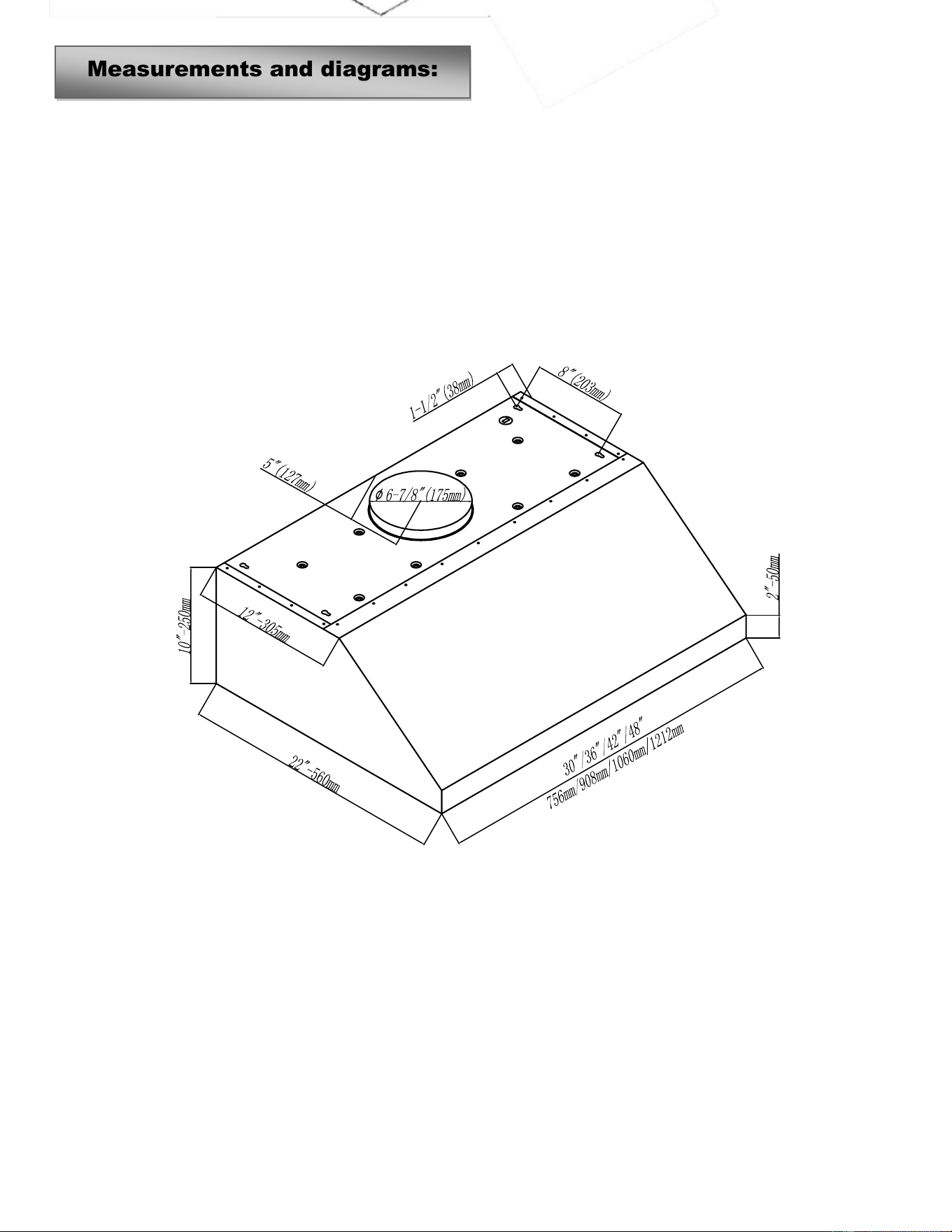
Specifications
3
:
Body Design
Seamless Stainless Steel, Satin Finish
Power Rating
120V / 60Hz (USA & Canada standard)
General Input Power
264 / 266W (260W + 2/3x2W)
Motor Input Power
260 W (130W + 130W)
Ampere
3 A
Levels Of Speed Control
4 Levels
Airflow
1
(Q/L/M/H)
490CFM / 615CFM / 900CFM
Noise Level
2
(Q/L/M/H)
3.5Sone(58dB) / 5.3Sone(64dB) / 6.5Sone(67dB)
Number Of Motors
2 Motors
Motor Type
Single Chamber Ultra Quiet
Fan Type
Centrifugal Squirrel Cage
Control Type
Touch Sensitive Electronic Control Panel with LED Display
Filtration Type
Stainless Steel Baffle Filter
Illumination
2W 12V Maximum, Dual Intensity
Venting Size
Top, 7 inches Round
Interference Protection
Radio Frequency Interference Protected
Specifications:
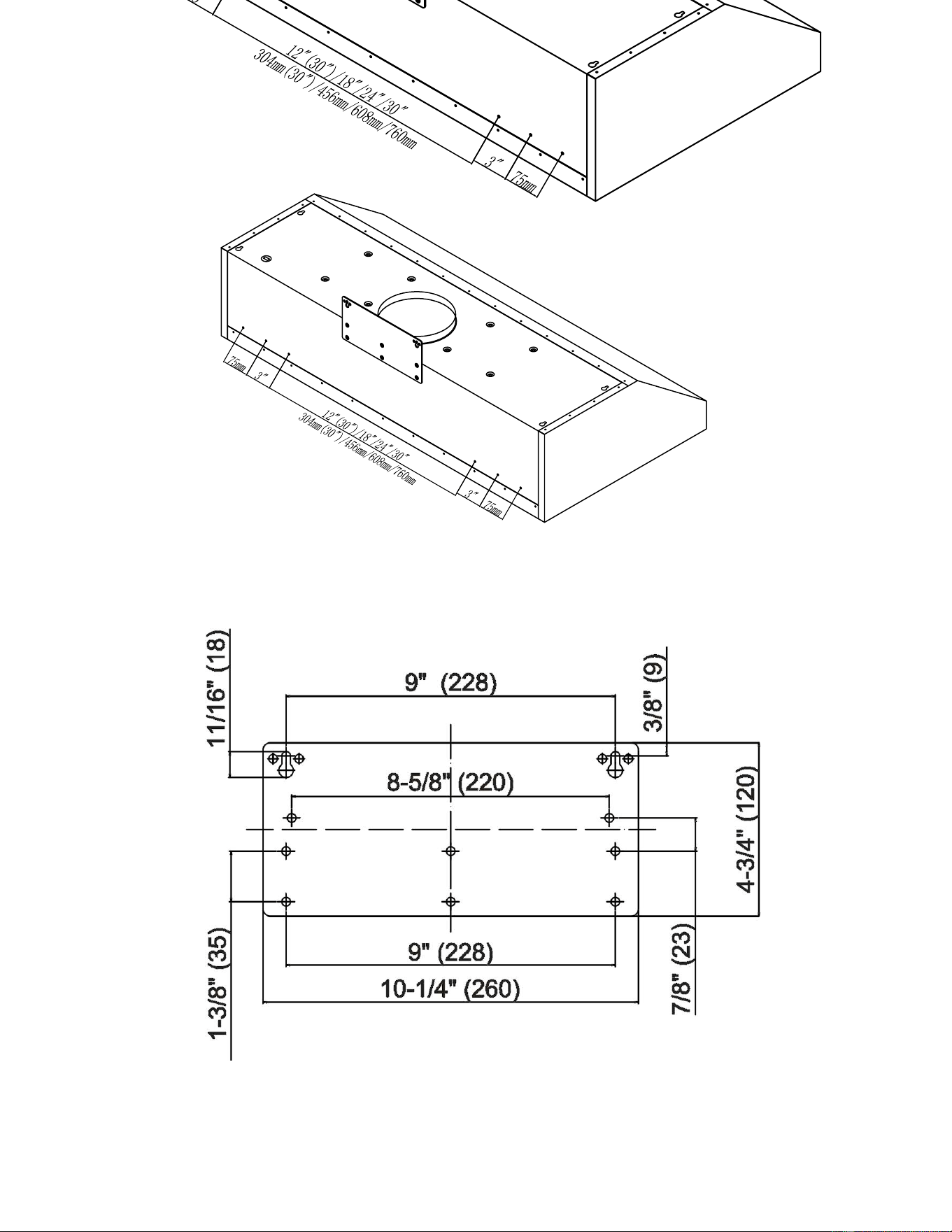
Measurements and diagrams:
15
• All measurements in parenthesis are in millimeter.
• All inch measurements are converted from millimeters, thus inch measurements are estimated.
Page 15
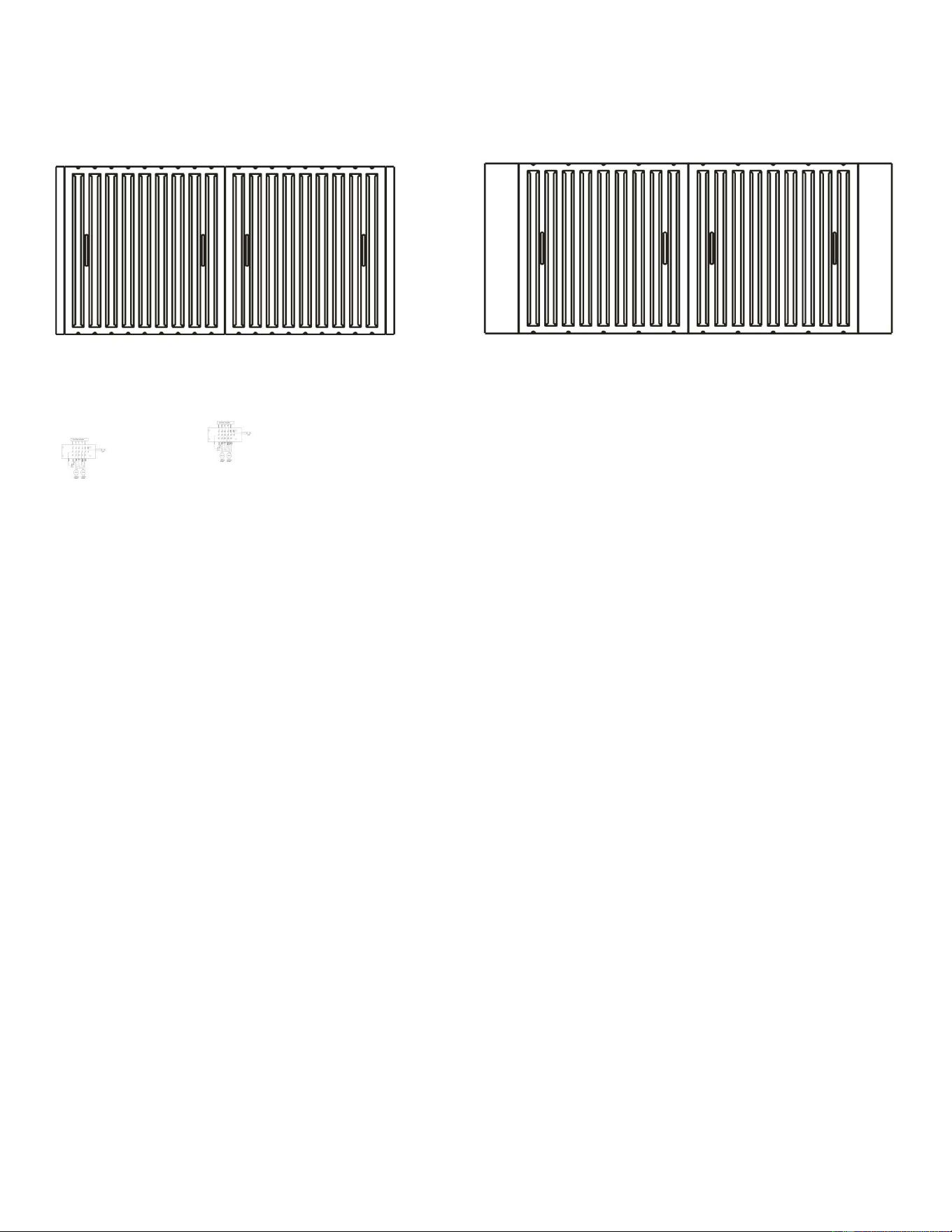
16
• All measurements in parenthesis are in millimeter.
• All inch measurements are converted from millimeters; thus inch measurements are estimated.
Rear Knockout Holes:
Hood-mounting Bracket:
Page 16
17
Baffle Filters and Stainless Steel Spacers:
30” Range Hood 36” Range Hood
Circuit Diagram:
Page 17
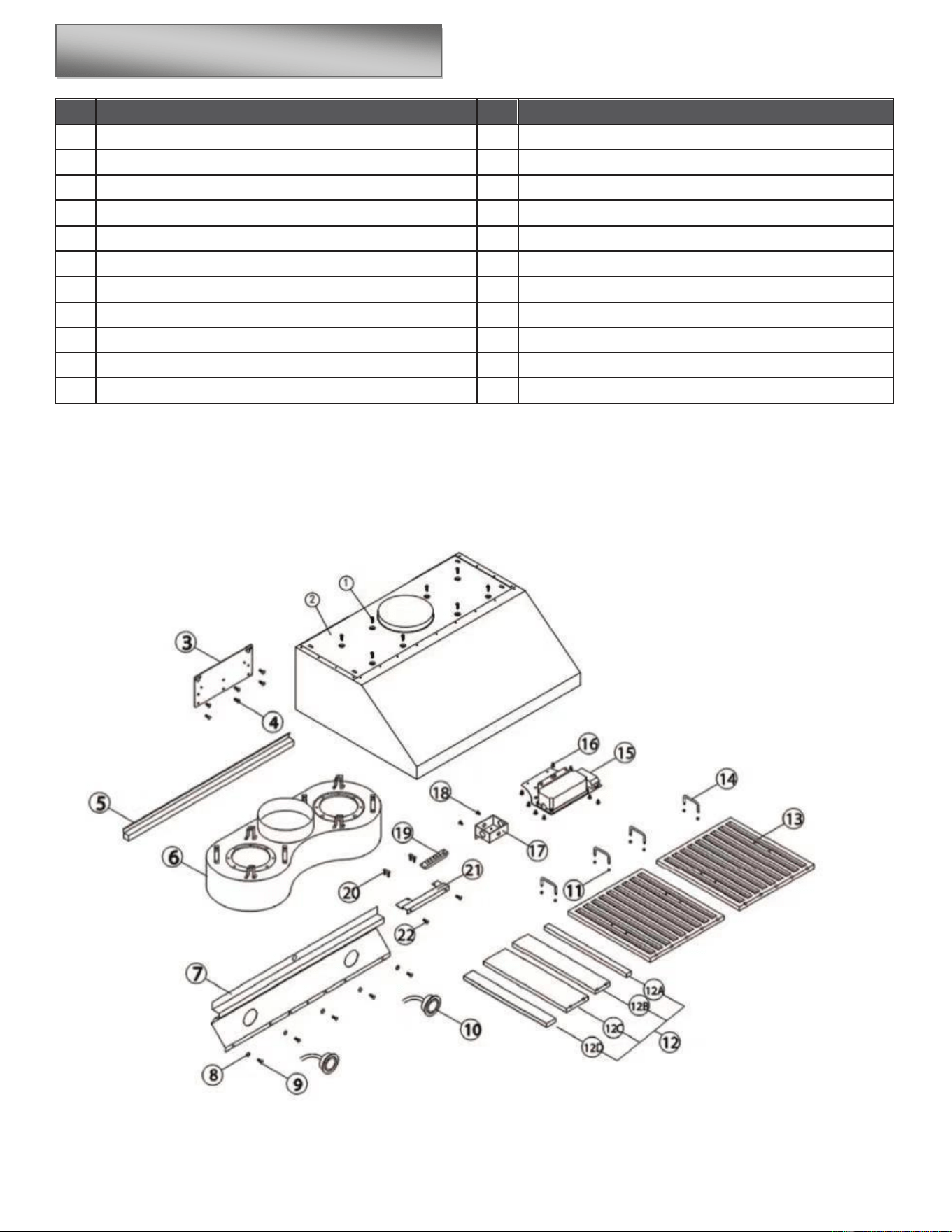
Range Hood Assembly:
Page 19
No.
Description
No.
Description
1
Screws (3/16” x 3/8”)
12
Stainless Steel Spacer (Size Varies)
2
Hood Casing
13
Baffle Filter
3
Hood Mounting Bracket (Optional)
14
Baffle Handle
4
Screws (3/16” x 3/8”) (Optional)
15
Electrical Assembly
5
Stainless Steel Grease/Oil Tunnel
16
Screws (3/16” x 3/8”)
6
Blower Assembly
17
Wiring Box
7
Halogen Light Panel
18
Screws (3/16” x 3/8”)
8
Gasket
19
Switch Assembly
9
Screws (3/16” x 3/8”)
20
Screws (3/16” x 3/8”)
10
Halogen Light
21
Board
11
Gasket
22
Screws (3/16” x 3/8”)
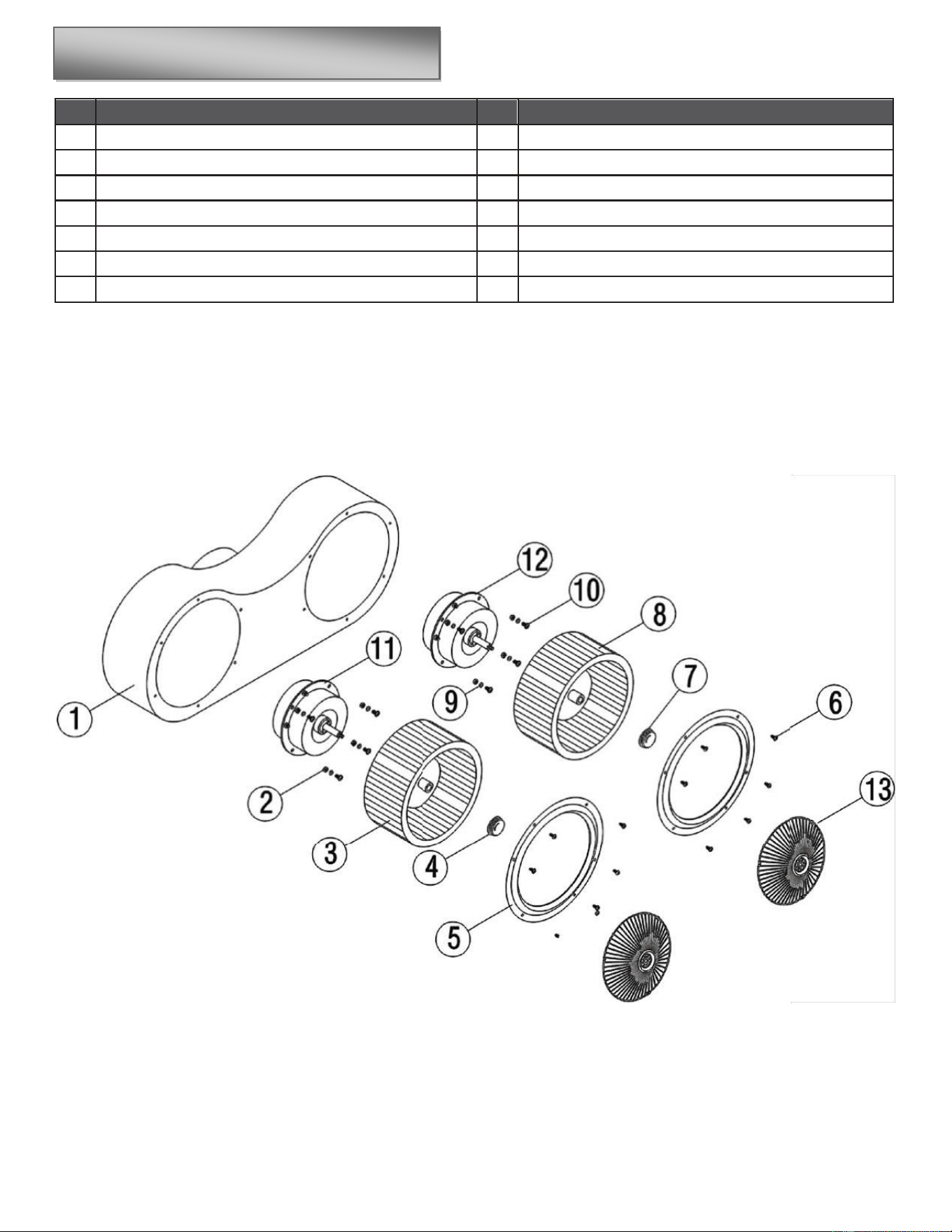
Blower Assembly:
Page 20
No.
Description
No.
Description
1
Air Chamber
8
Right Squirrel Cage
2
Screw Cap
9
Gasket
3
Left Squirrel Cage
10
Screws (3/16” x 3/8”)
4
Left Locknut
11
Left Motor
5
Air Flow Grill
12
Right Motor
6
Screws (3/16” x 3/8”)
13
Safety Screen
7
Right Locknut
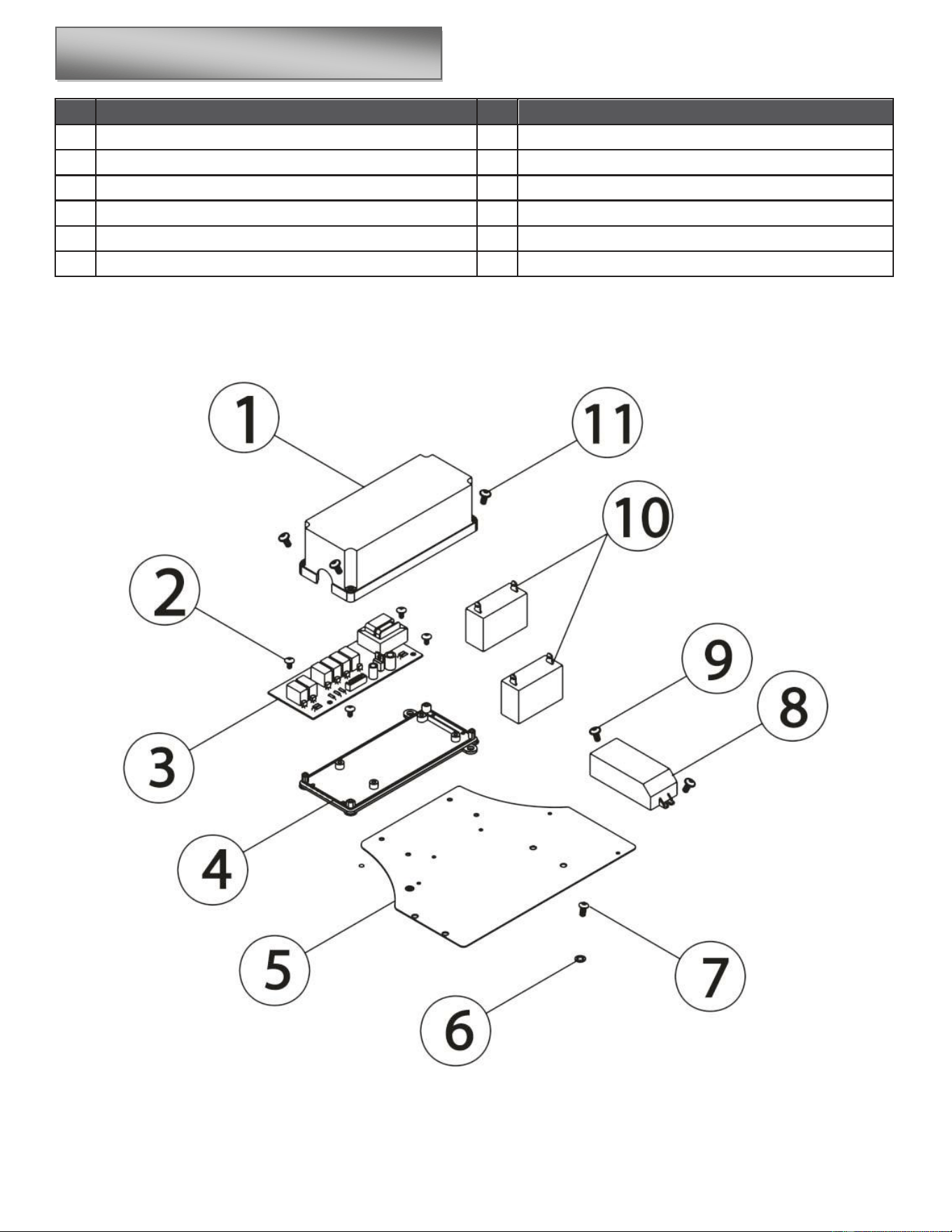
Electrical Assembly:
Page 21
No.
Description
No.
Description
1
Electrical Box
7
Screws (3/16” x 3/8”)
2
Screws (3/16” x 3/8”)
8
Transformer
3
Processor Board
9
Screws (3/16” x 3/8”)
4
Electrical Box Cover
10
Capacitor
5
Setup Board
11
Screws (3/16” x 3/8”)
6
Gasket
SAFETY WARNING: Never put your hand into the housing area while the fan is operating!
For optimal operation, clean range hood and all baffle/spacer/filter/grease tunnel/oil container regularly. Regular care will
help preserve the appearance of the range hood.
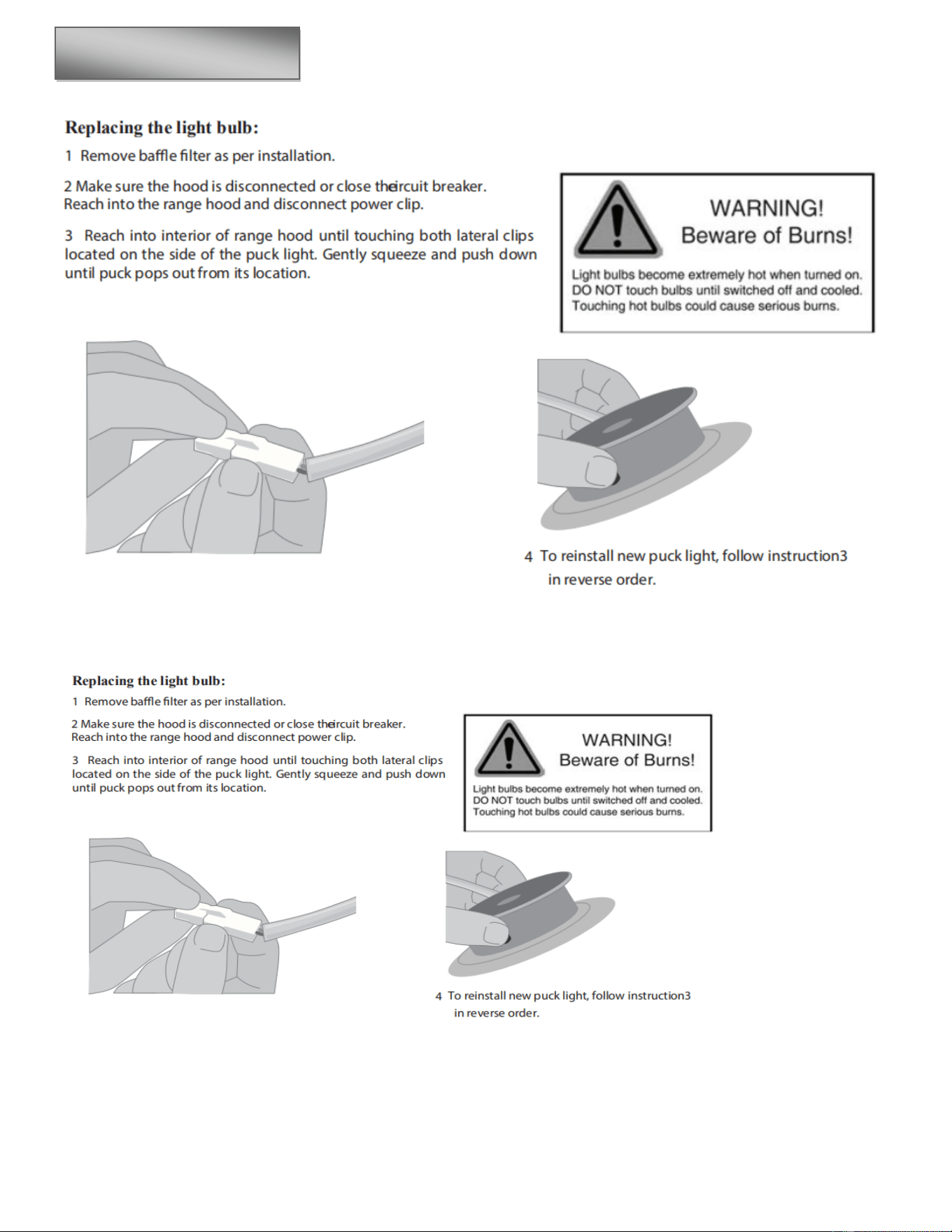
Maintenance:
Page 22
Cleaning Exterior surfaces:
• Clean periodically with hot soapy water and clean cotton cloth. DO NOT use corrosive or abrasive detergent (e.g.
Comet Power Scruv
®
, EZ-Off
®
oven cleaner), or steel wool/scoring pads, which will scratch and damage the stainless-
steel surface. For heavier soil use liquid degrease such as “Formula 409
®
” or “Fantastic
®
” brand cleaner.
• If hood looks splotchy (stainless steel hood), use a stainless steel cleaner to clean the surface of the hood. Avoid getting
cleaning solution onto or into the control panel. Follow directions of the stainless steel cleaner. CAUTION: DO NOT
leave on too long as this may cause damage to hood finish. Use soft towel to wipe off the cleaning solution, gently
rub off any stubborn spots. Use dry soft towel to dry the hood.
• After cleaning, you may use nonabrasive stainless-steel polish such as 3M
®
or ZEP
®
to polish and buff out the stainless
luster. You can also use it along the grain as well. Always scrub lightly with clean cotton cloth and with the grain.
• DO NOT allow deposits to accumulate or remain on the hood.
• DO NOT use ordinary steel wool or steel brushes. Small bits of steel may adhere to the surface and can cause rusting.
• DO NOT allow salt solutions, disinfectants, bleaches, or cleaning compounds to remain in contact with stainless steel
for extended periods. Many of these compounds contain chemicals, which may be harmful. Rinse with water after
exposure and wipe dry with a clean cloth.
Cleaning Stainless Steel Baffle Filter:
IMPORTANT: Drain oil from baffles, spacers, filters, oil tunnels, oil containers before oil and residue overflow!
• Remove all baffles, spacers, filters, grease tunnel, and oil containers and discard oil and residue.
• Wash with warm soapy water. NOTE: Stainless steel baffles, spacers and oil tunnel are top rack dishwasher safe.
• Dry thoroughly before replacing and follow directions for installation in reverse.
• Filters should be cleaned after every 30 hours of use.
Replacing Filters:
• Should filters wear out due to age and prolonged use, replace with following part number:

Page 23
Manufacture’s Limited Warranty
This Product has been manufactured by Duro Corporation 17018 EVERGREEN PLACE CITY OF INDUSTRY, CA
91745.
Duro Corporation disclaims all express warranties except for the following:
This warranty applies to products purchased and located in the United States. Products purchased or located outside
these areas are excluded.
The warranty does not apply to damage resulting from abuse, accident, natural disaster, loss of electrical power to the
product for any reason, alteration, outdoor use, improper installation, or improper operation.
Warranties and Duration
Full Warranty for Parts: 1 Year
Implied warranties terminate upon expiration of the limited warranty. Some states do not allow limitation on how long
an implied warranty
lasts, so the above limitation may not apply to your implied warranty.
Duro will pay for:
All cost of replacement parts found to be defective due to materials and workmanship.
Duro will not pay for:
1. Service, damages, and repairs by an authorized or unauthorized agency.
a. Teaching you how to use the appliance.
b. Correcting the installation. You are responsible for providing electrical wiring and other connecting facilities.
c. Resetting the circuit breakers or replacing home fuses.
3. Damage caused from accident, alteration, misuse, abuse, improper installation or installation not in accordance with
local electrical codes or plumbing codes, or improper storage of the appliance.
4. Repairs other than normal home use.
5. Travel or trip fees and associated charges incurred when the product is installed in a location with limited or
restricted access. (i.e.airplane flights, ferry charges, isolated geographic regions).
The warranty to appliances purchased and used by consumers for personal, family, or household purposes only. It does
not cover appliances used in commercial applications.
Duro is not responsible for incidental or consequential damages. Under no circumstances will Duro’s liability exceed
the cost that you paid for the product. Some provinces / states do not allow the exclusion or limitation of incidental or
consequential damages, so the above limitation or exclusion may not apply to you.
This warranty gives you specific legal rights and you may also have other rights that wary from state to state.
Whenever you contact our Customer Service at 1-888-909-8818 for technical information, parts, sales in The United
States or to inquire service for your appliance, please have your complete model number and serial number ready. The
model and serial number can be found on the product data plate. Please enter the information requested in the spaces
provided below:
Model No__________________. Serial No.___________________
Date Purchased______________ Date Installed___________________
Purchased From______________ Address_______________________
Phone______________________
NOTE: You must provide proof of purchase or installation date for in-warranty parts.