
Induction Range
User Manual
Installation and
Use and Care Information
Part # 100799 — revision 0 © Prizer-Painter Stove Works, Blandon, PA 19510

2 (800) 449-8691

bluestarcooking.com 3
Thank You and Welcome
Thank you for your purchase and welcome to the BlueStar family!
BlueStar appliances are designed for discerning home chefs who demand restaurant-quality results in their own
kitchens. As the owner of a new BlueStar appliance, you can look forward to years of precise and even cooking in
your home kitchen.
Here are a few tips to get started:
1. Review this User Manual, which includes instructions and tips for getting the most out of your new appliance.
2. Register your appliance online at www.bluestarcooking.com/support/product-registration to stay in touch and
allow us to send you valuable product news and updates.
3. Review our products and help us spread the word at https://www.bluestarcooking.com/inspiration/reviews.
Thank you again for choosing BlueStar.
4 (800) 449-8691
Safety Information ............................................................ 5
Site Preparation .............................................................. 11
Installation Instructions .................................................. 17
Product Description ....................................................... 20
Before Your First Use ..................................................... 22
Touch Screen Control .................................................... 24
Touch Screen Control—Modes ...................................... 26
Touch Screen Control—Settings .................................... 28
Cooktop Control ............................................................. 30
Cooktop Control—Functions .......................................... 31
Operation ........................................................................ 34
Cooking Guide and Tips ................................................ 37
Common Baking Problems and Solutions ................... 45
Care and Cleaning ......................................................... 46
Troubleshooting ............................................................. 48
Warranty .......................................................................... 50
Contents
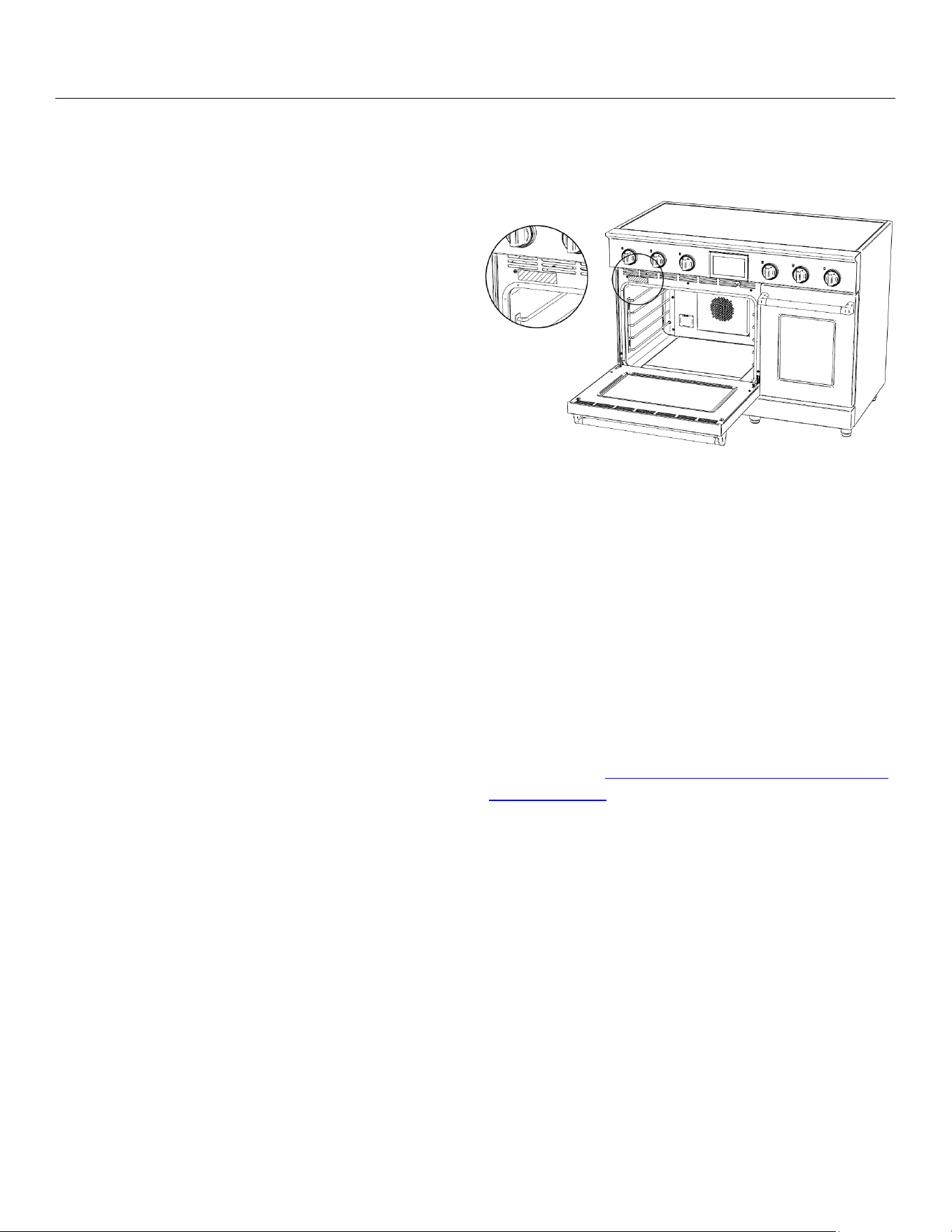
Important product information, including the model and
serial numbers, can be found on the serial plate, which is
located on the upper left corner behind the oven door.
Please complete the information below for warranty
purposes and future reference:
Model Number ____________________________________
Serial Number _____________________________________
Installation Date ___________________________________
Dealer’s Name _____________________________________
Dealer’s Phone Number ____________________________
If service is required under warranty, it must be
performed by an authorized BlueStar service company.
To locate an authorized BlueStar service company in
your area, go to www.bluestarcooking.com/support/nd
-a-service-center.
Product Information

bluestarcooking.com 5
Safety Information
Please read and comply with the following safety
messages to ensure your cooking product is installed
and operated as safely as possible.
DANGER states a hazard that will cause serious injury or
death if precautions are not followed.
WARNING states a hazard that can cause serious injury
or death if precautions are not followed.
CAUTION states a hazard that can cause minor injury or
product damage if instructions are not followed.
This appliance is designed for easy installation and
operation, however we recommend that you read all
sections of this manual before installation and rst use.
Electrical Requirements and Grounding Instructions
Installation and service must be performed by a
qualied installer, service agency, or utility company.
Important: Installation must conform with local codes
or, in the absence of local codes, to the National
Electrical Code NFPA70.
The installation of appliances designed for
manufactured (mobile) home installation must conform
to the Manufactured Home Construction and Safety
Standard, Title 24 CFR, Part 3280, or, when this standard
is not applicable, refer to: ANSI/NCSBCS A225.1 or with
local codes as applicable.
The installation of appliances designed for Recreation
Park Trailers must conform with state and local codes,
or, in the absence of such codes, to the standard for
Recreational Park Trailers ANSI A119.5.
To reduce the risk of re, electric shock, serious injury,
or death when using your appliance, follow basic safety
precautions, including the following:
• Read the provided user manual before operating
this appliance.
• This product is to be used only for cooking tasks
expected of a home appliance. This product is not
intended for commercial use.
• If your product is found to be damaged upon
receipt, contact your dealer or builder immediately.
Do not install or use a damaged appliance or if the
conduit is damaged.
• Do not install, repair, or replace any part of the
appliance yourself unless specically recommended
in the literature accompanying it. All other service
must be performed by a qualied service
technician.
• Electric power to the appliance must be turned off
at the circuit breaker or fuse box prior to performing
any type of service or installation.
• This appliance must be properly installed and
grounded by a qualied installer according to these
installation instructions prior to use. The installer
must show the customer the location of the circuit
breaker panel or fuse box so that they know where
and how to turn off electric power to the appliance.
BlueStar is not responsible for service required to
correct a faulty installation. The owner is responsible
to make sure this appliance is properly installed.
• To avoid electric shock hazard, do not install this
appliance outside or near water. Do not install or
use this appliance if it has been exposed to water.
• Do not obstruct any venting areas or slots. The
appliance must be installed in a manner which will
keep the area below the door unobstructed to allow
free air ow.
• Do not tamper with the controls. Do not adjust or
alter any part of the appliance unless specically
instructed to do so by this manual.
• Secure the appliance to the cabinet following the
direction in the installation instructions to prevent
injury due to the unit tipping forward.
WARNING

6 (800) 449-8691
To reduce the risk of re, electric shock, serious injury, or
death when using your appliance, follow basic safety
precautions, including the following:
• To prevent damage, do not use the oven handles as
lift points or for moving the appliance
• Do not climb or sit on any part of the appliance.
• Do not use the oven door for stepping, leaning, or
sitting on at any time, Damage to the appliance and/
or personal injury can occur.
• Keep packaging materials away from children.
Plastic sheets and bags can cause suffocation.
• Do not leave children or pets alone or unattended in
the area around the appliance. Do not allow children
to play with the controls, pull on the handle, or touch
other parts of the appliance
• Caution: Do not store items of interest to children
above the appliance. Children can be burned or
injured while climbing on the appliance.
• Install a smoke detector near the kitchen.
• Do not use water on grease res. Smother any
ames with a lid, cookie sheet, or at tray. Use
baking soda or a foam re extinguisher to extinguish
aming grease. If a re occurs, keep the oven door
closed.
• Keep ammable items, such as paper, cardboard,
plastic, and cloth away from hot surfaces. Do not put
such items in the oven. Do not allow potholders to
touch hot surfaces.
• Only use dry potholders to prevent steam burns
when moving items in or out of the appliance. Do
not use a towel or other bulky cloth in place of
potholders.
• When using the oven, do not touch the heating
elements or interior surfaces of the oven or the
exterior area immediately surrounding the door.
Heating elements may be hot even though they are
dark in color. Interior oven surfaces can become hot
enough to cause burns.
• Wear proper attire. Do not wear loose or hanging
apparel while using the appliance. Do not allow
clothing to come into contact with or within close
proximity of any element or the interior of the oven
and the surrounding areas during and immediately
after use. Some synthetic materials are highly
ammable and should not be worn while cooking.
• Do not use the oven for storage.
• Do not store combustible, ammable, or explosive
materials in the oven or in adjacent cabinets.
• Never use the appliance for warming or heating the
room.
• Do not line the oven with aluminum foil or other
materials while cooking or cleaning.
• Do not leave metal objects, such as aluminum foil,
the meat probe, cookie sheets, etc. on the bottom of
the oven. Objects left on the bottom of the oven
could damage the oven and the object.
• Use caution when opening the oven door. Let hot air
or steam escape before removing or replacing food
in the oven.
• Use caution when adding liquids to food or
containers in a hot oven. Steam can cause serious
burns or scalding.
• Do not heat unopened food containers. Build up of
pressure may cause the container to burst and result
in injury.
• Grease is ammable. Let hot grease cool before
attempting to handle it. Avoid letting grease
deposits collect. Clean after each use.
• Light lenses must always be in place when the oven
is in use to protect the light bulbs from breakage.
• Oven racks are to be positioned when the oven is
cool to prevent burns. If a rack must be moved while
the oven is hot, do not let the potholder contact hot
heating elements in the oven.
• Be sure all appliance controls are turned off and the
appliance is cool before using any type of aerosol
cleaner on or around the appliance. The chemical
that produces the spraying action could, in the
presence of heat, ignite or cause metal parts to
corrode.
• Clean parts only as listed in the user manual.
• Do not clean the oven door gaskets. The door
gaskets are essential for a good seal of the oven.
Care is to be taken during cleaning to prevent
rubbing, damaging, or moving the gasket from its
installed position.
Safety Information (continued)
WARNING

bluestarcooking.com 7
To reduce the risk of re, electric shock, serious injury, or
death when using your appliance, follow basic safety
precautions, including the following:
• Use proper pan size. This appliance is equipped
with one or more surface units of different size.
Select the utensils having at bottoms in the
recommended dimension range for safe operation.
Proper relationship of utensil to burner will also
improve efciency.
• Never leave surface units unattended at high heat
settings. Boilover causes smoking and greasy
spillovers that may ignite.
• Utensil handles should be turned inward and not
extend over adjacent surface units. To reduce the
risk of burns, ignition of ammable materials, and
spillage due to unintentional contact with the utensil,
the handle of a utensil should be positioned so that
it is turned inward and does not extend over
adjacent surface units.
• If the surface is cracked, switch off the appliance to
avoid the possibility of electric shock. Do not cook
on a broken cooktop. If cooktop should break,
cleaning solutions and spillovers may penetrate the
broken cooktop and create a risk of electric shock.
Contact a qualied technician immediately.
• Clean cooktop with caution. If a wet sponge or cloth
is used to wipe spills on a hot cooking area, be
careful to avoid steam burn. Some cleaners can
produce noxious fumes if applied to a hot surface.
• Metallic objects such as knives, forks, spoons, and
lids should not be placed on the cooktop surface,
since they can get hot.
• DO NOT TOUCH SURFACE UNITS OR AREAS NEAR
UNITS. Surface units may be hot even though they
are dark in color. Areas near surface units may
become hot enough to cause burns. During and
after use, do not touch, or let clothing, potholders,
or other ammable materials contact surface units or
areas near unit units until they have had sufcient
time to cool. Among these areas are the cooktop
and areas facing the cooktop.
• To eliminate the risk of burns or re by reaching
over heated surface units, cabinet storage space
located above the surface units should be avoided.
• For the users of cardiac pacemakers, the magnetic
eld of the induction cooktop may inuence its
operation. Consult your doctor or the manufacturer
of the device for additional information.
Safety Information (continued)
WARNING

8 (800) 449-8691
Information sur la sécurité
Veuillez lire et respecter les messages de sécurité
suivants pour vous assurer que votre appareil de cuisson
est installé et utilisé de la manière la plus sûre possible.:
DANGER indique un danger qui entraînera des
blessures graves ou la mort si les précautions ne sont
pas respectées.
AVERTISSEMENT indique un danger qui peut entraîner
des blessures graves ou la mort si les précautions ne
sont pas respectées.
ATTENTION signale un danger pouvant entraîner des
blessures mineures ou endommager le produit si les
instructions ne sont pas suivies.
Cet appareil est conçu pour une installation et un
fonctionnement faciles, cependant nous vous
recommandons de lire toutes les sections de ce manuel
avant l'installation et la première utilisation.
Exigences électriques et instructions de mise à la
terre
L'installation et l'entretien doivent être effectués par un
installateur qualié, une agence de service ou une
entreprise de services publics.
Important: L'installation doit être conforme aux codes
locaux ou, en l'absence de codes locaux, au National
Electrical Code NFPA70.
L'installation d'appareils conçus pour une installation
dans une maison préfabriquée (mobile) doit être
conforme à la norme de sécurité et de construction de
maisons préfabriquées, titre 24 CFR, partie 3280, ou,
lorsque cette norme ne s'applique pas, se référer à :
ANSI/NCSBCS A225.1 ou avec codes locaux, le cas
échéant.
L'installation d'appareils conçus pour les remorques de
parc de loisirs doit être conforme aux codes nationaux
et locaux ou, en l'absence de tels codes, à la norme
pour les remorques de parc de loisirs ANSI A119.5.cette
norme ne s’applique pas, faire référence à: ANSI /
NCSBCS A225.1 ou avec des codes locaux, le cas
échéant.
L’installation d’appareils conçus pour les remorques de
parc de loisirs doit être conforme aux codes d’État et
locaux ou, en l’absence de tels codes, à la norme pour
les remorques de parc récréatif ANSI A119.5.
Pour réduire les risques d'incendie, d'électrocution, de
blessures graves ou de mort lors de l'utilisation de votre
appareil, suivez les précautions de sécurité de base,
notamment les suivantes:
• Lisez le manuel d'utilisation fourni avant d'utiliser
cet appareil.
• Ce produit doit être utilisé uniquement pour les
tâches de cuisson attendues d'un appareil
électroménager. Ce produit n'est pas destiné à un
usage commercial.
• Si votre produit s'avère endommagé à la réception,
contactez immédiatement votre revendeur ou le
constructeur. Ne pas installer ou utiliser un appareil
endommagé ou dont le conduit est endommagé.
• N'installez, ne réparez ou ne remplacez aucune
pièce de l'appareil vous-même, sauf si cela est
spéciquement recommandé dans la
documentation qui l'accompagne. Tout autre
service doit être effectué par un technicien de
service qualié.
• L'alimentation électrique de l'appareil doit être
coupée au niveau du disjoncteur ou de la boîte à
fusibles avant d'effectuer tout type d'entretien ou
d'installation.
• Cet appareil doit être correctement installé et mis à
la terre par un installateur qualié conformément à
ces instructions d'installation avant utilisation.
L'installateur doit montrer au client l'emplacement
du panneau de disjoncteurs ou de la boîte à fusibles
an qu'il sache où et comment couper
l'alimentation électrique de l'appareil. BlueStar n'est
pas responsable du service requis pour corriger une
installation défectueuse. Le propriétaire est
responsable de s'assurer que cet appareil est
correctement installé.
• Pour éviter tout risque d'électrocution, n'installez
pas cet appareil à l'extérieur ou à proximité de
l'eau. Ne pas installer ou utiliser cet appareil s'il a
été exposé à l'eau.
• Ne pas obstruer les zones ou les fentes de
ventilation. L'appareil doit être installé de manière à
garder la zone sous la porte dégagée pour
permettre la libre circulation de l'air.
• Ne modiez pas les commandes. N'ajustez ou ne
modiez aucune pièce de l'appareil à moins d'y être
spéciquement invité par ce manuel.
AVERTISSEMENT

bluestarcooking.com 9
• Lorsque vous utilisez le four, ne touchez pas les
éléments chauffants ou les surfaces intérieures du
four ou la zone extérieure entourant immédiatement
la porte. Les éléments chauffants peuvent être
chauds même s'ils sont de couleur foncée. Les
surfaces intérieures du four peuvent devenir
sufsamment chaudes pour causer des brûlures.
• Portez une tenue correcte. Ne portez pas de
vêtements amples ou suspendus lors de l'utilisation
de l'appareil. Ne laissez pas les vêtements entrer en
contact avec ou à proximité de tout élément ou de
l'intérieur du four et des zones environnantes
pendant et immédiatement après l'utilisation.
Certains matériaux synthétiques sont hautement
inammables et ne doivent pas être portés pendant
la cuisson.
• N'utilisez pas le four pour le stockage.
• Ne stockez pas de matériaux combustibles,
inammables ou explosifs dans le four ou dans des
armoires adjacentes.
• N'utilisez jamais l'appareil pour réchauffer ou
chauffer la pièce.
• Ne recouvrez pas le four de papier d'aluminium ou
d'autres matériaux pendant la cuisson ou le
nettoyage.
• Ne laissez pas d'objets métalliques, tels que du
papier d'aluminium, la sonde à viande, des plaques
à biscuits, etc. sur le fond du four. Les objets laissés
au fond du four pourraient endommager le four et
l'objet.
• Soyez prudent lorsque vous ouvrez la porte du four.
Laissez l'air chaud ou la vapeur s'échapper avant de
retirer ou de replacer les aliments dans le four.
• Soyez prudent lorsque vous ajoutez des liquides à
des aliments ou des récipients dans un four chaud.
La vapeur peut causer de graves brûlures ou
échaudures.
• Ne chauffez pas les récipients alimentaires non
ouverts. L'accumulation de pression peut faire
éclater le récipient et entraîner des blessures.
• La graisse est inammable. Laissez refroidir la
graisse chaude avant d'essayer de la manipuler.
Évitez de laisser les dépôts de graisse s'accumuler.
Nettoyer après chaque utilisation.
• Les lentilles d'éclairage doivent toujours être en
place lorsque le four est utilisé pour protéger les
ampoules contre la casse.
Pour réduire les risques d'incendie, d'électrocution, de
blessures graves ou de mort lors de l'utilisation de votre
appareil, suivez les précautions de sécurité de base,
notamment les suivantes:
• Fixez l'appareil à l'armoire en suivant les instructions
des instructions d'installation pour éviter les
blessures dues au basculement de l'appareil vers
l'avant.
• Pour éviter tout dommage, n'utilisez pas les
poignées du four comme points de levage ou pour
déplacer l'appareil
• Ne grimpez pas et ne vous asseyez sur aucune partie
de l'appareil.
• N'utilisez jamais la porte du four pour marcher, vous
appuyer ou vous asseoir. Des dommages à
l'appareil et/ou des blessures corporelles peuvent
survenir.
• Gardez les matériaux d'emballage hors de portée
des enfants. Les feuilles et les sacs en plastique
peuvent provoquer une suffocation.
• Ne laissez pas les enfants ou les animaux
domestiques seuls ou sans surveillance dans la zone
autour de l'appareil. Ne laissez pas les enfants jouer
avec les commandes, tirer sur la poignée ou toucher
d'autres parties de l'appareil
• Attention : ne rangez pas d'objets intéressants pour
les enfants au-dessus de l'appareil. Les enfants
peuvent se brûler ou se blesser en grimpant sur
l'appareil.
• Installez un détecteur de fumée près de la cuisine.
• Ne pas utiliser d'eau sur les feux de graisse. Étouffez
les ammes avec un couvercle, une plaque à biscuits
ou un plateau plat. Utilisez du bicarbonate de soude
ou un extincteur à mousse pour éteindre la graisse
enammée. En cas d'incendie, gardez la porte du
four fermée.
• Gardez les articles inammables, tels que le papier,
le carton, le plastique et les tissus, à l'écart des
surfaces chaudes. Ne mettez pas de tels articles
dans le four. Ne laissez pas les maniques toucher les
surfaces chaudes.
• Utilisez uniquement des maniques sèches pour
éviter les brûlures de vapeur lorsque vous déplacez
des articles dans ou hors de l'appareil. N'utilisez pas
de serviette ou d'autre chiffon volumineux à la place
des maniques.
Informations de sécurité (suite)
AVERTISSEMENT

10 (800) 449-8691
Pour réduire les risques d'incendie, d'électrocution, de
blessures graves ou de mort lors de l'utilisation de votre
appareil, suivez les précautions de sécurité de base,
notamment les suivantes:
• Les grilles du four doivent être positionnées lorsque
le four est froid pour éviter les brûlures. Si une grille
doit être déplacée alors que le four est chaud, ne
laissez pas la manique entrer en contact avec les
éléments chauffants chauds du four.
• Assurez-vous que toutes les commandes de
l'appareil sont éteintes et que l'appareil est froid
avant d'utiliser tout type de nettoyant en aérosol sur
ou autour de l'appareil. Le produit chimique qui
produit l'action de pulvérisation pourrait, en
présence de chaleur, s'enammer ou provoquer la
corrosion des pièces métalliques.
• Nettoyez les pièces uniquement comme indiqué
dans le manuel d'utilisation.
• Ne nettoyez pas les joints de la porte du four. Les
joints de porte sont indispensables pour une bonne
étanchéité du four. Des précautions doivent être
prises lors du nettoyage pour éviter de frotter,
d'endommager ou de déplacer le joint de sa
position d'installation.
• Utiliser une casserole de taille appropriée. Cet
appareil est équipé d'une ou plusieurs surfaces
chauffantes de taille différente. Choisissez des
ustensiles à fond plat dans la plage de dimensions
recommandée pour un fonctionnement en toute
sécurité. Un bon rapport dimensionnel entre
l'ustensile et le brûleur améliorera également
l'efcacité de l'appareil.
• Ne laissez jamais les surfaces chauffantes sans
surveillance à des réglages de chaleur élevés - Le
débordement provoque de la fumée et des
déversements graisseux qui peuvent s'enammer.
• Les poignées des ustensiles doivent être tournées
vers l'intérieur et ne pas s'étendre sur les surfaces
chauffantes adjacentes - Pour réduire le risque de
brûlures, d'inammation de matériaux inammables
et de déversement dû à un contact involontaire avec
l'ustensile, la poignée d'un ustensile doit être
positionnée de manière à ce qu'elle soit tournée
vers l'intérieur et ne s'étend pas sur les surfaces
chauffantes adjacentes.
Informations de sécurité (suite)
AVERTISSEMENT
• Si une surface est ssurée, éteindre l’appareil pour
éviter tout risque de choc électrique. Ne cuisinez
pas sur une table de cuisson cassée. Si la surface de
cuisson se brise, les solutions de nettoyage et les
déversements peuvent pénétrer dans la table de
cuisson cassée et créer un risque de choc électrique.
Contactez immédiatement un technicien qualié.
• Nettoyez la table de cuisson avec prudence. Si une
éponge ou un chiffon humide est utilisé pour
essuyer les déversements sur une zone de cuisson
chaude, veillez à éviter les brûlures de vapeur.
Certains nettoyants peuvent produire des vapeurs
nocives s'ils sont appliqués sur une surface chaude.
• Les objets métalliques tels que les couteaux, les
fourchettes, les cuillères et les couvercles ne doivent
pas être placés sur la surface de cuisson, car ils
peuvent devenir chauds.
• NE PAS TOUCHER LES SURFACES CHAUFFANTES
OU LES ZONES A PROXIMITE DES SURFACES. Les
éléments de surface peuvent être chauds, même
s’ils sont de couleur sombre. Les zones à proximité
des éléments peuvent devenir sufsamment
chaudes pour causer des brulures. Pendant et après
l’utilisation, ne touchez pas et ne laissez pas les
vêtements, les maniques ou autres matériaux
inammables entrer en contact avec les surfaces
chauffantes ou les zones proches des éléments
avant d’avoir sufsamment de temps pour refroidir.
Parmi ces zones se trouvent la table de cuisson et les
zones faisant face à la table de cuisson.
• An d’éviter tout risque de brulure ou d’incendie en
passant au-dessus des surfaces chauffantes chaudes,
il convient d’éviter les armoires de rangement
situées au-dessus des surfaces chauffantes.
• Pour les utilisateurs de stimulateurs cardiaques, le
champ magnétique de la table de cuisson à
induction peut inuencer son fonctionnement.
Consultez votre médecin ou le fabricant de
l'appareil pour plus d'informations.

bluestarcooking.com 11
Site Preparation — Electrical Requirements and Clearances
Electrical Requirements
This appliance requires a grounded dedicated circuit
with the following requirements:
• BSPIR486Z — 240/208 VAC, 60Hz, 50 amp
Performance may be compromised if the electrical
supply is less than 240 volts.
For US models, the power cord is not included with the
range. It is a four wire connection (4x10 AWG) and must
be purchased separately. Use copper supply conductors
only.
For Canadian models, the power cord is included.
FCC Statement
This induction cooktop generates and uses ISM
frequency energy that heats cookware by using an
electromagnetic eld. It has been tested and complies
with Part 18 of the FCC Rules for ISM equipment. This
induction cooktop meets the FCC requirements to
minimize interference with other devices in residential
installation.
This induction cooktop may cause interference with
television or radio reception. If interference occurs, the
user should try to correct the interference by:
• Relocating the receiving antenna of the radio or
television.
• Increasing the distance between the cooktop and
the receiver.
• Connecting the receiver into a different outlet.
• It is the user’s responsibility to correct any
interference.
12 (800) 449-8691
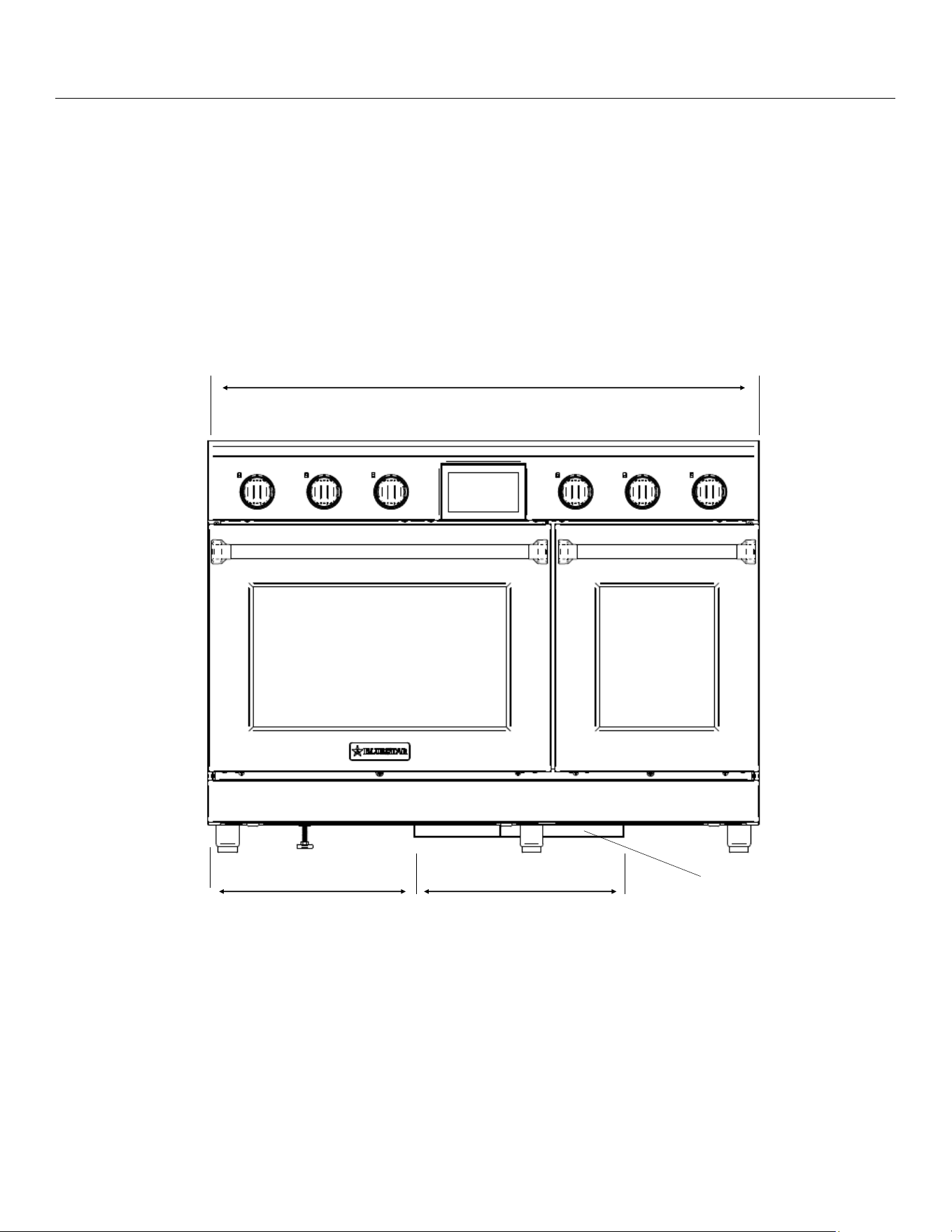
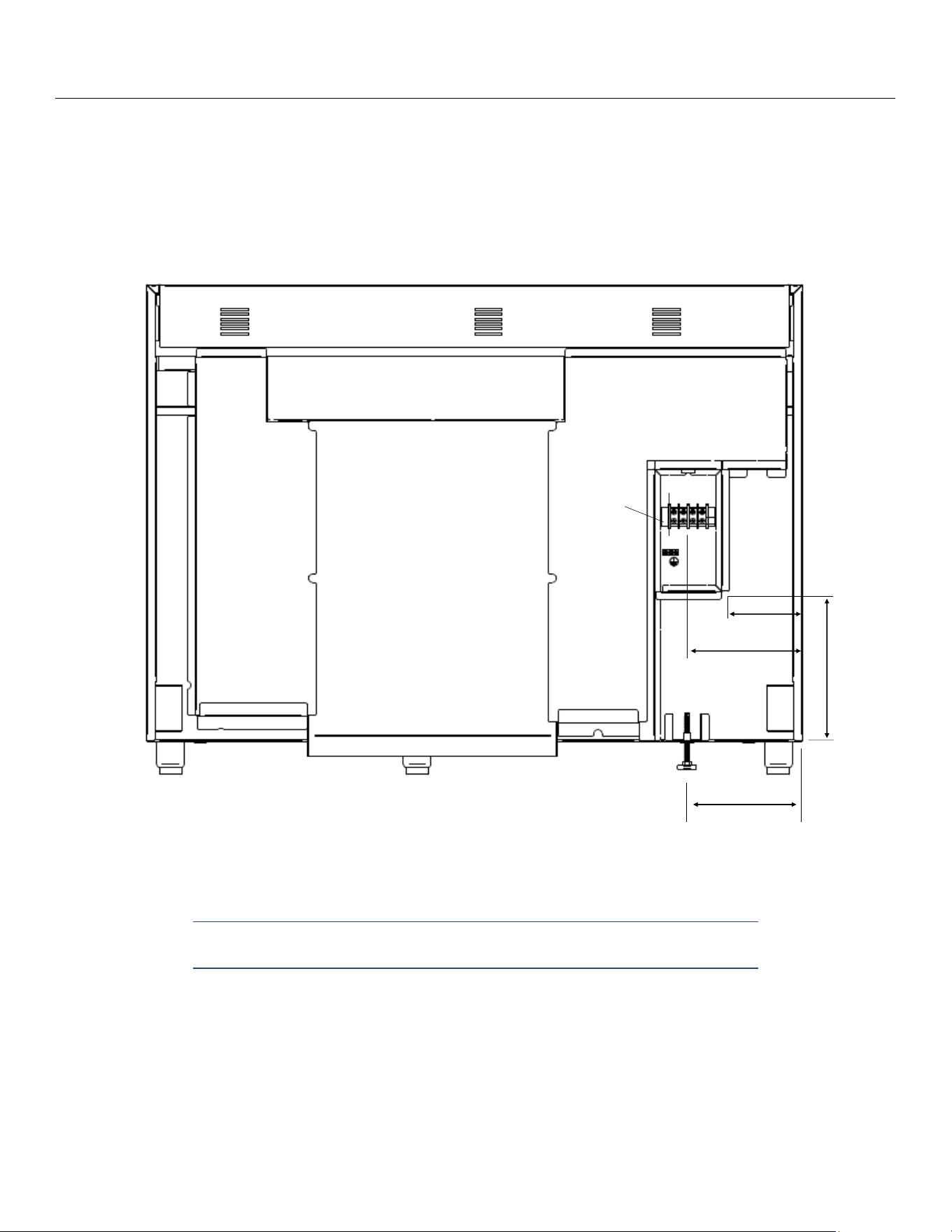
Site Preparation — Front View Product Dimensions (BSPIR486Z)
47 7/8”
(1216 mm)
17 7/8”
(454 mm)
18 1/4”
(463.5 mm)
Duct
bluestarcooking.com 13
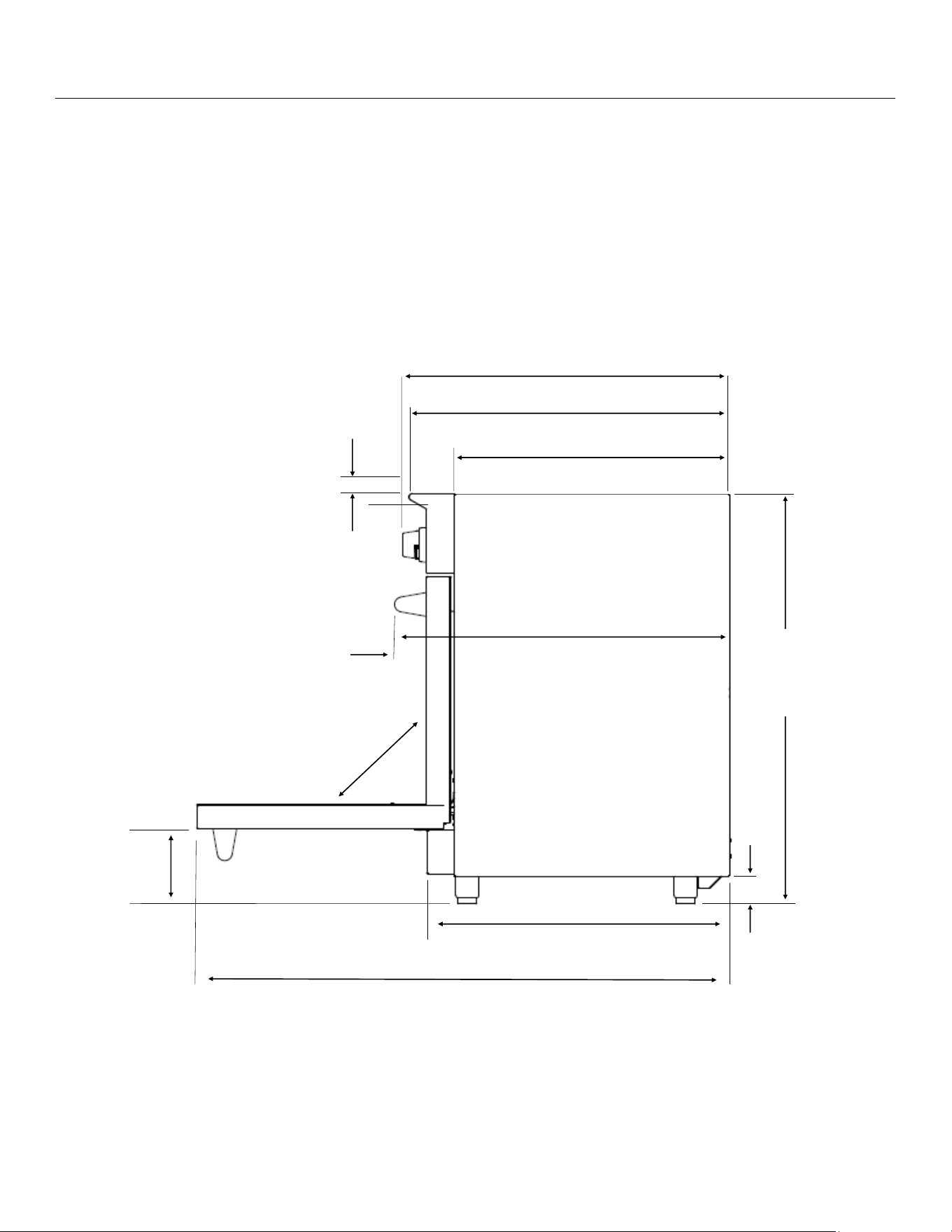
Site Preparation — Back View Product Dimensions (continued)
Model A B C D
BSPIR486Z
3 5/16”
(84.1 mm)
8 3/8”
(212.7 mm)
8 7/16”
(214.3 mm)
13 5/8”
(346.1 mm)
Anti-Tip Foot
Electrical Access Shown
with Cover Removed
A
B
C
D
14 (800) 449-8691
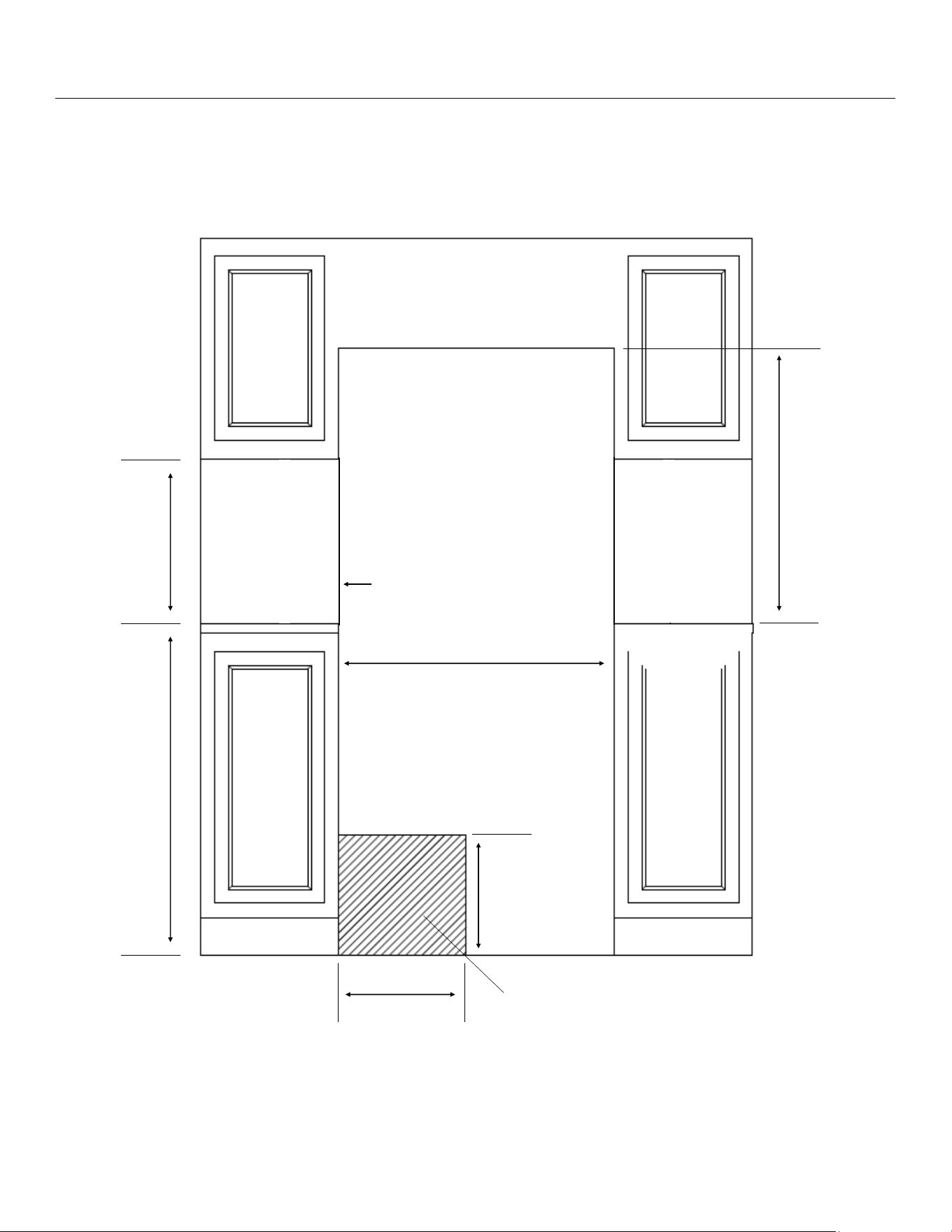
Site Preparation — Side View Product Dimensions
2 3/8”
(60.3 mm)
28 3/8” (720.7 mm)
27 7/8” (708.0 mm)
2 3/4”
(69.8 mm)
29 1/8”
(739.7 mm)
1 3/8”
(34.9 mm)
Opened
Door
46 3/8” (1177.9 mm)
26 3/8” (669.9 mm)
6 1/2”
(165.1 mm)
24” (609.6 mm)
36 3/4 to 35 3/4”
(933.45 to 908.mm
with Standard
Adjustable Legs
bluestarcooking.com 15
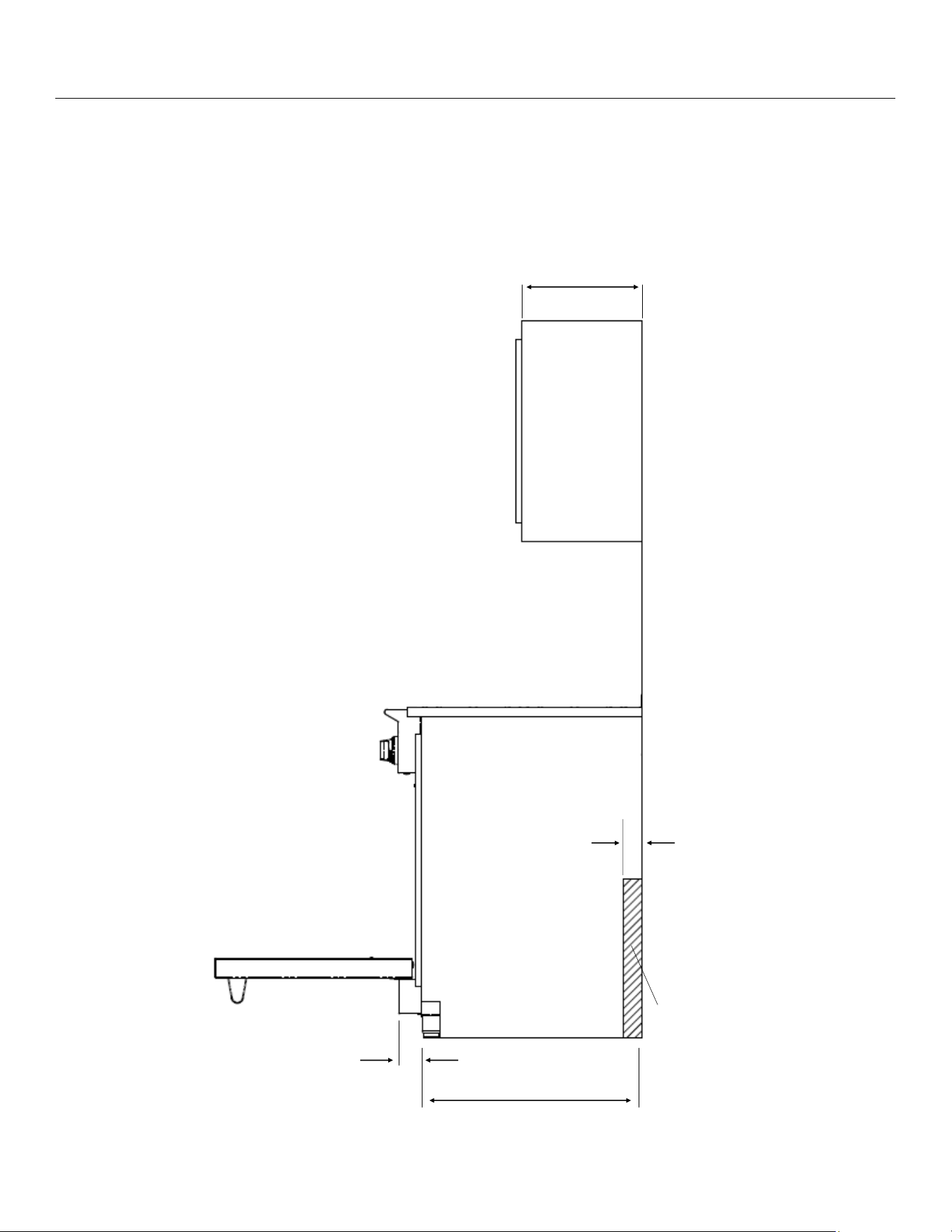
Site Preparation — Cabinet Dimensions
Front View
BSPIR486Z - 10 7/8” (276.2 mm)
18”
(457.2 mm)
Electric Connection Area
36” (914.4mm)
Standard
Counter Top
Height
13”
(330.2 mm)
Maximum
BSPIR486Z - 48” (1219.2 mm)
0” (0 mm)
Minimum Clearance
from Combustible Wall
30” (762 mm)
Minimum
Clearance to
Combustible
Surface
Ventilation recommended for all installations at 30”-36” (762.0-914.4 mm) above cooktop surface
16 (800) 449-8691
Site Preparation — Cabinet Dimensions (continued)
Side View
2 3/8”
(60.3 mm)
13”
(330.2 mm)
Electric Connection Area
24” (609.6 mm)
Standard Cabinet Depth
2” (50.8 mm)
Maximum
bluestarcooking.com 17
Tools and Materials
• 1/2” socket wrench or open-end wrench
• Level
• Gloves and safety glasses
Step 1 — Uncrate and Inspect the Range
Uncrate and inspect the range. Remove the packing
materials but do not discard the anti-tip bracket,
temperature probe, user manual, etc.
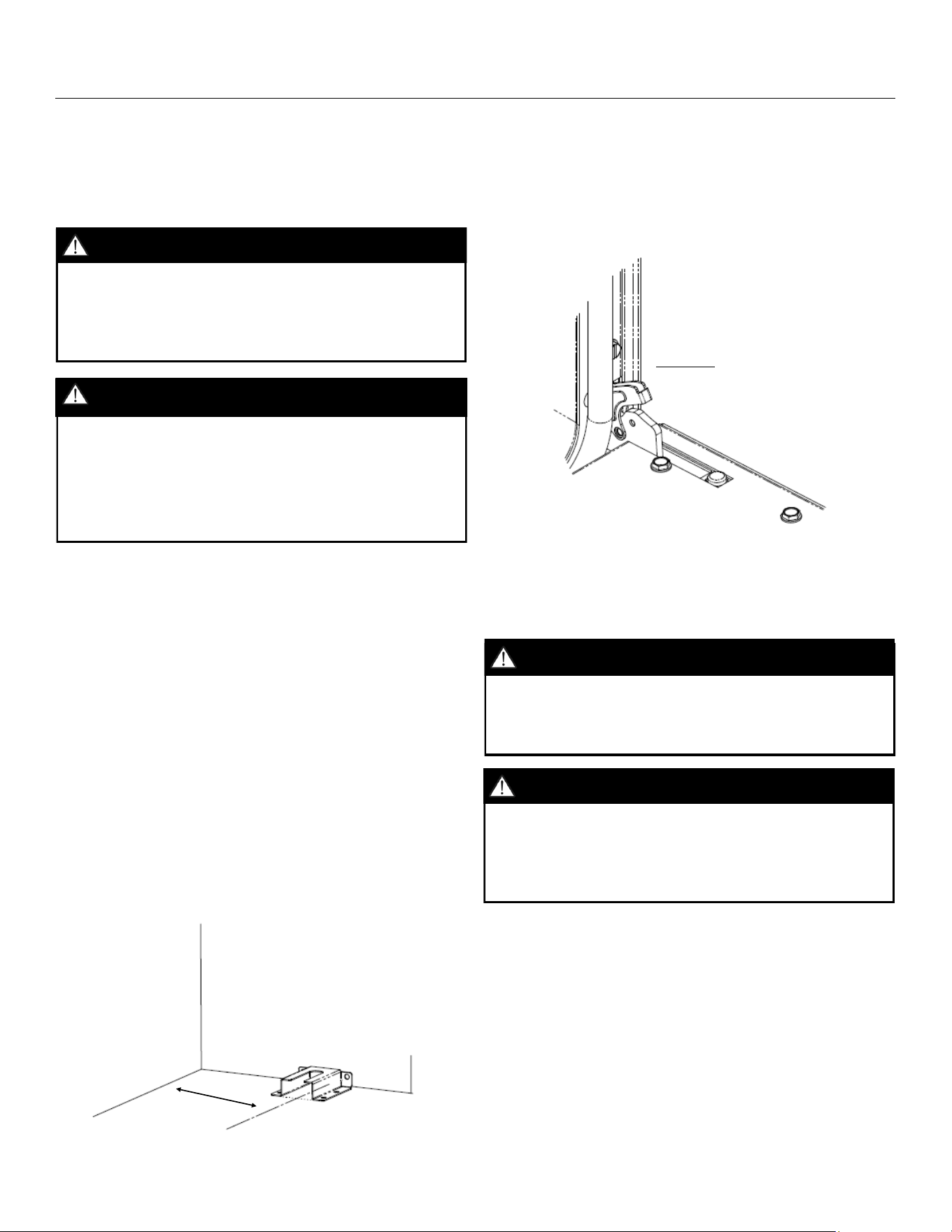
Step 2 — Install the Anti-Tip Bracket
Important: An anti-tip bracket is required for all ranges.
You must install the anti-tip bracket before installing the
range to reduce the risk of tipping.
Attach the anti-tip bracket using the measurements
below.
Installation Instructions
Cet appareil est lourd et bascule facilement lorsqu'il
n'est pas complètement installé. Utilisez deux
personnes ou plus pour déplacer et installer la
cuisinière. Le non-respect de ces instructions peut
entraîner la mort ou des blessures graves.
This appliance is heavy and tips easily when not
completely installed. Use two or more people to move
and install the range. Failure to follow these instructions
can result in death or serious injury.
Step 3 — Detach the Door
1. Open the door all the way.
2. Holding onto the door, push the latch at the top of
each hinge downwards to lock the hinge.
3. After the hinges are locked, lift the door slightly,
then pull the hinge arms out of the hinge
receptacles to remove the door.
4. Lean the door against a wall or cabinet with the
handle towards the oor and facing the wall to
prevent the hinge latches from coming unlatched.
Use padding beneath the door to prevent scratching
or damage
Step 4 — Remove the Oven Racks
See page 31 for instructions.
Keep ngers away from the door hinges after removing
the door. The hinges have strong springs that can snap
closed if impacted, which can cause injury.
CAUTION
Éloignez les doigts des charnières de la porte après
avoir retiré la porte. Les charnières ont des ressorts
solides qui peuvent se refermer en cas de choc, ce qui
peut causer des blessures.
MISE EN GARDE
AVERTISSEMENT
WARNING
Latch
From the left side of the edge of the range
BSPIR486Z - 8 1/2” (215.9 mm)
Anti-tip bracket
should be
secured to the
oor and the
back wall.
18 (800) 449-8691
Installation Instructions (continued)
Step 5 — Move the Range into Position
Remove the wood base with a 1/2” socket or open end
wrench and discard the shipping bolts and brackets. Use
an appliance cart to move the range near the front of the
enclosure. Do not slide it into the cabinet until after
connecting the electrical connections.
Step 6 — Connect Electrical Supply
Observe all local and other codes regarding electrical
connections.
Installation and service must be performed by a
qualied installer, service agency, or utility company.
Installation must comply with all applicable electrical
codes.
1. Remove the electrical box cover to expose the
terminal block. Route the wires through a strain
relief (not supplied) through the bottom of the
electric enclosure. The terminal block allows for a 4-
wire installation.
2. If a four wire connection is used remove and discard
the metal ground strap.
3. Connect green/ground to G.
4. Connect white/neutral to N.
5. Connect red to L1.
6. Connect black to L2.
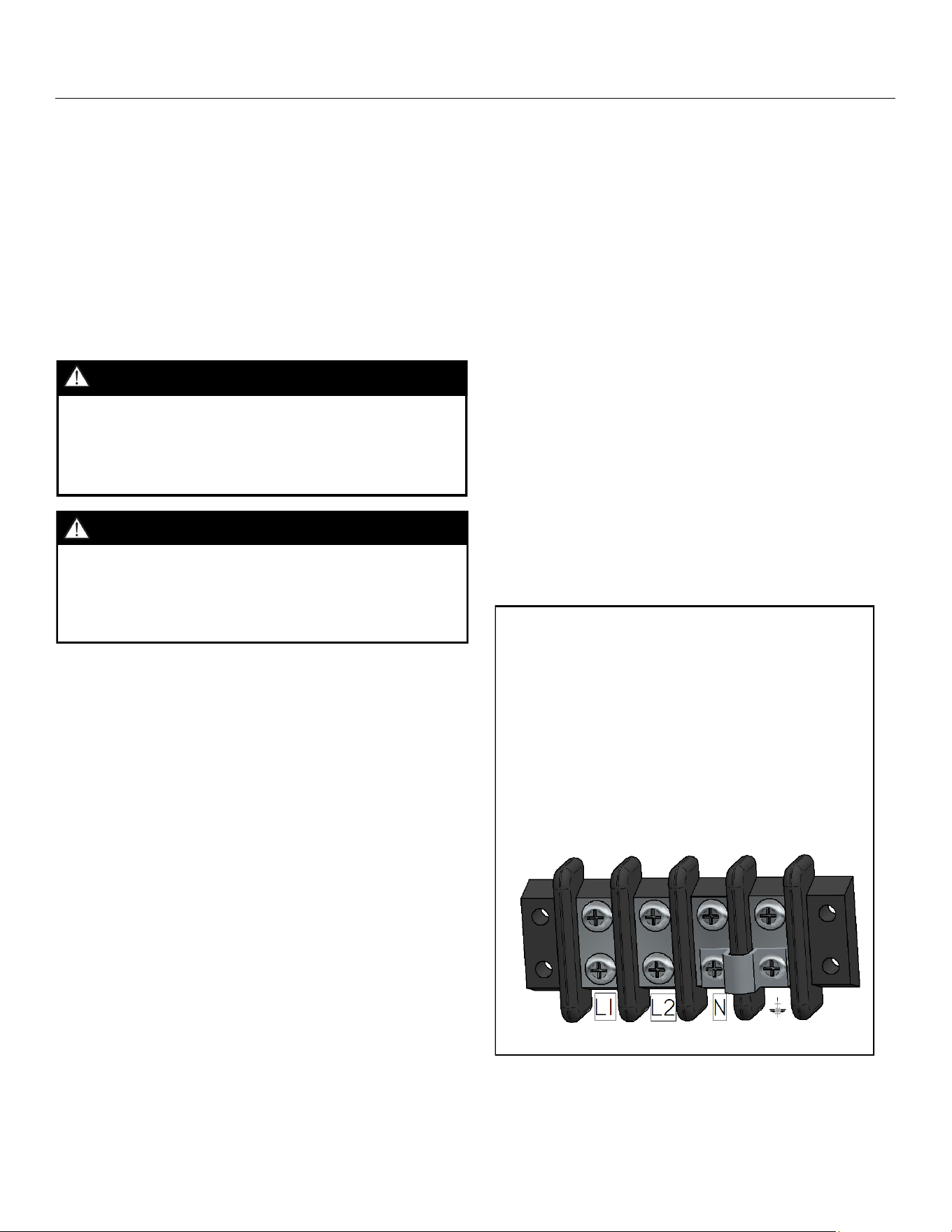
lmportant: All electrical wiring should be free
and clear. Wires or cables should not be pinched
or otherwise obstructed.
7. Tighten the screws on the strain relief and attach the
electrical cover.
If a power-supply cord kit is used (not included), it shall
be rated 240V, 50 amps. It must include 3 or 4
conductors with closed loop terminals and be marked
for use with ranges with nominal 1-3/8” (35mm)
diameter connection openings. A 4-conductor cord is
required for installations where grounding through the
neutral is prohibited, such as:
a. New branch-circuit installations (1996 NEC),
b. Mobile homes,
c. Recreational vehicles, or
d. In an area where local codes prohibit grounding
through the neutral.
Performance may be compromised if the electrical
supply is less than 240 volts.
Power supply: grounded, 240VAC, 60Hz
Circuit protection: 50 amp dedicated circuit
IMPORTANT: Save these instructions for the local
electrical inspector’s use.
Three-Wire Installation
Move the metal ground strap to positions N and G
as shown below.
a. Connect the white/neutral to G.
b. Connect black to L1.
c. Connect red to L2.
d. Tighten the screws on the strain relief and
attach the electric box cover.
This appliance must be grounded. Do not cut, remove,
or disregard the grounding wire in this appliance. If the
appliance is not grounded, severe shock hazards can
exist.
WARNING
Cet appareil doit être mis à la terre. Ne coupez pas, ne
retirez pas et ne négligez pas le l de mise à la terre de
cet appareil. Si l'appareil n'est pas mis à la terre, de
graves risques d'électrocution peuvent exister.
AVERTISSEMENT
bluestarcooking.com 19
Installation Instructions (continued)
Step 7 — Slide the Range into Position
1. Slide the range into place so the anti-tip foot slides
into the bracket.
2. Level the range, placing the level on the surface
three ways: side to side, front to back, and
diagonally.
Important: If you move the range, remove the anti-tip
bracket before the move, then reinstall it in the new
location. Do not operate the range without the anti-tip
bracket engaged.
Step 8 — Replace the Oven Racks
See page 31 for instructions.
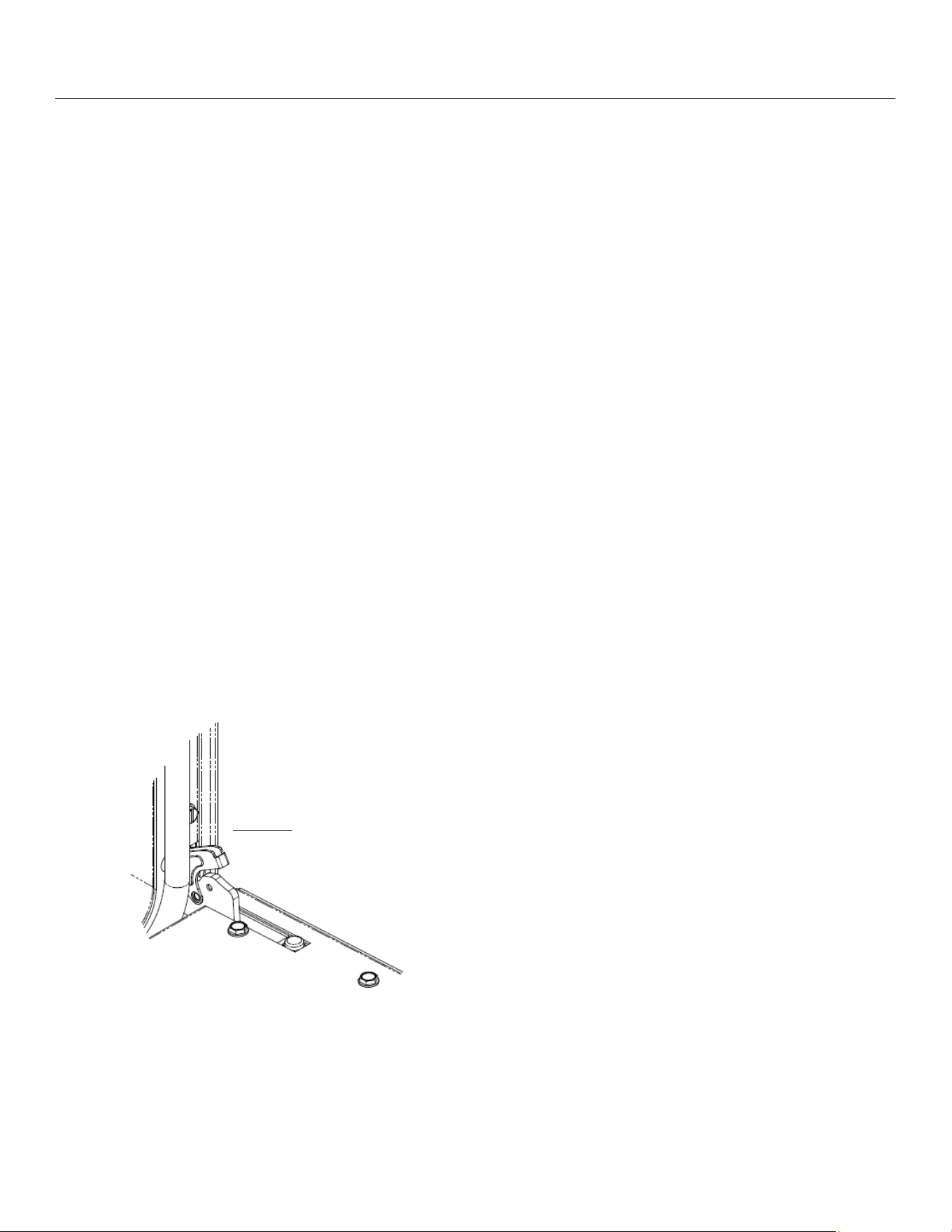
Step 9 — Reattach the Door
1. Hold the door with the handle side facing the
ground.
2. Align and insert the door hinges with the openings
on the range.
3. Push up the latch at the top of each hinge to secure
each hinge.
4. The door should close easily.
Latch
20 (800) 449-8691
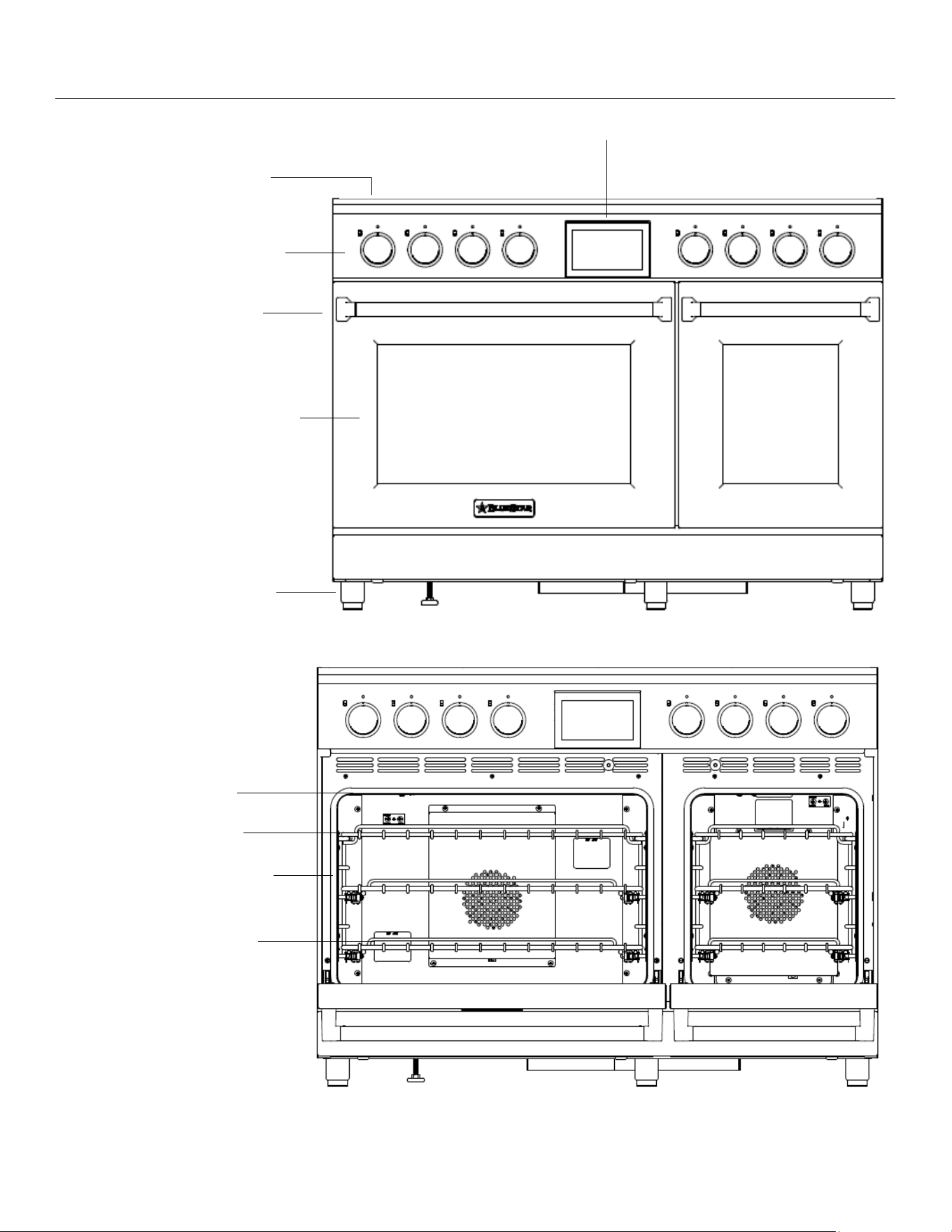
Product Description — BSPIR486Z
1 Legs
2 Doors
3 Handles
4 Control Knobs
5 Cooking Surface
6 Touch Screen Control
7 Oven Lights
8 Rack Guide (both sides)
9 Oven Racks
10 Temperature Probe
1
4
3
5
2
6
7
8
9
10
bluestarcooking.com 21
Product Description — BSPIR486Z (continued)
2
1
3
7
4
6
5
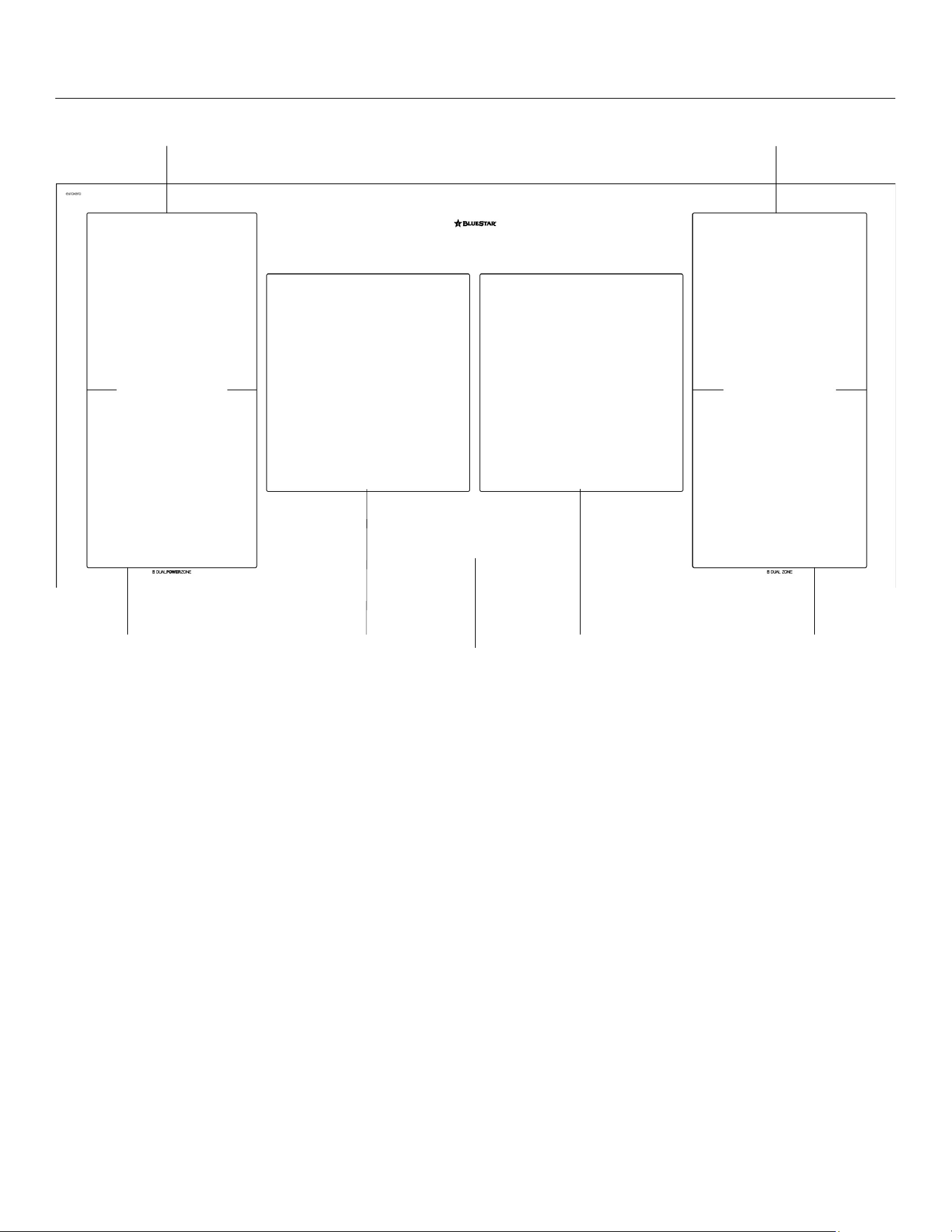
1 Front Left Cooking Zone
Size: 9” x 9” (230 x 230 mm) | Recommended Minimum Cookware Size: 4-1/2” (110 mm)
Nominal Power*: 2,100 W | Power Boost*: 3,700 W
2 Rear Left Cooking Zone
Size: 9” x 9” (230 x 230 mm) | Recommended Minimum Cookware Size: 4-1/2” (110 mm)
Nominal Power*: 2,100 W | Power Boost*: 3,700 W
3 Middle Left Cooking Zone
Size: 11” x 11” (280 x 280 mm) | Recommended Minimum Cookware Size: 4-1/2” (110 mm)
Nominal Power*: 2,300 W | Power Boost*: 3,700 W
4 Middle Right Cooking Zone
Size: 11” x 11” (280 x 280 mm) | Recommended Minimum Cookware Size: 4-1/2” (110 mm)
Nominal Power*: 2,300 W | Power Boost*: 3,700 W
5 Front Right Cooking Zone
Size: 9” x 9” (230 x 230 mm) | Recommended Minimum Cookware Size: 4-1/2” (110 mm)
Nominal Power*: 2,300 W | Power Boost*: 3,700 W
6 Rear Right Cooking Zone
Size: 9” x 9” (230 x 230 mm) | Recommended Minimum Cookware Size: 4-1/2” (110 mm)
Nominal Power*: 2,300 W | Power Boost*: 3,700 W
7 Display area
* The given power may change according to the dimensions and material of the cookware
22 (800) 449-8691
Before Your First Use
Oven Burn-Off Procedure
Important: Before you use the range, it is essential that
you complete the oven burn-off procedure. This
procedure will take 90 minutes to complete and will
remove all factory oils and residue from its internal parts.
During this process, you may notice a strong odor, some
smoke, and/or condensation on the front of the oven
(including the oven doors, control panel, and side
panels) as any oils and solvents on internal parts are
burned off. This is normal and is the primary reason for
this burn-off. Failure to complete this procedure before
rst using the oven may result in undesirable odors,
avors, and excessive smoke,
Note: For documentation purposes, touch screen
control illustrations are for the BSPIR48 range.
Instructions apply to all ranges unless otherwise noted.
1. Take out the oven racks, and temperature probe (if
necessary).
2. Tap Clean on the Select Mode screen.
3. Tap Start on the Select Clean screen to start the
cleaning cycle, which will take 90 minutes.
4. The Cleaning in Progress timer will start counting
down from “1:30”. You can tap OFF at any time to
stop the process.
5. When the time is up, you will hear a tone to indicate
the Clean cycle is complete. The oven will still be hot
at this point.
6. Wait for the oven to cool completely before you put
back the oven racks.
bluestarcooking.com 23
Before Your First Use (continued)
Noise:
• Certain cookware can make noise when placed on
an induction cooking zone. Some cookware are
noisier than others. When used at maximum power,
the cookware will hum, similar to a transformer. This
noise is normal and does not mean that there is
something wrong with the appliance, nor does it
inuence its function.
Cooling fan:
• The cooling system is fully automatic. The cooling
fan starts at a low speed when the heat generated by
the electronic system reaches a certain level. The
cooling fan increases to high-speed when the
cooktop is intensively used. The cooling fan reduces
its speed and stops automatically when the
electronic circuit has cooled down enough.
Cooktop
1. Clean your cooktop with a damp cloth and then dry
the surface thoroughly. Do not use detergent, this
can create a blue-tinted color on the glass surface.
2. Remove all labels and self-adhesives from the
ceramic glass.
Important: the quality of your cookware can affect
cooking performance.
Cookware compatibility:
• Only use induction compatible cookware that has
been specically designed for induction cooking.
Look for the induction symbol on the packaging or
the bottom of the pan.
• A suitable cookware is made of ferromagnetic
material. You can check this with a magnet — if the
magnet sticks to the cookware bottom, it is likely to
be induction compatible.
• The suitable cookware materials are: stainless with a
magnetic base, cast iron, steel, enameled steel.
• The unsuitable cookware materials are: pure
stainless steel, copper, aluminum, glass, wood,
porcelain, ceramic or earthenware.
• The induction cooking zone automatically
recognizes the size of the cookware. If its size is too
small, it won’t work. The minimum cookware size
varies with the cooking zone sizes.
• If the cookware isn’t adapted to the induction, the
display will show the following symbol:
• To ensure the best efciency, always use cookware
with a at bottom.
• Performance may vary based on the cookware used.
It is recommended that smaller cookware, especially
anything 4” in diameter or smaller, is placed on the
left cooking zones.
24 (800) 449-8691
Note: For documentation purposes, touch screen control illustrations are for the BSPIR48 range. Instructions apply to
all ranges unless otherwise noted.
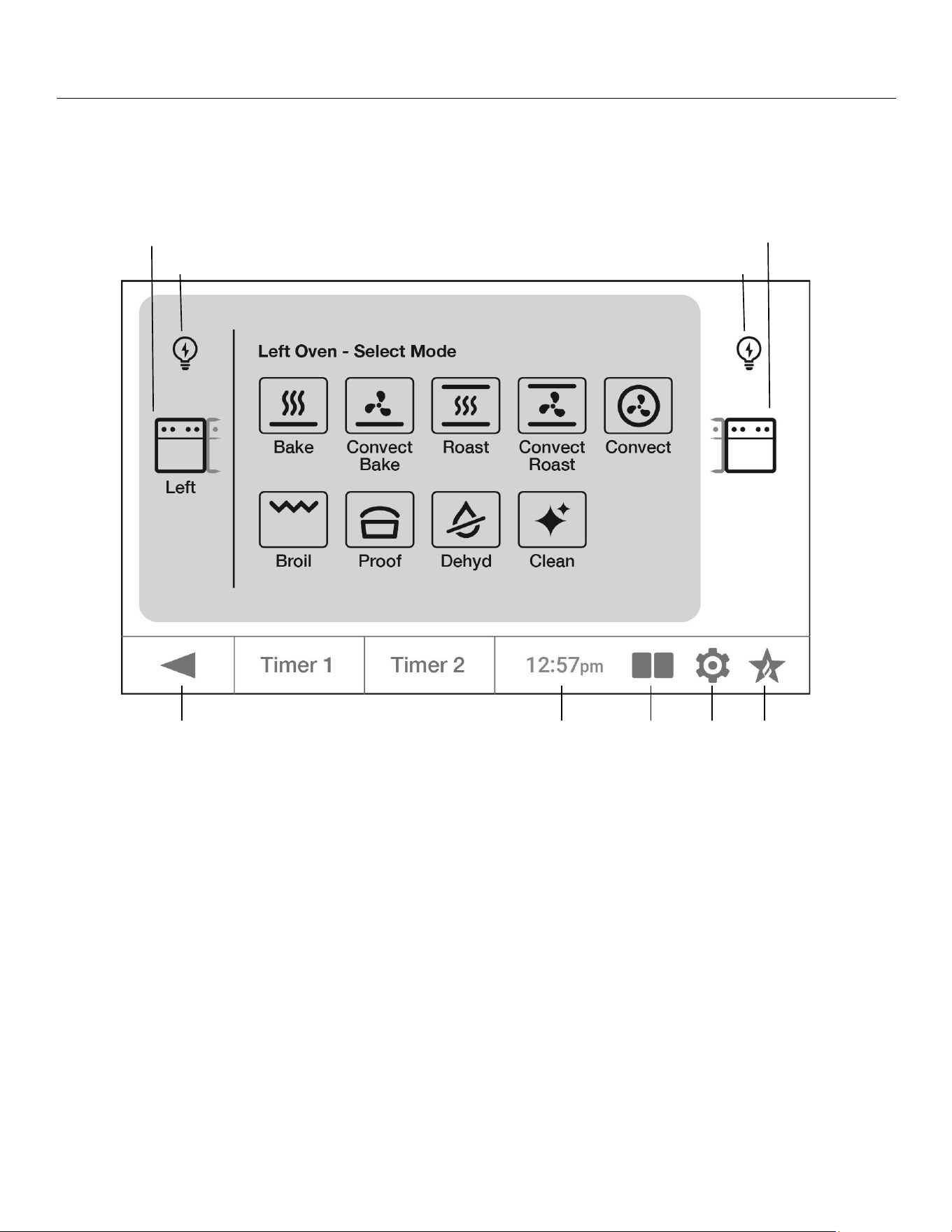
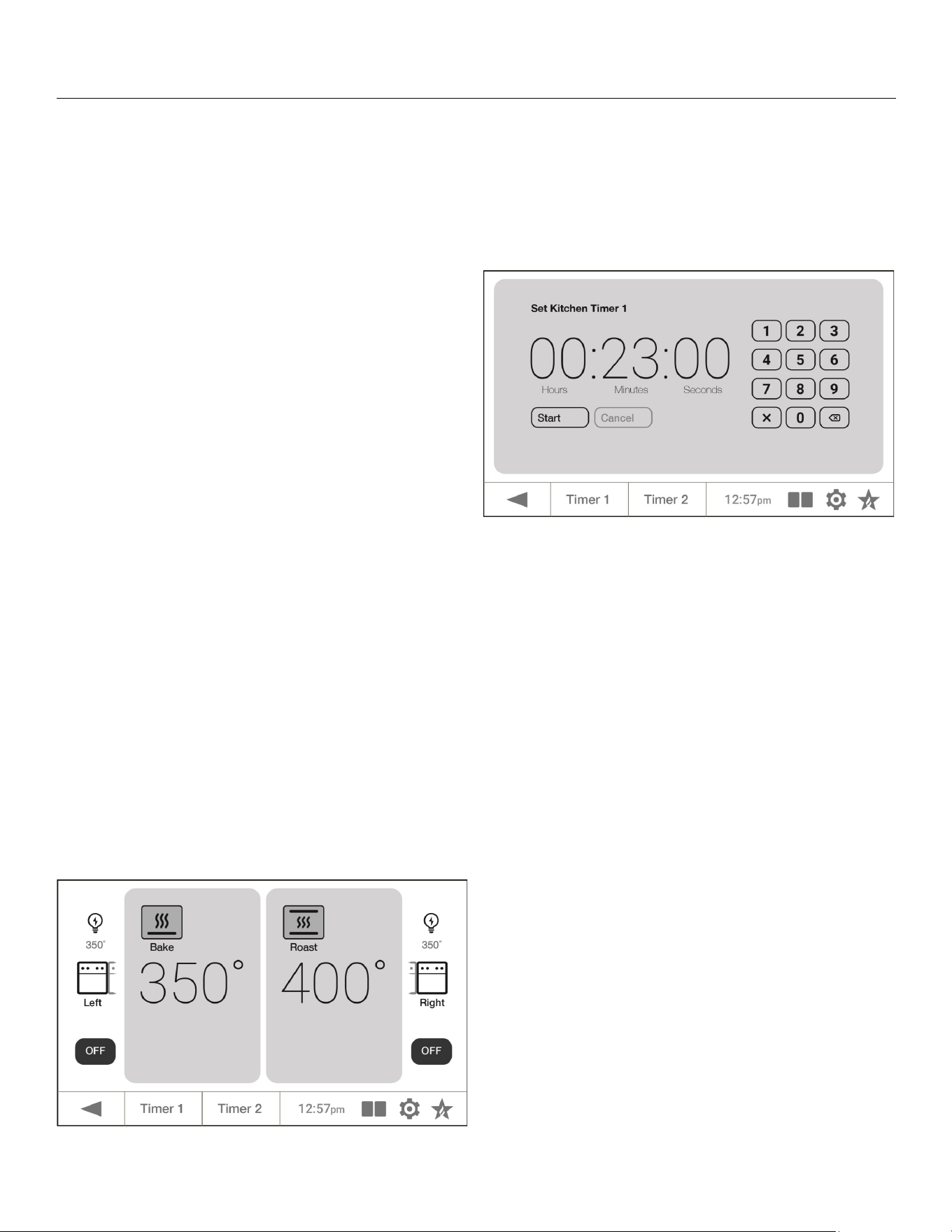
Touch Screen Control
Main
Screen
Left Oven
Left Oven Light
Split
Screen
Settings Clock Previous
Right Oven
Right Oven Light
bluestarcooking.com 25
Touch Screen Control (continued)
Main Screen
When you are not using the ovens, the main screen
shows the time.
Tap the screen to start any oven operation. Tap the
BlueStar logo in the bottom right corner to return to the
main screen.
Note: Any time the touch screen control is in use, the
cooling fan will automatically start.
Settings
Tap the Settings icon to do any of the following:
• Set the time
• Change the temperature scale (Fahrenheit/Celsius)
• Enable Sabbath mode
• Lock the touch control screen
• Adjust the volume
• Change the clock design
Split Screen
Note: The following information applies to the BSPIR48
range only.
By default, the system starts with the left oven. Tap the
right oven icon on the right to use the right oven
instead.
After tapping Start on any operation, you can tap the
oven icon on the opposite side (in the black) to set up
the second oven for additional cooking.
To see both ovens on the touch screen control, tap the
split screen icon in the bottom row.
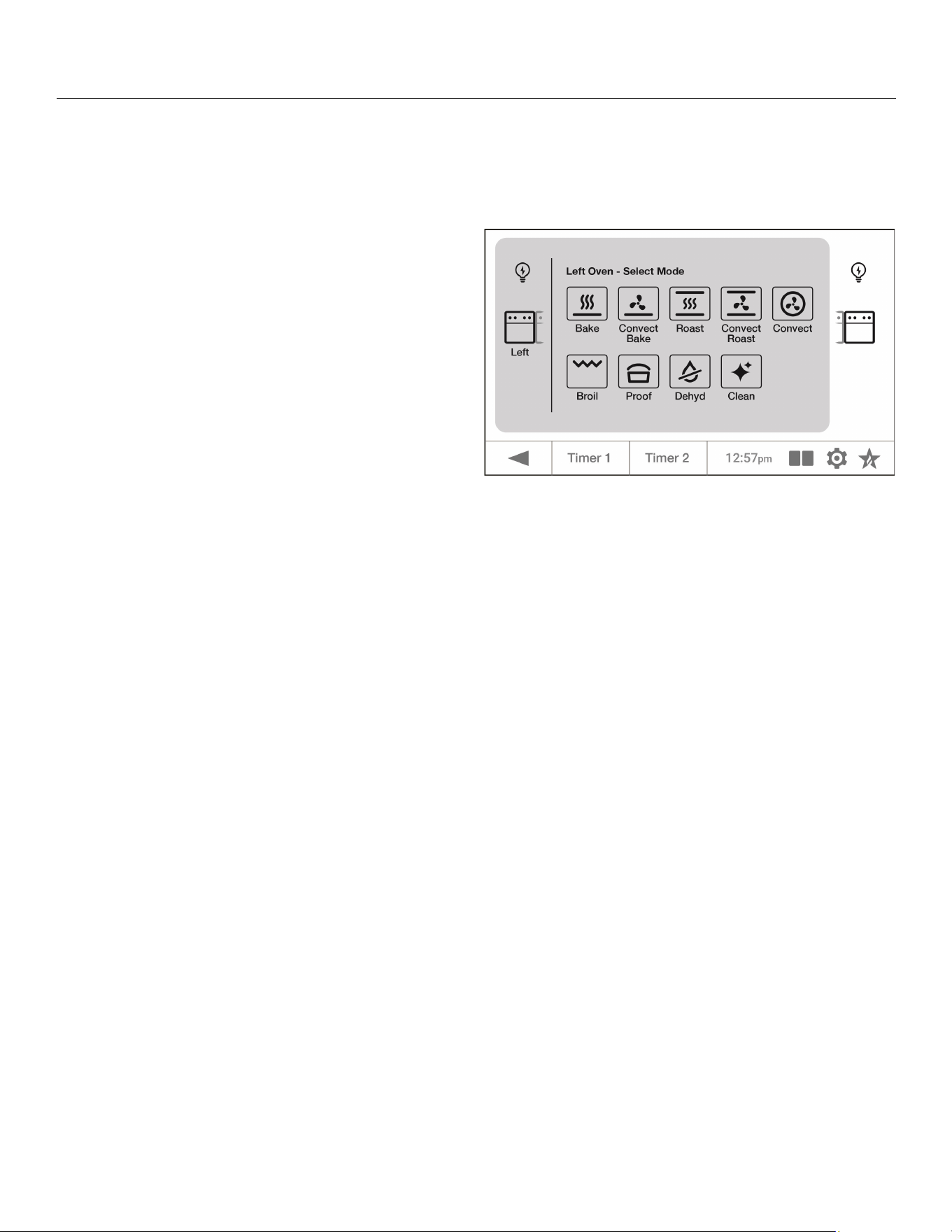
Kitchen Timers
1. Tap either Timer 1 or Timer 2 in the bottom row.
2. On the Set Kitchen Timer screen, use the keypad to
enter the hours, minutes, and seconds, then tap
Start. The timer countdown will appear in the
bottom row in the Timer box.
3. When time is expired, you will hear a tone for two
minutes or until you respond. Tap the Timer box.
Previous Screen
Tap the previous icon to go to a previous screen.
Oven Light
Tap the light bulb icon to turn on the oven light. Tap the
same icon again to turn it off.
Important: Keeping the oven light on while cooking will
increase the oven temperature approximately 15°F
(-9°C).
26 (800) 449-8691
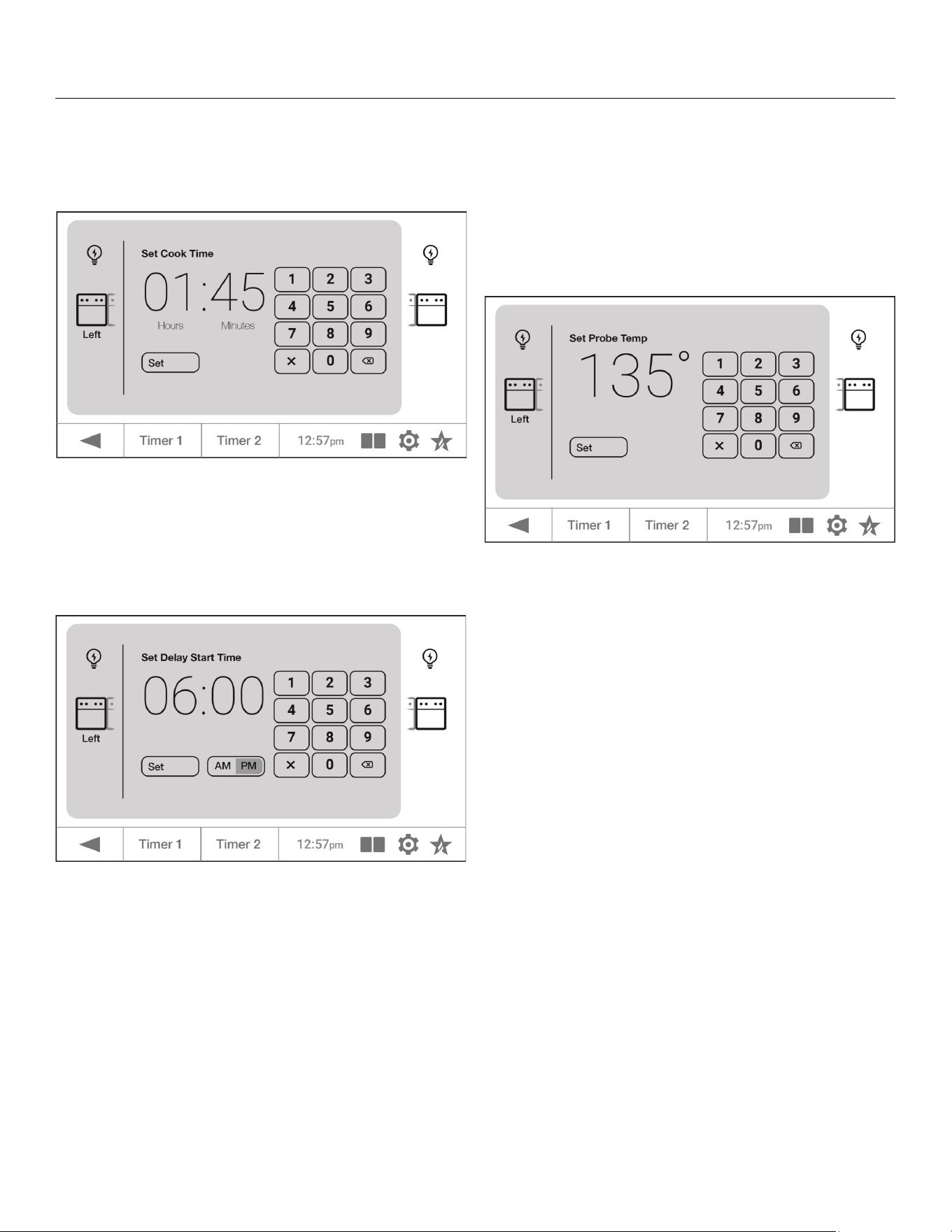
Your oven has the following operating modes:
BSPIR48
Touch Screen Control—Modes
Note: For documentation purposes, touch screen
control illustrations are for the BSPIR48 range.
Instructions apply to all ranges unless otherwise noted.
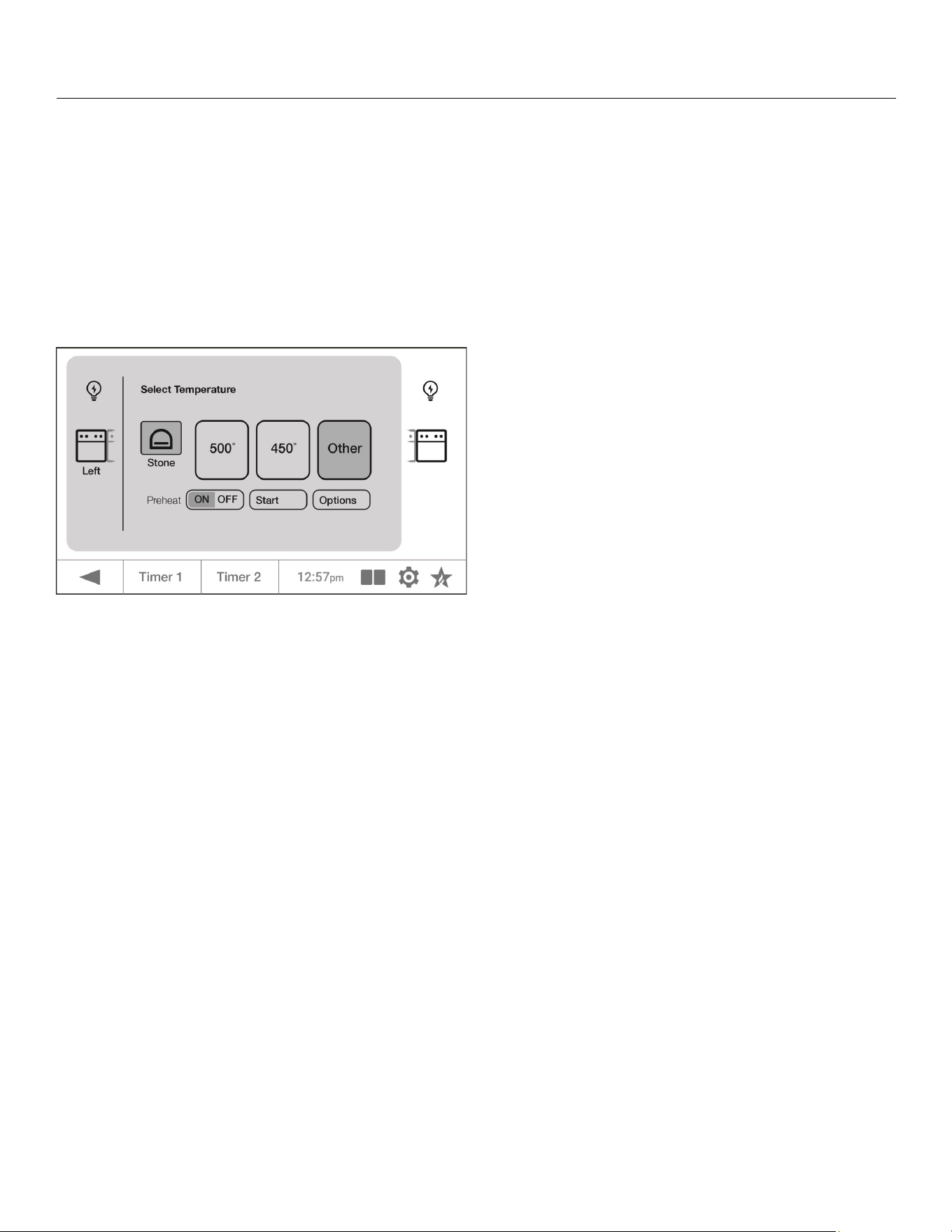
1. Tap the mode on the Select Mode screen.
2. Use the default setting or use the keypad to enter
the temperature on the Select Temperature screen.
Tap Start to preheat the oven. You also have the
option to turn preheat on or off.
Note: If you want to select an option, do so before you
tap Start.
3. Tap Options to select any of the following. Once
you have made your selections, tap Start to conrm
the setting and begin cooking:
• Select Timed to set the cooking time.
• If you want to postpone the bake start time,
select Delay.
• If you are using the temperature probe and
need to set its temperature, select Probe.
Left Oven
• Bake • Convection
• Convection Bake • Broil
• Roast • Proof
• Convection Roast • Dehydrate
Right Oven
• Bake • Proof
• Convection Bake • Dehydrate
• Convection • Clean
bluestarcooking.com 27
Touch Screen Control—Modes (continued)
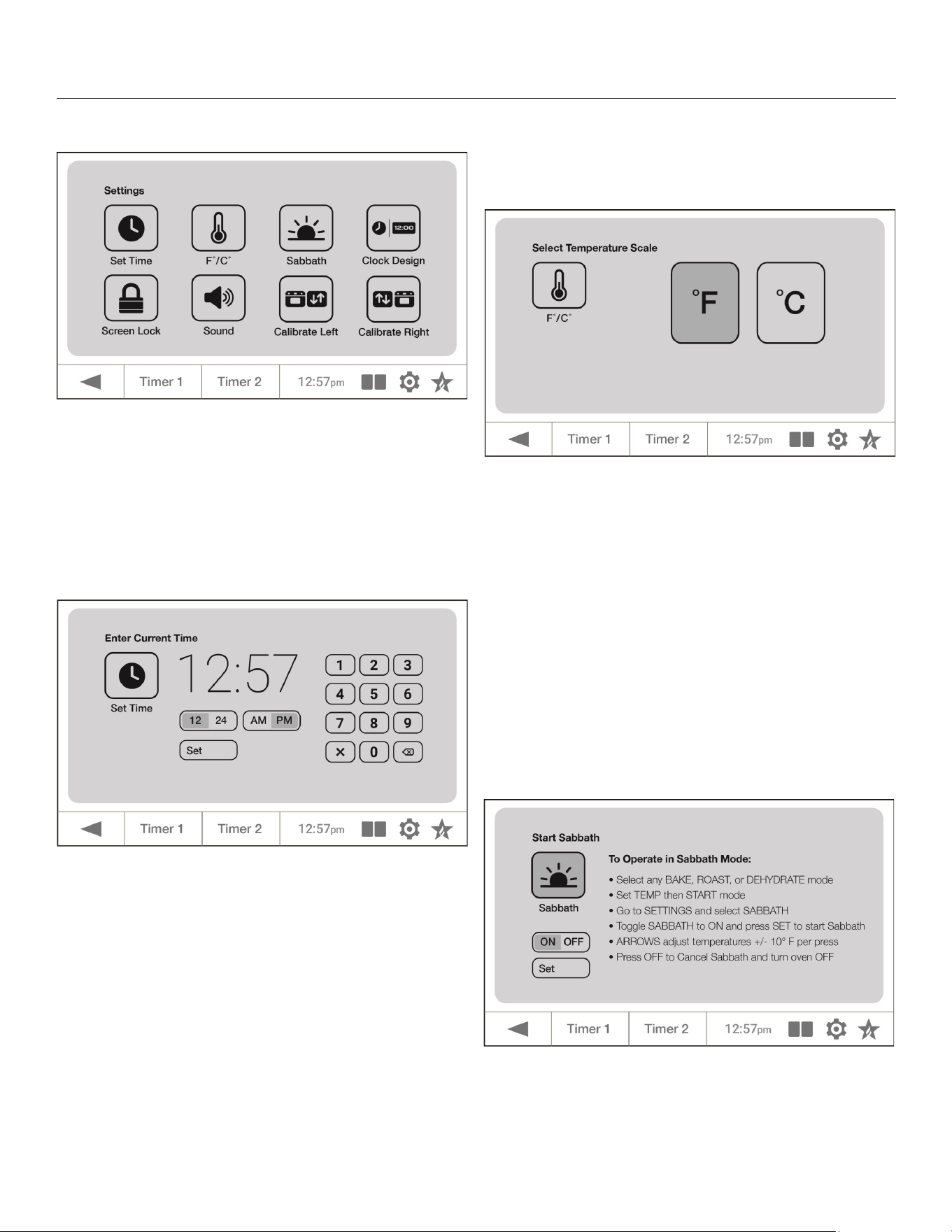
Timed
Use the keypad on the Set Cook Time screen to set the
cooking time in hours and minutes, then tap Set.
Delay
Note: Using Delay Time will turn off the preheat feature
to prevent burning food.
Use the keypad on the Set Delay Start Time screen to set
the hours/minutes, then tap Set.
Probe
Note: The probe is not available with the Broil, Proof, or
Dehydrate modes.
Use the keypad on the Set Probe Temp screen to set the
temperature or use the options on the Select Meat
screen and the corresponding Type or Preferences on
the subsequent screens. Tap Set.
Clean
1. Tap Clean on the Select Mode screen
2. Tap Start on the Select Clean screen to start the
cleaning cycle, which will take 90 minutes.
3. The Cleaning in Progress timer will start counting
down from “1:30”. You can tap OFF at any time to
stop the process.
4. When the time is up, listen for a tone to indicate the
Clean cycle is complete. The oven will still be hot at
this point.
Demo Mode (for dealer use only)
1. Tap Calibrate Left (or Calibration) on the Settings
screen.
2. On the Calibrate screen, press the blank space in
the center at the top of the screen to go to the Set
Demo Mode screen and follow the steps on the
screen.
3. DEMO will appear in the center of each screen.
4. To cancel Demo mode, press and hold DEMO for
ve seconds to access the Set Demo Mode screen
and follow the steps on the screen.
28 (800) 449-8691
Tap the Settings icon.
Set Time
1. Tap Set Time.
2. On the Enter Current Time screen, use the keypad to
enter the hours and minutes, tap 12 or 24 for either
a 12-hour or 24-hour clock. If you select “24” , the
AM/PM option will be disabled. Tap AM or PM, then
tap Set to conrm your selections.
3. Tap the Main Screen icon to see the change made.
F°/C° (Temperature Scale)
1. Tap °F/°C.
2. Tap °F (Fahrenheit) or °C (Celsius).
Sabbath
In Sabbath mode, the oven maintains a set cooking
temperature in Bake, Convection Bake, Roast,
Convection Roast, or Dehydrate mode until you cancel
Sabbath mode. Oven lights and alarms (except error
codes) are disabled until Sabbath mode is canceled.
When in Sabbath mode, you can tap either arrow to
increase or decrease the temperature in 10-degree
increments. You will have to wait at least a minute before
you can change the temperature again. When you adjust
the temperature, there will be no indication the oven
temperature did change.
1. Tap Sabbath and follow the steps on the screen.
2. Tap OFF to cancel the Sabbath mode.
Touch Screen Control—Settings
bluestarcooking.com 29
Clock Design
1. Tap Clock Design. If you do not want a clock design
to show on the main screen, tap OFF and the screen
will remain black.
2. Tap Analog or Digital to select the type of clock you
want.
3. Tap any of the options available.
4. Tap any of the colors available.
5. Tap the Clock Design icon to see the change made.
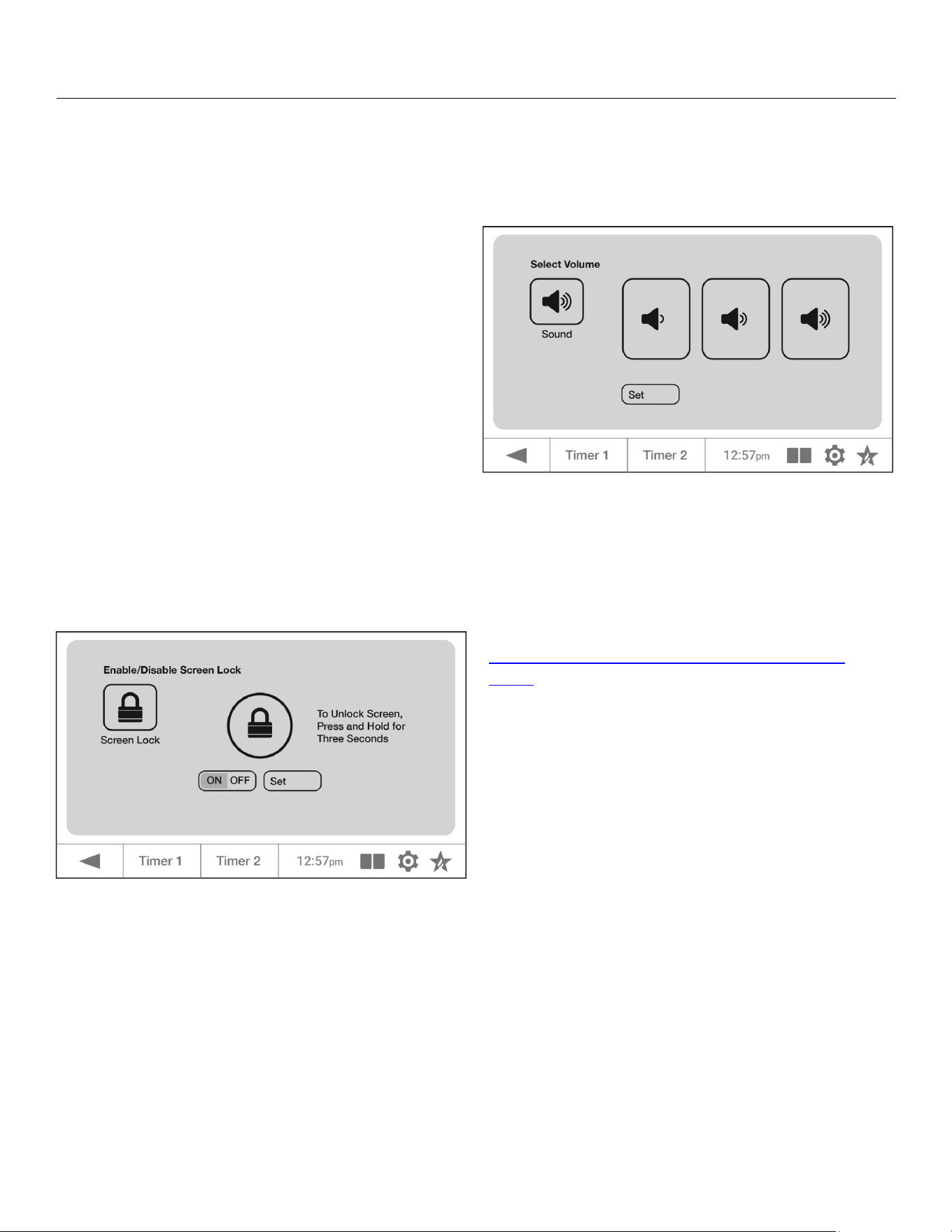
Screen Lock
1. Tap Screen Lock.
2. Tap ON to lock the touch screen control. When the
screen is unlocked, you can use the oven normally
until the control returns to the main screen, where
the screen will lock again. This will happen each time
the control returns to the main screen until you turn
off the screen lock.
3. Press and hold the Screen Lock for three seconds to
unlock the screen.
Touch Screen Control—Settings (continued)
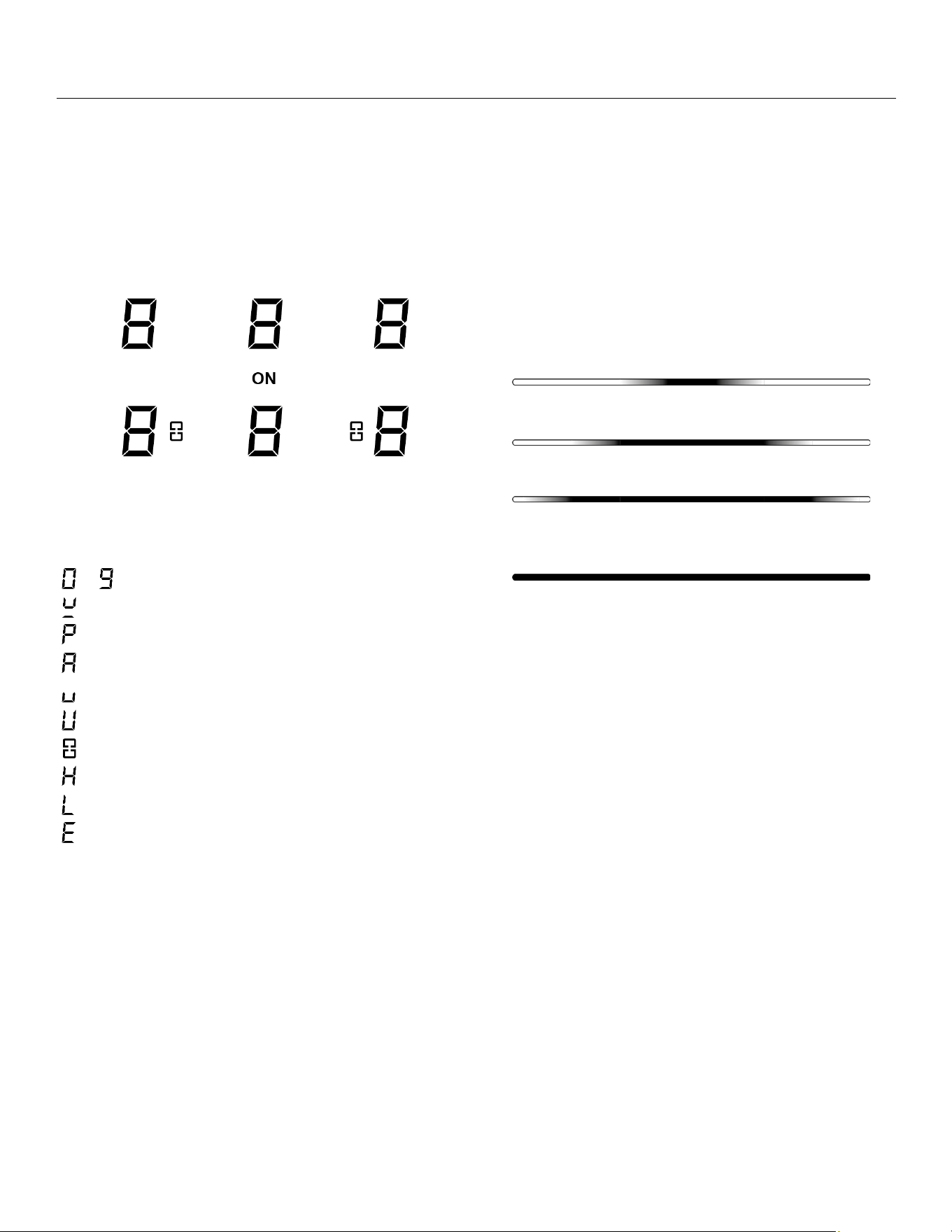
Sound
1. Tap Sound.
2. Tap any of the volume options to listen its the sound
level.
3. Tap Set after selecting the volume you want.
Calibrate
The oven is factory calibrated and if changes are
necessary should be calibrated by an authorized
BlueStar service company. To locate an authorized
BlueStar service company in your area, go to
www.bluestarcooking.com/support/nd-a-service-
center.
30 (800) 449-8691
Display
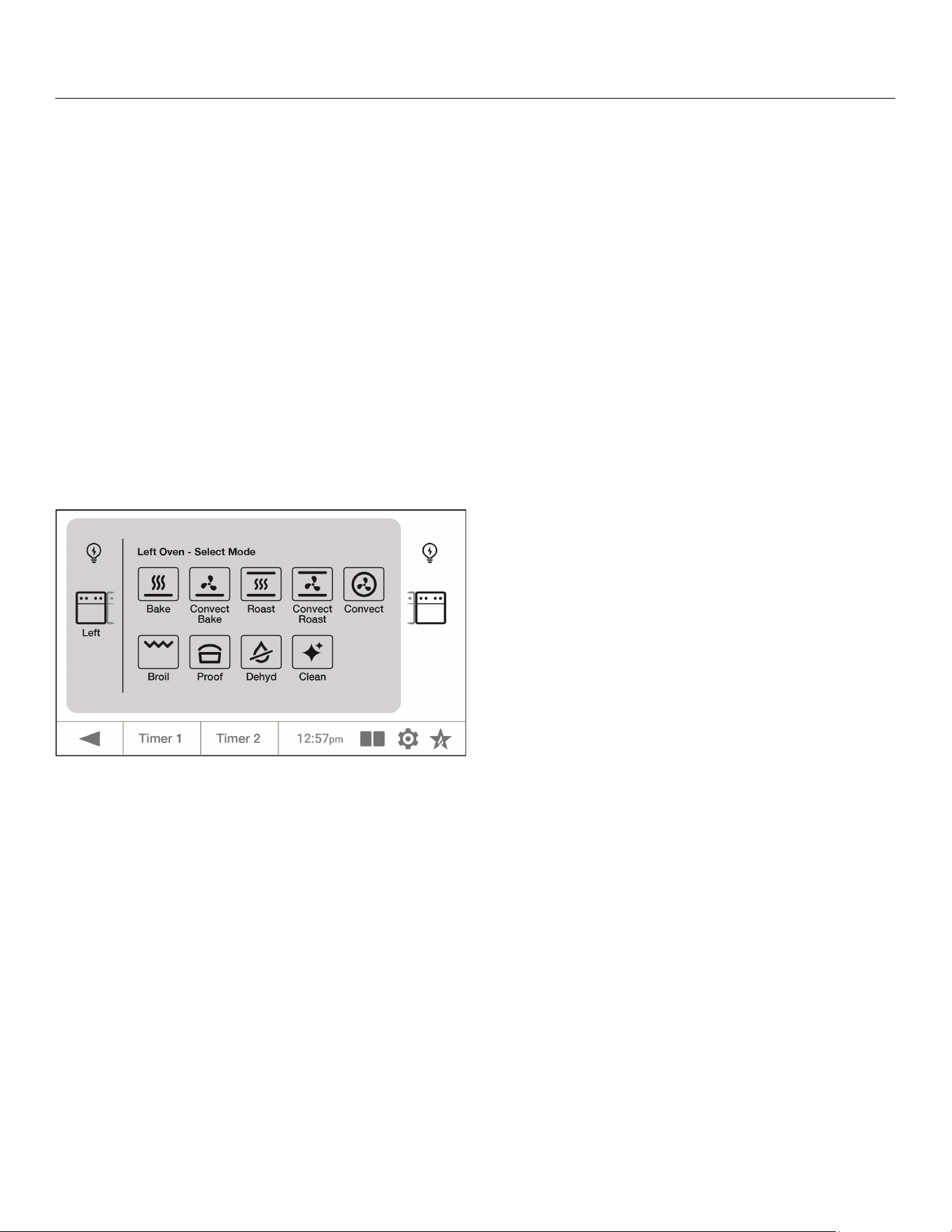
Each knob controls a cooking zone and corresponds to
a dedicated indicator in the display area.
BSPIR486Z
Cooktop Control
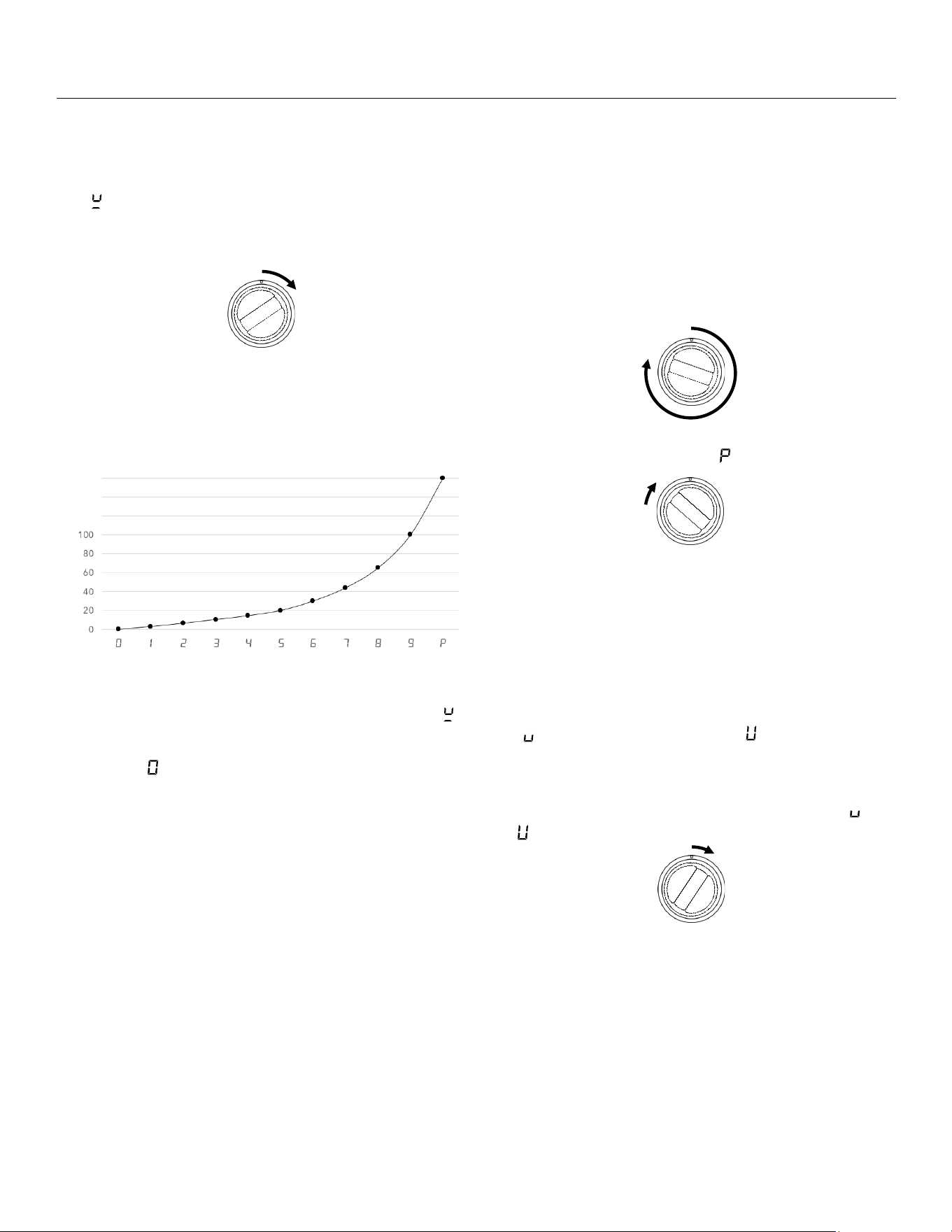
Display Meaning
to Power levels
No cookware detected
Power Boost function activated
Automatic heat-up function activated
Keep Warm 150°F (70°C) function activated
Simmer 200°F (94°C) function activated
Dual Zone activated
Hot surface indicator
Childlock function activated
Error message indicator
Dynamic Light Bar
All the cooking zones have a dynamic light bar in front of
them. This additional indicator allows to quickly identify
which cooking zone is corresponding to the used knob.
It also allows to get a quick indication of the power level
set without referring to the central display area.
The light bar is divided in 4 different segment lengths
covering the range of power levels of the cooking zone.
1. First segment length for Keep Warm, Simmer, power
level 1, 2 and 3.
2. Second segment length for power levels 4 and 5.
3. Third segment length for power levels 6 and 7.
4. Fourth segment length for power levels 8, 9 and
Power Boost.
bluestarcooking.com 31
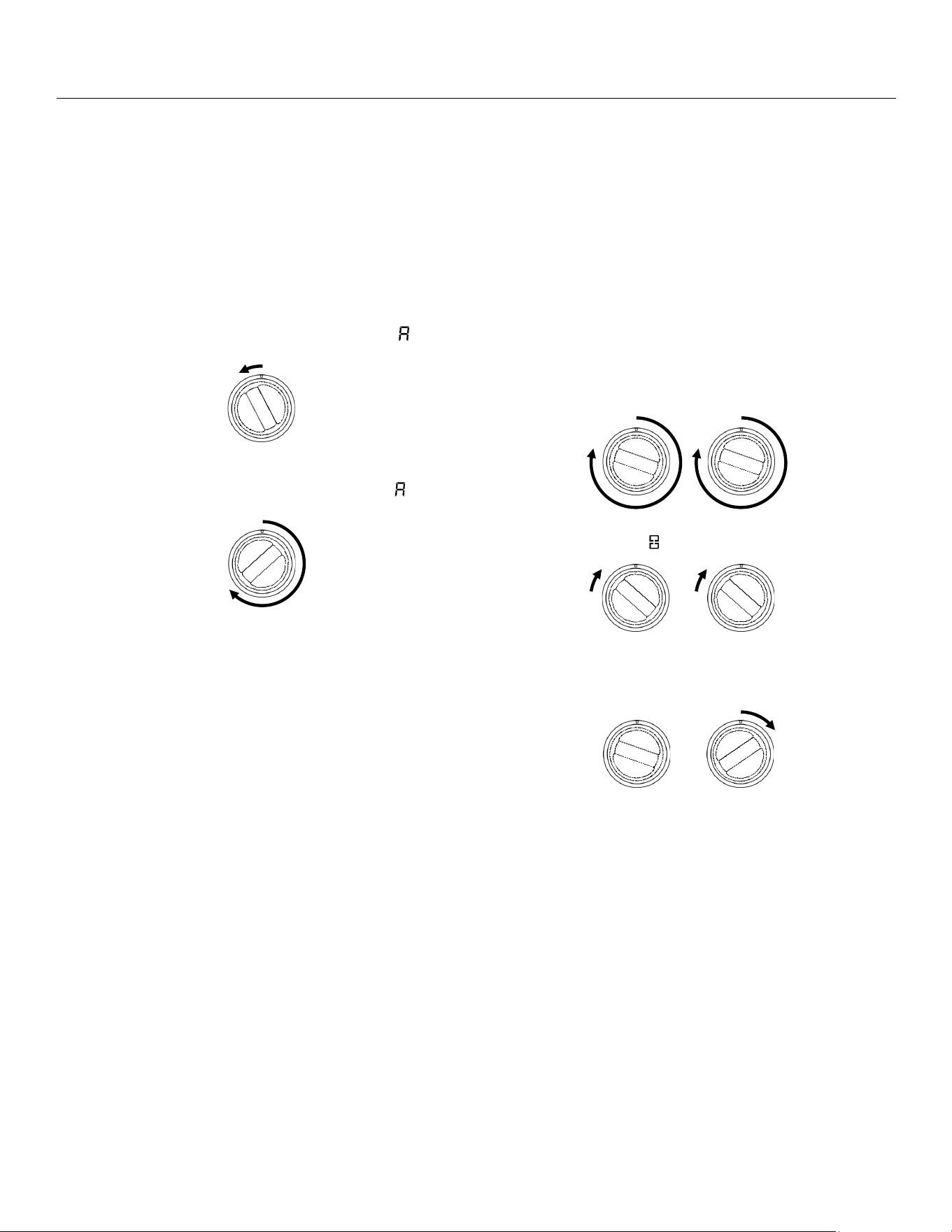
Start-up / switch-off a cooking zone
1. Place a cookware on the cooking zone. In case you
try to start without cookware, the display will show
and the cooking zone won’t heat-up.
2. Push and turn clockwise the knob corresponding to
the desired cooking.
3. The corresponding display will turn on.
4. You can now adjust to the desired power level (from
1 to 9).
Note: if the cookware is removed from the cooking
zone, the operation is stopped and the display shows
After use, switch the cooking zone off by turning back
the knob to
Do not leave the cooking zone on without any
cookware.
Smart power optimization
The induction range has a maximum potential power.
When the ovens are activated and/or high power levels
are set on the cooktop, the electronic system
automatically reduces the power level of individual
cooking zones so that the cooking can continue on the
highest power levels possible.
Cooktop Control—Functions
Power Boost
All the cooking zones feature the Power Boost function.
This function provides a boost of power to the selected
cooking zone. When activated, the cooking zone works
at an extra high speed for a maximum of 10 minutes.
This is meant to be used for heating large quantities of
liquids very quickly (e.g. water for pasta).
1. Set the knob of the desired cooking zone to power
level 9.
2. Rotate the knob to the P position and hold for 2
seconds until display shows
Keep Warm and Simmer
All the cooking zones feature the Keep Warm and
Simmer functions. These functions allow the cooking
zones to reach and automatically maintain a temperature
of 150°F (70°C) or 200°F (94°C). This prevents liquids
from overowing and food from burning.
The for Keep Warm at 150°F and for Simmer at
200°F are intermediary positions of the knob between 0
and 1.
1. Push and turn the knob slightly clockwise until or
show on the display.
Percentage of rated power (%)
Power level setting
32 (800) 449-8691
Cooktop Control—Functions (continued)
Dual Zone
The Dual Zone function combines two cooking zones
and controls them as one, resulting in one larger
cooking area. This gives the exibility to use larger
cookware, including roasting pans and griddles.
To get best use of the Dual Zone, cookware needs to
fully cover both individual cooking zones. There may be
a slightly cooler area in the center between the two
cooking zones.
Only the Dual Power Zone (on the left side of the
cooking surface) allows use of the Power Boost function.
1. Set both knobs of the Dual Zone to power level 9.
2. Rotate both knobs to the P position and hold until
the display shows on the front cooking zone.
3. Use the front cooking zone knob to adjust the power
level of the combined Dual Zone. Rotating the knob
of the rear cooking zone will cancel the combination.
Automated heat-up
All the cooking zones feature the automated heat-up
function. This function allows to rapidly heat-up food or
liquid then automatically reduces the power level to a
pre-selected power setting.
The amount of time the cooking zone will rapidly heat-
up depends on the pre-selected power setting.
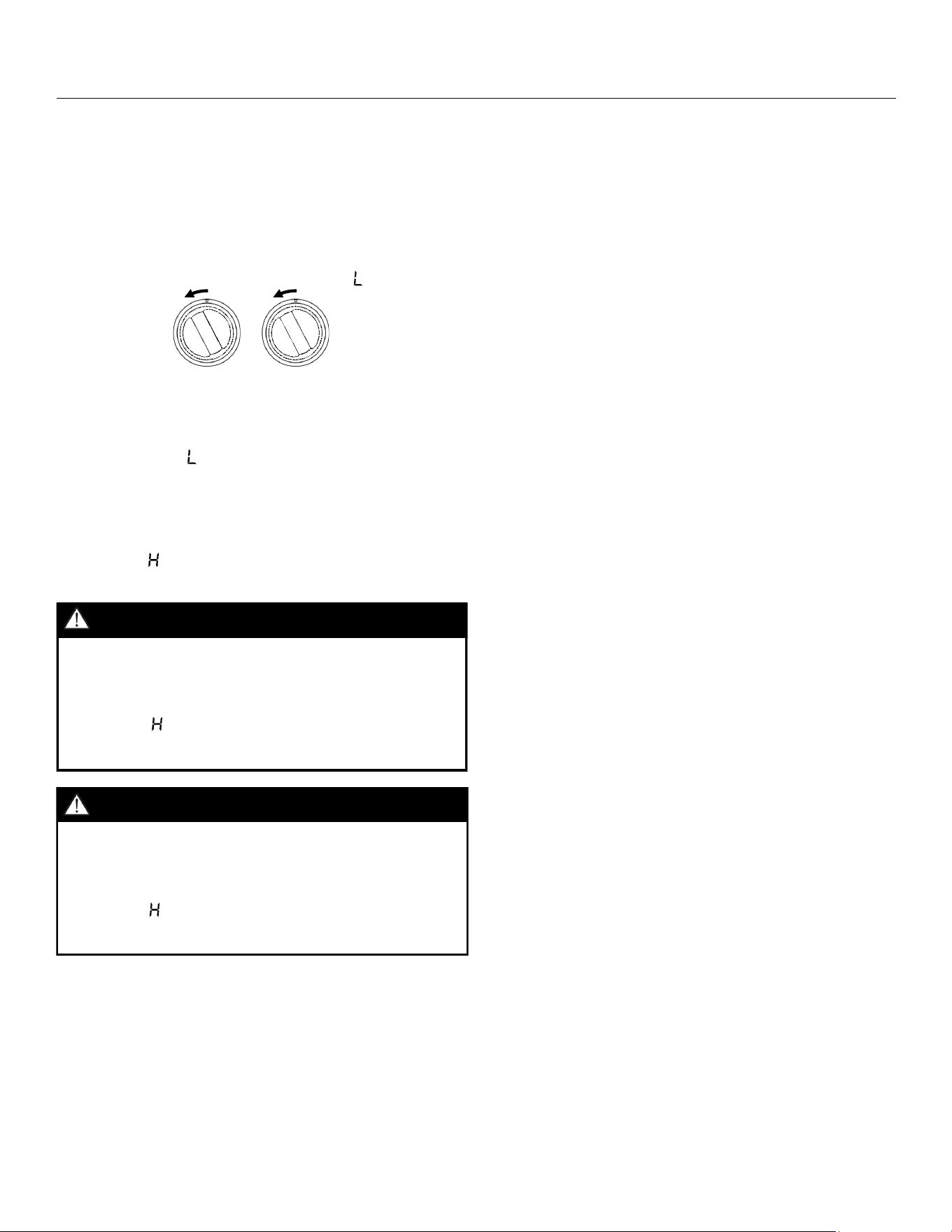
1. Push and turn the knob counter-clockwise until you
reach the stop and hold for 2 seconds until
displays.
2. Rotate the knob clockwise and select the desired
power level. The selected power level and is
blinking, showing the function is activated.
3. The automated heat-up is set. The cooking zone will
rapidly heat-up the cookware and then reduce
automatically to the selected power level. Changing
the power level setting will cancel the function.
bluestarcooking.com 33
Cooktop Control—Functions (continued)
Childlock
To avoid engaging or modifying the settings of the
cooking zones, particularly while cleaning, the controls
can be locked.
1. Push and turn both knobs on the left simultaneously
counter-clockwise until you reach the stop and hold
for 3 seconds until the display shows
2. To unlock, repeat the same operation. Push and turn
both knobs on the left simultaneously counter-
clockwise until you reach the stop and hold for 3
seconds until disappears from the display.
Residual Heat Indication
Heat sensors are located underneath the cooking
surface and will be displayed on the cooking zones
that remain hot.
Do not touch the cooking zones and do not put any
heat sensitive objects on them if the residual heat
indication is displayed.
The symbol disappears when the cooking zones can
be touched without danger.
WARNING
Ne touches pas les zones de cuisson et ne posez pas
d’objets sensibles à la chaleur sur celles-ci si les
indicateurs de chaleur résiduelles sont afchés.
Le symbole disparait lorsque les zones de cuisson
peuvent être touchées sans danger.
AVERTISSEMENT
34 (800) 449-8691
Operation
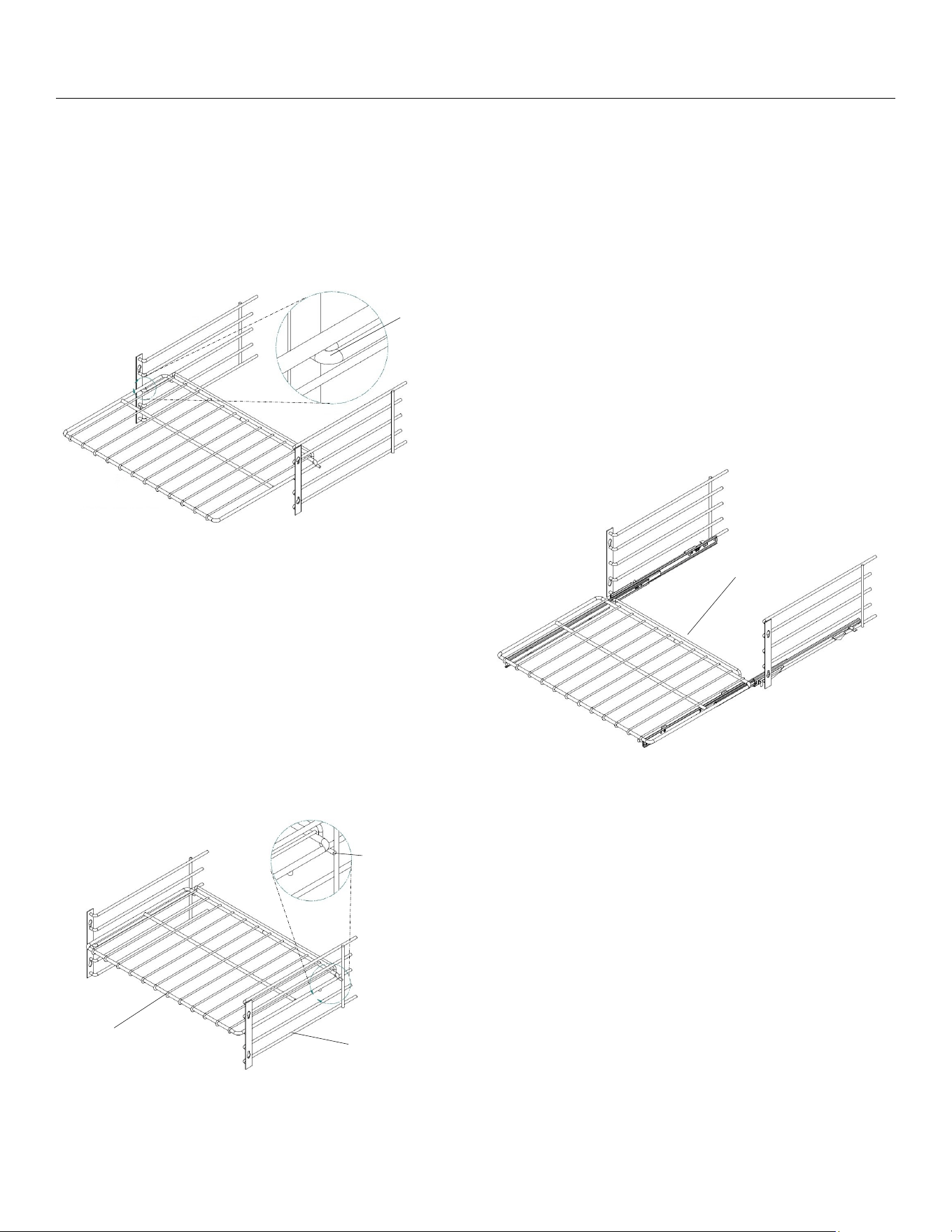
Standard Racks
Remove
1. Grasp both sides of the front of the rack.
2. Slightly lift the rack up, then pull the rack until the
ball tabs on the bottom of the rack clear the rack
guide.
3. Continue to pull the rack all the way out of the oven.
Replace
1. Hold both sides of the rack and align the rack onto
the rack guide position you want to use.
2. Push in the rack up to the ball tabs, then slightly lift
the rack until the ball tabs are past the front of the
rack guide.
3. Set the rack onto the rack guide, then push the rack
into the oven the rest of the way until the rear hook
tab stops at the rear vertical rack guide bar.
Guide rack
Rear hook tab
stopped at
rear vertical
rack guide bar
Standard rack
fully inserted
Ball tab
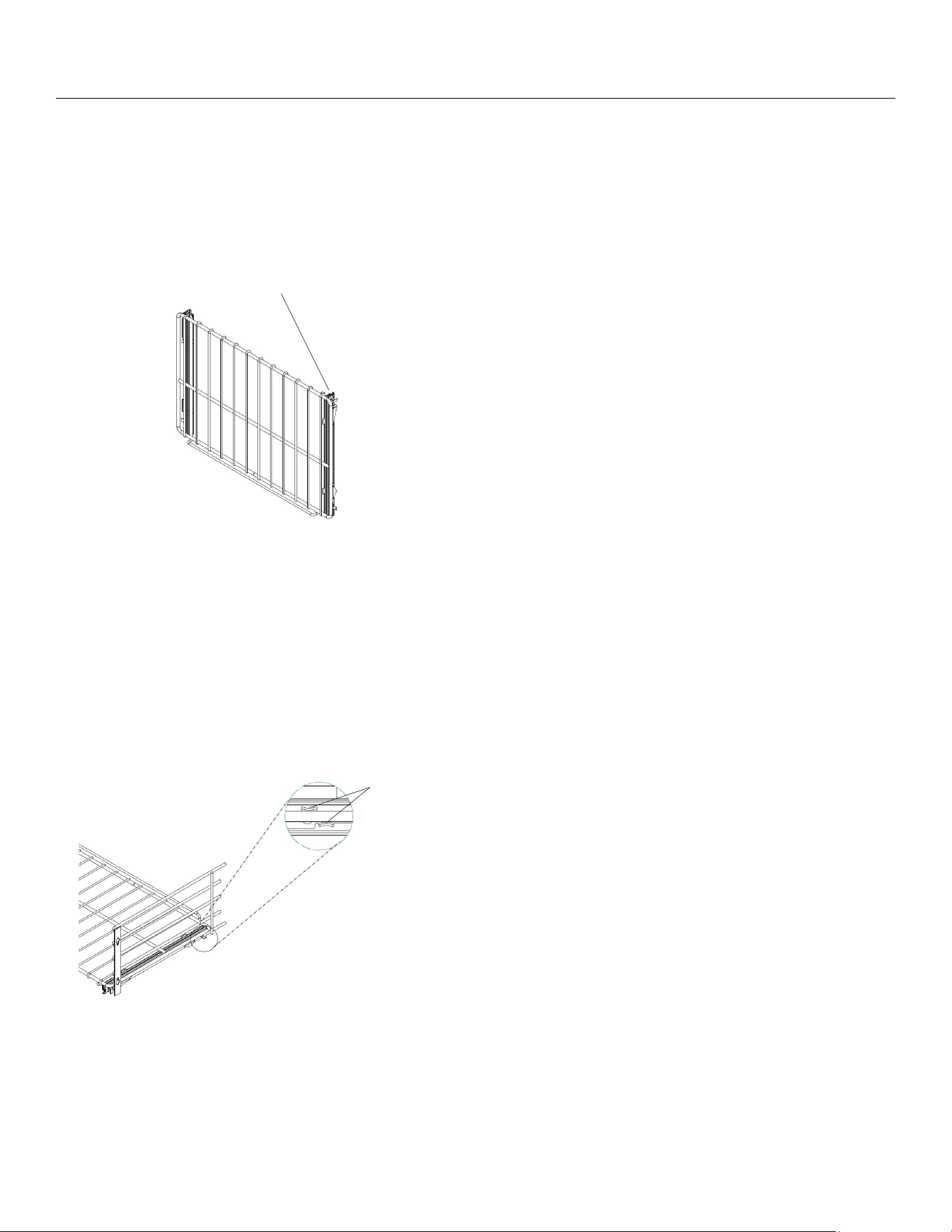
Extension Racks
Remove
1. Push the extension rack all the way into the oven.
2. Firmly grasp all of the slides on both sides of the
extension rack. You will need to pull everything out
at the same time.
3. As you pull, be sure to slightly lift each time you
need to clear the tabs on the rack from the rack
guide.
Important: The extension rack is heavy and could drop
unexpectedly after you pull it completely from the oven.
4. Carefully pull the extension rack all the way out of
the oven.
Rack pulled
out all the
way
bluestarcooking.com 35
Operation (continued)
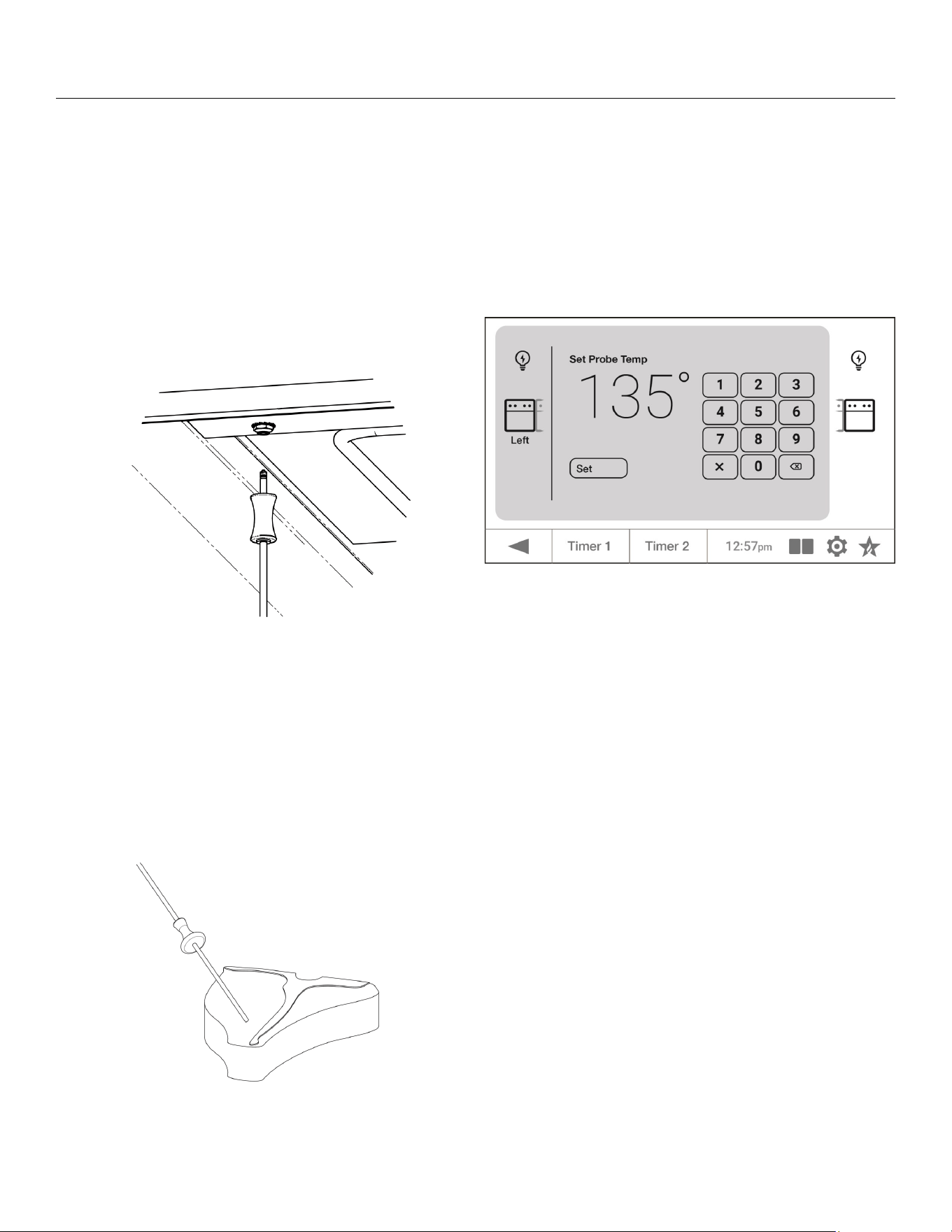
Locking tabs
Replace
1. To make sure the extension rack is fully closed, rmly
hold the front ends of the rack at your waist, then
touch the back of the extension rack to the oor.
Slide the front end of the rack downward until the
slides are in place.
2. Firmly grasp the slides on each side of the extension
rack, slightly elevate the rack above the rack guide
you want to use, then gently nudge the rack onto the
rack guide.
3. Continue to slightly lift the extension rack over the
rack guide as each tab reaches the rack guide.
4. When the extension rack is pushed in all the way,
make sure it is securely locked in position or it will
slide out when the door is opened.
Slides fully in
place
36 (800) 449-8691
Operation (continued)
4. Select options.
5. Select Probe.
6. Use the keypad on the Set Probe Temp screen to
set the temperature or use the options on the Select
Meat screen and the corresponding Type or
Preferences on the subsequent screens. Tap Set.
Temperature Probe
The internal temperature probe monitors the core
temperature of meat and poultry. In a BSDF48 range,
the probe is only available in the large oven. In a
BSDF60, it is available in both ovens.
Important: Remove the temperature probe from the
oven when not using it to avoid damage.
1. Insert the short end of the temperature probe into
the temperature probe socket located on the left
front top interior of oven.
2. Insert the long pointed end of the temperature
probe into the thickest portion of the meat. Failure
to do so could result in an incorrect temperature
reading or indicate the meat is fully cooked before it
actually reaches the correct temperature. Avoid
touching bones or inserting it all the way through
the meat.
3. Select cooking mode. NOTE: Probe mode cannot
be used when selecting Broil or Clean.

bluestarcooking.com 37
Cooking Guide and Tips
General
• Always use the timer on the oven display so you
don’t lose track of time and overcook your food.
• When following recipes, always use the
recommended pan size and type. Shiny or reective
pans are best for cakes, quick breads, mufns,
cookies and for pies with light golden crusts.
Medium gauge aluminum sheets with low or no
sides should be used when making cookies.
• Avoid using old or darkened pans. Warped and
dented stainless steel and tin coated pans heat
unevenly and fail to produce uniform baking results.
• Use cookware that has a combination of both
stainless steel and an aluminum core for
performance, durability and that has oven
compatibility of up to 550°F (287.8°C).
• Only certain types of glass, heat proof ceramic,
ceramic earthenware, or other glazed utensils are
suitable cooking at higher temperatures in the oven.
If not suitable for high heat, the utensils or cookware
may break with sudden temperature changes, so
depending on the cookware, use only on low or
medium heat settings according to the
manufacturer's directions.
Cooktop
• Before cooking, make sure the bottom of the
cookware is clean and dry.
• Cookware with rough bottoms may damage the
cooktop surface. Check the bottom of the cookware
before setting it down.
• Lift up the pots and pans to avoid sliding them
across the cooktop surface.
• Remove spilled sugar or syrup without waiting for
the surface to cool down. Protect your hand with a
pot holder, if necessary.
• Salt, sugar or sand may damage the cooktop
surface. Never use the cooktop as a working surface
or as a storage area.
• Avoid dropping objects, even small ones, on the
cooktop surface.
• Plastic or aluminum foil must not contact the hot
cooking zones. This may cause breaks or other
alterations of the cooktop surface by cooling down.
Take them immediately off of the hot cooking zones.
Protect your hand with a pot holder, if necessary.
• Never place a hot cookware on the control panel or
in the display area to avoid overheating the
electronics.
• Make sure that the ventilation of the appliance works
according to the manufacturer’s instructions.
38 (800) 449-8691
Cooking Guide and Tips (continued)
Oven
• Important: Wait for pre-heat cycle to be completed
before placing food in the oven. All of the elements
are on during pre-heat and food may burn.
• If preheat is not required, a bypass option is
available. After selecting the cooking mode, the
display screen will indicate preheat on or off. Press
OFF to bypass the preheat. Not using preheat will
result in longer cooking times.
• Center items on oven racks evenly for even baking.
• When loading the oven, work as quickly as possible
to prevent loss of heat.
• When practical, cook the item that requires the
lowest temperature rst then gradually raise the
temperature for each additional item.
• Roast meat with the fat side facing up to self-baste
and shrink less.
• Keep the oven free from grease buildup to avoid
re.
• Avoid using aluminum foil in the oven and do not
place it on the bottom of the oven as it could cause
damage.
• After using the oven, do not touch the appliance
until it is completely cooled.
Oven Rack Positions
Selecting the proper rack position is important and
depending on where you place your food, it could make
or break your recipe. For example, baking a pizza on the
top rack will not provide an extra crispy bottom crust or
baking a single rack of cookies on the bottom rack could
mean darker cookies than you prefer. Ideal rack
positions will help deliver optimal results for all your
meals, whether baking, roasting or broiling.
Below is a general guideline for rack positions:
Top — For rich and even browning, stick with the top rack
especially when broiling foods like salmon and steak. In
broil mode, all the heat is generated from the broil
element that is positioned on top of the oven. In bake
mode, the element is located on the bottom of the oven,
but heat still rises, making the top rack warmer than the
others. So, when baking dishes that you want to brown
or crisp, like casseroles and gratins, the top rack will
provide the best results.
Middle — If unsure of which rack position to use, it is best
to stick with the middle rack as it is positioned in the
center of all the heating elements. For most baking and
roasting, the middle rack will cook food more evenly.
Keep in mind that this rule applies for single rack
cooking only when you are making one dish at a time.
Bottom — If you want to brown the underside of your
roasted vegetables, bread or crusty pizza, move the rack
to the lowest position closest to the heat source. It is
especially benecial to start fruit pies on a preheated
baking sheet in the bottom rack because it helps the
bottom crust get nicely browned.
Source: Epicurious.com, Recipes, Menu Ideas, Videos &
Cooking Tips

bluestarcooking.com 39
Cooking Guide and Tips (continued)
You may nd that your new oven cooks differently than the old one. Take a few weeks to get comfortable and familiar
with your new oven. Do not use thermostats such as those found in grocery stores to check your oven temperatures.
These thermostats may vary by 40° F (4° C) or more.
Temperature Operating Ranges
Important: Entering a temperature outside the range given for an applicable cooking mode will result in an error
message.
Mode Default
Temperature
Temperature
Set Range
Best Used For
Bake 350°F (177°C) 100°F — 500°F (38°C — 260°C) Single rack cooking, baked goods, and casseroles
Convect Bake 350°F (177°C) 100°F — 500°F (38°C — 260°C) Pies and pastries
Roast 375°F (191°C) 100°F — 500°F (38°C — 260°C) Pork shoulder, chuck roast, beef tips and ank steak
Convect Roast 375°F (191°C) 100°F — 500°F (38°C — 260°C) Beef, pork, poultry and lamb
Convect 325°F (163°C) 100°F — 500°F (38°C — 260°C) Multi-rack cooking (cookies and baked goods)
Broil HIGH (550°F, 288°C) 350°F — 550°F (178°C — 288°C) Meats, sh and poultry
Proof 95°F (35°C) and
120°F (49°C)
95°F — 135°F (35° C — 57°C) Bread dough and pizza dough
Dehyd 105°F (41°C) and
155°F (68°C)
95° F — 160° F (35° C — 71° C) Vegetables, fruits, herbs, aromatics and meats for
drying/jerky
Probe None 100° F — 200° F (38° C — 93° C) Beef, pork, poultry, lamb, chops, tenderloins, seafood
and casseroles

40 (800) 449-8691
Cooking Guide and Tips (continued)
Convection
True convection cooking uses a fan inside the oven, along with a heating element around the fan, to increase air
circulation throughout the oven cavity. This results in even heat distribution and a more consistent temperature,
which cooks food more efciently.
In addition to Convect mode, this oven offers Bake and Convect Bake modes. Bake mode is similar to a conventional
baking method where most of the heat is generated from the bottom bake element. In Convect Bake mode, the heat
from the bottom element is circulated throughout the oven with the aid of the convection fan that is mounted on the
back wall of the oven.
Any time a convection mode is selected, food will cook faster than a standard mode because the fan will be utilized,
so as a general rule when cooking with standard recipes, do one of the following:
• Reduce the temperature by 25° (-4° C)
• Reduce the duration of the cooking time by approximately 25%
What’s best in each mode? Use the chart below as a guide. As a general rule, Convect mode is best for multiple rack
cooking (except when baking cakes, quick breads, custards or soufes) and can also be used to cook multiple dishes
at one time on multiple racks. Convect Bake mode is best for browning, roasting and quick baking and Bake mode is
best for cakes, brownies, quick breads, custards and soufes as well as covered dishes, which do not benet from
convection cooking. When in doubt, use Convect mode as it is generally a good “go to” mode that will work for
almost any recipe.
*Rack positions start with one as the bottom rack and ve as the top rack.
Food Item Pan Size/Type # of
Pans
Mode Temp Cook Time Rack Position*
Mufns Mufn Tin
(12-Cup)
3 Convection 325°F (163°C) 13-15 minutes 1, 3, 5
Whole Yeast Bread Loaf Pan (9 x 5”) 4 Convection Bake 325°F (163°C) 20-25 minutes 3, 5
White Yeast Rolls Cookie Sheet 2 Convection 325°F (163°C) 10 minutes 2, 4
3 Convection 325°F (163°C) 10 minutes 1, 3, 5
Cupcakes Mufn Tin
(12-Cup)
2 Convection 325°F (163°C) 15-17 minutes 2, 4
3 1, 3, 5
Layer Cakes Round Pan (9”) 4 Convection 325°F (163°C) 25-30 minutes 2, 4
Drop Cookies Cookie Sheet 2 Convection 325°F (163°C) 8-10 minutes 3, 5
3 1, 3, 5
Rolled Cookies 2 Convection 325°F (163°C) 8-10 minutes 3, 5 Cookie Sheet
3 1, 3, 5
Frozen Pizza
(12” Round)
Cookie Sheet 2 Convection Bake 350°F (177°C) 12-14 minutes 2, 4

bluestarcooking.com 41
Broil
Broiling is a method of cooking that exposes food to
direct radiant heat. Unlike baking and roasting, which
use indirect hot air to thoroughly cook food
throughout, broiling uses high heat from a direct heat
source to quickly cook food. Broiling is ideal for
achieving the perfect char on meats or vegetables.
Important: The broiler is an extremely hot burner. It is
recommended that you watch your food closely. It is
important to keep a close eye on the oven to prevent
overcooking food as food cooks very quickly and can
burn at that high temperature.
• Determine your rack position before you start
cooking. It’s recommended to start on a lower rack
and move it up as necessary. Do not place food
closer than 2” (50.8mm ) from the broiler element
to prevent burning.
• Preheat your broiling pan. Bring your broiling pan
up to temperature by placing it inside the oven
during the preheat cycle. This will help sear your
food evenly and seal in avors.
• Use oil or nonstick spray. Avoid or use extreme
caution with parchment paper, which tends to burn
at the high temperatures needed for broiling.
• Do not use aluminum foil to line greasy foods
cooking with the broil mode as fats and grease can
melt off and quickly catch re.
• Spread your food out so that the surface of every
piece is exposed to the heating element to ensure
even cooking and browning. It is also best to cook
foods of even thickness.
• Start or nish larger foods using the broil mode. It
is best to avoid broiling for longer than 10 minutes,
as this could lead to burnt food. For foods with
longer cooking times, it’s best to use the Broil
mode to create a crispy crust, either at the
beginning or end of the cooking process. For the
rest of your cooking, move food to the center of the
oven and set to Bake or Roast mode at a
temperature of 300-450ºF (149-232ºC).
• Go light on marinades and heavy on spices. Avoid
heavy marinades, especially oil-based ones, as
those drippings cause intense heat and can burn or
possibly catch re.
Roast and Convection Roast
Roast and convection roast are best used for
caramelization of vegetables, crispy skin on poultry, or a
crust on a tenderloin or roast. When using the Roast and
Convect Roast modes, the broil element on the top, the
convection fan and heating element on the bottom will
be engaged. They are also the perfect modes to use
with the temperature probe.
• Always roast meats fat-side up, on a roasting rack, in
a shallow pan. Use a pan that ts the size of the food
being prepared. No basting is required when the fat
side is up. The fat renders in the oven and self-
bastes the protein. It is not necessary to add water or
liquid as that creates steam and prevents the
browning necessary when roasting.
• Place poultry breast side up in a shallow pan, on a
rack, that ts the size of the food being prepared.
Brush poultry with melted butter or oil before
roasting.
• Tall side pans are not recommended when using
Convect Roast mode as they interfere with the
heated air circulation over the food.
• Do not cover food when using the Convect Roast
mode.
• When using the temperature probe, insert the probe
halfway into the center or thickest part of the food
being prepared. For poultry, insert the probe
(between the body and leg) into the thickest part of
the inner thigh. Avoid touching bone, fat or the
bottom of the pan.
• It is okay to remove the food being prepared from
the oven 5-10 degrees before it hits the
programmed temperature. The meat continues to
cook when removed from the oven. This is called
carry-over cooking and can be utilized for 10-15
minutes. It’s always important to let the meat rest
after cooking.
Cooking Guide and Tips (continued)

42 (800) 449-8691
Cooking Guide and Tips (continued)
Broil Guide
*Rack positions start with one as the bottom rack and ve as the top rack.
Food Item Doneness Qty and/or
Thickness
Rack
Position
First Side
Time
(minutes)
Second Side
Time
(minutes)
Tips/Tricks
Ground Beef
Well Done 1 lb. (4 patties)
1/2-3/4 thick
5 4-5 3-4 Space evenly. Up to eight patties can be
done at a time.
Beef Steaks Rare 1/2 lb., 1” thick 4 4 2-3 Steaks less than 1” thick cook through
before browning. Pan frying is
recommended rst. Score fat.
Medium 1/2 lb., 1” thick 4 4 3-4
Well Done 1/2 lb., 1” thick 4 4 4-4
Rare 2-2 1/2 lbs.
1 1/2“ thick
3 10 4-6
Medium 2-2 1/2 lbs.
1 1/2“ thick
3 12 6-8
Well Done 2-2 1/2 lbs.
1 1/2“ thick
3 14 8-10
Chicken 1 whole cut-up
2-2 1/2 lbs.
Split
lengthwise
2 20 6-8 Broil skin-side down rst
2 Breasts 4 8-9 5-6
Lobster Tails 2-4
10-12 oz each
2 12-14 Do not turn
over.
Cut through back of shell. Spread open.
Brush with melted butter before broiling
and again halfway through broiling.
Pork Chops Well Done 2, 1/2“ thick 4 7 4-6 Score fat.
Well Done 2, 1” thick 3 9-10 6-8
Lamb Chops Medium 2, 1” Thick
10-12 oz.
4 6 4-6 Score fat.
Medium 2- 1 ½ “ Thick 4 8 6-8
Salmon Steaks 2- 1” Thick 4 7-8 4-6 Grease pan. Brush steaks with melted
butter.
4- 1” Thick 3 9 4-6
Fish Fillets ¼ - ½” thick 4 5 2-4 Handle and turn very carefully. Brush
with lemon butter before and during
cooking, if desired.

bluestarcooking.com 43
Cooking Guide and Tips (continued)
Proof
It is often difcult to maintain a consistent temperature in
your home to proof doughs for baking breads,
especially when the outside temperatures can be either
too warm or too cold. The Proof mode solves that by
providing a very low heat to maintain a gentle climate
for yeast to grow. The convection fans do not run while
proong to keep dough from drying out before it fully
rises.
Any baked good that contains yeast should be proofed
to produce the air bubbles that make leavened foods
taste light and uffy, including:
• Breads such as sourdough, whole-grain, rye
country-style, and even gluten-free
• Enriched breads including breads enriched with
sugar, fat, and sometimes eggs, such as brioche
and challah.
• Italian focaccia and pizza
• Raised donuts
• Cinnamon rolls
• Morning buns
• Viennoiserie, which are baked good such as
brioche, croissants and Danish pastries
Item Temperature
Herbs, Flowers and Dough 105°F (41°C)
Soft Vegetables 113°F (45°C)
Hard Vegetables 122°F (50°C)
Citrus Peels 131°F (55°C)
Fruit 155°F (68°C)
Jerky 158°F (70°C)
Dehydrate
Dehydrating is an excellent way to preserve food and
make healthy snacks with fruits, vegetables and herbs
right from your garden. You can also make delicious
jerky as well. The Dehyd mode delivers a low consistent
heat that provides the perfect environment to reduce
the moisture content from food. The oven has preset
temperatures to customize the temperature as needed.
Times will vary depending on the thickness of the
product as well as the moisture content. Some fruits are
better for dehydrating than others. Bananas, for
example, have a satisfying crispy texture, along with a
sweet avor when dried. Apples, mangos, papaya,
pineapple, cherries, strawberries, plums and apricots
are also great choices. Savory fruits like tomatoes are
best for sun drying. You can also dehydrate
vegetables like zucchini or green beans for a tasty and
healthy snack.
Suggested temperature for dehydrating various foods
are as follows:

44 (800) 449-8691
Cooking Guide and Tips
Food Safety Tips
Safe steps in food handling, cooking, and storage are essential in preventing food-borne illness. You can't see, smell,
or taste harmful bacteria that may cause illness. In every step of food preparation, follow these four guidelines to
keep food safe:
• Clean — Wash hands and surfaces often.
• Separate — Keep raw meat apart from other foods.
• Cook — Cook to the right temperature.
• Chill — Refrigerate food promptly.
Cook all food to these minimum internal temperatures as measured with the temperature probe before removing
food from the oven. You may choose to cook food to higher temperatures. A holding temperature of 140°F (60°C) or
higher is recommended for food safety.
Source: FoodSafety.gov, United States Food Safety and Inspection Service, as of April 2019.
High Altitudes
For helpful information on cooking in high altitudes, visit: https://www.fsis.usda.gov/food-safety/safe-food-handling-
and-preparation/food-safety-basics/high-altitude-cooking.
Category Food Temperature Rest Time
Ground Meat, Stufng,
and Meat Loaf
Beef, Pork, Veal, Lamb 160°F (71°C) None
Turkey, Chicken 165°F (74°C) None
Fresh Beef, Veal, Lamb Steaks, Roasts, Chops 145°F (63°C) 3 minutes
Poultry Chicken and Turkey (breasts, whole bird, legs,
thighs, wings, ground poultry, giblets, and
stufng)
165°F (74°C) Whole: 10-15 minutes
Breasts: 5 minutes
Pork and Ham Fresh Pork 145°F (63°C) 3 minutes
Fresh Ham (raw) 146°F (63°C) 3 minutes
Precooked Ham (to reheat)
Note: Reheat cooked hams packaged at USDA-
inspected plants .
140°F (60°C)
165°F (74°C) if not from
USDA-inspected plants
None
Eggs and Egg Dishes Eggs Cook until yolk and white
are rm.
None
Egg Dishes (such as frittata, quiche) 160°F (74°C) None
Leftovers and
Casseroles
Leftovers and Casseroles 165°F (74°C) None
Seafood Fish with ns 145°F (63°C) or cook until
esh is opaque and
separates easily with a fork.
None
Shrimp, Lobster, Crabs, Scallops Cook until esh is pearly or
white and opaque.
None
Clams, Oysters, Mussels Cook until shells open
during cooking.
None

bluestarcooking.com 45
Problem Causes Corrections
Cookies and
biscuits burn on
the bottom
• Cookies and biscuits are put into oven before the
preheating time is completed.
• Dark pan absorbs heat too fast
• Oven door opened too often
• Incorrect rack position being used, and pan is too
close to the heat source
• Allow oven to preheat to the selected temperature
before placing food in the oven
• Set timer to shortest recommended time. Use a
medium weight aluminum baking sheet
• Check on cookies through oven window instead of
opening oven
• Use recommended rack position
• Try standard or convection bake instead
Cookies and
Biscuits too dark on
the top
• Rack position being used is too high
• Oven not preheated
• The pan’s sides are too high
• Aluminum foil was used and distributed the heat
unevenly
• Use recommended rack position
• Allow oven to preheat fully
• Use recommended pan size based on recipe
• Remove foil
Cakes too dark on
top or bottom
• Cakes put into oven before preheated time is
completed
• Rack position is too high or low
• Oven is too hot
• Allow oven to fully preheat
• Use recommended rack position
• Set oven temperature 25° F (-4° C) lower than
recommended
Cakes not done in
center
• Oven is too hot
• Incorrect pan size
• Pan not centered in the oven
• Set oven temperature 25° F (-4° C) lower than
recommended
• Use recommended pan size based on recipe
• Use proper rack position and place pan so there is
2”-4” of space on all sides of pan
Cakes are not level
• Batter was unevenly spread
• Oven or racks are not level
• Warped pan
• Pan too close to oven wall or rack overcrowded
• Spread batter evenly and tap to release air bubbles
• Place a marked glass measuring cup lled with water
on the center of the oven rack. If the water level is
uneven, refer to instructions for leveling the range
• Be sure to allow 2”-4” of clearance on all sides of
each pan in the oven
Cakes crack on top
• Wrong pan size used
• Batter was too thick
• Oven temperature was too high
• Use recommended pan size for recipe
• Follow recipe and double check liquid
• Set oven temperature 25° F (-4° C) lower than
recommended
Pies are burnt
around edges and
not done in center
• Oven was too hot
• Too many pans were used
• Dark, heat absorbing pan was used
• Set oven temperature 25° F (-4° C) lower than
recommended
• Reduce number of pans being used
• Use shiny reective pans
Pies are too light
on top
• Oven is not hot enough
• Overcrowded oven or rack
• Set oven temperature 25° F (-4° C) higher than
recommended
• Reduce number of pans
Common Baking Problems and Solutions

46 (800) 449-8691
Care and Cleaning
Important: Make sure the appliance is cool before you clean.
Material Cleaning Need to Know
Ceramic Glass
Cooktop Surface
• Allow the cooking surface to cool down.
• For spills and burned-on food, use a metal
scraper with a clean blade, holding it at 45-
degree angle.
• Put a small amount of multi-surface cleaner cream
on a damp towel or soft cloth, scrubbing in a
circular motion. Add more cleaner if needed,
completely removing it all with a clean damp
paper towel.
• For everyday cleaning and touch-ups, dilute a
mild detergent, such as dishwashing liquid, with
water, and spray it over the surface.
• Use a soft sponge or a damp towel to clean the
cooktop.
• Restore the cooktop’s aspect with a soft, dry cloth.
• Before cooking, make sure the bottom of the
cookware is clean and dry.
• Lift up the cookware to avoid sliding it across the
cooktop surface.
• Remove spilled sugar or syrup without waiting for
the surface to cool down. Protect your hand with a
pot holder, if necessary.
• Do not use abrasives such as mineral scouring pads,
scouring powders, or harsh chemical cleaners on
your cooktop surface.
Stainless Steel
• Clean with stainless steel cleaner and follow the
cleaner manufacturer’s instructions.
• Do not use steel wool, metal pads, or abrasive
cleaners.
• Do not use a metal knife, spatula, or any metal tool
to scrape these surfaces.
• Do not permit citrus or tomato juices to sit and dry
on these surfaces as citric acid will discolor the
surface. Wipe such spills immediately.
• Do not polish across the grain or in circles.
• Discoloration may occur with heavy use.
Painted Metal
• Use a soft cloth and a quality glass cleaner or
warm soapy water.
• Do not use steel wool, metal pads, or abrasive
cleaners.
• Do not use a metal knife, spatula, or any metal tool
to scrape these surfaces.
• Do not permit citrus or tomato juices to sit and dry
on these surfaces as citric acid will discolor the
surface. Wipe such spills immediately.
• Do not use paper towels or other coarse cloths.
Plated Finishes
(Brass, Copper,
Chrome, Oil-
Rubbed Bronze,
Pewter)
• The parts were treated with a protective clear coat
to prevent aging or discoloration. This clear coat
will last the life of the appliance unless the coating
is removed.
• Clean with a microber cloth using Endust,
Pledge, or something similar.
• Do not use a metal knife, spatula, or something
similar or any metal tool to scrape these surfaces.
• Do not permit citrus or tomato juices to sit and dry
on these surfaces as citric acid will discolor the
surface. Wipe such spills immediately.
• Do not use harsh cleaners (such as Brite Boy) as
these will remove the coating and cause the metals
to discolor.

bluestarcooking.com 47
Material Cleaning Need to Know
Oven Window
• When the oven is cool, use a cloth and warm
soapy water to clean the interior oven door
window. Rinse with clear water and dry
thoroughly.
• Do not clean the oven door gaskets. Damage to
the material or the door seal may occur.
Porcelain-Coated
Oven Interior
• For spot cleaning, use a commercial oven cleaner.
Be sure to follow the cleaner manufacturer’s
instructions before you start.
• Make sure the area is well-ventilated when using a
commercially available oven cleaner.
• To loosen tough baked-on stains, lay a cloth
soaked in hot water on the area for several
minutes.
• Do not use the commercial oven cleaner on the
door gasket, igniter, or ceramic broiler.
• Do not use steel wool or metal pads as they may
damage or scratch the enamel coating.
• Make sure cleaning chemicals do not come in
contact with any stainless steel or painted
surfaces.
Oven Racks
• Make sure the oven is cool before you take out
the oven racks.
• Wash the racks in hot, soapy water, rinse in clear
water, then dry thoroughly.
• N/A
Broiler
• N/A • Do not clean the broiler surface or permanent
damage may occur.
Temperature Probe
• When the temperature probe is cool, wipe the
probe clean with mild soapy water, rinse, then dry
thoroughly.
• Do not immerse the temperature probe in water
or put it in the dishwasher.
Care and Cleaning (continued)

48 (800) 449-8691
Troubleshooting
Check these helpful tips for any problems with your oven. If additional help or service is needed, please call
customer service at (800) 449-8691. You will need to have the model and serial numbers for your appliance ready
before you contact them. See Product Information on page 4 for information on nding these numbers.
Problem Possible Cause Solution
Cooktop doesn’t turn on
• No electrical power to the appliance. • Plug into a properly grounded three-
prong electrical outlet.
• Check and reset the circuit breaker for
the appliance.
Cooking zone(s) switch off
• The cookware overheating protection
has been triggered.
• The cooktop system overheating
protection has been triggered.
• Let the cooktop cool down.
Automated heat up function doesn’t start
• The cooking zone is still too hot (H
displayed).
• The highest power level 9 or Power
Boost P is set.
• Let the cooking zone cool down.
• Set a lower power level.
Fan of the cooktop system is running
when the cooktop is turned off
• Cooktop has not cooled to 113° F (45°
C) or lower.
• Let the cooktop cool down.
Oven is on, but is not heating
• No electrical power to the appliance. • Plug into a properly grounded three-
prong electrical outlet.
• Check and reset the circuit breaker for
the appliance.
Oven light is not on
• No electrical power to the appliance.
• Oven light bulb is burned out.
• Check and reset the circuit breaker for
the wall outlet used for the appliance.
Convection fan is making noise
• Mounting screws on the fan cover are
loose.
• Tighten screws.
Convection fan does not turn
• No electrical power to the appliance. • Plug into a properly grounded three-
prong electrical outlet.
• Check and reset the circuit breaker for
the appliance.
Fan behind the control panel is running
when the oven is turned off
• Oven has not cooled to 200° F (93° C)
or lower.
• Let the oven cool down.
Touchscreen is not lit
• No electrical power to the appliance.
• Sabbath mode is on.
• Clock is turned off.
• Check and reset the breaker/fuse.
• Cancel Sabbath mode.
• Check whether the clock is turned off.

bluestarcooking.com 49
Troubleshooting (continued)
Problem Possible Cause Solution
Touchscreen displays the following:
• Control Error F20 • Control board or wiring issue • Call 800-449-8691 for service
• Control Error F40 • Oven temperature sensor issue • Call 800-449-8691 for service
• Probe Error F50 • Meat probe issue • Call 800-449-8691 for service
• Fan Error F60 • Cooling fan issue • Call 800-449-8691 for service
• Temp Error F80 • High temperature issue • Call 800-449-8691 for service
• Probe Not Detected • Meat probe is not detected • Insert meat probe
• Set Temp Between 90°F and 200°F • Meat probe temperature setting is
outside of the acceptable range.
• Change probe temperature setting
• Set Between 100°F and 500°F • Temperature setting is outside of the
acceptable range.
• Change temperature setting
• Remove Probe • Meat probe has been detected in Broil
or Clean modes.
• Remove meat probe.
Cooktop indicators display the following
• is displayed • Cooktop cannot detected an
appropriate cookware.
• There is no cookware on the cooking
zone.
• The cookware isn’t adapted to the
induction.
• The size of the cookware bottom is too
• E2 is displayed • The cooktop system overheated. • Let the cooktop cool down.
• E6 is displayed • Voltage of the electrical power
connected to the appliance too low.
• Cooktop system issue
• Plug into a properly grounded three-
prong electrical outlet.
• Call 800-449-8691 for service
• E8 is displayed • Cooling fan issue • Call 800-449-8691 for service
• Er47 is displayed • Cooktop system issue • Call 800-449-8691 for service
• Other E symbol is displayed • Cooktop system issue • Call 800-449-8691 for service

50 (800) 449-8691
Warranty
Prizer-Painter Stove Works, Inc. (“Prizer-Painter”)
warrants your BlueStar appliance (“product”) purchased
in the U.S. and Canada and installed in residential
properties for normal residential use.
What Is Covered
Subject to the specic conditions and limitations below,
this warranty covers parts and/or labor necessary to
repair or replace any part of the product that contains
defects in materials and workmanship.
Two Year Warranty. For two (2) years from the date of
installation, this warranty covers all parts and labor
necessary to repair or replace any part on the product
except for the Cosmetic Component Warranty below.
Cosmetic Component Warranty. For thirty (30) days
from the date of installation, this warranty covers
scratches and dents, paint and porcelain blemishes,
visible chips, etc.
Limitations of Coverage
• Floor Models. For one (1) year from the date of
installation, this warranty covers all parts and labor
necessary to repair or replace any part on the
product except for cosmetic parts for which there is
no warranty.
• The replacement of a part under this warranty does
not extend the warranty period.
• Warranty service outside normal business hours and
in areas beyond 50 miles one way from an
authorized BlueStar retailer or service provider. The
owner will be responsible for any and all costs
associated with additional mileage, non-standard
service or overtime, and special equipment required
to remove the product so service may be performed.
This warranty is void:
• If the product is removed from where it was
originally installed.
• If the original factory installed serial number is
altered or removed from the product.
• If gas cooking products are converted by someone
other than a BlueStar authorized service company.
What Is Not Covered
This warranty does not cover, and specically excludes:
• Product installed or used in any commercial or other
non-residential property such as, but not limited to,
day care facilities, re stations, hotels, nursing
homes, etc.
• Installation related issues including or installation
inconsistent with the product specications/
installation instructions.
• Damage or repairs caused by alterations or
modications, abuse, misuse, neglect, or improper
installation, mounting, handling, operation,
maintenance, or storage.
• Normal adjustments after installation and setup.
• Normal wear, care, and maintenance of the product
as described in this manual.
• Service calls to educate the customer on the proper
use and care of the product.
• Consumable parts.
• Damage or repairs caused by unauthorized service
or repairs, including unauthorized adjustments or
calibrations performed on the product.
• Accidental or intentional damage.
• Damage or repairs as a result of natural disasters,
res, oods, earthquakes, winds, lightning, corrosive
atmosphere, loss of electrical power to the product
for any reason, or other conditions beyond Prizer-
Painter’s control.
• Damage or repairs caused by alteration for outdoor
use.
• Damage or repairs caused by the use of harsh
chemicals or cleaning products improperly applied.
• Damage to surrounding property including
cabinetry, oors, ceilings, etc.
• Consequential or incidental damage, including but
not limited to food or medicine loss, time away from
work, restaurant meals, etc.
The terms of this warranty provide for repair of the
product only. If the product cannot be repaired, Prizer-
Painter, at its sole discretion, will determine whether to
exchange the product.
Please see the Arbitration Clause and Related
Provisions, which affect your legal rights. The Arbitration
Clause is available at www.bluestarcooking.com.

bluestarcooking.com 51