

Legal Information
© Hangzhou Microimage Software Co., Ltd. All rights reserved.
About this Manual
The Manual includes instructions for using and managing the Product. Pictures, charts,
images and all other information hereinafter are for description and explanation only. The
information contained in the Manual is subject to change, without notice, due to rmware
updates or other reasons. Please nd the latest version of this Manual at the HIKMICRO
website (
http://www.hikmicrotech.com
).
Please use this Manual with the guidance and assistance of professionals trained in
supporting the Product.
Trademarks
and other HIKMICRO's trademarks and logos are the properties
of HIKMICRO in various jurisdictions.
Other trademarks and logos mentioned are the properties of their respective owners.
Disclaimer
TO THE MAXIMUM EXTENT PERMITTED BY APPLICABLE LAW, THIS MANUAL AND THE
PRODUCT DESCRIBED, WITH ITS HARDWARE, SOFTWARE AND FIRMWARE, ARE
PROVIDED "AS IS" AND "WITH ALL FAULTS AND ERRORS". HIKMICRO MAKES NO
WARRANTIES, EXPRESS OR IMPLIED, INCLUDING WITHOUT LIMITATION,
MERCHANTABILITY, SATISFACTORY QUALITY, OR FITNESS FOR A PARTICULAR PURPOSE.
THE USE OF THE PRODUCT BY YOU IS AT YOUR OWN RISK. IN NO EVENT WILL HIKMICRO
BE LIABLE TO YOU FOR ANY SPECIAL, CONSEQUENTIAL, INCIDENTAL, OR INDIRECT
DAMAGES, INCLUDING, AMONG OTHERS, DAMAGES FOR LOSS OF BUSINESS PROFITS,
BUSINESS INTERRUPTION, OR LOSS OF DATA, CORRUPTION OF SYSTEMS, OR LOSS OF
DOCUMENTATION, WHETHER BASED ON BREACH OF CONTRACT, TORT (INCLUDING
NEGLIGENCE), PRODUCT LIABILITY, OR OTHERWISE, IN CONNECTION WITH THE USE OF
THE PRODUCT, EVEN IF HIKMICRO HAS BEEN ADVISED OF THE POSSIBILITY OF SUCH
DAMAGES OR LOSS.
YOU ACKNOWLEDGE THAT THE NATURE OF THE INTERNET PROVIDES FOR INHERENT
SECURITY RISKS, AND HIKMICRO SHALL NOT TAKE ANY RESPONSIBILITIES FOR
ABNORMAL OPERATION, PRIVACY LEAKAGE OR OTHER DAMAGES RESULTING FROM
CYBER-ATTACK, HACKER ATTACK, VIRUS INFECTION, OR OTHER INTERNET SECURITY
RISKS; HOWEVER, HIKMICRO WILL PROVIDE TIMELY TECHNICAL SUPPORT IF REQUIRED.
YOU AGREE TO USE THIS PRODUCT IN COMPLIANCE WITH ALL APPLICABLE LAWS, AND
YOU ARE SOLELY RESPONSIBLE FOR ENSURING THAT YOUR USE CONFORMS TO THE
APPLICABLE LAW. ESPECIALLY, YOU ARE RESPONSIBLE, FOR USING THIS PRODUCT IN A
MANNER THAT DOES NOT INFRINGE ON THE RIGHTS OF THIRD PARTIES, INCLUDING
Thermal & Optical Bi-spectrum Network Camera User Manual
i

WITHOUT LIMITATION, RIGHTS OF PUBLICITY, INTELLECTUAL PROPERTY RIGHTS, OR
DATA PROTECTION AND OTHER PRIVACY RIGHTS. YOU SHALL NOT USE THIS PRODUCT
FOR ANY PROHIBITED END-USES, INCLUDING THE DEVELOPMENT OR PRODUCTION OF
WEAPONS OF MASS DESTRUCTION, THE DEVELOPMENT OR PRODUCTION OF CHEMICAL
OR BIOLOGICAL WEAPONS, ANY ACTIVITIES IN THE CONTEXT RELATED TO ANY
NUCLEAR EXPLOSIVE OR UNSAFE NUCLEAR FUEL-CYCLE, OR IN SUPPORT OF HUMAN
RIGHTS ABUSES.
PLEASE FOLLOW ALL THE PROHIBITIONS AND EXCEPTIONAL CAVEATS OF ALL
APPLICABLE LAWS AND REGULATIONS, IN PARTICULAR, THE LOCAL FIREARMS AND/OR
HUNTING LAWS AND REGULATIONS. PLEASE ALWAYS CHECK NATIONAL PROVISIONS
AND REGULATIONS BEFORE PURCHASE OR USE OF THIS PRODUCT. PLEASE NOTE THAT
YOU MAY HAVE TO APPLY FOR PERMITS, CERTIFICATES, AND/OR LICENSES BEFORE ANY
PURCHASING, SELLING, MARKETING AND/OR USING OF THE PRODUCT. HIKMICRO
SHALL NOT BE LIABLE FOR ANY SUCH ILLEGAL OR IMPROPER PURCHASING, SELLING,
MARKETING, AND END USES AND ANY SPECIAL, CONSEQUENTIAL,INCIDENTAL, OR
INDIRECT DAMAGES ARISING THEREOF.
IN THE EVENT OF ANY CONFLICTS BETWEEN THIS MANUAL AND THE APPLICABLE LAW,
THE LATTER PREVAILS.
Thermal & Optical Bi-spectrum Network Camera User Manual
ii
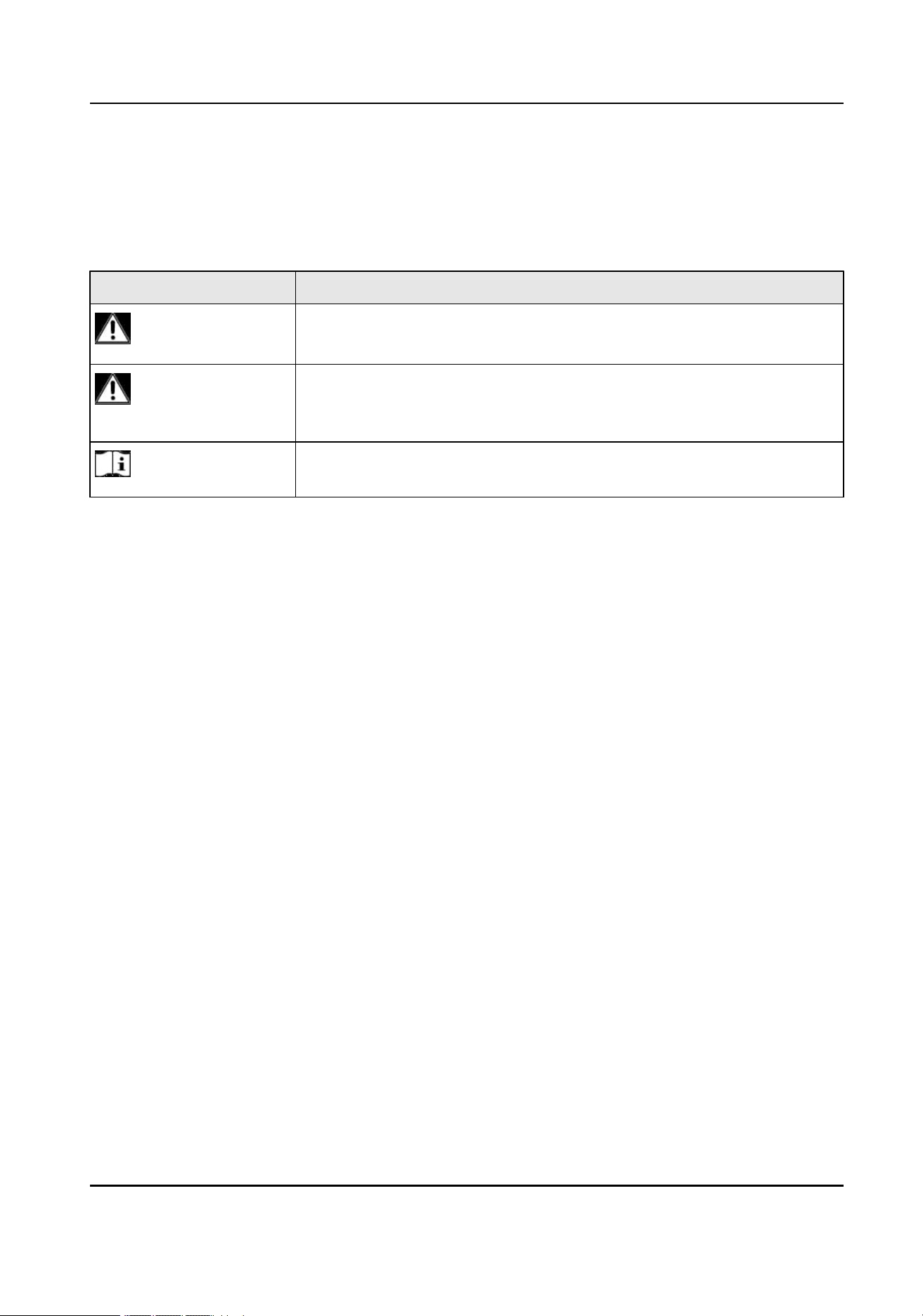
Symbol Conventions
The symbols that may be found in this document are
dened as follows.
Symbol Description
Danger
Indicates a hazardous situation which, if not avoided, will or
could result in death or serious injury.
Caution
Indicates a potentially hazardous situation which, if not avoided,
could result in equipment damage, data loss, performance
degradation, or unexpected results.
Note
Provides additional information to emphasize or supplement
important points of the main text.
Thermal & Optical Bi-spectrum Network Camera User Manual
iii

Safety Instruction
These instructions are intended to ensure that user can use the product correctly to avoid
danger or property loss.
Laws and Regulations
●
In the use of the product, you must be in strict compliance with the electrical safety
regulations of the nation and region.
Transportation
●
Keep the device in original or similar packaging while transporting it.
●
Keep all wrappers after unpacking them for future use. In case of any failure occurred,
you need to return the device to the factory with the original wrapper. Transportation
without the original wrapper may result in damage on the device and the company shall
not take any responsibilities.
●
DO NOT drop the product or subject it to physical shock. Keep the device away from
magnetic interference.
Power Supply
●
Check the input voltage before powering on the device to avoid damage.
●
CAUTION: If the fuse of the device can be replaced, replace it only with the same model
to reduce the risk of
re or electric shock.
●
If a fuse is connected to the neutral wire and a double pole/neutral fusing occurs, parts
of the device that remain energized might represent a hazard during servicing after
operation of the fuse.
●
If the device uses a 3-prong power supply plug, it must be connected to an earthed
mains socket-outlet properly.
●
Do not touch the bare components (such as the metal contacts of the inlets) and wait
for at least 5 minutes, since electricity may still exist after the device is powered off.
●
For the permanently connected device without a disconnect equipment, a readily
accessible disconnect equipment shall be incorporated into the electrical installation of
the connected building.
●
For the permanently connected device without an overcurrent protection equipment, an
overcurrent protection equipment shall be incorporated into the electrical installation of
the connected building. The
specications of the overcurrent protection equipment shall
not exceed that of the building.
●
For the permanently connected device without an all-pole mains switch, an all-pole
mains switch shall be incorporated into the electrical installation of the connected
building.
●
If the device is powered by terminals connected to the power cord, ensure correct
voltage and wiring of the terminals for connection to mains supply.
Thermal & Optical Bi-spectrum Network Camera User Manual
iv

●
Please purchase the charger by yourself. Input voltage should meet the Limited Power
Source (12 VDC, 24 VAC, or PoE(802.3af)) according to the IEC62368 standard. Please
refer to technical
specications for detailed information.
●
Make sure the plug is properly connected to the power socket.
●
The socket-outlet shall be installed near the equipment and shall be easily accessible.
●
DO NOT connect multiple devices to one power adapter, to avoid over-heating or
re
hazards caused by overload.
●
DO NOT touch the bare metal contacts of the inlets after the circuit breaker is turned off.
Electricity still exists.
●
+ identies the positive terminal(s) of equipment which is used with, or generates direct
current. - identies the negative terminal(s) of equipment which is used with, or
generates direct current.
Battery
●
Risk of explosion if the battery is replaced by an incorrect type. Dispose of used
batteries according to the instructions.
●
The built-in battery cannot be dismantled. Please contact the manufacture for repair if
necessary.
●
For long-term storage of the battery, make sure it is fully charged every half year to
ensure the battery quality. Otherwise, damage may occur.
●
This equipment is not suitable for use in locations where children are likely to be
present.
●
Improper replacement of the battery with an incorrect type may defeat a safeguard (for
example, in the case of some lithium battery types).
●
DO NOT dispose of the battery into
re or a hot oven, or mechanically crush or cut the
battery, which may result in an explosion.
●
DO NOT leave the battery in an extremely high temperature surrounding environment,
which may result in an explosion or the leakage of
ammable liquid or gas.
●
DO NOT subject the battery to extremely low air pressure, which may result in an
explosion or the leakage of
ammable liquid or gas.
Installation
●
This device is suitable for use above 2 m only.
●
Install the device according to the instructions in Quick Start Guide. To prevent injury,
this device must be securely attached to the installation surface in accordance with the
installation instructions.
●
Never place the device in an unstable location. The device may fall, causing serious
personal injury or death.
●
The additional force shall be equal to three times the weight of the device but not less
than 50 N. The device and its associated mounting means shall remain secure during
the installation. After the installation, the device, including any associated mounting
plate, shall not be damaged.
Thermal & Optical Bi-spectrum Network Camera User Manual
v

●
Never place the equipment in an unstable location. The equipment may fall, causing
serious personal injury or death.
●
This equipment is for use only with corresponding brackets. Use with other (carts,
stands, or carriers) may result in instability causing injury.
●
The interface varies with the models. Please refer to the product datasheet for details.
●
If the device needs to be wired by yourself, select the corresponding wire to supply
power according to the electric parameters labeled on the device. Strip off wire with a
standard wire stripper at corresponding position. To avoid serious consequences, the
length of stripped wire shall be appropriate, and conductors shall not be exposed.
●
Make sure that the power has been disconnected before you wire, install, or disassemble
the device.
System Security
●
You acknowledge that the nature of Internet provides for inherent security risks, and our
company shall not take any responsibilities for abnormal operation, privacy leakage or
other damages resulting from cyber attack, hacker attack, however, our company will
provide timely technical support if required.
●
Please enforce the protection for the personal information and the data security as the
device may be confronted with the network security problems when it is connected to
the Internet. Please contact us when the device might exist network security risks.
●
Please understand that you have the responsibility to
congure all the passwords and
other security settings about the device, and keep your user name and password.
Maintenance
●
If the product does not work properly, please contact your dealer or the nearest service
center. We shall not assume any responsibility for problems caused by unauthorized
repair or maintenance.
●
Wipe the device gently with a clean cloth and a small quantity of ethanol, if necessary.
●
If the equipment is used in a manner not
specied by the manufacturer, the protection
provided by the device may be impaired.
●
To reduce the risk of re, replace only with the same type and rating of fuse.
●
The serial port of the equipment is used for debugging only.
Using Environment
●
Make sure the running environment meets the requirement of the device. The operating
temperature shall be -40°C to 65°C (-40°F to 149°F), and the operating humidity shall be
95% or less, no condensing.
●
DO NOT expose the device to high electromagnetic radiation or dusty environments.
●
DO NOT aim the lens at the sun or any other bright light.
●
The equipment shall not be exposed to dripping or splashing and that no objects
lled
with liquids, such as vases, shall be placed on the equipment.
●
No naked ame sources, such as lighted candles, should be placed on the equipment.
Thermal & Optical Bi-spectrum Network Camera User Manual
vi

●
For the device with ventilation openings, the ventilation openings should not be impeded
by covering the ventilation openings with items, such as newspapers, table-cloths, and
curtains. The openings shall never be blocked by placing the device on a bed, sofa, rug,
or other similar surface.
●
Keep a proper distance around the device for
sufcient ventilation.
●
This device is suitable for mounting on concrete or other non-combustible surface only
to avoid
re hazard.
●
This equipment is not suitable for use in locations where children are likely to be
present.
●
Provide a surge suppressor at the inlet opening of the equipment under special
conditions such as the mountain top, iron tower, and forest.
●
Burned
ngers when handling the parts with symbol . Wait one-half hour after
switching off before handling the parts.
Emergency
●
If smoke, odor, or noise arises from the device, immediately turn off the power, unplug
the power cable, and contact the service center.
COMPLIANCE NOTICE: The thermal series products might be subject to export controls in
various countries or regions, including without limitation, the United States, European
Union, United Kingdom and/or other member countries of the Wassenaar Arrangement.
Please consult your professional legal or compliance expert or local government
authorities for any necessary export license requirements if you intend to transfer, export,
re-export the thermal series products between different countries.
Thermal & Optical Bi-spectrum Network Camera User Manual
vii

Contents
Chapter 1 Overview ................................................................................................................... 1
1.1 Brief Description ............................................................................................................ 1
1.2 Function .......................................................................................................................... 1
Chapter 2 Device Activation and Accessing ............................................................................ 2
2.1 Activate Device .............................................................................................................. 2
2.1.1 Activate the Device via Browser ........................................................................... 2
2.1.2 Activate the Device via SADP ............................................................................... 3
2.2 Login ............................................................................................................................... 3
2.2.1 Plug-in Installation ................................................................................................ 3
2.2.2 Illegal Login Lock .................................................................................................. 4
Chapter 3 Network Settings ...................................................................................................... 6
3.1 TCP/IP ............................................................................................................................ 6
3.1.1 Multicast Discovery .............................................................................................. 7
3.2 Access to Device via Domain Name ............................................................................. 7
3.3 Access to Device via PPPoE Dial Up Connection ........................................................ 8
3.4 SNMP .............................................................................................................................. 9
3.5 Set IEEE 802.1X .............................................................................................................. 9
3.6 Set QoS ......................................................................................................................... 10
3.7 HTTP(S) ........................................................................................................................ 10
3.8 Multicast ...................................................................................................................... 11
3.9 RTSP ............................................................................................................................. 11
3.10 Set SRTP .................................................................................................................... 12
3.11 Bonjour ....................................................................................................................... 12
3.12 WebSocket(s) ............................................................................................................ 13
3.13 Modbus Communication .......................................................................................... 13
3.13.1 Set Modbus Main Mode ................................................................................... 13
Thermal & Optical Bi-spectrum Network Camera User Manual
viii

3.13.2 Set Modbus Subordinate Mode ....................................................................... 15
3.13.3 Modbus Error Code Description ...................................................................... 15
3.14 Port Mapping ............................................................................................................. 17
3.14.1 Set Auto Port Mapping ..................................................................................... 18
3.14.2 Set Manual Port Mapping ................................................................................ 18
3.15 Set OTAP .................................................................................................................... 18
3.16 Set ISUP ..................................................................................................................... 19
3.17 Access Camera via Hik-Connect .............................................................................. 19
3.17.1 Enable Hik-Connect Service on Camera .......................................................... 19
3.17.2 Set Up Hik-Connect ........................................................................................... 20
3.17.3 Add Camera to Hik-Connect ............................................................................ 21
3.18 Set Open Network Video Interface ........................................................................... 21
3.19 Set SDK Service ......................................................................................................... 22
Chapter 4 Live View ................................................................................................................. 23
4.1 Live View Parameters .................................................................................................. 23
4.1.1 Window Division .................................................................................................. 23
4.1.2 Live View Stream Type ....................................................................................... 23
4.1.3 Enable and Disable Live View ............................................................................ 23
4.1.4 Start Digital Zoom ............................................................................................... 23
4.1.5 View Previous/Next Page ................................................................................... 24
4.1.6 Full Screen ........................................................................................................... 24
4.1.7 Light ..................................................................................................................... 24
4.1.8 Wiper .................................................................................................................... 24
4.1.9 Lens Initialization ................................................................................................ 24
4.1.10 Auxiliary Focus .................................................................................................. 25
4.1.11 Quick Set Live View .......................................................................................... 25
4.1.12 Lens Parameters Adjustment .......................................................................... 25
4.2 Set Transmission Parameters .................................................................................... 26
Thermal & Optical Bi-spectrum Network Camera User Manual
ix

4.3 Set Rule Display ........................................................................................................... 27
Chapter 5 Video and Image Settings ...................................................................................... 28
5.1 Video Settings .............................................................................................................. 28
5.1.1 Stream Type ........................................................................................................ 28
5.1.2 Video Type ........................................................................................................... 28
5.1.3 Resolution ........................................................................................................... 29
5.1.4 Bitrate Type and Max. Bitrate ............................................................................. 29
5.1.5 Video Quality ....................................................................................................... 29
5.1.6 Frame Rate .......................................................................................................... 29
5.1.7 Video Encoding ................................................................................................... 29
5.1.8 Smoothing ........................................................................................................... 31
5.1.9 Display VCA Info ................................................................................................. 31
5.1.10 Audio Settings ................................................................................................... 31
5.1.11 Two-way Audio .................................................................................................. 32
5.1.12 Set ROI ............................................................................................................... 32
5.2 Display Settings ........................................................................................................... 33
5.2.1 Image Adjustment .............................................................................................. 33
5.2.2 Image Adjustment (Thermal Channel) .............................................................. 34
5.2.3 Exposure Settings ............................................................................................... 34
5.2.4 Day/Night Switch ................................................................................................ 35
5.2.5 Set Supplement Light ......................................................................................... 35
5.2.6 BLC ...................................................................................................................... 36
5.2.7 WDR ..................................................................................................................... 36
5.2.8 White Balance ..................................................................................................... 37
5.2.9 DNR ...................................................................................................................... 37
5.2.10 Defog ................................................................................................................. 38
5.2.11 Gray Scale ......................................................................................................... 38
5.2.12 Set Palette ......................................................................................................... 38
Thermal & Optical Bi-spectrum Network Camera User Manual
x

5.2.13 Set Target Enhancement .................................................................................. 39
5.2.14 DDE .................................................................................................................... 39
5.2.15 Brightness Sudden Change .............................................................................. 40
5.2.16 Enhance Regional Image .................................................................................. 40
5.2.17 Mirror ................................................................................................................. 40
5.2.18 Video Standard ................................................................................................. 40
5.2.19 Digital Zoom ...................................................................................................... 40
5.2.20 Scene Mode ...................................................................................................... 41
5.2.21 Local Output ...................................................................................................... 41
5.3 OSD ............................................................................................................................... 41
5.4 VCA Rule Display Settings .......................................................................................... 41
5.5 Set Privacy Mask ......................................................................................................... 42
5.6 Overlay Picture ............................................................................................................. 42
5.7 Set Manual DPC (Defective Pixel Correction) ............................................................ 42
5.8 Set Picture in Picture ................................................................................................... 43
Chapter 6 Video Recording and Picture Capture ................................................................... 44
6.1 Storage Settings .......................................................................................................... 44
6.1.1 Set Memory Card ................................................................................................ 44
6.1.2 Set NAS ............................................................................................................... 44
6.1.3 Set FTP ................................................................................................................ 45
6.1.4 Set Cloud Storage ............................................................................................... 46
6.2 Video Recording .......................................................................................................... 46
6.2.1 Record Automatically ......................................................................................... 46
6.2.2 Record Manually ................................................................................................. 48
6.2.3 Playback and Download Video .......................................................................... 48
6.3 Capture
Conguration ................................................................................................. 49
6.3.1 Capture Automatically ........................................................................................ 49
6.3.2 Capture Manually ................................................................................................ 49
Thermal & Optical Bi-spectrum Network Camera User Manual
xi

6.3.3 View and Download Picture ............................................................................... 50
Chapter 7 VCA Resource ......................................................................................................... 51
7.1 Temperature Measurement ........................................................................................ 51
7.1.1 Set Thermography Parameters .......................................................................... 51
7.1.2 Set Shield Region ................................................................................................ 53
7.1.3 Automatic Thermography .................................................................................. 53
7.1.4 Manual Thermography ....................................................................................... 59
7.1.5 Integration ........................................................................................................... 60
7.2 Fire and Smoke Detection ........................................................................................... 62
7.2.1 Recommended Scene ........................................................................................ 63
7.2.2 Set Fire Detection ............................................................................................... 63
7.2.3 Set Detection Shield Region ............................................................................... 65
7.3 Perimeter Protection ................................................................................................... 65
7.3.1 Set Perimeter Protection Rules .......................................................................... 65
7.3.2 Set Perimeter Protection Shield Region ............................................................ 67
7.3.3 Set Perimeter Protection Parameters ............................................................... 68
7.3.4 Calibration ........................................................................................................... 68
7.3.5 Set Advanced
Conguration Parameters .......................................................... 72
7.4 Open Platform .............................................................................................................. 73
7.4.1 Set Open Platform .............................................................................................. 73
Chapter 8 Event and Alarm ..................................................................................................... 75
8.1 Set Motion Detection ................................................................................................... 75
8.1.1 Normal Mode ...................................................................................................... 75
8.1.2 Expert Mode ........................................................................................................ 76
8.2 Set Video Tampering Alarm ........................................................................................ 76
8.3 Set Alarm Input ............................................................................................................ 77
8.4 Set Exception Alarm .................................................................................................... 78
8.5 Detect Audio Exception ............................................................................................... 79
Thermal & Optical Bi-spectrum Network Camera User Manual
xii

8.6 Set Scene Change Detection ...................................................................................... 79
8.7 Module Order ............................................................................................................... 80
Chapter 9 Arming Schedule and Alarm Linkage .................................................................... 81
9.1 Set Arming Schedule ................................................................................................... 81
9.2 Linkage Method Settings ............................................................................................ 81
9.2.1 Trigger Alarm Output .......................................................................................... 81
9.2.2 FTP/NAS Uploading ............................................................................................ 83
9.2.3 Send Email ........................................................................................................... 83
9.2.4 Notify Surveillance Center .................................................................................. 84
9.2.5 Trigger Recording ............................................................................................... 84
9.2.6 External Alarm Module ....................................................................................... 84
9.2.7 Set Audible Alarm Output ................................................................................... 85
9.2.8 Set Flashing Alarm Light Output ........................................................................ 85
9.2.9 Metadata ............................................................................................................. 86
9.2.10 External Alarm Module ..................................................................................... 86
Chapter 10 Device Management ............................................................................................ 87
10.1 Add Audio Device ...................................................................................................... 87
Chapter 11 System and Security ............................................................................................ 88
11.1 System Settings ......................................................................................................... 88
11.1.1 View Device Information .................................................................................. 88
11.1.2 Time and Date ................................................................................................... 88
11.1.3 Set RS-232 ......................................................................................................... 89
11.1.4 Set RS-485 ......................................................................................................... 89
11.1.5 Set Same Unit ................................................................................................... 90
11.2 User and Account ...................................................................................................... 90
11.2.1 Set User Account and Permission ................................................................... 90
11.2.2 Simultaneous Login .......................................................................................... 91
11.2.3 Online Users ...................................................................................................... 92
Thermal & Optical Bi-spectrum Network Camera User Manual
xiii

11.3 Maintenance .............................................................................................................. 92
11.3.1 Reboot ............................................................................................................... 92
11.3.2 Upgrade ............................................................................................................. 92
11.3.3 Restore and Default .......................................................................................... 92
11.3.4 Import and Export
Conguration File .............................................................. 93
11.3.5 Search and Manage Log .................................................................................. 93
11.3.6 Search Security Audit Logs .............................................................................. 93
11.3.7 SSH .................................................................................................................... 94
11.3.8 Export Diagnose Information ........................................................................... 94
11.4 Security ...................................................................................................................... 94
11.4.1 Set IP Address Filter ......................................................................................... 94
11.4.2 Set MAC Address Filter .................................................................................... 95
11.4.3 Control Timeout Settings ................................................................................. 95
11.4.4 Certicate Management .................................................................................. 96
11.4.5 TLS ..................................................................................................................... 99
Chapter 12 Appendix ............................................................................................................. 100
12.1 Common Material Emissivity Reference ................................................................ 100
Thermal & Optical Bi-spectrum Network Camera User Manual
xiv

Chapter 1 Overview
1.1 Brief Description
Thermal & Optical Bi-spectrum network camera equipped with built-in GPU which supports
intelligent perimeter protection algorithm, can realize high-precision VCA detection and
real-time alarm. It is applied to perimeter protection and
re-prevention purposes in critical
infrastructures such as community, villa, construction site, factory, 4S stores, and so on.
The pre-alarm system helps you discover unexpected events immediately and protects
your property.
1.2 Function
This section introduces main functions of the device.
Note
Not all models support the congurations below. Take the actual product for reference.
Fire and Smoke Detection
Device can detect the dynamic re source and smoke in the scene and output pre-alarm
and alarm to protect the property.
Temperature Measurement
Device can measure the actual temperature of the spot being monitored. The device
alarms when temperature exceeds the temperature threshold value.
Perimeter Protection
Device can do perimeter protection. Multiple rules can be congured for different
requirements.
Thermal & Optical Bi-spectrum Network Camera User Manual
1

Chapter 2 Device Activation and Accessing
To protect the security and privacy of the user account and data, you should set a login
password to activate the device when access the device via network.
Note
Refer to the user manual of the software client for the detailed information about the client
software activation.
2.1 Activate Device
The device needs to be activated by setting a strong password before use. This part
introduces activation using different client tools.
2.1.1 Activate the Device via Browser
You can access and activate the device via the browser.
Steps
1.
Connect your computer to the same Wi-Fi network that the device is in.
2.
Change the IP address of the computer and device to the same segment.
Note
The default IP address of the device is 192.168.1.64. You can set the IP address of the
computer from 192.168.1.2 to 192.168.1.253 (except 192.168.1.64). For example, you
can set the IP address of the PC to 192.168.1.100.
3.
Input
192.168.1.64
in the browser.
4.
Set device activation password.
Caution
We highly recommend you create a strong password of your own choosing (using a
minimum of 8 characters, including at least three of the following categories: upper case
letters, lower case letters, numbers, and special characters) in order to increase the
security of your product. And we recommend you reset your password regularly,
especially in the high security system, resetting the password monthly or weekly can
better protect your product.
5.
Click OK.
6.
Input the activation password to log in to the device.
7.
Optional: Go to
Conguration > Network > Basic > TCP/IP to change the IP address of
the device to the same segment of your network.
Thermal & Optical Bi-spectrum Network Camera User Manual
2
2.1.2 Activate the Device via SADP
Search and activate the online devices via SADP software.
Before You Start
Access
https://www.hikmicrotech.com
to get SADP software to install.
Steps
1.
Connect your computer to the same Wi-Fi network that the device is in.
2.
Run SADP software to search the online devices of the LAN.
3.
Check Device Status from the device list, and select Inactive device.
4.
Create and input the new password in the password
eld, and conrm the password.
Caution
We highly recommend you create a strong password of your own choosing (using a
minimum of 8 characters, including upper case letters, lower case letters, numbers, and
special characters) in order to increase the security of your product. And we recommend
you reset your password regularly, especially in the high security system, resetting the
password monthly or weekly can better protect your product.
5.
Click OK.
Device Status changes into Active.
6.
Optional: Change the network parameters of the device in Modify Network Parameters.
2.2 Login
Log in to the device via Web browser.
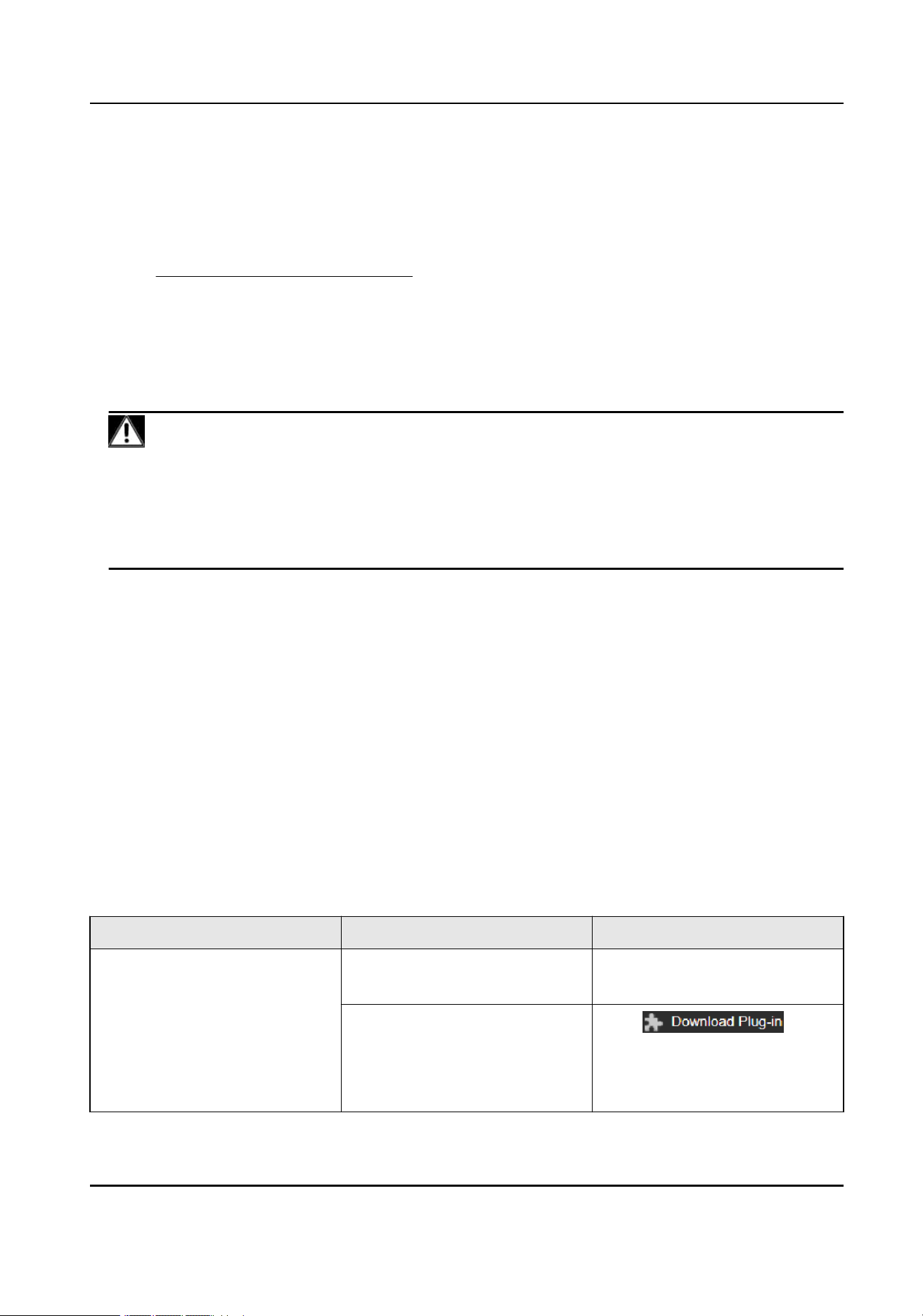
2.2.1 Plug-in Installation
Certain operation systems and web browser may restrict the display and operation of the
device function. You should install plug-in or complete certain settings to ensure normal
display and operation. For detailed restricted function, refer to the actual device.
Operating System
Web Browser Operation
Windows Internet Explorer 10+ Follow pop-up prompts to
complete plug-in installation.
Google Chrome 57+
Mozilla Firefox 52+
Microsoft Edge 79.0.309+
Click to
download and install plug-in.
Go to Conguration >
Network > Advanced
Thermal & Optical Bi-spectrum Network Camera User Manual
3

Operating System Web Browser Operation
Settings > Network Service
to enable WebSocket or
WebSockets for normal view
if plug-in installation is not
required. Display and
operation of certain
functions are restricted. For
example, Playback and
Picture are not available. For
detailed restricted function,
refer to the actual device.
Mac OS 10.13+ Mac Safari 12+ Plug-in installation is not
required.
Go to
Conguration >
Network > Advanced
Settings > Network Service
to enable WebSocket or
WebSockets for normal
view. Display and operation
of certain functions are
restricted. For example,
Playback and Picture are not
available. For detailed
restricted function, refer to
the actual device.
Note
The device only supports Windows and Mac OS system and does not support Linux
system.
2.2.2 Illegal Login Lock
It helps to improve the security when accessing the device via Internet.
Go to Conguration > System > Security > Security Service , and enable Enable Illegal Login
Lock, Illegal Login Attempts and Locking Duration are
congurable.
Illegal Login Attempts
When your login attempts with the wrong password reach the set times, the device is
locked.
Thermal & Optical Bi-spectrum Network Camera User Manual
4

Locking Duration
The device releases the lock after the setting duration.
Thermal & Optical Bi-spectrum Network Camera User Manual
5

Chapter 3 Network Settings
3.1 TCP/IP
TCP/IP settings must be properly congured before you operate the device over network.
IPv4 and IPv6 are both supported. Both versions can be congured simultaneously without
conicting to each other.
Go to Conguration > Network > Network Settings > TCP/IP for parameter settings.
NIC Type
Select a NIC (Network Interface Card) type according to your network condition.
IPv4
Two IPv4 modes are available.
DHCP
The device automatically gets the IPv4 parameters from the network if you check
DHCP. The device IP address is changed after enabling the function. You can use
SADP to get the device IP address.
Note
The network that the device is connected to should support DHCP (Dynamic Host
Conguration Protocol).
Manual
You can set the device IPv4 parameters manually. Input IPv4 Address, IPv4 Subnet
Mask, and IPv4 Default Gateway, and click Test to see if the IP address is available.
IPv6
Three IPv6 modes are available.
Route Advertisement
The IPv6 address is generated by combining the route advertisement and the device
Mac address.
Note
Route advertisement mode requires the support from the router that the device is
connected to.
DHCP
The IPv6 address is assigned by the server, router, or gateway.
Manual
Thermal & Optical Bi-spectrum Network Camera User Manual
6

Input IPv6 Address, IPv6 Subnet, IPv6 Default Gateway. Consult the network
administrator for required information.
MTU
It stands for maximum transmission unit. It is the size of the largest protocol data unit
that can be communicated in a single network layer transaction.
The valid value range of MTU is 1280 to 1500.
DNS
It stands for domain name server. It is required if you need to visit the device with
domain name. And it is also required for some applications (e.g., sending email). Set
Preferred DNS Server and Alternate DNS server properly if needed.
Domain Name Settings
Check Enable Dynamic Domain Name and input Register Domain Name. The device is
registered under the register domain name for easier management within the local area
network.
Note
DHCP should be enabled for the dynamic domain name to take effect.
3.1.1 Multicast Discovery
Go to Conguration > Network > Network Settings > TCP/IP to enable this function.
Check the Enable Multicast Discovery, and then the online network camera can be
automatically detected by client software via private multicast protocol in the LAN.
3.2 Access to Device via Domain Name
You can use the Dynamic DNS (DDNS) for network access. The dynamic IP address of the
device can be mapped to a domain name resolution server to realize the network access
via domain name.
Before You Start
Registration on the DDNS server is required before
conguring the DDNS settings of the
device.
Steps
1.
Refer to
TCP/IP
to set DNS parameters.
2.
Go to the DDNS settings page: Conguration > Network > Network Settings > DDNS .
3.
Check Enable and select DDNS Type.
DynDNS
Dynamic DNS server is used for domain name resolution.
Thermal & Optical Bi-spectrum Network Camera User Manual
7

NO-IP
NO-IP server is used for domain name resolution.
4.
Input the domain name information, and click Save.
5.
Check the device ports and complete port mapping. Refer to
Port Mapping
for port
mapping settings.
6.
Access the device.
By Browsers Enter the domain name in the browser address bar to access the
device.
By Client Software Add domain name to the client software. Refer to the client
manual for
specic adding methods.
3.3 Access to Device via PPPoE Dial Up Connection
This device supports the PPPoE auto dial-up function. The device gets a public IP address
by ADSL dial-up after the device is connected to a modem. You need to
congure the
PPPoE parameters of the device.
Steps
1.
Go to
Conguration > Network > Network Settings > PPPoE .
2.
Check Enable.
3.
Set the PPPoE parameters.
Dynamic IP
After successful dial-up, the dynamic IP address of the WAN is displayed.
User Name
User name for dial-up network access.
Password
Password for dial-up network access.
Conrm
Input your dial-up password again.
4.
Click Save.
5.
Access the device.
By Browsers
Enter the WAN dynamic IP address in the browser address bar to
access the device.
By Client
Software
Add the WAN dynamic IP address to the client software. Refer to
the client manual for details.
Note
The obtained IP address is dynamically assigned via PPPoE, so the IP address always
changes after rebooting the camera. To solve the inconvenience of the dynamic IP, you
Thermal & Optical Bi-spectrum Network Camera User Manual
8

need to get a domain name from the DDNS provider (e.g. DynDns.com). Refer to
Access
to Device via Domain Name
for detail information.
3.4 SNMP
You can set the SNMP (Simple Network Management Protocol) to get device information
in network management.
Before You Start
Before setting the SNMP, you should download the SNMP software and manage to receive
the device information via SNMP port.
Steps
1.
Go to
Conguration > Network > Network Settings > SNMP .
2.
Check Enable SNMPv1, Enable SNMP v2c or Enable SNMPv3.
Note
The SNMP version you select should be the same as that of the SNMP software.
And you also need to use the different version according to the security level required.
SNMP v1 is not secure and SNMP v2 requires password for access. And SNMP v3
provides encryption and if you use the third version, HTTPS protocol must be enabled.
3.
Congure the SNMP settings.
4.
Click Save.
3.5 Set IEEE 802.1X
IEEE 802.1x is a port-based network access control. It enhances the security level of the
LAN/WLAN. When devices connect to the network with IEEE 802.1x standard, the
authentication is needed.
Go to
Conguration > Network > Advanced Settings > 802.1X , and enable the function.
Set Protocol and EAPOL Version according to router information.
Protocol
EAP-TLS and EAP-MD5 are selectable
EAP-MD5
If you use EAP-MD5, the authentication server must be
congured. Register a user
name and password for 802.1X in the server in advance. Input the user name and
password for authentication.
EAP-TLS
If you use EAP-TLS, input Identify, Private Key Password, and upload CA
Certicate,
User Certicate and Private Key.
Thermal & Optical Bi-spectrum Network Camera User Manual
9

EAPOL Version
The EAPOL version must be identical with that of the router or the switch.
3.6 Set QoS
QoS (Quality of Service) can help improve the network delay and network congestion by
setting the priority of data sending.
Note
QoS needs support from network device such as router and switch.
Steps
1.
Go to Conguration > Network > Network Settings > QoS .
2.
Set Video/Audio DSCP, Event/Alarm DSCP and Management DSCP.
Note
Network can identify the priority of data transmission. The bigger the DSCP value is, the
higher the priority is. You need to set the same value in router while
conguration.
3.
Click Save.
3.7 HTTP(S)
HTTP is an application-layer protocol for transmitting hypermedia documents. HTTPS is a
network protocol that enables encrypted transmission and identity authentication, which
improves the security of remote access.
Steps
1.
Go to
Conguration > Network > Network Service > HTTP(S) .
2.
Enter HTTP Port.
Note
It refers to the port through which the browser accesses the device. For example, when
the HTTP Port is
modied to 81, you need to enter http://192.168.1.64:81 in the browser
for login.
3.
Check Enable in HTTPS.
Note
You can click TLS Settings to set the TLS version that the device supports. Refer to
TLS
or details.
4.
Enter HTTPS Port.
5.
Optional: Check HTTPS Browsing to access the device only via HTTPS protocol.
6.
Select Server Certicate.
Thermal & Optical Bi-spectrum Network Camera User Manual
10

7.
Set Web Authentication.
Authentication
Digest and digest/basic are supported, which means authentication information is
needed when WEB request is sent to the device. If you select digest/basic, it means
the device supports digest or basic authentication. If you select digest, the device
only supports digest authentication.
Digest Algorithm
MD5, SHA256 and MD5/SHA256 encrypted algorithm in WEB authentication. If you
enable the digest algorithm except for MD5, the third-party platform might not be able
to log in to the device or enable live view because of compatibility. The encrypted
algorithm with high strength is recommended.
8.
Click Save.
3.8 Multicast
Multicast is group communication where data transmission is addressed to a group of
destination devices simultaneously.
Go to Conguration > Network > Network Settings > TCP/IP to set IP address, i.e., the
address of multicast host.
For a device with more than one channel, multicast can be set independently for each
channel.
3.9 RTSP
RTSP (Real Time Streaming Protocol) is an application-layer controlling protocol for
streaming media.
Steps
1.
Go to Conguration > Network > Network Service > RTSP .
2.
Enter Port.
3.
Set Multicast parameters.
Stream Type
The stream type as the multicast source.
Video Port
The video port of the selected stream.
4.
Set RTSP Authentication.
Authentication
Digest and digest/basic are supported, which means authentication information is
needed when RTSP request is sent to the device. If you select digest/basic, it means
Thermal & Optical Bi-spectrum Network Camera User Manual
11

the device supports digest or basic authentication. If you select digest, the device
only supports digest authentication.
Digest Algorithm
MD5, SHA256 and MD5/SHA256 encrypted algorithm in RTSP authentication. If you
enable the digest algorithm except for MD5, the third-party platform might not be able
to log in to the device or enable live view because of compatibility. The encrypted
algorithm with high strength is recommended.
5.
Click Save.
3.10 Set SRTP
The Secure Real-time Transport Protocol (SRTP) is a Real-time Transport Protocol (RTP)
internet protocol, intended to provide encryption, message authentication and integrity,
and replay attack protection to the RTP data in both unicast and multicast applications.
Steps
1.
Go to
Conguration > Network > Network Service > SRTP .
2.
Enter the Port number.
3.
Set Multicast parameters.
Stream Type
The stream type as the multicast source.
Video Port
The video port of the selected stream.
4.
Select Server
Certicate.
5.
Select Encrypted Algorithm.
6.
Click Save.
Note
●
Only certain device models support this function.
●
If the function is abnormal, check if the selected
certicate is abnormal in
Certicate
Management
.
3.11 Bonjour
It is an implementation of zero-conguration networking (zeroconf), a group of
technologies that includes service discovery, address assignment, and hostname
resolution. Bonjour locates devices such as printers, other computers, and the services
that those devices offer on a local network using multicast Domain Name System (mDNS)
service records.
Thermal & Optical Bi-spectrum Network Camera User Manual
12

Go to Conguration > Network > Network Service > Bonjour to enable the function, and
click Save.
After enabling the function, the device spread and receive service information in local area
network.
3.12 WebSocket(s)
WebSocket or WebSockets protocol should be enabled if you use Google Chrome 57 and
its above version or Mozilla Firefox 52 and its above version to visit the device. Otherwise,
live view, image capture, digital zoom, etc. cannot be used.
Go to
Conguration > Network > Network Service > WebSocket(s) to set parameters, and
click Save.
WebSocket
TCP-based full-duplex communication protocol port for plug-in free preview via HTTP
protocol.
WebSockets
TCP-based full-duplex communication protocol port for plug-in free preview via HTTPS
protocol.
3.13 Modbus Communication
During communicating with Modbus protocol, the camera can function as the main or the
subordinate for transmitting temperature measurement and temperature measurement
alarm data, or responding to temperature measurement parameter conguration requests
from the main.
Please select the device mode and
congure the communication rules and parameters
according to the demand to ensure the security of data transmission under the premise of
satisfying the data access of the device.
Go to
Conguration > Network > Network Service > Modbus to congure the Modbus.
3.13.1 Set Modbus Main Mode
Congure the device as the main server which actively uploads data to the subordinate
according to set rules without sending requests.
Steps
1.
Select the Device Mode as Main.
2.
Check to enable the function of transmitting data via Modbus.
3.
Click Add to
congure the transmission parameters between the device and the
subordinate.
Thermal & Optical Bi-spectrum Network Camera User Manual
13

Subordinate Name
Customized subordinate for distinguishing between different subordinates.
Connection type
Note
Only when Conguration > System > System Settings > RS-485 is selected as main
mode, the RS-485 connection type can be supported.
TCP
When connecting the device and the subordinate via the RJ45 interface, the TCP
connection type can be selected. Multiple connections can be implemented
through the TCP type, but the IP/decoding address and port of the TCP connection
cannot be duplicated.
RS-485
Before selecting an RS-485 connection, make sure that the connection between the
device and the subordinate has been established through the RS-485 connector on
the body. And only 1 RS-485 connection can be supported.
Response Timeout(s)
When the response timeout occurs, the device displays the error code 11, then it will
resend the data, and when the response timeout occurs for three consecutive times, it
will discard the current data and send the next data.
Upload Interval(s)
The time interval during the device uploads data to the subordinate.
4.
Click OK to view the status.
5.
Click Test to refresh the status.
Note
●
If the connection status displays online, the device is connected to the subordinate
normally; if it displays
ofine, the device is disconnected from the subordinate, which
may be caused by the subordinate not being online. If the status shows Error, refer to
the contents of the error code description below to diagnose the connection problem.
●
Click Edit or Delete to re-edit the subordinate parameters or delete the added
subordinate.
6.
Congure the contents to be uploaded to the registers of subordinate.
1)Click Add.
2)Check the contents to be uploaded.
3)Select the Rule ID to be uploaded, and the device uploads the temperature
measurement information corresponding to the expert temperature measurement
rule.
4)Enter the register starting address and register ending address.
Thermal & Optical Bi-spectrum Network Camera User Manual
14

Note
In a single subordinate conguration, all register addresses cannot be duplicated or
conicted.
5)Click OK.
7.
Click Save.
3.13.2 Set Modbus Subordinate Mode
Congure the device as the subordinate server, the main can read the temperature
measurement data of the device or write the temperature measurement parameters of the
device. The form of authorized access can improve data communication security.
Steps
Note
You can set the Modbus TCP port, go to Conguration > Network > Basic Settings > Port .
1.
Select the Device Mode as Subordinate.
2.
Select Register Mode.
Register Mode
Read Only
The client can only read all the register data.
Read/Write
The client can read while
congure the device using the Modbus TCP protocol.
3.
Check Enable Authorized IP Addresses and click Add to add IP addresses that are
allowed to access to the device.
Note
With regard to the network security risk, it is recommended to limit permission only to
trusted IP addresses.
3.13.3 Modbus Error Code Description
If communication of Modbus is abnormal, an error code will be returned. Please refer to
the following table to check the meaning of the error code to help troubleshoot Modbus
communication problems.
Thermal & Optical Bi-spectrum Network Camera User Manual
15

Table 3-1 Modbus Error Code Description
Error
Code
Name Description
01 Illegal Function The function code received in the query is not an
allowable action for the server. This may be
because the function code is only applicable to
newer devices, and was not implemented in the
unit selected. It could also indicate that the server
is in the wrong state to process a request of this
type, for example because it is
uncongured and is
being asked to return register values.
02 Illegal Data Address The data address received in the query is not an
allowable address for the server. More
specically,
the combination of reference number and transfer
length is invalid. For a controller with 100 registers,
the PDU addresses the rst register as 0, and the
last one as 99. If a request is submitted with a
starting register address of 96 and a quantity of
registers of 4, then this request will successfully
operate (address-wise at least) on registers 96, 97,
98, 99. If a request is submitted with a starting
register address of 96 and a quantity of registers of
5, then this request will fail with Exception Code
0x02 “Illegal Data Address” since it attempts to
operate on registers 96, 97, 98, 99 and 100, and
there is no register with address 100.
03 Illegal Data Value A value contained in the query data eld is not an
allowable value for server. This indicates a fault in
the structure of the remainder of a complex
request, such as that the implied length is
incorrect. It
specically does NOT mean that a data
item submitted for storage in a register has a value
outside the expectation of the application program,
since the Modbus protocol is unaware of the
signicance of any particular value of any
particular register.
04 Server Device Failure An unrecoverable error occurred while the server
was attempting to perform the requested action.
Thermal & Optical Bi-spectrum Network Camera User Manual
16

Error
Code
Name Description
05 Acknowledge Specialized use in conjunction with programming
commands. The server has accepted the request
and is processing it, but a long duration of time will
be required to do so. This response is returned to
prevent a timeout error from occurring in the client.
The client can next issue a Poll Program Complete
message to determine if processing is completed.
06 Server Device Busy Specialized use in conjunction with programming
commands. The server is engaged in processing a
long– duration program command. The client
should retransmit the message later when the
server is free.
08 Memory Parity Error Specialized use in conjunction with function codes
20 and 21 and reference type 6, to indicate that the
extended
le area failed to pass a consistency
check. The server attempted to read record le, but
detected a parity error in the memory. The client
can retry the request, but service may be required
on the server device.
10 Gateway Path
Unavailable
Specialized use in conjunction with gateways,
indicates that the gateway was unable to allocate
an intern communication path from the input port
to the output port for processing the request.
Usually means that the gateway is
miscongured
or overload.
11 Gateway Target Device
Failed to Response
Specialized use in conjunction with gateways,
indicates that no response was obtained from the
target device. Usually means that device is not
present on the network.
3.14 Port Mapping
By setting port mapping, you can access devices through the specied port.
Steps
1.
Go to
Conguration > Network > Network Service > NAT .
2.
Select the port mapping mode.
Thermal & Optical Bi-spectrum Network Camera User Manual
17

Auto Port Mapping Refer to
Set Auto Port Mapping
for detailed information.
Manual Port Mapping Refer to
Set Manual Port Mapping
for detailed information.
3.
Click Save.
3.14.1 Set Auto Port Mapping
Steps
1.
Check Enable UPnP™, and choose a friendly name for the camera, or you can use the
default name.
2.
Select the port mapping mode to Auto.
3.
Click Save.
Note
UPnP™ function on the router should be enabled at the same time.
3.14.2 Set Manual Port Mapping
Steps
1.
Check Enable UPnP™, and choose a friendly name for the device, or you can use the
default name.
2.
Select the port mapping mode to Manual, and set the external port to be the same as the
internal port.
3.
Click Save.
What to do next
Go to the router port mapping settings interface and set the port number and IP address to
be the same as those on the device. For more information, refer to the router user manual.
3.15 Set OTAP
The device can be accessed to the maintenance platform via OTAP protocol, in order to
search and acquire device information, upload device status and alarm information, reboot
and update the device.
Steps
1.
Go to
Conguration > Network > Advanced Settings > Platform Access to enable the
function.
2.
Set related parameters.
3.
Click Test to check if the device connects to server.
4.
Click Save.
Register Status turns to Online when the function is correctly set.
Thermal & Optical Bi-spectrum Network Camera User Manual
18

3.16 Set ISUP
When the device is registered on ISUP platform (formerly called Ehome), you can visit and
manage the device, transmit data, and forward alarm information over public network.
Steps
1.
Go to
Conguration > Network > Platform Access > ISUP .
2.
Optional: Select an access center.
3.
Check Enable.
4.
Select a protocol version and enter related parameters.
5.
Click Save.
Register status turns to Online when the function is correctly set.
3.17 Access Camera via Hik-Connect
Hik-Connect is an application for mobile devices. Using the App, you can view live image,
receive alarm
notication and so on.
Before You Start
Connect the camera to network with network cables.
Steps
1.
Download Hik-Connect from
https://www.hik-connect.com
and install it on your mobile
device.
2.
Start the application and register for a Hik-Connect user account.
3.
Log in after registration.
4.
In the app, tap "+" on the upper-right corner and then scan the QR code of the camera to
add the camera. You can
nd the QR code on the package.
5.
Follow the prompts to set the network connection and add the camera to your Hik-
Connect account.
For detailed information, refer to the user manual of the Hik-Connect app.
3.17.1 Enable Hik-Connect Service on Camera
Hik-Connect service should be enabled on your camera before using the service.
You can enable the service through Web browser.
Enable Hik-Connect Service via Web Browser
Follow the following steps to enable Hik-Connect Service via Web Browser.
Thermal & Optical Bi-spectrum Network Camera User Manual
19

Before You Start
You need to activate the camera before enabling the service.
Steps
1.
Access the camera via web browser.
2.
Enter platform access
conguration interface. Conguration > Network > Advanced
Settings > Platform Access
3.
Select Hik-Connect as the Platform Access Mode.
4.
Check Enable.
5.
Click and read "Terms of Service" and "Privacy Policy" in pop-up window.
6.
Create a
verication code or change the old verication code for the camera.
Note
The verication code is required when you add the camera to Hik-Connect service.
7.
Save the settings.
Enable Hik-Connect Service via SADP Software
This part introduce how to enable Hik-Connect service via SADP software of an activated
camera.
Steps
1.
Run SADP software.
2.
Select a camera and enter Modify Network Parameters page.
3.
Check Enable Hik-Connect.
4.
Create a
verication code or change the old verication code.
Note
The verication code is required when you add the camera to Hik-Connect service.
5.
Click and read "Terms of Service" and "Privacy Policy".
6.
Conrm the settings.
3.17.2 Set Up Hik-Connect
Steps
1.
Download Hik-Connect from
https://www.hik-connect.com
and install it on your mobile
device.
2.
Start the application and register for a Hik-Connect user account.
3.
Log in after registration.
Thermal & Optical Bi-spectrum Network Camera User Manual
20
3.17.3 Add Camera to Hik-Connect
Steps
1.
Connect your mobile device to a Wi-Fi.
2.
Log into the Hik-Connect app.
3.
In the home page, tap "+" on the upper-right corner to add a camera.
4.
Scan the QR code on camera body or on the
Quick Start Guide
cover.
Note
If the QR code is missing or too blur to be recognized, you can also add the camera by
inputting the camera's serial number.
5.
Input the verication code of your camera.
Note
●
The required verication code is the code you create or change when you enable Hik-
Connect service on the camera.
●
If you forget the
verication code, you can check the current verication code on
Platform Access conguration page via web browser.
6.
Tap Connect to a Network button in the popup interface.
7.
Choose Wired Connection or Wireless Connection according to your camera function.
Wireless
Connection
Input the Wi-Fi password that your mobile phone has connected to,
and tap Next to start the Wi-Fi connection process. (Locate the
camera within 3 meters from the router when setting up the Wi-Fi.)
Wired
Connection
Connect the camera to the router with a network cable and tap
Connected in the result interface.
Note
The router should be the same one which your mobile phone has connected to.
8.
Tap Add in the next interface to nish adding.
For detailed information, refer to the user manual of the Hik-Connect app.
3.18 Set Open Network Video Interface
If you need to access the device through Open Network Video Interface protocol, you can
congure the user settings to enhance the network security.
Steps
1.
Go to Conguration > Network > Platform Access > Open Network Video Interface .
2.
Check Enable.
3.
Select an authentication mode.
-
If you select Digest, the device only supports digest authentication.
Thermal & Optical Bi-spectrum Network Camera User Manual
21

-
If you select Digest&ws-username token, the device supports digest authentication or
ws-username token authentication.
4.
Click Add to
congure the Open Network Video Interface user.
5.
Click Save.
6.
Optional: Repeat the steps above to add more Open Network Video Interface users.
7.
Optional: Manage the user.
-
Click to delete the selected Open Network Video Interface user.
-
Click
to modify the selected Open Network Video Interface user.
3.19 Set SDK Service
If you want to add the device to the client software, you should enable SDK Service.
Steps
1.
Go to Conguration > Network > Platform Access > SDK Service .
2.
Enter the Port number.
3.
Click Save.
Thermal & Optical Bi-spectrum Network Camera User Manual
22
Chapter 4 Live View
It introduces the live view parameters, function icons and transmission parameters
settings.
4.1 Live View Parameters
The supported functions vary depending on the model.
Note
For multichannel devices, select the desired channel rst before live view settings.
4.1.1 Window Division
●
refers to 1 × 1 window division.
●
refers to 2 × 2 window division.
●
refers to 3 × 3 window division.
●
refers to 4 × 4 window division.
4.1.2 Live View Stream Type
Select the live view stream type according to your needs. For the detailed information
about the stream type selection, refer to
Stream Type
.
4.1.3 Enable and Disable Live View
This function is used to quickly enable or disable live view of all channels.
●
Click to start live view of all channels.
●
Click to stop live view of all channels.
Note
Go to Conguration > Local , to set Auto Start Live View, If Yes is selected, live view will
start automatically when you go to live view.
4.1.4 Start Digital Zoom
It helps to see a detailed information of any region in the image.
Steps
1.
Click to enable the digital zoom.
Thermal & Optical Bi-spectrum Network Camera User Manual
23

2.
In live view image, drag the mouse to select the desired region.
3.
Click in the live view image to back to the original image.
4.1.5 View Previous/Next Page
When the number of channels surpasses that of live view window division, this function
can switch live view among multiple channels.
Click
to switch live view among multiple channels.
4.1.6 Full Screen
This function is used to view the image in full screen mode.
Click to start full screen mode and press ESC button to exit.
4.1.7 Light
Click to turn on or turn off the illuminator.
Caution
●
DO NOT stare at operating light source. May be harmful to the eyes.
●
If appropriate shielding or eye protection is not available, turn on the light only at a safe
distance or in the area that is not directly exposed to the light.
●
When assembling, installing or maintaining the device, DO NOT turn on the light, or wear
eye protection.
4.1.8 Wiper
For the device that has a wiper, you can control the wiper via web browser.
Click
on live view page. The wiper wipes the window one time.
4.1.9 Lens Initialization
Lens initialization is used on the device equipped with motorized lens. The function can
reset lens when long time zoom or focus results in blurred image. This function varies
according to different models.
Click
to operate lens initialization.
Thermal & Optical Bi-spectrum Network Camera User Manual
24

4.1.10 Auxiliary Focus
Click to enable automatic focus. This function is subject to the actual device model.
4.1.11 Quick Set Live View
It offers a quick setup of PTZ, display settings, OSD, video/audio and VCA resource
settings on live view page.
Steps
1.
Click
to show quick setup page.
2.
Set PTZ, display settings, OSD, video/audio and VCA resource parameters.
-
For PTZ settings, see
Lens Parameters Adjustment
.
-
For display settings, see
Display Settings
.
-
For OSD settings, see
OSD
.
-
For audio and video settings, see
Video and Image Settings
.
-
For VCA settings, see
Fire and Smoke Detection
,
Temperature Measurement
, and
Perimeter Protection
.
Note
The function is only supported by certain models.
4.1.12 Lens Parameters Adjustment
It is used to adjust the lens focus, zoom and iris.
Zoom
●
Click , and the lens zooms in.
●
Click
, and the lens zooms out.
Focus
●
Click , then the lens focuses far and the distant object gets clear.
●
Click , then the lens focuses near and the nearby object gets clear.
Iris
●
When the image is too dark, click to enlarge the iris.
●
When the image is too bright, click
to stop down the iris.
Note
The function is only supported by certain models.
Thermal & Optical Bi-spectrum Network Camera User Manual
25

4.2 Set Transmission Parameters
The live view image may be displayed abnormally according to the network conditions. In
different network environments, you can adjust the transmission parameters to solve the
problem.
Steps
1.
Go to
Conguration > Local > Live View Parameters .
2.
Set the transmission parameters as required.
Protocol
TCP
TCP ensures complete delivery of streaming data and better video quality, yet the
real-time transmission will be affected. It is suitable for the stable network
environment.
UDP
UDP is suitable for the unstable network environment that does not demand high
video
uency.
MULTICAST
MULTICAST is suitable for the situation that there are multiple clients. You should
set the multicast address for them before selection.
Note
For detailed information about multicast, refer to
Multicast
.
HTTP
HTTP is suitable for the situation that the third-party needs to get the stream from
the device.
Playing Performance
Shortest Delay
The device takes the real-time video image as the priority over the video
uency.
Balanced
The device ensures both the real-time video image and the uency.
Fluent
The device takes the video uency as the priority over teal-time. In poor network
environment, the device cannot ensures video
uency even the uency is enabled.
Custom
Thermal & Optical Bi-spectrum Network Camera User Manual
26

You can set the frame rate manually. In poor network environment, you can reduce
the frame rate to get a
uent live view. But the rule information may cannot display.
Auto Start Live View
●
Yes means the live view is started automatically. It requires a high performance
monitoring device and a stable network environment.
●
No means the live view should be started manually.
3.
Click Save.
4.3 Set Rule Display
You can set the rule display of target object in live view or captured picture.
Go to Conguration > Local > Live View Parameter to set the parameters.
Rules
Display rule info. in live view, such as the rule area of motion detection event and VCA
resources.
Display POS Info
Display target ID and attributes in main stream recordings. The attribute type depends
on the model and function of different device, and the actual device prevails.
Display Rules Info on Capture
Display rule info (e.g., alarm area and rule area) on captured pictures. The attribute type
depends on the model and function of different device, and the actual device prevails.
Display Temperature Info.
Display the highest and lowest as well as the point, line and area temperature value.
Thermal & Optical Bi-spectrum Network Camera User Manual
27

Chapter 5 Video and Image Settings
This part introduces the
conguration of video/audio and image related parameters.
5.1 Video Settings
This part introduces the settings of video parameters, such as, stream type, video
encoding, and resolution.
Go to setting page:
Conguration > Video/Audio > Video .
Note
For device with multiple camera channels, select a channel before other settings.
5.1.1 Stream Type
For device supports more than one stream, you can specify parameters for each stream
type.
Main Stream
The stream stands for the best stream performance the device supports. It usually
offers the best resolution and frame rate the device can do. But high resolution and
frame rate usually mean larger storage space and higher bandwidth requirements in
transmission.
Sub Stream
The stream usually offers comparatively low resolution options, which consumes less
bandwidth and storage space.
5.1.2 Video Type
Select the content (video and audio) that should be contained in the stream.
Video
Only video content is contained in the stream.
Video & Audio
Video content and audio content are contained in the composite stream.
Note
Video & Audio varies according to different camera models.
Thermal & Optical Bi-spectrum Network Camera User Manual
28

5.1.3 Resolution
Select video resolution according to actual needs. Higher resolution requires higher
bandwidth and storage.
5.1.4 Bitrate Type and Max. Bitrate
Constant Bitrate
It means that the stream is compressed and transmitted at a comparatively xed
bitrate. The compression speed is fast, but mosaic may occur on the image.
Variable Bitrate
It means that the device automatically adjust the bitrate under the set Max. Bitrate. The
compression speed is slower than that of the constant bitrate. But it guarantees the
image quality of complex scenes.
5.1.5 Video Quality
When Bitrate Type is set as Variable, video quality is congurable. Select a video quality
according to actual needs. Note that higher video quality requires higher bandwidth.
5.1.6 Frame Rate
The frame rate is to describe the frequency at which the video stream is updated and it is
measured by frames per second (fps).
A higher frame rate is advantageous when there is movement in the video stream, as it
maintains image quality throughout. Note that higher frame rate requires higher bandwidth
and larger storage space.
5.1.7 Video Encoding
It stands for the compression standard the device adopts for video encoding.
Note
Available compression standards vary according to device models.
H.264
H.264, also known as MPEG-4 Part 10, Advanced Video Coding, is a compression
standard. Without compressing image quality, it increases compression ratio and reduces
the size of video
le than MJPEG or MPEG-4 Part 2.
Thermal & Optical Bi-spectrum Network Camera User Manual
29

H.265
H.265, also known as High Efciency Video Coding (HEVC) and MPEG-H Part 2, is a
compression standard. In comparison to H.264, it offers better video compression at the
same resolution, frame rate and image quality.
MJPEG
Motion JPEG (M-JPEG or MJPEG) is a video compression format in which intraframe
coding technology is used. Images in a MJPEG format is compressed as individual JPEG
images.
Prole
This function means that under the same bitrate, the more complex the prole is, the
higher the quality of the image is, and the requirement for network bandwidth is also
higher.
I-Frame Interval
I-frame interval denes the number of frames between 2 I-frames.
In H.264 and H.265, an I-frame, or intra frame, is a self-contained frame that can be
independently decoded without any reference to other images. An I-frame consumes more
bits than other frames. Thus, video with more I-frames, in other words, smaller I-frame
interval, generates more steady and reliable data bits while requiring more storage space.
SVC
Scalable Video Coding (SVC) is the name for the Annex G extension of the H.264 or H.265
video compression standard.
The objective of the SVC standardization has been to enable the encoding of a high-quality
video bitstream that contains one or more subset bitstreams that can themselves be
decoded with a complexity and reconstruction quality similar to that achieved using the
existing H.264 or H.265 design with the same quantity of data as in the subset bitstream.
The subset bitstream is derived by dropping packets from the larger bitstream.
SVC enables forward compatibility for older hardware: the same bitstream can be
consumed by basic hardware which can only decode a low-resolution subset, while more
advanced hardware will be able decode high quality video stream.
Thermal & Optical Bi-spectrum Network Camera User Manual
30

5.1.8 Smoothing
It refers to the smoothness of the stream. The higher value of the smoothing is, the better
uency of the stream will be, though, the video quality may not be so satisfactory. The
lower value of the smoothing is, the higher quality of the stream will be, though it may
appear not
uent.
5.1.9 Display VCA Info
VCA information can be displayed by Player and Video.
Player
Player means the VCA info can be displayed by the dedicated player provided by the
manufacturer.
Video
Video means the VCA info can be displayed by any general video player.
5.1.10 Audio Settings
It is a function to set audio parameters such as audio encoding, environment noise
ltering.
Go to the audio settings page: Conguration > Video/Audio > Audio .
Note
Only certain camera models support the function.
Audio Encoding
Select the audio encoding compression of the audio.
Audio Input
Note
●
Connect the audio input device as required.
●
The audio input display varies with the device models.
Thermal & Optical Bi-spectrum Network Camera User Manual
31

LineIn Set Audio Input to LineIn when the device connects to the
audio input device with the high output power, such as
MP3, synthesizer or active pickup.
MicIn Set Audio Input to MicIn when the device connects to the
audio input device with the low output power, such as
microphone or passive pickup.
Environmental Noise Filter
Set it as OFF or ON. When the function is enabled, the noise in the environment can be
ltered to some extent.
5.1.11 Two-way Audio
It is used to realize the two-way audio function between the monitoring center and the
target in the monitoring screen.
Before You Start
●
Make sure the audio input device (pick-up or microphone) and audio output device
(speaker) connected to the device is working properly. Refer to
specications of audio
input and output devices for device connection.
●
If the device has built-in microphone and speaker, two-way audio function can be
enabled directly.
Steps
Note
The function varies according to different camera models.
1.
Click Live View.
2.
Click
on the toolbar to enable two-way audio function of the camera.
3.
Click , disable the two-way audio function.
5.1.12 Set ROI
ROI (Region of Interest) encoding helps to assign more encoding resource to the region of
interest, thus to increase the quality of the ROI whereas the background information is less
focused.
Before You Start
Please check the video coding type. ROI is supported when the video coding type is H.264
or H.265.
Thermal & Optical Bi-spectrum Network Camera User Manual
32

Steps
1.
Go to
Conguration > Video/Audio > ROI .
2.
Check Enable.
3.
Select the channel No. according to your need.
4.
Select Stream Type.
5.
Select Region No. in Fixed Region to draw ROI region.
1)Click Draw Area.
2)Click and drag the mouse on the view screen to draw the
xed region.
3)Click Stop Drawing.
Note
Select the xed region that needs to be adjusted and drag the mouse to adjust its
position.
6.
Input the Region Name and ROI Level.
7.
Click Save.
Note
The higher the ROI level is, the clearer the image of the detected region is.
8.
Optional: Select other region No. and repeat the above steps if you need to draw multiple
xed regions.
5.2 Display Settings
It offers the parameter settings to adjust image features.
Go to Conguration > Image > Display Settings .
For device that supports multiple channels, display settings of each channel is required.
The settings for different channels may be different. This part introduces all possible
parameters among the channels.
Click Default to restore settings.
5.2.1 Image Adjustment
By adjusting the Brightness, Saturation, Hue, Sharpness and Contrast, the image can be
best displayed.
Thermal & Optical Bi-spectrum Network Camera User Manual
33
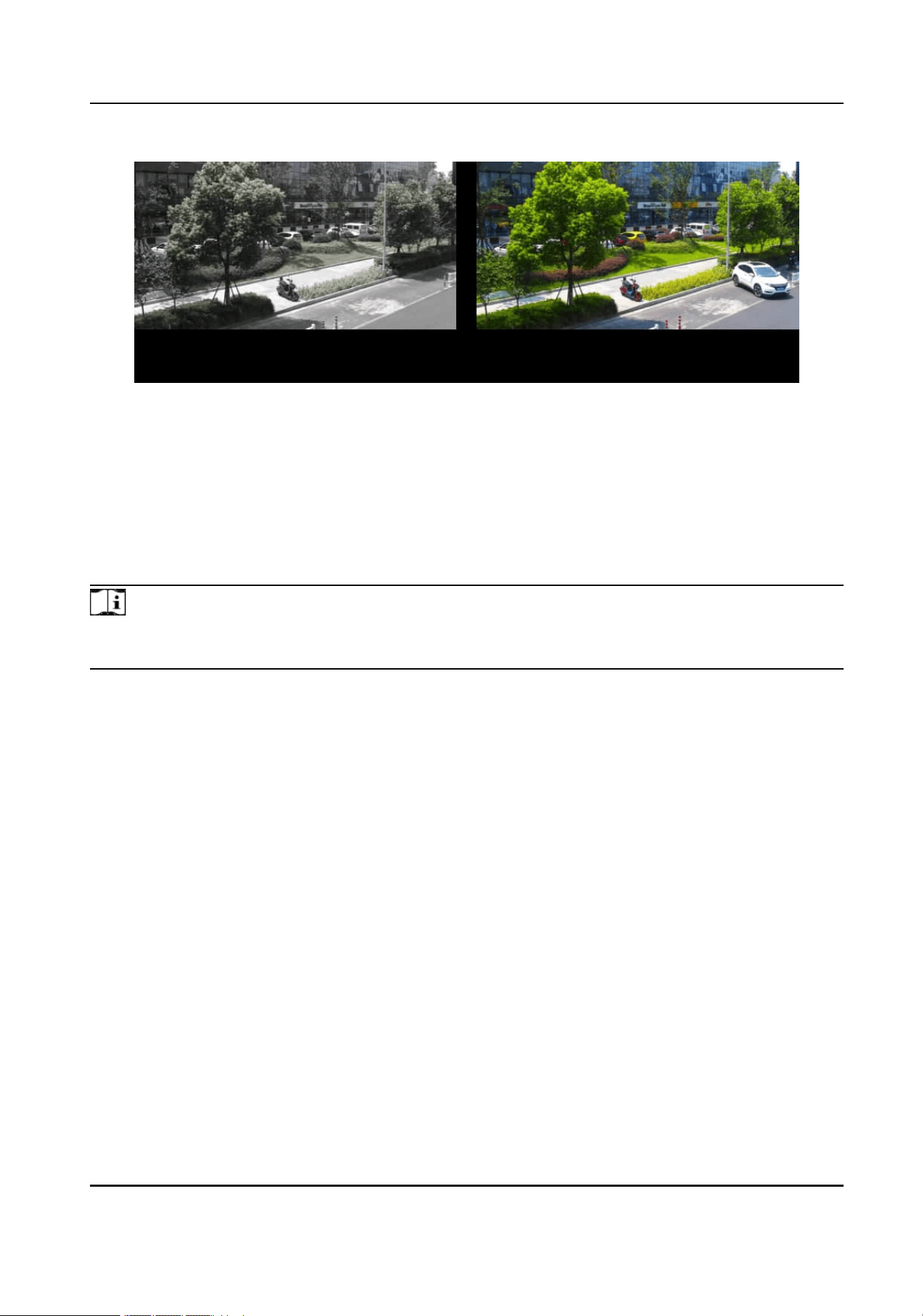
Figure 5-1 Saturation
5.2.2 Image Adjustment (Thermal Channel)
You can optimize the image display effect of thermal channel by manual correction.
Manual Correction
Click DPC (Defective Pixel Correction) to optimize the image once.
Note
It is a normal phenomenon that short video freezing might occur during the process of
Manual Correction.
Thermal AGC Mode
Choose the AGC mode according to different scenes to balance and improve the image
quality.
●
Histogram: Choose for scene with obvious WDR and high temperature difference, can
improve image contrast and enhance image. E.g. the scene contains both indoor and
outdoor scenes.
●
Linear: Choose for scene with low temperature difference and the target is not
obvious, can improve image contrast and enhance image. E.g. the bird in forest.
●
Self-Adaptive: Choose AGC mode automatically according to current scene.
5.2.3 Exposure Settings
Exposure is controlled by the combination of iris, shutter, and photo sensibility. You can
adjust image effect by setting exposure parameters.
In manual mode, you need to set Exposure Time, Gain and Slow Shutter.
Thermal & Optical Bi-spectrum Network Camera User Manual
34

5.2.4 Day/Night Switch
Day/Night Switch function can provide color images in the day mode and turn on ll light in
the night mode. Switch mode is congurable.
Day
The image is always in color.
Night
The supplement light will be enabled to ensure clear live view image at night.
Auto
The camera switches between the day mode and the night mode according to the
illumination automatically. The higher the Sensitivity is, the easier the mode switches.
The Filtering Time refers to the time interval between the mode switches.
Scheduled-Switch
Set the Start Time and the End Time to
dene the duration for day mode.
Note
Day/Night Switch function varies according to models.
5.2.5 Set Supplement Light
Steps
1.
Go to
Conguration > Maintenance > System Service .
2.
Check Enable Supplement Light.
3.
Click Save.
4.
Go to
Conguration > Image > Display Settings > Day/Night Switch to set supplement
light parameters.
Smart Supplement Light
This feature uses smart image processing technology to reduce overexposure caused
by supplement light.
Smart Supplement Light Mode
Enable or disable the smart supplement light.
Brightness Limit
Adjust the upper limit of supplement light power.
Light Brightness Control
Control supplement light brightness automatically or manually.
Auto
The brightness adjusts according to the actual environment automatically.
Thermal & Optical Bi-spectrum Network Camera User Manual
35
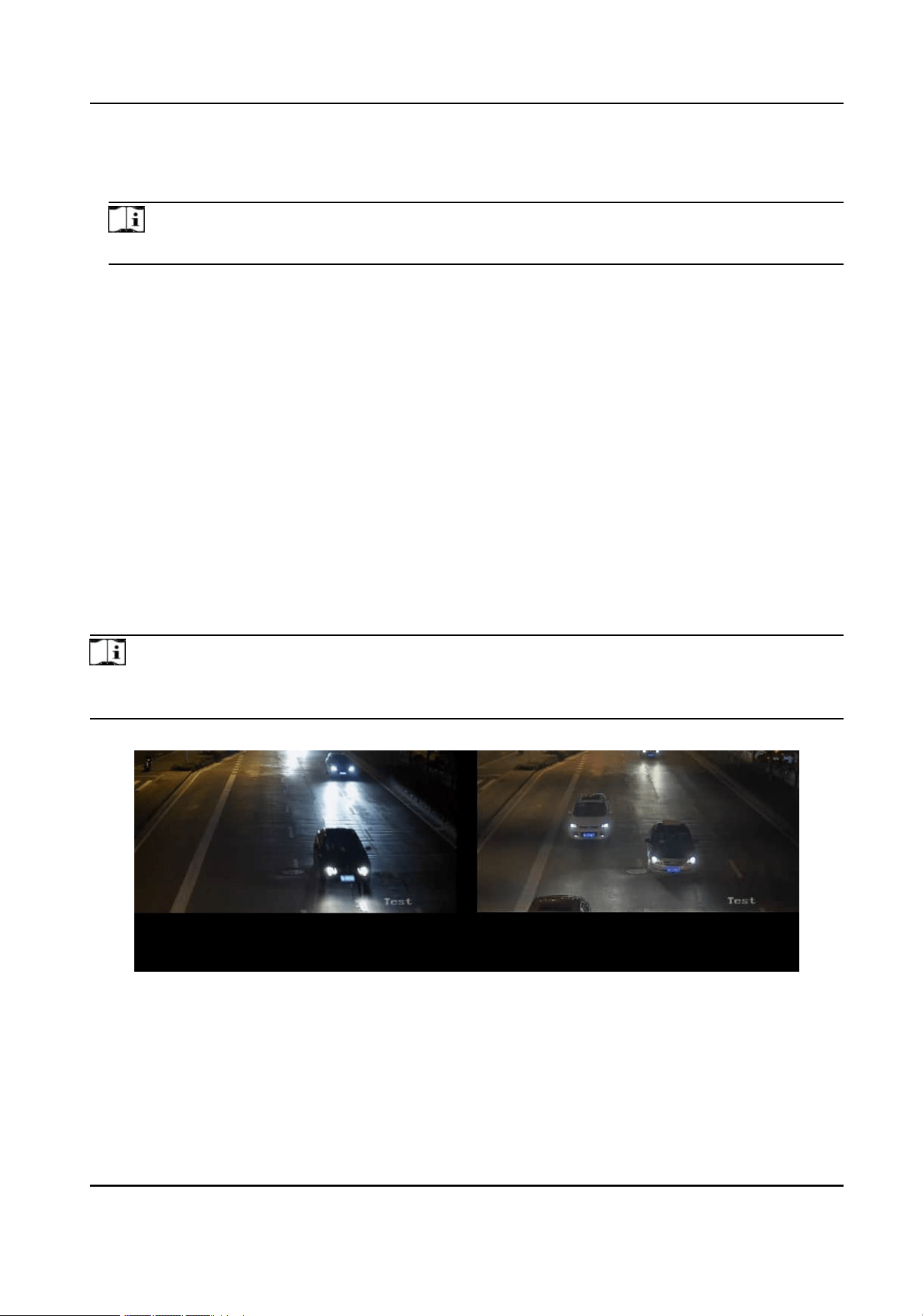
Manual
You can drag the slider or set value to adjust the brightness.
Note
The function varies according to device models.
5.2.6 BLC
If you focus on an object against strong backlight, the object will be too dark to be seen
clearly. BLC (backlight compensation) compensates light to the object in the front to make
it clear. If BLC mode is set as Custom, you can draw a red rectangle on the live view image
as the BLC area.
5.2.7 WDR
The WDR (Wide Dynamic Range) function helps the camera provide clear images in
environment with strong illumination differences.
When there are both very bright and very dark areas simultaneously in the
eld of view, you
can enable the WDR function and set the level. WDR automatically balances the brightness
level of the whole image and provides clear images with more details.
Note
When WDR is enabled, some other functions may be not supported. Refer to the actual
interface for details.
Figure 5-2 WDR
Thermal & Optical Bi-spectrum Network Camera User Manual
36
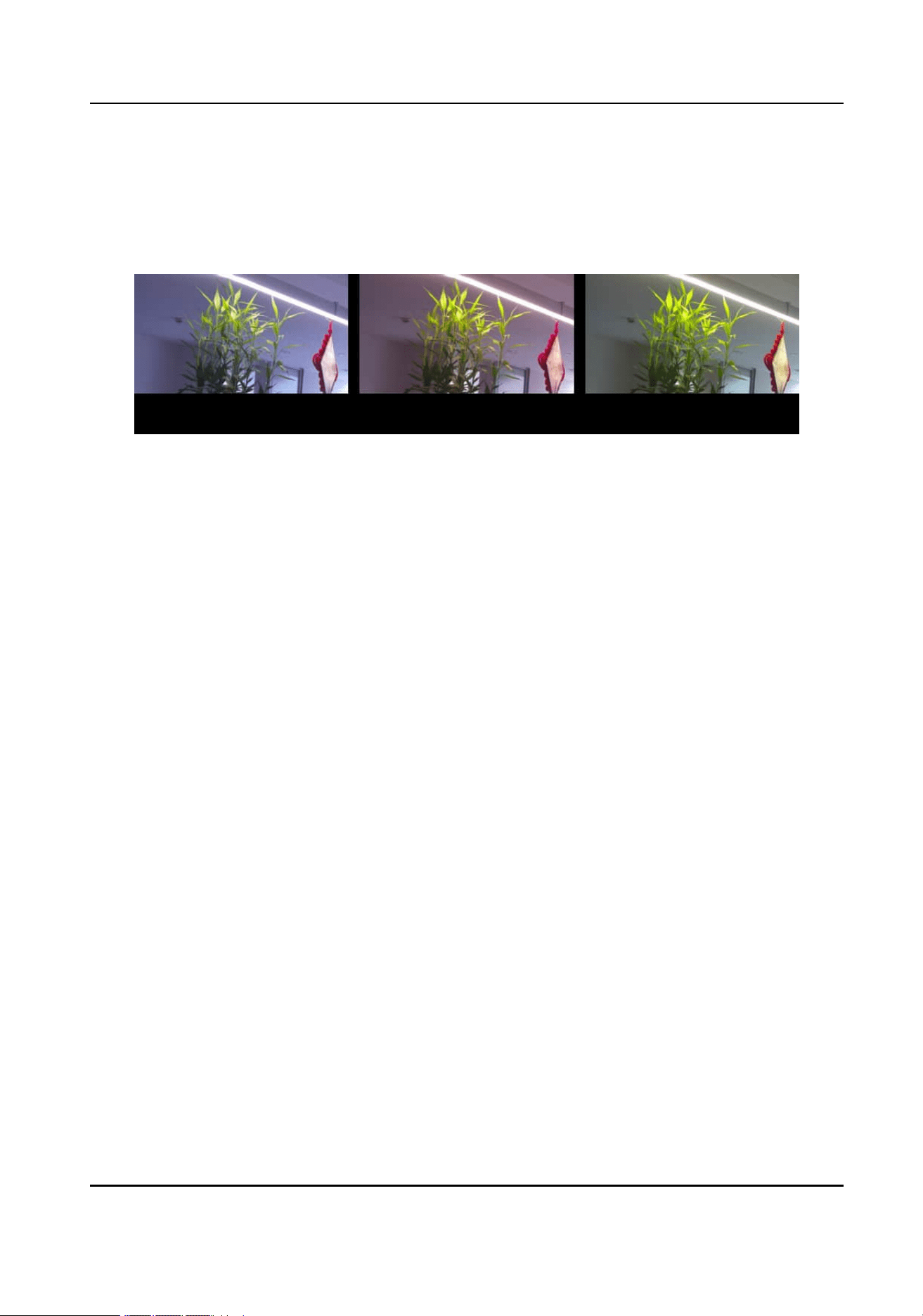
5.2.8 White Balance
White balance is the white rendition function of the camera. It is used to adjust the color
temperature according to the environment.
Figure 5-3 White Balance
5.2.9 DNR
Digital Noise Reduction is used to reduce the image noise and improve the image quality.
Normal and Expert modes are selectable.
Normal
Set the DNR level to control the noise reduction degree. The higher level means stronger
reduction degree.
Expert
Set the DNR level for both space DNR and time DNR to control the noise reduction
degree. The higher level means stronger reduction degree.
Thermal & Optical Bi-spectrum Network Camera User Manual
37
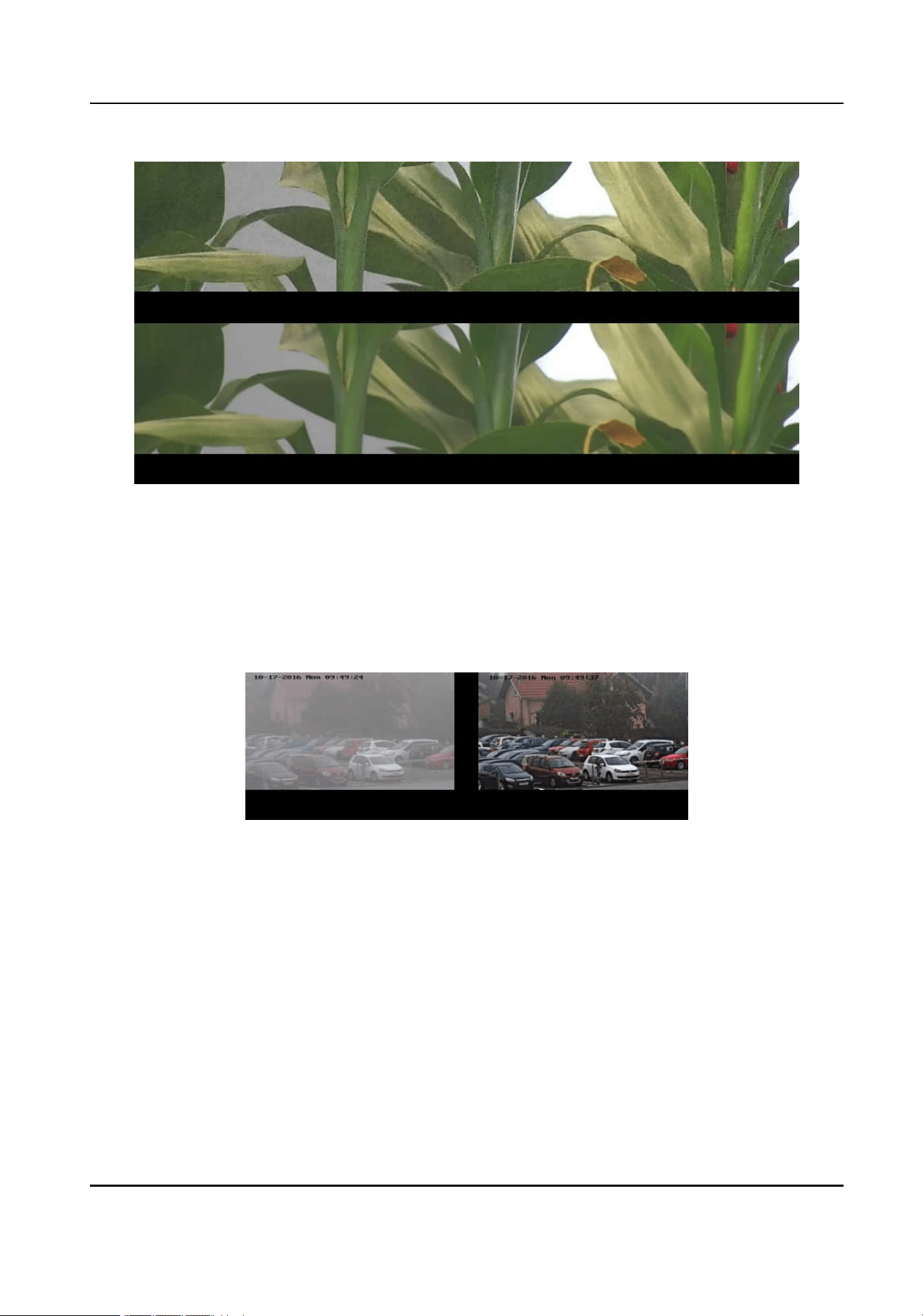
Figure 5-4 DNR
5.2.10 Defog
You can enable the defog function when the environment is foggy and the image is misty.
It enhances the subtle details so that the image appears clearer.
Figure 5-5 Defog
5.2.11 Gray Scale
This section introduces the gray scale function in optical channel.
You can choose the range of the grey scale as [0-255] or [16-235].
5.2.12 Set Palette
You can select the palette mode to display the thermal grayscale image to colored image.
Thermal & Optical Bi-spectrum Network Camera User Manual
38

Steps
1.
Go to
Conguration > Image > Display Settings .
2.
Select the thermal channel.
3.
Select a palette mode in Image Enhancement according to your need.
Result
The live view displays the image with palette.
5.2.13 Set Target Enhancement
You can set the color of the targets in different temperature ranges to identify the target
quickly.
Steps
1.
Go to
Conguration > Image > Display Settings .
2.
Select the thermal channel.
3.
Click Image Enhancement, select Palette as White Hot or Black Hot.
4.
Set the temperature value and color of High Temperature, Interval Temperature, or Low
Temperature targets.
Above (be colored)
When the target of high temperature needs to be colored, you can set the high
temperature color. Target above the setting temperature will be displayed in setting
color.
Between (be colored)
When the target of an interval temperature needs to be colored, you can set the
interval temperature color. Target between the minimum and the maximum
temperatures will be displayed in setting color.
Below (be colored)
When the target of low temperature needs to be colored, you can set the low
temperature color. Target below the setting temperature will be displayed in setting
color.
5.
Click Save.
5.2.14 DDE
Digital Detail Enhancement is used to adjust the details of the image. OFF and Normal
modes are selectable.
OFF
Disable this function.
Normal
Thermal & Optical Bi-spectrum Network Camera User Manual
39

Set the DDE level to control the details of the image. The higher the level is, the more
details shows, but the higher the noise is.
5.2.15 Brightness Sudden Change
When the brightness of target and the background is hugely different (the temperature
difference of target and background is huge), the system reduces the difference for
viewing.
5.2.16 Enhance Regional Image
You can select the desired area of image to improve the coding quality. The regional image
will be more detailed and clear.
Steps
1.
Go to
Conguration > Image > Display Settings > Image Enhancement .
2.
Select the area of regional image enhancement. You can select OFF to disable this
function, or select Custom Area to draw a desired area.
A red rectangle shows on the display, in which the image quality is improved.
5.2.17 Mirror
When the live view image is the reverse of the actual scene, this function helps to display
the image normally.
Select the mirror mode as needed.
Note
The video recording will be shortly interrupted when the function is enabled.
5.2.18 Video Standard
Video standard is an ability of a video card or video display device that denes the amount
of colors that are shown and the resolution. The two most common video standard used
are NTSC and PAL. In NTSC, 30 frames are transmitted each second. Each frame is made
up of 525 individual scan lines. In PAL, 25 frames are transmitted each second. Each frame
is made up of 625 individual scan lines. Select video signal standard according to the
video system in your country/region.
5.2.19 Digital Zoom
You can zoom in the image. The larger the zoom size is, the more blurred the image is.
Thermal & Optical Bi-spectrum Network Camera User Manual
40

5.2.20 Scene Mode
There are several sets of image parameters predened for different installation
environments. Select a scene according to the actual installation environment to speed up
the display settings.
5.2.21 Local Output
Some camera models support CVBS, SDI, or HDMI output. Set the local output ON or OFF
according to the actual device. This is the start of your concept.
5.3 OSD
You can customize OSD (On-screen Display) information such as device name, time/date,
font, color, and text overlay displayed on video stream.
Go to OSD setting page:
Conguration > Image > OSD Settings . Set the corresponding
parameters, and click Save to take effect.
Character Set
Select character set for displayed information. If Korean is required to display on screen,
select EUC-KR. Otherwise, select GBK.
Displayed Information
Set camera name, date, week, and their related display format.
Text Overlay
Set customized overlay text on image.
OSD Parameters
Set OSD parameters, such as Display Mode, OSD Size, Font Color, and Alignment.
5.4 VCA Rule Display Settings
The VCA rule display refers to the function that you can customize the displayed overlay
information of the VCA rule, which includes the font size and line and frame color.
You can go to
Conguration > Image > VCA Rule Display to select the desired font size, and
set the line and frame color.
Thermal & Optical Bi-spectrum Network Camera User Manual
41

5.5 Set Privacy Mask
The function blocks certain areas in the live view to protect privacy. No matter how the
device moves, the blocked scene will never be seen.
Steps
1.
Go to
Conguration > Image > Privacy Mask .
2.
Select the channel No.
3.
Check Enable.
4.
Click
. Drag the mouse in the live view to draw a closed area.
Drag the corners of the area Adjust the size of the area.
Drag the area Adjust the position of the area.
Click Clear all the areas you set.
5.
Click Add to add a privacy mask and set Region Name and Mask Type.
6.
Click Save.
5.6 Overlay Picture
Overlay a customized picture on live view.
Before You Start
The picture to overlay has to be in BMP format with 24-bit, and the maximum picture size
is 128 × 128 pixel.
Steps
1.
Go to
Conguration > Image > Picture Overlay .
2.
Select a channel to overlay picture.
3.
Check Enable.
4.
Click Upload to select a picture and open it.
The picture with a red rectangle will appear in live view after successfully uploading.
5.
Drag the red rectangle to adjust the picture position.
6.
Click Save.
5.7 Set Manual DPC (Defective Pixel Correction)
If the amount of defective pixels in the image is comparatively small and accurate
correction is needed, you can correct these pixels manually.
Steps
1.
Go to Conguration > Image > DPC .
2.
Select the thermal channel.
Thermal & Optical Bi-spectrum Network Camera User Manual
42

3.
Click the defective pixel on the image, then a cursor shows on the live view.
4.
Click Up, Down, Left, Right to adjust the cursor position to the defective pixel position.
5.
Click
, then click to correct defective pixel.
Note
If multiple defective pixels need to be corrected, click after locating a defective pixel.
Then after locating other pixels, click
to correct them simultaneously.
6.
Optional: Click to cancel defective pixel correction.
5.8 Set Picture in Picture
You can overlay the images of two channels and view the image of two channels at the
same time.
Steps
1.
Select a channel number.
2.
Select the picture in picture mode.
Overlap Mode Partial image of thermal channel is displayed on the full screen of
optical channel. This mode is only supported in Camera 01.
Details Overlay The device displays the details of optical channel on thermal
channel. This mode is only supported in Camera 02.
Optimized
Details Overlay
The device displays more optical details on thermal channel with
less palettes color which mainly focuses on the high temperature
target. This mode is only supported in Camera 02.
Note
The function varies according to different models
3.
In Details Overlay or Optimized Details Overlay, set the Fusion Distance of the target to
get the best view of bi-spectrum fusion. It is recommended to use the default value.
4.
Optional: In Optimized Details Overlay, set the Image Fusion Ratio to adjust the ratio of
optical details displayed on thermal channel.
5.
Select a Fusion Type.
Central Fusion
The device displays the bi-spectrum fusion of scene center. The
fusion area is 70% of the whole scene.
Full Screen
Fusion
The device displays the bi-spectrum fusion of the whole scene.
6.
Click Save.
Note
Not all models support this function. Please take the actual product for reference.
Thermal & Optical Bi-spectrum Network Camera User Manual
43

Chapter 6 Video Recording and Picture Capture
This part introduces the operations of capturing video clips and snapshots, playback, and
downloading captured
les.
6.1 Storage Settings
This part introduces the
conguration of several common storage paths.
6.1.1 Set Memory Card
If you choose to store the les to memory card, make sure you insert and format the
memory card in advance.
Before You Start
Insert the memory card to the camera. For detailed installation, refer to
Quick Start Guide
of the camera.
Steps
1.
Go to storage management setting page: Conguration > Storage > Storage
Management > HDD Management .
2.
Select the memory card, and click Format to start initializing the memory card.
The Status of memory card turns to Normal from Uninitialized, which means the
memory card can be used normally.
3.
Optional:
Dene the Quota of the memory card. Input the quota percentage for different
contents according to your need.
4.
Optional: Check to enable POS Information Storage, then the device will record the POS
information of
reect light lter and forklift lter.
Note
The function is supported when your memory card capacity is 32 GB or above.
Formatting the memory card manually is required to reserve 16 GB for POS information.
5.
Click Save.
6.1.2 Set NAS
Take network server as network disk to store the record les, captured images, etc.
Before You Start
Get the IP address of the network disk
rst.
Thermal & Optical Bi-spectrum Network Camera User Manual
44

Steps
1.
Go to NAS setting page:
Conguration > Storage > Storage Management > Net HDD .
2.
Click HDD No.. Enter the server address and le path for the disk.
Server Address
The IP address of the network disk.
File Path
The saving path of network disk les.
Mounting Type
Select le system protocol according to the operation system.
Enter user name and password of the net HDD to guarantee the security if SMB/CIFS
is selected.
3.
Click Test to check whether the network disk is available.
4.
Click Save.
6.1.3 Set FTP
You can congure the FTP server to save images which are captured by events or a timed
snapshot task.
Before You Start
Get the FTP server address rst.
Steps
1.
Go to Event Center > Alarm Setting > FTP .
2.
Congure FTP settings.
Server Address and Port
The FTP server address and corresponding port.
User Name and Password
The FTP user should have the permission to upload pictures.
If the FTP server supports picture uploading by anonymous users, you can check
Anonymous to hide your device information during uploading.
Directory Structure
The saving path of snapshots in the FTP server.
3.
Optional: Check Upload Picture to enable uploading snapshots to the FTP server.
4.
Click Test to verify the FTP server.
5.
Click Save.
Thermal & Optical Bi-spectrum Network Camera User Manual
45

6.1.4 Set Cloud Storage
It helps to upload the captured pictures and data to the cloud. The platform requests
picture directly from the cloud for picture and analysis. The function is only supported by
certain models.
Steps
Caution
If the cloud storage is enabled, the pictures are stored in the cloud video manager rstly.
1.
Go to Conguration > Storage > Storage Management > Cloud Storage .
2.
Check Enable Cloud Storage.
3.
Set basic parameters.
Protocol Version The protocol version of the cloud video manager.
Server IP The IP address of the cloud video manager. It supports IPv4
address.
Serve Port The port of the cloud video manager. You are recommended to
use the default port.
AccessKey The key to log in to the cloud video manager.
SecretKey The key to encrypt the data stored in the cloud video manager.
User Name and
Password
The user name and password of the cloud video manager.
Picture Storage
Pool ID
The ID of the picture storage region in the cloud video manager.
Make sure storage pool ID and the storage region ID are the
same.
4.
Click Test to test the congured settings.
5.
Click Save.
6.2 Video Recording
This part introduces the operations of manual and scheduled recording, playback, and
downloading recorded
les.
6.2.1 Record Automatically
This function can record video automatically during congured time periods.
Thermal & Optical Bi-spectrum Network Camera User Manual
46

Before You Start
Select Trigger Recording in event settings for each record type except Continuous. See
Event and Alarm
for details.
Steps
Note
The function varies according to different models.
1.
Go to Conguration > Storage > Schedule Settings > Record Schedule .
2.
Select channel No.
3.
Check Enable.
4.
Select a record type.
Note
The record type is vary according to different models.
Continuous
The video will be recorded continuously according to the schedule.
Motion
When motion detection is enabled and trigger recording is selected as linkage
method, object movement is recorded.
Alarm
When alarm input is enabled and trigger recording is selected as linkage method, the
video is recorded after receiving alarm signal from external alarm input device.
Motion | Alarm
Video is recorded when motion is detected or alarm signal is received from the
external alarm input device.
Motion & Alarm
Video is recorded only when motion is detected and alarm signal is received from the
external alarm input device.
Event
The video is recorded when
congured event is detected.
5.
Set schedule for the selected record type. Refer to
Set Arming Schedule
for the setting
operation.
6.
Click Advanced to set the advanced settings.
Overwrite
Enable Overwrite to overwrite the video records when the storage space is full.
Otherwise the camera cannot record new videos.
Pre-record
The time period you set to record before the scheduled time.
Thermal & Optical Bi-spectrum Network Camera User Manual
47

Post-record
The time period you set to stop recording after the scheduled time.
Stream Type
Select the stream type for recording.
Note
When you select the stream type with higher bitrate, the actual time of the pre-record
and post-record may be less than the set value.
Recording Expiration
The recordings are deleted when they exceed the expired time. The expired time is
congurable. Note that once the recordings are deleted, they can not be recovered.
7.
Click Save.
6.2.2 Record Manually
Steps
1.
Go to
Conguration > Local .
2.
Set the Video Size and Video Saving Path for recorded video les.
3.
Click Save.
4.
Click in the live view interface to start recording. Click to stop recording.
What to do next
View the recorded video les.
Go to Conguration > Local and click Open behind Video Saving Path to open the saving
path and view the les.
6.2.3 Playback and Download Video
You can search, playback, clip and download the videos stored in the local storage or
network storage.
Steps
1.
Go to Playback > Video .
2.
Select channel No.
3.
Set search condition and click Search.
The matched video
les showed on the timing bar.
4.
Click to play the video les.
-
Click to play video les in full screen. Press ESC to exit full screen.
-
Click
to stop video playback for all channels.
5.
Optional: Click , check the channel, select the time and click to view videos of
channel 1 and channel 2 synchronously. Click
to view videos asynchronously.
Thermal & Optical Bi-spectrum Network Camera User Manual
48

6.
Optional: Click to clip video les. Click again to stop clipping video les
Note
Go to Conguration > Local > Clip Saving Path , view and change the saving path of
clipped video
les.
7.
Optional: Click on the playback interface to download les.
Note
Go to Conguration > Local > Downloaded File Saving Path , view and change the saving
path of downloaded video
les.
6.3 Capture Conguration
The device can capture the pictures manually or automatically and save them in
congured saving path. You can view and download the snapshots.
6.3.1 Capture Automatically
This function can capture pictures automatically during congured time periods.
Before You Start
If event-triggered capture is required, you should congure related linkage methods in
event settings. Refer to
Event and Alarm
for event settings.
Steps
1.
Go to Conguration > Storage > Schedule Settings > Capture > Capture Parameters .
2.
Set the capture type.
Timing
Capture a picture at the
congured time interval.
Event-Triggered
Capture a picture when an event is triggered.
3.
Set the Format, Resolution, Quality, Interval, and Capture Number.
4.
Refer to
Set Arming Schedule
for conguring schedule time.
5.
Click Save.
6.3.2 Capture Manually
Steps
1.
Go to
Conguration > Local .
2.
Set the Image Format and saving path to for snapshots.
JPEG
Thermal & Optical Bi-spectrum Network Camera User Manual
49

The picture size of this format is comparatively small, which is better for network
transmission.
BMP
The picture is compressed with good quality.
3.
Click Save.
4.
Click
near the live view or play back window to capture a picture manually.
6.3.3 View and Download Picture
You can search, view and download the pictures stored in the local storage or network
storage.
Steps
1.
Go to Playback > Picture .
2.
Select channel No.
3.
Set search condition and click Search.
The matched pictures showed in the
le list.
4.
Download the pictures.
-
Select the pictures then click Download to download them.
-
Click Download This Page to download the pictures of this page.
-
Click Download All to download all the pictures.
Note
Go to Conguration > Local > Playback Capture Saving Path , view and change the
saving path of captured pictures when playback.
Thermal & Optical Bi-spectrum Network Camera User Manual
50

Chapter 7 VCA Resource
VCA resource is a collection of smart functions supported by the device.
7.1 Temperature Measurement
When you enable this function, the device measures the actual temperature of the scene. It
alarms when temperature exceeds the temperature threshold value.
7.1.1 Set Thermography Parameters
Congure the parameters of temperature measurement.
Steps
1.
Go to
Conguration > Local , enable Display Temperature Info.
Display Temperature Info.
Select Yes to display temperature information on live view.
Enable Rules to display the rules information on live view.
2.
Click Save.
3.
Go to Event Center > Temperature Measurement > Basic Parameter to congure
parameters.
Enable Temperature Measurement
Check to enable temperature measurement function.
Alarm Mode
Select an alarm mode as needed, and go to Temperature Measurement >
Temperature Measurement Parameter > Rule to
congure the alarm rules and
parameters.
●
Temperature Measurement Alarm: The device sends alarms or pre-alarms when it
detects object whose temperature is above the threshold.
●
Interval Temperature Measurement Alarm: The device sends alarms when it
detects object whose temperature is within or out of the preset temperature
interval.
Alarm Interval
Set the alarm interval between two alarms.
Normal Rule Color
The color of the interval temperature measurement rule when the rule area is in the
normal mode.
Distance Mode
Thermal & Optical Bi-spectrum Network Camera User Manual
51

Set distance mode according to actual application. You can select Auto when the
target moves in certain area, and select Fixed when the target is static.
Enable Color-Temperature
Check to display Temperature-Color Ruler in live view.
Display Temperature Info. on Stream
Check to display temperature information on the stream.
Display Max./Min./Average Temperature
Check to display maximum/minimum/average temperature information on liveview
when the temperature measurement rule is line or area.
Display Position
Select the position of temperature information showed on the live view.
●
Near Target: display the information beside the temperature measurement rule.
●
Top Left: display the information on the top left of screen.
Display Rule Name
Display the rule name rather than the rule ID on the live view. You can set the name in
expert temperature measurement mode for the rule.
Temperature Unit
Display temperature with Degree Celsius (°C)/Degree Fahrenheit (°F)/Degree Kelvin
(K).
Temperature Range
Select the temperature measurement range. The device automatically switches its
temperature range between available range options according to the measured
highest temperature if you select Auto.
Overlay & Capture
Go to Event Center > Temperature Measurement > Temperature Measurement
Parameter > Overlay & Capture to
congure whether to enable pixel-to-pixel
thermometry data and select alarm rule type..
●
Display Pixel-to-Pixel Thermometry Data on Stream: Check to enable pixel-to-pixel
thermometry data on stream and select data refresh interval.
●
Display Rule Info. on Alarm Picture: Select to display only alarm rule or all rules on
alarm pictures, and choose alarm picture quality.
Algorithm Version
Go to Event Center > Temperature Measurement > Temperature Measurement
Parameter > Advanced
Conguration to view the temperature measurement algorithm
library and calibration
le version.
Note
The settings vary according to different camera models.
4.
Click Save.
Thermal & Optical Bi-spectrum Network Camera User Manual
52

7.1.2 Set Shield Region
You can congure areas from being detected.
Steps
1.
Go to Event Center > Temperature Measurement > Temperature Measurement
Parameters > Shield Region .
2.
Check Enable.
3.
Click
. Click and drag the mouse on the live image, and then right click the mouse to
nish drawing one area.
4.
Drag the mouse in the live view to draw the area. You can drag the corners of the red
rectangle area to change its shape and size.
5.
Optional: Click
to clear all the areas.
6.
Optional: Select one area and click
to delete it.
7.
Click Save.
Note
●
Line type thermography rule cannot overlap with shield region.
●
If area type thermography rule overlaps with shield region, temperature measurement
does not take effect in the overlapped area.
●
Shield region cannot contain complete thermography rules.
7.1.3 Automatic Thermography
Congure the temperature measurement parameters and temperature measurement rules.
The device can measure the actual temperature and output alarms when temperature
exceeds the alarm threshold value.
Set Normal Mode
This function is used to measure the temperature of the whole scene and alarm.
Steps
1.
Go to Event Center > Temperature Measurement > Temperature Measurement
Parameter > Basic Parameter , and check Enable Temperature Measurement.
2.
Refer to
Set Thermography Parameters
to set the parameters.
3.
Go to Event Center > Temperature Measurement > Temperature Measurement
Parameters > Rule , and select Normal.
4.
Congure the thermography parameters.
1)Set the emissivity of your target.
2)Set the distance between the target and the device.
5.
Congure the alarm parameters of normal mode.
Thermal & Optical Bi-spectrum Network Camera User Manual
53

-
Temperature Measurement: For information about how to congure the parameters,
see
Set Temperature Measurement Alarm in Normal Mode
.
-
Interval Temperature Measurement: For information about how to congure the
parameters, see
Set Interval Temperature Measurement Alarm
.
6.
Refer to
Set Arming Schedule
for setting scheduled time. Refer to
Linkage Method
Settings
for setting linkage method.
7.
Click Save.
The maximum and minimum temperature will be displayed on the live view.
Note
●
The function varies according to different camera models.
●
Go to Image > VCA Rules Display to adjust the fonts size and the temperature color of
normal, alarm and pre-alarm.
Set Temperature Measurement Alarm in Normal Mode
In temperature measurement alarm mode, the device outputs alarm if the detected
temperature is higher than the threshold value.
Before You Start
Select Alarm Mode as Temperature Measurement Alarm
rst in Basic Parameter.
Steps
1.
Set the parameters.
Tolerance Temperature
Set the tolerance temperature to prevent the constant temperature change to affect
the alarm. E.g., set tolerance temperature as 3°C, set alarm temperature as 55°C, and
set pre-alarm temperature as 50°C. The device sends pre-alarm when its temperature
reaches 50°C and it alarms when its temperature reaches 55°C and only when the
device temperature is lower than 52°C will the alarm be cancelled.
Pre-Alarm Temperature
When the temperature of target exceeds the pre-alarm threshold, and this status
keeps more than Filtering Time, it triggers pre-alarm.
Alarm Temperature
When the temperature of target exceeds the alarm threshold, and this status keeps
more than Filtering Time, it triggers alarm.
Pre-Alarm Output and Alarm Output
Check Pre-Alarm Output and Alarm Output to link the pre-alarm or alarm with the
connected alarm device.
Temperature Sudden Change Alarm
Thermal & Optical Bi-spectrum Network Camera User Manual
54
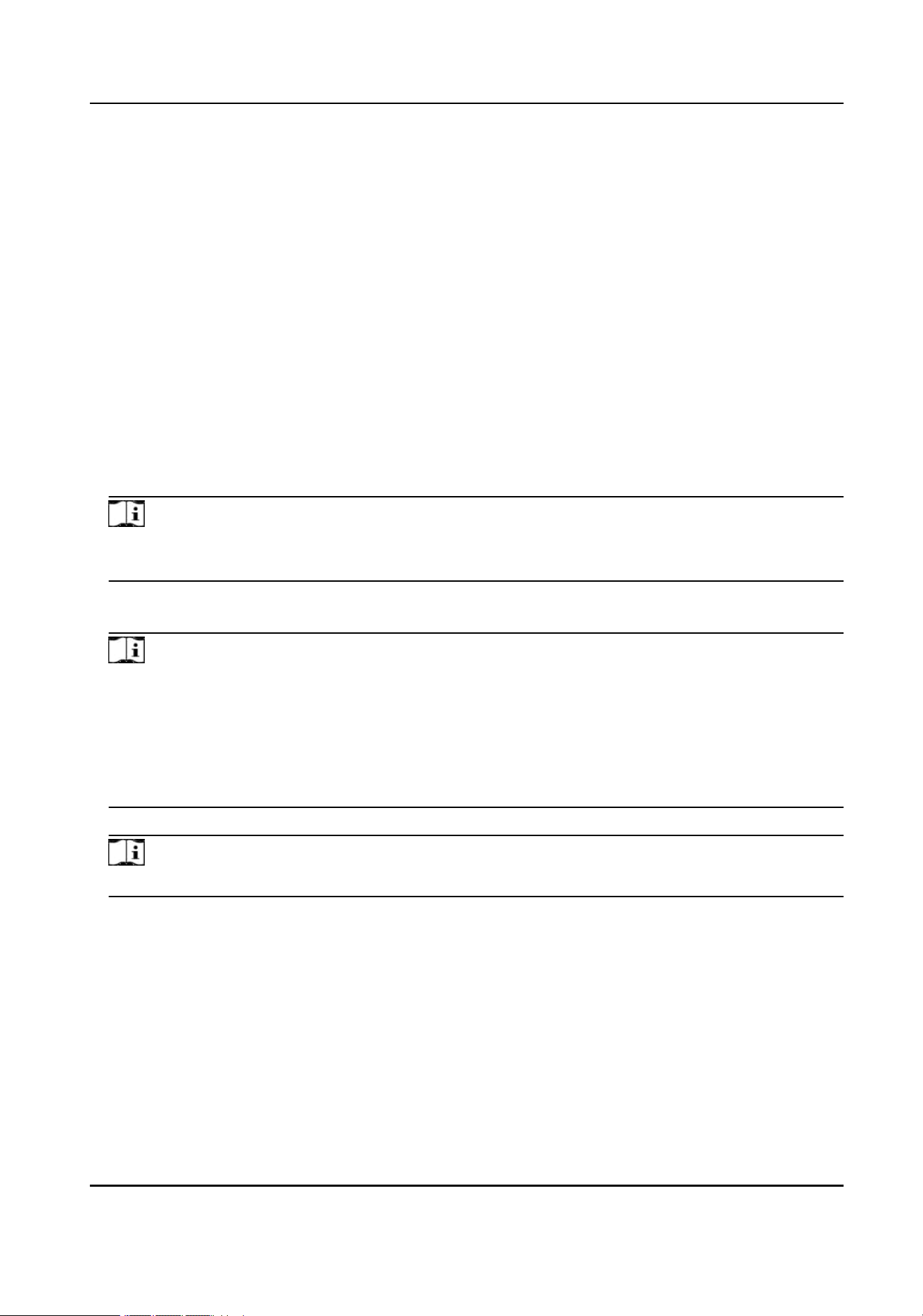
When the temperature change exceeds the set sudden change alarm value within the
set cycle, the camera triggers an alarm.
2.
Save the settings.
Set Interval Temperature Measurement Alarm
In interval temperature measurement alarm mode, the device will output alarm when the
detected temperature of the full screen (normal mode) or the thermography rules (expert
mode) triggers the set rule.
Before You Start
Select Alarm Mode as Interval Temperature Measurement Alarm
rst in basic settings.
Steps
1.
Select an Alarm Rule in Interval Temperature Measurement Alarm section.
2.
Select an Alarm Type.
Note
In normal mode, the device measures temperature of the full screen. In expert mode, the
device measures the temperature of thermography rules.
3.
Check Alarm Area Rule, and click Set to congure the alarm rule parameters.
4.
Edit the interval name, temperature range and alarm rule color.
Note
If you select Temperature Range, the device triggers an alarm when the highest
temperature in the scene is lower than the max. temperature, or when the lowest
temperature in the scene is not lower than the min. temperature. If you select Out of
Temperature Range, the device triggers an alarm when the highest temperature in the
scene is higher than the max. temperature, or when the lowest temperature in the scene
is not higher than the min. temperature.
5.
Select the alarm output channel.
Note
The function varies according to different models.
6.
Optional: In expert mode, you can click Copy to... to copy current settings for other
thermography rules.
Set Expert Mode
Select the temperature measurement rules from
Point, Line, or Area and
congure
parameters, the device alarms if the alarm rules are met.
Thermal & Optical Bi-spectrum Network Camera User Manual
55

Steps
1.
Go to Event Center > Temperature Measurement > Temperature Measurement
Parameter > Basic Parameter , check Enable Temperature Measurement.
2.
Refer to
Set Thermography Parameters
to set the parameters.
3.
Go to Conguration > Temperature Measurement > Temperature Measurement
Parameter > Rule , select Expert.
4.
Select and enable the temperature measurement rules. Please refer to
Set
Thermography Rule
for setting the rule.
5.
Congure the alarm parameters of expert mode.
-
Temperature Measurement: For information about how to
congure the parameters,
see
Set Temperature Measurement Alarm in Expert Mode
.
-
Interval Temperature Measurement: For information about how to congure the
parameters, see
Set Interval Temperature Measurement Alarm
.
6.
Optional: Click Area's Temperature Comparison to set the alarm rules and the
temperature.
7.
Click Save.
The maximum temperature and thermography rules will be displayed on the live view.
Note
Go to Conguration > Image > VCA Rules Display to adjust the font size and the
temperature color of normal, alarm and pre-alarm.
Set Thermography Rule
Steps
1.
Customize the rule name.
2.
Select the rule type to Point, Line, or Area. Then draw a point, line, or area on the
interface where the position to be measured.
Point
Please refer to
Point Thermography
for detailed conguration.
Line Please refer to
Line Thermography
for detailed conguration.
Area Please refer to
Area Thermography
for detailed conguration.
3.
Congure the temperature measurement parameters.
Emissivity
Set the emissivity of the target. The emissivity of the surface of a material is its
effectiveness in emitting energy as thermal radiation. Different objects have different
emissivity. Refer to
Common Material Emissivity Reference
to search for the target
emissivity.
.
Distance
The distance between the target and the device.
Reective Temperature
Thermal & Optical Bi-spectrum Network Camera User Manual
56

If there is any object with high emissivity in the scene, check and set the reective
temperature to correct the temperature. The reective temperature should be set the
same as the temperature of the high emissivity object.
4.
Click Save.
Click Live View, and select thermal channel to view the temperature and rules
information on live view.
Point Thermography
Congure the temperature measurement rule and click any point in live view to monitor the
temperature.
Steps
1.
Click in the live view and a cross cursor shows on the interface.
2.
Drag the cross cursor to desired position.
Go to Live View interface to view the temperature and rule of the point in thermal
channel.
Line Thermography
Congure the temperature measurement rule and monitor the maximum temperature of
the line.
Steps
1.
Click and drag the mouse to draw a line in the live view interface.
2.
Click and move the line to adjust the position.
3.
Click and drag the ends of the line to adjust the length.
Go to Live View interface to view the maximum temperature and rule of the line in
thermal channel.
Area Thermography
Congure the temperature measurement rule and monitor the maximum temperature of
the area.
Steps
1.
Click and drag the mouse in the live view to draw the area and right click to
nish
drawing.
2.
Click and move the area to adjust the position.
3.
Drag the corners of the area to adjust the size and shape.
Go to Live View interface to view the maximum temperature and rule of the area in
thermal channel.
Thermal & Optical Bi-spectrum Network Camera User Manual
57

Set Temperature Measurement Alarm in Expert Mode
In temperature measurement alarm mode, the device outputs alarm if the detected
temperature is higher than the threshold value.
Before You Start
Select Alarm Mode as Temperature Measurement Alarm rst in Basic Parameter.
Steps
1.
Set the parameters.
Alarm Temperature and Pre-Alarm Temperature
Set the alarm temperature and pre-alarm temperature. E.g., select Alarm Rule as
Above (Average Temperature), set the Pre-Alarm Temperature to 50 °C, and set the
Alarm Temperature to 55 °C. The device pre-alarms when its average temperature is
higher than 50 °C and alarms when its average temperature is higher than 55 °C.
Tolerance Temperature
Set the tolerance temperature to prevent the constant temperature change to affect
the alarm. E.g., set tolerance temperature as 3°C, set alarm temperature as 55°C, and
set pre-alarm temperature as 50°C. The device sends pre-alarm when its temperature
reaches 50°C and it alarms when its temperature reaches 55°C and only when the
device temperature is lower than 52°C will the alarm be cancelled.
Filtering Time
It refers to the duration time after the target temperature reaches or exceeds the pre-
alarm temperature/alarm temperature.
Temperature Sudden Change Alarm
Temperature Sudden Increase and OFF are selectable. When the temperature change
value in the drawn area exceeds the set alarm threshold, the device triggers an alarm.
Sudden Change Alarm Value
Set the temperature change alarm threshold for the rule. When the difference
between the max. temperature and the min. temperature in the recording cycle
exceeds the set alarm value, the device triggers an alarm.
Cycle
Set the recording period of the temperature change.
2.
Optional: Set Area's Temperature Comparison rules. Select two areas and set the
comparison rule, and set the temperature difference threshold. The device alarms when
the temperature difference meets the setting value.
3.
Save the settings.
Thermal & Optical Bi-spectrum Network Camera User Manual
58

Set Interval Temperature Measurement Alarm
In interval temperature measurement alarm mode, the device will output alarm when the
detected temperature of the full screen (normal mode) or the thermography rules (expert
mode) triggers the set rule.
Before You Start
Select Alarm Mode as Interval Temperature Measurement Alarm
rst in basic settings.
Steps
1.
Select an Alarm Rule in Interval Temperature Measurement Alarm section.
2.
Select an Alarm Type.
Note
In normal mode, the device measures temperature of the full screen. In expert mode, the
device measures the temperature of thermography rules.
3.
Check Alarm Area Rule, and click Set to congure the alarm rule parameters.
4.
Edit the interval name, temperature range and alarm rule color.
Note
If you select Temperature Range, the device triggers an alarm when the highest
temperature in the scene is lower than the max. temperature, or when the lowest
temperature in the scene is not lower than the min. temperature. If you select Out of
Temperature Range, the device triggers an alarm when the highest temperature in the
scene is higher than the max. temperature, or when the lowest temperature in the scene
is not higher than the min. temperature.
5.
Select the alarm output channel.
Note
The function varies according to different models.
6.
Optional: In expert mode, you can click Copy to... to copy current settings for other
thermography rules.
7.1.4 Manual Thermography
After enable the manual thermography function of the device, you can click any position on
the live view to show the real temperature.
Steps
1.
Go to
Conguration > Local and check Display Temperature Info..
2.
Go to Event Center > Temperature Measurement > Basic Parameter .
3.
Check Enable Temperature Measurement.
4.
Click Save.
Thermal & Optical Bi-spectrum Network Camera User Manual
59

5.
Go to live view interface and select thermal channel, click . Click any position on the
interface to show the real temperature.
7.1.5 Integration
Users can obtain the pixel-to-pixel thermometry data of the device through the persistent
connection management. The data can be used for secondary development and
integration.
Pixel-to-Pixel Thermometry
Users can congure general thermometry and data upload parameters to obtain pixel-to-
pixel thermometry data, thermometry rule information, and pictures. This function can be
used for secondary integration.
Steps
1.
Go to Event Center > Temperature Measurement > Integration > Pixel-to-Pixel
Thermometry .
2.
Congure the parameters.
Emissivity
Set the emissivity of your target. The emissivity of each object is different.
Distance
The distance between the target and the device.
Reective Temperature
If there is any object reecting to the target, e.g., a mirror, enter the background
temperature value/the
reecting object's temperature value. If not, skip the settings.
Data Length
It stands for the data length of the detected temperature information of every pixel. 2
means the temperature information type of every pixel is "short", and 4 means the
type is
"oat".
Max. Frame Rate
The max. frame rate of upload stream for further integration. High frame rate requires
more upload bandwidth.
Refreshing Interval of Temperature Mapping Table
It stands for the frame interval of refreshing the temperature mapping table.
Temperature mapping table tells the relation between detected data and the
temperature of a pixel For example, if you set it as 50 (means every 50 frames), and
the frame rate as 25 fps, then the table refreshes every 2 seconds, which also means
the displayed temperature data refreshes every 2 seconds.
Display Thermometry Rule Info. on Picture
Thermal & Optical Bi-spectrum Network Camera User Manual
60

Check this function, pictures with thermometry rule info will be uploaded.
Upload Thermal Picture
Check this function, then the thermal picture is uploaded together with the pixel-to-
pixel thermometry data.
Note
The parameters above such as Emissivity, Distance, Reective Temperature, etc. are
only applied in integration, which will not affect the
conguration in thermometry
parameters and rules.
3.
Click Save.
Integration Calibration
Integration calibration can improve temperature measurement accuracy. You can
congure integration calibration via external optical calibration and temperature rise
calibration, depending on whether the integrated device has germanium window. Use
External Optical Calibration for integrated devices with germanium window, and
Temperature Rise Calibration for integrated devices without germanium window.
Table 7-1 Integration Calibration
Calibration Type Calibration Method
External Optical
Calibration
Optical Transmissivity
Set the optical transmissivity of external optical material
(e.g. germanium window) to improve the temperature
measuring accuracy.
Calibration
Coefcient
Check Enable Calibration Coefcient and set the value of
calibration coefcient to get the temperature of the
external window or optical material automatically. The
setting range is 0 to 30. You can obtain the setting value
from SDK software.
External Optics/Window Correction
Set the temperature of the external window or optical
material (e.g. germanium window) to correct the
measured temperature.
Temperature Rise
Calibration
You can calibrate the
device via temperature
Temperature
Calibration
1. Input Stable Ambient Temperature.
2. Check Blackbody Calibration, and
input temperature, emissivity.
Thermal & Optical Bi-spectrum Network Camera User Manual
61
Calibration Type Calibration Method
calibration or correction
le.
3. Check Enable to start calibration.
4. Click Save to save the settings.
Correction File 1. Input Stable Ambient Temperature.
2. Click
, and select the correction le
that suits the current mode of the
device.
3. Click Import and Enable.
4. Optional. Click Export to export the
calibration le of the current device
mode to apply it to devices used in the
same scenarios.
5. Click Save to save the settings.
Note
Temperature rise calibration is supported only during the rst 30 minutes after the device
is powered on.
Persistent Connection Management
This function shows the maximum connections that the device supported for real-time
pixel-to-pixel thermometry data uploading and real-time rule thermometry data uploading,
and the currently established connections and their parameters. The real-time pixel-to-pixel
thermometry data is uploaded using SDK or RTSP protocol, and the real-time rule
thermometry data is uploaded using SDK or ISAPI protocol. The real-time rule thermometry
data uploaded includes the thermometry rule and the thermometry result.
Steps
1.
Go to Event Center > Temperature Measurement > Integration > Persistent Connection
Management .
2.
Click Refresh to obtain the latest connection status of the device.
7.2 Fire and Smoke Detection
The device will trigger and upload alarm when detect the re source or smoke.
The detection is applied to re-prevention purposes in scenic region, forest, tunnel and so
on. You can
congure the detection parameters. When re source or smoke is detected,
the alarm actions will be triggered.
Thermal & Optical Bi-spectrum Network Camera User Manual
62

Note
Not all models support the function. Please take the actual product for reference.
7.2.1 Recommended Scene
This part introduces the recommended scenes of re source detection and helps you
select the appropriate scene.
Fire source detection can be applied to indoor and outdoor monitoring with a large
detection radius. To achieve the best monitoring effect, please set the installation place as
requirements below.
●
The installation place should be the highest position within the detection area. The lens
should not be covered during movement to detect the maximum area.
●
It is better to choose the installation place with convenient trafc, well-equipped power
and internet facilities (e.g., communication tower, watchtower and high-rise roof).
7.2.2 Set Fire Detection
To avoid re source and other potential damage, you can congure the function for certain
areas. The detail conguration steps show as below.
Steps
1.
Go to Event Center > Temperature Measurement & Fire Prevention .
2.
Select Detection Scene.
Note
The auto detection function varies according to different detection scene.
3.
Set Auto Detection.
Detection
Function
Parameter Description
Fire
Detection
Alarm Interval
Set the alarm interval between two alarms. The smaller the value is,
the higher the detection frequency is.
Picture Quality
Set quality of the alarm capture. The better the quality is, the sharper
the image is, and the larger the
le size is.
Display Fire Source Info on Stream
Display a red frame around the re source on stream when re
occurs.
Sensitivity
Thermal & Optical Bi-spectrum Network Camera User Manual
63

The higher the value is, the more easily the re source of lower
temperature can be detected, and the higher the false alarm rate is.
Smoke
Detection
Display Smoke Info on Stream
Display a red frame around the smoke source on stream when smoke
occurs.
Sensitivity
The higher the value is, the more easily the smoke can be detected,
and the higher the false alarm rate is.
Verication Sensitivity
The higher the value is, the more quickly the device can double-check
and identify the smoke, and the higher the false alarm rate is.
Alarm Interval
Set the alarm interval between two alarms. The smaller the value is,
the higher the detection frequency is.
Picture Quality
Set quality of the alarm capture. The better the quality is, the sharper
the image is, and the larger the
le size is.
Smoking
Detection
Display Smoking Info on Stream
Display a red frame around the smoking on stream when
re occurs.
Sensitivity
The higher the value is, the more easily the smoking can be detected,
and the higher the false alarm rate is.
Verication Sensitivity
The higher the value is, the more quickly the device can double-check
and identify the smoking, and the higher the false alarm rate is.
Alarm Interval
Set the alarm interval between two alarms. The smaller the value is,
the higher the detection frequency is.
Picture Quality
Set quality of the alarm capture. The better the quality is, the sharper
the image is, and the larger the
le size is.
4.
Optional: You can shield certain areas from being detected, refer to
Set Detection Shield
Region
.
5.
Refer to
Set Arming Schedule
for setting scheduled time. Refer to
Linkage Method
Settings
for setting linkage method.
Thermal & Optical Bi-spectrum Network Camera User Manual
64

7.2.3 Set Detection Shield Region
Steps
1.
Check to enable the function.
2.
Click Draw Area and drag the mouse in the live view to draw the area. Release the mouse
to
nish drawing. You can drag the corners of the red rectangle area to change its shape
and size or drag the rectangle to the position on your demand.
3.
Click Stop Drawing. You can click Clear All to clear all of the setting areas.
4.
Check Display Shield Area to show the shield area on the live view.
5.
Click Add to save the re detection shield, and it will be listed in the list. You can select a
region and click Delete to delete it from the list. You can also enable the region or not.
6.
Click Save.
7.3 Perimeter Protection
The function is used to detect whether there is any target breaking the perimeter
protection rules. The device will track the target and alarm when the perimeter protection
rule is triggered.
7.3.1 Set Perimeter Protection Rules
The device can detect whether there is any target breaking the perimeter protection rules.
The device will alarm when the rule is triggered.
Steps
1.
Go to Event Center > Perimeter Protection .
2.
Check to enable the function.
3.
Optional: Check Enable Fusion to view optical and thermal image.
4.
Set perimeter protection rules.
1)Click
to add a new rule.
2)Enter the rule name, and click the drop down menu to select Rule Type.
Line Crossing
If any target moves across the setting line, the alarm will be triggered. You can set
the crossing direction.
Intrusion
If any target intrudes into the
pre-dened region longer than the set duration, the
alarm will be triggered.
Region Entrance
If any target enters the
pre-dened region, the alarm will be triggered.
Region Exiting
Thermal & Optical Bi-spectrum Network Camera User Manual
65
If any target exits the pre-dened region, the alarm will be triggered.
3)Draw the detection rule.
Line Crossing
a. Click
to draw a line in the live view.
b. You can drag end points of the line to adjust the position and length.
c. Set the crossing direction. Bidirectional, A-to-B, or B-to-A are selectable.
d. Set Sensitivity. The higher the value is, the easier the target can be detected.
Intrusion
a. Click to draw an area in the live view. Right click the mouse to nish drawing.
b. Set Duration. When a target intrudes into the set area and stays in the area for
more than the set duration, the device triggers an intrusion alarm.
c. Set Sensitivity. The higher the value is, the easier the target can be detected.
Region Entrance and Region Exit
a. Click
to draw an area in the live view. Right click the mouse to nish drawing.
It is recommended to draw three different areas covering the whole detection
scene from near to far.
Note
The recommended drawing is optional for some camera models, refer to the
pop-up operation guide after you checked Intelligent Analysis.
b. Target that enters or exits the set area triggers the region entrance or region exit
alarm.
4)Set other parameters for the rule.
Target Detection
You are recommended to select the target as Human & Vehicle.
Scene Mode
The scene mode is set to be General by default. Select Distant View when you are
far from the targets. Select Leaves Interfered View when there are shaking targets
in the scene, such as leaves.
Note
In distance view, the device cannot classify the target with pixels less than 10*10.
The target will be recognized as human directly. So the selection of this item will
increase trigger false alarm rate but decrease missing alarm rate.
Background Interference Suppression
Eliminate the environment interference to reduce the false alarm. For example, the
false alarms caused by wind blowing grass.
Note
The parameter is available in optical channel.
Thermal & Optical Bi-spectrum Network Camera User Manual
66
Filter by Pixel
Check to enable Filter by Pixel. Draw max. size and min. size rectangles to
lter the
target among human, vehicle, animal, and others. Only the target whose size is
between the Max. Size and Min. Size value will trigger the alarm.
Note
●
The lter conguration is optional for some camera models, refer to the pop-up
operation guide after you checked Intelligent Analysis.
●
You can draw the max. size and min. size rectangles according to the real target
in the scene. The recommended size is 1.2 times of the target.
5)Repeat steps above to congure other rules.
Note
You can click to copy the same settings to other rules.
6)Click Save.
5.
Optional: Add more rules and set combined event. This function is used to combine
multiple events as alarm conditions of the rule and it only triggers alarm when the rule
and all the conditions are triggered simultaneously.
1)Check Alarm Trigger Condition.
2)Select the condition type. Enable an event
rst then you can select it as the alarm
condition.
3)Select the event according to the selected condition type. Click Save.
Note
●
Once a rule has been set as the alarm trigger condition of other rules, it is not
supported to set its own trigger condition.
●
Alarm trigger conditions cannot be the same of one rule.
6.
Set Arming Schedule
and
Linkage Method Settings
for each rule.
7.
Optional: You can shield certain areas from being detected. Refer to
Set Perimeter
Protection Shield Region
for detailed settings.
8.
Optional: Set displayed VCA information on stream or picture. Refer to
Set Perimeter
Protection Parameters
for detailed settings.
9.
Optional: Calibrate the camera to improve the accuracy. Refer to
Calibration
for detailed
settings.
7.3.2 Set Perimeter Protection Shield Region
You can congure areas from being detected.
Steps
1.
Go to Conguration > Local , and enable Display Shield Area.
2.
Go to Event Center > Perimeter Protection > Shield Region .
3.
Click
.
Thermal & Optical Bi-spectrum Network Camera User Manual
67

4.
Drag the mouse in the live view to draw the area. You can drag the corners of the red
rectangle area to change its shape and size.
5.
Right click the mouse to stop drawing.
6.
Optional: Select one area and click
to delete it.
7.
Click Save.
7.3.3 Set Perimeter Protection Parameters
Steps
1.
Go to Conguration > Local .
Rules
Enable it to display rules information on live view.
Display Rules Info. on Capture
Select Yes to display rules information on the capture.
2.
Go to
Conguration > Perimeter Protection .
3.
Select the camera channel.
4.
Go to Basic Settings to
congure basic parameters for the channel.
Display VCA Info. on Stream
Select to display target info and rule on stream, the information will be added to the
video stream, and the overlay will be displayed if you get live view or play back by the
VS Player.
Display Target Info. on Alarm Picture
Select to display the target information on the alarm picture.
Display Rule Info. on Alarm Picture
Select to display the rule information on the alarm picture.
Snapshot Settings
Select to upload the picture to the surveillance center when the VCA alarm occurs.
You can also set the quality of the picture.
5.
Click Save.
7.3.4 Calibration
You can calibrate the camera rst to improve the detection accuracy of perimeter
protection. The calibration is optional, take the actual condition for reference.
Note
The function and the path to the calibration page vary according to different camera
models.
Thermal & Optical Bi-spectrum Network Camera User Manual
68

Calibrate the Camera
Steps
1.
Go to Event Center > Perimeter Protection > Camera Calibration or Event Center >
Perimeter Protection > Advanced Conguration .
Note
The path varies according to different camera models.
2.
Check Camera Calibration.
3.
Select Calibration Mode.
-
For Self-Learning Calibration, see
Self-Learning Calibration
.
-
For Traditional Calibration, see
Calibrate Automatically
and
Calibrate Manually
.
Note
The function varies according to different camera models. If Calibration Mode is not
supported, see
Calibrate Automatically
and
Calibrate Manually
.
Self-Learning Calibration
The self- learning calibration allows a camera calibration based on the automatic analysis
of people height data.
Steps
1.
Select Filter Level. The higher the level is, the more easily the alarm can be triggered.
2.
Check Camera Calibration. The device will automatically record and analyze the height
range of people at different positions,
ltering out the target out of the range.
3.
The calibration area is divided into 20 rows. There needs to be a person walking back
and forth twice in the white area (uncalibrated) until all the lines turn to green
(calibrated). You can pause the calibration process or recalibrate.
Thermal & Optical Bi-spectrum Network Camera User Manual
69
Figure 7-1 Calibration Area Lines
4.
Optional: Check Manual Correction and adjust the height range manually.
Note
Manual correction requires enough self-learning calibration time or targets.
1)Select Fig N (1~4).
2)You can click Previous or Next to change the target of each gure.
3)Input the actual height of the target. Click Save.
Calibrate Automatically
Before You Start
●
Make sure that you have known the actual height of the target person in the scene.
●
Make sure there is no moving objects in the view except for the person.
Steps
1.
Go to Event Center > Perimeter Protection > Camera Calibration or Event Center >
Perimeter Protection > Advanced
Conguration .
Note
The path varies according to different camera models.
2.
Check Camera Calibration.
3.
When the person is totally seen in live view, enter the height of person in Target Height.
Thermal & Optical Bi-spectrum Network Camera User Manual
70
Note
You can set a maximum of two decimal places.
4.
Click to start calibration.
Caution
●
The auto calibration starts when the person is totally seen in live view, and ends when
the person is in the endpoint.
●
The endpoint-to-camera distance (m) equals 4 times the lens focal length (mm). E.g,
for 7mm lens, the recommended endpoint is 28m (7*4).
●
The person should walk in zigzag path. And two zigzag paths are required. Make sure
the walking route covers the left, middle, right of image.
●
The auto calibration duration should be no shorter than 10 sec, and no longer than 10
min. The device will stop calibration automatically if the duration is too long.
●
If there is moving object such as leave or tree in the scene, you can set the shielded
area . Refer to
Set Shield Region
for detail settings.
5.
When the person exits, click to stop calibration.
Note
After auto calibration, refer to
Verify the Calibration Result
to verify if the calibration is
successful. Set manual calibration if the auto calibration failed, or the
veried result
turns bad.
Result
After calibration, the height and angle of camera will be shown in live view.
Calibrate Manually
Steps
1.
Go to Event Center > Perimeter Protection > Camera Calibration or Event Center >
Perimeter Protection > Advanced
Conguration .
Note
The path varies according to different camera models.
2.
Check Manual Calibration.
3.
Click Fig 1. Click
and drag the vertical line until it ts the target.
4.
Enter the actual length of the calibration line.
5.
Repeat steps above to set Fig 2, Fig 3, and Fig 4.
Note
Draw a calibration line in each gure, and the four calibration lines should be evenly
distributed in the same horizontal plane from left to right.
Thermal & Optical Bi-spectrum Network Camera User Manual
71

In the four gures, the calibrated object doesn't need to be the same. Select a proper
object in each
gure.
6.
Optional: Click to delete the calibration line.
7.
Click Save.
Caution
●
Separate 4 vertical lines in the optical-axis direction at the close site, middle and far
site respectively.
●
Separate 4 vertical lines at the left, middle and right of the image respectively.
●
If manual calibration's result is incorrect, select another target to recalibrate.
●
After manual calibration, refer to
Verify the Calibration Result
to verify if the calibration
is successful.
Result
After calibration, the height and angle of camera will be shown in live view.
Verify the Calibration Result
The function can verify whether the calibrated value is consistent with the actual value.
Steps
1.
Click .
2.
Click , and drag a vertical line in the view.
3.
Move the line to the target, then click
to calculate the length.
Compare the calculated line length to the actual length to verify the calibration settings.
4.
Click
to exit.
Note
Verify not only person, but also other objects appeared in the view. Such as car, street
lamp, etc.
7.3.5 Set Advanced Conguration Parameters
Go to Event Center > Perimeter Protection > Advanced Conguration and congure the
parameters.
Detection Parameters
Single Alarm
The system only sends alarm once for one target triggering. Otherwise, the alarm will be
triggered continuously until the target disappears.
Activation Period
Thermal & Optical Bi-spectrum Network Camera User Manual
72

Set the duration of the alarm with combined events.
Restore Parameters
Restore Default
Click Restore to restore the parameters to the default.
Restart VCA
Click Restart to restart the VCA function.
Note
The settings vary according to different models.
7.4 Open Platform
Open platform allows you to install the application for the third-party to develop and run its
function and service.
Note
Only certain device models support the function.
7.4.1 Set Open Platform
You can install the application for the third-party to develop and run its function and
service. For the device supporting this function, you can follow the steps to import and run
smart applications.
Steps
1.
Go to Open Platform interface.
Note
Before installing the application, make sure that the application you want to install t the
following conditions.
●
Each application has its own exclusive name.
●
The FLASH memory space that the application takes up is less than the available
FLASH memory space of the device.
●
The memory and computing power of the application is less than that available
memory and computing power of the device.
2.
In Apps, click Import Application.
3.
Click Browse to select an application package.
4.
Click Import to import the package. You can click the APP to view relevant details.
5.
Optional: Set application.
Thermal & Optical Bi-spectrum Network Camera User Manual
73
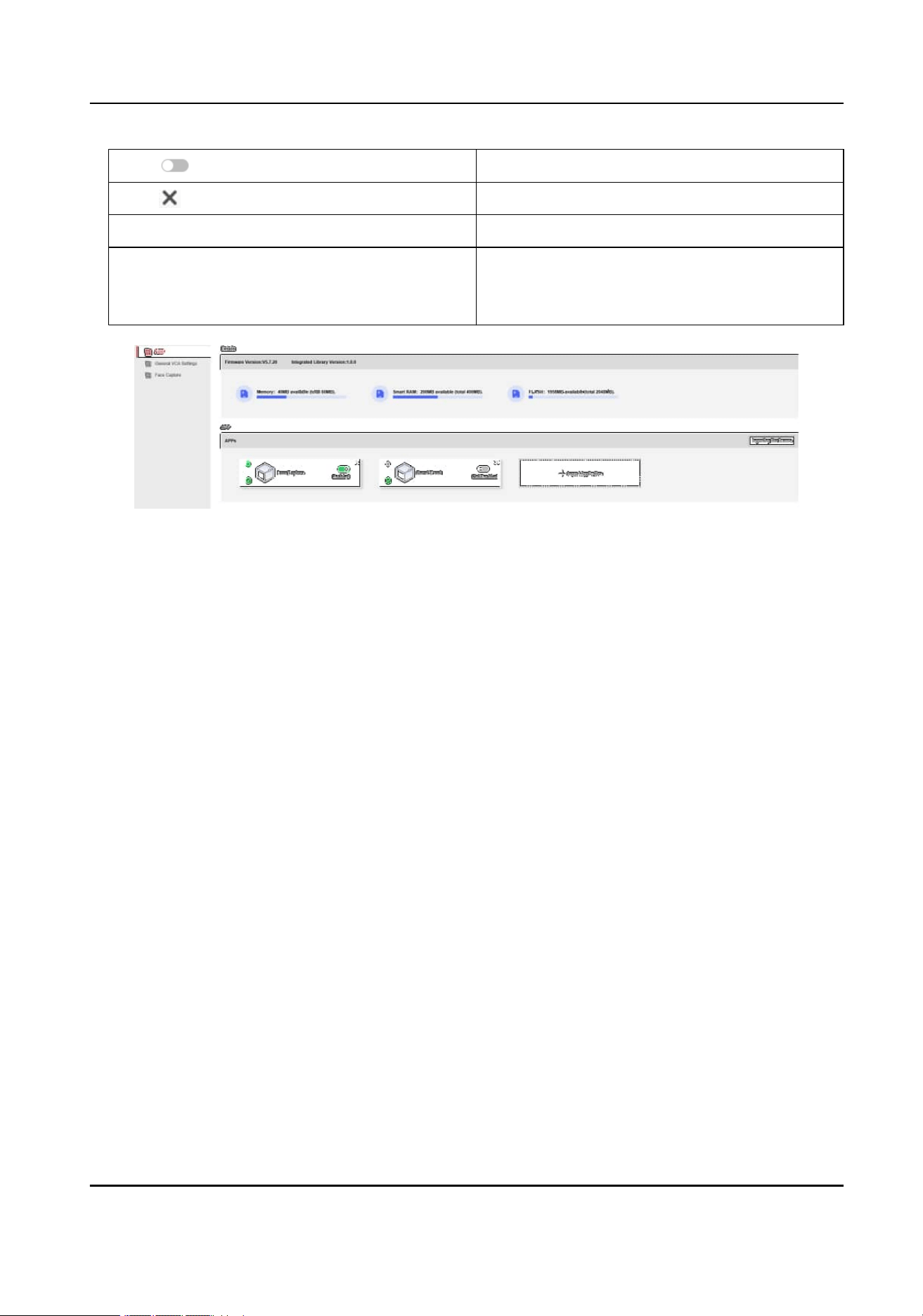
Click Enable or disable the application.
Click Delete the application.
Click Download Logs Export log.
Click Update Browse a local path and import an
application package to update the
application.
Figure 7-2 Set VCA Resource
Thermal & Optical Bi-spectrum Network Camera User Manual
74

Chapter 8 Event and Alarm
This part introduces the
conguration of events. The device takes certain response to
triggered alarm. Certain events may not be supported by certain device models.
8.1 Set Motion Detection
It helps to detect the moving objects in the detection region and trigger the linkage actions.
Steps
1.
Go to Event Center > Basic Event > Motion Detection .
2.
Select the channel No.
3.
Check Enable Motion Detection.
4.
Optional: Highlight to display the moving object in the image in green.
1)Check Enable Dynamic Analysis for Motion.
2)Go to
Conguration > Local .
3)Set Rules to Enable.
5.
Select
Conguration Mode, and set rule region and rule parameters.
-
For the information about normal mode, see
Normal Mode
.
-
For the information about expert mode, see
Expert Mode
.
6.
Set the arming schedule and linkage methods. For the information about arming
schedule settings, see
Set Arming Schedule
. For the information about linkage
methods, see
Linkage Method Settings
.
7.
Click Save.
8.1.1 Normal Mode
You can set motion detection parameters according to the device default parameters.
Steps
1.
Select Normal Mode in Conguration.
2.
Set the Sensitivity of normal mode. The higher the value of sensitivity is, the more
sensitive the motion detection is. If the sensitivity is set to
0
, motion detection and
dynamic analysis do not take effect.
3.
Set Detection Target. Human and vehicle are available. If the detection target is not
selected, all the detected targets will be reported, including the human and vehicle. This
function allows alarm triggering by
specied target types (human and vehicle).
Note
This function is only available for certain device models under certain settings. Please
refer to the actual settings.
Thermal & Optical Bi-spectrum Network Camera User Manual
75

4.
Click . Click and drag the mouse on the live image, and then right click the mouse to
nish drawing one area.
5.
Optional: Click to clear all the areas.
6.
Optional: You can set the parameters of multiple areas by repeating the above steps.
8.1.2 Expert Mode
You can congure the motion detection parameters of day/night switch according to the
actual needs.
Steps
1.
Select expert mode in
Conguration.
2.
Set parameters of expert mode.
Scheduled Image Settings
OFF: Switch is disabled.
Auto-Switch: The system switches day/night mode automatically according to
environment. It displays colored image at day and black and white image at night.
Scheduled-Switch: The system switches day/night mode according to the schedule. It
switches to day mode during the set periods and switches to night mode during the
other periods.
Note
This function is not supported in the expert mode of thermal channel.
Sensitivity
The higher the value of sensitivity is, the more sensitive the motion detection is. If the
sensitivity is set to
0
, motion detection and dynamic analysis do not take effect.
3.
Select an Area and click Draw Area. Click and drag the mouse on the live video, then
release the mouse to
nish drawing one area.
Stop Drawing
Finish drawing one area.
Clear All Delete all the areas.
4.
Optional: Repeat the above steps to set multiple areas.
8.2 Set Video Tampering Alarm
When the congured area is covered and cannot be monitored normally, the alarm is
triggered and the device takes certain alarm response actions.
Steps
1.
Go to Event Center > Basic Event > Video Tampering .
2.
Select the channel number.
Thermal & Optical Bi-spectrum Network Camera User Manual
76

3.
Check Enable.
4.
Set the Sensitivity. The higher the value is, the easier to detect the area covering.
5.
Click
and drag the mouse in the live view to draw the area.
Figure 8-1 Set Video Tampering Area
6.
Optional: Click to delete all the drawn areas.
7.
Refer to
Set Arming Schedule
for setting scheduled time. Refer to
Linkage Method
Settings
for setting linkage method.
8.
Click Save.
8.3 Set Alarm Input
Alarm signal from the external device triggers the corresponding actions of the current
device.
Thermal & Optical Bi-spectrum Network Camera User Manual
77

Before You Start
Note
This function is only supported by certain models.
Make sure the external alarm device is connected. See
Quick Start Guide
for cable
connection.
Steps
1.
Go to Event Center > Basic Event > Alarm Input .
2.
Select an Alarm Input NO. and click
to set alarm input.
3.
Select Alarm Type from the dropdown list. Edit the Alarm Name.
4.
Check Enable Alarm Input Handling.
5.
Refer to
Set Arming Schedule
for setting scheduled time. Refer to
Linkage Method
Settings
for setting linkage method.
6.
Click Save.
8.4 Set Exception Alarm
Exception such as network disconnection can trigger the device to take corresponding
action.
Steps
1.
Go to Event Center > Basic Event > Exception .
2.
Select Exception Type.
HDD Full
The HDD storage is full.
HDD Error Error occurs in HDD.
Network Disconnected The device is ofine.
IP Address Conicted The IP address of current device is same as that of other
device in the network.
Illegal Login Incorrect user name or password is entered.
Calibration File Exception The calibration le is modied or deleted. The temperature
accuracy may be affected.
3.
Refer to
Linkage Method Settings
for setting linkage method.
4.
Click Save.
Thermal & Optical Bi-spectrum Network Camera User Manual
78

8.5 Detect Audio Exception
Audio exception detection function detects the abnormal sound in the scene, such as the
sudden increase/decrease of the sound intensity, and some certain actions can be taken
as response.
Steps
1.
Go to
Conguration > Event > Smart Event > Audio Exception Detection .
2.
Select one or several audio exception detection types.
Audio Loss Detection
Detect sudden loss of audio track.
Sudden Increase of Sound Intensity Detection
Detect sudden increase of sound intensity. Sensitivity and Sound Intensity Threshold
are
congurable.
Note
●
The lower the sensitivity is, the more signicant the change should be to trigger the
detection.
●
The sound intensity threshold refers to the sound intensity reference for the
detection. It is recommended to set as the average sound intensity in the
environment. The louder the environment sound, the higher the value should be.
You can adjust it according to the real environment.
Sudden Decrease of Sound Intensity Detection
Detect sudden decrease of sound intensity. Sensitivity is congurable.
3.
Refer to
Set Arming Schedule
for setting scheduled time. Refer to
Linkage Method
Settings
for setting linkage methods.
4.
Click Save.
Note
The function varies according to different models.
8.6 Set Scene Change Detection
Scene change detection function detects the change of the scene. Some certain actions
can be taken when the alarm is triggered.
Steps
1.
Go to Conguration > Event > Event and Detection > Scene Change Detection .
2.
Select a channel No.
3.
Click Enable.
Thermal & Optical Bi-spectrum Network Camera User Manual
79

4.
Set the Sensitivity. The higher the value is, the more easily the change of scene can be
detected. But the detection accuracy is reduced.
5.
Refer to
Set Arming Schedule
for setting scheduled time. Refer to
Linkage Method
Settings
for setting linkage method.
6.
Click Save.
Note
The function is only supported by certain models. The actual display varies with models.
8.7 Module Order
You can connect the device with the third-party alarm host based on the customized
module order, such as HTTP order.
Steps
1.
Go to Event Center > Basic Event > Module Order .
2.
Go to HTTP Order and check Enable.
3.
Select the HTTP order from the list and input URL to
congure the HTTP server. Up to 10
HTTP orders are supported.
4.
Optional: Input the username and password if required.
5.
Click Test to test the HTTP server connection.
You can select
congured HTTP orders as the linkage method of smart events including
Alarm Input, Perimeter Protection, and Temperature Measurement. The alarm or pre-
alarm information will upload to the selected HTTP server.
Note
HTTP order linkage is only supported when you check Enable.
Thermal & Optical Bi-spectrum Network Camera User Manual
80

Chapter 9 Arming Schedule and Alarm Linkage
Arming schedule is a customized time period in which the device performs certain tasks.
Alarm linkage is the response to the detected certain incident or target during the
scheduled time.
9.1 Set Arming Schedule
Set the valid time of the device tasks.
Steps
1.
Click Arming Schedule.
2.
Drag the time bar to draw desired valid time.
Note
Up to 8 periods can be congured for one day.
3.
Adjust the time period.
-
Click on the selected time period, and enter the desired value. Click Save.
-
Click on the selected time period. Drag the both ends to adjust the time period.
-
Click on the selected time period, and drag it on the time bar.
4.
Optional: Click Copy to... to copy the same settings to other days.
5.
Click Save.
9.2 Linkage Method Settings
You can enable the linkage functions when an event or alarm occurs.
9.2.1 Trigger Alarm Output
If the device has been connected to an alarm output device, and the alarm output No. has
been congured, the device sends alarm signal to the connected alarm output device when
an alarm is triggered.
Steps
1.
Go to Event Center > Alarm Setting > Alarm Output .
2.
Set alarm output parameters.
Automatic Alarm
For the information about the conguration, see
Automatic Alarm
.
Manual Alarm For the information about the conguration, see
Manual Alarm
.
Thermal & Optical Bi-spectrum Network Camera User Manual
81

Automatic Alarm
Set the automatic alarm parameters, then the device triggers an alarm output
automatically in the set arming schedule.
Steps
1.
Set automatic alarm parameters.
Alarm Output No.
Select the alarm output No. according to the alarm interface connected to the
external alarm device.
Alarm Name
Custom a name for the alarm output.
Delay
It refers to the time duration that the alarm output remains after an alarm occurs.
2.
Set the alarming schedule. For the information about the settings, see
Set Arming
Schedule
.
3.
Click Copy to… to copy the parameters to other alarm output channels.
4.
Click Save.
Manual Alarm
You can trigger an alarm output manually.
Steps
1.
Set the manual alarm parameters.
Alarm Output No.
Select the alarm output No. according to the alarm interface connected to the
external alarm device.
Alarm Name
Edit a name for the alarm output.
Delay
Select Manual.
2.
Click Manual Alarm to enable manual alarm output.
3.
Optional: Click Clear Alarm to disable manual alarm output.
Alarm Output Self-Check
You can enable the function to regularly self-check the connection between the device and
the alarm server.
Thermal & Optical Bi-spectrum Network Camera User Manual
82

Steps
1.
Check Enable Auto Trigger.
2.
Set Trigger Time, and the device will trigger an alarm output to the alarm server
automatically in the set time.
3.
Set Auto Trigger Delay. It refers to the time duration that the alarm output remains in
effect after the auto trigger.
4.
Click Save.
9.2.2 FTP/NAS Uploading
If you have enabled and congured the FTP/NAS uploading, the device sends the alarm
information to the FTP server, network attached storage when an alarm is triggered.
Refer to
Set FTP
to set the FTP server.
Refer to
Set NAS
for NAS conguration.
Refer to
Set Memory Card
for disk storage conguration.
9.2.3 Send Email
Check Send Email, and the device sends an email to the designated addresses with alarm
information when an alarm event is detected.
For email settings, refer to
Set Email
.
Set Email
When the email is congured and Send Email is enabled as a linkage method, the device
sends an email
notication to all designated recipients if an alarm event is detected.
Before You Start
Set the DNS server before using the Email function. Go to Conguration > Network >
Network Settings > TCP/IP for DNS settings.
Steps
1.
Go to email settings page: Event Center > General Parameter > Alarm Setting > Email .
2.
Set email parameters.
1)Input the sender's email information, including the Sender's Address, SMTP Server,
and SMTP Port.
2)Optional: If your email server requires authentication, check Authentication and input
your user name and password to log in to the server.
3)Set the E-mail Encryption.
Thermal & Optical Bi-spectrum Network Camera User Manual
83

●
When you select TLS, and disable STARTTLS, emails are sent after encrypted by
TLS. The SMTP port should be set as 465.
●
When you select TLS and check Enable STARTTLS, emails are sent after encrypted
by STARTTLS, and the SMTP Port should be set as 25.
Note
If you want to use STARTTLS, make sure that the protocol is supported by your
email server. If you check the Enable STARTTLS while the protocol is not supported
by your email sever, your email is sent with no encryption.
4)Optional: If you want to receive notication with alarm pictures, check Attached
Picture. The notication email has a certain number of attached alarm pictures about
the event with
congurable image capturing interval.
Note
The number of alarm pictures may vary according to different device models and
different events.
5)Input the recipient's information, including the recipient's name and address.
6)Click Test to see if the function is well congured.
3.
Click Save.
9.2.4 Notify Surveillance Center
Check Notify Surveillance Center, the alarm information is uploaded to the surveillance
center when an alarm event is detected.
9.2.5 Trigger Recording
Check Trigger Recording, and the device records the video about the detected alarm event.
For device with more than one camera channels, you can set one or more channels to take
recordings if needed.
For recording settings, refer to
Video Recording and Picture Capture
.
9.2.6 External Alarm Module
You can connect the device with the external alarm module to send alarm to the external
device.
Steps
1.
Go to Event Center > Alarm Setting > External Alarm Module .
2.
Click Add to add an external device.
3.
Select the protocol, and enter Device IP, Management Port, Transfer Protocol. For Arteco
protocol, you should enter extra User Name and Password.
Thermal & Optical Bi-spectrum Network Camera User Manual
84

4.
Click OK.
5.
Optional: Select the added device, click Modify to edit the device information, or click
Delete to delete it from the list.
6.
Click
to add alarm input and output rules.
9.2.7 Set Audible Alarm Output
When the device detects targets in the detection area, audible alarm can be triggered as a
warning.
Steps
1.
Go to
Conguration > Event > Basic Event > Audible Alarm Output .
2.
Select an Alarm Type.
3.
Select Sound Type and set related parameters.
-
Select Warning and its contents. Set the alarm times you need.
-
Select Custom Audio. You can select a custom audio
le from the drop-down list. If no
le is available, you can click Add to upload an audio le that meets the requirement.
Up to six audio les can be uploaded, and each audio le shall not exceed 512 KB.
4.
Optional: Click Test to play the selected audio le on the device.
5.
Set arming schedule for audible alarm. See
Set Arming Schedule
for details.
6.
Click Save.
Note
The function is only supported by certain device models.
9.2.8 Set Flashing Alarm Light Output
Steps
1.
Go to
Conguration > Event > Basic Event > Flashing Alarm Light Output .
2.
Select a White Light Mode.
Mode
Description
Flashing Alarm triggers the light to ash for a certain duration. Set the ashing
speed in Flashing Frequency.
Solid Alarm triggers the light to turn on for a certain duration.
3.
Set the light action duration and the brightness.
Flashing Duration
The time period of light on or light ashing when one alarm happens.
Brightness
The brightness of the light.
4.
Edit the arming schedule.
Thermal & Optical Bi-spectrum Network Camera User Manual
85

5.
Click Save.
Note
Only certain camera models support the function.
9.2.9 Metadata
Metadata is the raw data that the device collects before algorithm processing. It is often
used for the third party integration.
Go to Event Center > Alarm Setting > Metadata to enable metadata uploading of the
desired function.
Temperature Measurement
The metadata of temperature measurement includes the target ID, target coordinate,
time, etc.
9.2.10 External Alarm Module
You can connect the device with the external alarm module to send alarm to the external
device.
Steps
1.
Go to Event Center > Alarm Setting > External Alarm Module .
2.
Click Add to add an external device.
3.
Select the protocol, and enter Device IP, Management Port, Transfer Protocol. For Arteco
protocol, you should enter extra User Name and Password.
4.
Click OK.
5.
Optional: Select the added device, click Modify to edit the device information, or click
Delete to delete it from the list.
6.
Click
to add alarm input and output rules.
Thermal & Optical Bi-spectrum Network Camera User Manual
86

Chapter 10 Device Management
You can add and manage device in Device Management.
10.1 Add Audio Device
The device can access and add the alarm speaker through the network protocol. You can
view the alarm input/output interface of the speaker.
Steps
1.
Click Add to add a speaker.
2.
Set the parameters of the device, such as the IP address and the description of the
alarm speaker.
3.
Click Save.
Thermal & Optical Bi-spectrum Network Camera User Manual
87

Chapter 11 System and Security
It introduces system maintenance, system settings and security management, and
explains how to
congure relevant parameters.
11.1 System Settings
11.1.1 View Device Information
You can view device information, such as Device No., Model, Serial No. and Firmware
Version.
Go to
Conguration > System Settings > Basic Information to view the device information.
You can set Device Name and Device No., and click Save.
11.1.2 Time and Date
You can congure time and date of the device by conguring time zone, time
synchronization and Daylight Saving Time (DST).
Synchronize Time Manually
Steps
1.
Go to
Conguration > System > System Settings > Time Settings .
2.
Select Time Zone.
3.
Select Manual Time Sync..
4.
Choose one time synchronization method.
-
Select Set Time, and manually input or select date and time from the pop-up calendar.
-
Click Sync. with computer time to synchronize the time of the device with that of the
local PC.
5.
Click Save.
Set NTP Server
You can use NTP server when accurate and reliable time source is required.
Before You Start
Set up a NTP server or obtain NTP server information.
Thermal & Optical Bi-spectrum Network Camera User Manual
88

Steps
1.
Go to
Conguration > System > System Settings > Time Settings .
2.
Select Time Zone.
3.
Click NTP.
4.
Set Server Address, NTP Port and Interval.
Note
Server Address is NTP server IP address.
5.
Click Test to test server connection.
6.
Click Save.
Set DST
If the region where the device is located adopts Daylight Saving Time (DST), you can set
this function.
Steps
1.
Go to Conguration > System > System Settings > Time Settings .
2.
Check Enable.
3.
Select Start Time, End Time and DST Bias.
4.
Click Save.
11.1.3 Set RS-232
RS-232 can be used to debug device or access peripheral device. RS-232 can realize
communication between the device and computer or terminal when the communication
distance is short.
Before You Start
Connect the device to computer or terminal with RS-232 cable.
Steps
1.
Go to
Conguration > System > System Settings > RS-232 .
2.
Set RS-232 parameters to match the device with computer or terminal.
3.
Click Save.
11.1.4 Set RS-485
RS-485 is used to connect the device to external device. You can use RS-485 to transmit
the data between the device and the computer or terminal when the communication
distance is too long.
Thermal & Optical Bi-spectrum Network Camera User Manual
89

Before You Start
Connect the device and computer or terminal with RS-485 cable.
Steps
1.
Go to
Conguration > System > System Settings > RS-485 .
2.
Set the RS-485 parameters.
Device Mode
The main mode allows the device to actively upload data to subordinate. In
subordinate mode, device responses the request from the main.
Note
Only one of the modes can be in effect at the same time.
CRC Response Transmission
Big-endian is an order in which the "big end" is stored rst, at the lowest storage
address. Little-endian is an order in which the "little end" is stored rst.
Note
●
You should keep the parameters of the device and the computer or terminal all the
same.
●
If the Decoder Protocol is selected as modbus-RTU or modbus-ASCII, the temperature
information can be transferred by RS-485 interface.
3.
Click Save.
11.1.5 Set Same Unit
Set the same temperature unit and distance unit. When you enable this function, the unit
cannot be
congured separately in other setting pages
Steps
1.
Go to Conguration > System > System Settings > Unit Settings .
2.
Check Use Same Unit.
3.
Set the temperature unit and distance unit.
4.
Click Save.
11.2 User and Account
11.2.1 Set User Account and Permission
The administrator can add, modify, or delete other accounts, and grant different
permission to different user levels.
Thermal & Optical Bi-spectrum Network Camera User Manual
90
Caution
To increase security of using the device on the network, please change the password of
your account regularly. Changing the password every 3 months is recommended. If the
device is used in high-risk environment, it is recommended that the password should be
changed every month or week.
Steps
1.
Go to Conguration > System > User Management > User Management .
2.
Click Add. Enter User Name, select Level, and enter Password. Assign remote
permission to users based on needs.
Administrator
The administrator has the authority to all operations and can add users/operators and
assign permission.
User
Users can be assigned permission of viewing live video, setting parameters, and
changing their own passwords, but no permission for other operations.
Operator
Operators can be assigned all permission except for operations on the administrator
and creating accounts.
Modify
Select a user and click Modify to change the password and permission.
Delete Select a user and click Delete.
Note
The administrator can add up to 31 user accounts.
3.
Click General to set the allowed number of multi-user simultaneous login.
Note
Only the administrator has the authority to the operation.
4.
Click OK.
11.2.2 Simultaneous Login
The administrator can set the maximum number of users logging into the system through
web browser simultaneously.
Go to
Conguration > System > User Management > Online Users , click General, and set
Simultaneous Login.
Thermal & Optical Bi-spectrum Network Camera User Manual
91

11.2.3 Online Users
The information of users logging into the device is shown.
Go to Conguration > System > User Management > Online Users to view the list of online
users.
11.3 Maintenance
11.3.1 Reboot
You can reboot the device via browser.
Go to Maintenance and Security > Maintenance > Reboot , and click Reboot.
11.3.2 Upgrade
Before You Start
You need to obtain the correct upgrade package.
Caution
DO NOT disconnect power during the process, and the device reboots automatically after
upgrade.
Steps
1.
Go to Maintenance and Security > Maintenance > Upgrade .
2.
Choose one method to upgrade.
Firmware
Locate the exact path of the upgrade le.
Firmware Directory Locate the directory which the upgrade le belongs to.
3.
Click to select the upgrade le.
4.
Click Upgrade.
11.3.3 Restore and Default
Restore and Default helps restore the device parameters to the default settings.
Steps
1.
Go to Maintenance and Security > Maintenance > Backup and Restore .
2.
Click Restore or Default according to your needs.
Restore
Reset device parameters, except user information, IP parameters and video
format to the default settings.
Thermal & Optical Bi-spectrum Network Camera User Manual
92

Default Reset all the parameters to the factory default.
Note
Be careful when using this function. After resetting to the factory default, all
the parameters are reset to the default settings.
11.3.4 Import and Export Conguration File
It helps speed up batch conguration on other devices with the same parameters.
Steps
1.
Export conguration le.
1)Go to Maintenance and Security > Maintenance > Backup and Restore > Backup .
2)Click Export and input the encryption password to export the current conguration le.
3)Set the saving path to save the conguration le in local computer.
2.
Import
conguration le or calibration le.
1)Access the device that needs to be congured via web browser.
2)Go to Maintenance and Security > Maintenance > Backup and Restore > Reset .
3)Click
to select the saved conguration or calibration le. Calibration File is used for
device temperature calibration, and Device Common Parameters are used for
importing system, network or storage related parameters. Device Parameter is used
for importing parameters except for system, network and storage related ones.
4)Input the encryption password you have set when exporting the
conguration le.
5)Click Import.
11.3.5 Search and Manage Log
Log helps locate and troubleshoot problems.
Steps
1.
Go to Maintenance and Security > Maintenance > Log .
2.
Set search conditions Major Type, Minor Type, Start Time, and End Time.
3.
Click Search.
The matched log
les will be displayed on the log list.
4.
Optional: Click Export to save the log
les in your computer.
11.3.6 Search Security Audit Logs
You can search and analyze the security log
les of the device so as to nd out the illegal
intrusion and troubleshoot the security events.
Thermal & Optical Bi-spectrum Network Camera User Manual
93

Steps
Note
This function is only supported by certain camera models.
1.
Go to Maintenance and Security > Maintenance > Security Audit Log .
2.
Select log types, Start Time, and End Time.
3.
Click Search.
The log
les that match the search conditions will be displayed on the Log List.
4.
Optional: Click Export to save the log
les to your computer.
11.3.7 SSH
Secure Shell (SSH) is a cryptographic network protocol for operating network services over
an unsecured network.
Go to Maintenance and Security > Maintenance > Device Debugging , and click Settings of
SSH. You can edit the number of the port. Click Save.
Caution
Use the function with caution. The security risk of device internal information leakage
exists when the function is enabled.
11.3.8 Export Diagnose Information
Diagnose information includes running log, system information, hardware information.
Go to Maintenance and Security > Maintenance > Device Debugging > Diagnose
Information . Click Export. In the pop-up window, check desired diagnose information and
click Export to export corresponding diagnose information of the device.
11.4 Security
You can improve system security by setting security parameters.
11.4.1 Set IP Address Filter
IP address lter is a tool for access control. You can enable the IP address lter to allow or
forbid the visits from the certain IP addresses.
IP address refers to IPv4.
Steps
1.
Go to Maintenance and Security > Security > IP Address Filter .
Thermal & Optical Bi-spectrum Network Camera User Manual
94

2.
Check Enable.
3.
Select the type of IP address
lter.
Blocklist IP addresses in the list cannot access the device.
Allowlist Only IP addresses in the list can access the device.
4.
Edit the IP address lter list.
Add
Add a new IP address or IP address range to the list.
Modify the selected IP address or IP address range in the list.
Delete the selected IP address or IP address range in the list.
5.
Click Save.
11.4.2 Set MAC Address Filter
MAC address lter is a tool for access control. You can enable the MAC address lter to
allow or forbid the visits from the certain MAC addresses.
Steps
1.
Go to Maintenance and Security > Security > MAC Address Filter .
2.
Check Enable.
3.
Select the type of MAC address
lter.
Blocklist
MAC addresses in the list cannot access the device.
Allowlist Only MAC addresses in the list can access the device.
4.
Edit the MAC address lter list.
Add
Add a new MAC address to the list.
Modify the selected MAC address in the list.
Delete the selected MAC address in the list.
5.
Click Save.
11.4.3 Control Timeout Settings
If this function is enabled, you will be logged out when you make no operation (not
including viewing live image) to the device via web browser within the set timeout period.
Go to Maintenance and Security > Security > Login Management > Control Timeout
Settings to complete settings.
Thermal & Optical Bi-spectrum Network Camera User Manual
95
11.4.4 Certicate Management
It helps to manage the server/client certicates and CA certicate, and to send an alarm if
the certicates are close to expiry date, or are expired/abnormal.
Note
The function is only supported by certain device models.
Server Certicate/Client Certicate
Note
The device has default self-signed server/client cer ticate installed. The certicate ID is
default
.
Create and Install Self-signed Certicate
Steps
1.
Go to Maintenance and Security > Security > Certicate Management .
2.
Click Create Self-signed
Certicate.
3.
Input certicate information.
Note
The input certicate ID cannot be the same as the existing ones.
4.
Click Save to save and install the certicate.
The created certicate is displayed in the Server/Client Certicate list.
If the
certicate is used by certain functions, the function name is shown in the column
Functions.
5.
Optional: Click Property to see the
certicate details.
Install Self-signed Request
Certicate
You can send the self-signed certicate to a trusted third-party for the signature, and install
the
certicate to the device.
Before You Start
Create a self-signed certicate rst. See
Create and Install Self-signed Certicate
for
instructions.
Steps
1.
Go to Maintenance and Security > Security >
Certicate Management .
2.
Select a self-signed certicate from the Server/Client Certicate list.
Thermal & Optical Bi-spectrum Network Camera User Manual
96

3.
Click Create Certicate Request.
4.
Input request information.
5.
Click Save.
The
certicate request details are displayed in a pop-up window.
6.
Copy the request content and save it as a request le.
7.
Send the le to a trusted-third party for signature.
8.
After receiving the certicated sent back from the third-party, install it to the device.
1)Click Import.
2)Input
Certicate ID.
Note
The input certicate ID cannot be the same as the existed ones.
3)Click to select the certicate le.
4)Select Self-signed Request Certicate.
5)Click Save.
The imported
certicate is displayed in the Server/Client Certicate list.
If the certicate is used by certain function, the function name is shown in the column
Functions.
9.
Optional: Click Property see the
certicate details.
Install Other Authorized
Certicate
If you already has an authorized certicate (not created by the device), you can import it to
the device directly.
Steps
1.
Go to Maintenance and Security > Security > Certicate Management .
2.
Click Import in the Server/Client
Certicate list.
3.
Input Certicate ID.
Note
The input certicate ID cannot be the same as the existed ones.
4.
Click to select the certicate le.
5.
Select Certicate and Key and select a Key Type according to your certicate.
Independent
Key
If your certicate has an independent key, select this option.
Browse to select the private key and input the private-key
password.
PKCS#12 If your certicate has the key in the same certicate le, select this
option and input the password.
6.
Click Save.
The imported certicate is displayed in the Server/Client Certicate list.
Thermal & Optical Bi-spectrum Network Camera User Manual
97

If the certicate is used by certain function, the function name is shown in the column
Functions.
Install CA Certicate
Before You Start
Prepare a CA certicate in advance.
Steps
1.
Go to Maintenance and Security > Security >
Certicate Management .
2.
Click Import in the CA Certicate list.
3.
Input
Certicate ID.
Note
The input certicate ID cannot be the same as the existing ones.
4.
Click to select the certicate le.
5.
Click Save.
The imported certicate is displayed in the CA Certicate list.
If the
certicate is used by certain functions, the function name is shown in the
Functions column.
Enable
Certicate Expiration Alarm
Steps
1.
Check Enable Certicate Expiration Alarm. If enabled, you will receive an email or the
camera links to the surveillance center that the
certicate will expire soon, or is expired
or abnormal.
2.
Set the Remind Me Before Expiration (day), Alarm Frequency (day) and Detection Time
(hour).
Note
●
If you set the reminding day before expiration to 1, then the camera will remind you the
day before the expiration day. 1 to 30 days are available. Seven days is the default
reminding days.
●
If you set the reminding day before expiration to 1, and the detection time to 10:00,
and the
certicate will expire in 9:00 the next day, the camera will remind you in 10:00
the rst day.
3.
Click Save.
Thermal & Optical Bi-spectrum Network Camera User Manual
98

11.4.5 TLS
The Transport Layer Security (TLS) protocol aims primarily to provide privacy and data
integrity between two or more communicating computer applications. TLS settings are
effective for HTTP(S) and enhanced SDK service.
Go to Maintenance and Security > Security > TLS , and enable the desired TLS protocol.
Click Save.
Caution
Use the function with caution. The security risk of device internal information leakage
exists when the function is enabled.
Thermal & Optical Bi-spectrum Network Camera User Manual
99

Chapter 12 Appendix
12.1 Common Material Emissivity Reference
Material Emissivity
Human Skin 0.98
Printed Circuit Board 0.91
Concrete 0.95
Ceramic 0.92
Rubber 0.95
Paint 0.93
Wood 0.85
Pitch 0.96
Brick 0.95
Sand 0.90
Soil 0.92
Cloth 0.98
Hard Paperboard 0.90
White Paper 0.90
Water 0.96
Thermal & Optical Bi-spectrum Network Camera User Manual
100

UD43694B