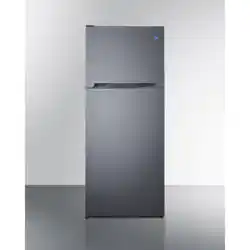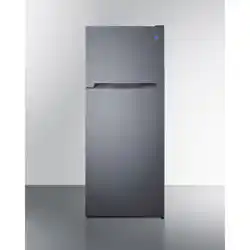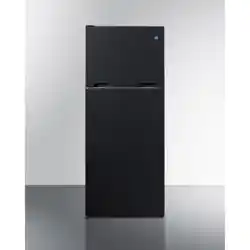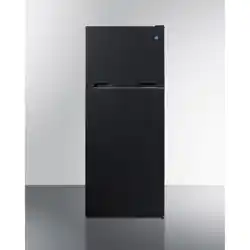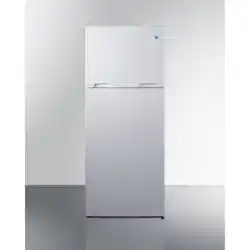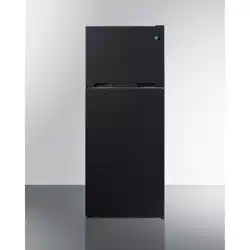
CTR151W
LRF15W
FF156W
CTR153PL
LRF15PL
FF156PL
CTR15SS
LRF15SS
FF156SS
CTR152B
LRF15B
FF156B
TOP MOUNT REFRIGERATOR - FREEZER
Write Model and Serial Numbers here:
Model _________________________
Serial No. ______________________
Felix Storch, Inc.
An ISO 9001:2015 registered company
770 Garrison Ave
Bronx, New York 10474
www.summitappliance.com
User Manual
BEFORE USE, PLEASE READ AND FOLLOW ALL SAFETY RULES AND OPERATING INSTRUCTIONS.
Models:
Thank you for choosing this product.
This user manual contains important information on safety and instructions intended to
assist you in the operation and maintenance of your appliance.
Please take the time to read this user manual before using your appliance and keep this
book for future reference.
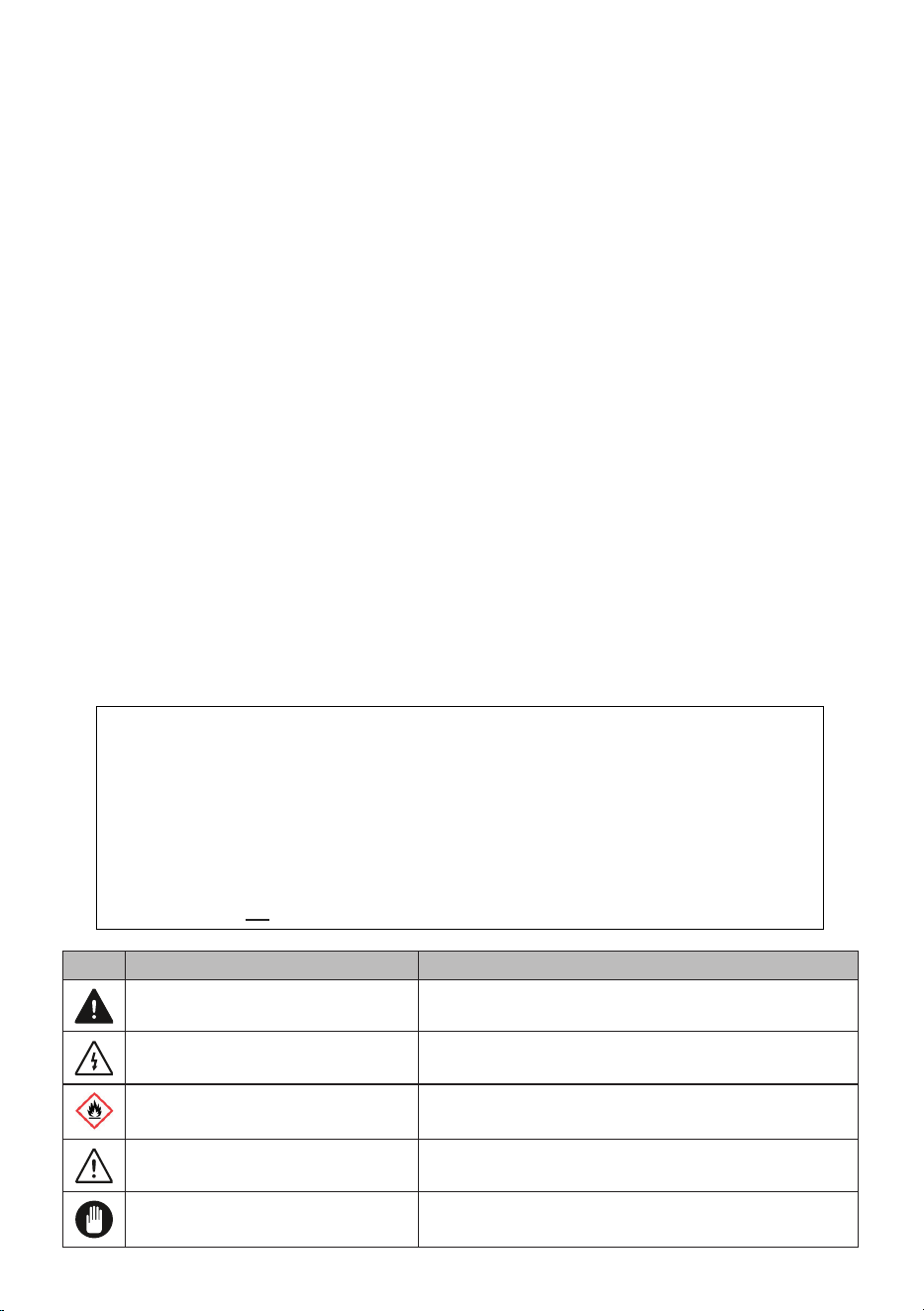
Icon Type Meaning
WARNING Serious injury or death risk
RISK OF ELECTRIC SHOCK Dangerous voltage risk
FIRE Warning; Risk of fire / flammable materials
CAUTION Injury or property damage risk
IMPORTANT Operating the system correctly
This product uses eco-friendly hydrocarbon refrigerant and fully complies with California
CARB regulations.
However, we are required by California Law to provide the following disclosure statement in every
product sold in California.
"This equipment is prohibited from use in California with any refrigerants on the 'List of Prohibited
Substances' for that specific end-use, in accordance with California Code of Regulations, title 17,
section 95374. This disclosure statement has been reviewed and approved by Felix Storch, Inc. and
Felix Storch, Inc. attests, under penalty of perjury, that these statements are true and accurate."
This product does not use any refrigerants on the 'List of Prohibited Substances'"

CONTENTS
1 SAFETY INSTRUCTIONS ................................................................................1
1.1 General Safety Warnings ...............................................................................................1
1.2 Installation Warnings .......................................................................................................6
1.3 During Usage...................................................................................................................7
2 DESCRIPTION OF THE APPLIANCE ............................................................ 8
3 USING THE APPLIANCE ................................................................................ 8
3.1 Information about New Generation Cooling Technology ................................................8
3.2 Display and Control Panel ..............................................................................................9
3.3 Operating your Fridge Freezer .......................................................................................9
3.3.1 Freezer Temperature Settings .....................................................................................9
3.3.2 Refrigerator Temperature Settings ...............................................................................9
3.3.3 Super Freeze Mode .....................................................................................................9
3.3.4 Door Open Alarm Function ........................................................................................10
3.4 Temperature Settings Warnings ...................................................................................10
3.5 Accessories ..................................................................................................................10
3.5.1 Ice Tray (In some models) .........................................................................................10
3.5.2 The Icematic (In some models) .................................................................................10
3.5.3 The Chiller Drawer (In some models) ........................................................................11
3.5.4 The Fresh Dial (In some models) ..............................................................................11
4 FOOD STORAGE ........................................................................................... 12
4.1 Refrigerator Compartment ............................................................................................12
4.2 Freezer Compartment ..................................................................................................13
5 CLEANING AND MAINTENANCE ................................................................ 17
6 SHIPMENT AND REPOSITIONING .............................................................. 17
6.1 Transportation and Changing Positioning ....................................................................17
6.2 Repositioning the Door .................................................................................................17
7 TIPS FOR SAVING ENERGY ....................................................................... 25
8 ERROR CODES .............................................................................................. 26
9 GENERAL TROUBLESHOOTING .....................................................
28
LIMITED WARRANTY...................................................................................... 29
6.3 Instructions for Reversing the Door Swing ...................................................................18
1 SAFETY INSTRUCTIONS
1.1 General Safety Warnings
Read this user manual carefully.
WARNING: Keep ventilation openings, in the
appliance enclosure or in the built-in structure, clear of
obstruction.
WARNING: Do not use mechanical devices or
other means to accelerate the defrosting process,
other than those recommended by the manufacturer.
WARNING: Do not use electrical appliances inside
the food storage compartments of the appliance,
unless they are of the type recommended by the
manufacturer.
WARNING: Do not damage the refrigerant circuit.
WARNING: When positioning the appliance,
ensure the supply cord is not trapped or damaged.
WARNING: Do not locate multiple portable socket-
outlets or portable power supplies at the rear of the
appliance.
WARNING: In order to avoid any hazards resulting
from the instability of the appliance, it must be fixed in
accordance with the instructions.
If your appliance uses R600a as a refrigerant (this
information will be provided on the label of the cooler)
you should take care during transportation and
installation to prevent the cooler elements from being
damaged. R600a is an environmentally friendly and
EN - 1

natural gas, but it is explosive. In the event of a leak
due to damage of the cooler elements, move your
fridge away from open flames or heat sources and
ventilate the room where the appliance is located for a
few minutes.
• While carrying and positioning the fridge, do not
damage the cooler gas circuit.
• Do not store explosive substances such as aerosol
cans with a flammable propellant in this appliance.
• This appliance is intended to be used in household
and domestic applications such as:
– staff kitchen areas in shops, offices and other
working environments.
– farm houses and by clients in hotels, motels and
other residential type environments.
– bed and breakfast type environments;
– catering and similar non-retail applications.
• If the socket does not match the refrigerator plug,
it must be replaced by the manufacturer, a service
agent or similarly qualified persons in order to avoid
a hazard.
• A specially grounded plug has been connected
to the power cable of your refrigerator. This plug
should be used with a specially grounded socket
of 10 amperes. If there is no such socket in your
house, please have one installed by an authorized
electrician.
EN - 2

• This appliance can be used by children aged from 8
years and above and persons with reduced physical,
sensory or mental capabilities or lack of experience
and knowledge if they have been given supervision
or instruction concerning use of the appliance in a
safe way and understand the hazards involved.
Children shall not play with the appliance. Cleaning
and user maintenance shall not be made by children
without supervision.
• Children aged from 3 to 8 years are allowed to load
and unload refrigerating appliances. Children are not
expected to perform cleaning or user maintenance of
the appliance, very young children (0-3 years old)
are not expected to use appliances, young children
(3-8 years old) are not expected to use appliances
safely unless continuous supervision is given, older
children (8-14 years old) and vulnerable people can
use appliances safely after they have been given
appropriate supervision or instruction concerning use
of the appliance. Very vulnerable people are not
expected to use appliances safely unless continuous
supervision is given.
• If the supply cord is damaged, it must be replaced by
the manufacturer, an authorised service agent or
similar qualified persons, in order to avoid a hazard.
• This appliance is not intended for use at altitudes
exceeding 6500 ft.
EN - 3

• WARNING: The refrigeration system is under high
pressure. Do not tamper with it. Contact qualified
service personal before disposal.
• CAUTION: To Prevent A Child From Being
Entrapped, Keep Out Of Reach Of Children And Not
In The Vicinity Of Freezer Or Refrigerator.
• WARNING: Risk of child entrapment. Before you
throw away your old refrigerator or freezer:
• * Take off the doors.
• * Leave the shelves in place so that children may not
easily climb inside.
• This appliance is not intended for use by persons
(including children) with reduced physical, sensory or
mental capabilities, or lack of experience
and knowledge, unless they have been given
supervision or instruction concerning use of the
appliance by a person responsible for their safety.
Children should be supervised to ensure that they do
not play with the appliance.
EN - 4

To prevent food contamination, please follow
these instructions:
• Keeping the door open for extended periods can
significantly raise the temperature inside the
appliance.
• Clean regularly surfaces that can come in contact
with food and accessible drainage systems.
• Store raw meat and fish in suitable containers in the
refrigerator to prevent them from coming into contact
with or dripping onto other foods.
• Two-star frozen-food compartments are suitable for
storing pre-frozen
food, storing or making ice cream
and making ice cubes.
•
One-, two- and three-star compartments are not
suitable for the freezing of fresh food.
•
If the refrigerating appliance is left empty for long
periods, switch off, defrost, clean, dry
, and leave the
door open to prevent
mold growth.
EN - 5

• Clearance of at least 6 inches
is required
at the top of your appliance. Do not place
anything on top of your appliance.
•
Do not place heavy items on the appliance.
• Clean the appliance thoroughly before use
(see Cleaning and Maintenance).
• Before using your fridge freezer, wipe all
parts with a solution of warm water and a
teaspoon of sodium bicarbonate. Then,
rinse with clean water and dry. Return all
parts to the fridge freezer after cleaning.
• Use the adjustable front legs to make sure
your appliance is level and stable. You can
adjust the legs by turning them in either
direction. This must be done before placing
food in the appliance.
• When the product is operating, the side
panels may become noticeably warm. This
is normal.
• In order for the product to work efficiently,
there must be some gap around it for air
circulation. If you are going to place the
product in a recessed area on the wall,
make sure that the gap should be 4 inches
between top surface and ceiling, 2 inches
between walls and side panels. The
distance between the appliance and back
wall must be a maximum of 3 inches.
1.2 Installation
Warnings
Before using your fridge freezer for the first
time, please consider the following points:
• The operating voltage for your fridge
freezer is 115-127 V at 60Hz.
• The plug must be accessible after
installation.
• Your fridge freezer may emit an odor when
first operated. This is normal, and the odor
will fade as it cools.
• Before connecting your fridge freezer,
ensure that the information on the data
plate (voltage and connected load)
matches the mains electricity supply. If in
doubt, consult a qualified electrician.
• Insert the plug into a socket with an
efficient ground connection. If the socket
has no ground contact or the plug does not
match, we recommend you consult a
qualified electrician for assistance.
• The appliance must be connected
with a properly installed fused socket. The
power supply (AC) and voltage at the
operating point must match with the details
on the name plate of the appliance (the
name plate is located on the inside left of
the appliance).
• We do not accept responsibility for any
damages that occur due to ungrounded
usage.
• Place your fridge freezer where it will not
be exposed to direct sunlight.
• Your fridge freezer must never be used
outdoors or exposed to rain.
• Your appliance must be at least 20 inches
away from stoves, gas ovens and heater
cores, and at least 2 inches away from
electrical ovens.
• If your fridge freezer is placed next to a
deep freezer, there must be at least 1 inch
between them to prevent humidity forming
on the outer surface.
• Do not cover the body or top of fridge
freezer with lace. This will affect the
performance of your fridge freezer.
EN - 6

Old and Out-of-Order Fridges
• If your old fridge or freezer has a
lock, break or remove the lock before
discarding it, because children may get
trapped inside it and may cause an
accident.
• Old fridges and freezers contain isolation
material and refrigerant with CFC.
Therefore, take care not to harm the
environment when you are discarding
your old fridges.
Notes:
• Please read the instruction manual
carefully before installing and using your
appliance. We are not responsible for the
damage occurred due to misuse.
• Follow all instructions on your appliance
and instruction manual, and keep this
manual in a safe place to resolve the
problems that may occur in the future.
• This appliance is produced to be used
in
homes and it can only be used in
domestic environments and for the
specified purposes. It is not suitable for
commercial use. Such use will cause the
guarantee of the appliance to be
cancelled and our company will not be
responsible for any losses incurred.
•
This appliance is produced to be used
in
houses and it is only suitable for
cooling /
storing foods. It is not suitable
for
commercial use and/or for storing
substances except for food. Our
company
is not responsible for any
losses incurred
by inappropriate usage of
the appliance.
1.3 During Usage
• Do not connect your fridge freezer to the
mains electricity supply using an extension
lead.
• Do not use damaged, torn or old plugs.
• Do not pull, bend or damage the cord.
• Do not use plug adapter.
• This appliance is intended for adult use
only. Do not allow children to play with the
appliance or hang from the door.
• Never touch the power cord/plug with wet
hands. This may cause a short circuit or
electric shock.
• Do not place glass bottles or cans in the
ice-making compartment, as they may
burst when the contents freeze.
• Do not place explosive or flammable
material in your fridge. Place drinks with
high alcohol content vertically in the fridge
compartment and make sure their tops are
tightly closed.
• When removing ice from the ice-making
compartment, do not touch it, as it may
cause frostbite or cuts.
• Do not touch frozen goods with wet hands.
Do not eat ice-cream or ice cubes
immediately after they are removed from
the ice-making compartment.
• Do not re-freeze thawed frozen food. This
may cause health issues such as food
poisoning.
EN - 7
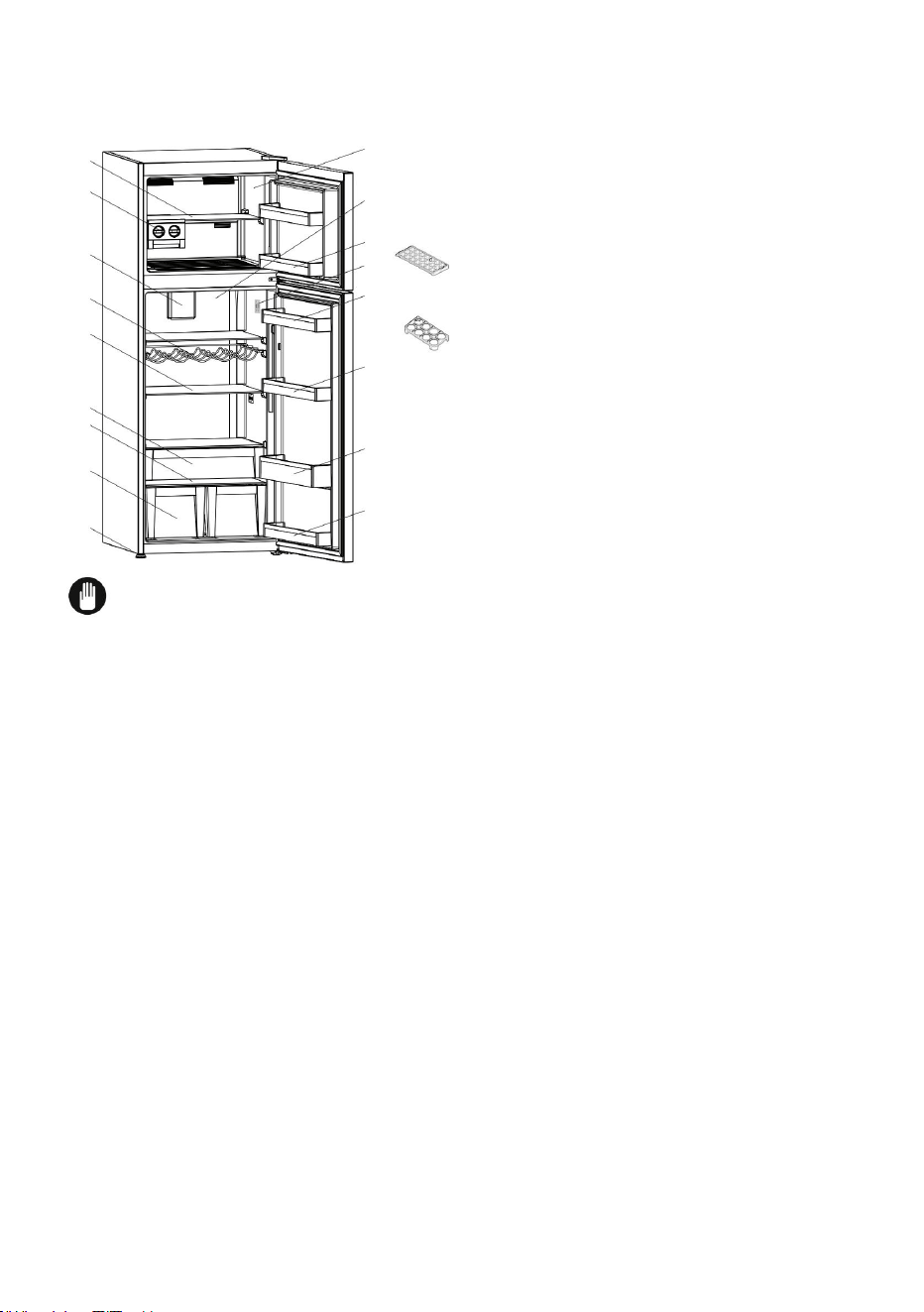
2 DESCRIPTION OF THE
APPLIANCE
1
2
3
4
5
6
7
8
9
10
11
12
13
15
B
A
17
16
14
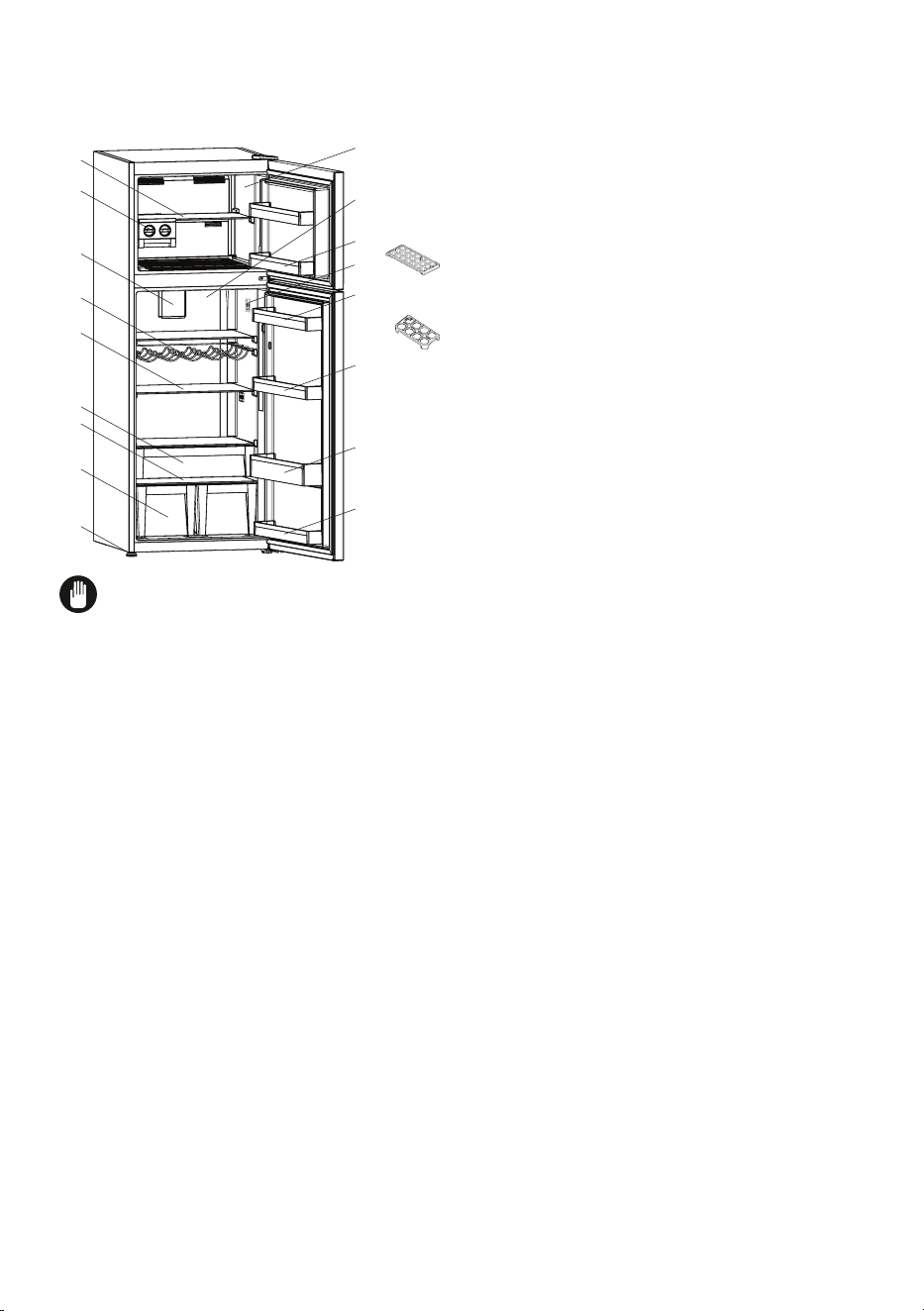
This presentation is only for
information about the parts of the
appliance. Parts may vary according to the
appliance model.
A) Freezer compartment
B) Refrigerator compartment
1) Freezer shelf
2) Ice maker *
3) Turbo fan *
4) Wine rack *
5) Refrigerator shelv
es
6) Chiller *
7) Crisper cover
8) Crisper bins
9) Leveling feet
10) Door bottom shelf *
11) Bottle shelf
12) Adjustable door shelf * / door shelf
13) Door shelf
14) Interior display
15) Freezer door shelves *
16) Ice box tray *
17) Egg holder
*In some models
3 USING THE APPLIANCE
3.1 Information about New Generation
Cooling Technology
Fridges with new-generation cooling
technology have a different operating
system to static fridges. Other (static)
fridges may experience a build up of ice
in the freezer compartment due to door
openings and humidity in the food. In such
fridges, regular defrosting is required; the
fridge must be switched off, the frozen
food moved to a suitable container and
the ice which has formed in the freezer
compartment removed.
In fridges with new-generation cooling
technology, a fan blows dry cold air evenly
throughout the fridge and freezer
compartments. The cold air cools your food
evenly and uniformly, preventing humidity
and ice build-up.
In the refrigerator compartment, air
blown by the fan, located at the top of
the refrigerator compartment, is cooled
while passing through the gap behind
the air duct. At the same time, the air is
blown out through the holes in the air duct,
evenly spreading cool air throughout the
refrigerator compartment.
There is no air passage between the
freezer and refrigerator compartments,
therefore preventing the mixing of odors. As
a result, your fridge, with new-generation
cooling technology, provides you with ease
of use as well as a huge volume and
aesthetic appearance.
EN - 8
3.2 Display and Control Panel
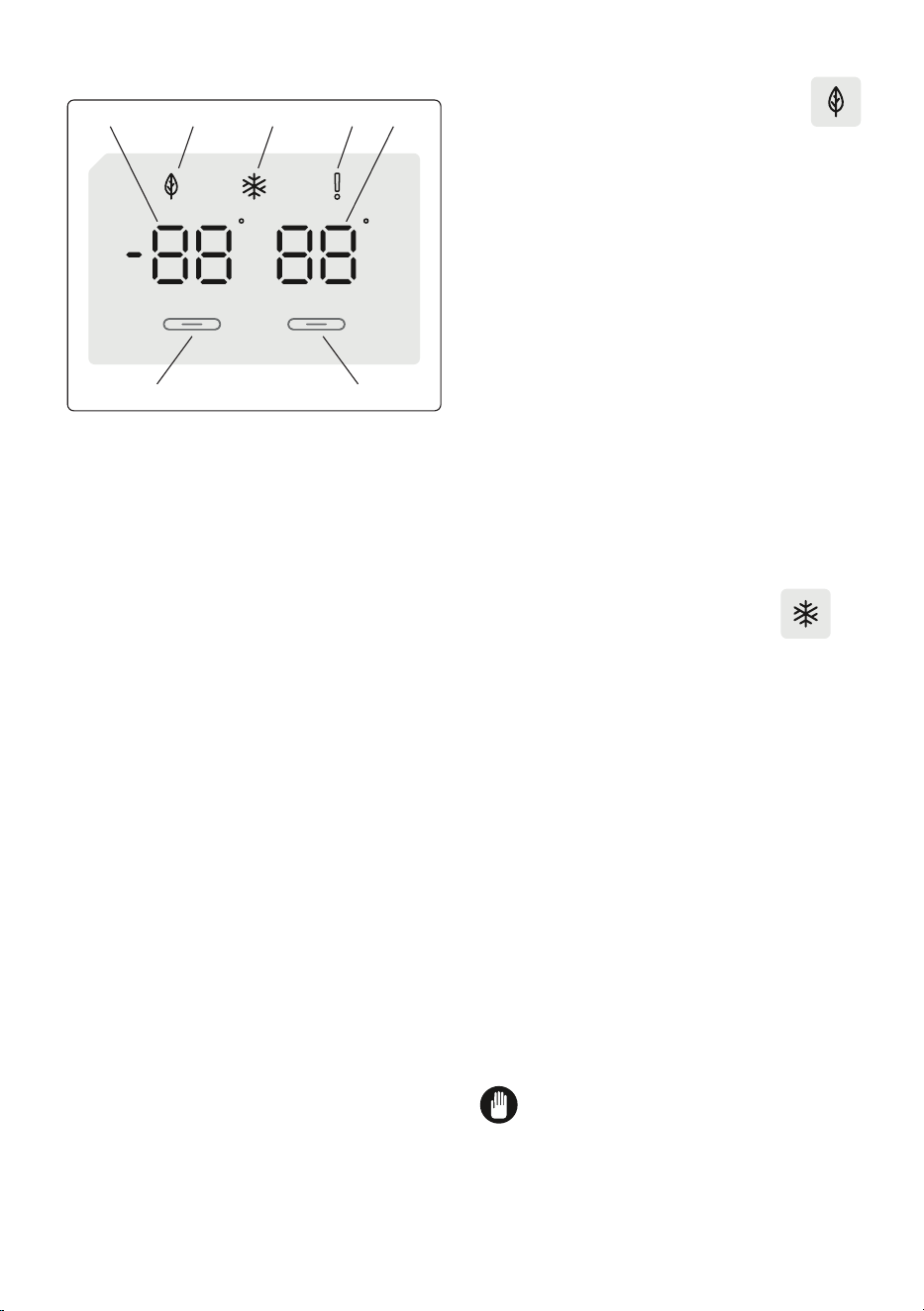
3 5 6 7 4
1 2
Using the Control Panel
1. Enables the setting of the freezer.
2. Enables the setting of the refrigerator.
3. Freezer set value screen.
4. Refrigerator set value screen.
5. Economy mode symbol.
6. Super freeze symbol.
7. Alarm symbol.
3.3 Operating your Fridge Freezer
Lighting (If available)
When the product is plugged in for the
first time, the interior lights may turn on 1
minute late due to opening tests.
Once you have plugged in the product, all
symbols will be displayed for 2 seconds
and the initial values will be shown as 0°F
on the freezer adjustment indicator, and
39°F on the fridge adjustment indicator.
3.3.1 Freezer Temperature Settings
• The initial temperature value for the
freezer setting indicator is 0°F.
• Press the freezer set button once. When
you first press the button, the previous
value will blink on the screen.
• Whenever you press the same button, a
lower temperature will be set (3°F, 0°F,
-4°F -8°F or -11°F).
• If you continue to press the button, it will
restart from 3°F.
NOTE: Eco mode gets activated
automatically when the temperature
of the freezer compartment is set to
0°F.
• The initial temperature value for the
refrigerator setting indicator is 39°F.
• Press the cooler button once.
• Whenever you press the button, a lower
temperature will be set (46°F, 43°F, 41°
F, 39°F, or 36°F).
• If you continue to press the button, it will
restart from 46°F.
3.3.3 Super Freeze Mode
• To freeze a large quantity of food that
cannot fit on the fast freeze shelf.
• To freeze prepared foods.
• To freeze fresh food quickly to retain
freshness.
How to Use
To enable the Super Freeze
mode, press and hold the freezer
temperature setting button for 3 seconds.
Once the super freeze mode has been
set, the super freeze symbol on the
indicator will be lit and the machine will
beep to confirm the mode has been
switched on.
During Super Freeze Mode:
• The temperature of the refrigerator may
be adjusted. In this case, Super Freeze
mode will continue.
• Economy mode cannot be selected.
• Super Freeze mode can be canceled in
the same way it is selected.
Notes:
• For optimal appliance performance in
maximum freezer capacity, activate super
freeze mode 3 hours before you put fresh
food into the freezer.
Super freeze mode will automatically
cancel after 24 hours, depending on
the environmental temperature or when the
freezer sensor reaches a sufficiently low
temperature.
EN - 9
3.3.2 Refrigerator Temperature Settings
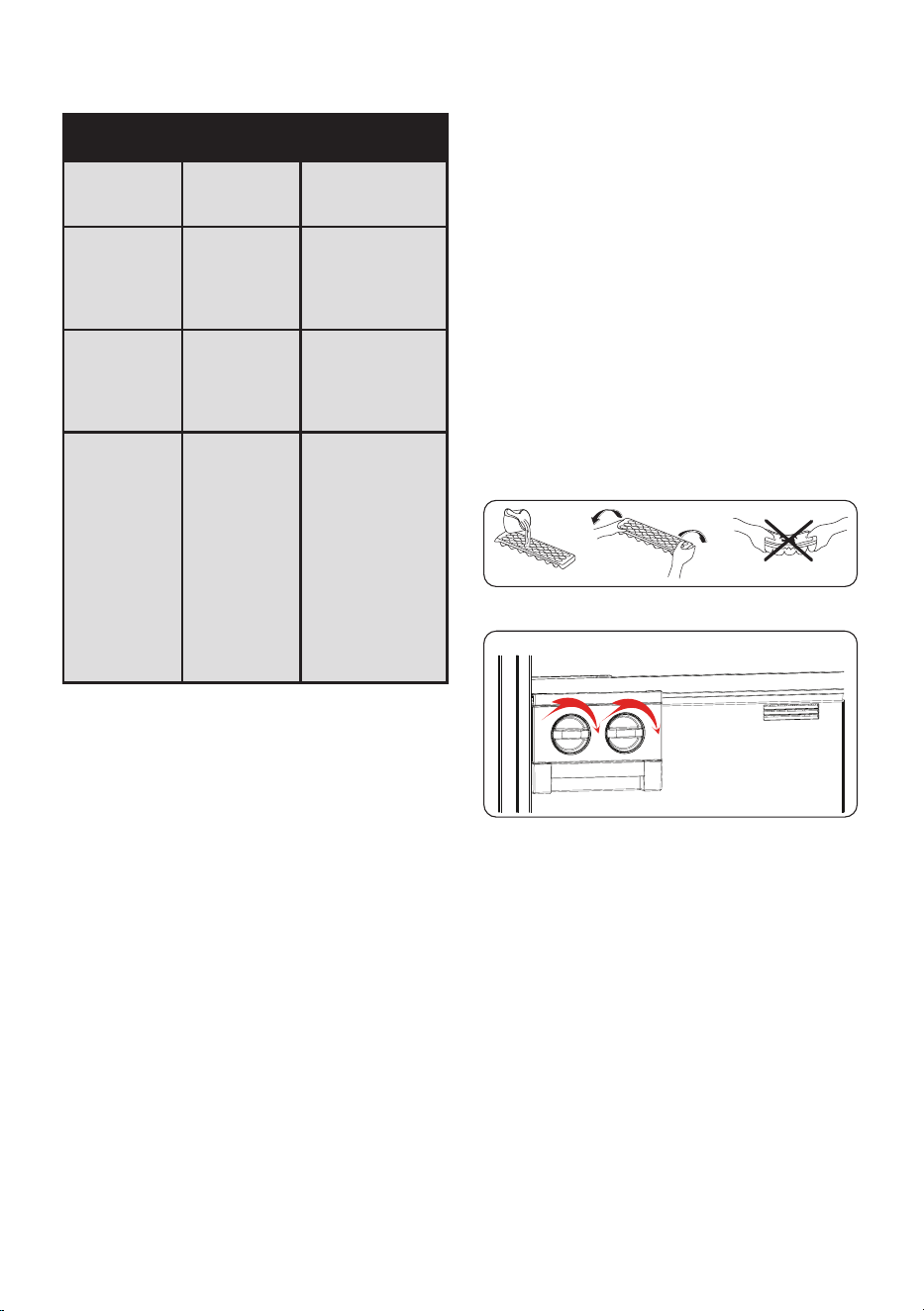
Recommended Settings for the
Freezer and Refrigerator Compartment
Temperature
Freezer
Compartment
Refrigerator
Compartment
Remarks
0
o
F 39
o
F
For regular
use and best
performance.
-4
o
F, -8
o
F or
-11
o
F
39
o
F
Recommended
when
environmental
temperature
exceeds 86°F.
Super Freeze
mode
39
o
F
Must be used
when you wish
to freeze food in
a short period of
time.
0
o
F, -4
o
F,
-8
o
F or -11
o
F
36
o
F
These
temperature
settings must be
used when the
environmental
temperature is
high or if you think
the refrigerator
compartment is
not cool enough
becuse the door
is being opened
frequently.
3.3.4 Door Open Alarm Function
If fridge door is opened for more than 2
minutes, appliance will start beeping.
3.4 Temperature Settings Warnings
• A 5-minute delay function is implemented
to protect the compressor when
connecting or disconnecting from the
main, or during a power interruption. The
appliance will resume normal operation
after this delay.
3.5 Accessories
Visual and text descriptions in the
accessories section may vary according
to the model of your appliance.
3.5.1 Ice Tray (In some models)
• Fill the ice tray with water and place in
the freezer compartment.
• After the water has completely frozen,
you can twist the tray as shown below to
remove the ice cubes.
3.5.2 The Icematic (In some models)
(The images are representative)
• Pull the lever towards you and remove
the ice maker tray
• Fill with water to the marked level
• Hold the left end of the lever and set the
ice-tray on the icebox
• When ice cubes have formed, twist the
lever to drop the ice cubes into the
icebox.
• Your appliance is designed to operate
within the ambient temperature ranges
specified by the climate class on the
information label. Operating your fridge
outside these temperature ranges may
reduce cooling efficiency.
• Adjust the temperature based on the
frequency of door openings, the amount of
food stored inside, and the ambient
temperature of the location.
• When the appliance is first turned on,
allow it to run for 24 hours to reach the
optimal operating temperature. During this
period, do not open the door or place a
large quantity of food inside.
EN - 10
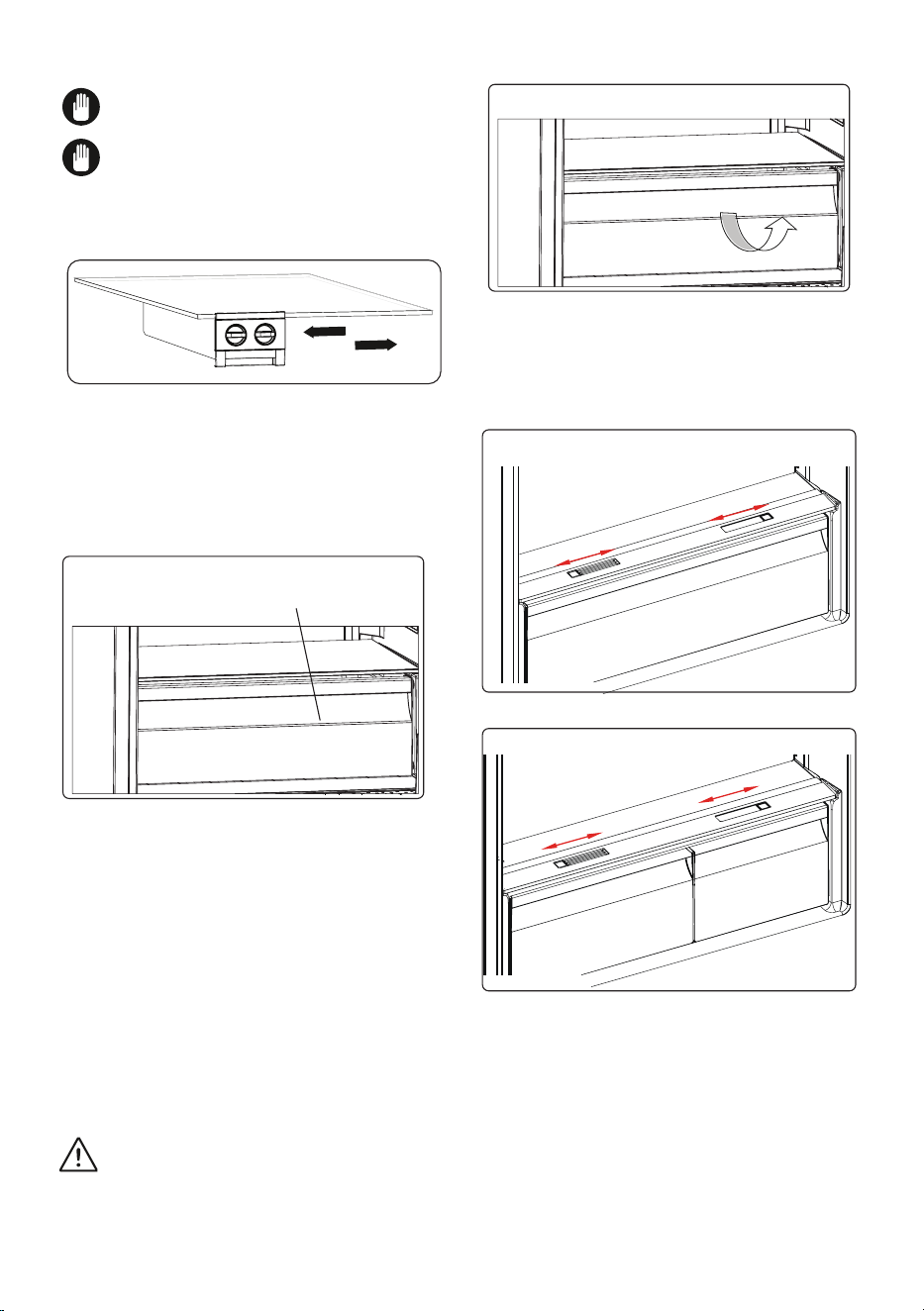
Note:
Do not fill the icebox with water in
order to make ice. It can be broken.
The movement of the ice maker may
be difficult while the refrigerator is
running. In such a case should be cleaned
by removing the glass shelves.
Removing the icemaker
• Take out of the freezer glass shelves.
• Remove the ice maker by dragging left
or right on the shelf. You can remove
the icemaker to use a larger volume of
the freezer compartment.
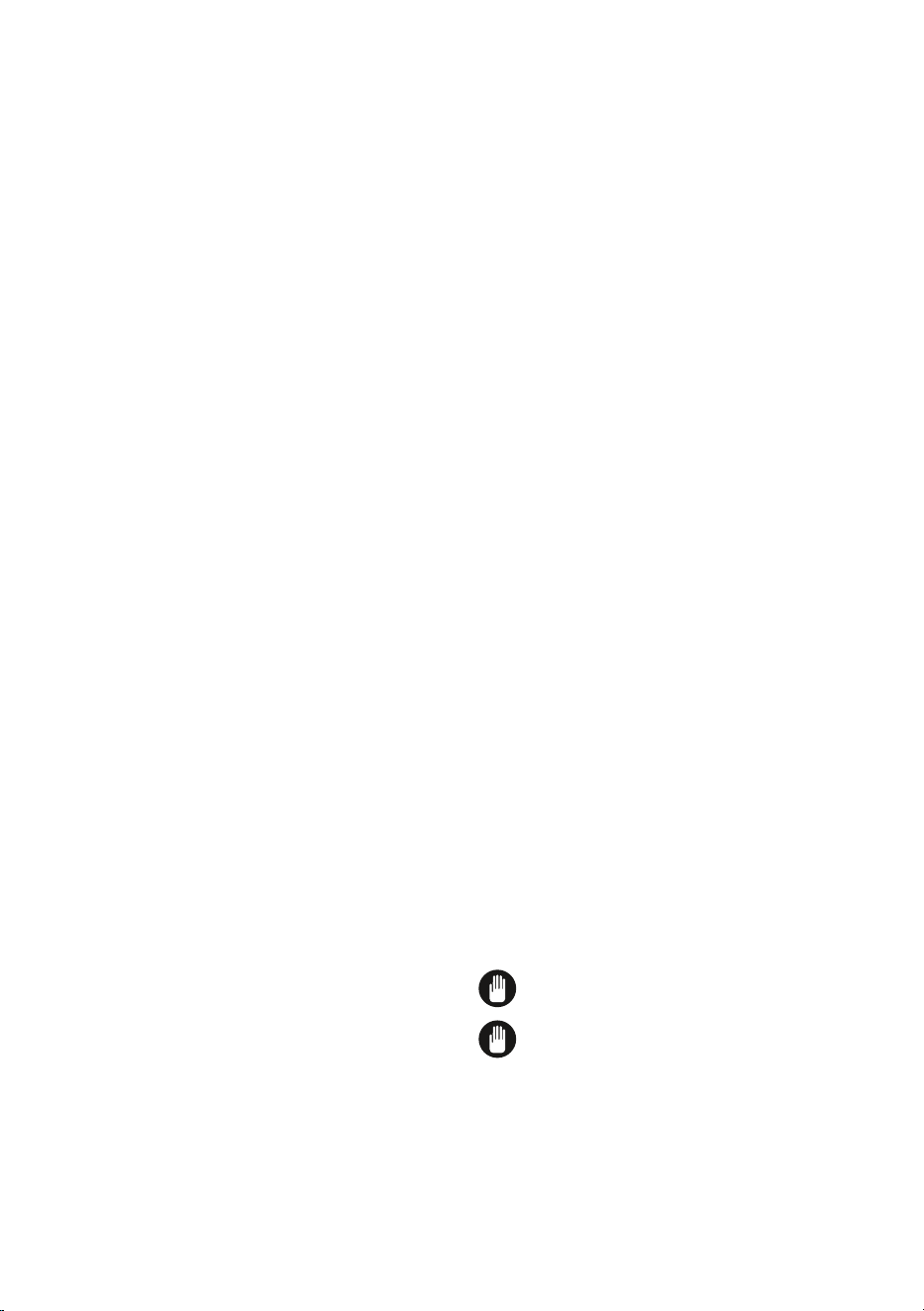
3.5.3 The Chill Drawer (In some models)
Chill drawer
(The images are representative)
Storing food in the chill drawer, rather than
in the freezer or refrigerator compartments,
helps maintain freshness and flavor while
preserving its appearance. When the chill
drawer tray becomes dirty, remove it and
wash it with water.
Note: Water freezes at 32°F, but foods
containing salt or sugar may freeze at lower
temperatures.
The chill drawer is typically used for storing
items such as raw fish, lightly pickled foods,
rice, and similar items.
Do not put food you want to freeze
or ice trays (to make ice) in the chill
drawer.
To Remove the Chill Drawer:
(The images are representative)
• Pull the chill drawer towards you by
sliding it off the rails.
• Pull the chill drawer up from the rail and
remove it from the fridge.
3.5.4 The Fresh Dial (In some models)
(The images are representative)
or
(The images are representative)
If the crisper is full, open the fresh dial located
at the front of the crisper. This allows for better
control of air circulation and humidity levels,
helping to extend the life of the food inside.
If you notice any condensation on the glass
shelf, ensure that the dial located behind the
shelf is also opened.
This glass shelf with humidity control has a
maximum load capacity of 32 lbs.
EN - 11
4 FOOD STORAGE
4.1 Refrigerator Compartment
For normal operating conditions, set the
temperature of the refrigerator compartment
to 39
o
F or +43
o
F.
• To reduce humidity and prevent frost
formation, always store liquids in sealed
containers in the refrigerator. Frost tends
to accumulate in the coldest areas of the
evaporator, which will require more
frequent defrosting over time.
• Cooked dishes should remain covered
while stored in the fridge. Do not place
warm foods in the refrigerator; allow them
to cool first to avoid increasing the
temperature and humidity, which can
reduce the fridge's efficiency.
• Ensure that no items are in direct contact
with the rear wall of the appliance, as frost
can develop and packaging may stick to it.
Minimize frequent openings of the
refrigerator door.
• For optimal storage conditions, we
recommend loosely wrapping meat and
clean fish and placing them on the glass
shelf just above the vegetable bin, where
the air is cooler.
• Store loose fruits and vegetable items in
the crisper containers.
• Keeping fruits and vegetables separate
helps prevent ethylene-sensitive
vegetables (such as leafy greens,
broccoli, and carrots) from being affected
by ethylene-releasing fruits (like bananas,
peaches, and figs).
• Do not put wet vegetables into the
refrigerator.
• The storage time for all food products
depends on the initial quality of the food
and the maintenance of an uninterrupted
refrigeration cycle.
• Water leaking from meat can contaminate
other products in the refrigerator. Always
package meat products properly and
clean any spills on the shelves.
• Do not obstruct the air flow passage by
placing food items in front of it.
• Consume packaged foods before the
recommended expiration date.
• Do not allow food to come into contact with
the temperature sensor, which is located in
the refrigerator compartment, in order to
keep the refrigerator compartment at
optimum temperature.
• For normal working conditions, it will
be sufficient to adjust the temperature
setting of your refrigerator to 39°F.
• The ideal temperature for the refrigerator
should range from 32°F to 46°F. Fresh foods
stored below 32°F might freeze and spoil.
When temperatures exceed 46°F, bacterial
growth accelerates and will cause food to
spoil.
• Do not put hot food in the refrigerator
immediately, wait for the temperature to
decrease outside. Hot foods increase the
temperature of your refrigerator and may
cause food poisoning and unnecessary
spoiling of the food.
• Meat and fish should be stored in the
refrigerator compartment, and the
vegetables should go in the crisper (if
available).
• To prevent cross contamination, do not store
meat products and fruit vegetables together.
• Foods should be placed in the refrigerator in
closed containers or covered to prevent
moisture and odors.
IMPORTANT NOTES:
Potatoes, onions and garlic should not
be stored in the refrigerator.
Cooked dishes must remain covered
when they are kept in the fridge. Place
them in the fridge when they are at room
temperature, otherwise the temperature/
humidity inside the fridge will increase,
reducing the fridge’s efficiency. Covering
food and drink also preserves their flavor
and aroma.
EN - 12
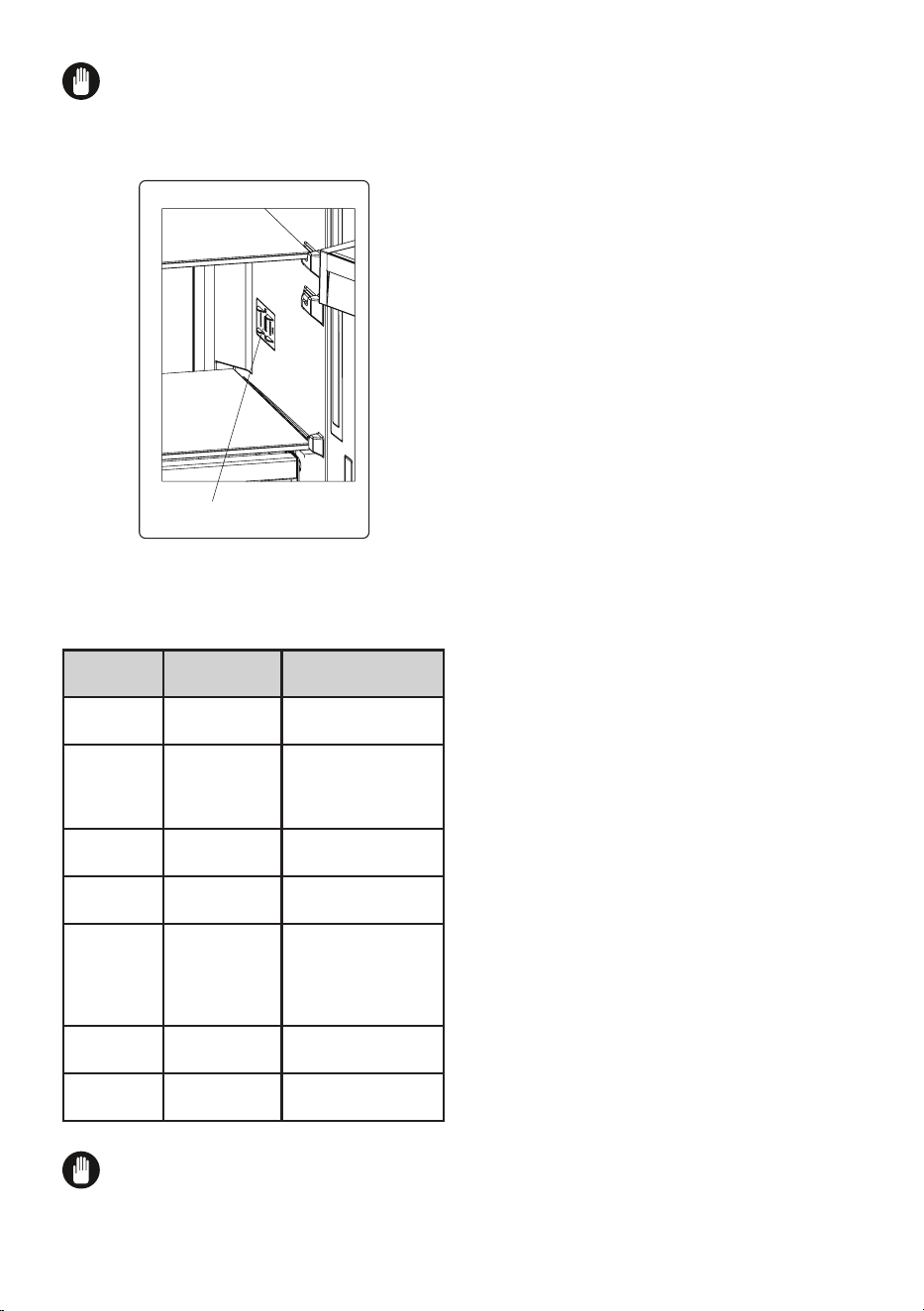
Do not allow food to come into contact
with the temperature sensor, which is
located in the refrigerator compartment, in
order to keep the refrigerator compartment
at optimum temperature.
Temperature sensor area
(The images are representative)
The table below is a quick guide to show
you the most efficient way to store the
major food groups in your refrigerator
compartment.
Food
Maximum
storage time
How and where to
store
Vegetables
and fruits
1 week Vegetable bin
Meat and
fish
2 - 3 days
Wrap in plastic foil,
bags, or in a meat
container and store
on the glass shelf
Fresh
cheese
3 - 4 days
On the designated
door shelf
Butter and
margarine
1 week
On the designated
door shelf
Bottled
products
e.g. milk
and
yogurt
Until the
expiry date
recommended
by the
producer
On the designated
door shelf
Eggs 1 month
On the designated
egg shelf
Cooked
food
2 days All shelves
NOTE:
Potatoes, onions and garlic should not
be stored in the refrigerator.
4.2 Freezer Compartment
For normal operating conditions, set the
temperature of the freezer
compartment to 0° or -4
o
F.
• The freezer is used for storing frozen
food, freezing fresh food, and making
ice cubes.
• Food in liquid form should be frozen
in plastic cups and other food should
be frozen in plastic folios or bags. For
freezing fresh food; wrap and seal
fresh food properly, that is the
packaging should be air tight and
shouldn’t leak. Special freezer bags,
aluminum foil polythene bags and
plastic containers are ideal.
• Do not store fresh food next to frozen
food, as this can cause the frozen
items to thaw.
• Before freezing fresh food, divide it
into portions that can be consumed in
one sitting.
• Consume thawed frozen food within a
short period of time after defrosting
• Always follow the manufacturer's
instructions on food packaging when
storing frozen items. If no guidance is
provided, do not store food for more
than three months from the date of
purchase.
• When purchasing frozen food, make
sure that it has been stored under
appropriate conditions and that the
packaging is not damaged.
• Frozen food should be transported in
appropriate containers and placed in
the freezer as soon as possible.
• Do not purchase frozen food if the
packaging shows abnormal swelling,
as this may indicate it has been
stored at an unsuitable temperature
and the contents could be spoiled.
EN - 13
• The storage life of frozen food depends
on room temperature, thermostat
settings, how often the door is opened,
the type of food, and the time taken to
transport it from the store to your home.
Always follow the instructions on the
packaging and do not exceed the
maximum storage time indicated.
• If the freezer door has been left open for
a long time or not closed properly, frost
will form and can prevent efficient air
circulation. In this case, unplug the
freezer and allow it to defrost
completely. Clean the freezer once it has
fully defrosted.
• The freezer volume stated on the label is
the capacity without baskets, covers, or
other accessories.
• Do not refreeze thawed food, as it may
pose health risks, such as food
poisoning.
NOTE: If you attempt to open the freezer
door immediately after closing it, you
will find that it will not open easily. This
is normal. Once equilibrium has been
reached, the door will open easily. If the
lower shelf of the freezer door is removed
and food obstructs the air suction hole, the
efficiency of your fridge will
decrease.Therefore, take care while
loading the freezer compartment and
make sure not to cover the air suction
hole.
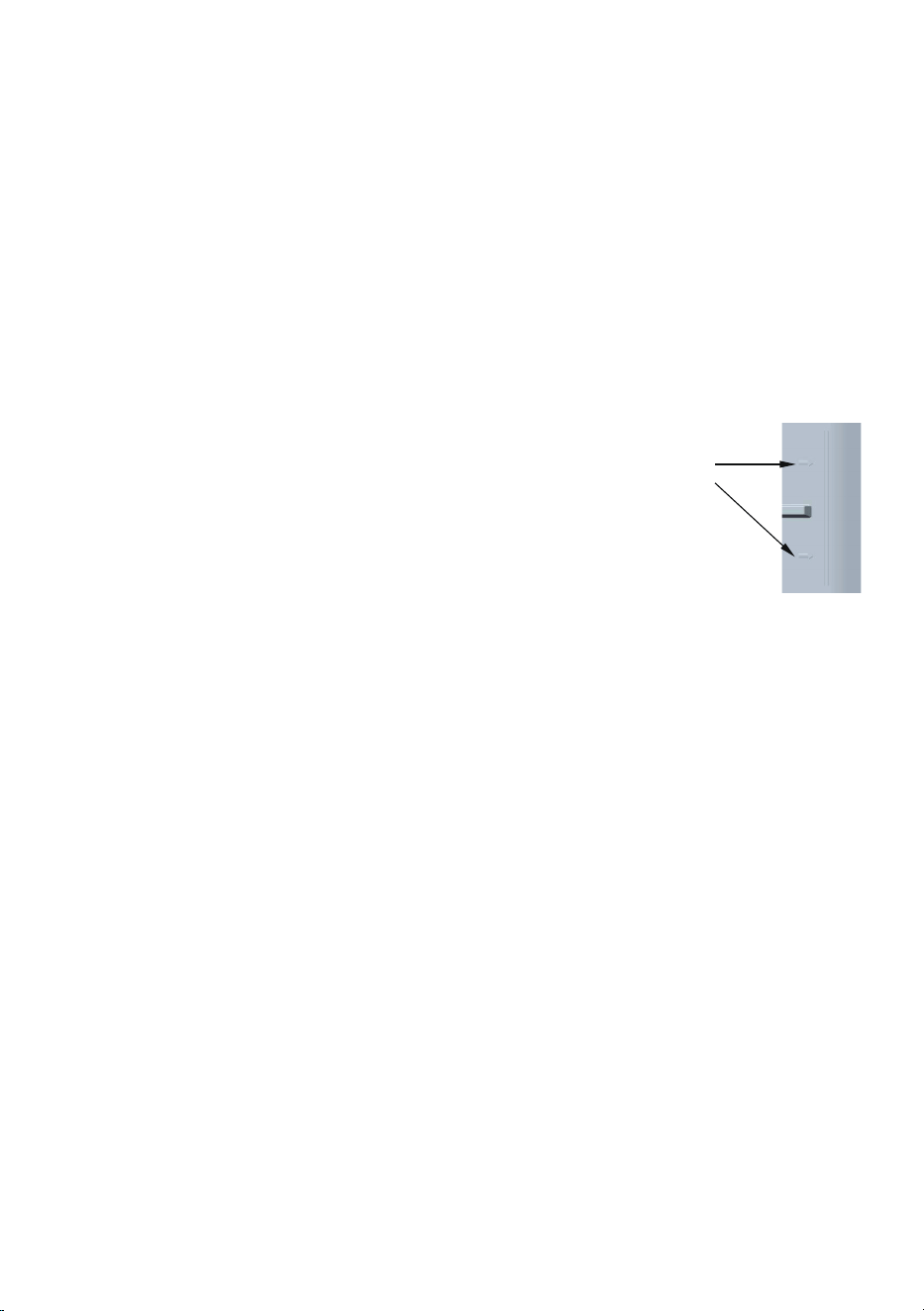
In some models: While loading the
freezer compartment, do not fill
above the guidelines
otherwise the door will not
close properly. If the
freezer compartment door
does not close properly,
excess ice will form in the
freezer compartment. To
prevent the problem from recurring, clear
the ice and make sure the door is fully
closed.
Also, not closing the freezer and/or fridge
compartment doors will increase your
energy consumption.
EN - 14
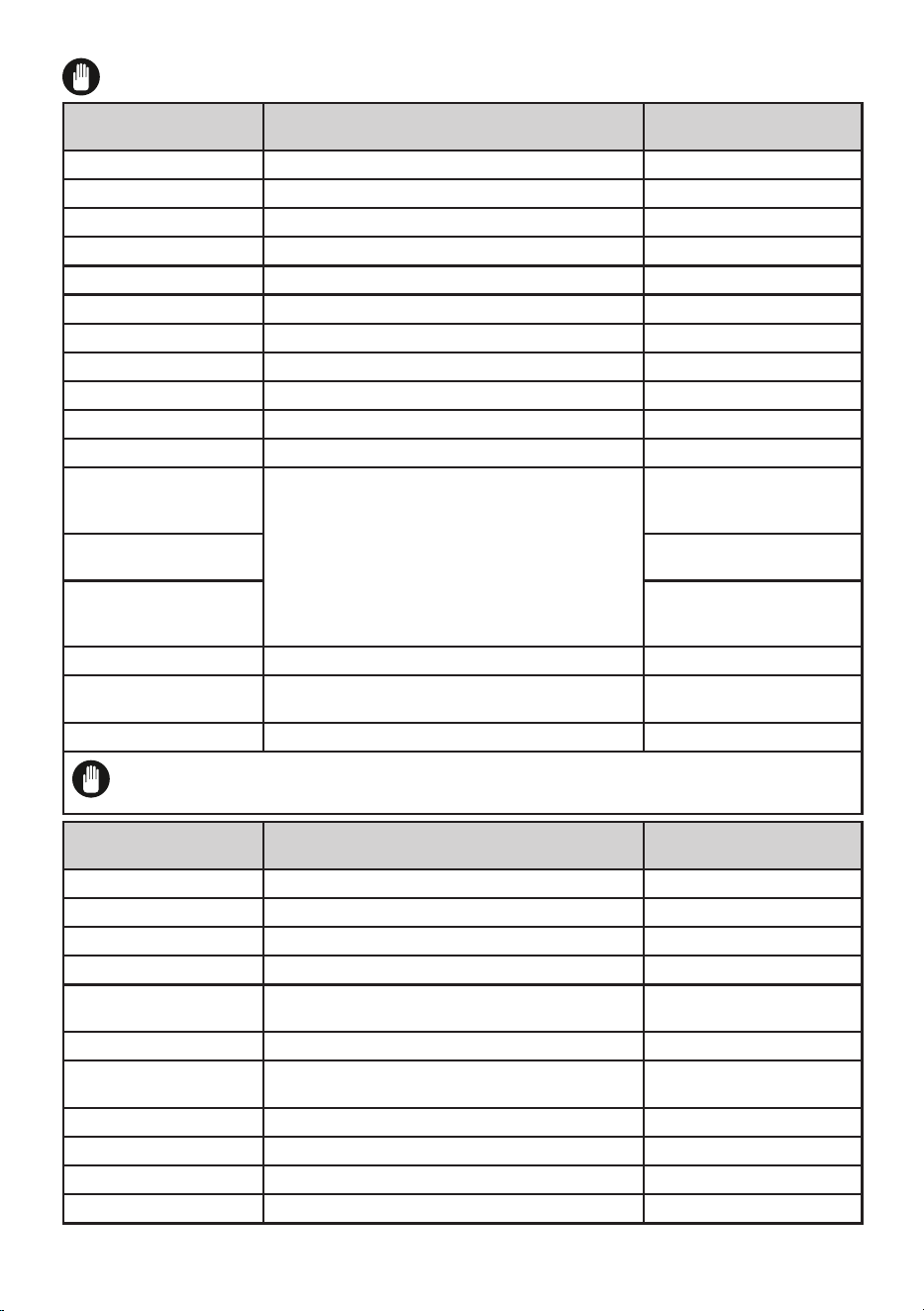
The table below is a quick guide to show you the most efficient way to store the major
food groups in your freezer compartment.
Meat and fish Preparation
Maximum storage time
(months)
Steak Wrap in foil 6 - 8
Lamb meat Wrap in foil 6 - 8
Veal roast Wrap in foil 6 - 8
Veal cubes In small pieces 6 - 8
Lamb cubes In pieces 4 - 8
Minced meat In packaging without using spices 1 - 3
Giblets (pieces) In pieces 1 - 3
Bologna sausage/salami Should be kept packaged even if it has a membrane 1 - 3
Chicken and turkey Wrap in foil 4 - 6
Goose and duck Wrap in foil 4 - 6
Deer, rabbit, wild boar In 5.5 Ibs portions or as fillets 6 - 8
Freshwater fish
(Salmon, Carp, Crane,
Catfish)
After cleaning the bowels and scales of the fish,
wash and dry it. If necessary, remove the tail and
head.
2
Lean fish (Bass, Turbot,
Flounder)
4
Fatty fishes (Tuna,
Mackerel, Bluefish,
Anchovy)
2 - 4
Shellfish Clean and in a bag 4 - 6
Caviar
In its packaging, or in an aluminium or plastic
container
2 - 3
Snails In salty water, or in an aluminium or plastic container 3
NOTE: Thawed frozen meat should be cooked as fresh meat. If the meat is not cooked after defrosting, it
must not be re-frozen.
Vegetables and Fruits Preparation
Maximum storage time
(months)
String beans and beans Wash, cut into small pieces and boil in water 10 - 13
Beans Hull, wash and boil in water 12
Cabbage Clean and boil in water 6 - 8
Carrot Clean, cut into slices and boil in water 12
Pepper
Cut the stem, cut into two pieces, remove the core
and boil in water
8 - 10
Spinach Wash and boil in water 6 - 9
Cauliflower
Remove the leaves, cut the heart into pieces and
leave it in water with a little lemon juice for a while
10 - 12
Eggplant Cut into pieces of 1 inch after washing 10 - 12
Corn Clean and pack with its stem or as sweet corn 12
Apple and pear Peel and slice 8 - 10
Apricot and Peach Cut into two pieces and remove the stone 4 - 6
EN - 15
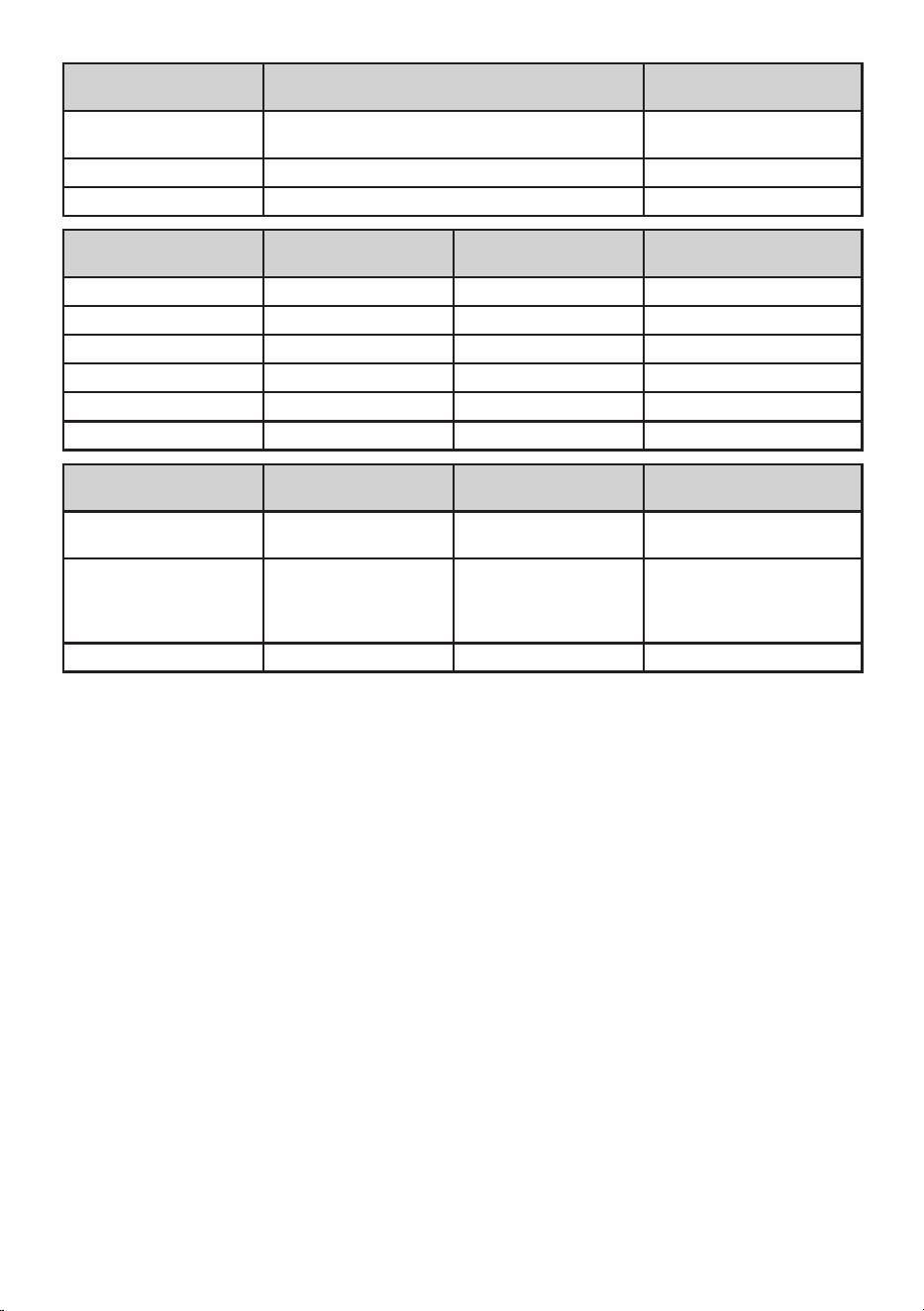
Vegetables and Fruits Preparation
Maximum storage time
(months)
Strawberry and
Blackberry
Wash and hull 8 - 12
Cooked fruits Add 10 % of sugar to the container 12
Plum, cherry, sourberry Wash and hull the stems 8 - 12
Maximum storage time
(months)
Thawing time at room
temperature (hours)
Thawing time in oven
(minutes)
Bread 4 - 6 2 - 3 4-5 (428-437 °F)
Biscuits 3 - 6 1 - 1.5 5-8 (374-392 °F)
Pastry 1 - 3 2 - 3 5-10 (392-437 °F)
Pie 1 - 1.5 3 - 4 5-8 (374-392 °F)
Phyllo dough 2 - 3 1 - 1.5 5-8 (374-392 °F)
Pizza 2 - 3 2 - 4 15-20 (392 °F)
Dairy products Preparation
Maximum storage time
(months)
Storage conditions
Packet (Homogenized)
Milk
In its own packet 2 - 3 Pure Milk – in its own packet
Cheese - excluding
white cheese
In slices 6 - 8
Original packaging may be
used for short-term storage.
Keep wrapped in foil for
longer periods.
Butter, margarine In its packaging 6
EN - 16
5 CLEANING AND
MAINTENANCE
Disconnect the unit from the power
supply before cleaning.
Do not wash your appliance by
pouring water on it.
Do not use abrasive products,
detergents or soaps for cleaning the
appliance. After washing, rinse with clean
water and dry carefully. When you have
finished cleaning, reconnect the plug to
the main supply with dry hands.
• Make sure that no water enters the lamp
housing and other electrical components.
• The appliance should be cleaned
regularly using a solution of bicarbonate
of soda and lukewarm water.
• Clean the accessories separately by hand
with soap and water. Do not wash
accessories in a dish washer.
• Clean the condenser with a brush at least
twice a year. This will help you to save on
energy costs and increase productivity.
The power supply must be
disconnected during cleaning.
Replacing LED Lighting
To replace any of the LEDs, please contact
the nearest Authorized Service Center.
Note: The numbers and location of the
LED strips may change according to
the model.
6 SHIPMENT AND
REPOSITIONING
6.1 Transportation and Changing
Positioning
• The original packaging and foam may be
kept for re-transportation (optional).
• Fasten your appliance with thick
packaging, bands or strong cords and
follow the instructions for transportation
on the packaging.
• Remove all movable parts or fix them
into the appliance against shocks
using bands when re-positioning or
transporting.
Always carry your appliance in the
upright position.
6.2 Reversing the Door
Swing
Front Handles:
You cannot reverse the
door if the handles are installed on the front
of the appliance.
Side Handles or No Handles:
You can
reverse the door on models that have side
handles or no handles at all.
Non-Reversible Doors:
If your appliance’s
door is not reversible, please contact the
nearest Authorized Service Center for
assistance.
EN - 17
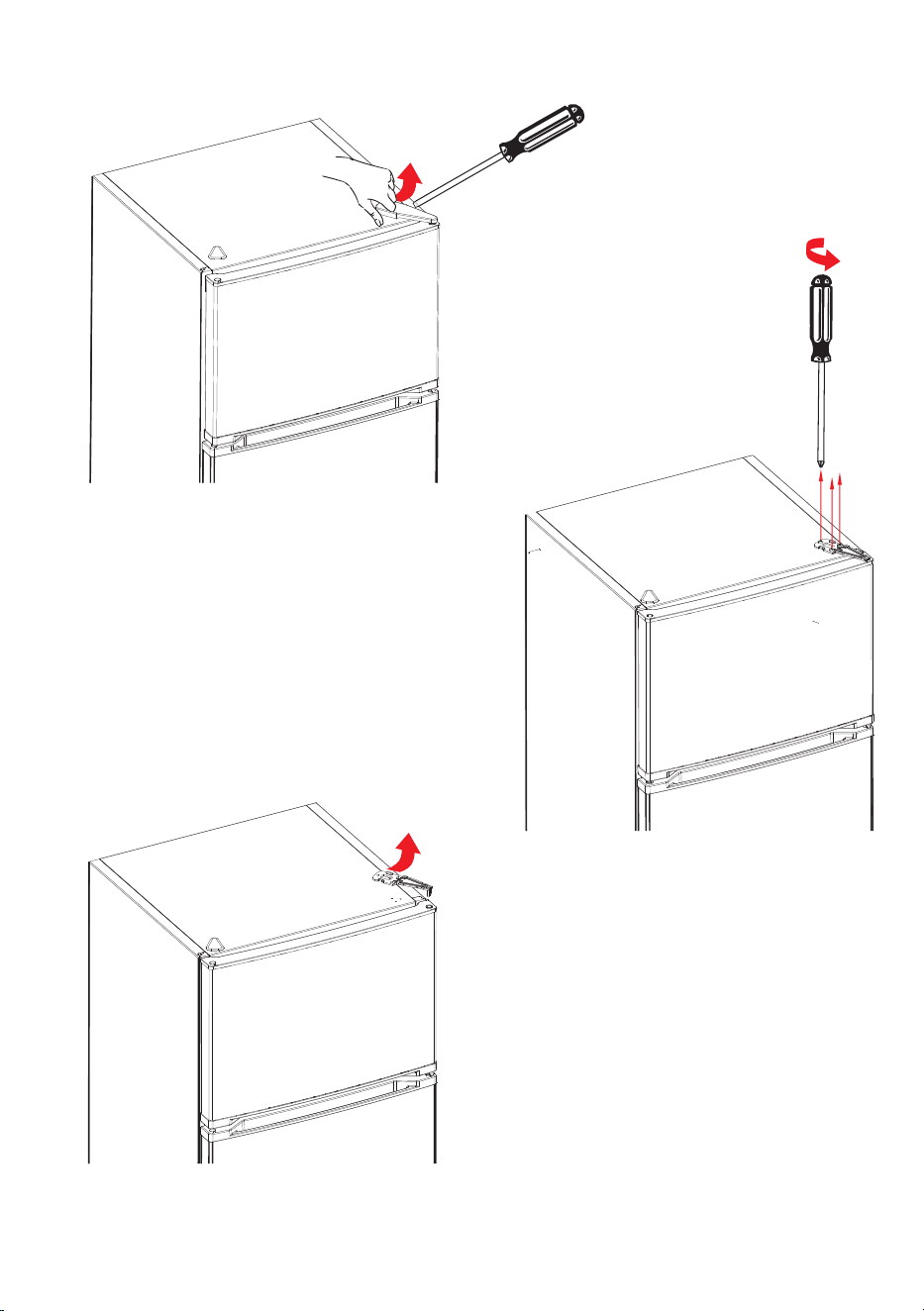
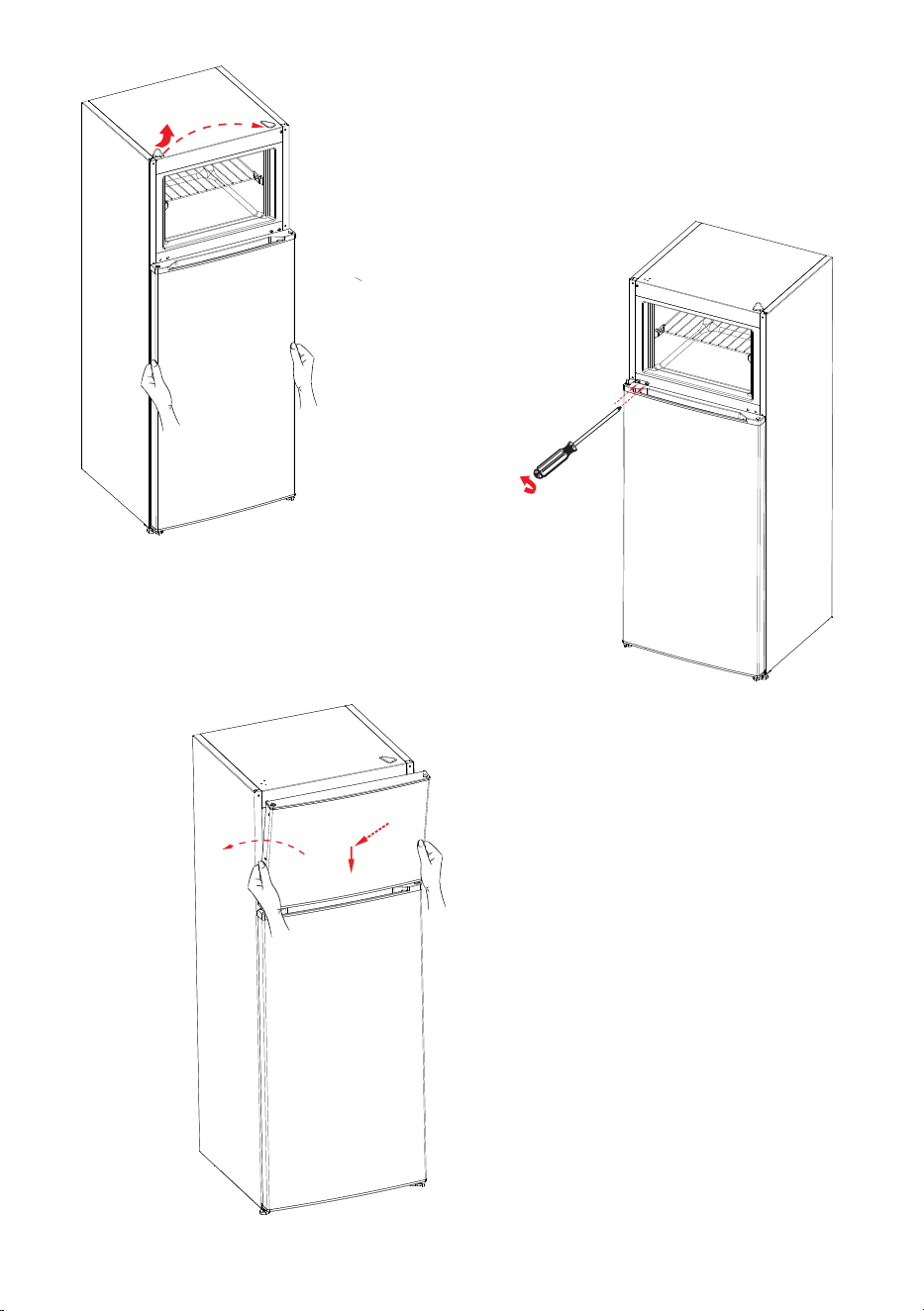
1. Remove the top hinge cover
from the freezer compartment.
2. Unscrew the top hinge.
3. Remove and set it aside.
6.3 Instructions for Reversing the Door Swing
EN - 18
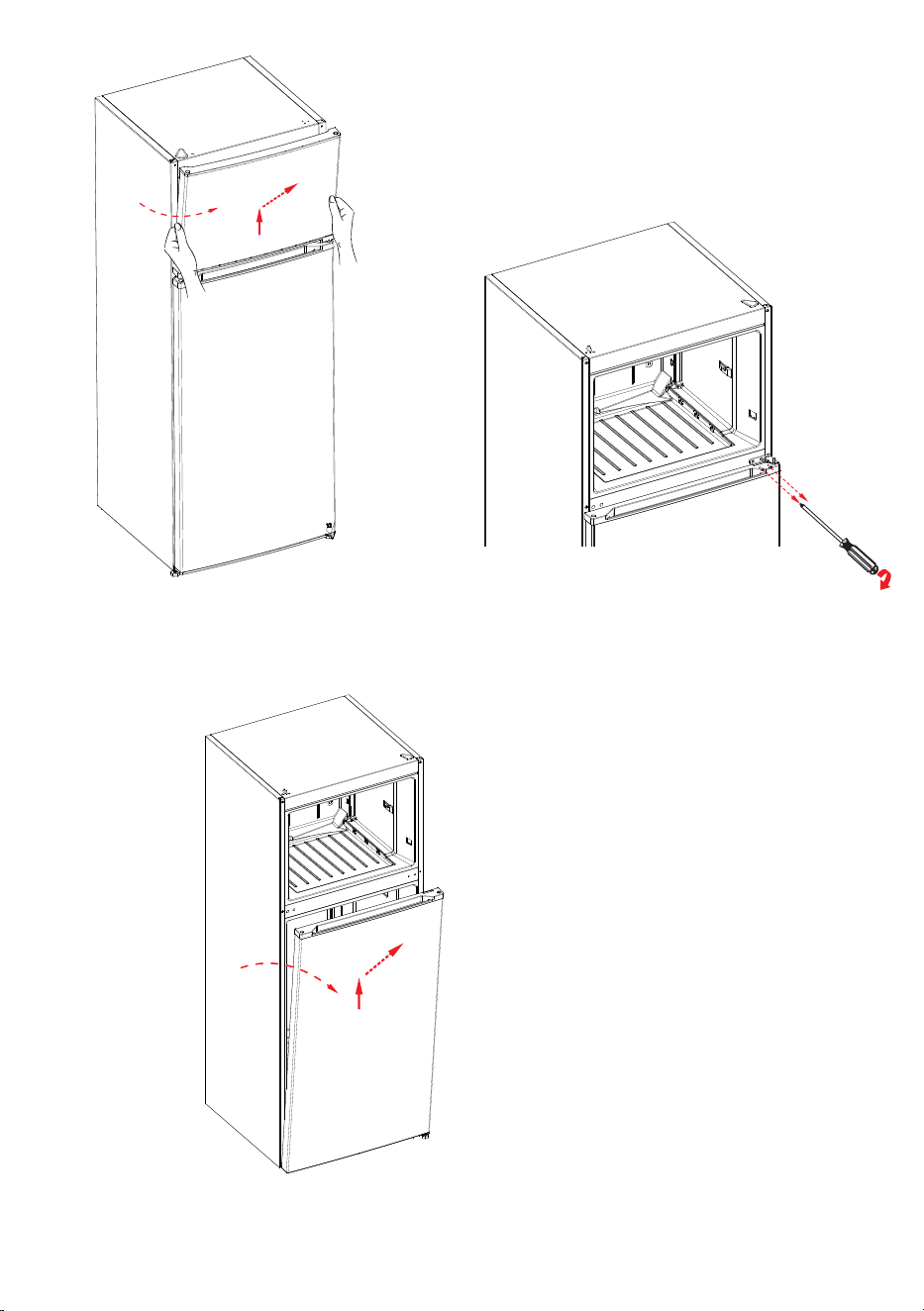
4. Lift the freezer door up and forward
to detach it from the pin.
5. Unscrew the middle hinge.
6. Lift the refrigerator door up and
forward to remove it from the pin.
EN - 19
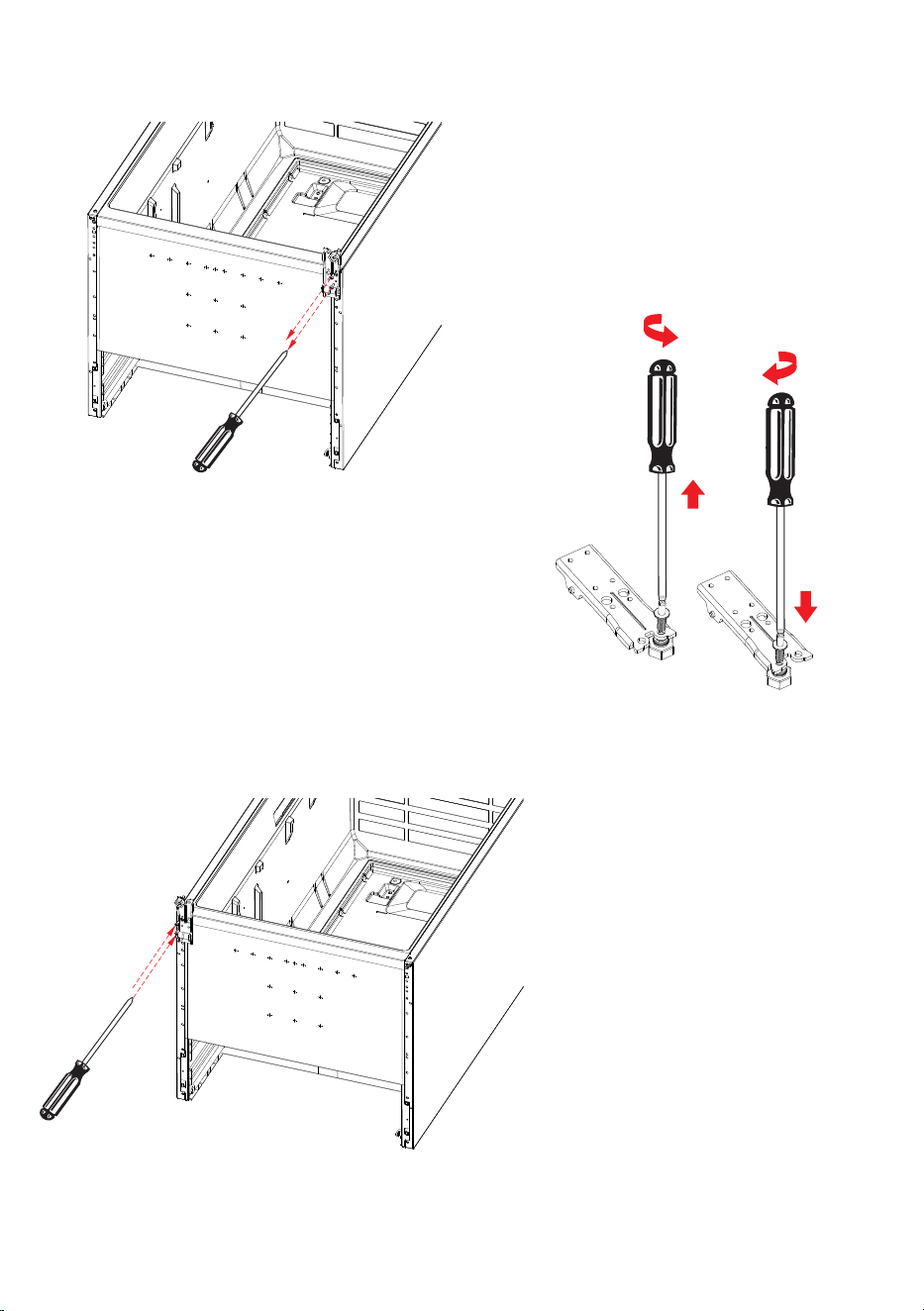
7. Unscrew the bottom hinge.
8. Detach the pin from the bottom
hinge and move it to the opposite hole.
9. Relocate the bottom hinge to the opposite side.
EN - 20
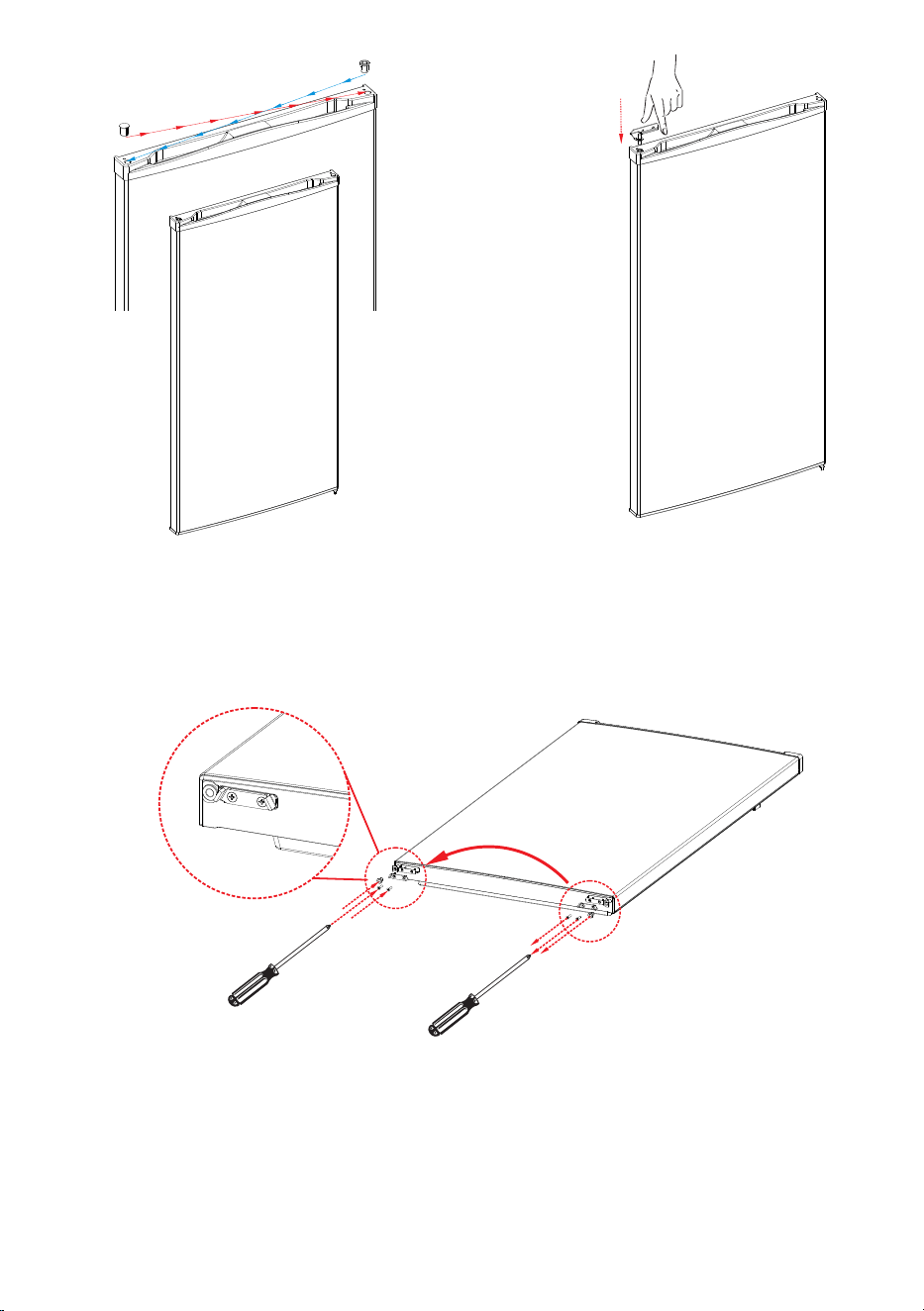
10. Switch the top fridge door pin cover
and the door insert to the opposite side.
11. Reattach the middle hinge to the
top fridge door by inserting the pin.
12. Move the bottom fridge door hinge and insert to the
opposite side of the door. Ensure the hinge is flipped.
EN - 21
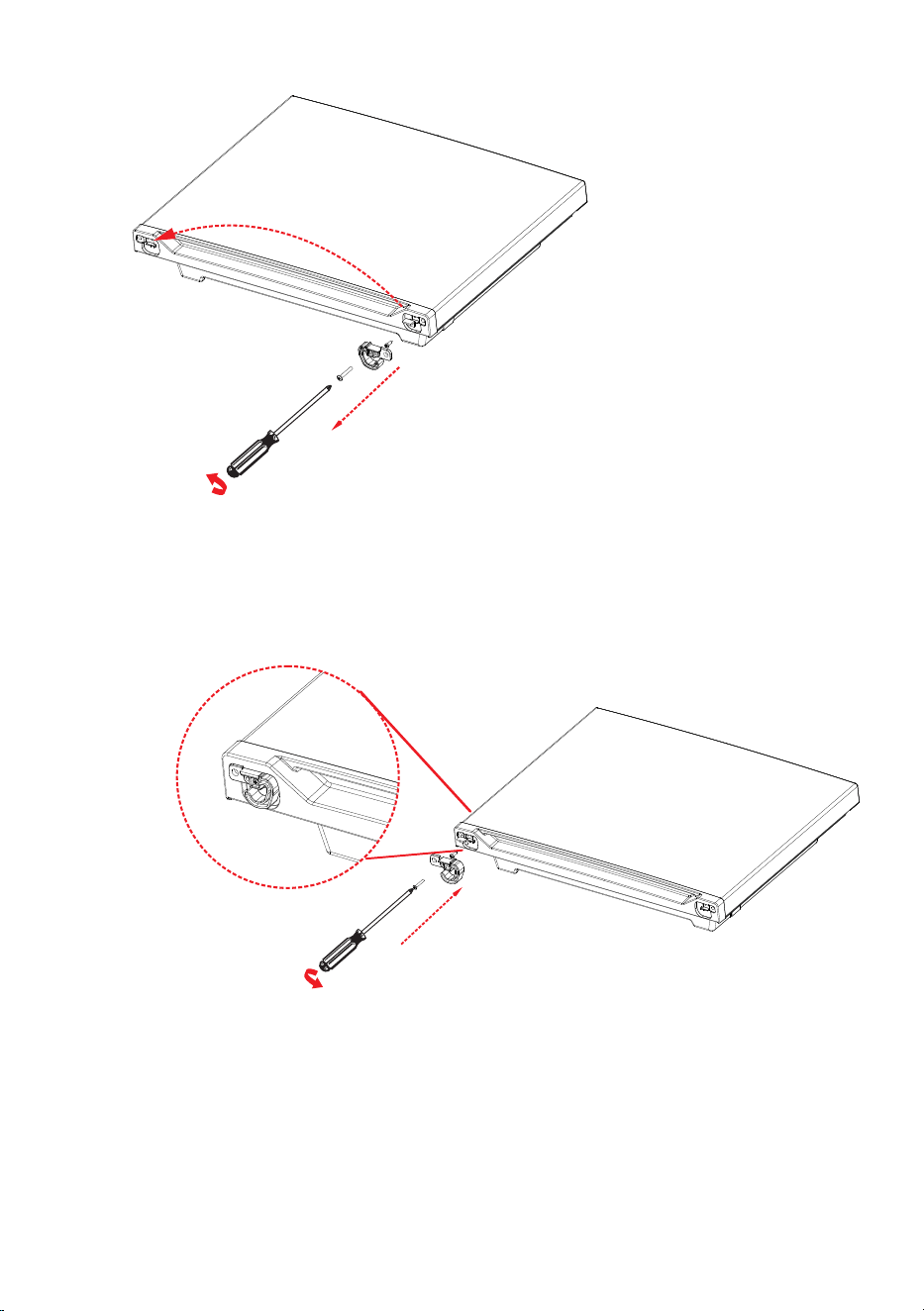
13. Unscrew the bottom freezer
door hinge to the opposite side.
14. Ensure the hinge is flipped.
EN - 22
EN - 23
15. Reattach the fridge door, ensuring
it is properly seated on the pin, then
reposition the top hinge cover.
16. Secure the middle hinge to
the unit.
17. Attach the freezer door by
inserting it onto the pin, pushing
down and toward the unit.
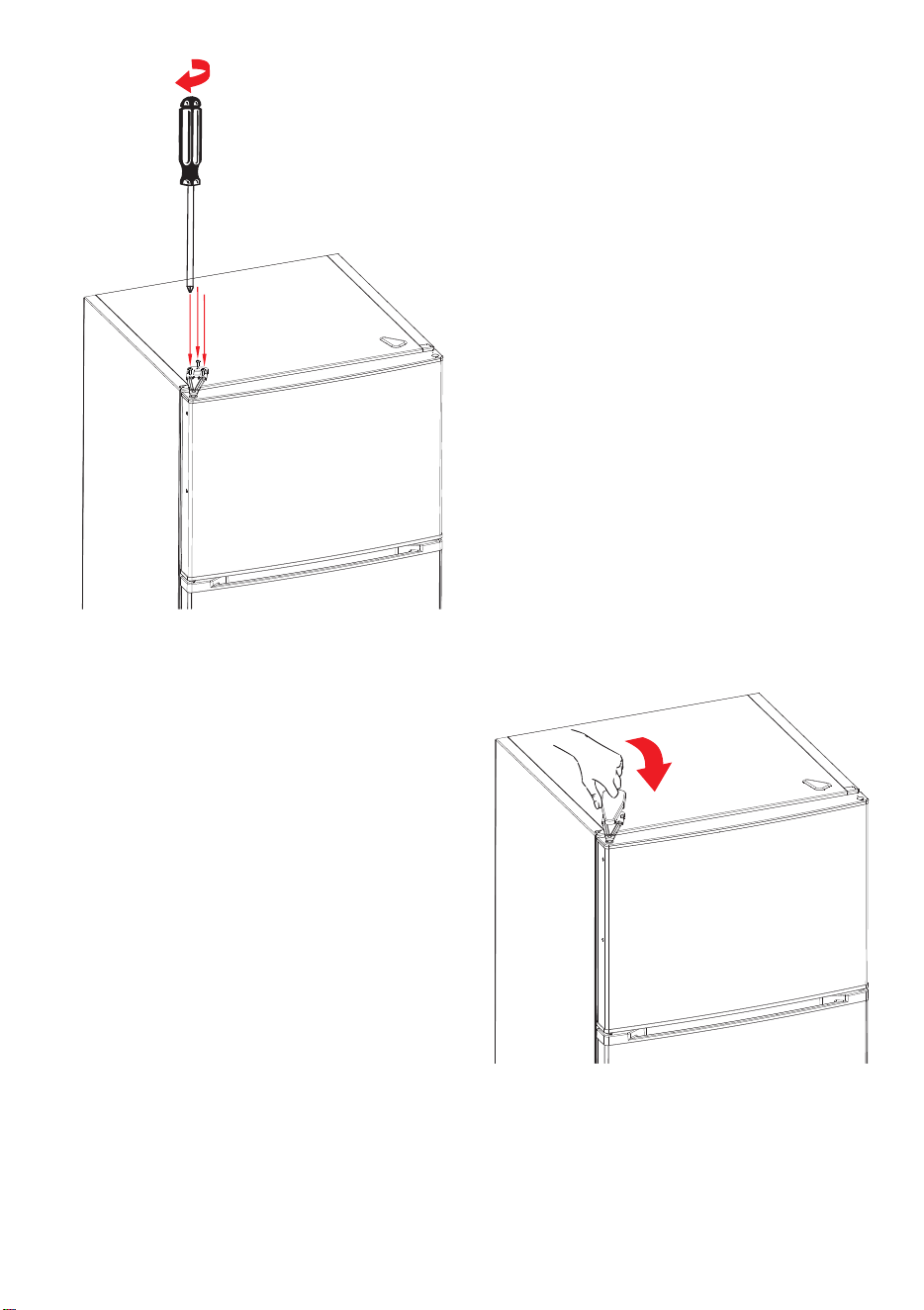
18. Secure the top hinge to the top
of the freezer.
19. Reattach the hinge cover.
Ensure it snaps into place.
EN - 24
7 TIPS FOR SAVING ENERGY
• Install the appliance in a cool, well-
ventilated room, but not in direct sunlight
and not near a heat source (such as a
radiator or oven) otherwise an insulating
plate should be used.
• Allow warm food and drinks to cool down
before
placing them inside the appliance.
• Thaw frozen food in the refrigerator
compartment. The cold from the food will
help maintain a cool temperature in the
fridge
to conserving energy. Thawing
outside the appliance can waste energy.
• Drinks or other liquids should be
covered
when inside the appliance. If
left
uncovered, the humidity inside the
appliance will increase, therefore the
appliance uses more energy. Keeping
drinks and other liquids covered helps
preserve their smell and taste.
• Avoid keeping the doors open for
extended periods or opening them too
frequently. Doing so allows warm air to
enter the appliance, causing the
compressor to activate more often than
necessary.
• Keep the covers of the different
temperature compartments (such as the
crisper and chiller if available) closed.
• The door gasket must be clean and
pliable. In case of wear, replace the
gasket.
• The product can be used without ice
maker
flap. Energy consumption is
declared according to this option.
Recommendations
• If the appliance is switched off or
unplugged,
wait at least 5 minutes before
plugging the
appliance in or restarting it in
order to prevent
damage to the
compressor.
•
If you will not use your appliance for
a long time (e.g. in summer holidays)
unplug it.
Clean your appliance according
to chapter cleaning and leave the door
open to prevent humidity and smell.
• The appliance you have purchased is
designed for domestic use only. It is not
suitable for commercial or common use. If
the consumer uses the appliance in a way
that does not comply with this, we
emphasis that the manufacturer and the
dealer will not be responsible for any repair
and failure within the guarantee period.
EN - 25
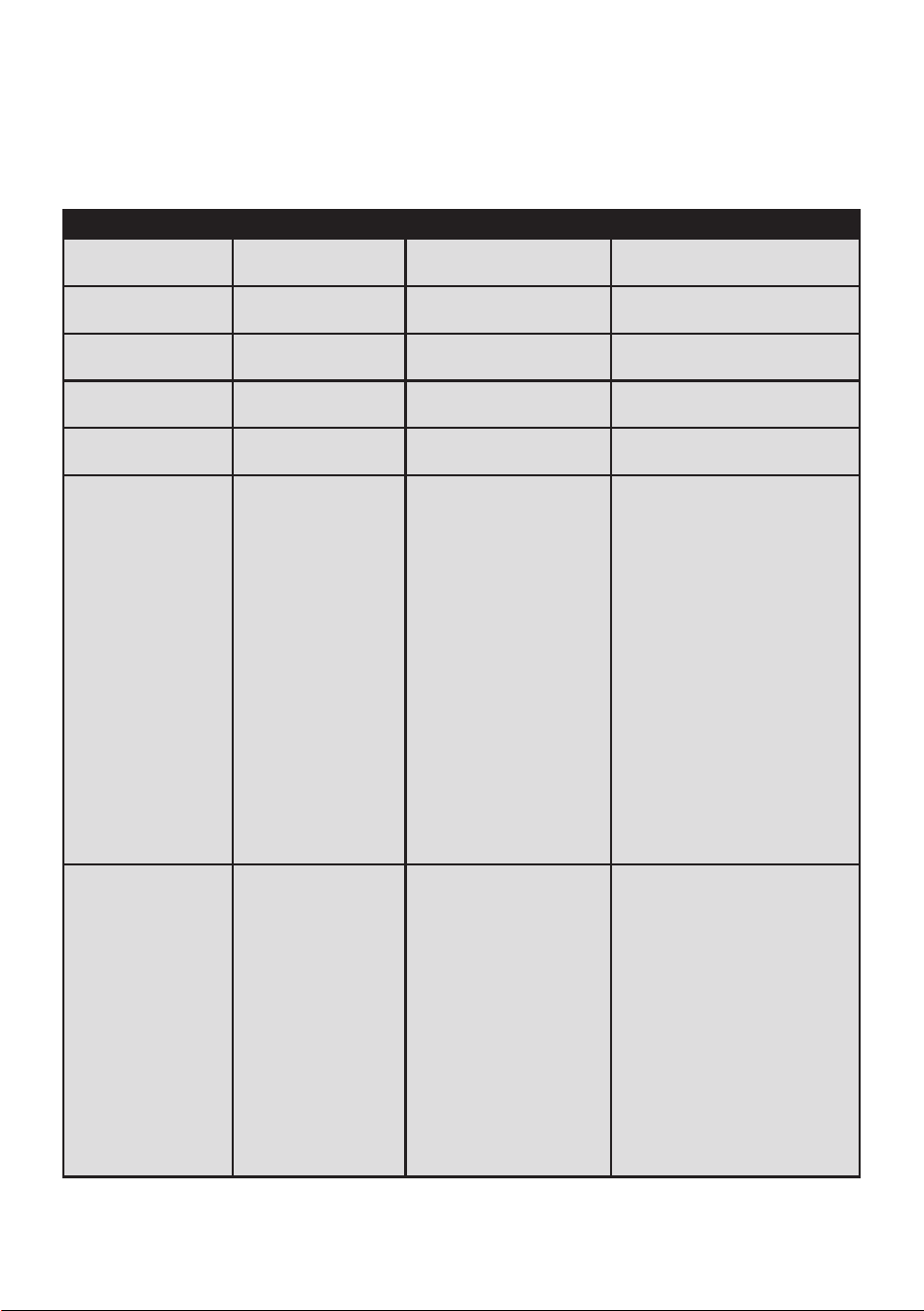
8 ERROR CODES
Errors
Your fridge will warn you if the temperatures for the cooler and freezer are at improper
levels or if a problem occurs with the appliance. Warning codes are displayed in the freezer
and cooler indicators.
ERROR TYPE MEANING WHY WHAT TO DO
E01 Sensor warning
Call Service for assistance as
soon as possible.
E02 Sensor warning
Call Service for assistance as
soon as possible.
E03 Sensor warning
Call Service for assistance as
soon as possible.
E06 Sensor warning
Call Service for assistance as
soon as possible.
E07 Sensor warning
Call Service for assistance as
soon as possible.
E09
Freezer compartment
is not cold enough
Likely to occur after long
term power failure.
1. Set the freezer temperature
to a colder value or set to
Super Freeze. This should
remove the error code once the
required temperature has been
reached. Keep doors closed
to improve time taken to reach
the correct temperature.
2. Remove any products which
have thawed/defrosted during
this error. They must be used
within a short period of time.
3. Do not add any fresh produce
to the freezer compartment
until the correct temperature
has been reached and the
error is no longer.
If this warning continues an
authorized technician needs to be
contacted.
E10
Fridge compartment is
not cold enough
Likely to occur after:
- Long term power failure.
- Hot food has been left in
the fridge.
1. Set the fridge temperature to
a colder value or set Super
Cool. This should remove the
error code once the required
temperature has been reached.
Keep doors closed to improve
time taken to reach the correct
temperature.
2. Please empty the location
at the front area of air duct
channel holes and avoid
putting food close to the
sensor.
If this warning continues an
authorised technician needs to be
contacted.
EN - 26
ERROR TYPE MEANING WHY WHAT TO DO
E11
Fridge compartment is
too cold
Various
1. Check is Super Cool mode is
activated
2. Reduce the fridge
compartment temperature
3. Check to see if vents are clear
and not clogged
If this warning continues an
authorised technician needs to be
contacted.
If you have checked the information above and you still need help with your appliance, call our
Customer Service facility at 800-932-4267 (Ext. 513) between 9:00 AM and 5:00 PM ET or visit our
website summitappliance.com/support at any time. We will do our best to answer your questions.
EN - 27
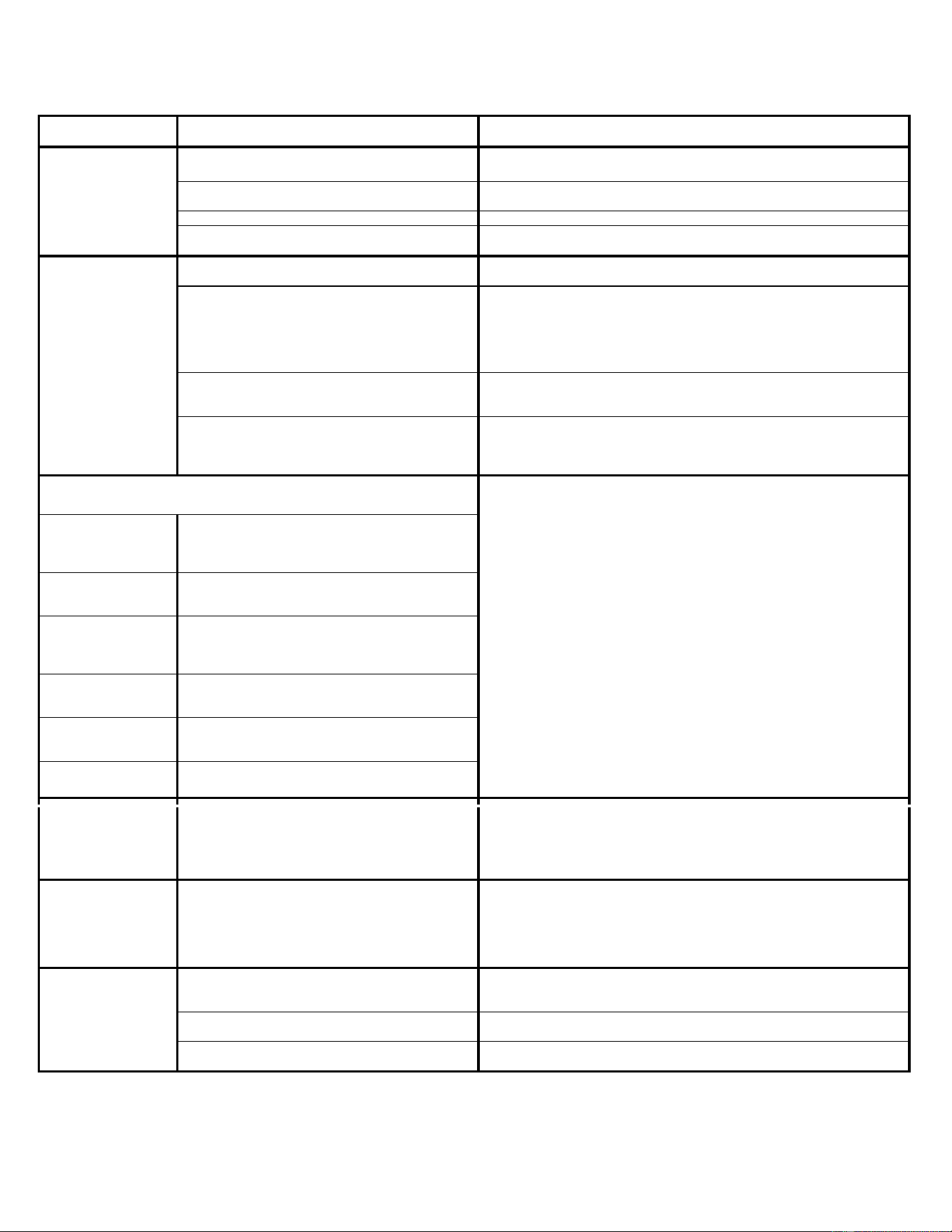
PROBLEM POSSIBLE CAUSES SOLUTION
Your appliance is not
operating
There is no power.
Verify that the power supply to the building is active. Contact your utility
provider if there are outages.
The plug is not correctly placed in the socket. Carefully unplug the device and then plug it back in, ensuring it's fully
seated in the socket.
The socket is defective. Try plugging another working appliance into the same socket.
The plug fuse or the mains fuse has blown. If issues persist or if you’re unsure about any step, contact a qualified
electrician for further diagnosis and repair.
The appliance
performs poorly
The appliance is overloaded.
Remove items that are not essential. Ensure there’s enough space for air
to circulate around the food.
The appliance door is not closed properly.
Make sure there are no food items or containers blocking the door from
closing fully.
Examine the rubber gasket around the door for any tears, dirt, or damage.
Clean it with warm, soapy water, and ensure its sealing tightly against the
fridge.
There is dust on the condenser.
Use a vacuum with a brush attachment to gently remove dust and debris
from the coils. Be careful not to damage the coils. Always unplug the fridge
before cleaning the condenser.
There is not enough space near the rear and side
walls.
Refer to your fridge’s manual for recommended clearance distances.
Remove any furniture, appliances, or items that may be blocking the
fridge’s ventilation.
Your appliance is operating noisily. Some common noises inclue:
It’s normal for the appliance to make noise. If the sounds persist or seem
abnormal, consider contacting technical support for a thorough inspection.
Cracking noise During automatic defrosting. Or when the appliance
is cooled or warmed (due to expansion of
appliance material).
Short cracking noise
When the thermostat switches the compressor
on/off.
Motor noise Indicates the compressor is operating normally.
The compressor may cause more noise for a short
time when it is first activated.
Bubbling noise and
splash occur
Due to the flow of the refrigerant in the tubes of the
system.
Water flowing noise Due to water flowing to the evaporation container.
This noise is normal during defrosting.
Air blowing noise In some models during normal operation of the
system due to the circulation of air.
The edges of the
appliance in contact
with the door joint are
warm
Especially during summer (warm seasons), the
surfaces in contact with the door joint may become
warmer during the operation of the compressor,
this is normal.
This is normal. If the issue persists, consider contacting technical support
to check for potential insulation issues or other underlying problems.
There is a build-up of
humidity inside the
appliance
The appliance door is opened frequently. Humidity
of the room enters the appliance when the doors
are opened. Humidity increases faster when the
doors are opened more frequently, especially if the
humidity of the room is high.
Limit the number of times the door is opened and ensure it is closed
securely each time.
Make sure all food is packed securely, and ensure containers are dry
before placing them in the appliance.
The door does not
open or close
properly
There is food or packaging preventing the door
from closing.
Check for any food or packaging blocking the door and rearrange or
remove items to ensure it closes securely. Regularly organize the fridge to
prevent future obstructions.
The door joints are broken or torn. Replace any broken or torn door joints to ensure a proper seal and
maintain refrigerator efficiency.
Your appliance is not on a level surface. Adjust the appliance's feet to ensure it is on a level surface for optimal
performance.
9 GENERAL TROUBLESHOOTING
If you are experiencing a problem with your appliance, please check the following before contacting the after-sales service.
If you have checked the information above and you still need help with your appliance, call our Customer Service facility at
800-932-4267 (Ext. 513) between 9:00 AM and 5:00 PM ET or visit our website summitappliance.com/support at any time. We will do
our best to answer your questions.
EN - 28
LIMITED WARRANTY
ONE-YEAR LIMITED WARRANTY
Within the 48 contiguous United States, for one year from the date of purchase, when this
appliance is operated and maintained according to instructions attached to or furnished with the
product, warrantor will pay for factory-specified parts and repair labor to correct defects in materials
or workmanship. Service must be provided by a designated service company. Outside the 48
states, all parts are warranted for one year from manufacturing defects. Plastic parts, shelves and
cabinets are warranted to be manufactured to commercially acceptable standards, and are not
covered from damage during handling or breakage.
5-YEAR COMPRESSOR WARRANTY
1. T
h
e
compressor is covered
for 5 years.
2. Replacement does not include labor.
ITEMS WARRANTOR WILL NOT PAY FOR:
1. Service cal
l
s to correct
the
installation
o
f
y
o
u
r
appliance,
to
instruct
y
o
u
h
o
w
t
o
use
y
our appliance,
t
o
replac
e or repair fuses or to correct wiring or plumbing.
2. Service calls to repair or replace appliance light bulbs or broken shelves. Consumable parts (such
as filters) are excluded from warranty coverage.
3. Damage resulting from accident, alteration, misuse, abuse, fire, flood, acts of God, improper
installation, installation not in accordance with electrical or plumbing codes, or use of products not
approved by warrantor.
4. Replacement parts or repair labor costs for units operated outside the United States.
5. Repairs to parts or systems resulting from unauthorized modifications made to the appliance.
6. The removal and re installation of your appliance if it is installed in an inaccessible location or is not
installed in accordance with published installation instructions.
DISCLAIMER OF IMPLIED WARRANTIES; LIMITATION OF REMEDIES
CUSTOMER'S SOLE AND EXCLUSIVE REMEDY UNDER THIS LIMITED WARRANTY SHALL
BE PRODUCT REPAIR AS PROVIDED HEREIN. IMPLIED WARRANTIES, INCLUDING
WARRANTIES OF MERCHANTABILITY OR FITNESS FOR A PARTICULAR PURPOSE, ARE
LIMITED TO ONE YEAR. WARRANTOR SHALL NOT BE LIABLE FOR INCIDENTAL OR
CONSEQUENTIAL DAMAGES. SOME STATES DO NOT ALLOW THE EXCLUSION OR
LIMITATION OF INCIDENTAL OR CONSEQUENTIAL DAMAGES, OR LIMITATIONS ON THE
DURATION OF IMPLIED WARRANTIES OF MERCHANTABILITY OR FITNESS, SO THESE
EXCLUSIONS OR LIMITATIONS MAY NOT APPLY TO YOU. THIS WARRANTY GIVES YOU
SPECIFIC LEGAL RIGHTS AND YOU MAY ALSO HAVE OTHER RIGHTS, WHICH VARY FROM
STATE TO STATE.
Felix Storch, Inc.
An ISO 9001:2015 registered company
770 Garrison Ave
Bronx, New York 10474
www.summitappliance.com
For parts and accessory ordering,
troubleshooting and helpful hints, visit:
www.summitappliance.com/support
WARNING: This product can expose you to chemicals including Diisononyl phthalate (DINP) which
is known to the State of California to cause cancer. For more information go to
www.P65Warnings.ca.gov
AVERTISSEMENT: Ce produit peut contenir des produits chimiques
, notamment du poison mortel
(DINP), reconnus par l'État de Californie comme pouvant provoquer le cancer. Pour plus
d’informations, visitez www.P65Warnings.ca.gov
EN - 29
Manuel
d'
U
tilisation
AVANTUTILISATION,VEUILLEZLIREETSUIVRETOUTESLESRÈGLESDESÉCURITÉETLESINSTRUCTIONSD'UTILISATION.
FélixStorch,Inc.
UneentreprisecertifiéeISO9001:2015770
GarrisonAveBronx,
NewYork10474
www.summitappliance.com
Modèles
:
LRF15SS
FF156SS
LRF15W
CTR153PL
CTR151W
FF156W
CTR15SS
RÉFRIGÉRATEUR - CONGÉLATEUR À MONTAGE SUPÉRIEUR
CTR152B
LRF15PL LRF15B
FF156PL FF156B
Modèle
Numérodesérie
_________________________
Écrivezlesnumérosdemodèleetdesérieici:
______________________
AVERTISSEMENT
Risquedetensiondangereuse
Risquedeblessuregraveoudedécès
PRUDENCE
Signification
RISQUEDECHOCÉLECTRIQUE
Taper
Icône
Attention;risqued'incendie/matièresinflammables
FEU
Fairefonctionnercorrectementlesystème
IMPORTANT
Risquedeblessureoudedommagesmatériels
Mercid'avoirchoisiceproduit.
Cemanueld'utilisationcontientdesinformationsimportantessurlasécuritéetdesinstructionsdestinéesà
vousaiderdansl'utilisationetl'entretiendevotreappareil.
Veuillezprendreletempsdelirecemanueld'utilisationavantd'utiliservotreappareiletconservezcelivre
pourréférenceultérieure.
Ce produit utilise un réfrigérant hydrocarboné respectueux de l'environnement et est
entièrement conforme à la réglementation California CARB.
Cependant, la loi californienne nous oblige à fournir la déclaration de divulgation suivante dans
chaque produit vendu en Californie.
"Il est interdit d'utiliser cet équipement en Californie avec des réfrigérants figurant sur la ‘Liste des
substances interdites’ pour cette utilisation finale spécifique, conformément au California Code of
Regulations, titre 17, section 95374. Cette déclaration de divulgation a été examinée et approuvée
par Felix Storch, Inc. et Felix Storch, Inc. atteste, sous peine de parjure, que ces déclarations sont
vraies et exactes."
Ce produit n'utilise aucun réfrigérant figurant sur la "Liste des substances interdites"

5NETTOYAGEETENTRETIEN..................................................................17
8CODESD'ERREUR........................................................................................26
4STOCKAGEDESALIMENTS..................................................................................12
4.1 Compartiment réfrigérateur..................................................................................12
4.2 Compartiment congélateur..................................................................................................13
9DÉPANNAGEGÉNÉRAL.................................................................28
2DESCRIPTIONDEL'APPAREIL..................................................................8
6EXPÉDITIONETREPOSITIONNEMENT..................................................................17
6.1 Transport et changement de positionnement..................................................................17
6.2 Repositionnement de la porte..................................................................................17
6.3 Instructions pour l'inversion du sens d'ouverture de la porte.....................................18
7 CONSEILS POUR ÉCONOMISER DE L'ÉNERGIE......................................................... 25
3UTILISATIONDEL'APPAREIL.................................................................................8
3.1 Informations sur la technologie deréfrigérationdenouvellegénération.................................8
3.2 Affichage et panneau de commande.................................................................................9
3.3 Fonctionnement de votre réfrigérateur-congélateur.................................................................9
3.3.1 Réglages de température du congélateur..................................................................9
3.3.2 Réglages de température du réfrigérateur..................................................................9
3.3.3 Mode Super Freeze..................................................................................................9
3.3.4 Fonction d'alarme de porte ouverte................................................................................10
3.4 Avertissements relatifs aux réglages de température.................................................................10
3.5 Accessoires..................................................................................................................10
3.5.1 Bac à glaçons (sur certains modèles).................................................................10
3.5.2 Le distributeur de glaçons (sur certains modèles).................................................10
3.5.3 Le tiroir réfrigéré (sur certains modèles).................................................................11
3.5.4 Le cadran Fresh (Dans certains modèles)..............................................................................11
1CONSIGNESDESÉCURITÉ...........................................................................................1
1.1 Avertissements généraux de sécurité..................................................................................1
1.2 Avertissements d'installation..................................................................................................6
1.3 Pendant l'utilisation..................................................................................................................7
GARANTIELIMITÉE..................................................................................29
CONTENU
FR1
1 CONSIGNES DE SÉCURITÉ
1.1Avertissementsgénérauxdesécurité
Lisezattentivementcemanueld'utilisation.
AVERTISSEMENT:Gardezlesouverturesdeventilation,dans
leboîtierdel'appareiloudanslastructureintégrée,exemptesdetoute
obstruction.
AVERTISSEMENT:N'utilisezpasdedispositifsmécaniquesou
d'autresmoyenspouraccélérerleprocessusdedégivrage,autresque
ceuxrecommandésparlefabricant.
AVERTISSEMENT:N'utilisezpasd'appareilsélectriquesàl'intérieur
lescompartimentsdestockagedesalimentsdel'appareil,saufs'ils
sontdutyperecommandéparlefabricant.
ATTENTION:Nepasendommagerlecircuitréfrigérant.
AVERTISSEMENT:Lorsdupositionnementdel’appareil,
assurezvousquelecordond’alimentationn’estpascoincéou
endommagé.
AVERTISSEMENT:Neplacezpasplusieursprisesportables.
prisesdecourantoublocsd'alimentationportablesàl'arrièredel'appareil.
AVERTISSEMENT:Afind'évitertoutdangerrésultantdel'instabilitéde
l'appareil,celuicidoitêtrefixéconformémentauxinstructions.
SivotreappareilutiliseleR600acommeréfrigérant(cetteinformation
seraindiquéesurl'étiquettedurefroidisseur),vousdevezprendredes
précautionslorsdutransportetdel'installationpouréviter
d'endommagerlesélémentsdurefroidisseur.LeR600aestunréfrigérant
respectueuxdel'environnementet

FR2
- lescuisinesdupersonneldanslesmagasins,bureauxetautres
environnementsdetravail.
- les fermesetparlesclientsdansleshôtels,motelsetautres
environnementsdetyperésidentiel.
- lesenvironnementsdetypechambresd'hôtes
- larestaurationet
lesapplicationssimilairesnoncommerciales
• Silaprisenecorrespondpasàlaficheduréfrigérateur,elledoit
êtreremplacéeparlefabricant,unagentdeserviceoudes
personnes de qualification similaire afin d'éviter tout danger.
• Uneprisedeterrespécialeaétéraccordéeaucâble
d'alimentationdevotreréfrigérateur.Cetteprisedoitêtreutilisée
avecuneprisedeterrespécialede10ampères.Sivotremaison
nedisposepasd'unetelleprise,veuillezenfaireinstallerune
parunélectricienagréé.
• Nestockezpasdesubstancesexplosivestellesquedesbombes
aérosolscontenantunpropulseurinflammabledanscetappareil.
• Cet appareil est destiné à être utilisé dans un environnement
domestique et les applications domestiques telles que :
gaznaturel,maisilestexplosif.Encasdefuitedueàladétérioration
desélémentsréfrigérants,éloignezvotreréfrigérateurdesflammes
nuesoudessourcesdechaleuretaérezlapièceoùsetrouve
l'appareilpendantquelquesminutes.
• Lorsdutransportetdupositionnementduréfrigérateur,veillezàne
pasendommagerlecircuitdegazréfrigérant.

FR3
Lesenfantsnedoiventpasjoueravecl'appareil.Lenettoyage
etl'entretiendel'appareilnedoiventpasêtreeffectuéspardes
enfantssanssurveillance.
• Silecordond’alimentationestendommagé,ildoitêtreremplacé
parlefabricant,unagentdeserviceagrééoudespersonnes
dequalificationsimilaire,afind’évitertoutdanger.
• Lesenfantsâgésde3à8anssontautorisésàchargeret
déchargerlesappareilsderéfrigération.Lesenfantsnesontpas
censéseffectuerlenettoyageoul'entretiendel'appareil.Lestrès
jeunesenfants(0à3ans)nesontpascensésutiliserles
appareils.Lesjeunesenfants(3à8ans)nesontpascensés
utiliserlesappareilsentoutesécuritésanssurveillance
continue.Lesenfantsplusâgés(8à14ans)etlespersonnes
vulnérablespeuventutiliserlesappareilsentoutesécurité
aprèsavoirreçuunesurveillanceoudesinstructions
appropriéesconcernantl'utilisationdel'appareil.Lespersonnes
trèsvulnérablesnesontpascenséesutiliserlesappareils
entoutesécuritésanssurveillancecontinue.
• Cetappareilpeutêtreutilisépardesenfantsâgésde8anset
plusetpardespersonnesayantdescapacitésphysiques,
sensoriellesoumentalesréduitesoumanquantd'expérience
etdeconnaissancess'ilsontreçuunesurveillanceoudes
instructionsconcernantl'utilisationdel'appareildemanière
sûreetcomprennentlesdangersencourus.
dépassant6500pi.
• Cetappareiln'estpasdestinéàêtreutiliséàdesaltitudes

• Cetappareiln'estpasdestinéàêtreutilisépardespersonnes
duréfrigérateur.
• ATTENTION:Pouréviterqu'unenfantnesoit
Piégé,tenirhorsdeportéedesenfantsetloinducongélateurou
• AVERTISSEMENT:Lesystèmederéfrigérationestsous
hautepression.Nepaslemodifier.Contacteruntechnicien
qualifiéavantdeprocéderàlamiseaurebut.
Laissezlesétagèresenplaceafinquelesenfantsnepuissentpas
grimperfacilementàl’intérieur.
• AVERTISSEMENT:risquedepiégeagedesenfants.Avant
dejetervotreancienréfrigérateuroucongélateur:
• *
Enlevezlesportes.
• *
Lesenfantsdoiventêtresurveilléspours’assurerqu’ilsnejouent
pasavecl’appareil.
(ycomprislesenfants)ayantdescapacitésphysiques,
sensorielles
oumentalesréduites,oumanquantd'expérience
etdeconnaissances,àmoinsqu'ilsnebénéficient
d'unesurveillanceoud'instructionsconcernantl'utilisation
del'appareilparunepersonneresponsabledeleursécurité.
FR4

FR5
• Lescompartimentsàune,deuxettroisétoilesneconviennentpasà
lacongélationd’alimentsfrais.
• Sil'appareilderéfrigérationestlaissévidependantunelonguepériode
• Lescompartimentspouralimentssurgelésdeuxétoilesconviennentau
stockaged'alimentsprécongelés,austockageouàlafabricationde
glacesetàlafabricationdeglaçons.
• Nettoyezrégulièrementlessurfacespouvantentrerencontactavecles
alimentsetlessystèmesdedrainageaccessibles.
• Conservezlaviandeetlepoissoncrusdansdesrécipientsadaptésau
réfrigérateurpouréviterqu’ilsn’entrentencontactavecd’autresaliments
ounecoulentsureux.
• Garderlaporteouvertependantdespériodesprolongéespeut
augmenterconsidérablementlatempératureàl’intérieurde
l’appareil.
Pour éviter la contamination des aliments,
veuillez suivre ces instructions :
périodes,éteindre,décongeler,nettoyer,sécheretlaisserlaporte
ouverte
pouréviterlaformationdemoisissures.

FR6
• Un dégagement d'au moins 6 pouces est requis
en haut de votre appareil. Ne placez rien sur
votre appareil.
• Ne placez pas d'objets lourds sur l'appareil.
• Nettoyez soigneusement l'appareil avant
utilisation (voir Nettoyage et entretien).
• Avant d'utiliser votre réfrigérateur-congélateur,
essuyez toutes les pièces avec une solution
d'eau tiède et une cuillère à café de bicarbonate
de sodium. Ensuite, rincez à l'eau claire et
séchez. Remettez toutes les pièces au
réfrigérateur-congélateur après le nettoyage.
• Utilisez les pieds avant réglables pour vous
assurer que votre appareil est de niveau et
stable. Vous pouvez ajuster les pieds en les
tournant dans les deux sens. Cela doit être fait
avant de placer des aliments dans l'appareil.
• Lorsque le produit fonctionne, les panneaux
latéraux peuvent devenir sensiblement chauds.
C'est normal.
• Pour que le produit fonctionne efficacement, il
doit y avoir un espace autour de lui pour la
circulation de l'air. Si vous envisagez de placer le
produit dans une zone encastrée sur le mur,
assurez-vous que l'espace soit de 4 pouces
entre la surface supérieure et le plafond, et de 2
pouces entre les murs et les panneaux latéraux.
La distance entre l'appareil et le mur du fond doit
être d'un maximum de 3 pouces.
1.2 Avertissements d'Installation
Avant d'utiliser votre réfrigérateur-congélateur pour la
première fois, veuillez considérer les points suivants :
• La tension de fonctionnement de votre
réfrigérateur-congélateur est de 115-127 V à 60
Hz.
• La fiche doit être accessible après l'installation.
• Votre réfrigérateur-congélateur peut émettre une
odeur lors de sa première utilisation. C'est
normal et l'odeur disparaîtra en refroidissant.
• Avant de brancher votre réfrigérateur-
congélateur, assurez-vous que les informations
figurant sur la plaque signalétique (tension et
charge connectée) correspondent à
l'alimentation électrique du secteur. En cas de
doute, consultez un électricien qualifié.
• Insérez la fiche dans une prise dotée d'une
connexion à la terre efficace. Si la prise n'a pas
de contact avec la terre ou si la fiche ne
correspond pas, nous vous recommandons de
consulter un électricien qualifié pour obtenir de
l'aide.
• L'appareil doit être connecté avec une prise à
fusible correctement installée. L'alimentation
électrique (AC) et la tension au point de
fonctionnement doivent correspondre aux
informations figurant sur la plaque signalétique
de l'appareil (la plaque signalétique se trouve à
l'intérieur à gauche de l'appareil).
• Nous n'acceptons aucune responsabilité pour
tout dommage résultant d'une utilisation non
mise à la terre.
• Placez votre réfrigérateur-congélateur dans un
endroit où il ne sera pas exposé à la lumière
directe du soleil.
• Votre réfrigérateur-congélateur ne doit jamais
être utilisé à l'extérieur ni exposé à la pluie.
• Votre appareil doit être à au moins 20 pouces
des cuisinières, des fours à gaz et des
radiateurs, et à au moins 2 pouces des fours
électriques.
• Si votre réfrigérateur-congélateur est placé à
côté d'un congélateur, il doit y avoir au moins 1
pouce entre eux pour éviter la formation
d'humidité sur la surface extérieure.
• Ne couvrez pas le corps ou le dessus du
réfrigérateur-congélateur avec de la dentelle.
Cela affectera les performances de votre
réfrigérateur-congélateur.
EN - 6
FR7
1.3Pendantl'utilisation
Remarques:
• Sivotreancienréfrigérateurou
congélateuraun Verrouillez,cassez
ouretirezleverrouavantdele
jeter, carlesenfantspourraient
restercoincésàl'intérieuret
provoquerunaccident.
• Lesvieuxréfrigérateurset
congélateurscontiennentdes
matériauxisolantsetduréfrigérant
contenantdesCFC. Veillezdoncà
nepasnuireàl’environnement
lorsque vousjetezvosvieux
réfrigérateurs.
Réfrigérateursanciensethorsservice
• Veuillezlirelemanueld'instructions
Lisezattentivementlesinstructions
d'installationetd'utilisation devotre
appareil.Nousnesommespas
responsablesdes dommagessurvenus
suiteàunemauvaiseutilisation.
• Suiveztouteslesinstructionsfigurantsur
votreappareiletdans lemanuel
d’instructions,etconservezcemanueldans
un endroitsûrpourrésoudrelesproblèmes
quipourraient
surveniràl’avenir.
• Cetappareilestconçupourêtreutilisé
danslesmaisonsetne peutêtreutiliséque
dansdesenvironnements
domestiquesetpour
àdesfinsspécifiques.Iln'estpasadaptéà
unusage commercial.Unetelleutilisation
entraîneraitl'annulationdela garantiede
l'appareiletnotresociéténeserait
pasresponsabledespertesencourues.
• Cetappareilestconçupourêtreutilisé
dansdeshabitationset neconvientque
pourrefroidir/conserverdesaliments.Il
n'est pasadaptéàunusagecommercialet/
ouau
stockagedesubstancesautresquedes
aliments.
Notresociéténepeutêtretenue
responsabledespertesrésultant d'une
utilisationinappropriéedel'appareil.
• Nebranchezpasvotreréfrigérateur
congélateurau alimentationélectrique
duréseauàl'aided'unerallonge.
• N’utilisezpasdefichesendommagées,
déchiréesouanciennes.
• Nepastirer,plierouendommagerle
cordon.
• N’utilisezpasd’adaptateurdeprise.
• Cetappareilestdestinéàunusage
adulte
uniquement.Nelaissezpaslesenfants
joueravecl'appareilou s'accrocheràla
porte.
• Netouchezjamaislecordon
d'alimentationoulapriseavecles mains
mouillées.Celapourraitprovoquerun
courtcircuitou unedéchargeélectrique.
• Neplacezpasdebouteillesoude
canettesenverredansle compartiment
defabricationdeglaçons,carelles
pourraient éclaterlorsqueleurcontenu
gèle.
• Neplacezpasdesubstances
explosivesouinflammables Conservez
lesboissonsàforteteneurenalcool
dansvotre réfrigérateur.Placezles
boissonsàforteteneurenalcool
verticalementdanslecompartiment
réfrigérateuretassurezvous queleurs
couverclessontbienfermés.
• Lorsquevousretirezlaglacedu
compartimentdefabrication deglace,ne
latouchezpas,carcelapourrait
provoquerdes geluresoudescoupures.
• Netouchezpaslesproduitscongelés
aveclesmainsmouillées. Nemangez
pasdeglaceoudeglaçons
immédiatementaprèslesavoirretirés
ducompartimentde fabricationdeglace.
• Nerecongelezpasdesaliments
surgelésdécongelés.Celapeut
entraînerdesproblèmesdesantétels
qu'uneintoxication alimentaire.
Lesréfrigérateursdotésd'unetechnologiede
réfrigérationdenouvellegénération
fonctionnentdifféremmentdesréfrigérateurs
statiques.Certainsréfrigérateurs(statiques)
peuventêtresujetsàuneaccumulationde
glacedanslecompartiment
congélateurenraisondel'ouverturedesportes
etdel'humiditédesaliments.Dansces
réfrigérateurs,undégivragerégulierest
nécessaire:leréfrigérateur
doitêtreéteint,lesalimentscongelésdéplacés
dans
unrécipientappropriéetlaglacequis'est
forméedans
lecompartimentcongélateurdoitêtreretirée.
Danslesréfrigérateursdotésd'une
technologiederefroidissementdenouvelle
génération,unventilateursouffledel'airfroid
etsecdemanièreuniformedansles
compartimentsréfrigérateuretcongélateur.
L'airfroidrefroiditvosalimentsdemanière
uniformeetrégulière,empêchantainsi
l'accumulationd'humiditéetdeglace.
Danslecompartimentréfrigérateur,l'airsoufflé
parleventilateur,situéenhautdu
compartimentréfrigérateur,estrefroidien
passantparl'espace
derrièreleconduitd'air.Enmêmetemps,l'air
est
souffléparlestrousduconduitd'air,
répartissantuniformémentl'airfraisdanstout
lecompartimentréfrigérateur.
Iln'yaaucunpassaged'airentreles
compartimentscongélateuretréfrigérateur,
évitantainsilemélange
desodeurs.Decefait,votreréfrigérateur,doté
d'unetechnologiederefroidissementde
nouvellegénération,vousoffreunefacilité
d'utilisationainsiqu'unvolumeimportantet
uneapparenceesthétique.
3.1Informationssurlatechnologiede
refroidissementde
nouvellegénération
FR8
16
B
15
12
6
14
7
2
17
10
5
9
UN
3
4
1
13
11
8
3 UTILISATION DE L'APPAREIL
2 DESCRIPTION DU
APPAREIL
Cetteprésentationestuniquement
àtitreinformatifconcernantlespiècesde
l'appareil.Lespiècespeuventvarierselonle
modèled'appareil.
A) Compartiment congélateur
B) Compartiment réfrigérateur
1) Clayette du congélateur
2) Machine à glaçons *
3) Turboventilateur *
4) Casier à vin *
5) Étagères du réfrigérateur
6) Refroidisseur *
7) Couvercle du bac à légumes
8) Bacs à légumes
9) Pieds de nivellement
10) Tablette inférieure de porte *
11) Etagère à bouteilles
12) Tablette de porte réglable * /Tablette de porte
13) Tablette de porte
14) Affichage intérieur
15) Balconnets de porte du congélateur *
16) Bac à glaçons *
17) Porte-oeufs
* Sur certains modèles
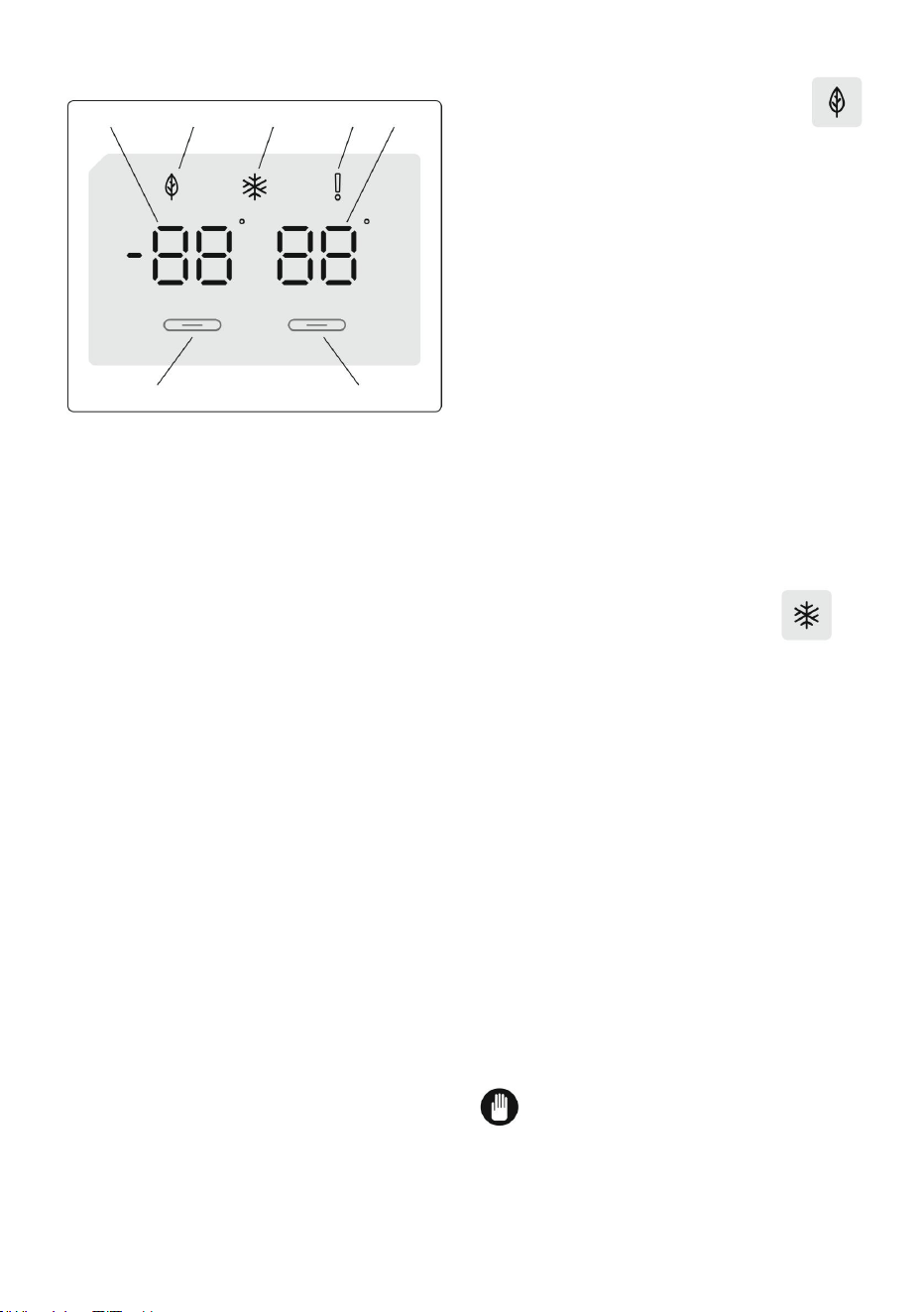
6
7
5
3
4
1 2
2.Permetleréglageduréfrigérateur.
vousappuyezd'abordsurlebouton,leprécédent
unetempératureplusbasseseraréglée(3°F,0°F,
7.Symboled'alarme.
l'indicateurderéglageducongélateurestà0°F.
•Sivouscontinuezàappuyersurlebouton,il
5.Symboledumodeéconomique.
REMARQUE:LemodeEcos'active
automatiquementlorsquelatempératuredu
compartimentcongélateurestrégléesur0°F.
3.3.2Réglagesdetempératureduréfrigérateur
1.Permetleréglageducongélateur.
3.Écrandevaleurdeconsigneducongélateur.
lavaleurclignoterasurl'écran.
•Chaquefoisquevousappuyezsurlemêmebouton,un
•Appuyezunefoissurleboutonderéglageducongélateur.Lorsque
•Lavaleurdetempératureinitialepourle
Commentutiliser
PouractiverlemodeSuperFreeze,
maintenezenfoncéleboutonderéglagedela
températureducongélateurpendant3secondes.
Unefoislemodesupercongélationréglé,lesymbole
supercongélationsurl'indicateurs'allumeetla
machineémetunbippourconfirmerquelemodeaété
activé.
PendantlemodeSuperFreeze:
6.Symboledesupercongélation.
4°F8°Fou11°F).
redémarreràpartirde3°F.
3.3Utilisationdevotreréfrigérateurcongélateur
Éclairage(sidisponible)
Lorsqueleproduitestbranchépourlapremièrefois,les
lumièresintérieurespeuvents'allumeravec1minutede
retardenraisondestestsd'ouverture.
Unefoisleproduitbranché,touslessymboless'afficheront
pendant2secondesetlesvaleursinitialesserontindiquées
comme0°Fsurl'indicateurderéglageducongélateuret39°F
surl'indicateurderéglageduréfrigérateur.
3.3.1Réglagesdetempératureducongélateur
4.Écrandevaleurdeconsigneduréfrigérateur.
• Lavaleurdetempératureinitialepourle
L'indicateurderéglageduréfrigérateurestà39°F.
• Appuyezunefoissurleboutondurefroidisseur.
• Chaquefoisquevousappuyezsurlebouton,une
température plusbasseseraréglée(46°F,43°F,41°
(F,39°Fou36°F).
• Sivouscontinuezàappuyersurlebouton,ilredémarreraà
partirde46°F.
3.3.3ModeSuperFreeze
• Pourcongelerunegrandequantitédenourriturequi
nepeutpastenirsurl'étagèredecongélationrapide.
• Pourcongelerdesalimentspréparés.
• Pourcongelerrapidementdesalimentsfraisafindelesconserver
fraîcheur.
Utilisationdupanneaudeconfiguration
3.2Affichageetpanneaudecontrôle
• Latempératureduréfrigérateurpeut
êtreajusté.Danscecas,SuperFreeze
lemodecontinuera.
• Lemodeéconomienepeutpasêtresélectionné.
• LemodeSuperFreezepeutêtreannulédans
delamêmemanièrequ'ilestsélectionné.
Remarques:
• Pouruneperformanceoptimaledel'appareil
capacitémaximaleducongélateur,activerlesuper
modecongélation3heuresavantdemettreaufrais
nourrituredanslecongélateur.
Lemodesupercongélations'annuleautomatiquement
après24heures,enfonctiondelatempératureambiante
oulorsquelecapteurducongélateuratteintunetempérature
suffisammentbasse.
FR9
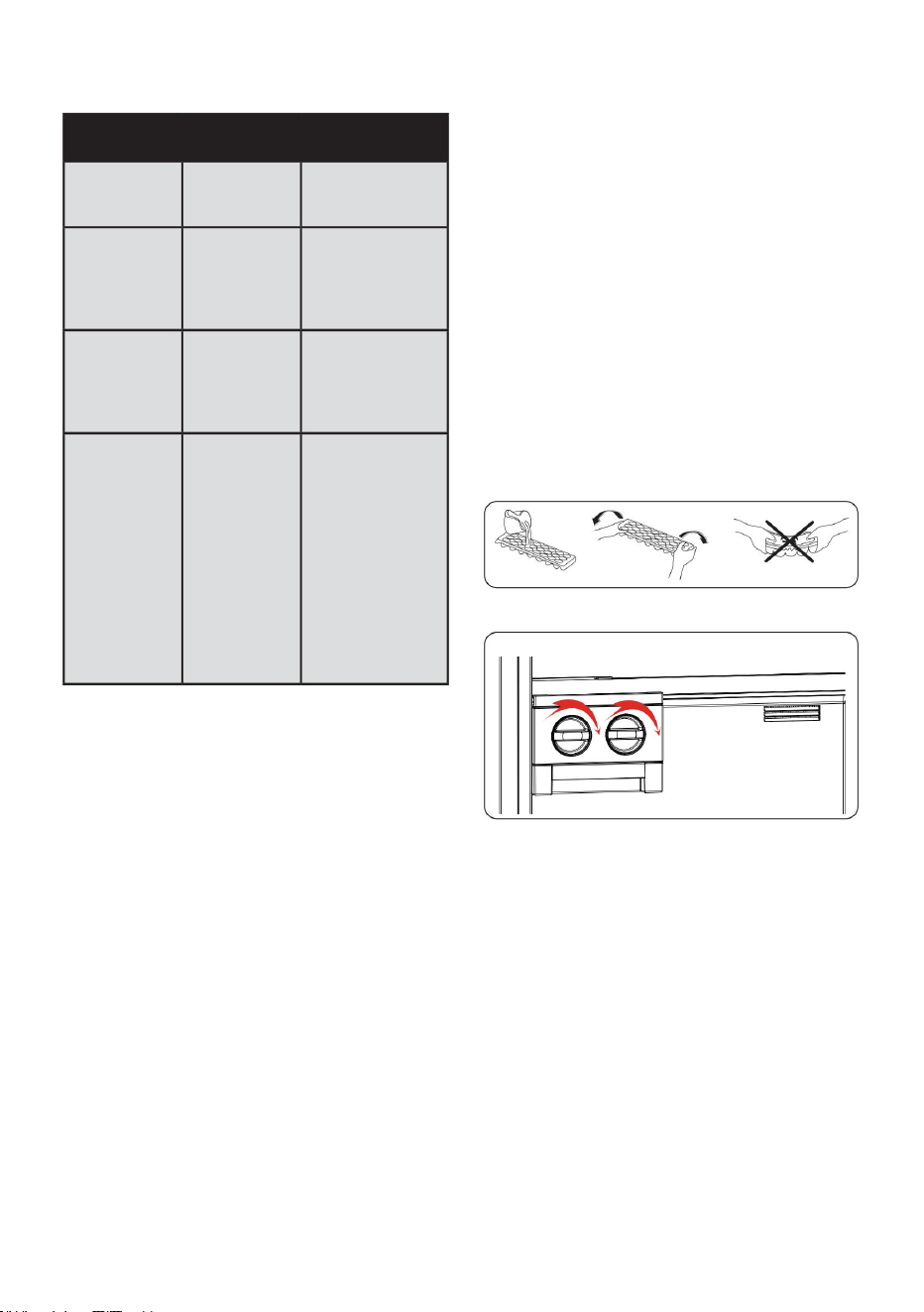
39°F
4oF,8oFou
11oF
39°F
39°F
36°F
•Unefoisl’eaucomplètementgelée,
vouspouvezfairetournerleplateaucommeindiquécidessouspour
lecompartimentcongélateur.
•Remplissezlebacàglaçonsavecdel'eauetplacezledans
retirerlesglaçons.
Pouruneutilisation
régulièreetdes
performancesoptimales.
Remarques
0de
Recommandé
lorsque
latempérature
ambiante
dépasse86°F.
Réfrigérateur
CompartimentCompartiment
Congélateur
Doitêtreutilisé
lorsquevous
souhaitezcongeler
desalimentsdansun
courtlapsdetemps.
Ces
réglagesde
températuredoivent
êtreutiliséslorsque
latempérature
ambianteestélevée
ousivouspensezquele
compartiment
réfrigérateurn'est
passuffisamment
froidparcequela
porteestouverte
fréquemment.
ModeSuperFreeze
0°F,4°F,
8°Fou11°F
(Lesimagessontreprésentatives)
lesalimentsstockésàl'intérieuretlatempératureambiante
réduirel'efficacitédurefroidissement.
glacière.
•Lorsquelesglaçonssesontformés,tournezle
étiquetted'information.Utilisationdevotreréfrigérateur
période,n'ouvrezpaslaporteouneplacezpasde
laissezlefonctionnerpendant24heurespouratteindrele
danslesplagesdetempératureambiante
bacàglaçonssurlaglacière
•Remplird'eaujusqu'auniveaumarqué
températuredulieu.
•Tirezlelevierversvousetretirez
fréquencedesouverturesdeportes,laquantitéde
Paramètresrecommandéspourle
Compartimentcongélateuretréfrigérateur
Température
3.5.2LeIcematic(danscertainsmodèles)
grandequantitédenourritureàl'intérieur.
endehorsdecesplagesdetempérature,ilsepeut
levierpourfairetomberlesglaçonsdansle
spécifiéparlaclasseclimatiquesurle
•Réglezlatempératureenfonctiondela
températuredefonctionnementoptimale.Pendantcetemps
•Maintenezl'extrémitégauchedulevieretréglezle
•Lorsquel'appareilestmisenmarchepourlapremièrefois,
Lesdescriptionsvisuellesettextuellesdansla
sectionaccessoirespeuventvarierselonlemodèlede
votreappareil.
3.5.1Bacàglaçons(danscertainsmodèles)
• Unefonctiondedélaide5minutesest
implémentée pourprotégerlecompresseurlorsque
connexionoudéconnexiondu
principale,oupendantunecoupuredecourant.
l'appareilreprendrasonfonctionnementnormal après
cedélai.
3.5Accessoires
lebacàglaçons
3.3.4Fonctiond'alarmedeporteouverte
Silaporteduréfrigérateurestouvertependantplusde
2minutes,l'appareilcommenceàémettreunbip.
3.4Avertissementsconcernantlesréglagesdetempérature
•Votreappareilestconçupourfonctionner
FR10
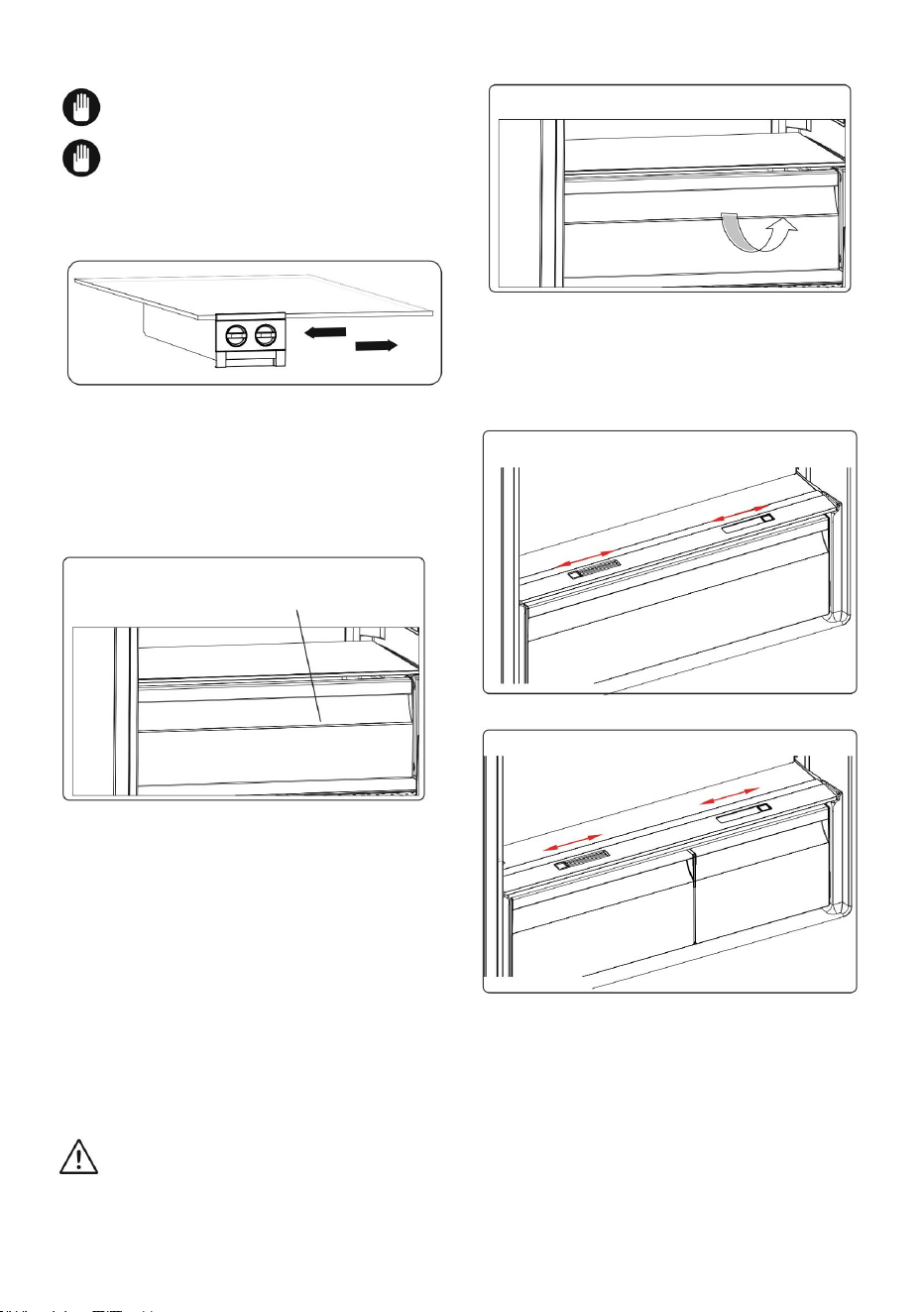
(Lesimagessontreprésentatives)
Tiroirréfrigéré
(Lesimagessontreprésentatives)
Silebacàlégumesestplein,ouvrezleboutonfraîcheursituéà
l'avantdubac.Celapermetdemieuxcontrôlerlacirculationdel'airet
lesniveauxd'humidité,cequicontribueàprolongerladuréede
viedesalimentsàl'intérieur.
Sivousconstatezdelacondensationsurlatabletteenverre,
assurezvousquelecadransituéderrièrelatabletteestégalement
ouvert.
• Tirezletiroirréfrigéréversvousen
lefaisantglisserhorsdesrails.
• Tirezletiroirréfrigéréverslehautdurailet
retirezleduréfrigérateur.
3.5.4Lecadranfrais(danscertainsmodèles)
Pourretirerletiroirréfrigéré:
(Lesimagessontreprésentatives)
Cetteétagèreenverreaveccontrôledel'humiditéaunecapacité
dechargemaximalede32lb.
• Retirezlesclayettesenverreducongélateur.
• Retirezlamachineàglaçonsenlafaisantglisserversla
gauche oudirectementsurl'étagère.Vouspouvezretirer
lamachineàglaçonspourutiliserunplusgrandvolumede le
compartimentcongélateur.
3.5.3Letiroirréfrigéré(danscertainsmodèles)
(Lesimagessontreprésentatives)
Conserverlesalimentsdansletiroirréfrigéréplutôtquedansles
compartimentscongélateurouréfrigérateurpermetdeconserver
leurfraîcheuretleursaveurtoutenpréservantleurapparence.
Lorsqueletiroirréfrigéréestsale,retirezleetlavezleàl'eau.
Remarque:L’eaugèleà0°C(32°F),maislesaliments
contenantduseloudusucrepeuventgeleràdestempératures
plusbasses.
Letiroirréfrigéréestgénéralementutilisépourstockerdesarticles
telsquedupoissoncru,desalimentslégèrementmarinés,duriz
etdesarticlessimilaires.
Nemettezpaslesalimentsquevoussouhaitezcongeler ou
desbacsàglaçons(pourfairedelaglace) dansle
tiroirréfrigéré.
pourfairedelaglace.Ilpeutêtrecassé.
Lemouvementdelamachineàglaçonspeut
Neremplissezpaslaglacièreavecdel'eau
Note:
ou
êtredifficilelorsqueleréfrigérateuresten
marche.Danscecas,nettoyezlaenretirantles
clayettesenverre.
Retraitdelamachineàglaçons
FR11
Lesplatscuisinésdoiventrestercouvertslorsqu'ils
sontconservésauréfrigérateur.Placezlesau
réfrigérateurlorsqu'ilssontàtempératureambiante,
sinonlatempérature/humiditéàl'intérieurduréfrigérateur
augmentera,réduisantainsil'efficacitédu
réfrigérateur.Couvrirlesalimentsetlesboissons
permetégalementdepréserverleursaveuretleurarôme.
REMARQUESIMPORTANTES:
Lespommesdeterre,lesoignonsetl’ailnedoivent
pasêtreconservésauréfrigérateur.
FR12
• Pourréduirel’humiditéetprévenirlegel
Pouréviterlaformationdegivre,conserveztoujoursles
liquidesdansdesrécipientshermétiquesau
réfrigérateur. Legivreatendanceàs'accumulerdansles
zonesles plusfroidesdel'évaporateur,cequinécessitera
undégivrageplusfréquentaufildutemps.
• Lesplatscuisinésdoiventrestercouvertspendantleur
conservationauréfrigérateur.Neplacezpasd'aliments
chaudsauréfrigérateur;laissezlesd'abordrefroidirpour
éviterd'augmenterlatempératureetl'humidité,
cequipeutréduirel'efficacitéduréfrigérateur.
• Assurezvousqu’aucunobjetn’estencontactdirect
avecla paroiarrièredel’appareil,cardugivrepeutse
formeret l’emballagepeutycoller.
Minimisezlesouverturesfréquentesdelaporte
duréfrigérateur.
• Pour desconditionsdestockageoptimales,Nous vous
recommandons d'envelopper la viande et le
poisson propre sans serrer et de les placer sur
l'étagère en verre juste au-dessus du bac à
légumes, où l'air est plus frais.
• Conservez les fruits et légumes en vrac dans
les bacs à légumes. Garder les fruits et les
légumes séparés permet d’éviter que les légumes
sensibles à l’éthylène
(comme les légumes à feuilles vertes, le brocoli
et les carottes) ne soient affectés par les fruits
libérant de l’éthylène (comme les bananes, les
pêches et les figues).
• Ne pas mettre de légumes humides au
réfrigérateur.
• La conservation de la viande dépend de la
qualité initiale des aliments et du maintien d'un
cycle de réfrigération ininterrompu.
• L'eau qui s'écoule de la viande peut contaminer
les autres produits dans le réfrigérateur. Emballez
toujours correctement les produits carnés et
nettoyez les déversements sur les étagères.
• N’obstruezpaslepassagedufluxd’airenplaçantdes
alimentsdevant.
• Consommezlesalimentsemballésavantladate
d’expirationrecommandée.
• Nelaissezpaslesalimentsentrerencontactavecle
capteur detempérature,quisetrouvedansle
compartiment réfrigérateur,afindemaintenirle
compartiment réfrigérateuràunetempératureoptimale.
• Pour desconditionsde fonctionnementnormales,ilsera
suffisantderéglerla température de votre réfrigérateur
à 39°F.
• La température idéale pour le réfrigérateur
La température doit être comprise entre 0°C et 8°C.
Les aliments frais conservés à une température
inférieure à 0°C risquent de geler et de se gâter.
Lorsque les températures dépassent 46°F, la
croissance bactérienne s’accélère et entraîne la
détérioration des aliments.
• Ne mettez pas d’aliments chauds dans le
réfrigérateur
Attendez immédiatement que la température
extérieure baisse. Les aliments chauds augmentent
la température
de votre réfrigérateur et peuvent provoquer une
intoxication alimentaire et une détérioration inutile
des aliments.
• La viande et le poisson doivent être conservés
dans
le compartiment réfrigérateur et les légumes
dans le bac à légumes (si disponible).
• Pour éviter toute contamination croisée, ne
conservez pas les produits carnés et les fruits et
légumes ensemble.
• Les aliments doivent être placés au réfrigérateur
dans des récipients fermés ou couvertspour éviter
l'humidité et les odeurs.
4 STOCKAGE DES ALIMENTS
4.1Compartimentréfrigérateur
Pourdesconditionsdefonctionnementnormales,réglez
latempératureducompartimentréfrigérateursur39°Fou+43
°F.
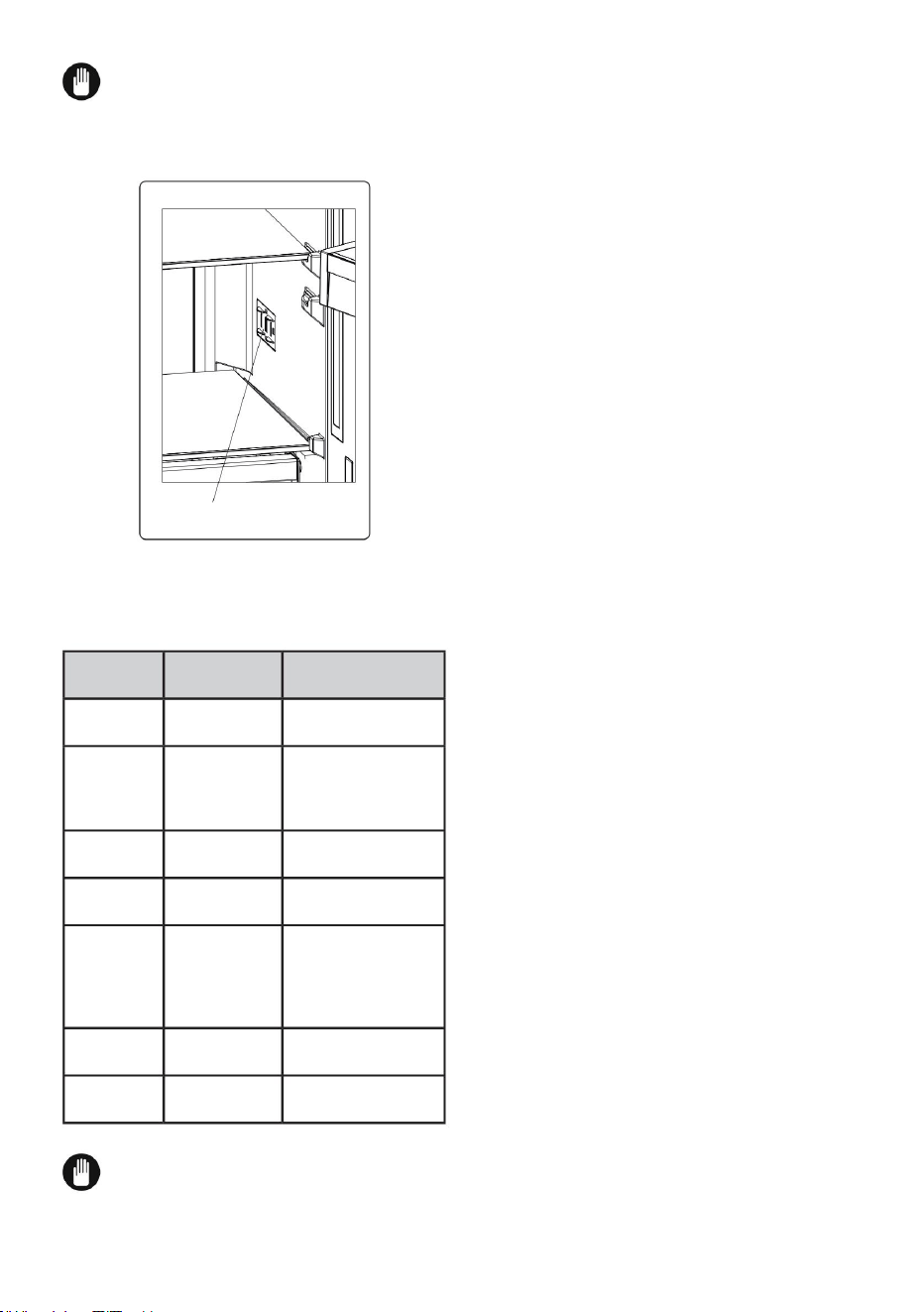
Beurreet
margarine
Commentetoùstocker
(Lesimagessontreprésentatives)
Surl'étagèredeporte
désignée
Surl'étagèreàœufs
désignée
1mois
Surl'étagèredeporte
désignée
2jours
Touteslesétagères
1semaine
Plats
cuisinés
Duréede
stockagemaximale
34jours
Produits
enbouteille,
parexemple
laitet
Zoneducapteurdetempérature
Nourriture
Jusqu'àla
datede
péremption
recommandéeparleproducteur
Légumeset
fruits
Envelopperdansdupapier
aluminium,dessacsou
dansunrécipientàviandeet
conserversurl'étagèreenverre.
Surl'étagèredeporte
désignée
Viandeet
poisson
23jours
yaourt
1semaine
Fromage
frais
Œufs
Bacàlégumes
FR13
Letableaucidessousestunguiderapidepourvous
montrerlamanièrelaplusefficacedestockerles
principauxgroupesd’alimentsdansvotre
compartimentréfrigérateur.
Lespommesdeterre,lesoignonsetl’ailnedoivent
pasêtreconservésauréfrigérateur.
NOTE:
Nelaissezpaslesalimentsentrerencontactavec
lecapteurdetempératuresituédansle
compartimentréfrigérateur,afindemaintenirle
compartimentréfrigérateuràunetempératureoptimale.
4.2Compartimentcongélateur
Pourdesconditionsdefonctionnementnormales,réglezla
températureducompartimentcongélateur
sur0°ou4oF.
• Lecongélateurestutilisépourstockerdes
produitscongelés aliments,congelerdes
alimentsfraisetpréparer glaçons.
• Lesalimentssousformeliquidedoiventêtre
congelés dansdesgobeletsenplastiqueet
autresalimentsdevraient êtrecongelésdansdes
feuillesoudessacsenplastique.Pour congeler
desalimentsfrais;emballeretsceller
desalimentsfraiscorrectement,c'estla
l'emballagedoitêtrehermétiqueet
nedevraitpasfuir.Sacsdecongélation
spéciaux,
sacsenpolyéthylèneenfeuilled'aluminiumet
lescontenantsenplastiquesontidéaux.
• Nestockezpasd’alimentsfraisàcôtéd’aliments
surgelés. aliments,carcelapeutprovoquerla
congélation
articlesàdécongeler.
• Avantdecongelerdesalimentsfrais,divisezles
enportionsquipeuventêtreconsomméesdans
uneséance.
• Consommezlesalimentssurgelésdécongelés
dansundélai courtepériodedetempsaprèsla
décongélation
• Suiveztoujourslesinstructionsdufabricant
instructionssurl'emballagedesalimentslorsque
stockerdesalimentscongelés.Siaucune
instructionn'est àconditiondenepasconserver
lesalimentspluslongtemps plusdetroismoisà
compterdeladatede
achat.
• Lorsquevousachetezdesalimentssurgelés,
assurezvous assurezvousqu'ilaétéstocké
sous
conditionsappropriéesetquela
l'emballagen'estpasendommagé.
• Lesalimentscongelésdoiventêtretransportés
dans
desconteneursappropriésetplacésdans
lecongélateurdèsquepossible.
• N'achetezpasd'alimentssurgeléssile
l'emballageprésenteungonflementanormal,
commecelapeutindiquerquecelaaété
stockéàunetempératureinappropriée
etlecontenupourraitêtregâché.
FR14
Surcertainsmodèles:Lorsduchargement
ducompartimentcongélateur,neremplissez
pasaudelàdesrepèressinonla
portenesefermerapascorrectement.
Silaporteducompartiment
congélateurnesefermepas
correctement,unexcèsdeglace
seformeradanslecompartimentcongélateur.
compartimentcongélateur.Pour
éviterqueleproblèmenesereproduise,retirezlaglaceet
assurezvousquelaporteestbienfermée.
REMARQUE:Sivousessayezd'ouvrirlaportedu
congélateurimmédiatementaprèsl'avoirfermée,vous
constaterezqu'ellenes'ouvrepasfacilement.C'est
normal.Unefoisl'équilibreatteint,laportes'ouvre
facilement.Silaclayetteinférieuredelaportedu
congélateurestretiréeetquedesalimentsobstruentl'orifice
d'aspirationd'air,l'efficacitédevotreréfrigérateurdiminuera.
Parconséquent,soyezprudentlorsque
vouschargezlecompartimentcongélateuretveillez
ànepascouvrirl'orificed'aspirationd'air.
Deplus,nepasfermerlesportesducompartimentcongélateur
et/ouréfrigérateuraugmenteravotreconsommation
d’énergie.
• Laduréedeconservationdesalimentssurgelés
dépend àtempératureambiante,thermostat
paramètres,fréquenced'ouverturedelaporte,
letypedenourritureetletempsnécessairepour
transportezledumagasinàvotredomicile.
Suiveztoujourslesinstructionssurle
emballageetnepasdépasserla
duréemaximaledeconservationindiquée.
• Silaporteducongélateuraétélaisséeouverte
pendant longtempsoumalfermé,gel
seformeraetpeutempêcherl'airefficace
circulation.Danscecas,débranchezle
congélateuretlaissezledécongeler
complètement.Nettoyezlecongélateurunefois
qu'ila entièrementdécongelé.
• Levolumeducongélateurindiquésurl'étiquette
est
lacapacitésanspaniers,couverclesou
autresaccessoires.
• Nerecongelezpaslesalimentsdécongelés,car
ilspeuvent présententdesrisquespourlasanté,
telsquelesaliments empoisonnement.
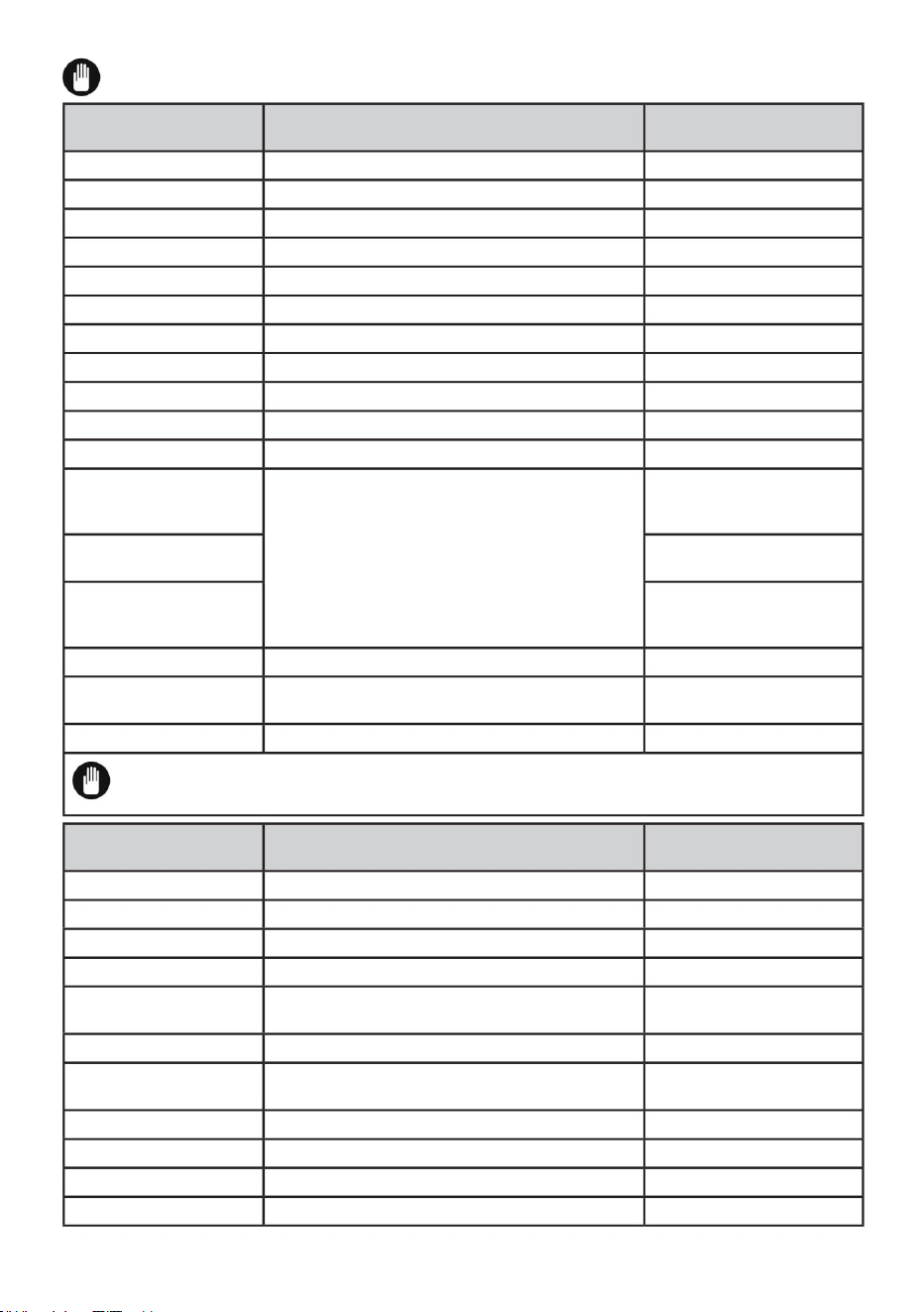
Poissonmaigre(bar,turbot,
13
Propreetdansunsac
3
(mois)
Poivre
12
Viandeetpoisson
68
Poissonchat)
Maquereau,tassergal,
Haricots
68
23
68
Maïs
810
Couperendeuxmorceauxetretirerlenoyau
Enportionsde5,5lbouenfilets
Patauger)
Légumesetfruits
Carotte
1012
REMARQUE:Laviandecongeléedécongeléedoitêtrecuitecommedelaviandefraîche.Silavianden'estpascuiteaprès
décongélation,ellenedoitpasêtrerecongelée.
Épinard
810
Préparation
2
Anchois)
Décortiquer,laveretfairebouillirdansl'eau
Laveretfairebouillirdansl'eau
Cubesdeveau 68
Duréedestockagemaximale
68
4
Préparation
Nettoyer,couperentranchesetfairebouillirdansl'eau
Pommeetpoire
Couperenmorceauxde1pouceaprèslelavage
Viandehachée
13
46
Aprèsavoirnettoyélesentraillesetlesécaillesdupoisson,
lavezleetséchezle.Sinécessaire,retirezlaqueueetlatête.
24
Duréedestockagemaximale
Chou
69
48
Poissonsd'eaudouce
Escargots
12
68
Poissonsgras(thon,
Haricotsvertsetharicots Laver,couperenpetitsmorceauxetfairebouillirdansl'eau
Abricotetpêche
Nettoyeretemballeravecsatigeoucommedumaïsdoux
46
Danssonemballage,oudansunrécipientenaluminiumou
enplastique
1013
Choufleur
46
Nettoyeretfairebouillirdansl'eau
Retirezlesfeuilles,coupezlecœurenmorceauxetlaissezle
dansdel'eauavecunpeudejusdecitronpendantunmoment
Cubesd'agneau
13
Fruitsdemer
(Saumon,Carpe,Grue,
Dansdel'eausaléeoudansunrécipientenaluminiumouenplastique
Coupezlatige,coupezlaendeuxmorceaux,retirezlenoyauetfaites
labouillirdansdel'eau
1012
(mois)
SaucissedeBologne/salami Doitêtreconservéemballémêmes'ilestdotéd'unemembrane
Pouletetdinde
Envelopperdansdupapieraluminium
Oieetcanard
Envelopperdansdupapieraluminium
Pelerettrancher
Envelopperdansdupapieraluminium
Enpetitsmorceaux
Enmorceaux
Dansunemballagesansutiliserd'épices
Enmorceaux
Abats(morceaux)
46
Caviar
12
Aubergine
Steak
Envelopper dans du papier aluminium
Viande d'agneau
Envelopper dans du papier aluminium
Rôti de veau
Cerf,lapin,sanglier
Letableaucidessousestunguiderapidepourvousmontrerlamanièrelaplusefficacedestockerlesprincipaux
groupesd’alimentsdansvotrecompartimentcongélateur.
FR15
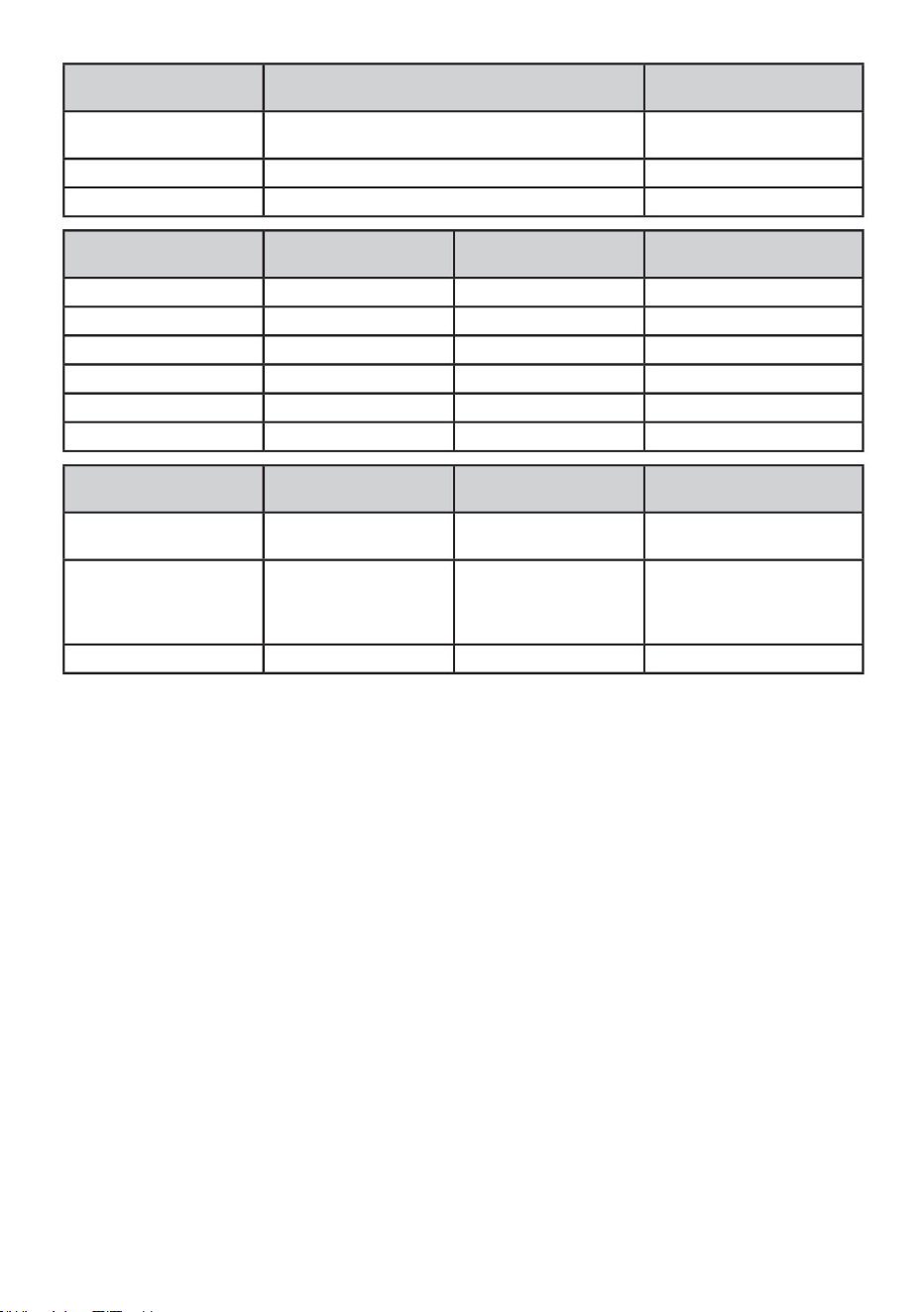
FR16
Préparation
Tempsdedécongélationà
Préparation
Pizza
1520(392°F)
Fromagehorsfromage
blanc
Pâtisserie
510(392437°F)
Beurre,margarine
Duréedestockagemaximale
812
11,5
Fraiseet
46
(mois)
Danssonproprepaquet
12
(mois)
Fruitscuits
23
Tarte
Paquet(homogénéisé)
Tempsdedécongélationau
four(minutes)
Mûre
36
Produitslaitiers
23
812
58(374392°F)
Danssonemballage
23
Lait
Ajoutez10%desucredanslerécipient
Pain
45(428437°F)
Entranches
Duréemaximaledestockage
(mois) températureambiante(heures)
23
11,5
23
34
11,5
24
Duréemaximaledestockage
Conditionsdestockage
Laitpur–danssonpropreemballage
58(374392°F)
6
Légumesetfruits
Pâtephyllo
Prune,cerise,myrtille
Biscuits
58(374392°F)
68
Laveretdécortiquer
13
Lavez et équeutez les tiges
L'emballage d'origine peut être
utilisé pour un stockage à court
terme. Conserver enveloppé dans
du papier aluminium pendant une
période plus longue.
lecentredeserviceagrééleplusproche.
•Nettoyerlesaccessoiresséparémentàlamain
avecdel'eauetdusavon.Nelavezpas
les
accessoiresaulavevaisselle.
•Nettoyezlecondenseuravecunebrosseaumoins
deuxfoisparan.Celavousaideraàéconomisersur
•Assurezvousqu'aucuneeaunepénètredanslalampe
coûtsénergétiquesetaugmenterlaproductivité.
boîtieretautrescomposantsélectriques.
•L'appareildoitêtrenettoyé
L'alimentationélectriquedoitêtre
débranchéependantlenettoyage.
Remplacementdel'éclairageLED
enutilisantrégulièrementunesolutiondebicarbonate
6.2Inversiondusensd'ouverturedelaporte
Poignéesavant:Vousnepouvezpasinverserla
portesilespoignéessontinstalléesàl'avant
del'appareil.
Poignéeslatéralesoupasdepoignées:vouspouvez
inverserlaportesurlesmodèlesquiontuncôté
avecousanspoignées.
Portesnonréversibles:sivotreappareil
laporten'estpasréversible,veuillezcontacterle
centredeserviceagrééleplusprochepour
assistance.
Pourremplacerl'unedesLED,veuillezcontacter
desodaetd'eautiède.
FR17
N'utilisezpasdeproduitsabrasifs,de
détergentsoudesavonspournettoyerl'appareil.
Aprèslelavage,rincezleàl'eauclaireetséchezle
soigneusement.Unefoislenettoyageterminé,
rebranchezlafichesurlesecteuraveclesmains
sèches.
dansl'appareilcontreleschocs
Remarque:lenombreetl'emplacementdes
bandesLEDpeuventchangerselonlemodèle.
6.1Transportetchangementdepositionnement
enutilisantdesbandeslorsdurepositionnementou
•L'emballaged'origineetlamoussepeuventêtre
transportant.
conservépourunnouveautransport(facultatif).
Transporteztoujoursvotreappareilenposition
verticale.
•Fixezvotreappareilavecdesvisépaisses
emballage,bandesoucordonssolideset
suivrelesinstructionspourletransport
Débranchezl’appareildel’alimentation
électriqueavantdelenettoyer.
surl'emballage.
Nelavezpasvotreappareilenversant
del’eaudessus.
•Retireztouteslespiècesmobilesoufixezles
6 EXPÉDITION ET
REPOSITIONNEMENT
ENTRETIEN
5 NETTOYAGE ET
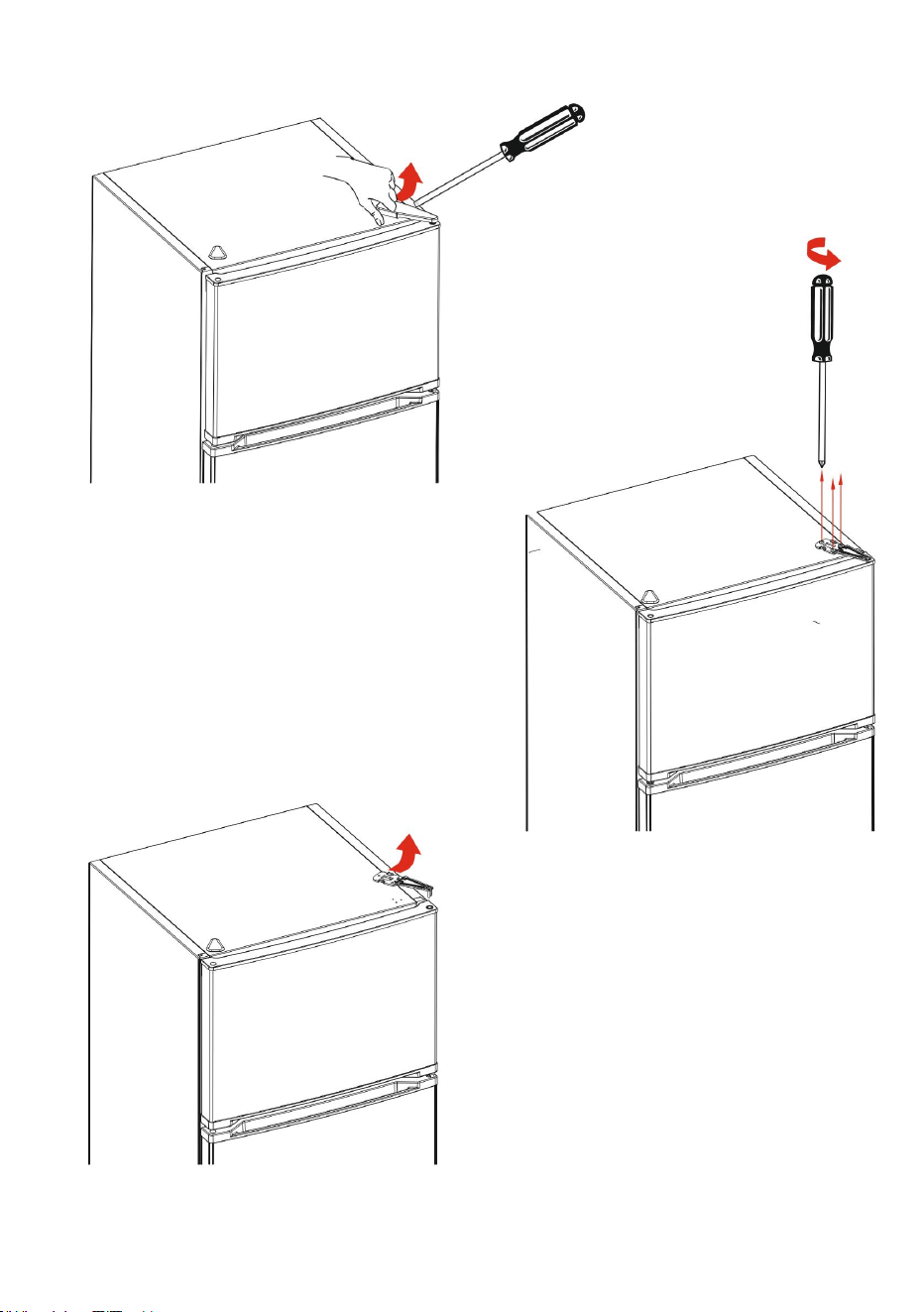
FR18
ducompartimentcongélateur.
2.Dévissezlacharnièresupérieure.
1. Retirezlecouvercledelacharnièresupérieure
6.3 Instructions pour inverser le sens d'ouverture de la porte
3.Retirezleetmettezledecôté.
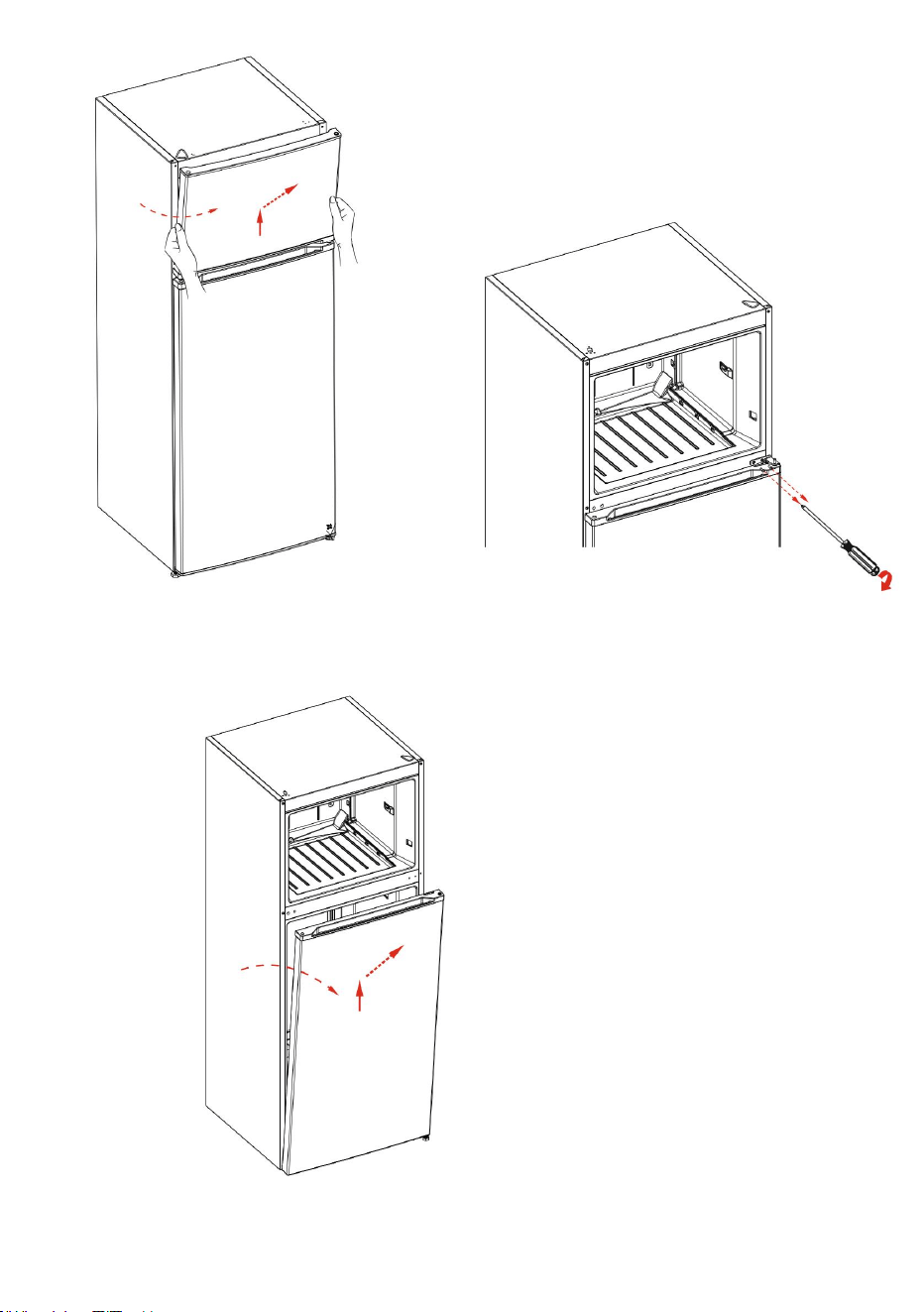
FR19
4.Soulevezlaporteducongélateurverslehautetvers
l’avantpourladétacherdelagoupille.
5.Dévissezlacharnièrecentrale.
6.Soulevezlaporteduréfrigérateurverslehaut
et
versl’avantpourlaretirerdelagoupille.
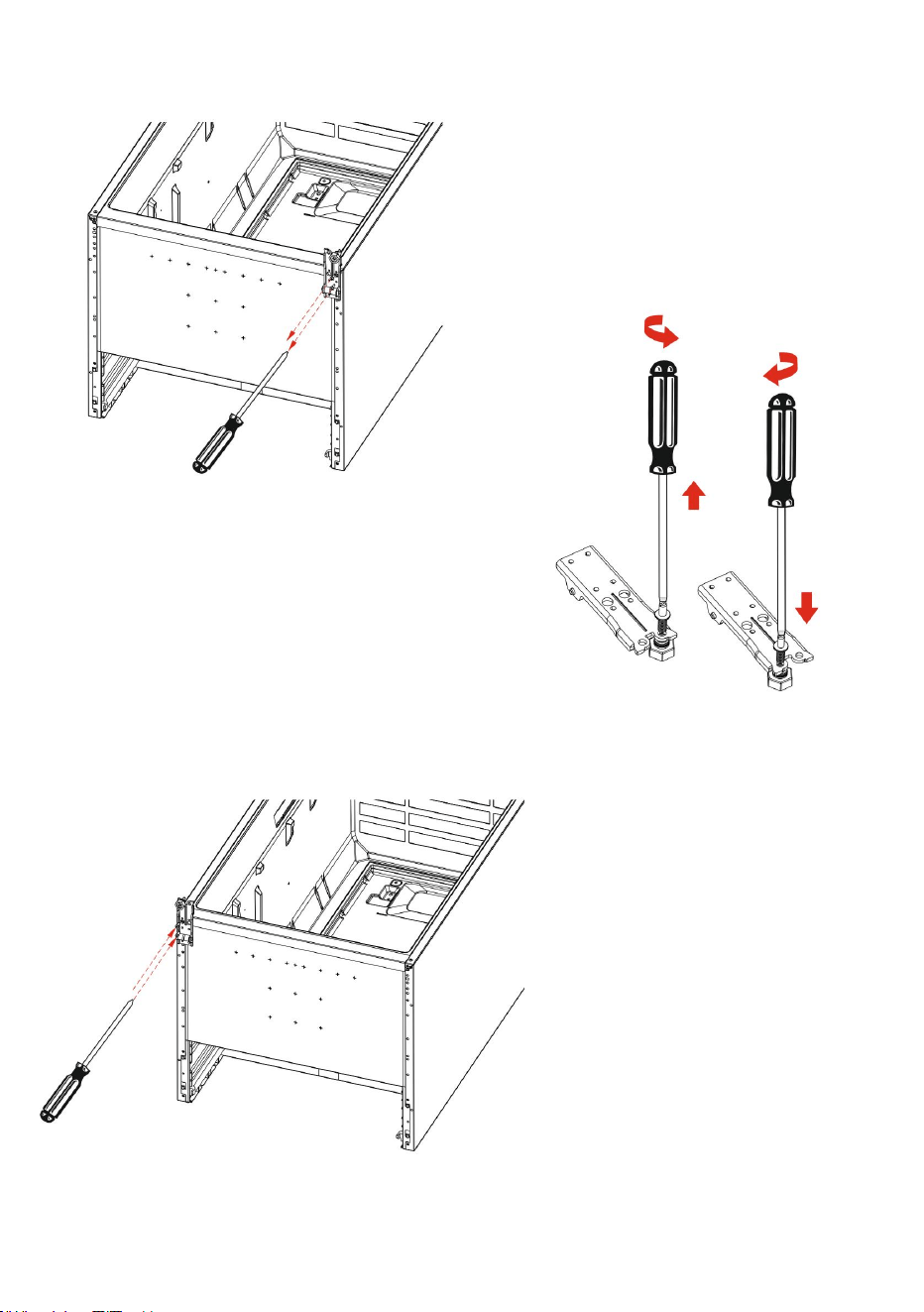
FR20
8. Détachezlagoupilledelacharnière
inférieureetdéplacezlaversletrouopposé.
7. Dévissezlacharnièreinférieure.
9. Déplacezlacharnièreinférieuresurlecôtéopposé.
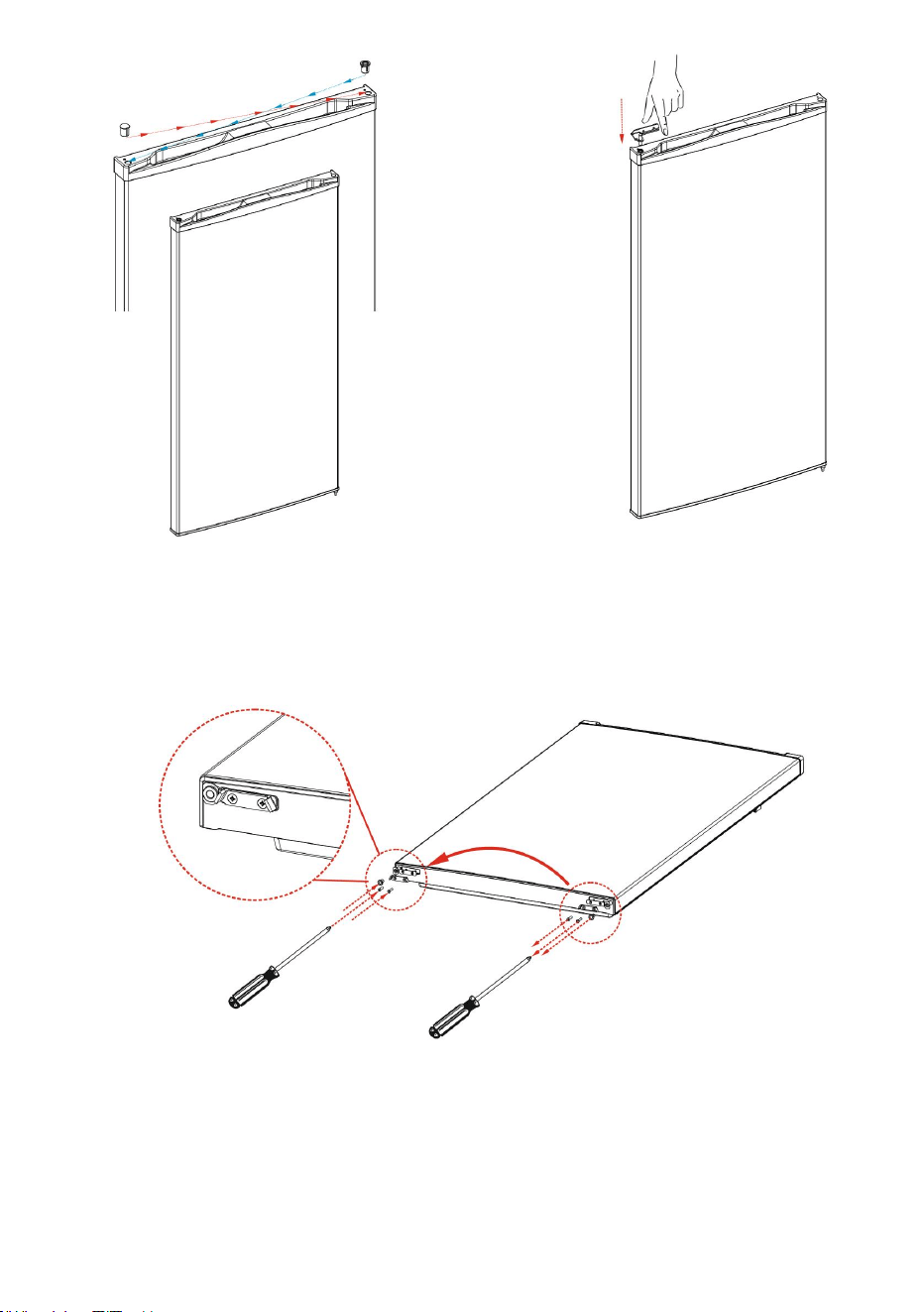
FR21
12.Déplacezlacharnièreinférieuredelaporteduréfrigérateuretinsérezlasur
lecôtéopposédelaporte.Assurezvousquelacharnièreestinversée.
11.Rattachezlacharnièrecentraleàla
porte
supérieureduréfrigérateureninsérantlagoupille.
10.Basculezlecouvercledelagoupilledela
porte
supérieureduréfrigérateuretl'insertdeportesurlecôtéopposé.
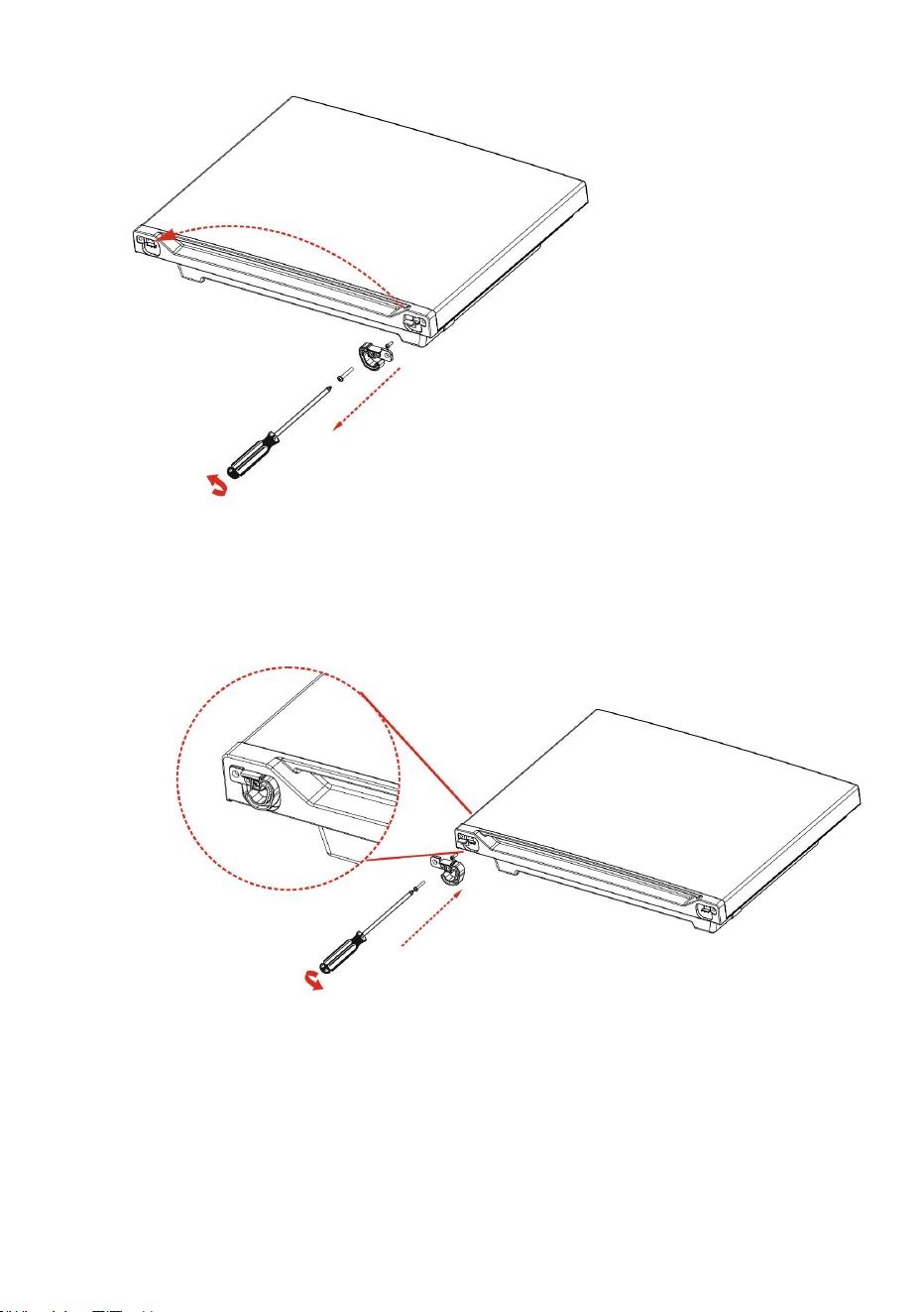
FR22
13.Dévissezlacharnièredelaporteinférieuredu
congélateurverslecôtéopposé.
14.Assurezvousquelacharnièreestretournée.
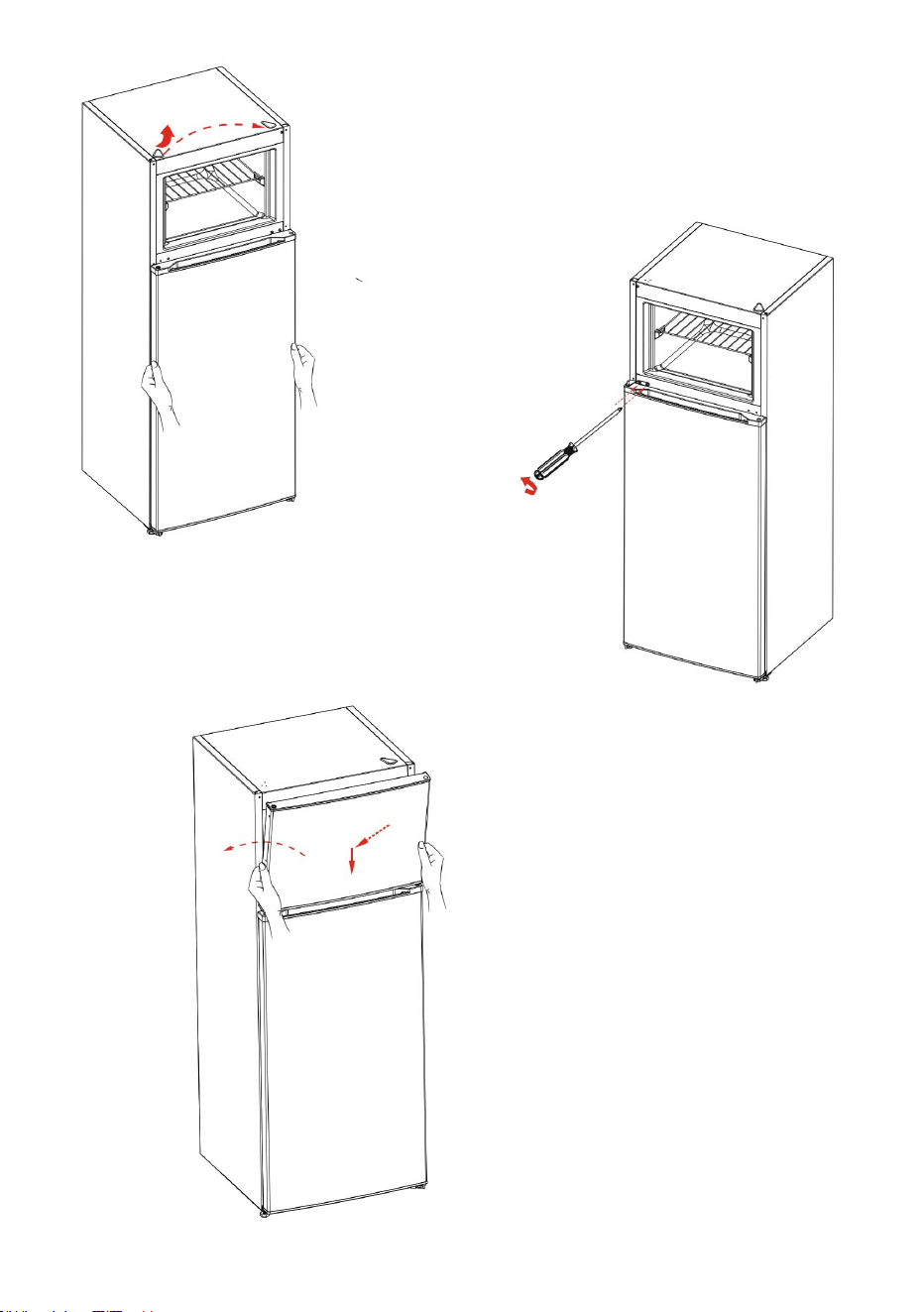
FR23
16. Fixezlacharnièrecentraleàl’unité.
15. Remettezlaporteduréfrigérateurenplace
envous assurantqu'elleestcorrectementfixée
surlagoupille, puisrepositionnezlecouverclede
lacharnièresupérieure.
17. Fixezlaporteducongélateuren
l'insérantsurlagoupille,enpoussant
verslebasetversl'appareil.
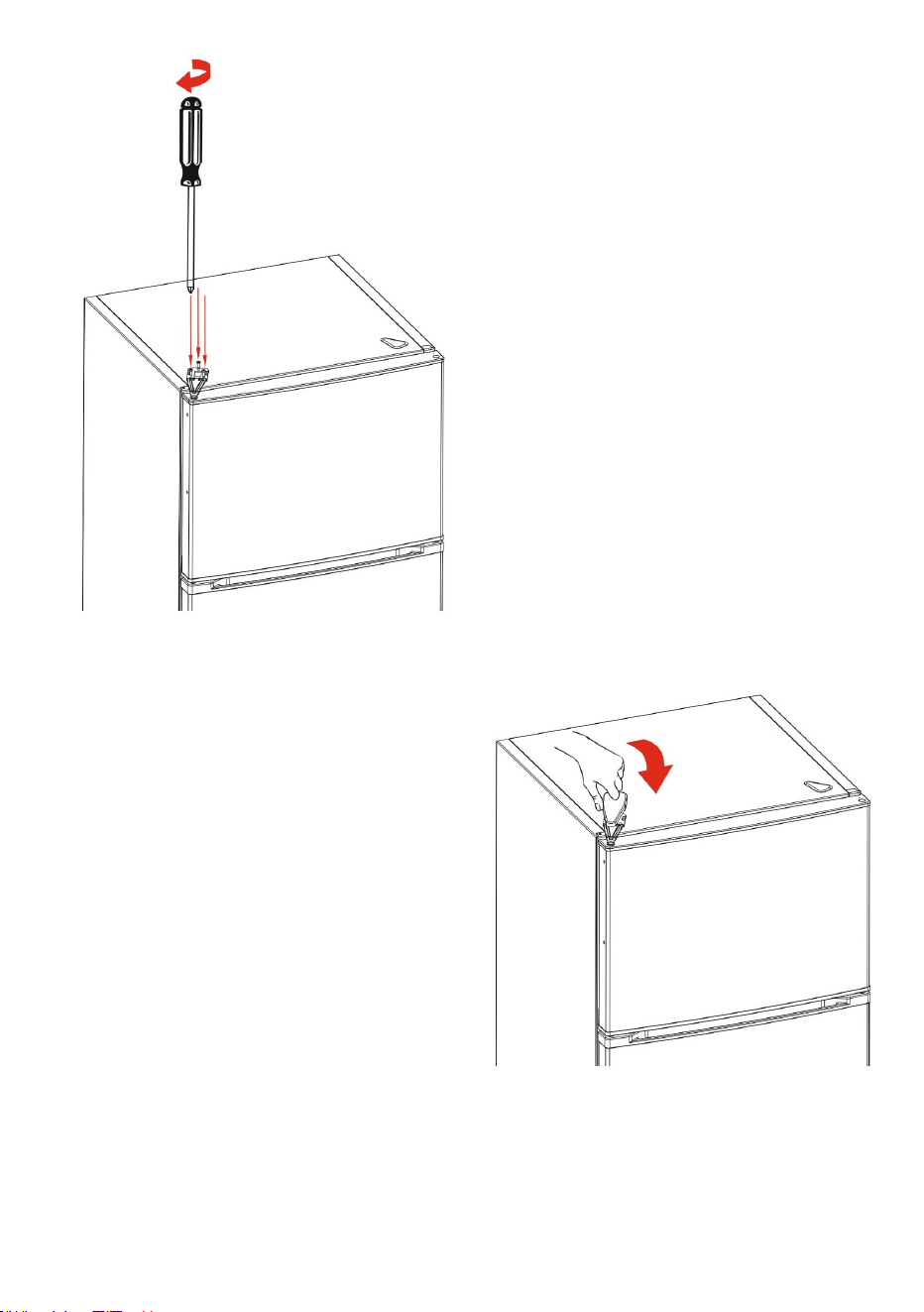
FR24
18.Fixezlacharnièresupérieureausommetducongélateur.
19.Remettezlecouvercledelacharnière
enplace. Assurezvousqu'ils'enclenche
bienenplace.
• Installez l'appareil dans une pièce fraîche et
bien aérée, mais pas en plein soleil et pas à
proximité d'une source de chaleur (comme un
radiateur ou un four), sinon une plaque
isolante doit être utilisée.
• Laissez refroidir les aliments et boissons
chauds avant de les placer à l'intérieur de
l'appareil.
• Décongelez les aliments surgelés dans le
compartiment réfrigérateur. Le froid des
aliments aidera à maintenir une température
fraîche dans le réfrigérateur afin d'économiser
de l'énergie. La décongélation à l'extérieur de
l'appareil peut gaspiller de l'énergie.
• Les boissons ou autres liquides doivent être
couverts à l'intérieur de l'appareil. S'il est laissé
découvert, l'humidité à l'intérieur de l'appareil
augmentera et l'appareil consommera donc
plus d'énergie. Garder les boissons et autres
liquides couverts permet de préserver leur
odeur et leur goût.
• Évitez de laisser les portes ouvertes pendant
de longues périodes ou de les ouvrir trop
fréquemment. Cela permet à l'air chaud de
pénétrer dans l'appareil, provoquant l'activation
du compresseur plus souvent que nécessaire.
• Gardez les couvercles des différents
compartiments de température (tels que le bac
à légumes et le refroidisseur si disponibles)
fermés.
• Le joint de porte doit être propre et souple. En
cas d'usure, remplacer le joint.
• Le produit peut être utilisé sans clapet de
machine à glaçons. La consommation
d'énergie est déclarée selon cette option.
7 CONSEILS POUR ÉCONOMISER DE L'ÉNERGIE
FR25
Recommendations
• Si l'appareil est éteint ou débranché, attendez
au moins 5 minutes avant de brancher l'appareil
ou de le redémarrer afin d'éviter d'endommager
le compresseur.
• Si vous n'utilisez pas votre appareil pendant
une longue période (par exemple pendant les
vacances d'été), débranchez-le. Nettoyez votre
appareil conformément au chapitre nettoyage et
laissez la porte ouverte pour éviter l'humidité et
les odeurs.
• L'appareil que vous avez acheté est conçu
pour un usage domestique uniquement. Il ne
convient pas à un usage commercial ou courant.
Si le consommateur utilise l'appareil d'une
manière non conforme, nous soulignons que le
fabricant et le revendeur ne seront pas
responsables des réparations et des pannes
pendant la période de garantie period.
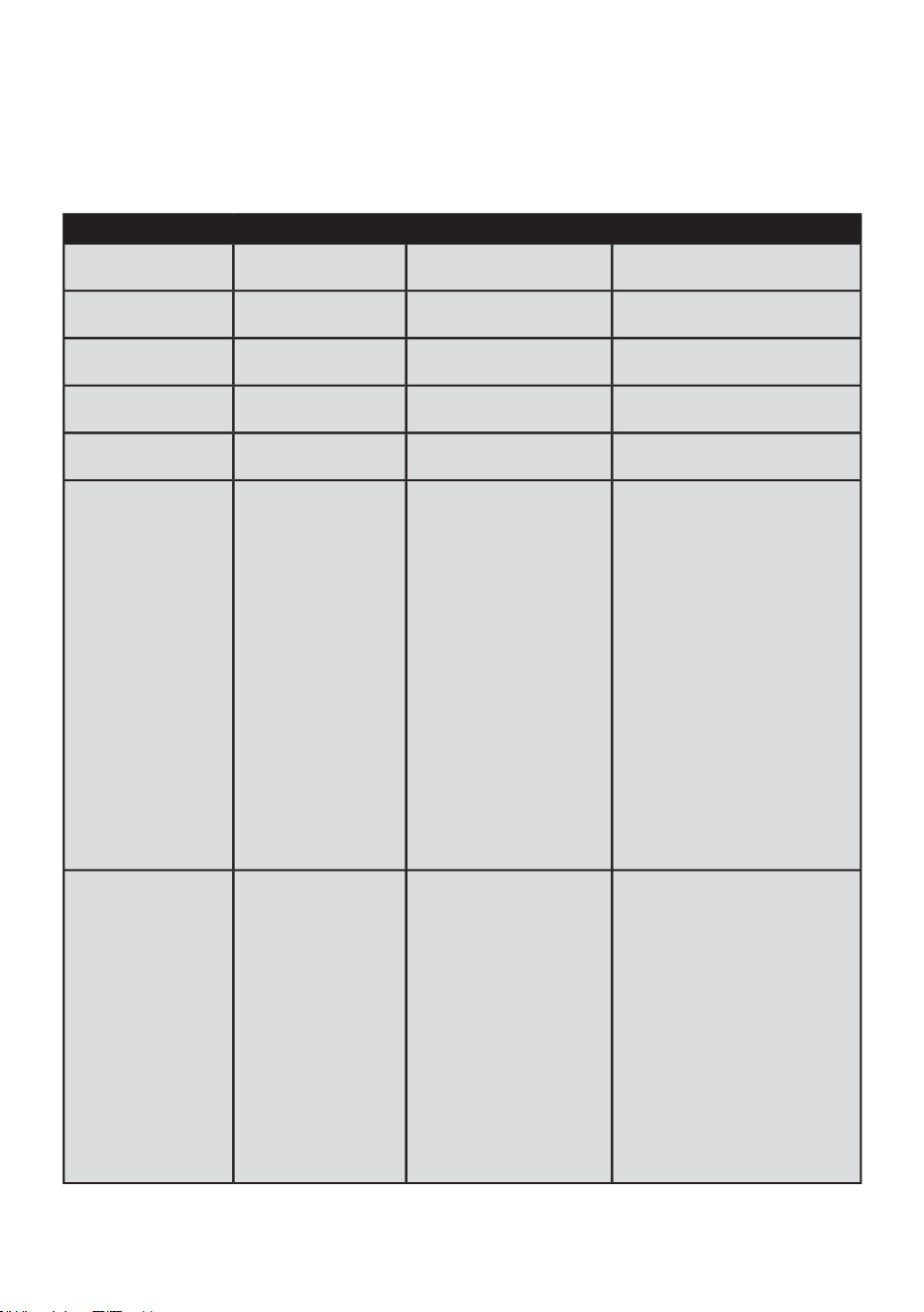
Avertissementducapteur
Lecompartiment
congélateur n'est
pas assez froid
Avertissementducapteur
Lecompartiment
réfrigérateurn'estpas
assezfroid
CEQU'ILFAUTFAIRE
Avertissementducapteur
SIGNIFICATION
Avertissementducapteur
E07
E06
Susceptibledese
produireaprèsune
pannedecourant
prolongée.
E10
E03
Appelezleserviced'assistancedès
quepossible.
Appelezleserviced'assistancedès
quepossible.
Appelezleserviced'assistancedès
quepossible.
Appelezleserviced'assistancedès
quepossible.
Appelezleserviced'assistancedès
quepossible.
Pannedecourantde
longuedurée.
Desalimentschaudsont
étélaissés dansle
réfrigérateur.
POURQUOI
E02
1. Réglezlatempératuredu
congélateur
surunevaleurplusfroideousur
SuperFreeze.Celadevrait
supprimer
lecoded'erreurunefoisla
température requiseatteinte.
Gardezlesportesfermées pour
améliorerletempsnécessaire
pouratteindrelatempérature
correcte.
2. Retireztouslesproduitsquiont
décongelé/décongelépendant
cetteerreur.Ilsdoivent être
utilisésdansuncourtlapsde
temps.
3. N’ajoutezaucunproduitfrais
dansle compartimentcongélateur
tantquela températurecorrecte
n’apasétéatteinte etquel’erreur
n’estplusprésente.
Si cet avertissement persiste, un
technicien agréé doit être
contacté.
Susceptibledeseproduire
après:
1. Réglezlatempératuredu
réfrigérateur
surunevaleurplusfroideouréglez
le
modeSuperCool.Celadevrait
supprimer lecoded'erreurunefois
latempérature requiseatteinte.
Gardezlesportesferméespour
améliorer letempsnécessairepour
atteindrelabonne température.
2. Veuillezviderl'emplacementsitué
à l'avantdestrousduconduitd'airet
éviterdeplacerdesalimentsà
proximité
capteur.
Sicetavertissementpersiste,un
technicienagréédoitêtrecontacté.
TYPED'ERREUR
E01
E09
Avertissementducapteur
FR26
8 CODES D'ERREUR
Erreurs
Votreréfrigérateurvousavertitsilestempératuresduréfrigérateuretducongélateursontàdesniveaux
inappropriésousiunproblèmesurvientavecl'appareil.Descodesd'avertissements'affichentsurlesindicateursdu
congélateuretduréfrigérateur.
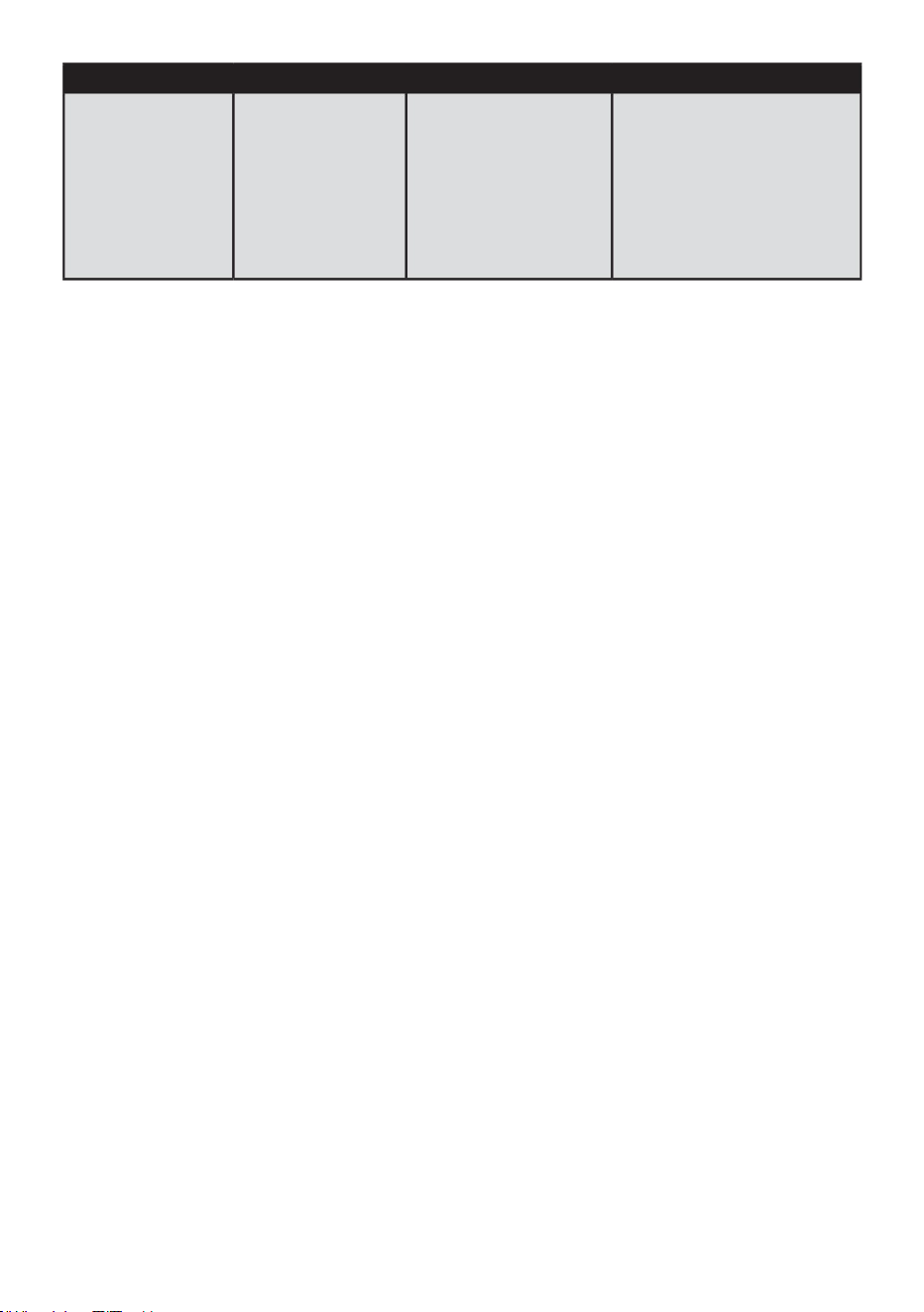
Lecompartiment
réfrigérateur est trop
froid
Divers
POURQUOI
CEQU'ILFAUTFAIRESIGNIFICATIONTYPED'ERREUR
1. VérifiezquelemodeSuperCool
estactivé
2. Réduisezlatempérature
ducompartimentréfrigérateur
3. Vérifiezsileséventssont
dégagés
etnonobstrué
Sicetavertissementpersiste,un
technicienagréédoitêtrecontacté.
E11
FR27
Sivousavezvérifiélesinformationscidessusetquevousaveztoujoursbesoind'aideavecvotre
appareil,appeleznotreserviceclientèleau8009324267(poste513)entre9het17hHEouvisiteznotre
siteWebsummitappliance.com/supportàtoutmoment.Nousferonsdenotremieuxpourrépondreàvosquestions.
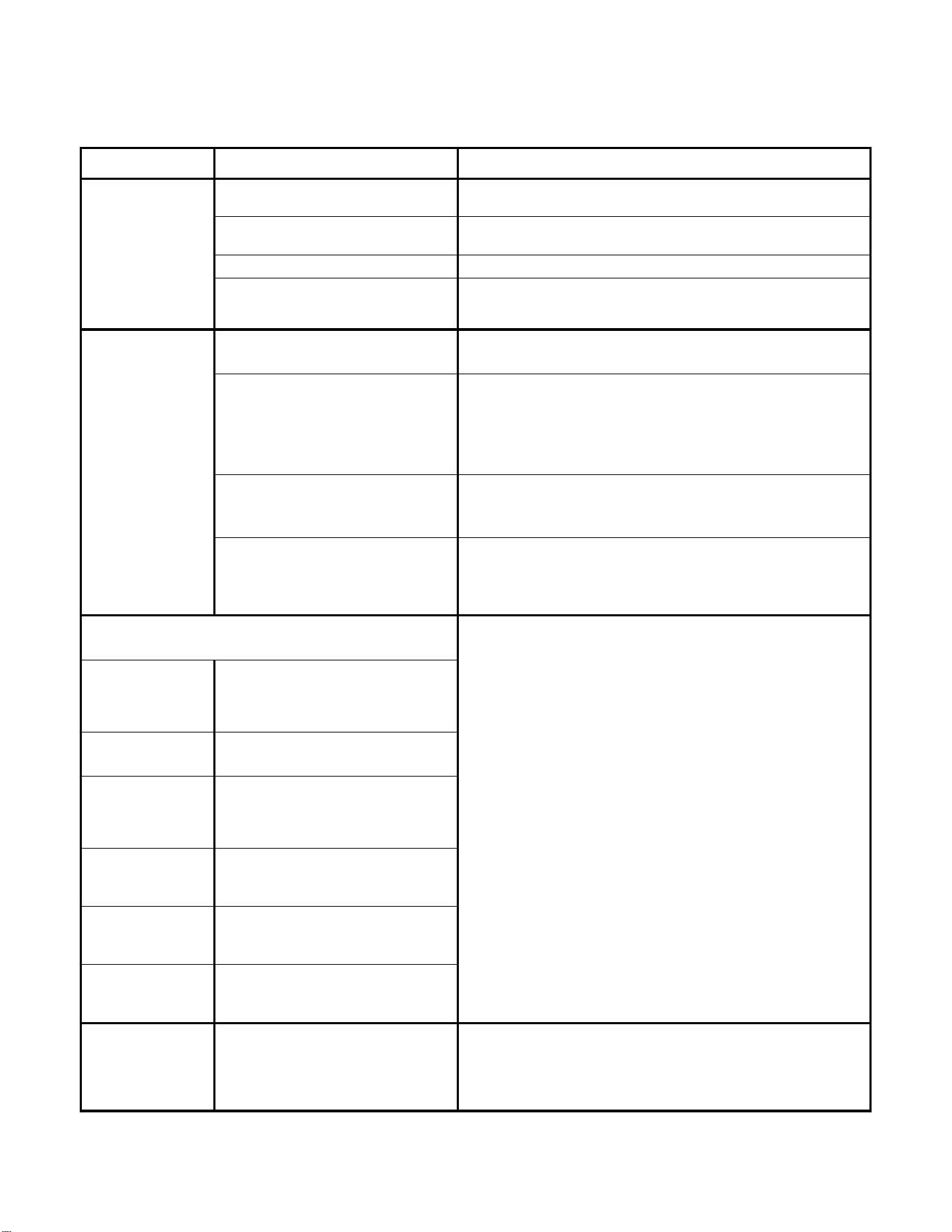
PROBLÈME CAUSES POSSIBLES SOLUTION
Votre appareil
ne fonctionne
pas
Il n'y a pas d'électricité.
Vérifiez que l'alimentation électrique du bâtiment est active. Contactez
votre fournisseur d'électricité en cas de panne.
La fiche n'est pas correctement placée
dans la prise.
Débranchez soigneusement l'appareil, puis rebranchez-le en vous
assurant qu'il est bien inséré dans la prise.
La prise est défectueuse. Essayez de brancher un autre appareil fonctionnel sur la même prise.
Le fusible de la prise ou le fusible
secteur a sauté.
Si les problèmes persistent ou si vous n'êtes pas sûr d'une étape,
contactez un électricien qualifié pour un diagnostic et une réparation
plus approfondis.
L'appareil fonctionne
mal
L'appareil est surchargé.
Retirez les aliments qui ne sont pas indispensables. Assurez-vous qu'il
y a suffisamment d'espace pour que l'air puisse circuler autour des
aliments.
La porte de l’appareil n’est pas
correctement fermée.
Assurez-vous qu’aucun aliment ou récipient n’empêche la porte de se
fermer complètement.
Inspectez le joint en caoutchouc autour de la porte pour déceler toute
déchirure, saleté ou dommage. Nettoyez-le avec de l'eau chaude
savonneuse et assurez-vous qu'il est bien étanche contre le
réfrigérateur.
Il y a de la poussière sur le condenseur.
Utilisez un aspirateur muni d'une brosse pour retirer délicatement la
poussière et les débris des serpentins. Veillez à ne pas endommager
les serpentins. Débranchez toujours le réfrigérateur avant de nettoyer le
condenseur.
Il n'y a pas assez d'espace près des
parois arrière et latérales.
Consultez le manuel de votre réfrigérateur pour connaître les distances
de dégagement recommandées.
Retirez tous les meubles, appareils ou objets susceptibles de bloquer la
ventilation du réfrigérateur.
Votre appareil fonctionne de manière bruyante. Voici quelques
bruits courants :
Il est normal que l'appareil fasse du bruit. Si les bruits persistent ou
semblent
anormaux, pensez à contacter le support technique pour une
inspection approfondie.
Bruit de craquement Lors du dégivrage automatique. Ou
lorsque l'appareil est refroidi ou
réchauffé (en raison de la dilatation du
matériau de l'appareil).
Bruit de craquement
bref
Lorsque le thermostat allume/éteint le
compresseur.
Bruit moteur Indique que le compresseur fonctionne
normalement. Le compresseur peut être
plus bruyant pendant une courte période
lorsqu'il est activé pour la première fois.
Des bruits de
bouillonnement et
des éclaboussures
se produisent
En raison du flux du réfrigérant dans les
tubes du système.
Bruit d'eau qui coule En raison de l'écoulement d'eau vers le
récipient d'évaporation. Ce bruit est
normal pendant le dégivrage.
Bruit de soufflage
d'air
Dans certains modèles, lors du
fonctionnement normal du système, cela
est dû à la circulation de l'air.
Les bords de
l'appareil en contact
avec le joint de la
porte sont chauds
Surtout pendant l'été (saisons chaudes),
les surfaces en contact avec le joint de
porte peuvent devenir plus chaudes
pendant le fonctionnement du
compresseur, c'est normal.
Ceci est normal. Si le problème persiste, pensez à contacter le support
technique pour vérifier d'éventuels problèmes d'isolation ou d'autres
problèmes sous-jacents.
8 DÉPANNAGE
Si vous rencontrez un problème avec votre appareil, veuillez vérifier les points suivants avant de contacter le service après-vente.
FR - 28
Si vous avez vérifié les informations ci-dessus et que vous avez toujours besoin d'aide avec votre appareil, appelez notre
service clientèle au 800-932-4267 (poste 513) entre 9 h et 17 h HE ou visitez notre site Web summitappliance.com/support à
tout moment. Nous ferons de notre mieux pour répondre à vos questions.
Il y a une
accumulation
d'humidité à
l'intérieur de
l'appareil
La porte de l'appareil est ouverte
fréquemment. L'humidité de la pièce
pénètre dans l'appareil lorsque les
portes sont ouvertes. L'humidité
augmente plus rapidement lorsque les
portes sont ouvertes plus fréquemment,
en particulier si l'humidité de la pièce est
élevée.
Limitez le nombre de fois où la porte est ouverte et assurez-vous
qu’elle est bien fermée à chaque fois.
Assurez-vous que tous les aliments sont bien emballés et que les
récipients sont secs avant de les placer dans l’appareil.
La porte ne s'ouvre
pas ou ne se ferme
pas correctement
Il y a de la nourriture ou un emballage
qui empêche la porte de se fermer.
Vérifiez qu'aucun aliment ou emballage ne bloque la porte et
réorganisez ou retirez les éléments pour vous assurer qu'elle se ferme
correctement. Rangez régulièrement le réfrigérateur pour éviter toute
obstruction future.
Les joints de porte sont cassés ou
déchirés.
Remplacez tous les joints de porte cassés ou déchirés pour assurer
une bonne étanchéité et maintenir l’efficacité du réfrigérateur.
Votre appareil n’est pas posé sur une
surface plane.
Réglez les pieds de l'appareil pour vous assurer qu'il est sur une
surface plane pour des performances optimales.
FR - 29
FR30
GARANTIE LIMITÉE
GARANTIE LIMITÉE D'UN AN
Dans les 48 États contigus des États-Unis, pendant un an à compter de la date d'achat, lorsque cet
appareil est utilisé et entretenu conformément aux instructions jointes ou fournies avec le produit, le
garant paiera les pièces spécifiées par l'usine et la main-d'œuvre pour corriger les défauts de
matériaux. ou de fabrication. Le service doit être fourni par une société de services désignée. En
dehors des 48 États, toutes les pièces sont garanties un an contre les défauts de fabrication. Les
pièces, étagères et armoires en plastique sont garanties comme étant fabriquées selon des normes
commercialement acceptables et ne sont pas couvertes contre les dommages lors de la manipulation
ou la casse.
GARANTIE DE 5 ANS SUR LE COMPRESSEUR
1. Le compresseur est couvert pendant 5 ans.
2. Le remplacement n’inclut pas la main d’œuvre.
LE GARANT DES ARTICLES NE PAIERA PAS :
s
1. Appels de service pour corriger l'installation de votre appareil, pour vous expliquer comment utiliser votre
appareil, pour remplacer ou réparer des fusibles ou pour corriger le câblage ou la plomberie.
2. Appels de service pour réparer ou remplacer les ampoules des appareils électroménagers ou les étagères
cassées. Les pièces consommables (telles que les filtres) sont exclues de la couverture de garantie.
3. Dommages résultant d'un accident, d'une modification, d'une mauvaise utilisation, d'un abus, d'un incendie,
d'une inondation, d'une catastrophe naturelle, d'une mauvaise installation, d'une installation non conforme aux
codes d'électricité ou de plomberie ou de l'utilisation de produits non approuvés par le garant.
4. Coûts des pièces de rechange ou de la main-d'œuvre de réparation pour les unités exploitées en dehors de
États-Unis.
5. Réparations de pièces ou de systèmes résultant de modifications non autorisées apportées à l'appareil.
6. Le retrait et la réinstallation de votre appareil s'il est installé dans un endroit inaccessible ou s'il n'est pas installé
conformément aux instructions d'installation publiées.instructions.
EXCLUSION DE GARANTIES IMPLICITES ; LIMITATION DES RECOURS
LE SEUL ET UNIQUE RECOURS DU CLIENT EN VERTU DE CETTE GARANTIE LIMITÉE EST LA
RÉPARATION DU PRODUIT COMME PRÉVU DANS LES PRÉSENTES. LES GARANTIES
IMPLICITES, Y COMPRIS LES GARANTIES DE QUALITÉ MARCHANDE OU D'ADAPTATION À UN
USAGE PARTICULIER, SONT LIMITÉES À UN AN. LE GARANT NE SERA PAS RESPONSABLE DES
DOMMAGES ACCESSOIRES OU CONSÉCUTIFS. CERTAINS ÉTATS N'AUTORISENT PAS
L'EXCLUSION OU LA LIMITATION DES DOMMAGES ACCESSOIRES OU CONSÉCUTIFS, OU LES
LIMITATIONS SUR LA DURÉE DES GARANTIES IMPLICITES DE QUALITÉ MARCHANDE OU
D'ADAPTATION, CES EXCLUSIONS OU LIMITATIONS PEUVENT DONC NE PAS S'APPLIQUER À
VOUS. CETTE GARANTIE VOUS DONNE DES DROITS LÉGAUX SPÉCIFIQUES ET VOUS POUVEZ
ÉGALEMENT AVOIR D'AUTRES DROITS, QUI VARIENT D'UN ÉTAT À L'AUTRE.
Félix Storch, Inc.
Une société enregistrée ISO 9001:2015
770 Garrison Ave
Bronx, New York 10474
www.summitappliance.com
AVERTISSEMENT : ce produit peut vous exposer à des produits chimiques, notamment le phtalate de
diisononyle (DINP), reconnu par l'État de Californie comme étant cancérigène. Pour plus
d'informations, rendez-vous sur www.P65Warnings.ca.gov
AVERTISSEMENT : Ce produit peut contenir des produits chimiques, notamment du poison mortel
(DINP), reconnus par l'État de Californie comme pouvant provoquer le cancer. Pour plus
d’informations, visitez www.P65Warnings.ca.gov
Pour la commande de pièces et
d'accessoires, le dépannage et des
conseils utiles, visitez :
www.summitappliance.com/support
52525485