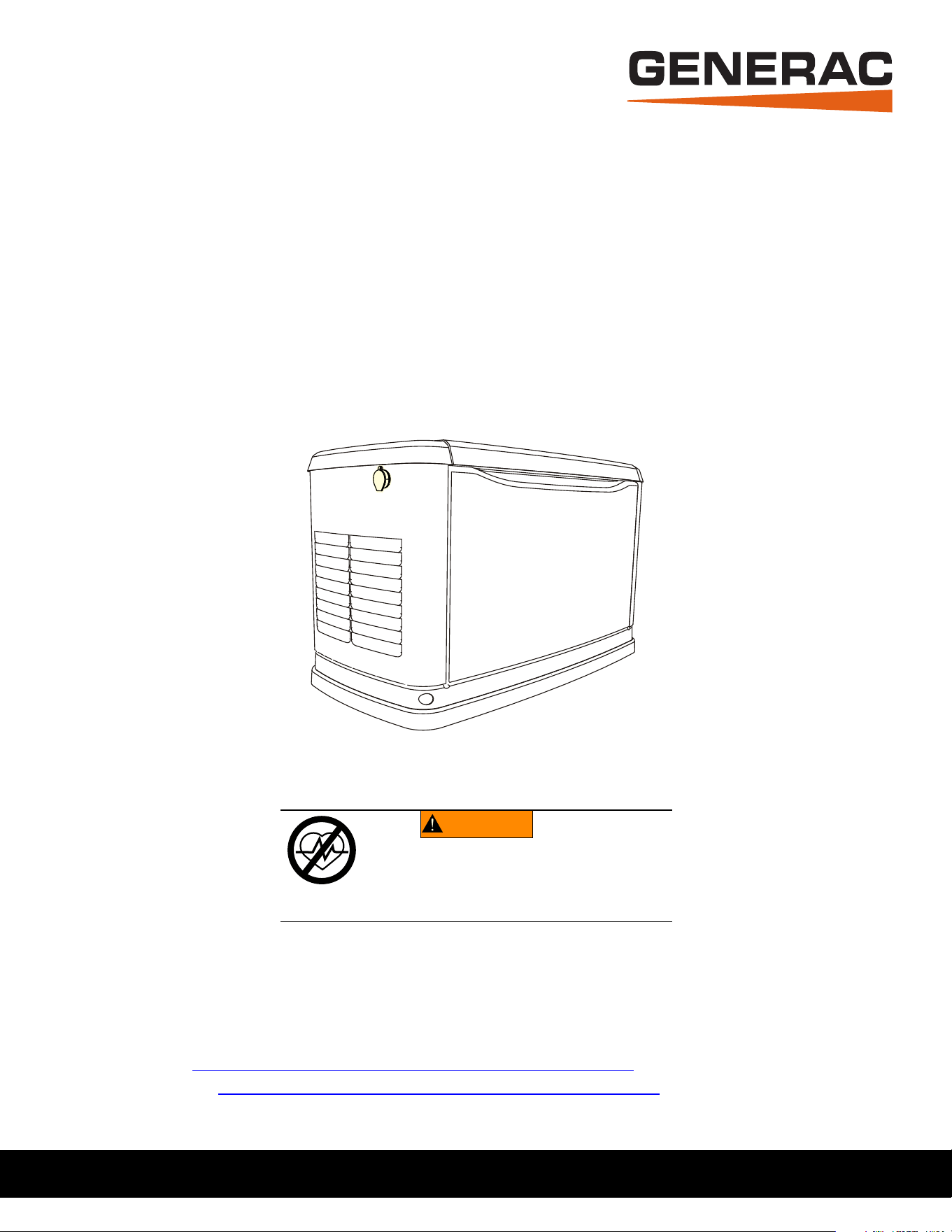
Owner’s Manual
3 Phase 60 Hz Air-Cooled Generators
20 kW
SAVE THIS MANUAL FOR FUTURE REFERENCE
®
Para español, visita: http://www.generac.com/service-support/product-support-lookup
Pour le français, visiter : http://www.generac.com/service-support/product-support-lookup
Register your Generac product at:
WWW.GENERAC.COM
1-888-GENERAC
(888-436-3722)
(000209a)
WARNING
This product is not intended to be used in
a critical life support application. Failure to
adhere to this warning could result in
death or serious injury.
ii Owner’s Manual for 60 Hz Air-Cooled Generators
Use this page to record important information about your generator set.
Record the information found on your unit data label on this
page. See General Information for the location of the unit
data label. The unit has a label plate affixed to the inside
partition, to the left of the control panel console as shown in
Figure 2-1. See Operation for directions on how to open the
top lid and remove the front panel.
When contacting an Independent Authorized Service Dealer
(IASD) about parts and service, always supply the complete
model and serial numbers of the unit.
Operation and Maintenance: Proper maintenance and care
of the generator ensures a minimum number of problems
and keeps operating expenses at a minimum. It is the
operator’s responsibility to perform all safety checks, to
make sure that all maintenance for safe operation is
performed promptly, and to have the equipment checked
periodically by an IASD. Normal maintenance, service, and
replacement of parts are the responsibility of the owner/
operator and are not considered defects in materials or
workmanship within the terms of the warranty. Individual
operating habits and usage may contribute to the need for
additional maintenance or service.
When the generator requires servicing or repairs, Generac
recommends contacting an Independent Authorized Service
Dealer for assistance. Authorized service technicians are
factory–trained and are capable of handling all service
needs.To locate the nearest Independent Authorized Service
Dealer, please visit the dealer locator at:
www.generac.com/Service/DealerLocator/
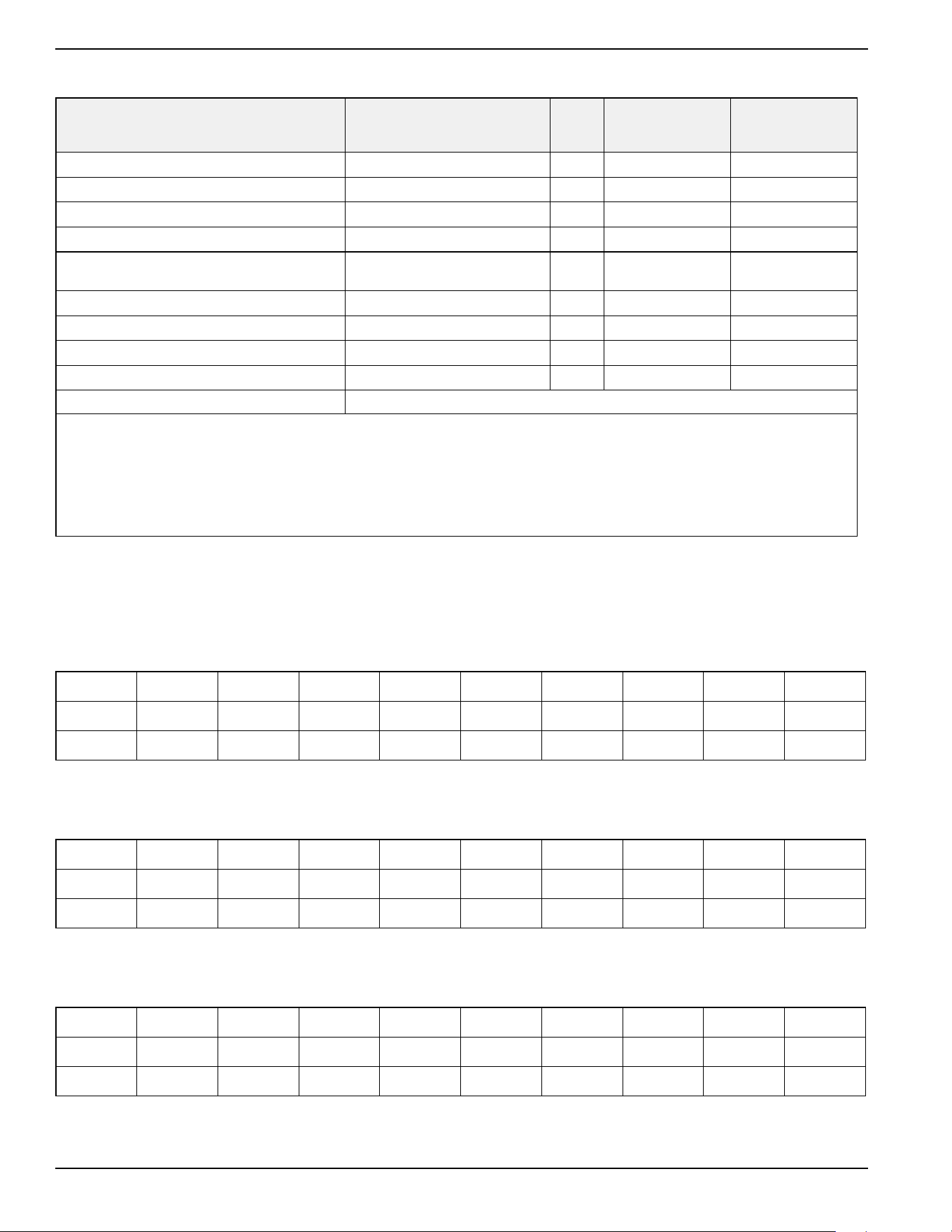
Model:
Serial:
Prod Date Week:
Volts:
LPV Amps:
NG Amps:
Hz:
Phase:
Controller P/N:
(000005)
WARNING
California Proposition 65. This product contains or
emits chemicals known to the state of California to
cause cancer, birth defects, and other reproductive
harm.
(000004)
WARNING
California Proposition 65. Engine exhaust and some
of its constituents are known to the state of California
to cause cancer, birth defects, and other reproductive
harm.

Owner’s Manual for 60 Hz Air-Cooled Generators iii
Section 1: Safety Rules & General
Information
Introduction ..........................................................1
Read This Manual Thoroughly ....................................1
How to Obtain Service .................................................1
Safety Rules .........................................................2
General Hazards ..................................................2
Exhaust Hazards .........................................................3
Electrical Hazards .......................................................3
Fire Hazards ................................................................4
Explosion Hazards ......................................................4
Section 2: General Information
The Generator ......................................................5
Specifications ......................................................6
Generator ....................................................................6
Engine .........................................................................6
Protection Systems .............................................7
Emission Information ..........................................7
Fuel Requirements ..............................................7
Battery Requirements .........................................7
Battery Charger ....................................................7
Engine Oil Requirements ....................................7
Activating the Generator .....................................7
Replacement Parts ..............................................8
Accessories ..........................................................8
Section 3: Operation
Site Prep Verification ...........................................9
Generator Enclosure ...........................................9
Opening the Lid ...........................................................9
Removing the Front Access Panel ..............................9
Intake Side Panel Removal .........................................9
Main Line Circuit Breaker (Generator Disconnect) ......9
LED Indicator Lights ..................................................10
Control Panel Interface .....................................11
Using the AUTO/OFF/MANUAL Interface ........11
Interface Menu Displays ....................................11
The LCD Panel ..........................................................11
Menu System Navigation ..........................................12
Setting the Exercise Timer ............................... 14
Battery Charger ................................................. 14
Manual Transfer Operation ............................... 15
Transfer to Generator Power Source ........................15
Transfer to Utility Power Source ................................16
Automatic Transfer Operation ......................... 16
Automatic Sequence of Operation .................. 16
Utility Failure ..............................................................16
Cranking ....................................................................16
Cold Smart Start ........................................................17
Load Transfer ............................................................17
Shutting Generator Down While Under Load
Or During An Extended Outage ....................... 17
To turn the generator OFF ........................................17
To turn the generator back ON ..................................17
Section 4: Maintenance
Maintenance ....................................................... 19
Preparing for Maintenance ............................... 19
To turn the generator OFF: .......................................19
To turn the generator back ON: .................................19
Performing Scheduled Maintenance ............... 19
Service Schedule ............................................... 20
Maintenance Log .......................................................20
Checking Engine Oil Level ............................... 21
Engine Oil Requirements ..........................................21
Changing the Oil and Oil Filter ......................... 22
Servicing the Air Cleaner .................................. 22
Spark Plugs ........................................................ 22
Valve Clearance Adjustment ............................ 23
Check Valve Clearance .............................................23
Adjust Valve Clearance .............................................23
Battery Maintenance ......................................... 24
Cleaning the Sediment Trap ............................. 25
Perform Leak Test ............................................. 25
Attention After Submersion ............................. 26
Corrosion Protection ........................................ 26
Table of Contents

Table of Contents
iv Owner’s Manual for 60 Hz Air-Cooled Generators
Remove From, and Return To Service
Procedure ...........................................................26
Remove From Service .............................................. 26
Return to Service ...................................................... 27
Section 5: Troubleshooting / Quick
Reference Guide
Generator Troubleshooting ..............................29
Quick Reference Guide .....................................30
Safety Rules & General Information
Owner’s Manual for 60 Hz Air-Cooled Generators 1
Section 1: Safety Rules & General Information
Introduction
Thank you for purchasing this compact, high
performance, air-cooled, engine-driven generator. It is
designed to automatically supply electrical power to
operate critical loads during a utility power failure.
This unit is factory installed in an all-weather, metal
enclosure that is intended exclusively for outdoor
installation. This generator will operate using either vapor
withdrawn liquid propane (LP) or natural gas (NG).
NOTE: This generator is suitable for supplying typical
residential loads such as induction motors (sump pumps,
refrigerators, air conditioners, furnaces, etc.), electronic
components (computer, monitor, TV, etc.), lighting loads,
and microwaves, when sized properly.
The information in this manual is accurate based on
products produced at the time of publication. The
manufacturer reserves the right to make technical
updates, corrections, and product revisions at any time
without notice.
Read This Manual Thoroughly
If any section of this manual is not understood, contact
the nearest Independent Authorized Service Dealer
(IASD) for starting, operating, and servicing procedures.
This manual must be used in conjunction with the
appropriate installation manual.
SAVE THESE INSTRUCTIONS: The manufacturer
suggests that this manual and the rules for safe operation
be copied and posted near the unit installation site.
Safety should be stressed to all operators and potential
operators of this equipment.
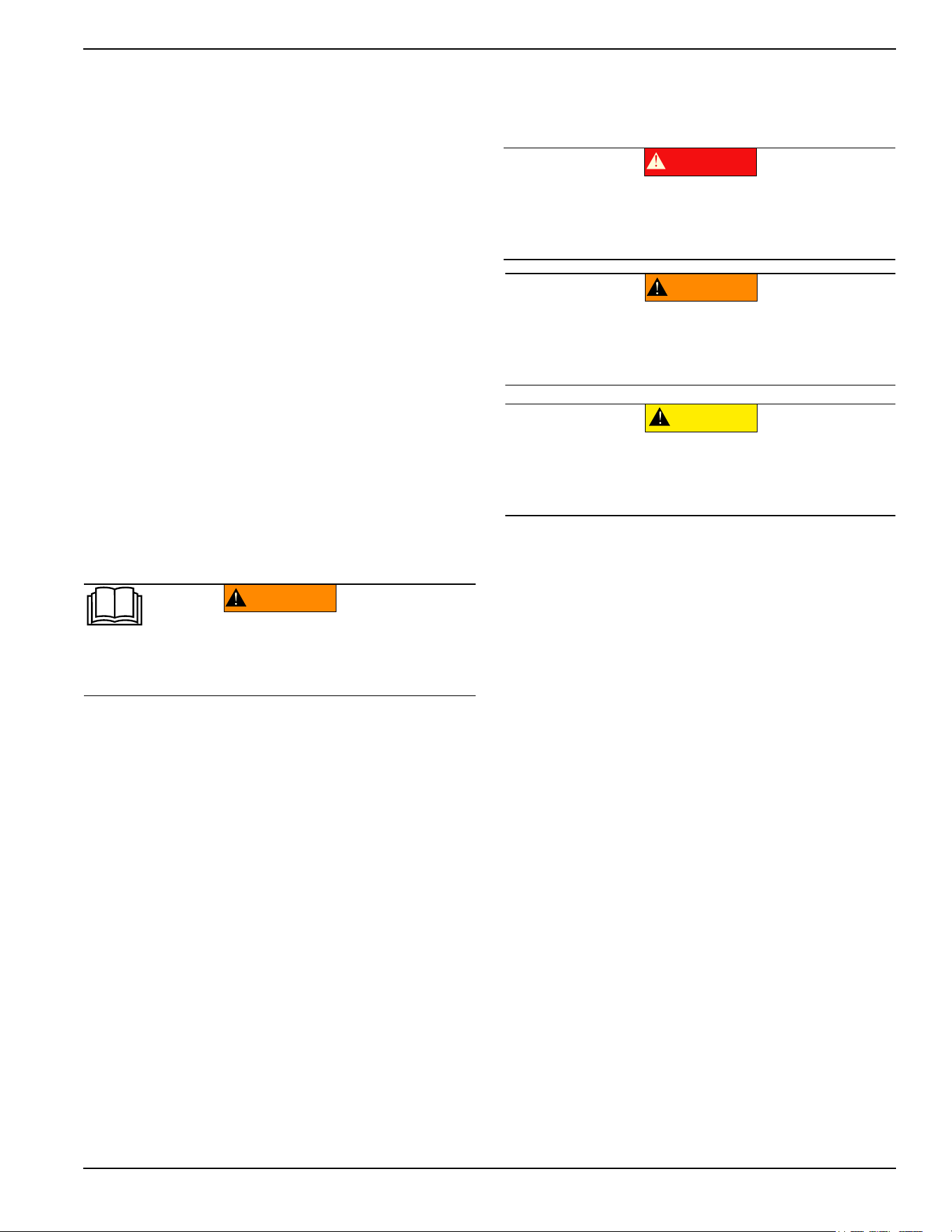
Throughout this publication and on tags and decals
affixed to the generator, DANGER, WARNING, and
CAUTION blocks are used to alert personnel to special
instructions about a particular operation that may be
hazardous if performed incorrectly or carelessly. Observe
them carefully. Their definitions are as follows:
NOTE: Notes provide additional information important to
a procedure or component.
These safety alerts cannot eliminate the hazards they
indicate. Observing safety precautions and strict compli-
ance with the special instructions while performing the
action or service are essential to preventing accidents.
The operator is responsible for proper and safe use of
the equipment. The manufacturer strongly recommends
that if the operator is also the owner, to read the owner’s
manual and thoroughly understand all instructions before
using this equipment. The manufacturer also strongly
recommends instructing other users to properly start and
operate the unit. This prepares them if they need to
operate the equipment in an emergency.
How to Obtain Service
Contact an IASD for assistance when the generator
requires servicing or repairs. Service technicians are
factory-trained and are capable of handling all service
needs. Please visit the dealer locator at:
www.generac.com/Service/DealerLocator/ to locate
the nearest IASD.
When contacting a dealer about parts and service,
always supply the complete model and serial numbers of
the unit as given on its data plate (decal), which is
located on the generator. See Figure 2-1 for decal
location. Record the model and serial numbers in the
spaces provided on the inside front cover of this manual.
(000100a)
WARNING
Consult Manual. Read and understand manual
completely before using product. Failure to
completely understand manual and product
could result in death or serious injury.
(000001)
DANGER
Indicates a hazardous situation which, if not avoided,
will result in death or serious injury.
(000002)
WARNING
Indicates a hazardous situation which, if not avoided,
could result in death or serious injury.
(000003)
CAUTION
Indicates a hazardous situation which, if not avoided,
could result in minor or moderate injury.
Safety Rules & General Information
2 Owner’s Manual for 60 Hz Air-Cooled Generators
Safety Rules
Study these SAFETY RULES carefully before installing,
operating, or servicing this equipment. Become familiar
with this owner’s manual and with the unit. The generator
can operate safely, efficiently, and reliably only if it is
properly installed, operated, and maintained. Many
accidents are caused by failing to follow simple and
fundamental rules or precautions.
The manufacturer cannot anticipate every possible
circumstance that might involve a hazard. The alerts in
this manual and on tags and decals affixed to the unit are
not all-inclusive. If using a procedure, work method, or
operating technique the manufacturer does not
specifically recommend, verify that it is safe for others
and does not render the generator unsafe.
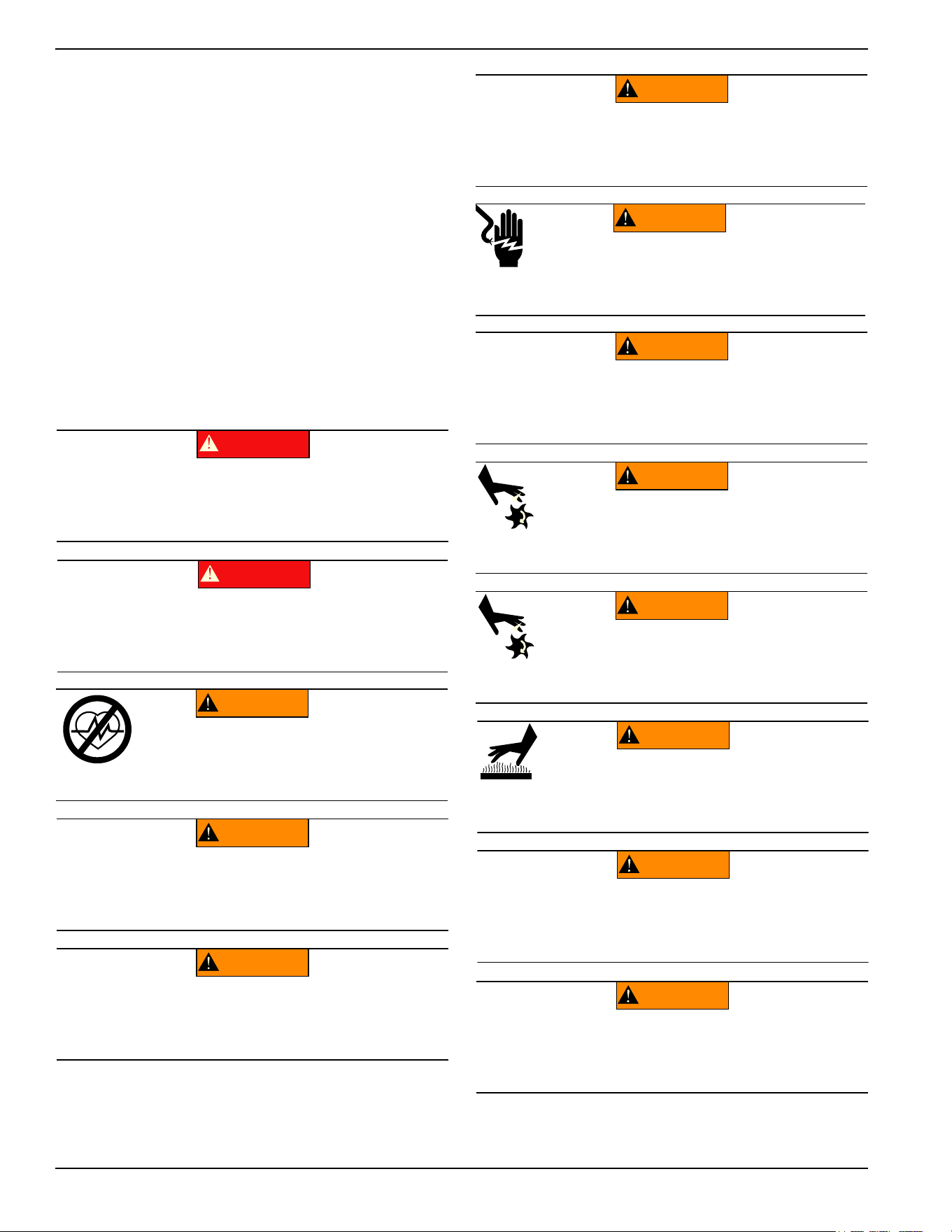
General Hazards
(000190)
DANGER
Loss of life. Property damage. Installation must always
comply with applicable codes, standards, laws and
regulations. Failure to do so will result in death
or serious injury.
Automatic start-up. Disconnect utility power and
render unit inoperable before working on unit.
Failure to do so will result in death or serious injury.
(000191)
DANGER
(000209a)
WARNING
This product is not intended to be used in
a critical life support application. Failure to
adhere to this warning could result in
death or serious injury.
WARNING
This unit is not intended for use as a prime power
source. It is intended for use as an intermediate power
supply in the event of temporary power outage only.
See individual unit specifications for required
maintenance and run times pertaining to use.
(000247)
(000130)
WARNING
Accidental Start-up. Disconnect the negative battery
cable, then the positive battery cable when working
on unit. Failure to do so could result in death
or serious injury.
(000182)
WARNING
Only qualified service personnel may install, operate,
and maintain this equipment. Failure to follow proper
installation requirements could result in death, serious
injury, and damage to equipment or property.
(000187)
WARNING
Electrocution. Potentially lethal voltages are generated
by this equipment. Render the equipment safe before
attempting repairs or maintenance. Failure to do so
could result in death or serious injury.
(000155)
WARNING
Only a trained and licensed electrician should perform
wiring and connections to unit. Failure to follow proper
installation requirements could result in death, serious
injury, and damage to equipment or property.
(000115)
WARNING
Moving Parts. Do not wear jewelry when
starting or operating this product. Wearing
jewelry while starting or operating this product
could result in death or serious injury.
(000111)
WARNING
Moving Parts. Keep clothing, hair, and
appendages away from moving parts. Failure
to do so could result in death or serious injury.
(000108)
WARNING
Hot Surfaces. When operating machine, do not
touch hot surfaces. Keep machine away from
combustibles during use. Hot surfaces could
result in severe burns or fire.
(000146)
WARNING
Equipment and property damage. Do not alter
construction of, installation, or block ventilation for
generator. Failure to do so could result in unsafe
operation or damage to the generator.
WARNING
Risk of injury. Do not operate or service this machine
if not fully alert. Fatigue can impair the ability to service
this equipment and could result in death or serious
injury.
(000215)
Safety Rules & General Information
Owner’s Manual for 60 Hz Air-Cooled Generators 3
• Inspect the generator regularly, and contact the
nearest IASD for parts needing repair or
replacement.
Exhaust Hazards
•
The generator must be installed and operated
outdoors only.
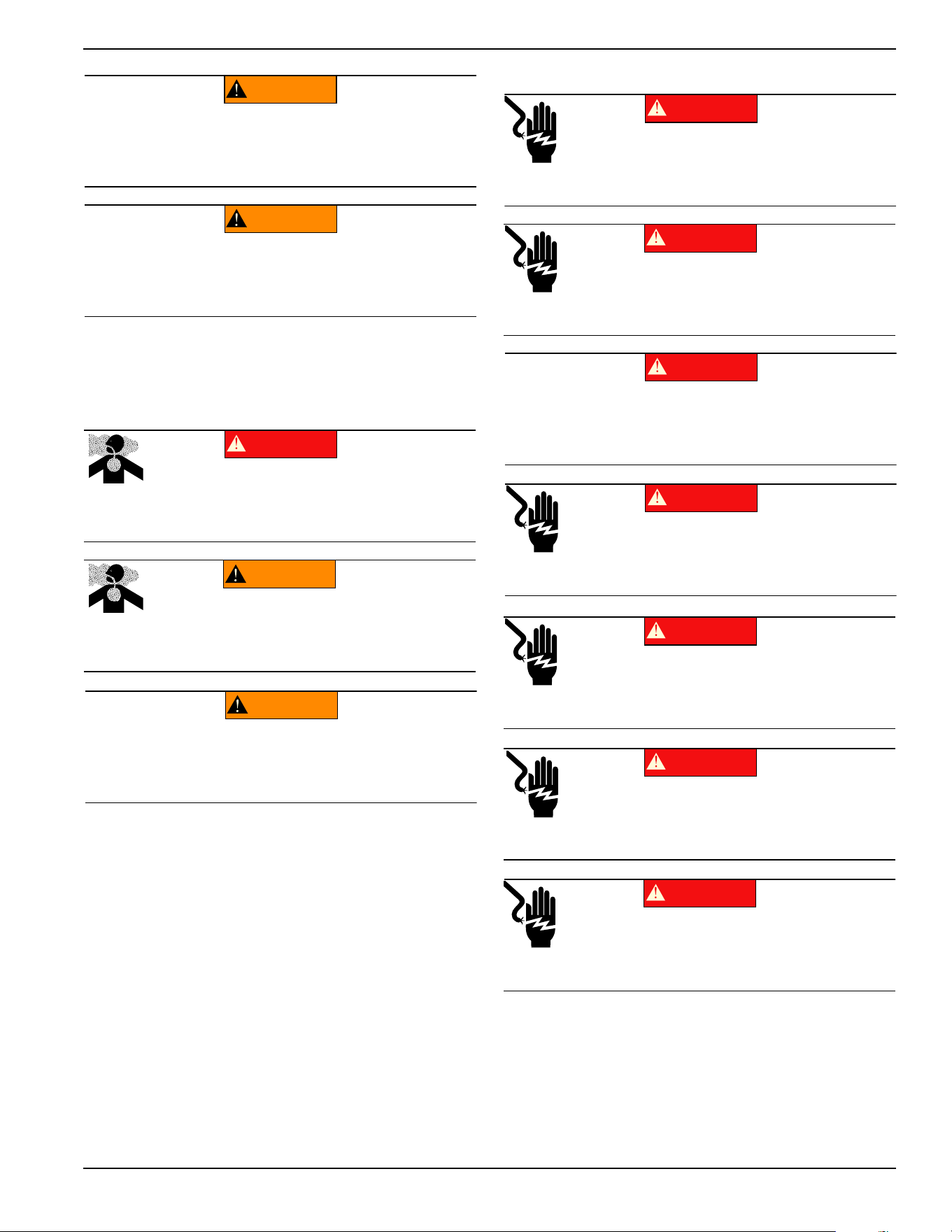
Electrical Hazards
WARNING
Environmental Hazard. Always recycle batteries at an
official recycling center in accordance with all local
laws and regulations. Failure to do so could result in
environmental damage, death or serious injury.
(000228)
WARNING
Injury and equipment damage. Do not use generator
as a step. Doing so could result in falling, damaged
parts, unsafe equipment operation, and could result
in death or serious injury.
(000216)
Asphyxiation. Running engines produce
carbon monoxide, a colorless, odorless,
poisonous gas. Carbon monoxide, if not
avoided, will result in death or serious injury.
(000103)
DANGER
(000178a)
Asphyxiation. Always use a battery operated carbon
monoxide alarm indoors and installed according to
the manufacturer’s instructions. Failure to do so
could result in death or serious injury.
WARNING
(000146)
WARNING
Equipment and property damage. Do not alter
construction of, installation, or block ventilation for
generator. Failure to do so could result in unsafe
operation or damage to the generator.
(000144)
DANGER
Electrocution. Contact with bare wires,
terminals, and connections while generator
is running will result in death or serious injury.
(000150)
DANGER
Electrocution. Never connect this unit to the electrical
system of any building unless a licensed electrician
has installed an approved transfer switch. Failure to
do so will result in death or serious injury.
(000237)
DANGER
Electrical backfeed. Use only approved switchgear to
isolate generator from the normal power source.
Failure to do so will result in death, serious injury,
and equipment damage.
(000152)
DANGER
Electrocution. Verify electrical system is
properly grounded before applying power.
Failure to do so will result in death or serious
injury.
(000188)
DANGER
Electrocution. Do not wear jewelry while
working on this equipment. Doing so will
result in death or serious injury.
(000104)
DANGER
Electrocution. Water contact with a power
source, if not avoided, will result in death
or serious injury.
(000145)
DANGER
Electrocution. In the event of electrical accident,
immediately shut power OFF. Use non-conductive
implements to free victim from live conductor. Apply
first aid and get medical help. Failure to do so will
result in death or serious injury.
Safety Rules & General Information
4 Owner’s Manual for 60 Hz Air-Cooled Generators
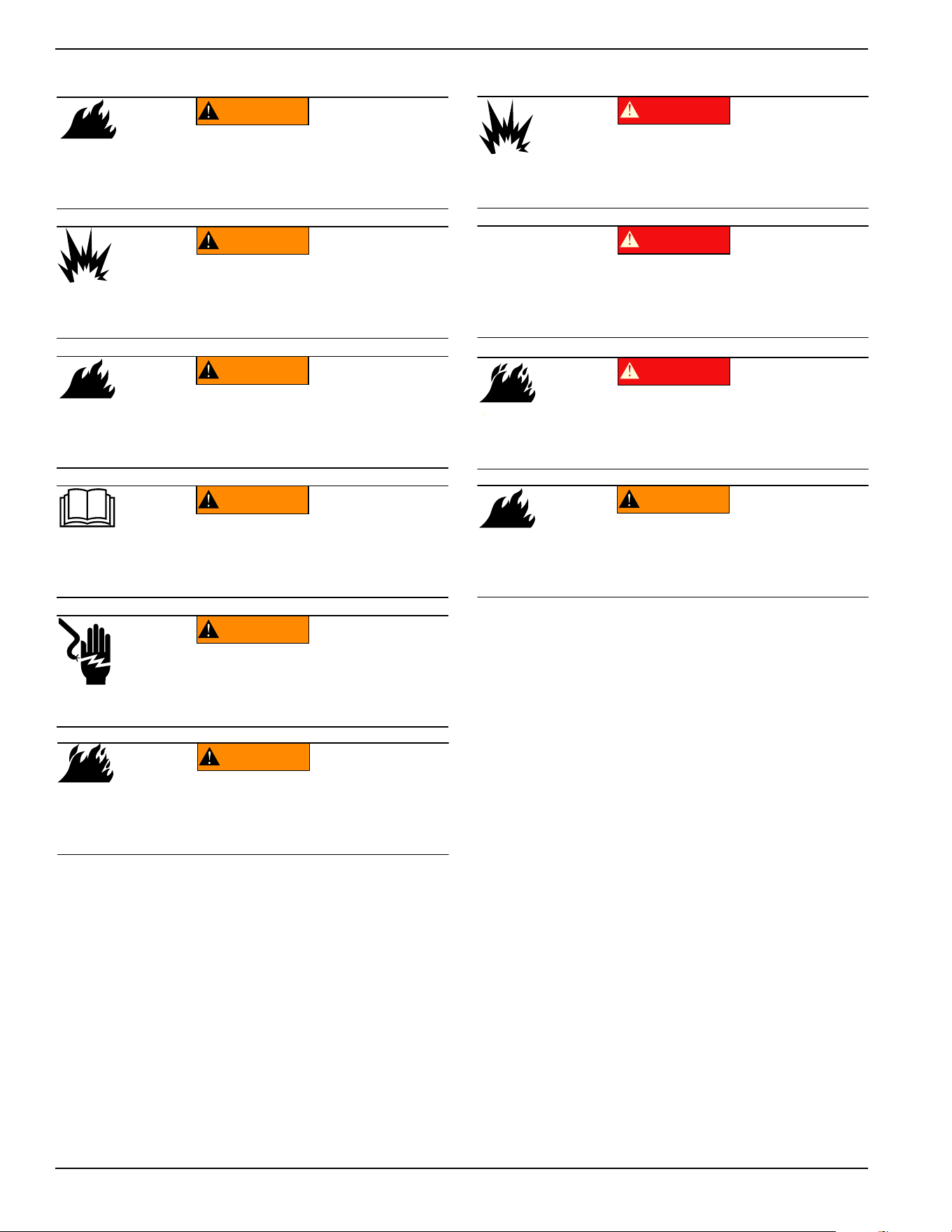
Fire Hazards
•
Comply with regulations the Occupational Safety
and Health Administration (OSHA) has
established. Also verify that the generator is
installed in accordance with the manufacturer’s
instructions and recommendations. Following
proper installation, do nothing that might alter a
safe installation and render the unit in
noncompliance with the aforementioned codes,
standards, laws, and regulations.
Explosion Hazards
WARNING
Fire hazard. Do not obstruct cooling and
ventilating airflow around the generator. Inadequate
ventilation could result in fire hazard, possible
equipment damage, death or serious injury.
(000217)
WARNING
Fire and explosion. Installation must comply
with all local, state, and national electrical
(000218)
building codes. Noncompliance could result in unsafe
operation, equipment damage, death or serious injury.
WARNING
Fire hazard. Use only fully-charged fire
(000219)
extinguishers rated “ABC” by the NFPA. Discharged or
improperly rated fire extinguishers will not extinguish
electrical fires in automatic standby generators.
(000100a)
WARNING
Consult Manual. Read and understand manual
completely before using product. Failure to
completely understand manual and product
could result in death or serious injury.
WARNING
to use required safety equipment could result
in death or serious injury.
(000257)
Electrocution. Refer to local codes and
standards for safety equipment required when
working with a live electrical system. Failure
(000147)
WARNING
Risk of Fire. Unit must be positioned in a
manner that prevents combustible material
accumulation underneath. Failure to do so
could result in death or serious injury.
(000192)
DANGER
Explosion and fire.Fuel and vapors are extremely
flammable and explosive. No leakage of fuel is
permitted. Keep fire and spark away. Failure to do
so will result in death or serious injury.
(000151)
DANGER
Connection of fuel source must be done by a qualified
professional technician or contractor. Incorrect installation
of this unit will result in death, serious injury, and damage
to equipment and property damage.
(000174)
DANGER
Risk of fire. Allow fuel spills to completely dry
before starting engine. Failure to do so will
result in death or serious injury.
(000110)
WARNING
Risk of Fire. Hot surfaces could ignite
combustibles, resulting in fire. Fire could
result in death or serious injury.
General Information
Owner’s Manual for 60 Hz Air-Cooled Generators 5
Section 2: General Information
The Generator
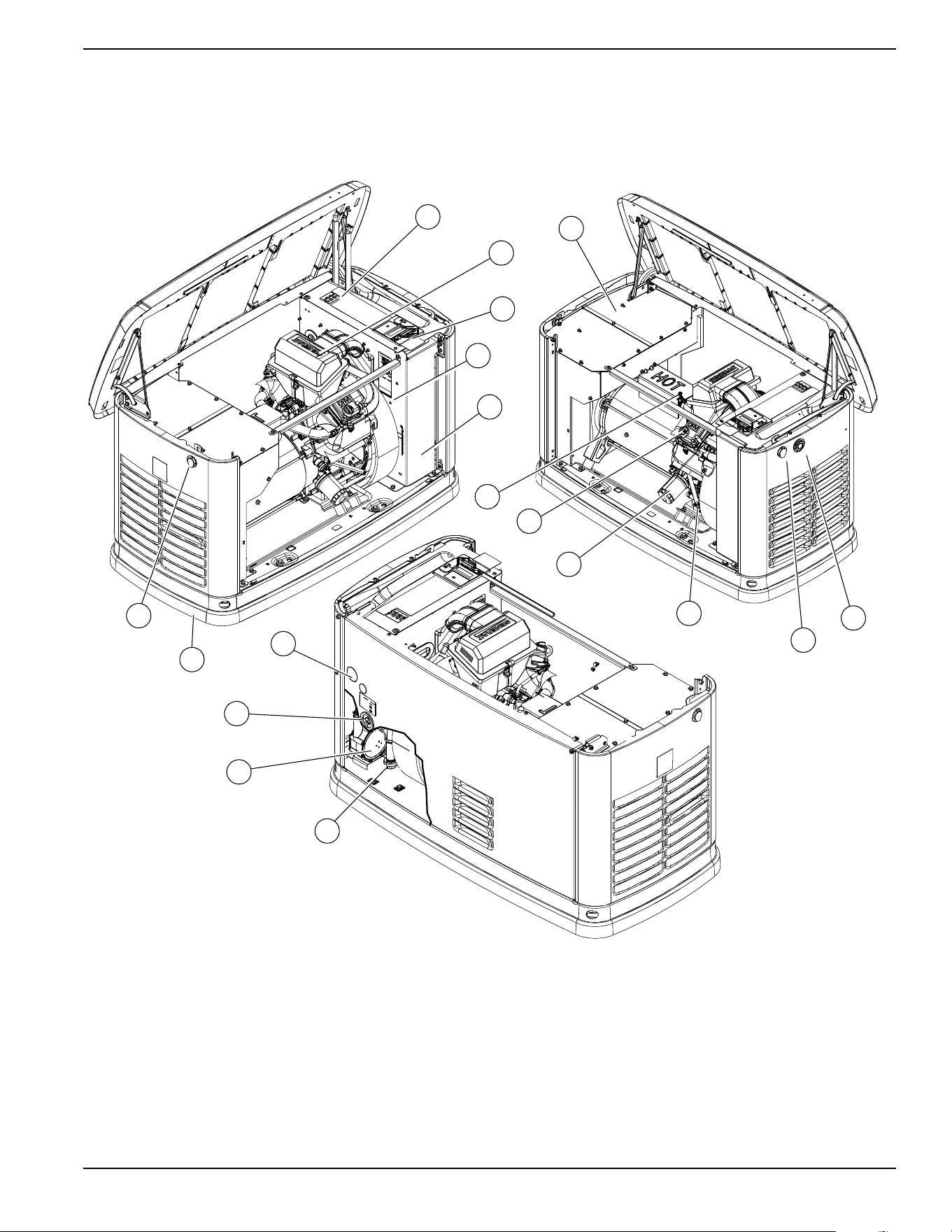
Figure 2-1. Components and Control Locations
A. Lock with Cover E. Battery Compartment
(Battery not supplied)
I. Main AC/Control
Wiring holes
N. Sediment Trap
B. Main Line Circuit
Breaker (Generator
Disconnect)
F. Exhaust Enclosure J.
K.
Oil Fill Cap
Oil Filter
O.
P.
Fuel Regulator
Fuel Inlet
C. Airbox with Air Cleaner G. Status LED Indicators L. Composite Base Q. Data Plate Location
D. Control Panel H. Oil Drain M. Oil Dipstick
003736
A
L
I
P
O
N
A
G
H
K
J
M
E
Q
D
C
B
F
General Information
6 Owner’s Manual for 60 Hz Air-Cooled Generators
Specifications
Generator
Engine
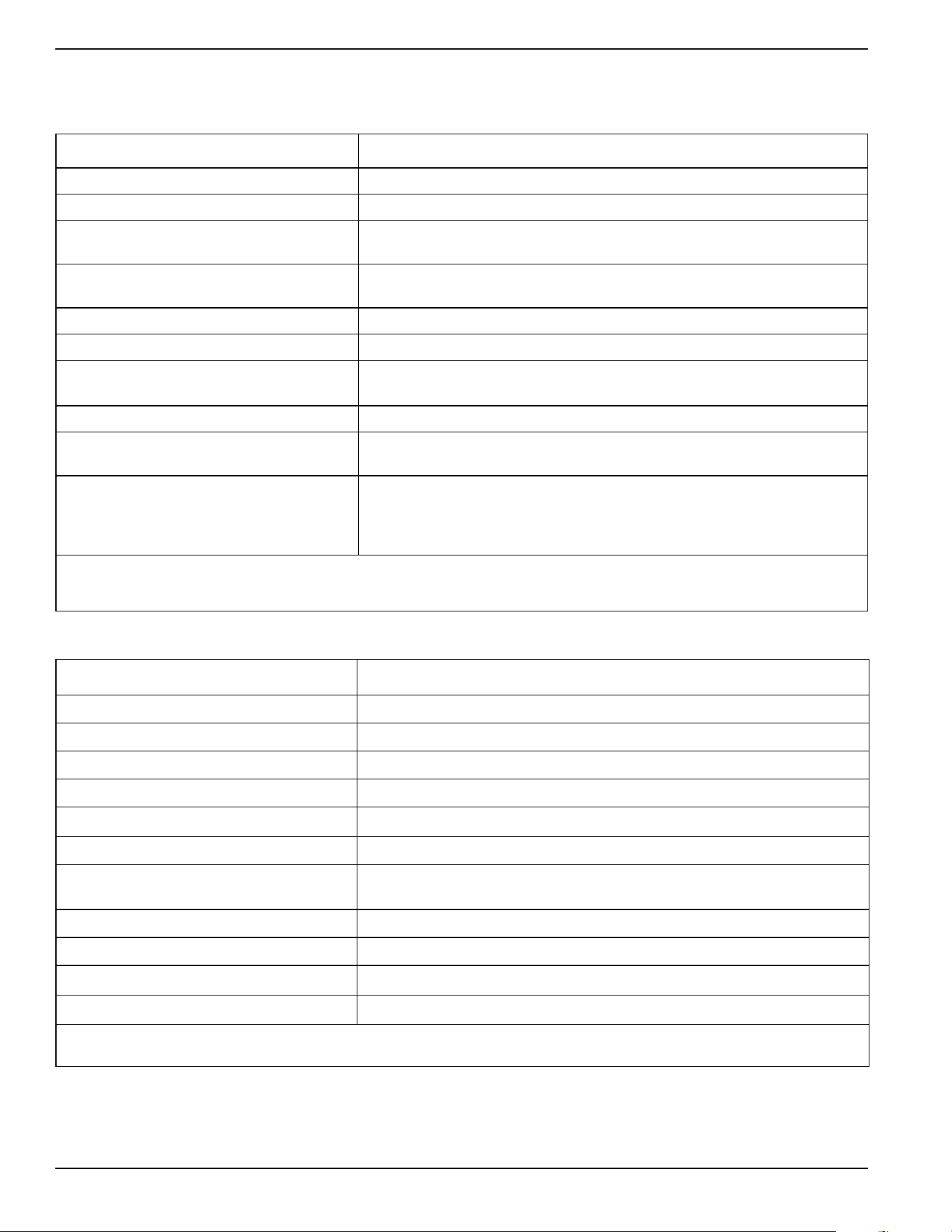
The specification sheet for your generator was included in the documentation provided with the unit at the time of
purchase. For additional copies, consult your local Independent Authorized Service Dealer (IASD) for your specific
generator model.
Model 20 kW
Rated Voltage 208
Power Factor 0.8
Rated Maximum Load Current (Amps) at Rated
Voltage with LP*
69.4
Main Line Circuit Breaker
(Generator Disconnect)
80 Amp
Phase 3
Rated AC Frequency 60 Hz
Battery Requirement
(Field supplied)
12 volts, Group 26R-540CCA Minimum or Group 35AGM-650CCA Minimum
(see
Replacement Parts)
Enclosure Aluminum
Weight (lbs/kilos)
(without battery)
466 / 211
Normal Operating Range
This unit is tested in accordance to UL 2200 standards with an operating temperature
of -20 °F (-29 °C) to 122 °F (50 °C). For areas where temperatures fall below 32 °F (0
°C) a cold weather kit is recommended. When operated above 77 °F (25 °C) there
may be a decrease in engine power. See
Engine
.
These generators are rated in accordance with UL 2200, Safety Standard for Stationary Engine Generator Assemblies, and CSA-C22.2 No. 100-04
Standard for Motors and Generators.
* Natural Gas ratings will depend on specific fuel joules/BTU content. Typical derates are between 10-20% off the LP gas rating.
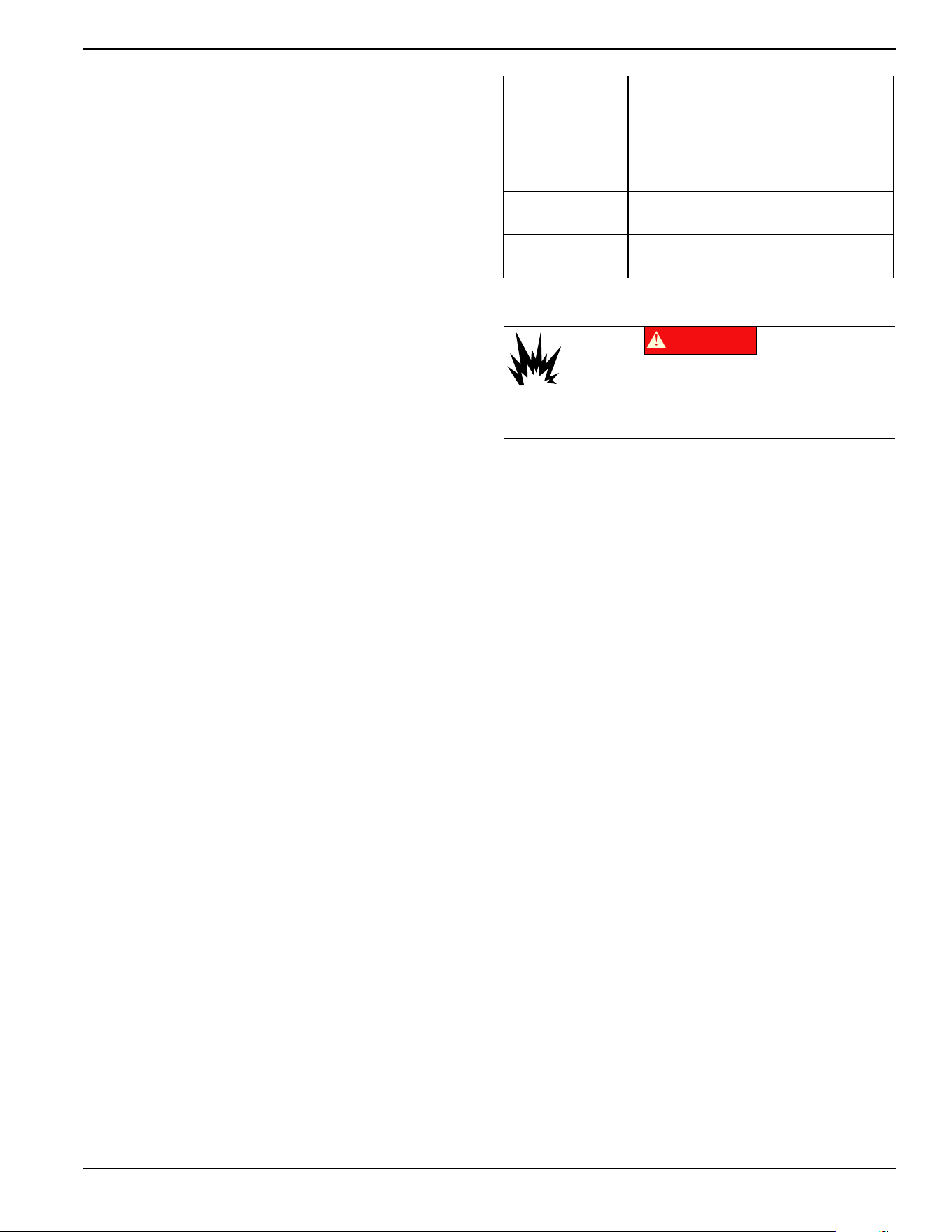
Model 20 kW
Type of Engine Generac G-Force 1000
Number of Cylinders 2
Displacement 999 cc
Cylinder Block Aluminum w/ cast iron sleeve
Recommended Spark Plug
See
Replacement Parts
Spark Plug Gap 0.040 in (1.02 mm)
Valve Clearance 0.002–0.004 in
(0.05–0.1 mm)
Starter 12 VDC
Oil Capacity Including Filter Approx. 1.9 qt (1.8 L)
Recommended Oil Filter
See
Replacement Parts
Recommended Air Filter
See
Replacement Parts
Engine power is subject to and limited by such factors as fuel BTU/joules, ambient temperature and altitude. Engine power decreases about 3.5% for
each 1000 ft (304.8 m) above sea level, and also will decrease about 1% for each 10 °F (6 °C) above 60 °F (15 °C) ambient temperature.
General Information
Owner’s Manual for 60 Hz Air-Cooled Generators 7
Protection Systems
The generator may need to run for long periods of time
with no operator present to monitor the engine/generator
conditions. The generator is equipped with protection
systems to automatically shut down the unit to protect
against potentially damaging conditions. Some of these
systems include:
Alarms:
Warnings:
The control panel contains a display which alerts the
operator when a fault condition occurs. The above list is
not all inclusive. See Operation for more information
about alarms and control panel operation.
NOTE: A warning will indicate a condition on the
generator that should be addressed, but will not shut the
generator down. An alarm will shut the generator down to
protect the system from any damage. In the event of an
alarm, an owner can clear the alarm and restart the
generator prior to contacting an IASD. If the intermittent
issue occurs again, contact an IASD.
Emission Information
The United States Environmental Protection Agency (US
EPA) (and California Air Resources Board (CARB), for
engines/equipment certified to California standards)
requires that this engine/equipment complies with
exhaust and evaporative emissions standards. Locate
the emissions compliance decal on the engine to
determine applicable standards. For emissions warranty
information, please reference the included emissions
warranty. Follow the maintenance specifications in
Maintenance to ensure that the engine complies with the
applicable emissions standards for the duration of the
product’s life.
This generator is certified to operate on Liquid Propane
Vapor fuel or pipeline Natural Gas.
The Emission Control System code is EM (Engine
Modification). The Emission Control System on this
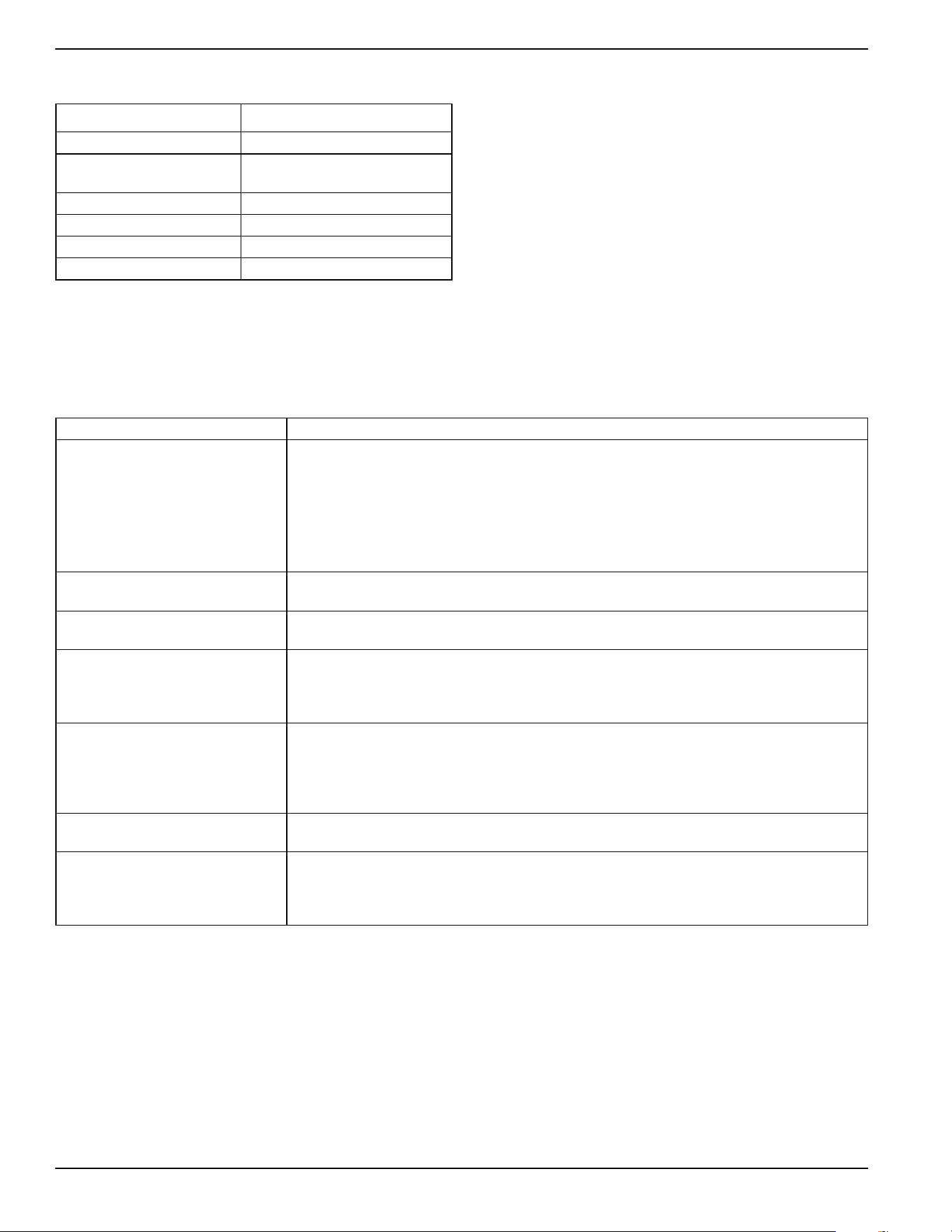
generator consists of the following:
:
Fuel Requirements
The engine has been fitted with a dual fuel carburetion
system. The unit will run on natural gas or LP gas
(vapor), but it has been factory set to run on natural gas.
The fuel system will be configured for the available fuel
source during installation.
Recommended fuels should have a BTU content of at least
1000 BTUs per cubic foot (37.26 megajoules per cubic
meter) for natural gas, or at least 2500 BTUs per cubic foot
(93.15 megajoules per cubic meter) for LP gas (vapor).
NOTE: If converting to LP gas from natural gas, a
minimum LP tank size of 250 gal (946 L) is
recommended. See the installation manual for complete
procedures and details.
Battery Requirements
12 volts, Group 26R-540CCA minimum or Group 35AGM-
650CCA minimum (not included with unit.) See
Maintenance
for proper battery maintenance procedures.
Battery Charger
The battery charger is integrated into the control panel
module in all models. It operates as a smart charger,
which ensures output charging levels are safe and
continuously optimized to promote maximum battery life.
Engine Oil Requirements
See Engine Oil Requirements in the Maintenance
section for proper oil viscosity.
Activating the Generator
The generator should be activated upon initial start-up.
See the installation manual for complete instructions.
• High Temperature
• Low Oil Pressure
• Overcrank
• Overspeed
• Overvoltage
• Undervoltage
• Overload
• Underspeed
• RPM Sensor Loss
• Controller Fault
• Wiring Error
• Fuse Problem
• Stepper Overcurrent
• Charger Warning
• Charger Missing AC
• Low Battery
• Battery Problem
• Exercise Set Error
• USB Warning
• Download Failure
System Components
Air Induction
- Intake Manifold
- Air Cleaner
Fuel Metering
- Carburetor and Mixer Assembly
- Fuel Regulator
Ignition
- Spark Plug
- Ignition Module
Exhaust
- Exhaust Manifold
- Muffler
(000105)
DANGER
Explosion and Fire. Fuel and vapors are
extremely flammable and explosive. Add fuel
in a well ventilated area. Keep fire and spark
away. Failure to do so will result in death
or serious injury.
General Information
8 Owner’s Manual for 60 Hz Air-Cooled Generators
Replacement Parts
Accessories
NOTE: Performance enhancing accessories are available for air-cooled generators. Contact an IASD or visit
www.generac.com for additional information on replacement parts and accessories. See also http://
www.ordertree.com/generac/air-cooled-homestandby-generators/.
Description 20 kW
26R Exide Battery 0H3421S
Spark Plug
0G0767A
(RC12YC or equivalent)
Oil Filter 070185E
Air Filter 0J8478
Control Panel Fuse 0D7178T
Transfer Switch Fuses 073590A
Accessory Description
Cold Weather Accessories*—
• Battery Pad Warmer
• Oil Warmer
• Breather Warmer
* each sold separately
• Recommended in areas where temperatures fall below 0 °F (-18 °C).
(Not necessary for use with AGM-style batteries)
• Recommended in areas where temperatures fall below 0 °F (-18 °C).
• Recommended in areas where heavy icing occurs.
Scheduled Maintenance Kit Includes all pieces necessary to perform maintenance on the generator along with oil
recommendations.
Auxiliary Transfer Switch Lockout Enables any of the transfer switches to completely lock out one large electrical load by tying
into its control system.
Fascia Base Wrap The fascia base wrap snaps together around the bottom of the new air-cooled generators.
This offers a sleek, contoured appearance as well as offering protection from rodents and
insects by covering the lifting holes located in the base. Requires use of the mounting pad
shipped with the generator.
Mobile Link™ (USA only) Provides a personalized web portal that displays the generator status, maintenance
schedule, event history, and much more. This portal is accessible via computer, tablet, or
smart phone. Sends emails and/or text notifications the moment there is any change in the
generator’s status. Notification settings can be customized to what type of alert is sent and
how often. Visit www.MobileLinkGen.com for more information.
Touch-Up Paint Kit Very important to maintain the look and integrity of the generator enclosure. This kit includes
touch-up paint and instructions.
Wireless Local Monitor The Wireless Local Monitor is completely wireless and battery powered, and provides owners
with instant generator status updates without ever leaving the house. Status lights (red,
yellow, and green) alert owners when the generator needs attention. Magnetic backing
permits refrigerator mounting and gives a 600 ft (183 m) line of sight communication.
Operation
Owner’s Manual for 60 Hz Air-Cooled Generators 9
Section 3: Operation
Site Prep Verification
The generator must be installed so that airflow into and out
of the generator is not impeded. Verify that all shrubs or tall
grasses within 3 ft (0.91 m) of the intake and discharge
louvers on the sides of the enclosure have been removed.
Install the generator on high ground where water levels will
not rise and endanger it. This unit should not operate in or
be subjected to standing water. Verify that all potential
water sources such as water sprinklers, roof run-off, rain
gutter downspouts, and sump pump discharges are
directed away from the generator enclosure.
Generator Enclosure
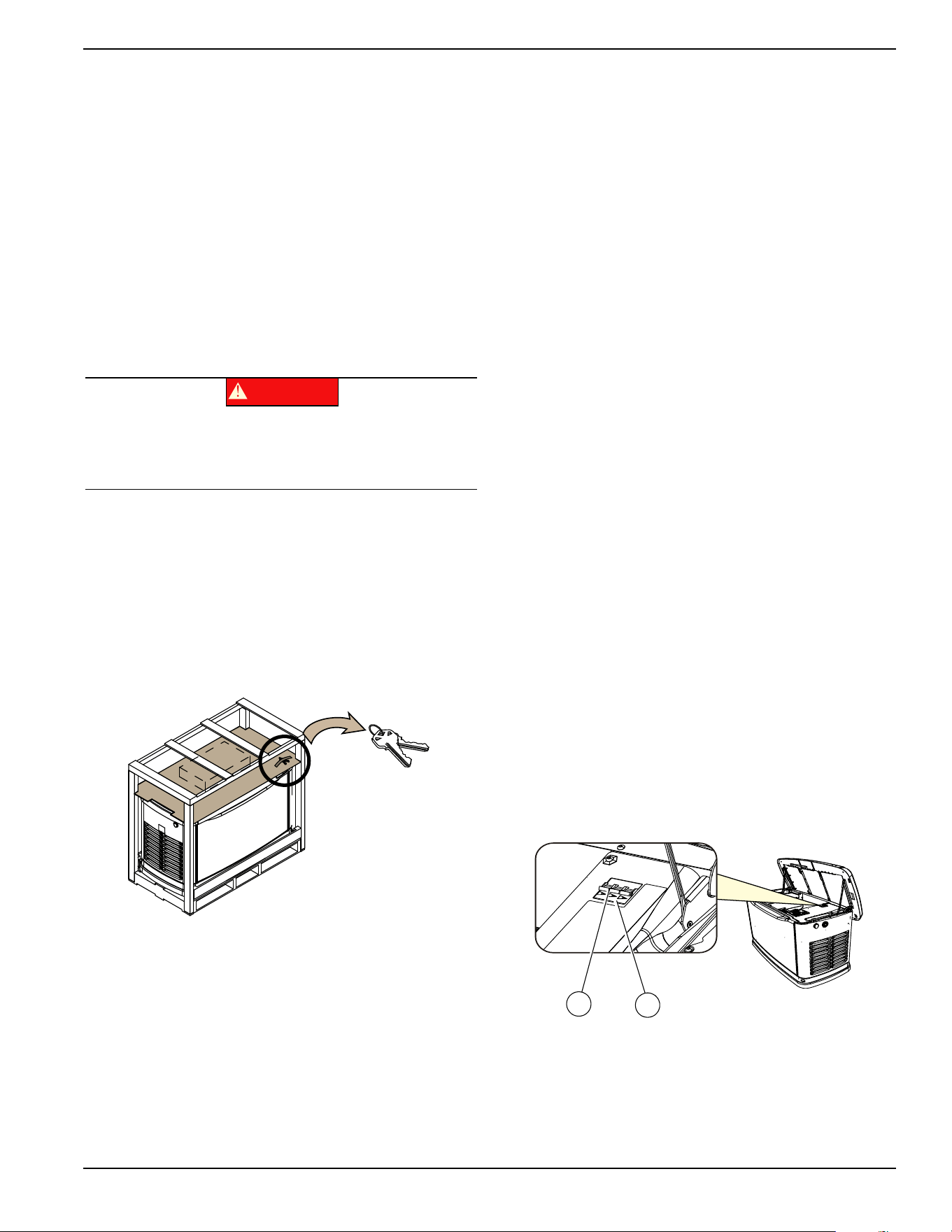
See Figure 3-1. The lid will be locked. A set of keys is
taped to the cardboard on top of the generator on the
intake side.
1. Remove the tape to remove the keys.
2. Use the keys to open the lid of the generator.
The enclosed keys provided with this unit are intended
for service personnel use only.
Figure 3-1. Key Location
Opening the Lid
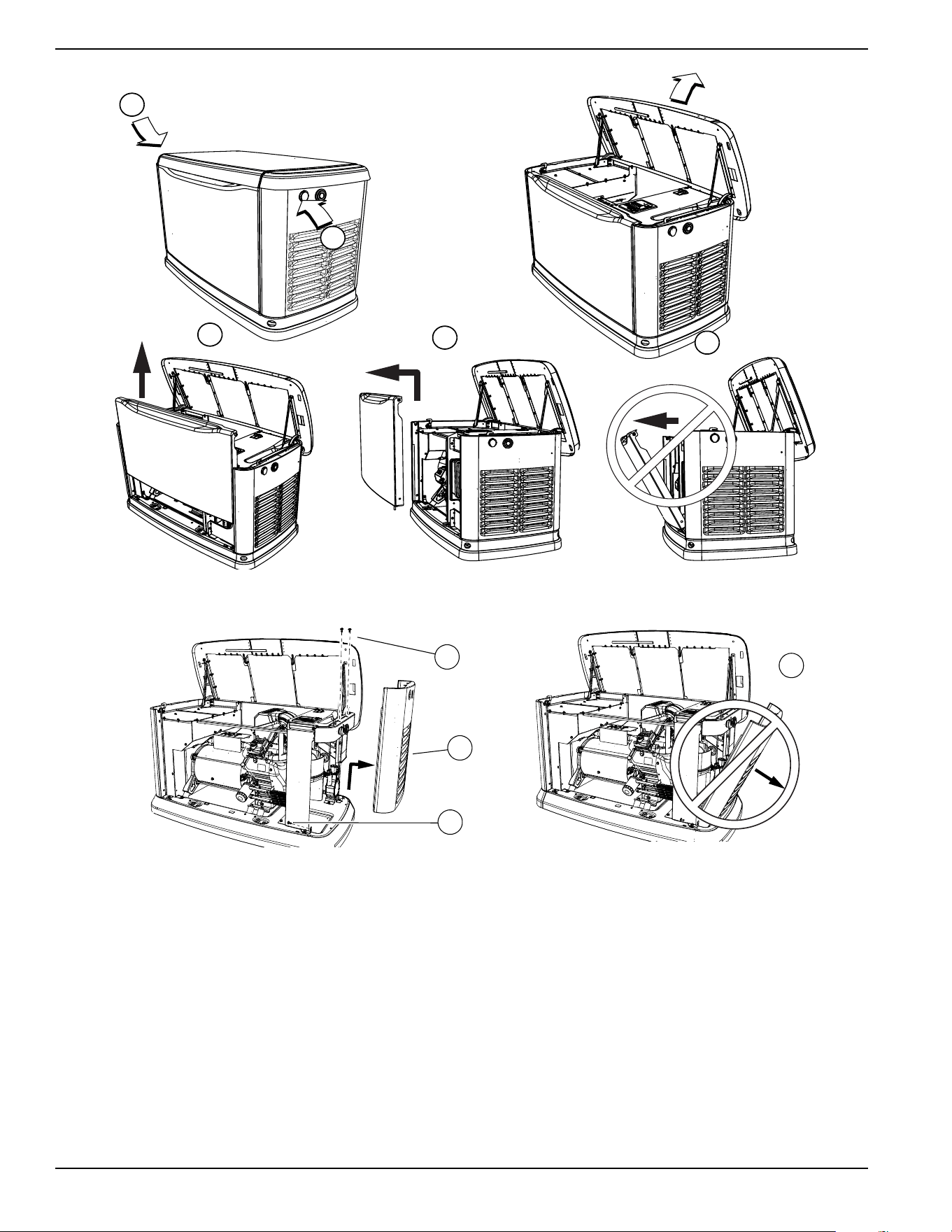
See Figure 3-3. Two locks secure the lid—one on each
side (A). Open the protective rubber cap to access the
keyhole, and press down on the lid above the side lock
and unlock the latch to properly open the lid.
Repeat for the other side. The lid may appear stuck if
pressure is not applied from the top.
Always verify that the side locks are unlocked before
attempting to lift the lid.
Removing the Front Access Panel
Remove the front access panel by lifting it straight up and
out once the lid is open.
Always lift the front access panel straight up before
pulling it away from the enclosure (B and C). Do not pull
the panel away from the enclosure before lifting up (D).
Intake Side Panel Removal
See Figure 3-4. The intake side panel (A) must be
removed to access the battery compartment, fuel
regulator, and sediment trap.
1. Raise the lid and remove the front panel.
2. Use an Allen wrench to remove two mounting
screws (B) and the L-bracket screw (C).
3. Lift the intake panel up and away from the
generator.
NOTE: Always lift the intake side panel straight up
before pulling away from enclosure. Do not pull the panel
away from the enclosure before lifting up (D).
Main Line Circuit Breaker (Generator
Disconnect)
This is a 3-pole breaker rated according to relevant
specifications. See (A) in Figure 3-2.
The breaker can be locked in the OFF (OPEN) position
for security. Use an appropriately-sized padlock (not
included) with a shackle long enough to pass through
both lock tabs (B).
NOTE: DO NOT lock out the MLCB during normal
generator operation. Doing so will compromise automatic
standby functionality.
Figure 3-2. Main Breaker
Automatic start-up. Disconnect utility power and
render unit inoperable before working on unit.
Failure to do so will result in death or serious injury.
(000191)
DANGER
003619
003740
B
A
Operation
10 Owner’s Manual for 60 Hz Air-Cooled Generators
Figure 3-3. Side Lock Location and Front Panel Removal
Figure 3-4. Intake Side Panel Removal
LED Indicator Lights
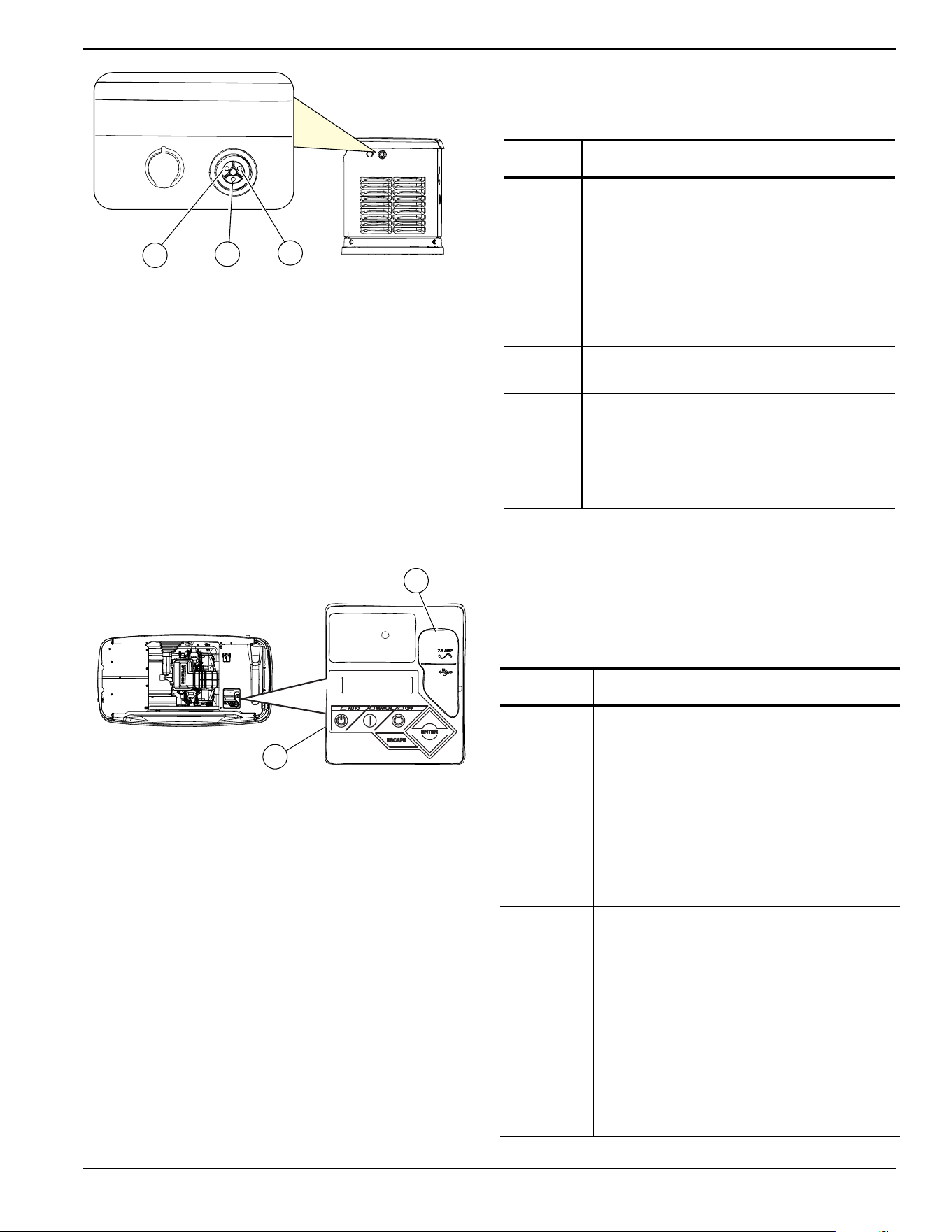
See Figure 3-5. Three LEDs are visible behind a
translucent lens on the generator side panel. These
LEDs indicate the operating status of the generator.
• Green LED READY light (A) is illuminated when
utility is present and the control panel button is in
the AUTO position. The LED flashes when the
automatic transfer switch converts to generator
power during a utility power outage.
• Red LED ALARM light (B) is illuminated when the
generator is OFF or a fault is detected. Contact an
IASD.
• Yellow LED MAINTENANCE light (C) is illuminated
when scheduled maintenance is due.
NOTE: Yellow MAINTENANCE or WARNING LED may
be on at the same time as either the Red or Green LED.
A
A
B
D
C
001797
A
B
C
D
002961
Operation
Owner’s Manual for 60 Hz Air-Cooled Generators 11
Figure 3-5. LED Indicator Lights
Control Panel Interface
See Figure 3-6. The control panel interface (A) is located
under the lid of the enclosure. Verify that both the left and
right side locks are unlocked before attempting to lift the
lid of the enclosure. Open the lid as directed in Opening
the Lid.
The 7.5A fuse is located beneath the rubber cover (B) to
the right of the control panel.
Verify that both the left and right side locks are securely
out of the way before closing the unit.
Figure 3-6. Generator Control Panel
All appropriate panels must be in place during any
operation of the generator. This includes operation by a
servicing technician while conducting troubleshooting
procedures.
Using the AUTO/OFF/MANUAL
Interface
NOTE: Damage caused by mis-wiring of the
interconnect wires is not warrantable.
Interface Menu Displays
The LCD Panel
C
A
B
001791
B
A
001798
Button Description of Operation
AUTO
This button activates fully automatic system
operation. It allows the unit to automatically
start and exercise the generator according to
the exercise timer (see Setting the Exercise
Timer
).
The Green LED on this button will flash if
running in Automatic mode and the connected
loads are running under generator power (utility
is lost).
OFF
This button shuts down the engine and
prevents automatic operation of the unit.
MANUAL
This button cranks and starts the generator.
Transfer to standby power will not occur unless
there is a utility failure.
The blue LED on this button will flash if running
in manual mode and the connected loads are
running under generator power (utility is lost).
Feature Description
HOME
page
Default page that is displayed if no buttons are
pressed for 60 seconds. Normally shows
current status message and the current date
and time. The highest priority active alarm/
warning is automatically posted on this page,
as well as flashing the backlight when such a
condition is detected. In the case of multiple
alarms/warnings, only the first message will be
displayed. Press the OFF button and then
press the ENTER button to clear an alarm or
warning.
Display
Backlight
Normally off. The backlight will automatically
light and remain on for 30 seconds if the
operator presses any button.
MAIN
MENU
page
Allows the operator to navigate to all other
pages or sub-menus by using the arrow keys
and the ENTER button. Page can be accessed
at any time with several presses of the
dedicated ESCAPE button. Each press of the
ESCAPE button takes the operator to the
previous menu until the MAIN MENU displays.
This page contains information for - History;
Status; Edit; Debug.
Operation
12 Owner’s Manual for 60 Hz Air-Cooled Generators
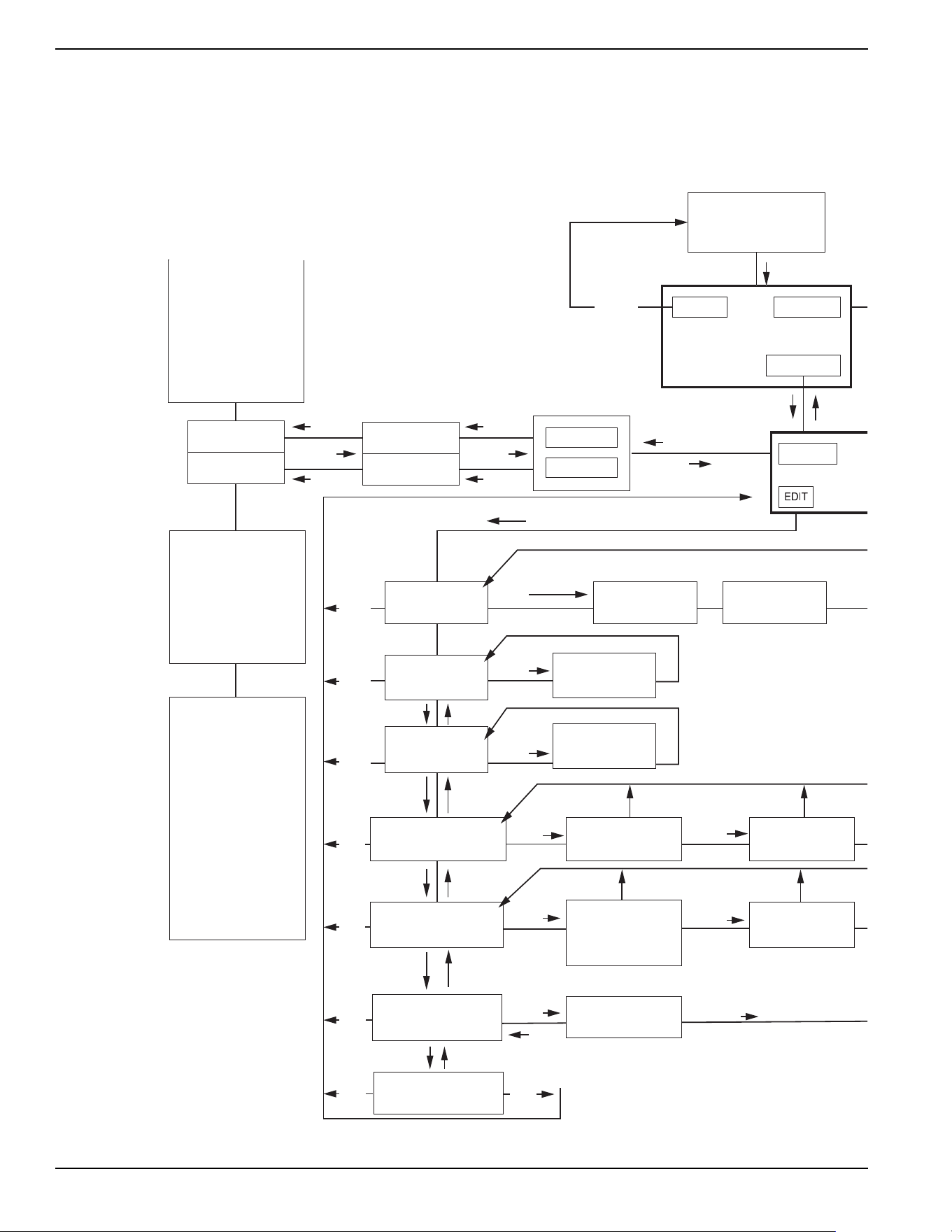
Menu System Navigation
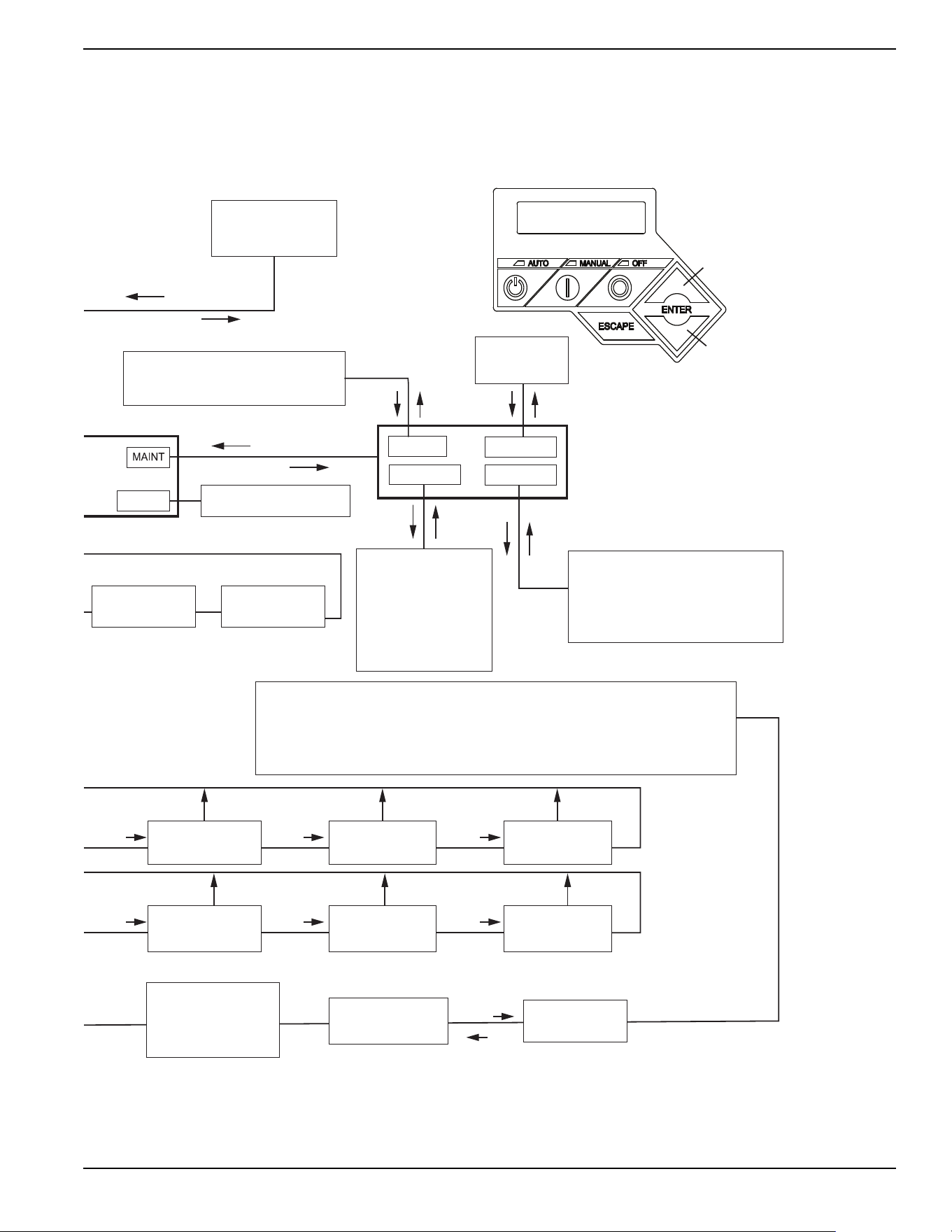
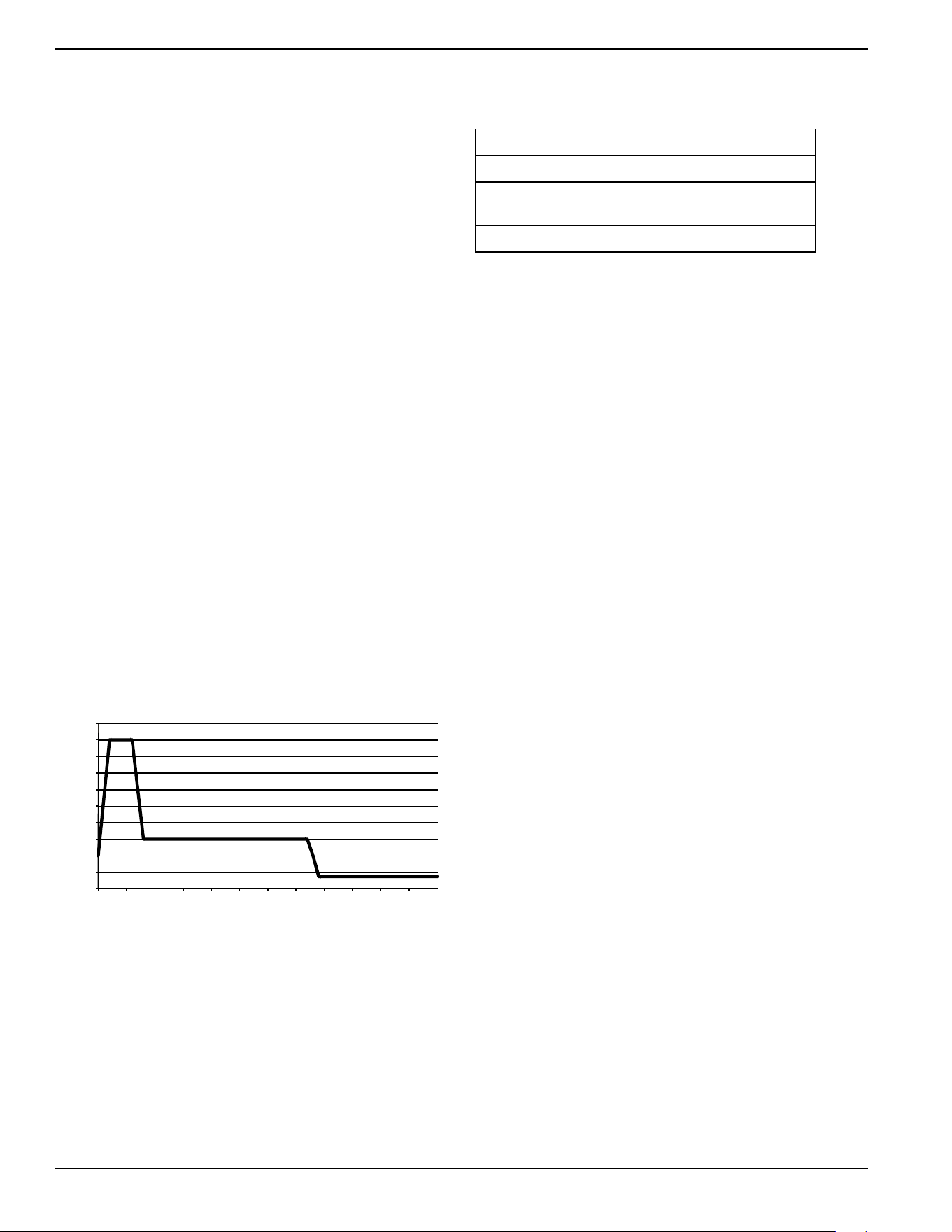
To get to the MENU, use the ESCAPE button from any page. You may need to press the ESCAPE button several times
before reaching the MENU page. Navigate to the desired menu by using the
↑/↓ buttons. When the desired menu is
displayed and flashing, press the ENTER button.
Figure 3-7. Navigation Menu
EVOLUTION 2.0 HSB MENU MAP
“Run Log”
ESC
ENTER
ENTER
SYSTEM DATE/TIME
SUB MENUS
HISTORY
Exercise Time
Å
14:00 Wednesday
Æ
Firmware Update
Å
Press Enter
Æ
ESC
ESC
ENTER
Current Date/Time
Å
2/12/16 12:22
Æ
ESC
ENTER
ENTER
ESC
ESC
ESC
ENTER
ENTER
ESC
ESC
ENTER
ENTER
ENTERENTER
ENTER
ENTER
ENTER
ENTER
ESC
ESC
ESC
ESC
ESC
Switched to “OFF”
Hours of Protection
0 (H)
Language
Å
English
Æ
Fuel Selection
Å
NG or LP
Æ
Firmware Update:
Å
Insert USB
Æ
“Alarm Log”
- Alarm Log +
- Run Log +
- 1 thru 50 +
- 1 thru 50 +
Warning Message(s)
Charger Warning
Charger Missing AC
Low Battery
Battery Problem
Exercise Set Error
USB Warning
Download Failure
Running Manual
Running-Utility Lost
Running-Remote Start
Running-2 Wire Start
Running - Exercise
Switched Off
Stopped - Auto
Stopped - Alarm
Alarm Message(s)
High Temperature
Low Oil Pressure
Overcrank
Overspeed
Overvoltage
Undervoltage
Overload
Underspeed
RPM Sensor Loss
Controller Fault
Wiring Error
Stepper Overcurrent
Fuse Problem
Auxiliary Shutdown
ESC
Select Min (0-59)
- 0 +
ESC
ESC
Select Hour (0-23)
- 14 +
ESC ESC
Quiet Test Mode ?
- YES or NO +
Select Frequency
- WEEKLY +
- BIWEEKLY +
- MONTHLY +
Language
+ English -
Fuel Selection
+ NG or LP -
ENTER
Cold Smart Start?
Å
YES or NO
Æ
ESC
Cold Smart Start?
- YES or NO +
Language
+ Espanol -
+
-
+
-
Note: Menu functions and features may vary
depending on unit model and firmware revision.
Generator Activated
Service Unit
* only if replacing factory default controller
USB
Operation
Owner’s Manual for 60 Hz Air-Cooled Generators 13
Figure 3-8. Navigation Menu
UP ARROW =
+
DOWN ARROW = -
ESC
BATTERY
DEALER
EXAMPLE:
Inspect Battery 200 RnHr or 12/27/16
and
Next Maintenance 200 RnHr or 12/27/16
Current Date/Time
02/14/16 07:40
ESC
ENTER
ESC ENTER
ESC
ESC ESC
ENTER
ENTERENTER
ESC
Maint. Log
Run Hrs
Scheduled
ENTER
ENTER
Select Month (1-12)
- 2 +
Run Hours (H)
0.0
ENTER
Select Date (1-31)
- 13 +
ENTER
Select Year (0-99)
- 13 +
ENTER
ENTER
Access Requires Password
Possible Message(s):
Corrupted File
Invalid File
File Not Found
Unsupported Device*
"Current: V XXXX "
"USB: V XXXX"
"Are You Sure?"
"- Yes or No +"
ESC
ENTER
ESC ENTER
ESCENTER
ESCENTER
Select “Yes” then Press “Enter” to continue or Press “ESCAPE” to escape out of updating.
During update process the Blue “Manual” light flashes, then the Green “Auto” light flashes. Sequence
does this twice. When update is complete the unit returns to Install Wizard menu.
When the controller powers up the very first screen displays the version number for a few seconds.
When update is complete remove Thumb Drive, then follow the Install Wizard Menu.
- 1 thru 50 +
"Battery Maintained"
"Schedule A Serviced"
"Schedule B Serviced"
"Maintenance Reset"
"Inspect Battery"
"Service Schedule A"
"Service Schedule B"
ESC
Select Min (0-59)
- 0 +
ESC
Select Hour (0-23)
- 14 +
Language
+ Francais -
Language
+ Portuguese -
+
-
+
Battery Condition
“Good” “Inspect Battery” or “Check Battery”
Select Day
- Wednesday +
004514
* Re-try using a higher quality USB drive.
Operation
14 Owner’s Manual for 60 Hz Air-Cooled Generators
Setting the Exercise Timer
This generator is equipped with a configurable exercise
timer. Configuration can be performed directly at the control
panel or though the Mobile Link™ application. There are two
settings for the exercise timer:
Day/Time:
The generator will start and exercise for the
period defined, on the day of the week and at the time of day
specified. During this exercise period, the unit runs for
approximately five minutes then shuts down.
NOTE:
The exercise timer does not automatically adjust for
Daylight Savings Time.
Exercise frequency:
Exercise frequency can be set to
Weekly, Biweekly, or Monthly. If Monthly is selected, the day
of the month must be selected from 1-28. The generator will
exercise on that day each month. Transfer of loads to the
generator output does not occur during the exercise cycle
unless utility power is lost.
NOTE:
If the installer tests the generator prior to
installation, press the ENTER button to skip setting up the
exercise timer.
NOTE:
The exercise feature will operate only when the
generator is in AUTO mode, and will not work unless this
procedure is performed. The current date/time will need to
be reset every time the 12 volt battery is disconnected and
then reconnected, and/or when the fuse is removed.
Table 3-1
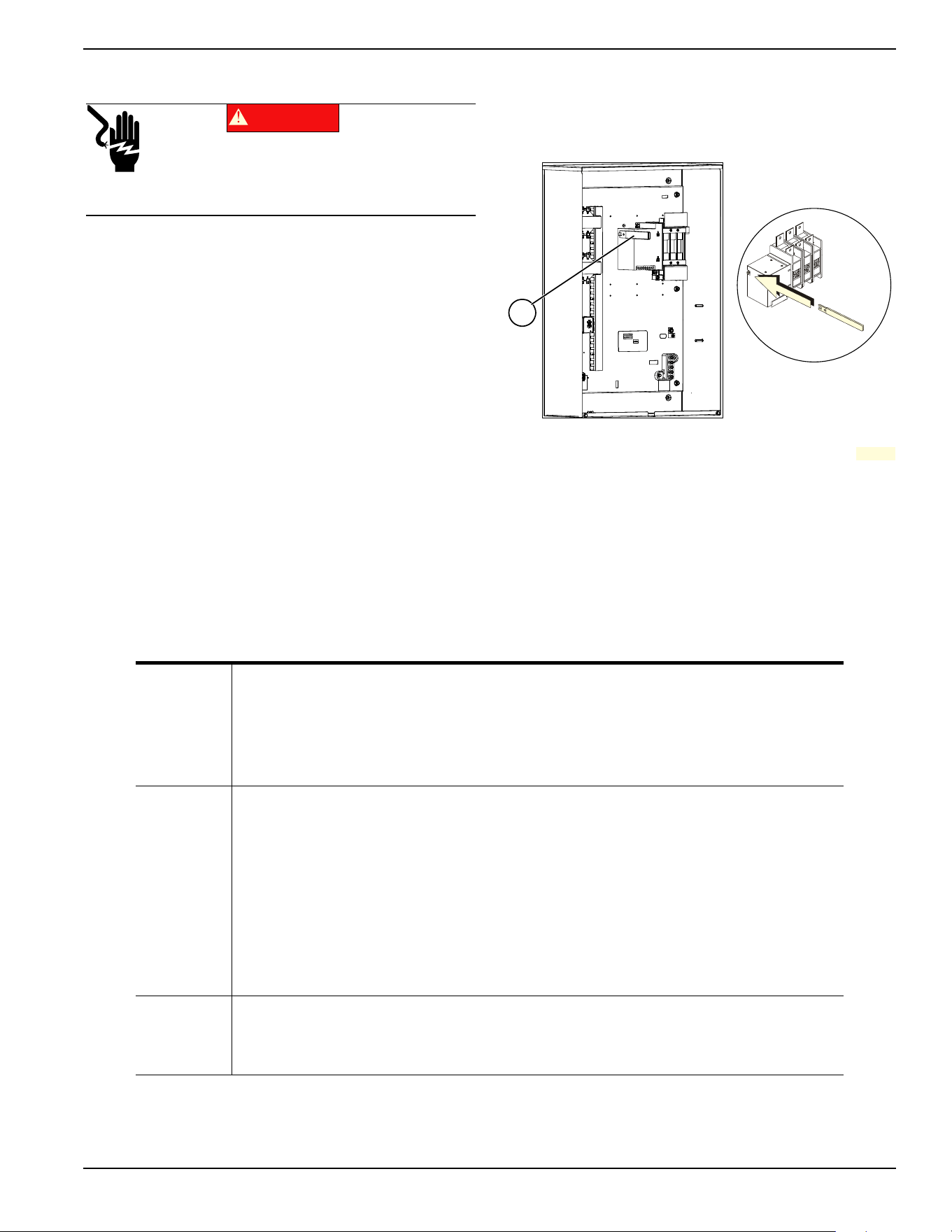
details the exercise information and programming
options.
Figure 3-9
illustrates the engine speed profile
during a typical exercise cycle.
The exercise timer must be reset if the 7.5 amp fuse is
removed.
Figure 3-9. Low Speed Exercise Profile
Battery Charger
NOTE: The battery charger is integrated into the control
module in all models.
The battery charger operates as a smart charger that verifies
:
• output is continually optimized to promote
maximum battery life.
• charging levels are safe.
NOTE: A warning is displayed on the LCD when the
battery needs service.
2600
2800
3000
3200
3400
3600
3800
1800
2000
2200
2400
0 sec 5 s 10 15 20 25 30 35 40 45 1min 5 min
001403
Exercise Speed (RPM)
Exercise Time
Table 3-1. Generator Exercise Characteristics
Generator Size 20 kW
Low Speed Exercise 1950 rpm
Exercise Frequency
Options
Weekly/Bi-Weekly/
Monthly
Exercise Time Length 5 minutes
Operation
Owner’s Manual for 60 Hz Air-Cooled Generators 15
Manual Transfer Operation
Prior to automatic operation, manually exercise the
transfer switch to verify that there is no interference with
proper operation of the mechanism. Manual operation of
the transfer switch is required if electronic operation
should fail.
Transfer to Generator Power Source
1. Verify generator is OFF.
2. Set the main line circuit breaker (MLCB) (generator
disconnect) to OFF (OPEN).
3. Turn off the utility power supply to the transfer
switch using the means provided (such as a main
line utility breaker).
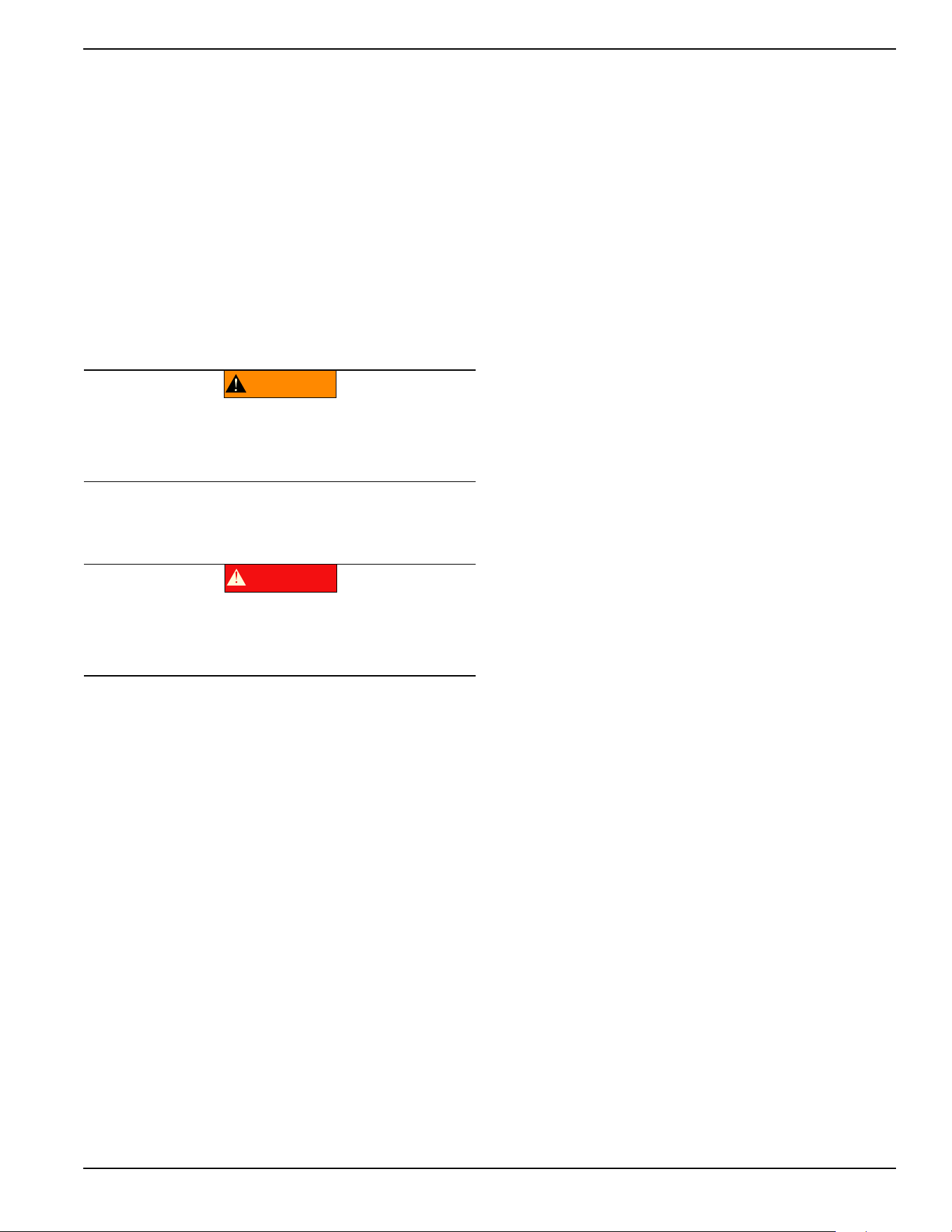
4. Use the manual transfer handle (A in Figure 3-10)
inside the transfer switch to move the main
contacts to STANDBY (loads connected to the
standby power source).
5. Press the control panel MANUAL button to crank
and start the engine.
6. Allow the engine to stabilize and warm up for a few
minutes.
7. Set the MLCB (generator disconnect) to ON
(CLOSED). The standby power source now
powers the loads.
Figure 3-10. Typical Manual Transfer Switch
Operation
(000132)
DANGER
Electrocution. Do not manually transfer under load.
Disconnect transfer switch from all power sources
prior to manual transfer. Failure to do so will result
in death or serious injury, and equipment damage.
004083
A
MANUAL
• Will not transfer to generator if utility is present.
• Will transfer to generator if utility fails (below 132 volts for five consecutive seconds) after
warm-up.
• Will transfer back when utility returns for 15 consecutive seconds. The engine will continue to
run until removed from the MANUAL mode.
AUTO
• Will start and run if utility fails for five consecutive seconds (factory default).
• Will start an engine warm-up timer (duration varies when Cold Smart Start is enabled).
–Will not transfer if utility subsequently returns.
–Will transfer to generator if utility is not present.
• Will transfer to utility once utility returns (above 175 volts) for 15 seconds.
• Will not transfer to utility unless utility returns. The generator will shut down if the OFF button
is pressed or a shutdown alarm is present.
• Once utility power is returned, the generator will shut down after one minute cool-down time.
EXERCISE
• Will not exercise if generator is already running in either AUTO or MANUAL mode.
• During exercise, the controller will only transfer if utility fails during exercise for 10 seconds
(varies based on
Cold Smart Start) and will switch to AUTO.

Operation
16 Owner’s Manual for 60 Hz Air-Cooled Generators
Transfer to Utility Power Source
When utility power has been restored, transfer to utility
source and shut down the generator. Proceed as follows
to manually transfer to utility power and shut down the
generator:
1. Set the MLCB (generator disconnect) to OFF
(OPEN).
2. Run engine for two minutes at no-load to stabilize
the internal temperature.
3. Press the control panel OFF button. The engine
will shut down.
4. Verify that utility power supply to the transfer switch
is turned off.
5. Move the main contacts to the UTILITY position
(loads connected to the utility power source) using
the manual transfer handle (A in Figure 3-10)
inside the transfer switch.
6. Turn on the utility power supply to the transfer
switch using the means provided.
7. Press the control panel AUTO button.
8. Return the MLCB (generator disconnect) to ON
(CLOSED).
Automatic Transfer Operation
Proceed as follows to select automatic operation:
1. Verify that the transfer switch main contacts are set
to UTILITY (loads connected to the utility power
source).
2. Verify that normal utility power source voltage is
available to transfer switch terminal lugs N1, N2,
and N3.
3. Press the AUTO button on the control panel
interface.
4. Set the MLCB (generator disconnect) to ON
(CLOSED).
The generator will start automatically when utility source
voltage drops below a preset level. Loads are transferred
to the standby power source after the unit starts.
Automatic Sequence of
Operation
Utility Failure
If the generator is set to AUTO, when utility fails (below
132 volts) a five second (factory default/dealer
programmable) line interrupt delay time is started. The
engine cranks and starts if the utility is still gone when the
timer expires. An engine warm-up timer will be initiated
once started. Timer duration varies depending on
whether or not Cold Smart Start is enabled. The
controller will transfer the load to the generator when the
warm-up time expires. If the utility power is restored
(above 175 volts) at any time from the initiation of the
engine start until the generator is ready to accept load
(warm-up time has not elapsed), the controller completes
the start cycle and runs the generator through its normal
cool down cycle. However, the load will remain on the
utility source.
Cranking
The system will control the cyclic cranking as follows:
• The system will go through five cranking cycles as
follows: 16 seconds cranking, 7 seconds resting,
16 seconds cranking, 7 seconds resting, followed
by three additional cycles of 7 seconds cranking
followed by 7 seconds resting.

Operation
Owner’s Manual for 60 Hz Air-Cooled Generators 17
Cold Smart Start
The Cold Smart Start feature is enabled at the factory, but
can be disabled in the EDIT menu. The generator will
monitor ambient temperature when Cold Smart Start is
enabled. The warm-up delay will be adjusted based on
prevailing conditions.
If the ambient temperature is below a fixed temperature
(based on model) upon startup in AUTO mode, the
generator will warm up for 30 seconds. This allows the
engine to warm before a load is applied. The generator
will startup with the normal warm-up delay of 5 seconds if
the ambient temperature is at or above the fixed
temperature.
A check for proper output voltage build up will be
performed when the generator engine is started.
If some condition impedes normal voltage creation, such
as frost crystals or dust/dirt preventing a good electrical
connection, the start sequence will be interrupted so that
a cleaning cycle of the internal electrical connections can
be attempted.
The cleaning cycle is an extended warming up period
which lasts for several minutes while the normal genera-
tor voltage output is determined to be low. During this
cycle, the generator controller will display “Warming Up”
on the display screen.
The generator controller display will show “Under
Voltage” if the cleaning cycle fails to clear the obstruction.
After several minutes, the alarm message can be
cleared, and the generator restarted.
If the problem persists, make no further attempts to start.
Contact an IASD.
Load Transfer
The transfer of load when the generator is running is
dependent upon the operating mode.
Shutting Generator Down While
Under Load Or During An
Extended Outage
Proceed as follows to turn the generator off during utility
outages to perform maintenance or conserve fuel:
To turn the generator OFF
Turn the generator off before performing any
maintenance. This is to prevent accidental startup.
1. Turn the main utility disconnect OFF (OPEN).
2. Lift lid and turn the MLCB (generator disconnect)
on the generator to OFF (OPEN).
3. Allow generator to run and cool down for one
minute with no load.
4. Press the OFF mode button on the controller.
5. Remove the 7.5 amp fuse from the control panel.
6. With the generator shut down, remove the front
panel.
7. Perform required maintenance procedure(s).
To turn the generator back ON
1. Install the front panel.
2. Install the 7.5 amp fuse in the control panel.
3. Complete the Installation Wizard information.
4. Place controller in AUTO. Allow the unit to run for
one minute with no load.
5. Set the MLCB (generator disconnect) on the
generator to ON (CLOSED).
6. Turn the main utility disconnect ON (CLOSED).
The system is now in automatic mode.
NOTE: If proper utility is present at this time, the
generator will perform its usual shutdown process.
Automatic start-up. Disconnect utility power and
render unit inoperable before working on unit.
Failure to do so will result in death or serious injury.
(000191)
DANGER

Operation
18 Owner’s Manual for 60 Hz Air-Cooled Generators
This page intentionally left blank.
Maintenance
Owner’s Manual for 60 Hz Air-Cooled Generators 19
Section 4: Maintenance
Maintenance
Regular maintenance will improve performance and
extend engine/equipment life. Generac Power Systems,
Inc. recommends that all maintenance work be
performed by an Independent Authorized Service Dealer
(IASD). Regular maintenance, replacement, or repair of
the emissions control devices and systems may be
performed by any repair shop or person of the owner’s
choosing. To obtain emissions control warranty service
free of charge, the work must be performed by an IASD.
See the emissions warranty.
Preparing for Maintenance
To turn the generator OFF:
Turn the generator off before performing any
maintenance. This is to prevent accidental startup.
1. Turn the main utility disconnect OFF (OPEN).
2. Lift lid and turn the MLCB (generator disconnect)
on the generator to OFF (OPEN).
3. Press the OFF mode button on the controller.
4. Remove the 7.5 amp fuse from the control panel.
5. With the generator shut down, remove the front
and intake side panel. (See Intake Side Panel
Removal.)
6. Perform required maintenance procedure(s).
To turn the generator back ON:
1. Install the intake side panel and front panel. (See
Intake Side Panel Removal.)
2. Install the 7.5 amp fuse in the control panel.
3. Set the MLCB (generator disconnect) on the
generator to ON (CLOSED).
4. Turn the main utility disconnect ON (CLOSED).
The system is now in automatic mode.
Performing Scheduled
Maintenance
It is important to perform maintenance as specified in the
Service Schedule for proper generator operation.
Engine oil and oil filter must be changed, and valve
clearance adjusted after the first 25 hours of operation.
Emissions-critical maintenance must be performed as
scheduled in order for the emissions warranty to be valid.
Emissions-critical maintenance consists of servicing the
air filter and spark plugs in accordance with the Service
Schedule.
The controller will prompt for Schedule A or Schedule B
maintenance to be performed. See Service Schedule for
recommendations.
Since most maintenance alerts will occur at the same
time (most have two year intervals), only one will appear
on the control panel display at a time. Once the first alert
is cleared, the next active alert will be displayed.
(000182)
WARNING
Only qualified service personnel may install, operate,
and maintain this equipment. Failure to follow proper
installation requirements could result in death, serious
injury, and damage to equipment or property.
Automatic start-up. Disconnect utility power and
render unit inoperable before working on unit.
Failure to do so will result in death or serious injury.
(000191)
DANGER
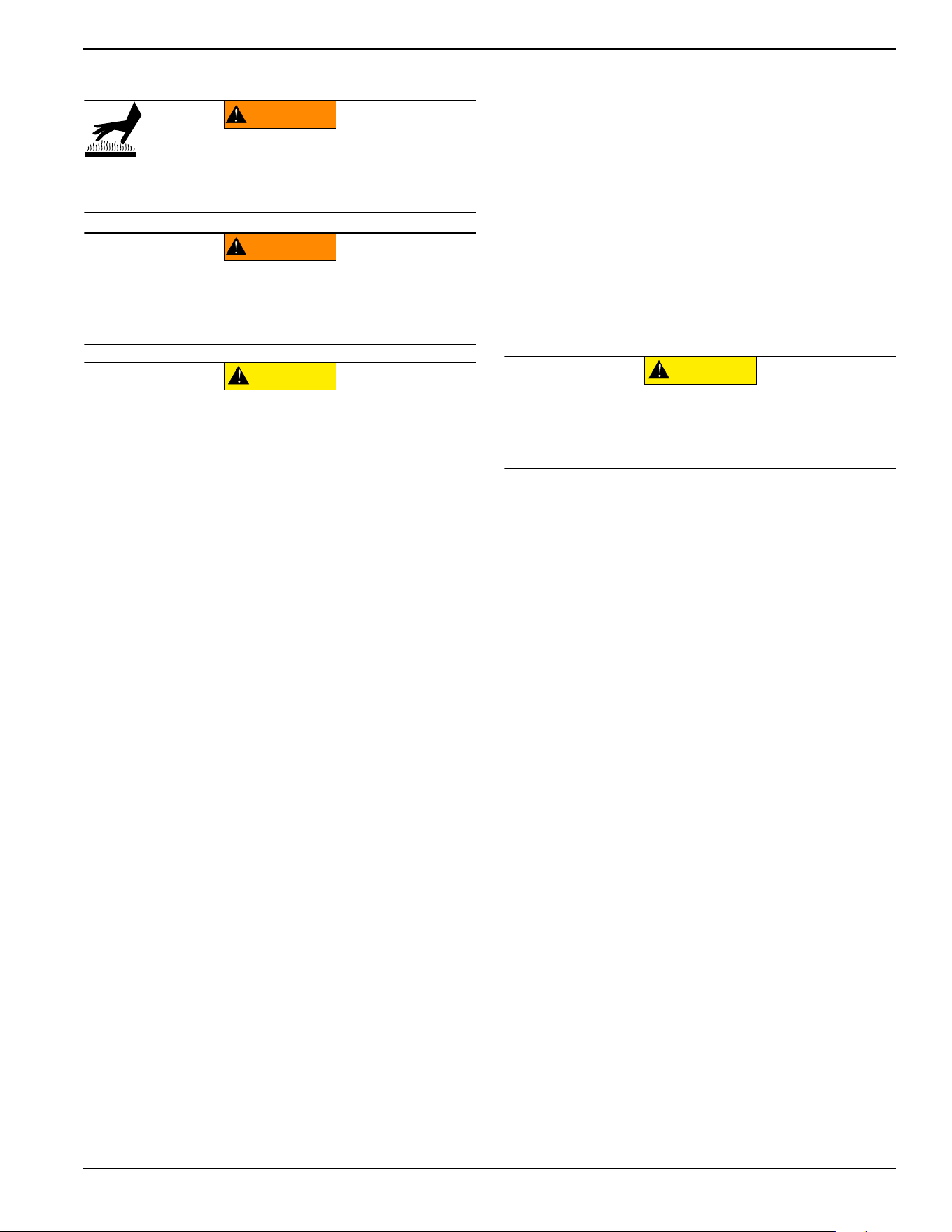
Maintenance
20 Owner’s Manual for 60 Hz Air-Cooled Generators
Service Schedule
NOTE: Contact an IASD or visit www.generac.com for additional information on replacement parts.
Maintenance Log
Battery inspection and charge check
Dates Performed:
Oil, oil filter, air filter, and spark plug replacement
Dates Performed:
Valve Adjustment
Dates Performed:
Service
Daily If Running Continuously
or Before Each Use
Every
Year
Schedule A
Every Two Years
or 200 Hours
Schedule B
Every Four Years
or 400 Hours
Check enclosure louvers for dirt and debris *
●
Check lines and connections for fuel or oil leaks
●
Check engine oil level
●
Check for water intrusion **
●
Check battery condition, electrolyte level, and state
of charge
●● ●
Replace engine oil and oil filter †
●●
Replace engine air filter
●
Clean; Check gap; Replace spark plugs
●
Inspect/adjust valve clearance ‡
●
Inspect/clean sediment trap Consult local codes and guidelines.
Contact the nearest IASD for assistance if necessary.
* Remove any shrubs or tall grasses which have grown within 3 ft (0.91 m) of the intake and discharge louvers on the sides of the enclosure. Clean any debris (dirt,
grass clippings, etc.) which have accumulated inside the enclosure.
** Verify that all sources of potential water intrusion such as water sprinklers, roof run-off, rain gutter down spouts, and sump pump discharges are directed away
from the generator enclosure.
† Change engine oil and filter after the first 25 hours of operation. In cold weather conditions (ambient below 40 °F / 4.4 °C), or if unit is operated continuously in hot
weather conditions (ambient above 85 °F / 29.4 °C), change engine oil and filter every year or 100 hours of operation.
‡ Check/adjust valve clearance after the first 25 hours of operation.
Maintenance
Owner’s Manual for 60 Hz Air-Cooled Generators 21
Checking Engine Oil Level
The oil level should be checked daily when power
outages necessitate running the generator for extended
periods. Proceed as follows to check the engine oil level:
1. Run the generator for a cool-down period of
approximately one minute.
2. Turn the main utility disconnect off.
3. Turn the main line circuit breaker (MLCB)
(generator disconnect) on the generator to OFF
(OPEN).
4. Turn the generator off.
5. Press the control panel OFF button. Wait five
minutes.
6. Remove the oil dipstick and wipe it dry with a clean
cloth.
7. Completely insert the oil dipstick into the oil dipstick
tube and remove it.
8. Observe the oil level. The level should be at the
“FULL” mark on the oil dipstick.
9. If necessary, remove the oil fill cap and add oil to
the engine (with the oil dipstick removed) until the
level reaches the “FULL” mark and insert the oil
dipstick and fill cap.
To restart the generator:
1. Press the control panel AUTO button.
2. Allow the generator to start and warm up for a few
minutes.
3. Set the generator disconnect (MLCB) on the
generator to ON (CLOSED).
4. The system is now operating in automatic mode.
The main utility disconnect can be turned ON
(CLOSED).
Engine Oil Requirements
To maintain the product warranty, the engine oil should
be serviced in accordance with the recommendations of
this manual. For your convenience, Generac
Maintenance Kits are available that include engine oil, oil
filter, air filter, spark plug(s), a shop towel, and a funnel.
These kits can be obtained from an IASD.
All Generac oil kits meet minimum American Petroleum
Institute (API) Service Class SJ, SL, or better. Do not use
special additives.
Required Oil—
Synthetic SAE 5W-30 for all temperature ranges.
(000139)
WARNING
Risk of burns. Allow engine to cool before
draining oil or coolant. Failure to do so could
result in death or serious injury.
(000210)
WARNING
Skin irritation. Avoid prolonged or repeated contact with
used motor oil. Used motor oil has been shown to cause
skin cancer in laboratory animals. Thoroughly wash
exposed areas with soap and water.
(000135)
CAUTION
Engine damage. Verify proper type and quantity of
engine oil prior to starting engine. Failure to do so
could result in engine damage.
(000135)
CAUTION
Engine damage. Verify proper type and quantity of
engine oil prior to starting engine. Failure to do so
could result in engine damage.
Maintenance
22 Owner’s Manual for 60 Hz Air-Cooled Generators
Changing the Oil and Oil Filter
Proceed as follows to change the oil and oil filter:
1. Press the MANUAL button on the control panel to
start the engine, and run it until it is thoroughly
warmed up. Press the control panel OFF button to
shut down the engine.
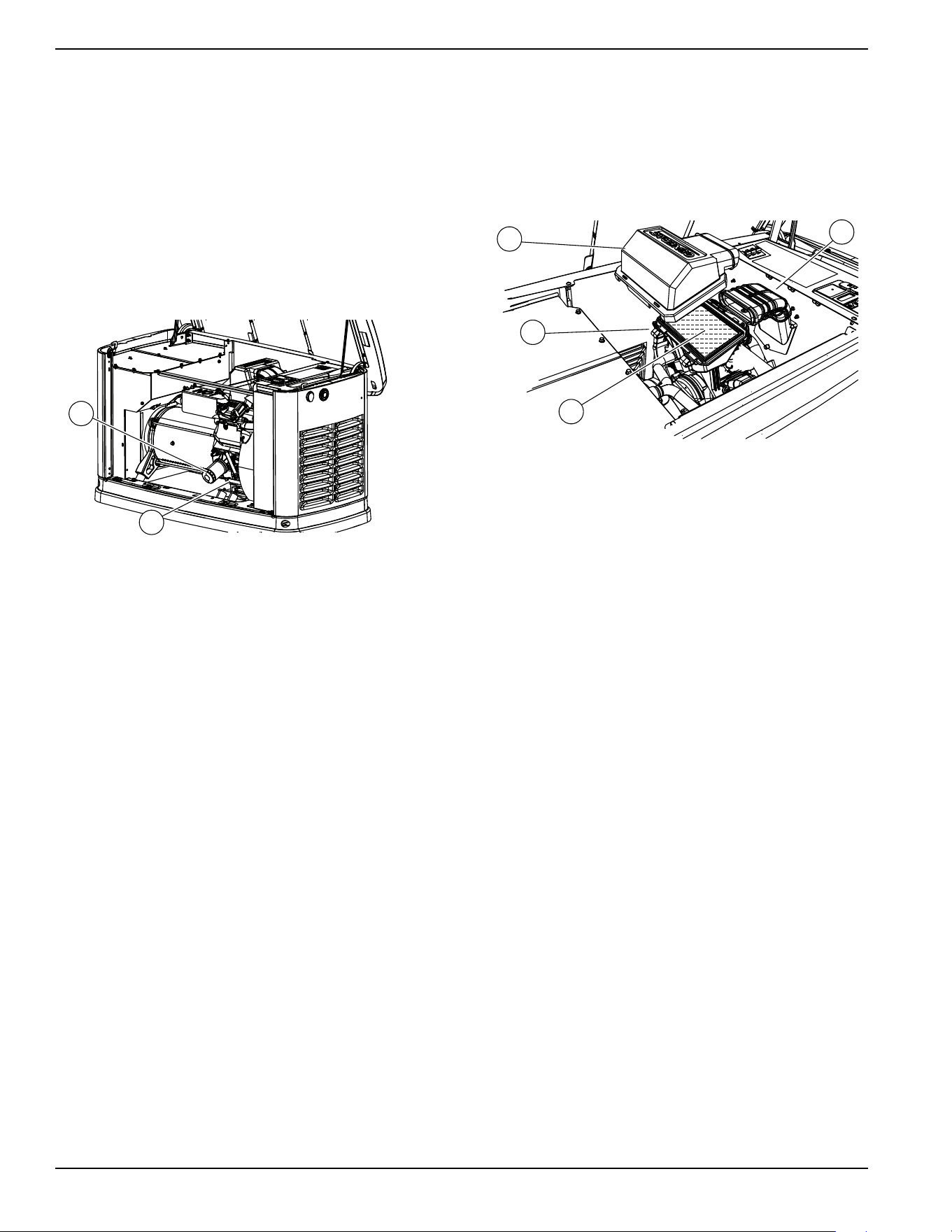
2. See Figure 4-1. A few minutes after the engine
stops, and when it has cooled slightly, lift the lid
and remove the front panel. Pull the oil drain hose
(A) free of its retaining clip. Remove the cap from
the hose and drain the oil into a suitable container.
Figure 4-1. Oil Filter and Drain Location
3. Replace the cap after the oil has drained.
Reposition and secure the hose with the retaining
clip.
4. Remove the old oil filter (B) by turning it
counterclockwise.
5. Apply a light coating of clean engine oil to the
gasket of the new filter.
6. Screw the new filter on by hand until its gasket
lightly contacts the oil filter adapter. Tighten the
filter an additional 3/4 to one full turn.
7. Refill the engine with the proper recommended oil.
See Engine Oil Requirements.
8. Press the MANUAL button on the control panel to
start the engine, run for one minute, and check for
leaks.
9. Press the OFF button on the control panel to stop
the engine. Wait five minutes.
10. Recheck the oil level. Add oil as needed. DO NOT
OVERFILL.
11. Reinsert oil dipstick and/or reattach fill cap.
12. To return the unit to AUTO mode, press the control
panel AUTO button.
13. Dispose of the used oil and filter at a proper
collection center.
Servicing the Air Cleaner
Proceed as follows to service the air cleaner:
1.
Press the OFF button on the control panel to stop the
generator. Then lift the lid and remove the front pane
l.
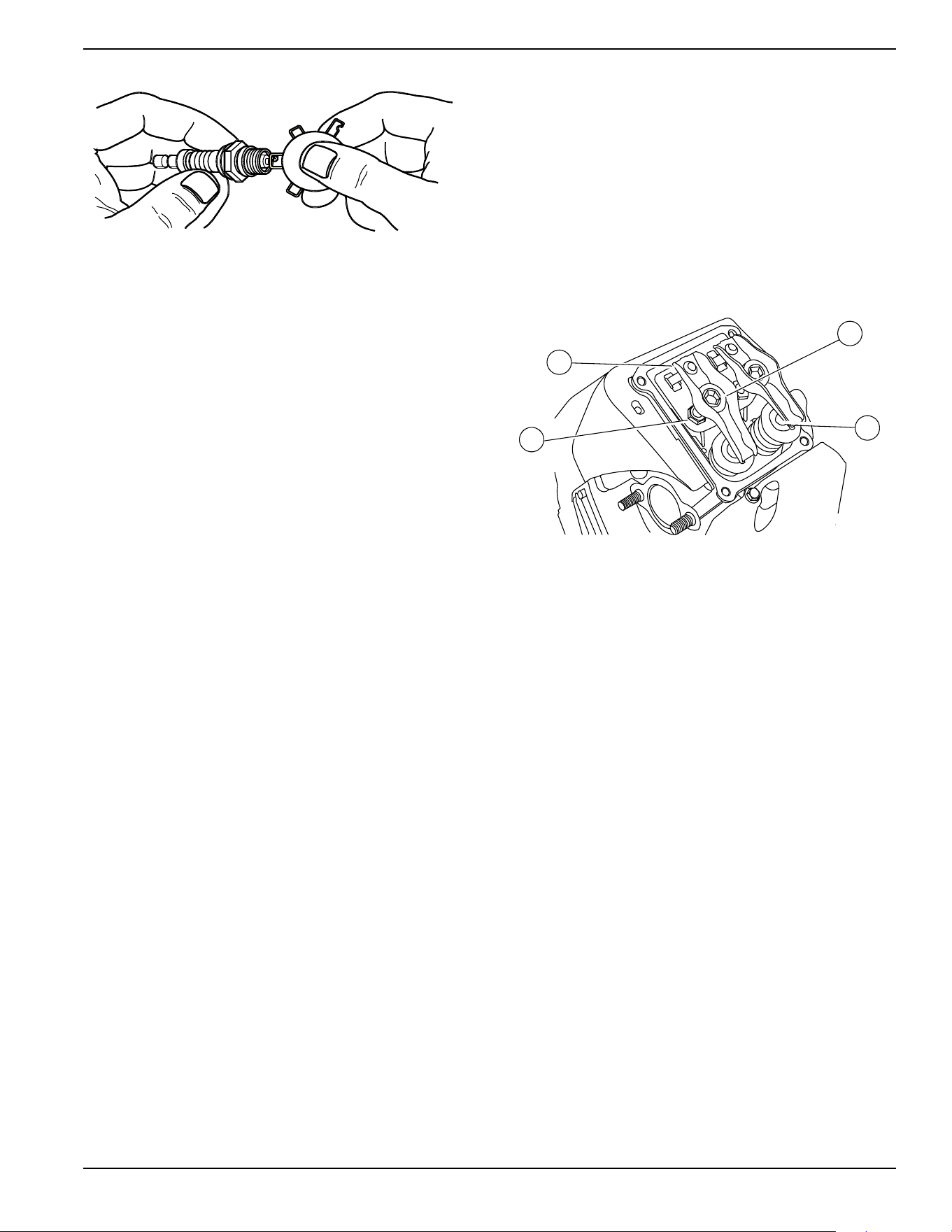
2. See Figure 4-2. Remove the cover clips (A) and air
cleaner cover (B).
.
Figure 4-2. Servicing Air Cleaner
3. Remove the old air filter element (C) and discard.
4. Thoroughly clean the air cleaner enclosure of any
dust or debris.
5. Install a new air filter element.
6.
Install the air cleaner cover and fasten the cover clips.
7. Verify that the air inlet duct (D) is properly
connected to the air cleaner cover.
8. Press the AUTO button on the control panel to
return the unit to AUTO mode.
Spark Plugs
Proceed as follows to check the spark plug(s) gap and
replace the spark plug(s) as necessary:
1. With the generator OFF and the engine cool, lift the
lid and remove the front panel.
2. Clean the area around the base of the spark
plug(s) to keep dirt and debris out of the engine.
3. Remove the spark plug(s) and check the condition.
Install a new plug(s) if the old plug(s) is worn or if
reuse is questionable.
4. Clean the plug(s) by scraping or washing with a
wire brush and commercial solvent. Do not blast
the plug(s) to clean.
5. Check the spark plug gap using a wire feeler
gauge. See Figure 4-3. Replace the spark plug if
the gap is out of specification. See General
Information.
6. Reinstall the spark plug(s), and torque to 18.4 ft-lbs
(25 Nm).
7. Press the control panel AUTO button to return the
unit to AUTO mode.
003742
A
B
003741
A
C
B
D
Maintenance
Owner’s Manual for 60 Hz Air-Cooled Generators 23
Figure 4-3. Spark Plug Gap Measurement
Valve Clearance Adjustment
Check the valve clearance after the first 25 hours of
operation, then after 400 hour intervals. Adjust if
necessary.
Important: Please contact an IASD for service
assistance. Proper valve clearance is essential for
prolonging the life of the engine.
Check Valve Clearance
NOTE: The engine should be cool before checking the
valve clearance. Adjustment is not needed if valve
clearance is within the dimensions provided in
Specifications.
1. Close fuel valve and disconnect battery to avoid
accidental start-up.
2. Remove spark plug wires, and position wires away
from plugs.
3. Remove spark plugs.
4. Remove the four screws attaching the valve cover.
Remove and discard the gasket.
5. Make sure the piston is at top dead center (TDC) of
its compression stroke (both valves closed). To
move the piston to TDC, remove the intake screen
at the front of the engine to access the flywheel
nut. Use a large socket and socket wrench to
rotate the flywheel nut clockwise, which will rotate
the crankshaft. Watch the piston through the spark
plug hole. The piston should move up and down.
The piston is at TDC when it is at its highest point
of travel.
6. Check the valve clearance between the rocker arm
and valve stem with a feeler gauge.
7. Install replacement valve cover gasket.
8. Install valve cover. Tighten fasteners in a cross
pattern, torquing to 60 in-lbs. (6.8 Nm).
Adjust Valve Clearance
See Figure 4-4. Proceed as follows to adjust the valve
clearance:
NOTE: Allow engine to cool before adjusting valve
clearance.
1. Remove spark plug wire(s) and position wire(s)
away from plugs.
2. Remove spark plug(s).
3. Remove the four screws attaching the valve cover.
Remove and discard gasket.
4. Make sure the piston is at top dead center (TDC) of
its compression stroke (both valves closed).
5. Loosen the rocker jam nut (C) using a 13 mm
wrench.
.
Figure 4-4. Valve Clearance Adjustment
6. Turn the pivot ball stud (D) using a 10 mm Allen
wrench while checking clearance between the
rocker arm (E) and the valve stem (F) with a feeler
gauge. Adjust clearance as per Specifications.
NOTE: Hold the rocker arm jam nut in place as the pivot
ball stud is turned.
7. When valve clearance is correct, hold the pivot ball
stud (B) in place with a wrench and tighten the
rocker arm jam nut. Torque the jam nut to 174 in-
lbs (19.68 Nm).
8. After tightening the jam nut, recheck valve
clearance to verify it did not change.
9. Install new valve cover gasket.
10. Install the valve cover. Tighten fasteners in a cross
pattern, torquing to 60 in-lbs (6.8 Nm).
NOTE: Start all four screws before tightening, or it will
not be possible to get all the screws in place. Verify the
valve cover gasket is in place.
11. Install spark plugs and torque to 18 ft-lbs (25 Nm).
12. Reattach the spark plug wire to the spark plug.
13. Repeat the process for the other cylinder if
necessary.
000211
002380
C
E
D
F
Maintenance
24 Owner’s Manual for 60 Hz Air-Cooled Generators
Battery Maintenance
The battery should be regularly inspected per the
Service Schedule. Contact an IASD for assistance if
necessary.
Proceed as follows to inspect the battery:
1. Lift the lid to gain access to the controller and press
the OFF button to shut down the generator, then
remove the front panel.
2. Remove the 7.5 amp fuse from the control panel.
3. Remove the intake side panel. (See Intake Side
Panel Removal.)
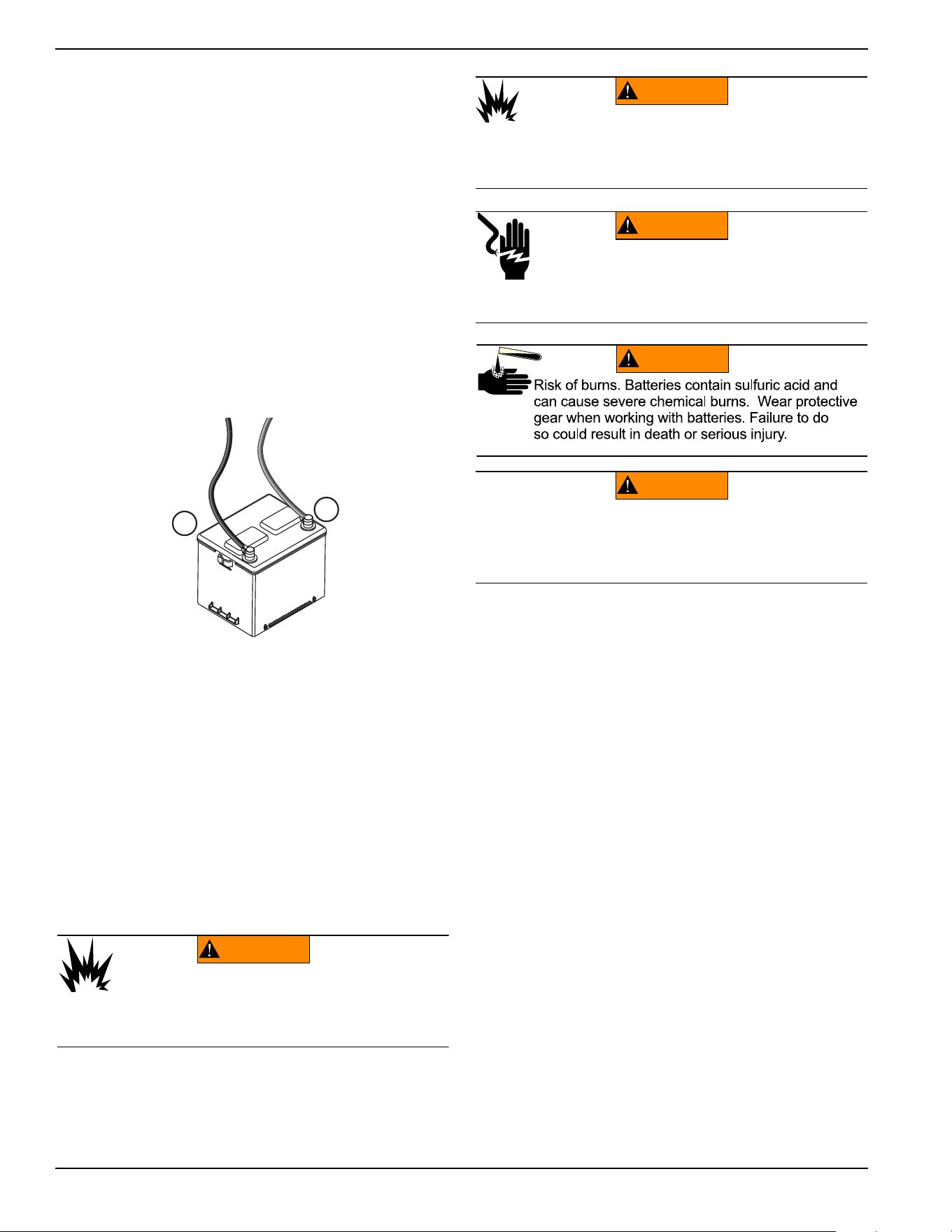
4. See Figure 4-8. Disconnect the white battery
charger cable.
5. See Figure 4-5. Inspect the battery posts and
cables for tightness and corrosion. Tighten and
clean as necessary.
Figure 4-5. Battery Cables
6. (Unsealed batteries only): Completely disconnect
the battery. Check the battery fluid level and, if
necessary, fill with distilled water only. DO NOT
use tap water. Also, have an IASD or a qualified
service technician check the state of charge and
condition.
7. When inspection is complete, reconnect the battery
cables, the battery charger cable, reinstall the
intake side panel, and reinstall the 7.5 amp fuse.
8.
Place the controller in AUTO mode.
9.
Complete the Installation Wizard Menu.
10.
Reinstall the front panel and close the generator lid.
Always recycle batteries in accordance with local laws and
regulations. Contact your local solid waste collection site or
recycling facility to obtain information on local recycling
processes. For more information on battery recycling, visit
the Battery Council International website at:
http://
batterycouncil.org
Strictly observe the following precautions when working
on batteries:
• Remove the 7.5 amp fuse from the generator
control panel.
• Disconnect the battery charger as directed in
Battery Maintenance.
• Remove all jewelry—watches, rings, metal objects,
etc.
• Use tools with insulated handles.
• Wear rubber gloves and boots.
• Do not place tools or metallic objects on top of the
battery.
• Disconnect the charging source prior to connecting
or disconnecting battery terminals.
• Wear full eye protection and protective clothing.
• If electrolyte contacts the skin, wash it off
immediately with water.
• If electrolyte contacts the eyes, immediately
thoroughly flush with water and seek medical
attention.
–
+
001832
(000162)
WARNING
Explosion. Do not dispose of batteries in a fire. Batteries
are explosive. Electrolyte solution can cause burns and
blindness. If electrolyte contacts skin or eyes, flush with water
and seek immediate medical attention.
(000137a)
WARNING
Explosion. Batteries emit explosive gases while charging.
Keep fire and spark away. Wear protective gear when
working with batteries. Failure to do so could result in
death or serious injury.
(000164)
WARNING
Electrical shock. Disconnect battery ground
terminal before working on battery or battery
wires. Failure to do so could result in death
or serious injury.
(000138a)
WARNING
WARNING
Environmental Hazard. Always recycle batteries at an
official recycling center in accordance with all local
laws and regulations. Failure to do so could result in
environmental damage, death or serious injury.
(000228)
Maintenance
Owner’s Manual for 60 Hz Air-Cooled Generators 25
• Wash down spilled electrolyte with an acid
neutralizing agent. A common practice is to use a
solution of 1 lb (454 g) bicarbonate of soda to 1 gal
(3.8 L) of water. Add bicarbonate of soda solution
until the evidence of reaction (foaming) has
ceased. Flush the resulting liquid with water and
dry the area completely.
• DO NOT smoke when near the battery.
• DO NOT cause flame or spark in the battery area.
• Discharge static electricity from the body before
touching the battery by first touching a grounded
metal surface.
Cleaning the Sediment Trap
The sediment trap removes contaminants (moisture and
fine particles) from gaseous fuels before they enter the
fuel regulator. Accumulated moisture and particles must
be emptied from the sediment trap per local codes and
guidelines.
Proceed as follows to clean the sediment trap:
1. Lift the lid to gain access to the controller and press
the OFF button to shut down the generator, then
remove the front panel.
2. Remove the intake side panel (see Intake Side
Panel Removal).
3. Turn the generator fuel supply off.
4. Remove the battery.
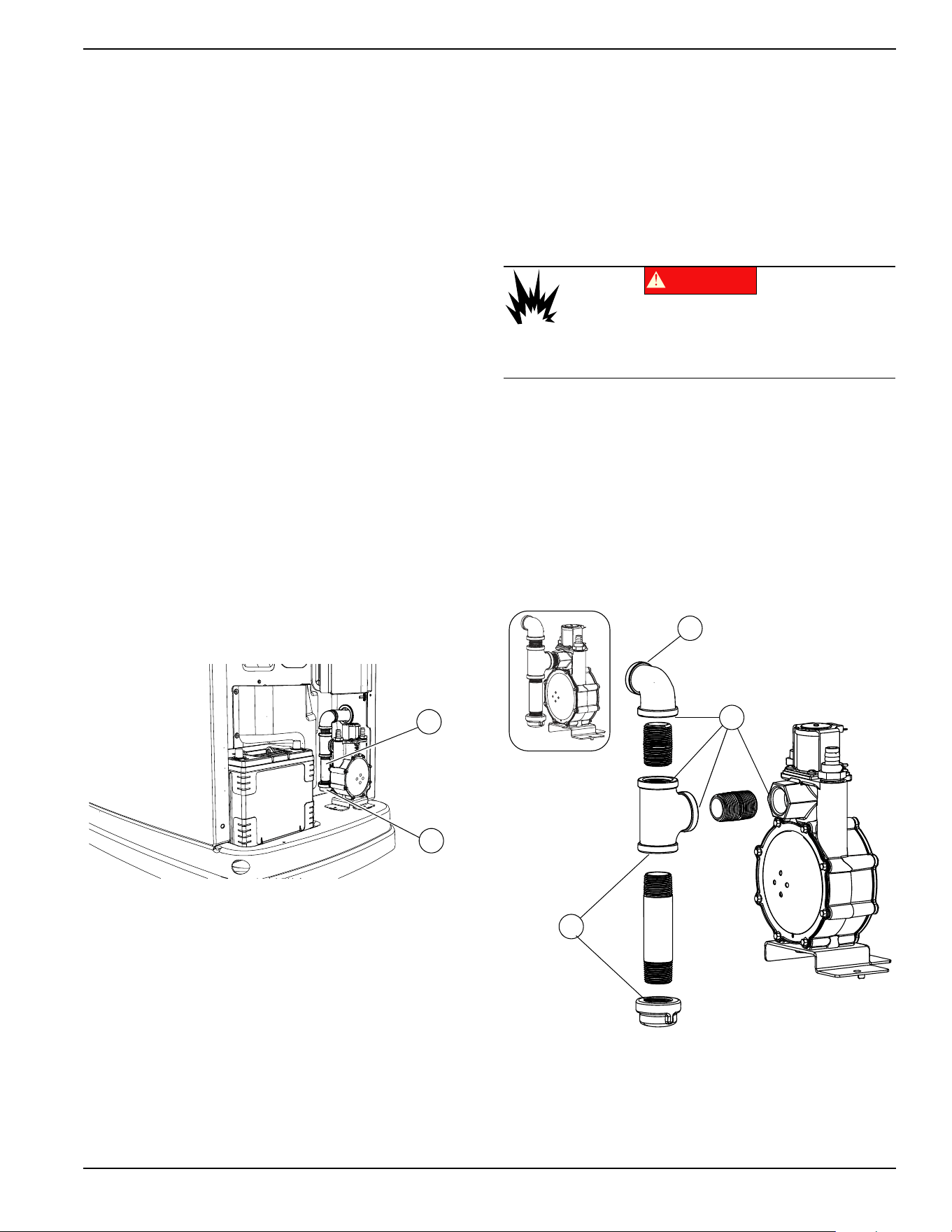
5.
See
Figure 4-6
. Unscrew and remove the cap (A).
Figure 4-6. Cleaning the Sediment Trap
6. Use a clean-out tool (not provided) to remove
accumulated moisture and particles from the cap
and body (B).
7. Wipe the inside of each component with a clean,
dry, lint-free cloth.
8. Seal the threads of the cap with appropriate
sealing compound. Install the cap and hand-
tighten.
9. Tighten the cap with an appropriately sized pipe
wrench. DO NOT overtighten.
10. Turn the generator fuel supply on. Check for leaks
by spraying all connection points with a non-
corrosive gas leak detection fluid. The solution
should not be blown away or form bubbles.
11. Install the battery.
12. Install the intake side panel, put the generator into
AUTO mode and close the lid.
Perform Leak Test
All products are tested at the factory before shipping to
ensure the performance and integrity of the fuel system.
However, it is important to perform a final fuel system
leak test before starting the generator. The entire fuel
system should be tested from supply to regulator.
See Figure 4-7. Perform a final fuel system leak test
after generator installation. The test will identify possible
leaks at all connection points (A).
It is best practice to perform a fuel system leak test
during normally-scheduled maintenance.
Figure 4-7. Connection Points to Leak Check
Check for leaks by spraying all connection points with a
non-corrosive gas leak detection fluid. The solution
should not be blown away or form bubbles.
B
A
001821
(000192)
DANGER
Explosion and fire.Fuel and vapors are extremely
flammable and explosive. No leakage of fuel is
permitted. Keep fire and spark away. Failure to do
so will result in death or serious injury.
A
A
A
004038
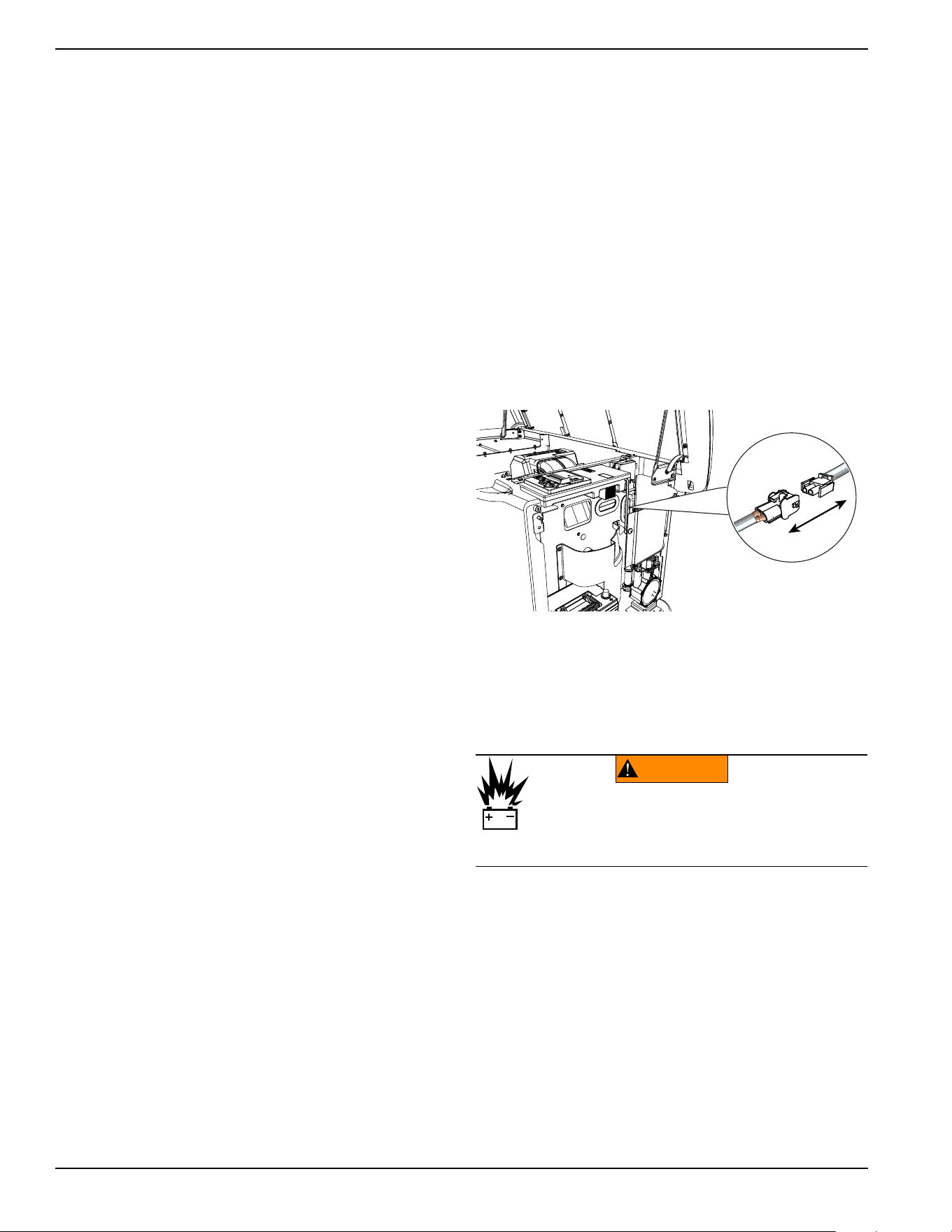
Maintenance
26 Owner’s Manual for 60 Hz Air-Cooled Generators
Attention After Submersion
DO NOT start or operate the generator if it has been
submerged in water. Have an IASD thoroughly clean, dry,
and inspect the generator following any submersion in
water. If the structure (home) has been flooded, it should
be inspected by a certified electrician to verify there won’t
be any electrical problems during generator operation or
when utility power is returned.
Corrosion Protection
Regular scheduled maintenance should be conducted to
perform a visual inspection of the unit for corrosion. Inspect
all metal components of the generator, including the base
frame, brackets, alternator can, the entire fuel system
(inside and outside of the generator), and fastener
locations. If there is corrosion found on generator
components (e.g. regulator, engine/alternator mounts, fuel
plenum, etc.), replace parts as necessary.
Periodically wash and wax the enclosure using automotive
type products. Do not spray the unit with a hose or power
washer. Use warm, soapy water and a soft cloth. Frequent
washing is recommended in salt water/coastal areas.
Spray engine linkages with a light oil such as WD-40
.
Remove From, and Return To
Service Procedure
Remove From Service
If the generator cannot be exercised monthly, at a
minimum, and will be out of service longer than 90 days,
proceed as follows to prepare the generator for storage:
1. Start the engine and let it warm up.
2. Close the fuel shutoff valve in the fuel supply line
and allow the engine to stop.
3. Once the engine has stopped, set the generator
MLCB (generator disconnect) to OFF (OPEN).
4. Turn off the utility power to the transfer switch.
5. See Figure 4-8. Remove battery charger AC input
T1/Neutral cable (has white sleeve) at controller.
Figure 4-8. Disconnect Battery Charger Cable
6. Remove the 7.5 amp fuse from the generator’s
control panel.
7. Disconnect the battery cables. Remove the
negative cable first.
8. Drain the oil completely while the engine is still
warm, and then refill the crankcase with oil.
9. Attach a tag to the engine indicating the viscosity
and classification of the new oil in the crankcase.
10. Remove the spark plug(s) and spray a fogging
agent into the spark plug(s) threaded openings.
Reinstall and tighten the spark plug(s) to
specification.
11. Remove the battery and store it in a cool, dry room
on a wooden board.
12. Clean and wipe down the entire generator.
13. Turn on utility power to the transfer switch.
002389
WARNING
Explosion. Batteries emit explosive gases.
Always disconnect negative battery cable
first to avoid spark. Failure to do so could
result in death or serious injury.
(000238)

Maintenance
Owner’s Manual for 60 Hz Air-Cooled Generators 27
Return to Service
Proceed as follows to return the unit to service after
storage:
1. Verify utility power is off.
2. Check the tag on the engine for oil viscosity and
classification. Drain and refill with proper oil, if
necessary.
3. Check the state of the battery. Fill all cells of
unsealed batteries to the proper level with distilled
water. DO NOT use tap water. Recharge the
battery to 100% state of charge. Replace the
battery if defective.
4. Clean and wipe down the entire generator.
5. Verify that the 7.5 amp fuse is removed from the
generator control panel.
6. Reconnect the battery. Observe battery polarity.
Damage may occur if the battery is connected
incorrectly. Install positive cable first.
7. Reconnect the battery charger AC input T1/Neutral
cable (white sleeve) at controller.
8. Open the fuel shutoff valve.
9. Insert the 7.5 amp fuse into the generator control
panel.
10. Complete the Installation Wizard information.
11. Press the MANUAL button to start the unit. Allow
the unit to warm up for a few minutes.
12. Press the control panel OFF button to stop the unit.
13. Turn on the utility power to the transfer switch.
14. Set the control panel to AUTO.
The generator is ready for service.
NOTE: The exercise timer and current date and time
must be reset when a battery is dead or has been
disconnected.

Maintenance
28 Owner’s Manual for 60 Hz Air-Cooled Generators
This page intentionally left blank.
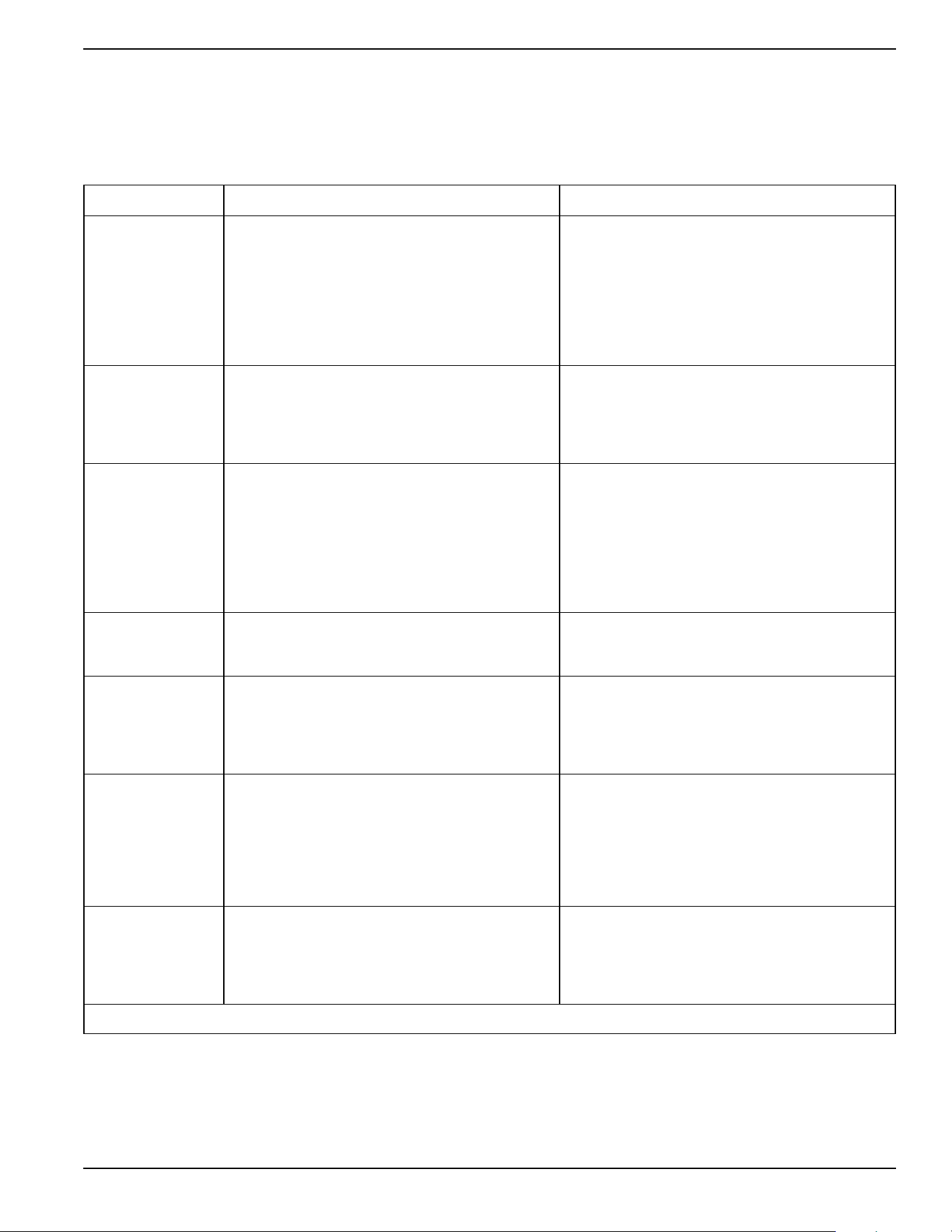
Troubleshooting / Quick Reference Guide
Owner’s Manual for 60 Hz Air-Cooled Generators 29
Section 5: Troubleshooting / Quick Reference Guide
Generator Troubleshooting
Problem Cause Correction
Engine will not
crank.
1. Blown fuse.
2. Loose, corroded, or defective battery cables.
3. Defective starter contact.
4. Defective starter motor.
5. Discharged battery.
1. Correct short circuit condition by replacing 7.5
amp fuse in generator control panel. Contact an
Independent Authorized Service Dealer (IASD) if
fuse continues to blow.
2. Tighten, clean, or replace as necessary.*
3. *See #2.
4. *See #2.
5. Charge or replace battery.
Engine cranks but
will not start.
1. No fuel.
2. Defective fuel solenoid (FS).
3. Open Wire 14 from controller.
4. Defective spark plug(s).
5. Valve clearance out of adjustment.
1. Replenish fuel / turn on fuel valve.
2. *
3. *
4. Clean; check gap; replace plug(s) if necessary.
5. Reset valve clearance.
Engine starts hard
and runs rough.
1. Air cleaner plugged or damaged.
2. Defective spark plug(s).
3. Incorrect fuel pressure.
4. Fuel selector in wrong position.
5. Valve(s) out of adjustment.
6. Internal engine issue.
1. Check and clean air cleaner.
2. Clean; check gap; replace plug(s) as needed.
3. Confirm fuel pressure to regulator is 10–12 in
water column (19–22 mm Hg) for LP, and 3.5–7.0
in water column (9–13 mm Hg) for natural gas.
4. Turn fuel conversion valve to correct position.
5. Adjust valve clearance.
6. *
Generator is set to
OFF, but the engine
continues to run.
1. Controller wired incorrectly.
2. Defective control board.
1. *
2. *
No AC output from
generator.
1. Main line circuit breaker (MLCB) (generator dis-
connect) is OFF (OPEN).
2. Generator internal failure.
3. Engine may be warming up. Refer to Cold Smart
Start.
1. Reset generator disconnect to ON (CLOSED).
2. *
3. Check the controller screen to verify status.
No transfer to
standby after utility
source failure.
1. MLCB (generator disconnect) is OFF (OPEN).
2. Defective transfer switch coil.
3. Defective transfer relay.
4. Transfer relay circuit open.
5. Defective control logic board.
6. Engine may be warming up. Refer to Cold Smart
Start.
1. Reset generator disconnect to ON (CLOSED).
2. *
3. *
4. *
5. *
6. Check the controller screen to verify status.
Unit consumes
large amounts of oil.
1. Excessive engine oil.
2. Defective engine breather.
3. Improper type or viscosity of oil.
4. Damaged gasket, seal, or hose.
5. Restricted air filter.
1. Adjust oil to proper level.
2. *
3. See Engine Oil Requirements.
4. Check for oil leaks.
5. Replace air filter.
* Contact an IASD for assistance.
Troubleshooting / Quick Reference Guide
30 Owner’s Manual for 60 Hz Air-Cooled Generators
Quick Reference Guide
To clear an active alarm, press the OFF button, the ENTER button, and then press AUTO. If the alarm reoccurs,
contact an IASD.
Active Alarm LED Problem Things to Check Solution
NONE
FLASHING
GREEN
Unit running in AUTO but
no power in house.
Check MLCB. Check MLCB. If it is ON, contact an IASD.
HIGH
TEMPERATURE
RED
Unit shuts down during
operation.
Check the LEDs /
screen for alarms.
Check ventilation around the generator,
intake, exhaust, and rear of generator. If no
obstructions are present, contact an IASD.
OVERLOAD
REMOVE LOAD
RED
Unit shuts down during
operation.
Check the LEDs /
screen for alarms.
Clear alarm and remove household loads
from the generator. Put in AUTO and
restart.
RPM SENSE LOSS RED
Unit was running and
shut down, attempts to
restart.
Check the LEDs /
screen for alarms.
Clear alarm and remove household loads
from the generator. Put into AUTO and
restart. If generator does not start, contact
an IASD.
NOT ACTIVATED NONE
Unit will not start in
AUTO with utility loss.
Check if screen says
unit not activated.
Refer to “Activation” in installation manual.
NONE GREEN
Unit will not start in
AUTO with utility loss.
Check screen for start
delay countdown.
If the startup delay is greater than
expected, contact an IASD to adjust from 2
to 1500 seconds.
LOW OIL
PRESSURE
RED
Unit will not start in
AUTO with utility loss.
Check the LEDs /
screen for alarms.
Check oil level and add oil as needed. If oil
level is correct, contact an IASD.
RPM SENSE LOSS RED
Unit will not start in
AUTO with utility loss.
Check the LEDs /
screen for alarms.
Clear alarm. Using the control panel, check
the battery by navigating to the BATTERY
MENU option from the MAIN MENU. If bat-
tery condition displays GOOD, contact an
IASD. If control panel displays CHECK
BATTERY, replace the battery.
OVERCRANK RED
Unit will not start in
AUTO with utility loss.
Check the LEDs /
screen for alarms.
Check fuel line shutoff valve is ON. Clear
alarm. Start the unit in MANUAL. If it does
not start, or starts and runs rough, contact
an IASD.
LOW VOLTS
REMOVE LOAD
RED
Unit will not start in
AUTO with utility loss.
Check the LEDs /
screen for alarms.
Clear alarm and remove household loads
from the generator. Put in AUTO and
restart.
FUSE PROBLEM RED
Unit will not start in
AUTO with utility loss.
Check the LEDs /
screen for alarms.
Check the 7.5 amp fuse. If it is blown,
replace it with an ATO 7.5 amp fuse. If the
fuse is intact, contact an IASD.
OVERSPEED RED
Unit will not start in
AUTO with utility loss.
Check the LEDs /
screen for alarms.
Contact an IASD.
UNDERVOLTAGE RED
Unit will not start in
AUTO with utility loss.
Check the LEDs /
screen for alarms.
Contact an IASD.
UNDERSPEED RED
Unit will not start in
AUTO with utility loss.
Check the LEDs /
screen for alarms.
Contact an IASD.
STEPPER
OVERCURRENT
RED
Unit will not start in
AUTO with utility loss.
Check the LEDs /
screen for alarms.
Contact an IASD.
Troubleshooting / Quick Reference Guide
Owner’s Manual for 60 Hz Air-Cooled Generators 31
MISWIRE RED
Unit will not start in
AUTO with utility loss.
Check the LEDs /
screen for alarms.
Contact an IASD.
OVERVOLTAGE RED
Unit will not start in
AUTO with utility loss.
Check the LEDs /
screen for alarms.
Contact an IASD.
LOW BATTERY YELLOW
Yellow LED illuminated in
any state.
Check the screen for
additional information.
Clear alarm. Using the control panel, check
the battery by navigating to the BATTERY
MENU option from the MAIN MENU. If bat-
tery condition displays GOOD, contact an
IASD. If control panel displays CHECK
BATTERY, replace the battery.
BATTERY
PROBLEM
YELLOW
Yellow LED illuminated in
any state.
Check the screen for
additional information.
Contact an IASD.
CHARGER
WARNING
YELLOW
Yellow LED illuminated in
any state.
Check the screen for
additional information.
Contact an IASD.
SERVICE A YELLOW
Yellow LED illuminated in
any state.
Check the screen for
additional information.
Perform SERVICE A maintenance. Press
ENTER to clear.
SERVICE B YELLOW
Yellow LED illuminated in
any state.
Check the screen for
additional information.
Perform SERVICE B maintenance. Press
ENTER to clear.
INSPECT BATTERY YELLOW
Yellow LED illuminated in
any state.
Check the screen for
additional information.
Inspect battery. Press ENTER to clear.
Active Alarm LED Problem Things to Check Solution

Troubleshooting / Quick Reference Guide
32 Owner’s Manual for 60 Hz Air-Cooled Generators
This page intentionally left blank.

Troubleshooting / Quick Reference Guide
Owner’s Manual for 60 Hz Air-Cooled Generators 33
This page intentionally left blank.

Troubleshooting / Quick Reference Guide
34 Owner’s Manual for 60 Hz Air-Cooled Generators
This page intentionally left blank.


Part No. 10000003882 Rev. C 05/02/17
©2017 Generac Power Systems, Inc.
All rights reserved
Specifications are subject to change without notice.
No reproduction allowed in any form without prior written
consent from Generac Power Systems, Inc.
Generac Power Systems, Inc.
S45 W29290 Hwy. 59
Waukesha, WI 53189
1-888-GENERAC (1-888-436-3722)
www.generac.com