1
INSTRUCTION SHEET FOR AIR HYDRAULIC PUMP
Repair Parts Sheets for hydraulic hand pumps are available from your nearest
authorized Service Center or Sales office.
NOTE
PLEASE READ AND FOLLOW THIS INSTRUCTION BEFORE YOU USE AIR
HYDRAULIC PUMP.
Carefully inspect all components for shipping damage, if shipping damage is found.
Please notify carrier at once. The carrier is responsible for any damage resulting from
shipment.
1. SAFETY
To avoid personal injury or property damage, please follow all safety
precautions. cannot be responsible for injury or damage resulting from
unsafe and incorrect products use or system operation, or lack of
maintenance.
DANGER is used when your action or lack of action may cause serious injury or even
death.
WARNING indicates a potential danger that requires correct action to avoid personal
injury.
IMPORTANT indicates correct action to prevent damage or equipment failure.
DANGER
z The hydraulic equipment operator must be a qualified operator familiar with
correct training and work experience of hydraulic equipment. Lack of knowledge
in any of these areas can lead to equipment damage or personal injury.

2
z To avoid personal injury, please do not modify or weld hydraulic equipment
without approval of .
z Please never lift a more than the rated capacity of the cylinder, overloading
causes equipment failure and serious personal injury.
z The cylinder is a load lifting device, not a load holding device. After the load has
been raised or lowered, it must always be held mechanically, never work under a
load supported by a hydraulic unit.
z Keep hands and feet away from cylinder and workplace during operation to avoid
personal injury.
z Do not put unbalanced or off-center loads on cylinders. The incorrect load can
result in equipment failure and serious personal injury.
WARNING
z Wear safety glasses, helmet and other necessary personal protective equipment
when operating hydraulic equipment.
z Cylinder used to lift load must have solid footing for correct support. Please select
steel or wood blocks that are capable of supporting the load.
z Install Pressure gauges in the system to monitor the operating pressure. The
gauge must have the same pressure rating as the pump and cylinder. The wrong
gauges may result in personal injury.
z The system operating pressure must lower than the lowest rated pressure in the
system.
z Carefully inspect the cylinder and couplers before use cylinder. Never connect the
cylinder with damaged couplers or damaged port threads. The damaged coupler
or damaged port threads may cause equipment failure and possible personal
injury.
z Install coupler in a clean environment; prevent dirt or other debris from entering
into cylinder body or tube. Dirt or other debris will damage the cylinder and result
in equipment failure and possible personal injury.
z Before removing or tightening hose or coupler, release hydraulic pressure in
system.
z Never handle pressurized hoses; escaping oil under high pressure can penetrate
the skin, causing serious injury. Seek medical aid immediately if injured.
z Please use or other approved hydraulic oil
z For hydraulic technical help or repair service. Please contact the authorized Service
Center in your area. has no obligations under any warranty with respect to products
that have been repaired by unauthorized personnel, modified, or damaged through
misuse, abuse, accident, neglect, or mishandling.
IMPORTANT
z Keep the air hydraulic pump clean all the time.
z When the Air hydraulic pump is not in use, release the valve, remove hose and
use rubber cap to recover the port.
3
z Do not drop objects on hose.
z Do not lift and carry hydraulic equipment by the hoses or couplers, use the handle
or other means.
z Use hydraulic equipment in normal operating temperatures. Do not use
equipment in temperatures of 65 ℃ (150℉) or higher. Overheating will soften
seals and weakens hose materials, resulting in oil leaking or other equipment
failure.
2. DESCRIPTION
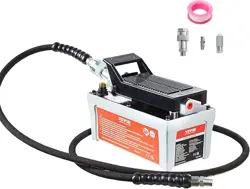
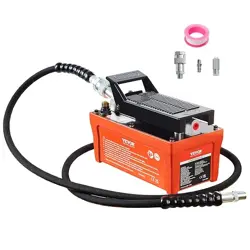
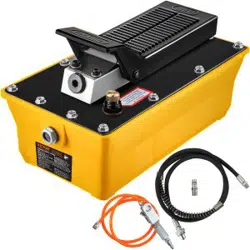
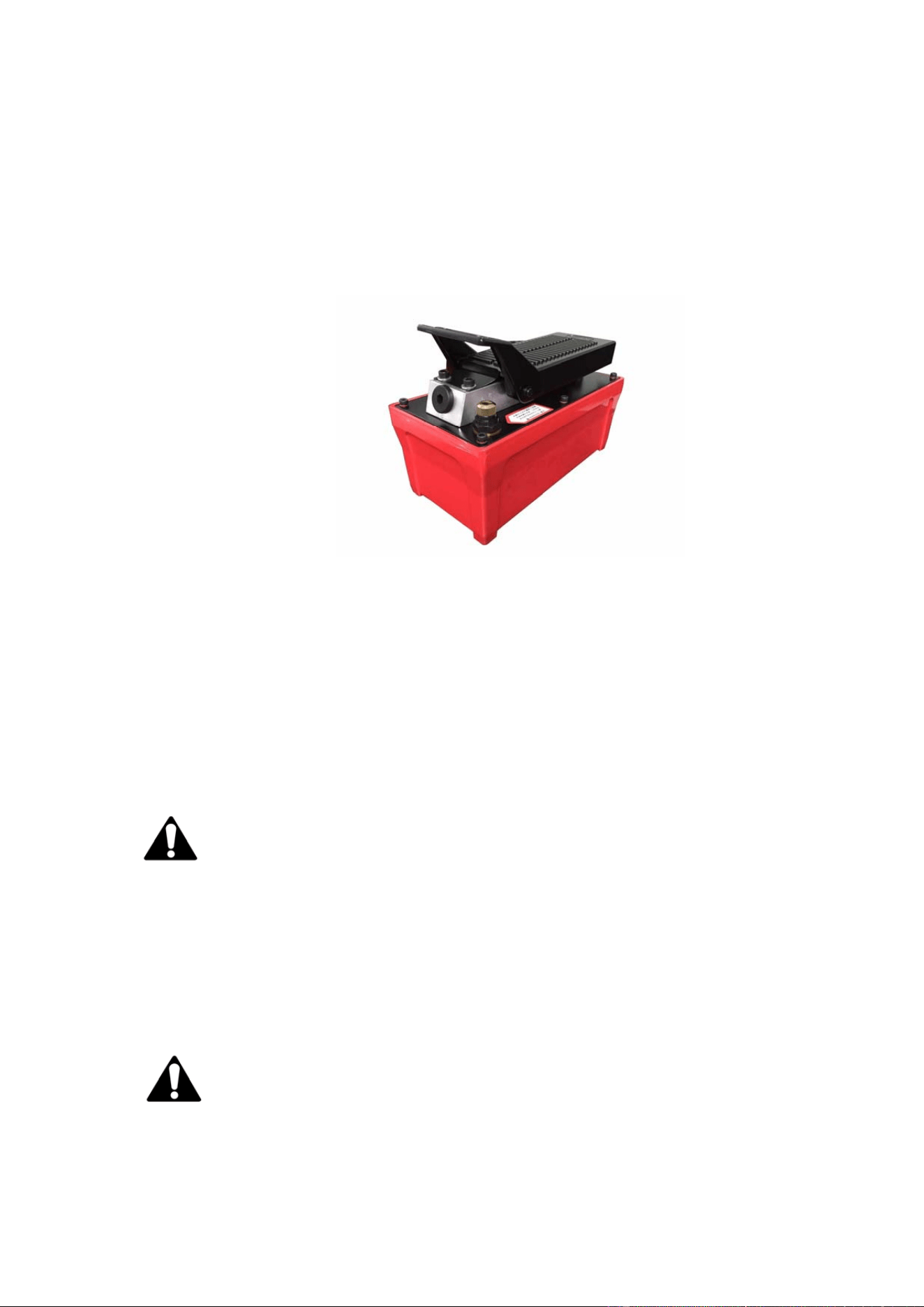
Air Hydraulic Pump supplies hydraulic fluid pressure to selected tools. It consists of an
in-line air and hydraulic cylinder.
SPECIFICATIONS
Oil Delivery
(cu.in / min )
Model
Pressure
Rating
(psi)
Useable
Oil
Capacity
(cu.in)
Input Air
pressure
(psi)
Input
Port
Threads
(NPT)
Output
port
Threads
(NPT)
No
load
load
Operational
Manner
Weight
Ibs
TAP-1600 7,500 98 90-145 1/4’’-18 3/8’’-18 49.5 7.6 Foot Pedal 19
3. BEFORE USE
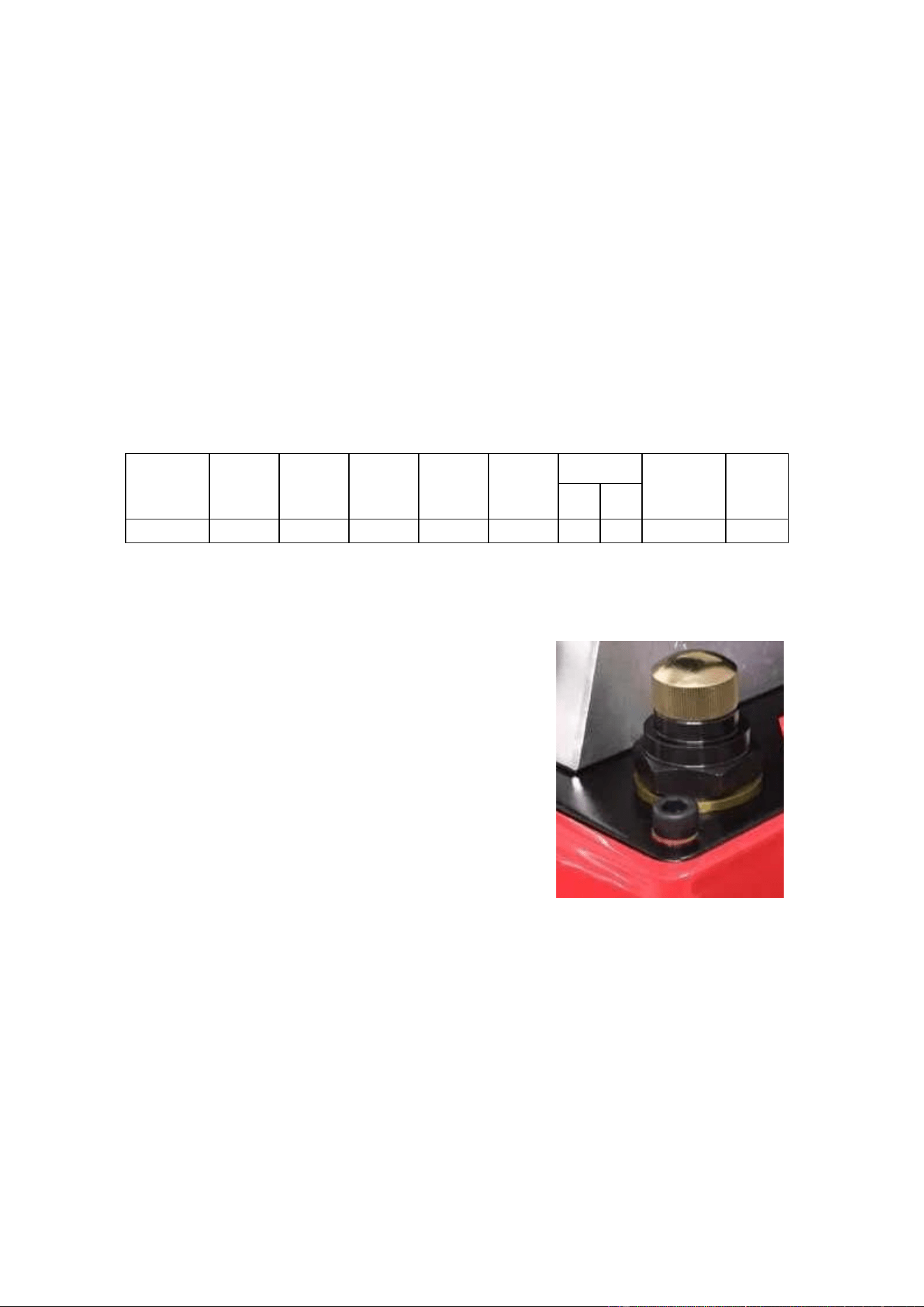
To prevent oil leak during shipment, a metal knob is installed and tightened to ensure
the best sealing function. Loosen it counterclockwise
before use.
Note: Always secure threaded port connections with
non-hardening pipe thread compound. Tighten
securely to prevent accidental removal of
components while in use. Take care not to introduce
compound into port orifices. Familiarize yourself with
the specifications and illustrations in this operator’s
manual. Know your pump, its limitations and how it
operates before attempting to use. Refer to
Specification chart on above for details of oil port
thread size, usable oil capacity, and more.
4. OPERATION
Operation of the Unit as follow:
4.1 Connect the hose of the Air Hydraulic pump to the hydraulic coupling on the
selected tool.
4.2 Connect the air supply line to the Air Hydraulic pump. Air supply be 5-10 CFM at
100 PSI to obtain proper operating characteristics, in addition, the air line should
be equipped with an air line filter.
4.3 To Advance, hold or Retract
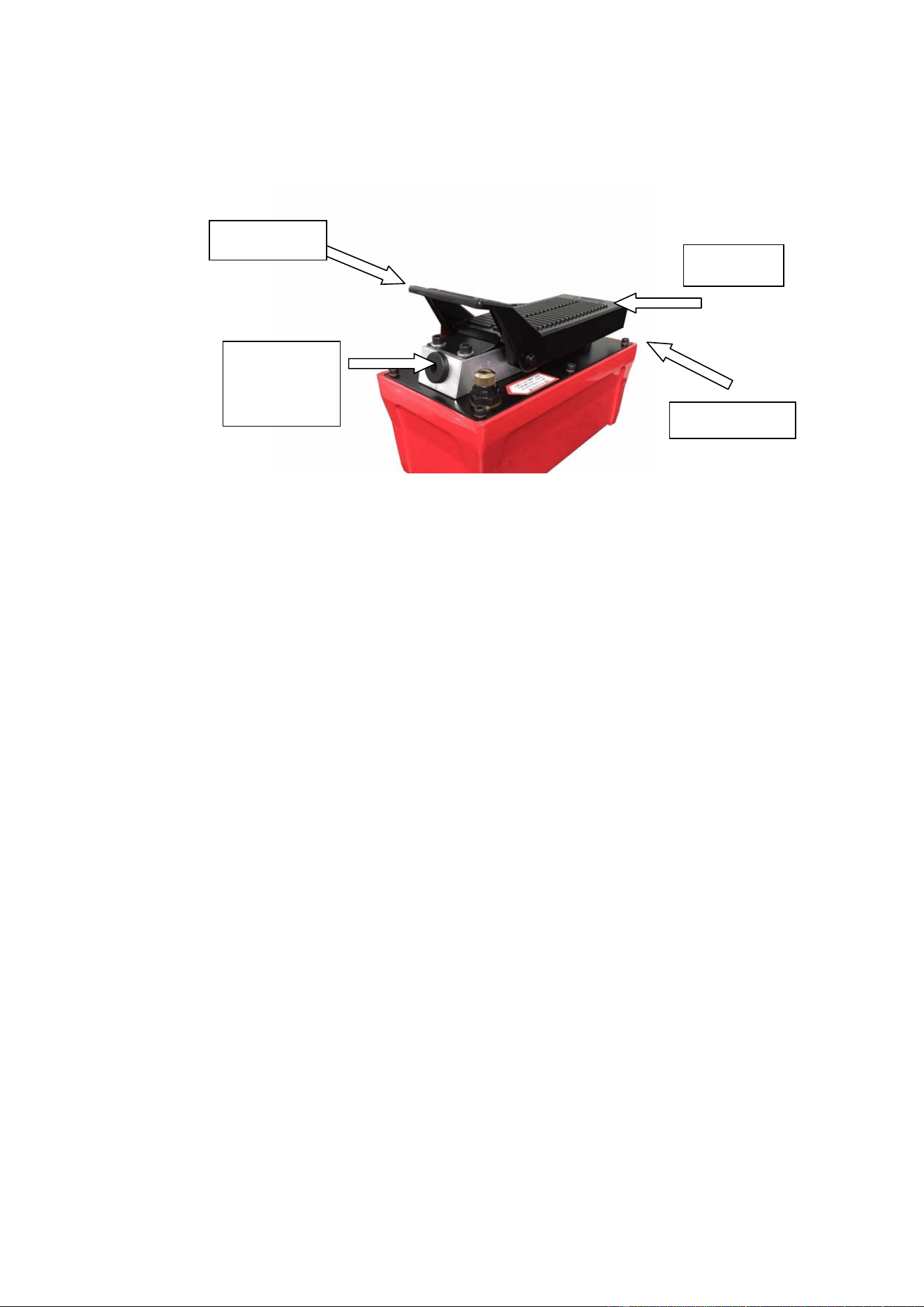
z Foot Pedal operate pumps:
4
a. Depress the “Pump” end of pedal will pump hydraulic oil to the system.
b. Stop depressing the “Pump” or “Release” end will stop and hold the pressure.
c. Depress the “Release” end of pedal will release the pressure in the system.
5. MAINTENANCE
5.1 Inspect the connections
Please Inspect hoses and connections and tighten connections as needed. Use
non-hardening pipe thread compound when servicing connections.
5.2 Adding Hydraulic Fluid
z Depressurize and disconnect hydraulic hose from application.
z With pump in its upright, horizontal position, remove the oil filler plug located on
the top plate of the reservoir.
z Use a small funnel to fill reservoir to within 3/4’’ (19mm) of the opening.
z Wipe up any spilled fluid and reinstall the oil filler plug.
Note: Use only or other approved hydraulic oil. Never use brake fluid, transmission
fluid, turbine oil, motor oil, alcohol, glycerin etc. Use of other than good quality
hydraulic oil will void warranty and damage the pump, hose and application.
5.3 Changing Hydraulic Fluid
z For best results, change fluid once a year.
z Repeat step 2 above, and then pour used fluid into a sealable container.
z Dispose of fluid in accordance with local regulations.
z Fill with good quality hydraulic oil as recommended above. Reinstall vented oil
filler plug.
5.4 Lubrication
Use a light machine oil to lubricate pivot points, hinges etc.
5.5 Storage
z Depressurize and disconnect hydraulic hoses from application.
Hydraulic Oil
Output Port
RELEASE
PUMP
Air input port
5
z Clean the pump and hose and couplers
z Store in clean dry environment, avoid temperature extremes.
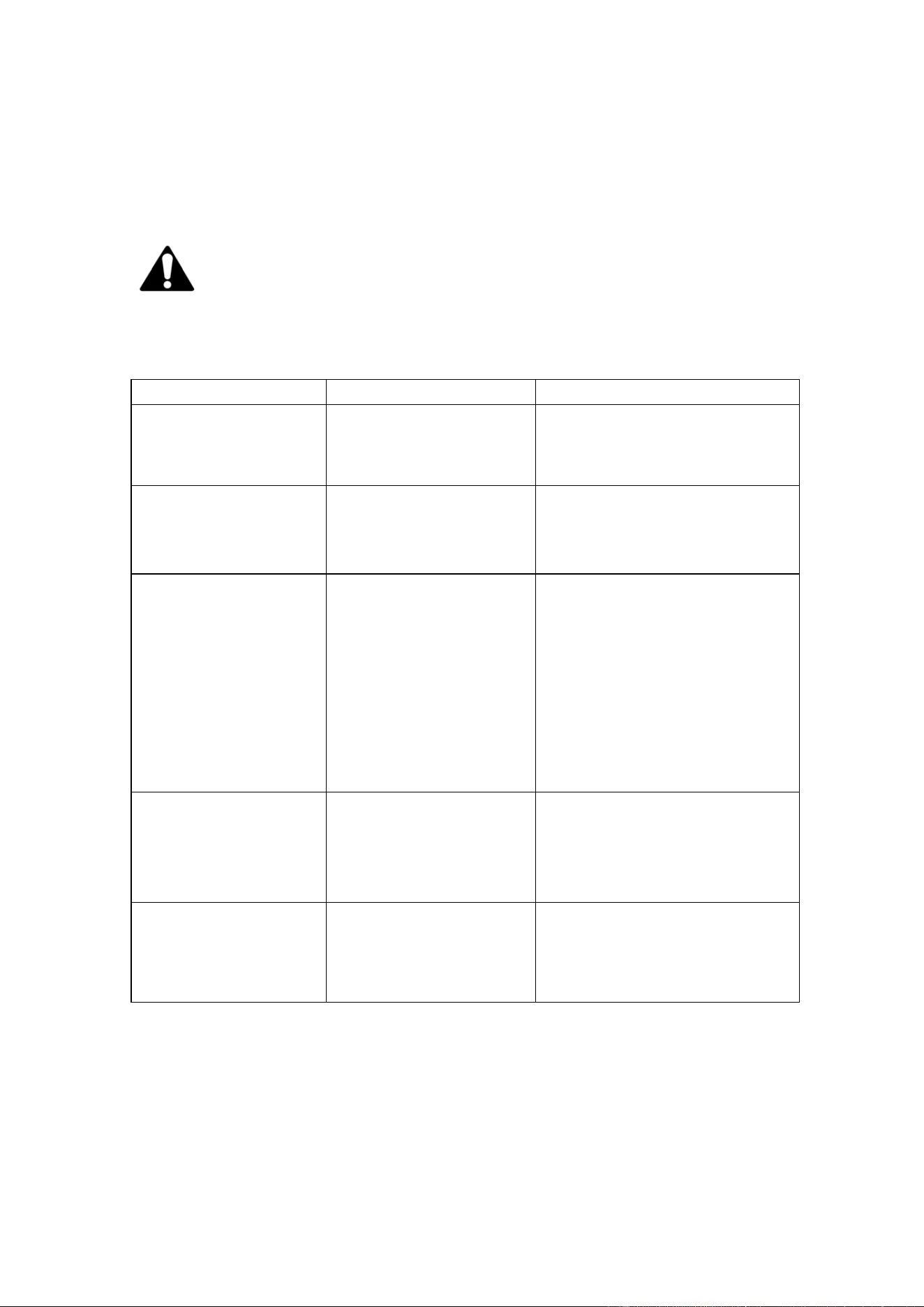
6. TROUBLE SHOOTING
IMPORTANT: hand pumps should be repaired only by a qualified
operator or Authorized Service Centers. Repairing hand pumps without
special tools and knowledge may result in personal injury. Always release
pressure and disconnect hose(s) before making repairs.
Symptom Possible Causes Corrective Action
Application will not
extend, move or respond
to pressurized fluid
·Overload condition
·Release valve not closed
·Remedy overload condition
·Ensure release valve closed
Application responds to
pressurized fluid, but
system does not maintain
pressure
·Overload condition
·Release valve not closed
·Hydraulic unit malfunction
·Remedy overload condition
·Ensure release valve closed
Application will not return
fluid to pump (i.e. cylinder
will not retract)
·Malfunctioning coupler,
damaged application
·Reservoir overfilled
· Secure load by other means.
Open release valve, depressurize
pump and hose, remove coupler
and/ or application, then renew or
replace
· Secure load by other means.
Open release valve, depressurize
pump and hose, remove coupler
and/ or application, then drain fluid
to proper level
Application will not fully
extend (cylinder or
spreader)
·Fluid level low
·Follow symptom 3 procedure for
securing load, depressurizing
pump, remove application, then
ensure proper fluid level
Poor performance
·Air trapped in system
Ensure proper fluid level
Ensure vented oil filler plug let
pressurized reservoir air escape
(see BEFORE USE)