User Manual
www.AvantcoRefrigeration.com
09/2024
178A23RGHC
178A49RHC
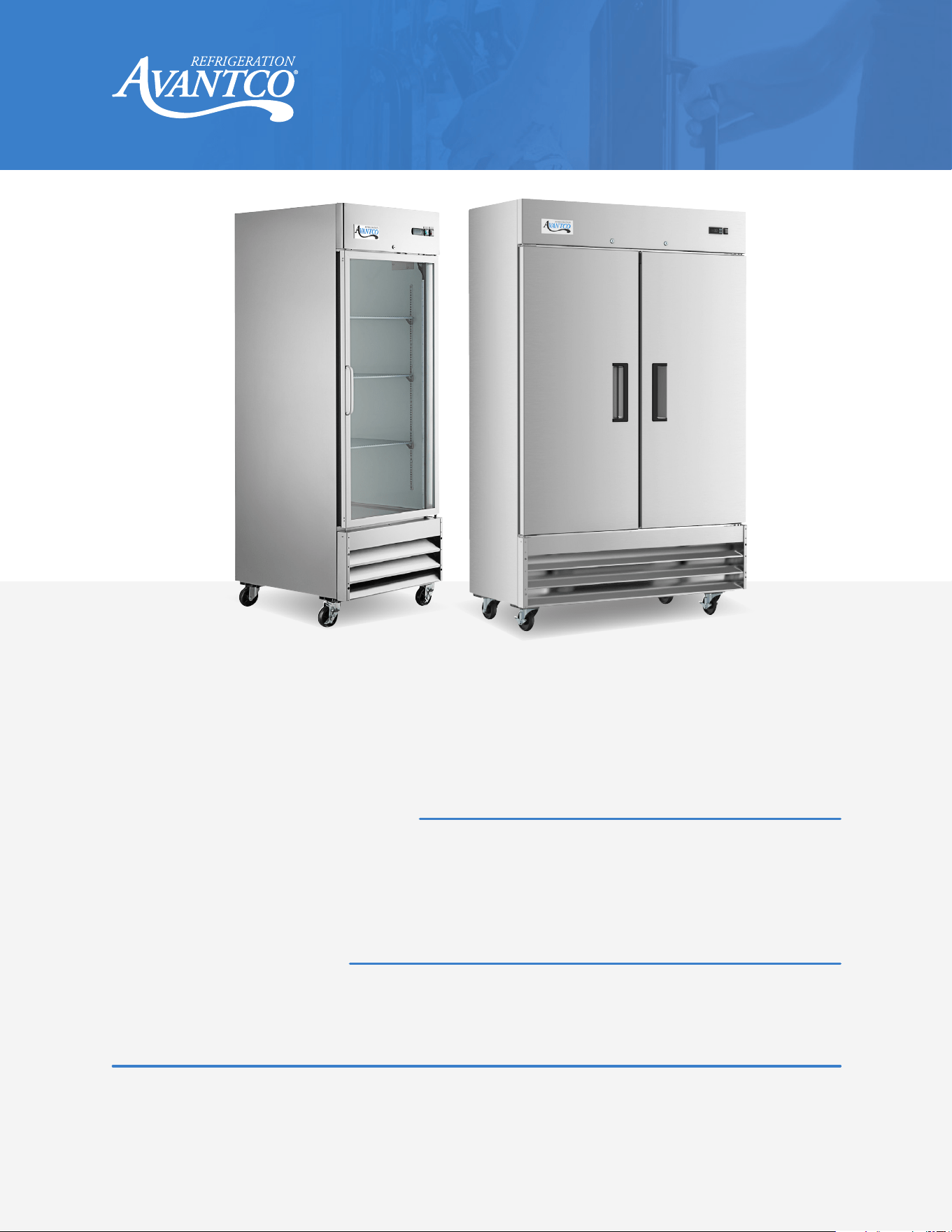
Reach-In
Refrigerators & Freezers
Refrigerator Models:
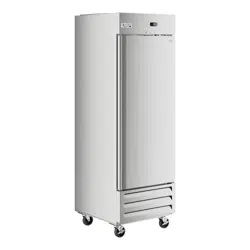
#178A12RHC 24" Single Solid Door
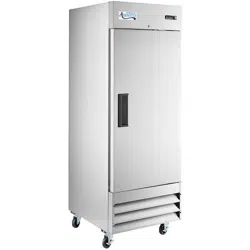
#178A19RHC 29" Single Solid Door - Narrow Depth
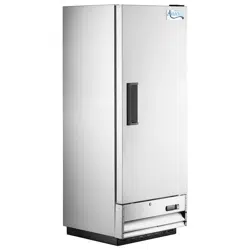
#178A23RHC 29" Single Solid Door
#178A23RGHC 29" Single Glass Door
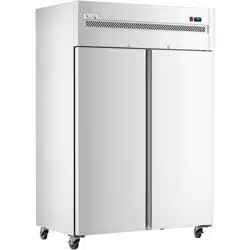
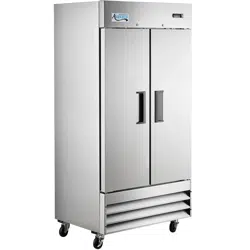
#178A35RHC 39½" Double Solid Door
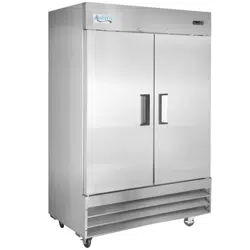
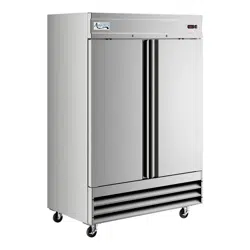
#178A49RHC 54" Double Solid Door
#178A49RGHC 54" Double Glass Door
Freezer Models:
#178A12FHC 25" Single Solid Door
#178A19FHC 29" Single Solid Door - Narrow Depth
#178A23FHC 29" Single Solid Door
#178A35FHC 39½" Double Solid Door
#178A49FHC 54" Double Solid Door
Note:
Read this manual in its entirety prior to equipment setup, operation, and maintenance.
www.AvantcoRefrigeration.com
2
User Manual
www.AvantcoRefrigeration.com
Reach-In Refrigerators & Freezers
Table of Contents
Warnings ............................................................................................................................... 3
Installation ............................................................................................................................4
Electrical ...............................................................................................................................5
Temperature Controls .......................................................................................................6
Operation .............................................................................................................................6
Safety Information ..............................................................................................................8
Maintenance ........................................................................................................................8
Troubleshooting .................................................................................................................. 10
NEMA
5-15P
30290793029079

3
User Manual
www.AvantcoRefrigeration.com
Reach-In Refrigerators & Freezers Reach-In Refrigerators & Freezers
Warnings
DANGER – RISK OF FIRE OR EXPLOSION. FLAMMABLE REFRIGERANT USED. TO BE REPAIRED ONLY BY
TRAINED SERVICE PERSONNEL. DO NOT PUNCTURE REFRIGERANT TUBING.
PELIGRO – RRIESGO DE INCENDIO O EXPLOSION. REFRIGERANTE INFLAMABLE UTILIZADO. PARA SER
REPARADO SOLAMENTE POR PERSONAL DE SERVICIO CALIFICADO. NO PINCHAR LA TUBERÍA REFRIGER-
ANTE.
DANGER – RISQUE DE FEU OU D’EXPLOSION. LE FRIGORIGÈNE EST INFLAMMABLE. CONFIER LES
RÉPARATIONS À UN TECHNICIEN SPÉCIALISÉ. NE PAS PERFORER LA TUBULURE CONTENANT LE
FRIGORIGENE.
CAUTION – RISK OF FIRE OR EXPLOSION. FLAMMABLE REFRIGERANT USED. CONSULT REPAIR MANUAL/
OWNER’S GUIDE BEFORE ATTEMPTING TO SERVICE THIS PRODUCT. ALL SAFETY PRECAUTIONS MUST BE
FOLLOWED.
ATENCION – RIESGO DE INCENDIO O EXPLOSIÓN. REFRIGERANTE INFLAMABLE UTILIZADO. CONSULTE
EL MANUAL DE REPARACIÓN / GUÍA DEL PROPIETARIO ANTES DE INTENTAR DAR SERVICIO A ESTE PRO-
DUCTO. DEBEN CUMPLIR CON TODAS LAS PRECAUCIONES DE SEGURIDAD.
ATTENTION – RISQUE DE FEU OU D’EXPLOSION. LE FRIGORIGÈNE EST INFLAMMABLE. CONSULTER LE
MANUEL DU PROPRIÉTAIRE/GUIDE DE RÉPARATION AVANT DE TENTER UNE RÉPARATION. TOUTES LE
MESURES DE SÉCURITÉ DOIVENT ÊTRE RESPECTÉES.
CAUTION – RISK OF FIRE OR EXPLOSION DUE TO PUNCTURE OF REFRIGERANT TUBING; FOLLOW
HANDLING INSTRUCTIONS CAREFULLY. FLAMMABLE REFRIGERANT USED.
ATENCION – RIESGO DE INCENDIO O EXPLOSIÓN DEBIDO A LA PERFORACION DE LA TUBERÍA
REFRIGERANTE; SIGA LAS INSTRUCCIONES DE MANIPULACIÓN CON CUIDADO. REFRIGERANTE
INFLAMABLE UTILIZADO.
ATTENTION – RISQUE DE FEU OU D’EXPLOSION SI LA TUBULURE CONTENTANT LE FRIGORIGÈNE EST
PERFORÉE; SUIVRE LES INSTRUCTIONS DE MANUTENTION AVEC SOIN. LE FRIGORIGÈNE EST
INFLAMMABLE.
CAUTION – RISK OF FIRE OR EXPLOSION DUE TO FLAMMABLE REFRIGERANT USED. FOLLOW HAN-
DLING INSTRUCTIONS CAREFULLY IN COMPLIANCE WITH LOCAL GOVERNMENT REGULATIONS.
ATENCION – RIESGO DE INCENDIO O EXPLOSIÓN DEBIDO A REFRIGERANTE INFLAMABLE UTILIZADO.
SIGA LAS INSTRUCCIONES DE MANIPULACIÓN CON CUIDADO CONFORME A LAS REGLAS DE LA
MUNICIPALIDAD.
ATTENTION – RISQUE DE FEU OU D’EXPLOSION SI LE FRIGORIGÈNE EST INFLAMMABLE. SUIVRE LES
INSTRUCTIONS DE MANUTENTION AVEC SOIN CONFORMÉMENT AUX RÈGLEMENTATION GOUVERNE-
MENTALE LOCAUX.

4
User Manual
www.AvantcoRefrigeration.com
Reach-In Refrigerators & Freezers
Installation
Read this manual thoroughly prior to equipment setup, operation, and maintenance.
This unit is intended for use in a temperature-controlled environment of less than 75°F and 60%
relative humidity.
Before Installation
•
If the shelf has a raised lip, the lip needs to be installed facing up towards the rear of the cabinet
to promote proper airflow. Failure to install the shelves properly is considered user error and is
not covered by warranty.
•
If the unit has recently been transported on its side, let unit stand upright for a minimum of 24
hours before plugging it in.
•
Make sure that the unit has reached the desired temperature before loading the unit with
products. This unit is meant for keeping cold products cold, not chilling warm products.
•
Make sure that there is proper ventilation around the unit in the area where it will operate.
•
Make sure all accessories are installed (i.e., shelves, shelf clips, casters) before plugging in the
unit.
•
Do not attempt to remove or repair any component of the unit. Consult an authorized service
technician for servicing/repair.
•
Do not hang on doors or stand inside the unit.
•
Read through the manual in its entirety.
•
This unit is designed to perform in a temperature-controlled environment at 60% relative
humidity. The unit should be located away from doors, air ducts, and fans that could disrupt
airflow and negatively impact performance.
Field Convertible Doors
The Avantco A-19R, A-19F, A-23R, and A-23F ship with a right-hinged door design. If you would like to
convert the reach-in unit to a left-hinged door design (solid door models), you must purchase the left
hinges separately (Avantco #178AKITFR) and follow the instructions:
Tools Needed:
• Socket Set
• Pliers
• Adjustable Wrench
• Phillips Head Screwdriver
1.
Remove the bottom vent by loosening the 4 screws that hold it in place. You do not need to fully
remove the screws, as the vent will slide up and out.
2.
Remove the top panel by unscrewing the 2 small screws. Once the screws are removed, the top
panel will hinge up.
3.
Remove the small screws at the top and bottom door hinge where it attaches to the brackets.
Note: DO NOT lose the small washers.
4.
Take o the top bracket by removing the 3 bolts.
5.
The door should come o at this point.
Note: DO NOT lose the small round brass spacer on the bottom hinge.
6.
Remove the 3 bolts holding the bottom bracket.

5
User Manual
www.AvantcoRefrigeration.com
Reach-In Refrigerators & Freezers Reach-In Refrigerators & Freezers
7.
Replace the bottom hinge with the new left-hand bottom bracket using 3 bolts.
8.
You will need to adjust the top and bottom spring tensioners so the door will close properly.
9.
Put the door on the bottom hinge on the left side. You will need to reuse the brass spacer from
step 5.
10.
Place the top bracket on the top of the door, securing with 3 bolts.
11.
Replace the small screws on the top and bottom of the bracket and door spring. Make sure the
door is on properly before you do this.
12.
Reattach the bottom vent and top panel.
*Glass door models cannot be field converted to a left-hinged door.
Cabinet Location Guidelines
•
Install the unit on a strong and leveled surface.
• If the surface is uneven, the unit may be noisy.
• The unit may malfunction if the surface is uneven.
•
Install the unit in an indoor, well-ventilated area.
• For best performance, maintain clearance of 3” on the back and sides of the unit.
• Brackets should be attached on the back of the unit.
• Do not use outdoors. For indoor use only.
• Avoid direct sunlight.
•
Avoid installation in a high humidity and/or dusty area.
• Humidity above 60% can cause the unit to rust, collect condensation, and may
decrease eciency.
• Dust collected on condenser coil will cause unit to malfunction.
•
Select a location away from heat and moisture-generating equipment.
• Ambient temperatures above 75°F may cause the compressor to malfunction.
• For optimal performance, this unit should not be used in environments with ambient
temperatures exceeding 75°F.
• The unit should not be placed in areas with an ambient temperature over 90°F.
• Equipment malfunctions due to ambient temperatures above 90°F could void the warranty.
• Do not install this unit inside a closet or alcove.
Electrical
•
Ensure that the required voltage is being supplied at all times.
•
The unit should be plugged into a grounded and properly sized electrical outlet with appropriate
over-current protection. Refer to the electrical requirements on the unit's nameplate.
•
The unit should have its own dedicated circuit.
•
DO NOT use extension cords.
•
Ensure the unit is not resting on or against the electrical cord.
•
If the unit is not in use for a long period of time, unplug from the outlet.
•
To avoid shock and fire hazards, DO NOT plug in or unplug the unit with wet hands.
•
After unplugging the unit, wait at least 10 minutes before plugging it back in. Failure to do so
could cause damage to the compressor.
6
User Manual
www.AvantcoRefrigeration.com
Reach-In Refrigerators & Freezers
Temperature Controls
Adjusting the Temperature
•
Your new refrigerator or freezer is already factory set to run at optimum temperatures for food
safety and should require no adjustments.
•
Refrigerators are set to cycle between a minimum temperature of 33°F and a maximum
temperature of 40°F.
•
Freezers are set to cycle between a minimum temperature of -5°F and a maximum temperature
of 2°F.
•
Adjusting the temperature changes the minimum temperature at which your unit will run. Your unit
will not run constantly at this setting. To change it, follow these instructions:
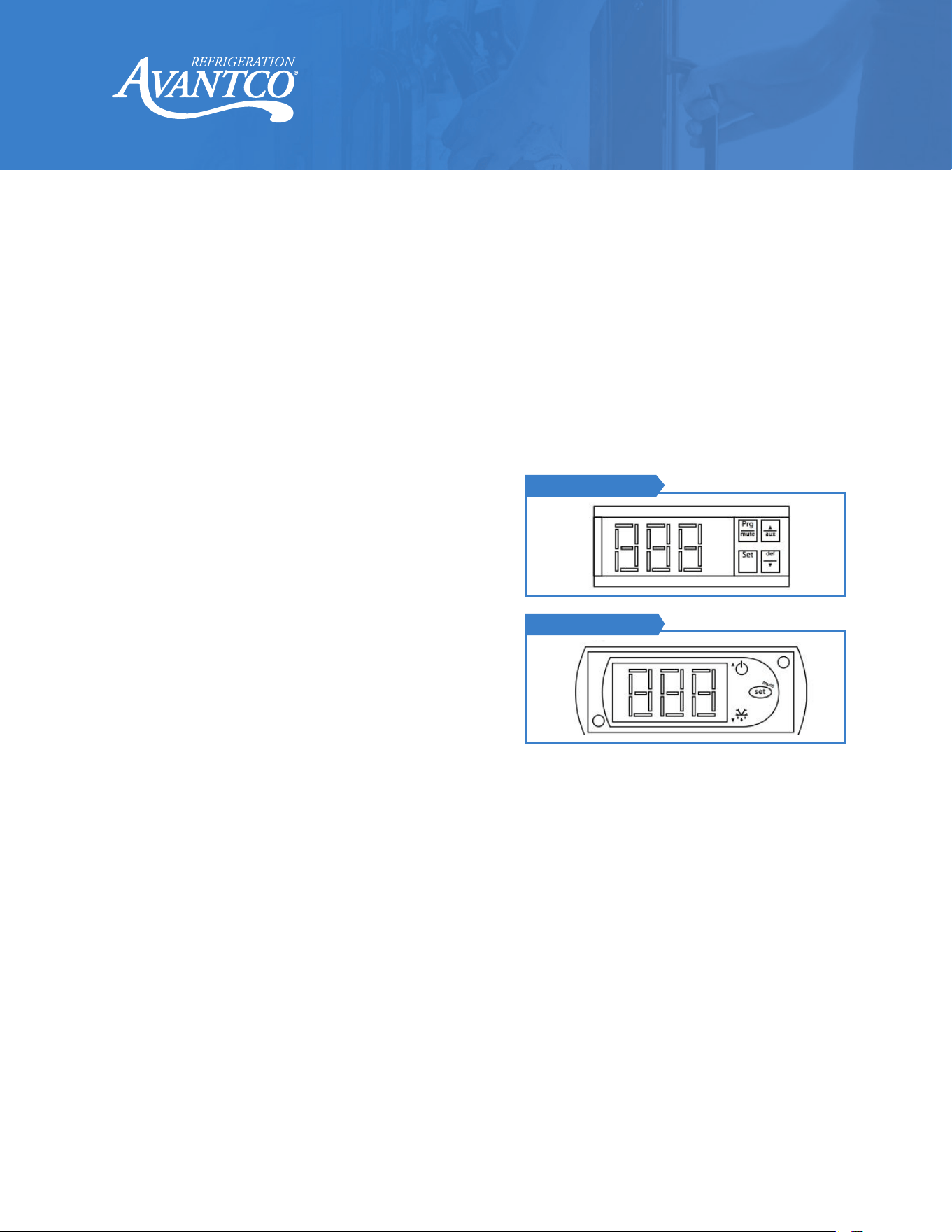
Digital Control Units
1.
Hold "SET" for 1 second. The display will flash the
current minimum temperature.
2.
Use the arrow buttons to adjust the desired
minimum temperature.
3.
Press "SET" again to save your settings.
Controller #1
Always remember to calculate the dierential if you
change the minimum temperature setting. The cabinet
temperature will fluctuate up to +7°F over your set
minimum temperature as the compressor runs and
shuts o. Setting the temperature too high will result
in unsafe maximum temperatures and possible health
code violations.
Controller #2
Operation
Defrost System
Automatic Defrost Cycle
•
Refrigerator coils are kept below the freezing point (32°F).
•
During compressor downtime, the evaporator fan continues to circulate air through the evaporator
coil. This air circulation raises the coil temperature above the freezing point, melting any
accumulated frost.
•
Run-o water is drained into the evaporator pan and evaporated.
•
Automatic defrost timers initiate at pre-set intervals and for a pre-determined duration.
7
User Manual
www.AvantcoRefrigeration.com
Reach-In Refrigerators & Freezers Reach-In Refrigerators & Freezers
Running a Manual Defrost Cycle
•
Units are pre-programmed to run automatic defrost cycles at preset intervals. However, if you
would like to run a manual defrost cycle at any time, follow the steps below. Only models with
digital controls can run a manual defrost cycle. Units with mechanical controls cannot run a
manual defrost cycle.
•
Controller #1: Press and hold the defrost button ("DEF" and ▼) for approximately 5 seconds.
Repeat to stop the defrost cycle.
•
Controller #2: Press and hold the defrost button (Snowflake and ▼) for approximately 3 seconds.
Repeat to stop the defrost cycle.
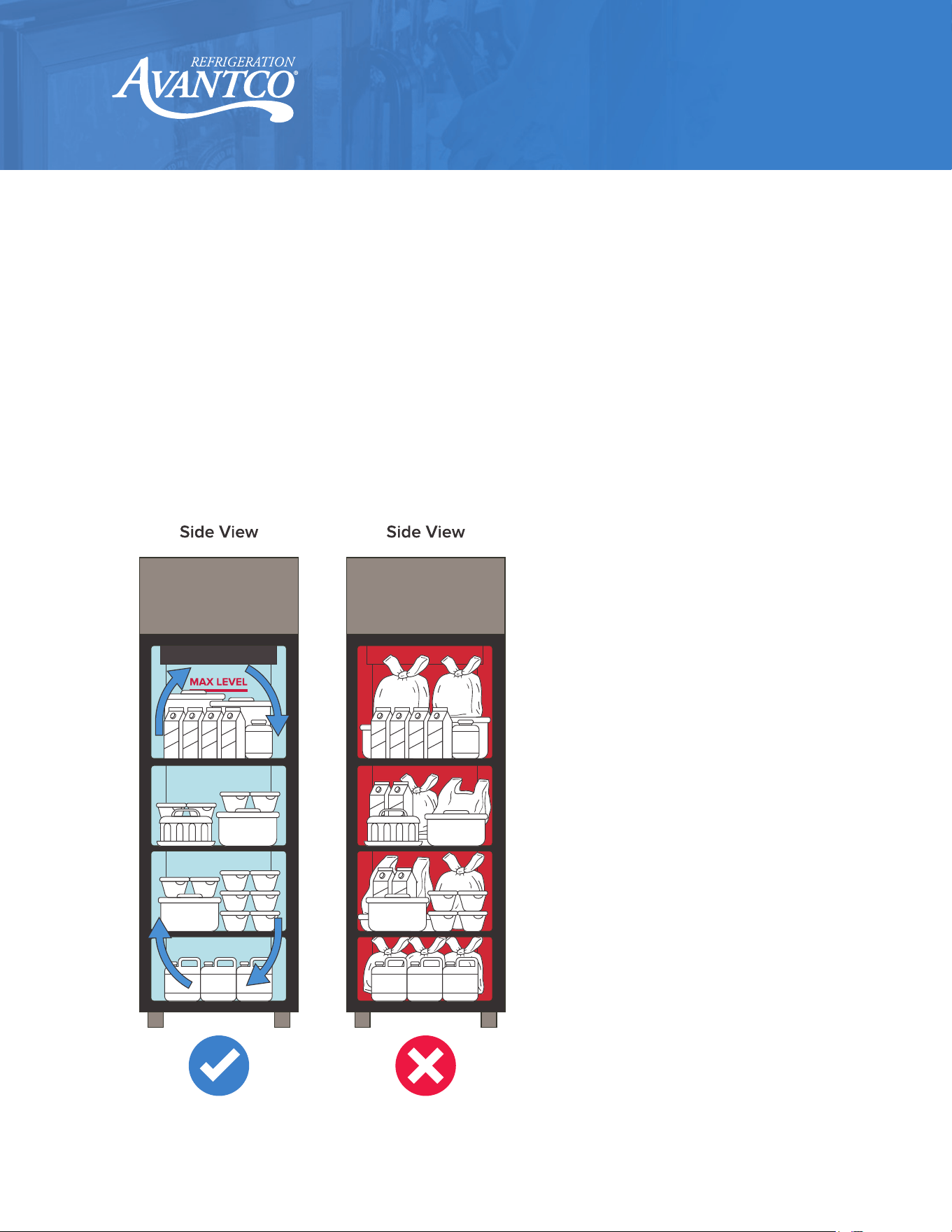
Loading Product
•
Ensure there is at least 4" of clearance from the evaporator.
•
Ensure all shelves are sitting level and properly secured before loading products.
•
DO NOT store flammable/explosive gas or liquids inside the unit.
NOTE: Left diagram shows ideal loading to
ensure proper airflow for keeping product
at the correct temperature.
NOTE: Air flows from front to back.

8
User Manual
www.AvantcoRefrigeration.com
Reach-In Refrigerators & Freezers
Safety Information
Pay close attention to the safety notices in this section. Disregarding these notices may lead to
serious injury and/or damage to the unit.
•
To minimize shock and fire hazards, be sure to not overload outlet. This unit should be given its
own outlet.
•
DO NOT use extension cords.
•
DO NOT put your hands under the unit while it is being moved.
•
When the unit is not in use for a long period of time, unplug the unit from the outlet.
•
After unplugging the unit, wait at least 10 minutes before plugging it back in. Failure to do so
could cause damage to the compressor.
•
To minimize shock and fire hazards, do not plug or unplug the cord with wet hands.
•
Unplug the unit before performing maintenance or cleaning.
•
To minimize shock and fire hazards, make sure that the unit is properly grounded.
•
DO NOT attempt to remove or repair any component unless instructed by the factory.
•
DO NOT allow the unit to rest on or against the electrical cord and/or plug.
•
DO NOT hang on the doors.
•
DO NOT store any flammable/explosive gas or liquids inside the unit.
•
DO NOT attempt to alter or tamper with the electrical cord.
•
DO NOT use the unit if the power cord is damaged.
Maintenance
DISCONNECT POWER CORD BEFORE CLEANING ANY PARTS OF THE UNIT.
It is strongly recommended that any servicing of the unit be performed by an authorized service
technician.
Fan Blades & Motor
•
If necessary, clean the fan blades and motor with a soft cloth.
•
If it is necessary to wash the fan blades more thoroughly, cover the fan motor to prevent moisture
damage, then use a damp cloth to clean the fan blades.
Interior
•
Use warm water and a mild soap with a clean cloth to wipe down the interior of the unit.
•
DO NOT use steel wool, caustic soap, abrasive cleaners, or bleach that may damage the interior
finish.
•
Wash door gaskets on a regular basis, preferably weekly. Simply remove door gaskets from the
frame of the door, soak in warm water and soap for thirty (30) minutes, dry with soft cloth, and
replace.
•
Check door gaskets for proper seal after they are replaced.

9
User Manual
www.AvantcoRefrigeration.com
Reach-In Refrigerators & Freezers Reach-In Refrigerators & Freezers
Interior (Continued)
•
Periodically remove the shelves and pilasters from the unit and clean them with mild soap and warm water.
•
To remove the pilasters, first remove the shelves and shelf brackets. Then, simply lift the pilaster up and
out.
Cleaning the Condenser Coil
•
A dusty condenser may lead to high energy consumption, less cooling eectiveness, and
compressor damage.
•
For ecient operation, keep the condenser surface free of dust, dirt, and lint.
•
We recommend cleaning the condenser coil at least once per month.
•
The condenser coil is located at the bottom behind the panel.
Condenser Coil Cleaning Instructions
1.
Disconnect the electrical power from the unit.
2.
Remove the front cover and base cover with a screwdriver.
3.
Using a soft brush and/or vacuum, remove the dirt, lint, etc. from the finned condenser coil in a vertical
direction.
4.
Clean the condenser with a commercial condenser coil cleaner, available from any kitchen equipment
retailer. Ex: Noble Chemical Tech Line Coil Cleaners (148TLECCCLNR, 148TLHDCCLNR, 148TLECOILDD,
148TLFMCCLNR, 147TLEVPCLNR, or 147TLHDCCLNR).
5.
After cleaning, straighten any bent condenser fins with a fin comb.
6.
When finished, be sure to reinstall the front cover and base cover.
7.
Reconnect the electrical power to the unit.
10
User Manual
www.AvantcoRefrigeration.com
Reach-In Refrigerators & Freezers
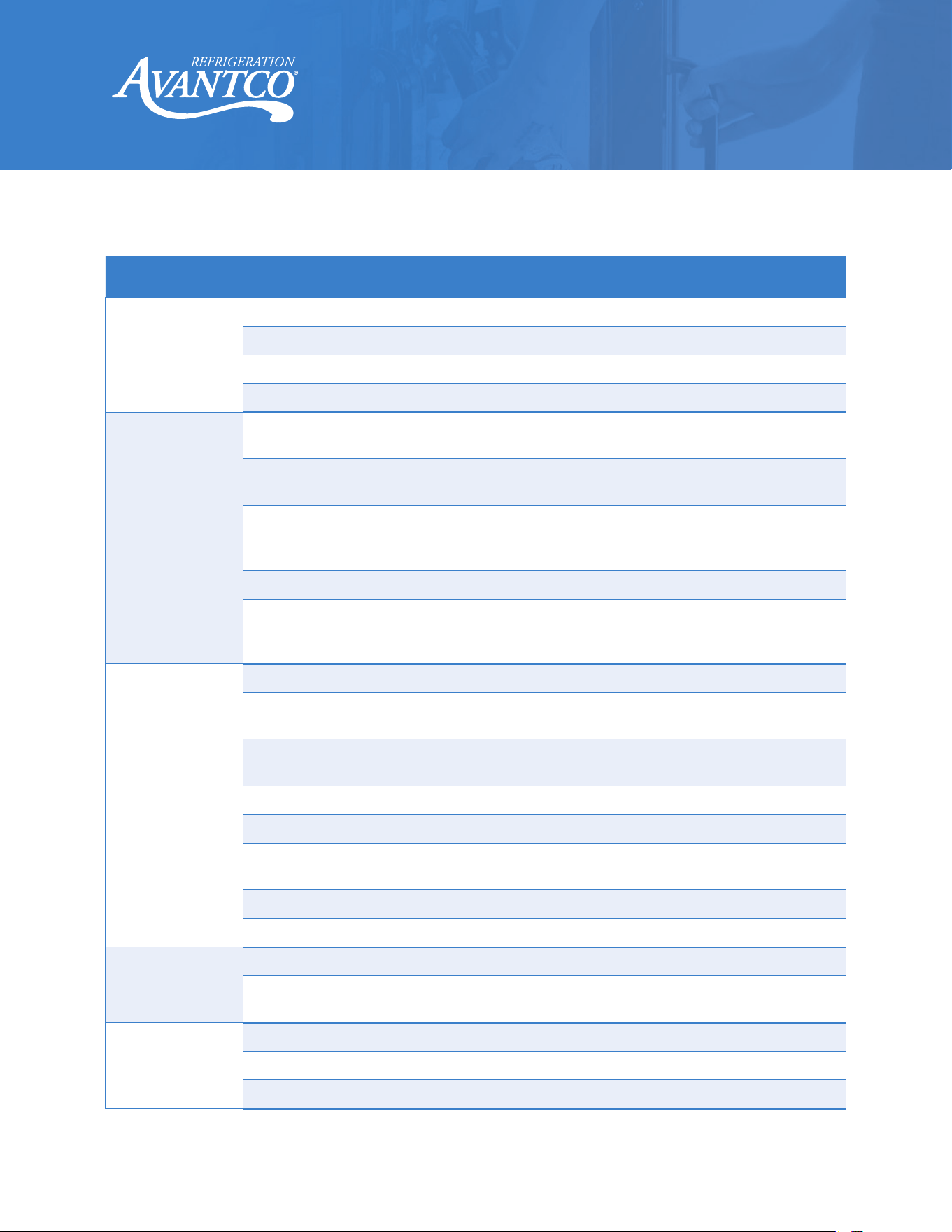
Troubleshooting
Problem
Possible Cause
Possible Solution
Compressor not
running.
Fuse blown or circuit breaker tripped. Replace fuse or reset circuit breaker.
Power cord unplugged. Plug in power cord.
Thermostat set too high. Set thermostat to lower temperature.
Cabinet in defrost cycle. Wait for defrost cycle to finish.
Condensing units
run for long periods
of time.
Excessive amount of warm product
placed in cabinet.
Allow adequate time for product to cool down.
Prolonged door opening or door ajar.
Ensure doors are closed when not in use. Avoid opening
doors for long periods of time.
Door gasket(s) not sealing properly.
Ensure gaskets are snapped in completely. Remove gasket
and wash with soap and water. Check condition of gasket
and replace if necessary.
Dirty condenser coil. Clean the condenser coil (page 9).
Evaporator coil iced over.
Unplug unit and allow coil to defrost. Make sure thermostat
is not set too cold. Ensure that door gasket(s) are sealing
properly.
Cabinet temperature
is too warm.
Thermostat set too warm. Set thermostat to lower temperature.
Airflow blocked.
Re-arrange product to allow for proper airflow. Make sure
there is at least 4" of clearance from evaporator.
Excessive amount of warm product
placed in cabinet.
Allow adequate time for product to cool down.
Fuse blown or circuit breaker tripped. Replace fuse or reset circuit breaker.
Dirty condenser coil. Clean the condenser coil (page 9).
Evaporator coil iced over.
Ensure doors are closed when not in use. Avoid opening
doors for long periods of time.
Low refrigerant levels. Contact a service technician to check refrigerant levels.
Door is slightly ajar. Make sure door is completely closed.
Condensation is
collecting on the
cabinet and/or floor.
Gasket is not sealing properly. Clean, repair, or replace the gasket as necessary.
Relative humidity is above 60%.
Move unit to area below relative humidity or lower humidity
level.
Interior light is not
working.
Poor switch connection. Turn o light switch and turn it back on.
Bulb is not connected. Make sure the bulb is correctly inserted in the socket.
Bulb has burned out. Replace the bulb.