1
NOTE TO CONSUMER: DO NOT DESTROY THIS MANUAL. PLEASE READ CAREFULLY AND KEEP ALL INSTRUCTIONS
FOR FUTURE REFERENCE.
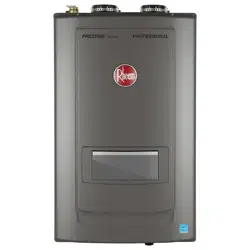
CONDENSING
TANKLESS
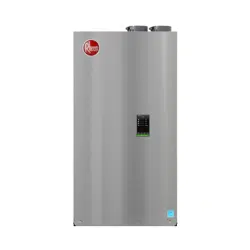
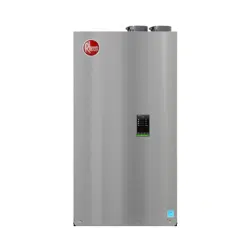
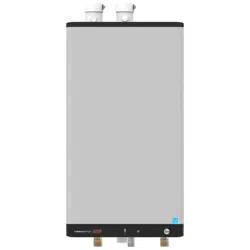
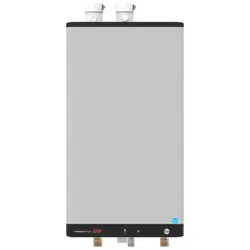
COMBI BOILER
Use and Care Manual
User’s Information
Installation
Start-Up
Maintenance
Parts
100K Heating (180K DHW) Btu/h Models
120K Heating (199K DHW) Btu/h Models
WARNING
WARNING
The surfaces of these products contacted by consumable water contain less than 0.25% lead by weight, as
required by the Safe Drinking Water Act, Section 1417.
WARNING: If the information in these instructions is not followed exactly, a re or explosion may result causing property damage, personal
injury or death.
• Do not store or use gasoline or other ammable vapors and liquids in the vicinity of this or any other appliance.
WHAT TO DO IF YOU SMELL GAS
• Do not try to light any appliance.
• Do not touch any electrical switch; do not use any phone in your building.
• Immediately call your gas supplier from a neighbor’s phone. Follow the gas supplier’s instructions.
• If you cannot reach your gas supplier, call the re department.
• Installation and service must be provided by a qualied installer, service agency or the gas supplier.
Improper installation, adjustment, alteration, service, or maintenance can cause injury, property damage, or death. Refer to this manual.
Installation and service must be performed by a qualied installer, service agency, or gas supplier.
: Cancer and Reproductive Harm - www.P65Warnings.ca.gov.
AP20484
2
WARNING: If you do not follow these instructions exactly, a fire or explosion
may result, causing property damage, personal injury or death.
A.This appliance does not have a pilot. It is equipped
with an ignition device automatically lights the
burner. Do not try to light the burner by hand.
B. BEFORE OPERATING smells all around the
appliance area for gas. Be sure to smell next to the
floor because some gas is heavier than air and will
settle on the floor.
WHAT TO DO IF YOU SMELL GAS
Do not try to light any appliance
Do not touch any electric switch;
do not use any phone in your building
If you cannot reach your gas supplier, call the
fire department.
C. Use only your hand to turn the gas control knob.
Never use tools. If the handle will not turn by hand,
don’t try to repair it, call a qualified service
technician. Force or attempted repair may result in a
fire or explosion.
D. Do not use this appliance if any part has been
under water. Immediately call a qualified service
technician to inspect the appliance and to replace
any part of the control system and any gas control
which has been under water.
OPERAT ING INSTRUCTIONS
1.STOP! Read the safety information above.
2. Set the thermostat to lowest setting.
3. Turn off all electric power to the appliance.
4. This appliance is equipped with an ignition device
which automatically lights the burner. Do not try to
light the burner by hand.
5. Remove front cover.
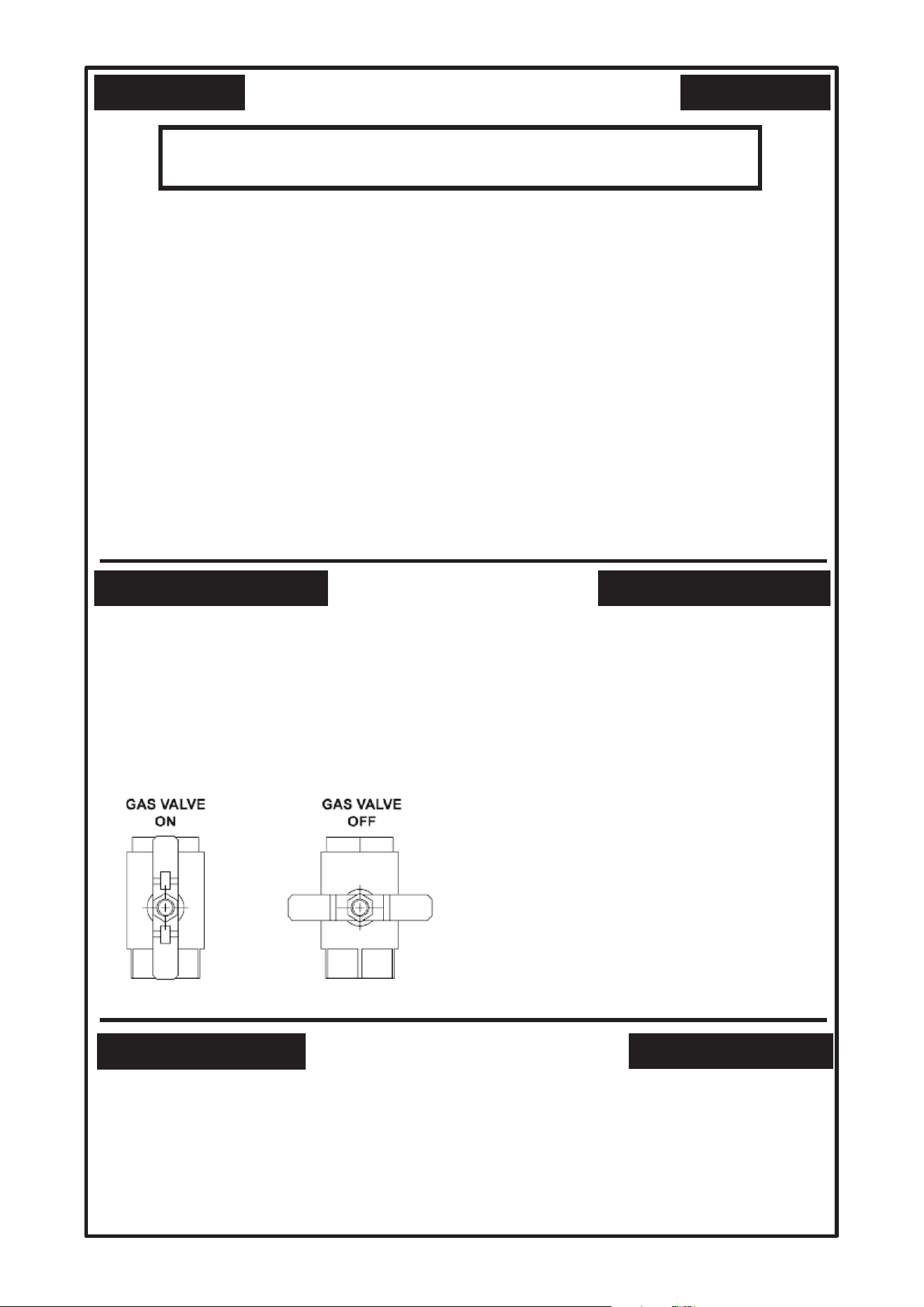
6. Turn gas shutoff valve to “off”. Handle will be
across the piping, do not force.
7. Wait five (5) minutes to clear out any gas. If you
then smell gas, STOP! Follow “B” in the safety
information above on this label. If you don’t smell
gas, go to next step.
8. Turn gas shutoff valve to “on”. Handle will be in
line with piping.
9. Install front cover.
10. Turn on all electric power to appliance.
11. Set thermostat to desired setting.
12. If the appliance will not operate, follow the
instructions “To Turn Off Gas To Appliance” and call
your service technician or gas supplier.
ihii li
TO TURN OFF GAS TO APPLIANCE
1. Set the thermostat to lowest setting.
2. Turn off all electric power to the appliance if service
is to be performed.
3. Remove front cover.
4. Turn gas shutoff valve “off”. Handle will be across
the piping. Do not force.
5. Install front cover.
FOR YOUR SAFETY READ BEFORE OPERATING
device which automatically lights the
smell
heavier than
electrical switch
electrical power to the appliance.
“OFF” position. Handle
“OFF” position. Handle will
be across the piping. Do not force.
“ON” position. Handle
will be across the piping, do not force.
will be in line with piping.
electrical power to the appliance.
electrical power to the appliance if
service is to be performed.
3
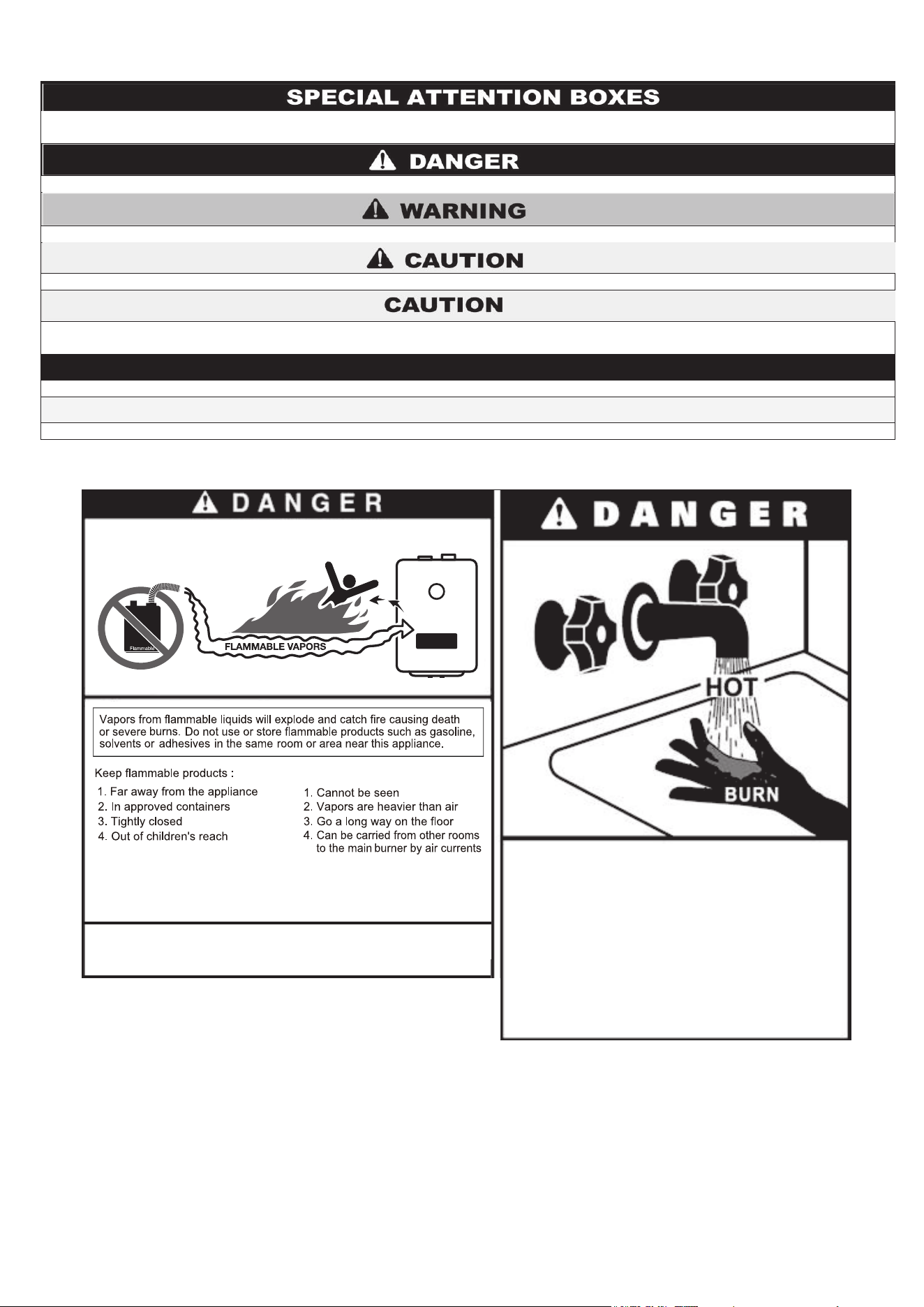
The following defined terms are used throughout this manual to bring attention to the presence of hazards of various risk
levels, or to important product information.
DANGER indicates an imminently hazardous situation which, if not avoided, will result in death or serious injury.
WARNING indicates a potentially hazardous situation which, if not avoided, could result in death or serious injury.
CAUTION indicates a potentially hazardous situation which, if not avoided, may result in minor or moderate injury .
CAUTION used without the safety alert symbol indicates a potentially hazardous situation which, if not avoided, may result in property
damage.
NOTICE
NOTICE is used to address practices not related to personal injury.
SAFETY INSTRUCTIONS
SAFETY INSTRUCTIONS (or equivalent) signs indicate specific safety related instructions or procedures.
NOTE: Contains additional information important to a procedure.
The following defined terms are used throughout this manual to bring attention to the presence of hazards of various risk
levels, or to important product information.
DANGER indicates an imminently hazardous situation which, if not avoided, will result in death or serious injury.
WARNING indicates a potentially hazardous situation which, if not avoided, could result in death or serious injury.
CAUTION indicates a potentially hazardous situation which, if not avoided, may result in minor or moderate injury .
CAUTION used without the safety alert symbol indicates a potentially hazardous situation which, if not avoided, may result in property
damage.
NOTICE
NOTICE is used to address practices not related to personal injury.
SAFETY INSTRUCTIONS
SAFETY INSTRUCTIONS (or equivalent) signs indicate specific safety related instructions or procedures.
NOTE: Contains additional information important to a procedure.
Installation warnings :
Do not install appliance where ammable products will be stored or used
unless the main burner is at least 18" above the oor. This will reduce, but
not eliminate the risk of vapors being ignited by the main burner.
Read and follow appliance warnings and instructions, if owners manual is
missing, contact the retailer or manufacturer.
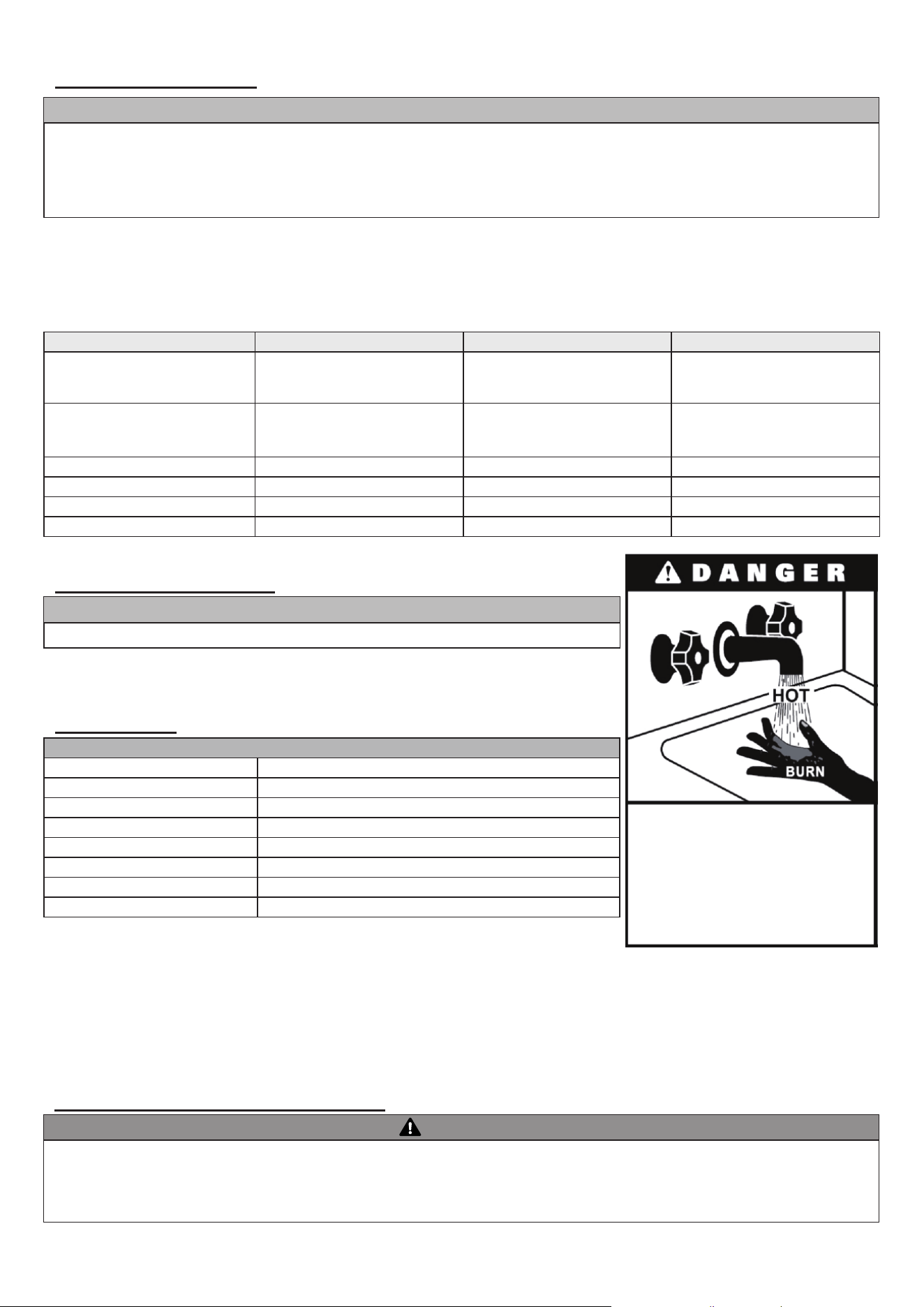
Water Temperature over 125°F can cause
severe burns instantly or death from scalds.
Children, disabled and
elderly are at highest risk of being scalded.
See instruction manual before setting the DHW
temperature at the Combi Boiler.
Feel water before bathing or showering.
Temperature limiting valves are available, see
manual.
Vapors
4
FOREWORD
This manual is intended to be used in conjunction with other literature provided with the appliance. This includes all related control information. It is
important that this manual, all other documents included with this system, and additional publications including the National Fuel Gas Code, ANSI
Z223.1-Latest Edition, be reviewed in their entirety before beginning any work.
Installation should be made in accordance with the regulations of the Authority Having Jurisdiction, local code authorities, and utility companies
which pertain to this type of water heating equipment.
Authority Having Jurisdiction (AHJ) – The Authority Having Jurisdiction may be a federal, state, local government, or individual such as a re
chief, re marshal, chief of a re prevention bureau, labor department or health department, building ofcial or electrical inspector, or others having
statutory authority. In some circumstances, the property owner or his/her agent assumes the role, and at government installations, the commanding
ofcer or departmental ofcial may be the AHJ.
NOTE: Rheem reserves the right to modify product technical specications and components without prior notice.
FOR THE INSTALLER
This appliance must be installed by qualied and licensed personnel. The installer should be guided by the instructions furnished with the appliance,
and with local codes and utility company requirements. In the absence of local codes, preference should be given to the National Fuel Gas Code,
ANSI Z223.1-Latest Edition.
INSTALLATIONS MUST COMPLY WITH:
Local, state, provincial, and national codes, laws, regulations and ordinances.
The latest version of the National Fuel Gas Code, ANSI Z223.1, from American Gas Association Laboratories, 8501 East Pleasant Valley Road,
Cleveland, OH 44131.
In Canada – CAN/CSA - B149.1 (latest version) from Canadian Standards Association, 5060 Spectrum Way, Suite 100, Mississauga, Ontario,
Canada L4W 5N6
The latest version of the National Electrical Code, NFPA No. 70.
This manual must only be used by a qualied heating appliance installer/service technician. Read all instructions in this manual before installing.
Perform steps in the order given. Failure to comply could result in substantial property damage, severe personal injury, or death.
DANGER
WARNING
The hydronic supply and return connections of these products are for installation in closed loop systems ONLY! Use of this product in
any manner other than described in this manual may result in premature product failure, substantial property damage, severe personal injury, or
death. Damage or failure of this product (or the system in which it is installed) due to unauthorized use IS NOT COVERED BY WARRANTY.
NOTE:The gas manifold and controls met safe lighting and other performance criteria when the appliance underwent tests
specied in ANSI Z21.13 – latest edition.
boiler.

5
TABLE OF CONTENTS
PART 1 – ITEMS SHIPPED WITH THE APPLIANCE............................................................................................7
PART 2 – SAFETY REGULATIONS.............................................................................................................................8
A. OPERATION AND INSTALLATION WARNINGS..................................................................................................8
B. IMPROPER COMBUSTION.................................................................................................................................9
C. GAS......................................................................................................................................................................9
D. WHEN SERVICING THE APPLIANCE.................................................................................................................9
E. WATER CHEMISTRY..........................................................................................................................................10
F. FREEZE PROTECTION......................................................................................................................................10
G. SCALDING.........................................................................................................................................................10
H. HIGH ELEVATION INSTALLATIONS ................................................................................................................10
PART 3 – TECHNICAL SPECIFICATIONS..............................................................................................................11
PART 4 – PREPARE APPLIANCE LOCATION......................................................................................................13
A. UNCRATING THE APPLIANCE..........................................................................................................................13
B. BEFORE LOCATING THE APPLIANCE.............................................................................................................14
C. LEVELING..........................................................................................................................................................15
D. CLEARANCES FOR SERVICE ACCESS...........................................................................................................15
E. RESIDENTIAL GARAGE AND CLOSET INSTALLATIONS................................................................................16
F.
EXHAUST VENT AND INTAKE PIP
E
.............................................
..
.................
..........................
......................16
G. CARBON MONOXIDE DETECTORS................................................................................................................16
H. PREVENT COMBUSTION AIR CONTAMINATION............................................................................................17
I. REMOVING AN APPLIANCE FROM A COMMON VENT SYSTEM.....................................................................17
J. WALL-MOUNTING THE APPLIANCE.................................................................................................................18
PART 5 – VENTING.........................................................................................................................................................19
A. INTAKE PIPE AND EXHAUST VENT GUIDELINES...........................................................................................19
B. APPROVED VENT MATERIALS.........................................................................................................................22
C. ALLOWED COMBINED VENT LENGTHS..........................................................................................................22
D. TIGHTENING APPLIANCE COLLAR TO EXHAUST VENT AND INTAKE PIPE...............................................23
E. VENT TERMINATION.........................................................................................................................................24
1. Direct Vent, Two Pipe Roof and Sidewall Vent Terminations..........................................................................24
2. Direct Vent, Optional Horizontal and Vertical Vent Kits................................................................................. 25
3. Screen Installation.........................................................................................................................
.....
...........25
4. Power Venting, Indoor Combustion Air Installation in Conned or Unconned Space....................................26
PART 6 – INSTALL THE CONDENSATE DRAIN...................................................................................................28
PART 7 – GAS PIPING...................................................................................................................................................29
A. GAS PIPE SIZING TABLES ...............................................................................................................................29
1. Gas Pipe Sizing..............................................................................................................................................29
Natural Gas Pipe Sizing.................................................................................................................................29
LP (Liquid Propane) Gas Pipe Sizing.............................................................................................................29
B. GAS CONNECTION REQUIREMENTS.............................................................................................................30
PART 8 – WATER PIPING.............................................................................................................................................32
A. GENERAL PLUMBING CONNECTION GUIDELINES........................................................................................32
B. DHW PIPING......................................................................................................................................................32
C. CENTRAL HEATING PIPING SYSTEM WATER PIPING METHODS................................................................34
D. CH AND DHW PRESSURE RELIEF VALVE ......................................................................................................38
PART 9 – CONNECT ELECTRICAL POWER / INITIAL STARTUP.................................................................38
A. GENERAL OPERATING CONDITIONS..............................................................................................................39
B. WIRING INFORMATION................................................................................................................
...............
.....39
C. DIP SWITCHES..................................................................................................................................................39

6
PART 10 – OPERATING SYSTEM INSTRUCTIONS............................................................................................45
A. CONTROL PANEL..............................................................................................................................................45
B. LCD DISPLAY DESCRIPTIONS.........................................................................................................................46
C. START-UP SEQUENCE.....................................................................................................................................46
D. CHANGING THE DHW SET-POINT...................................................................................................................47
E. SETTING FOR DHW PREHEAT ACTIVATION...................................................................................................48
F. SETTING FOR DHW PREHEAT TIMER.............................................................................................................48
G. STATUS DISPLAY MODE................................................................................................................................. 49
H. CHANGE THE CH SET-POINT..........................................................................................................................49
I. INSTALLER MODE..............................................................................................................................................50
J. ERROR MODE...................................................................................................................................................53
K. OUTDOOR TEMPERATURE MODE (OPTIONAL)............................................................................................55
L. 0~10 VDC INPUT................................................................................................................................................55
PART 11 – START-UP PREPARATION ....................................................................................................................56
A. CHECK / CONTROL WATER CHEMISTRY .......................................................................................................56
. B. GLYCOL ANTIFREEZE SOLUTIONS.................................................................................................................57
C. CHECK FOR GAS LEAKS .................................................................................................................................57
D. FILL AND TEST WATER SYSTEM.....................................................................................................................58
E. PURGE AIR FROM CH SYSTEM ......................................................................................................................58
F. PURGE AIR FROM DHW SYSTEM ...................................................................................................................59
G. CHECK THERMOSTAT CIRCUIT(S).................................................................................................................59
H. CONDENSATE REMOVAL ................................................................................................................................60
I. FINAL CHECKS BEFORE STARTING APPLIANCE ...........................................................................................60
J. ADJUSTING GAS PRESSURE AT THE APPLIANCE ........................................................................................60
K. SETTING AND VERIFYING THE COMBUSTION SETTING .............................................................................61
PART 12 – INSTALLATION AND START-UP CHECKLIST ...............................................................................62
PART 13 – TROUBLESHOOTING .............................................................................................................................64
PART 14 – ANNUAL MAINTENANCE PROCEDURES ......................................................................................65
CASE PART ...........................................................................................................................................................69
HEAT EXCHANGER PART.....................................................................................................................................71
FAN MOTOR PART ...............................................................................................................................................73
START-UP REPORT ..............................................................................................................................................75
MAINTENANCE REPORT .....................................................................................................................................76
MAINTENANCE NOTES .......................................................................................................................................77
CUSTOMER INSTALLATION RECORD FORM.....................................................................................................78
7
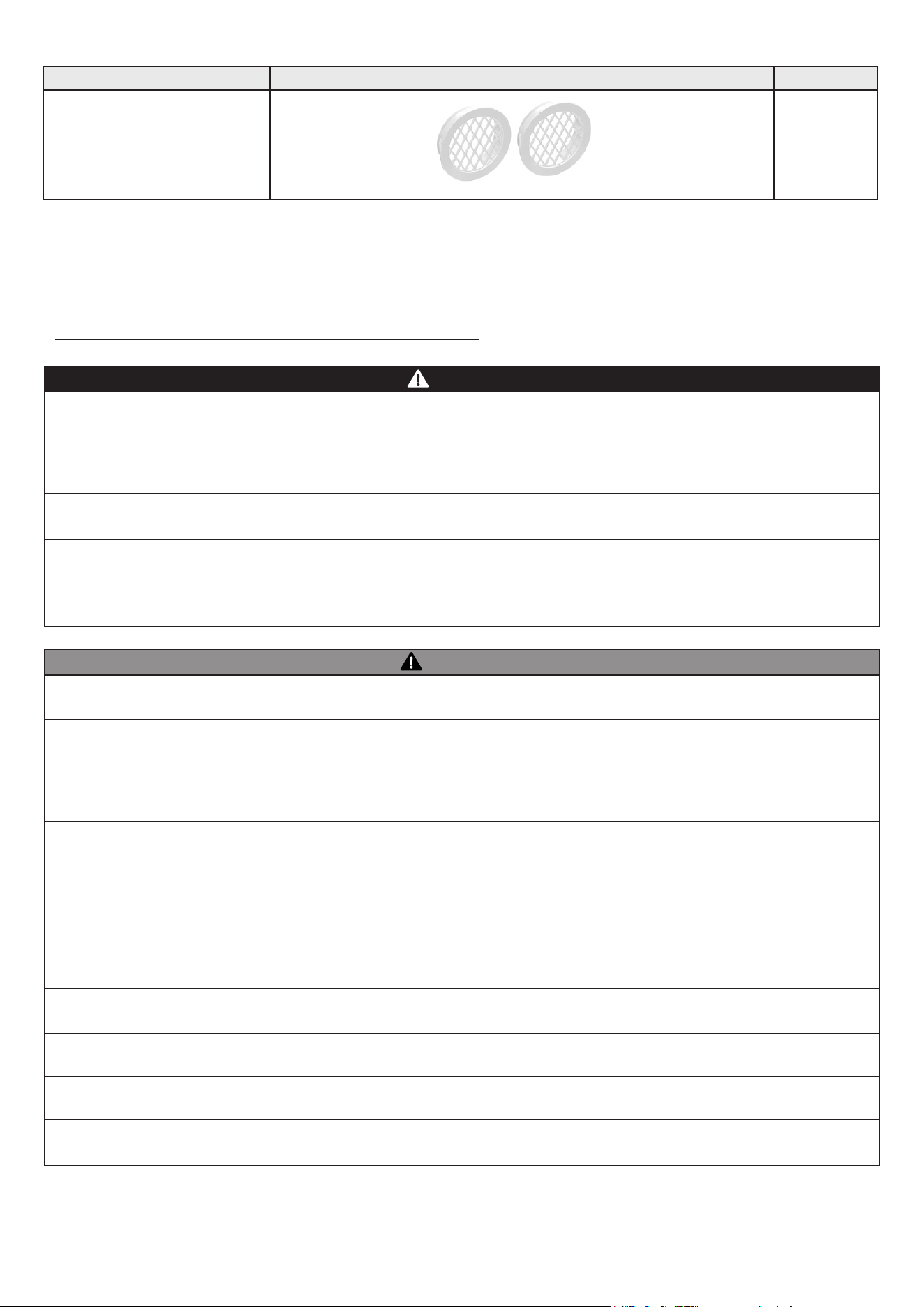
PART 1 – ITEMS SHIPPED WITH THE APPLIANCE
ITEM DESCRIPTION QUANTITY
Combi Appliance
1
Use and Care Manual
1
CH Pressure Relief Valve
(CH Line ¾" 30 psi)
1
Vent Screens (3") 2 Screens
Outdoor Temperature Sensor
1
Emergency Kit
1
Anchors and Wall Mounting Bracket
1
8
PART 2 –SAFETY REGULATIONS
ITEM DESCRIPTION PART NUMBER
Vent Screens (2" Mesh)
2 Screens
Table 1 – Items Included with the Appliance
▪ A. OPERATION AND INSTALLATION WARNINGS
To save time and money, review the following initial diagnostic steps before calling for service.
Vapors from ammable liquids will explode and can cause a re, resulting in personal injury or death. The appliance has a burner that can come
on at any time and ignite vapors. DO NOT use or store ammable liquids around the appliance.
Improper venting can cause a build-up of carbon monoxide. Breathing carbon monoxide can result in brain damage or death. DO NOT operate
the appliance unless it is properly vented to the outside and has an adequate fresh air supply for safe operation. Inspect the exterior exhaust gas
outlet port and fresh air inlet port on a regular basis to ensure they are functioning properly.
A concentration of carbon monoxide as small as .04% (400 parts per million) in the air can be fatal. When making high re or low re adjustments,
CO levels must be monitored using a ue gas analyzer such that a CO level of no more than 400 ppm is exceeded at any time during operation.
Adjusting the “low re offset" on the gas valve in even small increments can result in a signicant increase in CO concentration. To avoid serious
injury or death, DO NOT make any adjustments to the gas valve without monitoring the exhaust gases with a fully functional and calibrated ue
gas analyzer.
Failure to follow these statements will result in property damage, severe personal injury, or death.
DANGER
WARNING
This appliance must be installed by a licensed plumber, licensed gas tter, and/or professional service technician. Improper installation and/or
operation can cause a potentially hazardous situation, which, if not avoided, could result in serious injury or death, and will void the warranty.
Rheem Manufacturing Company cannot anticipate every circumstance that might involve a potential hazard. Each installation has its own
specialized characteristics, requirements, and possible hazards. Therefore, all possible incidents are not included in these warnings. Proper and
safe installation, operation, and service are the responsibility of the professional service technician.
Proper care of the appliance is the user’s responsibility. Ensure the user carefully reads and understands the User’s Information Manual before
operating and maintaining the appliance.
Make sure the user knows the location of the gas shut-off valve and how to operate it. Immediately close the gas shut-off valve if the appliance
is subjected to re, overheating, ood, physical damage, or any other damaging condition that might affect the operation of the unit. Have the
appliance checked by a qualied technician before resuming operation.
Do not power up the unit unless the gas and water supply valves are fully opened. Make sure the fresh air intake port and exhaust gas port are
open and functional.
No one but a professional service technician should attempt to install, service, or repair this appliance. There are no serviceable parts which can
be changed by the user / owner. User / Owner: Contact the original professional service technician if theappliance needs repair or maintenance. If
the original technician is unavailable, ask your gas supplier for a list of qualied service providers.
Keep the area around the appliance clean and free of all materials that can burn. DO NOT store or place gasoline, oils, spray paint, or other
ammable products near the appliance.
DO NOT use spray paint, hair spray, or any other ammable spray near the appliance or near the exterior fresh air intake port. DO NOT place any
items in or around the exterior exhaust gas outlet port and/or fresh air inlet port that could restrict or block the ow in or out of the vent system.
DO NOT store or place newspapers, laundry, or other combustible items near the appliance or the exterior exhaust gas outlet and/or fresh air inlet
port.
The owner should inspect the system monthly for damage, water stains, signs of rust, corrosion, and exhaust vent and air intake blockage. If
inspection of the unit shows signs of damage, the appliance should be shut off until the problem is repaired by a qualied technician.
9
WARNING
WARNING
WARNING
CAUTION
NOTICE
▪ B. IMPROPER COMBUSTION
▪ C. GAS
Should overheating occur or gas supply fails to shut off, do not turn off or disconnect electrical supply to the water heating appliance.
Instead, shut off the gas supply at a location external to the appliance.
▪ D. WHEN SERVICING THE APPLIANCE
ㆍ
To avoid electric shock, disconnect electrical supply before performing maintenance.
ㆍ
To avoid severe burns, allow appliance to cool.
ㆍ
Do not use petroleum-based cleaning or sealing compounds in an appliance system. Gaskets and seals in the system may be damaged, possibly
resulting in substantial property damage.
ㆍ
Always verify proper operation after servicing the appliance.
After installation, all appliance safety devices should be tested.
DO NOT USE THIS APPLIANCE IF ANY PART HAS BEEN SUBMERGED IN WATER. Immediately call a qualied service technician. The
appliance MUST BE replaced if it has been submerged. Attempting to operate an appliance that has been submerged could create numerous
harmful conditions, such as a potential gas leakage causing a re and/or explosion, or the release of mold, bacteria, or other harmful particulates
into the air. Operating a previously submerged appliance could result in property damage, severe personal injury, or death.
NOTE: Appliance damage due to ood or submersion is considered an Act of God, and IS NOT covered under product warranty.
Do not obstruct the ow of combustion and ventilating air. Adequate air must be provided for safe operation. Failure to keep the exhaust vent and
intake pipe clear of ice, snow, or other debris could result in property damage, serious personal injury, or death.
Due to the low water content of the appliance, improper sizing of the appliance with regard to heating system load will result in excessive cycling
and accelerated component failure. Rheem DOES NOT warrant failures caused by improperly sized appliance applications. DO NOT oversize the
appliance to the system. Modular appliance installations greatly reduce the likelihood of appliance oversizing.
Be sure to disconnect electrical power before opening appliance cabinet or performing service. Label all wires while performing service to ensure
proper re-wiring of the appliance. Wiring errors can cause improper or dangerous operation. Failure to do so could result in an electrical shock,
improper appliance operation, property damage, serious personal injury, or death.
Any claims for damage or shortage in shipment must be led immediately against the transportation company by the consignee.
This appliance is certied for indoor installations only. The appliance consists of gas ignition system components which must be protected from
water (dripping, spraying, etc.) during operation and service. Carefully consider installation location and the placement of critical components
(circulators, condensate neutralizers, etc.) before installing the appliance.
This appliance provides a overheat shutdown limit. In the event the appliance water exceeds the set point of the control limit, the cutoff will trip
and the appliance will shut down. Certain local codes require additional temperature limits. In addition, certain types of systems may operate at
temperatures below the minimum set point of the limit provided with the appliance. Contact a qualied service technician for additional overheat
controls.
DO NOT allow children to operate this unit. DO NOT use this unit if it does not appear to be operating correctly. A qualied technician should
service and inspect the appliance annually.
The appliance DHW temperature is factory set to 125°F (51°C). To avoid scalding, always check the temperature of the hot water before bathing,
showering, washing, etc. DO NOT adjust the water temperature while the appliance is being used by other persons.
If the appliance is exposed to the following, do not operate until all corrective steps have been made by a qualied service technician:
1. FIRE
2. DAMAGE
3. WATER
This appliance is equipped with a three prong 120 VAC plug. It should only be plugged directly into a properly grounded three prong 120 VAC
receptacle. DO NOT remove the ground plug from the plug.
DO NOT alter or modify the appliance or appliance controls. This can be dangerous and WILL VOID the warranty.
Failure to follow these statements could result in property damage, severe personal injury, or death.
NOTE: When inquiring about service or troubleshooting, reference the model and serial numbers from the appliance rating label.
10
▪ E. WATER CHEMISTRY
▪ F. FREEZE PROTECTION
▪ G. SCALDING
The water must be potable, free of corrosive chemicals, sand, dirt, and other contaminates. It is up to the installer to ensure the water does not
contain corrosive chemicals or elements that can damage the heat exchanger. Potable water is dened as drinkable water supplied from utility or
well water in compliance with EPA secondary maximum contaminant levels (40 CFR Part 143.3) as shown in the table below. If the water contains
contaminants higher than outlined by the EPA, water treatment is recommended and additional, more frequent maintenance may be required.
If you suspect that your water is contaminated in any way, discontinue use of the appliance and contact an authorized technician or licensed
professional.
CAUTION
CAUTION
Chemical imbalance of the water supply may affect efciency and cause severe damage to the appliance and associated equipment. Water quality
must be professionally analyzed to determine whether it is necessary to treat the water. Various solutions are available to adjust water quality.
Adverse water quality will affect the reliability of the system. In addition, operating temperatures above 135°F will accelerate the build-up of lime
scale and possibly shorten appliance service life. Failure of an appliance due to lime scale build-up, low pH, or other chemical imbalance IS NOT
covered by the warranty.
Consider appliance piping and installation when determining appliance location.
Contaminant Maximum Allowable Level Contaminant Maximum Allowable Level
Total Hardness
(Residential Use - Below 140°F
water temperature)
200 mg/l
(12 grains/gallon)
Manganese 0.05 mg/l or PPM
Total Hardness
(Commercial Use - 140°F and above
water temperature)
120 mg/l
(7 grains/gallon)
pH 6.5-8.5
Aluminum 0.05 to 0.2 mg/l or PPM Sulfate 205 mg/l or PPM
Chloride 100 mg/l or PPM Total Dissolved Solids (TDS) 500 mg/l or PPM
Copper 1 mg/l or PPM Zinc 5 mg/l or PPM
Iron 0.3 mg/l or PPM Dissolved Carbon Dioxide (CO
2
) 15 mg/l or PPM
Table 2 – Water Chemistry Specications
Table 3 – Time and Temperature Relationship in Scalds
APPROXIMATE TIME / TEMPERATURE RELATIONSHIPS IN SCALDS
120°F More than 5 minutes
125°F 1 ½ to 2 minutes
130°F About 30 seconds
135°F About 10 seconds
140°F Less than 5 seconds
145°F Less than 3 seconds
150°F About 1 ½ seconds
155°F About 1 second
NOTE: Damages resulting from incorrect installation or from use of products not approved by Rheem ARE
NOT covered by warranty.
This heater can deliver scalding water. Be careful whenever using hot water to avoid scalding injury. Certain appliances, such as dishwashers and automatic
clothes washers may require increased water temperature. By setting the thermostat on this heater to obtain the increased water temperature required by
these appliances, you may create the potential for scald injury.
To protect against injury, you should install a mixing valve in the water system. This valve will reduce point of discharge temperature by mixing cold and hot
water in branch supply lines. Such valves are available from your local plumbing supplier.
Table 3 details the relationship of water temperature and time with regard to scald injury and may be used as a guide in determining the safest water
temperature for your applications.
Water Temperature over 125°F can cause
severe burns instantly or death from scalds.
Children, disabled and elderly are at highest risk of
being scalded.
See instruction manual before setting the DHW
temperature at the Combi Boiler.
Feel water before bathing or showering.
Temperature limiting valves are available, see
manual.
WARNING
▪ H. HIGH ELEVATION INSTALLATIONS
The water heater is certied for installations up to 2000 ft. (610 m) above sea level. The input rating of this water heater is based on sea level
operation. At higher elevations, the actual input rate may be lower than the value listed on the rating label due to the derating of Natural Gas and
LP Gas.
For installations above 2000 ft. (610 m) elevation, contact a qualied service technician to make the proper altitude adjustments.
To adjust parameters for high elevation, see INSTALLER MODE, this manual.
11
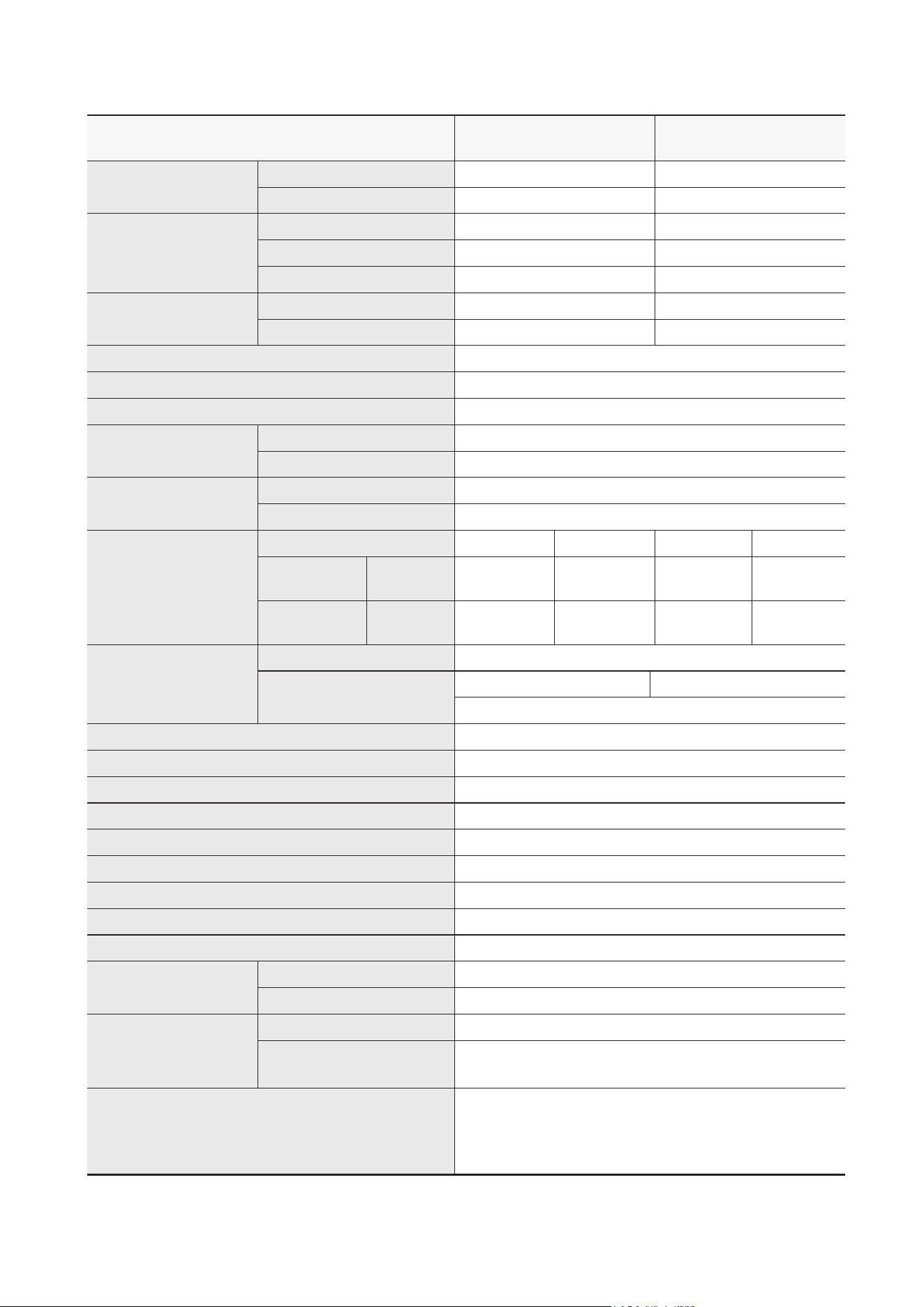
Table 4 – Technical Specications
PART 3 –TECHNICAL SPECIFICATIONS
Model
120K Heating
(199K DHW) Btu/hr
100K Heating
(180K DHW) Btu/hr
Gas Input Rate
(DHW mode)
MAX 199,000 Btu/h (58.3 kW/h) 180,000 Btu/h (52.7 kW/h)
MIN 18,000 Btu/h (5.2 kW/h) 18,000 Btu/h (5.2 kW/h)
DHW Capacity
35°F Rise 9.9 GPM (37.4 LPM) 9.0 GPM (34 LPM)
45°F Rise 7.7 GPM (29.1 LPM) 7.0 GPM (26.4 LPM)
77°F Rise 4.5 GPM (17 LPM) 4.1 GPM (15.5 LPM)
Gas Input Rate
(Heating mode)
MAX 120,000 Btu/h (35.1 kW/h) 100,000 Btu/h (29.3 kW/h)
MIN 18,000 Btu/h (5.2 kW/h) 18,000 Btu/h (5.2 kW/h)
Installation Indoor Wall Hung
Flue System Sealed Combustion Direct Vent, Single Vent
Max Vent Run 2″(50ft) / 3″(100ft) Schedule 40 PVC, CPVC, PP
Orice Size
NG (Gas / Needle) 0.342″(8.7mm) / 0.354″(9.0mm)
LP (Gas / Needle) 0.259″(6.6mm) / 0.259″(6.6mm)
Gas Supply Pressure
NG 3.5" WC to 10.5" WC (0.87 kPa to 2.62 kPa)
LP 8.0" WC to 14.0" WC (1.99 kPa to 3.49 kPa)
Manifold Pressure
Gas Type NG LP NG LP
Low Fire 2″/ 3″ VENT
-0.04" WC
(-10 Pa)
-0.04" WC
(-10 Pa)
-0.04" WC
(-10 Pa)
-0.04" WC
(-10 Pa)
High Fire 2″/ 3″ VENT
-0.32" WC
(-80 Pa)
-0.28" WC
(-70 Pa)
-0.28" WC
(-70 Pa)
-0.26" WC
(-65 Pa)
Power Supply
Main Supply 120VAC 60Hz
Maximum
Power Consumption
187W(71W+116W Pump) 180W (64W + 116W Pump)
120VAC Max 2A External Pump (Optional)
Ignition System Direct Electronic Ignition / Automatic Flame Sensing
Burner System Premixed Metal Fiber Burner
Gas Valve System Air Ratio Valve
Minimum Flow Activation Flow 0.5 GPM (2 LPM)
Internal Pipe Material STS 304, Copper Tubing
Dimensions W17.3″ – H28.7″ – D14.8″ (W440mm - H730mm - D375mm)
Weight 90lb (40kg)
Water Holding Capacity Under 2 Gallons (7.5 Liters)
Control Panel /Circuit Board
P-960C / NGTX-9600C
Water Pressure
MAX DHW 150 psi (10.5 kgf/cm
2
) / Heating 30 psi (2.1 kgf/cm
2
)
MIN DHW 15 psi (1 kgf/cm
2
) / Heating 12 psi (0.8 kgf/cm
2
)
Materials
Case Cold Rolled Carbon Steel
Heat Exchanger
Primary Heat Exchanger : STS 304
Secondary Heat Exchanger : STS 304
Safety Devices
Flame Sensor, High Limit Switch ,
Gas Leakage Detector
,
Water Leakage Detector
Exhaust Thermistor, Pressure Sensor
Heating Supply Thermistor
12
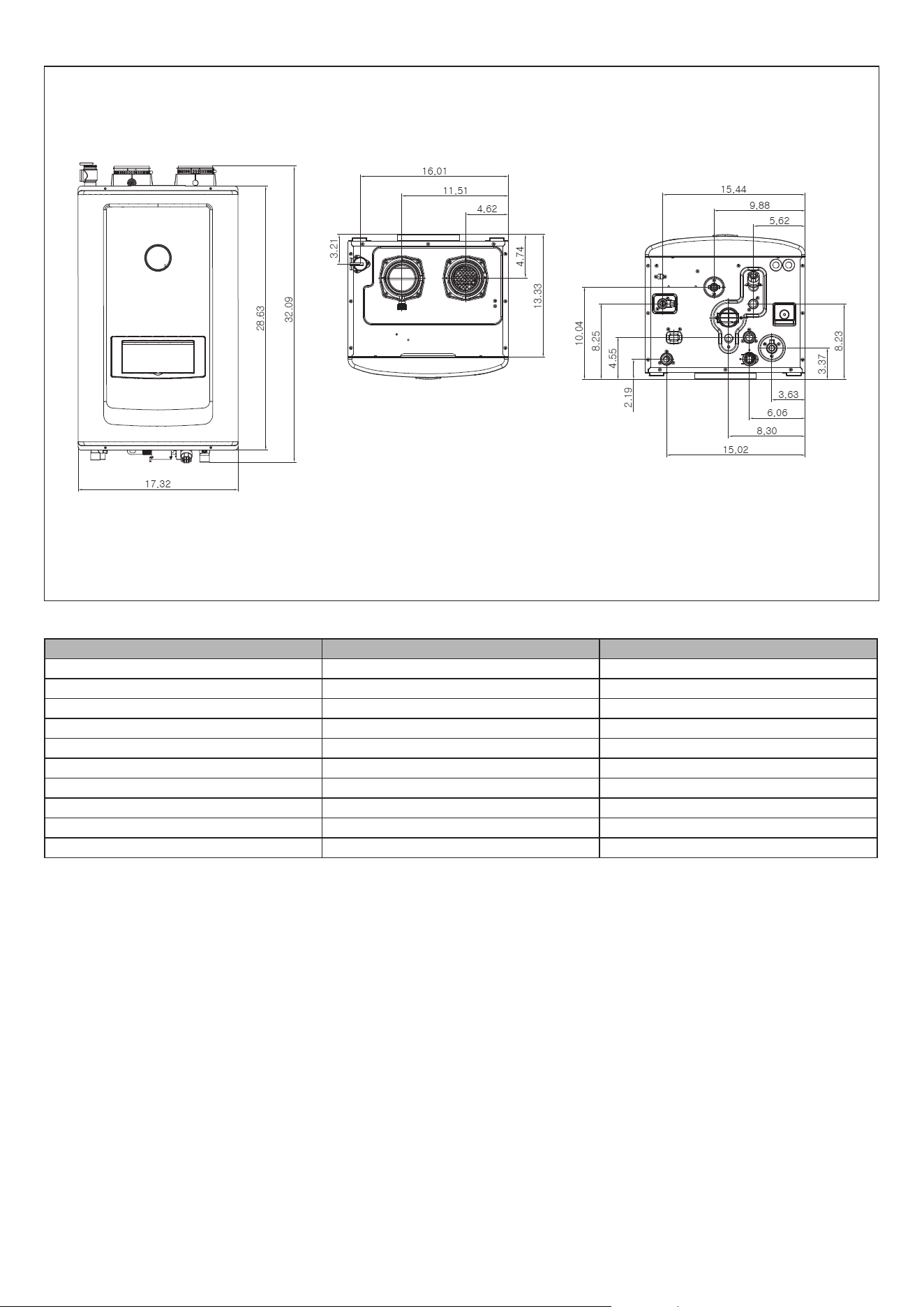
DESCRIPTION DIAMETER (ALL NPTM)
ⓐ Pressure Relief Valve for Heating 3/4"
ⓑ Exhaust Vent Connection 3"
ⓒ Intake Pipe Connection 3"
ⓓ CH Supply Connection 1"
ⓔ CH Return Connection 1"
ⓕ DHW Outlet Connection 3/4"
ⓖ DHW Inlet Connection 3/4"
ⓗ Auto Feeder Inlet Connection 1/2"
ⓘ Gas Connection 3/4"
ⓙ Condensate Drain Connection 1/2"
Figure 1 – Specications and Dimensions
G
ཁG
གG
གྷG
ངG
ཅG
ཆG
ཇG
G
ཉG
ཊG
Table 5 – Adapter Specications
13
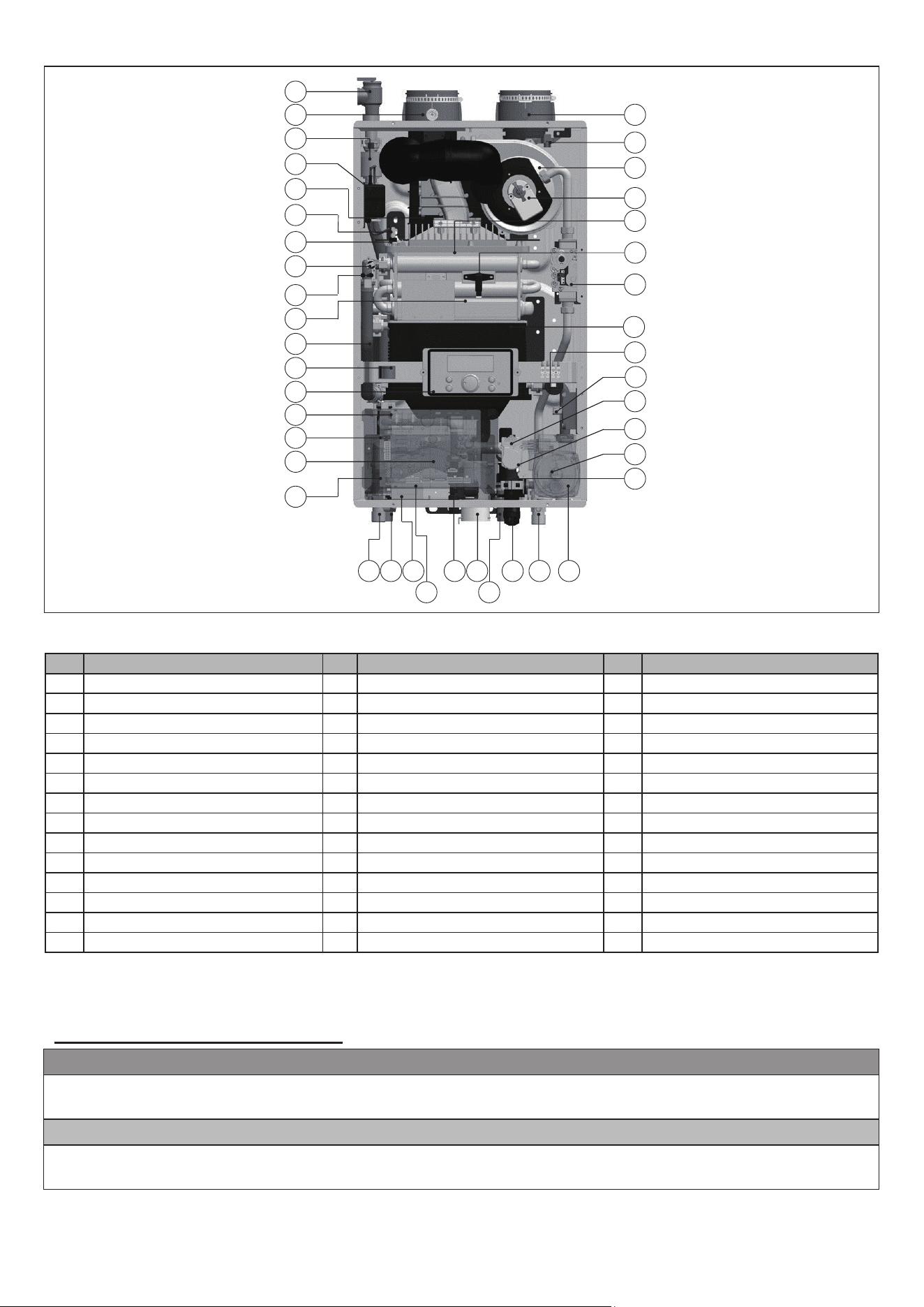
NO Name of Component NO Name of Component NO Name of Component
1 Pressure Relief Valve 15 3-Way Valve 29 Heating Return Thermistor
2 Exhaust 16 DHW Plate Heat Exchanger 30 Water Flow Sensor
3 Air Vent 17 DHW Thermistor 31 Flow Control Valve
4 Igniter 18 DHW Connection 32 Air Pressure Switch
5 Exhaust Thermistor 19 Heating Supply Connection 33 Pressure Sensor
6 Ignition Rod 20 Water Leakage Detector 34 Secondary Heat Exchanger
7 Burner Limit Switch 21 AC 24V Transformer 35 Gas Valve
8 High Limit Switch 22 Auto Feeder Connection 36 Flame Sensor
9 Heating Supply Thermistor 23 Condensate Trap 37 Burner
10 Primary Heat Exchanger 24 Heating Return Connection (Filter) 38 AGM (Air Gas Mixer)
11 Heating Outlet Pipe 25 DHW Cold Water Connection 39 Fan Motor
12 Manual Power Switch 26 Gas Connection 40 Air Inlet Filter
13 Control Panel 27 Circulation Pump 41 Air Intake
14 Circuit Board 28 DHW Cold Water Thermistor
Figure 2 – Model Components
Table 6 – Component List
IMPORTANT
CAUTION
▪ A. UNCRATING THE APPLIANCE
UNCRATING APPLIANCE – Any claims for damage or shortage in shipment must be led immediately against the transportation company by the
consignee.
Cold weather handling – If appliance has been stored in a very cold location (below 0°F) before installation, handle with care until the plastic
components come to room temperature.
PART 4 –PREPARE APPLIANCE LOCATION
Remove all sides of the shipping crate to allow the appliance to be lifted into its installation location.
2. Page 13
1
4
7
8
11
12
14
15
16
18
19
20
21
22
23
24
25
26
27
28
29
30
31
32
34
33
35
36
37
38
2
39
40
41
3
5
6
17
9
10
13
14
WARNING
WARNING
WARNING
CAUTION
CAUTION
CAUTION
CAUTION
▪ B. BEFORE LOCATING THE APPLIANCE
Incorrect ambient conditions can lead to damage to the heating system and put safe operation at risk. Ensure that the appliance installation
location adheres to the information included in this manual. Failure to do so could result in property damage, serious personal injury, or death.
This appliance is certied for indoor installations only. Do not install the appliance outdoors. Failure to install this appliance indoors could result in
substantial property damage, severe personal injury, or death.
Failure to keep appliance area clear and free of combustible materials, liquids, and vapors can result in substantial property damage, severe
personal injury, or death.
This appliance must be installed as described in this manual: upright, with the vent adapters in the vertical position. DO NOT attempt to install this
appliance in any other orientation. Doing so will result in improper appliance operation and property damage, and could result in serious personal
injury or death.
Carefully consider installation when determining appliance location. Please read the entire manual before attempting installation. Failure to
properly take factors such as appliance venting, piping, condensate removal, and wiring into account before installation could result in wasted
time, money, and possible property damage and personal injury.
Failure of appliance or components due to incorrect operating conditions IS NOT covered by product warranty.
The service life of the appliance’s exposed metallic surfaces, such as the casing, as well as internal surfaces, such as the heat exchanger, are
directly inuenced by proximity to damp and salty marine environments. In such areas, higher concentration levels of chlorides from sea spray
coupled with relative humidity can lead to degradation of the heat exchanger and other appliance components. In these environments, appliances
must not be installation using direct vent systems which draw outdoor air for combustion. Such appliances must be installed using room air for
combustion. Indoor air will have a much lower relative humidity and, hence, potential corrosion will be minimized.
Locate the appliance where any leakage from the relief valve, related piping, tank, or connections will not result in damage to surrounding areas
or lower oors of the building. The appliance should be located near a oor drain. RHEEM WILL NOT be held liable for leakage damages.
To conserve water and energy, insulate all water piping, especially the hot and recirculation water lines.
1. Installation Area (Mechanical Room) Operating Conditions
ㆍ
Ensure ambient temperatures are higher than 32°F/0°C and lower than 104°F/40°C.
ㆍ
Prevent the air from becoming contaminated by the products, places, and conditions listed in this manual.
ㆍ
Avoid continuously high levels of humidity
ㆍ
Never close existing ventilation openings
2. Check for nearby connections to:
ㆍ
System water piping
ㆍ
Venting connections
ㆍ
Gas supply piping
ㆍ
Electrical power
ㆍ
Condensate drain
3. Check area around appliance. Remove any combustible materials, gasoline, and other ammable liquids.
4. Gas control system components must be protected from dripping water during operation and service.
5. If the appliance is to replace an existing appliance, check for and correct any existing system problems, such as:
ㆍ
System leaks
ㆍ
Location that could cause the system and appliance to freeze and leak.
ㆍ
Incorrectly-sized expansion tank
15
WARNING
WARNING
CAUTION
CAUTION
Space must be provided with combustion/ventilation air openings correctly
sized for all other appliances located in the same space as the appliance.
The appliance cover must be securely fastened to prevent it from drawing
air from the appliance room. This is particularly important if the appliance
is in a room with other appliances. Failure to comply with the above could
result in substantial property damage, severe personal injury, or death.
Do not connect the appliance to any heating systems or components that have been previously used for non-potable applications.
Do not introduce toxic chemicals, such as antifreeze or appliance treatments, into the appliance or any piping meant for potable water purposes.
Ensure that all piping and components connected to the appliance are suitable for potable water applications.
Do not use this appliance only for space heating applications.
Failure to follow these instructions could result in property damage, personal injury, or death.
In order for the condensate to properly ow out of the collection system, the appliance must be installed level. Failure to ensure the appliance is
installed level will result in improper appliance operation.
Always take future maintenance into consideration when locating the appliance. If the appliance is located in an installation location with limited
clearances, it may be necessary to remove the appliance from the space to perform maintenance. Failure to consider maintenance when
determining installation location could result in property damage.
6. Clean and ush system when reinstalling an appliance.
NOTE: When installing in a zero clearance location, it may not be possible to read or view some product labeling. It is recommended to make note
of the appliance model and serial number.
NOTE: A combustible door or removable panel is acceptable front
clearance. A 3" minimum clearance must be provided from the appliance
front cover to the removable panel or combustible door.
MINIMUM CLEARANCES FROM COMBUSTIBLE MATERIALS
ㆍ
Hot water pipes – at least 1"(2.5cm) from combustible materials.
ㆍ
Exhaust vent pipe – at least 1"(2.5cm) from combustible materials
▪ C. LEVELING
To save time and money, review the following initial diagnostic steps before calling for service.
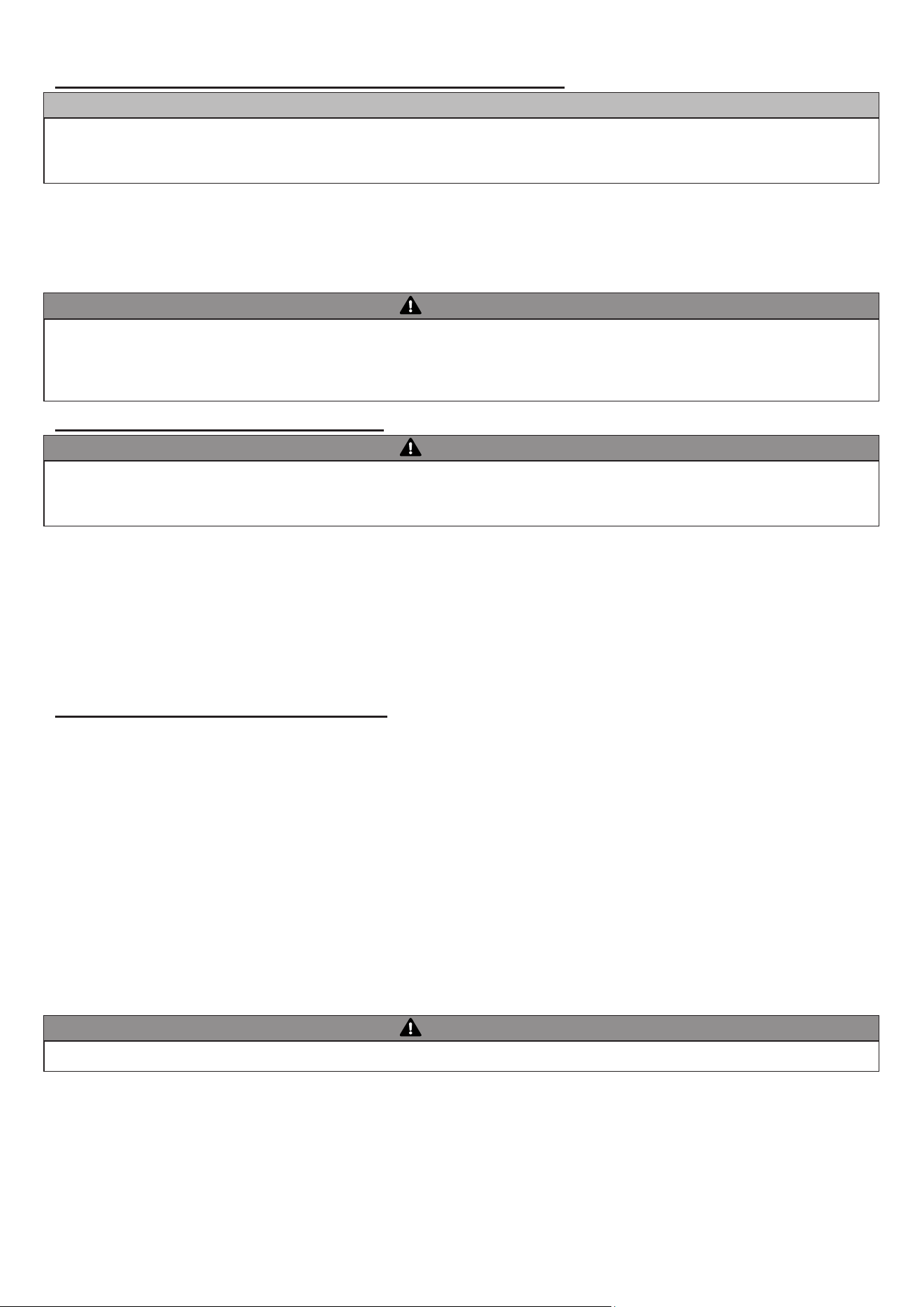
▪ D. CLEARANCES FOR SERVICE ACCESS
See Figure 3 and Table 7 for recommended service clearances. If these minimum clearances are not provided, it may not be possible to service
the appliance without removing it from the space.
Figure 3 – Minimum Service Clearances
MINIMUM CLEARANCES
Installation Clearances
from Non-Combustibles /
Combustibles
Recommended Service and Proper Operation
Clearances
Top 18 in. (45.7 cm)
Back 0 in. (0 cm)
Bottom 12 in. (30.45 cm)
Front 24 in. (60.9 cm)
Right Side
3 in. (7.6 cm)
Left Side
Table 7 – Minimum Installation and Service Clearances
16
WARNING
WARNING
WARNING
CAUTION
▪ E. RESIDENTIAL GARAGE AND CLOSET INSTALLATIONS
▪ F. EXHAUST VENT AND INTAKE PIPE
▪ G. CARBON MONOXIDE DETECTORS
The space must be provided with correctly sized combustion/ventilation air openings for all other appliances located in the space with the
appliance. For power venting installations using room air for combustion, refer to the venting section, this manual, for descriptions of conned and
unconned spaces. Do not install the appliance in an attic. Failure to comply with these warnings could result in substantial property damage,
severe personal injury, or death.
Vents must be properly supported. The appliance exhaust and intake connections are not designed to carry heavy weight. Vent support brackets
must be within 1’ of the appliance and the balance at 4’ intervals. Venting must be readily accessible for visual inspection for the rst 3’ from the
appliance.
Failure to comply with these requirements could result in product damage, severe personal injury, or death.
Check with your local Authority Having Jurisdiction for requirements when installing appliance in a garage or closet. Please read the entire
manual before attempting installation. Failure to properly take factors such as venting, piping, condensate removal, and wiring into account before
installation could result in wasted time, money, and possible property damage and personal injury.
PRECAUTIONS
If the appliance is located in a residential garage, it should be installed per the latest edition of the National Fuel Gas Code, ANSI Z223.1, and
CAN/CSA B149 Installation Code in Canada.
ㆍ
Mount the bottom of the appliance a minimum of 18" above the oor of the garage, to ensure the burner and ignition devices are well off the oor.
ㆍ
Locate or protect the appliance so it cannot be damaged by a moving vehicle.
In the Commonwealth of Massachusetts and As Required by State and Local Codes
Installation of Carbon Monoxide Detectors: At the time of installation or replacement of the vented gas fueled appliance, the installing plumber or
gas tter shall observe that a hard wired carbon monoxide detector with an alarm and battery back-up is installed on the oor level where the gas
appliance is installed, unless the appliance is located in a detached, uninhabitable structure separate from the dwelling, building, or structure used in
whole or in part for residential purposes.
In addition, the installing plumber or gas fitter shall observe that a hard wired carbon monoxide detector with an alarm and battery back-up is
installed on each additional level of the dwelling, building, or structure served by the vented gas appliance. It shall be the responsibility of the
property owner to secure the service of qualied licensed professionals for the installation of hard wired carbon monoxide detectors.
a. In the event that the vented gas fueled appliance is installed in a crawl space or attic, the hard wired carbon monoxide detector with alarm and
battery back-up shall be installed on the next adjacent oor level.
b. In the event that these requirements cannot be met at the time of completion of installation, the owner shall have a period of thirty (30) days to
comply with the above requirements; provided, however, that during said thirty (30) day period, a battery operated carbon monoxide detector with
an alarm shall be installed.
Approved Carbon Monoxide Detectors: Each carbon monoxide detector as required in accordance with the above provisions shall comply with NFPA
70 and be ANSI/UL 2034 listed and CSA certied.
NOTE: To prevent combustion air contamination, see Table 9 in this section when considering exhaust vent and intake pipe termination.
The appliance is rated ANSI Z21.13 Category IV (pressurized vent, likely to form condensate in the vent), and requires a special vent system
designed for pressurized venting.
Exhaust vent and intakepipe may be vented vertically through the roof or out a side wall. Venting methods are detailed in the Venting Section. Do
not attempt installation using any other means. Be sure the appliance exhaust vent and intake can be routed through the building and properly
terminated. Exhaust vent and intake piping lengths, routing, and termination method must comply with methods and limits given in the venting
section.
17
WARNING
WARNING
▪ H. PREVENT COMBUSTION AIR CONTAMINATION
▪ I. REMOVING AN APPLIANCE FROM A COMMON VENT SYSTEM
Breathing Hazard – Carbon Monoxide Gas
Breathing carbon monoxide can cause brain damage or death. Always read and understand
instruction manual.
Ensure that the intake air will not contain any of the contaminants below. For example, do not pipe intake near a swimming pool. Avoid areas
subject to exhaust fumes from laundry facilities. These areas always contain contaminants. Contaminated air will damage the appliance, resulting
in possible substantial property damage, severe personal injury, or death.
Install intake piping for the appliance as described in the Venting section. Do not terminate exhaust in locations that can allow contamination of
intake air.
NOTE: DAMAGE TO THE APPLIANCE CAUSED BY EXPOSURE TO CORROSIVE VAPORS IS NOT COVERED BY WARRANTY.
(Refer to the limited warranty for complete terms and conditions).
PRODUCTS TO AVOID AREAS LIKELY TO HAVE CONTAMINANTS
Spray cans containing uorocarbons Dry cleaning/laundry areas and establishments
Permanent wave solutions Swimming pools
Chlorinated waxes/cleaners Metal fabrication plants
Chlorine-based swimming pool chemicals Beauty shops
Calcium chloride used for thawing Refrigeration repair shops
Sodium chloride used for water softening Photo processing plants
Refrigerant leaks Auto body shops
Paint or varnish removers Plastic manufacturing plants
Hydrochloric or Muriatic acid Furniture renishing areas and establishments
Cements and glues New building construction
Antistatic fabric softeners used in clothes dryers Remodeling areas
Chlorine-type bleaches, laundry detergents, and cleaning solvents Garages and workshops
Adhesives used to fasten building products
Table 8 – Products and Areas Likely to Have Contaminants
Do not install the appliance into a common vent with any other appliance. This will cause ue gas spillage or appliance malfunction, resulting in
possible substantial property damage, severe personal injury, or death.
Failure to follow all instructions can result in ue gas spillage and carbon monoxide emissions, causing severe personal injury or death.
ㆍ
Do not operate heater if ood damaged.
ㆍ
Install vent system in accordance with local codes and manufacturers installation instructions.
ㆍ
Do not obstruct heater air intake or exhaust, Support all vent piping per manufacturers installation instructions.
ㆍ
Do not place chemical vapor emitting products near unit.
ㆍ
According to NFPA 720, carbon monoxide detectors should be installed outside each sleeping area.
ㆍ
Never operate the heater unless it is vented to the outdoors.
ㆍ
Analyze the entire vent system to make sure that condensate will not become trapped in a section of vent pipe and therefore reduce
the open cross sectional area of the vent.
DANGER
DANGER
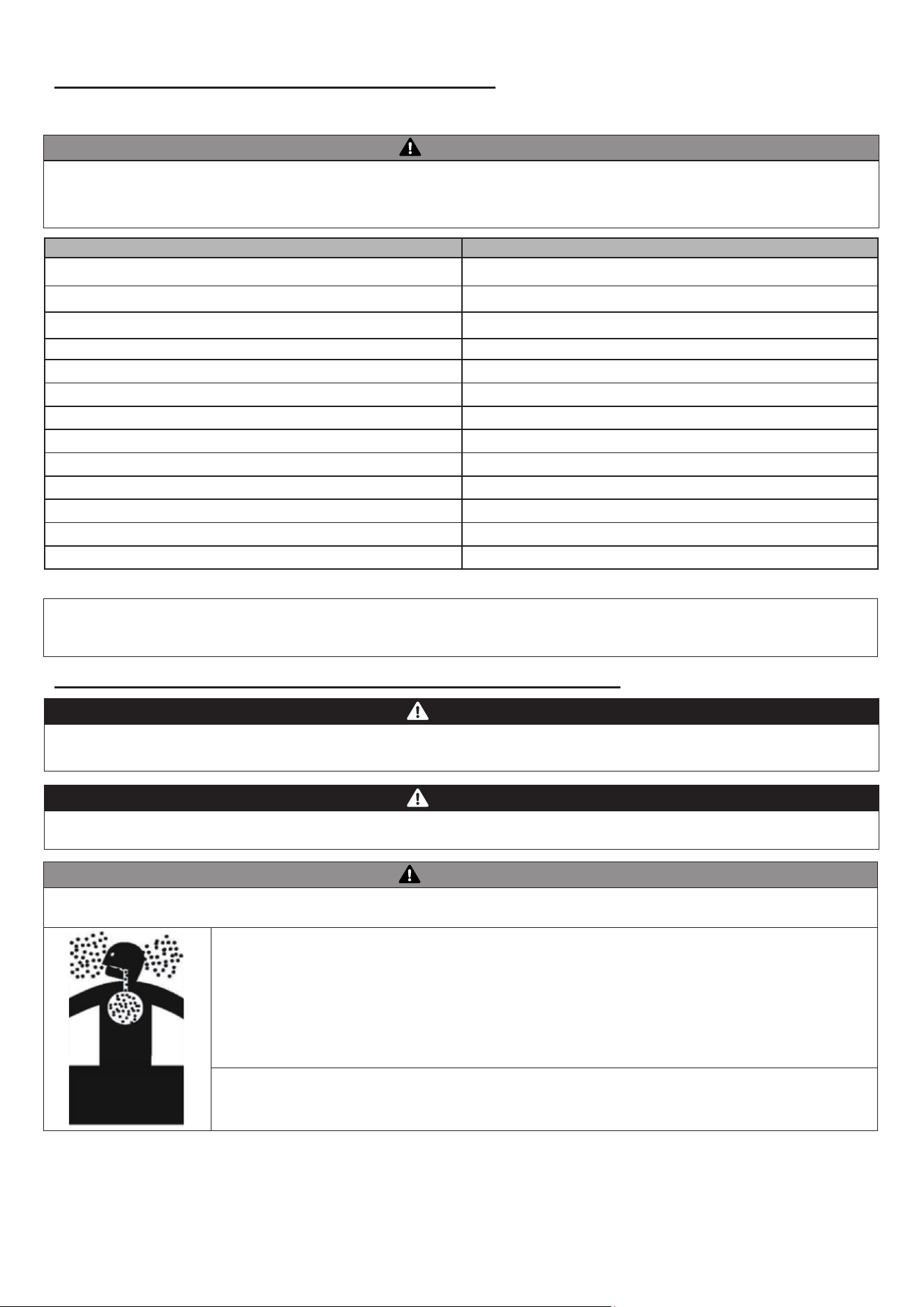
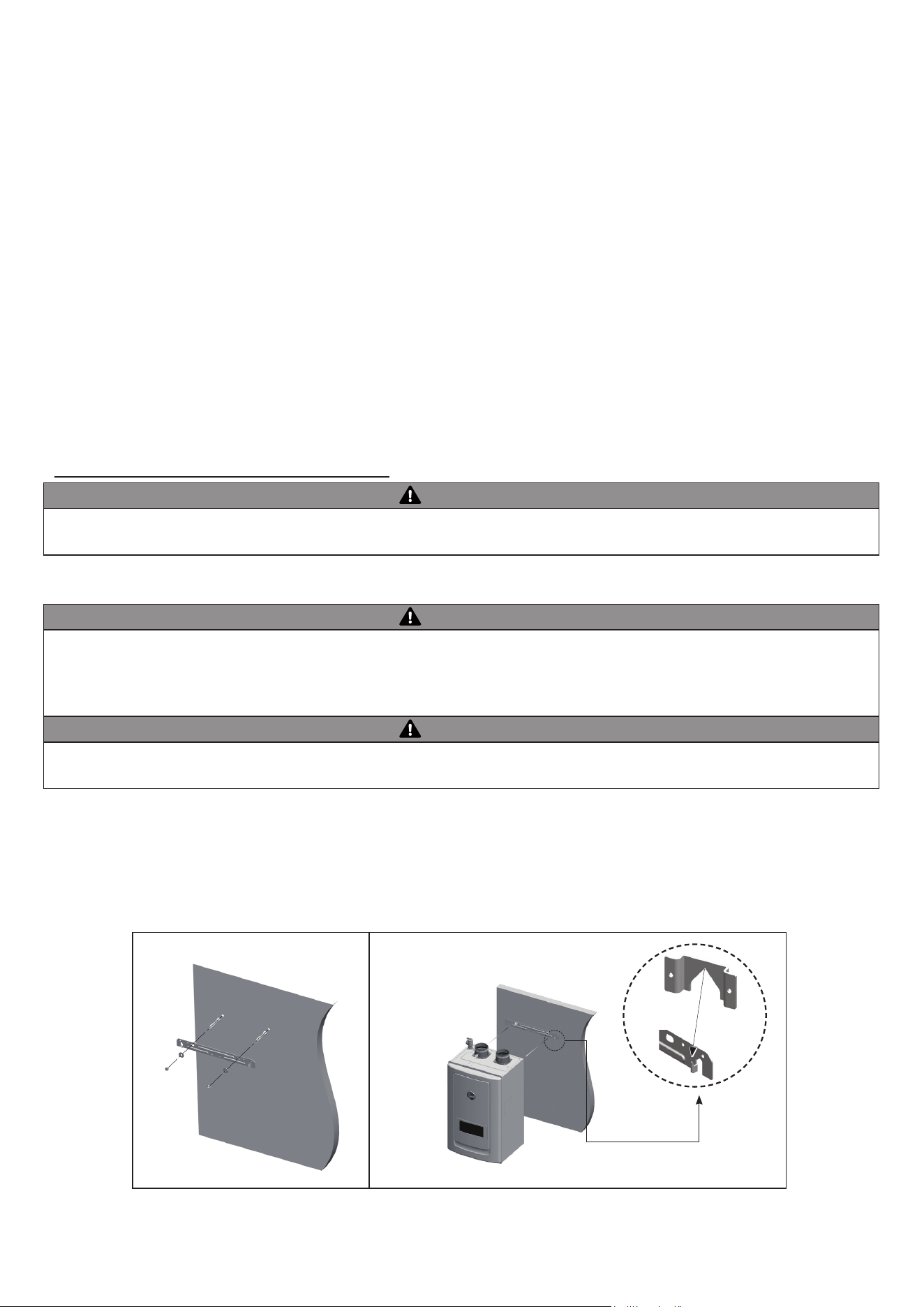
Figure 4 – CO Warning Label
18
4. Page18
When removing an existing heater, follow the steps below.
1. Seal any unused openings in the common venting system.
2. Visually inspect the venting system for proper size and horizontal pitch to determine if there is blockage, leakage, corrosion, or other deciencies
that could cause an unsafe condition.
3. If practical, close all building doors, windows, and doors between the space in which the water heater remains connected to the common venting
system and other spaces in the building. Turn on clothes dryers and any appliances not connected to the common venting system. Turn on any
exhaust fans, such as range hoods and bathroom exhausts, at maximum speed. Do not operate a summer exhaust fan.
Close all replace dampers.
4. Place in operation the appliance being inspected. Follow the lighting instructions. Adjust the thermostat so the appliance will operate continuously.
5. Test for spillage at the draft hood relief opening after 5 minutes of main burner operation. Use the ame of a match or candle or smoke from a
cigarette.
6. After it has been determined that each appliance remaining connected to common venting system properly vents when tested as outlined, return
doors, windows, exhaust fans, replace dampers and any other gas burning appliance to their previous condition of use.
7. Any improper operation of the common venting system should be corrected so the installation conforms to the National Fuel Gas Code, ANSI
Z223.1. When resizing any portion of the common venting system, the common venting system should be resized to approach the minimum size
as determined using the appropriate tables in Appendix G in the National Fuel Gas Code, ANSI Z 223.1.
The appliance may be installed on any suitable internal wall (suitable sound-proong may be required when installing onto a stud partition wall).
WARNING
WARNING
WARNING
▪ J. WALL-MOUNTING THE APPLIANCE
The appliance must be installed on a wall that can bear its weight (more than 90 lbs. when fully plumbed and full of water). Installing the appliance
on a wall which cannot support its weight could result in property damage, personal injury, or death.
This appliance is too heavy for one person to lift. It is highly recommended to install the appliance with two people. Use caution as to not drop
the appliance, which could damage the appliance and cause property damage and/or severe personal injury. Verify that the appliance is properly
and securely mounted before leaving unsupervised. Failure to comply with the above and properly mount the appliance could result in substantial
property damage, severe personal injury, or death.
This wall mounting system is not seismic rated and should not be applied as such. Failure to comply with the above and properly mount the
appliance could result in substantial property damage, severe personal injury, or death.
POSITIONING THE APPLIANCE ON THE WALL
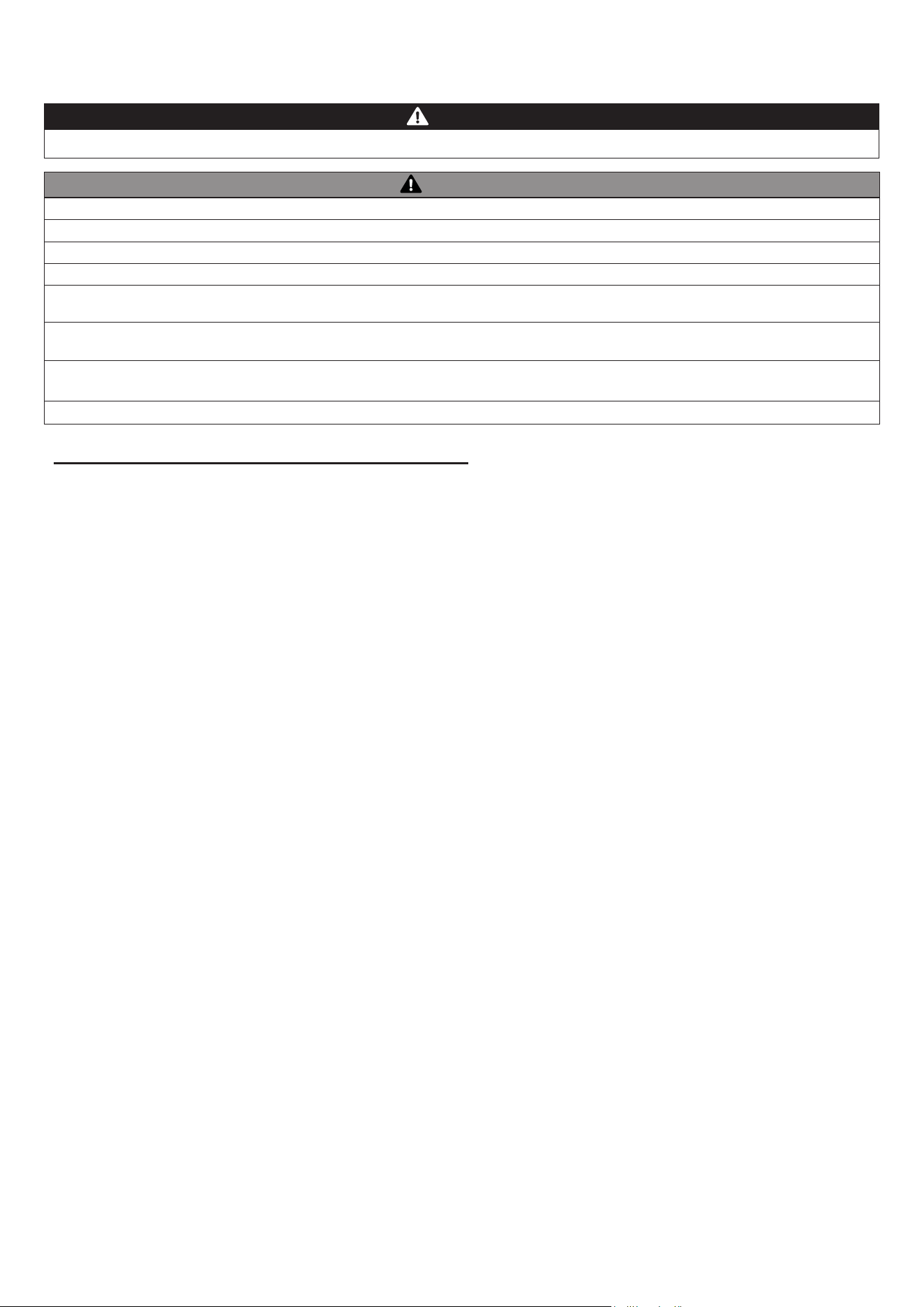
1. Attach the wall bracket on the location where you want to install the appliance. Ensure it is level and on stud (16" centers) before proceeding.
2. Mark the two drill holes with a pencil or marker. Remove the wall bracket.
3. Drill two (2) holes using a 5/32 drill bit at the marked hole locations.
4. Mount the wall bracket to the wall with the two (2) included anchor bolts. Ensure the mounted bracket is level. See Figure 5A.
5. Align the heater bracket grooves on the back of the appliance with the tongues on the wall bracket and hang the appliance on the bracket. See Figure 5B.
A B
Figure 5 – Wall Mounting the Appliance
19
1. Vent system must be installed in accordance with local codes, or, in absence of local codes, the National Fuel Gas Code, ANSI Z223.1 / NFPA 54
and/or CSA B149.1, Natural Gas and Propane Installation Code.
2. For installation in Canada, installer supplied plastic vent piping must comply with CAN/CSA B149.1 and be certied to the Standard for Type BH
Gas Venting Systems, ULC-S636. Components of this listed system must not be interchanged with other vent systems or unlisted pipes or ttings.
All plastic components and specied primers and glues must be from a single system manufacturer and must not be intermixed with another
system manufacturer’s products. Clean and dry all applicable surfaces before applying cement.
3. This appliance is designed to be installed in a power vent (using indoor air for combustion and vented to the outdoors) type, or as a direct vent
(sealed combustion) type. In power vent installations, indoor air is used for combustion and exhaust gases are vented directly to the outdoors
through a sealed exhaust vent piped through the wall or roof. In direct vent installations, combustion air must be supplied directly from the outdoors
to the burner, and the ue (exhaust) gases should be vented directly to the outdoors through the wall or roof.
4. This appliance uses 2" or 3" diameter pipe for exhaust vent and intake pipe. It is important to ensure an airtight seal from the appliance collar to
the vent terminations. See Table 10 for a list of Approved Vent Materials.
5. Do not install venting system components on the exterior of the building except as specically required by these instructions.
• Vent terminals must be at least 1 foot from any door, window, or gravity inlet into the building.
• Maintain the correct clearance and orientation between the exhaust vent and intake pipe terminals.
• The exhaust vent and air intake terminals must be at the same height and their center lines must be spaced apart 1 foot minimum.
• The bottom of the exhaust vent and intake pipe terminals must be at least 1 foot above the normal snow accumulation level. In no case should
these terminals be installed less than 1 foot above normal snow accumulation level.
• Do not install the exhaust vent terminals directly above windows or doors.
• Intake pipe terminal must not terminate in areas that might contain combustion air contaminates, such as near swimming pools.
• For sidewall venting, the minimum horizontal distance between adjacent exhaust vent terminations is 1 foot. It is recommended this distance be
greater than 1 foot to better avoid frost damage to building surfaces.
• For roof venting, minimum horizontal distance between any adjacent exhaust vent termination is 1 foot.
• If the exhaust vent is to be terminated in a walled off area (such as a roof with a parapet wall), ensure the exhaust vent terminates a minimum of
10' from nearest wall and extends level with or above the top of the wall. This will ensure ue gas does not get trapped and possibly recirculated
into the intake air pipe, which could contaminate the combustion air.
• Do not locate vent over public walkways, driveways, or parking lots. Condensate could drip and freeze, resulting in a slip hazard or damage to
vehicles and machinery.
▪ A. INTAKE PIPE AND EXHAUST VENT GUIDELINES
WARNING
DO NOT mix vent systems or materials unless specically told to do so in this manual.
DO NOT thermally insulate the exhaust vent or intake pipes.
DO NOT use an electric damper, vent damper, or draft hood with this appliance.
DO NOT locate the exhaust vent or intake pipe terminations where exposed to prevailing winds.
Moisture will be produced by the exhaust vent. Take precautions when determining exhaust vent termination. Moisture may fall from the vent
termination to the ground and turn to ice in freezing conditions. Moisture or ice can produce a hazardous condition.
Exhaust condensate is acidic, and could deteriorate the surface below the exhaust vent termination. Ensure this surface is in good repair (sealed,
painted, etc.) to prevent deterioration.
Pitch the exhaust vent pipe ¼" per foot back to the appliance. This ensures that condensate in the exhaust vent returns to the appliance and
drains properly.
Failure to follow these instructions could result in property damage, severe personal injury, or death.
PART 5 –VENTING
Vent this appliance in accordance with these instructions. Failure to do so will result in property damage, severe personal injury, or death.
DANGER
20
• DO NOT vent near soffit vents, crawl space vents, or other areas where condensate or vapor could create a nuisance or hazard or cause
property damage.
• DO NOT vent where condensate vapor could cause damage or could be detrimental to the operation of regulators, relief valve, or other
equipment.
• Maximum Snow Level Determination: These installation instructions reference snow levels in establishing a minimum height for the installation of
exhaust vent or air intake terminations. Snow levels shall be determined as follows:
a. The installation location may, by ordinance, designate how snow levels are calculated in that location; or
b. In the absence of specic ordinances, snow levels shall be calculated from the average monthly maximum depth of snow accumulation as
indicated by the National Weather Service’s 10 year statistics for the installation location/geographical area.
In addition:
• Total length of vent piping shall not exceed the limits specied in this manual.
• The ue products coming from the exhaust vent will create a large plume when the heater is in operation. Avoid venting in areas that will affect
neighboring buildings or be considered objectionable.
• DO NOT locate exhaust vent or intake pipe in a parking area where machinery may damage the pipe.
In the Commonwealth of Massachusetts and as Required by State and Local Codes:
• The vented gas fueled appliance shall not be installed so its combustion, ventilation, or dilution air is obtained from a bedroom or bathroom.
• Signage: Whenever any through-the-wall (horizontal or sidewall) vent is installed less than seven feet above the nished grade, a metal or plastic
identication plate shall be permanently mounted to the exterior of the building at a minimum height of eight feet above grade directly in line with
the exhaust vent terminal. The sign shall read, in print no less than 0.5 inches in size, “GAS VENT DIRECTLY BELOW. KEEP CLEAR OF ALL
OBSTRUCTIONS".
• Marking of Exhaust Vent and Intake Pipe: Piping used for ventilation, make-up, or combustion air intake shall be labeled as follows:
a. Throughout the entire developed length:
i. Labels must be placed every ten feet for exposed/visible piping; or
ii. Labels must be placed every three feet for concealed piping.
b. At all changes of direction;
c. On each side of a penetration through a partition, wall or ceiling; and
d. The labels shall be black lettering that:
i. Indicates that the piping is used for ventilation, make-up, or combustion air intake, and
ii. The letters shall be sized equal to a minimum of the pipe diameter. However, for piping with a diameter exceeding two inches, said lettering
does not need to be larger than two inches.
WARNING
The building owner is responsible for keeping the exhaust and intake terminations free of snow, ice, or other potential blockages, as well as
scheduling routine maintenance. Failure to keep the vent piping terminations clear and properly maintain the heater could result in property
damage, severe personal injury, or death.
For each oor containing bedroom(s), a carbon monoxide detector and alarm shall be placed in the living area outside the bedrooms, as well as
in the room that houses the heater. Detectors and alarms shall comply with NFPA 720 (latest edition). Failure to comply with these requirements
could result in product damage, severe personal injury, or death.
21
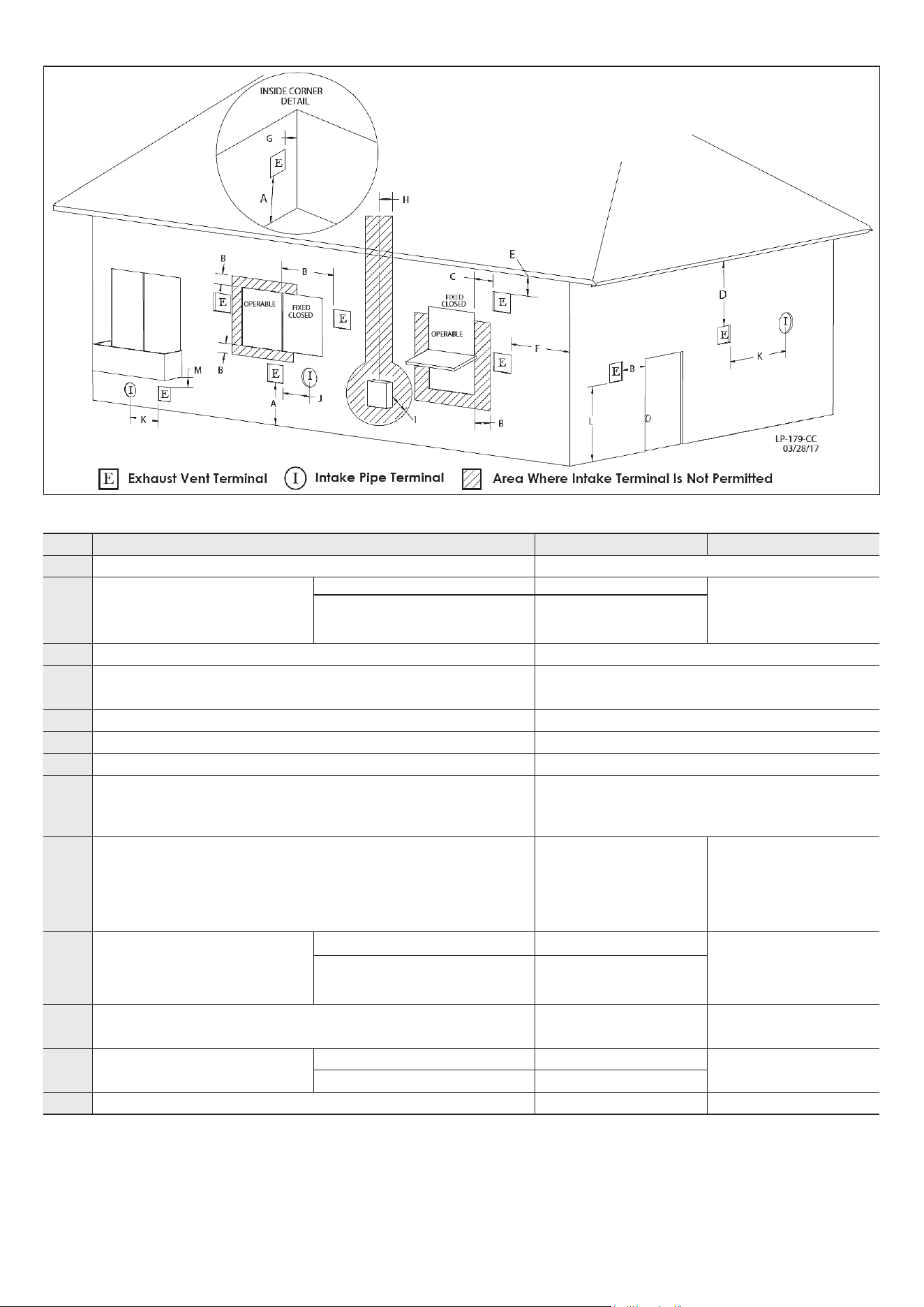
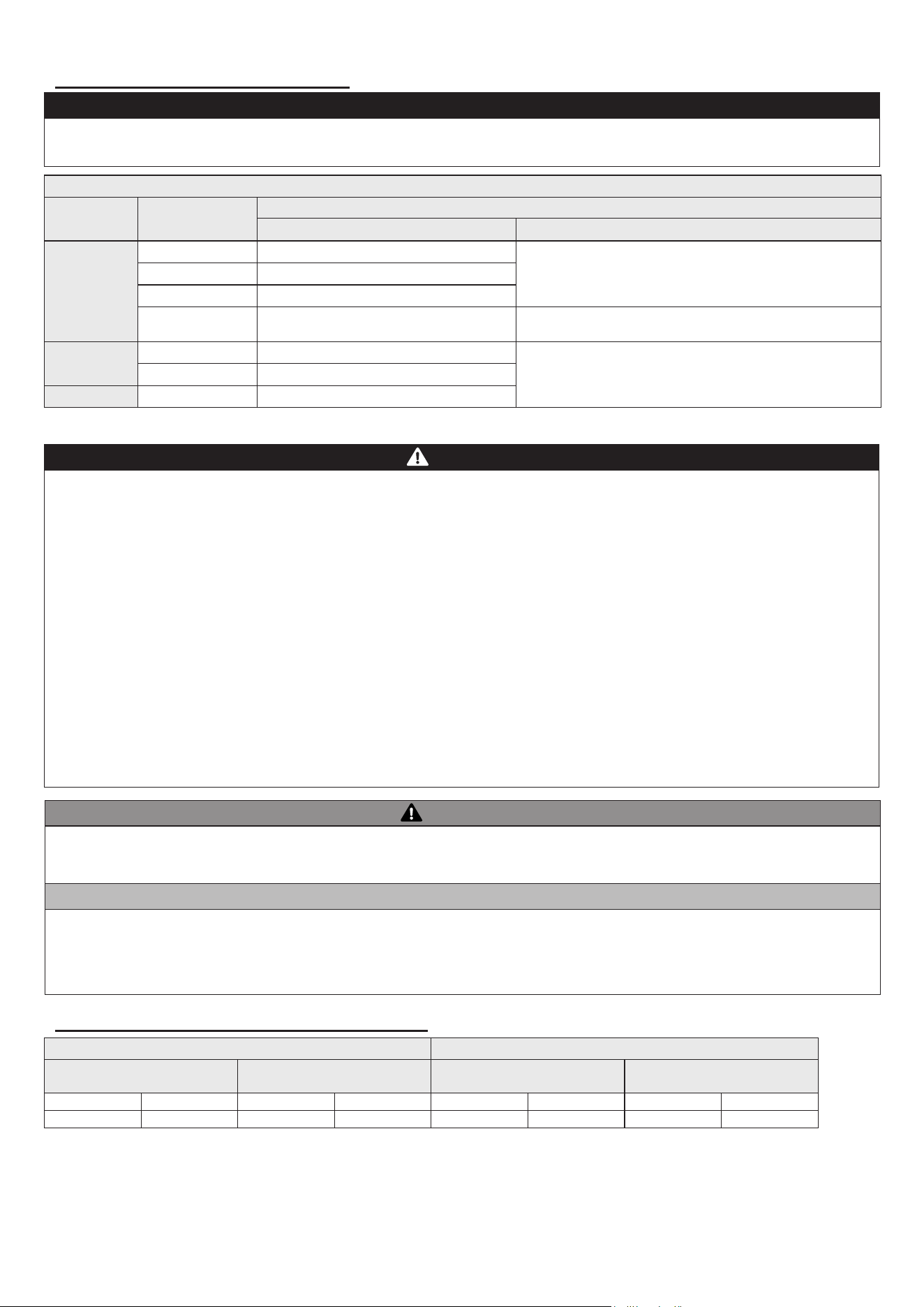
Figure 6 – Vent Termination Detail
Table 9 – Vent Termination Clearances
NOTE: For clearances not specied in ANSI Z223.1/NFPA 54 or CAN/CSA-B 149.1, please use clearances in accordance with local installation codes
and the requirements of the gas supplier.
DESCRIPTION US CANADA
A
Clearance above grade, veranda, porch, deck, or balcony 1 foot (30 cm)
B
Clearance to window or door that may
be opened
Direct Vent 1 foot
36 in (91 cm)
Power Vent
4 feet below or to side of
opening; 1 foot above open-
ing
C
Clearance to permanently closed window *
D
Vertical clearance to ventilated soft located above the terminal within a hori-
zontal distance of 2 feet from the center line of the terminal
*
E
Clearance to unventilated soft *
F
Clearance to outside corner *
G
Clearance to inside corner *
H
Clearance to each side of center line extended above meter / regulator as-
sembly
*
I
Clearance to service regulator vent outlet *
Above a regulator within 3
feet (91 cm) horizontally of
the vertical center line of
the regulator vent outlet to a
maximum vertical distance of
15 ft (4.5 m)
J
Clearance to non-mechanical air sup-
ply inlet to building or the combustion
air inlet to any other appliance
Direct Vent 1 foot
3 feet (91 cm)
Power Vent
4 feet below or to side of
opening; 1 foot above open-
ing
K
Clearance to a mechanical air supply inlet
3 feet above if within 10 feet
horizontally
6 feet (1.83 cm)
L
Clearance above paved sidewalk or
driveway located on public property
Direct Vent *
7 feet (2.13 m)
Power Vent 7 feet
M
Clearance under veranda, porch, deck, or balcony * 1 foot (30 cm)
22
▪ B. APPROVED VENT MATERIALS
▪ C. ALLOWED COMBINED VENT LENGTHS
WARNING
Vent adaptors are not designed as load-bearing devices, and must not be used to support exhaust vent piping. All vent pipes must be properly
connected, supported, and the exhaust must be pitched a minimum of ¼" per foot back to the appliance to allow drainage of condensate. Failure
to properly support vent piping and follow the information in this statement could result in product damage, severe personal injury, or death.
• The Exhaust and intake venting installed with this Combi Boiler must be approved materials listed above. DO NOT REMOVE the factory
installed vent collars. Doing so WILL VOID warranty.
• PVC/CPVC pipe and ttings of the same diameter are considered interchangeable.
• Use of cellular core pipe PVC (ASTM F891), cellular core CPVC, or Radel® (polyphenysulfone) in nonmetallic venting systems is prohibited.
• DO NOT connect PVC/CPVC to Polypropylene without an approved vent connector.
• Any transition to Polypropylene MUST be done in the vertical within ve (5) feet of the appliance.
• When installing AL29-4C vent piping, install a PVC-to-stainless adapter at the water heater vent connection, and at the termination when using
a RHEEM PVC termination kit. DO NOT mix AL29-4C piping from different manufacturers unless using adapters specically designed for the
purpose by the manufacturer.
• Covering non-metallic vent pipe and ttings with thermal insulation is prohibited.
• DO NOT obstruct the ow of combustion or ventilation air.
• When using Pipe Cement/Primer, follow the instructions included with the Cement/Primer closely. Clean and dry all applicable surfaces before
applying.
Failure to follow these directions will result in substantial property damage, severe personal injury, or death.
DANGER
NOTICE
Consult Table 10 or the most recent edition of ANSI Z223.1/NFPA 54 or CAN/CSA B149.1 as well as all applicable local codes and regulations
when selecting vent pipe materials.
APPROVED EXHAUST VENT AND INTAKE PIPE MATERIAL
Item Material
Standards for Installation in:
United States Canada
Exhaust vent
or Intake pipe
and ttings
CPVC schedule 40 ASTM-D2846
PP, CPVC, and PVC venting must be ULC-S636 Certied.
IPEX is an approved manufacturer in Canada, supplying vent
material listed to ULC-S636.
PVC schedule 40 ANSI/ASTM D1785
Polypropylene ULC-S636, UL-1738
Stainless Steel
AL29-4C
Certied for Category IV and direct vent
appliance venting
Certied for Category IV and direct vent appliance venting
Pipe Cement
PVC ANSI/ASTM D2564
IPEX System 636 Cements & PrimersCPVC ANSI/ASTM F493
Pipe Primer PVC / CPVC ASTM F656
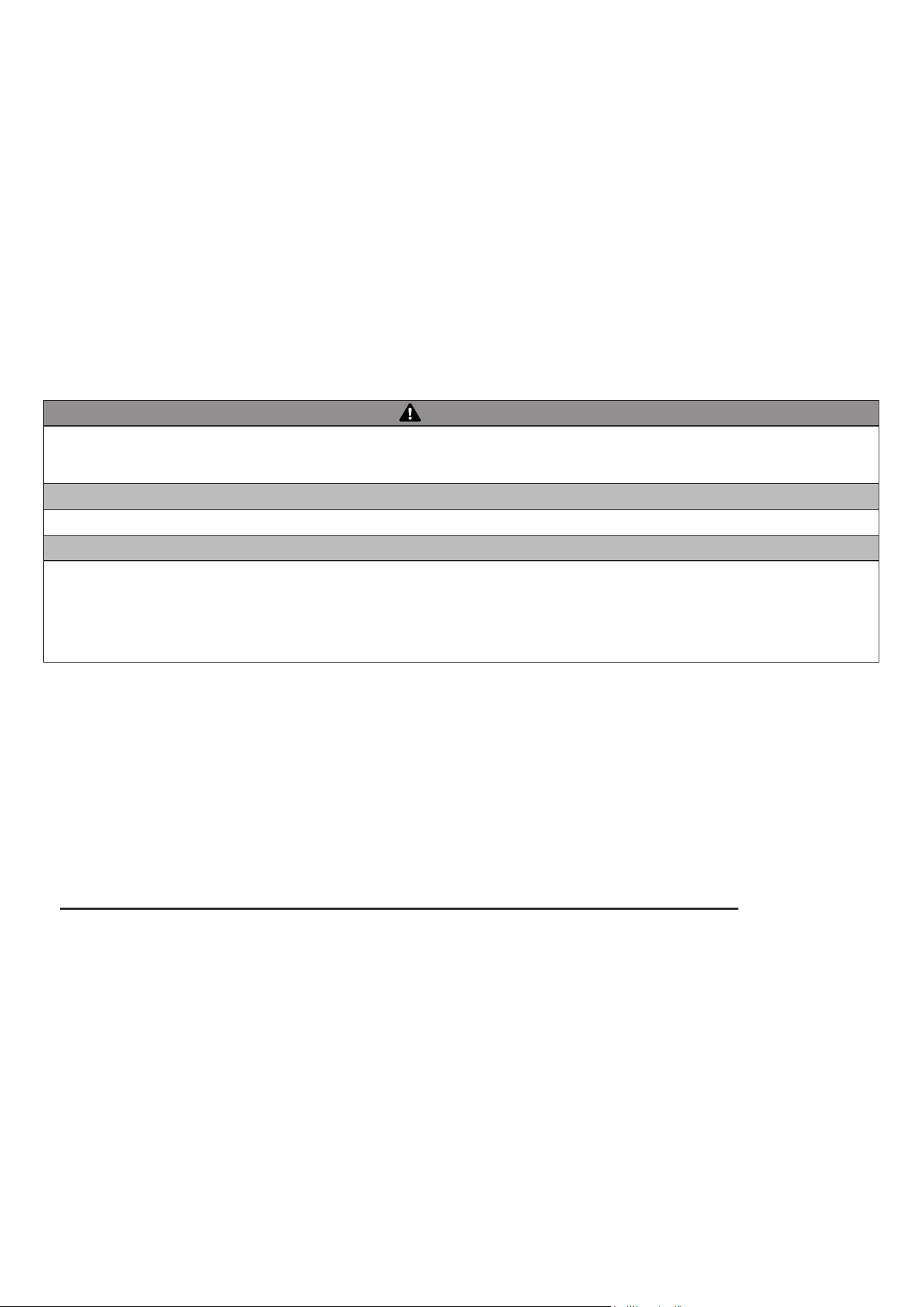
2" VENT 3" VENT
EXHAUST
(EQUIVALENT LENGHTH)
INTAKE
(EQUIVALENT LENGHTH)
EXHAUST
(EQUIVALENT LENGHTH)
INTAKE
(EQUIVALENT LENGHTH)
MINIMUM MAXIMUM MINIMUM MAXIMUM MINIMUM MAXIMUM MINIMUM MAXIMUM
14' (4.2M) 50' (15M) 14' (4.2M) 50' (15M) 14' (4.2M) 100' (30M) 14' (4.2M) 100' (30M)
Table 10 – Approved Venting Materials
Table 11 – Approved Vent Lengths
CAUTION
High heat sources (sources generating heat 100°F / 37°C or greater, such as stove pipes, space heaters, etc.) may damage plastic components
of the appliance as well as plastic vent pipe materials. Such damages ARE NOT covered by warranty. It is recommended to keep a minimum
clearance of 8" from high heat sources. Observe heat source manufacturer instructions, as well as local, state, provincial, and national codes,
laws, regulations and ordinances when installing this appliance and related components near high heat sources.
Total equivalent vent length should not exceed fty (50) feet (15M) in 2" pipe, or one hundred (100) feet (30M) in 3" pipe for the exhaust venting.
Total equivalent vent length should not exceed fty (50) feet (15M) in 2" pipe, or one hundred (100) feet (30M) in 3" pipe for the intake piping.
23
▪ D. TIGHTENING APPLIANCE COLLAR TO EXHAUST VENT AND INTAKE PIPE
WARNING
Vent adaptors are not designed as load-bearing devices, and must not be used to support exhaust vent piping. All vent pipes must be properly
connected, supported, and the exhaust must be pitched a minimum of ¼" per foot back to the boiler to allow drainage of condensate. Failure to
properly support vent piping and follow the information in this statement could result in product damage, severe personal injury, or death.
CAUTION
CAUTION
Failure to provide a minimum total vent length of 14 equivalent feet could result in property damage and improper appliance operation.
This Combi Boiler has a built-in control to limit the exhaust temperature to 149°F (65°C).
As a result, the Combi Boiler can be vented with Schedule 40 PVC.
In high temperature applications, the exhaust temperature can exceed 149°F (65°C).
In that case, you must use Schedule 40 CPVC or Approved Polypropylene (PP) in the USA or Type BHSpecial Gas Vent Class IIB (CPVC) or
Class IC(Polypropylene) that conforms to ULC-S636 in Canada.
a. The equivalent lengths of friction loss in elbows are listed below:
• 5 feet (1.5M) for each additional 3" 90° elbow
• 2.5 feet (.75M) for each additional 3" 45° elbow
• 8 feet (2.4M) for each additional 2" 90° elbow
• 4 feet (1.2M) for each additional 2" 45° elbow
• Some terminations are considered elbows, and deduction should be applied. For example, a turndown 90° or an open T termination should
be considered a 90° elbow.
• For 2" diameter installations, install a reducing coupling in a vertical section of pipe ABOVE the pipe clamp installed on the Boiler. See Figure 8.
b. For example: If the 2" exhaust vent has two 90° elbows and 10 feet of PVC pipe we will calculate: Exhaust Vent Equivalent Length = (2x8) + 10
= 26 feet.
Further, if the 2" intake pipe has one 90° elbow, one 45° elbow, and 10 feet of PVC pipe, the following calculation
applies: Intake Pipe Equivalent Length = 8 + 4 + 10 = 22 feet.
NOTE: The intake pipe and exhaust vent lengths do not have to be of equal length. There is no balancing requirement between intake and exhaust.
PVC Venting
This Combi Boiler is set to "PVC" (factory default). The Combi Boiler will control and maintain the exhaust temperature
below 144°F (62°C) and the Combi Boiler will shut down when the exhaust temperature exceeds 149°F (65°C).
CPVC or Polypropylene(PP) Venting
When you design a high temperature application (the exhaust temperature can exceed 149°F (65°C)),you must use Schedule 40 CPVC or Approved
Polypropylene (PP) in the USA or Type BH Special Gas VentClass IIB (CPVC) or Class IC(Polypropylene) that conforms to ULC-S636 in Canada and
must change theVent Material Setting as follows.
In this case, the Combi Boiler will control and maintain the exhaust temperature below 195°F (90.5°C)and the Combi Boiler will shut down when the
exhaust temperature exceeds 200°F (93°C).
This appliance uses 2" or 3" diameter pipe for exhaust vent and intake pipe. In order to use 2" pipe, it is required to reduce pipe size in a vertical length
of pipe with a reducing coupling (not included). Follow the steps below to install 2" or 3" pipe into the appliance collar. See Figure 7 & 8 for additional
details.
1. Clean and dry the appliance connection. DO NOT use primer or cement on the appliance connection.
2. Tighten the clamps using a screwdriver.
3. Ensure the pipe is secure before continuing installation.
4. For 2" installations, install a reducing coupling in a vertical section of pipe. See Figure 8.
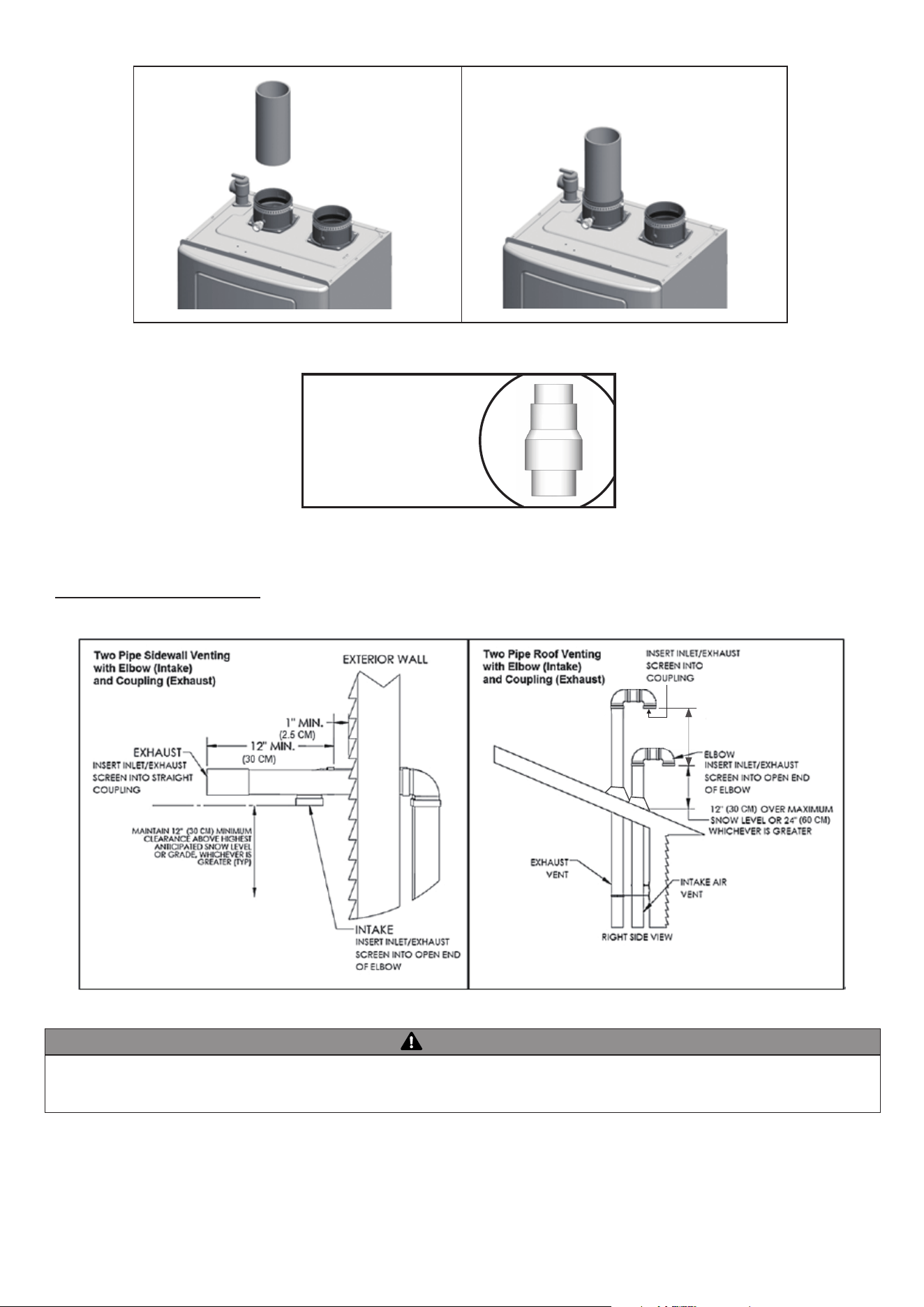
24
NOTE: REDUCING VENT SIZE;
TRANSITIONING FROM 3” TO
2” VENT PIPE MUST ALWAYS
TAKE PLACE IN A VERTICAL
POSITION TO PREVENT
CONDENSATE BLOCKAGE
Figure 7 – Installing the 3" Pipe into the Exhaust Vent Connection
Figure 9 – Direct Vent, Roof and Sidewall Vent Terminations
Figure 8 – Transitioning from 3" to 2" Vent Pipe
▪ E. VENT TERMINATION
WARNING
All PVC vent pipes must be glued, properly supported, and the exhaust must be pitched a minimum of ¼" per foot back to the appliance to allow
drainage of condensate. When placing support brackets on vent piping, the rst bracket must be within 1 foot of the appliance and the balance at
4 foot intervals on the vent pipe. Appliance venting must be readily accessible for visual inspection for the rst three feet from the appliance.
1. Direct Vent, Two Pipe Roof and Sidewall Vent Terminations
ELBOW
12" Min (30cm)
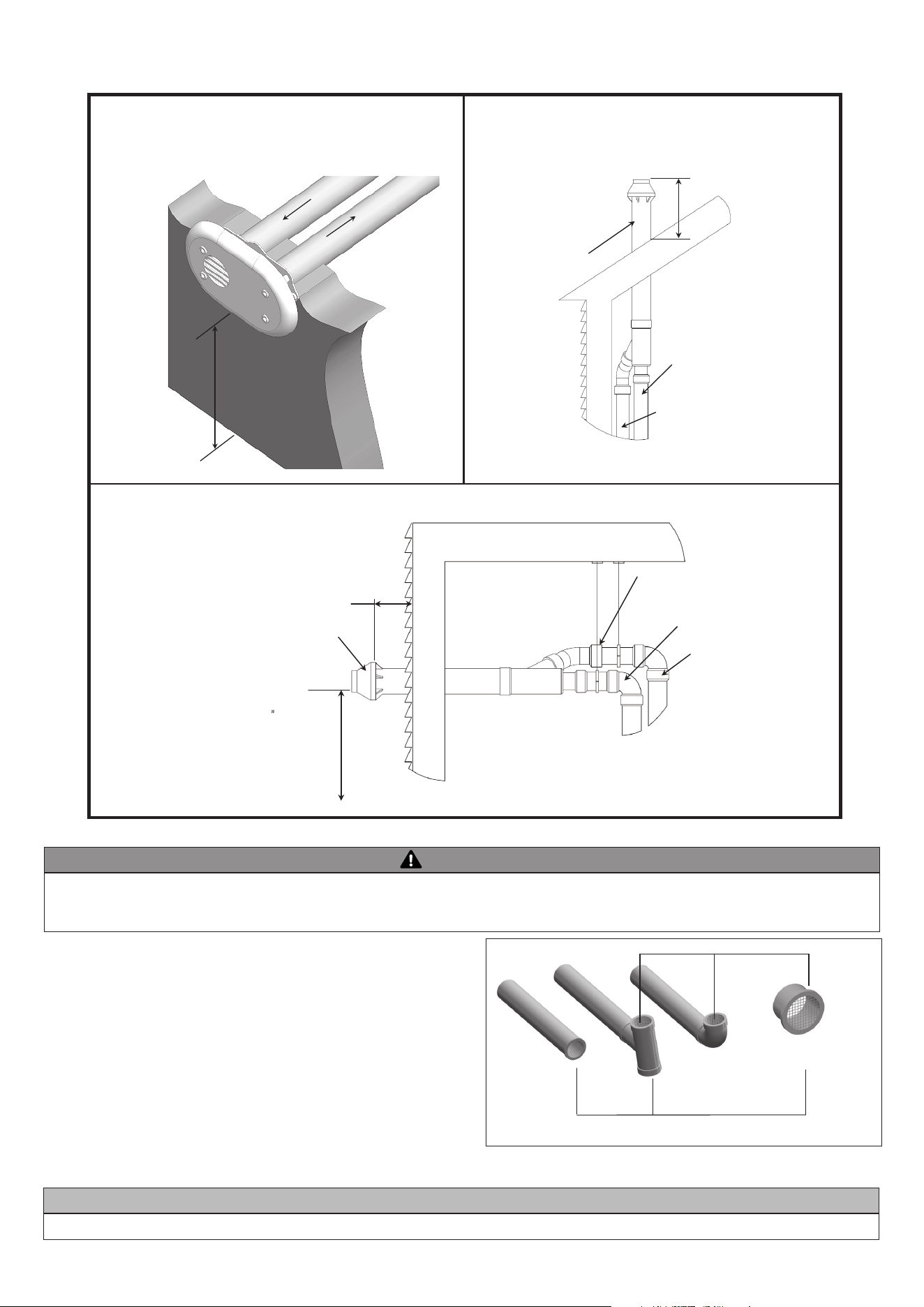
25
Figure 10 – Direct Vent, Vent Terminations (with Optional Kits)
Figure 11 – Screen Installation
Figure 8 – Transitioning from 3" to 2" Vent Pipe
WARNING
All PVC vent pipes must be glued, properly supported, and the exhaust must be pitched a minimum of ¼" per foot back to the appliance to allow
drainage of condensate. When placing support brackets on vent piping, the rst bracket must be within 1 foot of the appliance and the balance at
4 foot intervals on the vent pipe. Appliance venting must be readily accessible for visual inspection for the rst three feet from the appliance.
2. Direct Vent, Optional Horizontal and Vertical Vent Kits
3. Screen Installation
After connecting the intake air and exhaust vent pipes, it is required
to install the included screens into the exhaust vent and intake pipe
terminations to prevent damages to the unit due to blockages. Clean
the vent terminations and glue the screens into the terminations. See
Figure 13 for installation detail.
3”(7.6cm) Vent Screen
1/4”(0.6cm) Mesh
Two screens of 2 “and 3” are provided. Please purchase and install additional screens if
necessary.
SAFETY INSTRUCTIONS
Do not connect any other appliance vents to the appliance exhaust vent or intake pipes.
Exhaust
Air Inlet
Min. 12 ”
above grade
or snow level
Exhaust
Air-inlet around
Perimeter
Sidewall Venting with Kit
G
EXHAUST
INTAKE
Sidewall Venting
with Concentric Vent
Kit
MAINTAIN 12 ” MINIMUM
CLEARANCE ABOVE
HIGHEST ANTICIPATED
SNOW LEVEL OR GRADE,
CONCENTRIC VENT KIT
1” MIN.
IMPORTANT:
INTAKE LEG MUST
BE FACING UP
EXHAUST
INTAKE
Roof Venting
w
ith Concentric Vent
K
it
12”OVER MAXIMUM SNOW
LEVEL OR 24
” - WHICHEVER
IS GREATER
CO
NCENTRIC VENT KIT
NOTE: EXTEND VENT RUNS WHEN
TRANSITIONING TO A LARGER
DIAMETER MUST ALWAYS TAKE
PLACE IN A VERTICAL POSITION
Sidewall Venting with
Concentric Vent Kit
Roof Venting
Concentric Vent
Kit
Sidewall Venting
with Kit
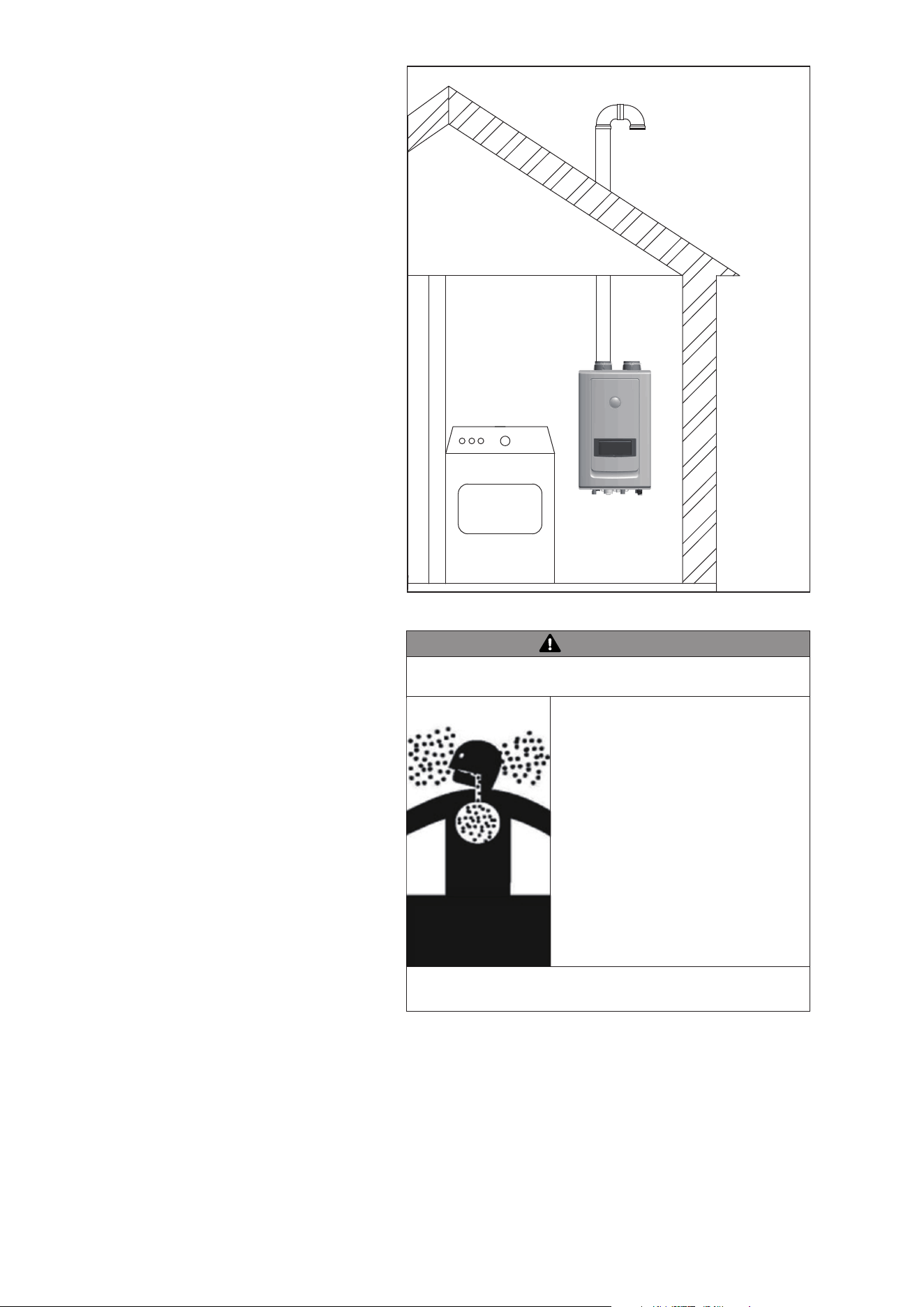
26
DO NOT PLACE
DRYER IN PROXIMITY
TO WATER HEATER
Figure 12 – Do Not Install in a Contaminated Space
4. Power Venting, Indoor Combustion Air Installation in
Conned or Unconned Space
This heater requires fresh, uncontaminated air for safe
operation and must be installed in a mechanical room where
there is adequate combustion and ventilating air. NOTE: To
prevent combustion air contamination, see Table 8.
Combustion air from the indoor space can be used if the
space has adequate area or when air is provided through a
duct or louver to supply sufcient combustion air based on
the heater input. Never obstruct the supply of combustion air
to the heater. If the heater is installed in areas where indoor
air is contaminated (see Figure 13) it is imperative that the
heater be installed as direct vent so that all combustion air
is taken directly from the outdoors into the heater intake
connection.
Unconfined space is space with volume greater than 50
cubic feet per 1,000 Btu/hour (4.8 cubic meters per kW) of
the total input rating of all fuel-burning appliances installed in
that space. Rooms connected directly to this space, through
openings not furnished with doors, are considered part of the
space.
Confined space is space with volume less than 50 cubic
feet per 1,000 Btu/hour (4.8 cubic meters per kW) of the
total input rating of all fuel-burning appliances installed in
that space. Rooms connected directly to this space, through
openings not furnished with doors, are considered part of the
space.
When drawing combustion air from inside a conventionally
constructed building to a conned space, such space should
be provided with two permanent openings: one located 6"
(15 cm) below the space ceiling, the other 6" (15cm) above
the space oor.Each opening should have a free area of one
square inch per 1,000 Btu/hr (22㎠/kW) of the total input
of all appliances in the space, but not less than 100 square
inches (645㎠).
If the conned space is within a building of tight construction,
air for combustion must be obtained from the outdoors as
outlined in the Venting section of this manual.See Figure 13.
WARNING
Breathing Hazard – Carbon Monoxide Gas
Breathing carbon monoxide can cause brain damage or death.
Always read and understand instruction manual.
ㆍ
Do not operate heater if ood damaged.
ㆍ
Install vent system in accordance with local codes
and manufacturers installation instructions.
ㆍ
Do not obstruct heater air intake or exhaust,
Support all vent piping per manufacturers
installation instructions.
ㆍ
Do not place chemical vapor emitting products
near unit.
ㆍ
According to NFPA 720, carbon monoxides
detectors should be installed outside each sleeping
area.
ㆍ
Never operate the heater unless it is vented to the
outdoors.
ㆍ
Analyze the entire vent system to make sure that
condensate will not become trapped in a section
of vent pipe and therefore reduce the open cross
sectional area of the vent.
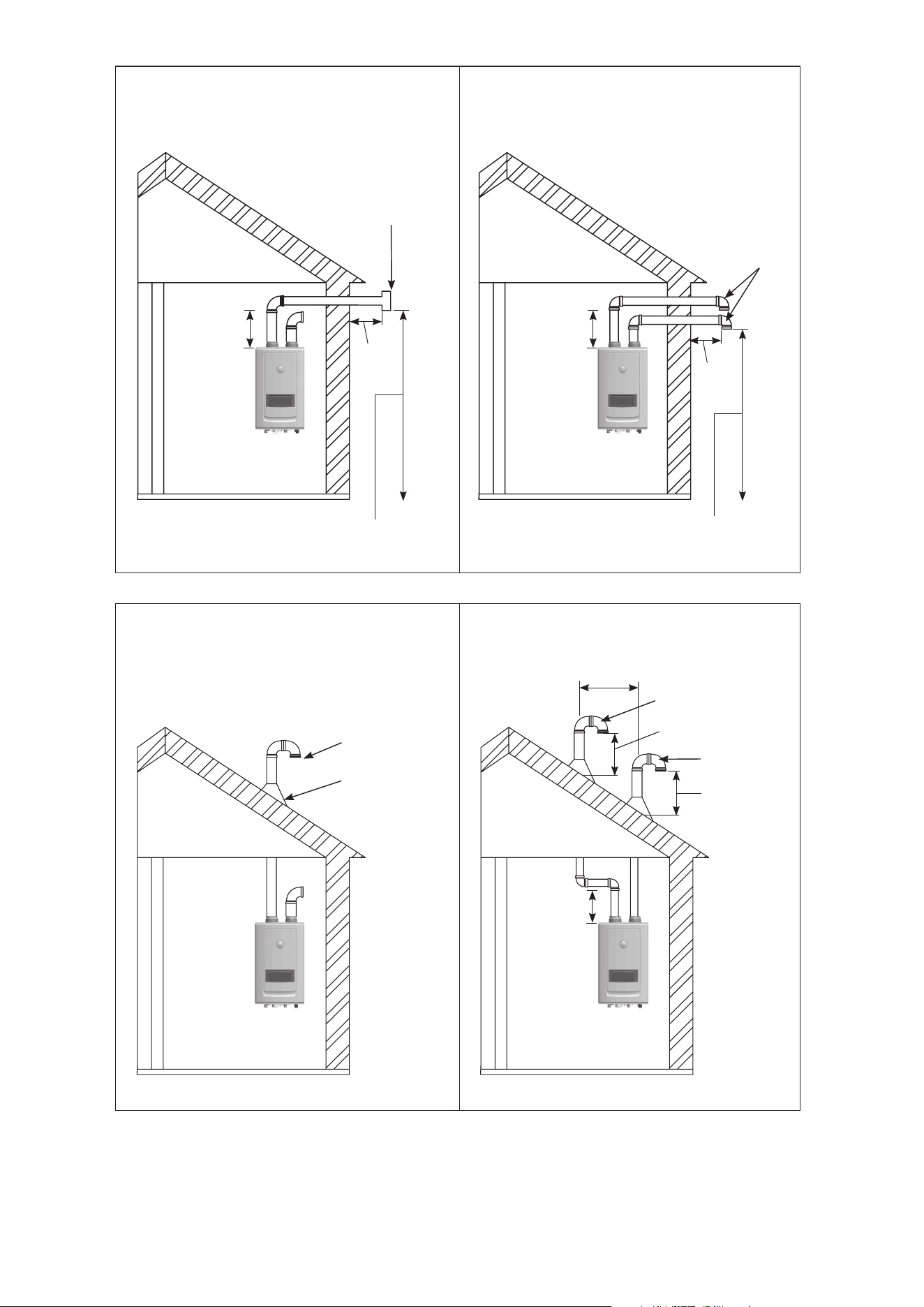
27
Figure 13 – NOTE: These drawings are meant to demonstrate system venting only. The installer is responsible for
all equipment and detailing required by local codes.
INDOOR COMBUSTION AIR
(SINGLE PIPE) _HORIZONTAL
INDOOR COMBUSTION AIR
(DIRECT VENT) _HORIZONTAL
INDOOR COMBUSTION AIR
(DIRECT VENT) _VERTICAL
INDOOR COMBUSTION AIR
(SINGLE PIPE)_VERTICAL
1΄(30cm)
3ft. Min.
1΄(30cm)
1΄(30cm)
INSERT SCREEN IN
EACH OPEN END
OF TEE
INSERT SCREEN IN
OPEN END OF ELBOW
INSERT SCREEN IN
OPEN END OF ELBOW
INSERT SCREEN IN
OPEN END OF ELBOW
12” over maxium snow level or
24” whichever is greater.
12” over maxium
snow level or 24”
whichever is greater.
ROOF FLASHING
INSERT SCREEN IN OPEN
END OF EACH ELBOW
3"Min
(7.5cm)
3"Min
(7.5cm)
MAINTAIN 12"(30cm) MINIMUM CLEARANCE
ABOVE HIGHEST ANTICIPATED SNOW LEVEL
OR GRADE, WHICHEVER IS GREATER.
MAINTAIN 12"(30cm) MINIMUM CLEARANCE
ABOVE HIGHEST ANTICIPATED SNOW LEVEL
OR GRADE, WHICHEVER IS GREATER.
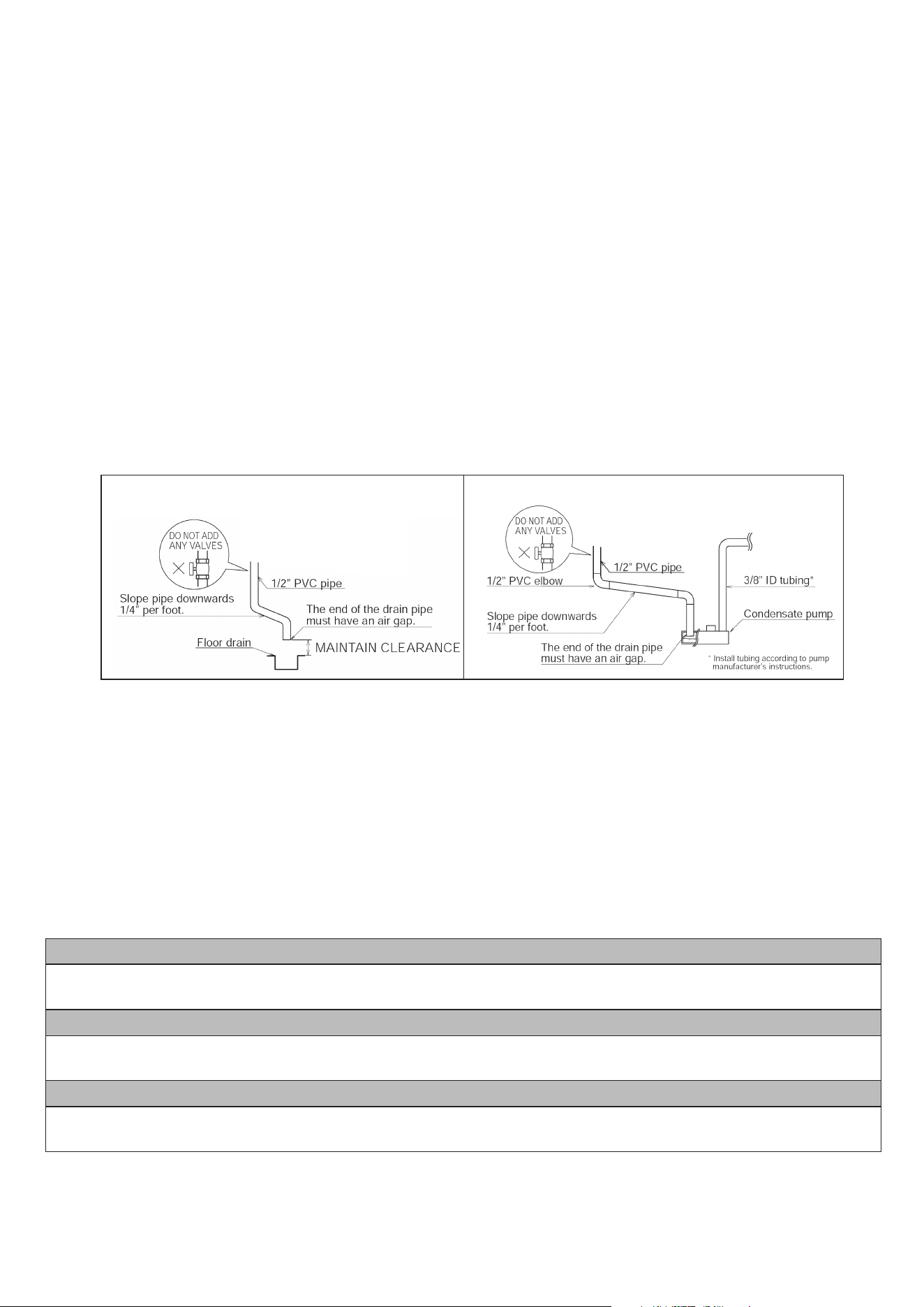
28
1. Due to its efcient design, the appliance produces condensate (water) as a normal by-product. This condensate is acidic, with a pH level between
3 and 4. This condensate must be drained away from the appliance and disposed in accordance with all local regulations.
2. Use corrosion-resistant materials approved by the Authority Having Jurisdiction (AHJ) to drain condensate. In the absence of an AHJ, the included
exible plastic hose, or eld supplied ½" PVC and CPVC drain pipe complying with ASTM D1785, F441, or D2665 may be used. Cement must
comply with ASTM D2564 for PVC or F493 for CPVC. For Canadian applications, use CSA or ULC certied PVC or CPVC pipe, ttings, and
cement.
3. Local building codes may require an in-line neutralizer to be installed (not included) to treat the condensate. Follow all the installation instructions
included with the neutralizer. If a neutralizer is installed, periodic replacement of the limestone (or neutralizing agent) will be required. The rate of
depletion of the limestone varies with usage of the appliance. During the rst year of appliance operation, check the neutralizer every few months
for depletion.
4. Route the drain line to a nearby oor drain, laundry tub, or condensate pump.
1. Condensate line must be pitched at least 1/4" per foot to properly drain. If this cannot be done, or a very long length of condensate hose is used,
you must increase the condensate line to a minimum of 1" ID and place a tee in the line after the condensate neutralizer to properly reduce
vacuum lock in the drain line.
2. Plastic pipe should be the only material used for the condensate line. Steel, brass, copper, or other materials will be subject to corrosion or
deterioration.
3. NEVER install condensate lines outside. It is very important that the condensate line is not exposed to freezing temperatures or any type of
blockage. Damages due to frozen or blocked condensate lines ARE NOT covered by warranty.
4. Support of the condensate line may be necessary to avoid blockage of the condensate ow.
5. An error will appear on the appliance display if condensate line is blocked. The appliance will not operate with a blocked condensate line. It is
extremely important to have this condition repaired by a qualied service technician.
PART 6 – INSTALL THE CONDENSATE DRAIN
NOTE: If a nearby laundry tub is used as a disposal for waste water from the washing machine, draining the condensate into this tub allows the
soapy water discharge to neutralize the acidic condensate.
NOTE: This appliance has an internal condensate trap that must be cleaned and maintained. See Maintenance section of this manual for instructions
on maintaining the trap.
NOTES:
Condensate piping to oor drain
Condensate piping with pump
Figure 14 – Condensate Piping to Floor Drain and with Pump
CAUTION
CAUTION
CAUTION
If using a condensate pump, select one approved for use with condensing appliances and furnaces. The pump should have an overow switch to
prevent property damage from condensate spillage.
It is very important that the condensate piping be no smaller than ½". To prevent sagging and maintain pitch, condensate piping should be
supported with pipe supports, and pitched ¼" per foot to allow for proper drainage.
The condensate line must remain unobstructed, allowing free ow of condensate. If condensate freezes in the line, or if line is obstructed in any
other manner, condensate can exit from the tee, resulting in potential water damage to property.
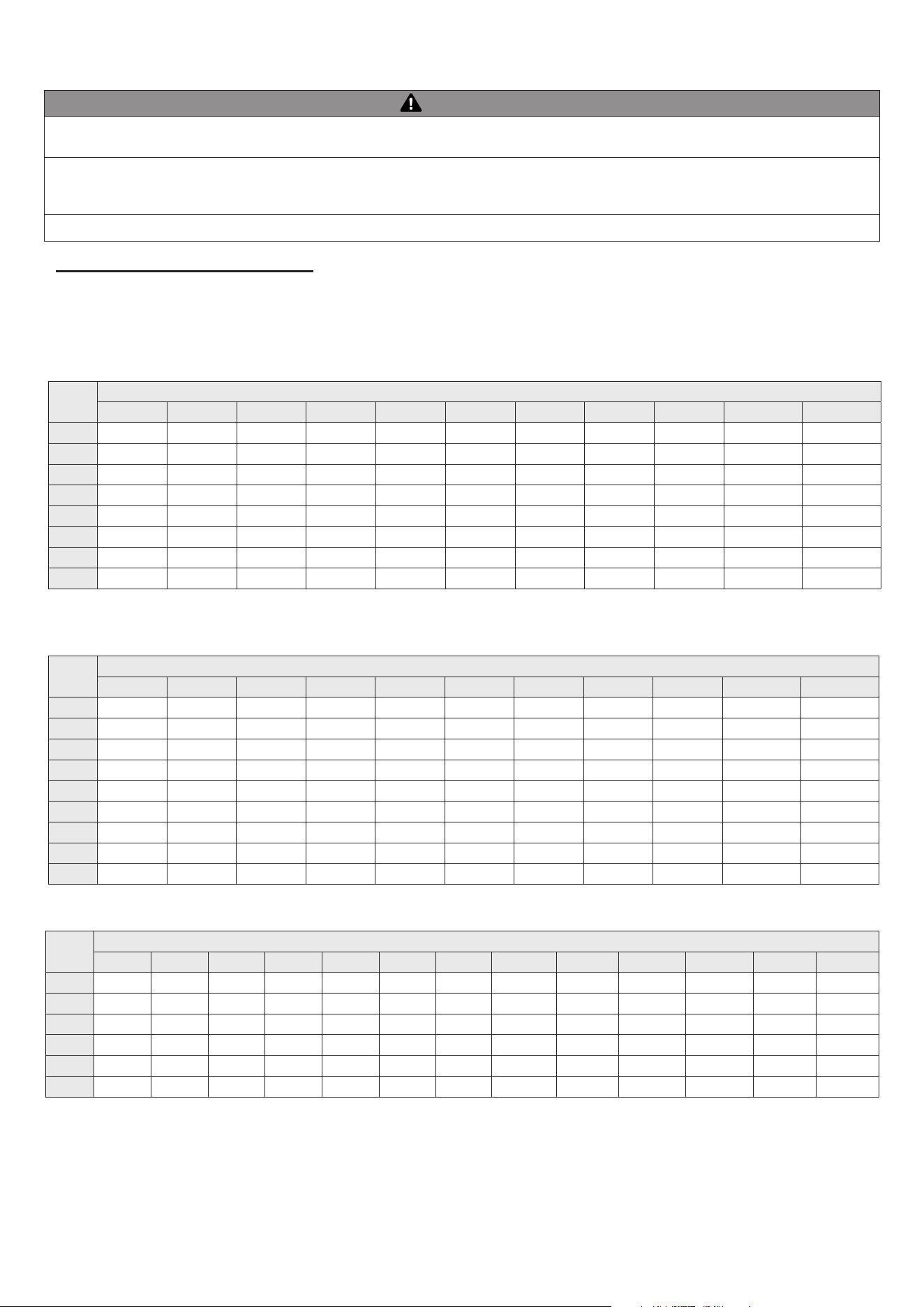
29
PART 7 – GAS PIPING
WARNING
FIRE AND/OR EXPLOSION HAZARD
To avoid serious injury or death, the gas line installation and the gas line inlet pressure test must be done by a licensed professional.
Always match the appliance with the type of gas supplied to the unit (natural gas or LP gas). This appliance must be converted into propane
operation unless specically manufactured for use with propane. Follow Gas Conversion Manual instructions (separate document). Propane
ready appliances have the sufx “LP" after the model serial number.
Failure to ensure the appliance is set to operate on the provided gas supply could result in property damage, personal injury, or death.
1. Gas Pipe Sizing
This information is for reference use only. Refer to gas pipe manufacturer specications for actual delivery capacity. The DOE standard for Natural
Gas is 1100 BTU/ft . Contact the local gas supplier for actual BTU/ft rating.
3
3
▪ A. GAS PIPE SIZING TABLES
Pipe
size
Length (ft)
10'(3m) 20'(6m) 30'(9m) 40'(12m) 50'(15m) 60'(18m) 70'(21m) 80'(24m) 90'(27m) 100'(30m) 125'(37.5m)
3/4˝ 360 247 199 170 151 137 126 117 110 104 92
1˝ 678 466 374 320 284 257 237 220 207 195 173
1-1/4˝ 1390 957 768 657 583 528 486 452 424 400 355
1-1/2˝ 2090 1430 1150 985 873 791 728 677 635 600 532
2" 4020 2760 2220 1900 1680 1520 1400 1300 1220 1160 1020
2 1/2" 6400 4400 3530 3020 2680 2430 2230 2080 1950 1840 1630
3" 11300 7780 6250 5350 4740 4290 3950 3670 3450 3260 2890
4" 23100 15900 12700 10900 9660 8760 8050 7490 7030 6640 5890
Pipe
size
Length (ft)
10'(3m) 20'(6m) 30'(9m) 40'(12m) 50'(15m) 60'(18m) 70'(21m) 80'(24m) 90'(27m) 100'(30m) 125'(37.5m)
1/2˝ 454 312 250 214 190 172 158 147 138 131 116
3/4˝ 949 652 524 448 397 360 331 308 289 273 242
1˝ 1787 1228 986 844 748 678 624 580 544 514 456
1-1/4˝ 3669 2522 2025 1733 1536 1392 1280 1191 1118 1056 936
1-1/2˝ 5497 3778 3034 2597 2302 2085 1919 1785 1675 1582 1402
2" 10588 7277 5844 5001 4433 4016 3695 3437 3225 3046 2700
2 1/2" 16875 11598 9314 7971 7065 6401 5889 5479 5140 4856 4303
3" 29832 20503 16465 14092 12489 11316 10411 9685 9087 8584 7608
4" 43678 30020 24107 20632 18286 16569 15243 14181 13305 12568 11139
Table 13. For 8" WC ~ 10.5" WC initial supply pressure
Table 12. For Less than 8" WC initial supply pressure
Table 14. Maximum Undiluted Propane (LP) Delivery Capacity in Thousands of Btu/H (0.5" WC Pressure Drop)
Maximum Natural Gas Delivery Capacity (0.5" WC Pressure Drop)
Maximum Natural Gas Delivery Capacity (3.0" WC Pressure Drop).
Contact the Gas Supplier for Btu/Cubic Ft. of the Supplied Gas. 1000 BTU/Cubic Ft. is a Typical Value
** For reference only. Please consult gas pipe manufacturer for actual pipe capacities.
Pipe
size
Length (ft)
10'(3m) 20'(6m) 30'(9m) 40'(12m) 50'(15m) 60'(18m) 80'(24m) 100'(30m) 125'(38m) 150'(45m) 175'(53m) 200'(60m) 250'(76m)
1/2˝ 291 200 160 137 122 110 101 94 89 84 74 67 62
3/4˝ 608 418 336 287 255 231 212 197 185 175 155 140 129
1˝ 1150 787 632 541 480 434 400 372 349 330 292 265 243
1-1/4˝ 2350 1620 1300 1110 985 892 821 763 716 677 600 543 500
1-1/2˝ 3520 2420 1940 1660 1480 1340 1230 1140 1070 1010 899 814 749
2˝ 6790 4660 3750 3210 2840 2570 2370 2200 2070 1950 1730 1570 1440
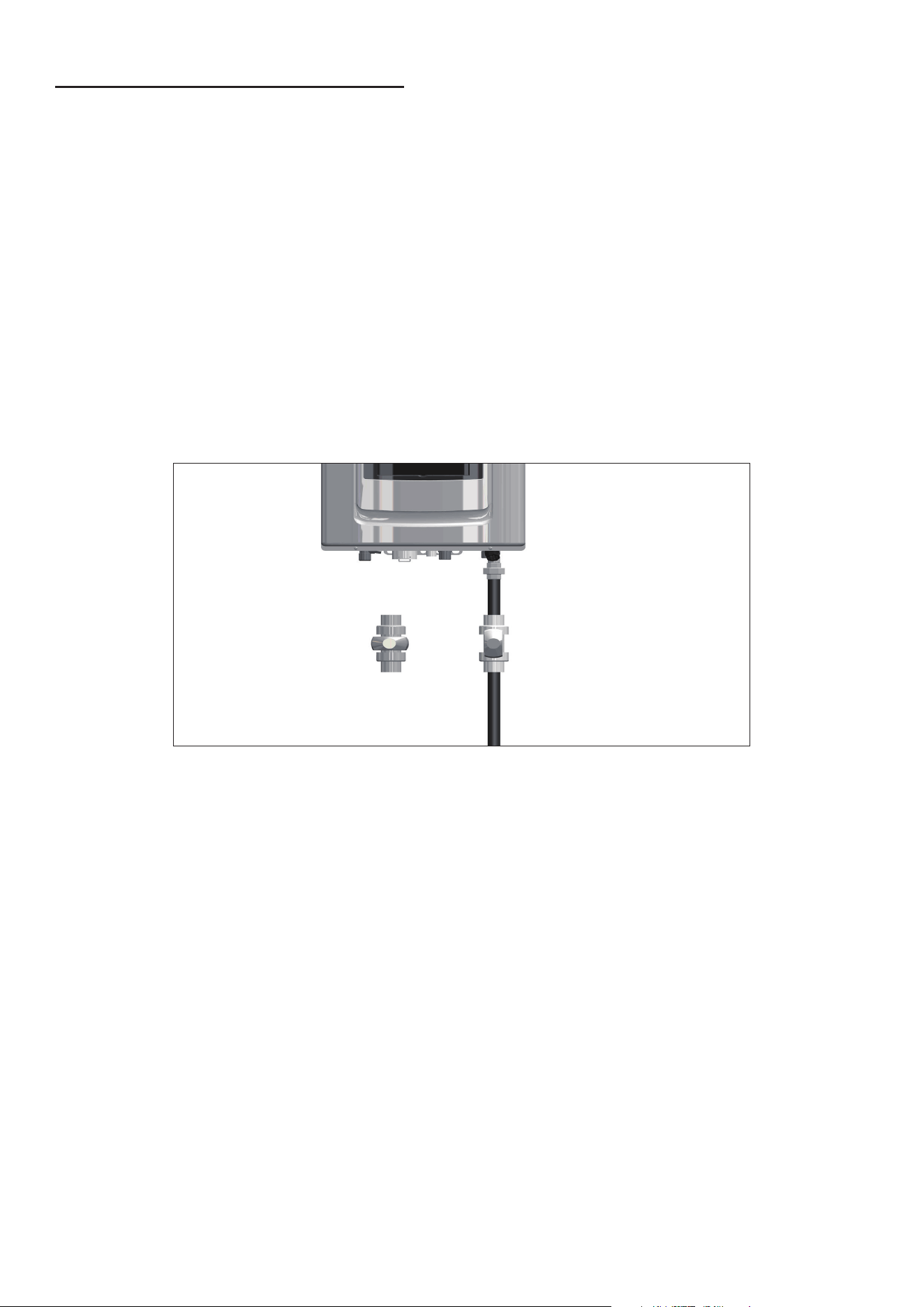
30
Figure 15 – Gas Line with Shut-Off Valve Detail
1. The gas connection tting on the appliance is 3/4" male NPT.
NOTE: The pipe size must not be less than ½".
2. The supply line must be sized for the maximum output of the appliance being installed. If there are additional gas appliances from the main supply
line, measure the size of the supply line according to the COMBINED total maximum BTUH draw for the appliances as if they were operating at the
same time.
3. Measure the length of the gas supply line from the gas meter to the appliance. Appliance must be installed downstream of the gas meter to ensure
adequate gas supply. Use the tables in this manual or refer to the gas line manufacturer’s sizing information to determine the correct supply pipe
size.
4. A manual gas shut-off valve should be installed in the gas supply line close to the appliance. See Figure 15 for detail.
5. To facilitate any future maintenance, it is also recommended that an approved gas union tting be installed in the supply line between the shut-off
valve and the connection on the appliance.
6. Test the gas pressure to make sure it meets the minimum standards and does not exceed the maximum standards of the appliance.
7. Leak test the gas line pipe before placing the appliance in operation. Only use approved leak detector liquid solutions to check for leaks.
8. Do not operate the appliance until all connections have been completed and the heat exchanger is lled with water.
▪ B. GAS CONNECTION REQUIREMENTS
GAS VALVE OFF
GAS VALVE ON
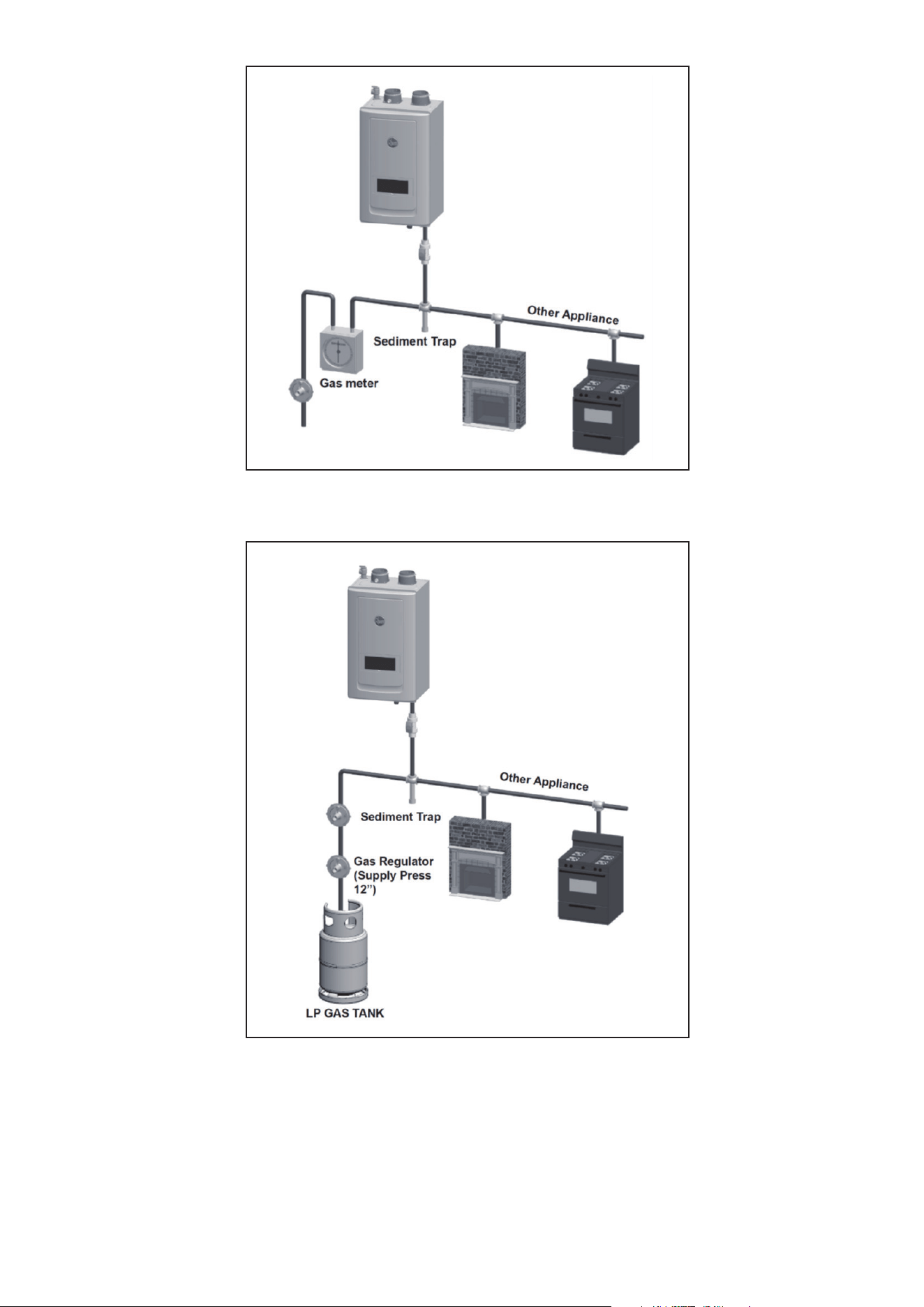
31
Figure 15 – Gas Line with Shut-Off Valve Detail
Figure 16 – Natural Gas Piping Installation
Figure 17 – LP Gas Piping Installation
NOTE: Capacity to be Not Less than Total Capacity of Connected Appliances.
NOTE: Capacity to be Not Less than Total Capacity of Connected Appliances.
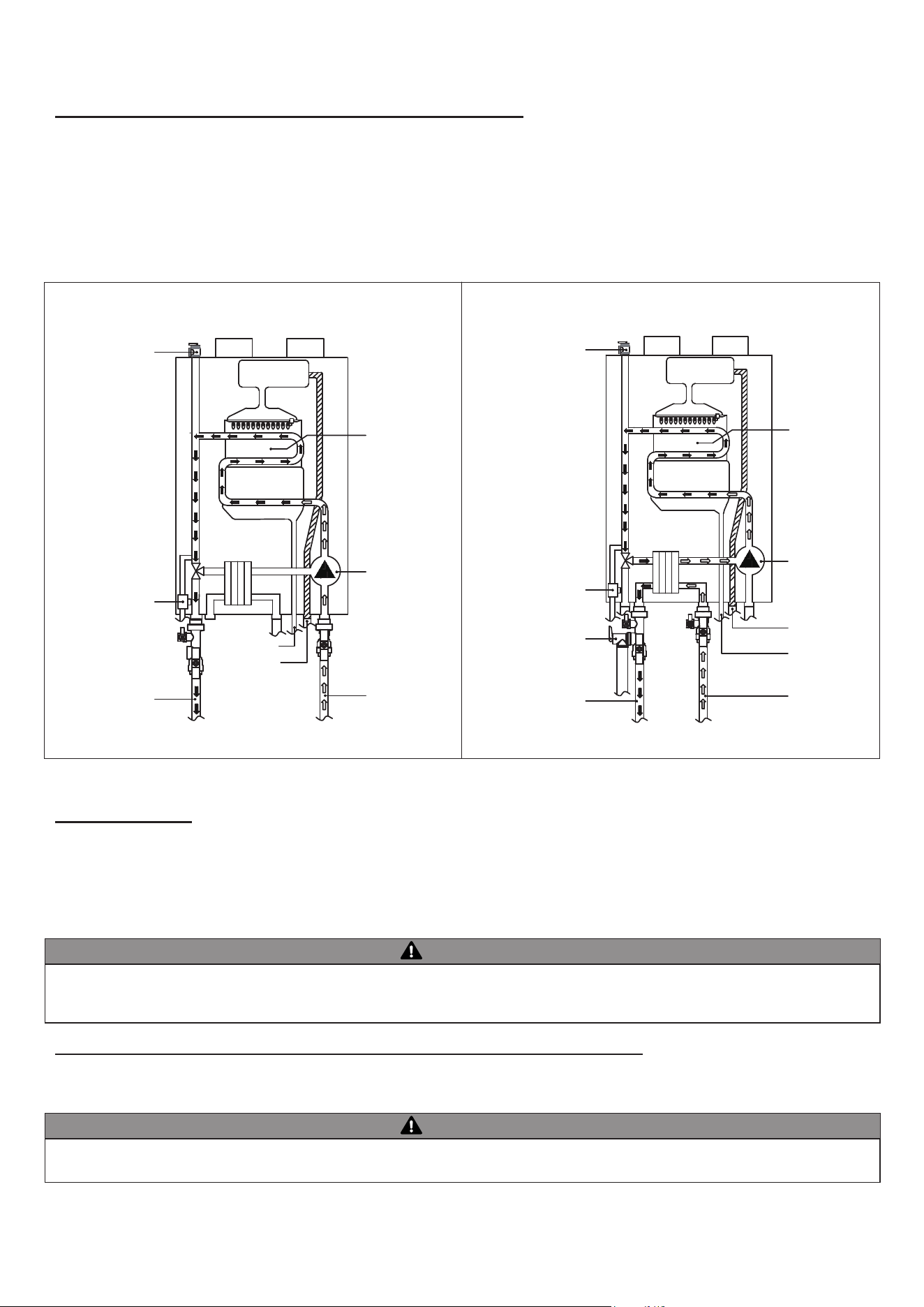
32
Burner
Air & Gas
Mixing
Burner
Air & Gas
Mixing
DHW
Plate
Heat
Exchanger
Primary Heat
Exchanger
Secondary Heat
Exchanger
Primary Heat
Exchanger
Secondary Heat
Exchanger
Circulation Pump
Gas
Condensate
Cold Water Inlet
(DHW)
Hot Water Outlet
(DHW)
Pressure Relief Valve
(DHW)
Pressure Relief Valve
for Heating
Circulation Pump
Gas
Condensate
Heating Supply
Heating Return
Auto Feeder
Pressure Relief Valve
for Heating
Auto Feeder
DHW
Plate
Heat
Exchanger
AUTODESK � � � � � � � � � �
AUTODESK � � � � � � � � � �
AUTODESK � � � � � � � � � �
AUTODESK � � � � � � � � � �
Burner
Air & Gas
Mixing
Burner
Air & Gas
Mixing
DHW
Plate
Heat
Exchanger
Primary Heat
Exchanger
Secondary Heat
Exchanger
Primary Heat
Exchanger
Secondary Heat
Exchanger
Circulation Pump
Gas
Condensate
Cold Water Inlet
(DHW)
Hot Water Outlet
(DHW)
Pressure Relief Valve
(DHW)
Pressure Relief Valve
for Heating
Circulation Pump
Gas
Condensate
Heating Supply
Heating Return
Auto Feeder
Pressure Relief Valve
for Heating
Auto Feeder
DHW
Plate
Heat
Exchanger
AUTODESK � � � � � � � � � �
AUTODESK � � � � � � � � � �
AUTODESK � � � � � � � � � �
AUTODESK � � � � � � � � � �
PART 8 – WATER PIPING
[Space Heating Mode] [Domestic Hot Water Mode]
▪ A. GENERAL PLUMBING CONNECTION GUIDELINES
• Pipe material must be suitable to meet local codes and industry standards.
• The pipe must be cleaned and without blemish before any connections are made.
• Do not apply a torch within 12" of the appliance. Doing so could damage the appliance. Such damages ARE NOT covered by product warranty.
• The size of the hot water pipe should be ¾" diameter and the central heating water pipe should be 1" in diameter.
• To ease future maintenance isolation valves are recommended on both the CH and DHW loops.
• All piping should be insulated.
Figure 18 – Operating Description – Water Flow
▪ B. DHW PIPING
▪ C. CENTRAL HEATING PIPING SYSTEM WATER PIPING METHODS
Use both thread tape and pipe dope to connect to the ¾" domestic water inlet and outlet. A shut off valve between the city water supply and DHW
inlet is recommended for ease of service. Rheem offers threaded ¾" Rheem tankless isolation valves with DHW pressure relief valve for ease of
installation and future service. See Optional Equipment, this manual.
It may be recommended to use a back flow preventer – check local codes. If a back flow preventer or a no return valve is used, a thermal
expansion tank must be installed on the cold water supply between the appliance and valve.
EXPANSION TANK AND MAKE-UP WATER
1. Ensure that the expansion tank is designed and sized to correctly handle system water volume and temperature.
WARNING
WARNING
To control thermal expansion, a thermal expansion tank suitable for potable water should be installed in systems with an installed backflow
preventer. DO NOT use a closed type expansion tank. Follow expansion tank manufacturer’s specications to properly size an expansion tank to
the installation. Failure to properly accommodate thermal expansion could result in property damage, severe personal injury, or death.
Expansion tanks must be sized according to total system volume. This includes all length of pipe, all xtures, appliances, etc. Failure to properly
size system expansion could result in wasted time, money, and possible property damage, personal injury, or death.
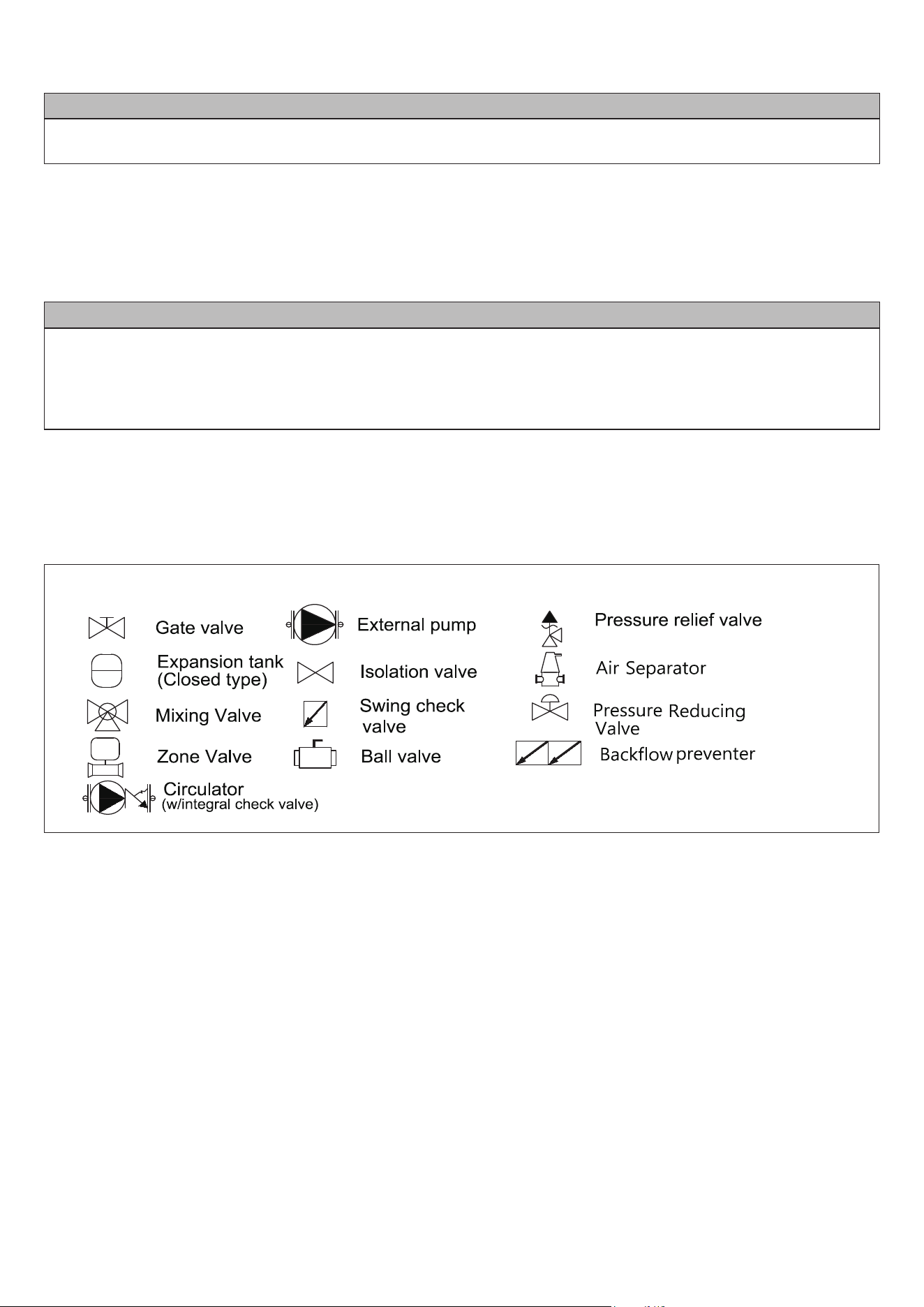
33
Burner
Air & Gas
Mixing
Burner
Air & Gas
Mixing
DHW
Plate
Heat
Exchanger
Primary Heat
Exchanger
Secondary Heat
Exchanger
Primary Heat
Exchanger
Secondary Heat
Exchanger
Circulation Pump
Gas
Condensate
Cold Water Inlet
(DHW)
Hot Water Outlet
(DHW)
Pressure Relief Valve
(DHW)
Pressure Relief Valve
for Heating
Circulation Pump
Gas
Condensate
Heating Supply
Heating Return
Auto Feeder
Pressure Relief Valve
for Heating
Auto Feeder
DHW
Plate
Heat
Exchanger
AUTODESK � � � � � � � � � �
AUTODESK � � � � � � � � � �
AUTODESK � � � � � � � � � �
AUTODESK � � � � � � � � � �
Piping symbol legend
Figure 19 – Piping Legend
1.This drawing is meant to show system piping concept only. Installer is responsible for all equipment and detailing
required by local codes.
2. All closely spaced tees shall be within 4 pipe diameters center to center spacing.
3. A minimum of 6 pipe diameters of straight pipe shall be installed upstream and downstream of all closely spaced tees.
4. The minimum pipe size of DHW piping should be ¾" diameter and Heating piping should be 1" in diameter.
5. Piping shown is Primary/Secondary. System ow (secondary loop) must be greater than the appliance’s primary loop ow.
6. Install a minimum of 12 diameters of straight pipe upstream of all circulators.
7. In a valve-based system, each heating zone has a zone valve which opens when that zone calls for heat.
Each zone thermostat is wired to its corresponding zone valve. Contacts in the zone valves provide a signal to
the appliance to operate when there is a call for heat.
8. Unit is equipped with built-in primary pump for the heating loop. This pump is sized to ensure proper ow rate through
the appliance heat exchanger and related piping. On long pipe runs, it is recommended to keep the pump at
maximum speed (setting 3). DO NOT lower it from the factory default.
9. Install a backow preventer valve in the make-up water supply to the unit as required by local codes.
AUTODESK � � � � � � � � � �
AUTODESK � � � � � � � � � �
AUTODESK � � � � � � � � � �
AUTODESK � � � � � � � � � �
DIAPHRAGM (OR BLADDER) EXPANSION TANK
Always install an automatic air vent on top of the air separator to remove residual air from the system.
2. The expansion tank must be located following recognized design methods. See expansion tank manufacturer’s instructions for details.
3. Connect the expansion tank to the air separator only if the air separator is on the suction side of the circulator. Always install the system ll
connection at the same point as the expansion tank connection to the system.
Use both thread tape and pipe dope to connect to the 1" heating water outlet and inlet.
CAUTION
CAUTION
Undersized expansion tanks cause system water to be lost from the relief valve, causing make-up water to be added. Eventual appliance failure
can result due to excessive make-up water addition. SUCH FAILURE IS NOT COVERED BY WARRANTY.
Use at least the MINIMUM pipe size for all appliance loop piping (connecting appliance to and from the primary/secondary connection). DO NOT
pipe the appliance in any conguration other than primary/secondary. All piping methods shown in this manual use primary/secondary connection.
This is to avoid the possibility of inadequate ow through the appliance. Using less than the required minimum pipe size and piping in anything
other than a primary/secondary installation could result in system problems, property damage, and premature appliance failure. Such problems
ARE NOT covered by product warranty.
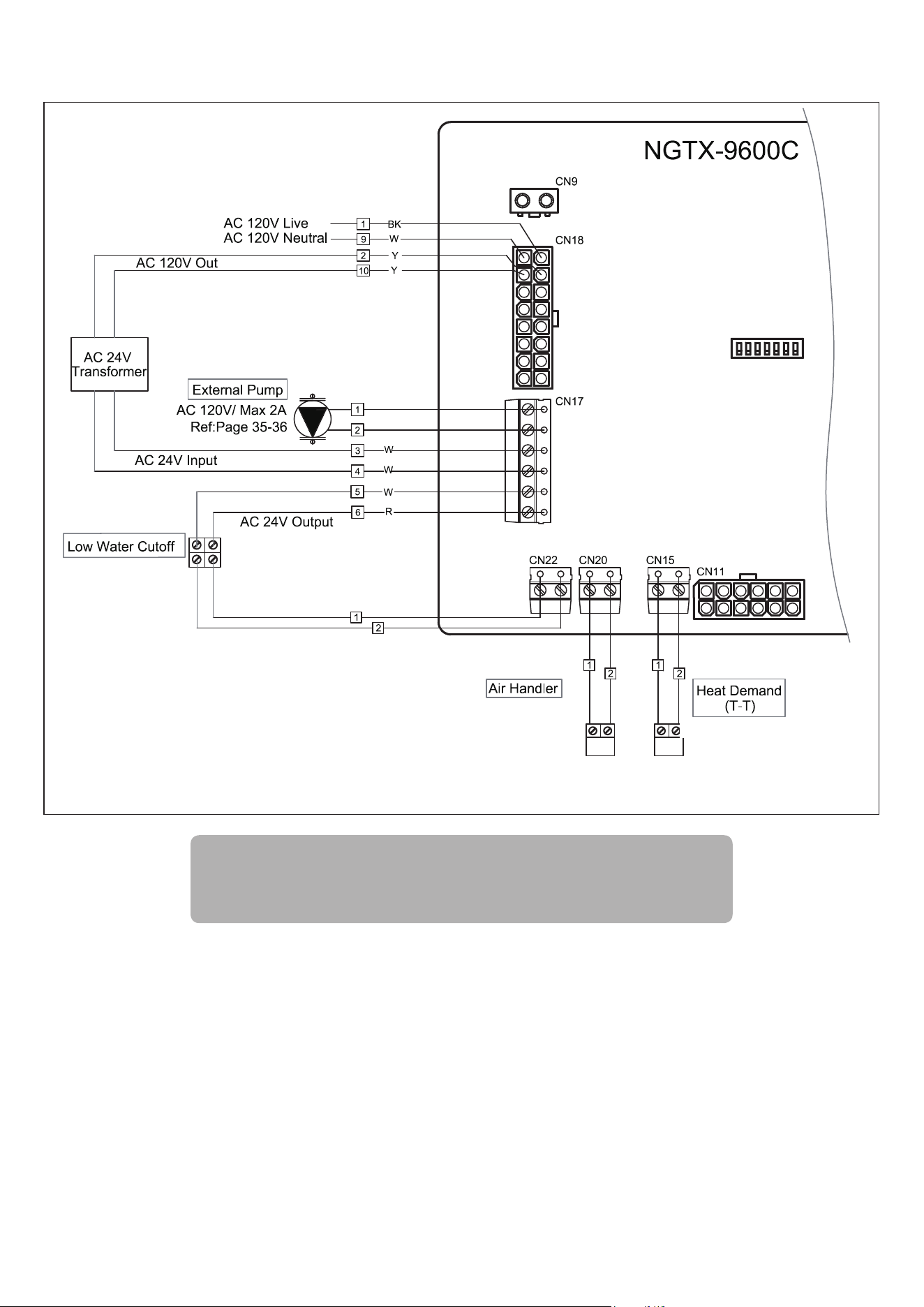
34
AUTODESK � � � � � � � � � �
AUTODESK � � � � � � � � � �
AUTODESK � � � � � � � � � �
AUTODESK � � � � � � � � � �
Note:
* 1 External Pump Terminal : ‘10:EP’ should be ‘on’ in Installer Mode to activate this terminal.
* 2 Air Handler Terminal : ‘8:AH’ should be ‘on’ in Installer Mode to activate this terminal.
Ref: Page 37
Ref: Page 36
Wiring diagram for External Options
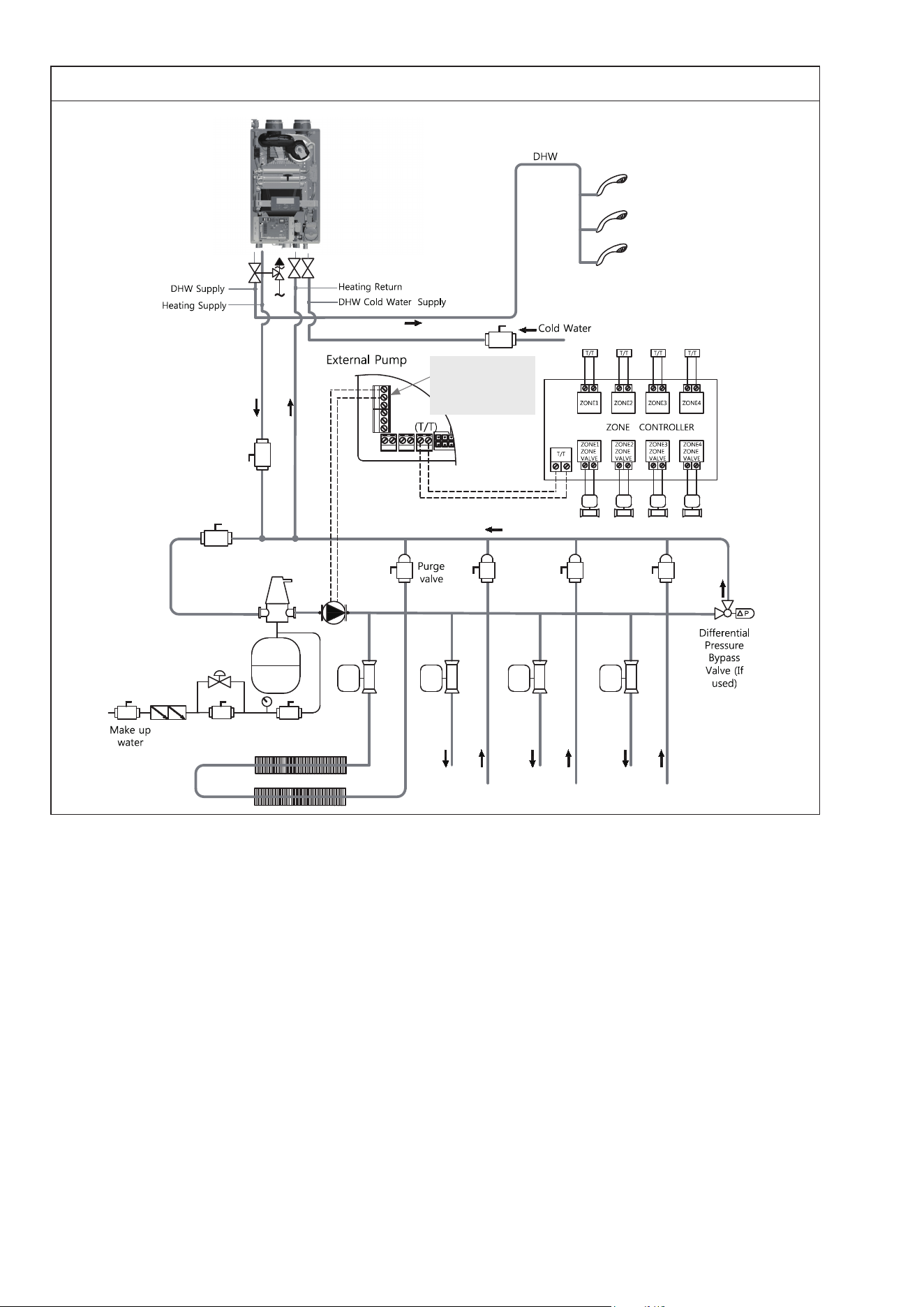
35
NOTES:
1. This drawing is meant to show system piping concept only. Installer is responsible for all equipment and detailing required by local codes.
2. All closely spaced tees shall be within 4 pipe diameters center to center spacing.
3. A minimum of 6 pipe diameters of straight pipe shall be installed upstream and downstream of all closely spaced tees.
4. The minimum pipe size of DHW piping should be ¾" diameter and CH piping should be 1" in diameter.
5. Circulators are shown with isolation anges. The alternative is standard anges with full port ball valves. Purge valves can be used with circulator
anges as an alternative.
6. Piping shown is Primary/Secondary. System ow (secondary loop) must be greater than the appliance’s primary loop ow.
7. Install a minimum of 12 diameters of straight pipe upstream of all circulators.
8. VERY IMPORTANT – Minimum ow rates outlined in this manual must be maintained through the heat exchanger to minimize short cycling.
9. In a valve-based system, each heating zone has a zone valve which opens when that zone calls for heat. Each zone thermostat is wired to its
corresponding zone valve. Contacts in the zone valves provide a signal to the appliance to operate when there is a call for heat.
10. Unit is equipped with built-in primary pump for the heating loop. This pump is sized to ensure proper flow rate through the appliance heat
exchanger and related piping. On long pipe runs, it is recommended to keep the pump at maximum speed (setting 3). DO NOT lower it from the
factory default.
11. NOTE: DO NOT INSTALL a ow check or a pump with ow check on the return line of the primary loop going to the appliance. This will isolate
the appliance from the expansion tank, causing pressure to build up in the unit and the Pressure Relief Valve to discharge.
Figure 20 – CH and DHW Piping
Primary / Secondary Piping with Zone Valves DHW Priority.
AUTODESK � � � � � � � � � �
AUTODESK � � � � � � � � � �
AUTODESK � � � � � � � � � �
AUTODESK � � � � � � � � � �
10:EP mode should to
be ‘ON’ in Installer Mode
to activate this terminal.
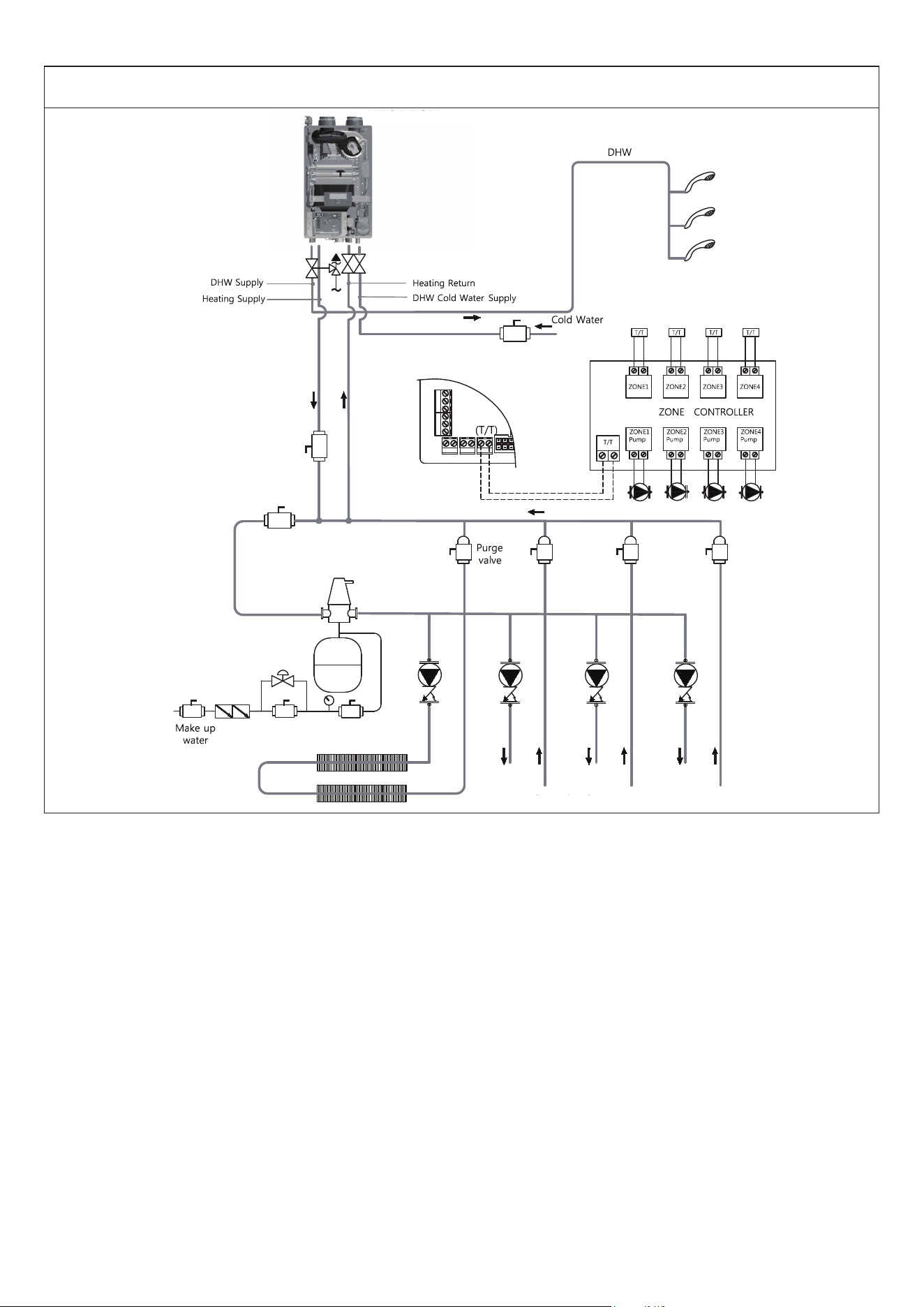
36
NOTES:
1. This drawing is meant to show system piping concept only. Installer is responsible for all equipment and detailing required by local codes.
2. All closely spaced tees shall be within 4 pipe diameters center to center spacing.
3. A minimum of 6 pipe diameters of straight pipe shall be installed upstream and downstream of all closely spaced tees.
4. The minimum pipe size of DHW piping should be ¾" diameter and CH piping should be 1" in diameter.
5. Circulators are shown with isolation anges. The alternative is standard anges with full port ball valves. Purge valves can be used with circulator
anges as an alternative.
6. Piping shown is Primary/Secondary. System ow (secondary loop) must be greater than the appliance’s primary loop ow.
7. Install a minimum of 12 diameters of straight pipe upstream of all circulators.
8. VERY IMPORTANT – Minimum ow rates outlined in this manual must be maintained through the heat exchanger to minimize short cycling.
9. Each heating zone of a pump-based system has its own circulator which turns on when a zone thermostat calls for heat.
10. Unit is equipped with built-in primary pump for the heating loop. This pump is sized to ensure proper flow rate through the appliance heat
exchanger and related piping. On long pipe runs, it is recommended to keep the pump at maximum speed (setting 3). DO NOT lower it from the
factory default.
11. NOTE: DO NOT INSTALL a ow check or a pump with ow check on the return line of the primary loop going to the appliance. This will isolate
the appliance from the expansion tank, causing pressure to build up in the unit and the Pressure Relief Valve to discharge.
Figure 21 – CH Piping – Zoning with Pumps
Primary / Secondary Piping with Zone Pumps DHW Priority. (Outdoor Reset)
AUTODESK � � � � � � � � � �
AUTODESK � � � � � � � � � �
AUTODESK � � � � � � � � � �
AUTODESK � � � � � � � � � �
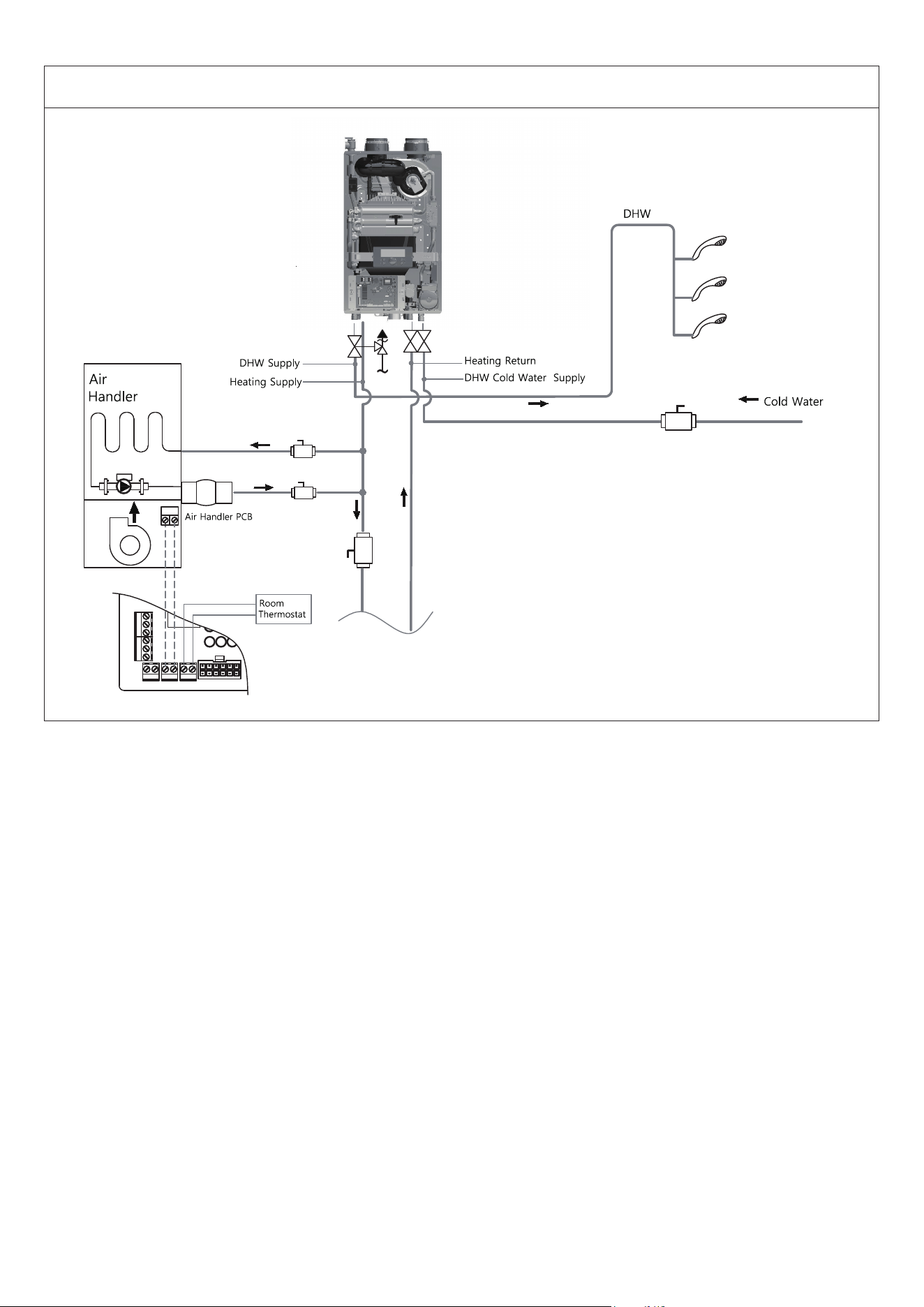
37
NOTES:
1. This drawing is meant to show system piping concept only. Installer is responsible for all equipment and detailing required by local codes.
2. This Rheem Combi Boiler can control the operation of an Air Handler when a thermistor is used in combination with the Air Handler.
3. The minimum pipe size of DHW piping should be 3/4" diameter and CH piping should be 1" diameter.
4. Unit is equipped with built-in primary pump for the Air Handler. This pump is sized to ensure proper ow rate through the appliance heat exchanger
and related to Air Handler. On long pipe runs, it is recommended to keep the pump at maximum speed (setting 3).
5. The Air Handler function is designed to stop the Air Handler’s pump and fan operation when the Combi Boiler's heating function
is not operating due to DHW operation, Combi Boiler errors or Low Water in the Combi Boiler.
6. The Air Handler turns off when the following conditions arise:
ㆍ
Thermistor open or short.
ㆍ
The Combi Boiler is supplying DHW, or it is in stand-by for DHW mode.
ㆍ
The Combi Boiler is turned off.
7. Make-up water (Auto feed mode) is in progress.
8. In order to set up the Air Handler, from Installer Mode 8:AH mode should be activated.
Figure 22 – CH Piping with Air Handler
Air Handler Piping.
AUTODESK � � � � � � � � � �
AUTODESK � � � � � � � � � �
AUTODESK � � � � � � � � � �
AUTODESK � � � � � � � � � �
38
▪ D. CH AND DHW PRESSURE RELIEF VALVES
An external pressure relief valve must be installed on this appliance for both the CH and DHW loops. When installing, observe the following
guidelines. Pressure relief valves must be installed as close to the appliance as possible. No other valves should be placed between the pressure
relief valve and the appliance. Failure to comply with these guidelines can result in substantial property damage, personal injury, or death.
This appliance has a high-temperature shut-off switch built in as a standard safety feature. Therefore, a “pressure only" relief valve is required. DO
NOT operate this appliance before the supplied pressure relief valve is installed with sufcient relieving capacity in accordance with the ASME rating
plate on the appliance.
CH Loop
This appliance is provided with a CH pressure relief valve that complies with the ANSI/ASME Appliance and Pressure Vessel Code, Section IV
(Heating Appliances). The included 30 psi CH Pressure Relief Valve must be installed on the CH supply line to ensure a compliant installation and
safe operation. The valve is meant to be eld installed. DO NOT install a CH pipe line relief valve with a pressure rating greater than 30 psi. This is
the maximum allowable CH relief valve setting for this appliance.
DHW Loop
This appliance must be installed with a DHW pressure relief valve that complies with local codes, but not less than valves certied as meeting the
requirements of Relief Valves for Hot Water Supply Systems, ANSI Z21/CSA4.4 by a nationally recognized lab that maintains periodic inspection of
production listed equipment. A DHW pressure relief valve is not included with the appliance, and is to be eld supplied and installed. DO NOT install
a DHW relief valve with a pressure rating greater than 150 psi. This is the maximum allowable DHW relief valve setting for this appliance.
After installing the relief valves and lling and pressurizing the system, test the operation of the valves by lifting the levers. Make sure the valves
discharge freely. If a valve fails to operate correctly, replace it with a new relief valve. Ensure that the maximum BTU/H rating on the pressure relief
valve is equal to or greater than the maximum input BTU/H rating of the combination appliance.
WARNING
WARNING
To avoid water damage or scalding due to relief valve operation:
• Discharge line must be connected to relief valve outlet and run to a safe place of disposal. Terminate the discharge line in a manner that will
prevent possibility of severe burns or property damage should the relief valve discharge.
• Discharge line must be as short as possible and the same size as the valve discharge connection throughout its entire length.Failure to follow
these directions will result in substantial property damage, severe personal injury, or death.
• Discharge line must pitch downward from the valve and terminate at least 6" above the oor drain, making discharge clearly visible.
• The relief line cannot be in contact with any live electrical parts.
• Discharge line shall terminate plain, not threaded, with a material serviceable for temperatures of 375°F or greater.
• Do not pipe discharge to any location where freezing could occur.
• No shutoff valve may be installed between the relief valve and appliance or in the discharge line. Do not plug or place any obstruction in the
discharge line.
• Test the operation of the relief valve after lling and pressurizing the system by lifting the lever. Make sure the valve discharges freely. If the
valve fails to operate correctly, replace it with a new relief valve.
• Test relief valve at least once annually to ensure the waterway is clear. If valve does not operate, turn the appliance “off" and call a plumber
immediately.
• Take care whenever operating relief valve to avoid scalding injury or property damage.
• For appliances installed with only a pressure relief valve, the separate storage vessel must have a temperature and pressure relief valve
installed. This relief valve shall comply with Relief Valves for Hot Water Supply Systems, ANSI Z21.22/CSA4.4.
FAILURE TO COMPLY WITH THE ABOVE GUIDELINES COULD RESULT IN FAILURE OF RELIEF VALVE OPERATION, RESULTING IN
POSSIBILITY OF SUBSTANTIAL PROPERTY DAMAGE, SEVERE PERSONAL INJURY, OR DEATH.
Install wiring and electrically ground appliance in accordance with the authority having jurisdiction or, in the absence of such an authority, follow the
National Electrical Code, NFPA 70, and/or CSA C22.1 Electrical Code-Part 1 in Canada. Failure to follow all applicable local, state, and national
regulations, mandates, and building supply codes for guidelines to install the electrical power supply could result in property damage, serious
personal injury, or death.
PART 9 – CONNECT ELECTRICAL POWER / INITIAL STARTUP
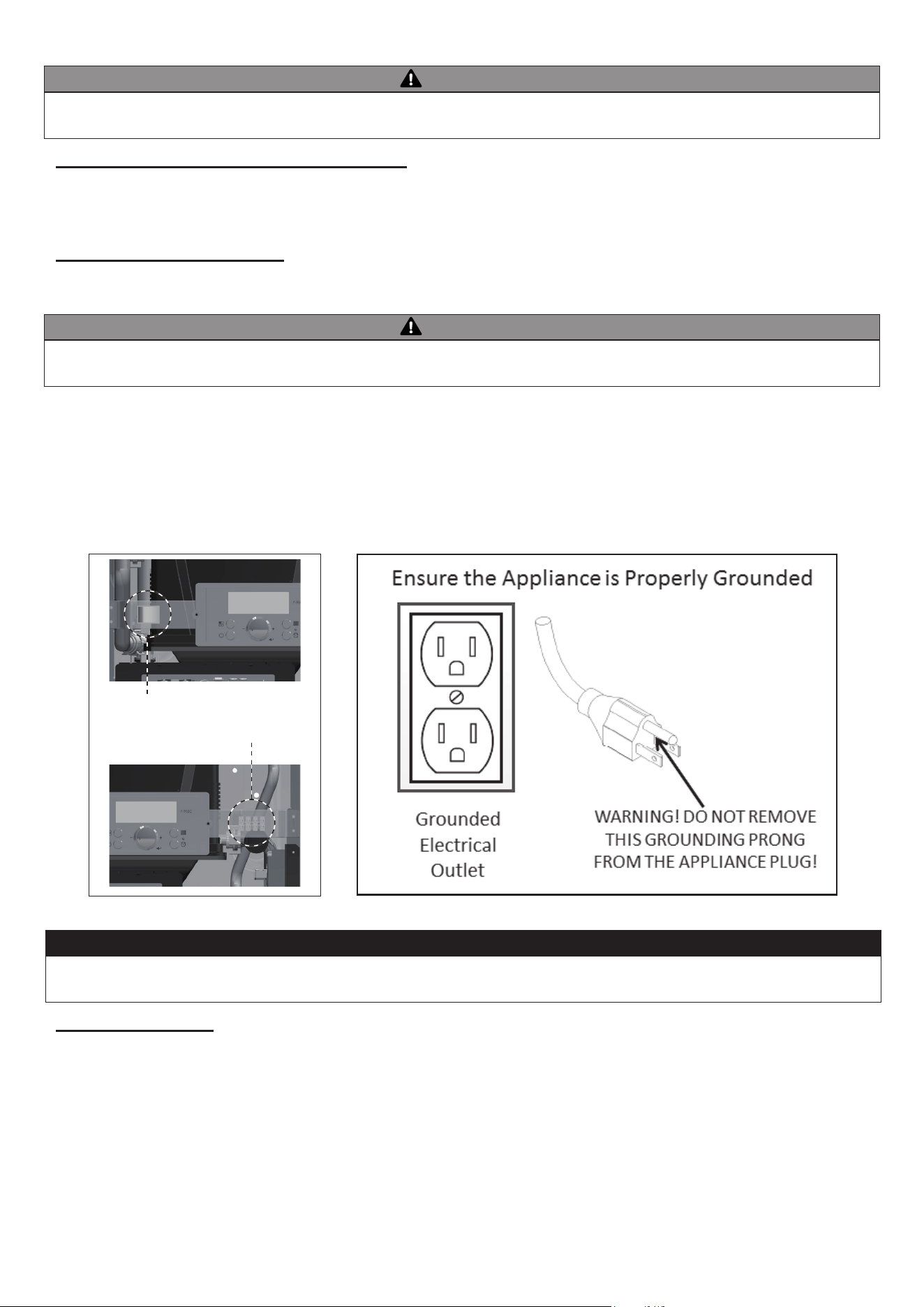
39
WARNING
WARNING
ELECTRICAL SHOCK HAZARD – To ensure safety, turn off electrical power supply at service entrance panel before making any electrical
connections to avoid possible electric shock hazard. Failure to do so could result in property damage, serious personal injury, or death.
This appliance is equipped with a three prong plug. It should only be plugged directly into a properly grounded three prong receptacle. DO NOT
remove the ground plug from the plug. Doing so could result in property damage, serious personal injury, or death.
▪ A. GENERAL OPERATING CONDITIONS
▪ B. WIRING INFORMATION
▪ C. DIP SWITCHES
• Temperature
- Operating Ambient Temperature Range: 14 ~ 140°F(-10 to 60°C)
- Operating Relative Humidity: Up to 90% at 104°F (40°C)
1. This appliance must be properly grounded. Ensure the electrical outlet (120V / 15 Amp minimum) that the appliance will be plugged into is
properly grounded.
There is one set of DIP switches. The appliance is default set at the factory to operate on Natural Gas with a 3" vent.
2. The wiring diagrams contained in this manual are to be used for reference purposes only.
3. Refer to these diagrams and the wiring diagrams of any external controls used with the installation when wiring the appliance. Read, understand,
and follow all wiring instructions supplied with the controls.
4. Do not disconnect the power supply when the appliance is in normal operation.
NOTE: For additional electrical protection, the use of a surge protector is recommended. Damage caused by power surges is not covered by the
warranty.
Figure 23 – Manual Power Switch and Appliance Plug Details
NOTICE
If the appliance display does not come ON, rst check the plug. Then check the electrical panel circuit breaker and reset it if necessary. If the
circuit breaker trips again, do not reset. Disconnect the plug and have a qualied technician diagnose the problem.
Manual Switch
Terminal Block
40
Figure 24 – Dip Switch Detail
Table 15 – Dip Switch Detail
Table 16 – System Control Settings
12345
ON
67
DIP SWITCH OFF ON
1 – 3 Factory Use Only Factory Use Only
4 Factory Use Only Factory Use Only
5 Gas Type LP NG
6 High Fire Normal High Fire
7 Low Fire Normal Low Fire
MAXIMUM FLAME DETECTING VOLTAGE 2.5V
PRE-PURGE TIME (Tp) Maximum 10 seconds , Minimum 1 seconds
SAFETY TIME (IGNITING TIME) (Ts) 2 seconds
IGNITING INTERVAL TIME 2 seconds
POST-PURGE TIME (Tip) 170 seconds
OVER-HEATING PROTECTION DETECTION TIME <3 seconds
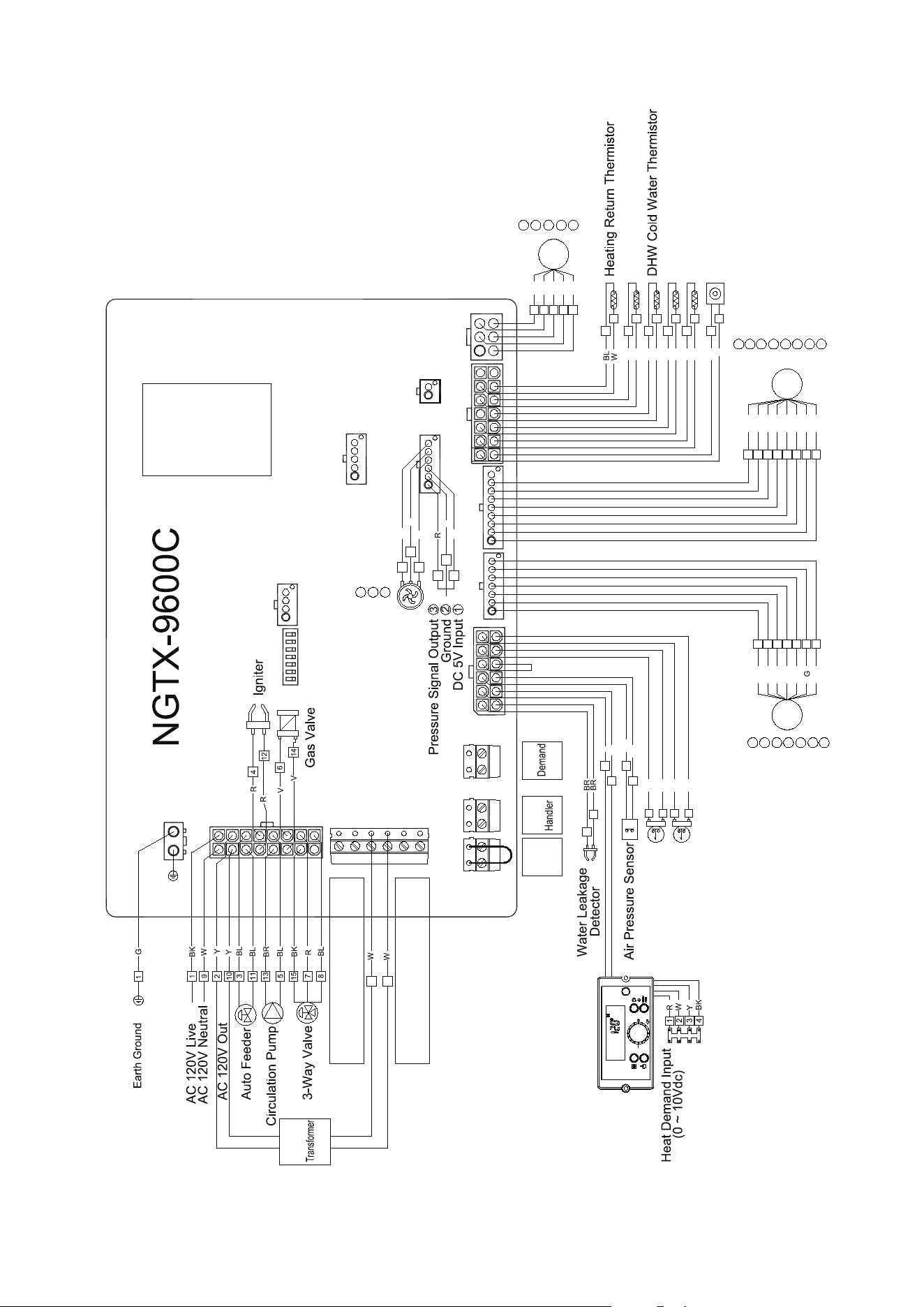
41
Figure 24 – Dip Switch Detail
Figure 25 – Electrical Wiring Diagram
3
Fan Start Coil
GND
Fan End Coil
DC 14V
RPM Sensor
6
2
5
4
Burner Limit Switch
High Limit Switch
3
9
5
11
6
12
BK
BK
R
R
BL
BL
AGM /Y Phase
1
BK 1
AGM Y Phase
AGM /X Phase
AGM X Phase
GND
AGM Position Sensor
DC 24V
5
4
3
2
6
7
M
Y
O
R
BR
6
5
4
2
3
W
7
AGM
(Air Gas Mixer)
DHW Thermistor
Heating Supply Thermistor
2
9
3
10
4
11
BK
BK
R
R
BL
BL
5
12
BR
BR
1
8
BK
R
M
R
BL
Y
W
BK
3
6
2
5
4
Exhaust Thermistor
6
BL
5
W
4
R
DC 5V Input
Flow Signal Output
Ground
5
4
6
2
8
R
W
DIP Switch
Flame Sensor
3
4
6
13
1
2
3
G
BK
M
BL
BK
R
W
G
6
5
4
2
3
O7
Y1
Flow Control Valve
BR8
Water Flow Sensor
Flow Contol Valve Y Phase
Flow Control Valve /Y Phase
Flow Contol Valve X Phase
Flow Control Valve /X Phase
GND
Flow Contol Valve Position Sensor
5
4
3
1
2
6
7
8
DC 14V
DC 14V
Fan Motor
1
7
AC 24V Input
Outdoor Temperature
Sensor
AC 24V
Low
Water
Cut Off
Air
Heat
(T-T)
External Pump Output
Max 2.0 Amp
External AC 24V Output
Max 0.5 Amp
CN4
CN7
CN14
CN12
CN11
CN15
CN20
CN22
CN17
CN18
CN9
CN3
Color Designations
(15-3.11 of ANSI Y14.15)
Black
Brown
Red
Orange
Yellow
Green
Blue
Violet
Gray
White
(BK)
(BR)
(R)
(O)
(Y)
(G)
(BL)
(V)
(GY)
(W)
Control Panel (P-960C)
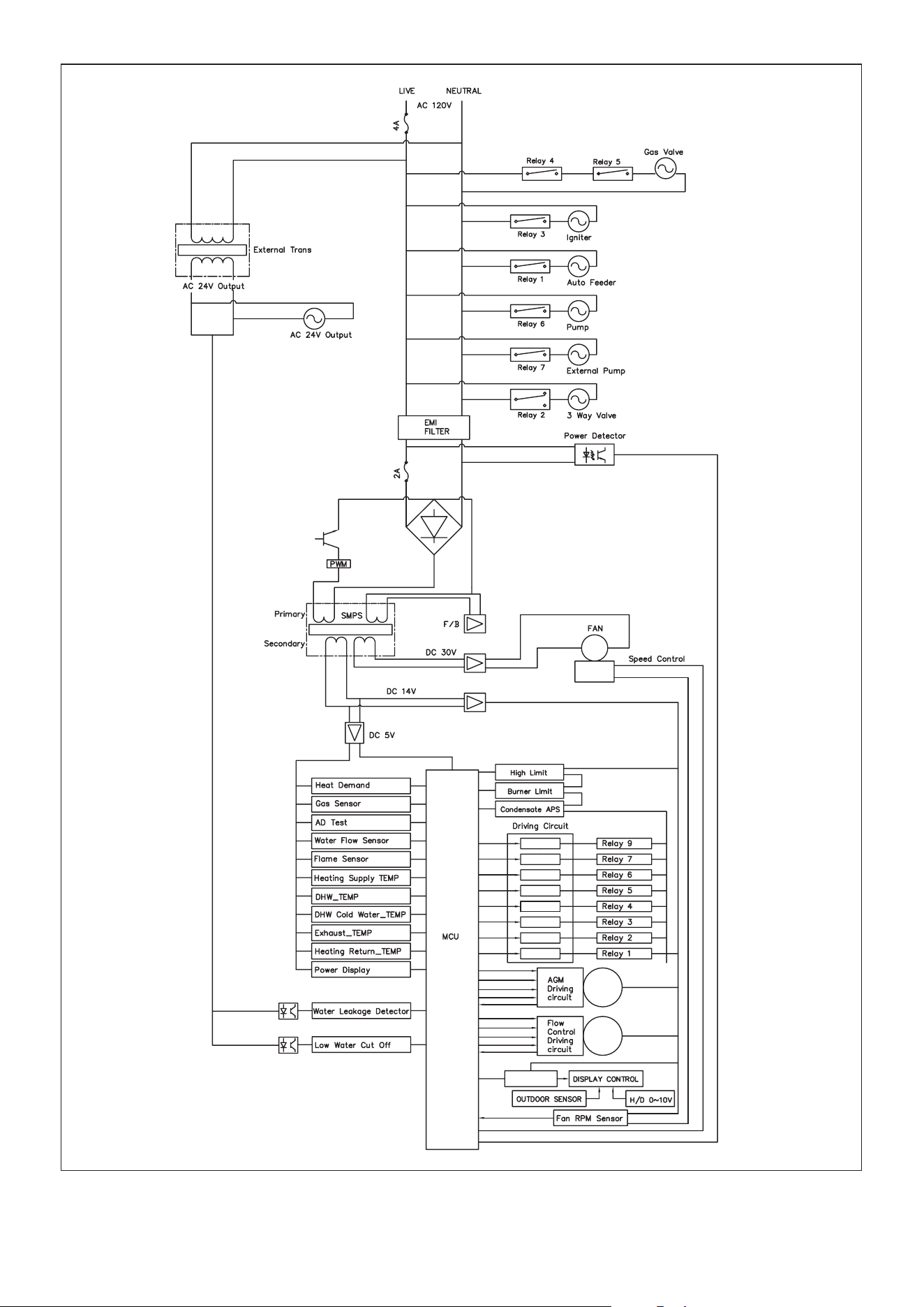
42
Figure 26 – Ladder Diagram
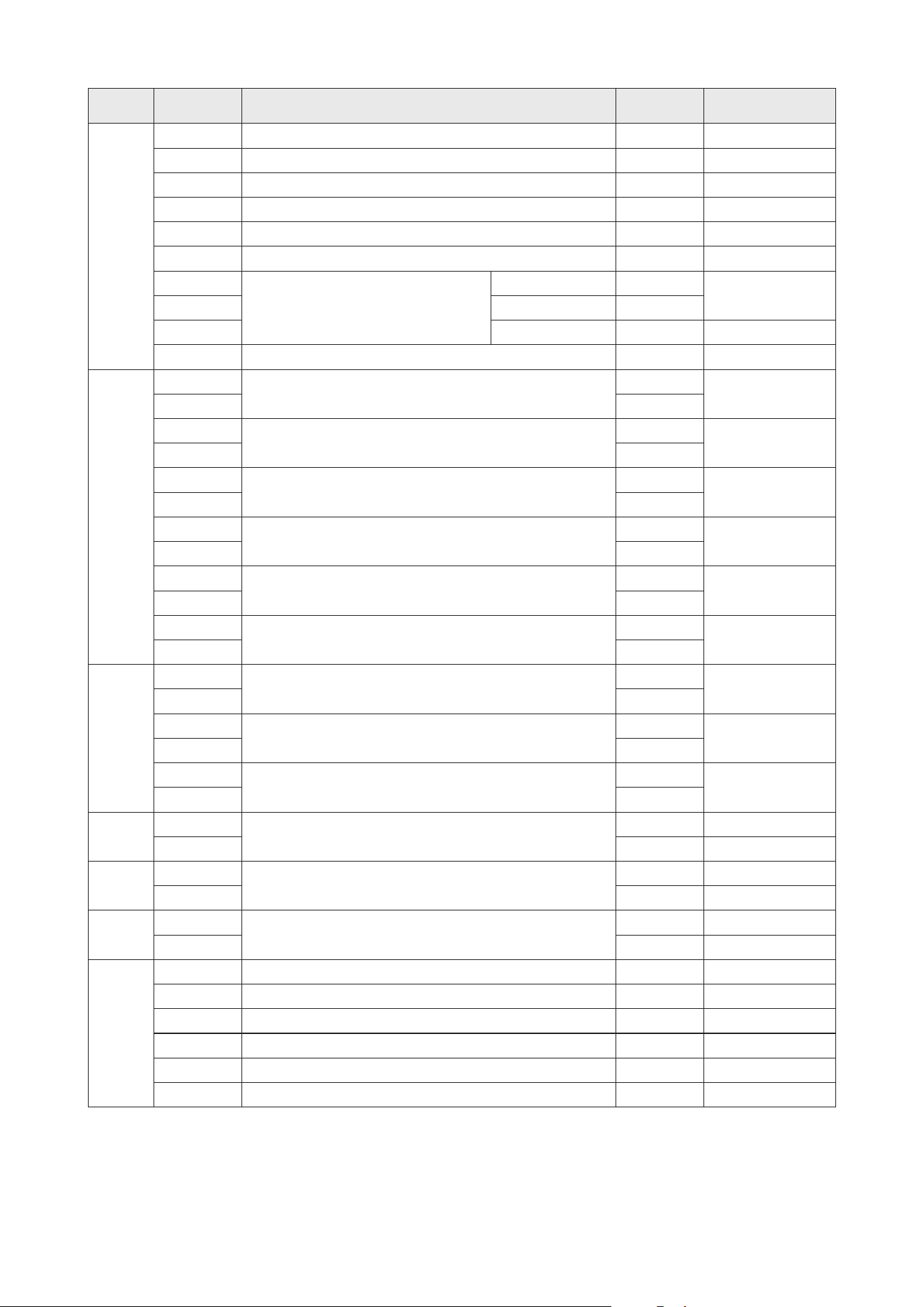
43
Table 17 – Appliance Wiring 1
CN No. Pin No. Part Color Normal Value
CN18
1,9
AC120V Input BK/W AC 120 V
2,10
AC120V Output Y/Y AC 120 V
3,11
Auto Feeder BL/BL AC 120 V
4,12
Igniter R/R AC 120 V
5,13
Circulation Pump BL/BR AC 120 V
6,14
Gas Valve V/V AC 120 V
7
3-Way Valve
Heating
R
AC 120 V
8 DHW
BL
15 Common
BK Common
16
N/A - -
CN11
1
Water Leakage Detector
BR
DC 14 V
7
BR
2
Control Panel (P-960C)
R
DC 14 V
8
W
3
Air Pressure Sensor
BL
DC 14 V
9
BL
4
N/A
-
-
10
-
5
Burner Limit Switch
(Overheat Limit Switch)
BK
DC 14 V
11
BK
6
High Limit Switch
(Overheat Limit Switch)
R
DC 14 V
12
R
CN17
1
External Pump
-
AC 120 V
2
-
3
AC 24V Input
W
AC 24 V
4
W
5
AC 24V Output
-
AC 24 V
6
-
CN20
1
Air Handler
- -
2
- -
CN22
1
Low Water Cut Off
- -
2
- -
CN15
1
Heat Demand (T-T)
- -
2
- -
CN4
1 N/A - -
2 Ground BL DC 30 V
3 Fan VDD R DC 14 V
4 Fan Start Coil W DC 30 V
5 Fan End Coil BK DC 30 V
6 Fan RPM Sensor Y DC 14 V
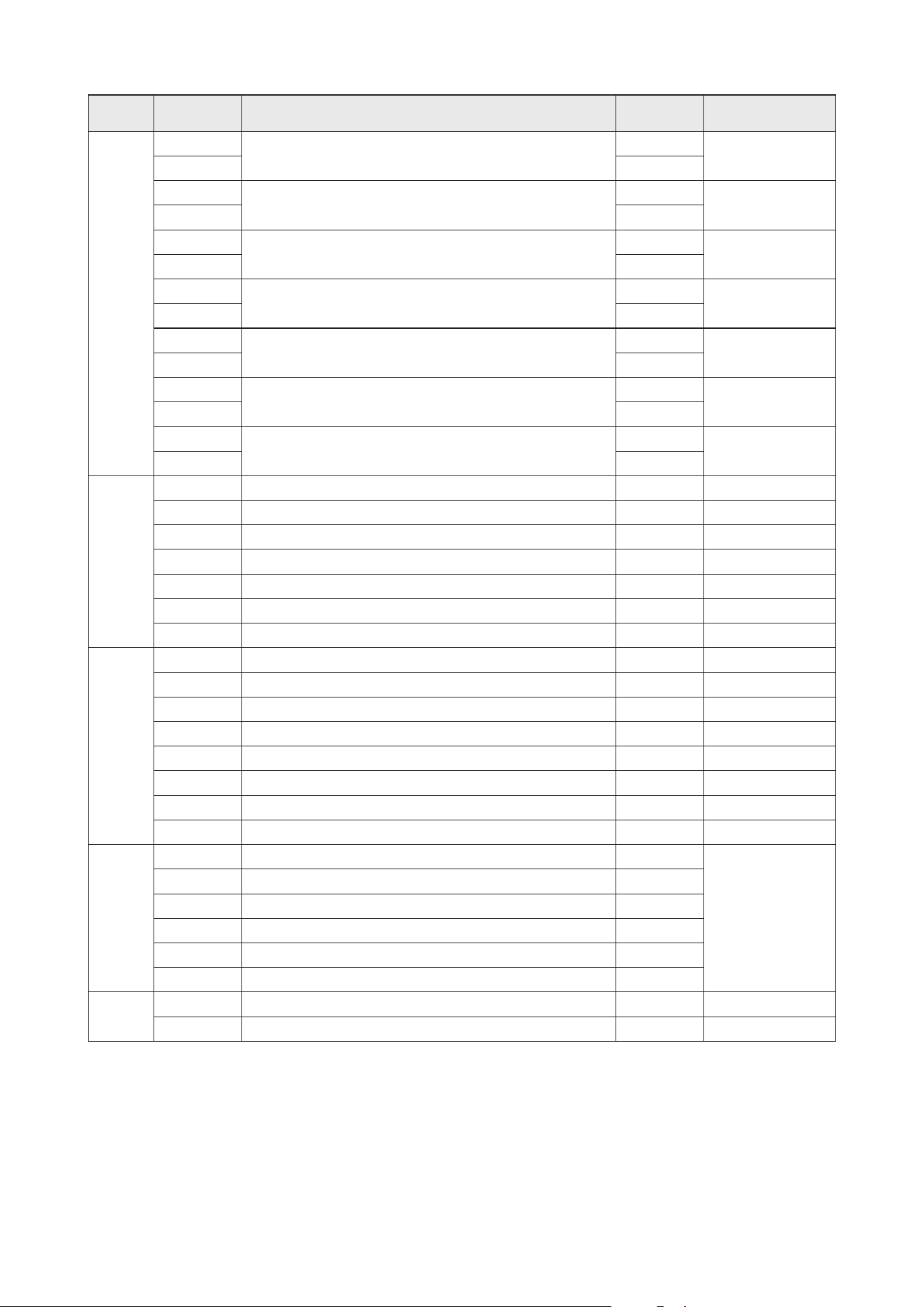
44
Table 18 – Appliance Wiring 2
CN No. Pin No. Part Color Normal Value
CN7
1
Flame Sensor
R
DC 5 V
8 BK
2
Heating Supply Thermistor
BK
DC 5 V
9 BK
3
DHW Thermistor
R
DC 5 V
10 R
4
DHW Cold Water Thermistor
BL
DC 5 V
11 BL
5
Exhaust Thermistor
BR
DC 5 V
12 BR
6
Heating Return Thermistor
W
DC 5 V
13 BL
7
N/A
-
-
14 -
CN12
1 AGM /Y Phase BK DC 24 V
2 AGM Y Phase BR DC 24 V
3 AGM /X Phase R DC 24 V
4 AGM X Phase O DC 24 V
5 Ground Y DC 24 V
6 AGM Position Sensor G DC 24V
7 VDD W DC 24 V
CN14
1 GND Y DC 14 V
2 Flow Control Valve Position Sensor G DC 14 V
3 DC 14V W DC 14 V
4 Flow Control Valve X Phase R DC 14 V
5 Flow Control Valve Y Phase BK DC 14 V
6 DC 14V BL DC 14 V
7 Flow Control Valve /X Phase O DC 14V
8 Flow Control Valve /Y Phase BR DC 14 V
CN3
1 VCC R
DC 5 V
2 Ground BK
3 Pressure Sensor G
4 VCC R
5 Water Flow Sensor W
6 Ground BL
CN9
1 Case Earth G -
2 N/A - -
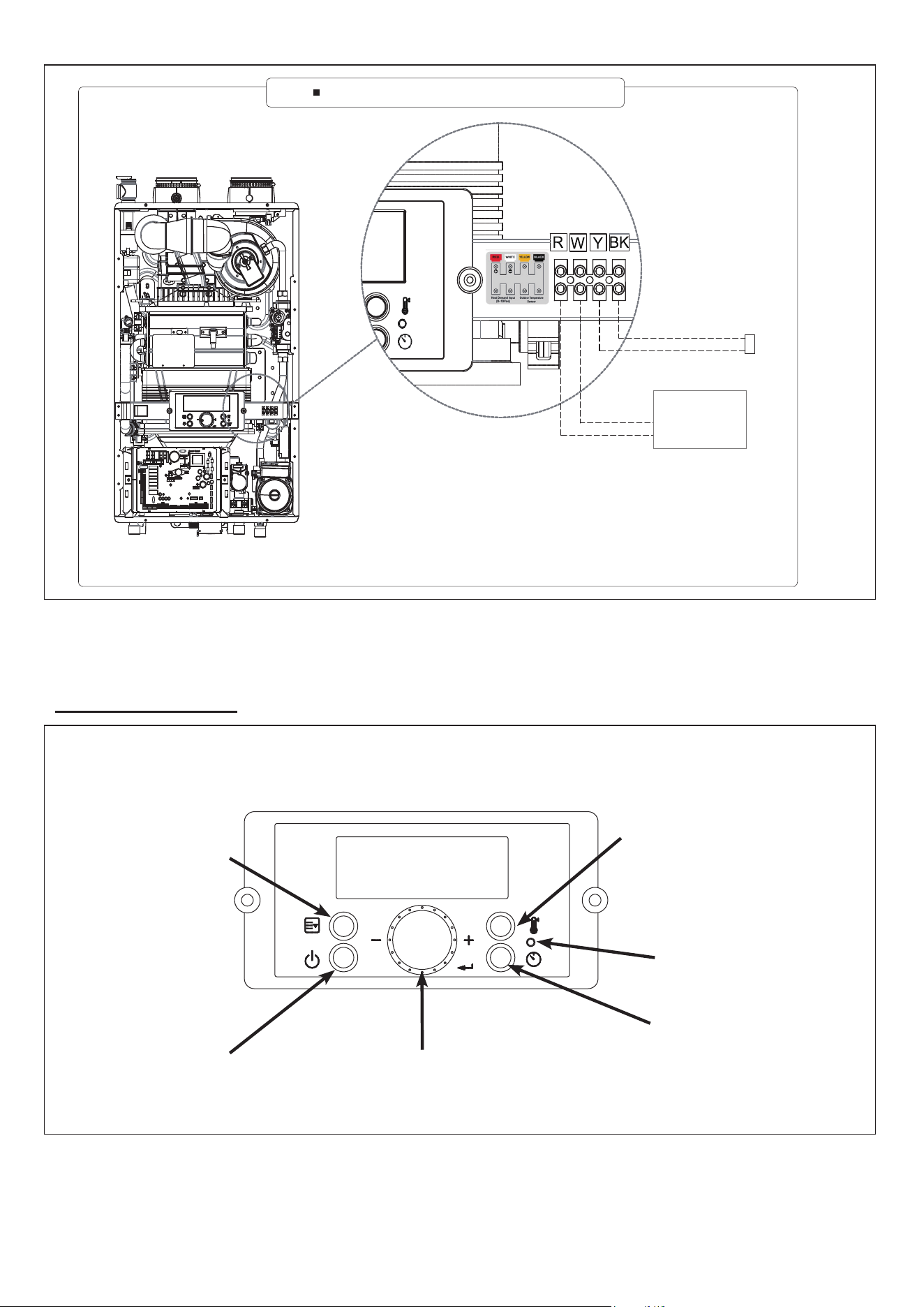
45
Press this Button Less than 5 seconds
Change Heating set-point Temperature
100~180°F (38~82°C)
Hold this Button More than 5 seconds
Change DHW set-point Temperature
90~120°F (32~49°C) And DHW High
Temperature 121~140°F (49.4~60°C)
Indicator (Green)
Indicates Unit is Operating
Press this Button Less than 5 sec-
onds DHW Preheating Timer Setting
Hold this Button More than 5 seconds
Time, Day, Month, Year, Days of the
Week setting
Press this button less than 5 seconds: Cancel/Return to previous screen
Hold this button more than 5 seconds when control panel is ON: enter
Status Display Mode
Hold this button for more than
5 seconds when control panel
is OFF: enter Installer Mode
Press This Button Less than 5 Seconds
Turn Control Power Panel ON/OFF
Press this Button Less than 5 Seconds
Select Menu by Pressing Dial Button
Scroll Values by Turning Dial Clockwise(+) or
Counterclockwise(-)
Figure 28 – Appliance Control Panel Detail
Figure 27 – Terminal Block Wiring Detail
PART 10 – OPERATING SYSTEM INSTRUCTIONS
▪ A. CONTROL PANEL
AUTODESK � � � � � � � � � �
AUTODESK � � � � � � � � � �
AUTODESK � � � � � � � � � �
AUTODESK � � � � � � � � � �
Outdoor Temperature
Sensor
Heat Demand
(0-10V)
Connection
Outdoor Temperature Sensor Connection
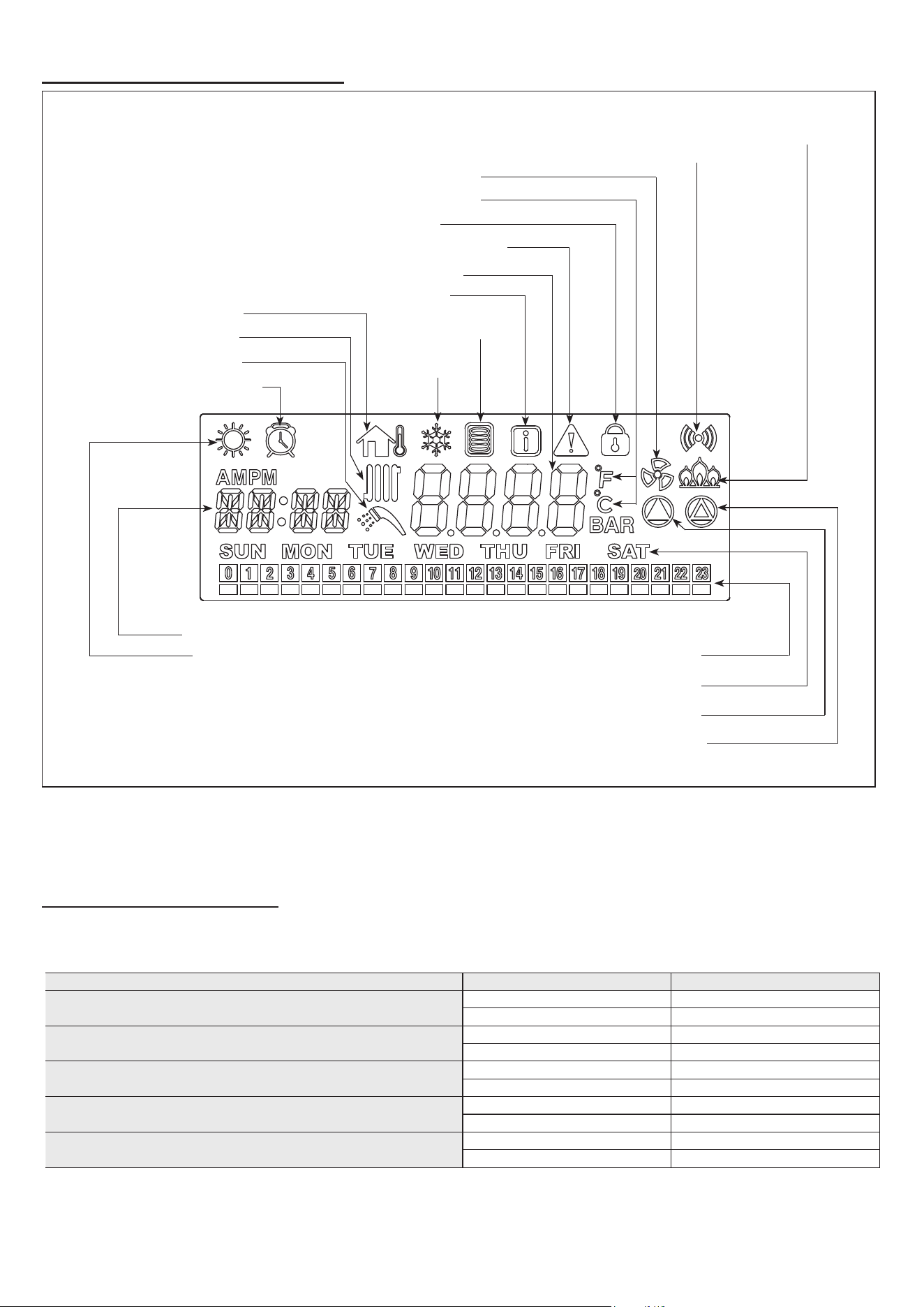
46
▪ B. LCD DISPLAY DESCRIPTIONS
▪ C. START-UP SEQUENCE
Figure 29 – LCD Display Detail
LCD also features a backlit lamp that will illuminate:
• When a user action is detected (a button is pressed)
• The display will turn off after approximately 20 seconds if no buttons are pressed
After the appliance is powered ON, the LCD display shows a sequence of information. The icons will ash, followed by various indicators that
describe the appliance controller and software versions. It will take the appliance roughly 15 seconds to cycle through the Start-Up Sequence.
Table 19 – Start-Up Sequence
Display Items Time for Display Remarks
LCD Test
1 Sec All segments “ON”
0.5 Sec All segments “OFF”
Category
1 Sec Pdn
1 Sec 0051
Software Version for Front Panel
1 Sec SPn
1 Sec 00.XX
Software Version for Appliance
1 Sec SFn
1 Sec XX.XX
Hardware Version for Appliance
1 Sec Hdn
1 Sec 00XX
AUTODESK � � � � � � � � � �
AUTODESK � � � � � � � � � �
AUTODESK � � � � � � � � � �
AUTODESK � � � � � � � � � �
Clock
DHW Preheat Scheduled Hours
Current and DHW Preheat scheduled Day
Internal Pump Icon
Heating activated Icon
Status Display
DHW High Temperature Icon
Temperature Unit
Lock Mode Icon
Communication Status
Burner ON Icon
External Pump(Heating) Icon
Air Handler Icon
Warm Weather
Cutoff Icon
DHW Preheat
activated Icon
Outdoor Reset Icon
DHW activated Icon
DHW Preheat Timer Icon
Information Icon
Freeze
Prevention Icon
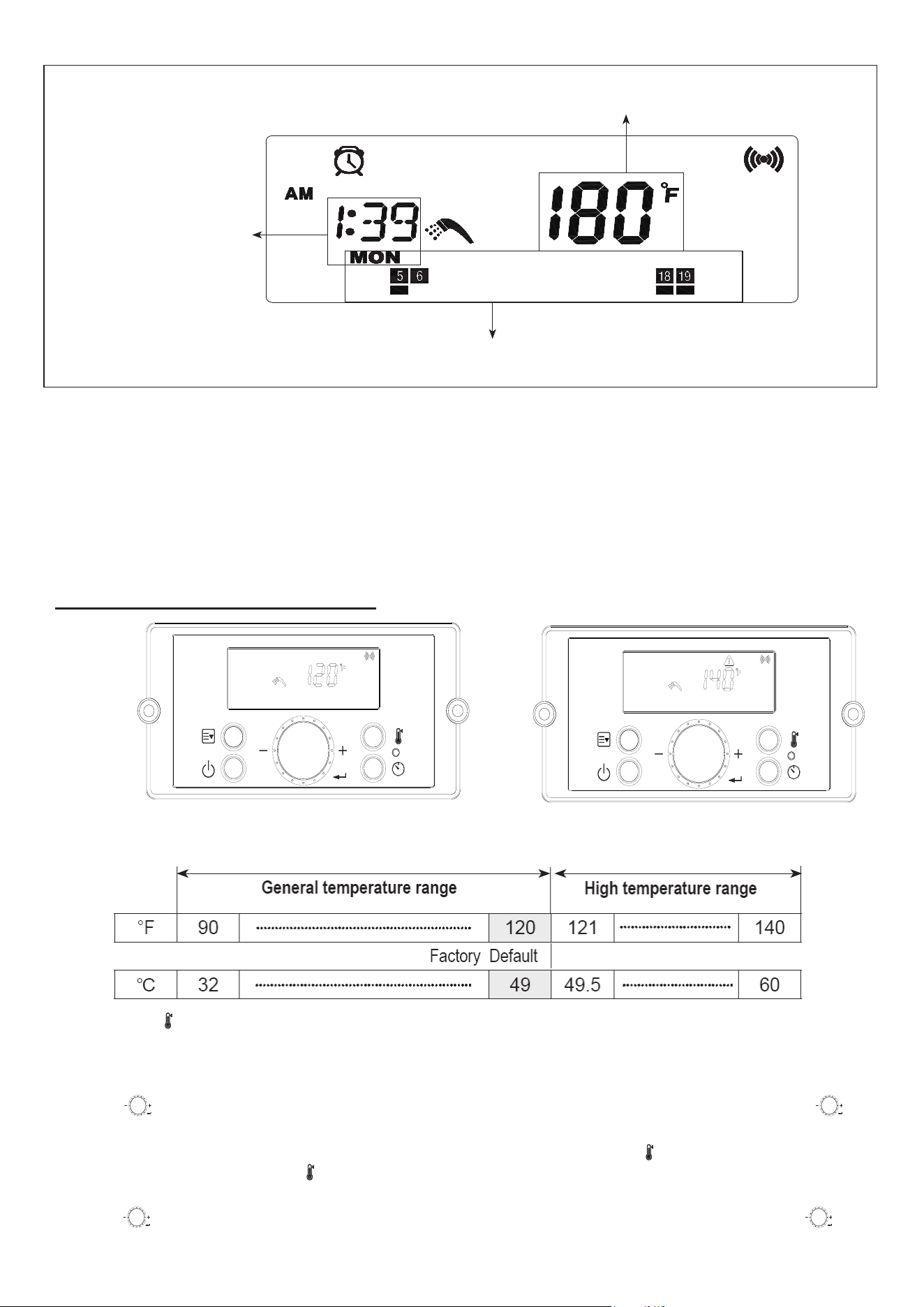
47
AUTODESK � � � � � � � � � �
AUTODESK � � � � � � � � � �
AUTODESK � � � � � � � � � �
AUTODESK � � � � � � � � � �
CURRENT TIME : AM 1:39
CURRENT DAY : MONDAY
DHW Preheat is scheduled to run Monday 5:00am~6:30am and
6:00pm~8:00pm
Heating Temperature Setting: 180
°F
[ Example ]
Figure 30 – Initial Display Screen Example
The Control System can operate through user and service modes that have specic LCD outputs and dedicated controls, including:
• Change the Heating / DHW Set-Point Temperature
• Lock Mode
• Error Mode
• Status Display Mode
• Outdoor Temperature Mode
• Installer Mode
NOTE: The initial display screen will differ depending on a number of factors, including whether the appliance detects a call for heat or hot water.
NOTE: The operation of the high temperature Domestic Hot Water can be set separately.
Press and hold the button for 5 seconds when the display is powered ON to change the DHW Set-Point for General Temperature Range. The
DHW icon and current Set-Point will display and ash. This indicates that the DHW Set-Point can be changed. Factory DHW Set-Point is 120°F (49°
C). Initial and General Temperature DHW Set-Point Range is 90~120°F (32~49°C).
The recommended starting temperature is 120°F (49°C).
Turn the dial counterclockwise to lower and clockwise to raise the DHW Set-Point. After changing the temperature, press the dial button
to save the Set-Point.
To change the DHW Set-Point above 121°F (49.5°C) of High Temperature Range, press and hold the button for 5 seconds to get to General
Temperature Range, then press and hold the button again for 5 seconds for High Temperature Range Set-Point.
High Temperature DHW Set-Point Range is 121~140°F (49.5~60°C).
Turn the dial counterclockwise to lower and clockwise to raise the DHW Set-Point. After changing the temperature, press the dial button to
save the Set-Point.
Figure 31 – DHW Set-Point Screens
▪ D. CHANGING THE DHW SET-POINT
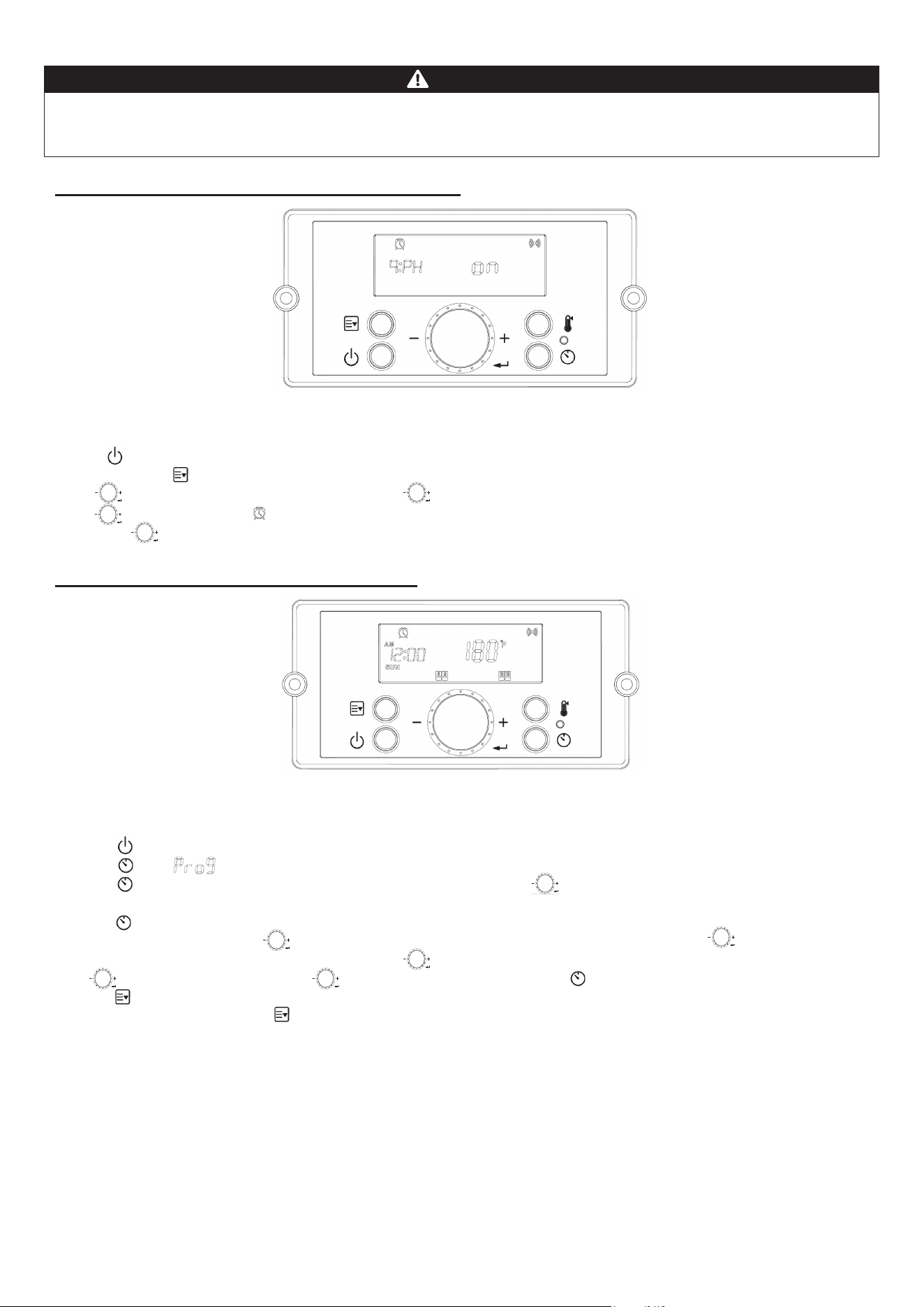
48
1. Press the ON.
2. Press the. Then, is displayed and blinking.
3. Press the again so today’s day [For Example: Sunday] is blinking. Then turn the clockwise or counterclockwise until the ‘the desired day’ is
displayed.
4. Press the to save the Day.
5. Current Time is blinking,then turn the clockwise or counterclockwise until ‘the desired hour’ is displayed.Press the to save the Hour(Icon is lit).
Then the next ‘Time Icon’ will be blinking. Continue pushing the to select each 30 minute time block that is consecutive. To skip some time blocks
turn the to next desired time and press the to select the next time blocks. Press the to save the setting.
6. Press the to return to ‘Day’. Repeat steps 3-5 for each day of the week.
7. After completing all settings, press the three times to return to normal mode.
NOTE: The operation of the DHW preheat activated setting can be set separately.
Press the . The control panel must be off.
Press and hold the for 5 seconds to enter ‘Installer Mode’.
Turn the clockwise until 9:PH is displayed. Then press the so is blinking.
Turn the clockwise so ‘on’ and are blinking.
Then press the to save the setting.
[For Example] Today is Sunday DHW Preheat is scheduled to run Sunday 8:00am~10:00am and 6:00pm~8:00pm.
▪ E. SETTING FOR DHW PREHEAT ACTIVATION
▪ F. SETTING FOR DHW PREHEAT TIMERV
Hotter water increases the risk of scald injury. Scalding may occur within 5 seconds at a setting of 140°F (60°C). Water temperature over 125°F
can instantly cause severe burns, or death, from scalds. Children, disabled, and elderly are at the highest risk of being scalded. See instruction
manual before setting temperature at appliance. Feel water before bathing or showering!
DANGER
Figure 32 – DHW Preheat Activation Screen
Figure 33 – DHW Preheat Timer Screen
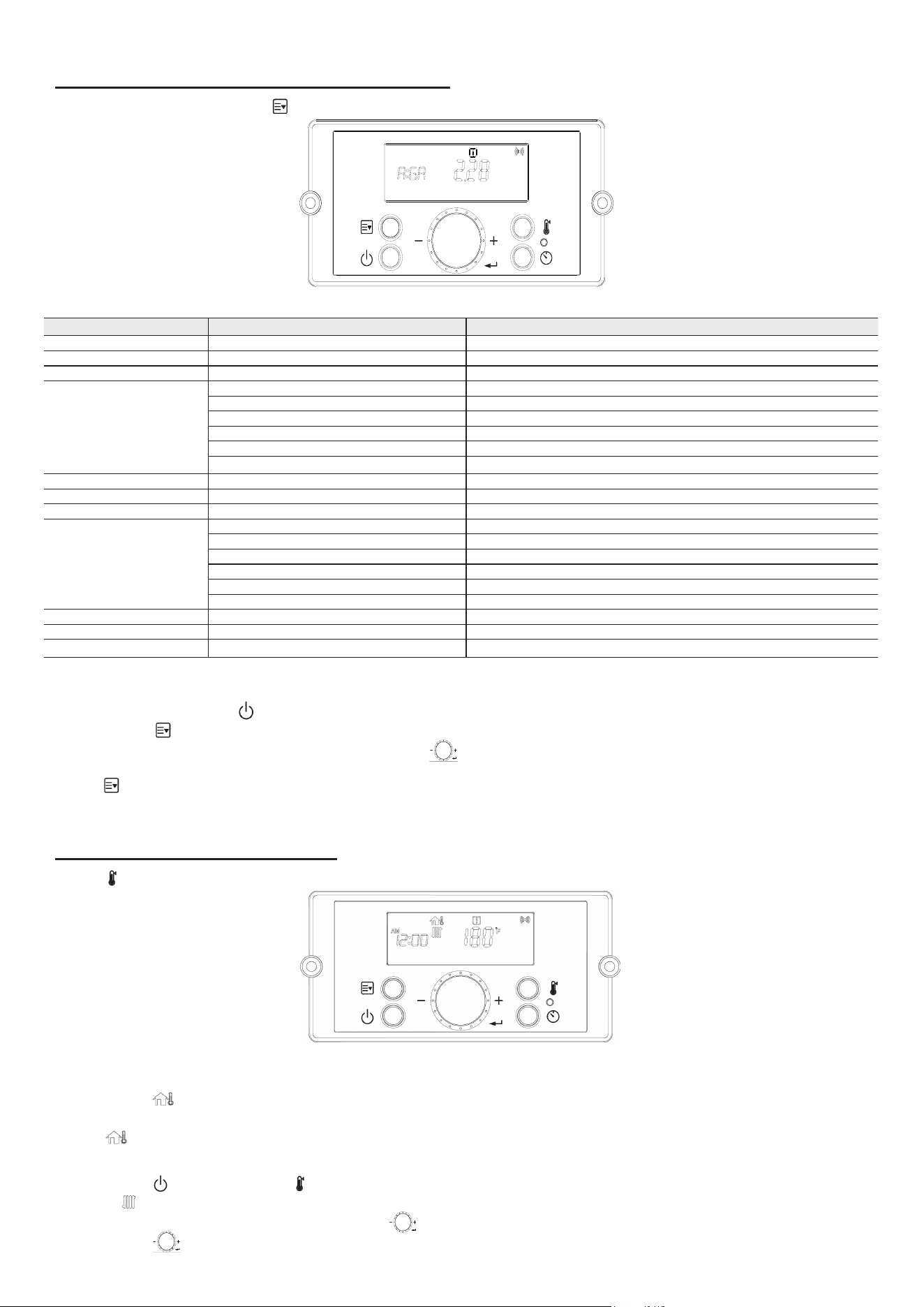
49
Status Display Mode will activate when is pressed and held for 5 seconds when the display panel is turned on at Standby Mode.
Press the button when the display panel is powered ON. The display will appear as follows. The set-point will ash when the CH Set-Point can be
changed.
This function can be checked and set in User Mode as above parameters.
To enter the User Mode,Press the button on.
Press and hold the button around 5 seconds.
And then “A:GA" is rst displayed on the display screen, turn the dial button clockwise or counterclockwise to scroll through the displayed
parameters in this mode.
Press the button again to return to normal mode.
NOTE: The control system will not allow the changes if Lock Mode (C:TL) is activated. Lock Mode (C:TL) will have to be turned off before making
further changes.
▪ G. STATUS DISPLAY MODE (or USER MODE)
▪ H. CHANGE THE CH SET-POINT
Table 20 – Status Mode Display Screen Descriptions
Parameter Detail Description
A: GA/L DHW Flow Rate Current Flow Rate (GA: GPM/°F/psi(Default) or L: LPM/°C/BAR)
b:FM Fan Speed Current Fan Speed
C:TL Lock Mode Lock mode is used (On) or unused (oFF)
d:TP
H.SUP Current (Heating Supply Thermistor) temperature (°F/°C)
H.rEt Current (Heating Return Thermistor) temperature (°F/°C)
d.Hot Current (DHW Thermistor) temperature (°F/°C)
d.CLd Current (DHW Cold Water Thermistor) temperature (°F/°C)
Eht Current (Exhaust Thermistor) temperature (°F/°C)
Od Current (Outdoor Temperature Sensor) temperature (°F/°C)
E:WP Heating Water Pressure Current Heating Water Pressure (psi/BAR)
F:FS Voltage of Flame Sensor Current Flame Sensor (Vdc)
g:EH Error History View the Error History (E0:XX ~ E9:XX)
H:RH
(Running History)
PLUg X 1000 hour (Power-on Time)
bnH.H X 1000 hour (Heating Burn Hour)
bnH.d X 1000 hour (DHW Burn Hour)
bnC.H X 1000 Time (Heating Burn Cycle)
bnC.d X 1000 Time (DHW Burn Cycle)
PPHr X 1000 hour (Pump Running Time)
I:MD 199A / 180A Model [199A:100k (180k DHW) BTU/hr, 180A:120k (199k DHW) BTU/hr]
J:GT ng/LP Current Gas type
K:Pr Pcb / PnL Current Software version(Pcb:Circuit Board, PnL:Control Panel)
NOTE: The operation of the DHW preheat activation setting can be set separately.
• Blinking on the control panel is not an Error Status.
• The unit has the ‘Outdoor Reset (Energy Saving)’ feature, but this feature is disabled(Factory Default).
• is lit on the control panel, the Outdoor Reset (Energy Saving) is enabled.
• Heating Temperature is changing automatically based on the Outdoor Temperature.
Press the ON. Press the Button.
The and ‘current Heating temperature setting’ will be blinking.
Heating temperature can be adjusted by turning the from 100°F to 180°F (38°C~82°C) in 1°F(0.5 °C) intervals.
Press the to set the Heating Temperature and return to normal mode.
Figure 34 – Status Mode Screen
Figure 35 – CH Set-Point Screen
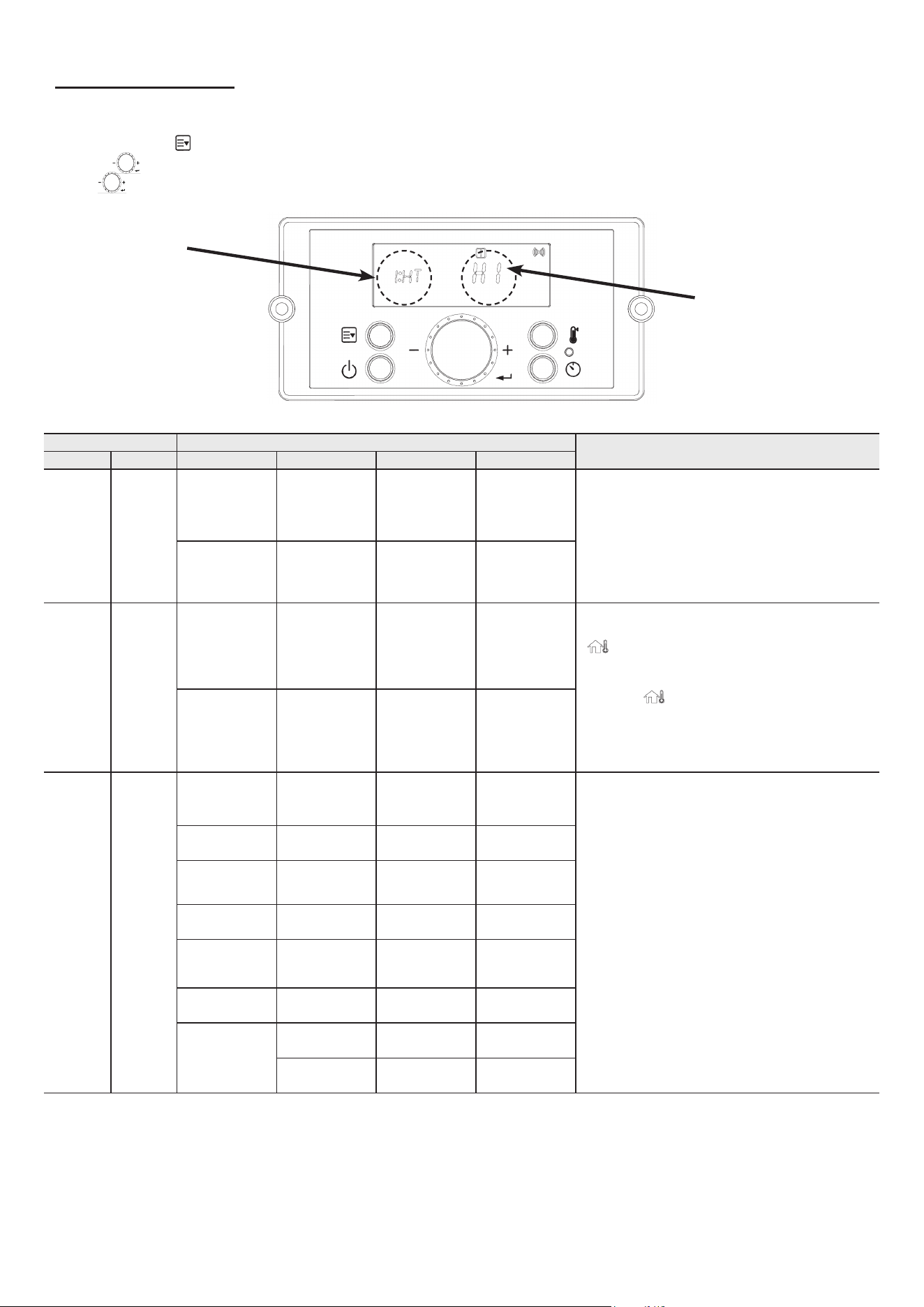
50
How To Enter “Installer Mode"
1. Turn off the power to the Control Panel.
2. Press and hold the button for more than 5 seconds to get into the ‘Installer Mode’.
3. Turn the clockwise or counterclockwise to search to the desired selection in the ‘Installer Mode’.
4. Press to save setting value.
▪ I. INSTALLER MODE
Secondary Show
Primary Show
Primary Show Secondary Show
Description
Parameter Index Step 1 Step 2 Step 3 Default
1:HT
Heating
Temp
Range
HI
121~180°F
(49.5~82°C)
-
180°F
(82°C)
This setting is for changing the heating set temperature
range.
• You can change the Highest Set Temperature (HI) and
the Lowest Set Temperature (Lo) by adjusting the num-
bers on the display.
• If 2:TR (Outdoor Temperature Reset) is activated (‘on’)
then the settings for 1:HT will be overridden by 2:TR
settings.
Lo
80~120°F
(26~49°C)
-
100°F
(38°C)
2:TR
Outdoor
Temp Reset
oFF - - O
This setting activates or deactivates the Outdoor Tempera-
ture Reset function.
• appears and lights up when the Outdoor Tempera-
ture Reset function is activated.
• Please check the connection of the outdoor temperature
sensor if is blinking.
• You can’t change the heating set temperature manu-
ally while this function is on, because the heating set
temperature is determined by the outdoor temperature
automatically.
on - - -
3:TY
(This
param-
eter doesn’t
show if
2:TR is Off)
Type of
Heating
System
A.Ftb - -
O
120~180°F
(49~82°C)
This section is used to select which type of Heating Sys-
tem is being used.
•There are 6 typical Heating Systems that are available
-Finned Tube Baseboard
-Air Handler
-Cast Iron Baseboard
-Low Mass Radiant Floor
-High Mass Radiant Floor
-Radiator
•For these 6 heating types the low and high temperature
points are
pre-programmed. (See ranges to the left)
* If b.AH is selected, additional steps are needed to be
programmed, see 8:AH
below
•If you would like to use custom low and high temperature
points, select G.CUS and follow the sub menus to set
custom low and high temperature points.
b.AH - -
140~180°F
(60~82°C)
C.Cib - -
100~170°F
(38~76.5°C)
d.LrF - -
80~140°F
(26.5~60°C)
E.rF - -
80~120°F
(26.5~49°C)
F.rAd - -
120~170°F
(49~76.5°C)
G.CUS
HI
121~180°F
(49.5~82°C)
180°F
(82°C)
LO
80~120°F
(26.5~49°C)
100°F
(38°C)
Figure 36 – Installer Mode Screen
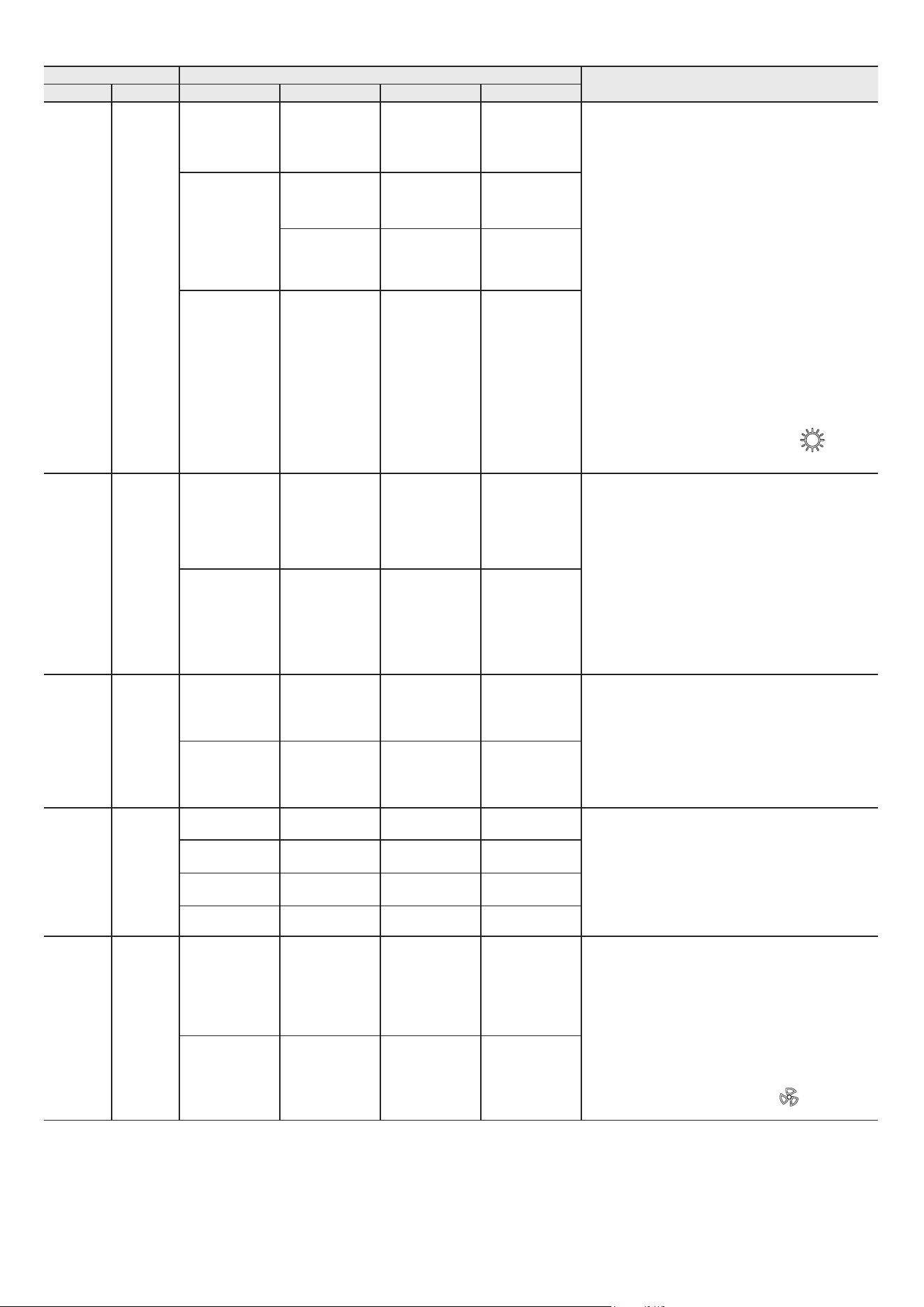
51
Primary Show Secondary Show
Description
Parameter Index Step 1 Step 2 Step 3 Default
4:Od
(This
param-
eter doesn’t
show if 2:TR
is Off)
Outdoor
Temp
A.HI
23~110°F
(-5~43°C)
-
O
70°F
(21°C)
The Combi Boiler will automatically use the Outdoor Tem-
perature Settings and the Heating Application to adjust
the set temperature of the unit for the most comfortable
and economical heating temperature.
•A.HI (Outdoor High Temperature Setting)
This should be set at the highest average outdoor
temperature in which the customer would like the heating
system to continue to heat the home.
•b.noH (Warm Weather Shutdown Temperature Setting)
- When ‘on’ the unit will go into energy saving mode and
automatically stop heating when the outdoor temperature
is 5°F (3°C) over the A.HI set point.
- When ‘oFF’ the unit will continue to heat at the lowest
temperature setting even if the outdoor temperature is
greater that A.HI set point.
•C.Lo (Outdoor Low Temperature Setting)
This should be set at the lowest average outdoor
temperature during the winter season. (not the lowest
possible outdoor temperature)
•When the Warm Weather Cutoff is on the will ash
on the control panel.
b.noH
on - O
oFF - -
C.Lo
-4~61°F
(-20~16°C)
-
O
20°F
(-6.5°C)
5:bs
(This
param-
eter doesn’t
show if 2:TR
is Off)
Boost
Timing
oFF - - O
The setting is to increase the set temperature of the unit
on cold start ups if the actual room temperature doesn’t
reach the thermostat set temperature quick enough, the
Boost time function will increase the set temperature of
the Combi Boiler 10°F (5.5°C) after the selected Boost
time setting has passed.
Example :
Room thermostat set at 72°F, Combi Boiler set temp at
140°F, and Boost time function set to 30 min. If the room
temperature does not reach 72°F within 30 min then the
Combi Boiler will increase it’s set temp from 140°F to
150°F
1~120 min - - -
6:Vt
Vent
Material
PVC - - O
Vent Material function is used to limit the maximum
exhaust temperature for the vent material used. For
safety reasons the Combi Boiler operation will stop if
the exhaust temperature exceeded maximum allowable
temperature for the venting material.
•PVC maximum exhaust temperature is 149°F (65°C)
•CPVC and PP/STS maximum exhaust temperature is
200°F (93°C)
CPVC - - -
7:EL
High
Elevation
0-2 - - O
Select an altitude range from the following four options
based on where the Combi Boiler is installed.
•0-2 : 0~1,999ft (0~609m)
•2-5 : 2,000~4,999ft (610~1,523m)
•5-8 : 5,000~7,999ft (1,524~2,438m)
•8-10 : 8,000~10,000ft (2,439~3,048m)
2-5 - - -
5-8 - - -
8-10 - - -
8:AH Air Handler
oFF - - O
This function needs to be turned ‘on’ if an Air Handler is
being used as a heating type.
•When heating side is running the fan and pump for the
Air Handler will be on.
•If the DWH side is running the fan and pump for the Air
Handler will be off.
•If this is not set to ‘on’ the Air Handler fan will be running
with no hot supply water from the Combi Boiler and blow
cold air into the home while the DHW side is running.
•When the Air Handle is operating, the will display on
the control panel.
on - - -
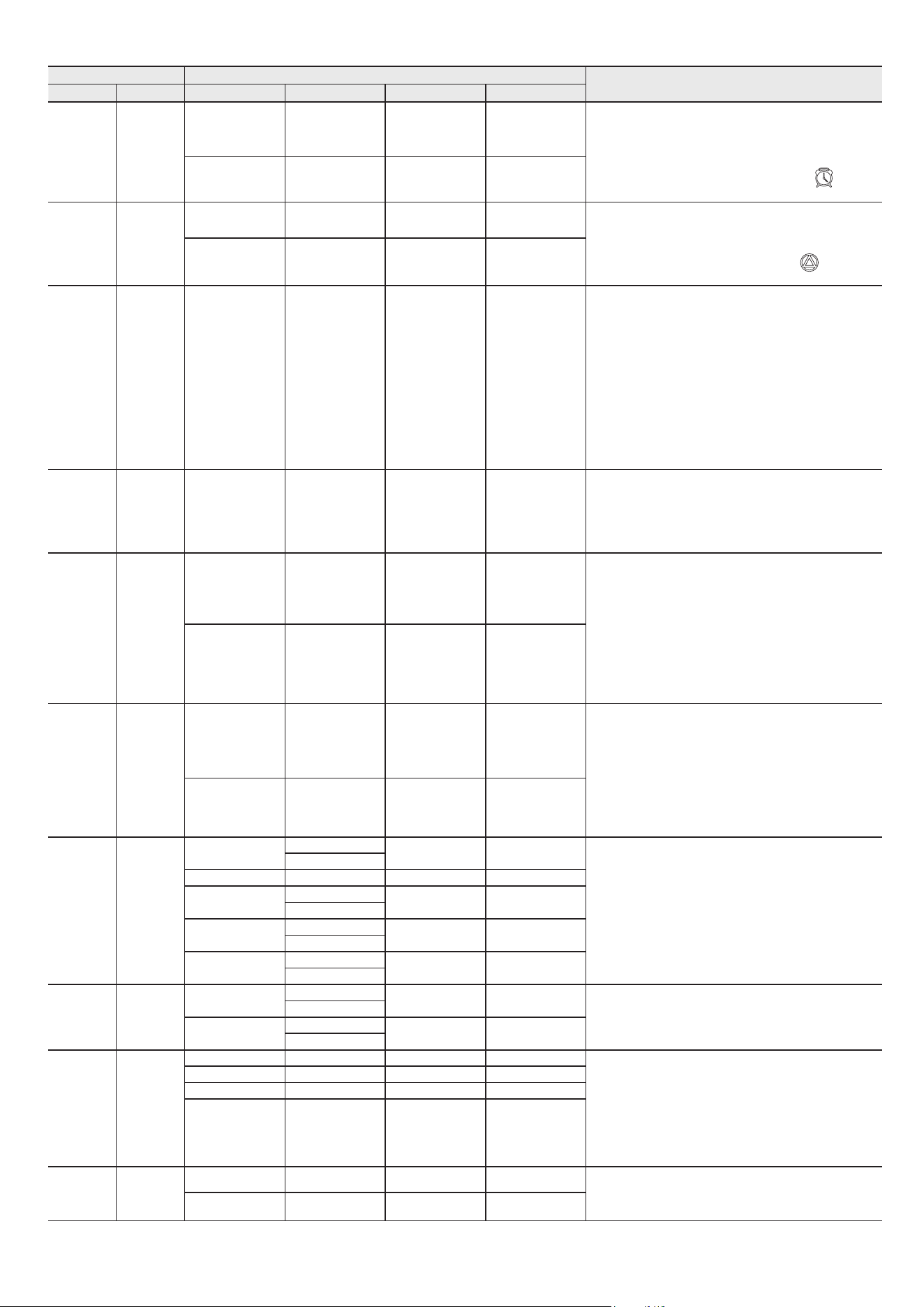
52
Primary Show Secondary Show
Description
Parameter Index Step 1 Step 2 Step 3 Default
9:PH Pre-Heating
oFF - - O
This function is used to preheat the internal DHW plate
heat exchanger during selected times set.
•After turning on this function the timer will need to be
set.
•When Pre Heating function is activated the will be
displayed on the control panel.
on - - -
10:EP
External
Pump
oFF - - O
This setting can activate or deactivate the terminals in the
Combi Boiler for an External Pump (secondary pump) on
the circuit board.
•When the External Pump is activated the will display
on the control panel.
on - - -
11:WP
Water
Pressure
12~26 PSI - - -
This function is to control the water pressure on the
heating side of the Combi Boiler. This will ensure there
is enough water inside the Combi Boiler to operate cor-
rectly.
•The Auto Feeder will ll the system within 10 minutes.
When the pressure of the system is over 2 PSI of Water
Pressure Setting the Auto Feeder will close and water will
stop lling the Combi Boiler.
•Water Relling Pressure: Set Valve - 4 PSI (0.002 BAR)
•Water Relling Stop Pressure: Set Valve + 2 PSI (0.001
BAR)
12:IV Interval 0~20 min - - 3 min
This function is to set up the Interval Time in Heating
Mode to prevent inconsistency of heating
•If the selected time passes and the Combi Boiler’s inside
temperature drops, this function will automatically reignite
the burner in the Combi Boiler.
13:Or
Pump
Overrun
Time
HEAt 0~60 min - 20 min
This mode is to control how long the pump will run after
the heating or DHW demand is satised.
•This setting is to prevent unnecessary running of the
pump and extend the life of the pump.
•HEAt is used for the time after the heating system stops
burning.
•Do.H is used for the time after the DHW system stops
burning.
Do.H 1~20 min - 3 min
14:bt
Burner Set
Temp
A.oFF
0~30°F
(0~16.5°C)
-
10°F
(5.5°C)
This mode is to set the activation points for the Heating
Mode.
•When the internal temperature of the Combi Boiler is too
high or low the unit will stop burning or start burning.
•Burner Stop Temperature = Heating Set Temperature +
A.oFF
•Burner Operating Temperature = Heating Set Tempera-
ture - b.on
b.on
1~30°F
(0.5~16.5°C)
-
30°F
(16.5°C)
15:CK Check Parts
A.PP
on
oFF
This function can check the status of the part.
•A.PP : Pump operation mode.(On 60 seconds, Stop 10
seconds repeat)
•b.Fan : Fan operation mode.(0 ~ 100%)
•C.Ag : AGM zero point check mode.
•d.3-Y : 3 way valve operation mode.(Heating side 10
seconds, DHW side 10 seconds repeat)
•E.FC : Flow rate control valve zero point check mode.
oFF
b.Fan 0~100 0
C.Ag
on
oFF
oFF
d.3-Y
on
oFF
oFF
E.FC
on
oFF
oFF
16:CL Clear
EHIS
no
no
This function can delete memory.
•EHIS : Delete error history
•SyS : System Initialization
YES
SyS
no
no
YES
17:FS
Fan
Compensation
A.FH2 -30~30 Factory use only This function can compensate fan and AGM.
•A.FH2 : Maximum fan RPM compensation when heating
mode.
•b.FH1 : Maximum fan RPM compensation when DHW
mode.
•C.FL : Minimum fan RPM compensation
•d.Ag : AGM compensation
b.FH1 -30~30 Factory use only
C.FL -30~30 Factory use only
d.Ag -50~50 Factory use only
18:CP
Combustion
rate
HEAt 50~100 100
This function can adjust combustion rate.
•HEAt : Adjust combustion rate when heating mode
•do.H : Adjust combustion rate when DHW mode
do.H 50~100 100
Table 21 – Installer Mode Descriptions
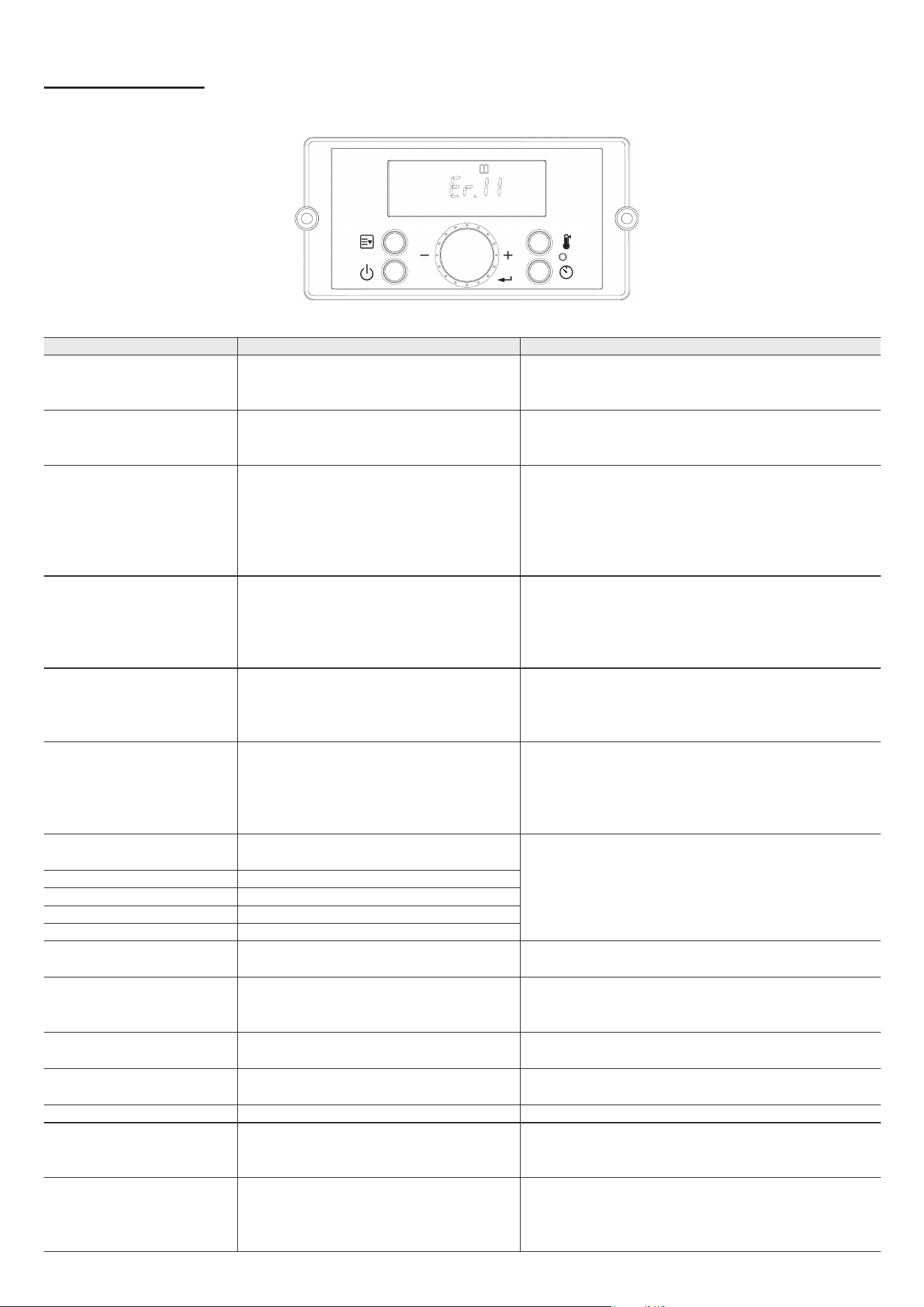
53
The following screen will display when the appliance encounters an error.
▪ J. ERROR MODE
Code Error Code Description Possible Remedies
Er11 Ignition Failure
• Make sure that the main gas supply valve is open.
• Make sure that the gas supply and inlet gas is within speci-
cation.
Er12 Flame Loss
• Clean the intake air lter.
• Make sure that the main gas supply valve is fully open or
have a professional check the gas supply pressure.
Er16
Overheating Heating SupplyThermistor during
DHWOperation(Exceed 205°F(96°C))
• Turn off the Combi Boiler for at least 30 minutes, and then
restarts it.
• Clean the heating return lter.
• Check the circulation pump operation or speed setting as
speed.
• Flush the heat exchanger.
Er20 High Limit Switch Abnormality
• Turn off the Combi Coiler for at least 30 minutes, and then
restart it.
• Clean the heating return lter.
• Check the circulation pump speed setting as speed Ⅲ.
• Flush the primary heat exchanger.
Er29 Air Pressure Switch Abnormality
• Make sure that the exhaust pipe is free of obstructions.
• Clean the intake air lter.
• Make sure that the condensate trap or drain pipe is not
clogged.
Er30
Outdoor Temperature SensorOpen or Short
Circuit
• Check outdoor temperature sensor. Ensure connections are
secure.
• Check sensor resistance. If resistance is zero, replace the
sensor.
• Contact technical support.
Er31
DHW Cold Water ThermistorOpen or Short
Circuit
• Ensure connections are secure.
• Check sensor resistance. If resistance is zero, replace the
sensor.
Er32 DHW Thermistor Open or Short
Er33 Heating Supply Thermistor Open or Short Circuit
Er34 Heating Return Thermistor Open or Short Circuit
Er35 Exhaust Thermistor Open or ShortCircuit
Er38
Abnormal Operation; Memory Error on the
Circuit Board
• Try to reset rst → Still the same Error Code → Contact
Technical Support.
Er39 False Flame Detection
• Clean the ame window.
• Make sure that the front cover is closed securely.
• Check the ame sensor.
Er40 Gas Leakage
• Turn off the gas.
• Contact technical support.
Er41 Fan Speed Error
• To reset this error code, the power needs to be disconnected
and then reconnected.
Er43 Burner Limit Switch Abnormality • Contact technical support.
Er45 Water Leakage
• Close the water inlet valve before contacting technical sup-
port.
• Contact technical support.
Er54 Low Heating Water Pressure
• Water pressure lower than [Setting Pressure - 4] psi
• Check the auto feeder.
• Check the auto feeder inlet pressure.
• Check the pressure sensor.
Figure 37 – Error Mode Screen
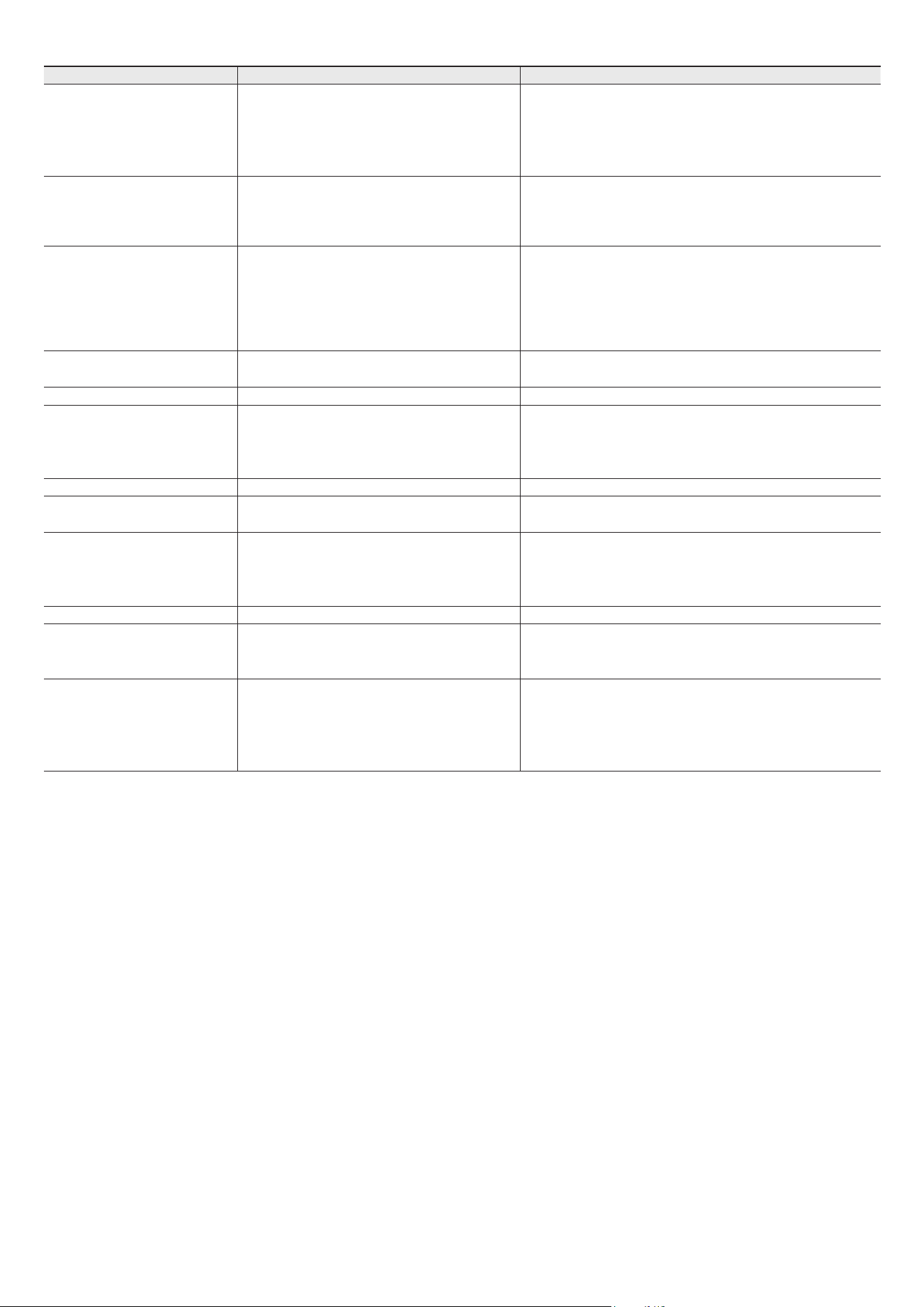
54
Code Error Code Description Possible Remedies
Er55 Stop Supply Inlet Water.
• If the water pressure is not rising supplement progress at
least 13 psi.
• Check supply water and inlet shut off valve. This valve must
be open.
• Check the auto feeder.
Er56 High Heating Water Pressure
• Water pressure higher than 50 psi.
• Check the pressure sensor.
• Contact technical support.
Er58 LWCO Abnormality
• Ensure the LWCO wiring connection on circuit board.
• Measuring output AC24V from terminal on circuit board in the
case of external LWCO install.
• Make-up water to the system if necessary.
• Contact technical support.
Er59 Pressure Sensor Abnormality
• Check the pressure sensor.
• Contact technical support.
Er61 RPM Sensor • Check fan motor.
Er63
Overheating Heating SupplyThermistor during
HeatingOperation (Exceed 205°F(96°C))
• Turn off the Combi Boiler for at least 30 minutes, and then
restart it.
• Clean the heating water return lter.
• Flush the primary heat exchanger.
Er65 Flow Control ValveAbnormality • Check ow control valve.
Er67 AGM Abnormality
• Try main power switch OFF/ON → Still the same Error Code
→ AGM failure.
Er72 Flame Detected before IgniteAbnormality
• Measure the current from the Flame Sensor when there is no
ame.
• To reset this error code, the power needs to be disconnected
and then reconnected.
Er73 DIP Switch Setting Abnormality • Check the DIP Switch settings.
Er76
Communication Error betweenControl Panel and
CircuitBoard.
• Check connections from Circuit Board to Control Panel.
• To reset this error code, the power needs to be disconnected
and then reconnected.
Er94
Overheating Exhaust Thermistor (The Combi
Boiler shuts down when the exhaust temperature
exceeds 149°F (65°C) for PVC vent or 200°F
(93°C) for CPVC vent.
• Turn off the Combi Boiler for at least 30 minutes, and then
restart it.
• Check the exhaust thermistor and related wiring.
• Make sure that the vent / air intake are properly installed.
• Flush the heat exchanger.
Table 22 – Error Codes with Linked Components, Effects, and Actions
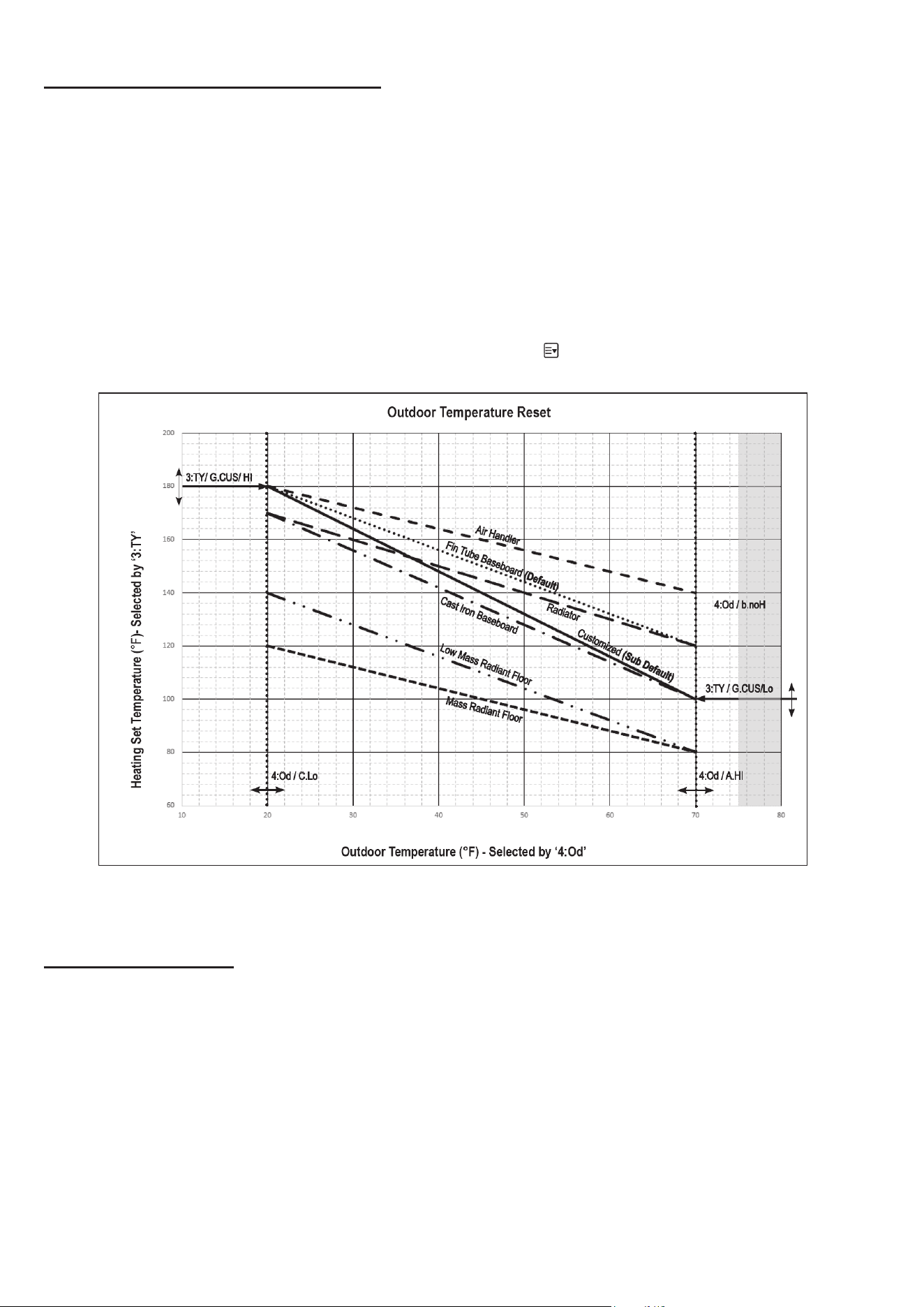
55
▪ K. OUTDOOR TEMPERATURE MODE
NOTE: If the system requires a xed operating temperature, the outdoor sensor is not required and should not be installed.
There is no connection required if an outdoor sensor is not used in the installation.
1. Use a minimum 18 AWG wire for runs of up to 150 feet.
2. Mount the outdoor sensor on an exterior surface of the building, preferably on the north side in an area that will not be affected by direct sunlight
and will be exposed to varying weather conditions.
NOTE: For correct mounting procedures, follow instructions provided with the sensor.
NOTE: If sensor wires are located in an area with sources of potential electromagnetic interference (EMI), the sensor wires should be shielded, or
the wires routed in a grounded metal conduit. If using shielded cable, the shielding should be connected to the common ground of the appliance.
NOTE: Outdoor Temperature Mode Icon on the display will ash if an Outdoor Sensor or 0~10 Volt is not connected to the appliance.
See Figure 38 to set your Outdoor Reset Curve.
To check the CH Target Temperature while using Outdoor Temperature Mode, press the button while the appliance is operational and the display
panel is powered on.
▪ L. 0~10 VOLT INPUT
NOTE: The optimal set up should be determined for each job location.Default setting: Max Temperature: 180 °F, Min Temperature: 120°F
NOTE: Ensure that the polarity of the connections from the external modulating appliance controller to the appliance is correct.
Reversed polarity could lead to erratic and/or no response from the appliance controller.
NOTE: Outdoor Temperature Mode Icon on the display will ash if an Outdoor Sensor or 0~10 Volt is not connected to the appliance.
Reversed polarity could lead to erratic and/or no response from the appliance controller.
Figure 38 – Outdoor Reset Curve – See Installer Mode for Curve Setting Descriptions
1. A signal from a building management system may be connected to the appliance to enable remote control. This signal should be a 0~10 volt
positive-going DC signal. When the 0~10V input is wired to the appliance terminal strip, a building control system can be used to control the set point
temperature of the appliance. The control interprets the 0~10 volt signal as follows; when the signal is between 0 and 1.5 volts, the appliance will be
in standby mode, not ring. When the signal rises above 1.5 volts, the appliance will ignite. As the signal continues to rise towards its maximum of 10
volts, the appliance will increase in set point temperature.
2. Connect a building management system or other auxiliary control signal to the terminals marked for this purpose on the appliance terminal block
(shown in Piping Diagrams, this manual). Caution should be used to ensure that the 0~10 VOLT + connection does not be come connected to
ground.
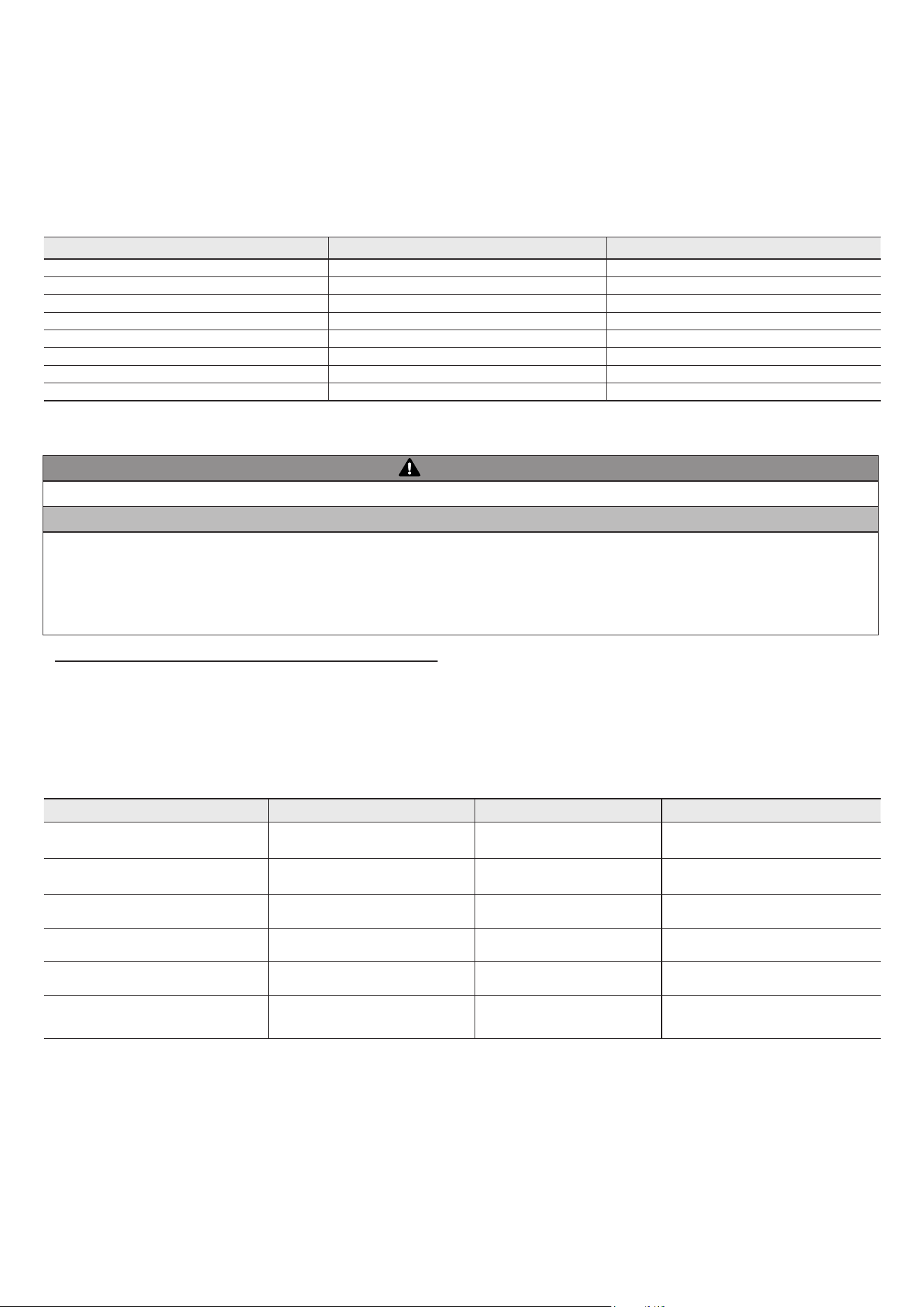
56
NOTE: 0~10V is prioritized. If input voltage is less than 1.5V then T/T will operate.
The range of input voltage is approximately 1.5[V] ~ 10[V] and the heating temperature settings according to this range are as follows.
Reversed polarity could lead to erratic and/or no response from the appliance controller.
0-10 V INPUT TABLE:
When outside voltage is applied to the connector (2) in the wiring diagram,
1. The Outdoor temperature sensor does not work.
2. Symbol is displayed.
3. The heating temperature is automatically set according with the external voltage input.
The water must be potable, free of corrosive chemicals, sand, dirt, and other contaminants. It is up to the installer to ensure the water does not
contain corrosive chemicals or elements that can damage the heat exchanger. Potable water is dened as drinkable water supplied from utility or
well water in compliance with EPA secondary maximum contaminant levels (40 CFR Part 143.3) as shown in the table below. If the water contains
contaminants higher than outlined by the EPA, water treatment is recommended and additional, more frequent maintenance may be required.
If you suspect that your water is contaminated in any way, discontinue use of the appliance and contact an authorized technician or licensed
professional.
Input Voltage[V]
Heat Temperature [°C]
Heat Temperature [°F]
1.5 30.0 86
2.0 32.7 91
2.5 36.1 97
3.0 38.8 102
- - -
9.0 75.0 167
9.5 77.7 172
10 82.2 180
Contaminant Maximum Allowable Level Contaminant
Maximum Allowable Level
Total Hardness (Residential Use -
Below 140°F water temperature)
200 mg/l (12 grains/gallon) Manganese 0.05 mg/l or PPM
Total Hardness (Commercial Use -
140°F and above water temperature)
120 mg/l (7 grains/gallon) pH 6.5-8.5
Aluminum 0.05 to 0.2 mg/l or PPM Sulfate 205 mg/l or PPM
Chloride 100 mg/l or PPM Total Dissolved Solids (TDS) 500 mg/l or PPM
Copper 1 mg/l or PPM Zinc 5 mg/l or PPM
Iron 0.3 mg/l or PPM
Dissolved Carbon Dioxide
(CO
2
)
15 mg/l or PPM
Table 23 – 1~10V Input Voltage and Associated Temperature
Table 24 – Water Chemistry Specications
PART 11 – START-UP PREPARATION
▪ A. CHECK / CONTROL WATER CHEMISTRY
WARNING
CAUTION
Thoroughly clean and ush any system that has used glycol before installing the appliance.
Chemical imbalance of the water supply may affect efciency and cause severe damage to the appliance and associated equipment. Water
quality must be professionally analyzed to determine whether it is necessary to treat the water. Various solutions are available to adjust water
quality. Adverse water quality will affect the reliability of the system. In addition, operating temperatures above 135°F will accelerate the build-up
of lime scale and possibly shorten appliance service life. Failure of an appliance due to lime scale build-up, low pH, or other chemical imbalance
IS NOT covered by the warranty.
57
NOTE: It is recommended you clean heat exchanger at least once a year to prevent lime scale buildup. Follow the maintenance
procedure to clean the heat exchanger in this manual
NOTE: APPLIANCE FAILURE DUE TO IMPROPER WATER CHEMISTRY IS NOT COVERED BY WARRANTY.
Clean system to remove sediment*
1. You must thoroughly ush the system (without the appliance connected) to remove sediment. The high-efciency heat exchanger can be damaged
by buildup or corrosion due to sediment.
2. For zoned systems, ush each zone separately through a purge valve. (If purge valves and isolation valves are not already installed, install them
to properly clean the system.)
3. Flush system until water runs clean and you are sure piping is free of sediment.
ㆍ
Glycol in hydronic applications should include inhibitors that prevent the glycol from attacking metallic system components. Make certain that the
system uid is checked for the correct glycol concentration and inhibitor level.
ㆍ
The glycol solution should be tested at least once a year or as recommended by the glycol manufacturer.
ㆍ
Anti-freeze solutions expand more than water. For example: A 50% by volume solution expands 4.8% in volume for a temperature increase from
32°F to 180°F, while water expands 3% over the same temperature rise. Allowances must be made in system design for expansion.
ㆍ
A 30% mixture of glycol will result in a BTU output loss of 15% with a 5% increase in head against the system circulator.
ㆍ
A 50% mixture of glycol will result in a BTU output loss of 30% with a 50% increase in head against the system circulator.
ㆍ
NOTE: BTU losses apply to both CH and DHW.
▪ B. GLYCOL ANTIFREEZE SOLUTIONS
▪ C. CHECK FOR GAS LEAKS
WARNING
WARNING
Use only inhibited propylene glycol solutions which are specially formulated for hydronic systems. Ethylene glycol is toxic and can
attack gaskets and seals used in hydronic systems. Glycol mixtures should not exceed 50%.
Before starting the appliance, and during initial operation, smell near the oor and around the appliance for gas odorant or any unusual
odor. Remove appliance front door and smell interior of appliance enclosure. Do not proceed with startup if there is any indication of a
gas leak. Repair any leaks at once.
PROPANE APPLIANCES ONLY – Both natural gas and propane (LP) have an odorant added to aid in detecking a gas leak. Some
people may not physically be able to smell or recognize this odorant. If you are unsure or unfamiliar with the smell of natural gas or
LP, ask the gas supplier. Other conditions, such as "odorant fade," which causes the odorant to diminish in intensity, can also hide or
camouage a gas leak.
It is highly recommended to carefully follow the glycol manufacturer’s recommended concentrations, expansion requirements, and
maintenance recommendations (pH additive breakdown, inhibitor reduction, etc.) You must carefully calculate the additional friction
loss in the system as well as the reduction in heat transfer coefcients.
CAUTION
58
WARNING
WARNING
WARNING
WARNING
FOR YOUR OWN SAFETY READ BEFORE OPERATING
1. This appliance does not have pilot. It is equipped with an ignition device which automatically lights the burner. Do not try to light the
burner by hand.
2. BEFORE OPERATING: smell all around the appliance area for gas. Be sure to smell next to the oor because some gas is heavier than air and will settle on
the oor.
WHAT TO DO IF YOU SMELL GAS
ㆍ
Do not try to light any appliance.
ㆍ
Do not touch any electric switch; do not use any phone in your building.
ㆍ
Immediately call your gas supplier from a neighbor's phone. Follow the gas suppliers' instructions.
ㆍ
If you cannot reach your gas supplier, call the re department.
ㆍ
Turn off gas shutoff valve (located outside of the appliance) so that the handle is crosswise to the gas pipe. If the handle will
not turn by hand, don't try to force or repair it, call a qualied service technician. Force or attempted repair may result in a re or
explosion.
4. Do not use this appliance if any part has been under water. Immediately call a qualied service technician to inspect the appliance and to replace any part of
the control system and any gas control that has been damaged.
5. The applianceshall be installed so the gas ignition system components are protected from water (dripping, spraying, rain, etc.) during appliance operation and
service (circulator replacement, condensate trap, control replacement, etc.)
Failure to follow these instructions could result in property damage, serious personal injury, or death.
If you discover any evidence of a gas leak, shut down the appliance at once. Find the leak source with a bubble test and repair immediately. Do not start the
appliance again until the leak is repaired. Failure to comply could result in substantial property damage, severe personal injury, or death.
Ensure the appliance is full of water before ring the burner. Failure to do so will damage the appliance. Such damage IS NOT covered by warranty, and could
result in property damage, severe personal injury, or death.
Eliminate all system leaks. Continual fresh make-up water will reduce appliance life. Minerals can build up in the heat exchanger, reducing heat transfer,
overheating the heat exchanger, causing heat exchanger failure and possibly resulting in property damage, severe personal injury, or death.
▪ D. FILL AND TEST WATER SYSTEM
▪ E. PURGE AIR FROM CH
1. Fill the system only after ensuring water chemistry meets the requirements listed in this manual.
2. Close the manual and automatic air vents and appliance drain valve.
3. Fill to the correct system pressure. Correct pressure will vary with each application.
a. Typical cold water ll pressure for a CH residential system is 12 psi.
b. Pressure will rise when appliance is turned on and system water temperature increases. Operating pressure of the CH system should never
exceed 25 psi, and must never exceed the relief valve pressure setting.
4. At initial ll and during appliance startup and testing, check system thoroughly for leaks. Repair all leaks before proceeding further.
5. The system may have residual substances that could affect water chemistry. After the system has been lled and leak tested, verify that water pH
and chlorine concentrations are acceptable by sample testing.
It is important to purge the system of air to avoid damage to the appliance
CAUTION
CAUTION
IMPORTANT! While commissioning the system, the air vent on top of the appliance must remain fully open to allow the appliance to properly ll.
Failure to keep the air vent open could lead to improper appliance and system operation.
59
WARNING
Ensure the appliance is full of water before ring the burner. Failure to do so will damage the appliance. Such damage IS NOT covered by warranty, and could
result in property damage, serious personal injury, or death.
▪ F. PURGE AIR FROM DHW SYSTEM
▪ G. CHECK THERMOSTAT CIRCUIT(S)
To purge air from the system:
a. Connect a hose to the purge valve and route hose to an area where water can drain and be seen.
b. Close the appliance or system isolation valve between the purge valve and ll connection to the system.
c. Close zone isolation valves.
d. Automatic water replenishment in progress when the Combi Boiler is less than the internal pressure 12psi.
e. Open purge valve.
f. Open the isolation valves one zone at a time. Allow water to run through the zone, pushing out the air. Run water until no noticeable air ow is
present. Close the zone isolation valves and proceed with the next zone. Follow this procedure until all zones are purged.
g. Close the purge valve and remove the hose. Open all isolation valves. ‘Error Code 54’ will be indicated at the beginning of auto feeding.This is
normal operation. When auto feeding is completed, ‘Error Code 54’ turns off automatically. It is recommended that you put the pumps into manual
operation to assist in purging the circuits.
h. Disconnect the wires that are connected to the THERMOSTAT terminals of the terminal block. Apply power to the appliance. After the control goes
through the start-up sequence, the display will turn off.
i. Press and hold the button for more than 5 seconds. Then scroll to 15:CK by turning the dial . Press the button. A.PP will show on the
display. Press the button to run the test pump operation. The default is Maximum 10 minutes for 60sec-on and 10sec-off. Turn the dial
counterclockwise from off to on.
j. The CH and internal circulation pumps will come on. Run pumps as required to help bleed out all entrapped air. Some good indicators that air is
removed include the absence of gurgling noises in the pipes and pump operation becoming very quiet. Test mode will stop automatically after the
Maximum time (xed value is 10 minutes), or press the button to leave it manually.
k. After the system has operated for some time, eliminate any residual air by using the manual air vents located throughout the system.
l. If purge valves are not installed in the system, open manual air vents in the system one at a time, beginning with the lowest oor. Close vent when
water squirts out. Repeat with remaining vents.
1. Make sure CH and DHW lines to the appliance are open and full of water. Turn on all electric power to appliance.
1. Disconnect the two external wires connected to the appliance thermostat terminals (low voltage terminal strip).
2. Connect a voltmeter across these two incoming wires with power supplied to the thermostat circuits. Close each thermostat, zone valve and relay
in the external circuit one at a time and check the voltmeter reading across the incoming wires.
3. There should NEVER be a voltage reading.
4. If a voltage reading does occur under any condition, check and correct the external wiring. (This is a common problem when using 3-wire zone
valves.)
5. Once the external thermostat circuit wiring is checked and corrected if necessary, reconnect the external thermostat circuit wires to the appliance
low voltage terminal strip. Allow the appliance to cycle.
2. Open hot water faucets in the DHW system. Start with the faucets nearest the appliance.
3. Keep faucets open until water runs freely and all air is purged. Then move on to faucets further away from the appliance in the system.
4. When water ows freely from all hot water faucets, DHW purging is complete.
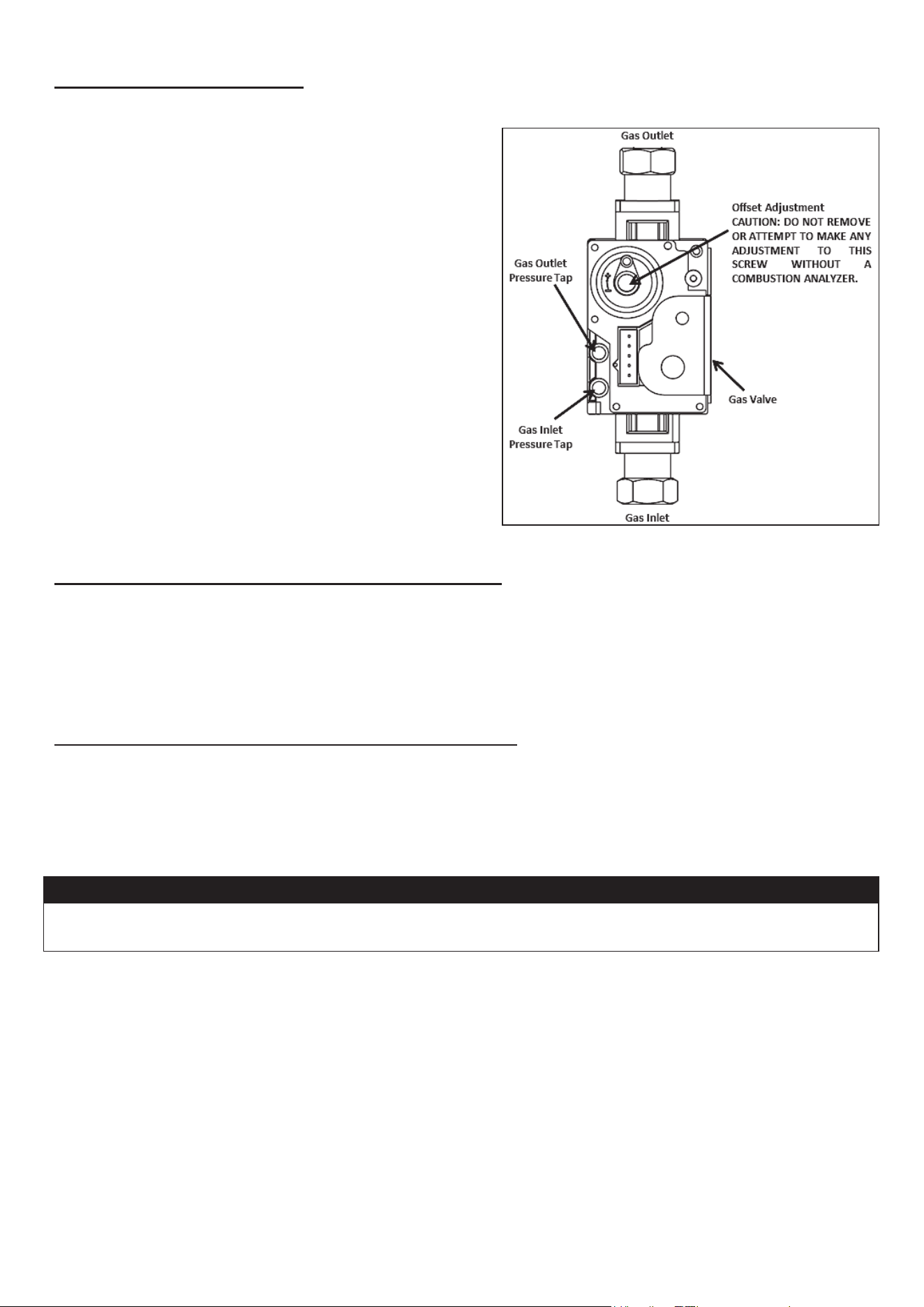
60
▪ H. CONDENSATE REMOVAL
▪ I. FINAL CHECKS BEFORE STARTING APPLIANCE
▪ J. ADJUSTING GAS PRESSURE AT THE APPLIANCE
1. This is a high efciency condensing appliance. Therefore, the appliance has a condensate drain. Condensate uid is nothing more than water
derived from combustion products, similar to that produced by an automobile
when it is initially started.
Condensate is slightly acidic (typically with a pH of 3 to 5) and must be piped
with the correct materials. Never pipe the condensate using steel, copper,
brass or other materials that will be subject to corrosion. Plastic PVC or CPVC
pipe are the only approved materials.
A condensate neutralizer, if required by local authorities, may be purchased
from aftermarket
2. It is very important that the minimum ½" condensate line is sloped downward
away from the appliance to a suitable inside drain. If the condensate outlet
on the appliance is lower than the drain, you must use a condensate removal
pump, available from aftermarket. This pump is equipped with two leads that
can be connected to an alarm or another type of warning device to alert the
user of a condensate overow, which, if not corrected, could cause property
damage.
3. If a long horizontal run is used, it may be necessary to create a vent in the
horizontal run to prevent a vacuum lock in the condensate line.
4. Do not expose the condensate to freezing temperatures.
5. It is very important you support the condensate line to ensure proper
drainage.
1. Verify the appliance and system are full of water and all system components are correctly set for operation.
2. Fill the condensate trap with water.
3. Verify electrical connections are correct and securely attached.
4. Inspect exhaust vent and intake piping for signs of deterioration from corrosion, physical damage, or sagging. Verify exhaust vent and intake
piping are intact and correctly installed per Venting Section (this manual) and local codes.
NOTE: Refer to Figure 39 when adjusting gas pressure. Loosen the screw before checking the gas inlet pressure.
1. The appliance and its individual shutoff valve must be disconnected from the gas supply piping system during any pressure testing of the system
at test pressures greater than ½ psi (3.5 kPa).
2. The appliance must be isolated from the gas supply piping system by closing its individual manual shutoff valve during any pressure testing of the
gas supply piping system at test pressures equal to or less than ½ psi (3.5 kPa).
ADJUSTING GAS PRESSURE AT THE APPLIANCE
1. Open the gas line and water valves.
2. Use a Phillips Head screwdriver to remove the appliance top cover. Remove the front cover.
3. Loosen the gas inlet pressure tap screw three turns with a screwdriver. Connect the manometer to the inlet gas pressure port. See Figure 39.
4. Turn on power to the appliance and open a hot water faucet.
5. The minimum and maximum inlet gas line pressures must meet the requirements shown in Table 25.
Figure 39 – Gas Valve Detail
NOTICE
Do not re (operate) the appliance until all connections have been completed and the heat exchanger is lled with water. Doing so will damage
the appliance and void the warranty.
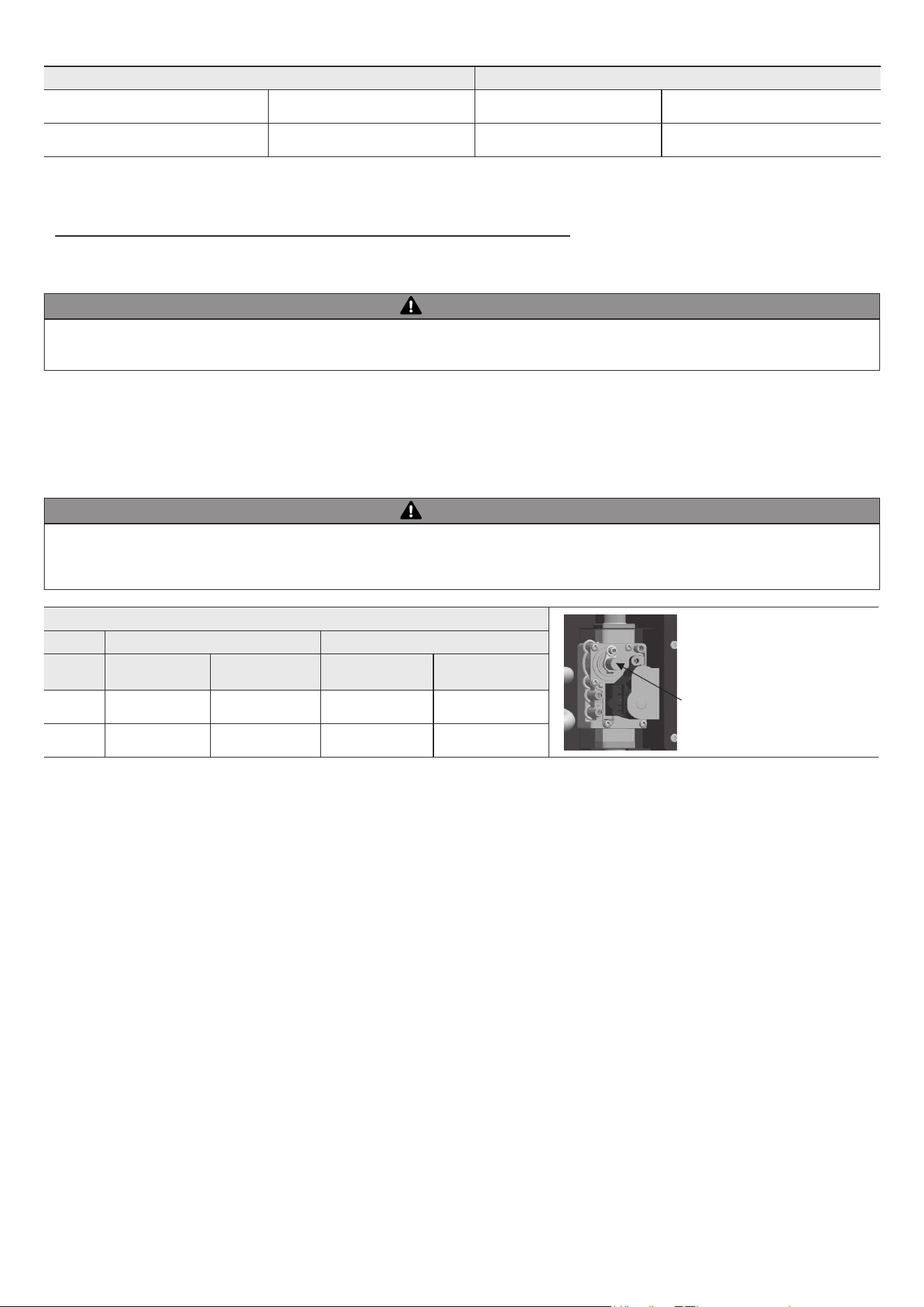
61
COMBUSTION SETTINGS
NATURAL GAS LP GAS
FAN
SPEED
LOW HIGH LOW HIGH
CO PPM <60 <200 <60 <200
CO
2
(%) 8 - 10 8 ½ - 10 ½ 9 – 10 ½ 9 ½ - 10 ½
▪ K. SETTING AND VERIFYING THE COMBUSTION SETTING
6. Remove the manometer. Close the screw on the gas inlet pressure tap.
2. When low re settings have been obtained, ip DIP switch seven (7) to its original (OFF) position. This will return the appliance to normal mode.
*3. Flip DIP switch six (6) to ON (high re). Again check combustion readings with a combustion analyzer.
4. When complete, ip DIP switch six (6) to its original (OFF) position. This will return the appliance to normal mode.
5. Allow appliance to operate normally. Ensure it is operating properly.
6. Reinstall the appliance front cover.
7. Use a Phillips Head screwdriver to reinstall the appliance top cover.
*In order to increase CO₂ values on high re, the gas orice size can be increased to achieve the maximum CO₂ value listed in Table 26. Contact
the factory for recommended orice sizes to achieve the desired setting.
Figure 40 – Gas Valve Offset
Screw
Offset Screw
1. After the appliance has red, ip DIP switch seven (7) to the ON position (low re). Proceed to check appliance combustion values.
NOTE: Use a combustion analyzer to ensure CO and CO₂values are within the range shown in Table 26.
LP GAS NATURAL GAS
Minimum Pressure 8.0" WC Minimum Pressure 3.5" WC
Maximum Pressure 14.0" WC Maximum Pressure 10.5" WC
Table 25 – Gas Pressure Requirements
Table 26 – Combustion Settings
WARNING
WARNING
It is required to use a combustion analyzer to verify nal adjustment according to the combustion chart (Table 26). Failure to do so could result in serious personal
injury or death.
It is very important that gas conversion be set within the recommended CO measurements listed in Table 26. Visually looking at the burner does not determine
combustion quality. Failure to measure combustion with a Combustion Analyzer and set the throttle within the recommended CO measurements could result in
property damage, severe personal injury, or death.
If the readings obtained are lower or higher than the combustion readings in Table 26, use a 4mm Allen key to adjust the offset screw in a
clockwise (positive) or counterclockwise (negative) direction (approximately 1/4 turn). See Figure 40. Check your combustion values. Repeat this
procedure until the values obtained on the combustion analyzer agree with those stated in Table 26.
NOTE: If the appliance makes a whistling sound (harmonics) at low re, adjust the offset screw in a clockwise (positive) direction (approximately
1/8 turn). Check your combustion values and ensure they agree with those stated in Table 26 before proceeding.
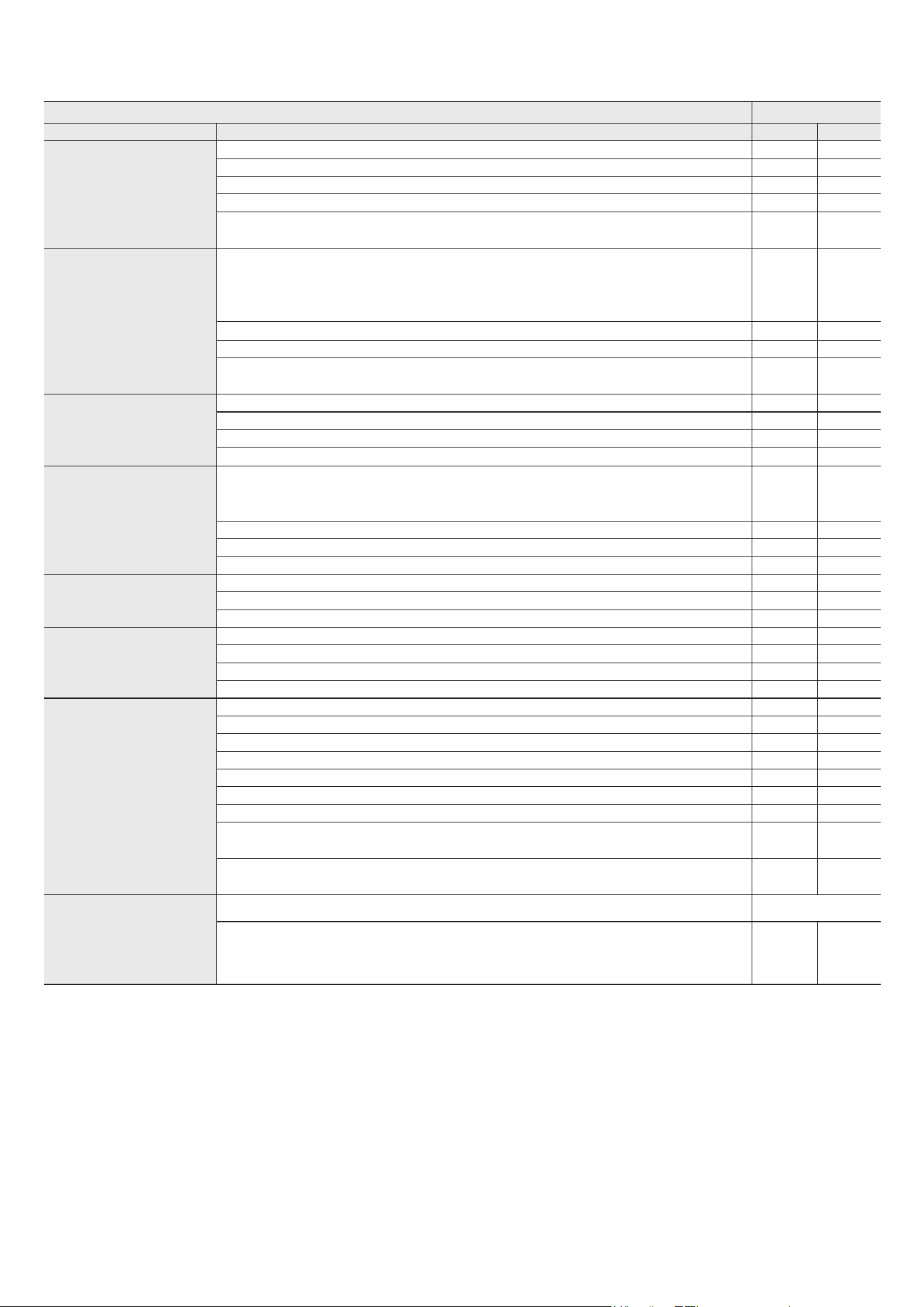
62
LIGHT OFF ACTIVITIES DATE COMPLETED
YES NO
1) Fill the Heating System
with Water
Has the system been cleaned and ushed?
Does water chemistry meet requirements?
If water chemistry does not meet requirements, are treatment measures put in place?
Check all water piping and connections. Are all leak free and properly supported?
Has the CH system been pressure tested and pressurized to 12 – 25 psi? Has the DHW
system been pressure tested?
2) Exhaust Vent and Intake
Piping
Has the appliance been vented in accordance with the methods and materials listed in this
manual and to meet local codes (vented in approved materials, air supply sufcient for proper
operation, combined vent length within the maximum vent length restriction, vent lengths
minimized, installed with proper terminations, clearances, and pitch, etc.?
Is vent piping properly supported?
Has exhaust vent piping been checked for leaks?
Have the exhaust vent and intake pipes been properly installed into the connectors provided
on the appliance?
3) Condensate Piping / Tub-
ing and Components
Have all condensate line components included with the appliance been installed?
Is the condensate line piped with the approved materials listed in this manual?
Has the condensate line been routed to a laundry tub or other drain?
If necessary, has a condensate pump and/or neutralizer been installed?
4) Gas Piping
Has the gas supply line been piped in accordance with the methods listed in this manual
(supply line no less than ½" gas line is allowed in diameter, length and diameter adequate to
deliver the required BTUs, union and shut-off valve installed, etc.)?
Does the gas type match the type indicated on the appliance rating plate?
Has gas supply line pressure been measured (between 3.5 and 14” WC)?
Has the gas supply line been leak tested per locally approved methods?
5) Pressure Relief Valves
Have you installed approved pressure relief valves on the appliance?
Is the pressure relief valve in the CH line at least 1” in diameter and rated to 30 psi?
Is the pressure relief valve in the DHW line at least ¾” in diameter and rated to 150 psi?
6) Wire the Appliance
Have you connected the power and control wiring per appliance wiring diagram, this manual?
Have all DIP switches been set on the main appliance board?
Is electrical connection polarity within appliance requirements?
Do power specications meet appliance requirements? 120V AC?
7) Start-Up, Adjust, and
Test
If necessary, has the appliance been converted to operate on the proper fuel type?
Has the appliance been started?
Has CO
2
and CO been checked to ensure proper combustion?
If necessary, has the appliance gas valve been adjusted to achieve proper combustion?
Has the installation been customized per location requirements?
Have all customized system parameters been tested?
Has proper appliance operation been conrmed?
Has the burner ame been checked? Is the burner ame a proper blue color? See Figure 41
for ame sight glass window location.
If the ame does not appear normal, the combustion system may need to be cleaned or
adjusted by a qualied service technician.
FINAL INSTALLATION AP-
PROVALS
SIGNED BY TECHNICIAN DATE
PART 12 – INSTALLATION AND START-UP CHECKLIST
Table 27 – Final Installation Checklist
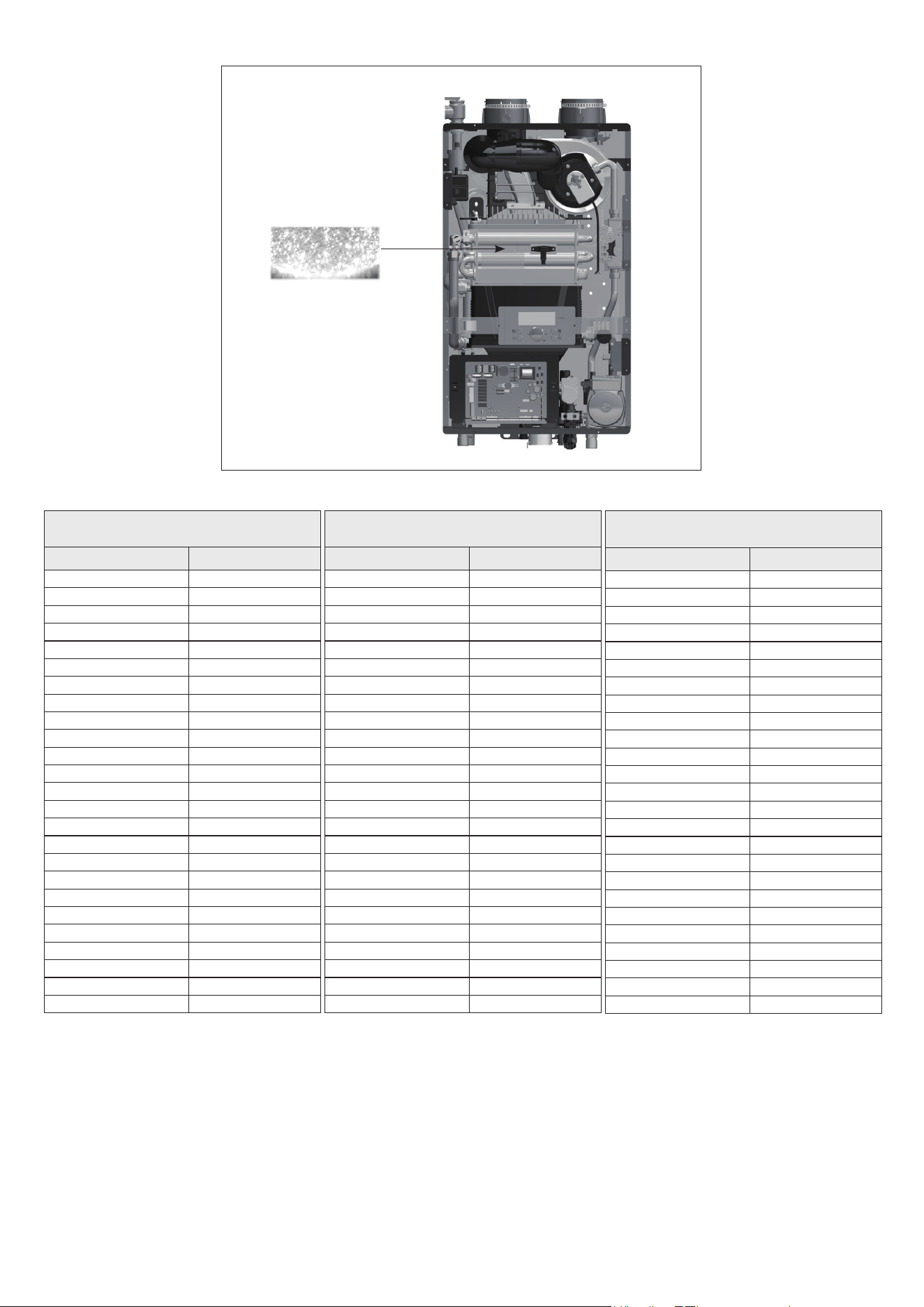
63
Table 28 – Temperature Sensor Resistance
Figure 41 – Flame Sight Glass
CH Return Temperature Sensor
Exhaust Temperature Sensor
Temperature (◦F) Resistance (Ω)
-4 62162
5 48440
14 38045
23 30107
32 23998
41 19261
50 15562
59 12655
68 10353
77 8520
86 7051
95 5867
104 4908
113 4125
122 3485
131 2957
140 2520
149 2157
158 1854
167 1600
176 1386
185 1205
194 1051
203 920
212 808
CH Supply Temperature Sensor
DHW Temperature Sensor
Temperature (◦F) Resistance (Ω)
-4 28409
5 22152
14 17408
23 13782
32 10990
41 8824
50 7131
59 5800
68 4747
77 3906
86 3233
95 2690
104 2250
113 1891
122 1598
131 1356
140 1155
149 989
158 850
167 733
176 635
185 552
194 482
203 421
212 370
Outdoor Temperature Sensor
Temperature (◦F) Resistance (Ω)
-4 99200
5 74229
14 56090
23 42790
32 32930
41 25550
50 19990
59 15760
68 12510
77 10000
86 8050
95 6520
104 5310
113 4350
122 3590
64
PART 13 – TROUBLESHOOTING
TROUBLESHOOTING CHART
PROBLEM POSSIBLE CAUSES
POSSIBLE REMEDIES
No electrical power to the appliance
1. Is the plug on the power supply cord unplugged from the
electrical outlet?
2. Is electrical panel’s 10 Amp circuit breaker tripped?
3. Is the fuse on the circuit board good?
4. Is there a power outage to the home?
1. Reset the plug.
2. Reset the circuit breaker.
3. If the display panel is blank, unplug the unit or contact an
authorized service technician.
4. Contact the power company.
No water available when a faucet is
opened
1. Is the water supply valve shut off at the meter (do cold
water faucets work)?
2. Is the water supply valve near the unit open?
3. Is the water pipe frozen?
4. Is an error code ashing on the display panel (leak
detected)?
1. Open the closed supply valve.
2. Open the water supply valve.
3. Turn OFF the unit, close all water valves and the gas
valve. Contact an authorized service technician.
4. Refer to error code information and contact an authorized
service technician.
Hot water is not available when the
faucet is opened.
1. Does the appliance have power (plugged in)?
2. Is the appliance turned ON?
3. Is an error code ashing on the display panel?
4. Is the gas supply valve open or shut off at the meter (do
other gas devices work)?
1. Restore electrical power to the unit.
2. Press and hold the Power button to turn the unit ON.
3. Refer to the Diagnostic and Error Codes section in this
manual.
4. Open the gas supply valve.
The water temperature is not hot
enough or turns cold during use.
1. Is the faucet open enough to draw at least 0.6 gallons
(2.3L) per minute through the appliance?
2. Is an error code ashing on the display panel?
3. Is the outlet water temperature set too low?
1. Open the faucet to allow more water ow.
2. Refer to the Diagnostic and Error Codes section in this
manual.
3. Adjust the outlet water temperature (refer to the procedure
in this manual).
It takes a long time before hot water
ows from the faucet.
Is the faucet some distance from the appliance?
a. Allow time for the cold water already in the pipes to ow
from the faucet.
b. Have recirculation valves and/or plumbing return line(s)
installed and program the unit for recirculation mode.
The water is not hot enough. Is the water temperature set too low? Adjust the temperature setting.
The water at the faucet is too hot. Is the water temperature set too high? Adjust the temperature setting.
A fan can be heard even when the unit
is not operating.
1. The fan continues to operate after the burner shuts off to
clear the exhaust vent of combustion gases.
2. The fan may run to help prevent freezing.
1. This is normal operation – no action is required.
2. Protect the appliance from freezing temperatures or shut
off and drain the unit.
White “smoke” can be seen coming out
of the exterior exhaust gas vent.
Depending on the outside temperature, water vapor can be
produced as the exhaust is vented.
This is normal operation – no action is required.
Display
Condition
Diagnostic
Possible Corrective Actions
Nothing appears on the
display control panel but
the blower runs at full
speed Nothing appears
on the display control
panel and no other
appliance components
are operating
Control is not receiving
power Control is not
receiving 120V power
Check wiring for short circuit or incorrect wiring
Correct wiring per wiring diagram including
connection of transformer to the control
Check transformer connection to the control
per wiring diagram. Check for 12V output of
transformer
Replace transformer if it is receiving 120V, but
not outputting 12 VAC
Ensure service switch and/or circuit breaker to
appliance is turned ON
Turn on service switch or circuit breaker to
power appliance
Is there 120V at the service switch
Troubleshoot and correct the power supply to
the manual switch
Is the ON/OFF switch inside the appliance
cabinet is turned on
Turn ON the manual power switch inside the
appliance cabinet
Check for 120V at the line voltage terminal
block located inside the appliance cabinet
Correct wiring inside the appliance cabinet
using the wiring diagram in the installation
manual
Inspect the fuse. Replace as necessary
Replace the fuse with the proper part found in
the replacement part section of this manual.
If fuse blows again, recheck the wiring per
diagram
Table 29 – Troubleshooting Chart
DIAGNOSTICS AND SUGGESTED CORRECTIVE ACTIONS
The appliance control is able to record information about the appliance’s condition at the time of the ve previous faults or errors. This information is
available to view in the Installer Mode under the History screen.
The following screens may be displayed when reviewing the appliance history. The table below also includes diagnostic information and possible
corrective actions.
65
PART 14 – ANNUAL MAINTENANCE PROCEDURES
Display
Condition
Diagnostic
Possible Corrective Actions
Nothing appears on the
display control panel, but
the appliance is operating
Occurs when communica-
tions is lost from the control
to the display
Check for loose connections and proper pin align-
ment / engagement on the control’s plug
Check for continuity on the wire harness from the
display to the control. See repair parts section for
proper replacement part.
Cycle power off and on using appliance power
switch and check for operation
Replace with new display module. See repair parts
section for proper replacement part.
Display repeatedly goes
through initialization
sequence
Occurs when control does
not receive signal from fan
Cycle power off and on using appliance power
switch and check for operation
Replace fan.
Table 30 – Diagnostics and Suggested Corrective Actions
Check the Surrounding Area
Combustible/Flammable Materials
Do not store combustible materials, gasoline, or other ammable vapors or liquids near the appliance. If found, remove these materials
immediately.
Air Contaminants
If allowed to contaminants combustion air, products containing chlorine or uorine will produce acidic condensate that will cause signicant damage
to the appliance. Read the list of potential contaminants and areas likely to have these contaminants in Table 8. If any of these contaminants are in
the room where the appliance is located, or combustion air is taken from one of the areas listed, the contaminants must be removed immediately or
the intake pipe must be relocated to another area.
Ensure the Appliance Cabinet is Closed
Ensure the appliance cabinet is closed. Tighten the two upper and lower screws to secure it. The cabinet must be closed while the appliance is
running.
Check the Power Source
Make sure the power cord is properly connected. The main power line is connected to the manual switch box inside the appliance.
Check the Status of the Control Panel
Observe the Control Panel to ensure the appliance is powered on, and to check for any error codes. Clear any debris from the panel.
Check Exhaust Vent and Intake Pipe Terminations
Verify that the appliance exhaust vent and intake pipe terminations are clean and free of obstructions. Remove any debris from the exhaust vent or
intake pipe openings. If removing the debris does not allow the appliance to operate correctly, contact your qualied service technician to inspect the
appliance and the vent system.
The appliance must be inspected and serviced annually, preferably at the start of the heating season, by a qualied service technician. In addition,
the maintenance and care of the appliance as outlined in this manual must be performed by the user/owner to ensure maximum efficiency
and reliability. Follow the maintenance procedures given throughout this manual. Failure to perform the service and maintenance or follow the
directions in this manual could damage the appliance or system components, resulting in substantial property damage, severe personal injury, or
death.
To prevent the potential of substantial property damage, severe personal injury, or death, eliminate all the materials listed in Table 8 from the area
surrounding the appliance and the vicinity of the combustion air intake. If contaminants are found:
ㆍ
Remove products immediately from area.
ㆍ
If contaminants have been there for an extended period, call a qualied service technician to inspect the appliance for possible damage from
acid corrosion.
If products cannot be removed, immediately call a qualified service technician to re-pipe the combustion air intake piping away from the
contaminated areas.
DANGER
DANGER
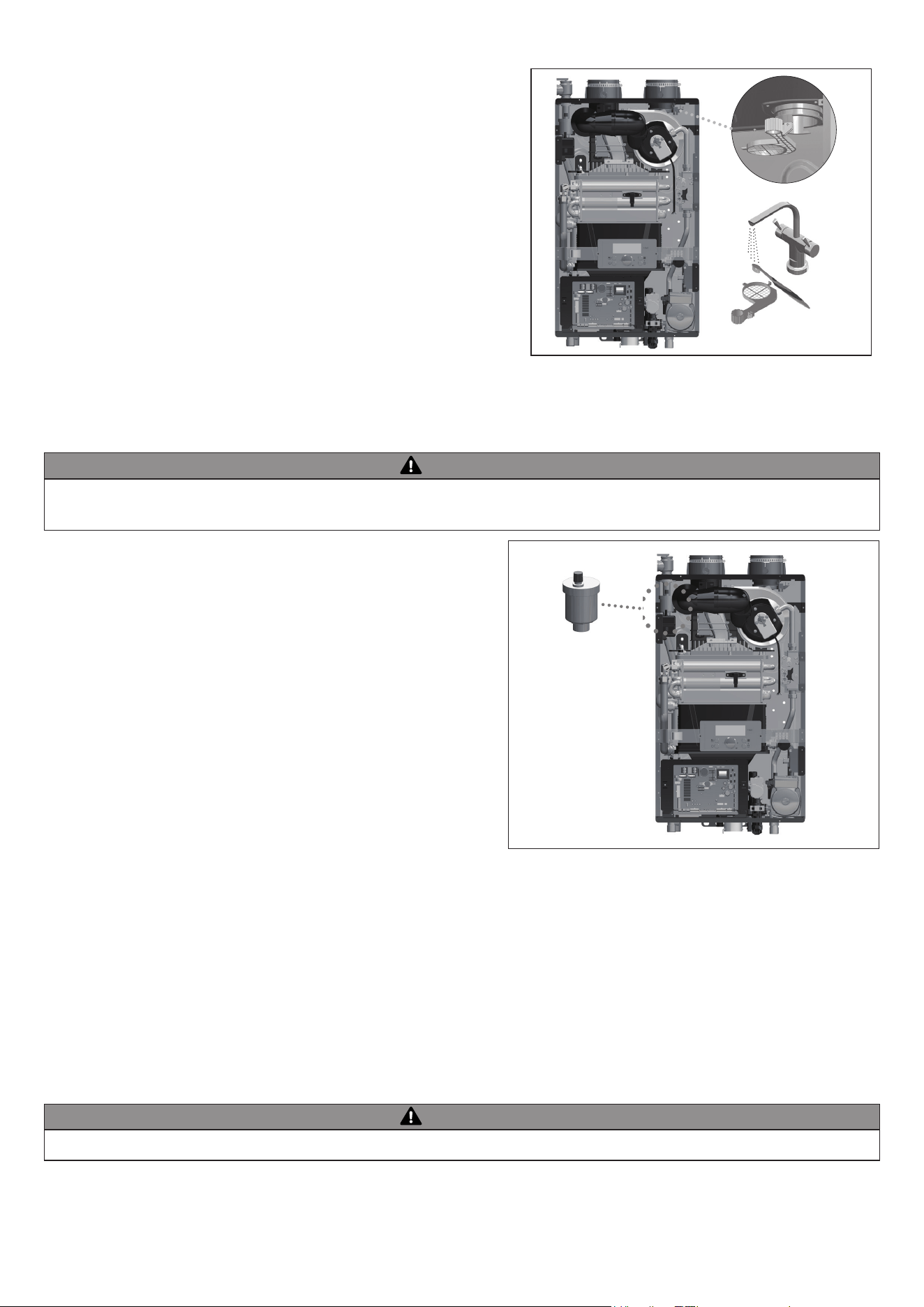
66
Check Exhaust Vent and Intake Piping
Visually inspect the exhaust vent for any signs of blockage, leakage, or deterioration of the piping. Inspect the exhaust vent bracing.Ensure bracing
is undamaged and in good condition. Notify a qualied service technician immediately if any problems are found.
Check Pressure Relief Valve
ㆍ
Visually inspect the primary pressure relief valve and discharge pipe for signs
of weeping or leakage.
ㆍ
If the pressure relief valve often weeps, the expansion tank may not be
operating properly. Immediately contact a qualied service technician to inspect
the appliance and system.
Check Vent Condensate Drain System
ㆍ
While the appliance is running, check the discharge end of the condensate
drain tubing. Ensure no ue gas is leaking from the condensate drain tubing by
holding your ngers near the opening.
ㆍ
If you notice ue gas leaking from the opening, this indicates a dry condensate
drain trap. If problem persists, contact a qualied service technician to inspect
the appliance and condensate line and rell the condensate trap.
ㆍ
If applicable, check the condensate neutralizer and ensure it is full of
condensate neutralizing marble chips.
Check the Air Vent
Loosen cap one counterclockwise turn to allow air vent to operate. See Figure 43. If the air vent valve works freely without leaking, close the valve by
turning clockwise. If vent does not operate correctly, contact a qualied service technician to replace the vent.
Check Primary and Gas Piping
ㆍ
Remove the appliance cover and perform a gas leak inspection following Operating Instructions, page 2, this manual. If gas odor or leak is
detected, follow procedures on page 2. Call a qualied service technician.
ㆍ
Visually inspect for leaks around the internal appliance water connections and around the heat exchanger. Visually inspect the external system
piping, circulators, and system components and ttings. Immediately call a qualied service technician to repair any leaks.
Operate Pressure Relief Valve
ㆍ
Before proceeding, verify that the relief valve outlet has been piped to a safe place of discharge, avoiding any possibility of scalding from hot water.
Visually inspect the intake piping for any signs of blockage. Inspect the entire
length of the intake pipe to ensure piping is intact and all joints are properly
sealed.Inspect the intake pipe bracing.Ensure bracing is undamaged and in good
condition. Notify a qualied service technician if any problems are found.
WARNING
WARNING
Failure to inspect the venting system and have it repaired by a qualied service technician can result in vent system failure, causing severe personal injury or
death.
Have leaks xed at once by a qualied service technician. Failure to comply could result in substantial property damage, severe personal injury, or death.
Figure 43 – Air Vent Detail
Figure 42 – Cleaning the Air Intake Filter
Cleaning the Air Intake Filter
The air intake lter should be cleaned once a month. If not, the combi boiler
could encounter combustion problems.
To clean the air intake lter:
1. Press the Power button on the control panel to turn off the combi boiler.
2. Disconnect the power supply from the combi boiler.
3. If water heater has been operating, wait for it to cool before continuing.
4. Remove the front cover of the combi boiler cabinet.
5. Pull the lter out of the air intake adapter.
6. Remove the lter from the plastic assembly and clean it with a toothbrush
and clean running water. See Figure 42
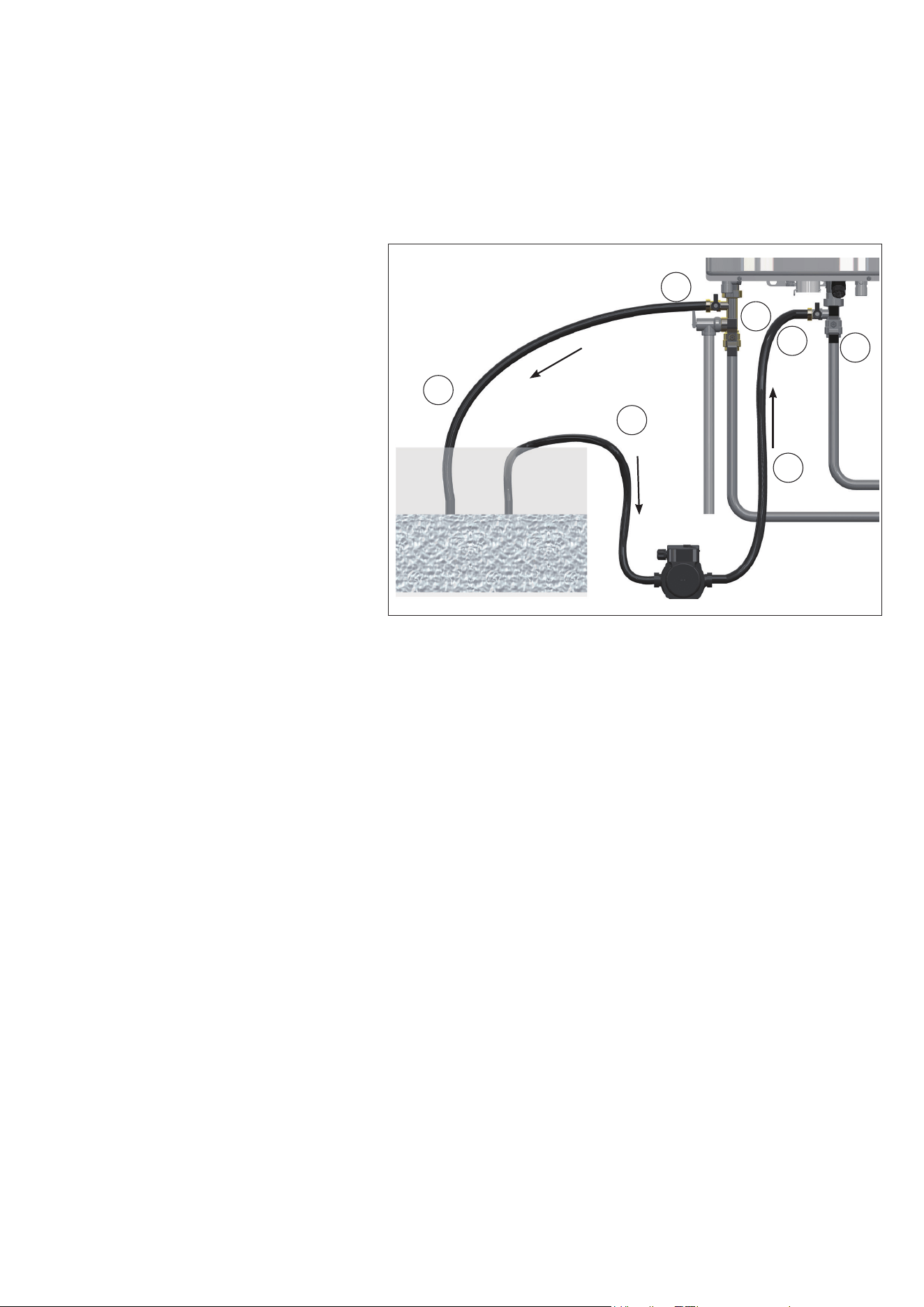
67
Figure 44 – Valve and Hose Connection Details
Check the Burner
Clean the exterior of the burner.
Flushing the CH Closed Loop Heat Exchanger
Flushing the heat exchanger is a complicated procedure
that should only be performed by a qualified service
technician. It is recommended to ush the heat exchanger
annually if water hardness exceeds 12 grains per gallon
(considered extremely hard water). If water hardness falls
below 12 grains per gallon it is recommended to ush the
heat exchanger every two to three years.
NOTE: Improper maintenance WILL VOID appliance
warranty.
1. Disconnect electrical power to the appliance.
2. Close the shutoff valves on both CH supply and CH
return lines (V1 and V2). See Figure 44.
3. Connect one hose (D1, Figure 44) to the valve (V3) and
place the free end in a bucket. Connect one of the hoses
(D3) to the circulation pump outlet and the cold water
inlet line to valve V4. Connect the other hose (D2) to the
circulation pump inlet and place the free end in the bucket.
4. Pour tankless cleaning solution into the bucket. Use an FDA approved cleaner for potable systems on the heat exchanger. Place the drain hose (D1)
and hose D2 to the pump inlet in the cleaning solution.
5. Open service valves (V3 and V4) on the hot water outlet and cold water inlet lines.
6. Turn on the circulation pump. Operate the pump and allow the cleaning solution to circulate through the appliance for at least 1 hour at a rate of 4
gallons per minute.
7. Rinse the cleaning solution from the heat exchanger as follows:
a. Remove the free end of drain hose D1 from the bucket.
b. Close service valve V4 and open shutoff valve V2.
c. Do not open shutoff valve V1.
d. Allow water to ow through the appliance for 5 minutes.
e. Close shutoff valve V2.
8. Disconnect hoses from lines. Properly dispose of used cleaning solution.
9. Remove the CH lter from the appliance and clean out any residues.
10. Repeat process on the DHW loop of the appliance.
ㆍ
Read the temperature and pressure gauge to ensure the system is pressurized. Minimum is 10 psi. Maximum is 25 psi. Lift the relief valve top
lever slightly, allowing water to relieve through the valve and discharge piping.
ㆍ
If water ows freely, release the lever and allow the valve to seat. Watch the end of the relief valve discharge pipe to ensure that the valve does
not weep after the line has had time to drain. If the valve weeps, lift the lever again to attempt to clean the valve seat. If the valve does not
properly seat and continues to weep, contact a qualied service technician to inspect the valve and system.
ㆍ
If water does not flow from the valve when you completely lift the lever, the valve or discharge line may be blocked. Immediately shut the
appliance down per instructions on page 2 and call a qualied service technician to inspect the valve and system.
V1
V2
V4
V3
D1
D2
D3
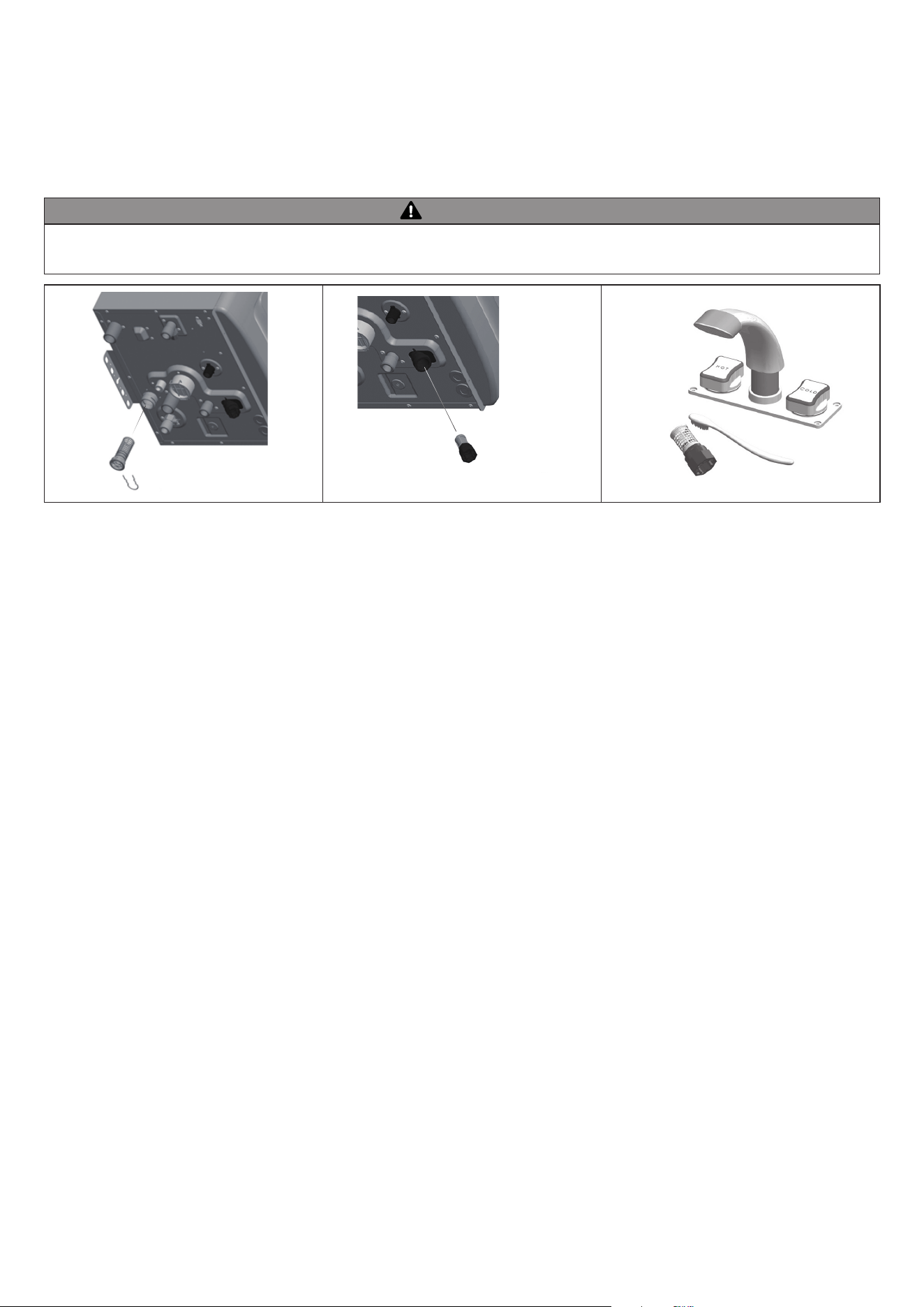
68
Cleaning the CH and DHW Inlet Filters (Draining the Appliance)
1. Place a bucket under the appliance to collect the residual water inside the appliance.
2. Press the Power button on the control panel to turn off the electrical power to the appliance. Then turn off the gas valve.
3. Valve off the appliance from the system. If the appliance cannot be isolated from the system, turn off the main water valve.
4. Open the hot water faucets in the system to aid in draining the system.
5. Remove the DHW inlet lter. Then clean it with a toothbrush and clean running water. See Figure 45.
6. Reinstall the DHW inlet lter.
7. Purge air from the DHW lines by opening a hot water faucet in the system. When water ows freely, all air is purged.
8. Repeat the process on the CH inlet lter on the appliance.
9. Reinsert the lter and ensure the lter cap is securely tightened.
10. Connect electrical power to the appliance.
11. Restore water service to the appliance by opening the isolation valves, or turning on the main water valve.
12. Turn on the gas valve. Turn on electrical power to the appliance and press the Power button to turn the appliance on.
WARNING
Water drained from the appliance could be scalding hot. Wait for the appliance to cool before removing the CH or DHW inlet lters. Failure to do so could result in
property damage, personal injury, or death.
Figure 45 – Cleaning the Inlet Filter
G
CH RETURN FILTER
DHW INLET FILTER
G
CH RETURN FILTER
DHW INLET FILTER
G
CH RETURN FILTER
DHW INLET FILTER
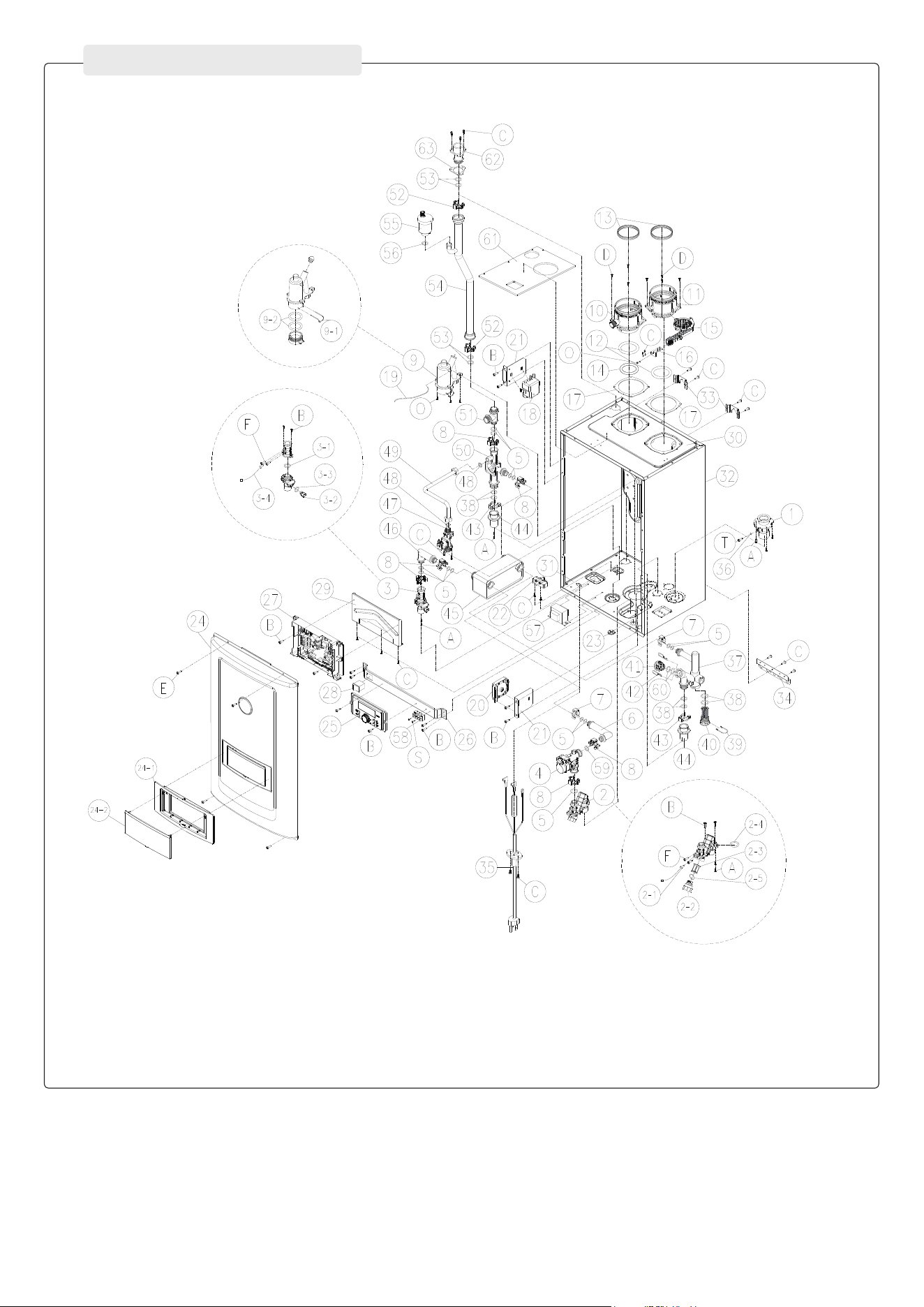
69
Figure 46 – CASE PART
PART I _ CASE PART
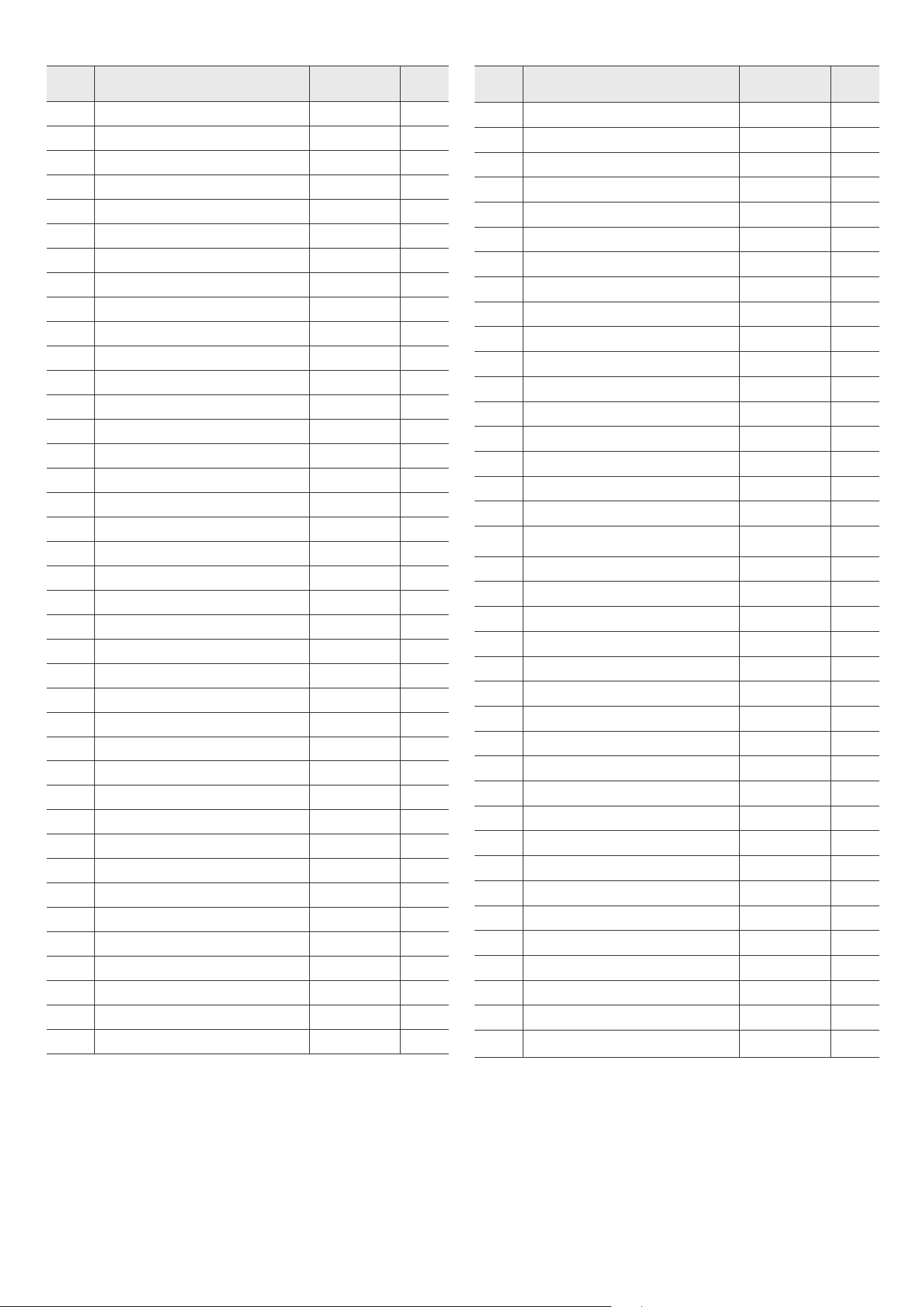
70
Item Description Part Number Qty
1 Gas Inlet Connection RTG20298A 1
2 Water Inlet Valve Assy RTG20298B 1
2-1 Cold Water Temperature Sensor RTG20298C 1
2-2 Cold Water Filter Cap RTG20298D 1
2-3 Cold Water Filter RTG20316BU 1
2-4 O-ring (P20) RTG20298F 1
2-5 O-ring (P18) RTG20298G 1
3 Hot Water Pipe Assembly RTG20316CD 1
3-1 O-ring (P20) RTG20298F 1
3-2 Hot Water Plug RTG20298K 1
3-3 O-ring (P10) RTG20298L 1
3-4 Hot Water Temperature Sensor RTG20316AF 1
4 Flow Control Valve RTG20298N 1
5 O-ring (P16) RTG20299AE 13
6 Water Inlet Elbow RTG20316BL 1
7 Clip(Circle-Small) RTG20316AX 2
8 Clip(Star-Small) RTG20299AU 6
9 Condensate trap RTG20298U 1
9-1 Condensate clip RTG20298V 1
9-2 O-ring (P44) RTG20298W 2
10 Exhaust Assembly RTG20316F 1
11 Air Intake Assembly RTG20298Y 1
12 O-ring (P85) RTG20298Z 2
13 Exhaust and Intake Packing RTG20298AA 2
14 O-ring (P75) RTG20298AB 1
15 Air intake lter RTG20298AC 1
16 Air Intake Filter Bracket RTG20298AD 1
17 Gasket RTG20298AE 2
18 Igniter RTG20316Y 1
19 Siphon Air Pressure Hose RTG20316AW 1
20 Air Pressure switch RTG20298AH 1
21 Bracket (Igniter, Air Pressure Switch) RTG20316H 2
22 Water Leak Detector RTG20298AK 1
23 Wiring Through Way Packing RTG20298AL 1
24 Front Cover Assembly RTG20316A 1
24-1 Control Panel Bracket RTG20298AN 1
24-2 Control Panel Window RTG20298AP 1
25 Control Panel RTG20316V 1
26 Control Panel Steel Bracket RTG20316K 1
Item Description Part Number Qty
27
PCB (Control Board) RTG20316U 1
28
Rocker Switch RTG20298AV 1
29
Control Board Bracket RTG20316BE 1
30
Case (Top) RTG20316C 1
31
Case (Bottom) RTG20316B 1
32
Case RTG20298AZ 1
33
Case Bracket RTG20316G 1
34
Case Bracket (Bottom) RTG20298BB 1
35
Power Cord RTG20316AA 1
36
O-ring (P4)
RTG20316BZ 1
37
Heating Return Block
RTG20316R 1
38
O-ring (P22A)
RTG20316BY 6
39
Filter Clip
RTG20316BD 1
40
Heating Return Block Filter
RTG20316S 1
41
Heating Return Block Cap
RTG20316BV 1
42
Cap Clip
RTG20316AY 2
43
Clip (Φ25-Φ31)
RTG20316AZ 2
44 Heating Supply / Return Connection RTG20316BR 2
45
Hot Water Plate Heat Exchanger
RTG20316AD 1
46
Hot Water Elbow
RTG20316BK 1
47
Auto Feeder
RTG20316BS 1
48
Packing (10A)
RTG20316BW 2
49
Auto Feeder Pipe
RTG20316AS 1
50
3 - Way Valve
RTG20316AN 1
51
T-Elbow RTG20316BM 1
52
Clip (Star-large) RTG20316BC 2
53
O-ring (P22) RTG20316BX 4
54
Relief Valve Pipe RTG20316AU 1
55
Air Vent RTG20316AM 1
56
15A Packing RTG20300J 1
57
Power Transformer RTG20316Z 1
58
Terminal Block RTG20316AB 1
59
O-ring (P15) RTG20299AH 1
60
O-ring (P20) RTG20298F 2
61
Top Case Packing RTG20316CA 1
62
Relief Valve Adapter RTG20316BN 1
63
Relief Valve Adapter Gasket RTG20316CN 1
Table 31 – Case Part
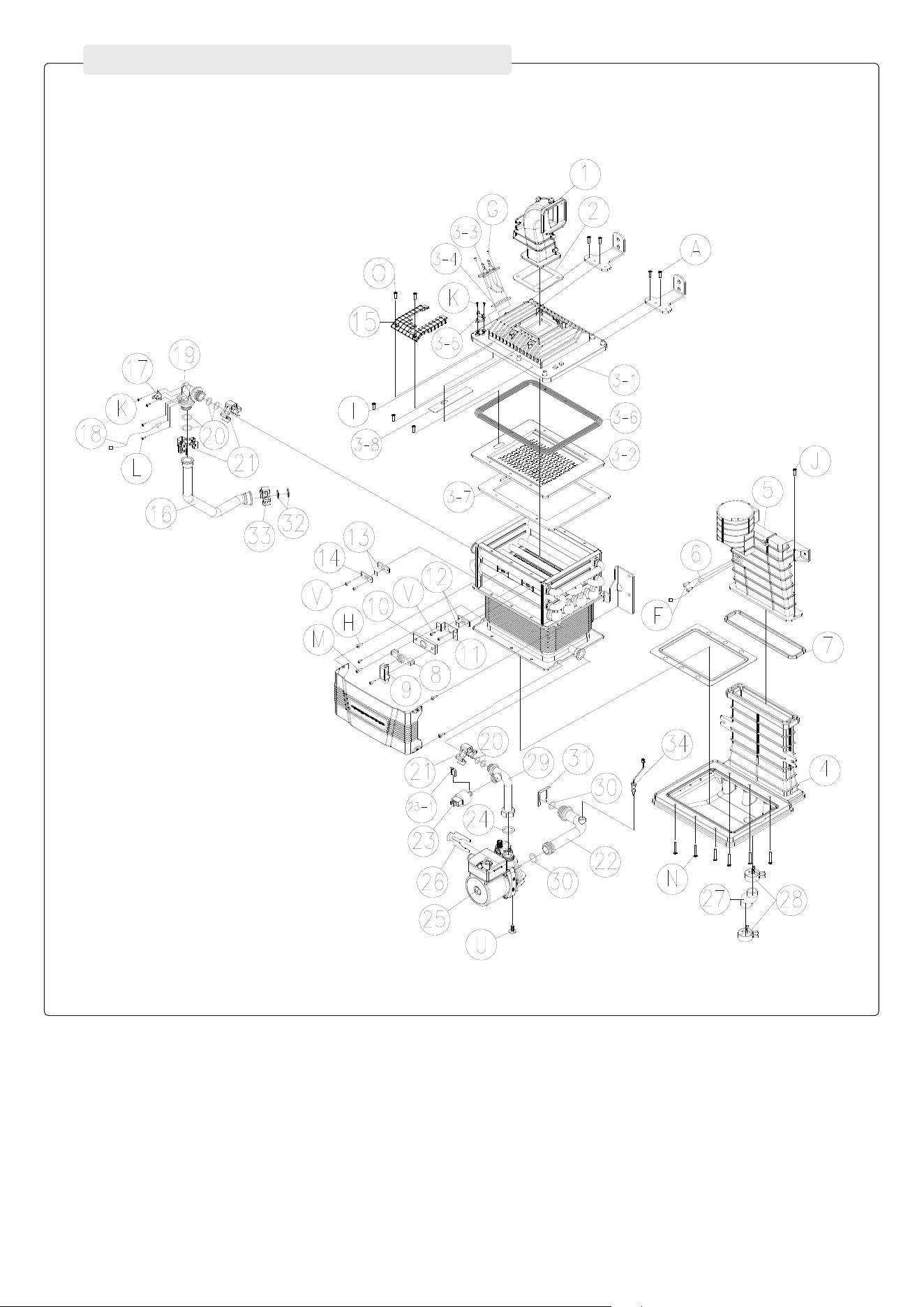
71
Figure 47 – Heat Exhchanger Part
PART II _ HEAT EXCHANGER PART
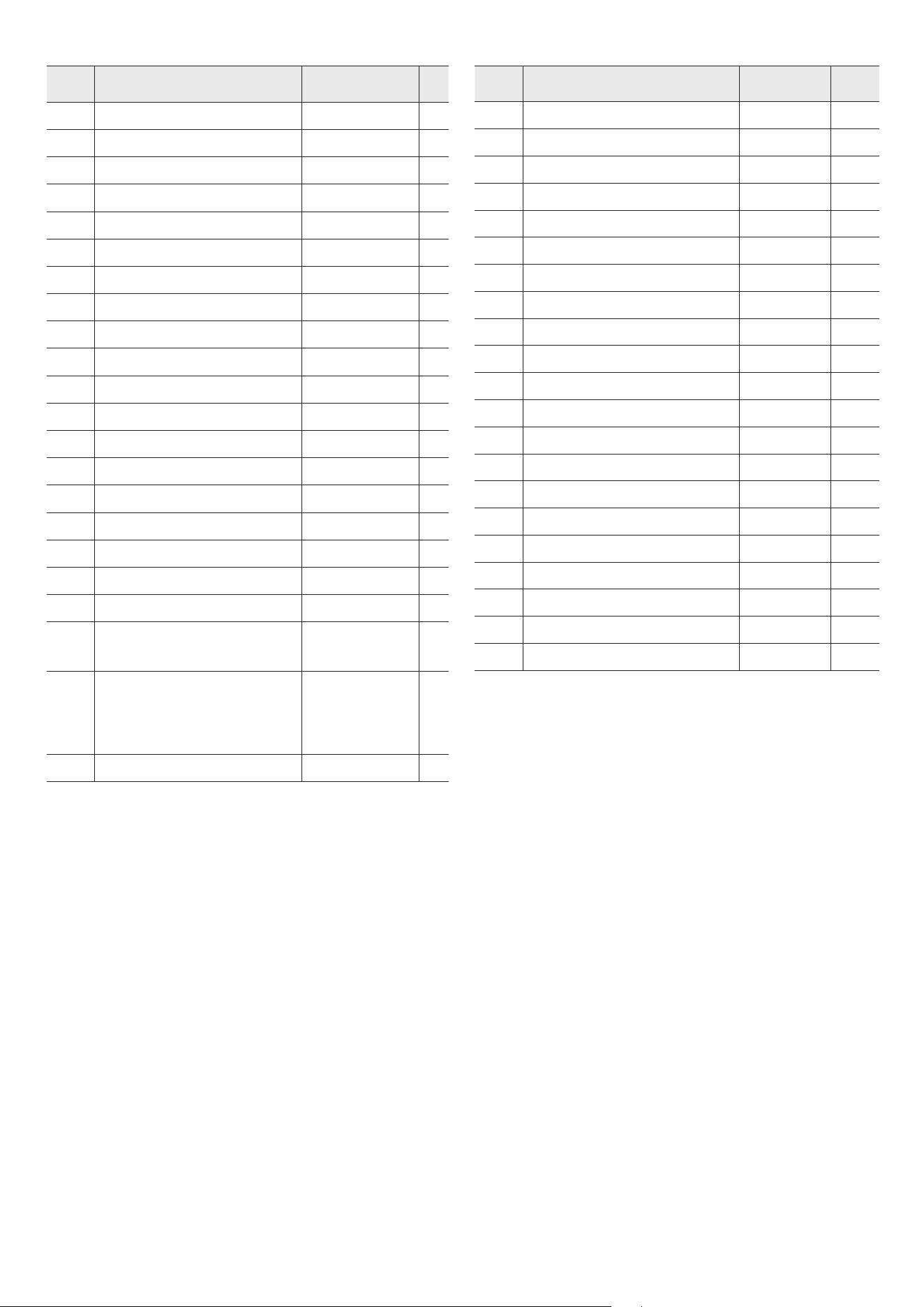
72
Item Description Part Number Qty
1
Blower Connector
RTG20299A 1
2
Blower Connector Packing
RTG20299B 1
3
Burner Assembly
RTG20299C 1
3-1
Burner Head
RTG20299D 1
3-2
Burner Flange
RTG20316BF 1
3-3
Ignition Rod
RTG20299F 1
3-4
Ignition Rod Gasket
RTG20299G 1
3-5
Overheat Switch (Burner)
RTG20316AK 1
3-6
Burner head packing
RTG20299J 1
3-7
Burner head gasket 1
RTG20316CB 1
3-8
Burner head gasket 2
RTG20299L 1
4
Exhaust Pipe Assembly (Lower)
RTG20316BT 1
5
Exhaust Pipe Assembly (Upper)
RTG20299R 1
6
Exhaust Temperature Sensor
RTG20316AH 1
7
Exhaust Duct Packing
RTG20316CE 1
8
Flame Detector Sensor Bracket
RTG20299W 1
9
Flame Detector Sensor
RTG20299X 1
10
Flame Detector Metal Plate
RTG20316CF
1
11
Flame Observation Bracket
RTG20316CG
1
12
Flame Observation Glass &
Gasket
RTG20316CH
1
13 Flame View Glass & Gasket
RTG20316CJ
(Glass)
RTG20316CK
(Gasket)
1
14 Flame View Bracket
RTG20316CL
1
Item Description Part Number Qty
15 Burner Fixing Bracket RTG20299Y 1
16 Hot Water Outlet Pipe RTG20316AT 1
17 Overheat Sensor RTG20316AJ 1
18 Water Temperature Sensor RTG20316AE 1
19 Hot Water Outlet Elbow RTG20316BJ 1
20 O-ring (P16) RTG20299AE 6
21 Clip (Star-Small) RTG20316BG 3
22 Water Inlet Pipe RTG20316BP 1
23 Pressure Transmitter RTG20316AL 1
23-1 Pressure Transmitter Clip RTG20316BA 1
24 Packing (20A) RTG20299AK 1
25 Circulation Pump RTG20316W 1
26 Pump Clip RTG20299AR 1
27 Condensate Hose RTG20316AV 1
28 Condensate Hose Clip RTG20299AT 2
29 Pump Outlet Pipe RTG20316AR 1
30 O-ring (P20) RTG20298F 2
31 Water Inlet Pipe Clip RTG20316BB 1
32 O-ring (P22) RTG20316BX 2
33 Clip (Star-large) RTG20316BC 1
34 Water Return Temperature Sensor RTG20316AG 1
Table 32 – Heat Exhchanger Part
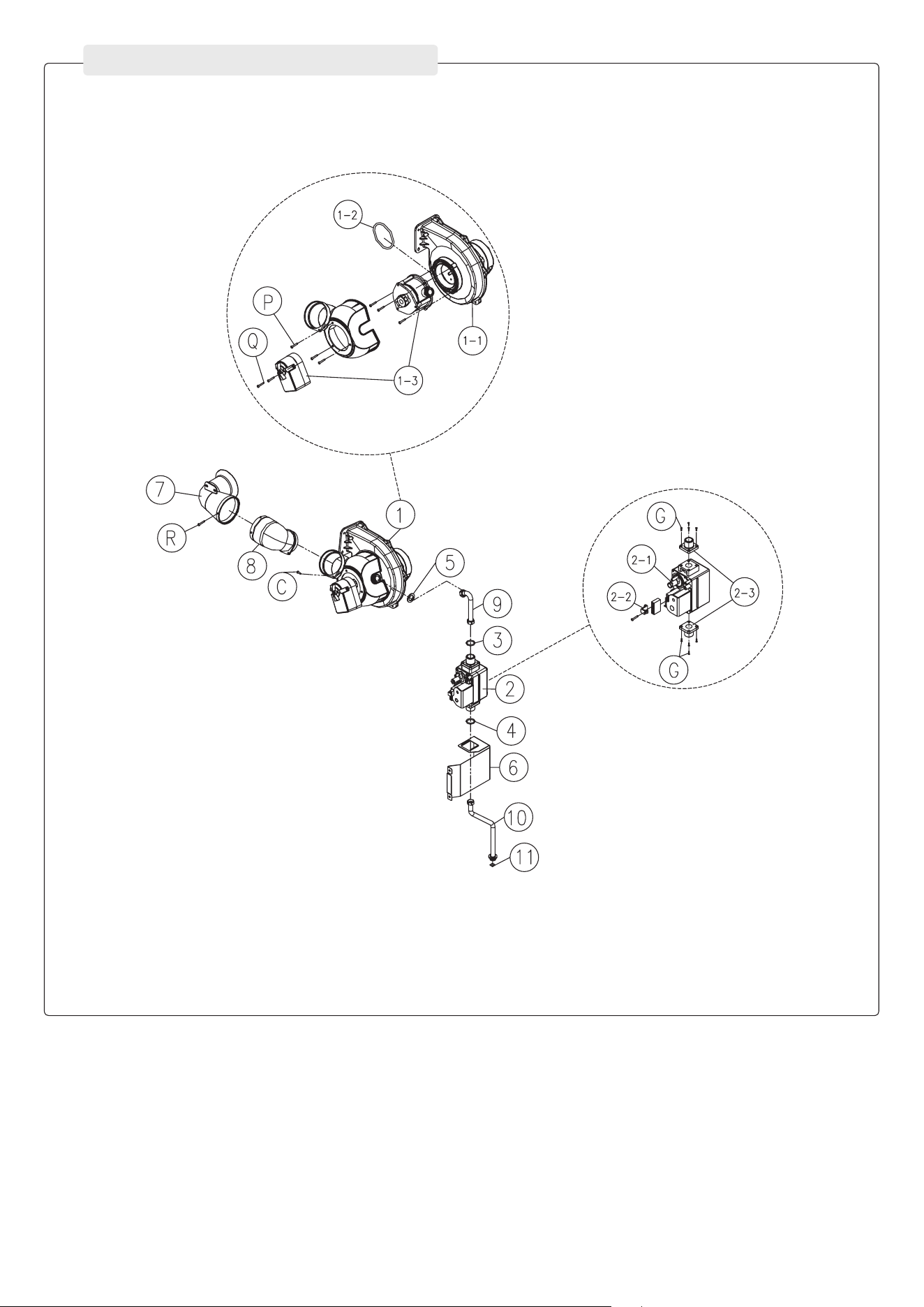
73
Figure 48 – Fan Motor Part
PART III _ FAN MOTOR PART
74
Item Description Part Number Qty
1
Fan & AGM Assy NG RTG20316L 1
1 Fan & AGM Assy LP RTG20316M 1
1-1 Fan RTG20300B 1
1-2 O-ring (P62) RTG20300C 1
1-3 AGM (Actuator) NG RTG20316N 1
1-3 AGM (Actuator) LP RTG20316P 1
2 Gas Valve Assembly RTG20316CM 1
2-1 Gas Valve RTG20316X 1
2-2 Gas Valve Plug Bracket RTG20316T 1
Item Description Part Number Qty
2-3 Gas Valve Adapter (Straight) RTG20316AP 2
3 15A Packing (Non-asbestos) RTG20316CC 1
4 15A Packing RTG20300J 1
5 Gas Mixer Packing RTG20300K 1
6 Gas Valve Bracket RTG20300L 1
7 Silencer Body RTG20300M 1
8 Silencer Elbow RTG20300N 1
9 Gas Pipe (Upper) RTG20300P 1
10 Gas Pipe (Lower) RTG20300R 1
11 O-ring (P18) RTG20298G 1
Table 33 – Fan Motor Part
Table 34 – Screw Part
Screw
Item Description
Length
A
Truss Head Machine Screw
M4 x 8
B
Flat Head Machine Screw
M4 x 8
C
Truss Head Tapping Screw
M4 x 10
D
Truss Head Tapping Screw
M4 x 12
E
Truss Head with PC Washer Tapping Screw
M4 x 10
F
Truss Head Tapping Screw
M4 x 6
G
Round Head Machine Screw
M4 x 12
H
Round Head with Flange Tapping Screw
M3 x 6
I
Hexagon Head with Flange Machine Screw
M5 x 16
J
Truss Head Tapping Screw
M4 x 16
K
Round Head Machine Screw
M3 x 6
Item Description
Length
L
Truss Head Machine Screw
M4 x 6
M
Round Head Tapping Screw
M4 x 16
N
Truss Head Machine Screw
M5 x 30
O
Hexagon Head with Flange Machine Screw
M5 x 12
P
Truss Head Machine Screw
M4 x 25
Q
Round Head Tapping Screw
M4 x 30
R
Binding Head Tapping Screw
M4 x 10
S
Round Head Tapping Screw
M3 x 16
T
Round Head Machine Screw
M4 x 10
U
Round Head Machine Screw
M5 x 12
V
Round Head Tapping Screw
M4 x 8
75
LIGHT OFF ACTIVITIES DATE COMPLETED ________________
Yes No
1) Fill the
heating system
Check all piping and gas connections, verify all are tight
Has the system been cleaned and flushed?
Has the appliance and the system been purged of all air?
Refer to Start-Up Preparation, this manual.
Has the auto air purge feature been used / set? Refer to
Start-Up Preparation, this manual.
Pressurize system (12 – 15 psi) CH ____ PSI
Pressurize system domestic HW
Add water to prime condensate cup
Percentage of glycol in system (0 – 50%) ____ %
Verify proper near appliance piping (Primary/Secondary)
2) Electrical Have the power and control wiring been connected per the
wiring diagram in this manual?
Is the supply voltage 120v and polarity correct?
3) Check gas
pipe
Leak test using locally approved methods (consult
jurisdictional code book)
Has the gas supply line been verified to deliver the required
BTU of the appliance?
Has a union and shut-off valve (no less than ¾” ) been
installed?
Does the gas type match the type indicated on the rating
plate?
Check incoming gas pressure (Max is 12.5" for NG and 13" for LP)
____ in w.c. Static
If necessary, convert the appliance to the proper gas type
Locate the stickers in the appropriate locations on the
appliance
If applicable, have all dip switches been set and verified to
match system requirements?
Verify combustion settings after gas conversion, Carbon
Dioxide
____% CO2 High Fire ____% CO2 Low Fire
Verify combustion settings after gas conversion, Carbon
Monoxide
____ppm
CO
High Fire ____ppm CO Low Fire
What is the “drop” on light off (No more than 1” W.C.)? ____ in w.c. Dynamic
4) Venting Has the appliance been vented with 2" or 3" PVC, CPVC,
Polypropylene, or (AL294C) Stainless for Cat IV
appliances?
Ensure no ABS or PVC Cellular core has been used
Is the vent sloped upward toward the terminal at a rate of ¼”
per ft. or 2% grade?
Have all intake and exhaust joints been properly sealed and
tested?
Are all vent runs properly supported?
Have the termination screens been installed?
Is the vent termination a min of 12” above grade or the
highest anticipated snow level?
Is the total developed vent length including elbows within
the stated max vent length restriction?
5) Condensate
piping / tubing
Is the condensate line piped with the approved materials
listed in this manual?
Does the condensate line have an air inlet at the top/
beginning of the drain? Refer to Install the Condensate
Drain, this manual.
Has the condensate been piped over to a drain, and
checked to be free flowing?
If necessary, has a condensate pump and /or a neutralizer
been installed?
FINAL SIGNED BY TECHNICIAN DATE
START-UP REPORT
10.5
Table 35 – Start-Up Report
CO
2
CO
2
76
MAINTENANCE REPORT
In unusually dirty or dusty conditions, care must be taken to keep appliance cabinet door in place at all times. Failure to do so VOIDS
WARRANTY!
The appliance requires minimal periodic maintenance under normal conditions. However, in unusually dirty or dusty conditions, periodic
vacuuming of the cover to maintain visibility of the display and indicators is recommended.
Periodic maintenance should be performed once a year by a qualified service technician to ensure that all the equipment is operating
safely and efficiently. The owner should make necessary arrangements with a qualified heating contractor for periodic maintenance of
the appliance. Installer must also inform the owner that the lack of proper care and maintenance of the appliance may result in a
hazardous condition.
INSPECTION ACTIVITIES DATE LAST COMPLETED
PIPING
1
s
t
YEAR 2
n
d
YEAR 3
r
d
YEAR 4
th
YEAR*
Near appliance piping Check appliance and system piping for any sign of leakage.
Leaking pipes could cause property damage. Make sure all
piping is properly supported.
Vent Check condition of all vent pipes and joints. Ensure all vent
piping is properly supported. Check for obstructions exhaust
and intake termination points.
Gas Check Gas piping, test for leaks and signs of aging. Make sure
all pipes are properly supported.
SYSTEM
Visual Do a full visual inspection of all system components.
Functional Test all functions of the system (central heating, water heating,
safeties)
Temperatures Verify safe settings on appliance or Anti-Scald Valve
Temperatures Verify programmed temperature settings
ELECTRICAL
Connections Check wire connections. Make sure they are tight.
Smoke and CO
detector
Verify devices are installed and working properly. Change
batteries if necessary.
Circuit Breakers Check to see that the circuit breaker is clearly labeled. Exercise
circuit breaker.
Switch and Plug Verify ON/OFF switch and convenience plug are both functional
CONDENSATE
Neutralizer Check condensate neutralizer. Replace if necessary.
Condensate hose Disconnect condensate hose. Clean out dirt and re-install.
(NOTE: Verify the flow of condensate, making sure that the
hose is properly connected during final inspection.)
GAS
Pressure Meas
ure incoming gas pressure (Max is 12.5" for NG and 13" for LP)
Pressure Drop Measure drop in pressure on light off (no more than 1” W.C.)
Check gas pipe for
leaks
Check piping for leaks. Verify that all are properly supported.
COMBUSTION
CO/CO2 Levels Check CO and CO2 levels in Exhaust. Record at high and low
fire.
SAFETIES
ECO (Energy Cut Out) Check continuity on Flue ECO. Replace if corroded.
CH AND DHW LOOPS
It is recommended to flush the CH and DHW heat exchangers
annually if water hardness exceeds 12 grains per gallon
(considered extremely hard water). If water hardness falls below
12 grains per gallon it is recommended to flush the heat
exchanger every two to three years.
In addition, it is recommended to clean the CH and DHW inlet
filters annually.
FINAL INSPECTION
Check list Verify that you have completed entire check list. WARNING:
FAILURE TO DO SO COULD RESULT IN SERIOUS INJURY
OR DEATH.
Homeowner Review what you have done with the homeowner.
TECH SIGN OFF
Table 36 – *Continue annual maintenance beyond the 4th year as required.
CO
2
10.5

AP18733 REV. 3.2.17
77
MAINTENANCE NOTES
78
CUSTOMER INSTALLATION RECORD FORM
The following form should be completed by the installer for you to keep as a record of the installation in case of a warranty claim. After reading the
important notes at the bottom of the page, please also sign this document.
IMPORTANT NOTES:
Customer: Please only sign after the installer has reviewed the installation, safety, proper operation and maintenance of the system.
In the case that the system has any problems, please call the installer. If you are unable to make contact, please contact your Sales
Representative.
Distributor/Dealer: Please insert contact details.
Customer’s Name:
Installation Address:
Date of Installation:
Installer’s Code/Name:
Product Serial Number(s):
Model Number:
Combustion Setting at Time of Installation:
Comments:
Installer’s Phone Number:
Signed by Installer:
Signed by Customer: