Operating instructions
Commercial dishwasher
PFD100SmartBiz
To avoid the risk of accidents or damage to
the appliance, it is essential to read these
instructions before it is installed and used for
the first time.
en-GB, IE
M.-Nr. 12 342 870

2

Contents
3
Notes about these instructions ................................................................................. 6
Operating steps.............................................................................................................. 6
Guide to the appliance................................................................................................. 7
Appliance overview ........................................................................................................
7
Control panel...................................................................................................................
8
Display functions............................................................................................................
9
Correct use..................................................................................................................... 10
Warning and Safety instructions ............................................................................... 12
Caring for the environment......................................................................................... 18
Before using for the first time..................................................................................... 19
Basic settings..................................................................................................................
19
Setting the language ................................................................................................ 19
Setting up Miele@home ......................................................................................... 19
Setting the time of day............................................................................................. 20
Setting the water hardness level ............................................................................ 20
Miele@home ..................................................................................................................
21
Opening the door ...........................................................................................................
23
Closing the door .............................................................................................................
24
Activating the safety lock ..............................................................................................
24
Dishwasher salt ..............................................................................................................
25
Filling the salt reservoir............................................................................................ 26
Refilling the salt......................................................................................................... 26
Rinse aid ..........................................................................................................................
27
Adding rinse aid......................................................................................................... 28
Filling the rinse aid reservoir ................................................................................... 28
Caring for the environment......................................................................................... 29
Economical dishwashing...............................................................................................
29
EcoFeedback consumption indicator ..........................................................................
30
Loading the dishwasher............................................................................................... 31
General information .......................................................................................................
31
Upper basket...................................................................................................................
33
Adjusting the upper basket...........................................................................................
35
Lower basket ...................................................................................................................
36
Cutlery basket.................................................................................................................
37
Loading the cutlery basket ...................................................................................... 37
Loading examples...........................................................................................................
38
Dishwashers with cutlery basket ........................................................................... 38
Detergent........................................................................................................................ 40
Field of application.........................................................................................................
40

Contents
4
Dispensing detergent.....................................................................................................
41
Adding detergent............................................................................................................
42
Changing detergent........................................................................................................
43
Operation........................................................................................................................ 45
Switching on the dishwasher........................................................................................
45
Selecting a programme .................................................................................................
45
Display of programme running time ............................................................................
46
Starting the programme ................................................................................................
46
End of programme..........................................................................................................
47
Energy management ......................................................................................................
47
Switching off the dishwasher .......................................................................................
48
Unloading the dishwasher ............................................................................................
48
Interrupting a programme .............................................................................................
49
Cancelling or changing a programme..........................................................................
49
Programme options...................................................................................................... 50
Options ............................................................................................................................
50
Timer ...........................................................................................................................
51
Activating Remote start ...........................................................................................
55
Programme chart .......................................................................................................... 56
Cleaning and care ......................................................................................................... 60
Periodic checks...............................................................................................................
60
Cleaning the wash cabinet............................................................................................
60
Cleaning the door and the door seal ...........................................................................
61
Cleaning the control panel ............................................................................................
61
Cleaning the appliance front.........................................................................................
61
Cleaning the spray arms................................................................................................
62
Checking the filters in the wash cabinet.....................................................................
64
Cleaning the filters .........................................................................................................
64
Cleaning the water inlet filter........................................................................................
66
Cleaning the drain pump ...............................................................................................
67
Troubleshooting............................................................................................................. 68
Technical problems ........................................................................................................
68
Fault messages...............................................................................................................
69
Door release....................................................................................................................
70
Water inlet fault ..............................................................................................................
71
Water drainage fault.......................................................................................................
72
General problems with the dishwasher ......................................................................
73
Noises ..............................................................................................................................
74
Unsatisfactory washing result ......................................................................................
75

Contents
5
Customer service.......................................................................................................... 78
Contact in the event of a fault......................................................................................
78
Programme updates.......................................................................................................
78
EPREL database .............................................................................................................
78
Note for test institutes ..................................................................................................
79
Warranty ..........................................................................................................................
79
Installation...................................................................................................................... 80
Electrical connection .....................................................................................................
80
The Miele Waterproof system......................................................................................
81
Water inlet.......................................................................................................................
81
Connecting the drainage system .................................................................................
83
Technical data................................................................................................................ 84
Settings ....................................................................................................................... 86
Opening the Settings menu..........................................................................................
86
Changing settings...........................................................................................................
86
Language......................................................................................................................
87
Time of day......................................................................................................................
87
Water hardness...............................................................................................................
88
Rinse aid ..........................................................................................................................
89
External dispensing........................................................................................................
89
Temperature unit ............................................................................................................
90
Final rinse temperature..................................................................................................
90
Miele@home ..................................................................................................................
91
Field of application.........................................................................................................
93
Remote control ...............................................................................................................
93
RemoteUpdate ...............................................................................................................
94
SmartStart.......................................................................................................................
95
EcoStart ...........................................................................................................................
95
Consumption (EcoFeedback) .......................................................................................
97
Display brightness..........................................................................................................
97
Volume .............................................................................................................................
98
Refill reminders...............................................................................................................
98
AutoOpen ........................................................................................................................
99
Software version.............................................................................................................
99
Showroom.......................................................................................................................
99
Factory default................................................................................................................
99
Notes about these instructions
6
Warnings
Information which is important for safety is highlighted in a thick framed box
with a warning symbol. This alerts you to the potential danger of injury to people
or damage to property.
Read these warning notes carefully and observe the procedural instructions and
codes of practice they describe.
Notes
Notes provide information of particular importance that must be observed.
They are highlighted in a thick framed box.
Additional information and comments
Additional information and comments are highlighted in a box framed with a single
black line.
Operating steps
Instructions on how to operate the commercial dishwasher are identified by
marked operating steps. They explain the procedure step by step.
Operating steps are indicated by a black square bullet point.
Example:
Select the desired setting and press OK to confirm.
Display
Information given via the commercial dishwasher display appears in a special
display font to match the font on the appliance.
Example:
When the messageFinished or AutoOpenappears in the display...
Guide to the appliance
7
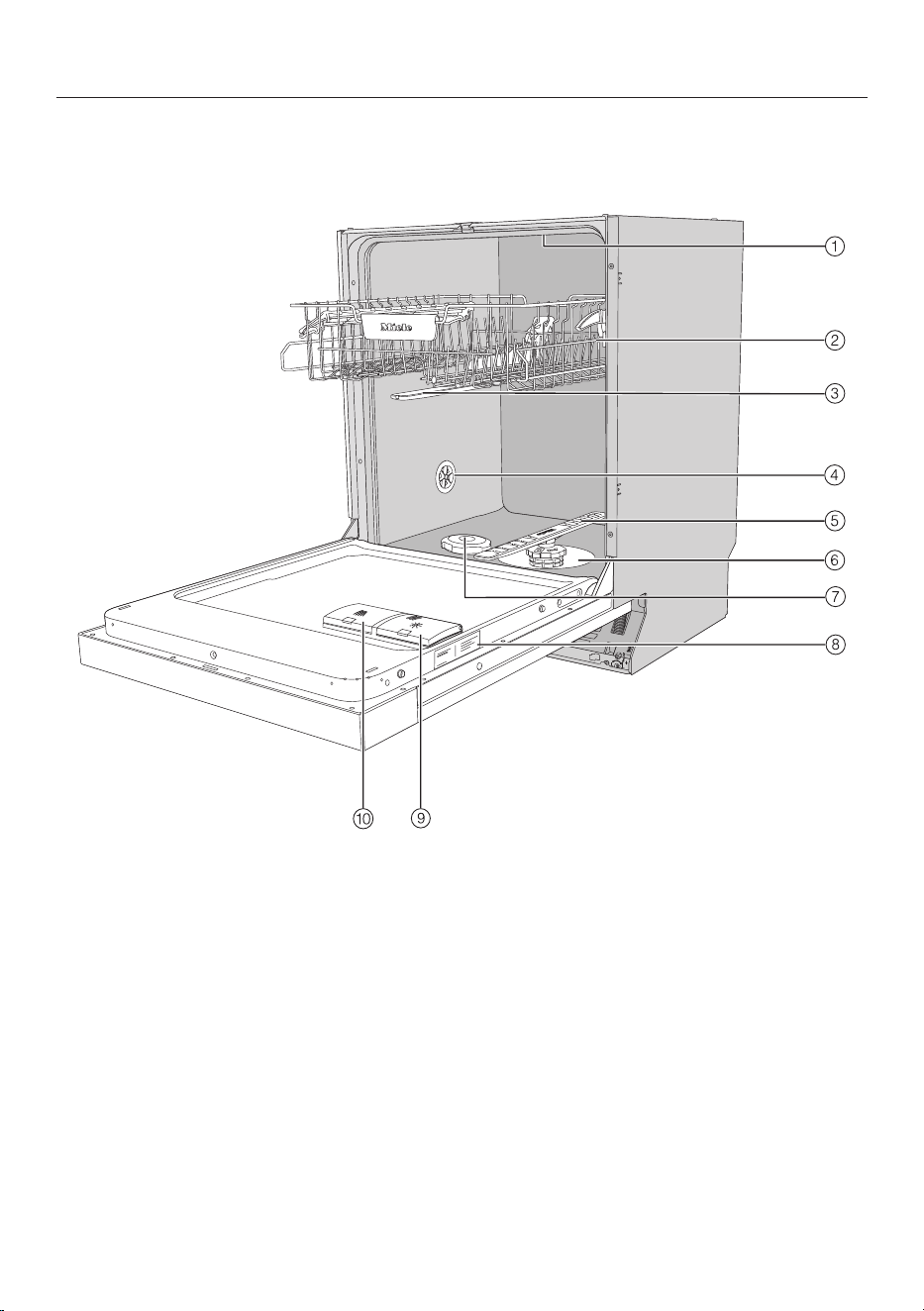
Appliance overview
a
Top spray arm
b
Upper basket (depending on model)
c
Middle spray arm
d
Aeration valve
e
Bottom spray arm
f
Filter combination
g
Salt reservoir
h
Data plate
i
Rinse aid reservoir
j
Detergent compartment
Guide to the appliance
8
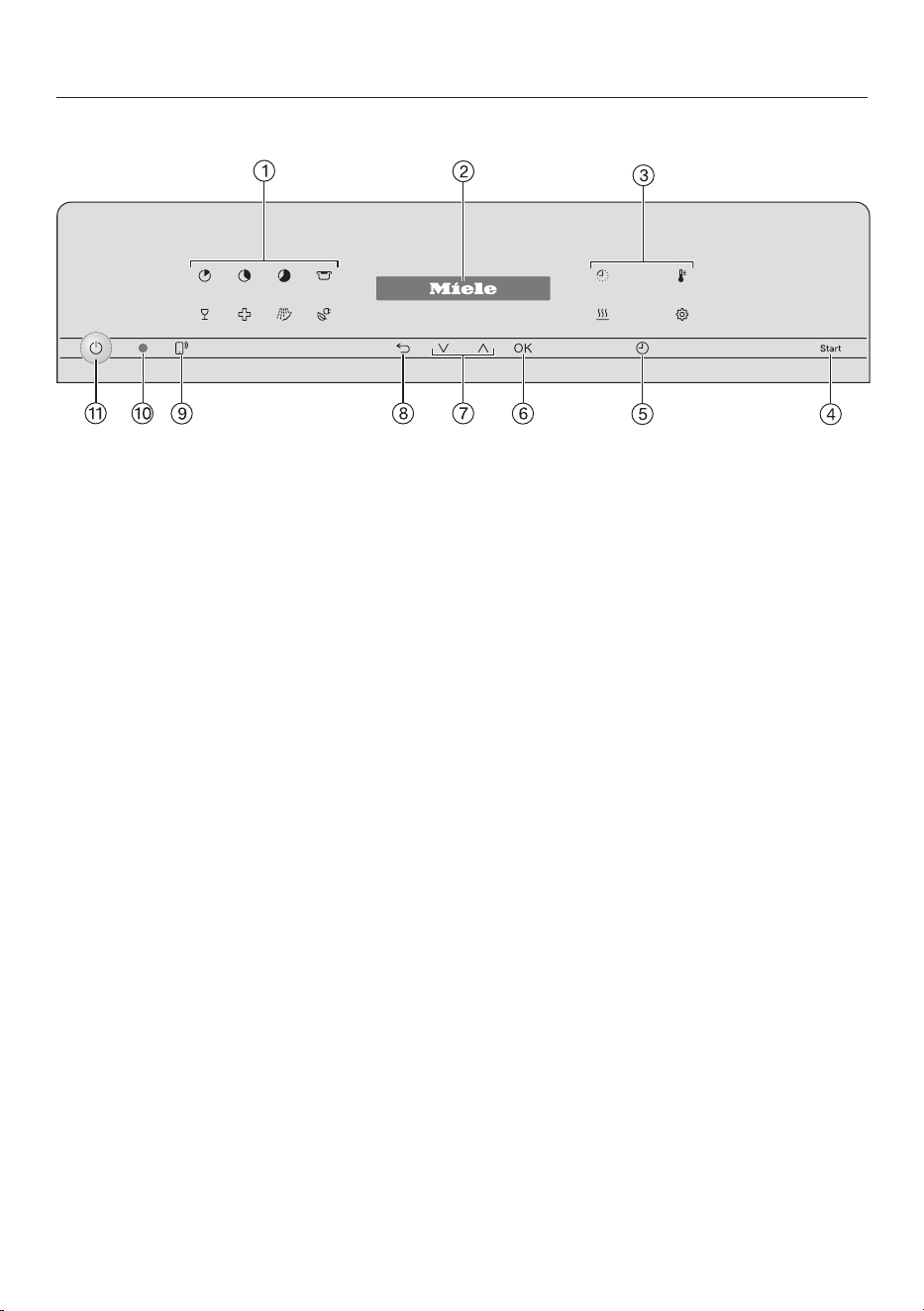
Control panel
a
Programme selection
= Short
= Universal
= Intensive
= Plastics
= Glasses
= Hygiene
= Cold pre-wash
= ECO
b
Display
For further information, see “Guide
to the appliance” in the “Display
functions” section.
c
Options
= Time left
= Temperature
= Extra dry
= Settings
d
Startsensor control
For starting the selected programme.
e
Timersensor control
For selecting a later programme
start.
f
OKsensor control
To select menu options and values
displayed.
To confirm messages.
g
Sensor controls
For programme selection.
For changing the values displayed.
For scrolling to other menu pages.
h
Backsensor control
For navigating back to the previous
menu or deleting values that have
been set previously.
i
Remote startsensor control
For activating/deactivating the
Remote start option.
j
Optical interface
For service technicians.
k
On/Offsensor control
For switching the dishwasher on and
off.

Guide to the appliance
9
Display functions
The display is used to select or set the
following:
- The programme
- The timer
- The Settings
The display can show the following:
- The programme stage
- The estimated time left for the
programme to run
- The current temperature of the
programme step
- The water consumption
- Any relevant fault messages and
information
To save energy, the dishwasher
switches off after a few minutes if you
do not press any sensor controls
during this time.
Touch the sensor control to switch
the dishwasher back on.
The OKsensor control is used to
confirm a message or setting and also
to move to the next menu or another
level.
Under Settings, a scroll bar will
appear on the right-hand side of the
display. This offers further options.
These options can be shown using the
sensor controls.
You can alter the dishwasher’s controls
to suit changing requirements in the
Settings menu (see “Settings” chapter).
The option that is selected will have a
tick next to it.
To exit a sub-menu again, use the
Backsensor control.
If you do not press any sensor controls
for several seconds, the display will
revert to the previous menu. You may
then have to enter your settings again.

Correct use
10
This commercial dishwasher complies with all current local and
national safety requirements. Inappropriate use can, however, lead
to personal injury and material damage.
Read the operating instructions carefully before using the
commercial dishwasher for the first time. They contain important
information on the safety, use and maintenance of the appliance.
This way you will prevent the risk of accidents and damage to the
commercial dishwasher. Keep these operating instructions in a safe
place and pass them on to any future owner.
This dishwasher with its short programme running times and
powerful cleaning performance is intended for commercial use in
offices, lunch rooms, clubhouses, workshops, large kitchens and
similar professional environments.
It is also suitable for use in domestic households and in similar
residential environments; for example, by customers in hotels,
motels, bed and breakfasts and other related establishments.
This commercial dishwasher is subsequently referred to as a
dishwasher in these operating instructions.
Glasses, cutlery and crockery are referred to generally as crockery
when not more specifically defined.
This dishwasher is not intended for continuous use.
This dishwasher may not be used to clean medical products or
devices.
This appliance is designed exclusively for use as a “dishwasher” for
cleaning loads as described in these instructions. Conversions,
modifications and any other use are not permitted.
This dishwasher is intended for stationary, indoor use only.
This dishwasher is intended for use at altitudes of up to 4000m
above sea level.
The special inserts in the baskets should only be used for their
specific application.
This dishwasher can only be used by people with reduced physical,
sensory or mental capabilities, or lack of experience or knowledge, if
they are supervised whilst using it or have been shown how to use it
in a safe way and understand and recognise the consequences of
incorrect operation.

Correct use
11
This dishwasher is supplied with a special lamp (depending on the
model) to cope with particular conditions (e.g. in terms of
temperature, moisture, chemical resistance, abrasion resistance and
vibration). This lamp must only be used for the purpose for which it is
intended. The lamp is not suitable for room lighting. Replacement
lamps may only be fitted by a Miele authorised technician or by the
Miele Customer Service Department.
This dishwasher contains several light sources in energy efficiency
class D.
The lighting control element is integrated into the appliance control
and cannot be removed separately. As a result, electricity
consumption cannot be measured separately.

Warning and Safety instructions
12
Correct installation
Do not install this dishwasher in an area where there is a risk of
explosion or freezing conditions.
Take care, both before and during installation of the
dishwasher, not to cut yourself on the metal parts. Danger of
injury. Wear protective gloves.
To ensure stability a built-under dishwasher must only be installed
beneath a continuous worktop that is bolted to the adjacent
cabinetry.
In order to reduce the risk of damage from condensation, the
furniture in the area around the dishwasher should ideally be
designed for commercial use.
Furniture can be protected using the vapour protection set, which is
available as an optional accessory.
The vapour barrier film should be stuck under the worktop in the area
around the dishwasher door.
The door springs must be evenly adjusted on both sides. They are
correctly adjusted when the door remains stationary when left half
open (approx. 45° opening angle). It is also important that the door
cannot fall open.
The appliance must only be operated with properly adjusted door
springs.
If the door cannot be adjusted properly, contact the Miele Customer
Service Department.

Warning and Safety instructions
13
Technical safety
This dishwasher must only be commissioned, repaired and
maintained by the Miele Customer Service Department, a dealer or a
suitably qualified service technician. Unauthorised installation,
maintenance and repairs can cause considerable danger for the user.
This dishwasher must only be operated by appropriately trained
personnel. They must be instructed and trained regularly.
Before using the dishwasher, check it for any externally visible
damage. Do not use a damaged dishwasher. This could be
dangerous.
In the event of a damaged or leaking dishwasher, switch off at the
power supply immediately and call the Miele Customer Service
Department, a Miele dealer or a suitably qualified service technician.
Faulty components must only be replaced by genuine Miele
original spare parts. Only when these parts are fitted can Miele
guarantee the correct functioning and safety of the appliance.
The electrical safety of this dishwasher can only be guaranteed
when correctly earthed. If in any doubt, please have the electrical
installation tested by a qualified electrician.
Please follow the advice on installation in these operating
instructions and the installation plan.
Before connecting the appliance, ensure that the connection data
on the data plate (voltage, frequency and fuse rating) match the
mains electrical supply.
The dishwasher may only be operated if the door opening
mechanism is working correctly. Otherwise there could be a risk of
danger whilst the automatic door opening mechanism (depending on
the model) is active.
The maximum weight of the front panel that can be aligned with the
factory fitted door springs is 10–12kg (depending on the model).
Signs that the door opening mechanism is working correctly:
- The door springs must be evenly adjusted on both sides. They are
correctly adjusted when the door remains stationary when left half
open (approx. 45° opening angle). It is also important that the door
cannot fall open.
- The door locking pins automatically retract when the door opens at
the end of the drying phase.

Warning and Safety instructions
14
There must be no electrical sockets behind the dishwasher.
Danger of overheating and fire risk if the dishwasher were to be
pushed up against a plug. See “Electrical connection”.
Do not connect the dishwasher to the mains electricity supply via
a multi-socket unit or an extension lead. These do not guarantee the
required safety of the appliance (e.g. danger of overheating).
Never open the casing of the dishwasher. Any contact with live
connections or tampering with the electrical or mechanical
components of the dishwasher will endanger your safety and may
lead to appliance malfunctions.
The dishwasher must not be used if the electrical connection cable
is damaged. A damaged connection cable may only be replaced by a
suitable connection cable of the same type. For safety reasons, such
replacement may only be carried out by the Miele Customer Service
Department or a qualified service technician.
The dishwasher must be disconnected from the mains electricity
supply before any maintenance or repair work is carried out.
The plastic housing of the water connection contains electrical
components. It must not be dipped in water.
There are electrical wires in the water inlet hose. Do not shorten
the water inlet hose, even if it is too long.
The integrated Waterproof system offers protection from water
damage, provided that the following conditions are met:
- Installation has been carried out correctly.
- The dishwasher is properly maintained and parts are replaced
where it can be seen that this is necessary.
- The stopcocks have been turned off during longer periods of
inactivity (e.g. whilst on holiday).
The Waterproof system will work even when the dishwasher is
switched off. However, the dishwasher must remain connected to the
electricity supply.
While the dishwasher is under warranty, repairs should only be
undertaken by a Miele authorised service technician. Otherwise the
warranty is invalidated.

Warning and Safety instructions
15
Correct use
This dishwasher is designed for operation with water and
detergents suitable for use in commercial dishwashers only. Organic
solvents and flammable liquid agents must not be used in it.
This could cause an explosion, damage rubber or plastic components
in the dishwasher and cause liquids to leak out of it.
You could injure yourself on the open dishwasher door or trip over
it. Avoid leaving the door open unnecessarily.
Do not sit, stand or lean on the opened door. This would tip or
damage the dishwasher.
After any plumbing work the water pipework to the dishwasher will
need to be vented. If this is not done, components can be damaged.
Please be aware that the dishwasher may be operating at high
temperatures. When the door is opened there is a danger of burning
or scalding. Items, baskets and inserts must be allowed to cool down
before they are unloaded. Any water remaining in containers could
still be very hot. Empty them into the wash chamber before taking
them out.
The water in the cabinet must not be used as drinking water.
Pre-treating items (for example with washing-up liquid and other
cleaning agents) as well as some types of soiling and some cleaning
agents can cause a build-up of foam in the wash cabinet. Foam can
have an adverse effect on the cleaning result.
Foam escaping from the wash cabinet can cause damage to the
dishwasher. If foam escapes the programme must be cancelled
immediately and the appliance must be disconnected from the mains
electrical supply.
There may be a risk of slipping if liquid is spilt on the floor
depending on the type of flooring and footwear being worn. Keep the
floor dry where possible and take care to clean up any liquid spills
straight away. Take the necessary precautions when cleaning up
hazardous substances and hot liquids.
When using cleaning agents and specialised products, it is
essential that the manufacturer’s instructions are followed. Cleaning
agents must only be used for the purpose they are designed for by
the manufacturer to avoid any material damage or the occurrence of
strong chemical reactions (e.g. oxyhydrogen explosion).

Warning and Safety instructions
16
Miele cannot be held liable for any effect chemical cleaning agents
may have on the material of the items being cleaned. Observe the
cleaning agent manufacturer's instructions with regard to storage
conditions, use and dosage.
Do not inhale or ingest powder detergent. Dishwasher detergent
contains irritant or corrosive ingredients which can cause burning in
the nose, mouth and throat if swallowed, or inhibit breathing. Seek
medical attention immediately if detergent has been swallowed or
inhaled.
People aged 16 and above may refill the dishwasher detergent or
change the media canister provided that they have been trained to do
so.
Powder and liquid detergents containing active chlorine must not
be used. They can damage plastics and seals in the dishwasher.
To avoid material damage and corrosion, do not allow any acids or
solutions containing chloride to get into the wash cabinet or onto the
casing. Similarly avoid any ferrous materials with a corrosive effect.
Do not wash items soiled with ash, sand, wax, lubricating grease or
paint in the dishwasher. These materials will cause damage to the
dishwasher.
Do not clean the dishwasher or near vicinity with a hose or a
pressure washer.
Be careful when sorting items with sharp pointed ends and
positioning them in the dishwasher that you do not hurt yourself or
create a danger for others. Sharp knives, forks, etc. should be placed
in baskets with the pointed ends facing downwards.
Remove any coarse food deposits and empty out any containers or
utensils before loading them in the dishwasher.
Safety with children
Children should be supervised in the vicinity of the dishwasher.
Never allow children to play with the appliance. There is a danger that
children might shut themselves in the dishwasher.
Children under eight years of age must be kept away from the
dishwasher unless they are constantly supervised.
Children aged eight and older may only use the dishwasher
without supervision if they have been shown how to use it in a safe
manner. Children must be able to recognise and understand the
potential risks of improper use.

Warning and Safety instructions
17
If the automatic door opening mechanism is active, keep young
children away from the area in which the door opens. There is a
danger of injury in the unlikely event of a fault with the opening
mechanism.
Keep children away from chemical agents. These contain irritant
and corrosive ingredients which can cause burning in the mouth, or
inhibit breathing. Keep children away from the dishwasher when the
door is open. There could still be residual chemical agent in the wash
cabinet. Seek medical advice immediately if a child has swallowed or
inhaled chemical agent.
Accessories
Only use original Miele accessories. If other parts are used,
warranty, performance and product liability claims will be invalidated.
Miele will guarantee the supply of functional spare parts for a
minimum of 10years and up to 15years following the discontinuation
of your dishwasher.
Transport
Only transport the dishwasher in an upright position so that no
water flows into the electrical controls, as this would cause faults.
If you wish to transport the dishwasher, empty it and securely
fasten all loose parts such as baskets, hoses and cables.
Miele cannot be held liable for damage caused by non-compliance
with these Warning and Safety instructions.

Caring for the environment
18
Disposing of the packaging
material
The packaging material is used for
handling and protects the appliance
from transport damage. The packaging
material used is selected from materials
which are environmentally friendly for
disposal and can generally be recycled.
Recycling the packaging material
reduces the use of raw materials. Use
material-specific collection points for
valuable materials and take advantage
of return options. Your Miele dealer will
take the packaging material away.
Disposing of your old appliance
Electrical and electronic appliances
contain many valuable materials. They
also contain certain materials,
compounds and components which
were essential for their correct
functioning and safety. These could be
hazardous to human health and to the
environment if disposed of with
household waste or if handled
incorrectly. Please do not, therefore,
dispose of your old appliance with
household waste.
Instead, please make use of officially
designated collection and disposal
points to dispose of and recycle
electrical and electronic appliances in
your local community, with your dealer
or with Miele, free of charge. By law, you
are solely responsible for deleting any
personal data from the old appliance
prior to disposal. You are legally obliged
to remove any old batteries which are
not securely enclosed by the appliance
and to remove any lamps without
destroying them, where this is possible.
These must be taken to a suitable
collection point where they can be
handed in free of charge. Please ensure
that your old appliance poses no risk to
children while being stored for disposal.
Before using for the first time
19
Basic settings
Switching on the dishwasher
Switch the dishwasher on using the
sensor control.
The welcome screen will appear when
the dishwasher is switched on for the
first time and the welcome melody will
sound.
For further information about the
display functionality, see “Guide to the
appliance” chapter, “Display
functions” section.
Setting the language
The display will then change
automatically to the screen for setting
the language.
Select the language you want as well
as the country, if appropriate, using
the sensor controls and confirm
with OK.
For further information on setting the
language, see the “Settings” chapter
under the “Language” section.
A tick will appear next to the language
that has been set.
Setting up Miele@home
The message Miele@home will appear on
the display.
To set up Miele@home now, confirm
by touching OK.
Tip: To postpone setup until later, select
the optionSkip and confirm by touching
OK.
There are two ways of connecting your
dishwasher to your WiFi network:
Select the connection method you
want and confirm your choice with
OK.
1. Connect using App
2. Connect using WPS
(WPS = WiFi Protected Setup)
You will then be guided by the display
and the relevant Miele networking
solution.
For further information on
Miele@home, see the “Miele@home”
section in the “Settings” chapter.
Before using for the first time
20
Setting the time of day
The time of day is set automatically if a
connection is established with the
WiFi network.
The display will then change to the
screen for setting the time of day.
The current time of day must be set
before you can use the timer option.
Use the sensor controls to enter
the hour and confirm your entry by
touching OK.
Then set the minutes and confirm
with OK.
Holding down the relevant or
sensor control will increase or
decrease the time automatically.
Setting the water hardness level
The display will change to the screen for
setting the water hardness.
- You should programme the
dishwasher to the correct water
hardness for your area.
- Your local water authority will be able
to advise you of the water hardness
level in your area.
- Where the water hardness fluctuates
e.g. between 1.8 and 2.7mmol/l (10 -
15 °dH - German scale) always
programme the dishwasher to the
higher value (2.7mmol/l or 15 °dH in
this example).
In the event of a fault, it will help the
service technician if you know the
hardness of your local water supply.
Therefore, please enter the water
hardness:
____________°dH or mmol/l
The dishwasher is programmed at the
factory for a water hardness level of
2.5mmol/l (14°dH – German scale).
Set the water hardness level in your
area and confirm using OK.
See the “Settings” chapter, “Water
hardness” section for more
information.
Before using for the first time
21
Prompts will then appear in the display.
After confirming these prompts with
OK, the messages Refill salt and
Refill rinse aid may appear.
Add salt and rinse aid if necessary
(see the “Dishwasher salt” and
“Rinse aid” sections in the “Before
using for the first time” chapter).
Select OK to confirm the messages.
The programme selected will appear
briefly in the display and the appropriate
sensor control will be illuminated.
Next, the estimated water consumption
may be shown for the chosen
programme for several seconds.
Then the display will show the
estimated running time for the
programme selected.
Miele@home
Your dishwasher is equipped with an
integrated WiFi module.
To use this feature, you will need:
- A WiFi network
- A Miele networking solution, e.g. the
Mieleapp
- A Miele user account. The user
account can be created via the Miele
networking solutions, e.g. via the
Mieleapp
The networking solution you are using
will guide you as you connect your
dishwasher to your home WiFi network.
Once your dishwasher is connected to
your WiFi network, you can use the
networking solution, for example, to
carry out the following activities:
- Call up information on the operating
status of your dishwasher
- Call up information on the programme
sequence of your dishwasher
Connecting your dishwasher to your
WiFi network will increase energy
consumption, even when the
dishwasher is switched off.
Make sure that your WiFi network
signal strength is strong enough at
the installation site of your
dishwasher.

Before using for the first time
22
Availability of the WiFi connection
The WiFi connection shares a frequency
range with other appliances (including
microwave ovens and remote control
toys). This can give rise to sporadic or
even complete connection failures.
Therefore, the availability of featured
functions cannot be guaranteed.
Miele@home availability
If you wish to use the Miele@mobile
app or other Miele networking solutions,
the Miele@home services must be
available in your country.
The Miele@home service is not
available in every country.
For information about availability, please
visit www.miele.com.
Mieleapp
You can connect the dishwasher to the
Mieleapp.
The app is available to download free of
charge from the Apple App Store
®
or
from the Google Play Store™.
Mieleapp
Before using for the first time
23
Every dishwasher is tested at the
factory. There will be residual water in
the appliance from this test. It is not
an indication that the dishwasher has
been used previously.
Opening the door
In some programmes the door
automatically opens slightly to assist
the drying process.
This function can be deactivated, if
preferred (see “Settings” chapter,
“AutoOpen”).
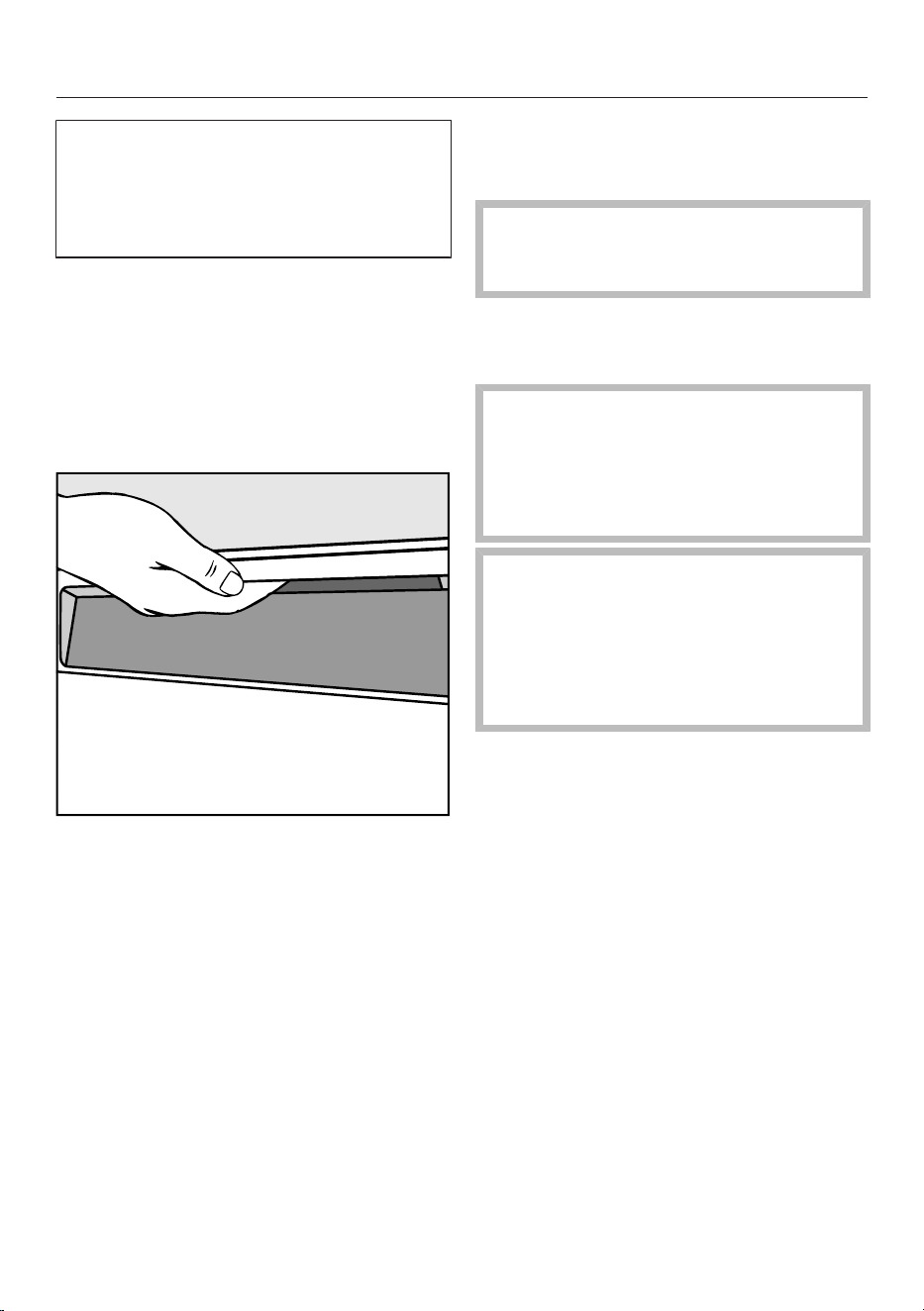
To open the door, reach under the
door grip and pull.
Open the door fully to disengage the
locking mechanism.
At the end of the programme, if the
AutoOpen function is on, the door
locking pins automatically retract.
To prevent a technical fault, do not
hold the door locking pins firmly
when they are retracting.
If the door is opened during operation
all wash functions are automatically
interrupted.
Risk of scalding due to hot water.
During operation, water in the
dishwasher may be very hot.
During operation, only open the door
with extreme caution.
Risk of injury due to door opening
automatically.
The door may open automatically at
the end of a programme.
Keep the area around the door free of
obstructions.
Before using for the first time
24
Closing the door
Push the baskets right in.
Raise the door upwards until the
catch engages.
Risk of crushing due to the door
closing.
When closing the door, you are at risk
of shutting your fingers in it.
Do not put your hand inside the door
as it is closing.
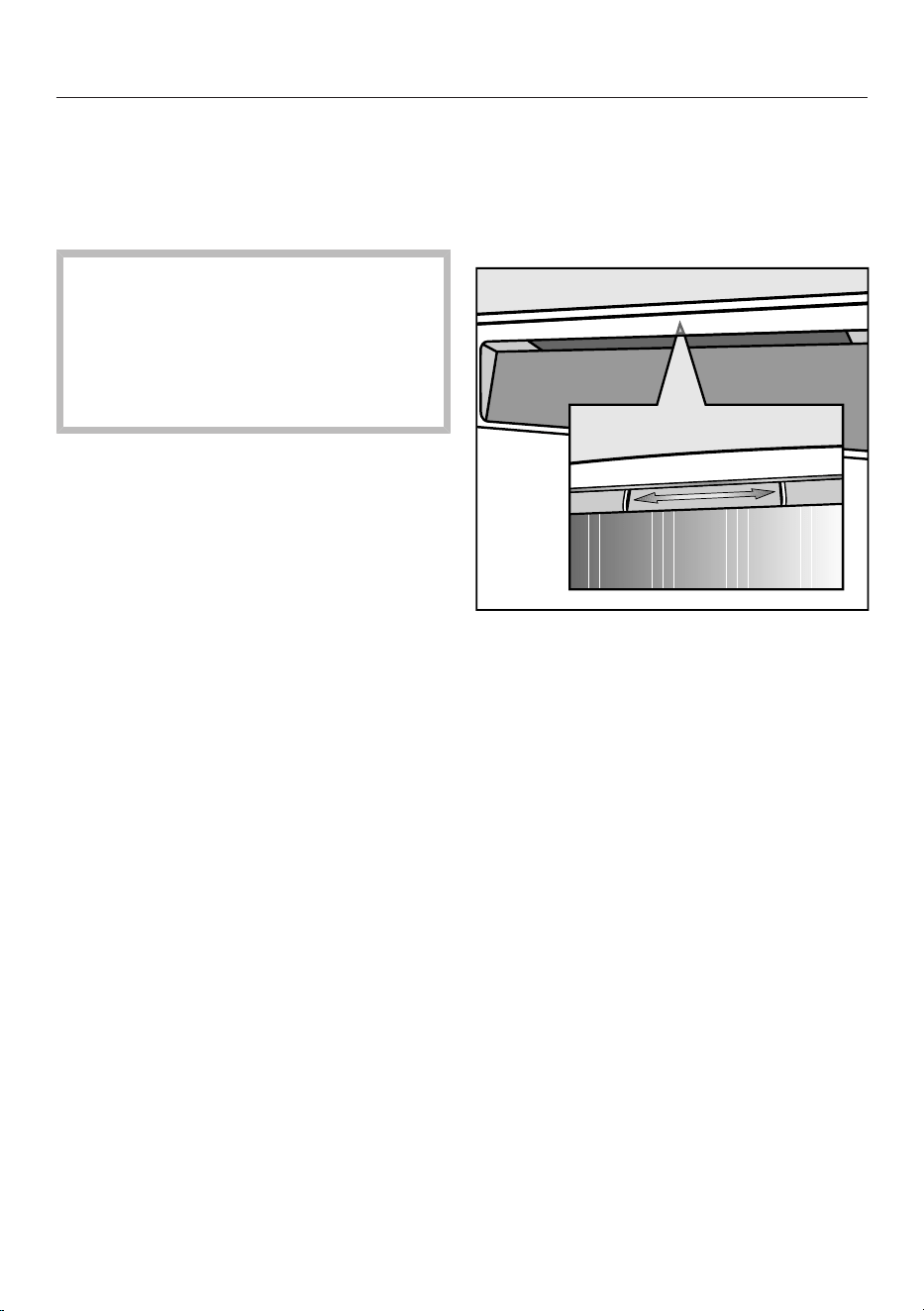
Activating the safety lock
Use the safety lock to prevent children
opening the dishwasher door. The door
can then only be opened by using a lot
of force.
To lock the door, push the slide
underneath the door grip to the right.
To unlock the door, push the slide to
the left.

Before using for the first time
25
Dishwasher salt
In order to achieve good cleaning
results, the dishwasher needs to
operate with soft water. Hard water
results in the build-up of calcium
deposits on crockery and on the wash
cabinet walls.
Mains water with a water hardness level
higher than 0.9mmol/l (5°dH –
German scale) must be softened. This
occurs automatically in the integrated
water softener. The water softener is
suitable for a water hardness level of up
to 6.5mmol/l (36°dH – German scale).
In order to maintain the functions of the
water softener, it must be reactivated
regularly. Reactivation occurs
automatically every ninth programme
sequence. At the start of the next
programme, an additional 4.4l of water
is required for this process. Energy
consumption increases by 0.015kWh
and the programme is extended by
3minutes.
The above only applies to the ECO
programme at a water hardness of
2.5mmol/l (14°dH – German scale).
For other programmes and water
hardness levels, the frequency of
reactivation will differ.
In order to be reactivated, the water
softener requires dishwasher salt.
Depending on the water hardness level
(<3.8mmol/l, or <21°dH – German
scale), dishwasher salt is not required if
combination detergents are being used
(see the “Powder detergent and
detergent tabs” section in the
“Detergent” chapter).
Damage caused by using
unsuitable salts.
Some types of salt may contain
insoluble components which can
cause the water softener to
malfunction.
Only use special coarse-grained
dishwasher salt or other pure kitchen
salt for reactivation.
Damage to the water softener
from detergent.
Detergent will damage the water
softener.
Do not fill the salt reservoir with
powder or liquid detergent.
If the water in your area is very soft
and constantly lower than 0.9mmol/l
(5°dH – German scale), you do not
need to add dishwasher salt. The salt
refill indicator will automatically switch
off after the water hardness has been
set accordingly (see the “Water
hardness” section in the “Settings”
chapter).
If you only ever use combination
detergent products in your dishwasher,
you can turn off both refill reminders if
you wish (see “Refill reminders” under
“Settings”).
Please make sure that if you stop using
combination detergents, you refill the
dishwasher salt and rinse aid. Switch
the refill reminders back on if required.
Before using for the first time
26
Filling the salt reservoir
Only use special coarse grained
reactivation salt with granules of approx.
1 - 4mm. Do not use other types of salt
such as cooking salt, agricultural grade
or gritting salt. These may contain
insoluble additives which can impair the
functioning of the water softener. If in
doubt consult the Miele Professional
Department.
Before filling the salt reservoir for the
first time, you must fill it with approx.
2l of water to enable the salt to
dissolve.
Once the dishwasher has been used
once, there is always sufficient water
in the salt reservoir.
Remove the lower basket from the
wash cabinet and unscrew the salt
reservoir cap.
Fill the salt reservoir with approx. 2l
of water (first use only).
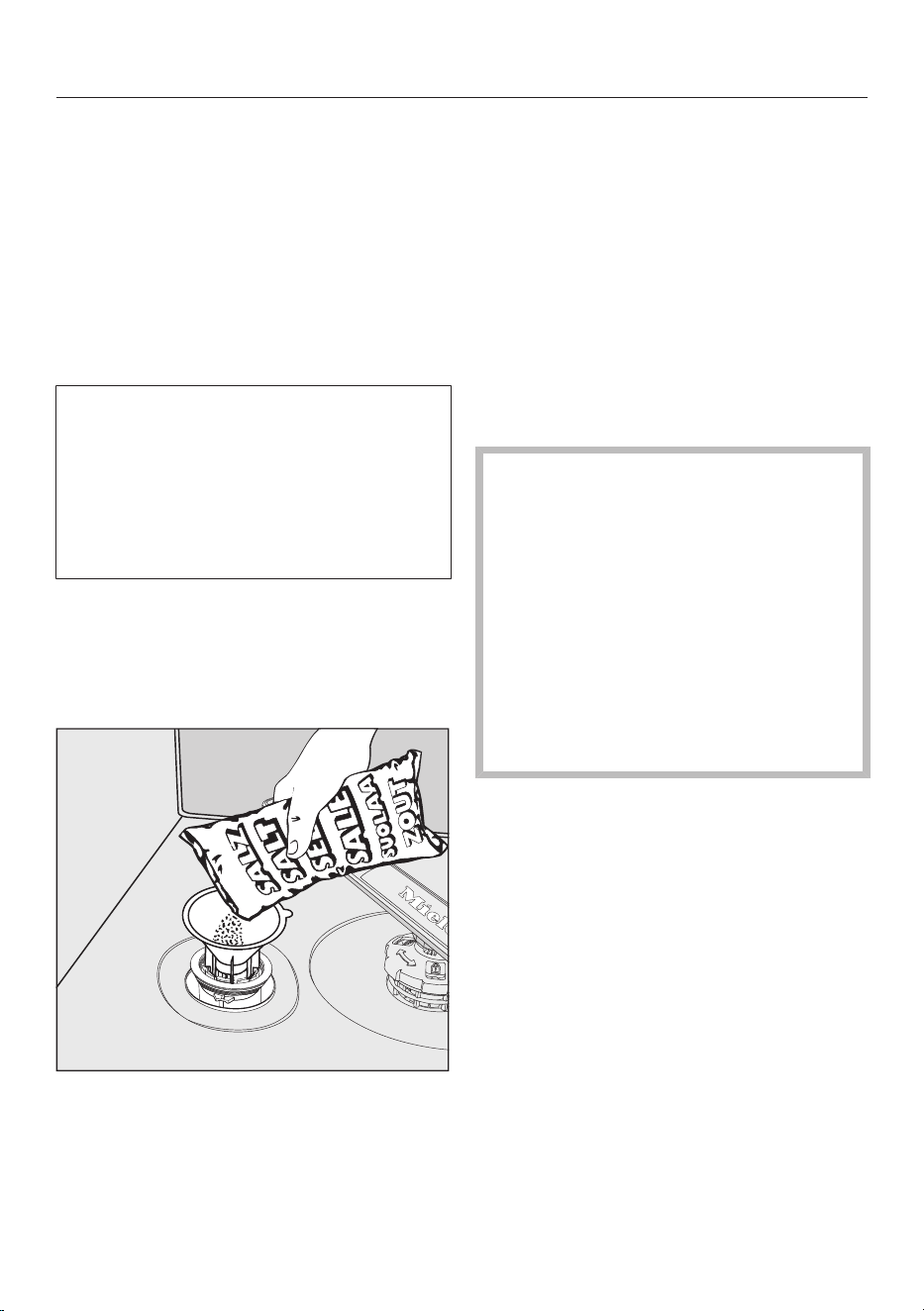
Place the funnel provided over the
salt reservoir and carefully fill with
dishwasher salt until the reservoir is
full. The salt reservoir holds up to 2kg
of salt, depending on the type of salt
used.
Clean off salt residues from around
the salt reservoir opening. Next,
screw the salt reservoir cap on again
firmly.
Refilling the salt
When the refill reminder Refill salt
appears in the display, wait until the
end of the programme and then refill
the salt reservoir.
Confirm with OK.
The salt refill indicator will go out.
Risk of corrosion due to saline
solution.
Saline solution that runs out can
cause corrosion in the wash cabinet
and to the load items.
Each time you remove the salt
reservoir cap, you must run the
Cold pre-wash programme
without any load items in the
dishwasher. This will dissolve and
remove any traces of salt from the
wash cabinet.
After the salt reservoir has been filled,
the salt refill indicator may still appear in
the display if the salt concentration has
not yet reached the correct level. In this
case, confirm the message again with
OK.
Before using for the first time
27
Rinse aid
Rinse aid is necessary to ensure water
does not cling to and leave marks on
crockery during the drying phase, and it
helps crockery dry faster after it has
been washed.
Rinse aid is poured into the storage
reservoir and the amount set is
dispensed automatically.
Washing-up liquid or detergent
can cause damage.
Washing-up liquid and dishwasher
detergent will damage the rinse aid
reservoir.
Only fill it with rinse aid formulated
for domestic dishwashers.
Alternatively, you could use liquid citric
acid at a concentration of up to 10%.
The resulting rinsing and drying quality
will not, however, be as good as when
rinse aid is used.
Risk of acid damage.
The dishwasher can be damaged by
high concentrations of acid.
Under no circumstances should you
use citric acid with a higher acid
content.
If you only ever wish to use
combination detergent products in
your dishwasher, you do not need to
add rinse aid.
However, for optimum rinsing and
drying results, use dishwasher
detergent and add dishwasher salt
and rinse aid separately.
If you only ever use combination
detergent products in your dishwasher,
you can turn off both refill reminders if
you wish (see “Refill reminders” under
“Settings”).
Please make sure that if you stop using
combination detergents, you refill the
dishwasher salt and rinse aid. Switch
the refill reminders back on if required.
Before using for the first time
28
Adding rinse aid
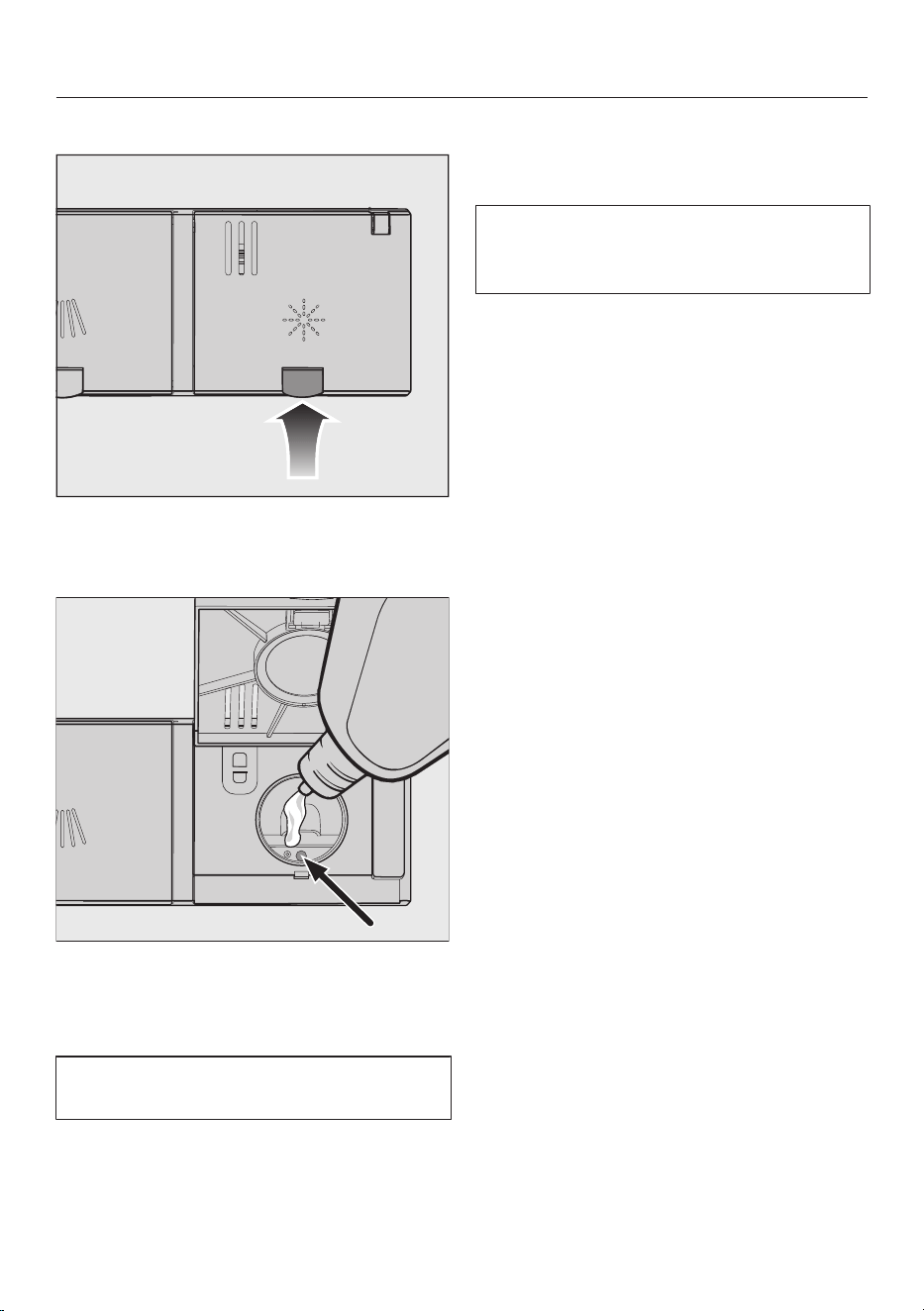
Press the yellow button on the lid
of the rinse aid reservoir.
The lid will spring open.
Fill with rinse aid until the filling level
indicator (arrow) changes to a dark
colour while the door is horizontally
open.
The rinse aid reservoir holds
approximately 110ml.
Close the lid firmly until you hear it
click into place. Otherwise, water can
enter the rinse aid reservoir during a
programme.
Wipe up any spilled rinse aid. This
prevents excess foam developing
during the next programme.
You can adjust the rinse aid dosage for
the best wash result (see “Settings”
chapter, “Rinse aid” section).
Filling the rinse aid reservoir
When the refill reminder Refill rinse aid
appears in the display, the reservoir
contains sufficient rinse aid for 2 to 3
programmes only.
Refill with rinse aid in plenty of time.
Confirm with OK.
The rinse aid refill reminder will
disappear.

Caring for the environment
29
Economical dishwashing
This dishwasher is exceptionally
economical in its use of water and
electricity.
You can make the most of your
appliance by following these tips:
- Washing in a dishwasher generally
uses less water and energy than
washing by hand.
- There is no need to pre-wash items
under running water, and this
unnecessarily increases water and
energy consumption.
- Make full use of the basket capacity
without overloading the dishwasher.
This results in the most economical
dishwashing in terms of energy and
water consumption.
- Choose the programme to suit the
type of crockery being washed and
the degree of soiling (see
“Programme chart”).
- Select the ECO programme for
energy-saving dishwashing. This
programme is the most efficient in
terms of its combined energy and
water consumption for cleaning
crockery with a normal level of soiling.
- Follow the detergent manufacturer’s
recommendations on detergent
dosage.
- If you are manually dosing the
detergent, reduce the amount by
1
/
3
when using powder detergent if the
baskets are only half full.

Caring for the environment
30
EcoFeedback consumption
indicator
The “Consumption” function is used for
calling up information about the water
consumption of your dishwasher (see
the “Consumption” section in the
“Settings” chapter).
The following information can be shown
on the display:
- An estimate of the consumption
before the programme sequence
- The actual consumption at the end of
the programme
- The total consumption of the
dishwasher
1. Estimated consumption
After a programme has been selected,
first the name of the programme and
then the estimated water
consumption will appear in the display
for a few seconds.
The estimated consumption will be
shown as a bar chart. The more bars
that are visible (), the higher the
water consumption.
The values are influenced by the
programme, any programme options
selected, the ambient conditions and
the size of the load.
The display will change automatically
from showing the estimated
consumption to showing the time
remaining.
The estimated consumption function is
activated as standard. This function can
be deactivated, though, if preferred (see
the “Consumption” section in the
“Settings” chapter).
2. Displaying consumption
At the end of the programme, you can
call up the actual water consumption for
the programme that has just been run.
Confirm the message Consumption
(OK) with OK.
Switching the dishwasher off at the
end of the programme will delete the
actual consumption values for the
programme that has just been run.
3. Total consumption
You can view the total consumption of
water for all previously used
programmes of your dishwasher (see
the “Consumption” section in the
“Settings” chapter).
Loading the dishwasher
31
General information
Remove coarse food residues from
crockery.
There is no need to pre-wash items
under running water.
Damage can be caused by ash,
sand, wax, lubricating grease or paint.
These substances will contaminate
the dishwasher and can then no
longer be removed.
Do not wash items soiled with these
substances in the dishwasher.
Crockery can be loaded anywhere in the
baskets, observing the following notes:
- Do not place crockery and cutlery
inside other items where they will
cover one another.
- Load the crockery so that water can
access all surfaces. This ensures that
the items will be properly cleaned.
- Make sure that all items are securely
positioned.
- Hollow items such as cups, glasses,
pots, etc. must be inverted in the
basket.
- Tall and narrow hollow items, such as
champagne glasses, should be placed
in the middle of the basket rather than
in the corners. This ensures the hollow
items are more easily accessed by the
water jets.
- Wide based items should ideally be
placed at an angle so that water can
run off them freely.
- The spray arms must not be blocked
by items which are too tall or hang
through the baskets. Test for free
movement by manually rotating the
spray arms.
- Make sure that small items cannot fall
through the holders in the baskets.
They should therefore be placed in the
cutlery basket.
Some foods may contain natural dyes,
e.g. carrots, tomatoes or ketchup.
These dyes can discolour plastic items
in the dishwasher if large quantities of
these foods are in contact with the
crockery inside the appliance. The
stability of plastic items is not affected
by this discolouration.
Washing silverware can also cause
plastic items to discolour.

Loading the dishwasher
32
Items not suitable for dishwashers:
- Wooden cutlery and crockery or items
with wooden parts: these may
discolour and fade. The glue used in
these items is not dishwasher-proof
and wooden handles may come loose
after being washed in a dishwasher.
- Craft items, antiques, valuable vases
and decorative glassware: such items
are not suitable for dishwashers.
- Plastic items that are not heat
resistant: the high temperatures in the
dishwasher may cause them to melt
or lose shape.
- Copper, brass, tin and aluminium
items: these may discolour or become
dull.
- Colours painted over a glaze: these
may fade after a number of washes.
- Delicate glassware and glassware
containing lead crystal: clouding may
occur over time.
Silver
Silver that has been in contact with
foods containing sulphur can discolour.
These include egg yolk, onions,
mayonnaise, mustard, pulses, fish, fish
brine and marinades.
Silverware previously cleaned with a
silver polish may still be damp or
spotted at the end of a programme,
where water has not run off smoothly.
Tip: Rub the silver dry with a cloth.
Damage due to caustic alkaline
detergents.
Aluminium parts (e.g. the grease
filters of cooker hoods) can be
damaged by caustic alkaline
detergents. In extreme cases, there is
a risk of an explosive chemical
reaction (such as an explosive
oxyhydrogen gas reaction).
Aluminium components must not be
cleaned in the dishwasher with
caustic alkaline commercial or
industrial detergents.
Tip: When purchasing new crockery and
cutlery, make sure they are dishwasher-
proof if you want to wash them in the
dishwasher.
Glass care
- Clouding may occur on glasses after
frequent washing in the dishwasher.
When washing delicate glassware in
the dishwasher, ensure that only a
special glass care programme with
very low temperatures is selected
(see “Programme overview”). This will
reduce the risk of clouding.
- Purchase glassware that is
dishwasher-safe (e.g. Riedel
glassware).
- Use detergents with glass protective
additives.
Loading the dishwasher
33
Upper basket
See the “Loading the dishwasher”
chapter, “Loading examples” section
for examples of how to load crockery
and cutlery.
Loading the upper basket
Damage due to leaking water.
If you run the dishwasher without the
upper basket, water can leak out of
the dishwasher.
Only run the dishwasher with the
upper basket in place (except during
the programmeTall items , if
available).
Use the upper basket for small,
lightweight and delicate items such as
cups, saucers, glasses, dessert bowls
etc.
Shallow pans or casserole dishes can
also be placed in the upper basket.
Long items such as soup ladles and
mixing spoons should be placed lying
down across the front of the upper
basket.
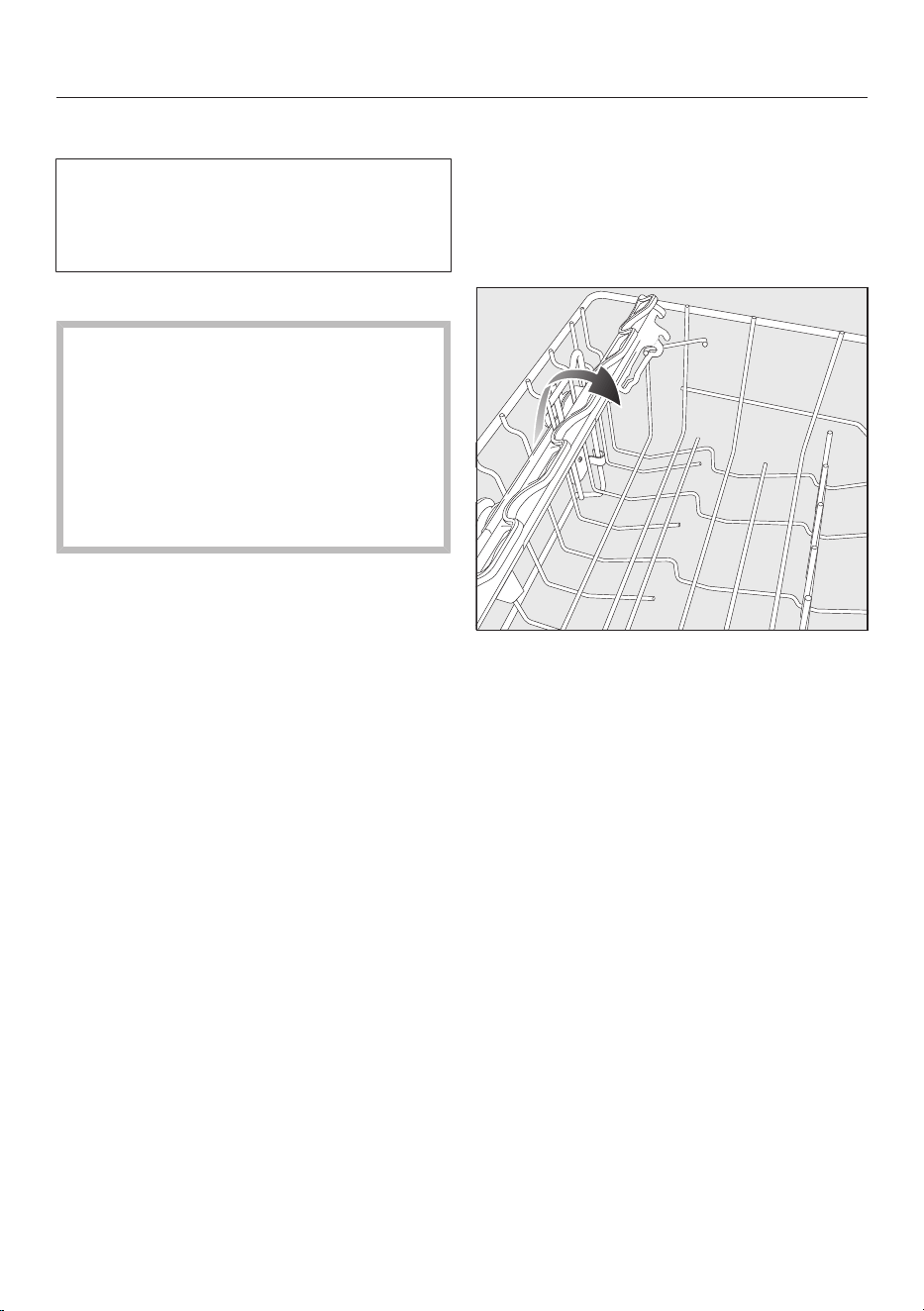
Loading the FlexCare cup rack
You can put cups, small bowls and flat
crockery on the FlexCare cup rack.
Glasses can be arranged along the cup
rack so they sit securely during the
programme.
Lower the cup rack to do so.
Raise the cup rack upwards to make
room for tall items.
Loading the dishwasher
34
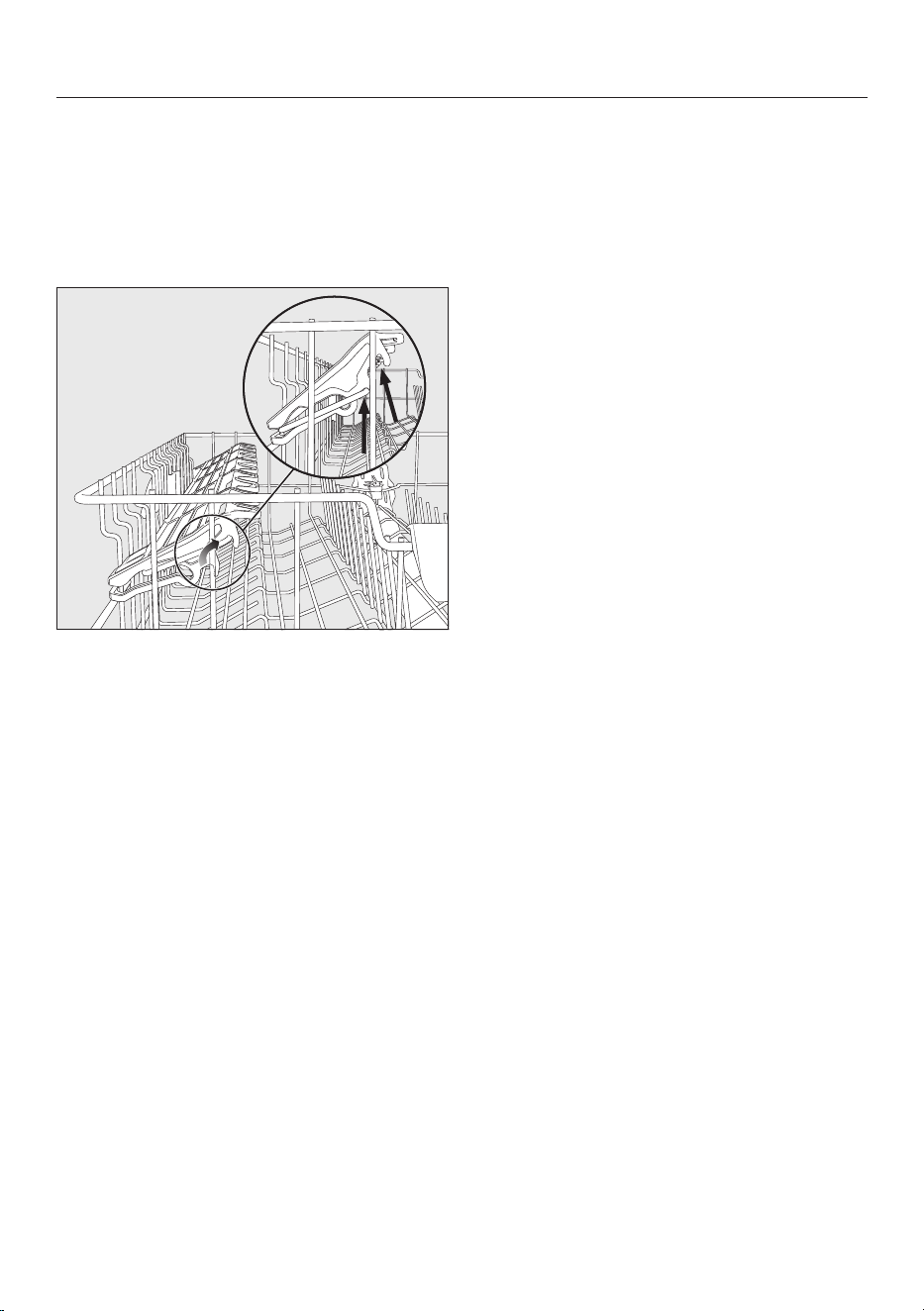
Adjusting the FlexCare cup rack
You can set the height and depth of the
cup rack at 2different levels so that it
can accommodate larger cups and so
that taller crockery can be placed
underneath it.
Pull the cup rack upwards and click it
into the desired position (see arrow).
Loading the dishwasher
35
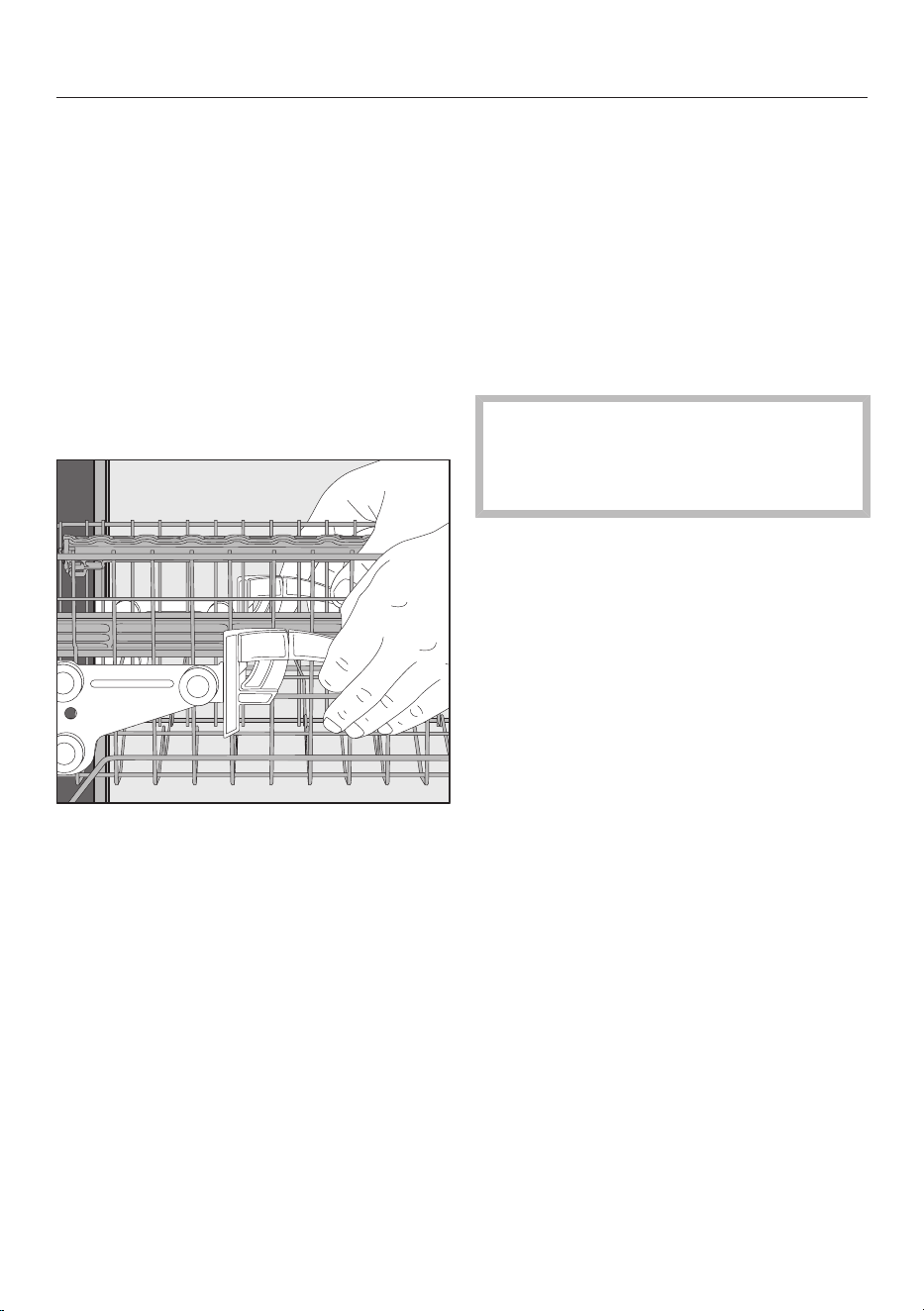
Adjusting the upper basket
In order to gain more space for taller
pieces of crockery in the lower basket or
upper basket, the upper basket can be
adjusted on 3levels with 2cm between
each level.
The upper basket can also be set at an
angle so that water can run off freely
from recesses. Make sure, however, that
the basket can slide smoothly in and out
of the wash cabinet.
Pull out the upper basket.
To raise the upper basket:
Lift the basket up until it clicks into
place.
To lower the upper basket:
Pull upwards on the levers at either
side of the upper basket.
Adjust the basket to the desired
height and then push the levers
securely back down into position.
When adjusting the upper basket,
make sure that tall plates in the lower
basket do not block the middle spray
arm.
Loading the dishwasher
36
Lower basket
See the “Loading the dishwasher”
chapter, “Loading examples” section
for examples of how to load crockery
and cutlery.
Loading the lower basket
Place larger and heavier items such as
plates, serving platters, saucepans,
bowls etc., in the lower basket.
Glasses, cups and small plates and
saucers can also be placed in the
lower basket.
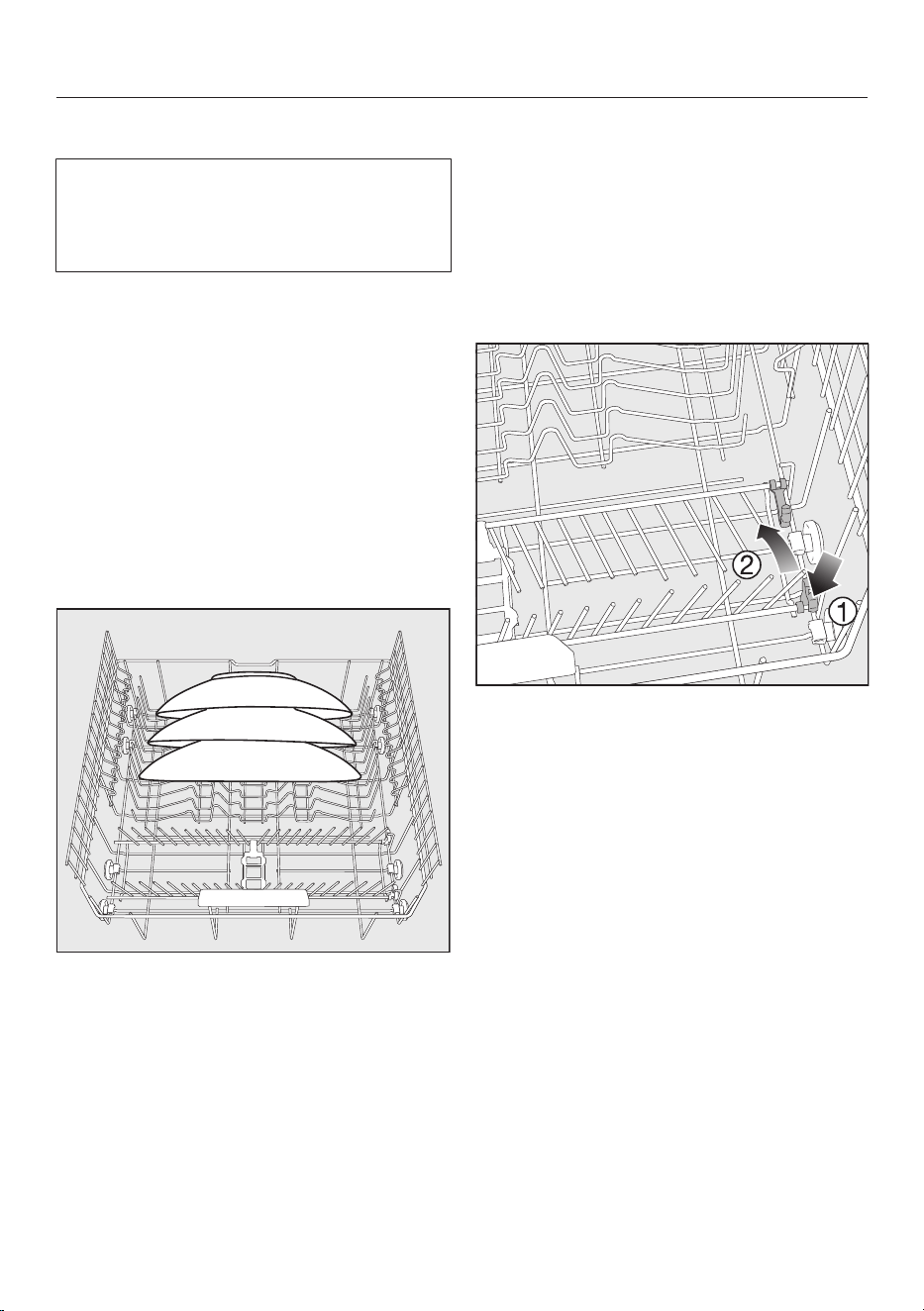
Loading the MultiComfort zone
The rear section of the lower basket is
used for washing cups, glasses, plates
and pots and pans.
Place very large plates in the middle
of the lower basket.
Tip: When tilted, plates up to 35cm in
diameter can be accommodated.
Lowering the spikes
The rows of spikes at the front are used
for washing plates, soup bowls, platters,
dessert bowls and saucers.
Both right-hand rows of spikes can be
lowered to make more room for large
items such as pots, pans and serving
dishes.
Press the yellow lever downwards ,
and then lower the rows of spikes .
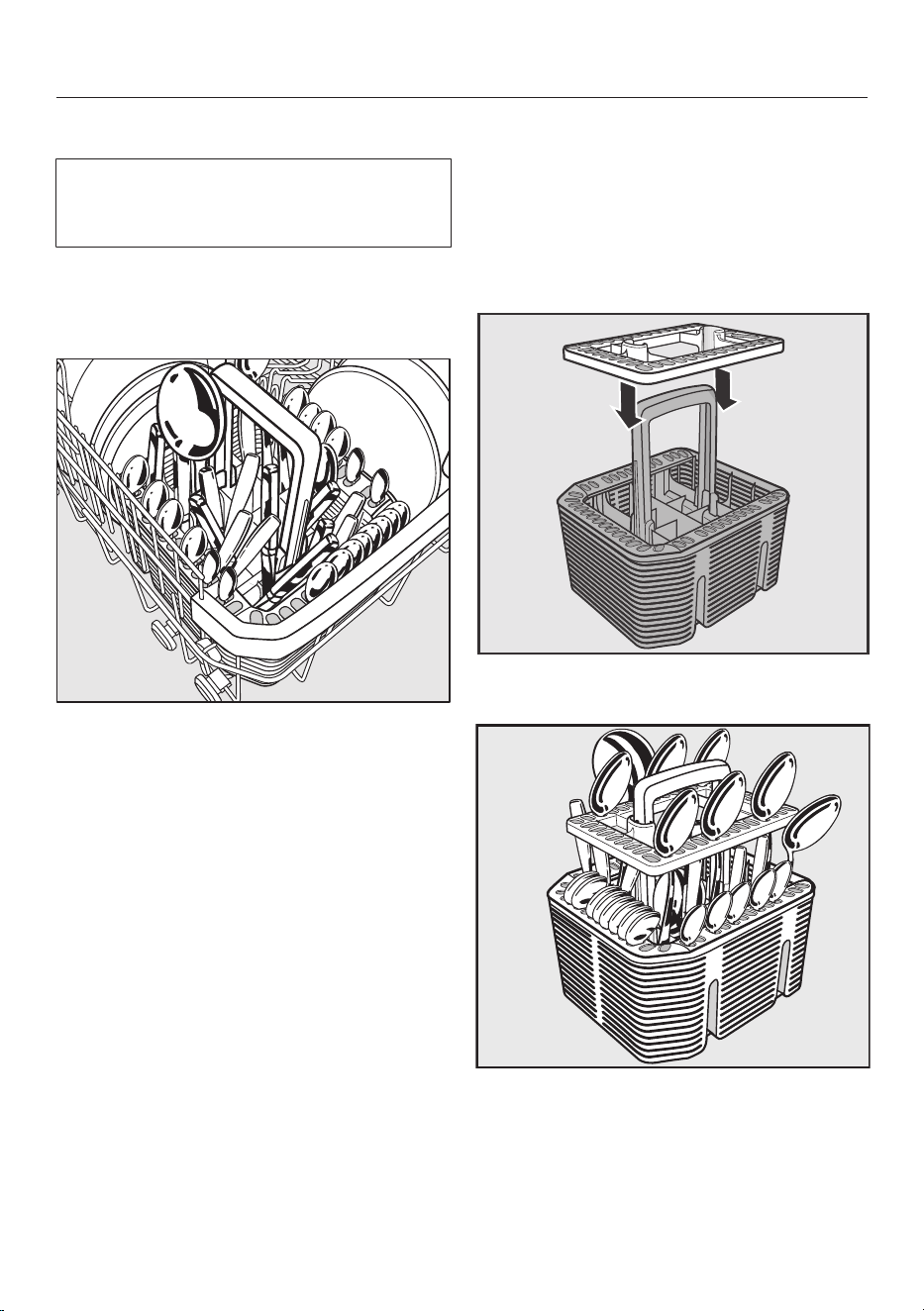
Loading the dishwasher
37
Cutlery basket
See “Loading the dishwasher –
Loading examples” for examples of
how to load crockery and cutlery.
Load the cutlery into the cutlery
basket.
Loading the cutlery basket
The cutlery basket can be placed
anywhere on the front rows of spikes in
the left or right corner of the lower
basket.
To avoid the risk of injury, knives and
forks should be placed with the
handles upwards in the cutlery
basket. However, cutlery placed
handle down in the cutlery basket will
come out cleaner and drier.
Place small items of cutlery in the
individual slots on three sides of the
cutlery basket.
Loading the cutlery insert for the
cutlery basket
Use the insert supplied for heavily
soiled items of cutlery. As this insert
separates the items, they do not overlap
and can be more easily accessed by the
water jets.
Fit the insert onto the cutlery basket if
required.
Place cutlery into the insert with the
handles facing downwards.
Arrange them evenly along the insert.
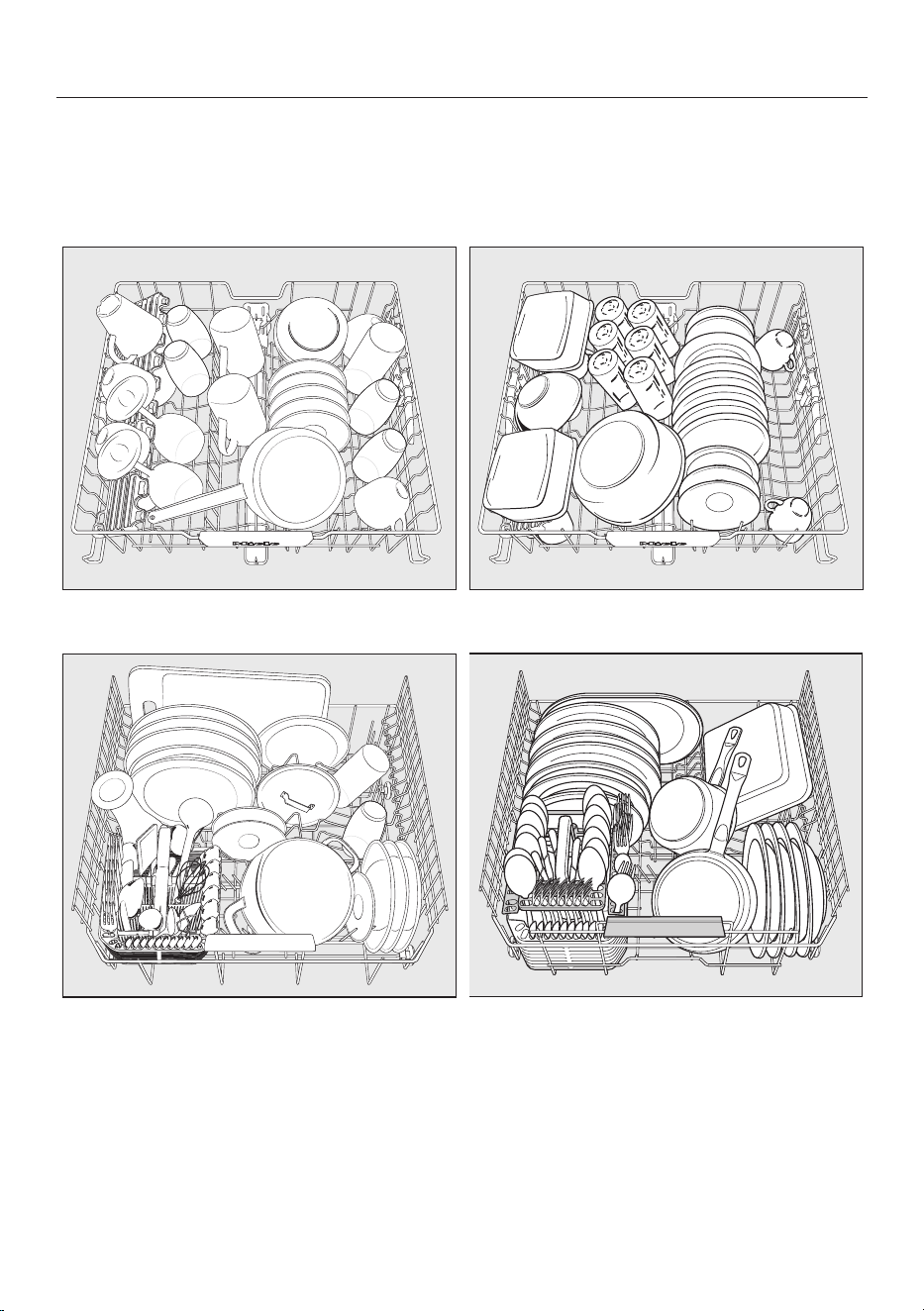
Loading the dishwasher
38
Loading examples
Dishwashers with cutlery basket
Upper basket
Lower basket
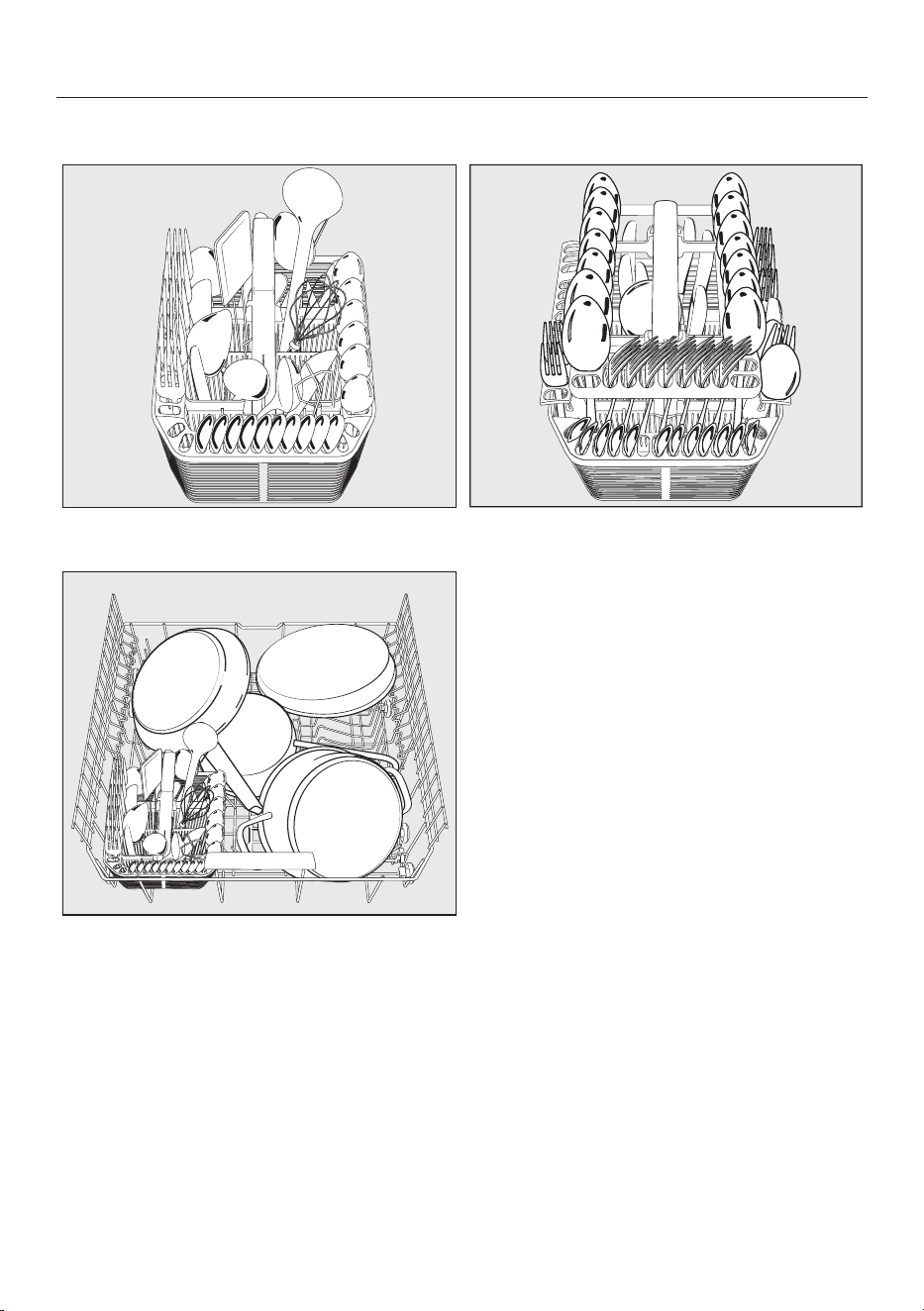
Loading the dishwasher
39
Cutlery basket
Heavily soiled crockery
Detergent
40
Risk of chemical burns from
detergent.
Dishwasher detergents can cause
burning on the skin and in the eyes,
nose, mouth and throat.
Avoid contact with detergents.
Do not inhale powder detergents. Do
not swallow dishwasher detergents.
Seek medical attention immediately
if detergent has been swallowed or
inhaled.
Keep children away from detergents.
Detergent residues could still be
present in the dishwasher. Keep
children away from the dishwasher
when the door is open. Do not fill the
detergent dispenser until just before
starting the programme and activate
the door safety lock (depending on
model).
Risk of damage due to
detergents containing active chlorine.
Powder and liquid detergents
containing active chlorine must not
be used. They can damage plastics
and seals in the dishwasher.
Do not use detergents containing
active chlorine.
Field of application
To set the field of application, see
“Settings – Field of application”.
The detergent selected must be
appropriate for the setting in which the
dishwasher is being used. If the
dishwasher is being used in a
commercial setting, it is recommended
that commercial detergents are used.
You can easily order powder and liquid
detergents and other process chemicals
for your dishwasher for commercial use
via the Miele professional website:
https://miele.co.uk/p/. Look forProCare
Shine products under cleaning agents.
If you are using your dishwasher in a
private setting, it is recommended that
detergents designed for domestic
dishwashers are used. Suitable
detergents are available from Miele.
You can easily order powder detergents
and other consumables for your
dishwasher for domestic use via the
Mieleapp or the Miele website:
https://www.miele.de/haushalt/
produktauswahl-miele-spuelmittel

Detergent
41
Powder detergents and
detergent tabs
Use powder detergent or detergent
tabs only in the door dispenser
compartment.
Only use detergent tabs that are
quick dissolving.
Suitable detergent tabs are available
from the Miele range. When using
combination detergents (tabs that
offer rinse aid as well as water
softeners and detergent), it is
recommended that you also add
rinse aid and dishwasher salt (at a
lower concentration) owing to the
short programme running times and
potentially the water quality.
Add powder detergent or detergent
tabs to the detergent compartment.
Dispensing detergent
The detergent compartment holds a
maximum of 50ml.
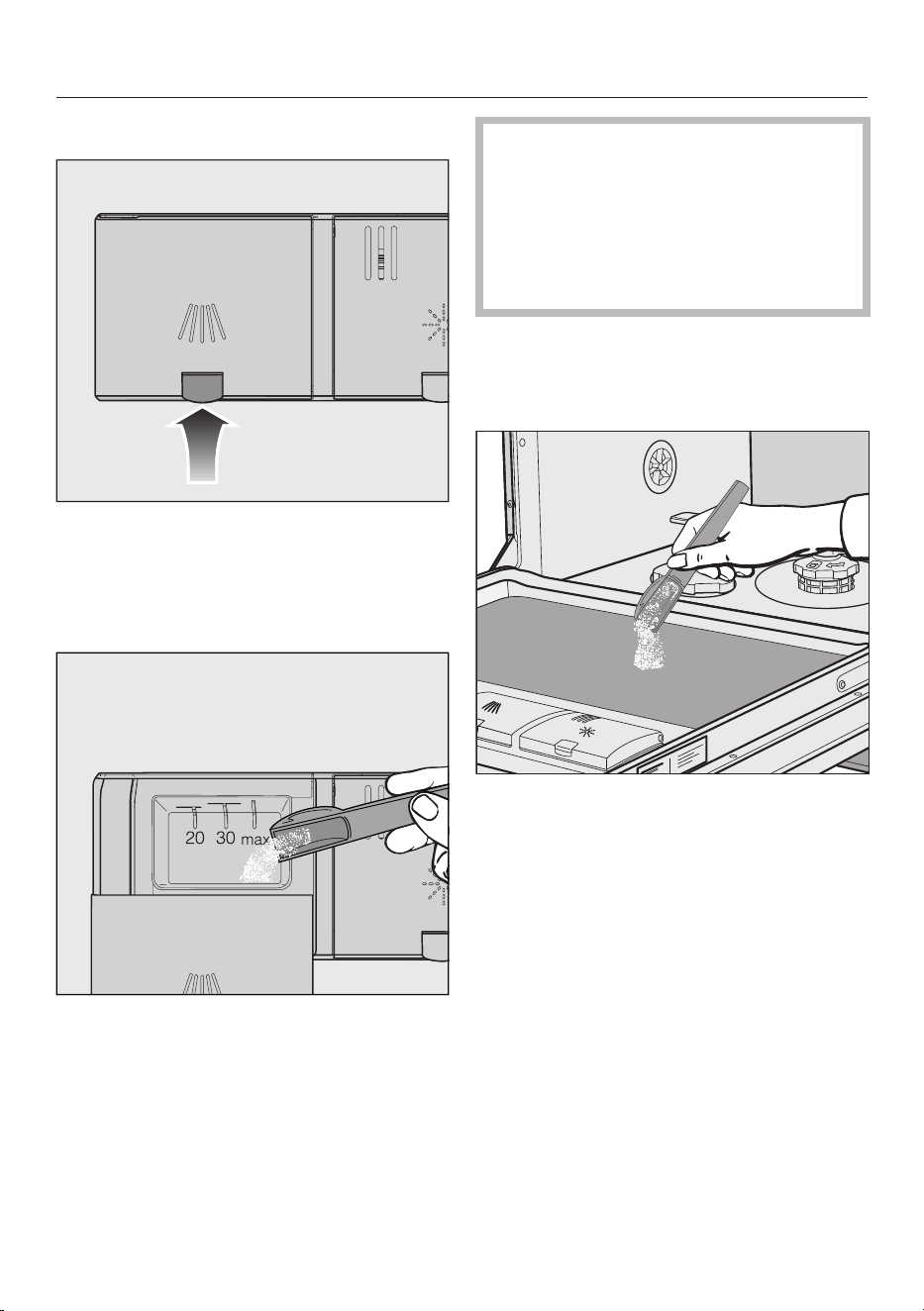
There are marks in the detergent
compartment to aid with dispensing:
20, 30, max. When the door is opened
to a horizontal position, they show the
approximate fill level in ml and the
maximum fill height.
They also indicate the approximate fill
level in grams for powder detergents,
depending on the manufacturer and the
coarseness.
Follow the detergent dosage
recommended by the manufacturer
on the packaging.
Unless directed otherwise, use one
detergent tab or add 20 to 30ml of
powder detergent to the detergent
compartment, depending on the
degree of soiling of the crockery.
Failure to dispense the recommended
amount of detergent may impair
cleaning results.
Detergent
42
Adding detergent
Press the yellow button on the lid
of the detergent compartment.
The lid will spring open.
The lid will also open at the end of a
programme sequence.
Add the detergent to the detergent
compartment.
Push the lid shut until you hear it click
into place.
The detergent must not cause the
detergent compartment lid to get
stuck. This can prevent the lid from
opening during the programme
sequence.
Do not overfill the detergent
compartment.
Ensure that the detergent packaging
is properly closed after use. This
prevents the detergent from getting
damp and clumping together.
You can also apply a small amount of
detergent to the inner panel of the
door in programmes that have a pre-
wash stage (see “Programme chart”).
Detergent
43
Liquid detergent
This dishwasher can be fitted with an
external dispenser pump for liquid
detergent (DOS module).
See “Settings menu - External
dispensing” to activate the dispenser
pump and set the dosage.
For special soiling and if using liquid
detergent, contact Miele for advice on
how to set the dosage for best results.
Refilling or changing containers
The dispensing module is equipped with
a level monitoring function. Refill
detergentwill appear in the display when
the level drops below the minimum.
As soon as the message appears in
the display, refill or replace the
container with a full one containing
the appropriate process chemical at
the end of the programme.
Confirm the message shown with the
OK button.
Replace the container in good time to
prevent the dispensing system being
emptied completely.
An empty dispensing system must be
vented before starting the next
programme.
Place the container on the open
dishwasher door or on a surface
which is easy to clean.
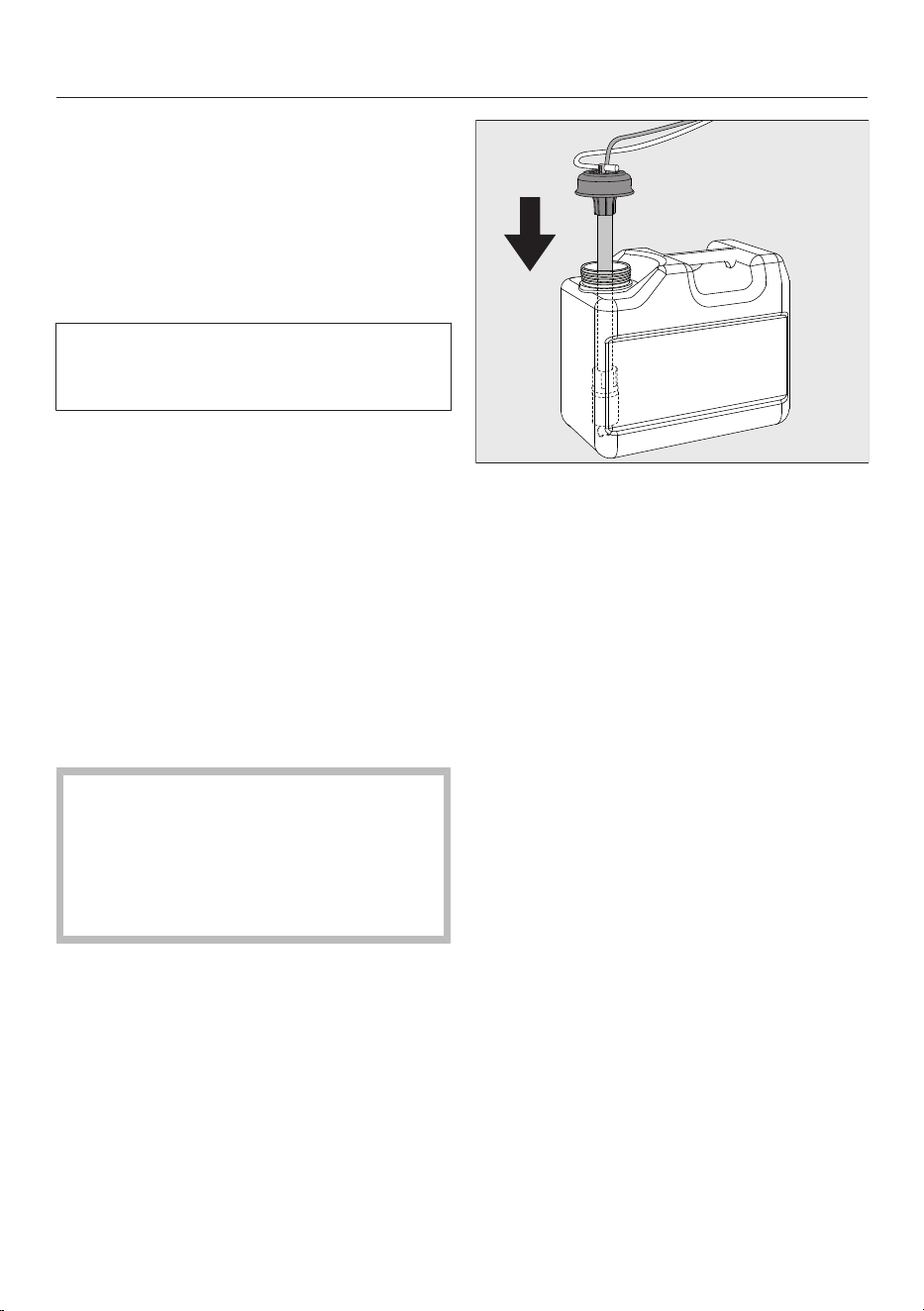
Take the lid off the media canister and
remove the suction lance. Place the
suction lance on the open wash
cabinet door.
Fill or replace the container, fit the
suction lance and secure the lid.
Observe the colour coding.
Feed the suction lance into the
canister until it reaches the bottom.
Wipe up any spilled process chemical
thoroughly.
Place the canister on the floor beside
the dishwasher or in an adjacent
cabinet. The container must be at the
same level as the appliance and not
be placed on top of or above the
appliance.
The dispensing system must then be
vented.
Checking consumption
Monitor the amount of process
chemicals used by regularly checking
the level in the container in order to
detect any dispensing irregularities.
Changing detergent
If you want to change the detergent
used, the system must first be rinsed
through with water to avoid a reaction
between the different detergents.
Remove the siphon from the canister
and place it in a container of water.
Start “Vent dispensing system” twice
(see “Settings menu, External
dispensing”) to the rinse the system.

Detergent
44
Then place the siphon in the new
canister and start “Vent dispensing
system” again.
The dispensing system is ready for
operation.
Always follow the recommendations
of the detergent manufacturer
whether using powder or liquid
detergent.

Operation
45
Switching on the dishwasher
Make sure the spray arms can rotate
freely.
Close the door.
Open the stopcock, if it is closed.
Touch the sensor control.
If the dishwasher has been switched
off for longer than 1minute, you will
need to hold the sensor control for
a bit longer (wipe protection).
The ECO programme will appear
briefly in the display and the appropriate
sensor control will be illuminated.
Next, the estimated energy and water
consumption may be shown for the
chosen programme for several seconds.
Then the display will show the
estimated duration for the selected
programme.
The Startsensor control flashes.
Selecting a programme
Choose your programme according to
the type of crockery and the degree of
soiling.
The different programmes and their
uses are described in the “Programme
chart” later on in this booklet.
Touch the sensor control for the
programme you want.
The sensor control for the selected
programme will light up.
You can now select programme options
(see “Programme options”).
If any programme options are selected,
the appropriate sensor controls will also
light up.
Operation
46
Display of programme running
time
The estimated duration of the
programme selected appears in the
display before the programme begins.
During the programme, the time left
until the end of the programme is
displayed.
Symbols appear to indicate which stage
the programme is at:
Pre-wash/Soak
Main wash
Interim rinse
Final rinse
Drying
Finished
The displayed duration may vary for the
same programme. It is influenced by, for
example, the temperature of the
incoming water, the reactivation cycle of
the water softener and the amount of
crockery and how soiled it is.
When a programme is selected for the
first time, the display will show the
average running time for a hot water
connection.
The running times shown in the
“Programme overview” chapter refer to
standard test loads and temperatures.
For each programme sequence, the
control module calculates the
programme running time according to
the temperature of the incoming water
and the amount of crockery.
Starting the programme
Touch the Startsensor control.
Confirm the previously displayed
messages with OK.
The programme starts.
The Startsensor control lights up.
During the programme sequence, you
can use OK to display the name of the
programme that is currently running.
Risk of scalding due to hot water.
During operation, water in the
dishwasher may be very hot.
During operation, only open the door
with extreme caution.
Operation
47
End of programme
The buzzers might sound at the end of
the programme.
The programme has ended when the
display shows the message Finished.
In some programmes, if the “AutoOpen”
function is activated, the door will
automatically open slightly (see the
“AutoOpen” section in the “Settings”
chapter). This improves the drying
process.
If the Consumptionprogrammable
function is switched on, you can now
call up the actual water consumption of
the programme that has just finished
(see the “EcoFeedback consumption
indicator” section in the “Caring for the
environment” chapter).
The drying fan may continue to run for
a few minutes at the end of the
programme.
Risk of damage due to steam.
Steam from the dishwasher could
damage the edges of worktops when
you open the door at the end of the
programme if the fan is no longer
running.
If you have deactivated the automatic
door opening function (see the
“AutoOpen” section in the “Settings”
chapter), but would still like to open
the door at the end of the
programme, then make sure that you
open the door fully.
Energy management
To save energy the dishwasher will
switch off automatically 10 minutes
after the last time a sensor control is
pressed or after the end of a
programme.
You can switch the dishwasher back on
again with the sensor control.
If the dishwasher has been switched off
for longer than 1minute, you will need to
hold the sensor control for a bit
longer (wipe protection).
The dishwasher will not switch itself
off whilst a programme is running or if
there is a fault.

Operation
48
Switching off the dishwasher
The dishwasher can be switched off
at any time using the sensor
control.
You can also stop an ongoing timer by
switching off the dishwasher.
Switching the dishwasher off during a
programme stops the programme.
Confirm the query Switch appliance off
with OK.
If you have touched the sensor
control, but in fact do not wish to
cancel the programme, use the
button to select the Do not switch off
option on the display and confirm
with OK.
Risk of damage from leaking
water.
Water leakage can cause damage.
If the dishwasher is not going to be
used for a longer period of time, e.g.
whilst on holiday, the stopcock
should be closed as a precaution.
Unloading the dishwasher
Dishes tend to break and chip more
easily when they are hot. Allow the
dishes to cool until they are comfortable
enough to handle before unloading
them.
If you open the door fully after switching
off, the dishes will cool much faster.
First unload the lower basket, then
the upper basket and finally the 3D
MultiFlex tray (if present).
This will prevent water drops from the
upper basket and 3D MultiFlex tray
from falling onto the dishes in the
lower basket.

Operation
49
Interrupting a programme
A programme will be interrupted as
soon as the door is opened.
When the door is closed again, the
query Select Start to continue appears in
the display.
The programme will continue from the
point at which it was interrupted when
you press the Start button.
Risk of scalding due to hot water.
During operation, water in the
dishwasher may be very hot.
During operation, only open the door
with extreme caution.
Cancelling or changing a
programme
If a programme is cancelled,
important programme stages may be
missed.
A programme should only be
cancelled in the first few minutes of
the programme sequence.
If a programme has already started and
you wish to cancel it, proceed as
follows:
Switch the dishwasher off using the
sensor control.
Confirm the query Switch appliance off
with OK.
If you would like to select another
programme:
Switch the dishwasher back on using
the sensor control.
If you have dispensed detergent
manually, check whether the
detergent compartment is still closed.
If the lid is already open, fill it with
detergent again and close the lid.
Select the programme you want and
start it., and then start it.

Programme options
50
Options
Options can be selected and deselected
using the appropriate buttons and the
display before starting the programme.
The time remaining and temperature
options can also be changed during the
programme.
Switch the dishwasher on by touching
the sensor control.
The Startsensor control flashes.
Select a programme.
Press the button for the option you
want.
The indicator light for the relevant
button will come on if the option is
available for the programme selected.
If the option is not compatible with the
programme selected, a message to this
effect will appear in the display.
In this instance, confirm the message
with OK.
Press the Start button to start the
programme.
The option selected will remain active
for that particular programme until the
setting is changed.
Countdown indicator
The Countdown indicatoroption is
selected as standard and displays the
time remaining until the end of the
programme.
You can also switch to the
Temperature while the programme is
running.
Temperature
The Temperatureoption shows the
current temperature of the wash block.
You can also switch to the Countdown
indicator while the programme is
running.
Extra dry
The Extra dryoption improves the
drying performance in programmes in
which this option is available.
Energy consumption is increased due to
an extended fan running time.
If the AutoOpen function has been
activated, the door will automatically
open at the end of the programme.
Settings
The Settings option opens the menu
to enable settings to be selected on the
appliance and changes to be made to
programme parameters.
See the “Settings” menu for more
information.
Programme options
51
Timer
The timer gives you several options
for starting a programme at a later time.
You can set the start time or the finish
time of a programme. You can also use
the EcoStart or SmartStartfunctions to
benefit from cheaper electricity tariffs at
night.
With manual detergent dispensing,
the detergent can clump together if
the detergent compartment is not
dry, and it may not be fully rinsed out.
When using the timer function, make
sure that the detergent compartment
is dry before adding detergent. Wipe
dry with a cloth first, if necessary.
Do not use liquid detergents. These
can leak out.
Danger to health due to
detergent.
To prevent children coming into
contact with dishwasher detergent:
Do not fill the detergent dispenser
until just before starting the
programme, i.e. before you activate
the timer. Use the safety lock to
secure the dishwasher door.
Activating the timer
Switch the dishwasher on using the
sensor control.
The Startsensor control flashes.
Select the programme you want to
use.
Touch the sensor control.
The sensor control lights up.
You can use the sensor controls to
choose between the Start at, Finish at
and EcoStartfunctions, or SmartStart if
applicable.
Confirm selection of the function you
want with OK.
The last time set for the timer will be
displayed and the hour number block
will be highlighted.
Enter the time you want for the timer
using the sensor controls and
confirm with OK.
If, while you are setting the time, you do
not apply any settings for several
seconds, the display will revert to the
previous menu level. You will then have
to enter your settings again.
After you have activated the timer, all
the displays will switch off after a few
minutes to save energy.
To switch the display back on for a few
minutes, press the sensor control.
You can also activate a timer via the
Mieleapp.

Programme options
52
Setting “Start at”
With the Start atfunction, you set the
exact time you want the programme to
start at.
Use the sensor controls to enter
the hour and confirm your entry by
touching OK.
The hour will be saved and the minute
number block will be highlighted.
Use the sensor controls to enter
the minutes and confirm your entry by
touching OK.
The saved start time for the selected
programme will appear in the display for
several minutes.
When the set time is reached, the
selected programme will begin
automatically.
The time remaining will appear in the
display, the sensor control will go out
and the Startsensor control will light
up.
Setting “Finish at”
Use the Finish atfunction to set the
latest time by which the selected
programme has to be finished.
Use the sensor controls to enter
the hour and confirm your entry by
touching OK.
The hour will be saved and the minute
number block will be highlighted.
Use the sensor controls to enter
the minutes and confirm your entry by
touching OK.
The estimated start time for the
selected programme will appear in the
display for several minutes.
A message will appear in the display if
the programme cannot be completed by
the set finish time because it has too
long a running time. It will show the
time that can be set.
If it appears, confirm the message
with OK.
The selected programme will start
automatically when the estimated start
time is reached.
The time remaining will appear in the
display, the sensor control will go out
and the Startindicator will light up.

Programme options
53
Setting EcoStart
You can use the EcoStartfunction to
benefit from cheaper electricity tariffs at
night. Before you can use this option,
you need to set up to three electricity
tariff time zones (see the “EcoStart”
section in the “Settings” chapter).
Then set the latest time by which the
selected programme has to be finished.
The dishwasher will then start
automatically in the most economical
tariff zone within the time set.
Use the sensor controls to enter
the hour and confirm your entry by
touching OK.
The hour will be saved and the minute
number block will be highlighted.
Use the sensor controls to enter
the minutes and confirm your entry by
touching OK.
The estimated start time for the
selected programme will appear in the
display for several minutes.
The selected programme will start
automatically when the estimated start
time is reached.
The time remaining will appear in the
display, the sensor control will go out
and the Startsensor control will light
up.
Setting SmartStart
The SmartStartfunction is used for
starting your dishwasher automatically
at a time when your energy costs are
most economical.
To use this function you may need
further technical accessories.
If you have activated the
SmartStartfunction in the Settings
menu, the Timermenu will no
longer show the EcoStartfunction but
will instead show SmartStart (see the
“Miele@home” section in the
“Settings” chapter).
If your energy provider offers this
service, they will send a signal to your
dishwasher when energy costs are at
their most economical.
This signal will start the dishwasher.
You can set the latest time by which the
selected programme has to be finished.
The dishwasher will then calculate the
latest possible start time for the
programme selected and will wait until
this start time for the signal from the
energy provider.

Programme options
54
Set the latest time by which the
selected programme has to be finished.
Use the sensor controls to enter
the hour and confirm your entry by
touching OK.
The hour will be saved and the minute
number block will be highlighted.
Use the sensor controls to enter
the minutes and confirm your entry by
touching OK.
The messageWaiting for SmartStart will
appear in the display.
The Startsensor control lights up for a
few minutes.
The selected programme will start
automatically as soon as the energy
provider has sent the signal or the latest
possible calculated start time has been
reached.
The time remaining will appear in the
display, the sensor control will go out
and the Startsensor control will light
up.
Changing or deleting the timer time
You can change the time set for the
timer or delete it.
Touch the sensor control.
Use the sensor controls to select
the previously activated timer
function and confirm your entry with
OK.
Use the sensor controls to select
the Change or Deletefunction and
confirm with OK.
After confirming the Changefunction
using OK, you can change the time set
for the timer.
After confirming the Deletefunction
using OK, the running time of the
selected programme will appear in the
display.
The sensor control goes out and the
Startsensor control flashes.
You can now start a programme or
switch the dishwasher off.
Switching the dishwasher off while a
timer is running stops the timer.
You can also change or delete the time
set for the timer using the Mieleapp.

Programme options
55
Activating Remote start
You can start your dishwasher remotely
using the Mieleapp. To do this, you first
need to install the app on your mobile
device, connect the dishwasher to your
WiFi network (see “Settings –
Miele@home”) and, if applicable,
activate the Remote controloption (see
“Settings – Remote control”).
Switch the dishwasher on using the
sensor control.
Touch the sensor control when the
door is closed.
The sensor control lights up.
The remote control function for the
dishwasher using the Mieleapp must
be reactivated each time the door is
opened before a programme is started.
The dishwasher can now be operated
remotely using the Mieleapp.
The Remote start option will remain
activated until you deactivate it again
using the sensor control. The option
will also remain active if you switch the
dishwasher off and back on again in the
meantime.
Even if the Remote start option is not
active, you can check the status of your
dishwasher and apply settings using the
Mieleapp.
If you start a programme using the
Startsensor control on the dishwasher,
the Remote start option will
automatically be activated for the
duration of the programme and the
sensor control will light up.

Programme chart
56
Programme Application Detergent
The following dosages are based
on Miele detergents.
Please follow the
manufacturer's instructions.
Detergent compartment
1)
Short
For fresh, easily removed food residues. 20–25g
or 1 tab
Universal
For normal, slightly dried food residues. 20–25g
or 1 tab
Intensive
For burnt-on, stubborn, dried-on food deposits
containing starch or protein
1)
20–25g
or 1 tab
Plastics
Special plastics programme. 20–25g
or 1 tab
Glasses
Special glassware programme. 20–25g
or 1 tab
Hygiene
Special hygiene programme for items that need
to be hygienically clean
20–25g
or 1 tab
Cold pre-wash
To rinse heavily soiled items, e.g. for initial
removal of soiling or to prevent residues drying
on to dishes when a complete programme does
not yet need to be run.
ECO *)
Energy-saving programme with a long duration
for normal, slightly dried food residues.
20–25g
or 1 tab
*) This programme is the most efficient in terms of its combined energy and water consumption for
cleaning crockery with a normal level of soiling.
(Fixed programme sequence which cannot be altered)
1)
See “Detergent” chapter
Programme chart
57
Programme sequence
Pre-wash Main wash Interim rinse Final rinse Drying AutoOpen
X
60–65°C
2)
1min
X
40s
X
65°C
3)
30s
(X)
20min
4)
(X)
X
65°C
6min
X
3min
X
65°C
3)
2min
(X)
30min
(X)
X
6min
X
75°C
6min
X
3min
X
65°C
3)
2min
(X)
30min
(X)
X
6min
X
50°C
1min
X
5min
X
60°C
1min
X
30min
(X)
X
50°C
1min
X
3min
X
50°C
2min
(X)
20min
(X)
X
6min
X
75°C
8min
X
3min
X
70°C
3)
3min
X
30min
(X)
X
Cold
10min
X
51.5°C
44min
X
4min
X
48°C
10min
X
127min
(X)
X = Programme stages
(X) = Optional extra programme stages (See “Programme options, Options”)
2)
The temperature reached depends on the type and amount of load items as well as the water inlet
temperature.
3)
Optional temperature increase to 75°C.
4)
If the temperature is increased to 75°C, the drying time will be extended to 30minutes.
Programme chart
58
Programme Consumption
6)
Duration
6)
Energy Water
Cold water
15°C
Hot water
55°C
Cold water
15°C
Hot water
55°C
Short
1.4kWh 0.9kWh 14.7l 25min
7)
18min
7)
Universal
1.5kWh 0.9kWh 14.8l 36min
7)
31min
7)
Intensive
1.7kWh 1.0kWh 19.2l 50min
7)
44min
7)
Plastics
1.2kWh 0.5kWh 19.5l 67min 60min
Glasses
1.0kWh 0.4kWh 15.3l 25min
7)
20min
7)
Hygiene
1.8kWh 1.1kWh 19.2l 56min
7)
49min
7)
Cold pre-
wash
0.02kWh 0.02kWh 4.5l 13min 13min
6)
Values are calculated in accordance with EN 50242 for a connected load of 6.3kW. In practice,
considerable variations may be noted due to differing conditions.
The duration displayed is adjusted to the on-site conditions.
7)
The figure refers to the wash duration without drying.
Programme chart
59
Consumption data in ECO programme
Programme Consumption
8)
Duration
8)
Electrical energy Water
Cold water
15°C
Hot water
55°C
Cold water
15°C
Hot water
55°C
ECO
13 place
settings
0.930kWh 0.6kWh 12l 250min 245min
8)
Values for the ECO programme were calculated under standardised testing conditions. In practice,
the selected settings, programme options or operating conditions may result in different values.

Cleaning and care
60
Periodic checks
To prolong the service life of the
dishwasher, maintenance should be
carried out at least once a year by the
Miele Customer Service Department.
Maintenance covers the following:
- Electrical safety according to national
regulations (e.g. VDE0701/0702 in
Germany)
- Door mechanism and door seal
- Any screw connections and
connectors in the wash chamber
- Water inlet and drainage
- Internal and external dispensing
systems
- Spray arms
- Filter combination
- Sump including drain pump and non-
return valve
- All baskets and inserts
The following operational tests will be
carried out as part of the maintenance:
- A programme sequence will be run as
a test run
- Seals will be tested for water
tightness
- All relevant measuring systems will be
safety tested, including fault displays
- Safety features
Check the condition of your
dishwasher regularly (approx. every
4–6months). In this way, faults and
problems can be avoided.
Damage due to unsuitable
cleaning agents.
All surfaces are susceptible to
scratching. Contact with unsuitable
cleaning agents can alter or discolour
all surfaces.
Only use cleaning agents formulated
for use on the relevant surfaces.
Cleaning the wash cabinet
The wash cabinet is largely self-
cleaning, provided that the correct
amount of detergent is always used.
If, despite this, limescale or grease
deposits build up in the chamber, these
can be removed with a proprietary
dishwasher cleaner (available from the
Miele Customer Service Department or
the Miele webshop). Follow the
instructions on the product packaging.
Clean the filters in the wash cabinet
regularly.

Cleaning and care
61
Cleaning the door and the door
seal
The door seals and the sides of the
dishwasher door cannot be reached and
cleaned by the spray arm jets.
Wipe off any food or drink residues
which may have dripped onto the
sides and seals of the dishwasher
door with a damp cloth on a regular
basis to prevent the build-up of
mould.
Cleaning the control panel
The control panel should only be
wiped with a damp cloth.
Cleaning the appliance front
Damage due to soiling.
Soiling that is left too long might
become impossible to remove and
could cause the external surfaces to
alter or discolour.
It is therefore best to remove any
soiling immediately.
Clean the appliance front with a clean
soft sponge and a solution of warm
water and washing-up liquid. After
cleaning, wipe the surfaces dry using
a soft cloth.
A clean, damp microfibre cloth
without detergent can also be used.
To avoid damaging the external
surfaces, do not use the following:
- Detergents containing soda,
ammonia, acids or chlorides
- Detergents containing descaling
agents
- Abrasive detergents, e.g. scouring
powder, scouring liquid, or pumice
stones
- Detergents containing solvents
- Stainless steel cleaning agents
- Dishwasher cleaner
- Oven cleaner
- Glass cleaning agents
- Hard, abrasive brushes or sponges,
e.g. pot scourers, brushes or sponges
that have been previously used with
abrasive cleaning agents
- Eraser stain remover blocks
- Sharp metal scrapers
- Wire wool
- Steam cleaners
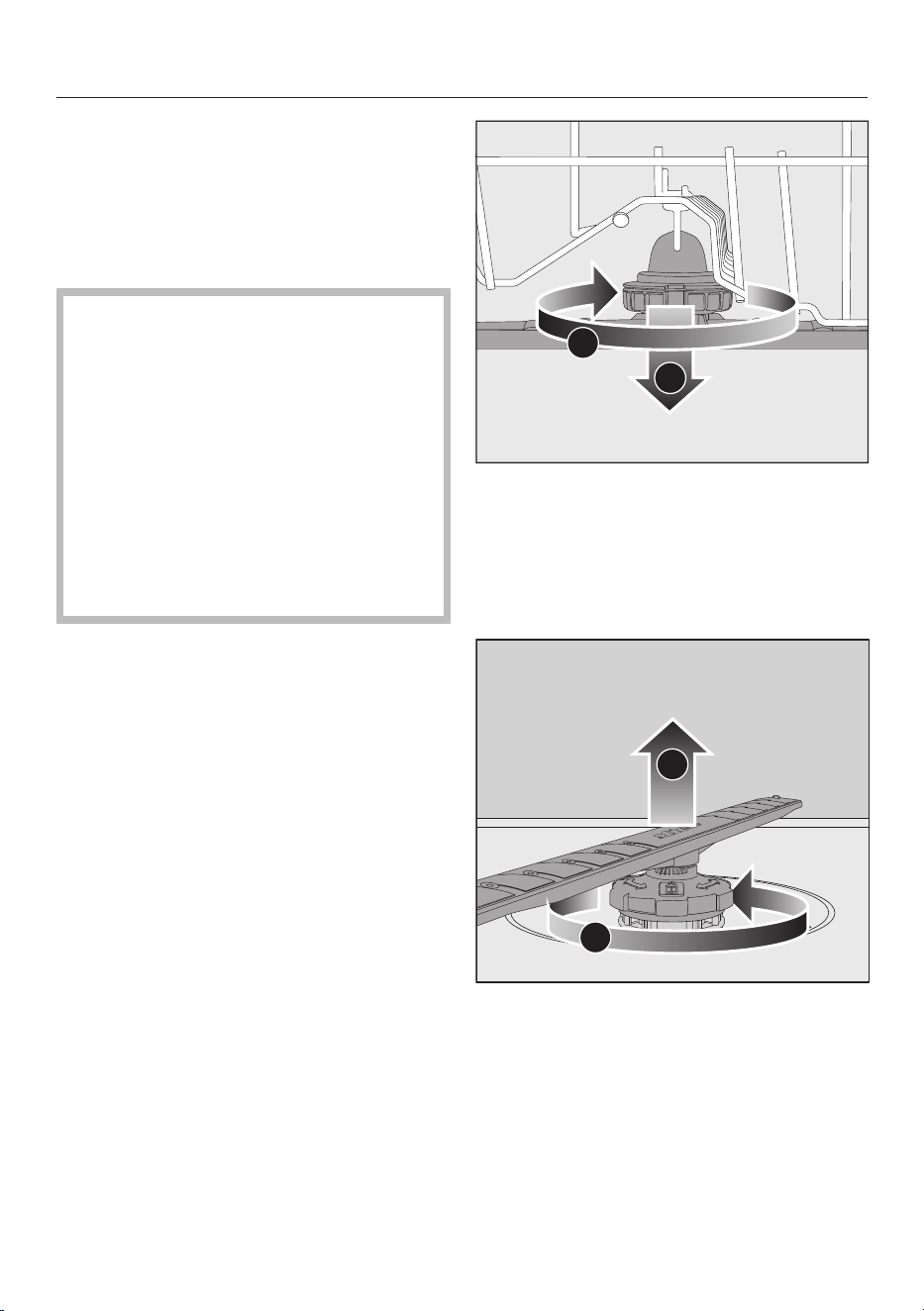
Cleaning and care
62
Cleaning the spray arms
Particles of food can get stuck in the
spray arm nozzles and bearings. The
spray arms should therefore be
inspected regularly (approx. every 2–
4months).
Damage due to soiling entering
the circulation system.
Without filters, soiling can enter the
circulation system and cause a
blockage.
Do not run a wash programme
without the lower spray arm or
without the filters.
When cleaning the filters and spray
arms, make sure that coarse soiling
cannot get into the circulation
system.
Switch the dishwasher off.
Removing the upper and middle spray
arms
Take out the 3D MultiFlex tray (if your
dishwasher is fitted with one).
Push the upper spray arm upwards to
engage the inner ratchet. Then
unscrew the spray arm by rotating the
screw thread anti-clockwise.
2
1
Rotate the screw thread of the middle
spray arm clockwise (see diagram)
and remove the spray arm.
Removing the lower spray arm
Remove the lower basket.
2
1
Rotate the screw thread of the lower
spray arm anti-clockwise and pull
the spray arm upwards to remove.
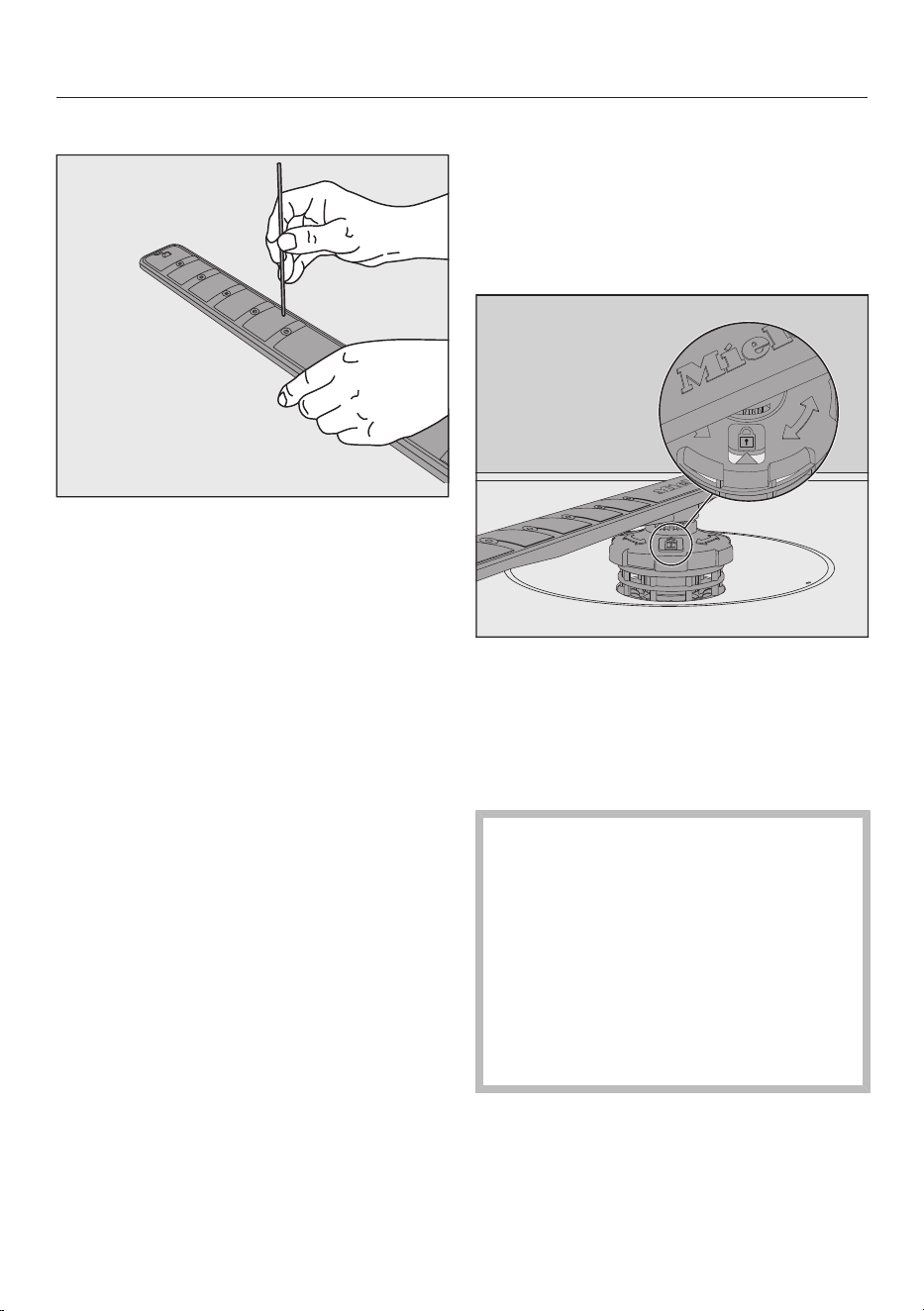
Cleaning and care
63
Cleaning the spray arms
Use a pointed object to push food
particles in the nozzles into the spray
arm.
Rinse the spray arm thoroughly under
running water.
Refitting the spray arms
Refit the upper and middle spray
arms.
Refit the lower spray arm and ensure
that the filter combination lies flat in
the base of the wash cabinet.
Rotate the screw thread of the lower
spray arm clockwise until the arrow in
the viewing window points to the lock
symbol.
Make sure the spray arms can rotate
freely.
Damage due to soiling entering
the circulation system.
The lower spray arm is used to
secure the filter combination.
Without filters, coarse soiling can
enter the circulation system and
cause a blockage.
Do not run a wash programme
without the lower spray arm or
without the filters.
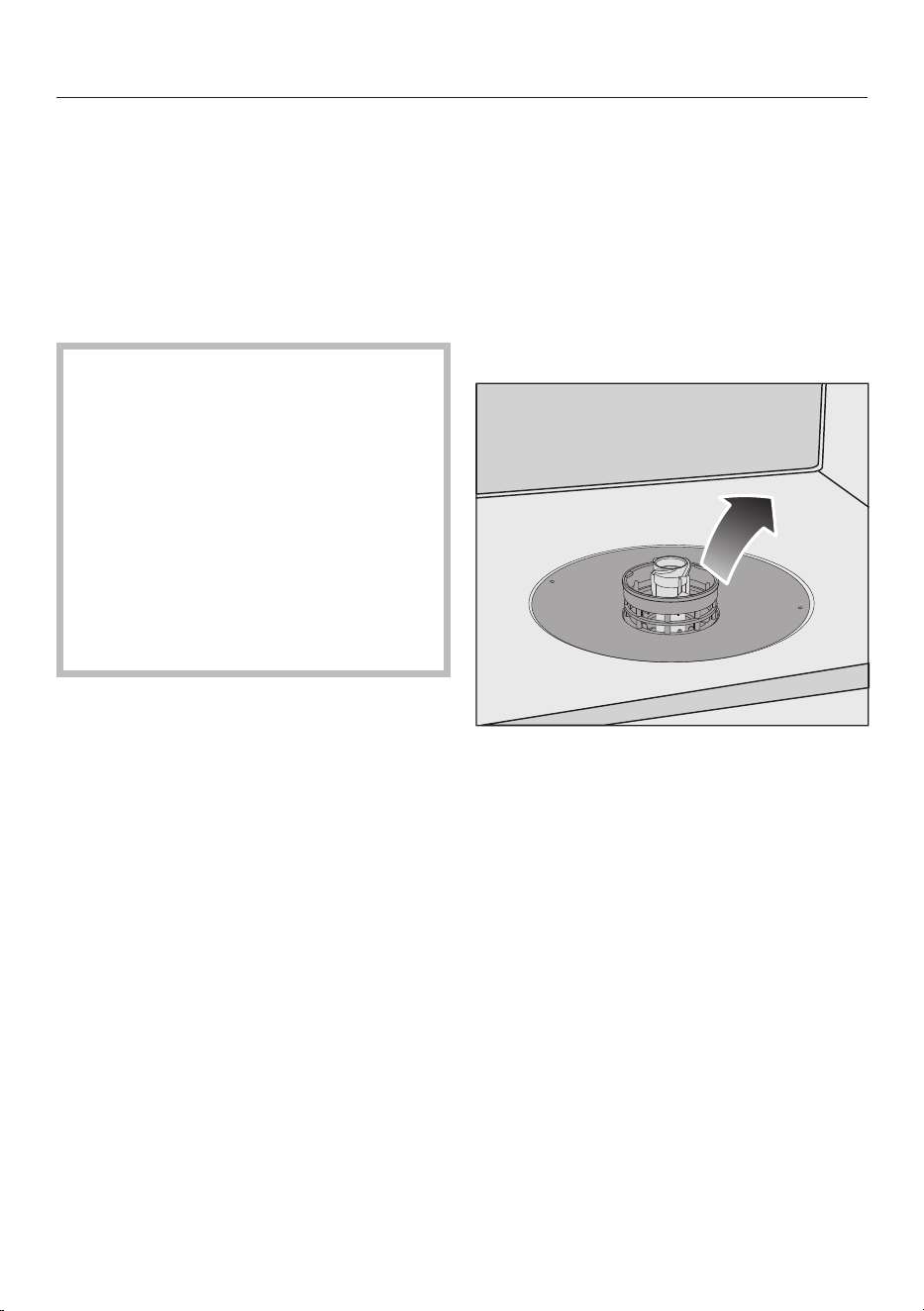
Cleaning and care
64
Checking the filters in the wash
cabinet
The filter combination in the base of the
wash cabinet retains coarse soiling from
the suds solution. This prevents soiling
getting into the circulation system and
re-entering the wash cabinet through
the spray arms.
Damage due to soiling entering
the circulation system.
Without filters, soiling can enter the
circulation system and cause a
blockage.
Do not run a wash programme
without the lower spray arm or
without the filters.
When cleaning the filters and spray
arms, make sure that coarse soiling
cannot get into the circulation
system.
The filters can become blocked by
soiling that collects over time. The level
of soiling and time it takes before the
filters need cleaning will vary depending
on use.
The messageCheck filters will appear in
the display after every 50 programme
sequences.
Check the filter combination.
Clean the filter combination if
necessary.
Then confirm the message with OK.
Cleaning the filters
Switch the dishwasher off.
Remove the lower spray arm (see
“Cleaning and care” chapter,
“Cleaning the spray arms” section).
Before removing the filter
combination, remove any coarse
soiling to prevent it from entering the
circulation system.
Remove the filter combination.
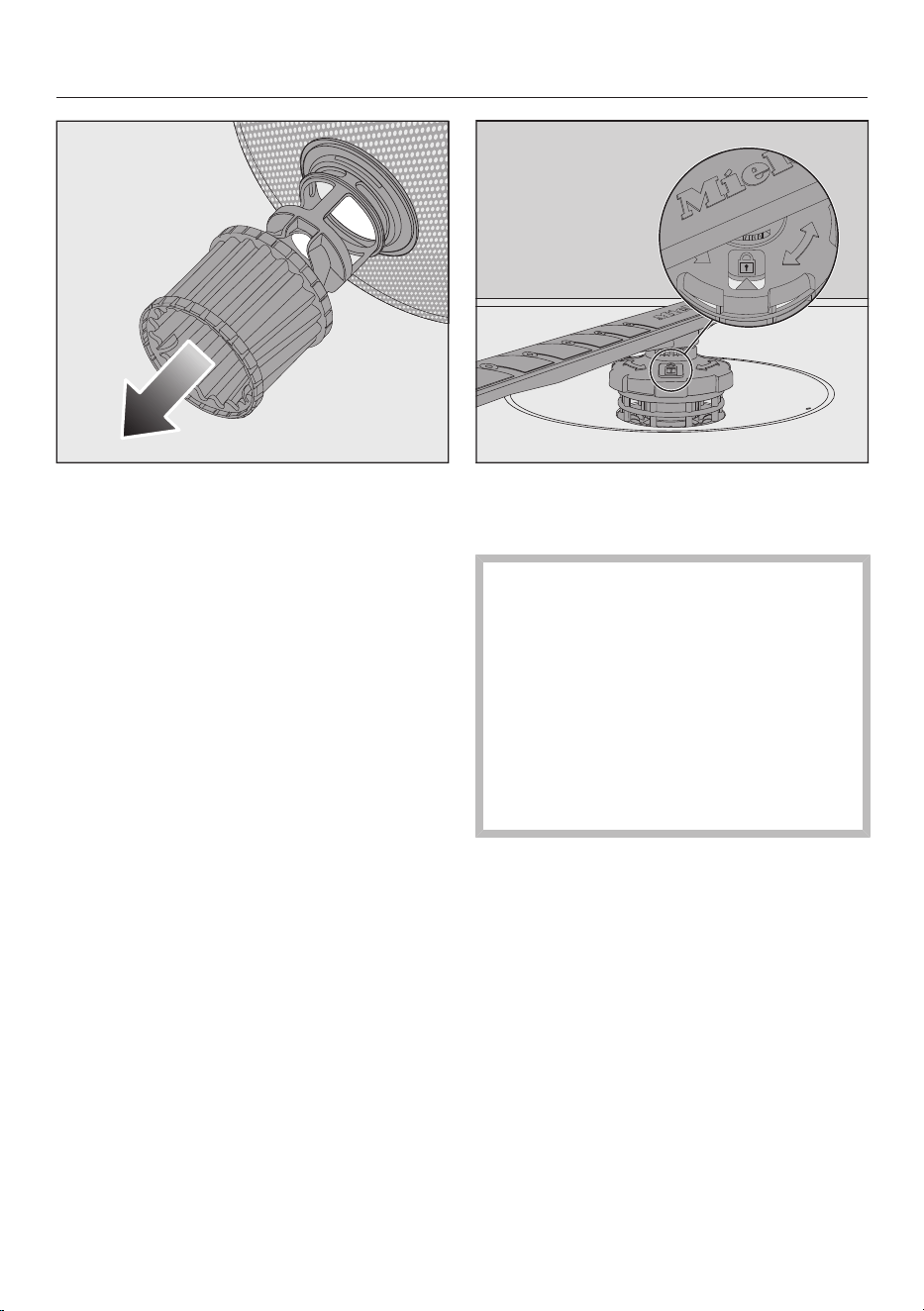
Cleaning and care
65
In order to clean the inside of the
filter, pull the microfilter on the plastic
ring downwards and away from the
filter combination.
Rinse all the parts under running
water.
If necessary, use a soft cleaning brush
to remove soiling.
Insert the microfilter back into the
filter combination.
Refit the filter combination so that it
lies flat in the base of the wash
cabinet.
Refit the lower spray arm to the filter
combination using the screw thread.
Rotate the screw thread clockwise
until the arrow in the viewing window
points to the lock symbol.
Damage due to soiling entering
the circulation system.
The lower spray arm is used to
secure the filter combination.
Without filters, coarse soiling can
enter the circulation system and
cause a blockage.
Do not run a wash programme
without the lower spray arm or
without the filters.
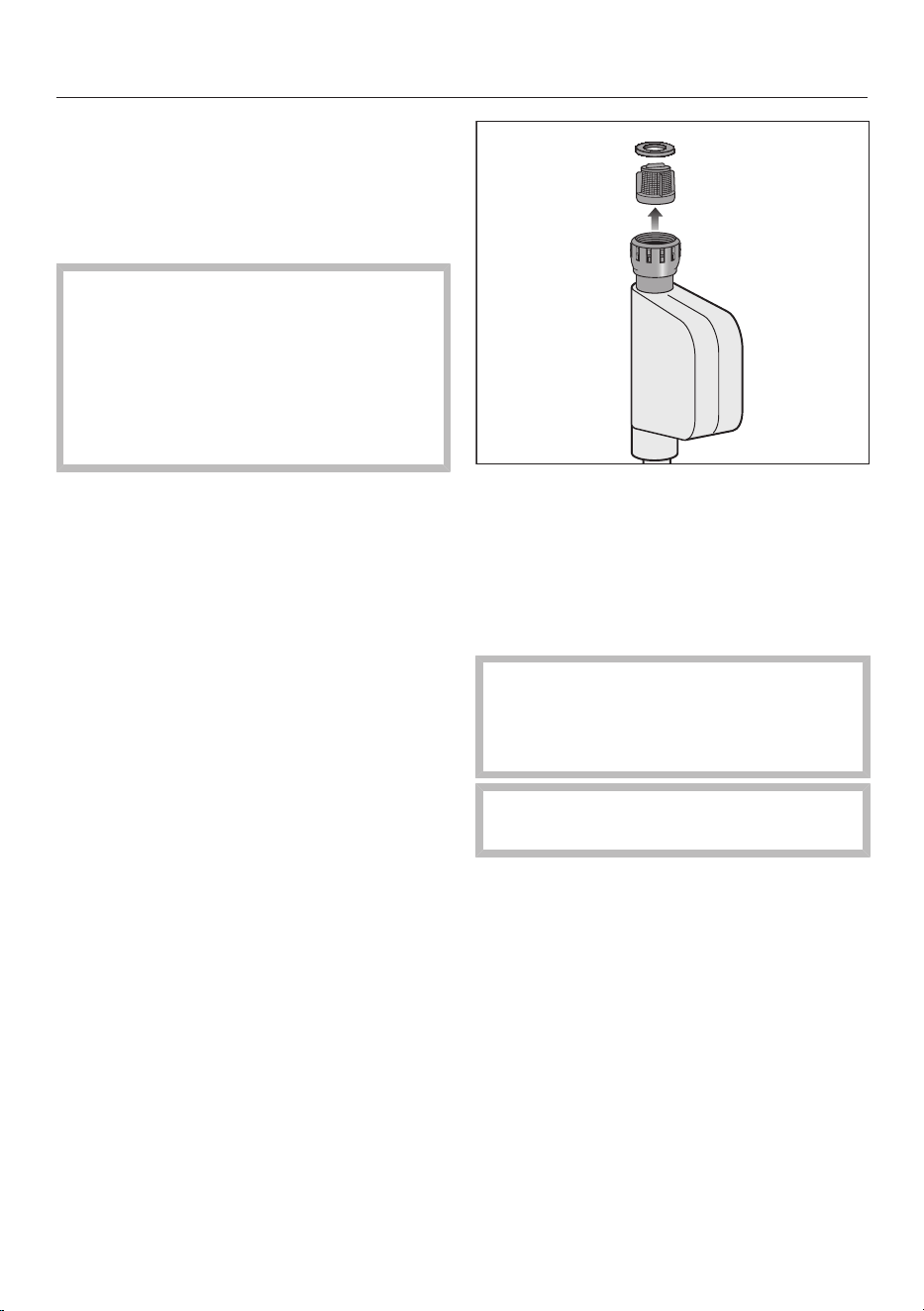
Cleaning and care
66
Cleaning the water inlet filter
A filter is incorporated in the screw
thread to protect the water inlet valve. If
the filter is soiled, insufficient water
flows into the wash cabinet.
Risk of electric shock from mains
voltage.
The plastic housing of the water
connection contains an electrical
valve.
The housing must not be dipped in
water.
Disconnect the dishwasher from the
mains.
To do this, turn off the dishwasher,
switch off at the socket and remove
the plug.
Close the stopcock.
Unscrew the water inlet valve.
Remove the seal from the screw
thread.
Using pointed pliers, take hold of the
plastic filter slat and remove the filter.
Rinse the filter under running water.
Reassemble in reverse order.
Screw the screw thread securely
back onto the stopcock. Slowly open
the stopcock. If water drips out,
tighten the screw thread.
Never forget to put the filter back in
place after cleaning.
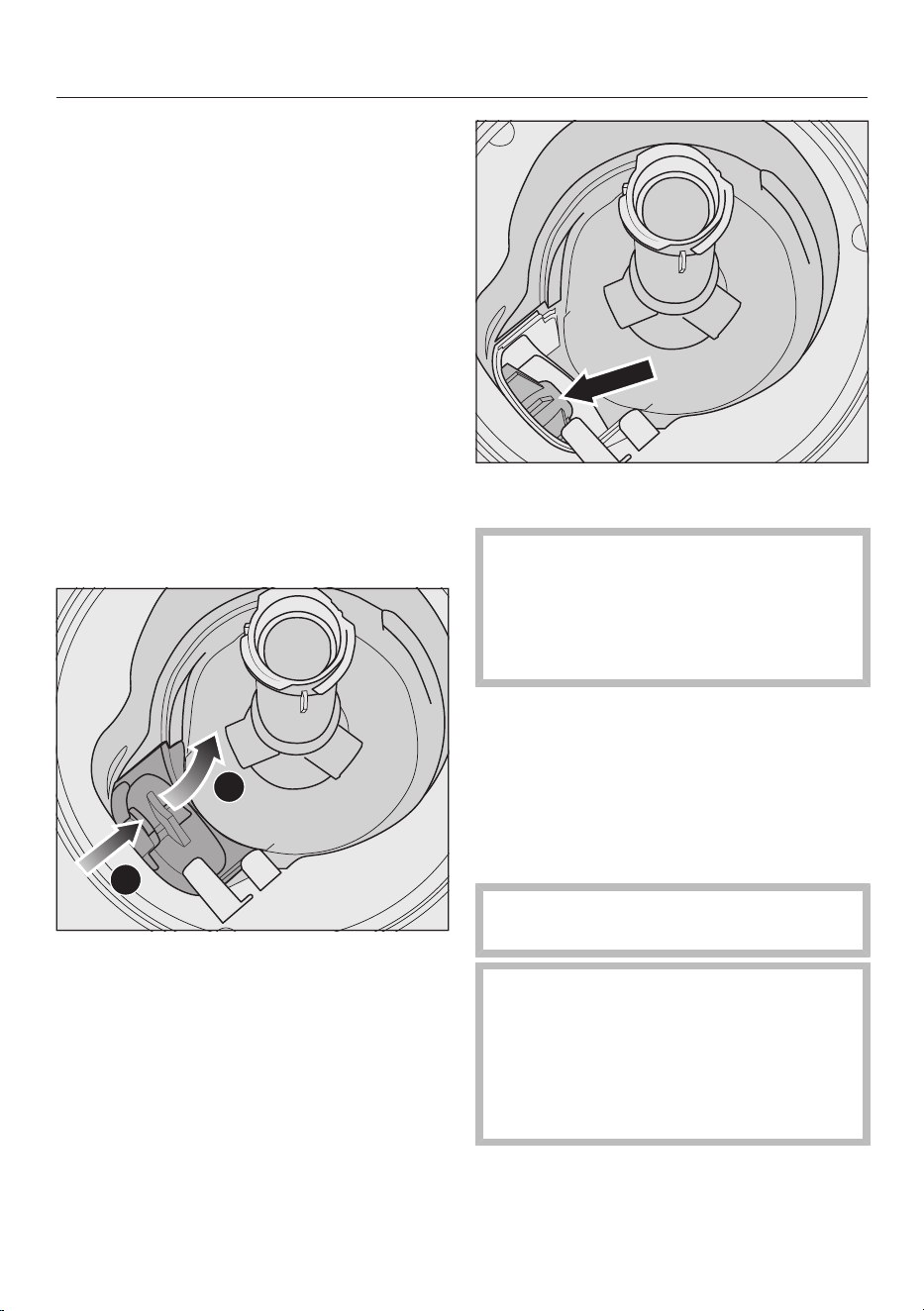
Cleaning and care
67
Cleaning the drain pump
If water remains in the wash cabinet
after the end of a programme, the water
has not been pumped away. The drain
pump may be blocked by foreign
objects. These are easy to remove.
Disconnect the dishwasher from the
mains.
To do this, turn off the dishwasher,
switch off at the socket and withdraw
the plug.
Take the filter combination out of the
wash cabinet (see “Cleaning and
care” chapter, “Cleaning the filters”).
Scoop the water out of the cabinet
using a suitable small container or
utensil.
1
2
Press the catch of the drain pump
cover inwards .
Tip the cover inwards until it is
released .
Rinse the cover thoroughly under
running water and remove all foreign
objects.
The drain pump (see arrow) is
underneath the cover.
Risk of injury from glass splinters.
It is especially difficult to see glass
splinters in the drain pump.
Take care when cleaning the drain
pump.
Carefully remove all foreign objects
from the drain pump. Check the drain
pump impeller by manually turning it.
You will feel a little resistance when
you turn the impeller.
Refit the cover by placing it down
vertically from above.
Ensure that the catch engages
correctly.
Damage due to incorrect
cleaning.
The components are delicate and can
be damaged during cleaning.
Take care when cleaning the drain
pump.
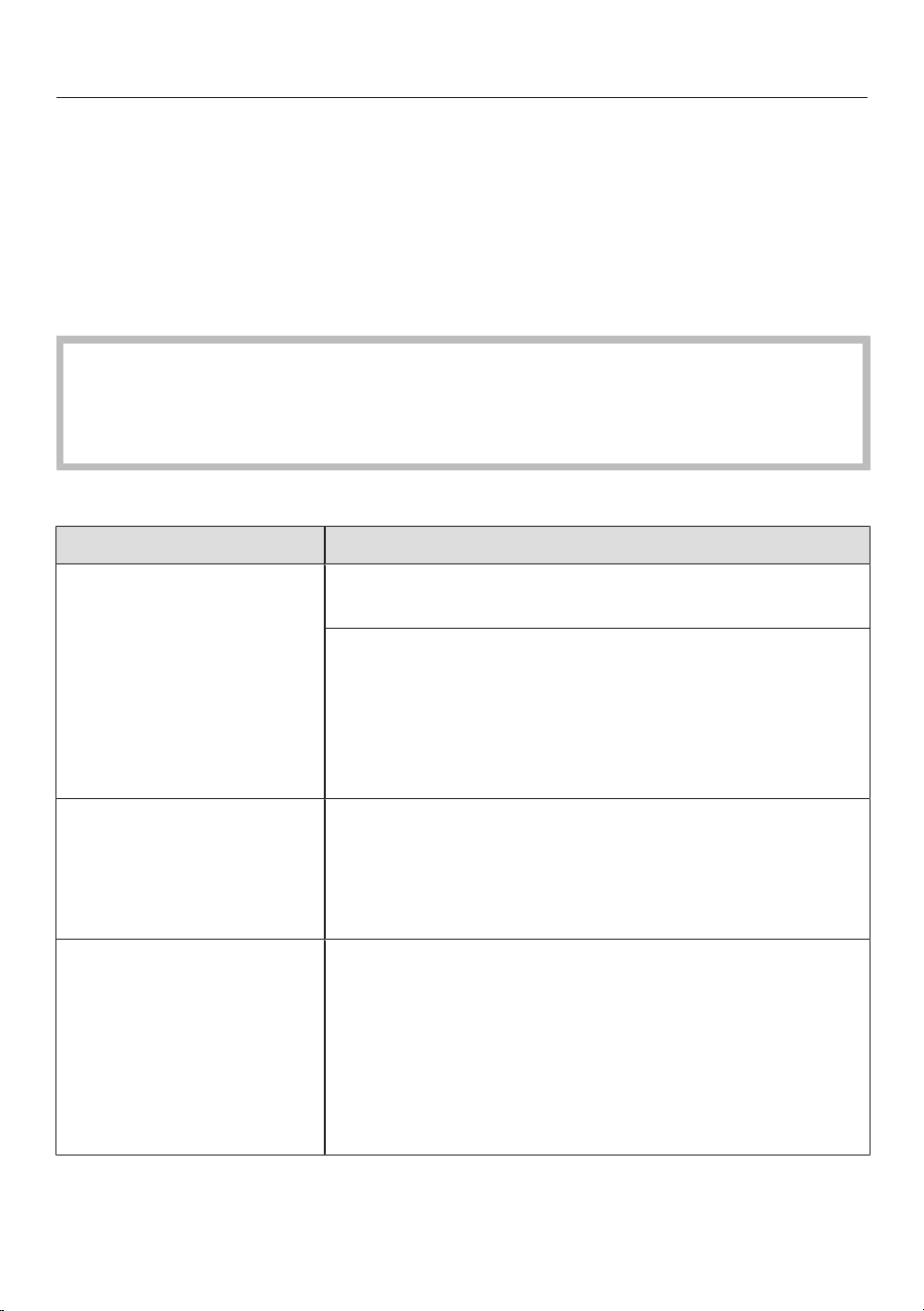
Troubleshooting
68
With the aid of the following guide, most minor problems that can occur during
daily operation can be corrected without contacting Miele. You can save time and
money in many cases, as you do not need to call the Miele Customer Service
Department.
Information to help you remedy faults yourself can be found at www.miele.de/p/
reparatur-2283.htm.
The following guide should help you to find the reason for a malfunction or fault and
to correct it. You should, however, note the following:
Danger due to incorrect repairs.
Repairs by unqualified persons can cause considerable danger to users.
Repairs must only be carried out by the Miele Customer Service Department, an
authorised Miele dealer or a suitably qualified specialist.
Technical problems
Problem Cause and remedy
The display remains dark
after the dishwasher has
been switched on with
the sensor control.
The dishwasher is not plugged in.
Insert the plug and switch on at the socket.
The mains fuse has tripped.
Reset the trip switch in the fuse box or replace the
fuse in the plug (see data plate for minimum fuse
rating).
If the mains fuse trips again, contact the Miele
Customer Service Department.
The dishwasher stops
during a programme.
The mains fuse has tripped.
Reset the trip switch in the fuse box or replace the
fuse in the plug (see data plate for minimum fuse
rating).
If the mains fuse trips again, contact Miele Service.
The sensor control
does not respond or only
responds once it has
been touched several
times.
Energy management: the door was opened or closed
shortly before the sensor control was touched. As a
result, the dishwasher was already switched on. The
electronic module requires a few seconds to be ready
for operation.
Wait a few seconds after opening or closing the
door.
Then touch the sensor control.

Troubleshooting
69
Fault messages
Problem Cause and remedy
The warning buzzer is
sounding.
One of the following
faults appears in the dis-
play:
Before rectifying the problem:
Switch the dishwasher off.
Fault FXX
There may be a technical fault.
Switch the dishwasher back on after a few seconds.
Restart the desired programme.
If the fault message appears again, there is a technical
fault.
Switch the dishwasher off.
Close the stopcock.
Call the Miele Customer Service Department.
Waterproof
The Waterproof system has reacted.
Switch the dishwasher off.
Close the stopcock.
Call the Miele Customer Service Department.
Fault F78
Circulation pump fault.
Switch the dishwasher off.
Switch the dishwasher back on.
Restart the desired programme.
If the fault message appears again, there is a technical
fault.
Switch the dishwasher off.
Close the stopcock.
Call the Miele Customer Service Department.
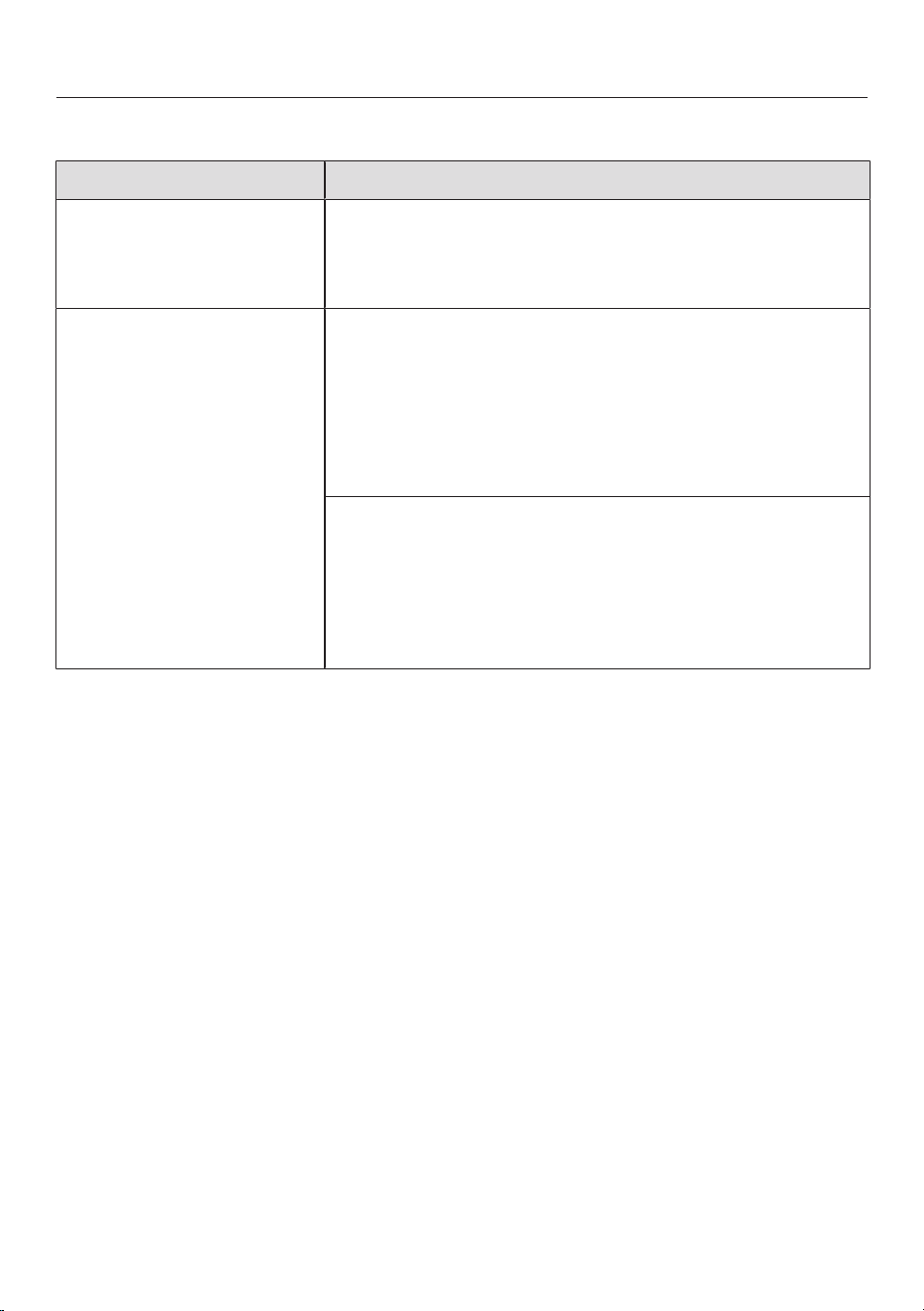
Troubleshooting
70
Door release
Problem Cause and remedy
The warning buzzer is
sounding.
The following fault is in-
dicated via the display:
Before rectifying the problem:
Switch the dishwasher off.
Fault F33
The door does not open automatically.
There may be a technical fault.
Open the door manually (see the “Opening the
door” section in the “Before using for the first time”
chapter) and switch the dishwasher back on again.
If the same fault message appears again, call the
Miele Customer Service Department.
The door locking pins do not retract after the door is
opened.
There may be a technical fault.
Switch the dishwasher back on.
If the same fault message appears again, call the
Miele Customer Service Department.

Troubleshooting
71
Water inlet fault
Problem Cause and remedy
The warning buzzer is
sounding.
One of the following
messages appears in the
display:
Open stopcock
The stopcock is closed.
Open the stopcock fully.
Water intake
Before rectifying the problem:
Switch the dishwasher off.
The water inlet is restricted.
Open the stopcock fully and start the programme
again.
Clean the filter in the water inlet (see the “Cleaning
the filter in the water inlet” section in the “Cleaning
and care” chapter).
The water-connection pressure is lower than
50kPa.
Seek professional advice.
The on-site connection for the water drainage may
be too low and you will need to raise the water
drainage (see the “Hose installation” section in the
“Installation” chapter).
Fault F18
A technical fault has occurred.
Switch the dishwasher off.
Close the stopcock.
Call the Miele Customer Service Department.
Troubleshooting
72
Water drainage fault
Problem Cause and remedy
The alarm tone is sound-
ing.
The message
Drain appears in the
display.
Before rectifying the problem:
Switch the dishwasher off.
Water drainage fault.
There might be water in the wash cabinet.
Clean the filter combination (see the “Cleaning the
filters” section in the “Cleaning and care” chapter).
Clean the drain pump (see the “Cleaning the drain
pump” section in the “Cleaning and care” chapter).
Remove any kinks or loops in the drain hose.
Troubleshooting
73
General problems with the dishwasher
Problem Cause and remedy
The indicator lights and
the display are dark.
The dishwasher has switched off automatically to save
energy.
Switch the dishwasher back on using the sensor
control.
The wash cabinet light-
ing does not come on
when the door is
opened.
The wash cabinet lighting has been switched off
permanently.
Switch the lighting back on again (see “Settings”
chapter, “BrilliantLight” section).
Faulty wash cabinet lighting.
Call Miele Service.
Detergent residue is left
in the detergent com-
partment at the end of a
programme.
The detergent compartment was still damp when
detergent was added.
Only add the detergent when the detergent
compartment is dry.
The detergent compart-
ment lid cannot be
closed.
Residual detergent is blocking the catch.
Remove the residual detergent.
At the end of a pro-
gramme there is a film of
moisture on the inside of
the door and possibly on
the interior cabinet
walls.
This is part of the normal function of the drying
system. The moisture will dissipate after a short
while.
Water remains in the
wash cabinet at the end
of a programme.
Before rectifying the problem:
Switch the dishwasher off.
The filter combination in the wash cabinet is clogged.
Clean the filter combination (see “Cleaning and
care” chapter, “Cleaning the filters” section).
The drain pump is blocked.
Clean the drain pump (see “Cleaning and care”
chapter, “Cleaning the drain pump” section).
The drain hose is kinked.
Remove any kinks from the drain hose.
Troubleshooting
74
Noises
Problem Cause and remedy
Knocking noise in the
wash cabinet
A spray arm is knocking against a wash item.
Carefully open the door and rearrange the wash
items that are obstructing the spray arm.
Rattling noise in the
wash cabinet
Wash items are insecure in the wash cabinet.
Carefully open the door and rearrange the wash
items so that they sit securely.
There is a foreign object (e.g. glass shard) in the drain
pump.
Remove the foreign object from the drain pump (see
“Cleaning and care” chapter, “Cleaning the drain
pump” section).
Knocking noise in the
water pipes
This may be caused by the on-site installation or the
cross-section of the piping.
However, this will not affect the functioning of the
dishwasher in any way. If in doubt, contact a suitably
qualified plumber.
Troubleshooting
75
Unsatisfactory washing result
Problem Cause and remedy
The wash items are not
clean.
The wash items were not loaded correctly.
See notes in the “Loading the dishwasher” chapter.
The programme was not powerful enough.
Select a more powerful programme (see
“Programme overview” chapter).
Not enough detergent was dispensed during manual
detergent dispensing.
Use more detergent or change the detergent you are
using.
Items are blocking the path of the spray arms.
Carry out a rotation check and if needed rearrange
the items so that the spray arms can rotate freely.
The filter combination in the wash cabinet is not clean
or was incorrectly fitted.
This may have caused the spray arm jets to become
blocked.
Clean and/or fit the filter combination correctly.
Clean the spray arm jets if necessary (see “Cleaning
and care” chapter, “Cleaning the spray arms”
section).
There are smears on
glassware and cutlery.
There is a bluish sheen
on the surface of glass-
ware. The film can be
wiped off.
The rinse aid dosage is set too high.
Reduce the dosage (see “Settings” chapter, “Rinse
aid” section).
Troubleshooting
76
Problem Cause and remedy
The crockery is not dry
or cutlery and glasses
are flecked.
The rinse aid dosage is set too low or the rinse aid
reservoir is empty.
Replenish the rinse aid, increase the dosage, or
change the brand of rinse aid (see “Using for the
first time - Rinse aid”).
The crockery was taken out of the wash cabinet too
soon.
Leave the crockery in longer (see the “Unloading the
dishwasher” section in the “Operation” chapter).
You have used combination products that have
insufficient drying performance.
Switch to another detergent or add rinse aid (see
“Using for the first time - Rinse aid”).
Glassware has a brown
or blue tinge. The film
cannot be wiped off.
Ingredients from the detergent have formed a deposit.
Switch to another detergent straight away.
Glassware is dull and
discoloured. The film
cannot be wiped off.
The glassware is not dishwasher-proof. The surface
has altered.
No remedy.
Purchase glassware that is dishwasher-proof.
Tea or lipstick stains
have not been com-
pletely removed.
The wash temperature of the selected programme
was too low.
Select a programme with a higher main wash
temperature.
The bleaching effect of the detergent used is too low.
Switch to another detergent.
Plastic items are discol-
oured.
Natural dyes, e.g. from carrots, tomatoes or ketchup,
may be the cause. The amount of detergent used or
its bleaching effect was not sufficient to deal with
natural dyes.
Use more detergent (see “Detergent”).
Parts that are already discoloured will not revert to
their original colour.
Troubleshooting
77
Problem Cause and remedy
White residue is visible
on the crockery. Cloud-
ing has occurred on
glassware and cutlery.
The film can be wiped
off.
The rinse aid dosage is set too low.
Increase the dosage (see “Settings” chapter, “Rinse
aid” section).
There is no salt in the salt reservoir.
Fill the salt reservoir (see “Before using for the first
time”, “Dishwasher salt” section).
The salt reservoir cap has not been screwed on
correctly.
Replace it, making sure that it screws back on
correctly.
Unsuitable combination detergents were used.
Switch to another detergent. If using tabs or powder
detergent, do not choose combination products and
ensure you refill the dishwasher salt and rinse aid.
The water softener is programmed to too low a water
hardness level.
Programme the water softener to a higher water
hardness level (see “Settings” chapter, “Water
hardness” section).
There are rust stains on
cutlery.
The affected items are not corrosion-resistant.
No remedy.
Purchase cutlery that is dishwasher-safe.
A programme was not run after dishwasher salt was
added. Traces of salt have got into the normal wash
cycle.
Always run the Cold pre-wash programme
without any load items in the dishwasher
immediately after refilling salt.
The salt reservoir cap has not been screwed on
correctly.
Replace the cap, making sure that it screws back on
correctly.
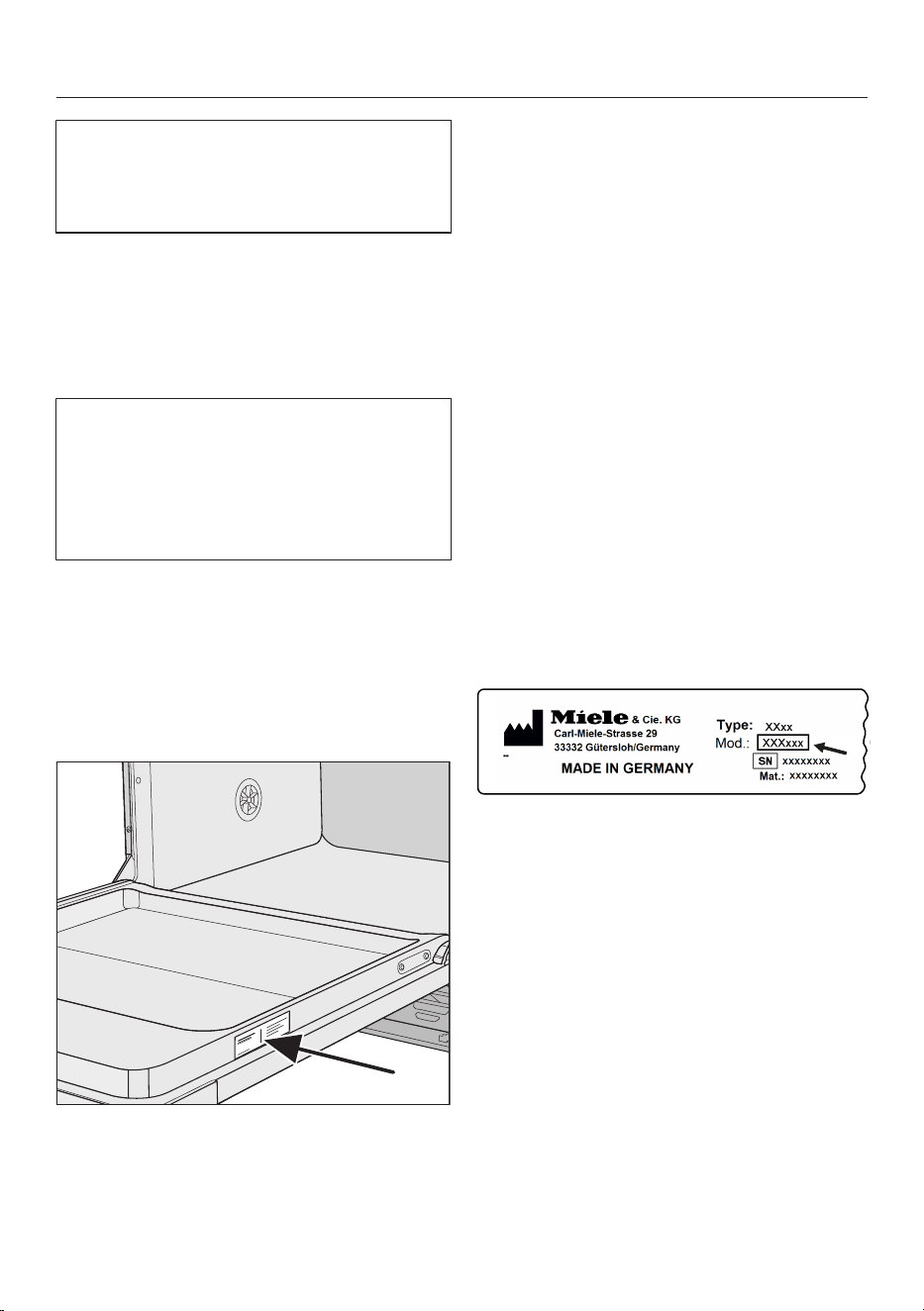
Customer service
78
Information to help you remedy faults
yourself and about Miele spare parts
can be found at www.miele.de/p/
reparatur-2283.htm.
Contact in the event of a fault
In the event of any faults which you
cannot remedy yourself, please contact
your Miele dealer or the Miele
Customer Service Department.
You can book a Miele Customer
Service Department call-out online at
www.miele.com/service.
Contact information for the Miele
Customer Service Department can be
found at the end of this document.
Please quote the model and serial
number of your dishwasher when
contacting Miele. These can be found
on the data plate on the right side of the
open door.
The data plate is located on the right
side of the door.
Programme updates
The programme update function is
designed to enable a service technician
to update your dishwasher's electronics
in keeping with advances in technology.
Programme updates can only be
performed by a Miele service
technician.
EPREL database
From 1 March 2021, information on
energy labelling and ecodesign
requirements will be available in the
European Product Database (EPREL).
You can find the product database at
the following link https://
eprel.ec.europa.eu/. You will be asked to
enter the model identifier.
The model identifier can be found on the
data plate.

Customer service
79
Note for test institutes
All information required regarding
comparison testing and measuring
noise levels is given in the Comparison
tests leaflet.
Please order the latest version of this
leaflet by email from:
- testinf[email protected]
Please indicate your postal address, as
well as the model and serial number of
the dishwasher (see data plate).
You can also download the brochure
from the Miele website.
Warranty
The warranty period for this appliance is
1 year from date of purchase.
For further information, please refer to
the warranty conditions in the booklet
provided.
Installation
*INSTALLATION*
80
Electrical connection
All work on the electrical
connection must be carried out by
the Miele Customer Service
Department, an authorised Miele
dealer or a qualified electrician.
- The electrical installation must be in
compliance with current local and
national safety regulations
(DINVDE0100 in Germany).
- The connection to the power supply
must comply with national regulations
(plug and socket must be accessible
after the appliance has been
installed). An electrical safety test can
then easily be carried out, e.g. after
any service or maintenance work.
- It is recommended that the electrical
connection is made with a suitably
rated plug and socket.
- If the dishwasher is hard wired to the
power supply, connection should be
made via a mains switch with all-pole
isolation. The mains switch must
ensure a gap of at least 3mm
between all open contacts and must
be able to be locked in the off
position.
- Equipotential bonding should be
carried out if required.
- If replacing the mains cable, use only
original Miele spare parts or a suitable
cable with core cable ends.
- For technical data, see the data plate
or wiring diagram supplied.
The dishwasher must only be operated
with the voltage, frequency and fuse
rating shown on the data plate.
This appliance can be converted to a
different type of power supply in
accordance with the conversion
diagram and wiring diagram supplied.
Converting the appliance to a
different type of power supply can
lead to longer programme running
times, resulting in increased energy
consumption.
The declared consumption values will
only be achieved if the appliance
remains in the state in which it was
delivered.
The data plates (with VDE test
certificate, etc.) are located at the back
of the dishwasher and on the inner
panel of the door.
The wiring diagram is supplied with the
dishwasher.
The conversion diagram is attached to
the electrical connection plinth panel.
Equipotential bonding connection
There is a screw connection point
marked at the back of the appliance,
to which additional equipotential
bonding can be connected.
Installation
*INSTALLATION*
81
The Miele Waterproof system
As long as your dishwasher has been
installed correctly, the Miele Waterproof
system will provide extensive protection
against water damage throughout its
service life.
Water inlet
Water in the dishwasher must
not be used as drinking water.
- The dishwasher must be connected to
the water supply in strict accordance
with current local and national water
authority regulations.
- The water used must comply with
European regulations for drinking
water quality as a minimum.
If the water supply has a high iron
content, there is a danger of corrosion
occurring on items being cleaned in
the dishwasher, as well as the
appliance itself.
If the chloride content of the water
exceeds 100mg/l, the risk of
corrosion to items being cleaned in
the dishwasher will be further
increased.
- In certain regions (e.g. mountainous
regions), the water composition may
cause precipitates to form, requiring
the use of softened water for the
dishwasher.
- The dishwasher complies with all valid
European standards on the protection
of drinking water.
- The water connection pressure (flow
pressure at the water connection)
must be between 100 and 1000kPa
(1.0 and 10bar).
If the water pressure is lower than
this, the fault message Water intake
will appear in the display (see
“Troubleshooting”).
If the water pressure is too high, a
pressure reducing valve must be
fitted.
- A stopcock valve with a
3
/
4
inch
threaded union must be provided on
site. The valve should be easily
accessible, since the water inlet
should be shut off whenever the
appliance is not in use.
- The DN10 inlet hose is approx. 1.5m
long terminating in a
3
/
4
inch screw
thread. A 1.5m long flexible metal
extension hose tested to 140bar
(14,000kPa) is available as an
optional accessory if required. The
inlet filter or the flow regulator in the
screw thread must not be removed
under any circumstances.
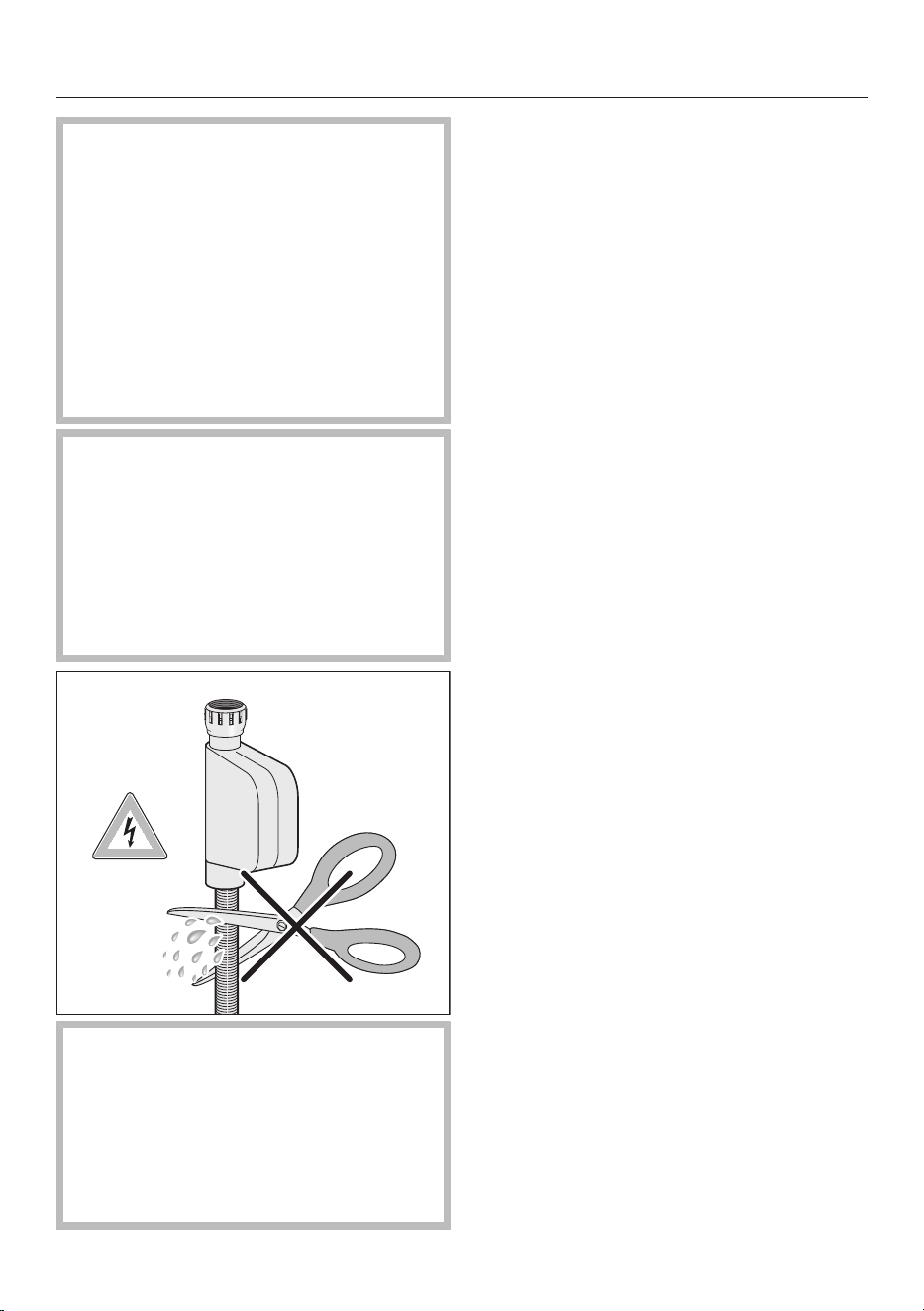
Installation
*INSTALLATION*
82
Risk of damage from leaking
water.
The connection point is subject to
mains water pressure. Water leaking
from it can cause damage.
You should therefore open the
stopcock slowly and check for leaks.
Correct the position of the seal and
screw thread if appropriate. Check
the screw connections regularly to
make sure they are still tight.
Risk of damage due to excessive
pressure.
A brief increase in the water
connection pressure can damage
components of the dishwasher.
This dishwasher must only be
operated when it is connected to a
fully vented plumbing system.
Risk of electric shock from mains
voltage.
There are live electrical components
in the water inlet hose.
The water inlet hose must not be
shortened or damaged in any way
(see illustration).
Regulations in the UK
To comply with the water regulations
requirements, this dishwasher must be
connected to the mains potable water
supply via the double check valve
supplied with the machine.
Installation
*INSTALLATION*
83
Connecting the drainage
system
- The appliance drainage system is
fitted with a non-return valve, which
prevents dirty water from flowing back
into the dishwasher via the drain hose.
- The dishwasher drain hose should be
connected to a separate on-site drain
for the dishwasher only. If no separate
drain is available, we recommend
connecting it to a dual-chamber
siphon.
- The dishwasher is supplied with
approx. 1.5m of flexible drain hose
with an internal diameter of 22mm.
Hose clips are supplied with the
dishwasher.
- The drain hose must not be
shortened! The hose can be extended
using a connection piece to attach a
further length of hose. The drainage
length must not be longer than 4m
and the delivery head no higher than
1m.
- The drainage system must be able to
accommodate a minimum drainage
flow of 16l/min.
Make sure that there are no kinks
in the hose, and that it is not
squashed or stretched.
Hose installation when water drainage
is low
If the on-site water drainage connection
is situated lower than the guide path for
the lower basket rollers in the door, the
water drain hose must be installed at
that level with a bend in it. Otherwise,
water may flow out of the wash cabinet
during a programme.
Tall unit installation
APFD101 and APFD102 are available
as optional accessories for use when
installing the dishwasher in a tall unit.

Technical data
84
Model
Dishwasher
normal
PFD100 SmartBiz
Height of freestanding appliance 845mm
(adjustable + 35mm)
Width 598mm
Depth of freestanding appliance 600mm
Weight Max. 60kg
Voltage
Rated load
Fuse rating
See data plate
Power rating in off mode 0.4W
Power rating when not switched off 5.0W
Network standby 0.9W
Frequency range 2.4000–2.4835GHz
Maximum transmission power < 100mW
Water connection pressure 50 – 1000kPa
Cold or hot water connection Up to max. 60°C
Mains water hardness Max. 36°dH
Delivery head Max. 1.0m
Drainage length Max. 4.0m
Ambient temperature 5°C to 40°C
Relative humidity
maximum
linear decreasing to
80% for temperatures up to 31°C
50% for temperatures up to 40°C
Mains connection cable Approx. 1.7m
Capacity 13 standard place settings
Noise emission values
Sound power LwA
Sound pressure LpA
46dB (A)
34.1dB (A)
Test certifications awarded EMC, VDE, radio and television suppressed
CE mark Machinery Directive 2006/42/EC
UKCA mark (UK only) The Supply of Machinery (Safety) Regulations
2008
Manufacturer address Miele & Cie. KG, Carl-Miele-Straße 29,
33332 Gütersloh, Germany
Technical data
85
ThisStatement of Compliance confirms this Miele product fully complies with the
Product Security and Telecommunications Infrastructure (Security Requirements
for Relevant Connectable Products) Regulations 2023.
1) Professional Appliance –
2)
Manufactured by: Miele & Cie KG,
Carl Miele Street 29, 33332 Gutersloh Germany
Imported by and contact point: Miele Company Ltd, Fairacres, Marcham Road,
Abingdon, Oxon, OX14 ITW Great Britain
The defined support period at the time of first supply is 10 years
3)
To report vulnerabilities and cybersecurity issues please contact: [email protected]4)
5) Signature
Name: Paul Wright
Company Position: Head of Technical Management
Date of signature: 19th March 2024
Place of signature:
Abingdon, Oxfordshire
PFD 100, PFD 101, PFD 103, PFD 104 (GG11)
Settings
86
You can alter the dishwasher’s controls
to suit changing requirements by
adjusting the settings.
The settings can be altered at any
time.
Opening the Settings menu
Switch the dishwasher on with the
sensor control if it is switched off.
Touch the Settings sensor control.
The first option in the Settings menu
will appear in the display.
For further information about the
display functionality, see the “Display
functions” section in the “Guide to the
appliance” chapter.
Changing settings
Use the sensor controls to select
the menu option you want to change
and confirm your selection with OK.
Sub-menu options that have already
been selected will have a tick beside
them.
Select the setting you want using the
sensor controls and confirm with
OK.
To exit a sub-menu again use the
Backsensor control.
The display will revert to the menu
above.

Settings
87
Language
The display can be set to appear in one
of several different languages.
You can change the language used in
the display and also the country via the
Language sub-menu.
The flag after the wordLanguage
serves as a guide if a language that you
do not understand has been set.
In this case keep selecting the menu
option that has a flag after it until you
reach the Language sub-menu.
Time of day
The current time of day must be set
before you can use the timer option.
Setting the clock format
You can select either a 24-hour or 12-
hour clock.
Select the Clock format menu option.
Select the setting you want and
confirm with OK.
Setting the time of day
You can set the time of day.
Select the Set menu option.
Use the sensor controls to enter
the hour and confirm your entry by
touching OK.
Then set the minutes and confirm
with OK.
The time of day has now been saved.
Settings
88
Water hardness
Your dishwasher is fitted with a water
softener.
- You should programme the
dishwasher to the correct water
hardness for your area.
- Your local water authority will be able
to advise you on the water hardness
level in your area.
- Where the water hardness fluctuates,
e.g. between 1.8 and 2.7mmol/l (10–
15°dH – German scale), always
programme the dishwasher to the
higher value (2.7mmol/l or 15°dH in
this example).
If the water hardness in your area is
available in a unit other than °dH, you
can convert the values as follows:
1°dH = 0.18mmol/l = 1.78°fH
°d mmol/l °f Display
1 0.2 2 1
2 0.4 4 2
3 0.5 5 3
4 0.7 7 4
5 0.9 9 5
6 1.1 11 6
7 1.3 13 7
8 1.4 14 8
9 1.6 16 9
10 1.8 18 10
11 2.0 20 11
12 2.2 22 12
13 2.3 23 13
14 2.5 25 14
15 2.7 27 15
16 2.9 29 16
17 3.1 31 17
18 3.2 32 18
19 3.4 34 19
20 3.6 36 20
21 3.8 38 21
22 4.0 40 22
23 4.1 41 23
24 4.3 43 24
25 4.5 45 25
26 4.7 47 26
27 4.9 49 27
28 5.0 50 28
29 5.2 52 29
30 5.4 54 30
31 5.6 56 31
32 5.8 58 32
33 5.9 59 33
34 6.1 61 34
35 6.3 63 35
36 6.5 65 36
Settings
89
Rinse aid
You can adjust the rinse aid dosage for
best results.
The rinse aid dosage can be set from 0
to 6ml.
3ml is the factory default setting.
The rinse aid amount dispensed can
turn out to be higher than the set value
due to an automatic adjustment of the
programme.
If spots appear on crockery and
glassware:
- Increase the rinse aid dosage.
If clouding or smearing appears on
crockery and glassware:
- Decrease the rinse aid dosage.
External dispensing
Activate automatic dispensing of liquid
detergent if you have installed the
optional external dosing module.
The DOS module is supplied with its
own installation instructions.
Select the setting you want and
confirm with OK.
The setting will remain active until
you deactivate “External dispensing”.
Amount of detergent
The following functions will only
become visible when external
dispensing has been activated.
A detergent amount of 0.50% is set as
standard. The dispensed quantity can
be modified between 0.1 and 2.00% in
increments of 0.05%.

Settings
90
DOS flow rate
A flow rate of 60ml/min is set as
standard. The flow rate can be modified
between 10 and 150ml/min in
increments of 5ml/min.
Set the dosage according to the
detergent manufacturer’s
recommendations.
Choose the required detergent or flow
rate quantities and confirm your
selection with the OK button.
Venting the dispensing system
The dispensing system will not dispense
reliably if there is air in the system.
The dispensing system must be vented:
- If the dispensing system is being used
for the first time
- If the liquid detergent reservoir was
not refilled in time and the dispensing
system was emptied
- If the detergent container was
replaced
To ensure that the dispensing
system functions properly, prior to
venting make sure that the detergent
container is full enough and that the
dispensing lances are firmly attached
to the containers.
Select Start venting and confirm your
entry with the OKbutton.
The venting process will begin.
Start the Cold pre-wash programme
directly after the venting process is
finished in order to dilute and drain any
detergent that escaped into the wash
cabinet.
Temperature unit
The temperature can be shown in the
display in degrees Celsius or degrees
Fahrenheit.
Select the setting you want and
confirm with OK.
Final rinse temperature
For better drying, the final rinse
temperature can be increased for
individual programmes. This function is
not available for all programmes (see
“Programme chart”).
Select the setting you want and
confirm with OK.

Settings
91
Miele@home
Your dishwasher is equipped with an
integrated WiFi module.
You can connect your dishwasher to
your local network in order to use digital
solutions from Miele. An overview of
these digital solutions is available on the
webpage: https://www.miele.de/p/
digitale-loesungen- 4345.htm.
Connecting your dishwasher to your
local network will increase energy
consumption, even when the
dishwasher is switched off.
The “Settings” and “Miele@home
settings” menus will be added as
additional menu options.
Make sure that your WiFi network
signal strength is strong enough at
the installation site of your
dishwasher.
There are a number of ways of
connecting your dishwasher to your
WiFi network:
Setting up Miele@home
You can connect your dishwasher to
your network using WPS or via the app.
Connect using WPS
You can connect your dishwasher to
your WiFi network using WPS (Wi-Fi
Protected Setup).
Your WiFi router must support WPS.
Confirm the message Press WPS
button with OK.
Activate the WPS function on your
router within 2minutes.
Once the connection has been
established, confirm the message
with OK.
If the connection fails, you have
probably not activated WPS on your
router quickly enough. Repeat the steps
above.
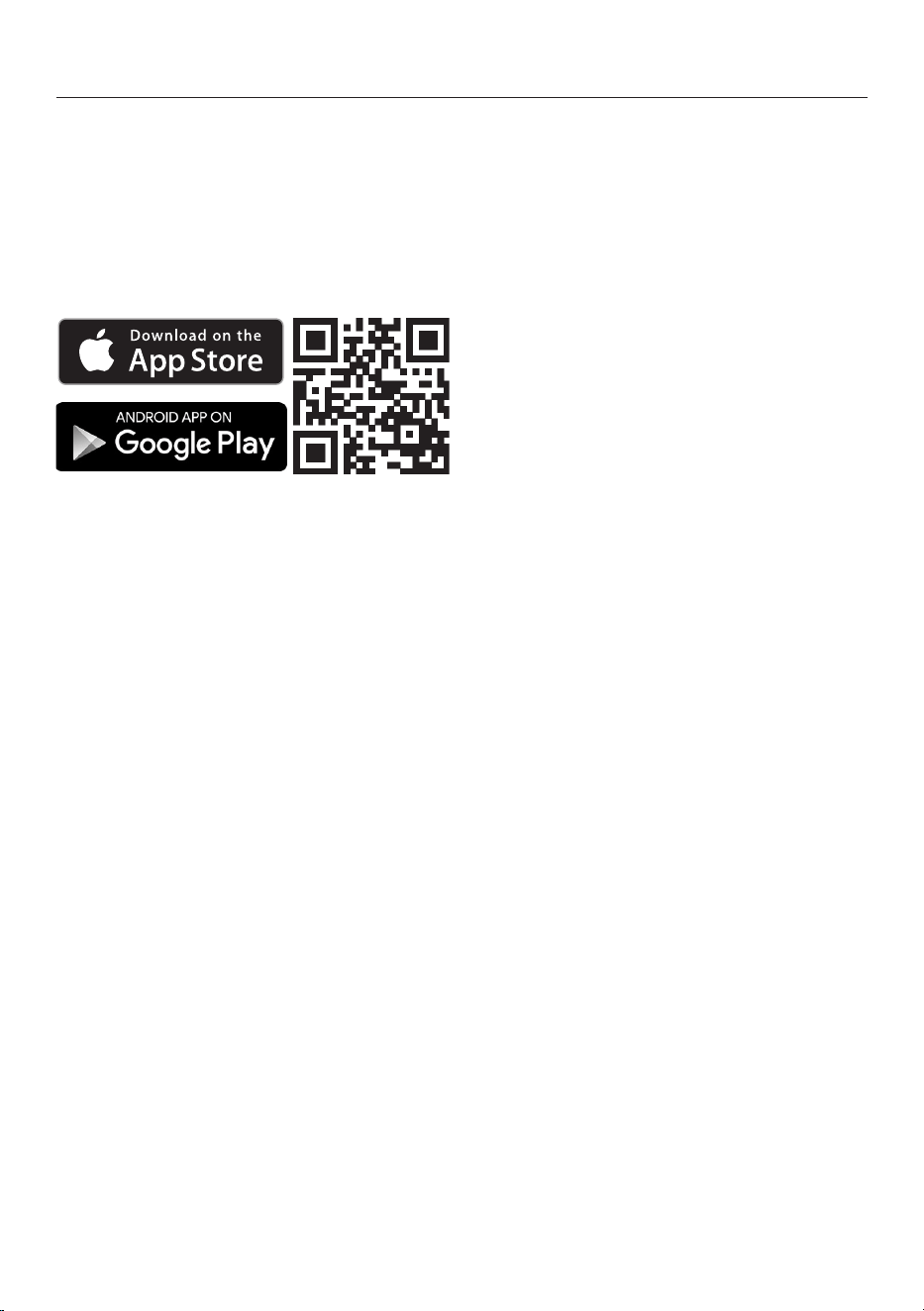
Settings
92
Connect using App
You can connect the dishwasher to the
Mieleapp.
The apps are available to download free
of charge from the Apple App Store
®
or
from the Google Play Store™.
Mieleapp
Select the Connect using Appmenu
option and confirm with OK.
Follow the user navigation in the app.
Once your dishwasher is connected to
your WiFi network, you can use the app
to carry out the following tasks:
- Call up information on the operating
status of your dishwasher
- Call up information on the programme
sequence of your dishwasher
- Set up a Miele@home network with
other WiFi-enabled Miele domestic
appliances
Activate
If you wish to connect your dishwasher
to your WiFi network, you can turn on
the WiFi module.
Select the Activate menu option and
confirm with OK.
In the Miele@homemenu, the menu
optionDeactivate will now be displayed
instead of Activate.
Deactivate
If you do not wish to use the WiFi
module of your dishwasher, you can
switch it off.
Select the Deactivate menu option and
confirm with OK.
In the Miele@homemenu, the menu
optionActivate will now be displayed
instead of Deactivate.
Displaying Connection status
You can call up the current connection
status of your dishwasher.
Select the Connection status menu
option and confirm with OK.
Use the sensor controls to
consecutively call up the WiFi signal
strength, the name of your router and
the associated IP address.
Select OK to confirm the messages.
Set up again
This menu option only appears if you
have already connected your
dishwasher to your WiFi network.
Connect using App
Select the Connect using App menu
option and confirm with OK.
Follow the user navigation in the app.
Connect using WPS
Select the Connect using WPS menu
option and confirm with OK.
Follow the instructions in the display.

Settings
93
Network configuration
You can use this menu option to reset
all WiFi module settings (if available) to
the factory default settings.
The network configuration should be
reset whenever a dishwasher is being
disposed of or sold, or if a used
dishwasher is being put into operation.
This is the only way to ensure that all
personal data has been removed and
the previous owner will no longer be
able to access the dishwasher.
Field of application
In this menu option, you can define the
setting in which your dishwasher is
being used to enable you to order the
right detergents and other consumables
(see “Detergent – Field of application”).
If the dishwasher is being used in a
commercial setting, it is recommended
that commercial detergents are used.
If you are using your dishwasher in a
private setting, it is recommended that
detergents designed for domestic
dishwashers are used. Suitable
detergents are available from Miele.
Select the setting you want and
confirm with OK.
Remote control
This menu option will only be
displayed if you have connected your
dishwasher to your WiFi network (see
“Settings – Miele@home”).
If you wish to permanently switch off
the Remote controloption, you can do so
under this menu option. The sensor
control will then no longer be available
to select until you change this setting
again.
Even if the Remote controloption is
switched off, you can use the Mieleapp
to call up information about your
appliance. However, you cannot start
any programmes or change any settings
from it.
Settings
94
RemoteUpdate
The RemoteUpdate menu option is
only displayed and can only be
selected if the requirements for using
Miele@home have been met (see
“Before using for the first time”
chapter, “Miele@home” section).
The RemoteUpdate function is used for
updating the software in your
dishwasher. If an update is available for
your dishwasher, it will automatically
download it. Updates will not be
installed automatically. They must be
initiated manually.
If you do not install an update, you can
continue to use your dishwasher as
usual. However, Miele recommends
installing updates.
Activating/deactivating
The RemoteUpdate function is activated
as standard. Available updates will be
downloaded automatically and will only
be installed if you initiate them.
Deactivate RemoteUpdate if you do not
wish any updates to be downloaded
automatically.
Running a RemoteUpdate
Information about the content and
scope of a RemoteUpdate will be
provided in the Mieleapp.
A message will appear in your
dishwasher display if a software update
is available.
You can install the update immediately
or postpone this until later. When the
appliance is switched on again, you will
be reminded about the update.
Deactivate RemoteUpdate if you do not
want to install the update.
The update may take several minutes.
Please note the following information
about the RemoteUpdate function:
- You will only receive a message when
an update is available.
- Once an update has been installed, it
cannot be undone.
- Do not switch the dishwasher off
during the update. Otherwise, the
update will be aborted and will not be
installed.
- Some software updates can only be
carried out by the Miele Customer
Service Department.

Settings
95
SmartStart
This menu option will only be
displayed if you have connected your
dishwasher to your WiFi network (see
the “Miele@home” section in the
“Settings” chapter)
The SmartStartfunction is used for
starting your dishwasher automatically
at a time when your energy costs are
most economical.
To use this function you may need
further technical accessories.
If you have activated
SmartStartPermitted, the Timer menu
of the selected programme will no
longer show EcoStart but will instead
show SmartStart. The dishwasher will
then start within the timeframe
specified when it receives a signal from
the energy supplier.
If it has not received a signal from the
energy supplier by the latest possible
start time, the dishwasher will start
automatically.
EcoStart
In order to run your dishwasher in the
most economical way, you can use the
EcoStartoption to take advantage of
your electricity supplier’s cheaper
energy tariffs (see the “Timer” section
in the “Options” chapter).
With this option selected, your
dishwasher will start automatically at
your electricity supplier’s cheapest tariff
times.
To use this option you must first set up
to three electricity tariff times in which
the dishwasher can start. You can
allocate different priorities to these time
zones. The time with the cheapest
electricity tariff will be given Priority 1.
Contact your electricity supplier to find
out the times of the cheapest energy
tariffs.
Once the energy tariff times have been
set, you can use the EcoStartoption to
set the latest finish time required for
each programme.
The dishwasher will then start
automatically during the cheapest
energy tariff time. The programme will
end at the set finish time at the latest.

Settings
96
Setting the energy tariff times
Before you can use the EcoStartoption,
you must set at least one energy tariff
time.
Use the sensor controls to select
an energy tariff time T1–T3 and
confirm with OK.
The start of the energy tariff time
selected will appear in the display and
the hour number block will be
highlighted.
Use the sensor controls to set
the hours and minutes for the start
time and confirm both with OK.
The end of the energy tariff time
selected will appear in the display and
the hour number block will be
highlighted.
Use the sensor controls to set
the hours and minutes for the end
time and confirm both with OK.
The energy tariff time will be saved and
its priority will appear in the display.
Use the sensor controls to set
the priority you want and confirm with
OK.
Confirm the message with OK.
The energy tariff time will be activated.
Changing the electricity tariff times
You can change the start, end or priority
of an electricity tariff time.
Use the sensor controls to select
an electricity tariff time T1–T3 that
you wish to change and confirm with
OK.
Select the setting you want to change
and confirm with OK.
Use the sensor controls to
change the setting and confirm with
OK.
Confirm the message with OK.
The change will be saved.
Deleting the energy tariff times
You can delete the settings for an
energy tariff time and in doing so
deactivate the EcoStartoption for this
time zone.
Use the sensor controls to select
an electricity tariff time T1–T3 that
you wish to delete and confirm with
OK.
For example, select Delete T1 and
confirm with OK.
For example, select Delete T1? and
confirm with OK.
The settings for the energy tariff time
selected will be reset.
Confirm the message with OK.
The energy tariff time will be deleted.

Settings
97
Consumption (EcoFeedback)
You can set whether the water
consumption is displayed for the
selected programme. This function
shows the estimated consumption
before a programme sequence and the
actual consumption after the end of the
programme.
In this menu you can also call up the
total consumption of water for all the
wash programmes you have previously
run on your dishwasher (see the
“EcoFeedback consumption display”
section in the “Caring for the
environment” chapter).
Displaying Consumption
Select the Consumption display menu
option and confirm with OK.
Select the setting you want and
confirm with OK.
Displaying Total consumption
Select the Total consumption menu
option and confirm with OK.
You can display the total consumption
via the Water menu option.
You can reset the value for the total
consumption to 0.
Select the Reset menu option and
confirm with OK.
Select the Yes menu option and
confirm with OK.
Confirm the message with OK.
The values are now reset to 0.
Display brightness
You can set the display brightness to
one of seven different levels.
Settings
98
Volume
A buzzer sequence will sound at the end
of a programme or if there is a fault as
long as the buzzers are activated.
Buzzers in the event of a fault
In the event of a fault, the alarm tone
will sound four times at intervals with a
short pause between each set of tones.
The alarm tone that sounds when
there is a fault cannot be deactivated.
Buzzers
The buzzer at the end of a programme
will sound four times at intervals with a
short pause between each set of tones.
The volume of the buzzer at the end of
the programme can be selected from
one of seven levels. If no volume is
selected, the buzzer is switched off.
Keypad tone
An audible tone sounds each time a
sensor control is pressed.
The volume for the keypad tone can be
set to one of seven different levels. If no
volume is selected, the keypad tone is
switched off (except the On/
Offsensor control).
Welcome melody
If you switch the dishwasher on or off, a
brief melody will sound.
You can switch this melody off.
Refill reminders
If you only ever use combination
detergents or automatic dispensing
using Miele PowerDisks (if available),
you can switch off the refill reminders
for dishwasher salt and rinse aid if you
wish.
Please make sure that if you stop
using combination detergents, you
refill the dishwasher salt and rinse
aid. Switch the refill reminders back
on.

Settings
99
AutoOpen
In some programmes, the door
automatically opens slightly to assist
the drying process.
This function can be deactivated if you
wish.
Risk of damage due to steam.
Steam from the dishwasher could
damage the edges of worktops when
you open the door at the end of the
programme if the fan is no longer
running.
If you have deactivated the automatic
door opening function but would still
like to open the door at the end of the
programme, then make sure that you
open the door fully.
Software version
You can display the software version of
your dishwasher electronics for
technical support purposes.
Showroom
For demonstration purposes only.
The dishwasher is equipped with a
demo mode for showroom use.
Factory default
You can reset all the appliance settings
to the factory default settings.
WiFi module settings (where applicable)
have to be reset separately (see the
“Miele@home” section in the
“Settings” chapter).
Appliance settings
You can use this menu option to reset
all dishwasher settings, except WiFi
module settings, to the factory default
settings.

Malaysia
Miele Sdn Bhd
Suite 12-2, Level 12
Menara Sapura Kencana Petroleum
Solaris Dutamas No. 1, Jalan Dutamas 1
50480 Kuala Lumpur, Malaysia
Phone: +603-6209-0288
Fax: +603-6205-3768
Miele New Zealand Limited
IRD 98 463 631
8 College Hill
Freemans Bay, Auckland 1011, NZ
Tel: 0800 464 353
Internet: www.miele.com.au/professional
E-mail: prof[email protected]
New Zealand
Miele Pte. Ltd.
29 Media Circle, #11-04 ALICE@Mediapolis
Singapore 138565
Tel: +65 6735 1191, Fax: +65 6735 1161
E-Mail: [email protected]
Internet: www.miele.sg
Singapore
Miele (Pty) Ltd
63 Peter Place, Bryanston 2194
P.O. Box 69434, Bryanston 2021
Tel: (011) 875 9000, Fax: (011) 875 9035
E-mail: [email protected]
Internet: www.miele.co.za
South Africa
Miele Appliances Ltd.
Showroom 1, Eiffel 1 Building
Sheikh Zayed Road, Umm Al Sheif
P.O. Box 114782 - Dubai
Tel. +971 4 3044 999, Fax. +971 4 3418 852
800-MIELE (64353)
E-Mail: [email protected]
Website: www.miele.ae
United Arab Emirates
United Kingdom
Miele Co. Ltd., Fairacres, Marcham Road
Abingdon, Oxon, OX14 1TW
Professional Sales, Tel: 0845 365 6608
E-mail: prof[email protected]
Internet: www.miele.co.uk/professional
Miele Australia Pty. Ltd.
ACN 005 635 398, ABN 96 005 635 398
Level 4, 141 Camberwell Road, Hawthorn East, VIC 3123
Tel: 1300 731 411
Internet: www.miele.com.au/professional
E-mail: prof[email protected]
Australia
Miele Electrical Appliances Co., Ltd.
1-3 Floor, No. 82 Shi Men Yi Road
Jing' an District, 200040 Shanghai, PRC
Tel: +86 21 6157 3500, Fax: +86 21 6157 3511
E-mail: [email protected], Internet: www.miele.cn
China Mainland
Miele (Hong Kong) Ltd.
41/F - 4101, Manhattan Place
23 Wang Tai Road, Kowloon Bay, Hong Kong
Tel: (852) 2610 1025, Fax: (852) 3579 1404
Email: [email protected]
Website: www.miele.hk
Hong Kong, China
Miele India Pvt. Ltd.
1st Floor, Copia Corporate Suites,
Commercial Plot 9, Mathura Road, Jasola,
New Delhi - 110025
E-mail: customercar[email protected], Website: www.miele.in
India
Miele Ireland Ltd.
2024 Bianconi Ave., Citywest Business Campus,
Dublin 24
Tel: (01) 461 07 10, Fax: (01) 461 07 97
E-Mail: [email protected], Internet: www.miele.ie
Ireland
Manufacturer: Miele & Cie. KG, Carl-Miele-Straße 29, 33332 Gütersloh, Germany
2024-04-19 M.-Nr. 12 342 870 / 01GG11