1
©2020 National Presto Industries, Inc. Visit PrestoPrecise.com Form 4008-121C
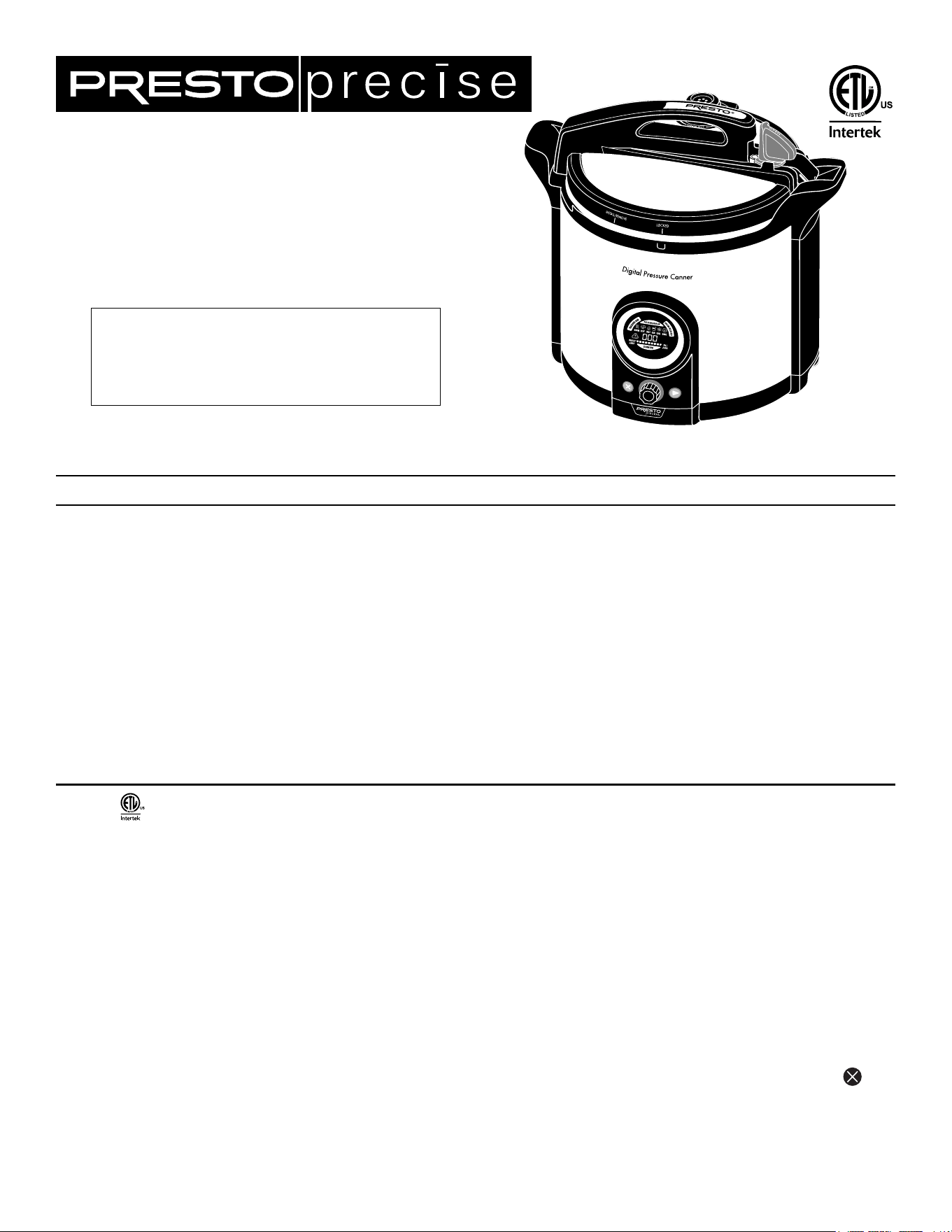
Digital Pressure Canner
Instructions and Recipes
Table of Contents
Important Safeguards ............................... 1
Getting Acquainted ................................. 2
Canning Basics .................................... 4
Preparation Steps Before Canning ..................... 5
Pressure Canning .................................. 6
Tomatoes and Tomato Products ...................... 8
Vegetables ..................................... 10
Meat, Game, and Poultry .......................... 13
Fish and Seafood ................................ 14
Soups and Stocks ................................ 14
Boiling Water Canning ............................. 15
Fruits ......................................... 17
Tomatoes and Tomato Products ..................... 19
Jam, Jelly, and Soft Spreads ....................... 21
Pickles ........................................ 20
Troubleshooting .................................. 22
Error Codes .................................... 22
Issues with Canned Food .......................... 23
Frequently Asked Questions ....................... 23
Cleaning ........................................ 24
Care and Maintenance .............................. 25
Recipe Index ..................................... 25
Consumer Service Information ...................... 26
Warranty ........................................ 26
This is an Listed appliance. The following important safeguards are recommended by most portable appliance manufacturers.
IMPORTANT SAFEGUARDS
To reduce the risk of personal injury or property damage when using electrical appliances, basic safety precautions should always be
followed, including the following:
1. Read all instructions. Improper use may result in bodily injury or property damage.
2. Before each use, check both the vent pipe (Fig. A, page 2) and vent filter (Fig. E, page 3) to be certain they are free of any
blockage. Remove the filter and clean any debris from both the vent pipe and filter; see “Disassemble Canner Parts for Cleaning”
instructions on page 3.
3. Always check the air vent/cover lock to be sure it moves freely before use.
4. To protect against electrical shock, do not immerse cord, plug, or canner body in water or other liquid.
5. Do not let children handle or put electrical cords or plugs in their mouths.
6. Always attach plug to appliance first, then plug cord into the wall outlet. To disconnect, press and hold the cancel button for
3 seconds, then remove plug from wall outlet.
7. Unplug cord from unit and outlet when not in use and before cleaning. Allow unit to cool before putting on or taking off parts
and before cleaning.
Estas instrucciones también están disponibles en español.
Para obtener una copia impresa:
• Descargue en formato PDF en GoPresto.com/español.
• Envíe un correo electrónico a [email protected].
• Llame al 1-800-877-0441, oprima 2 y deje un mensaje.
2
8. Do not operate any appliance with a damaged cord or plug or in the event the appliance malfunctions or has been damaged in
any manner. Return the appliance to the Presto Factory Service Department for examination, repair, or electrical or mechanical
adjustment.
9. WARNING! Contents are hot and can cause serious burns. Keep appliance and cord away from children. Do not let cord hang
over edge of counter or table or touch hot surfaces.
10. To guard against electrical shock, can only in the removable pot provided.
11. The use of accessory attachments not recommended by the appliance manufacturer may cause injuries. Use only genuine Presto
accessories and replacement parts.
12. Intended for countertop use only.
13. Do not place on or near a hot gas or electric burner or in a heated oven.
14. This appliance operates under pressure. Improper use may result in scalding injury. Make certain canner is properly closed
before operating (pages 6 and 16).
15. Do not attempt to open the canner until all internal pressure has been released, the air vent/cover lock has dropped, and no steam
escapes when the regulator is rotated to the VENT position. Any pressure in the canner can be hazardous. Never force open the
temperature sensor arm.
16. Extreme caution must be used when moving an appliance containing hot liquids. Do not touch hot surfaces. Always use
appliance handles.
17. To ensure safe operation and satisfactory performance, replace the sealing ring if it shrinks, becomes hard, deformed, cracked, or
torn. Use only genuine Presto
replacement parts.
18. Close supervision is necessary when the canner is used near children. It is not recommended that children use the canner.
19. Do not use this appliance for other than intended use.
20. Do not use this appliance for deep fat frying.
21. Do not use outdoors.
SAVE THESE
INSTRUCTIONS
This appliance is for household use only.
Important Cord Information
To reduce the risk of electric shock, this appliance has a
3-prong grounded plug. If the plug on this appliance does
not fit into your outlet, contact a qualified electrician. Do not
attempt to modify the plug in any way.
A short, detachable power supply cord is provided to reduce
the risk of becoming entangled in or tripping over a longer
cord. An extension cord may be used if care is properly
exercised in its use.
If an extension cord is used, it should be a 3-wire grounded
type cord, marked with a minimum electrical rating of 13
amps, and be no longer than 10 feet.
The extension cord should be arranged so that it will not drape
over the countertop or tabletop where it can be pulled on by
children or tripped over unintentionally.
Connect the power cord to a 120VAC electrical outlet only.
Getting Acquainted
NOTICE: This product is intended only for pressure canning
and boiling water canning. Do not use it for cooking or
preparing foods.
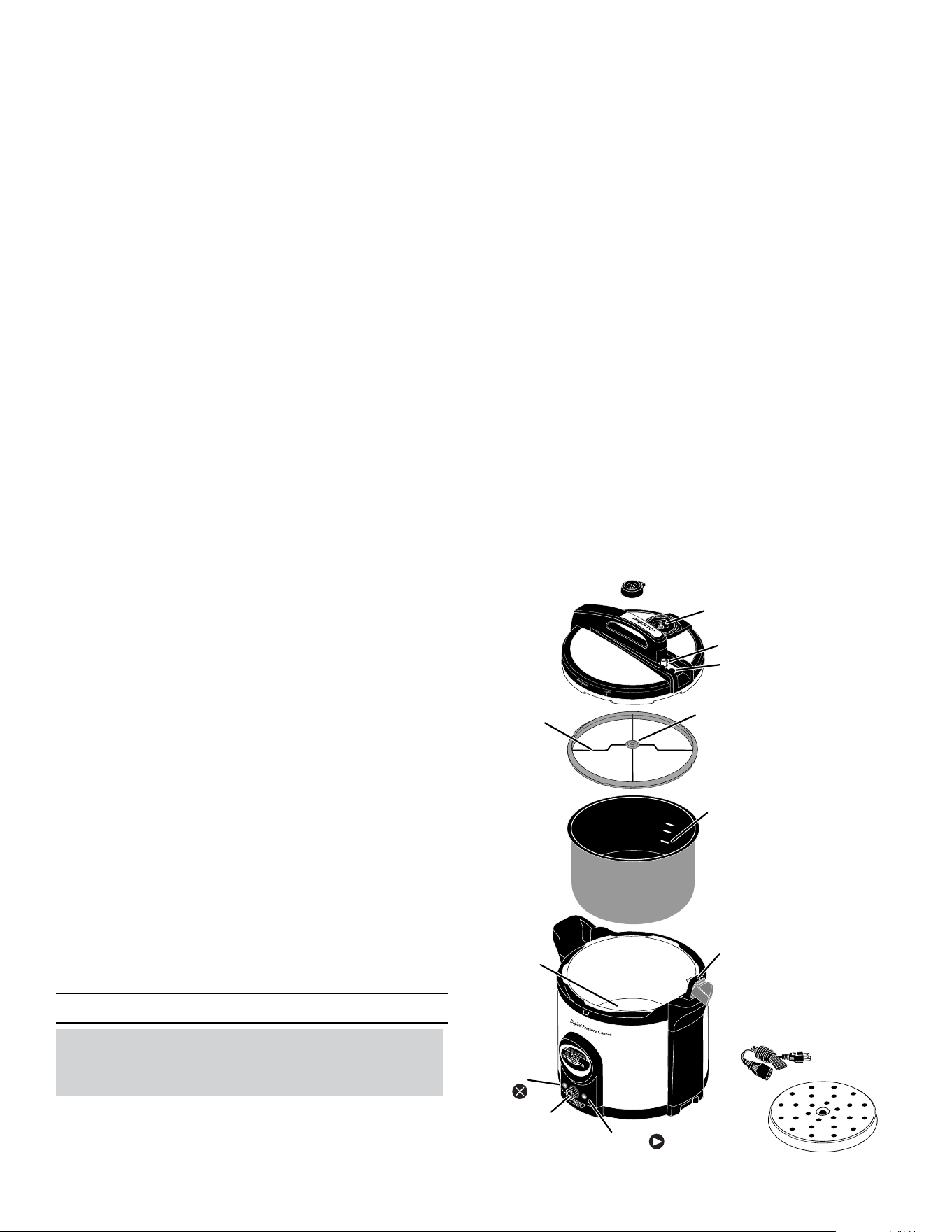
As received, your canner will be fully assembled. Disassemble
and clean the canner parts (Fig. A) as directed on page 3. Read
all instructions carefully.
Regulator Regulator lever
Fig. A
Control knob
Advance button
Cancel
button
3-quart water line
(lowest line in canner)
Cover handle
Locking cover
Sealing ring frame
Removable
nonstick pot
Carrying
handle
Heating
plate
Canner body
Digital display
Vent pipe
Air vent/cover lock
Sensor hole
Sealing ring
Grommet
Temperature sensor arm
Green latch
Detachable power cord
Canning rack
Cord
receptacle
3
If you are new to canning or need some refresher training, refer to the “Canning Basics” section on
pages 4–5.
Helpful Hint: To help yourself understand the operation of the electric canner, consider a test run.
Using jars of water in place of food, follow the step-by-step instructions for Pressure Canning on
pages 6–9 and for Boiling Water Canning on pages 15–16.
Remove the Canner Cover
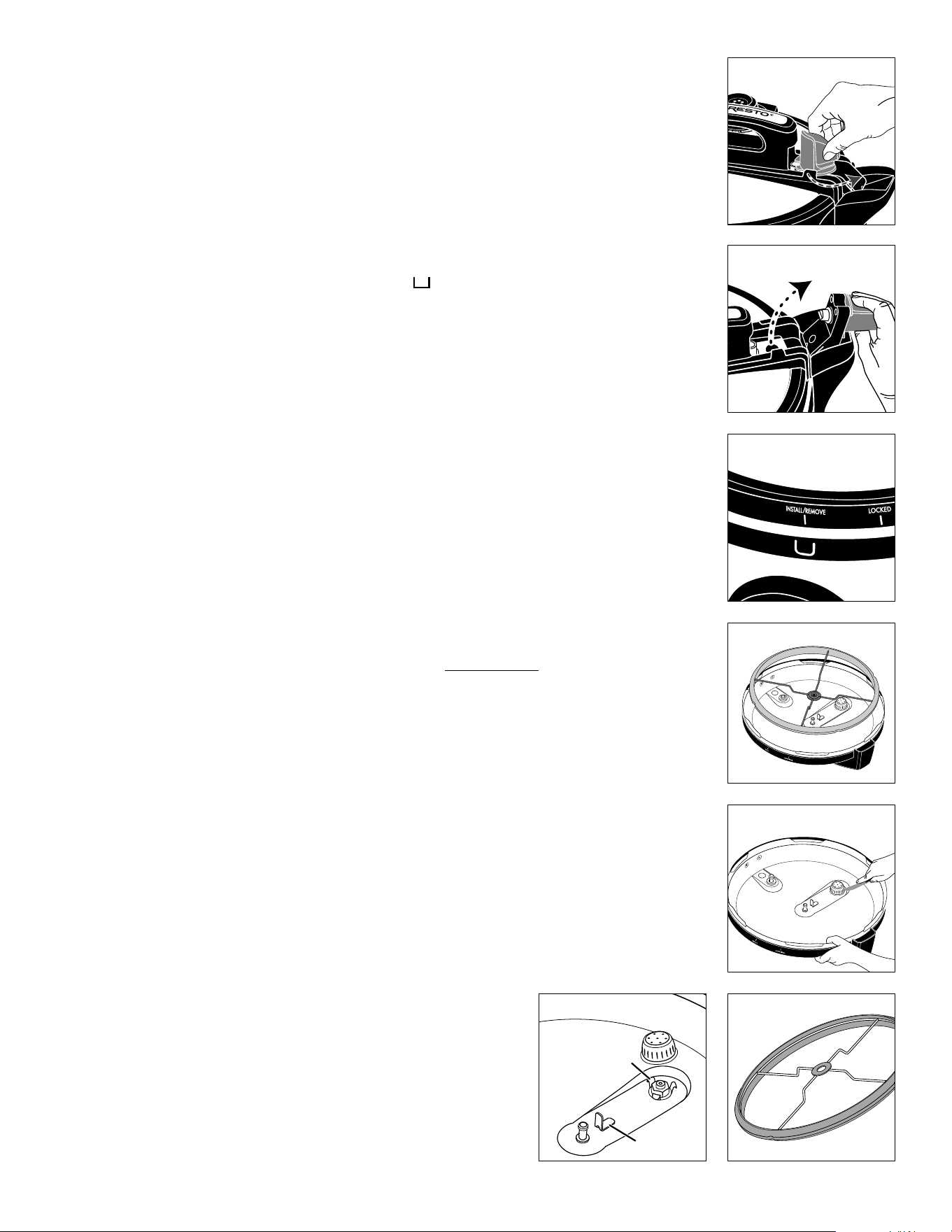
Before removing the cover, you will need to unlock the green latch. Begin by positioning the canner
so the digital display faces you. To unlock the latch, grasp the sides of the latch and turn it towards you
until it stops (Fig. B). Lift the temperature sensor arm out of the sensor hole in the cover (Fig. C).
Once you have released the temperature sensor arm from the cover, rotate the cover counterclockwise
until the INSTALL/REMOVE vertical mark is within the mark on the canner body (Fig. D). Then lift
the cover straight up off the canner body.
Disassemble Canner Parts for Cleaning
It is recommended that the canner be thoroughly washed before first use to remove any manufacturing
residue that may remain.
1. Lift the canning rack and removable pot out of the canner body. Remove the protective liner on the
heating plate (Fig. J, page 6).
2. Invert the cover and pull the sealing ring frame out from the cover (Fig. E). Then remove the vent
filter for cleaning. To remove, place the inverted cover on the counter, then rest a table knife on the
rim of the cover and insert the knife tip into one of the filter slots (Fig. F); gently lift the filter up.
Note: Although you will not need to remove the filter after every use, you should periodically
remove it for cleaning if it appears dirty or contains debris.
3. Remove the sealing ring from the sealing ring frame. Wash the sealing ring, sealing ring frame, vent
filter, cooking rack, and removable pot in warm, soapy water. Rinse and dry thoroughly. Only the
removable pot is dishwasher safe.
4. Clean the canner cover with a damp, soapy cloth. Do not immerse the canner cover in water.
CAUTION! To prevent electrical shock, never pour water into the canner body or immerse it or the
power cord in water. Always be sure the removable pot is completely dry before placing it back in
the canner body.
5. After cleaning, reassemble the cover. When reattaching the vent filter, be sure to place it over all
three clips (Fig. G). Then push it in place. You will hear a snap when it is in the proper position. It
should fit tightly.
6. Place the sealing ring back onto the sealing ring frame, making sure the sealing ring is positioned
correctly on the metal frame; the circular frame must be completely inserted in the inner sealing
ring groove (Fig. H).
If any portion of the frame is outside the inner groove, the pressure canner may not seal.
7. Reattach the frame to the cover by fitting the grommet over the cover post (Fig. E) and rotate the
frame so the bars do not interfere with the positioning tab (Fig. G). Then push the frame down until
it is securely positioned in the cover.
Introduction
The Presto Precise
Digital Pressure Canner is a pressure canner and boiling water canner in one.
Use the control knob to set the preferred canning method. The LED display icons will then guide you
through each step of the process.
Each time you use this digital canner, complete the preparation steps on
pages 5–6. Then follow the instructions for Pressure Canning (pages 6–8)
or for Boiling Water Canning (pages 15–16).
There is no altitude adjustment necessary when pressure canning in this
canner. However, when using the boiling water canning method, you must
increase the processing time. Refer to the altitude chart on page 17 for the
recommended times.
Fig. C
Fig. B
Fig. D
Fig. E
Fig. F
Fig. G
Clip
Tab
Fig. H
4
Minimum Jar Capacity: When pressure canning, use at least 2 quarts, 4 pints, or 8 half-pints.
Maximum Mason Jar Capacity
Pressure canning Boiling Water canning
Jar type Regular mouth Wide mouth Regular mouth Wide mouth
Half-pints 10 14* 10 7
Pints 8 7 8 7
Quarts 5 4 n/a n/a
* It will be necessary to double-deck half-pint jars to achieve maximum jar capacity. Stagger the jars by placing one jar on top of two. Jars may touch.
Only pints and half-pints can be processed using the boiling water method. The Presto Precise
®
Digital Canner is not tall enough to accommodate
quart jars covered with the recommended 1-inch layer of water.
Canning Basics
The key to successful canning is to understand the acidity and spoilage factor of the food you wish to can, as well as the acceptable
canning methods to process those foods. There are invisible microorganisms present all around us. Fruits, vegetables, and meat contain
these microorganisms naturally and yet they are not a problem unless food is left to sit for extended periods of time, causing food
spoilage. This is nature’s way of telling us when food is no longer fit to eat.
There are four basic agents of food spoilage: enzymes, mold, yeast, and bacteria. Canning interrupts the natural spoilage cycle so food
can be preserved safely. Molds, yeast, and enzymes are destroyed at temperatures below 212°F, the temperature at which water boils
(except in mountainous regions). Therefore, boiling water processing is sufficient to destroy those agents. Foods naturally high in acid
and acidified foods having a pH of 4.6 or less may be safely processed using the boiling water method. Step-by-step instructions for
Boiling Water Canning begin on page 15.
Bacteria, however, are not as easily destroyed. The bacteria Clostridium botulinum produces a spore that makes a poisonous toxin
which causes botulism. This spore is not destroyed at 212°F. In addition, the bacteria thrive on low-acid foods in the absence of air.
According to the United States Department of Agriculture (USDA), pressure canning is the only safe method of processing low-acid
foods (vegetables, meats, poultry, fish, and seafood). In pressure canning, some of the water in the canner is converted to steam, which
creates pressure. This pressure is what allows the canner to reach temperatures above boiling. At 240°F, this pressurized heat destroys
the potentially harmful bacterial spores. Step-by-step instructions for Pressure Canning begin on page 6.
As jars cool after processing (by either the boiling water or pressure canning method), a vacuum is formed, sealing food within and
preventing any new microorganisms from entering and spoiling the foods.
Before Beginning
Selecting a recipe
To produce home canned food that is safe for storage at room temperature, it is necessary to use a tested canning recipe. Recipes that
have been handed down through the years or those found on the web are oftentimes unreliable and usually do not include scientifically
tested processing procedures that are vital to a successful and safe canning project. Canning information published prior to 1994 may
be incorrect and could pose a serious health risk.
A tested canning recipe has been evaluated to determine the accurate processing method (boiling water canning or pressure
canning) as well as the processing time. Always choose recipes from a reliable resource, such as the National Center for Home Food
Preservation (nchfp.uga.edu), your local Cooperative Extension Service, or this instruction book.
Selecting Jars
Glass home canning jars, sometimes referred to as Mason jars, are made of heat-tempered glass for durability and reuse. These are the
only jars recommended for safe home canning. They are available in standard sizes (half-pint, pint, and quart jars) and will withstand
the heat of a pressure canner. The diameter of Mason jars may vary from one manufacturer to another. Before filling Mason jars, test
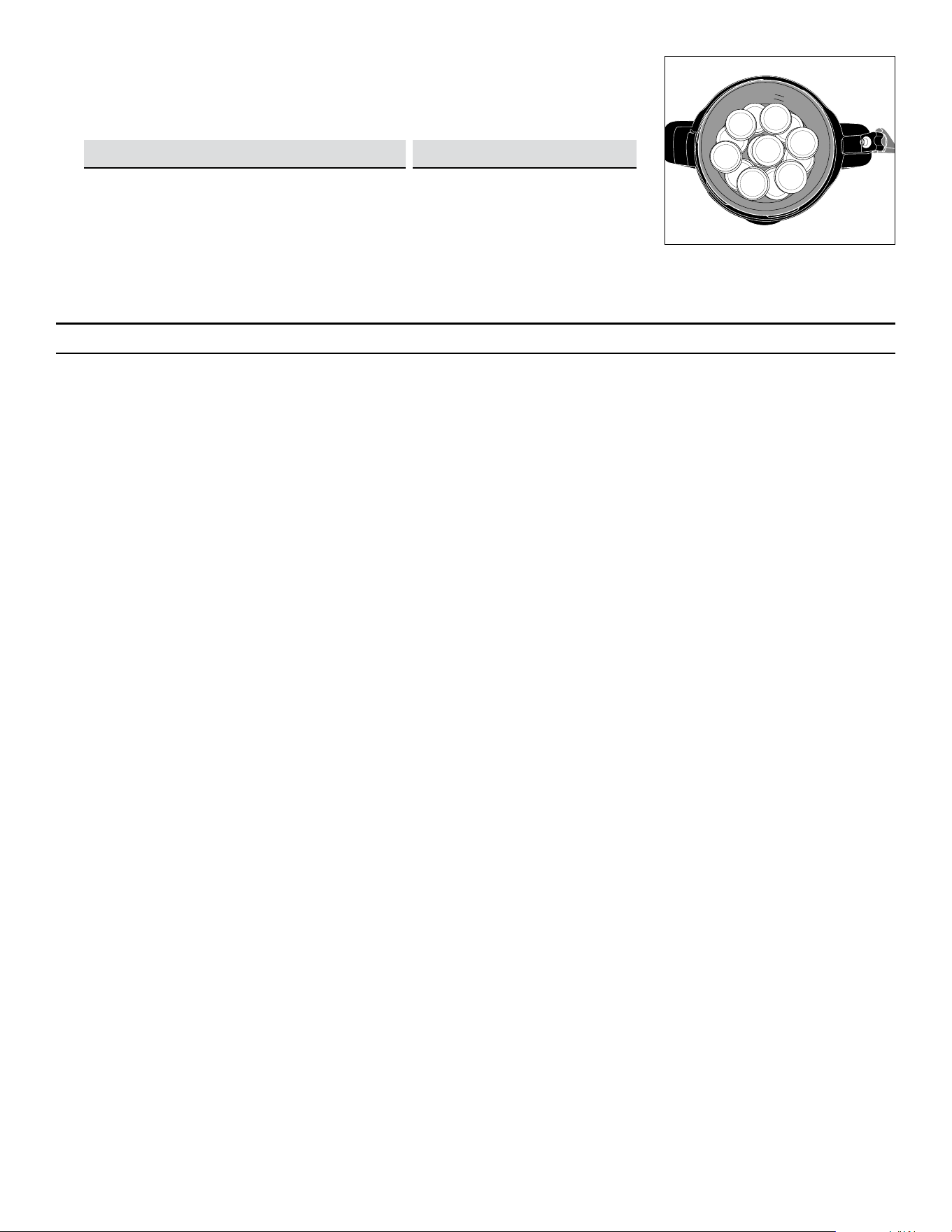
load your canner. It may be necessary to double-deck half-pint jars to reach the maximum capacity of your canner, as indicated in the
chart above. To double-deck, stagger the jars by placing one jar on top of two (Fig. I). Jars may touch.
The canning rack which accompanied your canner must be placed on the bottom of the canner to prevent jar breakage. Although it
is not necessary to use a rack between layers of jars, if you wish to do so, a rack can be ordered from the Presto Consumer Service
Department (page 26).
Canning Lids and Bands
The two-piece vacuum cap (lid and band) is the recommended closure for home canning. It consists of a flat metal lid with a sealing
compound on the outer edge and a separate metal screw band that secures the lid during processing. The flat lid is for one use only
Fig. I

5
while the bands can be used repeatedly if they remain in good condition. Do not use dented or rusty bands. Use only jars, lids, and
screw bands in perfect condition so an airtight seal may be obtained.
Measuring Headspace
Headspace is the air space between the top of the food or its liquid and the lid. Leaving too much headspace can result in
underprocessing because it may take too long to release the air from the jar. Leaving too little headspace will trap food between the
jar and the lid and may result in an inadequate seal. As a general rule, allow ½-inch headspace for fruits and tomatoes and 1-inch for
vegetables, meats, poultry, and seafood. All recipes will indicate the amount of headspace necessary for the food being canned.
Removing Air Bubbles
After food has been packed in jars, any air bubbles must be removed. Trapped air bubbles may rise to the top during processing,
causing too much headspace. Work quickly to remove air bubbles that have become trapped between the pieces of food by moving a
clean, nonmetallic spatula around the jar between the food and side of the jar.
Preparing Jar Rims and Adjusting Lids
Immediately wipe jar rims with a clean, damp cloth to remove any residue. Any food particles, such as seeds, grease, or syrup, on the
rim of the jar may prevent the jar from sealing. Place flat lid on rim of jar, making sure sealing compound is touching glass. Position
a band over the lid and, using fingertips, screw onto the jar just until resistance is met. Do not overtighten as air must release from the
jars during processing and cooling.
Other Special Canning Tips
To prevent water stains on jars, add 2 tablespoons white vinegar to water in canner.
After Processing
Cooling Jars
After processing, remove jars to a dry towel on countertop away from drafts. Leave 1–2 inches of space between jars to allow for even
cooling. Do not retighten bands. Do not invert jars or cover with a cloth. Allow jars to cool naturally. Check seals no earlier than 12
hours, but no later than 24 hours. Bubbles often appear in the jar after removal from the canner because food is still boiling in the jar.
Ordinarily bubbles do not appear once the product has been allowed to thoroughly cool.
Testing Seals and Storing Canned Food
After jars have cooled a minimum of 12 hours, but no more than 24 hours, test the jar lids to be sure a vacuum seal has formed. Press
down on the center of the flat lid to determine if it is concave (stays down when pressed). Remove the screw band and gently try to lift
the lid with your fingertips. If the center does not flex up and down and you cannot lift the lid off, the lid has a good seal. Wipe off any
food residue from jars and lids. Date and label jars. Store in a cool, dark, and dry place.
If a jar does not seal, the food can be refrigerated and used within two to three days. Other options include freezing the food or
reprocessing for the full amount of time per the canning recipe. If choosing to reprocess, remove the lids and reheat the food and/or
liquid. Pack food into clean, heated jars. Remove air bubbles and clean jar rims. Position new lids on jars and secure with bands. If
more than 24 hours have elapsed since the canner registered DONE and the seal is faulty, the food is not safe. Discard at once.
Detecting Spoilage
If up-to-date instructions and processing times and pressures are followed carefully, spoilage is uncommon. However, it is still
recommended to check for signs of spoilage before tasting any canned food. Check for a broken seal, gassiness when opening, mold,
sliminess, cloudiness, or unpleasant odors. If any of these signs are present, discard the food.
As a safeguard against using canned low-acid and tomato products which may be affected with spoilage that is not readily detected,
boil food 10 minutes for altitudes up to 1,000 feet above sea level. Extend the boiling time by 1 minute for each 1,000 foot increase
in altitude. Many times odors that cannot be detected in the cold product will become evident by this method. After boiling, if food
does not smell or look right, discard it without tasting.
Preparation Steps Before Canning
In order for the unit to function properly, always follow these instructions before each use:
• Place the electric canner on a dry, level surface. To avoid steam damage to cabinets, position it so the vent pipe and air vent/cover
lock are not directly under cabinets.
WARNING! A fully loaded canner can weigh in excess of 42 pounds. To avoid damage to the counter, always place the canner on a
surface that supports the weight of a fully loaded canner, such as the center of a kitchen counter or table. DO NOT place a canner
near the edge of a surface or on an overhang.
6
• Be sure the bottom of the removable pot and the heating plate within the canner body (Fig. J) are
free of debris before placing the removable pot in the canner body.
CAUTION! To prevent electrical shock, never use the unit without the removable pot. Also, be sure
the outside of the removable pot is completely dry before placing it into the canner body.
• Check both the vent pipe and vent filter to be sure they are clear and do not contain any debris. In
order to check the vent pipe, you will need to remove the regulator from the cover (Fig. A, page 2).
Then hold the cover up to the light and make sure you can see light coming through the vent pipe.
If you cannot, remove the sealing ring frame and vent filter (page 3) and clean the vent pipe with a
small brush or pipe cleaner to remove the blockage. Reattach the sealing ring frame to the cover.
• Always verify that the sealing ring frame is attached to the canner cover before canning and make
sure the sealing ring is positioned correctly on the metal frame (Fig. H, page 3).
• Always make sure the gasket is positioned on the sensor (Fig. K).
• Check Mason jars for nicks, cracks, and sharp edges. Check screw bands for dents or rust. Use only
jars, lids, and screw bands in perfect condition so an airtight seal may be obtained.
• Wash and rinse the jars, lids, and screw bands. Follow the closure manufacturer’s directions for
preparing the lids.
Pressure Canning
I. Getting Ready
1. Complete the preparation steps starting on page 5. Select an approved canning
recipe (pages 8–15) and gather needed supplies.
2. Begin preparing the food that will be used for filling the jars in step 11.
Note: Any food that is described in a recipe as “Hot Pack” should be freshly
prepared or, if made in advance, it should be reheated as instructed in the recipe.
3. Place the removable pot in the canner body. Put the canning rack in the
removable pot.
Note: Jars will be placed on the rack in step 7. If set directly on the bottom of the
removable pot, jars may break.
4. Pour water into the removable pot up to the bottom fill line (Fig. A, page 2).
Tips: Use hot tap water to shorten the time to heat the water. To prevent water
stains on jars, add 2 tablespoons of white vinegar to the water in the canner.
Note: 3 quarts of water are needed regardless of how many jars are being canned.
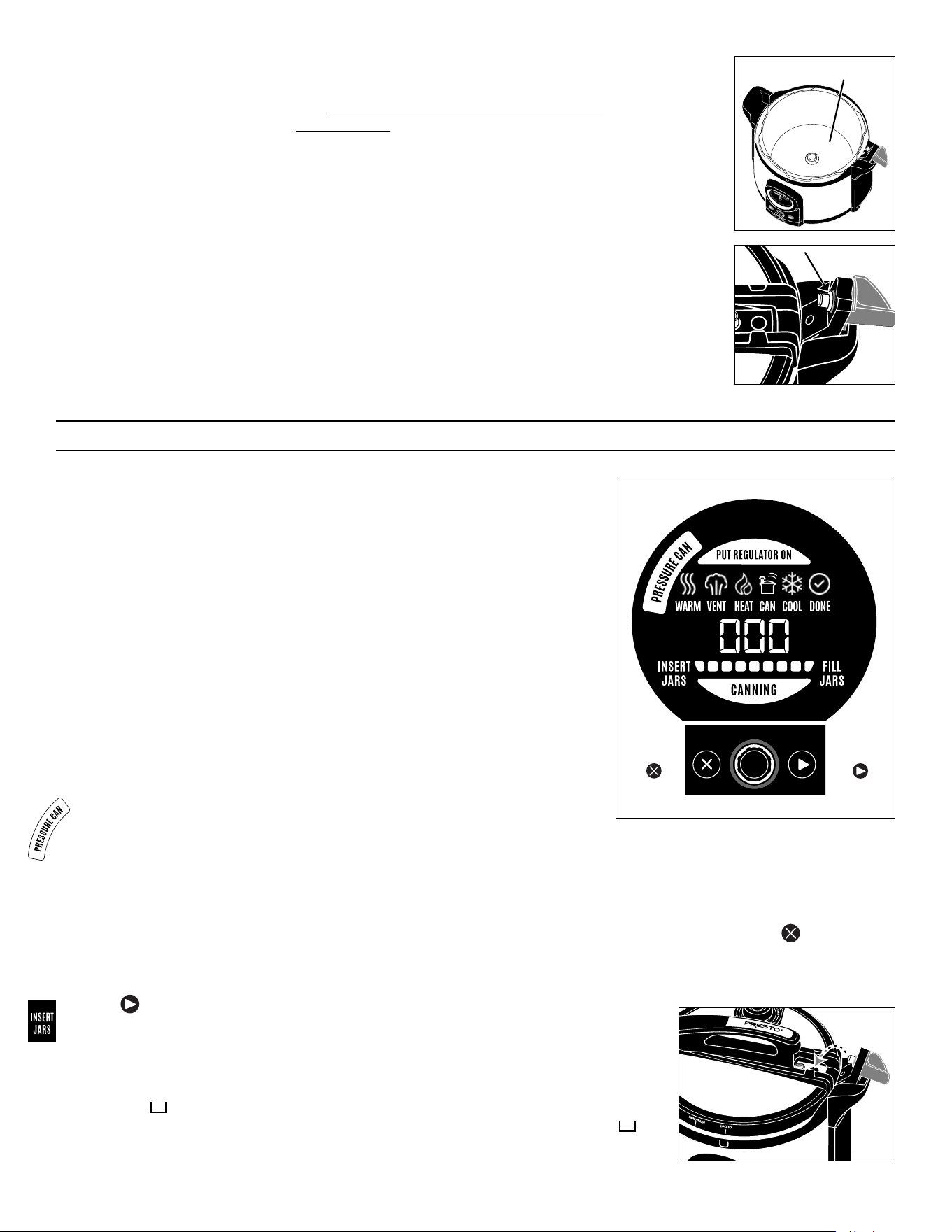
5. Attach the power cord to the canner body, making sure to fully insert it in the
receptacle. Then plug into a 120VAC wall outlet. The default icon PRESSURE
CAN will flash in the display window (Fig. L).
Press the control knob to select the pressure can mode; the default time 0I0 (10 minutes) will light up. The PRESSURE CAN icon
will remain illuminated for the duration of the canning process.
6. Rotate the knob to adjust the time for the specific canning recipe and jar size being used. The time adjusts in 5-minute increments
up to 180 minutes. Important: Verify you have set the right program and time.
Note: If the BOILING WATER CAN program is accidentally selected, or the wrong time is entered, press and hold for 3 seconds.
The PRESSURE CAN icon will flash. Press the control knob and repeat step 6.
II. Jar Warming
7. Press . INSERT JARS will light up. Fill the jars half full with water and place them on
the canner rack. Tip: Use hot tap water to speed the warming process.
8. Remove the regulator by pulling it firmly from the canner cover. It will not be needed
until step 14 of the venting phase.
9. Place the cover on the body, aligning the INSTALL/REMOVE vertical mark on the cover
within the mark on the body (Fig. D, page 3). Rotate the cover clockwise until it stops.
The canner cover is properly installed when the LOCKED vertical mark is within the
mark on the canner body (Fig. M).
Fig. J
Heating plate
Fig. K
Fig. L
Pressure Canning Display Icons
Control knob
ADVANCE
CANCEL
Fig. M
7
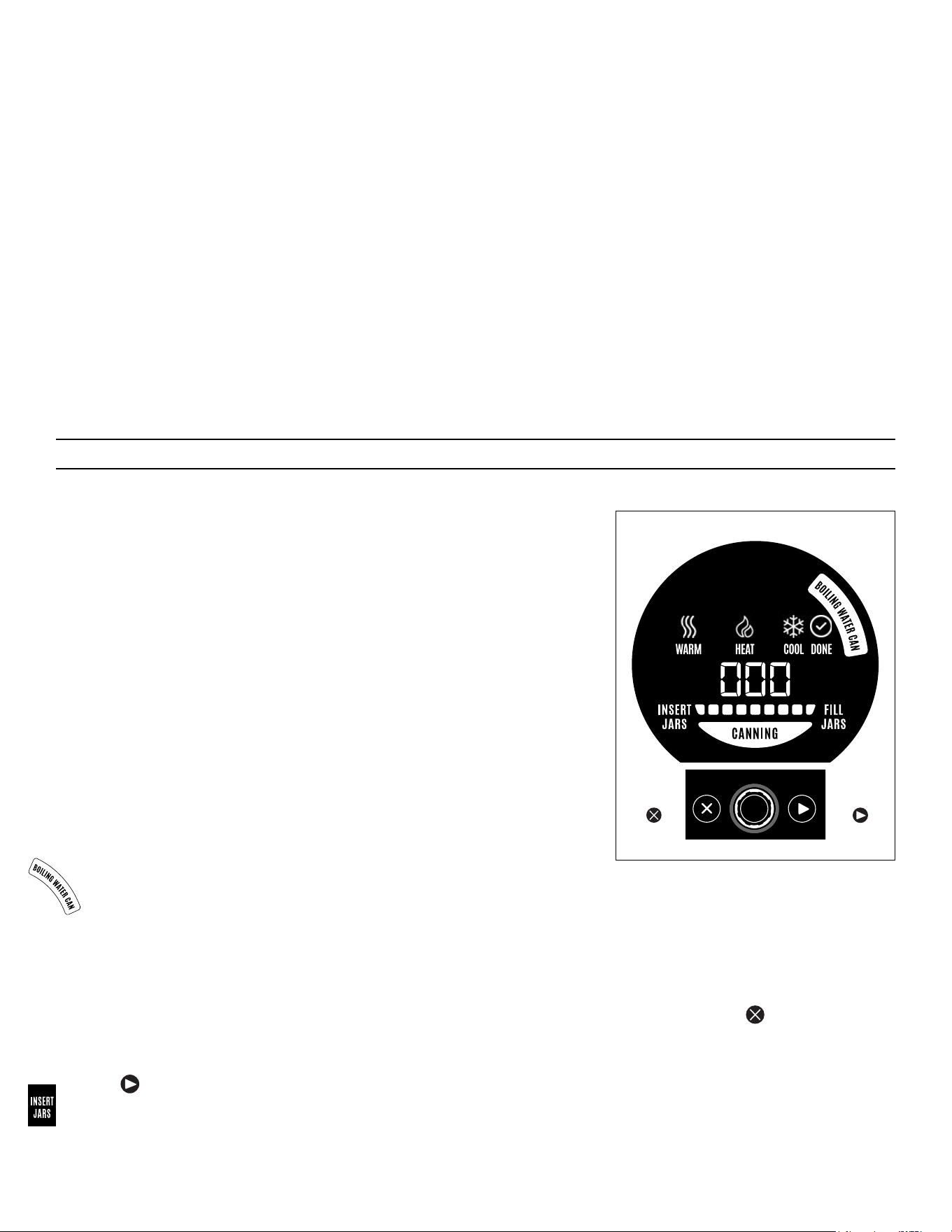
Lock the cover on by first lowering the temperature sensor arm and inserting the sensor into its
hole in the cover (Fig. M, page 6). It may be necessary to rotate the cover slightly so the hole aligns
with the sensor. Then, grasp the green latch and, using a slight downward pressure, turn the latch
clockwise until it is aligned with the handle (Fig. N).
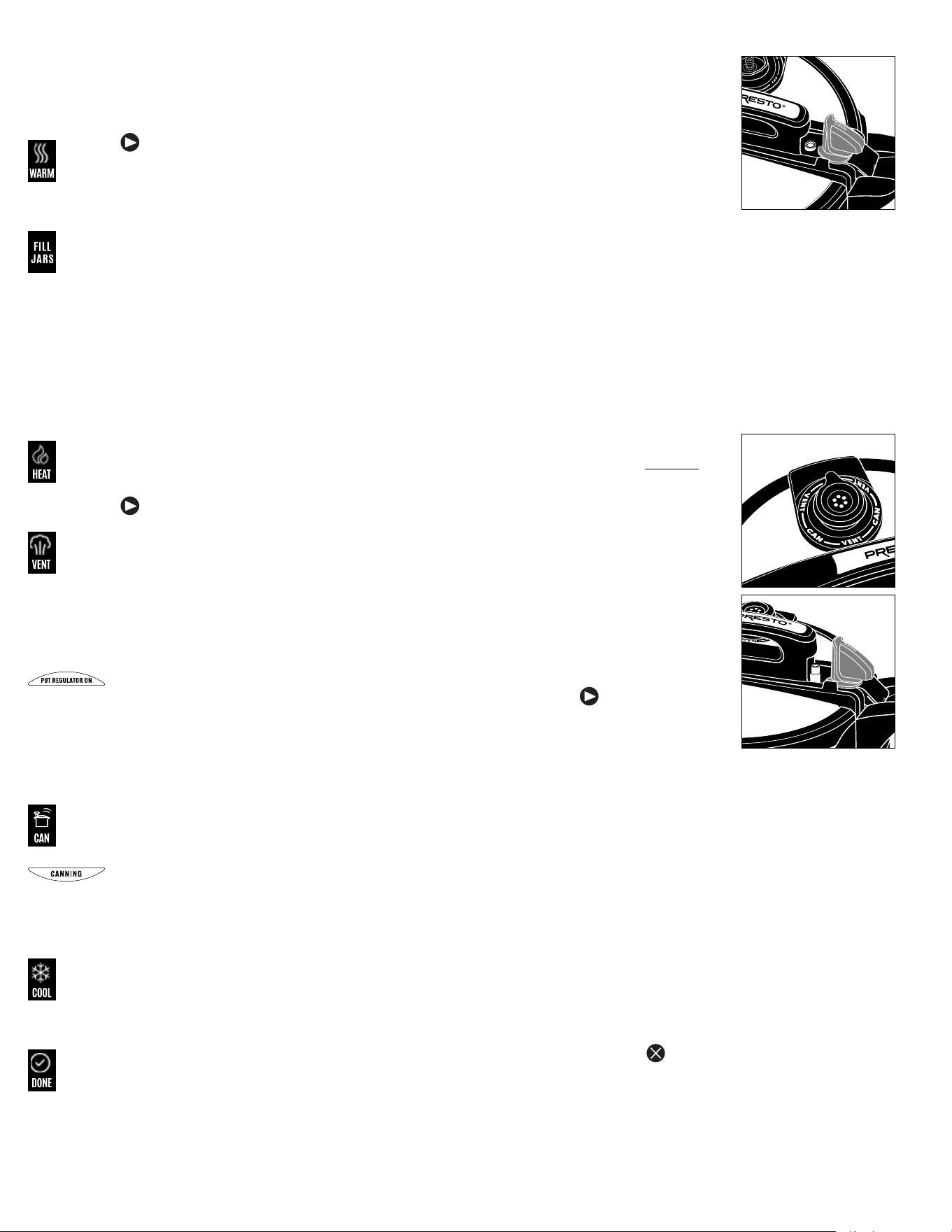
10. Press . WARM will light up and the progress bar will begin scrolling from left to right, indicating
the unit is heating. Jar warming will take about 20 minutes. During this time, complete any necessary
food preparation.
III. Fill Jars
11. When the canner beeps twice and FILL JARS lights up, the jars are preheated and ready for filling. The canner will continue to
keep the jars warm until you are ready to fill them. Unlock the green latch and lift the sensor arm. Then unlock and remove the
canner cover. Lift the cover toward you to keep any steam away from you.
Remove one jar at a time from the canner; discard the water from the jar and then immediately fill it with food and liquid,
according to the specific recipe. Remove air bubbles by moving a clean, nonmetallic spatula around the jar. Clean jar rim with a
damp cloth. Center flat lid on rim of jar, making sure sealing compound is touching glass.
Position a band over the lid and, using fingertips, screw onto the jar just until resistance is met. Do not overtighten as air must
release from the jars during processing and cooling. Place the jar on the canning rack promptly after filling. Repeat this procedure
for each jar.
IV. Venting
12. Place the cover back on the canner and lock it on. Lower the sensor arm and turn the green latch
clockwise, following the instructions in step 9, page 6. Important: Confirm the regulator is not on
the cover.
Press and HEAT will light up.
13. Once the proper temperature is reached, the canner will proceed to the vent phase; VENT and 0I0 will
light up. The venting timer will begin counting down. During venting, air/steam will release from the
vent pipe and air vent/cover lock. This will be noticeable.
Throughout the venting and canning phases you will hear boiling. Depending on the number and size
of the jars, the air vent/cover lock may lift during venting. The smaller the load, the more likely the
air vent/cover lock will lift.
14. When the time expires, the unit will start beeping and PUT REGULATOR ON will light up. Using a pot
holder or silicone cooking glove, place the regulator on the vent pipe and push it down to snap
it in place. Point the regulator lever to any of the CAN positions (Fig. O). Press to advance to the
canning phase. The beeping will stop.
If the air vent/cover lock did not lift during venting, air/steam will continue to release from the air
vent/cover lock until it lifts (Fig. P).
V. Canning
15. CAN will light up and the processing time programmed in step 6 will appear in the display. The progress bar will continue to scroll
as the canner heats.
16. Once the required canning temperature is reached, the unit will beep twice and CANNING will light up. The canner is now
processing and the timer will start to count down. The progress bar will stop scrolling and begin to light up in segments,
increasing in length as the processing time counts down (e.g., if 15 minutes of a 20 minute processing time have elapsed, 75% of
the bars will be illuminated).
VI. Cooling
17. When the processing time expires, the canner will beep 4 times and COOL will light up. This is the final canning phase. The length
of the cool-down period will depend on the canner load and may take about 1½ hours. 0I0 will light up in the display and the unit
will start to count down. The progress bar will scroll from right to left to indicate the unit is cooling.
VII. Done
18. When the time expires, the unit will beep 10 times and DONE will light up. Press and hold for 3 seconds. If the air vent/cover
lock remains in the up position when the display indicates DONE, wait for it to drop. Unlock the green latch and lift the sensor
arm. Then unlock and remove the canner cover. Lift the cover toward you to keep any steam away from you.
19. Using a jar lifter, remove jars by lifting them straight up. Be careful not to tilt the jars, which causes liquid to siphon out. Place
jars upright on a board or dry towel, away from drafts. Do not retighten bands. Allow jars to cool naturally. Check seals no earlier
than 12 hours, but no later than 24 hours. See page 5 for “After Processing” information.
Fig. N
Fig. P
Fig. O

8
20. NOTICE: When processing consecutive batches, before warming the next batch of jars, allow the water in the canner to cool or
replace with fresh water. Placing jars in hot water may cause the jars to break. If reusing the water, check the water level in the
canner. Add water, if necessary, to keep water at the 3-quart mark (Fig. A, page 2).
21. To can additional jars, repeat steps 6–19.
22. When canning is complete, unplug the cord from the wall outlet and then from the canner base. Allow canner to cool completely,
pour out water from removable pot, and clean according to the instructions on page 24.
Pressure Canning Tomatoes and Tomato Products
Tomatoes and tomato products may be safely processed using the pressure canning method (instructions start below) or boiling water
method (instructions start on page 15). However, the pressure canning method may result in a more nutritious canned product for some
tomato products.
Acidifying Tomatoes and Tomato Products
Tomatoes have a pH close to 4.6, which means it is necessary to take precautions to can them safely. First, carefully choose the
tomatoes for canning. Use only tomatoes that are disease-free, preferably vine-ripened, and firm.
Second, an acid must be added to tomatoes whether they are processed using the boiling water method or pressure canning method. To
ensure the safety of whole, crushed, or juiced tomatoes, add 1 tablespoon bottled lemon juice (not natural juice) or ¼ teaspoon citric
acid per pint jar; for quarts, add 2 tablespoons bottled lemon juice or ½ teaspoon citric acid.
Salt
Tomatoes and tomato products may be canned with or without salt. Salt is used only for flavor, as it is not used in a large enough
quantity to prevent spoilage. If using salt, use only canning or pickling salt. Table salt contains anti-caking agents that may cause
cloudiness in the liquid inside the jars. The recommended amount of salt is ½ teaspoon for each pint jar, 1 teaspoon for each quart jar.
Canning Recipes: Tomatoes
Tomatoes, whole or halved (packed in water)
Wash smooth, rm, ripe tomatoes. Loosen skins by dipping tomatoes 1 minute in boiling water, then in cold water. Peel and remove
core. Leave whole or halve, or, if using large tomatoes, quarter.
Hot Pack: Place prepared tomatoes in a large pot and add just enough water to cover them. Bring to a boil and boil gently for
5 minutes. Add bottled lemon juice or citric acid to hot jars (see above). Add salt if using (see above). Pack hot tomatoes
in hot jars, leaving ½-inch headspace. Fill jars with hot cooking liquid, leaving ½-inch headspace. Remove air bubbles.
Clean jar rims. Position lids and secure with bands.
Raw Pack: Add bottled lemon juice or citric acid to hot jars (see above). Add salt if using (see above). Pack prepared tomatoes in
hot jars, leaving ½-inch headspace. Fill hot jars with boiling water, leaving ½-inch headspace. Remove air bubbles.
Clean jar rims. Position lids and secure with bands.
Pressure canning: Process pints and quarts 10 minutes.
Tomatoes, whole or halved (packed raw without added liquid)
Wash smooth, rm, ripe tomatoes. Loosen skins by dipping tomatoes 1 minute in boiling water, then in cold water. Peel and remove
core. Leave whole or halve. Add bottled lemon juice or citric acid to hot jars (see above). Add salt if using (see above). Fill jars
with raw tomatoes, pressing until spaces between them ll with juice. Leave ½-inch headspace. Remove air bubbles. Clean jar rims.
Position lids and secure with bands.
Pressure canning: Process pints and quarts 25 minutes.
Tomato Juice
Wash ripe, juicy tomatoes. Remove stem ends. To prevent juice from separating, quickly cut about 1 pound of tomatoes into quarters
and put directly into a large pot. Heat immediately to boiling while crushing. Continue to slowly add and crush freshly cut tomato
quarters to the boiling mixture. Make sure the mixture boils constantly and vigorously while adding more tomatoes. Continue until the
pot is three-quarters full. Simmer 5 minutes.
If juice separation is not a concern, simply slice or quarter tomatoes into a large pot. Crush, heat, and simmer for 5 minutes before
juicing.
Press heated juice through a sieve or food mill to remove skins and seeds. Heat juice again to boiling.
Add bottled lemon juice or citric acid to hot jars (see above). Add salt if using (see above). Fill hot jars with hot tomato juice, leaving
½-inch headspace. Remove air bubbles. Clean jar rims. Position lids and secure with bands.
Pressure canning: Process pints and quarts 15 minutes.

9
Tomato Sauce
Prepare and press as for making tomato juice (page 8). Heat in a large pot until sauce reaches preferred consistency. Simmer until
volume is reduced by about one-third for thin sauce or by one-half for thick sauce. Add bottled lemon juice or citric acid to hot jars
(page 8). Add salt if using (page 8). Pour hot sauce into hot jars, leaving ½-inch headspace. Remove air bubbles. Clean jar rims.
Position lids and secure with bands.
Pressure canning: Process pints and quarts 15 minutes.
Salsa
Process salsa using the boiling water method. Refer to page 20 for tested canning recipe.
Spaghetti Sauce without Meat
30 pounds tomatoes
1 cup chopped onion
1 cup chopped celery or green pepper
1 pound fresh mushrooms, sliced (optional)
5 cloves garlic, minced
¼ cup vegetable oil
¼ cup packed brown sugar
4 tablespoons dried parsley
2 tablespoons dried oregano
4½ teaspoons salt
2 teaspoons black pepper
Note: Do not increase the proportion of onion, pepper, or mushrooms.
Wash tomatoes and dip in boiling water for 30–60 seconds or until skins split. Dip in cold water and slip o skins. Remove cores and
quarter tomatoes. Boil 20 minutes, uncovered, in a large pot. Put through food mill or sieve.
Sauté onion, celery or pepper, mushrooms (if using), and garlic in vegetable oil until tender. Combine vegetables, tomatoes, sugar,
parsley, oregano, salt, and pepper. Bring to a boil. Simmer, uncovered, stirring frequently until thick enough for serving. At this time
the initial volume will have been reduced by nearly one-half.
Fill hot jars with hot sauce, leaving 1-inch headspace. Remove air bubbles. Clean jar rims. Position lids and secure with bands.
Yield: about 9 pints
Pressure canning: Process pints 20 minutes and quarts 25 minutes.
Spaghetti Sauce with Meat
30 pounds tomatoes
2½ pounds ground beef or sausage
1 cup chopped onion
1 cup chopped celery or green pepper
1 pound fresh mushrooms, sliced (optional)
5 cloves garlic, minced
¼ cup packed brown sugar
4 tablespoons dried parsley
2 tablespoons dried oregano
4½ teaspoons salt
2 teaspoons black pepper
Note: Do not increase the proportion of onion, pepper, or mushrooms.
Wash tomatoes and dip in boiling water for 30–60 seconds or until skins split. Dip in cold water and slip o skins. Remove cores and
quarter tomatoes. Boil 20 minutes, uncovered, in a large pot. Put through food mill or sieve.
Brown beef or sausage. Add onion, celery or green pepper, mushrooms (if using), and garlic. Cook until vegetables are tender.
Combine with tomatoes in large pot. Add sugar, parsley, oregano, salt, and pepper. Bring to a boil. Simmer, uncovered, stirring
frequently until thick enough for serving. At this time the initial volume will have been reduced by nearly one-half.
Fill hot jars with hot sauce, leaving 1-inch headspace. Remove air bubbles. Clean jar rims. Position lids and secure with bands.
Yield: about 9 pints
Pressure canning: Process pints 60 minutes and quarts 70 minutes.

10
Pressure Canning Vegetables
Pressure canning is the only safe method for canning vegetables. Young, tender, fresh, and slightly immature vegetables are
better for canning than those which are overripe. As a rule, vegetables are best when canned immediately after picking, since flavor
decreases upon standing and often unpleasant color changes take place.
Avoid bruising vegetables because spoilage organisms grow more rapidly on bruised vegetables than on those that are unblemished.
Wash and prepare garden fresh vegetables as you would for cooking. When packing vegetables, always leave 1-inch headspace (or
more if directed in recipe) in hot Mason jars.
To hot pack vegetables, precook in boiling water until heated through. Pack precooked vegetables into hot jars and cover with boiling
water. Whenever possible, the precooking water should be used as liquid to cover the vegetables after packing into jars. However,
there are a few vegetables, such as greens and asparagus, which make the cooking water bitter and undesirable to use.
To raw pack vegetables, simply place the prepared vegetables into hot jars and cover with boiling water.
Salt
Vegetables may be processed with or without salt. Salt is used only for flavor, as it is not used in a large enough quantity to prevent
spoilage. If using salt, use only canning or pickling salt. Table salt contains anti-caking agents that may cause cloudiness in the liquid
inside the jars. The recommended amount of salt is ½ teaspoon for each pint jar, 1 teaspoon for each quart jar.
Canning Recipes: Vegetables
Asparagus
Wash and drain asparagus. Remove tough ends and scales. Rinse. Leave asparagus whole or cut into pieces.
Hot Pack: Cover asparagus with boiling water and boil 2–3 minutes. Pack hot asparagus loosely in hot jars, leaving 1-inch
headspace.
Raw Pack: Pack raw asparagus tightly in hot jars, leaving 1-inch headspace.
Add salt if using (see above). Cover with boiling water, leaving 1-inch headspace. Remove air bubbles. Clean jar rims. Position lids
and secure with bands.
Pressure canning: Process pints 30 minutes and quarts 40 minutes.
Beans or Peas, dry
Sort out and discard any discolored beans. Rehydrate beans or peas using one of the following methods:
• Place dry beans or peas in a large pot and cover with water. Soak 12–18 hours in a cool place. Then drain.
• Cover beans with boiling water in a large pot. Boil 2 minutes, remove from heat, and soak 1 hour. Then drain.
Hot Pack: Cover beans soaked by either method with fresh water and boil 30 minutes. Add salt to hot jars, if using (see above).
Fill jars with beans or peas and cooking water, leaving 1-inch headspace. Remove air bubbles. Clean jar rims. Position
lids and secure with bands.
Pressure canning: Process pints 75 minutes and quarts 90 minutes.
Beans, fresh lima
Shell and wash young, tender beans thoroughly.
Hot Pack: Cover beans with boiling water and bring to a boil. Boil 3 minutes. Pack hot beans loosely in hot jars, leaving 1-inch
headspace.
Raw Pack: Pack raw lima beans loosely in hot jars, leaving 1-inch headspace in pint jars. For quarts, leave 1½-inch headspace if
beans are small and 1¼-inch headspace if beans are large.
Add salt if using (see above). Cover with boiling water, leaving 1-inch headspace. Remove air bubbles. Clean jar rims. Position lids
and secure with bands.
Pressure canning: Process pints 40 minutes and quarts 50 minutes.
Beans (green, wax, and Italian)
Wash young, tender beans thoroughly. Remove stem and blossom ends or any strings. Leave whole or cut into 1-inch pieces.
Hot Pack: Cover beans with boiling water and boil 5 minutes. Pack hot beans loosely in hot jars, leaving 1-inch headspace.
Raw Pack: Pack raw beans tightly in hot jars, leaving 1-inch headspace.
Add salt if using (see above). Cover with boiling water, leaving 1-inch headspace. Remove air bubbles. Clean jar rims. Position lids
and secure with bands.
Pressure canning: Process pints 20 minutes and quarts 25 minutes.

11
Beets
Trim tops of young, tender beets, leaving 1–2 inches of stem and root to reduce bleeding of color. Wash thoroughly.
Hot Pack: Cover beets with boiling water and boil 15–25 minutes or until skins slip off easily. Remove skins, stems, and roots.
Small beets may be left whole. Cut medium or large beets into ½-inch cubes or slices; halve or quarter very large slices.
Pack hot beets in hot jars, leaving 1-inch headspace.
Add salt if using (page 10). Cover with boiling water, leaving 1-inch headspace. Remove air bubbles. Clean jar rims. Position lids and
secure with bands.
Pressure canning: Process pints 30 minutes and quarts 35 minutes.
Carrots
Wash thoroughly and scrape young, tender carrots. Carrots may be left whole, sliced, or diced.
Hot Pack: Cover carrots with boiling water, bring to a boil, and simmer 5 minutes. Pack hot carrots in hot jars, leaving 1-inch
headspace.
Raw Pack: Pack raw carrots tightly in hot jars, leaving 1-inch headspace.
Add salt if using (page 10). Cover with boiling water, leaving 1-inch headspace. Remove air bubbles. Clean jar rims. Position lids and
secure with bands.
Pressure canning: Process pints 25 minutes and quarts 30 minutes.
Corn, whole kernel
Husk and remove silk from young, tender, freshly picked corn; wash ears. Blanch 3 minutes in boiling water. Cut corn from cob at
about three-fourths the depth of the kernel. Do not scrape cob.
Hot Pack: For each quart of corn, add 1 cup boiling water. Bring to a boil and simmer 5 minutes. Pack hot corn loosely in hot jars,
leaving 1-inch headspace.
Raw Pack: Pack raw corn loosely in hot jars, leaving 1-inch headspace.
Add salt if using (page 10). Cover with boiling water, leaving 1-inch headspace. Remove air bubbles. Clean jar rims. Position lids and
secure with bands.
Pressure canning: Process pints 55 minutes and quarts 85 minutes.
Greens
Sort young, tender, freshly picked greens; discard wilted or tough leaves, stems, and roots. Wash greens thoroughly.
Hot Pack: Blanch 1 pound of greens at a time, until well wilted (about 3–5 minutes). Pack hot greens loosely in hot jars, leaving
1-inch headspace.
Add salt if using (page 10). Cover with fresh boiling water, leaving 1-inch headspace. Remove air bubbles. Clean jar rims. Position
lids and secure with bands.
Pressure canning: Process pints 70 minutes and quarts 90 minutes.
Mushrooms
Trim stems and discolored parts of mushrooms. Soak mushrooms in cold water for 10 minutes to remove soil. Wash in clean water.
Leave small mushrooms whole; cut larger ones in halves or quarters.
Hot Pack: Cover mushrooms with water and boil 5 minutes. Pack hot mushrooms in hot jars, leaving 1-inch headspace. For better
color, add ⅛ teaspoon of ascorbic acid per pint.
Add salt if using (page 10). Cover with boiling water, leaving 1-inch headspace. Remove air bubbles. Clean jar rims. Position lids and
secure with bands.
Pressure canning: Process half-pints and pints 45 minutes.
Okra
Wash and trim young, tender okra pods. Remove stem, without cutting into pods if okra is to be canned whole. If preferred, slice okra
into 1-inch pieces.
Hot Pack: Cover okra with hot water and boil 2 minutes. Pack hot okra in hot jars, leaving 1-inch headspace.
Add salt if using (page 10). Cover with boiling water, leaving 1-inch headspace. Remove air bubbles. Clean jar rims. Position lids and
secure with bands.
Pressure canning: Process pints 25 minutes and quarts 40 minutes.

12
Peas, green
Wash and shell young, tender freshly picked green peas. Rinse.
Hot Pack: Cover peas with boiling water and bring to a boil. Boil 2 minutes. Pack hot peas loosely in hot jars, leaving 1-inch
headspace. Do not shake or press down.
Raw Pack: Pack peas loosely in hot jars, leaving 1-inch headspace. Do not shake or press down.
Add salt if using (page 10). Cover with boiling water, leaving 1-inch headspace. Remove air bubbles. Clean jar rims. Position lids and
secure with bands.
Pressure canning: Process pints and quarts 40 minutes.
Peppers, hot or sweet (including bell, chile, jalapeño, and pimiento)
Preparation of chile peppers: Cut two or four slits in each pepper and blister using one of the following methods. Allow peppers to
cool. Place in a pan and cover with a damp cloth. After several minutes, peel peppers. Remove stems and seeds.
• Oven or broiler method: Place chile peppers in a 400°F oven or broiler for 6–8 minutes until skins blister.
• Range-top method: Cover hot burner, either gas or electric, with heavy wire mesh. Place chiles on wire mesh for several minutes
until skins blister.
Preparation of other peppers: Remove stems and seeds; blanch 3 minutes.
Hot Pack: Small peppers may be left whole. Large peppers may be quartered. Pack peppers loosely in hot jars, leaving 1-inch
headspace.
Add salt if using (page 10). Cover with boiling water, leaving 1-inch headspace. Remove air bubbles. Clean jar rims. Position lids and
secure with bands.
Pressure canning: Process pints 35 minutes.
Potatoes, sweet
Wash small to medium size sweet potatoes.
Hot Pack: Boil or steam sweet potatoes just until partially soft (15–20 minutes). Remove skins and cut into pieces of uniform
size. CAUTION! In accordance with USDA guidelines, do not mash or puree potatoes as processing time may not be
adequate for mashed or pureed product. Pack hot sweet potatoes in hot jars, leaving 1-inch headspace.
Add salt if using (page 10). Cover with boiling water, leaving 1-inch headspace. Remove air bubbles. Clean jar rims. Position lids and
secure with bands.
Pressure canning: Process pints 65 minutes and quarts 90 minutes.
Potatoes, white
Wash, peel, and rinse new potatoes 1–2 inches in diameter. If preferred, cut into ½-inch cubes. Place potatoes in an ascorbic acid
solution (1 teaspoon ascorbic acid to 1 gallon water) to prevent darkening. Drain.
Hot Pack: Cover potatoes with hot water and bring to a boil. Boil whole potatoes for 10 minutes, cubes for 2 minutes. Pack hot
potatoes in hot jars, leaving 1-inch headspace.
Add salt if using (page 10). Cover with boiling water, leaving 1-inch headspace. Remove air bubbles. Clean jar rims. Position lids and
secure with bands.
Pressure canning: Process pints 35 minutes and quarts 40 minutes.
Squash, pumpkin and winter
Wash and remove seeds from small size pumpkins or squash. Cut into 1-inch slices and peel. Cut esh into 1-inch cubes.
Hot Pack: Boil cubes in water for 2 minutes. CAUTION! In accordance with USDA guidelines, do not mash or puree as processing
time may not be adequate for pureed product. Pack hot pumpkin or squash cubes loosely in hot jars, leaving 1-inch
headspace.
Add salt if using (page 10). Cover with boiling water, leaving 1-inch headspace. Remove air bubbles. Clean jar rims. Position lids and
secure with bands.
Pressure canning: Process pints 55 minutes and quarts 90 minutes.

13
Pressure Canning Meat, Game, and Poultry
Pressure canning is the only safe method for canning meat, game, and poultry.
Meat, game, and poultry should be handled carefully to avoid contamination. Keep it as cool as possible during preparation for
canning, handle rapidly, and process as soon as it is packed.
Use good quality product that has been trimmed of gristle, fat, and bruised spots. The hot pack is recommended for the best liquid
cover and quality during storage. Meat and game should be precooked until rare by broiling, boiling, or frying. Poultry should be
precooked by baking, boiling, or steaming until medium done. Do not brown meat with flour or add flour to broth.
To make broth, place bony pieces in a large pot and cover with cold water. Simmer until meat is tender. Discard fat. Add boiling broth
to hot jars packed with precooked meat or poultry.
Salt
Meat, game, and poultry may be canned with or without salt. Salt is used only for flavor, as it is not used in a large enough quantity to
prevent spoilage. If using salt, use only canning or pickling salt. Table salt contains anti-caking agents that may cause cloudiness in the
liquid inside the jars. The recommended amount of salt is ½ teaspoon for each pint jar, 1 teaspoon for each quart jar.
Canning Recipes: Meat
Cut-Up Meat (strips, cubes, or chunks of bear, beef, pork, lamb, veal, and venison)
Remove excess fat. Soak strong-avored wild meats for 1 hour in brine water containing 1 tablespoon of salt per quart of water. Rinse.
Remove large bones and cut into preferred pieces.
Hot Pack: Precook meat until rare by roasting, stewing, or browning in a small amount of oil. Pack hot meat loosely in hot
jars, leaving 1-inch headspace. Add salt if using (see above). Cover meat with boiling broth, water, or tomato juice
(especially with wild game), leaving 1-inch headspace. Remove air bubbles. Clean jar rims. Position lids and secure
with bands.
Raw Pack: Add salt if using (see above) to hot jars. Pack raw meat loosely in hot jars, leaving 1-inch headspace. DO NOT ADD
LIQUID. Clean jar rims. Position lids and secure with bands.
Pressure canning: Process pints 75 minutes and quarts 90 minutes.
Ground Meat (bear, beef, pork, lamb, veal, and venison)
Grind fresh meat in a food processor or meat grinder. For venison, add one part high quality pork fat to three or four parts venison
before grinding. For sausage, use freshly made sausage seasoned with salt and cayenne pepper; do not use sage as it may cause a bitter
avor.
Hot Pack: Shape ground meat or sausage into patties or balls. Cook until lightly browned. Ground meat may also be cooked
without shaping. Drain to remove excess fat. Pack hot meat loosely in hot jars, leaving 1-inch headspace. Add salt
if using (see above). Cover meat with boiling water, broth, or tomato juice, leaving 1-inch headspace. Remove air
bubbles. Clean jar rims. Position lids and secure with bands.
Pressure canning: Process pints 75 minutes and quarts 90 minutes.
Canning Recipes: Poultry and Rabbit
Chicken, Duck, Goose, Turkey
Cut poultry into serving size pieces. If preferred, remove bone.
Hot Pack: Precook poultry until almost done by baking, boiling, or steaming. Pack hot poultry loosely in hot jars, leaving 1¼-inch
headspace. Add salt if using (see above). Cover poultry with hot broth, leaving 1¼-inch headspace. Remove air bubbles.
Clean jar rims. Position lids and secure with bands.
Raw Pack: Add salt if using (see above) to hot jars. Pack raw poultry loosely in hot jars, leaving 1¼-inch headspace. DO NOT
ADD LIQUID. Clean jar rims. Position lids and secure with bands.
With Bone Without Bone
Pressure canning: Process pints 65 minutes 75 minutes
Process quarts 75 minutes 90 minutes
Rabbit
Soak dressed rabbits 1 hour in water containing 1 tablespoon of salt per quart of water. Rinse. Use preparation procedures and
processing times for poultry, omitting salt.

14
Pressure Canning Fish and Seafood
Pressure canning is the only safe method for canning fish and seafood. Only fresh fish should be canned and these should be bled
and thoroughly cleaned of all viscera and membranes when caught, or as soon as possible. To prevent spoilage, keep fish and shellfish
refrigerated or on ice to maintain a temperature of 40°F or below.
Canning Recipes: Fish and Seafood
Clams, whole or minced
Keep clams on ice until ready to can. Scrub shells thoroughly and rinse.
Hot Pack: Steam 5 minutes and open. Remove clam meat. Collect and save clam juice. Wash clam meat in salted water using
1½–3 tablespoons of salt per gallon of water. Rinse. Cover clam meat with boiling water containing 2 tablespoons of
lemon juice or ½ teaspoon of citric acid per gallon. Boil 2 minutes and drain. Heat reserved clam juice to boiling. Pack
clams loosely in hot jars, leaving 1-inch headspace. Add hot clam juice and, if needed, boiling water, leaving 1-inch
headspace. Remove air bubbles. Clean jar rims. Position lids and secure with bands.
Pressure canning: Process half-pints 60 minutes and pints 70 minutes.
Fish (salmon, trout, steelhead, and other sh except tuna)
Remove head, tail, and ns. Wash sh in cold water.
Raw Pack: Split fish lengthwise and then cut into lengths that fit the jar size being used. Bones can be left in and skin left on, if
preferred. For halibut, remove the bones and skin. Pack fish tightly in hot jars, leaving 1-inch headspace. Add
½ teaspoon canning salt to each half-pint jar, 1 teaspoon to each pint jar, if using. DO NOT ADD LIQUID. Clean jar
rims. Position lids and secure with bands.
Pressure canning: Process half-pints and pints 100 minutes.
Tuna
Remove viscera and clean sh thoroughly. Tuna may be canned either raw or precooked. Precooking removes most of the strong-
avored, natural oils.
Hot Pack: Place tuna belly-side down on a rack in the bottom of a large baking pan. Bake at 350°F for 1 hour. Refrigerate cooked
fish overnight to firm the meat. Remove skin. Cut meat away from bones; cut out and discard bone, fin bases, and dark
flesh. Quarter the pieces; cut quarters crosswise into lengths suitable for the jar size being used.
Add ½ teaspoon canning salt to each half-pint jar, 1 teaspoon to each pint jar, if using. Pack fish into hot jars, pressing
down gently to make a solid pack, leaving 1-inch headspace. Add water or oil to jars, leaving 1-inch headspace.
Remove air bubbles. Clean jar rims. Position lids and secure with bands.
Raw Pack: Remove skin. Separate the meat into quarters by cutting the meat away from bones. Cut out and discard bone, fin bases,
and dark flesh. Cut quarters crosswise into lengths suitable for the jar size being used. Add ½ teaspoon canning salt
to each half-pint jar, 1 teaspoon to each pint jar, if using. Pack fish into hot jars, pressing down gently to make a solid
pack, leaving 1-inch headspace. DO NOT ADD LIQUID. Clean jar rims. Position lids and secure with bands.
Pressure canning: Process half-pints and pints 100 minutes.
Pressure Canning Soups and Stocks
Pressure canning is the only safe method for canning soup and stock. Soup and soup stocks are quickly and easily canned. Soup
should always be cooked ready for serving, then poured into hot jars, leaving 1-inch headspace. Generally, vegetable soups are more
satisfactory if the stock and vegetables are canned separately and combined at the time of serving.
Canning Recipes: Soups and Stocks
Beef Stock
Saw or crack fresh trimmed beef bones to enhance extraction of avor. Rinse bones.
Hot Pack: Place bones in a large pot and cover with water. Cover pot and simmer 3–4 hours. Remove bones. Cool broth; skim off
and discard fat. Remove bits of meat from bones and add to broth, if preferred. Reheat broth to boiling. Fill hot jars with
hot broth, leaving 1-inch headspace. Remove air bubbles. Clean jar rims. Position lids and secure with bands.
Pressure canning: Process pints 20 minutes and quarts 25 minutes.
15
Chicken Stock
Hot Pack: Place large carcass bones in a large pot; add enough water to cover bones. Cover pot and simmer 30–45 minutes or
until meat can be easily removed from bones. Remove bones. Cool broth; skim off and discard fat. Remove bits of meat
from bones and add to broth, if preferred. Reheat broth to boiling. Fill hot jars with hot broth, leaving 1-inch headspace.
Remove air bubbles. Clean jar rims. Position lids and secure with bands.
Pressure canning: Process pints 20 minutes and quarts 25 minutes.
Soups (vegetable, dried bean or pea, meat, poultry, or seafood)
Choose your favorite vegetables, dried beans or peas, meat, poultry, or seafood ingredients for soup as long as those ingredients have
their own individual canning recommendations. Do not use ingredients for which there are no canning recommendations.
CAUTION! In accordance with USDA guidelines, do not add noodles or other pasta, rice, our, cream, milk, or other thickening agents
to home canned soups as the processing time may not be adequate.
Hot Pack: Prepare vegetables, meat, poultry, and seafood as described in the hot pack directions for the individual ingredients. If
dried beans or peas are used, they must be fully rehydrated before adding to other ingredients (page 10). Combine solid
ingredients with meat broth, tomatoes, or water to cover. Boil 5 minutes. Salt to taste, if preferred. Fill jars halfway with
solid ingredients and then add soup liquid, leaving 1-inch headspace. Remove air bubbles. Clean jar rims. Position lids
and secure with bands.
Pressure canning: Process pints 60 minutes and quarts 75 minutes. If soup contains seafood, process pints and quarts 100 minutes.
Boiling Water Canning
Your canner is designed for use as a boiling water canner to process half-pint and pint jars only. Do not use it for quart jars.
I. Getting Ready
1. Complete the steps on pages 5–6. Select canning recipe (pages 17–21) and gather
needed supplies.
2. Begin preparing the food that will be used for filling the jars in step 12.
Note: Any food that is described in a recipe as “Hot Pack” should be freshly
prepared or, if made in advance, reheated as instructed in the canning recipe.
3. Place the removable pot in the canner body. Put the canning rack in the
removable pot.
Note: Jars will be placed on the rack in step 8. If set directly on the bottom of the
removable pot, jars may break.
4. Pour water into the removable pot up to the bottom fill line (Fig. A, page 2).
Tips: Use hot tap water to shorten the time to heat the water. To prevent water
stains on jars, add 2 tablespoons of white vinegar to the water in the canner.
5. Attach the power cord to the canner body, making sure to fully insert it in the
receptacle. Then plug into a 120VAC wall outlet. The default icon PRESSURE
CAN will flash in the display window.
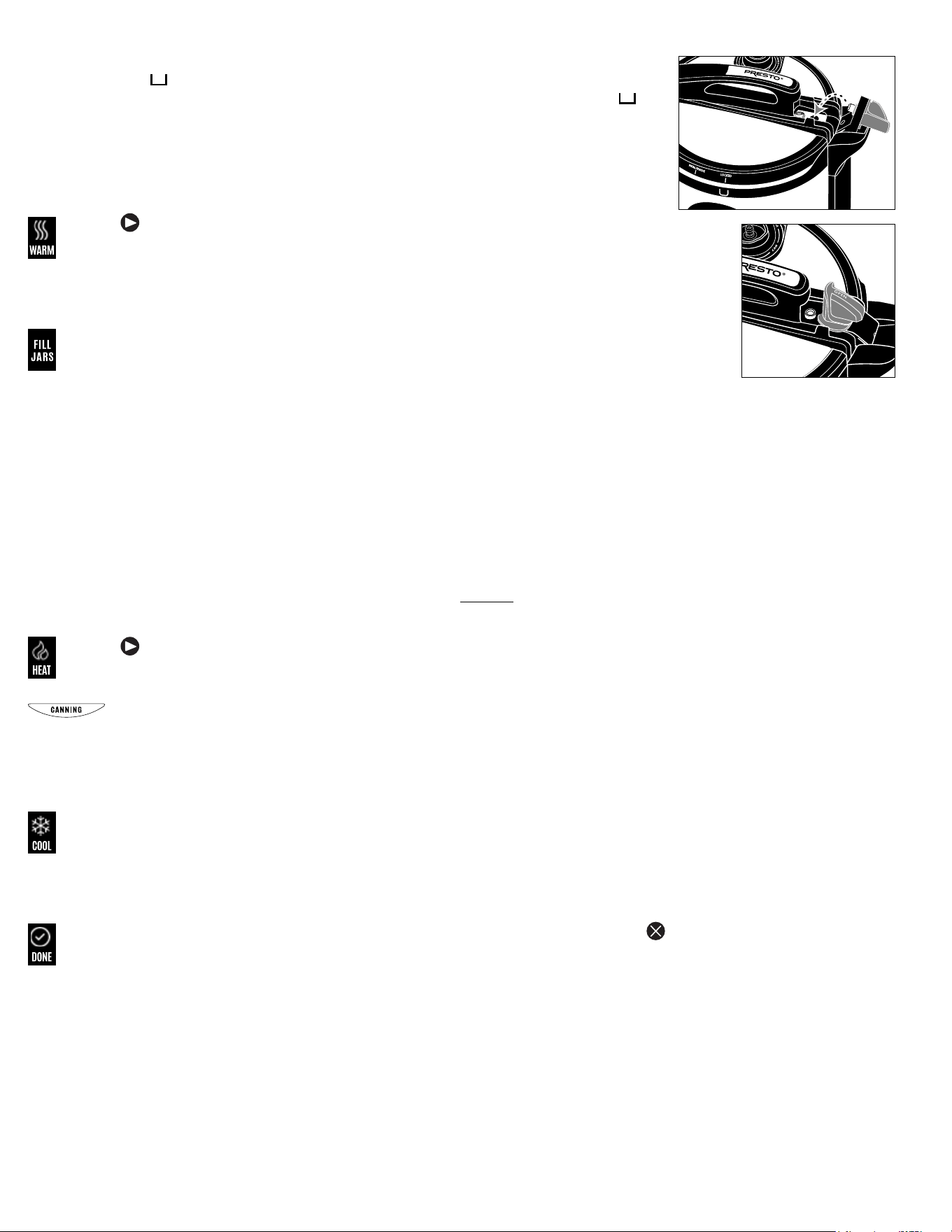
6. Slowly rotate the control knob until BOILING WATER CAN flashes in the display
(Fig. Q). Press the control knob to select the BOILING WATER CAN mode; the default time 005 (5 minutes) will light up. The
BOILING WATER CAN icon will remain illuminated for the duration of the canning process.
7. Rotate the knob to adjust the time for the specific boiling water canning recipe and jar size being used. The time adjusts in
5-minute increments up to 120 minutes.
Important: Verify you have set the right program and time. Make sure you have increased the processing time if you live at an
altitude above 1,000 feet.
Note: If the PRESSURE CAN program is accidentally selected or the wrong time is entered, press and hold for 3 seconds. Then
repeat steps 6 and 7.
II. Jar Warming
8. Press . INSERT JARS will light up. Fill the jars to be canned half full with water and place the jars on the canner rack. Tip: Use
hot tap water to speed the warming process.
9. Remove the regulator by pulling it firmly from the canner cover. Never use the regulator for boiling water canning.
Fig. Q
Boiling Water Canning Display Icons
Control knob
ADVANCE
CANCEL
16
10. Place the cover on the body, aligning the INSTALL/REMOVE vertical mark on the cover
within the mark on the body (Fig. D, page 3). Rotate the cover clockwise until it stops.
The canner cover is properly installed when the LOCKED vertical mark is within the
mark on the canner body (Fig. R).
Lock the cover on by first lowering the temperature sensor arm and inserting the sensor
into its hole in the cover (Fig. R). It may be necessary to rotate the cover slightly so the
hole aligns with the sensor. Then, grasp the green latch and, using a slight downward
pressure, turn the latch clockwise until it is aligned with the handle (Fig. S).
11. Press . WARM will light up and the progress bar will begin scrolling from left to right,
indicating the canner is heating. Jar warming will take about 20 minutes. During this time, complete
any necessary food preparation and heat at least 3 quarts of water to boiling in a large kettle for use
in step 13. More water will be needed if canner is not filled to jar capacity.
III. Fill Jars
12. When the canner beeps twice and FILL JARS lights up, the jars are preheated and ready for filling.
The canner will continue to keep the jars warm until you are ready to fill them. Unlock the green
latch and lift the sensor arm. Then unlock and remove the canner cover. Lift the cover toward you to
keep any steam away from you.
Remove one jar at a time from the canner; discard the water from the jar and then immediately fill it with food and liquid,
according to the specific recipe. Remove air bubbles by moving a clean, nonmetallic spatula around the jar. Clean jar rim with a
damp cloth. Center flat lid on rim of jar, making sure sealing compound is touching glass.
Position a band over the lid and, using fingertips, screw onto the jar just until resistance is met. Do not overtighten as air must
release from the jars during processing and cooling. Place the jar on the canning rack promptly after filling. Repeat this procedure
for each jar.
13. Pour the additional boiling water heated up in step 11 around the jars in the removable pot so the water level is at least 1 inch
above the jars.
14. Place the cover back on the canner and lock it on. Lower the sensor arm and turn the green latch clockwise, following the
instructions in step 10. Important: Verify that the regulator is not on the cover.
IV. Canning
15. Press . HEAT will light up and the processing time programmed in step 7 will appear in the display. The progress bar will
continue to scroll as the canner heats.
16. Once the required canning temperature is reached, the unit will beep twice and CANNING will light up. The canner is now
processing and the timer will start to count down. The progress bar will stop scrolling and begin to light up in segments,
increasing in length as the processing time counts down (e.g., if 15 minutes of a 20 minute processing time have elapsed, 75%
of the bars will be illuminated). During canning there will be a noticeable amount of air/steam venting from the vent pipe and air
vent/cover lock. You will also hear boiling.
V. Cooling
17. When the processing time expires, the canner will beep 4 times and COOL will light up. 005 will appear in the display and the
unit will begin counting down. The progress bar will scroll from right to left to indicate the unit is cooling. At this time, unlock
the green latch and lift the sensor arm. Then unlock and remove the canner cover.
CAUTION! To prevent burns, carefully lift the cover toward you to keep steam and bubbling water away from you.
VI. Done
18. When the time expires, the unit will beep 10 times and DONE will light up. Press and hold for 3 seconds.
19. Using a jar lifter, remove jars by lifting them straight up. Be careful not to tilt the jars, which causes liquid to siphon out. Place
jars upright on a board or dry towel, away from drafts. Do not retighten bands. Allow jars to cool naturally. Check seals no earlier
than 12 hours, but no later than 24 hours. See page 5 for “After Processing” information.
20. NOTICE: When processing consecutive batches, before warming the next batch of jars, allow the water in the canner to cool or
replace with fresh water. Placing jars in hot water may cause the jars to break. If reusing the water, check the water level in the
canner. Remove water in excess of the 3 quarts (Fig. A, page 2) to a large kettle. Use this water to cover the filled jars.
21. To can additional jars, repeat steps 6–19.
22. When canning is complete, unplug the cord from the wall outlet and then from the canner base. Allow canner to cool completely,
pour out water from removable pot, and clean according to the instructions on page 24.
Fig. S
Fig. R

17
Altitude Adjustments
When using the canner for boiling water canning at altitudes of 1,000 feet or below, process according to the specific recipe. When
canning at higher altitudes, process according to the following chart.
Altitude chart Boiling Water canning
Altitude Increase Processing time
1,001–3,000 ft. 5 minutes
3,001–6,000 ft. 10 minutes
6,001–8,000 ft. 15 minutes
Boiling Water Canning Fruits
Your canner is designed for use as a boiling water canner to process half-pint and pint jars only. Do not use it for quart jars. Select
firm, fully-ripened but not soft fruit. Do not can overripe foods.
Maintaining Color
Some fruits (apples, apricots, nectarines, peaches, and pears) tend to darken while they are being prepared. To prevent darkening, place
fruit in a solution of 3 grams (3,000 milligrams) ascorbic acid to 1 gallon of cold water. Ascorbic acid is available in different forms:
Pure Powdered Form: Use 1 teaspoon of pure powder, which weighs about 3 grams, per gallon of water.
Vitamin C Tablets: Buy 500 milligram tablets. Crush and dissolve 6 tablets per gallon of water.
Commercially Prepared Mixes of Ascorbic and Citric Acid: Available under different brand names. Use according to
manufacturer’s directions found on the package.
Canning Liquids
Although fruit has better color, shape, and flavor when it is canned with syrup, it may be canned in juices (such as apple, white grape,
or pineapple) or water.
White sugar is preferable to brown sugar for canning. Light corn syrup or honey may be used to replace up to one-half the sugar.
If you wish to use sugar substitutes, follow the package instructions. The amount of sugar desirable to use in preparing syrups will
depend upon the tartness of the fruit and on family preference. It should be remembered that fruit, when heated, releases some of its
juices which will dilute the syrup in proportion to the juiciness of the fruit.
Use the syrup chart as a guideline for preparing the syrup needed for your canning recipe. Syrup recipe may be doubled or tripled
depending on the packing method and amount of fruit being canned at one time.
Syrups for Canning Fruits
Combine sugar and water in a large pot. Bring to a boil and keep syrup hot while
preparing fruit. Use as directed in recipe.
Syrup Sugar Water Yield
Very Light ½ cup 4 cups 4½ cups
Light 1 cup 4 cups 4¾ cups
Medium 1¾ cups 4 cups 5 cups
Heavy 2¾ cups 4 cups 5⅓ cups
Canning Recipes: Fruits
Apples
Wash, peel, and core apples. Cut into ½-inch slices. Place apples in an ascorbic acid solution (see above) to prevent darkening during
preparation. Drain well.
Hot Pack: Add apples and syrup (see above), juice, or water to a large pot and bring to a boil. Boil for 5 minutes, stirring
occasionally to prevent scorching. Pack hot apples in hot jars, leaving ½-inch headspace. Cover apples with hot syrup,
juice, or water, leaving ½-inch headspace. Remove air bubbles. Clean jar rims. Position lids and secure with bands.
Boiling water canning: Process pints 20 minutes. For processing above 1,000 feet altitude, see above for recommended time.
Applesauce
Wash, peel, core, and slice apples. If preferred, place apple slices into ascorbic acid solution (see above) to prevent darkening. Drain
well. Place slices in a large pot. Add ½ cup water. Heat quickly until apples are tender, stirring occasionally to prevent scorching. Press
through food mill or sieve; if chunk style sauce is preferred, omit this step. If preferred, sweeten to taste. Reheat sauce to boiling. Pack
into hot jars, leaving ½-inch headspace. Remove air bubbles. Clean jar rims. Position lids and secure with bands.
Boiling water canning: Process pints 15 minutes. For processing above 1,000 feet altitude, see above for recommended time.

18
Apricots
Wash well-ripened, rm apricots. If peeled apricots are preferred, dip 1 minute in boiling water, then in cold water and peel. Cut in
halves and remove pits. Place apricots in an ascorbic acid solution (page 17) to prevent darkening during preparation. Drain well.
Hot Pack: Add apricots and syrup (page 17), juice, or water to a large pot and bring to a boil. Pack hot apricots, cut side down,
in hot jars, leaving ½-inch headspace. Cover with hot syrup, juice, or water, leaving ½-inch headspace. Remove air
bubbles. Clean jar rims. Position lids and secure with bands.
Boiling water canning: Process pints 20 minutes. For processing above 1,000 feet altitude, see page 17 for recommended time.
Raw Pack: Pack raw apricots, cut side down, in hot jars, leaving ½-inch headspace. Cover with hot syrup, juice, or water, leaving
½-inch headspace. Remove air bubbles. Clean jar rims. Position lids and secure with bands.
Boiling water canning: Process pints 25 minutes. For processing above 1,000 feet altitude, see page 17 for recommended time.
Berries (except strawberries)
Choose ripe, sweet berries with uniform color. Wash 1 or 2 quarts of berries at a time. Drain, cap, and stem if necessary.
Hot Pack: Use this method for firmer berries such as blueberries, currants, elderberries, gooseberries, and huckleberries. Heat
berries in a large pot with boiling water for 30 seconds and drain. Add ½ cup hot syrup (page 17), juice, or water to
hot jars. Pack hot berries into jars, leaving ½-inch headspace. Cover with hot syrup, juice, or water, leaving ½-inch
headspace. Remove air bubbles. Clean jar rims. Position lids and secure with bands.
Boiling water canning: Process pints 15 minutes. For processing above 1,000 feet altitude, see page 17 for recommended time.
Raw Pack: Use this method for softer berries such as raspberries and blackberries. Add ½ cup hot syrup (page 17), juice, or water
to hot jars. Pack raw berries into jars, leaving ½-inch headspace. Gently shake jars while filling to pack firmly without
crushing berries. Cover with hot syrup, juice, or water, leaving ½-inch headspace. Remove air bubbles. Clean jar rims.
Position lids and secure with bands.
Boiling water canning: Process pints 15 minutes. For processing above 1,000 feet altitude, see page 17 for recommended time.
Cherries
Stem and wash cherries. Remove pits, if preferred. If pitted, place cherries in an ascorbic acid solution (page 17) to prevent darkening
of the stem end. If canning whole cherries, prick each cherry with a clean needle to prevent splitting.
Hot Pack: Heat cherries in a large pot with ½ cup hot syrup (page 17), juice, or water per quart of cherries. Cover pot and bring to
a boil. Pack hot cherries and cooking liquid in hot jars, leaving ½-inch headspace. Remove air bubbles. Clean jar rims.
Position lids and secure with bands.
Boiling water canning: Process pints 15 minutes. For processing above 1,000 feet altitude, see page 17 for recommended time.
Nectarines and Peaches
Wash fully-ripened but not soft nectarines or peaches. For nectarines, the skin can be left on. For peaches, loosen skin by dipping them
1 minute in boiling water, then in cold water; peel. Cut fruit in halves and remove pits. Slice, if preferred. Place fruit in an ascorbic
acid solution (page 17) to prevent darkening during preparation. Drain well.
Hot Pack: Add fruit and syrup (page 17), juice, or water to a large pot and bring to a boil. Pack hot fruit, cut side down, in hot jars,
leaving ½-inch headspace. Cover with hot syrup, juice, or water, leaving ½-inch headspace. Remove air bubbles. Clean
jar rims. Position lids and secure with bands.
Boiling water canning: Process pints 20 minutes. For processing above 1,000 feet altitude, see page 17 for recommended time.
Raw Pack: Pack raw fruit, cut side down, in hot jars, leaving ½-inch headspace. Cover with hot syrup, juice, or water, leaving
½-inch headspace. Remove air bubbles. Clean jar rims. Position lids and secure with bands.
Boiling water canning: Process pints 25 minutes. For processing above 1,000 feet altitude, see page 17 for recommended time.
Pears
Wash pears. Peel, cut in halves lengthwise, and core. Place pears in an ascorbic acid solution (page 17) to prevent darkening during
preparation. Drain well.
Hot Pack: Add pears and syrup (page 17), juice, or water to a large pot and bring to a boil. Boil 5 minutes. Pack hot pears in hot
jars, leaving ½-inch headspace. Cover with hot syrup, juice, or water, leaving ½-inch headspace. Remove air bubbles.
Clean jar rims. Position lids and secure with bands.
Boiling water canning: Process pints 20 minutes. For processing above 1,000 feet altitude, see page 17 for recommended time.

19
Plums
Stem and wash rm, ripe plums. If plums are to be canned whole, prick each side with a fork. Freestone varieties may be cut in halves
and pitted.
Hot Pack: Add plums and syrup (page 17), juice, or water to a large pot and bring to a boil. Boil 2 minutes. Cover pot and let stand
20–30 minutes. Pack hot plums in hot jars, leaving ½-inch headspace. Cover with hot syrup, juice, or water, leaving
½-inch headspace. Remove air bubbles. Clean jar rims. Position lids and secure with bands.
Raw Pack: Pack raw plums firmly in hot jars, leaving ½-inch headspace. Cover with hot syrup (page 17), juice, or water, leaving
½-inch headspace. Remove air bubbles. Clean jar rims. Position lids and secure with bands.
Boiling water canning: Process pints 20 minutes. For processing above 1,000 feet altitude, see page 17 for recommended time.
Rhubarb
Trim o leaves. Wash stalks and cut into ½-inch or 1-inch pieces.
Hot Pack: Add rhubarb and ½ cup sugar per quart of rhubarb to a large pot. Let stand until juice appears. Heat rhubarb slowly to
boiling. Pack hot rhubarb in hot jars, leaving ½-inch headspace. Remove air bubbles. Clean jar rims. Position lids and
secure with bands.
Boiling water canning: Process pints 15 minutes. For processing above 1,000 feet altitude, see page 17 for recommended time.
Boiling Water Canning Tomatoes and Tomato Products
Your canner is designed for use as a boiling water canner to process half-pint and pint jars only. Do not use it for quart jars. Tomatoes
and tomato products may be safely processed using the boiling water method (instructions start below) or pressure canning method
(instructions start on page 8). However, pressure canning may result in a more nutritious canned product for some tomato products.
Acidifying Tomatoes and Tomato Products
Tomatoes have a pH close to 4.6, which means it is necessary to take precautions to can them safely. First, carefully choose the
tomatoes for canning. Use only tomatoes that are disease-free, preferably vine-ripened, and firm.
Second, an acid must be added to tomatoes whether they are processed using the boiling water method or pressure canning method. To
ensure the safety of whole, crushed, or juiced tomatoes, add 1 tablespoon bottled lemon juice (not natural juice) or ¼ teaspoon citric
acid per pint jar; for quarts, add 2 tablespoons bottled lemon juice or ½ teaspoon citric acid.
Salt
Tomatoes and tomato products may be canned with or without salt. Salt is used only for flavor, as it is not used in a large enough
quantity to prevent spoilage. If using salt, use only canning or pickling salt. Table salt contains anti-caking agents that may cause
cloudiness in the liquid inside the jars. The recommended amount of salt is ½ teaspoon for each pint jar, 1 teaspoon for each quart jar.
Canning Recipes: Tomatoes and Tomato Products
Tomatoes, whole or halved (packed in water)
Wash smooth, rm, ripe tomatoes. Loosen skins by dipping tomatoes 1 minute in boiling water, then in cold water. Peel and remove
core. Leave whole or halve, or if using large tomatoes, quarter.
Hot Pack: Place prepared tomatoes in a large pot, add just enough water to cover, and bring to a boil. Boil gently for 5 minutes.
Add bottled lemon juice or citric acid to hot jars (see above). Add salt if using (see above). Pack hot tomatoes in hot
jars, leaving ½-inch headspace. Fill jars with hot cooking liquid, leaving ½-inch headspace. Remove air bubbles. Clean
jar rims. Position lids and secure with bands.
Raw Pack: Add bottled lemon juice or citric acid to hot jars (see above). Add salt if using (see above). Pack prepared tomatoes in
hot jars, leaving ½-inch headspace. Fill hot jars with boiling water, leaving ½-inch headspace. Remove air bubbles.
Clean jar rims. Position lids and secure with bands.
Boiling water canning: Process pints 40 minutes. For processing above 1,000 feet altitude, see page 17 for recommended time.
Tomatoes, whole or halved (packed raw without added liquid)
Wash smooth, rm, ripe tomatoes. Loosen skins by dipping tomatoes 1 minute in boiling water, then in cold water. Peel and remove
core. Leave whole or halve. Add bottled lemon juice or citric acid to hot jars (see above). Add salt if using (see above). Fill jars
with raw tomatoes, pressing until spaces between them ll with juice. Leave ½-inch headspace. Remove air bubbles. Clean jar rims.
Position lids and secure with bands.
Boiling water canning: Process pints 85 minutes. For processing above 1,000 feet altitude, see page 17 for recommended time.

20
Tomato Juice
Wash ripe, juicy tomatoes. Remove stem ends. To prevent juice from separating, quickly cut about 1 pound of tomatoes into quarters
and put directly into a large pot. Heat immediately to boiling while crushing. Continue to slowly add and crush freshly cut tomato
quarters to the boiling mixture. Make sure the mixture boils constantly and vigorously while adding more tomatoes. Continue until the
pot is three-quarters full. Simmer 5 minutes.
If juice separation is not a concern, simply slice or quarter tomatoes into a large pot. Crush, heat, and simmer for 5 minutes before
juicing. Press heated juice through a sieve or food mill to remove skins and seeds. Heat juice again to boiling. Add bottled lemon juice
or citric acid (page 19) to hot jars. Add salt if using (page 19). Fill hot jars with hot tomato juice, leaving ½-inch headspace. Remove
air bubbles. Clean jar rims. Position lids and secure with bands.
Boiling water canning: Process pints 35 minutes. For processing above 1,000 feet altitude, see page 17 for recommended time.
Tomato Sauce
Prepare and press as for making tomato juice (see above). Heat in a large pot until sauce reaches preferred consistency. Simmer until
volume is reduced by about one-third for thin sauce or by one-half for thick sauce. Add bottled lemon juice or citric acid (page 19)
to hot jars. Add salt if using (page 19). Pour hot sauce into hot jars, leaving ½-inch headspace. Remove air bubbles. Clean jar rims.
Position lids and secure with bands.
Boiling water canning: Process pints 35 minutes. For processing above 1,000 feet altitude, see page 17 for recommended time.
Canning Recipes: Boiling Water Method
Your canner is designed for use as a boiling water canner to process half-pint and pint jars only. Do not use it for quart jars. The
recipes on pages 20–21 are safely canned by the boiling water method. Do not pressure can these recipes because the food quality
would be unacceptable.
Tomato Salsa
7 quarts peeled, cored, chopped paste or plum tomatoes*
5 cups chopped onion
4 cups seeded, chopped long green chiles
½ cup seeded, finely chopped jalapeño peppers
6 cloves garlic, finely chopped
2 cups bottled lemon or lime juice
2 tablespoons salt
1 tablespoon black pepper
Optional ingredients:
3 tablespoons dried oregano
2 tablespoons ground cumin
2 tablespoons fresh cilantro
* This recipe works best with paste tomatoes, such as Roma. Slicing tomatoes, such as Plum or Beefsteak, require a much longer initial cooking time to
achieve a desirable consistency.
CAUTION! Wear plastic or rubber gloves and do not touch your face while handling or cutting hot peppers. If you do not wear gloves,
wash hands thoroughly with soap and water before touching your face or eyes.
The jalapeño peppers do not need to be peeled. The skin of the long green chiles may be tough. If you choose to peel chiles, wash
and dry them and then slit each pepper along the side to allow steam to escape. Blister skins by placing peppers in a hot oven (400°F)
or under a broiler for 6–8 minutes until skins blister. After blistering skins, place peppers in a pan and cover with a damp cloth. Cool
several minutes; peel o skins. Discard seeds and chop.
Wash tomatoes and dip in boiling water for 30–60 seconds or until skins split. Dip in cold water, slip o skins, and remove cores.
Combine all ingredients except oregano, cumin, and cilantro in a large pot and bring to a boil, stirring frequently, then reduce heat and
simmer 10 minutes. Add oregano, cumin, and cilantro, if using, and simmer for another 20 minutes, stirring occasionally. Ladle hot
salsa into hot jars, leaving ½-inch headspace. Remove air bubbles. Clean jar rims. Position lids and secure with bands.
Yield: about 16–18 pints
Boiling water canning: Process pints 15 minutes. For processing above 1,000 feet altitude, see page 17 for recommended time.
Quick Fresh-Pack Dill Pickles
8 pounds 3- to 5-inch pickling cucumbers
8 quarts water
1¼ cups canning or pickling salt (divided)
1½ quarts vinegar (5% acidity)
¼ cup sugar
2 quarts water
2 tablespoons whole mixed pickling spice
3 tablespoons whole mustard seed (1 teaspoon per pint jar)
14 heads of fresh dill (1½ heads per pint jar) OR
4½ tablespoons dill seed (1½ teaspoons per pint jar)
Wash cucumbers. Cut 1/16-inch slice o blossom end and discard, but leave ¼-inch of stem attached. Dissolve ¾ cup salt in 8 quarts
water. Pour over cucumbers and let stand 12 hours. Drain. In a large pot combine vinegar, ½ cup salt, sugar, and 2 quarts water. Add
mixed pickling spices tied in a clean, white cloth. Heat to boiling. Fill hot jars with cucumbers. Add 1 teaspoon mustard seed and
1½ heads fresh dill per pint. Cover with boiling pickling liquid, leaving ½-inch headspace. Remove air bubbles. Clean jar rims.
Position lids and secure with bands.
Yield: about 7–9 pints
Boiling water canning: Process pints 10 minutes. For processing above 1,000 feet altitude, see page 17 for recommended time.

21
Apple Butter
Recommended apples include Jonathan, Winesap, Stayman, Golden Delicious, and McIntosh.
8 pounds apples
2 cups apple cider
2 cups vinegar
2¼ cups sugar
2½ cups packed brown sugar
2 tablespoons ground cinnamon
1 tablespoon ground cloves
Wash apples. Remove stems, quarter, and core fruit. Cook apples slowly in apple cider and vinegar until soft. Press fruit through a
colander, food mill, or strainer. Cook fruit pulp with sugar and spices, stirring frequently. To test for doneness, remove a spoonful and
hold it away from steam for 2 minutes. It is done if the butter remains mounded on the spoon.
Another way to determine when the butter is cooked adequately is to spoon a small quantity onto a plate. When a rim of liquid does
not separate around the edge of the butter, it is ready for canning. Ladle hot butter into hot jars, leaving ¼-inch headspace. Remove air
bubbles. Clean jar rims. Position lids and secure with bands.
Yield: 8–9 pints
Boiling water canning: Process half-pints and pints 10 minutes. For processing above 1,000 feet altitude, see page 17 for
recommended time.
Apple Butter recipe adapted from the “Complete Guide to Home Canning,” Agriculture Information Bulletin No. 539, USDA, revised 2009. National
Center for Home Food Preservation.
Grape Jelly
5 cups grape juice (3½ pounds grapes and 1 cup water)
1 package powdered pectin
7 cups sugar
To prepare juice:
Sort, wash, and remove stems from fully ripe grapes. In a large pot, crush about 3½ pounds of grapes and add just enough water to
cover grapes, about 1 cup. Cover and bring to boil on high heat. Reduce heat and simmer for 10 minutes. Pour contents of pot into
a damp jelly bag and suspend the bag to drain the juice into a large bowl. Allow juice to drain undisturbed overnight in a cool place.
Strain through two thicknesses of damp cheesecloth to remove any crystals that have formed.
To make jelly:
In a large pot combine juice and pectin; stir well. Place on high heat and, stirring constantly, bring quickly to a full rolling boil that
cannot be stirred down. Add sugar, continue stirring, and heat again to a full rolling boil. Boil hard for 1 minute. Remove from heat;
skim o foam quickly. Immediately ladle hot jelly into hot jars, leaving ¼-inch headspace. Remove air bubbles. Clean jar rims.
Position lids and secure with bands.
Yield: about 8 half-pints
Boiling water canning: Process half-pints and pints 10 minutes. For processing above 1,000 feet altitude, see page 17 for
recommended time.
Rhubarb Strawberry Jam
1 cup cooked red-stalked rhubarb (1 pound rhubarb and
¼ cup water)
2½ cups crushed strawberries (about 1½ quarts)
6½ cups sugar
1 pouch liquid pectin
To prepare fruit:
Wash rhubarb and slice thin or chop; do not peel. Add water, cover, and simmer until rhubarb is tender, about 1 minute. Sort and wash
fully ripe strawberries; remove stems and caps. Crush berries.
To make jam:
Measure prepared rhubarb and strawberries into a large pot. Add sugar and stir well. Place on high heat and, stirring constantly, bring
quickly to a full rolling boil that cannot be stirred down. Boil hard for 1 minute, stirring constantly. Remove from heat and stir in
pectin. Skim foam, if necessary. Immediately ladle hot jam into hot jars, leaving ¼-inch headspace. Remove air bubbles. Clean jar
rims. Position lids and secure with bands.
Yield: about 7 or 8 half-pints
Boiling water canning: Process half-pints and pints 10 minutes. For processing above 1,000 feet altitude, see page 17 for
recommended time.
Rhubarb Strawberry Jam and Grape Jelly adapted from “How to Make Jellies, Jams, and Preserves at Home,” Home and Garden Bulletin No. 56.
Extension Service, USDA. National Center for Home Preservation, June 2005.
Note: Many more tested canning recipes for jams and jellies, pickles and relishes, and salsa are available from the National Center for
Home Food Preservation (nchfp.uga.edu) or in these reliable sources: So Easy to Preserve, Cooperative Extension The University of
Georgia, bulletin 989; Ball Blue Book Guide to Preserving; and Bernardin Complete Book of Home Preserving.
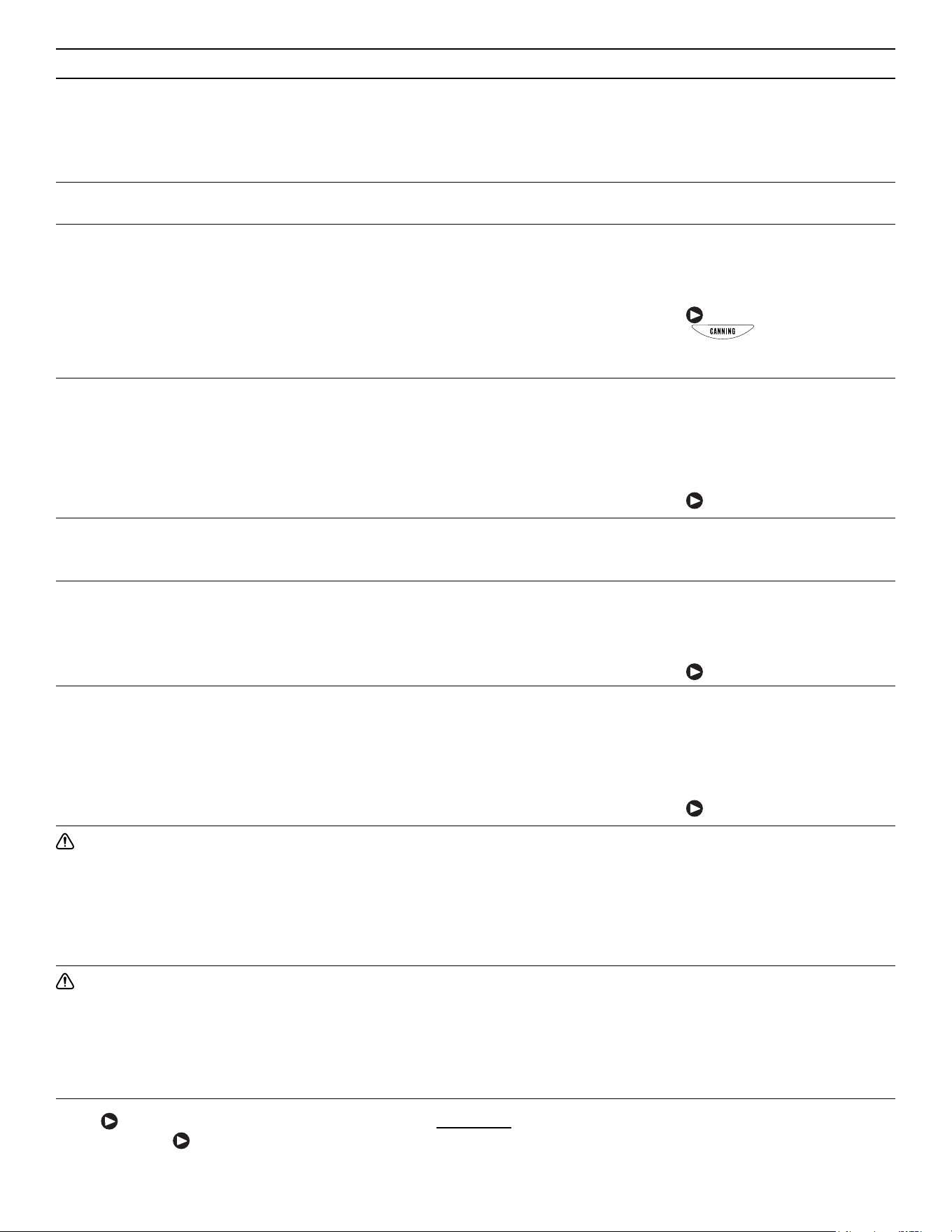
22
Troubleshooting
Error Codes
The pressure canner is programmed to display error codes in the event of a product malfunction or error in the processing procedure.
See the following chart for explanation and remedies.
Code Cause Remedy
E1, E2, E4, E5
Canner has become damaged, been
tampered with, or is defective.
Unplug canner and call Consumer Service Department (page 26).
E3
Can appear in any
phase of Pressure
and Boiling Water
Canning
Canner is overheated as a result of
insufficient or no liquid.
• Unplug canner.
• Unlock and remove cover.
• Cool canner for 15 minutes.
• Add water to the 3-quart fill line.
• Lock on cover and plug in canner.
• Select program and processing time and press
.*
Note: If E3 appears in Pressure Canning and the icon is lit, it will be
necessary to let pressure drop naturally until air vent/cover lock drops before
unlocking and removing cover. Please refer to page 23 for additional information.
E10
Can appear only
in JAR WARMING
phase of Pressure
and Boiling Water
Canning
Canner has developed pressure during
the JAR WARMING phase because the
regulator was put on with its lever in the
CAN position.
• Unplug canner.
• Turn regulator lever to VENT and allow canner to release pressure.
• Remove regulator.
• Unlock and remove cover.
• Cool canner for 15 minutes.
• Add water, as necessary.
• Lock on cover and plug in canner.
• Select program and processing time and press
.*
E20
Only in Pressure
Canning
Canner has developed pressure during the
VENTING phase because the regulator was
put on with its lever in the CAN position.
See remedy for E10.
E21
Only in Pressure
Canning
The regulator was not installed after the
completion of the VENTING phase.
• Unplug canner.
• Unlock and remove cover.
• Cool canner for 15 minutes.
• Add water, as necessary.
• Lock on cover and plug in canner.
• Select program and processing time and press
.*
E30
Only in Boiling Water
Canning
Canner has developed pressure because the
regulator was put on with its lever in the
CAN position.
• Unplug canner.
• Turn regulator lever to VENT and allow canner to release pressure.
• Remove regulator.
• Unlock and remove cover.
• Cool canner for 15 minutes.
• Add water, as necessary.
• Lock on cover and plug in canner.
• Select program and processing time and press
.*
E50
Only in Pressure
Canning
Canner has sensed a release of pressure
during CANNING phase as a result of:
• Removing the regulator.
• Turning the regulator lever to VENT
position.
• Sealing ring leaking because it is
damaged or needs to be replaced.
• Unplug canner.
• Allow canner to release pressure until air vent/cover lock drops.
• Remove regulator, if still present on cover.
• Unlock and remove cover.
Canning process is not complete. To be sure your food is safe, it must be reprocessed
for the full amount of time. See page 23 for additional information.
Note: If release of pressure was due to sealing ring, replacement is necessary before
using canner again. Please refer to page 26 for ordering replacement parts.
E60
Only in Pressure
Canning
Canner has sensed a premature release
of pressure during COOLING phase as a
result of:
• Removing the regulator.
• Turning the regulator lever to VENT
position.
• Sealing ring leaking because it is
damaged or needs to be replaced.
See remedy for E50.
* Press again to display the warm icon. At this point the regulator should not be on the cover.
Press and hold the
button for approximately 5 seconds until the display shows the HEAT icon. This indicates the unit has bypassed the JAR
WARMING phase and is heating to reach the next phase.

23
Issues with Canned Food
• Jar breakage during processing is caused by: (1) packing jar too solidly or overfilling; (2) weakened, nicked, or chipped jars; (3)
jars touching bottom of canner; (4) failure to tighten screw bands according to manufacturer’s directions; or (5) use of jars other
than Mason jars.
• Liquid lost from jars during processing is caused by: (1) packing jar too solidly or overfilling or (2) failure to tighten screw bands
according to manufacturer’s directions. If liquid is lost during processing, do not open jar to replace liquid. Loss of liquid will not
cause spoilage, but food above the liquid will discolor. If at least half of the liquid is gone, place the jar in the refrigerator and use
the food within 2–3 days.
• Flat sour, a type of food spoilage, is caused by canning overripe food or allowing precooked foods to stand in jar too long before
processing. It may be prevented by using fresh products and properly processing, cooling, and storing. Flat sour shows no
indication of spoilage until jar is opened. Discard contents.
• Food spoilage or jars not sealing is caused by: (1) failure to follow exact time-tables and recipes; (2) failure to wipe sealing edge of
jar clean before placing lid on jar; (3) foods, seeds, or grease lodged between lid and jar; (4) jars which are nicked, cracked, or have
sharp sealing edges; (5) failure to tighten screw bands according to manufacturer’s directions; or (6) turning jars upside down while
jars are cooling and sealing.
• If a jar does not seal by the time it is completely cool, and a minimum of 12 but no more than 24 hours have elapsed after canning,
the food can be refrigerated and used within three days. Other options include freezing the food or reprocessing for the full amount
of time per the canning recipe.
If choosing to reprocess, remove the lids and reheat the food and/or liquid. Pack food into clean, heated jars. Remove air bubbles
and clean jar rims. Position new lids on jars and secure with bands. If more than 24 hours have elapsed since the canner
registered DONE and the seal is faulty, the food is no longer safe. Discard at once.
Additionally, if
or E3 appear during pressure canning, the food can be saved by refrigerating, freezing, or reprocessing.
• Mold can form only in the presence of air. Therefore, jars are not sealed if mold is present. Discard contents.
• The black deposit sometimes found on the underside of a lid is caused by tannins in the food or hydrogen sulfide which is liberated
from the food by the heat of processing. This does not indicate spoilage.
• The loss of color from beets during canning is usually due to the variety of beets used. Two varieties that retain color well are Ruby
Queen and Detroit Red. To reduce bleeding of color, precook beets with entire root and 1–2 inches of stem. Remove stem and root
after precooking.
Frequently Asked Questions
1. I accidentally selected the wrong canning method and/or time and then started the program. What should I do?
Press and hold for 3 seconds. This will enable you to start over and select the correct program. The point at which this is
discovered will determine how you should proceed.
a. If discovered during the INSERT JARS, FILL JARS, or VENT phase of the Pressure Canning function, OR during the CANNING
phase of the Boiling Water Canning function:
• Select the correct canning method and/or adjust the correct time. Press once to activate the program.
• Press again to display the WARM icon. At this point, the regulator should not be on the cover.
• Press and hold the button for approximately 5 seconds until the display shows the HEAT icon. This indicates the unit has
bypassed the JAR WARMING phase and is heating to reach the next phase.
b. If discovered during the CANNING phase of the Pressure Canning function as indicated by the icon :
• Allow pressure to drop naturally until the air vent/cover lock drops. Once the air vent/cover lock has dropped, turn the
regulator to the VENT position. Unlock and remove the cover.
• Check to see if jar lids have sealed. If lids have sealed, it will be necessary to remove the lids and replace with new ones.
• Select the correct canning method and/or adjust the correct time. Press once to activate the program.
• Press again to display the WARM icon. At this point, the regulator should not be on the cover.
• Press and hold the button for approximately 5 seconds until the display shows the HEAT icon. This indicates the unit has
bypassed the jar warming phase and is heating to reach the next phase. Note: If PRESSURE CAN is selected again, the canner
will go through another venting period before the program moves to canning.
2. I put the regulator on the vent pipe after the venting phase was complete, but the canner is still venting. Why?
The regulator was put on the vent pipe with the lever pointing to VENT. Move the lever so it points to CAN.
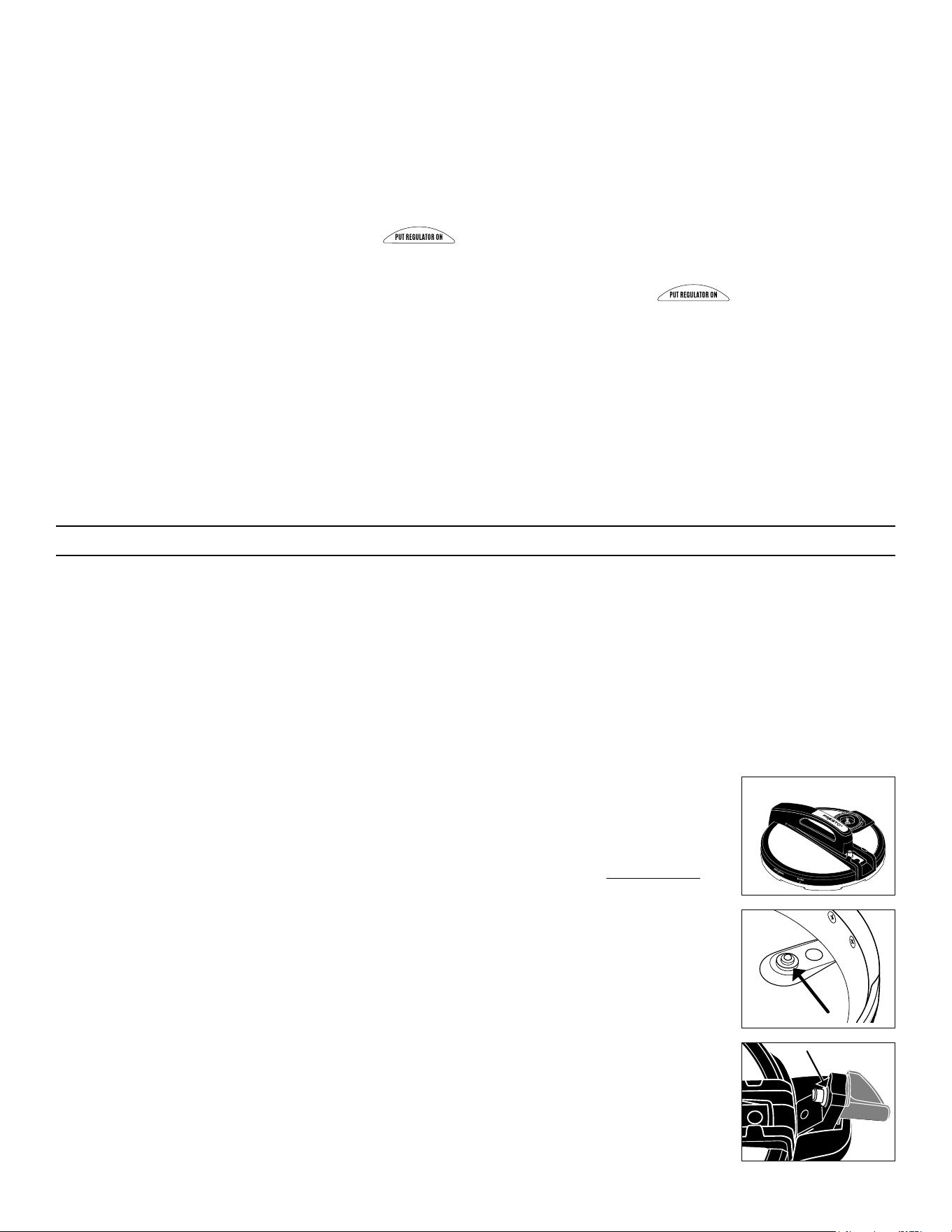
24
3. Water is collecting in the channel surrounding the removable pot and steam is leaking from around the canner cover. Why is
this happening?
The sealing ring was not positioned on the sealing ring frame or the sealing ring frame was not installed in the canner cover; see
page 3. NOTICE: If either of these parts are not in place during canning, the canner will leak, pressure will not build, and the canner
may become damaged.
Leakage may also occur if the sealing ring needs to be replaced. The sealing ring may become cracked or torn with normal use.
When this happens, replace the sealing ring before using the unit again.
4. Why must the regulator be removed at the beginning of the pressure canning process? It would be more convenient to point the
regulator lever to the VENT position and when appears, point it to the CAN position.
Because many users forget to adjust the regulator, we found it is easier to instruct them to remove it altogether. The venting step is
key and failure to vent will result in an improperly canned product. You may, however, leave the regulator on the unit, place it in
the VENT position during the venting stage, and then adjust it to the CAN position when the instruction appears.
5. Why is so much water required when I’m using the boiling water canning method?
This canner follows USDA guidelines which requires full coverage of the jars with boiling water. That means you may process any
approved boiling water recipe in this digital canner.
6. When boiling water canning, once the jars are filled may I use hot tap water, instead of boiling water, to cover the filled jars?
No. This canner follows USDA guidelines which requires that boiling water be used to cover the jars.
7. I’m only placing water and jars in the canner. Why do I need to check the vent pipe and filter before each use?
Mistakes do happen in processing. Food does leak out of jars. Jars break. Some areas have water with heavy mineral deposits.
Using best practices, the vent pipe and filter should be checked prior to each use and cleaned as needed.
Cleaning
After every use
1. After the canner has cooled completely, remove the regulator from the vent pipe. Detach the sealing ring frame from the
cover (Fig. E, page 3) and then the sealing ring from the frame. Do not remove the center grommet on the sealing ring frame.
Thoroughly dry the sealing ring, the sealing frame, and the inside of the cover.
If the vent filter appears dirty or contains debris, remove it from the underside of the cover, following the instructions on page 3.
Wash it in warm, soapy water. If necessary, wipe the outside of the canner cover with a damp cloth and then dry completely. Do
not immerse the canner cover in water or wash it or its parts in the dishwasher.
2. To be sure the vent pipe is clear, hold the cover up to the light and look through the vent pipe. Clean it with a small brush or pipe
cleaner if it is blocked or partially blocked. If necessary, clean the vent filter with a small brush to remove any food particles from
the slots and holes. Rinse and dry all parts thoroughly and reassemble.
3. Wash the canning rack in warm, soapy water. Do not wash in the dishwasher.
4. Wash the removable pot in the dishwasher or in warm water and a mild detergent. Rinse and dry
thoroughly.
CAUTION! To prevent electrical shock and damage to the canner, never pour water into the canner
body or immerse it or the power cord in water. Always be sure the removable pot is completely dry
before placing it back in the canner body.
As needed
1. Remove the air vent/cover lock for cleaning. Place your finger over the top of the air vent/cover lock
on the cover (Fig. T) and remove the gasket from the underside of the cover (Fig. U). Push the air
vent/cover lock through the top of the cover. Wash both pieces in warm, soapy water. The metal shaft
may be cleaned with a nylon mesh pad. Clean the cover hole with a small brush.
After cleaning, reinsert the metal shaft from the top side of the cover down through the cover hole.
Place a finger over the top of the air vent/cover lock and push the gasket onto the end of the metal
shaft, fitting it into the groove.
2. Gently clean the sensor, the sensor arm, and the plastic rim of the canner body with a damp cloth.
Avoid getting water inside the canner body. Carefully remove the gasket on the sensor (Fig. V) and
wash it in warm, soapy water. Clean the sensor with a damp cloth and place the gasket back on it.
3. Wipe the outside of the canner body with a damp cloth.
Fig. T
Fig. U
Fig. V

25
Care and Maintenance
• When not in use, store your electric canner in a dry place. To prevent unpleasant odors from lingering, store the unit with the cover
inverted on the canner body.
• Do not use metal utensils as they may scratch the nonstick surface.
• Do not strike the rim of the removable pot with any utensil. This could damage the rim which may allow steam to escape and
prevent the canner from sealing.
• The sealing ring and gasket for the air vent/cover lock may shrink, become hard, deformed, cracked, or torn with normal use.
When this happens, replace the sealing ring and/or the air vent/cover lock gasket. This is routine replacement and not covered
under the warranty.
• Leakage between the cover and canner body is usually caused by deterioration of the sealing ring after prolonged use.
• Periodically check the vent pipe nut for looseness. If necessary, retighten with a ½ʺ wrench.
• If for any reason the canner cannot be opened, contact the Consumer Service Department at 1-800-877-0441 for assistance.
• Any maintenance required for this product, other than normal household care and cleaning, should be performed by the Presto
Factory Service Department (page 26).
Recipe Index
Pressure Canning Recipes
Fish and Seafood
Clams ...........................................14
Fish .............................................14
Tuna ............................................14
Meat, Game, and Poultry
Cut-Up Meat ......................................13
Ground Meat ......................................13
Chicken, Duck, Goose, Turkey ........................13
Rabbit ...........................................13
Soups and Stocks
Beef Stock ........................................14
Chicken Stock .....................................15
Soups ............................................15
Tomatoes and Tomato Products
Tomatoes (packed in water) ...........................8
Tomatoes (no added liquid). . . . . . . . . . . . . . . . . . . . . . . . . . . . 8
Tomato Juice .......................................8
Tomato Sauce ......................................9
Spaghetti Sauce without Meat .........................9
Spaghetti Sauce with Meat ............................9
Vegetables
Asparagus ........................................10
Beans or Peas, dry ..................................10
Beans, fresh lima ...................................10
Beans (green, wax, Italian) ...........................10
Beets ............................................11
Carrots ........................................... 11
Corn, whole kernel .................................11
Greens ...........................................11
Mushrooms .......................................11
Okra .............................................11
Peas, green .......................................12
Peppers, hot or sweet ...............................12
Potatoes, sweet ....................................12
Potatoes, white ....................................12
Squash, pumpkin and winter ..........................12
Boiling Water Canning Recipes
Fruits
Apples ...........................................17
Applesauce .......................................17
Apricots ..........................................17
Berries ...........................................17
Cherries ..........................................18
Nectarines and Peaches ..............................18
Pears ............................................18
Plums. . . . . . . . . . . . . . . . . . . . . . . . . . . . . . . . . . . . . . . . . . . . 19
Rhubarb ..........................................19
Jam, Jelly, Soft Spreads
Apple Butter ......................................21
Grape Jelly .......................................21
Rhubarb Strawberry Jam .............................21
Pickles
Quick Fresh-Pack Dill Pickles ........................20
Tomatoes and Tomato Products
Tomatoes (packed in water) ..........................19
Tomatoes (no added liquid). . . . . . . . . . . . . . . . . . . . . . . . . . . 19
Tomato Juice ......................................20
Tomato Sauce .....................................20
Tomato Salsa ......................................20

26
Consumer Service Information
If you have any questions regarding the operation of your Presto
appliance or need parts for your appliance, contact us by any of
these methods:
• Call 1-800-877-0441 weekdays 8:00 AM to 4:00 PM (Central Time)
• Email us through our website at GoPresto.com/contact
• Write National Presto Industries, Inc., Consumer Service Department, 3925 North Hastings Way, Eau Claire, WI 54703-3703
Inquiries will be answered promptly by email, telephone, or letter. When emailing or writing, please include a phone number and a
time when you can be reached during weekdays if possible.
When contacting the Consumer Service Department or when ordering replacement parts, please indicate the model and series numbers
for the pressure canner. The model number can be found on the back of the canner body and the series number can be found on the
bottom of the canner body.
Please record this information:
Model _______________ Series _______________ Date Purchased _________
The Presto Factory Service Department is equipped to service Presto
appliances and supply genuine Presto
parts. Genuine Presto
replacement parts are manufactured to the same exacting quality standards as Presto
appliances and are engineered specifically to
function properly with its appliances.
Presto can only guarantee the quality and performance of genuine Presto
parts. “Look-alikes” might not be of the same quality or
function in the same manner. To ensure that you are buying genuine Presto
replacement parts, look for the Presto
trademark.
Canton Sales and Storage Company, Presto Factory Service Department, 555 Matthews Dr., Canton, MS 39046-3251
Product Registration
Important: Please go online and register this product within ten days of purchase. Proper registration will serve as proof of purchase
in the event your original receipt becomes misplaced or lost. Registration will not affect warranty coverage, but it may expedite the
processing of warranty claims.
The additional information requested will help us develop new products that best meet your needs and desires. To register
the product, visit GoPresto.com/registration or simply scan this QR code. If you do not have computer access, contact the
Consumer Service Department at 1-800-877-0441.
Presto
Limited Warranty (Applies only in the United States)
This quality Presto
appliance is designed and built to provide many years of satisfactory performance under normal household use.
Presto pledges to the original owner that should there be any defects in material or workmanship during the first year after purchase,
we will repair or replace it at our option.
Our pledge does not apply to normal wear and tear including scratches, dulling of the polish, or staining; the repair or replacement
of moving and/or perishable parts such as the sealing ring, regulator, air vent/cover lock gasket, or sensor gasket; or for any damage
caused by shipping. Outside the United States, this limited warranty does not apply.
To obtain service under the warranty, please call our Consumer Service Department at 1-800-877-0441. If unable to resolve the
problem, you will be instructed to send your Presto
appliance to the Presto Factory Service Department for a quality inspection;
shipping costs will be your responsibility. When returning an appliance, please include your name, address, phone number, and the
date you purchased the appliance as well as a description of the problem you are encountering with the appliance.
We want you to obtain maximum enjoyment from using this Presto
appliance and ask that you read and follow the instructions
enclosed. Failure to follow instructions, damage caused by improper replacement parts, abuse, misuse, disassembly, alterations, or
neglect will void this pledge. This warranty gives you specific legal rights, and you may also have other rights which vary from state
to state. This is Presto’s personal pledge to you and is being made in place of all other express warranties.
National Presto Industries, Inc., Eau Claire, WI 54703-3703