Operating instructions
Heat-pump dryer
To avoid the risk of accidents or damage to the appliance it is essen-
tial to read these instructions before it is installed and used for the
first time.
en-GB, IE M.-Nr. 12 701 550

Contents
2
Warnings and safety instructions ............................................................................. 5
Sustainability and environmental protection.......................................................... 15
Disposal of fluff or accessories ....................................................................................
15
Perfect use of energy and time ....................................................................................
16
Reusing condensed water.............................................................................................
17
Energy-saving heat-pump technology.........................................................................
17
Familiarisation................................................................................................................ 18
Your tumble dryer ...........................................................................................................
18
Control panel...................................................................................................................
19
Main menu in display.....................................................................................................
19
Symbols in the display...................................................................................................
20
Operation.........................................................................................................................
20
Network connection ......................................................................................................
21
Movement sensor/MotionReact .................................................................................
21
ComfortOpen..................................................................................................................
22
Drum lighting...................................................................................................................
22
PowerDry.........................................................................................................................
22
WoolDry...........................................................................................................................
22
PerfectDry .......................................................................................................................
22
SteamCare.......................................................................................................................
23
Wash2Dry .......................................................................................................................
23
FragranceDos..................................................................................................................
23
Condensate container ...................................................................................................
23
Commissioning.............................................................................................................. 24
Requirements for networking ......................................................................................
24
Commissioning procedure............................................................................................
24
Operation........................................................................................................................ 25
Operating sequence.......................................................................................................
25
On the tumble dryer ................................................................................................. 25
Via the app................................................................................................................. 25
Preparing the laundry.....................................................................................................
26
Switching on the tumble dryer .....................................................................................
26
Loading the laundry........................................................................................................
26
Selecting a programme .................................................................................................
27
Setting programme parameters ...................................................................................
27
Starting a programme....................................................................................................
28
End of programme..........................................................................................................
28
Special features for operation via app.........................................................................
29
Loading the laundry .................................................................................................. 29
Activating operation via app.................................................................................... 29
Selecting and starting a programme via the app ................................................. 29

Contents
3
Timed drying....................................................................................................................
29
Programme modifications after starting the programme.........................................
30
Moving a programme.....................................................................................................
30
Favourites ...................................................................................................................
31
Using the condensate container..................................................................................
32
Using the FragranceDos fragrance system ................................................................
33
Programmes................................................................................................................... 38
Programme chart............................................................................................................
38
Extras................................................................................................................................
47
Consumption data..........................................................................................................
48
Consumption data..........................................................................................................
49
Good to know................................................................................................................. 52
Tips ...................................................................................................................................
52
Protecting tumble dryers...............................................................................................
53
Protecting your laundry .................................................................................................
53
Care symbols on the care label ....................................................................................
53
Adjusting settings ......................................................................................................... 55
Settings: overview ....................................................................................................
55
General.............................................................................................................................
56
Software update ....................................................................................................... 56
Security............................................................................................................................
56
System lock ............................................................................................................... 56
Movement sensor ..........................................................................................................
56
Factory default settings.................................................................................................
56
Networking......................................................................................................................
56
WiFi............................................................................................................................. 56
Connection ................................................................................................................ 56
Remote control ......................................................................................................... 57
Appliance functions .......................................................................................................
57
Memory...................................................................................................................... 57
ComfortOpen ............................................................................................................ 57
Anti-crease ................................................................................................................ 57
Drying levels .............................................................................................................. 57
Airways indicator ...................................................................................................... 57
Cooling down temp. ................................................................................................. 57
Information......................................................................................................................
58
Legal Information...................................................................................................... 58
Consumption............................................................................................................. 58
Operating hours ........................................................................................................ 58
Service........................................................................................................................ 58

Contents
4
Cleaning and care ......................................................................................................... 59
Cleaning the casing, drum and control panel.............................................................
59
Cleaning the fluff filters .................................................................................................
59
Cleaning the residual moisture sensor........................................................................
61
Cleaning the plinth filter ................................................................................................
62
Cleaning the rubber seal on the condensate container............................................
66
Troubleshooting............................................................................................................. 67
Fault messages shown in the display when a programme is cancelled.................
67
Display information........................................................................................................
69
The drying programme takes a long time....................................................................
69
Insufficient drying results..............................................................................................
70
Noises and odours .........................................................................................................
71
Other problems...............................................................................................................
72
Signs of wear on the plinth filter ..................................................................................
75
Reactivating the plinth filter..........................................................................................
77
Cleaning the drain for condensation............................................................................
77
Checking the heat exchanger .......................................................................................
77
Cleaning the fluff filters with water..............................................................................
78
Cleaning the fluff filter in the condensate container .................................................
79
Replacing the nozzle for SteamCare............................................................................
80
Service............................................................................................................................. 82
Contact in the event of a fault......................................................................................
82
EPREL database .............................................................................................................
83
Warranty ..........................................................................................................................
83
Optional accessories .....................................................................................................
83
Installation...................................................................................................................... 84
Rear view .........................................................................................................................
84
Transporting the tumble dryer......................................................................................
84
Levelling the tumble dryer.............................................................................................
85
Additional installation requirements............................................................................
85
External condensed water connection........................................................................
87
Electrical connection .....................................................................................................
91
Technical data .................................................................................................................
93
EU Conformity declaration...................................................................................... 94
Warnings and safety instructions
5
It is essential to read these instructions.
This tumble dryer contains a refrigerant that is flammable and ex-
plosive.
This tumble dryer complies with all current local and national
safety requirements. However, inappropriate use can lead to per-
sonal injury and damage to property.
Read the operating instructions carefully before using the tumble
dryer. They contain important information on safety, installation,
use and maintenance. This prevents both personal injury and dam-
age to the tumble dryer.
In accordance with standard IEC60335-1, Miele expressly and
strongly advises that you read and follow the instructions in the
chapter on installing the tumble dryer as well as the safety instruc-
tions and warnings.
Miele cannot be held liable for damage caused by non-compliance
with these instructions.
Keep these operating instructions in a safe place and pass them on
to any future owner.

Warnings and safety instructions
6
Correct application
This tumble dryer is intended for use in domestic households and
similar working and residential environments.
This tumble dryer is not intended for outdoor use.
This tumble dryer is intended for use at altitudes of up to 4000m
above sea level.
It must be used only as a domestic appliance to dry items which
have been washed in a water solution and which are marked on the
manufacturer's care label as being suitable for tumble drying. If using
dry cleaning kits, do so at your own risk, and follow the instructions
provided on the packaging.
Any other applications may be dangerous. Miele cannot be held liable
for damage resulting from incorrect or improper use or operation.
This tumble dryer can only be used by people with reduced phys-
ical, sensory or mental capabilities, or lack of experience or know-
ledge, if they are supervised whilst using it or have been shown how
to use it in a safe way and understand and recognise the con-
sequences of incorrect operation.
Safety with children
Children under 8 years of age must be kept away from the tumble
dryer unless they are constantly supervised.
Children 8 years and older may only use the tumble dryer unsuper-
vised if they have been shown how to use it safely and recognise and
understand the consequences of incorrect operation.
Children must not be allowed to clean or maintain the tumble dryer
unsupervised.
Please supervise children in the vicinity of the tumble dryer and do
not let them play with it.

Warnings and safety instructions
7
Technical safety
Please follow the instructions in “Installation”.
Before setting up the tumble dryer, check it for any externally vis-
ible damage.
Do not install or use a damaged tumble dryer.
Before connecting the tumble dryer, ensure that the connection
data on the data plate (fuse rating, voltage and frequency) match the
mains electricity supply. If in any doubt, consult a qualified electri-
cian.
Temporary or permanent operation on an autonomous power sup-
ply system or a power supply system that is not synchronised with
the mains power supply (e.g. island networks, back-up systems) is
possible. A prerequisite for operation is that the power supply system
complies with the specifications of EN50160 or an equivalent stand-
ard.
The function and operation of the protective measures provided in
the domestic electrical installation and in this Miele product must
also be maintained in isolated operation or in operation that is not
synchronised with the mains power supply, or these measures must
be replaced by equivalent measures in the installation. As described,
for example, in the current version of BS OHSAS 18001–2 ISO
45001.
The electrical safety of this tumble dryer can only be guaranteed
when correctly earthed. It is essential that this standard safety re-
quirement is met. If in any doubt, please have the household wiring
system tested by a qualified electrician. Miele cannot be held liable
for the consequences of an inadequate earthing system (e.g. electric
shock).
The tumble dryer must be isolated from the electricity supply in
the event of a fault and during cleaning and maintenance.
Do not connect the appliance to the mains electricity supply by an
extension lead, multi-socket adapter or similar. These can overheat
and are a fire hazard.
Faulty components must only be replaced by genuine Miele ori-
ginal spare parts. The manufacturer can only guarantee the safety of
the appliance when Miele replacement parts are used.
The accessibility of the plug must always be ensured, in order to
disconnect the tumble dryer from the mains.
Warnings and safety instructions
8
Unauthorised repairs could result in unforeseen dangers for the
user, for which Miele cannot accept liability. Repairs should only be
undertaken by a Miele approved service technician, otherwise any
subsequent damage will not be covered by the warranty.
While the tumble dryer is under warranty, repairs should only be
undertaken by a service technician authorised by the Miele Customer
Service Department. Otherwise the warranty will be invalidated.
If the electrical connection cable is faulty it must only be replaced
by a Miele authorised service technician to protect the user from
danger.
This tumble dryer must not be used in a non-stationary location
(e.g. on a ship).
Do not make any alterations to the tumble dryer, unless authorised
to do so by Miele.
This tumble dryer is supplied with a special lamp to cope with par-
ticular conditions (e.g. temperature, moisture, chemical resistance,
abrasion resistance and vibration). This special lamp must only be
used for the purpose it is intended for. It is not suitable for room light-
ing. Replacement lamps may only be fitted by a Miele authorised per-
son or the Miele Service Department.
The heat pump can be damaged. Once the tumble dryer has been
installed, you can switch it on. Wait one hour before starting a drying
programme.
Risk of fire and explosion due to damage to the tumble dryer.
Refrigerant R290 (propane) is a flammable and explosive gas if it
leaks in the event of damage.
Take measures to protect the tumble dryer against damage. Do not
make any alterations to the tumble dryer.
If the tumble dryer is damaged, proceed as follows:
- Avoid naked flames or anything which creates a spark.
- Disconnect the tumble dryer from the electrical supply.
- Air the room where the tumble dryer is located.
- Contact the Miele Customer Service Department.

Warnings and safety instructions
9
Risk of functional faults due to excessive temperatures. Do not
block the gap between the bottom of the tumble dryer and the floor
with plinth facings, deep pile carpet or other similar products. This
would hinder a sufficient flow of air to the tumble dryer.
Make sure the dryer door can be opened without hindrance after
installation.
Correct use
The maximum dry laundry load size is 9kg.
The maximum recommended load sizes for individual programmes
are given in “Programmes”.
Risk of fire due to an unauthorised electrical installation.
This tumble dryer must not be connected to a controllable socket.
This includes clocks/timers or electrical systems with peak-load ne-
gotiation.
There is a risk of the laundry igniting itself if a drying programme is
cancelled before the cooling phase has finished.
Warning: Do not switch the dryer off before the drying pro-
gramme has finished. If this is done, the laundry must be hung up or
spread out to cool it down.
Fabric conditioner and similar products must be used according to
the instructions on the manufacturer's packaging.
Remove all items from pockets (e.g. lighters, matches).
The fluff filters must be cleaned after every drying cycle.
Blockages can cause material damage to the tumble dryer. The
fluff filters and the plinth filter must be checked during cleaning. In
the event of a defect or wear, the fluff filters or the plinth filter must
be replaced.
This tumble dryer must only be operated with fitted and intact fluff
and plinth filters.
Wet fluff and plinth filters could cause operational faults while dry-
ing. The fluff filters or the plinth filter must not be used dripping wet
after cleaning.

Warnings and safety instructions
10
Risk of fire with garments that have not been washed or cleaned
properly or which have any adhering residues. For this reason, textiles
and products with the following properties must not be dried in a
tumble dryer:
- Unwashed, uncleaned
- Have not been thoroughly or insufficiently cleaned and are still
soiled with grease, oil or other residues. Special care should be
taken with kitchen or cosmetic laundry containing residues of
cooking oil, oil, grease or lotions. If items have not been thoroughly
cleaned, there is a danger that they might ignite when heated, even
after they have been removed from the tumble dryer at the end of
the programme
- Accumulations of inflammable cleaning agents or residues of acet-
one, alcohol, petrol, kerosene, stain remover, turpentine, wax, wax
remover or chemicals in general. Special care should be taken with
mops and floor cloths
- Build-up and residues of hair lacquer, hair spray or nail varnish re-
mover
Fire hazard when drying items with residues.
These could catch fire when being dried.
Items with adhering residues must be washed particularly thor-
oughly.
Wash the items at a high temperature and add more detergent.
If in doubt, wash the items several times.
Fire hazard caused by certain item materials and items cleaned us-
ing professional dry cleaning agents. For this reason, the following
textiles and products must not be dried in a tumble dryer:
- Textiles which contain a large proportion of rubber, foam rubber or
rubber-like materials. For example, products made from latex foam
rubber, shower caps, waterproof textiles, rubberised articles and
items of clothing and pillows with foam rubber filling.
- Textiles containing padding or fillings which are damaged (e.g. pil-
lows, jackets). The filling could fall out and cause a risk of fire.
- Items that have been cleaned using industrial chemical agents
(e.g. professional dry-cleaning agents).

Warnings and safety instructions
11
Damage due to excessive temperatures or extension of the drying
time. The heat pump that is essential to the operation of this tumble
dryer generates a great deal of heat inside its casing. There must be a
reliable means of dissipating this heat.
- Ensure permanent room ventilation from the beginning to the end
of every drying programme.
- Ensure that there is a gap between the floor and the bottom of the
tumble dryer (this must not be blocked or obstructed in any way).
There is a risk of injury from electric shock and the tumble dryer
may become defective. To prevent water from penetrating, do not
spray-wash or hose down the tumble dryer.
Risk of injury if the tumble dryer tips over. For this reason, do not
lean on the tumble-dryer door.
In many programmes, the heating phase is followed by a cooling
down phase to ensure that the items are not too hot to handle when
you remove them (this also avoids the danger of the laundry self-ig-
niting). The programme is not finished until the cooling down phase
has been completed.
As soon as the programme has finished, remove all laundry from the
drum.
Always close the door after use. This way you will avoid the danger
of:
- Children climbing onto or into the dryer or hiding things in it.
- Pets or other small animals climbing into it.
Do not install the tumble dryer in a room where there is a risk of
frost occurring. At temperatures around freezing point the tumble
dryer may not be able to operate properly. There is a risk of damage if
the condensed water is allowed to freeze in the pump or hoses.
The ambient room temperature should be between 2°C and 35°C.
Condensed water can cause damage to the tumble dryer. If the
water is drained externally, make sure the drain hose is secured
against slipping, e.g. if you hang it in a sink or basin.
It can cause health problems in both people and animals if con-
densed water from the tumble dryer is consumed. Condensed water
is not drinking water. Similarly, condensed water must not be used to
water plants and must not be poured out into nature.

Warnings and safety instructions
12
Damage due to blockages. Dirt particles from the room where the
tumble dryer is located can be drawn in with cooling air, cause block-
ages in the heat exchanger and cause the tumble dryer to malfunc-
tion. Keep the room where the tumble dryer is located free of dust,
fluff or dirt particles.
Using a fragrance flacon (optional accessory)
Risk of injury on contact with the fragrance. If leaked fragrance
comes in contact with the body:
- Wash skin thoroughly with soap and water.
- If swallowed, rinse mouth thoroughly with clean water.
- Flush eyes with clean water for at least 15minutes.
Risk of injury on contact with the fragrance.
Eyes may become irritated, injured or show signs of poisoning.
Seek medical attention immediately if the fragrance comes in con-
tact with the eyes or is swallowed.
Only use genuine Miele original fragrance flacons.
The fragrance flacon must be stored in its packaging so please
make sure you retain this.
Damage caused by leaking fragrance. Do not lay the fragrance
flacon down. Keep the fluff filter with the fragrance flacon inserted in
it in a horizontal position and do not tip.
Damage caused by leaked fragrance. Use an absorbent cloth to
wipe up any fragrance which has leaked out of the flacon:
- Onto the floor
- Onto the tumble dryer
- Onto dryer parts (e.g. the fluff filter)
If fragrance which has leaked out of a flacon comes in contact with
clothing, change the clothing immediately. Wash the clothing or any
cloths used for mopping up fragrance thoroughly with plenty of water
and detergent.
There is the risk of fire or damage if the following instructions are
not observed:
- Never refill a flacon with fragrance.
- Never use a faulty fragrance flacon.

Warnings and safety instructions
13
Dispose of an empty fragrance flacon with the household waste
and never use it for any other purpose.
Please also observe the information supplied with the fragrance
flacon.

Warnings and safety instructions
14
Accessories and spare parts
Only use original Miele accessories. If other parts are used, war-
ranty, performance and product liability claims will be invalidated.
The tumble dryer can be combined with a Miele washing machine
in a washer-dryer stack. The appropriate “WTV” stacking kit (avail-
able to order) to match your tumble dryer and washing machine is re-
quired.
If you order a plinth for this tumble dryer (available from Miele as
an optional accessory - depending on country), make sure it is the
correct one.
Miele will guarantee to supply functional spare parts for a min-
imum of 10years and up to 15years following the discontinuation of
your tumble dryer.
Miele cannot be held liable for damage caused by non-compli-
ance with these Warning and Safety instructions.
Sustainability and environmental protection
15
Disposing of the packaging ma-
terial
The packaging material is used for hand-
ling and protects the appliance from
transport damage. The packaging ma-
terial used is selected from materials
which are environmentally friendly for
disposal and can generally be recycled.
Recycling the packaging material re-
duces the use of raw materials. Use ma-
terial-specific collection points for valu-
able materials and take advantage of re-
turn options. Your Miele dealer will take
the packaging material away.
Disposing of your old appliance
Electrical and electronic appliances con-
tain many valuable materials. They also
contain certain materials, compounds
and components which were essential
for their correct functioning and safety.
These could be hazardous to human
health and to the environment if dis-
posed of with household waste or if
handled incorrectly. Please do not,
therefore, dispose of your old appliance
with household waste.
Take care not to damage your tumble
dryer’s pipework and heat exchanger
before or during disposal in an author-
ised, environmentally friendly manner.
This is to ensure that coolant in the
tumble dryer and oil in the compressor
is contained, and will not leak into the
environment.
Instead, please make use of officially
designated collection and disposal
points to dispose of and recycle elec-
trical and electronic appliances in your
local community, with your dealer or
with Miele, free of charge. By law, you
are solely responsible for deleting any
personal data from the old appliance
prior to disposal. You are legally obliged
to remove any old batteries which are
not securely enclosed by the appliance
and to remove any lamps without des-
troying them, where this is possible.
These must be taken to a suitable col-
lection point where they can be handed
in free of charge. Please ensure that
your old appliance poses no risk to chil-
dren while being stored for disposal.
Disposal of fluff or accessories
Abrasion causes environmentally harm-
ful microplastic particles to be released
from garments containing synthetic
fibres, which remain on the laundry after
washing. For this reason, dispose of the
fluff collected by the fluff filters with
your household waste. To prevent mi-
croplastics from spreading into the
waste water system, fluff must not be
drained away with the water.
Dispose of unusable accessories, e.g.
empty fragrance flacons or a defective
plinth filter, with your household waste.

Sustainability and environmental protection
16
Perfect use of energy and time
Spin the laundry thoroughly in the wash-
ing machine. The electricity consump-
tion and the programme running time is
reduced during drying because it takes
less time to dry the laundry. To spin the
laundry at a harder level, select a max-
imum spin speed when washing.
Always dry using the maximum spe-
cified load size for the programme
whenever possible. A full drum helps to
save energy because you don’t have to
start another drying programme. This
will mean that the energy consumption
for the amount of laundry is at its most
economical.
If possible, always tumble dry garments
of the same type or, in the case of differ-
ent types, garments of the same mater-
ial thickness. You should untangle
tangled items after washing so that
everything dries evenly. This saves you
having to run a second drying pro-
gramme for items that are still damp.
Clean the fluff filters after each drying
programme and clean the plinth filter
after a receiving a message from the
tumble dryer. This reduces the pro-
gramme running time and electricity
consumption.
If possible, make use of time-variable,
low-cost electricity tariffs. Ask your en-
ergy supplier for further information. If
you have a suitable energy management
system in your home, you can make
flexible use of time-variable, cost-effi-
cient and environmentally friendly elec-
tricity tariffs. Thanks to this combina-
tion, the tumble dryer can be started
automatically at a cost-efficient time.
If you use self-generated solar power,
start the tumble dryer when the electri-
city is available.

Sustainability and environmental protection
17
Reusing condensed water
Condensed water from the drying pro-
cess is collected in the condensate con-
tainer and reused for the SteamCare.
Condensed water can be used for iron-
ing. To remove any fluff, filter the con-
densed water through a coffee filter. If
you want to reuse condensed water in a
steam iron or humidifier, follow the
manufacturer’s instructions.
Energy-saving heat-pump tech-
nology
A compressor is used to compress refri-
gerant and raise the temperature in a
closed cooling circuit in an energy-effi-
cient manner.
The heat is transferred in the heat ex-
changer where the air for drying in a cir-
cuit.
In the front section of the heat ex-
changer, the recirculated residual heat is
recovered from the filtered drying air in
the same circuit. The resulting condens-
ation effect continues to dehumidify the
drying air. This reduces the moisture in
the textiles and the desired drying effect
is achieved.
Refrigerant
The refrigerant R290 (propane) is re-
sponsible for heat transfer for tumble
dryers. Propane has a low global warm-
ing potential (GWP), is climate-neutral,
environmentally friendly and does not
damage the ozone layer.
Familiarisation
18
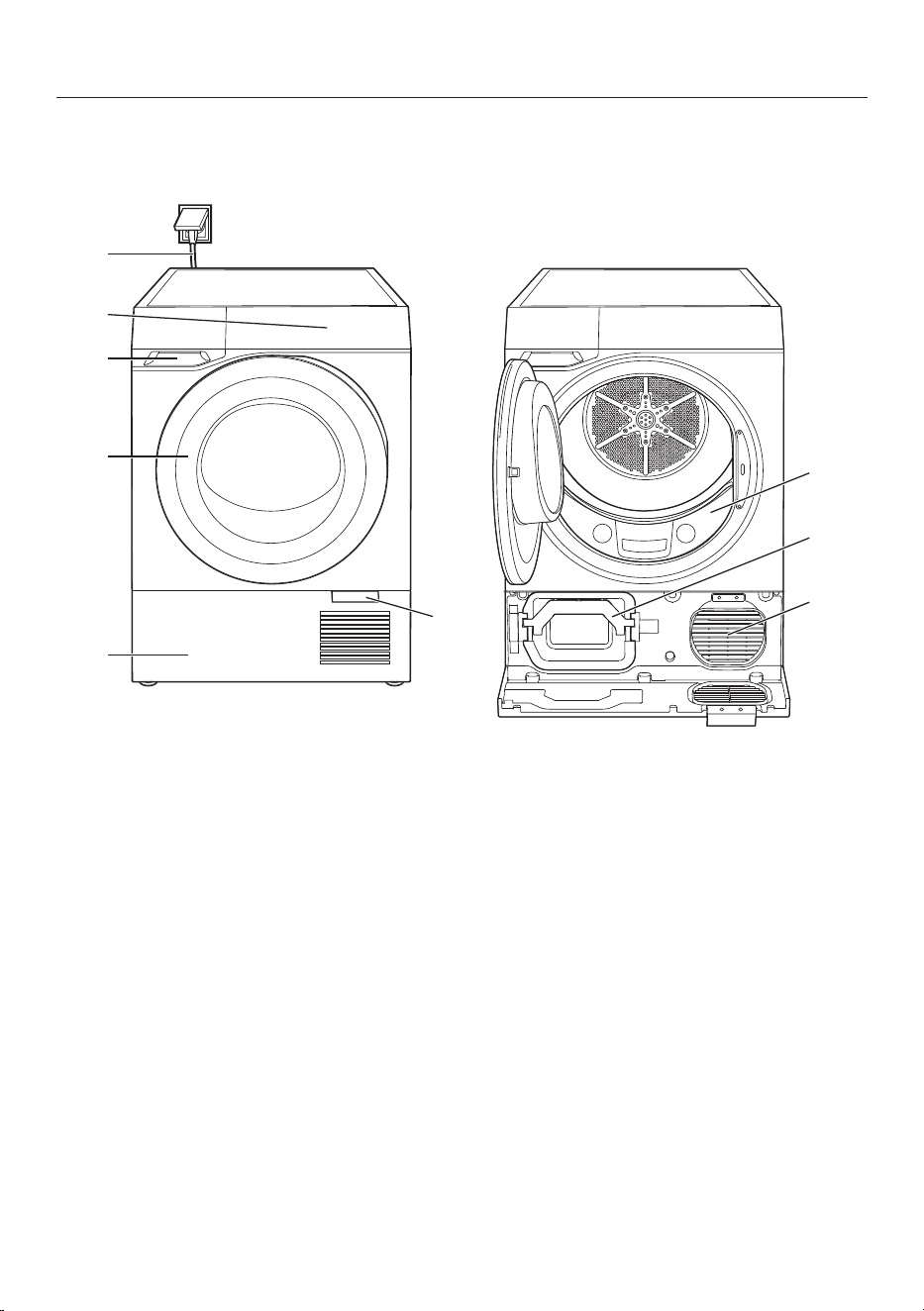
Your tumble dryer
a
Mains connection cable
b
Control panel
c
Condensate container
d
Tumble dryer door
e
Plinth flap
f
Opening tag
g
Fluff filter
h
Holder with plinth filter
i
Cooling fan
Familiarisation
19
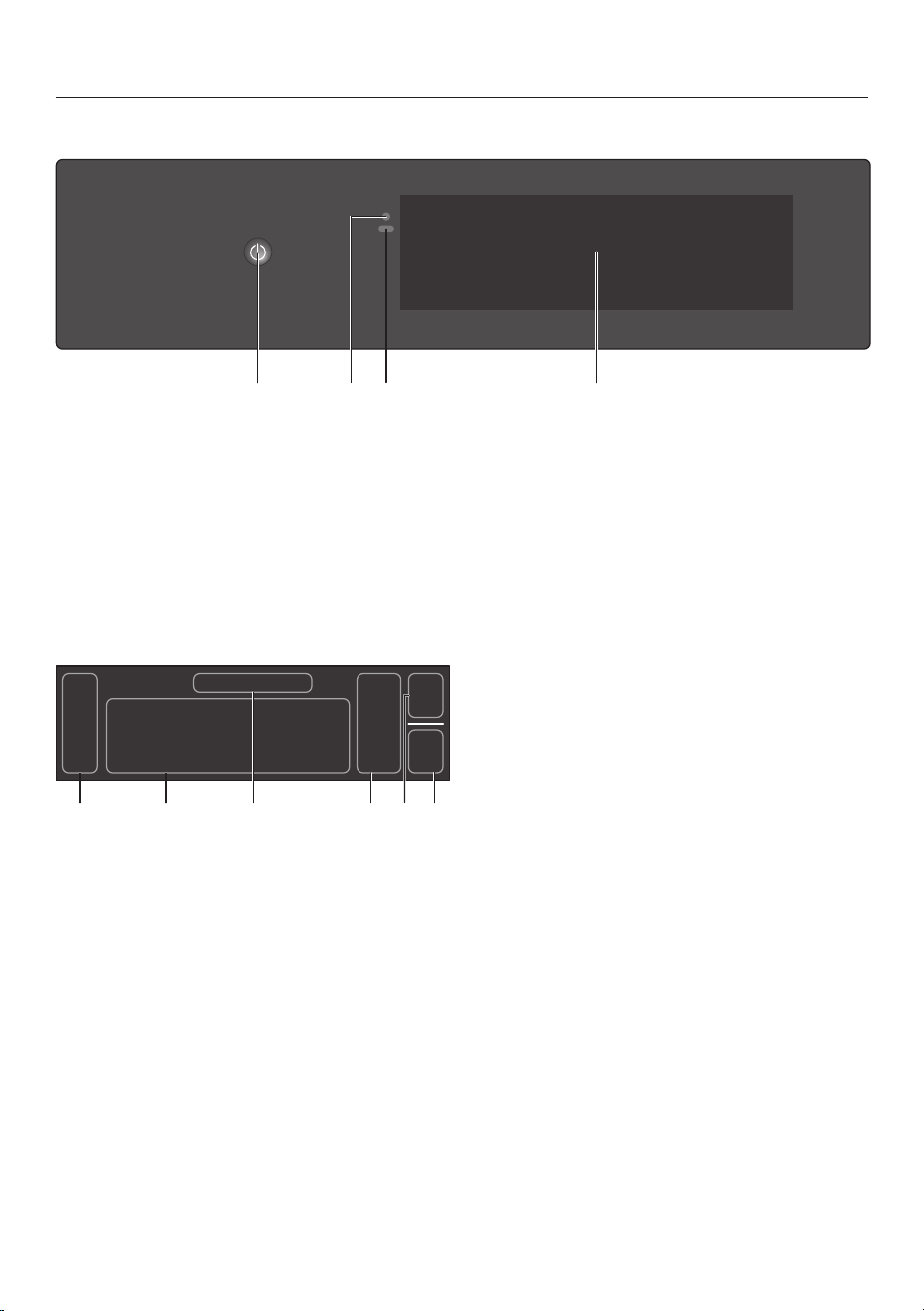
Control panel
a
On/Off switch
b
Optical interface
(for Customer Service)
c
Movement sensor (MotionReact)
d
Display
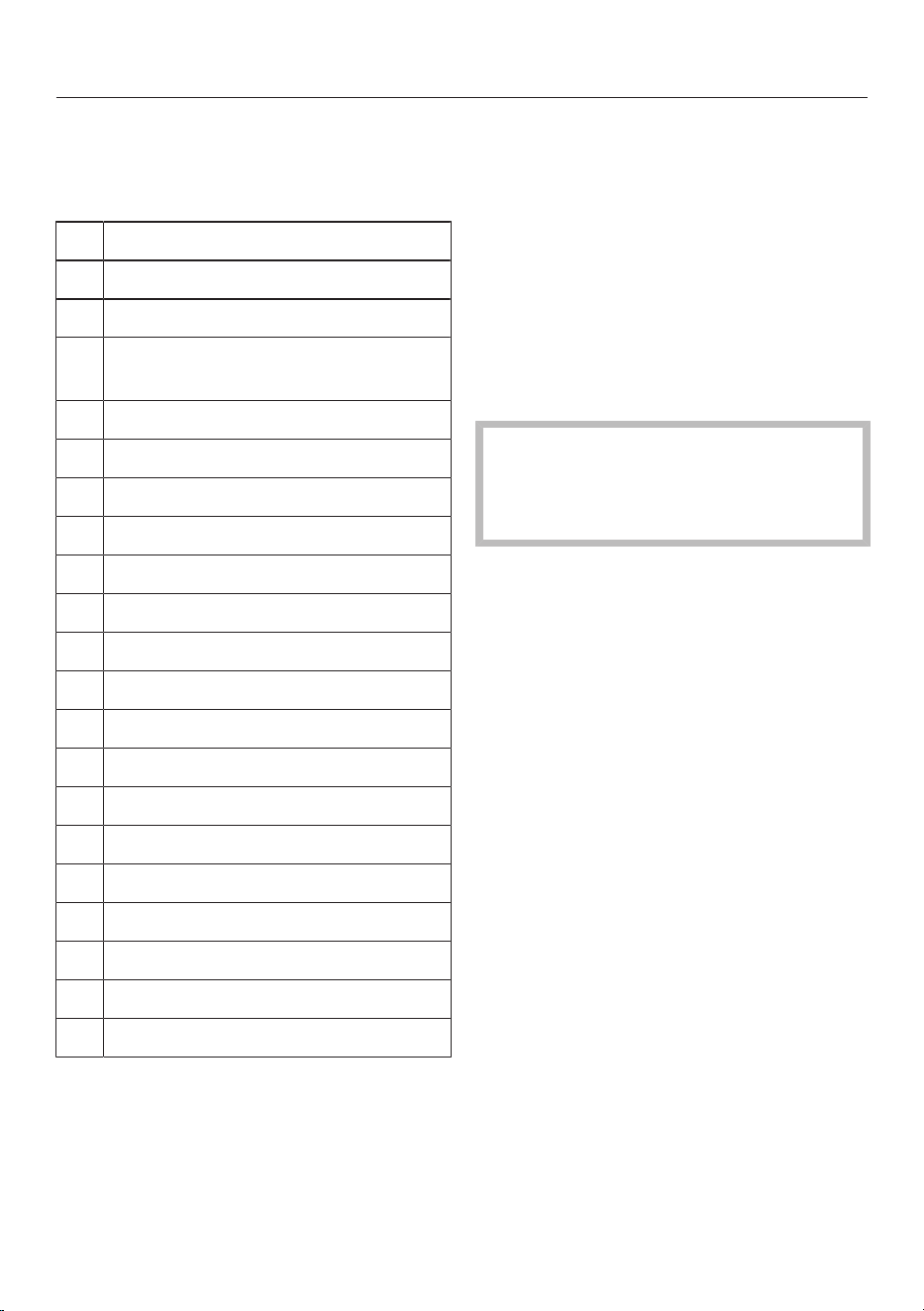
Main menu in display
a
Side trim
b
Programmes
c
Name of the highlighted programme
d
Parameters for the programme
e
Start
f
Other parameters
Familiarisation
20
Symbols in the display
Various different symbols are used on
the display.
Menu
Programmes
Favourites
Remote control
Networking
Other parameters
Information
Close window
Back
Settings
Next step
Start
Stop
Pause
Sounds
System lock
Maintenance
Download
Delete
WiFi
Search
Note
Operation
Switching the tumble dryer on or off
The On/Off switch is recessed.
Press the On/Off switch until the
tumble dryer switches on or off.
Tip: With MotionReact, the tumble
dryer is automatically switched on when
you approach it.
Navigating the display
The display can be scratched by
pointed or sharp objects, e.g. pens.
Only touch the display with your fin-
gertips.
Swipe your finger in the required dir-
ection on the display.
To select a menu option, press the re-
quired menu option or symbol.
The menu option is highlighted.
Exiting a menu level
You are in a menu.
Depending on the menu, select
Close window or Back.
The higher-level menu is displayed.

Familiarisation
21
Selecting a programme
You are in the main menu.
Swipe your finger on the display until
the required programme is high-
lighted.
If you want to start the programme
with the parameters displayed, select
Start.
Tip: If you want to change the paramet-
ers, select the icon of the programme or
Other parameters.
Adjusting parameters
You can switch parameters on or off
(e.g. Extras) or adjust them on a scale
(e.g. the Duration).
Switching parameters on or off
Activated parameters are highlighted in
colour.
Select the parameter you want to
switch on or off.
TouchOK to confirm.
The parameter is saved.
Changing parameters on a scale
Select the parameter you want to
change.
Move the scale to the left or right until
the required value is highlighted.
Confirm withOK or wait for the
change to be applied automatically.
The value is saved.
Displaying the context menu
When you are in certain menus, a con-
text menu can be displayed. This allows
you to rename or move Favourites, for
example.
To open the context menu, press and
hold a Favourite or select Context
menu.
Make the change you want.
To close the context menu, select
Close window.
Network connection
The tumble dryer is equipped with an in-
tegrated WiFi module. The WiFi module
makes it possible to connect to your
home network and to use the Miele app
on a mobile device.
Networking the tumble dryer allows you
to do the following, among other things:
- Receive information on the pro-
gramme sequence and operating
status
- Control your tumble dryer remotely
- Download additional programmes
- Keep the tumble dryer up to date with
the latest Miele developments via
software updates
Connecting your tumble dryer to your
WiFi network will increase energy con-
sumption, even when the tumble dryer
is switched off.
Movement sensor/MotionReact
The tumble dryer has a movement
sensor. The movement sensor reacts to
movement and detects when you ap-
proach the tumble dryer.

Familiarisation
22
Depending on the operating status of
the tumble dryer, you can trigger various
actions using the movement sensor
such as switching on the tumble dryer
or switching off the buzzers.
Under Settings General
Movement sensor, you can adjust the
settings for the movement sensor to
suit your personal requirements.
ComfortOpen
A motorised door opener opens the
door when a hand approaches the door
handle sensor.
The door opens a little automatically at
the end of the programme.
Drum lighting
The drum lighting illuminates the drum
and the area in front of the tumble dryer.
The drum lighting comes on automatic-
ally when the door is opened. The drum
lighting will go out again automatically
after 5minutes.
PowerDry
With the help of an additional heater,
which is automatically switched on if
necessary, the ideal drying temperature
is reached even faster during the heat-
ing-up phase. The energy consumption
is slightly higher. Once the drying tem-
perature has been reached, the addi-
tional heater switches off again.
WoolDry
In the Woollens programme, you can
dry woollen items that have been
washed in the Hand wash woollens pro-
gramme.
PerfectDry
PerfectDry dries the laundry precisely,
although the result is also influenced by
the calcium content of the water used
to wash the laundry. The active Perfect-
Dry adjusts the drying process to the re-
sidual moisture of the laundry and water
quality, making the programme running
time more accurate. PerfectDry is not
active in programmes with a selectable
duration.

Familiarisation
23
SteamCare
Clean, damp or dry laundry is smoothed
and freshened up using SteamCare.
Condensed water from the condensate
container is sprayed into the drum. This
can be heard by humming noises eman-
ating from the pump. The drying heat
evaporates the condensed water, which
creates the SteamCare effect.
Tip: The condensate container must be
filled.
Wash2Dry
To use the Wash2Dry function, you
must own a Miele W2 washing ma-
chine and network your washing ma-
chine and tumble dryer with the Miele
app and Miele Services.
The washing machine transfers the pro-
gramme data to the Miele Cloud at the
end of the programme.
Based on the programme data trans-
ferred from the washing machine, the
tumble dryer automatically sets a spe-
cially adapted drying programme, which
can still be changed.
All you have to do is load the laundry
and start the programme.
The tumble dryer does not offer a cor-
responding drying programme for wash
programmes for very delicate items (e.g.
curtains).
Tip: The tumble dryer must not be dis-
connected from the mains. Otherwise
the programme data transferred by the
washing machine will not be received by
the tumble dryer when the Wash2Dry
function is selected.
Disconnecting the dryer from the mains
delays the reception of programme
data.
FragranceDos
The FragranceDos fragrance system of-
fers you the opportunity to add a special
fragrance and to freshen up your laundry
with fragrance flacons.
Tip: Both positions can be used for a
more intense scent of the same fra-
grance. Or conveniently switch between
fragrances of your choice or DryFresh to
freshen up your laundry. You can close
the fragrance flacon that you are not us-
ing.
Condensate container
The condensed water from the con-
densation effect is pumped through the
drain hose into the condensate con-
tainer.
The condensate container must be
emptied regularly, otherwise the drying
programme will stop.
Tip: You no longer need to empty the
condensate container if you drain the
condensed water using an external drain
hose. This is recommended when drying
more than 8kg.

Commissioning
24
Risk of injury or damage to prop-
erty due to improper set-up and in-
stallation.
Improper procedures can lead to per-
sonal injury or damage to property.
Before commissioning the tumble
dryer for the first time, make sure it
has been installed correctly. Perform
the installation correctly. Please fol-
low the instructions in “Installation”.
Damage caused by starting a
drying programme too early.
The heat pump can be damaged.
You can switch on and network the
tumble dryer. However, to avoid pos-
sible damage, only start a drying pro-
gramme after one hour has elapsed.
Requirements for networking
Note the following requirements for net-
working:
1. A home network is available at the
installation site.
Have the WiFi password ready.
2. The Miele app is available on a mo-
bile device.
3. You have a user account in the Miele
app.
You can also carry out the networking at
a later date. Skip the “Networking menu
option during commissioning.
Commissioning procedure
Approach the tumble dryer or touch
the On/Off switch.
The display shows the first step for
commissioning.
Follow the steps on the display.
Commissioning is not complete until
the commissioning programme has
been completed. If the process is can-
celled beforehand, the entire commis-
sioning process must be repeated.

Operation
25
Operating sequence
We recommend the operating se-
quence listed below which is custom-
ised to your tumble dryer. This allows
you to perfectly use all the special fea-
tures.
You will find valuable and useful inform-
ation and tips on the individual opera-
tional steps in “Operation”.
On the tumble dryer
Basic operating concepts
1. Preparing the laundry
2. Switching on the tumble dryer
3. Loading the laundry
4. Selecting a programme
5. Setting programme parameters
6. Start with Start
7. End of programme
Wash2Dry operating option
1. Preparing the laundry
2. Switching on the tumble dryer
3. Loading the laundry
4. Selecting Wash2Dry
5. Start with Start
6. End of programme
Further operating options:
- Timed drying
- AddLoad (Add laundry)
Via the app
1. Preparing the laundry
2. Switching on the tumble dryer
3. Loading the laundry
4. Closing the door
5. Select Remote control
6. Start with Start
7. Select a programme via the app
8. Start a programme via the app
9. End of programme
Operation
26
Preparing the laundry
Prepare the laundry as described in
“Good to know”.
Damage due to objects which were
not removed from the laundry.
Otherwise textiles or the tumble
dryer may be damaged.
Remove foreign objects and all ob-
jects such as detergent dispensing
aids or loose underwires from bras.
Switching on the tumble dryer
When the movement sensor is activ-
ated, the tumble dryer switches on
automatically.
Touch On/Off.
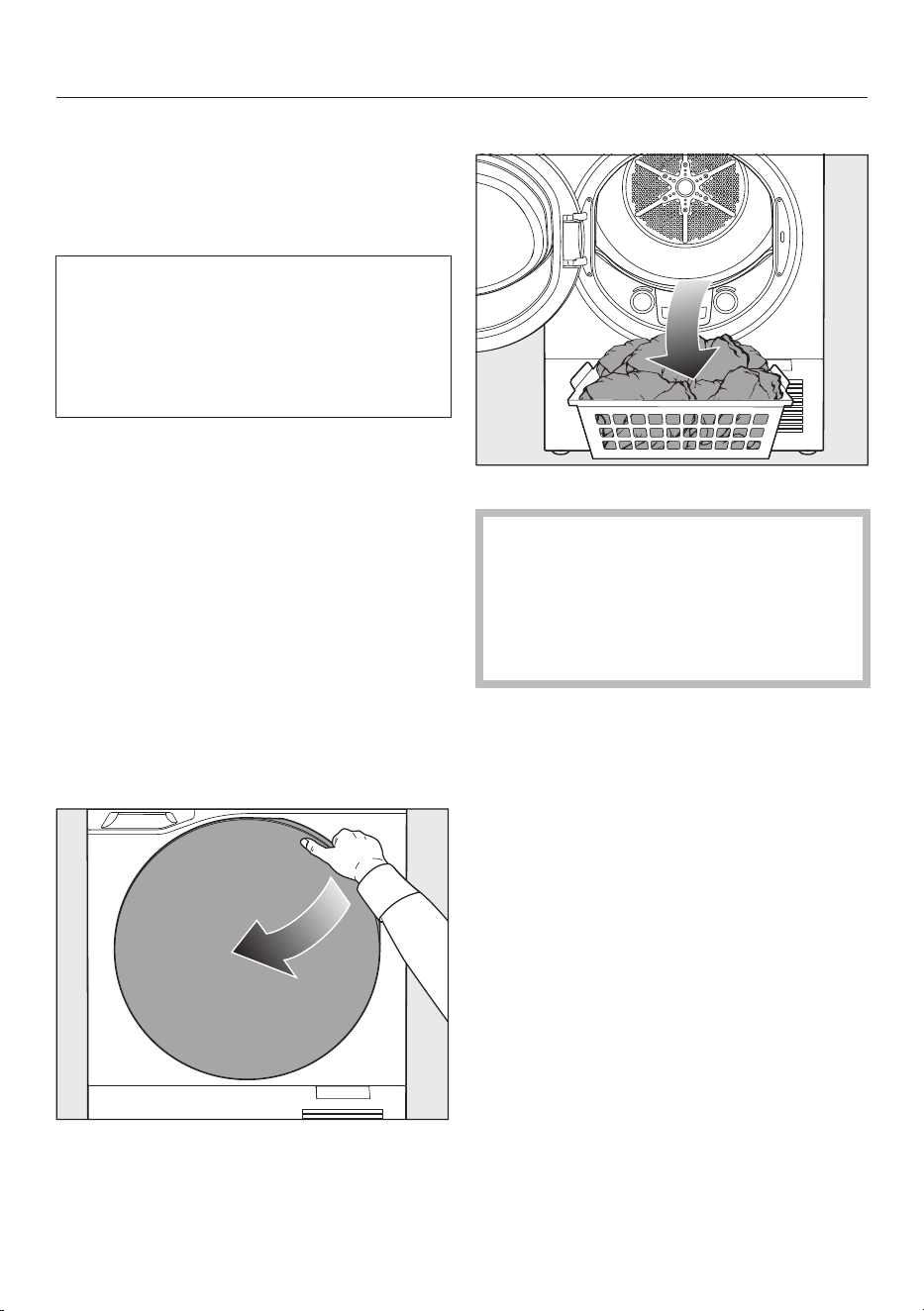
Loading the laundry
Opening the door
The door handle sensor registers when
a hand touches the door and opens
the door a little.
Open the door fully.
Loading laundry in the drum
To prevent damage, check that the drum
is empty.
Remove any remaining items and ob-
jects that have been left inside the
drum.
Disentangle the laundry.
Fill the drum.
Tip: Note the maximum load size of the
programmes shown on the display.
Operation
27
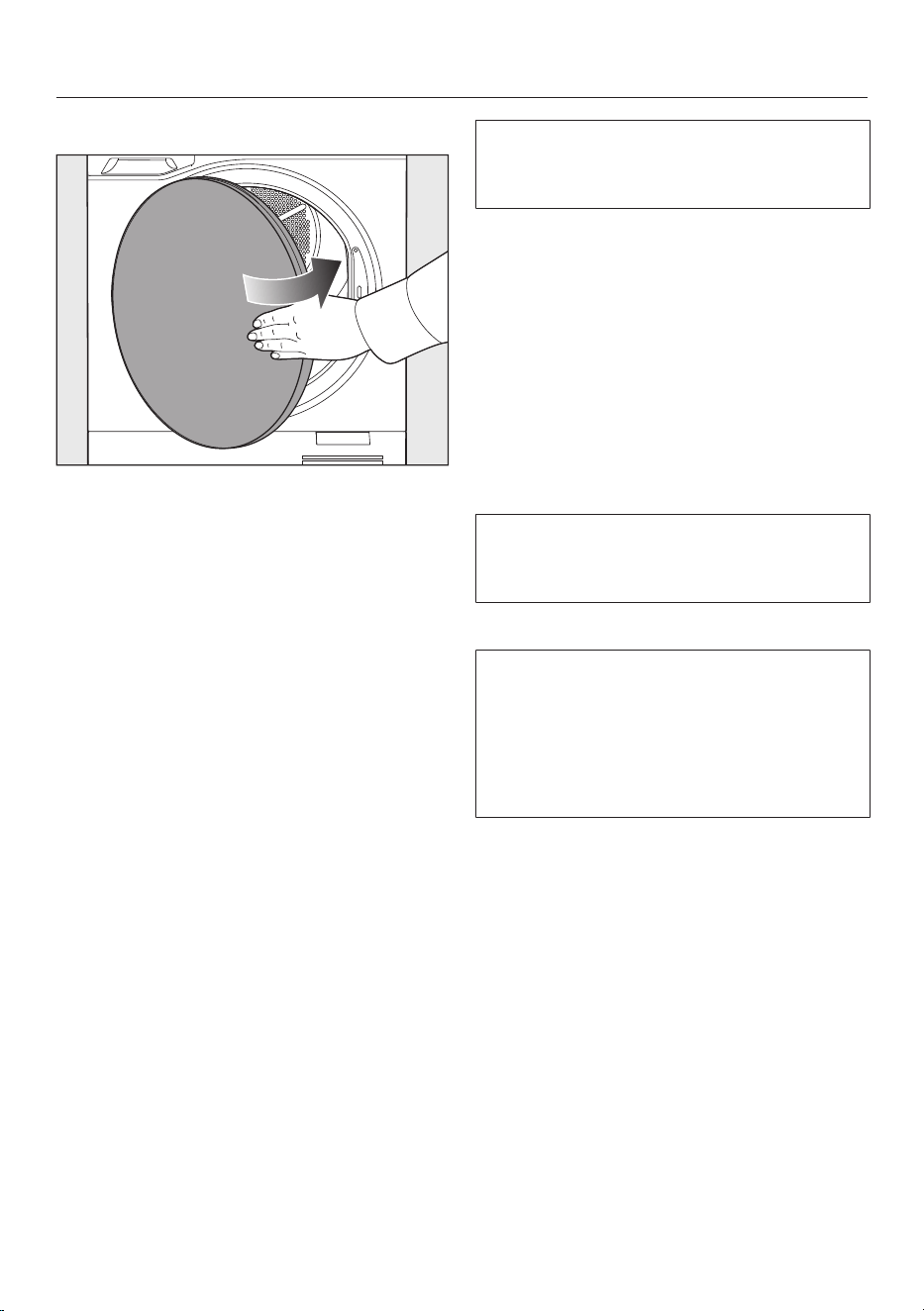
Closing the door
Shut the tumble dryer door gently.
Make sure that no items are caught in
the opening.
Selecting a programme
Tip: To view programme information, se-
lect Information.
Swipe your finger on the display until
the required programme is high-
lighted.
Setting programme parameters
Depending on the programme, select
either Drying level or Duration.
Tip: You can also select further para-
meters using. The parameters are
then expanded.
Select the desired Extras.
Tip: You can accept the selection and
return to the programme selection us-
ing.
Selecting the drying level
For most programmes such as Cottons
or Minimum iron, you can select Drying
level.
The selectable Drying levels are indic-
ated by symbols, such as (Cupboard
Dry) or (Hand iron).
Selecting the duration
For some programmes such as Warm
air or Basket programme, you can se-
lect Duration.
Select Duration.
Move the scale until the required dur-
ation is highlighted.
Selecting Extras
TouchExtras.
The selectable Extras are indicated by
symbols, such as (Gentle tumble)
or (DryCare 40).
Activate the Extra you want.
The list only shows the Extras that can
be activated for the selected pro-
gramme.
Extras cannot be combined. To select
a different Extra, deactivate the Extra
that was selected first.
Tip: Note that some Extras require a
smaller load size.
Operation
28
Starting a programme
Select Start.
The programme starts and the time left
is displayed in hours and minutes.
The programme running time can vary
depending on various factors such as
residual moisture, load size and the
mix of textiles. This means that the
time left may vary, even if the same
programme has been selected.
PerfectDry detects whether there are
only a few items or items that are
already dry in the drum (drum empty
detection feature). The tumble dryer
shortens the programme running time
to dry the laundry gently at the end of
the programme.
End of programme
Opening the door
If ComfortOpen is switched on, the
door opens a little at the end of the pro-
gramme (but not during the Anti-crease
phase).
Pull open the door.
Removing the laundry
Remove the laundry.
Damage to textiles.
Items that have not been removed
can be overdried and damaged in the
dryer.
Always remove all items from the
drum once drying has finished.
What to do after removing laundry
Clean the fluff filters in the door open-
ing.
Close the door.
Empty the condensate container.

Operation
29
Special features for operation
via app
Loading the laundry
Open the door.
Load the laundry.
Close the door.
Activating operation via app
Select Remote control.
Selecting and starting a programme
via the app
Select the programme you want to
use.
Select the programme parameters
you want.
Start the programme.
Timed drying
Setting delay start
You can use the delay start to either
delay the start of the programme or the
end of the programme. The delay start
function is possible in a 24-hour period.
Select the Further pro-
grammessymbol.
Select Start.
Set the time you want (Start or Fin-
ish).
Select Start.
To return to the programme selection,
select Confirm.
Changing delay start
You can change the selected delay start.
Select the Other parameterssym-
bol.
Change the delay start and select
Confirm.
Deleting delay start
A delay start that has been started can
be deleted.
Select Stop.
You have the choice between:
- Start immediately programme
- Cancel programme

Operation
30
Programme modifications after
starting the programme
Changing programmes
To protect against unintentional
changes, it is not possible to change the
programme after the programme has
started.
Add laundry (AddLoad)
Laundry can be added or removed at
any time.
Touch the display.
Touch the Add laundry sensor control.
The door will open a little.
Open the tumble dryer door.
Add or remove laundry.
Close the drum door.
Press Start.
The programme continues.
Cancelling a programme
Touch the display.
Touch Stop.
Confirm your selection.
The programme is cancelled and the
door opens a little when ComfortOpen
is switched on.
Moving a programme
You are in the main menu.
You can change the order of the pro-
grammes in the main menu from the
programme Minimum iron onwards. You
cannot change the order of the first pro-
grammes.
Touch and hold the highlighted pro-
gramme until Move is displayed.
Select Move.
Drag the programme to the required
place.
Confirm with .
The change will be saved.

Operation
31
Favourites
You can save up to 12programmes as
favourites. You can change the pro-
gramme name and certain parameters
for your Favourite programmes.
Saving Favourites
You are in the main menu.
Select a programme.
Select the parameters you want.
Select Favourites.
A keyboard is displayed.
Enter the name for the Favourite.
Select Confirm.
The programme has been saved as a
Favourite. The programme can be
started immediately via Start.
Tip: To save a programme directly as a
Favourite, you can also selectFa-
vourites at the end of the programme.
Moving Favourites
You are now in the Favourites menu.
You have saved a programme as a Fa-
vourite and want to sort the list.
Touch and hold the Favourite you
want to move.
A context menu is displayed.
Select Move.
Move the Favourite to the required
position.
Touch OK to confirm.
The change will be saved.
Editing Favourites
You are now in the Favourites menu.
You have saved a programme as a Fa-
vourite and want to edit the parameters.
Move your finger on the display until
the required Favourite lights up.
Touch the Other parameters sym-
bol.
The parameters are displayed.
Change the parameters you want.
The changes are saved.
Removing Favourites
You are now in the Favourites menu.
You have saved a programme as a Fa-
vourite and want to remove it from the
list.
Select the Favourite you want to re-
move.
Select Favourites.
The Favourite has been removed from
the list.
Operation
32
Using the condensate container
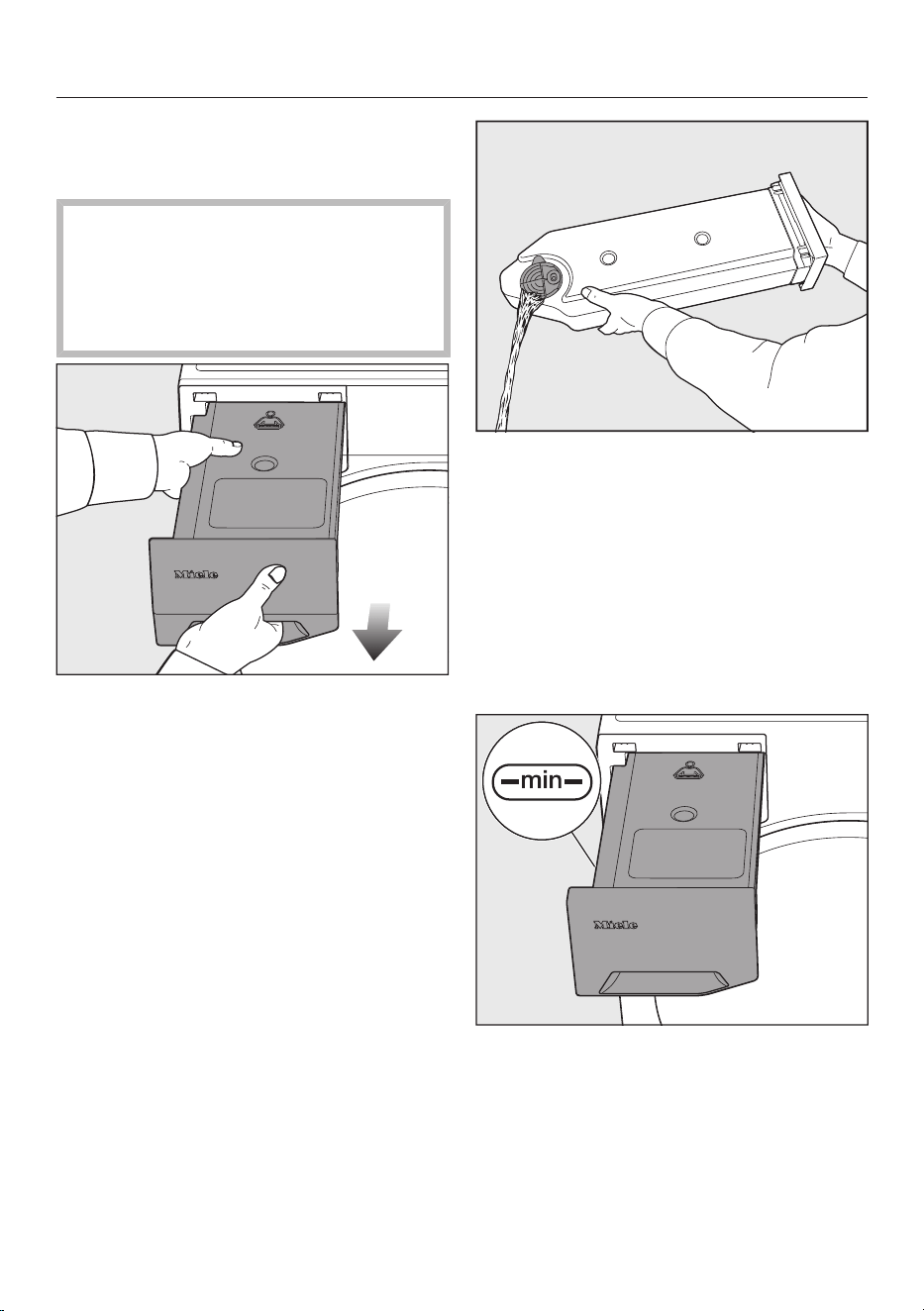
Pulling out the condensate container
Damage to the dryer door and
the condensate container.
Damage and scratches may occur.
First close the dryer door and then
pull out the condensate container.
To pull out the condensate container,
keep a firm hold on the fascia panel or
in the centre.
To prevent condensed water from
leaking, carry the condensate con-
tainer horizontally.
Emptying the condensate container
Interval: empty the condensate con-
tainer after drying.
Empty the condensate container.
Tip: You can collect the condensed wa-
ter to use for the SteamCare function if
the condensate container is empty dur-
ing the next drying programme.
Preparing the condensate container
for SteamCare
The condensate container must be filled
up to the mark ―min―.
Check the fill level.
Top up if necessary.
Operation
33
Damage caused by mains water.
Limescale in mains water can clog
the SteamCare nozzle.
Only fill with mains water once in an
exceptional case. Otherwise, use
condensate water from tumble dry-
ers for example.
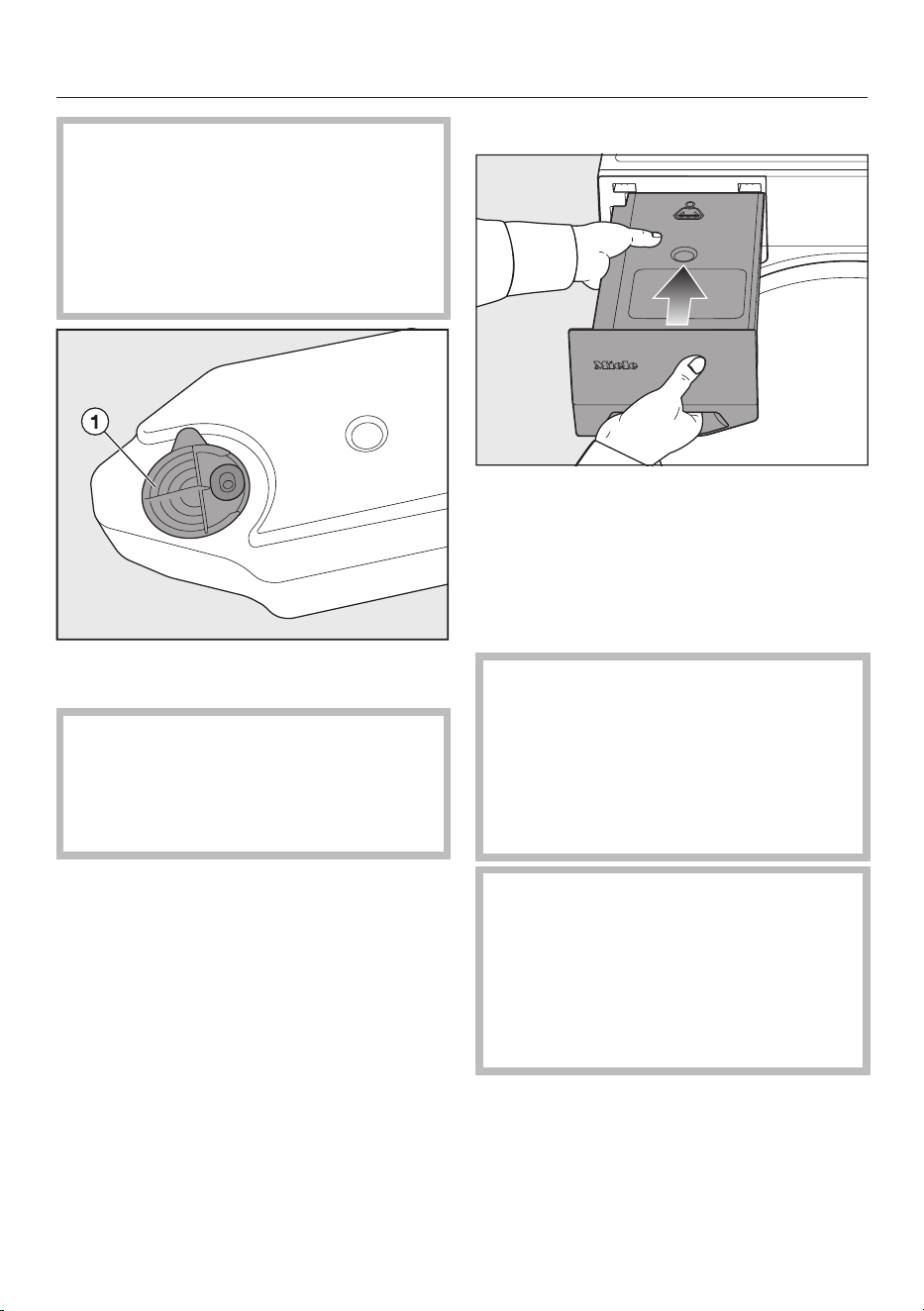
Pour the condensed water through
the rings on the spout .
The nozzle can clog up.
It should only be filled with clean
condensed water. The water must
not contain any fragrance, detergent
or other substances.
A fluff filter in the condensate container
prevents any fluff from being sucked out
of the condensed water.
Sliding in the condensate container
Slide in the condensate container.
Using the FragranceDos fra-
grance system
Removing the protective seal from the
fragrance flacon
Risk of fire if fragrance flacons
are used incorrectly.
Leaked fragrance can cause fire.
Before using a fragrance flacon,
please read “Warnings and safety
notes”, “Using the fragrance flacon
(optional accessory)”.
Leaking fragrance can cause
health problems.
Fragrance can damage your health
(e.g. skin irritation) if it comes into
contact with your body.
Immediately wash off any leaked fra-
grance.
Operation
34
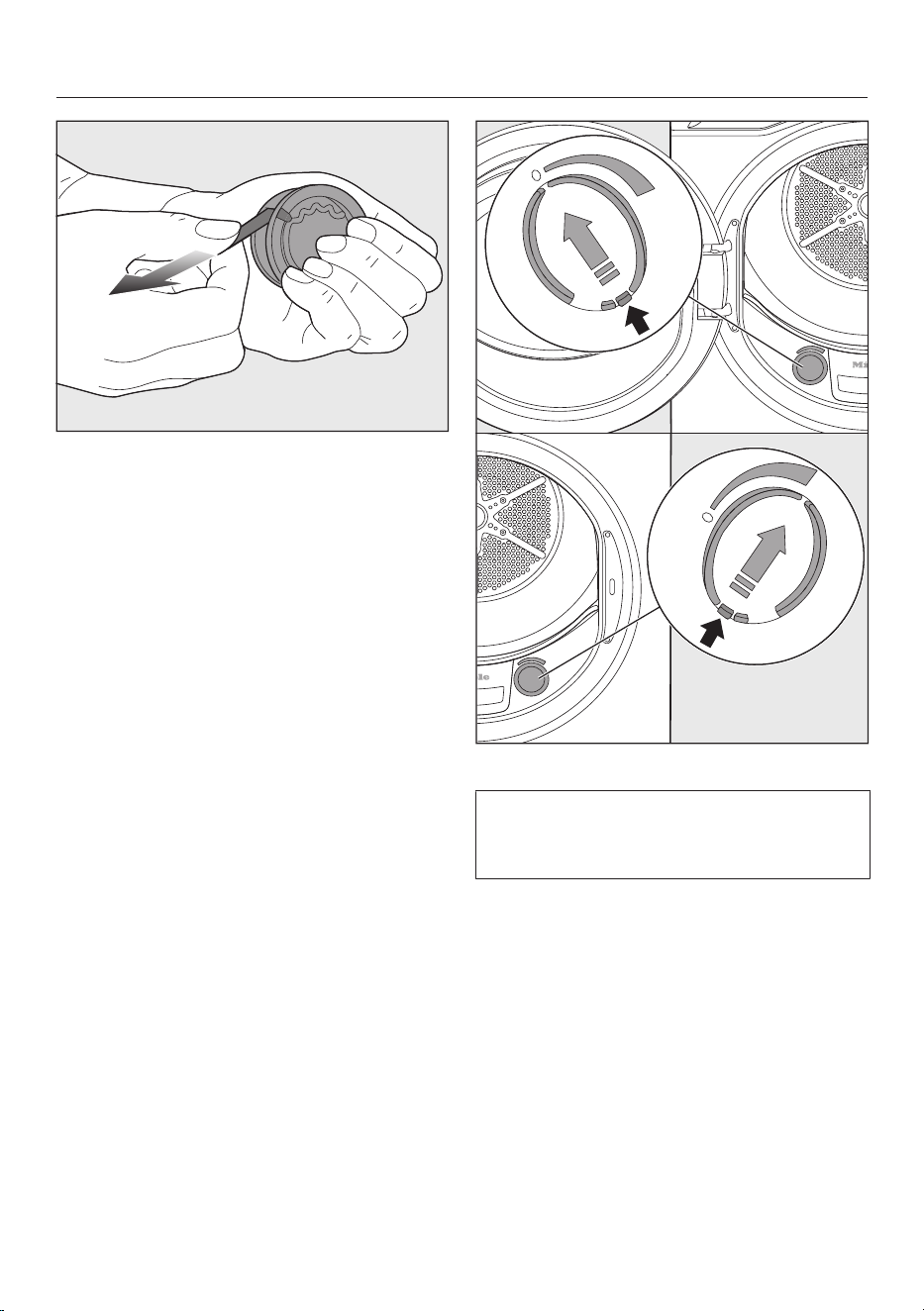
Hold the fragrance flacon.
Tip: Do not open the fragrance flacon.
Hold the fragrance flacon straight and
do not tip.
Pull off the protective seal.
FragranceDos sockets
There are 2 sockets in the fluff filter.
Open the cover using the opening tag.
To prevent the accumulation of fluff,
the cover of the unused socket must
remain closed.
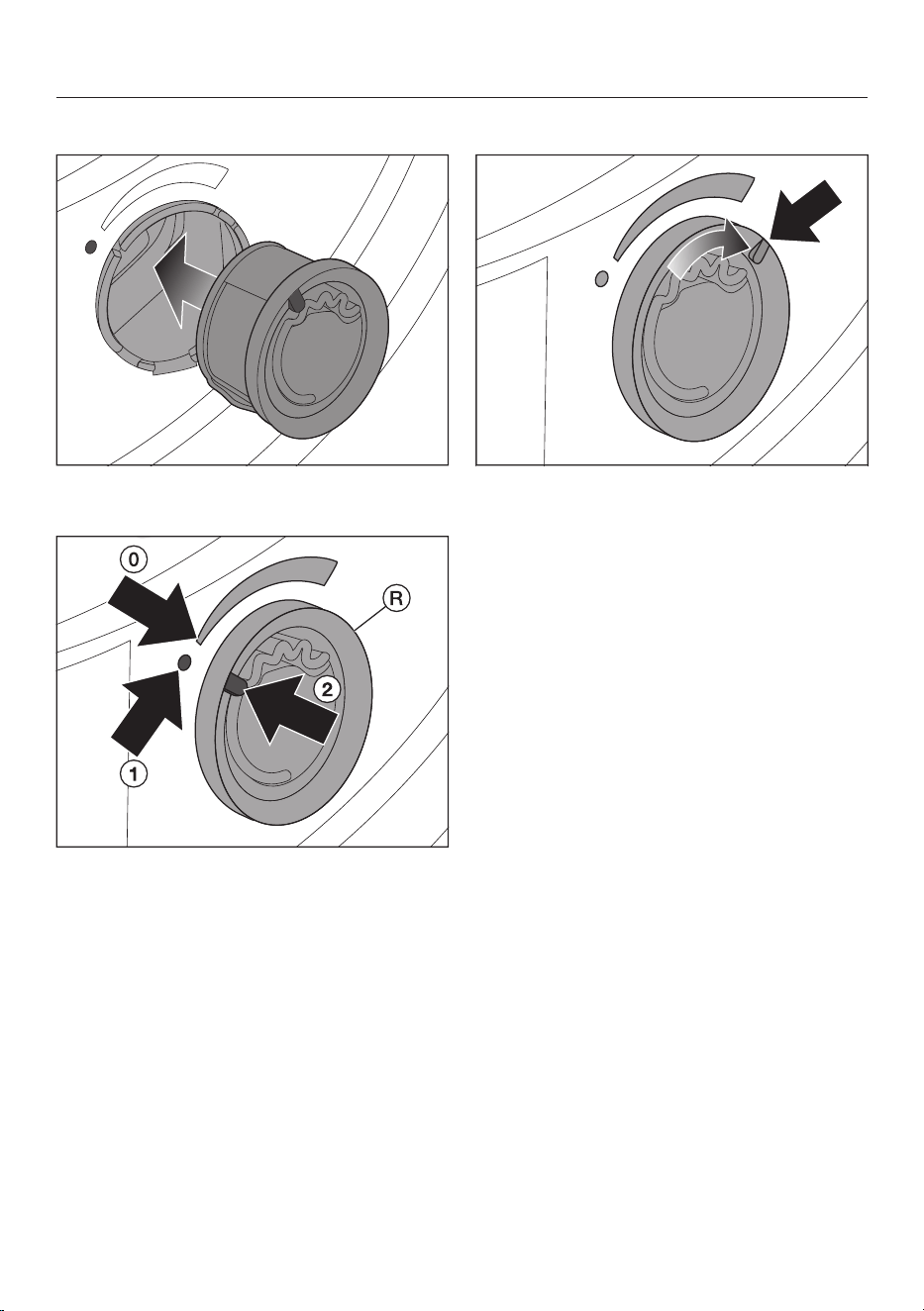
Operation
35
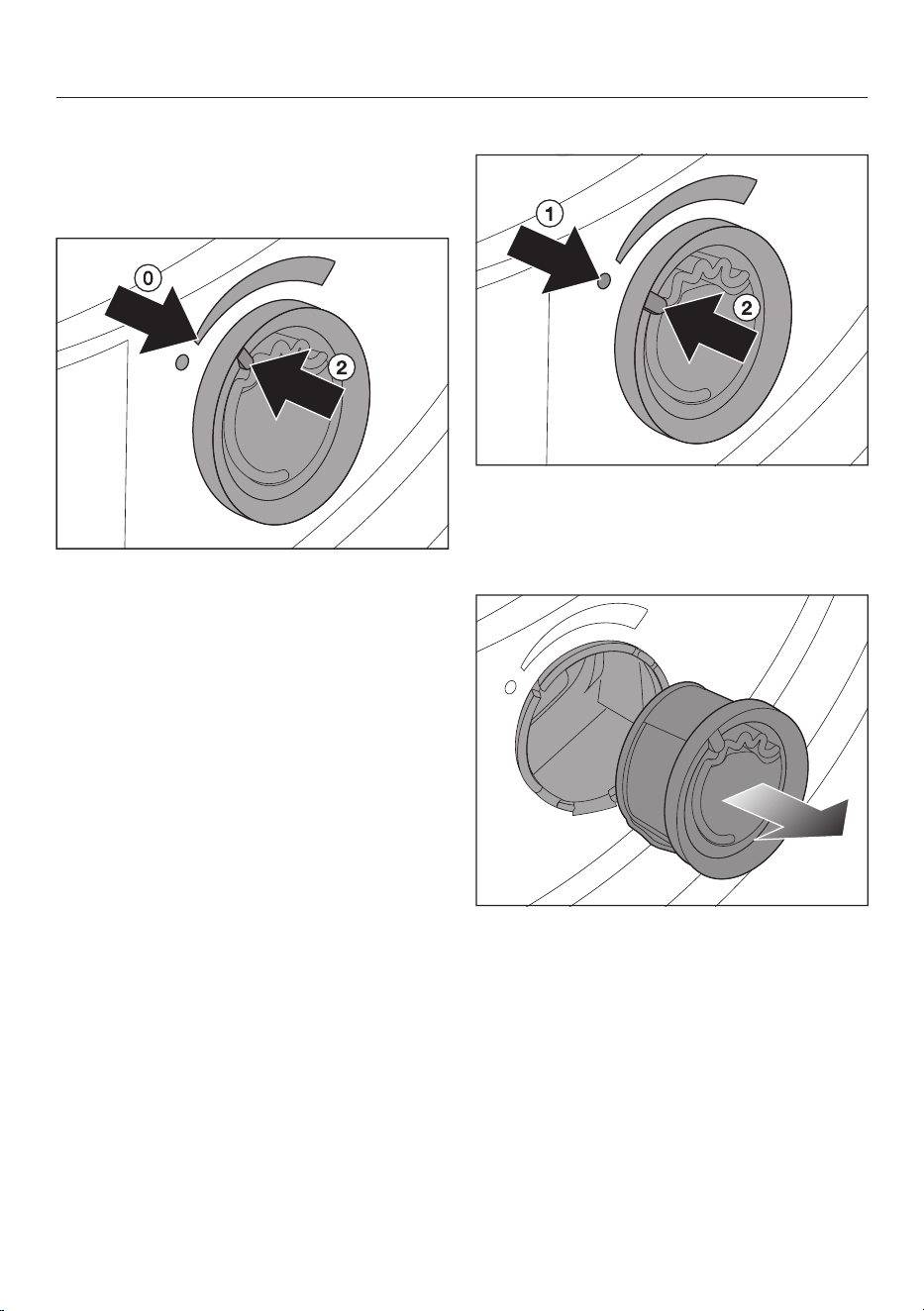
Inserting the fragrance flacon
Insert the fragrance flacon as far it
will go into the FragranceDos socket.
The marking is located at the posi-
tion.
Turn the outer ring clockwise a
little.
Tip: To prevent the fragrance flacon
from slipping out, the mark must be
in position .
Controlling the fragrance intensity
To adjust the fragrance intensity, turn
the outer ring to the right.
- The further you open the fragrance
flacon, the more intense the fragrance.
- Damp laundry and longer programme
running times with sufficient heat
transfer are needed for the fragrance
to be released into the laundry effect-
ively. In the Cool air programme or if
the fluff filters have not been cleaned
properly, the fragrance will not be re-
leased efficiently into the laundry.
The fragrance will also be noticeable in
the ambient air during the process.
Tip: Replace the fragrance flacon with a
new one when the fragrance intensity is
no longer sufficient.
Operation
36
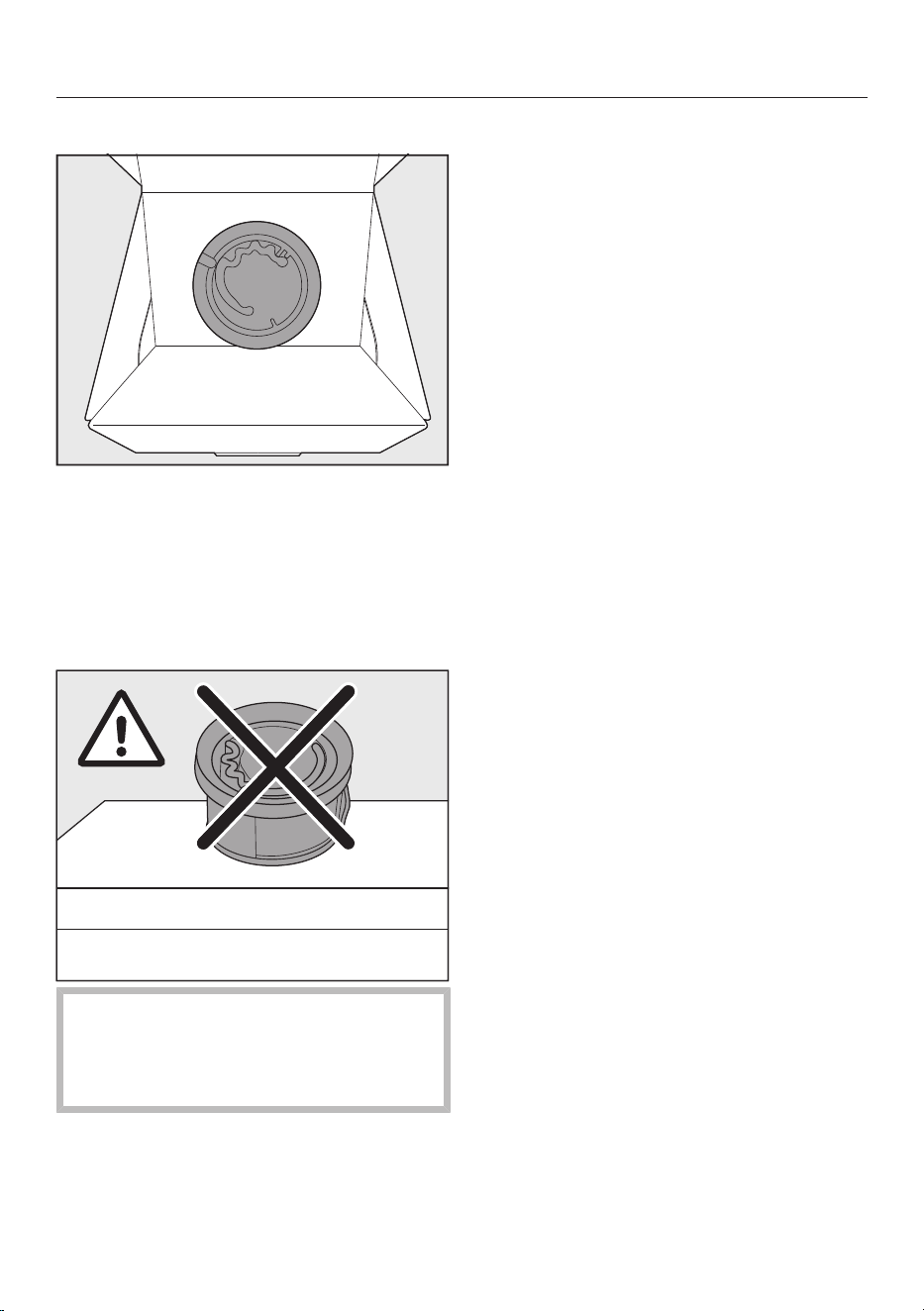
Closing the fragrance flacon
After drying, the fragrance flacon should
be closed to prevent the fragrance from
escaping needlessly.
Turn the outer ring anti-clockwise a
little.
The markingb is located at the _posi-
tion.
Removing the fragrance flacon
Turn the outer ring anti-clockwise a
little.
The markingb is located at the aposi-
tion.
Remove the fragrance flacon.
Replacement interval: replace the fra-
grance flacon when it is empty or the
fragrance is no longer sufficient.
Operation
37
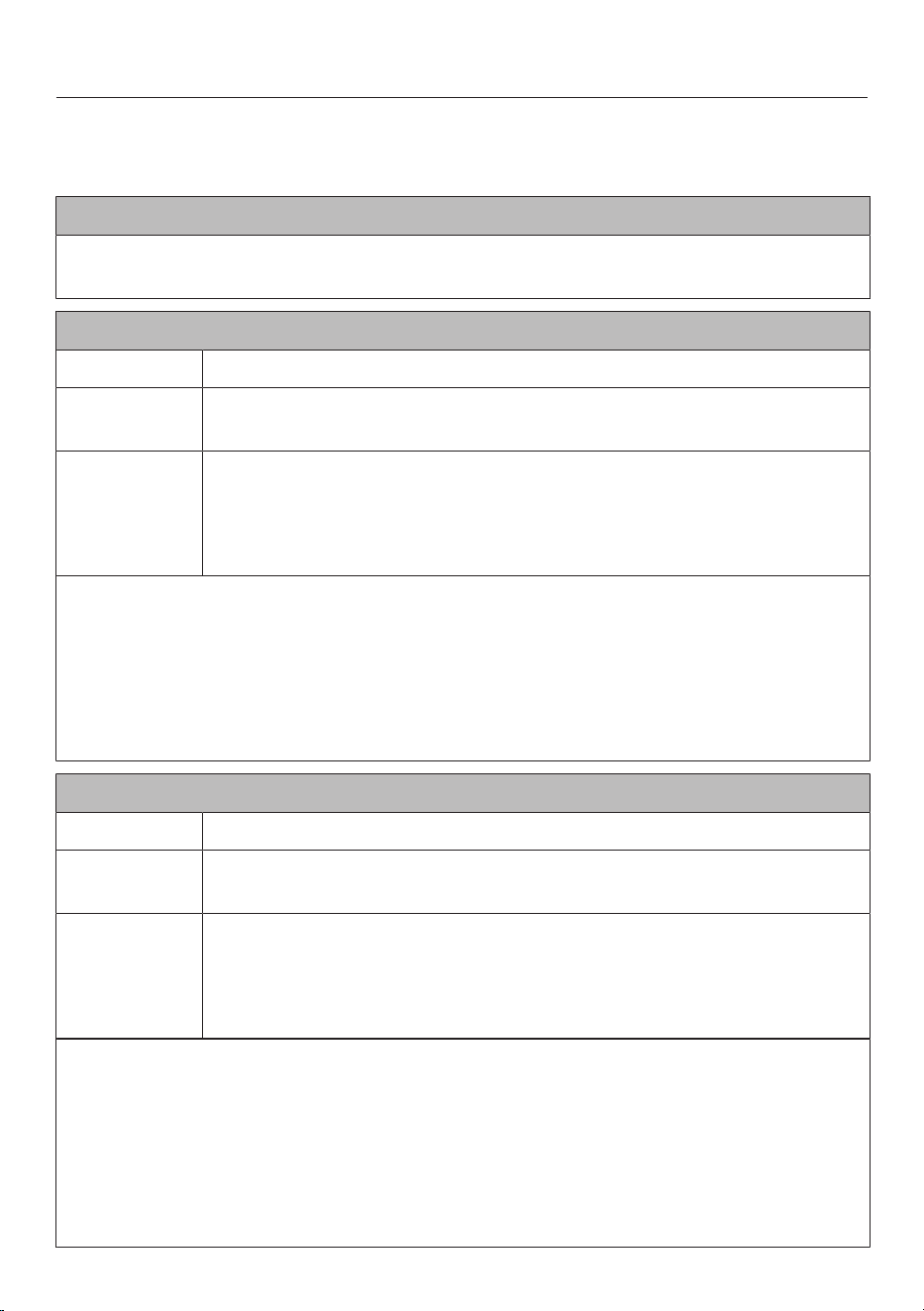
Storing the fragrance flacon
- Store the fragrance flacon in the ori-
ginal packaging in a cool, dry place.
- Do not expose the fragrance flacon to
direct sunlight.
- When purchasing new fragrance flac-
ons, only remove the protective seal
just before use.
The fragrance can leak out of the
flacon.
Do not store the fragrance flacon up-
right, upside down or on its edge.
Programmes
38
Programme chart
Load: specifications refer to the weight of the dry laundry.
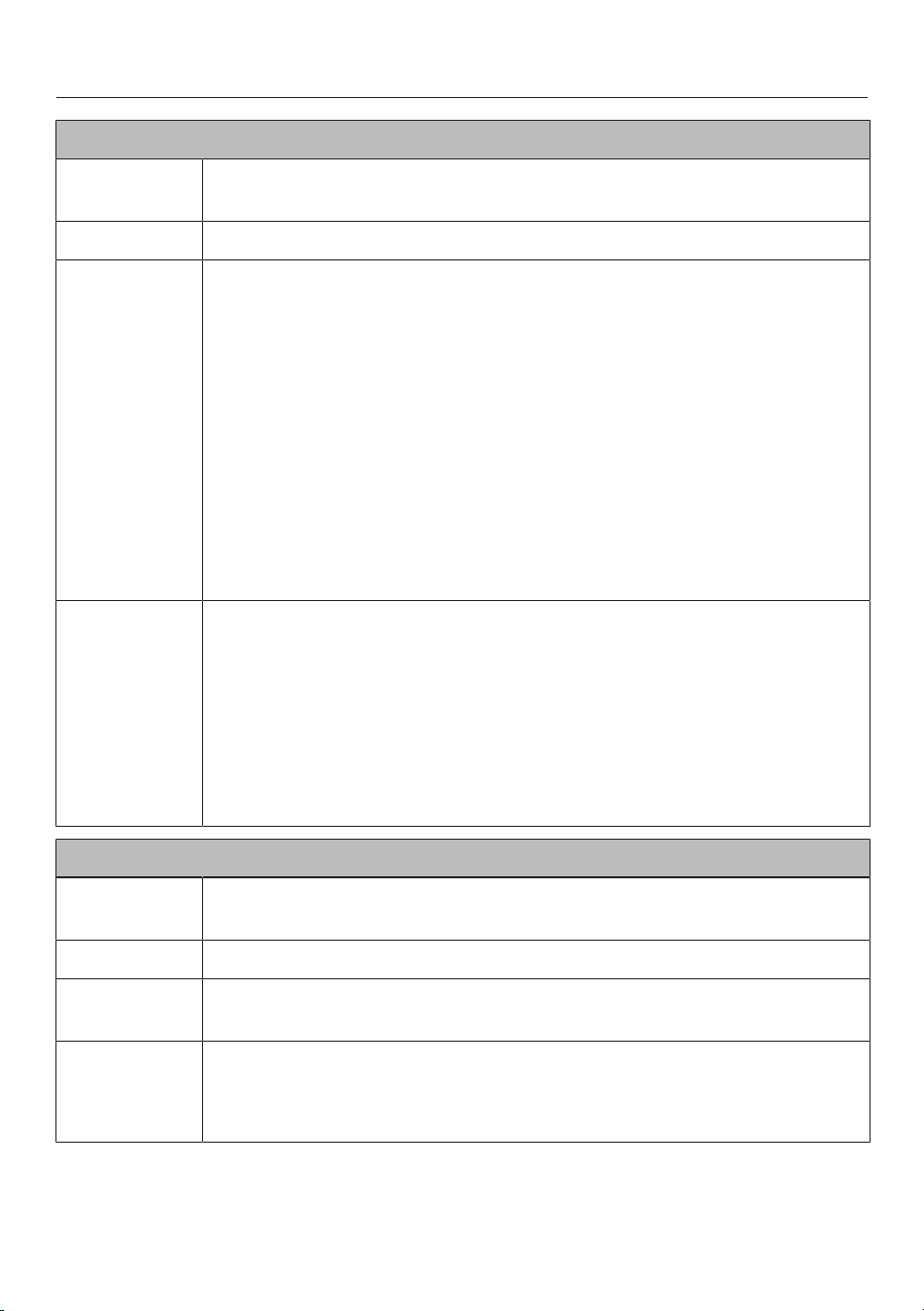
Wash2Dry
The programme is selected automatically in conjunction with the programme se-
lection on the connected washing machine.
Cottons
Load 9kg
Use for Cotton items such as those described under Cottons Cupbaord
Dry with normal residual moisture
Tip - This programme is the most energy-efficient for drying cotton
items with normal residual moisture levels.
- In this programme, the Cupbaord Dry degree of dryness is
achieved.
Note for test institutes: the following is only valid for GB.
- The Cottons programme is the test programme in accordance with Regu-
lation 392/2012/EU for energy labelling, measured in accordance with
EN61121.
- With the Cottons, Cottons and ECO programme settings, drain the con-
densed water externally via the drain hose.
ECO
Load 9kg
Use for Cotton items such as those described under Cottons Cupbaord
Dry with normal residual moisture
Tip - This programme is the most energy-efficient for drying cotton
items with normal residual moisture levels.
- In this programme, the Cupbaord Dry degree of dryness is
achieved.
Note for test institutes (in accordance with regulations, EU only)
- The ECO programme is the test programme in accordance with Regulations
(EU) 2023/2533 and (EU) 2023/2534 for the energy label measured in ac-
cordance with EN61121. This programme is used to evaluate compliance with
the EU Ecodesign legislation.
- With the Cottons and ECO programme settings, drain the condensed water ex-
ternally through the drain hose.
Programmes
39
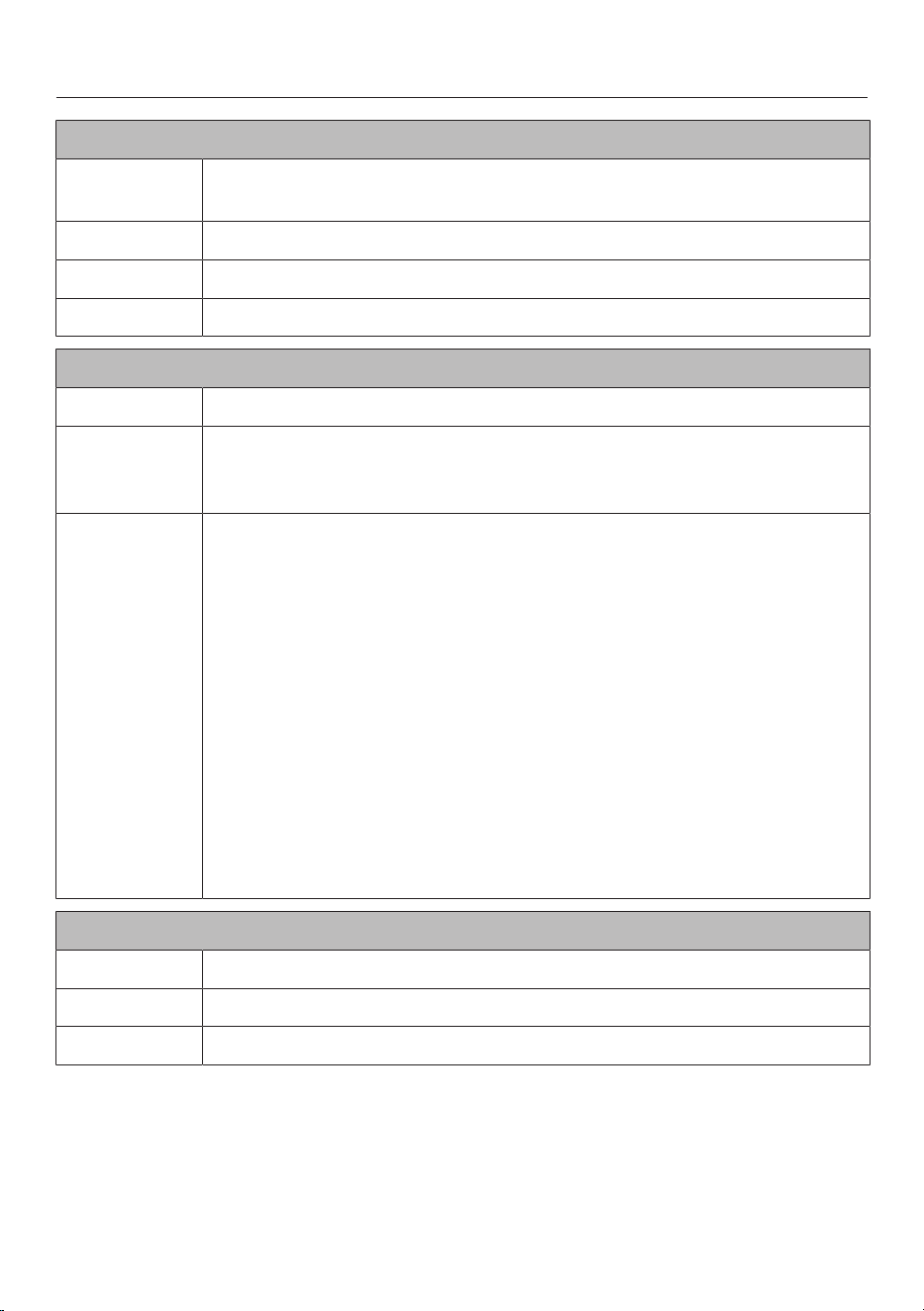
Cottons
Drying levels HygieneDry, Extra dry, Cupboard Dry plus, Cupboard Dry, Hand
ironplus, Hand iron
Load 9kg and only 4.5kg for HygieneDry
Use for HygieneDry
- Cottons and linen fabric which will be in direct contact with the
skin, e.g. underwear, baby clothes, bed linen, towelling
- Hard-wearing fabrics with the care symbol on the care label
Extra dry, Cupboard Dry plus, Cupboard Dry
- T-shirts, workwear, jackets, blankets, aprons, smocks
- Single and multi-layered cotton items
Hand ironplus, Hand iron
- Table linen, bed linen or starched laundry made of cotton or linen
fabric
Tip - Do not cancel HygieneDry. Otherwise the hygienic drying result
will not be achieved.
- Extra dry for multi-layered and very thick fabrics.
- Do not use Extra dry for T-shirts, underwear, baby clothes (jer-
sey fabrics). These fabrics can shrink.
- To prevent laundry from drying out, it should be rolled up until
you are ready for ironing.
Minimum iron
Drying levels HygieneDry, Cupboard Dry plus, Cupboard Dry, Hand ironplus,
Hand iron
Load 4kg
Use for Synthetic and mixed fibre textiles as well as easy care cotton e.g.
jumpers, dresses, trousers and socks/tights
Tip - Close any zips or do up buttons.
- Do not cancel HygieneDry. Otherwise the hygienic drying result
will not be achieved.
Programmes
40
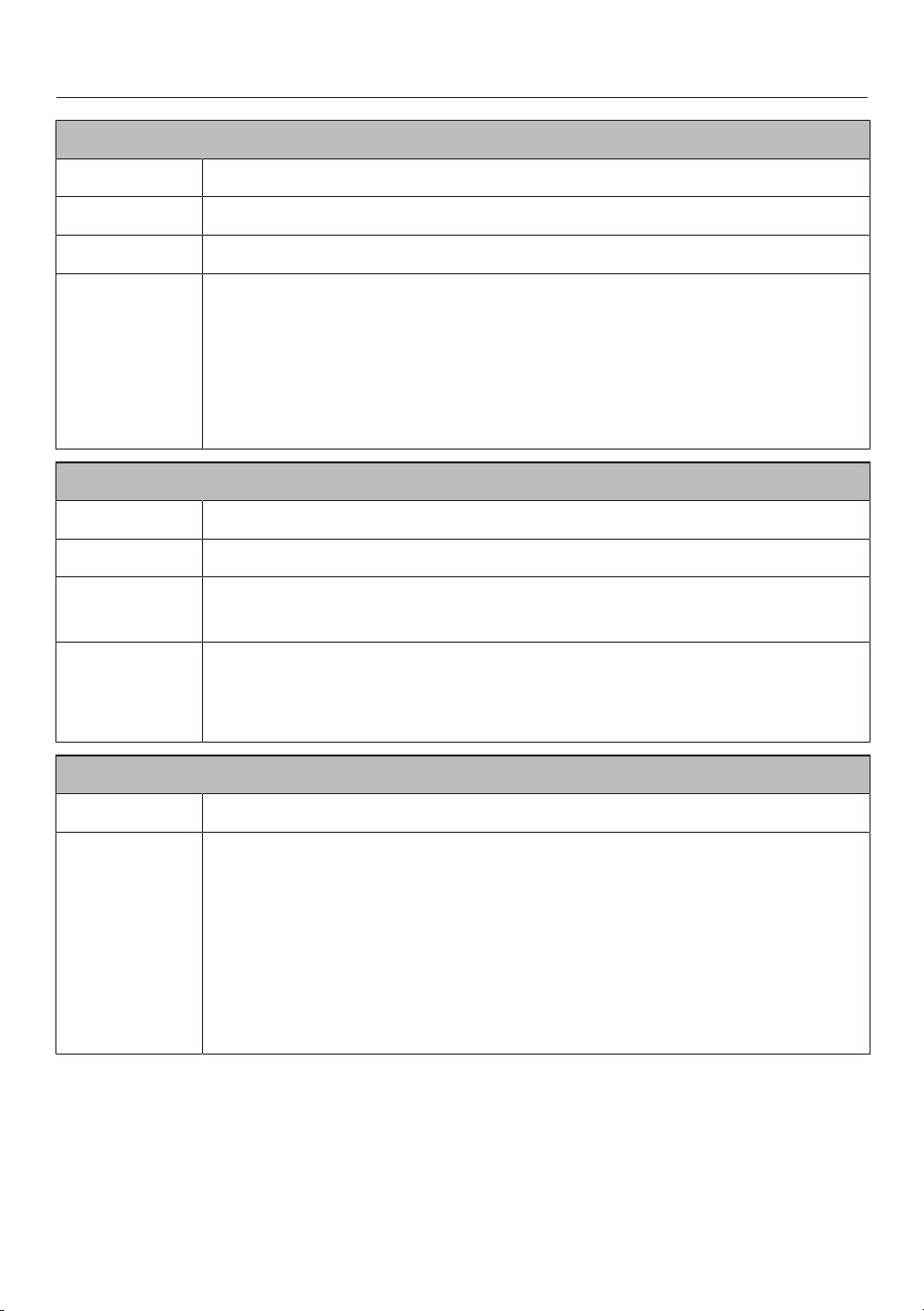
QuickPowerDry
Drying levels Extra dry, Cupboard Dry plus, Cupboard Dry, Hand ironplus, Hand
iron
Load 4kg
Use for Garments made of cotton, synthetic fibres or mixed fibres
Tip Shortening the programme running time
Woollens
Load 1kg
Use for Woollen garments and fabric containing wool blends with a care
label stating that they are suitable for washing, e.g. jumpers, car-
digans, socks/tights
Tip - To dry jumpers made from delicate woollen materials gently and
carefully, we recommend drying them individually in the tumble
dryer and not for too long in each case. Please reduce the drying
time for small loads.
- After taking the jumper out of the tumble dryer, lay it out flat un-
til it feels dry to the touch.
- Particularly delicate woollen garments, such as those made of
angora, camel hair or cashmere, are usually not suitable for this
programme. Even if delicate woollen garments are labelled as
hand-washable, it is important not to tumble dry these garments
in the Woollens programme.
Instead, dry them in the Basket programme programme with the
Miele dryer basket. Alternatively, you can leave woollen gar-
ments to air dry flat.
Shirts/Blouses
Drying levels Cupboard Dry plus, Cupboard Dry, Hand ironplus, Hand iron
Load 2kg
Use for Shirts and blouses made of cotton and mixed fibre
Programmes
41
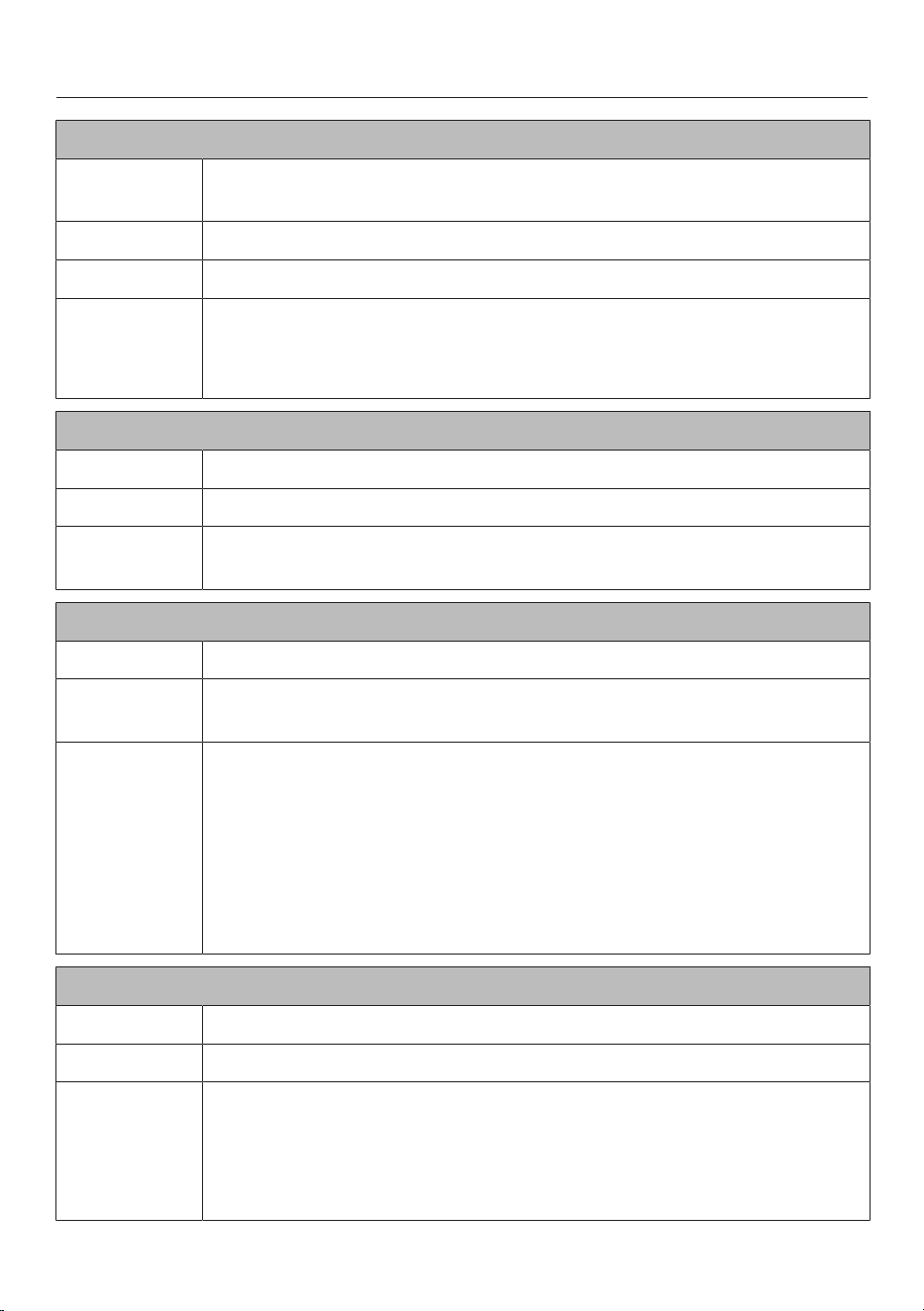
PowerFresh
Drying levels Cupboard Dry, Hand ironplus
Load 1kg
Use for Washed, damp textiles
Tip - For freshening up and smoothing with steam
- Use the DryFresh fragrance flacon (optional accessories).
- Insert the DryFresh fragrance flacon and adjust the fragrance in-
tensity: see “Operation – Fragrance flacon”
- The condensate container must be filled.
Delicates
Drying levels Cupboard Dry plus, Cupboard Dry, Hand ironplus, Hand iron
Load 2.5kg
Use for Delicate garments made from synthetic fibre, mixed fibre and vis-
cose with the care symbol, e.g. lingerie and appliquéd garments
Tip - The load can be reduced further for a particularly crease-free
drying process.
- DryCare 40 is always active.
Warm air
Load 9kg
Use for - Drying
Dry different types of garments such as bath towels, bathing
costumes and tea towels
- separately
Multi-layered fabrics whose layers have different drying char-
acteristics, e.g. jackets, pillows, sleeping bags and other bulky
items
Programmes
42
Denim
Drying levels HygieneDry, Extra dry, Cupboard Dry plus, Cupboard Dry, Hand
ironplus, Hand iron
Load 3kg
Use for Denim garments, e.g. jeans, jackets, shirts, skirts
Tip - Close any zips or do up buttons.
- Do not cancel HygieneDry. Otherwise the hygienic drying result
will not be achieved.
Outerwear
Drying levels Cupboard Dry, Hand ironplus
Load 2.5kg
Use for Functional textiles, e.g. jackets and trousers made from membrane
fabrics such as Gore-Tex®, SYMPATEX® and WINDSTOPPER®
Proofing
Load 2.5kg
Use for Items made of microfibre and mainly synthetic fibres e.g. outer-
wear, skiwear and rainwear, table linen
Tip - This programme includes an additional proofing thermal fixing
phase.
- Only use proofing agents which are stated by the manufacturer
as being “suitable for use on membrane fabrics”. These agents
contain fluorochemical compounds.
- This poses a fire hazard. Do not dry fabrics which have been
treated with proofing agents containing paraffin.
DryFresh
Load 4kg
Use for Washed, damp textiles
Tip - For freshening up without additional steam
- Use the DryFresh fragrance flacon (optional accessories).
- Insert the DryFresh fragrance flacon and adjust the fragrance in-
tensity: see “Operation – Fragrance flacon”
Programmes
43
Sportswear
Drying levels Cupboard Dry plus, Cupboard Dry, Hand ironplus, Hand iron
Load 3kg
Use for Sportswear such as singlets and leggings as well as microfibre and
fleece garments
Extras DryCare40, Quick, Energy saving, Pre-ironing, SingleDry, Extra-
Quiet, Buzzer
Express
Drying levels Extra dry, Cupboard Dry plus, Cupboard Dry, Hand ironplus, Hand
iron
Load 4kg
Use for Items suitable for the Cottons programme
Tip Shortening the programme running time with an increased energy
requirement
Down filled items/Bettdecken
Drying levels HygieneDry, Cupboard Dry
Load 1–2 pillows 40x80cm or
1 pillow 80x80cm or
1 duvet
Use for Pillows and duvets with down, feather or synthetic filling
Tip - The natural properties of feathers cause odours to develop when
they are exposed to heat and moisture. Allow bedding to air out-
side the tumble dryer after tumble drying.
- Do not cancel this programme. Otherwise the hygienic drying
result will not be achieved.
Programmes
44
Woollens handcare
Load 1kg
Use for Woollen garments and fabric containing wool blends, e.g.
pullovers, cardigans, socks/tights
Tip - Wool and wool blend items contain a finish and are only fluffed
up; they are not dried completely.
- Remove the laundry at the end of the programme and spread
the individual items out to dry.
Silks handcare
Load 1kg
Use for Silk garments such as shirts and blouses
Tip - This programme reduces creasing. Items are not dried com-
pletely by this programme.
- Remove the laundry after the end of the programme.
Smoothing
Drying levels Cupboard Dry, Hand iron
Load 1kg
Use for Washed, damp textiles
Tip - To smooth out creasing caused during the spin cycle in the
washing machine without additional steam.
- You can select a drying level to care for damp items.
- Remove the garments as soon as the programme has finished.
Programmes
45
QuickHygiene
Load 4kg
Use for - Hard-wearing fabrics with the care symbol on the care label
- Cottons and linen fabric which will be in direct contact with the
skin, e.g. underwear, baby clothes, bed linen, towelling
Tip - Also suitable for clean, dry laundry
- Longer temperature holding time with a constant temperature.
This temperature holding time kills off micro-organisms such as
germs or dust mites and reduces allergens in the laundry.
- Do not cancel this programme. Otherwise the hygienic drying
result will not be achieved.
- Shortening the programme running time
Bed linen
Drying levels HygieneDry, Extra dry, Cupboard Dry plus, Cupboard Dry, Hand
ironplus, Hand iron
Load 4kg
Use for Bed linen, pillowcases
Tip - Close any zips or do up buttons.
- Do not cancel HygieneDry. Otherwise the hygienic drying result
will not be achieved.
Automatic
Drying levels HygieneDry, Extra dry, Cupboard Dry plus, Cupboard Dry, Hand
ironplus, Hand iron
Load 5kg and only 4kg for HygieneDry
Use for Mixed load of garments suitable for the Cottons and Minimum
iron programmes
Tip - Close any zips or do up buttons.
- Do not cancel HygieneDry. Otherwise the hygienic drying result
will not be achieved.
Programmes
46
Basket programme
Load 3.5kg basket load
Use for Items suitable for tumble drying for which mechanical stress
should be avoided.
Tip - This programme may only be used with the dryer basket (op-
tional accessory).
- Follow the operating instructions supplied with the dryer basket.
Cool air
Load 9kg
Use for Airing fabrics without heating

Programmes
47
Extras
Pre-ironing
Clean, damp laundry is smoothed by
steam.
Maximum load: 1kg
The condensate container must be
filled.
DryCare 40
All washable laundry is dried at 40°C. It
is not necessary to sort the textiles.
Maximum load:
- 4.5kg in theCottons programme
- 4.0kg in theAutomatic programme
- In other programmes, do not exceed
the maximum load specified for each
programme.
Quick
The laundry is dried with a shorter pro-
gramme running time (PowerDry).
Extra quiet
Noise reduction during drying.
SingleDry
A small number of individual textiles can
be dried in a short time (PowerDry).
Maximum load: 1kg
Save energy
Energy savings during longer drying pro-
grammes.
Gentle tumble
The items are dried at a gentle temper-
ature.
Suitable for all items with the care
symbol, e.g. those made from acrylic.
The programme running time is in-
creased.
Programmes
48
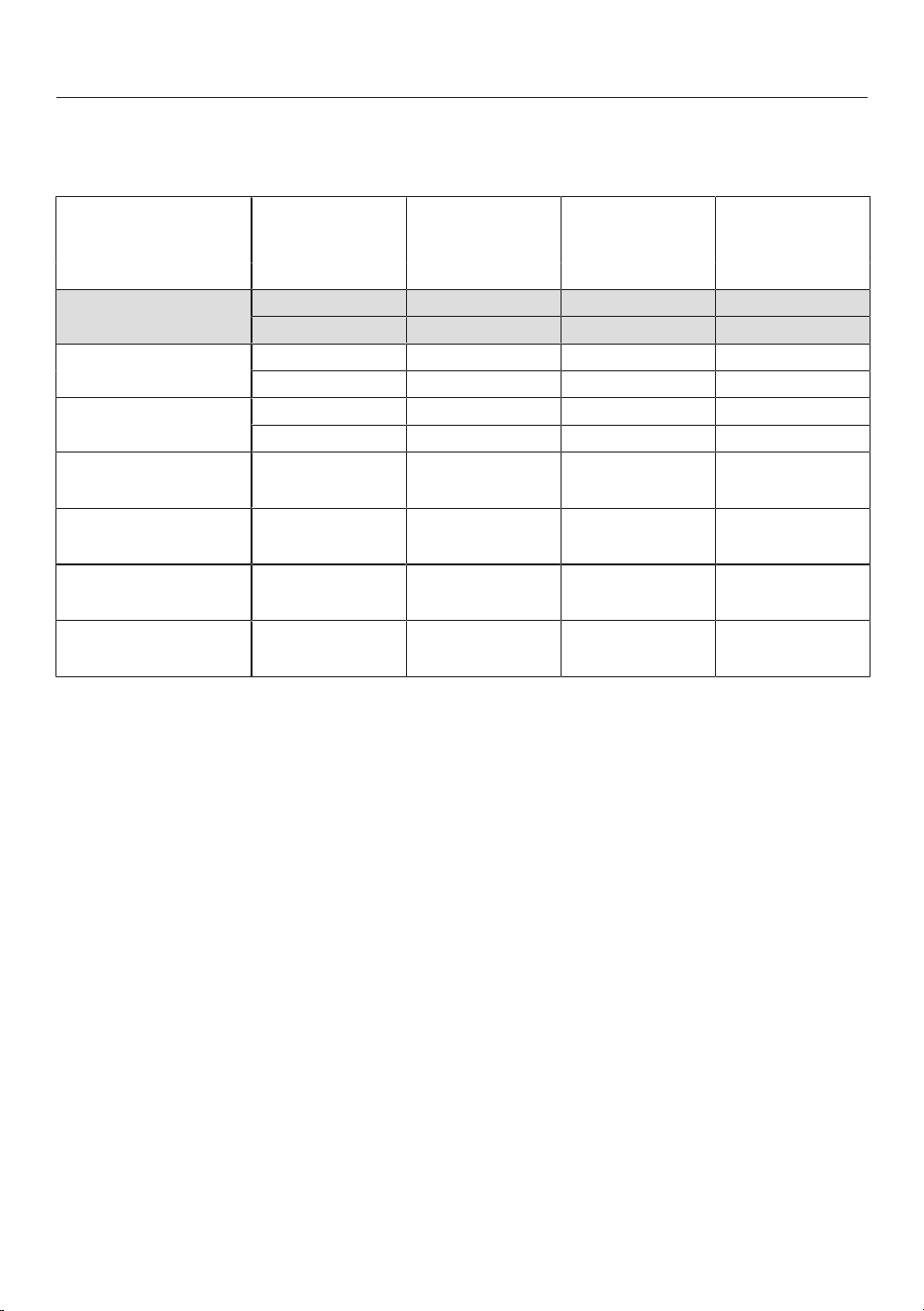
Consumption data
In accordance with regulations, GB only
Load size
1
Final spin speed in
washing machine
Residual
moisture
Energy Running
time
kg rpm % kWh min
Cottons
2
9.0
4.5
1000
1000
60
60
1.44
0.75
231
132
Cottons Cupboard Dry 9.0
9.0
9.0
1200
1400
1600
53
50
44
1.30
1.25
1.10
209
198
177
Cottons Handiron 9.0
9.0
9.0
9.0
1000
1200
1400
1600
60
53
50
44
1.11
0.95
0.90
0.75
143
125
117
99
Minimumiron Cupboard Dry 4.0 1200 40 0.45 65
Delicates Cupboard Dry 2.5 800 50 0.45 65
Shirts/Blouses Cupboard Dry 1.0 600 60 0.30 45
Express Cupboard Dry 4.0 1000 60 0.75 100
Proofing Cupboard Dry 2.5 800 50 0.70 100
1
Weight of dry laundry
2
The Cottons programme is the test programme in accordance with Regulations 932/2012/EU
and 392/2012/EU for the energy label measured in accordance with EN61121.
All data was calculated using EN61121 unless otherwise stated.
Consumption data can vary from the nominal values given above depending on load size, types of
textiles, residual moisture levels after spinning, additional programme parameters selected and
fluctuations in the electricity supply, or when water hardness levels differ from specified values.
Programmes
49
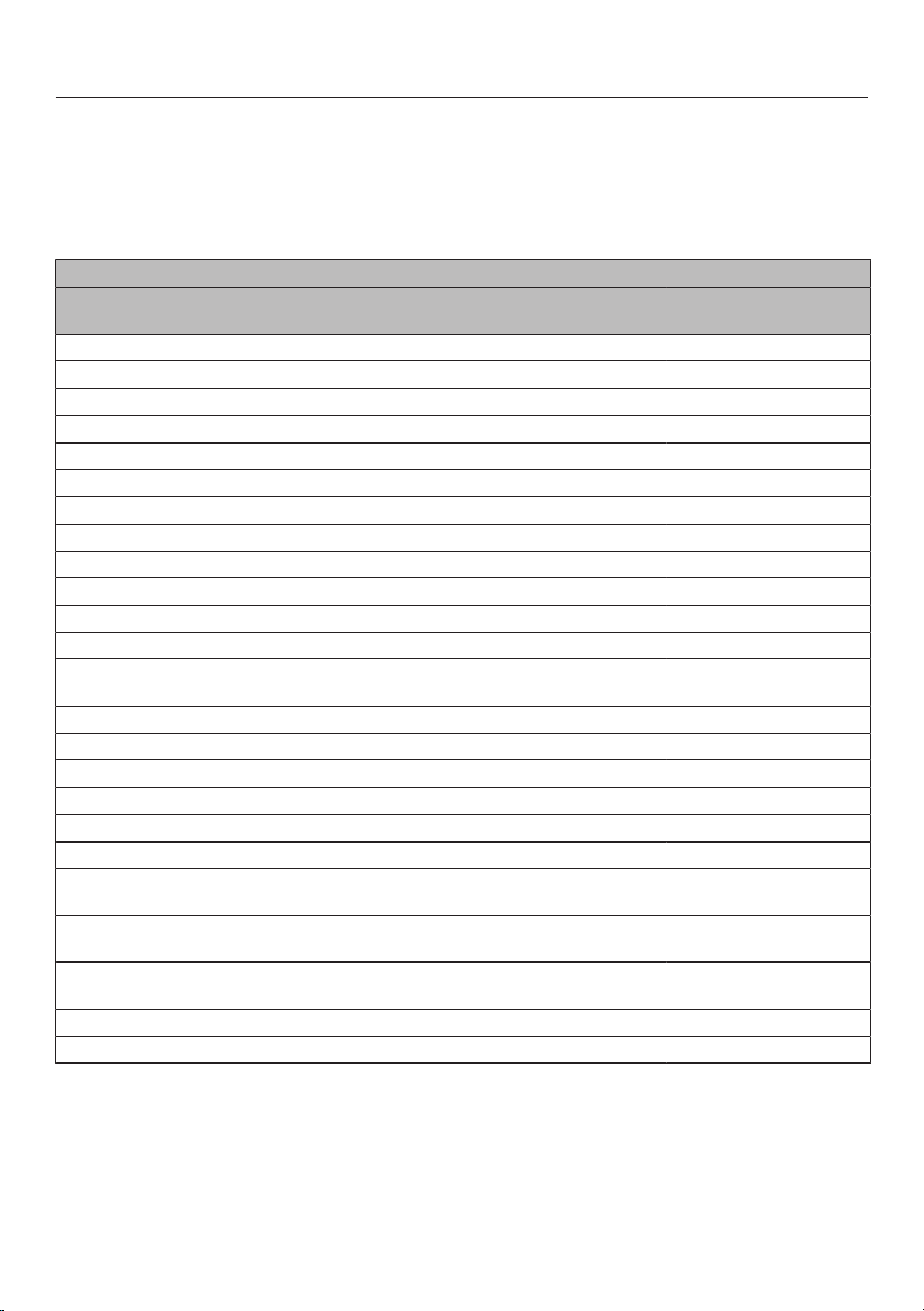
Consumption data
In accordance with regulations, EU only
Programmes Load size
2
Running time Energy
Final moisture
content after dry-
ing
kg h:min kWh %
ECO
1
9,0 3:51 1,44 0
4,5 2:12 0,75 0
Cottons 9,0 3:30 1,72 - 4
Extra dry
4,5 2:10 1,00 - 4
Cottons 9,0 2,23 1,11 12
Hand iron
4,5 1:45 0,70 12
Minimum iron
Cupboard Dry plus
4,0 1,07 0,47 0
Minimum iron
Cupboard Dry
4,0 1:05 0,45 2
Minimum iron
Hand iron
4.0 0:48 0,32 12
Delicates
Cupboard Dry
2,5 1:05 0,45 0
1
ECO is the test programme in accordance with Regulations (EU) 2023/2533 and (EU) 2023/2534 for
the energy label measured in accordance with EN61121. The sound power level at full load for the ECO
test programme is 60 dB(A)re1pW.
2
The load refers to the weight of the dry laundry.
The values quoted for other programmes without the ECO programme are guide values calculated using
EN61121.
Consumption data can vary from the nominal values given above depending on load size, types of
textiles, residual moisture levels after spinning, additional programme parameters selected and
fluctuations in the electricity supply, or when water hardness levels differ from specified values.
Programmes
50
The product data sheet in accordance with delegated regulation (EU) No.
392/2012 is valid for GB.
Data sheet for household tumble driers
In acc. with delegated regulation (EU) No. 392/2012
MIELE
Model name/identifier TQ 1000 WP Nova Edi-
tion
Rated capacity
1
9,0 kg
Type of tumble drier (Air-vented / condenser) - / ●
Energy efficiency class
A+++ (most efficient) to D (least efficient) A+++
Weighted annual energy consumption (AE
c
)
2
170 kWh/year
Tumble drier (Automatic / non-automatic) ● / -
Energy consumption of the standard cotton programme
Energy consumption at full load 1,44 kWh
Energy consumption at partial load 0,75 kWh
Weighted power consumption in off-mode (P
o
) 0,50 W
Weighted power consumption in the left-on mode (P
l
) 0,50 W
Duration of the 'left-on' mode (T
l
)
3
15 min
Standard programme to which the information in the label and the fiche
relates
4
Cottons with arrow
Programme time of the 'standard cotton programme'
Weighted programme time 174 min
Programme time at full load 231 min
Programme time at partial load 132 min
Condensation efficiency class
5
A (most efficient) to G (least efficient) A
Weighted condensation efficiency for the 'standard cotton programme' at full
and partial load
94 %
Average condensation efficiency of the 'standard cotton programme' at full
load
95 %
Average condensation efficiency of the 'standard cotton programme' at par-
tial load
94 %
Sound power level (L
WA
)
6
62 dB(A) re 1 pW
Built-in -
● Yes, standard feature
1
In kg of cotton laundry for the standard cotton programme at full load.
2
based on 160 drying cycles of the standard cotton programme at full and partial load, and the con-
sumption of the low-power modes. Actual energy consumption per cycle will depend on how the ap-
pliance is used.
3
If the household tumble drier is equipped with a power management system.

Programmes
51
4
This programme is suitable for drying normal wet cotton laundry and is the most efficient programme
in terms of energy consumption for cotton.
5
If the household tumble drier is a condenser tumble drier.
6
For the standard cotton programme at full load.

Good to know
52
Risk of fire due to incorrect use
and operation.
The laundry can burn and destroy the
tumble dryer and the surroundings.
See the section on “Warnings and
safety notes” for further information.
Damage due to foreign objects in
the laundry.
Foreign objects can melt, burn, or ex-
plode.
Ensure that any foreign objects (e.g.
detergent dispensing aids, lighters,
etc.) have been removed from the
laundry.
Tips
Washing tips
To prevent the risk of fire in the tumble
dryer, wash heavily soiled textiles par-
ticularly thoroughly.
- Use sufficient detergent.
- Select a high wash temperature.
- If in doubt, wash the items several
times.
To prevent new garments with intense
colours from transferring colour to
other garments and plastic parts in the
tumble dryer, excess colour must be
washed out.
- Wash new, coloured items thoroughly
and separately before drying for the
first time.
To treat starched laundry in the tumble
dryer, an increased amount of starch
must be dispensed during washing.
- To achieve the usual finish, double the
amount of starch should be used.
Inadequately spun laundry increases
the tumble dryer’s energy consump-
tion and programme running time. A
fault may occur.
- Select a maximum spin speed for
washing.
Tips on drying
- Sort the laundry according to fibre
and fabric.
- Sort the laundry according to the
same care symbols on the care label.
- Sort textiles according to colour so
that fluff from different colours does
not settle on the textiles.
- Loosen the items of laundry before
putting them in the tumble dryer.
- Fasten duvet covers and pillow cases
to prevent other items from becoming
rolled up inside them.
- Tie together textile belts and ties.
- Close long zips.
Good to know
53
Protecting tumble dryers
To prevent the tumble dryer from being
damaged, check that the textiles are in
perfect condition.
- Sew up damaged hems and seams on
textiles so that fillings (pillow fillings)
do not fall out and cause a fire.
- Sew or remove loose underwires from
bras so that they do not come loose
and get caught.
- Fasten hooks and eyes on textiles so
that they do not get caught.
Protecting your laundry
Overdrying strains the laundry.
- Do not dry your laundry for too long.
Select a drying level with more resid-
ual moisture or a shorter duration.
Overfilling strains the laundry, affects
the drying result and is more likely to
develop creases.
- Observe the recommended load sizes
for this tumble dryer.
Shirts and blouses tend to crease
more if the load size is large.
- If in doubt, reduce the load size to
minimise creases and the ironing ef-
fort.
Jersey fabrics (e.g. T-shirts, underwear)
tend to shrink when they are washed
for the first time.
- To prevent further shrinkage, avoid
overdrying jersey fabrics.
- If possible, choose a slightly bigger
size when buying garments made
from jersey fabrics.
Pure linen fabric must be labelled as
suitable for tumble drying.
- If in doubt, use the Smoothing pro-
gramme.
Garments with intense colours and a
high fluff content can deposit fluff on
light-coloured textiles, making it ne-
cessary to wash them again.
- Separate garments with intense col-
ours.
Care symbols on the care label
Drying
Temperature
Normal or higher
Reduced
Do not tumble dry
Ironing
Temperature
hot, medium, lower
Do not iron

Good to know
54
The right programme
Follow the instructions in “Pro-
grammes”. You will also find tips on se-
lecting the right programme.
Selecting the correct drying level
To ensure that your laundry is perfectly
dried, you can select a drying level for
many programmes.
- HygieneDry for fabrics with special
hygiene requirements
- for multi-layered or very thick fabrics
and for fabrics that do not dry evenly
using Cupboard Dry +
- Cupboard Dry plus for fabrics that are
to be put away immediately
- Cupboard Dry for fabrics that may
shrink such as light cotton or jersey
fabrics
- Hand iron +/Hand iron for items that
are to be ironed after drying
Drying level HygieneDry
Tip: If you have special hygiene require-
ments for your textiles, select Hygiene-
Dry.
The HygieneDry drying level is used to
dry with a high temperature that is con-
stant over an extended period of time.
This kills off micro-organisms (such as
germs or dust mites) and reduces aller-
gens in the laundry.
The tumble dryer’s energy requirement
is higher and the programme running
time is longer.
The hygienic drying result is not
achieved.
A programme for which the Hygiene-
Dry drying level has been selected
must not be interrupted.
The right delay start
For some programmes, such as the
Warm air programme, you can select a
time.
Tip: Do not select the longest drying
time to start with. Check the items as
you are drying them to find the optimum
time.

Adjusting settings
55
Settings: overview
* Follow the instructions on the
display.
General
Software update
Language *
Date & Time *
Brightness *
Sounds *
Buzzer tones
End of prog. tone
Security
System lock
Set up
Edit
Delete
PIN code
Movement sensor
Off
Near
Far
Factory default settings
Reset appliance
Networking
WiFi
Connection
Signal strength
Home network
IP address
Reset
Remote control
Appliance functions
Memory
ComfortOpen
Anti-crease
Anti-crease
Duration
0:30 2:00 h
Drying levels
Automatic
Cottons
Minimum iron
Airways indicator
Light
Normal
Heavy
Lighting *
Door handle
Cooling down temp.
Information
Software *
Central Control Unit
Actor Sensor Units
Legal Information
Open source licenses
Consumption
Previous programme
Total consumption
Operating hours
Information
Factory default settings

Adjusting settings
56
General
You are now under Settings
General.
Software update
You are now under Settings
General Software update.
To receive updates, you must success-
fully connect to your home network.
You can switch on this function to keep
the software up to date with the latest
Miele developments. A message will ap-
pear on the display as soon as a new
update is available.
Security
System lock
You are now under Settings
General Security System lock.
The system lock prevents the washing
machine from being used unintention-
ally.
- Set up
You are prompted to select an input
method for the system lock. You must
unlock the display every time you
switch it on.
- Edit
This menu option is only displayed if
you have already set up the system
lock. You can change the selected PIN
code.
- Delete
This menu option is only displayed if
you have already set up the system
lock. You can delete the system lock.
There is no longer any protection
against the machine being used inad-
vertently.
Tip: Make a note of the PIN code. If you
have forgotten the PIN code, Miele
Customer Service will have to reset the
PIN code.
Movement sensor
You are now under Settings
General Movement sensor.
The movement sensor detects move-
ments within a certain range. You can
deactivate the movement sensor or ad-
just its range (Near or Far).
Factory default settings
You are now under Settings
General Factory default settings.
You can reset the appliance to the de-
fault settings.
Networking
You are now underMenu Set-
tings Networking.
Networking allows you to operate your
appliance using the Miele app or ex-
ternal voice assistant, as well as to up-
date the software.
WiFi
You are now underMenu Set-
tings Networking.
You can only connect to your home net-
work if the WiFi setting is activated.
Connection
You are now under Settings
Networking Connection.
You can view information about your
home network.

Adjusting settings
57
- Signal strength
The signal strength of the WiFi signal
received is displayed.
- Home network
You can view the quality of the con-
nection to your home network.
- IP address
The IP address is displayed.
- Reset
If you reset the network data, you will
no longer be able to operate your ap-
pliance via the Miele app or external
voice assistant or update the soft-
ware. You will need to reconnect to
your home network.
Remote control
You are now underMenu Set-
tings Networking.
You are only able to operate your appli-
ance via the Miele app or external voice
assistants if the Remote control setting
is switched on.
Appliance functions
Here you can make various settings for
the drying process.
Memory
You are now under Settings
Appliance functionsMemory.
The tumble dryer will save the last para-
meters selected for a programme (dry-
ing level and some of the extra options)
after the programme has started.
The next time that programme is used
the tumble dryer will show those para-
meters in the display.
ComfortOpen
You are now under Set-
tingsAppliance functionsComfor-
tOpen.
The dryer door opens when the Anti-
crease phase has ended or the pro-
gramme is cancelled.
Anti-crease
You are now under Set-
tingsAppliance functionsAnti-
crease.
The Anti-crease function reduces creas-
ing after the end of the programme. The
drum moves temporarily within the se-
lected time period. The tumble dryer
door can be opened at any time.
Drying levels
You are now under Set-
tingsAppliance functionsDrying
levels.
The drying levels of the selected pro-
gramme can be adjusted individually:
from damper (left) to drier (right), which
affects the programme running time and
energy consumption.
Airways indicator
You are now under Set-
tingsAppliance functionsAirways
indicator.
After a long period of use, a message
lights up at the end of the programme to
remind you to remove fluff from the fluff
filters and the plinth filter. Depending on
how heavy or light the build-up of fluff
is, the sensitivity of this reminder can be
set or switched off.
Tip: If you find that the message for re-
moving fluff lights up too often, even
though not a lot of fluff has built up, se-
lect Heavy.
Cooling down temp.
You are now under Set-
tingsAppliance functionsCooling
down temp..

Adjusting settings
58
For all drying level programmes, the
cooling down temperature can be
changed in the cooling phase before the
end of the programme. If a cooler tem-
perature is selected, the cooling phase
will last longer.
Information
Legal Information
You are now underMenu Set-
tings Information Legal Information.
You can query which integrated open
source components are used in the
software.
Open source licences
You can view information here.
Copyrights and licences for operator
and control software
Miele uses their own and third party
software which is not subject to any so-
called Open Source Licence for the op-
eration and control of the appliance.
This software/these software compon-
ents are protected by copyright. The
copyright powers of Miele and third
parties have to be respected.
Furthermore, this appliance contains
software components which are distrib-
uted under Open Source licence condi-
tions. Please refer to the menu item Set-
tings| Appliance parameters| Legal inform-
ation| Open source licences in the appli-
ance for the Open Source components
contained therein, together with the
corresponding copyright notices, copies
of the licencing conditions valid at the
time, and any further information. The li-
ability and warranty provisions of the
Open Source licence terms and condi-
tions as stated therein apply only in rela-
tion to the respective rights holders.
Consumption
You are now under Settings In-
formation Consumption.
The consumption in kWh over the last
programme or the total dryer running
time is displayed.
Operating hours
You are now under Settings In-
formation.
You can query the number of operating
hours.
Service
You are now under Settings
Service.
You can set whether Miele Customer
Service should gain access to the soft-
ware for servicing purposes.
Remote Access
Miele Customer Service can access the
software remotely.
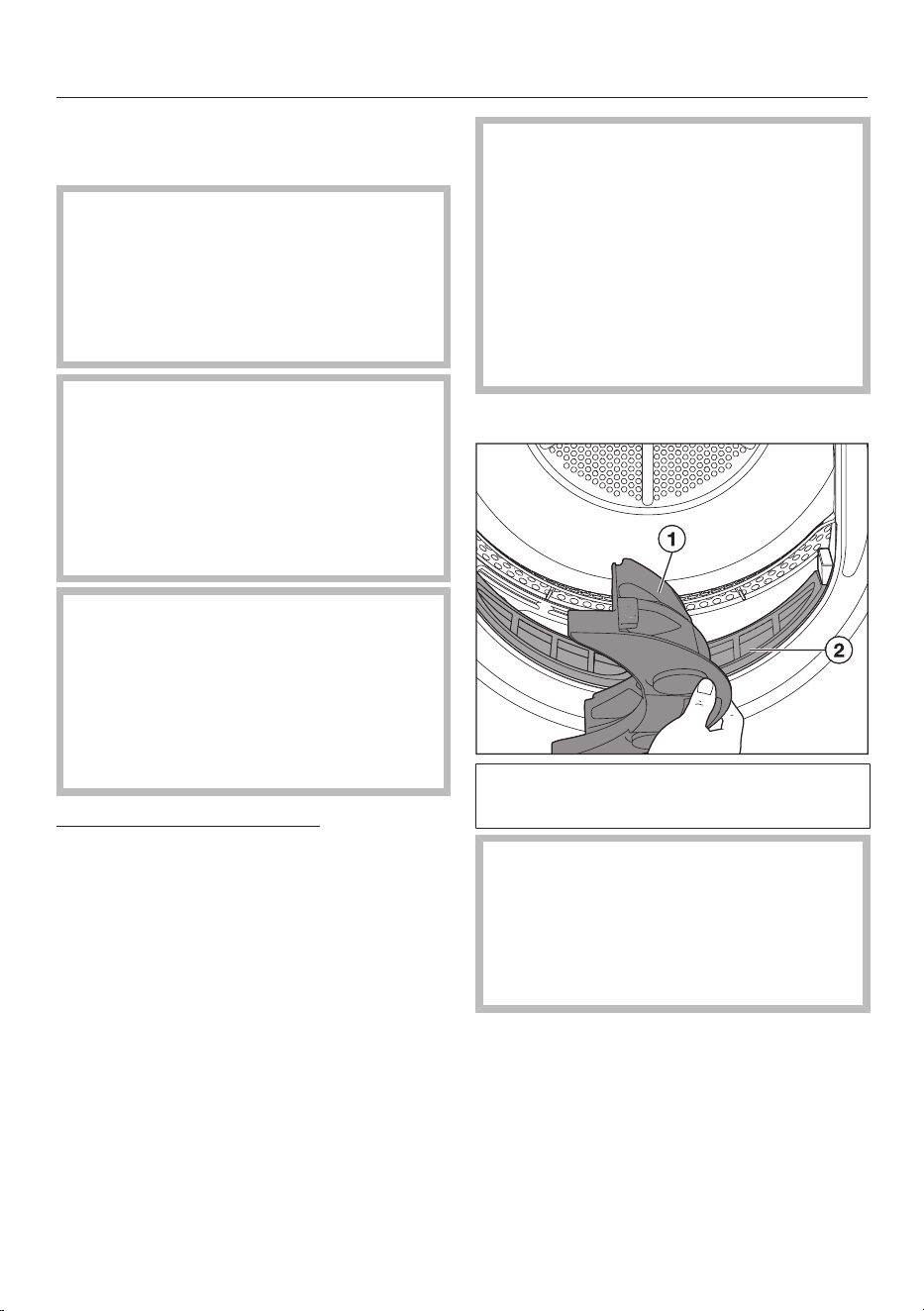
Cleaning and care
59
Cleaning the casing, drum and
control panel
Risk of electric shock from mains
voltage.
The mains voltage is applied to the
tumble dryer even if it is switched off.
Disconnect the mains plug before
cleaning or maintenance.
Risk of damage due to ingress of
water.
The pressure of a water jet can cause
water to get into the tumble dryer,
resulting in damage to components.
Do not spray the tumble dryer with a
water jet.
Damage caused by cleaning
agents.
Solvent-based cleaning agents, ab-
rasive cleaners, glass cleaners or all-
purpose cleaners can cause damage
to plastic surfaces and other parts.
Do not use these cleaning agents.
Cleaning recommendation:
Clean with a soft cloth once or twice a
year and as required.
Clean the casing and control panel
with a mild cleaning agent or soapy
water and dry both with a soft cloth.
The drum can be cleaned using a suit-
able stainless steel cleaner is desired.
Cleaning the fluff filters
Fluff is principally the result of friction
when garments are being worn and to
some extent when they are being
washed. Fluff filters trap the fluff pro-
duced.
Environmental impact due to fluff
which has been disposed of incor-
rectly.
To prevent microplastics from
spreading into the waste water sys-
tem, fluff must not be drained away
with the water.
Dispose of the fluff collected by the
fluff filters with your household
waste.
When to clean
Clean both fluff filters and after
each drying programme.
The programme running time is ex-
tended due to a heavy build-up of
fluff.
A fault may occur.
Clean the fluff filters after every dry-
ing cycle.
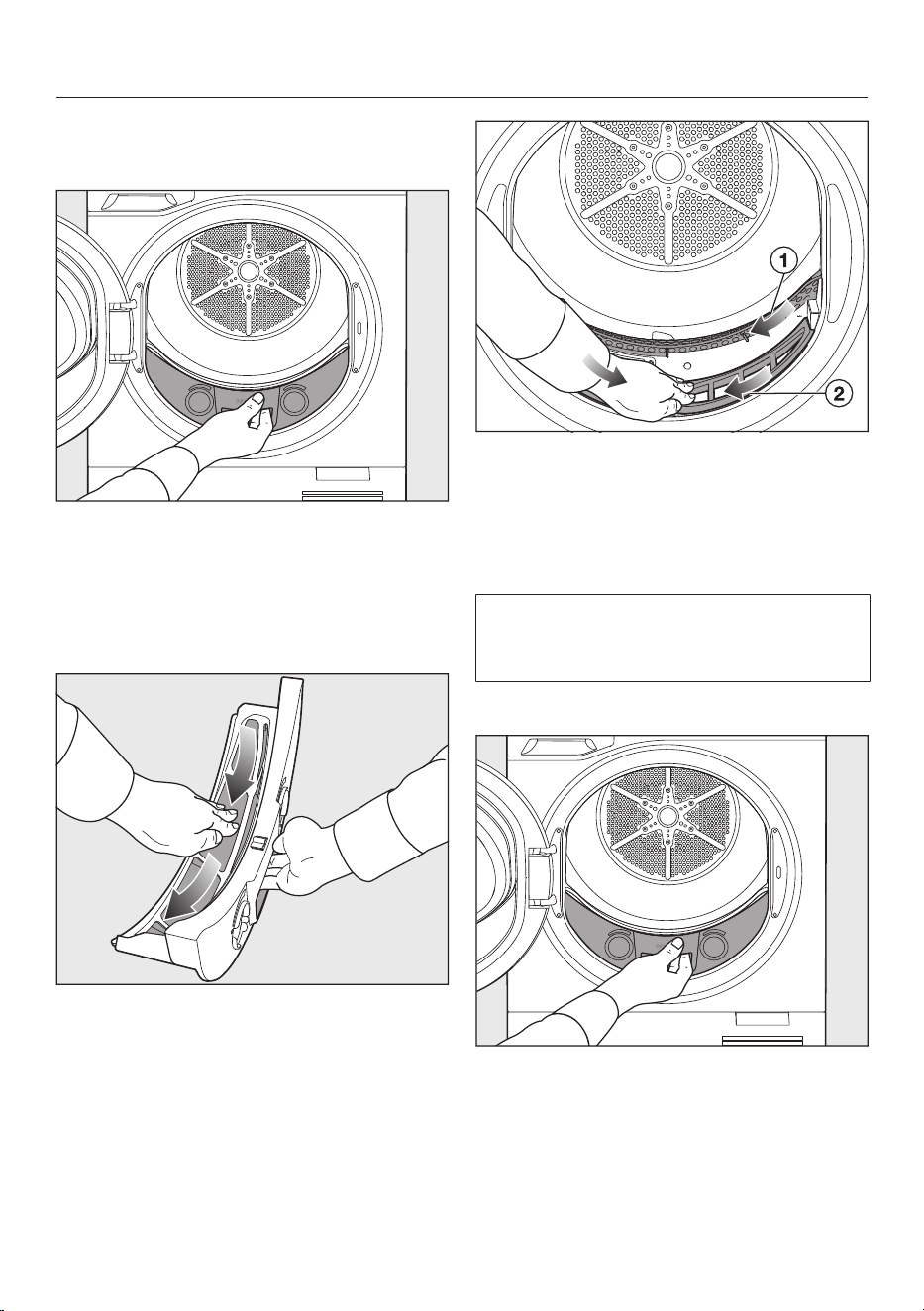
Cleaning and care
60
Removing the upper fluff filter
Open the tumble dryer door.
Pull the fluff filter out.
Removing the fluff
Tip: A ball of fluff forms under your fin-
gers when you start wiping. Strip off the
remaining fluff using the fluff ball.
Remove the fluff.
Use a damp cloth to remove any
fluff.
Remove the fluff.
Tip: Alternatively, use a vacuum cleaner
with a dusting brush.
If you use a crevice nozzle, it must be
undamaged. Cracks or burrs on the
crevice nozzle can cause damage.
Inserting the upper fluff filter
Push the fluff filter all the way in.
Close the drum door.
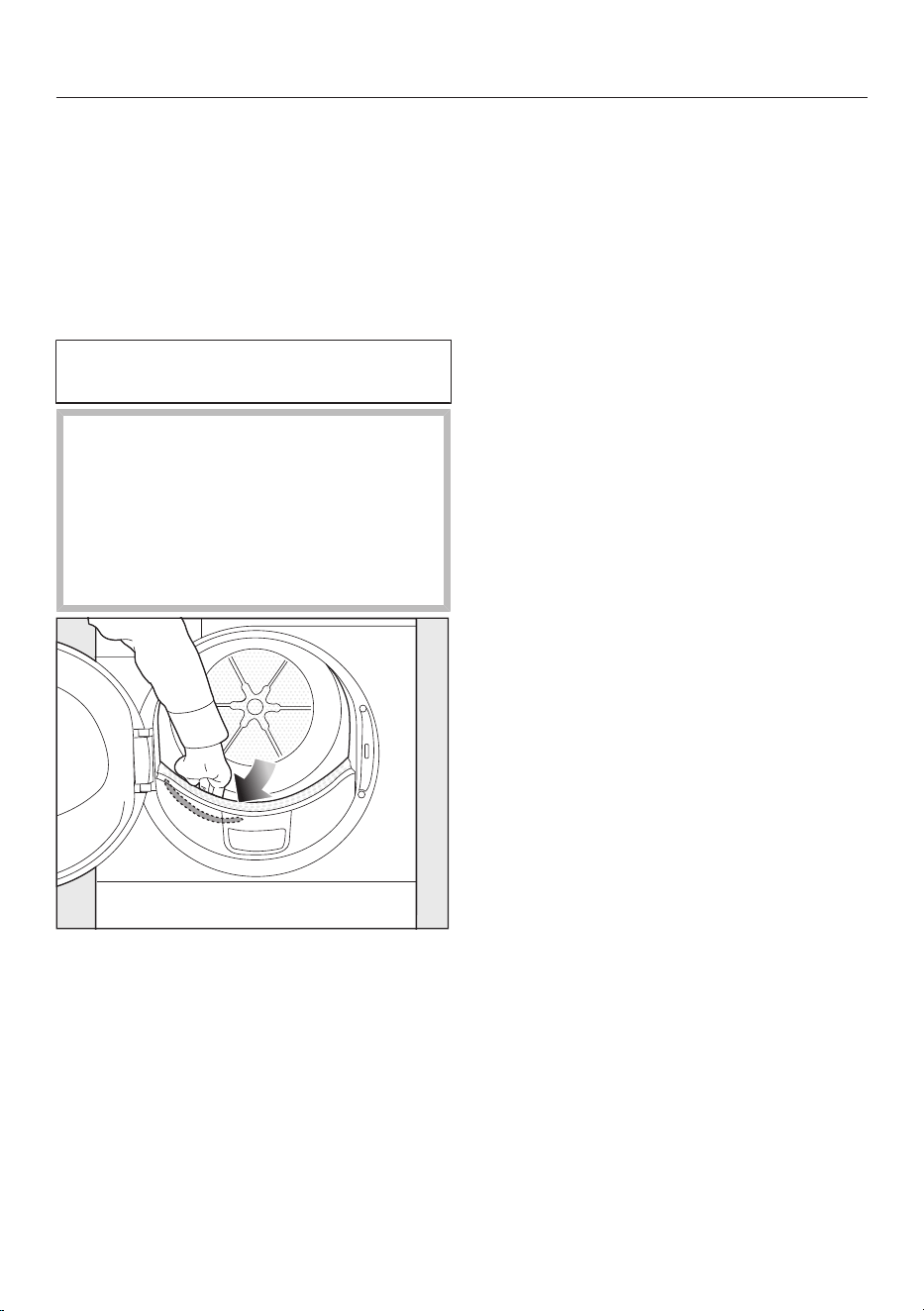
Cleaning and care
61
Cleaning the residual moisture
sensor
The residual moisture sensor in the
tumble dryer measures the residual
laundry moisture to improve the drying
results.
When to clean
Clean the residual moisture sensor
once or twice a year with a soft cloth.
Fault when measuring the residual
moisture.
The residual moisture is determined
incorrectly because detergent
residues form a coating on the resid-
ual moisture sensor.
Clean the residual moisture sensor.
Reach into the tumble dryer drum
with your hand.
In the front, on the left, you will feel the
elongated metal residual moisture
sensor.
Clean the residual moisture sensor
with a damp cloth and a small amount
of soapy water.
Dry with a soft cloth.
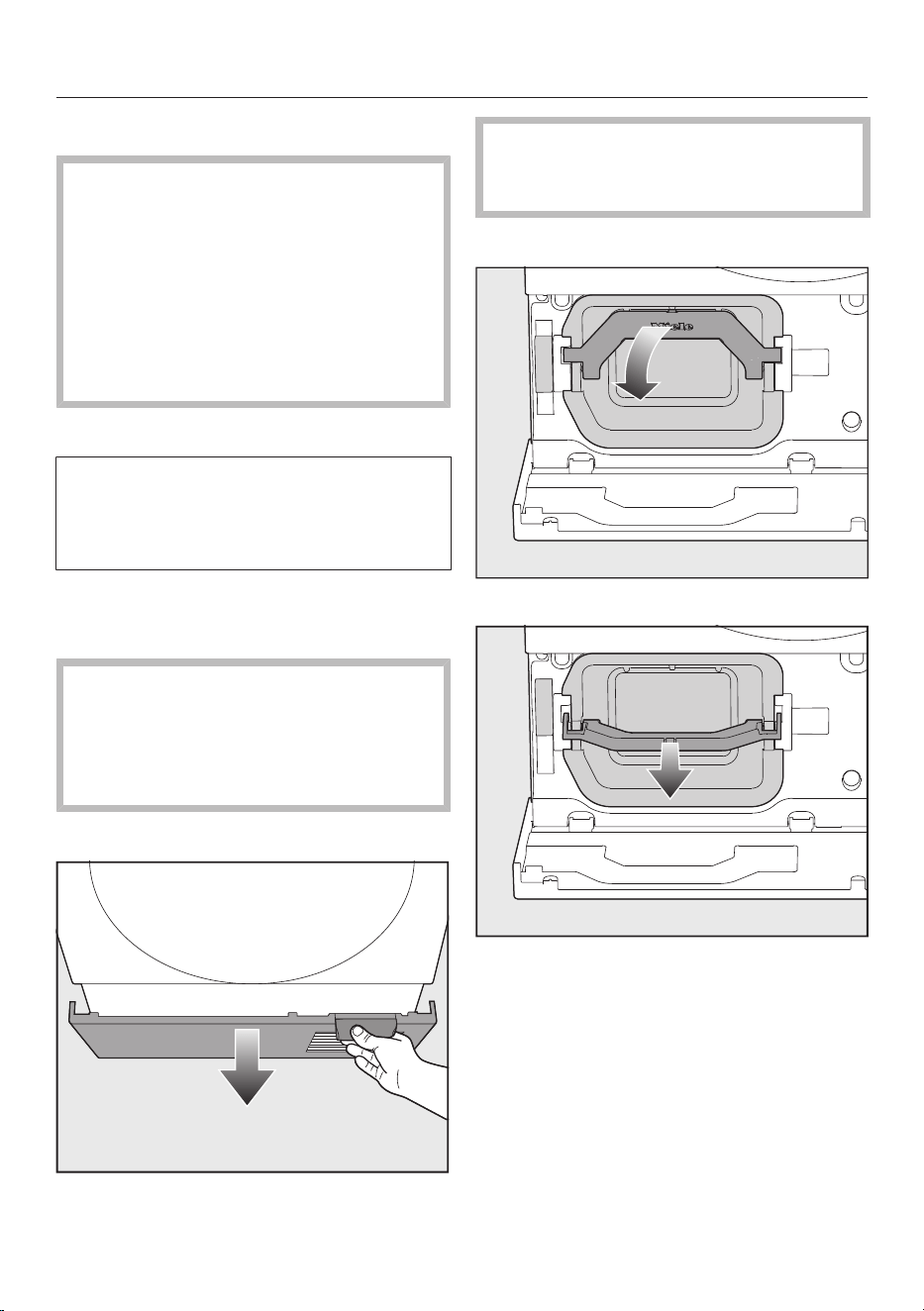
Cleaning and care
62
Cleaning the plinth filter
Environmental impact due to fluff
which has been disposed of incor-
rectly.
To prevent microplastics from
spreading into the waste water sys-
tem, fluff must not be drained away
with the water.
To collect the cleaning water, clean
the plinth filter in a bowl or bucket.
When to clean
Clean the plinth filter only when
prompted to do so by the display or if
the programme running time has been
extremely long.
Do not clean the plinth filter after every
drying programme. Frequent cleaning
will cause the filter to wear prematurely.
Fault due to clogged plinth filter.
The programme running time is ex-
tended, the programme is aborted or
a fault occurs.
Clean the plinth filter.
Opening the plinth flap
Open the plinth flap.
The plinth flap can break off.
Do not place anything on the plinth
flap when it is open.
Removing the holder with plinth filter
Fold the handle downwards.
Grasp the handle and pull the holder
forwards to remove it.
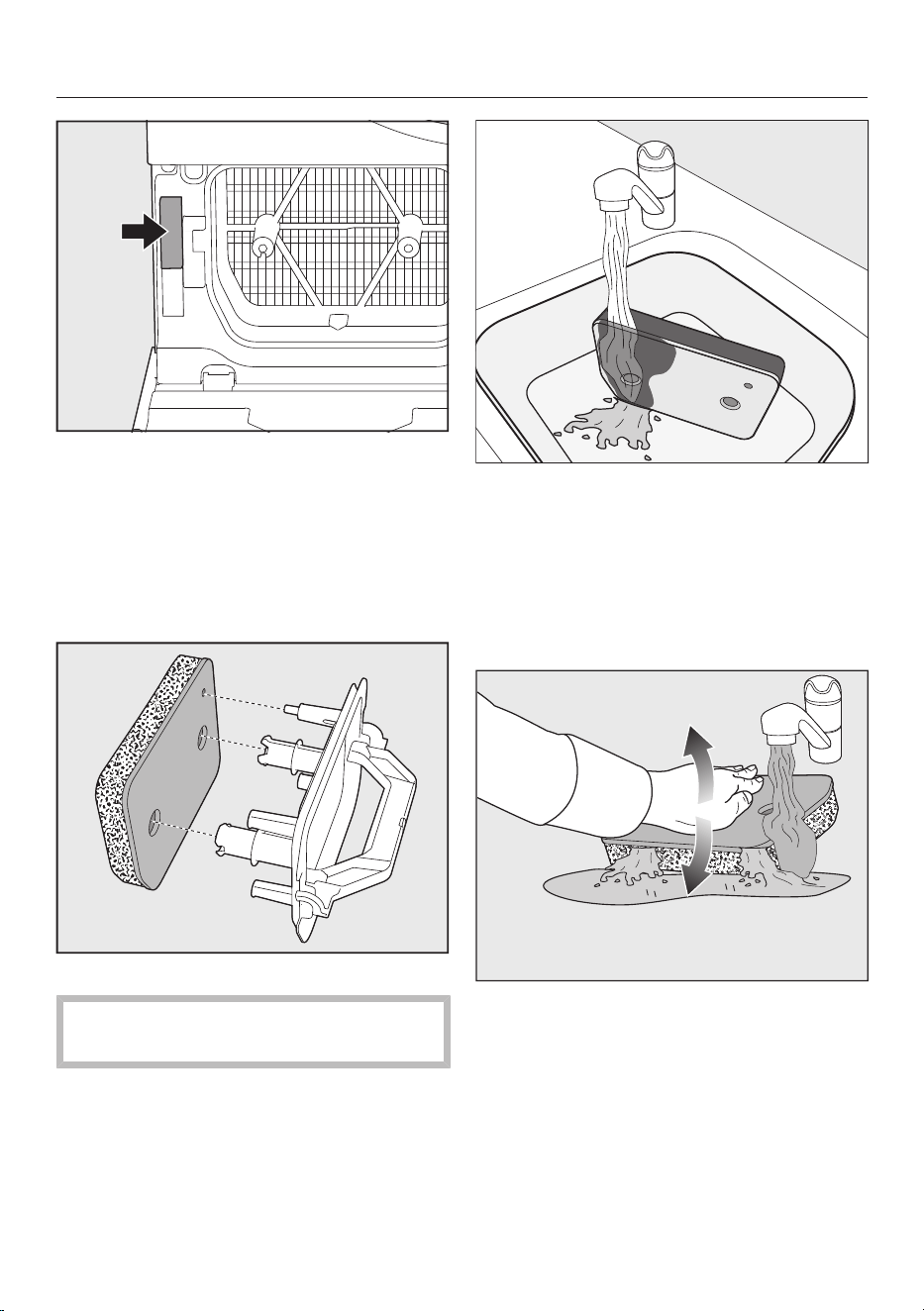
Cleaning and care
63
A fastening element (arrow) is activated
when the holder is pulled out. The
fastening element prevents the plinth
flap from closing without the holder in-
serted. The fastening element is deac-
tivated when the holder is pushed in.
Cleaning the plinth filter
Pull the plinth filter off the holder.
To collect the cleaning water, place a
bowl or bucket under the stopcock.
Clean the plinth filter carefully and
thoroughly under running water.
Tip: To speed up the removal of residue
from the surface, run a water jet vertic-
ally over the front of the plinth filter.
Squeeze the plinth filter very carefully
several times as you rinse it.
Tip: Place the plinth filter so that it lies
flat in the bowl or bucket.
To efficiently loosen underlying
residue, gently press down on the
plinth filter with the back of your hand
several times.
Rinse the entire plinth filter thor-
oughly until all visible residue has
been removed.
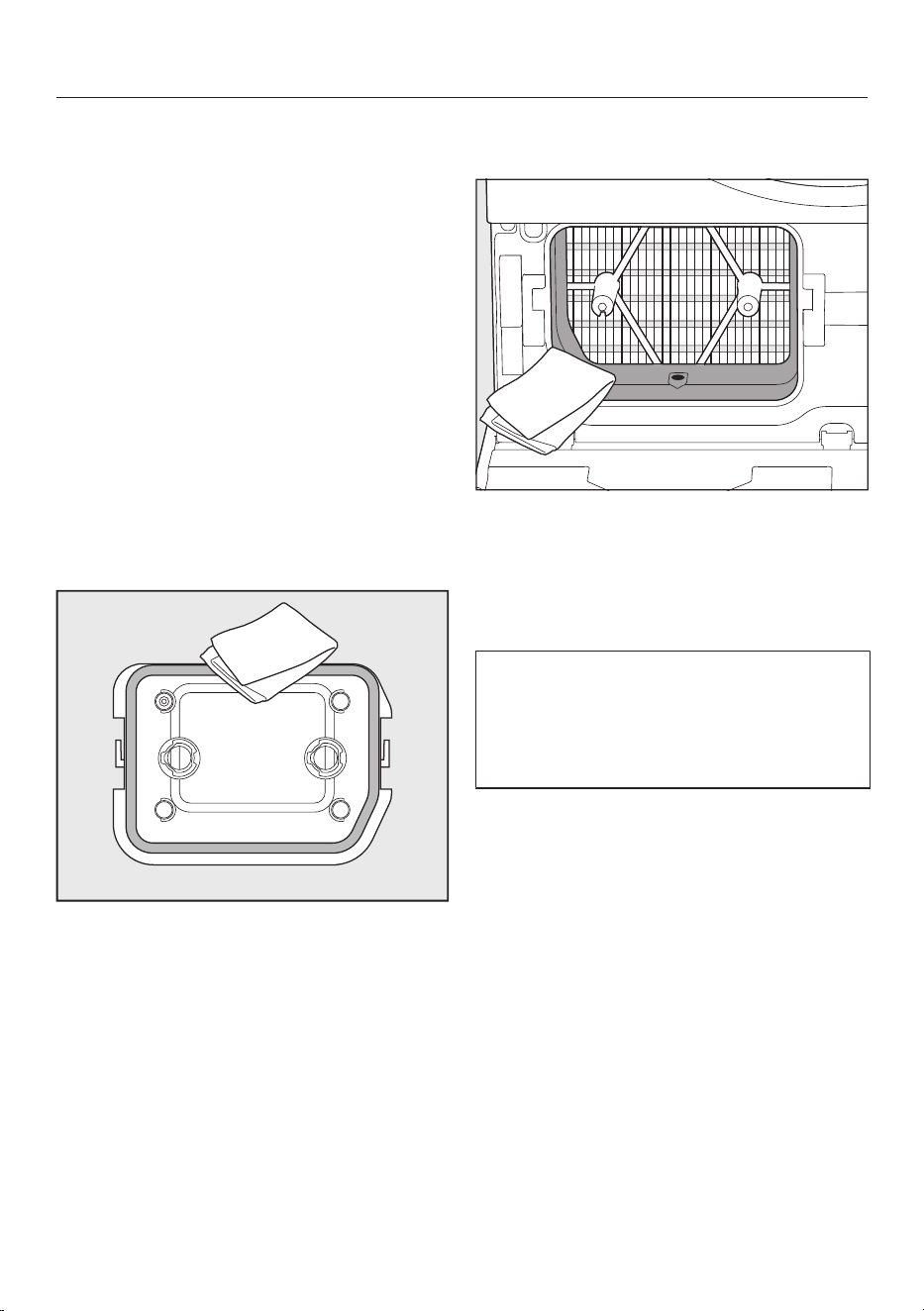
Cleaning and care
64
Carefully squeeze the plinth filter with
the back of your hand until all of the
water has been removed.
Tip: To soak up water, place the damp
plinth filter between 2hand towels. On
an even surface, gently press down on
the plinth filter with the back of your
hand. This will dry the plinth filter more
quickly.
Pouring out the cleaning water
To catch any particles or fluff, pour the
contents of the bowl or bucket
through a filter (e.g. coffee filter).
Dispose of the filter with your house-
hold waste.
Cleaning the holder
Clean the holder with a damp cloth
and a small amount of soapy water.
Clean the rubber seal on the holder
without damaging it.
Dry with a soft cloth.
Cleaning the edges in front of the heat
exchanger
Only clean the plastic edges and the
opening on the right-hand side.
Tip: Use a damp cloth and a small
amount of soapy water.
Dry with a soft cloth.
The heat exchanger (cooling fins) does
not usually need to be cleaned. If there
is a build-up of fluff, follow the instruc-
tions in “Troubleshooting – Heat ex-
changer”.
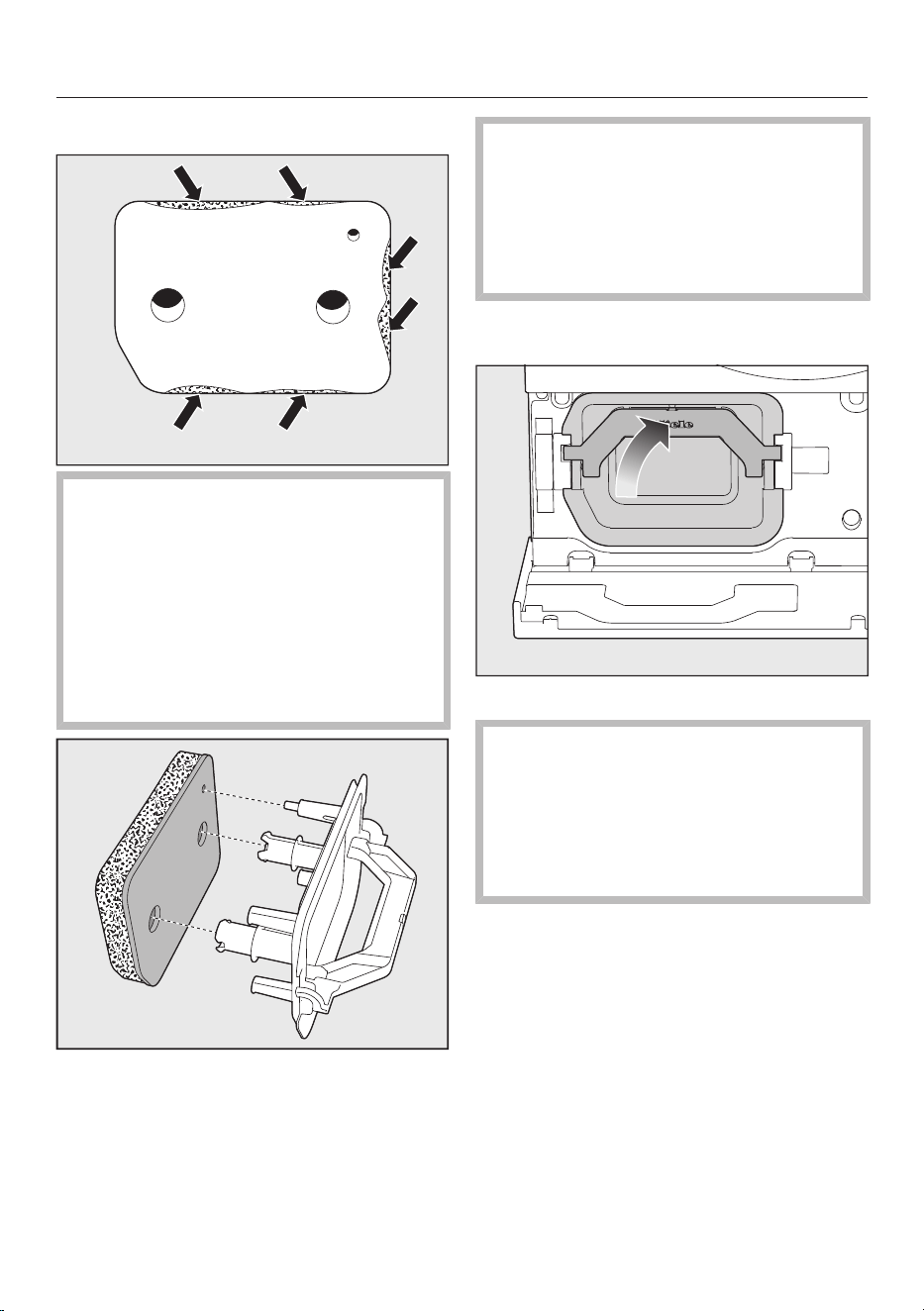
Cleaning and care
65
Inserting the holder and plinth filter
Damage caused by a damaged or
worn plinth filter.
The heat exchanger becomes
blocked and damage may occur.
Check the plinth filter following the
instructions provided in
“Troubleshooting – Replacing the
plinth filter”. Replace the plinth filter
if necessary.
Fit the plinth filter back on the handle.
Make sure it is the correct way round.
Faults caused by a dripping plinth
filter.
A dripping plinth filter can cause op-
erational faults while drying.
Carefully squeeze the water out of
the plinth filter several times.
Slide the holder into place by the
handle.
Fold the handle upwards.
Damage caused by a missing
plinth filter.
The heat exchanger becomes
blocked and damage may occur.
Only operate the tumble dryer with a
plinth filter.
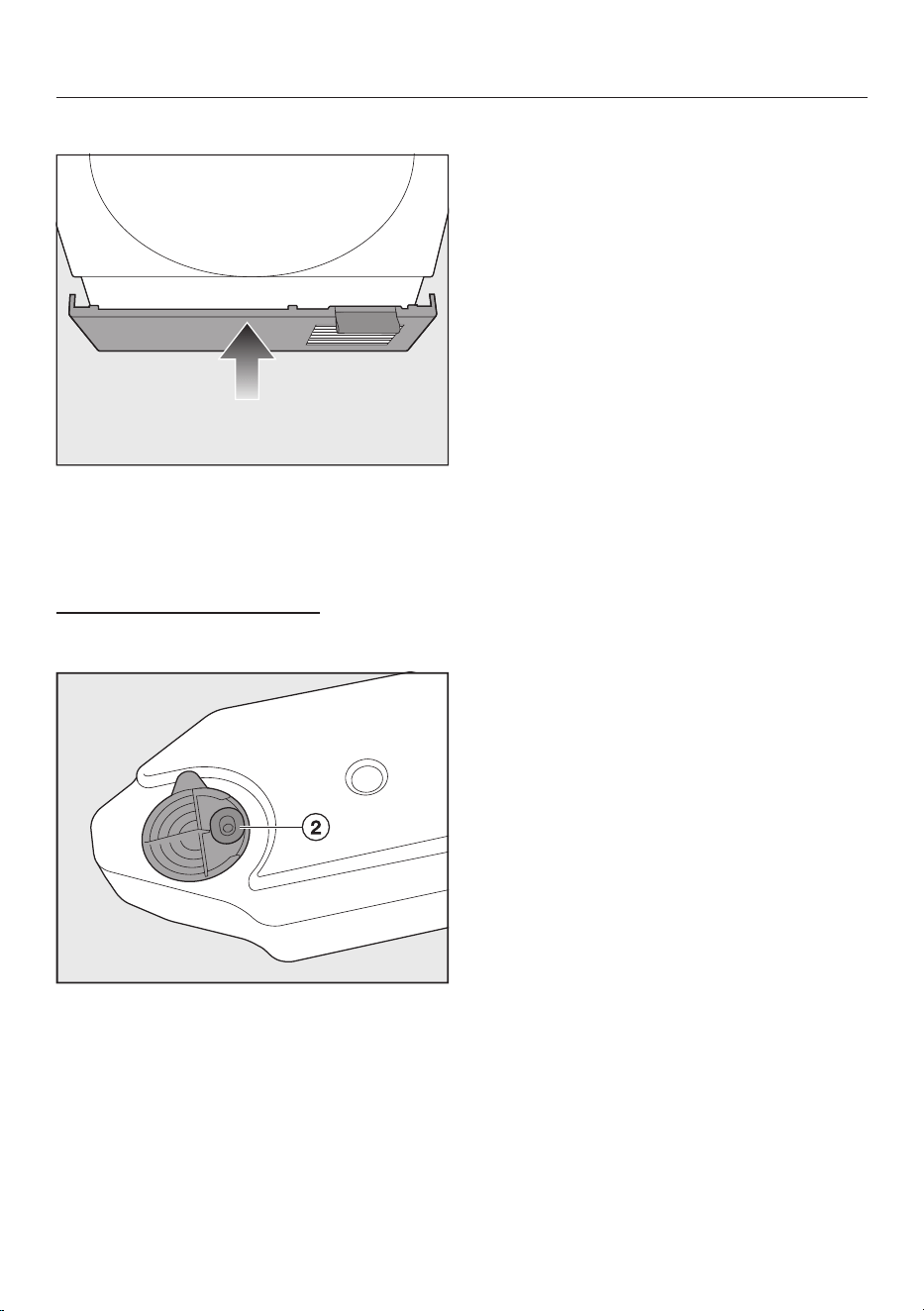
Cleaning and care
66
Closing the plinth flap
Close the plinth flap.
Cleaning the rubber seal on the
condensate container
Cleaning recommendation:
Clean once or twice a year and as re-
quired.
Use a damp cleaning cloth and a
small amount of soapy water to care-
fully remove any residues from the
rubber seal on the condensate
container.
Check that the rubber seal is properly
pressed into the groove.
Troubleshooting
67
Many malfunctions and faults can be easily remedied. You can save time and
money in many cases, as you do not need to contact Customer Service.
More information to help you remedy faults yourself can be found at
www.miele.co.uk/support/customer-assistance.
Fault messages shown in the display when a programme is
cancelled
Message Cause and remedy
Fault F occurred. Switch
the appliance off and on
again. If the fault per-
sists, call Customer Ser-
vice.
There is no obvious cause.
To switch off the message, you must switch off the
tumble dryer.
Switch the tumble dryer on.
Start a programme.
If the fault occurs again, contact the Miele Customer
Service Department.
Empty the container or
check the drainage
The condensate container is full or there is a kink in
the drain hose.
To switch off the message, you must switch off the
tumble dryer and switch it on again after a short
while.
Empty the condensate container.
Check the drain hose. The drain hose must not be
kinked.

Troubleshooting
68
Message Cause and remedy
Fault F66 • Airways
Clean the fluff and plinth
filters. Check the heat
exchanger and airways.
Switch the appliance off
and on. If the fault per-
sists, contact Customer
Service
Fluff or detergent residues have clogged the fluff fil-
ters and the plinth filter.
To switch off the message, you must switch off the
tumble dryer and switch it on again after a short
while.
Clean the fluff filters and the plinth filter.
– See “Cleaning and care – Cleaning the fluff fil-
ters” and “Cleaning the plinth filter”.
– If the fluff filters are heavily clogged or blocked,
the fluff filters must be cleaned with water and
the airways cleaned. See “Troubleshooting –
Cleaning the fluff filters with water”.
If the fluff filters and the plinth filter are damaged or
out of shape, or if they cannot be cleaned, they must
be replaced.
If the fault message is displayed again after cleaning,
this could be due to one of the causes listed below.
The plinth filter was wet when it was fitted.
Carefully squeeze the water out of the plinth filter.
Leave the plinth filter to air-dry.
There are still residues in the plinth filter that could not
be removed.
Check the plinth filter. See “Troubleshooting – Signs
of wear on the plinth filter”.
You can reactivate the plinth filter in the washing
machine. See “Troubleshooting – Reactivating the
plinth filter”.
The heat exchanger is clogged.
Check the heat exchanger. Follow the instructions in
“Troubleshooting – Checking the heat exchanger”.
Troubleshooting
69
Display information
Message Cause and remedy
Clean the fluff and plinth
filters
The tumble dryer is not working correctly or econom-
ically. This may be caused by fluff or detergent
residues.
Clean the fluff filters and the plinth filter.
– See “Cleaning and care”, sections “Cleaning the
fluff filters” and “Cleaning the plinth filter”.
You can influence when the indicator lights up.
Follow the description in “Adjusting settings – Air-
ways”.
Comfort cooling
The laundry will be cooled down to reach the temper-
ature required at the end of the programme.
Comfort cooling/Finish The laundry is still being cooled.
You can remove the laundry and spread it out to cool
down or leave it in the tumble dryer to cool down.
Drying level changed
The drying level you selected previously cannot be
combined with the extra option. The closest possible
drying level is selected automatically.
Fill condensate con-
tainer
The condensate container is empty. There is not
enough condensed water available for SteamCare.
Fill the condensate container to at least the
―min―mark.
Open and close the door After selecting a programme with SteamCare, you will
be prompted to load the laundry.
Load the laundry in the drum.
The drying programme takes a long time
Problem Cause and remedy
The drying programme
takes a very long time.
This can be caused by many factors.
Switch the tumble dryer off.
Check for the possible causes described below.
Switch the tumble dryer back on after the test.
The room where the tumble dryer is located is too
warm.
Ventilate the room thoroughly.
The drum is too full.
Troubleshooting
70
Problem Cause and remedy
Take out some of the laundry.
The cool air vent in the plinth flap and the air gap
between the bottom of the dryer and the floor have
been blocked.
Move any objects, such as a laundry basket, away
from the dryer.
The laundry is too wet after washing.
Select a higher spin speed when washing.
Detergent residues, hair and fine fluff can clog the fil-
ters.
Rinse the fluff filters under running water.
Check the top air guide.
Clean the plinth filter under running water.
Remove any visible fluff from the heat exchanger us-
ing a vacuum cleaner and dusting brush.
The cleaning instructions listed above can be found in
“Troubleshooting”.
Insufficient drying results
Problem Cause and remedy
Items made of synthetic
fibres are charged with
static electricity.
Synthetic fibres tend to attract static charge in the
dryer.
To minimise static charge, use a fabric conditioner in
the final rinse cycle of the washing machine.
Troubleshooting
71
Problem Cause and remedy
The laundry is still damp. There is too much laundry in the drum or it has be-
come tangled.
Disentangle the laundry and remove a few items.
The load consisted of different types of fabric.
Finish drying using the Warm air programme.
Dry items of the same textile type together in future.
The drying level selected does not meet the require-
ments.
Select a different drying level.
You can set the residual moisture of some drying
levels to drier or damper. For further information,
see “Adjusting settings – Drying levels”.
Metallic components, e.g. zips, have prevented the
tumble dryer from registering the correct laundry
moisture content.
Open any zips next time.
If the problem recurs, dry these items using the
Warm air programme.
The DryCare40 Extra is
not drying the laundry
sufficiently.
The room where the tumble dryer is located is too
warm. This has caused the DryCare process to finish
prematurely.
Ventilate the room thoroughly.
To fully dry the laundry, select Warm air and Dry-
Care40.
Fluff is released from
textiles during tumble
drying.
Abrasion during wear and, in some cases, during
washing causes fluff to be released from garments,
which remains on the laundry after washing. Tumble
drying hardly causes any fluff to form.
See “Cleaning and care – Cleaning the fluff filters”.
Noises and odours
Problem Cause and remedy
You can hear buzzing or
humming operating
noises.
This noise is emitted by the compressor (heat pump)
or the pump for SteamCare.
No action required.
Whirring and humming noises during drying are not a
fault.
Troubleshooting
72
Problem Cause and remedy
Laundry or feather-filled
pillows smell unpleas-
ant.
The natural properties of feathers or grease residues
cause odours to develop.
The laundry was washed with insufficient detergent.
Use FragranceDos.
Take pillows out of the tumble dryer and air them.
Wash laundry in the washing machine with sufficient
detergent.
Other problems
Problem Cause and remedy
The tumble dryer does
not switch on.
There is no power to the tumble dryer.
Check whether the mains plug is plugged in.
Check whether the fuse has tripped.
The MotionReact function is switched off. The Mo-
tionReact sensor does not respond.
Touch the sensor control and switch on the
tumble dryer.
Check the MotionReact settings in the settings.
Check the MotionReact sensor by approaching the
tumble dryer from the front.
The tumble dryer is
switched off at the end
of the programme.
The tumble dryer switches off automatically. This is
not a fault, but a normal function.
A programme cannot be
started.
There is no obvious cause.
Check whether the mains plug is plugged in.
Check whether the tumble dryer is switched on.
Check that the dryer door is closed.
Check the mains fuses.
Has there been a power cut? When the supply voltage
is restored, any previously running programme will re-
start automatically.
The drying programme is
running and the display
is dark.
The display has switched off automatically to save en-
ergy (Standby mode).
The drum will turn at intervals when the tumble dryer
is in the Anti-crease phase.
To end Standby mode, touch the display.
Troubleshooting
73
Problem Cause and remedy
The fluff filters are visibly
clogged or blocked.
Detergent residues can cause incrustations and clog
the fluff filters.
Rinse the fluff filters under running water. See
“Troubleshooting – Cleaning the fluff filters with wa-
ter”.
Using too much detergent or poor cleaning results
during washing can cause incrustations in the fluff fil-
ter.
Check the amount of detergent dosage the next
time you wash your laundry. If possible, reduce the
quantity of detergent.
The drying programme is
cancelled after the plinth
filter has been cleaned.
The plinth filter was wet when it was fitted.
Remove the plinth filter and gently dry the plinth fil-
ter between 2 towels.
The plinth filter is heavily clogged.
If the programme is cancelled again even though the
plinth filter is dry, we recommend reactivating it in the
washing machine.
First check all measures described in “Troubleshoot-
ing – Reactivating the plinth filter”.
After removing the plinth
filter, you can see that
condensed water has
accumulated.
The drain for condensation is blocked.
Clean the drain. See “Troubleshooting – “Cleaning
the drain for condensation”
The spray jet for Steam-
Care is insufficient or
does not work.
The fluff filter in the condensate container is clogged.
Clean the fluff filter in the condensate container. See
“Troubleshooting – Cleaning the fluff filter in the
condensate container”.
There are heavy limescale deposits on the nozzle in
the door opening.
Replace the nozzle. See “Troubleshooting – Repla-
cing the nozzle for SteamCare”.
Only fill with commercially available condensed wa-
ter. Do not fill with tap water.
The frequent use of tap water leads to limescale de-
posits.

Troubleshooting
74
Problem Cause and remedy
The drum lighting does
not come on.
To save energy, the drum lighting goes out automatic-
ally after a set time and after the programme starts.
Switch the tumble dryer off and then on again.
To switch the drum lighting on, open the door of the
tumble dryer.
The drum lighting is faulty.
The drum lighting is designed to last a long time and
should not normally need to be replaced.
If you have tried everything but the drum lighting still
does not come on, contact the Miele Customer Ser-
vice Department.
Defective drum lighting can only be replaced by the
Miele Customer Service Department.
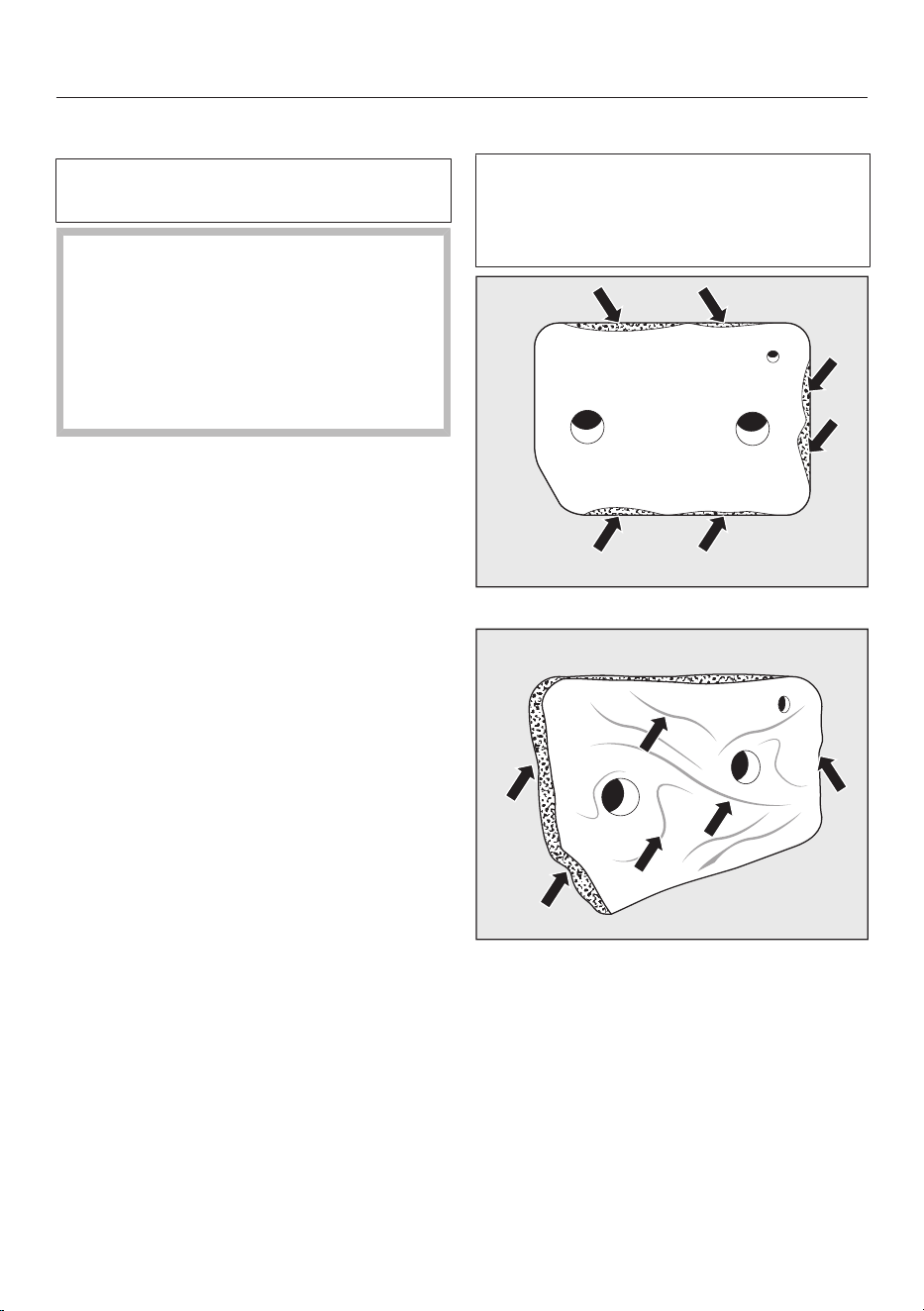
Troubleshooting
75
Signs of wear on the plinth filter
If the plinth filter shows signs of wear,
it must be replaced.
Damage caused by a worn plinth
filter.
The heat exchanger becomes
blocked and damage may occur.
Replace the plinth filter if you see the
following signs of wear before or after
cleaning (optional accessory).
There may be signs of wear on the plinth
filter:
1. Poor fit and deformations
– The plinth filter needs to be re-
placed.
2. Cracks, tears, indentations
– The plinth filter needs to be re-
placed.
3. Discolouration on the side edges and
on the plinth filter
– Reactivate the plinth filter in the
washing machine.
Poor fit and deformations
Poor fit and deformations are clear
signs of wear. As a result, the edges of
the plinth filter are no longer posi-
tioned correctly in the tumble dryer.
Poor fit can be seen on the side edges.
Deformations can be seen on the side edges
and on the entire plinth filter.
Tip: You need to replace the plinth filter.
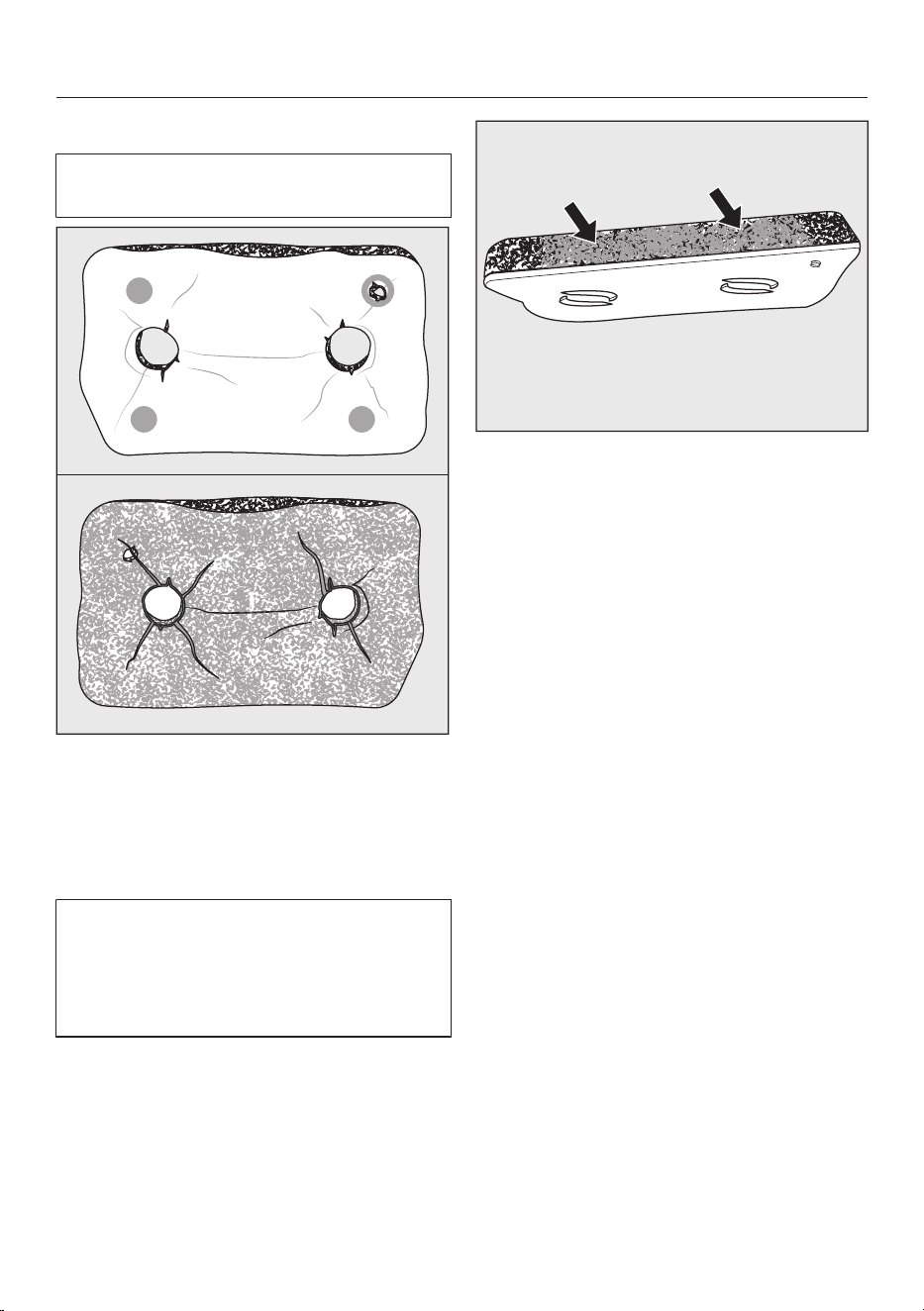
Troubleshooting
76
Cracks, tears, indentations
Cracks and tears are clear signs of
wear.
Cracks, tears and indentations can be seen
on the front and back.
Tip: You need to replace the plinth filter.
Discolouration on the side edges and
on the plinth filter
Discolouration is caused by residues
of fibres and washing substances. In
extreme cases, the residues form
stubborn incrustations and the plinth
filter can become clogged.
Even if the plinth filter looks flawless,
poor fit can occur on the plinth filter due
to residues. Other residues can be
blown past the side edges into the heat
exchanger.
Discolouration and incrustations are particu-
larly visible on the side edges.
Tip: Reactivate the plinth filter in the
washing machine. If reactivating does
not improve the situation, you will need
to replace the plinth filter.
Tip: They can reduce blockages and in-
crustations on the plinth filter.
Too much residue indicates an that too
much detergent was dispensed in the
washing machine or poor cleaning res-
ults. Check the amount of detergent
dosage the next time you wash your
laundry. If possible, reduce the quantity
of detergent. In extreme cases, you
should select an extra rinse cycle.
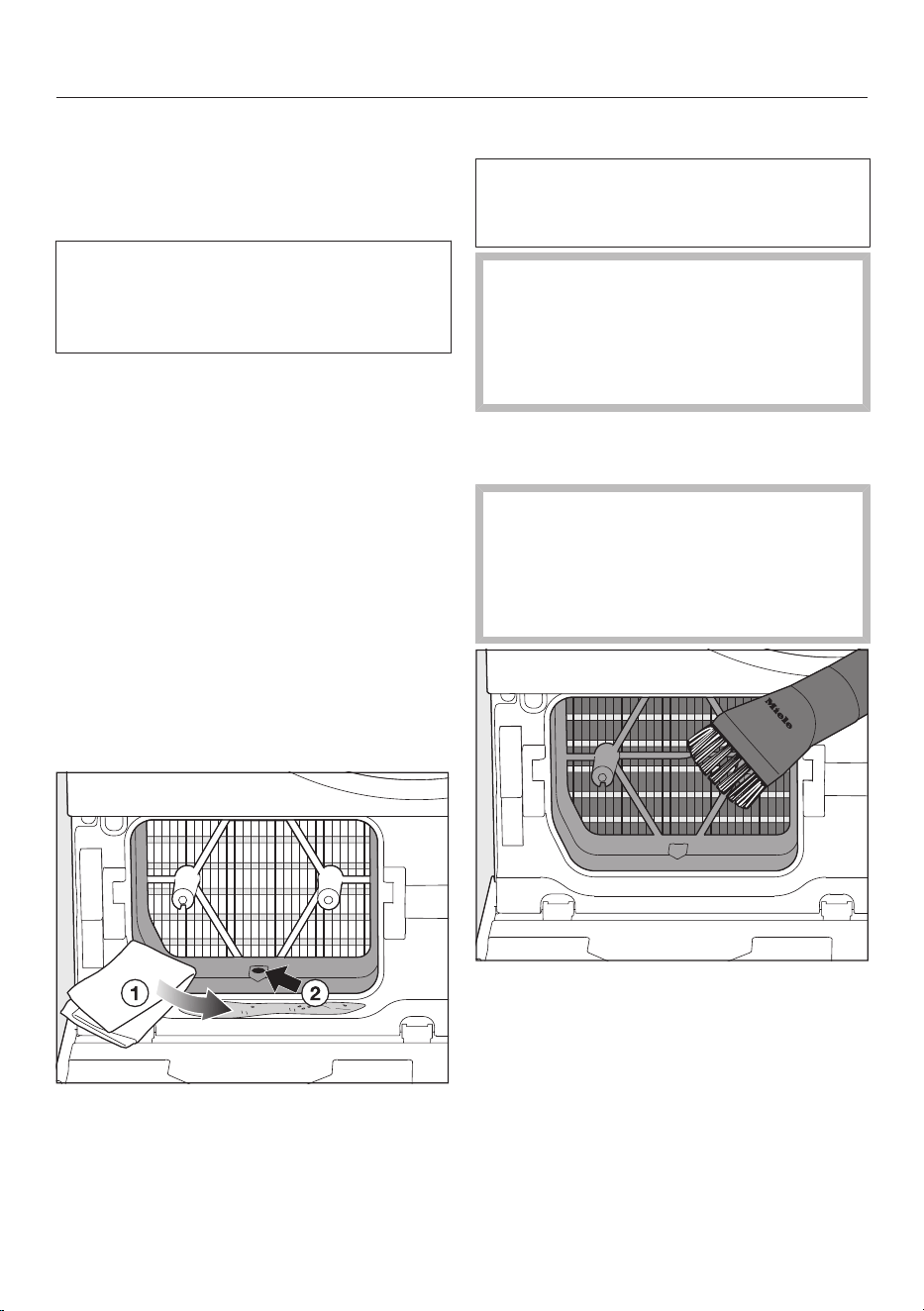
Troubleshooting
77
Reactivating the plinth filter
Tip: To reprocess the clogged plinth fil-
ter, you can reactivate the plinth filter in
the washing machine.
First check the plinth filter for signs of
wear. See “Troubleshooting – Signs of
wear on the plinth filter”. Replace the
plinth filter in case of doubt.
Tip: You can reactivate one or more
soiled plinth filters in a washing ma-
chine.
Reactivate the plinth filter separately
without laundry and without deter-
gent.
Select a short wash programme with
a maximum temperature of 40°C and
a maximum spin speed of 600rpm.
You can re-insert the plinth filter into the
tumble dryer once the spin cycles are
complete.
Cleaning the drain for condens-
ation
Dry with a soft cloth.
Remove any fluff from the drain
with a toothpick or cotton wool bud.
Checking the heat exchanger
The heat exchanger can become
clogged if the plinth filter shows signs
of wear.
Risk of injury from sharp cooling
fins.
You could cut yourself.
Do not touch the cooling fins with
your hands.
Check for any accumulation of fluff.
Existing, visible fluff must be removed.
Damage due to bent cooling fins.
If the cooling fins are damaged or
bent, a fault can occur.
Carefully clean the cooling fins with a
vacuum cleaner and dusting brush.
Only pass the dusting brush over
them lightly, without applying any
pressure.
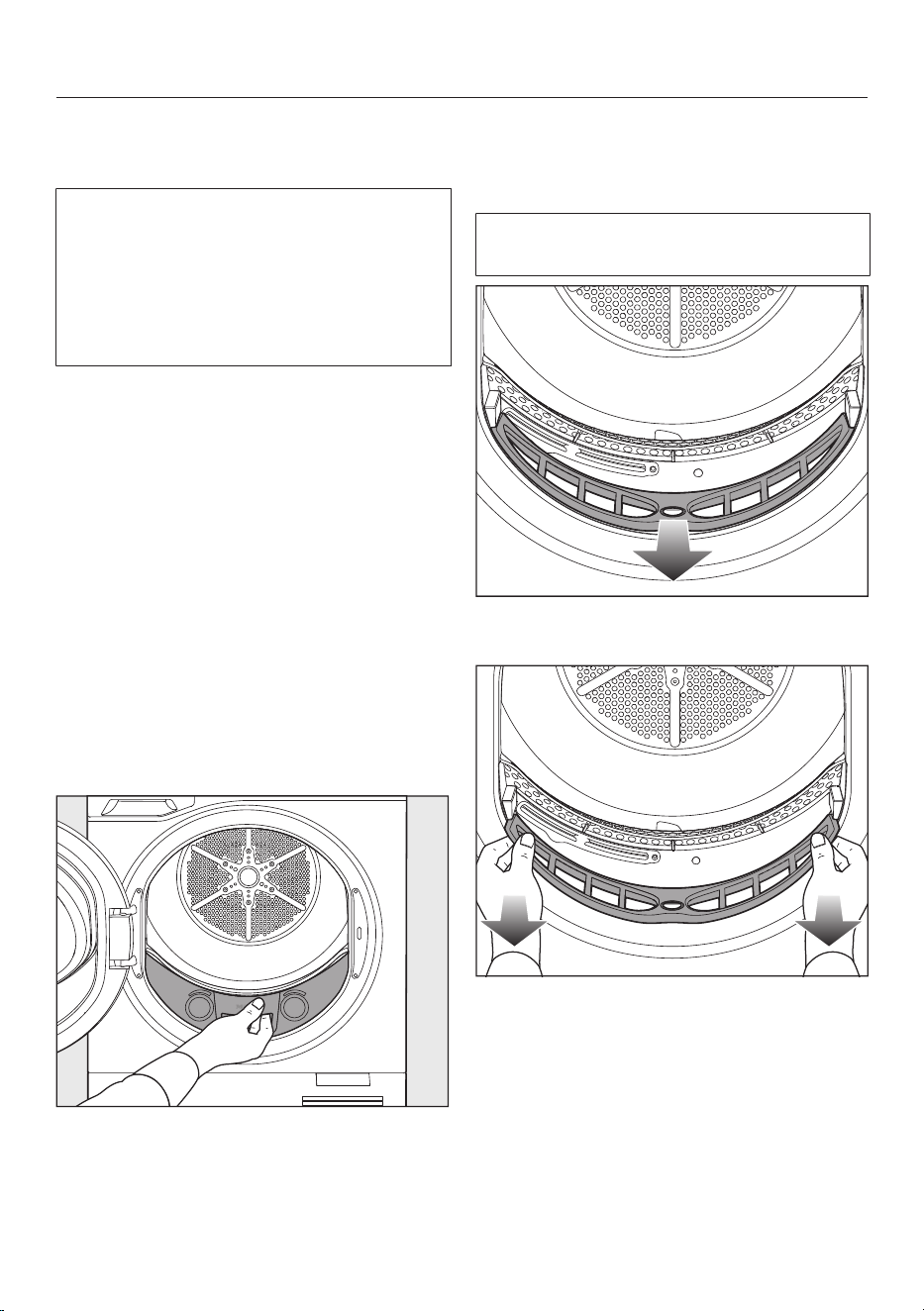
Troubleshooting
78
Cleaning the fluff filters with
water
Rinse the fluff filters under running wa-
ter:
- If the programme running time is
increased excessively.
- If the fluff filters are visibly clogged/
blocked.
To avoid spreading microplastics in
the suction device, To prevent micro-
plastics from spreading into the waste
water system, first wipe off or vacuum
the fluff.
Rinse the fluff filters under warm run-
ning water.
Wipe the smooth plastic surfaces of
the fluff filters using a damp cloth
with a little soapy water.
Shake the fluff filters thoroughly.
Tip: Dry carefully with a soft cloth.
Removing the upper fluff filter
Open the tumble dryer door.
Pull the fluff filter out.
Removing the lower fluff filter
Only remove the fluff filter when neces-
sary.
Try out which of the following removal
options works best.
Place your thumb in the recess in the
centre.
Or place your thumbs on the left and
right.
Pull the fluff filter out.
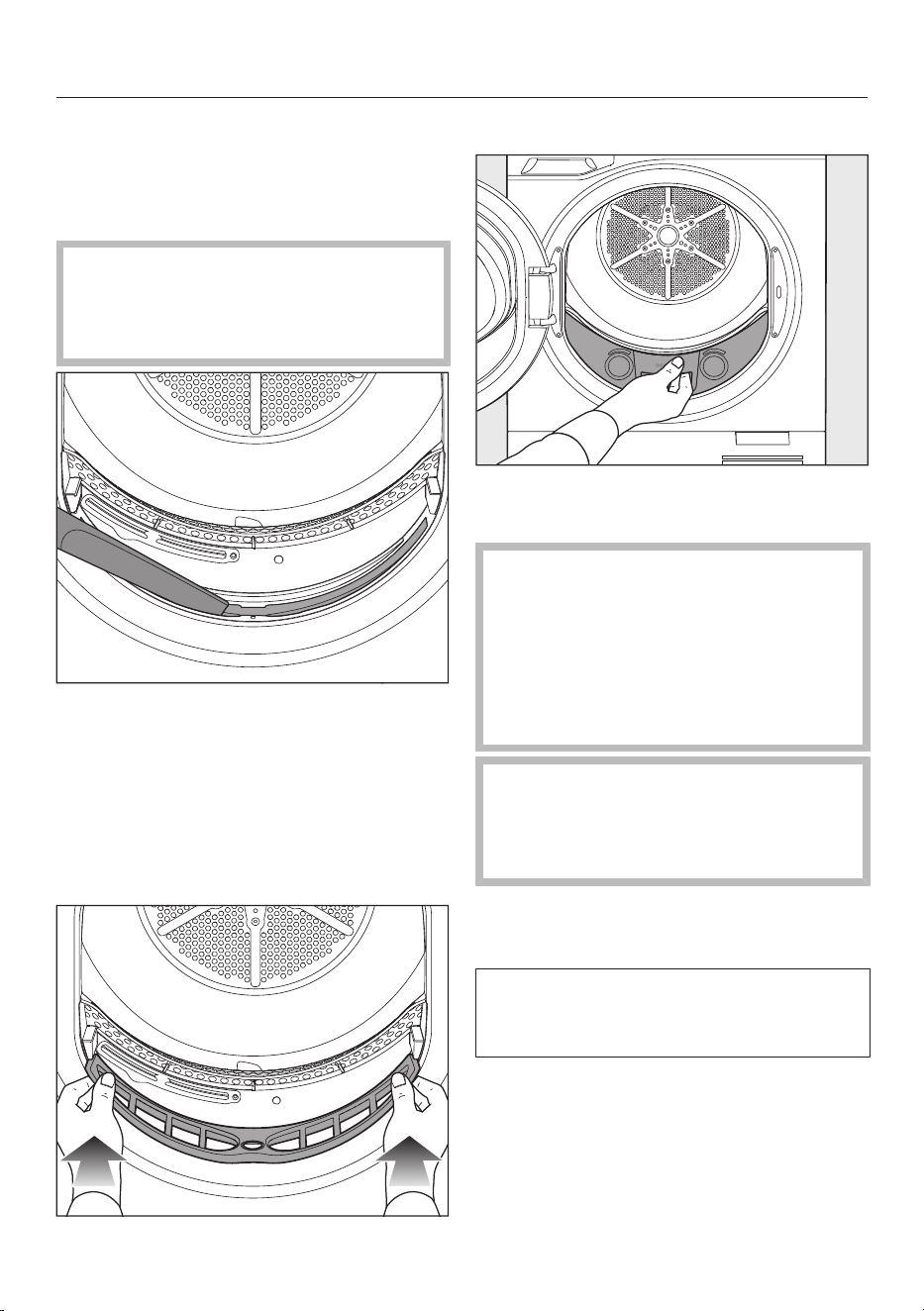
Troubleshooting
79
Checking the airways
Check the airways on a regular basis.
A large build-up of fluff is a sign that the
fluff filters are damaged.
The drying time may be extended and
the tumble dryer may be damaged.
Replace the fluff filters if they are
damaged.
Vacuum visible fluff with a long va-
cuum cleaner nozzle.
Tip: A stubborn build-up of fluff can be
removed with a damp cloth and a small
amount of soapy water. Dry with a soft
cloth.
Inserting the lower fluff filter
Push the fluff filter all the way in.
Inserting the upper fluff filter
Push the fluff filter all the way in.
Close the drum door.
Damage due to damaged fluff fil-
ters.
The heat exchanger becomes
blocked and damage may occur.
Check the fluff filters on a regular
basis. Replace the fluff filters if they
are defective.
Faults caused by wet fluff filters.
Wet fluff filters could cause opera-
tional faults while drying.
Carefully dry the fluff filters.
Cleaning the fluff filter in the
condensate container
If the spray jet does not work, the fluff
filter in the condensate container may
be blocked.
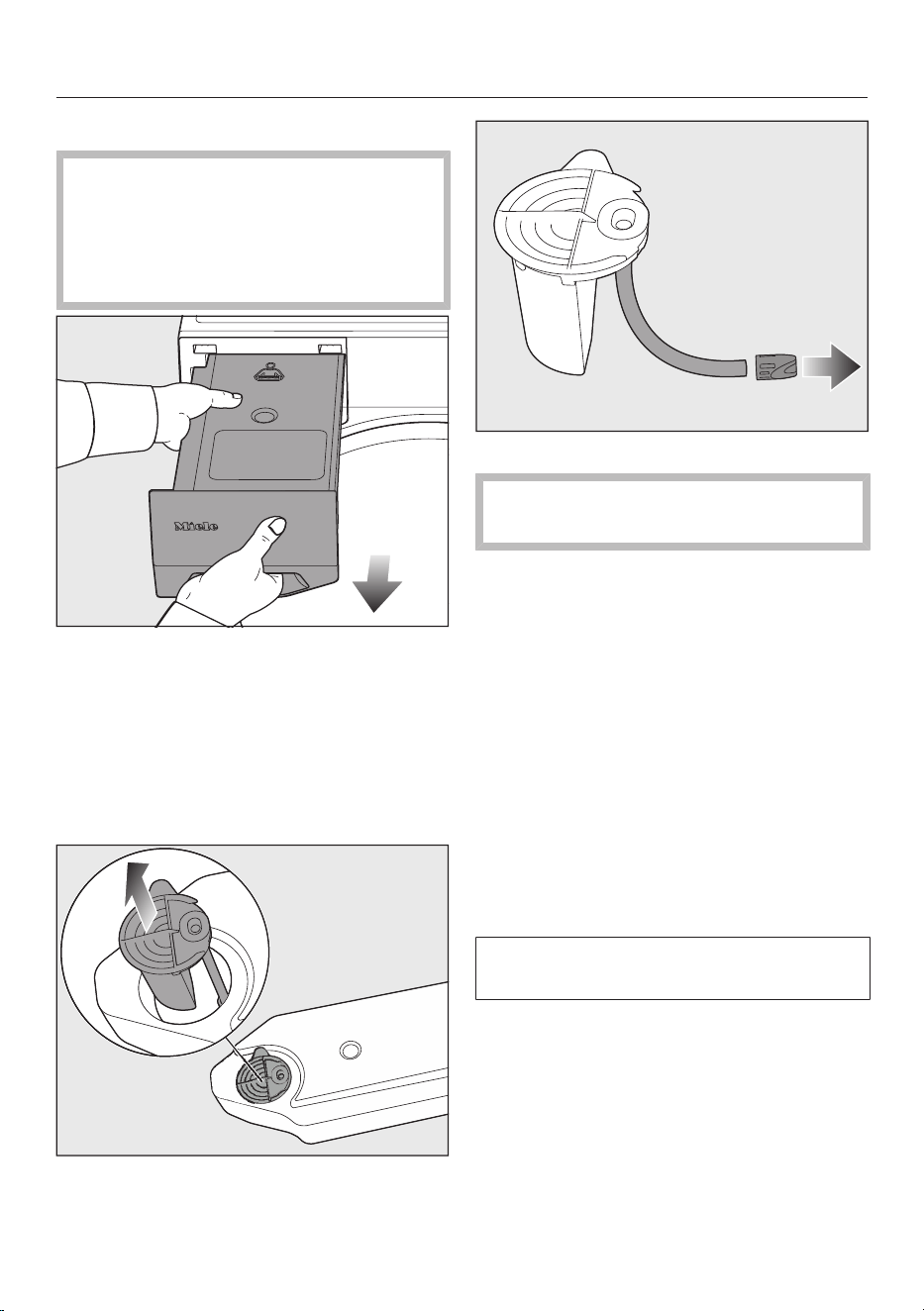
Troubleshooting
80
Pulling out the condensate container
Damage to the dryer door and
the condensate container.
Damage and scratches may occur.
First close the dryer door and then
pull out the condensate container.
To pull out the condensate container,
keep a firm hold on the fascia panel or
in the centre.
To prevent condensed water from
leaking, carry the condensate con-
tainer horizontally.
Cleaning the filter plug
Place your finger under the side lug of
the pouring aid.
Pull out the pouring aid.
Hold the hose firmly.
The hose may come loose.
Do not pull on the hose.
Use your other hand to pull the filter
plug off the end of the hose.
Rinse the filter plug with a water jet
until all the fluff has been removed.
Attach the clean filter plug on the end
of the hose.
Insert the pouring aid the right way
round into the opening in the con-
densate container and allow the hose
to slide back into the condensate
container.
Replacing the nozzle for Steam-
Care
If the spray jet does not work, the
nozzle for SteamCare may be blocked.
Tip: You must replace the nozzle for
SteamCare (optional accessories) when
it no longer works properly. A special
tool is required for replacing, which is in-
cluded with the new nozzle.
The nozzle for SteamCare is located at
the top left of the door opening.
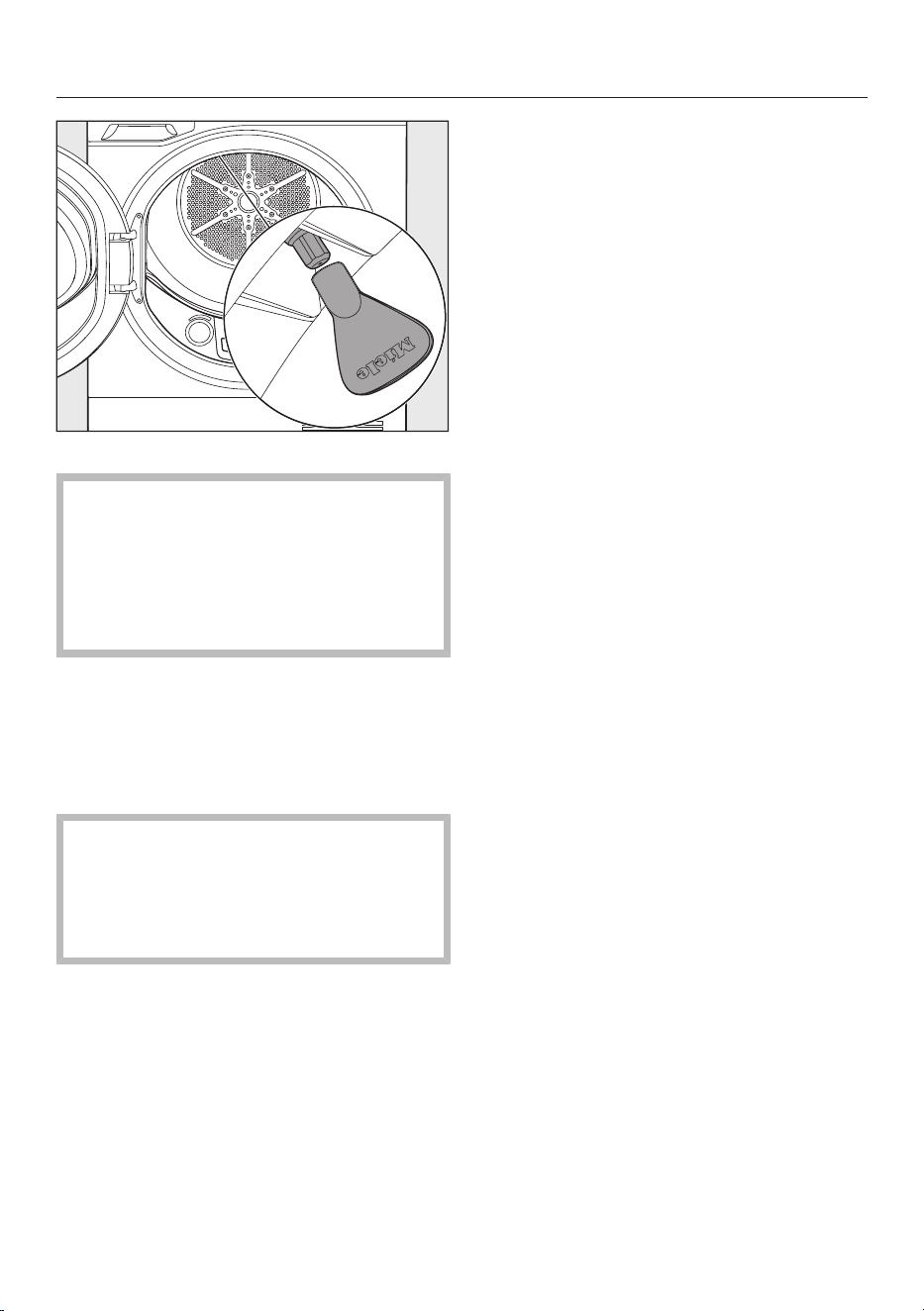
Troubleshooting
81
Attach the tool to the nozzle.
Using the wrong tool can cause
damage.
Doing so can damage the nozzle or
the tumble dryer.
Only use the tool supplied. Do not
use any other tool.
To unscrew the nozzle, turn the tool
anti-clockwise.
Insert the new nozzle into the tool.
To screw in the nozzle, turn the tool
clockwise by hand.
The tumble dryer must not be oper-
ated without a nozzle for SteamCare
fitted.
Proper functioning is no longer guar-
anteed.
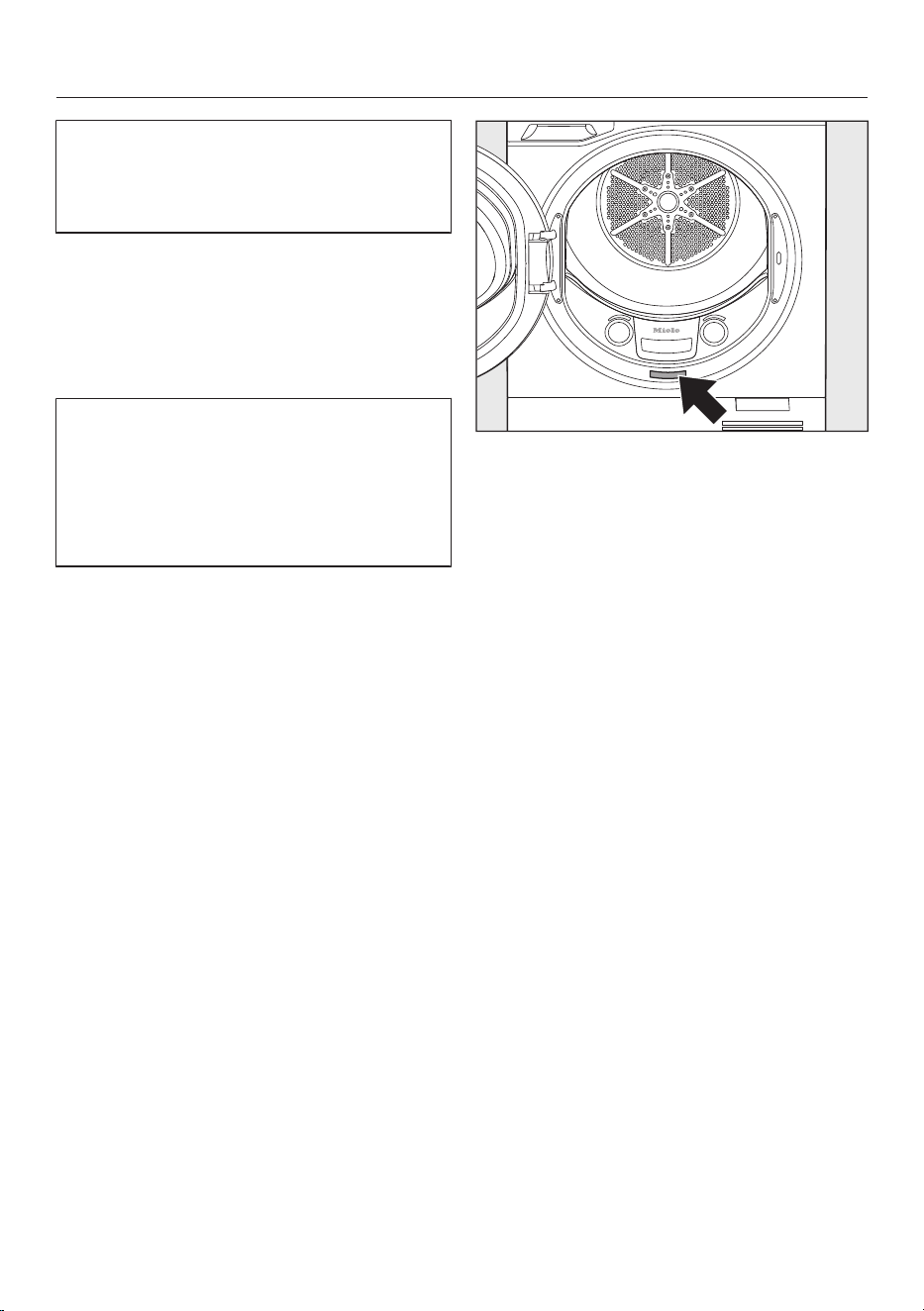
Service
82
Information to help you rectify faults
yourself and about Miele spare parts
can be found at www.miele.com/ser-
vice.
Contact in the event of a fault
In the event of any faults which you can-
not remedy yourself, please contact
your Miele dealer or the Miele Cus-
tomer Service Department.
You can book a Miele Customer Ser-
vice Department call-out online at
www.miele.com/service.
Contact information for the Miele Cus-
tomer Service Department can be
found at the end of this document.
Please quote the model identifier and
serial number of your appliance (Fabr./
SN/Nr.) when contacting the Miele
Customer Service Department. This in-
formation can be found on the data
plate.
Please note that telephone calls may be
monitored and recorded for training pur-
poses and that a call-out charge will be
applied to service visits where the prob-
lem could have been resolved as de-
scribed in this booklet.
Open the door of your tumble dryer to
find the data plate:
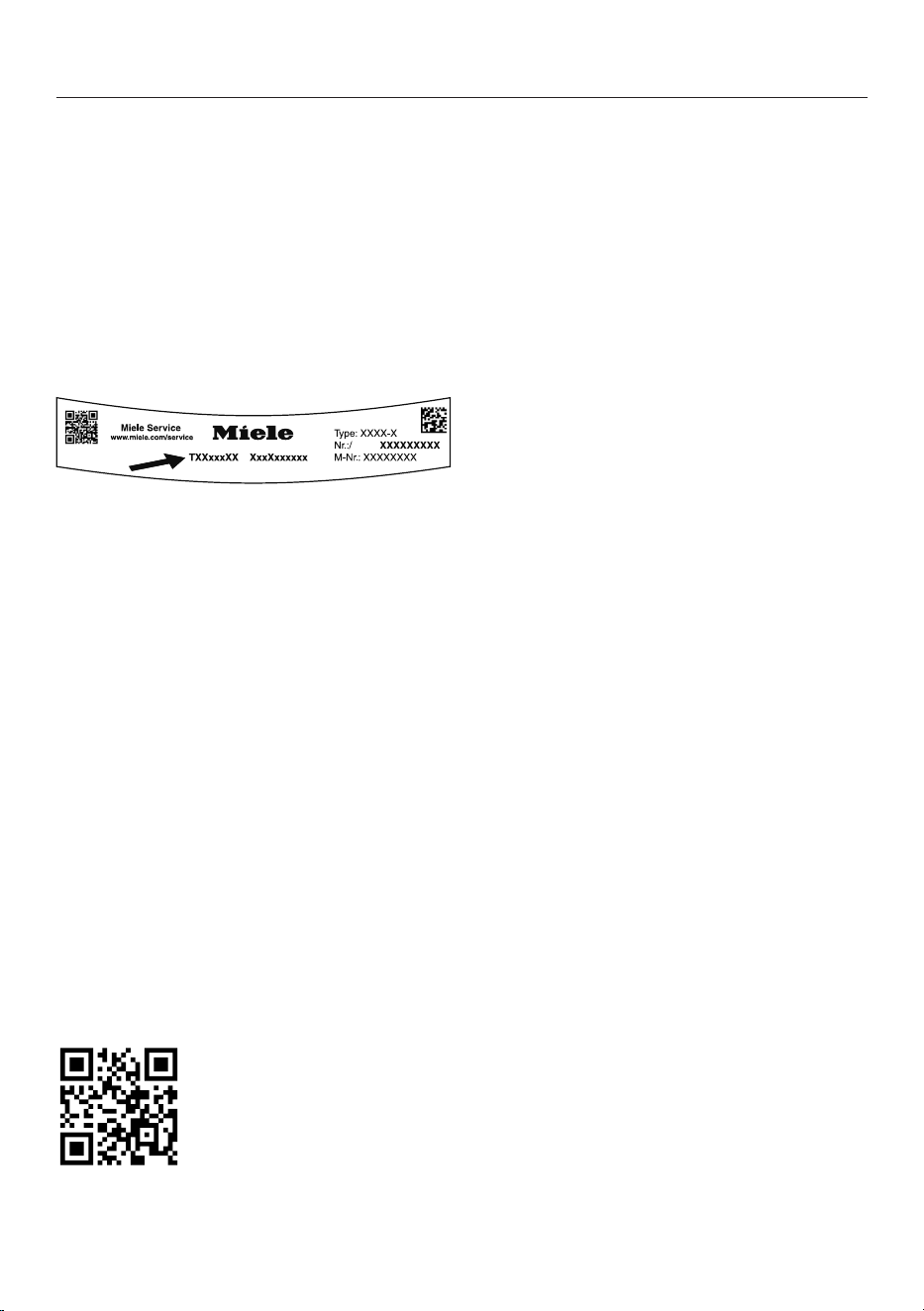
Service
83
EPREL database
Information on energy labelling and eco-
design requirements is available in the
European Product Database (EPREL).
You can find the product database at
the following link
https://eprel.ec.europa.eu/. You will be
asked to enter the model identifier.
The model identifier can be found on the
data plate.
Warranty
For information on the appliance war-
ranty specific to your country please
contact Miele. See back cover for ad-
dress.
In the UK, your appliance warranty is
valid for 2 years from the date of pur-
chase. However, you must activate your
cover by calling 0330 160 6640 or re-
gistering online at www.miele.co.uk.
Optional accessories
Products specially tailored to your
tumble dryer – such as fragrance flac-
ons, dryer baskets and accessories –
are available from the Miele online shop,
from Miele Customer Service or from
your Miele dealer.
You can access the Miele online shop
via the following QR code:
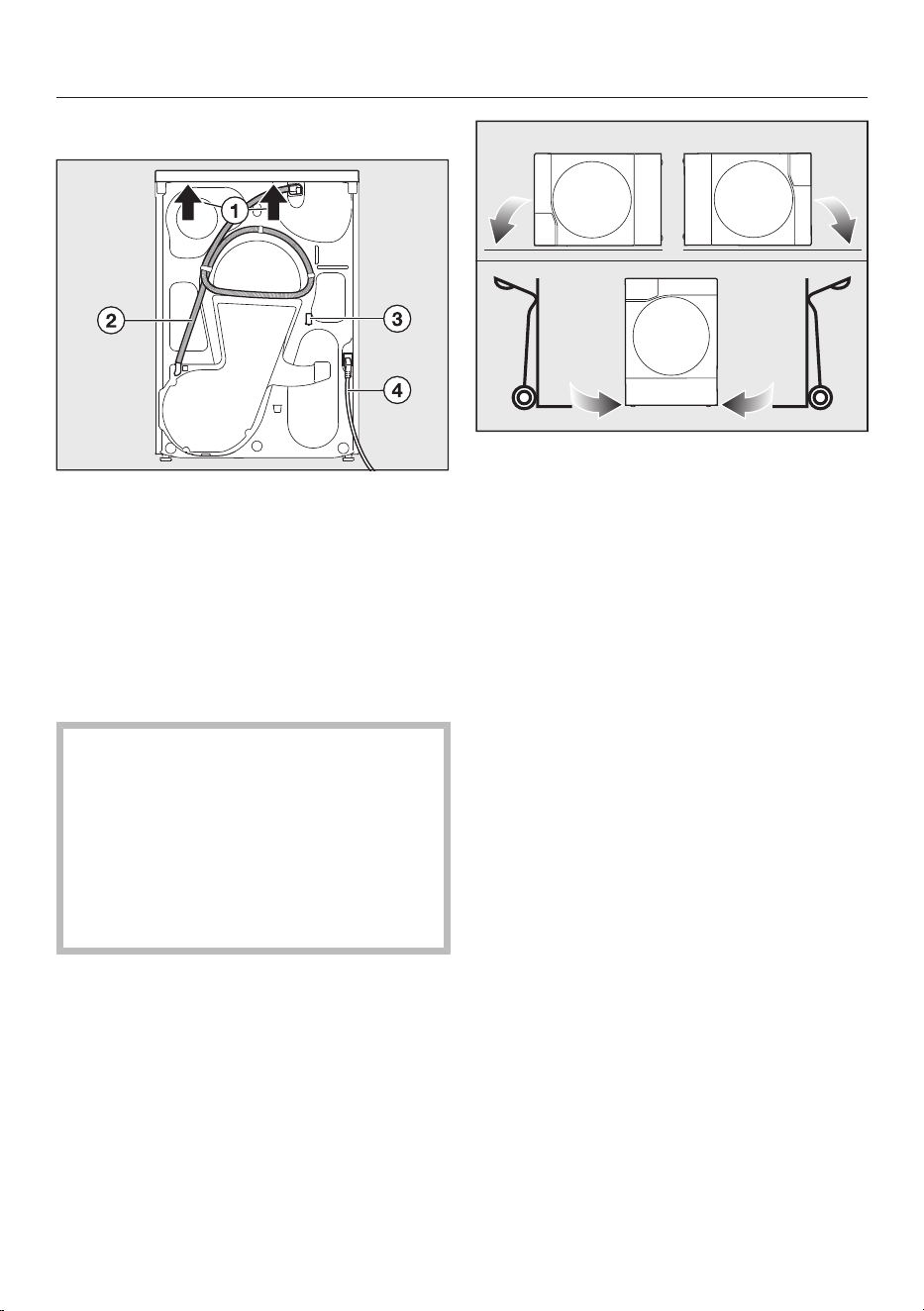
Installation
84
Rear view
a
Protruding lid for holding when mov-
ing the appliance
b
Drain hose for condensed water
c
Hook for winding up the mains con-
nection cable during transport
d
Mains connection cable
Transporting the tumble dryer
Danger of injury to people and
damage to property caused by mov-
ing the appliance incorrectly.
If the tumble dryer tips up there is a
danger of injury to people and dam-
age to property.
Ensure that the tumble dryer is stable
during transportation.
If transporting the tumble dryer, make
sure its left or right side panel is:
- Horizontally (e.g. in a car) or
- Upright on a sack truck
Transporting the tumble dryer to the
installation surface
Carry the tumble dryer by the front
feet and by the lid where it protrudes
at the back of the appliance.
Draining of condensed water before
moving
A residual amount of condensed water
may run out of the tumble dryer during
transport (e.g. when moving house).
To remove condensed water, start any
programme before transporting the
machine.
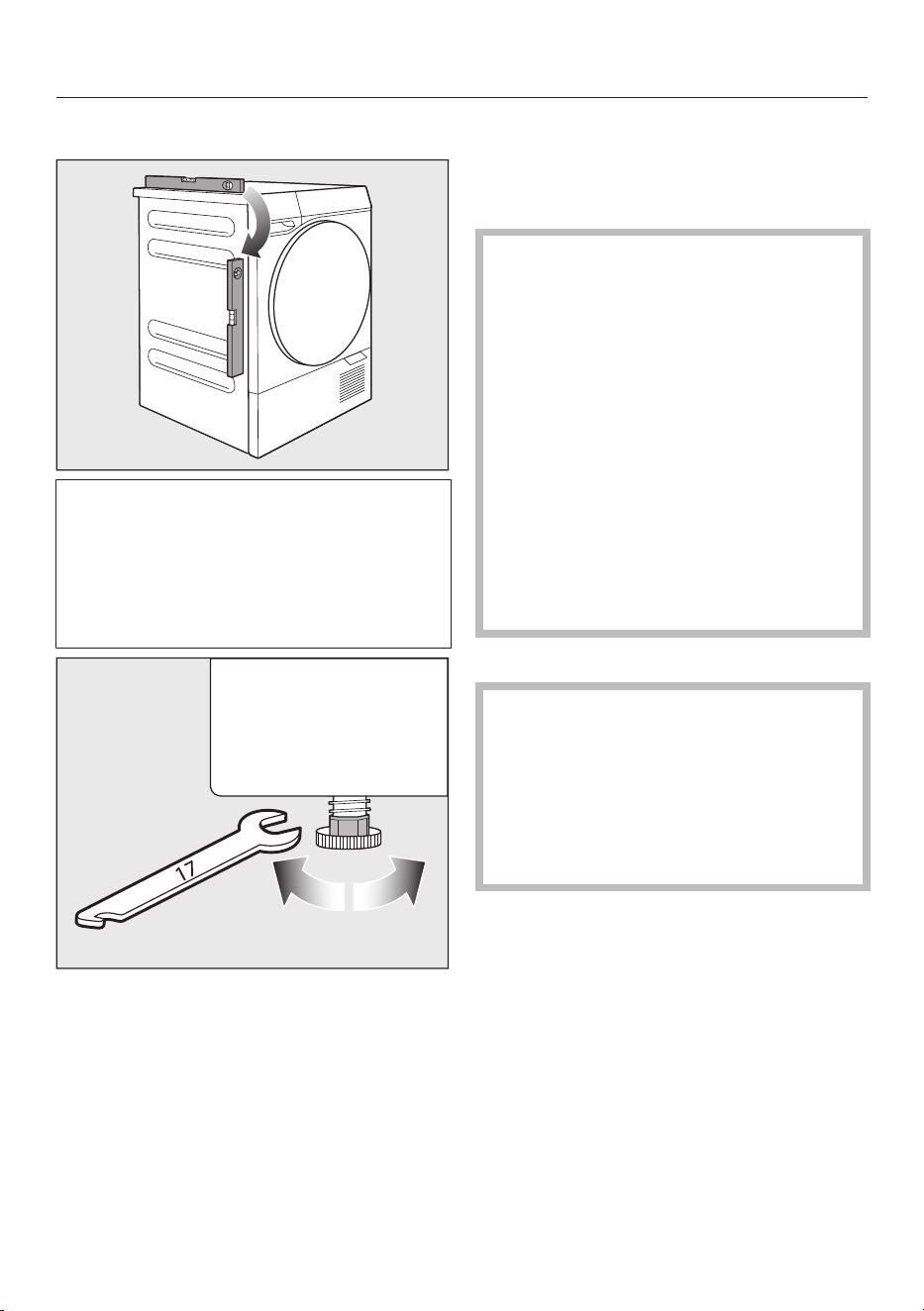
Installation
85
Levelling the tumble dryer
The tumble dryer must stand perfectly
level to ensure safe and proper opera-
tion.
The screw feet on the tumble dryer
can be adjusted to compensate for un-
evenness in the floor.
Turn the screw feet on the tumble
dryer by hand or with a flat open
spanner.
Additional installation require-
ments
Room doors and furniture doors
Danger if the dryer door cannot
be fully opened.
Reliable operation of the tumble
dryer is otherwise not guaranteed.
The tumble dryer must not be in-
stalled in places where doors prevent
the dryer door from being fully
opened.
The appliance must not be installed
behind a lockable door, a sliding door
or a hinged door of a piece of fur-
niture on the opposite side to that of
the tumble dyer, in such a way that a
full opening of the tumble dryer door
is restricted.
Accessing the socket
Risk of electric shock.
Personal injury and damage may oc-
cur.
The socket must be easily accessible
so that the tumble dryer can be
quickly disconnected from the mains
if necessary.
Installation
86
Safety precautions against fire
Risk of fire and explosion due to
damage to the tumble dryer.
The refrigerant is flammable and ex-
plosive.
Do not make any alterations to the
tumble dryer. Take measures to pro-
tect the tumble dryer against dam-
age.
If the tumble dryer is damaged, proceed
as follows:
- Avoid naked flames or anything which
creates a spark.
- Disconnect the tumble dryer from the
electrical supply.
- Air the room where the tumble dryer
is located.
- Contact the Miele Customer Service
Department.
Ventilation for the tumble dryer
The tumble dryer generates heat dur-
ing operation, which must be dissip-
ated. Ensure sufficient ventilation of
the room (e.g. open the window).
Fault due to insufficient cooling
of the tumble dryer.
The drying time and energy require-
ments of the tumble dryer increase
and the programme may be can-
celled.
The cool air vent in the plinth flap
must not be covered, e.g. by a laun-
dry basket.
Do not block the gap between the
bottom of the tumble dryer and the
floor with plinth facings, deep pile
carpet or other similar products.
Slot-in or wall unit installation
The tumble dryer is suitable for push-
ing under a worktop. (min. 850mm
high niche). Installation is also possible
in a wall unit. The drying time may in-
crease during installation.
The appliance lid cannot be removed.
Fault due to obstructed vent.
The drying time and energy require-
ments of the tumble dryer increase
and the programme may be can-
celled.
Prevent the heat from building up ex-
cessively by dissipating it in a tar-
geted manner.

Installation
87
Preventing excessive heat build-up
You can reduce excessive heat build-up
by taking certain measures.
Unscrew the screw feet on the
tumble dryer slightly so that the gap
between the floor and the bottom of
the tumble dryer is at least 20mm.
Create a gap for the dryer in the con-
tinuous kitchen furniture plinth panel.
When installing in a wall unit, make
openings in the unit (install ventilation
grille).
Washer-dryer stack
The tumble dryer can be installed as a
washer-dryer stack together with a
Miele washing machine. An stacking kit
(optional accessories) is available from
your Miele dealer or Miele Customer
Service Department.
Only the required Miele washer-dryer
stacking kit may be used.
For stacked installation, the move-
ment sensor (MotionReact) in the
tumble dryer does not work, or only
to a limited extent.
This is not a fault.
Plinth
A plinth with drawer (optional accessor-
ies) is available for this tumble dryer
from your Miele dealer or Miele Cus-
tomer Service Department.
External condensed water con-
nection
Preparing the drain hose
Damage to the drain hose
through incorrect handling.
The drain hose can suffer damage
and condensed water can leak.
Do not pull on the drain hose and do
not stretch it or allow it to become
kinked.
Have a container ready. There will be a
small amount of water in the drain hose
from the final test at Miele.
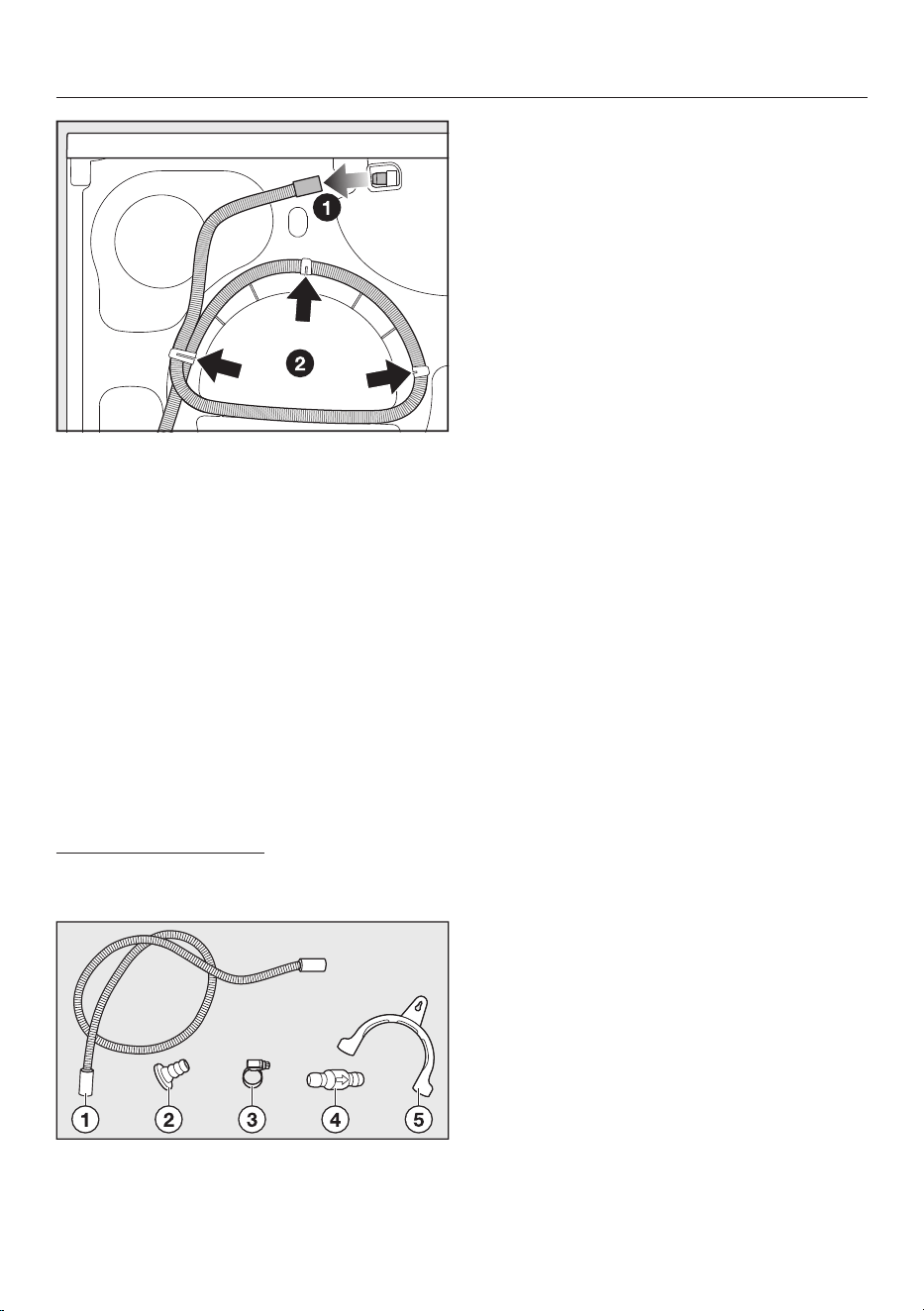
Installation
88
Pull off the drain hose.
Pull the drain hose out of the clips.
Unwind the drain hose.
Allow any residual water to run into a
container.
Hose length: 1.49m
Maximum delivery head: 1.00m
Maximum drainage length: 4.00m
Optional accessories for drainage
Accessories are available from your
Miele dealer or from the Miele Cus-
tomer Service Department.
Drainage accessories
Tip: You can purchase additional ac-
cessories for extended connections.
a
Hose extension**
b
Adapter*
c
Hose clip*
d
Non-return valve**
e
Hose holder*
* Supplied with the tumble dryer
** Must be purchased: non-return valve
kit for external water connection, in-
cluding non-return valve, hose exten-
sion (approx. 0.6m long), 2 hose clips
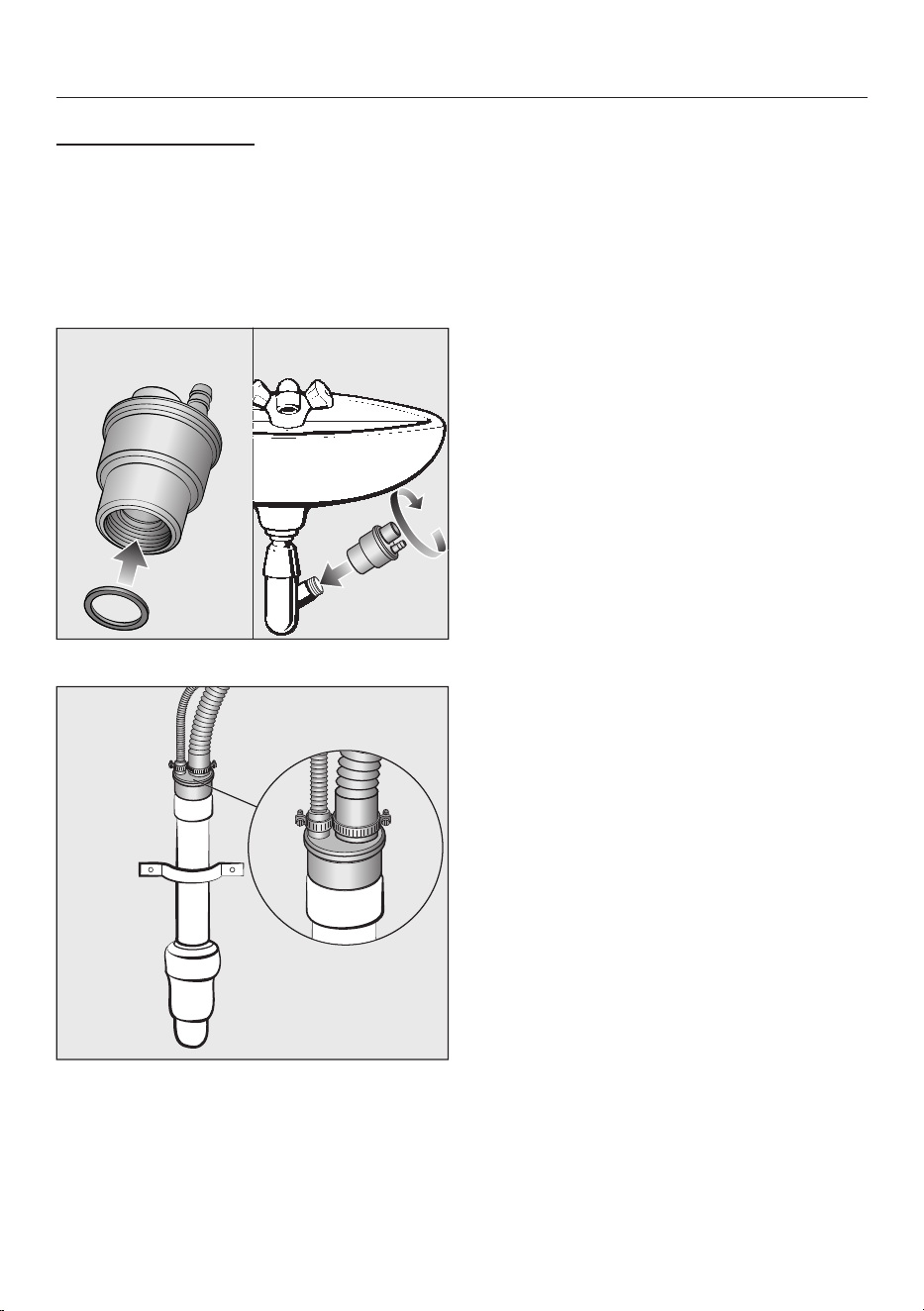
Installation
89
Adapter for drainage
Miele offers an adapter for washing ma-
chines and tumble dryers as an optional
accessory. A non-return valve is integ-
rated for the tumble dryer.
The adapter can be used:
- For a sink drain outlet
1. 2.
- For plastic pipe DN40/DN50
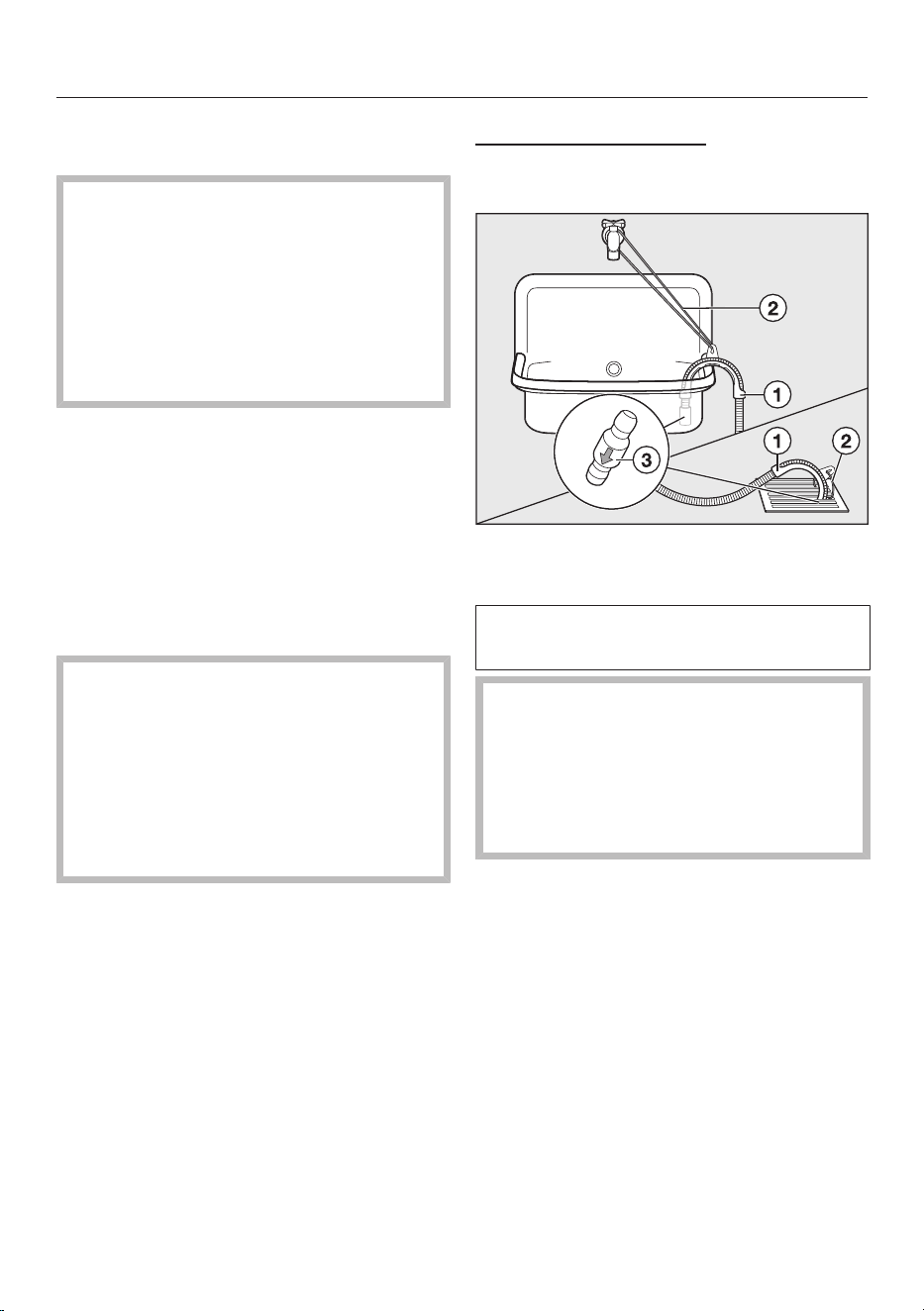
Installation
90
Installation conditions with non-return
valve
Damage if the end of the hose is
immersed in water.
Back-flow water could damage the
tumble dryer and also the room in
which it is located.
Always use the non-return valve
when installing on all water-bearing
connections.
Installations conditions for which the
non-return valve must be used:
- Draining into a sink
- Draining into a floor drain (gully)
- Connection to a sink drain outlet
- Connection to a drainage system
already in use by another appliance,
e.g. a dishwasher or washing machine
Fault caused by incorrect installation
of the non-return valve.
If installed incorrectly, drainage is not
possible and the programme is can-
celled.
The arrow on the non-return valve
must point in the direction of flow
after installation.
Installing a simple drain
You can drain the condensed water into
a sink or floor drain (gully), for example.
Use the hose holder.
Attach the hose holder with a cord.
Recommendation: fit the non-return
valve into the end of the hose.
Risk of damage from leaking wa-
ter.
If the drain hose comes loose, over-
flowing water can cause damage.
Secure the drain hose (e.g. by tying
it) to make sure it cannot slip.
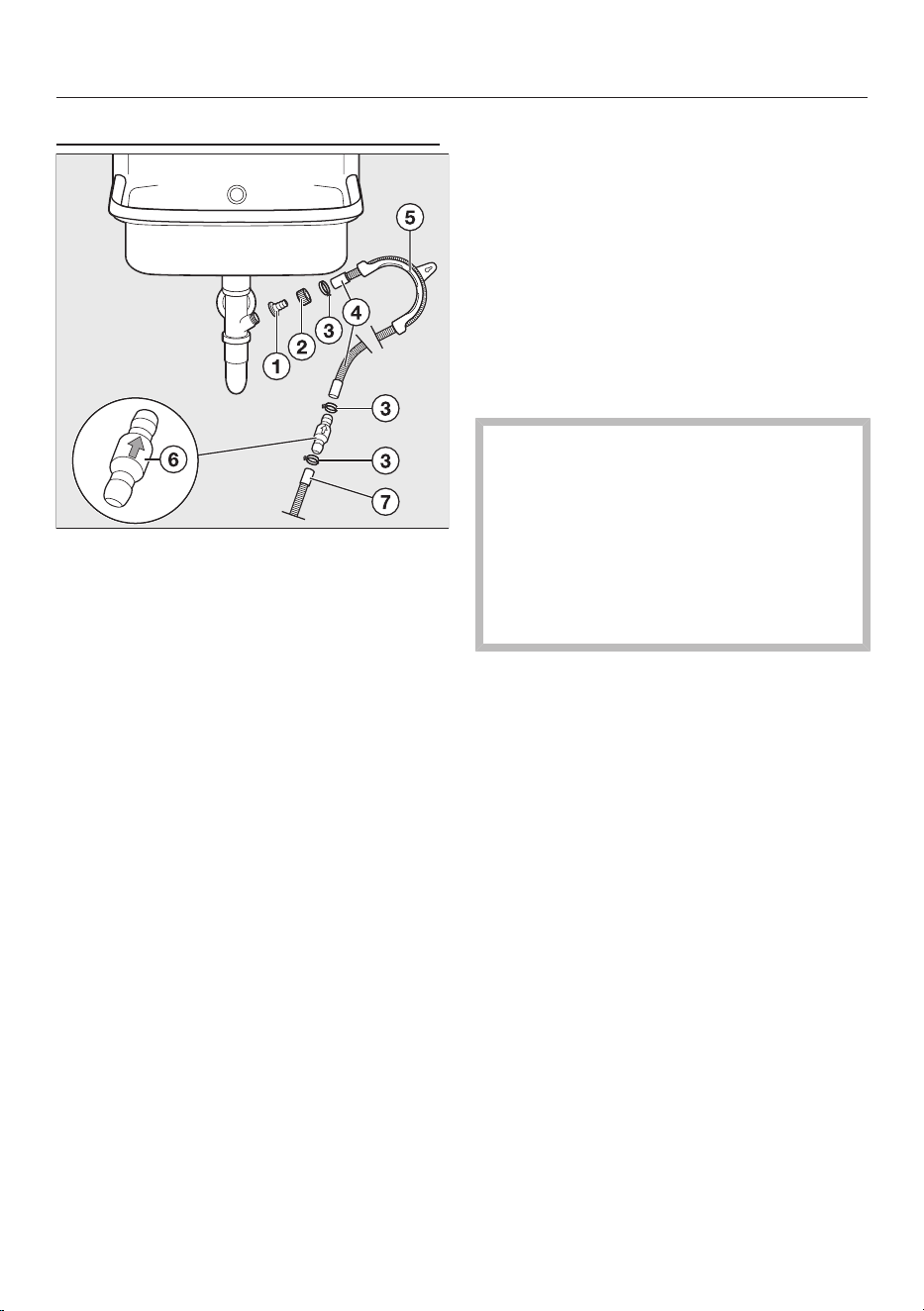
Installation
91
Installing the drain to a sink drain outlet
a
Adapter
b
Union nut
c
Hose clips
d
Hose extension
e
Hose holder
f
Non-return valve
g
Drain hose, tumble dryer
Fit the adapter to the sink drain
outlet using the union nut.
If this union nut has a flat disc in it, the
disc must be taken out first.
Attach the end of the hose exten-
sion to the adapter.
Use a screwdriver to tighten the hose
clip up close to the union nut.
Use the hose holder.
Connect the hose extension with
the non-return valve to the drain
hose of the tumble dryer.
Secure the non-return valve using
hose clips.
Electrical connection
The tumble dryer is supplied with a
mains cable with moulded plug ready
for connection to a suitable earthed
socket.
The socket must be easily accessible
after the tumble dryer has been in-
stalled. If the socket is not easily ac-
cessible, ensure that a suitable means
of disconnection is provided on the in-
stallation side for each pole.
Risk of fire from overheating.
Connecting the tumble dryer to a
multi-socket adapter or to an exten-
sion lead can overload the mains
connection cable.
For safety reasons, do not use an ex-
tension cable or multi-socket ad-
apter.
The electrical system must comply with
local and national safety regulations (BS
7671 in the UK).
For safety reasons, we recommend us-
ing a type A residual current device
(RCD) in the relevant electrical installa-
tion for connecting the tumble dryer.
If the mains connection cable is dam-
aged, it must only be replaced with a
specific mains connection cable of the
same type (available from the Miele
Customer Service Department). For
safety reasons, such replacement may
only be carried out by a qualified spe-
cialist or the Miele Customer Service
Department.

Installation
92
These operating instructions and the
data plate indicate the nominal power
consumption and the appropriate fuse
rating. Compare this information with
the data of the on-site electrical con-
nection.
If in any doubt, consult a qualified elec-
trician.
Temporary or permanent operation on
an autonomous power supply system or
a power supply system that is not syn-
chronised with the mains power supply
(e.g. island networks, back-up systems)
is possible. A prerequisite for operation
is that the power supply system com-
plies with the specifications of
EN50160 or an equivalent standard.
The function and operation of the pro-
tective measures provided in the do-
mestic electrical installation and in this
Miele product must also be maintained
in isolated operation or in operation that
is not synchronised with the mains
power supply, or these measures must
be replaced by equivalent measures in
the installation. As described, for ex-
ample, in the current version of BS OH-
SAS 18001–2 ISO 45001.
Damage caused by starting a
drying programme too early.
The heat pump can be damaged.
You can switch on and network the
tumble dryer. However, to avoid pos-
sible damage, only start a drying pro-
gramme after one hour has elapsed.

Installation
93
Technical data
Height 850mm
Height-adjustable 845–855mm
Width 596mm
Depth 643mm
Depth with dryer door open 1110mm
Slot-in Yes
Stackable Yes
Height/width/depth for building under 850/600/600mm
Weight 55kg
Drum volume 120l
Load size 9kg (weight of dry laundry)
Condensate container, volume 4.2l
Drain hose, length 1.49m
Maximum delivery head 1.00m
Maximum drainage length 4.00m
Mains connection cable, length 2.00m
Voltage See data plate
Electrical power rating See data plate
Electrical fuse rating See data plate
Refrigerant and global warming potential See data plate
Test certifications awarded See data plate
Energy consumption See “Consumption data”
LEDs Class 1
Frequency range 2.4000–2.4835GHz
Maximum transmission power <100mW

Installation
94
EU Conformity declaration
Miele hereby declares that this heat-pump tumble dryer complies with Directive
2014/53/EU.
The complete text of the EU declaration of conformity is available from one of the
following internet addresses:
- Products, Download from www.miele.ie
- For service, information, operating instructions etc: go to
https://miele.co.uk/manuals and enter the name of the product or the serial num-
ber

United Kingdom
Miele Co. Ltd., Fairacres, Marcham Road, Abingdon, Oxon, OX14 1TW
Tel: 0330 160 6600, Internet: www.miele.co.uk, E-mail: [email protected]
Australia
Miele Australia Pty. Ltd.
ACN 005 635 398
ABN 96 005 635 398
Level 4, 141 Camberwell Road
Hawthorn East, VIC 3123
Tel: 1300 464 353
E-mail: [email protected]
Internet: www.miele.com.au
Miele Electrical Appliances Co. Ltd.
No. 82, Shimenyi Road, JingAn District
Shanghai, China, P.R.C
Post Code: 200040
Phone: +86 21 6157 3500
Fax: +86 21 6157 3511
E-mail: info@miele.cn
Internet: www.miele.cn
China Mainland
Miele (Hong Kong) Ltd.
41/F - 4101, Manhattan Place
23 Wang Tai Road
Kowloon Bay, Hong Kong
Tel: (852) 2610 1025
Fax: (852) 3579 1404
E-mail:
Website: www.miele.hk
Hong Kong, China
Miele India Pvt. Ltd.
1st Floor, Copia Corporate Suites,
Commercial Plot 9, Mathura Road,
Jasola, New Delhi - 110025
E-mail: customercare@miele.in
Website: www.miele.in
India
Miele Ireland Ltd.
2024 Bianconi Avenue
Citywest Business Campus
Dublin 24
Tel: (01) 461 07 10
Fax: (01) 461 07 97
E-mail: [email protected]
Internet: www.miele.ie
Ireland
Malaysia
Miele Sdn Bhd
Suite 12-2, Level 12
Menara Sapura Kencana
Petroleum
Solaris Dutamas No. 1
Jalan Dutamas 1
50480 Kuala Lumpur, Malaysia
Phone: +603-6209-0288
Fax: +603-6205-3768
Miele New Zealand Limited
IRD 98 463 631
8 College Hill
Freemans Bay, Auckland 1011
Tel: 0800 464 353
Internet: www.miele.co.nz
New Zealand
Miele Pte. Ltd.
29 Media Circle
#11-04 ALICE@Mediapolis
Singapore 138565
Tel: +65 6735 1191
Fax: +65 6735 1161
E-mail: [email protected]
Internet: www.miele.sg
Singapore
Miele (Pty) Ltd.
63 Peter Place, Bryanston 2194
Tel: (011) 875 9000
Fax: (011) 875 9035
E-mail: [email protected]
Internet: www.miele.co.za
South Africa
Miele Appliances Ltd.
Showroom 1, Eiffel 1 Building
P.O. Box 114782 - Dubai
Tel. +971 4 3044 999
Fax. +971 4 3418 852
800-MIELE (64353)
E-mail: [email protected]
Website: www.miele.ae
United Arab Emirates
Manufacturer: Miele & Cie. KG, Carl-Miele-Straße 29, 33332 Gütersloh, Germany
Thailand
Miele Appliances Ltd.
BHIRAJ TOWER at EmQuartier
43rd Floor Unit 4301-4303
689 Sukhumvit Road
North Klongton Sub-District
Vadhana District
Bangkok 10110, Thailand
Sheikh Zayed Road, Umm Al Sheif
E-mail: customercare@miele.co.nz
P.O. Box 69434, Bryanston 2021

M.-Nr. 12 701 550 / 02 / 002en-GB, IE
TQ 1000 WP