Introduction • Safe Operation Practices • Controls & Operation • Product Care • Specications • Warranty
WARNING
READ AND FOLLOW ALL SAFETY RULES AND INSTRUCTIONS IN THIS MANUAL
BEFORE ATTEMPTING TO OPERATE THIS MACHINE.
FAILURE TO COMPLY WITH THESE INSTRUCTIONS MAY RESULT IN PERSONAL INJURY.
OperatOr’s Manual
Form No. 769-14390A
(November 21, 2019)
NOTE: This Operator’s Manual covers several models. Features may vary by model. Not all features in this manual are applicable to all
models and the model depicted may differ from yours.
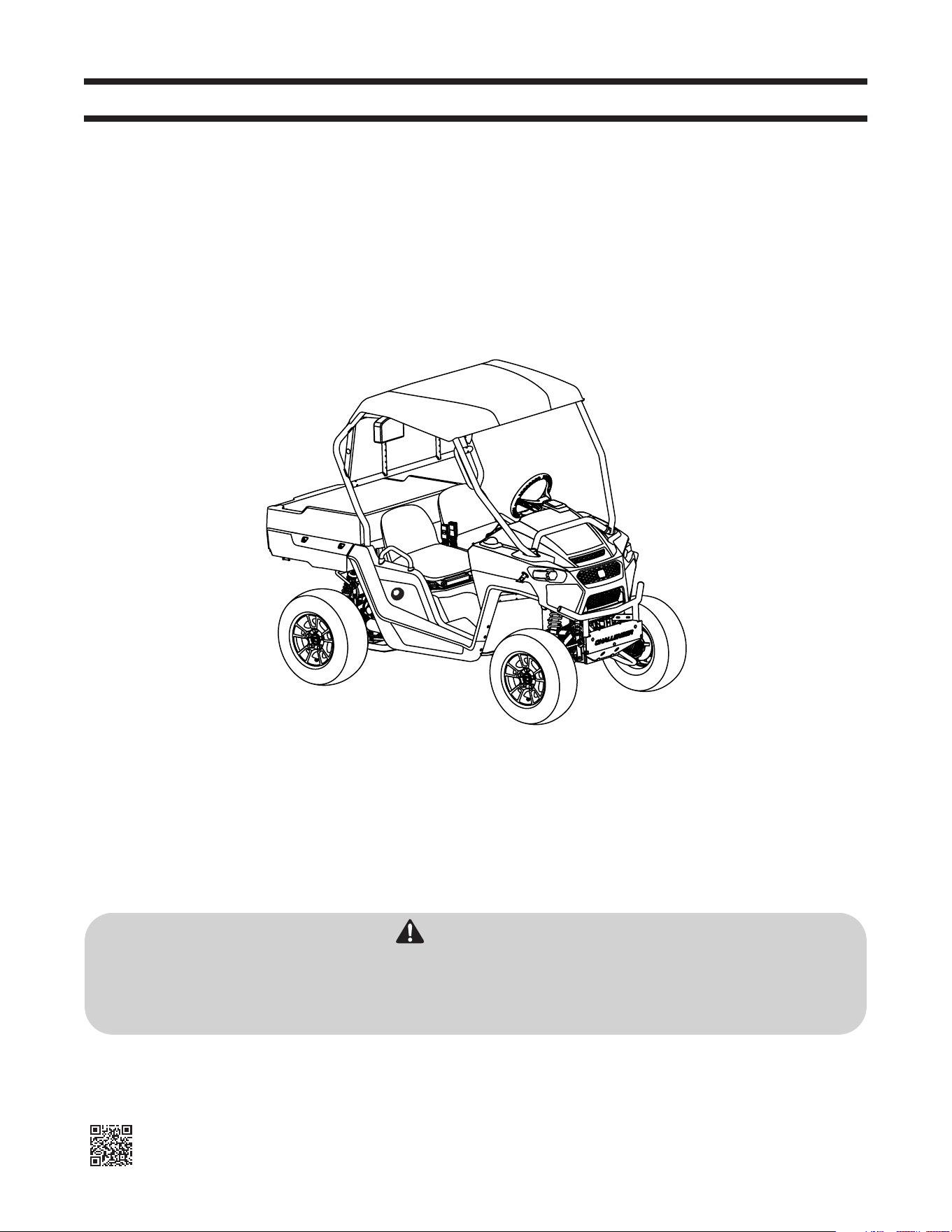
Utility Vehicle
Challenger 400 Series 4x2
Introduction ............................................................. 2
Safe Operation Practices ........................................ 3
Controls & Operation .............................................. 7
Product Care ...........................................................12
Specications ..........................................................17
Warranty .................................................................19
Table of Contents

2
Introduction
2
Thank you for purchasing a Cub Cadet Utility Vehicle. It was carefully engineered
to provide excellent performance when properly operated and maintained.
Please read this entire manual prior to operating the vehicle. It instructs you how
to safely and easily set up, operate and maintain your vehicle. Please be sure
that you, and any other persons who will operate the vehicle, carefully follow
the recommended safety practices at all times. Failure to do so could result in
personal injury or property damage.
All information in this manual is relative to the most recent product information
available at the time of printing. Review this manual frequently to familiarize
yourself with the vehicle, its features and operation. Please be aware that this
Operator’s Manual may cover a range of product specifications for various models.
Characteristics and features discussed and/or illustrated in this manual may not
be applicable to all models. We reserve the right to change product specifications,
designs and equipment without notice and without incurring obligation.
If applicable, the power testing information used to establish the power rating of
the engine equipped on this vehicle can be found at www.opei.org or the engine
manufacturer’s web site.
If you have any problems or questions concerning the vehicle, phone your
local Cub Cadet dealer or contact us directly. Cub Cadet’s Customer Support
telephone numbers, website address and mailing address can be found on this
page. We want to ensure your complete satisfaction at all times.
Throughout this manual, all references to right and left side of the machine are
observed from the operating position.
Thank You
Product Registration and Customer Support
Please do NOT return the machine to the retailer or dealer without first contacting the Customer Support Department.
Please register your product on our website, www.cubcadet.com.
If you have difficulty assembling this product, have questions regarding the controls, operation or maintenance of this machine, want to order
replacement parts/attachments/accessories, or want to view an online How-To video; you can seek help from the experts. Have your full model number
and serial number ready. Choose from the options below:
◊ Web: www.cubcadet.com/equipment/cubcadet/service-and-parts
◊ Phone: (800) 965-4CUB
◊ Mail: Cub Cadet LLC • P.O. Box 361131 • Cleveland, OH • 44136-0019
Record Product Information
Before setting up and operating your new vehicle, please locate
the model plate on the vehicle and record the information in the
provided area to the right. You can locate the model plate under
the operator’s seat. Flip the seat forward to view the model plate.
This information will be necessary, should you seek technical
support via our web site or with your local Cub Cadet dealer.
M
ODEL
N
UMBER
SERIAL NUMBER
P
RODUCT
I
DENTIFICATION
N
UMBER

3
Safe Operation Practices 2
Operation
General Operation
1. Read, understand and follow all instructions
on the vehicle and in the manual before
attempting to operate or service vehicle.
Keep this manual in a safe place for future
and regular reference and for ordering
replacement parts.
2. This is an off-road utility vehicle and it should
not be operated on public highways. Know
and comply with all laws and regulations
governing the use of off-highway vehicles in
your area.
3. This vehicle handles and maneuvers differently
than a normal passenger car. High speed turns
and abrupt maneuvers can cause vehicle to
roll over or go out of control. Slow down when
turning and avoid abrupt maneuvers.
4. Handling and maneuvering characteristics
of vehicle change depending upon driving
mode and cargo load, particularly when
operating on paved surfaces. Heavy loads
affect steering, braking, stability and overall
handling of vehicle.
5. Be familiar with all instructions and controls and
their proper operation before starting vehicle.
6. Never allow adults to operate this vehicle
without proper instruction.
7. Never allow children under 16 years old to
operate this vehicle. Children 16 years old
and over should read and understand the
operation instructions and safety rules in this
manual and should be trained and supervised
by a parent unless driver has obtained a state-
issued motor vehicle driver’s license.
8. Watch for traffic when operating near
or crossing roadways. This vehicle is not
intended for use on any public roadway.
9. Do not operate this vehicle while under the
influence of alcohol or drugs.
10. Never carry more than one passenger. This
vehicle is designed to carry the driver and one
passenger only. No riders are allowed in cargo
bed or anywhere else on vehicle, except in the
driver and passenger seats.
11. Keep all body parts (i.e. head, arms, hands, legs,
feet) inside vehicle when vehicle is in motion.
12. Always remain seated and keep both hands on
the steering wheel when driving the vehicle.
13. Sit on the center of the seat and keep both
feet within the foot platform perimeter. Clean
foot platform if dirty and remove any debris
from around foot controls, e.g. brake pedal.
14. Do not misuse the utility vehicle. It is a utility
vehicle, not a recreation vehicle or toy.
Recreational riding can lead to accidents,
severe bodily injury or death.
15. Inspect area around vehicle before moving,
especially in reverse. Back up slowly. Always
look down and behind before and while
backing to avoid a back-over accident. Keep
bystanders out of area.
16. Avoid driving through water, since loss of
control may occur. Drive belt may slip if
exposed to water, thus reducing vehicle
pulling power and stopping vehicle entirely.
17. Always use vehicle lights while operating in low
light situations.
18. Do not enter or leave vehicle while it is in
motion or in actual operation.
19. Avoid sudden starts, stops or turns and always
use a level turn-around area.
20. Never leave vehicle unattended with the key
in the ignition. Always turn key to the STOP
position, set the parking brake and remove key.
21. Check overhead clearances carefully before
driving under low hanging tree branches,
wires, power lines, bridges, before entering
or leaving buildings, or in any other situation
where the operator and/or operator protective
structure (OPS) may be struck, which could
result in serious injury.
22. Use the seat belt for safe operation.
Overturning the utility vehicle without the
seat belt fastened, can result in death or injury.
23. Improper use of the vehicle or failure to
properly maintain it could result in decreased
vehicle performance or personal injury.
24. Engine must be stopped when cleaning,
servicing, adjusting, repairing or installing
attachments on utility vehicle.
25. After an unexpected impact, stop the unit
and shut off the engine. Inspect for damage
and repair the damage before restarting and
operating equipment.
26. Do not start or operate vehicle indoors, unless
it is adequately ventilated. Engine exhaust
contains carbon monoxide fumes, which are
very poisonous and can be deadly.
27. Do not change engine governor setting or
over speed the engine. The governor is set at
the factory for safe operating speed.
28. Assure neutral safety interlock switch is
adjusted correctly so engine cannot be started
unless shift lever is in the NEUTRAL position.
29. Do not touch engine or muffler while engine is
running or within 30 minutes after it is stopped.
They will be hot and can cause a burn.
30. Always inspect your vehicle each time you
use it to make sure it is in safe operating
condition. Always follow the inspection and
maintenance procedures and schedules
described in this manual.
31. If situations occur which are not covered in
this manual, use care and good judgement.
Contact your local service center or call toll
free 1-877-282-8684 for the name of your
nearest service center.
Occupant Size and Capacity
1. Make sure operators are at least 16 years old
and have a valid driver’s license.
2. Each occupant should be able to sit with their
back against the seat, feet flat on the floor, and
hands on the steering wheel or handholds.
3. The operator should be tall enough to wear
the seat belt properly and reach all controls.
4. Passengers should also be tall enough for the
seat belt to fit properly and be able to brace
themselves, as necessary, by placing both
feet firmly on the floor while gripping the
handholds. Keep all body parts completely
inside the vehicle.
Dress Properly
1. Proper clothing can reduce the severity of
injury in the event of an accident.
2. Always wear appropriate eye protection and
protective clothing. It is also recommended
that you wear a properly fitting D.O.T.
approved helmet.
Slope Operation
Slopes are a major factor related to loss of control
and rollover accidents, which can result in severe
injury or death. If a slope is steeper than a 15° incline,
do not operate this unit on that area. Exercise
extreme caution while operating on slopes.
Do:
1. Travel straight up and down slopes, not
across. Exercise extreme caution when
changing direction on slopes.
2. Travel slowly while on a slope. Always keep
the speed limited when going down slopes to
take advantage of the engine braking action.
3. Keep all movement on the slopes slow and
gradual. Avoid starting or stopping on a slope.
4. Avoid slopes with slippery, loose or bumpy
surfaces as they are especially hazardous.
5. Use extra care while carrying cargo. It may
affect the stability of the vehicle. Spread the
load evenly and secure to prevent movement.
WARNING
This symbol points out important safety instructions which, if not followed, could endanger the personal safety and/or property of yourself and others. Read and follow all instructions
in this manual before attempting to operate this machine. Failure to comply with these instructions may result in personal injury. When you see this symbol. HEED ITS WARNING!
WARNING
California Proposition 65
Engine Exhaust, some of its constituents, and certain vehicle components contain or emit chemicals known to the State of California to cause cancer and birth defects or other reproductive harm.
Battery posts, terminals and related accessories contain lead and lead compounds, chemicals known to the State of California to cause cancer and reproductive harm. Wash hands after handling.
DANGER
This machine was built to be operated according to the safe operation practices in this manual. As with any type of power equipment, carelessness or error on the part of the operator
can result in serious injury. Failure to observe the following safety instructions could result in serious injury or death.

4 Section 2 — Safe operation practiceS
d. Never attach ropes, chains or cables to
the OPS for pulling purposes.
e. Although the OPS, when used with a
properly secured seat belt, provides a
crush-protective environment in the
event of a tip-over or rollover, never
take unnecessary risks.
Children
1. Tragic accidents can occur if the operator is
not alert to the presence of children. Children
are often attracted to the vehicle. They do not
understand the dangers. Never assume that
children will remain where you last saw them.
Avoid run over accidents.
a. Keep children out of the immediate
area of the vehicle and in watchful
care of a responsible adult other than
the operator.
b. Be alert and turn the vehicle off if a
child enters the area.
c. Before and while backing, look behind
and down for small children.
d. Never carry small children, they may
fall off and be seriously injured or
interfere with safe vehicle operation.
e. Use extreme care while approaching
blind corners, doorways, shrubs, trees
or other objects that may block your
vision of a child who may run into the
path of the vehicle.
f. Remove key when vehicle is unattended
to prevent unauthorized operation.
2. Never allow children under 16 years old to
operate this vehicle. Children 16 years old
and over should read and understand the
operation instructions and safety rules in this
manual, should be trained and supervised
by a parent and have obtained a state-issued
motor vehicle driver’s license.
3. Do not let children ride in the cargo bed, in the
driver’s or passenger’s lap or anywhere other
than the passenger seat. Never give small
children a ride; not even in the passenger seat.
The passenger seat belts, handholds and seat
height are not designed to accommodate the
safe transport of small children.
Service
Safe Handling Of Fuel:
1. To avoid personal injury or property damage,
use extreme care in handling fuel. Fuel is
extremely flammable and the vapors are
explosive. Serious personal injury can occur
when fuel is spilled on yourself or your clothes
which can ignite. Wash your skin and change
clothes immediately.
a. Use only an approved fuel container.
b. Never fill containers in the cargo bed
inside a vehicle or on a truck or trailer
bed with a plastic liner. Always place
containers on the ground away from
your vehicle before filling.
c. When practical, remove gas-powered
equipment from the truck or trailer
and refuel it on the ground. If this
is not possible, then refuel such
equipment on a trailer with a portable
container, rather than from a fuel
dispenser nozzle.
d. Keep the nozzle in contact with the
rim of the fuel tank or container
opening at all times until fueling is
complete. Do not use a nozzle lock-
open device.
e. Extinguish all cigarettes, cigars, pipes
and other sources of ignition.
f. Never fuel vehicle indoors.
g. Never remove gas cap or add fuel
while the engine is hot or running.
Allow engine to cool at least 5 minutes
before refueling.
h. Never over fill fuel tank. Fill tank to no
more than ½ inch below bottom of filler
neck to allow space for fuel expansion.
i. Replace fuel cap and tighten securely.
j. If fuel is spilled, wipe it off the
equipment. Push vehicle away from
spilled fuel. Wait 5 minutes before
starting the engine.
k. To reduce fire hazards, keep engine
compartment and exhaust system free
of grass, leaves or other debris build-
up. Clean up oil or fuel spillage and
remove any fuel soaked debris.
l. Never store the vehicle or fuel
container inside where there is an
open flame, spark or pilot light as on
a water heater, space heater, furnace,
clothes dryer or other gas appliances.
m. Avoid injury from explosion or fire.
DO NOT carry fuel or other flammable
liquids in vehicle or cargo bed.
General Service
1. Never run an engine indoors or in a poorly
ventilated area. Engine exhaust contains
carbon monoxide, an odorless and deadly gas.
2. Before cleaning, repairing or inspecting,
make certain all moving parts have stopped.
Remove the ignition key to prevent
unintended starting.
3. Check brake and parking brake operation
frequently as it is subjected to wear during
normal operation. Adjust and service as
required.
4. Keep all nuts, bolts and screws tight to be sure
the equipment is in safe working condition.
5. Never tamper with the safety interlock system
or other safety devices. Check their proper
operation regularly.
6. Never attempt to make adjustments or repairs
to the machine while the engine is running.
7. Do not change the engine governor settings
or over-speed the engine. The governor
controls the maximum safe operating speed
of the engine.
8. Maintain or replace safety and instruction
labels, as necessary.
9. According to the Consumer Products
Safety Commission (CPSC) and the U.S.
Environmental Protection Agency (EPA), units
in this product category have an Average
Useful Life of seven (7) years, or approximately
400 hours of operation. To extend the life of
your unit, and specifically after (7) years of
ownership or at 400 hours of operation, have
the unit inspected annually by an authorized
service dealer to ensure that all mechanical
and safety systems are working properly
and not worn excessively. Failure to do so
can result in accidents, injuries or death.
See Section 4 of this Operators Manual for
Maintenance and Service schedules.
10. Observe proper disposal laws and regulations
for gas, oil, etc. to protect the environment.
11. Prior to disposal, determine the proper
method to dispose of waste from your local
Environmental Protection Agency. Recycling
centers are established to properly dispose of
materials in an environmentally safe fashion.
12. Use proper containers when draining fluids.
Do not use food or beverage containers that
may mislead someone into drinking from
them. Properly dispose of the containers
immediately following the draining of fluids.
Do Not:
1. Do not travel near drop-offs, ditches or
embankments. The vehicle could suddenly
turn over if a wheel goes over the edge of a
cliff, ditch or if an edge caves in.
2. Do not stop or start suddenly when going
uphill or downhill. Be especially cautious
when changing direction on slopes.
3. Do not turn sideways to the hill. The vehicle
may roll over. If you must turn, go slow and do
so carefully and gradually.
4. Do not carry cargo or tow loads on steep slopes.
Towing
1. Always use an approved hitch and hitch point
provided on the utility vehicle.
2. Do not tow more than 500 lbs. rolling weight
(i.e. trailer plus cargo).
3. Never load more than 85 lbs. tongue weight
on tow bracket provided.
4. Go slow and use extra care when towing a
trailer. Allow for increased braking distance.
Load trailer properly.
5. Do not tow heavy loads on slopes greater
than 5° incline. When going downhill or
turning, the extra weight tends to push the
tow vehicle and may cause you to lose control
(i.e. braking and steering ability are reduced,
towed equipment may jack-knife and cause
utility vehicle to overturn).
Cargo Bed Loading/ Operation
1. Do not exceed vehicle’s Total Payload
Capacity rating of 850 lbs. This includes
operator, passenger, accessories,
attachments, tongue weight and cargo.
2. Do not exceed 350 lbs. load in cargo bed.
3. Spread load evenly and secure to prevent
movement.
4. Do not load above height of cargo bed.
Load could shift forward and injure driver or
passenger.
5. Avoid loads which exceed the physical
dimensions of cargo bed.
6. Go slow. Heavy loads will affect steering,
braking, stability and overall handling of
the vehicle. Limit loads to those that can be
safely controlled.
7. Avoid sudden starts, stops and turns which
could cause load to shift.
Cargo Bed Lift
1. Stop vehicle on level ground and set Parking
Brake before raising cargo bed.
2. Empty heavy cargo by hand.
3. Do not operate vehicle with cargo bed in
raised position.
4. Do not operate vehicle with cargo bed
unlatched. Always latch upon manually
lowering cargo bed.
Safety Frame (OPS)
1. Your vehicle is equipped with an operator
protective structure (OPS) which must be
maintained in a fully functional condition.
Use care when driving through doorways or
spaces with a low overhead.
a. Never modify the OPS in any way.
b. Never attempt to straighten or reweld
any part of the main frame if damaged.
Doing so may weaken the structure
and endanger your safety. Replace a
damaged OPS immediately.
c. Never secure any parts other than Cub
Cadet approved accessories on the
main frame or attach the safety frame
with anything other than the special
fasteners specified.
5Section 2 — Safe operation practiceS
13. DO NOT pour oil or other fluids into the
ground, down a drain or into a stream,
pond, lake or other body of water. Observe
Environmental Protection Agency regulations
when disposing of oil, fuel, coolant, brake fluid,
filters, batteries, tires and other harmful waste.
14. We do not recommend the use of a pressure
washer to clean your unit. High pressure
water may cause damage to electrical
components, spindles, pulleys, bearings or
the engine resulting in shortened life and
reduced serviceability.
Do not modify engine
To avoid serious injury or death, do not modify
engine in any way. Tampering with the governor
setting can lead to a runaway engine and cause it to
operate at unsafe speeds. Never tamper with factory
setting of engine governor.
Notice Regarding Emissions
Gasoline powered products may be equipped
with the following emission control systems:
Engine Modification (EM), Oxidizing Catalyst (OC),
Oxygen Sensor (O2S), Multi-port Fuel Injection
(MFI), Electronic Control Module (ECM), Secondary
Air Injection (SAI) and Three Way Catalyst (TWC).
When required, models are equipped with low
permeation fuel lines and fuel tanks for evaporative
emission control. Please contact Customer Support
for information regarding the evaporative emission
control configuration for your model.
Spark Arrestor
WARNING
This unit is equipped with an internal combustion
engine, muffler and spark arrestor. Do not use on or
near any unimproved forest-covered, brush-covered
or grass-covered land without the proper muffler and
spark arrestor in place.
The spark arrestor should be maintained in effective
working order by the operator. In the State of
California the above is required by law (Section
4442 of the California Public Resources Code). Other
states may have similar laws. Federal laws apply on
federal lands.
A replacement spark arrestor for the muffler is
available through your nearest authorized engine
service dealer or contact the service department,
P.O. Box 361131 Cleveland, Ohio 44136-0019.
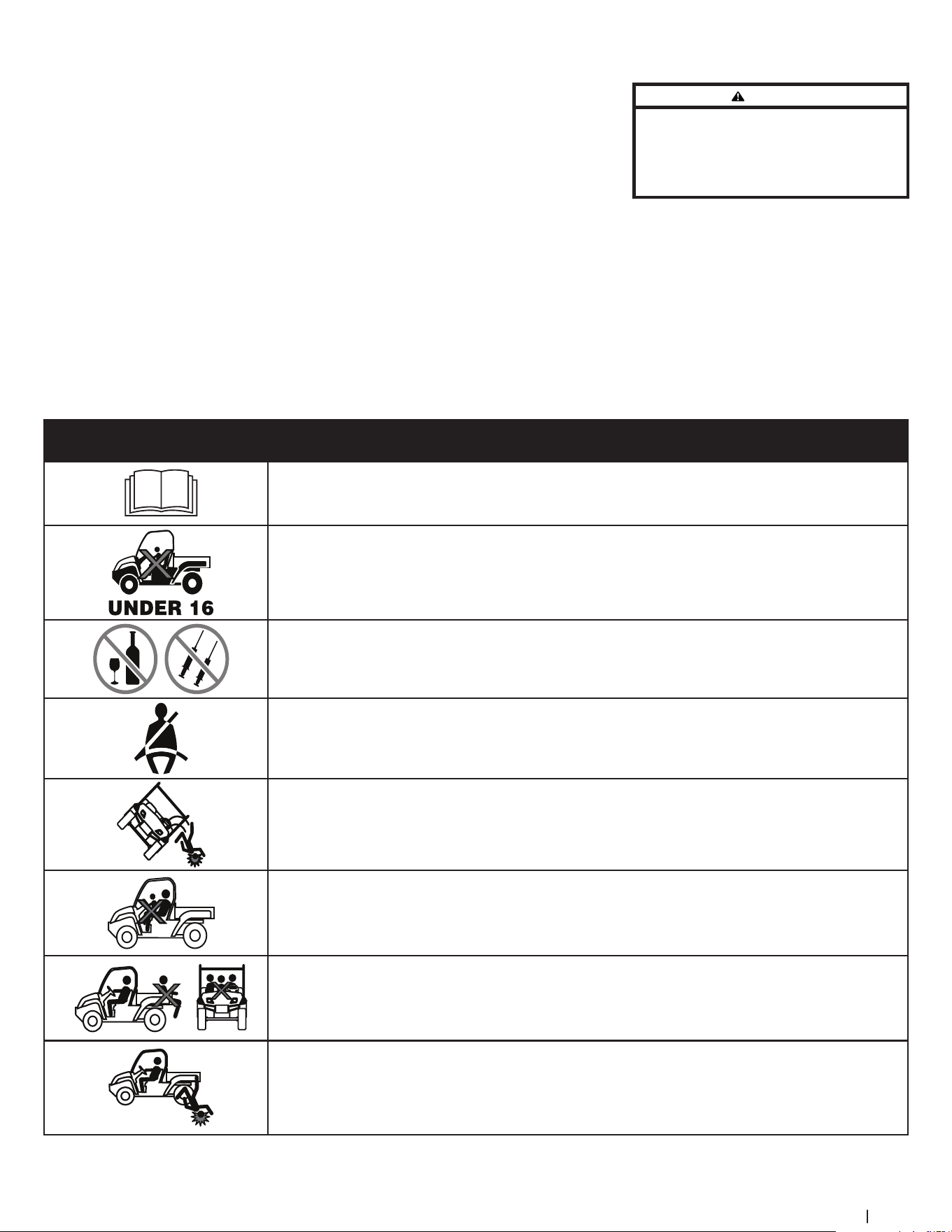
Safety Symbols
This page depicts and describes safety symbols that may appear on this product. Read, understand and follow all instructions on the machine before attempting to
assemble and operate.
Symbol Description
READ THE OPERATOR’S MANUAL(S)
Read, understand and follow all instructions in the manual(s) before attempting to assemble and operate.
WARNING — DRIVER MUST BE AT LEAST 16 YEARS-OLD AND
HAVE OBTAINED A STATE-ISSUED MOTOR VEHICLE DRIVER’S LICENSE
Young drivers may not be able to safely control vehicle.
WARNING — IMPAIRED OPERATION
Never operate the vehicle under the influence of alcohol or drugs.
WARNING— SEAT BELTS
Always wear the seat belt when operating the utility vehicle.
WARNING— ROLL OVER
Falling off or roll over may cause serious injury or death.
WARNING— ONE RIDER PER SEAT
Only one person in each seat.
WARNING— RIDERS MUST BE IN SEATS
No riders in cargo bed or anywhere other than seats.
WARNING — RIDERS FALLING
Riders can fall off and be seriously injured or killed.
6 Section 2 — Safe operation practiceS
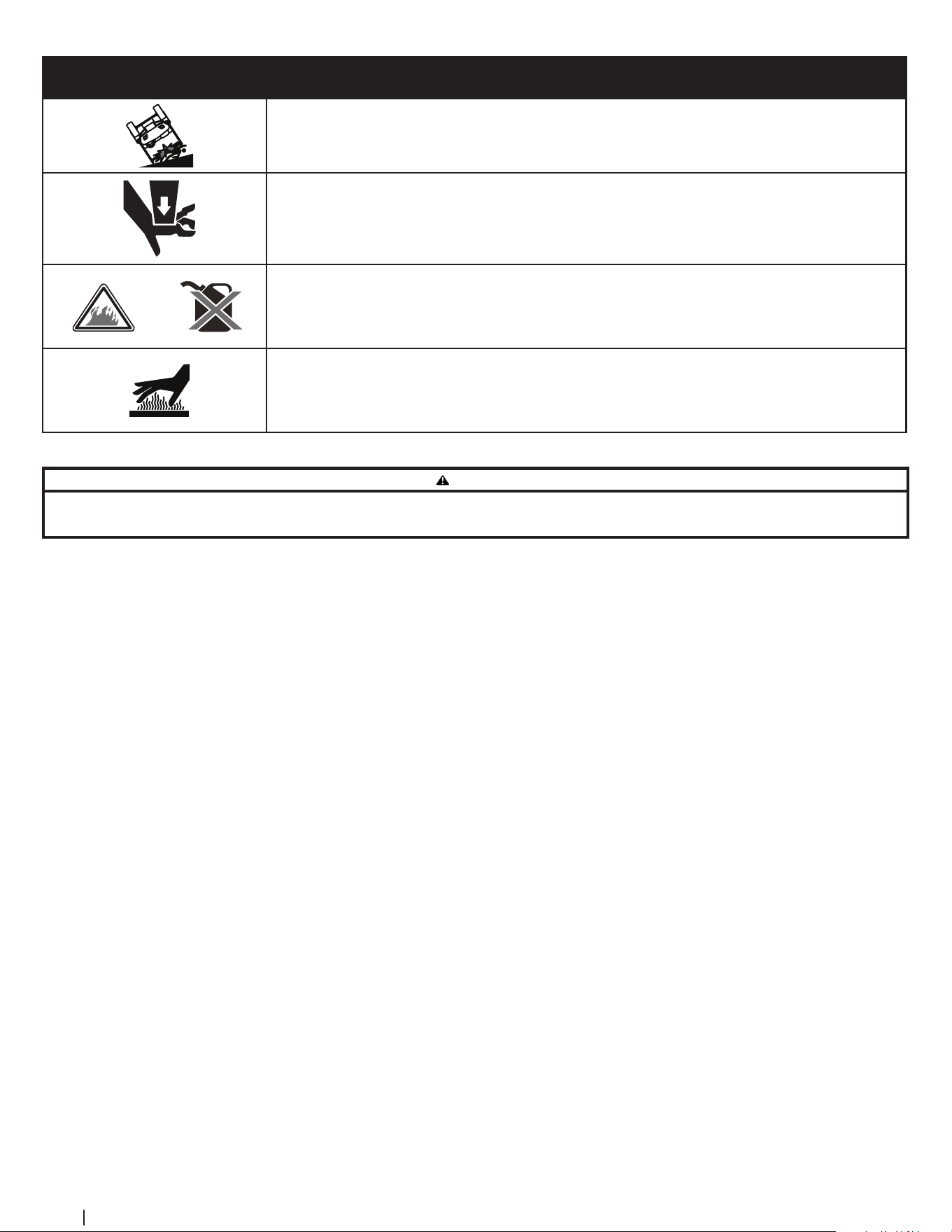
Symbol Description
M AX 15º
WARNING— SLOPES
Do not operate on slopes greater than 15°.
WARNING— CRUSH HAZARD
Keep hands and other body parts safely away when lowering cargo bed.
WARNING — GAS CONTAINER OR OTHER FLAMMABLE LIQUIDS
Avoid injury from explosion or fire. Do not carry fuel or other flammable liquids in vehicle or cargo bed.
WARNING— HOT SURFACE
Hot Surface - Do not touch.
WARNING
Your Responsibility — Restrict the use of this power machine to persons who read, understand and follow the warnings and instructions in this manual and on the machine.
SAVE THESE INSTRUCTIONS!
Controls & Operation 3
7
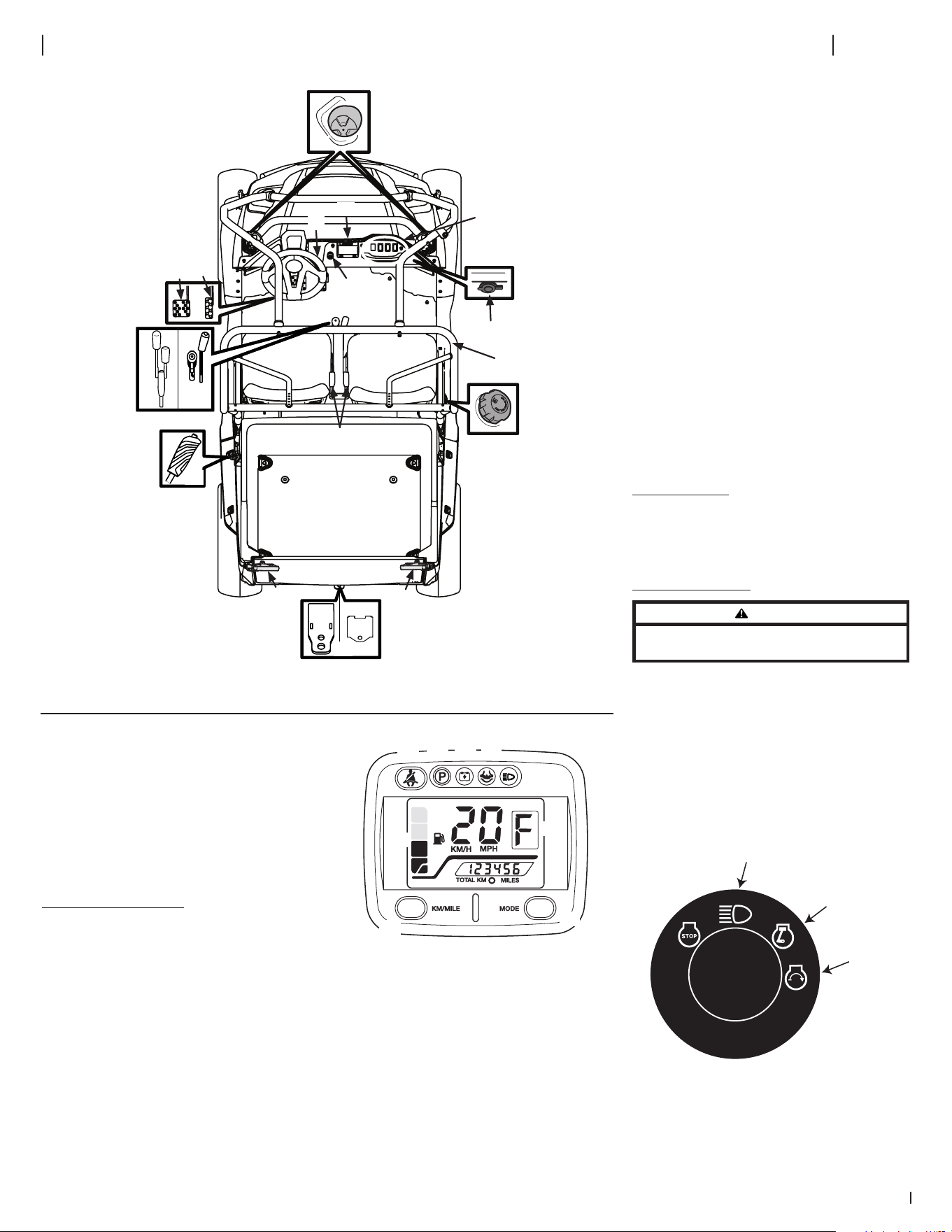
Figure 3-1
OO
OO
(A)
(B)
(E)
(G)
(I)
(C)
(D)
(R)
(K)
(J)
(L)
(O)
(M)
(N)
(P)
(Q)
(H) (H)
(I)
(I)(I)
(S)
(S)
(K) (J)
(F)
(T)
Read this operator’s manual, safety symbols and
operating instructions on the vehicle before operating.
Compare the illustrations in this manual with your
unit to familiarize yourself with the location of various
controls and adjustments. Reference to the right or
left hand side of unit is observed from the operating
position. Save this manual for future reference.
IMPORTANT: Refer to the Engine Operator’s Manual
before operating this vehicle to familiarize yourself
with the engine controls and adjustments.
Instrument Cluster (A)
The instrument cluster (See Figure 3-2) is located in
the middle of the dash panel. It contains multiple
displays, indicator lights and mode buttons. It
displays Fuel Level, Vehicle Speed (KM/H, MPH), Gear
Selection (F, N or R) and the Odometer reading when
the key is turned to the ON position. In addition, the
Seat Belt Warning Indicator will flash for 8 seconds
to remind the operator and passenger to fasten their
seat belt.
The MODE (a) button switch changes the display
from distance driven (KM/MILE) to time of use (Hrs.).
The KM/MILE (b) button switch changes the display
from KM/H to MPH.
(c)
(a)
(b)
(d)
(i)
(h)
(j)
(g)
(e) (f)
Figure 3-2
Hour Meter (c)
The hour meter is located in the instrument cluster.
To display the hour meter, press the MODE button
switch to change the display from distance driven to
time of use. It records the elapsed time when the key
is in the Run or High Beam positions.
Seat Belt Warning Indicator (d)
The Seat Belt Warning Indicator located in the
instrument cluster will flash for 8 seconds once the key
is turned to the ON position to remind the operator
and passenger to fasten their seat belt.
Parking Brake Indicator (If equipped) (e)
The Parking Brake Indicator will illuminate when the
parking brake is engaged.
Low Voltage Indicator (f)
The Low Voltage Indicator will illuminate when
battery reaches 11.6 volts.
Fuel Level Indicator (g)
The Fuel Level is divided into 5 segments and flashes
at the lowest increment.
Gear Position Indicator (h)
The Gear Position Indicator displays the gear (F, N or
R) that the gear selector is in. It will also flash when
the parking brake is engaged.
High Beam Indicator (i)
The High Beam Indicator illuminates when the
ignition switch is in the high beam position and the
high beams are in use.
Differential Lock Indicator (j)
The Differential Lock Indicator illuminates when the
differential lock lever is pulled into the ON position and
the differential lock is being used.
Choke Knob (B)
The Choke Knob is located to the right of the
ignition switch on the dash. The choke is used when
starting a cold engine. To set, pull out to engage,
push in to disengage.
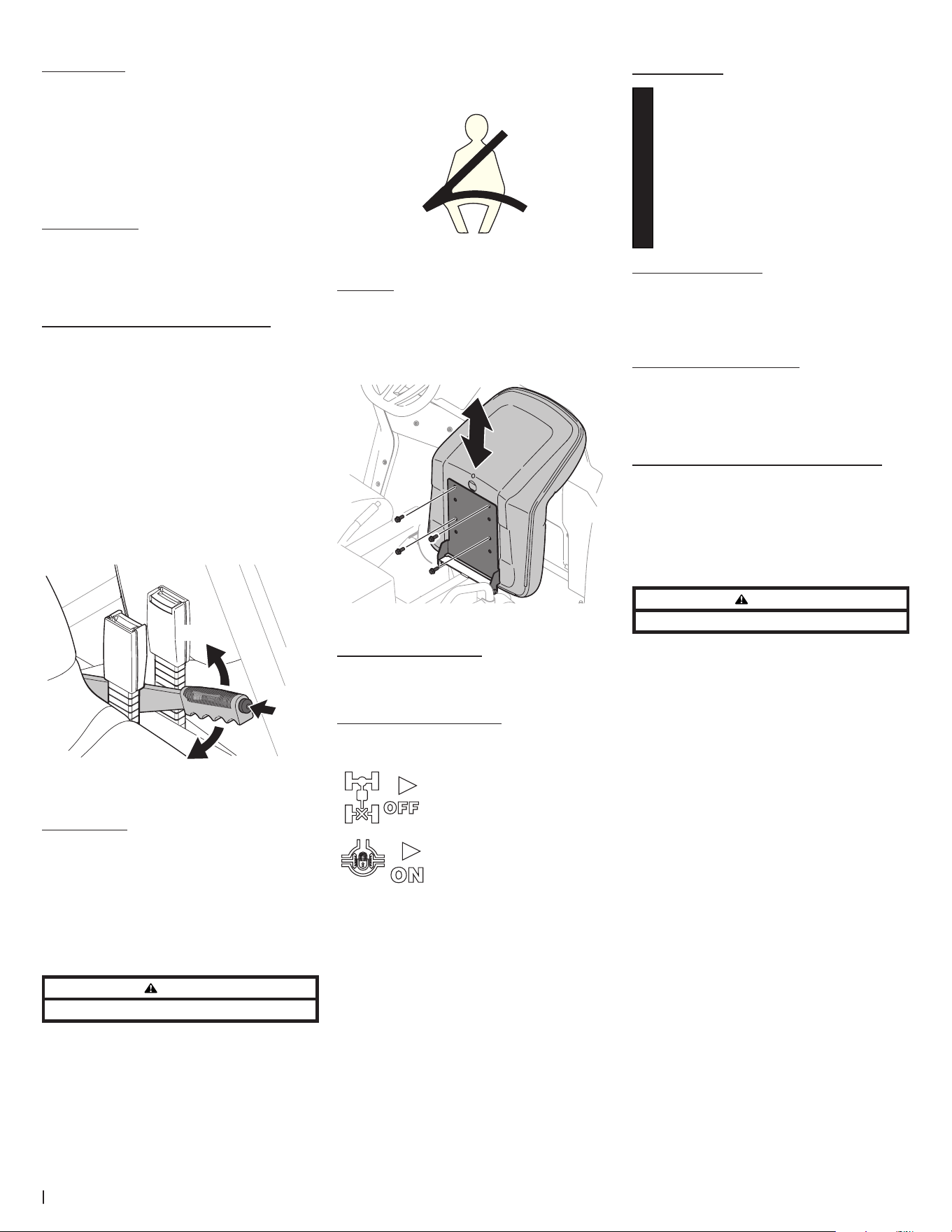
Ignition Switch (C)
WARNING
Never leave a running machine unattended. Always set parking
brake, stop engine and remove key to prevent unintended starting.
The ignition switch is located to the right of the
steering wheel. To start the engine, insert the
key into the ignition switch and turn clockwise to
the START position. Release the key into the RUN
position once engine has started. To use the high
beam feature, turn the key back to the high beam
position. The high beam indicator in the instrument
cluster will illuminate. See Figure 3-2 and Figure 3-3.
Refer to Starting Engine in the Operation section of
this manual for detailed starting instructions.
High Beam
Position
RUN
Position
START
Position
Figure 3-3
8 Section 3— controlS & operation
Gas Pedal (D)
The gas pedal is located to the right of the brake
pedal, beneath the dash panel. See Figure 3-1.
Depressing the gas pedal will move the vehicle in
the direction selected on the shift lever. As the pedal
is slowly depressed, speed will continue to increase
to the desired speed. Releasing the pedal will reduce
the speed, but will not completely stop the vehicle.
The brake must be applied to stop vehicle.
Brake Pedal (E)
The brake pedal is located to the left of the gas
pedal, beneath the dash panel. See Figure 3-1.
Remove foot from gas pedal and apply pressure to
the brake pedal until vehicle slows down and stops.
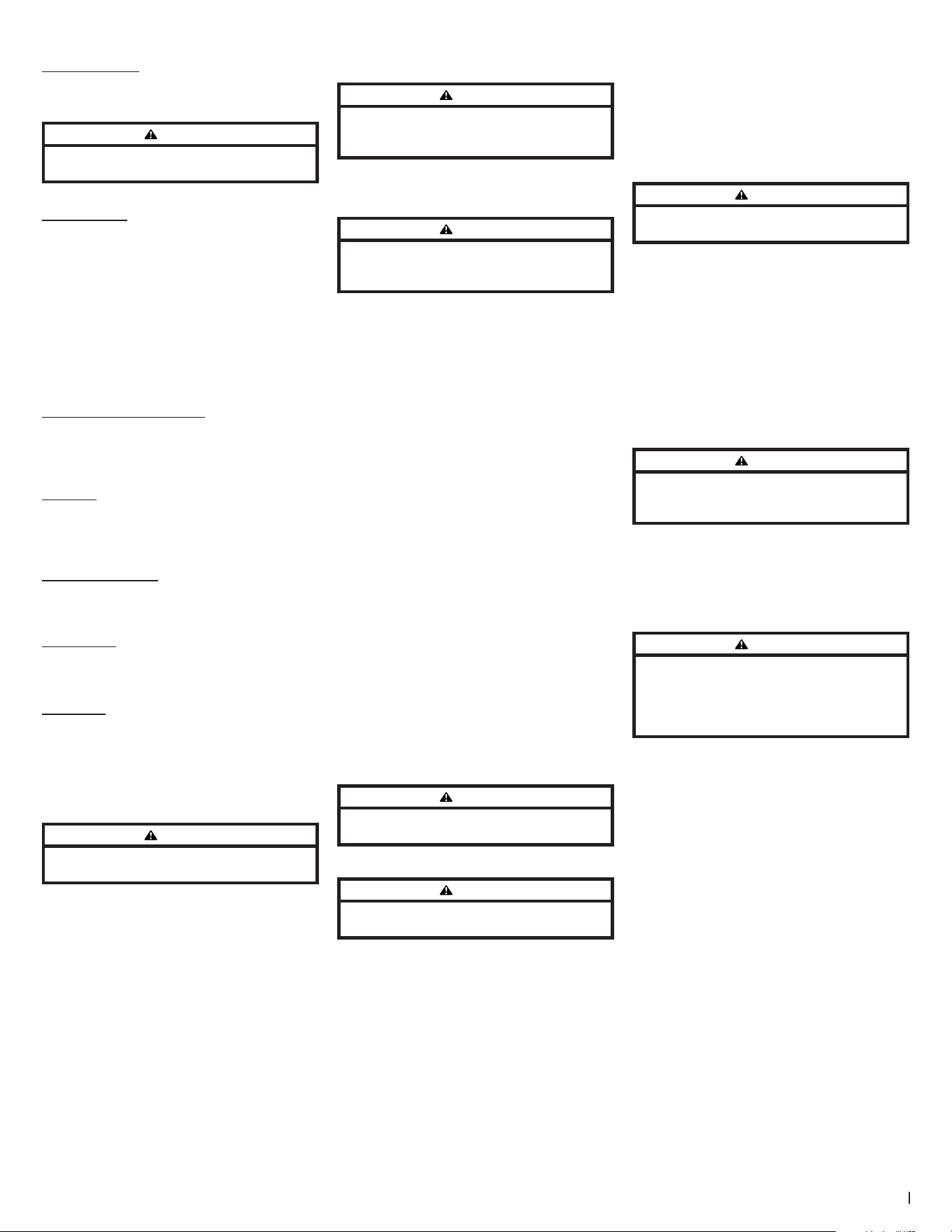
Parking Brake Lever (F, If Equipped)
The parking brake lever is located between the
driver and passenger’s seat. It holds the parking
brake in the engaged position, once engaged.
To engage the parking brake, pull up on the
parking brake lever. The parking brake indicator
on the instrument cluster will illuminate and the
gear position indicator will flash to remind you the
parking brake is engaged. See Figure 3-2.
To release the parking brake, push down on the
brake pedal, pull slightly up on the parking brake
lever while depressing button, and move the lever
to the disengaged position. The parking brake
indicator will go out and the gear position indicator
will stop flashing. See Figure 3-4.
Depress
Disengaged
Engaged
Figure 3-4
Seat Belts (G)
The seat belts are located on the outside of the
driver and passenger seats. Pull across your chest
and lap and secure it to the seat belt latch located
near the center console.
NOTE: Seat belt warning indicator will flash for 8
seconds once the key is turned to the ON position to
remind the operator and passenger to fasten their
seat belt.
WARNING
Always wear the seat belt when operating the utility vehicle.
The position of the lap belt portion of the seat belt
should be positioned for both the operator and the
passenger before driving. See Figure 3-5.
Figure 3-5
Seats (H)
The seats can be adjusted to either the forward or
rearward position by removing the (4) bolts securing
them to the seat pan and reinstalling them into the
seat in the other (4) holes of the seat pan. Tighten
bolts to 170 in-lb. See Figure 3-6.
Figure 3-6
Bed Tie-Down Rings (I)
The bed tie-down rings can be used to secure items
for transporting.
Differential Lock Lever (J)
The differential lock lever is
located in the center console
between the seats. When
engaged, the differential lever
locks the rear differential, giving
equal power to both rear wheels.
In addition, when the differential
lock lever is in the ON position, the
Differential Lock Indicator located
in the instrument cluster will
illuminate. See Figure 3-2.
REAR
DIFF LOCK
Shift Lever (K)
The shift lever is located in the center console
between the seats and has three positions
(FORWARD, NEUTRAL and REVERSE). The brake
pedal must be fully depressed when moving
the shift lever. One of the three gear positions
will be displayed in the instrument cluster. See
Figure 3-2.
IMPORTANT:
Never force the shift lever or
attempt to shift while in motion. Doing so
may result in serious damage to the utility
vehicle’s transmission.
12V Power Outlet (L)
The 12V power outlet is located on the right side
of the dash panel. It is used for the convenience of
plugging in accessories that require a power source
with a maximum load of 5A at 12V.
Auxiliary Switch Panel (M)
The auxiliary switch panel is located on the right
hand side of the dash panel above the handhold.
When adding accessories requiring switches, use this
area of the dash panel to install the desired switches.
Operator Protective Structure (OPS) (N)
This utility vehicle is equipped with an Operator
Protective Structure (OPS) and seat belts. When used
together they are effective in reducing crushing
injuries to the operator and passenger in the event
of an accidental rollover or tip-over. The safety
provided by the OPS is minimized if the seat belt is
not properly adjusted AND buckled.
WARNING
Always wear the seat belt when operating the utility vehicle.
Use the following guidelines when using a utility
vehicle equipped with OPS:
1. Be aware of overhead clearances in the area
of operation. Check for clearance of door (or
gate) openings and other overhead objects
such as utility lines and tree branches.
Overhead objects could catch the OPS and
upset the utility vehicle.
2. Do not modify the OPS by drilling holes for, or
welding accessories to, the structure.
3. Do not use the OPS to pull objects with the
utility vehicle. Use ONLY the utility vehicle
hitch for pulling.
4. Do not operate the utility vehicle without the
OPS and do not remove the OPS.
5. In the event of an accident, have the OPS
carefully inspected and, if necessary, replaced
by your Cub Cadet dealer. Do not attempt to
repair the OPS.
FF
N
N
RR
9
Section 3 — controlS & operation
Cup Holders (O)
The cup holders are located on top of the dash panel
on both the left and right hand sides.
WARNING
Never operate this vehicle while under the influence of alcohol
or drugs. Doing so can result in serious personal injury or death.
Cargo Bed (P)
The cargo bed maximum capacity is 350 lbs (158 kg).
The cargo bed may be tilted for dumping loads. Push
forward on the cargo bed latch lever to unlock the
bed and manually lift the cargo bed. See Figure 3-1.
NOTE: Access to the engine is achieved by raising
the cargo bed.
IMPORTANT: Do not exceed the vehicle’s Total
Payload Capacity of 850 lb (385 kg), which includes
driver, passenger, accessories, tongue load and cargo.
Do not exceed 350 lbs (158 kg) in the cargo bed.
Cargo Bed Latch Lever (Q)
The cargo bed latch lever is located on the left/
driver’s side of the utility vehicle and is used to
dump/tilt the cargo bed.
Hitch (R)
The hitch is located on the rear of the utility vehicle
on the frame. The max towing capacity is 500 lbs. (85
lbs. max tongue weight).
Tailgate Levers (S)
The tailgate levers are located on the tailgate and
are used to open the tailgate.
Fuel Cap (T)
The fuel cap is located on the left/driver’s side of the
vehicle to the rear of the driver’s door.
Operation
Tire Inflation
IMPORTANT: Inflation pressure in all tires is 14 psi.
Overinflating above recommended tire pressure can
reduce the life of the tire. Check tire pressures before
each use.
WARNING
Excessive pressure (above 14 psi) may cause the tire/ rim assembly
to burst with sufficient force to cause severe injury or death.
Starting Engine
WARNING
This is an off-road utility vehicle and it should not be operated on
public highways. Know and comply with all laws and regulations
governing the use of off-highway vehicles in your area.
IMPORTANT: Before starting the engine, read this
manual and the Engine Operator Manual thoroughly
to understand all instructions.
WARNING
DO NOT run an engine in an enclosed area. Engine exhaust
contains carbon monoxide, which is very poisonous and can cause
death. Move the vehicle outside or to a well ventilated area.
1. While sitting in the seat with your seat belt
fastened, insert key into ignition switch.
2. Move shift lever into NEUTRAL.
NOTE: Engine will not start if the shift lever is
not in NEUTRAL.
3. Verify parking brake is set.
4. Pull out the choke knob if engine is cold.
5. Turn key to the START position.
IMPORTANT: DO NOT run the starter
continuously for more than 5 seconds,
otherwise the battery may discharge quickly.
6. Release key to the RUN position when
engine starts.
7. If engine does not start, wait a few seconds
and repeat steps 5 and 6.
8. After engine starts, push in choke knob.
9. Release parking brake while your foot is
on the brake pedal, place shift lever in the
desired gear, release brake and press gas
pedal slowly.
IMPORTANT: Do not operate the engine
under full load until engine has warmed up.
Stopping Engine
1. To stop utility vehicle, release gas pedal and
depress brake pedal until vehicle comes to a
complete stop.
2. Move shifter back into NEUTRAL.
3. Set parking brake and turn key switch to
STOP position.
4. Remove the key when not in use.
WARNING
The vehicle may roll if the parking brake is not engaged.
Always set the parking brake, especially on slopes.
Refueling Fuel Tank
WARNING
Avoid injury from explosion or fire. Do not carry fuel or other
flammable liquids in vehicle or cargo bed.
1. Stop vehicle on a level surface and apply
parking brake.
2. Turn the ignition key to the STOP position and
remove key.
3. Allow engine to cool for 5 minutes before
adding fuel.
4. Clean area around fuel cap and remove.
5. Fill tank with fresh, unleaded, regular grade
fuel only to bottom of filler neck. Use a
minimum of 87 Octane (10% Ethanol Max.).
6. After refueling, push the fuel cap downward on
the fuel tank fill neck and turn clockwise until it
clicks to tighten. Always re-install the fuel cap
tightly onto the fuel tank after removing.
Driving Utility Vehicle
1. Adjust the operator’s seat to the most
comfortable position that allows you to
operate all controls and pedals. See Seats
section in Controls & Operation, page 8.
2. Adjust the seat belt to fit comfortably around
your lap, then buckle the seat belt.
WARNING
DO NOT operate the vehicle without the OPS in place and the
seat belt fastened securely around your waist and chest.
3. Start the engine as instructed earlier and
make sure the front wheels are turned to the
desired direction of travel.
4. Push down on brake pedal and pull slightly up
on the parking brake lever while depressing
the lock button and then slowly lower the
lever to release parking brake.
5. Move the shift lever in the center console
to the desired setting. To avoid damaging
transmission, depress brake pedal fully and
make sure vehicle is completely stopped
before shifting into FORWARD or REVERSE.
WARNING
DO NOT stop or start suddenly when going uphill or downhill.
Be cautious when changing direction on slopes. Apply brakes
when going down slopes to maintain control of vehicle.
6. Release brake pedal and slowly apply pressure
to the gas pedal.
7. Release gas pedal and apply brake pedal
evenly and firmly to slow down or stop.
Differential Lock
WARNING
To avoid transmission damage, injury or turf damage, drive
slow when operating utility vehicle with differential lock
engaged as steering response is noticeably reduced. Also, do
not drive the utility vehicle with the differential lock engaged
on concrete, asphalt or any high traction surfaces.
The differential lock lever is located in the center
console between the seats. See Figure 3-1.
1. To engage; stop utility vehicle, place into
NEUTRAL, and pull the lever upward into the
ON position. The differential will then lock and
remain so until it is disengaged, giving equal
power to both rear wheels.
IMPORTANT: Engage the differential as the
last option when stuck in mud or similar
situation or when the left and right side
wheels are turning at slightly different speeds.
2. To disengage the differential lock; stop the
utility vehicle, place the shift lever in NEUTRAL,
and push the differential lock lever downward
to the OFF position.
10 Section 3— controlS & operation
Loading the Cargo Bed
WARNING
The utility vehicle may become unstable if the cargo bed is
loaded incorrectly. Avoid loose and unsecured loads or uneven
loading of material.
1. Verify cargo bed is securely latched before
loading.
2. Securely anchor all loads in cargo bed and do
not load beyond maximum capacity.
Note: The maximum bed capacity is 350 lb
(158 kg).
3. When loading objects into cargo bed, be sure
load is securely anchored and evenly distributed.
4. Do not load above height of cargo bed. Load
could shift forward striking driver or passenger
or cause driver to lose control of vehicle.
5. Avoid loads which exceed physical dimensions
of cargo bed.
6. Avoid concentrated loads at rear or sides of
cargo bed. Be sure load is distributed evenly.
7. Reduce load and ground speed when
operating over rough or hilly terrain. DO NOT
overload vehicle. Limit loads to those that can
be safely controlled.
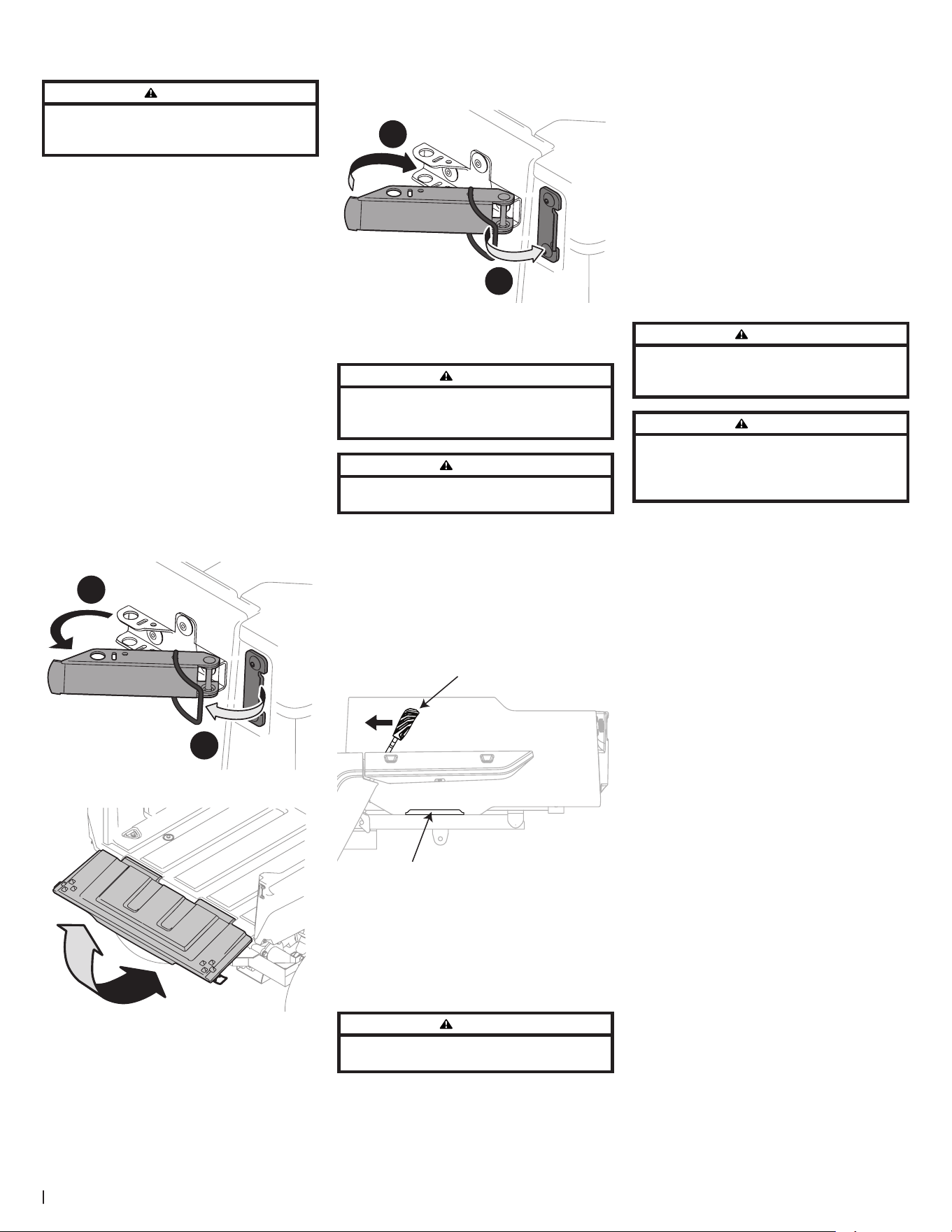
Raising & Lowering the Tailgate
1. Unlatch the tailgate from cargo bed and
lower. See Figure 3-7 and Figure 3-8.
2
1
Figure 3-7
Figure 3-8
2. Raise and re-latch the tailgate to the cargo bed.
See Figure 3-8 and Figure 3-9. Do not drive the
vehicle with tailgate in the lowered position.
1
2
Figure 3-9
Raising & Lowering Cargo Bed (Dumping Loads)
WARNING
To prevent the possibility of bodily injury from unintentional
lowering of the cargo bed, be sure vehicle is on a level and stable
surface and parking brake is set before raising cargo bed.
WARNING
A loaded cargo bed can be very heavy. Do not attempt to
dump a heavily loaded cargo bed.
1. Park the vehicle safely on level ground and set
parking brake.
2. Empty heavy cargo by hand.
3. For light loads, unlatch cargo bed by pushing
forward on the cargo bed latch lever. While
holding the latch lever forward with one
hand, lift the cargo bed with your other hand.
See Figure 3-10.
Cargo Bed
Latch Lever
Lift Up Cargo Bed
From Here
Figure 3-10
4. Once unloaded, lower bed and securely
latch before operating unit. Do not drive the
vehicle with cargo bed in the raised position.
Towing Loads
WARNING
To help prevent personal injury due to loss of control or
tipping, always tow a load slow enough to maintain control.
1. Do not tow a load that exceeds 500 lb (226
kg) rolling weight (i.e. trailer plus cargo) and
never exceed 85 lb (38 kg) tongue weight.
2. Go slow when towing a heavy load. Allow
for increased braking distance. Tow load at a
speed slow enough to maintain control.
3. Do not tow on slopes greater than 5°.
4. Be cautious when towing downhill, even
on a gradual slope or when turning. The
extra weight tends to push the tow vehicle
and may cause you to lose control (braking
and steering ability are reduced; towed
equipment may jack-knife).
IMPORTANT: Extreme angles such as high
railroad crossings can place high bending
loads on hitch connection.
5. Do not modify the hitch in any way.
How to load a Utility Vehicle into a Truck or onto a Trailer
WARNING
Always park the truck or trailer in a flat area, set the parking
brake, turn the ignition off and chock the wheels to prevent
any unexpected movement while loading the utility vehicle.
WARNING
Fully secure the loading ramps to the truck or trailer with
tie-down straps or cables to prevent the ramps from sliding
off while loading. Keep bystanders and/or helpers away from
ramps while loading.
Due to the overall size and dimensions, loading a
utility vehicle into a truck or onto a trailer is a task that
requires precision and the proper equipment to be
achieved safely. By following the steps outlined below
you’ll be able to select the proper equipment to do
the job and safely load and unload your utility vehicle.
Determine if your truck or trailer is sufficient
for the task
Loading a utility vehicle into a truck or trailer that
can’t support its weight is extremely dangerous. It is
important that before any actual loading is done, make
sure your truck or trailer and loading ramps are sufficient
for loading and hauling the utility vehicle. Here are some
of the variables you need to take into account:
• Length and width: Measure the size of your
truck or trailer by taking width and length
measurements at the floor level. Compare these
measurements to the width and length of your
utility vehicle to make sure it will fit comfortably.
• Weight Capacity: Making sure your truck or
trailer can handle the payload of your utility
vehicle is another critical task before any
loading is done. If using a truck, the payload
capacity must be a minimum of ¾ ton. If
hauling on a trailer, remember that the towing
capacity of the vehicle will be reduced by the
added weight of the utility vehicle.
• Tailgate Considerations: If the payload
capacity is sufficient for hauling in a truck, the
last thing left to consider is your truck’s bed
length. Make certain that your truck bed is
long enough to allow the truck’s tailgate to
close completely when the utility vehicle is
loaded into the truck bed.
Choosing the proper loading ramp(s)
Choosing a reliable ramp and understanding how to
properly use it is far and above the best option for safely
loading a utility vehicle into your truck or onto your
trailer. Take a look at the considerations you should have
in mind when choosing the proper ramp(s):
11
Section 3 — controlS & operation
• Capacity: Utility vehicles are not evenly
balanced, meaning it’s necessary to check the
axle weights before you make any choices
regarding ramps. A typical ramp’s capacity is
based upon two axles with equally distributed
loads. We recommend 3,000-lb minimum
capacity ramp(s) as the appropriate option for
your two-person utility vehicle.
• Offset track widths: Your utility vehicle
has an offset track width front and rear, it’s
important to factor this in to your ramp
placement and ramp width needs. Ramps
need to be wide enough to accommodate the
difference in the distances between the front
two wheels and the rear two wheels.
• Ground clearance and wheelbase: Utility
vehicles which have low ground clearance
(under 4”) and a relatively long wheelbase
(98” or more), make them prone to bottoming
out at the crest when using straight ramps.
As a solution to this issue we suggest using
arched ramps.
• Load Height: As with any ramp application,
the distance from the ground to the truck
bed or trailer impacts the overall length of
the ramp you will need, the greater the load
height, the longer the ramp should be. Some
ramp manufacturers and retailers provide
load height calculators to help you determine
the correct ramp length you will need to
safely load your vehicle.
NOTE: If you are still unsure of what types
of ramps you will need to get the job done
and are having trouble understanding these
instructions, check with your local ramp or
utility vehicle retailer for assistance.
Loading the Utility Vehicle
If your truck or trailer’s load capacity is sufficient
to transport the utility vehicle and you obtain the
proper loading ramps and equipment to safely
secure the utility vehicle to the truck or trailer, the
only thing left to do is load it. Here’s how to best
accomplish this task:
1. Proceed with extreme caution. It is very
difficult to overcome a mistake while in the
loading process.
2. Park the truck or trailer in a flat area, set the
parking brake, turn the ignition off and chock
the wheels.
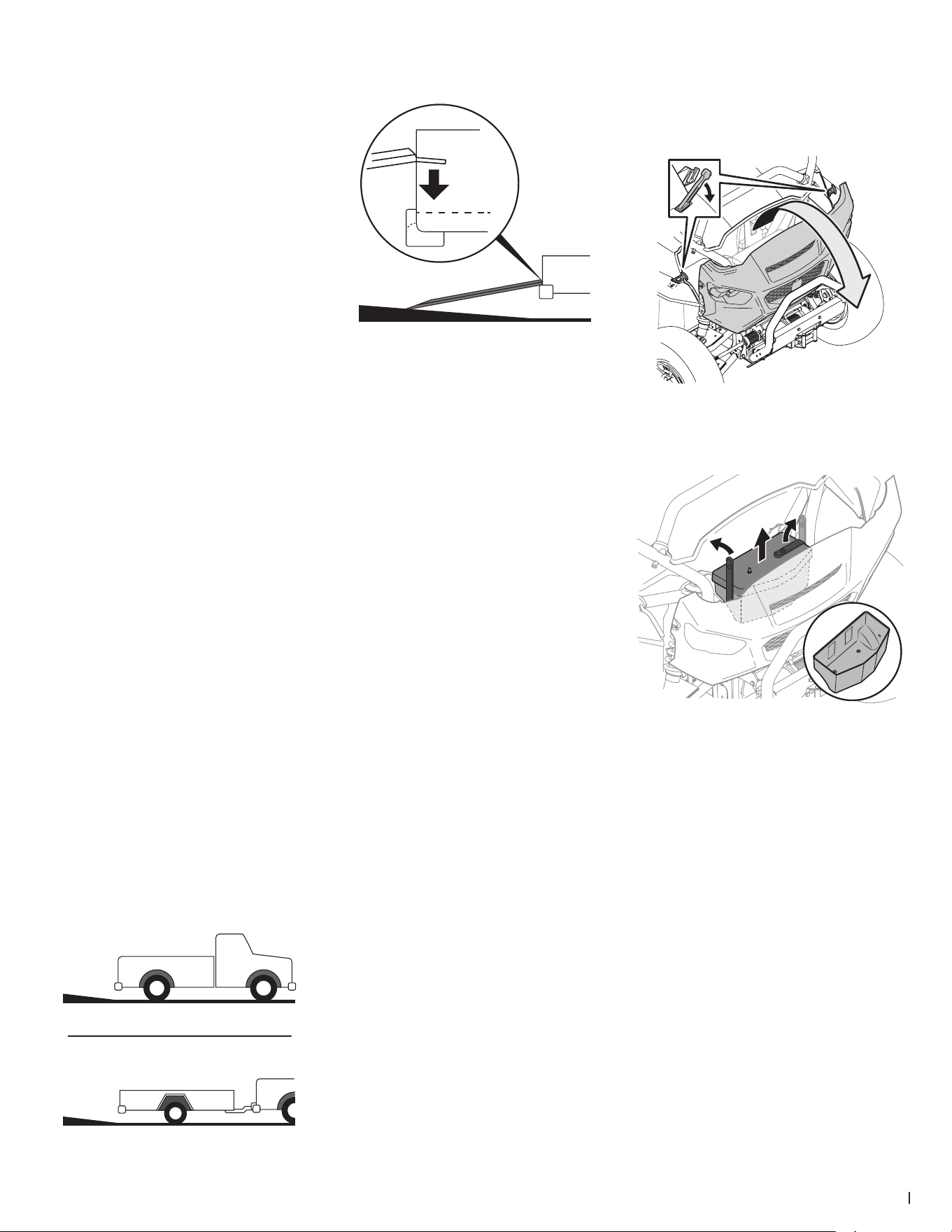
3. Face the truck bed or trailer towards a slight
incline, which will reduce the steepness of the
loading angle by bringing the bottom of the
ramps up on the slight incline. See Figure 3-11.
Figure 3-11
4. Place the ramp fingers or plate edges on the
edge of the trailer or truck bed. See Figure 3-12.
Figure 3-12
5. Use tie-down straps or cables to secure the
ramps to the trailer or truck, via the bumper
(steel bumpers only) or trailer hitch safety
chain loops. Refer to instructions provided
with the ramp.
6. If your utility vehicle is supplied with a roof
and/or windshield, remove or fully secure
them prior to loading. Roofs and windshields
are not designed to withstand wind speeds
the open road can generate, so it’s best to
remove them entirely to prevent any damage
or accidents.
7. Follow all safety rules provided in this manual
along with the manuals supplied by the trailer
and ramp manufacturer. Carefully load the
utility vehicle onto the truck or trailer.
8. Once the utility vehicle is on the truck or
trailer, set the utility vehicle’s parking brake
and secure the utility vehicle to the truck or
trailer. Tie-down strap placement will depend
on your truck or trailer. Be sure to use only tie-
down straps sufficient for the load capacity.
If loaded onto a truck, close the tailgate once
the utility vehicle is secured to the truck bed.
9. Stop periodically to ensure that your tie-down
straps have not loosened and that the utility
vehicle remains securely in place.
IMPORTANT: Know the total height of your
vehicle with the utility vehicle loaded
before transporting. Be sure to check for
low clearance bridges, doorways, etc. prior to
traveling under them, the added height above
the height of your truck could cause clearance
issues and damage to both vehicles.
Storage Box (if equipped)
There is an optional storage box located under the
hood. To gain access, follow these steps:
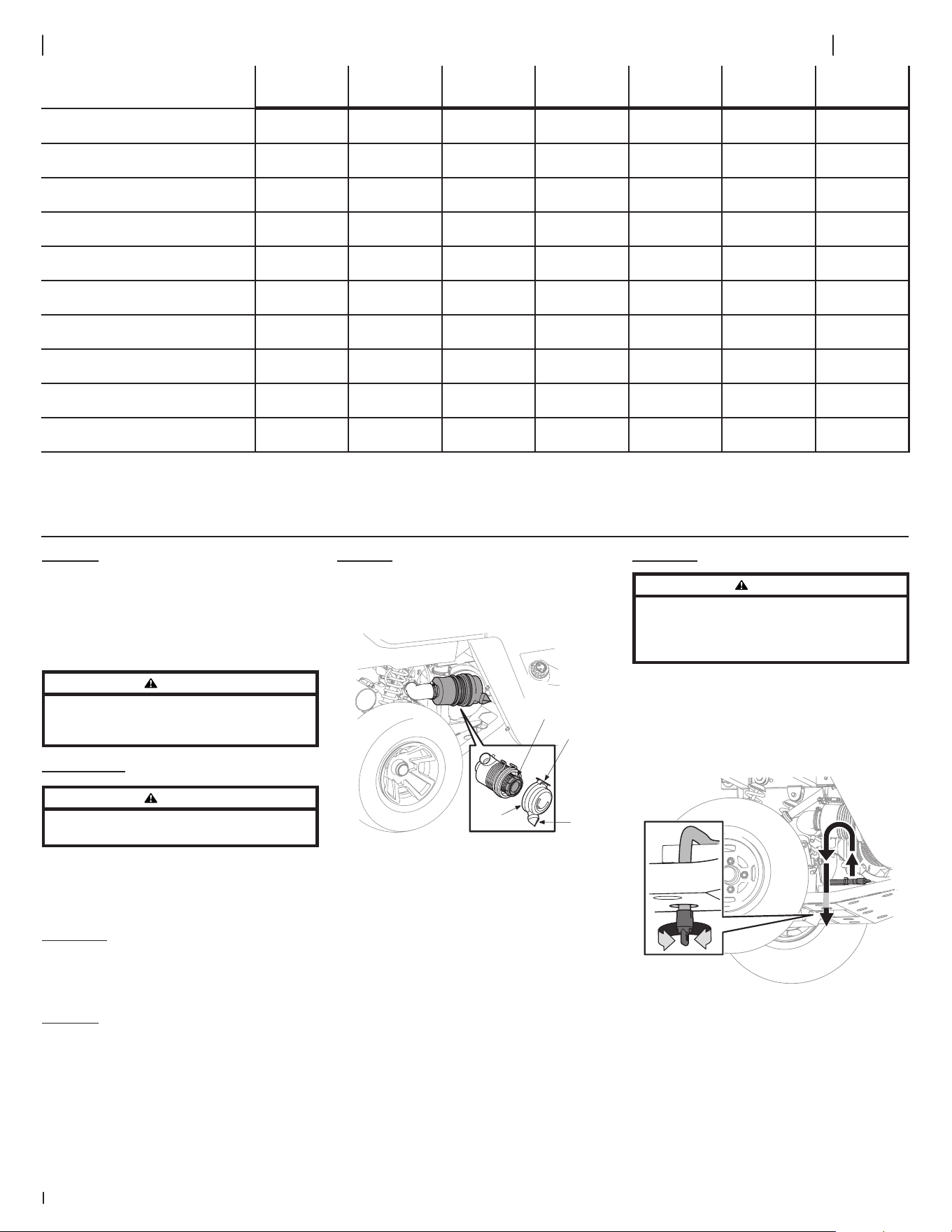
1. Unhook the hood latches and lower the hood.
See Figure 3-13.
Figure 3-13
2. Unhook the two rubber straps holding the
top cover on and remove the top cover.
See Figure 3-14.
Figure 3-14
12
Product Care 4
Before Each Use First 10 Hours
Every 20 Hours/
2 Months
Every 50 Hours
Every 100 Hours
or Yearly
Every 500 Hours
or 2 Years
Service Dates
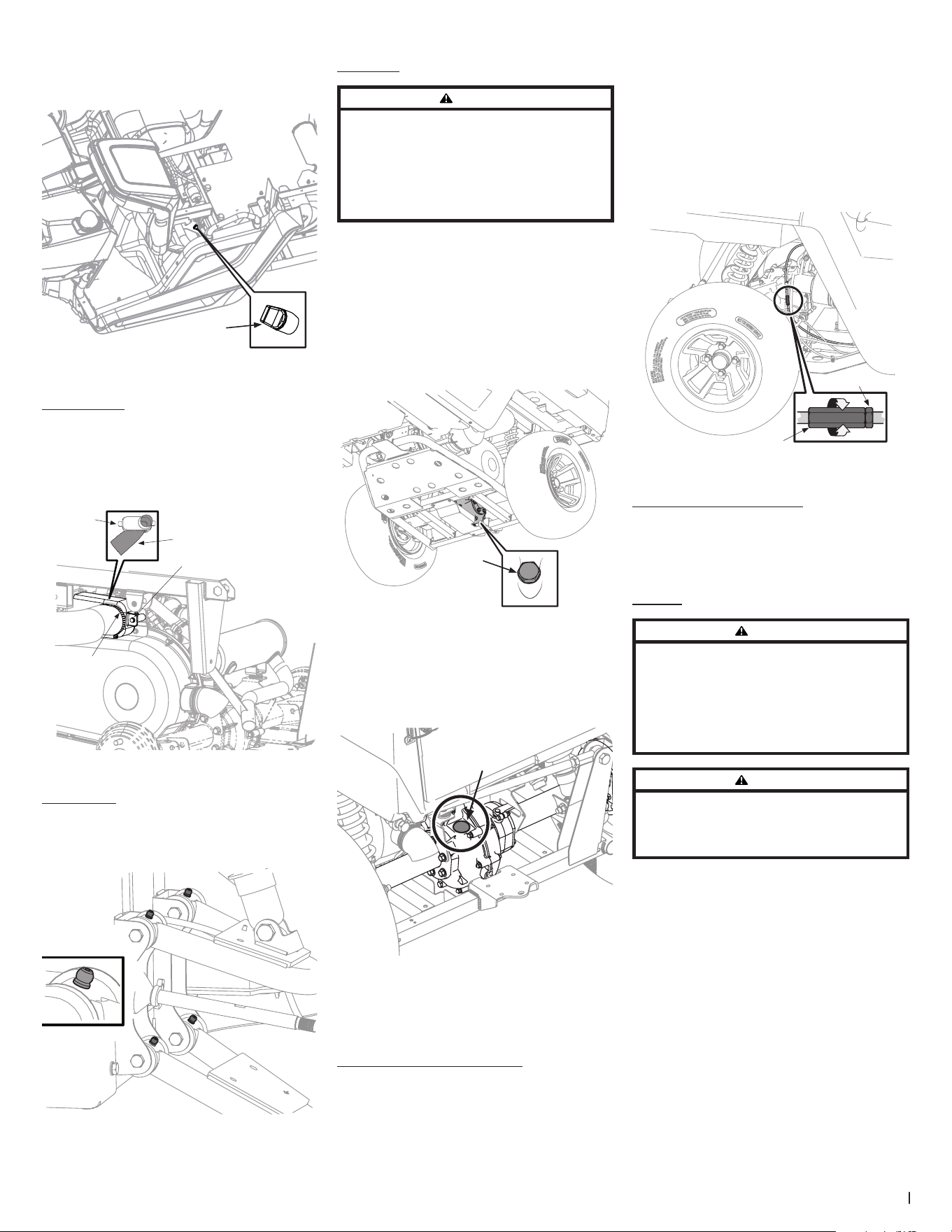
Change Air Filter^ Inspect/ Clean
P
Inspect Ball Joints
P
Inspect Brakes
P
Inspect/ Clean CVT Air Filter
P
Inspect Front and Rear Shocks
P
Lubricate A-Arms †
P
Tighten Lug Nuts
P
Inspect OPS and Seat Belts
P
Inspect Tires
P
Change Transaxle Oil
P
^ Change more frequently if unit is operated in extremely dusty conditions.
† Lubricate after each use if unit is run through water deeper than axle.
NOTE: For information regarding engine service, see the separate Engine Owner’s Manual included with your unit.
Cleaning
The body panels can scratch easily. Do not use
car wax on the body panels. The use of standard
car wash soap is acceptable for cleaning the body
panels. Avoid any abrasive cleaner or rubbing
compounds for these will damage the body panels.
Dry thoroughly to avoid water spots.
WARNING
DO NOT use a pressure washer. Damage may occur if direct
hose spray comes in contact with intake openings, or any other
electrical components, i.e. at instrument cluster or under dash.
Tire Pressure
WARNING
Excessive pressure (above 14 psi) may cause the tire/rim assembly
to burst with sufficient force to cause severe injury or death.
The recommended operating tire pressure is 14 psi
for all tires. Overinflating above recommended tire
pressure can reduce the life of the tire. Check tire
pressures before each use.
Seat Belts
Check proper function before each use. Replace seat
belt assembly if any damage is found. If damage is
noted, contact your Cub Cadet dealer.
Lug Nuts
Check torque of lug nuts after first 10 hours of use.
Tighten lug nuts in a diagonal pattern. Torque lug
nuts to 65-75 lb-ft using a torque wrench.
Air Filter
1. Pull up on latch and turn counter-clockwise to
release air cleaner cover. See Figure 4-1.
Element
Latch
Cover
Cap
Figure 4-1
2. Remove cover. Remove and inspect air cleaner
element. If excessively dirty or damaged,
replace element.
3. Reattach cover and secure with latch.
IMPORTANT: When reattaching cover, make
certain that the cap is pointing downward.
See Figure 4-1 inset.
Engine Oil
WARNING
If the engine has been recently run, the engine, muffler and
surrounding metal surfaces may be hot and can cause burns
to the skin. Allow to cool for 30 minutes. Exercise caution to
avoid burns.
Refer to your Engine Owner’s Manual for how often
to check and change your engine oil. To drain the oil
follow the steps below:
1. Place the oil drain hose down through the hole
closest to the oil drain hose. See Figure 4-2.
Figure 4-2
2. Turn the plug counter-clockwise and allow oil to
drain into a suitable container. See Figure 4-2.
3. Turn the plug clockwise, wipe any residue
oil from the oil drain hose and take the oil
drain hose out of the hole to return to its
normal position.
13
Section 4 — Product care
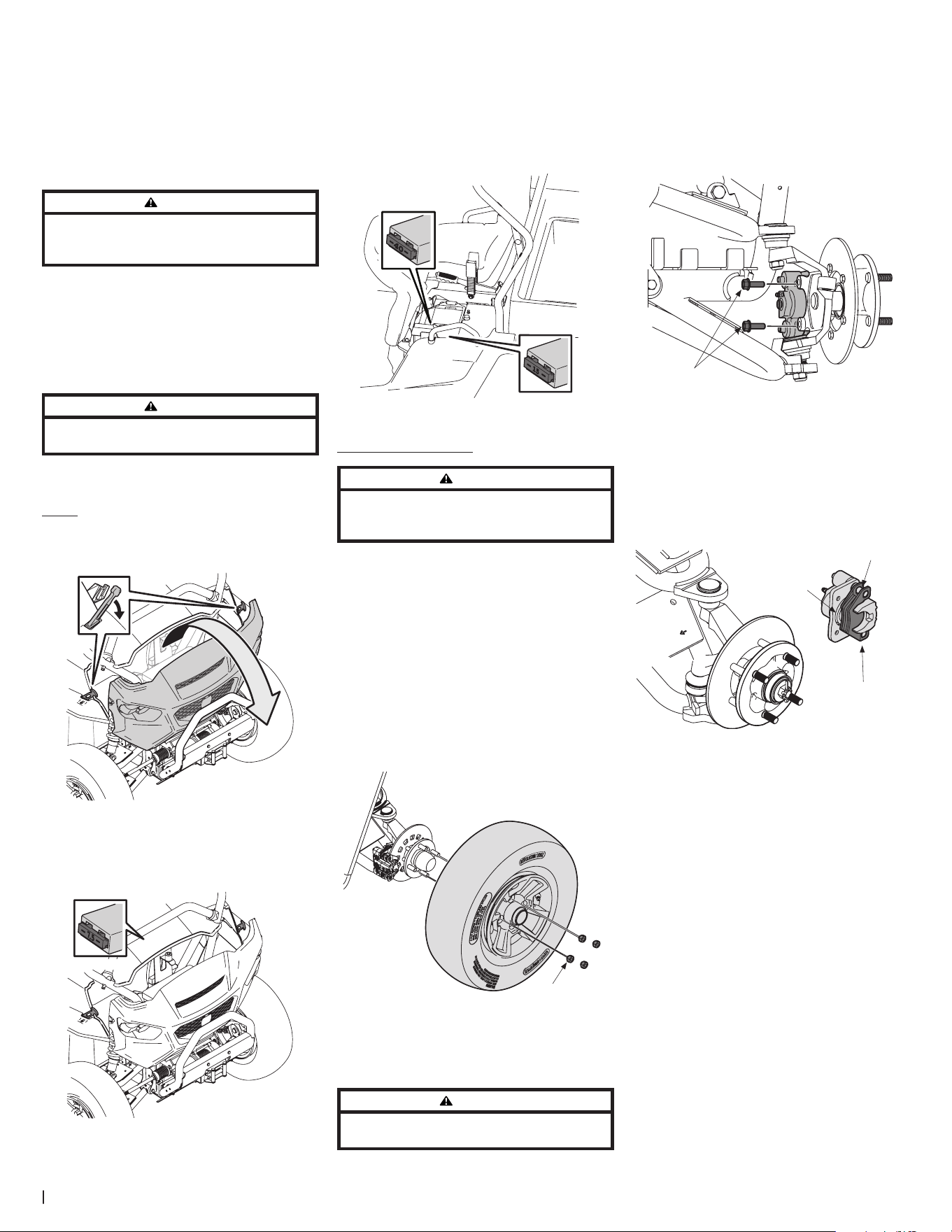
4. Refill the engine with new oil as instructed in
the engine operator’s manual. See Figure 4-3
for engine fill/dipstick location.
Engine
Fill/Dipstick
Figure 4-3
CVT Air Filter
To access the CVT air filter element, remove the
CVT filter housing by removing the two screws and
the hose clamp. Inspect and clean the CVT air filter
element with mild soap and water. Allow to dry and
install. See Figure 4-4.
Element
Housing
Screw
Hose Clamp
Figure 4-4
Lubrication
Use a grease-gun filled with No. 2 Multipurpose
Lithium Base Grease for the eight zerk fittings (four
on each side) on the A-Arms. See Figure 4-5.
Figure 4-5
Transaxle
WARNING
The fluid for your transaxle has been specially formulated
to ensure the safe and proper operation of your vehicle.
When changing your transaxle fluid replace it with part no.
490-000-V045 – Shell Spirax 80W-90 GL5. Failure to use Shell
Spirax 80W-90 GL5 oil may result in a failure of your transaxle
which could result in property damage or personal injury. DO
NOT substitute.
1. Park vehicle on level surface, place shift lever
in NEUTRAL and set parking brake.
2. Allow the unit sufficient time to cool (30
minutes) before attempting any maintenance
or repairs.
3. Locate the transaxle below the cargo bed in
the rear of the vehicle.
4. Access drain plug on underside of machine
and remove plug. See Figure 4-6.
Dr
ain
Plug
Figure 4-6
5. Allow oil to drain into a suitable container.
6. Check O-ring on drain plug and replace if
missing, damaged or in poor condition.
7. Remove fill plug. See Figure 4-7.
Fill
Plug
Figure 4-7
8. Add 24 oz of Shell Spirax 80W-90 GL5 oil part
no. 490-000-V045 through the fill plug port.
9. Re-install fill plug. See Figure 4-7.
Adjusting the Throttle Cable
An adjustment is provided in the throttle cable,
should such an action ever be necessary. Locate the
adjustment nut in the throttle cable running along
the right side of the unit in front of the rear tire. See
Figure 4-8.
1. Slide the rubber boot back that covers the
adjustment nut and the locking nut.
2. Loosen the locking nut and thread the
adjustment nut inward or outward in order to
maintain at minimum 1/16 of an inch play in
the cable when the pedal is in a fully released
(idle) position.
3. Once adjustment is complete, retighten the
locking nut.
Adjustment Nut
Locking Nut
Figure 4-8
Parking Brake Adjustment
If the vehicle’s rear wheels can roll with the parking
brake set, then the parking brake is in need of
adjustment. See your Cub Cadet dealer to have the
brake properly adjusted.
Battery
WARNING
The battery produces a flammable and explosive gas. Do not
smoke near battery. Wear eye protection and gloves when
handling the battery. Do not allow direct metal contact
across battery posts or between the positive battery post or
terminal and adjacent metal parts. The battery is sealed and
is maintenance free. Acid levels cannot be checked and fluid
can not be added.
WARNING
CALIFORNIA PROPOSITION 65 WARNING: Battery posts, terminals
and related accessories contain lead and lead compounds,
chemicals known to the State of California to cause cancer and
reproductive harm. Wash hands after handling.
IMPORTANT: If removing the battery for any
reason, disconnect the NEGATIVE (Black)
wire from its terminal first, followed by the
POSITIVE (Red) wire. When re-installing the
battery, always connect the POSITIVE (Red)
wire to its terminal first, followed by the
NEGATIVE (Black) wire. Be certain that the
wires are connected to the correct terminals;
reversing them could cause damage to your
engine’s charging system.
Cleaning Battery & Terminals
1. Remove battery from vehicle. Always remove
NEGATIVE cable first when disconnecting.
2. Wash battery with solution of four tablespoons
of baking soda to one gallon of water.
3. Rinse the battery with plain water and dry.
14 Section 4— Product care
4. Clean terminals and battery cable ends with
wire brush until bright.
5. Apply petroleum jelly or silicone spray to
terminals to prevent corrosion.
6. Install battery. Always install negative cable
last when connecting.
Charging Battery
WARNING
Charge battery in a well ventilated area and keep away
from an open flame or pilot light as on a water heater, space
heater, furnace, clothes dryer or other gas appliances.
If the vehicle has not been put into use for an
extended period of time, charge the battery with an
automotive type 12V charger for a minimum of one
hour at six amps. The Low Voltage Indicator on the
instrument cluster will illuminate when your battery
reaches 11.6 volts.
Jumping Battery
WARNING
DO NOT attempt to jump start a battery. Do not smoke near battery
and wear eye protection and gloves when handling battery.
IMPORTANT: If your battery is dead, follow the
instructions for charging the battery.
Fuses
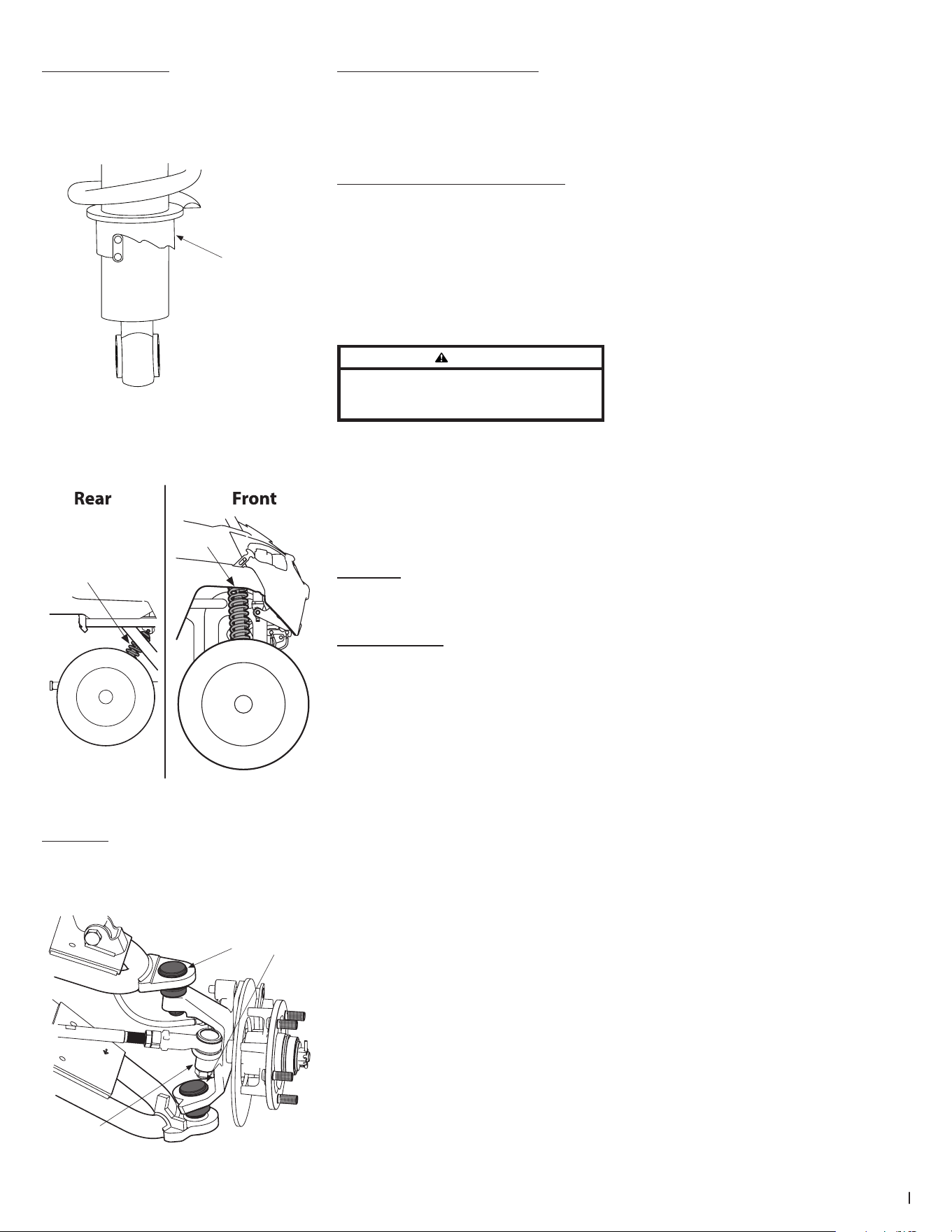
1. Remove hood latches and lower the hood.
See Figure 4-9.
Figure 4-9
2. Remove the Acc (accessory) electrical fuse and
replace if needed with proper rated amp fuse.
See Figure 4-10.
Acc Fuse
Figure 4-10
3. Raise and secure hood.
4. Raise the driver’s seat.
5. Remove the appropriate electrical fuse and
replace if needed with proper rated amp fuse.
See Figure 4-11.
6. Lower the seat.
System Fuse
Voltage
Regulator
Fuse
Figure 4-11
Changing Brake Pads
WARNING
Using an unstable lifting device and vehicle supports may
result in bodily injury. Use a safe lifting device and supports to
work on raised vehicle.
To gain access to the brake pads, remove the wheel
as described below. If less than .030” of material
remains on the pad, replace.
NOTE: Brake pads must be replaced as a set, i.e.,
right rear and left rear.
Removing the Wheels
1. Stop the vehicle on a level surface and set
parking brake.
2. Turn the ignition key to the STOP position and
remove the key.
3. Loosen but do not remove the four lug nuts
from the axle hub. See Figure 4-12.
Lug Nuts
Figure 4-12
4. Raise the front of vehicle with a safe lifting
device and place support stands under
vehicle frame.
WARNING
When lifting the rear of the vehicle for any reason, DO NOT
engage the rear wheels.
5. Remove the four lug nuts and the wheel.
To change the brake pads, follow the steps below.
Removing Brake Pads
1. Remove mounting bolts securing caliper and
brake pads to steering knuckle. See Figure 4-13.
Bolts
Figure 4-13
2. Remove brake caliper assembly from brake
disc. See Figure 4-14.
IMPORTANT: Do not let the caliper hang from
the brake hose. Stressing the brake hose can
damage it and cause leaks.
Brake Calipe
r
Assembly
Slide Pin
s
Brake Piston
Figure 4-14
3. Remove brake pads from brake caliper assembly.
4. Clean and lube slide pins. See Figure 4-14.
5. Press in brake piston. See Figure 4-14.
IMPORTANT: When pressing in brake piston,
take care not to damage rubber piston seal.
6. Place brake pads on slide pins.
7. Move caliper into place, making sure brake
disc is between the two brake pads.
8. Apply Loctite® 242 to the threads of the bolts
removed earlier.
9. Secure caliper and brake pads with mounting
bolts. Torque the mounting bolts to 22-26 ft. lbs.
Reinstalling the Wheels
1. Place the wheel on the axle hub and secure
with the four lug nuts.
2. Tighten the lug nuts diagonally until snug.
3. Remove support stands and lower vehicle.
4. Finish tightening the lug nuts to 65-75 lb-ft
using a torque wrench.
15
Section 4 — Product care
Front & Rear Shocks
All four shocks are adjustable. Adjust as needed for
comfort/load level. Turn the collar at the bottom of
the shocks to one of the five positions. Adjust the
left and right side equally. See Figure 4-15.
Adjustment
Collar
Figure 4-15
See Figure 4-16. If excessive oil leakage appears,
have shocks repaired or replaced by your local Cub
Cadet dealer.
Shock
Shock
Figure 4-16
Ball Joints
See Figure 4-17. If excessive wear appears, have ball
joints or tie rod ends replaced by your local Cub
Cadet dealer.
Ball Joints
Tie Rod End
Figure 4-17
Neutral Safety Interlock Switch
Your unit is equipped with a neutral safety interlock
switch. The engine cannot be started unless the shift
lever is in the NEUTRAL position. If the switch is out
of adjustment or needs replacement contact your
Cub Cadet dealer.
Operator Protective Structure (OPS)
Periodically (at least every six months), visually
inspect the OPS and seat belts. It is important that
these features be inspected for damage and proper
function before each use, or daily. Contact your Cub
Cadet dealer and replace the belt assembly if any
damage is found.
If an accident has occurred which may have
damaged the OPS, have the OPS thoroughly
inspected by your Cub Cadet dealer.
WARNING
To ensure the structural integrity of the OPS to provide
operator protection, do not attempt to straighten or weld
the OPS. A damaged OPS should be replaced.
If the OPS is removed for any reason, make sure
the proper hardware is used to reinstall it, and that
the recommended torque values are applied to
the fasteners.
If you are not installing new bolts when replacing
or reinstalling the OPS, apply Loctite® 242 to the
threads of the bolts that were removed. Torque the
bolts to 50-55 ft. lbs using a torque wrench.
Drive Belt
IMPORTANT: See your Cub Cadet dealer to have
your drive belt replaced.
Troubleshooting
1. Engine will not start
• Battery has low voltage.
• Loose or corroded battery connections.
• Fuse is blown.
• Spark plug wire is loose or disconnected.
• Faulty spark plug or coil.
• No fuel or improper fuel.
• Plugged fuel filter.
• Defective starter solenoid.
• Open-circuit in wiring.
2. Engine is difficult to start
• Engine is cold.
• Choke not being used or
adjusted properly.
• Plugged fuel filter.
• Carburetor not adjusted properly
or dirty.
• Engine oil viscosity too heavy.
• Spark plug is fouled.
• Faulty spark plug or wire.
• Loose or corroded
electrical connections.
• Stale or improper fuel.
3. Engine misfires under load
• Faulty spark plug.
• Stale or dirty fuel.
• Plugged fuel filter.
• Faulty coil or wire.
4. Engine does not restart when warm
• Poor quality fuel.
• Very hot weather conditions.
• Fuel tank vent plugged.
• Dirt in fuel filter.
5. Entire electrical system does not work
• Blown fuse.
• Loose or corroded connections.
• Dead or faulty battery.
6. Dead battery
• Shorted starter solenoid.
• Key switch not turned to STOP position.
• Faulty battery.
7. Battery will not take a charge
• Dead battery.
• Loose or corroded connections.
8. Difficult to shift
• Idle speed too fast.
• Gears not lined up. Tap throttle and
let it return to idle. If still hard to shift,
contact your nearest Cub Cadet dealer.
9. Indicator lights do not come on when key
switch is in START position
• Faulty bulb.
• Faulty wiring.
• Faulty sensor.
10. Engine runs unevenly
• Loose electrical connections.
• Choke (if equipped) or throttle
cable sticking.
• Fuel line or fuel filter plugged.
• Stale or dirty fuel.
• Improper fuel.
• Air cleaner element plugged.
• Carburetor not adjusted correctly.
• Spark plug is fouled.
11. Engine overheats
• Air cleaner element missing
or plugged.
• Carburetor air intake tube plugged.
• Engine oil low.
• Engine operated too long at slow
engine speed.
12. Engine knocks
• Stale or low octane fuel.
• Engine overloaded.

16 Section 4— Product care
13. Engine loses power
• Engine overheating.
• Too much oil in engine.
• Faulty spark plug.
• Fuel supply being restricted.
• Fuel filter plugged.
• Fuel line pinched or kinked.
• Fuel pump output not adjusted
to specification.
• Improper fuel.
• Air cleaner element plugged.
14. Starter does not work
• Loose or corroded connections.
• Low battery output.
• Dead or faulty battery.
• Faulty starter.
15. Starter cranks slowly
• Low battery output.
• Dead or faulty battery.
• Engine oil too heavy.
• Loose or corroded connections.
16. Battery light comes on when engine is
running
• Low engine speed.
• Faulty voltage regulator.
• Faulty battery.
• Faulty alternator or loose
alternator belt.
• Damaged wiring harness.
17. Vehicle will not move
• Shift Lever still in Neutral.
• Parking Brake is still set.
• Broken or cut drive belt.
• Safely check to see if the vehicle
will go in reverse and then try to go
forward. If vehicle still will not move
forward, contact your nearest Cub
Cadet dealer.
Notes
Attachments & Accessories
Visit cubcadet.com for all available Challenger Utility Vehicle attachments and accessories.
Specifications 5
17
NOTE: Specifications subject to change without notice.
Engine/Electrical
Make Subaru, EX40
Type/ Cylinders 4 Cycle Gas/ 1 Cylinder
Displacement 404cc
Maximum Torque 27 N-m/ 19.9 ft-lb*
Ignition Magneto
Lubrication Splash w/ chain carry
Speed (No Load) 1400 rpm (idle) 4,000 rpm (fast)
Cooling System Air-Cooled
Air Cleaner Replaceable, dual element
Battery 12V 14AH 230 CCA
Alternator 12V-16A Regulated
Headlights Two, 8.4 Watt LED
Wiring Automotive - Style Fused Control System
Suspension Front - A-Arm
Rear - Swing Arm
Transmission
Type Continuously Variable
Drive Belt
Ground Speed 24 mph (max.)
Transaxle Fully Enclosed, Oil Bath
Gear Selection Forward, Neutral, Reverse
Overall Reduction Ratio Forward 13.25, Reverse 14.36
Rear Axle Housing Aluminum
Features
Dual Cup Holders Standard
Additional Storage Dash Box
Power Port 12V, Dash Mounted
Front Bumper Standard
LED headlights Standard
Dimensions
Length/ Width 98.6” x 49.0” (98.6” x 51.6” w/ roof)
Tread Center F: 41.8”/ R: 39.5”
Height (Overall) 75.2” (76.2” w/ roof)
Wheelbase 64”
Weight (Not Including Fuel & Fluids) 940 lbs.
Ground Clearance
(Under Transaxle)
5.5”
Ground Clearance
(Under Footboard)
7.5”
Turning Radius 15.0 ft
Bed 28” L x 37” W x 12” H
Operation
Brake Type Front: Hydraulic Disk Rear: Hydraulic Drum
Parking Position Hand Operated Mechanical Drum
Steering Rack & Pinion
Fuel System
Capacity 5 Gallons
Low Fuel Indicator Dash Mounted Indicator Gauge
Cargo Bed
Material Plastic Composite
Tires
Trail Front 21” x 10” - 7” (14 psi)
Trail Rear 22” x 10” - 9” (14 psi)
* As rated by engine manufacturer.
Capacity
Volume - Cargo Bed 6.94 ft
3
Cargo Bed Capacity 350 lbs.
Seating - Capacity/ Type 2/ Mid Back
Towing Capacity 500 lbs (85 lbs. max tongue weight)
Payload Capacity** 850 lbs.
** Includes 250 lb operator, 250 lb passenger, and maximum bed capacity.
Challenger 400 Models

18
Notes
CUB CADET LLC -- LIMITED WARRANTY
100016 Rev D (November 8, 2019)
The limited warranty set forth herein is given by Cub Cadet LLC with respect to a new Cub Cadet® product (hereinafter “Product”) purchased and used in the
United States and/or Canada to the Initial Purchaser (as defined herein). This limited warranty does not cover Emission Control Systems and is not a Federal
Emission Control Warranty Statement, as defined by U.S. federal law. Please refer to the Federal Emission Control Warranty Statement in the operator’s manual
for warranties covering Emission Control Systems.
Scope of the Limited Warranty
Cub Cadet LLC warrants that the Product (except with regard to the components and circumstances defined below as “Exclusions”) will be free from defects in
materials and workmanship during the Warranty Period, as defined below. For purposes of this limited warranty, the “Initial Purchaser” is the first person/company
to purchase this new Product from an authorized Cub Cadet dealer, distributor, and/or retailer of such products, including a party for whom said Product was
purchased as a gift. This limited warranty is non-transferrable. During the Warranty Period, Cub Cadet LLC will, at its option, either repair or replace any original
part that is covered by this limited warranty and is determined to be defective in workmanship or material. “Commercial Use” shall be defined as any commercial,
professional, agricultural, institutional, or income-producing use of the Product. See notes below as to Commercial Use Warranty.
Cub Cadet® Warranty Information
Handheld Product* Warranty Period
Chainsaws, Cultivators, Blowers, Brushcutters, Trimmers 3 Year
Wheeled Chore and Snow Product*
Chipper-Shredders, Chipper-Shredder Vacuums, Blowers, Log Splitters, Snow Blowers 3 Year
Tillers, String Trimmers, Lawn Edgers, Pressure Washers CC3224, CC3425 & CC4033 3 Year†
Pressure Washers 2 Year†
Battery Powered Product
CC 30 e, XT1 LT42 e, RZT S Zero 3 Year†
CC30 e & XT1 LT42 e Batteries 4 Year†
Gas Powered Product
Ultima ZTX Series 4 Year/500 hour (whichever comes first)
Z-Force SX 4 Year/500 hour (whichever comes first)
Walk-Behinds, Wide-Area Walk-Behinds, CC30 Riders, XT1 & XT2 Enduro Series, RZT S/SX, Ultima ZT Series,
Z-Force S
3 Year†
23” Walk-Behinds, XT3 Enduro Series 4 Year†
Rotary Spreader 1 Year
Gas Blowers, PRO HW 2 Year
PRO Z 100 S 4 Year/500 hour (whichever comes first)
PRO Z 500/700/900, TANK LZ/SZ 3 Year
Utility Vehicle*
Challenger Series, Volunteer Series 1 Year
Additional Warranty Notes
Lead-Acid Batteries: Are covered by a one (1) year prorated limited warranty against defects in material and workmanship, with 100% replacement during the
first three (3) months, from the date of original purchase by the Initial Purchaser. After three (3) months, the battery replacement credit is based on the months
remaining in the twelve (12) month period, dating back to the date of original purchase by the Initial Purchaser. Any replacement battery will be warranted
only for the remainder of the original warranty period.
Frames: The frame, chassis, and front axle on all XT1, XT2 and XT3 products are covered for “Residential Use” by a five (5) year limited warranty. The frame on
all Ultima ZT and ZTX series products are covered for “Residential Use” by a seven year Limited Lifetime Warranty.
Mowing Decks: 1) Cub Cadet LLC warrants the mowing decks under the warranty of the product it came with unless otherwise stated. 2) When so equipped,
the optional fabricated cutting deck shell (excluding wear parts, etc. thereon) shall be warranted against defects in material and workmanship for the lifetime
of the product, namely for as long as it is owned by its Initial Purchaser or the party for whom it was originally purchased as a gift, or seven (7) years from the
date of its initial sale to an Initial Purchaser, whichever comes first. 3) The deck shell, deck spindles, and deck steel pulleys (collectively the “Deck Assembly”) on
PRO Z 500 / 700 / 900 product only, shall also be warranted to be free from defects in material and workmanship for up to an additional two (2) years (a total
of five (5) years from date of purchase) or 1,750 cumulative hours of operation, whichever comes first. For purposes of clarity, no hour limitation applies during
the initial three (3) year period described above.
Snow Blowers: Three-Stage and Two-Stage HP - Aluminum auger gear boxes have a five (5) year limited warranty.
CORE® Powered Product: Please refer to warranty with Operator’s Manual.
L and S Series: RZT L/LX, Z-Force L/LX/SZ, PRO Z 100 L, Z-Force Commercial (LZ/SZ), and Tank (L/S): Please refer to warranty included with Operator’s
Manual.
Attachments/Accessories: Please refer to warranty with Operator’s Manual.
*Limited Commercial Use Warranty: Handheld products – 90 days; Chipper-Shredder Vacuums, Blowers, Log Splitters, Snow Blowers – 1 year;
Utility Vehicle – 6 month.
† No Commercial Use Warranty: Tillers, String Trimmers, Lawn Edgers, Pressure Washers, Battery Powered Product, Walk Behind Mowers, CC30 Riders,
Enduro Series, RZT S/SX, Ultima ZT Series, and Z-Force.
The limited warranty is non-transferrable

How to Get Service Under This Limited Warranty
In order to qualify for the limited warranty, as set forth herein, the repairs
made under this warranty must be performed by an authorized Cub Cadet
service provider. To locate a Cub Cadet service provider, contact your
authorized Cub Cadet dealer, distributor, or retailer, or contact Cub Cadet LLC
at P.O. Box 368023, Cleveland, Ohio 44136-0019, or call 1-877-282-8684, or log
on to our Website at www.cubcadet.com. For Canada, contact MTD Products
Limited, 97 Kent Ave, Kitchener, ON N2G 3R2, or call 1-800-668-1238, or log on
to our Website at www.cubcadet.ca. This limited product warranty is provided
by Cub Cadet LLC and is the only product warranty provided by Cub Cadet LLC
for the Product. A COPY OF YOUR SALES RECEIPT IS REQUIRED FOR WARRANTY
SERVICE.
What This Limited Warranty Does Not Cover
This limited warranty does not cover the following (the “Exclusions”):
1. Product purchased outside of the United States or Canada.
2. Emission Control Systems. These items are subject to a separate warranty
under the applicable Federal Emission Control Warranty Statement.
Please refer to the applicable Federal Emission Control Warranty
Statement for terms and conditions relating to Emission Control Systems.
3. Damage due to lack of maintenance and/or improper maintenance, as
described in the operator’s manual.
4. Normal wear and tear resulting from use of the Product.
5. Normal Wear Parts (as defined herein) are warranted to be free from
defects in material and workmanship for a period of thirty (30) days from
the date of original purchase by the Initial Purchaser for residential use,
and for 30 days or 100 hours (whichever occurs first) for Product used
commercially. Depending on Product, Normal Wear Parts include, but
are not limited to items such as: belts, blades, blade adapters, grass bags,
rider deck wheels, seats, shave plates, skid shoes, tines, filters, nozzles,
hoses, O-rings, spray guns, wands, tires, spark plugs, fuses, bump knobs,
outer spools, cutting line, inner belts, starter pulley, starter rope, drive
belts, saw chains, guide bars, and other consumable items.
6. Log splitter pumps, valves, and cylinders are covered for a period of one
(1) year.
7. Use of the product that is not consistent with the intended use thereof,
as described in the operating instructions, including, but not limited
to, abuse, misuse and/or neglect of the Product, or any use inconsistent
with and/or non-compliant with instructions contained in the Operator’s
Manual. This includes operation in sandy and/or corrosive environments.
8. Any Product that has been altered or modified in a manner not
consistent with the original design of the Product or in a manner not
approved by Cub Cadet LLC.
9. Paint repairs or replacements for defective paint (including materials and
application) are covered for a period of three (3) months.
10. Wheel rims (when so equipped) are covered for a period of three (3)
months for manufacturing defects.
This warranty does not cover, and Cub Cadet LLC disclaims any
responsibility for, matters including, but not limited to, the following:
1. Loss of time or loss of use of the Product.
2. Transportation costs and other expenses incurred in connection with the
transport of the Product to and from the authorized Cub Cadet service
provider.
3. Any loss or damage to other equipment or personal items.
4. Damages caused by improper maintenance or the use of other than the
specified fuel, oil, or lubricants, as approved in the operator’s manual.
5. Damage resulting from the installation or use of any accessory or part not
approved by Cub Cadet LLC for use with the Product.
Limitations
1. THERE ARE NO IMPLIED WARRANTIES, INCLUDING, BUT NOT
LIMITED TO, ANY IMPLIED WARRANTY OF MERCHANTABILITY OR
FITNESS FOR A PARTICULAR PURPOSE. NO WARRANTY SHALL
APPLY AFTER THE APPLICABLE WARRANTY PERIOD, AS SET FORTH
ABOVE, AS TO THE PARTS AS IDENTIFIED. NO OTHER EXPRESS
WARRANTY OR GUARANTY, WHETHER WRITTEN OR ORAL, EXCEPT
AS MENTIONED ABOVE, GIVEN BY ANY PERSON OR ENTITY,
INCLUDING A DEALER OR RETAILER, WITH RESPECT TO ANY,
PRODUCT SHALL BIND CUB CADET LLC. DURING THE WARRANTY
PERIOD, THE EXCLUSIVE REMEDY IS REPAIR OR REPLACEMENT OF
THE DEFECTIVE PART, AS SET FORTH ABOVE. (SOME STATES DO
NOT ALLOW LIMITATIONS ON HOW LONG AN IMPLIED WARRANTY
LASTS, SO THE ABOVE LIMITATION MAY NOT APPLY TO YOU.)
2. THE PROVISIONS, AS SET FORTH HEREIN, PROVIDE THE SOLE
AND EXCLUSIVE REMEDY ARISING FROM THE SALE. CUB CADET
LLC SHALL NOT BE LIABLE FOR INCIDENTAL OR CONSEQUENTIAL
LOSS OR DAMAGES INCLUDING, WITHOUT LIMITATION, FOR
TRANSPORTATION OR FOR RELATED EXPENSES, OR FOR RENTAL
EXPENSES TO TEMPORARILY REPLACE A WARRANTED PRODUCT.
(SOME STATES DO NOT ALLOW THE EXCLUSION OR LIMITATION
OF INCIDENTAL OR CONSEQUENTIAL DAMAGES, SO THE ABOVE
EXCLUSION OR LIMITATION MAY NOT APPLY TO YOU.)
3. IN NO EVENT SHALL RECOVERY OF ANY KIND BE GREATER THAN
THE AMOUNT OF THE PURCHASE PRICE OF THE PRODUCT SOLD.
ALTERATION OF THE SAFETY FEATURES OF THE PRODUCT SHALL
VOID THIS LIMITED WARRANTY. YOU ASSUME THE RISK AND
LIABILITY FOR LOSS, DAMAGE, OR INJURY TO YOU AND YOUR
PROPERTY, AND/OR TO OTHERS AND THEIR PROPERTY, ARISING
OUT OF THE USE OR MISUSE OR INABILITY TO USE THE PRODUCT.
4. This limited warranty extends to the Initial Purchaser only and,
except as otherwise stated herein, the applicable Warranty
Period will begin on the original date of purchase of the Product.
In the event that the original date of purchase of the Product is
indeterminable, then the Warranty Period shall be established as
beginning on the Product’s date of manufacture, as determined
by Cub Cadet LLC, and ending six (6) months after the applicable
Product Warranty Period, as defined above. In no event shall a
Product’s warranty extend beyond the applicable Warranty Period.
How State Law Relates to This Warranty
This limited warranty gives you specific legal rights, and you may also
have other rights, which vary from state to state.
100016 Rev D (November 8, 2019)

