IMPORTANT!
DO NOT DESTROY
It is the customer's responsibility to have
all operators and service personnel read
and understand this manual.
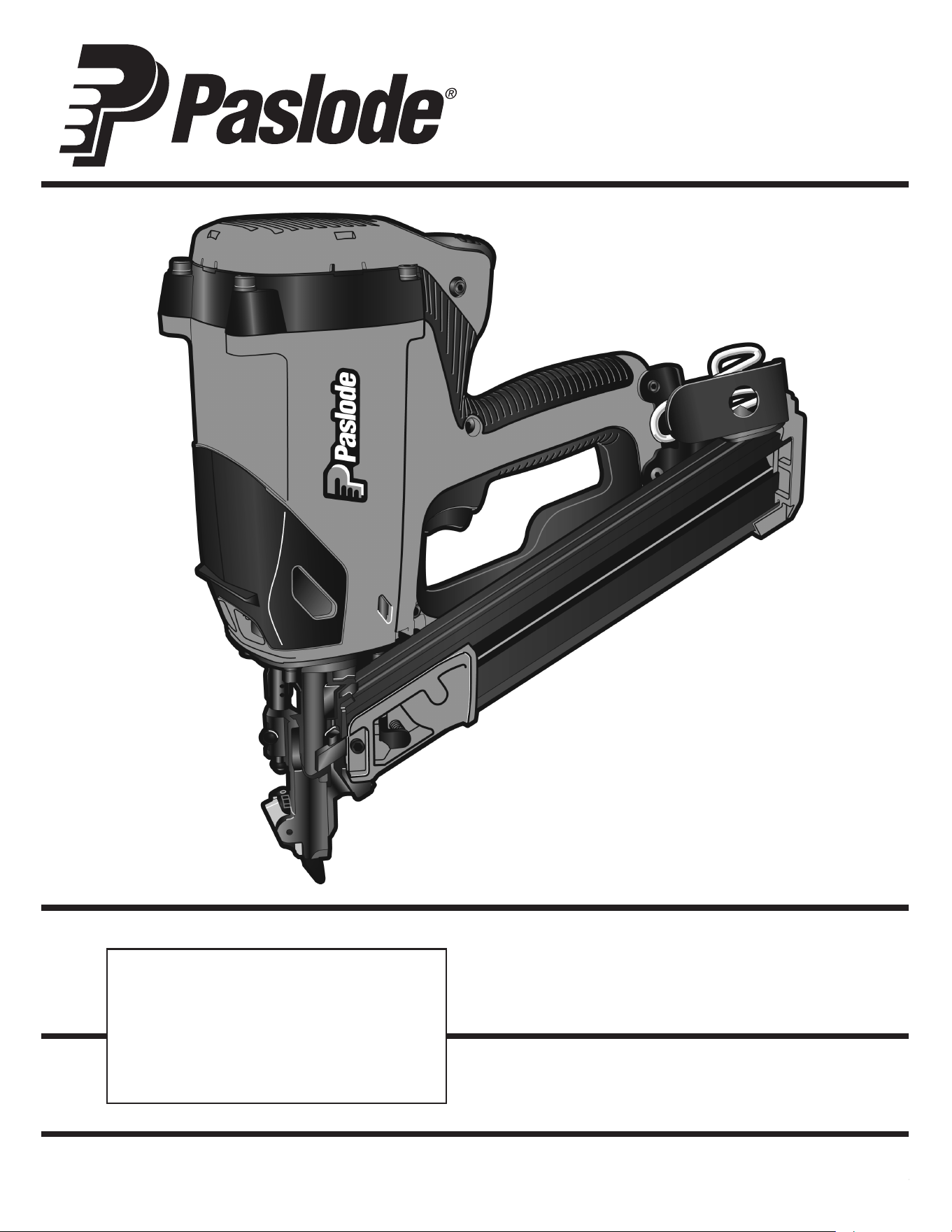
CORDLESS 1-1/2"
POSITIVE PLACEMENT
®
METAL CONNECTOR NAILER
OPERATING MANUAL
Part No. 906200
Printed in U.S.A.
www.paslode.com
Model CF150-PP
© 2023 Illinois Tool Works
Inc. 906207-3
07/23
2
Contents
Subject Page
Introduction and Warranty ............................................................................................................................................... 3
An Overview of the Paslode Cordless 1-1/2" Positive Placement
®
Metal Connector Nailer........................................... 4
Preparing the Paslode Cordless 1-1/2" Positive Placement
®
Metal Connector Nailer for Use.......................................14
Paslode Cordless 1-1/2" Positive Placement
®
Metal Connector Nailer Operation.........................................................15
Safety Instructions ........................................................................................................................................................... 6
Battery and Charger ........................................................................................................................................................ 9
Fuel Cartridge ............................................................................................................................................................... 11
Servicing . ................................................................................................................................. ............... 16
Troubleshooting
.................................................................................................................................................................................................... 18
The battery charger system meets all safety requirements for power tools.
is a trademark
Paslode
An Ilinois Tool Works Company
155 Harlem Avenue
Glenview, IL 60025
www.paslode.com
Power Nailers are assembled in the U.S.A.
Paslode
®
is a member of:
RBRC
RBRC
Li-ion

3
Introduction and Warranty
1. READ THE MANUAL FROM COVER TO COVER
BEFORE USING THE TOOL.
2. FOLLOW ALL INSTRUCTIONS IN THE MANUAL.
This Cordless Nailer should be handled like other
power fastening tools that you use. Like most tools, when
used improperly injury could result. If you are going to
allow others to use this Cordless Nailer, it is your
responsibility to make sure that they also read and comply
with the instructions in this manual before attempting to
operate the tool.
Should you have questions about this Cordless Nailer,
or wish to obtain additional copies of this manual,
please contact your Paslode
®
Representative.
The space below is provided so that you may record
your representative's name, address, and telephone
number.
Name
Address
City State Zip
Telephone Number
Paslode Cordless 1-1/2"
Positive Placement
®
Metal Connector
Nailer Operating Manual
Paslode Cordless Warranty and Limitations
Paslode warranties that new Cordless power fastening tools,
parts and accessories will be free from defects in material and
workmanship for the period shown below, after the date of
delivery to the original user.
FIVE-YEAR EXTENDED LIMITED WARRANTY
A five-year warranty will apply to all molded nylon parts:
• Motor Housing,Cap and Grille
•
Handle Halves and Actuator
• Trigger
WARRANTY STATEMENT
This warranty is limited to tools sold and service requested in the
United States. To obtain information on warranty service in the
United States, refer to the Service Center listing that was provided
with your tool.
Paslode's sole liability hereunder will be to replace any part or accessory
which proves to be defective within the specific time period. Any replacement
part or accessory provided in accordance with this warranty will carry a
warranty for the balance of the period of warranty applicable to the part
it replaces. This warranty does not apply to part replacement required
due to normal wear.
This warranty is void on any tool which has been subjected to misuse,
abuse, accidental or intentional damage, use with fasteners, fuel,
batteries, or battery chargers not meeting Paslode specification, size, or
quality, improperly
maintained, repaired with other than genuine Paslode
replacement parts, damaged in transit or handling, or which, in Paslode's
opinion, has been altered or repaired in a way that
affects or detracts from
the performance of the tool.
•
Magazine Parts
battery and charger system) which have failed during normal
CORDLESS 2 YEAR SERVICE PROMISE
Paslode will service the tool and replace all parts (including
use for FREE, for a period of 2 years from date of purchase.
For 2 Year Service Promise details and limitations see
servicepromise.paslode.com.
PASLODE MAKES NO WARRANTY, EXPRESSED OR IMPLIED,
RELATING TO MERCHANTABILITY, FITNESS, OR OTHERWISE,
EXCEPT AS STATED ABOVE, and Paslode's liability AS STATED ABOVE
AND AS ASSUMED ABOVE is in lieu of all other warranties arising out of,
or in connection with, the use and performance of the tool, except to the
extent other wise provided by applicable law. PASLODE SHALL IN NO
EVENT BE LIABLE FOR ANY DIRECT, INDIRECT, OR CONSEQUENTIAL
DAMAGES, INCLUDING, BUT NOT LIMITED TO, DAMAGES WHICH
MAY ARISE FROM LOSS OF ANTICIPATED PROFITS OR
PRODUCTION, SPOILAGE OF MATERIALS,, INCREASED COST OF
OPERATION, OR OTHERWISE.
Paslode reserves the right to change specifications, equipment, or designs
at any time without notice and without incurring obligation.
For ease of use, this manual is divided into sections (see
Contents). Each section of the manual is written with you,
the tool operator, in mind. We have left out many of the
technical terms so that you can easily understand how to get
the maximum performance from your Cordless Nailer, and
how to avoid damaging the tool or injuring yourself. But, to
accomplish this, we need you to do two things:
This manual is intended to acquaint you with the
Paslode Cordless 1-1/2” Positive Placement® Metal
Connector Nailer. Unlike other power fastening tools,
this Cordless Nailer is powered by an internal combus-
tion linear motor. In simpler terms, your Cordless Nailer
is powered by a motor similar to the one that powers an
automobile. This Cordless Nailer ignites a fuel and air
mixture to product the energy to power the motor, which
in turn drives the fastener. This Cordless Nailer is totally
self-contained. It carries its own fuel supply and battery,
along with a supply of fasteners.
4
Specifications
Dimensions: Weight-with battery 6.7 lbs
Height 13.6 inches
Length 12.2 inches
Width 5.4 inches
Magazine 29 Nails
Fasteners:
Magazine
Capacity:
Battery :
Fuel
Cartridge:
Paslode .131-.148" Positive Placement
®
Metal Connector Nails
1 nail strip, or 29 fasteners.
7V
DC -
Provides enough
energy to
drive
approximately 9,000
fasteners
per
charge.
Fuel cartridge
-
Provides
enough
fuel
to drive approximately 800 fasteners.
Overview of the Paslode Cordless 1-1/2"
Positive Placement
®
Metal Connector Nailer
(use Paslode 1-1/2" Positive Placement
®
Metal Connector Nails only)
Cycle Rate:
Intermittent Operation – 2-3 nails per second
NOTE: Exceeding these cycle rates could cause the tool
to overheat, resulting in loss of performance or damage to
tool components.
By using this Paslode Cordless Nailer at its recommended
cycle rate, you will be able to drive several thousand nails
in a typical workday.
NOTE: Altitude Restriction
Paslode Cordless tools are powered by an internal
combustion engine and are effected by altitude. The
tool may lose power or not cycle consistantly at
elevations of 6000 feet (1,828 meters) or greater.
Description
The Paslode Cordless 1-1/2" Positive Placement
®
Metal
Connector Nailer is a self-contained, fully portable nailer
that uses liquid hydrocarbon fuel to power a unique linear
drive internal combustion motor.
In order for you to fully understand the information
contained in this manual, you need a basic understanding
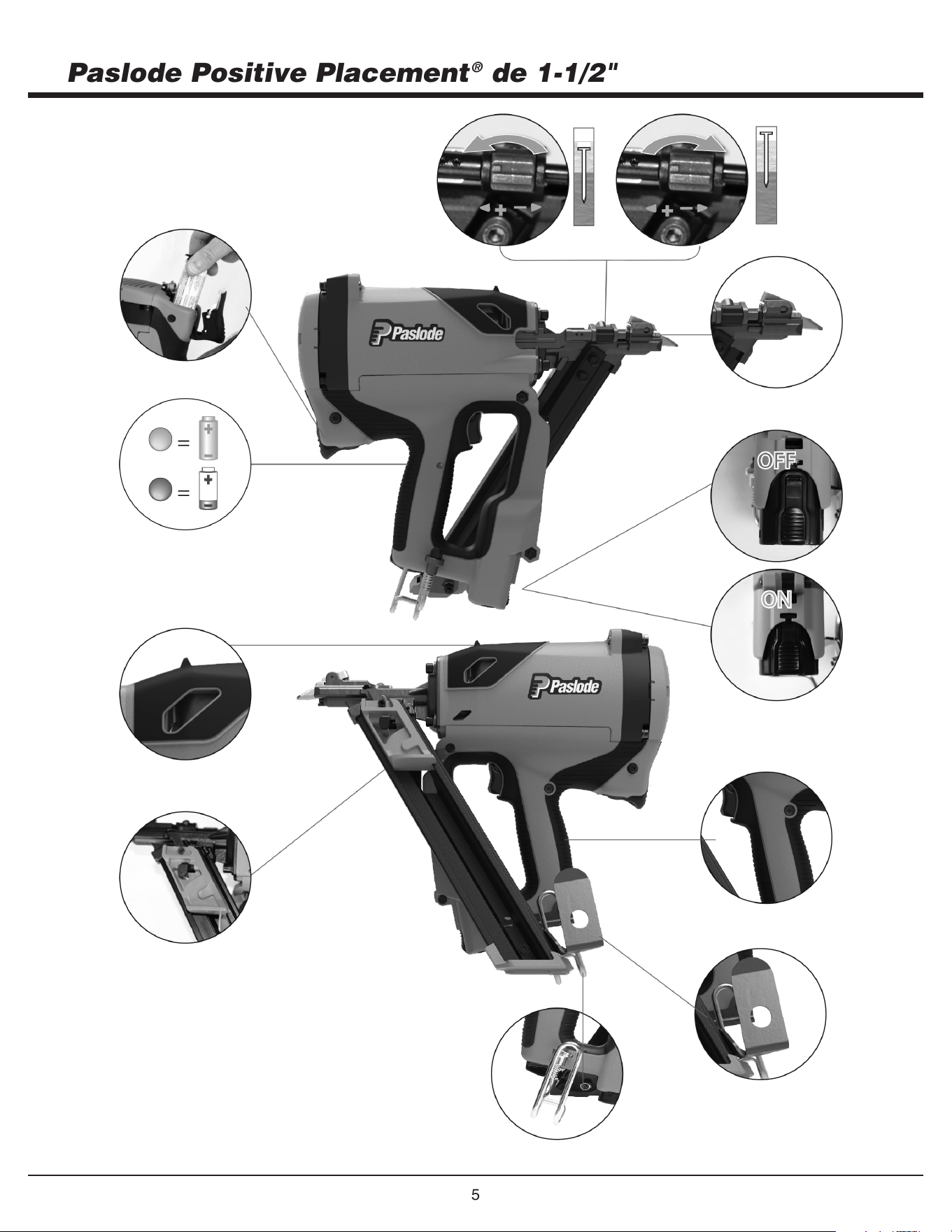
of the Cordless Nailer. As you can see in the illustrations
on the following page, this Nailer is made up of three
major areas: handle, motor, and magazine.
As you examine the Nailer, become familar with the three
major areas and the various components located in each
of them.
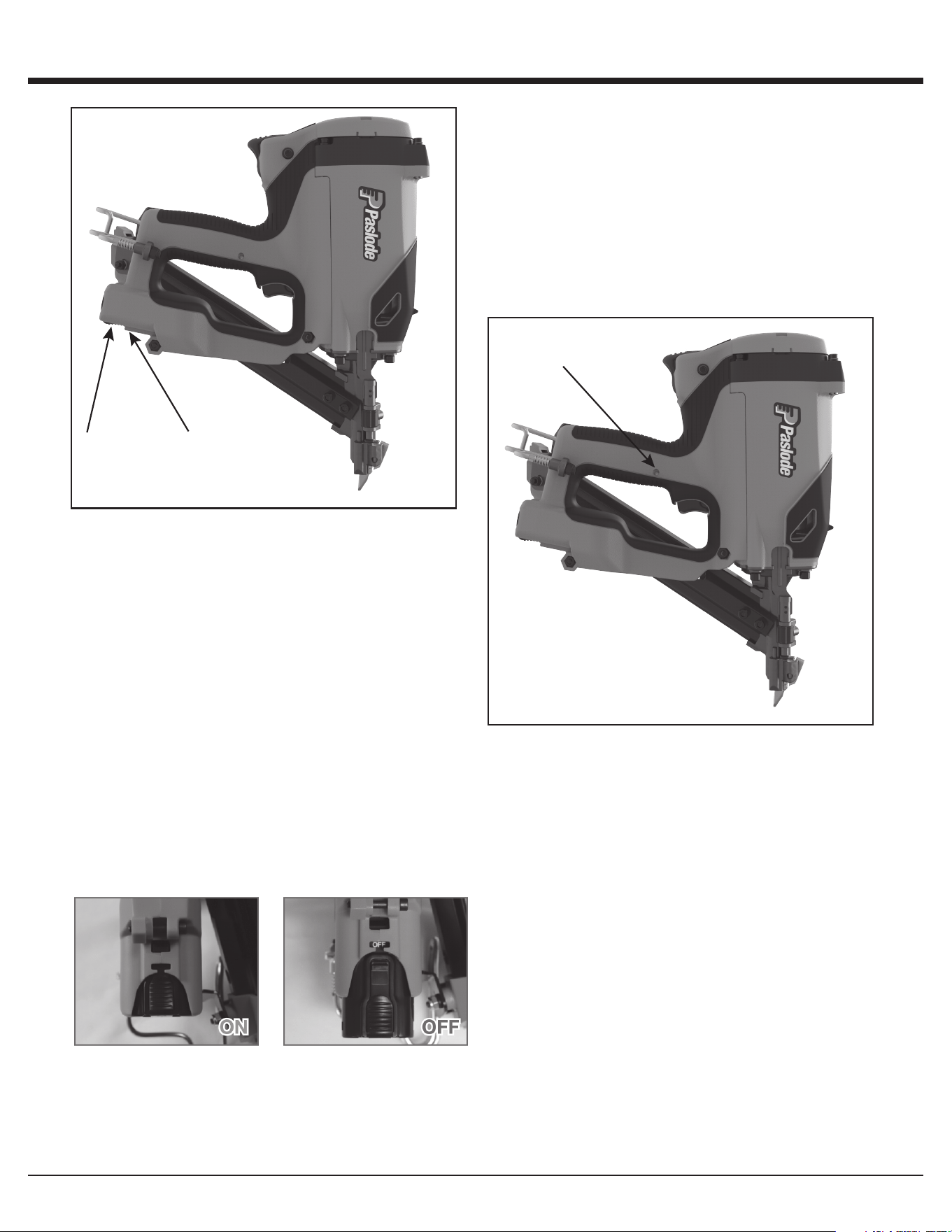
The Handle Assembly contains the fuel cartridge, indicator
light, and the trigger.
The Motor Assembly contains the cover and filter, the motor
housing, the nose, and the Nail Hole Locating Probe.
The
Magazine Assembly contains the components to load
and control the fastener and the battery for the Cordless
Nailer.
5
Overview of the Paslode Cordless 1-1/2"
Positive Placement
®
Metal Connector Nailer
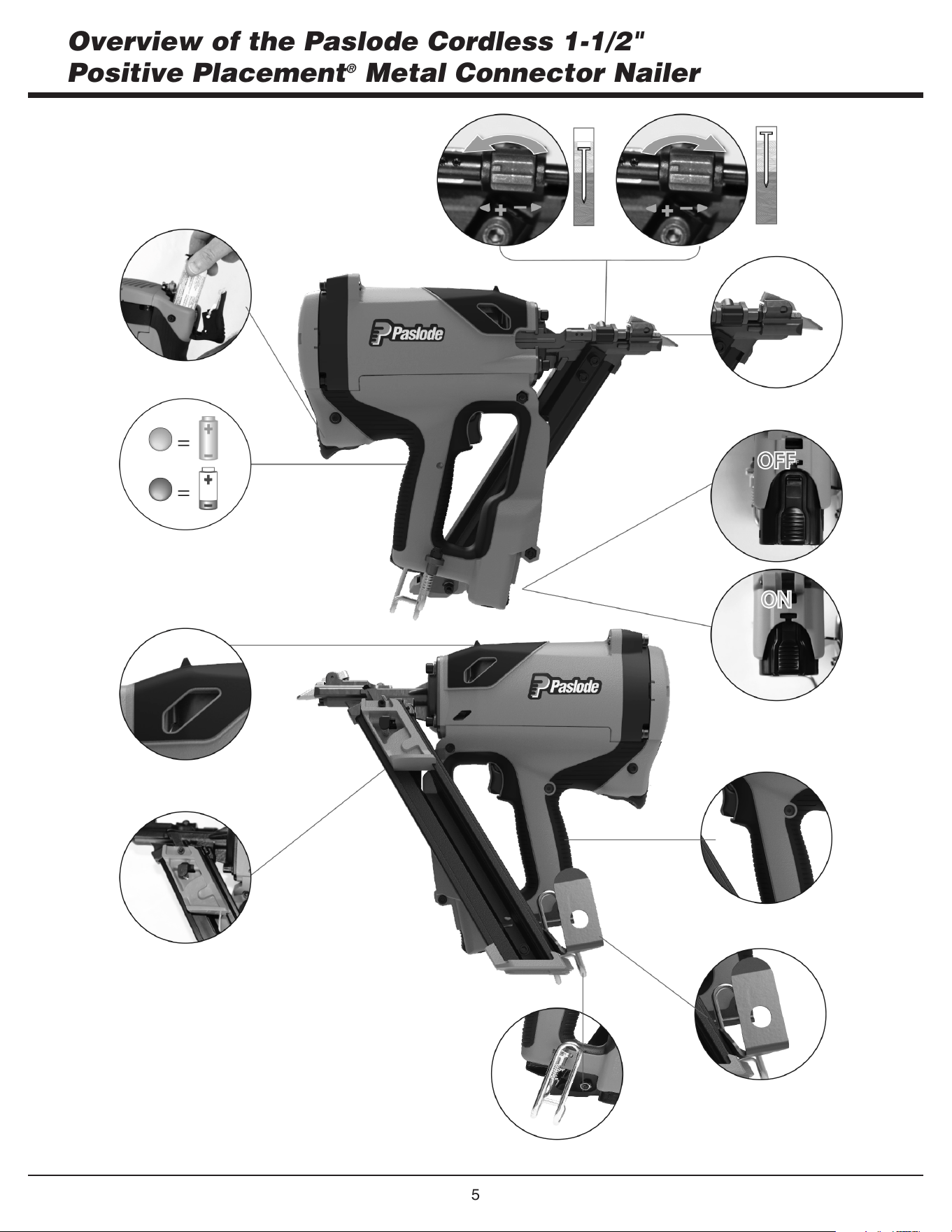
DEPTH OF DRIVE
ADJUSTMENT
ERGONOMIC RUBBER
HAND-GRIP
NAIL HOLE LOCATION
PROBE
FUEL CELL LOADING
STAND/REST
BELT HOOK
BYPASS FOLLOWER
ADJUSTABLE RAFTER HOOK
FLASHING GREEN = CHARGED
FLASHING RED = NEEDS CHARGING
6
Safety Instructions
The following safety instructions have been included in this
booklet to provide you with basic information necessary
for
safe operation of the Paslode Cordless Nailer. DO NOT
ATTEMPT TO OPERATE THIS TOOL UNTIL YOU
HAVE READ AND UNDERSTAND ALL SAFETY
PRECAUTIONS AND MANUAL INSTRUCTIONS.
In addition to these instructions, training may be necessary.
Contact your Paslode representative for additional
information.
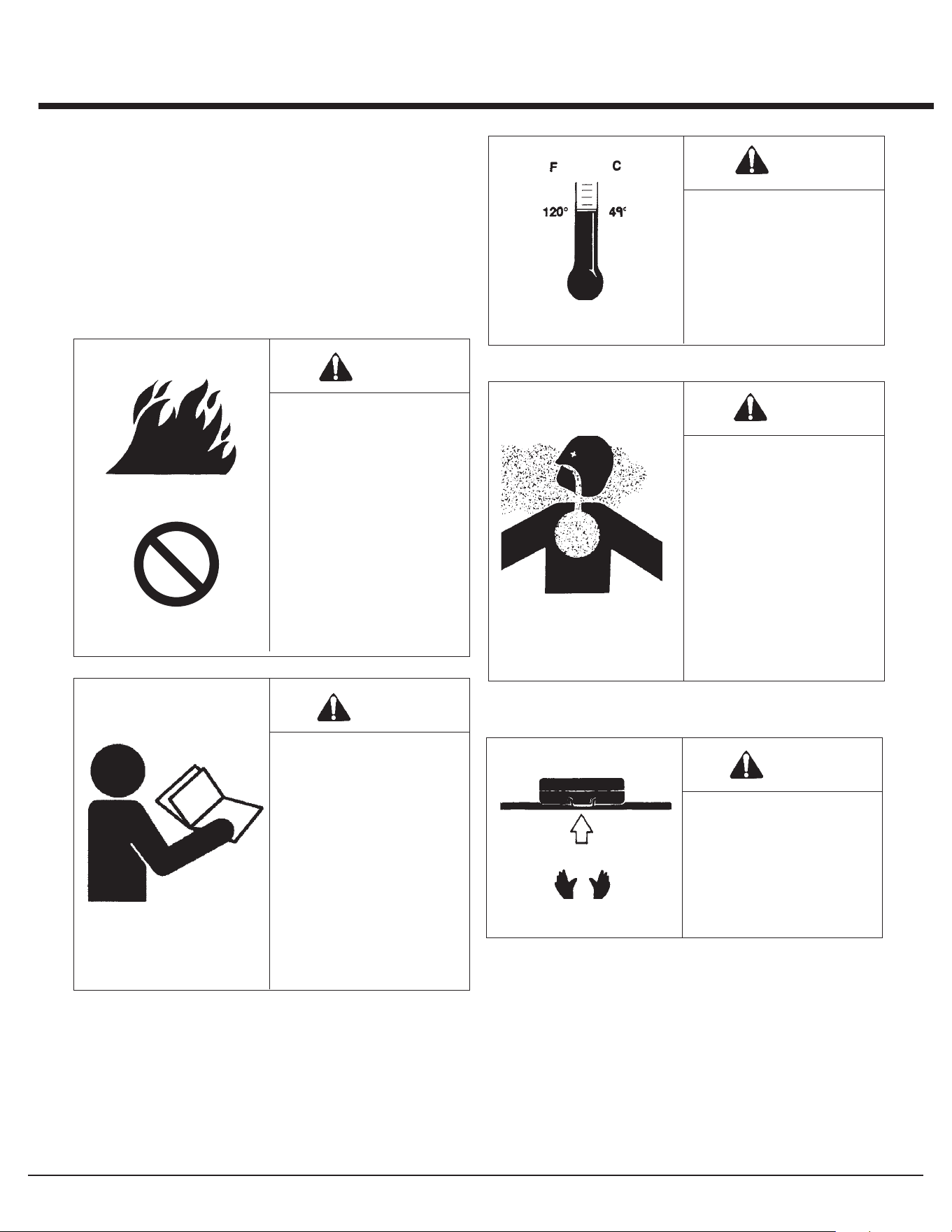
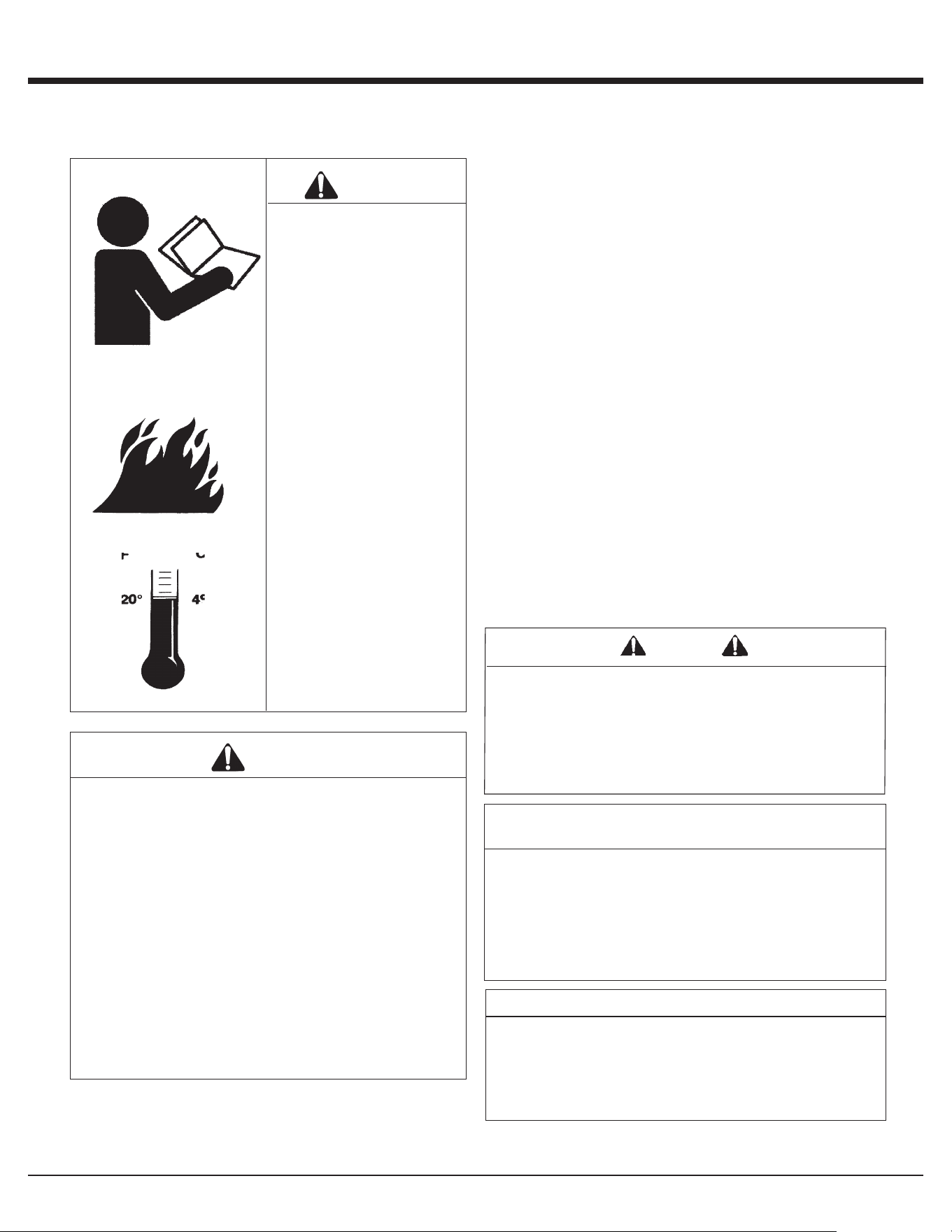
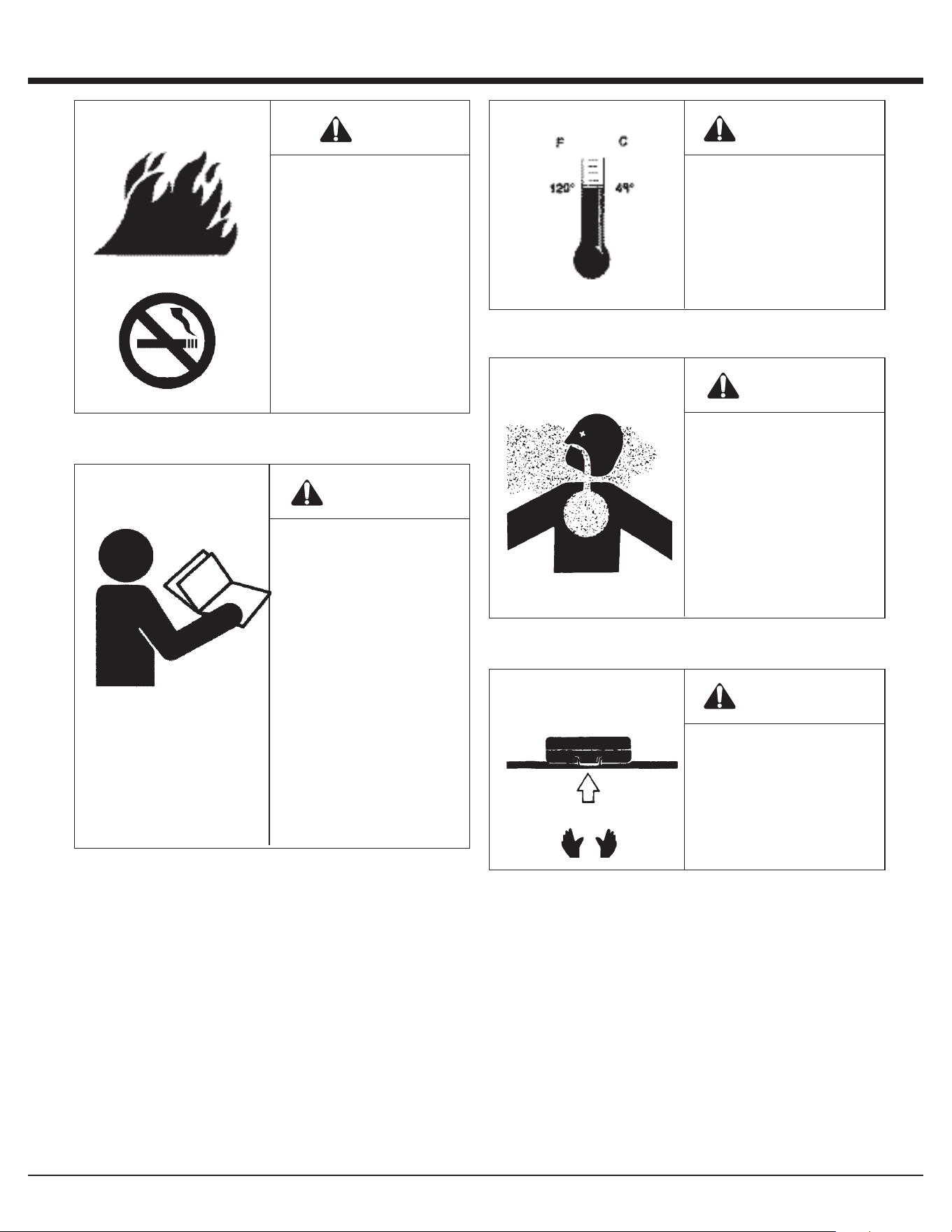
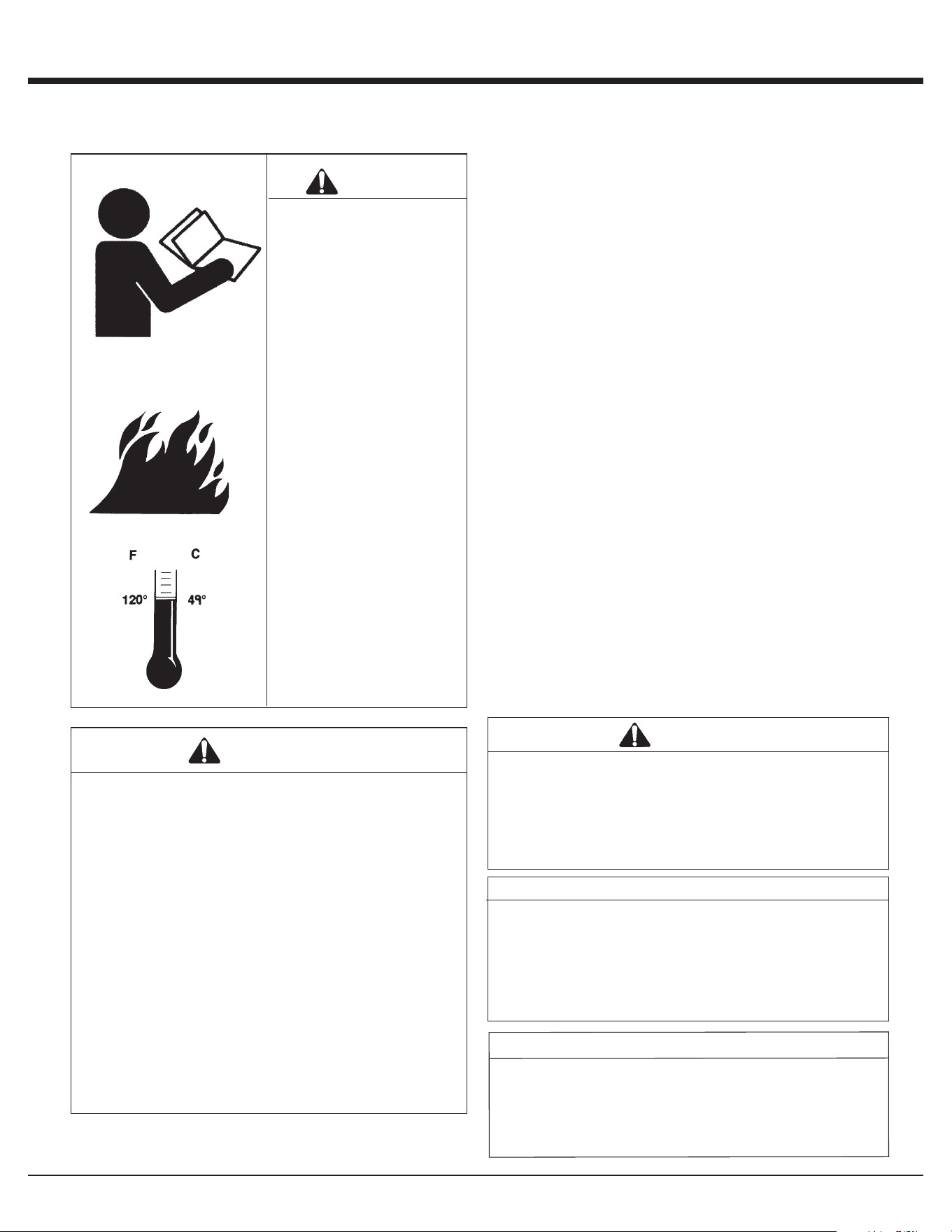
WARNING
The Paslode Cordless
Nailer is an internal
c
ombustion device. It
produces hot exhaust
gases that may ignite
flammable materials.
Never use the tool in a
combustible environment
or in the presence of
combustible materials,
such as flammable
chemicals, adhesives,
gasoline, or solvents.
WARNING
Never attempt to operate
this tool until you have
read and understood all
safety precautions and
manual instructions.
Failure to follow all safety
precautions instructions
may result in a permanent
loss of vision, serious per-
sonal or even fatal injury,
property damage and/or
tool damage.
WARNING
Never expose or store the
tool, fuel or battery at
temperatures in excess of
120° F (49° C). Fuel and/
or the battery may burst,
releasing flammable gas.
WARNING
WARNING
This tool must be operated
only in a well-ventilated
environment, because
the tool exhausts carbon
monoxide similar to a gas
chainsaw or lawnmower.
Exposure to carbon
monoxide from use in
eclosed areas, may cause
dizziness, nausea, or
unconsciousness or
death.
ALWAYS keep the Cordless
Nailer, fuel cart
ridge,
battery cell and bat
tery
charger out of the reach
of
children.
7
Safety Instructions
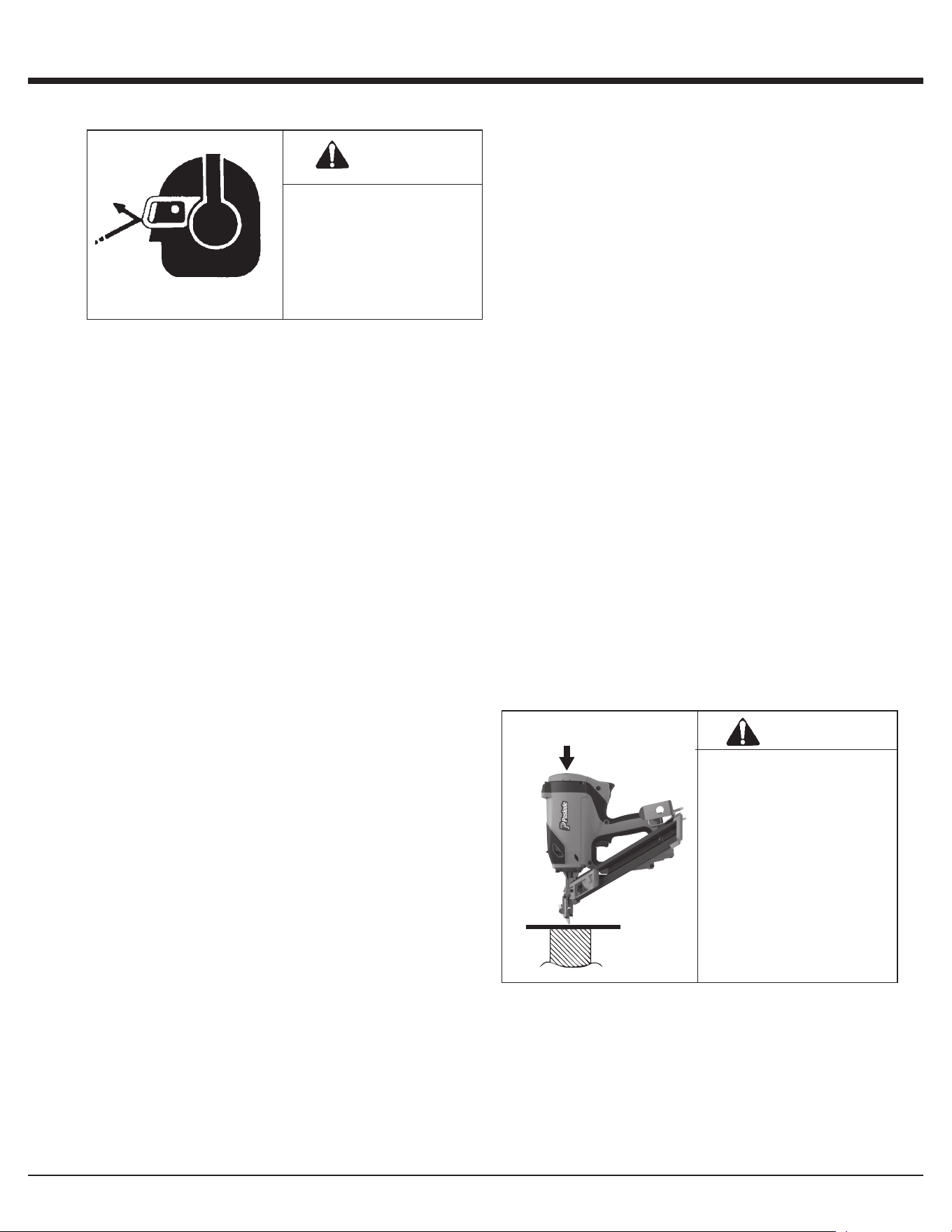
WARNING
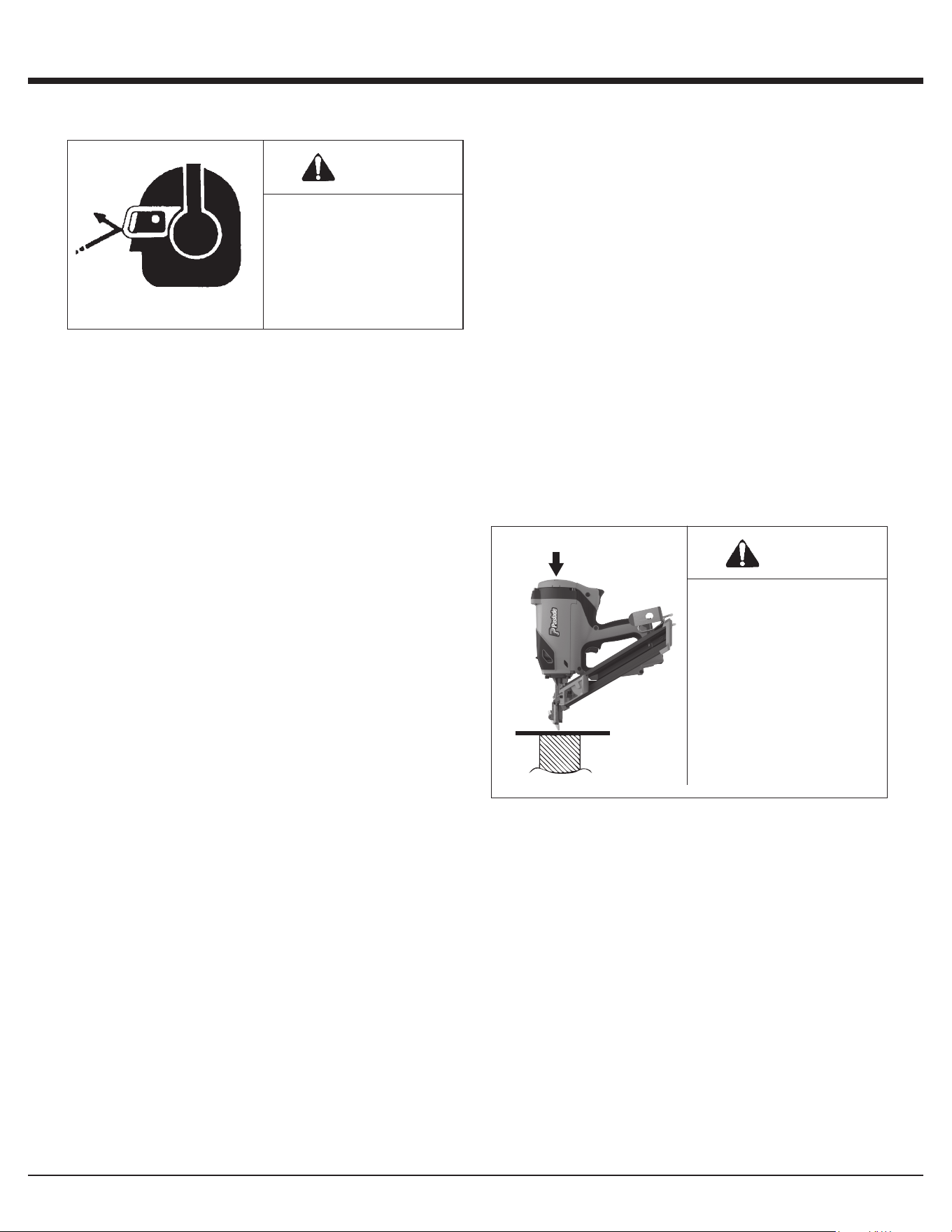
EYE and EAR safety gear
must be worn when
working with or in the
vicinity of the Paslode
Cordless Nailer.
8. ALWAYS POINT THE TOOL AWAY FROM YOURSELF
AND OTHERS WHEN CLEARING JAMS OR
REMOVING FASTENERS. REMOVE THE FUEL
CARTRIDGE AND BATTERY.
Pull the follower slightly back and push the release
lever. Tip the tool nose up slightly and fasteners should
slide out of the rear of the magazine. If fasteners are
jammed, refer to the appropriate servicing section of
this manual.
9. NEVER OPERATE THE CORDLESS FRAMING
NAILER IF PARTS ARE LOOSE, DAMAGED OR
MISSING.
10. NEVER DRIVE FASTENERS INTO KNOTS OR ON
TOP OF OTHER FASTENERS.
A fastener may ricochet and cause serious injury.
11. OPERATE THE TOOL ONLY ON THE WORKPIECE.
1. Eye protection must meet the requirements of ANSI
Standard Z87+ and should have side shields for
increased protection. As an employer you are
responsible for enforcing the use of eye protection
equipment by the tool operator and all personnel in the
work area.
2. NEVER ASSUME THE TOOL IS EMPTY.
Never point the tool at yourself or anyone else.
3. NEVER ENGAGE IN "HORSEPLAY" WITH THE
TOOL. The Cordless Nailer is not a toy – it is
a tool. Careless
and improper use may result in a
serious accident.
4. NEVER CARRY THE TOOL WITH YOUR FINGER ON,
OR SQUEEZING, THE TRIGGER.
This practice may result in the accidental discharge of
a fastener.
5. NEVER OPERATE A MALFUNCTIONING TOOL.
Refer to the servicing or troubleshooting section of this
manual to correct the problem. If the problem cannot be
corrected, stop using the tool and report it to your
supervisor or Paslode representative.
6. DO NOT LOAD FASTENERS WITH THE TRIGGER
AND/OR WORK CONTACTING ELEMENT PRESSED
IN. A fastener may be accidentally discharged.
7. NEVER OPERATE THE TOOL WITH THE WORK
CONTACTING ELEMENT REMOVED OR DISABLED.
This device helps reduce the possibility of accidental
fastener discharge by preventing the tool from operating
until it is completely against the work surface. NEVER
operate the tool if the work contacting element is not
working properly.
WARNING
12. NEVER DRIVE FASTENERS INTO AREAS WITH
CONCEALED HAZARDS.
Always check the area behind the work surface for
electrical wiring, gas pipes, water pipes, sewer drains or
other potential hazards.
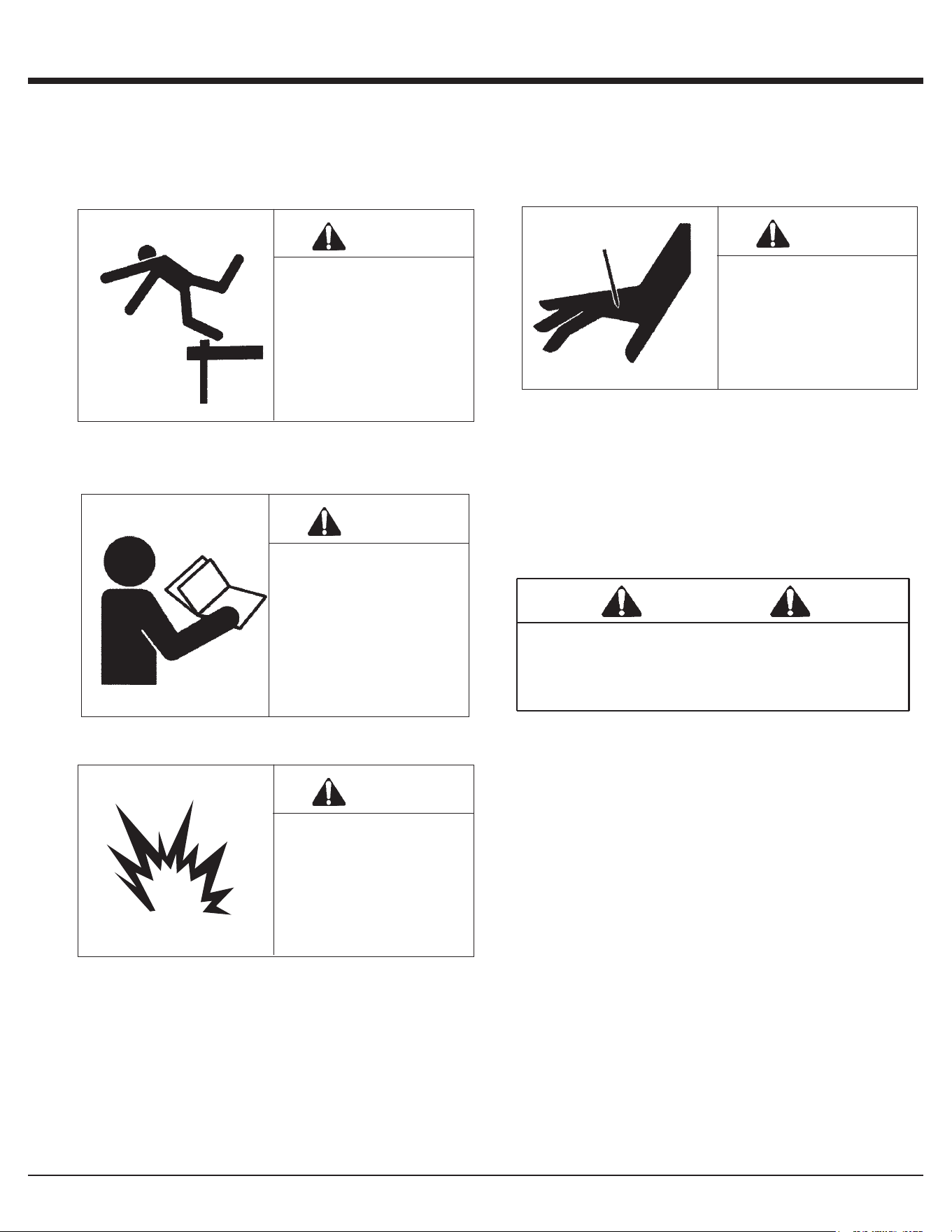
The Cordless Nailer must
be operated only when it
is in contact with the work
surface.
When fastening thin
materials such as
plywood, be sure to
position the tool so that
the fastener is driven into
the underlying piece.
8
Safety Instructions
14. ALLOW ONLY QUALIFIED PERSONNEL TO OPERATE
THE CORDLESS NAILER.
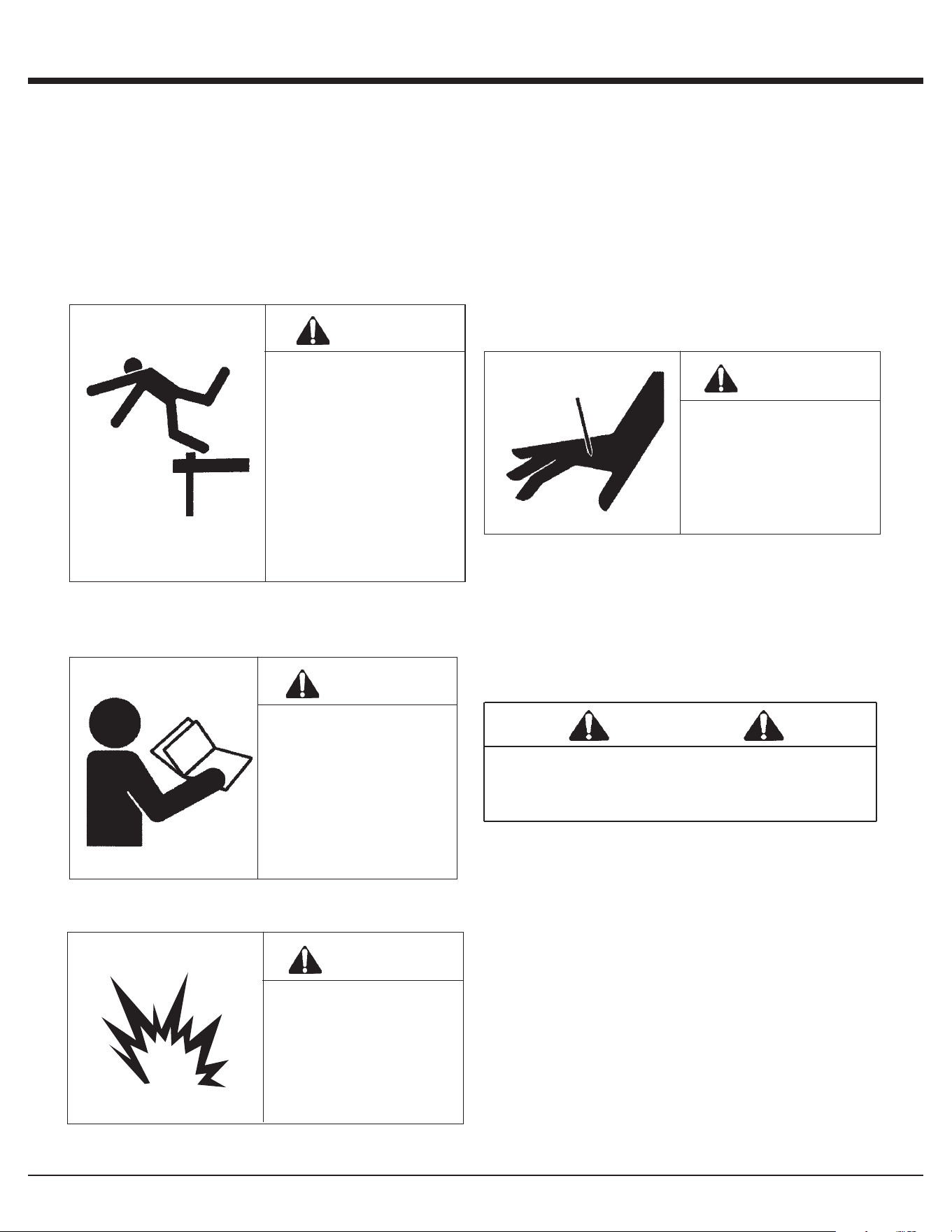
WARNING
Only persons who have
read and fully understand
all tool operation, safety
and maintenance
instructions should be
allowed to operate the tool.
15. PROPERLY STORE FUEL CELL.
16. ALWAY
S STORE THE TOOL WITH THE FUEL
CARTRIDGE AND BATTERY REMOVED.
Store the fuel cartridge in the case with the Cordless
Nailer.
17. KEEP THE TOOL CLEAN AND WELL MAINTAINED.
A clean tool is less likely to jam or malfunction.
18. KEEP YOUR HANDS CLEAR OF THE WORK AREA
SURFACE.
WARNING
Always store tool, fuel
cartridge and battery
where they will not be
exposed to an open flame,
sparks or temperatures
above 120° F (49° C).
WARNING
A fastener may exit at an
angle unexpectedly and
cause injury.
IMPORTANT SAFETY INSTRUCTIONS!
SAVE THESE INSTRUCTIONS!
DANGER
TO REDUCE THE RISK OF FIRE
OR ELECTRIC SHOCK, CAREFULLY
FOLLOW THESE INSTRUCTIONS
CHARGING SYSTEM SAFETY
INSTRUCTIONS!
13. ALWAYS MAINTAIN SECURE AND UNOBSTRUCTED
FOOTING WHEN ON LADDERS, PLATFORMS OR
OTHER HIGH LOCATIONS.
WARNING
Never over-reach, since
tool recoil may cause a
loss of balance. Always
be aware of edges and
drop-offs when nailing on
rooftops and other high
locations. Keep them in
full view.
For connection to a supply outside North
America, use an attachment plug adapter
of the proper configuration for the power
outlet, if needed.
9
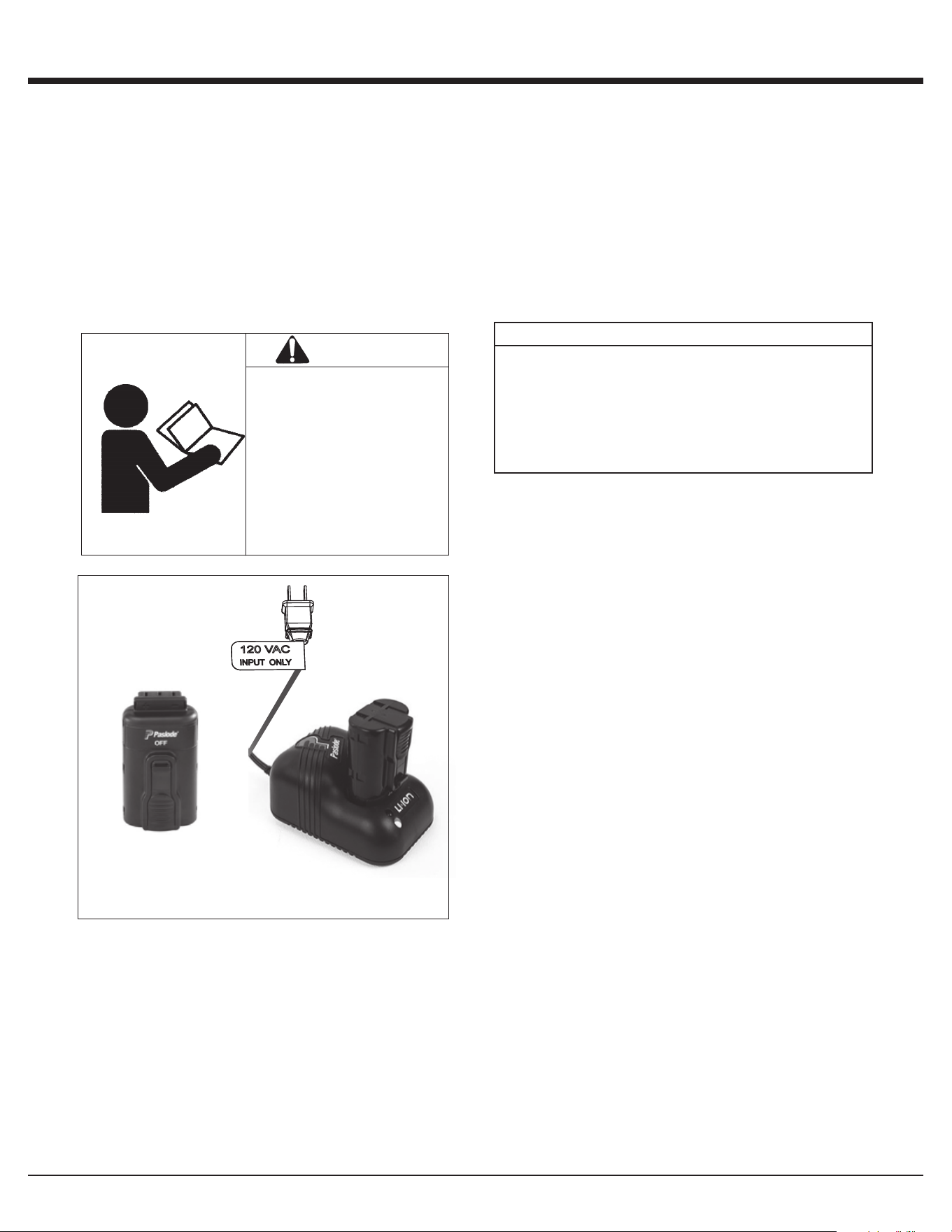
Warning
CHEMICAL/EXPLOSION
HAZARD
Read ALL instructions be-
fore charging or using bat-
tery. Failure to follow ALL
instructions may result in
fire, severe burns, or re-
lease of toxic materials.
Battery and Charging System
Charging Instructions
1.
2. Remove the battery from tool or case and insert ter-
minals down into charger. The red light will come on
indicating that the battery is charging and the green
light will go out.
3. After charging is complete, the red light will go out
and the green light will come on, indicating that the
battery is fully charged. The charger will keep the
battery at full charge until it is removed.
4. Unplug the charger from the 120V AC outlet.
CHARGING TIMES:
First charge (new battery)
1.5 hour
Discharged Battery 5 minutes to 1.5 hour
CHARGING DON'TS:
1. Do not charge battery outdoors or in temperatures
below 40°F (5°C).
2. Do not allow metal objects to come in contact with
battery terminals.
3. Do not puncture or attempt to open battery case or
cells.
4. Do not store battery where it will be subjected to
temperatures above 120°F (49°C).
5. Do not incinerate battery.
6. Do not use a defective battery charger, one that
over-heats and/or smokes when plugged in.
7. Do not immerse the battery or charger in water.
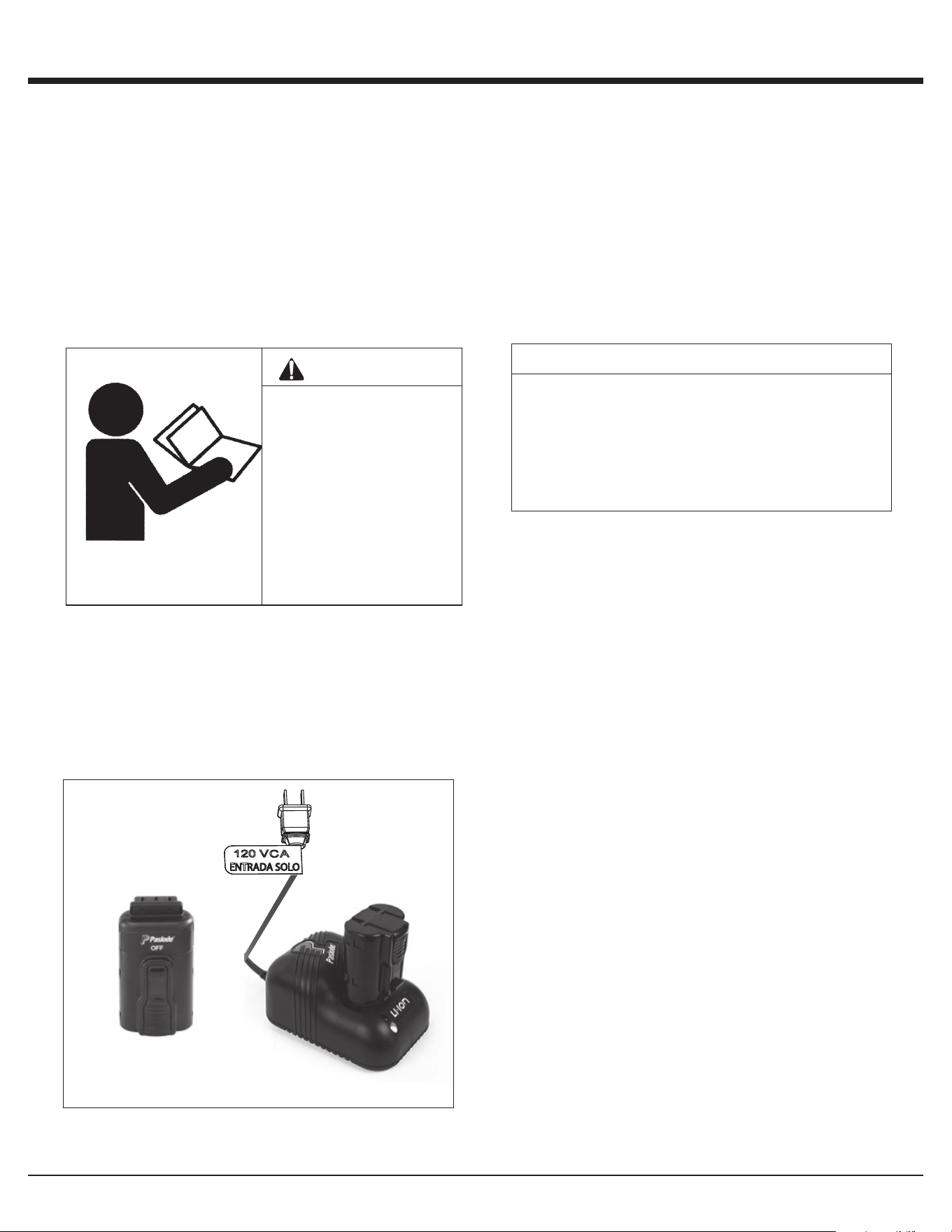
Charging System Accessories:
Battery Charger - Part No. 902672
Note
Remove the charger unit from the tool case and plug
it into a 120V AC outlet. Set the charger base on a
stable surface. A green light will come on to indicate
the power is on and the charger circuit is ready.
If battery is completely discharged, the red light and
the green light may alternate back and forth for up to
20 minutes. This safety feature slowly recharges the
battery until it is ready to accept the full charging
current. If the red and green lights continue to alter-
nate after 20 minutes, replace the battery.
6ft. Cord
Battery
Charger
THE PASLODE BATTERY CHARGING SYSTEM
Battery disposal:
The Paslode batteries contain lithium and should be re-
cycled or disposed of properly.
You may contact your local recycling center for information
on where to return the spent battery or call 1-800-822-8837
for information on Li-ion battery
recycling in your area.
Important Charging Notes
The Paslode Cordless 1-1/2" Positive Placement
®
Metal Connector Nailer comes with a rechargeable
battery and its own charging system. This charging
system is the only one that will work with the
Paslode lithium-ion batteries. The first step in
preparing a new tool for operation is to fully charge
the battery. New batteries are shipped partially
discharged and must be charged prior to first
use.
Batteries will take 5 minutes to 1.5 hours (time
will be dependent on the amount of discharge of the
battery) to recharge.
Battery and Charging System
10
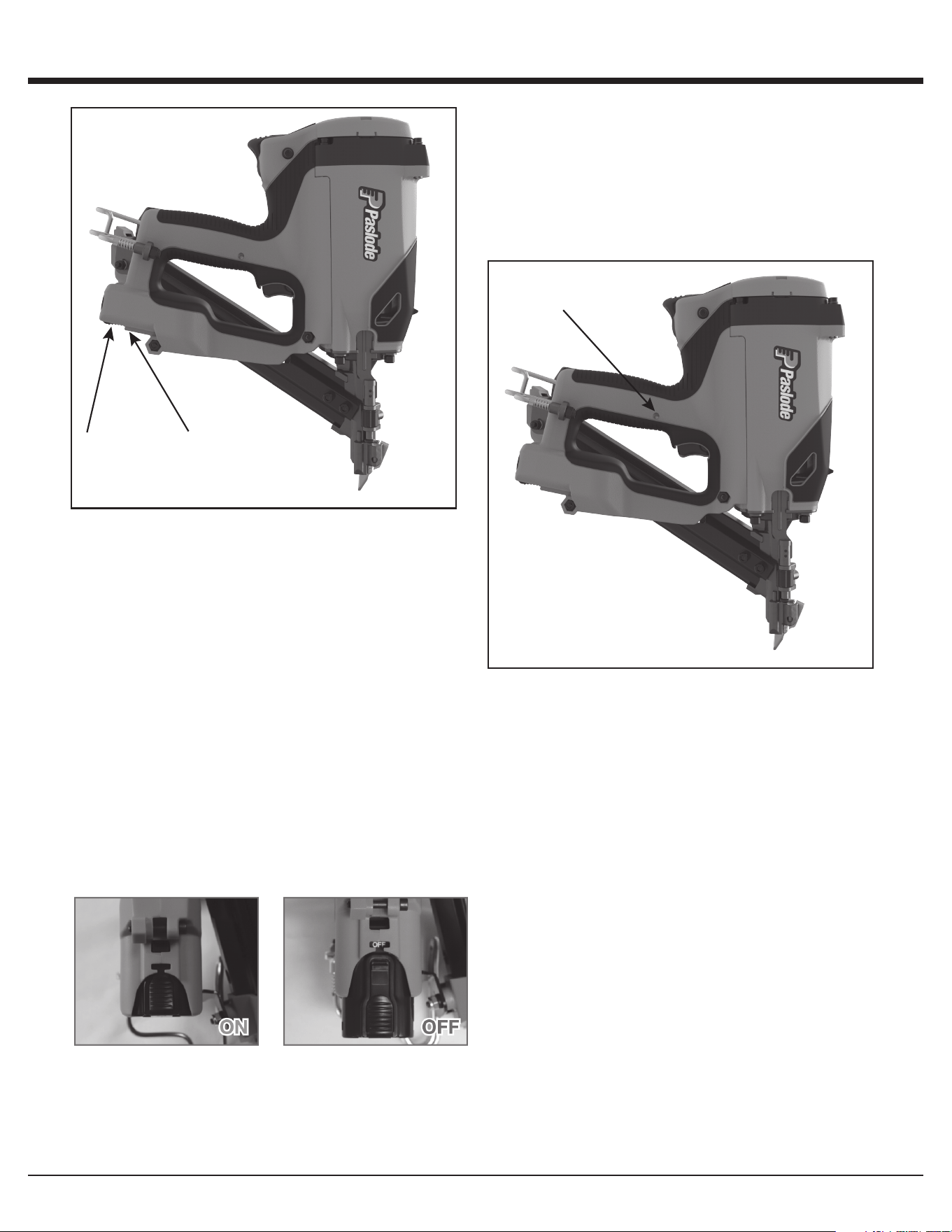
Inserting Battery
1. sseldroC eht otni ,tsrfi stcatnoc ,yrettab eht daoL
Nailer.
2. Push battery fully forward into its locked On
position. The battery indicator light will light.
3.
NOTE: If battery is left in tool for an extended period,
the battery will discharge completely and will require
recharging.
Battery Indicator Light
On the right side of the handle is a small plastic lens. This is
the battery indicator light. When you insert a fully-charged
battery into the tool, you will see a blinking green light. If
the indicator light blinks red, recharge the battery.
4.
To remove battery, push down on locking tab and slide
battery out.
To disengage the battery, push down on locking
tab and slide battery back until it locks into the
Standby position.
Standby
Position
On
Position
Battery Indicator
Light
CORRECT BATTERY OPERATION
ON/OFF SWITCH. Battery has 2 secure lock positions:
engaged and disengaged
Green indicates charged
battery
Red indicates battery
needs charging
11
DANGER
EXPLOS I O N / F I R E
HAZARD
WARNING
Sunlight can raise the inside temperature of an
unventilated car or van to above 140°F (60°C).
;egdirtrac leuf eht nepo ot tpmetta ro erutcnup reveN
it is non-refillable.
Never incinerate, reclaim or recycle the fuel cartridge.
Never smoke while installing the fuel cartridge.
Never inhale the spray.
Keep out of the reach of children.
Store fuel cartridge(s) in well-ventilated areas only.
Fuel Cartridge
Fuel Cartridge
NOTE
1.
Never attempt to refill the cartridge! Replace
with fresh fuel cartridge, and dispose of spent
cartridge properly.
1.
2. When replacing fuel cartridge also clean or replace
air filter for optimum tool operation.
NOTE: Altitude Restriction
Paslode Cordless tools are powered by an
internal
combustion engine and are effected by altitude. The
tool may lose power or not cycle consistantly at
elevations of 6000 feet or greater. For optimum perform-
ance use at 6000 feet or less.
DANGER
2. Do not attempt to install the fuel cartridge cap on
other fuel cells. This may result in damage to the
tool and injury to the user and by standers!
Do not attempt to remove or reuse the
Paslode Fuel Cell
.
There is a second container inside the P
aslode Fuel Cell.
This inner container holds the fuel. T he space between
the container and the outer cylinder is filled with a gas,
called the propellant, which is under pressure.
To eject the fuel, propellant pressure squeezes the inner
fuel container much as you squeeze a tube of toothpaste.
This squeezing action ensures that all the fuel is used,
and that the Cordless Nailer can operate in any position.
However, over time the propellant pressure diminishes
until it is no longer able to squeeze the inner fuel
container. This is why a nailer using a fuel cartridge
beyond the “Best Use Before” date may not work consis-
tently or at all.
If you expose the empty or expired Paslode Fuel Cell to
extreme temperatures, the propellant gas will expand and
could cause the container to burst, releasing flammable
gases.
The fuel contains a small amount of oil to keep the tool
lubricated during use. It is not necessary to oil the tool
during normal operation. When cleaning the tool, use only
Paslode Cordless tool oil. Using oils not formulated for the
Paslode Cordless Tool, may cause loss of power and may
damage the internal parts of the tool's motor.
R ead ALL sa f ety
instructions before using
or handling the fuel
cartridge. Failure to
follow ALL instructions
may result in explosion or
fire. This may cause
severe personal injuries
or property damage.
Exposure to tempera-
tures above 120°F
(49°C) may cause the
fuel cartridge to burst,
releasing flammable
gas.
Keep the fuel cartridge
away from heat, sparks
and open flame. Do not
smoke when handling or
operating tool or fuel
cartridge.
12
Fuel Cartridge
NOTE:
Paslode Cordless fuel cartridges are marked with a “Best Use Before” date on the bottom of the can.
For maximum performance use fuel before the “Best Use Before” date.
DANGER
Paslode Cordless Fuel Cartridges are flammable.
Do not remove fuel cartridge cap or install on other
fuel cartridges!
Paslode Cordless Fuel Cell/Cartridge Disposal Guidelines
Paslode the industry leader in cordless technology provides this information to assist users with the proper disposal of discarded
fuel cells/cartridges. Acceptable disposal options vary depending on the type of fuel cell/cartridge users. All users must cons
ider
federal, state and local solid waste regulations to ensure that discarded fuel cells/cartridges are disposed of properly. Users
must
contact their local solid waste authority for further guidance.
Discarded fuel cells/cartridges (used or unused) may be considered hazardous waste under the Resource Conservation and
Recovery Act (RCRA) depending on several factors as described in the paragraphs that follow. Upon disposal used and unused
fuel cells/cartridges may be classified as ignitable hazardous waste (waste code D001) under U.S. EPA regulations.
Hazardous waste generated by homeowners and contractors who perform routine maintenance for homeowners in their homes are
not regulated by RCRA. In general, "household wastes" generated by homeowners and their contractors are exempt from hazard-
ous waste regulation because those wastes are expressly excluded from the definition of hazardous waste. For example US EPA
has excluded as "household waste" aerosol cans that contain residual product and propellent. Thus under
federal hazardous waste
regulations homeowners and contractors may dispose of discarded fuel cells/cartridges as general refuse in a properly permitted
municipal landfill. These users must still contact their local solid waste authority to determine if any state or local regulation
prohibits or restricts such disposal.
Paslode takes no responsibility for proper fuel cell/cartridge disposal. Proper disposal remains the responsibility of sellers and
users. All sellers and users must contact their local solid waste authority to determine if any
federal, state or local regulation
prohibits or restricts disposal. Users may obtain more information about U.S. EPA hazardous waste regulations at the following
internet address: www.epa.gov/epaoswee.osw/hazwaste.htm
Alternatively users may contact U.S. EPA's RCRA Superfund Call Center at 1-800-424-9346 to receive more information.
13
Fuel Cartridge
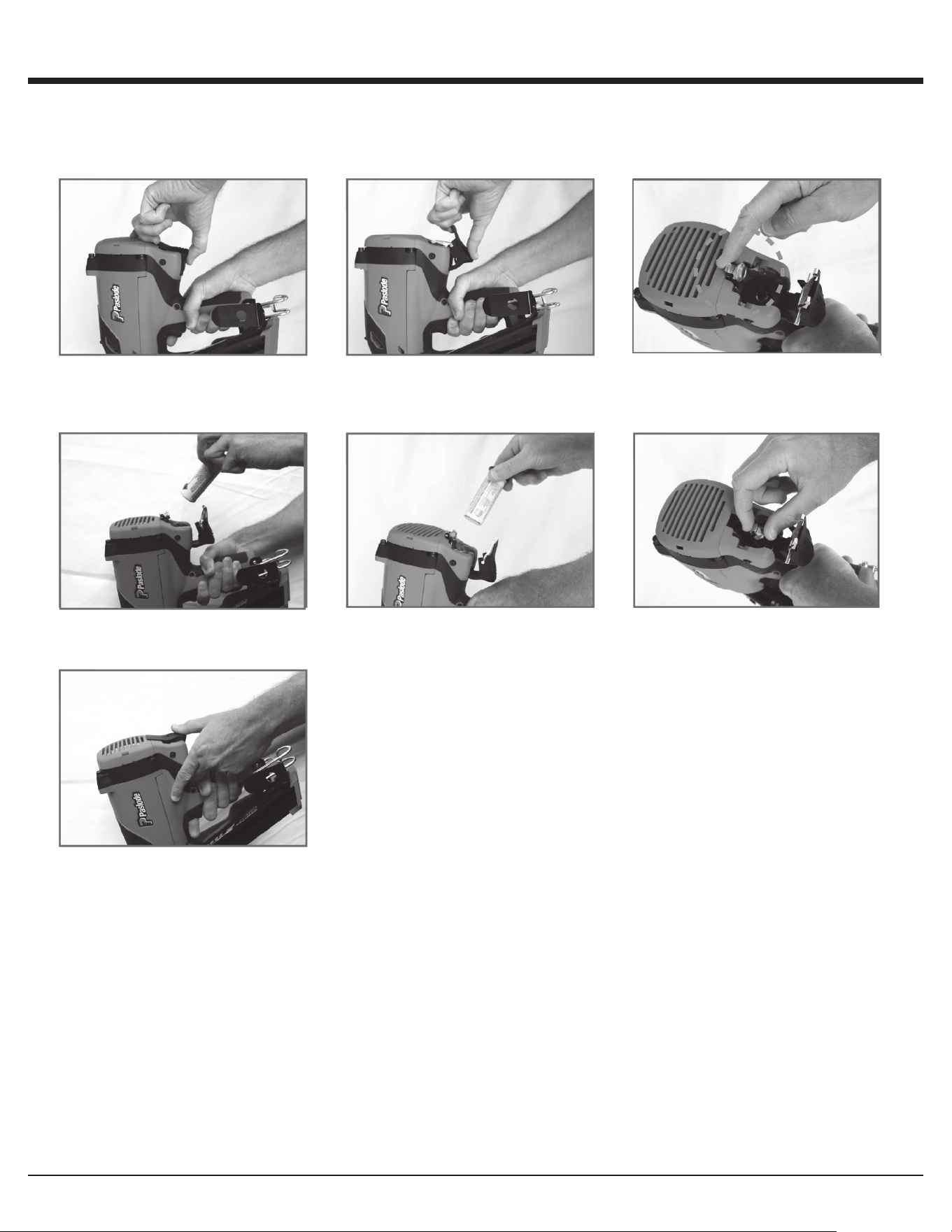
CORRECT FUEL CELL LOADING PROCEDURE
To close - Push forward, then
down to lock fuel door
Raise fuel tube block assembly,
it will lock in up position
Load fuel cell Carefully align fuel adaptor and
cell stem
To open - Push forward, lift
then back
Open fuel door assembly Remove fuel cell carefully
14
COLD WEATHER OPERATION
Use only Paslode 1-1/2"
Positive Placement
®
Metal Connector Nails
Preparing the Paslode Cordless 1-1/2" Positive Placement
®
Metal Connector Nailer for Use
Lockout Feature
The purpose of this feature is to prevent needless
blank cycling, which could mar woods,waste fuel and
damage tool components . Five (5) nails will be left in
the magazine when the follower reaches the lockout
area. When changing fastener length or loading at
the beginning of the work day, you should inspect the
magazine and nose for any fasteners left in the tool.
These nails will not be visible unless you open the
nose of the tool.
Fasteners
The Paslode Cordless 1-1/2" Positive Placement
®
Metal Connector Nailer drives Paslode 1-1/2" Positive
Placement
®
Metal Connector Nails designed to be used
with the tool. The use of fasteners that do not meet
Paslode standards could cause tool damage and will
void all warranty claims.
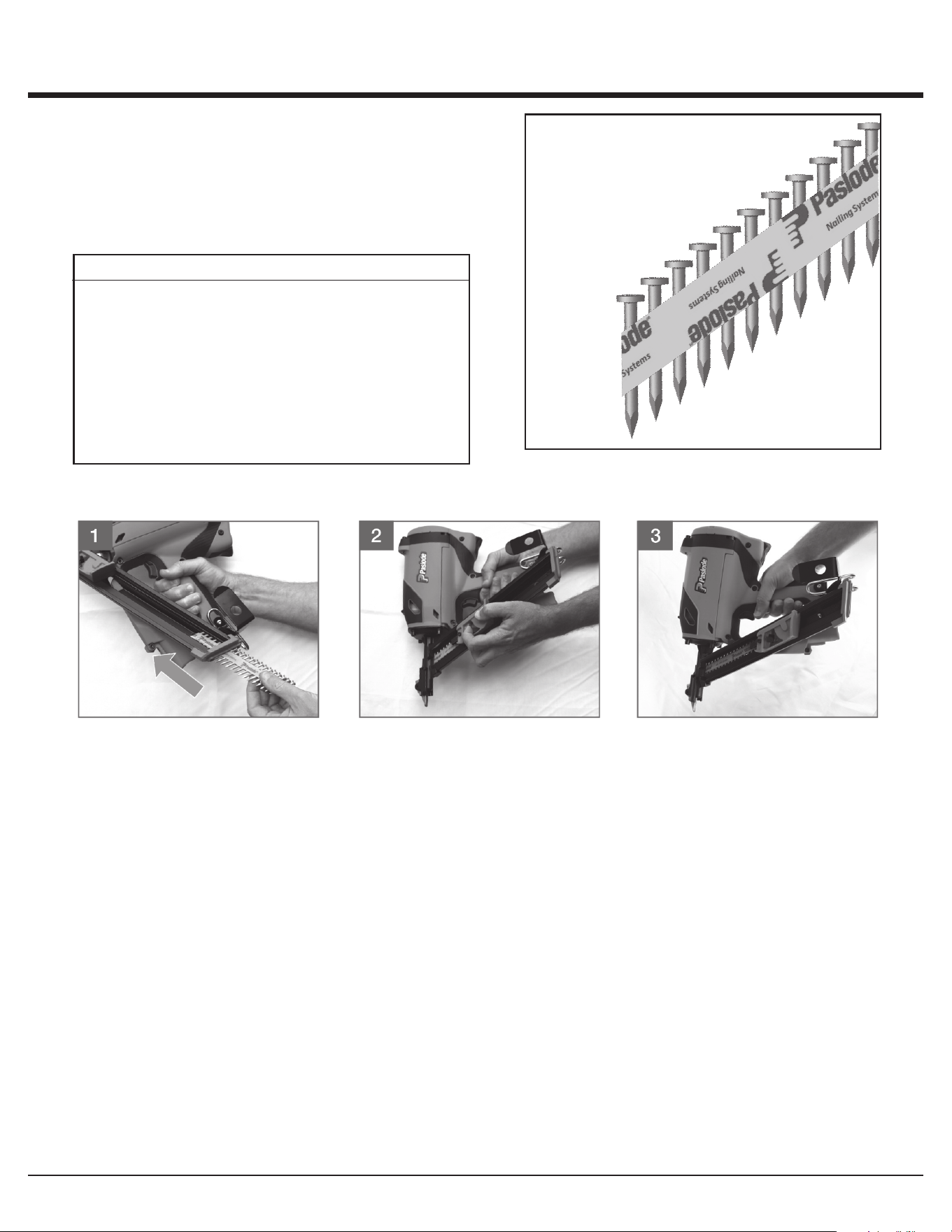
CORRECT NAIL LOADING PROCEDURE
Slide nail strip into back
of magazine
Depress lever, then pull nail
follower back past nail strip
Gently release follower onto rear
of nail strip, to prevent collation
damage
Paslode Cordless 1-1/2" Positive
Placement
®
Metal Connector Nailer
and Outdoor Weather
Use the Cordless Nailer outdoors, in dry weather,
when the nailer, fuel cartridge and battery are
between 45º (7.2ºC) and 120ºF (49ºC).
HOT WEATHER OPERATION
The Cordless Nailer requires cooling of the motor
assembly to operate properly. The fan normally
provides the necessary air flow to permit continuous
operation. Whenever the Cordless Nailer is idle for
extended periods, keep the fuel and tool out of
direct sunlight and in surroundings where
temperatures will not exceed 120ºF (49ºC). After
extended periods of continuous use, it may be
necessary to cool the motor by setting tool aside for
10-15 minutes or until the tool operates normally. An
overheated tool may not drive nails completely or
may operate erratically.
When storing the Cordless Nailer in temperatures
below 45°F (7.2°C) it may be necessary to first warm
up the fuel and tool for proper operation.
Fuel cartridges at colder temperatures can lose their
required propellent pressure. To correct this simply
warm up the fuel cartridge by placing it in an inside
coat pocket for several minutes.
Once the fuel is warm, insert the cartridge into the tool.
Quickly depress the tool two times onto the work
sur
face and hold the tool in the down position after
the second actuation. Wait one or two seconds then
pull the trigger. This action is referred to as “double
pumping” and provides a richer fuel mixture to the
cold tool to help initiate combustion.
15
Depth of Drive Adjustment
Remove the battery before adjusting the depth of
drive.
The depth of drive adjustment is done by turning the
adjustment wheel as shown by the arrows on the side of
the tool.
Cold Weather Operation: (Continued)
DANGER
CAUTION
This tool must be operated in a well ventilated environ-
ment, because the tool exhausts carbon monoxide
similar to a chainsaw or lawn mower. Exposure to
carbon monoxide may cause dizziness, nausea or
unconsciousness.
It will be necessary to repeat this procedure several
to operate in it’s normal mode.
times until the temperature of the tool warms up enough
Once the tool reaches operational temperature the tool
will generate it’s own heat and will function normally.
If the tool sits for an for an extended period of time and
cools down it may be necessary to repeat these steps.
CAUTION
The Cordless Nailer should not be used
in the rain or where excessive moisture is present.
The use of the Paslode Cordless Technology under
these conditions may result in damage to tool
components and cause the tool to malfunction.
®
WARNING
During the warm-up process, never expose the
tool, fuel cartridge, or battery to flame.
The Nail Hole Location Probe and nose will become
hot after prolonged or rapid use. If it becomes
necessary to adjust the Nail Hole Location Probe,
avoid touching with bare hands.
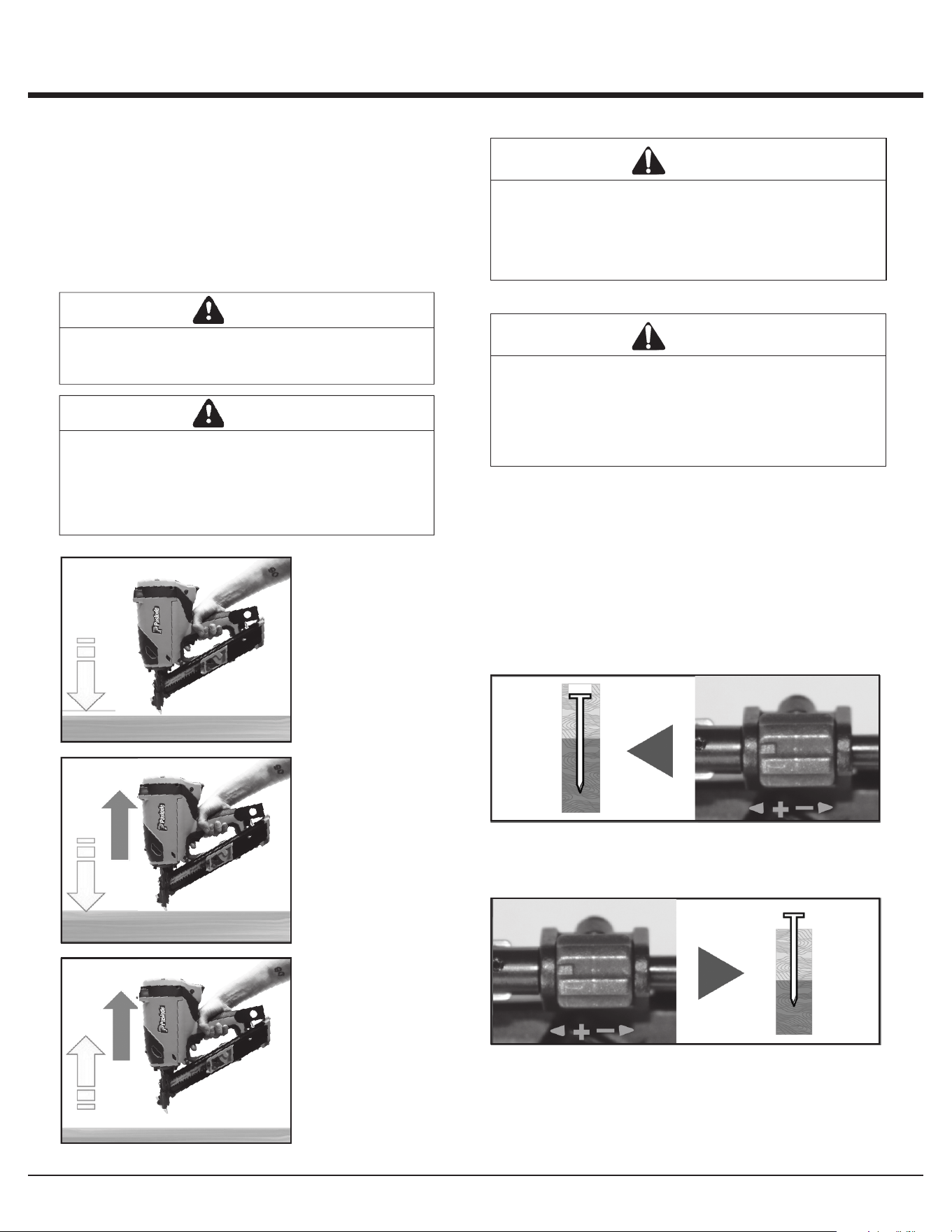
PRESS NAIL HOLE
LOCATION PROBE
AGAINST THE
WORK
SURFACE.
Fan motor starts,
fuel is injected into
combustion cham-
ber and mixed with
air by the fan.
SQUEEZE TRIGGER
Spark plug ignites
the fuel/air mixture,
driving the piston
assembly down on
the fastener.
RELEASE TRIGGER
- LIFT TOOL
Combustion
chamber opens.
Fan exhausts,
cooling internal
components.
INCREASE
DEPTH OF DRIVE
Counter
Sunk
Proud
DECREASE
DEPTH OF DRIVE
Paslode Cordless 1-1/2" Positive Placement
®
Metal Connector Nailer Operation
16
Restrict Field Service to the Following
RECHARGING THE BATTERY
CHECKING THE FUEL CARTRIDGE
REPLACING THE FUEL CARTRIDGE
CLEANING/REPLACING THE AIR FILTER
CLEARING A JAM
Servicing
Fuel Cartridge Check
DANGER
Wear safety glasses when performing this test. Never
perform this test near an open flame or sparks, while
smoking, or where the fuel may get into your eyes.
If fuel is not released with each operation of the metering
valve, this indicates that there is no more fuel left in the
cylinder and it must be replaced. Dispose of the empty fuel
cartridge.
(see page 11.)
Battery Check
DANGER
Never attempt any maintenance of a Paslode Cordless
tool without first removing the fuel cell and battery.
Maintenance should be started only after the tool is
completely inoperative.
CHECKING THE ENERGY LEVEL OF THE
BATTERY
CLEANING THE AIR FILTER
Attempts to go beyond these procedures could result in
serious personal injury or damage to the Cordless Nailer
and voiding the warranty.
There are certain problems you may encounter when
you are using the Cordless Nailer that you will be able to
correct on the work site. The following field service
procedures are the only service procedures you should
attempt. Anything else that may appear wrong with the
Cordless Nailer should only be diagnosed and repaired
by a fully trained service technician. If you have any
reason to believe that your problem is beyond the
service procedures in this manual, contact your
Paslode
®
representative immediately.
If the Cordless Nailer’s fan operates and the indicator
light is green, but the tool will not cycle or does not drive
fasteners completely, check the fuel cartridge. With the
fuel cartridge out of the tool, check to see if the cartridge
still contains fuel and that the metering valve is working.
To determine if there is any fuel left in the fuel cartridge,
hold in the upright position and simply place the metering
stem against a solid object, and gently push about three
or four times. A small amount of fuel should be released
each time.
Periodically check on the battery indicator light (the light
in the handle) of the Cordless Nailer. When encountering
a problem, the first step should always be to make sure
the battery has enough charge to operate the tool.
When the Nail Hole Locating Probe is depressed on the
work piece, the fan motor will turn on and the blinking
green indicator light will turn solid green. If the indicator
light blinks red or glows red, recharge the battery.
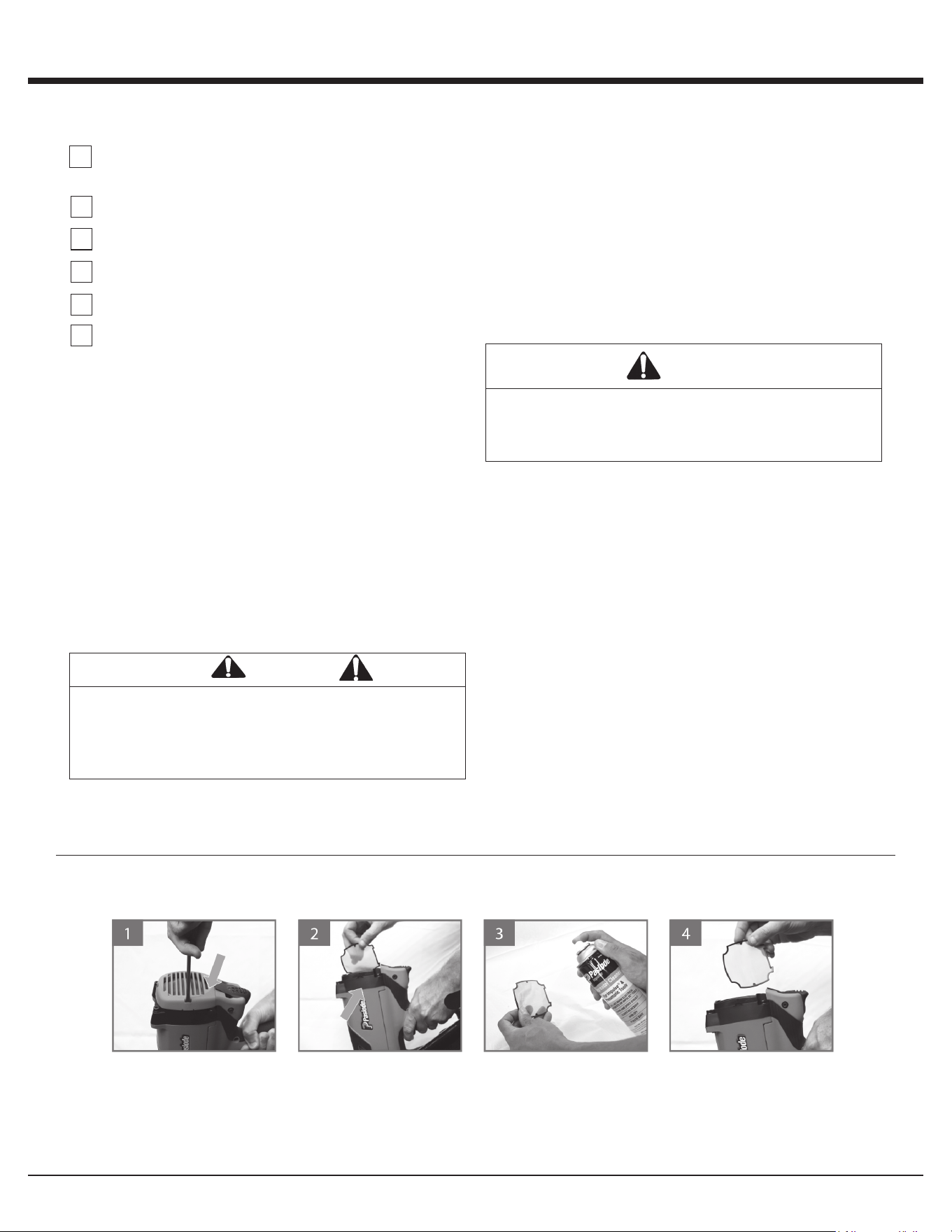
Use a flat bladed
screwdriver to
remove cap
Cleaner/Degreaser or
soap and water
restores the filter
Filter will look like
new
Tap filter gently
against hard surface
to remove dust
17
Servicing
Paslode Cordless Tool Accessories
A variety of accessories are available for the Paslode
Cordless 1-1/2
" Positive Placement
®
Metal Connector
Nailer:
Battery - Part No. 902654
Tool Cleaner - Part No. 219348
Clear Safety Glasses - Part No. 401382
Paslode Cordless Lubricating Oil - Part No. 401482
Battery Charger - Part No. 902672
Paslode Cordless 1-1/2" Positive Placement
®
Metal
Connector Nailer Case - Part No. 906107
Contact your Paslode® representative for additional
information.
T
ools
A 9/64 Hex Wrench (Part No. 900736) is provided with
each Cordless 1-1/2" Positive Placement
®
Metal
Connector Nailer.
For technical support call:
1-800-222-6990
or email:
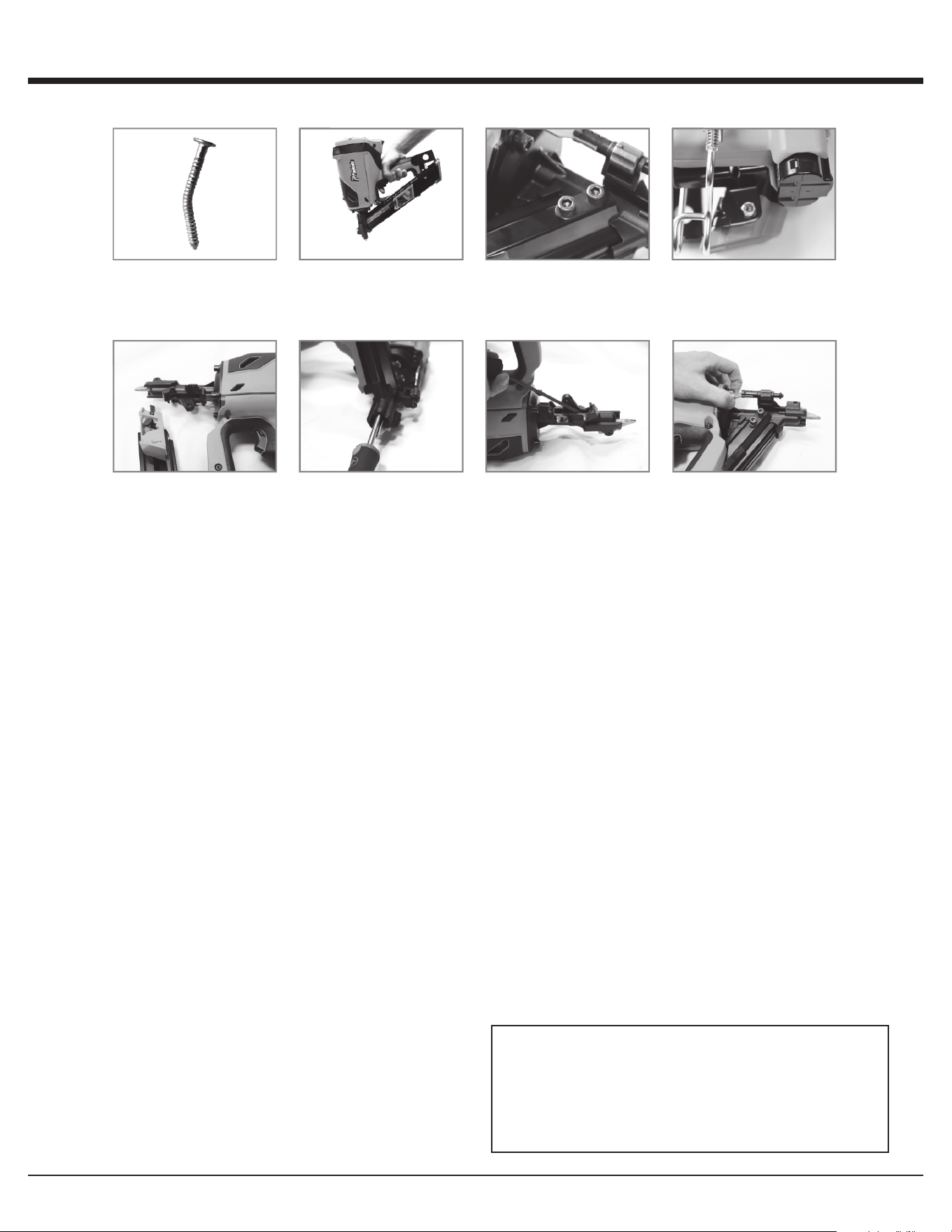
CLEARING A FASTENER JAM
Remove Battery, Fuel
Cell and Nails
Remove 2 cap
screws on side of
magazine securing
magazine to the nose
Remove the magazine
assembly to expose
the back of the nose
slot. (Be careful the
nail follower does not
come out of the
magazine channel)
Push or punch the
driver blade back to
top rest position,
using a long punch (if
needed)
With driver blade
clear, operator is free
to remove jammed or
bent nail
Reassemble tool,
attach magazine to
nose, replace cap
screws and nut. Tool
is ready to use.
Remove nut from rear
of magazine.
When you get home:
1. Place the battery in its charger if it needs charging as
indicated by the red charge light on the handle.
2. Wipe your Cordless Nailer with a clean soft cloth.
3. Remove and clean the filter every two days.
4. Check Nail Hole Locating Probe to ensure it is
operating freely.
End-of-Workday Routine
These simple steps are based on maintaining the safety and
operational efficiency of the Cordless Nailer.
Before you leave the work site:
1. eht esu syawlA .esac loot ni erots dna yrettab evomeR
Cordless Nailer case for transporting and storing
the tool.
2.
Dispose of all empty fuel cartridges. Remember to
dispose of these fuel cartridgeas where they will not
be crushed, punctured, burned or found by children.
Tool Cleaning and Oiling
Periodic cleaning and oiling are necessary to keep the
Paslode Cordless Nailer operating properly. The tool
should be cleaned and lubricated at least every 50,000
cycles. This number may vary depending upon the rate at
which the tool is used and the operating conditions it is
used in. The chart in the cleaning instructions will help you
determine how often the tool should be cleaned.
18
Battery does not appear to accept charge
when battery is plugged into the charger.
Charger gets hot, makes excessively loud
noise, or smokes during charging cycle.
Charger cord or wall plug gets hot.
Inoperative indicator lights on charger, or
defective charger.
Battery damaged or cycle life exhausted.
Damaged charger.
Try battery in tool after a full charge cycle.
If tools indicator light is red, charger not
working properly. Replace charger, or
monitor charging time to ensure battery has
adequate time for recharging. It is normal
for battery to feel warm after properly
charging.
Replace battery.
Discontinue use immediately and unplug
from power source. Replace charger
and tag or dispose of charger to prevent
accidental re-use or connection to power
source.
Preparing Tool for Operation - Battery/Charger Problems
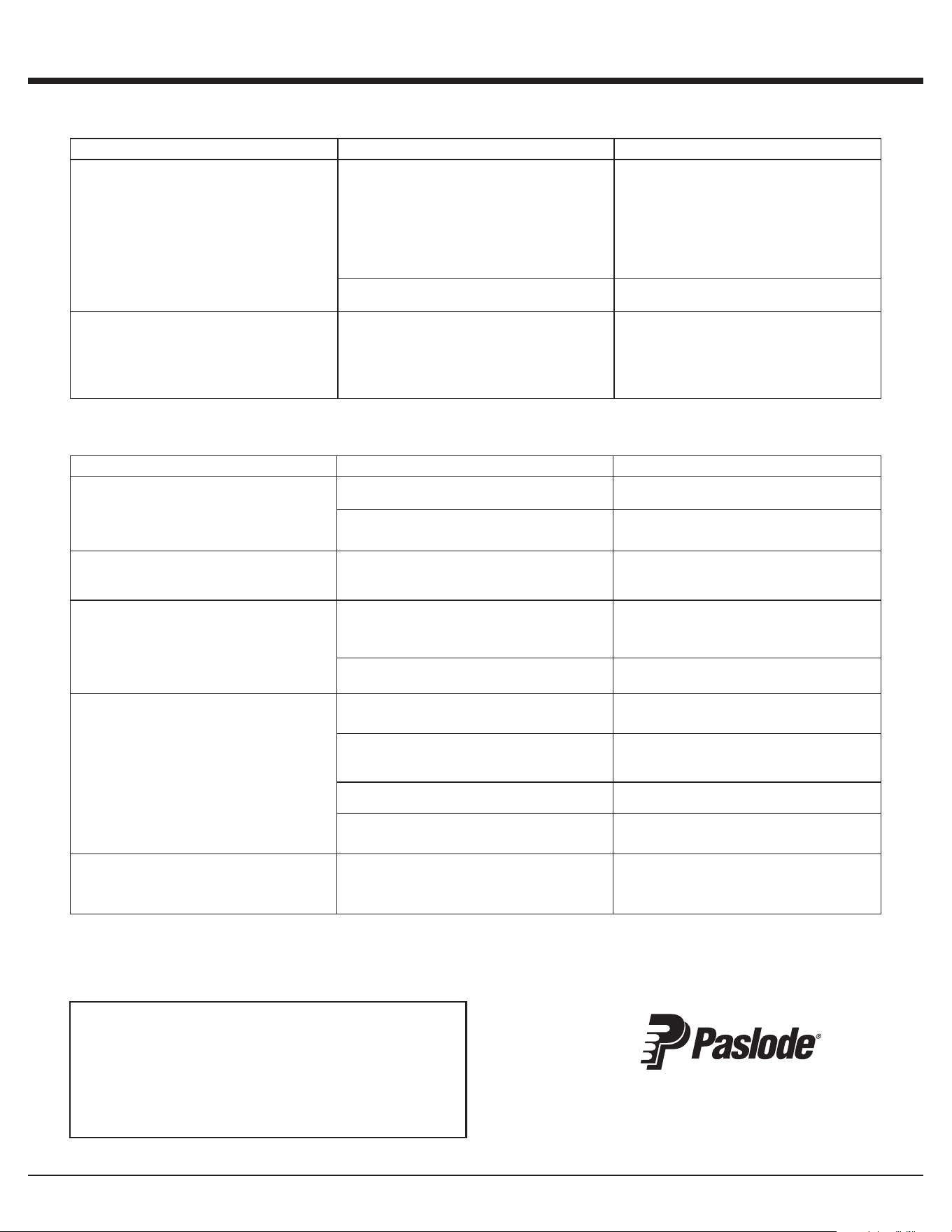
SYMPTOM POSSIBLE PROBLEMS SERVICE
Normal Stage of Operation
Fan does not run - tool indicator light is
blinking red or solid red.
Fan does not run, or runs slower than nor-
mal - tool indicator light is solid red.
Battery is not charged.
Battery terminals are oily, dirty, or corroded.
Battery is discharged.
Charge battery.
Clean battery terminals with soft cloth.
Charge battery.
SYMPTOM POSSIBLE PROBLEMS SERVICE
Nail Hole Locating Probe does not depress
fully - tool does not operate.
Tool will not cycle - fan runs, indicator light
is solid green.
Nail Hole Locating Probe is bent, or build-up of
debris in track restricts operation.
Lockout feature is engaged.
Fuel Cell empty or too cold.
Spark wire out of spark plug.
Spark plug is dirty.
No spark is generated.
Remove and inspect the Probe. Clean track.
Repair or replace the Probe as required.
Add strip of nails.
Replace fuel cell or see weather
guidance above.
Remove cap and check spark lead, insert in
spark plug and replace cover.
Clean tool cylinder head and spark plug.
Return tool to authorized Paslode
®
dealer for
service.
Tool does not fire but fan runs, battery is
charged, and there is fuel in the cell.
Driver blade is stuck down,.
Remove nails, battery and fuel. Use the
provided allen wrench to push the drive blade
back into position.
Troubleshooting
If tool will not operate after following the above service directions, return the tool to an authorized Paslode
®
representative for service.
An Illinois Tool Works Company
155 Harlem Avenue
Glenview, IL 60025
www.paslode.com
For technical support call:
1-800-222-6990
or email:
18
19
Tool operates properly, but fasteners do not
drive fully.
Tool operates properly, but fasteners are
sometimes over-driven, and sometimes
under-driven.
Tool operates, but no fastener is driven.
Tool operates erratically or appears to be
losing power - tool indicator light is green.
Nail Hole Locating Probe requires adjustment.
Fuel cell is low.
There may be loss of seal in combustion
chamber.
Nail Hole Locating Probe is not adjusted
properly for the type of material being fastened.
Wrong fasteners being used.
Follower not properly engaged behind fastener
strip.
Jammed fastener.
Fuel cell is low or too cold.
Spark plug wire is loose.
Air filter is dirty, causing tool to overheat.
Tool is dirty.
Adjust the Probe.
Check fuel cell and replace as required.
Press Nail Hole Locating Probe against
workpiece for one minute. Pull trigger. If
fastener does not drive, there is a leak that
requires service.
Adjust the Probe. Readjust
as required when material density or thick-
ness of material being fastened changes.
Use only fasteners meeting Paslode
®
specifications. Check Fasteners and Ap-
plications section for fastener types and
sizes recommended for use in Paslode
Cordless tool.
Position follower behind fastener strip and
engage strip.
Clear jam.
Check fuel cell.
Check spark plug wire.
Remove air filter and clean. Use soap and
water to remove stubborn debris.
Clean tool.
Normal Stage of Operation
SYMPTOM POSSIBLE PROBLEMS SERVICE
Tool operated and drove fasteners, but
driver blade did not return to up position.
Combustion chamber does not drop after
tool cycles.
Built-up dirt and debris on driver blade or in
nose bore.
Tool is dirty.
Nail Hole Locating Probe is bent, or is dirty.
Clean driver blade and nose bore with
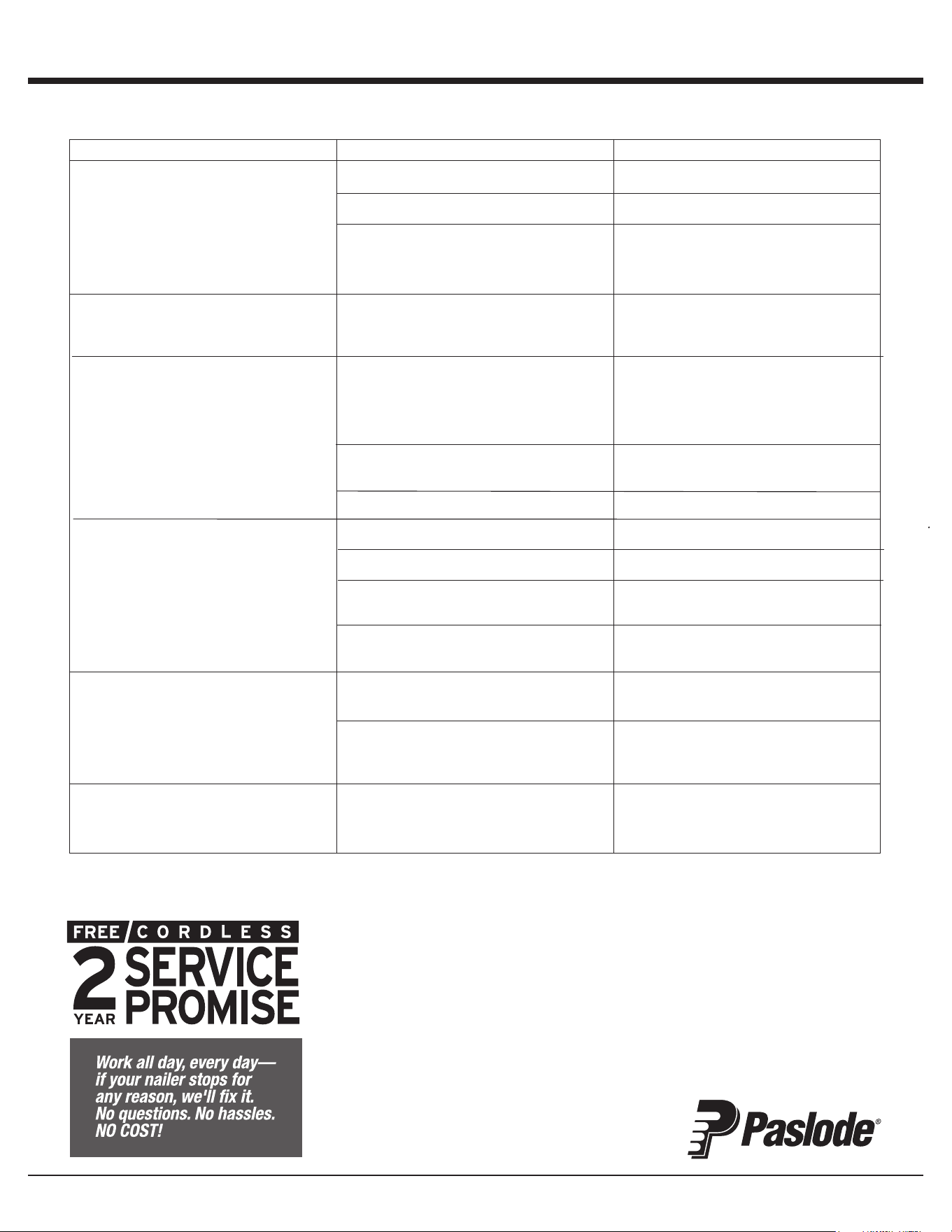
degreaser cleaner.
Clean tool.
Clean track or replace the Probe.
Troubleshooting
Still not working? Here are more options:
•
Your nailer may qualify for our Cordless 2 Year
Service Promise. Visit paslode.com for more
information or call us at 1-800-222-6990.
•
Keep your cordless nailer in top form. Visit paslode.com
and watch our Cleaning and Maintenance videos.

WARNING: All parts must be periodically inspected
and replaced if worn or damaged.
Failure to comply can affect the tool’s operation and
present a safety hazard.
PARTS LEGEND
PARTS LEGEND PASLODE IM40 POSITIVE PLACEMENT NAILER B60001
1 919042 1 Grill 44 919130 1 Handle RH
×
2 900455 1 Filter 45 900662 1 Wire Harness, ESU
3 901065 4 Screw SHC 10-24 x 1-1/4 46 916258 1 Electronic Spark Unit (ESU)
4 906222 1 Cap 47 919092 2 Nut, Nyloc 10-24
5 900902 3 Screw TF SEMS 8-32 x 5/8 48 901095 1 Slide Switch Assembly
6 902637 1 Limiter 49 919068 1 Circuit Board Assembly
7
902635
1 Motor Assembly, Fan 50 918903 2 Pad, Foam (Battery)
8 900287 1 Spark Plug Assembly 51 404702 3 Screw TF 6-19 x 3/8
9 401356 1 Sleeve, Fan Motor 52 919120 1 Trigger Assembly
10 904517 1 Fuel Barb 53 903728 2 Wire Lead Assembly, Spark
11 904546 1 Fuel Tube 54 919063 1 Wire Lead Assembly, Fan Motor
12 902405 1 Fuel Block 55 919079 1 Locknut - Utility Hook
13 904521 1 Pivot Arm, Fuel Tube 56 919076 1 Utility Hook Button
14 919219 1 Cylinder Head - All Weather 57 919077 1 Utility Hook Block
×
•
15 919067 4 Seal Ring, Cylinder Head and Sleeve 58 919078 1 Spring - Utility Hook
16 403167 1 Fan Blade Assembly 59 919075 1 Utility Hook
17 906223 1 Combustion Chmbr Assmbly-All Weather 60 904532 1 Wire Clip
18 919065 4 Screw TX SEMS 8-32 x 3/8 61 904705 1 Lockout Body - Molded
19
919213
1 Bracket, Chamber Lockout 62 919217 1 Lockout Spring
20
919004
1 Ring Retaining Clip 63 919215 1 Lockout Pin
×
21 906120 1 Driver & Piston Assembly 64 906129 1 Handle LH - MOD
22 900612 2 Seal Ring, Piston 65 906118 1 Belt Hook and Bracket Assembly
23 919125 1 Sleeve Assembly 66
906114
2 Bracket/Belt Hook Screws
24
900595
4 Screw TX SEMS 8-32 x 3/8 67
901066 2
Screw TF TX 8-16 x 3/4
25
919010
1 Cover, Muffler 68 919093
2
Screw 10-24
26
919049
1 Muffler 69 502338 2 Screw SHC 1/4-28 UNF x 1/2
×
•
27 919009 1 Reed Valve 70
502323 1 Washer Plate, Magazine
28 919011 1 Reed Plate 71
906215 1 Magazine Assembly
29 919016 1 Baffle, Exhaust 72
092037
2 Nut, Lock
×
•
30 919014 1 Seal, Exhaust 73
408302 2 Washer, Flat
31 919017 1 O-Ring 74
502329 1 End Cap, Magazine
32 919012 1 Bumper 75
906150 1 Bolt SHC 10-32 x 1
33 919046 1 Spring, Yoke 76
502226 1 Spring, Negator
34 919123 1 Yoke Assembly 77
502025 1 Drum & Pin Assembly
35 018956 1 Wheel, Depth Adjustment 78
502335 1 Lockout Bar
36 919110 1 O-Ring, Retaining 79
502340 1 Roll Pin
37 919142 1 Housing Assembly 80
502318 1 Follower Body
38 906102 1 Nose 81
500627 1 Screw SHC 8-32 x 1/2
39
906141
1 Probe Assembly 82
502020 1 Spring, Follower
40 919108 4 Screw SHC SEMS 1/4-20 x 7/8 83
513101 1 Lever, Follower
41
919161 1 Fuel Door Assmbly - All Weather
84
513116 1 Follower Assembly
84
513116 1 Follower Assembly
42
919116
2 Screw SCH 8-32 x 3/8
43 919115 2 Bushing
× Normal Wear Item Remove battery & nails before commencing service.
•
Included in Service Kit Use eye and ear protection when operating/testing tools
.
Apply Loctite® 242 (Blue)
Use eye protection when cleaning tools.
AR As Required Use degreaser in a well ventilated area.
Part No. 906200
Model CF150-PP
Schematics
20
×
•
×
•
×
•
×
•
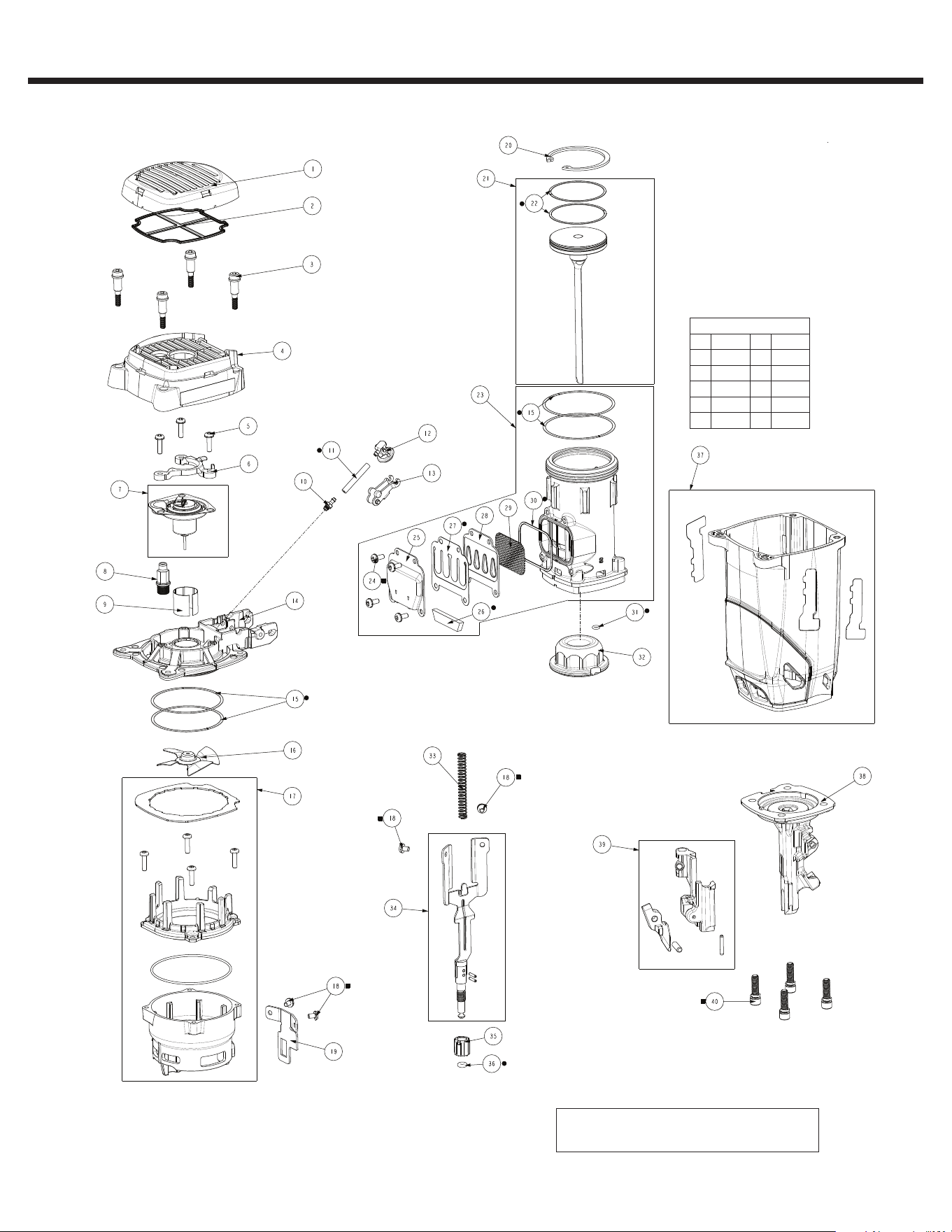
All parts sold as single items unless described as a pack, set or
forms part of an assembly (multiple items defined within a box).
A part with no item number is only available in an assembly.
Service Kit Item
Loctite
®
242
Torque Values (in/lb)
Item
Torque
Item
Torque
3 55-60 19 30-35
5 30-35 25 30-35
8 20-25 27 30
41 155-165
-35
10 15-20
16 8-10
•
Part No. 906200
Model CF150-PP
Schematics (cont.)
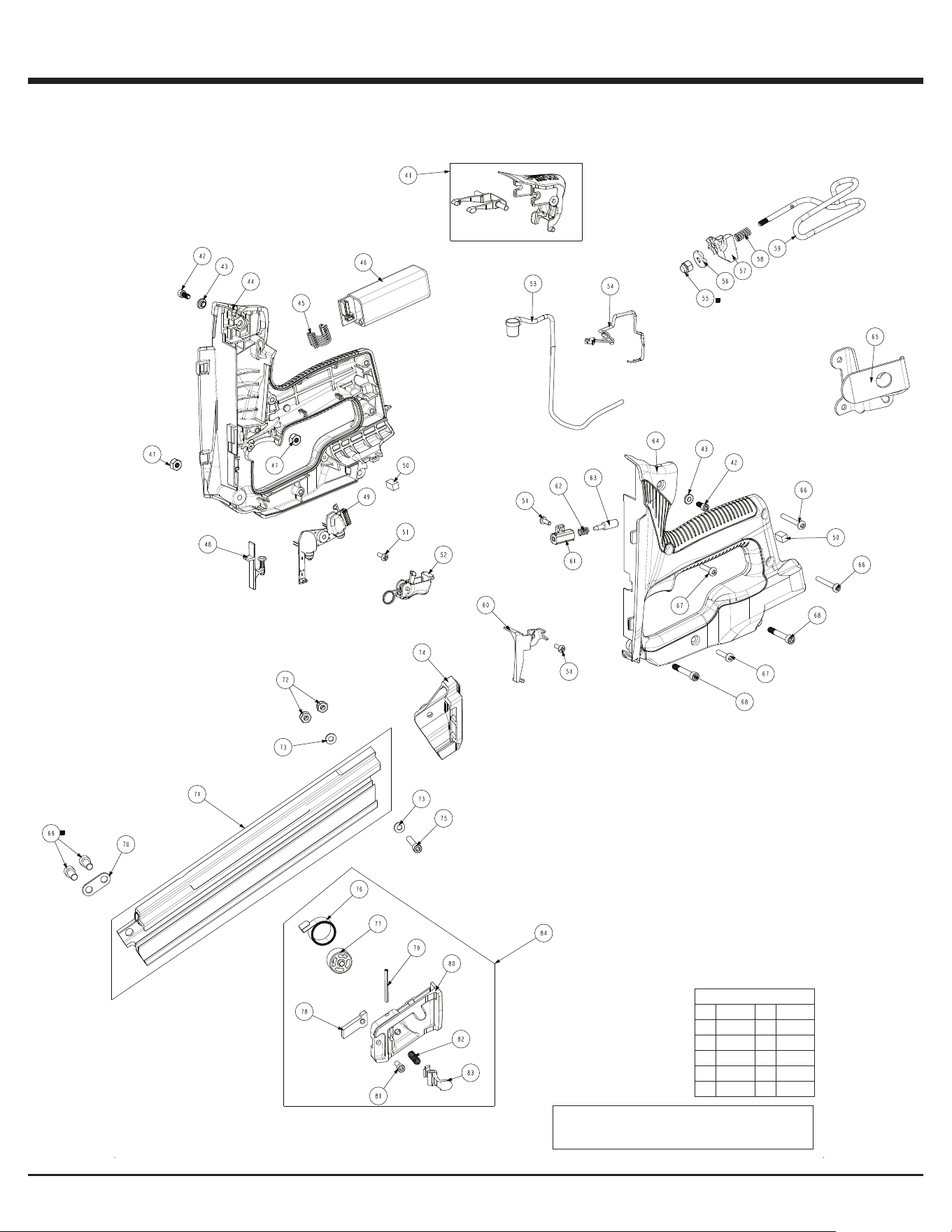
All parts sold as single items unless described as a pack, set or
forms part of an assembly (multiple items defined within a box).
A part with no item number is only available in an assembly.
Torque Values (in/lb)
Item
Torque
Item
Torque
43 30-35 70 35-40
52 6-8 76 35-40
67
18-22 82 18-22
68 18-22
55-65
69 25-30
Service
Kit Item
Loctite
®
242
Part No. 906200
Model CF150-PP
•
Schematics (cont.)
22

Notes
23

Notes
24
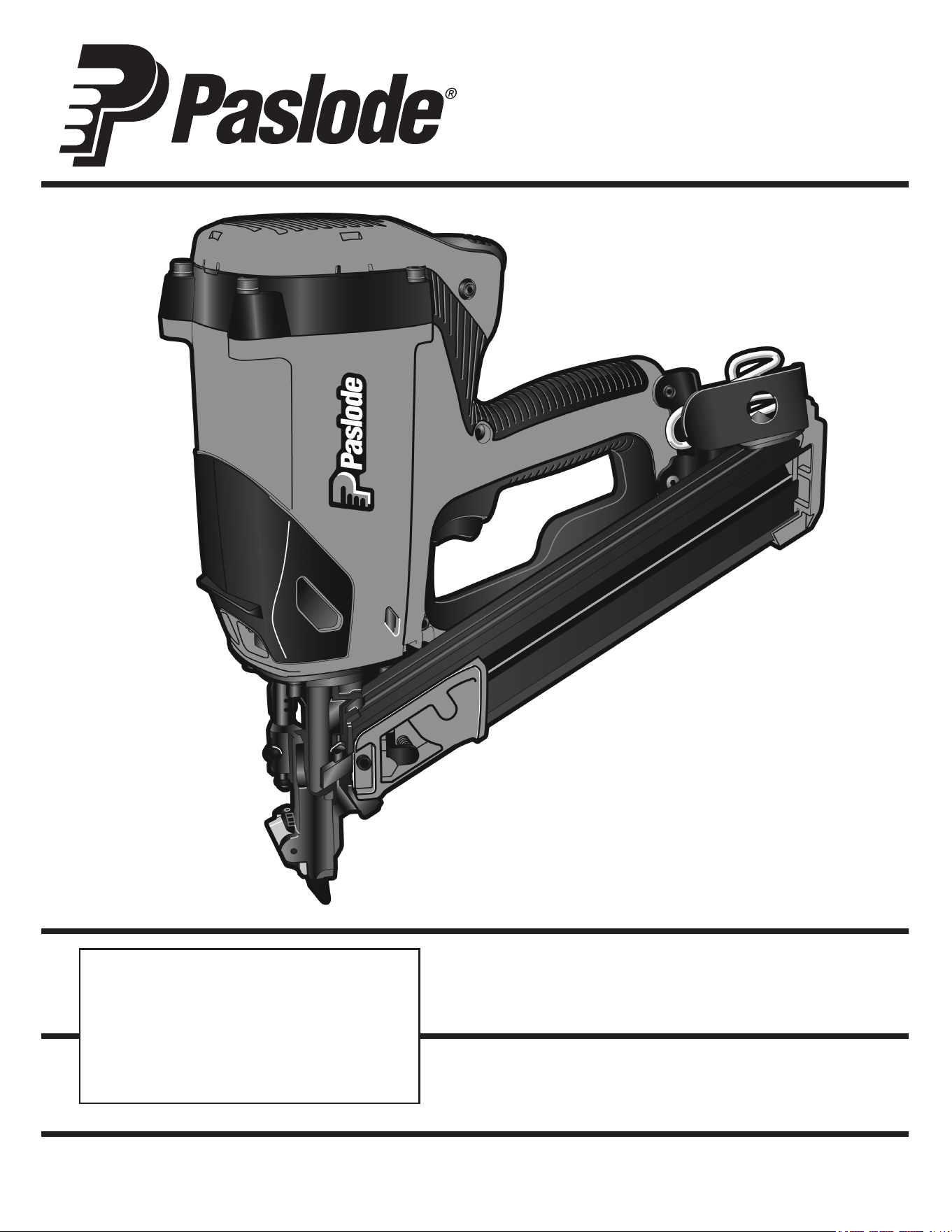
CLAVADORA INALÁMBRICA
POSITIVE PLACEMENT
®
DE 1-1/2"
MANUAL DE FUNCIONAMIENTO
Pieza No. 906200
www.paslode.com
Modelo CF150-PP
IMPORTANTE!
NO DESTRUYE ESTE MANUAL
El cliente tiene la responsibilidad de que
todo el personal de operaciones y servicio
lea y entienda este manual.
2
Contents
Subject Page
Introduccíon y Garantia.................................................................................................................................................... 3
Aspectos generales de la Clavadora............................................................................................................................... 4
Preparando la Clavador para uso...................................................................................................................................14
Funcionamiento de la Clavadora....................................................................................................................................15
Instrucciones de seguridad.............................................................................................................................................. 6
Batería y cargador de batería.......................................................................................................................................... 9
Cartucho de gas ............................................................................................................................................................... 11
Servicio.. ........................................................................................................................................................................ 16
Solución de problemas.................................................................................................................................................. 18
Paslode
®
es miembro de:
RBRC
RBRC
Li-ion
Tanto la bateríacomo el cargador de batería Impulse reúnen
todos los requisitos de seguridad de las herramientas
mecánicas.
es una marca registrada Paslode
An Illinois Tool Works Company
155 Harlem Avenue
Glenview, IL 60025
www.paslode.com
Las clavadoras eléctricas se ensamblan en
los Estados Unodos.
3
Introduccíon y Garantía
Términos de la garantía de Paslode
Manual de funcionamiento de una
herramienta Paslode Cordless
El propósito de este manual es familiarizarlo con la clavadora
para acabados de Paslode Cordless. A diferencia de otras
herramientas mecánicas, la clavadora para acabados está
accionada por un motor lineal de combustión interna, es
decir, un motor similar al de un automóvil. La clavadora
enciende la mezcla de combustible y aire para producir la
energía necesaria que hace funcionar el motor, el que ha su
vez hace funcionar la clavadora. Como verá, la clavadora
para acabados Paslode Cordless es completamente
autónoma: contiene su batería y combustible propios,
además de una provisión de clavos.
Este manual está dividido en secciones para facilitar su uso
(vea el Contenido). Todas las secciones fueron escritas
teniéndolo en cuenta a usted, el operador de la clavadora.
Hemos omitido todos los términos técnicos de modo que
usted pueda comprender cómo obtener el mayor rendimiento
de su clavadora Paslode Cordless y evitar lesiones
personales y daños a la clavadora. Con este propósito
usted debe:
1. LEER COMPLETAMENTE ESTE MANUAL ANTES
DE USAR LA HERRAMIENTA.
2. SEGUIR LAS INSTRUCCIONES DEL MANUAL.
La clavadora Paslode Cordless debe usarse con las
mismas precauciones que cualquier otra herramienta
mecánica, ya que su uso incorrecto podría causar lesiones
personales. Si le permite a otras personas usar su
clavadora Impulse , usted asume la responsabilidad de
que esas personas también lean y sigan las instrucciones
de este manual antes de usar la clavadora.
Si tuviera alguna pregunta acerca de la clavadora Paslode
Cordless o si quisiera obtener más copias de este manual,
comuníquese con su representante de Paslode®, cuya
información usted puede llenar a continuación.
Nombre
Direccíon
latsop ogidóC odatsEdaduiC
Número de teléfono
Paslode asume únicamente la responsabilidad de reponer cualquier
pieza o accesorio que se compruebe como defectuoso dentro del
período especificado. Cualquier pieza o accesorio de repuesto, entregado
de conformidad con esta garantía, gozará de la garantía por el período
restante de la garantía que cubría a la pieza o al accesorio originales.
Esta garantía no cubre las piezas que necesitan ser repuestas como
consecuencia de su desgaste normal.
Se cancelará esta garantía a cualquier herramienta que haya sido
usada incorrectamente, dañada accidental o intencionalmente, usada
con sujetadores, combustible, baterías o cargadores de batería que no
reúnan las especificaciones, el tamaño o la calidad de Paslode, o a la
que no se le haya dado el mantenimiento o el uso adecuado, o que haya
sido reparada con piezas que no sean marca Paslode, o que en opinión
de Paslode hayan sido modificadas o reparadas de manera que afecte
o sea contraria al funcionamiento de la herramienta.
PASLODE NO OTORGA NINGUNA GARANTÍA EXPLÍCITA O
IMPLÍCITA CON RESPECTO A LA COMERCIALIZACIÓN O
ADAPTACIÓN AL USO PREVISTO, O DE CUALQUIER OTRA
NATURALEZA, CON EXCEPCIÓN DE LO DECLARADO
ANTERIORMENTE, y la responsabilidad de Paslode TAL COMO SE
INDICA Y SE ASUME MÁS ARRIBA reemplaza a todas las otras
garantías que resulten o estén relacionadas con el uso y funcionamiento
de la herramienta, excepto según lo estipulen las leyes pertinentes.
PASLODE NO SERÁ RESPONSABLE EN NINGÚN CASO POR
NINGÚN DAÑO DIRECTO, INDIRECTO O CONSECUENTE
INCLUYENDO, PERO SIN LIMITARSE, CUALQUIER DAÑO
RESULTADO DE LA PÉRDIDA DE PRODUCCIÓN O GANANCIAS
ANTICIPADAS, EL DETERIORO DE MATERIALES, AUMENTOS EN
EL COSTO DE OPERACIÓN O CUALQUIER OTRO.
Paslode garantiza que sus herramientas mecánicas Cordless, sus
piezas y accesorios, que hayan sido comprados nuevos, están libres
dedefectos dematerial yfabricación porel períodoindicado másabajo,
a partir de la fecha de compra del comprador original.
GARANTÍA LIMITADA DE UN AÑO
La garantía de cinco años cubre todas las piezas moldeadas de nylon:
Bastidor del motor, tapa y rejilla
Accionador y secciones del mango
Gatillo
Piezas del cargador
Un año de garantía se aplicará a todas las partes, excepto aquellos
específicamente cubiertos por una garantía extendida.
DECLARACIÓN DE LA GARANTÍA
Esta garantía esta limitada a las herramientas vendidas y
revisadas en los Estados Unidos. Para obtener mas infor-
véa la lista de Centros de Servicio que fue proporcionada
con su herramienta.
mación sobre el servicio de garantía en los Estados Unido,
CORDLESS 2 YEAR SERVICE PROMISE
Paslode dará mantenimiento a la herramienta y reemplazará
de mantenimiento por 2 años, visite paslode.com.
y el sistema del cargador) que han fallado durante el uso
DE FORMA GRATUITA todas las piezas (incluyendo baterías
normal durante un período de 2 años a partir de la fecha de
compra.Para obtener los detalles y limitaciones de la promesa
4
Descripción Specifications
Dimensions: Weight-with battery 6.04 kg
Height 34.5 cm
Length 31 cm
Width 13.7 cm
Magazine 29 Clavos
(use solo Clavos Paslode Positive Placement
®
de 1-1/2")
Velocidad:: Funcionamiento intermitente - 2-3 clavos por segundo
Clavos: Clavos Paslode Positive Placement
®
de
.131-.148"
Capacidad
del cargador: 1 tira de clavos, o 29 grapas.
Información general sobre la Clavadora Inalámbrica
Paslode Positive Placement
®
de 1-1/2"
La Clavadora Inalámbrica Paslode Positive Placement
®
de 1-1/2" es una clavadora autónoma y portátil con un
singular motor de combustión interna y transmisión lineal
que funciona con hidrocarburo líquido.
Para entender mejor la información de este manual,
necesita tener un conocimiento básico de la Clavadora
Automática. Como puede ver en las ilustraciones de la
siguiente página, esta Clavadora tiene tres áreas princi-
pales: la empuñadura, el motor y el cartucho.
Al examinar la Clavadora, familiarícese con estas tres
áreas y los diferentes componentes que tiene cada una.
El conjunto del mango contiene el cartucho de gas, la luz
indicadora de la battería y el gatillo.
El conjunto del motor contiene la cubierta. el filtro y la tapa, el
bastidor del motor, la punta y el elemento de contacto.
El mecanismo de alimentacíon contiene la perilla de fijacíon del
cargador, el compartimiento de la batería,la palanca de liberacíon
del transportador, el transportador y el seguro.
NOTA: Si se excede esta velocidad, la clavadora se puede
sobrecalentar, dando como resultado una pérdida de eficiencia o
causando daños a los componentes de la clavadora.
Al usar la clavadora Paslode Cordless a su velocidad recomendada,
podrá clavar varios miles de clavos en un día normal de trabajo.
Batería : 7V de DC - Proporciona suficiente energía para
clavar aproximadamente
9,000
clavos en una
carga completa.
Cartucho
de gas:
Cartucho de gas amarillo
- Proporciona suficient
combustible para clavar 1000 clavos.
NOTA
La clavadora para acabados está accionada por un
motor lineal de combustión interna y puede ser
afectada por el altitud. La clavadora puede perder
fuerza en elevaciones de 6000 pies o más.
5
Información general sobre la Clavadora Inalámbrica
Paslode Positive Placement
®
de 1-1/2"
EMPUÑADURA DE
GOMA ERGONÓMICA
SONDA DE UBICACIÓN DEL
ORIFICIO DEL CLAVO
FUEL CELL LOADING
SOPORTE/APOYO
GANCHO PARA
CINTURÓN
SEGUIDOR DE BYPASS
GANCHO DE VIGA AJUSTABLE
VERDE INTERMITENTE
= CARGADO
ROJO INTERMITENTE
= NECESITA CARGA
AJUSTE DE PROFUNDIDAD
DE ACCIONAMIENTO
6
Instrucciones de seguridad
ADVERTENCIA
Mantenga SIEMPRE la
clavadora para acabados
Paslode Cordless, el
cartucho de gas y la batería
fuera del alcance de los
niños.
ADVERTENCIA
ADVERTENCIA
No exponga la herramienta
a temperaturas mayores de
49° C (120° F). El cartucho
de gas o la batería pueden
explotar, dejando escapar
gases inflamables.
La clavadora Paslode Cordless
es un equipo de combustión
interna. Produce gases de es-
cape calientes que pueden
e n cen derma t e ria les
inflamables. Esta clavadora no
debe usarse en ambientes
combustibles o en presencia
de materiales combustibles,
tales como productos químicos
inflamables, adhesivos,
gasolina o solventes.
PELIGRO
ADVERTENCIA
Sólo use esta herramienta
en un lugar bien ventilado,
ya que la herramienta emite
monóxido de carbono, de
forma similar a una sierra
de cadena o una podadora.
Si usted inhala monóxido
de carbono puede sufrir
mareos, nausea o pérdida
del conocimiento.
No intente usar esta
herramienta hasta que
haya leído y comprendido
todas las advertencias de
seguridad y las instruc-
ciones del manual.
Si no sigue todas las
advertencias de seguridad
y las instrucciones de este
manual puede sufrir la
pérdida permanente del
sentido de la vista,
lesiones personales graves
o hasta la muerte, además
de causar daños a la
propiedad y/o a la
herramienta.
7
ADVERTENCIA
Use siempre equipo de
seguridad para los OJOS y
los OÍDOS cuando trabaje
con la clavadora Paslode
Cordless o cerca de ésta.
1. Los protectores de ojos deben cumplir con las normas
ANSI Z87+ y deben tener protectores laterales para
mayor seguridad.
2. NUNCA ASUMA QUE LA HERRAMIENTA ESTÁ
VACÍA.
Nunca apunte con la herramienta hacia usted o hacia
otra persona.
3. NUNCA “JUEGUE” CON LA CLAVADORA.
La clavadora Paslode Cordless no es un juguete; es
una herramienta delicada. Si la usa sin cuidado o
incorrectamente puede sufrir un accidente grave.
4. NUNCA SOSTENGA LA HERRAMIENTA CON EL
DEDO SOBRE EL GATILLO U OPRIMIENDO EL
MISMO.
De esta forma se puede disparar accidentalmente un
clavo.
5. NUNCA USE UNA HERRAMIENTA QUE NO
FUNCIONE BIEN.
Consulte la sección de servicio o de detección y
corrección de fallas en este manual para corregir el
problema. Si no puede resolver el problema, deje de
usar la herramienta y notifique la situación a su super-
visor o al representante de Paslode.
6. NO CARGUE SUJETADORES CUANDO EL GATILLO
Y/O EL ELEMENTO DE CONTACTO ESTÉN
OPRIMIDOS.
Se puede descargar accidentalmente un sujetador.
7. NUNCA QUITE O DESHABILITE EL ELEMENTO DE
CONTACTO.
Este dispositivo ayuda a reducir la posibilidad de que se
dispare accidentalmente un sujetador, al evitar que la
herramienta funcione hasta que haga contacto
completamente con la superficie de trabajo.
NUNCA use la herramienta si el elemento de contacto
no funciona correctamente.
8. NUNCA APUNTE LA CLAVADORA HACIA USTED O
HACIA OTRAS PERSONAS CUANDO LA DESATORE
O CUANDO SAQUE LOS CLAVOS.
Tire del transportador ligeramente hacia atrás y oprima
la palanca de liberación. Incline la punta de la clavadora
ligeramente hacia arriba y los clavos deben salir por la
parte de atrás del cargador. Si los sujetadores están
atorados, consulte la sección de servicio apropiada de
este manual.
9. NUNCA USE LA CLAVADORA PASLODE CORD-
LESS SI TIENE PIEZAS FLOJAS, DAÑADAS O
FALTANTES.
10. NO CLAVE LOS SUJETADORES EN LOS NUDOS DE
LA MADERA O SOBRE OTROS SUJETADORES YA
INSTALADOS.
El sujetador puede rebotar y causar una lesión seria.
11. USE LA HERRAMIENTA SÓLO EN SU LUGAR DE
TRABAJO.
ADVERTENCIA
La clavadora se debe
usar solamente cuando
esté en contacto con la
superficie de trabajo.
Cuando clave sobre
materiales angostos como
madera contrachapada,
asegúrese de colocar la
clavadora de tal forma
que los clavos penetren
en la pieza inferior.
Instrucciones de seguridad
8
ADVERTENCIA
Nunca trate de usar la
clavadora en lugares que
deba alcanzar con
esfuerzo, ya que el
retroceso puede hacer que
pierda el equilibrio. Siempre
esté pendiente de las orillas
y los declives al clavar sobre
tejados y otros lugares al-
tos. Siempre colóquese de
manera que estos peligros
le queden de frente.
12. NUNCA CLAVE SUJETADORES EN ÁREAS QUE
TENGAN PELIGROS OCULTOS.
Siempre revise el área detrás de la superficie de
trabajo para ver si hay cableado eléctrico, tuberías de
gas o de agua, drenajes u otros peligros potenciales.
13. SIEMPRE PÁRESE FIRMEMENTE EN ESCALERAS,
PLATAFORMAS U OTROS LUGARES.
14. SÓLO PERMITA QUE EL PERSONAL CALIFICADO
USE LA CLAVADORA PASLODE CORDLESS.
ADVERTENCIA
15. ALMACENE CORRECTAMENTE EL CARTUCHO DE
GAS.
ADVERTENCIA
Siempre almacene el
combustible donde no
vaya a estar expuesto a
llamas, chispas o a
temperaturas superiores
a 49° C (120° F).
16. SIEMPRE GUARDE LA CLAVADORA SIN EL
CARTUCHO DE GAS.
Almacene el cartucho de gas en el maletín de la
clavadora.
17. MANTENGA LIMPIA LA CLAVADORA.
Es menos probable que una herramienta limpia se
atore o funcione incorrectamente.
18. MANTENGA LAS MANOS ALEJADAS DE LA
SUPERFICIE DE TRABAJO.
ADVERTENCIA
Es posible que algún
sujetador se dispare en
ángulo inesperadamente
y cause lesiones.
Sólo debe permitirse
usar esta clavadora a
personas que hayan
leído las instrucciones
de sequrudad y de
mantenimiento y que
comprenda su
funcionamiento.
INSTRUCCIONES DE SEGURIDAD
IMPORTANTES!
GUARDE ESTAS INSTRUCCIONES!
PELIGRO
INSTRUCCIONES DE SEGURIDAD
DEL SISTEMA DE CARGA!
PARA REDUCIR EL RIESGO DE INCENDIO
O DESCARGA ELÉCTRICA, CUIDADOSA-
MENTE SIGA ESTAS INSTRUCCIONES!
Para conexión a una fuente fuera de
América del Norte, utilice un adaptador de
conector de datos adjuntos de la configura-
ción adecuada para la toma de corriente, si
es necesario.
Instrucciones de seguridad
9
INSTRUCCIONES PARA CARGAR LA BATERÍA:
1.
2.
Saque la batería de la clavadora o del estuche e
introduzca las terminales en el cargador. La luz roja se
enciende indicando que la batería está cargando y se
apaga la luz verde.
NOTA
Si la batería se ha descargado por completo, las
luces roja y verde pueden destellarse intermitente-
mente hasta 20 minutos. Esta característica de
seguridad recarga lentamente la batería hasta que
esté lista de recibir la corriente de cargado completa.
Si las luces roja y verde siguen destellándose
después de 20 minutos, reemplace la batería.
3.
Después de cargarse, la luz roja se apagará y la luz
verde encenderá, asi indicando que la batería está
cargada completamente. El cargador mantendrá la
batería cargada por completo hasta que se quite el
mismo.
4.
TIEMPOS DE CARGA
aroh1.5agracaremirP
Batería completamente
descargada 5 minutos hasta1.5 hora
Accessorios:
De cargador de baterías - Part No. 902672
Notas importantes de carga
Batería y cargador de batería
ADVERTENCIA!
PELIGRO QUÍMICO Y
DE EXPLOSIÓN
Desechar la batería:
Las baterías contienen litio y deben reciclarse o dispon
-
erlo adecuadamente.
Favor de ponerse en contacto con su centro de reciclado
local para conseguir mayor información sobre la devolu-
ción de baterías de litio, o llame al 1-800-8 Battery
(1-800-822-8837).
La clavadora viene con una batería de litio (Li-ion) recar-
gable y con su propio sistema de carga. Esta combinación
de batería y sistema de carga es el único sistema que
funciona con la clavadora Paslode. El primer paso al pre-
parar una nueva herramienta para usarla es cargar por
completo la batería. La batería se envía con una carga
parcial y debe ser cargada completamente antes de usar
la por primera vez. La batería se tarda en recargar de 5
minutos a 1.5 hora ( tiempo de carga depende en la carga
de la batería al momento).
Retire el cargador de la caja de herramientas y conec-
tarlo a un tomacorriente de 120V CA. Establecer la
base del cargador sobre una superficie estable. Una luz
verde se enciende para indicar el aparato está encen-
dido y el circuito del cargador está listo.
Desenchufe el cargador del tomacorriente de 120V CA
Batería
Cargador
ENTRADA SOLO
Cable de 6 '
EL SISTEMA DEL CARGDOR DE BATERÍA PASLODE
Lea TODAS las instruccio
-
nes antes de cargar o usar
la batería. Si no se siguen
TODAS las instrucciones
pueden producirse incen-
dios, quemaduras serias o
liberación de materiales
tóxicos.
DURANTE LA CARGA:
1. Nunca cambie la batería a la intemperie en condiciones
de clima húmedo o con temperaturas inferiores a los
40°F (5°C).
2. No permita que objetos metálicos toquen las terminales
de la batería.
3. No perfore ni trate de abrir la caja de la batería o las
celdas.
4. No almacene la batería donde esté sujeta a temperatu-
ras superiores a los 49 C (120 F).
5. No incinere la batería.
6. No use un cargador de baterías defectuoso, ni uno que
se sobrecaliente o que produzca humo al conectarlo.
7. No ponga la bateria o el cargador en agua.
Eliminación de la batería:
Las baterías Paslode contienen litio y deben reciclarse o
desecharse adecuadamente.
Puede comunicarse con su centro de reciclaje local para
obtener información sobre dónde devolver la batería gastada
o llamar al 1-800-822-8837 para obtener información sobre
el reciclaje de baterías de iones de litio en su área.
10
Posición
de espera
Posición de
encendido
Luz indicadora
de la batería
FUNCIONAMIENTO CORRECTO DE LA BATERÍA
TECLA DE ENCENDIDO/APAGADO. La batería puede
trabarse en 2 posiciones: encendida y apagada
La luz verde indica que
la batería está cargada
La luz roja indica que la
batería necesita carga
1.
2.
4.
Para
sacar
la batería,
oprima
hacia
abajo
la
lengüeta
de fijación y deslice la batería hacia fuera.
Introduzca la batería, con los contactos por delante,
enla clavadora para acabados.
Empuje la batería completamente hacia adelante
hasta que se trabe en posición de encendido.
La luz indicadora de la
batería se iluminará.
Para desconectar la batería, presione hacia abajo
sobre el bloqueo ficha y respaldo de batería de
espera.
3.
NOTA: Si la batería se queda dentro de la clavadora
durante un período prolongado, se descarga por completo
y es necesario recargarla.
IMPORTANTE: Si las terminales de la batería llegaran a
corroerse y a ocasionar un mal contacto, limpie las terminales
con una tela de esmeril fina.
Luz indicadora de la batería
La ilustración es un acercamiento del mango de la clavadora
Impulse . En un lado del mango hay una pequeña lente de
plástico que es la luz indicadora de la batería.
Al colocar una batería completamente cargada dentro de la
clavadora, se enciende y se apaga una luz indicadora
verde. Si la luz indicadora parpadea en rojo, es necesario
recargar la batería.
Batería y sistema de carga
11
NOTA
La clavadora para acabados está accionada por un
motor
altitud. La clavadora puede perder
fuerza en elevaciones de
¡PELIGRO!
2.
.
.
Nunca intente recargar el cartucho! Reemplaze con
cartucho nuevo de combustible, y disponer de car-
tucho gastado correctamente.
Al sustituir el cartucho de combustible limpie o rem-
plaze el filtro de aire para óptima operación de la
herramienta.
NOTA: La restricción de altura
lineal de combustión interna y puede ser afectada por el
6000 pies o más.
2.
1.
Para un rendimiento óptimo de 6000 pies o
menos.
1.
No i
ntente remover ni reutilizar la Pila de Combustible
para la Clavadora Inalámbrica Paslode.
No intente instalar el cartucho de la tapa de
combustible en otros cartuchos de combustible.
Esto puede resultar en daños a la herramienta y del
perjuicio para el usuario y por standers!
Hay un segundo contenedor dentro de la Pila de Combustible
p
ara la Clavadora Inalámbrica Paslode. Este cont enedor
interior conserva el combustible. El espacio entre el
contenedor interior y el exterior cilindro está lleno de un
gas, llamado el propulsor,que está bajo presión.
Para expulsar el combustible, propulsor de la presión
aprieta el contenedor de combustible interno, en la medida
en que usted apriete un tubo de pasta de dientes. Esta
acción apretón asegura que todo el combustible se utiliza,
y que la Nailer inalámbrico puede operar en cualquier
posición.
Sin embargo, con el tiempo, la presión de combustible
disminuye hasta que ya no es capaz de exprimir el
contenedor de combustible interno. Por eso un nailer
mediante un cartucho de combustible más allá de la "Best
Use Before" fecha no funcionen sistemática o en absoluto.
Si expone la Pila de Combustible para la Clavadora
Inalámbrica Paslode vacía o vencida a temperaturas
extremas, el gas propulsor se expandirá y puede hacer
que el contenedor explote y libere gases inflamables.
El cartucho de gas contiene un poco de aciete para mantener
la herramienta lubricada durante el uso. No es necesario
lubricar la herramienta durante funcionamiento normal. Use
solo aciete Paslode Cordless para limpiar la herramienta. El
uso de aciete no formulados para la herramientas Paslode
Cordless puede causar perdida de potencia y podria dañar
las partes internas del motor de la herramienta.
¡PELIGRO!
PELIGRO DE
EXPLOSIÓN Y DE
INCENDIO
Lea TODAS las
instrucciones de
seguridad antes de cargar
o de usar el cartucho de
gas. Si no se siguen
TODAS las instrucciones
pueden producirse
explosiones o incendios.
Esto puede causar
lesiones personales
graves o daños a la
propiedad.
Mantenga el cartucho de
gas alejado del calor, las
chispas y las llamas. No
Si se expone a
temperaturas más altas
de 49° C (120° F) el
cartucho de gas puede
explotar, liberando gas
inflamable.
¡ADVERTENCIA!
La luz del sol puede elevar la temperatura interior de
un vehículo cerrado por encima de los 60° C (140° F).
Nunca perfore ni trate de abrir el cartucho de gas, ya
que no es rellenable.
Nunca incinere ni recicle el cartucho de gas.
Nunca fume mientras instala o usa la válvula
dosificadora.
Nunca inhale el rocío del atomizador.
Mantenga el cartucho de gas alejado de los niños.
Almacene las cartuchos de gas sólo en áreas bien
ventiladas.
Cartucho de gas
Cartucho de gas
fume al manipular u
operar la herramienta o el
cartucho de combustible.
12
Cartucho de gas
PELIGRO
Los cartuchos de gas Paslode cordless son inflamable. No
NOTA:
Los cartuchos de gas Paslode Cordless vienen con la fecha de expiración
marcada
Para maximo rendimiento use el cartucho de
Guía para el desecho de celdas de combustible para inalámbricos:
Paslode , el líder en la industria de la tecnología de herramientas inalámbricas, suministra esta información para asis tir a lous suarios el
desecho de las celdas de combustible para inalámbricos. Las opciones aceptables de desecho varían dependiendo del tipo de us uario de
celdas de combustible. Todos los usuarios deben considerar las regulaciones
locales, estatales y federales de desechos sólidos para asegurar
que las celdas de combustible sean desechadas apropiadamente. Los usuarios deben contactar a su autoridad local de desechos sól
idos para
una mayor orientación.
Las celdas de combustible desechadas (usadas o sin usar) pueden ser consideradas como residuos peligrosos bajo el acta de recuperación y
conservación de recursos (RCRA, por sus siglas en inglés), dependiendo de los diferentes factores descritos en los siguientes parágrafos. En el
momento del desecho, las celdas de combustible usadas o no usadas pueden ser clasificadas como desechos inflamables peligrosos (código
de desechos - D001) bajo las regulaciones EPA de los Estados Unidos.
Los desechos peligrosos generados por los propietarios de vivienda y por los constructores que llevan a cabo el mantenimiento de rutina para
los propietarios en sus viviendas, no son regulados por la RCRA. En general, los “desechos de viviendas” generados por los propietarios y sus
contratistas están exentos de las regulaciones de desechos peligrosos puesto que estos desechos están excluidos expresamente de
la
definición de desechos peligrosos. Por ejemplo, la EPA de los Estados Unidos ha excluido como “desechos de vivienda” las latas de los
aerosoles que contienen productos y propulsores residuales. Por lo tanto, bajo las regulaciones
federales de desechos peligrosos, los
propietarios de vivienda y los contratistas pueden desechar las celdas de combustible como desechos generales en un basurero municipal
apropiadamente permitido. Estos usuarios deben contactar a su autoridad de desechos sólidos para determinar si alguna regulación
estatal o
local prohíbe o restringe dicha disposición.
®
Paslode no asume ninguna responsabilidad por el desecho apropiado de las celdas de combustible. El desecho apropiado es responsabilidad
de los vendedores y usuarios. Todos los vendedores y usuarios deben contactar a su autoridad local de desechos sólidos para determinar si
alguna regulación local, estatal o federal prohíbe o restringe el desecho. Los usuarios pueden obtener más información acerca de las
regulaciones de la EPA de los Estados Unidos sobre desechos peligrosos en la siguiente dirección de Internet:
www.epa.gov/epaoswer/osw/hazwaste.htm
Alternativamente, los usuarios pueden contactar al Centro de Servicio RCRA de la EPA, Superfund y EPCRA de los Estados Unidos al 1-800-
424-9346 para obtener más información.
gas antes del la fecha de expiración marcada con “Best Use Before”.
con “Best Use Before” (abajo de la lata).
extraiga el tapón de cartucho de gas o instalar en otras células
de combustible!
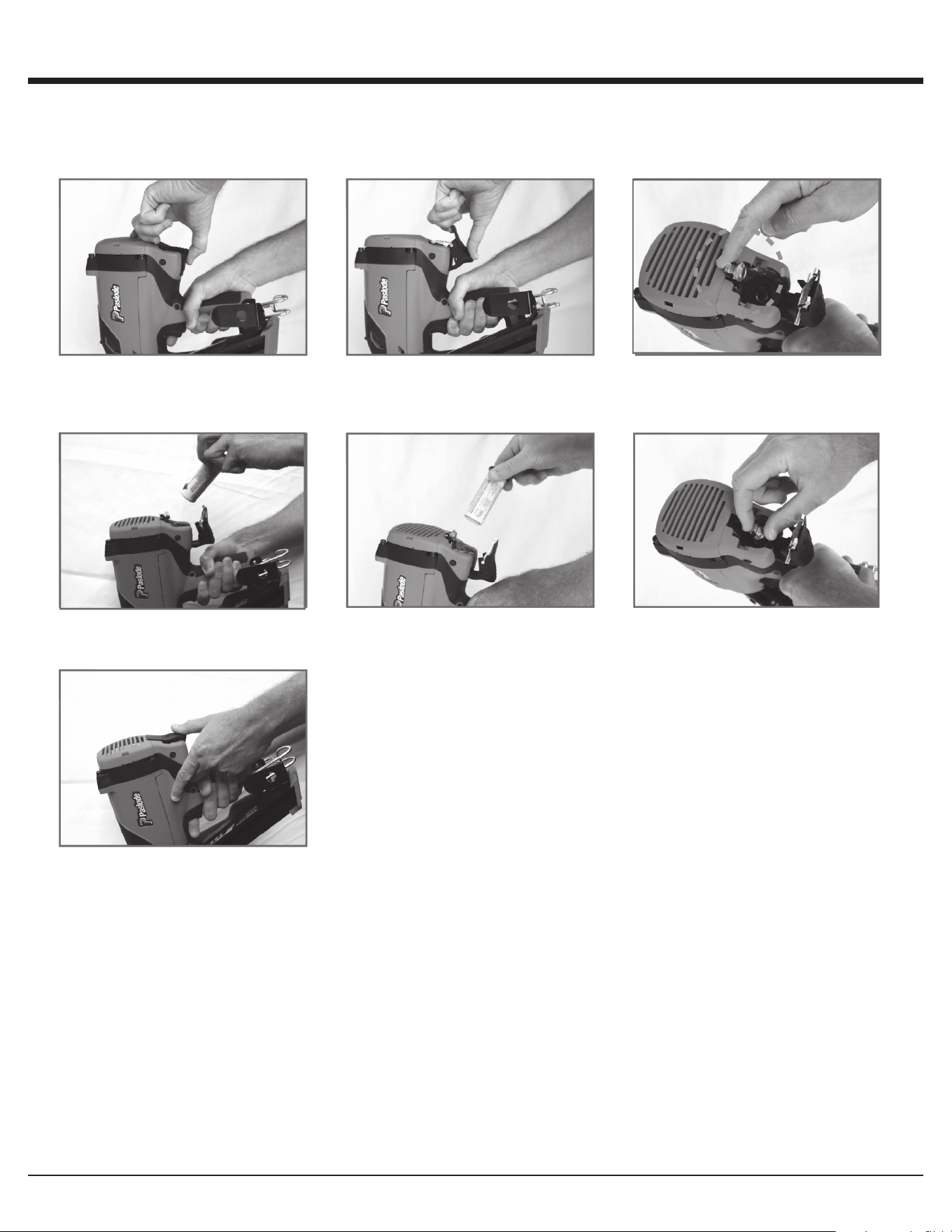
13
Cartuchodegas
PROCEDIMIENTO CORRECTO DE CARGA DE CÉLULAS
Para cerrar – empuje hacia
adelante y luego hacia abajo para
bloquear la puerta de combustible
Levante el conjunto del bloque del
tubo de combustible; se bloqueará
en la posición hacia arriba
Cargar celda de combustible Alinear cuidadosamente el
adaptador de combustible y el
tronco de la célula
Para abrir – empuje hacia
adelante, levante y luego
hacia atrás
Abrir conjunto de puerta de
combustible
Retire la pila de combustible
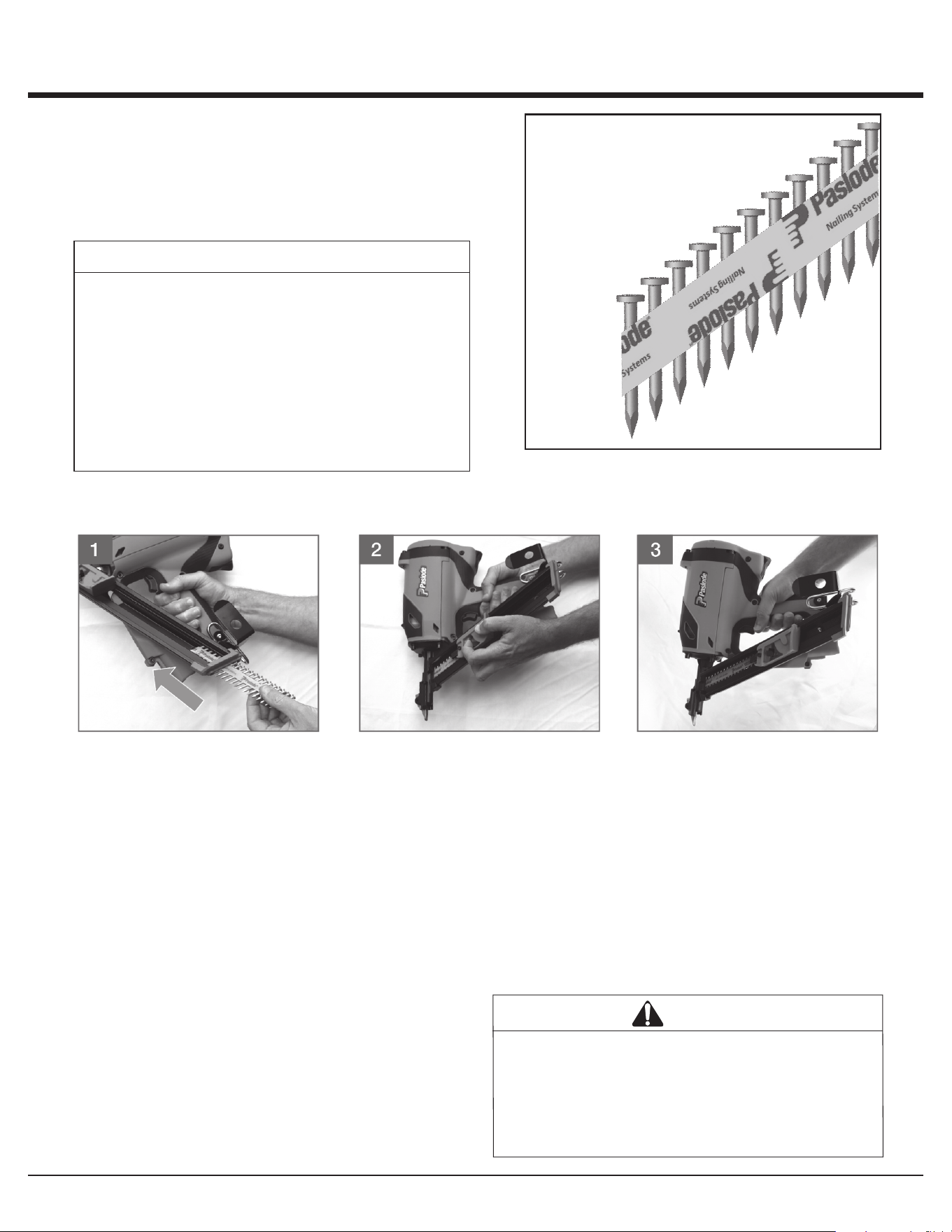
14
Uso de la Clavadora
Inalámbrica Paslode Positive
Placement
®
de 1-1/2" a la intemperie
Clavos
Use solo Clavos Paslode
Positive Placement
®
de 1-1/2"
Preparación de la Clavadora Inalámbrica
Paslode Positive Placement
®
de 1-1/2" para su uso
La Clavadora Inalámbrica Paslode Positive Placement®
de 1-1/2" se utiliza con Clavos Paslode Positive
Placement
®
de 1-1/2" diseñados para usar con esta
herramienta.
El uso de clavos que no satisfagan las
normas Paslode
puede causar daños a la herramienta y
anulará todas las reclamaciones bajo la garantía.
CORRECT NAIL LOADING PROCEDURE
Deslice la tira de clavos por la
parte posterior del cartucho
Baje la palanca y luego tire del
seguidor hacia atrás pasando la
tira de clavos
Vaya soltando el seguidorsuave-
mente hacia la parte posterior de
la tira de clavos, para evitar daños.
Característica de bloqueo
El objetivo de esta característica es evitar el ciclaje
automático en blanco que pueda estropear la madera,
desgastar el combustible y dañar los componentes de la
herramienta. Se dejarán cinco (5) clavos en el cargador,
cuando el seguidor alcance al área de bloqueo. Cuando
cambie la longitud de los clavos o cuando cargue al
comienzo del día de trabajo, debe inspeccionar el
cargador y la boca para verificar si permanecen clavos
algunos en el cargador. Estos clavos no serán visibles
a menos que se abra la boca de la herramienta.
Use la clavadora Paslode Cordless al aire libre, en
buen tiempo, cuando la clavadora, el cartucho de gas,
y la batería estén entre 20°F (-7°C) and 120°F (49°C).
Funcionamiento cuando hace calor
La clavadora Paslode Cordless necesita que el conjunto
del motor se enfríe para que funcione correctamente.
El ventilador generalmente produce el flujo de aire
necesario para permitir que funcione continuamente.
Siempre que la clavadora Paslode Cordless esté sin
usarse durante periodos prolongados, deje el combus-
tible y la clavadora en la sombra y en lugares donde las
temperaturas no excedan los 49° C (120 ° F). Después
de periodos prolongados de uso continuo, puede ser
necesario dejar enfriar el motor dejando de usar la
clavadora durante unos 10 ó 15 minutos o hasta que la
clavadora funcione normalmente. Si la clavadora se
sobrecalienta, es posible que los clavos no penetren
completamente o que la clavadora funcione
erráticamente.
Funcionamiento cuando hace frío
Cuando hace frío, los cartuchos de gas pierden la
fuerza necesaria de propulsión. Deje que la clavadora,la
batería y el cartucho de gas lleguen a la temperatura
mínima
de operación sin exponerlos directamente a
las llamas, y revise la batería.
ADVERTENCIA
La clavadora para acabados Paslode Cordless no
debe ser usada en la lluvia o donde haya demasiada
humedad. Si se usa la clavadora para acabados
angulada bajo estas condiciones se pueden dañar
sus componentes y la clavadora se puede averiar.
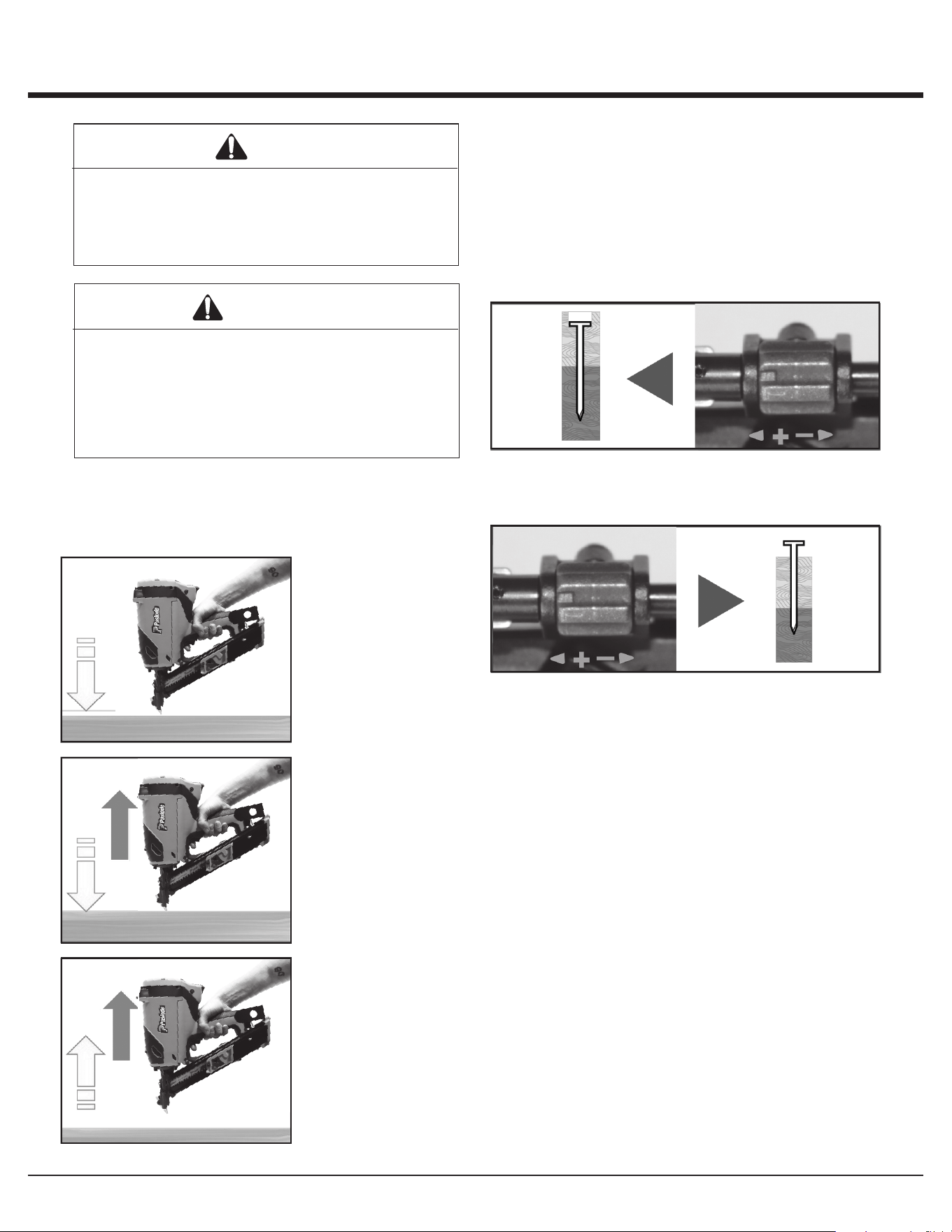
15
La Sonda de Ubicación del Orificio del Clavo y la
punta de la herramienta se calientan después del
uso prolongado o rápido. Si necesita ajustar la
Sonda, evite tocarla sin protección en las manos.
PRESIONE LA
SONDA DE
UBICACIÓN DEL
ORIFICIO DEL CLAVO
CONTRA LA SUPER-
FICIE DE TRABAJO
El ventilador del
motor arranca, el
combustible se
inyecta en la cámara
de combustión y el
ventilador lo mezcla
con aire.
APRIETE EL
GATILLO.
La bujía produce una
chispa y se enciende
la mezcla de combus-
tible y aire. La com-
bustión mueve el
pistón que impulsa el
clavo.
ENVANTE LA CLAVA-
DORA Y SUELTE EL
GATILLO.
La cámara de com-
bustión se abre. El
ventilador deja salir
los gases calientes y
enfría los componen-
tes internos.
AUMENTAR LA
PROFUNDIDAD DE
ACCIONAMIENTO
Contador
hundido
Orgulloso
DISMINUIR LA
PROFUNDIDAD DE
ACCIONAMIENTO
Funcionamiento de la Clavadora Inalámbrica
Paslode Positive Placement
®
de 1-1/2"
PELIGRO
ADVERTENCIA
Sólo use este herramienta en un l
ugar bien venti-
lado,ya que la herramienta emite monóxido de
carbono,de forma similar a una sierra de cadena o
unapodadora. Si usted inhala monóxido de carbon-
opuede sufrir mareos, nausea o pérd
ida del cono-
cimiento.
Ajuste de la profundidad con que se clava
Saque el cartucho de gas antes de ajustar la profundidad
con que se clava.
El ajuste de la profundidad con que se clava se realiza
ajustando la maneja del sonda no mar.
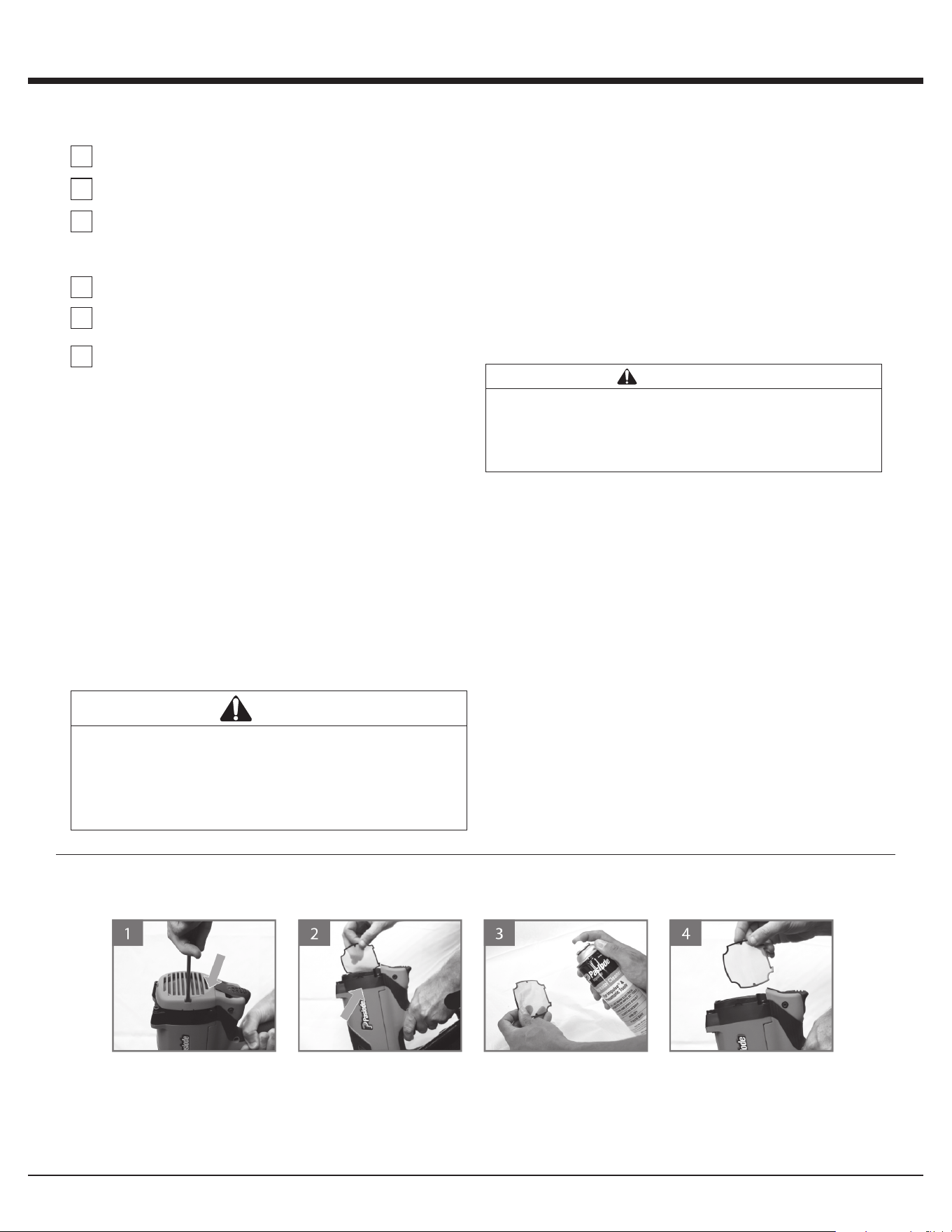
16
Use un destornillador
plano para retirar la
tapa
El filtro se puede
limpiar con limpi-
ador/desengrasante
o con agua y jabón
El filtro se verá como
nuevo
Golpee suavemente
el filtro contra la
superficie dura para
eliminar el polvo
En el lugar de trabajo limítese a:
REVISAR EL NIVEL DE ENERGIA DE LA BATERIA
RECARGAR LA BATERIA
REVISAR EL CARTUCHO DE GAS Y LA VÁLVULA
DOSIFICADORA
REEMPLAZAR EL CARTUCHO DE GAS
LIMPIAR EL FILTRO DE AIRE
DESATORAR LA CLAVADORA
Si intenta efectuar reparaciones mayores a las que indican
estos procedimientos, puede llegar a sufrir lesiones graves
o causar daños a la clavadora Impulse y anular la garantía.
Existen ciertos problemas a los que se puede enfrentar al
usar su clavadora Paslode, que usted mismo puede corregir
en el lugar de trabajo. Los siguientes procedimientos de
servicio son los únicos que debe intentar realizar por sí
mismo. Cualquier otro problema que tenga su clavadora
Impulse debe ser diagnosticado y reparado por un técnico
de servicio entrenado. Si considera que su problema es
más difícil de corregir que con los procedimientos de
servicio de este manual, póngase en contacto
inmediatamente con su representante de Paslode.
Servicio
Verificación de la celda de combustible
de entramado de Paslode
Si funciona el ventilador de la clavadora Paslode Cordless
y la luz indicadora está iluminada en verde, pero la clavadora
no dispara o no clava por completo los clavos, revise el
cartucho de gas. Cuando el cartucho de gas esté fuera de
la clavadora, revíselo para ver si aún contiene combustible
y si la válvula dosificadora está funcionando. Para comprobar
si queda combustible en el cartucho, sosténgalo en posición
vertical y simplemente coloque la aguja dosificadora contra
un objeto sólido y oprima unas tres a cuatro veces. Cada
vez que oprima debe salir una pequeña cantidad de com-
bustible.
Use los lentes de seguridad cuando haga este prueba.
Nunca lleve a cabo esta prueba cerca de una llama o
de chispas, mientras fuma, o donde el combustible le
pueda entrar en los ojos.
Si no sale combustible cada vez que active la aguja de la
válvula, significa que no hay más combustible en el cilindro
y que debe reemplazar el cartucho. Deseche el cartucho de
gas vacío de forma adecuada.
(vea la pagina 11)
Revisión de la batería
Revise periódicamente la luz indicadora de la batería, es
decir, la luz indicadora en el mango de la clavadora para
acabados. Cuando tenga un problema, el primer paso debe
ser siempre asegurarse de que la batería tenga suficiente
energía para hacer funcionar la clavadora.
Cuando se presiona el sonda no mar contra la pieza
de trabajo, arranca el motor del ventilador y la luz verde
parpadeante se ilumina en forma constante. Si la luz
indicadora se enciende en rojo, en forma parpadeante o
continua, recargue la batería.
Nunca intente hacer trabajos de mantenimiento en la
clavadora Paslode sin antes quitar el cartucho de gas
y la batería. El mantenimiento sólo debe hacerse
después de que la clavadora esté completamente
inoperable.
PELIGRO
PELIGRO
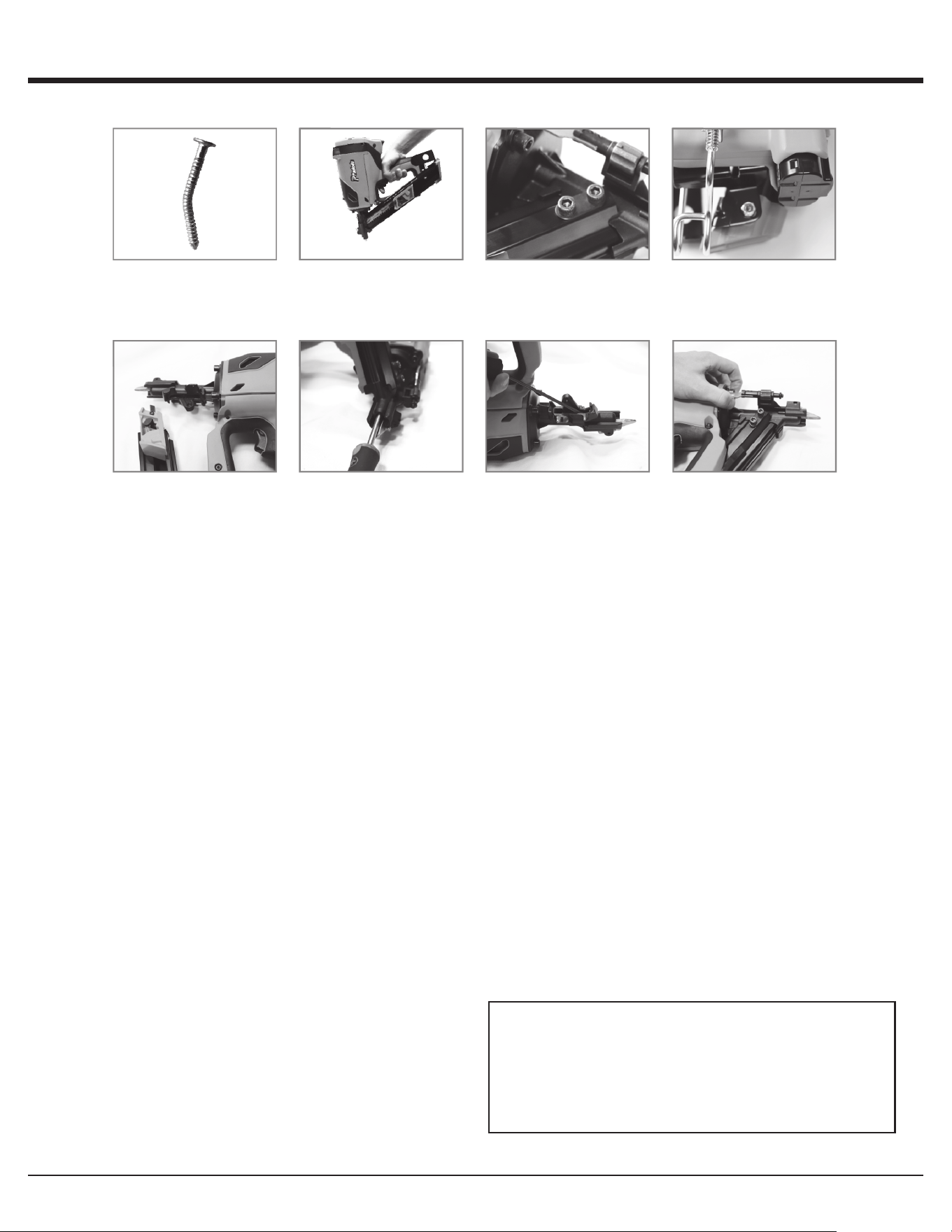
17
Servicio
4. Revise La Sonda de Ubicación del Orificio del Clavo
para asegurarse de que funcione correctamente.
Accesorios Paslode
Hay una variedad de accesorios disponsibles para la
Clavadora Inalámbrica Paslode Positive Placement®
de 1-1/2" :
Batería - Pieza No. 902654
Limpiador - Pieza No. 219348
Lentes de seguridad claros - Pieza No. 401382
Aceite lubricante Paslode - Pieza No. 401482
De cargador de baterías - Pieza No. 902672
Estuche de la Clavadora Inalámbrica Paslode
Positive Placement
®
de 1-1/2" - Pieza No. 906107
Póngase en contacto con su representante de
Paslode® para obtener informacion adicional.
CÓMO DESATASCAR LA HERRAMIENTA
Retire la batería, la
pila de combustible y
los clavos
Retire 2 tornillos del
lateral del cartucho
que sujetan el
cartucho a la punta
Retire el ensamble del
cartucho dejando a la
vista la parte trasera
de la ranura de la
punta. (Tenga cuidado
de que el seguidor de
clavos no se salga del
canal del cartucho)
Empuje o presione la
pala del motor para
que vuelva a su
posición superior
usando un punzón
largo (si es necesario)
Una vez apartada la
paleta del motor, ya se
pueden remover los
clavos atascados o
doblados
Vuelva a armar la
herramienta, ajuste el
cartucho a la punta,
coloque los tornillos y
la tuerca. La herra-
mienta ya está lista
para usar.
Retire la tuerca de la
parte trasera del
cartucho.
Rutina al final de un día de trabajo
Al final de cada día de trabajo lleve a cabo estos sencillos
pasos para mantener la seguridad y la eficiencia de la
clavadora para acabados.
Antes de salir de su lugar de trabajo:
1. Quite la batería y guárdela en el maletín de la clavadora.
Siempre use el maletín de la clavadora Paslode Cordless
para transportarla y almacenarla.
2. Deseche todos los cartuchos de gas vacíos. Recuerde
que debe desecharlos donde no los puedan encontrar
los niños y donde no puedan ser aplastados, perforados
o quemados.
Cuando llegue a casa:
1. Si la luz roja en el mango indica que la batería necesita
ser recargada colóquela en el cargador.
2. Limpie la clavadora para acabados con un paño limpio
y suave.
3. Saque y limpie el filtro cada dos días.
Clavadoras Paslode
Cada clavadora Paslode viene acompañada de una llave
hexagonal de 9/64 plg (pieza No. 900736).
Para ayuda tecnica en español llame:
1-800-334-4811.
e correo electrónico:
Limpieza y engrase de herramientas
Es necesario limpiar y engrasar periódicamente para que la
clavadora inalámbrica Paslode funcione correctamente. La
herramienta debe limpiarse y lubricarse al menos cada
50.000 ciclos. Este número puede variar según la velocidad
a la que se utilice la herramienta y las condiciones de
funcionamiento en las que se utilice. La tabla de las instruc-
ciones de limpieza le ayudará a determinar la frecuencia
con la que se debe limpiar la herramienta.
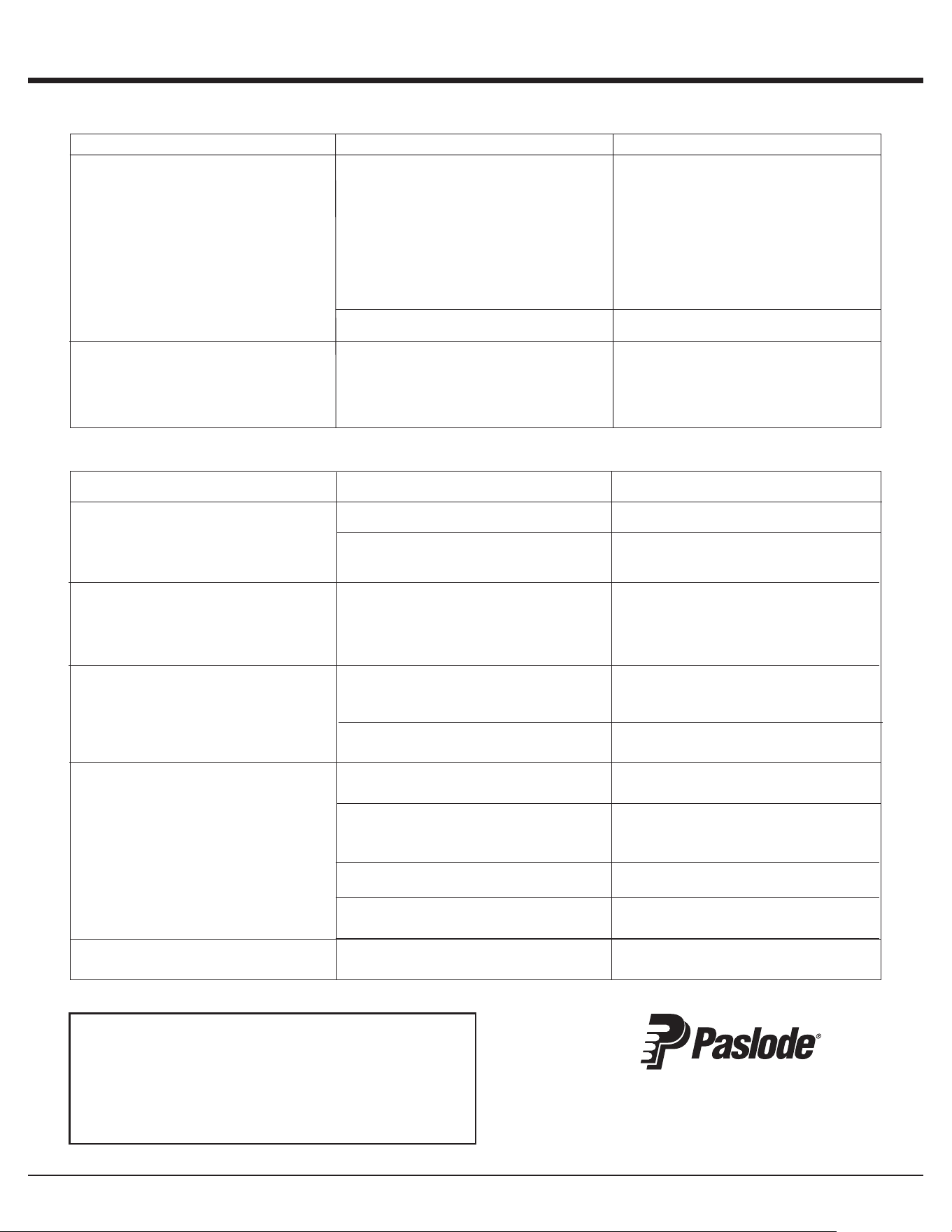
18
Preparación de la clavadora antes de usarla - Problemas con la batería o conel cargador
Detección y corrección de fallas
La Sonda de Ubicación del Orificio del Clavo
no llega a presionarse por completo –
la herramienta no funciona.
La Sonda de Ubicación del Orificio del Clavo
está doblada o tiene residuos acumulados que
restringen su funcionamiento.
La traba está activada.
Retire y revise la Sonda. Limpie la vía.
Repare o cambie la sonda si es necesario.
Agregue una tira de clavos.
Pruebe la batería en la herramienta después
de un ciclo de carga. Si la luz indicadora de la
clavadora está verde, el cargador no está
funcionando debidamente. Cambie el cargador
o regule el tiempo de carga para asegurarse de
que la batería tenga el tiempo adecuado para
recargarse. Es normal que la batería se sienta
tibia después de haberla cargado
correctamente.
Obtenga una batería nueva.
Deje de usar el cargador de inmediato y
desconéctelo de la fuente de energía. Cambie
el cargador y coloque una etiqueta en el
cargador defectuoso para evitar que alguien lo
conecte accidentalmente o lo vuelva a usar.
La batería no parece aceptar la carga cuando
el cargador se conecta a la batería o cuando
la batería está conectada en el cargador de 3
horas.
El cargador se calienta, hace demasiado ruido
o produce humo durante el ciclo de carga. El
cable del cargador o el transformador de pared
se calientan.
Las luces indicadoras en el cargador no
funcionan, o el cargador está defectuoso.
La batería está dañada o se ha terminado su
ciclo
de
vida.
SÍNTOMA POSIBLES PROBLEMAS SERVICIOS
SÍNTOMA POSIBLES PROBLEMAS SERVICIO
El cargador está dañado.
La clavadora no clava, pero el ventilador sí
funciona. La luz indicadora está iluminada
constantemente en verde.
La pila de combustible se está agotando
o está demasiado fría.
El cable que produce la chispa no está conectado
a la bujía.
La bujía está sucia.
No se producen chispas.
Cambie la pila de combustible o consulte
la guía climática de arriba.
Quite la cubierta y revise la bujía, coloque la
bujía y vuelva a colocar la cubierta.
Limpie la culata del cilindro de la clavadora
y bujía.
Envíe la clavadora a su distribuidor autorizado
Paslode para que la repare.
Durante el funcionamiento normal
El ventilador no funciona - la luz indicadora de
la clavadora está iluminada constantemente o
parpadeando en rojo.
El ventilador no funciona, o funciona más
lentamente de lo normal - la luz indicadora de
la clavadora está iluminada constantemente
en rojo.
La batería no está cargada.
Limpie las terminales de la batería con una tela
de esmeril fina.
La batería está descargada.
Cargue la batería.
Las terminales de la batería tienen grasa,
corrosión o están sucias.
Cargue la batería.
La herramienta no se enciende pero el ventilador
funciona, la batería está cargada y hay combustible
en la celda.
Driver Blade está atascado.
Quite los clavos, la batería y el combustible.
Utilice la llave Allen proporcionada para volver
a colocar la cuchilla de transmisión en su posición.
Si la herramienta no funciona después de seguir las instrucciones deservicio, devuelva la herramienta asu representante Paslode®
para que reciba servicio.
Para ayuda tecnica en español llame:
1-800-334-4811.
e correo electrónico:
An Illinois Tool Works Company
155 Harlem Avenue
Glenview, IL 60025
www.paslode.com
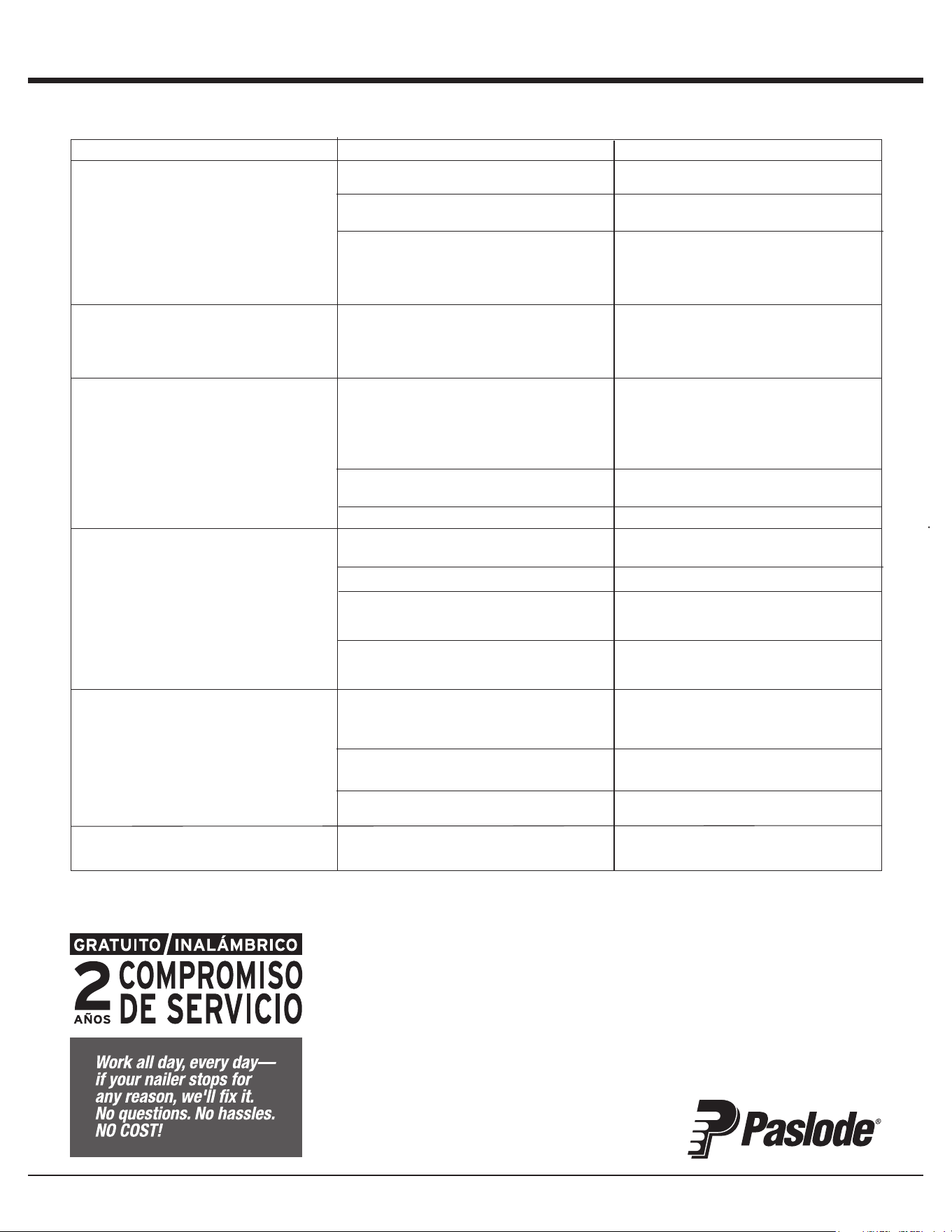
18
19
La Sonda de Ubicación del Orificio del Clavo
debe ajustarse.
La Sonda de Ubicación del Orificio del Clavo
no está bien ajustada para el tipo de material
que estoy clavando
Ajuste la Sonda.
Presione La Sonda de Ubicación del Orificio del
Clavo contra la madera por un minuto. Presione
el gatillo. Si no sale el clavo, quiere decir que
hay una pérdida y se necesita reparación.
Ajuste la Sonda. Vuelva a ajustarla las veces
que necesite si cambia la densidad o el
espesor del material que está clavando.
La Sonda de Ubicación del Orificio del Clavo
está doblada o sucia.
Detección y corrección de fallas
La herramienta funciona correctamente, pero
los clavos no penetran por completo.
La herramienta funciona correctamente, pero
los clavos a veces penetran demasiado y a
veces no penetran lo suficiente.
La herramienta funciona pero no dispara los
clavos.
La herramienta funciona erráticamente o
parece perder potencia - la luz indicadora de
la clavadora está verde.
El nivel de combustible cartucho de gas está
bajo.
Puede haber fugas en la cámara de combustión.
Está usando clavos incorrectos.
El transportador no está bien ajustado detrás de
la tira de clavos.
La clavadora tiene clavos atorados.
La pila de combustible se está agotando o
está demasiado fría.
El cable de la bujía está suelto.
El filtro está sucio, y hace que se sobrecaliente
la clavadora.
La camisa de la herramienta o los anillos en “O”
están sucios.
Revise el cartucho de gas y cámbielo si es
necesario.
Use sólo clavos que cumplan con las
especificaciones de Paslode. Revise la
sección de Sujetadores y aplicaciones para
ver los tipos y tamaños recomendados en
esta clavadora Paslode Cordless
Coloque el transportador detrás de la tira de
clavos y sujételo.
Saque los clavos atorados.
Revise el cartucho de gas.
Revise el cable de la bujía..
Quite el filtro y límpielo. Use agua y
jabón
para limpiar la suciedad difícil de quitar.
Limpie la herramienta.
Durante el funcionamiento normal
SÍNTOMA POSIBLES PROBLEMAS SERVICIO
La clavadora funcionó y clavó el clavo, pero la
hoja del impulsor no volvió a la posición
superior.
La cámara de combustión no baja después de
que funciona la herramienta.
Se ha acumulado suciedad en la hoja del impulsor
o en el orificio de la punta de la clavadora.
La sección interior de la clavadora está sucia o
deshabilitada.
La camisa de la clavadora o los anillos O están
sucios.
Limpie la hoja del impulsor y el orificio de la
punta con un limpiador desengranaste.
Envíe la clavadora a su proveedor Paslode
para que reciba servicio.
Limpie la clavadora.
Limpie el carril o cambie el sonda no mar.
¿No funciona todavía? Aquí hay más opciones:
•
Su clavadora puede calificar para nuestra promesa de mantenimiento por 2
años para productos inalámbricos. Visite paslode.com para obtener más
información o llame al 1-800-334-4811.
•
Mantenga su clavadora inalámbrica en plena forma. Visite paslode.com
y mire nuestros vídeos sobre limpieza y mantenimiento.

LEYENDA DE LAS PIEZAS
× Ítem de desgaste normal
•
Incluido en el Kit de Reparación
Aplicar Loctite
®
242 (Azul)
CN Cuando sea necesario
PARTS LEGEND PASLODE IM40 POSITIVE PLACEMENT NAILER B60001
1 919042 1 Rejilla 44 919130 1 Manija para mano derecha
×
2 900455 1 Filtro 45 900662 1 Mazo de cables, UEE
3 901065 4 Tornillo SHC 10-24 x 1-1/4 46 916258 1 Unidad de Encendido Electrónico (UEE)
4 906222 1 Tapa 47 919092 2 Tuerca, Nyloc 10-24
5 900902 3 Tornillo TF SEMS 8-32 x 5/8 48 901095 1 Ensamble de teclas deslizantes
6 902637 1 Tope 49 919068 1 Ensamble del tablero de circuito
7
902635
1 Ensamble del motor, Ventilador 50 918903 2 Almohadilla, Gomaespuma (Batería)
8 900287 1 Ensamble de bujías 51 404702 3 Tornillo TF 6-19 x 3/8
9 401356 1 Camisa, Motor del ventilador 52 919120 1 Ensamble del gatillo
10 904517 1 Espiga de combustible 53 903728 2 Ensamble de terminales, Bujía
11 904546 1 Tubo de combustible 54 919063 1 Ensamble de terminales, Motor del ventilador
12 902405 1 Bloque de combustible 55 919079 1 Contratuerca - Gancho utilitario
13 904521 1 Brazo pivotante, Tubo de combustible 56 919076 1 Botón de gancho utilitario
14 919219 1 Tapa de cilindros -Todos los climas 57 919077 1 Bloque de gancho de utilidad
×
•
15 919067 4 Aro sellador, Tapa de cilindros y Camisa 58 919078 1 Resorte - Gancho utilitario
16 403167 1 Ensamble de las palas del ventilador 59 919075 1 Gancho utilitario
17 906223 1
Ensamblaje de la cámara de combustión: todo clima
60 904532 1 Clip de alambre
18 919065 4 Tornillo TX SEMS 8-32 x 3/8 61 904705 1 Cuerpo de bloqueo: moldeado
19
919213
1 Soporte, Traba de la cámara 62 919217 1 Resorte de bloqueo
20
919004
1 Aro, Aro de retén 63 919215 1 Pasador de bloqueo
×
21 906120 1 Ensamble de la transmisión y pistón 64 906129 1 Manija para mano izquierda - MOD
22 900612 2 Aro sellador, Pistón 65 906118 1 Ens. del gancho para cinturón y soporte
23 919125 1 Ensamble de la Camisa 66
906114
2 Tornillos del soporte y gancho para cinturón
24
900595
4 Tornillo TX SEMS 8-32 x 3/8 67
901066 2
Tornillo TF TX 8-16 x 3/4
25
919010
1 Tapa, Silenciador 68 919093
2
Tornillo 10-24
26
919049
1 Silenciador 69 502338 2 Tornillo SHC 1/4-28 UNF x 1/2
×
•
27 919009 1 Válvula Reed 70
502323 1 Placa perforada, Cartucho
28 919011 1 Placa Reed 71
906215 1 Ensamble del cartucho
29 919016 1 Deflector, Escape 72
092037
2 Tuerca, traba
×
•
30 919014 1 Sello, Escape 73
408302 2 Arandela, Plana
31 919017 1 O-Ring 74
502329 1 Tope, Cartucho
32 919012 1 Defensa 75
906150 1 Perno SHC 10-32 x 1
33 919046 1 Resorte, Horquilla 76
502226 1 Resorte, Negator
34 919123 1 Ensamble de la horquilla 77
502025 1 Ensamble de tambor y pasador
35 018956 1 Rueda, Ajuste de profundidad 78
502335 1 Barra de bloqueo
36 919110 1 O-Ring, Retén 79
502340 1 Pasador, Rodillo
37 919142 1 Ensamble del alojamiento 80
502318 1 Cuerpo, Seguidor
38 906102 1 Punta 81
500627 1 Tornillo SHC 8-32 x 1/2
39
906141
1 Ensamble de la sonda 82
502020 1 Resorte, Seguidor
40 919108 4 Tornillo SHC SEMS 1/4-20 x 7/8 83
513101 1 Palanca, Seguidor
41
919161 1
Ensamble de la compuerta del combustible
84
513116 1 Ensamblaje del seguidor
84
513116 1 Follower Assembly
42
919116
2 Tornillo SCH 8-32 x 3/8
43 919115 2 Buje
.
×
•
×
•
×
•
×
•
Part No. 906200
Modelo CF150-PP
Diagrama
Retire la batería y los clavos antes de comenzar la reparación.
Use protección ocular y auditiva al usar/probar las herramientas.
Use protección ocular al limpiar las herramientas.
Use el desengrasador en un área bien ventilada.
ADVERTENCIA: Todas las piezas deben revisarse
periódicamente y cambiarse si están gastadas o
rotas. No hacerlo puede afectar el funcionamiento de
la herramienta y presentar un peligro para la
seguridad.
20
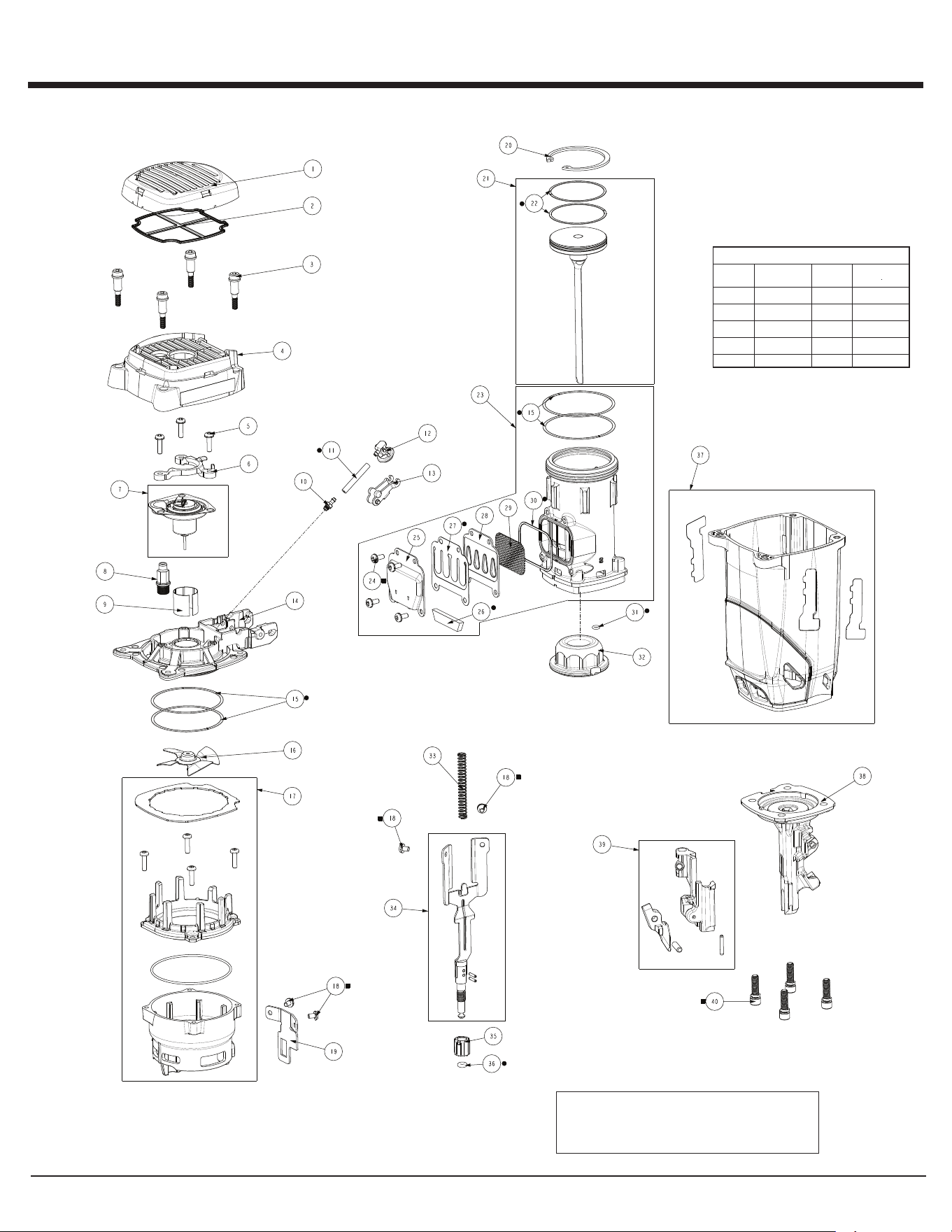
WARNING: All parts must be periodically inspected and replaced if worn or damaged.
Failure to comply can affect the tool's operation and present a safety hazard.
Incluido en el Kit de Reparación
Aplicar Loctite
®
242 (Azul)
•
Part No. 906200
Modelo CF150-PP
Diagrama (continuación)
Todas las piezas se venden como componentes individuales
salvo que se indique que es un paquete o conjunto o que
forma parte de un ensamble (una caja con diferentes
componentes). Las piezas que no tienen número de ítem solo
están disponibles en un ensamble.
21
Valores de par (in/lb)
Artículo
Esfuerzo de
torsión
Esfuerzo de
torsión
Artículo
3 55-60 19 30-35
5 30-35 25 30-35
8 20-25 27 30-35
41 155-165
10 15-20
16 8-10
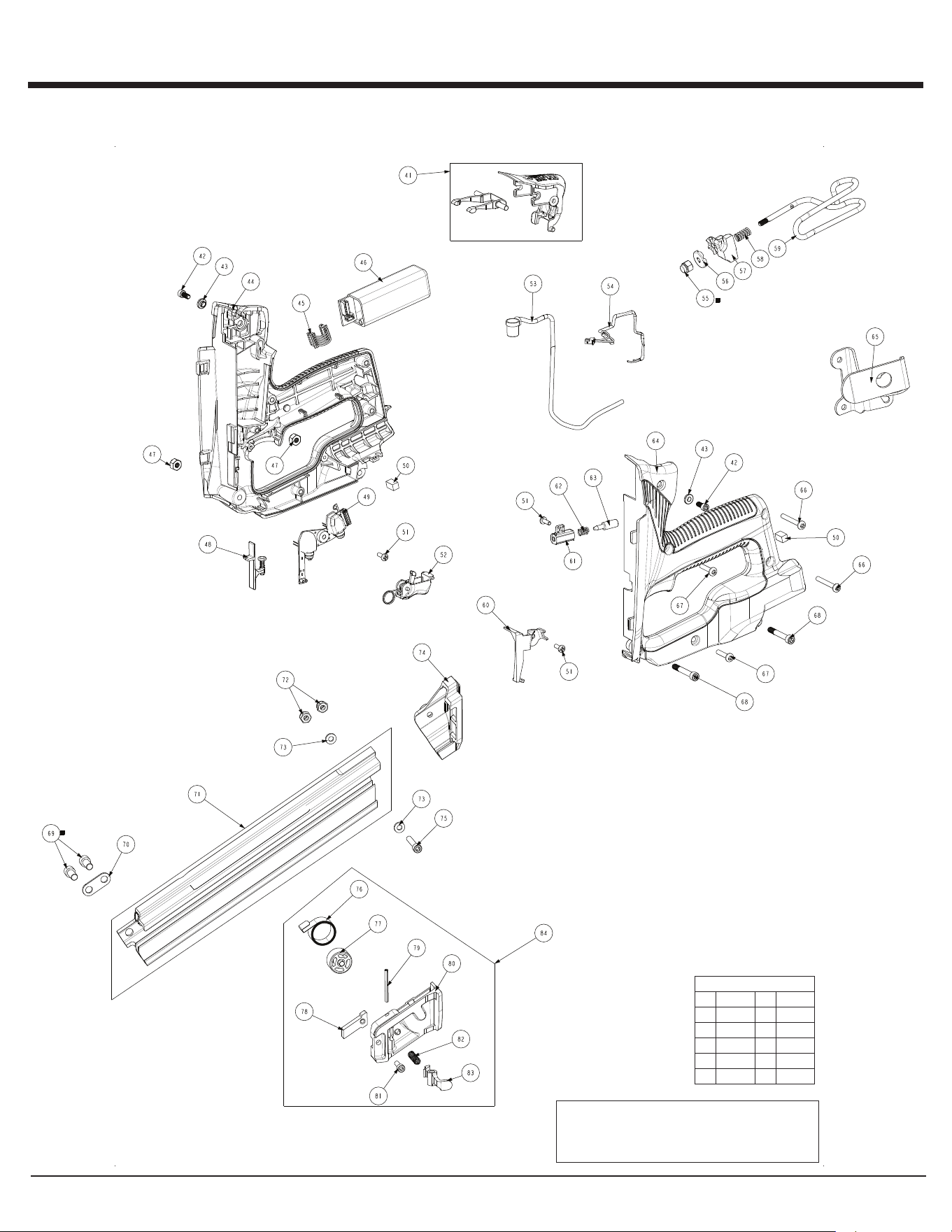
Valores de torsión (in/lb)
Ítem
Torsión
Ítem
Torsión
43 30-35 70 35-40
52 6-8 76 35-40
67
18-22 82 18-22
68 18-22
55-65
69 25-30
Part No. 906200
Modelo CF150-PP
Diagrama (continuación)
Todas las piezas se venden como componentes individuales
salvo que se indique que es un paquete o conjunto o que
forma parte de un ensamble (una caja con diferentes
componentes). Las piezas que no tienen número de ítem solo
están disponibles en un ensamble.
Incluido en el Kit de Reparación
Aplicar Loctite
®
242 (Azul)
•
22

Notas
23

Notas
24