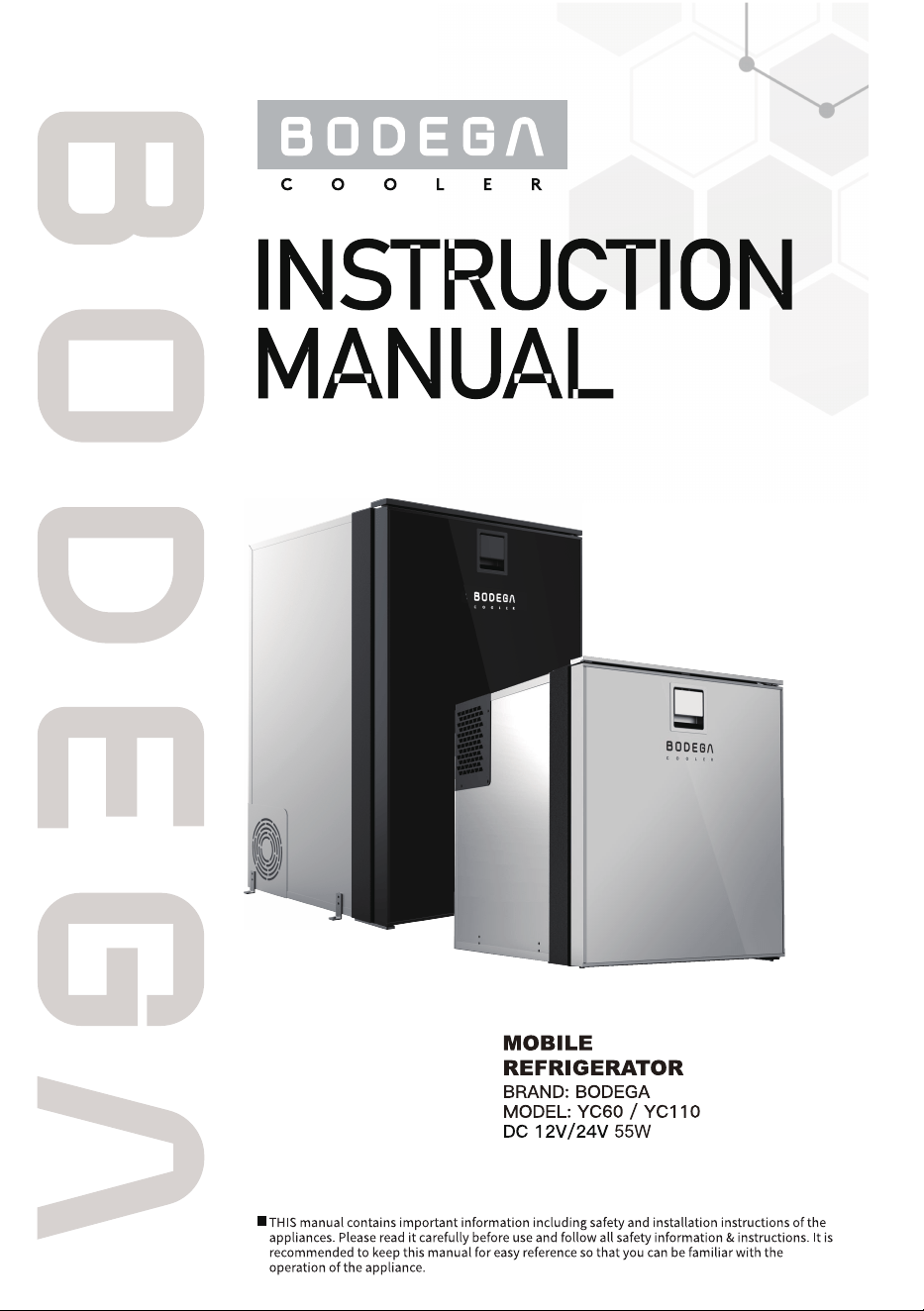

MOBILE
REFRIGERATOR
1
3
3
4
5
6
6
7
8
9
10
10
11
11
Safety Information
Getting Started
Specifications
Wiring Instruction
Ventillation Options
Moving the Door Hinge
Moving the Shelf
Brackets
Sketch Map Of Main Parts
Operation
Cooling Tips
Care and cleaning
Troubleshooting
Error codes
English
NOTICE
Please read the user manual and safety instructions carefully before using the appliance.
◆ By ignoring the safety instructions, the manufacturer cannot be held responsible for the damage.
◆ The use of accessories that are not recommended by manufacturer can cause injuries and will
invalidate any warranty that you may have.
◆ The appliance shall not be exposed to moderate/heavy rain.
◆ Place the refrigerator on a dry, secure surface, with adequate ventilation.
◆ Do not leave the refrigerator unattended in uncovered, outdoor areas exposed to the elements.
◆ Do not use this appliance near direct heat sources, such as an open flame or radiator.
◆ Do not place open containers of liquid inside the fridge.
◆ Please don't put hot/warm food into the fridge directly without letting it cooling off.
Place/arrange the content of your fridge securely when using the refrigerator inside a moving vehicle.
◆ To maximize energy savings, please make sure the lid is closed and secure, and only open the
fridge when you need to.
◆ The power cable must only be replaced by qualified technical personnel and by an assistant body
authorized by the manufacturer.
◆ Before carrying out any maintenance operations on the refrigerator, disconnect all power sources
from the fridge.
◆ Further information is provided on the technical data label inside the product.
● Please keep the fridge in a well ventilated area.
● Do not use mechanical devices or other means to accelerate the defrosting process, other
than those recommended by the manufacturer.
● Do not use electrical devices inside the food storage compartments of the appliance, unless
approved/recommended by the manufacturer.
● The appliance is only to be used with the power supply unit provided with the appliance.
● It must only be supplied at safety extra low voltage corresponding to the marking on the appliance.
● To avoid contamination of food, please respect the following instructions:
– Opening the door for long periods can cause a significant increase of the temperature in the
compartments of the appliance.
– Clean regularly surfaces that can come in contact with food and accessible drainage systems.
– Store raw meat and fish in suitable containers in the refrigerator, so that it is not in contact with
or drip onto other food.
– If the refrigerating appliance is left empty for long periods, switch off, defrost, clean, dry, and
leave the door open to prevent mould developing within the appliance.
CAUTION
Safety Information
1
English
Food needs to be packed in bags before putting into the refrigerator, and liquids
need to be packed in bottles or capped containers to avoid the problem that the product design
structure is not easy to clean.
WARNING!
CORRECT DISPOSAL OF THIS PRODUCT
INTENDED TO USE
WARNING!
● Do not store explosive items, such as aerosol cans with a flammable propellant in this appliance.
● Risk of fire and electrical shock.
● Do not let hot items touch the plastic parts of the appliance.
● Do not put flammable products or items in, near or on the appliance.
● Do not touch the compressor or the condenser when the fridge is operating. They may be very hot.
● When setting up the appliance, ensure the supply cord is not trapped or damaged.
● Do not locate multiple portable socket-outlets or portable power supplies at the rear of the appliance.
● This appliance is not intended for use by persons (including children) with reduced physical,
sensory or mental capabilities, or lack of experience and knowledge, unless they have been given
supervision or instruction concerning use of the appliance by a person responsible for their safety.
● Children should be supervised to ensure that they do not play with the appliance.
● If the supply cord is damaged, it must be replaced by the manufacturer, its service agent or similarly
qualified person in order to avoid a hazard.
● Do not store explosive substances such as aerosol cans with a flammable propellant in this
appliance.
To prevent possible harm to the environment or human health from uncontrolled waste
disposal, recycle it responsibly to promote the sustainable reuse of material resources. To
return your used device, please use the recovery systems or contact the retailer that they
can take this product for environmental safe recycling.
Risk of child entrapment.
Before you throw away your old refrigerator or freezer:
-Take off the doors.
-Leave the shelves in place so that children may not easily climb inside.
This appliance is intended to be used in household and similar applications such as :
● staff kitchen areas in shops, offices and other working environments;
● farm houses and by clients in hotels, motels and other residential type environments;
● bed and breakfast type environments;
● catering and similar non-retail applications.
2
English
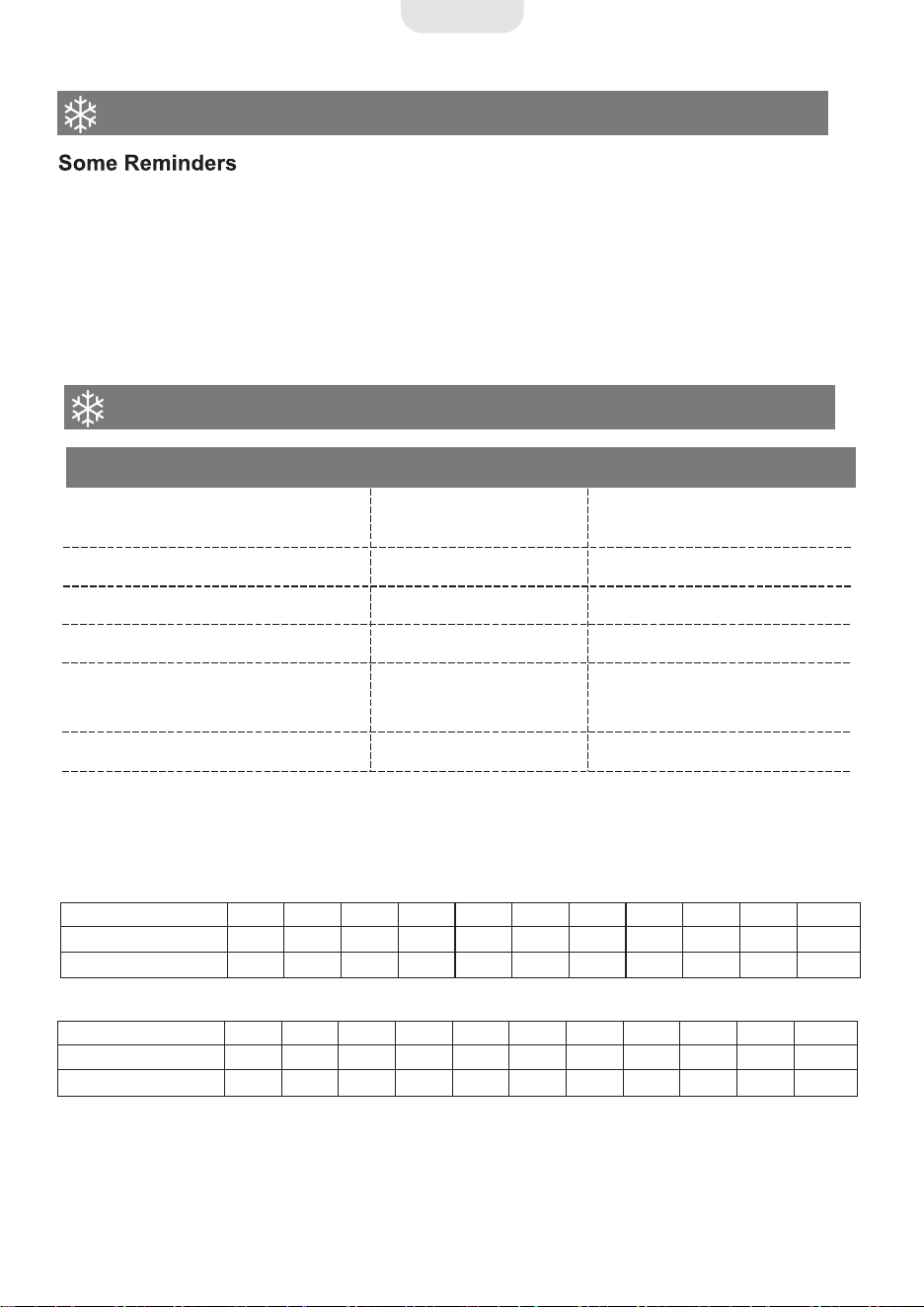
Model
Dimensions (WxDxH)
Capacity
Refrigerant
Temperature range
YC110YC60
528x528x801(mm)455x526x535(mm)
55W
R1234yf (65g)R1234yf (25g)
1
2
Voltage DC 12V / 24VDC 12V / 24V
3
Average power consumption
55W
4
5
6
Fridge: 32 to 50ºF / 0 to 10ºC
*Freezer: 5 to 32ºF / -15 to 0ºC
*
0 to 10ºC
Fridge: 32 to 50ºF /
17.9x20.7x21.1(inch) 20.8x20.8x31.6(inch)
YC110 Temperature range
(Unit: °C)
(Unit: °F)
Setting
Fridge
Freezer (adaptive)
0℃ 1℃ 2℃ 3℃ 4℃ 5℃ 6℃ 7℃ 8℃ 9℃ 10℃
0℃ 1℃ 2℃ 3℃ 4℃ 5℃ 6℃ 7℃ 8℃ 9℃ 10℃
-15℃ -13℃ -11℃ -9℃
-7℃ -5℃ -4℃ -3℃ -2℃ -1℃ 0℃
Setting
Fridge
Freezer (adaptive)
32℉ 33℉ 35℉ 37℉ 39℉ 41℉ 42℉ 44℃ 46℉ 48℉ 50℉
32℉ 33℉ 35℉ 37℉ 39℉ 41℉ 42℉ 44℃ 46℉ 48℉ 50℉
5℉ 8℉ 12℉ 15℉
19℉ 23℉ 24℉ 26℉ 28℉ 30℉ 32℉
1. Keep the device upright for 24 hours to make sure that the compressor can work
properly.
2. If the device can't turn on or you encounter other problems for first time use, please
contact us for help.
3. Pre-cool the empty unit before using it to enhance system efficiency.
For model YC110, only the fridge compartment's temperature can be modified.
The temperature of freezer compartment cannot be adjusted manually; it syncs automatically
with that of the fridge compartment.
Getting Started
Specifications
116.2 Qt / 110 L63.4 Qt / 60 L
3
English
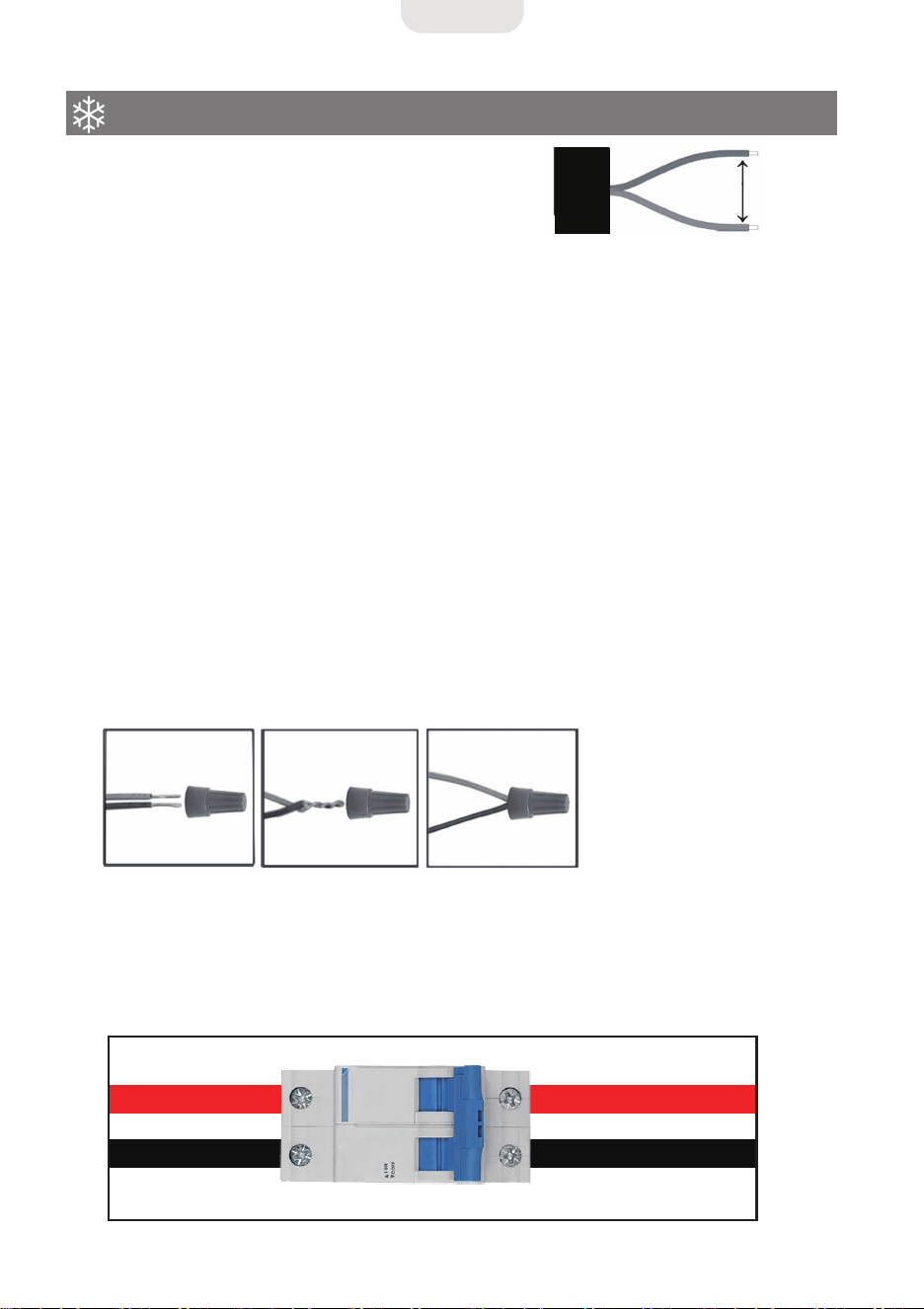
Connect the DC power cable to a 12V or 24V power source.
The appliance is designed to operate on DC only.
When connecting to the power source with the stripped cable:
1. Strip off the insulation sheath from the cable, and connect it to a compatible power supply using a
standard wire connector or circuit breaker. (See below for wiring instructions)
2. Join the red wire from the refrigerator to the positive terminal of the power source, and the black
wire to the negative terminal.
NOTE:
1. The wire connector and circuit breaker are sold separately. It is advisable for you to opt for an
appropriate connection.
2. Make sure the connection is insulated to prevent short circuits.
3. Reversing the positive and negative connections can damage the refrigerator, so be careful.
Wire Connector Usage (Sold Separately)
Take the red wire from the refrigerator and the positive terminal of the power source as an example.
1. Strip the ends of 2 wires (Pic 1).
2. Twist them until they bind together (Pic 2).
3. Twist the connector clockwise while inserting the wires to fix them (Pic 3).
Remember, RED for positive, and BLACK for negative.
Circult Breaker Usage (Sold Separately)
1. Connect the wires to the circuit breaker by inserting it into the terminal and tightening the screw.
2. When all wires are secured, turn the circuit breaker to the "on" position.
Remember, RED for positive, and BLACK for negative.
Pic 1
Pic 2
Pic 3
Red Wire
Black Wire
Positive Terminal
Negative Terminal
Black (-)
Red (+)
DC 12V / 24V
Wiring Instruction
4
English
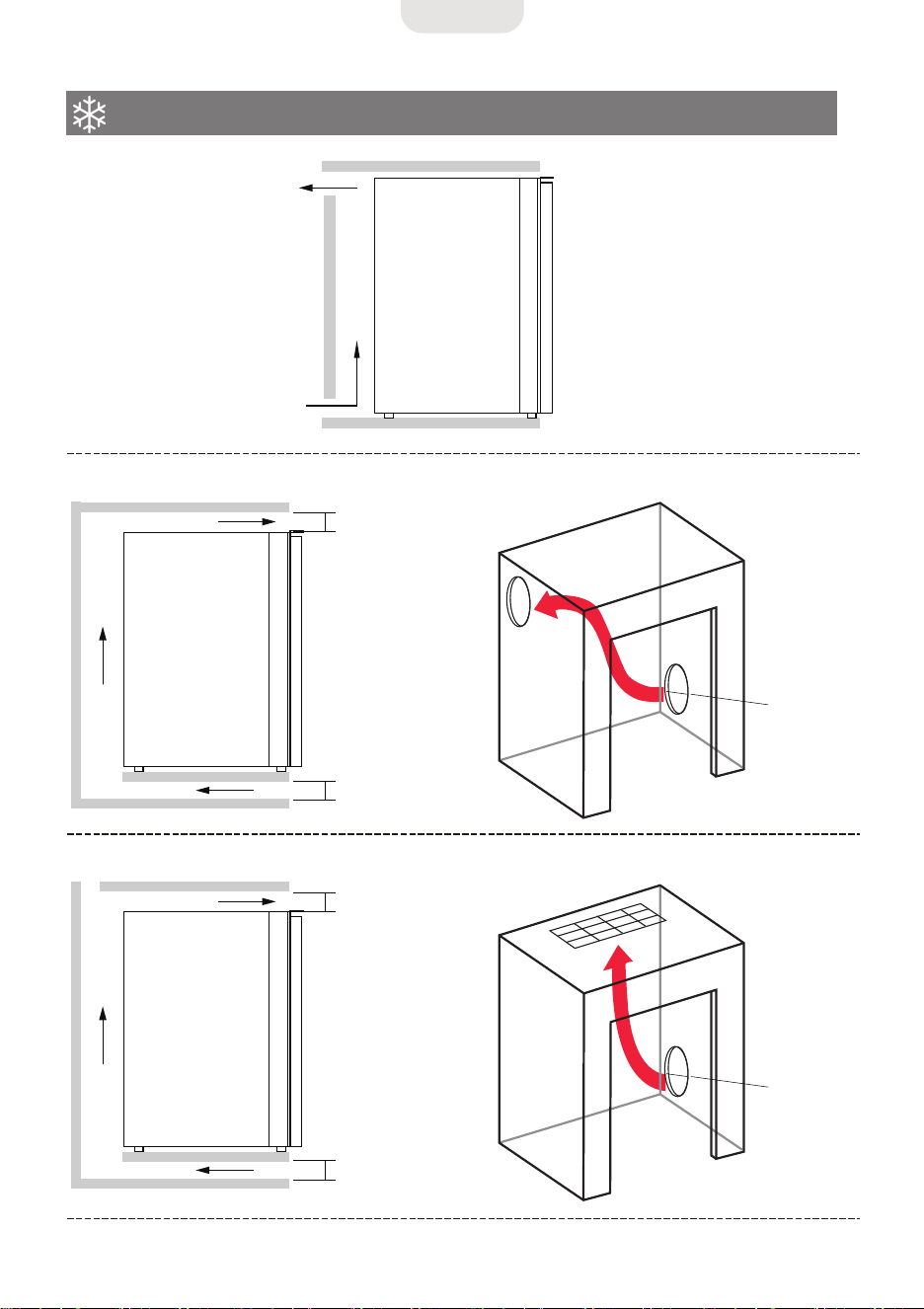
min 60 mm
(2.36 inch)
min 60 mm
(2.36 inch)
min 60 mm
(2.36 inch)
min 60 mm
(2.36 inch)
min 200 mm
(7.87 inch)
min 200 mm
(7.87 inch)
Exterior Ventillation
Interior Ventillation Option 1 Interior Ventillation Option 2
Interior Ventillation Option 3 Interior Ventillation Option 4
min. 400 cm² (62 sq.in)
Ventillation Options
5
English
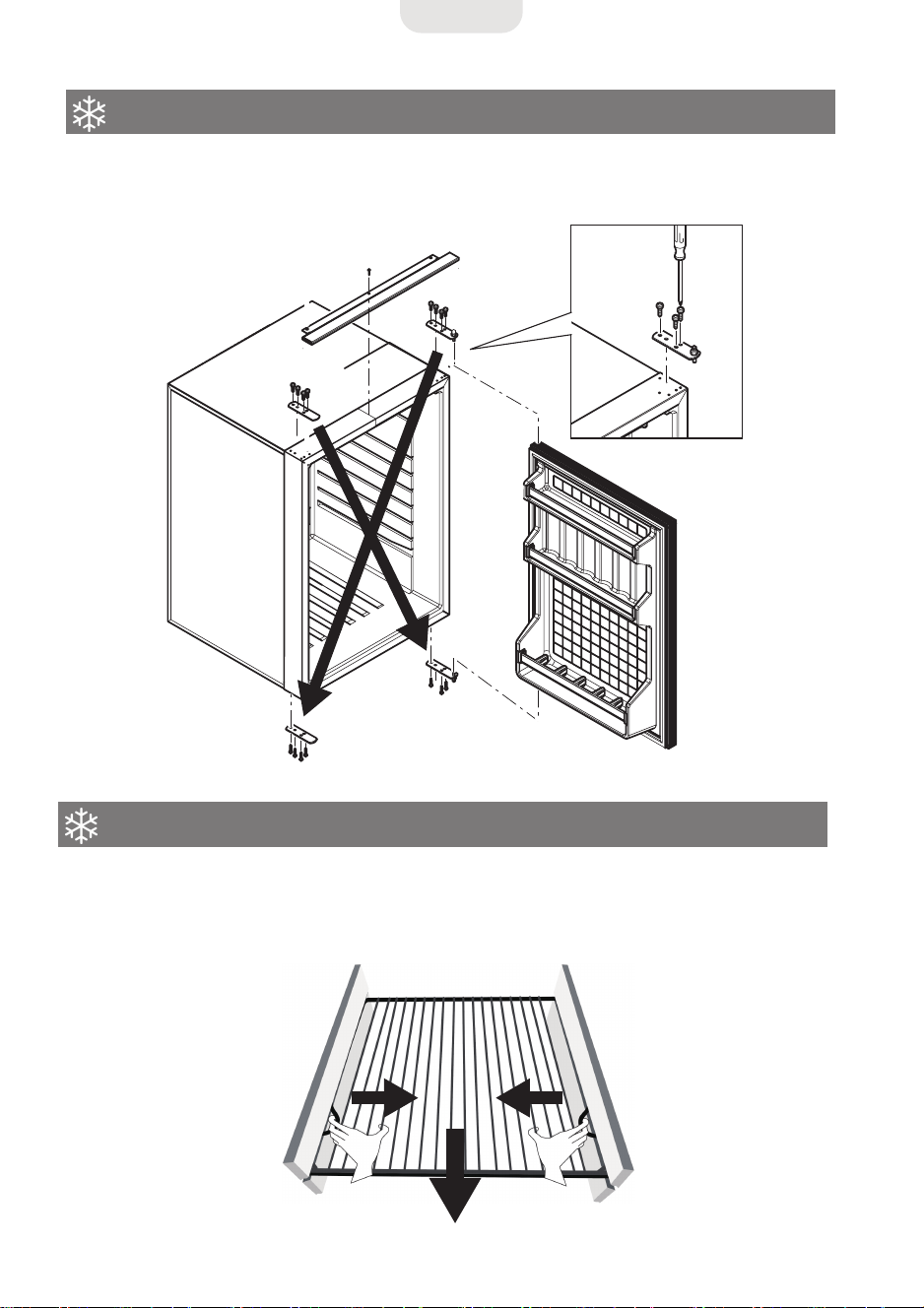
Remove the screws securing the top and the fastening pins, remove the door, and reverse the fastening
hinges as illustrated below. Then re-insert the door and re-tighten all parts.
Moving the Door Hinge
Moving the Shelf
To change the position of the shelf, follow below procedures:
1. Open the door fully to a straight position of 180 degrees.
2. Remove all the objects from the shelf.
3. Clamp each side of the shelf and pull it out. (See below figure)
Switch the pins
across the
diagonal.
6
English
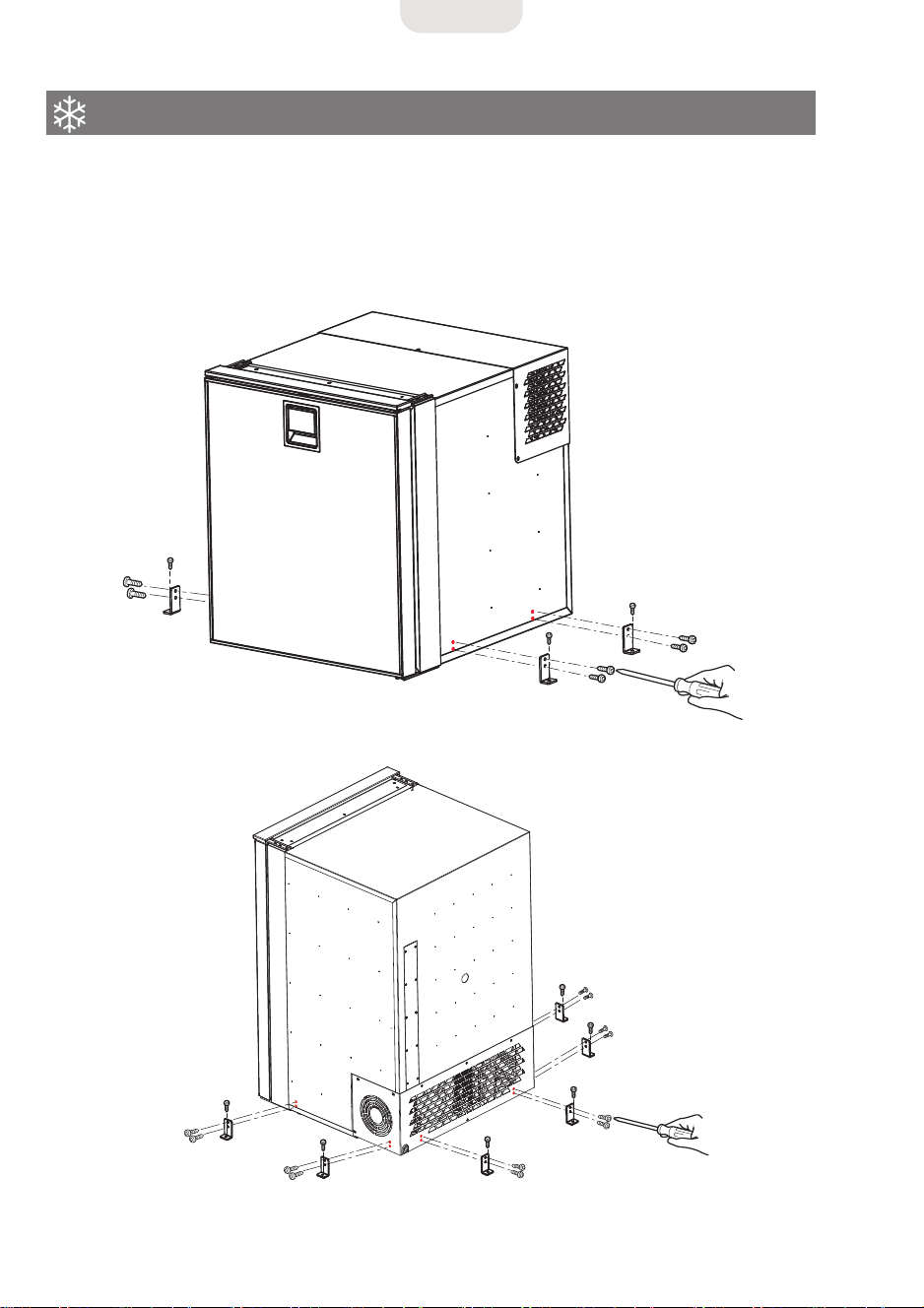
1. The refrigerator is equipped with 4 mounting brackets and 4 screws.
2. There are 6 attachment points on the refrigerator. Choose 4 of these points, and remove 2 screws
from each.
3. Secure the bracket to the refrigerator using the screws that were just removed.
4. Use the 4 screws provided, secure the refrigerator in the intended position.
YC60
YC110
Brackets
7
English
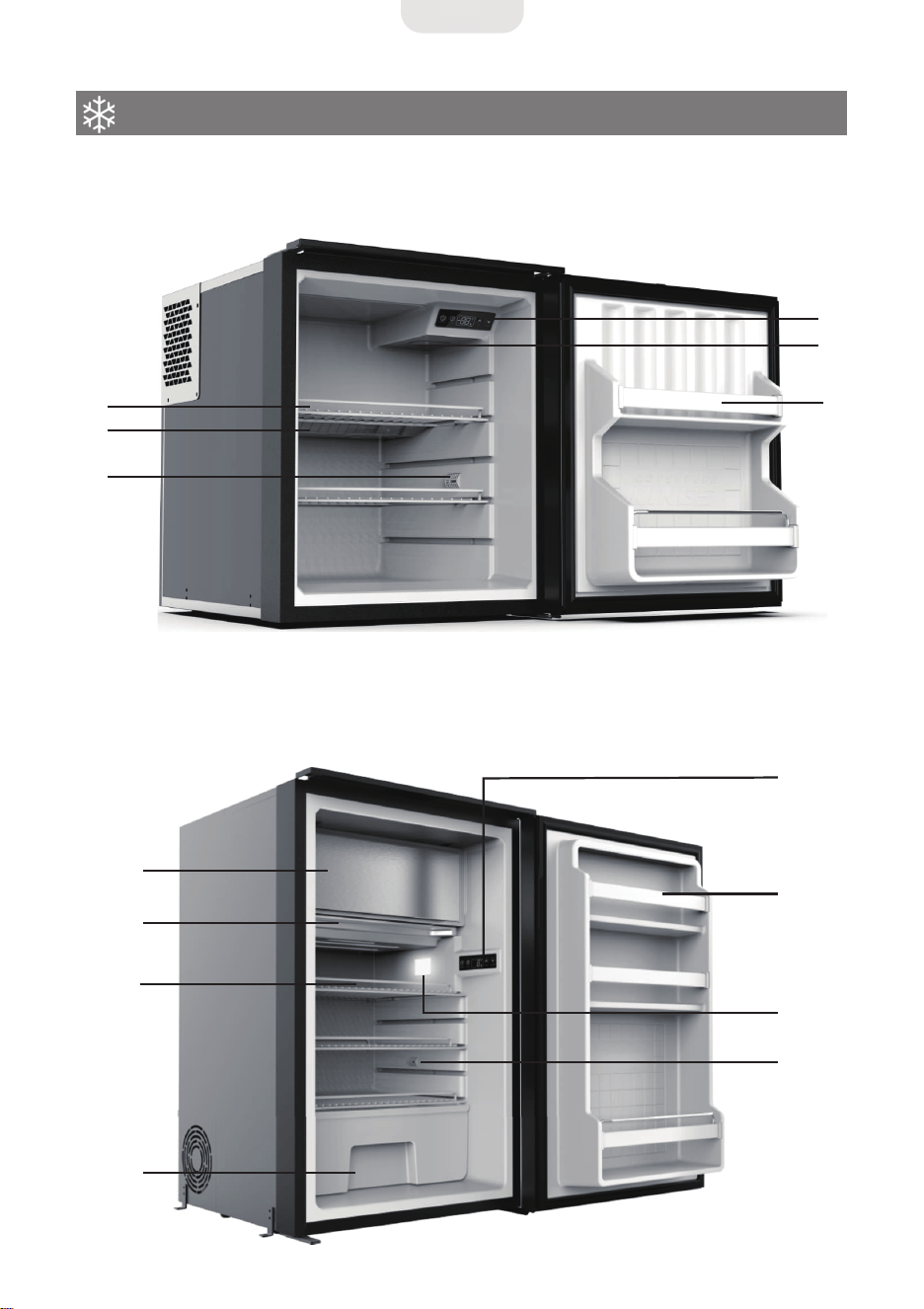
YC60
A
C
D
B
E
F
F. Retainer
B. Shelf C. Water Tray D. NTC E. LED LightA. Control Panel
YC110
D
A
B
C
E
G
H
H. NTC
B. Water Tray C. Shelf
G. LED LightF. RetainerE. Control Panel
D. Drawer
A. Evaporator Baffle
F
Sketch Map Of Main Parts
8
English
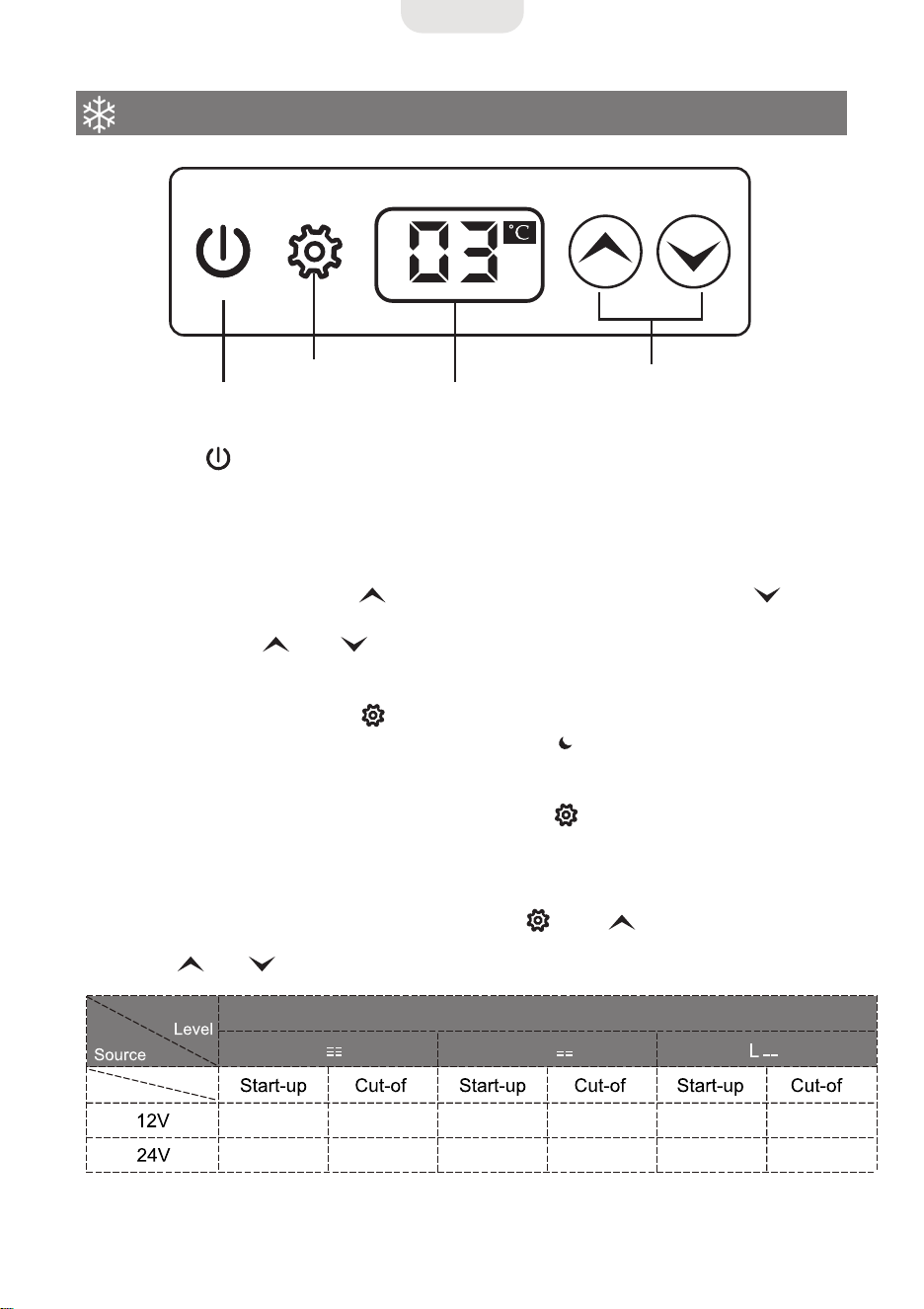
Battery Protection Level
Power
H M
f f f
12.4V
25.7V
11.1V
24.3V
11.8V
24.5V
10.5V
23.0V
10.9V
22.7V
8.5V
21.3V
Protection
Memory Function
The appliance features a memory function that retains settings in case of a power outage.
Swapping Between Celsius(°C) & Fahrenheit (°F)
DisplayPower
Setting Up and Down Buttons
With the appliance on, short press “ ” button to increase the temperature and the “ ” to
decrease the temperature.
Temperature Setting
NOTE
: Hold down the “ ” or “ ” button to fast scroll.
Working mode setting (Default: day mode)
NOTE:
When in Fahrenheit mode, it will not display the “°F” icon.
NOTE:
When in night mode, it will be muted and display the “ ” icon.
Hold 3 Sec
Hold down the “ ” button for 3 seconds to turn on / off the appliance.
With the appliance on, short press “ ” button to toggle between day mode and night mode.
In Stand-by Mode (turned off yet plugged in), hold down the “ ” button for 3 seconds to toggle
between “C” (Celsius) and “F” (Fahrenheit).
In Stand-by Mode (turned off yet plugged in), long press “ ” and “ ” for 3 seconds to check
the current level of battery protection.
Then press “ ” or “ ” to switch the level.
Default Setting: Level M
Operation
9
English
Water Tray:
The water tray can be taken out easily to dispense the water.
Exterior:
● Use a soft cloth with mild detergent if necessary to clean the exterior of your fridge.
● Make sure surfaces are dry before storage (leaving the lid slightly opened to ventilate).
● When storing the fridge, ensure the power is disconnected.
Interior:
The interior should be cleaned regularly to prevent bacteria and odours from forming.
● Use a soft cloth with mild detergent or anti-bacterial soap, do not use abrasive or strong chemicals.
● Do not use ammonia-based cleaning agents or strong acids.
The ventilation intake on the rear of the fridge may accumulate dust or debris over time. Check the
vents regularly and blow out any dust or remove any loose debris.
Storage when not in use
When your fridge is not in use, it is best to clean the interior and exterior prior to storage.
It is recommended to:
● Turn off the fridge and remove any power cables.
● Keep the lid open to allow air to circulate inside the fridge (This will help keep the interior dry and
prevent odours).
Imagine your fridge as a mini climate control system. The secret to its efficiency? Energy
management. When you take energy away, things get chilly, and when you add energy, things heat
up. It's like a kettle: turn it on, and the water inside starts to dance with heat; turn it off, and the water
cools down as it releases that energy.
Now, think about water versus air. Water is a heavyweight when it comes to energy—it takes about
four times more effort to cool it down compared to air. This is why filling your fridge with liquids can
slow down the cooling process and make your fridge work harder. That's why it's a smart move to
pre-cool your fridge before stocking up.
Every time you swing open that fridge door, you're letting the cool air escape and welcoming in warm,
humid air. An empty fridge might seem like it cools faster at first, but each time you reach in for a
snack, it has to work harder to get back to its ideal temperature.
The sweet spot for a fridge is to keep it about 50% to 75% full. This means you're maximizing space
without sacrificing the flow of cold air around your food. Good airflow is crucial; it ensures that
everything inside stays at a nice, even chill, which is not just good for your food but also for your
fridge's energy efficiency.
If you cram your fridge too tight, it could take ages for that middle item to reach the perfect
temperature, and that's not just inconvenient—it's a waste of energy too. So, keep it balanced, and
your fridge will thank you for better performance and happier food.
Cooling Tips
Care and Cleaning
10
English
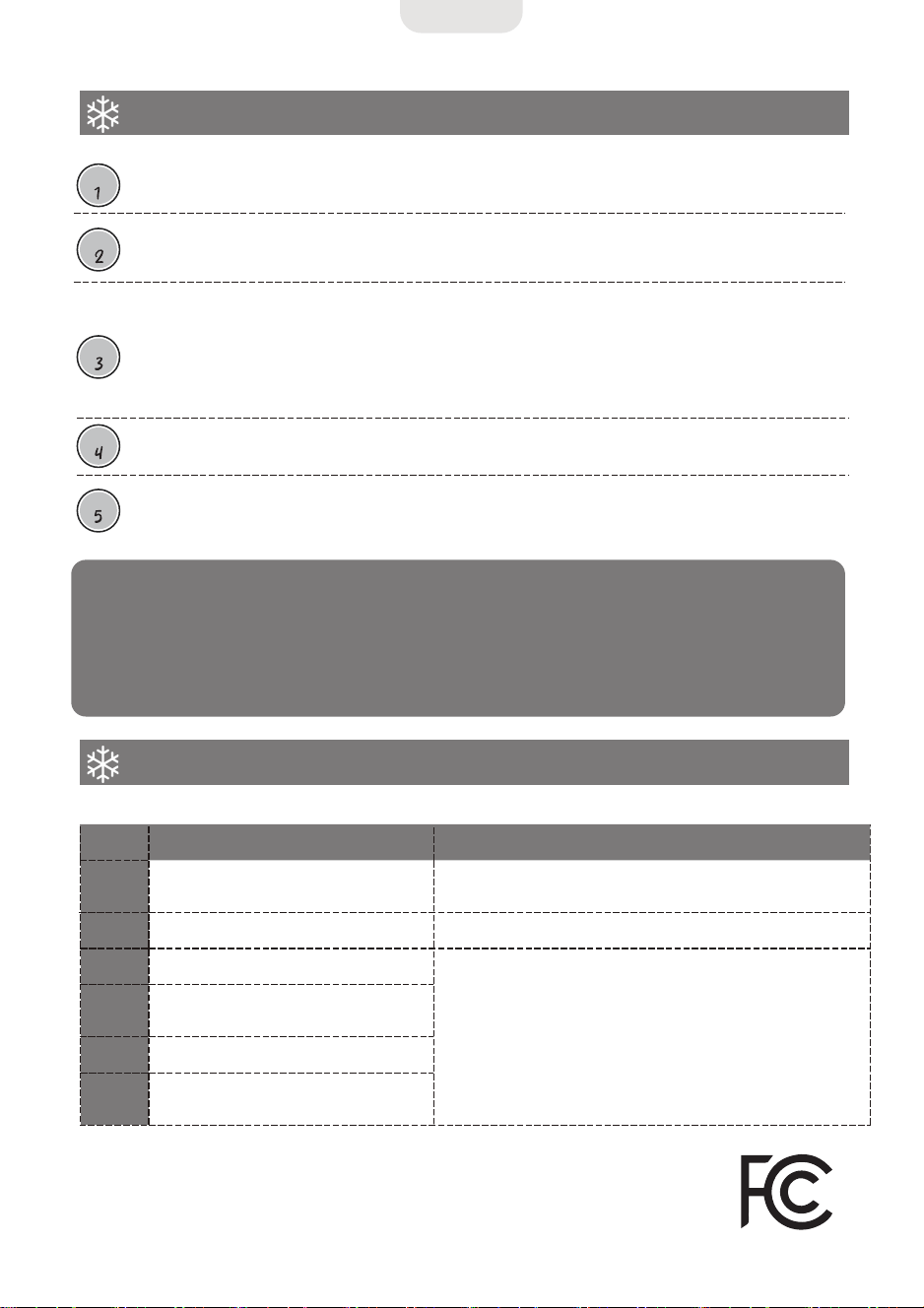
Error Code & Solutions
Code Description Action
E1 Battery Voltage is low.
Cut-Off as required.
Check battery voltage and adjust Low Voltage
E2 Fan failure.
Contact point of sale to arrange further action.
E3 Compressor startup problems.
Check air vents are clear.
Move fridge to cooler location (ambient temperature
may be too high).
E4
Compressor’s running speed fails
to reach the requirements.
E5 The model is overloading.
E6 NTC failure(open circuit or short
circuit)
Tips:
If you notice an unusual odor coming from inside, it could be due to the insulation
material used in the new product. It is advised to air out the product in a well-ventilated
area for a while.
Alternatively, take a look at the product to identify any expired or deteriorated items. Make
sure to keep the product tidy and clean.
STEP
Fridge concern is not cooling or running for only a short period etc. The above
concerns can have several causes. The following helps confirm where the issue lies.
Rest the fridge. If the fridge has turned on and off too quickly, a number of errors can
occur. Disconnect the fridge from all power sources for 15 minutes. This acts as a reset for
the fridge's electrical and refrigeration system.
Power source issue. One of the most common issues stem from power source issues.
Connect the fridge for at least 30 minutes to a battery that has it's output boosted. I.E.
battery charger or sunny day with solar panel input to the battery. If this corrects the issue
with the fridge, the source of the concern is outside the fridge. If the power to the fridge is in
the correct range and consistent the fridge will operate.Typical issues are related to wiring
issues, under charged batteries and connection problems.
For testing the unit should be empty, as a warm/large product load in the fridge can take
more than 24 hours to completely come down to temperature.
If the fridge is not operating correctly after the above tests, or the fault is outside those
listed and is a manufacturing defect (fridge still not cooling, broken fan etc.) then please
follow warranty claim procedure on the last page of this manual.
STEP
STEP
STEP
STEP
Troubleshooting
Error Codes
MANUFACTURER: GUANGDONG ICECO ENTERPRISE CO., LTD
ADD.: 23 HEALTH RD., NATIONAL HEALTH TECHNOLOGY PARK, TORCH
DEVELOPMENT ZONE, ZHONGSHAN, GUANGDONG, P.R. CHINA
Tel: +1 833 436 8977 E-Mail: [email protected]
11
English
12
ÉLIMINATION CORRECTE DE CE PRODUIT
UTILISATION PRÉVUE
ATTENTION !
ATTENTION ! Les aliments doivent être emballés dans des sacs avant d'être placés dans le
réfrigérateur, et les liquides doivent être emballés dans des bouteilles ou des récipients fermés afin
d'éviter que la structure du produit ne soit difficile à nettoyer.
• Ne stockez pas d'objets explosifs, tels que des bombes aérosols contenant un agent propulseur
inflammable, dans cet appareil.
• Risque d'incendie et de choc électrique.
• Ne laissez pas d'objets chauds toucher les parties en plastique de l'appareil.
• Ne placez pas de produits ou d'objets inflammables à l'intérieur, à proximité ou sur l'appareil.
• Ne touchez pas le compresseur ou le condenseur lorsque le réfrigérateur fonctionne. Ils peuvent
être très chauds.
• Lors de l'installation de l'appareil, assurez-vous que le cordon d'alimentation n'est pas coincé ou
endommagé.
• Ne placez pas de prises de courant multiples ou de blocs d'alimentation portables à l'arrière de
l'appareil.
• Cet appareil n'est pas destiné à être utilisé par des personnes (y compris les enfants) dont les
capacités physiques, sensorielles ou mentales sont réduites, ou qui manquent d'expérience et de
connaissances, à condition d'avoir reçu une surveillance ou des instructions concernant l'utilisation
de l'appareil en toute sécurité, et de comprendre les risques encourus.
• Les enfants doivent être surveillés pour s'assurer qu'ils ne jouent pas avec l'appareil.
• Si le cordon d’alimentation est endommagé, il doit être remplacé par le fabricant, son agent de
service ou une personne de qualification similaire afin d’éviter tout danger.
• Ne stockez pas dans cet appareil des substances explosives telles que des bombes aérosols
contenant un gaz propulseur inflammable.
Pour éviter que l'élimination incontrôlée des déchets ne nuise à l'environnement ou à la
santé humaine, recyclez-les de manière responsable afin de promouvoir la réutilisation
durable des ressources matérielles. Pour renvoyer votre appareil usagé, veuillez utiliser
les systèmes de collecte ou contacter le détaillant pour qu'il prenne en charge ce
produit en vue d'un recyclage respectueux de l'environnement.
Risque de piégeage des enfants.
Avant de jeter votre ancien réfrigérateur ou congélateur :
-Enlevez les portes.
-Laissez les étagères en place afin que les enfants ne puissent pas facilement grimper
à l'intérieur.
Cet appareil est destiné à être utilisé dans des applications domestiques et similaires telles que :
• cuisines du personnel dans les magasins, les bureaux et autres environnements de travail ;
• fermes et par les clients des hôtels, des motels et d'autres environnements de type résidentiel ;
• des environnements de type "bed and breakfast" ;
• restauration et applications similaires hors commerce de détail.
Français
14