Version 1.0
Code No.: CY-0A041-U00500


1
Sc2450 Operator’s Manual
INTRODUCTION
Thank you for purchasing our tractor product that has been designed and
manufactured based on our state-of-the-art technology and rich expertise in
developing and manufacturing tractor products.
Handle your tractor correctly by following the instructions contained in this
Operator’s Manual so that it provides you long years of reliable and faithful
service.
This manual constitutes an indispensable part of your Cub Cadet Yanmar tractor
product. Always keep the manual readily accessible.
Carefully study this manual to get familiar with the instructions and information
contained in it. These instructions and information are helpful in using your
tractor correctly and safely, and avoiding personal injury and other accidents
during operation and servicing of the tractor.
When using any implement together with your tractor, also carefully study its
operation manual so that you can use it safely, correctly and efficiently.
This manual is organized with sections arranged in a particular order so that you
can better understand the safety messages and the controls on your tractor to
help you operate your tractor correctly and safely. This manual will also help you
answer questions about operation and servicing. An index is available at the end
of this manual to assist you in quickly finding necessary information.
The machine shown in this manual may somewhat differ from your actual
machine. However, this manual will still assist you in understanding the
instructions associated with your tractor.
Before delivery of your machine, your Cub Cadet Yanmar dealer has performed
a pre-delivery check to ensure that your tractor can long remain problem-free.
All information, descriptions, specifications, drawings, illustrations, and pictures
in this manual are based on the latest information available at the time this
manual was published. Yanmar reserves the right to make changes at any time
without prior notice.
© 2009 Yanmar Co., Ltd.
Yanmar licenses the usage rights of this manual in North America to CUTSCO
(Compact Utility Tractor Supply LLC).
© 2009
Welcome to the World of Cub Cadet Yanmar Tractor
2
Sc2450 Operator's Manual
PICTOGRAPHS
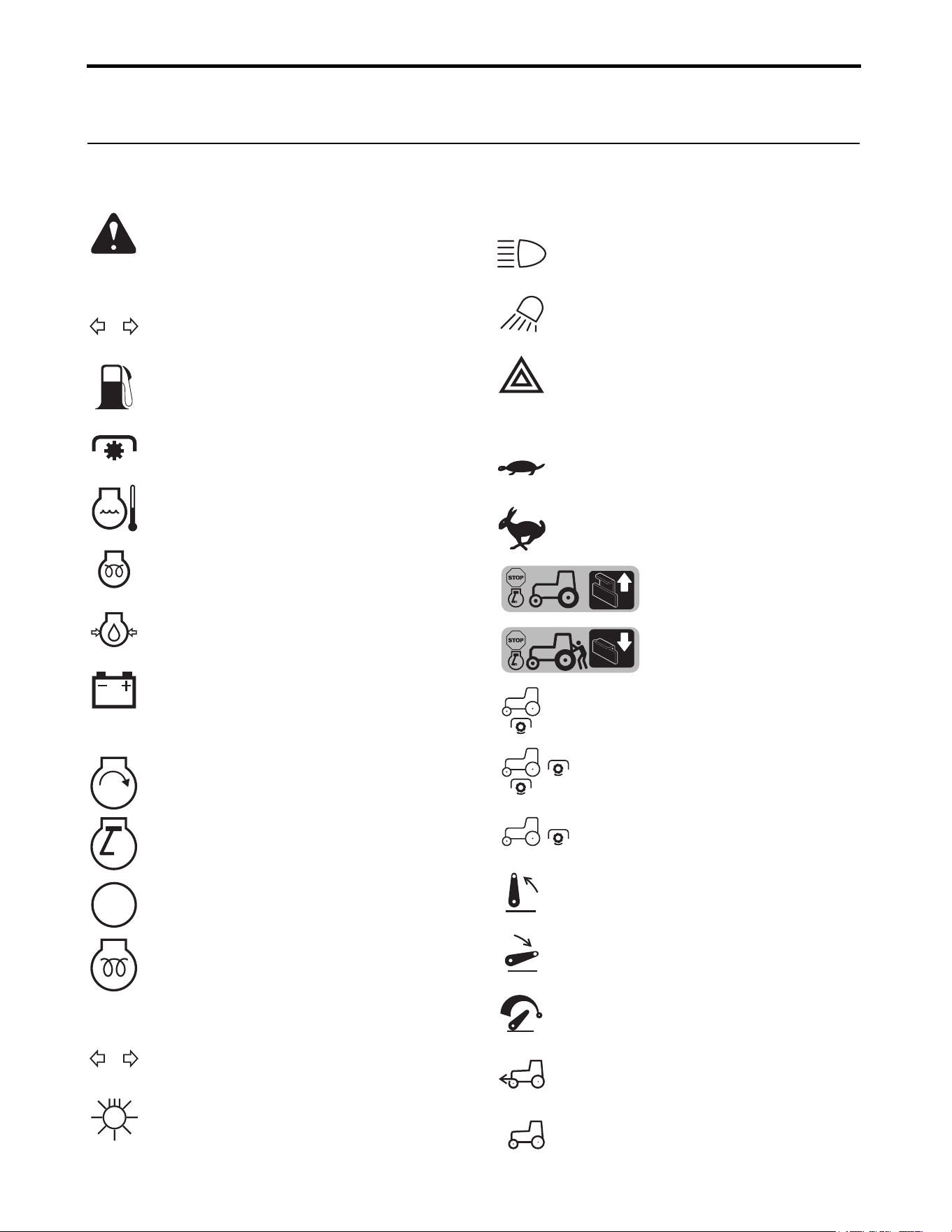
To help assist the operator in operating the tractor, various easy-to-understand pictographs have been
developed and are used throughout this manual. They are listed below together with their meanings.
Safety alert symbol
<Instrument panel>
Turn signal
Fuel level
Revolutions per minute
Engine coolant warning light
Preheater pilot light
Engine oil pressure
Alternator/battery charging light
<Starter key switch>
Engine start
Engine run
Engine shut-off
Preheating
<Lights>
Turn signal
Headlight
<Lights>
Headlight beam
Headlight and work light
Hazard warning light
<Levers and knobs>
Slow
Fast
Hydro Static Transmission
(HST) pressure locked
position
Hydro Static Transmission
(HST) pressure released
position
Position for moving only the Mid-Power
Take Off (PTO)
Position for moving the Mid- and Rear-
Power Take Off (PTO) at the same time
Position for moving only the Rear-
Power Take Off (PTO)
Position control raised position
Position control lowered position
Hydraulic flow control/stop
4-wheel drive on
2-wheel drive on

3
Sc2450 Operator's Manual
TABLE OF CONTENTS
About This Manual............................................................................................................ 1-1
Safety Precautions for the Tractor .................................................................................. 1-2
1. Safety-Alert Symbol................................................................................................................. 1-2
2. Precautions Before Operating Your Tractor............................................................................ 1-3
3. Safe Practices for Operating Your Tractor .............................................................................. 1-4
4. Operate Your Tractor on Slopes ............................................................................................. 1-6
5. Travel on a Road..................................................................................................................... 1-7
6. Safe Practices for Parking Your Tractor.................................................................................. 1-7
7. Operate the Power Take Off (PTO)......................................................................................... 1-8
8. Use the 3-Point Hitch (Option) ................................................................................................1-8
9. Safety Frame (Roll-Over Protective Structure) (ROPS) Precautions ...................................... 1-8
10.Safe Practices for Servicing Your Tractor ............................................................................... 1-9
11.Understand the Tractor Safety Decals .................................................................................. 1-11
Safety-Alert Symbol .............................................................................................................................................1-11
Care of DANGER, WARNING and CAUTION Decals.........................................................................................1-11
Specifications of the Tractor ........................................................................................... 3-1
1. Specifications Table ................................................................................................................ 3-1
2. Traveling Speeds (Reference) ................................................................................................ 3-2
Tractor Control Overview................................................................................................. 5-1
1. Overview ................................................................................................................................. 5-1
2. Operator Station Controls........................................................................................................ 5-2
Names of Components..........................................................................................................................................5-2
Function of Components .......................................................................................................................................5-3
3. Instrument Panel, Switches and Hand Controls.................................................................... 5-11
Pre-Operation Check of Tractor ...................................................................................... 6-1
1. Pre-Operation Check............................................................................................................... 6-1
2. Precautions Before the Operation........................................................................................... 6-1
3. Routine Check......................................................................................................................... 6-1
4. Prevent Damage to the Plastic Surfaces and Painted Surfaces ............................................. 6-1
1. SAFETY PRECAUTIONS ................................................................................... 1-1
2. SERVICE THE PRODUCT .................................................................................. 2-1
3. SPECIFICATIONS............................................................................................... 3-1
4. IMPLEMENT CAPACITIES................................................................................. 4-1
5. NAMES AND FUNCTIONS OF COMPONENTS ................................................ 5-1
6. PRE-OPERATION CHECK ................................................................................. 6-1

4
Sc2450 Operator's Manual
TABLE OF CONTENTS
1. Start the Engine....................................................................................................................... 7-2
Opening/Closing the Fuel Shut-Off Valve..............................................................................................................7-2
Adjust the Operator's Seat.....................................................................................................................................7-2
Reverse the Operator's Seat .................................................................................................................................7-2
Fasten the Retractable Seat Belt...........................................................................................................................7-4
Engage the Parking Brake.....................................................................................................................................7-5
Check the Lights on the Instrument Panel.............................................................................................................7-8
Warm Up the Engine in Cold Weather ..................................................................................................................7-9
2. Shut Down the Engine........................................................................................................... 7-10
3. Restart a Stalled Engine........................................................................................................ 7-11
Operate the Tractor........................................................................................................... 8-1
1. Operate a New Tractor............................................................................................................ 8-2
2. Raise and Lower the Roll-Over Protective Structure (ROPS) ................................................. 8-3
Lower (Fold Down) the Roll-Over Protective Structure (ROPS) ............................................................................8-3
Raise (Unfold) the Roll-Over Protective Structure (ROPS) ...................................................................................8-4
3. Operate the Tractor................................................................................................................. 8-5
Function of Implement Lock Lever ........................................................................................................................8-7
Engage the Cruise Control ....................................................................................................................................8-9
Disengage the Cruise Control ...............................................................................................................................8-9
4. Stop the Tractor..................................................................................................................... 8-10
Stop in an Emergency .........................................................................................................................................8-10
5. Verify During Driving ............................................................................................................. 8-11
Fuel Gauge..........................................................................................................................................................8-12
Engine Coolant Warning Light.............................................................................................................................8-12
Hour Meter...........................................................................................................................................................8-13
6. Park the Tractor..................................................................................................................... 8-14
Apply the Parking Brake ......................................................................................................................................8-14
Release the Parking Brake..................................................................................................................................8-14
7. Safe Practices for Operation ................................................................................................. 8-15
Engage the Differential Lock ...............................................................................................................................8-15
Disengage the Differential Lock...........................................................................................................................8-15
Hydro Static Transmission (HST) Pressure Release Lever.................................................................................8-20
Uphill/Downhill .....................................................................................................................................................8-23
Steep Downhill.....................................................................................................................................................8-23
8. Accessory.............................................................................................................................. 8-24
12V DC Outlet .....................................................................................................................................................8-24
1. Operate the Power Take Off (PTO)......................................................................................... 9-1
Rear- Power Take Off (PTO).................................................................................................................................9-2
Mid- Power Take Off (PTO)...................................................................................................................................9-2
Engage the Power Take Off (PTO) .......................................................................................................................9-2
Disengage the Power Take Off (PTO)...................................................................................................................9-4
2. Install an Implement to the Power Take Off (PTO) Drivelines................................................. 9-5
3. Operate the Power Take Off (PTO) while the Tractor is Traveling
in the Reverse Direction (Reverse Override Function)............................................................ 9-5
7. OPERATE THE ENGINE .................................................................................... 7-1
8. OPERATION ....................................................................................................... 8-1
9. POWER TAKE OFF (PTO) ................................................................................. 9-1

5
TABLE OF CONTENTS
Sc2450 Operator's Manual
1. 3-Point Hitch.......................................................................................................................... 10-1
Right Lift Link.......................................................................................................................................................10-2
Top Link...............................................................................................................................................................10-2
Sway Link ............................................................................................................................................................10-2
Hitch ....................................................................................................................................................................10-2
1. 3-Point Hitch Control System ................................................................................................ 11-1
Operate the 3-Point Hitch Control/Cutting Height Adjustment Lever to Raise or Lower the 3-Point Hitch ..........11-1
Hydraulic Flow Control/Stop Knob.......................................................................................................................11-2
1. Tires ...................................................................................................................................... 12-1
Tire Inflation Pressure .........................................................................................................................................12-2
Wheel Bolt Tightening Torque .............................................................................................................................12-2
2. Ballast.................................................................................................................................... 12-3
Front Ballast ........................................................................................................................................................12-3
Rear Ballast .........................................................................................................................................................12-4
1. Maintenance Check List ........................................................................................................ 13-1
Tractor .................................................................................................................................................................13-1
2. Lubricants.............................................................................................................................. 13-3
3. Replacement Parts................................................................................................................ 13-3
■
Warranty and Repair of the Engine....................................................................................... 14-1
Periodic Service of the Tractor...................................................................................... 14-2
1. Open/Close the Hood............................................................................................................ 14-2
Open the Hood ....................................................................................................................................................14-2
Close the Hood....................................................................................................................................................14-3
2. Daily Checks ......................................................................................................................... 14-4
Visual Checks......................................................................................................................................................14-4
Refill the Fuel Tank..............................................................................................................................................14-4
Check the Engine Oil Level .................................................................................................................................14-8
Check the Transmission/Hydraulic Oil Level .......................................................................................................14-9
Check the Radiator Hoses and Clamps ............................................................................................................14-10
Clean the Radiator Cooling Fins and Screen ....................................................................................................14-10
Clean the Rear Grille Screen.............................................................................................................................14-11
Check the Cooling System ................................................................................................................................14-12
Check the Fuel Line...........................................................................................................................................14-13
Check the Intake Air Hoses and Clamps ...........................................................................................................14-13
Check the Safety Interlock System....................................................................................................................14-14
Check and Adjust the Brake ..............................................................................................................................14-16
Check the Seat Belt and Roll-Over Protective Structure (ROPS)......................................................................14-16
Check the Wheel Bolt Tightening Torque..........................................................................................................14-17
Check the Inflation Pressure .............................................................................................................................14-17
Check the Light Bulbs........................................................................................................................................14-18
Check the Tie-rod Rubber Boots .......................................................................................................................14-18
Check and Clean the Electrical System ............................................................................................................14-18
Adjust Front Axle Pivot ......................................................................................................................................14-19
10.3-POINT HITCH (Option) ................................................................................. 10-1
11.HYDRAULIC SYSTEM...................................................................................... 11-1
12.TIRES, WHEELS AND BALLAST .................................................................... 12-1
13.MAINTENANCE ................................................................................................ 13-1
14.PERIODIC SERVICE ........................................................................................ 14-1

6
Sc2450 Operator's Manual
TABLE OF CONTENTS
Check the Hydraulic Hoses ...............................................................................................................................14-20
3. First 50 Hours...................................................................................................................... 14-22
Change the Engine Oil ......................................................................................................................................14-22
Replace the Engine Oil Filter .............................................................................................................................14-22
Change the Transmission/Hydraulic Oil ............................................................................................................14-22
Replace the Transmission/Hydraulic Oil Filter...................................................................................................14-22
4. Every 50 Hours.................................................................................................................... 14-22
Check the Front Axle Oil Level ..........................................................................................................................14-22
Checking the Fuel/Water Separator ..................................................................................................................14-23
Adjust the Fan Belt ............................................................................................................................................14-24
Grease and Lubricate ........................................................................................................................................14-25
5. Every 100 Hours.................................................................................................................. 14-27
Engine Oil ..........................................................................................................................................................14-27
Change the Engine Oil ......................................................................................................................................14-27
Clean the Fuel/Water Separator ........................................................................................................................14-28
Service the Air Cleaner Element .......................................................................................................................14-29
6. Every 200 Hours.................................................................................................................. 14-31
Replace the Engine Oil Filter .............................................................................................................................14-31
Adjust the Toe-in ...............................................................................................................................................14-32
7. Every 300 Hours.................................................................................................................. 14-33
Transmission/Hydraulic Oil................................................................................................................................14-33
Change the Transmission/Hydraulic Oil and Replace the Transmission/Hydraulic Oil Filter ............................14-33
8. Every 500 Hours.................................................................................................................. 14-35
Front Axle Case Oil ...........................................................................................................................................14-35
Change the Front Axle Case Oil ........................................................................................................................14-35
Replace the Fuel Filter Element (in the Fuel/Water Separator).........................................................................14-36
Replace the Fuel Filter ......................................................................................................................................14-36
9. Every 1000 Hours................................................................................................................ 14-37
Coolant ..............................................................................................................................................................14-37
Flush the Cooling System..................................................................................................................................14-38
Change the Coolant...........................................................................................................................................14-40
10.Every 1 Year........................................................................................................................ 14-41
Replace the Air Cleaner Element ......................................................................................................................14-41
Flush the Cooling System..................................................................................................................................14-41
Change the Coolant...........................................................................................................................................14-41
11.Every 2 Years...................................................................................................................... 14-41
Replace the Radiator Hoses and Clamp ...........................................................................................................14-41
Replace the Fuel Line........................................................................................................................................14-41
Replace the Intake Air Hose..............................................................................................................................14-41
Replace the Hydraulic Hoses ............................................................................................................................14-41
Replace Power Steering Hose ..........................................................................................................................14-41

7
TABLE OF CONTENTS
Sc2450 Operator's Manual
1. Battery ................................................................................................................................... 15-1
Special Note for the Battery.................................................................................................................................15-1
Service the Battery Safely ...................................................................................................................................15-2
Inspect the Battery...............................................................................................................................................15-3
Remove and Install the Battery ...........................................................................................................................15-3
Clean the Battery and Terminals .........................................................................................................................15-4
Use a Booster Battery .........................................................................................................................................15-5
2. Fuses..................................................................................................................................... 15-6
Replace the Accessory Fuses .............................................................................................................................15-6
Check the Alternator Fuse and the Main Fuse ....................................................................................................15-6
3. Bulb ....................................................................................................................................... 15-7
Replace the Headlight Bulb .................................................................................................................................15-7
Replace the Work Light Bulb ...............................................................................................................................15-8
Replace the Tail Light Bulb..................................................................................................................................15-9
Replace the Turn Signal/Hazard Lights Bulb.......................................................................................................15-9
Replace the Instrument Panel Light Bulb ..........................................................................................................15-10
4. Headlights ........................................................................................................................... 15-10
Adjust the Headlights.........................................................................................................................................15-10
1. Safe Practices for Storage .................................................................................................... 16-1
Fuel......................................................................................................................................................................16-2
Engine .................................................................................................................................................................16-2
2. Prepare the Stored Tractor for Operation.............................................................................. 16-3
1. Guide in Using the Troubleshooting Table............................................................................ 17-1
15.SERVICE THE ELECTRICAL SYSTEM ........................................................... 15-1
16.STORE THE TRACTOR ................................................................................... 16-1
17.TROUBLESHOOTING ...................................................................................... 17-1
18.OPTIONS .......................................................................................................... 18-1
19.INDEX................................................................................................................ 19-1
1-1
1. SAFETY PRECAUTIONS
Sc2450 Operator's Manual
1. SAFETY PRECAUTIONS
About This Manual
This Operator’s Manual presents you messages that
help you remain aware of potential hazards and
possible machine damage in operating and servicing
your machine. Carefully study all the information in it
so that you can avoid personal injury and damaged
properties.
NOTE
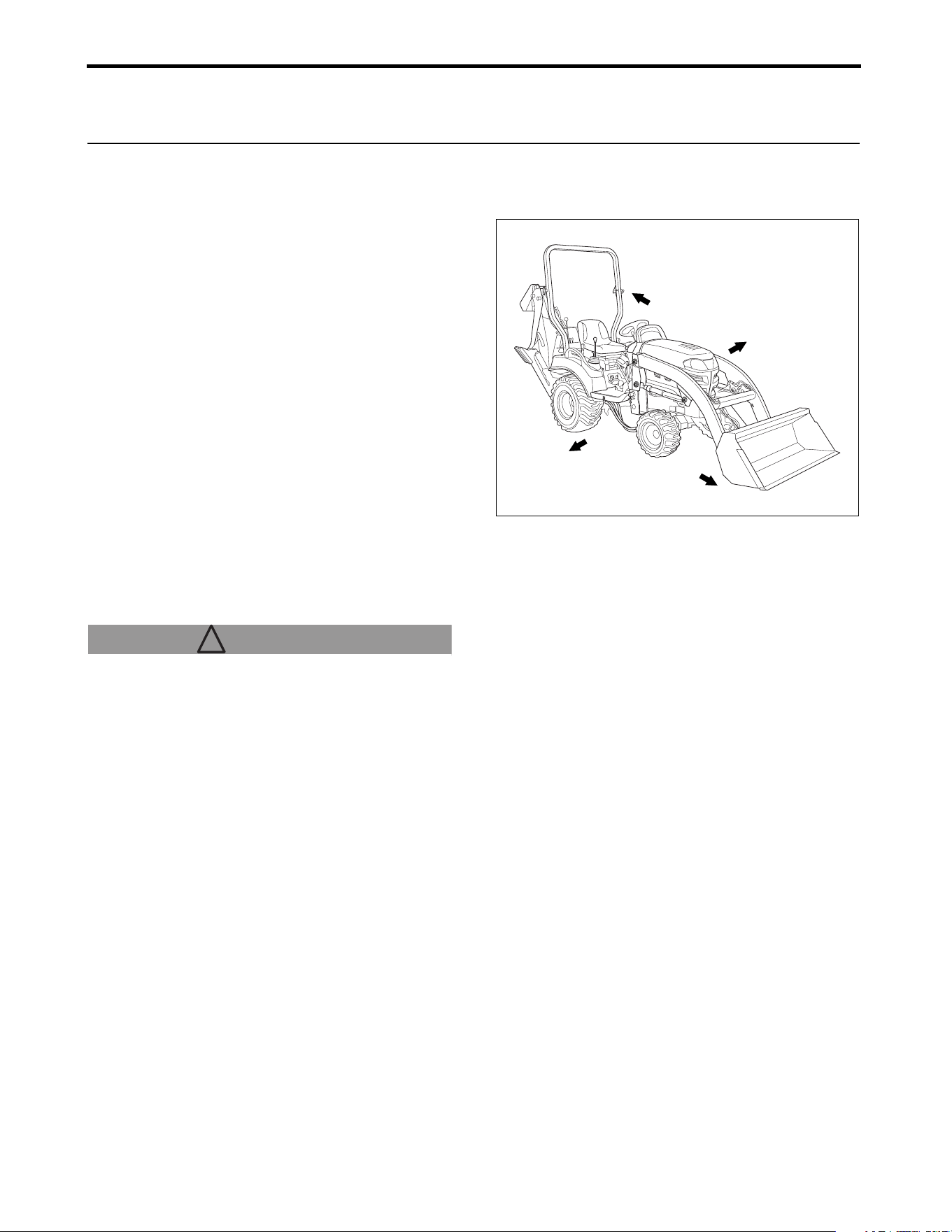
●Unless otherwise stated, the expressions–right-
hand side, left-hand side, front side, and rear side,
used throughout this manual see the sides relative
to the direction of forward movement with the
tractor.
●All pictures in this manual show the tractor
with the front loader and backhoe installed.
Refer to the front loader and backhoe
Operator's Manuals for the safe operating
instructions and all other information relating
to these attachments.
Avoid injury:
●Always remove the backhoe before installing
the mid-mount mower.
●The tractor can be used when the front loader
and either the mid-mount mower or the
backhoe is installed.
●Never install the mid-mount mower and the
backhoe at the same time.
3016402
RIGHT
REAR
LEFT
FRONT
! WARNING
! WARNING

1-2
1. SAFETY PRECAUTIONS
Sc2450 Operator's Manual
Safety Precautions for the Tractor
Indicates a hazardous situation which, if not
avoided, will result in death or serious injury.
Indicates a hazardous situation which, if not
avoided, could result in death or serious injury.
Indicates a hazardous situation which, if not
avoided, could result in minor or moderate injury.
Indicates a situation which can cause damage to the
machine, personal property and/or the environment
or cause the equipment to operate improperly.
IMPORTANT: Means that implement or
property damage could occur if instructions are
ignored.
NOTE: Provides useful information.
1. Safety-Alert Symbol
The safety-alert symbols appear with
most safety statements. It means
attention, become alert, your safety is
involved!
Please read and strictly observe the
message that follows the safety-alert
symbols.
! DANGER
! WARNING
! WARNING
! CAUTION
NOTICE
WARNING: READ AND FOLLOW ALL INSTRUCTIONS IN THIS MANUAL BEFORE
ATTEMPTING TO OPERATE YOUR TRACTOR. FAILURE TO COMPLY WITH THESE
INSTRUCTIONS MAY RESULT IN PERSONAL INJURY.
WARNING: The engine exhaust, some of its constituents, and certain vehicle components
contain or emit chemicals known to the State of California to cause cancer, birth defects or other
reproductive harm.
DANGER: Your tractor was built to be operated according to the rules for safe operation in this
manual. As with any type of power equipment, carelessness or error on the part of the operator can
result in serious injury. To help prevent accidents, read and take the following precautions before
operating this tractor. Failure to observe the following safety instructions could result in serious
injury or death.

1-3
1. SAFETY PRECAUTIONS
Sc2450 Operator's Manual
1. Understand the performance and limitations of
your tractor. Carefully study this Operator’s
Manual and learn the instructions in it before
operating or servicing your tractor. Keep the
Operator’s Manual in an easily accessible place.
2. Strictly follow the statements given in the
DANGER, CAUTION and WARNING safety
decals attached to the tractor.
3. For operator safety, always install the Roll-Over
Protective Structure (ROPS).
Keep the seat belt fastened while operating the
tractor with the Roll-Over Protective Structure
(ROPS). This practice will reduce the possibility of
injury or death in the event of roll-over accident.
If the Roll-Over Protective Structure (ROPS) has
been removed for any reason, be sure to reinstall
all the associated parts before operating the
tractor.
Do not alter the Roll-Over Protective Structure
(ROPS). The altered Roll-Over Protective
Structure (ROPS) may fail to provide the
designed protection.
Replace the damaged Roll-Over Protective
Structure (ROPS) immediately. Contact your local
Cub Cadet Yanmar dealer for technical
assistance.
NEVER alter or repair the Roll-Over Protective
Structure (ROPS). Welding, bending, drilling,
grinding, or cutting may weaken the Roll-Over
Protective Structure (ROPS). Contact your local
Cub Cadet Yanmar dealer for technical
assistance.
4. Always fasten the seat belt while operating the
tractor with the Roll-Over Protective Structure
(ROPS).
Check the seat belt for any damage. Replace the
damaged seat belt immediately. Contact your
local Cub Cadet Yanmar dealer for technical
assistance.
Do not use the seat belt if the tractor does not
have the Roll-Over Protective Structure (ROPS).
5. Check overhead clearance carefully before
driving under power lines, wires, bridges or low
hanging tree branches, before entering or leaving
building, or in any other situation where the
operator and/or Roll-Over Protective Structure
(ROPS) may be struck, which could result in
serious injury.
6. Make sure that any person who will operate the
tractor studies this Operator’s Manual before
operation. Know the controls and how to stop the
machine quickly.
7. Make sure that any person or obstacle is not
under or around the tractor before and during
operation. Be sure to maintain sufficient overhead
clearance above the tractor.
8. Do not operate your tractor and/or implement
installed to it while you are under the influence of
alcohol, drug, medicine or controlled substance(s)
or when you are not fit for operation of your
tractor.
9. For operation, wear close-fitting clothing. When
operating the tractor or working around the
tractor, do not wear loose-fitting clothes or
jewelry, or baggy or damaged clothing. When
caught by a moving part of the tractor, an
accident can result. Cut-off pants or shorts do not
provide protection against flying debris. Never
operate the tractor in bare feet, sandals, or
sneakers. Wear additional protections including
non-slip safety boots or shoes, and safety
goggles and gloves, etc. as appropriate or
required by currently applicable local laws and
regulations. Wear ear protection in a noisy
environment to prevent hearing damage and
reduce operator fatigue.
10.NEVER allow a passenger on any portion of the
tractor.
11.Remain seated in the operator’s station when
operating the tractor.
12.Make sure that the brakes, other mechanical
components are free from misadjustment and
excessive wear. Replace any excessively worn or
damaged component immediately. At regular
intervals, check that all the nuts, bolts and screws
are appropriately tightened. (For details, see
“Chapter 13. MAINTENANCE”)
2. Precautions Before Operating Your Tractor
1-4
1. SAFETY PRECAUTIONS
Sc2450 Operator's Manual
13.Always keep your tractor clean. Dust, grease or
grass clippings accumulated on your tractor can
lead to fire accidents or personal injury.
14.Use the handholds and running board steps when
getting on and off the tractor to help prevent
accidental falls. Keep the running boards clear of
mud and debris.
15.Only use the implements that satisfy the
requirements in this manual or are approved by
your Cub Cadet Yanmar dealer. (See “4.
IMPLEMENT CAPACITIES”)
16.When using only front or rear mounted
implements, install an appropriate weight(s) or
counter balance to the front or rear of your tractor
to prevent upsetting of the tractor. If you choose
to use the front loader, mount an implement or
ballast to the 3-point hitch in order to get the
tractor to stabilize. Observe the instructions about
safety in the manual for the implement to be used.
17.Do not attempt to modify your tractor. Modification
can deteriorate the performance and/or safety of
your tractor, possibly leading to personal injury or
property damage.
1. Starting Your Tractor
1. Remain seated in the operator’s station when
starting the engine, or actuating the levers or
controls. Do not start the engine or operate
controls while standing beside the tractor.
2. Before starting the engine, make sure that the
forward and reverse drive pedal are in the neutral
positions, the parking brake is engaged, and the
Power Take Off (PTO) is disengaged.
3. Always keep the seat belt fastened around your
waist whenever the tractor has the Roll-Over
Protective Structure (ROPS).
4. Start the engine of your tractor only by using the
starter key switch. Do not attempt to start the
engine by short-circuiting across the starter
solenoid terminals with a jumper wire, or by
bypassing the safety start switch. This defeats the
safety interlock circuit and the tractor may begin
to move and/or the Power Take Off (PTO) shafts
may begin to rotate, possibly leading to personal
injury or property damage.
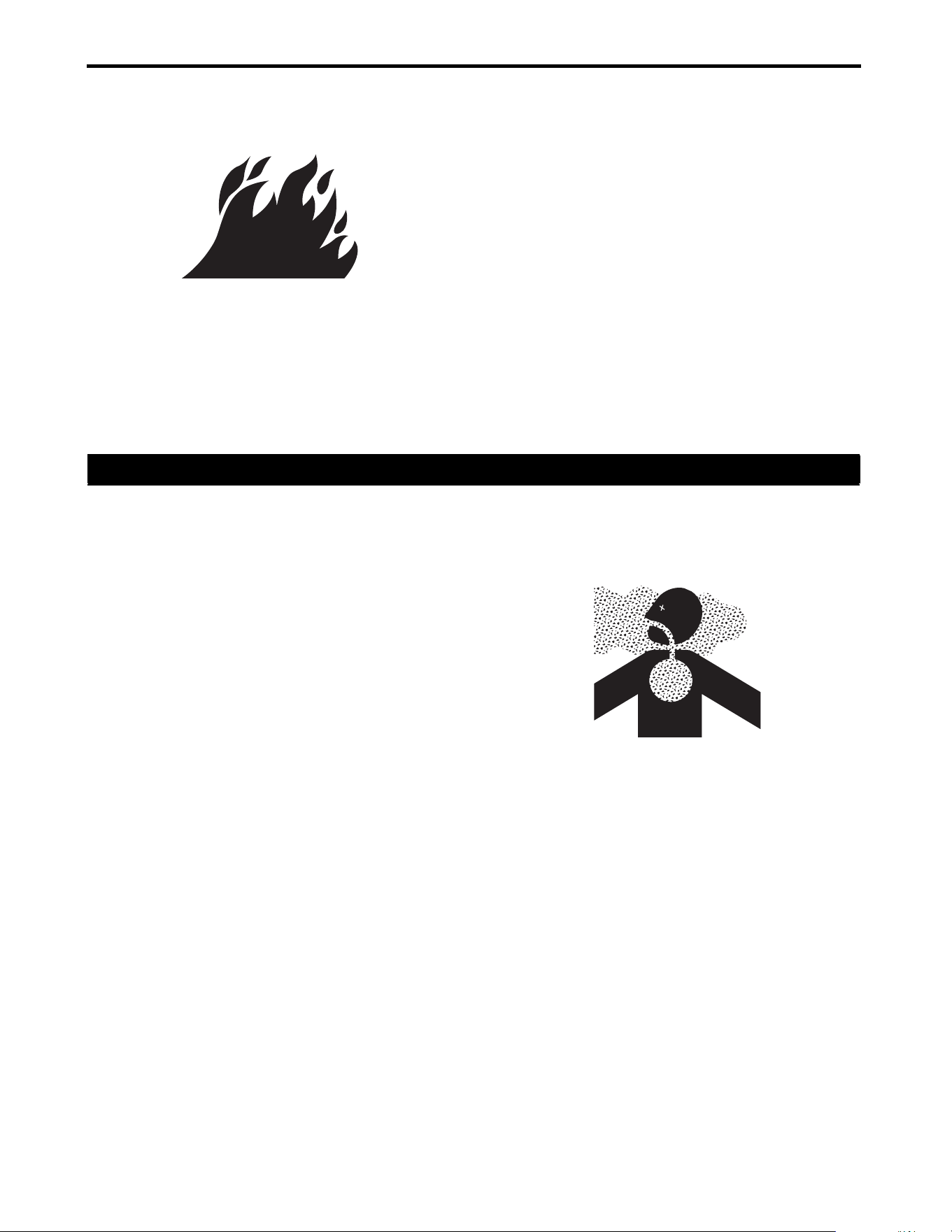
5. Do not run or idle the engine in a confined area
that is poorly ventilated or not ventilated at all.
The engine emits carbon monoxide gas that is
colorless, odorless and can cause death.
6. Before operation, check that all the safety
features are functioning correctly. Never tamper
with safety devices. Check their proper operation
regularly. Contact your Cub Cadet Yanmar dealer
if safety devices malfunction.
7. Avoid accidental contact with control pedals while
the engine is running, as this can cause
unexpected movement of the tractor.
8. Never leave a running machine unattended.
9. Do not attach or use towed equipment by a
drawbar or a drawing device/attachment. Usage
of the drawbar or drawing device/attachment is/
are not allowed in this tractor.
3. Safe Practices for Operating Your Tractor

1-5
1. SAFETY PRECAUTIONS
Sc2450 Operator's Manual
2. Working with Your Tractor
1. Make sure that all the covers and guards are in
correct position. Replace any missing or
damaged cover immediately.
2. Before turning or when traveling on a rough
terrain, or before stopping, decrease the tractor
speed in order to prevent upsetting.
3. Use extra caution when operating over rough
ground, when crossing ditches or slopes, and
when turning corners.
4. Do not attempt to turn with the differential lock
engaged. Attempting to turn the tractor while the
differential lock is engaged can lead to a roll-over.
5. Stay clear of ditches, holes, embankments or
ponds. A hazard of tractor upset can occur more
easily if the ground is soft or wet. Before entering
an area covered with tall grass, walk the area to
detect any obstacles.
6. Always watch where you are going, especially at
blind corners, trees, or other objects that can
obscure your vision. Remain alert when you are
approaching the end of a row, trees or any
obstacle.
7. When two or more people are working in one
area, always keep in good communication with
each other.
8. Do not get on or off a moving tractor.
9. Make certain all tractor lights are illuminated when
operating at night.
3. Considerations for Safety of Children
Tragic accidents can occur if the operator is not alert
to the presence of children. Children are often
attracted to the machine. They do not understand the
dangers. Never assume they will remain where you
last saw them.
1. Keep children out of the operating area and in the
watchful care of an adult other than the operator.
2. Be alert if a child enters the work area, stop your
tractor immediately.
3. Never allow a child to ride on the tractor. They
may fall off and be seriously injured or interfere
with safe machine operation.
4. Never allow children under 16 years old to
operate the machine. Children 16 years and over
should only operate machine under close parental
supervision and proper instruction.
5. Be extremely careful when backing the tractor.
Before and during backing, look back and
downward. A child may be in your path.
6. Use extra care when approaching blind corners,
shrubs, trees or other objects that may obscure
your vision of a child or other hazard.
7. Never allow a child to play on the tractor or
implement.
8. Keep children away from hot or running engines.
They may suffer burns.
9. Park your tractor on a solid, flat and level place.
Engage the parking brake securely, remove the
key from the starter key switch to prevent
unauthorized operation. If parking on a slope is
unavoidable, park the tractor across the slope
and chock the wheels.
1-6
1. SAFETY PRECAUTIONS
Sc2450 Operator's Manual
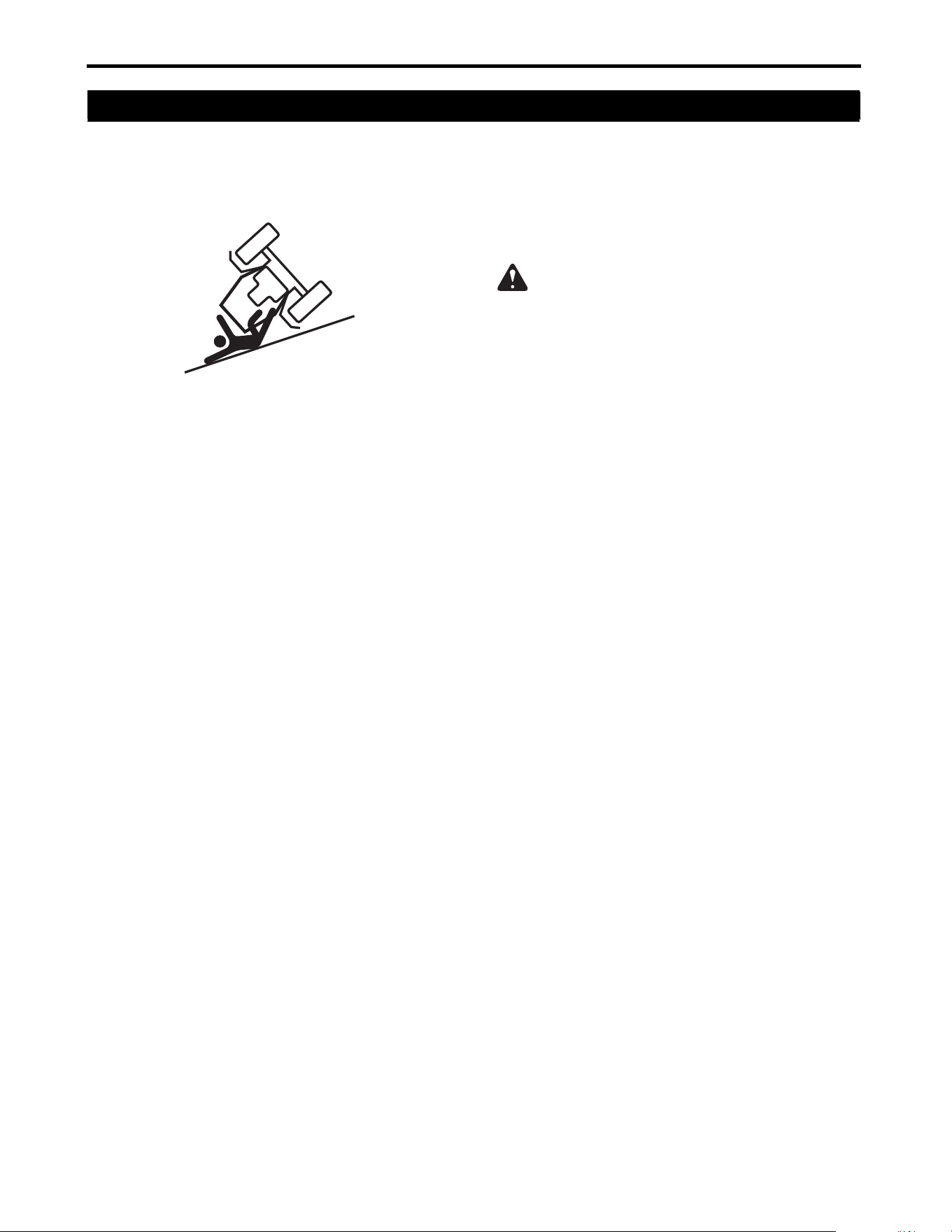
On a slope, the tractor is less stable and more prone
to tip-over, possibly leading to serious injury or death.
Remain very cautious when your tractor is on any
slope.
DO:
●Operate up and down slopes, not across.
●Remove obstacles such as rocks, limbs, etc.
●Watch for holes, ruts or bumps. Uneven terrain
could overturn the machine. Tall grass can hide
such obstacles.
●Place the transmission in the slow range when
climbing or descending slopes.
●Keep all movement on the slopes slow and
gradual. Do not make sudden changes in speed or
direction. Rapid engagement or braking could
cause the front of the machine to lift and rapidly flip
over backwards which could cause serious injury.
●Avoid starting or stopping on a slope. If tires lose
traction, disengage the Power Take Off (PTO) and
proceed slowly straight down the slope.
●To avoid upset, move backward up a steep slope.
If backing on the slope is not comfortable, do not
attempt to continue. Avoid an extremely steep
slope.
●When moving forward to escape from a ditch, or
deep mud, or when traveling on a steep slope, the
risk of the tractor upsetting backward is high.
Always move backward to escape these situations.
In the four-wheel drive mode, special caution is
needed to avoid false confidence in the tractor’s
ability to climb slopes.
DO NOT:
●Do not mow near drop-offs, ditches or
embankments. The mower could suddenly turn
over if a wheel goes over the edge of a cliff or ditch,
or if an edge caves in.
WARNING
●Before approaching a slope, select an
appropriate speed setting. Be sure to run the
tractor at a lower speed on slopes.
●Suddenly starting the tractor on an uphill can
cause the front wheels to jump off the ground,
and this situation poses an extreme danger. To
avoid this problem, run the engine at a lower
speed, and gently start the tractor.
●Do not park the tractor on a slope. If parking on
a slope is unavoidable, chock the tires, and
engage the parking brake securely.
4. Operate Your Tractor on Slopes
A2019005

1-7
1. SAFETY PRECAUTIONS
Sc2450 Operator's Manual
1. Disengagement of the 4-wheel drive is
recommended.
2. Remember that the braking characteristics differ
between the two and four wheel drive modes. Be
aware of the current drive mode and use
carefully.
3. Before turning, always slow down the tractor.
High-speed turn may cause the tractor to tip over.
4. When traveling on a road, be sure that the Slow
Moving Vehicle (SMV) emblem is on the tractor
and is clearly visible. Use the hazard lights and
turn lights as required by the currently effective
local laws or regulations.
5. Strictly observe all the currently effective local
traffic and safety laws and regulations.
6. Turn ON the headlights as required by the
currently effective local laws or regulations.
7. Always travel at a speed that allows you to
maintain control of the tractor.
8. Avoid engaging differential lock while traveling on
a road. It may cause the operator to lose control
of the tractor.
9. While traveling on a road, do not suddenly turn
the steering wheel. Such an action can lead to
loss in the stability of the tractor, and can cause
an extremely dangerous situation.
10.While on a road, do not attempt to operate an
implement. During transportation, put the 3-point
hitch control/cutting height adjustment lever in its
raised position and lock it with the position stop
knob. Do not fully close the hydraulic flow control/
stop knob.
1. Disengage the Power Take Off (PTO), lower the
implement to the ground, set the forward and
reverse drive pedal in the neutral positions,
engage the parking brake securely, stop the
engine and remove the key from the starter key
switch.
2. Before leaving your tractor, be sure the tractor is
completely stopped.
3. Do not park on a steep slope. Rather, park on
solid, flat, level ground whenever possible. If
parking on a slope is unavoidable, park the tractor
across the slope, and lower the implement to the
ground and chock the wheels.
4. Allow the tractor to cool at least 5 minutes before
being stored.
5. Travel on a Road
6. Safe Practices for Parking Your Tractor

1-8
1. SAFETY PRECAUTIONS
Sc2450 Operator's Manual
1. Before getting off the tractor, connecting/
disconnecting an implement, adjusting, cleaning
or servicing a Power Take Off (PTO)-driven
implement, make sure that all the moving
components are at a standstill.
2. Ensure that the Power Take Off (PTO) shaft cover
is always in place. Replace the Power Take Off
(PTO) shaft cap only when the shaft is at a
standstill.
3. Before installing or operating Power Take Off
(PTO)-driven implement, carefully study the
manufacturer’s Operator’s Manual and the safety
decals on the implement.
4. When installing the Power Take Off (PTO)- driven
implements, engage the parking brake securely
and chock the four wheels. Do not approach or
access any rotating component.
1. Use the 3-point hitch only in conjunction with the
implement that is specifically designed for use
with the 3-point hitch.
2. Before using a 3-point hitch mounted implement,
the appropriate counterbalance may need to be
installed on the front of the tractor.
Your tractor is equipped with a Roll-Over Protective
Structure (ROPS) which must be maintained in a fully
functional condition. Check overhead clearance
carefully before driving under power lines, wires,
bridges or low hanging branches, before entering or
leaving buildings, or in any other situation where the
operator and/or Roll-Over Protective Structure
(ROPS) may be stuck, which could result in serious
injury.
1. Never modify the Roll-Over Protective Structure
(ROPS) in any way.
2. Never attempt to straighten or reweld any part of
the main frame or retaining brackets that have
been damaged. Doing so may weaken the
structure and endanger your safety.
3. Never secure any parts on the main frame or
attach the safety frame with anything other than
the special fasteners specified.
4. Never attach ropes, chains, or cables to the Roll-
Over Protective Structure (ROPS) for pulling
purposes.
5. Although the Roll-Over Protective Structure
(ROPS) provides the operator the maximum
protection possible, never take unnecessary
risks.
7. Operate the Power Take Off (PTO)
8. Use the 3-Point Hitch (Option)
9. Safety Frame (Roll-Over Protective Structure) (ROPS) Precautions
1-9
1. SAFETY PRECAUTIONS
Sc2450 Operator's Manual
Before starting any servicing work, park your tractor
on solid, level ground, engage the parking brake
securely, disengage the Power Take Off (PTO),
lower the implement to the ground, set the forward
and reverse drive pedal to the neutral position, stop
the engine and remove the key from the starter key
switch.
1. Always keep a first-aid kit and a fire extinguisher
readily available.
2. Before accessing the engine, muffler, radiator or
other possibly hot components, wait until the
tractor has fully cooled off.
3. Use extreme care in handling diesel fuels. They
are extremely flammable and the vapors are
explosive. Use only an approved container.
4. Be sure to stop the engine before refueling. After
refueling, replace fuel cap securely and wipe off
any spilled fuel before starting the engine as it
may cause a fire or explosion.
5. Do not smoke while refueling. Keep any spark or
open flame away from the fuel tank.
6. Never refuel the machine indoors because fuel
vapors will accumulate in the area.
7. Never store the fuel container or machine inside
where there is an open flame or spark, such as a
gas hot water heater, space heater or furnace.
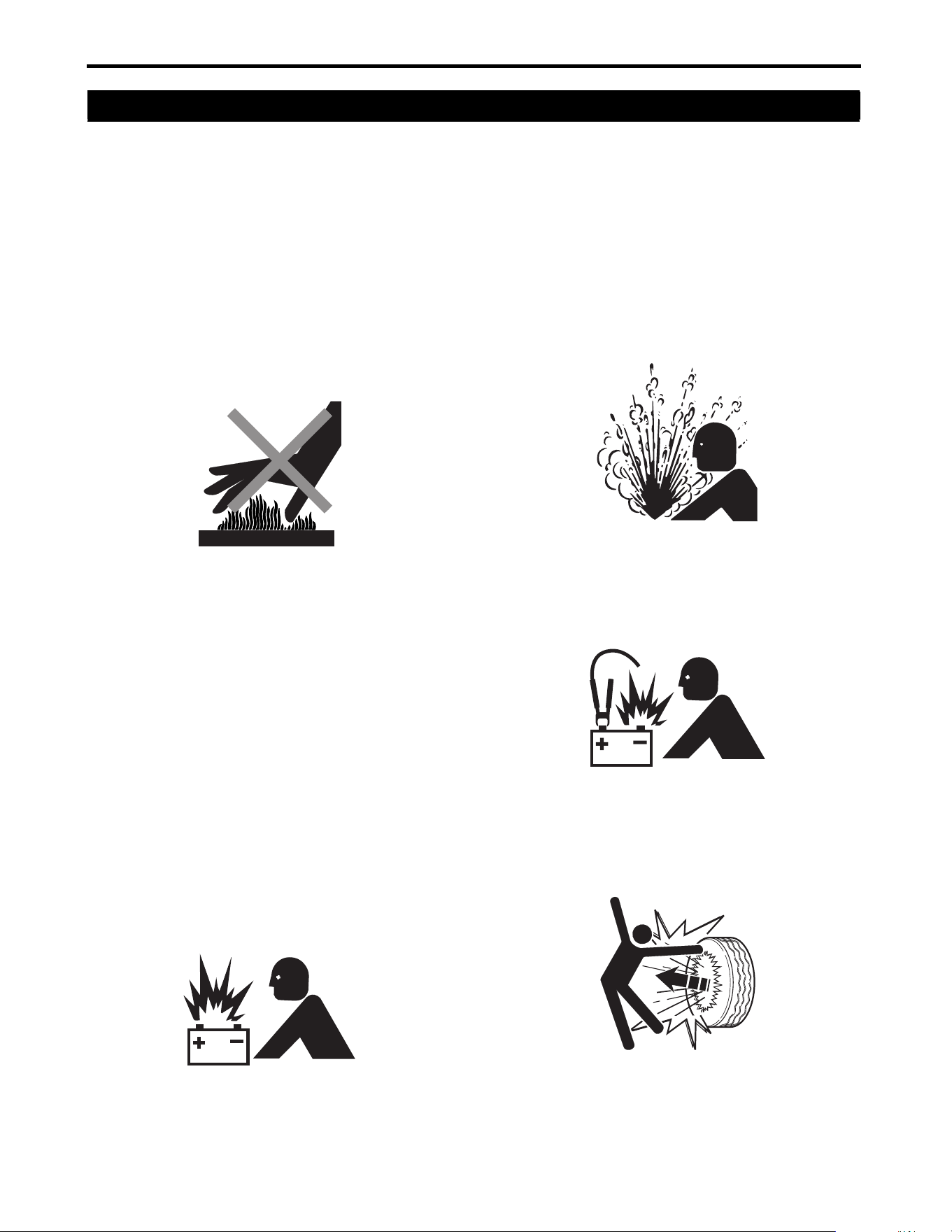
8. Do not smoke while working around the battery.
Keep any spark or open flame away from the
battery. The battery emits hydrogen and oxygen
gas, in particular, during recharging and can pose
a hazard of explosion.
9. Prior to “jump starting” a tractor that has a fully
depleted battery, read and follow all the
instructions in “Chapter 15. SERVICE THE
ELECTRICAL SYSTEM”.
10.Carefully loosen the radiator cap to the first stop,
and allow excessive pressure to escape, and only
then remove the radiator cap. If the tractor is
equipped with a coolant reserve tank, add coolant
or water to the reserve tank, not to the radiator
(See “Check the Cooling System” on page 14-12
in “Chapter 14. PERIODIC SERVICE”).
11.Before working on or around electric components,
first disconnect the battery ground cable.
12.To prevent a spark occurring from short-circuit,
disconnect the battery grounding (–) terminal first
and reconnect last.
13.The operator must not mount a tire onto a rim.
Only qualified personnel should do this task.
14.Always keep the tires at a correct pressure level.
Do not exceed the recommended tire pressure
specified in the Operator’s Manual.
15.Keep the tractor securely supported while
changing the wheels. Be sure to tighten the wheel
bolts at the specified tightening torque.
10. Safe Practices for Servicing Your Tractor
1-10
1. SAFETY PRECAUTIONS
Sc2450 Operator's Manual
16.Avoid working under any hydraulically supported
devices. Such devices can settle, suddenly leak
down, or be accidentally lowered. If working
beneath the tractor, or an implement, is
unavoidable, be sure to support the tractor or
implement with appropriate stands or lift
apparatus.
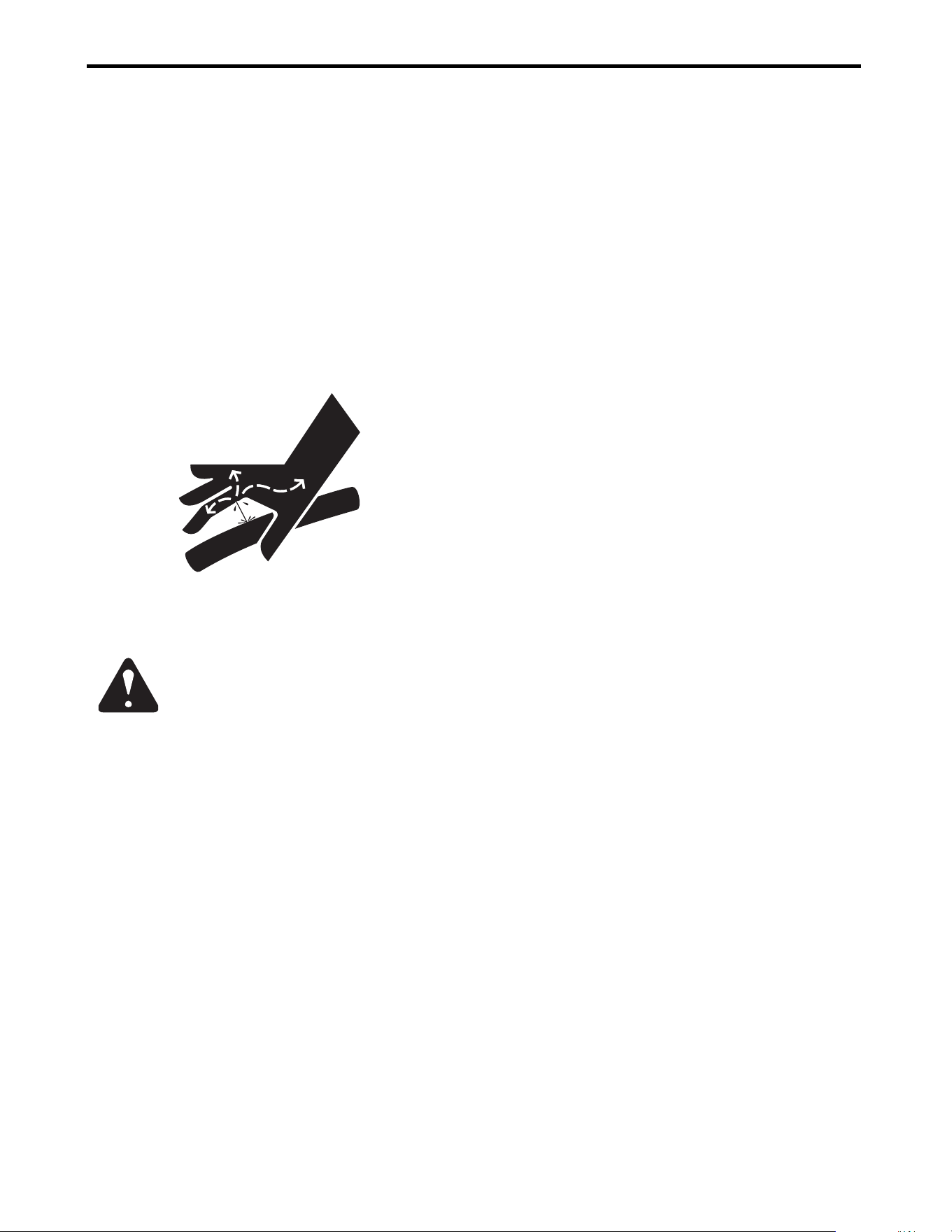
17.High pressure hydraulic fluid, when released, can
penetrate human skin, possibly leading to serious
personal injury. Before disconnecting any
hydraulic line, fully release the internal pressure.
Before exerting a pressure to the hydraulic
system, make sure that all connections are tight
and all the lines, pipes and hoses are free from
fissure/crack or any other damage.
18.Check brake operation frequently. Adjust and
service as required.
19.Do not change the engine governor settings or
overspeed the engine. Excessive engine speeds
are dangerous.
20.Observe proper disposal laws and regulations.
Prior to disposal, determine the proper method to
dispose of waste from your local Environmental
Protection Agency. Recycling centers are
established to properly dispose of materials in an
environmentally safe fashion.
21.Use proper containers when draining fluids. Do
not use food or beverage containers that may
mislead someone into drinking from them.
Properly dispose of the containers immediately
following the draining of fluids.
22.DO NOT pour oil or other fluids into the ground,
down a drain or into a stream, pond, lake or other
body of water. Observe Environmental Protection
Agency regulations when disposing of oil, fuel,
coolant, brake fluid, filters, batteries, tires and
other harmful waste.
23.We do not recommend the use of a pressure
washer or garden hose to clean your unit. They
may cause damage to electrical components;
spindles; pulleys; bearings; or the engine. The
use of water will result in shortened life and
reduce serviceability.
WARNING: YOUR RESPONSIBILITY: Restrict the use of this power machine to persons who
read, understand and follow the warnings and instructions in this manual and on the
machine.

1-11
1. SAFETY PRECAUTIONS
Sc2450 Operator's Manual
■ Safety-Alert Symbol
The tractor safety decals illustrated in this section are
provided in critical areas on the tractor so that people
including the operator can remain always aware of
potential hazards.
The tractor safety decals contain the words DANGER,
WARNING and CAUTION together with the safety-alert
symbols. DANGER and WARNING stand for the most
serious hazards.
The Operator’s Manual also contains special safety
messages that explain potential hazards about which the
operator must remain cautious. These messages are
presented together with the word CAUTION and the
safety-alert symbols.
■ Care of DANGER, WARNING and CAUTION
Decals
1. Always keep all the danger, warning and caution
decals clean and clearly legible.
2. Clean the danger, warning and caution decals with
soap water, and wipe dry with clean soft cloth.
3. Replace damaged or missing danger, warning and
caution decals with new decals available from your
local Cub Cadet Yanmar dealer.
4. If a component having a danger, warning or caution
decals is replaced with a new one, make sure that a
new decal is on the same location as on the old
component.
5. Affix a new danger, warning or caution decals flat on a
clean, dry surface, squeezing out trapped air.
11. Understand the Tractor Safety Decals
1-12
1. SAFETY PRECAUTIONS
Sc2450 Operator's Manual
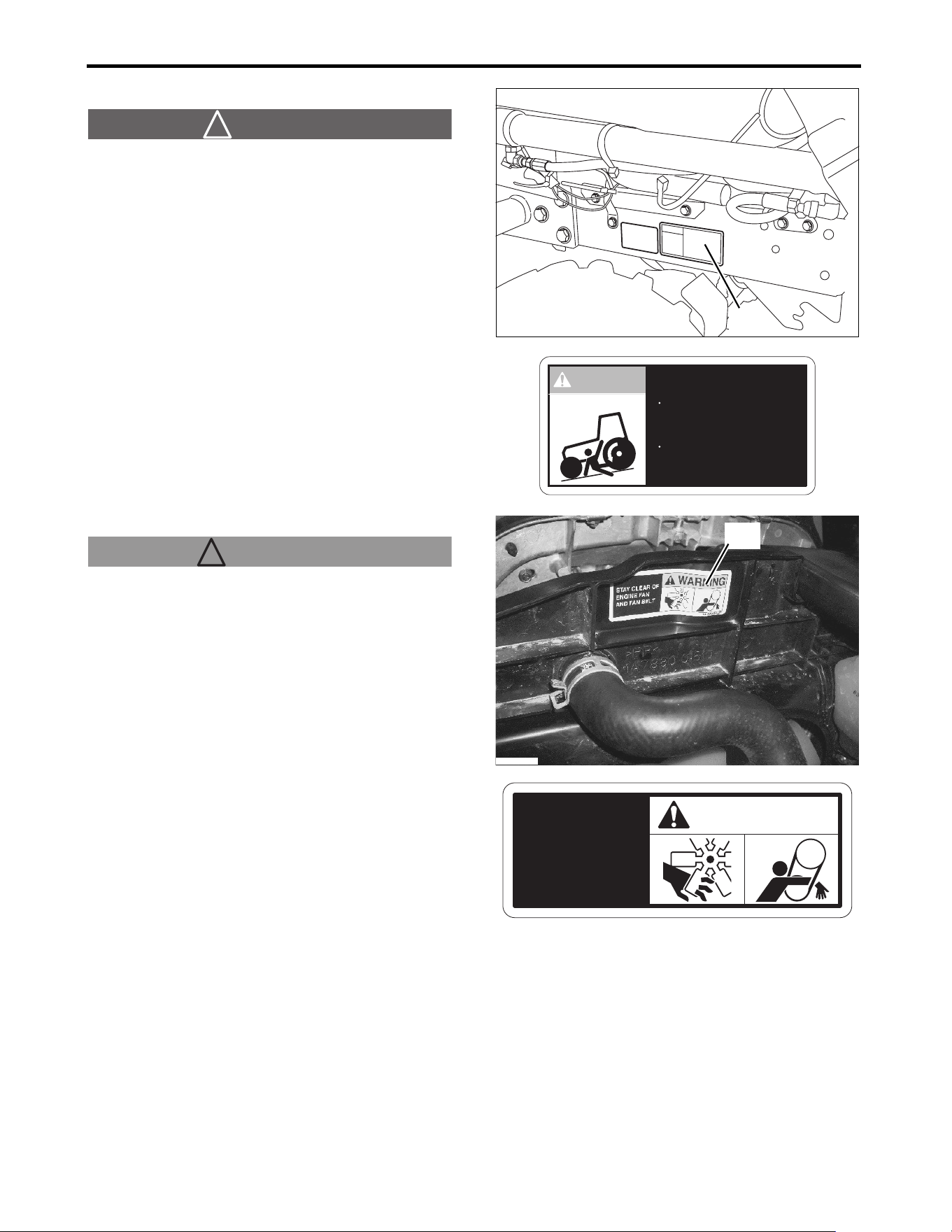
(A) CY-1A8160-65300
TO AVOID INJURY OR DEATH:
●Do not start engine by shorting across starter
terminals or bypassing safety start switch.
●Start engine only from seat with transmission and
PTO OFF.
(B) CY-1A7880-65610
STAY CLEAR OF ENGINE FAN AND FAN BELT
3016482
(A)
! DANGER
1A8160-65300
DANGER
Do not start engine by
䇭shorting across starter
䇭terminals or bypassing
䇭safety start switch.
Start engine only from
䇭seat with transmission
䇭and PTO OFF.
TO AVOID INJURY OR DEATH:
P3014961
(B)
! WARNING
WARNING
㪈㪘㪎㪏㪏㪇㪄㪍㪌㪍㪈㪇
STAY CLEAR OF
ENGINE FAN
AND FAN BELT
1-13
1. SAFETY PRECAUTIONS
Sc2450 Operator's Manual
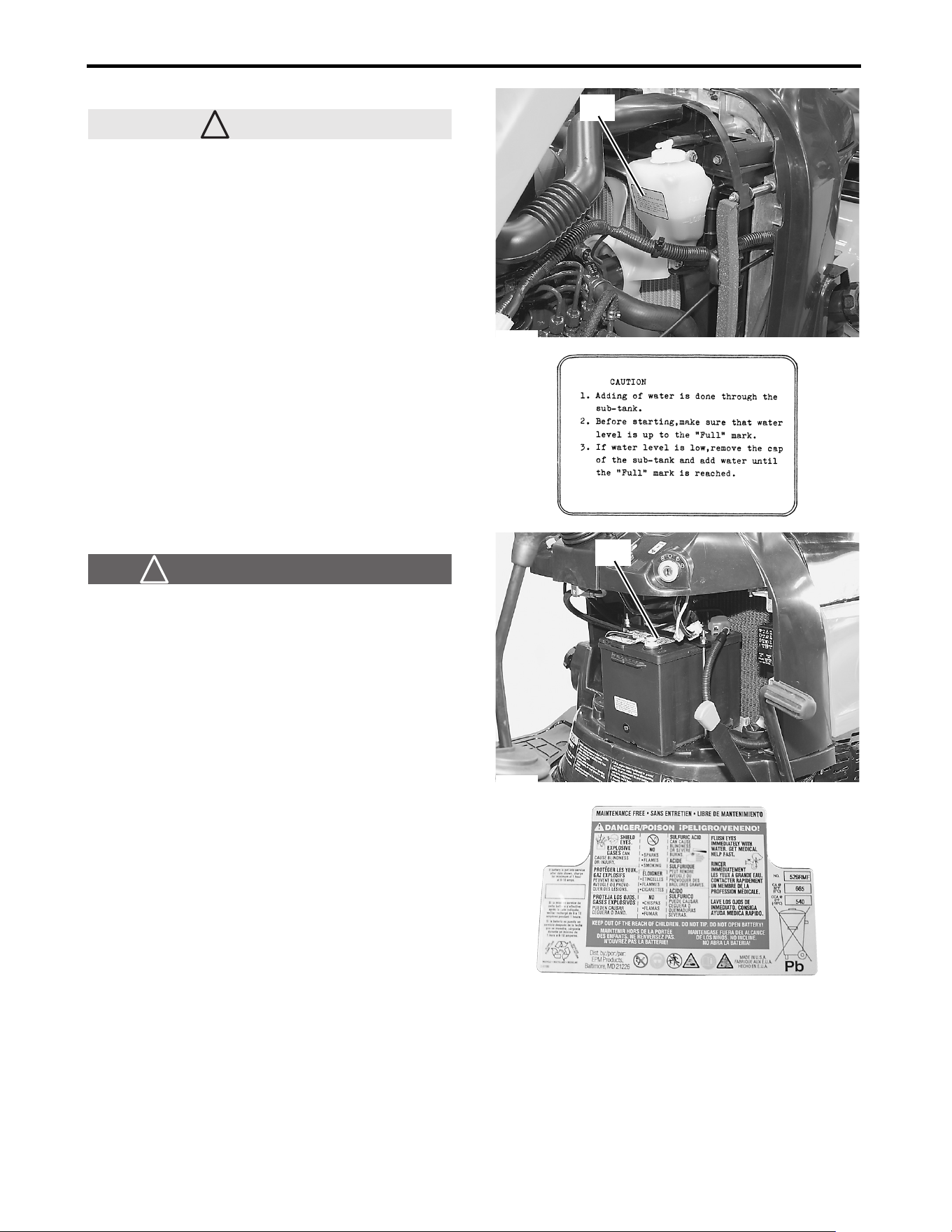
(C) CY-124764-44810
1. Adding of water is done through the sub-tank.
2. Before starting, make sure that water level is up
to the “Full” mark.
3. If water level is low, remove the cap of the sub-
tank and add water until the “Full” mark is
reached.
(D) CY-1A8160-51520
●SHIELD EYES: EXPLOSIVE GASES CAN CAUSE
BLINDNESS OR INJURY.
●NO SPARKS, FLAMES, SMOKING.
●SULFURIC ACID CAN CAUSE BLINDNESS OR
SEVERE BURNS.
●FLUSH EYES IMMEDIATELY WITH WATER.
SEEK MEDICAL HELP RIGHT AWAY.
●KEEP OUT OF REACH OF CHILDREN. DO NOT
TIP.
●KEEP VENT CAPS TIGHT AND LEVEL.
P3014947
(C)
! CAUTION
P3014933
(D)
! DANGER/POISON (E)
P3013722a
1-14
1. SAFETY PRECAUTIONS
Sc2450 Operator's Manual
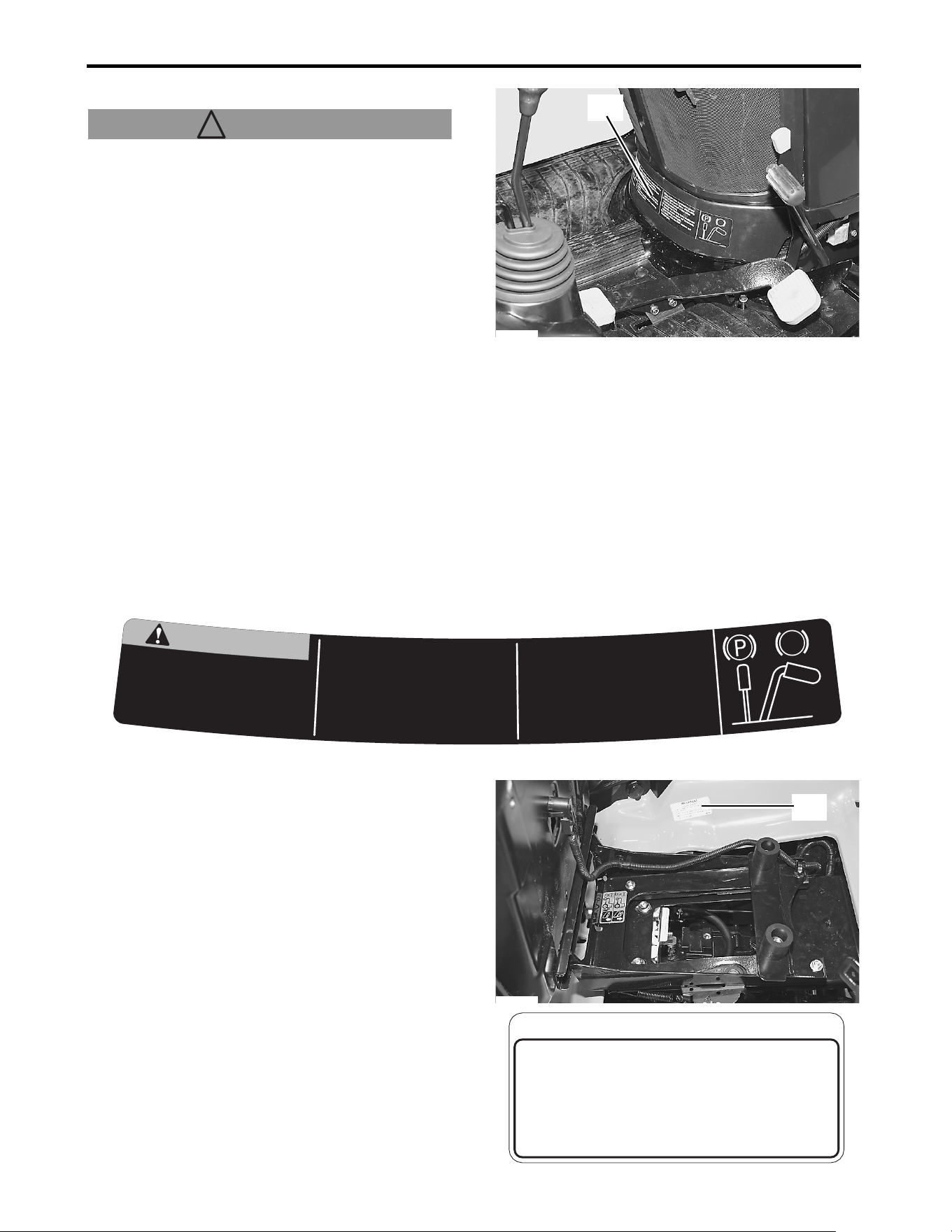
(E) CY-1A7880-65601
READ OPERATOR'S MANUAL
1. Do not operate the machine without guard shields
and safety devices in place and working.
2. Keep all riders off tractor during operation.
3. Make certain everyone is clear of machine before
starting engine or operation.
4. Keep hands, feet and clothing away from power-
driven parts.
5. Use seat belt.
6. Reduce speed when turning or operating around
hazards, on rough ground or steep slopes.
7. Do not allow operation of the machine by
untrained personnel.
8. Stop engine, lower implement to ground and lock
park brake before dismounting.
9. Wait for all movement to stop before servicing
machinery.
10.Remove key if leaving tractor unattended.
11.Securely support tractor and implements before
working underneath.
12.On public roads use SMV emblem and hazard
lights.
13.Do not jump if machine tips.
(F) CY-1A7880-65630
IMPORTANT
12V DC OUTLET
1. DO NOT CONNECT A LIGHT OR LOAD OF
MORE THAN 120 WATTS.
2. DO NOT USE AS A CIGARETTE LIGHTER.
3. REMOVE PLUG FROM SOCKET WHEN NOT IN
USE.
4. DO NOT USE WHEN WET.
P3014940
(E)
! WARNING
WARNING
3
.
M
a
k
e
c
e
r
t
a
i
n
e
v
e
r
y
o
n
e
i
s
c
l
e
a
r
o
f
m
a
c
h
i
n
e
4
.
K
e
e
p
h
a
n
d
s
,
f
e
e
t
a
n
d
c
l
o
t
h
i
n
g
a
w
a
y
f
r
o
m
p
o
w
e
r
-
d
r
i
v
e
n
p
a
r
t
s
.
5
.
U
s
e
s
e
a
t
b
e
l
t
.
6
.
R
e
d
u
c
e
s
p
e
e
d
w
h
e
n
t
u
r
n
i
n
g
o
r
o
p
e
r
a
t
i
n
g
a
r
o
u
n
d
h
a
z
a
r
d
s
,
o
n
r
o
u
g
h
g
r
o
u
n
d
o
r
s
t
e
e
p
s
l
o
p
e
s
.
7
.
D
o
n
o
t
a
l
l
o
w
o
p
e
r
a
t
i
o
n
o
f
t
h
e
m
a
c
h
i
n
e
b
y
u
n
t
r
a
i
n
e
d
p
e
r
s
o
n
n
e
l
.
b
e
f
o
r
e
s
t
a
r
t
i
n
g
e
n
g
i
n
e
o
r
o
p
e
r
a
t
i
o
n
.
R
E
A
D
O
P
E
R
A
T
O
R
'
S
M
A
N
U
A
L
1
.
D
o
n
o
t
o
p
e
r
a
t
e
t
h
e
m
a
c
h
i
n
e
w
i
t
h
o
u
t
g
u
a
r
d
s
s
h
i
e
l
d
s
a
n
d
s
a
f
e
t
y
d
e
v
i
c
e
s
i
n
p
l
a
c
e
a
n
d
w
o
r
k
i
n
g
.
2
.
K
e
e
p
a
l
l
r
i
d
e
r
s
o
f
f
t
r
a
c
t
o
r
d
u
r
i
n
g
o
p
e
r
a
t
i
o
n
.
8
.
S
t
o
p
e
n
g
i
n
e
,
l
o
w
e
r
i
m
p
l
e
m
e
n
t
t
o
g
r
o
u
n
d
a
n
d
l
o
c
k
p
a
r
k
b
r
a
k
e
b
e
f
o
r
e
d
i
s
m
o
u
n
t
i
n
g
.
9
.
W
a
i
t
f
o
r
a
l
l
m
o
v
e
m
e
n
t
t
o
s
t
o
p
b
e
f
o
r
e
s
e
r
v
i
c
i
n
g
m
a
c
h
i
n
e
r
y
.
1
0
.
R
e
m
o
v
e
k
e
y
i
f
l
e
a
v
i
n
g
t
r
a
c
t
o
r
u
n
a
t
t
e
n
d
e
d
.
1
1
.
S
e
c
u
r
e
l
y
s
u
p
p
o
r
t
t
r
a
c
t
o
r
a
n
d
i
m
p
l
e
m
e
n
t
s
b
e
f
o
r
e
w
o
r
k
i
n
g
u
n
d
e
r
n
e
a
t
h
.
1
2
.
O
n
p
u
b
l
i
c
r
o
a
d
s
u
s
e
S
M
V
e
m
b
l
e
m
a
n
d
1
3
.
D
o
n
o
t
j
u
m
p
i
f
m
a
c
h
i
n
e
t
i
p
s
.
h
a
z
a
r
d
l
i
g
h
t
s
.
1A788
0-
6
5601
P3014958
(F)
IMPORTANT
12V DC OUTLET
1.DO NOT CONNECT A LIGHT OR LOAD OF MORE
THAN 120 WATTS.
2.DO NOT USE AS A CIGARETTE LIGHTER.
3.REMOVE PLUG FROM SOCKET WHEN NOT IN USE.
4.DO NOT USE WHEN WET.
1A7880-65630
1-15
1. SAFETY PRECAUTIONS
Sc2450 Operator's Manual
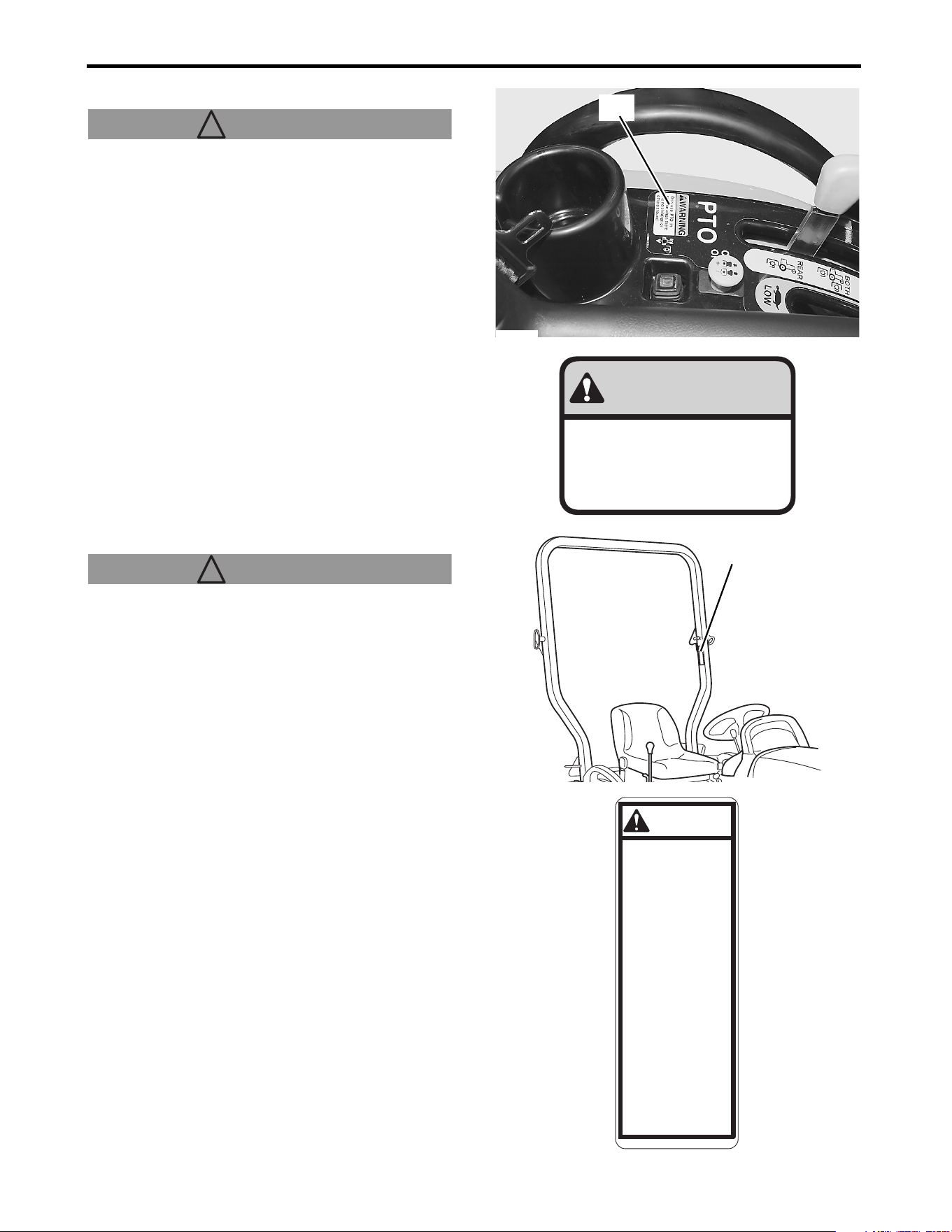
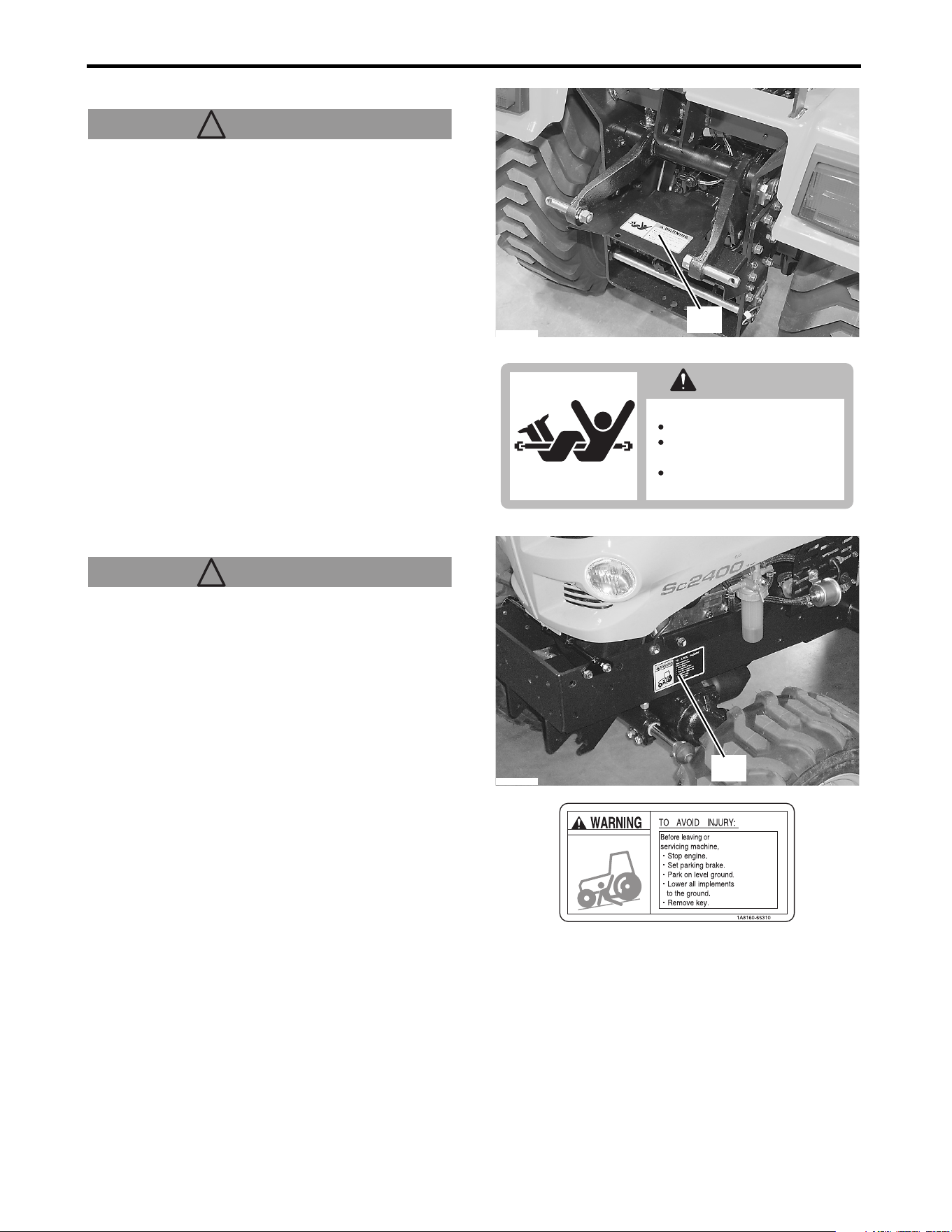
(G) CY-1A7880-65351
Only use PTO in reverse when there are no children
or others around
(H) CY-1A7882-85230
TO AVOID INJURY OR DEATH FROM ROLLOVER:
• Keep Rollover Protective Structure (ROPS) fully
extended.
• Do not jump if machine tips.
• Use seat belt.
THERE IS NO OPERATOR PROTECTION WHEN
THE ROPS IS IN THE FOLDED POSITION.
• Fold the ROPS only when absolutely necessary.
• When structure must be down:
• Do not use seat belt.
• Drive with extra care.
P3014940
(G)
! WARNING
WARNING
Only use PTO in
reverse when there
are no children or
others around
A3016424
(H)
! WARNING
•
Keep Rollover
Protective Structure
(ROPS) fully extended.
• Do not jump if machine
tips.
•
Use seat belt.
THERE IS NO OPERATOR
PROTECTION WHEN THE
ROPS IS IN THE
FOLDED POSITION.
•
Fold the ROPS only
when absolutely
necessary.
•
Do not use seat belt.
•
Drive with extra care.
TO AVOID INJURY OR
DEATH FROM ROLLOVER:
When structure must
be down:
WARNING
1A7882-85230
1-16
1. SAFETY PRECAUTIONS
Sc2450 Operator's Manual
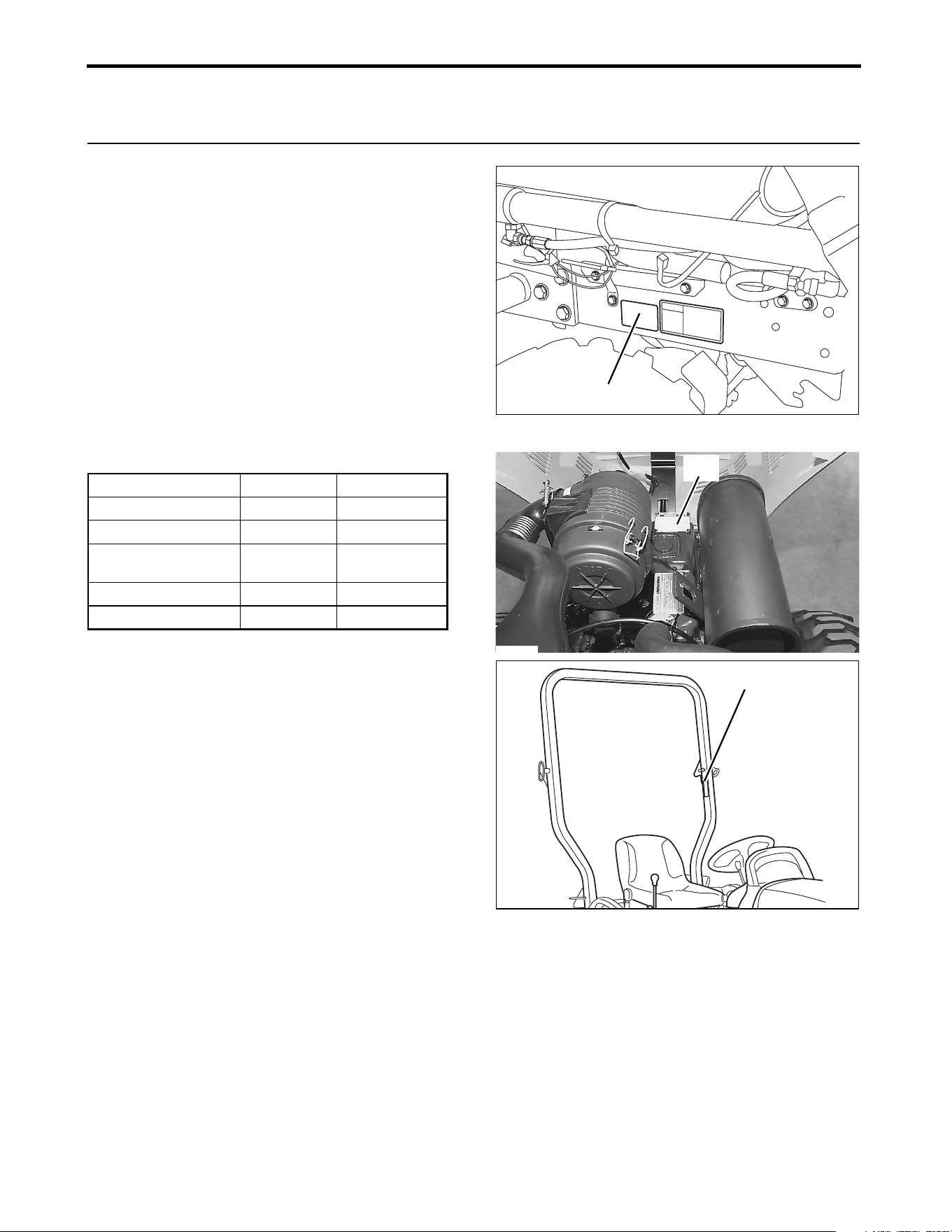
(I) CY-198220-65621
AVOID INJURY FROM PTO
●Keep all shields in place
●Keep hands, feet and clothing away
●Operate only with 540 RPM
(J) CY-1A8160-65310
TO AVOID INJURY:
Before leaving or servicing machine,
●Stop engine.
●Set parking brake.
●Park on level ground.
●Lower all implements to the ground.
●Remove key.
P3014938
(I)
! WARNING
AVOID INJURY FROM PTO
Keep all shields in place
Keep hands,feet and
clothing away
Operate only with 540
RPM
WARNING
A3016425
(J)
! WARNING
2-1
2. SERVICE THE PRODUCT
Sc2450 Operator's Manual
2. SERVICE THE PRODUCT
Your Cub Cadet Yanmar dealer is committed to
delivering the best possible service to our customers,
including the enabling of optimal performance of the
tractor.
After carefully reading this manual, the tractor owner
can be expected to perform certain service
operations.
However, when parts and components and major
jobs are required, contact your local Cub Cadet
Yanmar dealer.
Specify the serial numbers of the tractor and that of
the Roll-Over Protective Structure (ROPS). Find the
serial numbers and enter them into the following
table.
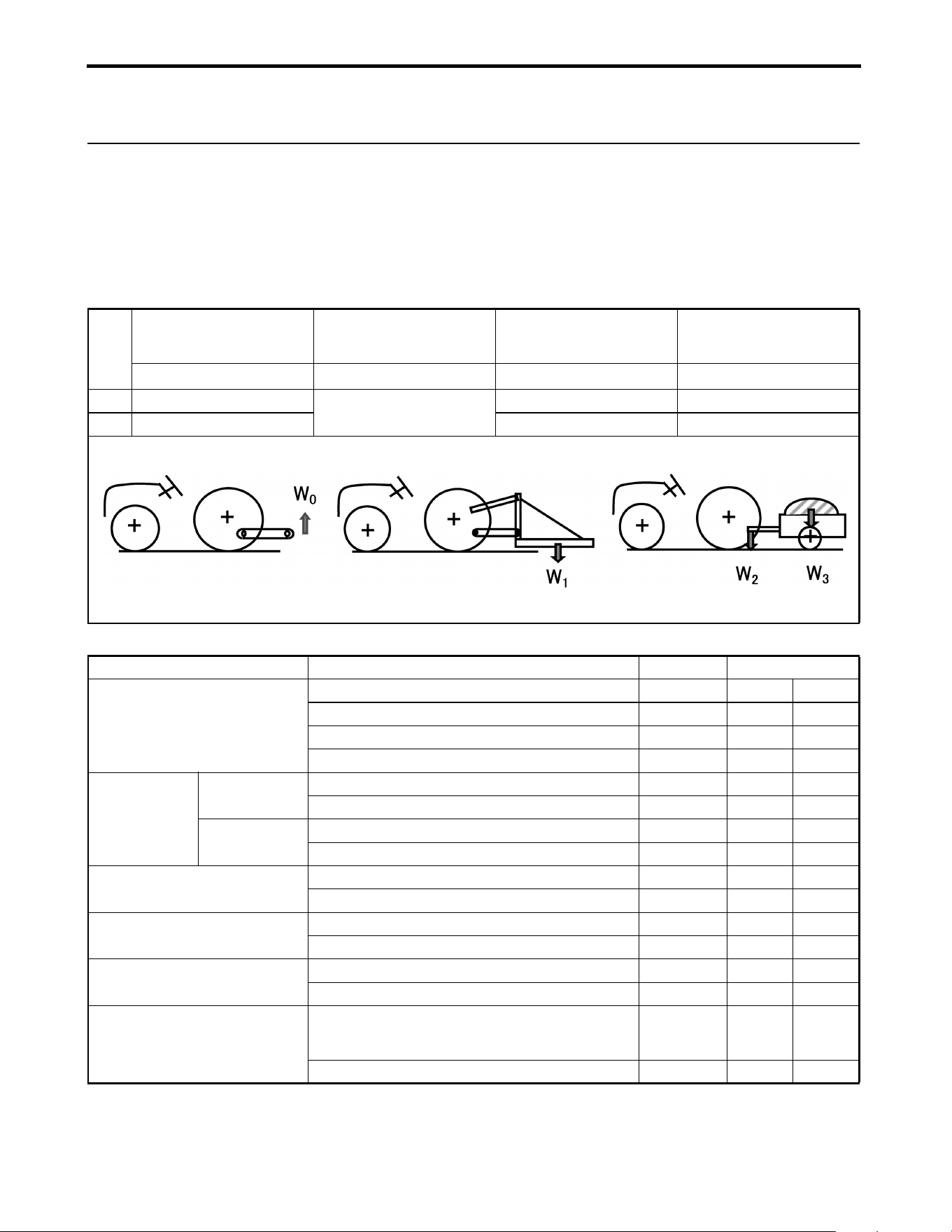
(A) Tractor identification plate with tractor serial
number
(B) Engine serial number
(C) Roll-Over Protective Structure (ROPS) serial
number
Type Serial No.
Tractor
Engine
Roll-Over Protective
Structure (ROPS)
Date of Purchase
Name of Dealer
3016482
(A)
P3014901
(B)
(C)
A3016406

3-1
3. SPECIFICATIONS
Sc2450 Operator's Manual
3. SPECIFICATIONS
Specifications of the Tractor
1. Specifications Table
Model Sc2450
Power Take Off (PTO) Power hp (kW) 16.5 (12.3)
Engine
Maker YANMAR
Model 3TNV72
Type
Indirect Injection, Vertical,
Water-Cooled, 4 Cycle Diesel
Number of Cylinders 3
Bore and Stroke in. (mm) 2.834 × 2.913 (72 × 74)
Total Displacement cu. in. (L) 55.1 (0.903)
Gross Power hp (kW) 24.0 (17.9)
Net Power hp (kW) 20.4 (15.0)
Rated Revolution
min
-1
(rpm)
3300
High Idle Speed
min
-1
(rpm)
3470
Low Idle Speed
min
-1
(rpm)
1150
Maximum Torque ft•lbs (N•m) 38.3 (52.3)
Battery 12V BP24 , CCA: 540 A
Fuel Diesel Fuel No.1-D , No.2-D
Capacities
Fuel Tank US gal (L) Approximately 5.8 (22)
Engine Oil US qt (L) Approximately 2.5 (2.4)
Engine Coolant US qt (L) Approximately 3.4 (3.2)
Transmission/Hydraulic Oil US gal (L) Approximately 2.0 (7.5)
Dimensions
Overall Length (without 3-Point Hitch) in. (mm) 82.7 (2100)
Overall Length (with 3P) in. (mm) 95.5 (2425)
Overall Width (with R4 Tires) in. (mm) 44.5 (1130)
Overall Height (with Roll-Over Protective Structure
(ROPS), R4 Tires)
in. (mm) 83.46 (2120)
Overall Height (with R4 Tires)
(Top of Steering Wheel)
in. (mm) 49.9 (1267)
Wheel Base in. (mm) 55.1 (1400)
Min. Ground Clearance (with R4 Tires) in. (mm) 7.5 (190)
Tread (with R4)
Front in. (mm) 34.6 (879)
Rear in. (mm) 32.2 (820)
Weight (with Roll-Over Protective Structure (ROPS) and R4 Tires) lb (kg) 1344 (610)

3-2
3. SPECIFICATIONS
Sc2450 Operator's Manual
Traveling
System
Tire
Ag (R1)
Front 18 × 8.50-10
Rear 26 × 12.00-12
Turf (R3)
Front 18 × 8.50-10
Rear 26 × 12.00-12
Industrial (R4)
Front 18 × 8.50-10
Rear 26 × 12.00-12
Clutch –
Steering Power Steering
Transmission
Hydrostatic Transmission,
2 Range Speeds
Drive Selected 4WD
Brake Wet plates
Minimum Turning Radius ft (m) 7.2 (2.2)
Differential Lock Foot Pedal Control
Hydraulic Unit
Hydraulic Control System Type Position Control
Pump Capacity (main)
US gal/min
(L/min)
Approximately 3.4 (13.2)
Pump Capacity (steering)
US gal/min
(L/min)
Approximately 3.4 (13.2)
3-Point Hitch Limited Category I
Max. Lift Force
Lift Point lb. (kg) 1036 (470)
24 in. Behind Lift Point lb. (kg) 661 (300)
System Pressure psi (MPa) 1813 (12.5)
Power Take Off
(PTO)
Type Electric Clutch
Rear
Shaft Size SAE 1-3/8, 6-Splines
Type Independent
Speed/Engine
min
-1
(rpm)
540 / 3111
Mid
Shaft Size SAE 16/32, 15-Splines
Type Independent
Speed/Engine
min
-1
(rpm)
2100 / 3338
2. Traveling Speeds (Reference)
Model Sc2450
Range Gear Lever mph km/h
Forward Slow 0-6.0 0-9.7
Fast 0-9.3 0-15
Reverse Slow 0-3.6 0-5.8
Fast 0-5.6 0-9
4-1
4. IMPLEMENT CAPACITIES
Sc2450 Operator's Manual
4. IMPLEMENT CAPACITIES
The Cub Cadet Yanmar tractor has been carefully tested in the configuration equipped with implements sold or
approved by Cub Cadet Yanmar and has proven to perform properly. Do not use any implement that has not
been sold or recommended by a Cub Cadet Yanmar dealer, or that fails to satisfy the specified values given
below. Never mount an implement that is not approved for the Cub Cadet Yanmar tractor. Using unapproved
implements could result in malfunction, failure, and damage to the tractor and/or implement, and increase the
possibility of injury to the operator or other people. The Cub Cadet Yanmar warranty does not cover any
malfunction or failure that results from use of an unapproved implement.
24in. Behind Lift Point
Maximum
Lifting Capacity
Implement Weight
Maximum Vertical
Hitch Load
Maximum
Gross Towing Load
W
0
W
1
W
2
W
3
lb 661
As specified in the list
below.
551 1763
kg 300 250 800
Implement Remarks Unit Amount
Front - End Loader
Maximum Lift Capacity (at Pivot) lb (kg) 700 317
Maximum Overhang (Pivot - Front Tire Center) in. (mm) 40 1022
Maximum Weight lb (kg) 441 200
Maximum Oil Pressure psi (MPa) 1885 13
Mower
Mid - Mount
Maximum Cutting Width in. (mm) 60 1524
Maximum Weight lb (kg) 254 115
Rear - Mount
Maximum Cutting Width in. (mm) 48 1219
Maximum Weight lb (kg) 351 159
Rotary Tiller
Maximum Tilling Width in. (mm) 42 1067
Maximum Weight lb (kg) 342 155
Box Scraper (Box Blade)
Maximum Cutting Width in. (mm) 48 1219
Maximum Weight lb (kg) 254 115
Rear Blade
Maximum Cutting Width in. (mm) 60 1524
Maximum Weight lb (kg) 176 80
Backhoe
Maximum Lift Capacity
with boom and dipperstick fully extended no
more than 36 in. (91 cm) above ground level.
lb (kg) 205 93
Maximum Weight lb (kg) 551 250
A3013714a
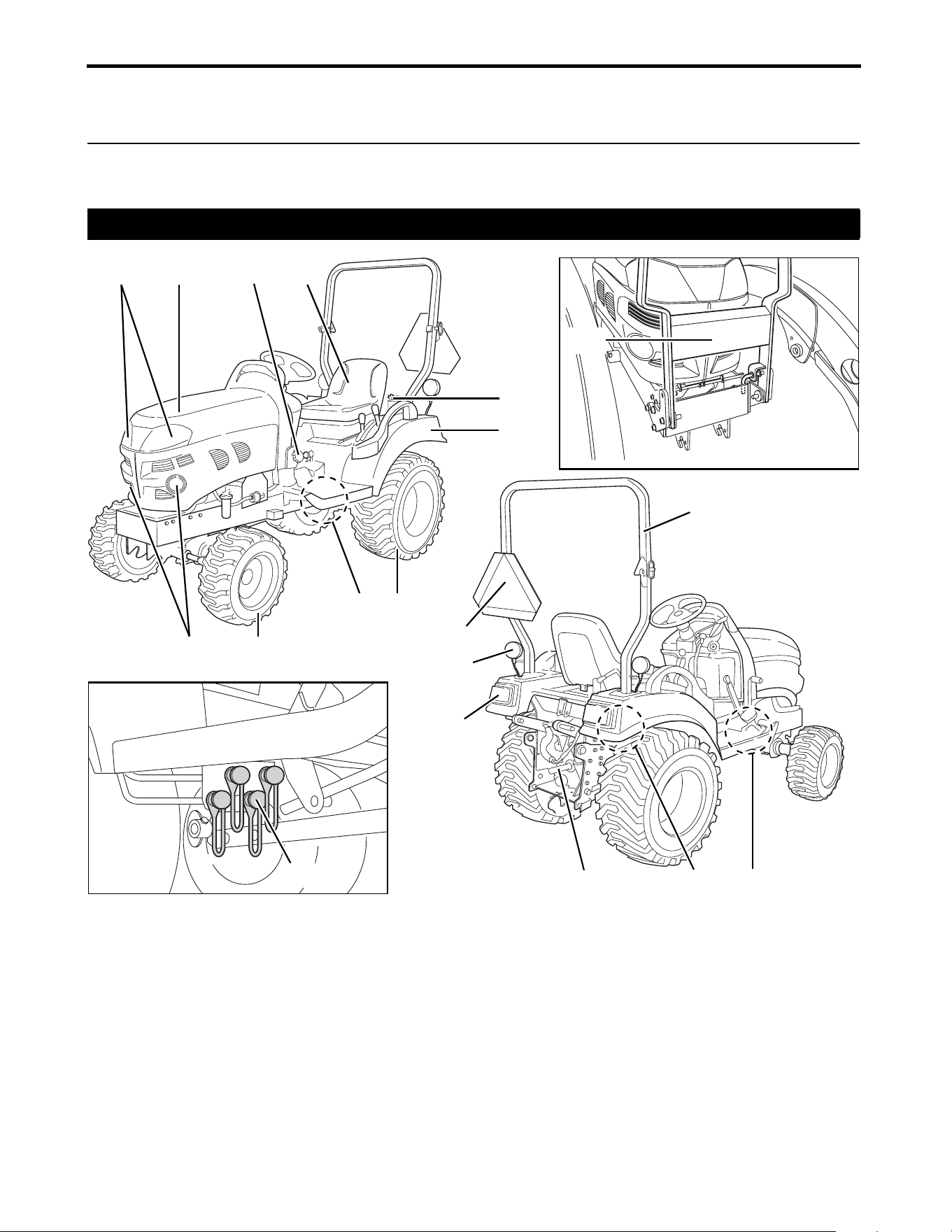
5-1
5. NAMES AND FUNCTIONS OF COMPONENTS
Sc2450 Operator's Manual
5.
NAMES AND FUNCTIONS OF COMPONENTS
Tractor Control Overview
(1) Headlights
(2) Hood
(3) Fuel inlet
(4) Seat
(5) Seat belt
(6) Fender
(7) Rear tires
(8) Mid-Power Take Off (PTO)
(9) Front tires
(10) Work lights
(11) Hood guard
(12) Roll-Over Protective Structure (ROPS)
(13) Hydraulic quick couplers (Option)
(14) 12V DC outlet (for additional rear work light)
(15) Rear Power Take Off (PTO) shaft
(16) Tail lights
(17) Turn signal/hazard lights
(18) Slow Moving Vehicle (SMV) emblem
1. Overview
(16)
(15)
(13)
(12)
(17)
(14)
A3016423
A3016422
(10)
(3)
(9)
(7)
(4)
(1)
(2)
(6)
(5)
3014906
(13)
3016450
(11)
(8)
(18)
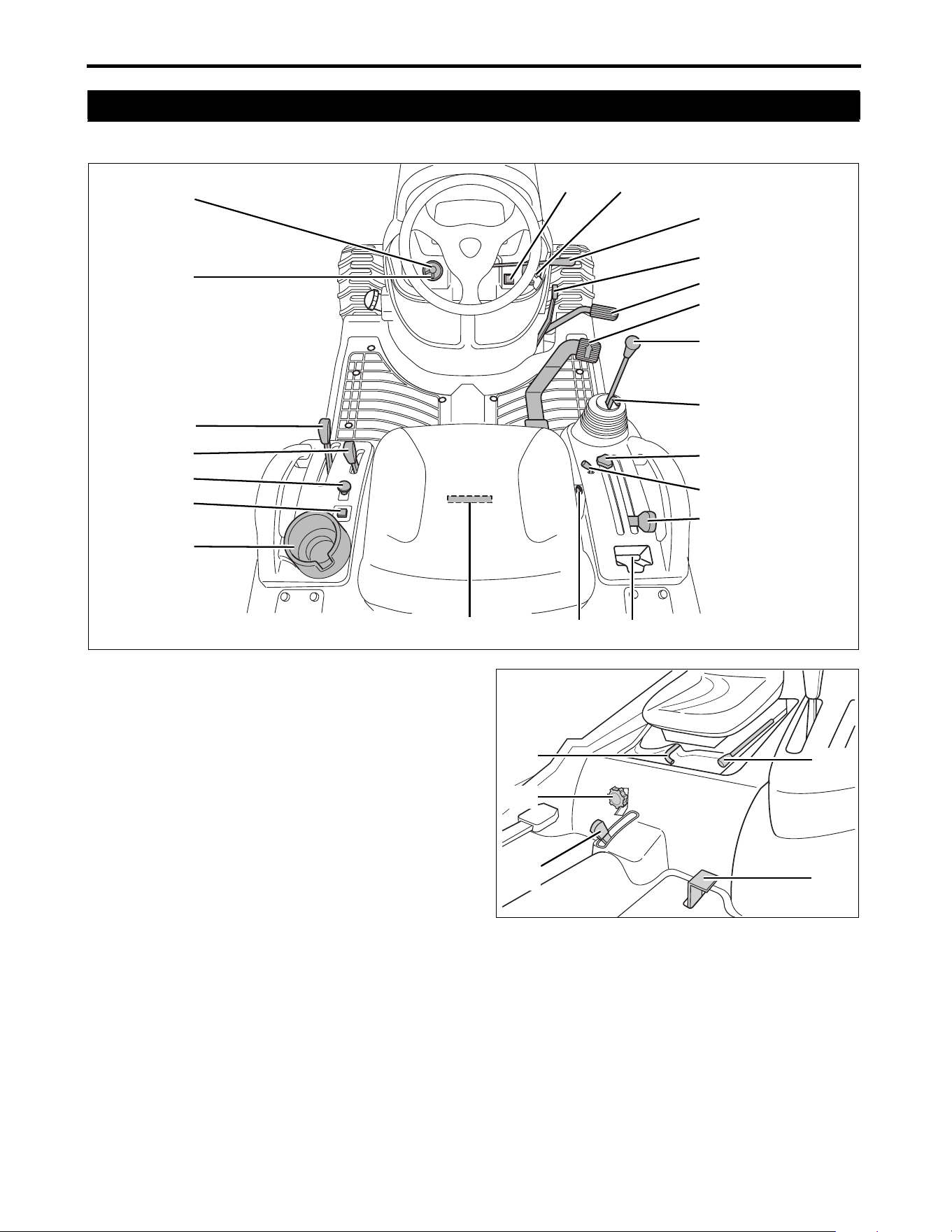
5-2
5. NAMES AND FUNCTIONS OF COMPONENTS
Sc2450 Operator's Manual
■ Names of Components
(1) Hazard lights button switch
(2) Starter key switch
(3) Throttle control lever
(4) Parking brake lever
(5) Brake pedal
(6) Forward and reverse drive pedal
(7) Implement control lever
(8) Implement lock lever
(9) Position stop knob
(10) Cruise control lever
(11)
3-point hitch control/cutting height adjustment lever
(12) Storage compartment
(13) 12V DC outlet
(14) Hydro Static Transmission (HST)
pressure release lever
(15) Cup holder
(16) Reverse - override - switch
(17) Power Take Off (PTO) switch
(18) Range gear lever
(19) Mid-/Rear-Power Take Off (PTO) select lever
(20) Turn signal switch
(21) Headlight/work light switch
(22) Seat adjustment lever
(23) Differential lock foot pedal
(24) 4-wheel drive lever
(25) Hydraulic flow control/stop knob
(26) Seat lock lever
2. Operator Station Controls
3014903
(21)
(17)
(20)
(3)
(1)
(19)
(18)
(16)
(15)
(14)
(13)
(11)
(6)
(4)
(7)
(5)
(8)
(10)
(9)
(2)
(12)
3016494
(25)
(24)
(23)
(22)
(26)
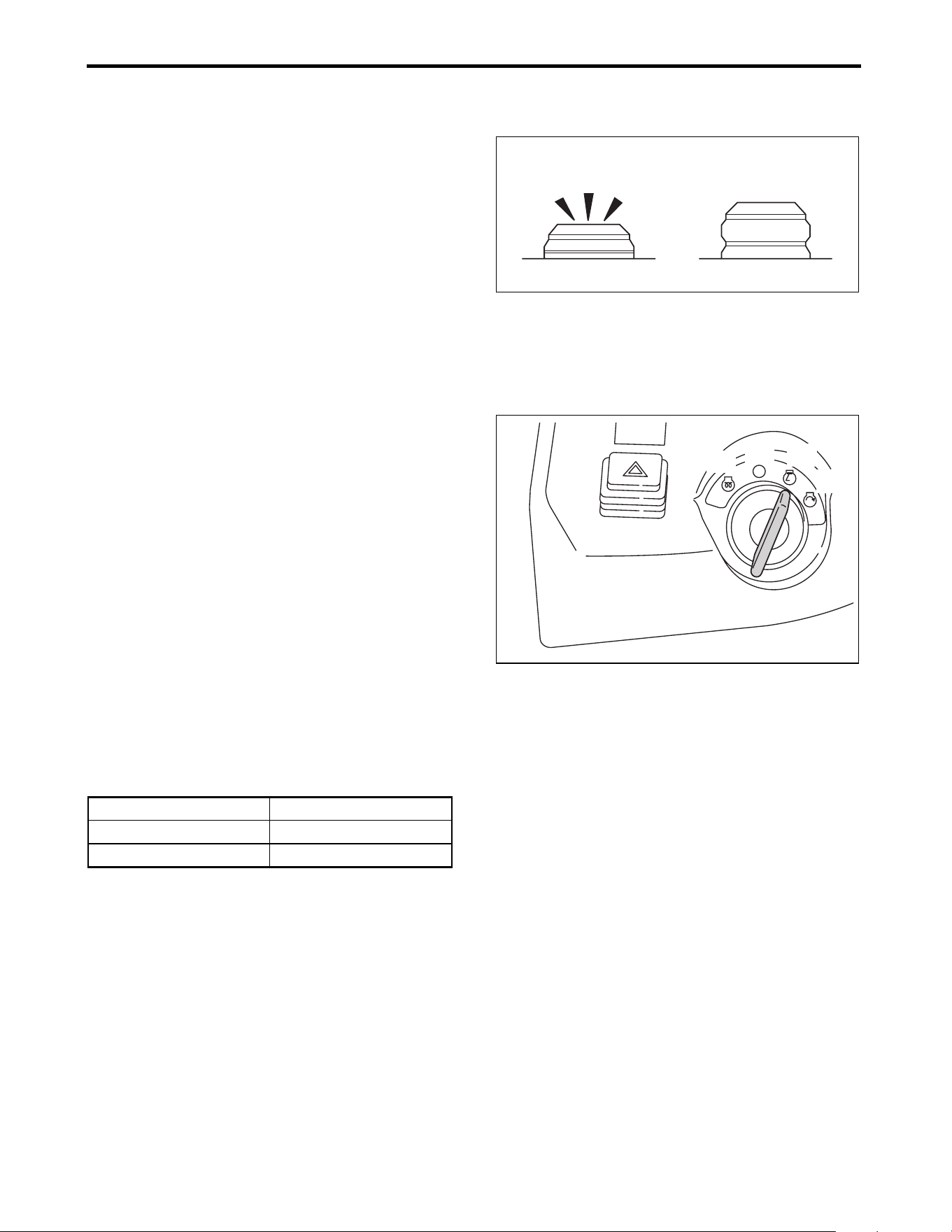
5-3
5. NAMES AND FUNCTIONS OF COMPONENTS
Sc2450 Operator's Manual
■ Function of Components
(1) Hazard lights button switch
Depress the red button to turn the hazard lights ON.
Pressing this button will cause the button to light up
and the hazard lights at the rear of tractor to flash.
(The hazard lights remain flashing even when the
starter key switch is in the OFF position. Remember
that allowing the turn signal/hazard lights to flash for
an extended period can lead to loss of battery
voltage.)
(a) ON
(b) OFF
(2) Starter key switch
This switch is used to start and stop the engine.
(A) OFF position:
The engine must be off.
(B) ON position:
When the key has been turned to this position,
the engine oil pressure warning light and the
alternator/battery charging light and the engine
coolant warning light will illuminate.
(C) START position:
When the key is turned to this position, the starter
starts turning the flywheel and then the engine
begins to run. Once the engine has started,
release the key.
(D) Preheating position:
Preheating time should be determined according to
outside air temperature. For details, see the table
below.
(A) OFF position
(B) ON position
(C) START position
(D) Preheating position
3013729
(a) (b)
Temperature (°F (°C)) Preheating Time (sec.)
Over 32 (0) 2 to 3
Below 32 (0) 4
3014907a
(A)
(B)
(C)
(D)
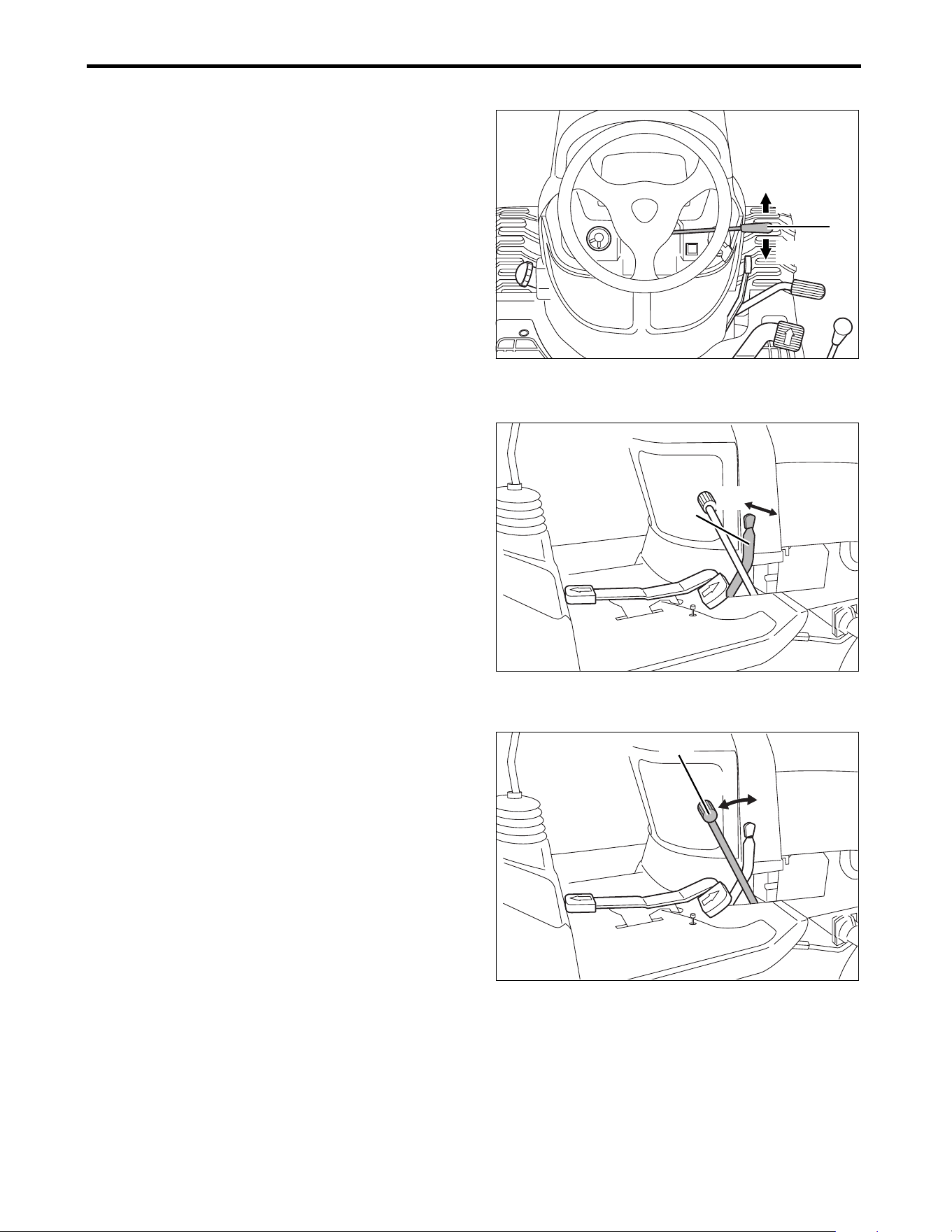
5-4
5. NAMES AND FUNCTIONS OF COMPONENTS
Sc2450 Operator's Manual
(3) Throttle control lever
Use the throttle control lever to change the engine
speed. While monitoring the tachometer, change the
engine speed as required.
(A) Throttle control lever
(a) To increase the engine speed:
pull the throttle control lever backward.
(b) To decrease the engine speed:
push the throttle control lever forward.
(4) Parking brake lever
This lever is used when parking the tractor.
(A) Parking brake lever
(a) To engage the parking brake: Fully pull the
parking brake lever backward.
(b) To unlock the parking brake: Fully push the
parking brake lever forward.
(5) Brake pedal
This pedal is used to stop and park the tractor.
(A) Brake pedal
(a) To apply the brakes: Depress the brake pedal.
(b) To release the brakes: Release foot from the
brake pedal.
3014903e
(A)
(b)
(a)
3014916f
(A)
(b)
(a)
3014916f
(A)
(b)
(a)
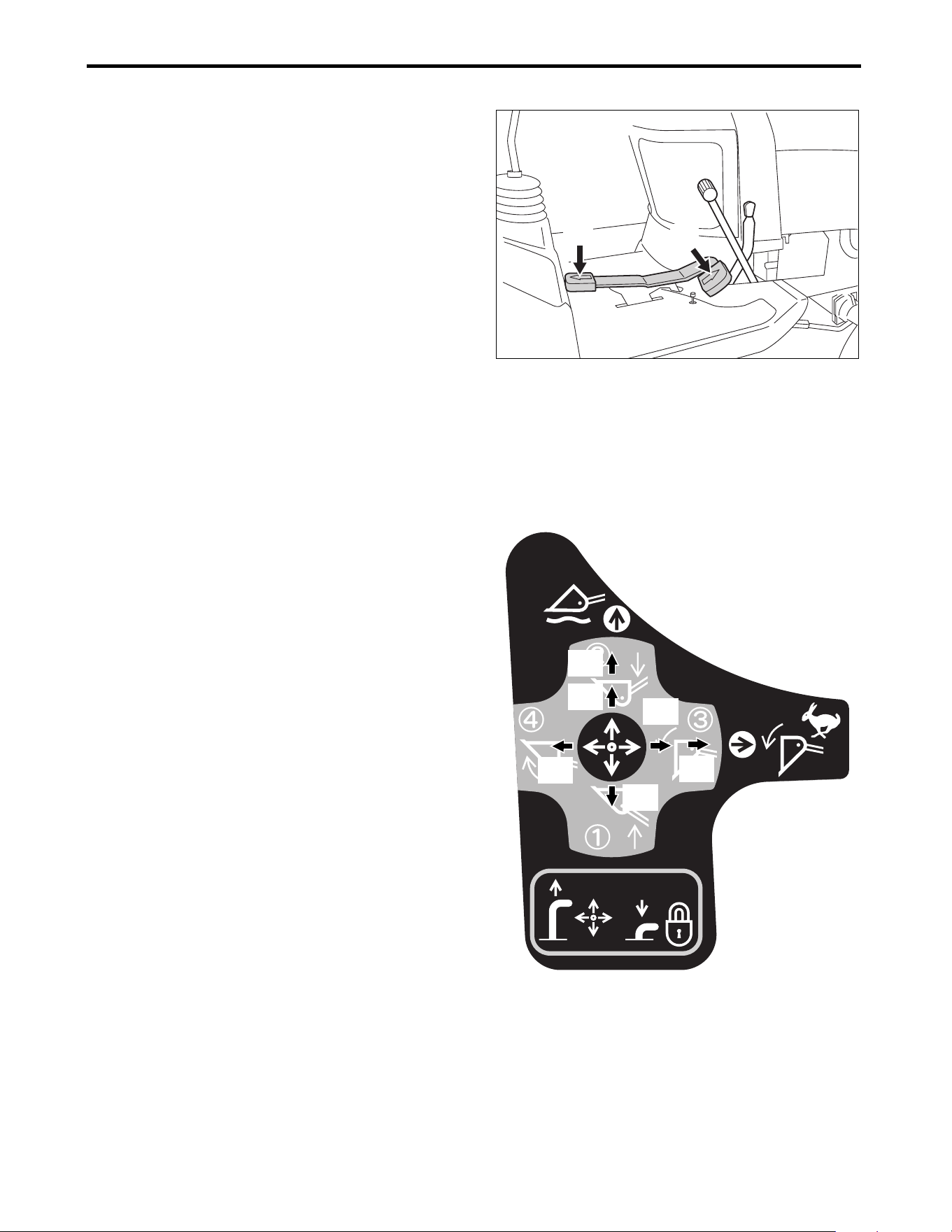
5-5
5. NAMES AND FUNCTIONS OF COMPONENTS
Sc2450 Operator's Manual
(6) Forward and reverse drive pedal
The tractor accelerated speed depends on how far
the drive pedal is pressed.
(A) To move forward:
Depress the forward side of the forward and
reverse drive pedal.
(B) To move backward:
Depress the reverse side of the forward and
reverse drive pedal.
(A) Forward side of the forward and reverse drive
pedal
(B) Reverse side of the forward and reverse drive
pedal
IMPORTANT
●When the drive pedal is released, the transmission
will automatically return to the NEUTRAL position.
(7) Implement control lever
The implement control valve has a float position.
When the implement control valve is in this position,
implements such as blades or front loaders, lowered
to the operating position, are allowed to follow
ground contours.
Push the implement control lever forward beyond the
valve detent position to the float position.
(a) Lower
(b) Float
(c) Dump
(d) Dump faster
(e) Raise the implement
(f) Curl
IMPORTANT: Avoid damage.
●Prevent damage or contamination to the female
quick couplers. ALWAYS leave the color-coded
hose ends connected to the couplers when the
couplers are not in use.
NOTE
●When the implement control lever is released, it
returns to its NEUTRAL position.
3014916c
(A)
(B)
1A7880-65410
(f)
(e)
(d)
(c)
(b)
(a)
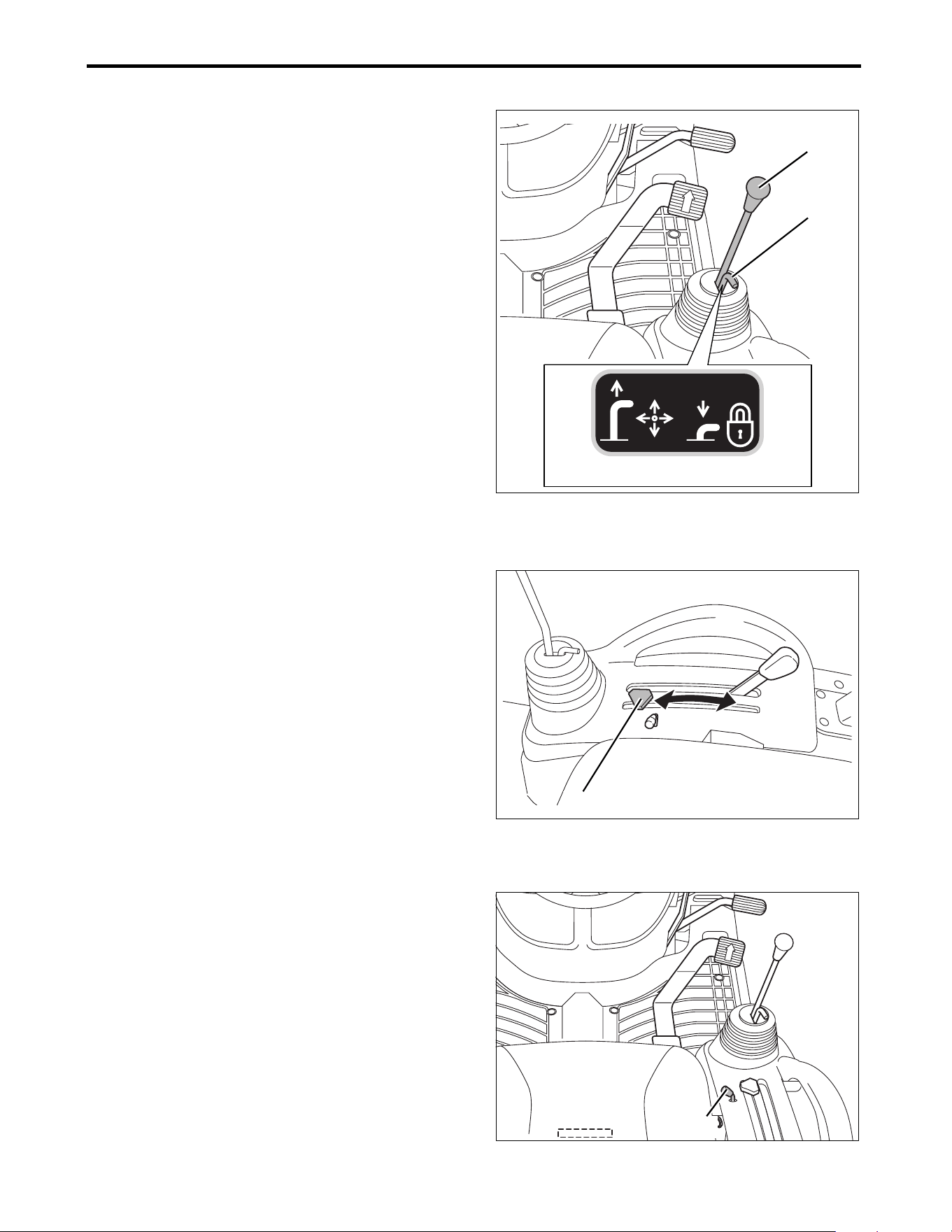
5-6
5. NAMES AND FUNCTIONS OF COMPONENTS
Sc2450 Operator's Manual
(8) Implement lock lever
When fixing the implement control lever at its
NEUTRAL position, use the implement lock lever.
(A) Implement control lever
(B) Implement lock lever
IMPORTANT: Avoid damage.
●Do not attempt to operate the implement control
lever when the implement control lever has been
locked.
●When the implement control lever has been locked
with the implement lock lever, move the implement
control lever with light force to ensure that it has
been securely locked.
(a) To unlock the implement control lever:
Pull up the implement lock lever.
(b) To lock the implement control lever:
Push down the implement lock lever when the
implement control lever is in its NEUTRAL
position.
(9) Position stop knob
This knob is used to secure the implement installed
with the 3-point hitch in its raised position, or to limit
the range of operation of the 3-point hitch control/
cutting height adjustment lever.
(A) Position stop knob
(10)Cruise control lever
The cruise control is a feature that regulates forward
tractor travel to a specific speed.
(A) Cruise control lever
3014903n
(A)
(B)
(b)
(a)
3014918e
(A)
3014903m
(A)
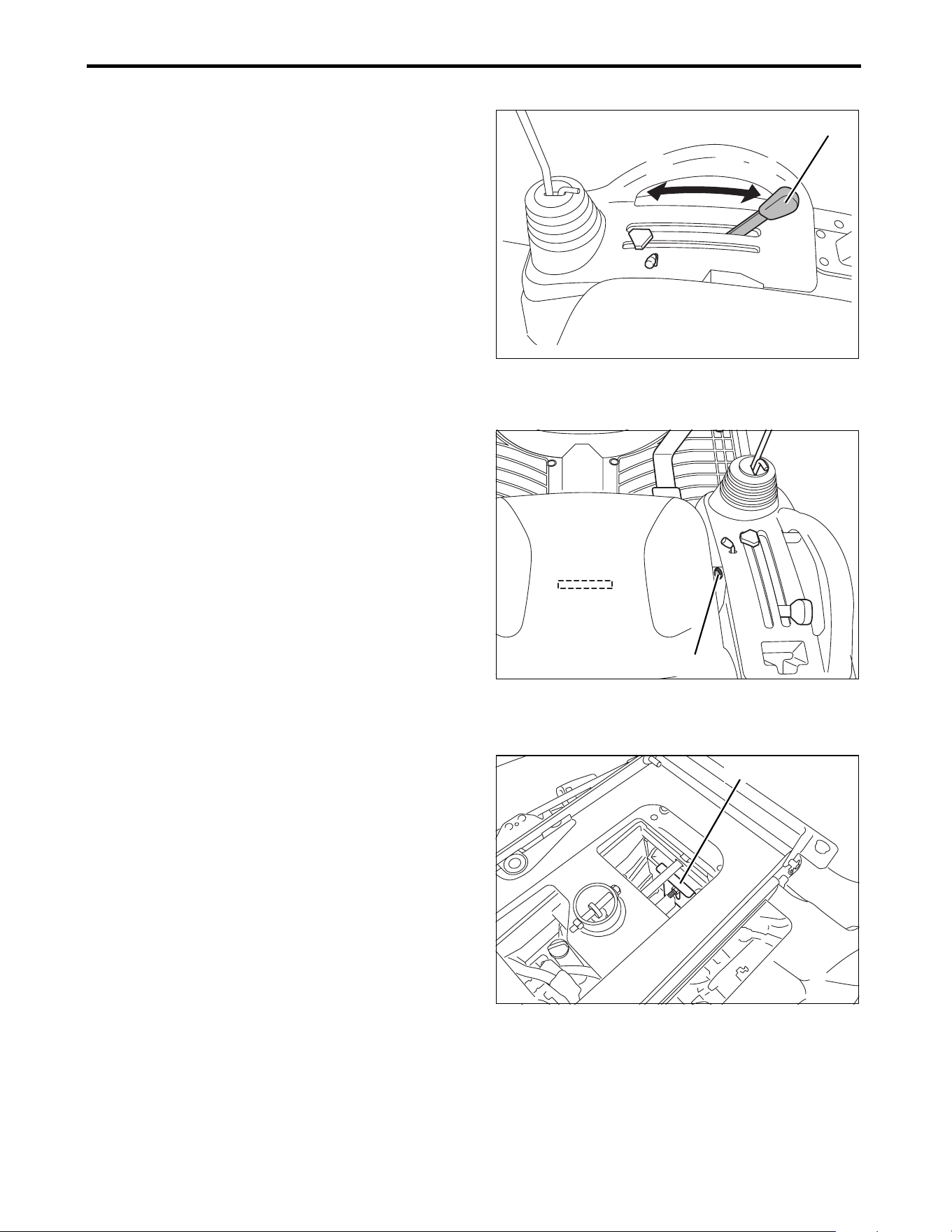
5-7
5. NAMES AND FUNCTIONS OF COMPONENTS
Sc2450 Operator's Manual
(11)3-point hitch control/cutting height adjustment lever
Use the 3-point hitch control/cutting height
adjustment lever, when raising or lowering the Mid-
or Rear-mounted implement.
(A) 3-point hitch control/cutting height
adjustment lever
(a) Moving the 3-point hitch control/cutting height
adjustment lever forward will lower the
implement.
(b) Moving the 3-point hitch control/cutting height
adjustment lever backward will raise the
implement to raise higher.
(13)12V DC outlet
This can be used as a power source for electrical
goods.
(A) 12V DC outlet
(14)Hydro Static Transmission (HST) pressure release lever
Hydraulic pressure in the Hydro Static Transmission
(HST) brakes the axles when the engine is not
running, so that the tractor cannot be moved.
When the hydraulic pressure in the transmission is
released by pressing the Hydro Static Transmission
(HST) pressure release lever, the tractor can be
moved.
(A) Hydro Static Transmission (HST) pressure
release lever
3014918e
(b)
(a)
(A)
3014903o
(A)
3016486
(A)
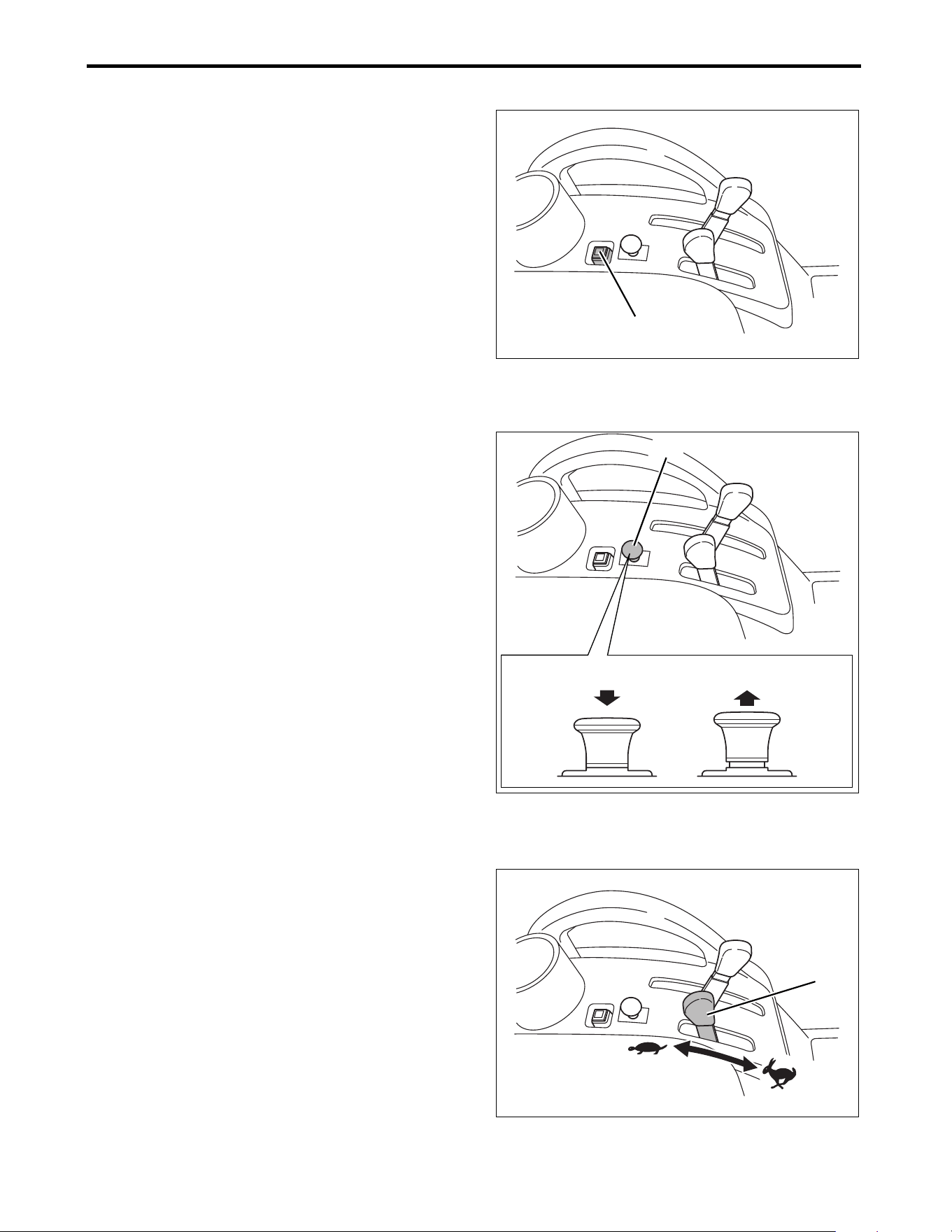
5-8
5. NAMES AND FUNCTIONS OF COMPONENTS
Sc2450 Operator's Manual
(16)Reverse-override-switch
Normally, reversing the tractor stops the Mid-Power
Take Off (PTO) and the Rear-Power Take Off (PTO).
To drive the Power Take Off (PTO) while reversing
the tractor, use the reverse-override-switch.
(A) Reverse-override-switch
(17)Power Take Off (PTO) switch
This switch is used to rotate the Power Take Off
(PTO).
(A) Power Take Off (PTO) switch
(a) Turn off: Push the switch.
(b) Turn on: Pull the switch.
(18)Range gear lever
Use the range gear lever to select the speed that
best suits the intended operation.
(A) Range gear lever
(a) SLOW : Used for heavy-load operation.
Low traveling speed.
(b) FAST : Used for light-load operation.
High traveling speed.
3014919d
(A)
3014919g
(A)
(a) (b)
3014926
3014919a
(A)
(a)
(b)
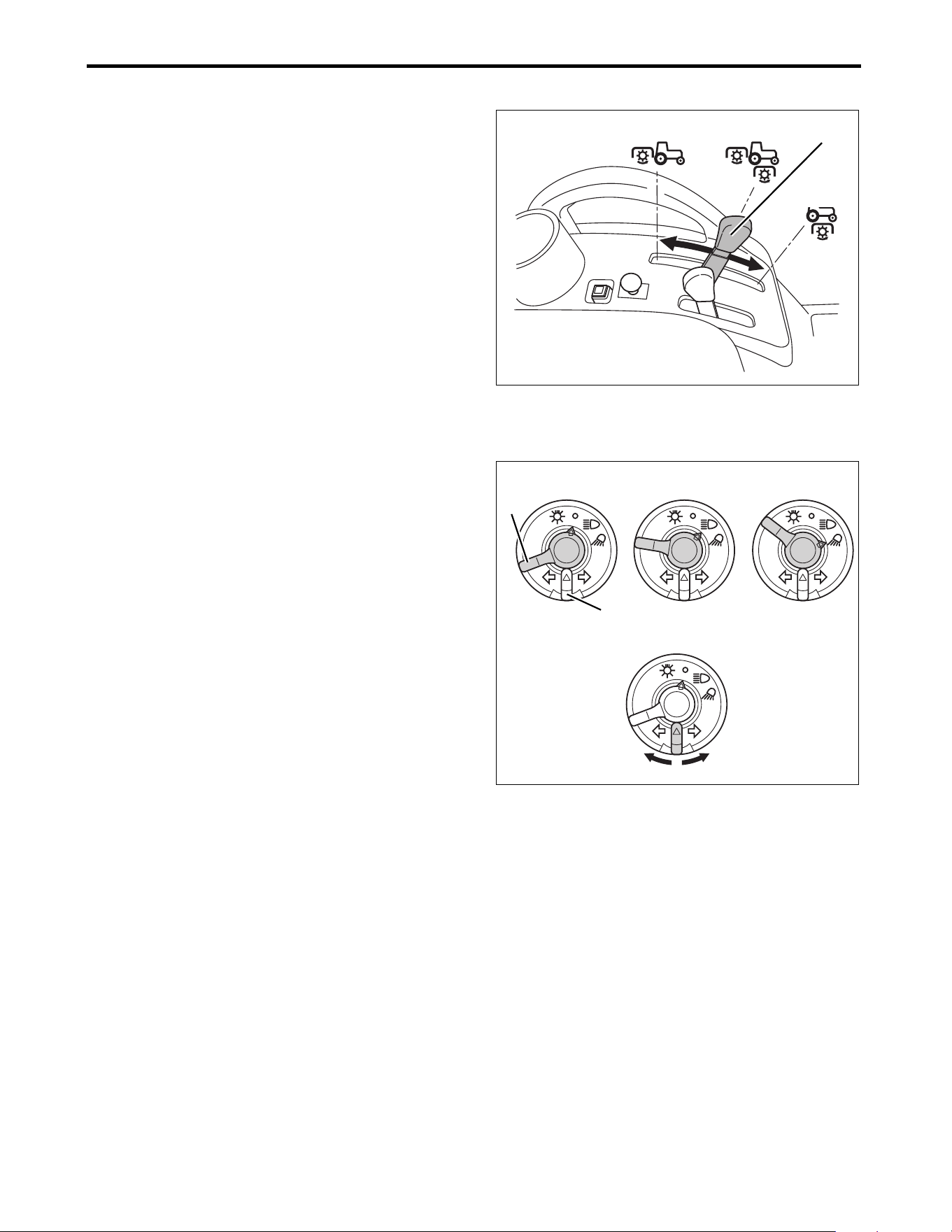
5-9
5. NAMES AND FUNCTIONS OF COMPONENTS
Sc2450 Operator's Manual
(19)Mid-/Rear-Power Take Off (PTO) select lever
This lever is used to select the Mid- or Rear-Power
Take Off (PTO), depending upon the implement
being used.
(A) Mid-/Rear-Power Take Off (PTO) select lever
(a) Operating the Mid-Power Take Off (PTO) alone
(b) Operating the Mid-Power Take Off (PTO) and the
Rear-Power Take Off (PTO) at the same time
(c) Operating the Rear-Power Take Off (PTO) alone
(20)Turn signal switch
(21)Headlight/work light switch
Use the blue lever to turn ON/OFF the headlights
and work lights. Turning the blue lever to the (b)
position illuminates the headlights and turning it to
the (c) position illuminates the work lights and
headlights at the same time.
• The yellow lever is a turn signal switch.
• Move the turn signal switch right to signal a right
turn.
• Move the turn signal switch left to signal a left
turn.
• The tail light illuminates while the turn signal light
is illuminated or blinked, the tail light similarly
illuminates or flashes.
(A) Blue lever (Headlight/work light switch)
(B) Yellow lever (Turn signal switch)
(a) OFF
(b) Headlights ON
(c) Headlights and work lights ON
(d) To signal a left turn, move the lever to left
(e) To signal a right turn, move the lever to right
(22)Seat adjustment lever
See “Adjust the Operator's Seat” on page 7-2.
(23)Differential lock foot pedal
See “Differential Lock” on page 8-15.
3014919e
(A)
(c)
(a)
(b)
A3014901
(a) (b) (c)
(A)
(B)
A3014902
(d)
(e)
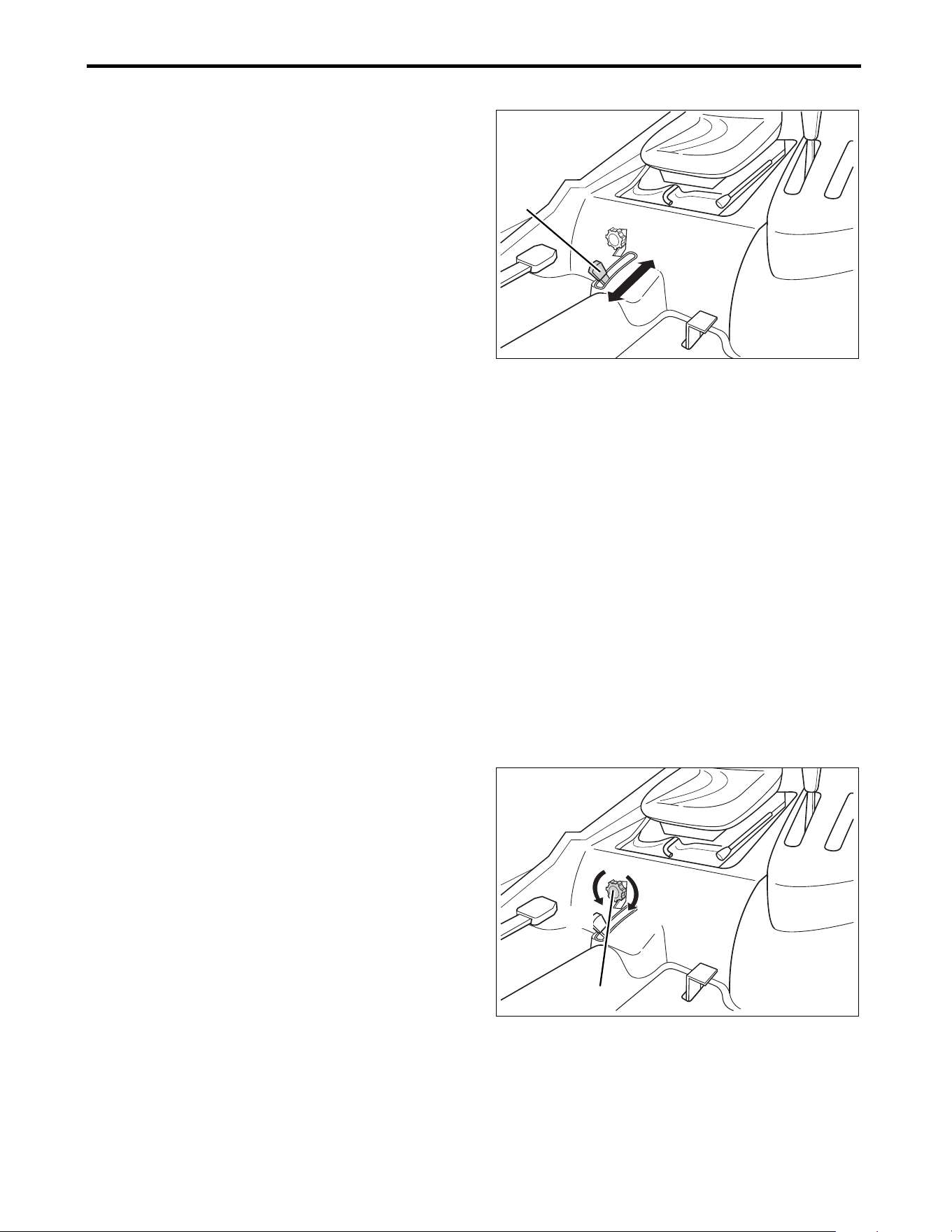
5-10
5. NAMES AND FUNCTIONS OF COMPONENTS
Sc2450 Operator's Manual
(24)4-wheel drive lever
In the 4-wheel drive mode, all the four wheels are
powered to obtain better traction on difficult-to-travel
ground.
The 4-wheel drive lever can be set to the ON or OFF
position only when the tractor is at a standstill.
(A) 4-wheel drive lever
(a) 4-wheel drive mode
(b) 2-wheel drive mode
IMPORTANT: Avoid damage.
●ALWAYS keep the 4-wheel drive lever in the OFF
position when traveling on a paved surface.
●ALWAYS disengage the 4-wheel drive lever when
not needed to prevent premature wear of the front
tires.
●NEVER install tire chains to the front wheels.
Chains will hit and can damage the tractor.
●If disengaging the 4-wheel drive lever is difficult,
stop the tractor, turn the steering wheel right and
left several times. Then attempt to disengage the
4-wheel drive lever again.
●To minimize tire wear, drive in the 4-wheel drive
mode only when absolutely necessary. Driving the
tractor on a paved road in the 4-wheel drive mode
can accelerate wear of the tires.
●To obtain better traction, keep the front tires at the
maximum allowable pressure.
●When the 4-wheel drive lever is in the ON position,
braking will apply to all four wheels.
(25)Hydraulic flow control/stop knob
The lowering speed of the lower link is governed by
the position of the hydraulic flow control/stop knob.
Also, this knob is used to stop the lower link at an
intended position.
(A) Hydraulic flow control/stop knob
(a) Turning the knob clockwise will cause the
lowering speed to decrease.
Tighten the knob by fully turning clockwise to stop
the lower link.
(b) Turning the knob counterclockwise will cause the
lowering speed to increase.
(26)Seat lock lever
See “Reverse the Operator's Seat” on page 7-2.
3016494b
(A)
(b)
(a)
3014904d
(b)
(a)
(A)
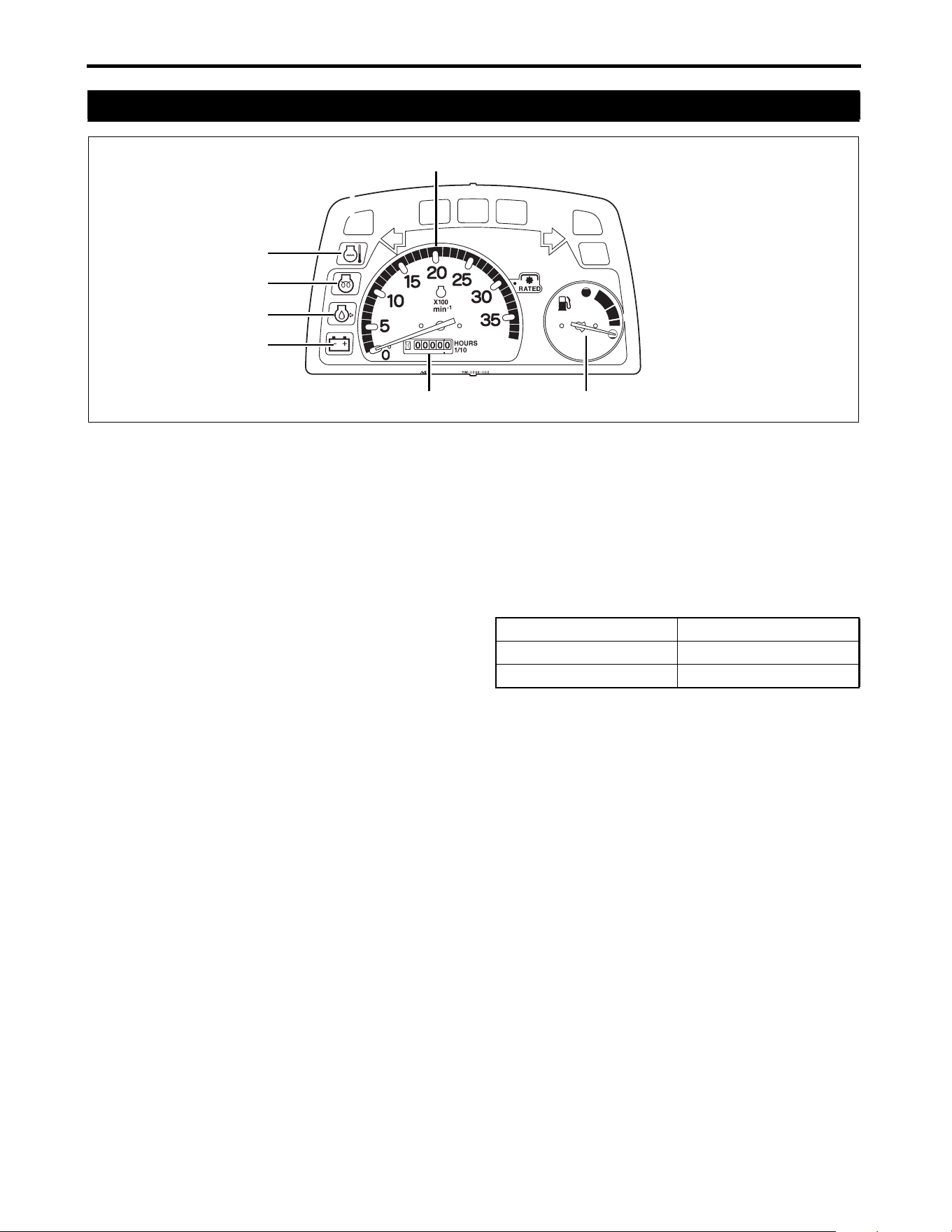
5-11
5. NAMES AND FUNCTIONS OF COMPONENTS
Sc2450 Operator's Manual
(1) Tachometer
This meter indicates the current engine speed in
increments of 100 min
-1
(rpm).
(2) Fuel gauge
This gauge indicates level of fuel in the fuel tank,
while the starter key switch is in the ON position.
(3) Hour meter
This meter indicates the total accumulated operating
hours. This indication is based on the assumption
that the engine runs at a speed of 3300 min
-1
(rpm).
(4) Alternator/battery charging light
This light remains lit when the starter key switch is in
the ON position and the engine is OFF.
IMPORTANT
●If this light illuminates while the engine is running,
the power generated by the alternator is too low.
Fully pull the throttle control lever backward and
increase the engine speed. If the light still remains
lit, immediately stop the engine and contact your
local Cub Cadet Yanmar dealer for technical
assistance.
(5) Engine oil pressure warning light
This light remains lit when the starter key switch is in
the ON position and the engine is OFF.
IMPORTANT
●If this light illuminates while the engine is running,
the engine oil pressure is too low. Immediately stop
the engine and contact your local Cub Cadet
Yanmar dealer for technical assistance.
(6) Preheater pilot light
This light illuminates when the engine starter key
switch is turned to the preheating position.
Preheating time should be determined according to
outside air temperature. For details, see the table
below.
(7) Engine coolant warning light
This light illuminates when engine coolant
temperature becomes abnormally high.
IMPORTANT
●If the engine coolant warning light does turn on,
reduce the load on the tractor immediately, run the
engine at an idle until the light turns off, and shut
off the engine. Wait until the engine has cooled off
completely, and check to see that there is:
(1) Sufficient coolant in the radiator and reserve
tank
(2) No clogging of the radiator fins and screen
(3) Sufficient tension in the fan belt
See “Chapter 14. PERIODIC SERVICE” for more
information on maintenance procedures.
●If the coolant warning light turns on again even
after being sure of the checkpoints above, shut off
the engine immediately and contact your local Cub
Cadet Yanmar dealer.
3. Instrument Panel, Switches and Hand Controls
3014905
(1)
(7)
(2)(3)
(6)
(5)
(4)
Temperature (°F (°C)) Preheating Time (sec.)
Over 32 (0) 2 to 3
Below 32 (0) 4

6-1
6. PRE-OPERATION CHECK
Sc2450 Operator's Manual
6. PRE-OPERATION CHECK
Pre-Operation Check of Tractor
●Check the tractor for damage, excessive wear, cracks, missing parts,
exposed wiring and any other problems, including leaks.
●Check the joints and connections for looseness.
●Check that all the lights illuminate.
●Check that all the safety-alert decals are in correct position.
If any problem is detected, contact your local Cub Cadet Yanmar dealer,
and correct the problem. NEVER operate the tractor when a problem has
been indicated.
●ALWAYS be aware of the limitations of the performance of the tractor.
●Operate the tractor, keeping in mind “SAFETY FIRST!”.
●Check the safety features.
●Check the tire pressure.
●Check that the remaining diesel fuel is sufficient for the intended
operation.
●Check the engine oil level.
●Check the transmission/hydraulic oil level.
●Check the coolant level.
●Remove grass clippings and debris from the tractor.
●Clean the air cleaner element.
●Check the tractor for any leaks such as oil, coolant and fuel.
●Check the radiator for possible blockage.
●Check the retractable seat belt and the Roll-Over Protective Structure
(ROPS) for any problem.
If any problem is detected, contact your local Cub Cadet Yanmar dealer
and correct the problem.
●Only wipe off the tractor after washing.
●Chemical agents such as pesticides can damage the plastic surfaces and
painted surfaces. NEVER spray chemical agents near the machine.
●NEVER spill diesel fuel onto the tractor. Diesel fuel can damage the
plastic surfaces and painted surfaces. ALWAYS wipe up spilled diesel
fuel immediately.
1. Pre-Operation Check
2. Precautions Before the Operation
3. Routine Check
4. Prevent Damage to the Plastic Surfaces and Painted Surfaces

7-1
7. OPERATE THE ENGINE
Sc2450 Operator's Manual
7. OPERATE THE ENGINE
NEVER run or idle the engine in a
confined area that is poorly ventilated or
not ventilated at all. The engine emits
carbon monoxide as that is colorless,
odorless and can cause death.
ALWAYS remain seated in the operator’s station
when starting the engine or actuating the levers or
controls.
Always ensure that your foot is removed from the
forward and reverse pedal, the parking brake is
engaged and Power Take Off (PTO) switch is in the
OFF position before the engine is started.
While operating the tractor, make sure to keep the
seat belt fastened with the Roll-Over Protective
Structure (ROPS) equipped. This will reduce the
possibility of injury or death in the event of an
accident such as an overturn or roll-over.
Start the engine of your tractor only with the starter
key switch. NEVER attempt to start the tractor engine
by short-circuiting across its terminals with a jumper
or by bypassing the safety start switch.
Before operation, make sure that all the safety
features are functioning correctly. Make corrections
as necessary.
! WARNING
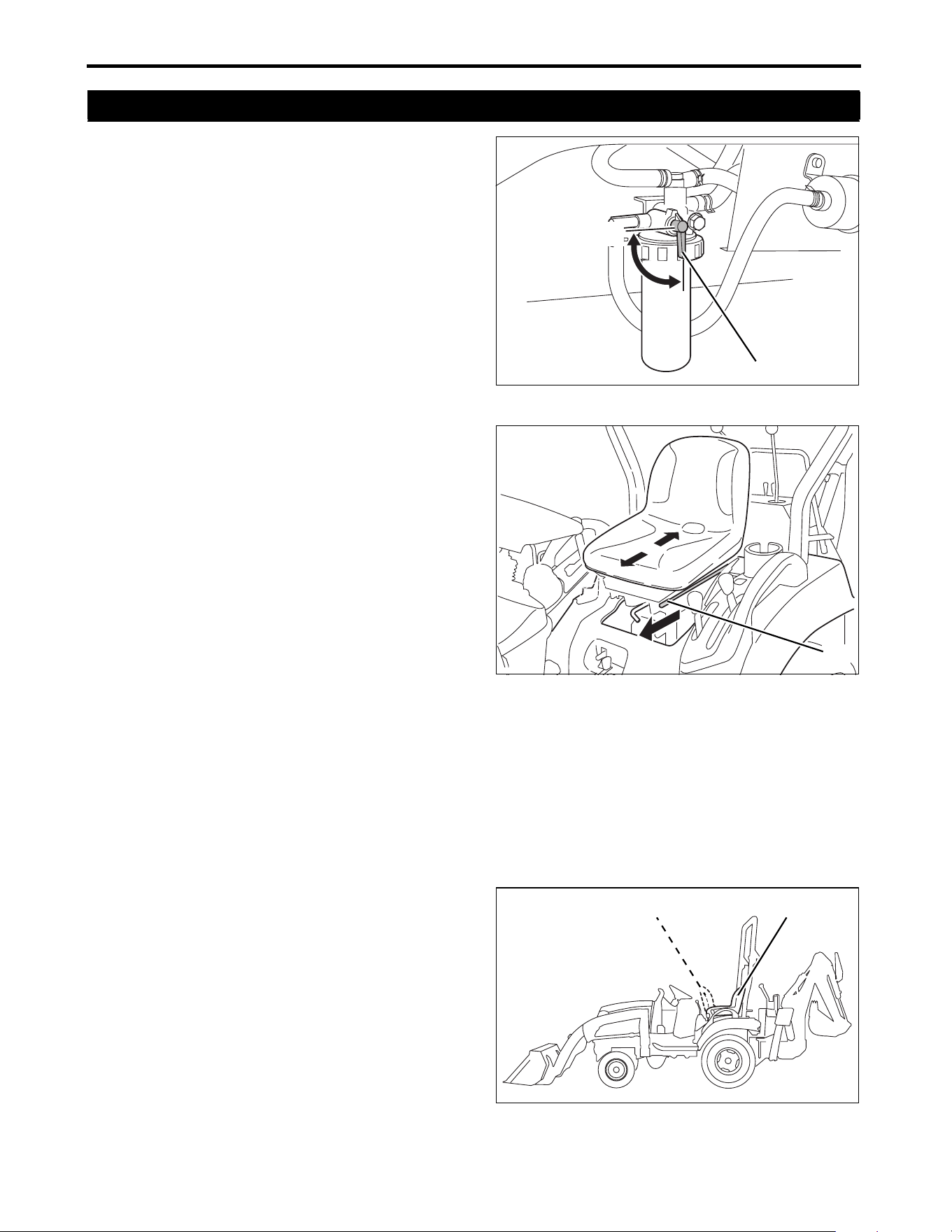
7-2
7. OPERATE THE ENGINE
Sc2450 Operator's Manual
1. Open the fuel shut-off valve.
■ Opening/Closing the Fuel Shut-Off
Valve
●To open the valve, turn the valve lever to the
vertical position.
●To close the valve, turn the valve lever to the
horizontal position.
(A) Valve lever
(O) Open
(C) Close
2. Sit on the seat.
■ Adjust the Operator's Seat
1. Engage the parking brake securely and stop the
engine.
2. Sit on the seat.
3. Pull the seat adjustment lever to the left.
4. Move the seat forward and backward to find the
optimal position and then release the seat
adjustment lever.
5. While remaining seated, confirm that various
control levers can be comfortably operated. If any
control lever cannot be operated comfortably,
readjust the seat position as necessary.
(A) Seat adjustment lever
IMPORTANT
●After adjusting the seat position, always make sure
that the seat is securely locked in place.
■ Reverse the Operator's Seat
The following procedure can be used to turn the
operator's seat around for backhoe operation.
(A) Operator's seat
(position for driving the tractor and operating
the front loader)
(B) Operator's seat
(position for backhoe operation)
1. Start the Engine
3014908a
(A)
(O)
(C)
3016414c
(A)
(A)(B)
3016410
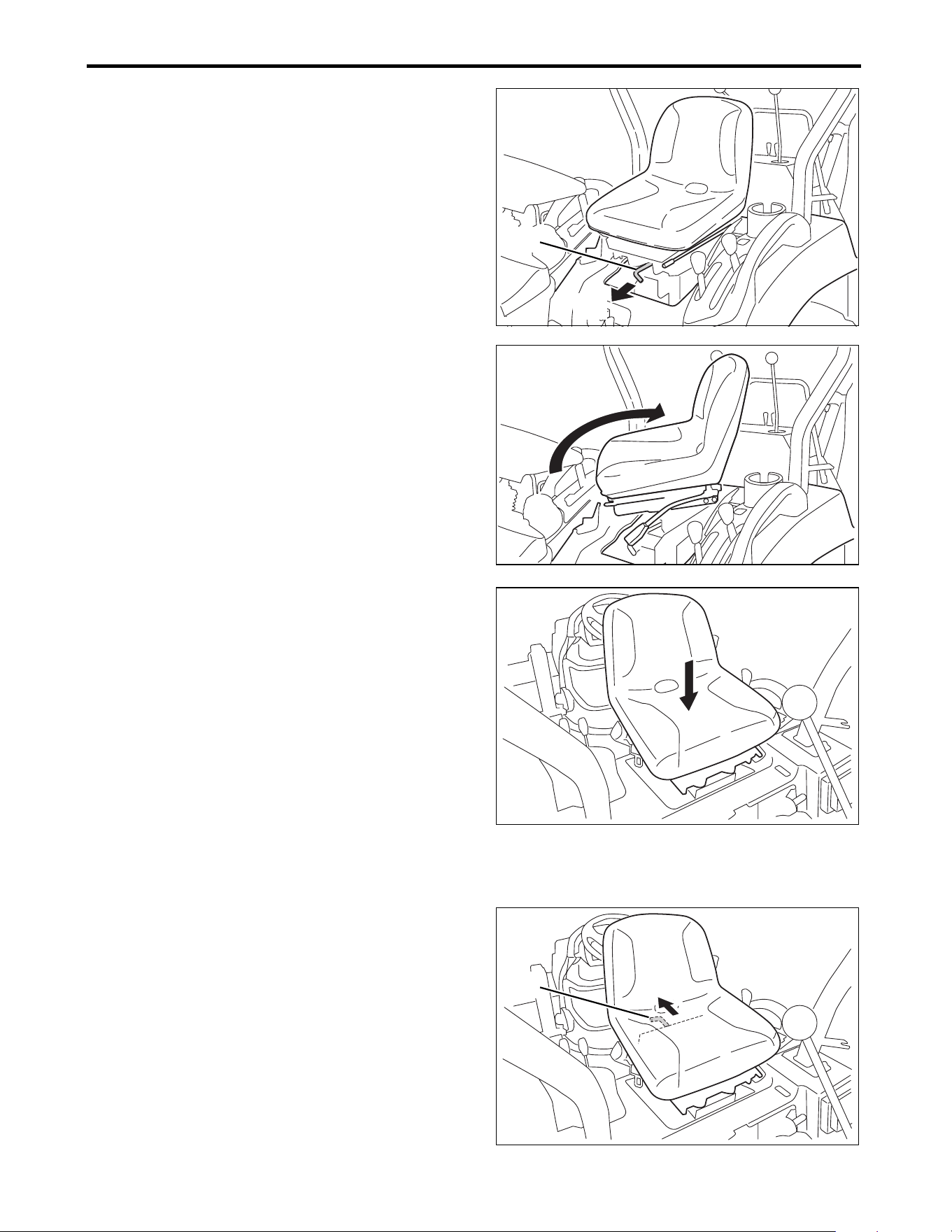
7-3
7. OPERATE THE ENGINE
Sc2450 Operator's Manual
1. Slide the seat backward completely.
Pull the seat lock lever out to release the seat lock
as shown in the illustration.
(A) Seat lock lever
(a) Release the lock
2. The seat must be raised mechanically and can be
rotated as shown in the illustration. (clockwise
only)
3. Turn the seat slowly until it is facing the opposite
direction.
Confirm the seat position is locked automatically.
NOTE
●Whenever seated, the seat is lowered approx. 0.59
in. (15mm)
NOTE
●For tractor operation;
1. Slide the seat backward completely.
Pull the seat lock lever out to release the seat lock
as shown in the illustration.
(A) Seat lock lever
(a) Release the lock
3016414d
(A)
(a)
3016415b
3016416
3016416a
(A)
(a)
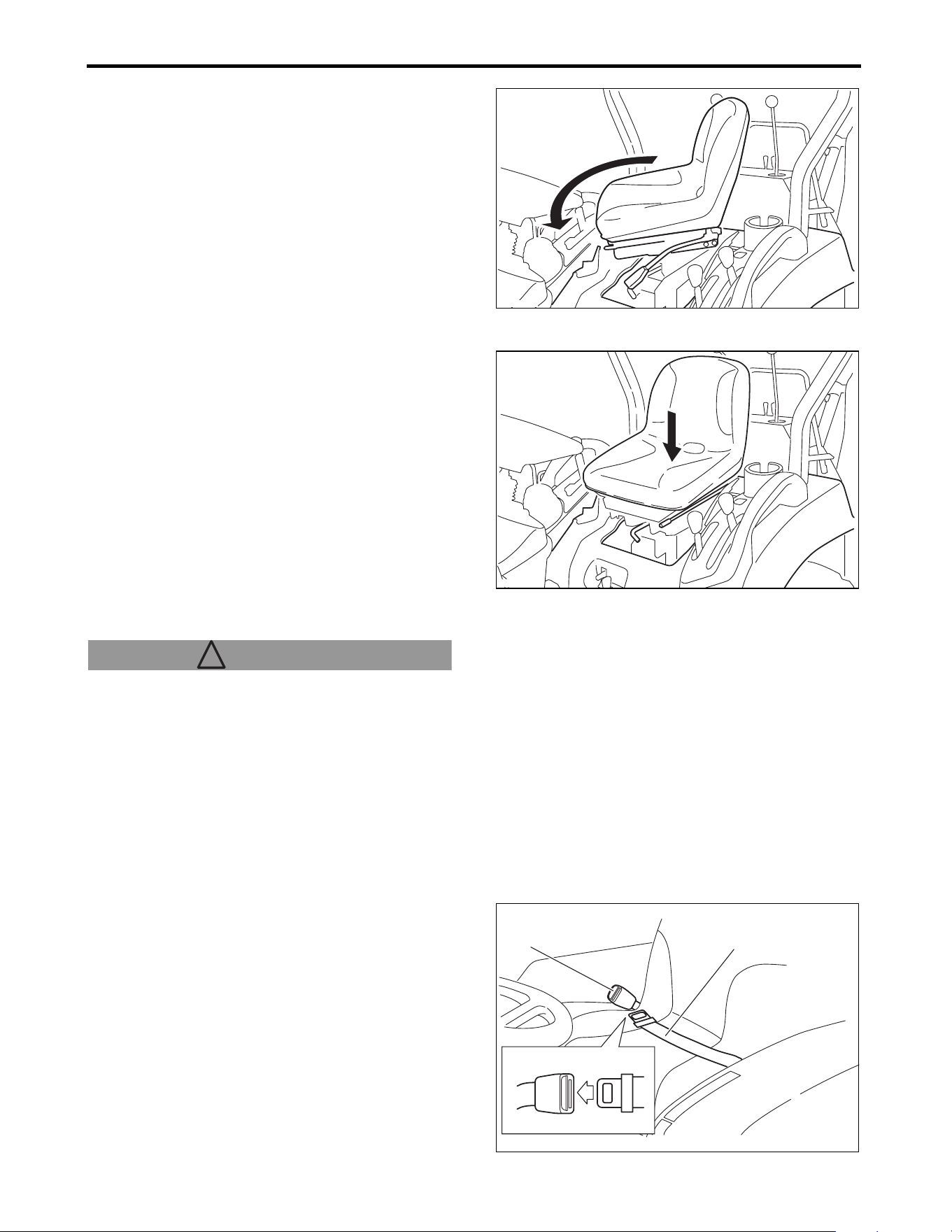
7-4
7. OPERATE THE ENGINE
Sc2450 Operator's Manual
2. The seat must be raised mechanically and can be
rotated as shown in the illustration
(counterclockwise only).
3. Turn the seat until it is facing the opposite
direction. Once it is oriented in a straight position,
push down on the seat using both hands.
4. Make sure that the seat is securely locked in
place.
■ Fasten the Retractable Seat Belt
Avoid injury:
●While operating the tractor, make sure to keep
the seat belt fastened with the Roll-Over
Protective Structure (ROPS) equipped. This will
reduce the possibility of injury or death in the
event of an accident such as an overturn or
roll-over.
●NEVER use the retractable seat belt when
operating the tractor without the Roll-Over
Protective Structure (ROPS).
1. Draw out the right and left segments of the
retractable seat belt from the retracted positions
on both sides of the operator's seat.
2. Connect both segments of the belt with the
buckle, being careful to avoid twisting of the belt,
adjust the belt length, being suitable for the
operator.
(A) Buckle
(a) Adjust the belt length
3016415c
3016414e
! WARNING
! WARNING
(A)
(a)
A3013712
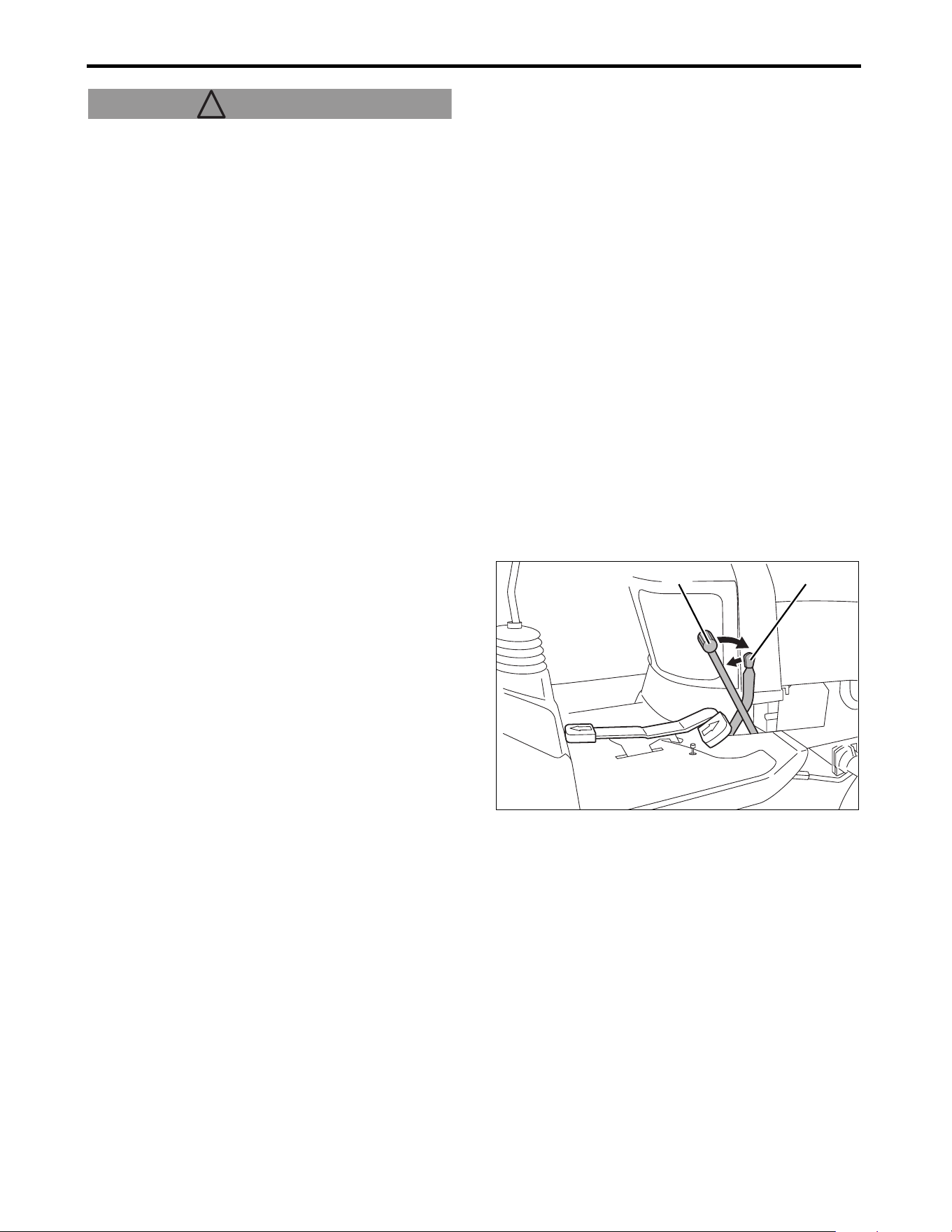
7-5
7. OPERATE THE ENGINE
Sc2450 Operator's Manual
●If the retractable seat belt is situated far away
from the operator's abdominal area, a
dangerous situation can be present in the event
of an accident. ALWAYS ensure that the
retractable seat belt is in the lowest possible
position to the operator's abdominal area.
●The retractable seat belt must be used by the
operator only. NEVER use the retractable seat
belt for two or more persons or to hold an
object to the operator.
3. Remove foot from the forward and
reverse drive pedal and set the pedal
to the NEUTRAL position.
NOTE
●With the parking brake engaged, the forward and
reverse drive pedal is locked in the NEUTRAL
position.
4. Engage the parking brake securely.
■ Engage the Parking Brake
1. Fully depress the brake pedal.
2. Fully pull the parking brake lever backward to
engage the parking brake securely.
3. Remove foot and make sure that the brake is fully
locked.
NOTE
●Applying the parking brake engages the differential
lock at the same time.
(A) Brake pedal
(B) Parking brake lever
IMPORTANT: Avoid damage.
●NEVER step on the forward and reverse drive
pedal while the parking brake is engaged.
! WARNING
3014916a
(A)
(B)
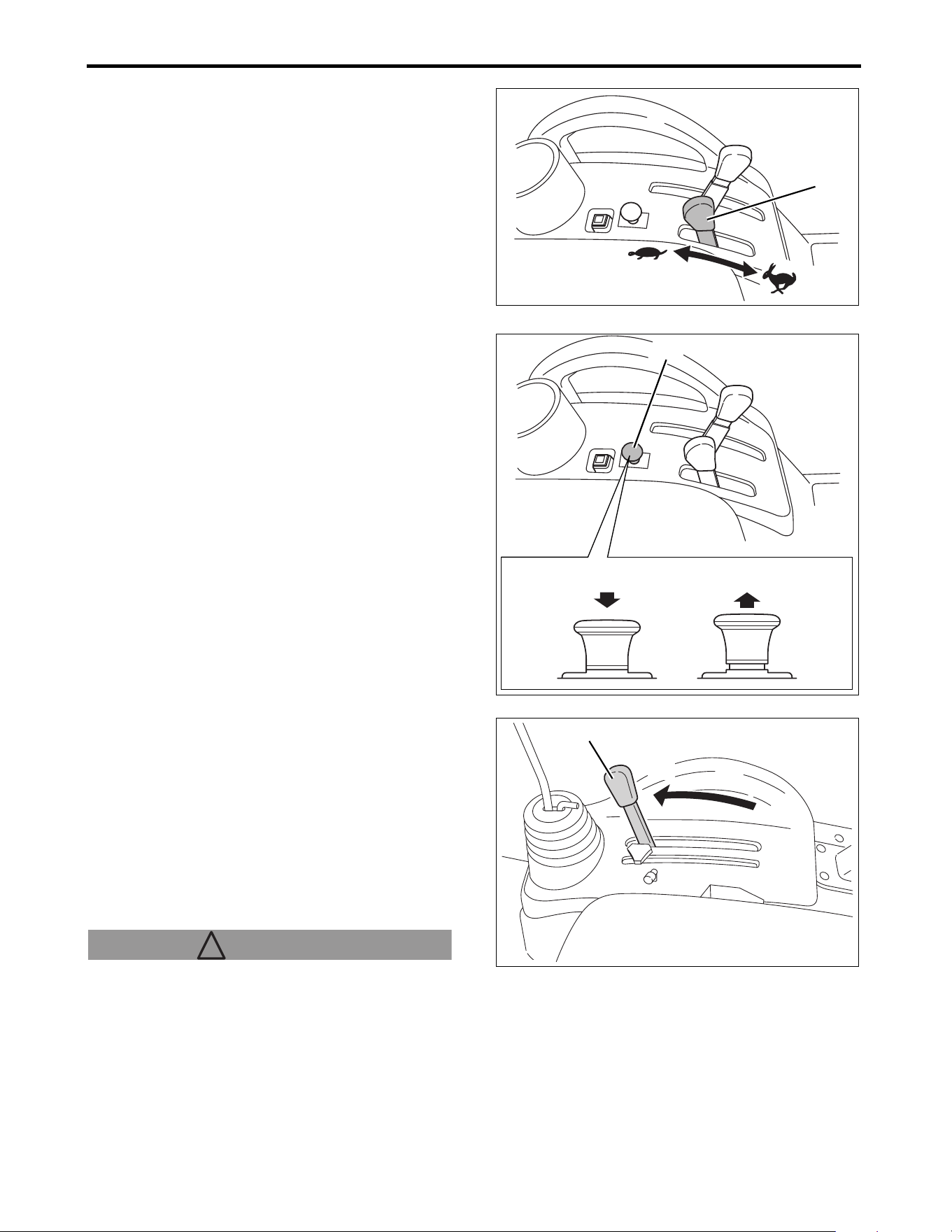
7-6
7. OPERATE THE ENGINE
Sc2450 Operator's Manual
5. Set the range gear lever to the Slow
position.
(A) Range gear lever
(a) Slow position
6. Turn off the Power Take Off (PTO)
switch.
Push in and set the Power Take Off (PTO) switch to
the OFF position.
(A) Power Take Off (PTO) switch
(a) OFF position
(b) ON position
7. Fully push the 3-point hitch control/
cutting height adjustment lever
forward to the lowest position and
lower the mid- or rear-mounted
implements to the ground.
(A) 3-point hitch control/cutting height
adjustment lever
(a) Lowest position
●In order to prevent a turnover accident,
completely lower the implements to the
ground.
3014919a
(A)
(a)
3014919g
(A)
(a) (b)
3014926
3014918b
(A)
(a)
! WARNING
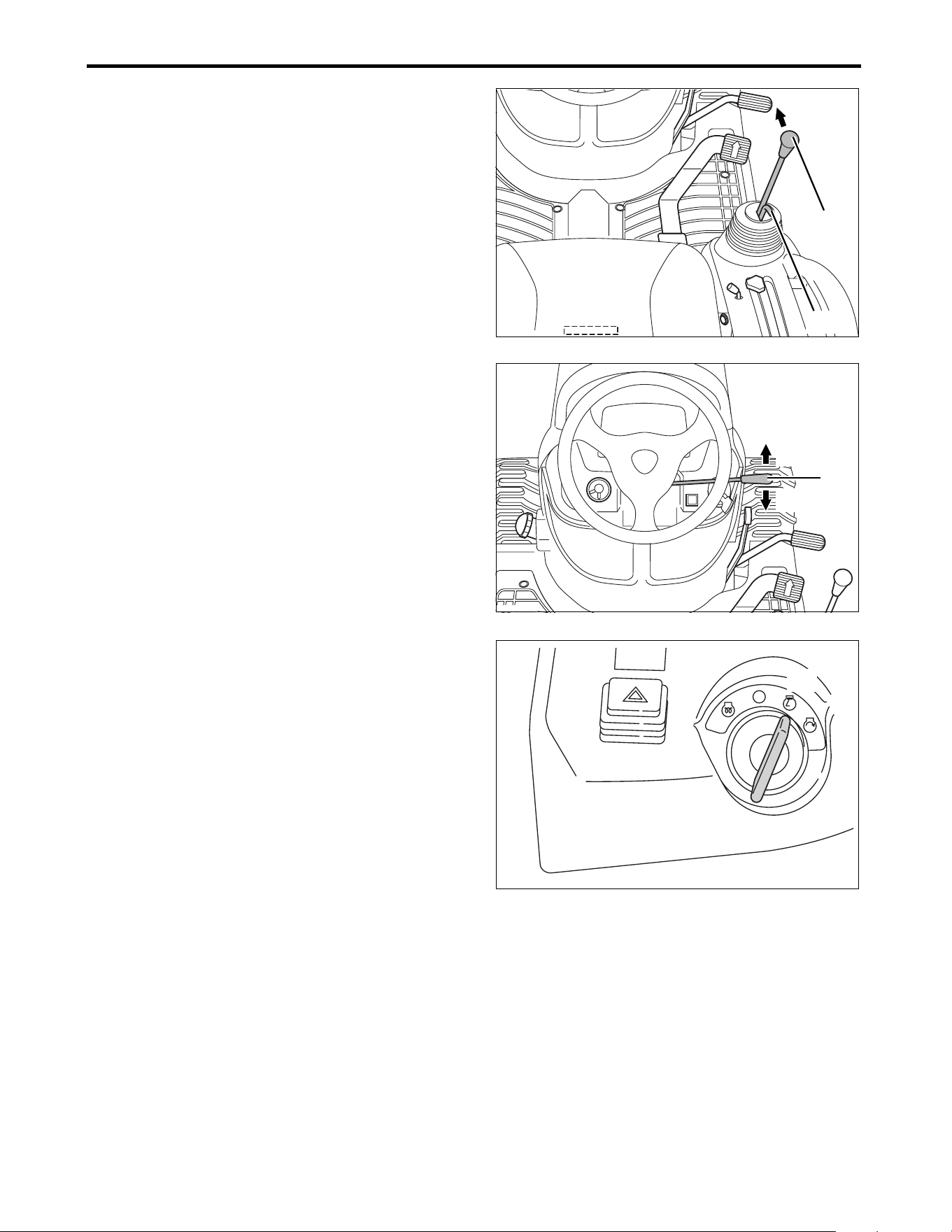
7-7
7. OPERATE THE ENGINE
Sc2450 Operator's Manual
8. If the tractor has any implements that
use the implement control lever, lower
them to the ground. Then, set the
implement control lever to the
NEUTRAL position and push in the
implement lock lever to lock.
(A) Implement control lever
(B) Implement lock lever
(a) Lower the implement to the ground
9. Set the throttle control lever about
halfway.
(A) Throttle control lever
(a) To increase the engine speed, pull the throttle
control lever backward.
(b) To decrease the engine speed, push the throttle
control lever forward.
10.Insert the key into the starter key hole
and turn the key to the ON position.
(A) ON position
3014903d
(B)
(A)
(a)
3014903e
(A)
(b)
(a)
3014907a
(A)
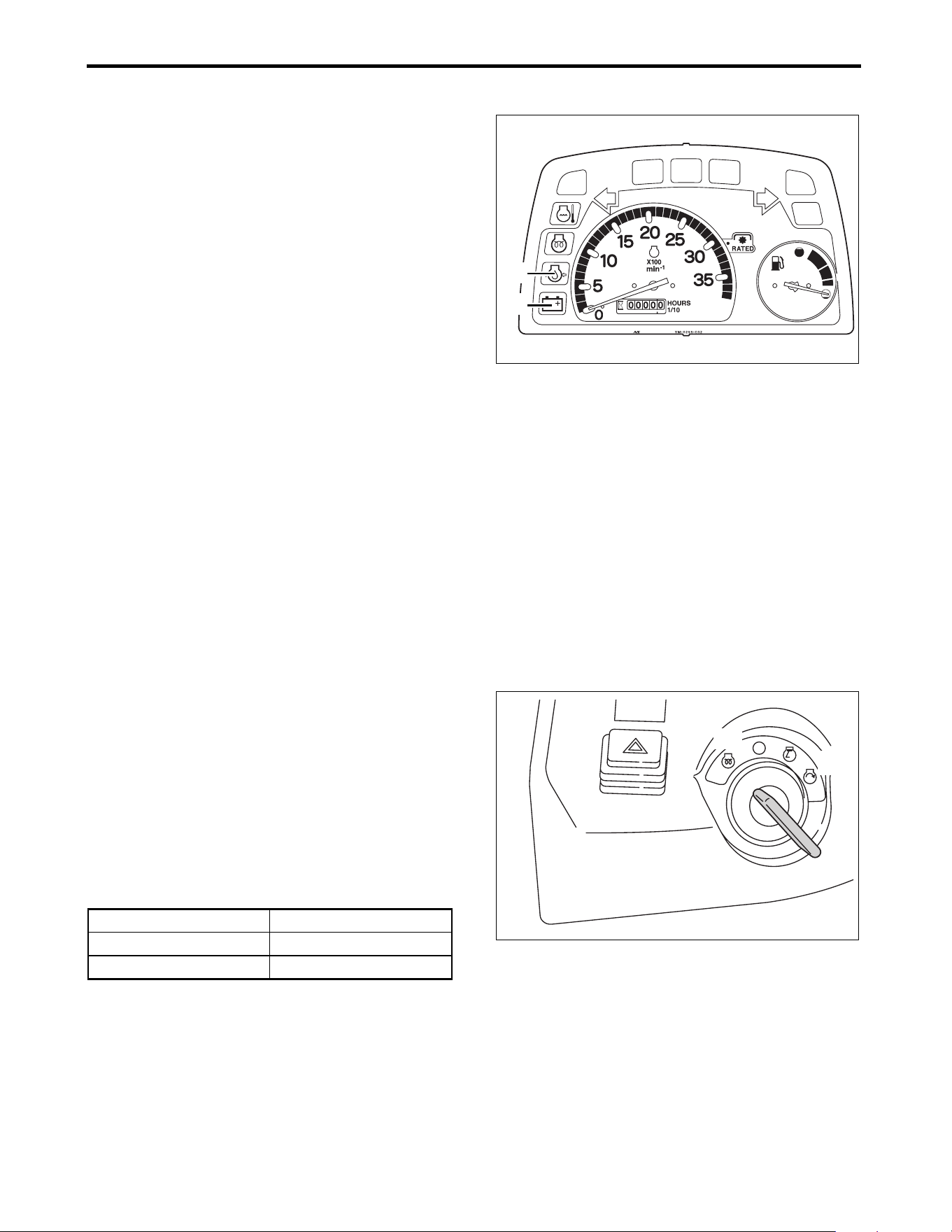
7-8
7. OPERATE THE ENGINE
Sc2450 Operator's Manual
■ Check the Lights on the Instrument Panel
When the key is turned to the ON position:
1. The engine oil pressure warning light turns ON.
2. The alternator/battery charging light turns ON.
(A) Engine oil pressure warning light
(B) Alternator/Battery charging light
NOTE
●The engine oil pressure warning light turns off within
5 seconds after the engine is started.
●The alternator/battery charging light turns off within
10 seconds after the engine is started.
IMPORTANT: Avoid damage.
●When the engine oil pressure warning light does
not turn OFF within 10 seconds after the engine is
started, the engine oil pressure is too low.
Immediately stop the engine and contact your local
Cub Cadet Yanmar dealer for technical assistance.
●When the alternator/battery charging light does not
turn OFF within 15 seconds after the engine is
started, the power generated by the alternator is
too low. Increase the engine speed to its maximum
so as to increase the power. If the light still remains
lit, immediately stop the engine and contact your
local Cub Cadet Yanmar dealer for technical
assistance.
11.Turn the key to the PREHEATING
position and energize the glow plug to
preheat the engine.
(A) Preheating position
(B) START position
Preheating time should be determined according to
outside air temperature. For details, see the table
below.
Temperature (°F (°C)) Preheating Time (sec.)
Over 32 (0) 2 to 3
Below 32 (0) 4
3014905
(A)
(B)
(A)
(B)
3014907
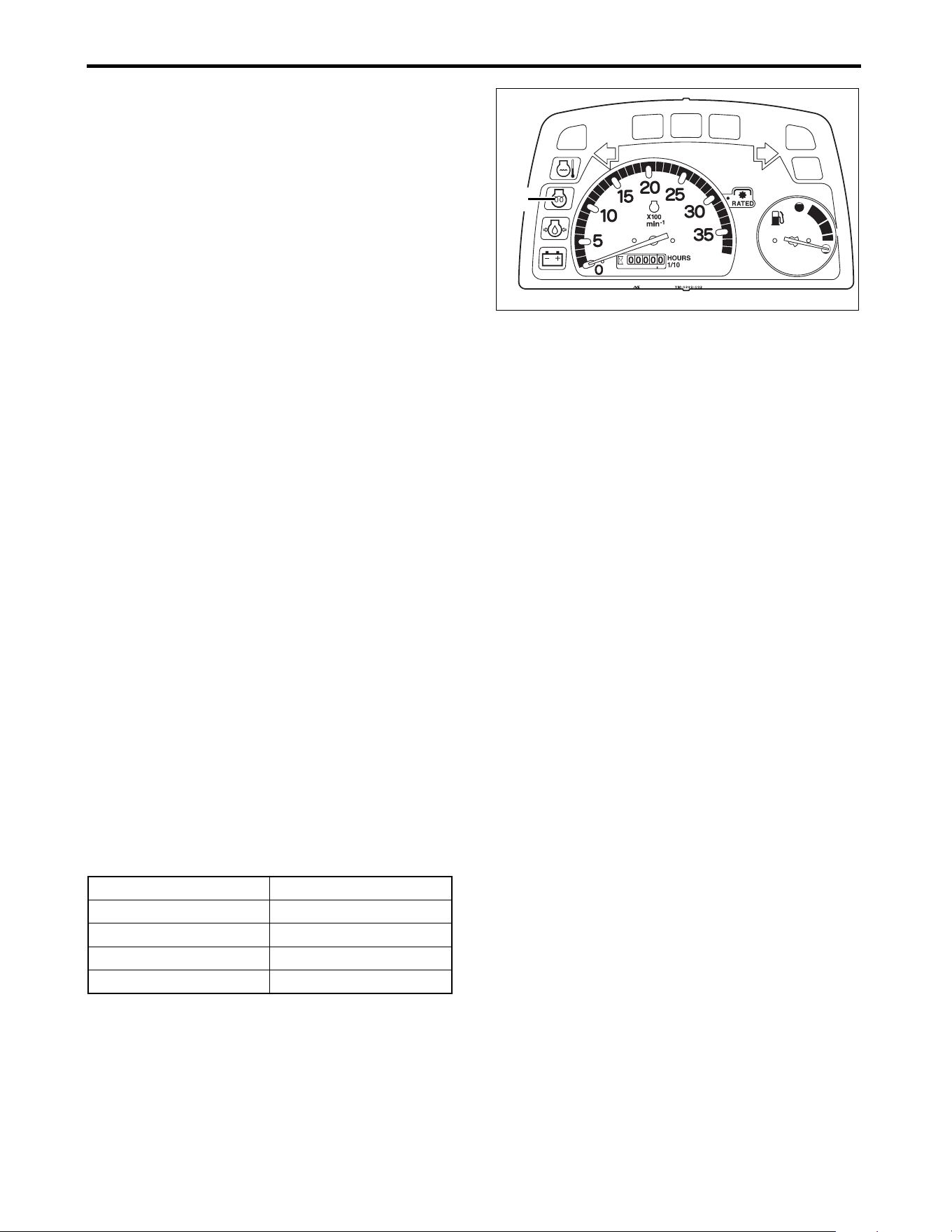
7-9
7. OPERATE THE ENGINE
Sc2450 Operator's Manual
NOTE
●While turning the key to the preheating position, the
preheater pilot light turns ON. Also, the engine oil
pressure warning light and the alternator/battery
charging light turn ON.
(A) Preheater pilot light
12.Turn and hold the key to the START
position. After the engine is
successfully started, release the key.
IMPORTANT: Avoid starter damage.
●Do not hold the key in the START position for more
than 15 seconds at a time. Any longer attempt will
overheat the starter motor.
●If the engine is difficult to start at a low temperature
etc., hold the key in the START position for 30
seconds. If the engine fails to start, wait at least 30
seconds before the second attempt to allow for
battery voltage recovery.
●If the engine still fails to start with four consecutive
attempts, the starter may be not functioning. (See
“Chapter 17. TROUBLESHOOTING” ).
13.After the engine has started, warm up
the engine for 5 minutes at 2000 to
2400 min
-1
(rpm) without loading.
■ Warm Up the Engine in Cold Weather
In cold weather, warm up the engine for much longer
than 5 minutes so that the hydraulic system shows its
performance. For the appropriate warming up time,
see the table below.
NOTE
●The engine may run slightly louder and emit pale
blue exhaust during warming-up. This is considered
normal operation. The amount of pale blue exhaust
varies depending on the ambient temperature.
●Idling the engine for a long time causes waste of
fuel and carbon accumulation in the engine.
Temperature (°F (°C)) Warming-up Time (min.)
Over 32 (0) At least 5
32 to 14 (0 to –10) 5 to 10
14 to –4 (–10 to –20) 10 to 15
Below –4 (–20)
More than 15
3014905
(A)
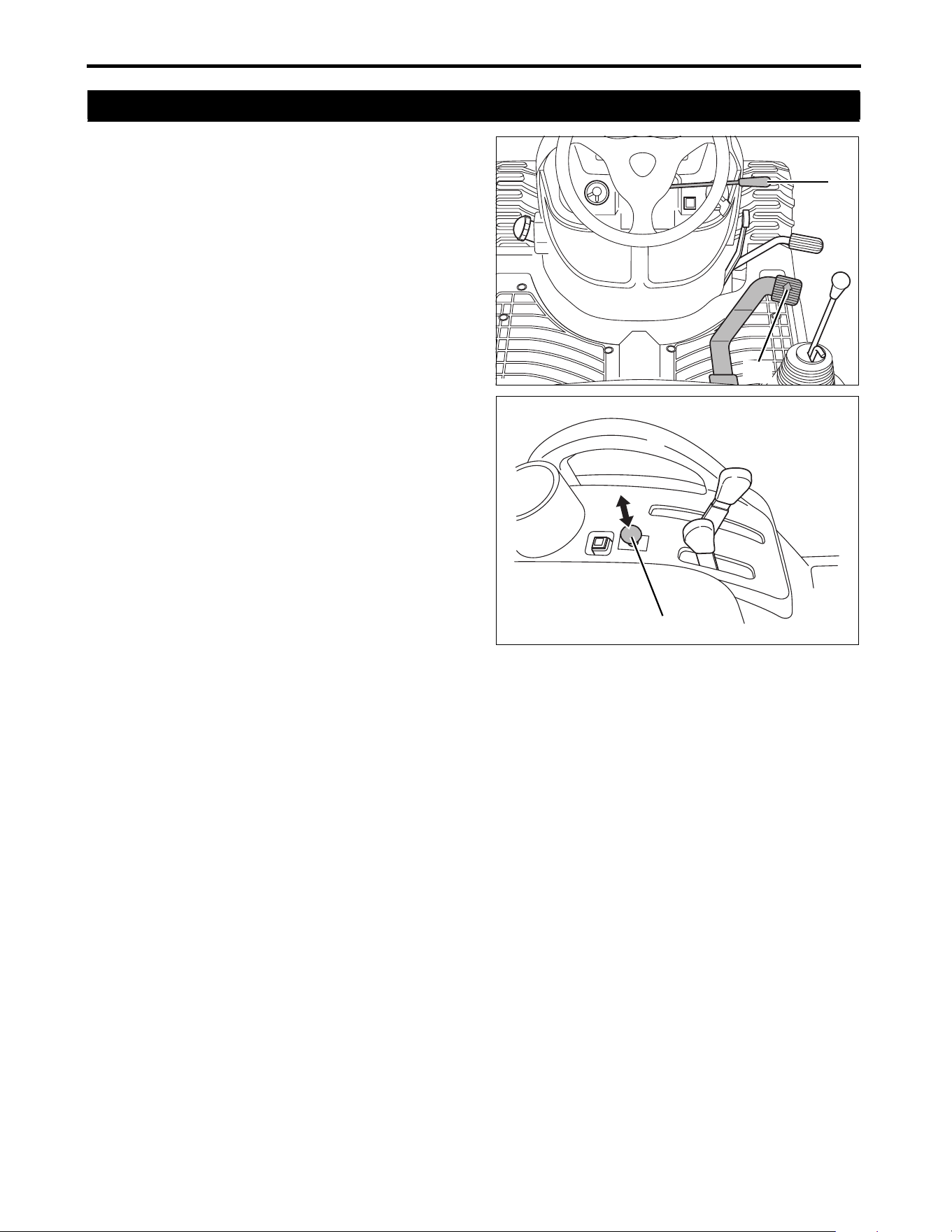
7-10
7. OPERATE THE ENGINE
Sc2450 Operator's Manual
1. Remove foot from the forward and
reverse drive pedal.
2. After the tractor has completely
stopped, turn off the Power Take Off
(PTO) switch, lower the implement (if
installed) to the ground and then
engage the parking brake securely.
3. Run the engine at a lowest possible
speed for at least 2 minutes.
4. Turn the key to the OFF position.
5. Remove the key from the starter key
switch.
6. Make sure that the engine and other
components have stopped running.
NEVER leave the operator’s seat
while any components are running.
(A) Forward and reverse drive pedal
(B) Throttle control lever
(C) Power Take Off (PTO) switch
2. Shut Down the Engine
3013703a
(B)
(A)
3014919c
(C)
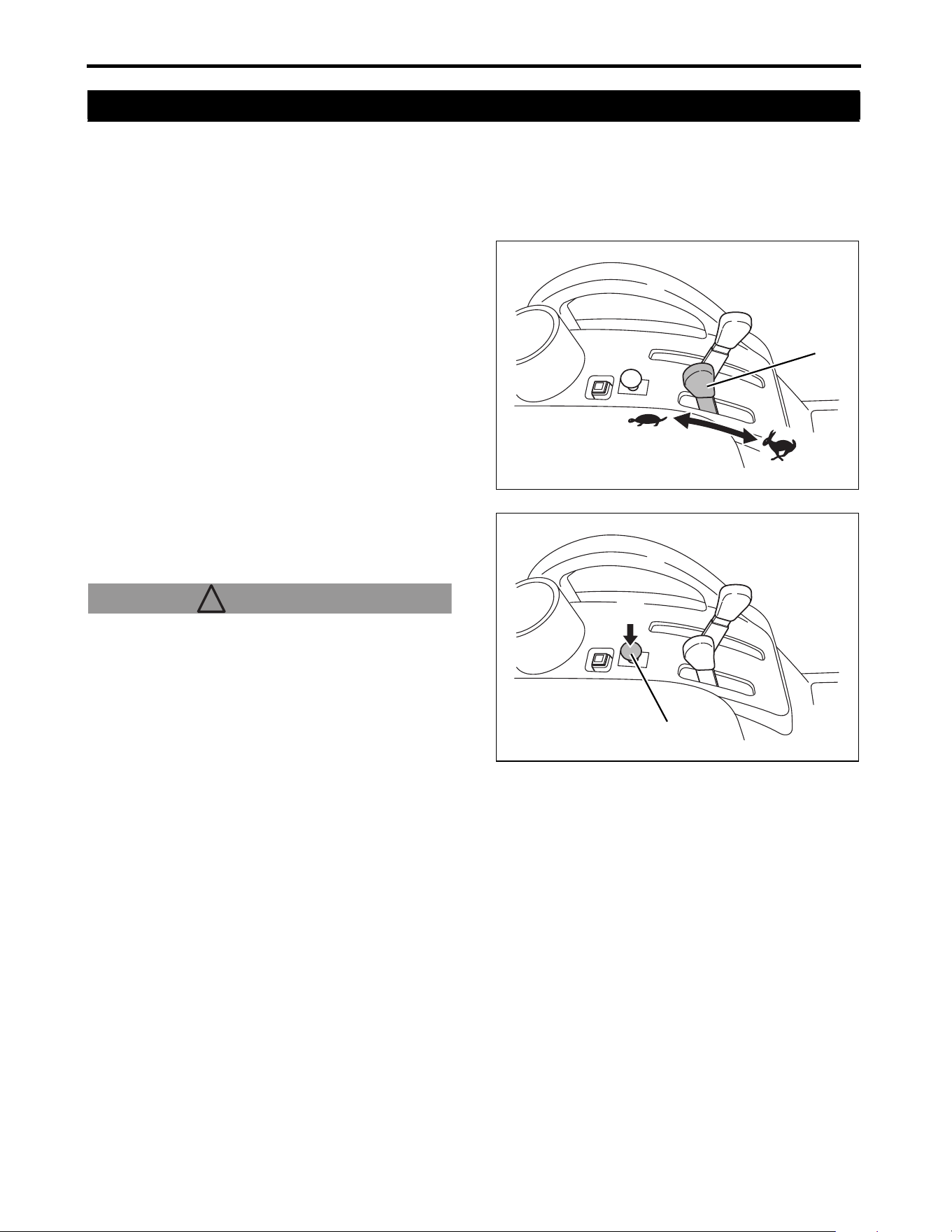
7-11
7. OPERATE THE ENGINE
Sc2450 Operator's Manual
IMPORTANT: Avoid engine damage.
●If the engine stalls while operating under load,
immediately restart the engine to prevent over-
heating of the engine.
1. Engage the parking brake securely.
2. Set the range gear lever to the slow
position.
(A) Range gear lever
(a) Slow position
3. Turn off the Power Take Off (PTO)
switch.
●To prevent a possible accident, fully lower all
the implements to the ground.
(A) Power Take Off (PTO) switch
(a) OFF position
4. Restart the engine.
Resume the operation; or run the
engine for 1 to 2 minutes at the lowest
possible running speed, and then
stop the engine.
3. Restart a Stalled Engine
3014919a
(A)
(a)
3014919b
(A)
(a)
! WARNING

8-1
8. OPERATION
Sc2450 Operator's Manual
8. OPERATION
Operate the Tractor
ALWAYS decrease tractor speed before turning,
when traveling on a rough terrain or before stopping
to prevent roll-over.
Do not attempt to turn with the differential lock
engaged. Attempting to turn the tractor while the
differential lock is engaged can lead to a roll-over.
ALWAYS stay clear of ditches, holes, embankments
or ponds. A roll-over can occur more easily if the
ground is soft or wet. Before entering an area
covered with tall grass, walk the area to detect any
obstacles.
ALWAYS be extremely careful about the direction
you are traveling and avoid obstacles. Remain alert
when you are approaching the end of a row, trees or
any obstacle.
ALWAYS maintain good communication with all
others working the same area before and during
operation of the tractor.
Do not get in or out of the moving tractor.
Accident Hazard
ALWAYS remain alert to behaviors of children when
operating the tractor because they are usually very
curious about moving machines.
ALWAYS remember that children may have moved
from a point you last viewed them.
ALWAYS keep children off the work area, and a
person other than the operator should always watch
them.
If any child enters the current work area, stop your
tractor immediately.
NEVER allow children to ride the moving tractor.
They may tamper with the controls or can fall off the
tractor and be run over by the tractor.
NEVER allow children to operate the tractor.
NEVER allow children to play on the tractor or
implement.
ALWAYS be extremely careful when backing the
tractor up. Before backing up, look back and below
the tractor. Children may be in your path.
! WARNING

8-2
8. OPERATION
Sc2450 Operator's Manual
The service life of the tractor is governed by how
adequately it is handled and maintained.
Of course, any newly manufactured tractor has been
tested; however, various parts must be broken in.
Therefore, operate the tractor at low speeds for the
first 50 operating hours, and avoid heavy work or
operation before the various parts have been
sufficiently run. The manner the tractor is operated in
during the breaking-in period greatly affects the
effective life of the tractor. Therefore, to develop
maximum design performance and attain the longest
life of the tractor, the tractor needs to be correctly
broken in. Handle the new tractor, strictly observing
the following instructions.
1. Do not run the tractor at full speed during the first 50 operating hours period
●NEVER suddenly start or brake.
●In cold weather, ALWAYS fully warm up the
engine. After warm-up, start operation of the
tractor.
●NEVER run the engine at a speed higher than
needed.
●On rough roads or terrains, slow the tractor down
as necessary. Do not run the tractor at a high
speed.
The above-mentioned precautions apply not only to
newly manufactured tractors but also to tractors that
have been actively used. Nevertheless, we
recommend that newly manufactured tractors be
operated by strictly observing these instructions/
recommendations.
2. Changing the lubricating oil for the new tractor
The quality of the lubricating oil in any new tractor is
very important. Various parts on a new tractor have
not been fully broken in, and are not fully fitted with
each other. As a result, small metal shavings may
occur while the new tractor is operated, and may
lead to premature wear or damage of the associated
parts or components. Therefore, Cub Cadet Yanmar
recommends that the lubricating oil be changed
earlier than in the ordinary oil change schedule.
For the recommended oil change schedule, see
“Chapter 13. MAINTENANCE”.
1. Operate a New Tractor
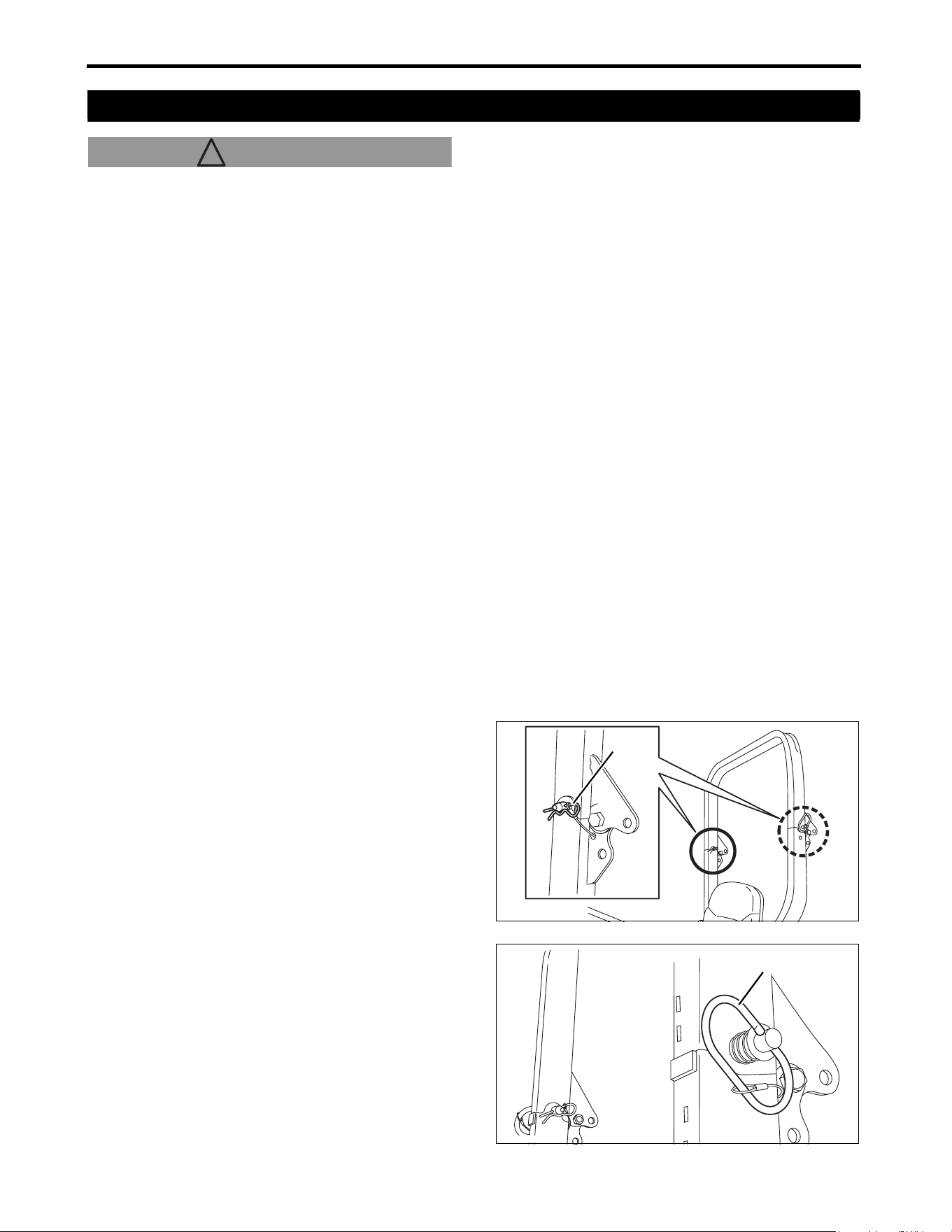
8-3
8. OPERATION
Sc2450 Operator's Manual
●ALWAYS operate the tractor with the Roll-Over
Protective Structure (ROPS) in the raised
(unfolded) position unless the tractor is being
operated in a low clearance situation.
Keep the retractable seat belt fastened while
operating the tractor with the Roll-Over Protective
Structure (ROPS) in the raised position. This practice
will reduce the possibility of injury or death in the
event of roll-over accident. If the Roll-Over Protective
Structure (ROPS) has been removed for any reason,
be sure to reinstall all the associated parts before
operating the tractor. NEVER alter the Roll-Over
Protective Structure (ROPS). The altered Roll-Over
Protective Structure (ROPS) may fail to provide the
designed protection. Replace the damaged Roll-
Over Protective Structure (ROPS) immediately.
Contact your local Cub Cadet Yanmar dealer for
technical assistance.
NEVER use the retractable seat belt if the foldable
Roll-Over Protective Structure (ROPS) is in the
folded position or the tractor does not have the Roll-
Over Protective Structure (ROPS).
■ Lower (Fold Down) the Roll-Over Protective Structure (ROPS)
NOTE
●The Roll-Over Protective Structure (ROPS) can be
folded down only by 90 degrees.
1. Pull out the hairpin clip from each of the insert
pins on both sides of the Roll-Over Protective
Structure (ROPS).
2. Pull out the insert pins from both sides of the Roll-
Over Protective Structure (ROPS).
(A) Hairpin clip
(B) Insert pin
2. Raise and Lower the Roll-Over Protective Structure (ROPS)
! WARNING! WARNING
3016406
(A)
3016407
(B)
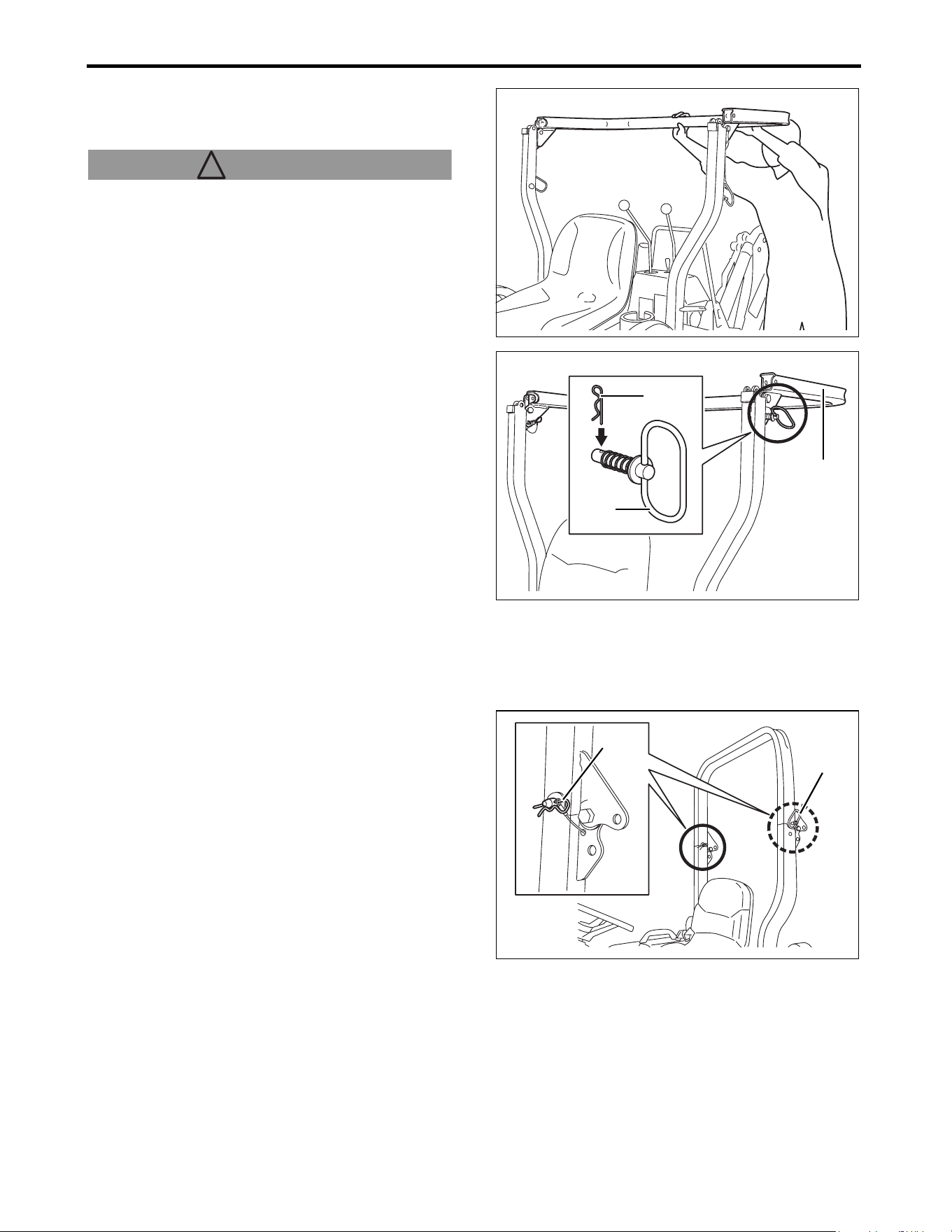
8-4
8. OPERATION
Sc2450 Operator's Manual
3. Lower (fold) the Roll-Over Protective Structure
(ROPS).
To avoid personal injury:
●Always use both hands to hold the Roll-Over
Protective Structure (ROPS) securely and fold
the Roll-Over Protective Structure (ROPS)
slowly and carefully.
4. There are folded Roll-Over Protective Structure
(ROPS) retaining holes on both sides of the
lowered Roll-Over Protective Structure (ROPS).
Install the insert pins into these holes.
5. There are holes on both ends of the insert pin.
Install the hairpin clip into these holes.
NOTE
●To secure the play-absorbing vibration-insulating
rubber block, pull the upper bolt to the near side
and insert the pins.
(A) Roll-Over Protective Structure (ROPS)
(B) Hairpin clip
(C) Insert pin
■ Raise (Unfold) the Roll-Over Protective Structure (ROPS)
1. Pull out the hairpin clip from each of the insert
pins on both sides of the Roll-Over Protective
Structure (ROPS).
(A) Hairpin clip
(B) Insert pin
2. Pull out the insert pins from both sides of the Roll-
Over Protective Structure (ROPS).
3. Raise (unfold) the Roll-Over Protective Structure
(ROPS).
4. There are unfolded Roll-Over Protective Structure
(ROPS) retaining holes on both sides of the
raised Roll-Over Protective Structure (ROPS).
Install the insert pins into these holes.
5. There are insert pin jam holes on both ends of the
insert pin. Install the hairpin clip into these holes.
NOTE
●To secure the play-absorbing vibration-insulating
rubber block, pull the upper bolt to the near side
and insert the pins.
3016487
! WARNING
3016409
(A)
(B)
(C)
3016406
(A)
(B)
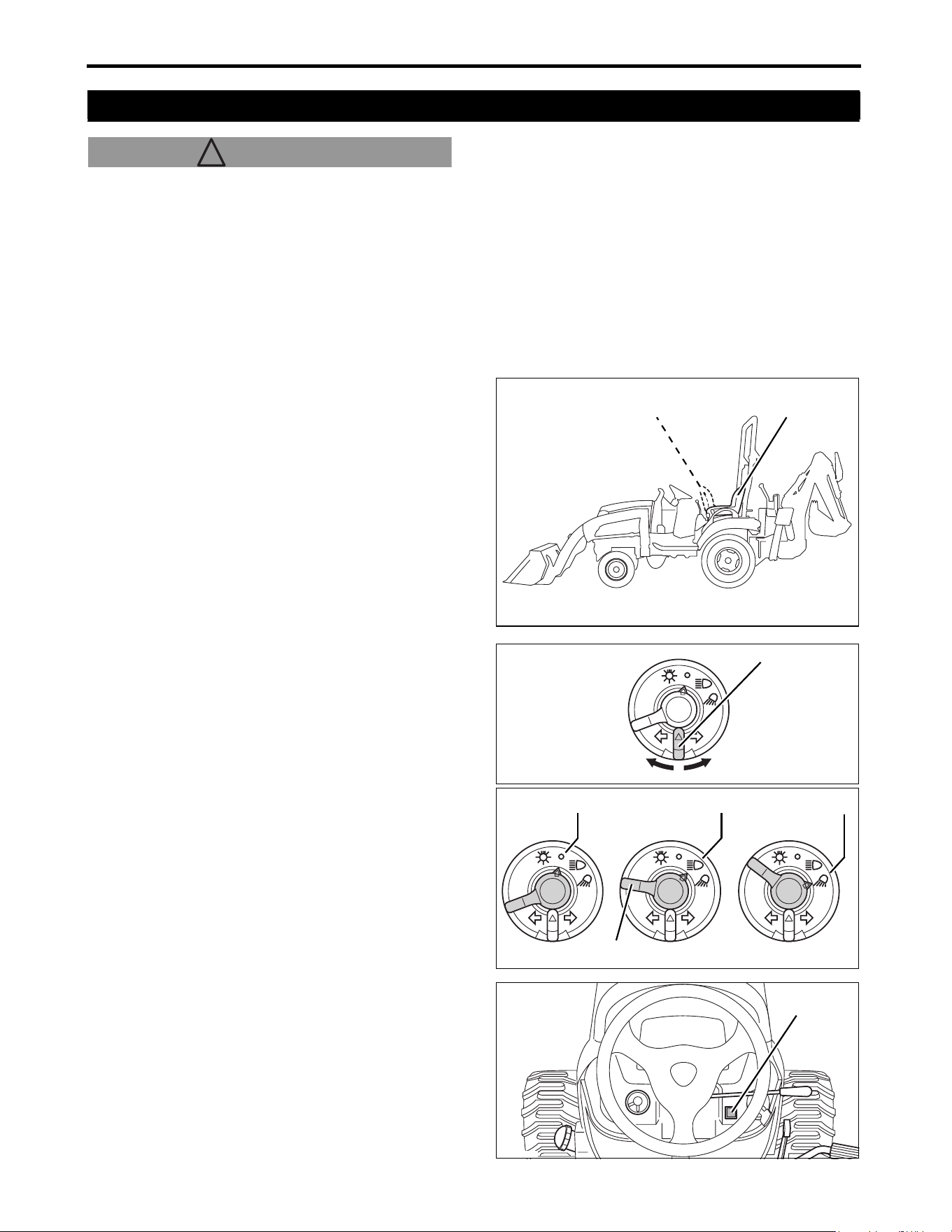
8-5
8. OPERATION
Sc2450 Operator's Manual
Avoid injury:
●Before starting or operating the tractor, always
check the area around the tractor for obstacles
and any person nearby. Turn off the Power
Take Off (PTO) switch and raise the implement.
IMPORTANT: Avoid damage.
●To prevent damage to the transmission, stop the
tractor completely before shifting the range gear
lever.
1. Adjust the operator’s seat position, sit
on the seat, and fastens the seatbelt.
For the adjusting method of the seat position, see
“Adjust the Operator's Seat” on page 7-2, and for the
fastening method of the seat belt, see “Fasten the
Retractable Seat Belt” on page 7-4. See “Reverse
the Operator's Seat” on page 7-2 to adjust the seat to
the position of the backhoe.
(A) Tractor driving position
(B) Backhoe position
2. Use the turn signal switch, headlight/
work light switch, hazard lights button
switch as necessary.
(A) Turn signal switch
(a) Move the turn signal switch to the left to signal a
left turn of the tractor.
(b) Move the turn signal switch to the right to signal a
right turn of the tractor.
(B) Headlight/work light switch
(c) OFF
(d) Turning the blue lever to (b) position illuminates
the headlights.
(e) Turning the blue lever to (c) position illuminates
the headlights and work lights at the same time.
(C) Hazard lights button switch
3. Operate the Tractor
! WARNING
(A)(B)
3016410
(A)
A3014902
(a) (b)
A3014901
(c) (d) (e)
(B)
A3014901f
(C)
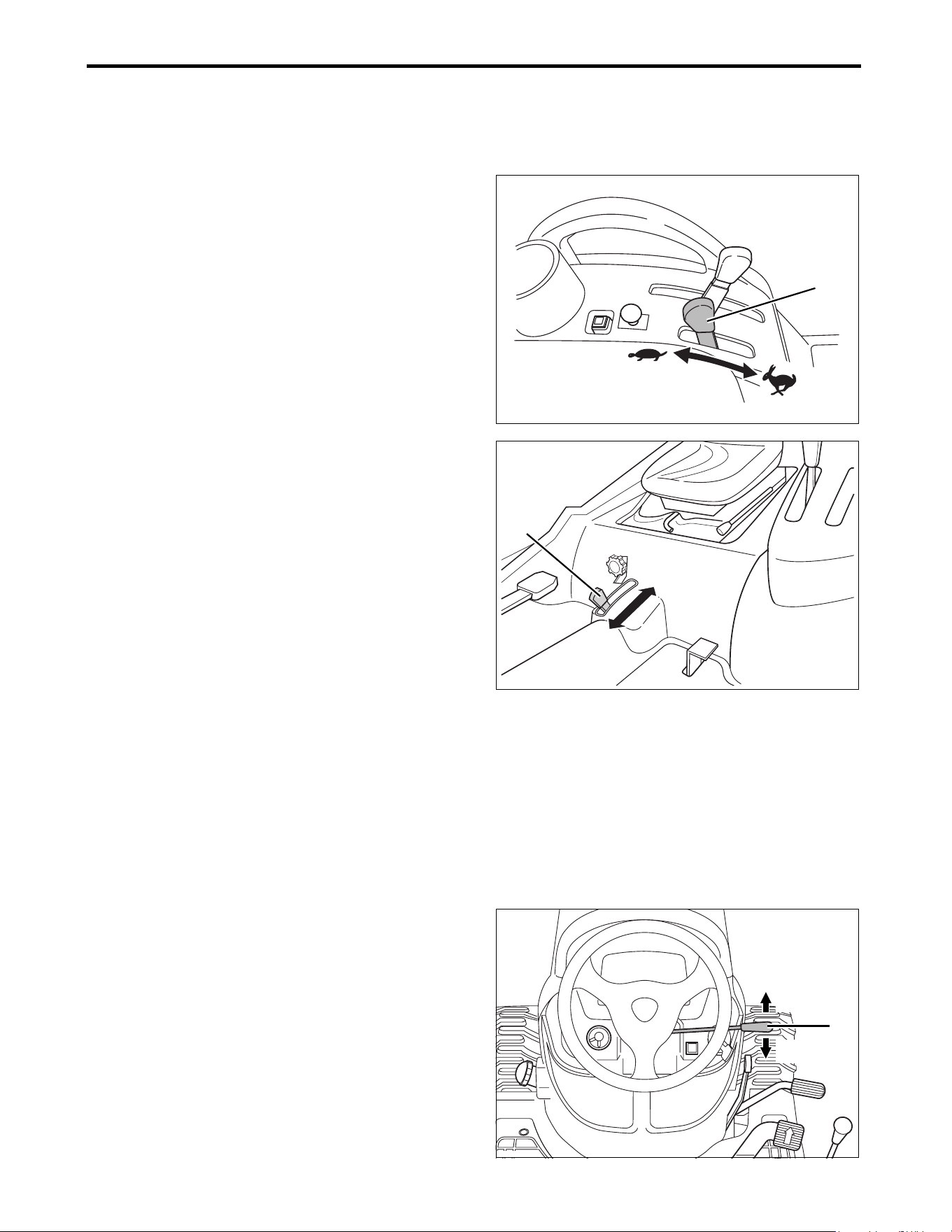
8-6
8. OPERATION
Sc2450 Operator's Manual
3. Start the engine.
Start the engine by referring to “Chapter 7. OPERATE
THE ENGINE”.
4. Use the range gear lever and the 4-
wheel drive lever to select the travel
speed.
(A) Range gear lever
(a) SLOW : Used for heavy-load operation.
Low traveling speed.
(b) FAST : Used for light-load operation.
High traveling speed.
(B) 4-wheel drive lever
(c) 4-wheel drive mode
(d) 2-wheel drive mode
IMPORTANT: Avoid damage.
●ALWAYS keep the 4-wheel drive lever in the 2-
wheel drive mode when traveling on a paved
surface.
●ALWAYS disengage the 4-wheel drive lever put in
the 2-wheel drive mode when not needed to
prevent premature wear of the front tires.
●NEVER install tire chains to the front wheels.
Chains will hit and can damage the tractor.
●If disengaging the 4-wheel drive lever is difficult,
stop the tractor, turn the steering wheel right and
left several times. Then attempt to disengage the
4-wheel drive lever again.
●To minimize tire wear, drive in the 4-wheel drive
mode only when absolutely necessary. Driving the
tractor on a paved road in the 4-wheel drive mode
can accelerate wear of the tires.
●To obtain better traction, keep the front tires at the
maximum allowable pressure.
●When the 4-wheel drive lever is in the 4-wheel
drive mode, braking will apply to all four wheels.
5. Adjust the throttle control lever to
attain an intended speed.
(A) Throttle control lever
(a) To increase the engine speed:
pull the throttle control lever backward.
(b) To decrease the engine speed:
push the throttle control lever forward.
3014919a
(A)
(a)
(b)
3014904b
(B)
(d)
(c)
3014903e
(A)
(b)
(a)
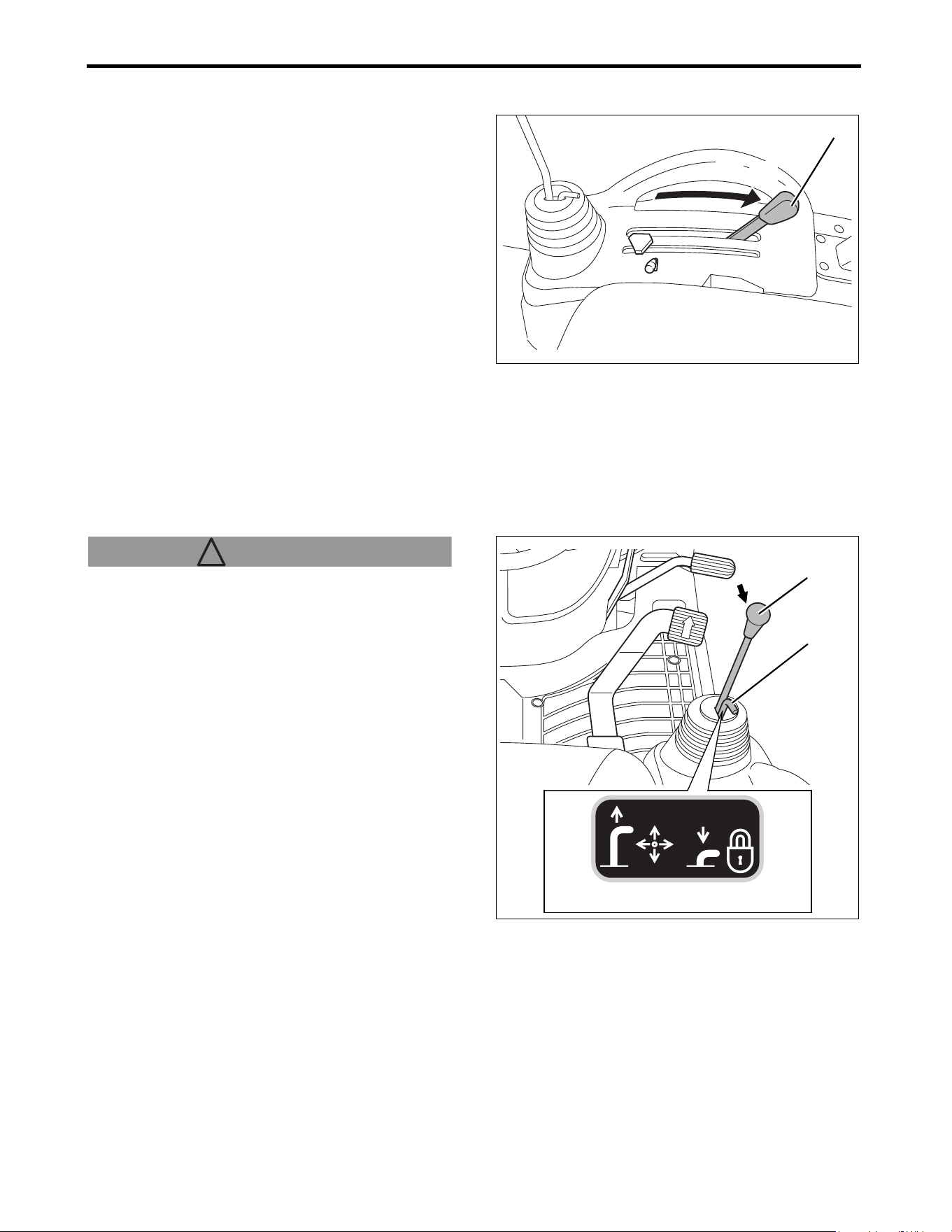
8-7
8. OPERATION
Sc2450 Operator's Manual
6. Raise the implement.
1. Pull the 3-point hitch control/cutting height
adjustment lever rearward and raise the mid- or
rear- mounted implement to the raised position.
(A) 3-point hitch control/cutting height
adjustment lever
(a) Raised position
2. If the tractor has any implements (ex. front loader)
that use the implement control valve, pull up the
implement lock lever to release locking and use
the implement control lever to raise the
implement.
■ Function of Implement Lock Lever
To prevent injury from crushing:
●Never attempt to use the implement lock lever
in order to perform maintenance or repair. This
lock is for preventing the implement from being
accidentally engaged during transport or when
not being used. It will not prevent implement
leak down.
When fixing or adjusting the implement control lever
to its NEUTRAL position, use the implement lock
lever to lock the implement control lever in place.
(A) Implement control lever
(B) Implement lock lever
IMPORTANT: Avoid damage.
●Do not attempt to operate the implement control
lever when the implement control lever has been
locked.
●When the implement control lever has been locked
with the implement lock lever, move the implement
control lever with light force to ensure that it has
been securely locked.
(a) Raising the implement
(b) To unlock the implement control lever: Pull up the
implement control lock lever.
(c) To lock the implement control lever: Push down
the implement lock lever when the implement
control lever is in its NEUTRAL position.
3014918d
(A)
(a)
3014903n
(A)
(B)
(a)
(c)
(b)
! WARNING
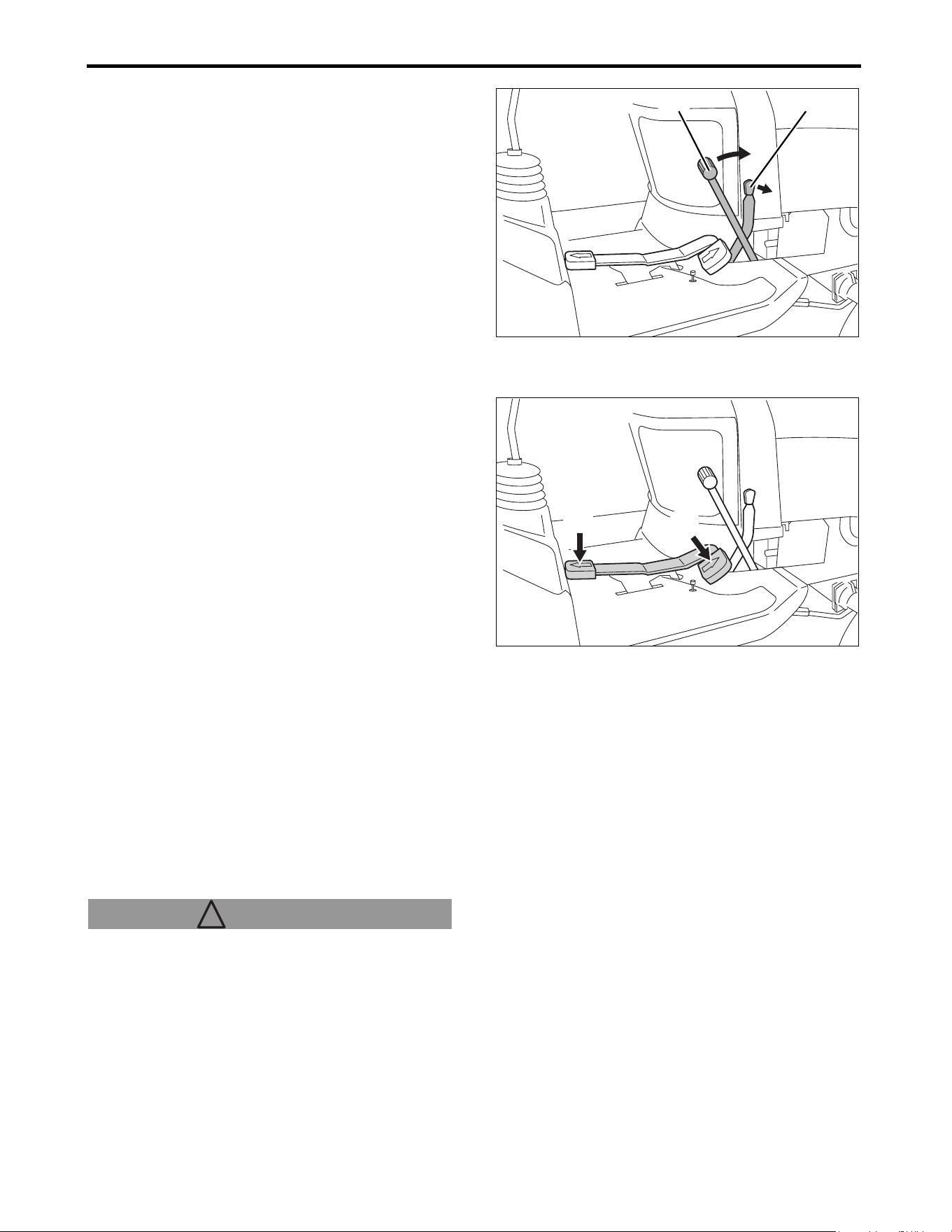
8-8
8. OPERATION
Sc2450 Operator's Manual
7. Disengage the parking brake.
1. Fully depress the brake pedal.
2. Fully push the parking brake lever forward to
unlock the parking brake.
3. Remove foot from the brake pedal. Make sure
that the brake pedal is unlocked.
(A) Brake pedal
(B) Parking brake lever
8. Remove foot from the brake pedal.
9. Slowly depress the forward side of
the forward and reverse drive pedal or
reverse side of the forward and
reverse drive pedal.
(A) Forward side of the forward and reverse drive
pedal
(B) Reverse side of the forward and reverse drive
pedal
IMPORTANT
●When the drive pedal is released, the transmission
will automatically return to the NEUTRAL position.
10.Operate the steering wheel and travel
to the intended destination.
11.Use the cruise control as necessary.
The cruise control is a feature that regulates forward
tractor travel to a specific speed.
NOTE
●The cruise control is operative only when the
tractor is traveling forward.
●Use the cruise control only when traveling in a
vast open area.
●Turn OFF this feature before turning the tractor
or when in areas that include many obstacles.
3014916f
(A)
(B)
3014916c
(A)
(B)
! WARNING! WARNING
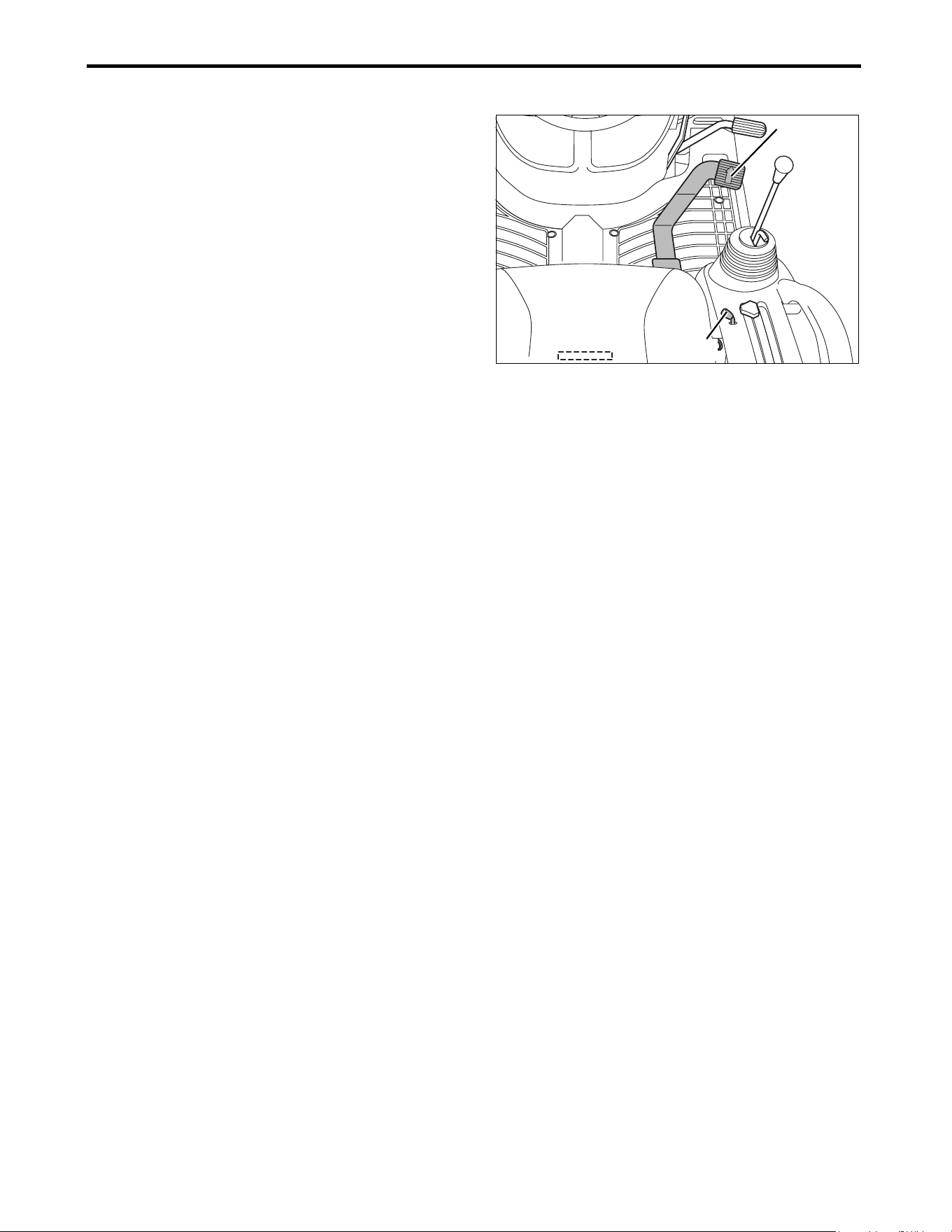
8-9
8. OPERATION
Sc2450 Operator's Manual
■ Engage the Cruise Control
1. Depress the forward side of the forward and
reverse drive pedal until an intended travel speed
is reached.
2. Lift up the cruise control lever to engage the
cruise control feature.
3. Remove foot from the forward side of the forward
and reverse drive pedal.
4. Remove hand from the cruise control lever.
(A) Forward side of the forward and reverse drive
pedal
(B) Cruise control lever
■ Disengage the Cruise Control
1. Depress the brake pedal.
2. Step on the forward side of the forward and
reverse drive pedal and make sure the forward
and reverse pedal is unlocked.
NOTE
●The cruise control is disengaged when the operator
depresses the brake pedal.
●If the cruise control lever is not readily disengaged,
then step on the brake pedal several times.
●Also, the cruise control can be disengaged when
the operator depresses the forward side of the
forward and reverse drive pedal. Note, however,
that the reverse side of the forward and reverse
drive pedal can not be used for this purpose.
●Do not strongly step on the reverse side of the
forward and reverse drive pedal when the cruise
control is in the locked state.
3014903i
(B)
(A)
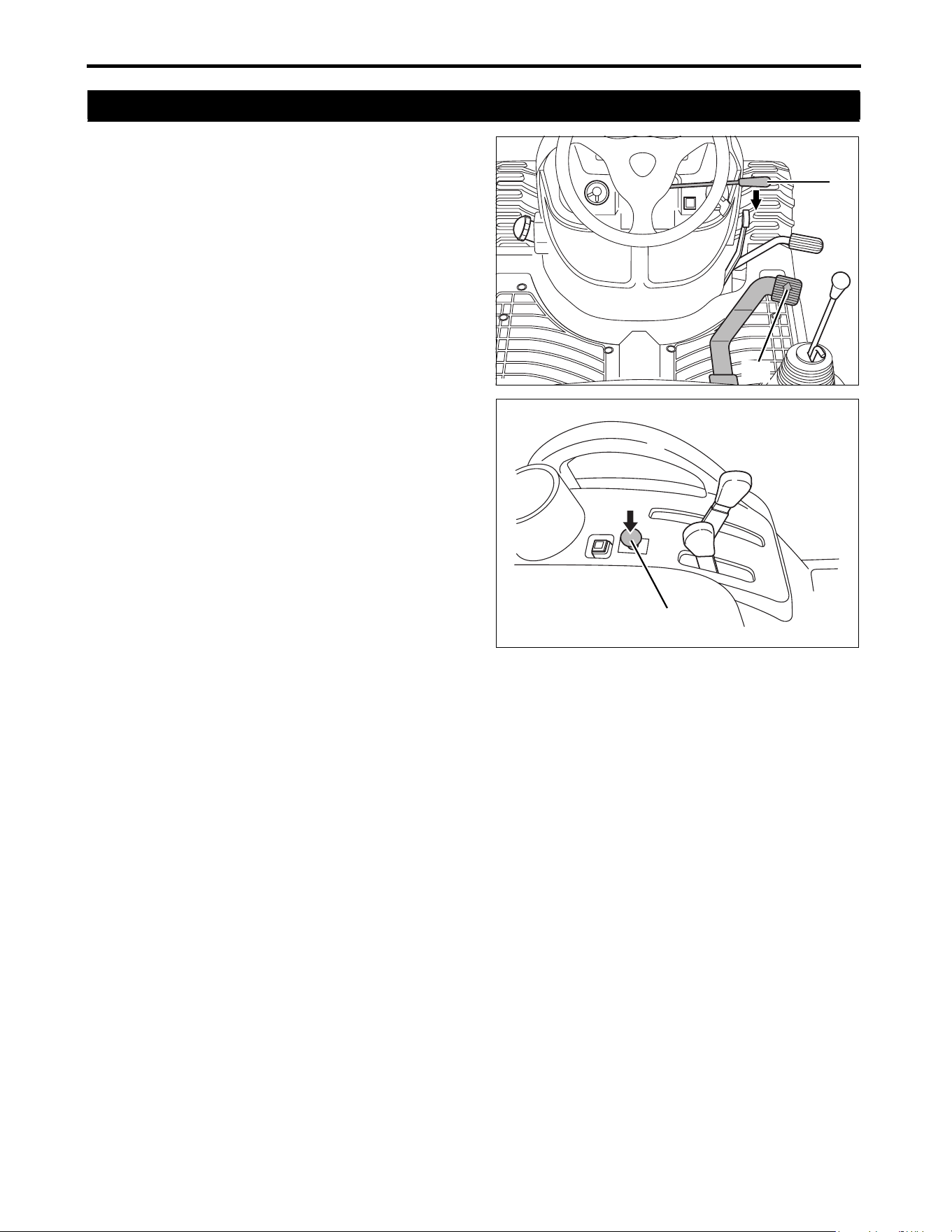
8-10
8. OPERATION
Sc2450 Operator's Manual
1. Slowly remove foot from the forward side of the
forward and reverse drive pedal or reverse side of
the forward and reverse drive pedal.
2. Fully push the throttle control lever forward to
decrease the engine speed.
3. Step on and depress the brake pedal.
4. After the tractor has completely stopped, turn off
the Power Take Off (PTO) switch.
5. Lower the implement (if equipped) to the ground.
6. Engage the parking brake securely.
7. Run the engine at a lowest possible speed for at
least for two minutes.
8. Turn the key to the OFF position.
9. Remove the key from the starter key switch.
10.Make sure that the engine and other rotating
component(s) have stopped running. NEVER
leave the operator’s seat while any component is
running.
(A) Forward and reverse drive pedal
(B) Throttle control lever
(C) Power Take Off (PTO) switch
■ Stop in an Emergency
1. Remove foot from the forward side of the forward
and reverse drive pedal or reverse side of the
forward and reverse drive pedal.
2. Depress the brake pedal.
3. Turn the key to the OFF position.
4. Keep the brake pedal pressed until all the moving
parts on the tractor come to a full stop.
5. Engage the parking brake securely.
4. Stop the Tractor
3013703a
(B)
(A)
3014919b
(C)
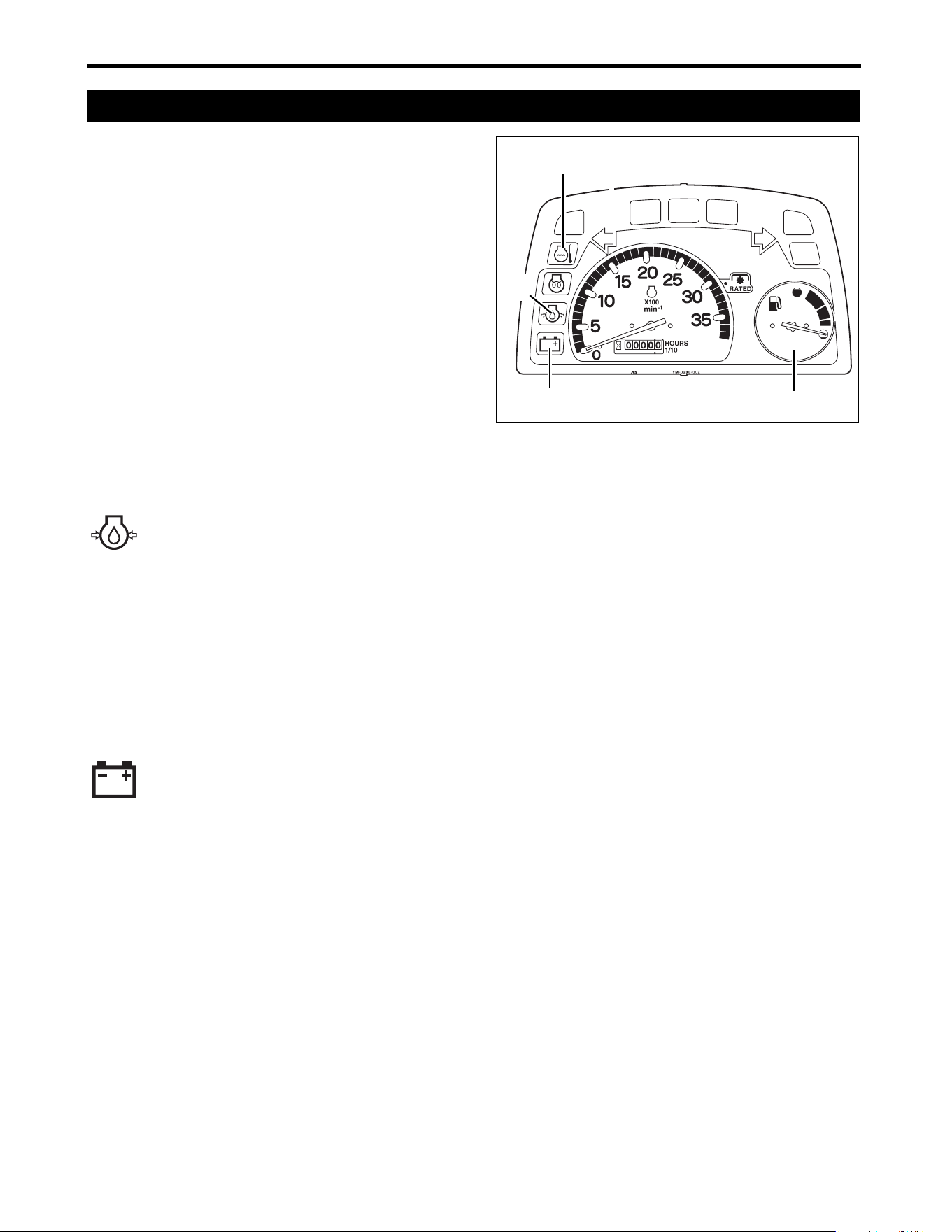
8-11
8. OPERATION
Sc2450 Operator's Manual
■If any of the following occurs, shut off the
engine immediately.
●Suddenly the engine slows down or accelerates on
its own.
●Any unusual noise is heard.
●Dark exhaust is suddenly emitted.
Regularly check the following during driving to
ensure that all parts are functioning normally.
(A) Fuel gauge
(B) Engine coolant warning light
If any warning light turns on during operation,
immediately shut off the engine and detect the cause
according to the procedure given below. Never
attempt to move or start the tractor while any warning
light remains “ON”.
Engine oil pressure warning light (C)
This warning light will turn on if the engine's
oil pressure drops below a predetermined
level.
If this occurs during operation of the tractor
and the light remains lit even when the
engine is accelerated to over 1100 min
-1
(rpm) (without load), check the level of
engine oil.
(See “Check the Engine Oil Level” on page
14-8.)
Alternator/battery charging light (D)
This warning light will turn on if the alternator
is not charging the battery properly.
If this occurs during operation of the tractor,
check the electrical charging system or
contact your local Cub Cadet Yanmar
dealer.
NOTE
●Contact your local Cub Cadet Yanmar dealer for
technical assistance on checking and servicing of
the tractor.
5. Verify During Driving
3014905
(B)
(D)
(A)
(C)
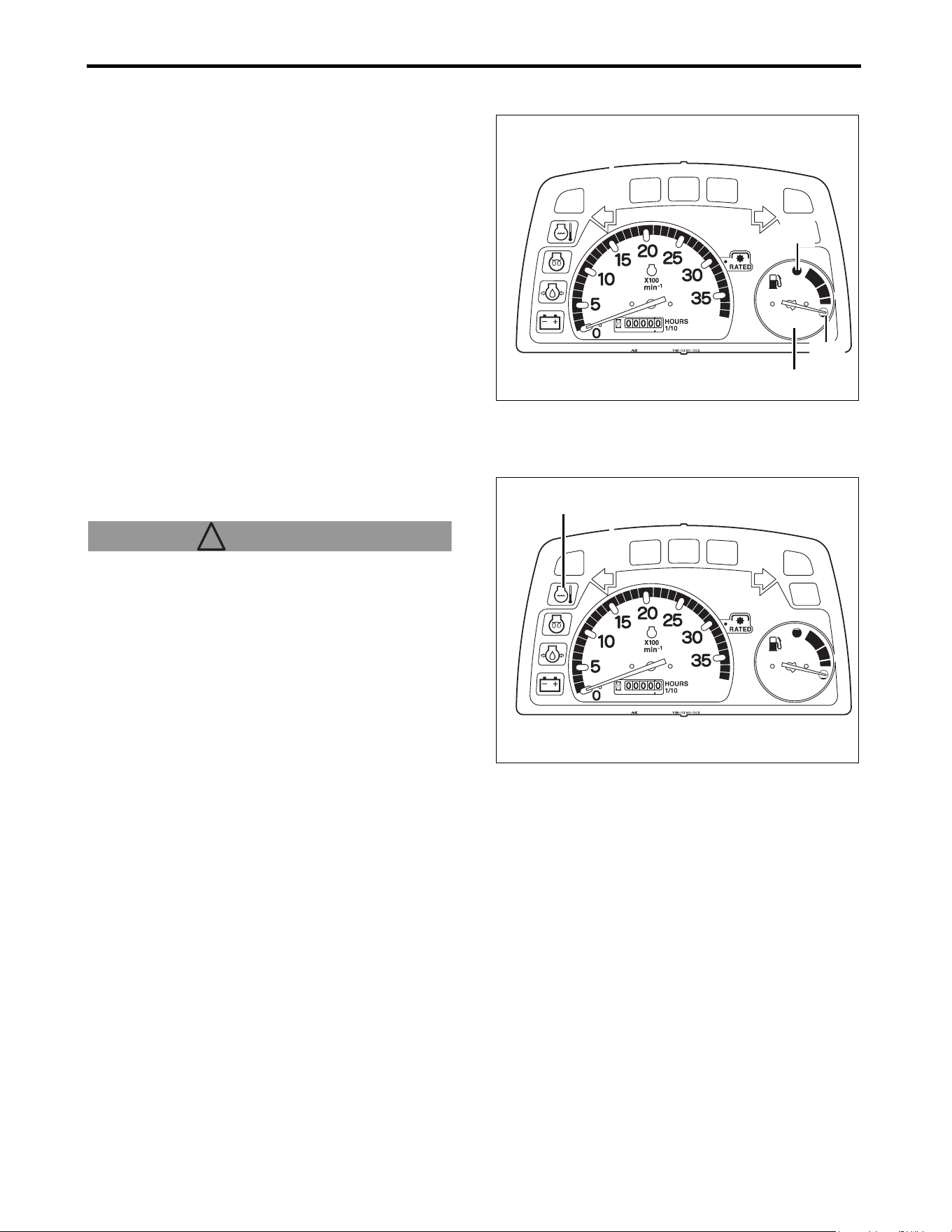
8-12
8. OPERATION
Sc2450 Operator's Manual
■ Fuel Gauge
Once the starter key is turned to the ON position, the
needle on this gauge will first jump to “empty” (in
order to indicate that the gauge is operating properly)
and move to a position that indicates the actual fuel
level.
IMPORTANT
●Never allow the fuel tank to become completely
empty or air may enter the fuel system and
necessitate bleeding of the whole fuel system.
(See “Refill the Fuel Tank” on page 14-4.)
(A) Fuel gauge
(a) Empty
(b) Full
■ Engine Coolant Warning Light
This warning light will turn on if the temperature of
the engine's coolant exceeds a predetermined level.
To avoid personal injury:
●Always allow the temperature of the coolant to
drop sufficiently before attempting to remove
the radiator cap.
●Always loosen the cap slightly first in order to
release the internal pressure before attempting
to remove the radiator cap completely.
IMPORTANT
●If the engine coolant warning light does turn on,
reduce the load on the tractor immediately, run the
engine at an idle until the light turns off, and shut
off the engine. Wait until the engine has cooled off
completely, and check to see that there is:
(1) Sufficient coolant in the radiator and reserve tank
(2) No clogging of the radiator fins and screen
(3) Sufficient tension in the fan belt
See “Chapter 14. PERIODIC SERVICE” for more
information on maintenance procedures.
●If the coolant warning light turns on again even
after being sure of the checkpoints above, shut off
the engine immediately and contact your local Cub
Cadet Yanmar dealer.
(A) Engine coolant warning light
3014905
(b)
(a)
(A)
3014905
(A)
! WARNING
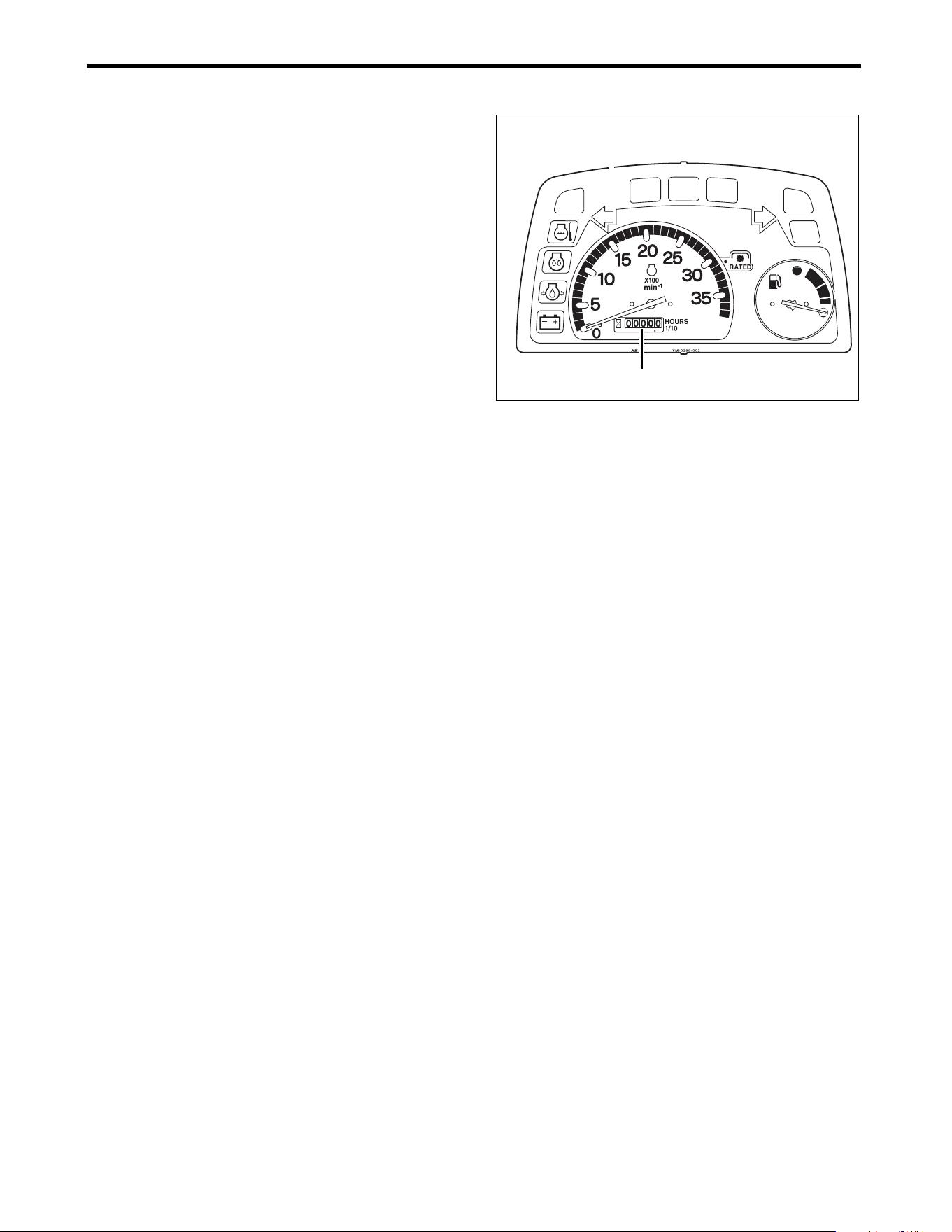
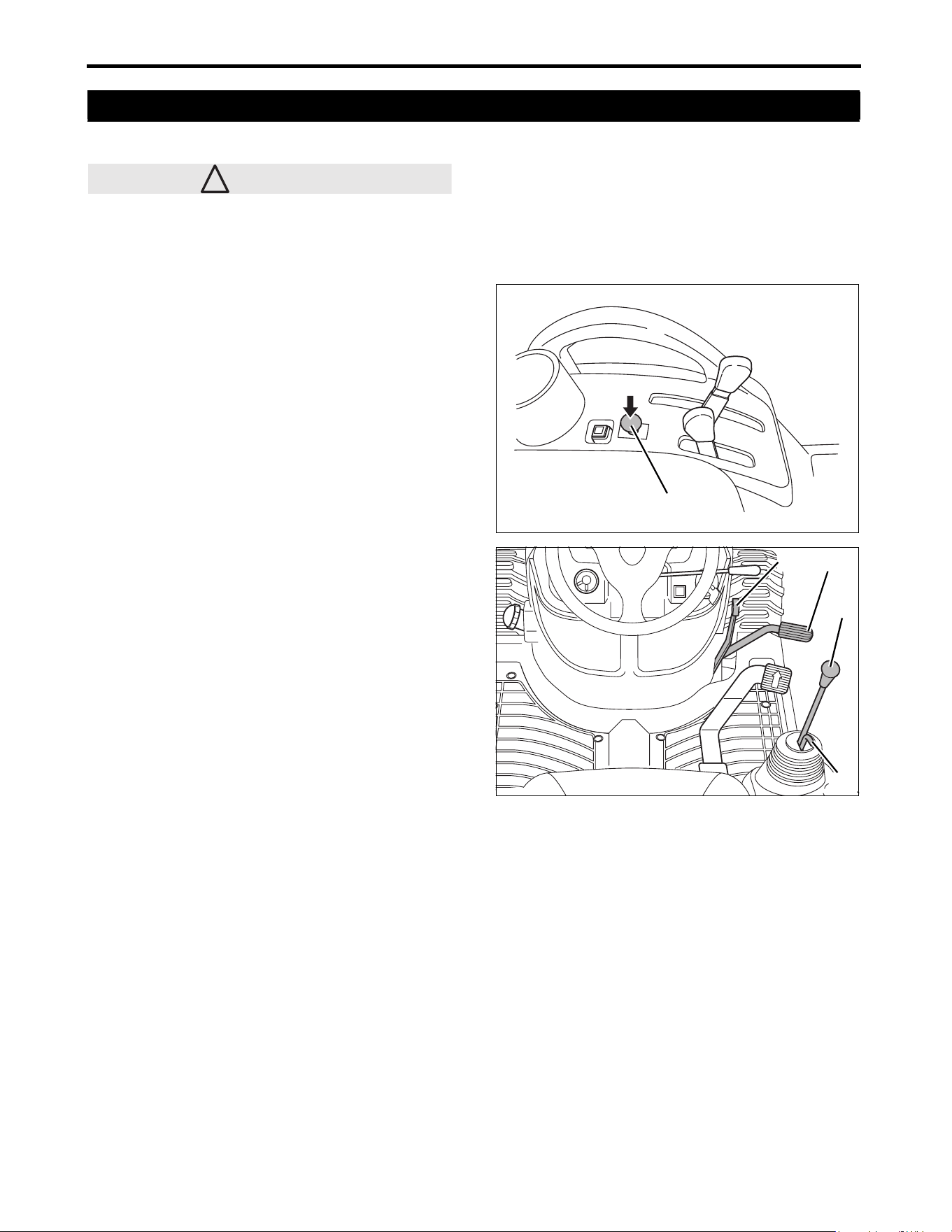
8-14
8. OPERATION
Sc2450 Operator's Manual
■ Apply the Parking Brake
Avoid injury:
●ALWAYS engage the parking brake securely
before leaving the tractor unattended.
1. Turn off the Power Take OFF (PTO) switch.
(A) Power Take Off (PTO) switch
2. Lower the implement to the ground, set the
implement control lever to the NEUTRAL position
and push in the implement lock lever to lock.
3. Engage the parking brake securely.
4. Turn the key to the OFF position.
5. Remove the key from the starter key switch.
6. Remove foot from the brake pedal. Make sure
that the parking brake has been fully engaged.
7. Before leaving the tractor, be fully sure that the
tractor is at a standstill.
(A) Implement control lever
(B) Implement lock lever
(C) Parking brake lever
(D) Brake pedal
IMPORTANT
●NEVER park on a steep slope. ALWAYS park on a
solid, flat, level ground whenever possible. If
parking on a slope is unavoidable, park the tractor
across the slope, and lower the implement to the
ground.
■ Release the Parking Brake
1. Fully depress the brake pedal.
2. Fully push the parking brake lever forward to
unlock the parking brake.
3. Remove foot from the brake pedal. Make sure
that the brake pedal is unlocked.
6. Park the Tractor
! CAUTION
3014919b
(A)
3014903j
(B)
(A)
(C)
(D)
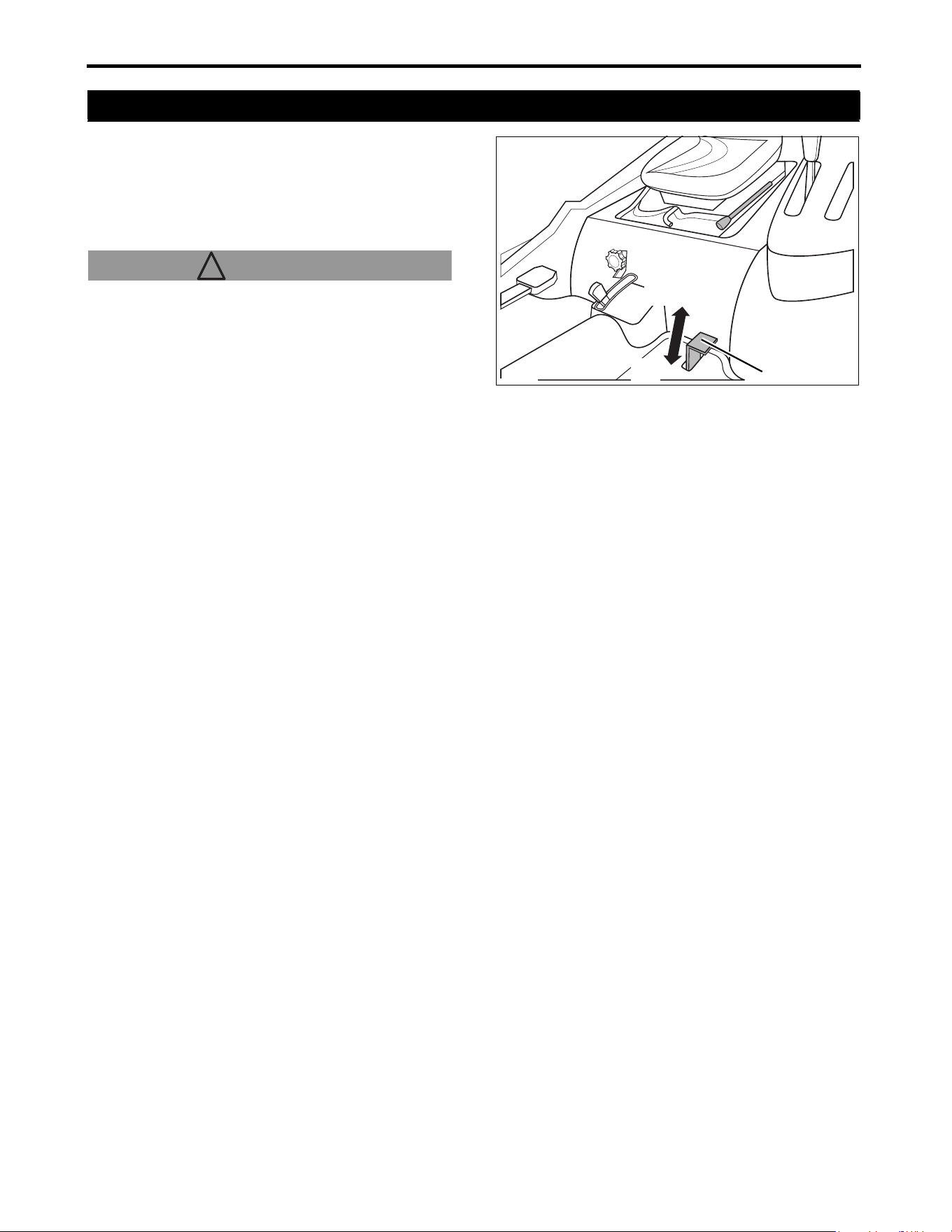
8-15
8. OPERATION
Sc2450 Operator's Manual
1. Differential Lock
(A) Differential lock foot pedal
(a) disengage
(b) engage
To prevent the tractor from overturning:
●Do not attempt to turn with the differential lock
engaged.
●Do not engage the differential lock while the
tractor is traveling at a high speed.
The differential lock is actuated to provide greater
traction when rear wheels begin to slip. Engaging the
differential lock will cause the right and left rear axles
to be locked and simultaneously rotate at a same
speed, allowing the tractor to develop maximum
traction force.
IMPORTANT: Avoid damage.
●To prevent damage to the differential gears,
NEVER engage the differential lock while the
tractor is traveling at a high speed, or when only
one wheel is rotating.
●The differential lock is designed to be used for
short durations. Its prolonged use can damage the
differential gears.
■ Engage the Differential Lock
1. Stop or slowly drive the tractor.
2. Depress the differential lock foot pedal.
■ Disengage the Differential Lock
Remove foot from the differential lock foot pedal.
IMPORTANT
●When using the differential lock, decrease the
engine speed.
●To prevent transmission damage, do not use the
differential lock when only one rear wheel is
rotating.
• If the differential lock does not disengage when
the foot is removed from the differential lock foot
pedal, lightly step on the brake pedal several
times.
7. Safe Practices for Operation
3016494c
(A)
(b)
(a)
! WARNING! WARNING
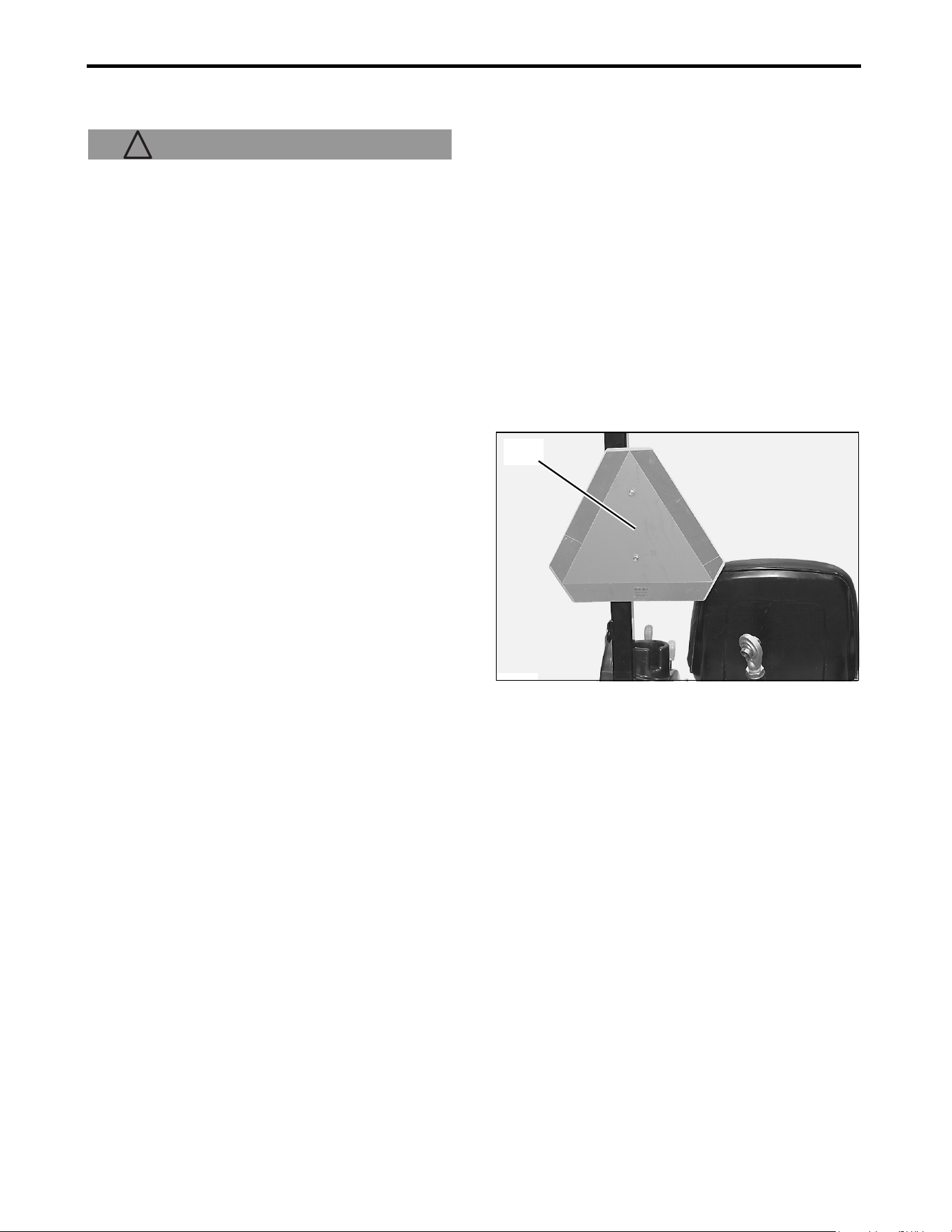
8-16
8. OPERATION
Sc2450 Operator's Manual
2. Drive the Tractor on Roads Safely
Exercise due caution when driving the tractor at
a transport speed.
●We recommend that the user/operator use the
turn signal/hazard lights when traveling on
public roads. Before operating the tractor on a
public roadway, be aware of relevant state or
local regulations in effect. An implement safety
lighting kit is available from your local Cub
Cadet Yanmar dealer.
●If local laws permit road travel, use the flashing
hazard lights and Slow Moving Vehicle (SMV)
emblems when traveling on public roadways.
● When operating the tractor on a roads, strictly
observe the following precautions:
• ALWAYS ensure that right side and left side
brakes are equally adjusted.
• ALWAYS ensure that the Slow Moving Vehicle
(SMV) emblem and hazard lights are clean and
clearly visible. If a towed or rear-mounted
implement jeopardizes visibility of these safety
devices, install the Slow Moving Vehicle (SMV)
emblem and hazard lights on the implement.
(A) Typical example of installed Slow Moving
Vehicle (SMV) emblem
●Turn the hazard lights and headlights ON, unless
prohibited by law.
●Secure the implement being towed with lock hitch
pins and safety chains.
●Drive the tractor slowly so that the tractor is under
control at all times. Slow down for travel on slopes,
rough roads, sharp turns or when transporting a
heavy rear-mounted implement.
●Disengage the 4-wheel drive to prevent excessive
tire wear.
●NEVER coast downhill.
●Check whether the front wheel gearing is engaged.
●Remember that the braking characteristics differ
between the 2- and 4-wheel drive modes.
ALWAYS be aware of the current drive mode and
use it properly.
●ALWAYS slow down before turning. High-speed
turns may cause the tractor to tip over.
●ALWAYS ensure that the Slow Moving Vehicle
(SMV) emblem is on the tractor and is clearly
visible.
! CAUTION! WARNING: Avoid injury!
P3014904
(A)

8-17
8. OPERATION
Sc2450 Operator's Manual
●Strictly observe all the currently effective local
traffic and safety laws and regulations.
●ALWAYS travel at a speed that allows the tractor to
remain controlled and stable.
●Avoid engaging the differential lock while traveling
on roads as this can cause the tractor to become
uncontrollable.
●While traveling on roads, do not turn the steering
wheel suddenly as this can lead the tractor to
become unstable and result an extremely
dangerous situation.
●While on roads, NEVER attempt to operate an
implement. During driving on road with an
implement attached to the 3-point hitch, put the 3-
point hitch control lever in its raised position and
lock it with the position stop knob. Do not fully close
the hydraulic flow control/stop knob in order to
keep any implements in their raised position while
the tractor is traveling.
Closing the knob could cause damage to the
hydraulic lift circuit.
●When driving the tractor on roads, NEVER exceed
10 mph (16 km/h).
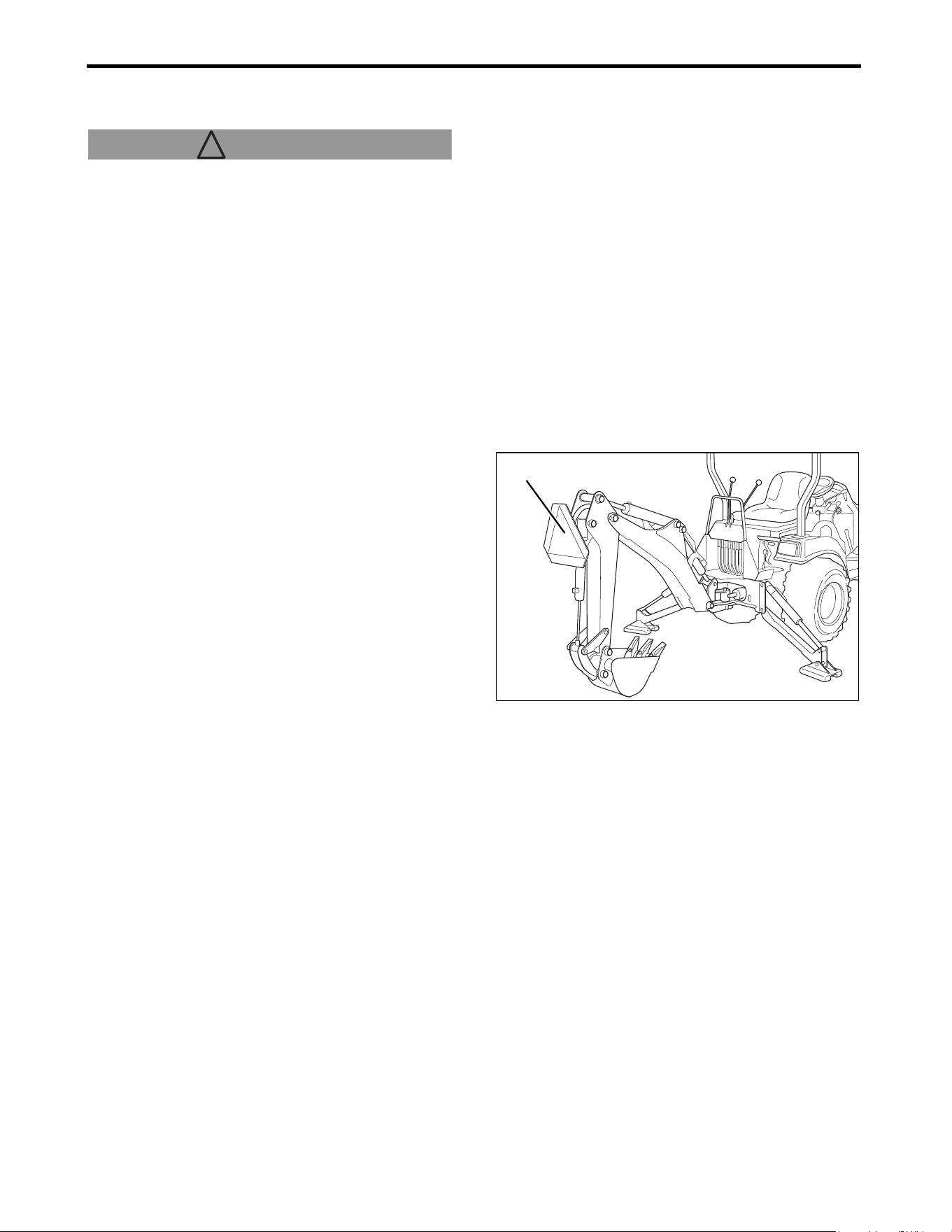
8-18
8. OPERATION
Sc2450 Operator's Manual
3. Drive the Tractor on Roads Safely (when with backhoe)
Be cautious when driving the tractor at a
transport speed:
●We recommend that the user/operator use the
turn signal/hazard lights when traveling on
public roads. Before operating the tractor on a
public roadway, be aware of relevant state or
local regulations in effect. An implement safety
lighting kit is available from your local Cub
Cadet Yanmar dealer.
●If local laws permit road travel, flash the hazard
lights and display the Slow Moving Vehicle
(SMV) emblems when traveling on public
roadways.
●When operating the tractor on a road, strictly
observe the following precautions:
• ALWAYS ensure that the Slow Moving Vehicle
(SMV) emblem and hazard lights are clean and
clearly visible. If a towed or rear-mounted
implement jeopardizes visibility of these safety
devices, install the Slow Moving Vehicle (SMV)
emblem and hazard lights on the implement.
(A) Typical example of installed Slow Moving
Vehicle (SMV) emblem
●Turn the hazard lights and headlights ON, unless
prohibited by law.
●Drive the tractor slowly so that the tractor is under
control at all times. Slow down for travel on a slope,
rough road, sharp turns or when transporting a
heavy rear-mounted implement.
●Disengage the 4-wheel drive to prevent excessive
tire wear.
●NEVER coast downhill.
●Check whether the front wheel gearing is engaged.
●Remember that the braking characteristics differ
between the 2- and 4-wheel drive modes.
ALWAYS be aware of the current drive mode and
use properly.
●ALWAYS slow down before turning. High-speed
turns may cause the tractor to tip over.
●Strictly observe all the currently effective local
traffic and safety laws and regulations.
●ALWAYS travel at a speed that allows the tractor to
remain controlled and stable.
●Avoid engaging differential lock while traveling on a
road. Your tractor can lose control.
! WARNING! WARNING
3016403
(A)
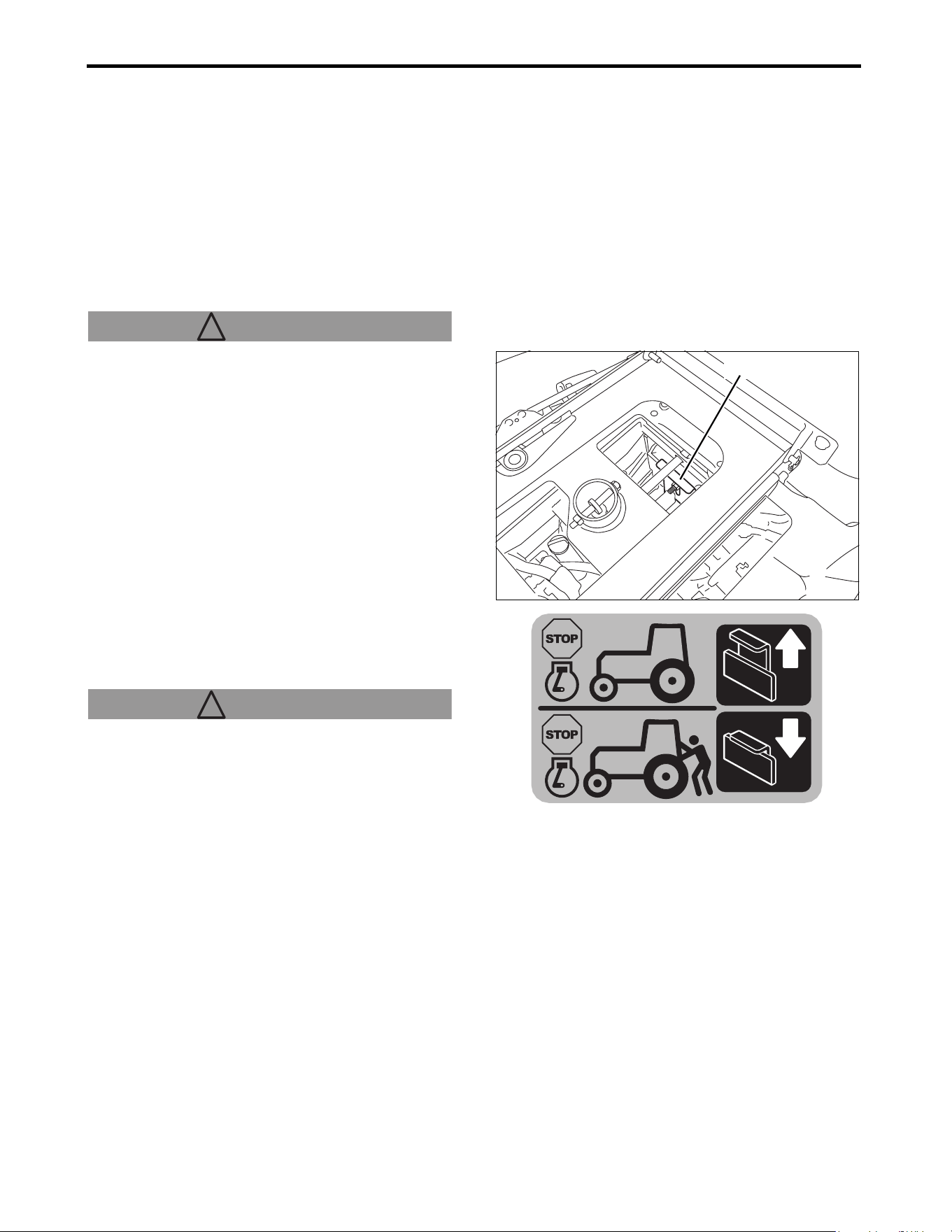
8-19
8. OPERATION
Sc2450 Operator's Manual
●While traveling on a road, do not suddenly turn the
steering wheel. Such an action can lead to loss in
the stability of the tractor, and can cause an
extremely dangerous situation.
●While on a road, NEVER attempt to operate an
implement. Keep the 3-point hitch in the raised
position during transport.
4. Move the Tractor Manually while the Engine is Stopped
Setting the Hydro Static Transmission (HST)
pressure release lever to the ON position makes
the tractor freely move.
●Do not operate the Hydro Static Transmission
(HST) pressure release lever on a slope. Setting
the Hydro Static Transmission (HST) pressure
release lever to the ON position on the slope
makes the axles freely move, so that the tractor
will be out of control.
●Before setting the Hydro Static Transmission
(HST) pressure release lever to the ON position,
park the tractor in a flat place and engage the
parking brake securely.
(A) Hydro Static Transmission (HST) pressure
release lever
●Do not operate the Hydro Static Transmission
(HST) pressure release lever while the engine is
running.
IMPORTANT: Avoid damage.
●Moving the tractor in an improper way may
damage the transmission. Move the tractor by
hand only.
• Do not move the tractor with using other
machine.
• Do not tow the tractor.
! WARNING! WARNING
3016486
(A)
1A7880-65380
! WARNING! WARNING
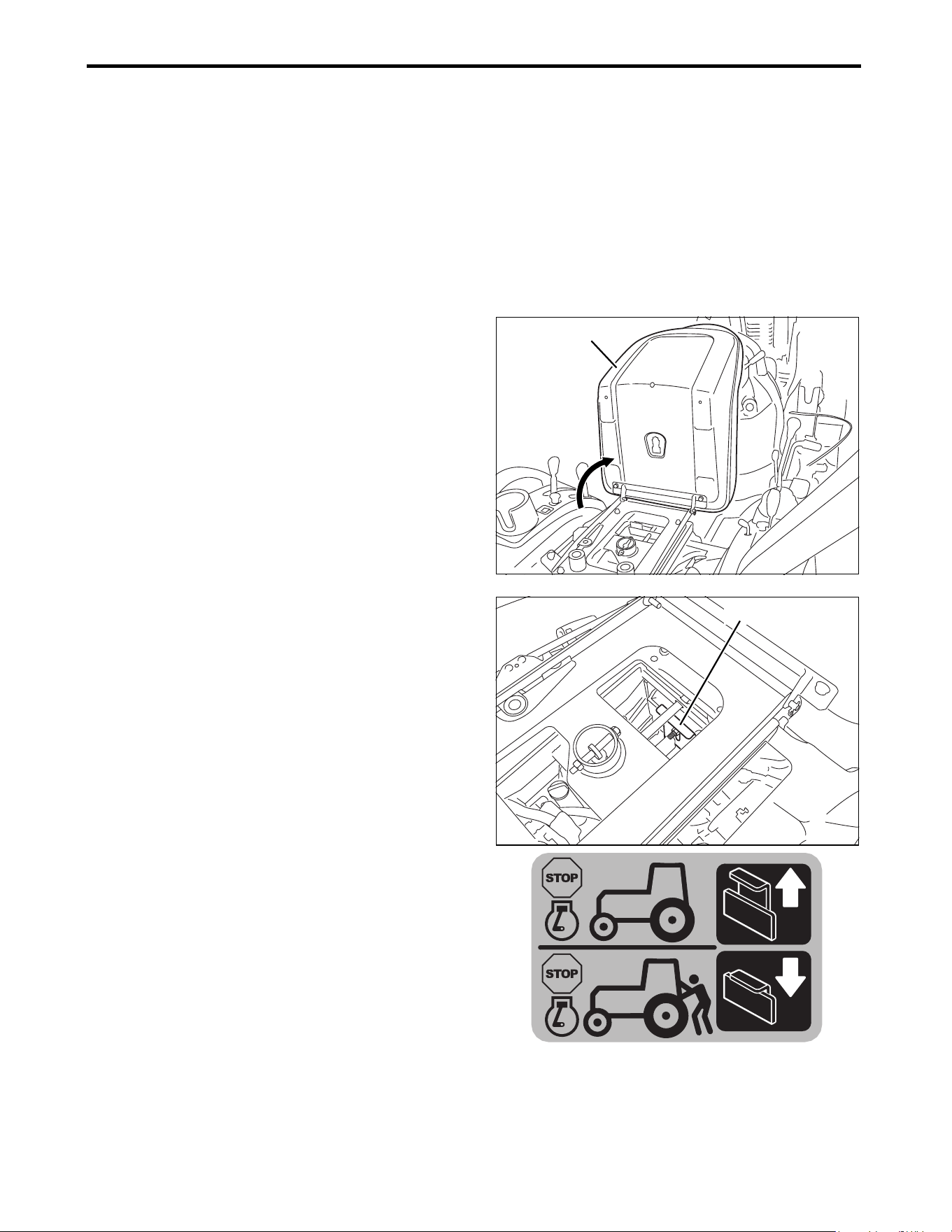
8-20
8. OPERATION
Sc2450 Operator's Manual
■ Hydro Static Transmission (HST) Pressure Release Lever
Hydraulic pressure in the Hydro Static Transmission
(HST) brakes the axles when the engine is not
running, so that the tractor cannot be moved.
When the hydraulic pressure in the transmission is
released by pressing the Hydro Static Transmission
(HST) pressure release lever, the tractor can be
moved.
To move the tractor, observe the following
procedure:
1. Make sure that the engine is stopped.
2. Tilt the seat forward.
(A) Seat
3. Fully depress the Hydro Static Transmission
(HST) pressure release lever.
(A) Hydro Static Transmission (HST) pressure
release lever
4. Disengage the parking brake.
5. Move the tractor.
6. After moving the tractor, fully pull up the Hydro
Static Transmission (HST) pressure release lever.
7. Engage the parking brake securely.
3016488
(A)
3016486
(A)
1A7880-65380
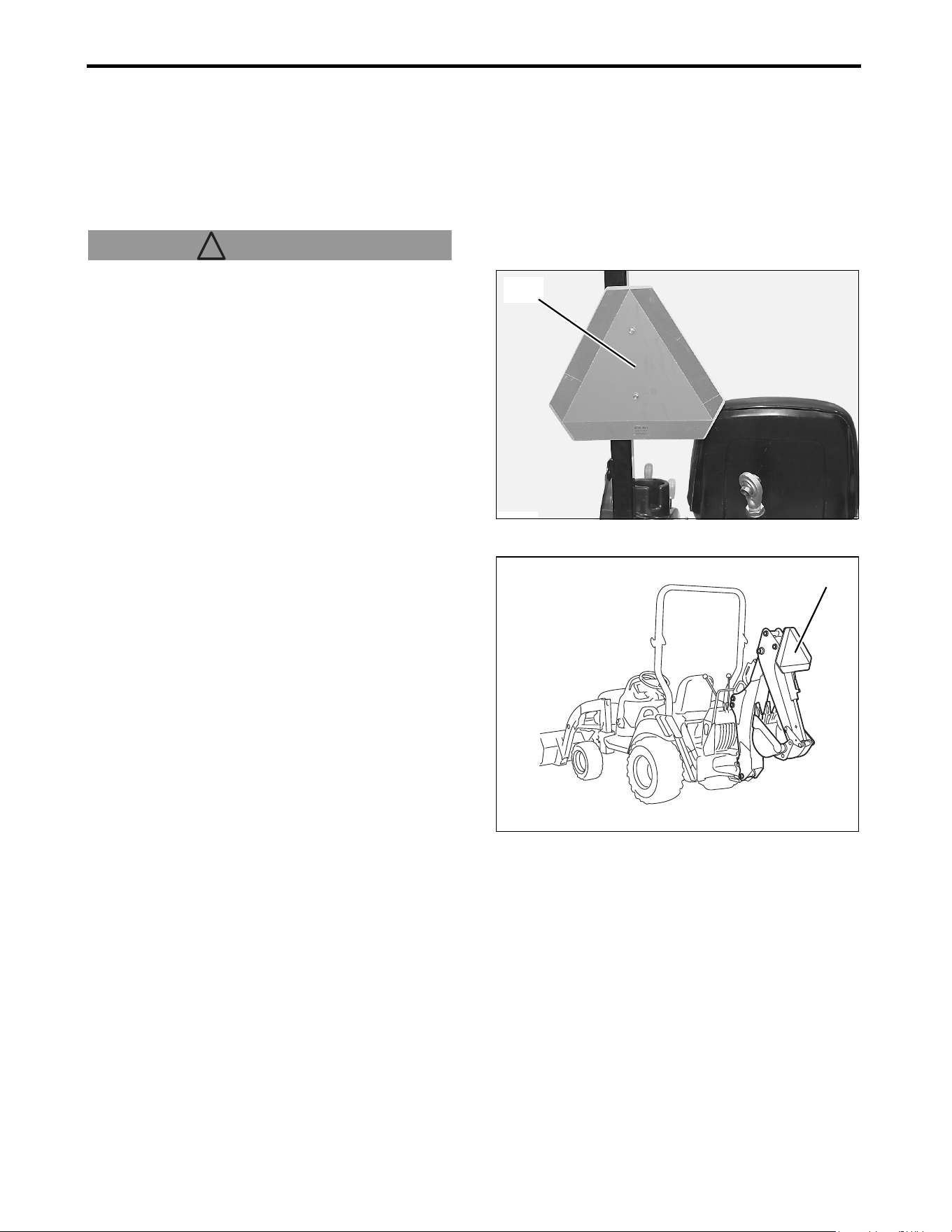
8-21
8. OPERATION
Sc2450 Operator's Manual
5. Transport the Tractor on a Trailer
The instructions given in this page are limited to a
practice recommended for transporting the tractor
correctly alone or with front loader, backhoe and
front loader/backhoe on a trailer.
To prevent serious personal injury or death:
●Always follow the cautions below.
• Be sure to raise and center the boom, close
the dipperstick, curl the bucket, and lock the
boom and swing before attempting to
transport the tractor.
• Use chains and chain binders to tie down the
tractor, front loader and backhoe securely to
the trailer or truck. Do not put any hold down
chains anywhere on the backhoe assembly.
• Before starting to travel or transporting the
tractor, verify and take note of the height of
the backhoe to ensure it meets the clearance
requirement of each underpass, etc.
●Exercise extreme care when loading or
unloading the tractor to or from a trailer or
truck.
●Close the fuel shut-off valve.
(A) Typical example of installed Slow Moving
Vehicle (SMV) emblem
NOTE
●Use a heavy-duty trailer to transport the tractor.
1. Drive the tractor forward onto the trailer.
2. Lower any implement onto the trailer deck.
3. Engage the parking brake securely.
4. Turn off the engine.
5. Remove the key from the starter key switch.
6. Close the fuel shut-off valve.
7. Tie down the tractor to the trailer with heavy-duty
straps, chains or cables. Direct both front and rear
straps down and outward from the tractor.
IMPORTANT
●The trailer must have signs and lights required by
law.
●When transporting the tractor on a trailer, the Slow
Moving Vehicle (SMV) emblem may have to be
removed to comply with local laws. For details,
please consult your local Cub Cadet Yanmar
dealer.
! WARNING! WARNING
P3014904
(A)
3016447
(A)
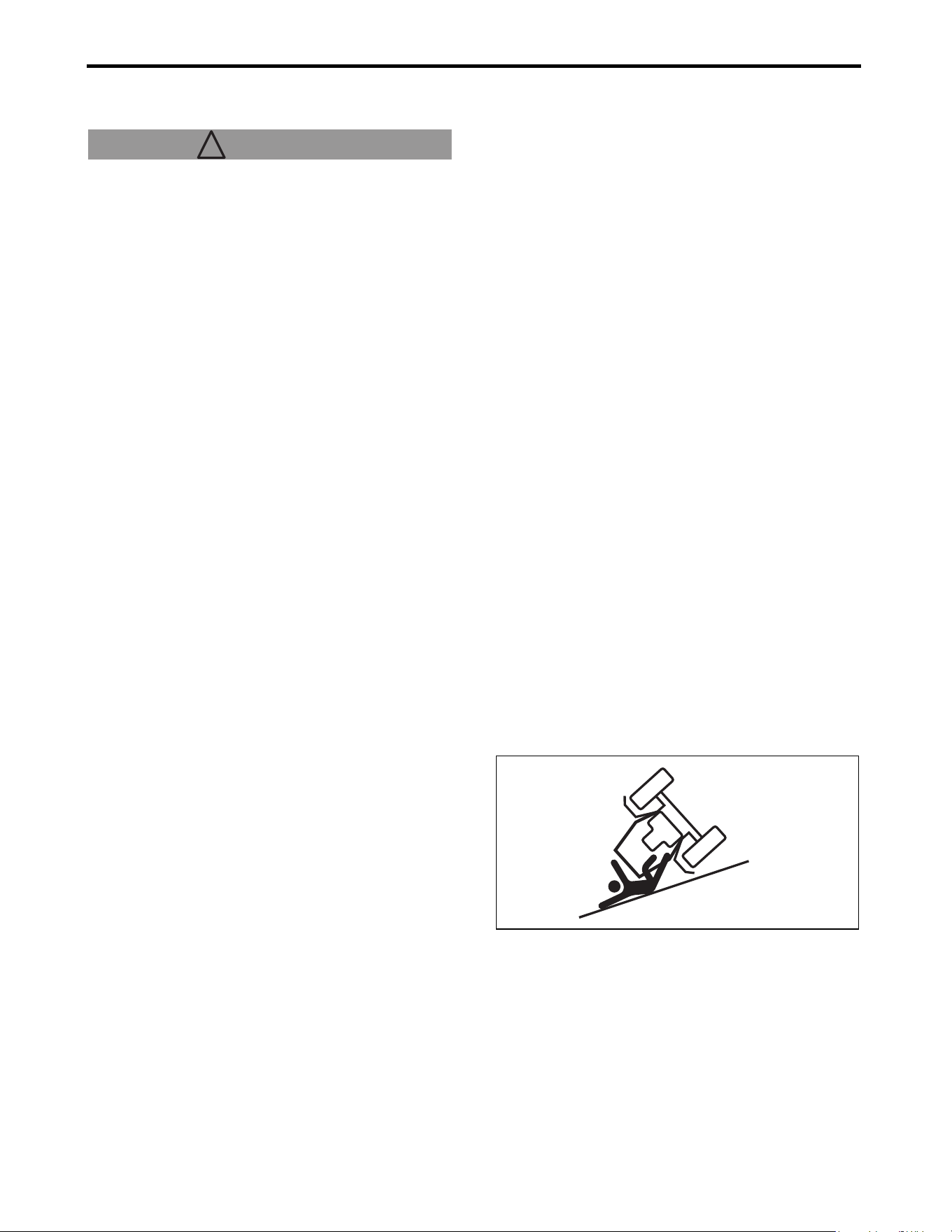
8-22
8. OPERATION
Sc2450 Operator's Manual
6. Operate on Slopes and Rough Terrain
Be extremely cautious when driving the tractor
on a slope and rough terrain.
●To increase traction power and provide 4-wheel
braking, engage the 4-wheel drive before
driving the tractor on a slope and rough terrain.
Remember that, although 4-wheel drive greatly
assists in approach to a steep slope, there is
greater possibility of the tractor tipping over.
●To improve braking power on sloped, frozen,
wet or graveled surfaces, engage the 4-wheel
drive. Add weight to the tractor as necessary
and travel at a lower speed to prevent skidding
and loss of steering control.
●While driving the tractor, do not attempt to
climb a slope that is steeper than 11 degrees.
●Even on a slope that is less than 11 degrees, do
not turn or change the traveling direction, or
park perpendicular to the slope.
●Before approaching a slope, select an
appropriate speed setting (be sure to travel at a
lower speed when on a slope). NEVER shift
gears while on a slope as this can cause the
tractor to become uncontrollable and suddenly
roll downhill.
●Suddenly starting the tractor on an uphill slope
can cause the front wheels to lift off the ground
and result an extremely dangerous situation.
To avoid this problem, run the engine at a lower
speed and slowly start the tractor in motion.
● NEVER park the tractor on a slope. If parking on
a slope is unavoidable, chock the tires and set
the parking brake securely.
●On a slope, the tractor is unstable and more
prone to tipping over, possibly leading to
severe injury or even death. Remain very
cautious when your tractor is on any slope.
●To prevent the tractor from tipping over, travel
backward on steep slopes. If traveling
backward on the slope is difficult, do not
attempt to continue. Avoid extremely steep
slopes.
●When exiting a ditch or deep mud, or when
traveling on a steep slope, the risk of the
tractor tipping over is high. Special caution is
especially required in 4-wheel drive mode.
●Slowly move on any slope. NEVER change
speed or direction quickly.
●When backing up a slope, keep the tractor
parallel with the gradient of the slope.
! WARNING! WARNING
3013748
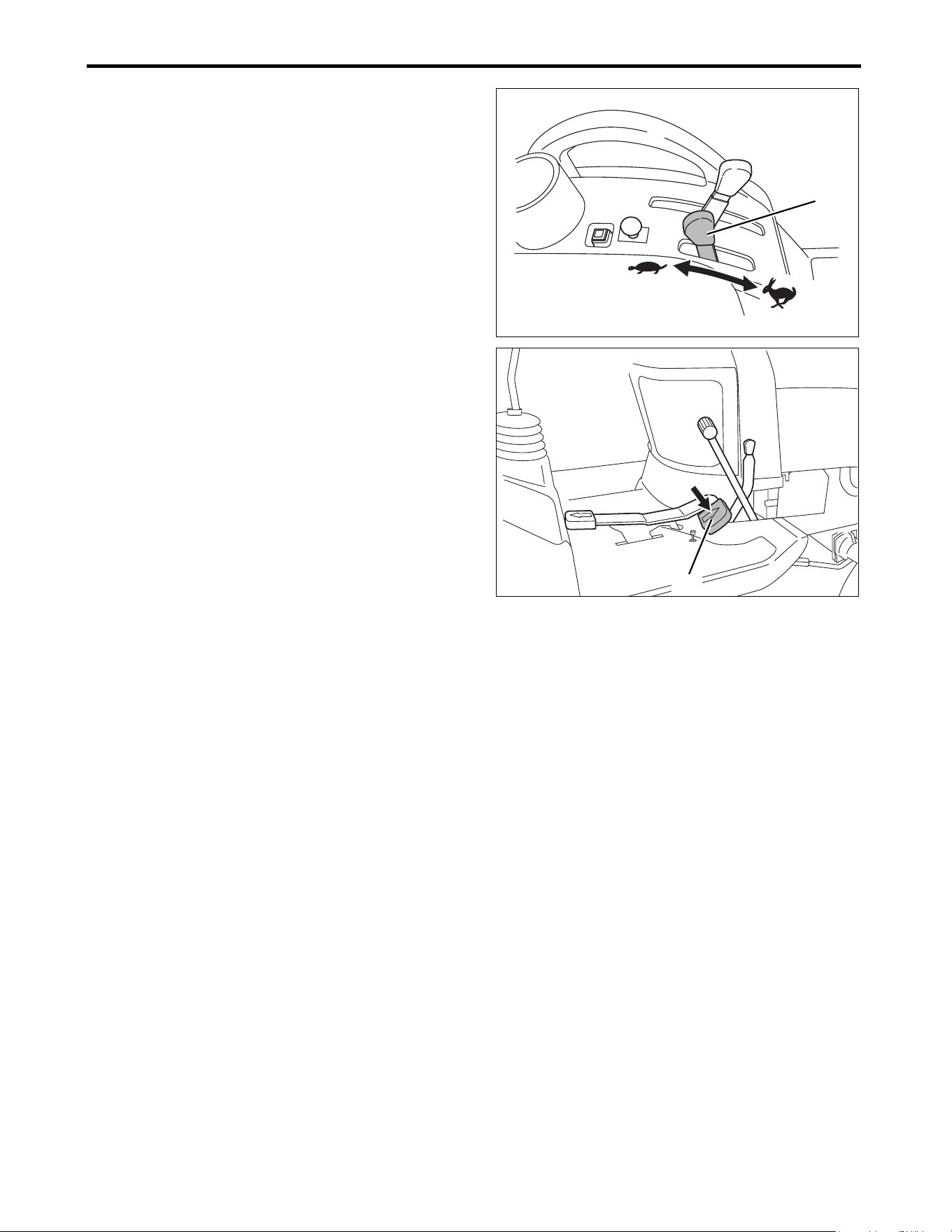
8-23
8. OPERATION
Sc2450 Operator's Manual
1. Before approaching a slope, set the range gear
lever to the slow position.
(A) Range gear lever
(a) Slow position
2. Lightly depress the forward side of the forward
and reverse drive pedal to start moving.
IMPORTANT
●Always slowly drive the tractor on a slope.
3. ALWAYS travel slowly on a slope.
4. Drive the tractor according to the type of a slope,
as instructed below:
■ Uphill/Downhill
Make sure that the range gear lever is in the slow
position. Run the engine at a lower speed.
■ Steep Downhill
To be able to apply the engine brake, turn the range
gear lever to the slow position.
(A) Forward and reverse drive pedal
3014919a
(A)
(a)
3014916b
(A)
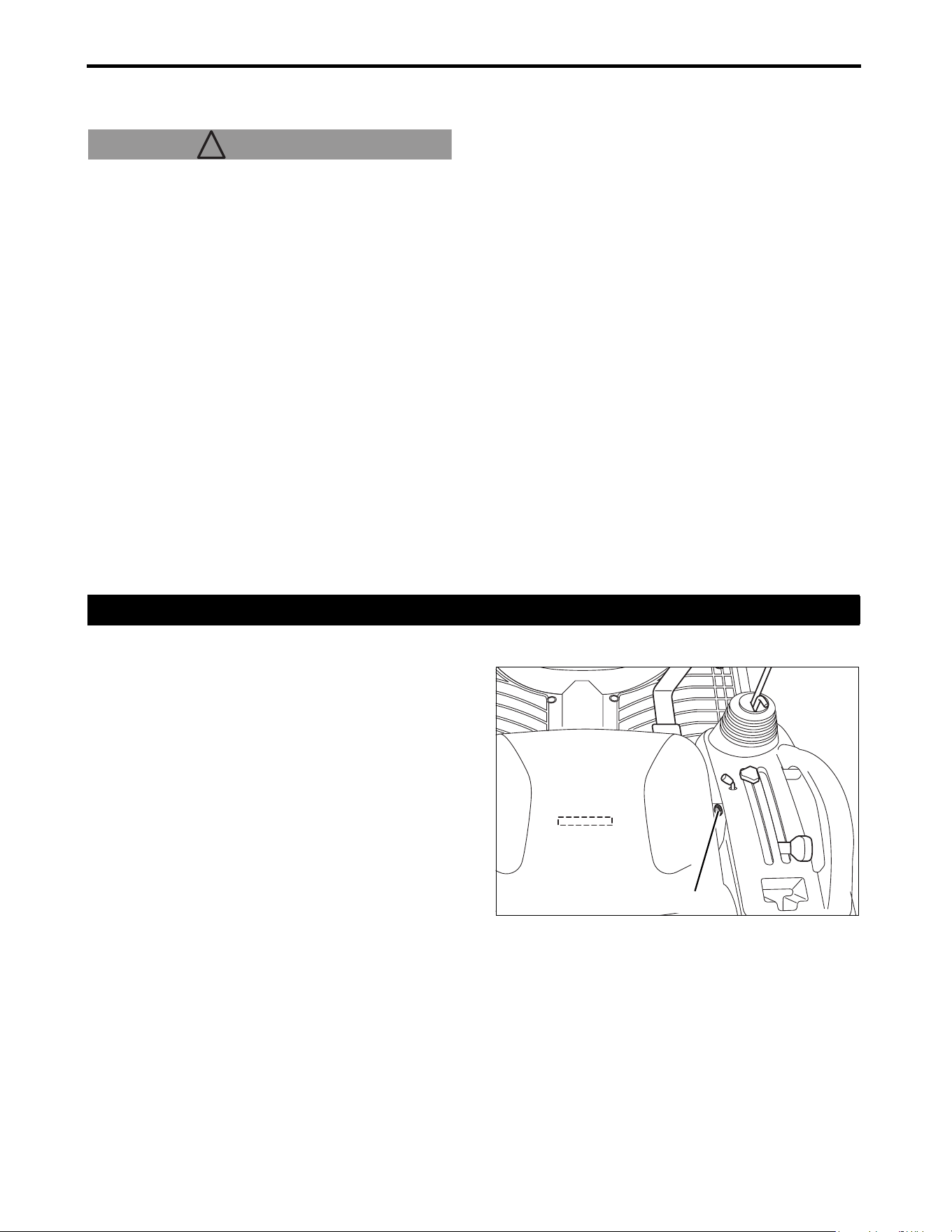
8-24
8. OPERATION
Sc2450 Operator's Manual
7. About the Power Steering
●NEVER operate the steering wheel suddenly,
especially while traveling on a paved road.
Otherwise, an accident can occur.
The power steering feature is operative only when
the engine is running. Note that when the engine is
running at a lower speed, the steering wheel will
need slightly greater force. This is considered normal
operation.
IMPORTANT
●Fully turning the steering wheel will cause the relief
valve to trip and an audible signal will sound. This
situation may be ignored only for a short duration.
NEVER operate the steering in relief for a
prolonged period.
●Turning the steering wheel while the tractor is not
running can promote damage on the tires and rims.
Avoid such an action whenever possible.
■ 12V DC Outlet
This can be used when the key switch is in “ON”
position.
It can be used as a power source for electrical
goods.
(A) 12V DC outlet
IMPORTANT: Avoid damage.
●Do not connect a light or load of more than 120
watts.
●Do not use as a cigarette lighter.
●Do not use when wet.
●Long-term usage of the 12V DC outlet with the
engine stopped causes the battery to run out.
8. Accessory
! WARNING! WARNING
3014903o
(A)
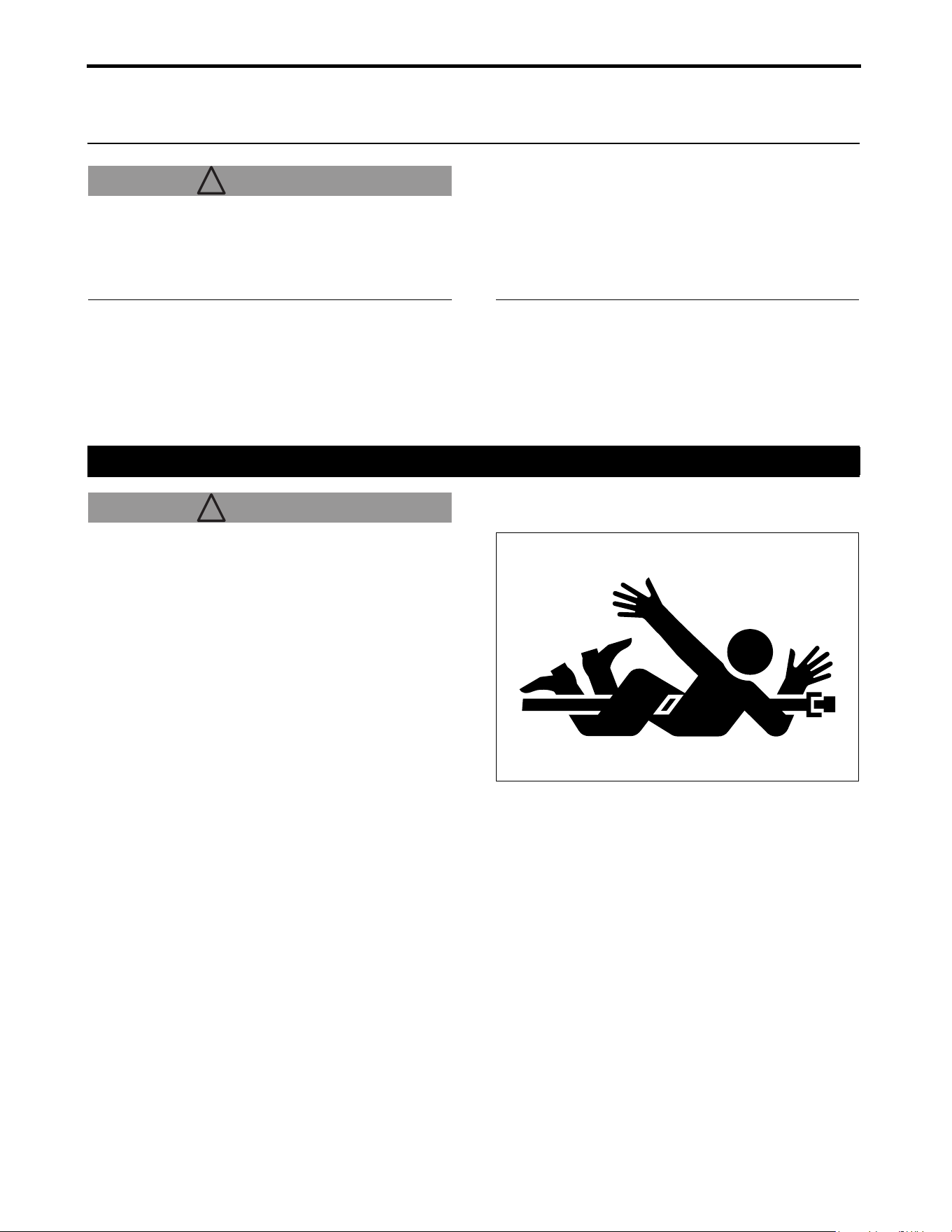
9-1
9. POWER TAKE OFF (PTO)
Sc2450 Operator's Manual
9. POWER TAKE OFF (PTO)
ALWAYS ensure all moving components have
stopped rotating before connecting, disconnecting,
adjusting, cleaning or servicing any Power Take Off
(PTO)-driven implement.
ALWAYS ensure the Power Take Off (PTO) shaft
cover is installed. ALWAYS wait until the shaft has
completely stopped moving before attempting to
replace the Power Take Off (PTO) shaft cap.
ALWAYS follow the Power Take Off (PTO)-driven
implement operation manuals and safety decals and
instructions before installing or operating any Power
Take Off (PTO)-driven implements.
ALWAYS set the parking brake securely and put
wheel chocks in front and behind the rear wheels.
NEVER approach or touch any rotating component.
● Before connecting, disconnecting, adjusting
or cleaning any Power Take Off (PTO)-driven
implement, be sure to disengage the Power
Take Off (PTO), shut down the engine, and
make sure that all the components have
stopped their rotation.
● Do not approach rotating drivelines.
● Entanglement with a rotating driveline can lead
to serious injury or even death.
● Keep hands, feet and clothing away from the
rotating driveline.
● Make sure that all shields and guards are in
position and are correctly used.
● Do not run the engine at 3520 min
-1
(rpm) or
more while the Power Take Off (PTO) is
engaged.
! WARNING
! WARNING
1. Operate the Power Take Off (PTO)
! WARNING! WARNING
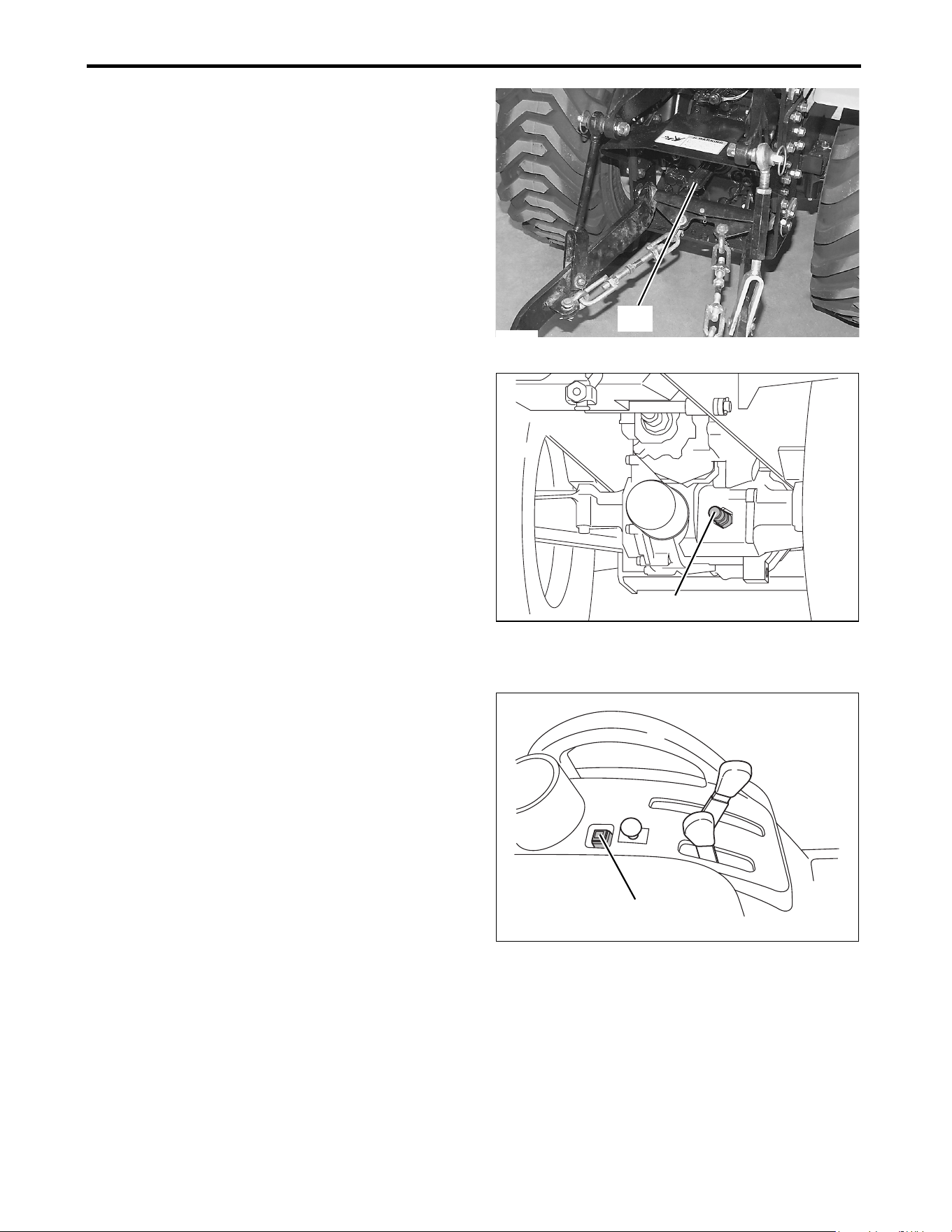
9-2
9. POWER TAKE OFF (PTO)
Sc2450 Operator's Manual
■ Rear- Power Take Off (PTO)
(A) Rear- Power Take Off (PTO) shaft
NOTE
●3-point hitch is option.
■ Mid- Power Take Off (PTO)
(A) Mid- Power Take Off (PTO) shaft
■ Engage the Power Take Off (PTO)
NOTE
●This tractor cannot drive the Power Take Off (PTO)
unless the operator sits on the seat. When the
operator leaves the seat while the Power Take Off
(PTO) is engaged, the safety interlock system
stops the implement and the engine.
●Normally, reversing the tractor stops the Mid-
Power Take Off (PTO) and the Rear-Power Take
Off (PTO). To drive the Power Take Off (PTO)
while reversing the tractor, use the reverse-
override-switch.
(A) Reverse-override-switch
P3014908
(A)
3014919d
(A)
3014919d
(A)
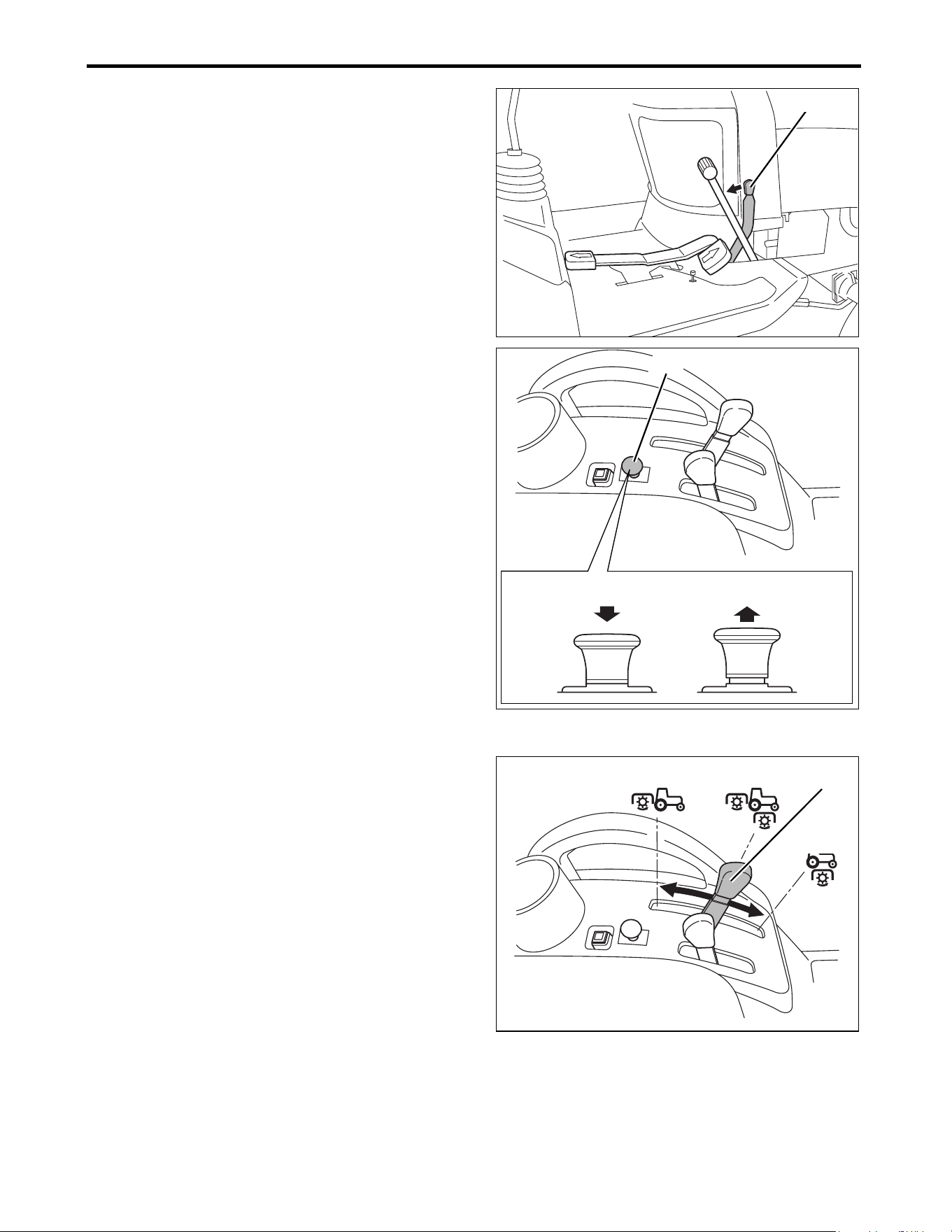
9-3
9. POWER TAKE OFF (PTO)
Sc2450 Operator's Manual
1. Sit on the operator's seat.
2. Engage the parking brake securely.
(A) Parking brake lever
3. Push in the Power Take Off (PTO) switch to set it
to the OFF position.
(A) Power Take Off (PTO) switch
(a) OFF position
(b) ON position
4. Start the engine.
5. Adjust the engine speed to 1500 min
-1
(rpm) or
lower.
IMPORTANT
●In order to reduce any shock at the time of driving
the Power Take Off (PTO), make sure to reduce
the engine speed before turning ON the Power
Take Off (PTO) switch.
6. According to an implement to be used, operate
the Mid-/Rear-Power Take Off (PTO) select lever.
(A) Mid-/Rear-Power Take Off (PTO) select lever
(a) Operating the Mid-Power Take Off (PTO) alone
(b) Operating the Mid-Power Take Off (PTO) and the
Rear-Power Take Off (PTO) at the same time
(c) Operating the Rear-Power Take Off (PTO) alone
7. Pull up the Power Take Off (PTO) switch to set it
to the ON position.
3014916d
(A)
3014919g
(A)
(a) (b)
3014926
3014919e
(A)
(c)
(a)
(b)
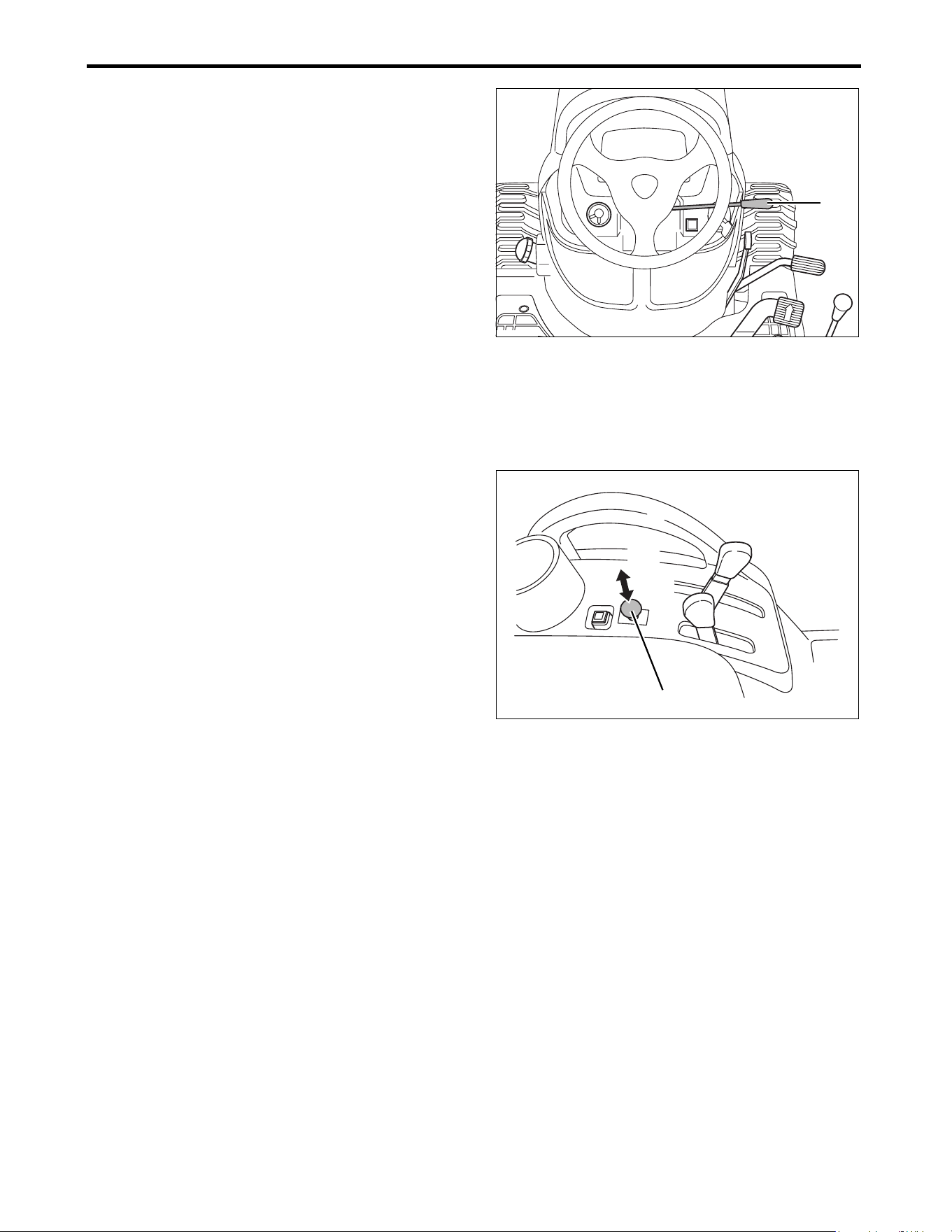
9-4
9. POWER TAKE OFF (PTO)
Sc2450 Operator's Manual
8. While watching the instrument panel, adjust the
engine speed suitable for operating with the
throttle control lever.
(A) Throttle control lever
NOTE
●When the engine speed is 3300 min
-1
(rpm), the
Mid-Power Take Off (PTO) rotates at
approximately 2100 min
-1
(rpm).
●When the engine speed is 3100 min
-1
(rpm), the
Rear- Power Take Off (PTO) rotates at
approximately 540 min
-1
(rpm).
■ Disengage the Power Take Off (PTO)
1. Run the engine at a low speed.
2. Push in the Power Take Off (PTO) switch to set it
to the OFF position.
(A) Power Take Off (PTO) switch
(a) ON position
(b) OFF position
3014903e
(A)
3014919c
(A)
(b)
(a)
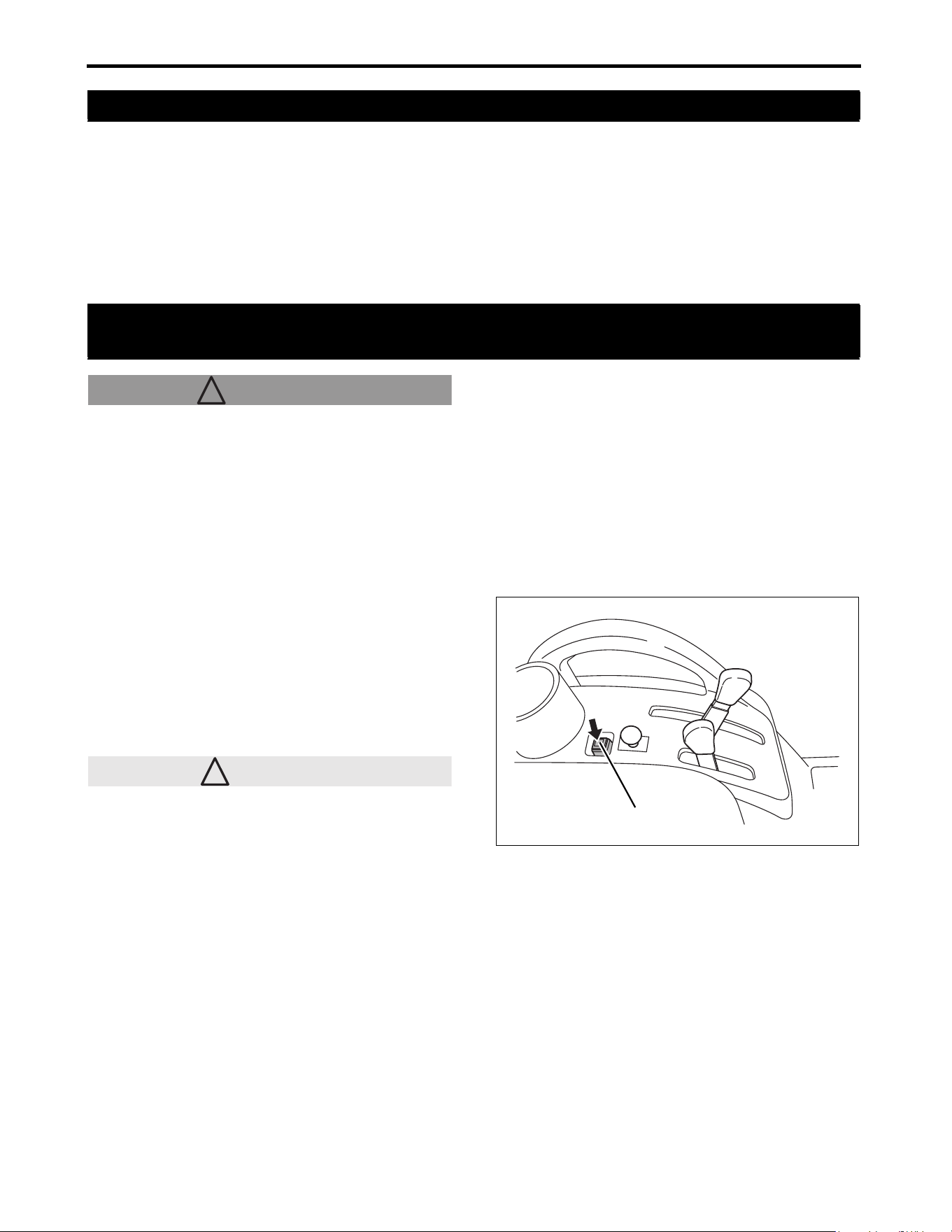
9-5
9. POWER TAKE OFF (PTO)
Sc2450 Operator's Manual
IMPORTANT: Avoid damage.
●Observe the driveline manufacturer's installation
instructions for driveline mounting angle and the
length of overlaps on the two-part driveline shafts.
An incorrectly installed implement can promote
wear of the driveline and/or damage the tractor.
●Use EXTREME caution to check that anyone or
any object is not present in the rear area when
using the Power Take Off (PTO) in reverse.
Normally, reversing the tractor stops the Mid-Power
Take Off (PTO) and the Rear-Power Take Off (PTO).
To drive the Power Take Off (PTO) while reversing
the tractor, observe the following instructions:
1. Press the reverse-override-switch to enable the
reverse override function.
2. The switch illuminates and the Mid-Power Take
Off (PTO) and the Rear-Power Take Off (PTO)
can be driven during reverse movement.
(A) Reverse-override-switch
●Once the reverse-override-switch is activated,
the reverse override function cannot be
disabled unless the engine is stopped.
2. Install an Implement to the Power Take Off (PTO) Drivelines
3. Operate the Power Take Off (PTO) while the Tractor is Traveling
in the Reverse Direction (Reverse Override Function)
! WARNING! WARNING
3014919f
(A)
! CAUTION
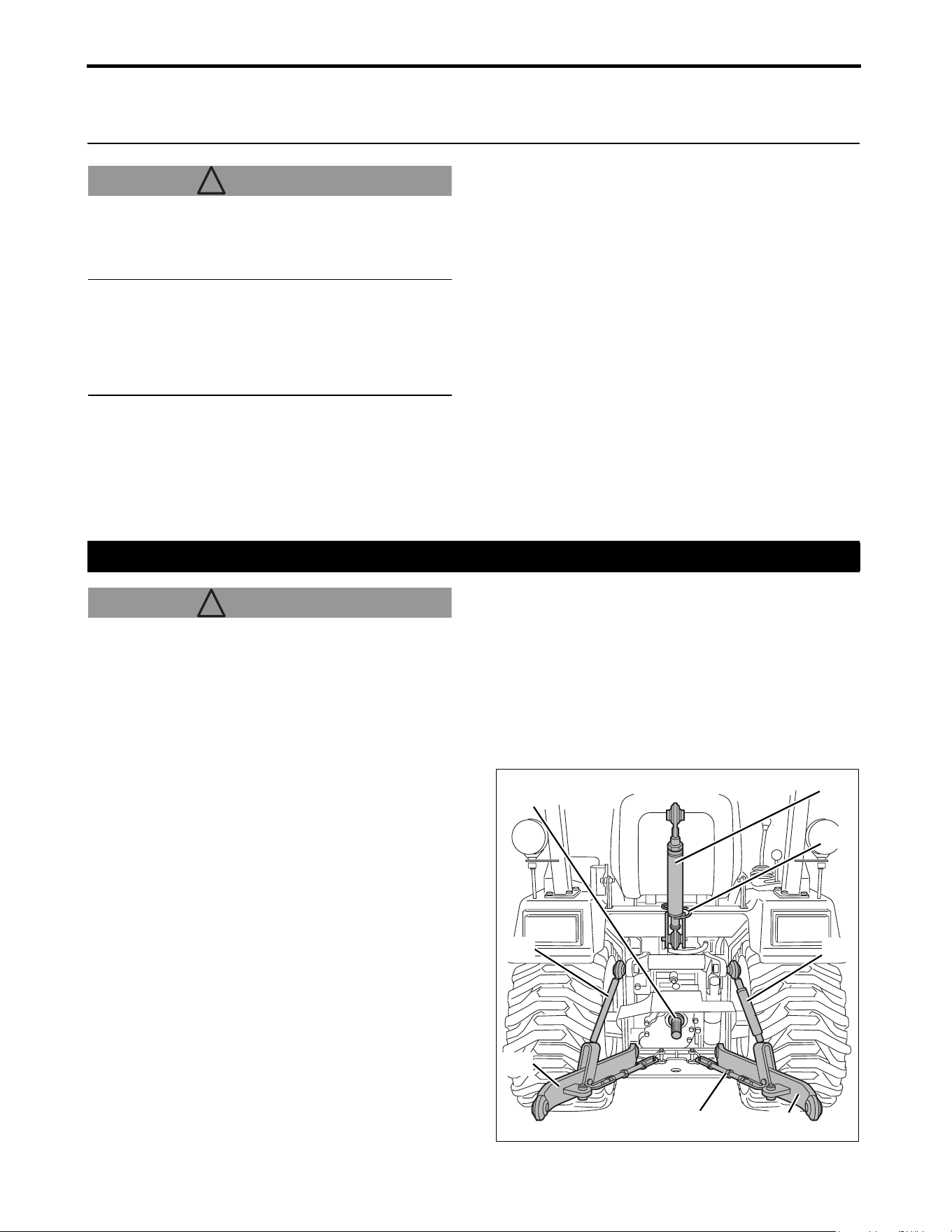
10-1
10. 3-POINT HITCH (Option)
Sc2450 Operator's Manual
10. 3-POINT HITCH (Option)
ALWAYS install an appropriate counterbalance to
the front of the tractor, if necessary, when using a 3-
point hitch-mounted implement.
During transportation, put the 3-point hitch control/
cutting height adjustment lever in its raised position
and lock it with the position stop knob. Do not fully
close the hydraulic flow control/stop knob.
ALWAYS use implements designed for a 3-point
hitch. NEVER use unapproved implements with the
3-point hitch. Contact your local Cub Cadet Yanmar
dealer for technical assistance.
Avoid injury:
●Make sure to stop the engine and then remove
the key. Make sure that the engine has been
stopped completely.
●Make sure that no other parts are moving. If any
part or component is still moving, wait until it
comes to complete stop.
●Installation/removal of an implement must be
performed in a flat and solid place.
●After the implement and the 3-point hitch have
been installed, check for possible interference
with the Power Take Off (PTO) shaft and other
machine components. If interference is found,
correct it.
(A) Rear-Power Take Off (PTO) shaft
(B) Left lift link (Option)
(C) Left lower link (Option)
(D) Sway links (Option)
(E) Right lower link (Option)
(F) Right lift link (Option)
(G) Top link retainer
(H) Top link
! WARNING
! WARNING
1. 3-Point Hitch
! WARNING
3014910a
(A)
(C)
(D)
(H)
(G)
(F)
(E)
(B)
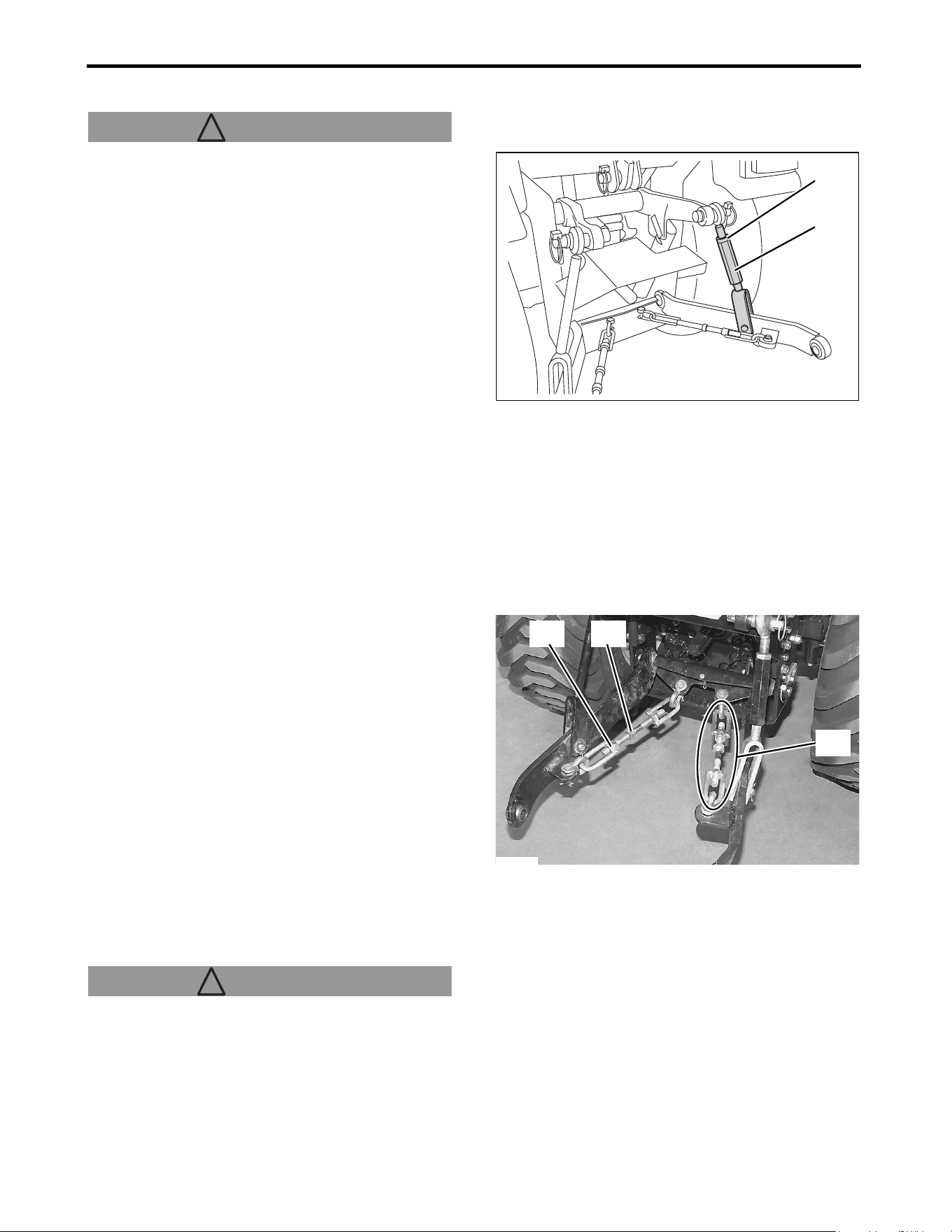
10-2
10. 3-POINT HITCH (Option)
Sc2450 Operator's Manual
■ Right Lift Link
●Chock the four wheels to secure the tractor,
before servicing the right lift link.
1. Lower the rear-mounted implement.
2. Safely stop the machine.
3. Loosen the locknut.
4. Turn the turnbuckle to adjust the right lift link
length until the implement mounted to the 3-point
hitch is level.
5. Retighten the locknut.
(A) Locknut (Option)
(B) Turnbuckle (Option)
■ Top Link
For adjusting the posture of the implement, use the
top link. The posture can be adjusted by turning the
turnbuckle to elongate or contract the link.
Installation position and length of the top link depend
on the implement. Adjust them according to the
instruction manual of the implement.
■ Sway Link
Adjust lateral sway of the implement by turning the
turnbuckle of the sway links to elongate or contract
the sway links.
1. Lower the rear-mounted implement.
2. Safely stop the machine.
3. Loosen the locknut.
4. Adjust the sway link length by turning the
turnbuckle, so that the implement has correctly
lateral sway.
5. After adjusting the lateral sway of the implement,
tighten the locknut.
(A) Locknut
(B) Turnbuckle
(C) Sway link
■ Hitch
●Do not tow anything by the use of the top link
or rear axle. Otherwise, the tractor can tip over
to cause serious injury or death.
●The hitch hole should only be used for towing
light loads. (Maximum towing load: 552 lb (250
kg))
●For maximum allowable weight to be towed,
see “Chapter 4. IMPLEMENT CAPACITIES”.
! WARNING
3014921
(A)
(B)
P3014908
(A) (B)
(C)
! WARNING! WARNING
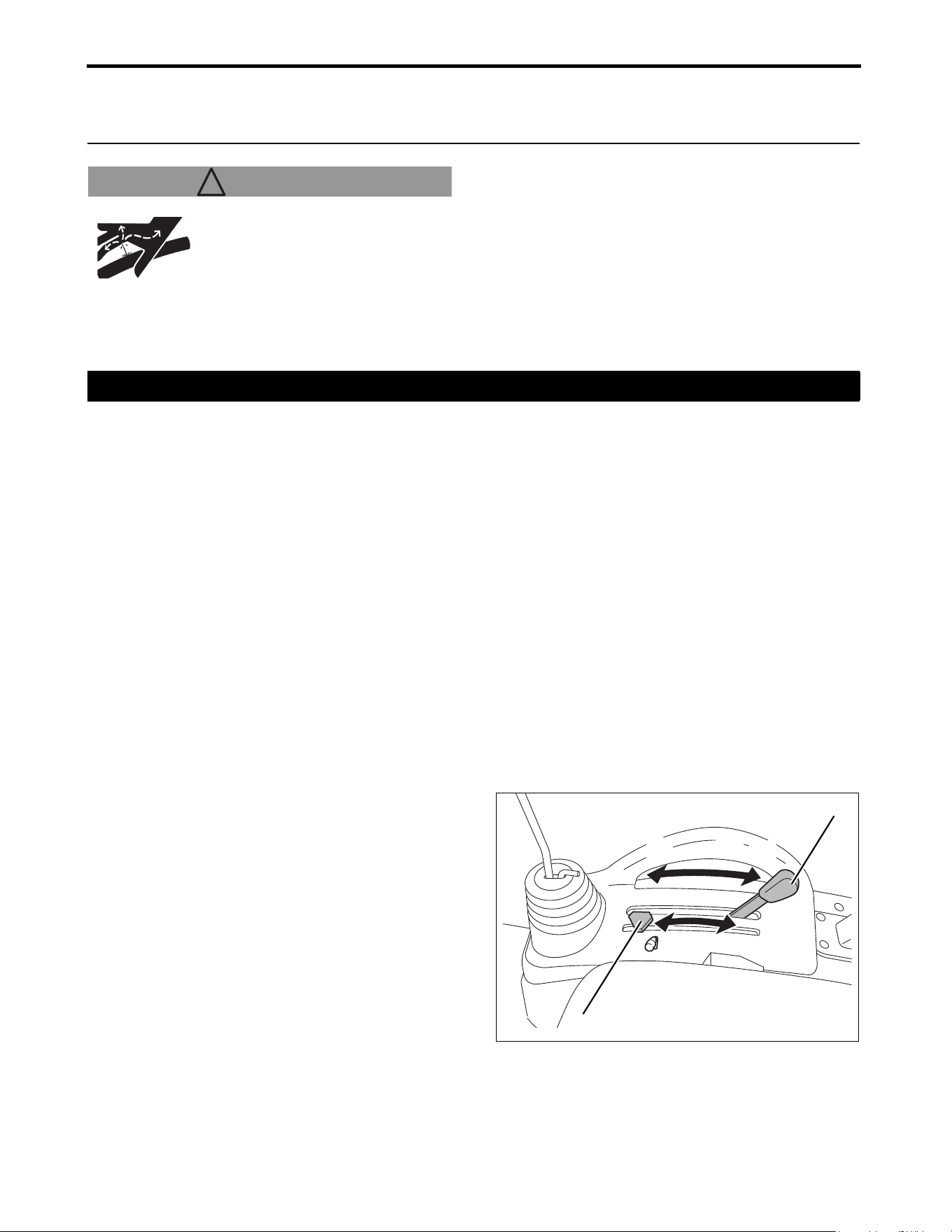
11-1
11. HYDRAULIC SYSTEM
Sc2450 Operator's Manual
11. HYDRAULIC SYSTEM
ALWAYS fully release the internal
hydraulic pressure before
disconnecting a hydraulic line.
ALWAYS ensure that all
connections are tight and all the
hydraulic lines, pipes and hoses are free from wear
or damage.
IMPORTANT
●NEVER operate the 3-point hitch control/cutting
height adjustment lever before the engine has
been sufficiently warmed up.
●If the 3-point hitch control/cutting height adjustment
lever is operated before the engine has been
warmed up, the hydraulic system can be damaged
or develop a failure.
●If abnormal hydraulic noise occurs after the 3-point
hitch has been raised, then misadjustment or failure
of the hydraulic system should be suspected.
In such a case, immediately stop operation and
contact your local Cub Cadet Yanmar dealer to
service or repair the tractor.
■ Operate the 3-Point Hitch Control/Cutting Height Adjustment Lever to Raise or Lower
the 3-Point Hitch
Use the 3-point hitch control/cutting height
adjustment lever, when raising or lowering the Mid-
or Rear-mounted implement.
1. Shift the 3-point hitch control/cutting height
adjustment lever to the intended position.
2. Adjust the position stop knob to set the lowest
position of the implement to the desired height.
(A) 3-point hitch control/cutting height
adjustment lever
(B) Position stop knob
(a) Moving the 3-point hitch control/cutting height
adjustment lever forward will lower the
implement.
(b) Moving the 3-point hitch control/cutting height
adjustment lever backward will raise the
implement to raise higher.
! WARNING! WARNING
1. 3-Point Hitch Control System
3014918c
(A)
(b)
(a)
(B)
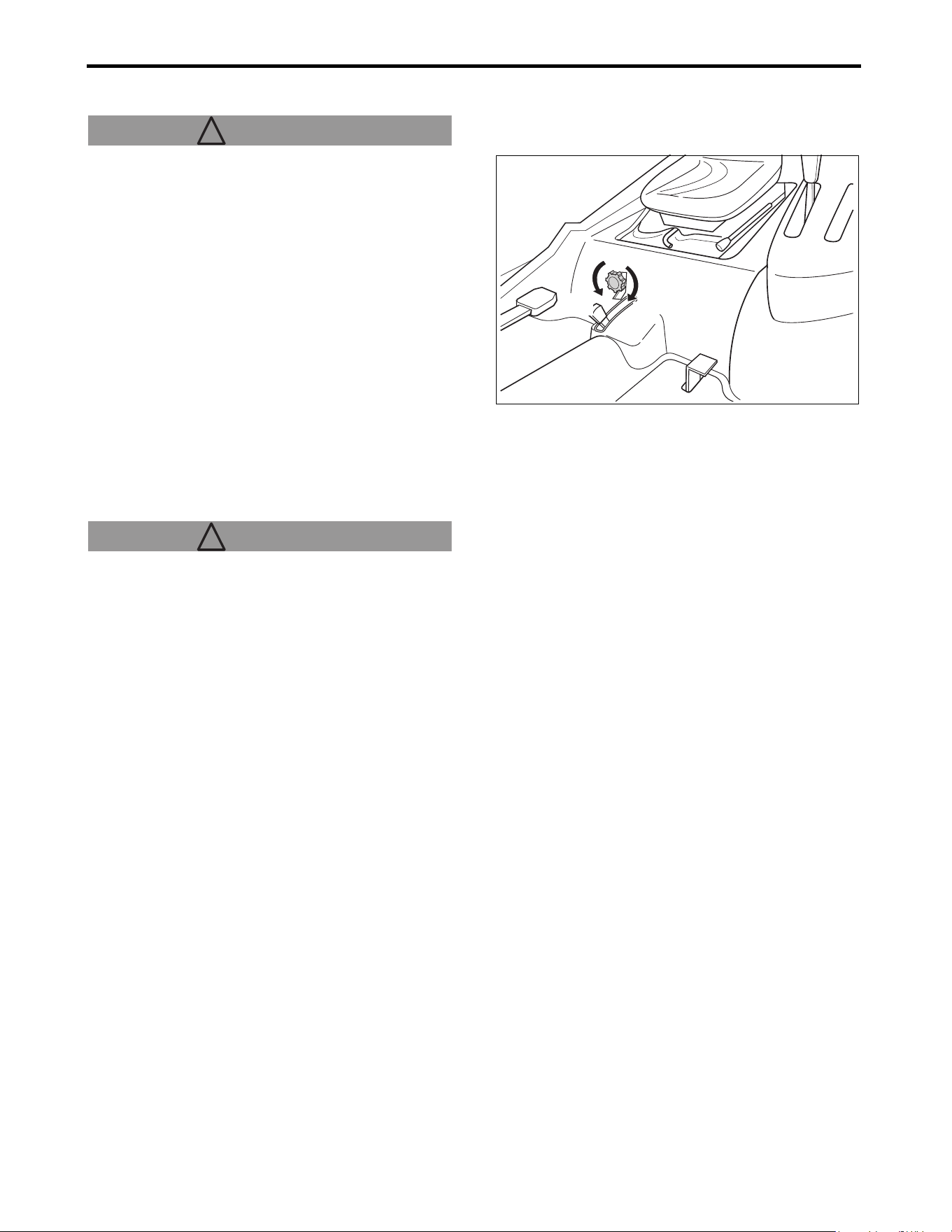
11-2
11. HYDRAULIC SYSTEM
Sc2450 Operator's Manual
■ Hydraulic Flow Control/Stop Knob
●Lowering the 3-point hitch too fast can lead to
accident or failure.
●Adjust the hydraulic flow control/stop knob so
that the time for lowering the implement from
the highest position to the lowest position
becomes 2 seconds or longer.
The lowering speed of the lower link is governed by
the position of the hydraulic flow control/stop knob.
Also, this knob is used to stop the lower link at an
intended position.
(a) Turning the knob clockwise will cause the
lowering speed to decrease.
Tighten the knob by fully turning clockwise to stop
the lower link.
(b) Turning the knob counterclockwise will cause the
lowering speed to increase.
●NEVER use the hydraulic flow control/stop
knob for holding an implement in the raised
position for maintenance. Loss of hydraulic
pressure may cause the implement to drop
suddenly. Lower the implement onto solid
blocks or remove before starting any
maintenance.
IMPORTANT
●For prolonged front loader work with a weight
attached to the lower link, raise the lower link to
any position and fully tighten the hydraulic flow
control/stop knob.
! WARNING! WARNING
3016494d
(b)
(a)
! WARNING! WARNING

12-1
12. TIRES, WHEELS AND BALLAST
Sc2450 Operator's Manual
12.
TIRES, WHEELS AND BALLAST
Mounting the tire is dangerous work. Qualified
professional personnel should mount the tire on the
rim using proper equipment.
ALWAYS keep the tires inflated to the correct
pressure. NEVER exceed the recommended inflation
pressure specified in this Operator’s Manual.
When servicing or replacing the tire(s), ALWAYS
keep the tractor securely supported.
ALWAYS keep the wheel bolts tightening torque to
the specified torque.
Avoid injury:
●Mounting the tire is dangerous work. Qualified
professional personnel should mount the tire
on the rim using proper equipment.
IMPORTANT
●Only use the tires approved by Cub Cadet Yanmar
dealers.
●When intending to use tires whose size is different
from that of the original tires, contact your local
Cub Cadet Yanmar dealer for the information about
front drive gear ratio.
! WARNING! WARNING
1. Tires
! WARNING! WARNING

12-2
12. TIRES, WHEELS AND BALLAST
Sc2450 Operator's Manual
■ Tire Inflation Pressure
●ALWAYS keep the tires inflated to the correct
pressure. NEVER exceed the recommended
inflation pressure specified in this Operator's
Manual.
Inflation pressure gradually reduces as time elapses.
Check the pressure of each tire before starting the
day's operation and inflate the tires as necessary to
the recommended pressures. If the tire pressures
significantly decrease though the tires are correctly
inflated every day, immediately contact your local
Cub Cadet Yanmar dealer to inspect or replace the
problem tire(s).
Before front loader work, make sure to check the tire
pressure and, if necessary, inflate the tire(s) to the
recommended pressure.
For the appropriate inflation pressure, see the
following table:
■ Wheel Bolt Tightening Torque
●ALWAYS keep the wheel bolts tightened to the
specified torque.
●With the wheel bolts loosened, do not drive the
tractor.
Before starting day’s operation, check tightening
torque of each of the tire wheel bolts and, if
necessary, retighten to the specified torque. For the
specified torque, see the following table:
Tire size Inflation pressure
(psi(kgf/cm
2
))
Inflation pressure when an implement such as the front
loader has been attached to the front of the machine
(psi(kgf/cm
2
))
Front
18 × 8.50 - 10
20 (1.4) 22 (1.5)
Rear
26 × 12.00 - 12
20 (1.4) 22 (1.5)
Front wheel bolt (ft•lb (N•m)) 52 - 59 (70 - 80)
Rear wheel bolt (ft•lb (N•m)) 52 - 59 (70 - 80)
! WARNING! WARNING
! WARNING! WARNING
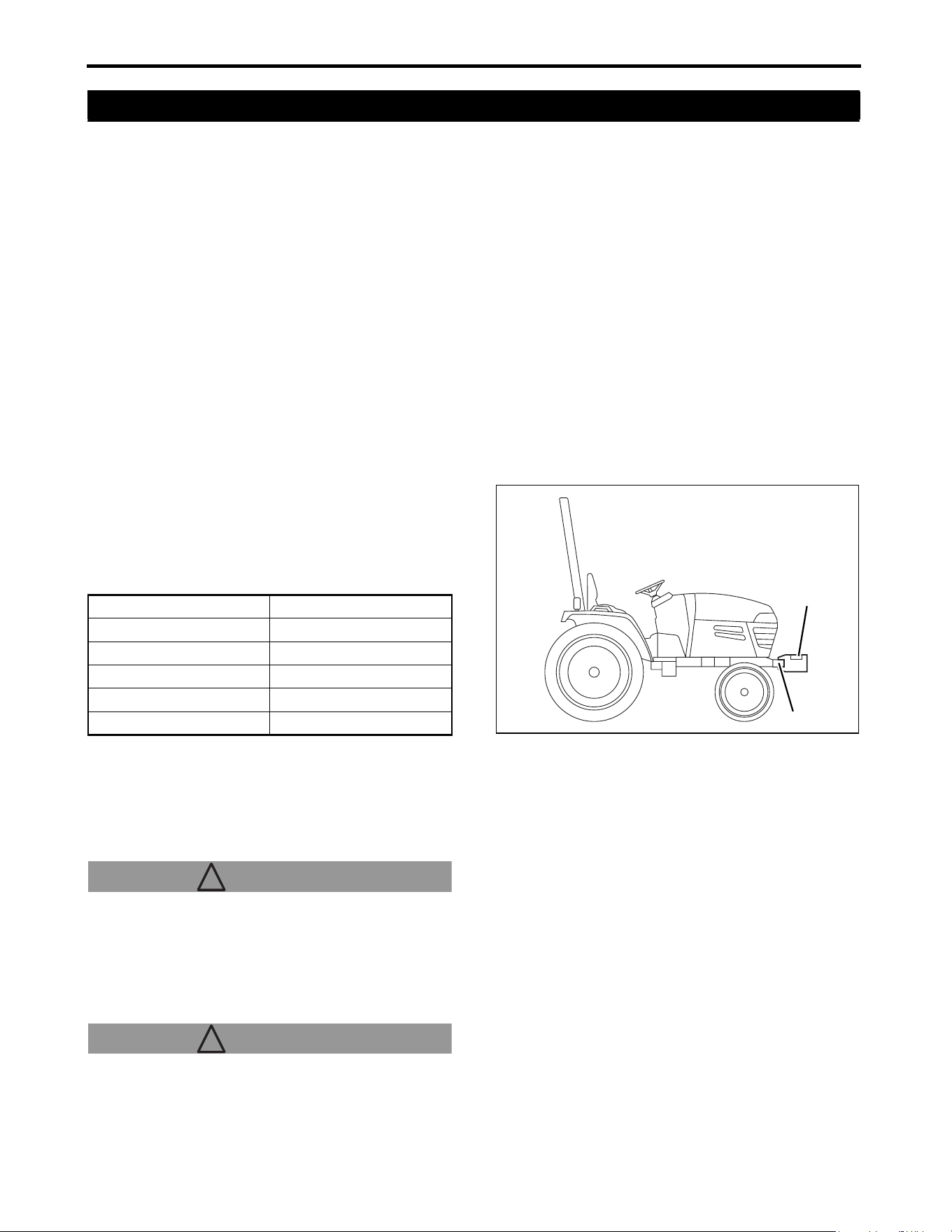
12-3
12. TIRES, WHEELS AND BALLAST
Sc2450 Operator's Manual
■ Front Ballast
To mount the front ballast, the optional front weight
hitch is required.
To improve stability and traction, add ballast
indicated in the table below. (Front End Weights)
Heavy pulling and rear-mounted implements can
cause the front wheels to lift. To cope with this
situation, add ballast so that reliable steering control
is maintained and tip-over of the tractor is prevented.
Remove the ballast when no longer necessary.
NOTE
●For information about the optional front weight
hitch, contact your local Cub Cadet Yanmar dealer.
Front End Weights (Option)
The front end weights can be mounted to the optional
front weight hitch. For the appropriate number of
weights, see the table below as reference only.
For accurate number of front weight, contact your
local Cub Cadet Yanmar dealer.
NOTE
●One (1) weight = 44 lb (20 kg)
(A) Front end weights (option)
(B) Front weight hitch (option)
●NEVER overload the tires. (Maximum front axle
load (Right + left): 1570 lb (712 kg))
●NEVER add weight in excess of the limits
indicated below.
Maximum Weight
●NEVER overload the tires.
●NEVER add weight in excess of the limits
indicated below.
Maximum weight: 176 lb (80kg) (44 lb × 4 pcs)
2. Ballast
Implement Name Number of Weight
42" Rotary Tiller 0
48" Box Scraper 0
60" Rear Blade 0
48" Grooming Mower 4
Post hole digger 0
3013715
(A)
(B)
! WARNING! WARNING
! WARNING! WARNING
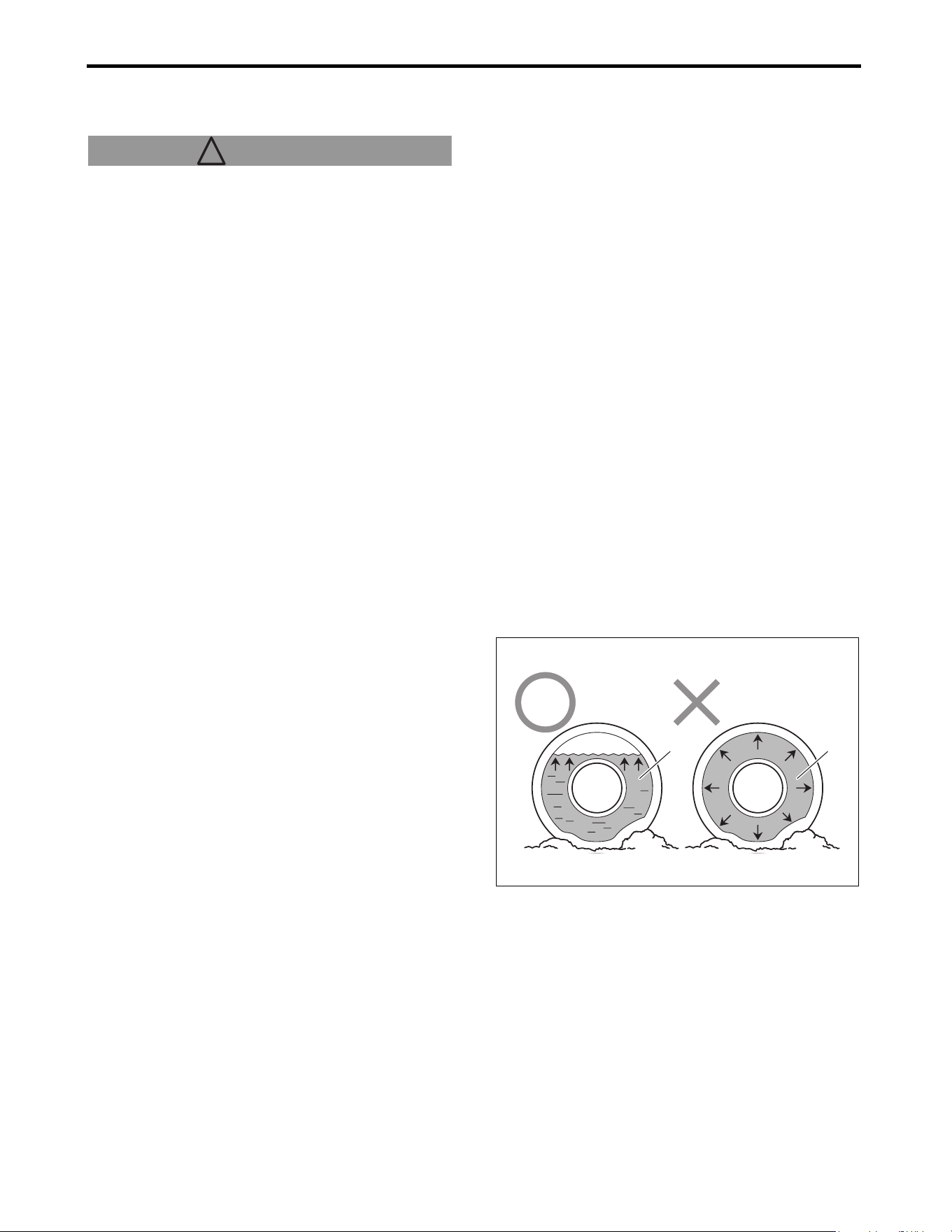
12-4
12. TIRES, WHEELS AND BALLAST
Sc2450 Operator's Manual
■ Rear Ballast
Using Liquid Weight for the Tires
Avoid injury:
●Installation of liquid weight requires special
implement and training. An exploding tire can
lead to injury. Contact your local Cub Cadet
Yanmar dealer or a tire service store to do this
task.
●When using the front loader, always put liquid
weight in the rear wheels. Failure to add
sufficient liquid weight may result in
overturning.
IMPORTANT: Avoid damage.
●NEVER exceed the maximum load ratings
indicated on the tires.
●ALWAYS cover rim completely with the liquid to
prevent corrosion, but do not exceed 75 %. A
larger amount of the liquid causes a limited air
space to be left in the tire, and which is too small to
absorb shocks, possibly leading to damaged tire.
NOTE
●We do not recommend that alcohol be used as the
ballast. Calcium chloride solution is heavier.
●A water solution of calcium chloride offers a safe
ballast, and will prevent freezing. If properly used, it
will not damage tires, tubes or rims.
●A mixture of 3.5 lb of calcium chloride and
approximately 1 US gal of water (0.4 kg/L) will not
fully freeze at a temperature above –50°F (–45°C).
●Fill tubeless tires at least to the valve stem height
(at least 75 %). Smaller amount of the solution
results in partly exposed rims, possibly leading to
corrosion of the rim.
(A) Correct: 75 %-full The remaining air can be
compressed like a cushion.
(B) Incorrect: 100 %-full Water cannot be
compressed.
(C) Air
(D) Water
IMPORTANT
●To avoid transmission from damage, do not use
rear wheel weight and liquid ballast at the same
time.
! WARNING! WARNING
(D) (D)
(A)
(C)
(B)
3013763

13-1
13. MAINTENANCE
Sc2450 Operator's Manual
13. MAINTENANCE
●For the checkpoints (✔) listed below, check and service at the intervals indicated in the table.
●For the inspection and maintenance procedures, see “Chapter 14. PERIODIC SERVICE”.
■ Tractor
1. Maintenance Check List
No Topic
Time
Interval
Service Intervals
After
Purchase
Daily
Hours
1 year
2 years
5
15
50
100
150
200
250
300
350
400
450
500
550
600
650
700
750
800
850
900
950
1000
1 Refueling the fuel tank Daily
✔
2
Engine oil level Check Daily
✔
Engine oil Change
50/100hr and
Every 100hr
✔✔✔✔✔✔✔✔✔✔✔
3 Engine oil filter Replace
50/200hr and
Every 200hr
✔✔✔✔✔✔
4
Transmission/
hydraulic oil level
Check Daily
✔
Transmission/
hydraulic oil
Change
50/300hr and
Every 300hr
✔✔ ✔ ✔
5
Transmission/
hydraulic oil filter
Replace
50/300hr and
Every 300hr
✔✔ ✔ ✔
6
Front axle case
oil level
Check Every 50hr
✔✔✔✔✔✔✔✔✔✔✔✔✔✔✔✔✔✔✔✔
Front axle case oil
Change Every 500hr
✔✔
7 Front axle pivot Adjust Daily
✔
8
Fuel/water
separator
Check Every 50hr
✔✔✔✔✔✔✔✔✔✔✔✔✔✔✔✔✔✔✔✔
Clean Every 100hr
✔✔✔✔ ✔✔✔✔✔
Replace Every 500hr
✔✔
9 Fuel filter Replace Every 500hr
✔✔
10
Air cleaner
element
Clean Every 100hr
✔✔✔✔✔✔✔✔✔✔
Replace Every 1 year
✔
11 Fan belt Adjust Every 50hr
✔✔✔✔✔✔✔✔✔✔✔✔✔✔✔✔✔✔✔✔
12
Radiator hose
and clamp
Check Daily
✔
Replace
Every 2 years
✔
13
Radiator cooling
fins/screen
Clean Daily
✔
14
Front grille
screen
Clean Daily
✔
15 Cooling system
Check Daily
✔
Flush
Every 1000hr
or a year
✔✔
16 Coolant Change
Every 1000hr
or a year
✔✔
17 Fuel line
Check Daily
✔
Replace
Every 2 years
✔
18 Intake air hose
Check Daily
✔
Replace
Every 2 years
✔
19
Safety interlock
system
Check Daily
✔

13-2
13. MAINTENANCE
Sc2450 Operator's Manual
For assistance in periodic maintenance procedures, contact your local Cub Cadet Yanmar dealer.
20 Greasing and lubricating Every 50hr
✔✔✔✔✔✔✔✔✔✔✔✔✔✔✔✔✔✔✔✔
21 Brake Check Daily
✔
22
Seat belt & Roll-
Over Protective
Structure (ROPS)
Check Daily
✔
23 Wheel bolt torque Check Daily
✔✔✔✔✔✔✔✔✔✔✔✔✔✔✔✔✔✔✔✔✔✔✔
24 Inflation pressure Check Daily
✔
25 Toe-in Adjust Every 200hr
✔✔✔✔✔
26
Engine valve
clearance
Adjust Every 1000hr
✔
27
Fuel injection
nozzle injection
pressure
Check Every 1000hr
✔
28
Fuel injection
pump
Check Every 1000hr
✔
29 Light bulb Check Daily
✔
30 Hydraulic hose
Check Daily
✔
Replace
Every 2 years
✔
No Topic
Time
Interval
Service Intervals
After
Purchase
Daily
Hours
1 year
2 years
5
15
50
100
150
200
250
300
350
400
450
500
550
600
650
700
750
800
850
900
950
1000

13-3
13. MAINTENANCE
Sc2450 Operator's Manual
(Specifications and design are subject to change without prior notice for improvement.)
1. Technical Document
[U.S.A. and Canada]
To obtain a copy of Illustrated Parts List or Technical
Manual for the tractor, contact your local Cub Cadet
Yanmar dealer.
2. Parts
We recommend the use of the Cub Cadet Yanmar
authentic parts and lubricants that are available from
your local Cub Cadet Yanmar dealer.
When ordering a part, tell your local dealer the
machine serial number and engine serial number for
the tractor. These numbers are those previously
entered in “Chapter 2. SERVICE THE PRODUCT”.
2. Lubricants
No. Locations Capacities Lubricants
1 Fuel
Approximately 5.8 US gal
(22 L)
No.2-D diesel fuel
No.1-D diesel fuel if temperature is below 14°F (–10°C)
2Coolant
Approximately 3.4 US qt
(3.2 L)
High Quality Permanent Type Antifreeze
(Ethylene Glycol with corrosion and rust
inhibitor chemicals)
Coolant Mixture Ratio
Distilled Water 50 % : Antifreeze 50 %
3
Engine crankcase
(with filter)
Approximately 2.5 US qt
(2.4 L)
API Service Classifications CF or higher
SAE 10W-30 or SAE 10W-40
4 Transmission case
Approximately 2.0 US gal
(7.5 L)
Cub Cadet Hydraulic/Transmission Fluid
5 Front axle case
Approximately 2.6 US qt
(2.5 L)
Cub Cadet GEAR LUBE
or SAE 80W-90 gear oil
6
Greasing No. of greasing points Capacity Type of grease
Drive pedal 1 Until grease overflows
Cub Cadet
251H EP Grease
or
General all purpose
grease
NLGI grade No.2
3. Replacement Parts
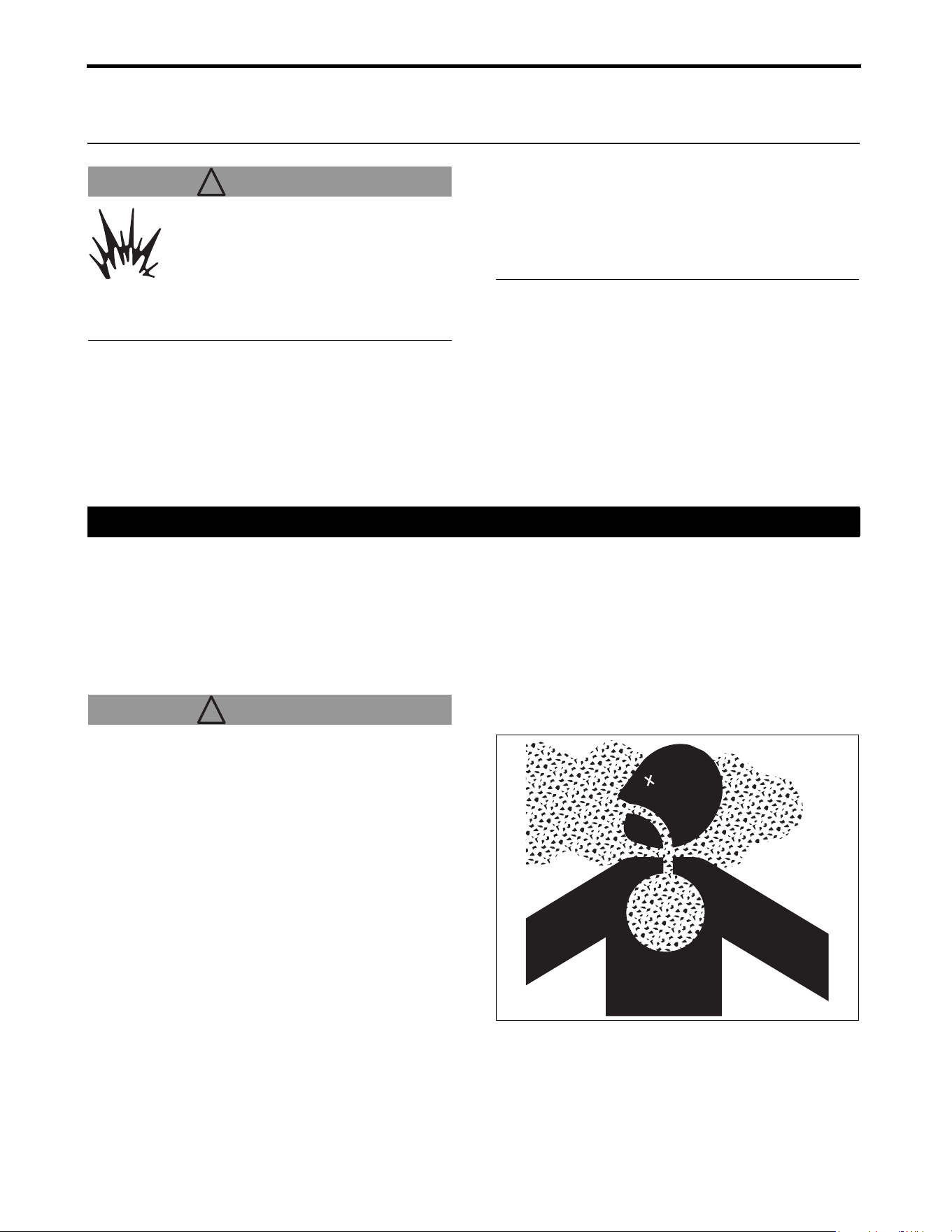
14-1
14. PERIODIC SERVICE
Sc2450 Operator’s Manual
14. PERIODIC SERVICE
NEVER smoke around the battery or
during refueling. Keep sparks or open
flames away from the battery and fuel
tank. The battery emits hydrogen and
oxygen during recharging and can pose
a serious hazard.
NEVER work under any hydraulically supported
devices. Such devices can settle, suddenly leak or
be accidentally lowered. ALWAYS support the tractor
securely with rugged stands or other appropriate
means.
ALWAYS allow the tractor to fully cool down before
accessing the engine, muffler, radiator or other hot
components.
ALWAYS park your tractor on a solid, level ground,
engage the parking brake securely, turn off the
Power Take Off (PTO) switch, lower the implement to
the ground, set the forward and reverse drive pedal
to the NEUTRAL position, stop the engine and
remove the key from the starter key switch before
starting any service work.
A maintenance, inspection, repair or replacement
service of engine emission control devices and
systems may be performed at the owner’s expense
by any qualified off-road engine repair shop or
mechanic. Warranty repairs must be executed by an
authorized Cub Cadet Yanmar dealer.
Avoid personal injury:
●Engine emission gas contains carbon monoxide
that, if inhaled, can cause severe poisoning or
even death.
●NEVER run the engine in a poorly ventilated,
enclosed indoor space.
●To release the engine emission gas to an
outdoor area, connect an extension pipe to the
engine exhaust pipe.
●Allow fresh outside air to flow into the work
space to remove the engine emission gas from
that space.
! WARNING! WARNING
■ Warranty and Repair of the Engine
NEVER inhale the emission gas.
! WARNING! WARNING
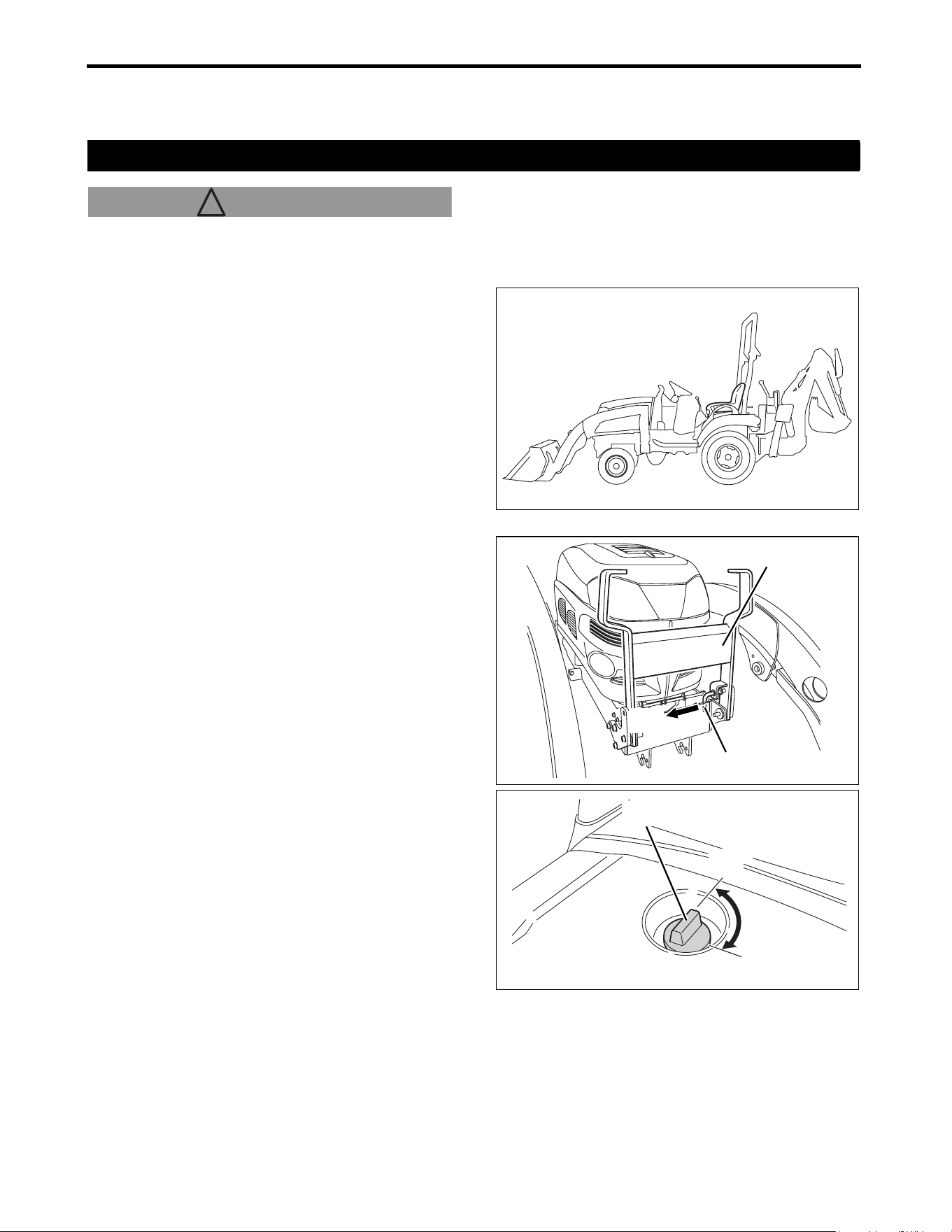
14-2
14. PERIODIC SERVICE
Sc2450 Operator’s Manual
Periodic Service of the Tractor
●Do not open the hood while the engine is running.
●Do not touch the hot muffler or exhaust pipe.
■ Open the Hood
1. Lower the front loader down to the ground and
make sure that the bucket is also level with the
ground.
2. Tilt the hood guard forward toward the tractor
body while pulling the lever fully in the direction of
(a).
(A) Hood guard
(B) Lever
(a) Pull
3. Turn the hood open/close knob clockwise while
slightly pushing the upper portion of the hood.
The hood lock will be released.
(A) Hood open/close knob
(a) Close
(b) Open
1. Open/Close the Hood
! WARNING! WARNING
3016410a
3016450
(a)
(A)
(B)
3014920
(A)
(a)
(b)
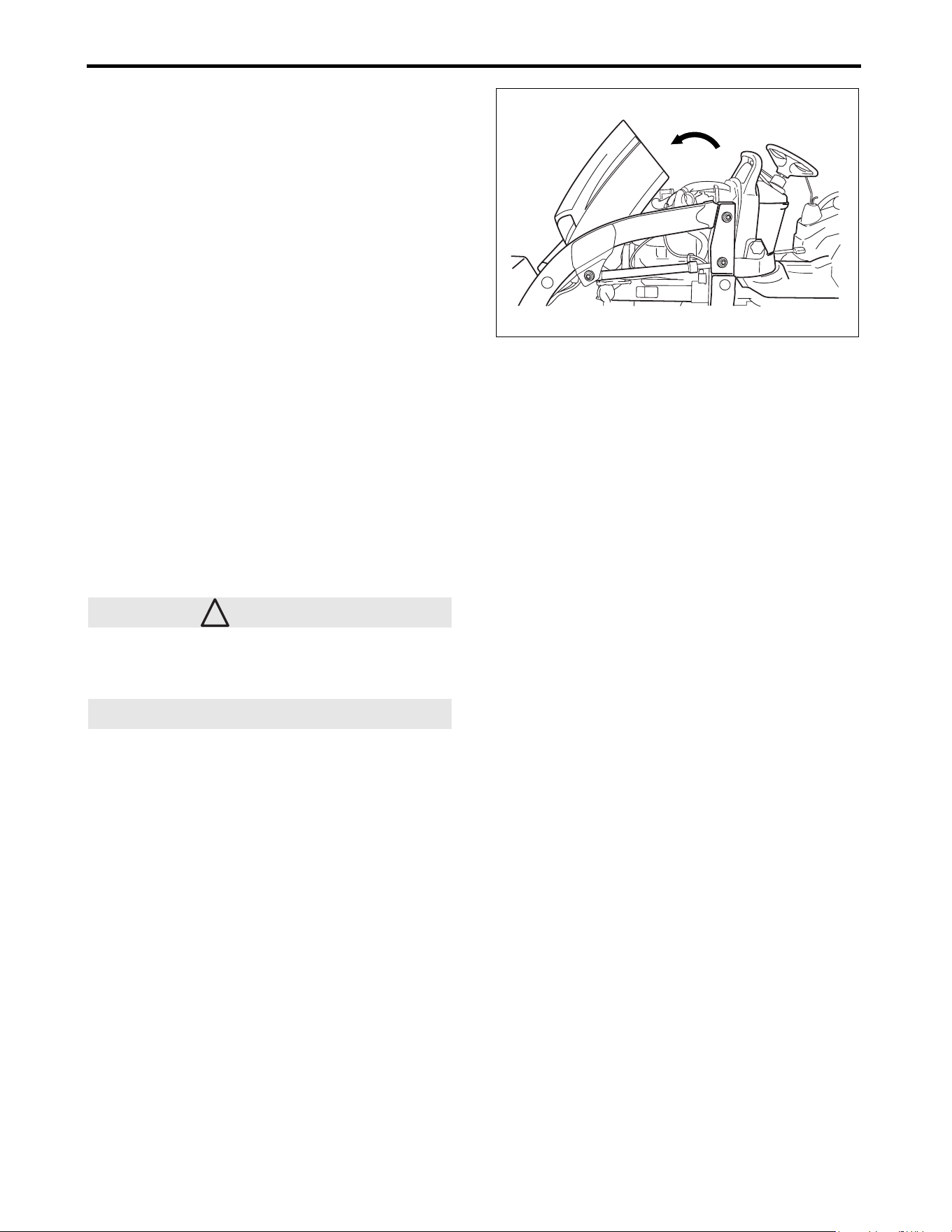
14-3
14. PERIODIC SERVICE
Sc2450 Operator’s Manual
4. Lift up the hood with both hands and tilt it forward.
(a) Tilt the hood forward
■ Close the Hood
1. Lower the front loader down to the ground and
make sure that the bucket is also level with the
ground.
2. Lift up the hood with both hands and tilt it toward
the engine side.
3. Lock the hood open/close knob by turning it
counterclockwise while slightly pushing the upper
portion of the hood.
4. Lift the hood guard until a locking sound is heard.
●When closing the hood, avoid pinching fingers
with the hood.
●Periodically clean around the hood open/close
knob. Accumulation of soil or dust can cause the
knob to be difficult to turn.
3016451
(a)
! CAUTION
NOTICE

14-4
14. PERIODIC SERVICE
Sc2450 Operator’s Manual
Always complete the designated daily checkpoints
before attempting to start or operate the tractor.
Failure to complete these checkpoints could result in
personal injury or decrease the service life of the
tractor and its parts.
To avoid personal injury:
●Before attempting to check or service the
tractor, always make sure it is on a level surface,
the engine is shut off, the parking brake is
engaged, and full weight of the implement is on
the ground.
■ Visual Checks
Before service or operation, always check under and
around the tractor for parts that may have come loose,
build-up of grease or dirt, leakage, and broken or worn
parts.
■ Refill the Fuel Tank
IMPORTANT: Avoid damage.
●NEVER use a galvanized container to store fuel.
Diesel fuel in a galvanized container reacts with the
zinc coating in the container to generate zinc flakes.
If the fuel contains water, a zinc gel will also occur.
The zinc gel and flakes will quickly clog the fuel filter
and damage the fuel injection nozzle and fuel pump.
Diesel Fuel Specifications
Diesel fuel should comply with the following
specifications. The table lists several worldwide
specifications for diesel fuels.
2. Daily Checks
Diesel Fuel Specification Location
No. 2-D, No. 1-D, ASTM D975-94 USA
EN590:96 European Union
ISO 8217 DMX International
BS 2869-A1 or A2 United Kingdom
JIS K2204 Grade No.2 Japan
KSM-2610 Korea
GB252 China
! WARNING

14-5
14. PERIODIC SERVICE
Sc2450 Operator’s Manual
Additional Technical Fuel Requirements
●The fuel cetane number should be equal to 45 or
higher.
●The sulfur content must not exceed 0.5 % by
volume. Less than 0.05 % is preferred.
●Bio-Diesel fuels. See “Bio-Diesel Fuels” on page
14-6.
●NEVER mix kerosene, used engine oil, or residual
fuels with the diesel fuel.
●The water and sediment in the fuel should not
exceed 0.05 % by volume.
●Keep the fuel tank and fuel-handling equipment
clean at all times.
●Poor quality fuel can reduce engine performance
and/or cause engine damage.
●Fuel additives are not recommended. Some fuel
additives may cause poor engine performance.
Consult your Yanmar dealer for more information.
●Ash content not to exceed 0.01 % by volume.
●Carbon residue content not to exceed 0.35 % by
volume. Less than 0.1 % is preferred.
●Total aromatics content should not exceed 35 % by
volume. Less than 30 % is preferred.
●PAH (polycyclic aromatic hydrocarbons) content
should be below 10 % by volume.
●Metal content of Na, Mg, Si, and Al should be equal
to or lower than 1 mass ppm. (Test analysis
method JPI-5S-44-95)
●Lubricity: Wear mark of WS1.4 should be Max.
0.018 in. (460 µm) at HFRR test.

14-6
14. PERIODIC SERVICE
Sc2450 Operator’s Manual
Bio-Diesel Fuels
In Europe and in the United States, as well as some
other countries, non-mineral oil based fuel resources
such as RME (Rapeseed Methyl Ester) and SOME
(Soybean Methyl Ester), collectively known as FAME
(Fatty Acid Methyl Esters), are being used as
extenders for mineral oil derived diesel fuels.
Cub Cadet Yanmar approves the use of bio-diesel
fuels that do not exceed a blend of 5 % (by volume)
of FAME with 95 % (by volume) of approved mineral
oil derived diesel fuel. Such bio-diesel fuels are
known in the marketplace as B5 diesel fuels.
These B5 diesel fuels must meet certain
requirements.
1. The bio-fuels must meet the minimum
specifications for the country in which they are
used.
• In Europe, bio-diesel fuels must comply with the
European Standard EN14214.
• In the United States, bio-diesel fuels must
comply with the American Standard ASTM D-
6751.
2. Bio-fuels should be purchased only from
recognized and authorized diesel fuel suppliers.
Precautions and concerns regarding the use of
bio-fuels:
1. Free methanol in FAME may result in corrosion of
aluminum and zinc FIE components.
2. Free water in FAME may result in plugging of fuel
filters and increased bacterial growth.
3. High viscosity at low temperatures may result in
fuel delivery problems, injection pump seizures,
and poor injection nozzle spray atomization.
4. FAME may have adverse effects on some
elastomers (seal materials) and may result in fuel
leakage and dilution of the engine lubricating oil.
5. Even bio-diesel fuels that comply with a suitable
standard as delivered, will require additional care
and attention to maintain the quality of the fuel in
the equipment or other fuel tanks. It is important
to maintain a supply of clean, fresh fuel. Regular
flushing of the fuel system, and/or fuel storage
containers, may be necessary.
6. The use of bio-diesel fuels that do not comply with
the standards as agreed to by the diesel engine
manufacturers and the diesel fuel injection
equipment manufacturers, or bio-diesel fuels that
have degraded as per the precautions and
concerns above, may affect the warranty
coverage of your engine.
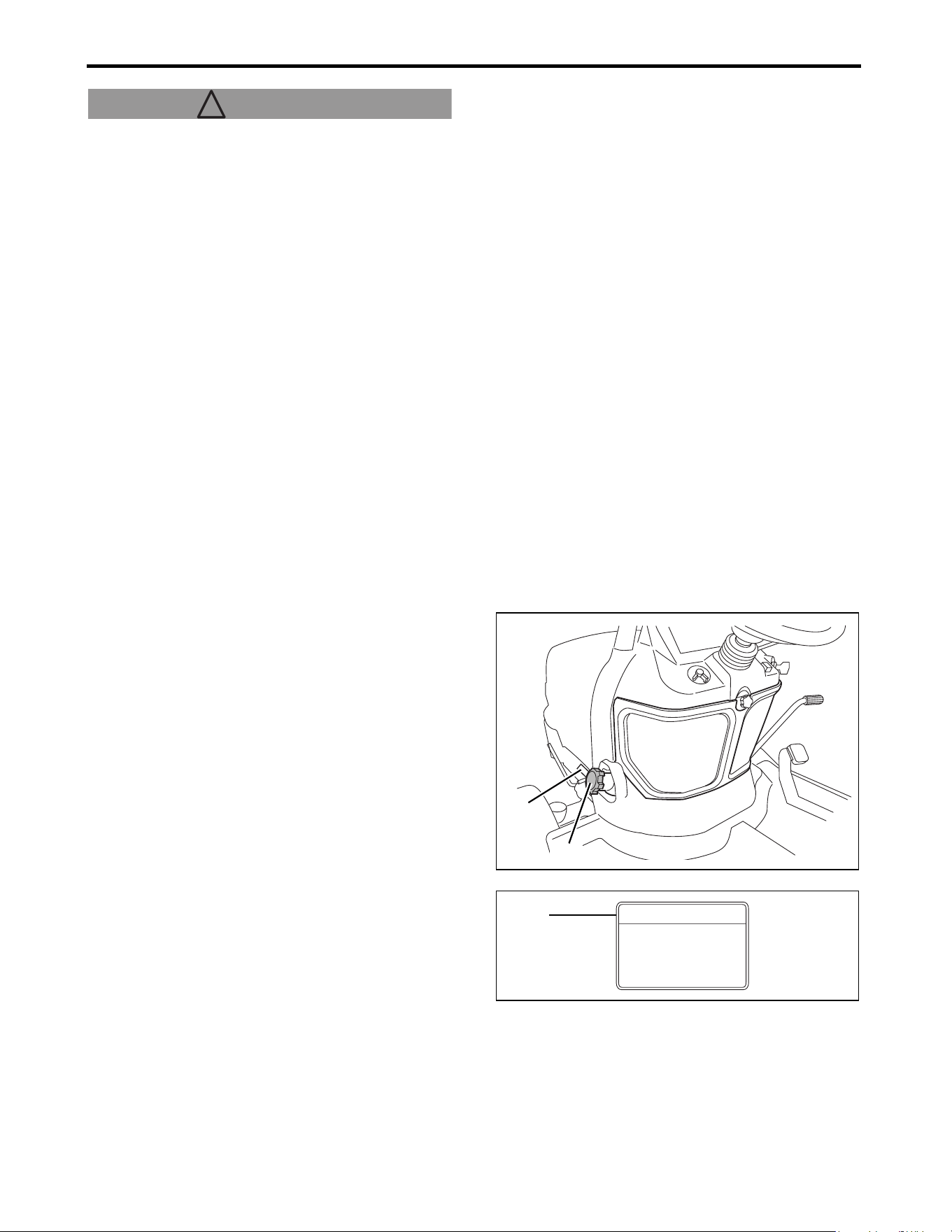
14-7
14. PERIODIC SERVICE
Sc2450 Operator’s Manual
Remember that fuel vapor is explosive and
flammable:
●Stop the engine before refilling the fuel tank.
●NEVER smoke while handling fuel.
●Keep the fuel away from an open flame or
sparks.
●Refuel outdoors or in a well-ventilated area.
●Wipe away spilled fuel immediately.
●To prevent static electric discharge, use a clean
approved non-metal fuel container.
●To prevent static electric discharge, use a clean
approved plastic funnel that has no metallic
screen mesh or filter.
IMPORTANT Be careful to avoid damage.
●Dirt and water in the fuel can damage the engine.
●Remove dirt and debris from the fuel tank opening.
●Use clean, fresh, stabilized fuel.
●At the end of operation for the day, fill the fuel tank
to prevent condensation from occurring in the fuel
tank.
●When filling the fuel tank or container use a non-
metallic funnel that has a plastic mesh strainer.
1. Park the tractor safely and securely.
2. Allow the engine to cool off for several minutes
before refueling.
3. Remove the fuel tank cap.
4. Fill the tank with fresh fuel to the bottom of filler
neck.
IMPORTANT
●NEVER overfill the fuel tank.
5. Replace the fuel tank cap.
(A) Fuel tank cap
(B) EPA regulation label CY-114110-07760
EPA REGULATION
USE LOW SULFER FUEL OR ULTRA LOW
SULFER FUEL ONLY
! WARNING
3014915a
(A)
(B)
EPA REGULATION
USE LOW SULFER
FUEL OR ULTRA LOW
SULFER FUEL ONLY
(B)
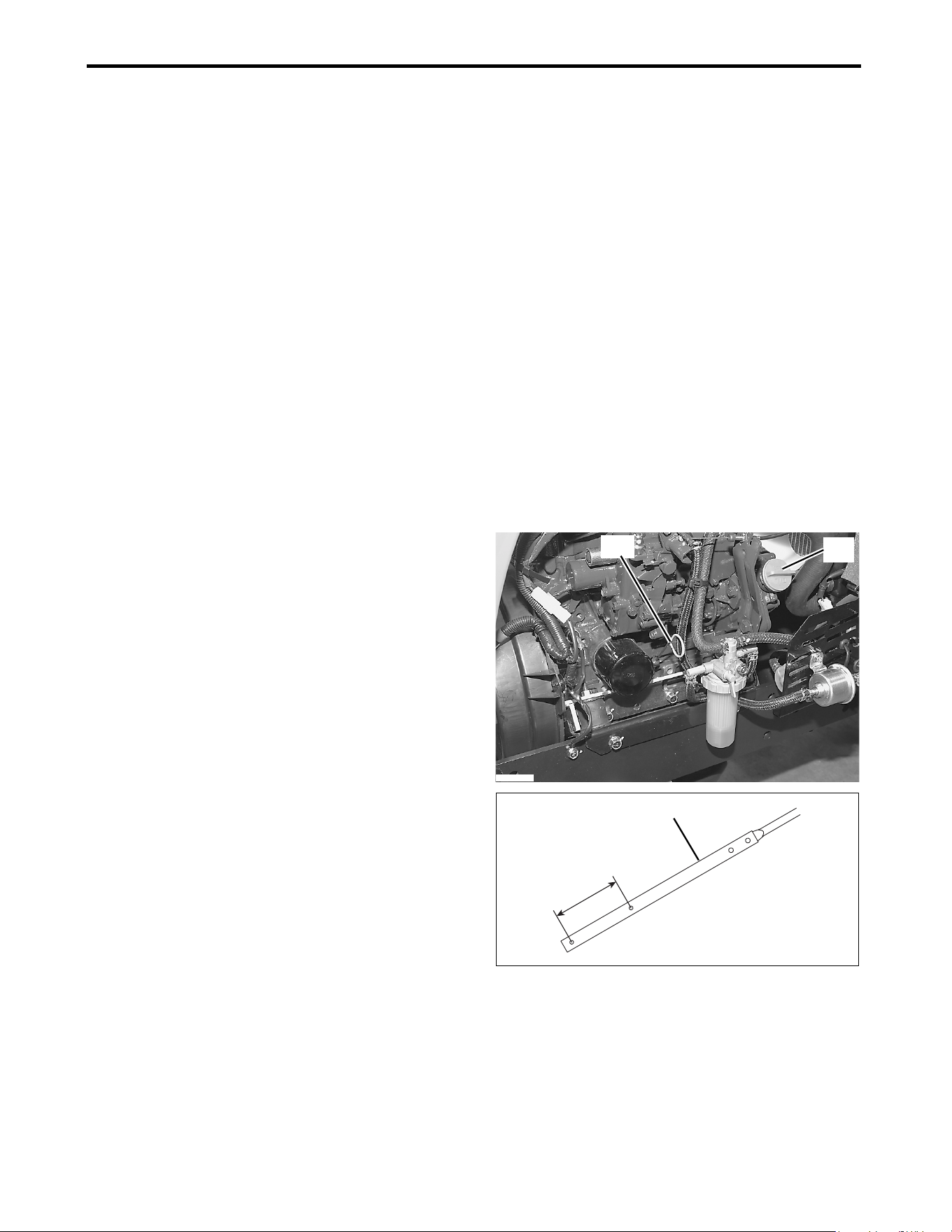
14-8
14. PERIODIC SERVICE
Sc2450 Operator’s Manual
■ Check the Engine Oil Level
IMPORTANT: Avoid damage.
●ALWAYS check the oil level before day's
operation. If the oil level is low, a serious engine
problem can occur.
●ALWAYS check the oil level before operation.
●ALWAYS check the oil level when the engine is
cold and not running.
●ALWAYS maintain the oil level between the lower
and the upper marks.
●ALWAYS shut the engine down and allow to cool
before adding the engine oil.
1. Park the tractor safely and securely.
2. Open the hood.
IMPORTANT: Avoid damage.
●Prevent dirt and other contaminants from entering
the engine. Clean the area around the dipstick
before removing it.
3. Remove the dipstick. Clean the dipstick blade
with a clean paper towel or shop rag.
4. Insert the dipstick completely.
5. Remove the dipstick again.
6. Check the oil level on the dipstick. The oil level
should be kept between the lower and the upper
marks on the dipstick.
7. If the oil level is low:
(1) Remove the oil fill cap.
(2) Refill the specified oil until the oil level reaches
between the lower and upper marks.
(A) Dipstick
(B) Oil fill cap
(a) Upper mark
(b) Lower mark
NOTE
●NEVER overfill the engine with oil.
8. If the oil level exceeds the upper mark, drain the
oil to a correctly level.
9. Replace the dipstick.
10.Close the hood.
P3014912
(B)
(A)
P3014911a
(A)
(a)
(b)
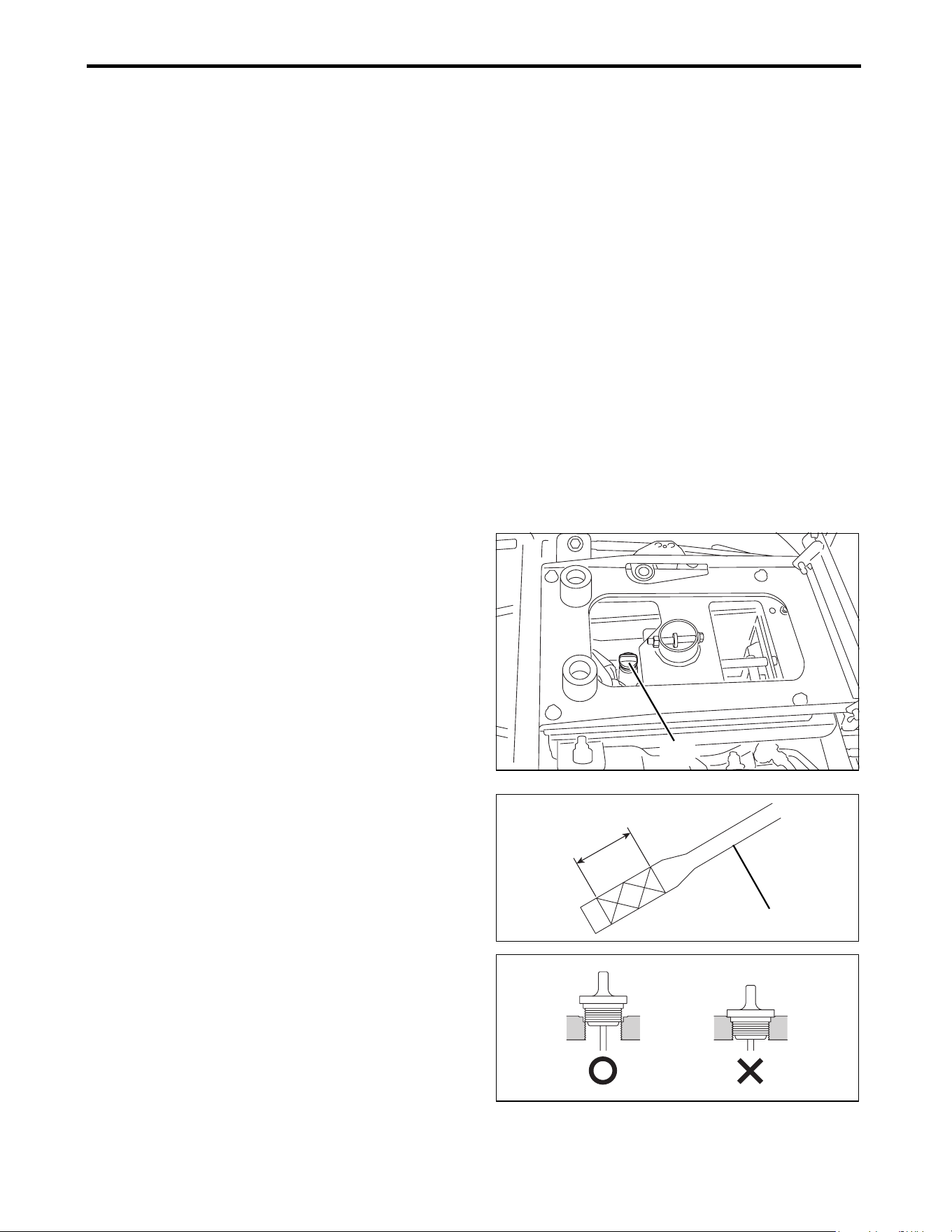
14-9
14. PERIODIC SERVICE
Sc2450 Operator’s Manual
■ Check the Transmission/Hydraulic Oil Level
IMPORTANT: Avoid damage.
●ALWAYS check the oil level before day's
operation. If the oil level is low, a serious
transmission problem can occur.
●ALWAYS check the oil level before operation.
●ALWAYS check the oil level when the engine is
cold and not running.
●ALWAYS maintain the oil level between the high
and low marks.
●ALWAYS shut the engine down and allow to cool
before adding the transmission/hydraulic oil.
1. Park the tractor safely and securely. Allow the
tractor to cool off for at least 1 hour.
2. Tilt the seat forward.
IMPORTANT: Avoid damage.
●Prevent dirt and other contaminants from entering
the transmission. Clean the area around the
dipstick before removing it.
3. Remove the dipstick.
4. Thoroughly wipe the dipstick clean with a rag.
Only insert the dipstick into the hole. At this point,
do not fasten the dipstick into the hole.
NOTE
●The dipstick is integrated with the oil fill cap.
5. Check the oil level on the dipstick. The oil level
should be between the high and low marks on the
dipstick.
6. If the oil level is low:
Clean the area around the oil fill cap, then remove
the fill cap from the transmission housing.
Add Cub Cadet Hydraulic/Transmission Fluid
through the fill port until the oil level is
appropriate.
NOTE
●NEVER overfill.
7. Replace and tighten the dipstick.
(A) Oil fill cap
(B) Dipstick
(a) High mark
(b) Low mark
3016489
(A)
P3014914
(B)
(a)
(b)
3014928
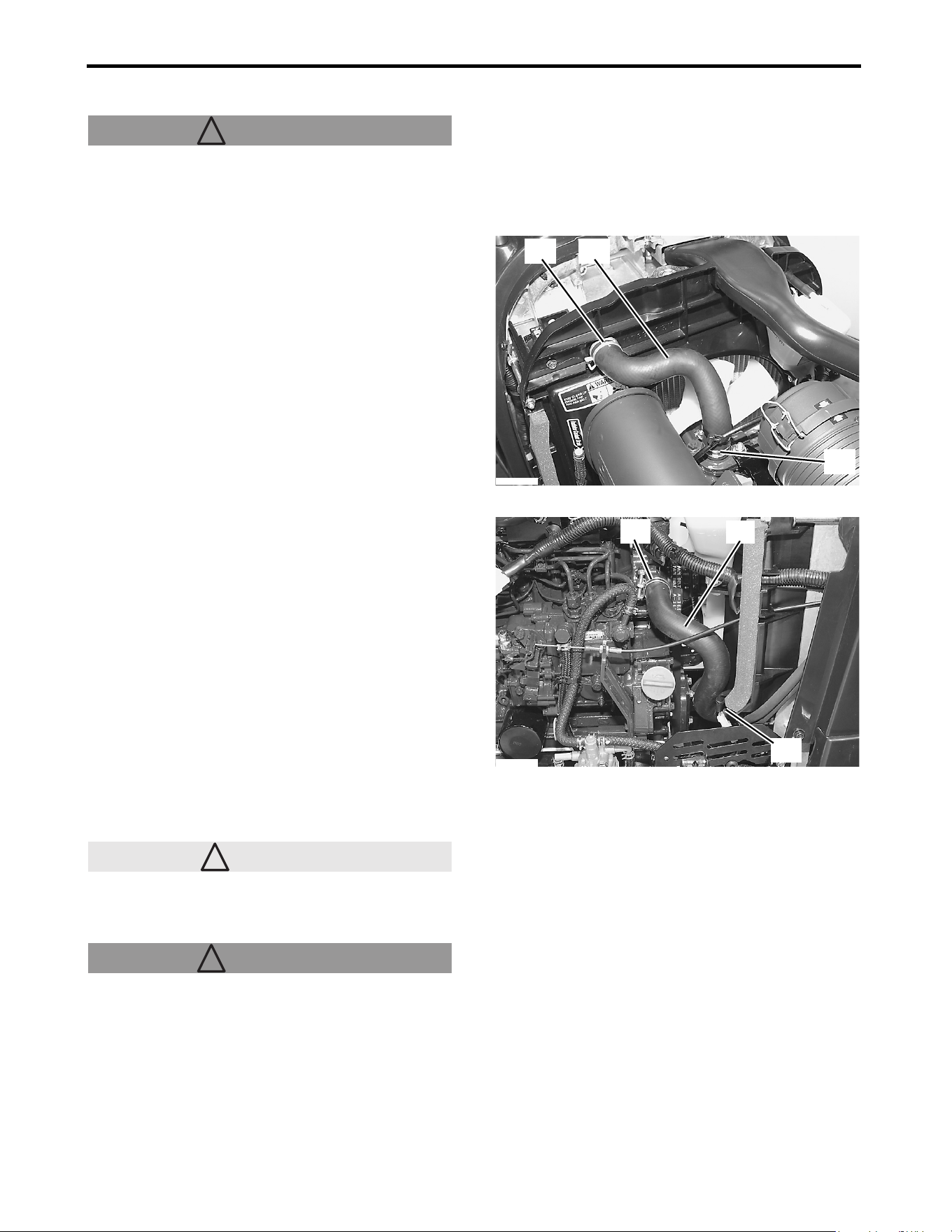
14-10
14. PERIODIC SERVICE
Sc2450 Operator’s Manual
■ Check the Radiator Hoses and Clamps
●ALWAYS stop the engine, allow it to cool and
remove the key from the starter key switch
before checking the radiator hoses and clamps.
1. Park the tractor safely and securely.
2. Open the hood.
NOTE
●Visually check the hoses for cracks and wear.
Squeeze the hoses to check for evidences of
deterioration. Hoses should not be hard and brittle
nor soft or swollen.
3. Check the upper radiator hose for any damage
including cracking. Replace the damaged hose.
4. Check the hose clamps as necessary.
5. Check the lower radiator hose for any damage
including cracking. Replace the damaged hose.
6. Check the hose clamps as necessary.
7. Close the hood.
(A) Upper radiator hose
(B) Hose clamps
(C) Lower radiator hose
■ Clean the Radiator Cooling Fins and Screen
●ALWAYS stop the engine and remove the key
from the starter key switch before cleaning the
radiator cooling fins and screen.
Avoid injury. Compressed air can cause debris
and dirt to powerfully fly a long distance:
●NEVER allow bystanders near the tractor.
●When using compressed air for cleaning,
ALWAYS ensure adequate air inflow to prevent
engine overheating, or wear protective
goggles.
●Reduce compressed air pressure to 30 psi
(210 kPa).
! WARNING! WARNING
P3014915
(B)
(A)
(B)
P3014916
(B)
(C)
(B)
! CAUTION
! WARNING! WARNING

14-11
14. PERIODIC SERVICE
Sc2450 Operator’s Manual
IMPORTANT: Avoid damage.
●The cooling fins, screen must remain clean in order
to ensure adequate air inflow to prevent engine
overheating.
1. Park the tractor safely and securely.
2. Allow the engine to cool completely.
3. Open the hood.
4. Lift up the intake air hose and then move it to the
sideway. Then, raise the radiator cooling screen
and remove it.
5. Clean the screen with compressed air, brush or
cloth.
6. Remove any dirt and debris from the fins at the
front and rear of the radiator and from the fan with
compressed air.
IMPORTANT: Avoid damage.
●When using compressed air, be careful not to
damage the cooling fins.
7. Reinstall the radiator cooling screen and the
intake air hose.
8. Close the hood.
(A) Radiator cooling screen
(B) Intake air hose
■ Clean the Rear Grille Screen
IMPORTANT: Avoid damage.
●Clean the grille to prevent the engine from
overheating and ensure adequate air inflow.
1. Check the grille for dirt, grass clippings and
debris.
2. Clean the grille with a brush or cloth.
(A) Rear grille screen
P3014917
(B)
(A)
3014915a
(A)
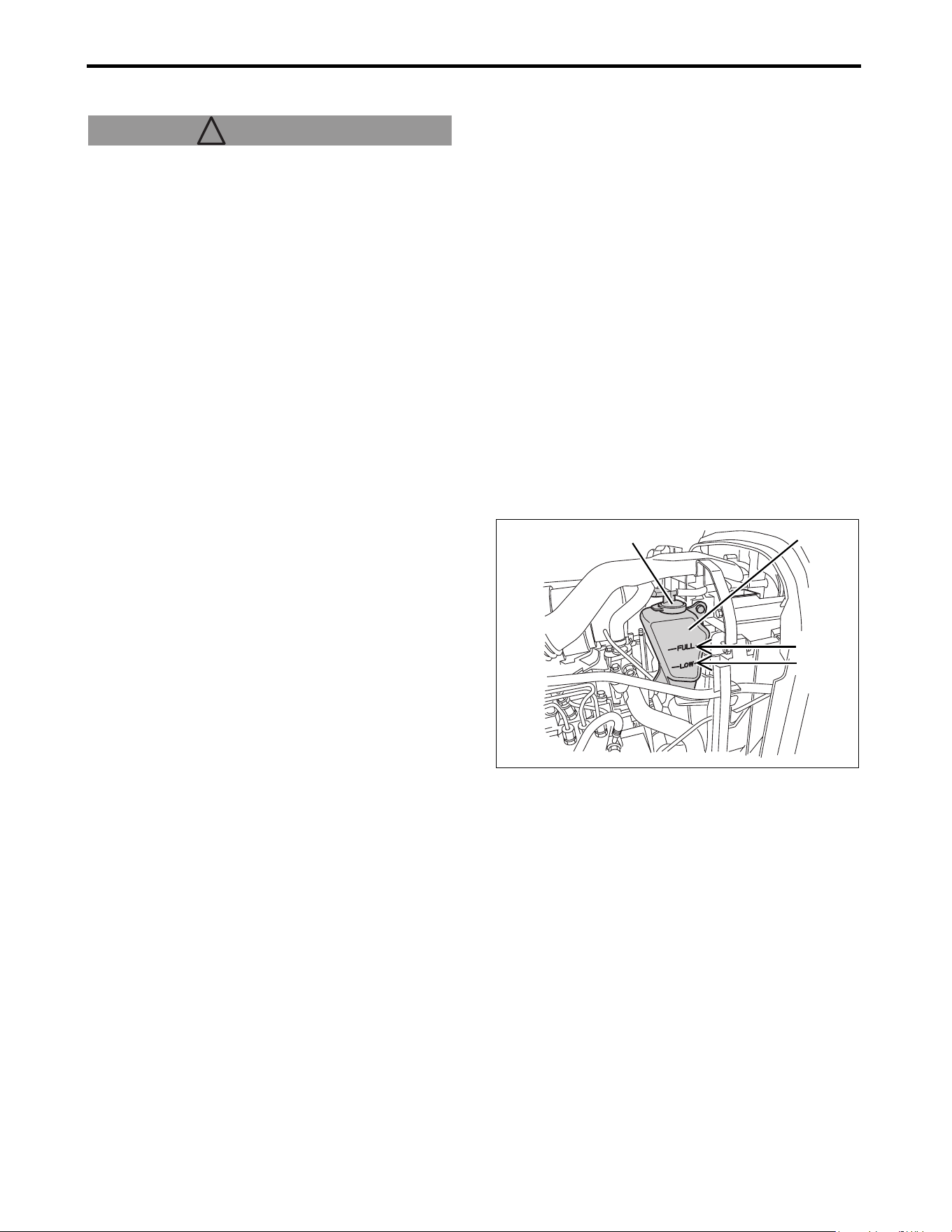
14-12
14. PERIODIC SERVICE
Sc2450 Operator’s Manual
■ Check the Cooling System
●ALWAYS allow radiator to cool before
removing the radiator tank cap. The radiator
will be hot and can cause burns. When the
radiator tank cap is removed, pressure build-up
in the cooling system can cause the coolant to
spray out explosively.
●ALWAYS shut the engine down and allow it to
cool.
●NEVER remove the radiator tank cap before the
radiator and the engine are sufficiently cool
such that they can be touched with bare hands.
●Loosen the radiator tank cap carefully to the
first stop, allowing excessive pressure to
escape. Only then remove the radiator tank
cap. If the tractor is equipped with a coolant
reserve tank, add coolant or water to the
reserve tank, not to the radiator.
1. Park the tractor safely and securely.
2. Allow the engine to cool down.
3. Open the hood.
4. Check that the coolant level of the reserve tank is
between the FULL line and the LOW line.
5. When necessary, remove the reserve tank cap
and add the coolant.
6. Add pre-diluted coolant which is a 50:50
antifreeze-water mixture.
Use High Quality Permanent Type Antifreeze
(Ethylene Glycol with corrosion and rust inhibitor
chemicals).
7. Reinstall the reserve tank cap.
8. Close the hood.
(A) Reserve tank
(B) Reserve tank cap
(a) FULL line
(b) LOW line
! WARNING! WARNING
3014913
(A)
(B)
(a)
(b)
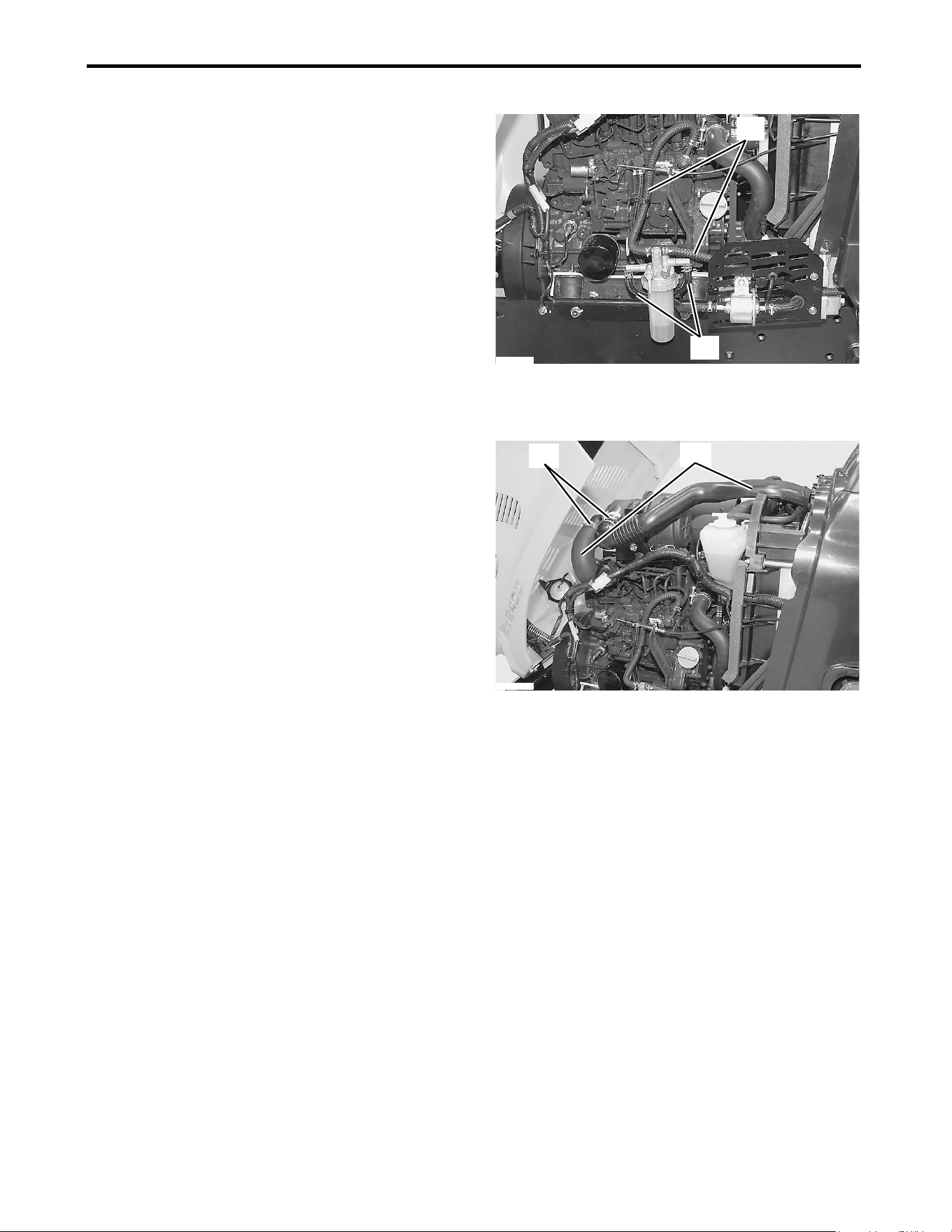
14-13
14. PERIODIC SERVICE
Sc2450 Operator’s Manual
■ Check the Fuel Line
Open the hood and then check:
●The rubber hose for oil leakage
●The rubber hose for any damage
(A) Fuel line
■ Check the Intake Air Hoses and Clamps
1. Park the tractor safely and securely.
2. Open the hood.
3. Ensure that the hose and the hose clamps are in
good condition.
4. Check the hose clamps for looseness.
5. Close the hood.
(A) Intake air hose
(B) Hose clamps
P3014918
(A)
(A)
P3014920
(B)
(A)

14-14
14. PERIODIC SERVICE
Sc2450 Operator’s Manual
■ Check the Safety Interlock System
To avoid personal injury, do as follows:
●Read the “Safety Precautions” in the front of
this manual.
●Read the danger, warning and caution
statements on the safety-alert symbols on the
tractor.
●To avoid possible poisoning from exhaust
fumes, NEVER operate the engine in an
enclosed place that lacks adequate ventilation.
●NEVER start the engine while standing on the
ground. ALWAYS start the engine from the
operator’s seat.
●Before starting the engine, ALWAYS set the
forward and reverse drive pedal to the
“NEUTRAL” position and the Power Take Off
(PTO) switch to the “OFF” position.
Check the following points to be sure that the
machine is in the normal state and ready to start.
If a fault is detected on the machine, do not operate
the machine and contact your local Cub Cadet
Yanmar dealer for technical assistance.
Before checking the safety interlock system, perform
the following procedure.
1. Sit on the operator's seat.
2. Park the tractor safely on a solid, flat, level
ground.
3. Engage the parking brake securely.
4. Turn off the Power Take Off (PTO) switch.
5. Set the forward and reverse drive pedal to the
NEUTRAL position.
6. Stop the engine.
1. Power Take Off (PTO) Safety Switch
1. Pull up the Power Take Off (PTO) switch to set it
to the ON position.
2. Turn the key to the START position.
3. Make sure that the starter motor does not crank.
4. Turn the key to the OFF position.
5. Push in the Power Take Off (PTO) switch to set it
to the OFF position.
6. Turn the key to the START position.
7. Make sure that the starter motor starts running.
(A) Power Take Off (PTO) switch
! WARNING! WARNING
3014919c
(A)

14-15
14. PERIODIC SERVICE
Sc2450 Operator’s Manual
2. Parking Brake Safety Switch
1. Disengage the parking brake.
2. Turn the key to the START position.
3. Make sure that the starter motor does not crank.
4. Turn the key to the OFF position.
5. Engage the parking brake securely.
6. Turn the key to the START position.
7. Make sure that the starter motor starts running.
3. Drive Pedal Safety Switch
1. Turn the key to the START position to run the
engine.
2. Pull up the Power Take Off (PTO) switch to set it
to the ON position.
3. Disengage the parking brake.
4. Slowly step on the reverse side of the forward and
reverse drive pedal.
5. Make sure that the PTO is not running.
4. Drive Pedal and Seat Safety Switch
1. Turn the key to the START position to run the
engine.
2. Make sure that the Power Take Off (PTO) switch
is in the OFF position.
3. Raise up slightly off the seat (Do not get off the
machine).
4. Slowly step on the drive pedal.
5. Make sure that the engine stops after around one
second.
5. Seat Safety Switch
1. Turn the key to the START position to run the
engine.
2. Pull up the Power Take Off (PTO) switch to set it
to the ON position.
3. Raise up slightly off the seat (Do not get off the
machine).
4. Make sure that the engine stops after around one
second.
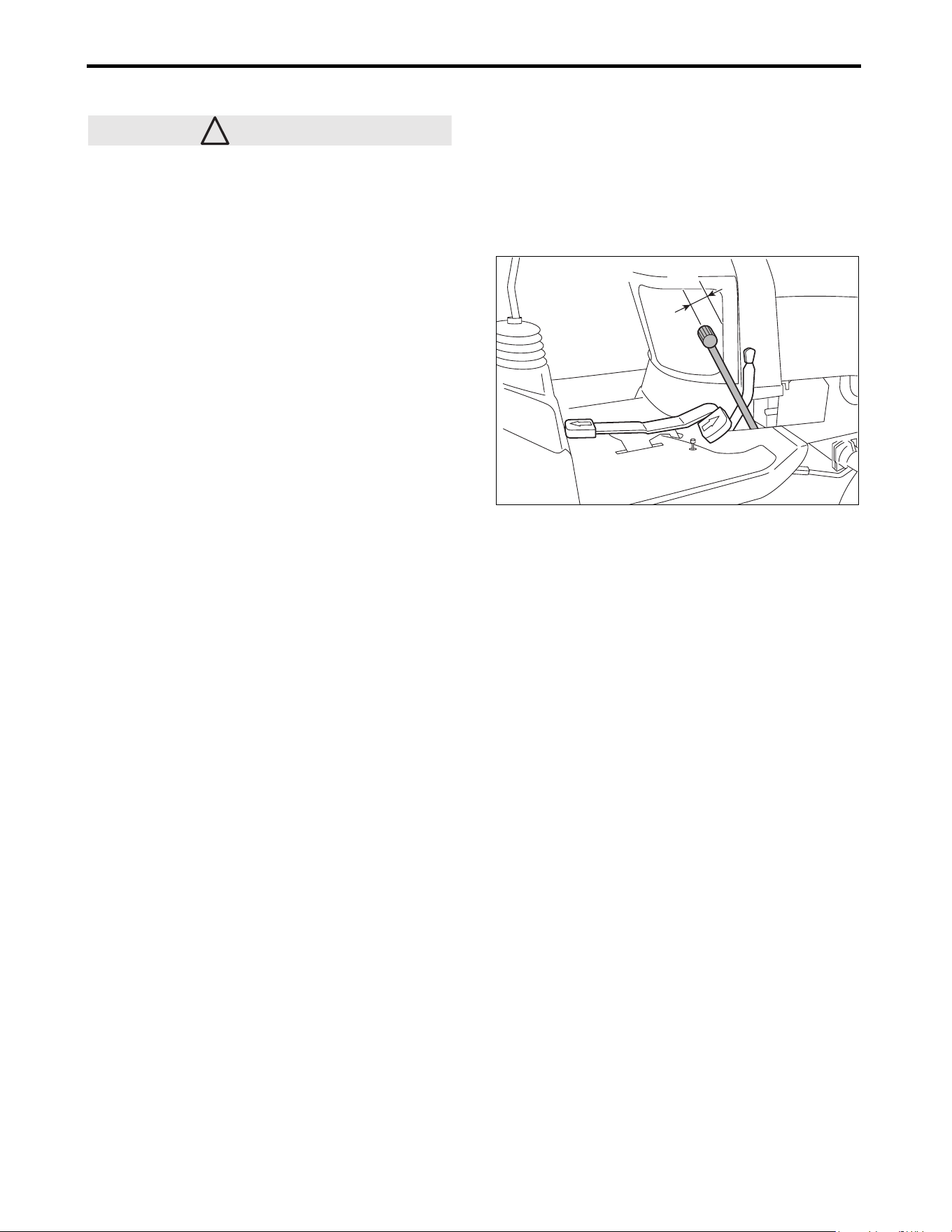
14-16
14. PERIODIC SERVICE
Sc2450 Operator’s Manual
■ Check and Adjust the Brake
●Before checking the brake pedal, park the
tractor safely on solid, level ground, stop the
engine and remove the key from the starter key
switch.
Check if the play of the brake is between 0.8 and 1.2
in. (20 and 30 mm).
If not, contact your local Cub Cadet dealer for
technical assistance.
(a) 0.8 to 1.2 in. (20 to 30 mm)
■ Check the Seat Belt and Roll-Over Protective Structure (ROPS)
1. Before operating the tractor, always make sure
that the seat belt and Roll-Over Protective
Structure (ROPS) mounting hardware are in
correct working order.
2. Replace any damaged hardware.
! CAUTION
3014916e
(a)
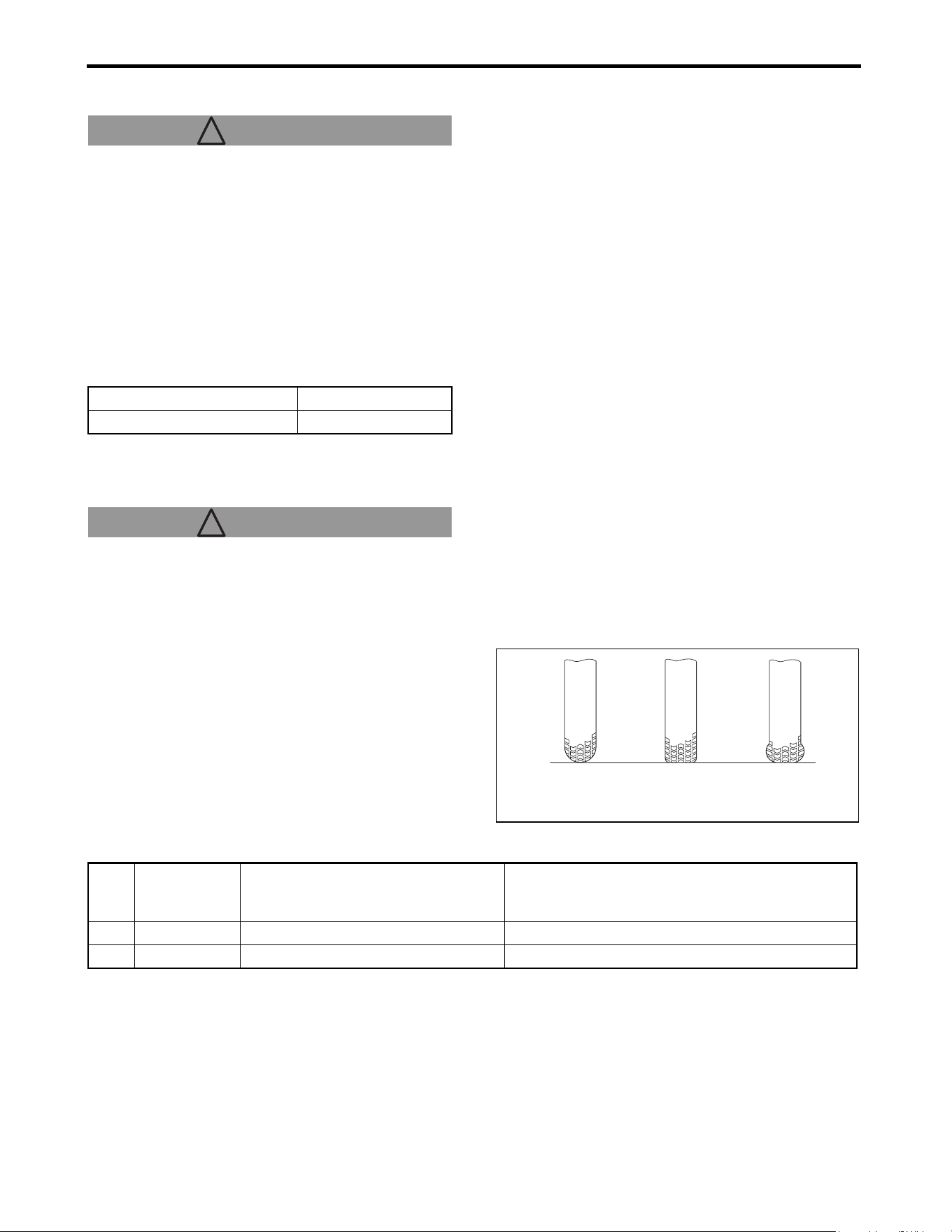
14-17
14. PERIODIC SERVICE
Sc2450 Operator’s Manual
■ Check the Wheel Bolt Tightening Torque
●To prevent possible roll-over of the tractor,
check the rim, hub and wheel bolts before
starting day’s operation.
Before starting day's operation, check tightening
torque of each of the tire wheel bolts and, if
necessary, retighten to the specified torque.
Check the tightening torque after the first 5, 15 and
50 hours and thereafter every 50 hours of operation.
If necessary, retighten to the specified torque.
For the specified torque, see the following table.
■ Check the Inflation Pressure
●ALWAYS keep the tires inflated to the correct
pressure. NEVER exceed the recommended
inflation pressure specified in this Operator's
Manual.
Adjust the front and rear tires to the standard pressure.
Check the tires for fissures and any other damages.
Before front loader work, make sure to check the tire
pressure and, if necessary, inflate the tire(s) to the
recommended pressure.
(a) Too high
(b) Standard
(c) Too low
Inflation pressures
Front wheel bolt (ft•lb (N•m)) 52 - 59 (70 - 80)
Rear wheel bolt (ft•lb (N•m)) 52 - 59 (70 - 80)
Tire size Inflation pressure
(psi(kgf/cm
2
))
Inflation pressure when an implement such as the
front loader has been attached to the front of the
machine (psi(kgf/cm
2
))
Front
18 × 8.50 - 10
20 (1.4) 22 (1.5)
Rear
26 × 12.00 - 12
20 (1.4) 22 (1.5)
! WARNING! WARNING
! WARNING! WARNING
3130210
(b)(a) (c)
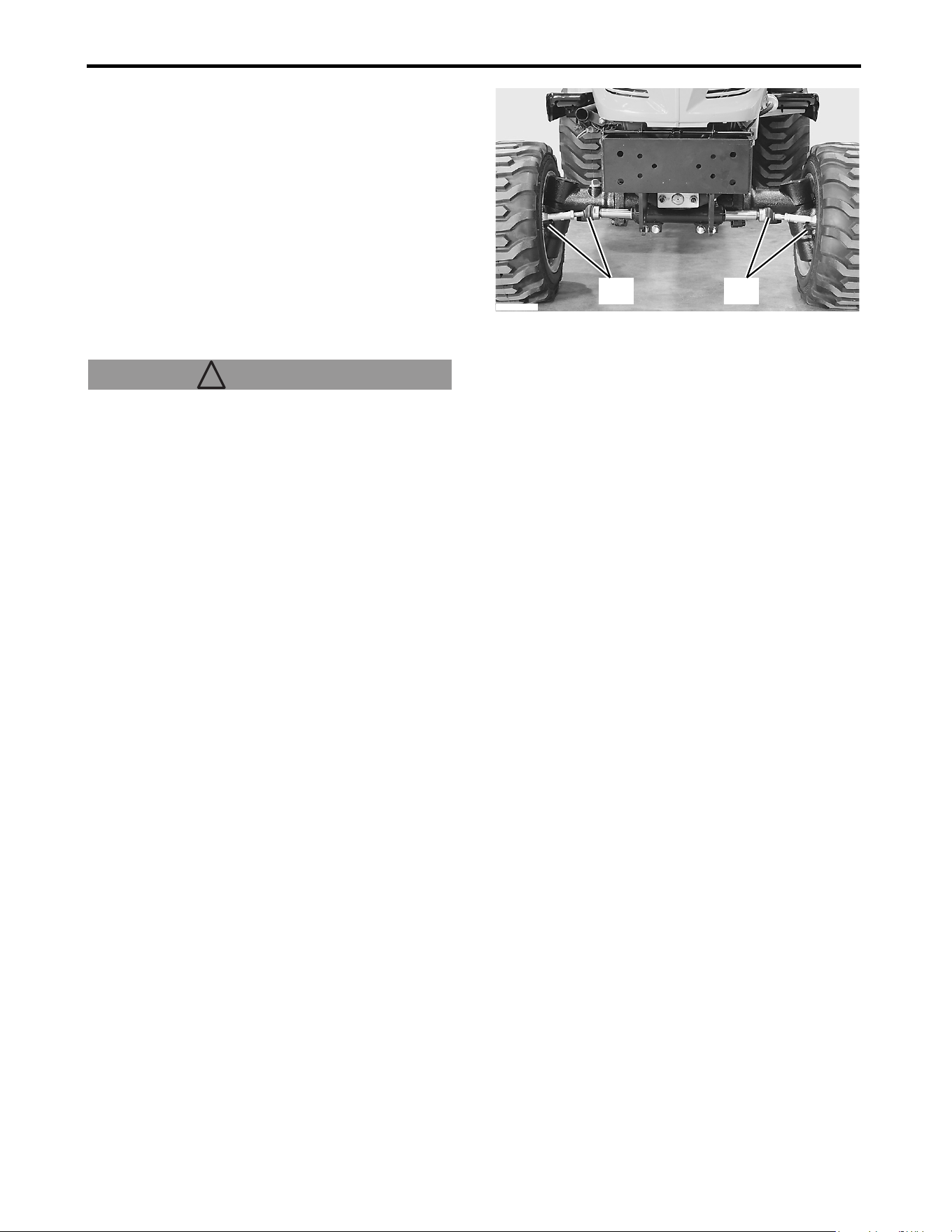
14-18
14. PERIODIC SERVICE
Sc2450 Operator’s Manual
■ Check the Light Bulbs
1. Inspect the lights for blown bulbs and damaged
lenses.
2. Replace a broken bulb or lens.
■ Check the Tie-rod Rubber Boots
Check the tie-rod rubber boots for any break.
If any break is found, contact your local Cub Cadet
Yanmar dealer for technical assistance.
(A) Tie-rod rubber boots
■ Check and Clean the Electrical System
To avoid personal injury:
●Always replace damaged wires or connections
immediately and tighten any loose terminal or
connector. Loose or damaged wires, terminals
or connectors can influence the performance of
or cause damage to electrical components,
result in a dead battery or a short circuit, which,
consequently, can pose a fire hazard.
●Never use a fuse with a larger capacity than that
recommended and do not attempt to bypass the
fuse system. Doing so could result in personal
injury, damage to electrical components or even
pose a fire hazard.
●Carefully plug and unplug any wiring connection
that is protected by a waterproof plug and
ensure that they are sealed securely and
properly after assembly.
●Regularly clean around the battery, all electrical
wiring, the engine and the exhaust system
before attempting to start or operate the tractor.
Any accumulated dirt, fuel, grease or other
deposits in these areas poses a fire hazard.
Never allow high-pressure water to directly contact
the battery, wiring, terminals, connectors, electrical
components, or the instrumental panel. Doing so can
cause an electrical malfunction.
Regularly check the following points:
1. Wiring harness clamps: Replace if necessary.
2. Wiring insulation: Replace if cracked or otherwise
damaged.
3. Connectors and terminals: Tighten if loose, clean if
contaminated, and replace if damaged or discolored.
4. Instrument panel: Make sure all switches and
gauges are operating correctly.
Contact your local Cub Cadet Yanmar dealer in
regard to maintenance, diagnosis and repair.
P3014960
(A) (A)
! WARNING! WARNING
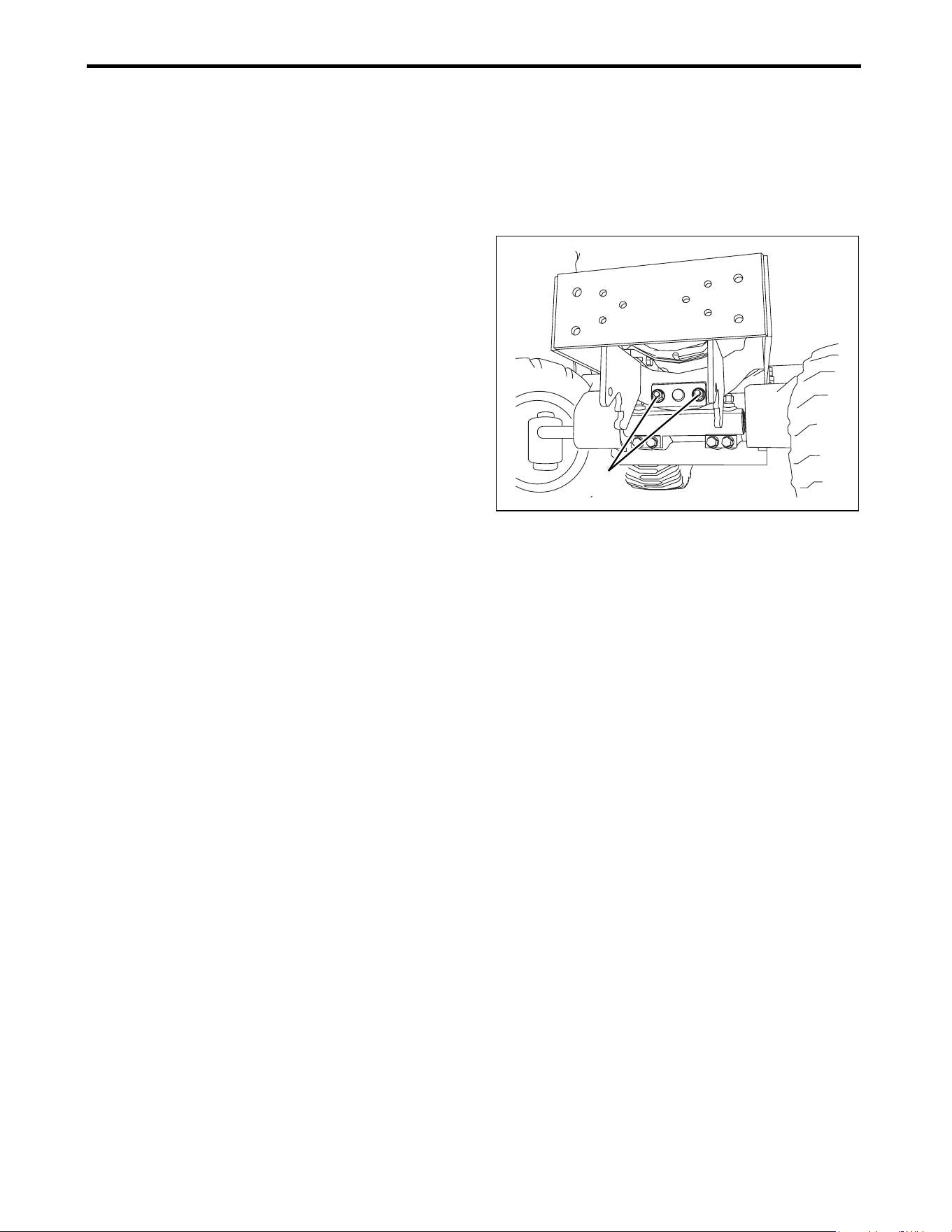
14-19
14. PERIODIC SERVICE
Sc2450 Operator’s Manual
■ Adjust Front Axle Pivot
If the front axle pivot pin has been adjusted
incorrectly, vibration can be triggered on the front
wheels, possibly leading to vibration in the steering
wheel.
Adjusting procedure
Tighten the adjusting bolts to the torque of 106.2
ft•lbs to 132.8 ft•lbs (78.4 to 98.0 N•m). Make sure
that the free play on the front axle in the forward/
reverse direction measures about 0.024 in. (0.6 mm).
(A) Adjusting bolt
3016452
(A)
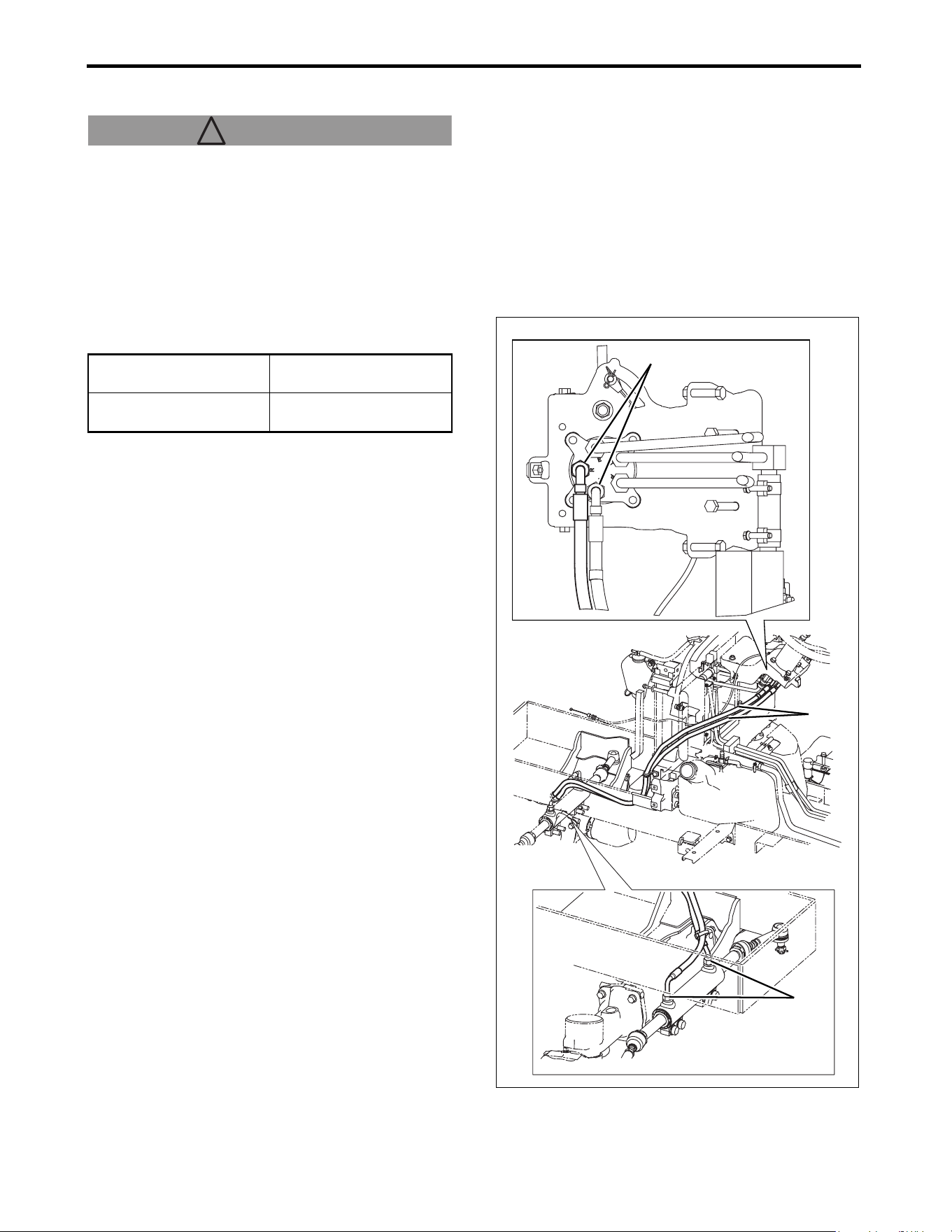
14-20
14. PERIODIC SERVICE
Sc2450 Operator’s Manual
■ Check the Hydraulic Hoses
●When checking for oil leakage, use a sheet(s)
of paper, etc.
●ALWAYS wear protective goggles and gloves.
Check the conditions of the hydraulic hoses.
Check for oil leakage. If any, tighten the bolts to the
specified torque as described below.
1. Power Steering Hoses
(A) Power steering hose
(a) 9/16-18UNF 25 - 28 N•m
(18.4 - 20.7 ft•lbs)
(b) 9/16-18UNF 23 - 27 N•m
(17.0 - 19.9 ft•lbs)
! WARNING! WARNING
3014934
(a)
3014935
(A)
(b)
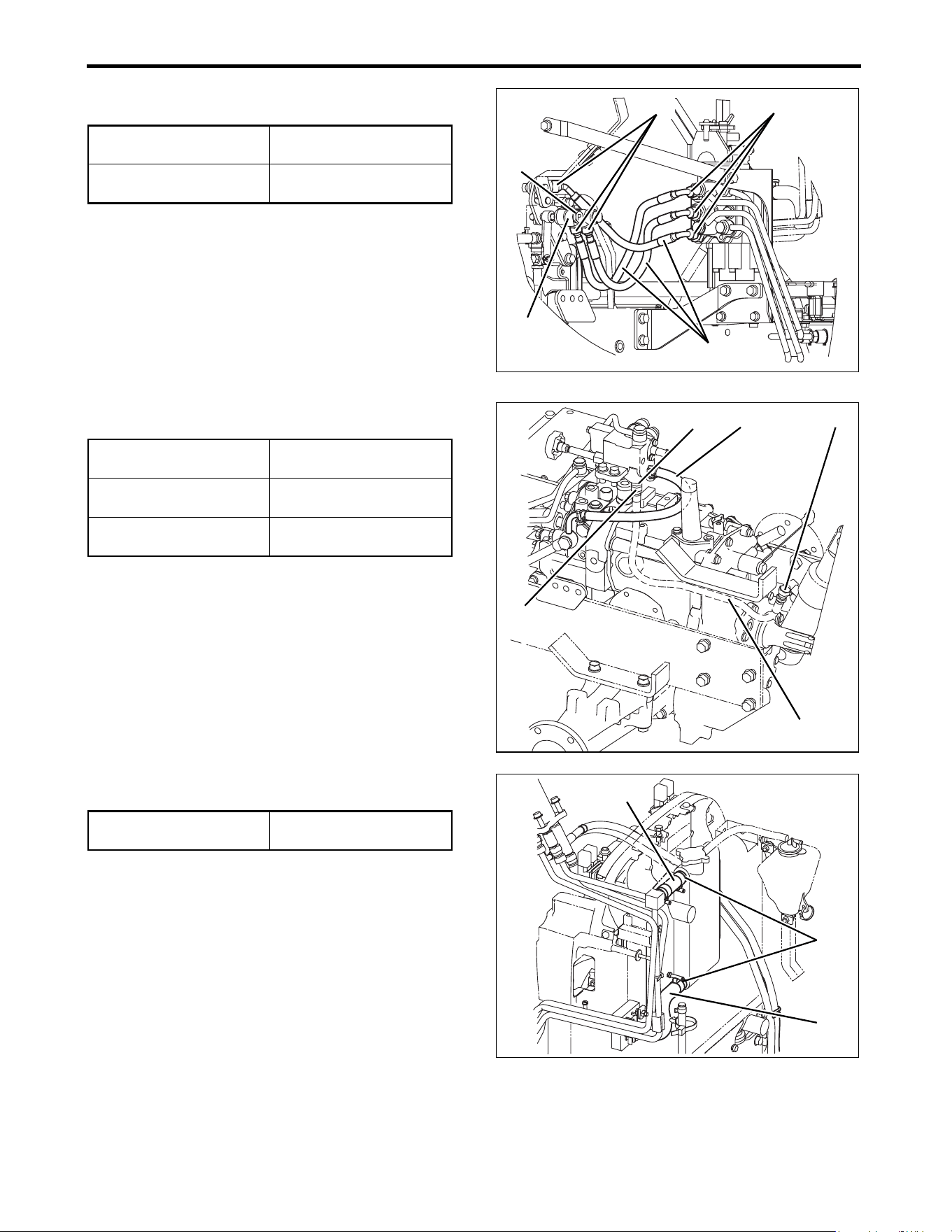
14-21
14. PERIODIC SERVICE
Sc2450 Operator’s Manual
2. Implement Control Valve Hoses
(A) Implement Control Valve hose
NOTE
●When changing the orientation of (c) is necessary
for replacing the hose, it may be preferable to
loosen the pipe fitting bolt. In such a case, replace
the copper gasket.
3. Lift Cylinder Hose and Drain Hose
(A) Lift cylinder hose
(B) Drain hose
4. Oil Cooler Hoses
(A) Oil cooler hose
(a) 9/16UNF - 14.5 23 - 27 N•m
(17.0 - 19.9 ft•lbs)
(b) 9/16UNF - 14.5 39 - 49 N•m
(28.8 - 36.1 ft•lbs)
(a) G1/4 22.6 - 27.5 N•m
(16.7 - 20.3 ft•lbs)
(b) Connector PF1/4 22.6 - 27.5 N•m
(16.7 - 20.3 ft•lbs)
(c) G1/4 22.6 - 27.5 N•m
(16.7 - 20.3 ft•lbs)
(a) Clamp 2.5 - 3.4 N•m
(1.8 - 2.5 ft•lbs)
3014932
(a)
(A)
(a)
(b)
(c)
3014931
(a)
(A)
(c)
(b) (B)
3014933
(a)
(A)
(A)
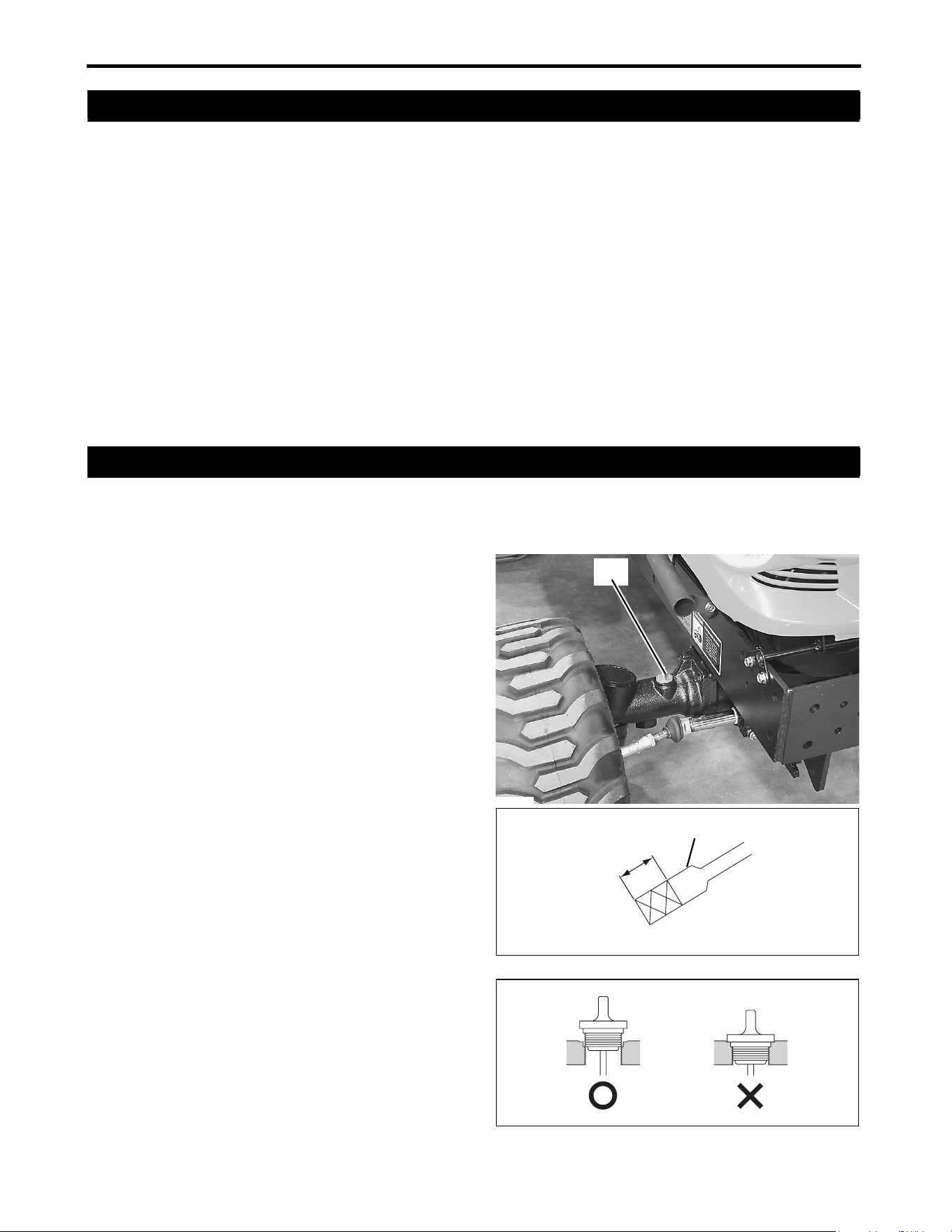
14-22
14. PERIODIC SERVICE
Sc2450 Operator’s Manual
■ Change the Engine Oil
For the maintenance work, see “Engine Oil” on page 14-27.
■ Replace the Engine Oil Filter
For the maintenance work, see “Replace the Engine Oil Filter” on page 14-31.
■ Change the Transmission/Hydraulic Oil
For the maintenance work, see “Change the Transmission/Hydraulic Oil and Replace the Transmission/Hydraulic
Oil Filter” on page 14-33.
■ Replace the Transmission/Hydraulic Oil Filter
For the maintenance work, see “Change the Transmission/Hydraulic Oil and Replace the Transmission/Hydraulic
Oil Filter” on page 14-33.
■ Check the Front Axle Oil Level
IMPORTANT: Avoid damage.
●Before checking the oil level, allow the oil to settle
for 1 hour so that the current oil level can be
accurately read on the dipstick. Recheck the oil
level after operating the tractor for several hours.
1. Park the tractor safely and securely.
2. Allow the tractor to cool off for at least 1 hour and
the oil to settle.
IMPORTANT: Avoid damage.
●Dirt and debris in the oil may damage the front
axle. Clean the area around the dipstick before
removing it.
3. Loosen and remove the dipstick situated on the
right side of the front axle.
4. Wipe the dipstick clean with a rag. Only insert the
dipstick into the hole on axle. At this point, do not
fasten the dipstick into the axle case.
5. Remove the dipstick again. Read the oil level on
the dipstick. The oil level should be between the
high and low level marks on the dipstick.
When the oil level is low:
• Add Cub Cadet GEAR LUBE or SAE 80W-90
gear oil through the fill opening until the oil level
is appropriate.
• Reinstall and tighten the dipstick.
6. Operate the tractor for several hours, and then
check the front axle oil level again.
(A) Dipstick
3. First 50 Hours
4. Every 50 Hours
P3014922
(A)
High
Low
3013741
(A)
3014928
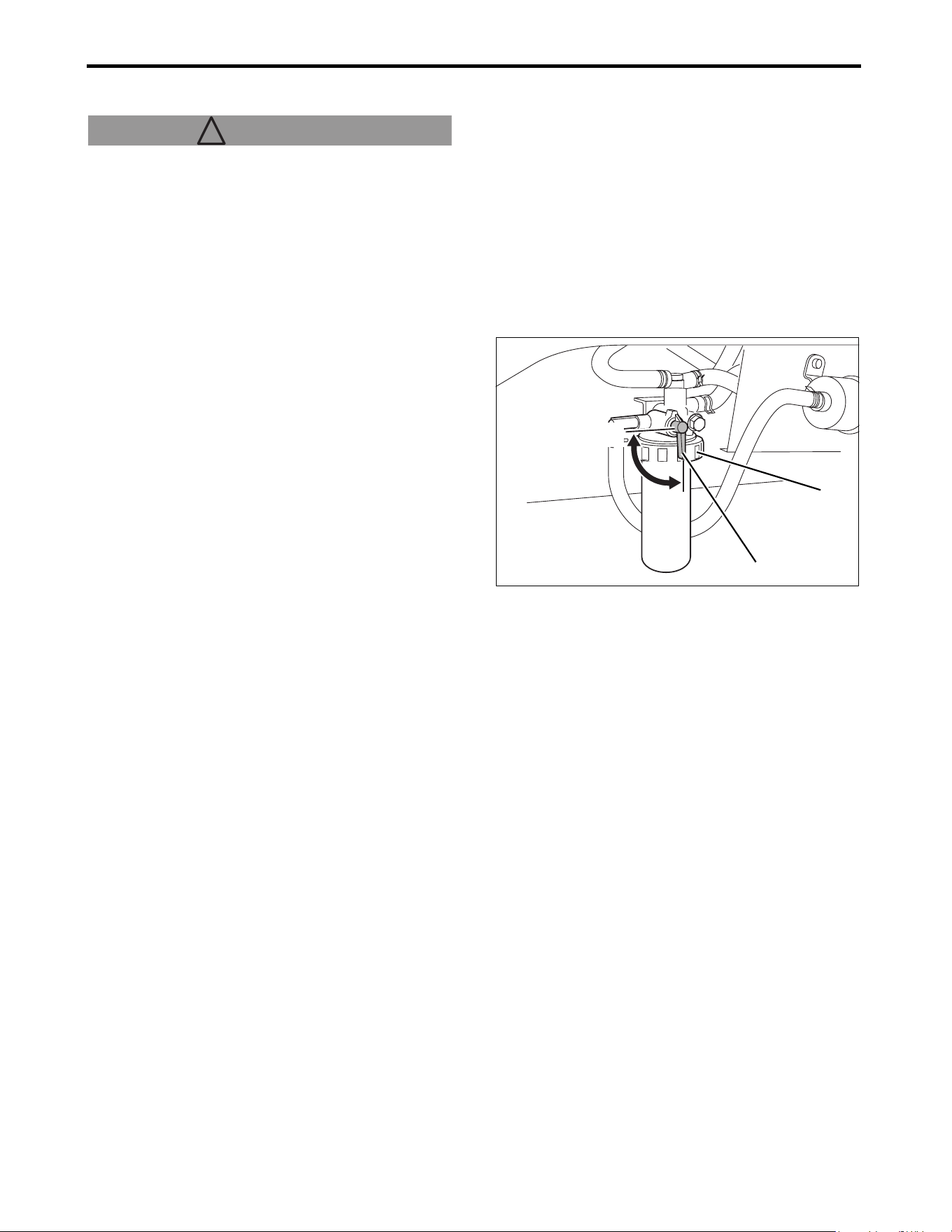
14-23
14. PERIODIC SERVICE
Sc2450 Operator’s Manual
■ Checking the Fuel/Water Separator
●Remember that vapor from diesel fuel is
explosive and flammable.
●NEVER smoke while handling the fuel.
●Keep the fuel away from open flames or sparks.
●Before servicing, stop the engine.
●Before servicing, allow the engine to cool off.
●Work in a well-ventilated area.
●Immediately wipe away spilled fuel.
1. Park the tractor safely.
2. Open the hood.
3. Turn the valve lever to the “Close” position.
4. Turn the locking collar counterclockwise to unlock
the sediment bowl, then pull the sediment bowl
downward to remove from the separator body.
5. When water and/or sediment is/are found in the
sediment bowl, discard it together with fuel in the
sediment bowl and clean the sediment bowl with
diesel oil.
6. Reinstall the sediment bowl, and turn the valve
lever to the “ON” position.
7. Close the hood.
8. Turn the key to the START position to crank the
engine to bleed the air from the fuel system.
(A) Valve lever
(B) Sediment bowl locking collar
(O) Open
(C) Close
! WARNING! WARNING
(B)
3014908a
(A)
(O)
(C)
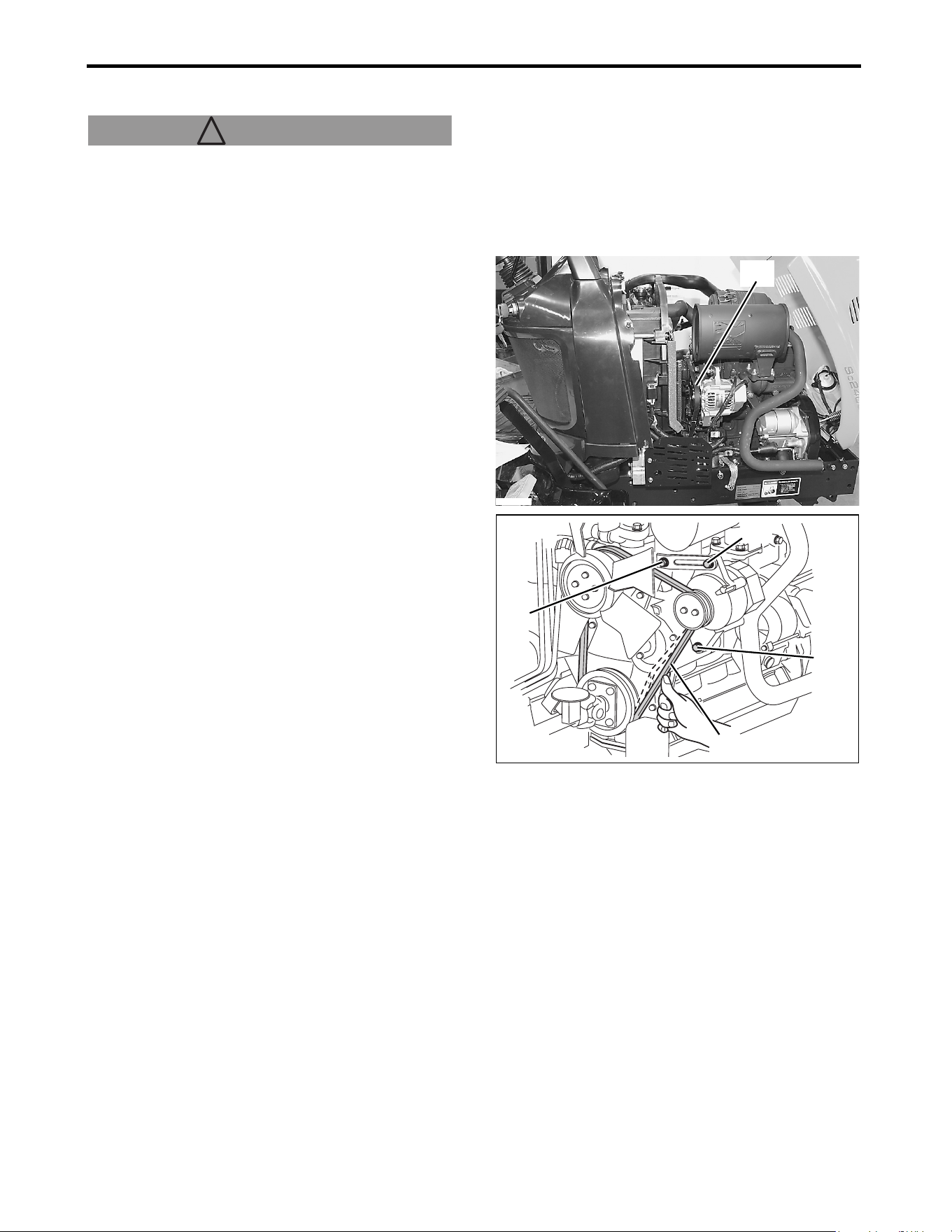
14-24
14. PERIODIC SERVICE
Sc2450 Operator’s Manual
■ Adjust the Fan Belt
●Fingers or loose clothing can be entangled with
rotating parts. Before servicing, stop the
engine and allow all the moving parts to stop
completely.
1. Check the Belt Tension
1. Park the tractor safely and securely.
2. Open the hood.
3. With a thumb, gently apply pressure to the
midpoint of the belt between the pulleys. The belt
should deflect inward by approximately 0.4 to 0.6
in. (10 to 15 mm).
4. If the deflection is not as specified, adjust the
tension of the belt.
(A) Midpoint of the belt
(B) Adjusting bolt
(C) Mounting bolt (a)
(D) Mounting bolt (b)
2. Adjust the Belt Tension
1. Loosen the adjusting bolt.
2. Loosen the mounting bolts.
3. Exert an outward pressure to the alternator
housing to attain the correct tension.
4. Retighten the mounting bolt (b), mounting bolt (a)
and adjusting bolt in that order.
5. Check the belt tension. Adjust as necessary.
6. Close the hood.
3. Replace the Belt
If the belt is excessively worn, damaged or
elongated, replace it with a new one. Contact your
local Cub Cadet Yanmar for technical assistance.
! WARNING! WARNING
P3014923
(A)
3014912a
(B)
(A)
(C)
(D)
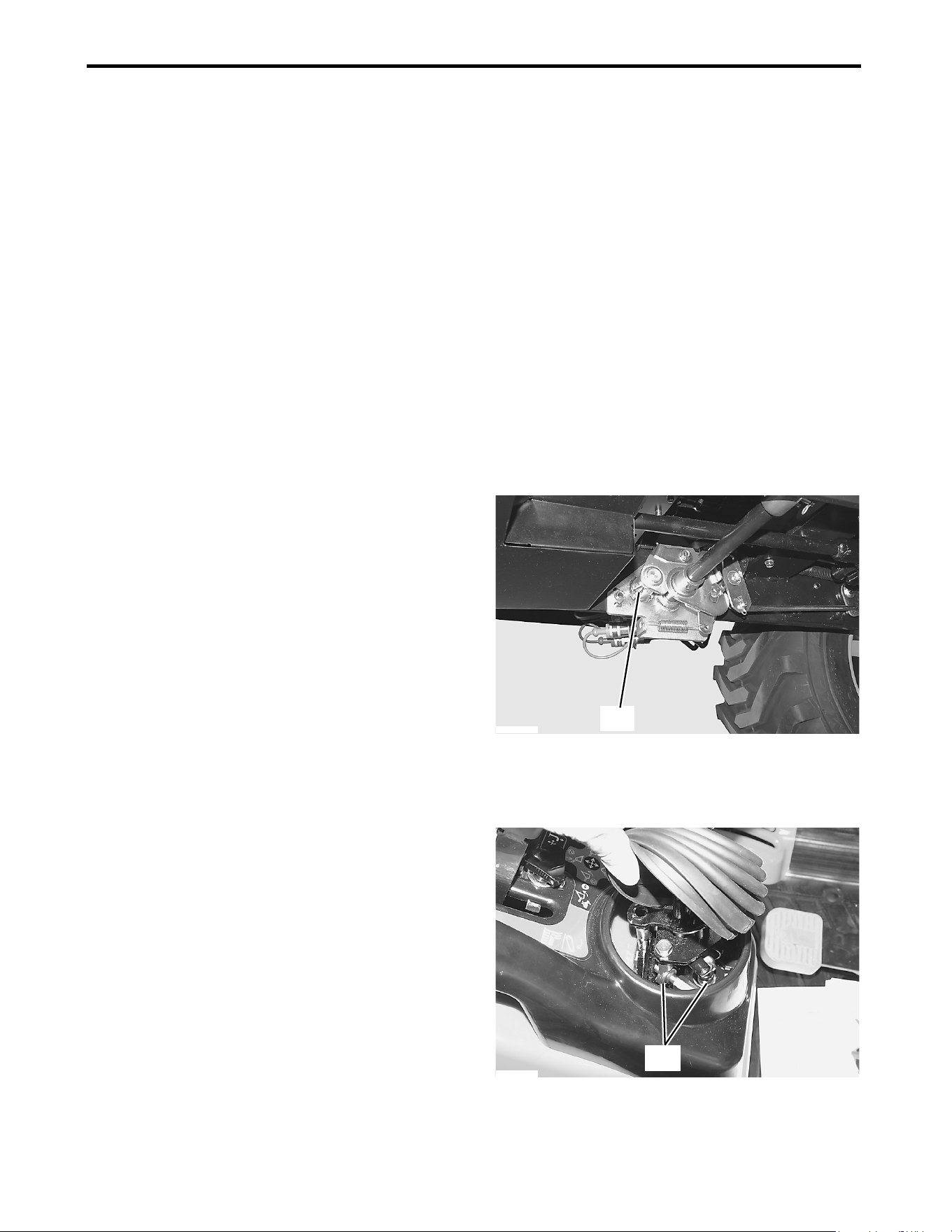
14-25
14. PERIODIC SERVICE
Sc2450 Operator’s Manual
■ Grease and Lubricate
IMPORTANT: Prevent damage.
●Use the recommended Cub Cadet Yanmar
greases to avoid failed or prematurely worn parts
and components.
●The recommended Cub Cadet Yanmar greases
perform efficiently in an average ambient
temperature range from –20 to +275 °F (–29 to
+135 °C)
●When operating the tractor outside this
temperature range, contact your local Cub Cadet
Yanmar dealer for applicable special-purpose
greases.
Use Cub Cadet 251H EP Grease or General all
purpose grease NLGI grade No.2 or equivalent.
1. Lubricate Lube Fittings on the Tractor
[Extremely wet or muddy conditions]
Lubricate the lube fittings once every 10 operating
hours or once a day.
[All other conditions]
Lubricate the lube fittings once every 50 operating
hours.
(A) Forward and reverse drive pedal rod end
2. Lubricate the Implement Control Lever Linkage
(A) Lubricate the implement control lever linkage
Lubricate the implement control lever linkage with
Cub Cadet GEAR LUBE.
P3014924
(A)
P3014925
(A)
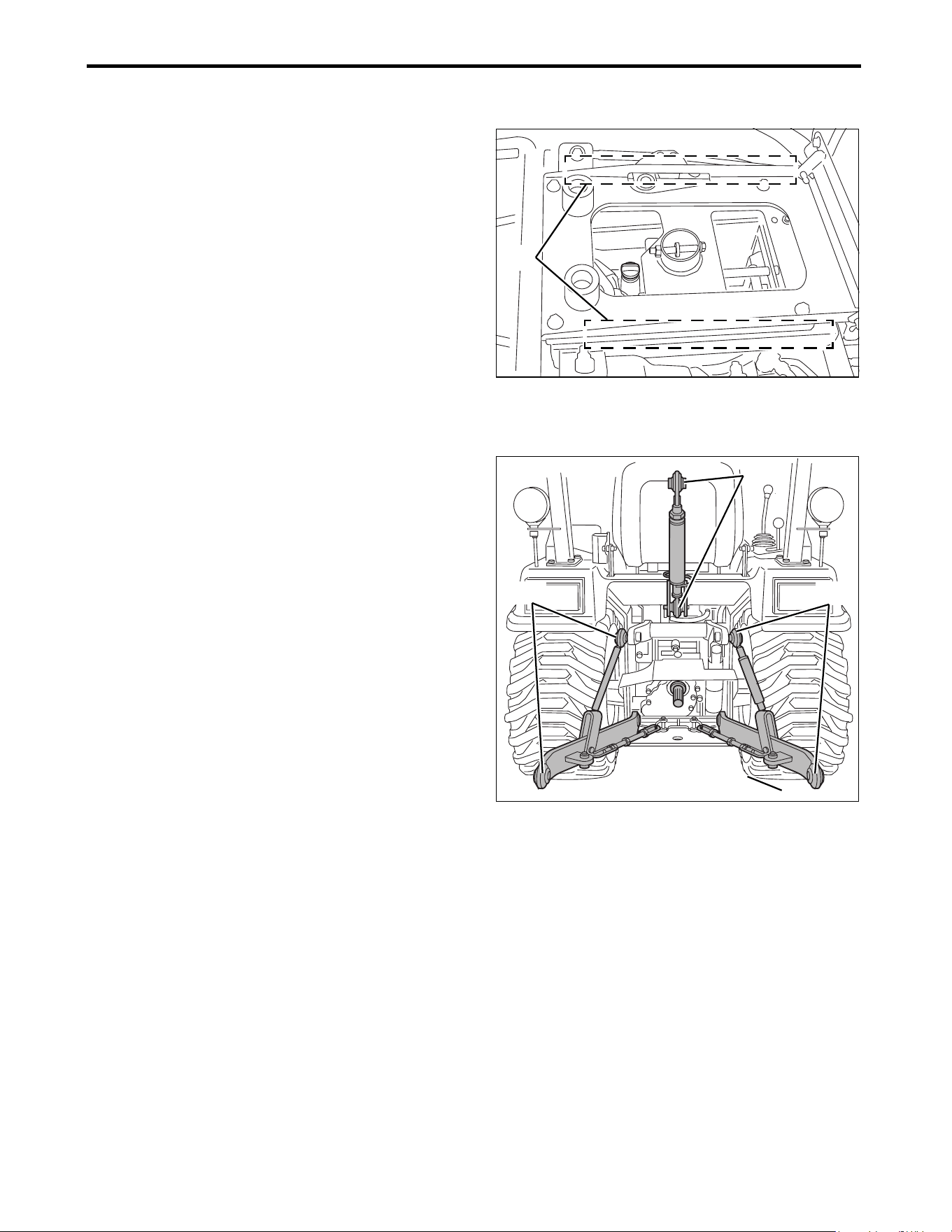
14-26
14. PERIODIC SERVICE
Sc2450 Operator’s Manual
3. Lubricate the Seat Slide Rails
1. Pivot the operator's seat forward.
2. Lubricate the seat slide rails with SUPER LUBE
®
lubricant.
3. Lower the operator's seat.
(A) Seat slide rails
4. Lubricate the 3-Point Hitch (Option)
Lubricate the ball joints and drawbar with SUPER
LUBE
®
lubricant.
(A) Ball joints
NOTE
●SUPER LUBE
®
is a registered trademark of Synco
Chemical Corp
®
.
3016489
(A)
(A)
(A)
3014910
(A)
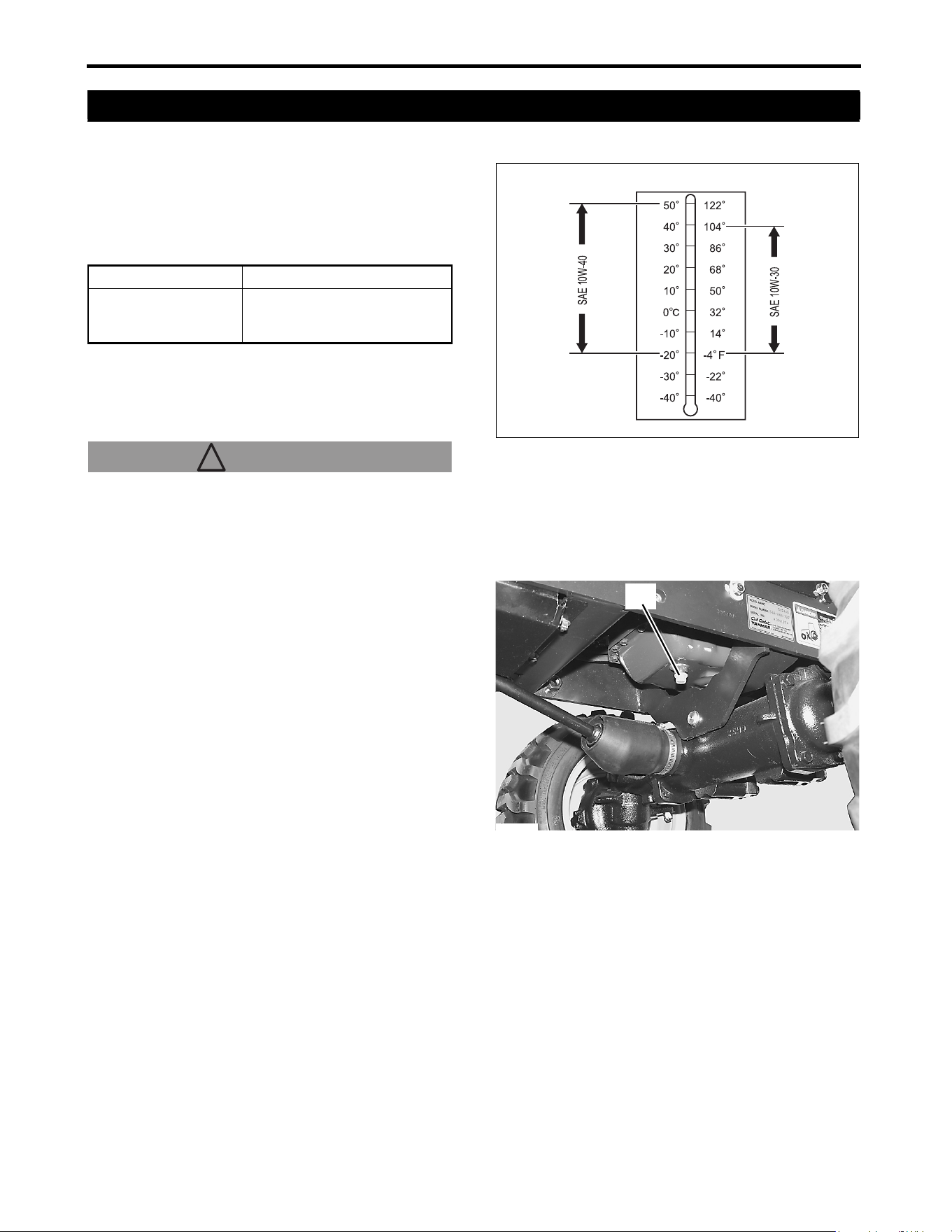
14-27
14. PERIODIC SERVICE
Sc2450 Operator’s Manual
■ Engine Oil
Use an oil of the viscosity appropriate for the air
temperature range expected until the next oil change
interval.
Engine crankcase
■ Change the Engine Oil
●When draining away the engine oil that is still
hot, stay clear of the hot engine oil and other
components to avoid burn.
IMPORTANT: Avoid damage.
●Change the engine oil more frequently if the tractor
is used in extremely demanding conditions:
• Extremely dusty conditions
• Frequent slow- or low-speed operation
• Frequent short trips
1. Run the engine to warm up the engine oil.
2. Park the tractor safely on a level surface.
3. Open the hood.
4. Place an engine oil pan beneath the engine oil
drain plug.
(A) Drain plug
5. Remove the drain plug by turning
counterclockwise and allow the oil to drain.
6. Reinstall the drain plug. Do not over-tighten it.
7. Remove the oil fill cap.
8. Add approximately 2.5 US qt (2.4 L) of the engine
oil.
9. Reinstall the oil fill cap.
10.Start and idle the engine to check for any leaks.
11.If there is any leakage, stop the engine, close the
hood and contact your local Cub Cadet Yanmar
for technical assistance.
12.Check the engine oil level and add more as
necessary.
13.Close the hood.
5. Every 100 Hours
Capacities Lubricants
Approximately
2.5 US qt (2.4 L)
API Service Classifications
CF or higher
SAE 10W-30 or SAE 10W-40
3013738
The following oils are recommended:
! WARNING! WARNING
(A)
P3014926
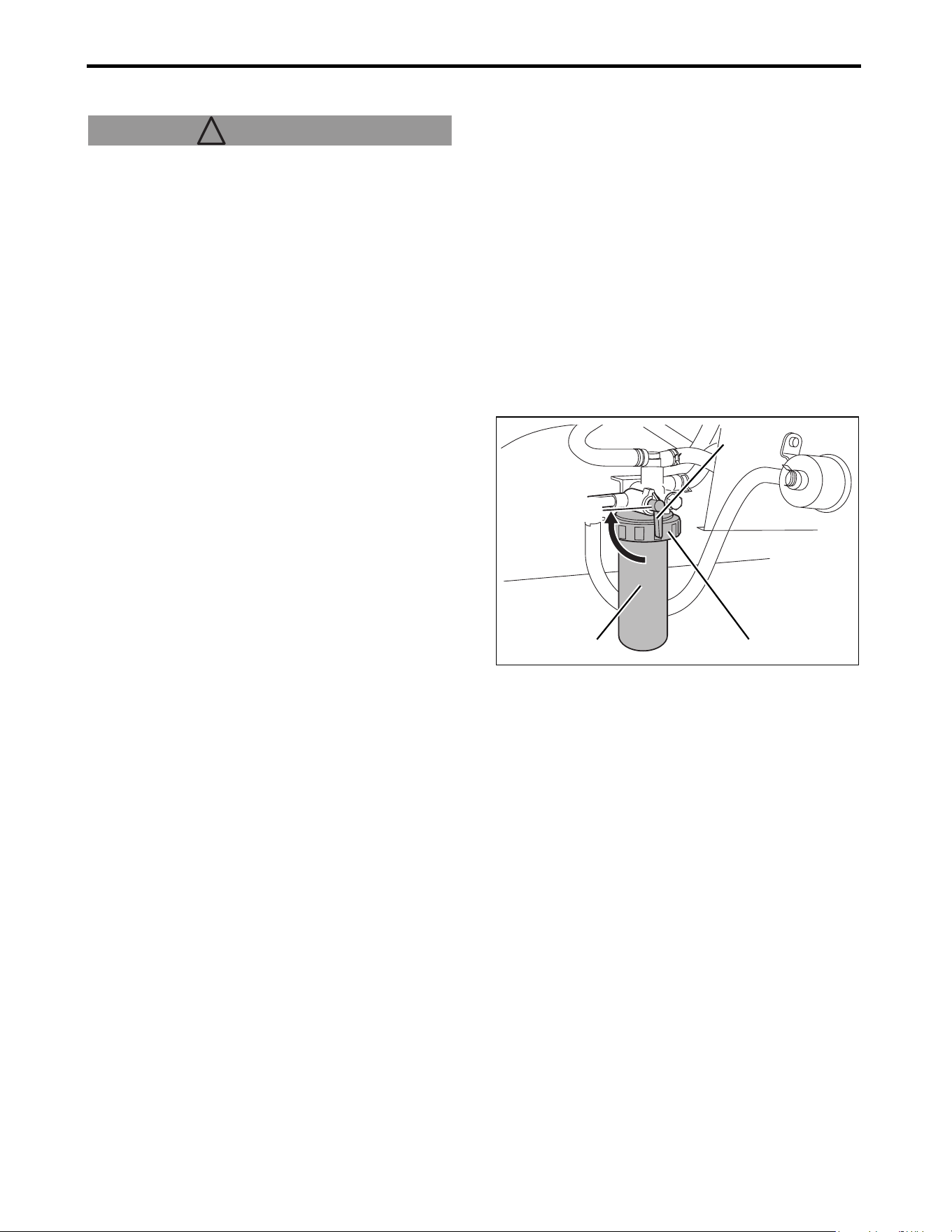
14-28
14. PERIODIC SERVICE
Sc2450 Operator’s Manual
■ Clean the Fuel/Water Separator
●Remember that vapor from diesel fuel is
explosive and flammable.
●NEVER smoke while handling the fuel.
●Keep the fuel away from open flames or sparks.
●Before servicing, stop the engine.
●Before servicing, allow the engine to cool off.
●Work in a well-ventilated area.
●Immediately wipe away spilled fuel.
NOTE
● Change the fuel filter if the fuel tank has been run
dry.
1. Park the tractor safely and securely.
2. Open the hood.
3. Turn the valve lever to the “Close” position.
4. Turn the sediment bowl locking collar
counterclockwise to unlock the sediment bowl,
then pull the sediment bowl downward to remove
from the separator body.
5. Discard fuel and sediment in the sediment bowl
and then clean the sediment bowl with diesel oil.
6. Reinstall the sediment bowl, and turn the valve
lever to the “ON” position.
7. Close the hood.
8. Turn the key to START position to crank the
engine to bleed the air from the fuel system.
(A) Valve lever
(B) Sediment bowl locking collar
(D) Bowl
(C) Close
! WARNING! WARNING
3014908b
(A)
(D)
(C)
(B)
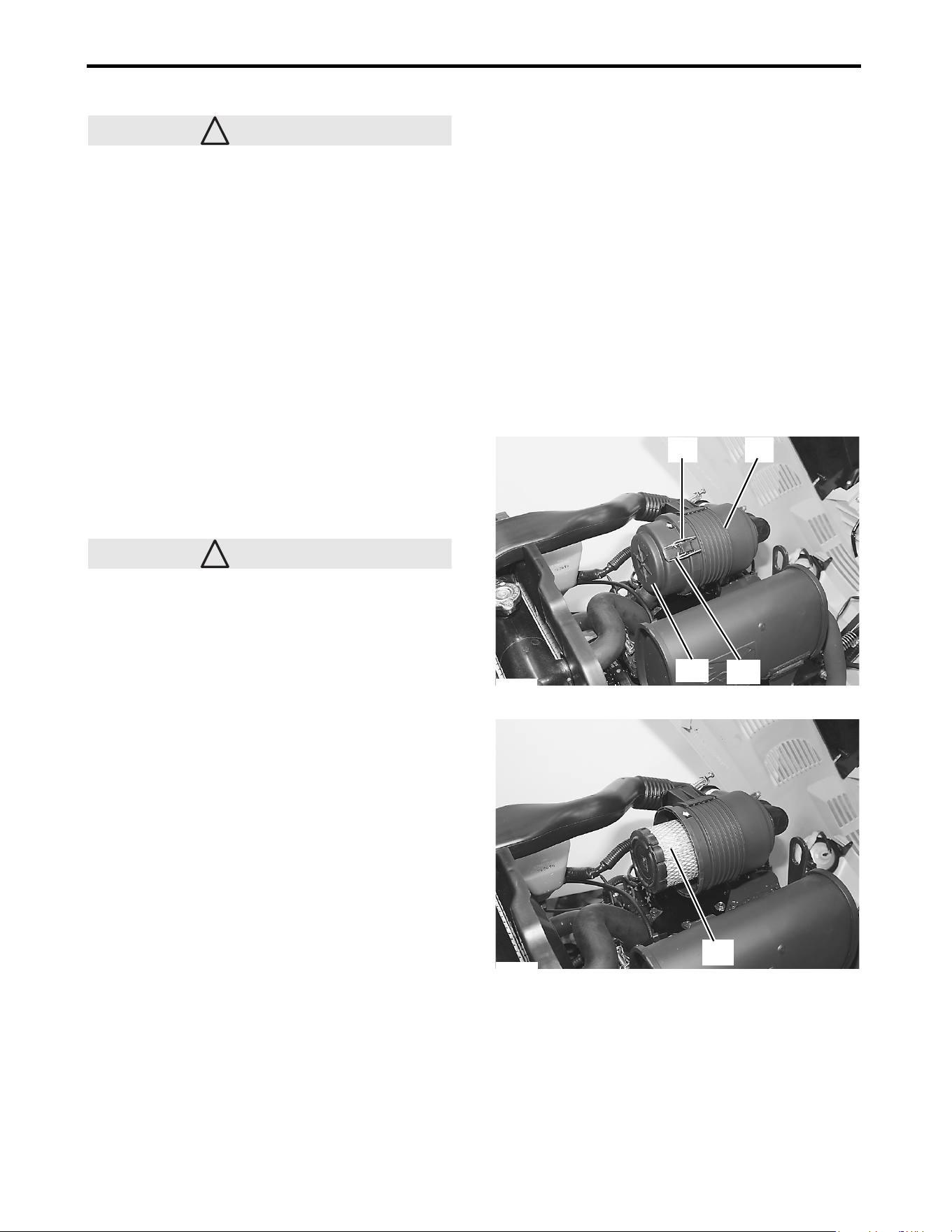
14-29
14. PERIODIC SERVICE
Sc2450 Operator’s Manual
■ Service the Air Cleaner Element
●Touching hot surfaces can lead to skin burn. If
the engine has been running, the engine and its
components will remain hot. Before servicing,
allow the engine to cool off.
IMPORTANT: Avoid damage.
●A damaged cleaner element may fail to catch dirt
and dust, and contaminants can enter the engine:
• NEVER wash the air cleaner element.
• NEVER attempt to clean the air cleaner element
by tapping against another object.
• ALWAYS replace the air cleaner element when it
is contaminated, damaged or the seal is cracked.
1. Park the tractor safely and securely.
2. Allow the engine to cool off.
3. Open the hood.
4. Release the two latches that secure the canister
cover to the air cleaner canister.
●When removing the air cleaner canister cover
or the air cleaner element, be careful not to
injure hand.
5. While holding down the electric cable, unlock the
latch hooks from the air cleaner canister and
remove the canister cover.
(A) Latch hook
(B) Air cleaner canister
(C) Latches
(D) Air cleaner canister cover
(E) Cleaner element
6. Slightly raise the bottom of the canister.
! CAUTION
P3014927
(B)
(D)
(C)
(A)
! CAUTION
P3014928
(E)

14-30
14. PERIODIC SERVICE
Sc2450 Operator’s Manual
7. Blow air through the element from the inside out
using 42 to 71 psi (0.29 to 0.49 MPa, 3.0 to 5.0
kgf/cm
2
) compressed air to remove the
particulates. Use the lowest possible air pressure
to remove the dust without damaging the
element.
8. Replace the element with a new one if the
element is damaged, excessively dirty or oily.
9. Clean inside of the air cleaner canister and
canister cover.
10.Reinstall the air cleaner element.
11.Replace the air cleaner canister cover. Make sure
that the rubber dust unloading valve points
downward.
12.For correct installation, follow the instruction
molded onto the canister cover.
13.Hook the two latch hooks onto the air cleaner
canister.
14.Push the top of the latches inward toward the
canister cover to lock the latches and secure the
canister cover.
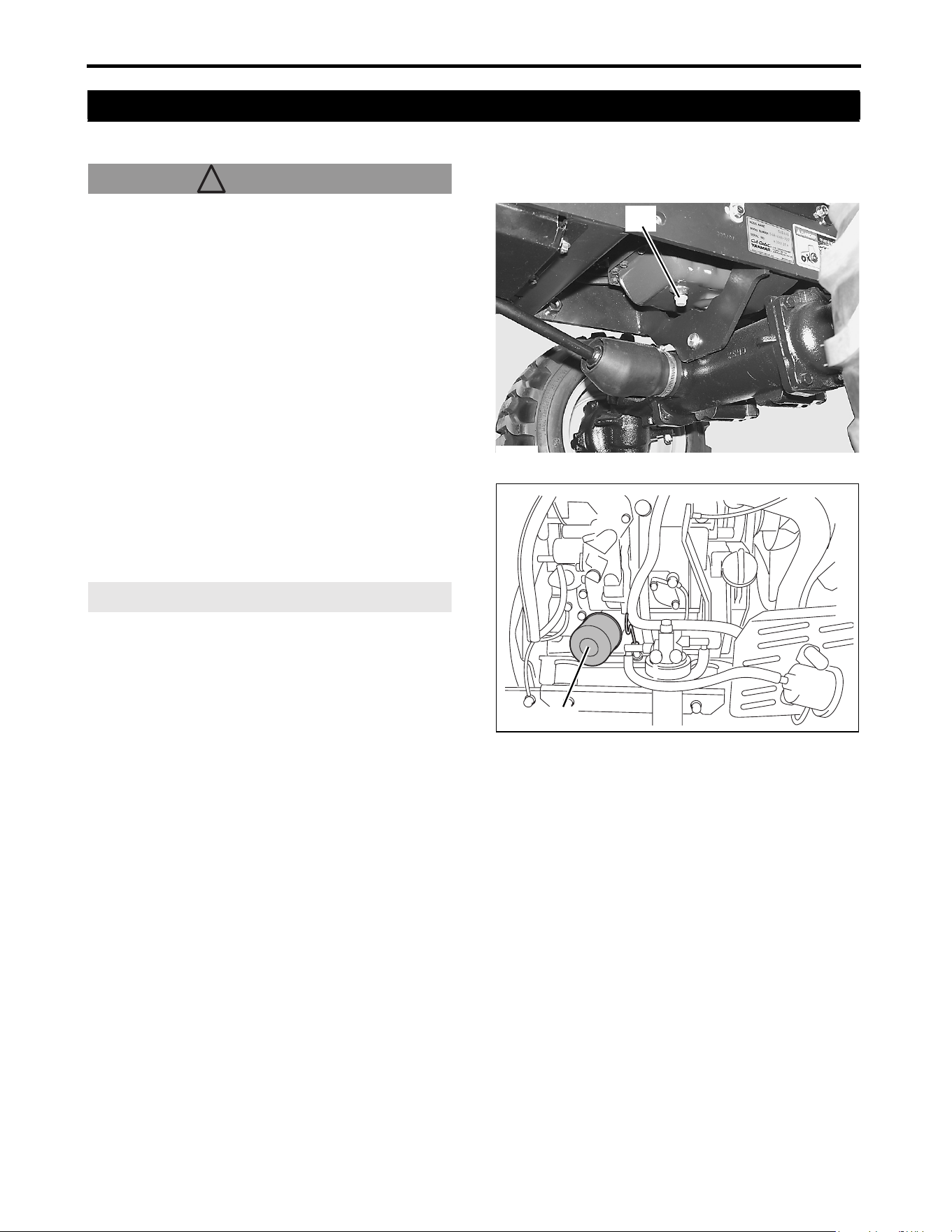
14-31
14. PERIODIC SERVICE
Sc2450 Operator’s Manual
■ Replace the Engine Oil Filter
●When draining away the engine oil that is still
hot, stay clear of the hot engine oil and other
components to avoid burn.
1. Completely drain the engine oil.
See “Change the Engine Oil” on page 14-27.
(A) Drain plug
2. Wipe away dirt and dust from around the engine
oil filter.
(B) Engine oil filter
●Prevent dirt and debris from contaminating engine
oil. Carefully clean the engine oil filter and the
surrounding area before removing the engine oil
filter.
3. Turn the filter counterclockwise to remove it.
4. Apply a small amount of clean engine oil onto the
gasket of the new filter.
5. Install a new replacement oil filter by turning it
clockwise until the gasket is seated against the
filter base. Then turn the filter an additional one
half turn.
6. Reinstall the drain plug. Do not over-tighten it.
7. Remove the oil fill cap.
8. Add approximately 2.5 US qt (2.4 L) of the engine
oil.
9. Reinstall the oil fill cap.
10.Start and idle the engine to check for any leaks.
11.Stop the engine. Correct any leakage before
operating the tractor.
12.Check the engine oil level and add more as
necessary.
13.Lower and close the hood.
6. Every 200 Hours
! WARNING! WARNING
(A)
P3014926
3014911b
(B)
NOTICE
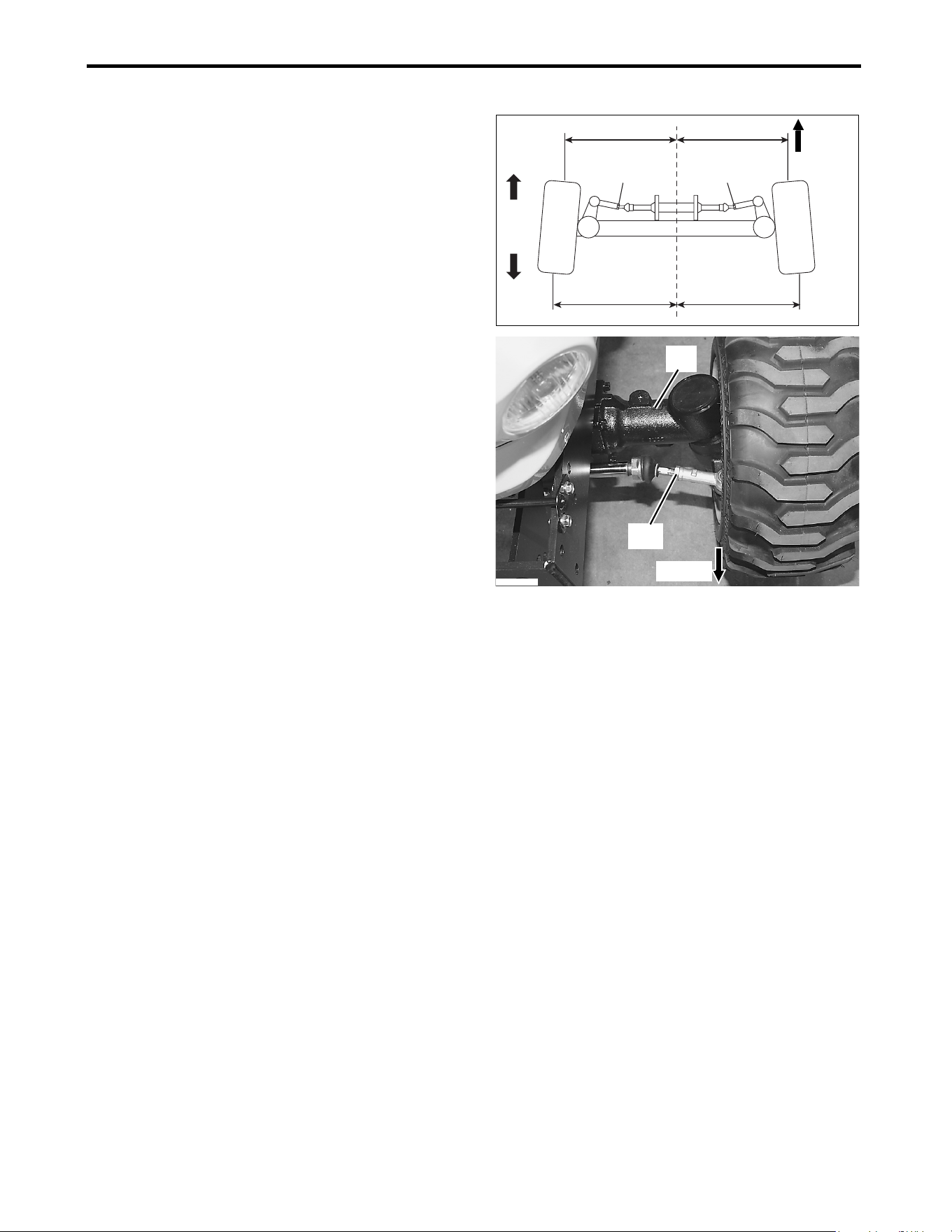
14-32
14. PERIODIC SERVICE
Sc2450 Operator’s Manual
■ Adjust the Toe-in
Poorly adjusted toe-in can cause difficulty in steering
action or abnormal sway of the steering wheel.
Measure the dimensions A, A’, B and B’ on the front
wheels, and check that the dimensional difference “A
- B” “A’ - B’” falls in a range of 0 to 0.3 in. (0 to 7 mm).
If this dimension is not met, loosen the locknuts on
the right and left tie-rod ends, and adjust the length
of threaded portions. When the toe-in falls in the
range of 0 to 0.3 in. (0 to 7 mm), secure this
adjustment by retightening the locknuts.
(C) Front axle
(D) Locknut
(Tightening torque: 44 to 51 ft•lb (59 to 69 N•m))
(E) Tie-rod
(a) Front
(b) Rear
B
(E)
(a)
(b)
(E)
A
B'
A'
2010682a
FRONT
P3014929
(D)
(C)
FRONT
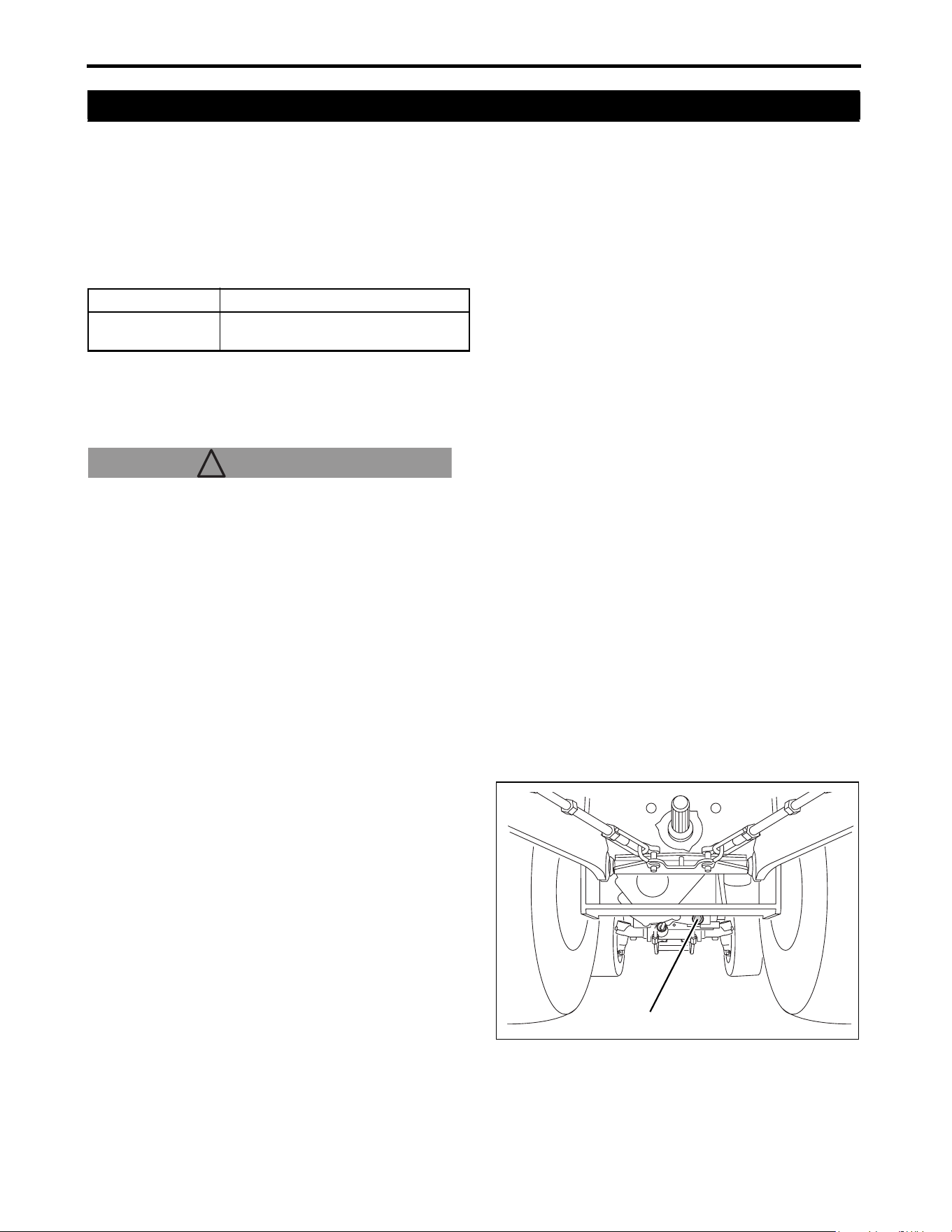
14-33
14. PERIODIC SERVICE
Sc2450 Operator’s Manual
■ Transmission/Hydraulic Oil
IMPORTANT: Avoid damage.
●Make sure to use Cub Cadet Hydraulic/Transmission
Fluid for transmission.
Transmission/Hydraulic Oil
■ Change the Transmission/Hydraulic Oil and Replace the Transmission/Hydraulic Oil
Filter
●When draining away the transmission/
hydraulic oil that is still hot, stay clear of the
hot transmission/hydraulic oil and other
components to avoid burn.
IMPORTANT: Avoid damage.
●NEVER remove the cap from the fill port unless
absolutely necessary. Contaminated transmission/
hydraulic oil can cause the transmission to be
damaged or fail.
●Whenever changing or replacing the transmission/
hydraulic oil and transmission/hydraulic oil filter,
always bleed the transmission/hydraulic oil in order
to avoid malfunction of transmission.
1. Run the engine for several minutes to warm up
the transmission/hydraulic oil.
2. Park the machine safely.
NOTE
●The transmission contains approximately 2.0 US
gal. (7.5 L) of oil.
3. Put a drain pan underneath the transmission
drain plug. Remove the drain plug, and allow the
oil to fully drain away.
(A) Transmission drain plug
7. Every 300 Hours
Capacities Lubricants
Approximately
2.0 US gal (7.5 L)
Cub Cadet Hydraulic/Transmission
Fluid
! WARNING! WARNING
3014923
(A)
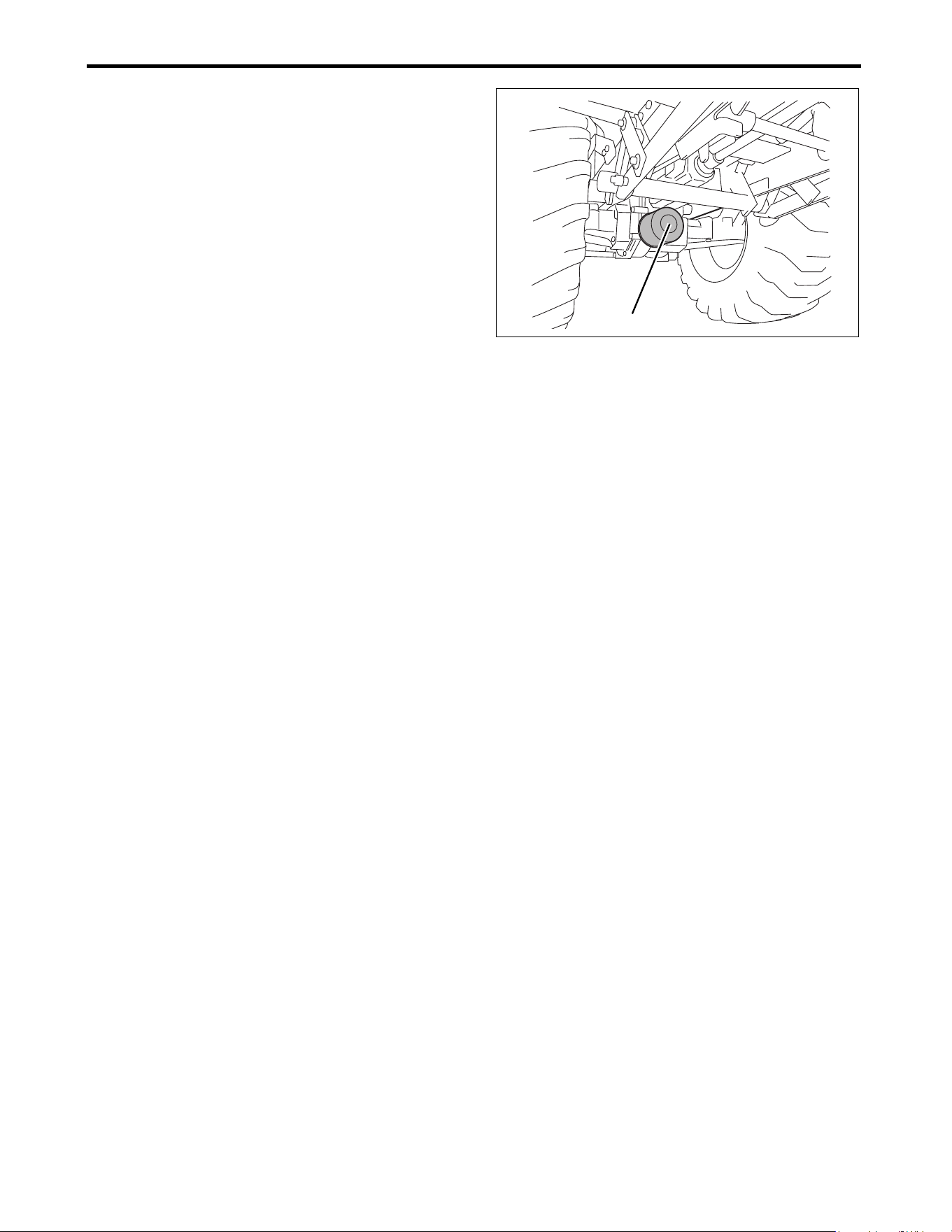
14-34
14. PERIODIC SERVICE
Sc2450 Operator’s Manual
4. Turn the transmission/hydraulic oil filter
counterclockwise with the filter wrench to remove.
5. Install a new transmission/hydraulic oil filter and
turn clockwise by hand. Tighten the filter with a
filter wrench to a torque of 28.9 lb•ft (4 kgf•m).
NOTE
●After hand-tightening, only tighten by 2/3 turn with
the filter wrench.
(A) Transmission/hydraulic oil filter
6. Reinstall and tighten the transmission drain plug.
7. Clean the area around the oil fill cap, then remove
the oil fill cap from the transmission housing.
8. ADD approximately 2.0 us gal (7.5L) of the
transmission/hydraulic oil.
9. Reinstall the oil fill cap.
10.Start the engine and idle it for about 40 seconds.
11.Run the engine at the high idle speed for about 40
seconds.
12.Then, run the engine at the low idle speed and
slowly step on the forward and reverse drive
pedal several times.
13.Again run the engine at the high idle speed and
slowly step on the forward and reverse drive
pedal several times.
14.Stop the engine. If any leakage is found, contact
your local Cub Cadet Yanmar dealer for technical
assistance.
15.After leaving the engine for 5 minutes or more,
check the transmission/hydraulic oil level and add
more as necessary.
3014924
(A)
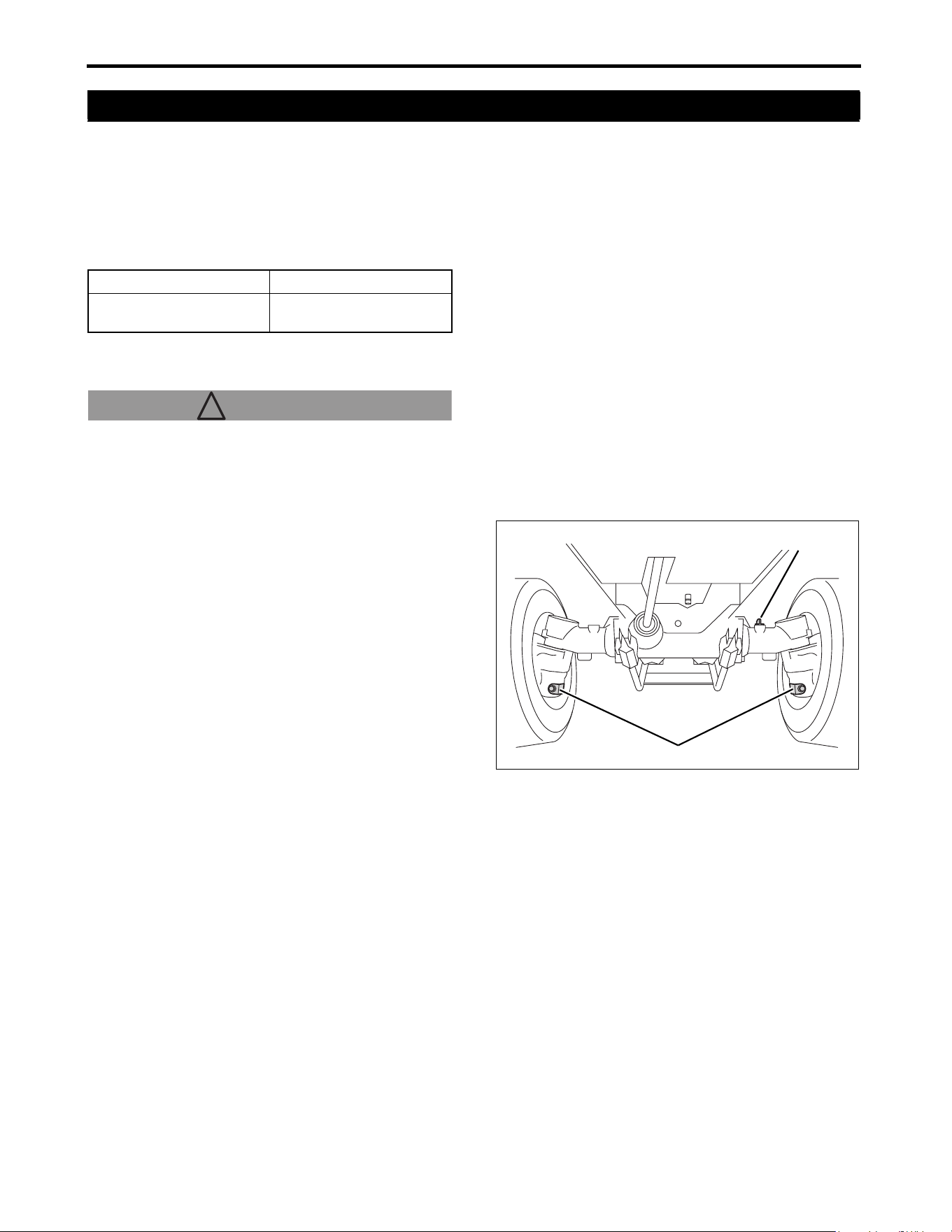
14-35
14. PERIODIC SERVICE
Sc2450 Operator’s Manual
■ Front Axle Case Oil
IMPORTANT
●Make sure to use Cub Cadet GEAR LUBE or SAE
80W-90 gear oil for front axle case oil.
Front Axle Case Oil
■ Change the Front Axle Case Oil
●When draining away the front axle case oil that
is still hot, stay clear of the hot transmission/
hydraulic oil and other components to avoid
burn.
1. Operate the tractor to warm up the front axle case
oil.
2. Park the tractor safely.
NOTE
●The front axle case contains approximately 2.6 US
qt (2.5 L) of oil.
●Be sure to change the oil in both right and left front
axles.
3. Place drain pans underneath the axle drain plugs
on both sides of the front axle.
4. Remove the axle drain plugs and allow the oil to
fully drain.
5. Make sure that the oil has fully drained. Dispose
of waste properly. Reinstall and tighten the drain
plugs.
6. Remove the dipstick located on the right side of
the front axle.
7. Add Cub Cadet GEAR LUBE or SAE 80W-90
gear oil through the fill port to the specified level.
8. Reinstall and tighten the dipstick.
9. Check the front axle case oil level again.
IMPORTANT: Avoid damage.
●Before checking the oil level, allow the oil to settle
for 1 hour so that the current oil level can be
accurately checked on the dipstick. Recheck the oil
level after operating the tractor for several hours.
10.Again, check the axle case oil level.
(A) Axle drain plugs
(B) Dipstick
8. Every 500 Hours
Capacities Lubricants
Approximately 2.6 US qt
(2.5 L)
Cub Cadet GEAR LUBE
or SAE 80W-90 gear oil
! WARNING! WARNING
(A)
3014922
(B)
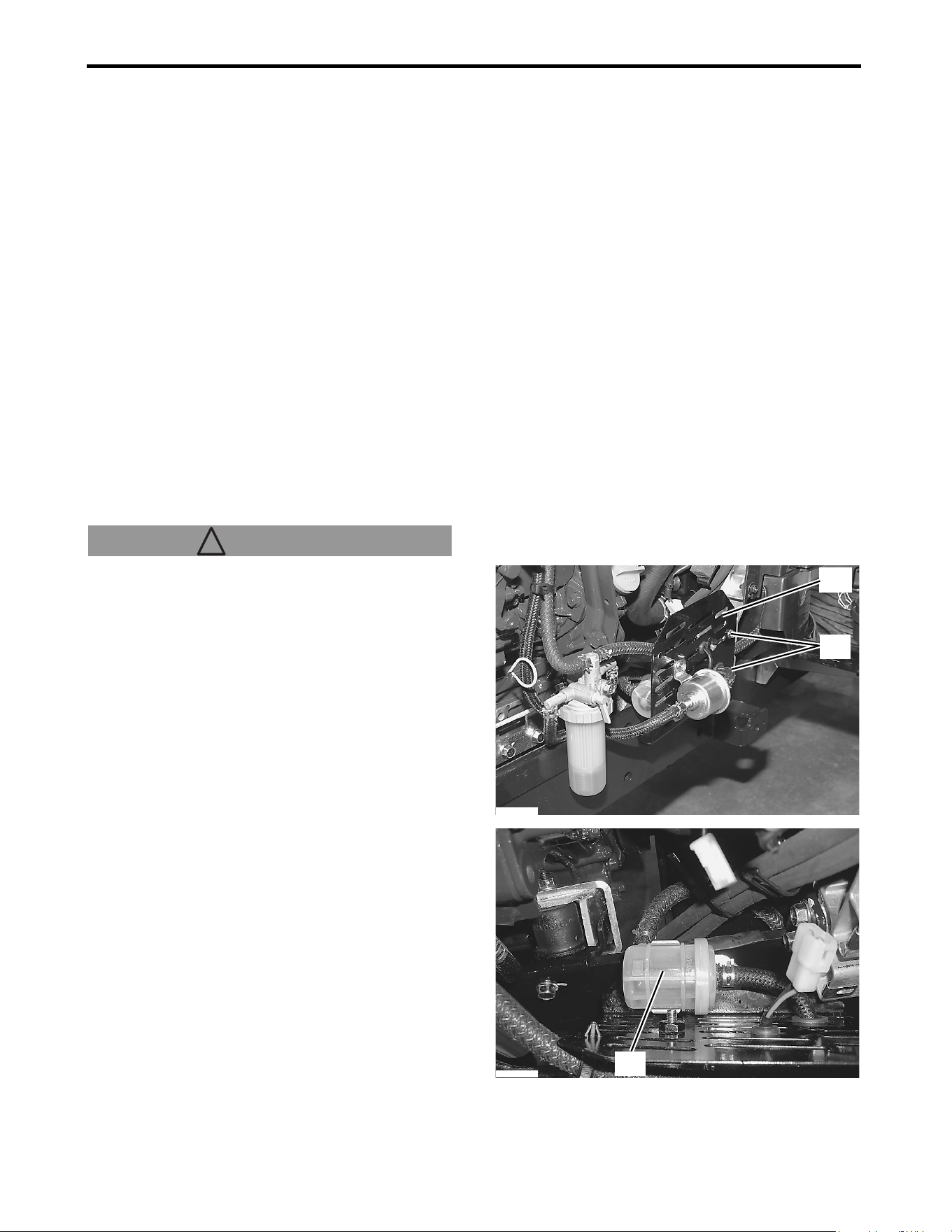
14-36
14. PERIODIC SERVICE
Sc2450 Operator’s Manual
■ Replace the Fuel Filter Element (in the Fuel/Water Separator)
1. Park the tractor safely and securely.
2. Open the hood.
3. Turn the valve lever to the “Close” position.
4. Turn the locking collar counterclockwise to unlock
the sediment bowl, then pull the sediment bowl
downward to remove from the separator body.
5. Discard fuel and sediment in the sediment bowl
and then clean the sediment bowl with diesel oil.
6. Remove the old fuel filter element from the
separator body.
7. Install a new fuel filter element to the separator
body.
8. Reinstall the sediment bowl, and turn the valve
lever to the “ON” position.
9. Close the hood.
10.Turn the key to the START position to crank the
engine to bleed the air from the fuel system.
■ Replace the Fuel Filter
●Remember that vapor from diesel fuel is
explosive and flammable.
●NEVER smoke while handling the fuel.
●Keep the fuel away from open flames or sparks.
●Before servicing, stop the engine.
●Before servicing, allow the engine to cool off.
●Work in a well-ventilated area.
●Immediately wipe away spilled fuel.
Check fuel filter, if it is clogged by debris or
contaminated by water, replace it.
1. Open the hood.
2. Remove the two bolts and remove the stay.
3. Remove the filter from the clamp.
4. Place an oil pan underneath the filter.
5. Disconnect the fuel hoses from the fuel filter.
6. Replace the new fuel filter, and plug it with fuel
hoses.
7. Discard the old filter. Install the hose to a new
filter.
8. Fit the filter in the clamp.
9. Reinstall the stay.
(A) Stay
(B) Bolts
(C) Fuel filter
! WARNING! WARNING
(B)
P3014930
(A)
(C)
P3014957
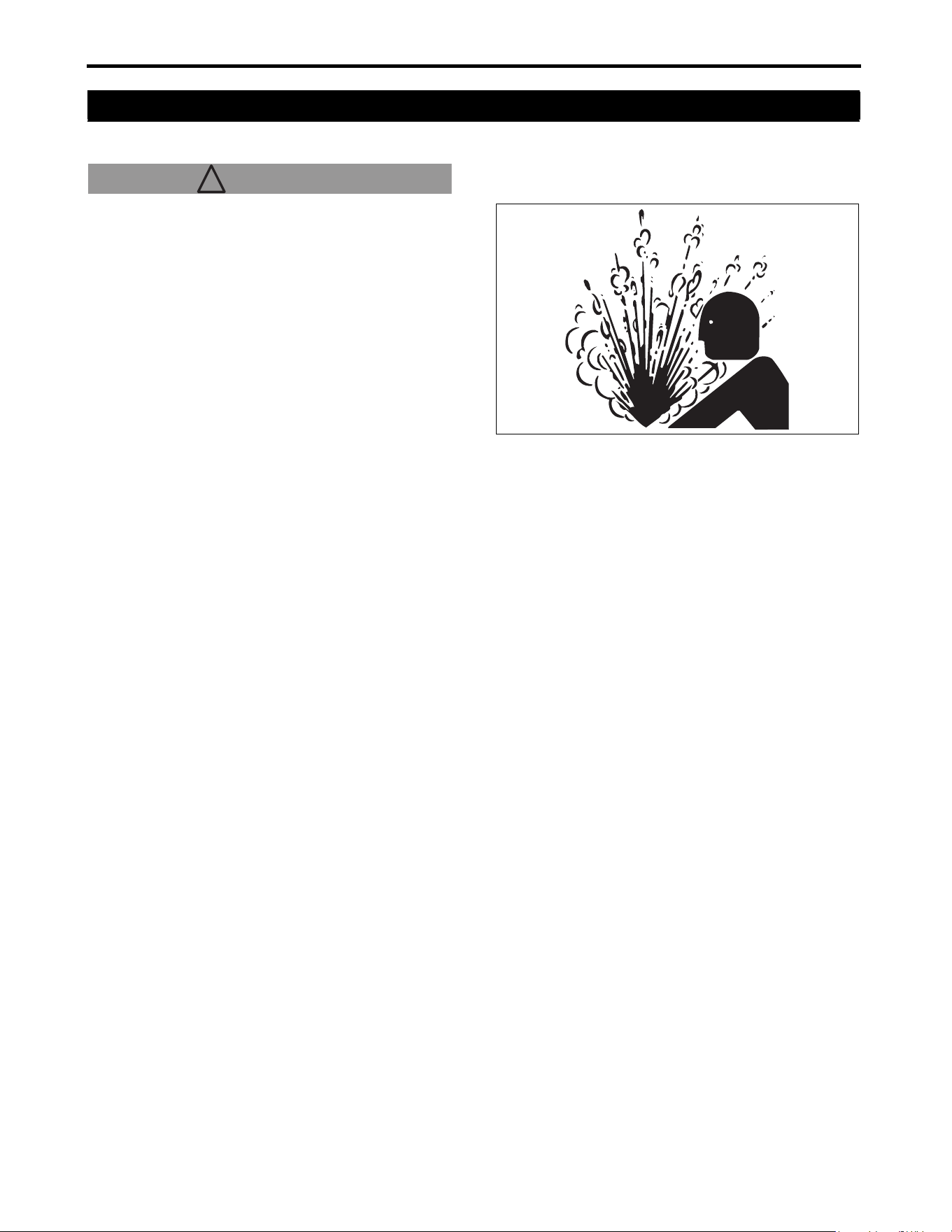
14-37
14. PERIODIC SERVICE
Sc2450 Operator’s Manual
■ Coolant
●Fluids released under pressure from the
cooling system can cause severe burns.
Pressure build-up in the cooling system can,
when the radiator cap is removed, cause the
coolant to gush out explosively.
●Stop the engine and allow it to cool off.
●Do not remove the radiator cap before the
radiator and the engine are sufficiently cool
such that they can be touched with bare hands.
Carefully loosen the cap to the first stop to
allow the pressure to be completely released.
Only then, remove the cap completely.
[The following coolants are recommended]
• High Quality Permanent Type Antifreeze
(Ethylene Glycol with corrosion and rust inhibitor
chemicals)
Before using the coolant, study the instructions and
data on its container to be sure it is suitable for the
engine.
Use a conditioned coolant, or before use, add a
conditioner to the coolant.
Prepare the coolant according to the
recommendation of your local Cub Cadet Yanmar
dealer, and then pour this coolant into the radiator.
This coolant is intended not only to cold the engine
but also to protect the radiator against freezing down
to your local climate.
Follow the instructions on the antifreeze container or
contact your local Cub Cadet Yanmar dealer for
technical assistance. NEVER exceed the maximum
dilution ratio for the coolant. Exceeding the maximum
dilution ratio can jeopardize effectiveness of the
coolant.
9. Every 1000 Hours
! WARNING! WARNING
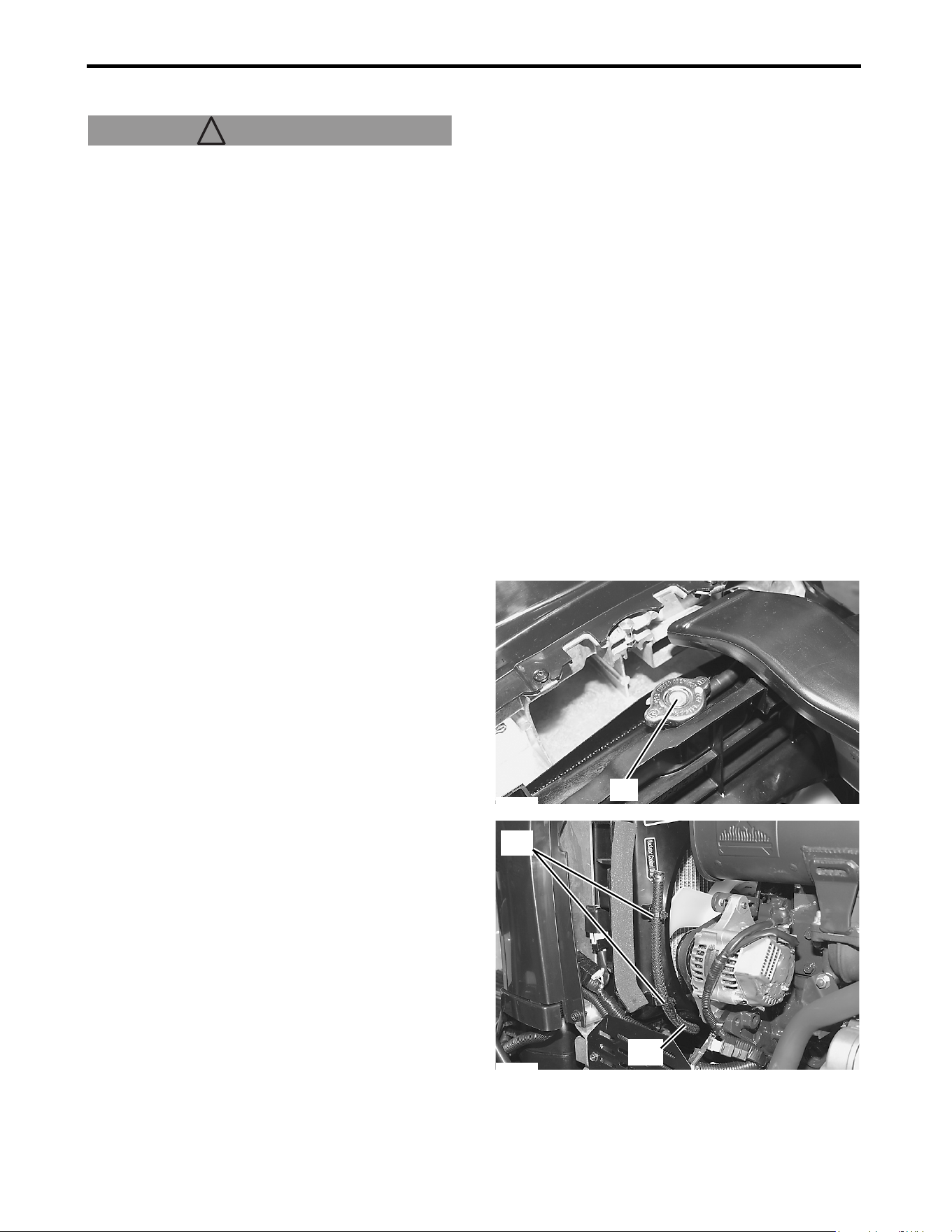
14-38
14. PERIODIC SERVICE
Sc2450 Operator’s Manual
■ Flush the Cooling System
●ALWAYS allow radiator to cool before
removing the radiator cap. The radiator will be
hot and can cause burns. When the radiator
cap is removed, pressure build-up in the
cooling system can cause the coolant to spray
out explosively.
●ALWAYS shut the engine down and allow it to
cool.
●NEVER remove the radiator cap before the
radiator and the engine are sufficiently cool
such that they can be touched with bare hands.
●Loosen the radiator cap carefully to the first
stop, allowing excessive pressure to escape.
Only then remove the radiator cap. If the tractor
is equipped with a coolant reserve tank, add
coolant or water to the reserve tank, not to the
radiator. (See “Check the Cooling System” on
page 14-12).
1. Drain the Cooling System
1. Park the tractor safely and securely.
2. Allow the engine to cool off.
3. Open the hood.
4. Carefully open the radiator cap to the first to
release all the pressure.
(A) Radiator cap
5. Remove the two clamps on the drain hose of the
radiator.
6. Place a drain pan underneath the drain hose.
7. Point the drain hose downward and then unplug
it.
8. Allow all the coolant to drain.
9. Remove the two bolts and the hose to remove the
reserve tank. Drain coolant in the reverse tank.
10.Reinstall the reserve tank.
11.Plug the drain hose and fix it with the clamp.
(A) Drain hose clamps
(B) Drain hose
! WARNING! WARNING
P3014931
(A)
(A)
P3014932
(B)
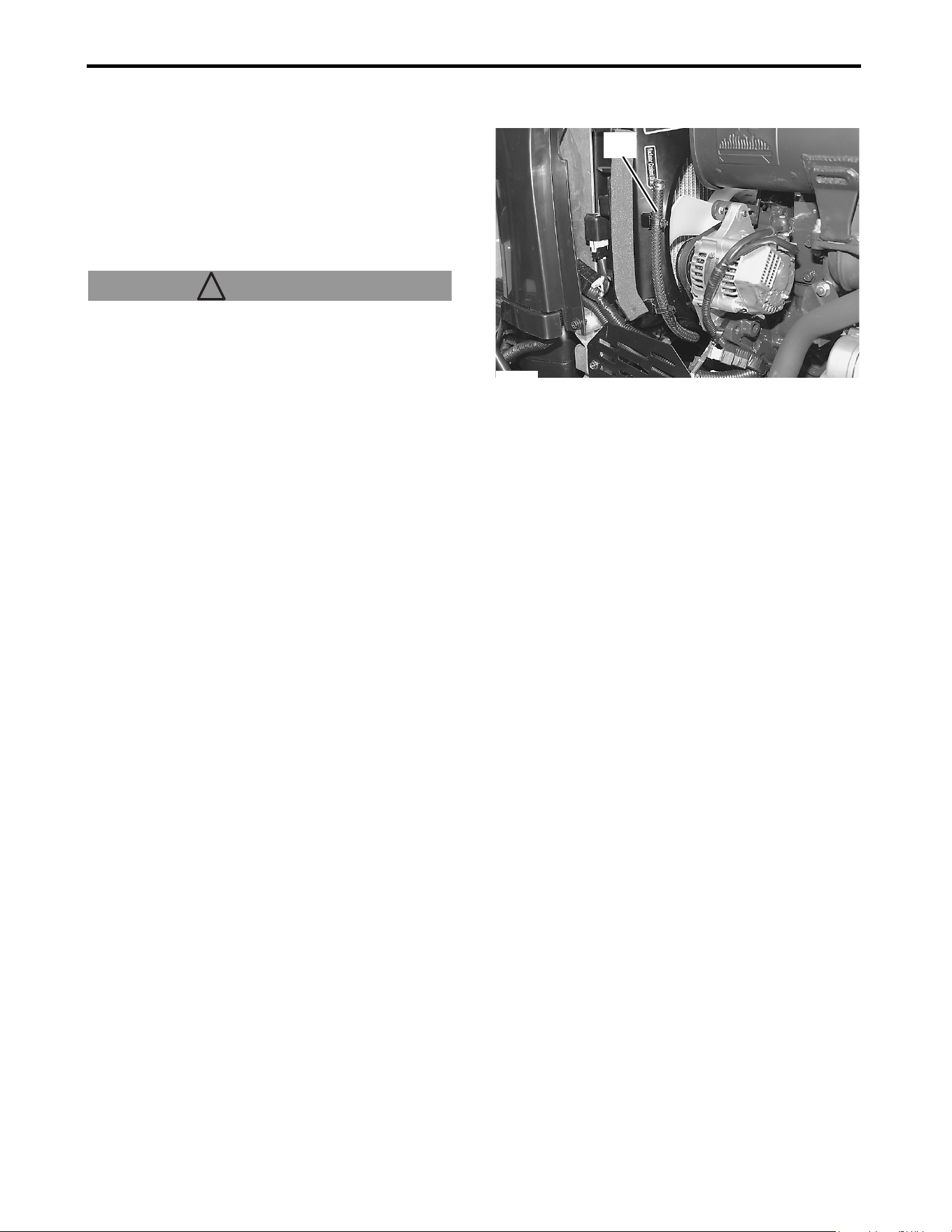
14-39
14. PERIODIC SERVICE
Sc2450 Operator’s Manual
2. Flush the Cooling System
1. Fill the cooling system with water and common
flushing/cooling liquid. Follow the flushing/cooling
liquid manufacture's instructions.
2. Reinstall and retighten the radiator cap.
3. Start and run the engine until it reaches the
operating temperature.
●The engine and coolant can be hot. Avoid
contact with skin to prevent severe burns.
ALWAYS wear safety glasses when draining
the cooling system.
4. Stop the engine.
5. Immediately drain the cooling system before rust
and dirt settle in it. See “Drain the Cooling
System” on page 14-38.
6. Plug the drain hose and fix it with the clamp.
(A) Drain hose
(A)
P3014932
! WARNING! WARNING

14-40
14. PERIODIC SERVICE
Sc2450 Operator’s Manual
■ Change the Coolant
IMPORTANT: Avoid damage.
●Use of an incorrect coolant mixture can damage
the radiator.
●NEVER operate the engine with plain water.
●NEVER use an antifreeze mixture with a
concentration of more than 50 % water to coolant
mixture.
●NEVER pour the coolant or water into the radiator
while the engine is hot.
NOTE
●For adding coolant to the cooling system, use of
High Quality Permanent Type Antifreeze (Ethylene
Glycol with corrosion and rust inhibitor chemicals)
is recommended.
For the correct mixture ratio, see the manufacturer’s
directions on the coolant container.
1. Allow the radiator to cool down.
2. Fill the cooling system. The cooling system
capacity is approximately 3.4 US qt (3.2 L).
3. Reinstall and retighten the radiator cap.
4. Start and run the engine until it reaches the
operating temperature.
5. Stop the engine.
6. Check the reserve tank coolant level, and add the
coolant as necessary.
7. Lower the hood.

14-41
14. PERIODIC SERVICE
Sc2450 Operator’s Manual
■ Replace the Air Cleaner Element
For the maintenance work, see “Service the Air Cleaner Element” on page 14-29.
■ Flush the Cooling System
For the maintenance work, see “Flush the Cooling System” on page 14-38.
■ Change the Coolant
For the maintenance work, see “Change the Coolant” on page 14-40.
■ Replace the Radiator Hoses and Clamp
For the maintenance work, see “Check the Radiator Hoses and Clamps” on page 14-10.
■ Replace the Fuel Line
For the maintenance work, see “Check the Fuel Line” on page 14-13.
■ Replace the Intake Air Hose
For the maintenance work, see “Check the Intake Air Hoses and Clamps” on page 14-13.
■ Replace the Hydraulic Hoses
For the maintenance work, see “Check the Hydraulic Hoses” on page 14-20.
■ Replace Power Steering Hose
Consult your local Cub Cadet Yanmar dealer for this service.
10. Every 1 Year
11. Every 2 Years

15-1
15. SERVICE THE ELECTRICAL SYSTEM
Sc2450 Operator's Manual
15.
SERVICE THE ELECTRICAL SYSTEM
●To avoid personal injury, do as follows:
●Read “Chapter 1. SAFETY PRECAUTIONS” at the
head of this manual.
●Read the danger, warning and caution statements
on the safety-alert symbols on the tractor.
●To avoid possible poisoning from exhaust fume, do
not operate the engine in an enclosed place that
lacks adequate ventilation.
●NEVER start the engine while standing on the
ground. Be sure to start the engine only from the
operator's seat.
●Before starting any servicing work, park your
tractor on solid, level ground, engage the parking
brake securely, turn off the Power Take Off (PTO)
switch, lower the implement to the ground, set the
forward and reverse drive pedal to the NEUTRAL
position, stop the engine and from the starter key
switch.
■ Special Note for the Battery
●The battery posts, terminals and associated
accessories contain lead and lead compounds
which are known to the State of California to
cause cancer and reproductive harm. After
handling the battery, wash hands thoroughly.
1. Battery
! WARNING! WARNING
! WARNING! WARNING
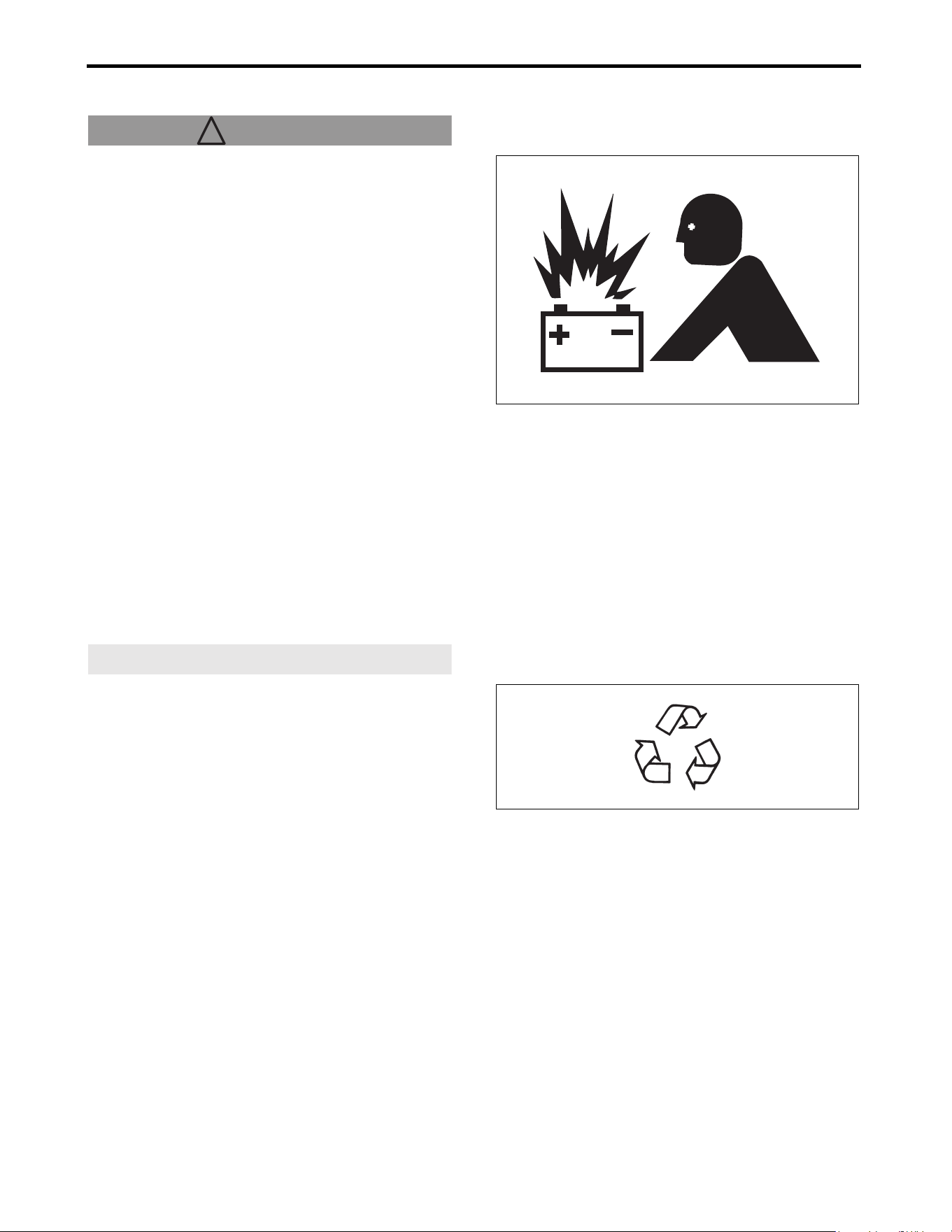
15-2
15. SERVICE THE ELECTRICAL SYSTEM
Sc2450 Operator's Manual
■ Service the Battery Safely
The battery electrolyte contains sulfuric acid,
which is poisonous and can cause serious burn:
●Wear protective goggles and gloves.
●NEVER expose skin.
●If electrolyte is accidentally swallowed,
immediately seek medical attention.
●If the electrolyte has entered eyes, immediately
flush with running water for 15-30 minutes and
seek medical attention.
●If the battery electrolyte comes into contact
with skin, immediately flush with a plenty of
water and, if necessary, seek medical attention.
Batteries may emit flammable/explosive gasses.
Use extreme caution when handling batteries.
●NEVER smoke near the battery.
●Wear protective goggles and gloves.
●NEVER allow any metal piece to contact across
the battery posts.
●When disconnecting the battery cables, first
remove the negative cable.
●When reconnecting the battery cables, connect
the negative cable last.
●Always remain aware of your environmental
responsibility.
●For environmentally appropriate disposal of
possibly hazardous materials on your tractor, such
as its engine oil, diesel fuel and hydraulic fluid,
follow the disposal guidelines of the EPA or other
relevant governmental bodies. Consult the local
authorities or waste disposal facility.
●NEVER dispose of the hazardous wastes from
your tractor inappropriately; for example by
dumping them into a sewer, on/into the ground or
into the groundwater or any waterways.
●Failure to follow these instructions may seriously
impact the environment.
! WARNING! WARNING
NOTICE
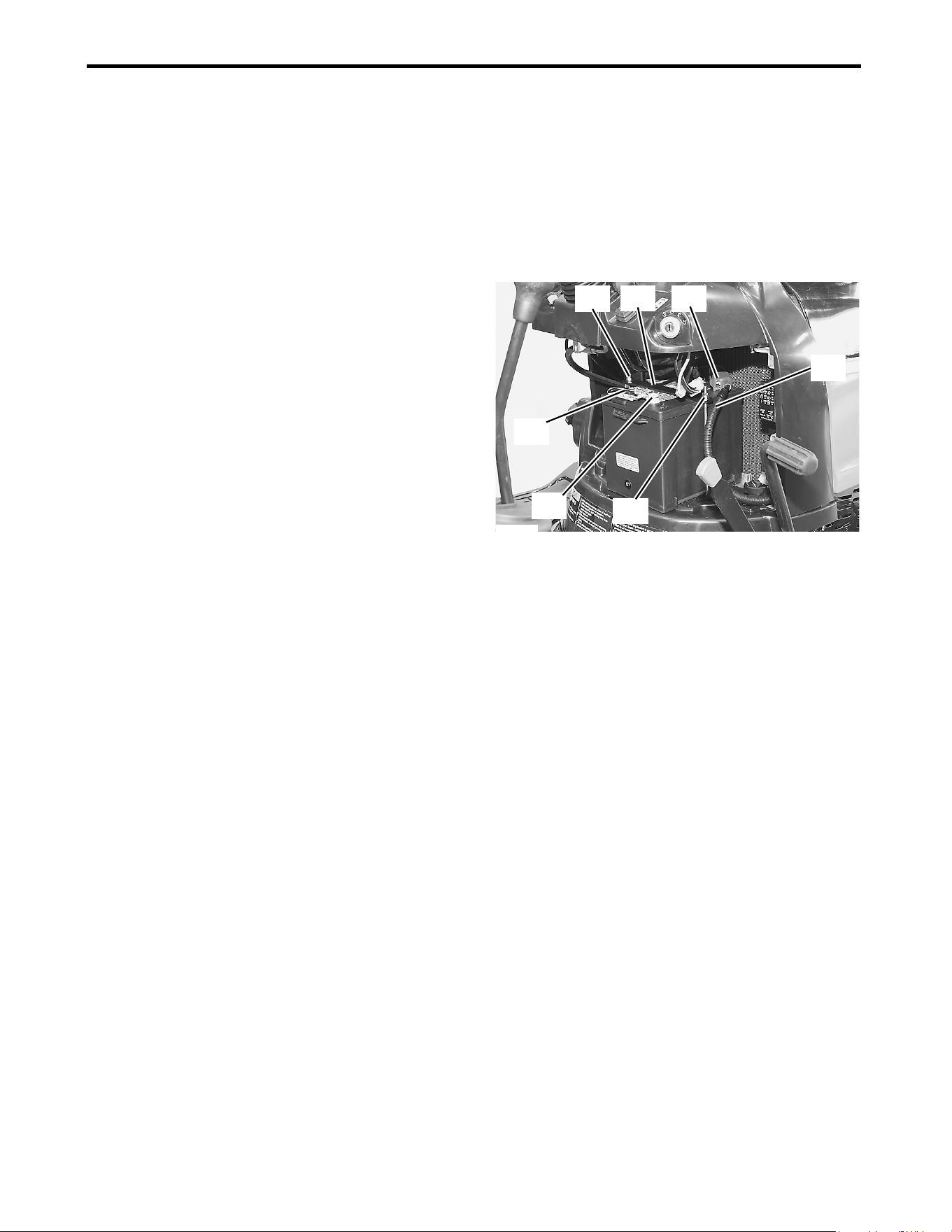
15-3
15. SERVICE THE ELECTRICAL SYSTEM
Sc2450 Operator's Manual
■ Inspect the Battery
The battery used on the tractor is a maintenance-free
design. Do not add electrolyte or recharge it. When
the engine is off, measure the voltage on the battery
across the positive and negative posts. If the reading
is 11 V or lower, replace the battery with a new one.
■ Remove and Install the Battery
(A) black/yellow negative (–) cable
(B) Negative terminal
(C) Red positive terminal cover
(D) Black positive (+) cable
(E) Threaded rods
(F) Bracket
1. Remove the Battery
1. Park the tractor safely and securely.
2. Open the rear grille screen.
3. Disconnect the black/yellow negative (–) cable
from the battery.
4. Remove the nuts from threaded rods.
5. Remove the threaded rods and bracket.
6. Pull out the battery backward around 4 in. (100
mm).
7. Pull back the red positive terminal cover and
disconnect the black positive (+) cable.
8. Remove the battery.
P3014933
(A)
(C)
(D)
(B)
(E)
(F)
(E)

15-4
15. SERVICE THE ELECTRICAL SYSTEM
Sc2450 Operator's Manual
2. Install the Battery
1. Install the battery onto the tractor.
2. Connect the black positive (+) cable to the battery
and then put the red positive terminal cover on
the terminal.
3. Install the threaded rods and bracket and,
retighten the nuts. Avoid over-tightening.
4. Connect the black/yellow negative (–) cable.
5. Apply petroleum jelly to the battery terminals to
protect them against corrosion.
6. Close the rear grille screen.
■ Clean the Battery and Terminals
1. Disconnect the battery cables, black/yellow
negative (–) cable first, and remove the battery.
2. Dissolve four tablespoons of baking soda in 1
gallon of water to prepare a solution. Use this
solution to wash the battery. Be very careful not to
allow the solution to enter the battery cells.
3. Rinse the battery with water and allow it to dry.
4. Clean the terminals and battery cable ends with
wire brush to remove corrosion.
5. Apply petroleum jelly or silicone spray to the
battery terminals to protect them against
corrosion.
6. Install the battery.
7. Connect the black positive (+) cable first, then
connect the black/yellow negative (–) cable.

15-5
15. SERVICE THE ELECTRICAL SYSTEM
Sc2450 Operator's Manual
■ Use a Booster Battery
●NEVER attempt to jump-start a frozen battery.
Warm it to 60°F (16°C).
●NEVER connect the negative (–) booster cable
to the negative (–) terminal of the discharged
battery. Connect to an appropriate grounding
point other than the discharged battery.
(A) Booster battery
(B) Battery on a disabled vehicle
(C) Positive (+) post of booster battery
(D) Positive (+) post of battery on a disabled
vehicle
(E) Negative (–) post of booster battery
(F) Other end of booster cable
1. Connect the positive (+) booster cable to the
positive (+) post on the booster battery.
2. Connect the other end of positive (+) booster
cable to the positive (+) post of the battery on the
disabled vehicle.
3. Connect the negative (–) booster cable to the
negative (–) post on the booster battery.
4. Connect the other end of negative (–) booster
cable to the metal frame of the disabled vehicle.
5. Start the engine of the disabled vehicle, and run
the engine for several minutes.
6. Carefully disconnect the booster cables by
performing the booster cables connection
procedure in the reverse order (disconnect the
negative cable first, and then the positive cable).
! WARNING! WARNING
(D)
(B) (A)
(F)
(E) (C)
3013737
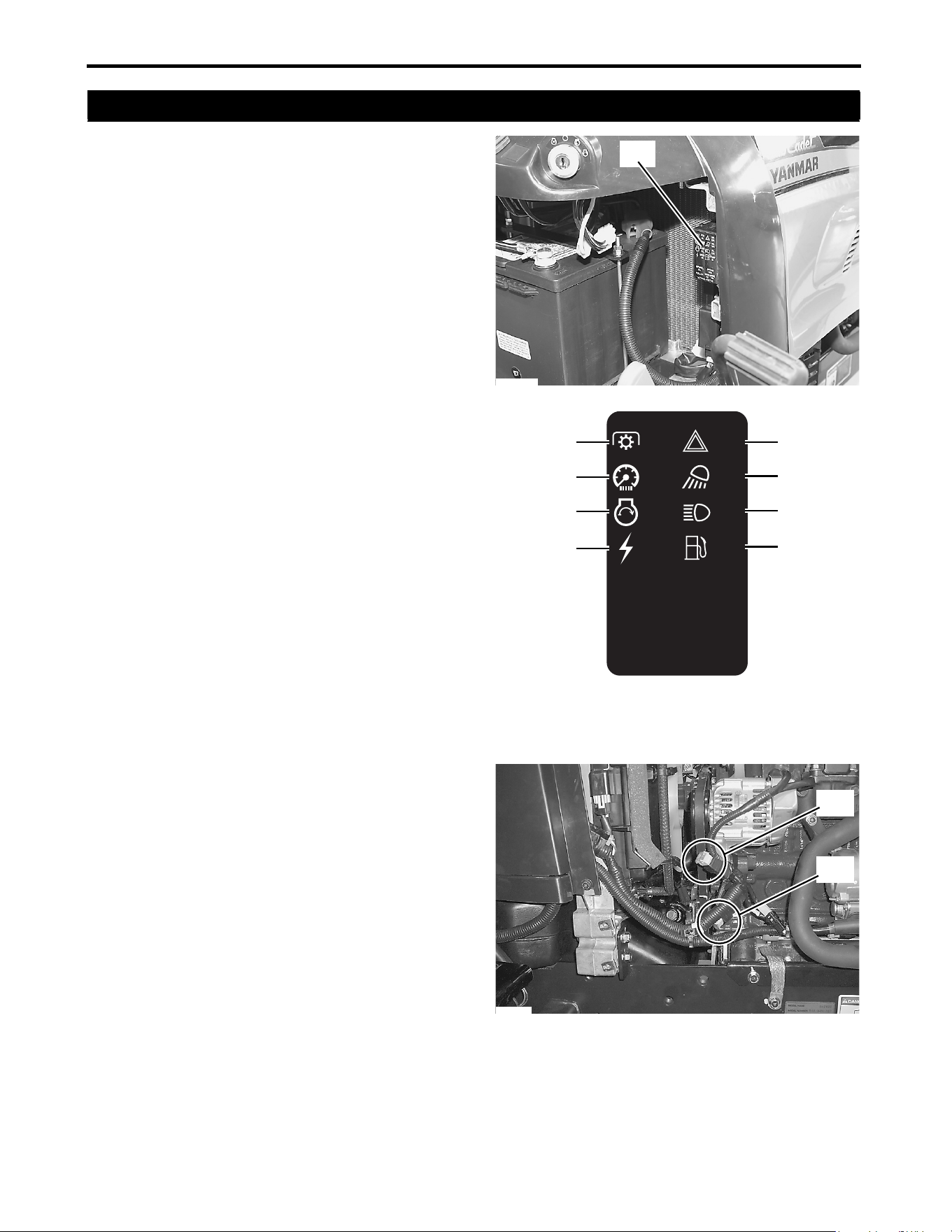
15-6
15. SERVICE THE ELECTRICAL SYSTEM
Sc2450 Operator's Manual
IMPORTANT: Avoid damage.
●Use of a fuse other than a correctly rated one may
cause damage to the electrical system. Replace
the blown fuse with a new fuse of the same
amperage rating.
■ Replace the Accessory Fuses
1. Park the tractor safely and securely.
2. Open the rear grille screen.
3. Grip both ends of the fuse holder cover and
remove.
4. Locate the fuses by referring to the diagram at the
right.
5. Remove the blown fuse from its socket.
6. Push the new fuse into the socket.
7. Reinstall the fuse holder cover.
8. Close the rear grille screen.
(A) Fuse holder cover
(1) PTO fuse: 5A
(2) Meter panel fuse: 5A
(3) Start relay fuse: 25A
(4) DC outlet fuse: 10A
(5) Warning light fuse: 15A
(6) Work light fuse: 10A
(7) Head light fuse: 15A
(8) Fuel pump fuse: 5A
■ Check the Alternator Fuse and the Main Fuse
1. Park the tractor safely and securely.
2. Open the hood.
3. Locate the fuses by referring to the picture at the
right.
4. Check the fuses.
IMPORTANT: Avoid damage.
●The alternator fuse and the main fuse are of slow
blow type. When any of these fuses has been
blown, contact your local Cub Cadet Yanmar
dealer.
(A) Alternator fuse: 60A
(B) Main fuse: 60A
2. Fuses
P3014934
(A)
WA
15A
WL
10A
HL
15A
PTO
5A
F.PUMP
㪪㪧㪘㪩㪜
㪈㪇㪘
㪧㪬㪣㪣㪜㪩
㪪㪧㪘㪩㪜
㪉㪌㪘
5A
㪪㪧㪘㪩㪜
㪈㪌㪘
START
OUTLET
10A
㪪㪧㪘㪩㪜
㪌㪘
METER
5A
25A
1A7880-65780
(1)
(2)
(3)
(4)
(5)
(6)
(7)
(8)
P3014949
(A)
(B)
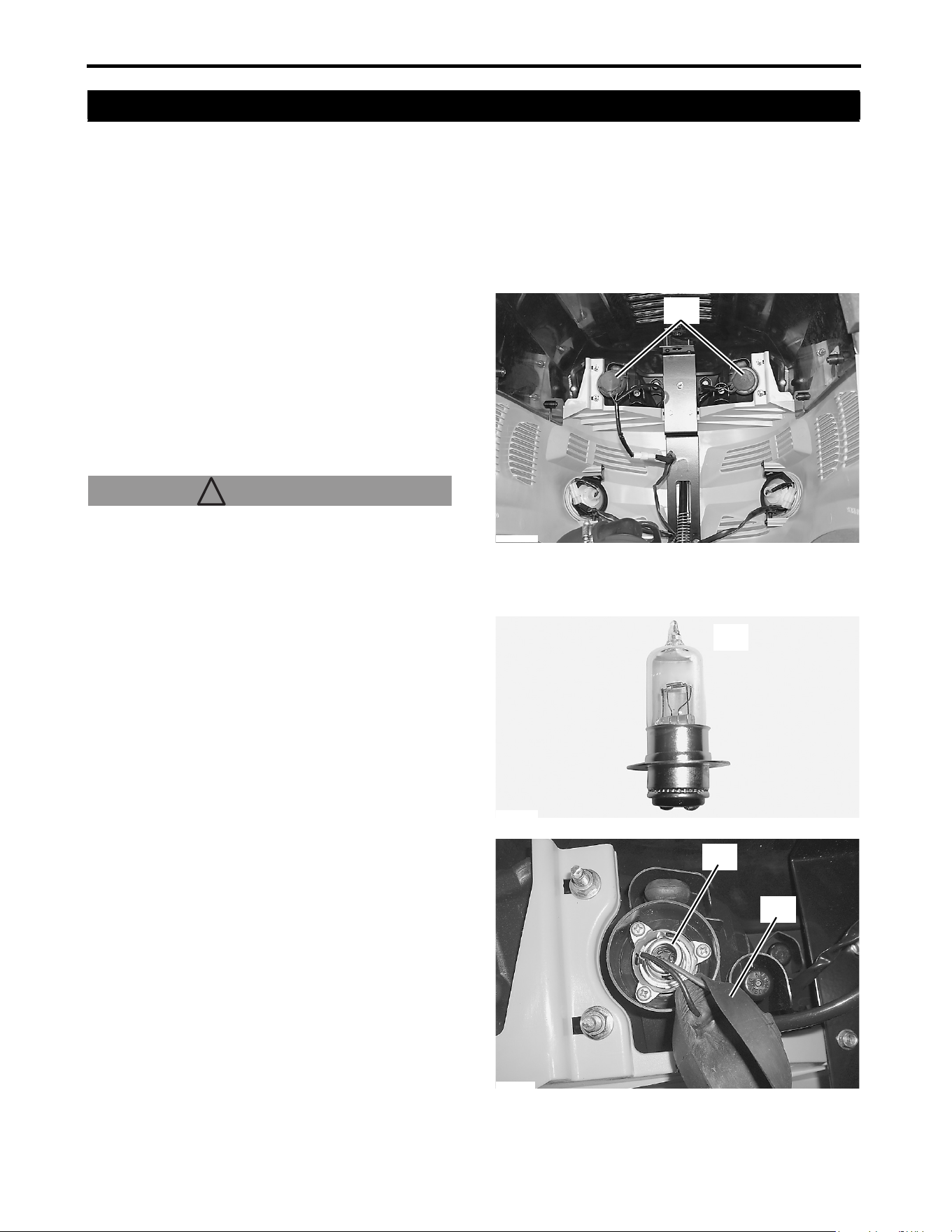
15-7
15. SERVICE THE ELECTRICAL SYSTEM
Sc2450 Operator's Manual
■ Replace the Headlight Bulb
IMPORTANT: Avoid damage.
●NEVER touch the headlight bulbs with bare fingers,
otherwise, the bulb may fail prematurely. When
inspecting or replacing the bulb, use gloves or a
piece of cloth to handle the bulb.
1. Park the tractor safely and securely.
2. Stop the engine and remove the key from the
starter key switch.
3. Open the hood.
4. Remove the headlight cover.
5. Turn the headlight bulb socket counterclockwise
slightly to remove it from the headlight bulb
housing.
●The halogen light bulb contains compressed
gas. If the glass has been scratched or is
dropped, the bulb may shatter. Wear protective
goggles and handle the bulb carefully when
replacing it.
6. Remove the old headlight bulb from the bulb
socket.
7. Install new one into the bulb socket and fix it.
8. Turn the headlight bulb socket clockwise slightly
and fix it to the bulb housing.
9. Put on the headlight cover on the headlight bulb
housing and fix it.
10.Close the hood.
11.Check that the headlights light normally.
(A) Headlight assembly
(B) Headlight bulb
(C) Headlight socket
(D) Headlight cover
3. Bulb
P3014935
(A)
! WARNING! WARNING
P3014955
(B)
P3014950
(C)
(D)
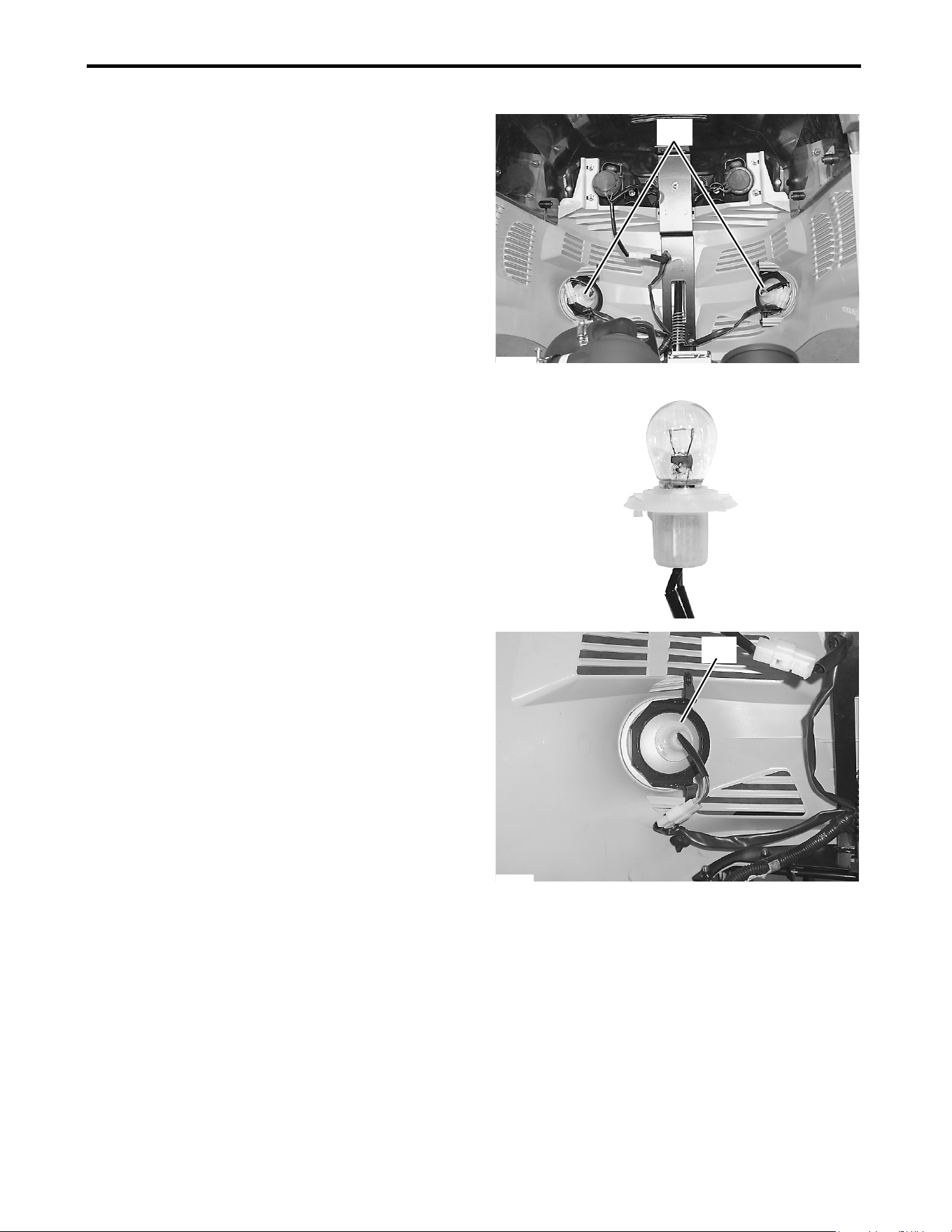
15-8
15. SERVICE THE ELECTRICAL SYSTEM
Sc2450 Operator's Manual
■ Replace the Work Light Bulb
1. Park the tractor safely and securely.
2. Stop the engine and remove the key from the
starter key switch.
3. Open the hood.
4. Turn the work light socket counterclockwise
slightly to remove it from the work light housing
5. Remove the bulb from the work light socket.
6. Install a new bulb into the work light socket.
7. Turn the work light socket clockwise slightly and
fix it to the work light housing.
8. Close the hood.
9. Check that the work lights light normally.
(A) Work light assembly
(B) Work light bulb
(C) Work light socket
P3014935
(A)
P3014956
(B)
P3014951
(C)
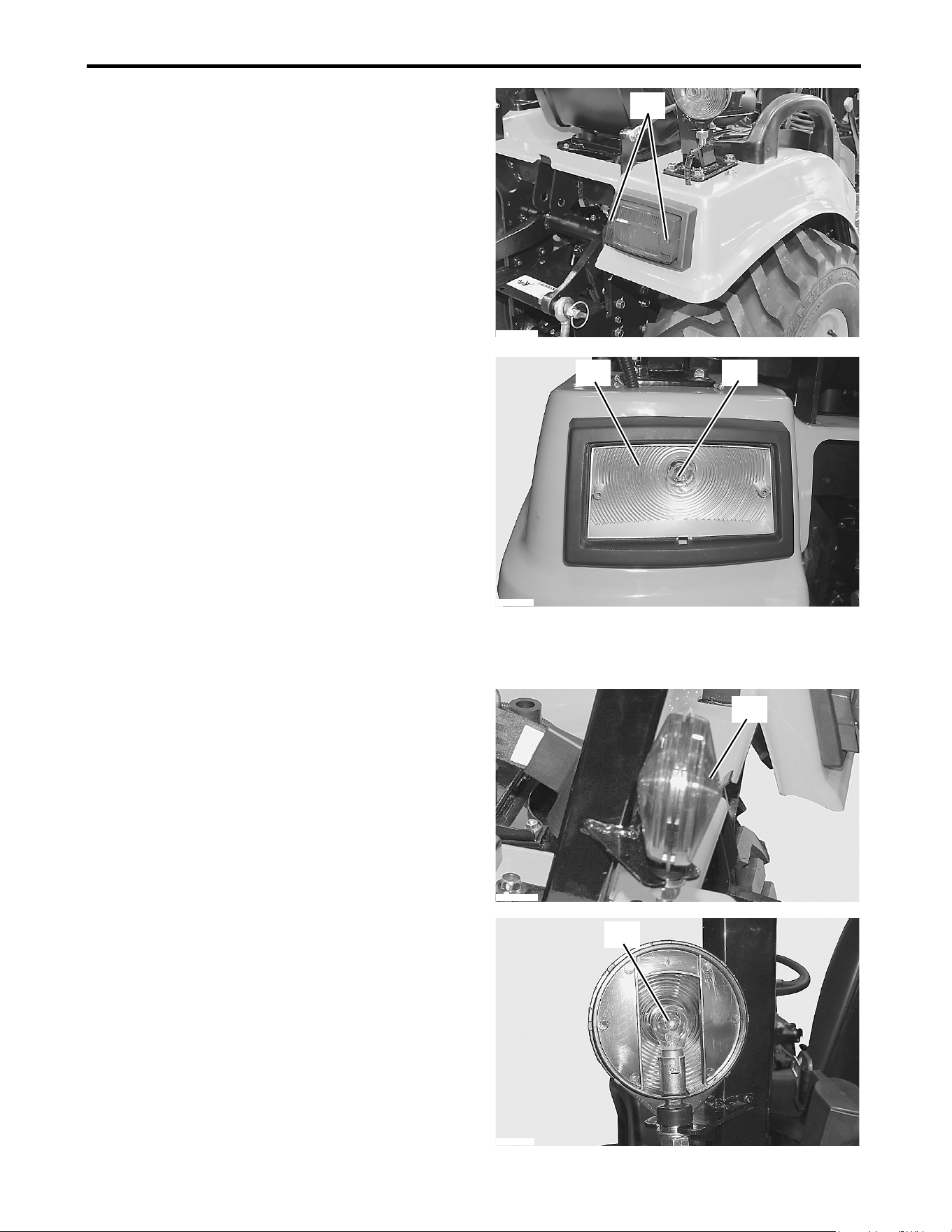
15-9
15. SERVICE THE ELECTRICAL SYSTEM
Sc2450 Operator's Manual
■ Replace the Tail Light Bulb
1. Park the tractor safely.
2. Stop the engine and remove the key from the
starter key switch.
3. Remove the two screws and lens from the
assembly.
4. Push down and rotate the bulb to remove it.
5. Push the new bulb into the socket and rotate to
lock it into position.
6. Check that the tail light lights normally.
7. Reinstall the lens.
(A) Screw
(B) Lens
(C) Bulb
■ Replace the Turn Signal/Hazard Lights Bulb
NOTE
●The turn signal/hazard lights can be serviced after
removing the front or rear lens assembly.
1. Park the tractor safely.
2. Stop the engine and remove the key from the
starter key switch.
3. Remove the lens from the light assembly.
4. Push down and rotate the bulb to remove it.
5. Push the new bulb into the socket and rotate to
lock it into position.
6. Check that the turn signal/hazard lights operate
normally.
7. Install the lens.
(A) Lens
(B) Bulb
P3014936
(A)
P3014953
(C)(B)
P3014937
(A)
P3014954
(B)

15-10
15. SERVICE THE ELECTRICAL SYSTEM
Sc2450 Operator's Manual
■ Replace the Instrument Panel Light Bulb
If any instrument panel bulb is blown, contact your local
Cub Cadet Yanmar dealer for technical assistance.
■ Adjust the Headlights
The headlights are fixed. If their adjustment is required,
contact your local Cub Cadet Yanmar dealer for technical
assistance.
4. Headlights

16-1
16. STORE THE TRACTOR
Sc2450 Operator's Manual
16. STORE THE TRACTOR
●Remember that vapor from diesel fuel is explosive and flammable.
●The exhaust from the engine contains carbon monoxide that can
lead to carbon monoxide poisoning, possibly causing serious
illness or even death. To avoid the danger of poisoning from the
exhaust gas, NEVER run the engine in a closed building that is not
positively ventilated.
●NEVER wash the tractor while the engine is running.
●Run the engine as shortly as possible when moving the tractor into
and from the place of storage.
●When fuel is in the fuel tank, NEVER store the tractor in a building
where fuel vapor can come into contact with open flame or spark.
●Before storing the tractor indoors, allow the engine to cool off.
1. Prepare the Machine for Storage
If planning to store the tractor for a long period, follow the procedure
described below.
The procedure is intended to ensure that the tractor is readily prepared for
operation when it is removed from storage.
1. Repair any worn or damaged parts. Replace the parts as necessary.
Tighten any loose bolts and nuts.
2. Repair scratched or chipped metal surfaces to prevent rusting.
3. Remove grass clippings and debris from the tractor.
4. Clean below the deck and remove grass clippings and debris from
inside the chute and bagger.
5. Remove the ballast from the tractor.
6. Wash the tractor and apply wax to the metal and plastic surfaces.
7. Run the tractor for 5 minutes to dry the belts and pulleys.
8. Apply a light coat of clean engine oil to pivots and wear points to
prevent rusting.
9. Lubricate the lube fittings.
10. Check the tire pressure. Adjust the tire pressure slightly higher than
specified.
11. Change the engine oil and run the engine for about 5 minutes to
circulate the oil throughout the entire engine block and the internal
moving parts.
12. Lower any implement to the ground. Apply grease to
the exposed areas on the hydraulic cylinder piston
rods.
1. Safe Practices for Storage
! WARNING

16-2
16. STORE THE TRACTOR
Sc2450 Operator's Manual
2. Prepare the Fuel and Engine for Storage
■ Fuel
If using stabilized fuel, fully fill the fuel tank with stabilized fuel.
NOTE
●By filling the fuel tank, the amount of air remaining in the tank decreases,
and this can help prevent deterioration of the fuel in the tank.
If stabilized fuel has not been used.
1. Park the tractor safely and securely in a well-ventilated place.
NOTE
●Assuming that this is the last time the tractor is operated for the season, use
all the fuel in the fuel tank.
2. Run the engine until all the fuel in the tank is used.
3. Turn the key to the OFF position.
IMPORTANT: Be very careful to avoid damage.
●In degraded fuel, varnish can occur and clog the fuel injector components
and adversely affect engine performance.
●Mix stabilizer into fresh fuel before filling the fuel tank.
4. Mix fresh fuel and fuel stabilizer in a separate container.
Observe the stabilizer manufacturer's instructions for mixing.
5. Fill the fuel tank with the stabilized fuel.
6. Run the engine for several minutes to allow the fuel-stabilizer mixture to be
circulated through the fuel system.
■ Engine
If the tractor is scheduled to be stored for longer than 60 days, prepare the
engine for storage.
1. Change the engine oil and filter while the engine is still warm.
2. Service the air filter if necessary.
3. Remove dust and debris from the engine air intake screen.
4. Clean the engine and engine compartment.
5. Remove the battery.
6. Clean the battery and battery posts. Check the electrolyte level.
7. Close the fuel shut-off valve.
8. Store the battery in a cool, dry, dark place. However, the temperature of
that place must not become low enough to freeze the electrolyte in battery.
9. Store the tractor in a dry, safe place. If the tractor is stored outdoors,
protect it with a waterproof cover. Jack up the tractor and place blocks
under the front and rear axles to allow the tires to be lifted off the ground.
Do not allow the tires to be exposed to direct sunlight or extremely high
temperature.

16-3
16. STORE THE TRACTOR
Sc2450 Operator's Manual
1. Check the tire pressure. If necessary, refill with compressed air.
2. Check the levels of engine oil, transmission/hydraulic oil and engine
coolant.
3. Check the battery electrolyte level.
4. Check that the battery is adequately charged.
5. Install the battery.
6. Check the fan belt tension.
7. Lubricate all the lube fittings.
8. If the tractor has a fuel shut-off valve, open it.
9. Run the engine for 5 minutes while the mower or any implement is
disengaged to allow the oil to be fully distributed throughout the entire
engine. After stopping the engine, walk around the tractor and check for
any evidence of oil or other leakage.
10. Make sure that all the shields, guards or deflectors are in place.
2. Prepare the Stored Tractor for Operation

17-1
17. TROUBLESHOOTING
Sc2450 Operator's Manual
17. TROUBLESHOOTING
The troubleshooting table given below is intended to provide a simple guide for the operator or owner. If
any fault, failure or a problem that requires repair work has occurred, contact your local Cub Cadet
Yanmar dealer for technical assistance.
1. Engine
1. Guide in Using the Troubleshooting Table
Symptom Cause Remedy
1 Engine does not
start or engine
starts, but stalls
immediately.
z Diesel fuel is not flowing or is not
flowing sufficiently to the engine.
• Check that there is sufficient fuel in the
fuel tank. Refuel as necessary.
• Check that the fuel filter is not clogged.
Replace the clogged filter.
z Air is trapped in the fuel system. • Check the fuel line for looseness.
Retighten any loose connections.
• Bleed air from the fuel system.
z Water contamination in the fuel
system.
• Remove water from the fuel tank, fuel lines
and fuel filter (replace filter as necessary).
Refill the fuel tank with diesel fuel.
z In cold weather, the engine oil viscosity
is excessively high, which causes
greater resistance. As a result, the
engine speed is lower than normal.
• Use a less viscous engine oil; Be sure to
change to a more viscous engine oil in
summer. (Consult your local Cub Cadet
Yanmar dealer for details.)
z The power of the battery is too low and
the starter fails to accelerate to a
speed sufficient to start the engine.
• Clean the battery posts and terminals,
then measure the voltage of the battery. If
the voltage is 11 V or lower, replace the
battery with a new one.
• During cold weather, it is recommended to
remove the engine from the tractor and
store it indoors. Recharge the battery (as
necessary) before installing it in the
tractor.
2 Engine starts, but
fails to run
smoothly or is not
powerful.
z Stale diesel fuel (owing to prolonged
storage).
• Replace the diesel fuel.
z Contaminated diesel fuel. • Replace the diesel fuel. Replace fuel filter
(as necessary).
z Clogged air cleaner. • Replace the air cleaner.
z The fuel shut-off valve is not in the fully
OPEN position.
• Fully open the fuel shut-off valve.
3 Engine starts
successfully, but
stops suddenly.
z No diesel fuel. • Refuel.
z The fuel shut-off valve is not in the
OPEN position.
• Open the fuel shut-off valve.
4 Blackish exhaust. z Poor diesel fuel quality. • Replace the diesel fuel and fuel filter.
z Too much engine oil. • Drain the engine oil to the specified level.
z Clogged air filter. • Clean or replace the air filter.
5 Pale bluish
exhaust.
z Faulty or defective injection nozzle. • Contact your local Cub Cadet Yanmar
dealer for technical assistance.
z Poor diesel fuel quality. • Replace the diesel fuel and fuel filter.

17-2
17. TROUBLESHOOTING
Sc2450 Operator's Manual
2. Machine
6 Engine overheats. z Insufficient engine coolant. • Add engine coolant.
• Check the radiator and the lines to and
from the radiator for leakage. If leakage is
found, contact your local Cub Cadet
Yanmar dealer for technical assistance.
z Overloaded engine. • Operate the tractor carefully and
moderately. Avoid overloading.
z Insufficiently tensioned fan belt, or
broken fan belt.
• Adjust the fan belt to the specified tension
value, or replace fan belt if broken or
damaged.
z The radiator core is blocked. • Check for dirt accumulated in the radiator
core and grille screen.
z Poor engine coolant quality. • It is possible that sludge has accumulated
on the engine water jacket. Contact your
local Cub Cadet Yanmar dealer for
technical assistance.
Symptom Cause Remedy
1 Machine vibrates
excessively.
z Engine speed is too low • Run the engine at an appropriate higher
speed.
z The Power Take Off (PTO) connecting
the tractor with the mounted implement
is not properly and securely connected.
• Disconnect the Power Take Off (PTO)
shaft, and properly reconnect it. Check if
excessive vibration reoccurs. If excessive
vibration persists, immediately stop
operation and contact your local Cub
Cadet Yanmar dealer for technical
assistance.
z Water is trapped in the fuel filter (water
sedimentor).
• Drain the fuel filter water sedimentor.
Check for water in the fuel tank, drain as
necessary.
z The engine throttle cable and linakges
have not been correctly adjusted.
• Contact your local Cub Cadet Yanmar
dealer for technical assistance.
2 Engine starts
successfully, but
the tractor fails to
operate.
z Parking brake is engaged. • Disengage the parking brake.
z Insufficient transmission/hydraulic oil,
deteriorated transmission/hydraulic oil
or clogged transmission/hydraulic oil
filter.
• Check the amount and quality of the oil.
Replace deteriorated oil. Refill as
necessary. Check the filter for clogging,
and replace the clogged filter with a new
one.
z Transmission/hydraulic oil is too cold. • Start the engine. Operate the tractor when
the engine has fully warmed up.

17-3
17. TROUBLESHOOTING
Sc2450 Operator's Manual
3. Brake
4. Steering
Symptom Cause Remedy
1 Brake does not
function correctly.
z Improperly adjusted brake pedal play. • Properly adjust the brake pedal play.
z Worn or damaged brake linkage. • Contact your local Cub Cadet Yanmar
dealer for technical assistance.
z Excessively worn brake disk. • Contact your local Cub Cadet Yanmar
dealer for technical assistance.
z Deteriorated transmission/hydraulic oil. • Replace the transmission/hydraulic oil.
z Degraded quality of transmission/
hydraulic oil.
• Replace the transmission/hydraulic oil.
Symptom Cause Remedy
1 Steering does not
function correctly.
z Uneven tire pressure. • Adjust the tire pressure to the correct
level.
z Insufficient transmission/hydraulic oil,
deteriorated transmission/hydraulic oil
or clogged transmission/hydraulic oil
filter.
• Check the amount and quality of the oil.
Replace deteriorated oil. Refill as
necessary. Check the filter for clogging,
and replace the clogged filter with a good
one.
z Transmission/hydraulic oil is too cold. • Start the engine, and warm up the
transmission/hydraulic oil.
z Insufficient lubrication of the steering
linkage.
• Lubricate steering linkage.
z Steering play is too great. • Contact your local Cub Cadet Yanmar
dealer for technical assistance.
z Bent front axle. • Contact your local Cub Cadet Yanmar
dealer for technical assistance.


19-1
19. INDEX
Sc2450 Operator's Manual
19. INDEX
REMARKS
●The following index terms will be added to the existing Sc2400.
3-Point Hitch Control/Cutting Height
Adjustment Lever ........................................ 5-7, 10-1
4-Wheel Drive Lever .......................................... 5-10
Air Cleaner Element......................................... 14-29
Alternator.......................................................... 14-24
Alternator/Battery Charging Light....................... 5-11
Battery................................................................ 15-1
Brake Pedal.......................................................... 5-4
Coolant............................................................. 14-37
Cruise Control Lever ............................................ 5-6
Cruise Control ...................................................... 8-9
Differential Lock ................................................. 8-15
Drive Pedal (Forward/Reverse)............................ 5-5
Engine Oil Dipstick ............................................. 14-8
Engine Oil Fill Cap ............................................. 14-8
Engine Oil Filter................................................ 14-27
Engine Oil Pressure Warning Light .................... 5-11
Fan Belt............................................................ 14-24
Float ..................................................................... 5-5
Fuel ........................................................... 13-3, 14-4
Fuel Cap............................................................. 14-7
Fuel Shut-Off Valve .............................................. 7-2
Fuel Filter ......................................................... 14-36
Fuel Gauge ........................................................ 5-11
Fuel/Water Separator....................................... 14-23
Glow..................................................................... 7-8
Hazard Light....................................................... 15-9
Hazard Lights Button Switch ................................ 5-3
Headlight ......................................................... 15-10
Headlight Switch .................................................. 5-9
Hood .................................................................. 14-2
Hour Meter ......................................................... 5-11
Hydraulic Flow Control/Stop Knob.............5-10, 11-2
Hydro Static Transmission (HST)
Pressure Release Lever ..............................5-7, 8-20
Implement Control Lever ......................................5-5
Inflation Pressure................................................12-2
Instrument Panel.................................................5-11
Lift Link ...............................................................10-2
Lubricant .............................................................13-3
Maximum Weight ................................................12-3
Mid-/Rear-Power Take Off (PTO) Select Lever
...5-9, 9-3
Parking Brake .......................................................7-5
Parking Brake Lever .............................................5-4
Power Steering ...................................................8-24
Power Take Off (PTO) ..........................................9-1
Power Take Off (PTO) switch ........................5-8, 7-6
Range Gear Lever ................................................5-8
Retractable Seat Belt............................................7-4
Reverse-Override-Switch...............................5-8, 9-2
Roll-Over Protective Structure (ROPS) .........1-8, 8-3
Seat Adjustment Lever .........................................7-2
Seat Safety Switch............................................14-15
Slow Moving Vehicle (SMV) Emblem ........8-16, 8-18
Starter Key Switch ................................................5-3
Sway Link ...........................................................10-2
Tachometer.........................................................5-11
Tail Light ......................................................5-9, 15-9
Throttle Control Lever ...........................................5-4
Top Link ..............................................................10-2
Top Link Retainer ...............................................10-1
Transmission/hydraulic Oil................................14-33
Turn Signal Switch................................................5-9
Wheel Bolt Tightening Torque ............................12-2