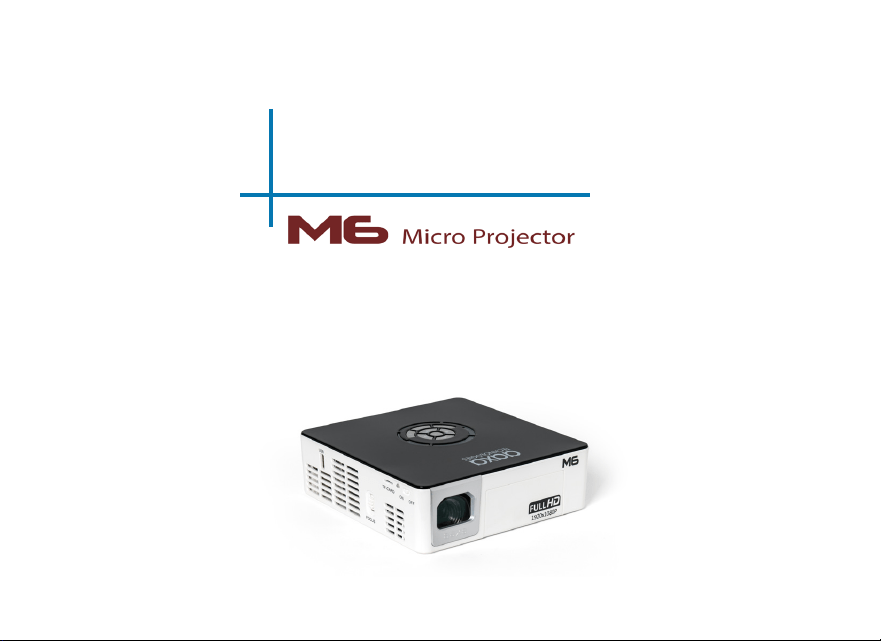
aaxa
TECHNOLOGIES
User Guide
Caution!
WARNING: Please use this product as instructed. Misuse may cause
injury or death.
DO NOT use while driving
DO NOT expose to water or wet
surfaces. Electric shock may occur
DO NOT expose the projected LED
image to your eyes or the eyes of
others
DO NOT block or restrict airow
from ventilation holes as this may
cause the projector to overheat
Keep the projector, battery, or
charger away from any heat sources
Caution for Battery Use
• Do not pierce or puncture the battery
with sharp objects
• Do not heat the product or expose it to
high temperature.
• Do not wet it or place it in any liquid
Caution for Headphone Use
• Prolonged use at high volume may impair your
hearing.
• High volume during walking or driving may
cause distractions and result in injury or death
Table of Contents
Chapter 1: M6 at a Glance
M6 Introduction
Remote & Keypad
Accessories
Chapter 2: Getting Started
Powering On / Off
Focus Adjustment / Throw
Distance
External Input/Outputs
Connecting to a Computer VGA
Connecting to a Digital Input
Connecting to Composite Video
Connecting to Digital Input Video
Connecting to Speaker or
Headphones
Connecting a TF Card
Connecting a USB Stick
Chapter 3: Menu Screens
Main Menu
Video Player Menu
Photo Viewer Menu
Music Player Menu
Text Viewer Menu
Chapter 4: Setup Menu
Settings
Brightness Feature
Chapter 5: Technical Details
Troubleshooting
Specications
Notes
1
2
3
4
5
6
7
9
11
13
15
16
18
20
21
25
29
32
33
37
38
40
41
M6 at a Glance
1
Chapter 1
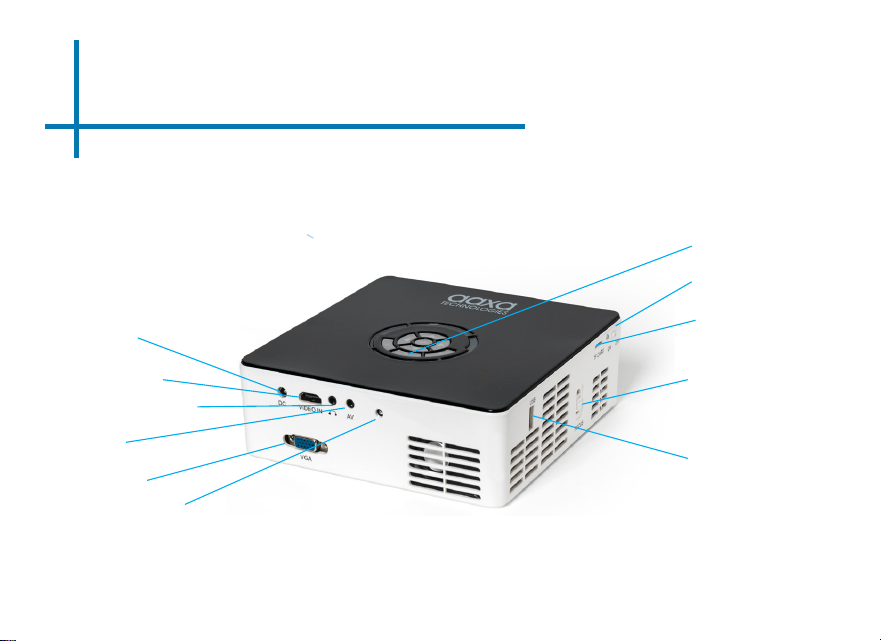
Power Switch
TF Card
Digital Input
USB Port
Main Unit Front/Back
VGA Port
Power Button
Focus Adjustment
AV Port
Headphone Out
Power On/Off
DC Port
Infrared Receiver
(Remote Control)
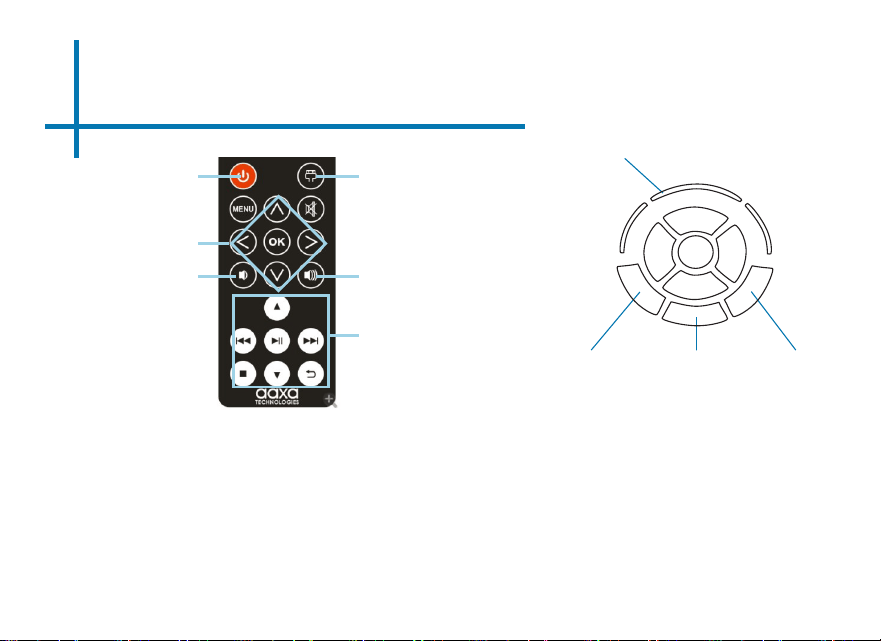
Remote & Keypad
2
NOTE: Pressing power on the remote will only put the projector in STANDBY mode.
Toggle the “ON/OFF” switch on the side of the projector to fully turn the projector
off.
Power On/Off
Select Source
Input Exit/Back
Direction Pad
Both the keypad and remote can be used to navigate through the menus. The Main Menu
Navigation on the remote functions exactly the same as the directional pad on the M6 unit.
On / Off
LED Lights
OK
Main Menu
Navigation
Media Player
Menu Navigation
Volume Up
Volume Down
Remote
*Keystone function is not available.
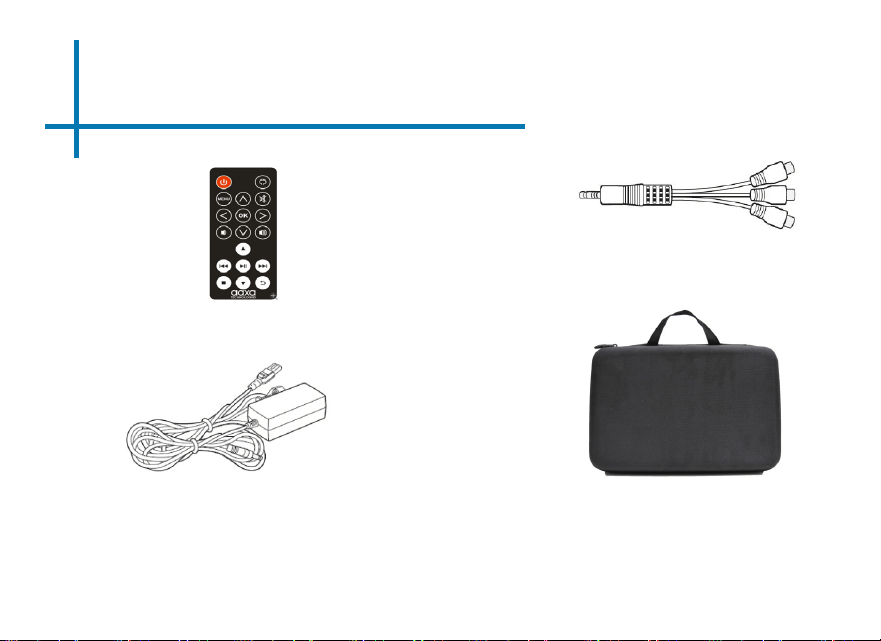
Accessories
3
*Under various circumstances, the actual accessories may be different from
those shown in the pictures above.
Additional accessories are available for purchase at www.aaxatech.com
Remote
Power Adapter
A/V Cable
Carrying Case
Getting Started
1. Connect the power cord to the M6.
2. Connect the other end of the power cord into the wall power source.
3. Toggle the On / Off switch on the side of the projector to the “ON” position -- the
projector should automatically turn on.
4. If the projector does not automatically turn on with the “Power Switch” toggled to the
“ON” position, press the “ON/OFF POWER” button on the keypad and hold for
2-3 seconds to start the projector.
4
Powering ON the projector
Chapter 2
Powering OFF the projector
Standby Mode
1. To transition to “STANDBY” mode, press the power button on the keypad or the
remote control.
2. The optical engine should power off and the fan should stop spinning. The projector
is now in “STANDBY” mode and can be turned on using the remote control.
*Note: Standby mode will still consume a small amount of power.
1. To turn off the projector, toggle the “Power Switch” to the “OFF” position. This will
fully turn off the projector.
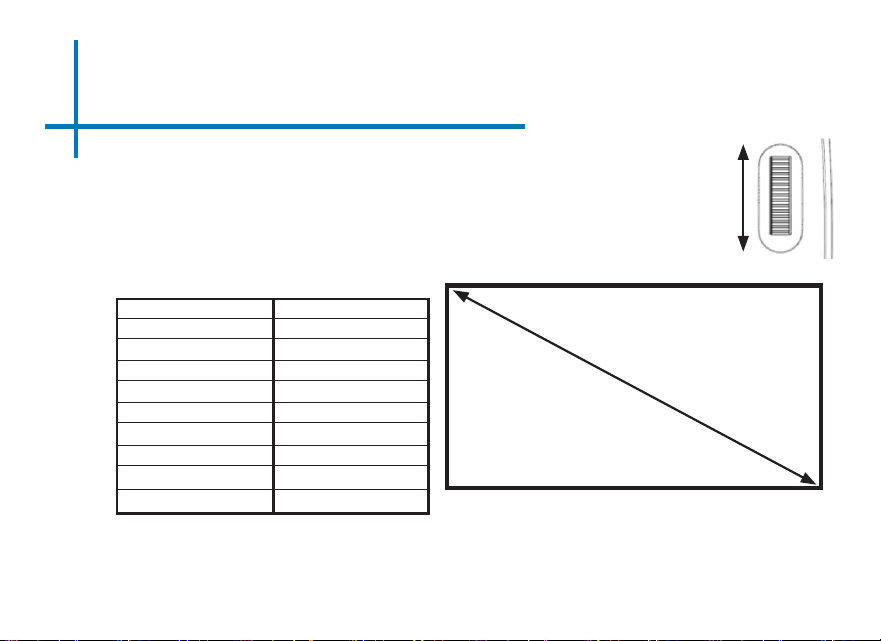
Focus Adjusment / Throw Distance
5
DIAGONAL SCREEN SIZE
16:9 Aspect Ratio
Throw Distance
Units: Inches
19
38
58
77
96
115
153
192
Diagonal Size
Units: Inches
20
40
60
80
100
120
160
200
• Spin the focus wheel up or down until the image becomes
clear.
Focus Adjustment
Throw Distance Chart
Throw Ratio 1.10
Projection Angle: 100% Offset
*minimum throw distance: 12 inches
6
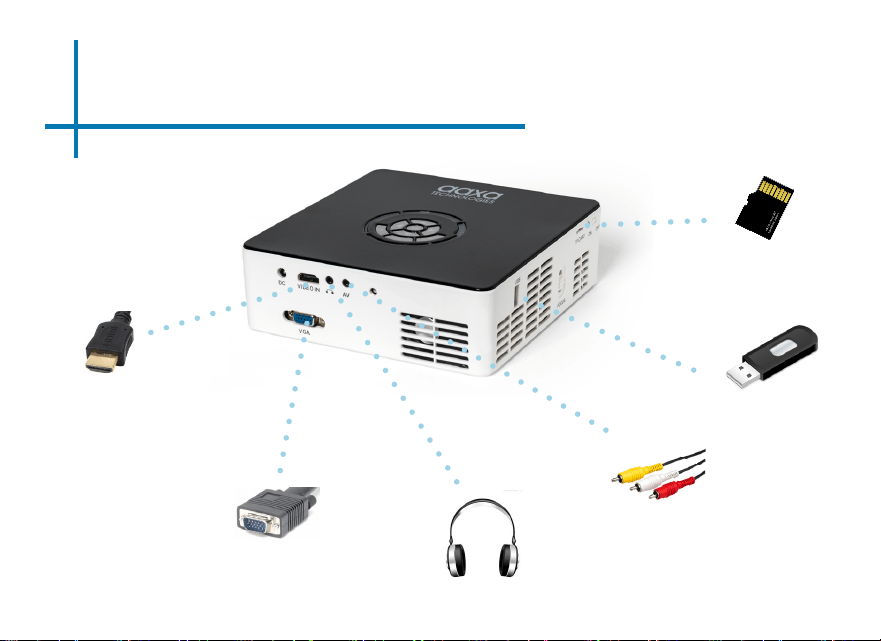
External Inputs and Outputs
Headphones/speakers
Composite Cable
Digital Input
VGA
USB Stick
TF Card
Connecting to a Computer via VGA
7
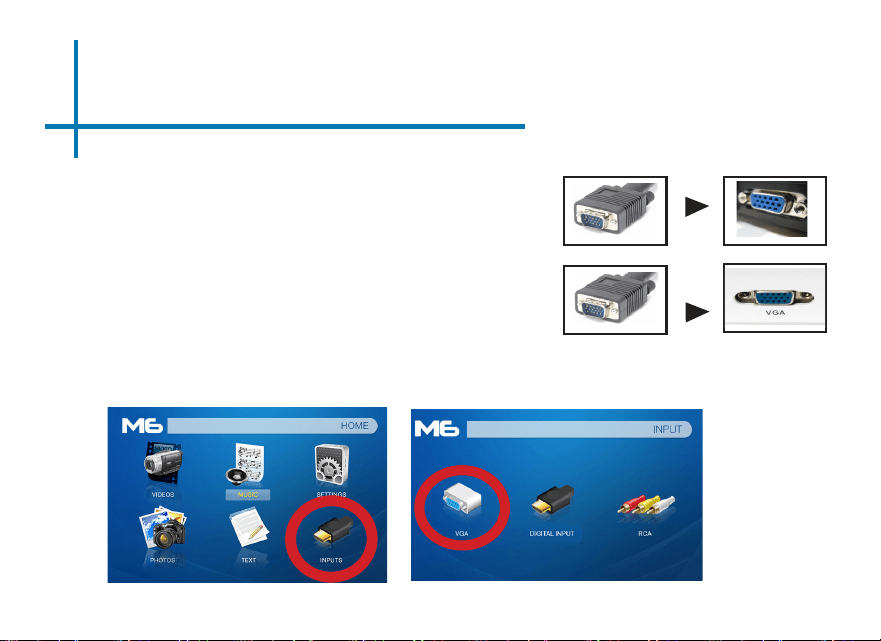
Connect one end of the VGA Cable
to your computer’s VGA Adapter.
Step 1:
Step 2:
Step 3:
In the Main Menu, select the “Inputs” icon and then the “VGA” Icon.
Connect the other end of the VGA
Cable to your M6’s VGA port.
Select “VGA” icon Select “INPUT” icon
Connecting to a Computer Cont.
Step 4:
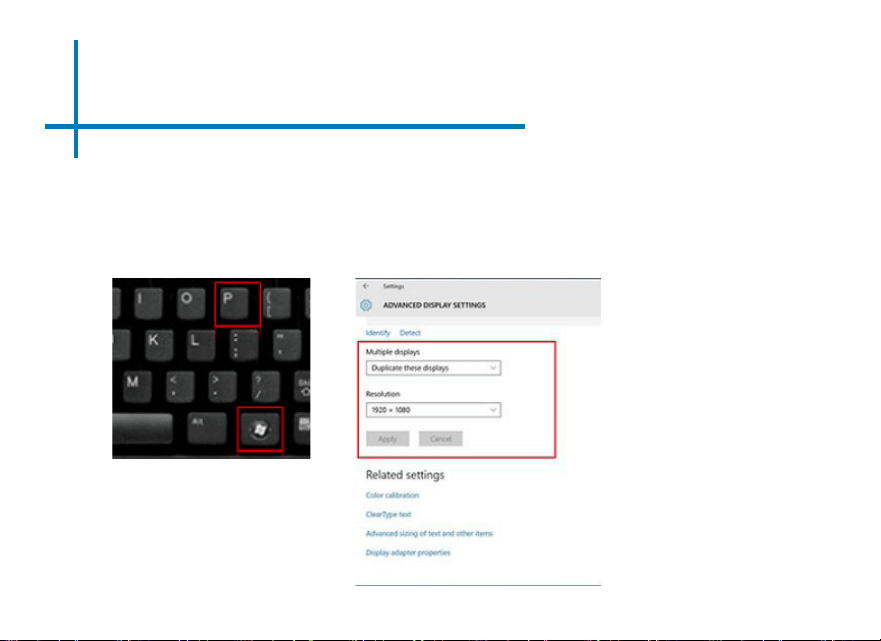
Enabling VGA on your Computer – To enable VGA output on your computer, most computers
require “turning on” the video output feature. Each computer is different. Please consult your
owner’s manual for instructions to enable VGA output. Below are standard instructions for a Win-
dows 10 computer – not all systems are the same.
Press Windows+P to toggle
through display settings. Select
either “Duplicate” or “Extend” de-
pending on your viewing option
*NOTE: different operating sys-
tems may differ
Step 5:
1. Right click on computer
desktop and select “Screen
Resolution”
2. Display Properties window
will pop up
3. If a secondary monitor is
grayed out, click on it and se-
lect “Extend these displays”
in the “Multiple Displays” drop
down
4. If the image is blurry or the
text is not legible, adjust
the screen resolution. We
recommend 1920x1080
Step 6:
8
Connecting to a Computer via Digital Input
9
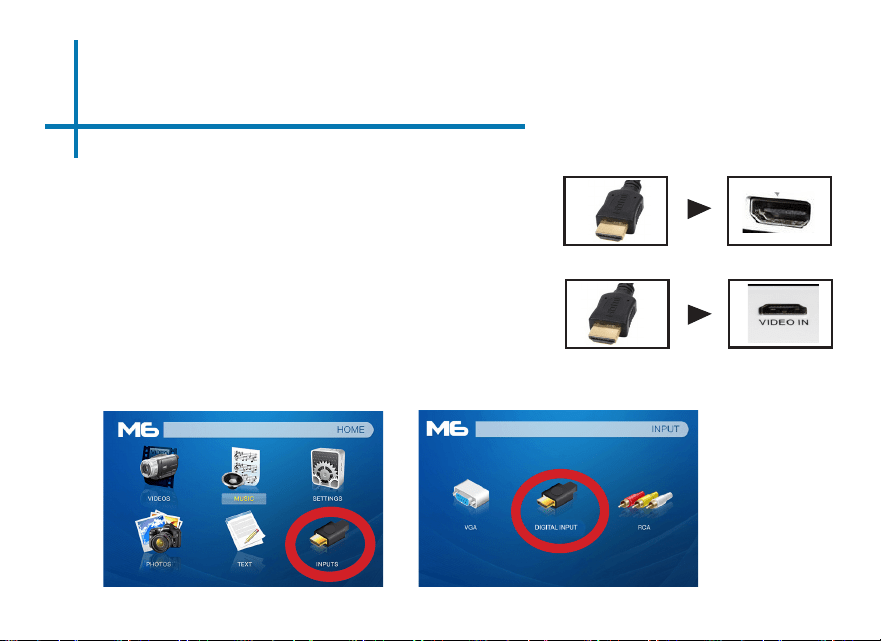
Connect one end of the Digital Input Cable
to your computer’s Digital Input Adapter.
Step 1:
Step 2:
Step 3:
In the Main Menu, select the “Inputs” icon and then the “Digital Input” Icon.
Connect the other end of the Digital Input
Cable to your M6’s Digital Input port.
Select “INPUT” icon Select “Digital Input” icon
Connecting to a Computer Cont.
Step 4:
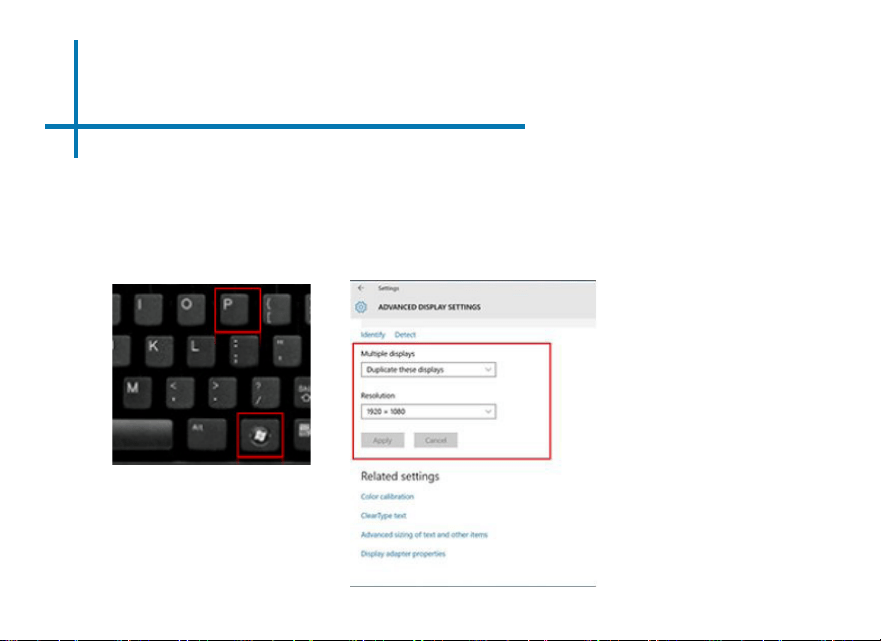
Enabling Digital Video output on your Computer – To enable Digital Video output on your computer
most computers require “turning on” the video output feature. Each computer is different. Please
consult your owner’s manual for instructions to enable Digital Video output. Below are standard
instructions for a Windows 10 computer – not all systems are the same.
Press Windows+P to toggle
through display settings. Select
either “Duplicate” or “Extend” de-
pending on your viewing option
*NOTE: different operating sys-
tems may differ
Step 5:
1. Right click on computer
desktop and select “Screen
Resolution”
2. Display Properties window
will pop up
3. If a secondary monitor is
grayed out, click on it and se-
lect “Extend these displays”
in the “Multiple Displays” drop
down
4. If the image is blurry or the
text is not legible, adjust
the screen resolution. We
recommend 1920x1080
10
Step 6:
Connecting to Composite Video
11
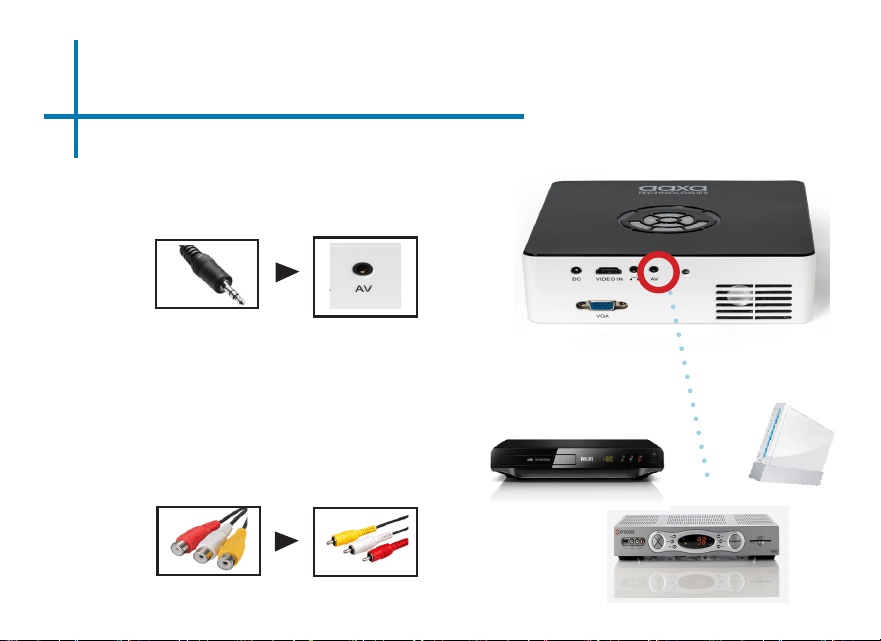
Connect the 3.5mm Composite AV
Cable to the back of the M6.
Connect the composite end of
the AV Cable (Red, White,Yellow)
to your device.
Step 1:
Step 2:
Connecting to Composite Video Cont.
Connectivity with multimedia devices
The M6 can connect to many media devices including: iPod, iPhone, iPad, VHS
players, DVD players, Blu-Ray players, smart phones, cameras, video game con-
soles and other peripherals with ease.
*Some smartphones require video out capabilities to be displayed with the M6. Check with
your phone manufacturer.
12
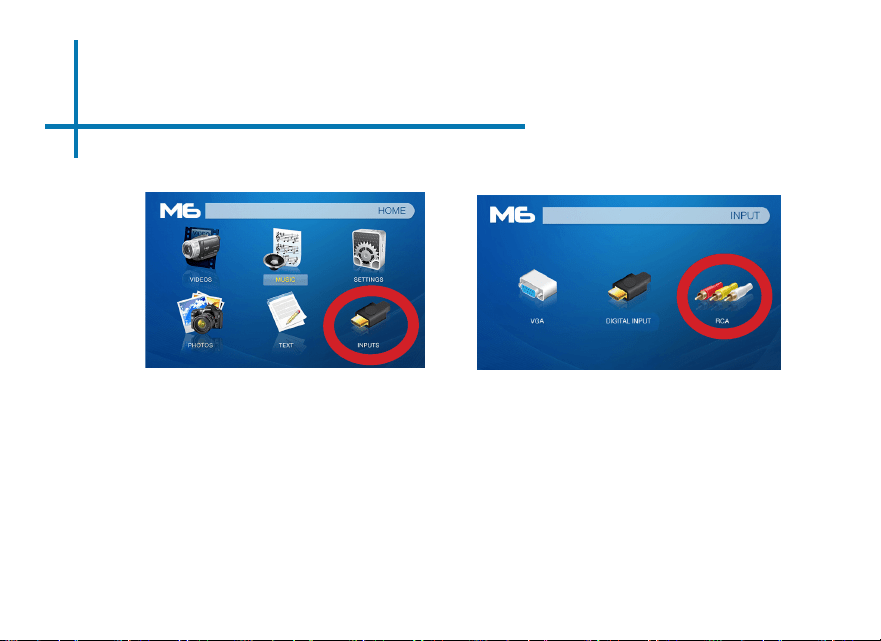
In the Main Menu
Turn on your multimedia device.
Select “INPUT” icon Select “RCA”
Step 3:
Step 4:
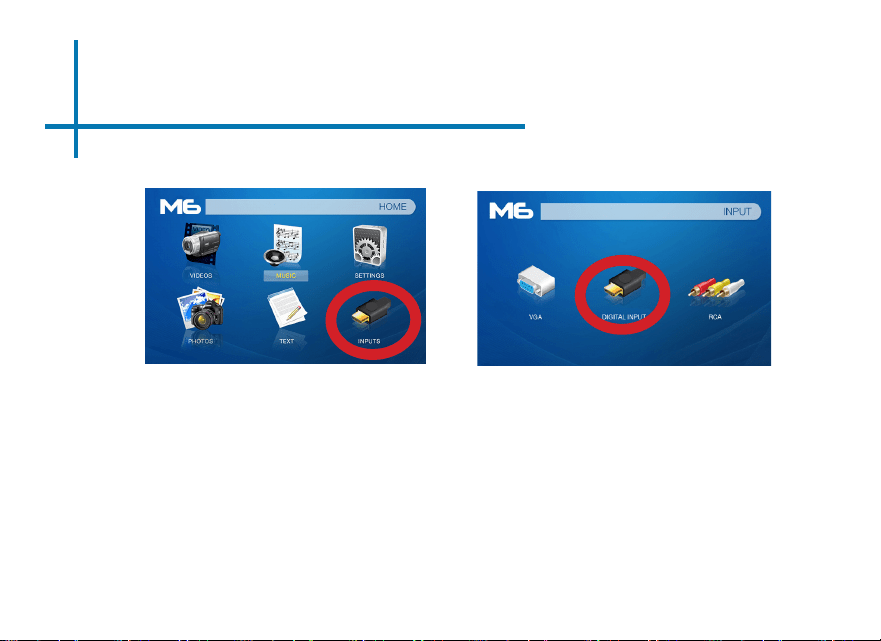
Connecting to Digital Video Input
13
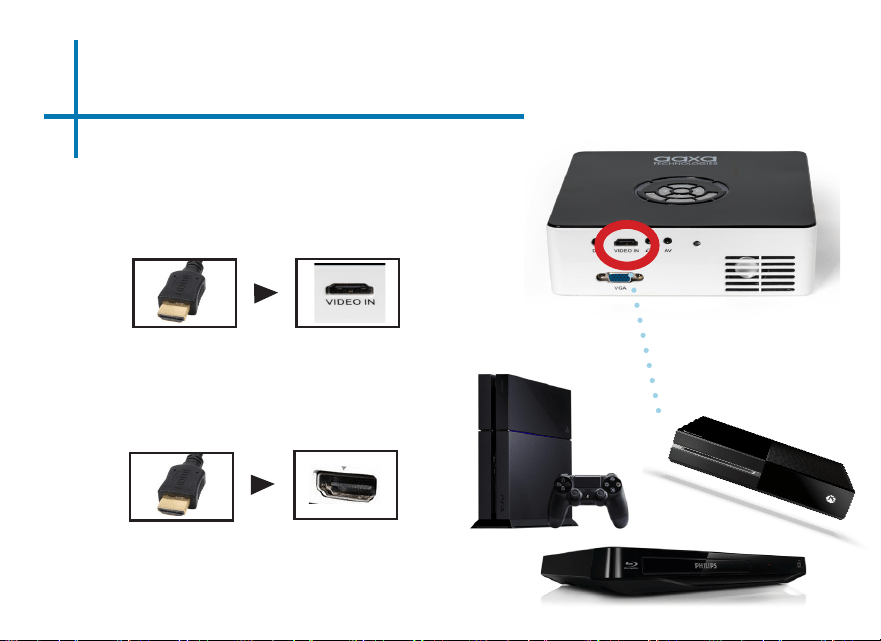
Connect one end of the Digital
Input cable to your M6’s Digital
Video Input Adapter.
Step 1:
Step 2:
Connect the opposite
end of the Digital Video
Input cable to your device.
Note: Apple devices require a specialized
Digital Input adapter (Sold separately
by Apple)
Connecting to Digital Video Input Cont.
Connectivity with multimedia devices
The M6 can connect to many media devices including: iPod, iPhone, iPad, VHS
players, DVD players, Blu-Ray players, smart phones, cameras, video game con-
soles and other peripherals with ease.
*Some smartphones require video out capabilities to be displayed with the M6. Check with
your phone manufacturer.
14
Step 3:
In the Main Menu
Turn on your multimedia device. If available, select 1920x1080.
Step 4:
Select “Digital Video” Input
Select “INPUT” icon
Connecting Speakers / Headphones
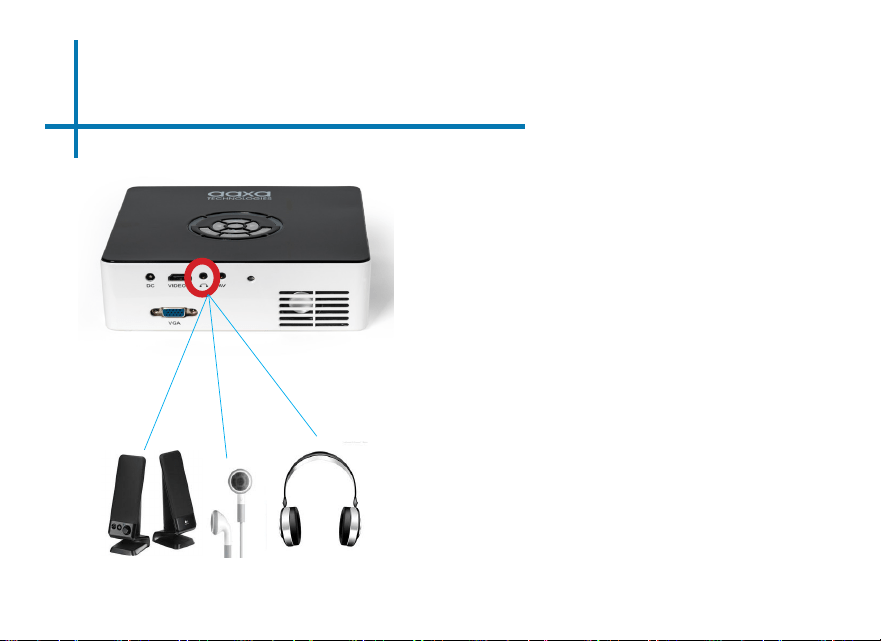
15
Connect your speakers/headphones
to the projector’s audio port.
Step 1:
Step 2:
*CAUTION: Prolonged use of headphones at a high
volume may impair hearing.
Ensure that the projector and/or
the headphones are powered on.
Step 3:
Place the headphones on and enjoy!
Connect your speakers/headphones
to the projector’s audio port.
Ensure that the projector and/or
the headphones are powered on.
Micro TF Card
16
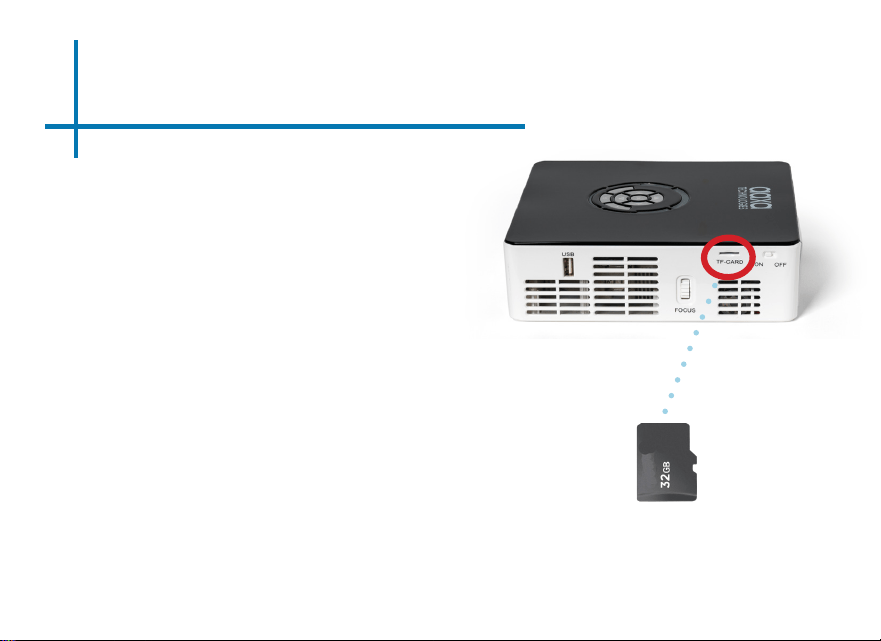
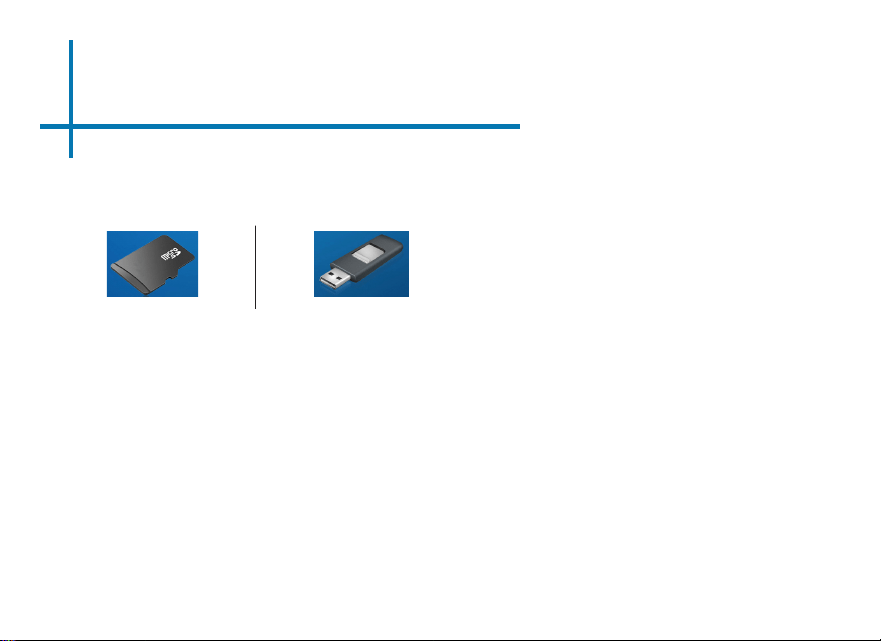
How to insert your Micro TF Card
• Slide in your TF card into the TF card
slot on the side of the M6 (facing down
as shown in picture).
• Gently slide the TF card until it clicks
into place.
*Review the “Specications”
section of this manual to read
about the supported le
formats.
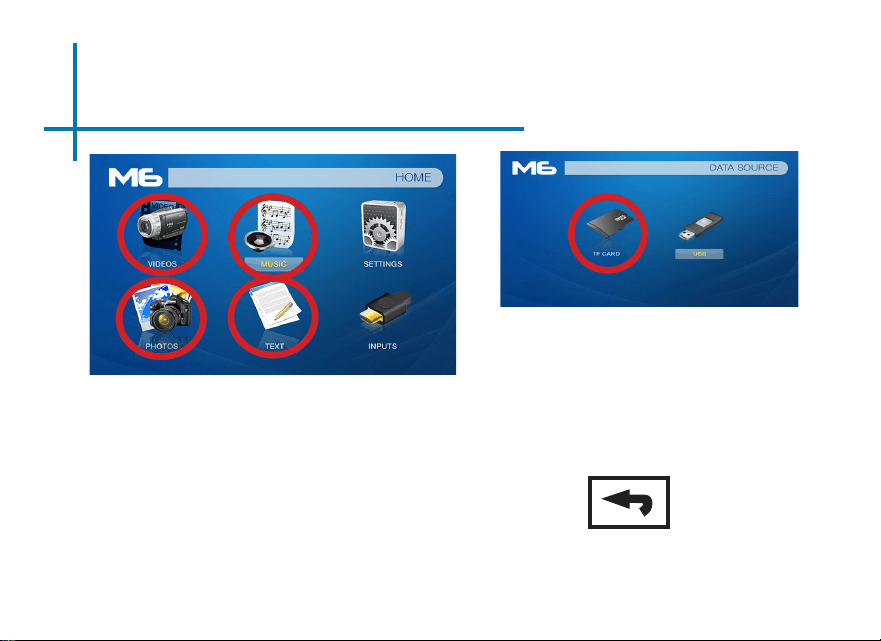
How to access your Micro TF Card
• Once your TF Card has been inserted,
you can navigate to any media content
in the main menu.
• After selecting the media content,
choose the TF card selection.
• You can now access the data on your
TF card through the onboard media
player
Microsoft Ofce and PDF le formats are not supported.
To view a slideshow convert your slideshow into JPEG
pictures rst.
Note:
(up to 32 GB)
17
Micro TF Card Cont.
Return: Brings you
back to the main
menu
File Menu System
• The M6 will show all folders and les
you have on your TF Card in the C:
drive.
• Use the directional buttons to navigate
to different folders or les.
Media Player menu
• In the main menu select the type of le
you wish to play.
• Select the TF Card icon to acess your
les.
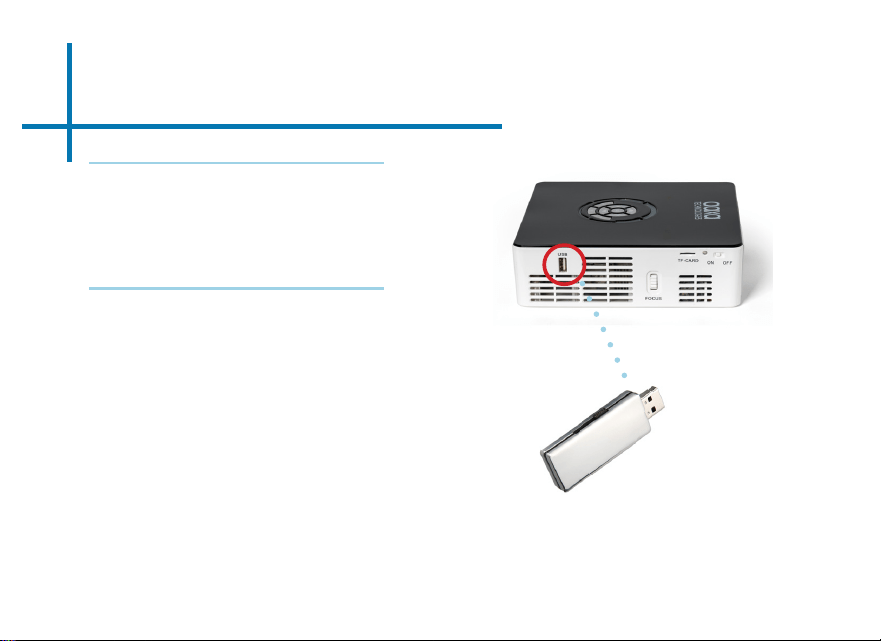
USB Drive
18
How to insert your USB Drive
How to access your USB Drive
• Insert your USB Drive into the
projector.
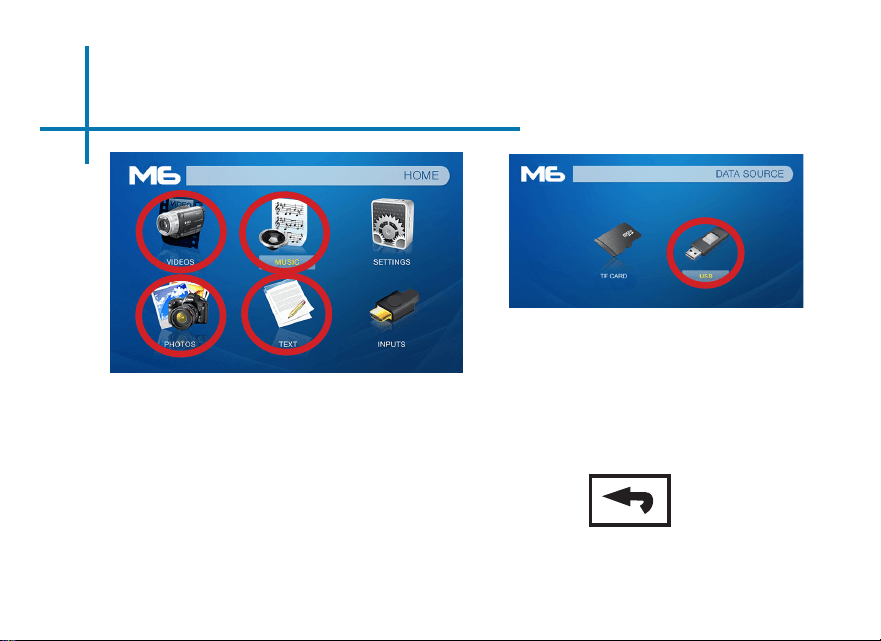
• Use the navigation pad to choose the
USB Drive icon from the main menu to
access your les.
• Choose your desired le.
• Slide your USB Drive into the USB
port (as shown in picture).
• Gently slide the drive until it cannot
go in any further.
*Review the “Specications”
section of this manual to read
about the supported le
formats.
Microsoft Ofce and PDF le formats are not supported.
To view a slideshow convert your slideshow into JPEG
pictures rst.
Note:
(up to 32 GB)
19
USB Drive Cont.
Media Player menu
• In the main menu select the type of le
you wish to play.
• Select the USB Drive icon to access
your les.
Return: Brings you
back to the main
menu
File Menu System
• The M6 will show all folders and les
you have on your USB Drive.
• Use the directional buttons to navigate
to different folders or les.
Menu Screens
20
Chapter 3
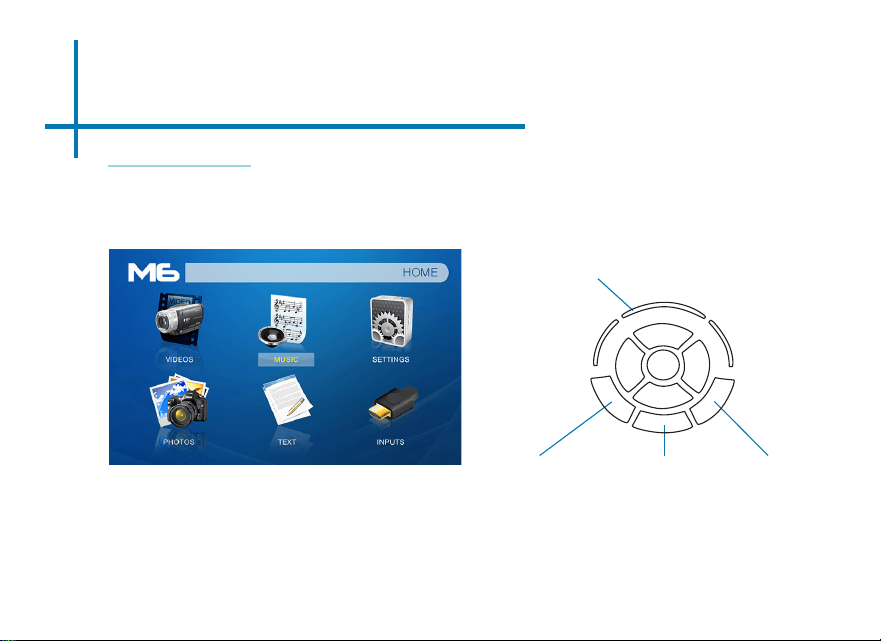
Main Menu
The M6 features a built in PMP (Portable Media Player) function.
This function allows the projector to play videos, pictures, music les, and text directly
from your connected devices.
• Press the left and right directional buttons to choose an icon from the main menu.
• To select a menu option, press the “OK” button in the middle of the navigation pad.
• To go back to the previous screen, press the “Back” button.
• To Jump back to the submenu, press the “Menu” button once.
• To return to the main menu, press and hold the “Return” button.
Input Exit/Back
Direction Pad
On / Off
LED
OK
Video Player Menu
21
Previewing Files:
• Press the directional keys to highlight the item of interest.
• Wait 2-3 seconds and a preview of the video will show on the screen.
The M6 will show all folders and les you have on your USB or TF drive.
Use the navigation buttons to select folders or les.
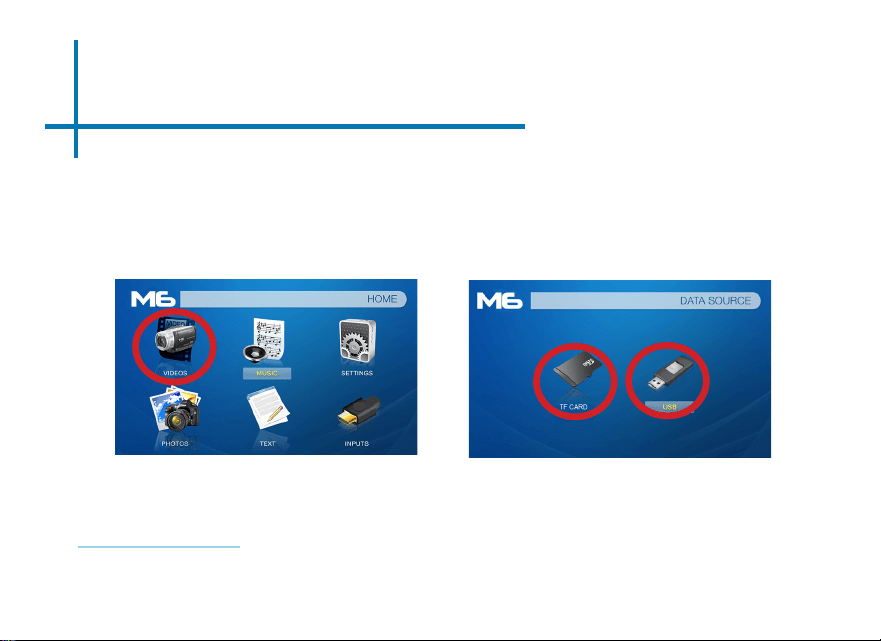
Opening a le:
• Select the “Video” icon (Fig. 3.1).
• From the submenu (Fig. 3.2), select the storage media with the stored les.
• Choose which le you wish to play.
Fig. 3.1
Fig. 3.2
22
Video Player Menu
While Playing Videos
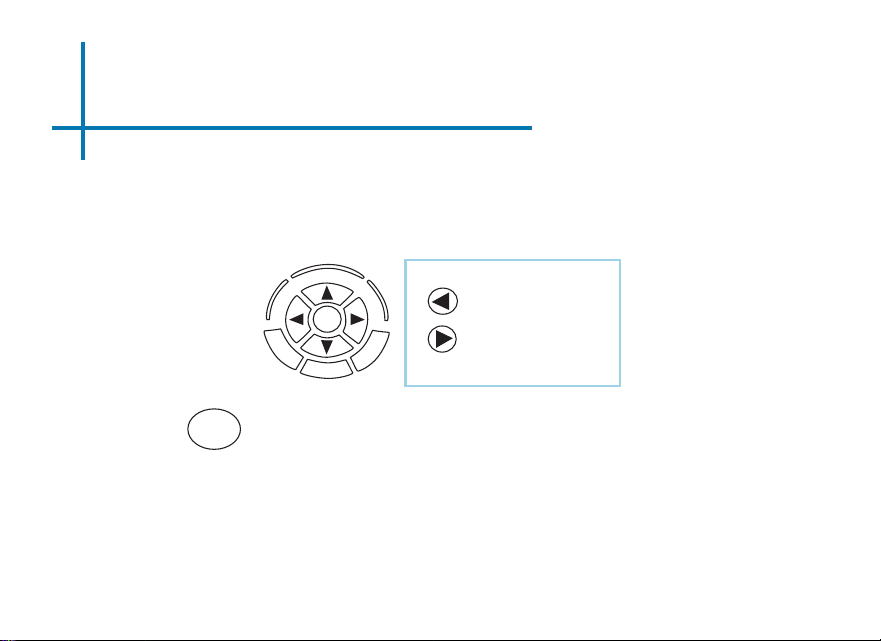
While playing videos, the volume is adjustable. Further controls are available in
the video player submenu - which is accessed through the “OK” button.
Volume Up
Volume Down
OK
OK
Enter Video Player Submenu
• To open/hide the video playback menu, use the
“OK” and “Back” Buttons on the projector.
23
Video Player Submenu
Playing Videos
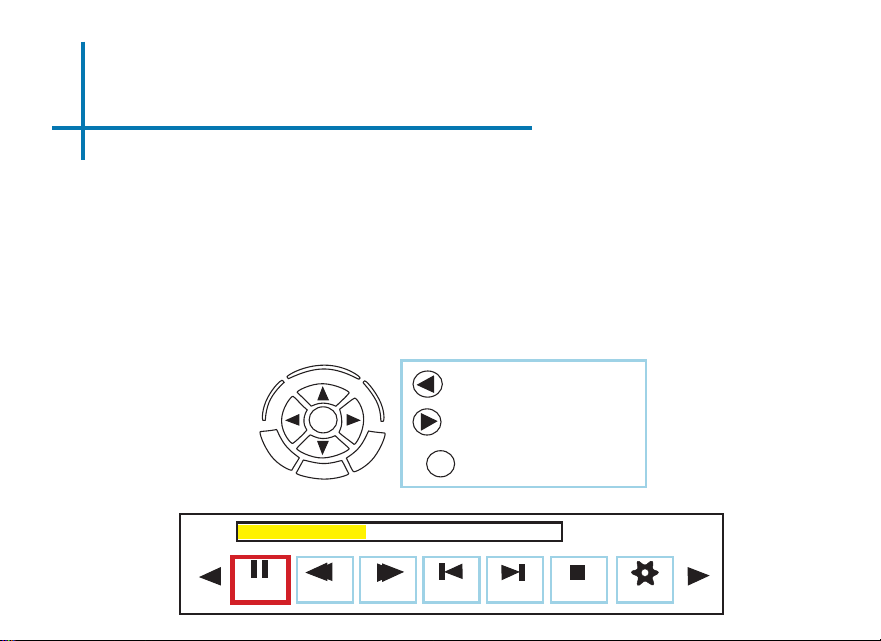
The Video Player Submenu can be accessed by pressing “OK” during video
playback. To exit the Video Player Submenu, press the “Back” button or wait
5 seconds. To navigate the Playback Menu, use the directional buttons on the
navigation pad or remote to highlight the option you wish to choose (Fig. 3.3).
Move selection left
Move selection right
• To open/hide the video playback menu, use the “OK” and “Back” buttons on the projector.
OK
Fig. 3.3
Pause
FB
FF
Prev. Next Stop Aspect
00:00:59 / 00:04:20
Conrm selection
OK
Video Playback FAQ
How do I loop a video?
1. Choose either USB or TF Card
for playback
2. Navigate the folders until you
reach the le you wish to play.
3. Highlight the le you want to
play, then conrm the selection.
4. Move selection on video player
menu to “Repeat 1”, and con-
rm the selection.
5. The video will now loop after
playback is nished.
How do I preview a video?
1. Choose the “video” option from
the main menu
2. Navigate using either remote or
onboard buttons to the le you
wish to preview.
3. Highlight the le. *Do not select
the le, just highlight it.
4. Wait for 3-4 seconds.
5. A preview screen will pop up on
the lower right for the video.
24
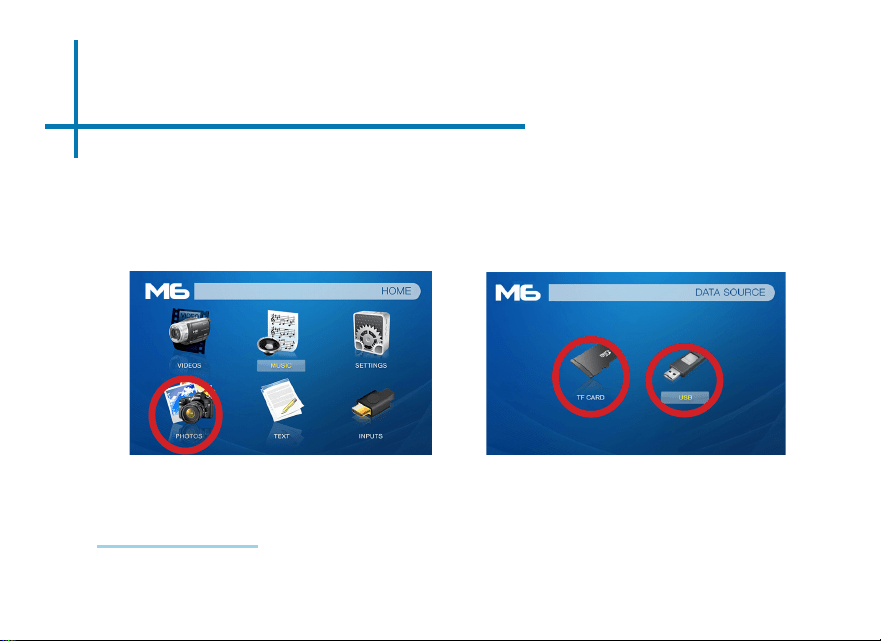
Photo Menu
25
Previewing Files:
• Press the directional keys to highlight the desired le.
• Wait 2-3 seconds and a preview of the picture will show on the screen.
The M6 will show all folders and les you have on your USB or TF Card drive.
Use the navigation buttons to select folders or les.
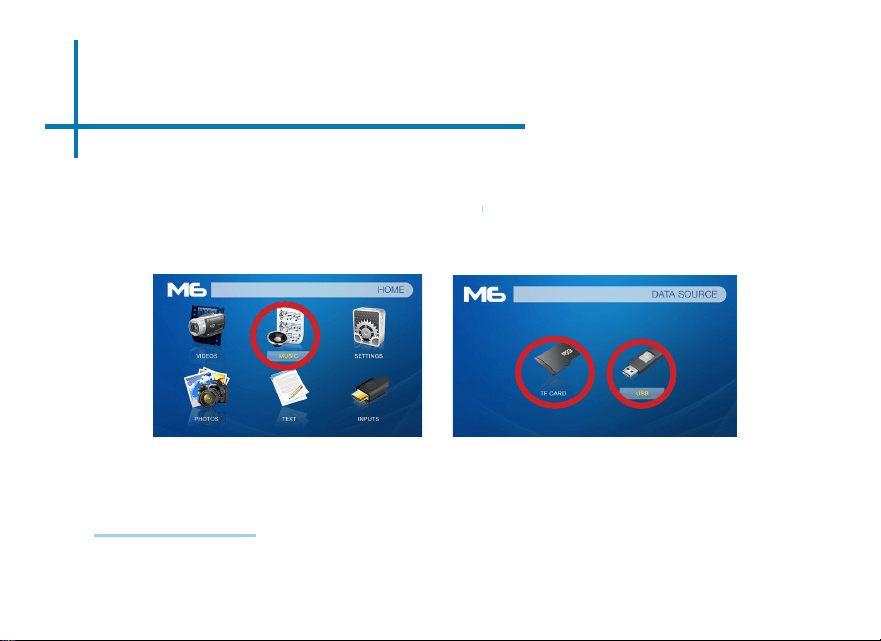
Opening A File:
• Select the “Photo” icon (Fig. 3.4).
• From the submenu (Fig. 3.5), select the storage media with the stored les.
• Choose which le you wish to play.
Fig. 3.4
Fig. 3.5
26
Photo Menu
While Viewing Pictures
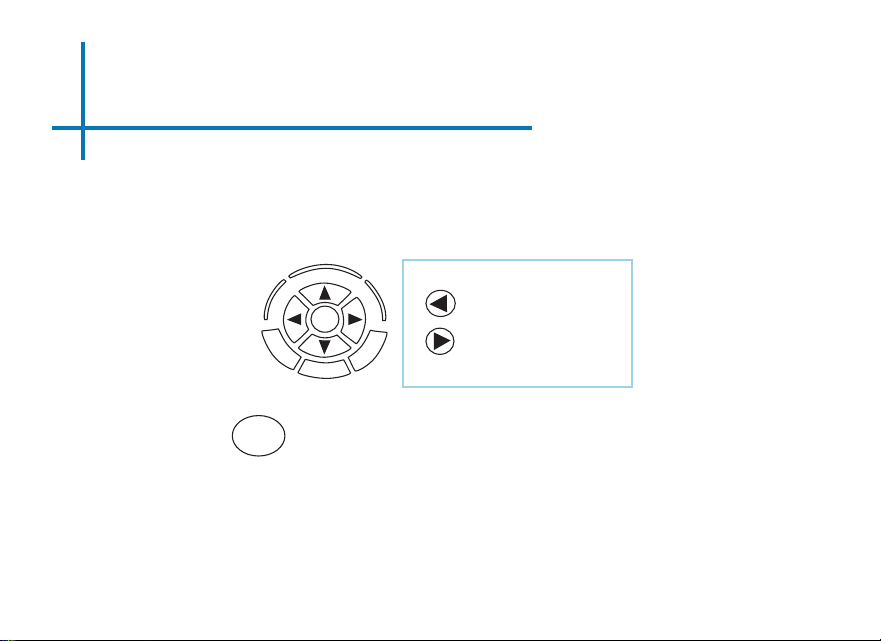
While viewing pictures, further controls are available in the Photo Submenu -
which is accessed through the “OK” button.
Previous Picture
Next Picture
OK
OK
Enter Photo Player Submenu
• To open/hide the Photo Playback menu, use
the “OK” and “Back” Buttons on the projector.
27
Photo Submenu
Viewing Pictures:
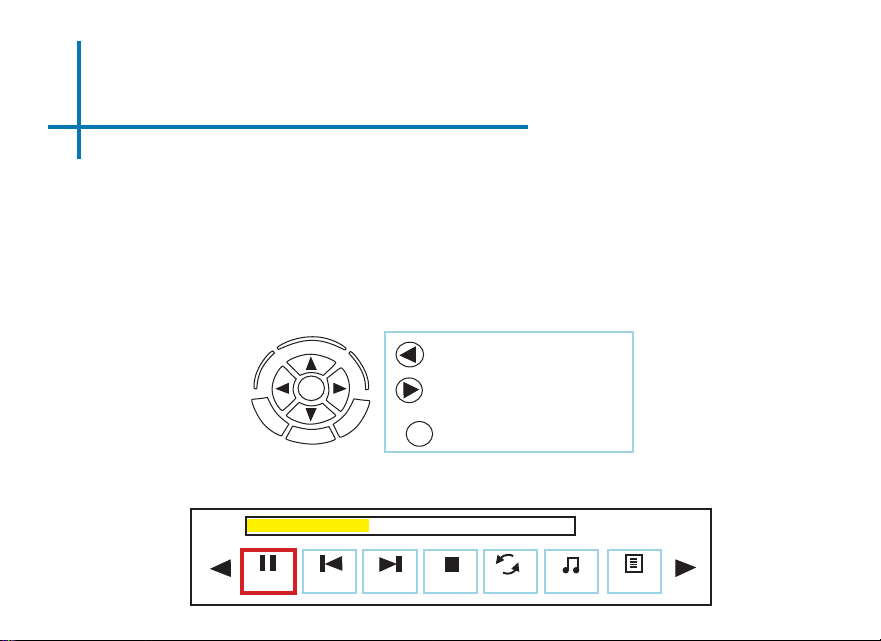
The Photo Submenu can be accessed by pressing “OK” during picture slide-show
playback. To exit the Photo Submenu, press the “Back” button or wait 5 seconds.
To navigate the playback menu, use the directional buttons on the navigation pad
or remote to highlight the option you wish to choose (Fig 3.6).
Fig 3.6
Pause Prev. Next Stop Repeat N
00:00:59 / 00:04:20
Msc Off
Playlist
Move selection left
Move selection right
OK
Conrm selection
OK
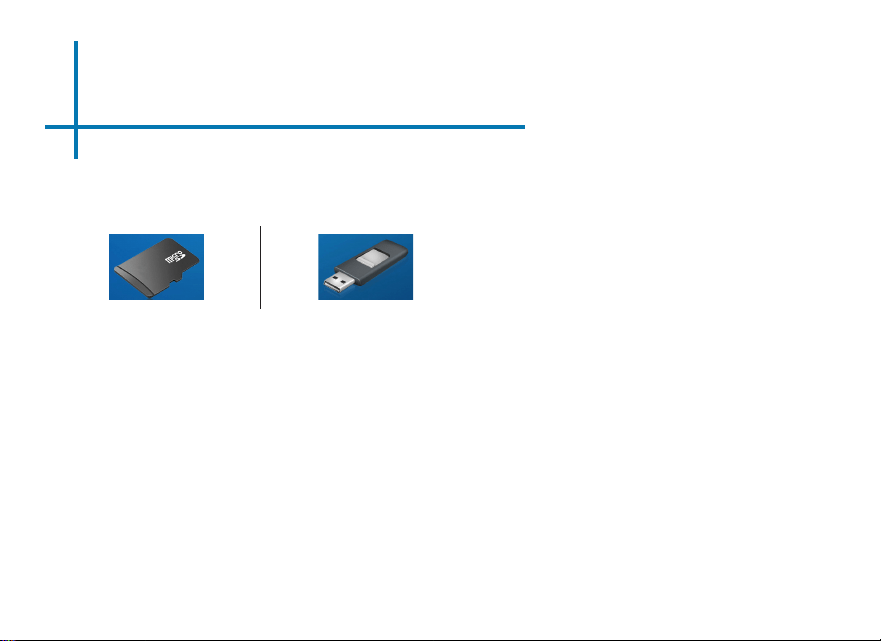
Photo Slideshow FAQ
How do I play a slideshow?
1. Choose either USB or TF Card
for playback
2. Navigate to the folder that
contains the pictures you wish
to view in the slideshow.
3. Conrm selection of the rst
picture.
4. Press “play” in the photo menu
5. Slideshow will now play.
6. NOTE: Selecting “Repeat A”
will loop slideshow.
How do I manually control the
slideshow?
1. After selecting the photo you wish
to be displayed, you can press
“play” to start the slideshow (as
outlined in the previous FAQ).
2. To manually control the slideshow,
you must stop the slideshow with
the “stop” button.
3. You may use either the controls
on your remote or on top of the
projector itself to ip through the
pictures in the current playlist.
4. You can change the SlideShow
duration in the Settings Menu
(Main Menu -> Settings -> Picture)
28
Music Player Menu
29
Previewing Files:
• Press the directional keys to highlight the desired le.
• Wait 2-3 seconds and a preview of the audio will show on the screen.
The M6 will show all folders and les you have on your USB or TF Card drive.
Use the navigation buttons to select folders or les.
Opening A File:
• Select the “Music” icon (Fig. 3.7).
• From the Submenu (Fig. 3.8), select the storage media with the stored les.
• Choose which le you wish to play.
Fig. 3.7
Fig. 3.8
30
Music Player Menu
Fig. 3.9
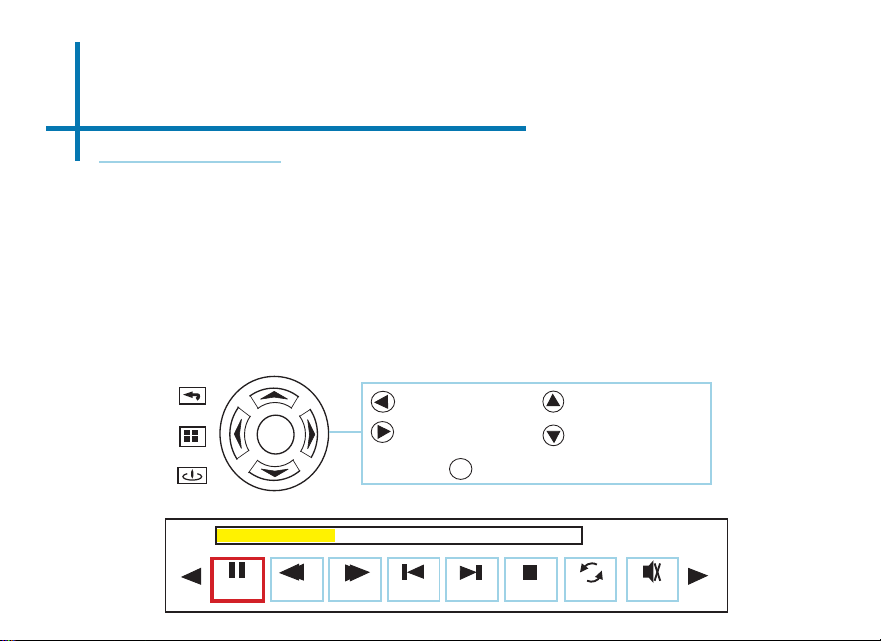
Listening To Audio:
To adjust the volume, use the left and right button on the projector or the volumes
keys on the remote. To navigate the playback menu, push the “OK” button to
open the menu and use the directional buttons on the navigation pad or remote to
highlight the option you wish to choose (Fig 3.9).
• To open/hide the music playerback menu, use the “OK” and “Back” button on the
projector.
OK
Pause
FB
FF
Prev. Next Stop R_ALL
Mute
00:00:59 / 00:04:20
Move selection left
Move selection right
Volume Up
Volume Down
Conrm selection
OK
Music Playback FAQ
How do I loop a song?
1. Choose either USB or TF Card
for playback
2. Navigate the folders until you
reach the le you wish to play.
3. Highlight the le you want to
play, then conrm the selection.
4. Move selection on music player
menu to “Repeat 1,” and con-
rm the selection.
5. The song will now loop after
playback is nished.
How do I create a song playlist?
1. Insert your media device (either TF
card or USB) into computer.
2. Make a new folder on media device
(folder name will be the name of the
playlist).
3. Transfer songs from computer to the
new folder, name accordingly.
4. Remove media device from computer
and insert into projector.
5. Navigate to Audio section, then
choose appropriate media device.
6. Navigate to your playlist folder.
7. Start at rst song.
8. Playback will follow each successive
song on the list.
*To create a special order for the list, add nu-
merical numbering to the beginning of each le.
31
E-Book Viewer Menu
32
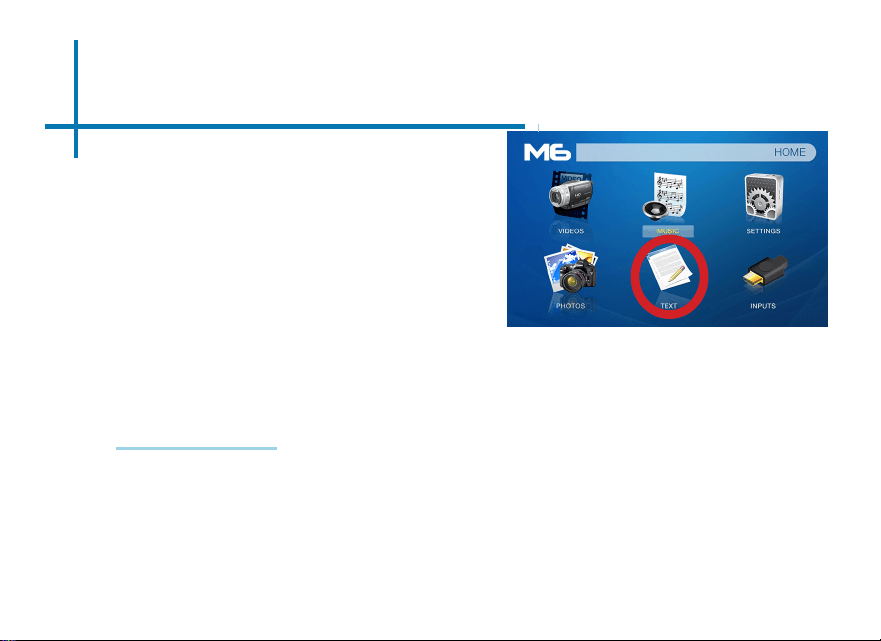
Viewing Text Files:
The M6 Micro Projector allows you to view text les. Select the le you want to view in
the le menu for the particular storage device on which the le is stored. You can press
the left and right arrow buttons on the directional pad or remote to ip through the pages
you have in the present folder.
The M6 will show all folders and les you have on your USB or MicroTF Drives.
Use the navigation buttons to select folders or les.
Opening A File:
• Select where the les are located from
the main menu.
• Select the “Text” icon (Fig. 3.10)
• Choose the le you wish to play.
Fig. 3.10
Microsoft Ofce and PDF le formats are not supported. To view a slideshow convert your slideshow
into JPEG pictures rst.
Note:
Setup Menu
33
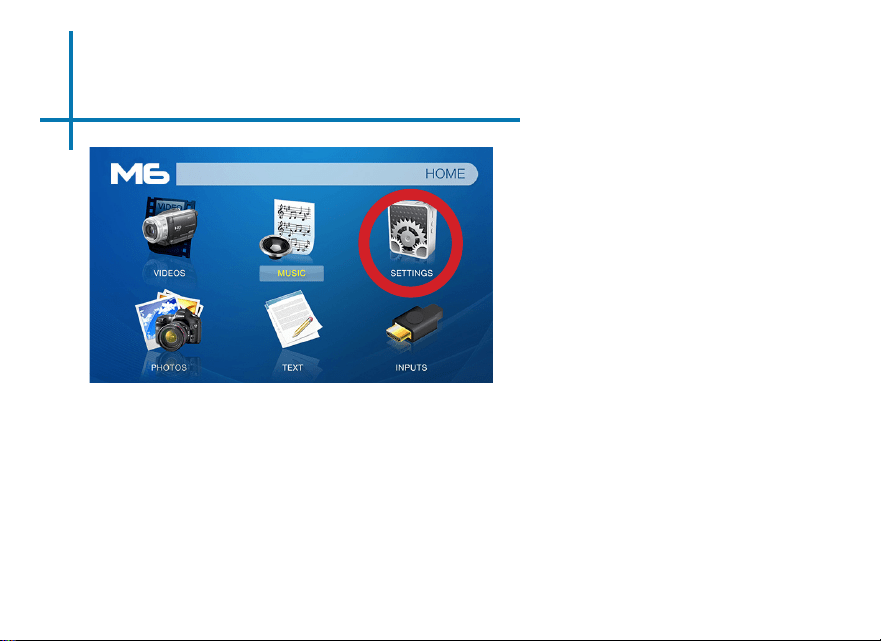
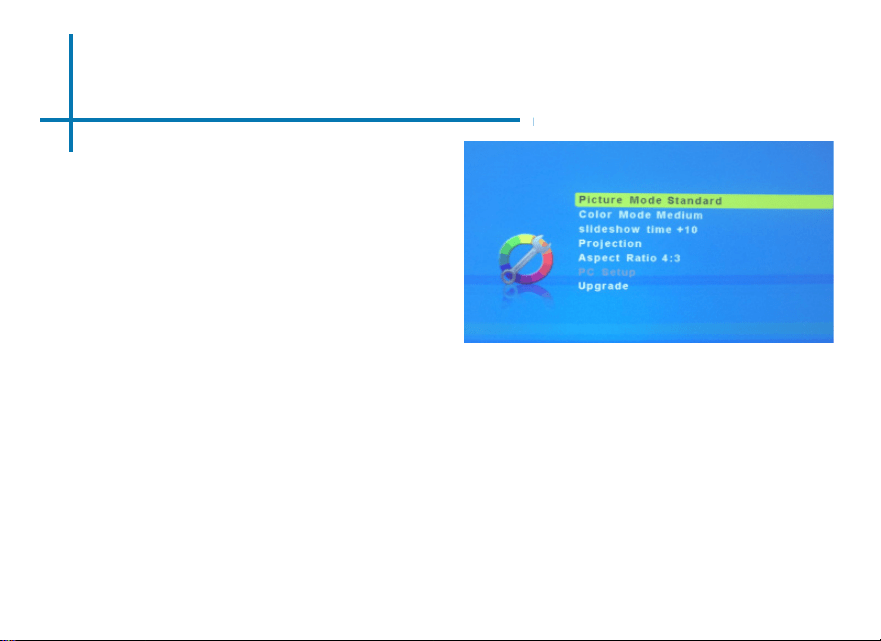
The Settings Menu can be accessed by selecting “Setting” on the Main Menu
Picture
• Picture Mode
• Color Mode
• Slideshow Time
• Projection
• Aspect Ratio
• Upgrade
Sound
• Sound Mode
• Balance
• Auto Volume
• Surround Sound
Brightness
• Eco
• Standard
• Bright
Option
• OSD Language
• Restore Factory Default
• OSD Duration
• Software Version
Within the settings menu, there are
four more submenus that allow you
to customize your M6 to the settings
you want.
Chapter 4
**Boost mode should only be used in low
temperature environments with adequate
clearance of exhaust / intake vents. A tripod
is highly recommended. DO NOT block
vents while operating in Boost mode.
34
Picture Settings
Picture Mode
• Changes the picture mode to
different settings depending on
your usage
Color Mode
• Adjusts the color temperature
from warm to cool (red to blue)
Slideshow Time
• Sets the timing of a transition
Projection
• Flips the projected image
Aspect Ratio
• Changes the aspect ratio of the
picture - Auto, 4:3, 16:9*, etc.
Upgrade
• Firmware can be upgraded with
upgrade le in the USB
*Caution: Some pictures may be cut off
when aspect ratio is set incorrectly
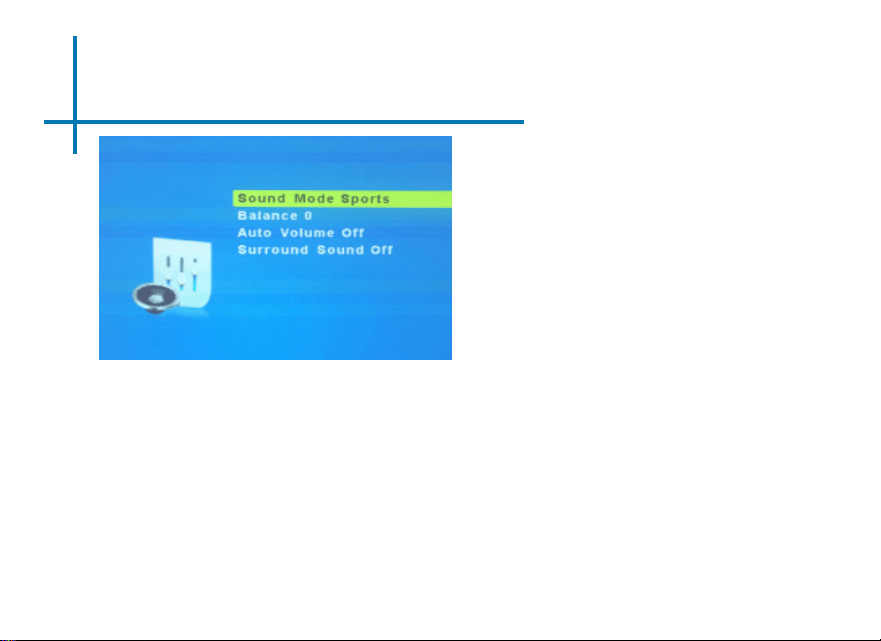
Sound Settings
35
Sound Mode
• Changes the sound mode depend-
ing on what is currently playing
Balance
• Adjusts the sound balance manu-
ally
Auto Volume
• With the Auto Volume On, the
video can be opened with volume
automatically
Surround Sound
• Supports surround sound
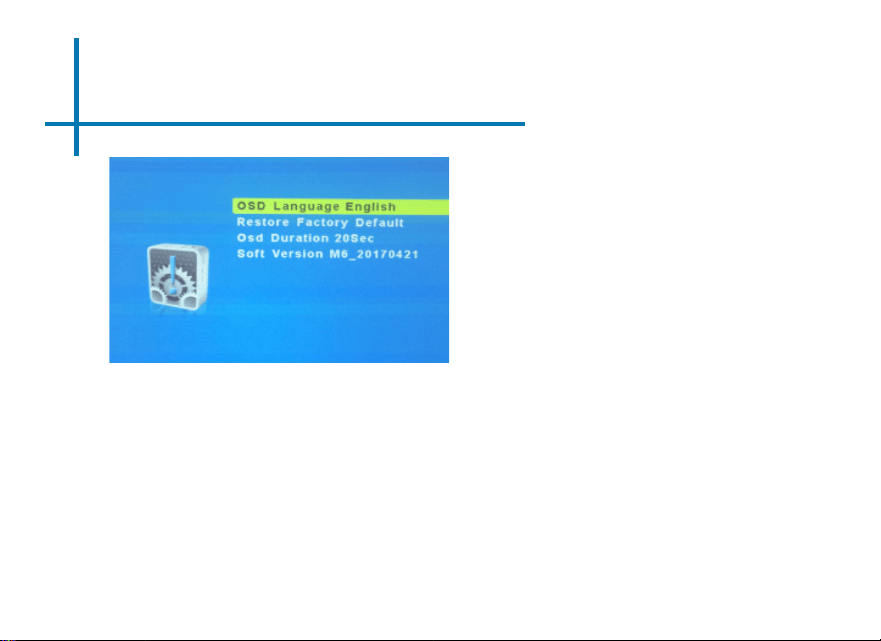
Option Settings
36
OSD Language
• Changes the language of the
device. Options include English,
Spanish, Chinese, German,
French, Korean, Japanese
Restore Factory Default
• Restores the projector to factory
settings
OSD Duration
• Allows the projector to set a
duration for the selected OSD
language
Software Version
• Current software version in use
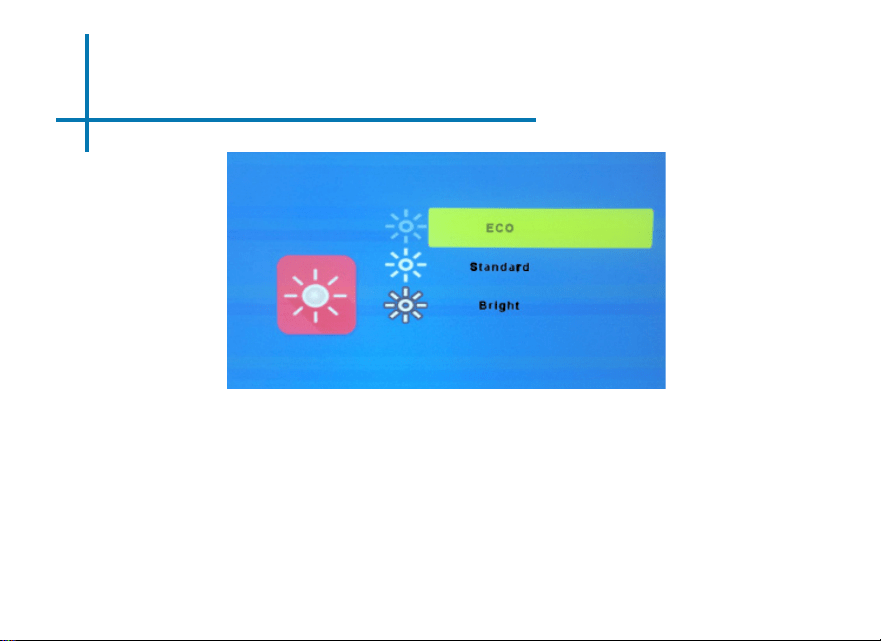
Brightness Feature
There are 3 different power modes for the M6: Bright, Standard, and Eco.
• Bright: The brightest mode with the highest Fan Speed. Only available while
plugged in.
• Standard: A normal mode. Only available while plugged in.
• Eco: A battery saving mode that reduces picture brightness. 90 minute bat-
tery run time.
37
Technical Details
Chapter 5
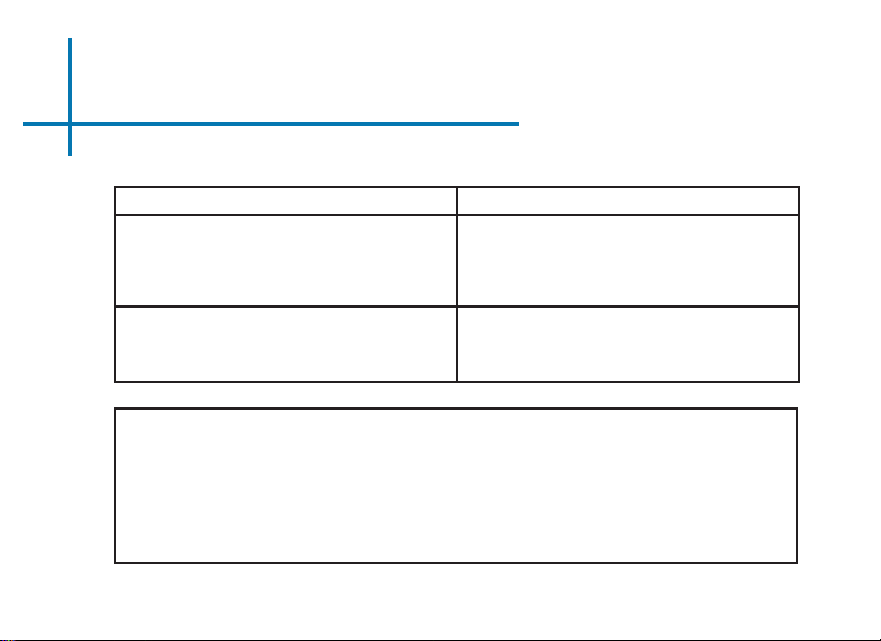
IMAGE IS BLURRED
Possible Causes Solution
The Projector is not in focus Adjust the focus with the focus adjustment dial
until the image comes into focus
The Projector is offset from plane / angle of
operation
Move the projector so that it is both 180 degrees
and on an evern plane with the screen.
NO SYNC, NO SIGNAL
Troubleshooting
1. Be sure to setup the computer to enable a video signal output. On some lap-
tops this is done by pressing and holding Function F5 key. If using the M6 as
an external monitor on Windows based systems, this can be done by selecting
“extend my desktop to this monitor”. The native resolution of the M6 projector
is 1920x1080. Depending on the video driver different resolutions may need to
be selected for proper output.
38
39
Technical Details
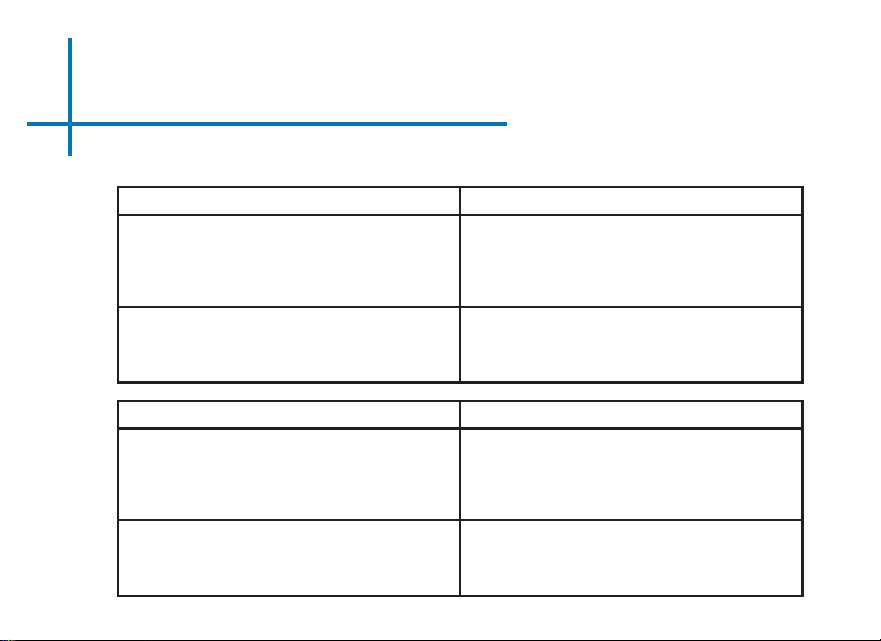
THE PROJECTOR DOES NOT TURN ON
Possible Causes Solution
There is no power Check to ensure the power outlet source is good.
Check the power adapter to ensure a proper con-
nection with the wall outlet as well as the projector.
Conrm that the unit is charged and has enough
power
The power button was not held long enough To power on the projector, the power button needs
to be depressed for a full 3 seconds. Try holding
the power button until the optical engine turns on
NO PICTURE / FILE NOT SUPPORTED
Possible Causes Solution
The video source is not properly connected or
selected
Check the video source signal to ensure that it
is properly connected. Select the current input
source by choosing the input desired from the
main menu
Incorrect le extension / Video is encoded with
incorrect codec
Please refer to “Specications” page to see which
le types and codex are supported. Verify that the
le was encoded properly.
Troubleshooting

40
Specications
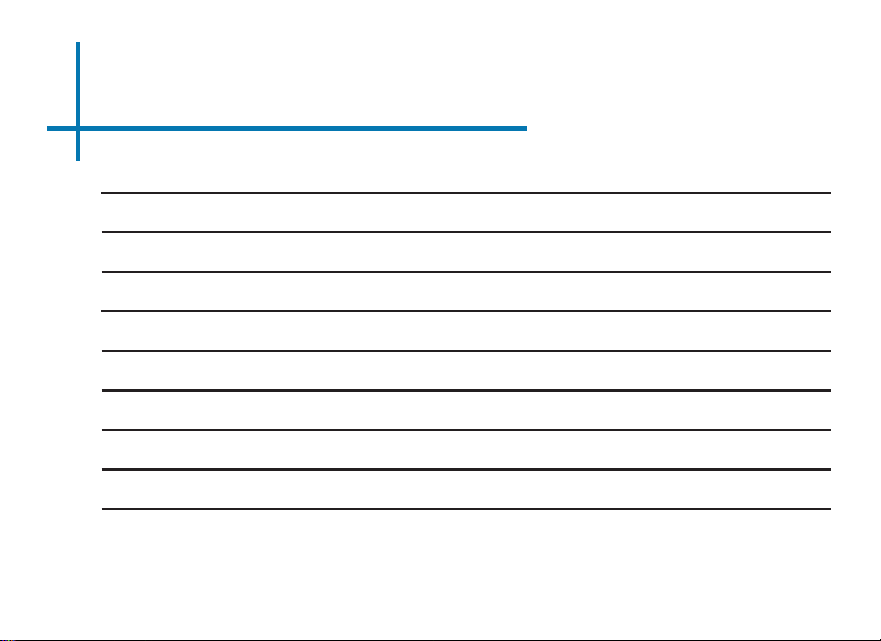
Brightness:
Native Resolution:
Contrast Ratio:
Aspect Ratio:
Projection Lens:
Image Size:
Lamp:
Video in:
Audio Output:
TF Card:
USB:
Dimensions:
Weight:
Supported File Formats:
1200 Lumens
1920x1080 (1080P)
2000:1
16:9
Manual Focus
12~200 inches
Triple RGB LEDs with Vibrant Color
Technology Life 30,000hrs
Composite A/V
VGA
Digital Input
2.0 W stereo speaker
3.5 mm audio jack
MicroTF Card Slot
(32GB maximum)
5 Pin USB 2.0 (Full Size)
(32GB maximum)
7” x 7” x 2.1”
2.5 lbs
MP3, WMA, OGG, WAV, JPG
AVI, BMP, GIF
41
Notes

Please direct all customer service inquiries to:
AAXA Technologies, Inc.
17691 Mitchell N., Unit #B
Irvine, CA 92614
(714) 957-1999