Instruction Manual
TX-SR3100
TX-SR3100DAB
AV RECEIVER
En
Contents
2
Reducing the Power Consumption in Standby
State
When the following functions are enabled, the power consumption in
standby state increases. To reduce the power consumption in standby state,
check each setting and set the functions to "O".
– HDMI CEC ( →p68)
– HDMI Standby Through ( →p68)
– USB Power Out at Standby ( →p71)
Table of contents
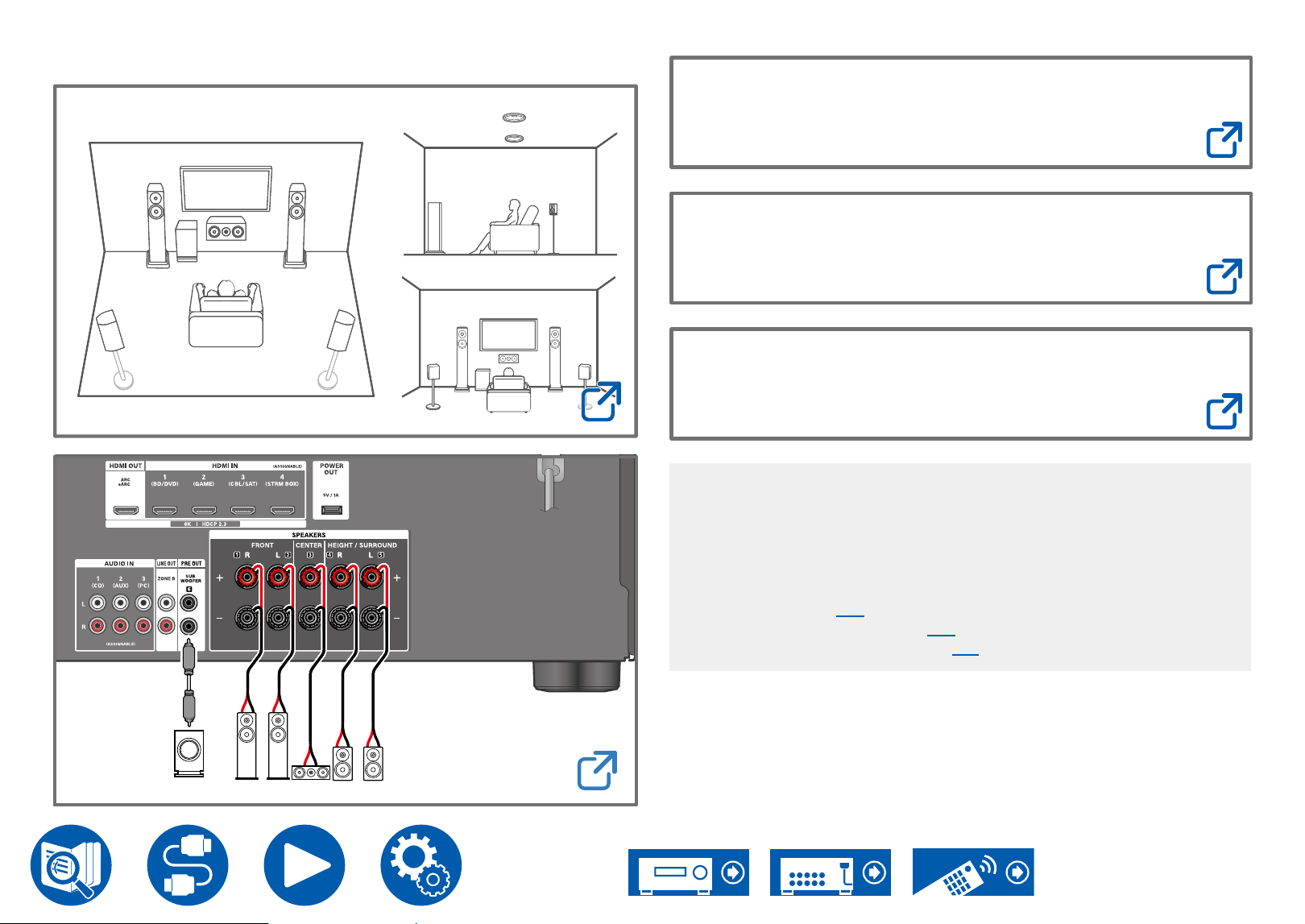
Detailed contents (Next page)
Firmware Update
Speaker InstallationSpeaker Installation
Speaker ConnectionsSpeaker Connections
Troubleshooting
Supplementary Information
Features, etc. released in rmware updates
3
Before starting the procedure 5
Firmware Update 6
Update Information of the rmware 6
Checking the Firmware Version of the Unit 6
Firmware Update Procedure 6
Part Names 8
Front Panel 8
Display 10
Rear Panel 11
Remote Controller 13
Inputting Characters 15
Speaker Installation
Setting Up the Speakers 16
Speaker Connections
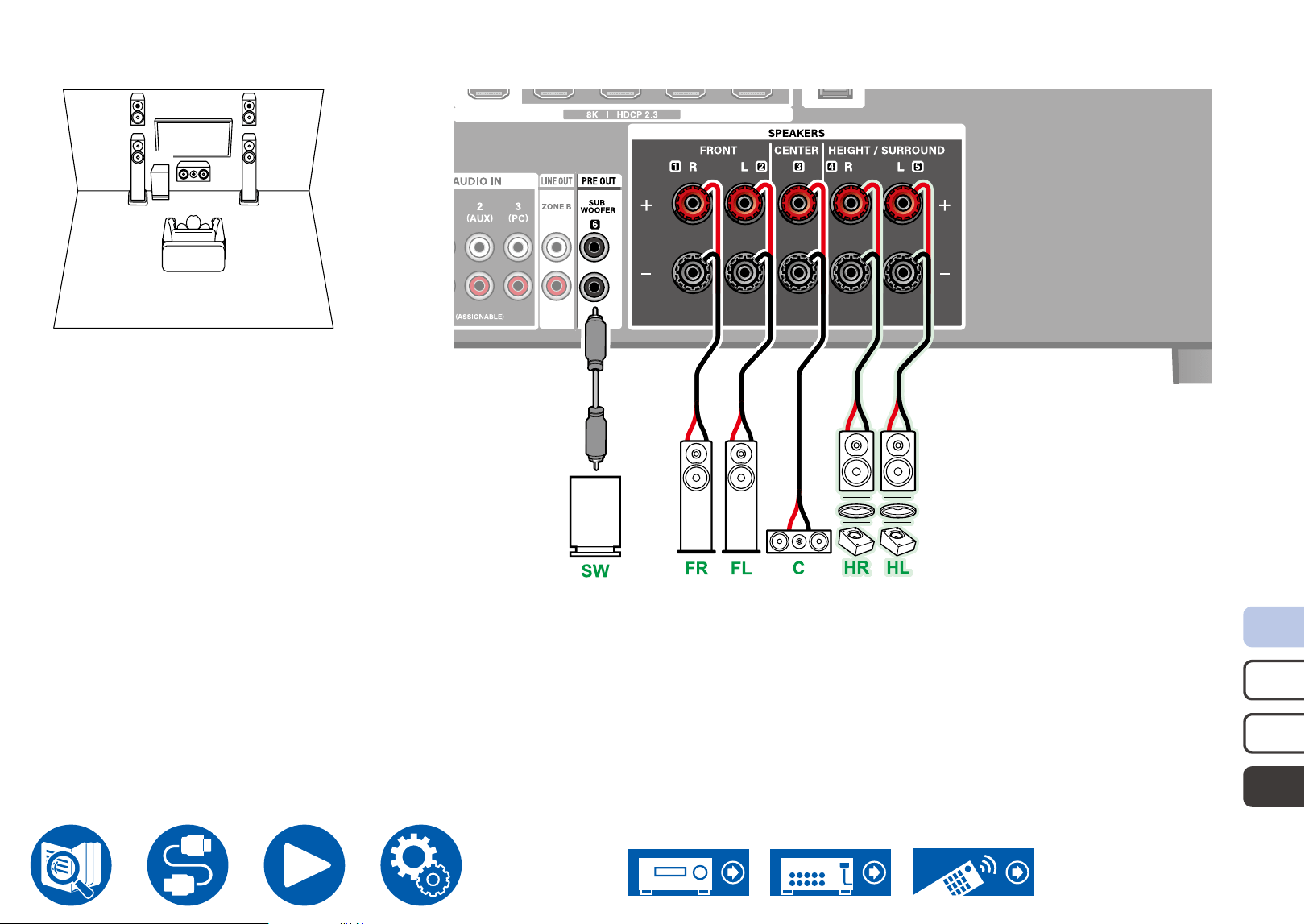
Speakers you can use with this unit and cable
connections 20
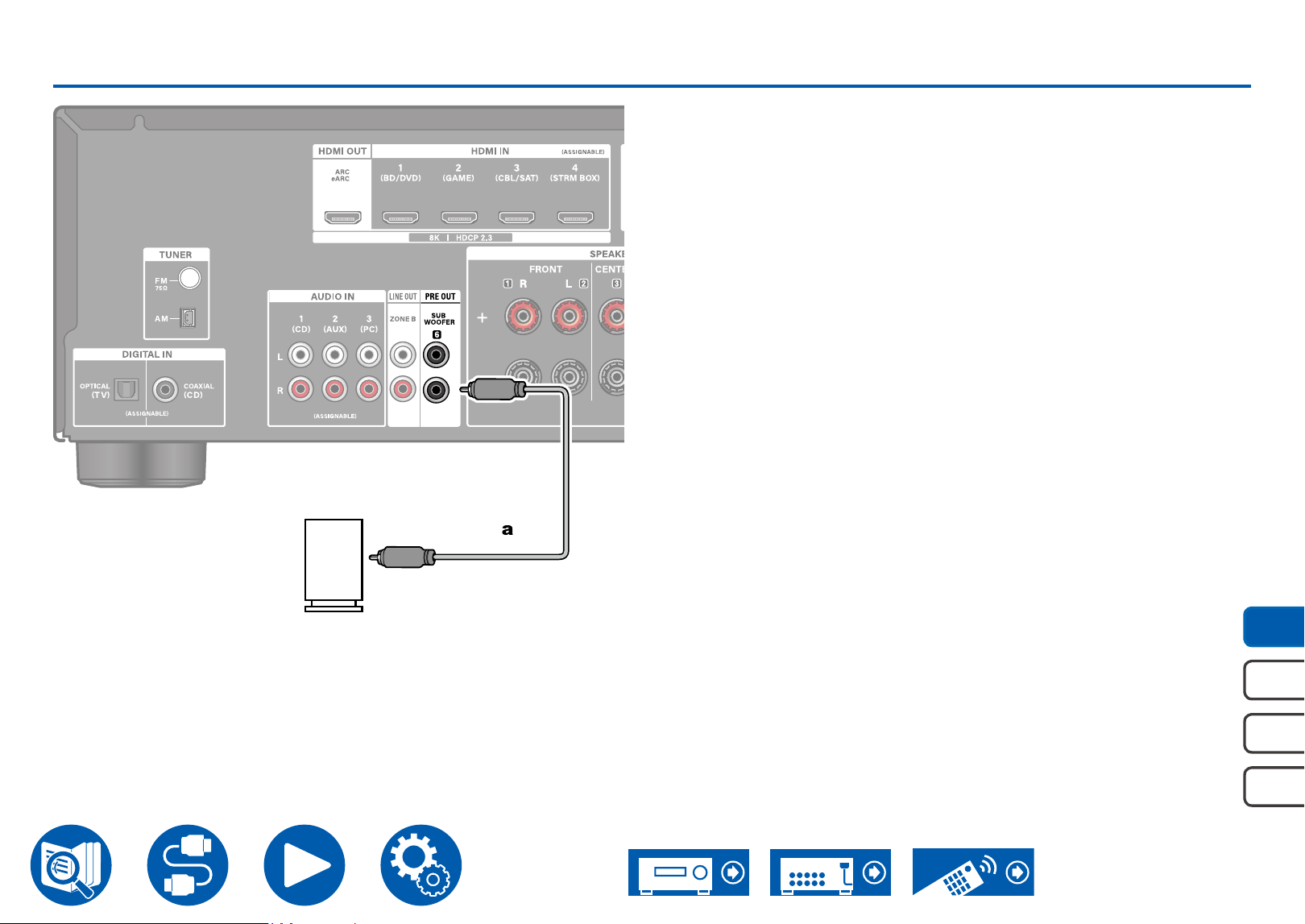
Connecting the Subwoofer 21
Connections
Notes regarding connections with HDMI cables 26
Connections 26
Connecting the TV 27
To ARC/eARC TV 27
To Non-ARC TV 27
Connecting Playback Devices 29
Connections to BD/DVD and GAME with HDMI jacks 29
Connecting an Audio Component 30
Connecting an Integrated Amplier or Transmitter
(ZONE B) 31
Connecting Antennas 32
Connecting the Power Cord 33
Playback
Basic Operations 35
Turning the power on 35
Selecting a source to play 35
Adjusting the volume 36
Using the linking function (HDMI CEC) 36
Switching the display 37
Listening Mode 38
Selecting a Listening mode 38
BLUETOOTH
®
Playback 39
Listening To the Radio 40
Listening To the AM/FM Radio
(AM : North American, Taiwanese, Middle East,
Australian and Asian models) 40
Using RDS
(European, Middle East, Australian and Asian
models) 42
4
Listening To DAB Digital Radio
(European models only) 43
Presetting a Radio Station 44
Adjusting the tone 45
Quick Menu 46
ZONE B Playback 48
Connections 48
Playing Back 49
Playing dierent audio and video 50
Displaying Your Favorite Video on TV While Playing
Music 50
Setup
Setup Menu 53
Menu list 53
1. Input/Output Assign 55
2. Speaker 59
3. Audio Adjust 63
4. Source 65
5. Hardware 68
6. Miscellaneous 72
Initial Setup with Auto Start-up Wizard 74
Operations 74
1. Speaker Setup 75
2. ARC Setup 75
3. AccuEQ Room Calibration 76
Troubleshooting
Before starting the procedure 78
When the unit is operating erratically 79
Troubleshooting 80
Appendix
Speaker Layouts and Selectable Listening Modes 89
LISTENING MODE buttons and Selectable Listening
Modes 91
Input Formats and Selectable Listening Modes 92
Listening Mode Eects 95
Speaker Combinations 99
General Specications 100
5
Before starting the procedure
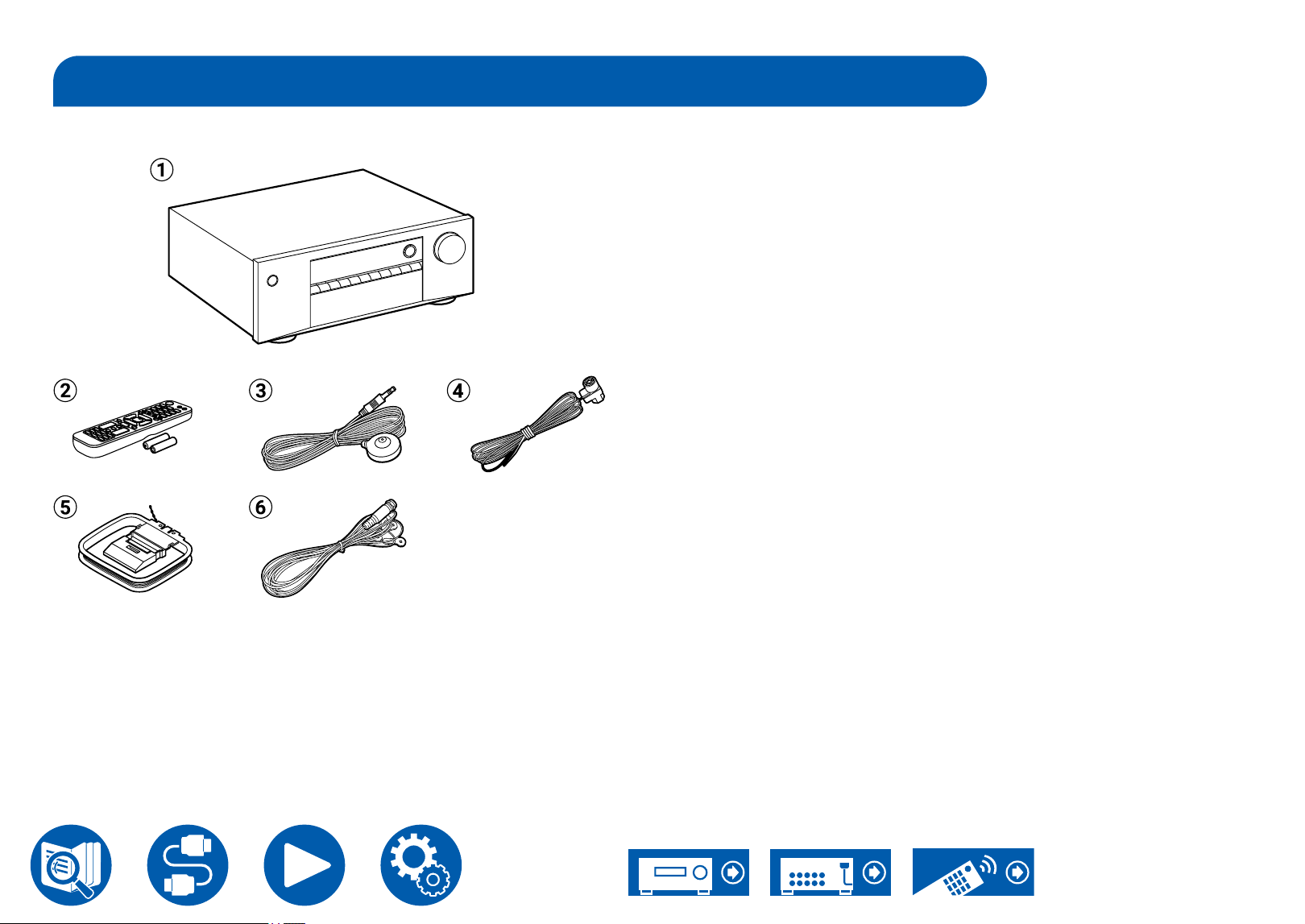
What's in the box
A Main unit (1)
B Remote controller (RC-970R) (1), Batteries (AAA/R03) (2)
C Speaker setup microphone (1)
• Used during Initial Setup.
D Indoor FM antenna (North American, Taiwanese, Middle East, Australian and
Asian model) (1)
E AM loop antenna (North American, Taiwanese, Middle East, Australian and
Asian model) (1)
F DAB/FM antenna (European models) (1)
• Initial Setup Guide (1)
* This is an online user manual. This is not supplied with the product.
Note
• Connect speakers with an impedance of 4 Ω to 16 Ω.
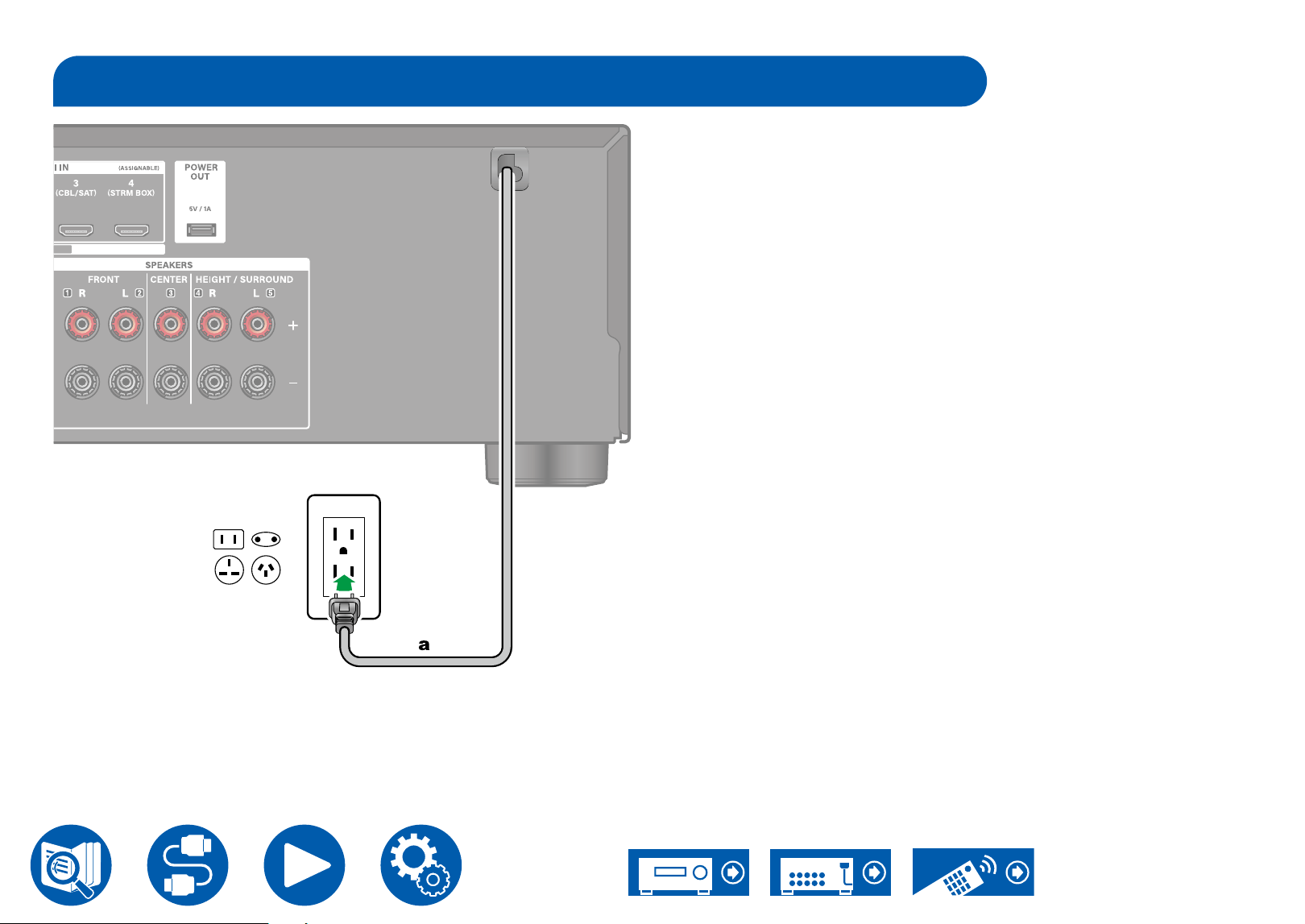
• The power cord must be connected only after all other connections are
completed.
• We will not accept any responsibility for damage arising from the connection
with equipment manufactured by other companies.
• Details on the rmware update will be posted on our website and through
other means at a later date.
• The illustrations in this manual use those of North American models unless
otherwise mentioned.
• Specications and appearance are subject to change without prior notice.
6
Firmware Update
Disclaimer: The program and accompanying online documentation are
furnished to you for use at your own risk.
Our company will not be liable and you will have no remedy for damages for
any claim of any kind whatsoever concerning your use of the program or the
accompanying online documentation, regardless of legal theory, and whether
arising in tort or contract.
In no event will our company be liable to you or any third party for any special,
indirect, incidental, or consequential damages of any kind, including, but not
limited to, compensation, reimbursement or damages on account of the loss of
present or prospective prots, loss of data, or for any other reason whatsoever.
Update Information of the rmware
For the latest rmware contents and the rmware version, visit website.
Checking the Firmware Version of the Unit
To conrm the rmware version of your product, press the SETUP button
on the remote controller, and refer to "Miscellaneous" - "Firmware Update" -
"Version" ( →p73).
Firmware Update Procedure
Updating can take about 20 minutes. Existing settings are maintained.
Updating via USB
• Save only the updating data on the USB storage device. Delete any other
data.
• While updating the rmware, do not do the following:
– Disconnecting and reconnecting cables, USB storage device, speaker
setup microphone or headphones, or performing operations on the unit
such as turning the power o
• Prepare a 1 GB or larger USB storage device. The format of USB storage
devices supports FAT16 or FAT32 le system format.
– Media inserted into a USB card reader may not be used for this function.
– USB storage devices equipped with the security function are not
supported.
– USB hubs and USB devices equipped with the hub function are not
supported. Do not connect these devices to the unit.
• If "HDMI CEC" is set to "On", set it to "O".
– Press SETUP. Next, select "Hardware" - "HDMI" and press ENTER,
then select "HDMI CEC" and select "O".
* Depending on the USB storage device or its content, long time may be required
for loading, the content may not be loaded correctly, or power may not be supplied
correctly.
* Our company will not be liable whatsoever for any loss or damage of data, or
storage failure arising from the use of the USB storage device. Please note this in
advance.
* The descriptions may dier from the actual on-screen displays, however, operations
and functions are the same.
7
Update
1. Connect the USB storage device to your PC.
2. Download the rmware le from the our company's website to your PC and
unzip.
Firmware les are named as below.
ONKAVR_R.zip
Unzip the le on your PC. The number of unzipped les and folders varies
depending on the model.
3. Copy all unzipped les and folders to the root folder of the USB storage
device.
• Make sure to copy the unzipped les.
4. Connect the USB storage device to the USB port of this unit.
• If an AC adapter is supplied with the USB storage device, connect the AC
adapter, and use it with a household outlet.
• If the USB storage device has been partitioned, each section will be
treated as an independent device.
5. Turn on the power of the unit and wait for about 20 seconds.
6. Press the SETUP button on the remote controller, select "Miscellaneous" -
"Firmware Update" - "Update via USB" in order and press ENTER.
• If "Firmware Update" is not available for selection, wait until the system has
started.
• "Update via USB" will not be available for selection if the rmware of the
unit is the latest.
7. Press ENTER with "Update" selected, and start update.
"Completed!" is displayed when updating is completed.
• Check the progress on the display of the unit.
• During the update, do not turn the power o, or disconnect or reconnect
the USB storage device.
8. Disconnect the USB storage device from the unit.
9. Press ON/STANDBY on the main unit to turn the unit into standby mode.
The process is completed, and your rmware is updated to the latest version.
• Do not use ON/STANDBY on the remote controller.
If an Error Message is Displayed
If an error occurs, "- Error!" is displayed on the display of the unit. (""
represents an alphanumeric character.) Refer to the following descriptions and
check.
Error Code
• -01, -10:
The USB storage device cannot be recognized. Check if the USB storage
device or USB cable is securely inserted to the USB port of the unit.
Connect the USB storage device to an external power source if it has its own
power supply.
• -05, -13, -20, -21:
The rmware le is not present in the root folder of the USB storage device,
or the rmware le is for another model. Retry from the download of the
rmware le.
• Others:
After removing the power plug once, insert it to the outlet, and then start the
operation from the beginning.
8
Part Names
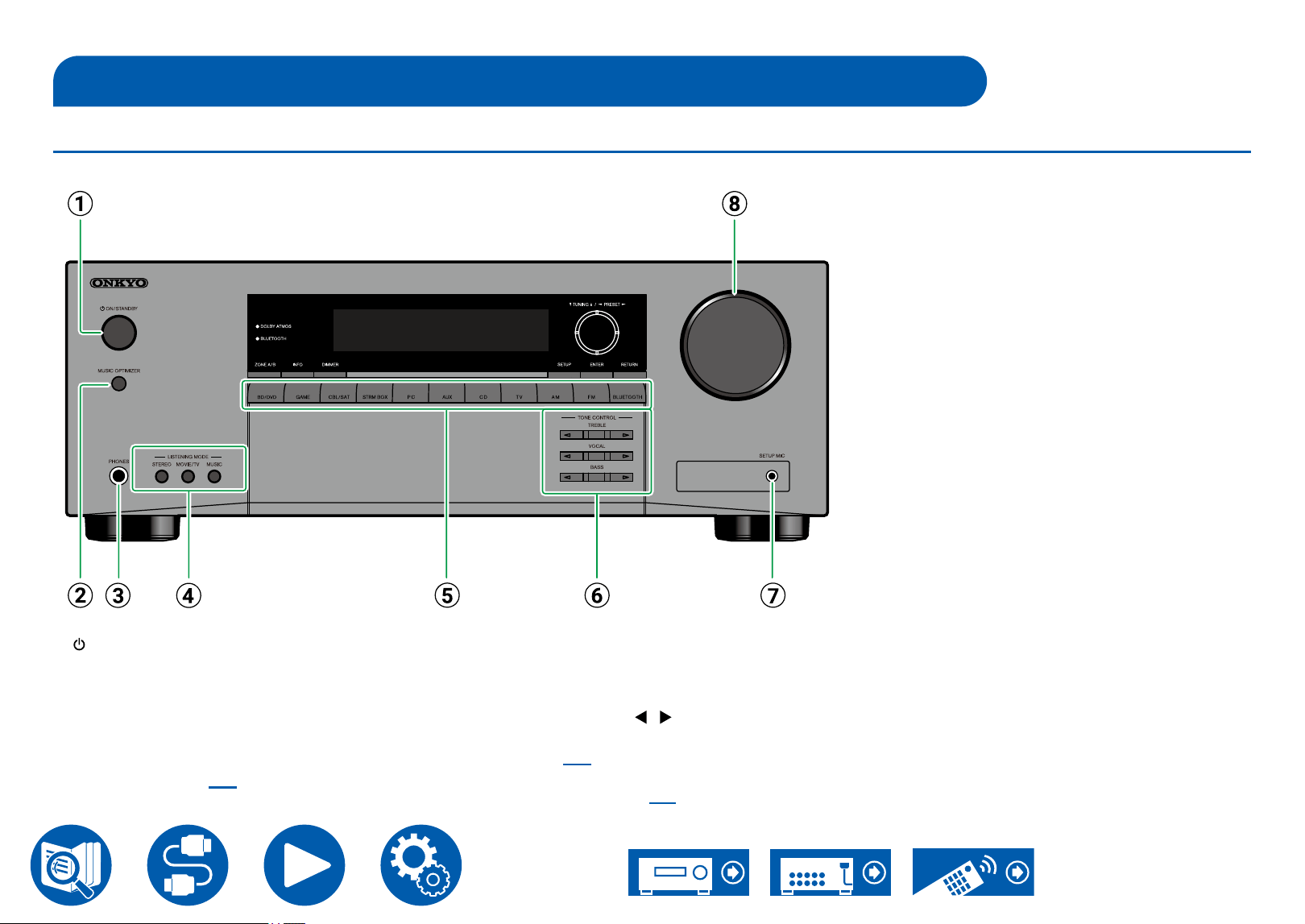
Front Panel
A ON/STANDBY button
B MUSIC OPTIMIZER button: Turns on/o the
Music Optimizer function that improves the
quality of the compressed audio.
C PHONES jack: Connect headphones with a
standard plug (ø1/4″/6.3 mm).
D LISTENING MODE button: Switches the
listening mode ( →p38) by pressing
"STEREO", "MOVIE/TV" and "MUSIC"
repeatedly.
E Input selector buttons: Switches the input to be
played.
F TONE CONTROL button: You can adjust the
sound quality. Press / LEFT/RIGHT for the
“TREBLE”/”VOCAL”/”BASS” item you want to
adjust. ( →p45)
G SETUP MIC jack: Connect the supplied speaker
setup microphone. ( →p76)
H MASTER VOLUME
9
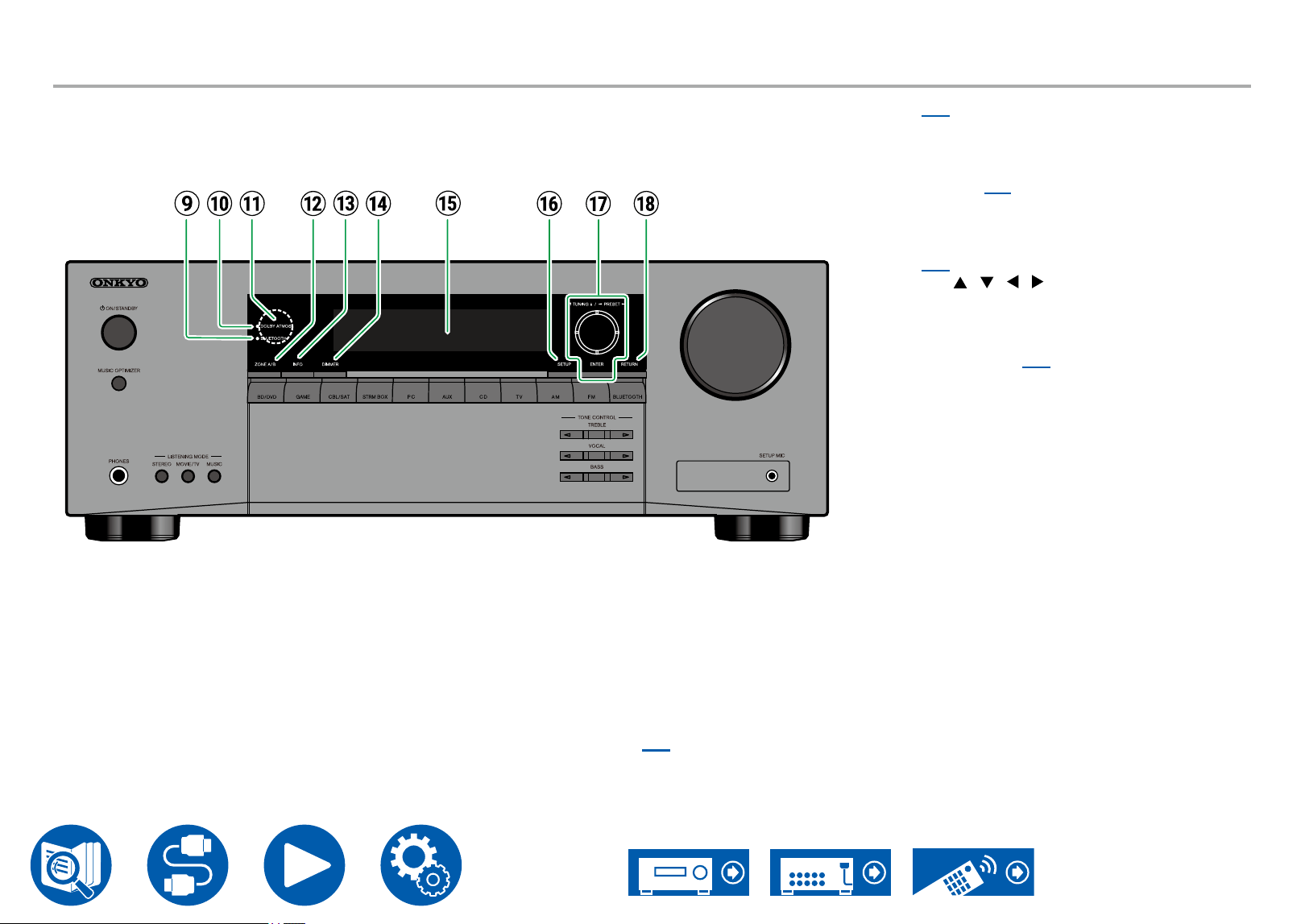
Front Panel
I BLUETOOTH indicator: Lights up when this
unit and a BLUETOOTH-enabled device are
connected.
J DOLBY ATMOS indicator: Lights up when
Dolby Atmos signals are reproduced in
appropriate listening mode.
K Remote control sensor: Receives signals from
the remote controller.
• The reception range of the remote controller
is within a distance of approx. 16´/5 m, and
an angle of 20° in vertical direction and 30° to
right and left.
L ZONE A/B button: Selects an audio output
destination from among "ZONE A", "ZONE B"
and "ZONE A+B". ( →p49)
M INFO button: Switches the information on the
display and is used to operate RDS (European,
Middle East, Australian and Asian models)
( →p42)
N DIMMER button: Switches the brightness of the
display with three levels. It cannot be turned o
completely.
O Display ( →p10)
P SETUP button: You can display advanced
setting items on the TV and the display to have
a more enjoyable experience with this unit.
( →p53)
Q Cursor / / / UP/DOWN/LEFT/RIGHT
buttons and ENTER button: Select an item with
the cursors, and press ENTER to conrm your
selection. When using TUNER, use them to tune
in to stations. ( →p40)
R RETURN button: Returns the display to the
previous state while setting.
10
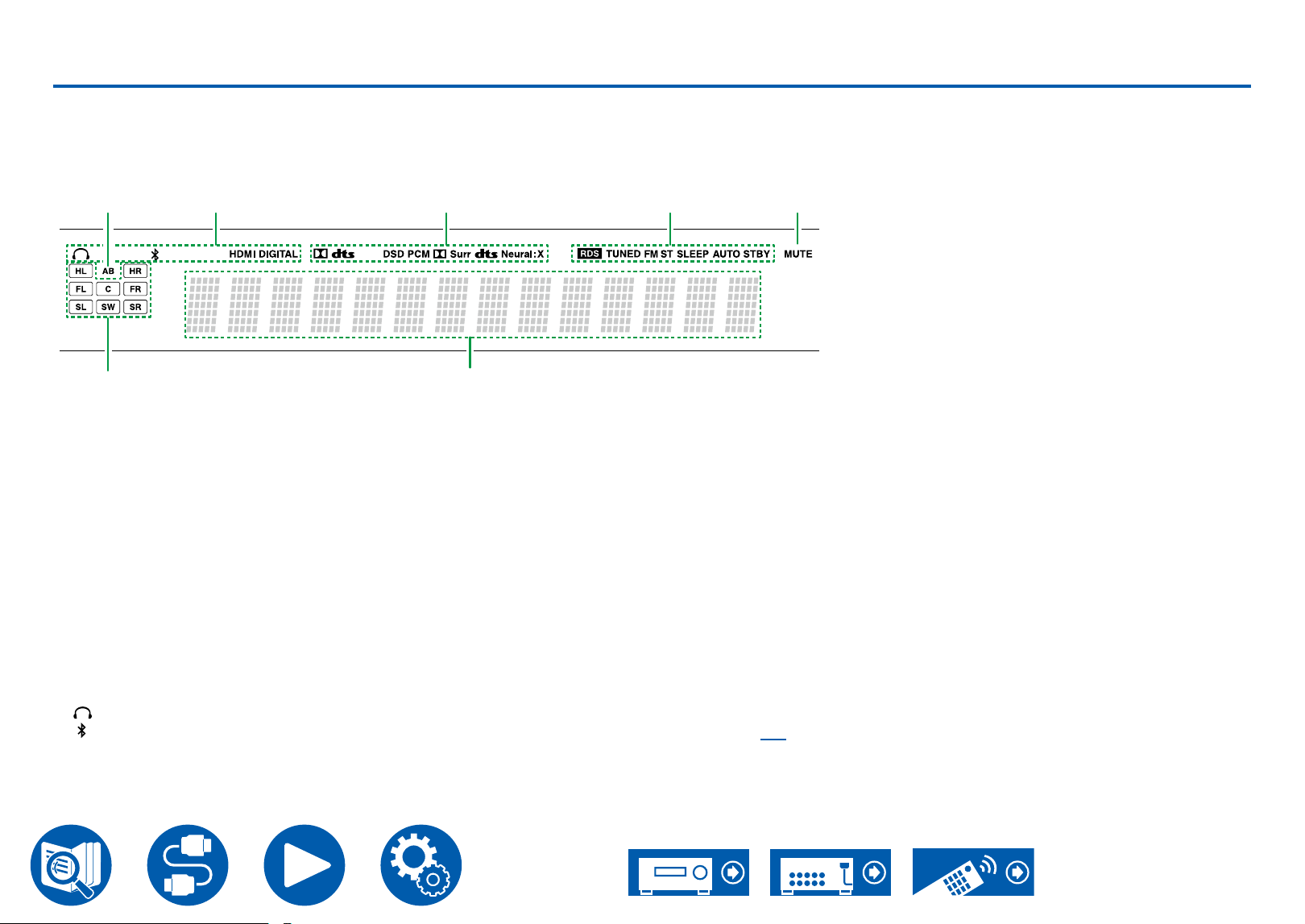
Display
A
C
B
D E F G
A Displays various information of the input signals.
B Speaker/Channel display: Displays the output
channel that corresponds to the selected
listening mode.
C Displays the audio output destination.
A: Audio is output only to ZONE A.
B: Audio is output only to ZONE B.
AB: Audio is output to both ZONE A and ZONE
B.
D Lights in the following conditions.
: Headphones are connected.
: Connected by BLUETOOTH.
HDMI: HDMI signals are input and the HDMI
input is selected.
DIGITAL: Digital signals are input and the digital
input is selected.
E Lights according to the type of input digital audio
signal and the listening mode.
F Lights in the following conditions.
RDS (European, Middle East, Australian and
Asian models): Receiving RDS broadcasting.
TUNED: Receiving DAB (European models)/
AM (North American, Taiwanese, Middle East,
Australian and Asian models)/FM radio.
FM ST: Receiving FM stereo.
SLEEP: Sleep timer is set.
AUTO STBY: Auto Standby is set. ( →p71)
G Blinks when muting is on.
11
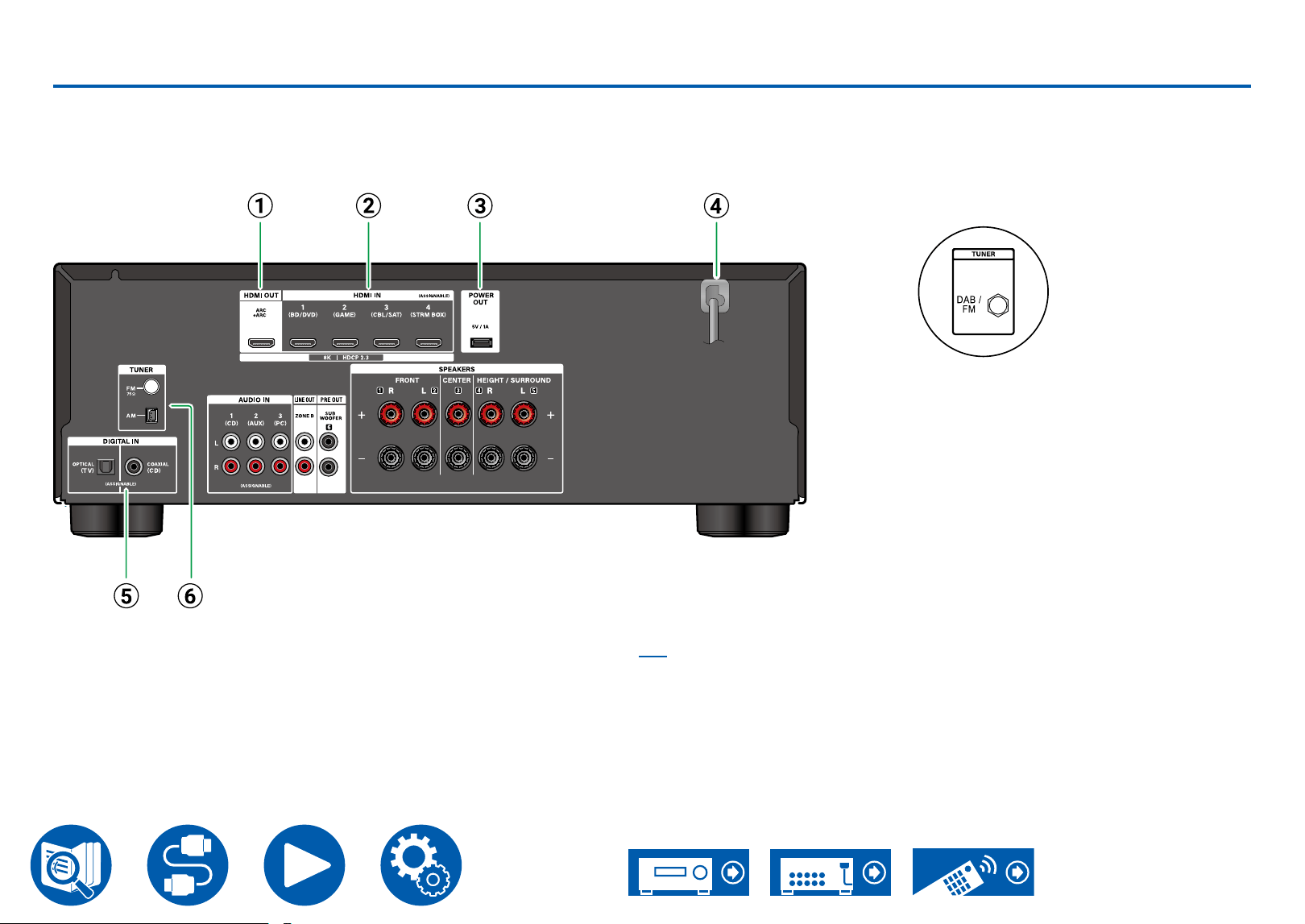
Rear Panel
A HDMI OUT jacks: Transmit video signals and
audio signals with an HDMI cable connected to
a TV.
B HDMI IN jacks: Transmit video signals and audio
signals with an HDMI cable connected to an AV
component.
C POWER OUT port: You can supply power
(5 V/1 A) to the Streaming media player
connected to the HDMI IN terminal of this unit
with a USB cable ( →p29). The playback
function of music les and power supply to
smart phones/tablets, or other devices are not
supported.
D Power cord
E DIGITAL IN OPTICAL/COAXIAL jacks: Input
TV or AV component digital audio signals with a
digital optical cable or digital coaxial cable.
F TUNER AM/FM terminal (North American,
Taiwanese, Middle East, Australian and Asian
models): Connect the supplied antennas.
TUNER DAB/FM terminal (European models) :
Connect the supplied antennas.
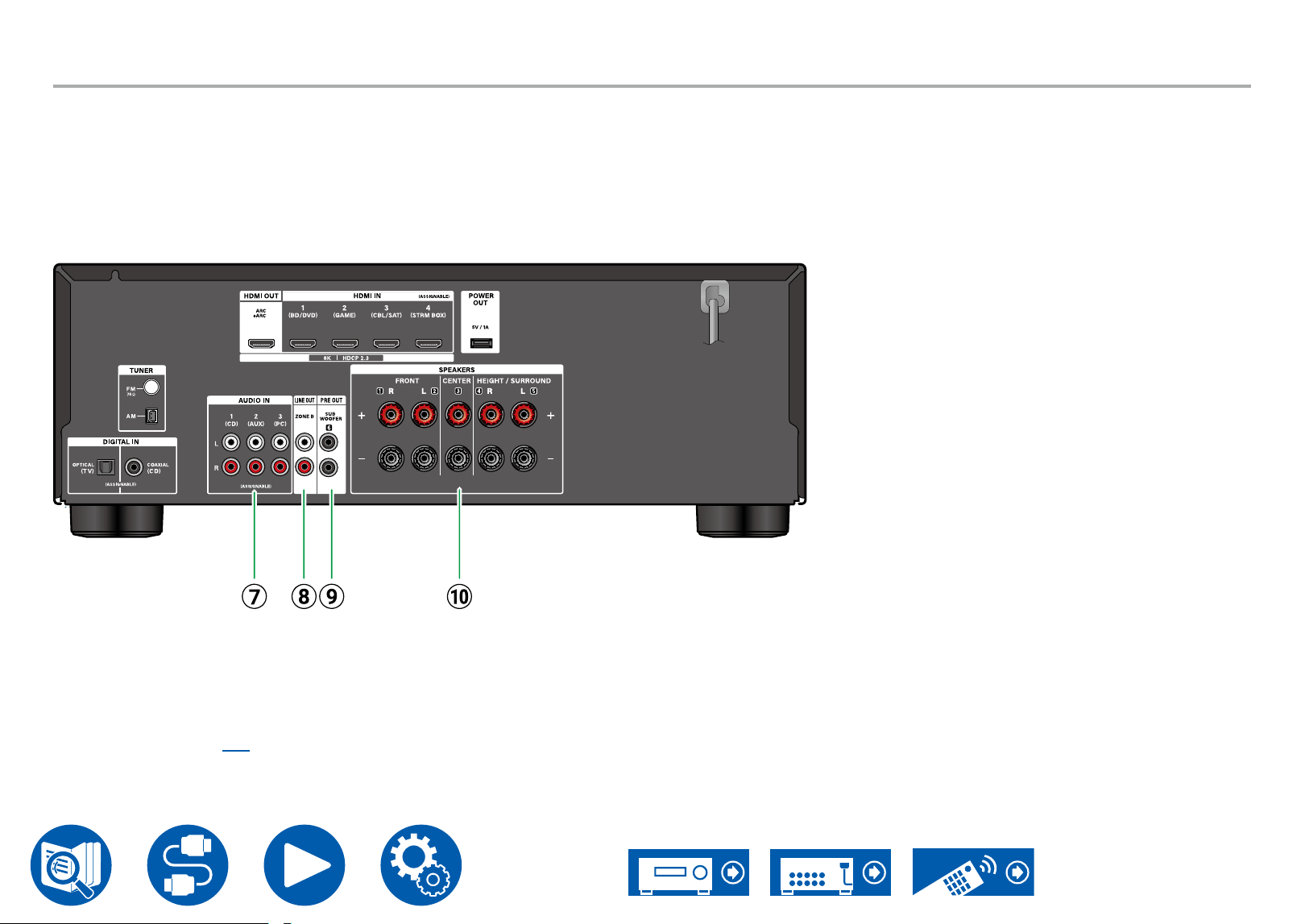
12
Rear Panel
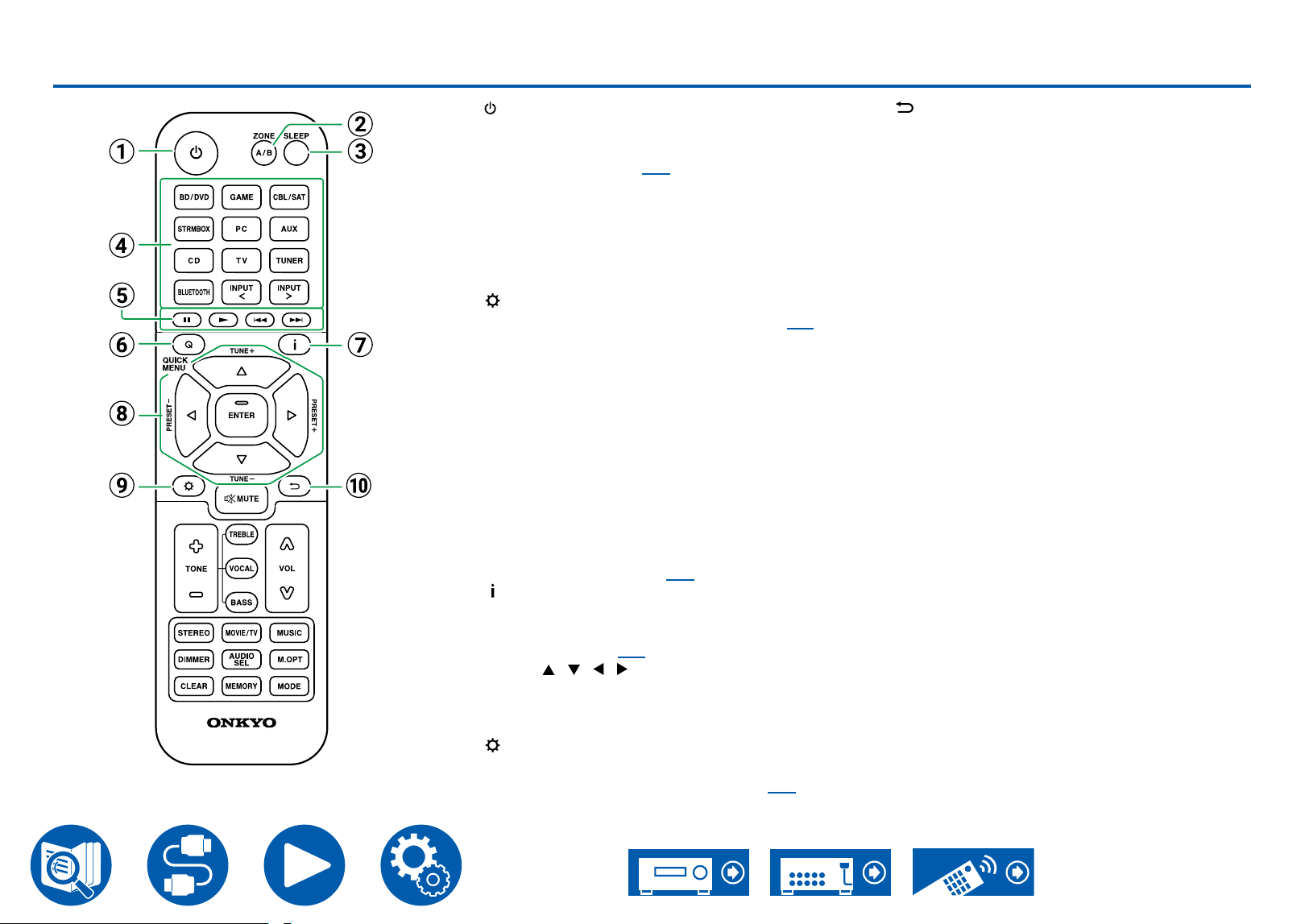
G AUDIO IN jacks: Input AV component audio
signals with an analog audio cable.
H ZONE B LINE OUT jacks: Output audio signals
with an analog audio cable connected to an
Integrated Amplier or transmitter in another
place (ZONE B). ( →p31)
I SUBWOOFER PRE OUT jacks: Connect a
powered subwoofer with a subwoofer cable.
Up to two powered subwoofers can be
connected. The same signal is output from each
SUBWOOFER PRE OUT jack.
J SPEAKERS terminals: Connect speakers with
speaker cables. (North American and Taiwanese
models are banana plug ready. Use plugs with
a diameter of 4 mm.) Y plug connection is not
supported.
13
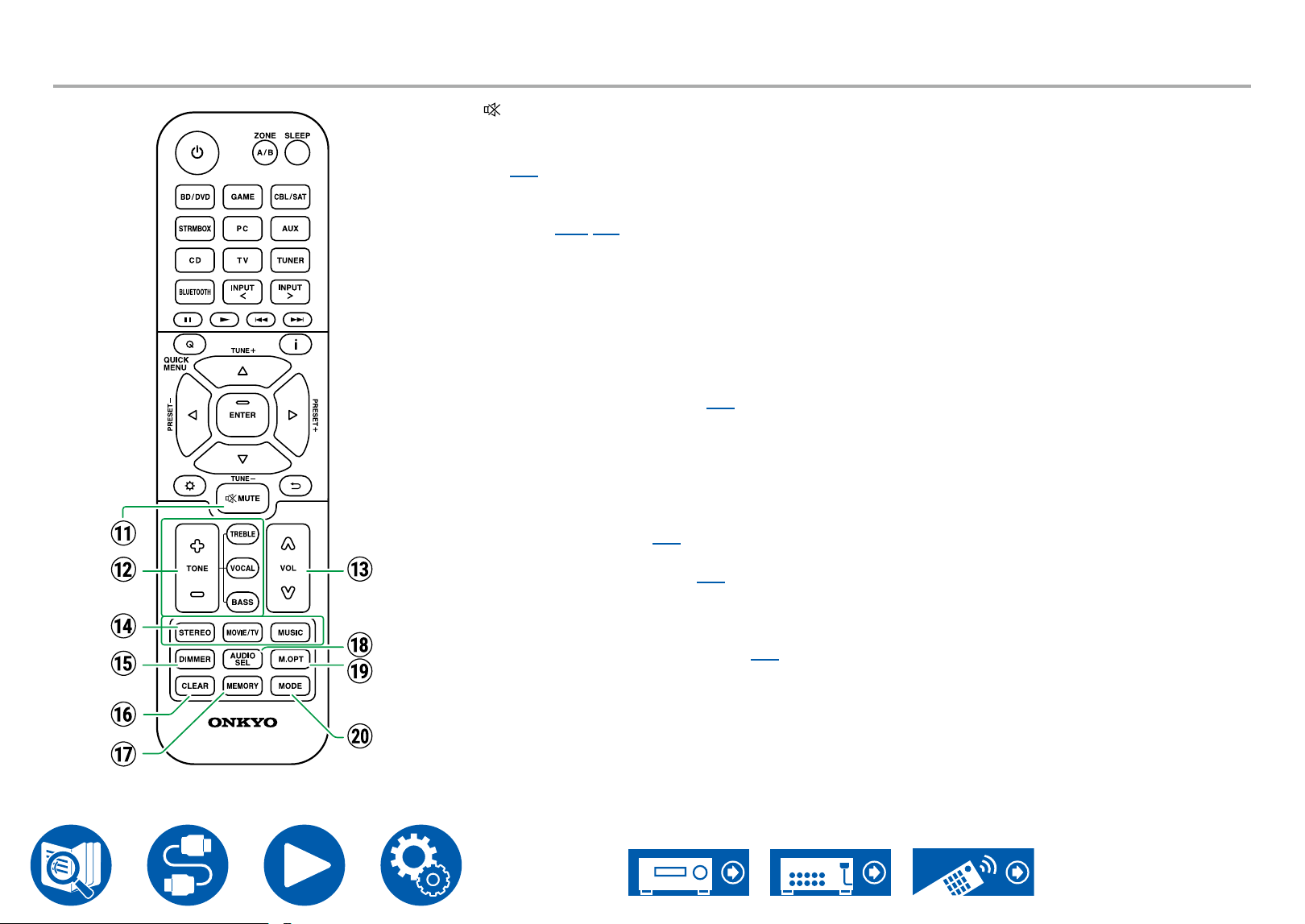
Remote Controller
A ON/STANDBY button
B ZONE A/B button: Selects an audio output
destination from among "ZONE A", "ZONE B"
and "ZONE A+B". ( →p48)
C SLEEP button: You can allow the unit to enter
standby automatically when the specied time
has elapsed. Select the time from "30 min",
"60 min", "90 min" and "O". When you do not
want to turn the unit to standby automatically,
select "O". You can also set this by pressing
SETUP button and selecting "Hardware" -
"Power Management" - "Sleep Timer" ( →p71)
on the Setup menu.
D Input selector buttons: Switches the input to be
played.
E Play buttons: Used for playback operation of a
BLUETOOTH-enabled device. Also, switching
to "CEC MODE" with T MODE button allows
you to operate an HDMI CEC function-enabled
AV component. (Some devices may not be
operated.)
F Q QUICK MENU button: Pressing this button
during playback allows you to make settings
such as "HDMI" and "Audio" quickly on the TV
screen while playing. ( →p46)
G INFORMATION button: Switches the
information on the display and is used to operate
RDS (European, Middle East, Australian and
Asian models) ( →p42).
H Cursor / / / UP/DOWN/LEFT/RIGHT
buttons and ENTER button: Select an item with
the cursors, and press ENTER to conrm your
selection.
I SETUP button: Displays advanced setting
items on the TV or the display to have a more
enjoyable experience with this unit. ( →p53)
J RETURN/EXIT button: Returns the display to
the previous state while setting.
14
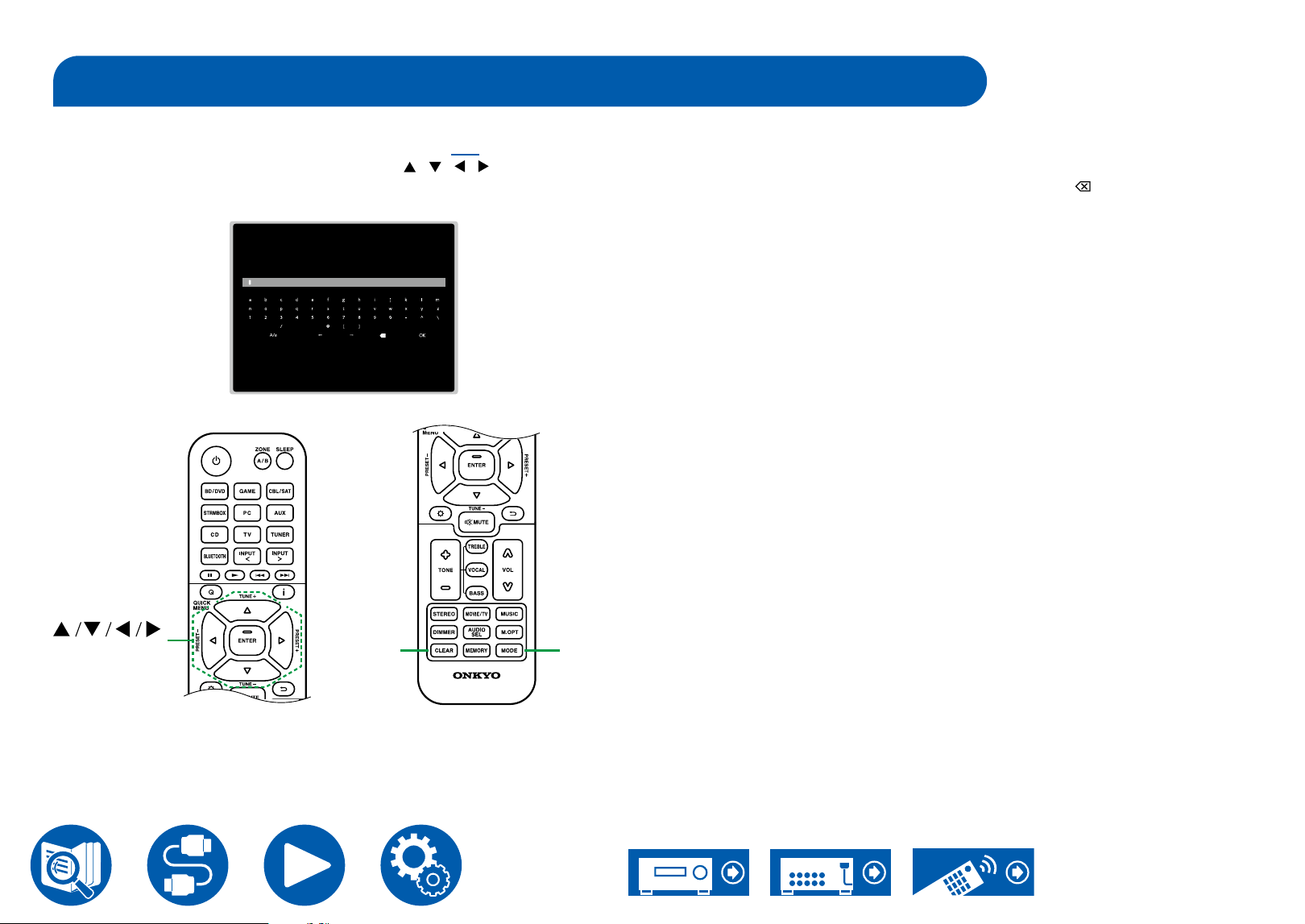
Remote Controller
K MUTE button: Temporarily mutes audio.
Press the button again to cancel muting.
L TONE buttons: Adjusts the sound quality.
( →p45)
M VOLUME buttons
N LISTENING MODE buttons: Selects a listening
mode ( →p38, p91).
O DIMMER button: Switches the brightness of the
display with three levels. It cannot be turned o
completely.
P CLEAR button: Deletes all characters you have
entered when entering text on the TV screen.
Q MEMORY button: Used to register DAB
(European models)/AM (North American,
Taiwanese, Middle East, Australian and Asian
models)/FM radio stations. ( →p44)
R AUDIO SEL button: When a device is
connected to two or more audio input terminals
for one input selector, you can select which audio
input signal to play.
S M.OPT button: Turns on/o the Music Optimizer
function that improves the quality of the
compressed audio. ( →p46)
T MODE button: Switches between automatic
tuning and manual tuning ( →p40) for AM
(North American, Taiwanese, Middle East,
Australian and Asian models)/FM stations, and
allows you to select the order for displaying
DAB (European models) stations ( →p43).
Also, when an HDMI CEC function-enabled AV
component is connected to this unit, you can
switch 5 Play buttons between "CEC MODE"
and "RCV MODE" (normal mode).
15
Inputting Characters
You can input characters or symbols on the keyboard displayed on the TV
screen such as when naming a preset radio station ( →p65).
1. Select a character or symbol with the cursors / / / UP/DOWN/LEFT/
RIGHT on the remote controller and press the ENTER button.
2. When saving characters after input, select "OK" and press the ENTER button.
, . ;/ :, . ; :
Space
ENTER
CLEAR MODE
• Select "A/a" to switch between upper and lower cases. (Can also be switched
with the MODE button on the remote controller.)
• To enter a space, select "Space".
• To delete a character on the left of the cursor, select " ".
• To delete all the input characters, press the CLEAR button on the remote
control.
Speaker Installation
3.1ch
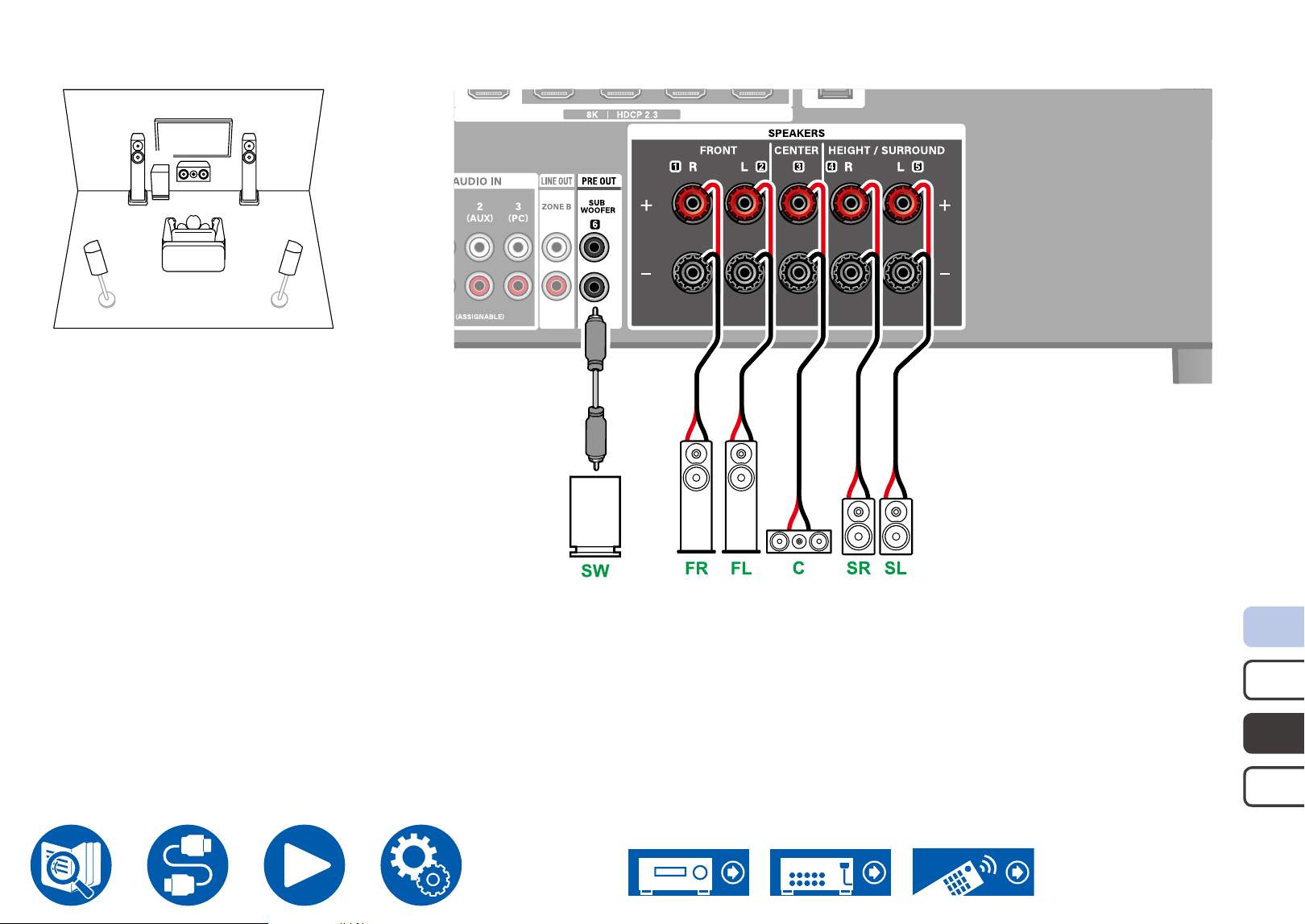
5.1ch
3.1.2ch
16
Speaker Installation
Speaker Installation
Setting Up the Speakers
How the speakers are set up depends on the size and shape of the room, so
here we introduce just a basic layout example.
The alphabetic symbols used in this chapter represent the following speakers:
FL Front speaker Left
FR Front speaker Right
C Center speaker
SW powered SubWoofer
SL Surround speaker Left
SR Surround speaker Right
FHL Front High speaker Left
FHR Front High speaker Right
TML Top Middle speaker Left
TMR Top Middle speaker Right
DFL Dolby enabled speaker Front Left
DFR Dolby enabled speaker Front Right
Speaker Installation
Speaker Connections ( →p19)
Speaker Combinations ( →p99)
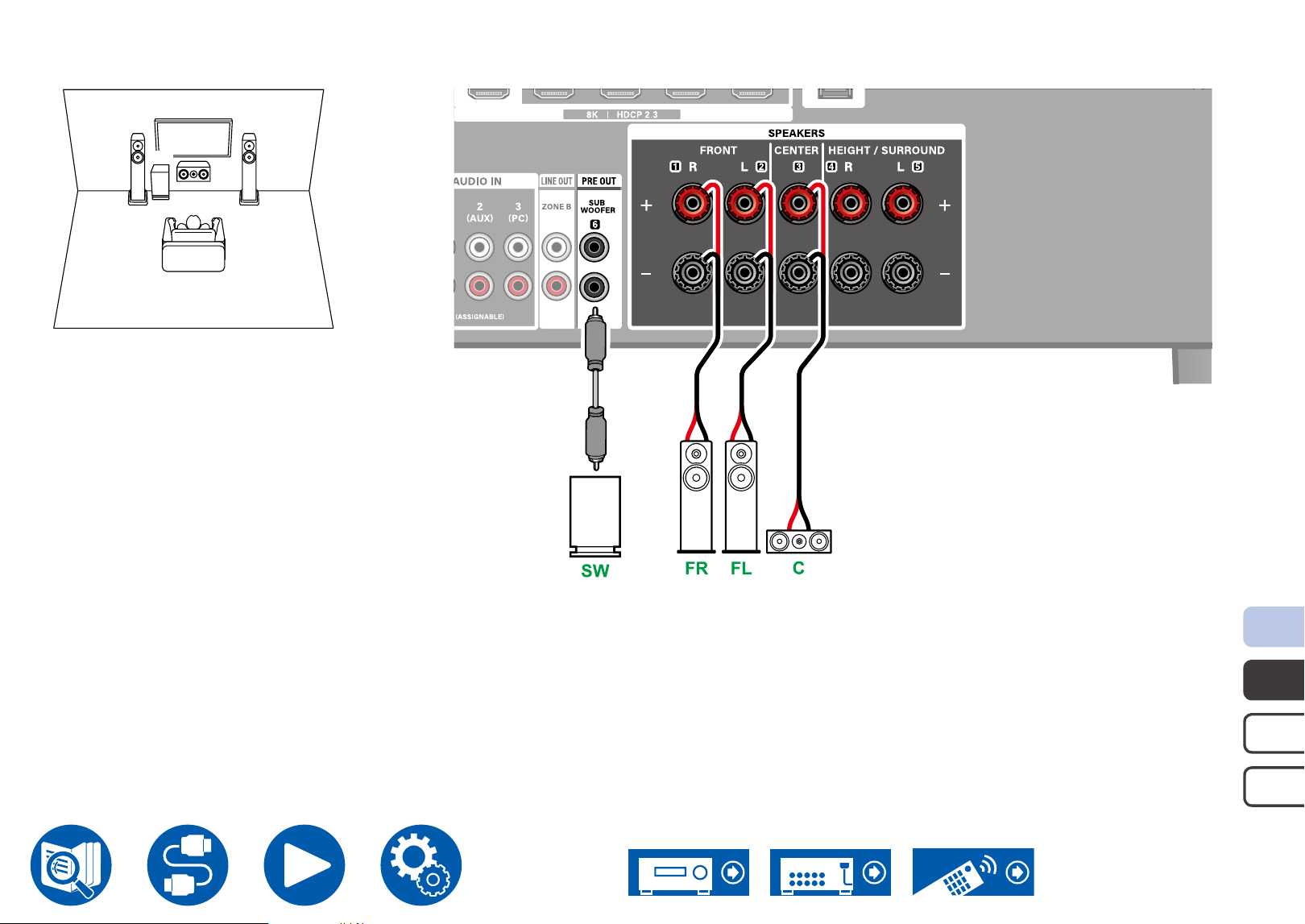
3.1ch
5.1ch
3.1.2ch
17
Speaker Installation
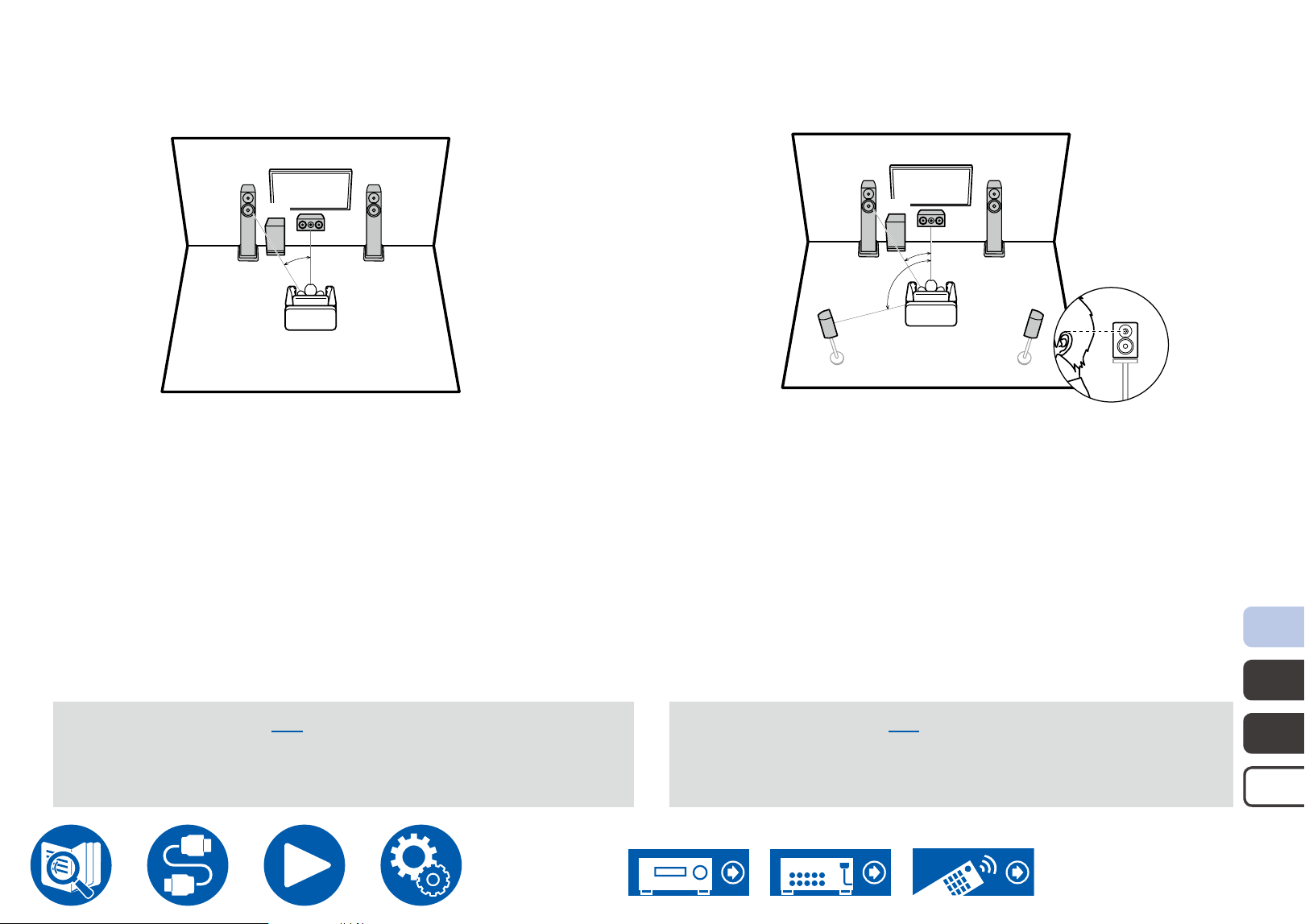
3.1 Channel System
A 3.1 Channel System that combines front speakers with a center speaker and a
subwoofer.
a
FL FR
C
SW
a: 22° to 30°
FL, FR Place the left and right front speakers to match ear height.
C The center speaker should be set up facing the listening position at
an angle.
SW Place next to the Front Speakers.
3.1 ch connection ( →p22)
5.1 Channel System
This is a basic 5.1 Channel System.
b
a
FL FR
SL SR
C
SW
a: 22° to 30°
b: 120°
FL, FR Place the left and right front speakers to match ear height.
C The center speaker should be set up facing the listening position at
an angle.
SW Place next to the Front Speakers.
SL, SR Place the left and right surround speakers to be just above ear
height.
5.1 ch connection ( →p23)
3.1.2ch
3.1ch
5.1ch
18
Speaker Installation
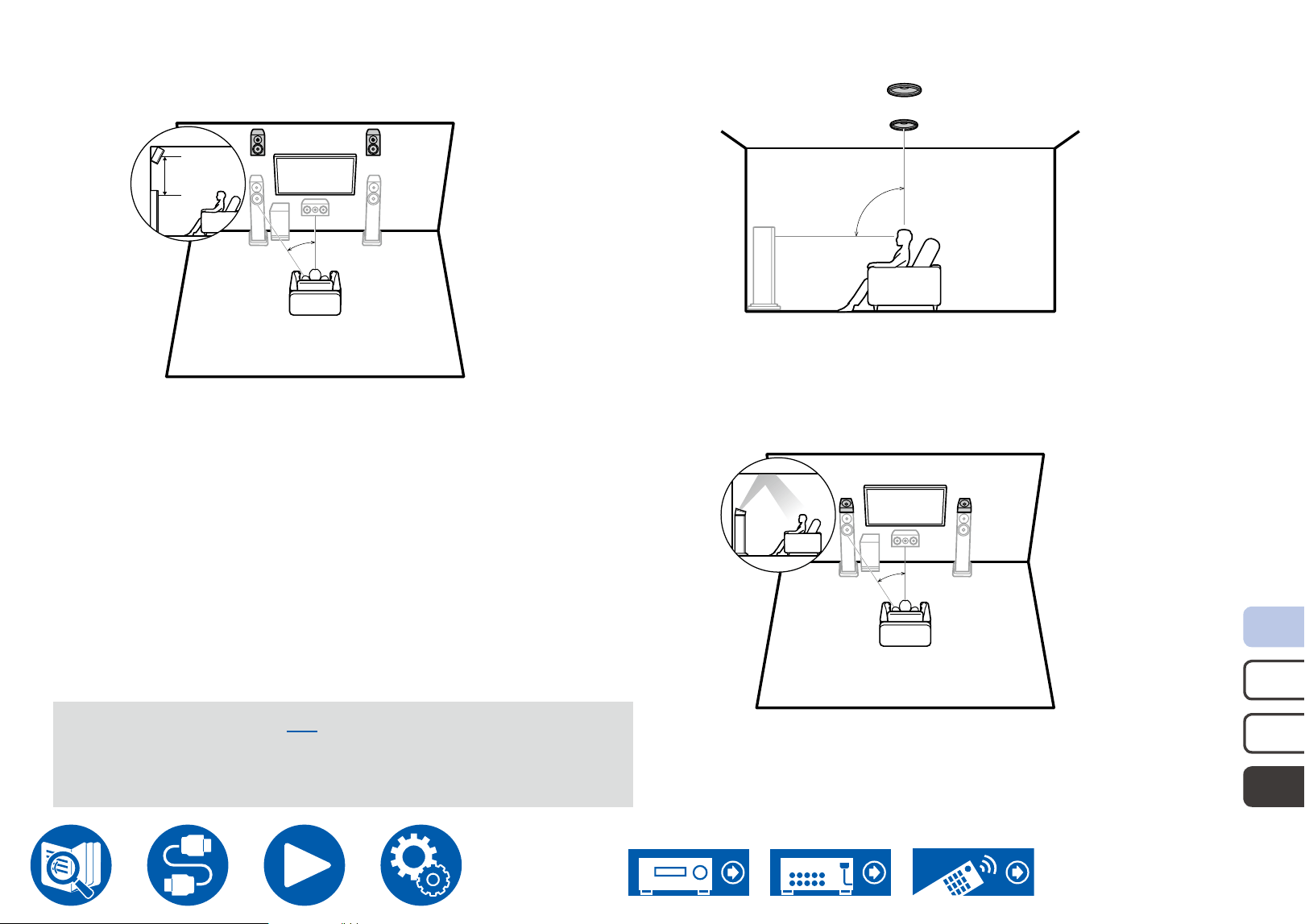
3.1.2 Channel System
High Speakers
a: 22° to 30°
FHL FHR
a
3´(0.9 m)
or more
FHL, FHR Place the front high speakers directly above the front speakers,
angled to face the listening position.
3.1.2 ch connection ( →p24)
Top Speakers
a: 65° to 100°
TML
TMR
a
TML, TMR Fit top middle speakers on the ceiling directly above the listening
position.
• Match the lateral distance of the top speakers to the front speakers.
Dolby Enabled Speakers
a: 22° to 30°
a
DFL DFR
DFL, DFR The Dolby enabled speakers (front) are installed on top of the front
speakers.
3.1ch
5.1ch
3.1.2ch
20
Speaker Connections
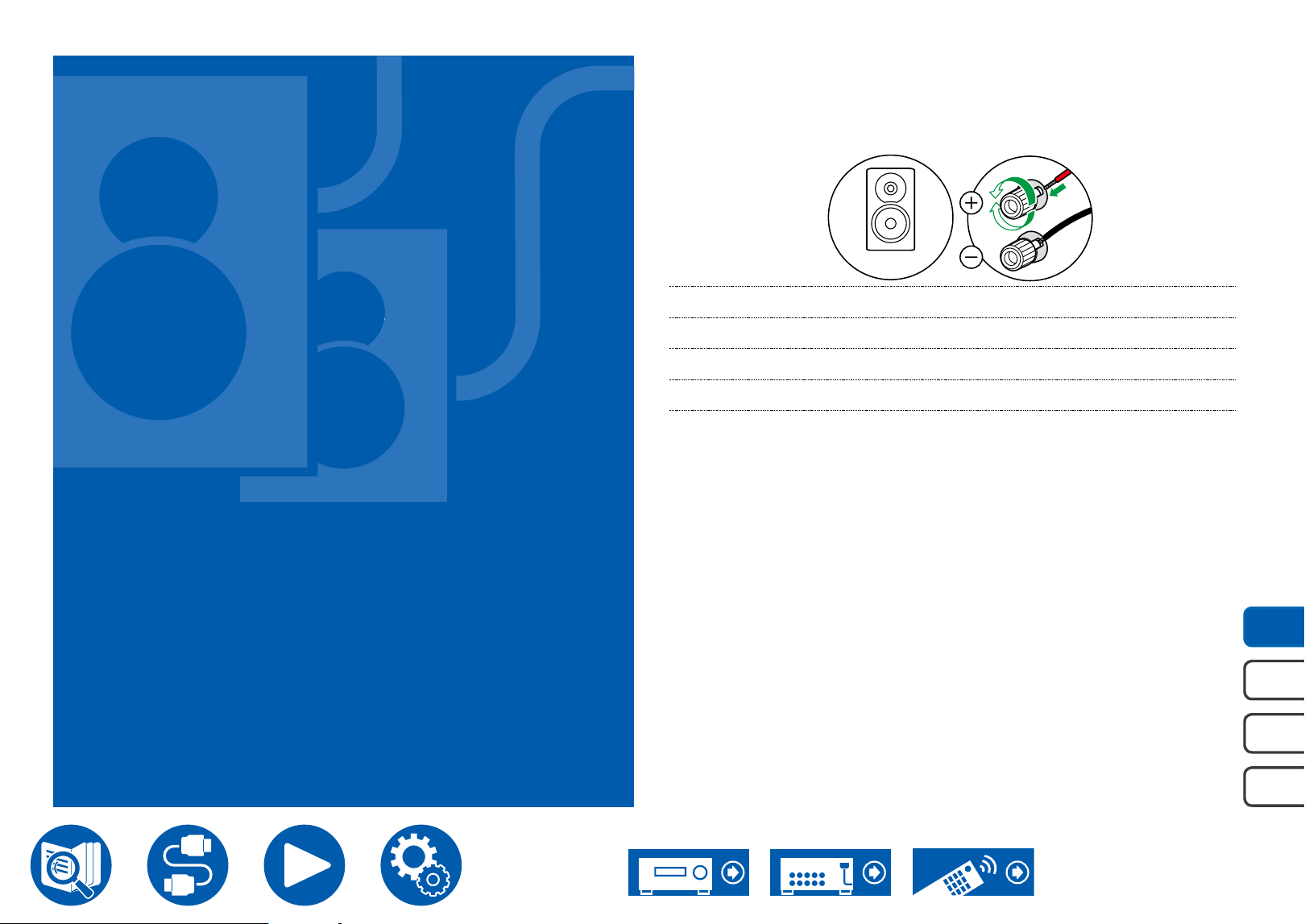
Speakers you can use with this unit and cable connections
Speakers you can use with this unit
This unit supports speakers with 4 Ω to 16 Ω impedance. For speaker impedance, check the speaker instruction manual.
(Note) Speaker Impedance
If any of the speakers to be connected has an impedance of 4 Ω or more and less than 6 Ω, set "Speaker Impedance" to "4ohms" for "Speaker Setup" in the Initial
Setup section ( →p74). When setting "Speaker Impedance" from the Setup menu, press SETUP on the remote controller, and set "Speaker" - "Conguration" -
"Speaker Impedance" ( →p59) to "4ohms".
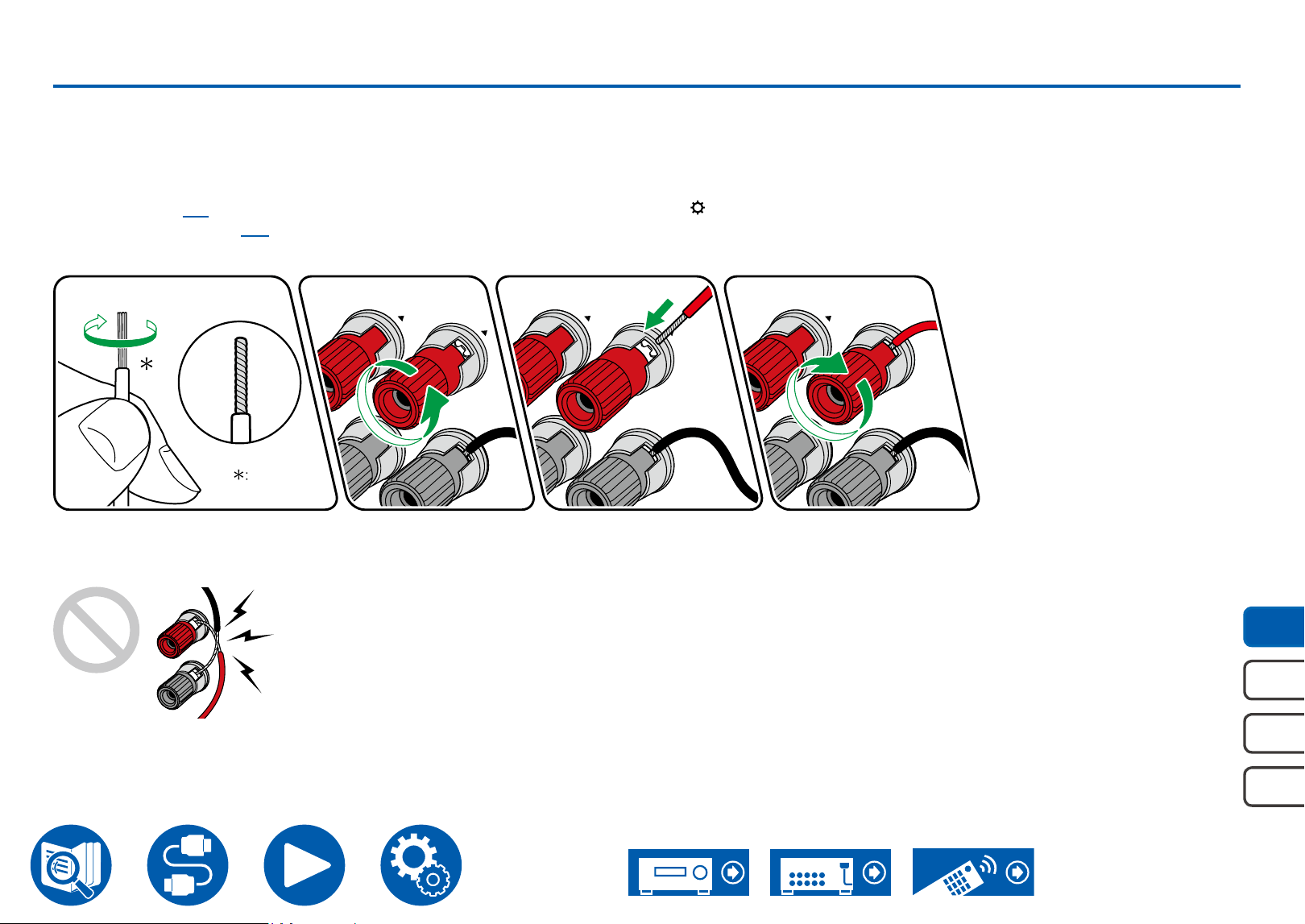
Connect the Speaker Cables
1/2˝
(12 mm)
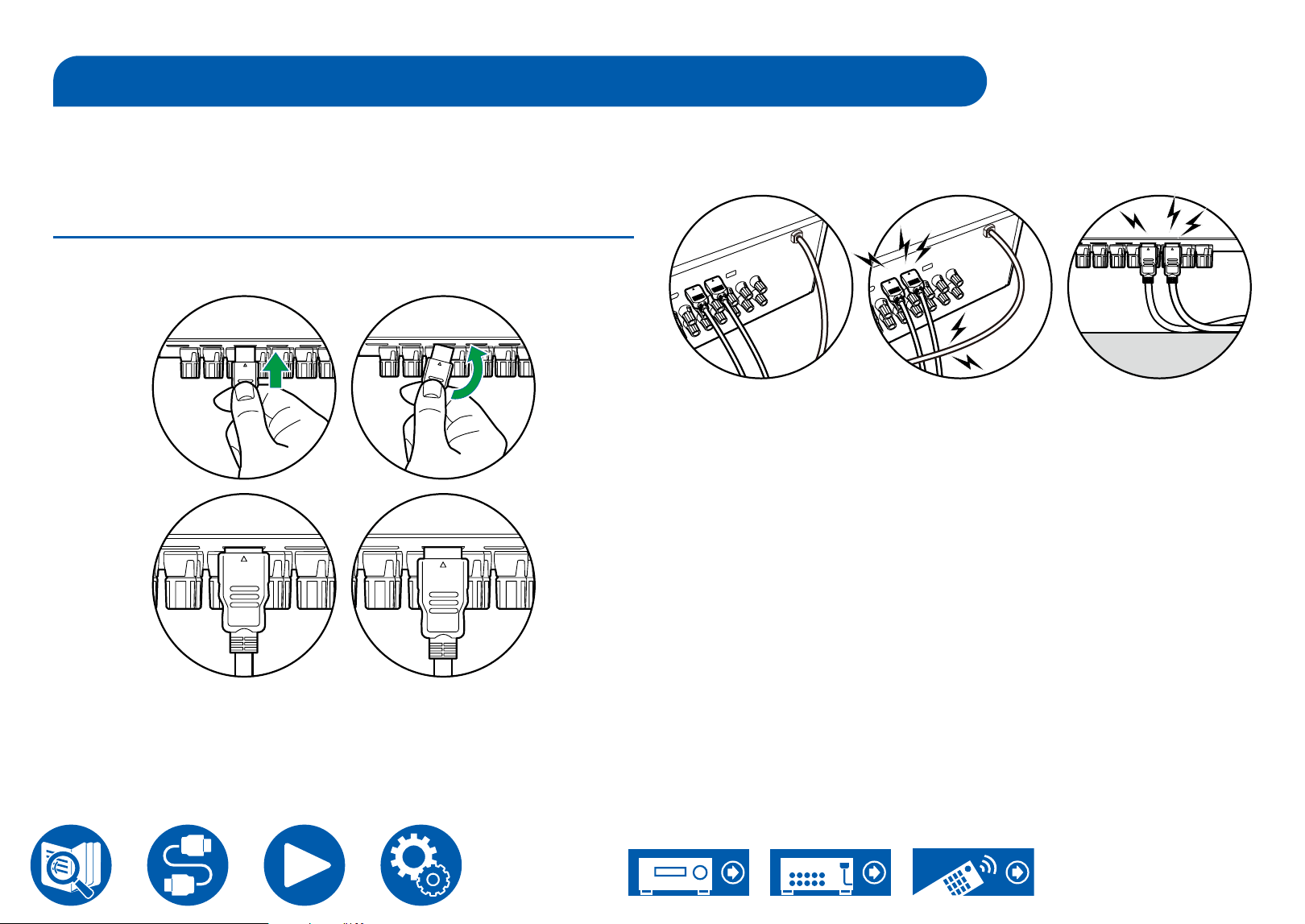
Make correct connection between the unit's jacks and speaker's jacks (+ side to + side, and - side to - side) for each channel. If the connection is wrong, a bass
sound will not be reproduced properly due to reverse phase. Twist the wires exposed from the tip of the speaker cable so that the wires do not stick out of the
speaker terminal when connecting. If the exposed wires touch the rear panel, or the + side and – side wires touch each other, a malfunction may occur.
26
Connections
Notes regarding connections with HDMI cables
HDMI (High-Denition Multimedia Interface) is a digital interface standard for
connecting TVs, projectors, Blu-ray Disc players, game consoles, and other
video components. With HDMI, a single cable can carry control signals, digital
video, and digital audio.
Connections
Push HDMI cables straight in and all the way. You can damage the terminals if
you try to insert at an angle.
Correct
Incorrect
Correct Incorrect
• Hold the terminal housing on the HDMI cable when unplugging. Pulling on the
cable may lead to damaged cabling.
(Note) Placement of cables
Putting a load on HDMI cables can lead to poor operational performance. Place
the cables so there is no load put on them.
Correct Incorrect Incorrect
• When 4K high-quality video (4K 120 Hz, etc.) or 8K high-quality video (8K
60 Hz, etc.) is to be played, use ULTRA High Speed HDMI Cable that has the
"ULTRA HIGH SPEED" label attached to the packaging.
27
Connections
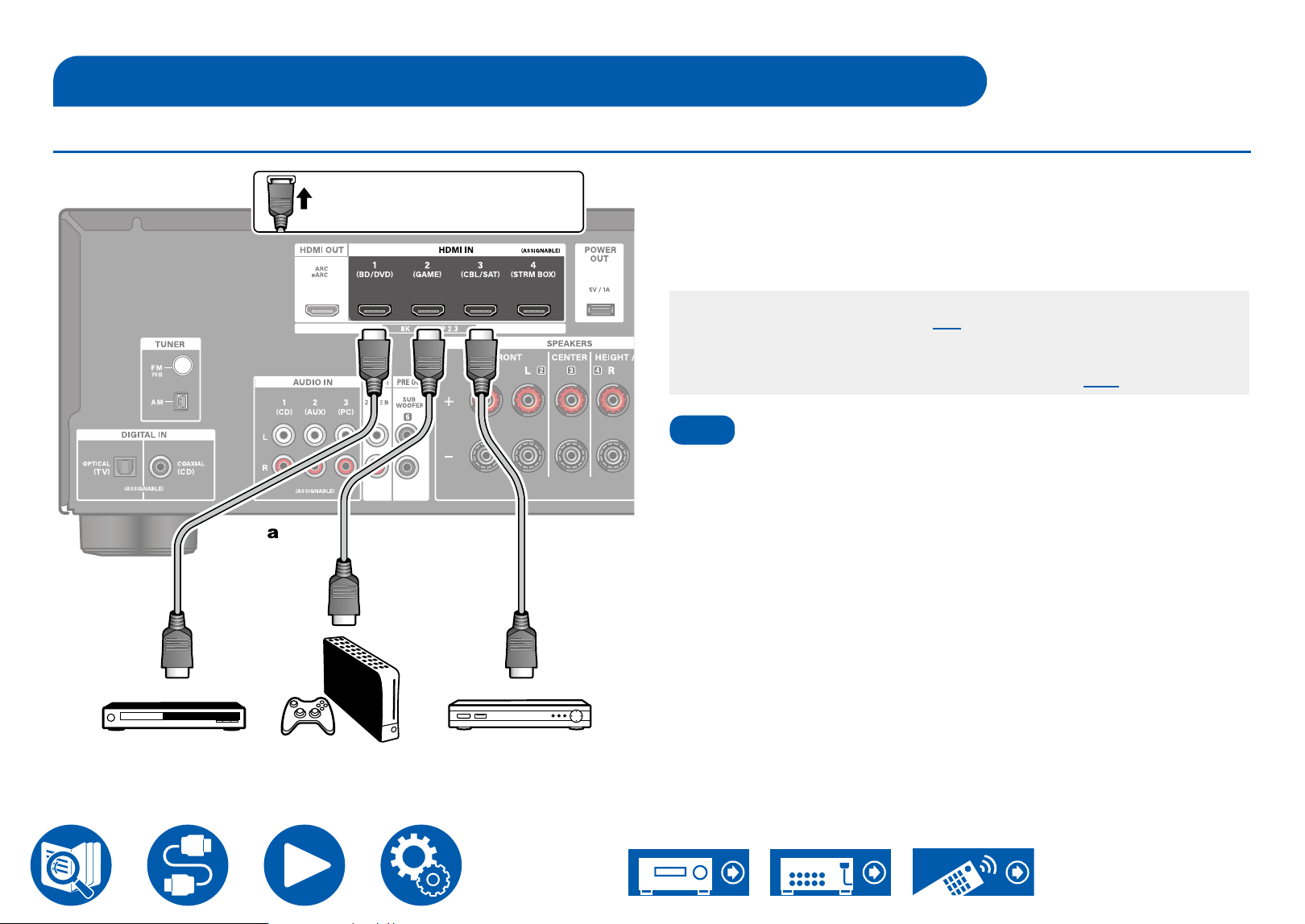
Connecting the TV
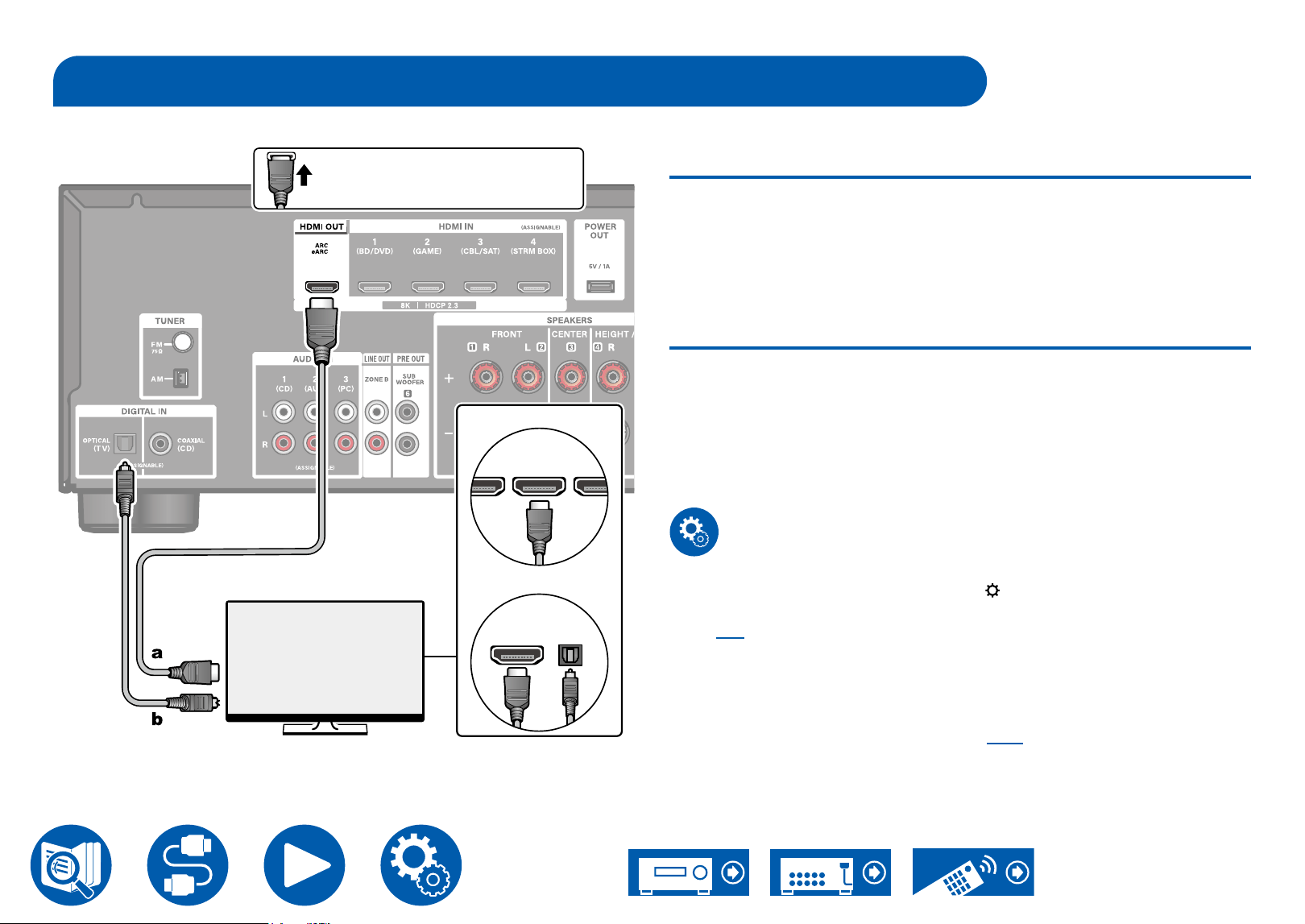
By connecting a TV to this unit, you can show the video from AV devices connected to this unit on the TV and also play the sound from the TV through this unit.
HDMI IN
DIGITAL
OPTICAL
OUT
HDMI IN
(
ARC
)
Be sure to insert the HDMI
cable all the way in.
To ARC/eARC TV
If the TV supports the ARC (Audio Return Channel) function(*), use only the
HDMI cable to connect with the TV. Use the ARC-compatible HDMI IN jack
of the TV for connection. You connect the HDMI cable to the HDMI OUT jack
labeled "ARC" on the receiver side.
• When a TV compatible with the eARC function is connected, use an HDMI
cable that supports Ethernet.
To Non-ARC TV
If the TV does not support the ARC (Audio Return Channel) function(*), connect
an HDMI cable and digital optical cable. If the TV does not have a DIGITAL
OPTICAL OUT jack, you can use an analog audio cable to connect with the
AUDIO IN TV jack.
• If you use a cable set-top box, etc. connected to the input jack of this unit to
watch TV (without using a TV’s built-in tuner), connection with a digital optical
cable or analog audio cable is not required.
Setup
• When not using the ARC function, press SETUP on the remote controller,
then set "Hardware" - "HDMI" - "Audio Return Channel (eARC supported)"
( →p69) to "O".
(*)The ARC function and eARC function transmit the audio signals of the TV via
an HDMI cable, and plays the audio of the TV on this unit. To check if the TV
supports the ARC function and eARC function, refer to the instruction manual
of the TV, etc.
ARC/eARC compatible audio formats ( →p102)
TV
ARC TV
Non-ARC TV
a HDMI cable, b Digital optical cable
29
Connections
Connecting Playback Devices
Connections to BD/DVD and GAME with HDMI jacks
Be sure to insert the HDMI
cable all the way in.
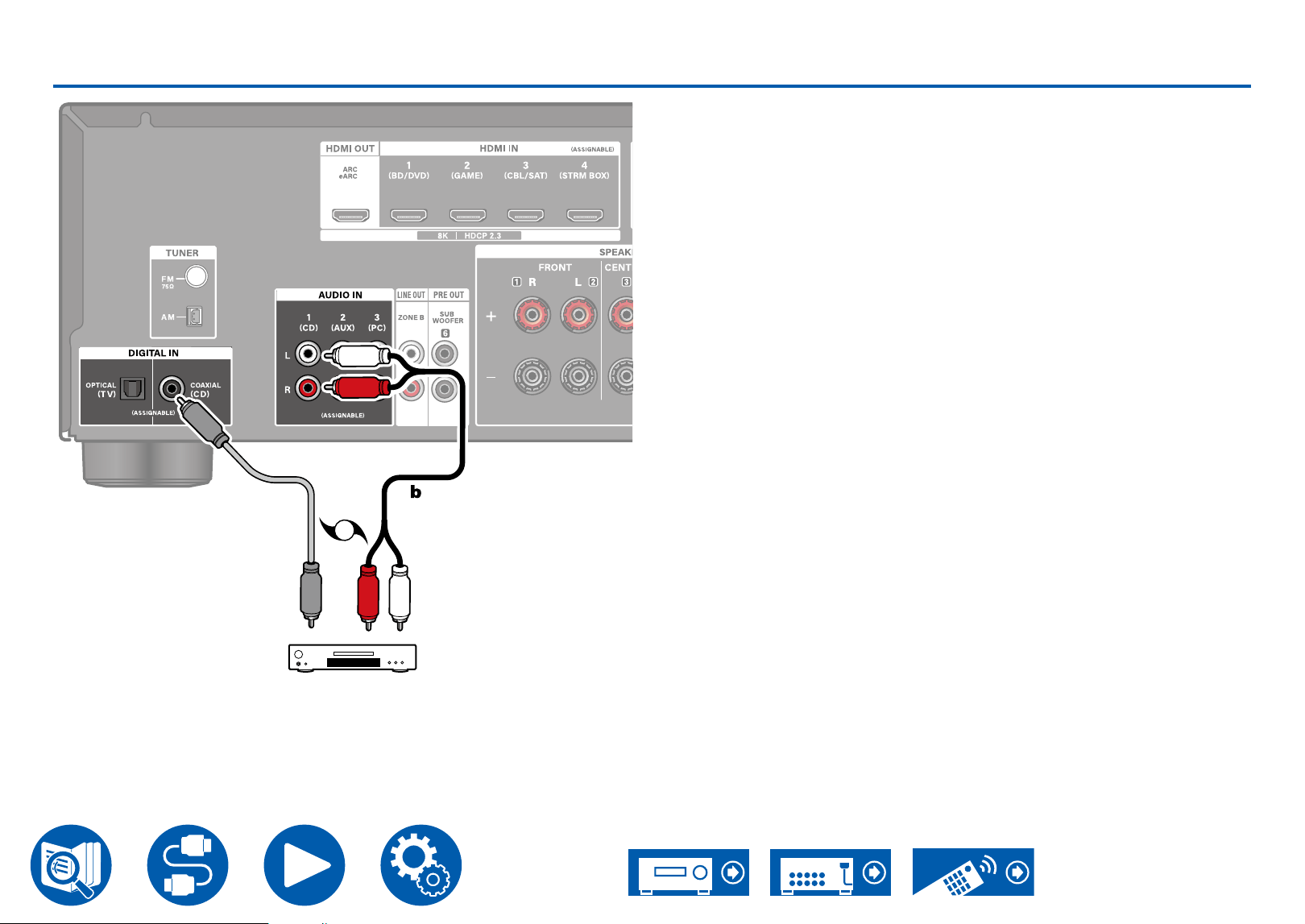
This is a connection example of an AV component equipped with an HDMI jack.
When connecting with an AV component that conforms to the CEC (Consumer
Electronics Control) standard, you can use the HDMI CEC function (*) that
enables linking with input selectors, etc. and the HDMI Standby Through
function that can transmit video and audio signals of the AV component to the
TV even if this unit is in standby mode.
• Settings are required when 8K high-quality video is to be played. Refer to
"HDMI 4K/8K Signal Format" ( →p55) for information on the settings.
Also, use an HDMI cable that supports 8K video.
• The corresponding resolution is dierent depending on the HDMI jack
connected. See "Corresponding input resolutions" ( →p103) for details.
Note
• To enjoy digital surround sound including Dolby Digital, set the audio output of
the connected Blu-ray Disc player etc. to the Bitstream output.
(*) The HDMI CEC function: This function enables various linking operations
with CEC-compliant devices, such as switching input selectors interlocking
with a CEC-compliant player, switching audio output between TV and this unit
or adjusting the volume using the remote controller of a CEC-compliant TV,
and automatically switching this unit to standby when the TV is turned o.
BD/DVD GAME
Cable/Satellite
set-top box
a HDMI cable
31
Connections
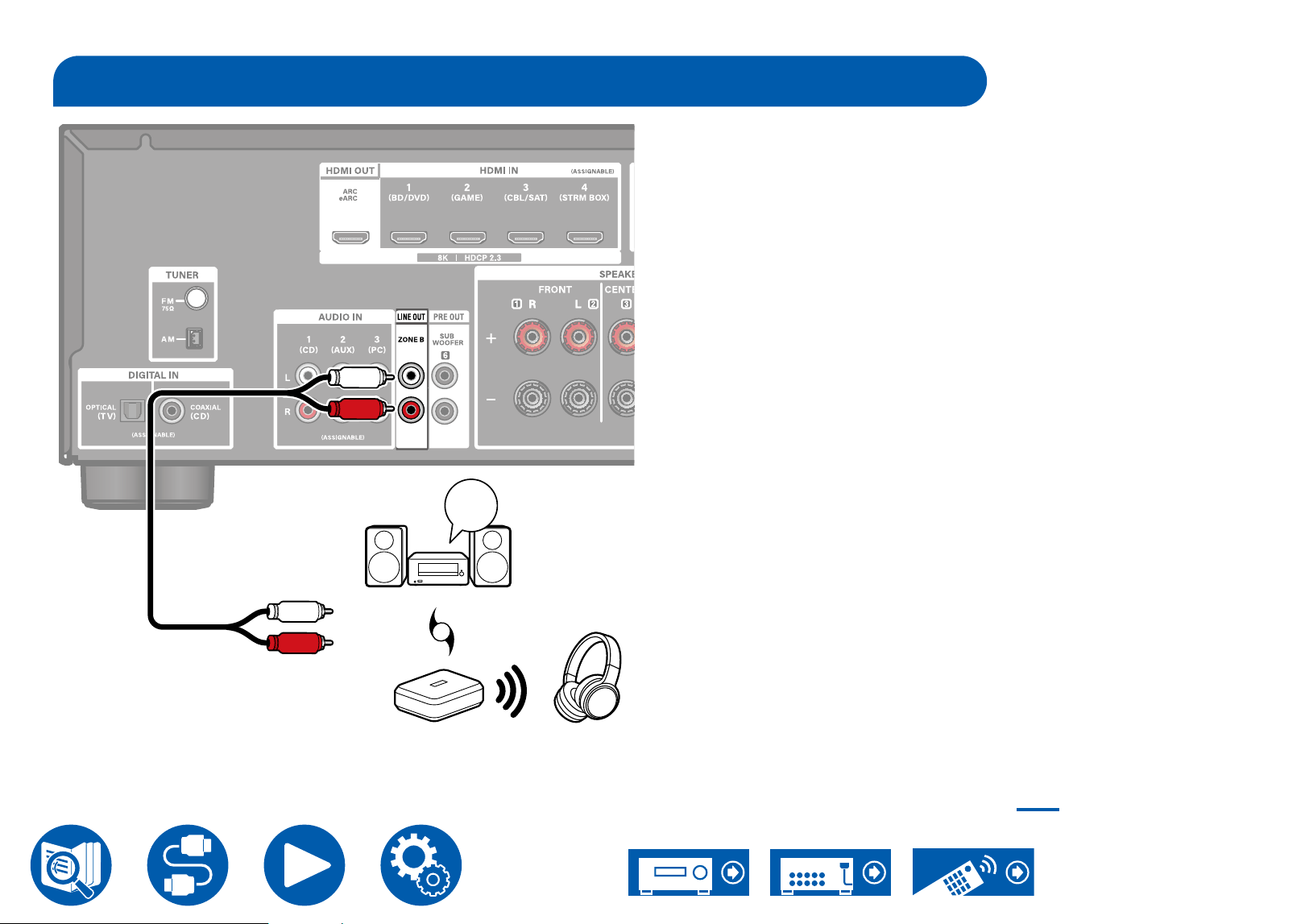
Connecting an Integrated Amplier or Transmitter (ZONE B)
OR
Input
Terminal
a
Integrated
amplier
Transmitter
By connecting an Integrated Amplier to the ZONE B LINE OUT terminal, you
can play the same source in the other place (ZONE B) as in the main room.
Also, when you connect a transmitter for wireless headphones or wireless
speakers, you can play audio through these devices.
Playing Back (ZONE B) ( →p49)
a Analog audio cable
32
Connections
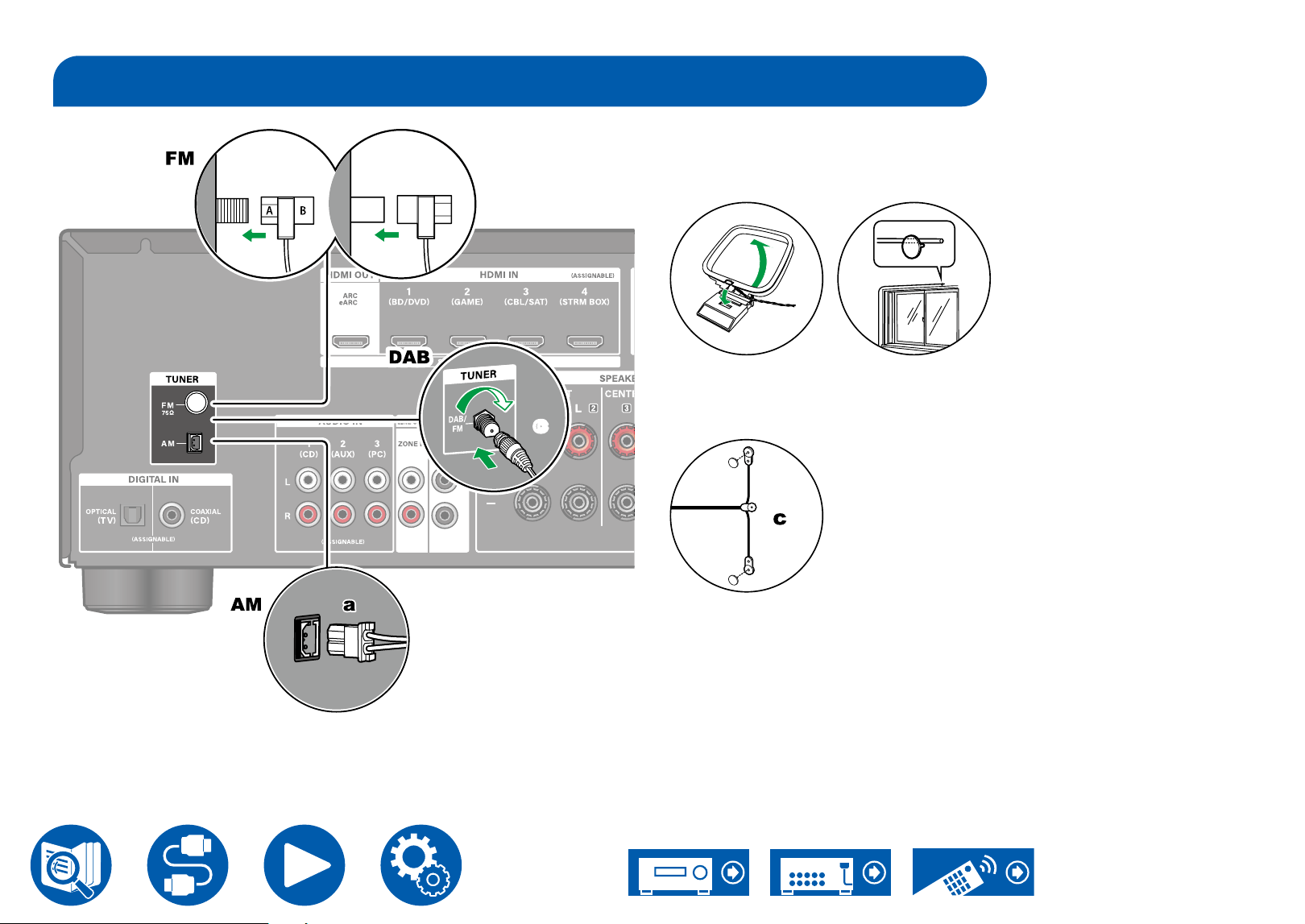
Connecting Antennas
North American, Taiwanese, Middle East, Australian and Asian models
Connect the antenna to this unit, and set up the antenna at the best position for
listening while receiving radio signals. Attach the indoor FM antenna to the wall
using push pins or adhesive tape.
a
b
European models
Make sure the plug is pushed in all the way, then x in place by turning the nut to
the right. Use a tack or similar to x the antenna to a wall.
bb bb
c
c
AB
a AM loop antenna, b Indoor FM antenna, c DAB/FM antenna
FM-A:
North American and
Taiwanese models
FM-B:
Australian, Asian and
Middle East models
35
Playback
Basic Operations
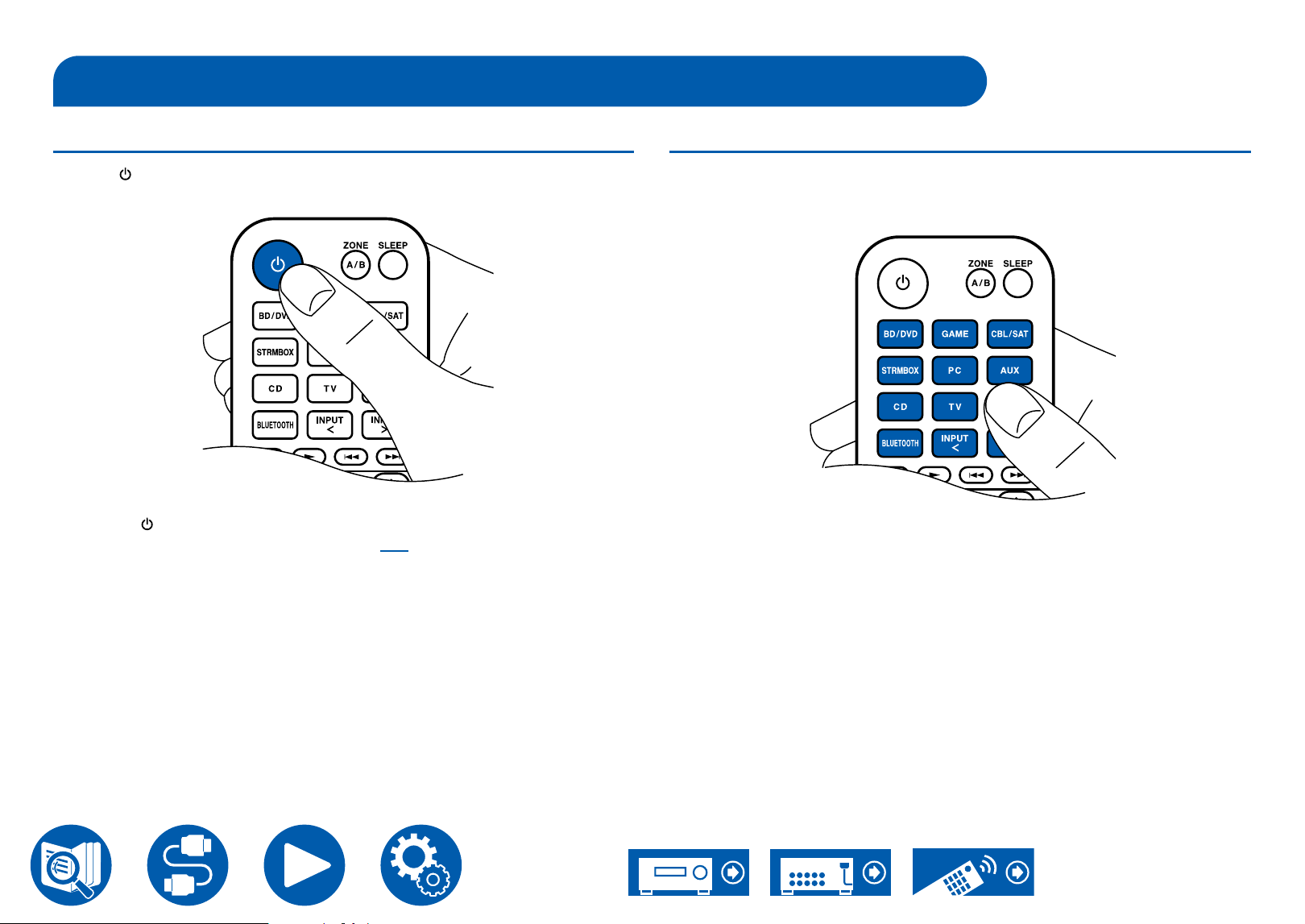
Turning the power on
1. Press ON/STANDBY on the remote controller to turn on the power of the
unit.
You can also turn on the power of the unit with the following operations:
– Pressing ON/STANDBY on the main unit.
– Using the linking function (HDMI CEC) ( →p36)
Selecting a source to play
1. Press an input selector button on the remote controller to select a source.
For example, to play the device connected to the BD/DVD jack, press the BD/
DVD button. To listen to the audio of the TV, press TV button.
You can also select a source to play with the following operations:
– Pressing an input selector button on the main unit
36
Playback
Adjusting the volume
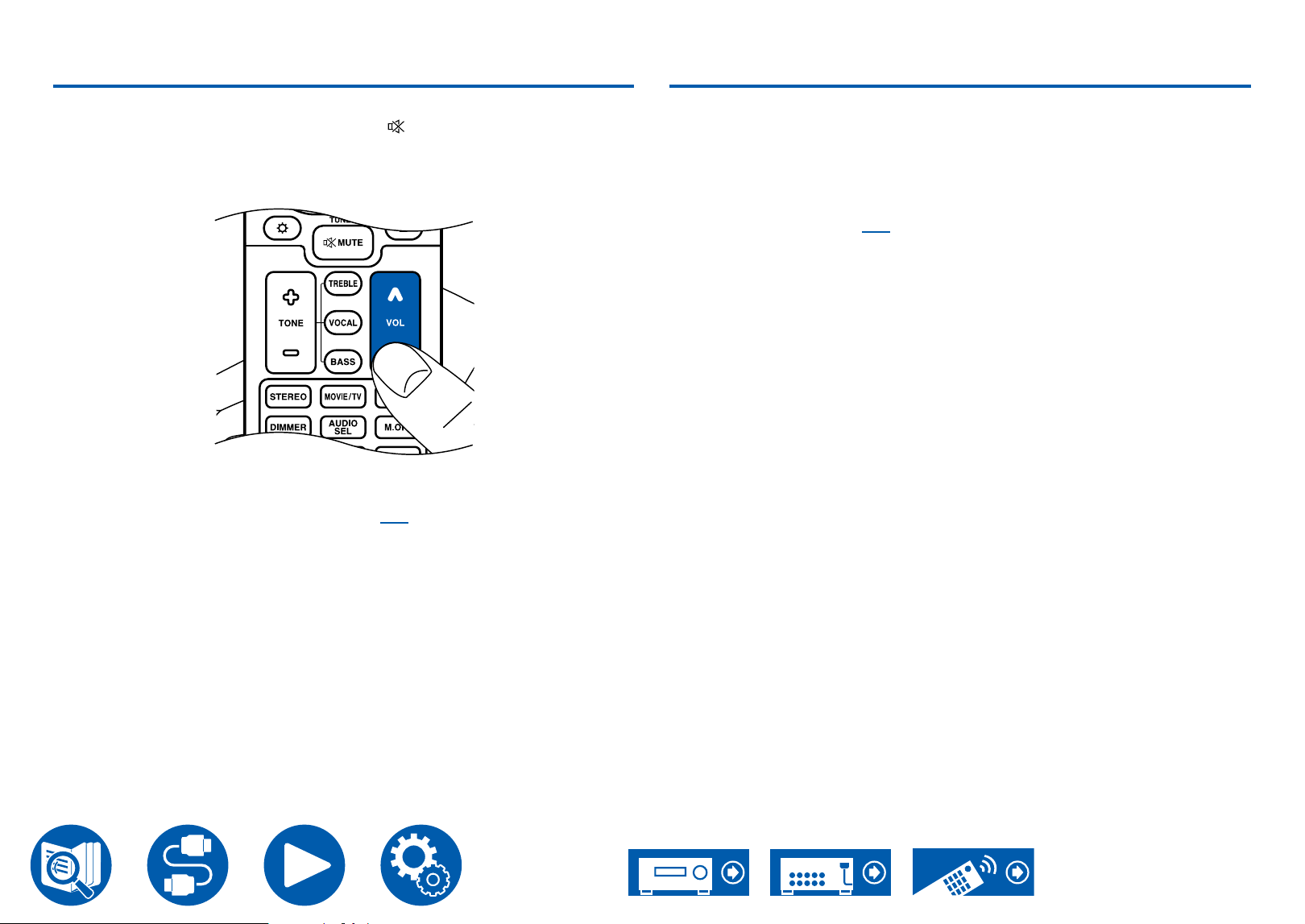
1. Press the VOLUME buttons on the remote controller to adjust the volume.
To temporarily turn o the sound, press the MUTE button. Press again to
cancel.
• When Dolby Vision images are received, the volume bar on the TV screen
changes from blue to magenta.
You can also adjust the volume with the following operations:
– Using the MASTER VOLUME on the main unit
– Using the linking function (HDMI CEC) ( →p36)
Using the linking function (HDMI CEC)
By using a HDMI cable and connecting to a TV that is compatible with the
HDMI CEC (Consumer Electronics Control) function, you are able to perform
operations such as adjusting the volume of this unit with the TV's remote
controller and link power On/O. Furthermore, if you have connected a Blu-ray
Disc player, GAME, etc. that is compatible with the HDMI CEC function, input
switching is performed automatically.
• HDMI CEC settings ( →p68) (the default value is On)
• For information about the HDMI CEC functions of the TV, refer to the
operating instructions, etc., for the TV.
• The unit is designed to link with products that comply with the CEC standard,
and that linked operation is not always guaranteed with all CEC devices.
• For linked functions to work properly, do not connect CEC-compliant devices
exceeding the connectable number to the HDMI jack as shown below.
– Blu-ray Disc/DVD players: up to 3 units
– Blu-ray Disc/DVD recorders: up to 3 units
– Cable TV tuner, terrestrial digital tuner, and satellite broadcasting tuner: up
to 4 units
37
Playback
Switching the display
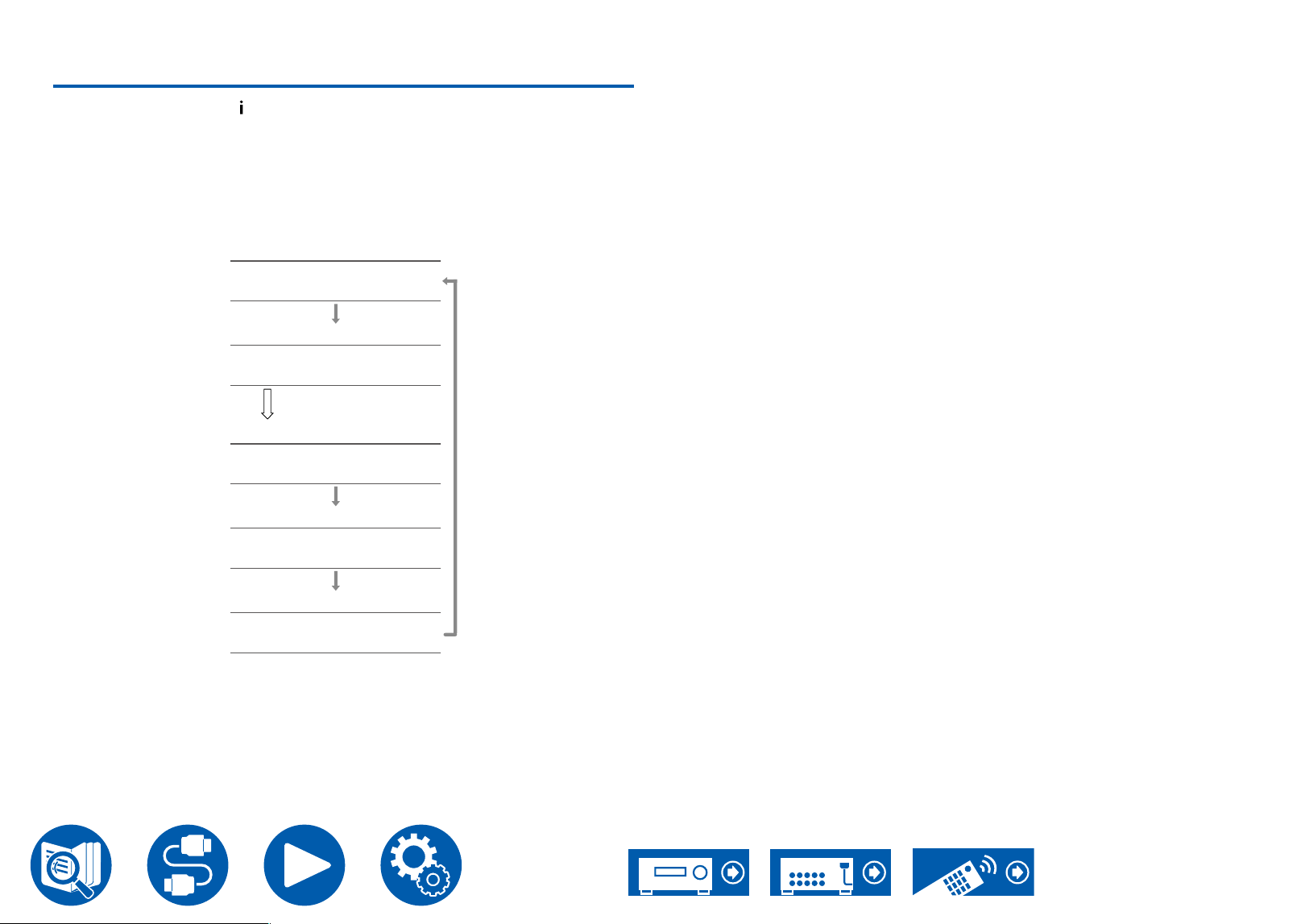
Repeatedly pressing the INFORMATION button on the remote controller
switches the display of the main unit in the following order.
• The content displayed depends on the source, BLUETOOTH, etc., being
played.
• Depending on the audio signal, "B (Back)" or "W (Wide)" is displayed next to
the number of channels of the input format.
• Not all the information is necessarily displayed.
DTS Neural : X
DTS 5 . 1
10 8 0 p /5 9 1 6 : 9
BD/DVD 4 0 . 0
48 . 0 k H z
Input source and volume
Listening mode
Input format
The display is switched in
a few seconds.
Sampling frequency
Input signal resolution
38
Playback
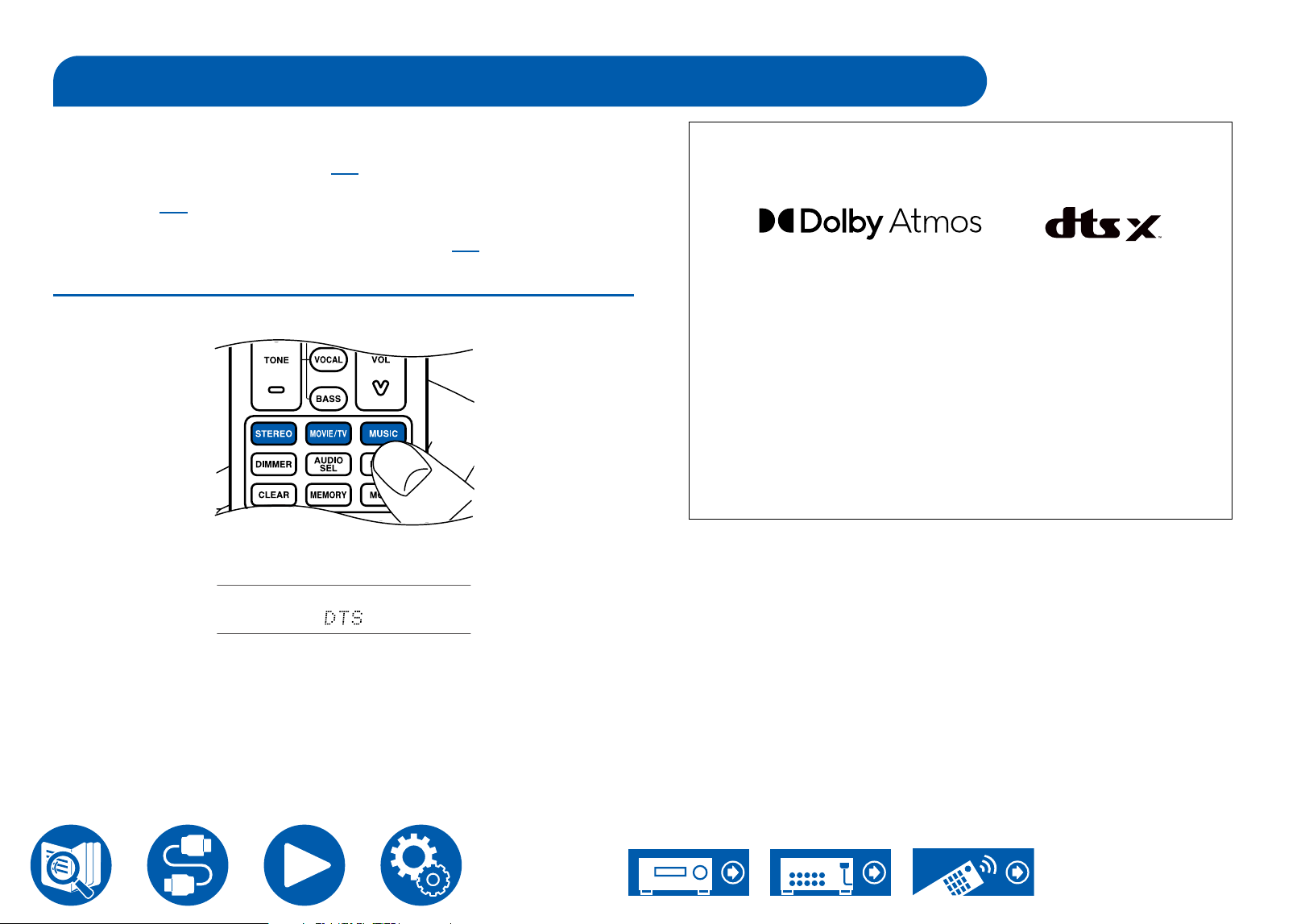
This unit is equipped with a variety of listening modes, and you can select
the optimum listening mode for movies, TV, music, and games by pressing
STEREO, MOVIE/TV and MUSIC. ( →p91)
• For details of the eects of each listening mode, refer to "Listening Mode
Eects" ( →p95).
• For listening modes selectable for each audio format of input signals, refer to
"Input Formats and Selectable Listening Modes" ( →p92).
Selecting a Listening mode
1. Press one from among STEREO, MOVIE/TV and MUSIC during playback.
2. Press the selected button repeatedly to switch the modes displayed on the
display of the main unit.
• Each of STEREO, MOVIE/TV and MUSIC buttons stores the listening
mode that was selected last. If content incompatible of the listening mode
selected last is played, the most standard listening mode for the content is
automatically selected.
Manufactured under license from Dolby Laboratories. Dolby, Dolby Vision, Dolby
A
tmos, Dolby Audio, and the double-D symbol are trademarks of Dolby
Laboratories.
For DTS patents, see http://patents.dts.com. Manufactured under license from
DTS, Inc. or under license from DTS Licensing Limited. DTS, DTS:X, and
Vi
rtual:X logos are registered trademarks or trademarks of DTS, Inc. and its
af
filiates in the United States and other countries. © 2023 DTS, Inc. ALL
RIGHTS RESER
VED.
Listening Mode
39
Playback
BLUETOOTH
®
Playback
You can wirelessly play music on a smartphone or other BLUETOOTH wireless
technology enabled device through the speakers connected to this unit.
Onkyo TX-SR
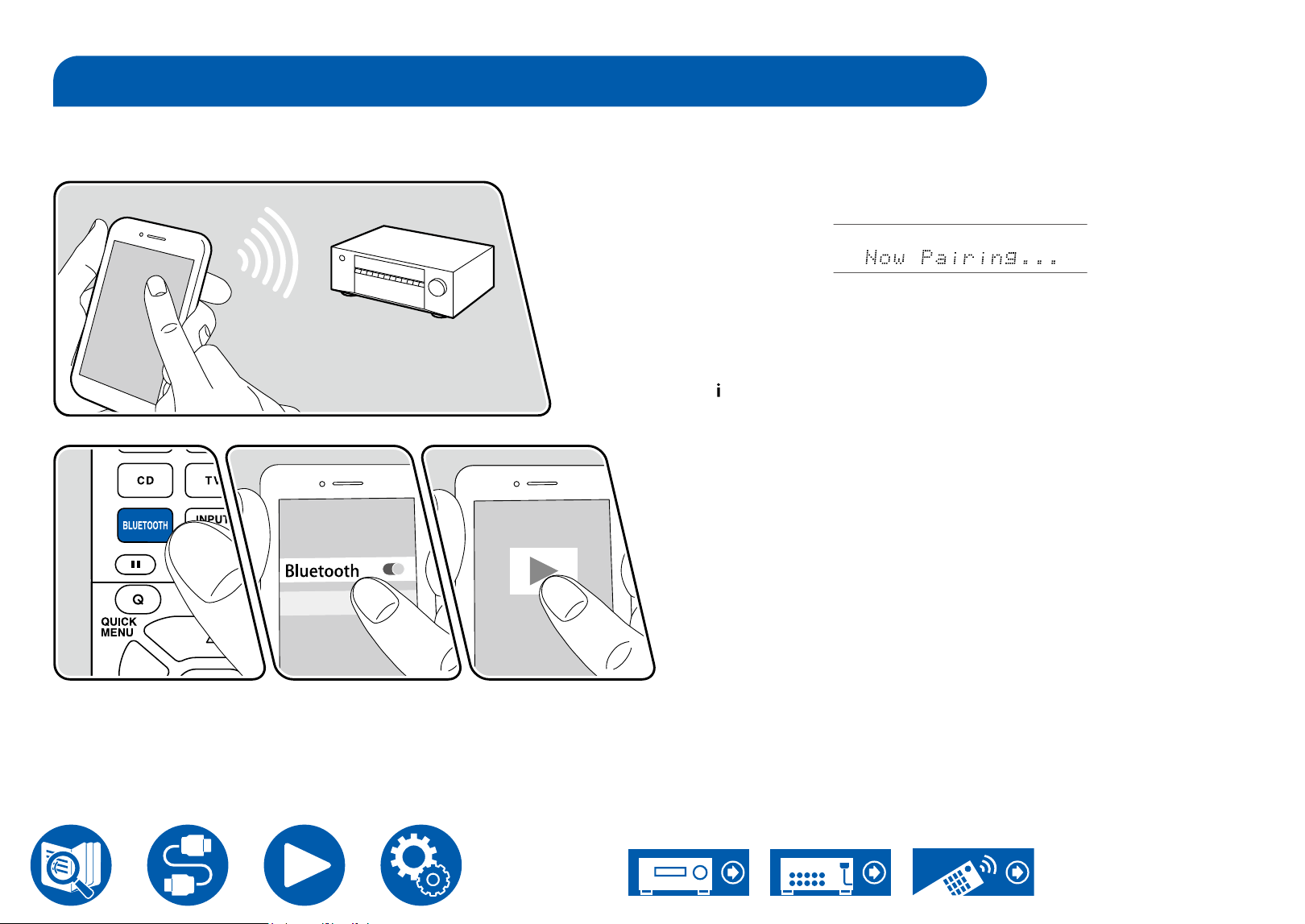
Perform the following procedure when this unit is on.
Pairing
1. When you press the BLUETOOTH button, "Now Pairing..." appears on the
display, and the pairing mode is enabled.
2. Enable (turn on) the BLUETOOTH function of the BLUETOOTH enabled
device, and then select this unit from among the devices displayed. If a
password is requested, enter "0000".
• This unit is displayed as "Onkyo TX-SR3100 XXXXXX".
• To connect another BLUETOOTH enabled device, press and hold the
INFORMATION button at least 5 seconds, and then perform step 2.
This unit can store the pairing information of up to 8 paired devices.
• The coverage area is approx. 48´/15 m. Note that connection is not always
guaranteed with all BLUETOOTH enabled devices.
Playing Back
1. Perform the connection procedure on the BLUETOOTH enabled device.
2. Playing the music le.
The input on this unit automatically switches to "BLUETOOTH".
Turn up the volume of the BLUETOOTH enabled device to an appropriate level.
• Due to the characteristics of BLUETOOTH wireless technology, the sound
produced on this unit may slightly be behind the sound played on the
BLUETOOTH enabled device.
The illustration shows an image.
40
Playback
Listening To the Radio
AM FM DAB
You can receive AM (North American, Taiwanese, Middle East, Australian and
Asian models)/FM/DAB (European models) radio on this unit with the built-in
tuner.
Listening To the AM/FM Radio
(AM : North American, Taiwanese, Middle
East, Australian and Asian models)
Perform the following procedure when this unit is on.
Tuning Automatically
1. Press TUNER repeatedly to select either "AM" or "FM".
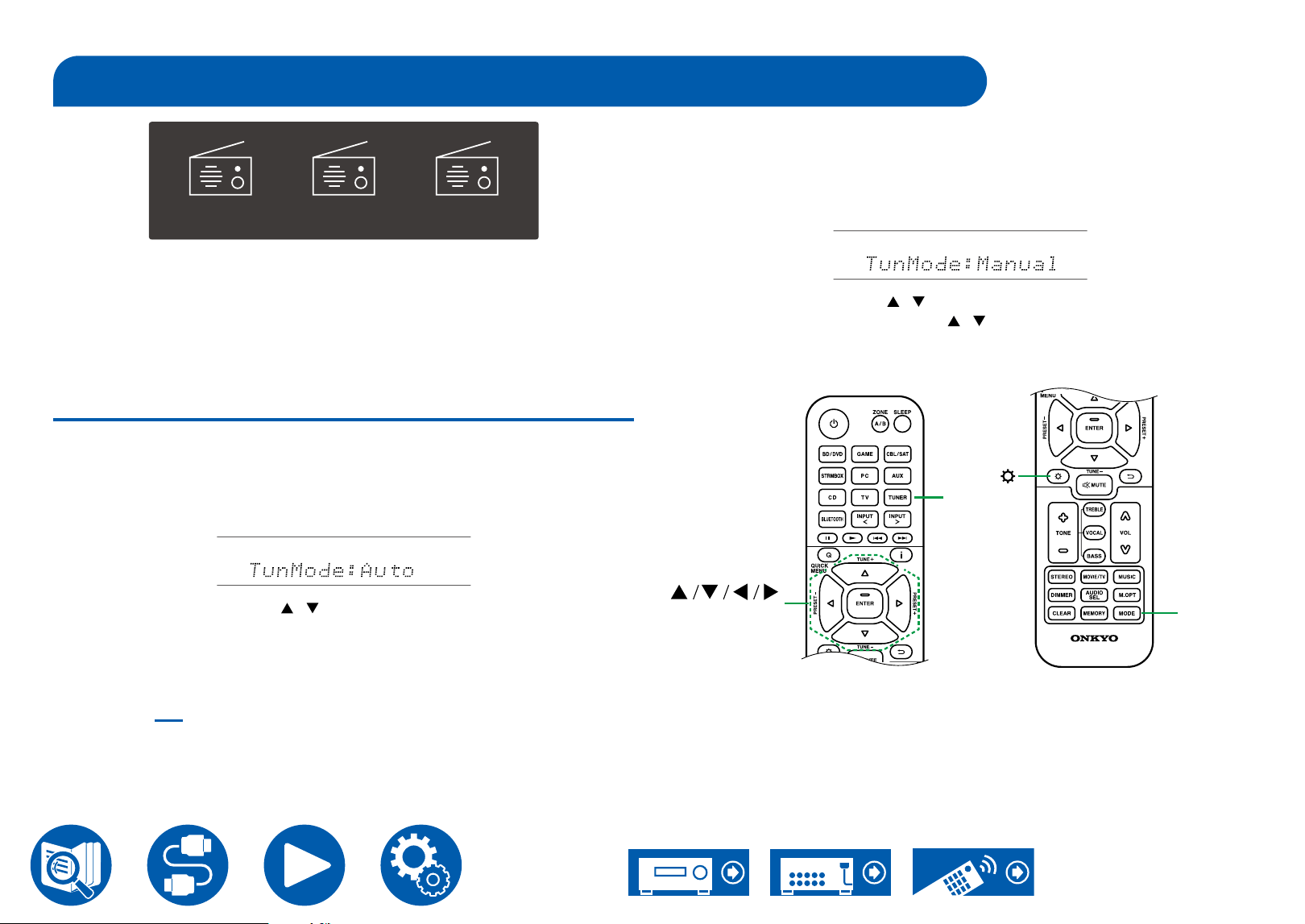
2. Press MODE repeatedly to display "TunMode: Auto" on the display.
3. When you press the cursors / UP/DOWN, automatic tuning starts, and
searching stops when a station is found. When tuned in to a radio station,
the "TUNED" indicator on the display lights up. When tuned in to an FM radio
station, the "FM ST" indicator lights up.
When FM broadcasts reception is poor: Perform the procedure for "Tuning
Manually" ( →p40). Note that if you tune manually, the reception for FM
broadcasts will be monaural rather than stereo, irrespective of the sensitivity of
the reception.
Tuning Manually
Note that if you tune manually, the reception for FM broadcasts will be monaural
rather than stereo, irrespective of the sensitivity of the reception.
1. Press TUNER repeatedly to select either "AM" or "FM".
2. Press MODE repeatedly to display "TunMode: Manual" on the display.
3. While pressing the cursors / UP/DOWN, select the desired radio station.
• Each time you press the cursors / UP/DOWN, the frequency changes
by 1 step. If the button is held down, the frequency changes continuously,
and if the button is released, the frequency stops changing.
ENTER
TUNER
MODE
41
Playback
Frequency step setting (North American, Taiwanese,
Middle East, Australian and Asian models)
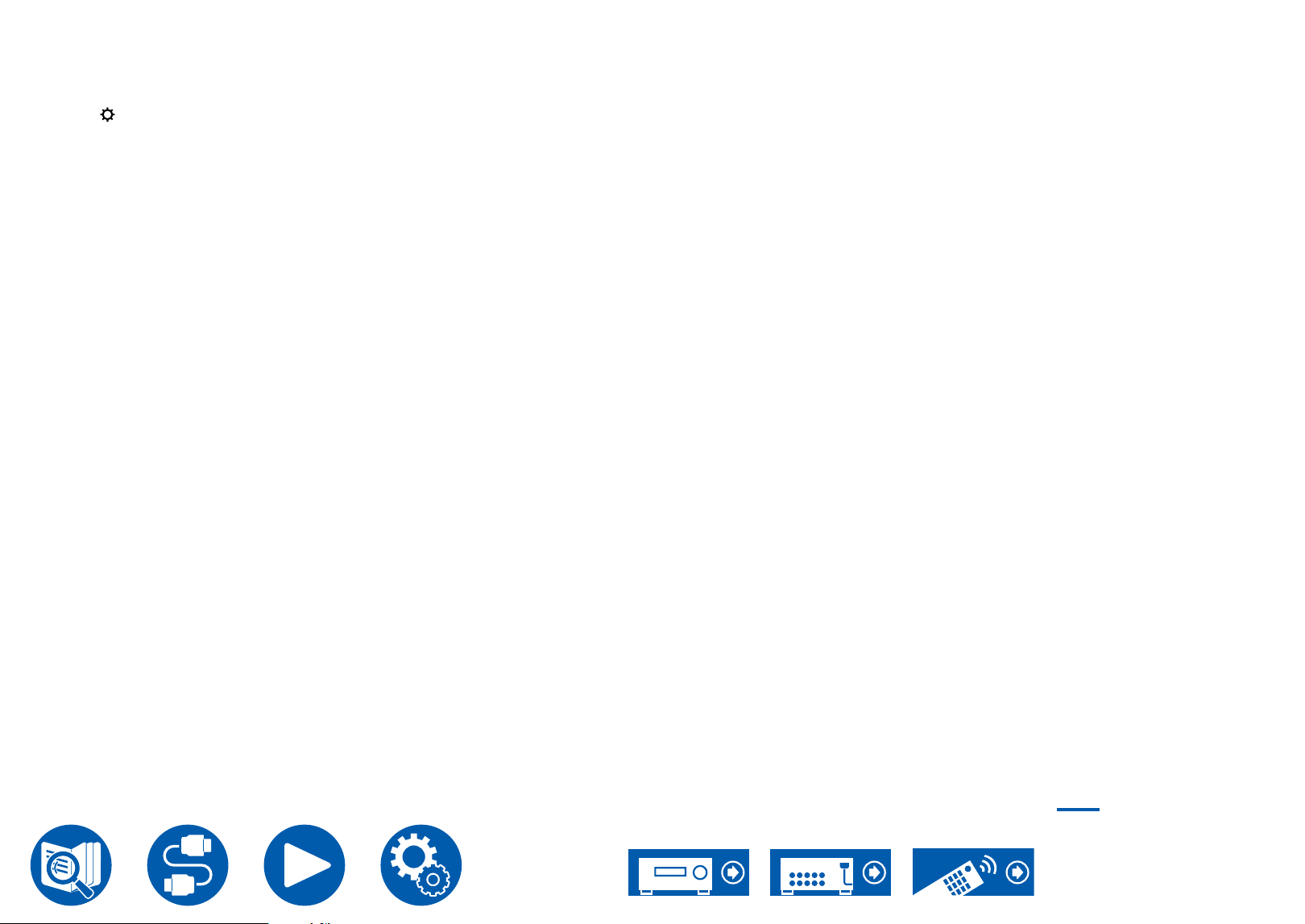
Press SETUP, and using the cursors and ENTER, select "Miscellaneous" -
"Tuner" - "AM/FM Frequency Step" (North American and Taiwanese models)
or "AM Frequency Step" (Middle East, Australian and Asian models), and then
select the frequency step for your area. Note that when this setting is changed,
all radio presets are deleted.
Presetting a Radio Station ( →p44)
42
Playback
Using RDS
(European, Middle East, Australian and
Asian models)
RDS stands for Radio Data System, and is a method of transmitting data in FM
radio signals. In regions where RDS can be used, when you tune in to a radio
station broadcasting program information, the radio station name is displayed
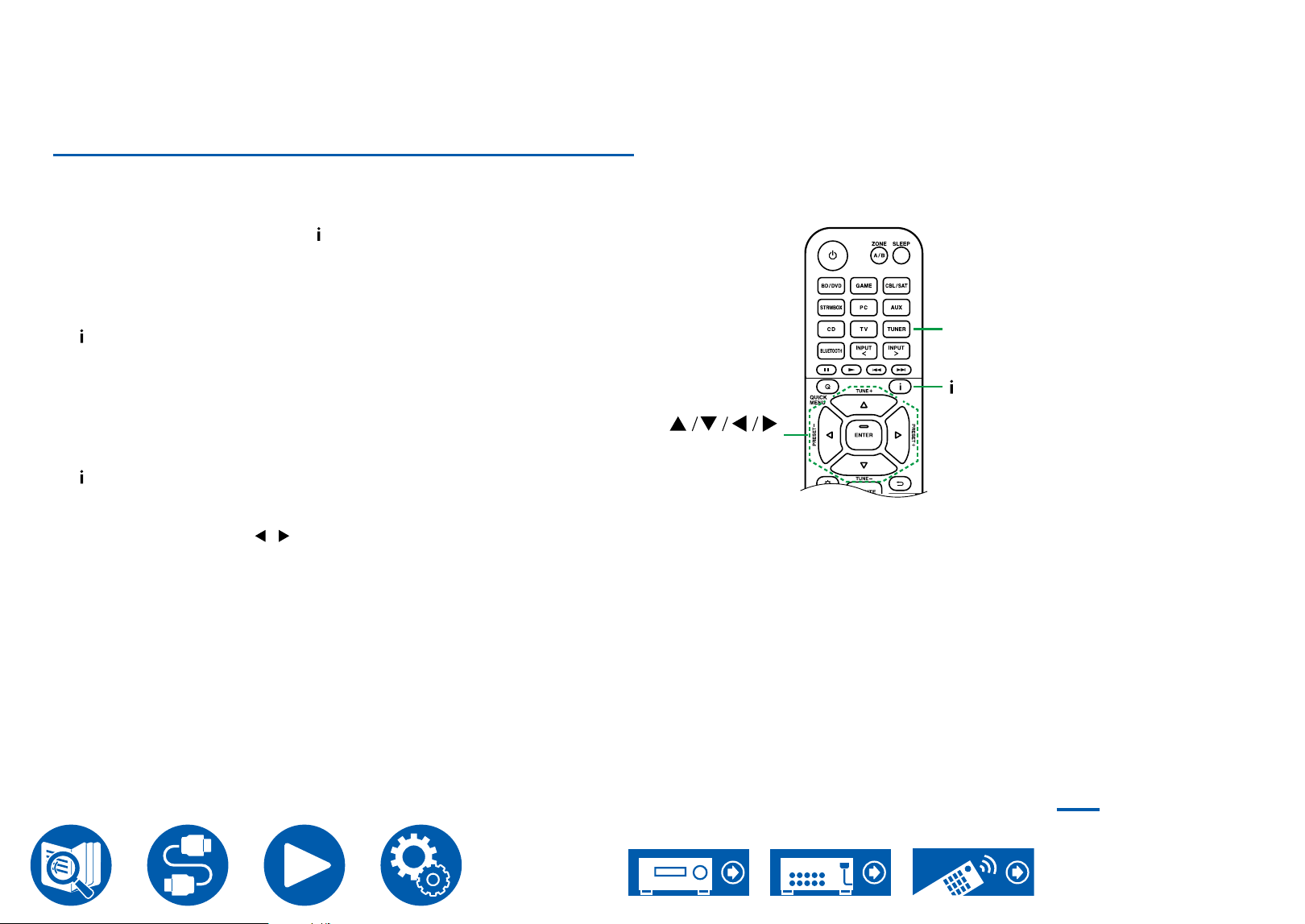
on the display. When you press the INFORMATION button on the remote
controller in this state, you can use the following functions.
Display Text Information (Radio Text)
1. While the name of the station is being displayed on the display, press the
INFORMATION button on the remote controller once.
The Radio Text (RT), which is text information delivered by the station, is
displayed scrolling across the display. "No Text Data" is displayed when no
text information is delivered.
Search for Stations by Program Type
1. While the name of the station is being displayed on the display, press the
INFORMATION button on the remote controller twice.
• If none of the Program Types are set for the radio station under reception,
"None" is displayed.
2. Press the cursor buttons / LEFT/RIGHT on the remote controller to select
the Program Type you want to search for, and then press the ENTER button
to start the search.
• The Program Types displayed are as follows: None / News (News reports)
/ Aairs (Current aairs) / Info (Information) / Sport / Educate (Education) /
Drama / Culture / Science (Science and technology) / Varied / Pop M (Pop
music) / Rock M (Rock music) / Easy M (Middle of the road music) / Light
M (Light classics) / Classics (Serious classics) / Other M (Other music)
/ Weather / Finance / Children (Children's programmes) / Social (Social
aairs) / Religion / Phone In / Travel / Leisure / Jazz (Jazz music) / Country
(Country music) / Nation M (National music) / Oldies (Oldies music) / Folk
M (Folk music) / Document (Documentary)
• The information displayed may not match the content delivered by the
station.
3. When a station is found, the station blinks on the display. Pressing the
ENTER button in this state will receive that station. If you don't press the
ENTER button, the unit starts to search for another station.
• If no stations are found, the message "Not Found" is displayed.
• Unusual characters may be displayed when the unit receives unsupported
characters. This is not a malfunction. Also, if the signal from a station is weak,
information may not be displayed.
ENTER
TUNER
Presetting a Radio Station ( →p44)
43
Playback
Listening To DAB Digital Radio
(European models only)
Perform the following procedure when this unit is on.
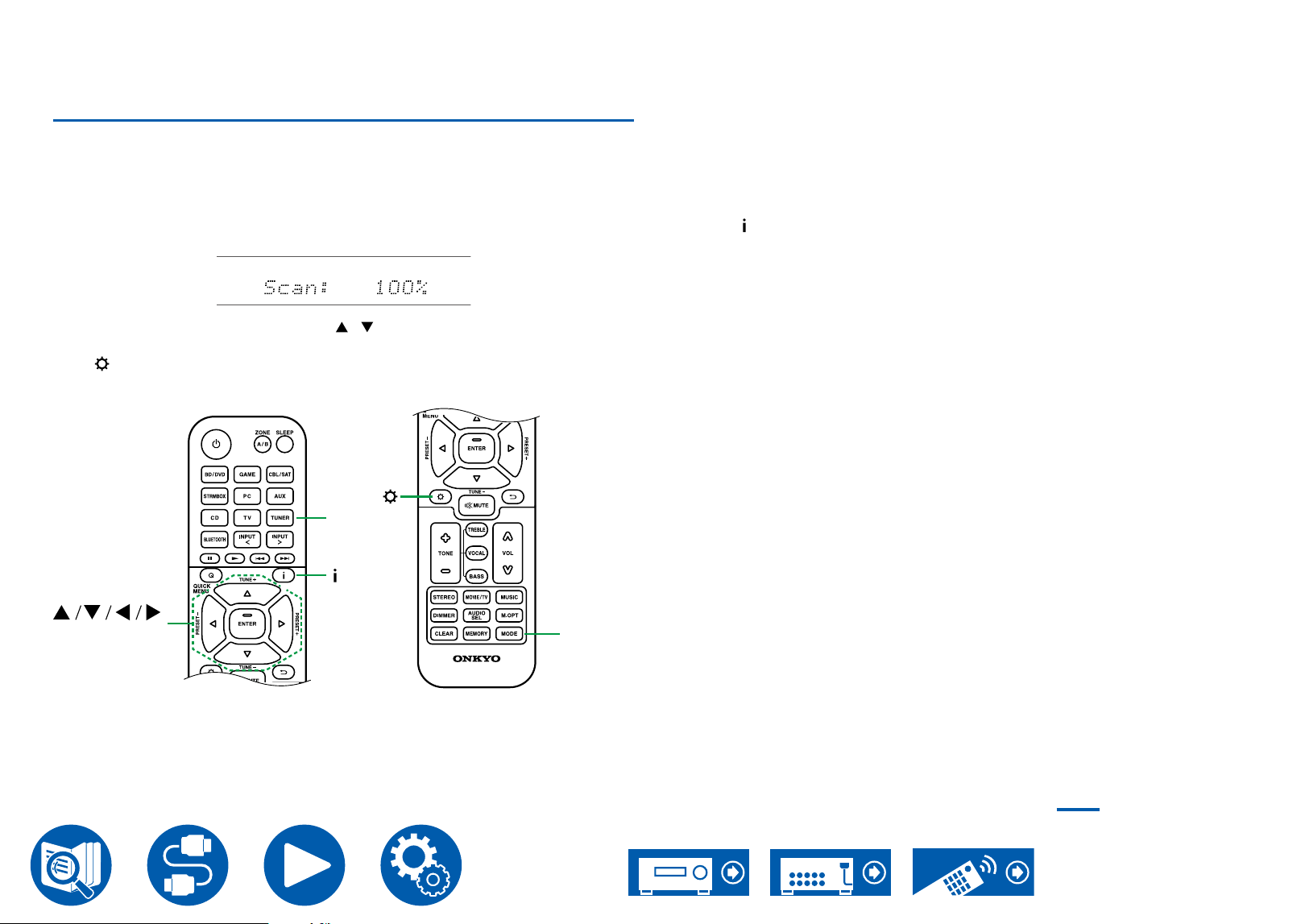
1. Press TUNER repeatedly to select "DAB".
• The very rst time you select DAB, the Auto Tuning function automatically
scans the DAB Band 3 for the multiplexes (i.e., stations) available in your
area. Once the scanning process is complete, the rst station that was
detected is selected.
2. Select the desired radio station with / UP/DOWN.
• If a new DAB station is introduced, or you move to a new area, press
SETUP, then use the cursors and ENTER button to run the "DAB Auto
Scan" in "Miscellaneous" - "Tuner".
ENTER
TUNER
MODE
Changing the order stations are displayed
You can sort the available stations alphabetically or by multiplex.
1. Press MODE repeatedly to set the method for sorting the display order from
the following.
Alphabet (default setting): Sort stations alphabetically.
Multiplex: Sort stations by multiplex.
Displaying DAB Radio Information
1. Press INFORMATION repeatedly to display more information about the
selected DAB station.
DLS (Dynamic Label Segment): When tuned to a station that's broadcasting
DLS text data, the text will scroll across the display.
Program Type: Displays the type of program.
Bit Rate and Audio Mode: Displays the station's bit rate and audio mode
(Stereo, Mono).
Quality: Displays the signal quality.
0 - 59: Poor reception
60 - 79: Good reception
80 - 100: Excellent reception
Multiplex Name: Displays the name of the current multiplex.
Multiplex Number and Frequency: Displays the number and frequency of
the current multiplex.
Presetting a Radio Station ( →p44)
44
Playback
Presetting a Radio Station
Registration Procedure
You can preset up to 40(*) of your favorite radio stations.
(*) North American, Taiwanese, Middle East, Australian and Asian models: AM
and FM stations
European models: FM and DAB stations
After tuning in to the radio station you want to register, perform the following
procedure.
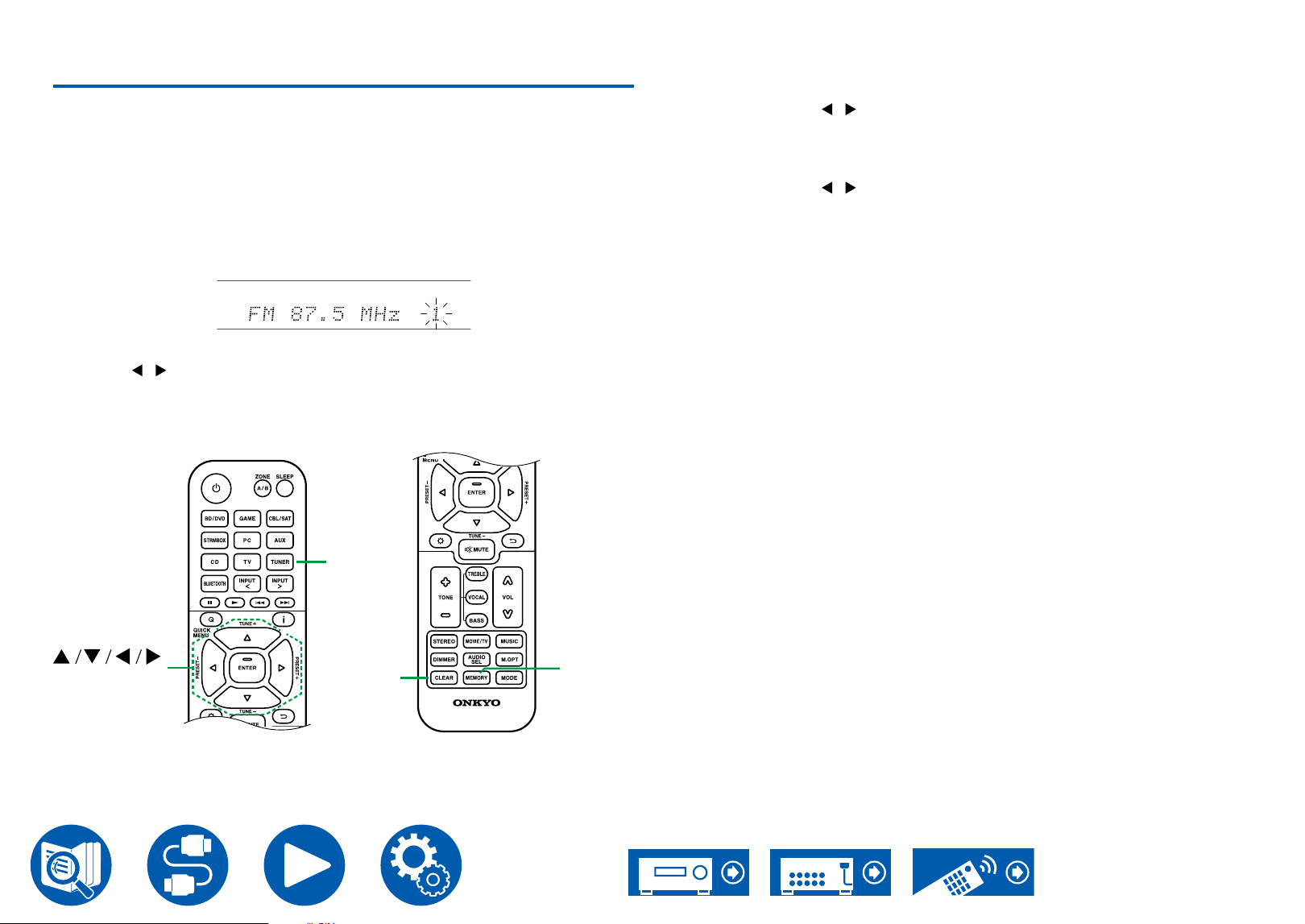
1. Press MEMORY so that the preset number on the display blinks.
2. While the preset number is blinking (approx. 8 seconds), repeatedly press the
cursors / LEFT/RIGHT to select a number between 1 and 40.
3. Press MEMORY again to register the station.
When the station is registered, the preset number stops ashing. Repeat this
procedure for all of your favorite radio stations.
ENTER
CLEAR
MEMORY
TUNER
Selecting a Preset Radio Station
1. Press TUNER.
2. Press the cursors / LEFT/RIGHT to select a preset number.
Deleting a Preset Radio Station
1. Press TUNER.
2. Press the cursors / LEFT/RIGHT to select the preset number to delete.
3. After pressing MEMORY, press CLEAR while the preset number is blinking,
and delete the preset number. When deleted, the number on the display
disappears.
45
Playback
Adjusting the TREBLE/BASS
You can adjust the sound quality of the front speakers.
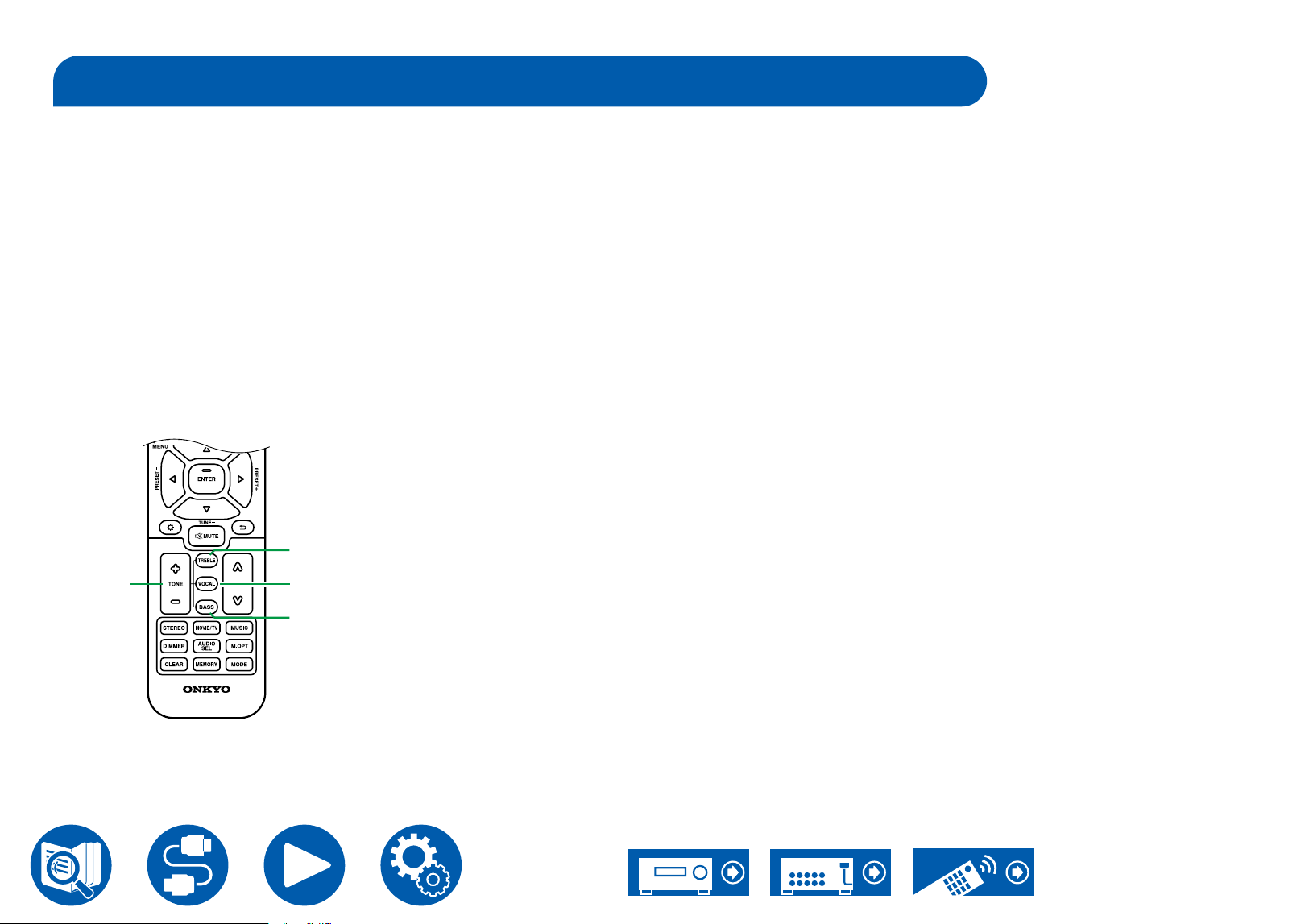
1. Press TREBLE or BASS to select the content to adjust.
TREBLE: Enhances or moderates the high-tone range of the front speakers.
BASS: Enhances or moderates the low-tone range of the front speakers.
2. Press + or - to adjust.
Adjusting the VOCAL
Emphasizes movie dialogues and music vocals to listen to them more easily. It
is eective to movie lines in particular. Also, it exerts the eect even if the center
speaker is not used. Select a desired level from "1" (low) to "5" (high).
1. Press VOCAL.
2. Press + or - to adjust.
• Depending on the input source or listening mode setting, selection is not
possible, or the desired eect may not be achieved.
+
-
TREBLE
BASS
VOCAL
Adjusting the tone
46
Playback
You can quickly set convenient features such as adjusting sound quality.
Quick Menu
HDMI
Audio
Room EQ
Level
A/V Sync
Audio Return Channel
BD/DVD
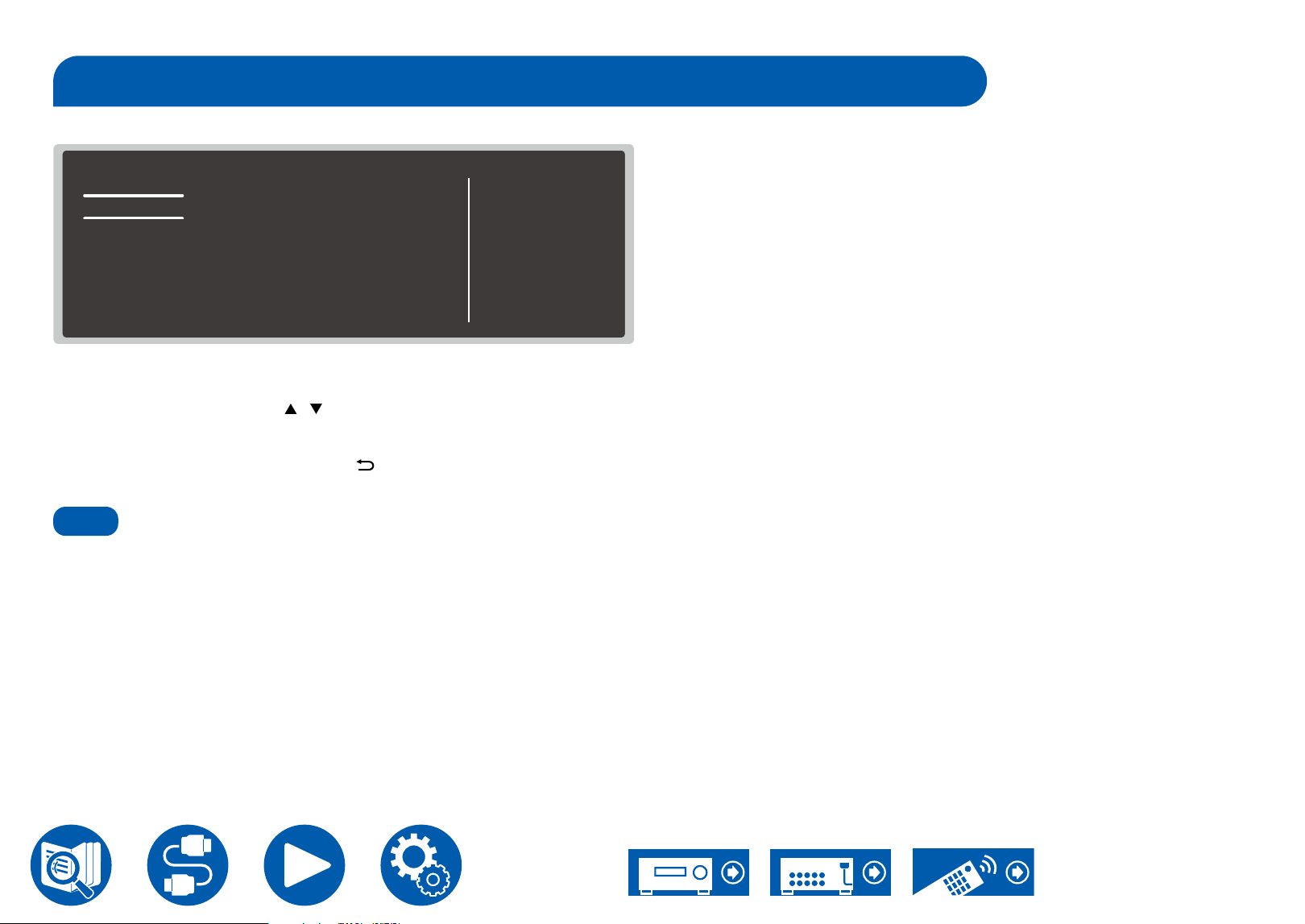
You can make the settings on the TV screen during playback. Press Q QUICK
MENU on the remote controller to display the Quick Menu.
Select the item with the cursors / UP/DOWN of the remote controller, and
press the ENTER button to conrm your selection.
Use the cursors to change the settings.
• To return to the previous screen, press RETURN/EXIT.
• To exit the settings, press Q QUICK MENU.
Note
• When the input signals are ones that need a high bandwidth, such as 8K
signals, the Quick Menu may not be displayed.
HDMI
A/V Sync: If the video is behind the audio, you can delay the audio to oset the
gap. The setting can be set for each input.
• It cannot be set if the listening mode is Direct.
Audio Return Channel: You can enjoy the sound of the HDMI-connected ARC-
compatible TV through the speakers connected to the unit. Select "On" when
listening to the audio of TV using the speakers of this unit. Select "O" when the
ARC function is not used.
Audio
Music Optimizer: Improve the quality of the compressed audio. Playback sound
of lossy compressed les such as MP3 will be improved. The setting can be set
for each input. This works in signals whose sampling frequencies are 48 kHz or
less. The setting is not eective in the bitstream signals.
• It cannot be set if the listening mode is Direct.
Late Night: Enable small sounds to be easily heard in detail. It is useful when
you need to reduce the volume while watching a movie late night.
• This function cannot be used in the following cases.
– When playing Dolby Digital Plus or Dolby TrueHD with "Loudness
Management" set to "O"
– When the input signal is DTS:X, and "Dialog Control" is not 0 dB
– When the input signal is Analog/DSD and the listening mode is Direct
Quick Menu
47
Playback
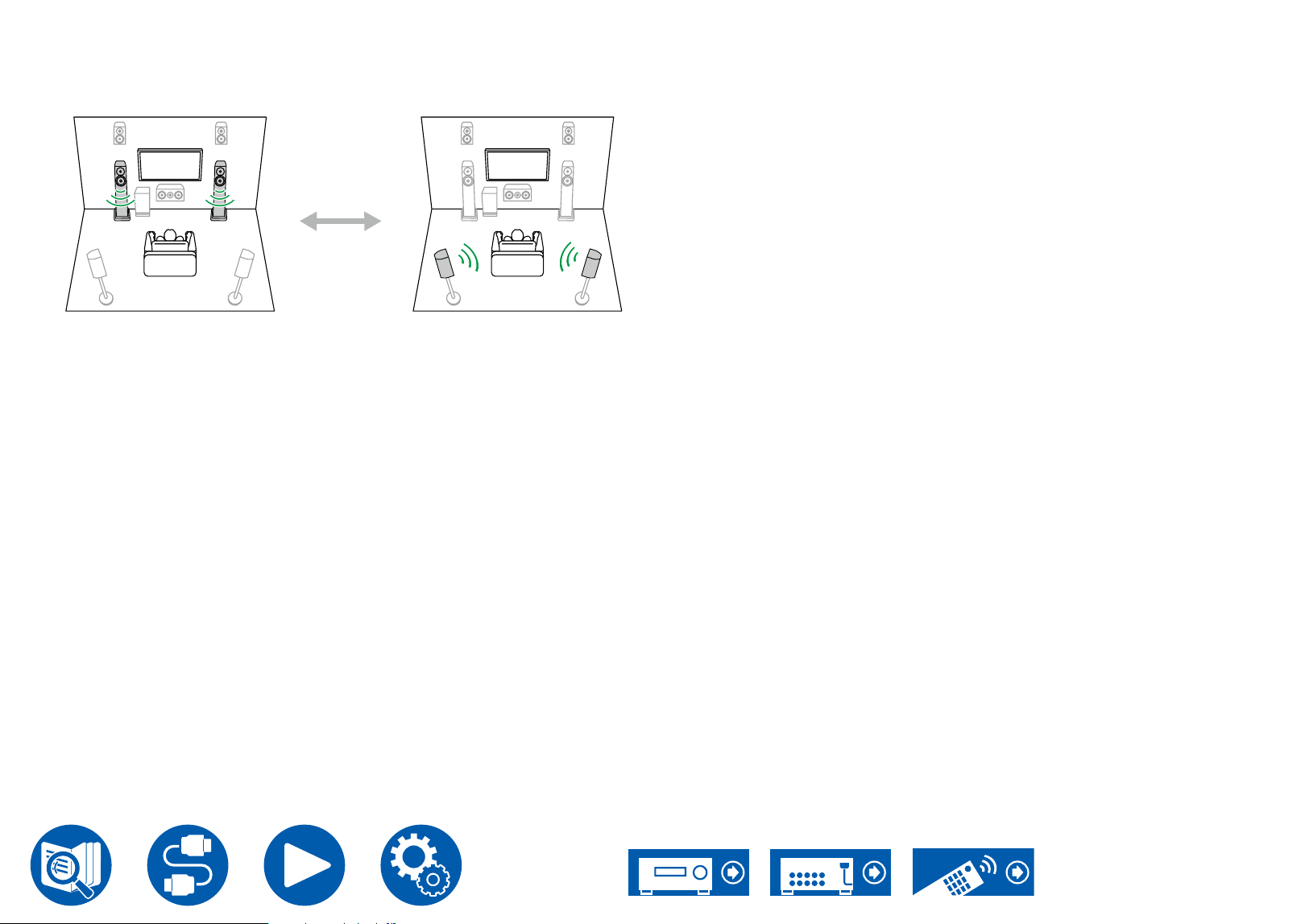
Stereo Assign: This function enables you to select a pair of speakers to output
stereo sound. Apart from the front speakers (Front), you can select the Surround
speakers (Surround), Height speakers (Height).
"Front" "Surround"
Selectable
• The listening mode switches to "Stereo" if the audio output destination is
changed.
Digital Filter: You can switch the type of digital lter in the AUDIO DAC (digital
analog converter). You can choose "Slow" (gives the sound a soft and uid feel),
"Sharp" (gives the sound more structure and rmer feel), "Short" (gives the
sound a feeling of a quick start and moving forward), or "Auto" (automatic). The
setting can be separately set to each input selector. This can be set when the
sampling frequency is 44.1 kHz or more.
Room EQ
AccuEQ: Enable or disable the equalizer function that corrects for sound
distortion caused by the acoustic environment of the room.
On (All Ch): EQ that corrects according to the room acoustics acquired with the
AccuEQ calibration is applied to all channels.
On (ex. L/R): The same EQ as "On (All Ch)" is applied to speakers other than the
Front Speakers. EQ correction for the Front Speakers is turned o.
• The setting can be separately set to each input selector.
• It cannot be set if the listening mode is Direct.
Cinema Filter: Adjusts the soundtrack with the enhanced high range so that it
suits a home theater.
The following listening modes can be used: Dolby Audio - DD, Dolby Audio -
DD+, Dolby Audio - Surr, Dolby Audio - TrueHD, Multichannel, DTS, DTS-HD,
DTS Neural:X and DSD
Level
Front: Adjust the speaker level of the front speakers while listening to the sound.
Center: Adjust the speaker level of the center speaker while listening to the
sound.
Subwoofer: Adjust the speaker level of the subwoofer while listening to the
sound.
• If you set the unit to the standby mode, the adjustments you made will be
restored to the previous statuses.
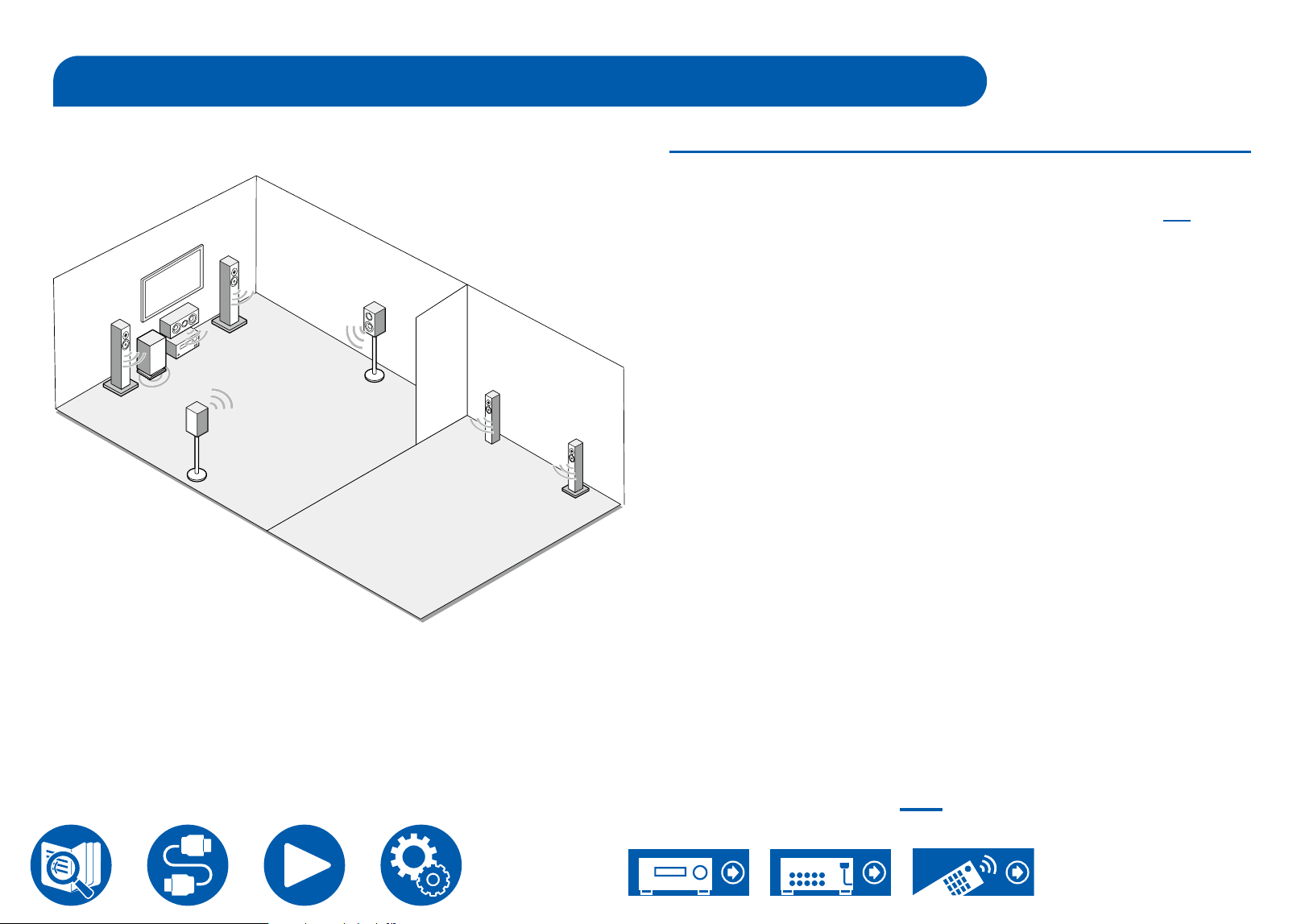
48
Playback
While performing playback in the main room (ZONE A), you can enjoy the audio
of the same source in the other place (ZONE B) at the same time.
Connections
When connecting an Integrated Amplier or transmitter in the other place (ZONE
B) to the ZONE B LINE OUT terminal on this unit.
– "Connecting an Integrated Amplier or Transmitter (ZONE B)" ( →p31)
ZONE B Playback
Main Room
(ZONE A)
ZONE B
Playing Back ( →p49)
49
Playback
Playing Back
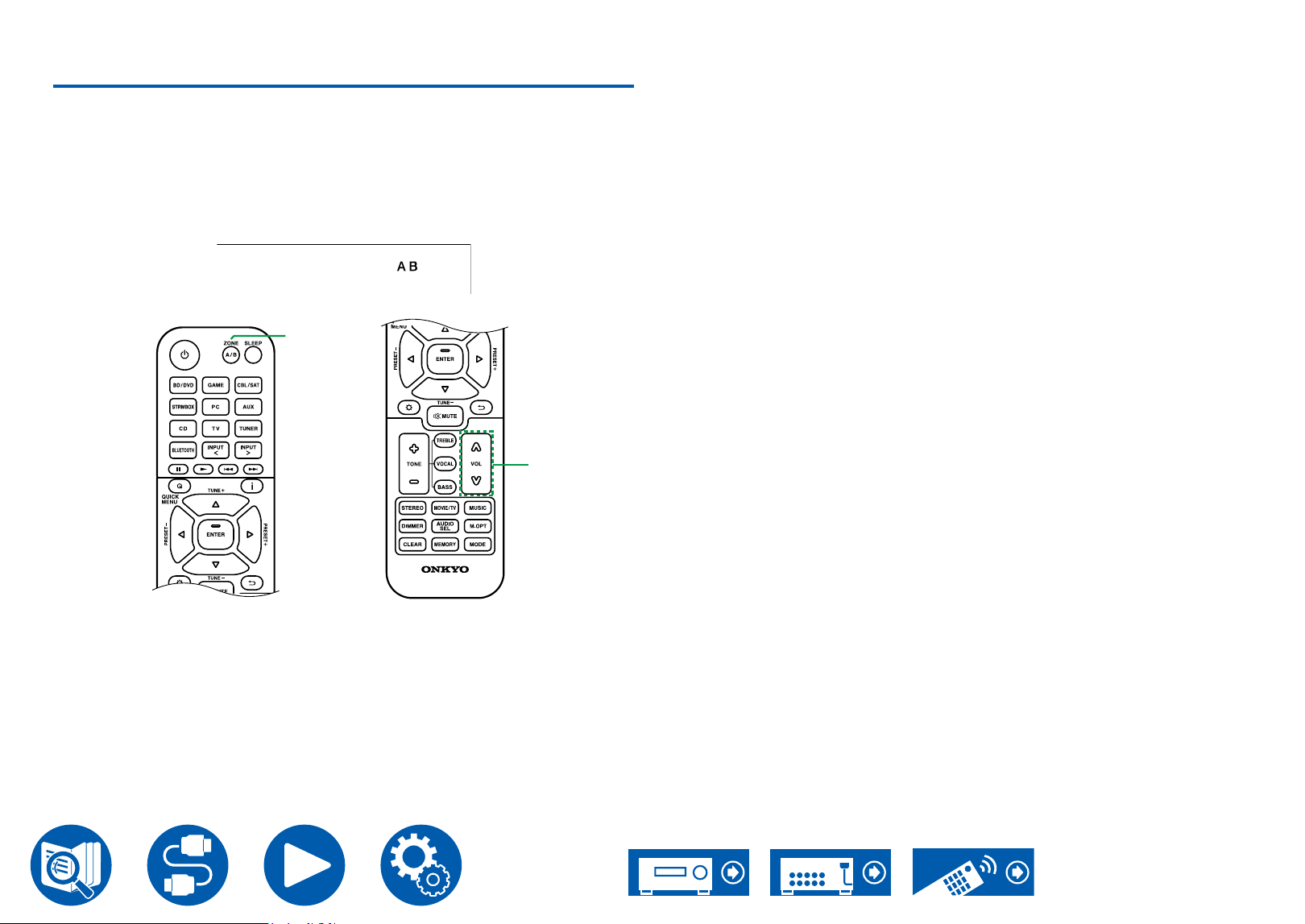
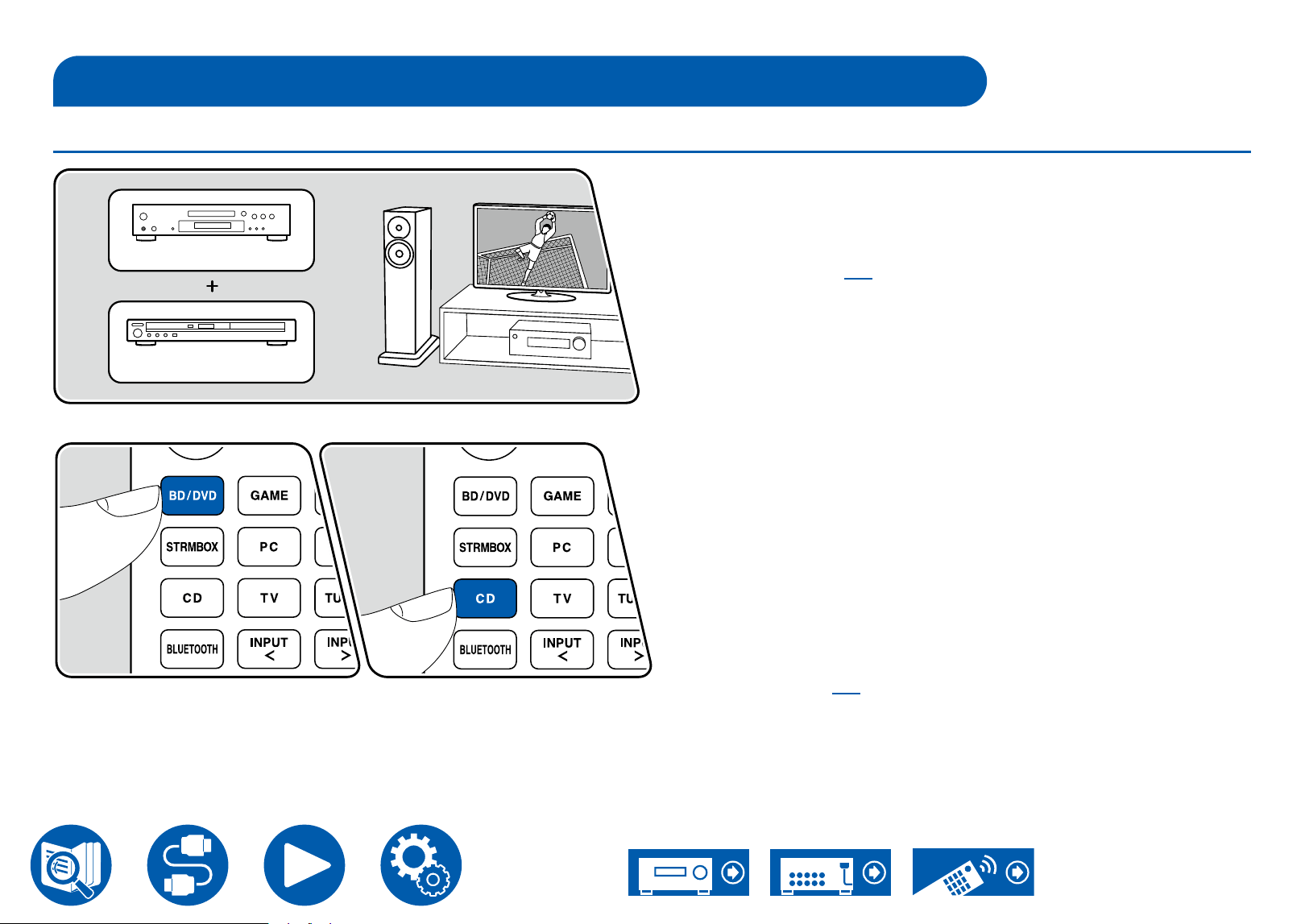
1. Press ZONE A/B to select an audio output destination.
• ZONE A: Outputs audio only to the main room (ZONE A). "A" on the display of
the main unit lights up.
• ZONE B: Outputs audio only to the other place (ZONE B). "B" on the display
of the main unit lights up.
• ZONE A+B: Outputs audio to both the main room (ZONE A) and the other
place (ZONE B). "A" and "B" on the display of the main unit light up.
ZONE A/B
VOLUME
2. Start play on the AV component.
3. Adjust the volume on the integrated amplier.
• If the wireless headphones or wireless speakers have volume controls,
control the volume on those devices.
• If "ZONE A+B" is selected as an audio output destination, you can select only
the "Stereo" listening mode for the main room (ZONE A) when using the 2.1ch
speaker layout. When using a speaker layout of 3.1ch or more, you can select
only the "AllCh Stereo" listening mode.
50
Playback
Playing different audio and video
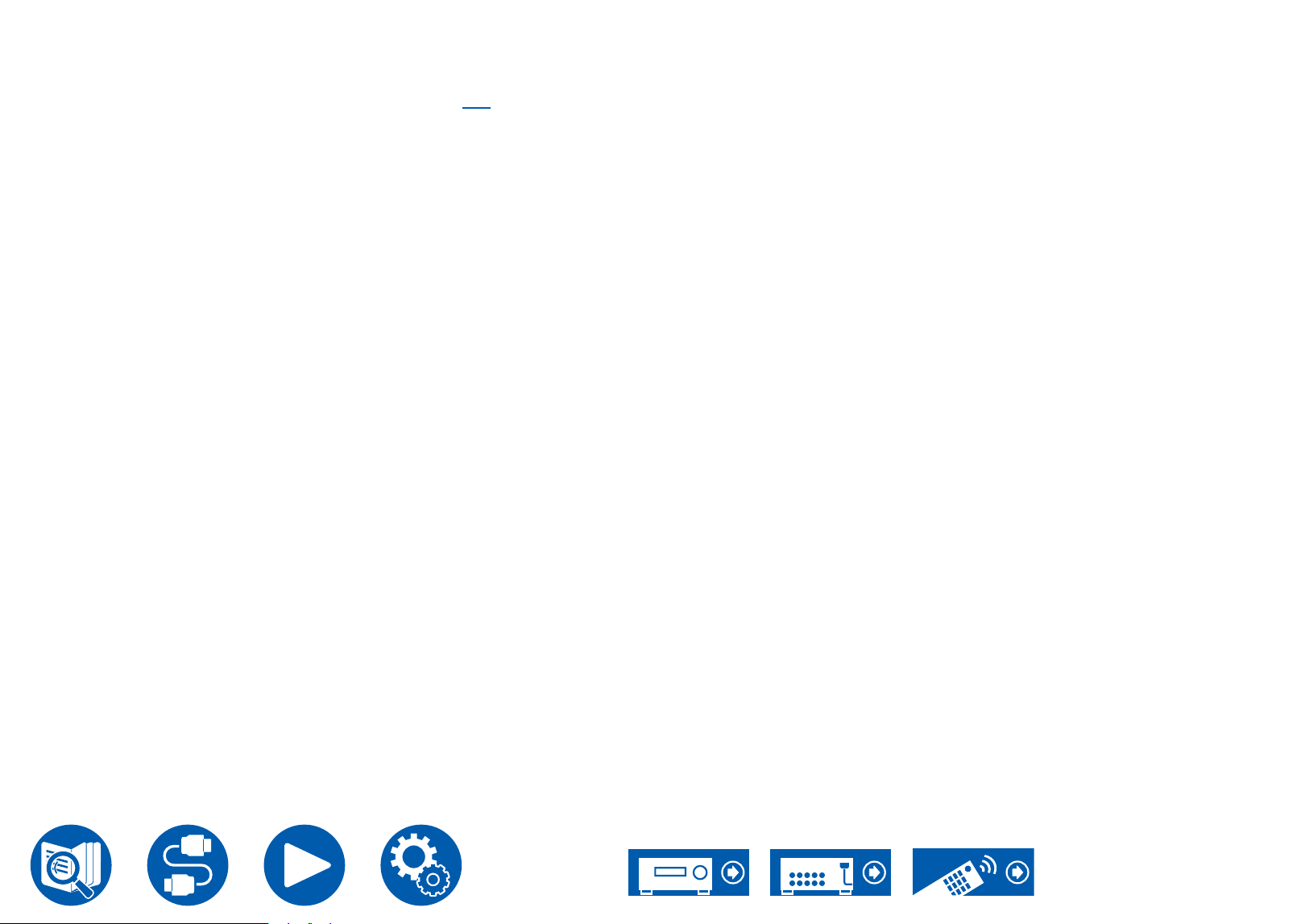
Displaying Your Favorite Video on TV While Playing Music
While listening to the music from a CD or BLUETOOTH enabled device, you can
display video on TV from an AV component such as a Blu-ray Disc player.
• For audio playback, you can select an input selector to which video input is
not assigned, such as "CD", "TUNER" and "BLUETOOTH".
• (European, Taiwanese, Middle East, Australian and Asian models): If the
"OSD Language" ( →p56) is set to Chinese, it is not possible to play video
while playing the audio from "BLUETOOTH".
Perform the following procedure when this unit is on.
1. Switch the input on the TV to the input connected to the unit.
2. Press an input selector such as BD/DVD button connected to the AV
component of which the video is to be displayed on TV.
• This operation is not necessary if the same input selector has been
selected in the previous operation.
3. Press an input selector of the audio you want to play, such as the CD or
BLUETOOTH button and perform playback operation.
4. Perform the playback operation of the AV component such as a Blu-ray Disc
player. To play the audio of BLUETOOTH, the following step 5 operation is
required.
5. To play the audio of BLUETOOTH, press the MODE button to switch the
TV display from the BLUETOOTH playback screen to the video of the AV
component. Pressing the MODE button again will return to the BLUETOOTH
playback screen.
• When the TV display is switched to the video of the AV component, the
playback screen of BLUETOOTH is displayed on the corner of the screen
as Mini Player. The setting for Mini Player can be changed on the Setup
Menu so that it automatically turns o in 30 seconds after displayed. ("Mini
Player OSD" ( →p56))
CD
BD/DVD
The illustration shows an image.
51
Playback
Setting the video source to be displayed on TV beforehand: When playing
the audio of "TUNER" and "BLUETOOTH", you can set the input selector to
be displayed on TV beforehand using "Video Select" ( →p67) on the Setup
Menu. If a value other than "Last" is set, step 2 in the operation procedure is not
required.
53
Setup
Setup Menu
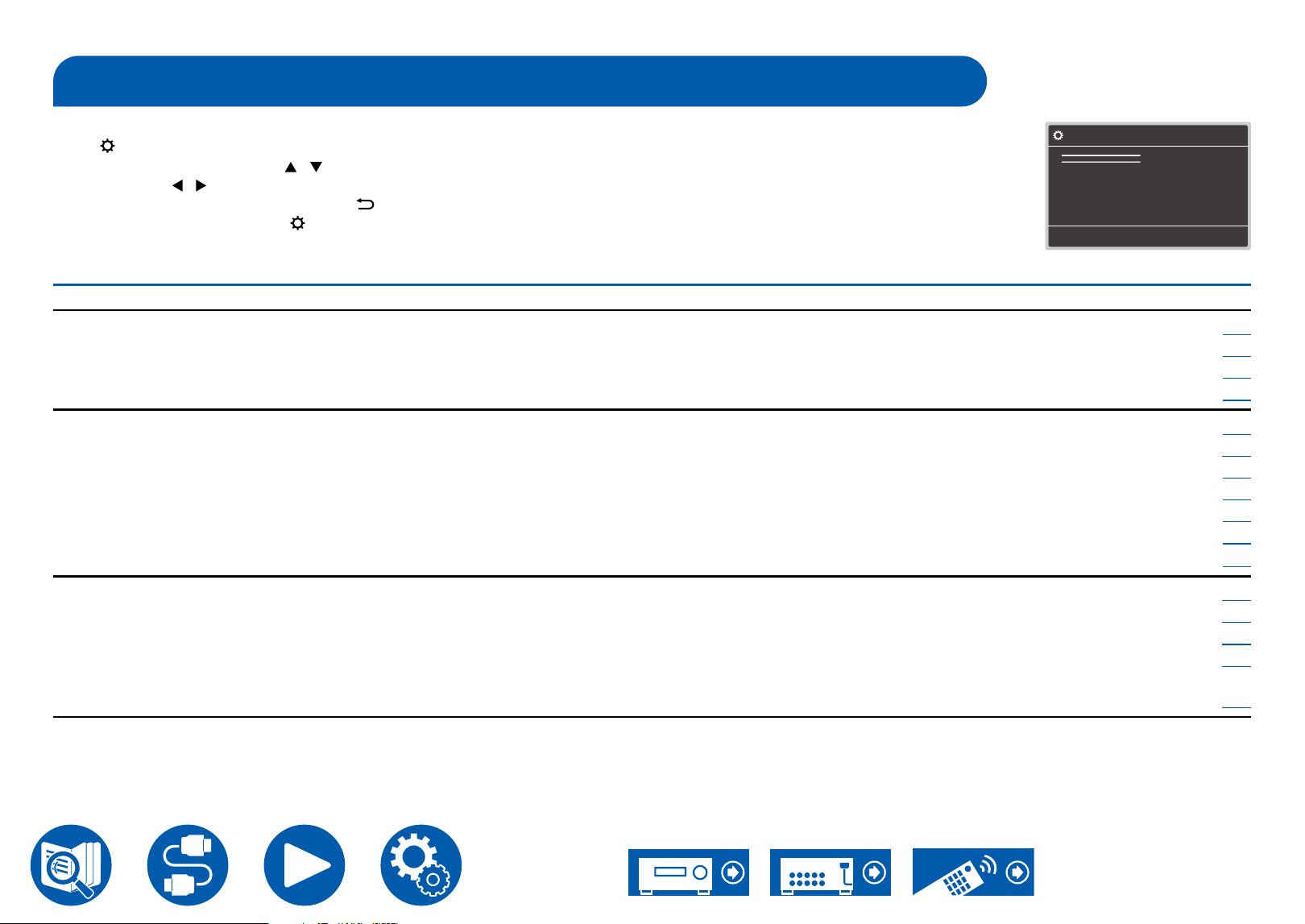
Use the OSD (On-Screen Displays) that appear on the TV to make the settings.
Press SETUP on the remote controller to display the Setup menu.
Select the item with the cursors / UP/DOWN of the remote controller, and press the ENTER button to conrm your selection.
Use the cursors / LEFT/RIGHT to change the default values.
• To return to the previous screen, press RETURN/EXIT.
• To exit the settings, press the SETUP button.
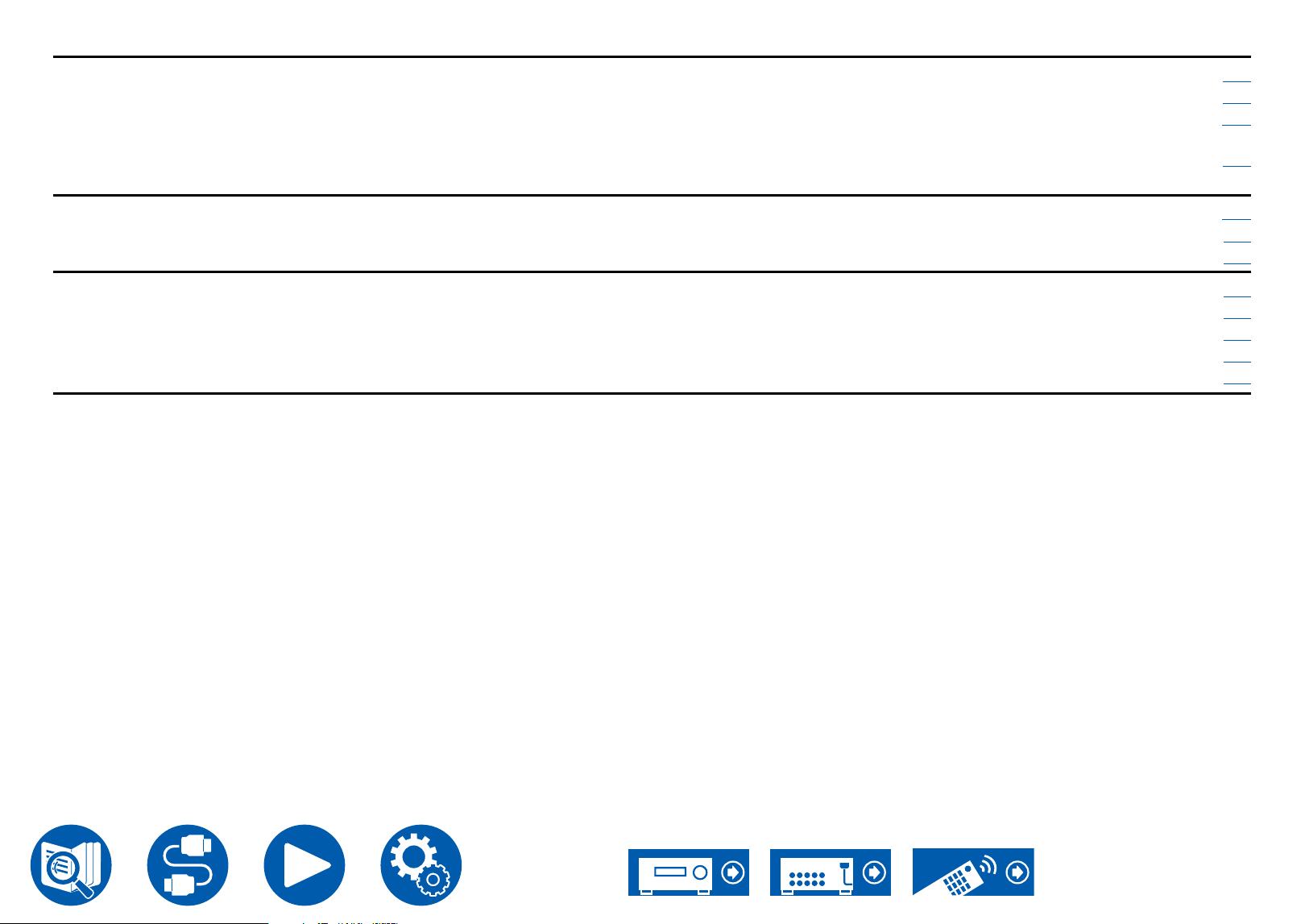
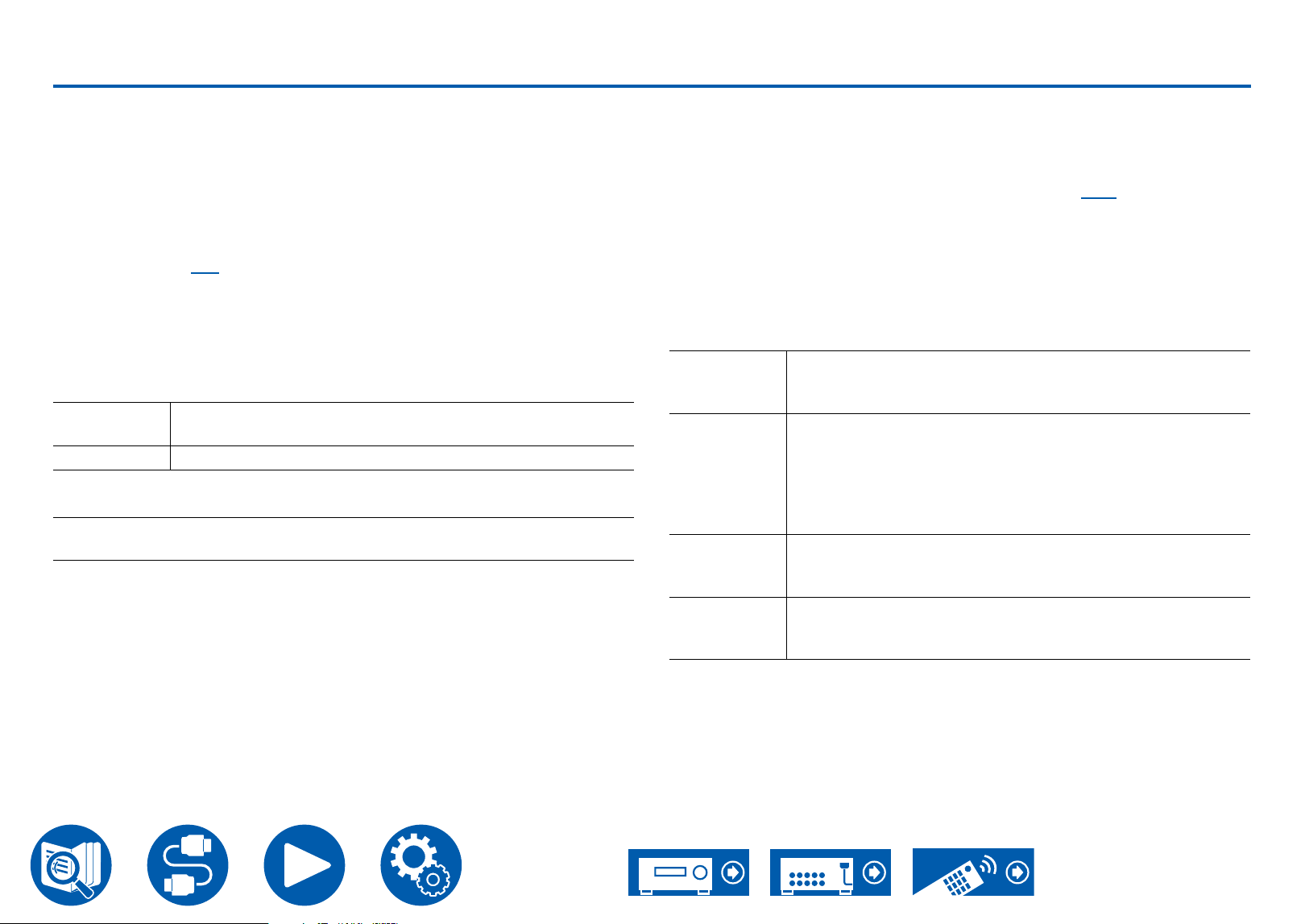
Menu list
1.
Input/Output Assign
1. TV Out / OSD Make settings for TV output and On-Screen Displays (OSD) that appear on the TV. p55
2. HDMI Input You can change input assignment between the input selectors and HDMI IN jacks.
p57
3. Digital Audio Input Change input assignment between the input selectors and DIGITAL IN COAXIAL/OPTICAL jacks.
p57
4. Analog Audio Input Change input assignment between the input selectors and AUDIO IN jacks.
p58
2. Speaker 1. Conguration Change the settings of connection environment of the speakers.
p59
2. Crossover Change the settings of crossover frequencies.
p60
3. Distance Set the distance from each speaker to the listening position.
p61
4. Level Calibration Adjust the volume level of each speaker.
p61
5.
Dolby Enabled Speaker
Change the settings of Dolby Enabled Speakers. p62
6. Speaker Virtualizer The Speaker Virtualizer function can be switched between On and O.
p62
7. Speaker Combo You can optimize the crossover value to match Klipsch speakers.
p62
3. Audio Adjust 1. Multiplex/Mono Change the settings of multiplex audio playback.
p63
2. Dolby Change the setting of when Dolby signals are input.
p63
3. DTS Change the setting of when DTS signals are input.
p64
4. LFE Level Set the low-frequency eect (LFE) level for Dolby Digital series, DTS series, Multichannel PCM,
and DSD signals.
p64
5. Volume Change the Volume settings.
p64
Setup
Setup
1. Input/Output Assign
1. Input/Output Assign
4. Source
4. Source
6. Miscellaneous
6. Miscellaneous
5. Hardware
5. Hardware
2. Speaker
2. Speaker
3. Audio Adjust
3. Audio Adjust
1.
1.
TV Out / OSD
TV Out / OSD
4.
4.
Analog Audio Input
Analog Audio Input
2.
2.
HDMI Input
HDMI Input
3.
3.
Digital Audio Input
Digital Audio Input
54
Setup
4. Source 1. My Input Volume Set a volume value for each input selector. p65
2. Name Edit Set an easy name for each input.
p65
Audio Select Select the prioritized input terminal when multiple audio sources are connected to one input
selector.
p66
Video Select When "TUNER" or "BLUETOOTH" input is selected, you can set the input from which video is
displayed on the TV.
p67
5. Hardware 1. HDMI Change the settings for the HDMI functions.
p68
2. Bluetooth Change the settings for the BLUETOOTH function.
p70
3. Power Management Change the settings for the power-save function.
p71
6. Miscellaneous 1. Tuner Change the settings for Tuner.
p72
2. Firmware Update Change the settings for Firmware Update.
p73
3. Initial Setup Make the initial setup from the setup menu.
p73
4. Lock Lock the Setup menu so that the settings cannot be changed.
p73
5. Factory Reset All the settings are restored to factory defaults.
p73
55
Setup
1. Input/Output Assign1. Input/Output Assign
1. TV Out / OSD
Make settings for TV output and On-Screen Displays (OSD) that appear on the
TV.
Upscaling (Default Value: O)
When a TV supporting 4K/8K is used, video signals input with 1080p can be
automatically output with 4K/8K. Video signals that are input at 4K can also
automatically be output as 8K. Note that to output as 8K, set "HDMI 4K/8K
Signal Format" ( →p55) to "8K Standard" or "8K Enhanced", and you need to
connect to a TV that is compatible with the 8K signal format with an HDMI cable.
• If the TV does not support the 4K/8K resolution with the same frequency
as the frequency of HDMI input video signals, upscaling to 4K or 8K is not
correctly performed. Check the frequency of 4K/8K resolution supported
by the TV, and change the resolution of the video signals input from the AV
component.
O When this function is not used
• If your TV does not support 4K/8K, set it to "O".
Auto When this function is used
Super Resolution (Default Value: 2)
When "Upscaling" is set to "Auto", select the correction level of the input video
signals from "O" and "1" (weak) to "3" (strong).
HDMI 4K/8K Signal Format
Set the 4K/8K signal format input and output by this unit. Set to suit the TV or
player connected.
• The corresponding resolution is dierent depending on the HDMI IN jack
connected. See "Corresponding input resolutions" ( →p103) for details.
BD/DVD (Default Value
: 4K Enhanced)
GAME (Default Value: 8K Enhanced)
CBL/SAT (Default Value: 4K Enhanced)
STRM BOX (Default Value: 4K Enhanced)
PC (Default Value: 4K Enhanced)
CD (Default Value: 4K Enhanced)
TV (Default Value: 4K Enhanced)
4K Standard When using a High Speed HDMI Cable that supports
10.2 Gbps to connect a TV or player compatible with standard
4K signal formats (4K 30 Hz, etc.)
4K Enhanced When using a Premium High Speed HDMI Cable that supports
18 Gbps to connect a TV or player compatible with high-
denition 4K signal formats (4K 60 Hz, 4K HDR, etc.)
• There may be some image disruption depending on the
connected component and the HDMI cable. If this occurs,
switch to "4K Standard".
8K Standard When using an ULTRA High Speed HDMI Cable that supports
48 Gbps to connect a TV or player compatible with 4K 120 Hz,
5K 30 Hz, or 8K 30 Hz signal formats
8K Enhanced When using an ULTRA High Speed HDMI Cable that supports
48 Gbps to connect a TV or player compatible with 5K 60 Hz
or 8K 60 Hz signal formats
56
Setup
1. Input/Output Assign
OSD Language (Default Value: English)
Select the on-screen display language from the following.
(North American models)
English, German, French, Spanish, Italian, Dutch, Swedish
(European, Taiwanese, Middle East, Australian and Asian models)
English, German, French, Spanish, Italian, Dutch, Swedish, Russian, Chinese
Impose OSD (Default Value: On)
Set whether or not to display information such as volume adjustment or
switching of input on the TV screen.
On OSD is displayed on the TV
• OSD may not be displayed depending on the input signal
even if "On" is selected. In this case, change the resolution
of the connected device.
• When Dolby Vision signals are input, the volume bar
changes from blue to magenta.
O OSD is not displayed on the TV
Mini Player OSD (Default Value: Always On)
You can display on the TV the images from another input selected last
while playing the audio from BLUETOOTH input. After switching the input to
BLUETOOTH, play the images and audio. And then when you press MODE
on the remote controller, the image is displayed in full-screen mode, and the
audio information (Mini Player) for BLUETOOTH is displayed in the corner of the
screen. You can set whether to always display this Mini Player on the screen.
• Each time the MODE button is pressed, the image display/non-display can be
switched.
• This setting cannot be selected if "Impose OSD" is set to "O".
• This function cannot be used when "OSD Language" is set to Chinese.
(European, Taiwanese, Middle East, Australian and Asian models)
Always On The Mini Player is always displayed.
Auto O The Mini Player turns o automatically in 30 seconds after
displayed. If operation such as changing the volume is
performed, it is displayed again for 30 seconds.
Screen Saver (Default Value: 3 minutes)
Set the time to start the screen saver.
Select a value from "3 minutes", "5 minutes", "10 minutes" and "O".
57
Setup
1. Input/Output Assign
2. HDMI Input
You can change input assignment between the input selectors and HDMI IN
jacks.
BD/DVD (Default Value: HDMI 1 (HDCP 2.3))
GAME (Default Value: HDMI 2 (HDCP 2.3))
CBL/SAT (Default Value: HDMI 3 (HDCP 2.3))
STRM BOX (Default Value: HDMI 4 (HDCP 2.3))
PC (Default Value: ---)
CD (Default Value: ---)
TV (Default Value: ---)
"HDMI 1 (HDCP 2.3)" to "HDMI 4 (HDCP 2.3)":
Assign any HDMI IN jack to each of the input selectors. If you do not assign a
jack, select "---". To select an HDMI IN jack already assigned to another input
selector, change its setting to "---" rst.
3. Digital Audio Input
Change input assignment between the input selectors and DIGITAL IN
COAXIAL/OPTICAL jacks. If you do not assign a jack, select "---".
BD/DVD (Default Value: ---)
GAME (Default Value: ---)
CBL/SAT (Default Value: ---)
STRM BOX (Default Value: ---)
PC (Default Value: ---)
CD (Default Value: COAXIAL)
TV (Default Value: OPTICAL)
COAXIAL,
OPTICAL
Assign the COAXIAL terminal or OPTICAL terminal to any
input selector.
58
Setup
1. Input/Output Assign
4. Analog Audio Input
Change input assignment between the input selectors and AUDIO IN jacks. If
you do not assign a jack, select "---".
BD/DVD (Default Value: ---)
GAME (Default Value: ---)
CBL/SAT (Default Value: ---)
STRM BOX (Default Value: ---)
PC (Default Value: AUDIO 3)
AUX (Default Value: AUDIO 2)
CD (Default Value: AUDIO 1)
TV (Default Value: ---)
AUDIO 1,
AUDIO 2,
AUDIO 3
Assign the AUDIO IN terminal to any input selector.
59
Setup
2. Speaker2. Speaker
1. Conguration
Change the settings of connection environment of the speakers.
Speaker Channels (Default Value: 5.1 ch)
Select "2.1 ch", "3.1 ch", "4.1 ch", "5.1 ch", "2.1.2 ch" or "3.1.2 ch" to suit the
number of speaker channels connected.
Subwoofer (Default Value: Yes)
Set whether a powered subwoofer is connected or not.
No When a powered subwoofer is not connected
Yes When a subwoofer is connected
Height Speaker (Default Value: Top Middle)
Set the speaker type if height speakers are connected to the HEIGHT /
SURROUND terminals.
Select "Top Middle", "Dolby Speaker (Front)" or "Front High" according to the
type and layout of the connected speakers.
• If an item cannot be selected even though connection is correct, check
that the settings in "Speaker Channels" matches the number of connected
channels.
Speaker Impedance (Default Value: 6 ohms or above)
Set the impedance (Ω) of the connected speakers.
• For impedance, check the indications on the back of the speakers or their
instruction manual.
4ohms When any of the connected speakers have 4 Ω or more to less
than 6 Ω impedance
6 ohms or above
When all the connected speakers have an impedance of 6 Ω
or more
60
Setup
2. Speaker
2. Crossover
Set what number of Hz in the low frequency range is output from each speaker
and what should be output from the subwoofer. When a subwoofer is not to be
used, set to "Full Band" so that the bass is output from the speakers.
Crossover Type (Default Value: Normal)
Set the crossover frequency to suit the speakers.
Klipsch When Klipsch speakers are used. The crossover that is
optimum for the speakers selected in Speaker Combo
( →p62) is applied. In this case, the crossover for each
speaker cannot be changed.
Normal When other than Klipsch speakers are used
Front (Default Value: 100 Hz)
Center (Default Value: 100 Hz)
Height (Default Value: 100 Hz)
Surround (Default Value: 100 Hz)
LPF of LFE (Default Value: 120 Hz)
Double Bass (Default Value: On)
Front:
Select the crossover frequency from "40 Hz" to "200 Hz" to start outputting
frequencies for each channel.
"Full Band": Full band will be output.
• If "Conguration" - "Subwoofer" is set to "No", "Front" is xed to "Full Band",
and the low pitched range of the other channels is output from the front
speakers. Refer to the instruction manual of your speakers to make the
setting.
Center, Height, Surround:
Select the crossover frequency from "40 Hz" to "200 Hz" to start outputting
frequencies for each channel.
"Full Band": Full band will be output.
• "Full Band" can be selected only when "Front" is set to "Full Band".
• If the item cannot be selected even though connection is correct, check if
the setting in "Conguration" - "Speaker Channels" matches the number of
connected channels.
LPF of LFE:
Set the low-pass lter for LFE (low-frequency eect) signals in order to pass
only the lower frequency signals than the set value, and thus cancel unwanted
noises. The low-pass lter is eective only on sources with LFE channel.
The value from "80 Hz" to "120 Hz" can be set.
"O": When this function is not used
Double Bass:
This can only be selected when the setting for "Conguration" - "Subwoofer" is
"Yes", and the "Front" setting is "Full Band".
Boost bass output by feeding bass sounds from the front left and right
speakers and the center speaker to the subwoofer.
"On": Bass output is boosted.
"O": Bass output is not boosted.
• This function is not automatically set even if AccuEQ Room Calibration is
performed.
61
Setup
2. Speaker
3. Distance
Set the distance from each speaker to the listening position.
Front Left (Default Value: 12.0 ft/3.60 m)
Center (Default Value: 12.0 ft/3.60 m)
Front Right (Default Value: 12.0 ft/3.60 m)
Height Left (Default Value: 9.0 ft/2.70 m)
Height Right (Default Value: 9.0 ft/2.70 m)
Surround Right (Default Value: 7.0 ft/2.10 m)
Surround Left (Default Value: 7.0 ft/2.10 m)
Subwoofer (Default Value: 12.0 ft/3.60 m)
• Default values vary depending on the regions.
• The unit of distance can be changed by pressing the MODE button on the
remote controller. When the unit is set as feet, you can set between 0.1 ft
and 30.0 ft in increments of 0.1 ft. When the unit is set as meters, you can set
between 0.03 m and 9.00 m in increments of 0.03 m.
4. Level Calibration
Adjust the volume level of each speaker.
Front Left (Default Value: 0.0 dB)
Center (Default Value: 0.0 dB)
Front Right (Default Value: 0.0 dB)
Height Left (Default Value: 0.0 dB)
Height Right (Default Value: 0.0 dB)
Surround Right (Default Value: 0.0 dB)
Surround Left (Default Value: 0.0 dB)
Subwoofer (Default Value: 0.0 dB)
Select a value between "-12.0 dB" and "+12.0 dB" ("-15.0 dB" and "+12.0 dB"
for Subwoofer) (in 0.5 dB increments). A test tone will be output each time you
change the value. Select the desired level.
62
Setup
2. Speaker
5. Dolby Enabled Speaker
Change the settings of Dolby Enabled Speakers.
• This setting can be selected when "Conguration" - "Height Speaker" is set to
"Dolby Speaker".
Distance from the ceiling (Default Value: 6' 0"/1.80 m)
Set the distance between the Dolby Enabled Speaker and the ceiling. Select
between "0.1 ft/0.03 m" and "15.0 ft/4.50 m" (0.1 ft/0.03 m units).
• The unit of distance (ft/m) is displayed using the unit selected for the
"Distance" setting.
AccuReex (Default Value: O)
You can enhance the reection eect of Dolby Enabled Speakers from the
ceiling.
• The function is not eective if the listening mode is Direct.
O When this function is not used
On When this function is used
6. Speaker Virtualizer
The Speaker Virtualizer function can be switched between On and O.
Speaker Virtualizer (Default Value: On)
On Listening modes such as T-D that have virtual speaker eects
can be selected.
O Listening modes such as T-D that have virtual speaker eects
cannot be selected.
7. Speaker Combo
"Speaker Combo" is a function that optimizes the crossover value suitable for
Klipsch speakers.
Setting the Klipsch speaker model to be used with "Speaker Combo" updates
the content of "Speaker" - "Crossover" on the Setup menu, and the crossover is
set to the optimized value suitable for the speakers.
Brand (Default Value: Other)
Select the brand of your speakers.
Klipsch When Klipsch speakers are used
Other When other than Klipsch speakers are used
Front (Default Value: Other)
Center (Default Value: Other)
Height (Default Value: Other)
Surround (Default Value: Other)
Subwoofer (Default Value: Other)
Select the model of your speakers.
Select "Other" if yours is not in the list.
"Series": Select the series of speaker.
"Model": Select the model of speaker.
63
Setup
3. Audio Adjust3. Audio Adjust
1. Multiplex/Mono
Change the settings of multiplex audio playback.
Multiplex Input Channel (Default Value: Main)
Set the audio channel or language to be output when playing multiplex audio or
multilingual broadcasts, etc.
• For multiplex audio broadcasts, pressing the
INFORMATION button on the
remote controller will display "1+1" on the main unit’s display.
Main Main channel only
Sub Sub channel only
Main / Sub Main and sub channels will be output at the same time.
Mono Input Channel (Default Value: Left + Right)
Set the input channel when playing back analog or 2 ch PCM signals in the
Mono listening mode.
Left Left channel only
Right Right channel only
Left + Right Left and right channels
2. Dolby
Change the setting of when Dolby signals are input.
Loudness Management (Default Value: On)
When playing Dolby TrueHD, enable the dialog normalization function which
keeps the volume of dialog at a certain level. Note that when this setting is O,
the Late Night function that allows you to enjoy surround at low volumes is xed
to o when playing Dolby Digital Plus/Dolby TrueHD.
On When this function is used
O When this function is not used
Dialogue Enhancement (Default Value: O)
Improves the intelligibility of dialogue by continually monitoring audio and
applying dynamic processing.
On When this function is used
O When this function is not used
64
Setup
3. Audio Adjust
3. DTS
Change the setting of when DTS signals are input.
DTS Auto Surround (Default Value: On)
When inputting DTS signals that include extended channel information, the
optimum listening mode is automatically selected according to the extended
information contained in the input signal and the speaker conguration of this
unit when playing in the straight decoding listening mode.
On When this function is used
O Audio is played using the same amount of channels in the
input signal according to the speaker conguration of this unit.
Dialog Control (Default Value: 0 dB)
You can increase the volume of dialog portion of the audio up to 6 dB by 1 dB
step so that you can hear the dialog easily in noisy atmosphere.
• This cannot be set for content other than DTS:X.
• Depending on the content, this function may not be selected.
4. LFE Level
Set the low-frequency eect (LFE) level for Dolby Digital series, DTS series,
Multichannel PCM, and DSD signals.
LFE Level (Default Value: 0 dB)
Select the low-frequency eect (LFE) level of each signal from "0 dB" to
"-∞ dB". If the low-frequency eect sound is too strong, select "-20 dB" or
"-∞ dB".
5. Volume
Change the Volume settings.
Volume Display (Default Value: Absolute)
Switch the volume display between the absolute value and relative value. The
absolute value 82.0 is equivalent to the relative value 0.0 dB.
Absolute Absolute value such as "0.5" and "99.5"
• If the absolute value is set to 82.0, "82.0 Ref" will appear on
the display.
Relative Relative value such as "-81.0 dB" and "+18.0 dB"
Mute Level (Default Value: -∞ dB)
Set the volume lowered from the listening volume when muting is on. Select a
value from "-∞ dB", "-40 dB", and "-20 dB".
Maximum Volume (Default Value: O)
Set the maximum value to prevent the volume from becoming too loud.
Select a value from "O", and "50" to "99". (When "Volume Display" is set to
"Absolute")
Power On Volume (Default Value: Last)
Set the volume level of when the power is turned on. Select a value from "Last"
(Volume level before entering standby mode), "Min", "0.5" to "99.5" and "Max".
(When "Volume Display" is set to "Absolute")
• You cannot set a higher value than that of "Maximum Volume".
Headphone Level (Default Value: 0.0 dB)
Adjust the output level of headphones. Select a value between "-12.0 dB" and
"+12.0 dB".
65
Setup
4. Source4. Source
1. My Input Volume
Set a volume value for each input selector.
My Input Volume (Default Value: Last)
Select a value from "Last", "Min", "0.5" to "81.5" and "Max". (When "Volume
Display" is set to "Absolute")
• The volume level when the power is turned on is the value set for "Power On
Volume".
• To set the volume to the current volume, press the button of the input
selector you wish to set for approx. 3 seconds.
2. Name Edit
Set an easy name for each input. The set name appears on the main unit’s
display. Select the input selector to make the setting.
Name Edit (Default Value: Input name)
1. Select a character or symbol with the cursors, and press ENTER.
Repeat this operation to input up to 10 characters.
"A/a": Switches between upper and lower cases. (Pressing MODE on the
remote controller also toggles between upper and lower cases)
"←" "→": Moves the cursor in the arrow direction.
" ": Removes a character on the left of the cursor.
"Space": Enters a space.
• Pressing CLEAR on the remote controller will remove all the input
characters.
2. After inputting, select "OK" with the cursors, and press ENTER.
The input name will be saved.
To restore the name to the default value, press CLEAR on the remote
controller on the input screen. Then while nothing is entered, select "OK", and
press ENTER.
• To name a preset radio station, press TUNER on the remote controller, select
AM(North American, Taiwanese, Middle East, Australian and Asian models)/
FM and select the preset number. (Preset names cannot be given to DAB
stations (European models))
• This cannot be set if the "BLUETOOTH" input is selected.
66
Setup
4. Source
Audio Select
Select the priority for input selection when multiple audio sources are connected
to one input selector, such as connections to both the "CD" DIGITAL IN jack and
the "CD" AUDIO IN jack. The setting can be separately set to each input selector
button. Select the input selector to congure. Note that there are some default
values you cannot change.
BD/DVD (Default Value: HDMI)
GAME (Default Value: HDMI)
CBL/SAT (Default Value: HDMI)
STRM BOX (Default Value: HDMI)
PC (Default Value: ---)
AUX (Default Value: ---)
CD (Default Value: COAXIAL)
TV (Default Value: ARC)
ARC When giving priority to input signal from ARC compatible TV.
• The setting can be selected only when "Hardware" - "HDMI"
- "Audio Return Channel (eARC supported)" is set to "On"
and also the "TV" input is selected.
HDMI When giving priority to input signal from HDMI IN jacks
• This item can be selected only when the input to be set is
assigned to the HDMI jack in the "Input/Output Assign" -
"HDMI Input" setting.
COAXIAL When giving priority to input signal from DIGITAL IN COAXIAL
jacks
• This item can be selected only when the input to be set is
assigned to the COAXIAL jack in the "Input/Output Assign" -
"Digital Audio Input" setting.
OPTICAL When giving priority to input signal from DIGITAL IN OPTICAL
jacks
• This item can be selected only when the input to be set is
assigned to the OPTICAL jack in the "Input/Output Assign" -
"Digital Audio Input" setting.
Analog When giving priority to the input signal from AUDIO IN jacks
• This item can be selected only when the input to be set is
assigned to the AUDIO IN jack in the "Input/Output Assign" -
"Analog Audio Input" setting.
PCM Fixed Mode (Default Value: O)
Select whether to x input signals to PCM (except multi-channel PCM) when
you select "HDMI", "COAXIAL", or "OPTICAL" in the "Audio Select" setting. Set
this item to "On" if noise is produced or truncation occurs at the beginning of a
track when playing PCM sources. Select "O" normally.
• Each time the "Audio Select" setting is changed, the setting is restored to
"O ".
• The setting cannot be changed when "TUNER" or "BLUETOOTH" input is
selected.
67
Setup
4. Source
Video Select
When the "TUNER" or "BLUETOOTH" input is selected, you can set the input
from which video is displayed on the TV.
Video Select (Default Value: Last)
Last Select the video input played immediately prior.
BD/DVD,
GAME,
CBL /SAT,
STRM BOX,
PC,
CD,
TV
Play the video of each input.
• This setting is eective for an input selector which is
assigned in "Input/Output Assign" - "HDMI Input"
• If the OSD language is set to Chinese, you can only select this setting when
"TUNER" is selected as input. (European, Taiwanese, Middle East, Australian
and Asian models)
68
Setup
5. Hardware5. Hardware
1. HDMI
Change the settings of the HDMI function.
HDMI CEC (Default Value: On)
Setting this to "On" enables the input selection link and other link functions with
HDMI-connected CEC-compatible device.
When this setting is changed, turn o and then on again the power of all
connected devices.
• Depending on the TV to use, a link setting may be required on the TV.
• Setting this to "On" and closing the operation screen will display the name
of the connected CEC-compatible device and "CEC On" on the main unit’s
display.
• When this function is set to "On", the power consumption in standby state
increases, however, the increase in power consumption is minimized by
automatically entering the HYBRID STANDBY mode where only the essential
circuits operate.
• If you operate the MASTER VOLUME dial on the main unit when this setting is
"On" and audio is output from the TV speakers, audio will be output also from
the speakers connected to this unit. To output audio from only either of them,
change the setting of this unit or TV, or reduce the volume of this unit.
• If abnormal behavior is observed when this is set to "On", set it to "O".
• If a connected device is not CEC-compatible, or if you are not sure whether it
is compatible, set it to "O".
On When this function is used
O When this function is not used
HDMI Standby Through (Default Value: Auto (Eco))
When this is set to anything other than "O", you can play the video and audio of
an HDMI-connected player on the TV even if the unit is in standby mode. Also,
only "Auto" and "Auto (Eco)" can be selected if "HDMI CEC" is set to "On". If you
select anything else, set "HDMI CEC" to "O".
• When this function is set to a value other than "O", the power consumption
in standby state increases, however, the increase in power consumption is
minimized by automatically entering the HYBRID STANDBY mode where only
the essential circuits operate.
• To play a non-CEC compliant player on the TV, turn the unit on and switch the
input.
• When using a CEC-compliant TV, you can reduce the power consumption in
standby mode by selecting "Auto (Eco)".
O When this function is not used
BD/DVD,
GAME,
CBL /SAT,
STRM BOX,
PC,
CD,
TV
For example, if you select "BD/DVD", you can play the
equipment connected to the "BD/DVD" jack on the TV even
if the unit is in standby mode. Select this setting if you have
decided which player to use with this function.
Inputs that have not been allocated to HDMI jacks in "Input/
Output Assign" - "HDMI Input" cannot be selected.
• Even when an HDMI IN jack has been allocated to TV,
TV cannot be select when "Audio Return Channel (eARC
supported)" ( →p69) is set to "On".
Last You can play on the TV the video and audio of the input
selected immediately before the unit is switched to standby.
Auto,
Auto (Eco)
Select one of these settings when you have connected
equipment that conforms to the CEC standard. You can
play the video and audio of the input selected on the TV,
irrespective of what input was selected immediately prior to the
unit being switched to standby, using the CEC link function.
69
Setup
5. Hardware
Audio TV Out (Default Value: Auto)
You can enjoy audio through the speakers of the TV while this unit is on.
• Listening mode cannot be changed while "Audio TV Out" is set to "On" and
audio is being output from the TV.
• Depending on your TV or input signal of the connected device, audio may not
be output from the TV even if this is set to "On". In such a case, audio is output
from the speakers of the unit.
• Audio is output from this unit if you operate the MASTER VOLUME dial on this
unit when audio that is input to this unit is output from your TV speakers. If you
do not want to output audio, change the setting of this unit or TV, or reduce the
volume of this unit.
On When this function is used
O When this function is not used
Auto When the "HDMI CEC" setting is "On", the setting is xed
to "Auto". With "Auto", when audio is output from the TV
speakers, audio is not output from the speakers of this unit,
and when audio is output from the speakers of this unit, audio
is not output from the TV speakers.
• If the HDMI CEC setting is o on the TV, there may be audio
output from both the TV speakers and the speakers of this
unit.
Audio Return Channel (eARC supported) (Default Value: On)
You can enjoy the sound of an HDMI-connected ARC-compatible TV or eARC-
compatible TV through the speakers connected to the unit.
On When enjoying the TV sound through the speakers connected
to the unit
O When the ARC function or eARC function is not used
Auto Lip Sync (Default Value: On)
Automatically corrects desynchronization between the video and audio signals
based on the information from the HDMI Lip-Sync-compatible TV.
On When enabling the automatic correction function
O When not using the automatic correction function
70
Setup
5. Hardware
2. Bluetooth
Change the settings for the BLUETOOTH function.
• Wait for a while if "Bluetooth" cannot be selected. It can be selected when the
BLUETOOTH function is activated.
Bluetooth Receiver (Default Value: On)
Select whether or not to use the function that receives audio from BLUETOOTH
wireless technology enabled devices.
On When this function is used
O When this function is not used
Auto Input Change (Default Value: On)
When a BLUETOOTH enabled device is played while it is connected to the unit,
the input of the unit can be automatically switched to "BLUETOOTH".
On The input will automatically become "BLUETOOTH" when a
BLUETOOTH enabled device is connected.
O The function is disabled.
• If the input is not switched automatically, set this to "O",
and change the input manually.
Auto Reconnect (Default Value: On)
This function automatically reconnects to the BLUETOOTH enabled device
connected last when you change the input to "BLUETOOTH".
• This may not work with some BLUETOOTH enabled devices.
On When this function is used
O When this function is not used
Pairing Information (Default Value: -)
You can initialize the pairing information stored on this unit. If you are no longer
able to connect with a device you have paired, try doing this. ( →p86)
Pressing ENTER when "Clear" is displayed initializes the pairing information
stored on this unit.
• This function does not initialize the pairing information on the BLUETOOTH
enabled device. When pairing the unit again with the device, be sure to clear
the pairing information on the BLUETOOTH enabled device beforehand. For
information on how to clear the pairing information, refer to the instruction
manual of the BLUETOOTH enabled device.
Device (Default Value: -)
Displays the name of the BLUETOOTH enabled device connected to the unit.
• The name is not displayed when "Status" is "Ready" and "Pairing".
Status (Default Value: -)
Displays the status of the BLUETOOTH enabled device connected to the unit.
Ready Not paired
Pairing Paired
Connected Successfully connected
71
Setup
5. Hardware
3. Power Management
Change the settings for the power-save function.
Sleep Timer (Default Value: O)
30 minutes,
60 minutes,
90 minutes
You can allow the unit to enter standby automatically when the
specied time has elapsed. Select a value from "30 minutes",
"60 minutes" and "90 minutes".
O Does not turn the unit to standby automatically.
Auto Standby (Default Value: On/O)
This setting allows the unit to enter standby mode automatically after 20
minutes of inactivity without any video or audio input. (When "USB Power Out
at Standby" is enabled, the unit enters the HYBRID STANDBY mode which
minimizes the increase in power consumption.)
• Default values vary depending on the regions.
On The unit will automatically enter standby mode ("AUTO STBY"
will light).
• "Auto Standby" is displayed on the main unit’s display and
TV screen 30 seconds before entering standby mode.
O The unit will not automatically enter standby mode.
Auto Standby in HDMI Standby Through (Default Value: On/O)
Enable or disable "Auto Standby" while "HDMI Standby Through" is on.
• Default values vary depending on the regions.
On The setting will be enabled.
• This setting cannot be set to "On" if "Auto Standby" and
"HDMI Standby Through" are set to "O".
O The setting will be disabled.
USB Power Out at Standby (Default Value: O)
Devices connected to the USB port (5 V/1 A) on the rear of the unit can be
supplied with electricity even when this unit is in standby mode when this
function is "On".
• When this function is set to "On", the power consumption in standby state
increases, however, the increase in power consumption is minimized
by automatically entering the HYBRID STANDBY mode where only the
essential circuits operate.
72
Setup
6. Miscellaneous6. Miscellaneous
1. Tuner
Change the settings for Tuner.
AM/FM Frequency Step (North American and Taiwanese models)
(Default Value: 10 kHz / 0.2 MHz)
Select a frequency step to suit your residential area.
Select "10 kHz/0.2 MHz" or "9 kHz/0.05 MHz".
• When this setting is changed, all radio presets are deleted.
AM Frequency Step (Middle East, Australian and Asian models)
(Default Value: 9 kHz)
Select a frequency step to suit your residential area.
Select "10 kHz" or "9 kHz".
• When this setting is changed, all radio presets are deleted.
FM Search Level (European models) (Default Value: Normal)
If automatic tuning regularly stops on FM stations with weak reception when
"Normal" is selected, select "Strong" so only those FM stations with strong
reception are selected.
DAB Auto Scan (European models) (Default Value: -)
You can run the auto scan when new DAB stations are added or when you
move house.
DAB DRC (European models) (Default Value: O)
With the DRC (Dynamic Range Control) setting, you can reduce the dynamic
range of DAB digital radio so that you can still hear quiet parts even when
listening at low volume levels - ideal for listening to the radio late at night when
you don't want to disturb anyone.
O DRC o
Large Large reduction in dynamic range
Small Small reduction in dynamic range
73
Setup
6. Miscellaneous
2. Firmware Update
Change the settings for Firmware Update.
Version (Default Value: -)
The current rmware version is displayed.
Update via USB (Default Value: -)
Press ENTER to select when updating the rmware via USB.
• Wait for a while if "Firmware Update" cannot be selected.
3. Initial Setup
Make the initial setup from the setup menu.
• Wait for a while if "Initial Setup" cannot be selected.
4. Lock
Lock the Setup menu so that the settings cannot be changed.
Setup Parameter (Default Value: Unlocked)
Lock the Setup menu so that the settings cannot be changed.
Locked The menu is locked.
Unlocked The menu is unlocked.
5. Factory Reset
All the settings are restored to factory defaults.
Factory Reset (Default Value: -)
All the settings are restored to factory defaults.
Select "Start" and press ENTER.
• If "Factory Reset" is performed, your settings are restored to the default
values. Be sure to note down your setting contents beforehand.
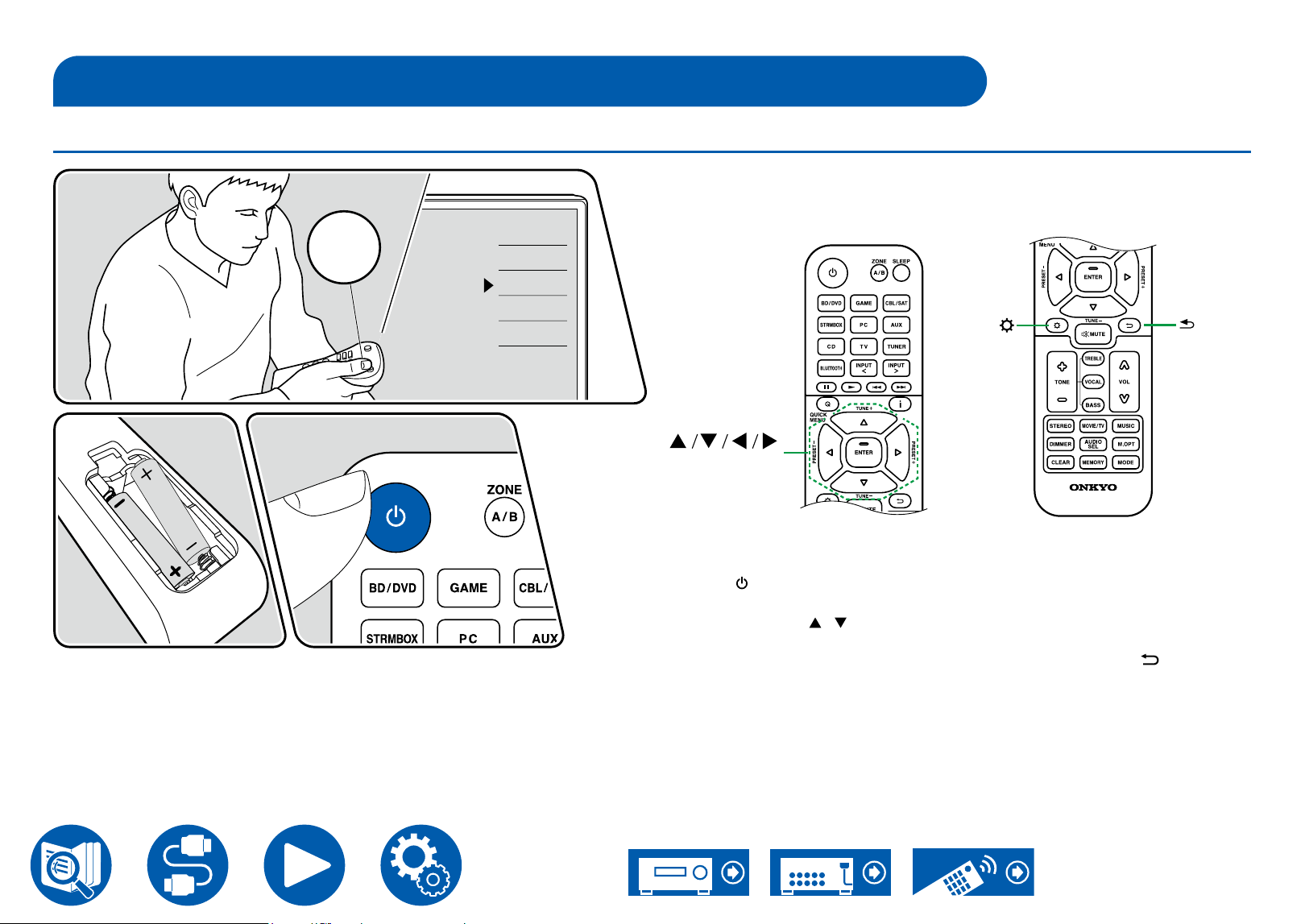
74
Setup
Initial Setup with Auto Start-up Wizard
Operations
When you turn the unit on for the rst time after purchase, the Initial Setup
screen is automatically displayed on the TV to allow you to make settings
required for startup using simple operations following on-screen guidance.
ENTER
1. Switch the input of the TV to the input connected to the unit.
2. Put batteries into the remote controller of this unit.
3. Press
ON/STANDBY on the remote controller to turn the unit on.
4. When the language selection screen is displayed on TV, select the language
with the cursors
/ UP/DOWN and press ENTER.
• Select the item with the cursors of the remote controller, and press ENTER to
conrm your selection. To return to the previous screen, press RETURN/
EXIT.
• If you have terminated the Initial Setup halfway, turn this unit to standby mode
and turn the power on again. Then you can display the Initial Setup again.
The Initial Setup appears on the screen each time the power is turned on
unless the Initial Set up is completed or "Never Show Again" is selected on
the rst screen.
Inputs
TV
HDMI 1
HDMI 2
HDMI 3
TV
INPUT
TV’s REMOTE
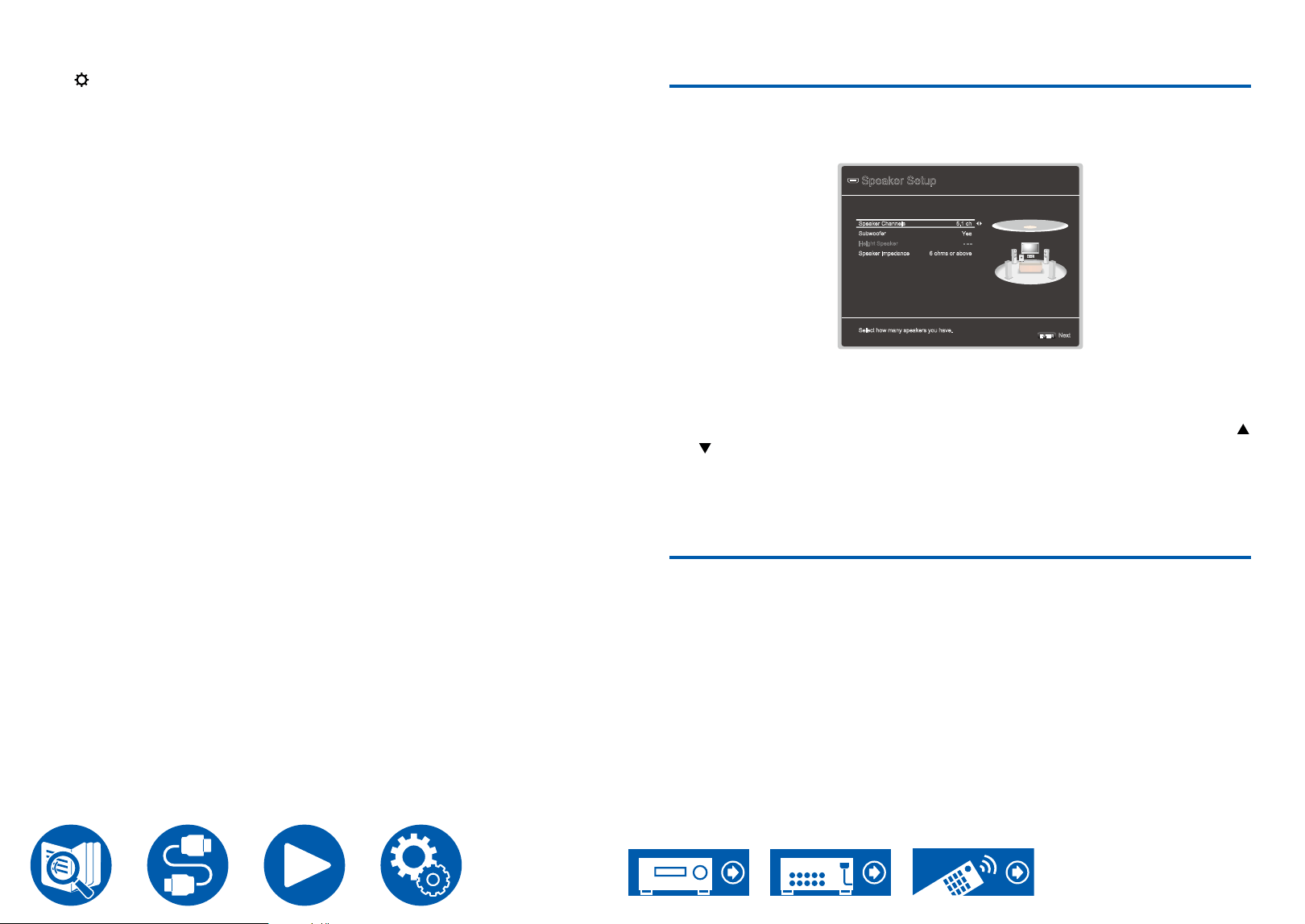
75
Setup
• To perform the Initial Setup again after the setting is completed, press
SETUP, select "Miscellaneous" - "Initial Setup", and press ENTER.
1. Speaker Setup
1. Select the connected speaker conguration and press ENTER.
Note that the image on the screen changes each time you select the number
of channels in "Speaker Channels".
Speaker Setup
Select how many speakers you have.
Next
ENTER
Speaker Channels
Speaker Impedance
5.1 ch
Yes
6 ohms or above
Subwoofer
- - -Height Speaker
2. The speaker combination selected in step 1 is displayed. "Yes" is displayed
for the selected speakers. If the setting is correct, press ENTER.
3. Select "Next" and press ENTER. Then a test tone is output from each
speaker to conrm the connection. Selecting each speaker with the cursors
/ UP/DOWN will output the test tone. Press ENTER after conrmation.
4. If there is no problem with the speaker connection, select "Next" and press
ENTER. To return to "Speaker Setup", select "Back to Speaker Setup" and
press ENTER.
2. ARC Setup
If you have connected a TV that supports ARC, select "Yes" and press ENTER.
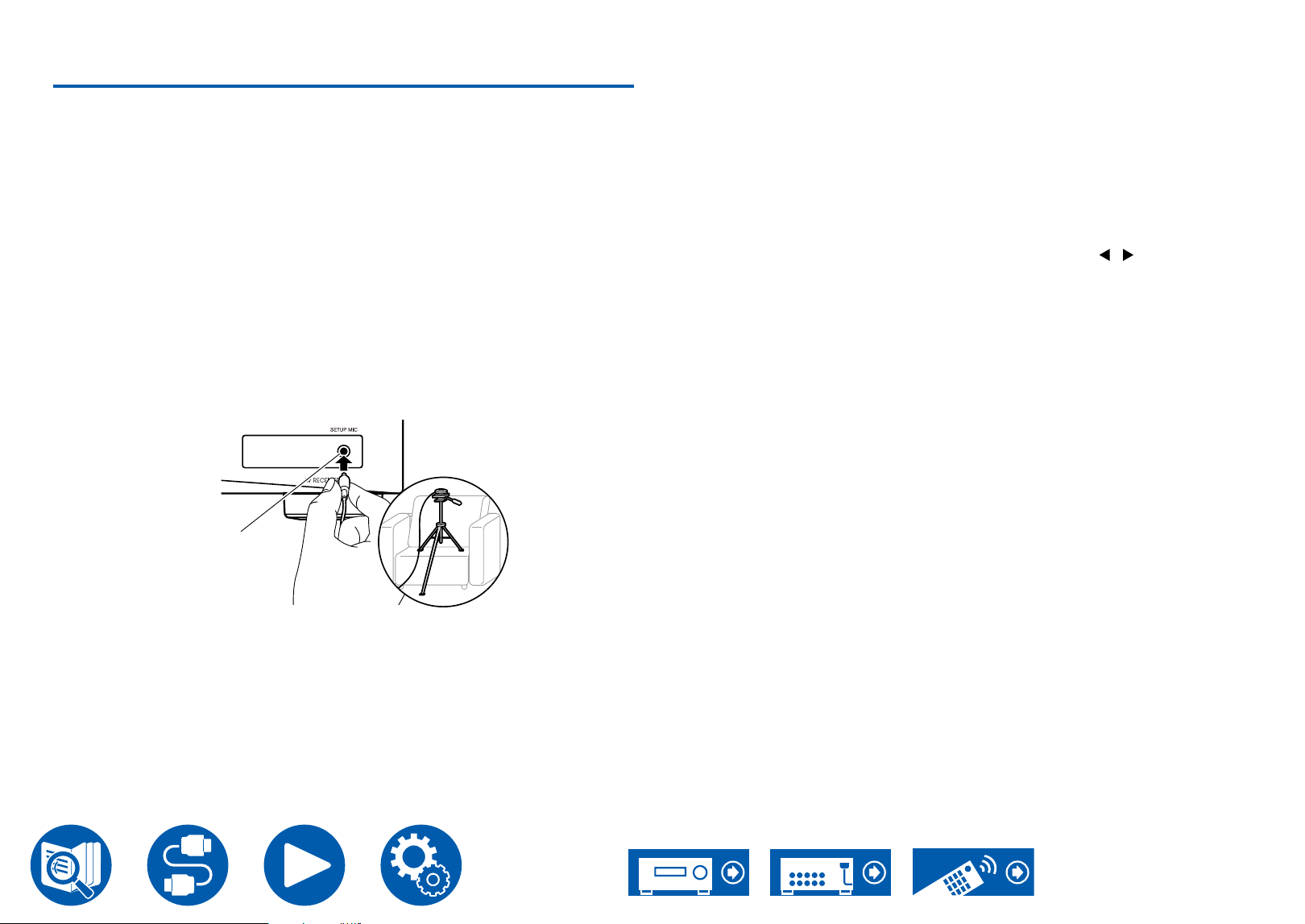
76
Setup
3. AccuEQ Room Calibration
Place the supplied speaker setup microphone at the listening position. The unit
automatically measures the test tones output from each speaker, and sets the
optimum volume level for each speaker, the crossover frequencies, and the
distance from the listening position. This also reduces the eect of the standing
wave in accordance with the viewing environment and automatically adjusts the
equalizers for the speakers, and enables correction of sound distortion caused
by the acoustic environment of the room.
• It takes between 3 and 12 minutes for calibration to be completed.
• If you connect a subwoofer, check the power and volume of the subwoofer.
Set the subwoofer volume to more than half.
• If the power of this unit suddenly turns o, the wires in the speaker cables
have touched the rear panel or other wires, and the protection circuit is
working. Twist the wires again securely, and make sure they do not stick out
of the speaker terminals when connecting.
1. Connect the supplied speaker setup microphone to the SETUP MIC jack on
the main unit.
SETUP MI
C
When placing the speaker setup microphone on a tripod, refer to the
illustration.
2. Conrm a test tone is output from the subwoofer and press ENTER.
3. Press ENTER to output test tones from each speaker, and the connected
speakers and the noise in the surrounding environment are automatically
measured.
4. The measurement results in step 3 are displayed. If there is no problem in
the detection result of the speaker, select "Next" and press ENTER to output
the test tone again to automatically set the settings such as volume level,
crossover frequency, etc., to their optimum. (The test tone is automatically
output when 10 seconds has elapsed without any operation.)
• When an error message is displayed or when the connected speakers
cannot be detected, perform re-measurement by selecting "Retry" and
pressing ENTER.
• When it cannot be resolved by performing the re-measurement, conrm
if the speakers are connected correctly. If there is any problem with the
speaker connection, perform the connection after disconnecting the power
cord.
5. When the measurement is completed, the measurement results are
displayed. You can check each setting using the cursors
/ LEFT/RIGHT.
Select "Save" and press ENTER to save the settings.
6. Disconnect the speaker setup microphone.
Troubleshooting
77
Troubleshooting
Before starting the procedure 78
When the unit is operating erratically 79
Try restarting the unit 79
Resetting the unit (this resets the unit settings to the
default) 79
Troubleshooting 80
Power 80
Audio 81
Listening Modes 83
Video 84
Linked operation 85
Tuner 85
BLUETOOTH function 85
ZONE B function 86
Remote Controller 86
Display 87
Others 87
Troubleshooting
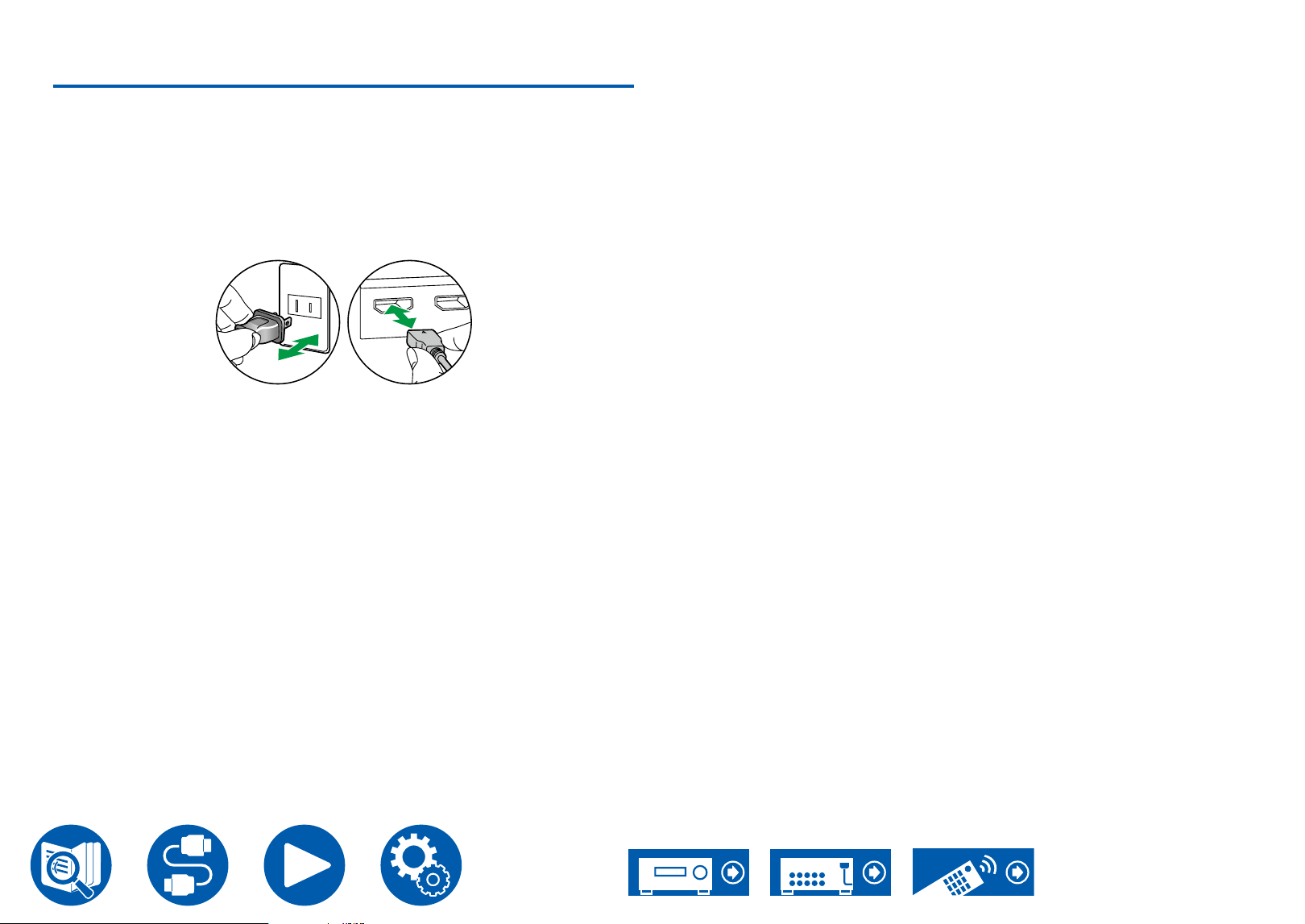
78
Troubleshooting
Before starting the procedure
Problems may be solved by simply turning the power on/o or disconnecting/
connecting the power cord, which is easier than working on the connection,
setting and operating procedure. Try the simple measures on both the unit and
the connected device. If the problem is that the video or audio is not output or
the HDMI linked operation does not work, disconnecting/connecting the HDMI
cable may solve it. When reconnecting, be careful not to wind the HDMI cable
since if wound the HDMI cable may not t well. After reconnecting, turn o and
on the unit and the connected device.
• The AV receiver contains a microPC for signal processing and control
functions. In very rare situations, severe interference, noise from an external
source, or static electricity may cause it to lockup. In the unlikely event that
this happens, unplug the power cord from the wall outlet, wait at least 5
seconds, and then plug it back in.
• Our company is not responsible for damages (such as CD rental fees) due to
unsuccessful recordings caused by the unit’s malfunction. Before you record
important data, make sure that the material will be recorded correctly.
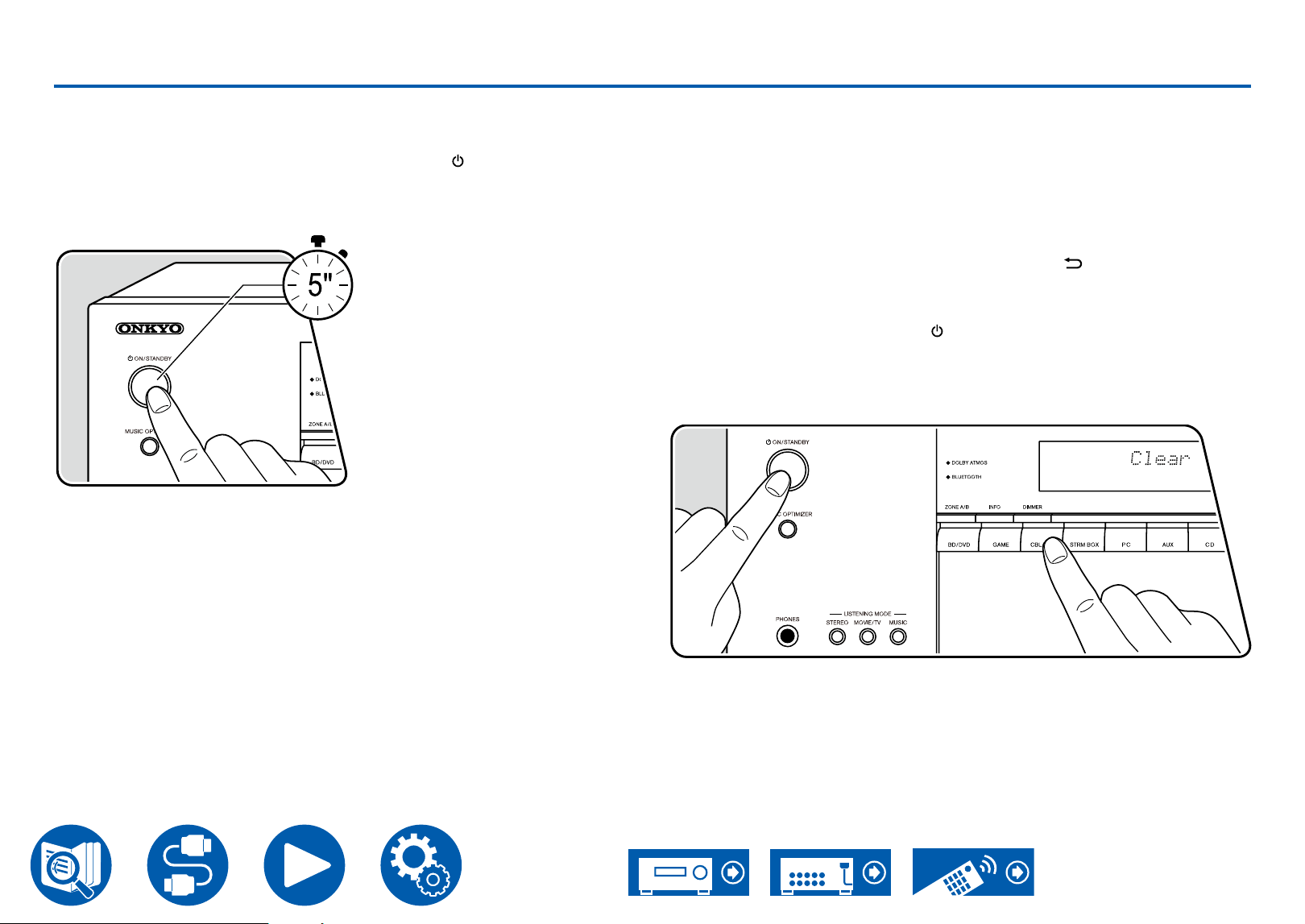
79
Troubleshooting
When the unit is operating erratically
Try restarting the unit
Restarting this unit may solve the problem. Set the main unit to standby, then
after waiting for 5 seconds or more, press and hold the ON/STANDBY button
of the main unit for at least 5 seconds, and then restart the unit. (The settings
on this unit are kept.) If the problem persists after restarting the unit, unplug and
plug the power cords or HDMI cable of this unit and connected devices.
Resetting the unit (this resets the unit settings to the
default)
If the restart of the unit does not solve the problem, reset the unit, and restore
all the settings to the factory default at the time of purchase. This may solve
the problem. If the unit is reset, your settings are restored to the default values.
Be sure to note down your setting contents before performing the following
operations. Note that it is not possible to reset the unit during the Initial Setup
process. Before doing the following procedures, press RETURN/EXIT to exit
Initial Setup.
1. While pressing and holding CBL/SAT of the input selector on the main unit
with the unit turned on, press the
ON/STANDBY button.
2. "Clear" is displayed on the display, and the unit returns to the standby state.
Do not remove the power cord until "Clear" disappears from the display.
To reset the remote controller, while pressing and holding MODE, press the
CLEAR button at least 3 seconds.
1
2
80
Troubleshooting
Troubleshooting
Power
When the power is turned on, "Diagnostic mode" appears on the display of the main unit
• The protection circuit function may have operated. If the unit suddenly enters the standby state and "Diagnostic mode" appears on the display
of the main unit when the power is turned on again, this function is diagnosing whether or not the main unit is malfunctioning or there is an
abnormality with the speaker cable connection. When the diagnosis is complete, the following messages are displayed.
Check speaker
If the unit returns to the normal ON state after "Diagnostic mode" appears on the display, the speaker cable may have
been short-circuited. After setting the power of this unit to standby state, connect the speaker cable again. Twist the
wires exposed from the tip of the speaker cable so that the wires do not stick out of the speaker terminal.
NG:
If the operation has stopped with "NG" displayed on the display, set the power of this unit to standby state immediately
and remove the power plug from the outlet. The unit may be malfunctioning. Consult a dealer.
The unit turns o unexpectedly
• If "Hardware" - "Power Management" - "Auto Standby" on the Setup menu is activated, the unit automatically enters the standby mode.
• The protection circuit function may have operated due to an abnormal rise in temperature of the unit. In such a case, the power turns o
repeatedly even if the power is turned on each time. Secure sucient ventilation space around the unit, wait for a while until the temperature of
the unit decreases. Then, turn the power on again.
WARNING: If smoke, smell or abnormal noise is produced by the unit, unplug the power cord from the outlet immediately, and contact the dealer or
our company's support.
( →p71)
81
Troubleshooting
Audio
• Make sure that the speaker setup microphone is no longer connected.
• Conrm that the connection between the output jack on the connected device and the input jack on this unit is correct.
• Make sure that none of the connecting cables are bent, twisted, or damaged.
• If "MUTING" is displayed on the display and MUTE is blinking, press MUTE on the remote controller to cancel muting.
• While headphones are connected to the PHONES jack, no sound is output from the speakers.
• When "Source" - "Audio Select" - "PCM Fixed Mode" on the Setup menu is set to "On", audio is not played if signals other than PCM are input.
Change the setting to O.
Check the following if the problem persists after you have conrmed the above.
No sound from the TV
• Change the input selector on this unit to the position of the terminal to which the TV is connected.
• If the TV doesn't support the ARC function, along with connection by HDMI, connect the TV and this unit using a digital optical cable. ( →p27)
No sound from a connected player
• Change the input selector on this unit to the position of the jack to which the player is connected.
• Check the digital audio output setting on the connected device. On some game consoles, such as those supporting DVD, the default setting may
be o.
• For some DVD-Video discs, you need to select an audio output format from a menu.
A speaker produces no sound
• Make sure that the polarity (+/-) of the speaker cables is correct, and that no bare wires are in contact with the metal part of speaker terminals.
• Make sure that the speaker cables are not shorting out.
• Check "Connect the Speaker Cables" ( →p20) to see if the speaker connections have been made correctly. Settings for the speaker
connection environment need to be made in "Speaker Setup" in Initial Setup. Check "Initial Setup with Auto Start-up Wizard" ( →p74).
• Depending on the input signal and listening mode, not much sound may be output from speakers. Select another listening mode to see if sound
is output.
( →p20)
82
Troubleshooting
The subwoofer produces no sound
If the setting of the front speakers is "Full Band", the low range elements will be output from the front speakers instead of from the subwoofer during
2 ch audio input of TV or music. To output the sound from the subwoofer, make one of the following settings.
1. Change the setting for the front speakers to a setting of crossover frequency value other than "Full Band".
The range below the specied frequency will be output from the subwoofer instead of from the front speakers. If your front speakers have a high
low-range reproduction capability, changing this setting is not recommended.
2. Change "Double Bass" to "On".
The low range elements of the front speakers will be output from both the front speakers and the subwoofer. Due to this, the bass sound may be
emphasized too much. In such a case, do not change the setting, or make the setting with the above option 1.
• For the setting details, refer to "Speaker" - "Crossover" on the Setup menu.
• If the input signals do not contain subwoofer audio elements (LFE), the subwoofer may produce no sound.
( →p60)
Noise can be heard
• Using cable ties to bundle analog audio cables, power cords, speaker cables, etc. may degrade the audio performance. Do not bundle the
cords.
• An audio cable may be picking up interference. Change the position of the cables.
The beginning of audio received by an HDMI IN cannot be heard
• Since it takes longer to identify the format of an HDMI signal than it does for other digital audio signals, audio output may not start immediately.
Sound suddenly reduces
• When the temperature inside the unit exceeds a certain temperature for extended periods of use, the volume may be lowered automatically to
protect the circuits.
Sound suddenly changes
• When "My Input Volume" is set, the volume is set for each input selector. Check "Source" - "My Input Volume" on the Setup menu. ( →p65)
83
Troubleshooting
Listening Modes
• To enjoy digital surround playback in formats such as Dolby Digital, you need to make a connection for audio signals with an HDMI cable, digital
coaxial cable or digital optical cable. Also, audio output need to be set to Bitstream output on the connected Blu-ray Disc player, etc.
• Press INFORMATION on the remote controller several times to switch the display of the main unit, and you can check the input format.
Check the following if the problem persists after you have conrmed the above.
Cannot select a desired listening mode
• Depending on the connection status of the speaker, some listening modes may not be selected. Check "Speaker Layouts and Selectable
Listening Modes" ( →p89) or "Input Formats and Selectable Listening Modes" ( →p92).
Cannot listen to the sound in Dolby TrueHD, Dolby Atmos or DTS-HD Master Audio format
• If the audio in Dolby TrueHD, Dolby Atmos or DTS-HD Master Audio format cannot be output correctly in the source format, set "BD video
supplementary sound" (or reencode, secondary sound, video additional audio, etc.) to "O" in the setting of a connected Blu-ray Disc player, etc.
After changing the setting, switch the listening mode to that for each source, and conrm.
About Dolby signals
• Some Dolby Atmos audio format that is used on games, etc., may be recognized as "Multichannel PCM". If this occurs, check the rmware
updates for the game console.
About DTS signals
• With media that switches suddenly from DTS to PCM, PCM playback may not start immediately. In such a case, stop playback on the player side
for approx. 3 seconds or more. Then, resume playback. The playback will be performed normally.
• DTS playback may not be performed normally on some CD and LD players even if the player and this unit are digitally connected. If some
processing (e.g., output level adjustment, sampling frequency conversion, or frequency characteristic conversion) has been executed for the
DTS signal being output, this unit cannot recognize it as a genuine DTS signal, and noise may occur.
• While playing a DTS-compatible disc, if a pause or skip operation is performed on your player, noise may occur for a short period. This is not a
malfunction.
84
Troubleshooting
Video
• Conrm that the connection between the output jack on the connected device and the input jack on this unit is correct.
• Make sure that none of the connecting cables are bent, twisted, or damaged.
• When the TV image is blurry or unclear, the power cord or connection cables of the unit may have interfered. In such a case, keep distance
between TV antenna cable and cables of the unit.
• Check the switching of the input screen on the monitor side such as a TV.
Check the following if the problem persists after you have conrmed the above.
No image appears
• Change the input selector on this unit to the position of the jack to which the player is connected.
• To display video from the connected player on the TV while the unit is in standby, you need to enable "Hardware" - "HDMI" - "HDMI Standby
Through" on the Setup menu. For details of the HDMI Standby Through function, check "Hardware" - "HDMI" on the Setup menu.
• Check if "Resolution Error" is displayed on the main unit display when video input via HDMI IN jack is not displayed. In this case, the TV does
not support the resolution of the video input from the player. Change the setting on the player.
• Normal operation with an HDMI-DVI adapter is not guaranteed. In addition, video signals output from a PC are not guaranteed.
• Try switching o the Deep Color function. To turn o the Deep Color function, simultaneously press the STRM BOX and ON/STANDBY
buttons on the main unit. While holding down STRM BOX, press ON/STANDBY repeatedly until "Deep Color:O" appears on the display. To
reactivate the Deep Color function, repeat the above described step until "Deep Color:On" is appeared on the display.
( →p68)
Images icker
• The output resolution of the player may not be compatible with the resolution of the TV. If the player is connected to this unit with an HDMI cable,
change the output resolution on the player. Also this may be solved by changing the screen mode on the TV.
Video and audio are out of synch
• Depending on the settings on your TV and connection environment, the video may be behind the audio. Press Q QUICK MENU on the remote
controller to display "Quick Menu", select "HDMI" - "A/V Sync", and make the adjustment.
( →p46)
85
Troubleshooting
Linked operation
HDMI linked operation does not work with CEC-compliant devices, such as a TV
• In the Setup menu of the unit, set "Hardware" - "HDMI" - "HDMI CEC" to "On".
• It is also necessary to set HDMI linking on the CEC-compliant device. Check the instruction manual.
• When connecting a Sharp brand player or recorder to the HDMI IN jacks, set "Hardware" - "HDMI" - "HDMI Standby Through" to "Auto" on the
Setup menu.
( →p68)
Tuner
Poor reception or much noise
• Recheck the antenna connection.
• Move the antenna away from the speaker cord or power cord.
• Move the unit away from your TV or PC.
• Passing cars or airplanes in the vicinity can cause interference.
• If radio waves are blocked by concrete walls, etc., radio reception may be poor.
• Change the reception mode to mono ( →p40).
• When listening to an AM station, operating the remote controller may cause noise. (North American, Taiwanese, Middle East, Australian and
Asian models)
• FM reception may be clearer if you use the antenna jack on the wall used for the TV.
( →p32)
BLUETOOTH function
• Unplug and plug the power cord of the unit, or turn o and on the BLUETOOTH enabled device. Restart of the BLUETOOTH enabled device
may be eective.
• BLUETOOTH enabled devices must support the A2DP prole.
• Because a radio wave interference will occur, this unit may not be used near devices such as a microwave oven or cordless phone which use
the radio wave in the 2.4 GHz range.
• A metallic object near the unit can aect on the radio wave, and BLUETOOTH connection may not be possible.
Check the following if the problem persists after you have conrmed the above.
Cannot transmit from a BLUETOOTH wireless technology enabled device (PC, smartphone, etc.) to
this unit
• Check if the BLUETOOTH function of the BLUETOOTH enabled device is enabled.
86
Troubleshooting
Cannot connect a BLUETOOTH wireless technology enabled device (PC, smartphone, etc.) to this
unit
• Initialize the pairing information and perform pairing again.
Firstly delete all the pairing information saved on this unit. In the Setup menu, select "Hardware" - "Bluetooth" - "Bluetooth Receiver"- "Pairing
Information", then press ENTER while "Clear" is displayed.
Next, delete the pairing information of this unit that is saved on the BLUETOOTH wireless technology enabled device. For information on how to
clear the pairing information, refer to the BLUETOOTH enabled device's instruction manual.
Finally, perform pairing again. Refer to "BLUETOOTH
®
Playback" ( →p39) for pairing instructions.
Music playback is unavailable on the unit even after successful BLUETOOTH connection
• If the volume setting on this unit or the BLUETOOTH wireless technology enabled device is low, audio may not be played. Check the volume
setting on this unit or the BLUETOOTH wireless technology enabled device.
• Some Bluetooth enabled devices may be equipped with a Send/Receive selector switch. Try switching the setting to suit the application the
device is being used for.
• Depending on the characteristics or specications of the BLUETOOTH enabled device, music may not be played back on this unit.
Sound is interrupted
• There maybe a problem with the BLUETOOTH enabled device. Check the information on a web page.
The audio quality is poor after connection with a BLUETOOTH enabled device
• The BLUETOOTH reception is poor. Move the BLUETOOTH enabled device closer to the unit, or remove any obstacle between the
BLUETOOTH enabled device and this unit.
ZONE B function
Cannot output audio to ZONE B
• To output audio to ZONE B, set the audio output destination to "ZONE A+B" or "ZONE B". ( →p48)
Remote Controller
• Make sure that the batteries are inserted with the correct polarity.
• Insert new batteries. Do not mix dierent types of batteries, or old and new batteries.
• Make sure that the sensor of the main unit is not subjected to direct sunlight or inverter-type uorescent lights. Relocate it if necessary.
• If the main unit is installed in a rack or cabinet with colored-glass doors, or if the doors are closed, the remote controller may not work normally.
87
Troubleshooting
Display
The display does not light up
• When the Dimmer function is working, the display may go dim. Press the DIMMER button, and change the brightness level of the display. ( →p14)
Others
Strange noise can be heard from the unit
• If you have connected another device to the same outlet as this unit, strange noise may occur under the inuence of the device. If the symptom
is remedied by removing the power plug of the other device from the outlet, use dierent outlets for this unit and the device.
The message "Noise Error" appears during AccuEQ Room Calibration
• This can be caused by a malfunction in your speaker unit. Check the speaker output, etc.
The measurement results of AccuEQ Room Calibration show dierent distances to the speakers from
the actual ones
• Depending on the speakers you are using, some errors may occur in the measurement results. If this is the case, make the settings in "Speaker"
- "Distance" in the Setup menu.
( →p61)
The measurement results of AccuEQ Room Calibration show that the volume level of the subwoofer
has been corrected to the lower limit
• The volume level correction of the subwoofer may not have been completed. Lower the volume of the subwoofer before
AccuEQ Room Calibration measurement.
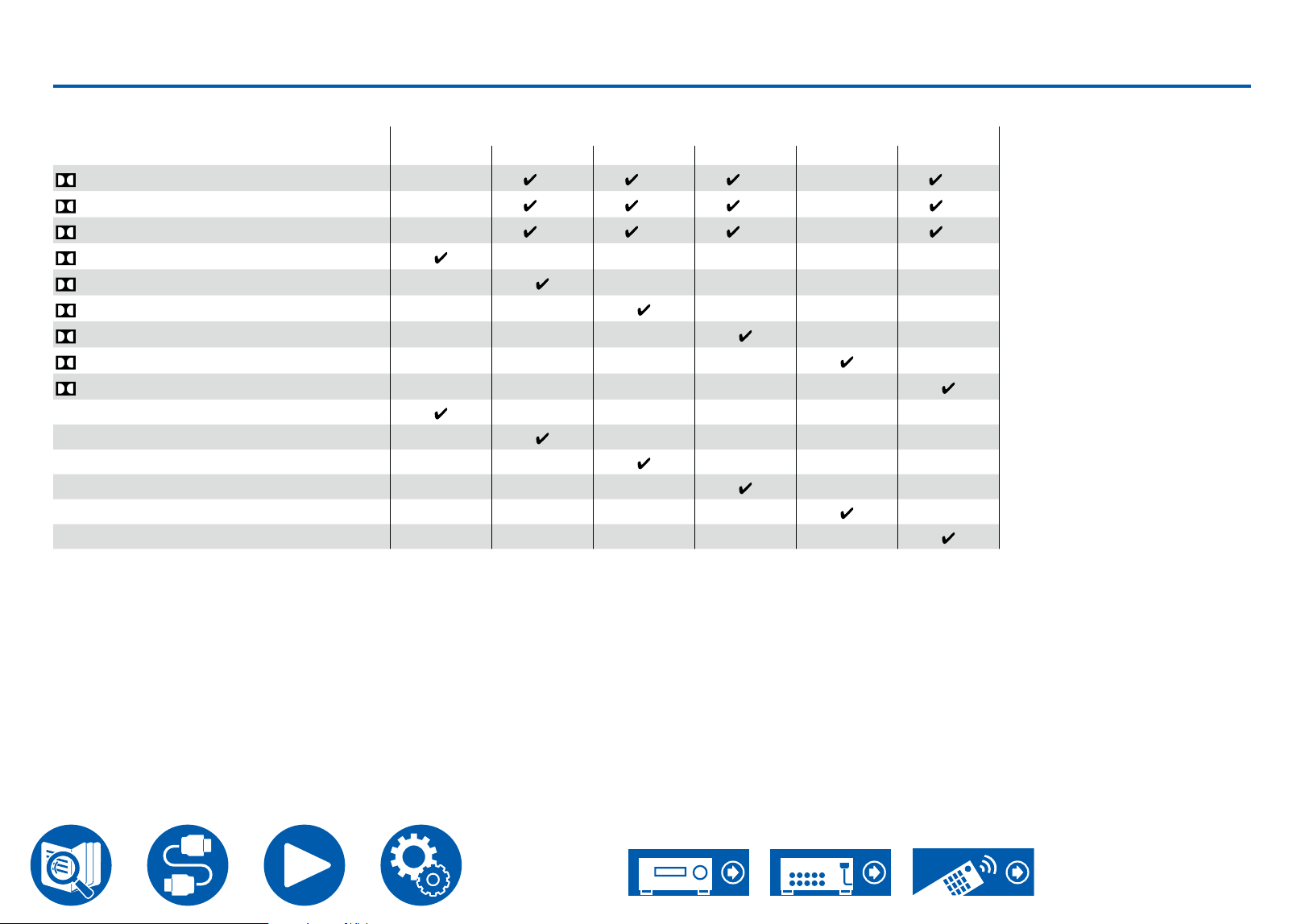
89
Appendix
Speaker Layouts and Selectable Listening Modes
See the following table for selectable listening modes for each speaker layout.
Speaker layout (ch)
Listening mode 2.1 3.1 4.1 5.1 2.1.2 3.1. 2
DD (Dolby Audio - DD)
(*1) (*1) (*1) (*2)
DD+ (Dolby Audio - DD+)
(*1) (*1) (*1) (*1)
DTHD (Dolby Audio - TrueHD)
(*1) (*1) (*1) (*1)
Atmos 2.0/2.1
Atmos 3.0/3.1
Atmos 4.0/4.1
Atmos 5.0/5.1
Atmos 2.0.2/2.1.2
Atmos 3.0.2/3.1.2
Dolby Surr 2.0/2.1 (Dolby Audio - Surr)
Dolby Surr 3.0/3.1 (Dolby Audio - Surr)
Dolby Surr 4.0/4.1 (Dolby Audio - Surr)
Dolby Surr 5.0/5.1 (Dolby Audio - Surr)
Dolby Surr 2.0.2/2.1.2 (Dolby Audio - Surr)
Dolby Surr 3.0.2/3.1.2 (Dolby Audio - Surr)
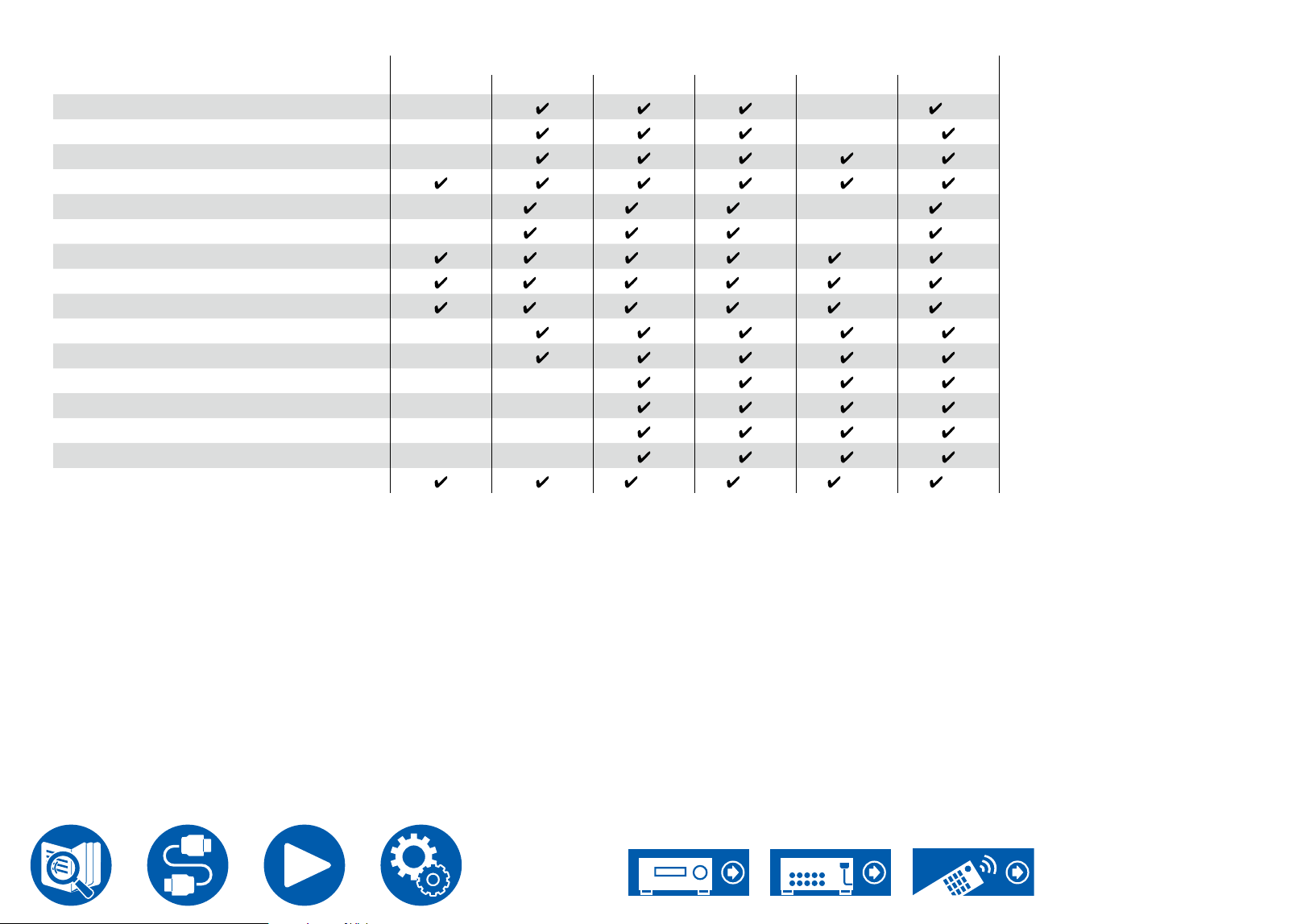
90
Appendix
Speaker layout (ch)
Listening mode 2.1 3.1 4.1 5.1 2.1.2 3.1. 2
DTS
(*2)
DTS-HD
DTS:X
DTS Neural:X
Multich (Multichannel)
(*1) (*1) (*1) (*2)
DSD
(*1) (*1) (*1) (*2)
Direct
(*1) (*1) (*1) (*1) (*1)
Stereo
(*3) (*3) (*3) (*3) (*3)
Mono
(*3) (*3) (*3) (*3) (*3)
Mono Music
AllCh Stereo
Orchestra
Studio-Mix
TV Logic
Unplugged
T-D (Theater-Dimensional)
(*3) (*4) (*3) (*4)
*1: Reproduced with the sound eld according to the number of channels of input signals.
*2: Not output from height speakers.
*3: Output only from front speakers.
*4: Output only from front speakers and center speaker.
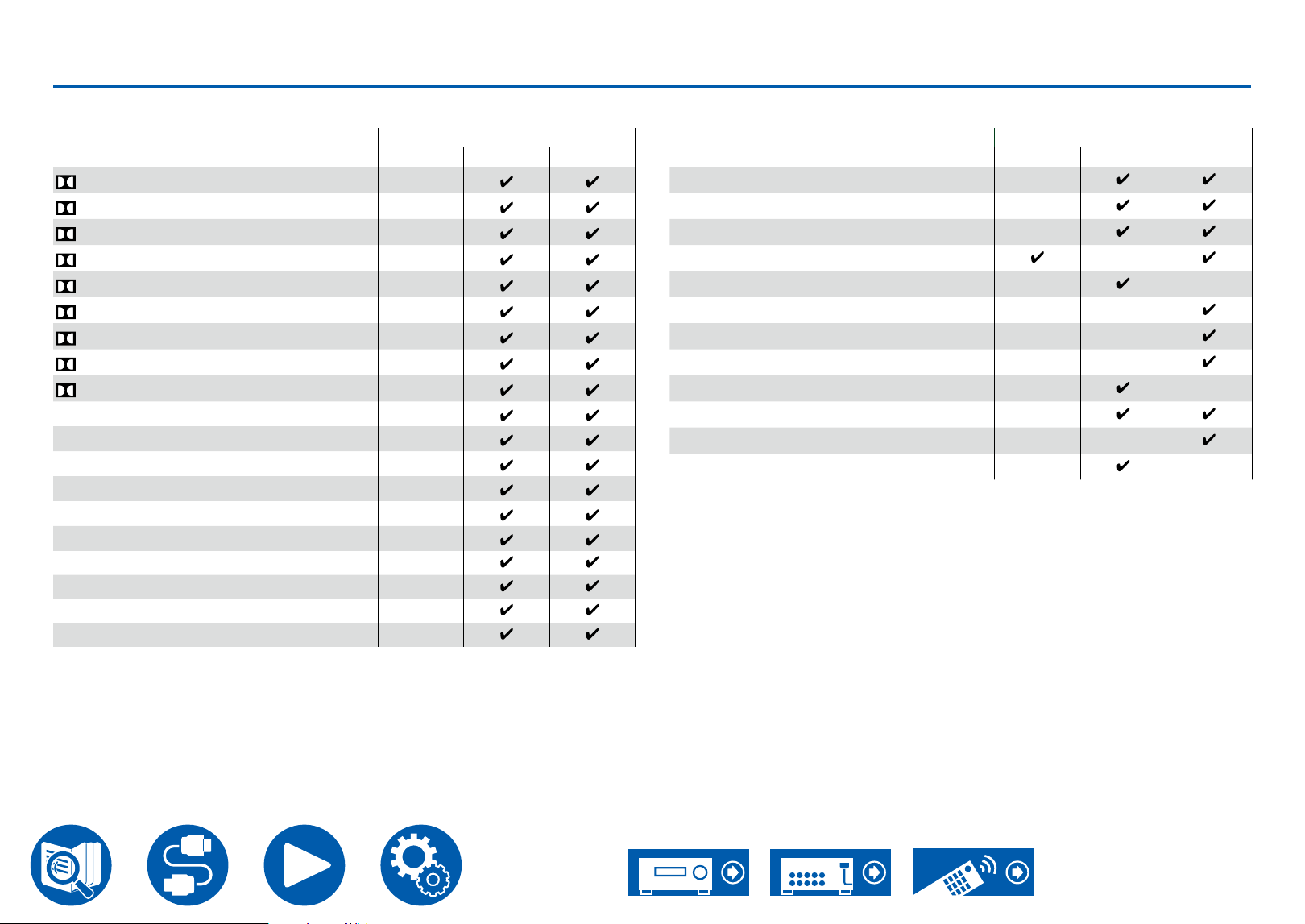
91
Appendix
LISTENING MODE buttons and Selectable Listening Modes
Refer to the following table for the listening modes that can be selected with each LISTENING MODE button.
LISTENING MODE button
Listening mode STEREO MOVIE/TV MUSIC
DD (Dolby Audio - DD)
DD+ (Dolby Audio - DD+)
DTHD (Dolby Audio - TrueHD)
Atmos 2.0/2.1
Atmos 3.0/3.1
Atmos 4.0/4.1
Atmos 5.0/5.1
Atmos 2.0.2/2.1.2
Atmos 3.0.2/3.1.2
Dolby Surr 2.0/2.1 (Dolby Audio - Surr)
Dolby Surr 3.0/3.1 (Dolby Audio - Surr)
Dolby Surr 4.0/4.1 (Dolby Audio - Surr)
Dolby Surr 5.0/5.1 (Dolby Audio - Surr)
Dolby Surr 2.0.2/2.1.2 (Dolby Audio - Surr)
Dolby Surr 3.0.2/3.1.2 (Dolby Audio - Surr)
DTS
DTS-HD
DTS:X
DTS Neural:X
LISTENING MODE button
Listening mode STEREO MOVIE/TV MUSIC
Multich (Multichannel)
DSD
Direct
Stereo
Mono
Orchestra
Unplugged
Studio-Mix
TV Logic
AllCh Stereo
Mono Music
T-D (Theater-Dimensional)
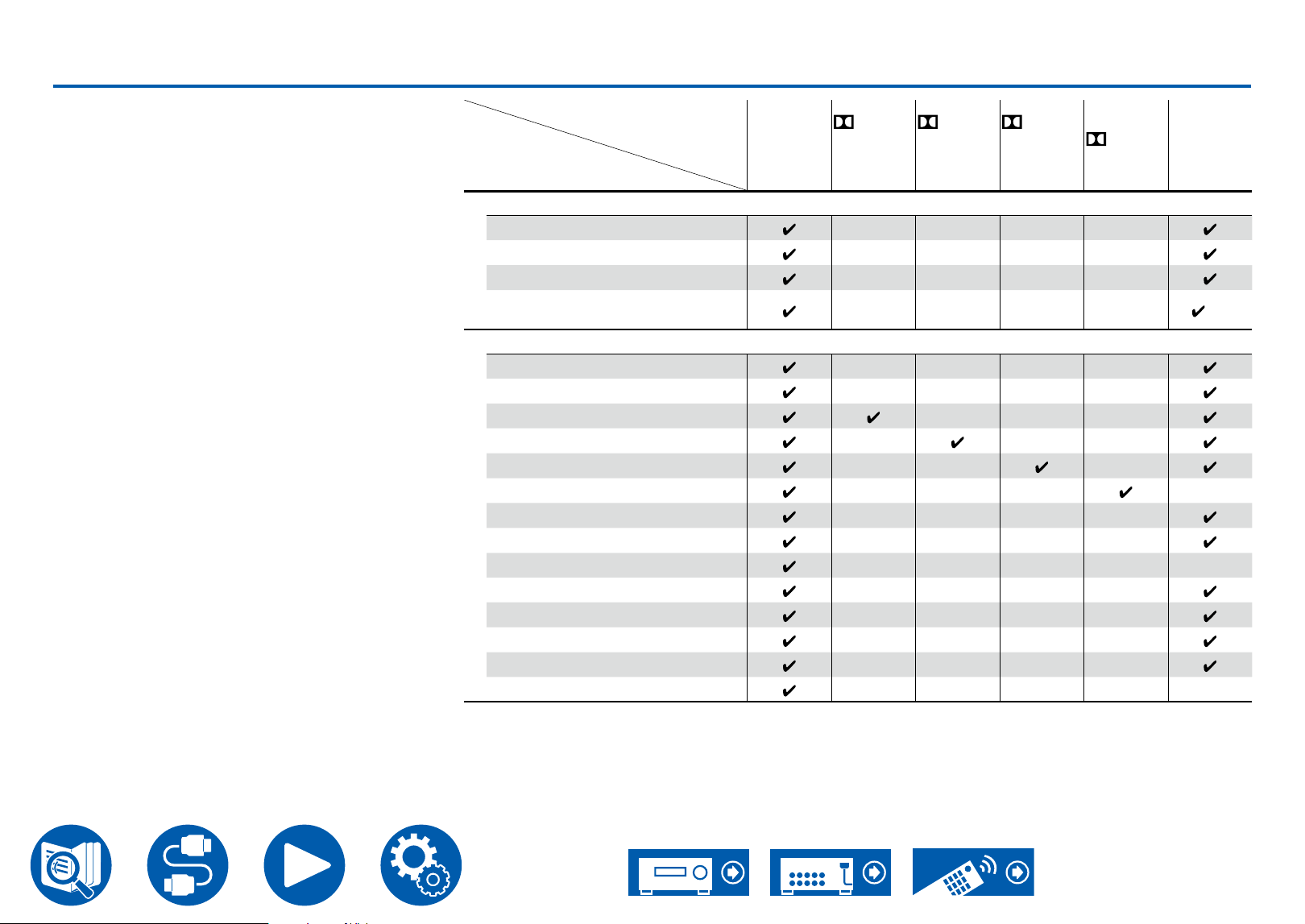
92
Appendix
Input Formats and Selectable Listening Modes
You can select a variety of listening modes
according to the audio format of the signal to be
input.
• Selectable listening modes when headphones
are connected are Mono, Direct, and Stereo only.
Listening mode
Input format
Direct
Stereo
DD
(Dolby
Audio - DD)
(*1)
DD+
(Dolby Audio
- DD+)
(*1)(*2)
DTHD
(Dolby Audio
- TrueHD)
(*1)
Atmos
(*8)
Dolby Surr
(Dolby
Audio -
Surr) (*8)
2-channel signal input
Analog / PCM
DSD
DD / DD+ / DTHD
DTS / DTS 96/24 / DTS Express / DTS-
HD HR / DTS-HD MSTR (*10) (*11)
(*9)
Multi-channel signal input
Multich PCM
DSD
DD
DD+
DTHD
Atmos
DTS
DTS 96/24 (*10)
DTS Express (*11)
DTS-HD HR (*11)
DTS-HD MSTR (*11)
DTS-ES Discrete (*10)
DTS-ES Matrix (*10)
DTS:X
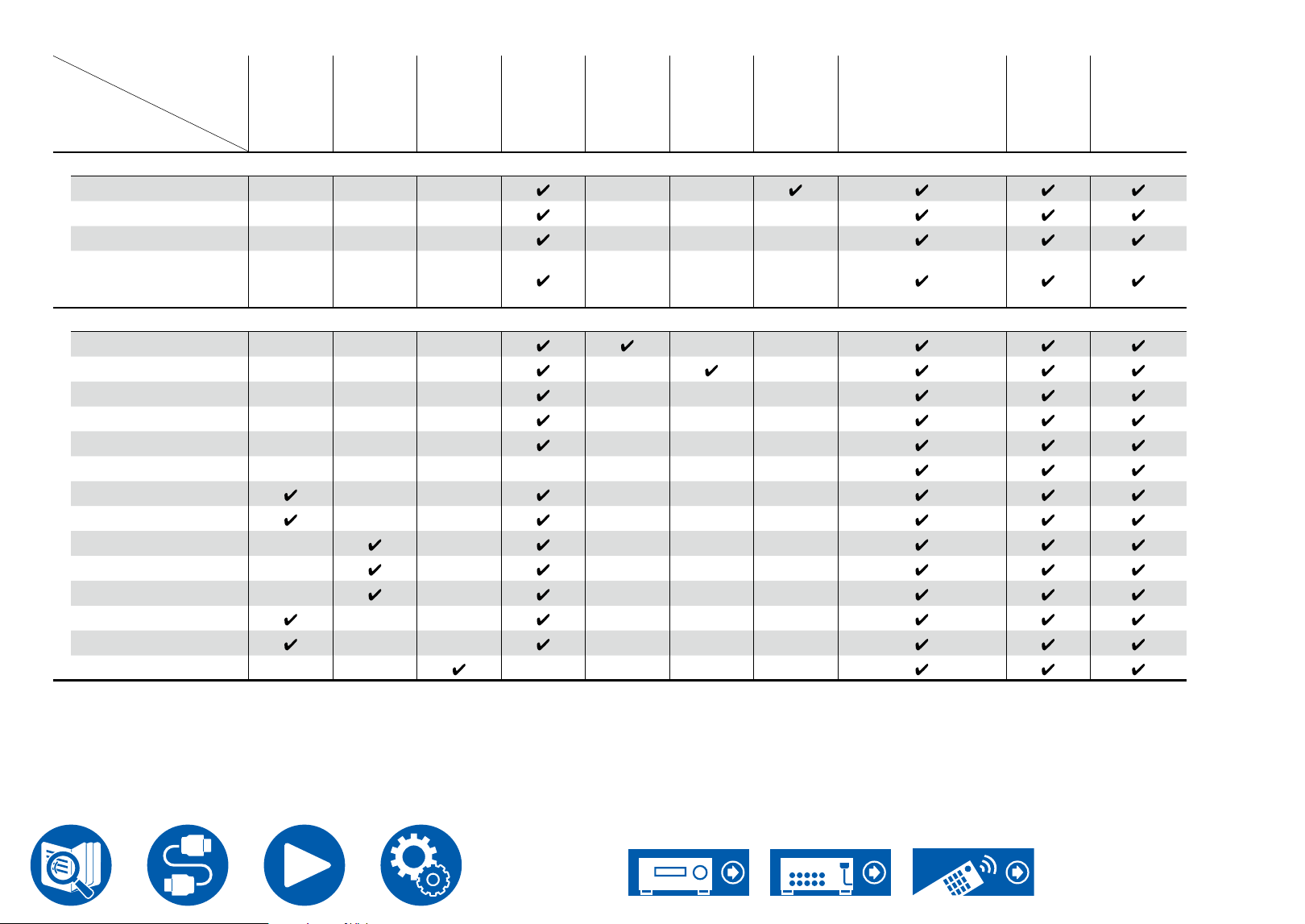
93
Appendix
Listening mode
Input format
DTS (*1)
DTS-HD
(*1)
DTS:X
DTS
Neural:X
(*3)
PCM
(Multich
PCM) (*1)
DSD
(*1)(*7)
Mono
Orchestra/ Unplugged/
Studio-Mix/ TV Logic (*4)
AllCh
Stereo /
Mono Music
(*5)
T-D (Theater-
Dimensional)
(*6)
2-channel signal input
Analog / PCM
DSD
DD / DD+ / DTHD
DTS / DTS 96/24 / DTS
Express / DTS-HD HR /
DTS-HD MSTR (*10) (*11)
Multi-channel signal input
Multich PCM
DSD
DD
DD+
DTHD
Atmos
DTS
DTS 96/24 (*10)
DTS Express (*11)
DTS-HD HR (*11)
DTS-HD MSTR (*11)
DTS-ES Discrete (*10)
DTS-ES Matrix (*10)
DTS:X
94
Appendix
(*1) A center speaker or surround speakers need to be installed.
(*2) If the input source is Blu-ray Disc and the speaker layout is 5.1 ch or less, DD+ cannot be selected. Instead, the listening mode for DD can be selected.
(*3) If the input format is any of the following and the number of channels is monaural, this listening mode becomes unavailable.
– DTS, DTS 96/24, DTS Express, DTS-HD HR, DTS-HD MSTR, PCM
(*4) Surround speakers or height speakers need to be installed.
(*5) A center speaker, surround speakers, or height speakers need to be installed.
(*6) Cannot be selected if "Speaker Virtualizer" ( →p62) is set to "O".
(*7) Cannot be selected when the input format is monaural.
(*8) The listening mode displayed depends on the speaker layout ( →p89). Furthermore, when the setting for "Speaker Virtualizer" ( →p62) is "O" (the default
value is On), then modes other than Atmos and Dolby Surr cannot be selected.
(*9) This cannot be selected when the input format is DTS Express.
(*10) Displayed as "DTS" on this unit.
(*11) Displayed as "DTS-HD" on this unit.
Speaker Layouts and Selectable Listening
Modes ( →p89)
95
Appendix
Listening Mode Eects
In alphabetical order
AllCh Stereo
This mode is ideal for background music. Stereo sound is played through the
surround speakers as well as the front speakers, creating a stereo image.
Atmos
Since this mode calculates the positional data of audio recorded in Dolby Atmos
audio in real-time and outputs it from appropriate speakers, you can enjoy the
natural and stereophonic sound eld of Dolby Atmos with any speaker layout
including connection of only front speakers. Also, the Dolby Atmos sound design
can be reproduced more faithfully by connecting height speakers. You can
select this mode when inputting the Dolby Atmos audio format.
Unlike existing surround systems, Dolby Atmos does not rely on channels, but
rather enables the accurate placement of sound objects that have independent
motion in a 3D space with even greater clarity. Dolby Atmos is an optional
audio format for Blu-ray Discs and achieves a more stereophonic sound eld by
introducing a sound eld above the listener.
According to the speaker layout, the following listening modes are displayed.
– Atmos 2.0/2.1: When only front speakers are installed
– Atmos 3.0/3.1: When front speakers and center speaker are installed
– Atmos 4.0/4.1: When front speakers and surround speakers are
installed
– Atmos 5.0/5.1: When front speakers, center speaker and surround
speakers are installed
– Atmos 2.0.2/2.1.2: When front speakers and height speakers are
installed
– Atmos 3.0.2/3.1.2: When front speakers, center speaker and height
speakers are installed
• To enable transfer of this audio format, connect via an HDMI cable and set
the audio output on the player to Bitstream output.
• When "Speaker Virtualizer" ( →p62) is set to "O" (Default: On), modes
other than
Atmos cannot be selected.
DD (Dolby Audio - DD)
This mode faithfully reproduces the sound design recorded in the Dolby Digital
audio format.
Dolby Digital is a multi-channel digital format developed by Dolby Laboratories,
Inc. and is widely adopted for use in movie production. It is also a standard audio
format for DVD-Video and Blu-ray Discs. It is possible to record a maximum of
5.1 channels on a DVD-Video or Blu-ray Disc; two front channels, one center
channel, two surround channels, and the LFE channel dedicated to the bass
region (sound elements for the subwoofer).
• To enable transfer of this audio format, connect via a digital cable and set the
audio output on the player to Bitstream output.
DD+ (Dolby Audio - DD+)
This mode faithfully reproduces the sound design recorded in the Dolby Digital
Plus audio format.
The Dolby Digital Plus format has been improved based on Dolby Digital,
increasing the number of channels and endeavoring to improve sound quality
by giving more exibility in data bit rates. Dolby Digital Plus is an optional audio
format based on 5.1 ch for Blu-ray Discs. It is possible to record a maximum of
7.1 channels with additional channels such as the surround back channel.
• To enable transfer of this audio format, connect via an HDMI cable and set
the audio output on the player to Bitstream output.
96
Appendix
Direct
This listening mode can be selected for all input signals. Processing that aects
sound quality is shut down, and sound closer to the original is reproduced. The
sound is reproduced with the sound eld based on the number of channels
in the input signal. For example, a 2 ch signal is output only from the front
speakers.
Note that the sound adjustment is not available when this mode is selected.
Dolby Surr (Dolby Audio - Surr)
This listening mode expands 2 ch input signals to 5.1 ch. This mode expands
actual channels to more channels for playback according to the conguration
of the connected speakers. Also, even if there is no speaker for expansion, for
example when only front speakers are connected, audio of surround channel or
height channel is virtually created for expansion playback.
According to the speaker layout, the following listening modes are displayed.
– Dolby Surr 2.0/2.1: When only front speakers are installed
– Dolby Surr 3.0/3.1: When front speakers and center speaker are installed
– Dolby Surr 4.0/4.1: When front speakers and surround speakers are
installed
– Dolby Surr 5.0/5.1: When front speakers, center speaker and surround
speakers are installed
– Dolby Surr 2.0.2/2.1.2: When front speakers and height speakers are
installed
– Dolby Surr 3.0.2/3.1.2: When front speakers, center speaker and height
speakers are installed
• When "Speaker Virtualizer" ( →p62) is set to "O" (Default: On), modes
other than Dolby Surr cannot be selected.
DTHD (Dolby Audio - TrueHD)
This mode faithfully reproduces the sound design recorded in the Dolby TrueHD
audio format.
The Dolby TrueHD audio format is a "lossless" format expanded based on the
lossless compression technology referred to as MLP, and it faithfully reproduces
the master audio recorded in the studio. Dolby TrueHD is an optional audio
format based on 5.1 ch for Blu-ray Discs. It is possible to record a maximum of
7.1 channels with additional channels such as the surround back channel. 7.1 ch
is recorded at 96 kHz/24 bit, and 5.1 ch is recorded at 192 kHz/24 bit.
• To enable transfer of this audio format, connect via an HDMI cable and set
the audio output on the player to Bitstream output.
DSD
This mode is suitable for playing sources recorded in DSD.
• This unit supports the DSD signal input from the HDMI input terminal.
However, depending on the connected player, better sound may be obtained
by setting the output on the player side to the PCM output.
• This listening mode cannot be selected if the output setting on your Blu-ray
Disc/DVD player is not set to DSD.
DTS
This mode faithfully reproduces the sound design recorded in the DTS audio
format
The DTS audio format is a multi-channel digital format developed by DTS, Inc.
This format is an optional audio format for DVD-Video and a standard format for
Blu-ray Discs.
• To enable transfer of this audio format, connect via a digital cable and set the
audio output on the player to Bitstream output.
97
Appendix
DTS-HD
This mode faithfully reproduces the sound design recorded in the DTS-HD High
Resolution Audio audio format or DTS-HD Master Audio.
These audio formats are optional audio format for Blu-ray Discs.
• To enable transfer of this audio format, connect via an HDMI cable and set
the audio output on the player to Bitstream output.
DTS Neural:X
This listening mode expands actual channels to more channels for playback to
suit the conguration of the connected speakers by expanding the input signals
from 2 channels to 5.1 channels respectively.
DTS Virtual:X
DTS Virtual:X listening mode uses the proprietary audio processing technology
to create spacious 3D sound including audio from up above without connecting
height speakers.
This mode can be selected in any speaker layout such as front speakers-only
connection. You can enjoy your favorite movies or TV programs with a more
immersive audio experience.
• This mode cannot be selected when "Speaker Virtualizer" ( →p62) is set to
"O" (Default: On).
DTS:X
This mode faithfully reproduces the sound design recorded in the DTS:X audio
format.
The DTS:X audio format is a combination of the mixing method based on
traditional channel based formats (5.1 ch and 7.1 ch) and object based dynamic
audio mixing, and it is characterized by the precise positioning of sounds and the
ability to express sound movement.
• To enable transfer of this audio format, connect via an HDMI cable and set
the audio output on the player to Bitstream output.
Mono
In this mode, monaural audio is played from the center speaker at the time
of inputting an analog signal or PCM signal. If there is no center speaker
connected, monaural audio is played from the front speakers.
Mono Music
In this mode, all speakers output the same sound in mono, so the sound you
hear is the same regardless of where you are within the listening room.
Multich (Multichannel)
This mode is suitable to play sources recorded in multichannel PCM.
Orchestra
This mode is suitable for classical or operatic music. This mode emphasizes the
surround channels in order to widen the sound image, and simulates the natural
reverberation of a large hall.
Stereo
In this mode, sound is output from the right and left front speakers and
subwoofer.
Studio-Mix
This mode is suitable for rock or pop music. This mode creates a lively sound
eld with a powerful acoustic image as if you are at a club or rock concert.
T-D (Theater-Dimensional)
In this mode, you can enjoy a virtual playback of multichannel surround sound
even with only two or three speakers. This works by controlling how sounds
reach the listener’s left and right ears.
• This mode cannot be selected when "Speaker Virtualizer" ( →p62) is set to
"O" (Default: On).
98
Appendix
TV Logic
Suitable for TV shows produced in a TV studio. This mode gives clarity to voices
by enhancing the entire surround sounds, and creates a realistic acoustic image.
Unplugged
Suitable for acoustic instruments, vocals and jazz. This mode emphasizes the
front sound eld image, giving the impression of being in front of the stage.
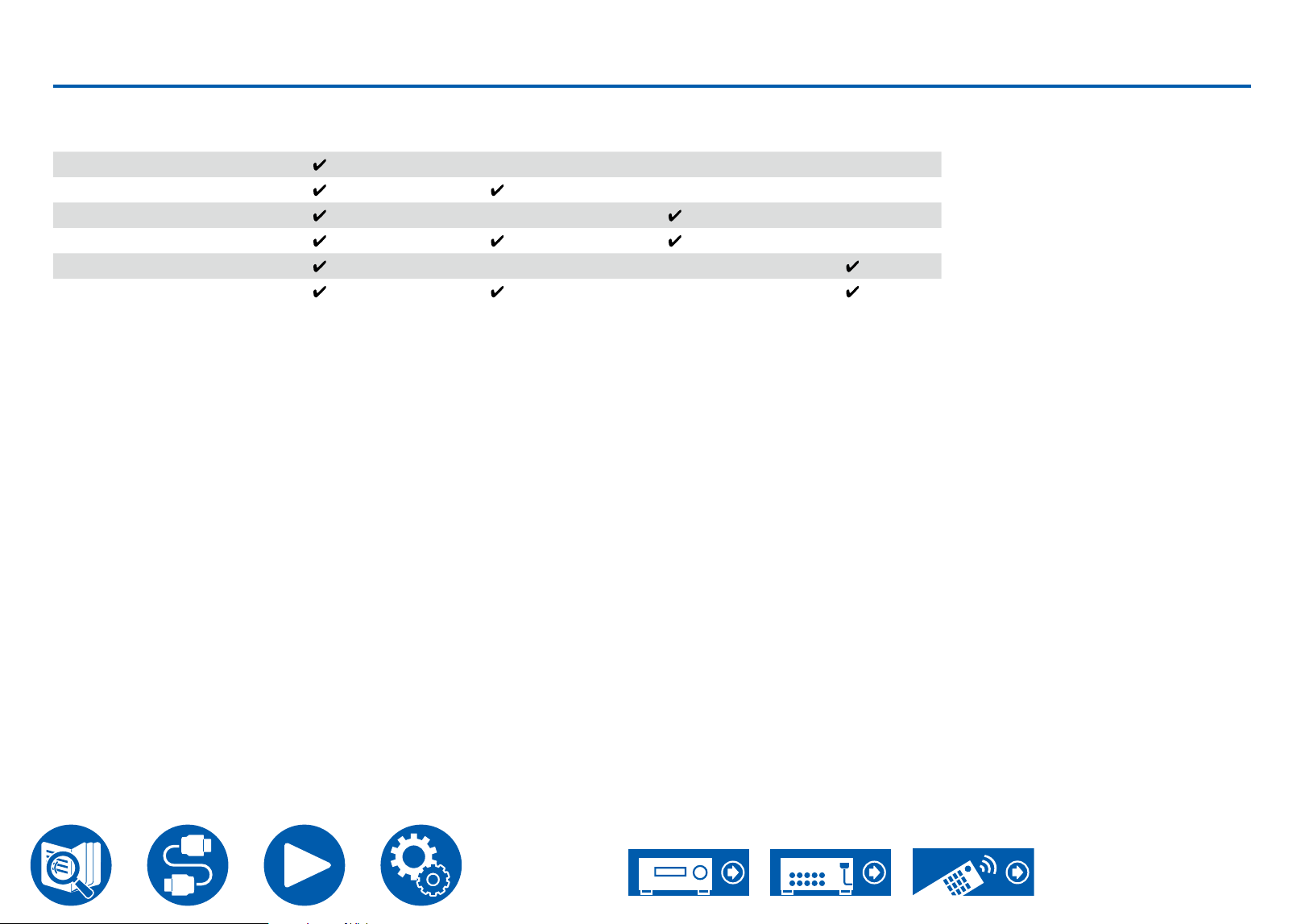
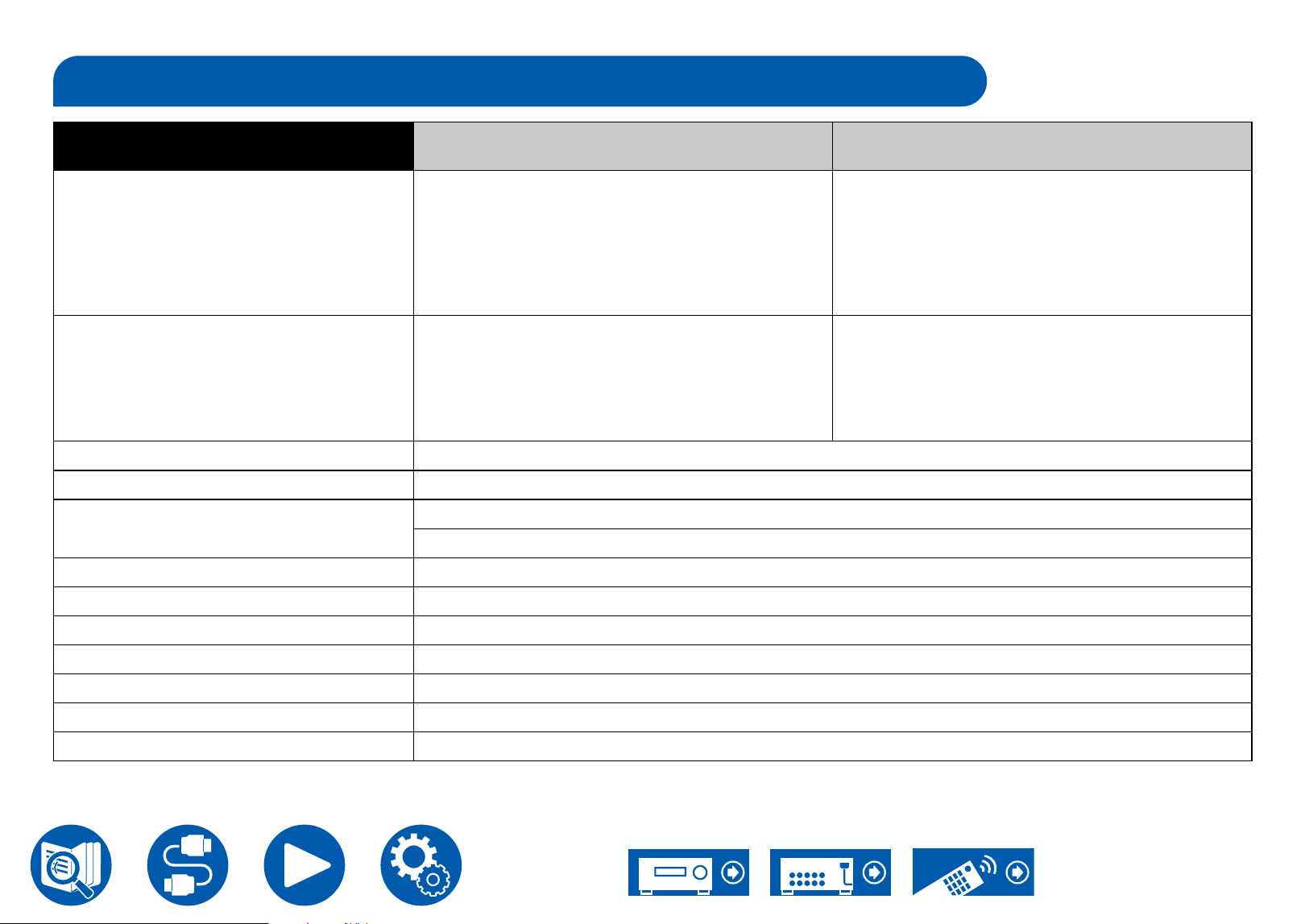
100
Appendix
General Specications
Amplier Section North American and Taiwanese models
European, Middle East, Australian and Asian
models
Rated Output Power
(North American models)
With 8 ohm loads, both channels driven, from 20 Hz-
20 kHz; rated 80 watts per channel minimum RMS
power, with no more than 0.08% total harmonic
distortion from 250 milliwatts to rated output. (FTC)
(Taiwanese models)
5 ch × 135 W at 6 ohms, 1 kHz, 1 ch driven of 1% THD (IEC)
5 ch × 135 W at 6 ohms, 1 kHz, 1 ch driven of 1% THD
(IEC)
Maximum Eective Output Power
(North American models)
155 W at 6 ohms, 1 kHz, 1 ch driven of 10% THD
(Taiwanese models)
5 ch × 155 W at 6 ohms, 1 kHz, 1 ch driven of 10% THD
(JEITA)
(European models)
5 ch × 155 W at 6 ohms, 1 kHz, 1 ch driven of 10% THD
(IEC)
(Middle East, Australian and Asian models)
5 ch × 155 W at 6 ohms, 1 kHz, 1 ch driven of 10% THD
(JEITA)
THD+N (Total Harmonic Distortion + Noise) 0.08% (20 Hz - 20,000 Hz, Rated output power)
Input Sensitivity and Impedance 200 mV/32 kΩ (LINE(RCA))
Rated RCA Output Level and Impedance
PRE OUT (SUBWOOFER) : 1 V/470 Ω
LINE OUT (ZONE B) : 1 V/200 mV/2.3 kΩ
Frequency Response 10 Hz - 100 kHz/+1 dB, –3 dB (Direct)
Tone Control Characteristics ±10 dB, 20 Hz (Bass), ±10 dB, 20 kHz (Treble)
Signal to Noise Ratio 106 dB (IHF-A, LINE IN, SP OUT)
Supported impedance of Speakers 4 Ω - 16 Ω
Headphone Rated Output 80 mW + 80 mW (32 Ω, 1 kHz, 10% THD)
Supported impedance of Headphones 8 Ω - 600 Ω
Headphones Frequency Response 10 Hz - 100 kHz
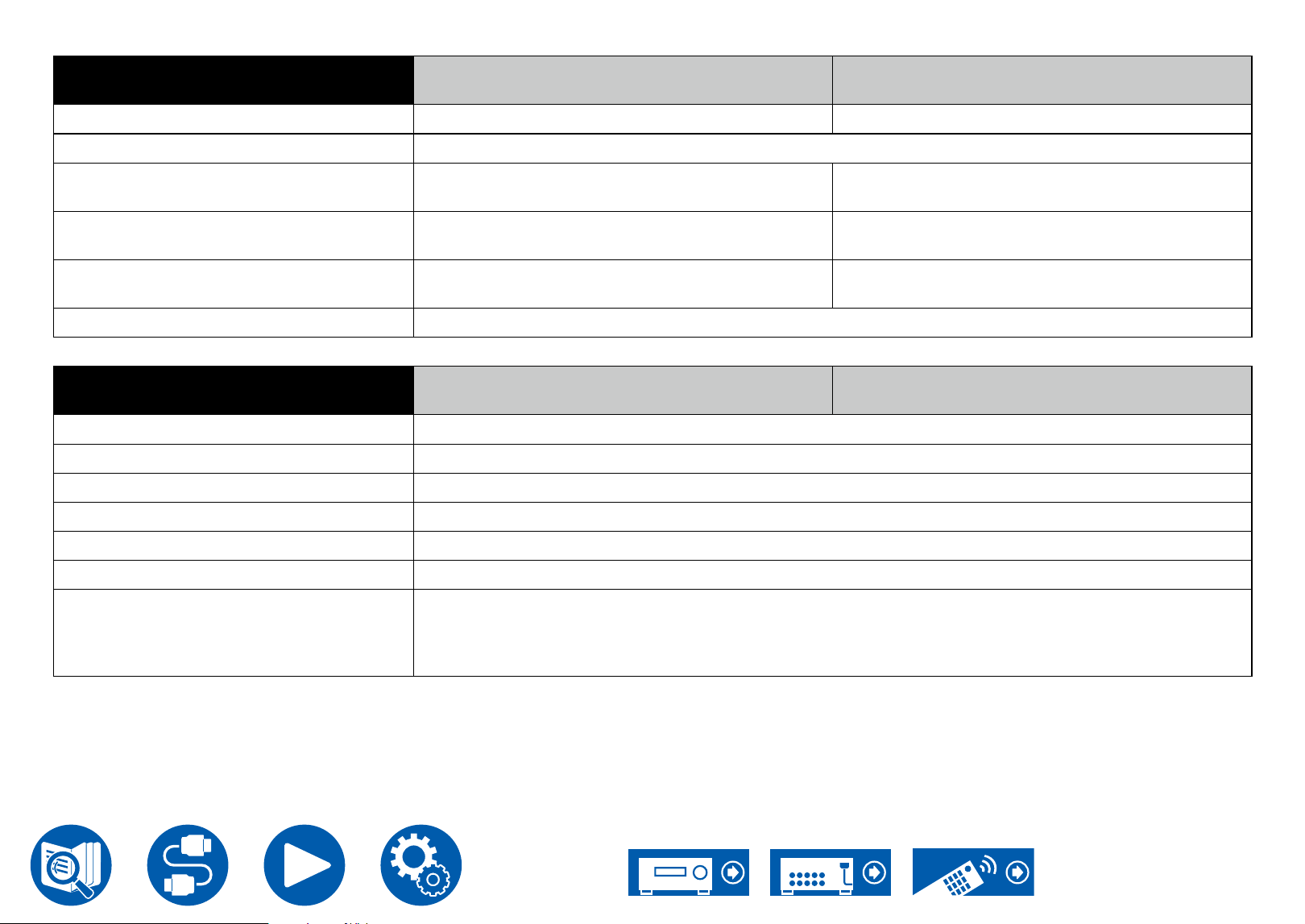
101
Appendix
Tuner Section North American and Taiwanese models
European, Middle East, Australian and Asian
models
FM Tuning Frequency Range 87.5 MHz - 107.9 MHz 87.5 MHz - 108.0 MHz, RDS
50 dB quieting sensitivity (FM MONO) 2.8 μV, 20.2 dBf (IHF, 1 kHz, 100% MOD)
AM Tuning Frequency Range 530 kHz - 1710 kHz
(Middle East, Australian and Asian models)
522/530 kHz - 1611/1710 kHz
DAB Tuning Frequency Range -
(European models)
174.928 MHz - 239.200 MHz (Band III)
DAB Sensitivity -
(European models)
-100 dBm (Min.) (Band III)
Preset Channel 40
BLUETOOTH Section North American and Taiwanese models
European, Middle East, Australian and Asian
models
Communication system BLUETOOTH Specication version 5.0
Frequency band 2.4 GHz (2.402-2.480 GHz)
Modulation method FHSS (Frequency Hopping Spread Spectrum)
Compatible BLUETOOTH proles A2DP v1.3, AVRCP v1.6, AVDTP v1.3, AVCTP v1.4
Supported Codecs SBC, AAC
Transmission range (A2DP) 20 Hz - 20 kHz (Sampling frequency 44.1 kHz)
Maximum communication range
Line of sight approx. 15 m(*)
(*)The actual range will vary depending on factors such as obstacles between devices, magnetic elds around
a microwave oven,static electricity, cordless phone, reception sensitivity, antenna's performance, operating
system, software application, etc.
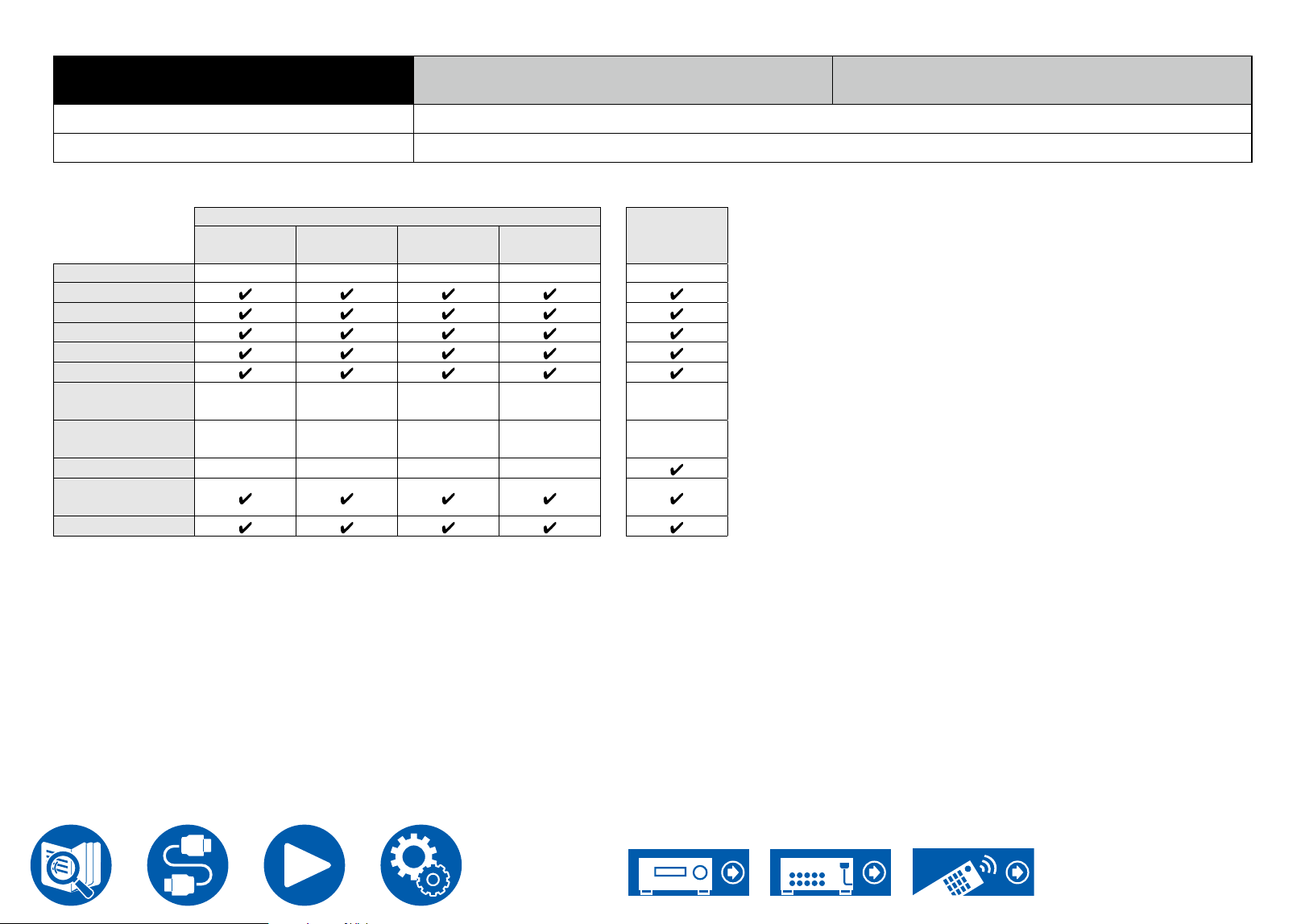
102
Appendix
HDMI North American and Taiwanese models
European, Middle East, Australian and Asian
models
Input 4
Output 1
Input *1
Output
HDMI 1 HDMI 2 HDMI 3 HDMI 4
bandwidth 40Gbps 40Gbps 40Gbps 40Gbps 40Gbps
ALLM
Gaming-VRR
QFT
SBTM
DSC
Uncompressed 8K/60p
4:2:0
8K/60p
4:2:0
8K/60p
4:2:0
8K/60p
4:2:0
8K/60p
4:2:0
Compressed
(TV needs DSC)
8K/60p
4:4:4
8K/60p
4:4:4
8K/60p
4:4:4
8K/60p
4:4:4
8K/60p
4:4:4
ARC / eARC *2
HDR10 /
HLG (BT.2020)
HDR10+
*1 Audio Format: 2 ch linear PCM (32 kHz, 44.1 kHz, 48 kHz, 88.2 kHz, 96 kHz, 176.4 kHz, 192 kHz, 16/20/24 bit)
Multi-channel linear PCM (Maximum 7.1 channels, 32 kHz, 44.1 kHz, 48 kHz, 88.2 kHz, 96 kHz, 176.4 kHz, 192 kHz, 16/20/24 bit)
Bitstream (Dolby Digital, Dolby Digital Plus, Dolby TrueHD, Dolby Atmos, DTS, DTS-ES, DTS 96/24, DTS-HD Master Audio, DTS-
HD High Resolution Audio, DTS Express, DTS:X, IMAX DTS, IMAX DTS:X, DSD(2.8 MHz), PCM)
*2
ARC compatible audio formats
: PCM, Dolby Digital, Dolby Digital Plus, DTS (DTS 96/24, DTS-ES, etc.), DTS-HD High Resolution Audio, IMAX DTS
eARC compatible audio formats
: PCM, Dolby Digital, Dolby Digital Plus, DTS (DTS 96/24, DTS-ES, etc.), Dolby TrueHD, Dolby Atmos, DTS- HD Master Audio,
DTS:X, Multichannel PCM, DTS-HD High Resolution Audio, IMAX DTS, IMAX DTS:X
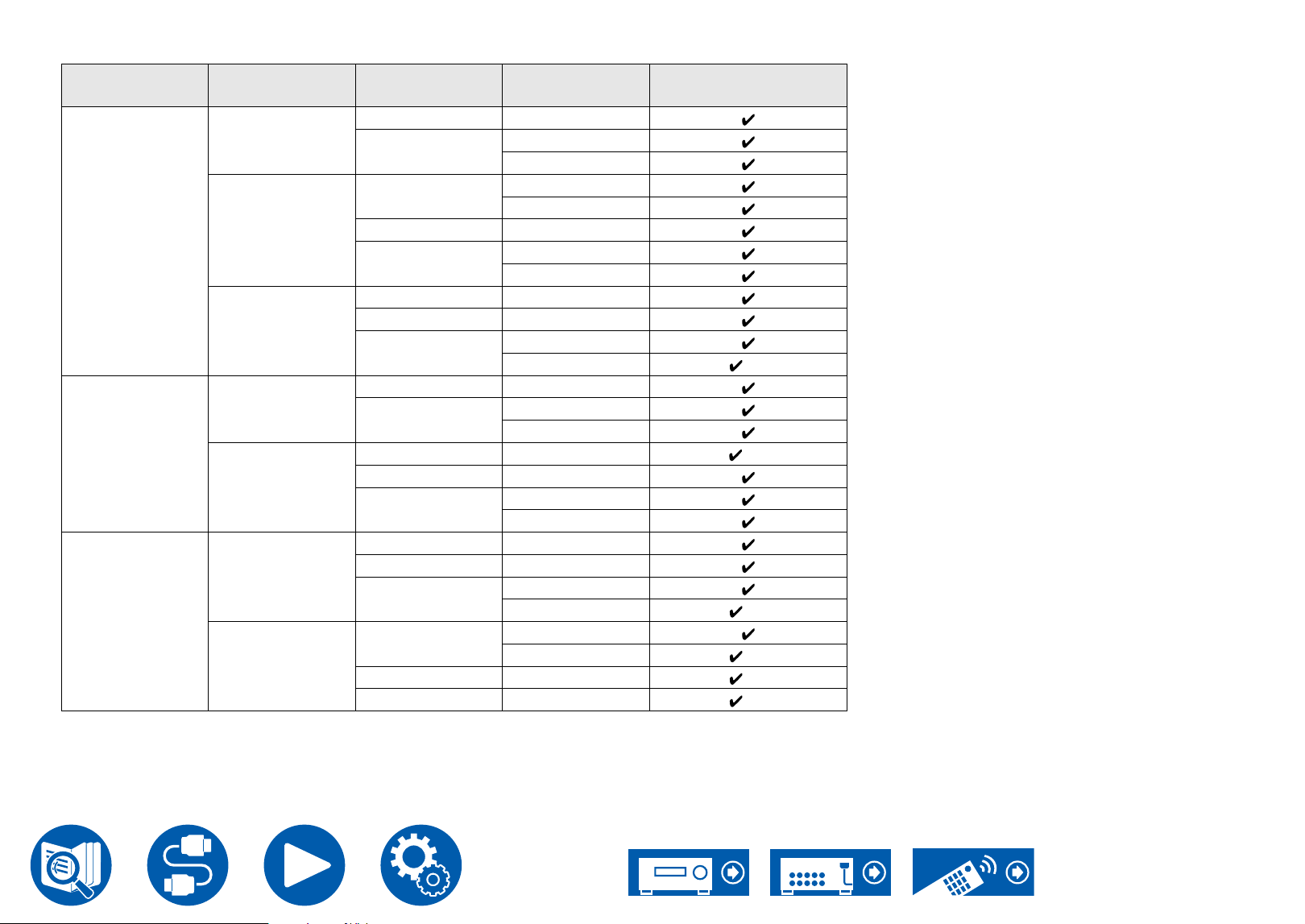
103
Appendix
Corresponding
input resolutions
Frame rate Color space Color depth HDMI IN 1 - 4
4K
(3840x2160p)
4K SMPTE
(4096x2160p)
24/25/30 Hz YCbCr4:2:2 12 bit
(*1)Video compressed with DSC (Display
Stream Compression) can be input and
output. DSC is a video compression
technique that enables the transmission of
high-resolution video, which requires high
bandwidth, via HDMI. While playing this
video format, there is no on-screen display
when you perform such operations as using
the Quick Menu or adjusting the volume.
(*2)5K, 48 Hz, YCbCr4:2:0, 8/10/12 bit is not
supported.
• Signals are output from the HDMI OUT
jack of this unit to the TV with the same
resolution as the input resolution. When a TV
supporting 4K is used, HDMI video signals
with 1080p can be output with 4K.
YCbCr4:4:4/RGB 8 bit
10/12 bit
48/50/60 Hz YCbCr4:2:0 8 bit
10/12 bit
YCbCr4:2:2 12 bit
YCbCr4:4:4/RGB 8 bit
10/12 bit
100/120 Hz YCbCr4:2:0 8/10/12 bit
YCbCr4:2:2 12 bit
YCbCr4:4:4/RGB 8/10 bit
12 bit
(*1)
5K
(5120x2160p)
24/25/30 Hz YCbCr4:2:2 12 bit
YCbCr4:4:4/RGB 8 bit
10/12 bit
48/50/60 Hz YCbCr4:2:0 8/10/12 bit
(*2)
YCbCr4:2:2 12 bit
YCbCr4:4:4/RGB 8 bit
10/12 bit
8K
(7680x4320p)
24/25/30 Hz YCbCr4:2:0 8/10/12 bit
YCbCr4:2:2 12 bit
YCbCr4:4:4/RGB 8/10 bit
12 bit
(*1)
48/50/60 Hz YCbCr4:2:0 8/10 bit
12 bit
(*1)
YCbCr4:2:2 12 bit
(*1)
YCbCr4:4:4/RGB 8/10/12 bit
(*1)
104
Appendix
USB Section North American and Taiwanese models
European, Middle East, Australian and Asian
models
USB 1 (Only for supplying power to Streaming media player, 5 V/1.0 A)
General North American and Taiwanese models
European, Middle East, Australian and Asian
models
Power Supply AC 120 V, 60 Hz AC 220 - 240 V, 50/60 Hz
Power Consumption 445 W 465 W
Full Standby mode 0.2 W 0.3 W
HDMI CEC Standby 0.2 W 0.3 W
Dimensions (W × H × D)
435 mm × 160 mm × 328 mm
17-1/8" × 6-5/16" × 12-15/16"
Weight 8.2 kg (18.1 lbs.) 8.4 kg (18.5 lbs.)
Maximum radio-frequency power transmitted in
the frequency band(s)
-
(European models)
2402 MHz - 2480 MHz (4 dBm (e.i.r.p))
Audio Inputs North American and Taiwanese models
European, Middle East, Australian and Asian
models
Analog 3 (RCA×3)
Digital
2 (COA XIA L×1, O PTICA L×1)
• Supported sampling rates for PCM signals (stereo, mono) from a digital input are 32 kHz, 44.1 kHz, 48 kHz,
88.2 kHz, 96 kHz/16 bit, 20 bit, and 24 bit.
105
Appendix
Audio Outputs North American and Taiwanese models
European, Middle East, Australian and Asian
models
Analog
ZONE B LINE OUT,
SUBWOOFER PRE OUT ×2
Speaker Outputs
FRONT L/R, CENTER,
SURROUND L/R or HEIGHT L/R
(North American and Taiwanese models support banana plugs)
Phones 1 (ø 6.3 mm, 1/4")
Others North American and Taiwanese models
European, Middle East, Australian and Asian
models
Setup Mic 1 (Front)
Specications and features are subject to change without notice.
License and Trademark
SN 29404112_EN
© Copyright 2023 Onkyo Technology, K.K. All rights reserved. ©2023 Onkyo Technology, K.K. Tous droits de reproduction et de traduction réservés.
F2307-0