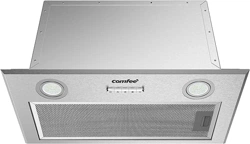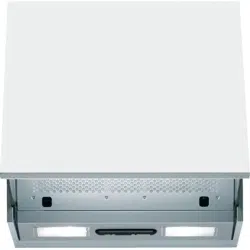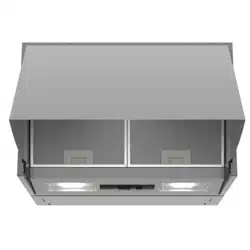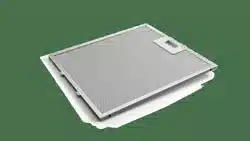
USER MANUAL
FULLY INTEGRATED BUILT IN
COOKER HOOD
eiQCHINTGY60
Thank you for choosing your electriQ cooker hood.
This instruction manual is designed to provide you with all required instructions related to
the installation, use and maintenance of the appliance. In order to operate the unit correctly
and safely, please read this instruction manual carefully before installation and usage.

2
CONTENTS
SAFETY
3
PRODUCT OVERVIEW
5
VENTILATION OPTIONS
6
INSTALLATION
7
OPERATION
10
CLEANING AND MAINTENANCE
11
FILTER INFORMATION
12
LIGHT REPLACEMENT
12
TECHNICAL INFORMATION
13
TROUBLESHOOTING
14
SUPPORT
14

3
SAFETY PRECAUTIONS
Whilst this product is compliant with all safety requirements, incorrect or
inappropriate use can lead to both personal injury and potential damage to
property. Please read the contents of this instruction booklet thoroughly before
fitting or using this appliance.
• The cooker hood must be installed in accordance with the installation
instructions and all measurements followed.
• All installation work must be carried out by a competent person or qualified
electrician.
• The unit must be connected to an earthed power supply.
• If venting externally, make sure the ducting has no bends sharper than 90
degrees as this will reduce the efficiency of the cooker hood.
• The cooker hood is for domestic use only and is not designed for
commercial use. It should only be used for the purpose it was intended – to
extract vapours and cooking odours.
• Do not flambé or use an open flame under the cooker hood.
• Do not try to use the cooker hood without the grease filters or if the filters
are excessively greasy! They should be cleaned regularly (see
“Maintenance”) or replaced as necessary.
• The extraction fan must be level to avoid grease collection at one end, as
this could cause a potential fire risk.
• Do not leave frying pans unattended during use because overheated fat or
oils might catch fire.
• If the cooker hood is damaged, do not attempt to use it.
• If the supply cord is damaged, it must be replaced by the manufacturer, its
service agent or a similarly qualified person in order to avoid a hazard.
• This appliance can be used by children aged from 8 years and above and
persons with reduced physical, sensory or mental capabilities or lack of
experience and knowledge if they have been given supervision or
instruction concerning use of the appliance in a safe way and understand
the hazards involved.
• Children shall not play with the appliance. Cleaning and user maintenance
shall not be made by children without supervision.
• Children should be supervised to ensure that they do not play with the
appliance. It is not a toy.
• The plug must be accessible after installation for isolation in case of an
emergency – or an appropriate fused switch if the unit is hard-wired to the
mains via a spur.
• The minimum distance between the surface of the hob and the lowest part
of the hood should be at least 65cm. A distance of between 65cm and 75cm
gives peak efficiency.
• The air must not be discharged into a flue that is used for exhausting fumes
from appliances burning gas or other fuels.

4
• When the hood is vented externally and used with appliances which burn
fuel (e.g. gas, oil, wood) the area must be sufficiently ventilated to ensure
safe operation. Fresh air must be allowed to freely enter the room to prevent
a partial vacuum.
• A partial vacuum can starve the heating appliance of oxygen, impairing
combustion. It can also prevent toxic fumes from leaving the room, or can
cause fumes to be sucked into the room from outside.
• Safe operation is only possible when the partial vacuum within the working
area does not exceed 4 Pa (0.04 mbar). This can be achieved by ensuring
air is able to enter the room from outside through a suitable sized opening
which cannot be sealed during operation. A number of alternative solutions
are available to ensure this. If in any doubt, professional advice should be
sought.
• Regulations concerning the discharge of air have to be fulfilled.
• There is a potential fire risk if cleaning is not carried out in accordance with
the instructions.
• Clean your appliance periodically by following the method given in the
chapter MAINTENANCE
• If used in recirculation mode, the charcoal filters trap odours and must be
replaced at least once a year depending on how frequently the cooker hood
has been used.
• For safety reason, please use only the same size of fixing or mounting
screw, which are recommended in this instruction manual.
• Warning: Failure to install the screws or fixing device in accordance with
these instructions may result in electrical hazards
CAUTION: Accessible parts of the hood can become very hot during
use with cooking appliances, whether in use or not, due to heat rising
from the hob. Sufficient time should be allowed for the unit to cool
before touching either the housing or the grease filters
5
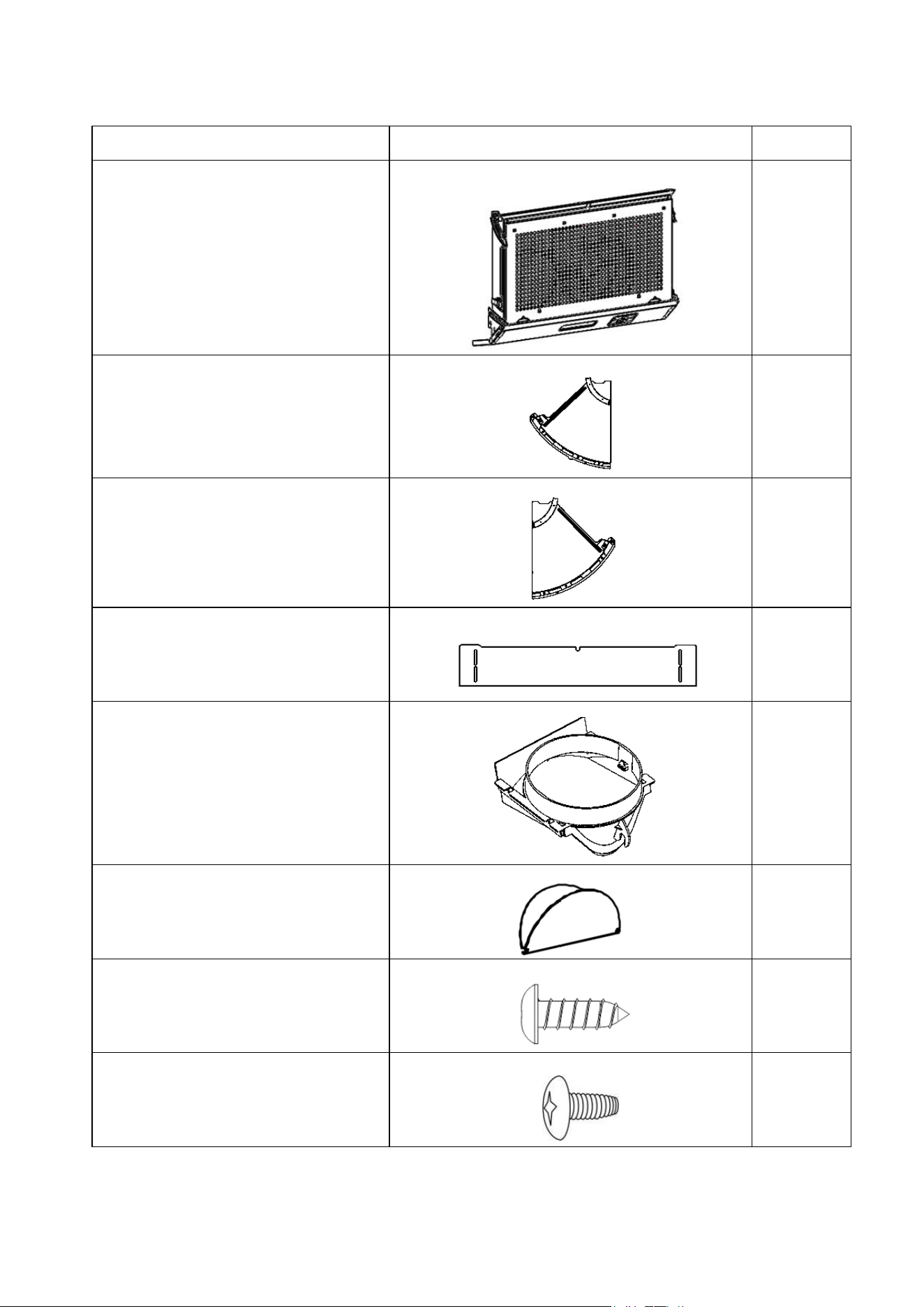
PRODUCT OVERVIEW - PARTS SUPPLIED
Description
Illustration
Qty.
Cooker hood
1
Left fan shaped frame
1
Right fan shaped frame
1
Adjusting plate
1
Outlet
1
Air Flaps (120MM)
1 pair
Flat self-tapping screw
ST4*14mm
16
Flat self-tapping screw
ST4×8mm
4
6
OPTIONS FOR VENTILATION
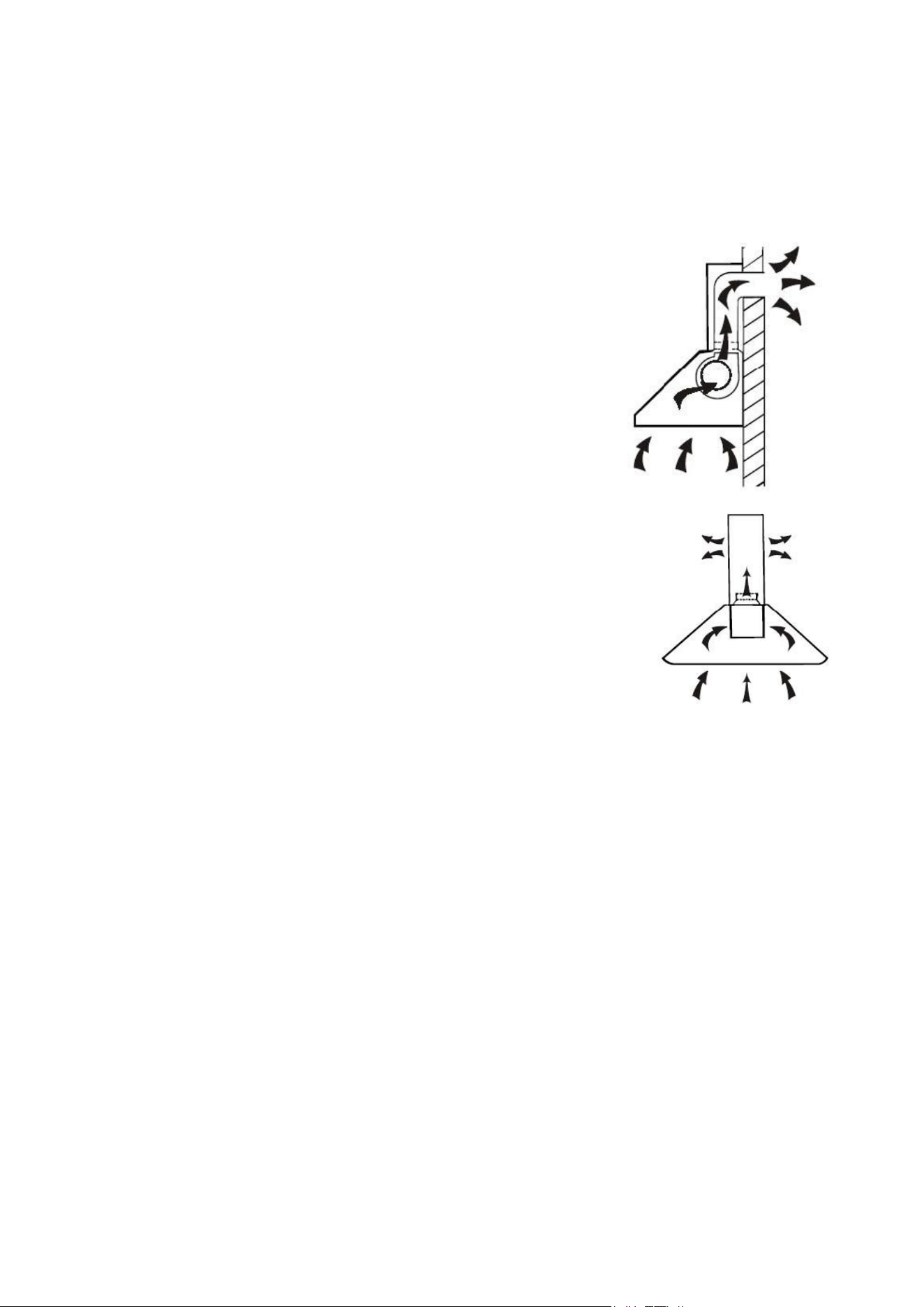
This hood can be set up for either external venting or recirculation of the air. The type of
setup should be decided before commencing installation.
EXTERNAL VENTING
If you have an outlet to the outside, your cooker hood can be
connected as shown in the diagram using the flexible exhaust
pipe (NOT SUPPLIED). Alternatively, any suitable
extraction duct (enamel, aluminium, flexible pipe or non-
flammable material with an interior diameter of 120mm) can
be used.
If this is the chosen installation method consideration to the
route of the vent pipe should be made prior to installation.
RECIRCULATION
This cooker hood also supports the recirculation of air once it
has passed through the filters. The filtered air is then expelled
through the vent holes in the side of the chimney.
When setting the unit up in this configuration, carbon filters should
also be used to remove odours from the air. Details of sourcing
and fitting the filters can be found in the Carbon filter section.
When setting up for recirculation the installation instructions should
be followed, but the vent pipe should not be attached. Please
note that there must be sufficient ventilation to the back of the cabinet allowing the air to re-
enter the room. (at least 150cm
2
)
UNPACKING YOUR APPLIANCE
• Please take great care when unpacking; a sharp blade should not be used to open
the box, as it may go deep enough inside to damage components. Components
damaged or marked by careless unpacking are not covered under the guarantee.
• Carefully unpack the contents and check against the next section (Product overview
– parts supplied)
• Packaging materials should be recycled in accordance with local regulations
7
INSTALLATION
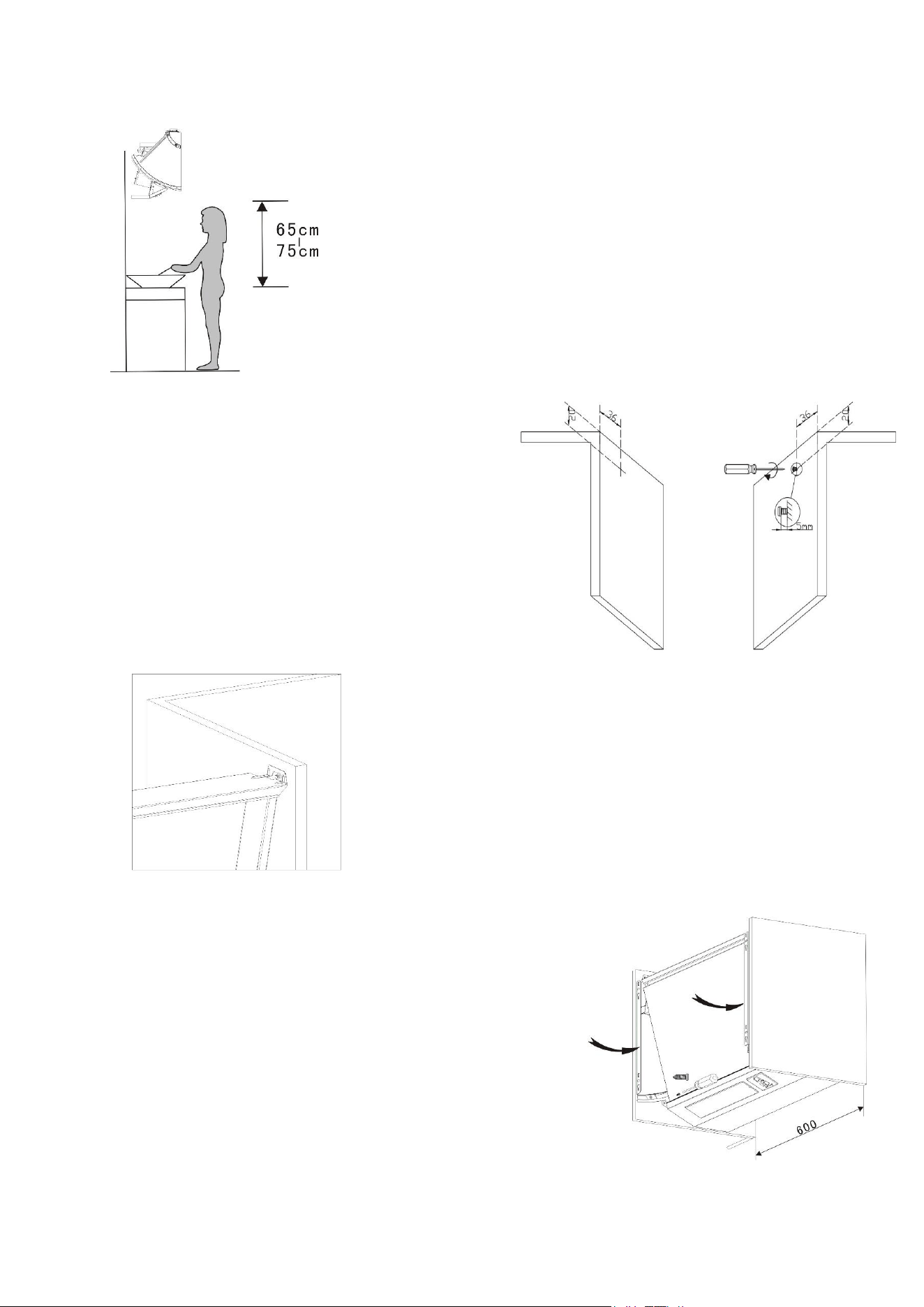
1. The cooker hood should be placed at a height of 65-
75cm above the cooking surface for best efficiency.
2. To install the cooker hood between two
cupboards. Drill a pilot hole (≤ 2mm) and
insert a screw on the side of each
cupboard following the measurements in
the diagram. The screw should protrude
by 5mm, and the distance between the
screw and the cooking surface should be
no less than 1040mm
3. Hang the cooker hood on the screws between the two
cupboards.
4. Push the fan-shaped frames to the end, in order
to make the outer edges of the frames at the
same vertical level as the outer edge of the
cupboards.
5. Mark the positions for the lower screws. Drill the
upper hole and fix the screws. Make sure all
four screws are well fixed.
8
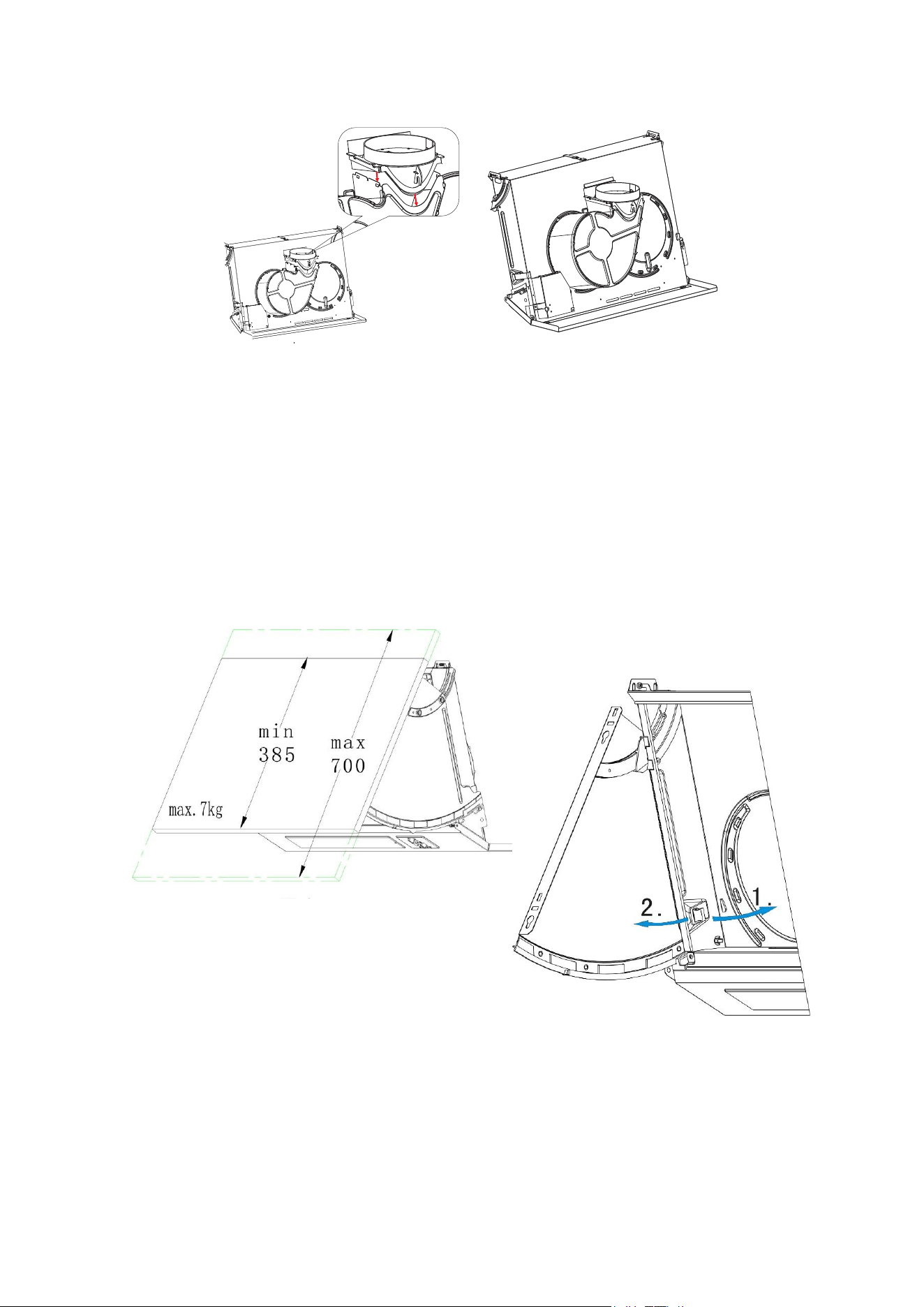
6. Install the air outlet onto the hood by aligning the 3 slide slots of the outlet with the
three edges on the fan housing, and sliding the outlet into position.
7. Connect the air-outlet board and the vent hose and route it appropriately. Rigid kits, if
preferred, can be obtained from either the retailer who supplied the hood, DIY Stores or
Builders Merchants.
, DIY Stores or Builders Merchants.
DOOR INSTALLATION
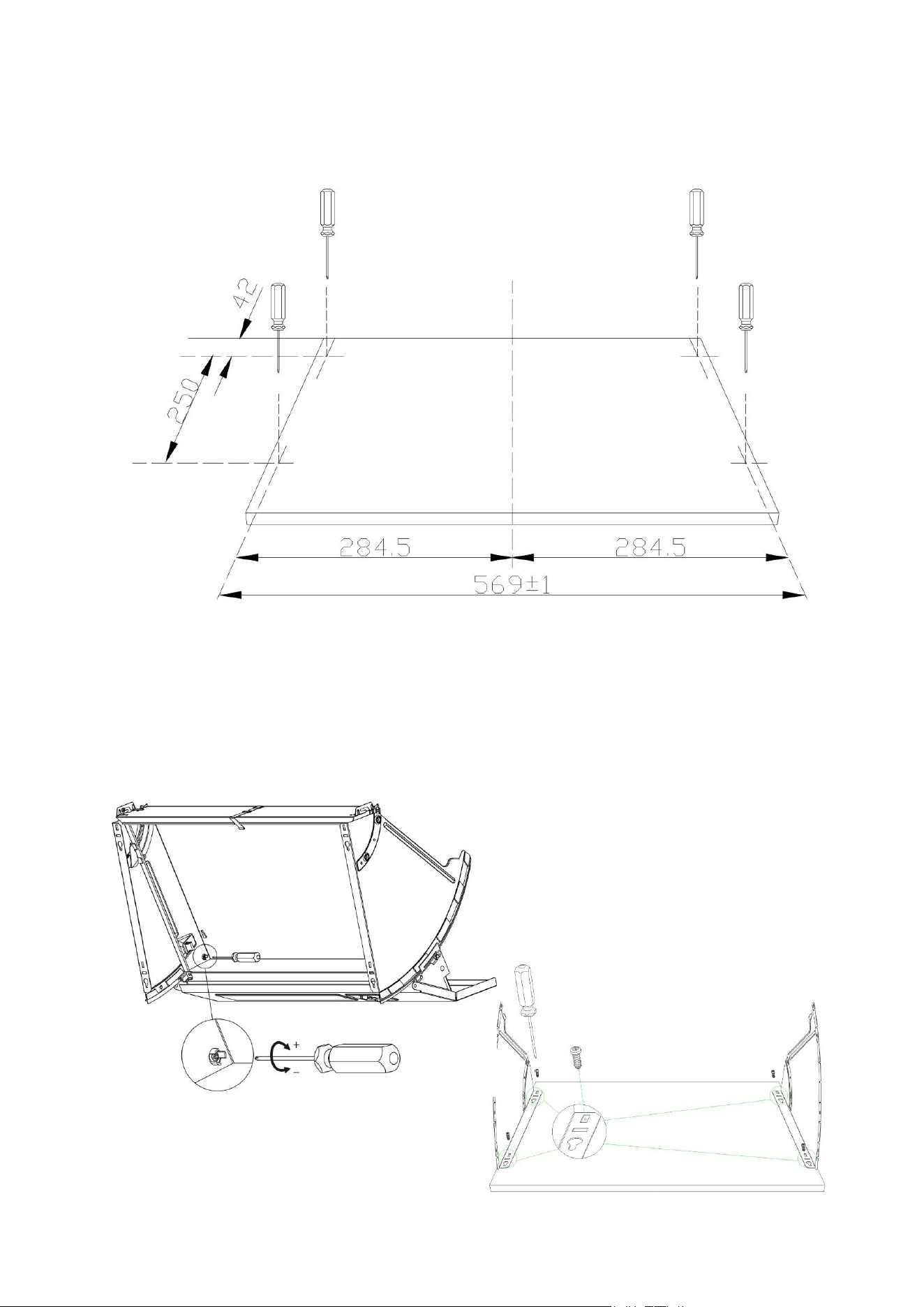
1. The door should be no less than 16mm thick, 385-700mm high, and weigh no more
than 7KG. Pull out the movable fan-shaped frames by the plastic handle, and place
the fan-shaped frames on each side.
9
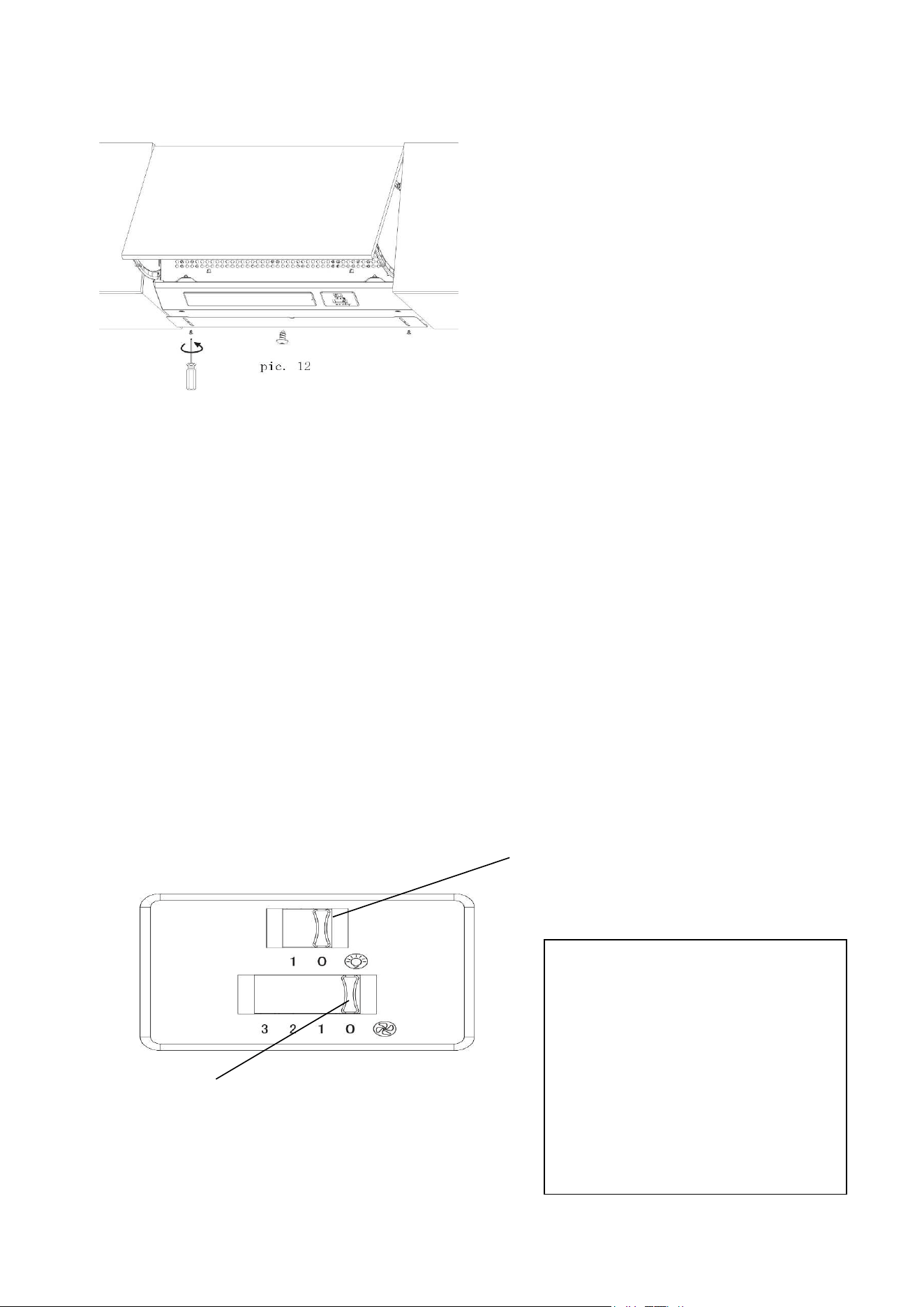
3. Mark the installation position of the door and the size of the fixed screws. If the upper
edge of the door is not as high as the upper edge of the cupboards, please adjust the
position accordingly. Mark the positions of the screws on the door, and make sure the
position is as accurate as possible.
4.
5. Fix the fan-shaped door frames on the door with screws. Make sure the frames are
symmetrical. Install the door into the cooker hood, the two sides of the door can be
pulled to the end and the door can be safely locked. If the door cannot be safely locked,
release the plastic handle.
10. The two screws on both sides of the
cooker hood can adjust the sliding of the
door, according to the weight of the door.
10
11. Install the adjusting plate, in order to cover
the gap between the wall and the bottom of
the cooker hood.
OPERATION
Your electriQ hood has been designed to be very simple to use.
To operate: Pull up the front panel, turn on the cooker hood, and then choose the fan speed
setting.
To turn the unit off, there are two options:
1. Turn off the fan with the slide switch
2. Push down the front panel (with the fan still switched on). This will turn the hood off,
and when the cooker hood is next opened, the fan speed will be the same as the last
time it was operated.
The light is not affected by the position of the front panel, or usage of the fan and can be
operated with the front panel is open or closed.
There are 3 speeds for the motor and on off switch for
the lamp.
Slide the switches for operation.
Light Switch
Fan Speed Switch
MOTOR OPERATION
0- Off
1- Low Power Setting
2- Mid Power Setting
3- High Power Setting
LIGHT OPERATION
0- Off
1- On
11
CLEANING MAINTENANCE
Before cleaning, switch the unit off and disconnect the power.
Use a soft cloth moistened with hand-warm mildly soapy water or household cleaning
detergent. Never use metal pads, chemicals, abrasive material or a stiff brush to clean the
unit.
Note! Do not use a steam-cleaner to clean the hood; electrical components could be
damaged or short-circuit as a result.
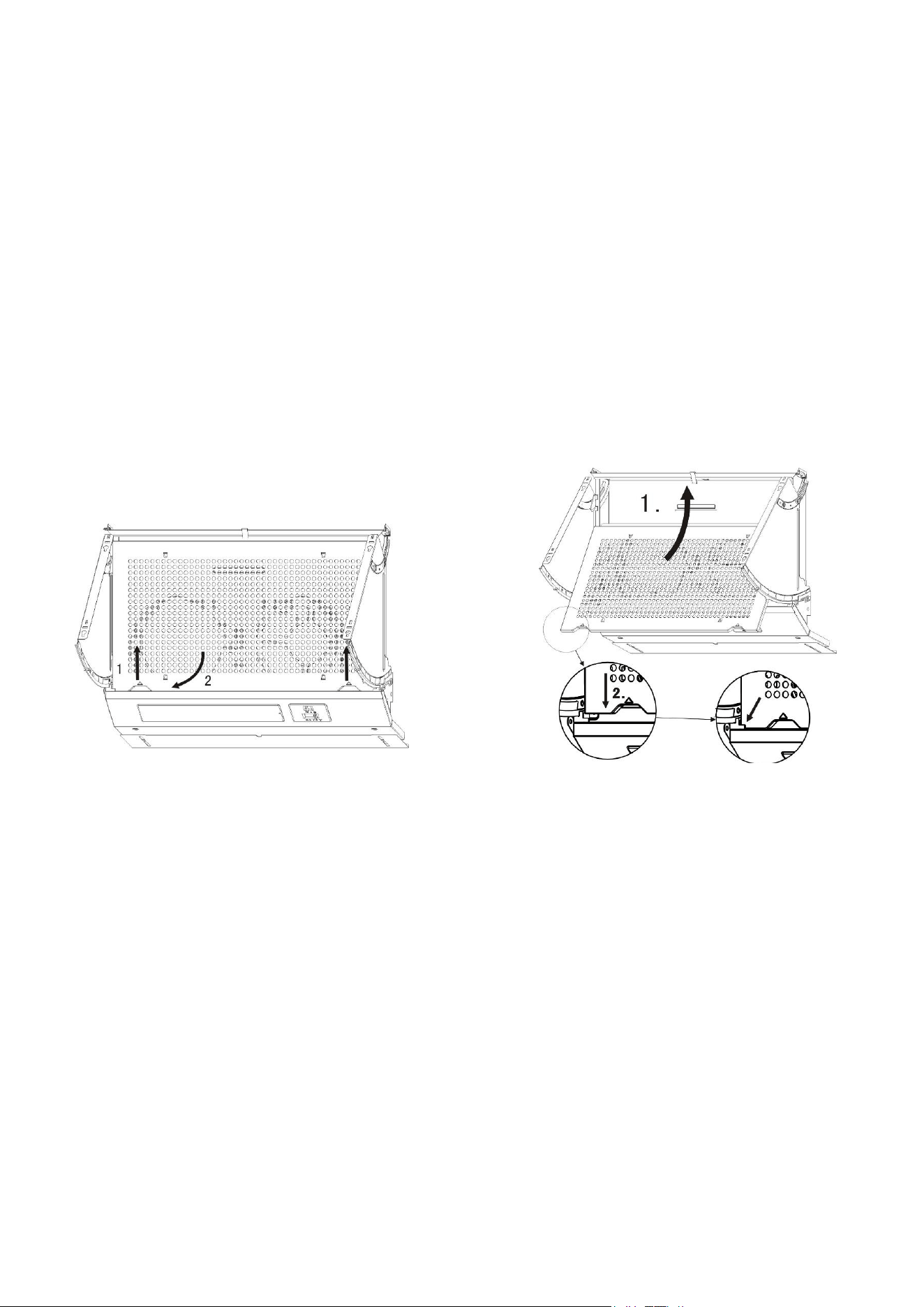
MONTHLY CLEANING FOR METALLIC ANTI-GREASE FILTER
ESSENTIAL NOTE: Clean the filter every month; an excessive build-up of grease can
become a fire hazard. The filter collects grease, smoke and dust, so the filter directly affects
the efficiency of the cooker hood. If it’s not cleaned, the grease residue (potentially
flammable) will saturate on the filter.
Remove the filter as shown in the diagrams below:
Clean it with a soft nylon brush in a mild solution of warm water and a small amount of
washing up liquid. Washing up liquid alone should not be used. After cleaning, allow the
filter to drain and then dry thoroughly.
The grease filter may also be dishwasher cleaned; using a 60°C program, with the filter
upright (short sides upright) in the lower basket. Please be aware some dishwasher
cleaning agents can permanently discolour the filter, though this will not affect its
performance.
Replacement grease filters are of the universal type available from many household and
DIY stores.
12
CARBON FILTER
(OPTIONAL)
Activated carbon filters may be used to further trap odours (optional) and are available from
the same stockist your hood was purchased from:
eIQCF110 (Carbon Filter Pack of 1)
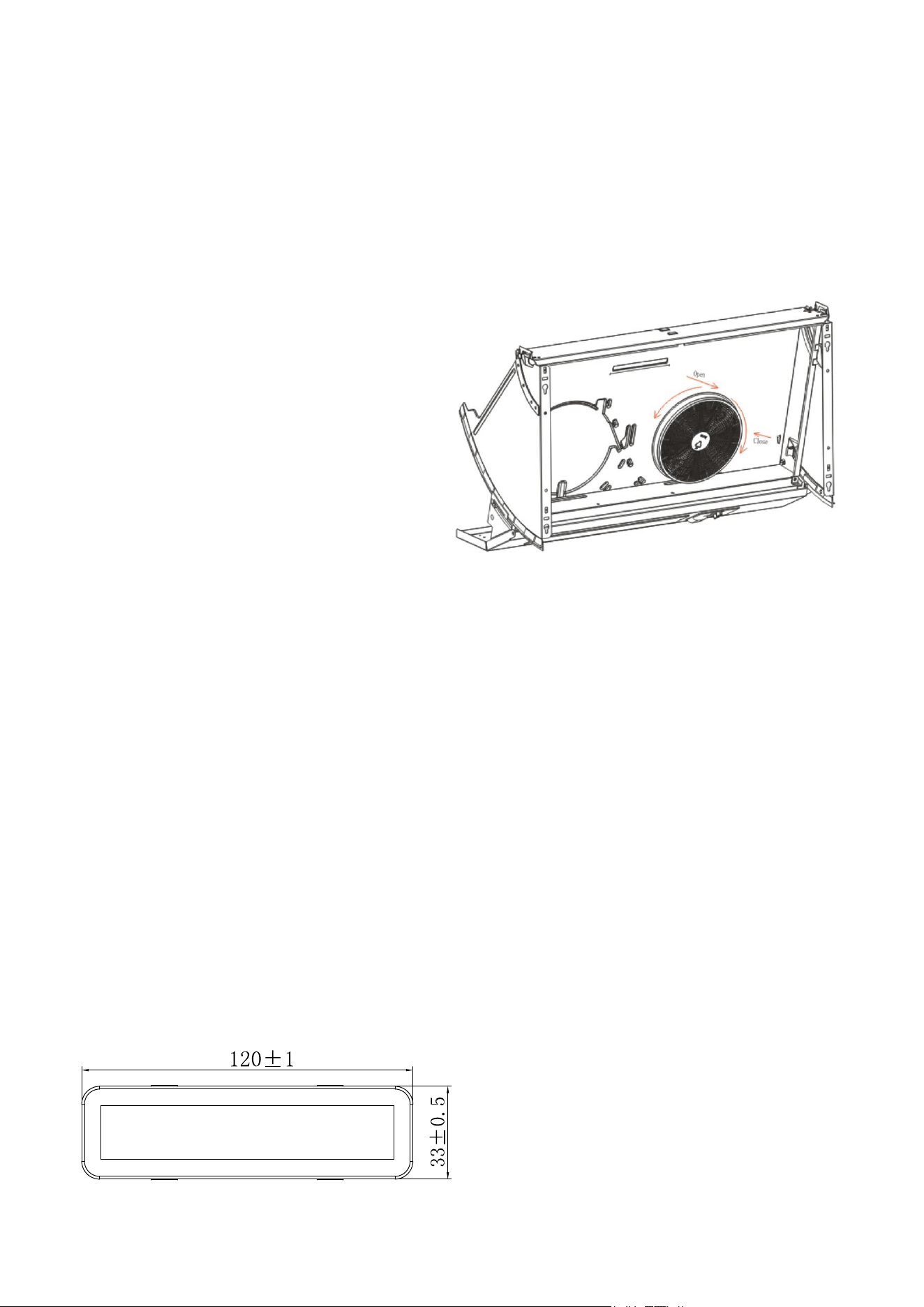
(1) The aluminum filter should be detached first as shown in the maintenance section.
(2) The carbon filters are attached to
each end of the motor housing,
rotating to lock/undo.
• Make sure the filter is securely locked. Otherwise, it could loosen and cause damage
to unit.
• When the activated carbon filters are attached, the suction power will be lowered.
• The charcoal filter cannot be washed or recycled. It should be changed at three or
six months according to the amount of use the hood receives.
LIGHT FITTING REPLACEMENT
Important: The light fitting must be replaced by the manufacturer, its service agent or
similarly qualified persons.
Always switch off the electricity supply before carrying out any operations on the appliance.
When handling the light fitting, make sure it has completely cooled down before any direct
contact to hands.
Before changing the fitting, make sure that there is no power to the hood.
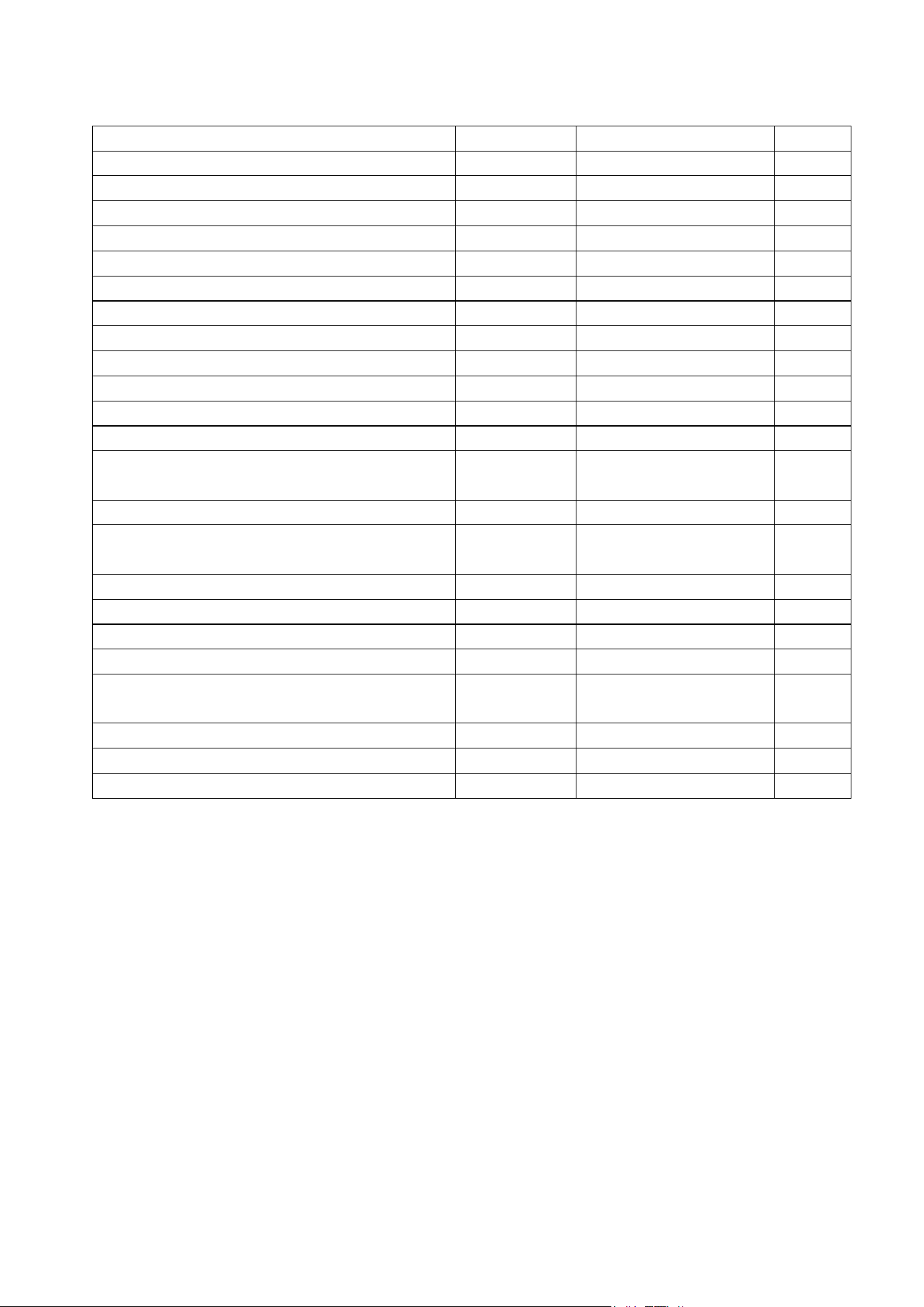
• ILCOS D code for this lamp is: DBS-2/65-H-120/33
– LED modules –rectangle lamp
– Dimensions:
Use a small flat-blade screwdriver to pry up and replace the light fitting.
– Max wattage: 1×2 W
– Voltage range: AC 110-240V
13
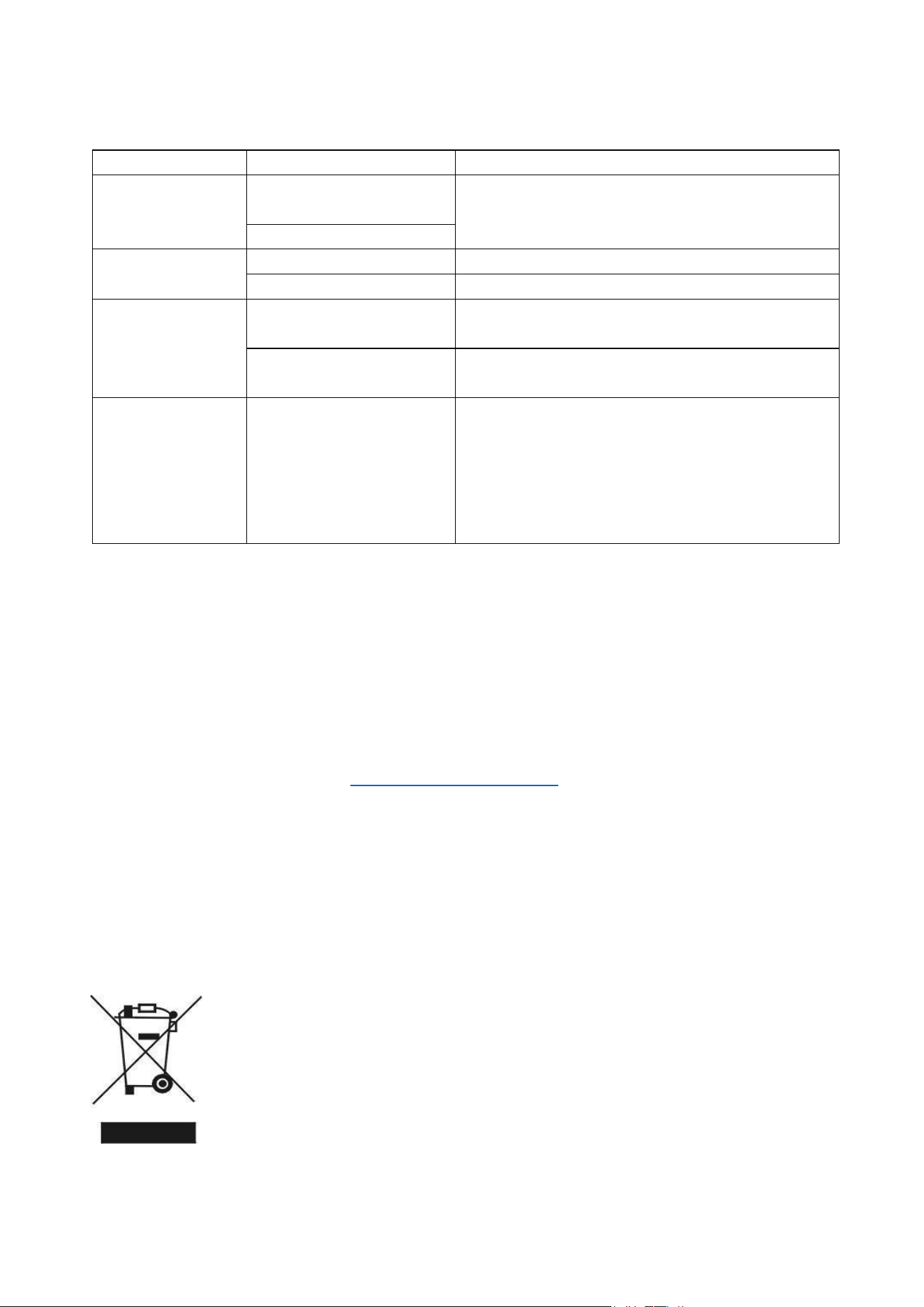
TECHNICAL INFORMATION
Symbol
Value
Unit
Model identification
eIQCHINTGY60
Annual Energy Consumption
AEC
hood
33.3
kWh/a
Time increase factor
f
1.6
Fluid Dynamic Efficiency
FDE
hood
11.9
Fluid Dynamic Efficiency class
Class E
Energy Efficiency Index
EEI
hood
71.8
Energy Efficiency class
Class C
Measured airflow rate at the best efficiency
Q
BEP
128.5
m
3
/h
Measured air pressure at best efficiency point
P
BEP
182
Pa
Maximum airflow
Q
max
221.7
m
3
/h
Air flow at working point (highest setting)
219
m
3
/h
Air flow at working point (lowest setting)
105.3
m
3
/h
Measured electric power input at best
efficiency point
W
BEP
54.6
W
Nominal power of the lighting system
W
L
2.0
W
Average illumination of the lighting system on
the cooking surface
E
middle
60
lux
Lighting efficiency
LE
hood
30
Lux/W
Lighting efficiency class
Class A
Grease Filtering Efficiency
GFE
hood
70.8%
Grease Filtering Efficiency (GFE hood) class
Class D
Measured power consumption on standby
mode
P
S
-
W
Measured power consumption on off mode
P
O
0
W
Sound power level (Highest setting)
L
WA
68
dB
Sound power level (Lowest setting)
L
WA
50
dB
The following shows how to reduce total environmental impact (e.g. energy use) of the
cooking process).
(1) Install the cooker hood in a proper place where there is efficient ventilation.
(2) Clean the cooker hood regularly so as not to block the airway.
(3) Remember to switch off the cooker hood light after cooking.
(4) Remember to switch off the cooker hood after cooking.
14
TROUBLESHOOTING
Fault
Cause
Solution
Light on, but fan
does not work
The fan blade is
jammed.
Switch off the unit. Repair to be carried out
by qualified service personnel only.
The motor is damaged.
Both light and
fan do not work
Light bulb blown
Replace the bulb with correct rating.
Power cord loose
Plug in to the power supply again.
Excessive
Vibration
The fan blade is
damaged.
Switch off the unit. Repair to be carried out
by qualified service personnel only.
The fan motor is not
fixed tightly.
Switch off the unit. Repair to be carried out
by qualified service personnel only.
Suction
performance not
good
1 Grease filters
clogged
2 Distance between
the unit and the
cooking plane too
great.
1 Clean or replace grease filters.
2. Readjust the distance to between 65cm
and 75cm.
INFORMATION FOR DISMANTLING
Do not dismantle the appliance in a way which is not shown in the user manual. The appliance could
not be dismantled by user. At the end of life, the appliance should not be disposed of with household
waste. Check with you Local Authority or retainer for recycling advice.
electriQ UK SUPPORT
www.electriQ.co.uk/support
Call: 0330 390 3061
Office hours: 9AM - 5PM Monday to Friday
www.electriQ.co.uk
Unit J6, Lowfields Business Park
Lowfields Way, Elland
West Yorkshire, HX5 9DA
Recycling facilities are now available for all customers at which you can
deposit your old electrical products. Customers will be able to take any
old electrical equipment to participating sites run by their local councils.
Please remember that this equipment will be further handled during the
recycling process, so please be considerate when depositing your
equipment. Please contact the local council for details of your local
household waste recycling centres.