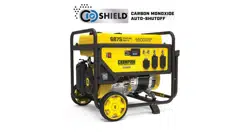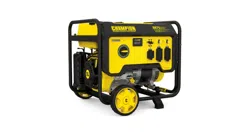
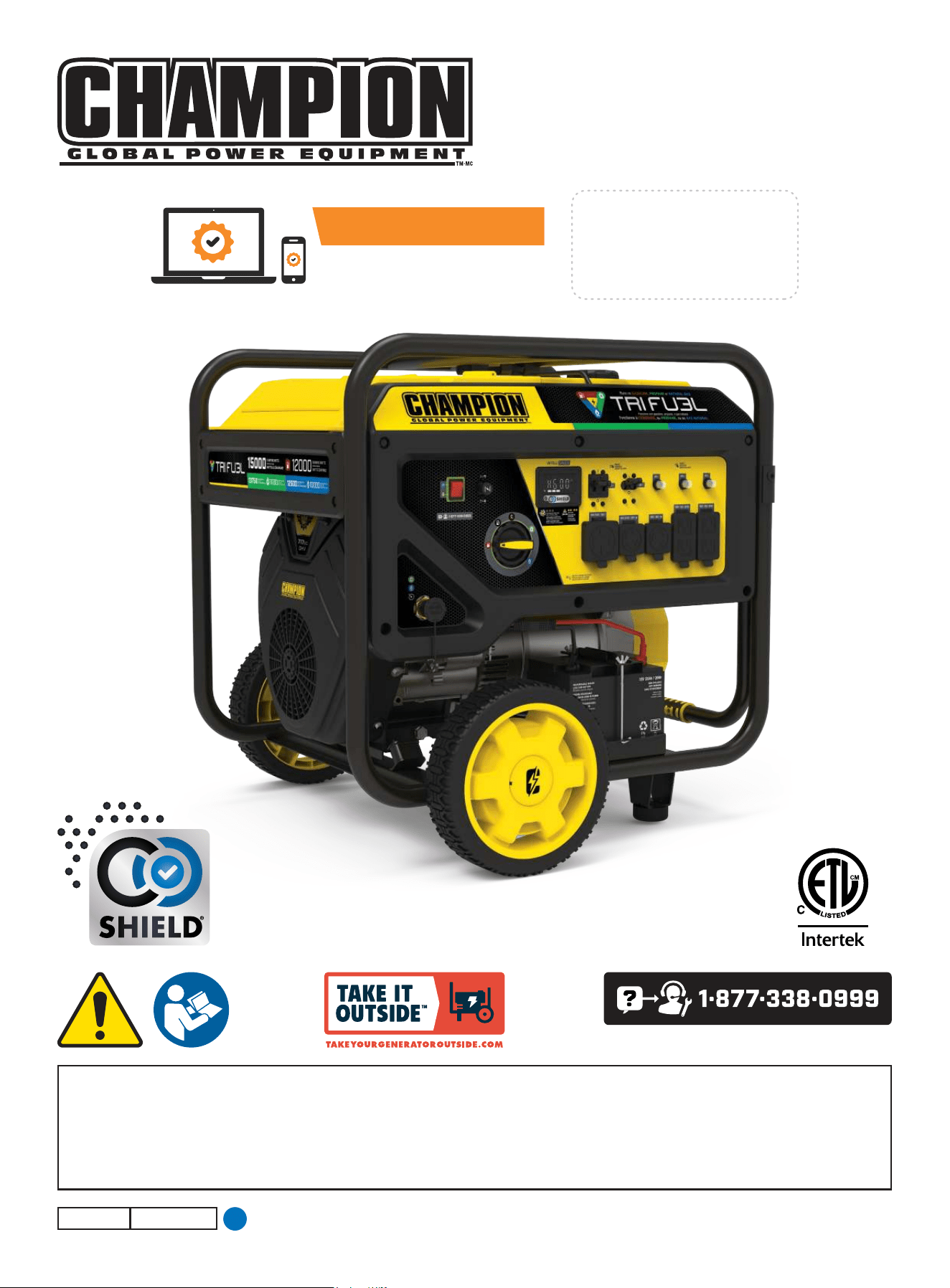
OPERATOR'S MANUAL
MODEL #201161
12,000W TRI-FUEL PORTABLE GENERATOR
Champion Power Equipment, Inc.
or visit championpowerequipment.com
SAVE THESE INSTRUCTIONS. This manual contains important safety precautions which should be read and understood before operating the product. Failure to do
so could result in serious injury. This manual should remain with the product.
Specifications, descriptions and illustrations in this manual are as accurate as known at the time of publication, but are subject to change without notice.
This product meets the requirements of the PGMA (Portable Generator Manufacturers’ Association) standard ANSI/PGMA G300-2018 (Safety and Performance of
Portable Generators).
Covered by one or more of the following U.S. Patent Numbers: #10,862,414, 10,697,379, 11,008,958 and other U.S. and foreign patents pending.
4056-M-OP REV 20250414
EN
ACTIVATE YOUR WARRANTY
by registering your product:
championpowerequipment.com
SERIAL NO.
www.TakeYourGeneratorOutside.com
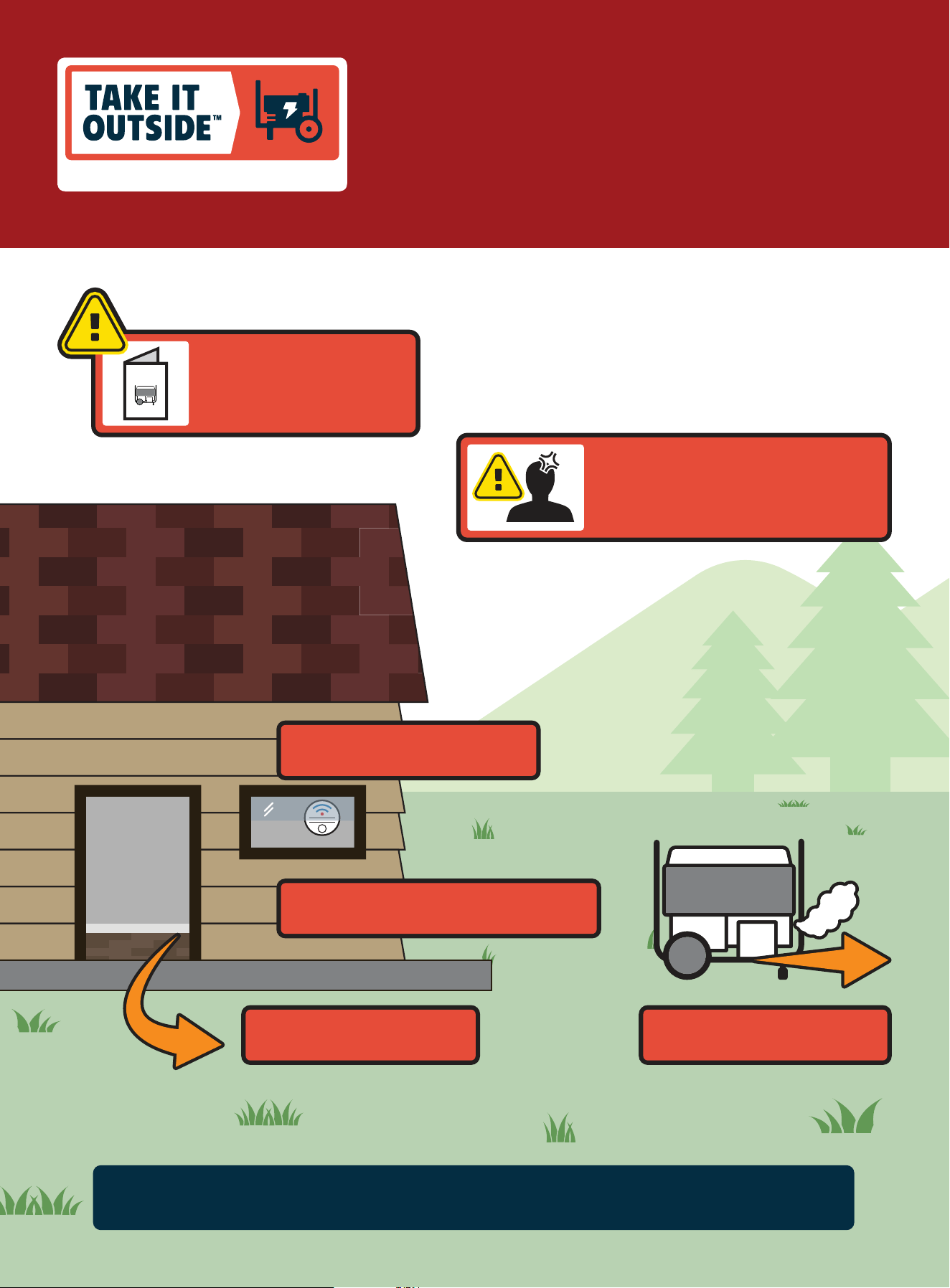
As the only safe way to use a portable generator, taking your generator
outside is absolutely mandatory to keep your family safe from carbon
monoxide. But there’s even more you can do. By educating yourself
about all carbon monoxide risks, you’ll be better prepared to protect
your family from this colorless, oderless threat.
CARBON MONOXIDE SAFETY: THE BIG PICTURE
KNOW THE SYMPTOMS
• Headache
• Nausea
• Shortness of breath
• Dizziness
• Fatigue
STAY ALERT WITH CARBON
MONOXIDE DETECTORS
POINT FUMES AWAY FROM
NEARBY PEOPLE
KEEP IT OUTSIDE AND AWAY FROM
DOORS, WINDOWS, AND GARAGES
ALWAYS READ
THE OPERATOR’S
MANUAL FIRST
MANUAL
IF YOU FEEL SYMPTOMS,
LEAVE RIGHT AWAY
CARBON
MONOXIDE KILLS

201161 - 12,000W TRI-FUEL PORTABLE GENERATOR
TABLE OF CONTENTS
3
TABLE OF CONTENTS
Introduction
................................................... 4
Safety Definitions
..........................................4
Important Safety Instructions
.......................5
Fuel Safety ........................................................ 7
Safety and Dataplate Labels ...................................... 9
Safety Symbols ................................................... 10
Operation Symbols ............................................... 11
Quick Start Label Symbols....................................... 12
Controls and Features ................................. 13
Generator ......................................................... 13
Control Panel ..................................................... 14
Fuel Select Dial ................................................... 14
Intelligauge with Power Meter ................................... 15
Industry Canada: CAN ICES-002/NMB-002 .................... 16
Parts Included .................................................... 16
Assembly ..................................................... 17
Install the Wheel Kit .............................................. 17
Connect the Battery .............................................. 17
Add Engine Oil .................................................... 17
Add Fuel: Gasoline ............................................... 19
Add Fuel: Propane (LPG) ......................................... 20
Add Fuel: Natural Gas (NG) ...................................... 21
Grounding ........................................................ 21
Operation .....................................................21
CO Shield
®
- Carbon Monoxide (CO) Detection
and Auto-shutoff System ........................................21
Generator Location ............................................... 23
Surge Protection ................................................. 23
Starting the Engine: Gasoline .................................... 23
Starting the Engine: Propane (LPG) ............................. 24
Starting the Engine: Natural Gas (NG) ........................... 25
Battery ............................................................ 26
Connecting Electrical Loads .....................................27
Do Not Overload Generator ...................................... 27
GFCI ...............................................................27
Stopping the Engine .............................................. 28
Moving the Generator ............................................ 28
Operation at High Altitude
....................................... 29
Maintenance
................................................29
Cleaning the Generator .......................................... 29
Changing Engine Oil and Filter ...................................29
Cleaning and Adjusting the Spark Plugs ........................30
Cleaning the Air Filter ............................................ 30
Cleaning the Spark Arrestor ..................................... 30
Replacing Fuel Filter ............................................. 31
Adjusting the Governor ........................................... 31
Generator Battery ................................................ 31
Maintenance Schedule ........................................... 32
Storage ........................................................32
Short Term Storage (30 days – 1 year).......................... 32
Long Term Storage (over 1 year) ................................33
LPG Storage ......................................................33
NG Storage .......................................................33
Removing from Storage: Gasoline ............................... 33
Removing from Storage: Propane (LPG).........................33
Removing from Storage: Natural Gas (NG) ...................... 33
Specifications .............................................. 34
Generator Specifications ......................................... 34
Engine Specifications ............................................34
Oil Specifications .................................................34
Fuel Specifications ...............................................34
Battery Specifications............................................35
Temperature Specifications ......................................35
Troubleshooting ........................................... 36
FOR PARTS BREAKDOWN
Search by model number at
championpowerequipment.com

201161 - 12,000W TRI-FUEL PORTABLE GENERATOR
INTRODUCTION
4
SAFETY DEFINITIONS
The purpose of safety symbols is to attract your attention to
possible dangers. The safety symbols, and their explanations,
deserve your careful attention and understanding. The safety
warnings do not by themselves eliminate any danger. The
instructions or warnings they give are not substitutes for proper
accident prevention measures.
DANGER
DANGER indicates a hazardous situation which, if not avoided,
will result in death or serious injury.
WARNING
WARNING indicates a hazardous situation which, if not
avoided, could result in death or serious injury.
CAUTION
CAUTION indicates a hazardous situation which, if not avoided,
could result in minor or moderate injury.
NOTICE
NOTICE indicates information considered important, but not
hazard-related (e.g., messages relating to property damage).
INTRODUCTION
Congratulations on your purchase of a Champion Power Equipment
(CPE) product. CPE designs, builds, and supports all of our
products to strict specifications and guidelines. With proper
product knowledge, safe use, and regular maintenance, this
product should bring years of satisfying service.
Every effort has been made to ensure the accuracy and
completeness of the information in this manual at the time of
publication, and we reserve the right to change, alter and/or
improve the product and this document at any time without prior
notice.
CPE highly values how our products are designed, manufactured,
operated, and serviced as well as providing safety to the operator
and those around the generator. Therefore, it is IMPORTANT to
review this product manual and other product materials thoroughly
and be fully aware and knowledgeable of the assembly, operation,
dangers and maintenance of the product before use. Fully
familiarize yourself, and make sure others who plan on operating
the product fully familiarize themselves too, with the proper safety
and operation procedures before each use. Please always exercise
common sense and always err on the side of caution when
operating the product to ensure no accident, property damage,
or injury occurs. We want you to continue to use and be satisfied
with your CPE product for years to come.
When contacting CPE about parts and/or service, you will need to
supply the complete model and serial numbers of your product.
Transcribe the information found on your product’s nameplate
label to the table below
CPE TECHNICAL SUPPORT TEAM
1-877-338-0999
MODEL NUMBER
201161
SERIAL NUMBER
DATE OF PURCHASE
PURCHASE LOCATION
201161 - 12,000W TRI-FUEL PORTABLE GENERATOR
IMPORTANT SAFETY INSTRUCTIONS
5
IMPORTANT SAFETY INSTRUCTIONS
WARNING
Cancer and Reproductive Harm – www.P65Warnings.ca.gov
DANGER
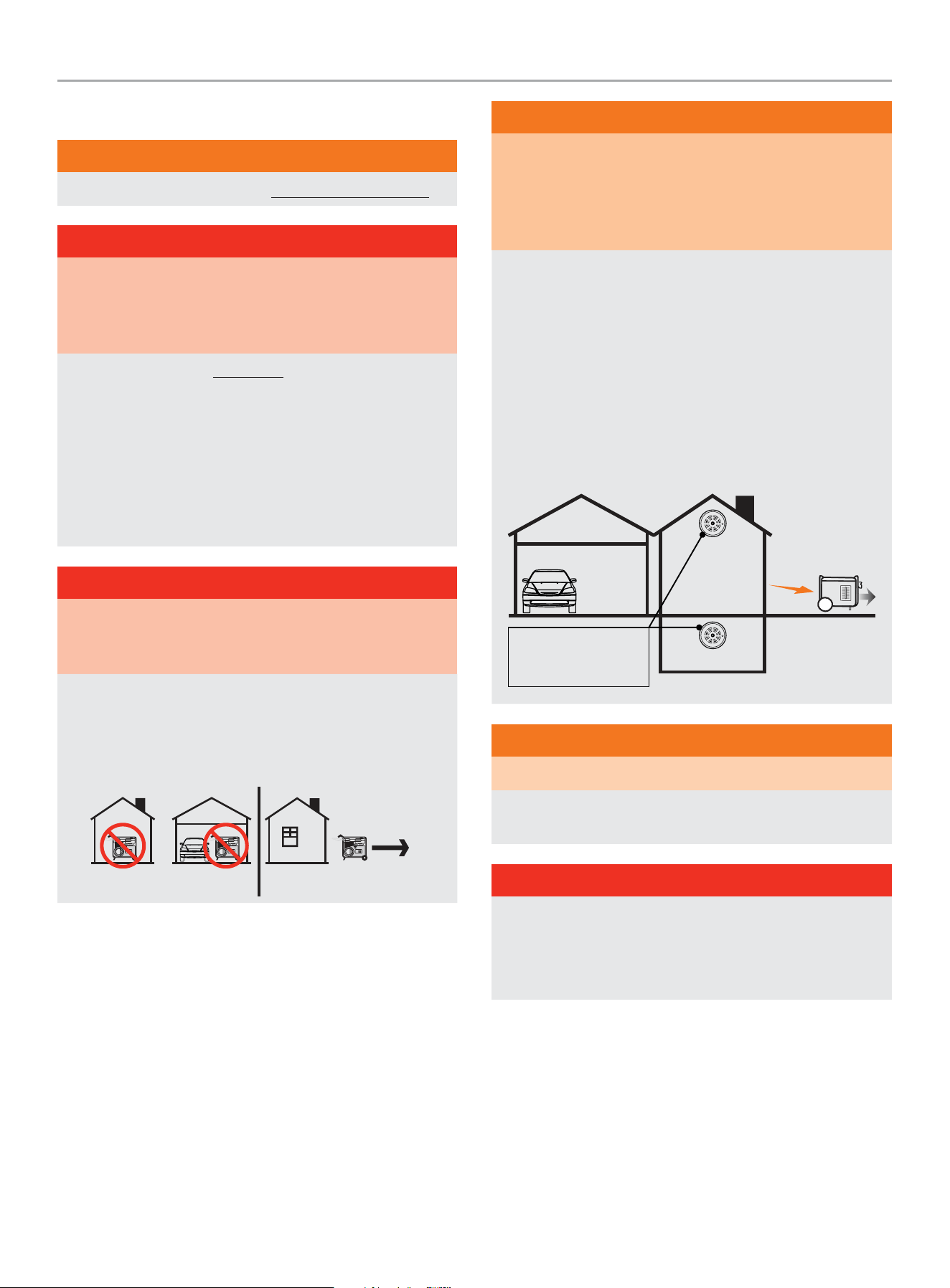
Generator exhaust contains carbon monoxide, a colorless,
odorless, poisonous gas. Breathing carbon monoxide will
cause nausea, dizziness, fainting or death. If you start to feel
dizzy or weak, get to fresh air immediately.
OPERATE GENERATOR OUTDOORS ONLY IN A WELL
VENTILATED AREA AND POINT EXHAUST AWAY.
DO NOT operate the generator inside any building, including
garages, basements, crawlspaces and sheds, enclosure or
compartment, including the generator compartment of a
recreational vehicle.
DO NOT allow exhaust fumes to enter a confined area through
windows, doors, vents or other openings.
DANGER
Using a generator indoors CAN KILL YOU IN MINUTES.
Generator exhaust contains carbon monoxide. This is a poison
you cannot see or smell.
NEVER use inside a home or garage, EVEN IF doors and
windows are open.
ONLY use OUTSIDE and far away from windows, doors,
and vents.
WARNING
Always install a battery-operated Carbon Monoxide (CO)
detector on each level of any building or home dwelling
adjacent to the generator location following the Carbon
Monoxide (CO) detector manufacturer’s installation
instructions.
In many U.S. States and Canadian Provinces, it is required by
law to have a Carbon Monoxide (CO) detector installed on each
level of an occupied building or home dwelling.
The Carbon Monoxide (CO) detector is a device that detects
elevated levels of poisonous Carbon Monoxide (CO) gas and
will alert the occupants by flashing a visual light indicator and
an audible alarm.
The Carbon Monoxide (CO) detector alarm will not sense
smoke, fire, or any other poisonous gas other than carbon
monoxide.
Carbon Monoxide (CO)
detectors located only
in living spaces.
WARNING
Smoke alarms cannot detect Carbon Monoxide (CO) gas.
To better educate yourself about all carbon monoxide risks, go
to www.takeyourgeneratoroutside.com
DANGER
Tampering with the CO Shield
®
system will result in a
hazardous condition and will void your warranty.
Removing the CO Shield
®
module will not allow the generator
to start.

201161 - 12,000W TRI-FUEL PORTABLE GENERATOR
IMPORTANT SAFETY INSTRUCTIONS
6
DANGER
Operate equipment with guards in place.
Rotating parts can entangle hands, feet, hair, clothing and/or
accessories. Traumatic amputation or severe laceration can
result.
Keep hands and feet away from rotating parts.
Tie up long hair and remove jewelry.
DO NOT wear loose-fitting clothing, dangling drawstrings or
items that could become caught.
DANGER
Generator produces powerful voltage.
DO NOT touch bare wires or receptacles.
DO NOT use electrical cords that are worn, damaged or frayed.
Use only Champion electrical cords for proper application.
DO NOT operate generator in wet weather.
DO NOT allow children or unqualified persons to operate or
service the generator.
Use a ground fault circuit interrupter (GFCI) in damp areas and
areas containing conductive material such as metal decking.
Connection to your home’s electrical system requires a
listed 30A transfer switch installed by a licensed electrician
and approved by the local authority having jurisdiction. The
connection must isolate the generator from the utility power
and must comply with all applicable laws and electrical codes.
WARNING
Do not use generator for medical life support uses.
In case of emergency, call 911 immediately.
NEVER use this product to power life support devices or life
support appliances.
Inform your electricity provider immediately if you or anyone in
your household depends on electrical equipment to live.
Inform your electrical provider immediately if a loss of power
would cause you or anyone in your household to experience a
medical emergency.
WARNING
Spark from removed spark plug wire can result in fire or
electrical shock.
When servicing the generator:
Disconnect the spark plug wire and place it where it cannot
contact the plug or any other metal object.
DO NOT check for spark with the plug removed.
Use only approved spark plug testers.
WARNING
Running engines produce heat. Severe burns can occur on
contact. Combustible material can catch fire on contact.
DO NOT touch hot surfaces.
Avoid contact with hot exhaust gases.
Allow equipment to cool before touching.
Maintain at least 3 ft. (91.4 cm) of clearance on all sides to
ensure adequate cooling.
Maintain at least 5 ft. (1.5 m) of clearance from combustible
materials.
WARNING
Rapid retraction of the recoil cord will pull hand and arm
towards the engine faster than you can let go. Broken bones,
fractures, bruises or sprains could result. Unintentional
startup can result in entanglement, traumatic amputation or
laceration.
When starting engine, pull the recoil cord slowly until
resistance is felt and then pull rapidly to avoid kickback.
DO NOT start or stop the engine with electrical devices
plugged in and turned on.
WARNING
Although the generator contains a spark arrester, maintain
a minimum distance of 5 ft. (1.5 m) from dry vegetation to
prevent fires.
CAUTION
Exceeding the generator’s running capacity can damage the
generator and/or electrical devices connected to it.
DO NOT overload the generator.
DO NOT tamper with the governed speed.
DO NOT modify the generator in any way.

201161 - 12,000W TRI-FUEL PORTABLE GENERATOR
IMPORTANT SAFETY INSTRUCTIONS
7
CAUTION
Start the generator and allow the engine to stabilize before
connecting electrical loads.
Connect electrical equipment in the off position, and then turn
them on for operation.
Turn electrical equipment off and disconnect before stopping
the generator.
CAUTION
Improper treatment or use of the generator can damage it,
shorten its life or void the warranty.
Use the generator only for intended uses.
Operate only on level surfaces.
DO NOT expose generator to excessive moisture, dust,
or dirt.
DO NOT allow any material to block the cooling slots.
If connected devices overheat, turn them off and disconnect
them from the generator.
DO NOT use the generator if:
– Electrical output is lost
– Equipment sparks, smokes or emits flames
– Equipment vibrates excessively
Fuel Safety
DANGER
GASOLINE, GASOLINE VAPORS, PROPANE AND NATURAL
GAS ARE HIGHLY FLAMMABLE AND EXPLOSIVE
Fire or explosion can cause severe burns or death.
Gasoline and gasoline vapors:
– Gasoline vapors are highly flammable and explosive.
– Gasoline vapors can cause a fire or explosion if ignited.
– Gasoline is a liquid fuel and the resulting gasoline vapors can
ignite and cause a fire or explosion.
– Gasoline is a skin irritant and needs to be cleaned up
immediately if spilled on skin or clothes.
– Gasoline has a distinctive odor, this will help detect potential
leaks quickly.
– In any petroleum gas fire, flames should not be extinguished
unless by doing so the fuel supply valve can be turned OFF.
This is because if a fire is extinguished and a supply of fuel is
not turned OFF, then an explosion hazard could be created.
– Gasoline vapors expand and contract with ambient
temperatures. Never fill the gasoline tank past the red FULL
indicator on the fuel filter, as gasoline vapors needs room to
expand if temperatures rise.
DANGER
Propane/LPG (liquified petroleum gas) and LPG Vapors:
– LPG is a hydrocarbon gas that exists in a liquified form and
it’s vapors are highly flammable and explosive.
– LPG and it’s vapors are under pressure and can cause a
fire or explosion if ignited.
– LPG vapors are heavier than air and will settle in low
places while dissipating.
– LPG itself is odorless and tasteless. For safety, a chemical
is added to give it an odor to help detect leaks quickly.
– If a leak is detected, IMMEDIATELY turn OFF the gas
supply.
– In the event of an LPG fire and only when safe to do so,
first close the regulator valve OFF and then use a dry
powder extinguisher to put out the fire. This is because if
a fire is extinguished before the regulator valve is closed
OFF, then an explosion hazard condition could be created.
– Always keep the LPG cylinder in an upright position.
– LPG is a skin irritant and can cause severe cold burns
similar to frostbite.
– Always wear proper protective gloves when connecting to
and disconnecting from a propane bottle.
– Always keep LPG away from sparks, open flames, pilot
lights, heat and other sources of ignition.
DANGER
NG (natural gas) and NG Vapors:
– NG vapors are highly flammable and explosive.
– NG vapors can cause a fire or explosion if ignited.
– NG itself is odorless and tasteless. For safety, a chemical
is added to give it an odor to help detect leaks quickly.
– NG is lighter than air and will collect in higher areas.
– If a leak is detected, IMMEDIATELY turn OFF the gas
supply.

201161 - 12,000W TRI-FUEL PORTABLE GENERATOR
IMPORTANT SAFETY INSTRUCTIONS
8
WARNING
When adding or removing gasoline:
DO NOT light or smoke cigarettes.
Always stop the engine and allow to cool for a minimum of two
minutes before refueling.
Always loosen gasoline cap slowly to release vapor pressure
and to keep fuel from escaping around the gasoline cap.
Always replace and tighten the gasoline cap securely after
fueling.
Never remove the gasoline cap or add gasoline while the
engine is running or when the engine is hot.
Only fill or drain gasoline outdoors in a well-ventilated area.
DO NOT pump gasoline directly into the generator at the gas
station.
Always store gasoline in an EPA/CARB compliant container or
to transfer the gasoline to the generator.
DO NOT overfill the gasoline tank.
Always keep gasoline, propane and natural gas vapors away
from sparks, open flames, pilot lights, heat and other sources
of ignition.
WARNING
When starting the generator:
DO NOT attempt to start a damaged generator.
Always check that the gasoline cap, air filter, spark plug, fuel
lines and exhaust system are properly in place.
Always allow spilled gasoline to evaporate fully before
attempting to start the engine.
Always check the connections of the supply hose for leaks
before using LPG or NG fuel.
Always be certain that the generator is resting firmly on level
ground.
WARNING
When operating the generator:
DO NOT move or tip the generator during operation.
WARNING
When transporting or servicing the generator:
Always check that the fuel valve is in the OFF position and the
gasoline tank is empty.
Always check that the LPG or NG supply hose is disconnected
and stored securely away from the generator after use.
Disconnect the spark plug wire.
WARNING
When storing the generator:
Always store away from sparks, open flames, pilot lights, heat
and other sources of ignition.
Never store generator, gasoline or LPG cylinders near
furnaces, water heaters, or any other appliances that produce
heat or have automatic ignitions.
DANGER
NEVER place a gasoline container, gasoline tank, LPG cylinder
or any combustible material in the path of the exhaust stream
during operation of the engine.
WARNING
Never use a gasoline container, gasoline tank, LPG connector
hose, LPG cylinder or any other fuel item that is broken, cut,
torn or damaged.
201161 - 12,000W TRI-FUEL PORTABLE GENERATOR
IMPORTANT SAFETY INSTRUCTIONS
9
Safety and Dataplate Labels
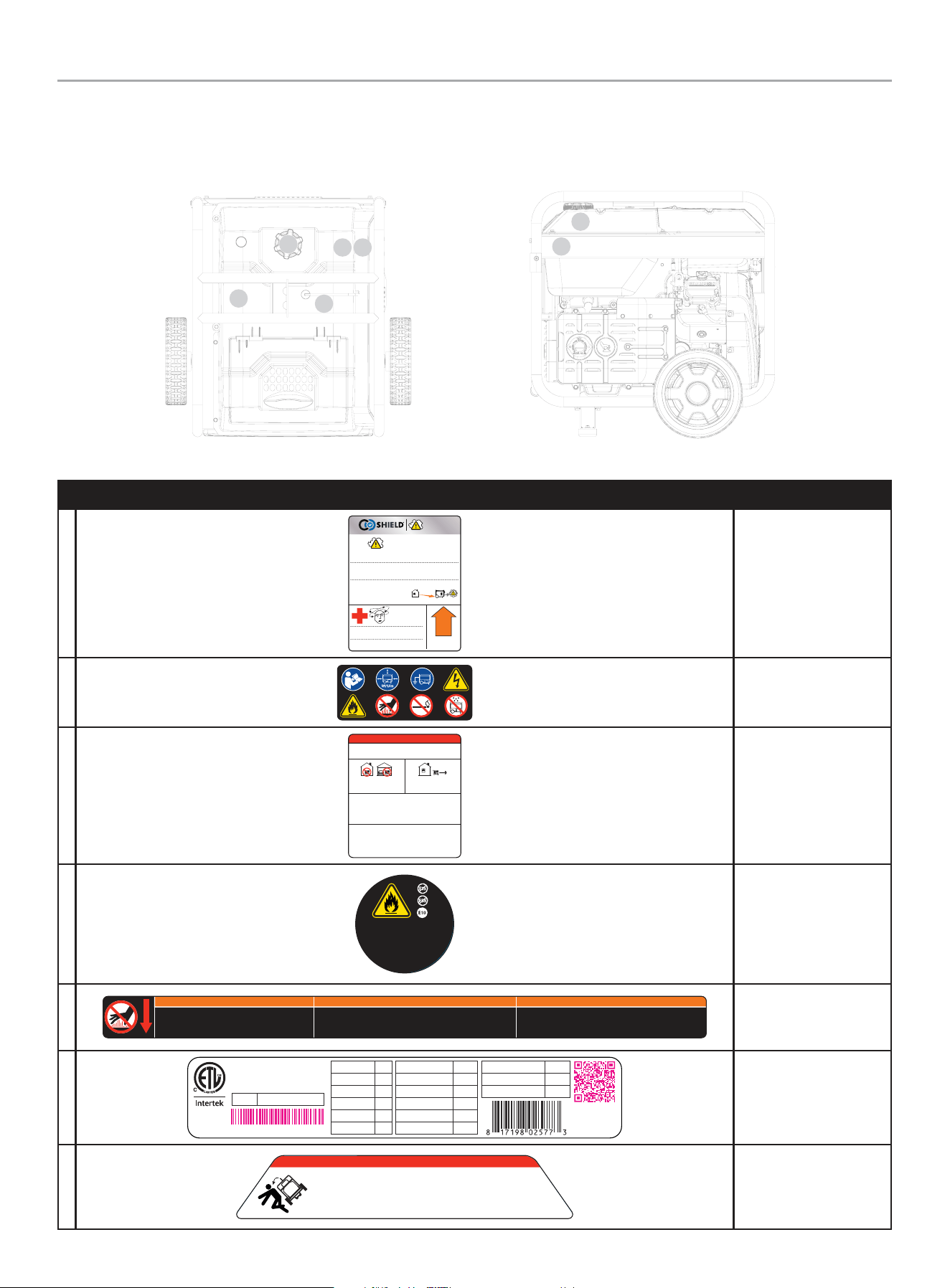
These labels warn you of potential hazards that can cause serious injury. Read them carefully.
If a label comes off or becomes hard to read, contact Technical Support Team for possible replacement.
LABEL DESCRIPTION
A
3783-L-SF
Move generator to an open, outdoor area. Point exhaust away.
Don’t run generators in enclosed areas (e.g. not in house or garage).
Mover el generador a un área abierta a la intemperie. Apunte el
escape alejado. No corra los generadores en áreas cerradas (ej. no
en una casa o garaje).
Déplacer le générateur vers un espace extérieur en plein air. Garder
l’échappement loin. Ne pas faire
fonctionner les générateurs dans un
espace clos (ex., pas dans une maison
ou un garage).
EXHAUST
EL ESCAPE
L’ECHAPPEMENT
POINT AWAY
DIRIJA ALEJADO
DIRIGER LOIN
AUTOMATIC SHUTOFF – YOU MUST:
APAGADO AUTOMÁTICO– USTED DEBE:
ARRÊT AUTOM ATIQUE– VOUS DEVEZ :
Move to fresh air and
get medical help if
sick, dizzy or weak.
Mueva al aire fresco y obtenga asistencia
medica si está enfermo, mareado, o débil.
Aller à l'air frais et obtenir de l'aide médicale
si malade, étourdi ou faible.
ACTION LABEL
ETIQUE TA DE ACCIÓ N
ÉTIQUETTE D'ACTION
CO Shield
®
Action –
automatic shutoff
*See CO Shield
®
section
B
4990-L-SF-A
Safety Symbols
C
3784-L-SF-B
DANGER DANGER PELIGRO
Using a generator indoors CAN KILL YOU IN MINUTES. Generator
exhaust contains carbon monoxide. This is a poison you cannot see
or smell.
ONLY use OUTSIDE and far
away from windows, doors,
and vents.
NEVER use inside a home or
garage, EVEN IF doors and
windows are open.
El uso de un generador en interiores PUEDE MATARLO EN
MINUTOS. El escape del generador contiene monóxido de carbono.
Éste es un veneno que no se puede ver ni oler.
NUNCA lo use dentro
del hogar ni el garaje, INCLUSO SI las puertas y ventanas están
abiertas. Úselo SÓLO a la INTEMPERIE lejos de ventanas, puertas,
y orificios de ventilación.
Utiliser une génératrice à l’intérieur PEUT VOUS TUER EN QUELQUES
MINUTES. L’échappement de la génératrice contient du monoxyde
de carbone. Il s’agit d’un poison que vous ne pouvez ni voir ni sentir.
Ne l’utilisez JAMAIS dans la maison ou le garage MÊME SI les portes
et les fenêtres sont ouvertes. Utilisez le UNIQUEMENT À L’EXTÉRIEUR,
loin des fenêtres, portes et trappes de ventilation.
CO Danger
D
1110-L-OP-B
UNLE ADED FUEL ONLY. Minimum octane
rating of 87. Maximum 10% ethanol.
GASOLINA REGULAR SOLAMENTE. 87 octanos
como mínimo. Máximo de etanol de 10%.
ESSENCE SAN S PLOMB SEU LEMEN T.
Indice d’octane minimal de 87.
Maximum 10 % d'éthanol.
Fuel
E
WARNING
DO NOT TOUCH!
Exhaust gases, muffler
and engine components
are extremely HOT and
cause burns.
Operation of this equipment may create sparks that can star t
fires around dry vegetation. A spark arrestor may be
required. The operator should contact local fire agencies for
laws and regulations relating to fire prevention requirements.
If installed, clean every 100 hours or every season.
ADVERTENCIA
¡NO TOCAR! Los gases de
escape, el silenciador y los
compnonentes del motor están
extremadamente CALIENTES y
causan quemaduras.
La operación de este equipo puede producir chispas que pueden provocar
incendios alrededor de la vegetación seca. Un supresor de chispas puede que
sea necesario. El operador debe comunicarse con las agencias locales de
bomberos para las leyes y reglamentos relativos a los requisitos de prevención
de incendios. Si está instalado, limpie cada 100 horas o cada temporada.
AVERTISSEMENT
NE PAS TOUCHER! Les gaz
d’échappement, le silencieux
et les pièces du moteur sont
extrêmement CHAUDS et
peuvent causer des brûlures.
Cet équipement peut créer des étincelles et provoquer un incendie dans la
végétation sèche. Un pare-étincelles peut être requis. L’utilisateur doit
communiquer avec le service d’incendie local pour connaître les lois et
les règlements en matière de prévention des incendies. Si elle est
installée, nettoyez la génératrice toutes les 100 heures ou chaque saison.
1035-L-SF-C
Hot Surface
F
CHAMPION POWER EQUIPMENT, INC.
6370 S PIONEER WAY, UNIT 101
LAS VEGAS, NV 89113
USA / É.-U. • 1-877-338-0999
WWW.CHAMPIONPOWEREQUIPMENT.COM
MADE IN CHINA / FABRIQUÉ EN CHINE
MODEL
MODÈLE
4049-L-PR-C
Conforms to
CSA C22.2 No. 100
Conforme à
CSA C22.2 N° 100
201161
SERIAL NO.
N° DE SÉRIE
REGISTER TO
ACTIVATE YOUR
WARRANTY
ENREGISTREZ-VOUS POUR
ACTIVEZ VOTRE
GARANTIE
INSULATION CLASS
CLASSE D’ISOLATION
FREQUENCY (Hz)
FRÉQUENCE (Hz)
RPM
TR / MIN
PHASE
PHASE
POWER FACTOR
FACTEUR DE
PUISSANCE
MAX AMBIENT TEMP.
TEMP. AMBIANTE MAX.
GASOLINE VOLTS (AC)
VOLTS (C.A.) D’ESSENCE
GASOLINE WATTS
WATTS À ESSENCE
GASOLINE AMPS (AC)
AMPÈRES (C.A.) À ESSENCE
H
60
3600
1
1.0
104°F
40°C
120/240
12000
100/50
11000
PROPANE WATTS
WATTS AU PROPANE
PROPANE VOLTS (AC)
VOLTS (C.A.) AU PROPANE
120/240
91.7/45.8
PROPANE AMPS (AC)
AMPÈRES (C.A.) AU PROPANE
NATURAL GAS VOLTS (AC)
VOLTS (C.A.) AU GAZ NATUREL
NATURAL GAS WATTS
WATTS AU GAZ NATUREL
NATURAL GAS AMPS (AC)
AMPÈRES (C.A.) AU GAZ NATUREL
120/240
83.3/41.7
10000
4010077
XXXXXXXXXXXX
Dataplate
G
3678 -L-SF-A
DANGER PELIGRO DANGER
Never position yourself underneath the generator when lifting or moving. Failure to do so could result in serious
injury or death. Always keep bystanders, children and pets at least 25 f t. (7.6 m) away when lifting the generator.
Nunca se coloque debajo del generador al levantar o mover. De lo contrario, podría resultar en lesiones graves o la
muerte. Siempre mantenga a los transeúntes, niños y mascotas al menos a 25 ft. (7.6 m) de distancia cuando
levante el generador.
Ne vous placez jamais sous la génératrice lorsque vous le soulevez ou le déplacez. Le non-respect de cette
consigne peut entraîner des blessures graves ou la mort. Tenez toujours les spectateurs, les enfants et les
animaux domestiques à au moins 7,6 m (25 pi) lorsque vous soulevez la génératrice.
Lifting
Top
Back
E
F
A
C B
G
D
201161 - 12,000W TRI-FUEL PORTABLE GENERATOR
IMPORTANT SAFETY INSTRUCTIONS
10
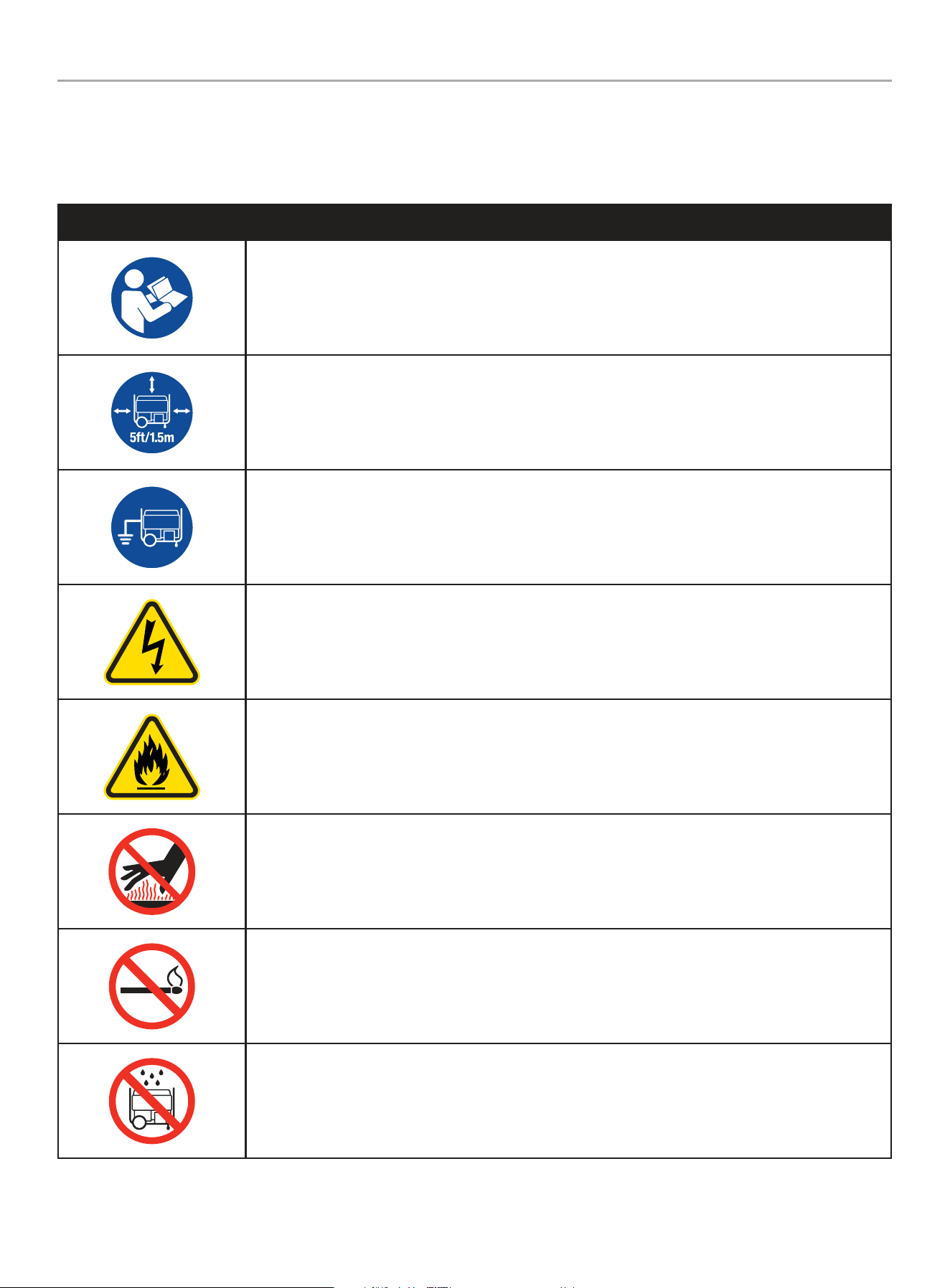
Safety Symbols
Some of the following symbols may be used on this product. Please study them and learn their meaning. Proper interpretation of these
symbols will allow you to more safely operate the product.
SYMBOL MEANING
Read Operator’s Manual. To reduce the risk of injury, user must read and understand operator’s manual
before using this product.
Clearance. Keep all objects at least 5 feet (1.5m) from generator. Heat from the muffler and exhaust gas
can ignite combustible objects.
Ground. Consult with local electrician to determine grounding requirements before operation.
Electric Shock. Failure to use in dry conditions and to observe safe practices can result in electric
shock. Improper connections to a building can allow current to backfeed into utility lines, creating an
electrocution hazard. A transfer switch must be used when connecting to a building.
Fire/Explosion. Fuel and its vapors are extremely flammable and explosive. Fire or explosion can cause
severe burns or death. Keep generator at least 5 feet (1.5m) from all objects to prevent combustion.
Hot Surface. To reduce the risk of injury or damage, avoid contact with any hot surface.
Open Flame Alert. Fuel and its vapors are extremely flammable and explosive. Keep fuel away from
smoking, open flames, sparks, pilot lights, heat, and other ignition sources.
Wet Conditions Alert. Do not expose to rain or use in damp locations.
201161 - 12,000W TRI-FUEL PORTABLE GENERATOR
IMPORTANT SAFETY INSTRUCTIONS
11
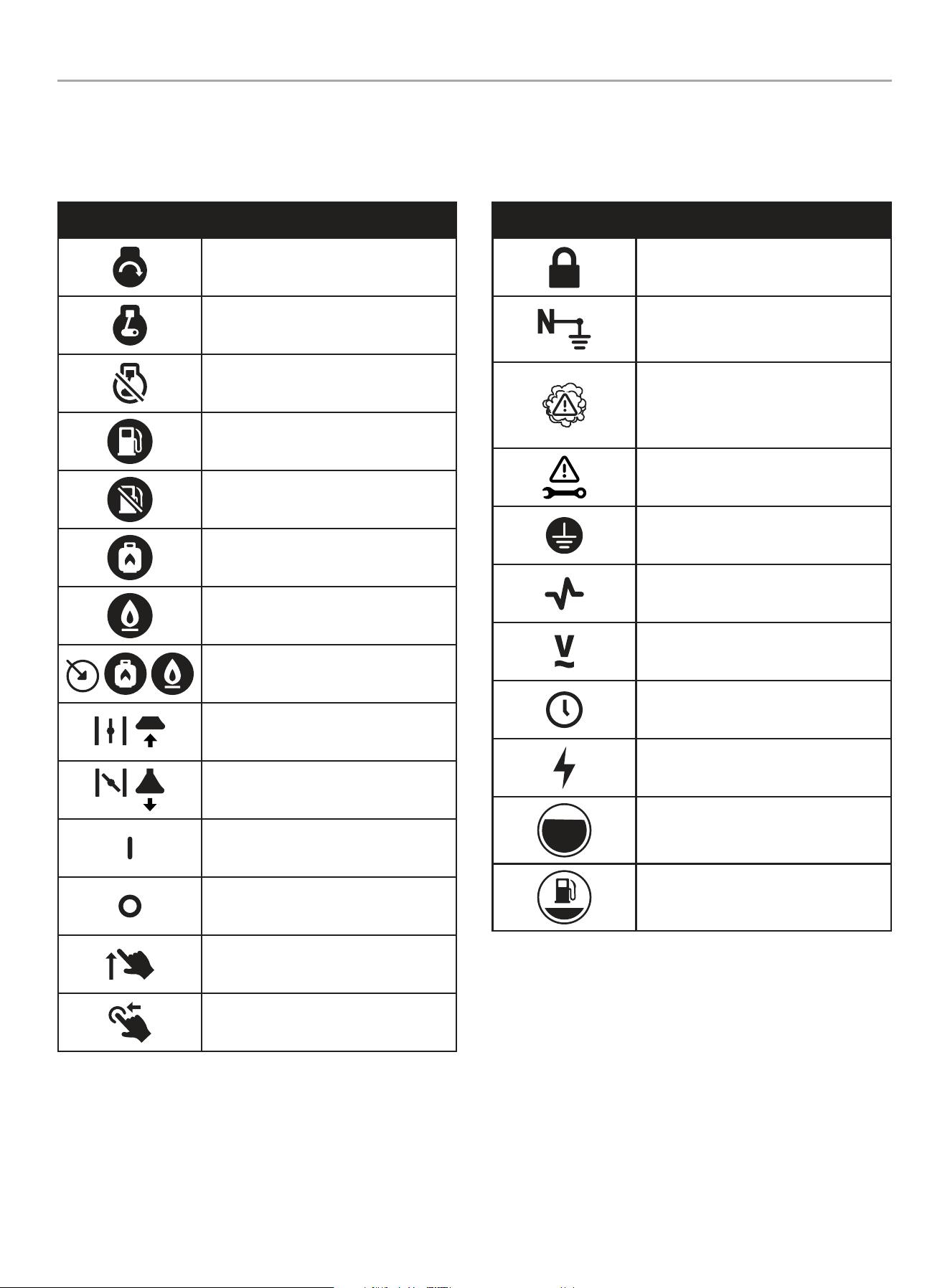
Operation Symbols
Some of the following symbols may be used on this product. Please study them and learn their meaning. Proper interpretation of these
symbols will allow you to more safely operate the product.
SYMBOL MEANING
Start
On
Off
Gasoline On
Gasoline Off
Propane On
Natural Gas On
Propane Inlet/Natural Gas Inlet
Run. Push choke knob to “RUN”
position.
Choke. Pull choke knob to “CHOKE”
position.
Circuit Breaker: On
Circuit Breaker: Off
Circuit Breaker Reset: Flip
Circuit Breaker Reset: Push
SYMBOL MEANING
Locking Receptacle
Neutral Bonded to Frame. Neutral
circuit IS electrically connected to the
frame/ground of the generator.
High CO Warning. Move generator to
an open, outdoor area. Move to fresh
air and get medical help if sick, dizzy or
weak.
CO Shield System Fault. Electrical
issue, end of life.
Ground Terminal
Hertz
Volts
Run time
Output Power
Gasoline Tank: Full
Gasoline Tank: Empty
201161 - 12,000W TRI-FUEL PORTABLE GENERATOR
IMPORTANT SAFETY INSTRUCTIONS
12
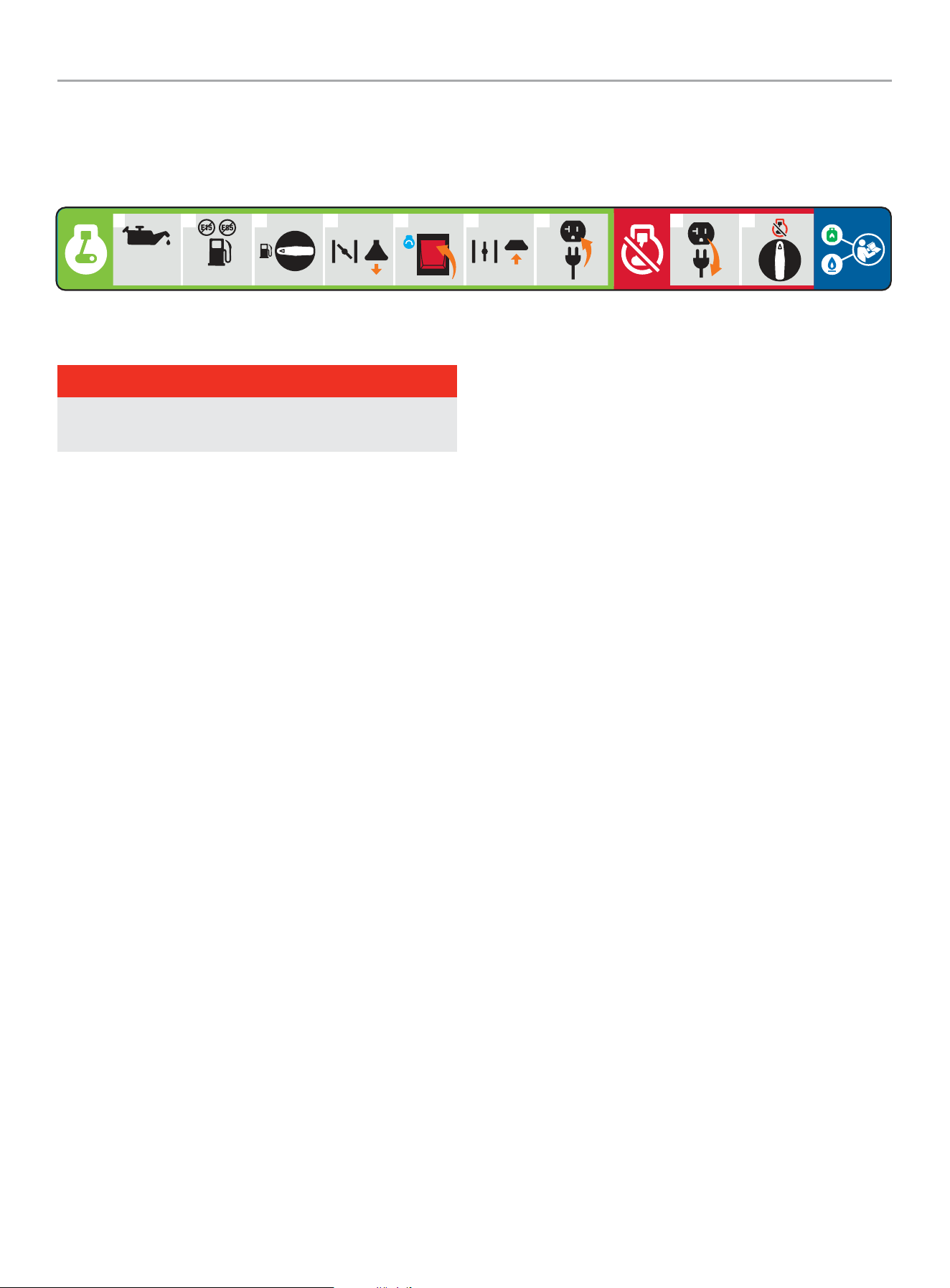
Quick Start Label Symbols
Some of the following symbols may be used on this product. Please study them and learn their meaning. Proper interpretation of these
symbols will allow you to more safely operate the product.
Starting the Engine - Electric Start
DANGER
Move generator outside and far away from windows,
doors and intake ventilation covers.
1. Check oil level.
Recommended oil is 5W-30.
2. Check gasoline level.
When adding gasoline, use a minimum octane rating of 87
and an ethanol content of 10% or less by volume.
3. Turn the fuel select dial to “GASOLINE ON” position.
4. Pull choke knob out to “CHOKE” position.
5. Press ignition switch to the “START” position.
6. Push choke knob in to “RUN” position.
7. Plug in desired device.
Stopping the Engine
1. Turn off and unplug all connected electrical loads.
2. Turn the fuel select dial to the “ENGINE OFF” position.
For adding fuel and starting the engine with LPG see Add Fuel:
Propane (LPG) in Assembly section and Starting the Engine:
Propane (LPG) in the Operation section.
For adding fuel and starting the engine with NG see Add Fuel:
Natural Gas (NG) in Assembly section and Starting the Engine:
Natural Gas (NG) in the Operation section.
21 3 4 5 6 7 1 2
5W-30
4046-L-OP-B
201161 - 12,000W TRI-FUEL PORTABLE GENERATOR
CONTROLS AND FEATURES
13
CONTROLS AND FEATURES
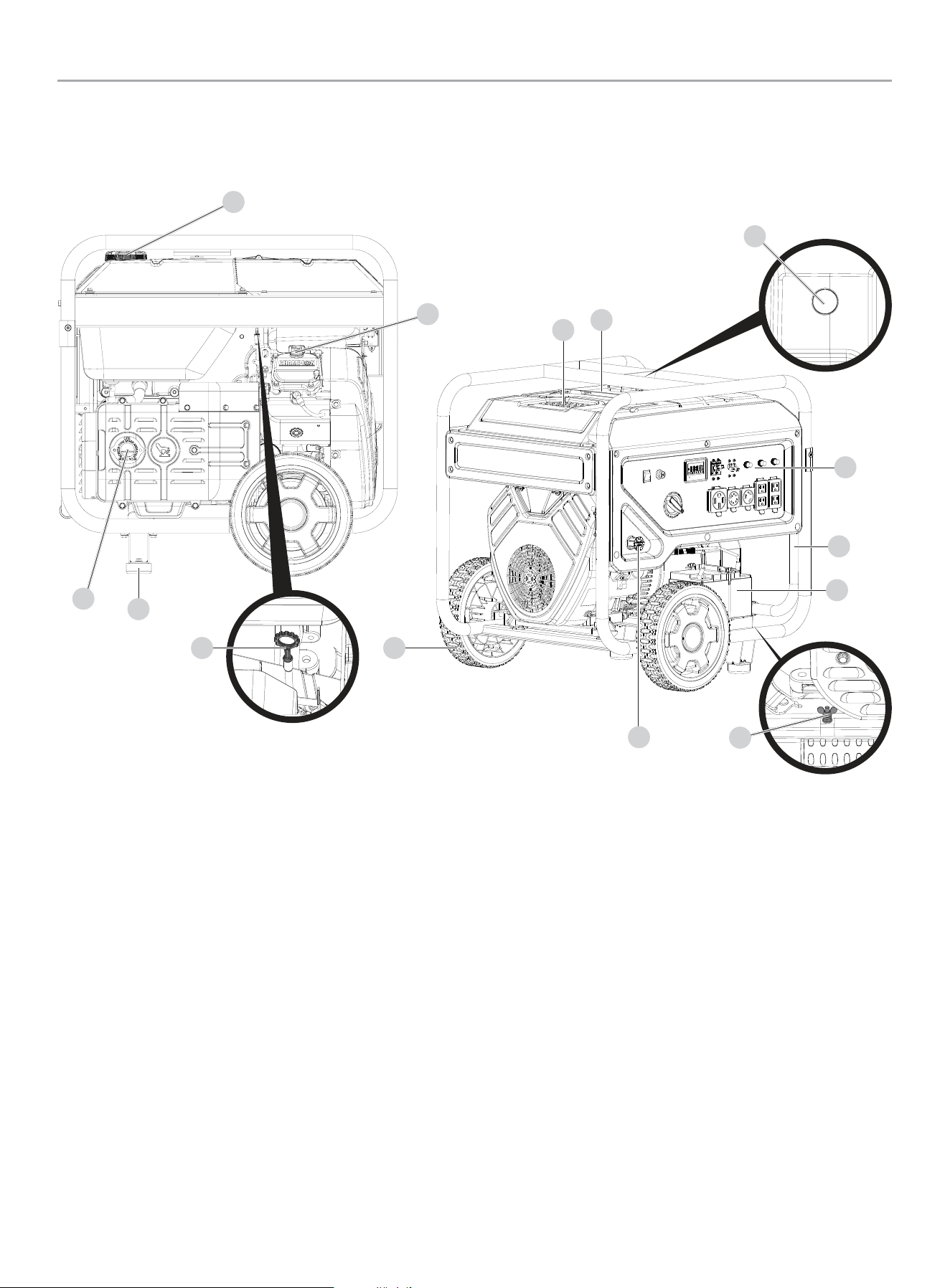
Read this operator’s manual before operating your generator. Familiarize yourself with the location and function of the controls and
features. Save this manual for future reference.
Generator
1. Fuel Cap – Remove to add fuel.
2. Oil Fill Cap – Used to fill oil.
3. Muffler
4. Support Leg
5. Dipstick – Used to check oil level.
6. Never Flat Wheels – 12 in. (30.5 cm)
7. LPG / NG Inlet - Used to connect LPG or NG fuel source to
generator.
8. Ground Terminal – Consult an electrician for local grounding
regulations.
9. Battery – Provides 12V DC power to the starting system.
10. Folding Handle – Used to move unit by lifting and rolling on
wheels. Do not use to lift or carry the unit.
11. Control Panel – See Control Panel section.
12. Gasoline Gauge
13. Gasoline Tank – 11 gal. (41.20 L)
14. Engine Access Cover
10
9
7
11
1
2
6
14
13
4
3
8
12
5
201161 - 12,000W TRI-FUEL PORTABLE GENERATOR
CONTROLS AND FEATURES
14
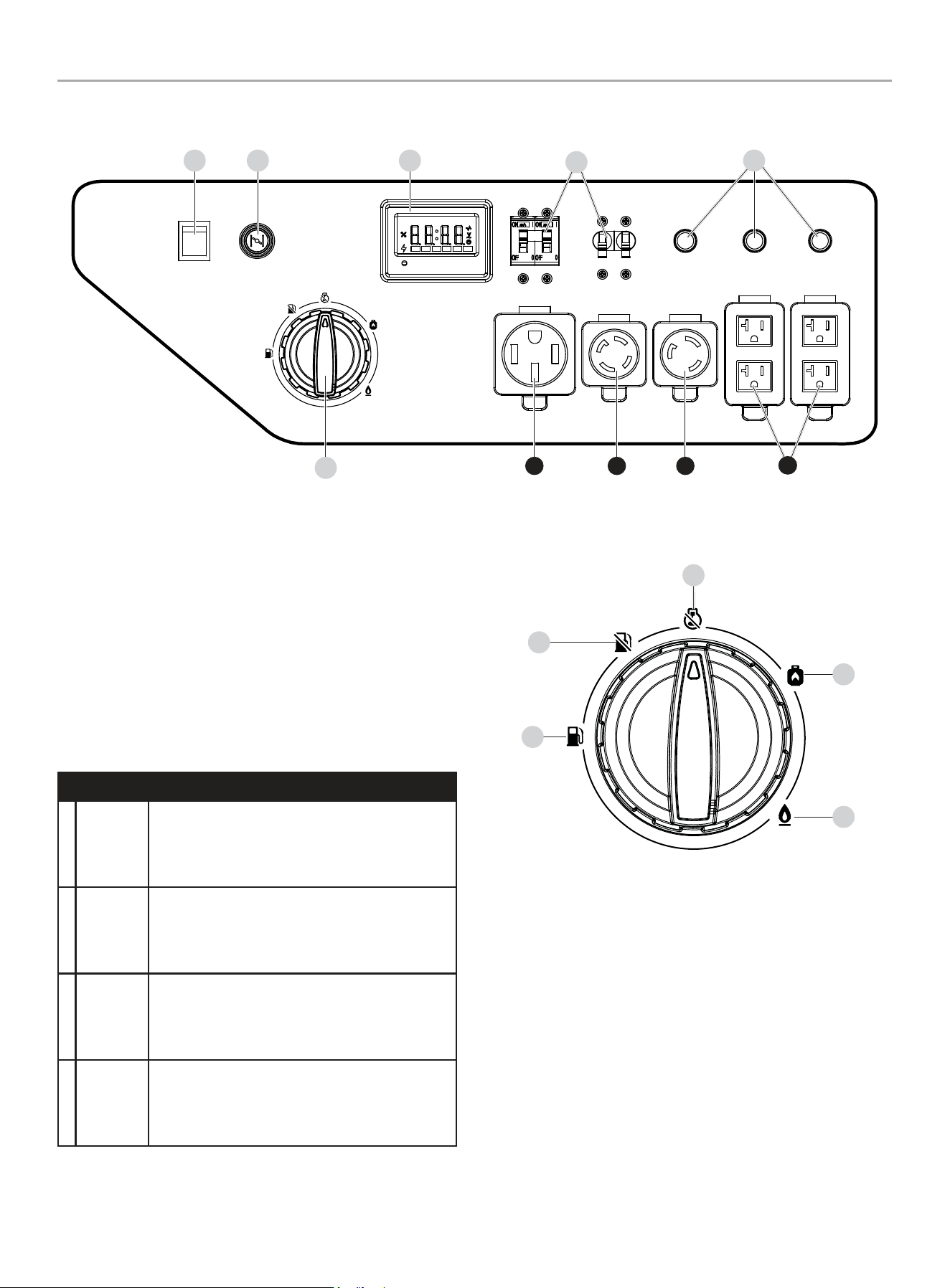
Control Panel
1. Ignition Switch – Used for electric starting of the generator.
2. Choke – Used to start a cold engine.
3. Intelligauge with Power Meter – See Intelligauge section.
4. Circuit Breakers (Flip Reset) – Protects the generator
against electrical overloads.
5. Circuit Breakers (Push Reset) – Protects the generator
against electrical overloads.
6. Fuel Select Dial – Used to select and turn on gasoline,
propane (LPG), or natural gas (NG) fuel source.
RECEPTACLES
A
D
120/240V AC, 50A (NEMA 14-50R)
May be used to supply electrical power for
operation of 120/240 Volt AC, 50 Amp, single
phase, 60 Hz electrical loads.
B
Y
120/240V AC, 30A Locking (NEMA L14-30R)
May be used to supply electrical power for
operation of 120/240 Volt AC, 30 Amp, single
phase, 60 Hz electrical loads.
C
W
120V AC, 30A Locking (NEMA L5-30R)
May be used to supply electrical power for
operation of 120 Volt AC, 30 Amp, single phase,
60 Hz electrical loads.
D
C
(4×) 120V AC, 20A GFCI (NEMA 5-20R)
May be used to supply electrical power for
operation of 120 Volt AC, 20 Amp, single phase,
60 Hz electrical loads.
6
1 2 3
A B C
D
5
4
Fuel Select Dial
1. Gasoline ON
2. Gasoline OFF
3. Engine OFF
4. Propane (LPG) ON
5. Natural Gas (NG) ON
1
2
4
5
3
201161 - 12,000W TRI-FUEL PORTABLE GENERATOR
CONTROLS AND FEATURES
15
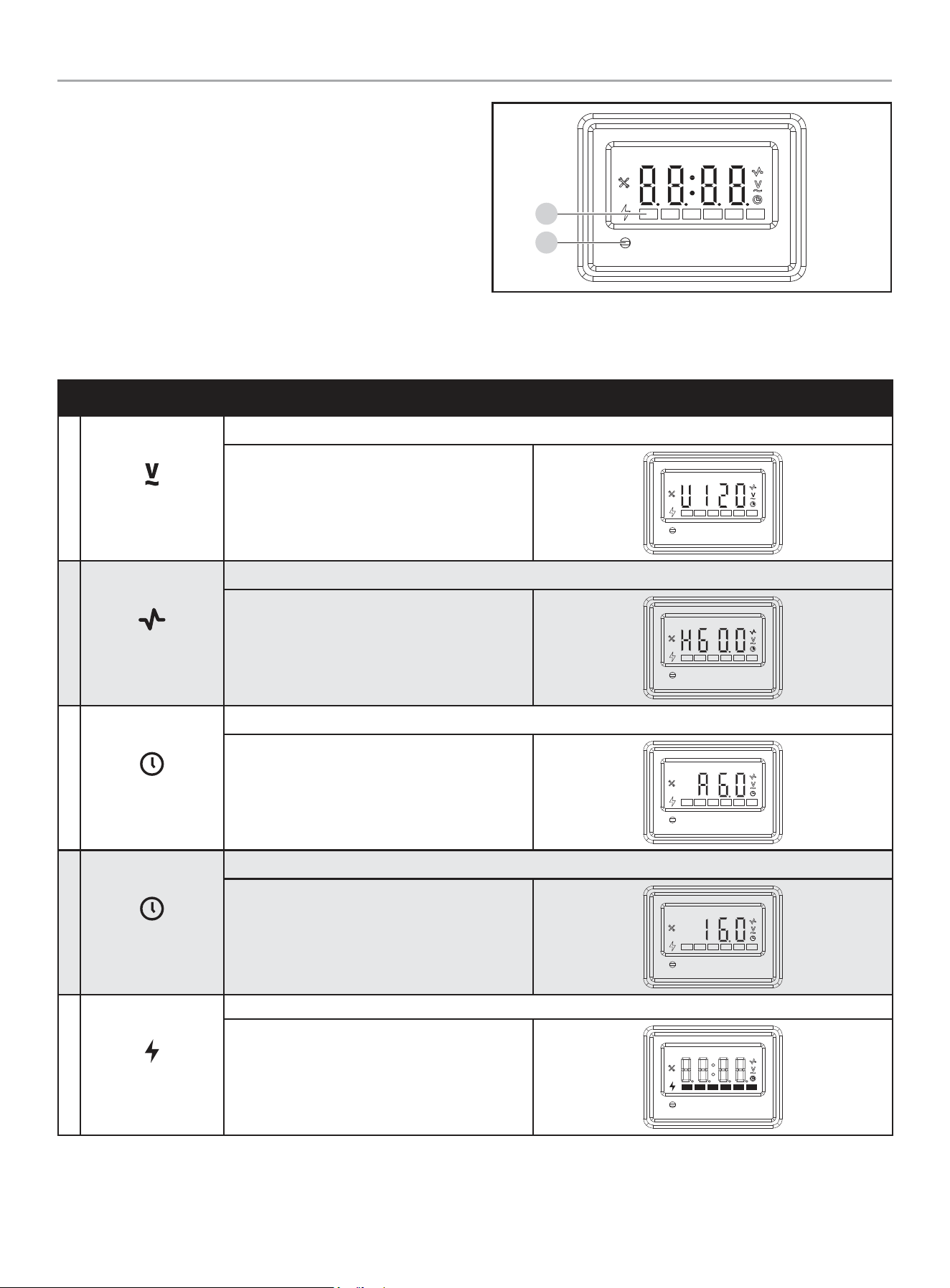
Intelligauge with Power Meter
Five mode digital meter for displaying voltage, frequency, session
run time, total run time, and power output.
A. Power Meter
B. CO Shield
®
LED – The CO Shield
®
technology monitors
for accumulation of poisonous carbon monoxide (CO) gas
produced by engine exhaust when the generator is running. If
CO Shield
®
detects elevated levels of CO gas, it automatically
shuts off the engine.
* *See CO Shield section for more information
MODE DESCRIPTION
1
Voltage (V)
Output voltage of the generator.
Example: 120 volts
2
Frequency (H)
Output frequency in hertz.
Example: 60.0 hertz
3
Run Time (R)
Run time of the generator for the current session.
Example: 6 hours
4
Total Run Time
Total run time of the generator since first operation.
Example: 16 hours
5
Output Power
Continually displays generator output.
Example: 100% Power
A
B
201161 - 12,000W TRI-FUEL PORTABLE GENERATOR
CONTROLS AND FEATURES
16
Industry Canada: CAN ICES-002/NMB-002
* Applicable in Canada only.
This device complies with Industry Canada license - exempt RSS
standard(s).
Operation is subject to the following two conditions:
1. This device may not cause interference, and
2. This device must accept any interference, including
interference that may cause undesired operation of the
device.
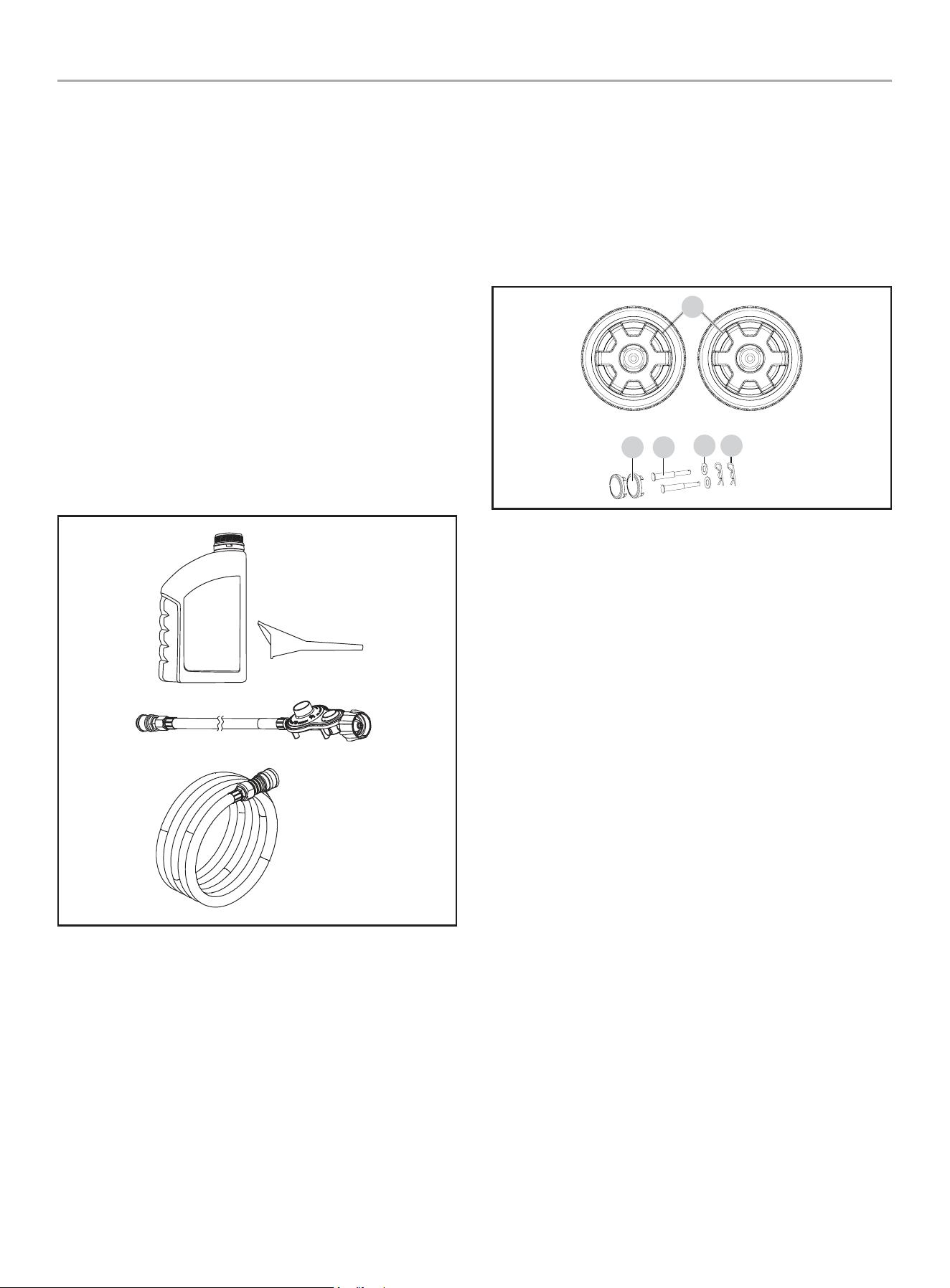
Parts Included
Accessories
Engine Oil
..................................... 37.2 fl. oz. (1100 ml)
Oil Funnel ...........................................................1
6.6 ft. (2 m) LPG Hose with Regulator .............................1
25 ft. Natural Gas Hose Kit ........................................1
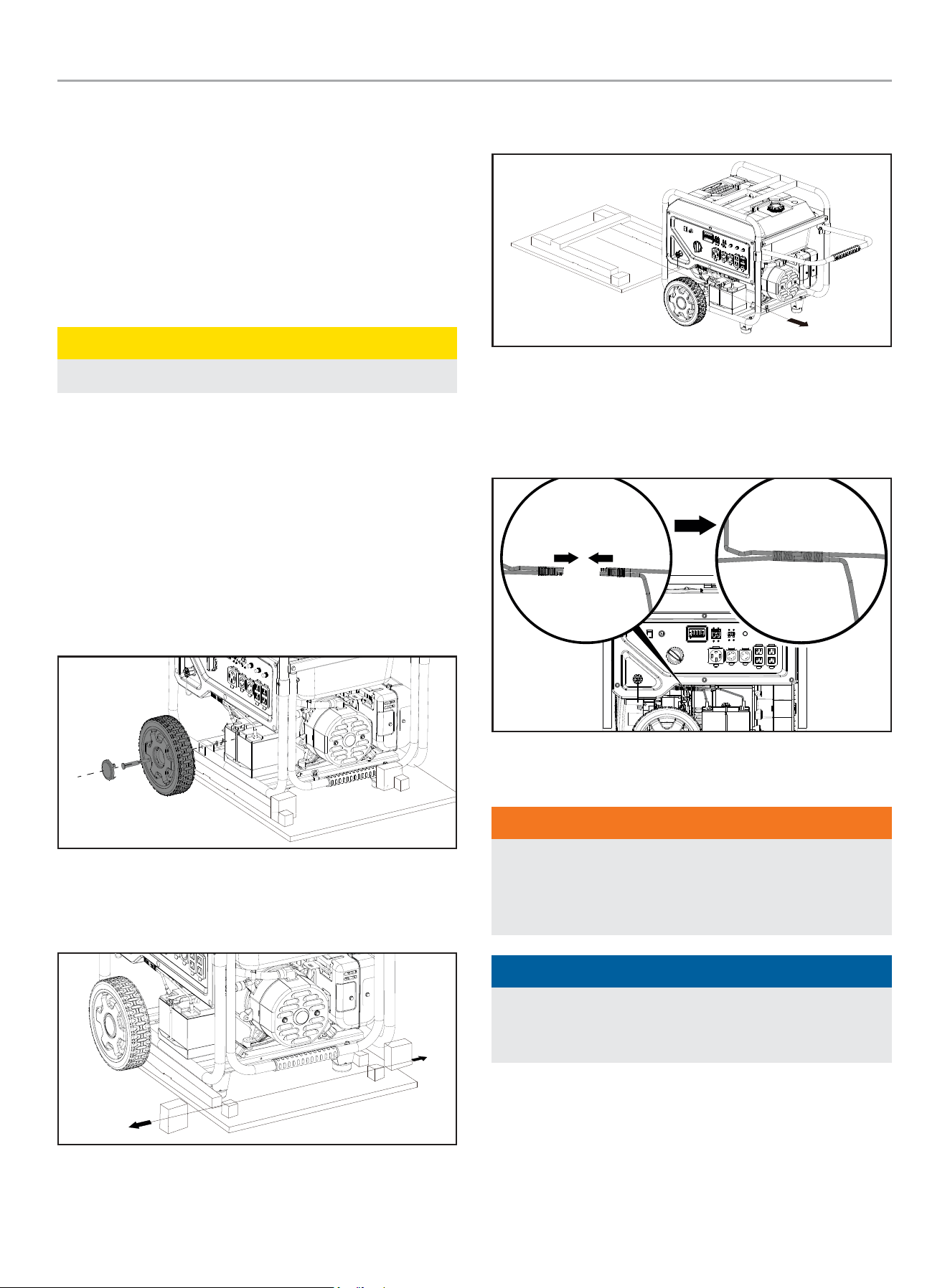
Assembly Parts
Wheels
12 in. (30.5 cm) Never Flat Wheel (A) .......................... 2
Wheel Hub Cap (B) ..............................................2
Roll Pin (C) ......................................................2
Washer Ø12 (D) .................................................2
Large R-clip (E) .................................................2
A
B C
ED
201161 - 12,000W TRI-FUEL PORTABLE GENERATOR
ASSEMBLY
17
ASSEMBLY
Your generator requires some assembly. This unit ships from our
factory without oil. It must be properly serviced with fuel and oil
before operation.
If you have any questions regarding the assembly of your
generator, call our Technical Support Team at 1-877-338-0999.
Please have your serial number and model number available.
Install the Wheel Kit
CAUTION
The wheel kit is not intended for over-the-road use.
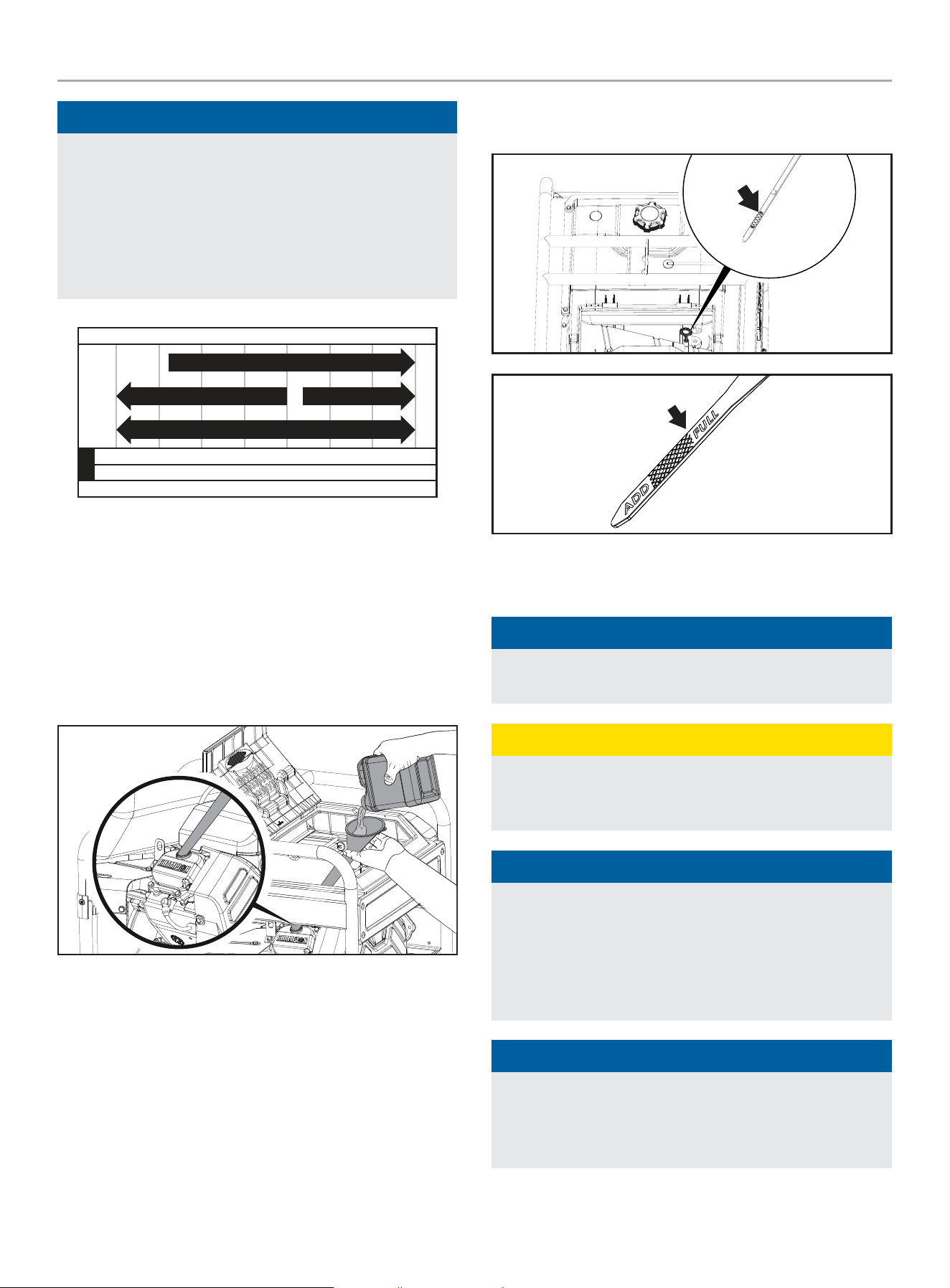
Install the Wheels
1. Make sure all items have been removed from the shipping
carton/pallet and double check for any items that may be in
the generator frame.
2. With the generator still on the pallet install the wheel.
3. Slide the wheel pin roll through the wheel from the outside.
4. Slide the wheel pin roll through the mount point on the frame.
5. Slide the washer and secure with the R-Pin.
6. Install wheel hub cap onto wheel.
7. Repeat steps 2-6 to attach the second wheel.
8. Remove wooden blocks from in front of the frame and the
support leg.
9. Raise handle and pull generator forward until wheels touch
the ground. Then pull generator out from wood pallet.
Connect the Battery
1. Cut cable tie on each side of battery connector.
2. Push two halves of battery connector together tightly.
Add Engine Oil
WARNING
DO NOT attempt to crank or start the engine before it has been
properly filled with the recommended type and amount of oil.
Damage to the generator as a result of failing to follow these
instructions will void your warranty.
NOTICE
The generator rotor has a sealed, pre-lubricated ball bearing
that requires no additional lubrication for the life of the
bearing.
201161 - 12,000W TRI-FUEL PORTABLE GENERATOR
ASSEMBLY
18
NOTICE
The recommended oil type for typical use is 5W-30
automotive oil. However, using the listed conventional oils
shown in the “Recommended Engine Oil Type” chart may be
used for typical use including the first 5 hours of the break-in
run time period of the engine.
If running generator in extreme temperatures, refer to the
“Recommended Engine Oil Type” chart.
-20 0 20 40 60
Ambient temperature
Recommended Engine Oil Type
80 100 120
-28.9
°F
°C
-17.8 -6.7 4.4 15.6 26.7 37.8 48.9
10W-30
5W-30 Full Synthetic
10W-405W-30
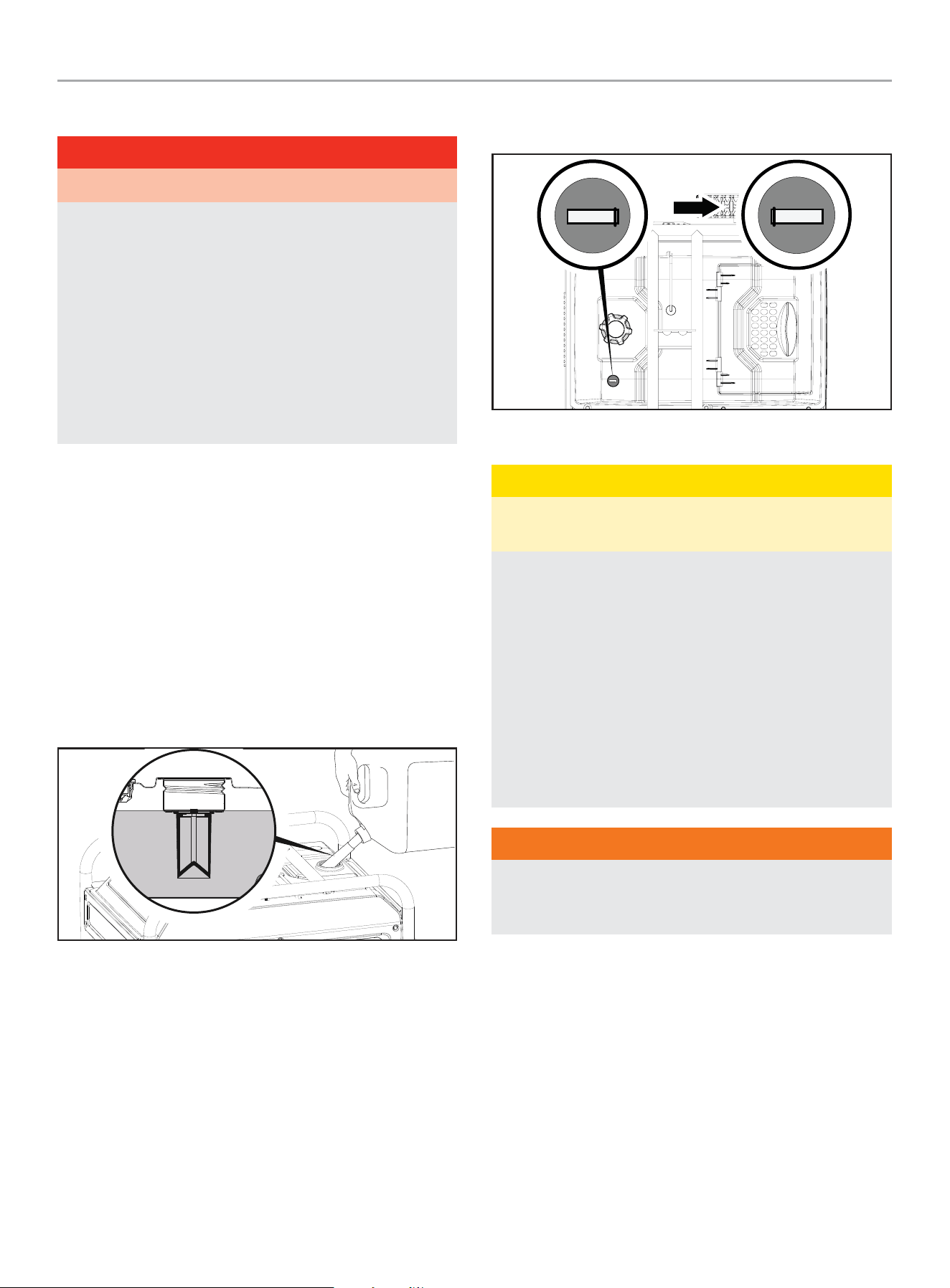
1. Place the generator on a flat, level surface.
2. Open the engine access cover.
3. Remove yellow cap on cylinder head cover on left side of
engine.
4. Using funnel fill to full mark on dipstick. DO NOT OVERFILL.
Volume for first use or oil change without oil filter change:
37.2 fl. oz. (1100 ml).
Volume after oil and oil filter change: 47.3 fl. oz. (1400 ml).
5. Pull out dipstick and check engine oil level. Add as needed.
DO NOT OVERFILL.
6. Replace dipstick.
7. Close engine access cover.
NOTICE
Check oil level often during the break-in period. Refer to the
Maintenance section for recommended service intervals.
CAUTION
This engine is equipped with a low oil shut-off and will stop
when the oil level in the crankcase falls below the threshold
level.
NOTICE
The first 5 hours of run time are the break-in period for the
unit. During the break in period stay at or below 50% of the
running watt rating and vary the load occasionally to allow
stator windings to heat and cool. Adjusting the load will also
cause engine speed to vary slightly and help seat piston rings.
After the 5 hour break-in period, change the oil.
NOTICE
Synthetic oil may be used after the 5 hour initial break-in
period. Using synthetic oil does not decrease the recommended
oil change interval. Full synthetic 5W-30 oil will aid in starting
in cold ambient < 41º F (5º C) temperatures.
201161 - 12,000W TRI-FUEL PORTABLE GENERATOR
ASSEMBLY
19
Add Fuel: Gasoline
DANGER
Gasoline vapors are highly flammable and extremely explosive.
DO NOT light or smoke cigarettes. Fire or explosion can cause
severe burns or death.
Only fill or drain fuel outdoors in a well-ventilated area.
DO NOT pump gasoline directly into the generator. Use an
approved container to transfer the fuel to the generator.
Never use a gasoline container, gasoline tank, or any other fuel
item that is broken, cut, torn or damaged.
DO NOT overfill the gasoline tank. Always keep fuel away from
sparks, open flames, pilot lights, heat and other sources of
ignition.
Use clean, fresh, regular unleaded gasoline with a minimum
octane rating of 87 and an ethanol content of 10% or less by
volume. ybc
DO NOT mix oil with gasoline.
1. Remove the gasoline cap.
2. Slowly add gasoline to the tank. Tank is full when gasoline
reaches red circle on screen. DO NOT OVERFILL. Gasoline can
expand after filling. A minimum of ¼ in. (6.4 mm) of space left
in the tank is required for gasoline expansion, although more
than ¼ in. (6.4 mm) is recommended. Gasoline can be forced
out of the tank as a result of expansion if overfilled, and can
affect the stable running condition of the generator.
3. The approximate fuel level is shown on the fuel gauge on top
of the fuel tank.
EF
Empty
EF
Full
4. Screw on the gasoline cap and wipe away any spilled fuel.
CAUTION
Use unleaded gasoline with a minimum octane rating of 87
and an ethanol content of 10% or less by volume.
DO NOT light cigarettes or smoke when filling the tank.
DO NOT mix oil and gasoline.
DO NOT overfill the tank. Fill tank to approximately ¼ in.
(6.4 mm) below the top of the tank to allow for gasoline
expansion.
DO NOT pump gasoline directly into the generator at the pump.
Use an approved fuel container to transfer the gasoline to the
generator.
DO NOT fill tank indoors.
DO NOT fill tank when the engine is running or hot.
WARNING
Pouring gasoline too fast through the fuel screen may result
in gasoline splashing over the generator and operator while
filling.

201161 - 12,000W TRI-FUEL PORTABLE GENERATOR
ASSEMBLY
20
NOTICE
The generator engine works well with 10% or less ethanol
blended gasoline. When using ethanol-gasoline blends there
are some issues worth noting:
– Ethanol-gasoline blends can absorb more water than
gasoline alone.
– These ethanol blends can eventually separate, leaving
water or a watery goo in the tank, fuel valve and
carburetor. The compromised gasoline can be drawn into
the carburetor and cause damage to the engine and/or
create potential hazards.
– If a fuel stabilizer is used, confirm that it is formulated to
work with ethanol-gasoline blends.
– Any damages or hazards caused by using ethanol blended
gasoline higher than 10% by volume, improperly stored
gasoline, and/or improperly formulated stabilizers, are not
covered by manufacturer’s warranty.
It is advisable to always shut off the gasoline supply and
run the engine to starvation after each use. See Storage
instructions for extended non-use.
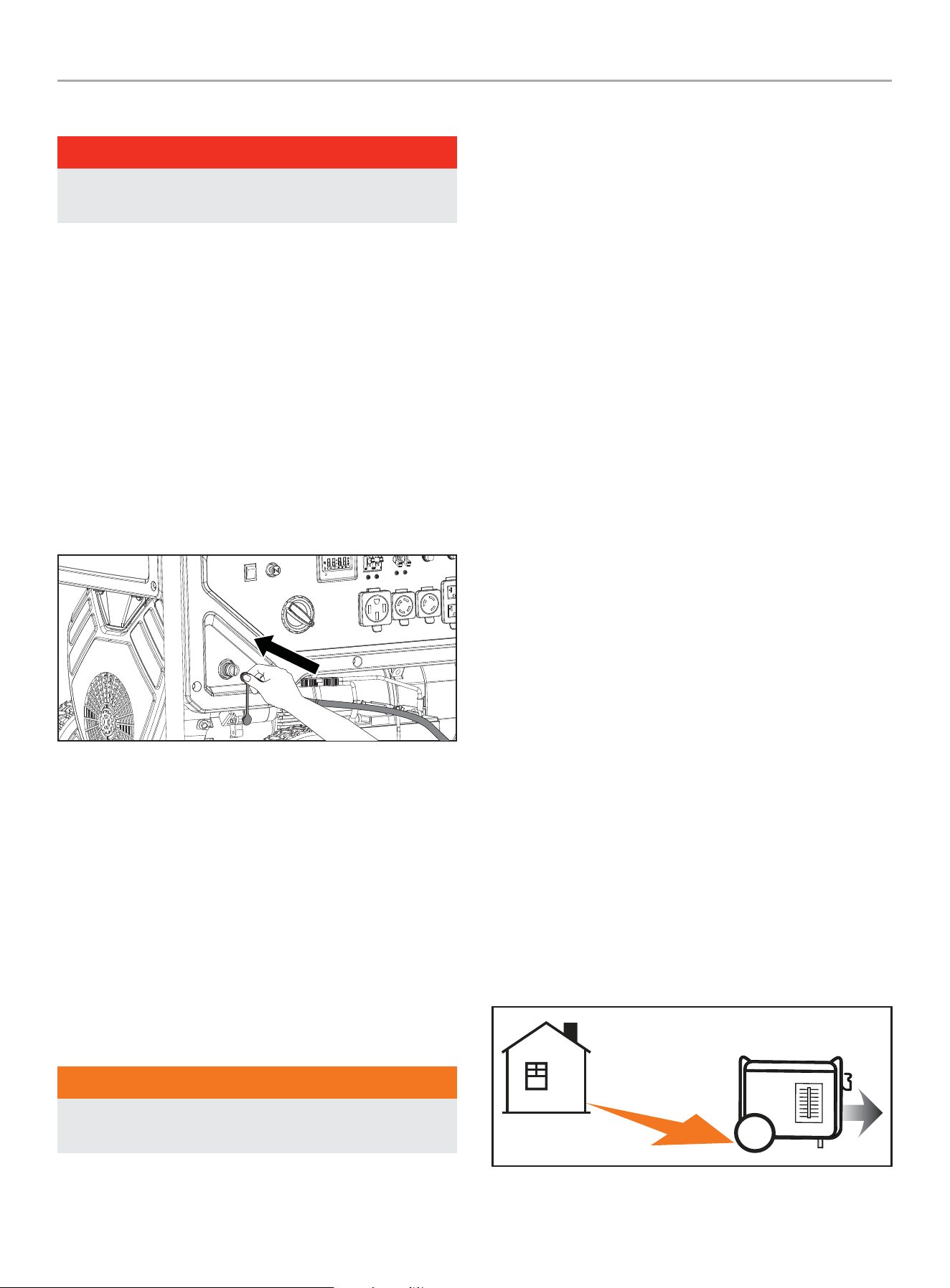
Add Fuel: Propane (LPG)
DANGER
NEVER place the LPG (liquefied petroleum gas) connector hose
OR LPG cylinder tank in the path of the muffler exhaust gas
stream of the generator during engine operation.
Connecting an LPG cylinder
1. Make sure the fuel select dial is in the “ENGINE STOP”
position.
2. Remove the rubber protective plug from the female connector
of the LPG hose.
3. Pull and hold the outer collar of the female connector and
insert it over the male connector. Release outer collar. Pull on
the hose to make sure it’s connected to the generator.
4. Connect the other end of the LPG hose to the LPG cylinder
valve and hand tighten.
5. Open valve on LPG cylinder and check all connections for
leaks by wetting the fittings with a solution of soap and
water. Bubbles which appear or bubbles which grow indicate
that a leak exists. If a leak exists at a fitting then turn off
the valve on the cylinder and tighten the fitting. Turn the
valve back on and recheck the fitting with the soap and
water solution. If the leak continues or if the leak is not at a
fitting then do not use the generator and contact a qualified
technician.
NOTICE
– The LPG hose included with this unit works with standard
20, 30, and 40 pound LPG tanks.
– Verify the requalification date on the cylinder has not
expired.
– Always position the cylinder so the connection between the
cylinder valve and generator inlet won’t cause sharp bends
or kinks in the LPG hose.
CAUTION
Do not allow children to tamper or play with the LPG cylinder
or hose connections.
CAUTION
Use approved LPG cylinders equipped with an OPD (overfilling
prevention device) valve. Always keep the cylinder in a vertical
position with the valve on top and installed at ground level
on a flat surface. Cylinders must not be installed near any
heat source and should not be exposed to sun, rain, and dust.
When transporting and storing, turn off the cylinder valve and
generator LPG valve, and disconnect the cylinder. Plug the
outlet, usually by a plastic protective cap, if one is available.
Keep cylinders away from heat and ventilated when in a
vehicle.
WARNING
If there is a strong smell of LPG: Close valve on the cylinder.
Check all connections for leaks by wetting the fittings with a
solution of soap and water. Bubbles which appear or bubbles
which grow indicate that a leak exists. Do not smoke or light a
cigarette, or check for leaks using a match, open flame source
or lighter. Contact a qualified technician to inspect and repair
an LPG system if a leak is found, before using the generator.
201161 - 12,000W TRI-FUEL PORTABLE GENERATOR
OPERATION
21
Add Fuel: Natural Gas (NG)
DANGER
NEVER place NG connector hose in the path of the generator’s
muffler exhaust gas stream while the generator is running.
Connecting the NG hose
1. Use pipe sealant, joint compound, or Teflon tape when
connecting the adapter fitting from the hose kit to the NG
supply line.
2. Connect the female flare end of the NG hose to the adapter
fitting. NO pipe sealant, joint compound, or Teflon tape is to
be used on this connection.
3. Remove the rubber protective plug from the female quick
connect end of the NG hose.
4. Pull and hold the outer collar of the female quick connect and
insert it over the male connector on the generator. Release
outer collar. Pull on the hose to make sure it is securely
connected to the generator.
5. Before operation, open the NG supply line and check for
leaks. Use a soapy water mixture to verify all connections
prior to starting the generator. If soapy bubbles are present
indicating leaks turn off the NG supply and do not start
generator. Recheck connections and tightness and turn NG
supply valve back on and repeat soapy water mixture on
connection fitting. If the NG leak continues do not use the
generator and contact a qualified technician for repair.
6. Close the NG supply valve.
Grounding
Your generator must be properly connected to an appropriate
ground to help prevent electric shock.
WARNING
Failure to properly ground the generator can result in electric
shock.
A ground terminal connected to the frame of the generator has
been provided (see Controls and Features for terminal location).
For remote grounding, connect a length of heavy gauge
(12 AWG minimum) copper wire between the generator ground
terminal and a copper rod driven into the ground. We strongly
recommend that you consult with a qualified electrician to ensure
compliance with local electrical codes.
Neutral Floating*
– Neutral circuit IS NOT electrically connected to the frame/
ground of the generator.
– The generator (stator winding) is isolated from the frame and
from the AC receptacle ground pin.
– Electrical devices that require a grounded receptacle pin
connection will not function if the receptacle ground pin is not
functional.
Neutral Bonded to Frame*
– Neutral circuit IS electrically connected to the frame/ground of
the generator.
– The generator system ground connects lower frame cross-
member below the alternator. The system ground is connected
to the AC neutral wire.
* See your Specifications section for specified type of grounding.
OPERATION
CO Shield
®
- Carbon Monoxide (CO) Detection
and Auto-shutoff System
CO Shield
®
technology monitors the accumulation of carbon
monoxide (CO), a poisonous gas produced by engine exhaust when
the generator is running. If CO Shield
®
detects unsafe elevated
levels of CO gas, it automatically shuts off the engine.
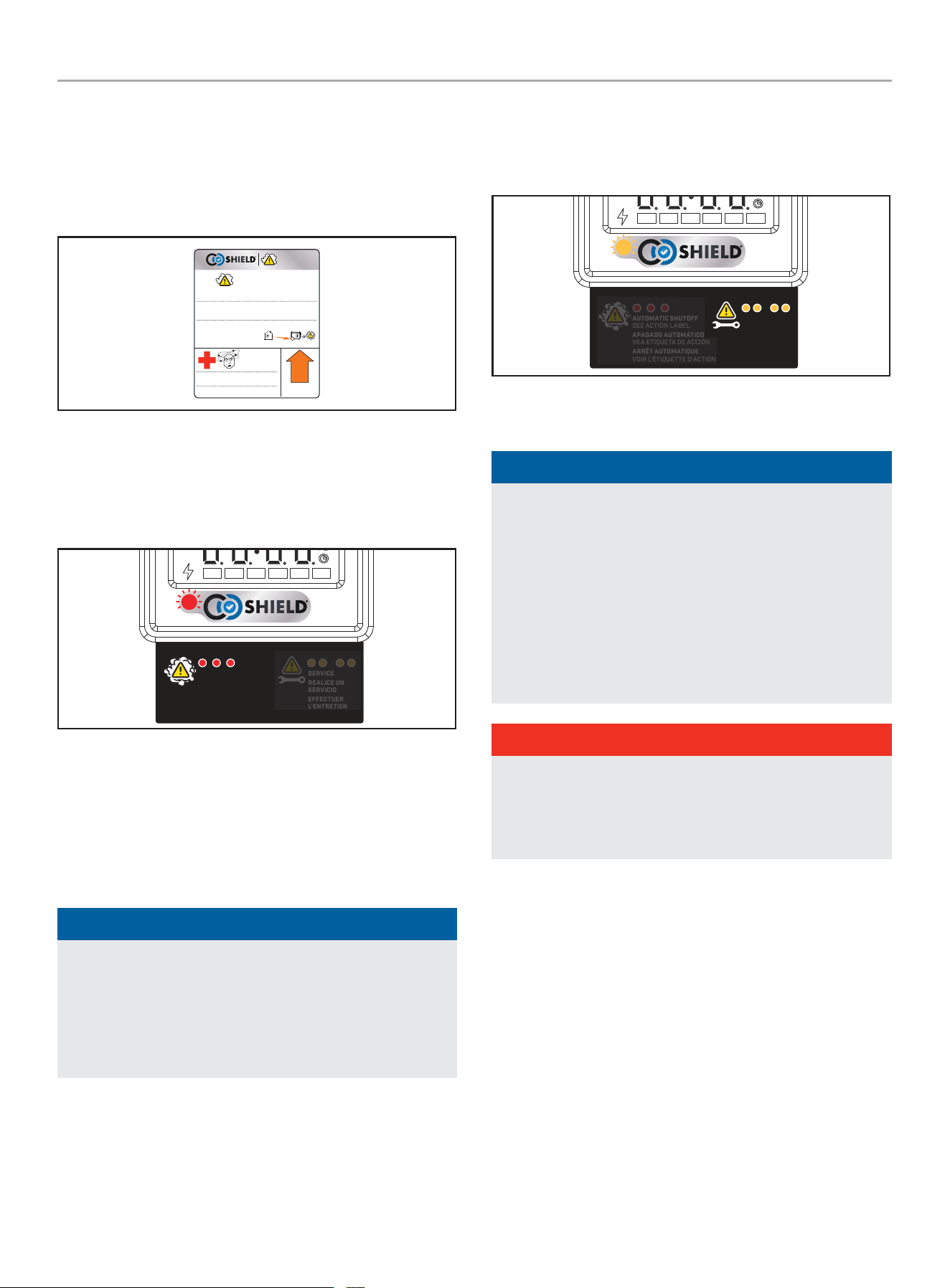
CO SHIELD
®
IS NOT A SUBSTITUTE FOR AN INDOOR CARBON
MONOXIDE ALARM OR FOR INDOOR OPERATION.
DO NOT allow engine exhaust fumes to enter a confined area
through windows, doors, vents or other openings.
Generators must ALWAYS be used outdoors, far away from
occupied buildings with engine exhaust pointed away from people
and buildings.
201161 - 12,000W TRI-FUEL PORTABLE GENERATOR
OPERATION
22
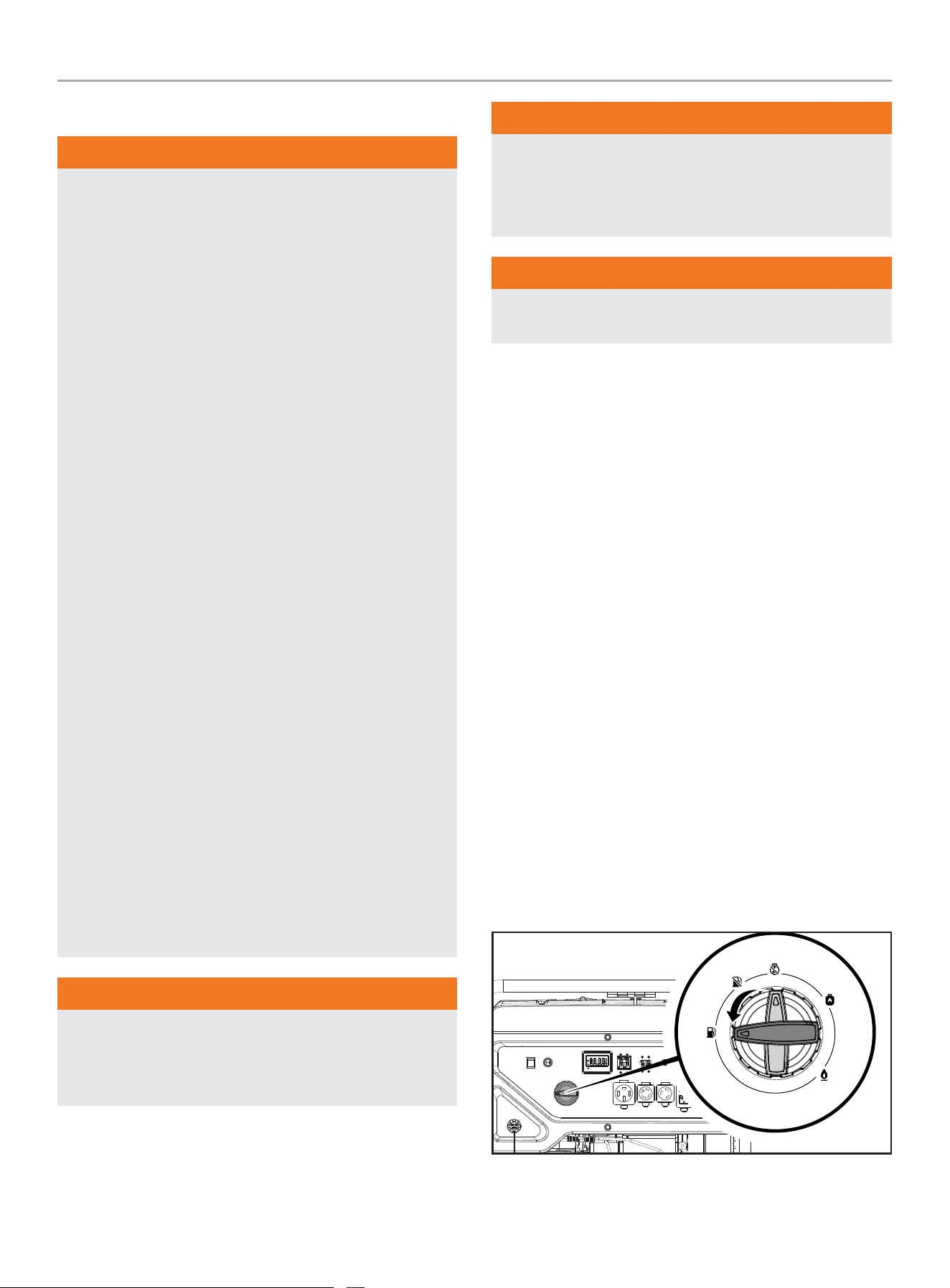
If misused and operated in an unapproved and unsafe location
that results in the accumulation of poisonous CO gas inside
an enclosed or partially enclosed space, for example a house,
garage or a garage with the door partially open, CO Shield
®
will
automatically shut off the generator and then will illuminate a
blinking red LED light. Read the action label for next steps.
3783-L-SF
Move generator to an open, outdoor area. Point exhaust away.
Don’t run generators in enclosed areas (e.g. not in house or garage).
Mover el generador a un área abier ta a la intemperie. Apunte el
escape alejado. No corra los generadores en áreas cerradas (ej. no
en una casa o garaje).
Déplacer le générateur vers un espace extérieur en plein air. Garder
l’échappement loin. Ne pas faire
fonctionner les générateurs dans un
espace clos (ex., pas dans une maison
ou un garage).
EXHAUST
EL ESCAPE
L’ECHAPPEMENT
POINT AWAY
DIRIJA ALEJADO
DIRIGER LOIN
AUTOMATIC SHUTOFF – YOU MUST:
APAGADO AUTOMÁTICO– USTED DEBE:
ARRÊT AUTOMATIQUE– VOUS DEVEZ :
Move to fresh air and
get medical help if
sick, dizzy or weak.
Mueva al aire fresco y obtenga asistencia
medica si está enfermo, mareado, o débil.
Aller à l'air frais et obtenir de l'aide médicale
si malade, étourdi ou faible.
ACTION LABEL
ETIQUE TA DE ACCIÓN
ÉTIQUETTE D'ACTION
In the event of an engine shut off, when you approach the
generator to investigate, a blinking red LED light in the CO Shield
®
area provides notification that the generator shut off due to an
accumulating CO hazard. The red LED light will blink for at least
five (5) minutes after an engine shut off event.
AUTOMATIC SHUTOFF
SEE ACTION LABEL
APAGADO AUTOMÁTICO
VEA ETIQUETA DE ACCIÓN
ARRÊT AUTOMATIQUE
VOIR L'ÉTIQUETTE D'ACTION
SERVICE
REALICE UN
SERVICIO
EFFECTUER
L’ENTRETIEN
Move the generator far away to an open, outdoor area and point
the exhaust away from people and buildings. Once relocated
to a safe area, the generator can be restarted, and the proper
electrical connections made. Introduce fresh air and ventilate the
location where the generator shut off.
When restarting, the red and yellow LED will blink ten (10) times
simultaneously to indicate the LED is working.
NOTICE
This blinking LED light does not indicate CO Shield
®
is working,
as CO Shield
®
is working at all times when the generator
is running. Also, the LED light will not blink (10) times if the
generator was restarted within 1 minute after it was manually
shut off. This does not occur if generator shut off from a high
CO event.
If CO Shield
®
system experiences a fault and no longer provides
protection, the generator is shutoff automatically and the yellow
LED light will blink for at least five (5) minutes to notify you of the
fault.
AUTOMATIC SHUTOFF
SEE ACTION LABEL
APAGADO AUTOMÁTICO
VEA ETIQUETA DE ACCIÓN
ARRÊT AUTOMATIQUE
VOIR L'ÉTIQUETTE D'ACTION
SERVICE
REALICE UN
SERVICIO
EFFECTUER
L’ENTRETIEN
Call our Technical Support Team at 1-877-338-0999 for repair.
The generator can be restarted, but will continue to shutoff.
NOTICE
CO Shield
®
will detect the accumulation of carbon monoxide
(CO) from other fuel burning sources such as engine powered
equipment, or propane heaters used in the area of operation. If
another generator is used and the exhaust stream is pointed at
a CO Shield
®
equipped generator, the CO Shield
®
may initiate
a shutoff due to rising carbon monoxide (CO) levels. This is not
a fault. Poisonous carbon monoxide (CO) has been detected.
You must take action to move and direct the generator exhaust
stream to better disperse carbon monoxide (CO) far away from
people or buildings.
DANGER
Tampering with the CO Shield
®
system will result in a
hazardous condition and will void your warranty.
Removing the CO Shield
®
module will not allow the generator
to start.
201161 - 12,000W TRI-FUEL PORTABLE GENERATOR
OPERATION
23
Generator Location
WARNING
NEVER operate the generator inside any building, garage,
basement, crawlspace, shed, enclosure or compartment,
including a generator compartment of a recreational vehicle.
NEVER operate or start the generator in the back of an
SUV, camper, trailer, truck bed (regular sides, flat or other
configuration), under staircases, stairwells, next to walls
or buildings or in any other location that will not allow for
adequate cooling of the generator or for the proper exit of the
exhaust flow from the muffler system.
DO NOT operate or store the generator in wet weather
conditions such as rain or snow. Using a generator in wet
conditions could result in serious injury or death due to
electrocution.
In some state’s generators may be required to be registered
with the local utility company when used at construction sites
and may be subject to additional rules and regulations, consult
your local municipal authority.
Generators should always be operated on a flat, level surface
at all times (even when not in operation).
Generators must have a minimum of 5 feet (1.5 m) of
clearance from all combustible material.
Generators must also have a minimum of 3 feet (91.4 cm)
of air flow clearance on all sides to allow for adequate
performance cooling, maintenance and servicing.
Always place the generator in a well-ventilated area. NEVER
place the generator near air intake vents or where exhaust
fumes could be drawn into occupied or confined spaces.
Always carefully consider wind and air currents when
positioning generator.
Always allow generators to properly cool before transport or
for storage purposes.
Failure to follow proper safety precautions may result in
personal injury, damage to the generator and void the
manufacturer’s warranty.
WARNING
During operation the muffler and exhaust fumes will become
hot. If adequate cooling and breathing space are not supplied,
or if the generator is blocked or enclosed, temperatures can
become extremely heated and may lead to fire.
WARNING
Do not expose to rain or use in damp locations.
Keep all objects a minimum of 5 feet (1.5m) away from the
generator at all times. Heat from the muffler surface and
exhaust gas stream can ignite combustible materials.
WARNING
If you must operate in rain or damp locations, DO NOT operate
without proper protection of the electrical components.
Use of a safety canopy that is fire retardant and will provide proper
air ventilation for the engine exhaust gas stream may be used.
Visit championpowerequipment.com or call to find your Storm
Shield cover.
Surge Protection
Electronic devices, including computers and many programmable
appliances use components that are designed to operate within a
narrow voltage range and may be affected by momentary voltage
fluctuations. While there is no way to prevent voltage fluctuations,
you can take steps to protect sensitive electronic equipment.
– Install UL1449, CSA-listed, plug-in surge suppressors on the
outlets feeding your sensitive equipment.
Surge suppressors come in single- or multi-outlet styles.
They’re designed to protect against virtually all short-duration
voltage fluctuations.
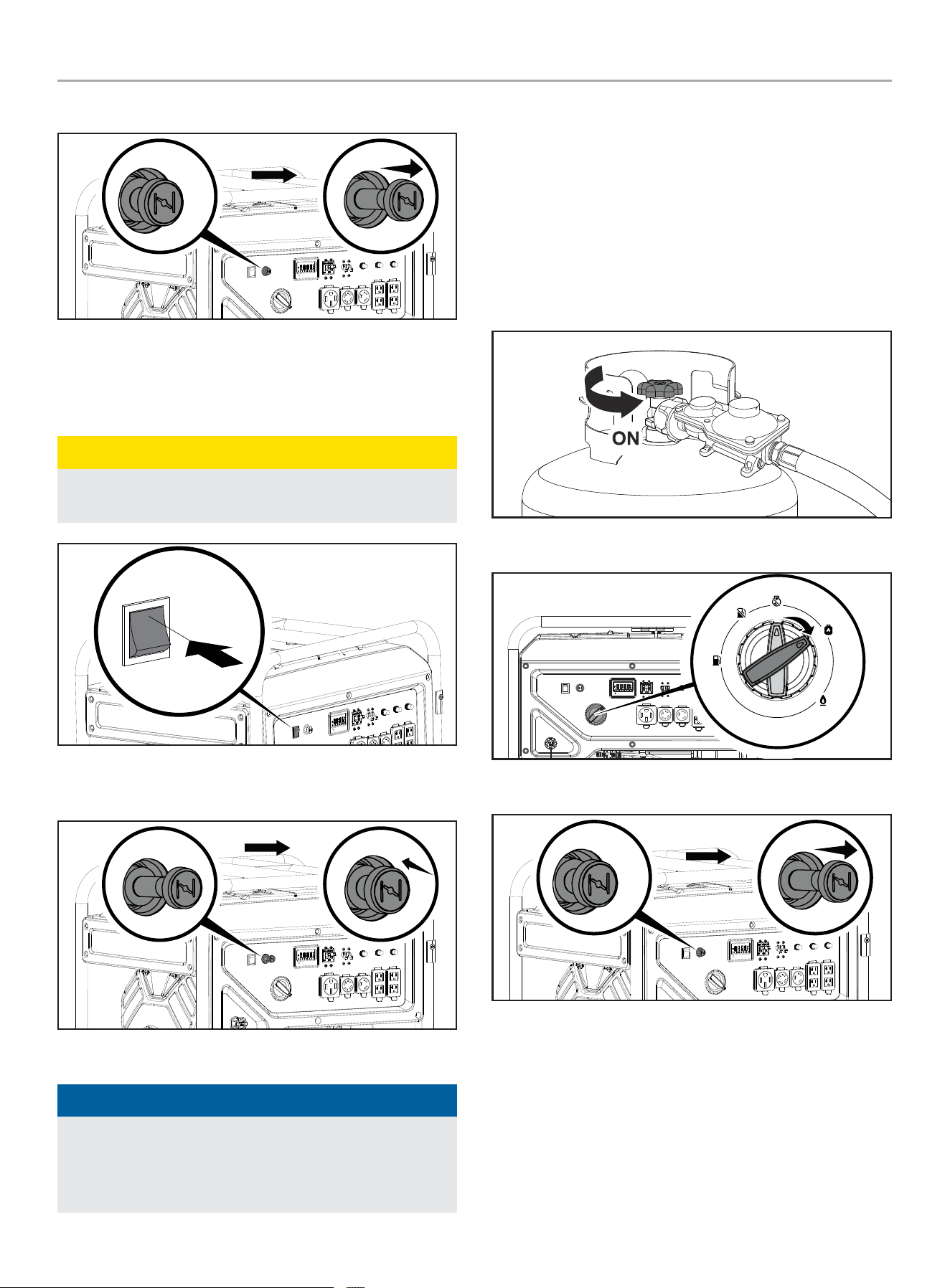
Starting the Engine: Gasoline
1. Make certain the generator is on a flat, level surface and all
circuit breakers are reset (button pushed in).
2. Disconnect all electrical loads from the generator. Never start
or stop the generator with electrical devices plugged in or
turned on.
3. Turn the fuel select dial to the “GASOLINE ON” position.
201161 - 12,000W TRI-FUEL PORTABLE GENERATOR
OPERATION
24
4. Pull the choke knob out.
5. Press and hold the ignition switch to the “START” position.
Release as the engine begins to start. If the engine fails to
start within five seconds, release the switch and wait at least
ten seconds before attempting to start the engine again.
CAUTION
If the ignition switch is held down in the “START” position
longer than 5 seconds it could damage the starter.
6. Do not over-choke. As soon as engine starts, push the choke
knob in.
7. Plug in devices.
NOTICE
If the engine starts but does not run make certain that the
generator is on a flat, level surface. The engine is equipped
with a low oil sensor that will prevent the engine from running
when the oil level falls below a critical threshold.
Starting the Engine: Propane (LPG)
1. Make certain the generator is on a flat, level surface and all
circuit breakers are reset (button pushed in).
2. Disconnect all electrical loads from the generator. Never start
or stop the generator with electrical devices plugged in or
turned on.
3. Connect LPG hose to generator and LPG cylinder. See “Add
Fuel: Propane (LPG)” section of the manual.
4. Fully open the valve on the LPG cylinder.
5. Turn fuel select dial to the “PROPANE ON” position.
6. Pull the choke knob out.
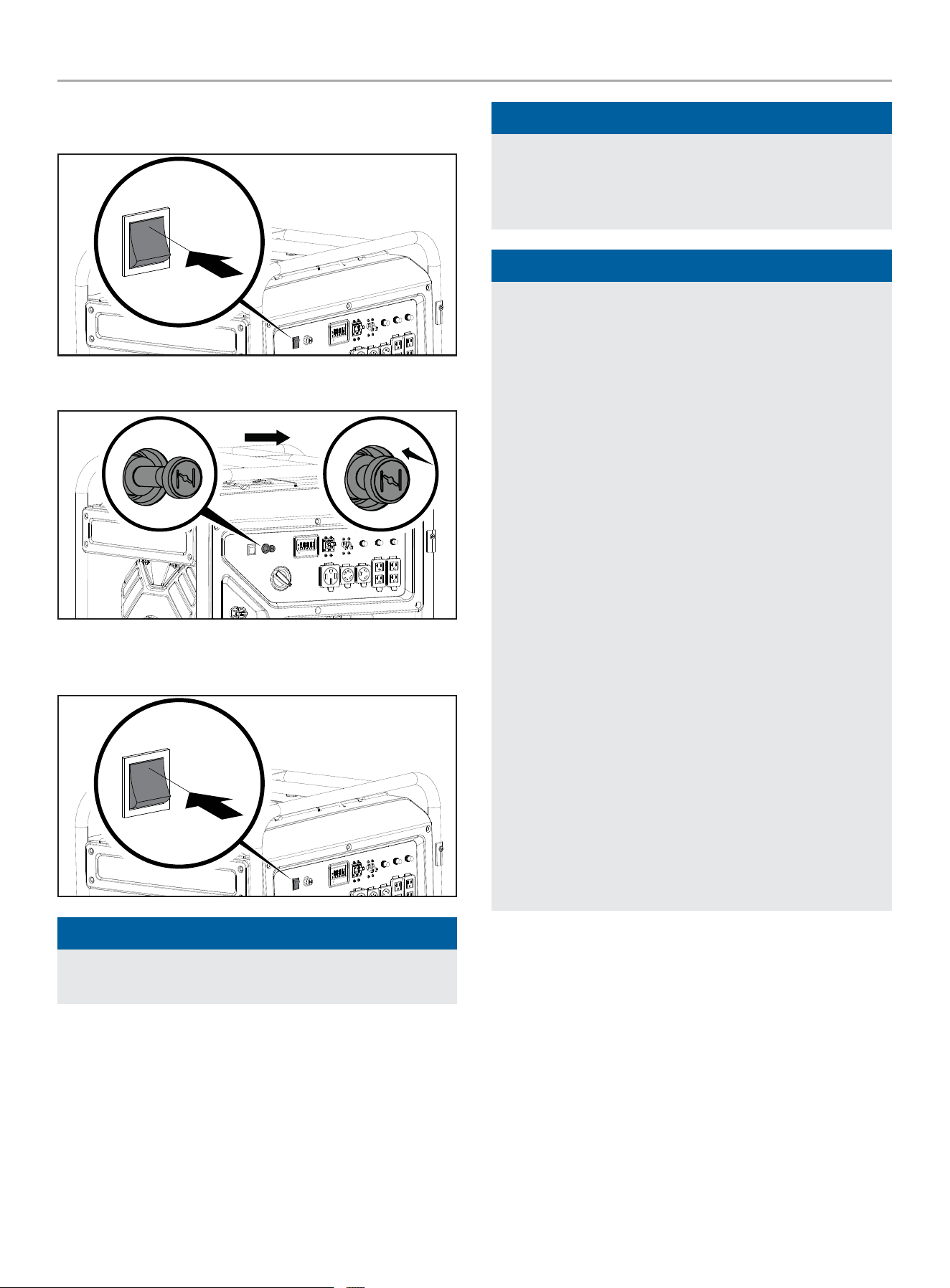
201161 - 12,000W TRI-FUEL PORTABLE GENERATOR
OPERATION
25
7. Press the ignition switch to the “START” position for 2-3
seconds.
8. Push the choke knob in.
9. Press and hold the ignition switch in the “START” position for
up to 5 seconds or until started.
NOTICE
If the engine is cranked longer than 5 seconds, the engine can
flood and will not start.
10. If engine does not start, wait 10 seconds and repeat step 9.
11. When the engine starts, push choke knob to the “RUN”
position if in the “ CHOKE” position.
12. Plug in devices.
NOTICE
If the engine starts but does not run make certain that the
generator is on a flat, level surface. The engine is equipped
with a low oil sensor that will prevent the engine from running
when the oil level falls below a critical threshold.
NOTICE
Accumulation of frost on LPG cylinder and regulators is
common during operation and normally is not an indication
of a problem. As LPG vaporizes and travels from the cylinder
to the generator engine it expands. The amount of frost that
forms can be affected by the size of the cylinder, the amount
of LPG being used, the humidity of the air and other operating
conditions.
In unusual situations this frost may eventually restrict the flow
of LPG to the generator resulting in deteriorating performance.
For example, if the cylinder temperature is reduced to a very
low level then the rate at which the LPG vaporizes is also
reduced and may not provide sufficient flow to the engine. This
is not an indication of a problem with the generator but only
a problem with the flow of LPG from the cylinder. If generator
performance seems to be deteriorating at the same time that
ice formation is observed on tank valve, hose or regulator then
some actions may be taken to eliminate this symptom.
In these rare situations it can be helpful to reduce or eliminate
the cold fuel system effects by doing one of the following:
– Exchanging fuel cylinders to allow the first cylinder to
warm up, repeating as necessary.
– Placing the cylinder at the end of the generator near the
handle, where engine fan air flows out from the generator.
This air is slightly heated by flowing over the engine. The
cylinder should not be placed in the path of the muffler
outlet.
– The cylinder can be temporarily warmed by pouring warm
water over the top of the cylinder.
Starting the Engine: Natural Gas (NG)
1. Make certain the generator is on a flat, level surface and all
circuit breakers are reset (button pushed in).
2. Disconnect all electrical loads from the generator. Never start
or stop the generator with electrical devices plugged in or
turned on.
3. Connect NG hose to generator.
See “Add Fuel: Natural Gas (NG)” section of the manual.
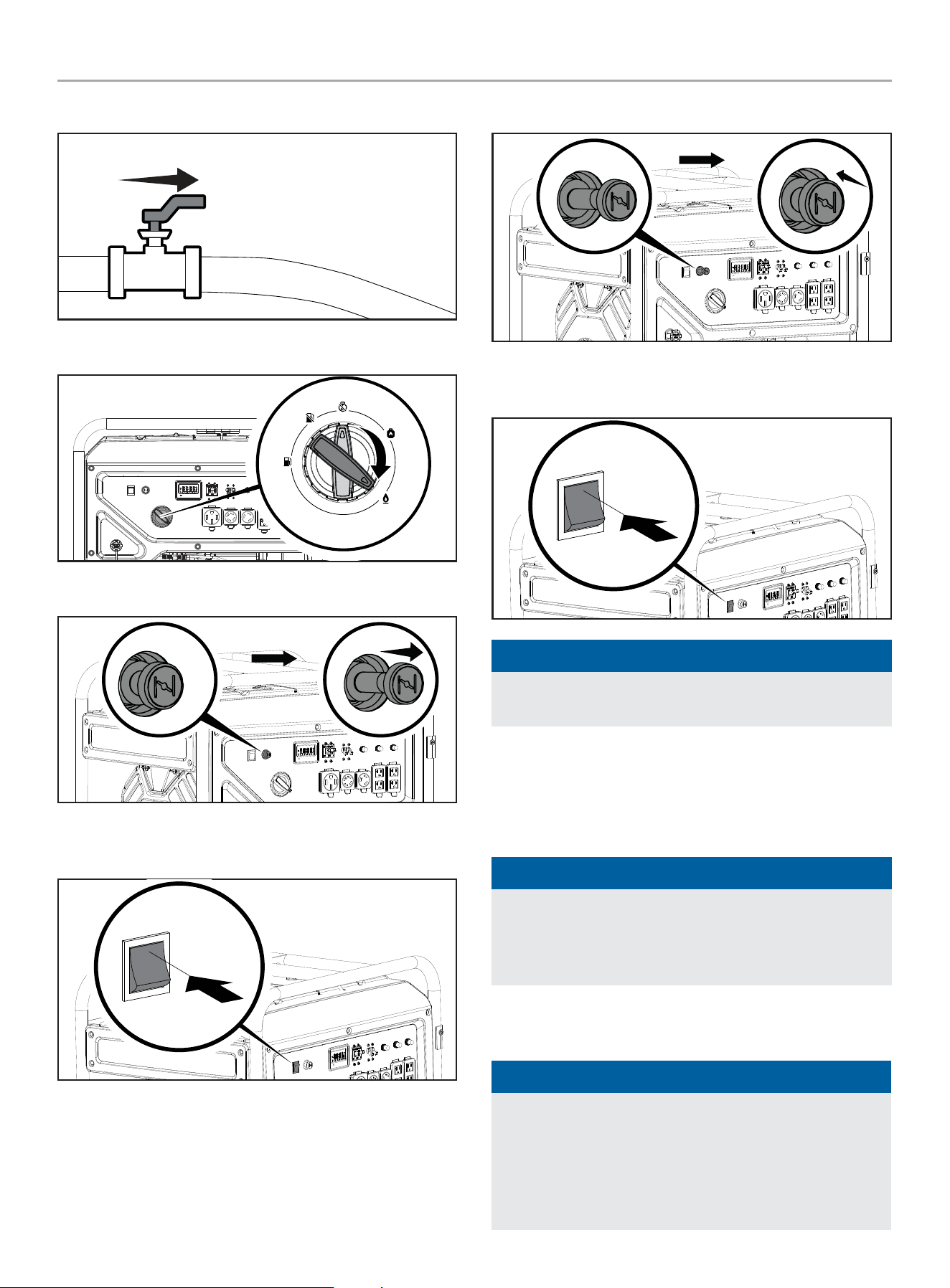
201161 - 12,000W TRI-FUEL PORTABLE GENERATOR
OPERATION
26
4. Open Natural Gas fuel supply valve.
ON
5. Turn fuel select dial to the “NATURAL GAS ON” position.
6. Pull the choke knob out.
7. Press the ignition switch to the “START” position for 2-3
seconds.
8. Push the choke knob in.
9. Press and hold the ignition switch in the “START” position for
up to 5 seconds or until started.
NOTICE
If the engine is cranked longer than 5 seconds, the engine can
flood and will not start.
10. If engine does not start, wait 10 seconds and repeat step 9.
11. When the engine starts, push choke knob to the “RUN”
position if in the “ CHOKE” position.
12. Plug in devices.
NOTICE
If the engine starts but does not run make certain that the
generator is on a flat, level surface. The engine is equipped
with a low oil sensor that will prevent the engine from running
when the oil level falls below a critical threshold.
Battery
NOTICE
The supplied 12V sealed lead acid (SLA) battery will recharge
while the engine is running. When the generator is not in
use for extended periods of time, it is recommended that the
battery be fully charged at least once a month with a slow
charger and disconnected when fully charged or charged using
a battery maintainer for long-term storage (not included).

201161 - 12,000W TRI-FUEL PORTABLE GENERATOR
OPERATION
27
Connecting Electrical Loads
Let the engine stabilize and warm up for a few minutes after
starting.
Plug in and turn on the desired 120 or 240 (if applicable) Volt AC
single phase, 60 Hz electrical loads.
– DO NOT connect 3-phase loads to the generator.
– DO NOT overload the generator.
– Use only a high quality, insulated, compatible (3-wire or
4-wire) grounded cord set rated equal to or greater (volts and
amps) than the receptacle plugging into.
WARNING
Always remember to plug your appliances directly into the
generator and do not plug the generator power cord into any
electrical outlet or connect to the circuit breaker panel in your
home. Connecting a generator to your home’s electric utility
company’s power lines, or to another power source, called
‘backfeeding’ is a dangerous practice that is illegal in many
states and municipalities.
This action if done incorrectly could damage your generator,
appliances and could cause serious injury or death to you
or a utility worker when attempting to restore power during
an outage occurrence in the neighborhood who may then
unexpectedly encounter high voltage on the utility line and
suffer a fatal shock.
Whether injuries occur or not, if installed incorrectly and not to
applicable laws and codes, you may be subject to fines or the
utility company may disconnect your home power should this
practice be found in your home.
If the generator will be connected to a building electrical
system, those connections must isolate the generator power
from the utility power. You are responsible for ensuring your
generator’s electricity does not backfeed into the electric
utility power lines. These connections must comply with all
applicable laws and codes – Consult your local utility company
or a qualified electrician to properly install this connection.
Do Not Overload Generator
Capacity
Follow these simple steps to calculate the running and starting
watts necessary for your purposes:
1. Select the electrical devices you plan on running at the same
time.
2. Total the running watts of these items. This is the amount of
power you need to keep your items running.
3. Identify the highest starting wattage of all devices identified
in step 1. Add this number to the number calculated in step 2.
Starting wattage is the surge of power needed to start some
electric driven equipment. Following the steps listed under
“Power Management” will guarantee that only one device will
be starting at a time.
Power Management
Use the following formula to convert voltage and amperage to
watts:
Volts × Amps = Watts
To prolong the life of your generator and attached devices, follow
these steps to add electrical load:
1. Start the generator with no electrical load attached.
2. Allow the engine to run for several minutes to get up to
temperature.
3. Make sure all circuit breakers are set to the run position.
4. Plug in and turn on the first item. It is best to attach the item
with the largest load first.
5. Allow the engine to stabilize.
6. Plug in and turn on the next item.
7. Allow the engine to stabilize.
8. Repeat steps 5-6 for each additional item.
NOTICE
Never exceed the specified capacity when adding loads to the
generator.
GFCI
Your generator is equipped with ground fault circuit interrupter
(GFCI) receptacles. In the event of a ground fault, a GFCI trips
automatically to stop the flow of electricity and prevent serious
injury. The green indicator light (A) on the receptacle will also
turn off. Press the “RESET” (B) button located on the front of the
receptacle to restore flow of electricity. The indicator light will also
turn back on. GFCI does not protect against circuit overloads.
To ensure proper operation of the GFCI duplex, perform this test
monthly:
1. With the generator running, plug a lamp into the GFCI
receptacle. Turn the lamp on.
2. Press the “TEST” (C) button located on the front of the
receptacle to trip the device. This should immediately stop
the flow of electricity and shut off the lamp. If the electricity
is not stopped, do not use this receptacle until it has been
serviced or replaced.
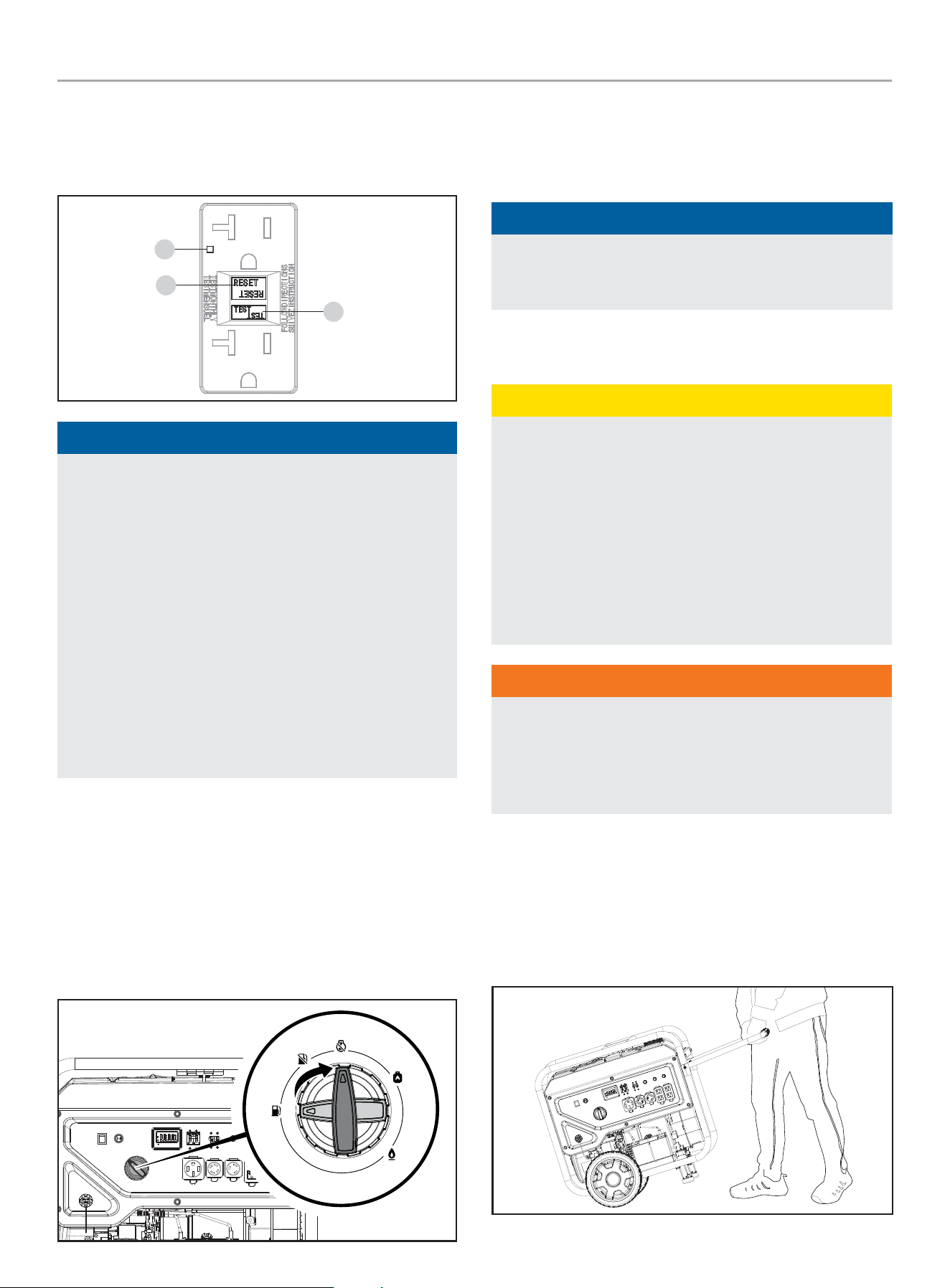
201161 - 12,000W TRI-FUEL PORTABLE GENERATOR
OPERATION
28
3. Press the “RESET” button located on the front of the
receptacle to restore the flow of electricity. If the indicator
light does not come back on or if the GFCI cannot be reset
then it must be replaced.
B
C
A
NOTICE
In any electrical application, some current will flow through
the protective ground conductor to the ground, this is called
leakage current. It takes 4 mA (0.004 A) and higher of leakage
current from the hot wire to the ground to cause a GFCI to trip.
On circuits protected by GFCI’s, leakage current can cause
unnecessary and intermittent tripping.
Some stationary motors, such as a bathroom vent fan,
fluorescent lighting fixtures or some refrigerators, may produce
enough leakage to cause nuisance tripping. To avoid nuisance
tripping, a GFCI should not supply:
– Fluorescent or other types of electric-discharge lighting
fixtures.
– Permanently installed electric motors, like air conditioners,
furnaces or refrigerators.
Stopping the Engine
1. Turn off and unplug all connected electrical loads. Never start
or stop the generator with electrical devices plugged in or
turned on.
2. Let the generator run at no-load for several minutes to
stabilize internal temperatures of the engine and generator.
3. Turn the fuel select dial to the “ENGINE OFF” position.
4. If operating on LPG, close valve on LPG cylinder. If operating
on NG, close NG supply valve.
Important: Always ensure that the fuel select dial is in the “OFF”
position when the generator is not in use.
NOTICE
If the engine will not be used for a period of two (2) weeks or
longer, please see the Storage section for proper engine and
fuel storage.
Moving the Generator
CAUTION
– NEVER lift or carry the generator using the folding handle.
– NEVER tilt sideways while moving the generator.
– ALWAYS place the generator on its wheels in the upright
position.
– ALWAYS turn the generator off and ensure the fuel valve is
closed.
– ALWAYS make sure engine and muffler are cooled down
before the generator can be handled safely (typically 15-30
minutes).
WARNING
The folding handle is not long enough to hold and walk with a
full stride when moving the generator. Always side step as you
walk to avoid injury to your heels and/or feet. Failure to follow
these instructions could result in personal injury or damage to
the generator.
1. Begin by raising the folding handle, found on opposite side of
wheels.
2. Using the handle, tilt the end of the generator slightly off the
ground until balanced on the wheels.
3. While maintaining balance, roll the generator to the desired
location.
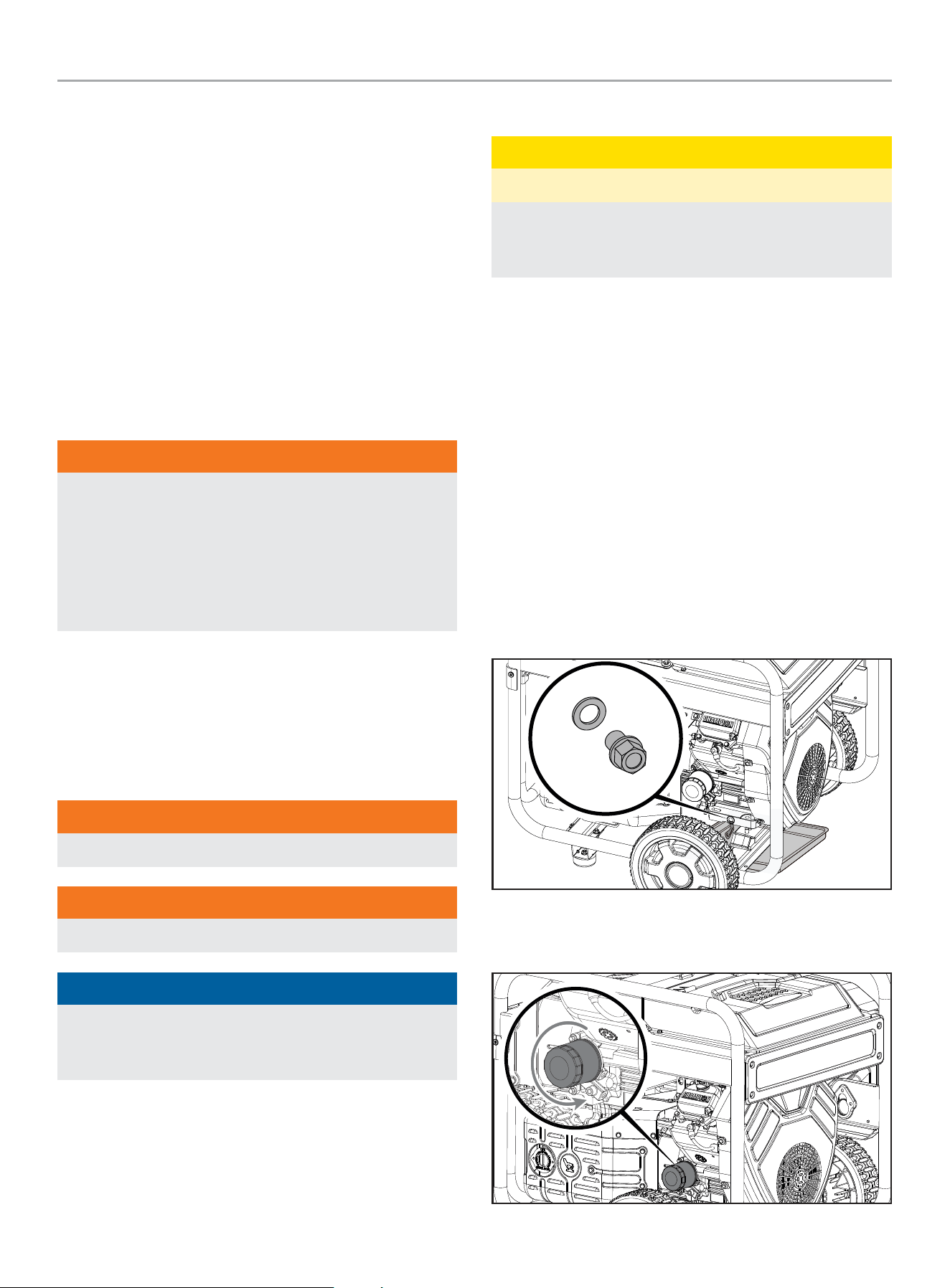
201161 - 12,000W TRI-FUEL PORTABLE GENERATOR
MAINTENANCE
29
Operation at High Altitude
The density of air at high altitudes is lower than at sea level.
Engine power is reduced as the air mass and air-fuel ratio
decrease. Engine power and generator output will be reduced
approximately 3½% for every 1000 ft. of elevation above sea level.
At high altitudes increased exhaust emissions can also result due
to the increased enrichment of the air fuel ratio. Other high altitude
issues can include hard starting, increased fuel consumption and
spark plug fouling.
To place an order for a high-altitude jet, please visit our Help
Center for jet removal instructions on your specific model. You
will need to supply the jet number to the Customer Service
Representative when ordering your high-altitude jet. Please visit
https://help.championpowerequipment.com/ to find the relevant
instructions for your model.
WARNING
Operation using the alternative main jet at elevations lower
than the recommended minimum altitude can damage the
engine. For operation at lower elevations, the originally
supplied standard main jet must be used. Operating the
engine with the wrong engine configuration at a given altitude
may increase its emissions and decrease fuel efficiency and
performance.
MAINTENANCE
Make certain that the generator is kept clean and stored properly.
Only operate the unit on a flat, level surface in a clean, dry
operating environment. DO NOT expose the unit to extreme
conditions, excessive dust, dirt, moisture or corrosive vapors.
WARNING
Never operate a damaged or defective generator.
WARNING
Improper maintenance will void your warranty.
NOTICE
For Emission control devices and systems, read and
understand your responsibilities for service as stated in the
Emission Control Warranty Statement of this manual.
The owner/operator is responsible for all periodic maintenance.
Complete all scheduled maintenance in a timely manner.
Correct any issue before operating the generator.
For service or parts assistance, contact our
Technical Support Team at 1-877-338-0999.
Cleaning the Generator
CAUTION
DO NOT spray generator directly with water.
Water can enter the generator through the cooling slots and
damage the generator windings. It can also contaminate the
fuel system.
1. Use a damp cloth to clean exterior surfaces of the generator.
2. Use a soft bristle brush to remove dirt and oil.
3. Use an air compressor (25 PSI) to clear dirt and debris from
the generator.
4. Inspect all air vents and cooling slots to ensure that they are
clean and unobstructed.
To prevent accidental starting, remove and ground the spark plug
wire before performing any service.
Changing Engine Oil and Filter
Change oil when the engine is warm. Refer to the oil specification
to select the proper grade for your operating environment.
1. Remove the oil drain bolt.
2. Allow the oil to drain completely into an appropriate container.
3. Replace the oil drain bolt.
4. Remove oil filter by turning counterclockwise.
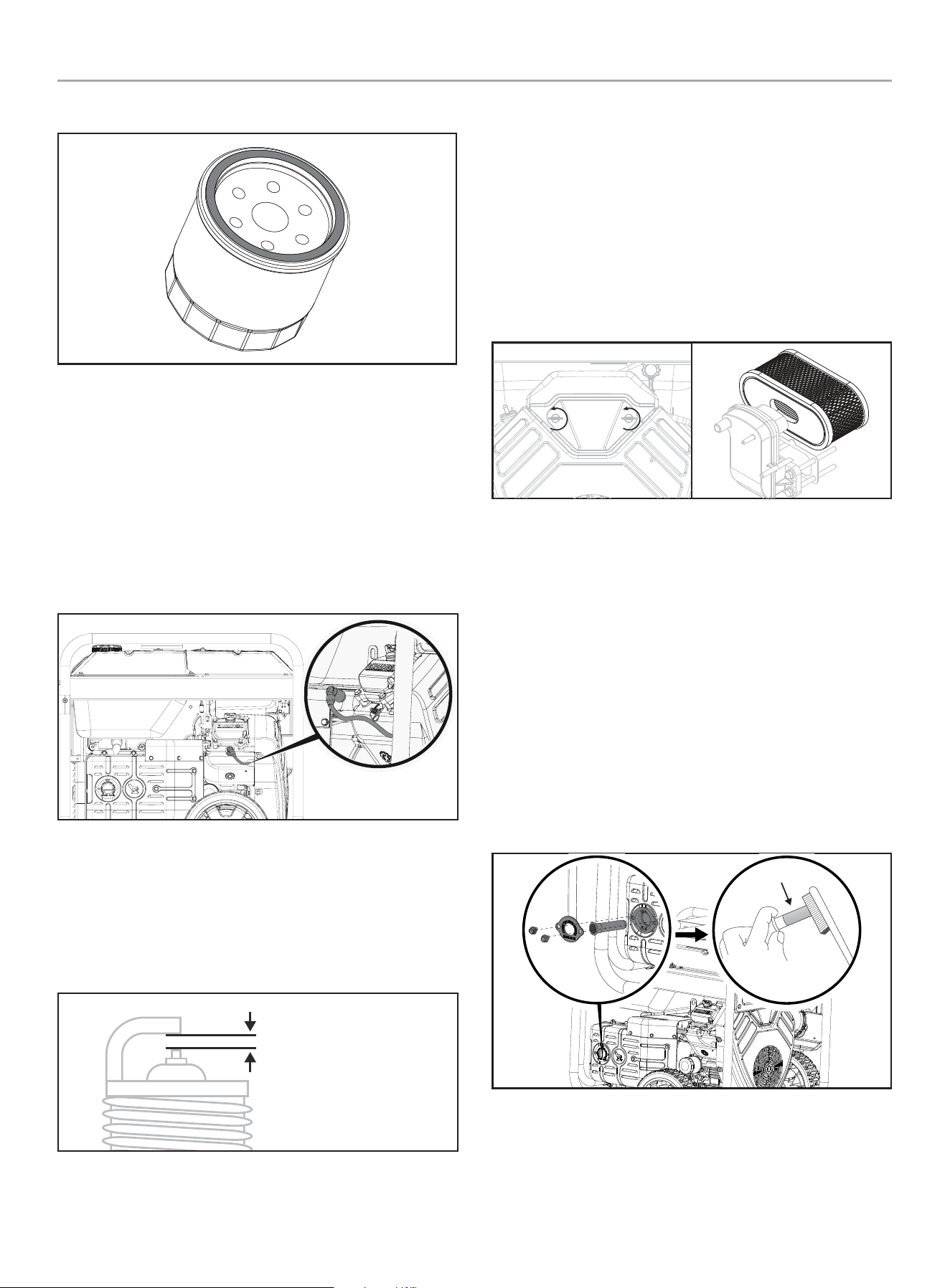
201161 - 12,000W TRI-FUEL PORTABLE GENERATOR
MAINTENANCE
30
5. Apply a light coat of clean oil onto the gasket of new oil filter.
6. Install new oil filter by turning clockwise by hand until gasket
contacts the engine block. Then apply additional 3/4 turn.
7. Add oil according to Add Engine Oil in Assembly section.
DO NOT OVERFILL. Oil not included for routine maintenance.
8. Dispose of used oil and filter at an approved waste
management facility.
Cleaning and Adjusting the Spark Plugs
1. Remove the spark plug cable from the spark plug.
2. Use a spark plug socket tool (not included), or a
13/16 in. (21 mm) socket (not included) to remove the plug.
3. Inspect the electrode on the plug. It must be clean and not
worn to produce the spark required for ignition.
4. Make certain the spark plug gap is
0.022-0.028 in. (0.55-0.7 mm).
SPARK PLUG GAP
5. Refer to the spark plug types in Specifications when replacing
the plug.
6. Firmly re-install the plug.
7. Attach the spark plug cable to the spark plug.
8. Repeat Steps 1-7 for spark plug on other side of engine.
Cleaning the Air Filter
1. Open engine access cover.
2. Remove the air filter cover by turning the two fasteners ¼
turn counterclockwise.
3. Pull the air filter straight out away from engine.
4. Install new air filter.
5. Replace air filter cover and turn the two fasteners ¼ turn
clockwise.
6. Close engine access cover.
Cleaning the Spark Arrestor
1. Allow the engine to cool completely before servicing the spark
arrestor.
2. Remove the two screws holding the cover plate which retains
the spark arrestor to the muffler.
3. Remove the spark arrestor screen.
4. Carefully remove the carbon deposits from the spark arrestor
screen with a wire brush.
5. Replace the spark arrestor if it is damaged.
6. Position the spark arrestor on the muffler and attach with the
screws removed in step 2.
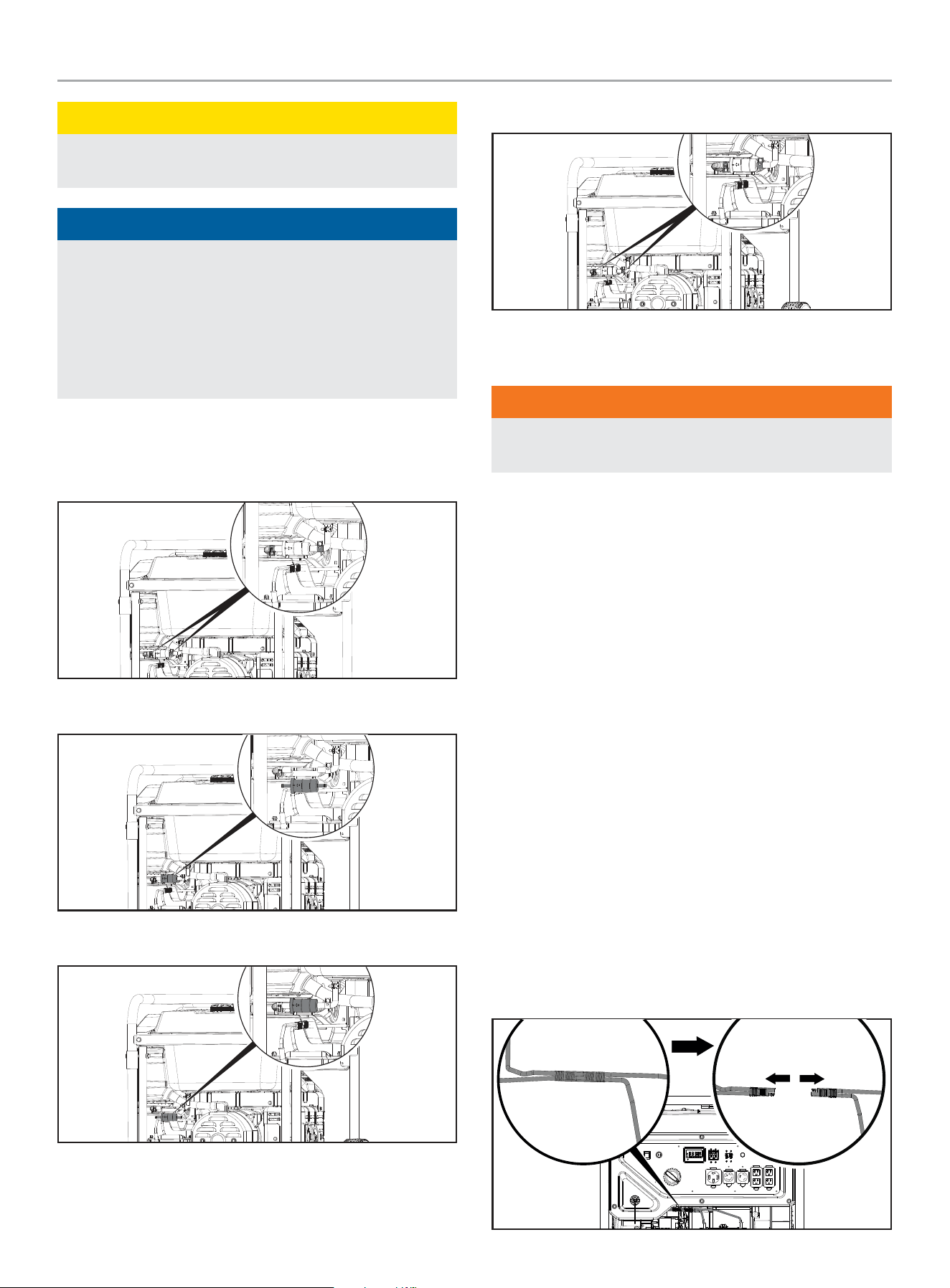
201161 - 12,000W TRI-FUEL PORTABLE GENERATOR
MAINTENANCE
31
CAUTION
Failure to clean the spark arrestor will result in poor engine
performance.
NOTICE
Federal and local laws and administrative requirements
indicate when and where spark arrestors are required. When
ordered, spark arrestors are required for operation of this
generator in National Forest lands. In California, this generator
must not be used on any forest-covered land, brush-covered
land, or grass-covered land unless the engine is equipped with
a spark arrestor.
Replacing Fuel Filter
1. Move clips on each side of fuel filter.
2. Pull fuel hose off each end of fuel filter.
3. Push fuel hose on each end of new filter.
4. Return clips to end of fuel hose.
Adjusting the Governor
WARNING
Tampering with the factory set governor will void your
warranty.
The air-fuel mixture is not adjustable. Tampering with the governor
can damage your generator and your electrical devices and
will void your warranty. Contact our Technical Support Team at
1-877-338-0999 for all other service and/or adjustment needs.
Generator Battery
Your generator is equipped with an automatic battery charging
circuit that charges the battery while the engine is running.
The battery will maintain a proper charge if the unit is used on
a regular basis (about once every two weeks). If it is used less
frequently, the battery should be connected to a trickle charger
or battery maintainer (not included) to keep the battery properly
charged.
Maximum charging rate should not exceed 1.5 amps. Follow
the instructions included with the battery charger. The battery
should be fully charged at least once per month. If the battery is
not able to start the engine, it can be started by manually pulling
the engine recoil cord. If the battery voltage is extremely low, the
charging circuit may not be able to re-charge the battery. In this
case, the battery must be connected to a standard automotive
style battery charger for re-charging before it can be used.
Disconnect the Battery
1. Pull two halves of battery connector apart.
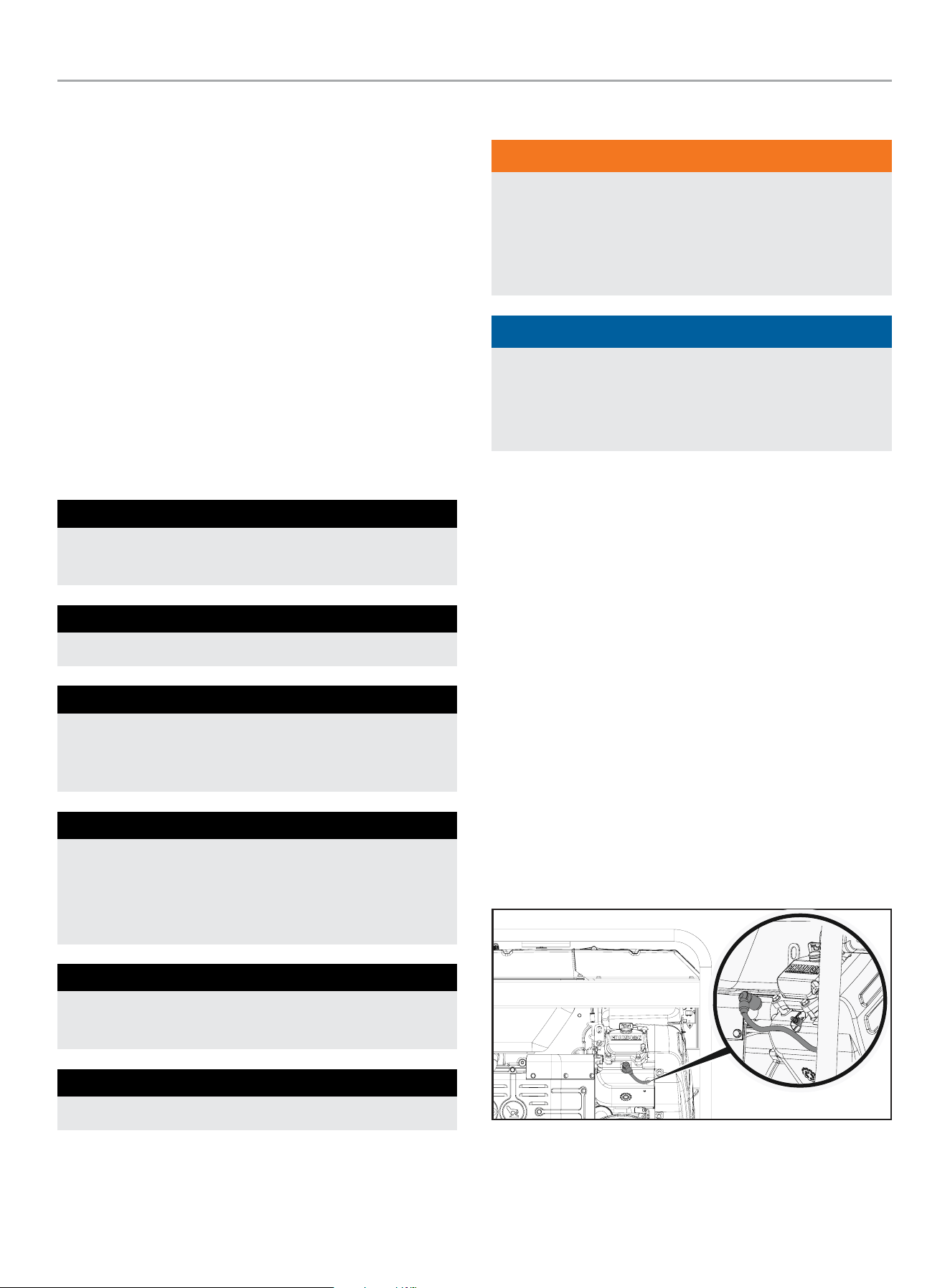
201161 - 12,000W TRI-FUEL PORTABLE GENERATOR
STORAGE
32
Charge the Battery
For a generator equipped with batteries for electric starting,
proper battery maintenance and storage should be followed.
A trickle charger or battery maintainer should be used to charge
the battery while the generator is in storage. Maximum charging
rate should not exceed 1.5 amps. Follow the instructions included
with the trickle charger or battery maintainer. The battery should
be fully charged at least once per month.
Maintenance Schedule
Follow the service intervals indicated in the following maintenance
schedule.
Service your generator more frequently when operating in adverse
conditions.
Contact our Technical Support Team at 1-877-338-0999 to locate
the nearest CPE certified service dealer for your generator or
engine maintenance needs.
EVERY 8 HOURS OR PRIOR TO EACH USE
Check oil level
Clean around air intake and muffler
FIRST 5 HOURS (BREAK IN)
Change oil and oil filter
EVERY 50 HOURS OR ANNUALLY
Clean air filter
Change oil if operating under heavy load or in hot
environments
EVERY 100 HOURS OR ANNUALLY
Change oil and oil filter
Clean/adjust spark plug
Clean spark arrestor
Replace fuel filter
EVERY 250 HOURS
Clean combustion chamber*
Check/adjust valve clearance*
EVERY 3 YEARS
Replace fuel line*
* To be performed by knowledgeable, experienced owners or CPE certified service
centers.
STORAGE
WARNING
To avoid accidental or unintended ignition of your generator
during periods of storage, the following precautions should be
followed:
– When storing the generator make sure the fuel select dial
is set to the “OFF” position.
NOTICE
The following storage instructions apply when gasoline has
been used to run the generator.
NOTE: LPG does not apply and will not create build up or clog
the carburetor.
Short Term Storage (30 days – 1 year)
Ethanol blended gasoline in the tank has a maximum shelf life
of up to 1 year with the addition of a properly formulated fuel
stabilizer and stored in a cool, dry place.
1. Be sure all appliances are disconnected from the generator.
2. Add a properly formulated fuel stabilizer to the gasoline tank.
3. Turn the fuel select dial to the “GASOLINE ON” position.
4. Start and run the generator for 10 minutes so the treated
gasoline cycles through the fuel system.
5. Turn the fuel select dial to the “ENGINE OFF” position.
6. Let the generator run until fuel starvation has stopped the
engine. This may take a few minutes.
7. Press the ignition switch to the “OFF” position.
8. Allow generator to cool completely before continuing.
9. Remove the spark plug cap and spark plug and pour about a
tablespoon of oil into each of the cylinders.
10. Install the spark plug on each cylinder but DO NOT install
spark plug cap.
11. With fuel select dial in the “ENGINE OFF” position, crank
engine for 2 seconds using ignition switch.
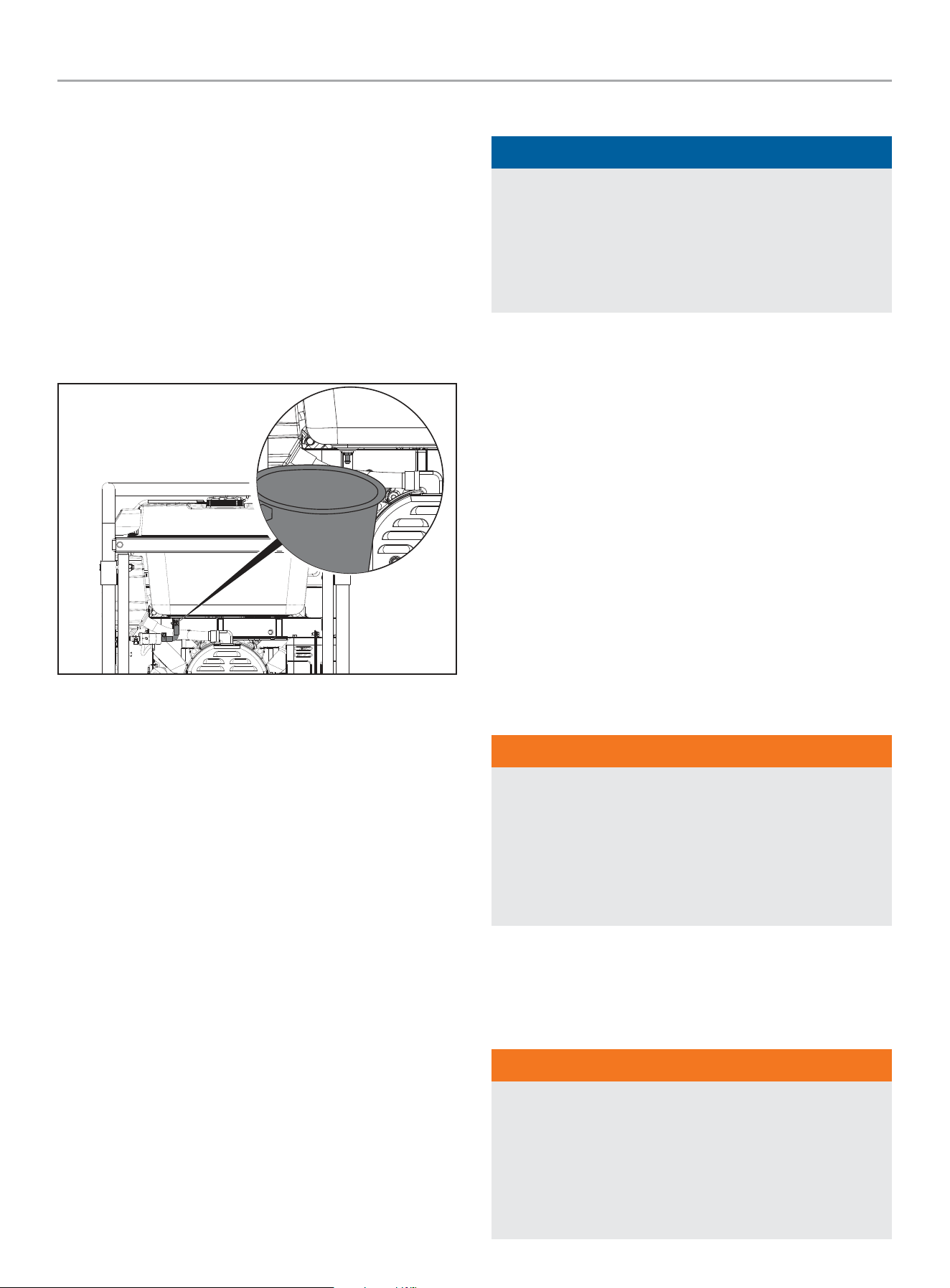
201161 - 12,000W TRI-FUEL PORTABLE GENERATOR
STORAGE
33
12. Install spark plug cap on each cylinder.
13. Clean the generator according to Cleaning the Generator.
14. Store the generator in a cool, dry place out of direct sunlight.
Long Term Storage (over 1 year)
For storage over 1 year, the gasoline tank must be completely
drained of gasoline.
1. The generator is to be OFF and all appliances disconnected.
2. Place appropriate container under the fuel tank drain fitting.
Move clip on fuel line connected to fuel tank. Pull fuel line off
fuel tank fitting to allow fuel to drain into container.
3. When gasoline stops flowing from the fuel tank, return fuel
hose and clip to fuel tank fitting. Properly dispose of the
drained gasoline according to local regulations or guidelines.
4. Follow steps 9-14 according to Short Term Storage.
LPG Storage
Always disconnect the LPG hose from the generator and shut off
the LPG tank for proper storage.
Cover LPG/NG Inlet on Control Panel with protective cap. Always
keep cylinders away from heat.
NG Storage
Always disconnect the NG hose from the generator and shut off
NG fuel supply valve.
Cover LPG/NG Inlet on Control Panel with protective cap.
Removing from Storage: Gasoline
NOTICE
If the generator has been improperly stored for a period longer
than 30 days with ethanol blended gasoline in the gasoline
tank, all fuel must be drained.
If the gasoline tank was properly emptied of all ethanol
blended gasoline prior to the generator being stored, follow the
below steps when removing from storage.
1. Be sure the fuel select dial is in the “ENGINE OFF” position.
2. Add gasoline to the generator according to Add Fuel.
3. Turn the fuel select dial to the “GASOLINE ON” position.
4. After 5 minutes check for any leaking gasoline. If no gasoline
leaks are found, turn the fuel select dial to the “ENGINE OFF”
position.
5. Check engine oil level and add clean, fresh oil if needed. See
Oil Specifications for proper oil type.
6. Check air filter of any obstructions such as bugs or cobwebs.
If necessary, clean air filter according to Cleaning the Air
Filter.
7. Start the generator according to Starting the Engine.
Removing from Storage: Propane (LPG)
Upon removal from storage, inspect LPG fittings and hose lines for
leaks before using the generator.
WARNING
If there is a strong smell of LPG: Close valve on the cylinder.
Check all connections for leaks by wetting the fittings with a
solution of soap and water. Bubbles which appear or bubbles
which grow indicate that a leak exists. Do not smoke or light a
cigarette, or check for leaks using a match, open flame source
or lighter. Contact a qualified technician to inspect and repair
an LPG system if a leak is found, before using the generator.
Removing from Storage: Natural Gas (NG)
Upon removal from storage, inspect NG fittings and hose lines for
leaks before using the generator.
WARNING
If there is a strong smell of NG: Close NG supply valve. Check
all connections for leaks by wetting the fittings with a solution
of soap and water. Bubbles which appear or bubbles which
grow indicate that a leak exists. Do not smoke or light a
cigarette, or check for leaks using a match, open flame source
or lighter. Contact a qualified technician to inspect and repair
an NG system if a leak is found, before using the generator.
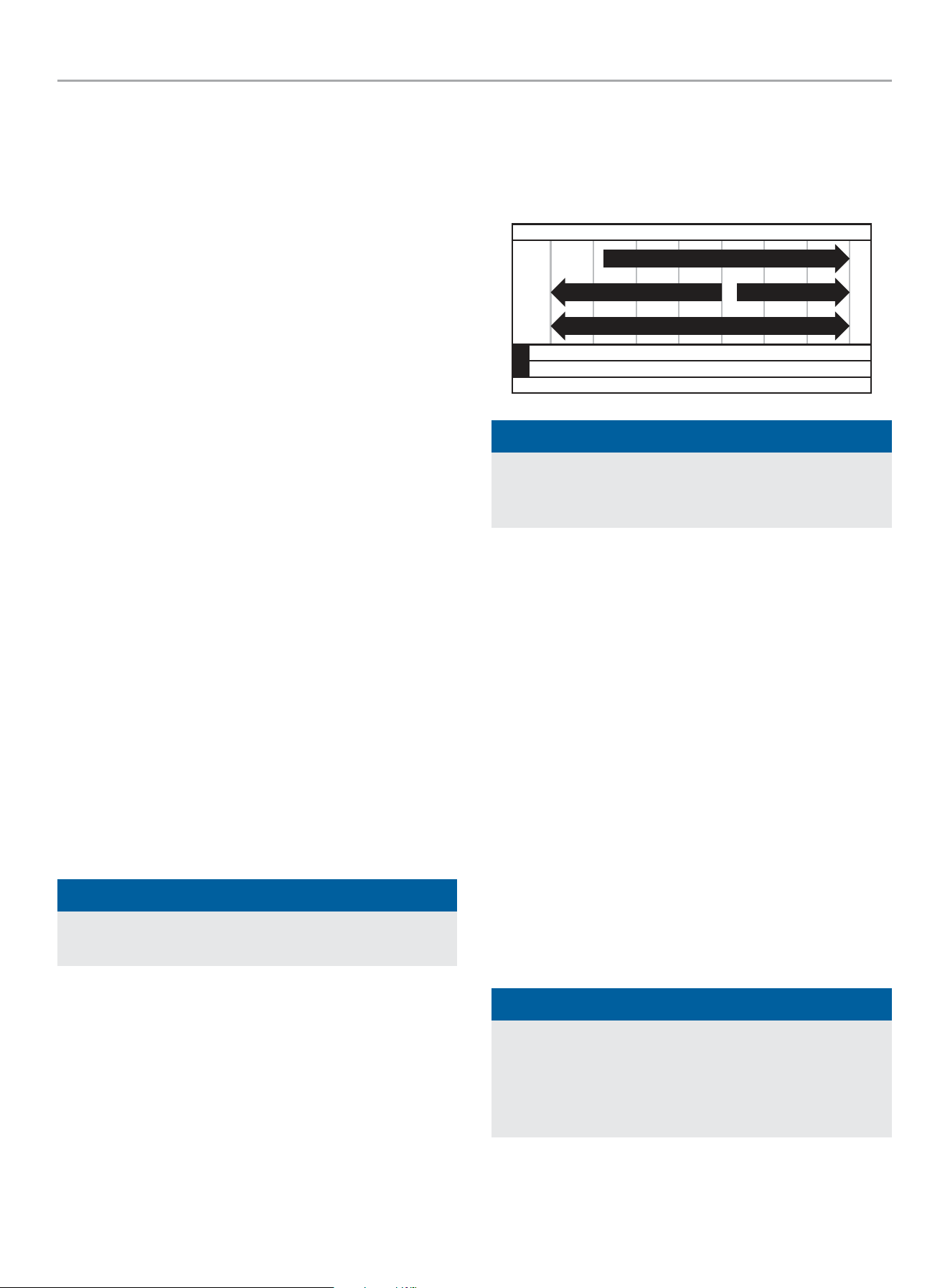
201161 - 12,000W TRI-FUEL PORTABLE GENERATOR
SPECIFICATIONS
34
SPECIFICATIONS
Generator Specifications
Generator Model
........................................... 201161
Start Type ................................................... Electric
Watts (Starting/Running) ........................... 15000/12000
Watts (LPG) (Starting/Running) ...................... 13750/11000
Watts (NG) (Starting/Running) ....................... 12500/10000
Volts AC .....................................................120/240
Gasoline AC Amps @ 120V .....................................100
Gasoline AC Amps @ 240V ...................................... 50
Frequency .....................................................60 Hz
Phase ......................................................... Single
Grounding Type .......................... Neutral Bonded to Frame
Weight ............................................347 lb. (157.5 kg)
Length ..............................................32.7 in. (83 cm)
Width ............................................ 33.7 in. (85.6 cm)
Height .............................................33.1 in. (84.2 cm)
Engine Specifications
Model ..........................................YF2V78FD-SAI-GLN
Displacement .................................................717 cc
Type ..........................................V-Twin, 4-stroke, OHV
Spark Plug
OEM Type ..................................................... F7RTC
Replacement Type ......................NGK BPR7ES or equivalent
Gap ................................0.022-0.028 in. (0.55-0.7 mm)
Valve
Intake Clearance ................. 0.005-0.007 in. (0.13-0.17 mm)
Exhaust Clearance ............... 0.005-0.007 in. (0.13-0.17 mm)
NOTICE
A technical bulletin regarding valve adjustment procedures is
available at www.championpowerequipment.com.
Oil Specifications
DO NOT OVERFILL.
Type ............................................*See following chart
Capacity ...................................... 47.3 fl. oz. (1400 ml)
-20 0 20 40 60
Ambient temperature
Recommended Engine Oil Type
80 100 120
-28.9
°F
°C
-17.8 -6.7 4.4 15.6 26.7 37.8 48.9
10W-30
5W-30 Full Synthetic
10W-405W-30
NOTICE
Temperature will affect engine oil and engine performance.
Change the type of engine oil used based on temperature
shown in the “Recommended Engine Oil Type” table.
Fuel Specifications
Gasoline
Use unleaded gasoline with a minimum octane rating of 87 and
an ethanol content of 10% or less by volume. DO NOT USE E15 or
E85. DO NOT OVERFILL.
Gasoline Capacity ................................. 11 gal. (41.20 L)
Propane (LPG)
– Use only an approved LPG cylinder equipped with an OPD
(overfilling prevention device) valve.
Natural Gas (NG)
– A dedicated NG fuel supply line with shut-off valve is
mandatory for proper operation. The gas supply line and
shut-off valve coming out of the house MUST be sized to the
minimum flow rate as specified in the following table. Improper
gas supply sizing from the house is the number one cause
for poor operating performance such as hard starting or poor
output power.
NOTICE
Consult your local fuel supplier and municipality for guidance
on proper local codes and installations. All piping must
comply with ANSI Z21.54/CSA 8.4 and related codes. Gas line
connections should be made by a certified plumber familiar
with local codes.
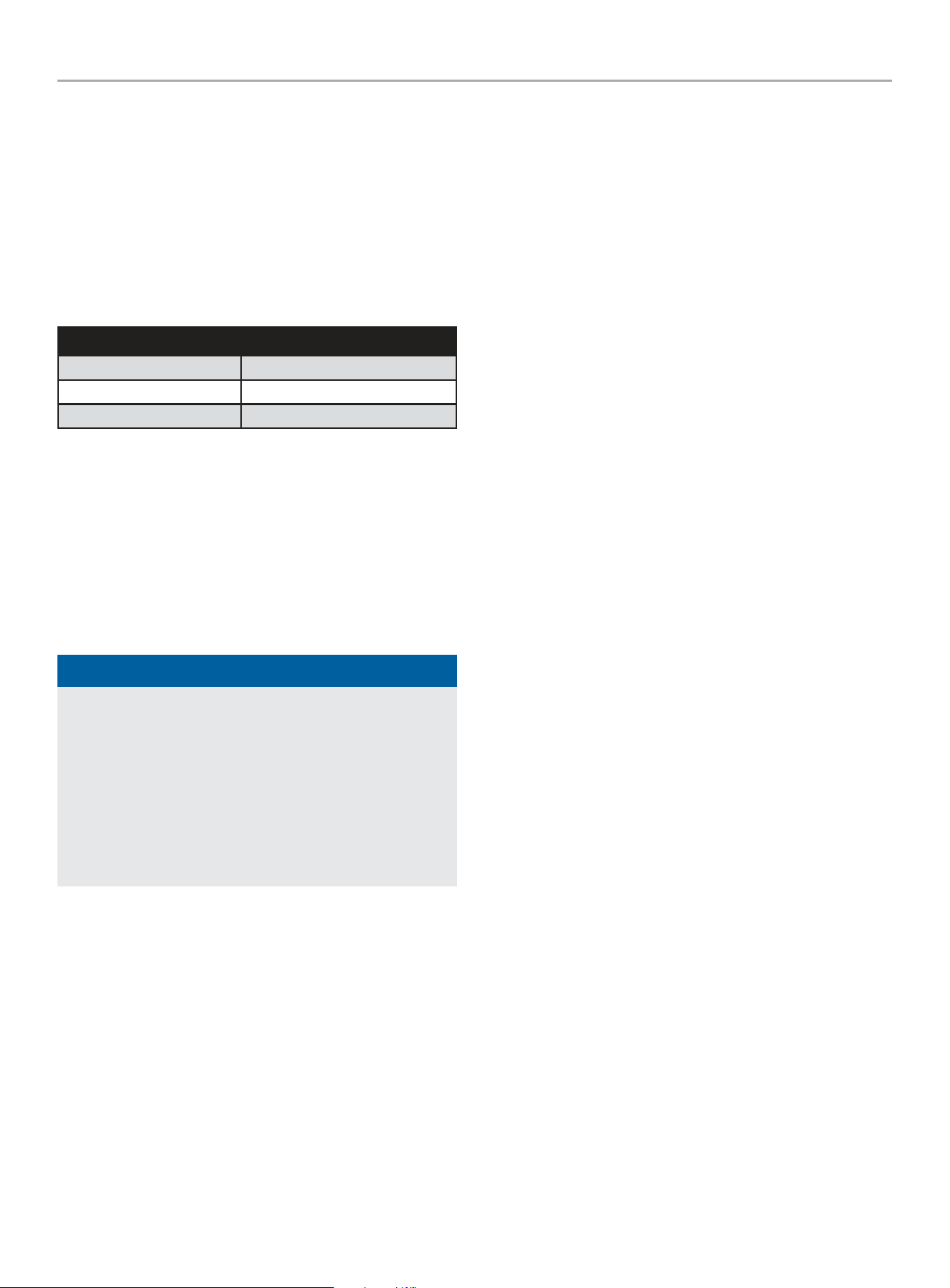
201161 - 12,000W TRI-FUEL PORTABLE GENERATOR
SPECIFICATIONS
35
– The NG fuel supply should have a BTU content of at least
1,000 BTU’s per cubic foot. Contact the fuel supplier for the
BTU content of the supplied NG.
– NG companies have different gas meters for increased
demands. Verify that the current gas meter can provide
enough NG flow to accommodate the additional demand of the
generator with the current household appliances or other NG
loads. Also ask what pressure the primary regulator on the
gas meter is set to. The generator requires 5-7 inches water
column pressure to run properly.
Natural Gas Fuel System Requirements
Nominal fuel rating 1000 BTU/cu ft
Fuel supply pressure 5-7” W.C. (1.2-1.7 kPa W.C.)
Minimum flow rate 200,000 BTU/hr
Battery Specifications
Type
....................... Rechargeable, Non-Spillable Lead Acid
Volts DC .......................................................... 12
Capacity .......................................................33 Ah
Temperature Specifications
Starting Temperature Range (°F/°C) ........... 5 to 104/-15 to 40
NOTICE
An important message about temperature: Your product
is designed and rated for continuous operation at ambient
temperatures up to 104°F (40°C). When needed, it may be
operated at temperatures ranging from 5°F (-15°C) to 122°F
(50°C) for short periods of time. If exposed to temperatures
outside this range during storage, it should be brought back
within this range before operation. In any event, the product
must always be operated outdoors, in a well-ventilated area
and away from doors, windows and vents.
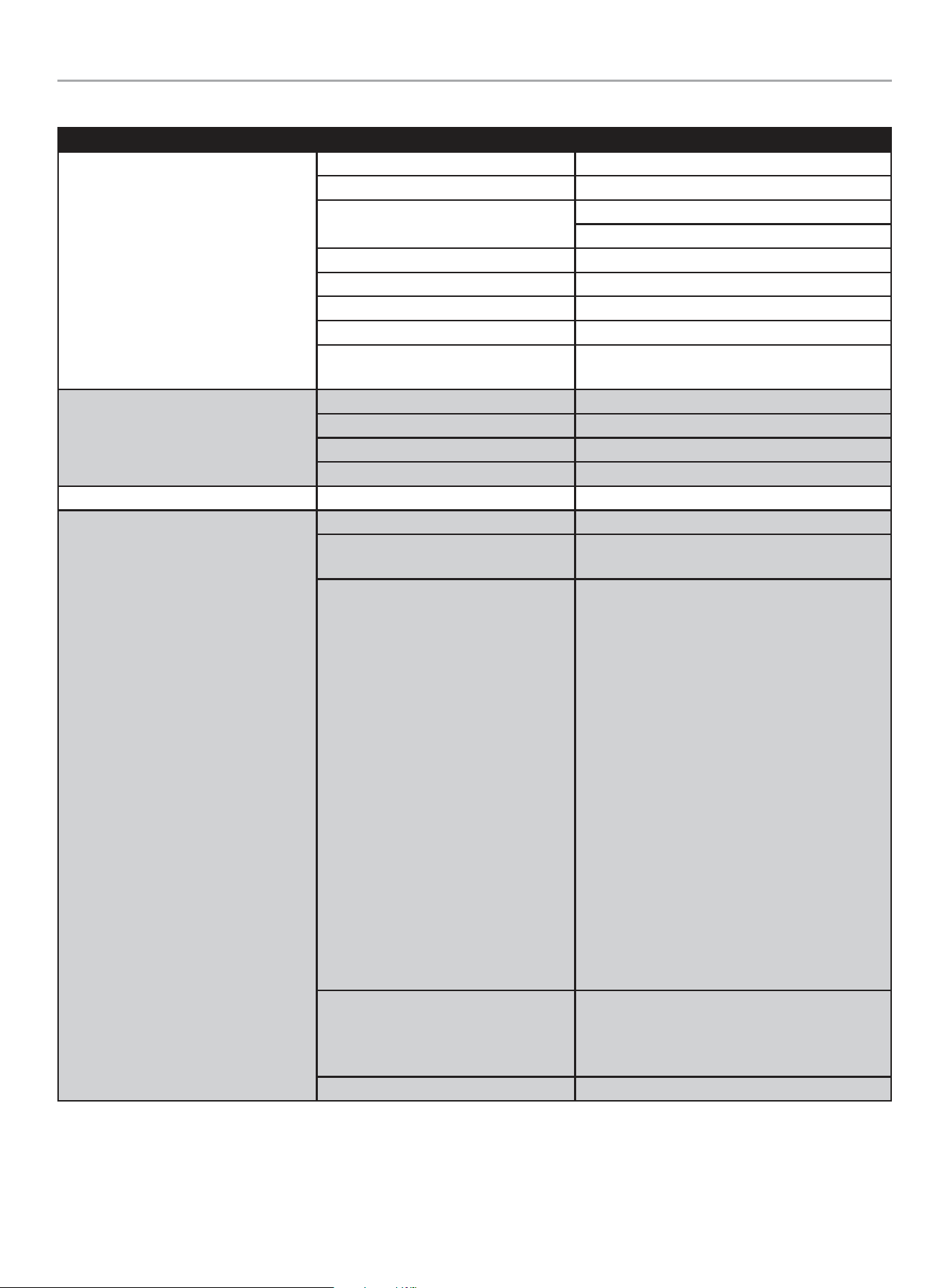
201161 - 12,000W TRI-FUEL PORTABLE GENERATOR
TROUBLESHOOTING
36
TROUBLESHOOTING
Problem Cause Solution
Engine will not start.
No fuel. Add fuel.
Faulty spark plug. Clean and adjust spark plug or replace.
Low oil level.
Fill crankcase to the proper level.
Place generator on a flat, level surface.
Spark plug wire loose. Attach wire to spark plug. Check both spark plugs.
Fuel select dial OFF. Move fuel select dial to appropriate fuel.
Old fuel or water in fuel. Drain fuel and replace with fresh fuel.
Flooded with fuel. Let unit stand for 10 minutes.
CO Shield
®
module has been removed or
tampered with.
Re-install module or contact technical support.
Engine starts but runs roughly.
Choke in the wrong position. Push choke knob in.
Dirty air filter. Clean or replace air filter.
Dirty fuel filter. Replace fuel filter.
Clogged spark arrestor. Clean spark arrestor.
Engine will not start electrically. Generator battery is dead. Recharge generator battery.
Engine shuts down during operation.
Out of fuel. Fill fuel tank.
Low oil level.
Fill crankcase to the proper level. Place generator
on a flat, level surface.
If equipped, when CO Shield
®
shutoffs
occur due to accumulating carbon
monoxide (CO) and if the red LED light
blinks on the panel.
Move generator to an open, outdoor area. Point
exhaust away from people and buildings. Move
to fresh air and get medical help if sick, dizzy, or
weak.
Make sure there are no objects creating
obstructions within 5 feet of the generator.
Obstructions in the vicinity of the generator
may trap carbon monoxide emissions near the
generator and cause the engine to shutoff.
If the generator’s exhaust is facing into the
wind, the exhaust may be blown back into
the generator’s operating area, creating an
accumulation of CO emissions and triggering an
engine shutoff. To avoid an engine shutoff, turn
the generator 45° in either direction to allow
the exhaust emissions to blow away from the
generator. If engine shutoff events continue,
readjust and align the exhaust with the wind
direction to blow away from the generator.
If equipped, when CO Shield
®
shutoffs
occur due to system fault and if the
yellow LED light blinks on the panel.
Start by confirming yellow LED light blinks when/
if generator shuts off. If CO Shield
®
continues to
sense the fault and shuts off, contact technical
support.
Clogged spark arrestor. Clean spark arrestor.
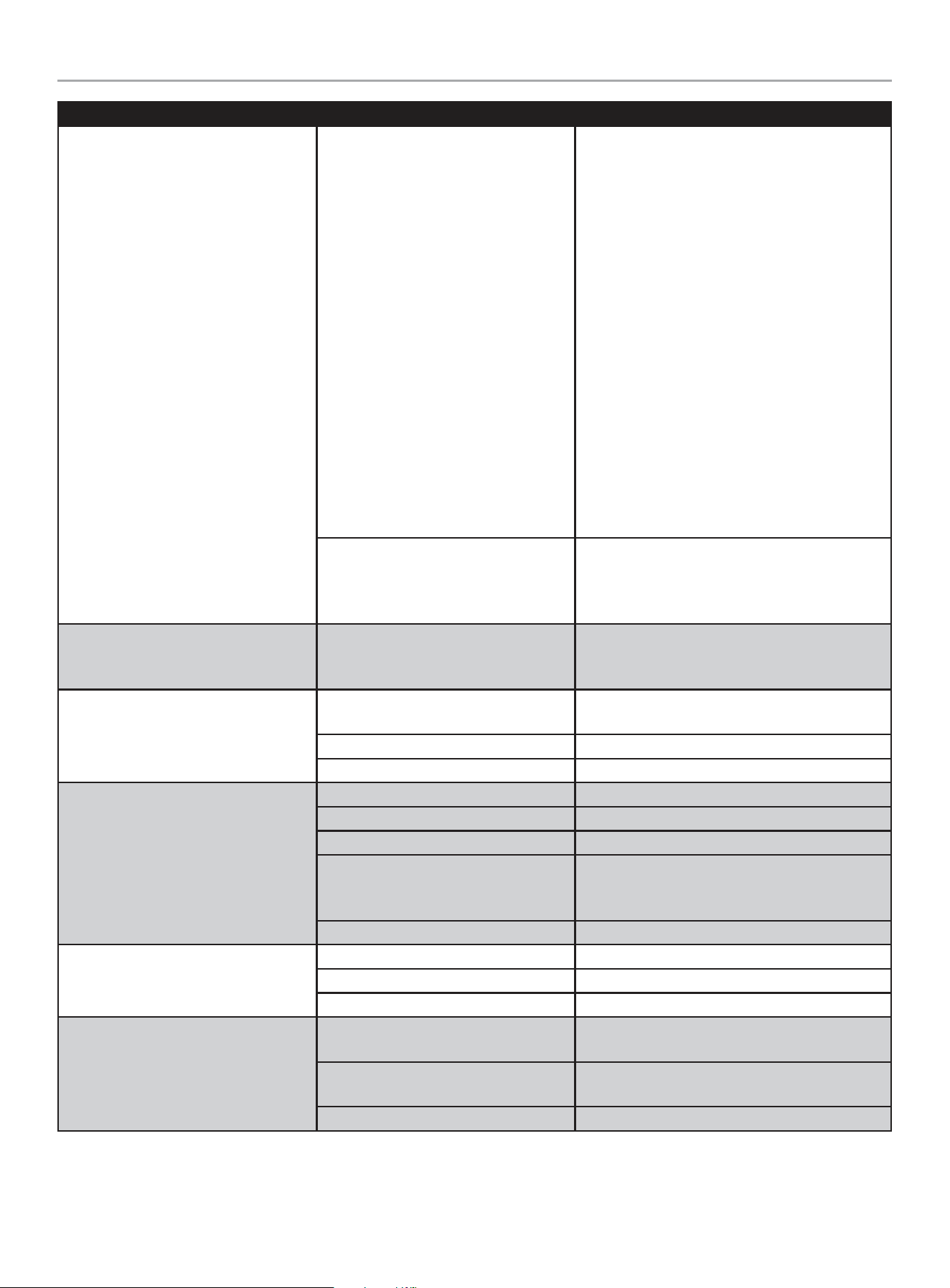
201161 - 12,000W TRI-FUEL PORTABLE GENERATOR
TROUBLESHOOTING
37
Problem Cause Solution
Engine starts and shuts off right away.
If equipped, when CO Shield
®
shutoffs
occur due to accumulating carbon
monoxide (CO) and if the red LED light
blinks on the panel.
Move generator to an open, outdoor area. Point
exhaust away from people and buildings. Move
to fresh air and get medical help if sick, dizzy, or
weak.
Make sure there are no objects creating
obstructions within 5 feet of the generator.
Obstructions in the vicinity of the generator
may trap carbon monoxide emissions near the
generator and cause the engine to shutoff.
If the generator’s exhaust is facing into the
wind, the exhaust may be blown back into
the generator’s operating area, creating an
accumulation of CO emissions and triggering an
engine shutoff. To avoid an engine shutoff, turn
the generator 45° in either direction to allow
the exhaust emissions to blow away from the
generator. If engine shutoff events continue,
readjust and align the exhaust with the wind
direction to blow away from the generator.
If equipped, when CO Shield
®
shutoffs
occur due to system fault and if the
yellow LED light blinks on the panel.
Start by confirming yellow LED light blinks when/
if generator shuts off. If CO Shield
®
continues to
sense the fault and shuts off, contact technical
support.
Both CO Shield
®
LEDs not blinking 10
times upon start up.
Starting the generator within 1 minute
after being manually shutoff, not a CO
shutoff event.
Wait 1 minute before trying to restart the
generator. The LEDs should then blink ten (10)
times.
Generator cannot supply enough power
or overheating.
Generator is overloaded.
Review load and adjust. See “Connecting
Electrical Loads.”
Dirty air filter. Clean or replace air filter.
Choke in wrong position. Push choke knob in.
Engine is running but no AC output.
Poor cord connection. Check all connections.
Circuit breaker is open. Reset circuit breaker. Check all circuit breakers.
Loose wiring. Inspect and tighten wiring connections.
GFCI tripped.
Reset GFCI receptacle breakers by first pushing
the TEST button then the RESET button until
green LED illuminates. Contact the help line.
Other. Contact the help line.
Engine hunts or falters.
Engine governor defective. Contact the help line.
Dirty fuel filter. Replace fuel filter.
Choke in wrong position. Push choke knob in.
Repeated circuit breaker tripping.
Overload.
Review load and adjust. See “Connecting
Electrical Loads.”
Faulty power cords or device.
Check for damaged, bare or frayed wires. Replace
defective device.
Circuit breaker still too hot. Let unit sit for 5 minutes.
For other issues and technical support:
Technical Support Team
Toll Free 1-877-338-0999
support@championpowerequipment.com

WARRANTY*
CHAMPION POWER EQUIPMENT
3 YEAR LIMITED WARRANTY
Warranty Qualifications
To register your product for warranty and FREE lifetime call center
technical support please visit:
https://www.championpowerequipment.com/register
To complete registration you will need to include a copy of the
purchase receipt as proof of original purchase. Proof of purchase
is required for warranty service. Please register within ten (10)
days from date of purchase.
Repair/Replacement Warranty
CPE warrants to the original purchaser that the mechanical and
electrical components will be free of defects in material and
workmanship for a period of three years (parts and labor) from
the original date of purchase and 270 days (parts and labor) for
commercial and industrial use. Transportation charges on product
submitted for repair or replacement under this warranty are the
sole responsibility of the purchaser. This warranty only applies to
the original purchaser and is not transferable.
Do Not Return The Unit To The Place Of
Purchase
Contact CPE’s Technical Service and CPE will troubleshoot any
issue via phone or e-mail. If the problem is not corrected by
this method, CPE will, at its option, authorize evaluation, repair
or replacement of the defective part or component at a CPE
Service Center. CPE will provide you with a case number for
warranty service. Please keep it for future reference. Repairs or
replacements without prior authorization, or at an unauthorized
repair facility, will not be covered by this warranty.
Warranty Exclusions
This warranty does not cover the following repairs and equipment:
Normal Wear
Products with mechanical and electrical components need
periodic parts and service to perform well. This warranty does not
cover repair when normal use has exhausted the life of a part or
the equipment as a whole.
Installation, Use and Maintenance
This warranty will not apply to parts and/or labor if the product is
deemed to have been misused, neglected, involved in an accident,
abused, loaded beyond the product’s limits, modified, installed
improperly or connected incorrectly to any electrical component.
Normal maintenance is not covered by this warranty and is not
required to be performed at a facility or by a person authorized by
CPE.
Other Exclusions
This warranty excludes:
– Cosmetic defects such as paint, decals, etc.
– Wear items such as filter elements, o-rings, etc.
– Accessory parts such as starting batteries, and storage
covers.
– Failures due to acts of God and other force majeure events
beyond the manufacturer’s control.
– Problems caused by parts that are not original Champion
Power Equipment parts.
– Used for prime power in place of existing utility power (where
utility power is present) or in place of utility power where utility
power service does not normally exist. Prime power includes
any application that does not use the utility grid for electric
power (example: solar power).
Limits of Implied Warranty and
Consequential Damage
Champion Power Equipment disclaims any obligation to cover
any loss of time, use of this product, freight, or any incidental
or consequential claim by anyone from using this product.
THIS WARRANTY AND THE ATTACHED U.S. EPA and/or CARB
EMISSION CONTROL SYSTEM WARRANTIES (WHEN APPLICABLE)
ARE IN LIEU OF ALL OTHER WARRANTIES, EXPRESS OR IMPLIED,
INCLUDING WARRANTIES OF MERCHANTABILITY OR FITNESS
FOR A PARTICULAR PURPOSE.
A unit provided as an exchange will be subject to the warranty
of the original unit. The length of the warranty governing the
exchanged unit will remain calculated by reference to the purchase
date of the original unit.
This warranty gives you certain legal rights which may change
from state to state or province to province. Your state or province
may also have other rights you may be entitled to that are not
listed within this warranty.
Contact Information
Address
Champion Power Equipment, Inc.
6370 S Pioneer Way, Unit 101
Las Vegas, NV 89113 USA
www.championpowerequipment.com
Customer Service
Toll Free: 1-877-338-0999
info@championpowerequipment.com
Fax no.: 1-562-236-9429
Technical Service
Toll Free: 1-877-338-0999
tech@championpowerequipment.com
EMERGENCY 24 HOUR SUPPORT: 1-562-204-1188
*Except as otherwise stipulated in any of the following enclosed Emission Control System Warranties (when applicable) for the Emission Control System: U.S. Environment Protection Agency
(EPA) and/or California Air Resources Board (CARB).

CHAMPION POWER EQUIPMENT, INC. (CPE)
AND THE UNITED STATES ENVIRONMENT PROTECTION AGENCY (U.S. EPA)
EMISSION CONTROL SYSTEM WARRANTY
Your Champion Power Equipment (CPE) engine complies with U.S. EPA emission regulations.
YOUR WARRANTY RIGHTS AND OBLIGATIONS:
The U.S. EPA and CPE are pleased to explain the Federal Emission Control Systems Warranty on your 2025 small off-road engine and
engine powered equipment. New engines and equipment must be designed, built and equipped, at the time of sale, to meet U.S. EPA
regulations for small off-road engines. CPE warrants the emission control system on your small off-road engine and equipment for the
period of time listed below, provided there has been no abuse, neglect, unapproved modification, or improper maintenance of your
equipment.
Your emission control system may include parts such as the carburetor, fuel-injection system, the ignition system, catalytic converter and
fuel lines. Also included may be hoses, belts, connectors and other emission related assemblies. Where a warrantable condition exits, CPE
will repair your small off-road engine at no cost to you including diagnosis, parts and labor.
MANUFACTURER’S EMISSION CONTROL SYSTEM WARRANTY COVERAGE:
This emission control system is warranted for two years, subject to provisions set forth below. If, during the warranty period, an emission
related part on your engine is defective in materials or workmanship, the part will be repaired or replaced by CPE.
OWNER WARRANTY RESPONSIBILITIES:
As the small off-road engine owner, you are responsible for the performance of the required maintenance listed in your Owner’s Manual.
CPE recommends that you retain all your receipts covering maintenance on your small off-road engine, but CPE cannot deny warranty
solely for the lack of receipts or for your failure to ensure the performance of all scheduled maintenance.
As the small off-road engine owner, you should however be aware that CPE may deny you warranty coverage if your small, off-road engine
or a part has failed due to abuse, neglect, improper maintenance or unapproved modifications.
You are responsible for presenting your small off-road engine to an Authorized CPE service outlet or alternate service outlet as described
in (3)(f.) below, CPE dealer or CPE, Las Vegas, NV. as soon as a problem exists. The warranty repairs should be completed in a reasonable
amount of time, not to exceed 30 days.
If you have any questions regarding your warranty rights and responsibilities, you should contact:
Champion Power Equipment, Inc.
Customer Service
6370 S Pioneer Way, Unit 101
Las Vegas, NV 89113
1-877-338-0999
tech@championpowerequipment.com

EMISSION CONTROL SYSTEM WARRANTY
The following are specific provisions relative to your Emission Control System (ECS) Warranty Coverage.
1. APPLICABILITY: This warranty shall apply to 1997 and later model year small off-road engines. The ECS Warranty Period shall begin
on the date the new engine or equipment is delivered to its original, end-use purchaser, and shall continue for 24 consecutive months
thereafter.
2. GENERAL EMISSIONS WARRANTY COVERAGE
CPE warrants to the original, end-use purchaser of the new engine or equipment and to each subsequent purchaser that each of its
small off-road engines is:
2a. Designed, built and equipped so as to conform to U.S. EPA emissions standards for spark-ignited engines at or below 19 kilowatts.
2b. Free from defects in materials and workmanship that cause the failure of a warranted part to be identical in all material respects
to the part as described in the engine manufacturer’s application for certification for a period of two years.
3. THE WARRANTY ON EMISSION-RELATED PARTS WILL BE INTERPRETED AS FOLLOWS:
3a. Any warranted part that is not scheduled for replacement as required maintenance in the Owners Manual shall be warranted for
the ECS Warranty Period. If any such part fails during the ECS Warranty Period, it shall be repaired or replaced by CPE according
to Subsection “d” below. Any such part repaired or replaced under the ECS Warranty shall be warranted for any remainder of the
ECS Warranty Period.
3b. Any warranted, emissions-related part which is scheduled only for regular inspection as specified in the Owners Manual shall be
warranted for the ECS Warranty Period. A statement in such written instructions to the effect of “repair or replace as necessary”,
shall not reduce the ECS Warranty Period. Any such part repaired or replaced under the ECS Warranty shall be warranted for the
remainder of the ECS Warranty Period.
3c. Any warranted, emissions-related part which is scheduled for replacement as required maintenance in the Owner’s Manual shall
be warranted for the period of time prior to the first scheduled replacement point for that part. If the part fails prior to the first
scheduled replacement, the part shall be repaired or replaced by CPE according to Subsection “d” below. Any such emissions-
related part repaired or replaced under the ECS Warranty, shall be warranted for the remainder of the ECS Warranty Period prior to
the first scheduled replacement point for such emissions-related part.
3d. Repair or replacement of any warranted, emissions-related part under this ECS Warranty shall be performed at no charge to the
owner at a CPE Authorized Service Outlet.
3e. The owner shall not be charged for diagnostic labor which leads to the determination that a part covered by the ECS Warranty is in
fact defective, provided that such diagnostic work is performed at a CPE Authorized Service Outlet.
3f. CPE shall pay for covered emissions warranty repairs at non-authorized service outlets under the following circumstances:
i. The service is required in a population center with a population over 100,000 according to U.S. Census 2000 without a CPE
Authorized Service Outlet AND
ii. The service is required more than 100 miles from a CPE Authorized Service Outlet. The 100 mile limitation does not apply in the
following states: Alaska, Arizona, Colorado, Hawaii, Idaho, Montana, Nebraska, Nevada, New Mexico, Oregon, Texas, Utah and
Wyoming.
3g. CPE shall be liable for damages to other original engine components or approved modifications proximately caused by a failure
under warranty of an emission-related part covered by the ECS Warranty.
3h. Throughout the ECS Warranty Period, CPE shall maintain a supply of warranted emission-related parts sufficient to meet the
expected demand for such emission-related parts.
3i. Any CPE Authorized and approved emission-related replacement part may be used in the performance of any ECS Warranty
maintenance or repair and will be provided without charge to the owner. Such use shall not reduce CPE’s warranty obligation.
3j. Unapproved add-on or modified parts may not be used to modify or repair a CPE engine. Such use voids this ECS Warranty and
shall be sufficient grounds for disallowing an ECS Warranty claim. CPE shall not be liable hereunder for failures of any warranted
parts of a CPE engine caused by the use of such an unapproved add-on or modified part.
EMISSION-RELATED PARTS INCLUDE THE FOLLOWING: (using those portions of the list applicable to the
engine)
Systems covered by this
warranty
Parts Description
Fuel Metering System Fuel regulator, Carburetor and internal parts
Air Induction System Air cleaner, Intake manifold
Ignition System Spark plug and parts, Magneto ignition system
Exhaust System Exhaust manifold, catalytic converter
Miscellaneous Parts Tubing, Fittings, Seals, Gaskets, and Clamps associated with these listed systems.
Evaporative Emissions Fuel Tank, Fuel Cap, Fuel Line (for liquid fuel and fuel vapors), Fuel Line Fittings, Clamps, Pressure
Relief Valves, Control Valves, Control Solenoids, Electronic Controls, Vacuum Control Diaphragms,
Control Cables, Control Linkages, Purge Valves, Gaskets, Vapor Hoses, Liquid/Vapor Separator,
Carbon Canister, Canister Mounting Brackets, Carburetor Purge Port Connector
TO OBTAIN WARRANTY SERVICE:
You must take your CPE engine or the product on which it is installed, along with your warranty registration card or other proof of original
purchase date, at your expense, to any Champion Power Equipment dealer who is authorized by Champion Power Equipment, Inc. to
sell and service that CPE product during his normal business hours. Alternate service locations defined in Section (3)(f.) above must be
approved by CPE prior to service. Claims for repair or adjustment found to be caused solely by defects in material or workmanship will not
be denied because the engine was not properly maintained and used.
If you have any questions regarding your warranty rights and responsibilities, or to obtain warranty service, please write or call
Customer Service at Champion Power Equipment, Inc.
Champion Power Equipment, Inc.
6370 S Pioneer Way, Unit 101
Las Vegas, NV 89113
1-877-338-0999
Attn.: Customer Service
tech@championpowerequipment.com