FUSION APOLLO
™
MS-RA800
Owner’s Manual

© 2025 Garmin Ltd. or its subsidiaries
All rights reserved. Under the copyright laws, this manual may not be copied, in whole or in part, without the written consent of Garmin. Garmin reserves the right to change
or improve its products and to make changes in the content of this manual without obligation to notify any person or organization of such changes or improvements. Go to
www.garmin.com for current updates and supplemental information concerning the use of this product.
Garmin
®
, Garmin BlueNet
™
, ANT
®
, Fusion
®
, and the Fusion logo are trademarks of Garmin Ltd. or its subsidiaries, registered in the USA and other countries. Fusion Apollo
™
, Connect
IQ
™
, Fusion
®
Audio, and Fusion PartyBus
™
are trademarks of Garmin Ltd. or its subsidiaries. These trademarks may not be used without the express permission of Garmin.
Apple, the Apple logo, and iPhone, are trademarks of Apple Inc., registered in the USA and other countries. App Store
SM
is a service mark of Apple Inc., registered in the USA and
other countries. Android
™
and Google Play
™
are a trademarks of Google Inc. BLUETOOTH
®
word mark and logos are owned by the Bluetooth SIG, Inc. and any use of such marks by
Garmin is under license. NMEA 2000
®
, and the NMEA 2000 logo are registered trademarks of the National Marine Electronics Association. Wi‑Fi
®
is a registered mark of Wi-Fi Alliance
Corporation. Other trademarks and trade names are those of their respective owners.
M/N: MS-RA800, A04580/B04580
IC: 1792A-A04580
船用音響主機

Table of Contents
Getting Started................................. 1
Stereo Controls........................................1
Playback Controls............................... 2
Gesture Screen................................ 3
Entering Text........................................ 3
Using the Dial to Select Items.............3
Stereo Screen.......................................... 3
Status Icons......................................... 4
Naming the Device.................................. 4
Setting the Home Zone........................... 4
Selecting a Source.................................. 4
Adjusting the Backlight and Dial
Brightness................................................ 4
Audio Control................................... 5
Adjusting the Volume..............................5
Muting all Connected Stereos............ 5
Adjusting the Subwoofer Level........... 5
Adjusting the Tone.................................. 5
Disabling the Loud Setting for a
Zone......................................................... 5
Adjusting the Gain for an Auxiliary
Device...................................................... 6
Speaker Zones.........................................6
DSP Settings............................................ 6
Configuring the DSP Settings............. 6
Automatic Volume Adjustment Based on
Speed....................................................... 7
Media Player Connection.................. 7
Bluetooth Device Playback............... 7
Connecting a Compatible Bluetooth
Device...................................................... 8
Bluetooth Range Information............. 8
Selecting a Different Bluetooth
Device...................................................... 8
Bluetooth Source Menu and Settings.... 9
Disabling Bluetooth Auto
Connection........................................... 9
Correcting Bluetooth Audio and Video
Synchronization Issues....................... 9
USB Device Playback...................... 10
USB Device Compatibility..................... 10
Connecting a USB Device................. 10
Controlling Music Playback on a USB
Flash Drive or Media Player.................. 11
Controlling Music Playback on a
Connected Apple Device.......................11
USB Source Settings............................. 11
Radio..............................................11
Setting the Tuner Region...................... 11
Changing the Radio Station.................. 12
Apple AirPlay..................................12
Connecting an Apple Device Using
AirPlay.................................................... 12
Setting an AirPlay Password................ 12
Connecting an Auxiliary Device.......12
Audio Return Channel..................... 13
Correcting Audio and Video
Synchronization Issues on the Audio
Return Channel Source......................... 13
DAB Playback................................. 13
Setting the Tuner Region...................... 13
Scanning for DAB Stations................... 13
Changing DAB Stations.....................14
Selecting a DAB Station from a
List...................................................... 14
Selecting a DAB Station from a
Category............................................. 14
Presets...........................................14
Saving a Station or Channel as a
Preset..................................................... 14
Selecting a Preset from a List.............. 14
Removing Presets................................. 14
Fusion PartyBus Networking...........15
Creating a Group................................... 15
Editing a Group...................................... 15
Leaving a Group.................................... 15
Grouped Stereo Functions.................... 16
Grouped Stereo Source
Considerations...................................... 16
Group Synchronization......................... 17
Enabling Group Synchronization...... 17
Table of Contents i

LED Lighting Control....................... 18
Turning LED Lights On and Off.............18
Turning on LED Light Effects................18
Starting an LED Light Scene................. 18
Setting LED Lights to React to Music.. 19
LED Light Control and Configuration
Using the ActiveCaptain App................19
Getting Started with the ActiveCaptain
App..................................................... 19
Initializing Connected LED Lights
Using the ActiveCaptain App............ 20
General Settings............................. 20
Speaker Zone Settings..........................21
Disabling the Internal Amplifier........ 21
Setting the Home Zone..................... 21
Synchronizing the Source and Zone
Volume Levels................................... 21
Adjusting the Power-On Volume
Limit................................................... 21
Maintaining Individual Zone Volume
Levels................................................. 21
Enabling Automatic Volume
Adjustment Based on Speed............ 22
Automatic Volume Control
Settings.......................................... 22
Disabling a Zone................................ 22
Setting a Zone Name........................ 23
Linking Zones.................................... 23
Enabling Volume Control of Zone 3 or
4 from a Connected Amplifier.......... 23
Adjusting the Subwoofer Filter......... 23
Adjusting Additional Audio Settings
for a Zone...........................................24
Power Options....................................... 24
Source Settings..................................... 24
Configuring the Antenna Ports for DAB
and FM Antennas.............................. 25
Network Settings...................................25
Connecting the Fusion PartyBus
Device to a Wireless Access Point... 25
Connecting the Device to a Wireless
Access Point Using Wi‑Fi Protected
Setup.............................................. 26
Connecting the Device to a Wireless
Access Point Using Apple Wireless
Accessory Configuration.............. 26
Setting the Fusion PartyBus Device as
a Wireless Access Point................... 26
Wireless Access Point Settings.... 27
Advanced Network Configuration.... 27
Setting the Fusion PartyBus Device
as the DHCP Server....................... 28
Connecting the Stereo to a Garmin
Network.......................................... 29
Setting a Static IP Address........... 29
Resetting Network Settings.............. 30
Update Options..................................... 30
Additional Stereo Control Options...30
Connecting to a Garmin Watch............ 30
Connecting to an ARX70 Remote
Control................................................... 31
Fusion Audio Wireless Remote Control
App......................................................... 31
Fusion Stereo Network Connection and
Control................................................... 31
NMEA 2000 Remote Control and
Display................................................... 31
NMEA 2000 Information................... 32
Appendix........................................ 32
Registering Your Fusion Device........... 32
Cleaning the Device.............................. 32
Software Updates................................. 32
Updating the Software Using a USB
Flash Drive......................................... 33
Downloading a Software Update
Manually......................................... 34
Downloading a Software Update
using the Garmin Express App..... 34
Updating the Software from a
Prepared USB Flash Drive............. 35
Updating the Software Using the
Fusion Audio App.............................. 36
Network Update Options...................36
Updating the Software as Part of a
Garmin Network Update................37
Stereo Webpage.................................... 37
Accessing the Stereo Webpage....... 37
Updating the Stereo from the Stereo
Webpage............................................ 38
Troubleshooting.................................... 38
The stereo does not respond to key
presses...............................................38
ii Table of Contents

The stereo does not receive DAB
stations.............................................. 38
My Bluetooth audio is interrupted by
short breaks....................................... 38
The stereo does not display all song
information from my Bluetooth
source................................................ 38
Network Troubleshooting................. 39
Network Status Icons.................... 39
Software Update Troubleshooting... 40
The stereo does not update as part
of a Garmin network update......... 40
The stereo keeps locking up when
connected to an Apple device.......... 40
The stereo is not finding my
connected Apple device....................40
My Apple AirPlay audio is interrupted
by short breaks.................................. 41
Specifications........................................41
Network Interfaces and Services..... 42
Stereo Dimension Drawings................. 42
Side Dimensions................................42
Top Dimensions................................ 43
Table of Contents iii

Getting Started
WARNING
See the Important Safety and Product Information guide in the product box for product warnings and other
important information.
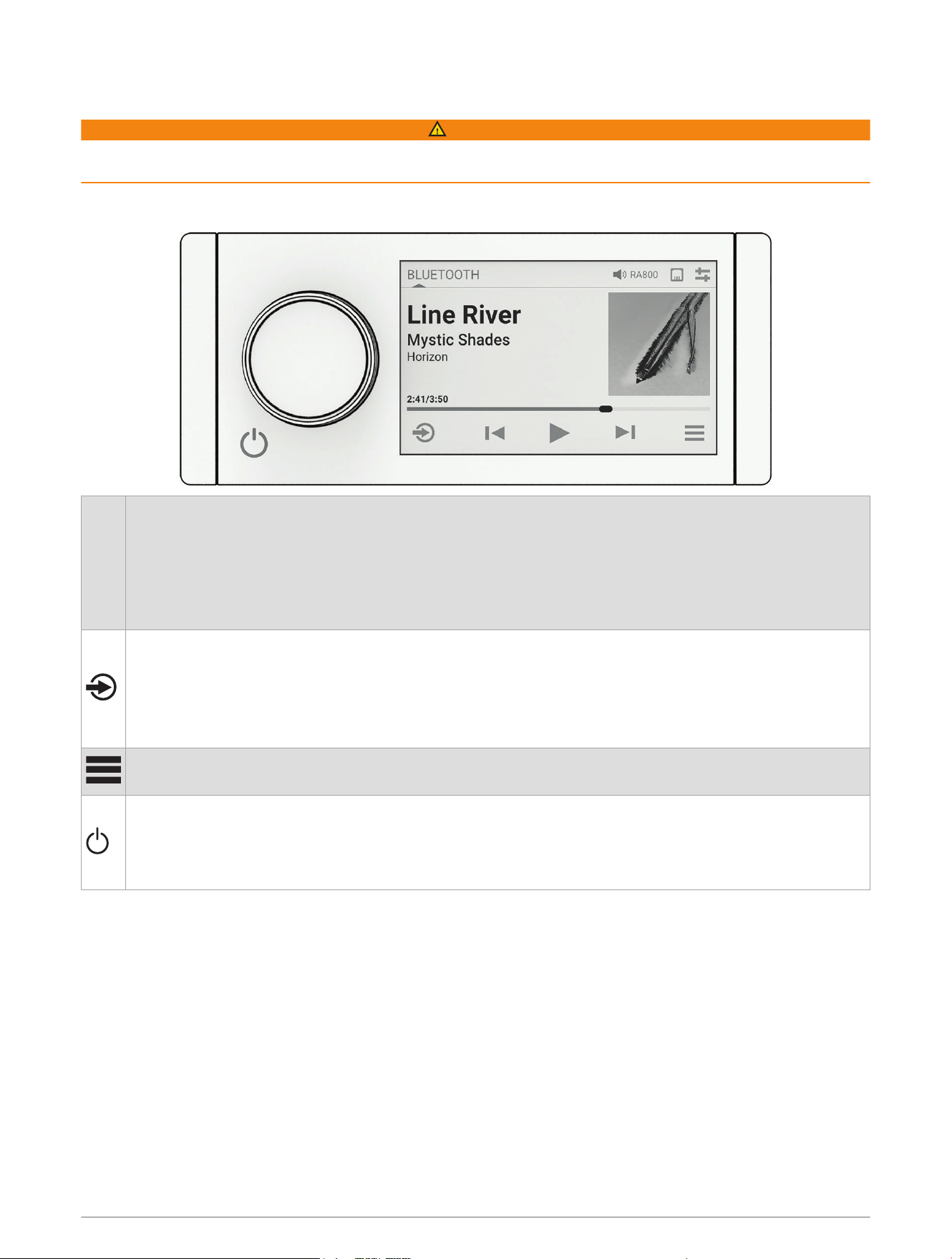
Stereo Controls
Dial
• Turn to adjust the volume.
• When adjusting the volume, press to switch between zones.
• Turn to move through the menus or adjust a setting.
• When in a menu, press to select the highlighted option.
• Press and hold to activate certain functions such as opening the radio presets or muting all connected
stereos from the mute screen (Muting all Connected Stereos, page5).
Press to change the source.
TIP: You can turn the dial to browse, and press the dial to select the source. You can also swipe the
screen up and down, and touch a source on the screen.
Press and hold to open the GROUPS menu when connected to a Fusion PartyBus
™
network (Fusion
PartyBus Networking, page15).
Press to open the menu.
• Press to turn on the stereo.
• Press to mute the audio.
• Press and hold to turn off the stereo or all stereos on the network.
• Press and hold for longer than 10 seconds to reset the stereo.
Getting Started 1
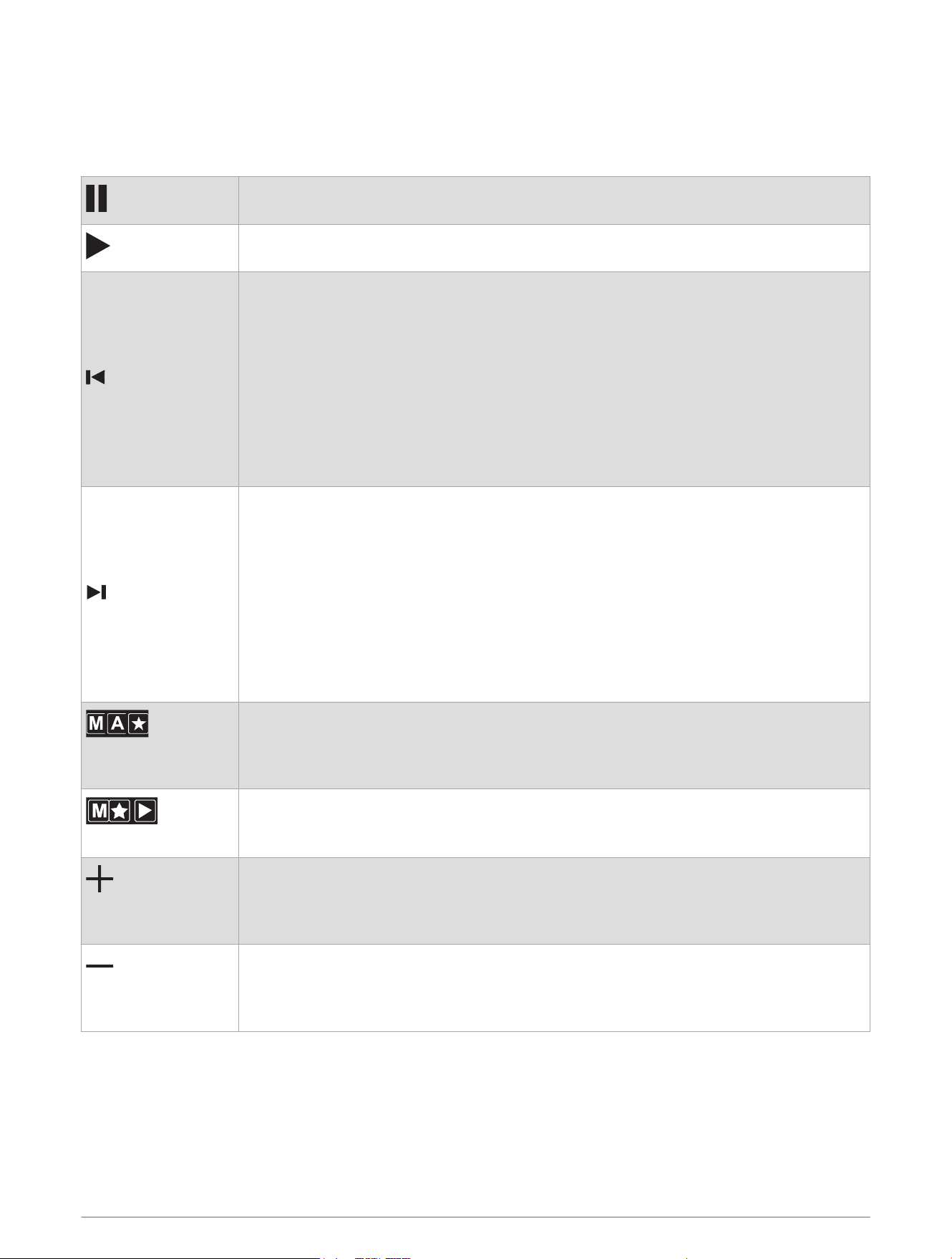
Playback Controls
The on-screen playback controls may change depending on the source selected.
NOTE: After about fifteen seconds, the playback controls are hidden by the gesture screen feature. You can
swipe down on the screen to view the playback controls (Gesture Screen, page3).
Press to pause media playback.
• Press to play media or resume media playback.
• Press to skip to the previous track, when using an applicable source.
• Press and hold to rewind the track when using an applicable source.
• AM, FM source:
◦ Press to tune to the previous station or preset.
◦ Press and hold for faster tuning (manual mode only).
• DAB source:
◦ Press to return to the previous DAB station in the ensemble. When you reach the
beginning of the current ensemble, the stereo automatically changes to the last
available station in the previous ensemble.
◦ Press and hold to return to the previous DAB ensemble.
• Press to skip to the next track, when using an applicable source.
• Press and hold to fast-forward the track when using an applicable source.
• AM, FM source:
◦ Press to tune to the next station or preset.
◦ Press and hold for faster tuning (manual mode only).
• DAB source:
◦ Press to advance to the next DAB station in the ensemble. When you reach the
end of the current ensemble, the stereo automatically changes to the first available
station in the next ensemble.
◦ Press and hold to advance to the next DAB ensemble.
(AM and FM
sources)
Press to cycle through the tuning modes (auto or manual) and presets.
Press and hold to save the current station as a preset.
(DAB source)
Press to switch between manual tuning mode and presets.
Press and hold to scan for DAB stations.
(Aux and ARC
sources)
Press to increase the gain.
(Aux and ARC
sources)
Press to decrease the gain.
2 Getting Started
Gesture Screen
After about fifteen seconds, a screen appears showing media information and album art only. You can use the
touchscreen to interact with this screen.
• You can swipe left or right to change the track or preset.
• You can touch the screen for about one second to pause playback or mute the audio, depending on the
source.
• You can swipe down to return to the playback controls screen.
NOTE: You can disable this screen in the settings (Power Options, page24).
Entering Text
1 In a field that allows you to enter text, select to erase the existing characters.
2 If necessary, select or to use numerals, symbols, or lower-case letters when available.
3 Touch a character to select it.
4 Select to save the new text.
Using the Dial to Select Items
You can use the dial to highlight and select items on the screen.
• Turn the dial to highlight an item on the screen.
• Press the dial to select the highlighted option.
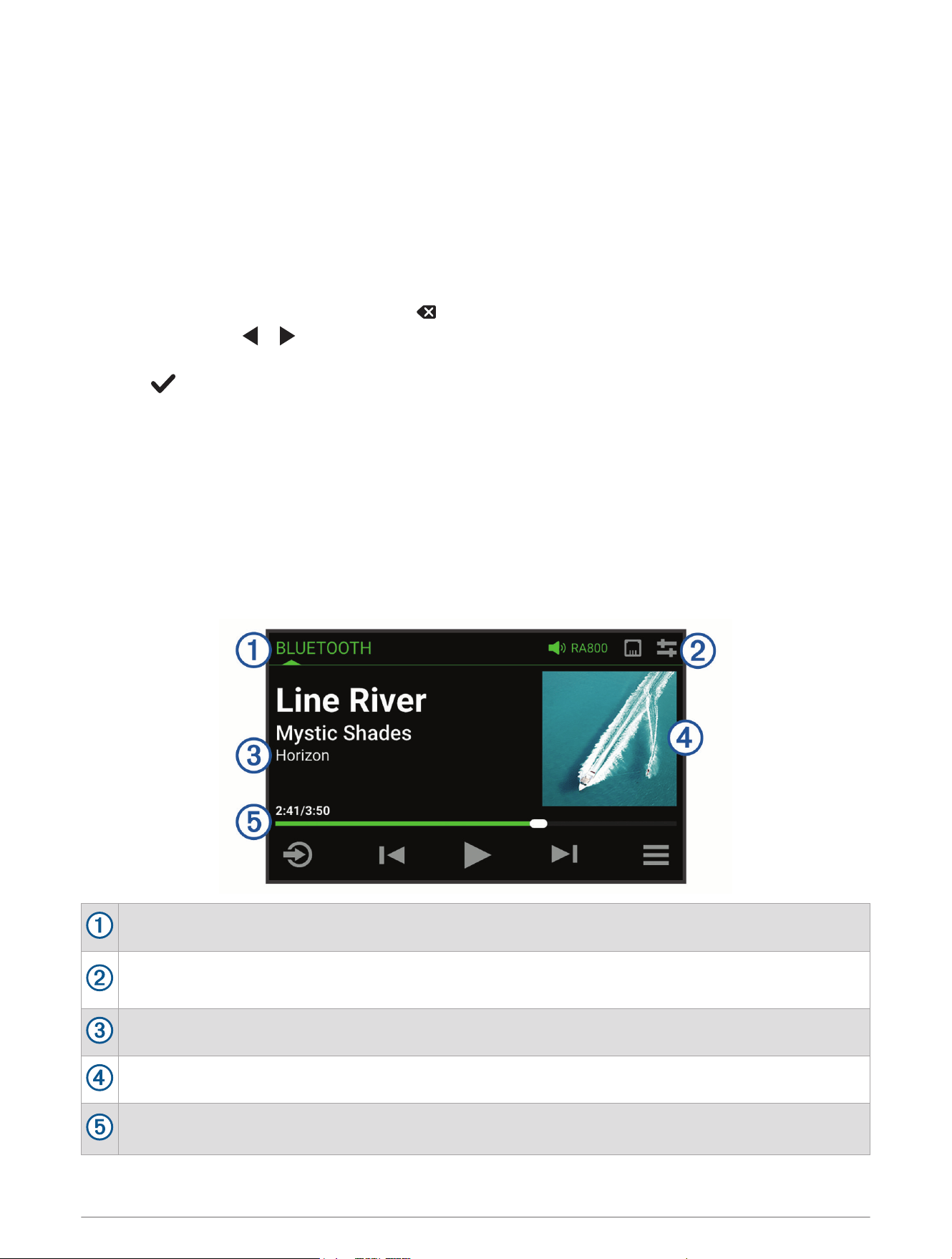
Stereo Screen
The information displayed on the screen varies depending on the source selected. The on-screen playback
controls may change depending on the source selected (Playback Controls, page2). This example shows a
track playing on a device connected using Bluetooth
®
wireless technology.
Source name
Active zone, status icons, and shortcuts (Status Icons, page4)
TIP: Touch an icon to open the applicable page.
Track details (if available)
Album art (if available from a compatible source)
Elapsed time, track duration, and the current track number out of the total number of tracks in the playlist
(if available)
Getting Started 3

Status Icons
You can touch a status icon to open the relevant screen.
Opens the volume screen.
Opens the PRESET screen.
Opens the network settings.
NOTE: You cannot access the network settings if this stereo is part of a group.
Naming the Device
You should provide a unique name for this device so you can easily identify it when viewing devices on the
Fusion PartyBus network.
NOTE: You should provide unique names for all of the devices and zones on the network to avoid confusion
when grouping, controlling, and setting up stereos and zones. You should also turn off zones that are not in use
(Speaker Zone Settings, page21).
For further customization, you can provide unique names for the sources on each stereo and turn off unused
sources (General Settings, page20).
1 Select > SETTINGS.
2 Select DEVICE NAME, and select an option:
• Select a pre-defined name from the list.
• Select CUSTOM NAME, and enter a unique name for the device.
Setting the Home Zone
The home zone is the speaker zone that you adjust by default when you turn the dial.
1 Select > SETTINGS.
2 Select ZONE > ASSIGN HOME ZONE.
3 Select a zone.
Selecting a Source
1 Select .
2 Turn the dial to highlight a source.
NOTE: If the device is part of a group, continue turning the dial to access the sources on other devices in the
group (Creating a Group, page15).
If a source cannot be shared with the group, it will appear gray and you cannot select it.
3 Press the dial to select the source.
TIP: Alternatively, you can touch the source on the screen to select it.
Adjusting the Backlight and Dial Brightness
NOTE: If you connected the dim wire on the wiring harness to the boat's illumination wire, the backlight and dial
dim automatically when the boat lights are on. This may affect how you adjust the brightness setting.
1 Select > BRIGHTNESS.
2 Adjust the brightness level.
4 Getting Started

Audio Control
Adjusting the Volume
Using this stereo, you can control the volume of any zone on any stereo connected to the Fusion PartyBus
network.
1 Turn the dial to adjust the volume for the home zone on the stereo.
2 If necessary, press the dial to switch between zones.
NOTE: If this stereo is part of a group, you can adjust the volume of all stereos in the group or individual
zones on each stereo (Creating a Group, page15).
Muting all Connected Stereos
You can quickly mute the audio from this stereo or from all stereos connected to the Fusion PartyBus network
(Fusion PartyBus Networking, page15).
1 From any source, press .
The mute symbol appears and audio from this stereo is silenced.
NOTE: If the stereo is part of a group, the audio from all grouped stereos is silenced.
2 Select MUTE SYSTEM.
Audio from all connected stereos is silenced.
3 Select UNMUTE SYSTEM.
Audio is restored to all connected stereos.
Adjusting the Subwoofer Level
You can adjust the subwoofer level for each zone.
1 Press the dial, and select a zone with a connected subwoofer.
2 Press and hold the dial.
The SUB LEVEL adjustment for the zone appears.
3 Adjust the subwoofer level and press the dial to set it.
Adjusting the Tone
1 Select > AUDIO.
2 Select the zone to adjust.
3 Press the dial to select a tone.
4 Adjust the tone level and press the dial to set it.
You can drag the slider bar to adjust the tone level.
Disabling the Loud Setting for a Zone
The LOUD setting maintains frequency response at low volumes and increases perceived loudness at high
volumes. This setting is enabled by default in all zones.
1 Select > AUDIO.
2 Select a zone to adjust.
3 Select LOUD to clear the check box.
Audio Control 5

Adjusting the Gain for an Auxiliary Device
You can adjust the gain for a connected auxiliary device to achieve a volume level similar to that of other media
sources. You can adjust the gain in 1dB increments. You can also adjust the gain for ARC sources connected
using an HDMI
®
cable.
1 Select an applicable source.
2 Select an option:
• To increase the gain, select .
• To decrease the gain, select .
NOTE: To achieve the best audio quality when using a portable media player with headphone output, it may
be necessary to adjust the volume control on the media player, instead of adjusting the gain.
Speaker Zones
You can group speakers in one area into a speaker zone. This enables you to control the audio level of the
zones individually. For example, you could make the audio quieter in the cabin and louder on deck.
You can set the balance, volume limit, tone, subwoofer frequency, and name for each zone, and configure other
zone-specific settings (Speaker Zone Settings, page21).
NOTE: Subwoofer frequency is not adjustable when managed by DSP.
DSP Settings
This stereo features digital signal processing (DSP). You can select pre-configured DSP settings for Fusion
®
speakers and amplifiers to optimize audio reproduction in their installed locations.
All DSP settings are configured using the Fusion Audio remote control app (Fusion Audio Wireless Remote
Control App, page31).
Configuring the DSP Settings
You must download and install the Fusion Audio remote control app on your compatible Apple
®
or Android
™
device before you can configure the DSP settings (Fusion Audio Wireless Remote Control App, page31).
You can configure the DSP settings to optimize the sound on each zone with the installed speakers, amplifiers,
and environment.
1 From the settings menu on your Apple or Android device, connect to the stereo using Bluetooth technology
or connect to the same wireless network as the stereo.
NOTE: If you have a compatible Apple device, you can connect a USB sync cable appropriate for your device
(sold separately) to the USB port on the stereo and to your Apple device to configure the DSP settings using
the Fusion Audio app.
2 Open the Fusion Audio remote control app on your compatible Apple or Android device.
3 If necessary, select the stereo you want to configure.
4 Select .
5 If necessary, select the MUSIC tab.
6 Select a zone.
7 Select DSP SETTINGS.
8 Configure the DSP settings as needed, depending on the models of Fusion speakers and amplifiers
connected to the zone.
9 Select SEND DSP SETTINGS.
NOTE: DSP settings or updates for the zone are not applied on the stereo until you select the button to send
the settings.
10 Repeat these steps for each zone.
6 Audio Control

Automatic Volume Adjustment Based on Speed
If your stereo is connected to a NMEA 2000
®
network with a device that provides speed information such as an
engine, chartplotter, GPS antenna, water speed sensor, or wind speed sensor, you can set the stereo to adjust
the volume automatically based on the selected speed source (Enabling Automatic Volume Adjustment Based
on Speed, page22).
For example, if a chartplotter with an internal GPS antenna or a stand-alone GPS antenna is on the same NMEA
2000 network as the stereo and you set the SPEED SOURCE to SPEED OVER GROUND, the volume increases as
your speed increases.
NOTE: When the volume increases to adjust for speed, the actual volume output changes, but the volume-level
indicator bar and number stays the same.
For more information about connecting the stereo to a NMEA 2000 network, see the installation instructions for
your stereo.
Media Player Connection
WARNING
Minimize interaction with the media player display while operating the vessel, because doing so can cause
distraction that could lead to an accident resulting in serious personal injury or death.
NOTICE
Always disconnect your media player from the stereo when not in use and do not leave it in your vessel. This
can help reduce the risk of theft and damage from extreme temperatures.
The stereo accepts a variety of media players, including smartphones and other mobile devices. If it is
supported by your compatible media player, you can connect it using a cable with a USB C connector to the USB
port on the stereo. You can purchase an official USB cable from your Garmin
®
dealer or from garmin.comThe
stereo can play media from a compatible Apple device connected to the same network using the AirPlay
®
feature.
Bluetooth Device Playback
You can pair the stereo to up to eight Bluetooth media devices.
You can control the playback using the stereo controls on all Bluetooth devices, and on some devices you can
browse the music collection from the menu on the stereo.
On Bluetooth devices that do not support media browsing, you should select the song or playlist on the media
device.
The availability of song information such as song title, artist name, track duration, and album art depends on the
capability of the media player and music application.
Media Player Connection 7

Connecting a Compatible Bluetooth Device
You can play media from a compatible Bluetooth device using the Bluetooth wireless connection.
You can control the music playback with the media app on a Bluetooth device or using the Fusion Audio remote
control app (Fusion Audio Wireless Remote Control App, page31).
NOTE: Due to Bluetooth standards, connecting a Bluetooth device to the stereo does not create a secure, private
connection.
1 Select the BLUETOOTH source.
2 Select > BLUETOOTH > CONNECTIONS > DISCOVERABLE to make the stereo visible to your compatible
Bluetooth device.
3 Enable Bluetooth on your compatible Bluetooth device.
4 Bring the compatible Bluetooth device within 10m (33ft.) of the stereo.
5 On your compatible Bluetooth device, search for Bluetooth devices.
6 On your compatible Bluetooth device, select the stereo from the list of detected devices.
NOTE: The stereo appears in the Bluetooth device list as the device name (the default name is MS-RA800
unless it was changed in the settings).
7 On your compatible Bluetooth device, follow the on-screen instructions to pair and connect to the discovered
stereo.
When pairing, your compatible Bluetooth device may ask you to confirm a code on the stereo. If the stereo
shows a code, you can compare them before pairing. If the stereo does not display a code, it should connect
correctly when you confirm the message on the Bluetooth device.
8 If your compatible Bluetooth device does not immediately connect to the stereo, repeat steps 1 through 7.
NOTE: If another Bluetooth device is already playing music on the stereo, connecting a new device will not
interrupt playback. You must select the newly-added device if you want to use it instead (Selecting a Different
Bluetooth Device, page8).
The DISCOVERABLE setting is disabled automatically after two minutes.
NOTE: On some Bluetooth devices, adjusting the volume on the device affects the volume level on the stereo.
Bluetooth Range Information
The stereo and Bluetooth wireless devices have a range of 10 m (33 ft.). For optimal performance, the Bluetooth
wireless device should also have a clear line of sight to the stereo.
NOTE: Wi‑Fi
®
signals may interfere with Bluetooth device connections. You should turn off the Wi‑Fi setting on
your stereo if you are not using it.
Selecting a Different Bluetooth Device
When you have more than one Bluetooth device paired to the stereo, you can select a different device when
needed. You can pair the stereo with up to eight Bluetooth devices.
1 With the BLUETOOTH source selected, select > BLUETOOTH > CONNECTIONS > PAIRED DEVICES.
2 Select a Bluetooth device.
8 Bluetooth Device Playback

Bluetooth Source Menu and Settings
With the BLUETOOTH source selected, select > BLUETOOTH.
NOTE: The options in this menu vary based on the connected device.
CONNECTIONS > DISCOVERABLE: Allows the stereo to be visible to Bluetooth devices. You can turn off this
setting to prevent possible interruption to audio after pairing a Bluetooth device to the stereo.
CONNECTIONS > PAIRED DEVICES: Shows a list of Bluetooth devices paired with the stereo. You can select a
device in the list to connect it to the stereo if it is in range.
CONNECTIONS > REMOVE DEVICE: Removes the Bluetooth device from the stereo. To listen to audio from this
Bluetooth device again, you must pair the device again.
NOTE: You should also remove the stereo from the list of paired devices on your Bluetooth device to avoid
connection issues when pairing the device again.
REPEAT: Sets the repeat mode for the current selection (Apple devices only). You can repeat the current
selection by selecting the REPEAT ONE option. You can repeat all items in the selection by selecting the
REPEAT ALL option.
SHUFFLE: Shuffles the tracks in the folder, album, or playlist (Apple devices only).
PLAYLIST: Displays the playlists on the device (Apple devices only).
ARTISTS: Displays the artists on the device (Apple devices only).
ALBUMS: Displays the albums on the device (Apple devices only).
GENRES: Displays the genres of music on the device (Apple devices only).
SONGS: Displays the songs on the device (Apple devices only).
APPLE MUSIC RADIO: Displays the Apple Music Radio stations on the device (Apple devices only).
Disabling Bluetooth Auto Connection
By default, the stereo automatically reconnects to the last connected Bluetooth device when you turn it on. You
can disable this setting.
Select > SETTINGS > SOURCE > BLUETOOTH > AUTO CONNECT.
When the AUTO CONNECT checkbox is clear, the stereo will not attempt to automatically reconnect to a
Bluetooth device. When this feature is disabled, you must select a Bluetooth device manually to connect it
(Selecting a Different Bluetooth Device, page8).
Correcting Bluetooth Audio and Video Synchronization Issues
If you connected a Bluetooth device to the stereo and are watching a video on the device, you may encounter
a delay in the audio that does not match the video. This is most likely due to a networking setting, and can
be corrected. By default, the Bluetooth source is configured to be available as a streaming source across the
network, which may introduce audio synchronization issues when viewing video on the source device (Grouped
Stereo Source Considerations, page16).
1 From any source, select > SETTINGS > SOURCE > BLUETOOTH.
2 Select GROUP ENABLED to clear the checkbox.
The BLUETOOTH source is no longer an option for network streaming, which should reduce or eliminate the
audio delay.
Bluetooth Device Playback 9

USB Device Playback
You can connect various USB media players and USB flash drives to the stereo. How you access the USB source
depends on the type of connected media player.
Media Player Source Selections
Apple device iPod
USB flash drive USB
MP3 media player (as a mass-storage device)
USB
NOTE: If your MP3 media player does not support
mass-storage when connected using USB, you must
connect it to the stereo as an auxiliary device
(Connecting an Auxiliary Device, page12).
You can control the playback using the stereo controls on all USB devices, and on some devices you can browse
the music collection from the menu on the stereo. On USB devices that do not support media browsing, you
should select the song or playlist on the media device.
The availability of song information such as song title, artist name, and track duration depends on the capability
of the media player and music application.
USB Device Compatibility
You can use a USB flash drive or the USB cable included with your media player to connect a media player or
mobile device to the USB port.
The stereo is compatible with iAP2 Apple devices.
The stereo is compatible with media players and other USB mass storage devices, including USB flash drives.
Music on USB drives must meet these conditions:
• The music files must be formatted as MP3, AAC (.m4a), WAV, or FLAC, files.
• If you connect a portable hard drive, you must connect it to an external power source. The USB port on this
stereo cannot provide power for a portable hard drive.
• The USB mass storage device must be formatted using one of the following systems:
◦ Microsoft
®
: NTFS, VFAT, FAT
1
, MSDOS
◦ Apple: HFS, HFSPLUS
◦ Linux: EXT2, EXT3, EX4
Connecting a USB Device
You can connect a USB device to the USB port on the stereo.
1 Locate the USB port on the back of the stereo.
2 Connect the USB device to the USB port.
NOTE: If you experience issues reading from a connected USB C device, try rotating the plug and
reconnecting it. Some USB C cables perform better in one orientation than the other.
1
FAT includes most types of FAT file systems except exFAT.
10 USB Device Playback

Controlling Music Playback on a USB Flash Drive or Media Player
1 Connect a compatible USB flash drive or media player to the stereo.
2 Select the USB source.
3 Select > USB.
4 Select the name of the USB device.
5 Browse the music files on the device and begin playback.
You can use the stereo controls to select, play, pause, and skip tracks.
TIP: If the USB media player has a screen and controls, you can use the controls on the USB media player to
control playback.
Controlling Music Playback on a Connected Apple Device
1 Connect a compatible iAP2 Apple device to the stereo using USB.
2 Select the iPod source on the stereo.
3 Launch a music application on the connected Apple device, and begin playback.
You can use the music application on the Apple device to control playback, or you can use the stereo controls
to select, play, pause, and skip tracks. If you are using the AppleMusic app, you can also browse the music
directory using the stereo controls.
USB Source Settings
With a USB device connected and a USB source selected, select > USB.
NOTE: You can also select the name of the connected device to browse the file contents using this menu. The
options in this menu vary based on the connected device.
REPEAT: For a USB source, select to start playing the tracks in the list from the beginning after the last track has
played.
For an iPod source, select REPEAT ONE to repeat the current track, or select REPEAT ALL to start playing the
tracks in the current selection from the beginning after the last track has played.
SHUFFLE: For a USB source, select to randomly play the tracks in the list.
For an iPod source, select to randomly play the tracks in the current selection.
Radio
To listen to AM or FM radio, you must have a suitable marine AM/FM antenna properly connected to the stereo
and be within range of a broadcasting station. For instructions on connecting an AM/FM antenna, see the
stereo installation instructions.
To listen to DAB stations, you must connect a DAB antenna, configure the antenna port if necessary
(Configuring the Antenna Ports for DAB and FM Antennas, page25), and set the appropriate tuner region
(Setting the Tuner Region, page13).
Setting the Tuner Region
You must select the region you are in to receive AM and FM stations properly.
You must select the region you are in to receive DAB stations properly.
NOTE: DAB stations are not available in all regions.
1 Select > SETTINGS.
2 Select TUNER REGION.
3 Select the region you are in.
Radio 11

Changing the Radio Station
1 Select an applicable source, such as FM.
2 Select repeatedly to move through the tuning modes, and select an option:
• Select AUTO to scan and stop on the next available station.
• Select MANUAL to select a station manually.
• Select PRESET to select a saved station preset.
3 Select or to tune to the station.
When in MANUAL tuning mode, you can hold or to quickly advance through the stations.
Apple AirPlay
Connecting an Apple Device Using AirPlay
1 From the settings menu on your Apple device, connect to the same wireless network as your compatible
Fusion stereo.
TIP: You can quickly connect your Apple to the same network as the stereo using Wireless Accessory
Configuration (WAC) (Connecting the Device to a Wireless Access Point Using Apple Wireless Accessory
Configuration, page26)
NOTE: You can connect some Apple devices to the network using a wired Ethernet connection, if applicable.
Go to the Apple website for more information.
2 On your Apple device, open the music app you want to stream to the stereo.
3 From the music app or program, select or , and select the name of the stereo.
4 If necessary, start playing music on the app.
The stereo changes to the AirPlay source automatically and plays audio from your Apple device.
NOTE: If your Apple device is using AirPlay 2 software, you can connect to multiple stereos on the same
network.
NOTE: You cannot stream the AirPlay source to other stereos on the network using the Fusion PartyBus
network (Fusion PartyBus Networking, page15). Using AirPlay 2 software, you can play content on multiple
stereos on the network, but the stereos must not be grouped.
NOTE: On some AirPlay devices, adjusting the volume on the device affects the volume level on the stereo.
Setting an AirPlay Password
You can set a password that a user must enter when connecting to the stereo using the AirPlay feature.
1 Select > SETTINGS > SOURCE > AirPlay > AirPlay PASSWORD.
2 Enter a password.
NOTE: The AirPlay password is case-sensitive.
When connecting to this stereo using the AirPlay feature, the user must enter the password on their Apple
device.
Connecting an Auxiliary Device
You can connect various auxiliary devices to the stereo. These devices have either RCA connectors, a line
output, or a headphone output jack.
1 Locate the auxiliary connectors on the wiring harness.
2 If necessary, connect an RCA-to-3.5mm adapter cable to the auxiliary device.
3 Connect the auxiliary device to the AUX IN RCA connectors on the wiring harness.
4 Select the Aux source.
12 Apple AirPlay

Audio Return Channel
The Audio Return Channel (ARC) enables you to play digital audio from a television or other source with HDMI
technology over the stereo system speakers.
HDMI version 1.4 or newer cables support ARC. When planning your stereo installation, check whether your
devices and cables support ARC. Most devices that support ARC have an ARC or eARC label on the HDMI
connector that supports ARC.
You may need to configure your television or other source to output audio over ARC. This stereo supports
ARC (but not eARC), CEC 1.4, and PCM stereo audio. See the manual for your source device for configuration
instructions if needed.
NOTE: There is a limit to the length of the HDMI cable when using ARC functionality. If your source is greater
than 5m (16ft.) away from the stereo, confirm with the cable manufacturer that it can support ARC at the
length needed.
NOTE: Because streaming audio over the Fusion PartyBus network introduces a slight delay, streaming content
from a television or DVD player may not be ideal. By default, the ARC source is disabled in the GROUP source
settings (Source Settings, page24).
TIP: On compatible televisions, you can control the volume of the stereo using the television remote control
when using the ARC source.
Correcting Audio and Video Synchronization Issues on the Audio Return Channel
Source
In some instances, you may find that the stereo audio from the ARC source is not synchronized with the video
from the source device. You can adjust the delay to correct this.
1 From any source, select > SETTINGS > SOURCE > ARC INPUT AUDIO DELAY.
2 Adjust the slider to adjust the delay until the audio is synchronized with the video source.
DAB Playback
DAB functionality is available only on European models of this stereo.
DAB broadcasts are not available in all regions. When the stereo is not set to a compatible region, the DAB
source is not available.
See the troubleshooting section if you cannot access the DAB source or if DAB stations are not playing properly.
(The stereo does not receive DAB stations, page38)
Setting the Tuner Region
You must select the region you are in to receive DAB stations properly.
1 Select > SETTINGS.
2 Select TUNER REGION.
3 Select the region you are in.
Scanning for DAB Stations
NOTE: Because DAB signals are broadcast in select countries only, you must set the tuner region to a location
where DAB signals are broadcast.
When you switch to the DAB source while in a tuner region where DAB signals are broadcast, you should already
have access to the available ensembles and stations. If you recently changed location or made any other
configuration changes, you can scan for DAB stations to get the most up-to-date list of ensembles and stations
for your location.
1 Select the DAB source.
2 Hold to scan for available DAB stations.
When scanning is complete, the first available station in the first ensemble found begins playing.
Audio Return Channel 13

Changing DAB Stations
1 Select the DAB source.
2 Select or to change the station.
When you reach the end of the current ensemble, the stereo automatically changes to the first available
station in the next ensemble.
TIP: You can hold or to change the ensemble.
Selecting a DAB Station from a List
1 Select the DAB source.
2 Select > DAB > BROWSE > STATIONS.
3 Select a station from the list.
Selecting a DAB Station from a Category
1 Select the DAB source.
2 Select > DAB > BROWSE > CATEGORIES.
3 Select a category from the list.
4 Select a station from the list.
Presets
You can save your favorite AM stations and FM stations as presets for easy access.
You can save your favorite DAB stations if the a DAB antenna is connected to a configured antenna port on the
stereo and the stereo is set to the correct tuner region. (DAB Playback, page13)
Saving a Station or Channel as a Preset
1 With an applicable source selected, tune the stereo to a station or a channel.
2 Press and hold the dial, or select and select .
TIP: For the AM or FM source, you can press and hold to save the current station or channel as a
preset.
TIP: You can also select , the name of the source, and PRESETS > SAVE CURRENT to save the current
station or channel as a preset.
Selecting a Preset from a List
1 With an applicable source selected, press and hold the dial, or select .
TIP: You can also select , the name of the source, and PRESETS > VIEW PRESETS to view the list of
presets.
2 Select a preset.
Removing Presets
1 With an applicable source selected, press and hold the dial, or select .
2 Select .
3 Select each preset station or channel you want to remove.
4 When you are finished removing presets, select .
TIP: You can also select , the name of the source, and PRESETS > REMOVE PRESETS or REMOVE ALL
PRESETS to remove preset stations or channels.
5 Press the dial to exit the screen.
14 Presets

Fusion PartyBus Networking
The Fusion PartyBus networking feature allows you to connect multiple compatible stereos together on a
network, using a combination of wired or wireless connections.
NOTE: When you connect a Fusion stereo to Garmin BlueNet
™
network or a Garmin Marine Network, you are
limited to using only Garmin and Fusion devices. You may not be able to use third-party routers, storage devices,
or other network products with this stereo directly.
TIP: When the stereo is connected to a Garmin BlueNet network or a Garmin Marine Network, you can connect
a mobile device to a wireless access point on a connected Garmin chartplotter and use the Fusion Audio app to
control the stereo.
You cannot use Wi‑Fi networking when a stereo is connected to a Garmin network.
You can group a compatible stereo, such as the Fusion Apollo RA800 stereo, with other compatible stereos
connected to the Fusion PartyBus network. Grouped stereos can share available sources and control media
playback on all of the stereos in the group, which allows for a synchronized audio experience across the vessel.
You can quickly create, edit, and break up groups as needed from any compatible stereo or remote control on
the network.
You can use compatible stereos and remote controls, whether they are grouped or not, to adjust the volume of
the available speaker zones for any stereo on the network.
You should refer to the installation instructions provided with your stereo when constructing the Fusion
PartyBus network.
You can connect up to eight Fusion PartyBus stereos on a network wirelessly.
Creating a Group
Before you can create a group, you must connect multiple compatible stereos to the Fusion PartyBus network.
See the installation instructions provided with your stereo for information about installing and configuring the
network.
NOTE: There are some limitations and other considerations when using stereos in groups. See Grouped Stereo
Source Considerations, page16for more information.
1 Select > GROUPS.
TIP: You can hold from any screen to open the GROUPS menu.
2 Select the name of the stereo you want to be the primary stereo in the group.
3 Select the stereos you want to add to the group.
4 Select DONE.
From the source screen, you can select a source from any stereo in the group except a zone stereo, such as the
Fusion Apollo SRX400 stereo or any sources that are disabled for use on the Fusion PartyBus network (General
Settings, page20).
Editing a Group
1 Select > GROUPS.
2 Select the group.
3 Select the stereos you want to add to or remove from the group.
4 Select DONE.
Leaving a Group
You can leave the Fusion PartyBus group to play local sources on the stereo.
1 Select > GROUPS.
2 Select the group you want to leave.
3 Select the stereos you want to remove from the group.
4 Select DONE.
Fusion PartyBus Networking 15

Grouped Stereo Functions
After you create a group of stereos, additional functions and options are available to all stereos in the group.
• After you create a group, all of the stereos in the group share the same synchronized display.
• You can select a source from any stereo in the group, with a few limitations (Grouped Stereo Source
Considerations, page16), and the source will play simultaneously on all stereos in the group (Selecting a
Source, page4).
• You can control playback (such as pausing and skipping tracks) on any stereo in the group, and it will affect
all stereos in the group.
• You can adjust the volume for any zone on any stereo in the group.
TIP: When adjusting the volume, you can select ALL to adjust the volume of all the stereos in the group at the
same time.
Grouped Stereo Source Considerations
When selecting sources to play over the network, you should observe these considerations.
• A zone stereo, such as the Fusion Apollo SRX400, can create or join a group to control and play sources from
other stereos, but it cannot share its sources with the group.
• You cannot share an AirPlay source with grouped stereos. Using AirPlay 2 software, you can play content on
multiple stereos on the network, but the stereos must not be grouped (Apple AirPlay, page12).
• You can disable sharing on most sources by changing the GROUP ENABLED setting for the source. When
disabled, the source cannot be selected from a grouped stereo (General Settings, page20).
• When audio sources are streamed over a data network, there is a slight delay in the synchronized audio that
may be noticeable if you are also using an external audio source.
◦ If you have a television with an HDMI Audio Return Channel (ARC) connection to a stereo and you continue
to use the television speakers, there will be a delay between the audio from the television speakers and the
optical audio streamed on the grouped stereos.
◦ If you synchronize a radio station and tune that same radio station on a non-networked stereo, there will be
a delay between the audio from the non-networked stereo and the audio from the radio station streamed
on the grouped stereos.
◦ You can remove this delay by changing the GROUP ENABLED setting for the source, but the source cannot
be shared with grouped stereos (General Settings, page20).
NOTE: You cannot change the settings when a stereo is part of a group. You must remove the stereo from the
group before you can change any settings.
16 Fusion PartyBus Networking

Group Synchronization
By default, groups you create are not maintained when you turn off stereos in the group. If you turn off a single
stereo added to the group, it leaves the group. If you turn off the primary stereo in the group, the group is
dissolved. You can enable group synchronization to preserve group membership for a stereo after turning it off.
Group synchronization behaves differently based on how you turn the stereos off and on.
• If you turn a synchronized stereo off and on by using either the power button on the stereo or a physical
switch on the ignition wire (the red wire), all of the synchronized stereos in the group turn off and on together.
This applies to all of the synchronized stereos in the group, whether or not a stereo is the primary stereo in
the group.
NOTE: Selecting ALL OFF from the power menu on a stereo turns off all stereos on the network, even if they
are not in a group or have group synchronization enabled.
• If you turn a synchronized stereo off and on using a physical switch on the power wire (the yellow wire), the
other synchronized stereos in the group behave differently:
◦ If the synchronized stereo is the primary stereo in the group and you turn it off using a physical switch on
the power wire, the other synchronized stereos in the group remain on, but leave the group. When you turn
the primary stereo back on again, the other synchronized stereos rejoin the group.
◦ If the synchronized stereo is not the primary stereo in the group and you turn it off and on using a physical
switch on the power wire, all of the other synchronized stereos in the group remain on and grouped, and
the stereo rejoins the group when you turn it on again.
Enabling Group Synchronization
You must remove the stereo from an existing group before you can enable the GROUP SYNC setting. You
cannot update settings when a stereo is part of a group.
You must enable this setting on each stereo that you want to retain group settings after a power cycle.
1 Select > SETTINGS.
2 Select POWER OPTIONS > GROUP SYNC.
The stereo retains group settings after a power cycle.
3 Repeat for additional stereos as needed.
NOTE: You must enable GROUP SYNC on all networked stereos for synchronization to work properly.
Fusion PartyBus Networking 17
LED Lighting Control
WARNING
Setting some LED light effects or setting the LED lights to react to music may result in lights flashing at various
intervals. Consult your physician if you have epilepsy or are sensitive to bright or flashing lights.
NOTICE
Before you can control any connected lights using the stereo, you must first initialize the lights using a
compatible chartplotter on the same NMEA 2000 network as the lighting controller and the stereo. See the
installation instructions for the Garmin Spectra
™
lighting controller or the owner's manual for the chartplotter
for initialization instructions. If you do not have a compatible chartplotter connected, you can also initialize the
lights using the ActiveCaptain
®
app on a mobile device.
Using certain LED colors on your vessel, such as red and green, may violate the laws, regulations, and standards
related to the use and/or operation of marine navigation lights. It is the user's responsibility to comply with any
such applicable laws, regulations, and standards. Garmin is not responsible for any fines, penalties, citations, or
damages that may be incurred due to any such lack of compliance.
If you installed a Garmin Spectra lighting controller, you can use the stereo to activate and change limited
features on connected LED lights. You can quickly turn LED lights on and off, select preprogrammed lighting
effects, activate saved scenes, and use AUDIO SYNC to configure lights to change color and brightness to
music played on the stereo. If needed, more advanced control and configuration of the lights can be performed
using the ActiveCaptain app or using a compatible chartplotter on the same NMEA 2000 network and marine
network as the lighting controller and the stereo. See the owner's manual for the chartplotter for complete
instructions.
Turning LED Lights On and Off
1 Select > LED CONTROL.
2 Select LIGHTS and select the lights or group of lights you want to turn on or off.
3 Select ON to turn on the lights.
4 Select ON again to turn off the lights.
Turning on LED Light Effects
WARNING
Selecting some LED light effects may result in lights flashing at various intervals. Consult your physician if you
have epilepsy or are sensitive to bright or flashing lights.
The Garmin Spectra lighting controller has a selection of preprogrammed lighting effects that you can turn on
using the stereo.
1 Select > LED CONTROL.
2 Select LIGHTS and select the lights or group of lights you want to use a lighting effect.
3 Select EFFECTS and select one of the preprogrammed lighting effects to start it on the connected lights.
Starting an LED Light Scene
NOTICE
Before you can start an LED light scene using the stereo, you must use a connected chartplotter to create at
least one scene. See the owner's manual for the chartplotter for complete instructions.
1 Select > LED CONTROL > SCENES.
A list of previously-created scenes is shown.
2 Select a scene to start.
18 LED Lighting Control
Setting LED Lights to React to Music
WARNING
Setting LED lights to react to music may result in lights flashing at various intervals. Consult your physician if
you have epilepsy or are sensitive to bright or flashing lights.
NOTICE
Before you can set connected LED lights to react to music playing on the stereo, you must use a connected
chartplotter to associate a light or group of lights with an audio zone on this stereo. See the chartplotter owner's
manual for complete instructions.
1 Select > LED CONTROL.
2 Select LIGHTS, and select the lights or group of lights you want react to music.
3 Select AUDIO SYNC, and select an option:
• If you want the lights to react to the intensity of the music playing, select COLOR BLEND.
• If you want the lights to react to the bass and treble frequencies of the music playing, AUDIO SPECTRUM.
You must use a connected chartplotter if you want to change the colors used by this feature. See the
chartplotter owner's manual for complete instructions.
LED Light Control and Configuration Using the ActiveCaptain App
You can connect your mobile device to the stereo using the ActiveCaptain app to configure and control lights
connected to a Garmin Spectra LED control module. If the stereo and LED control module are connected to
the same NMEA 2000 network as a compatible chartplotter, you should connect the ActiveCaptain app to the
chartplotter instead of the stereo so you can use the full features included in the app in addition to the lighting
controls. See the owner's manual for the chartplotter for instructions.
NOTE: Before you can connect your mobile device to the stereo, you must either configure the stereo to act as a
wireless access point or connect the stereo to a wireless router using an Ethernet cable.
Getting Started with the ActiveCaptain App
You can connect a mobile device to the stereo using the ActiveCaptain app. The app provides a quick and easy
way for you to configure and interact with the lights connected to a Garmin Spectra LED control module.
1 If necessary, set up the stereo as a Wi‑Fi access point (Setting the Fusion PartyBus Device as a Wireless
Access Point, page26) or connect the stereo to a wireless router using an Ethernet cable.
2 From the application store on your mobile device, install and open the ActiveCaptain
app.
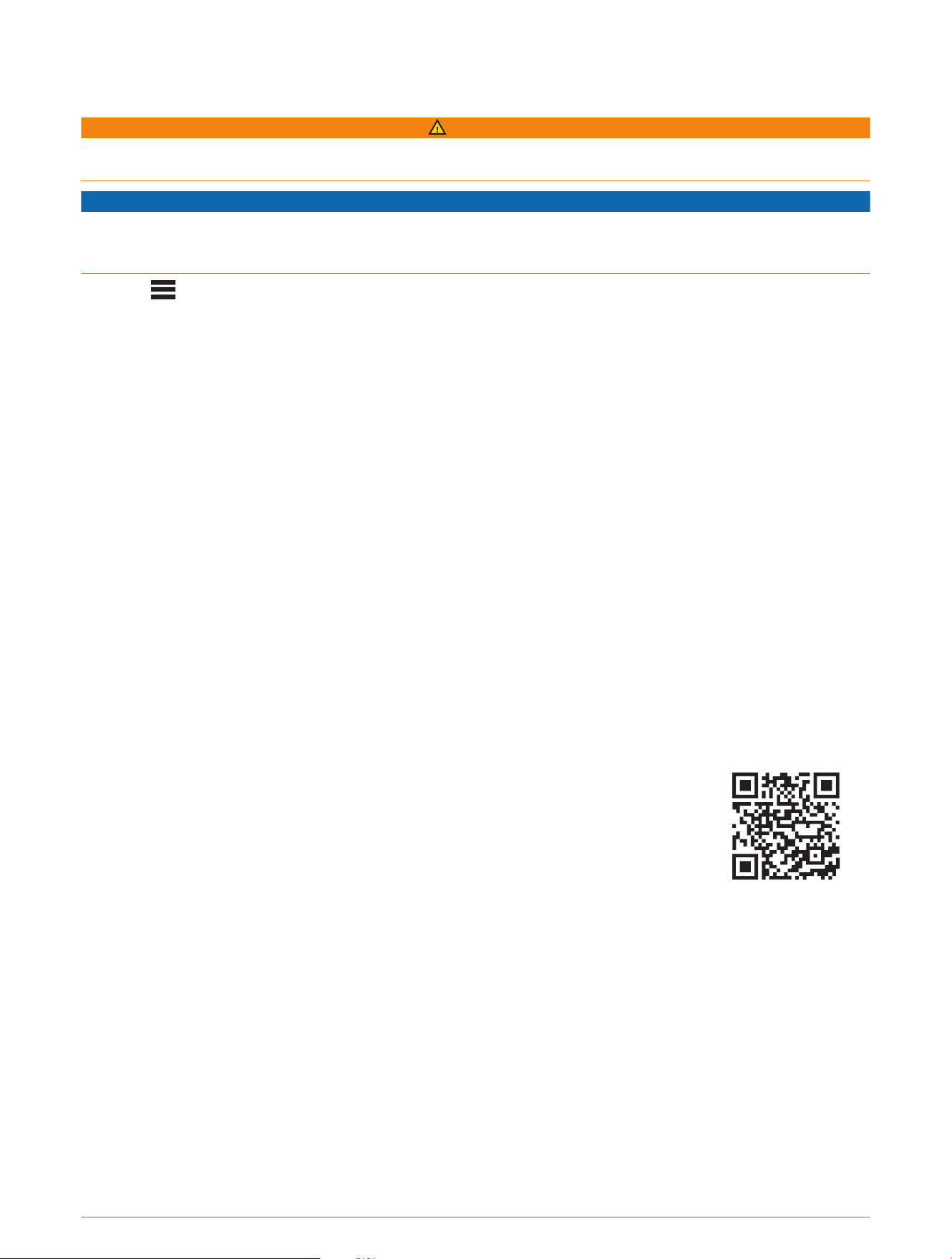
TIP: You can scan this QR code using your mobile device to download the app.
3 Log into the ActiveCaptain app using your Garmin account.
4 Bring the mobile device within 32m (105ft.) of the stereo or the wireless router.
5 In the ActiveCaptain app, select Connect.
6 Select the SSID of the stereo or wireless router and provide the password, if necessary.
The app connects to the wireless network and returns to the main screen.
After the app connects to the wireless router or stereo correctly, an option for Lighting is shown on the Boat
Apps tab.
LED Lighting Control 19

Initializing Connected LED Lights Using the ActiveCaptain App
Before you can interact with any connected LED lights using the stereo, you must first initialize the lights by
providing information about the type of light source supported by the connected LEDs.
1 If necessary, open the ActiveCaptain app and connect it to the stereo or wireless router.
2 In the ActiveCaptain app, select Settings > Lighting.
A list of connected LED control modules is shown.
3 Select an LED control module with connected LED lights that you want to initialize and select Lights.
A list of all available lights is shown. Any light indicated with a yellow circle must be initialized before it's
available for use by the system.
4 Select a connected LED light from the list.
5 Select Light Types and select the type of LEDs connected:
• RGB: The connected dimmable LEDs support a full range of colors.
• RGBW: The connected dimmable LEDs support a full range of colors and high quality white light.
• CRGBW: The connected dimmable LEDs support a full range of colors and multiple temperature white
light.
• Single Channel: The dimmable LEDs support one dedicated color.
TIP: You can select Identify to illuminate the selected light to help identify and test the selected LED type.
6 Repeat this procedure for all connected lights until all of the intended LED lights are initialized.
General Settings
NOTE: When the stereo is in a group, you cannot change the settings on that stereo.
Select > SETTINGS.
NOTE: When a check box is filled, the option is on. When the check box is clear, the option is off.
DEVICE NAME: Sets a name for this device.
LANGUAGE: Sets the language used on the device.
TUNER REGION: Sets the region used by the FM and AM sources.
This setting is also needed to configure the DAB source.
TELEMUTE: Sets the behavior of the stereo when it detects a signal on the TELEMUTE wire in the wiring
harness. This is commonly used to change to the Aux1 source when you hold the button on a Fusion
handheld microphone. You can also choose to either mute the audio or change to the Aux1 source when
connected to a hands-free mobile phone kit. See your Fusion handheld microphone or hands-free mobile
phone kit instructions for more information.
NOTE: This setting does not affect a phone connected to the stereo using Bluetooth technology.
POWER OPTIONS: Adjusts the power settings, such as the GROUP SYNC (Power Options, page24).
SEARCHING: Enables Fusion Alpha Search Technology (FAST), which allows you to quickly search for tracks by
letter or number. You can select a number to enable the FAST menu if your music device contains more than
the selected number of items.
ZONE: Enables you to configure the speaker zones (Speaker Zone Settings, page21).
SOURCE: Allows you to enable, disable, and name the sources and groups on the stereo (Source Settings,
page24).
NETWORK: Enables you to configure the Fusion PartyBus network settings (Network Settings, page25).
UPDATE: Updates the stereo or connected devices using the appropriate update file on a connected USB flash
drive (Update Options, page30).
NOTE: It is not necessary to use this menu if you are updating the software using the Fusion Audio app on a
mobile device instead of using an update file loaded onto a USB flash drive (Updating the Software Using the
Fusion Audio App, page36).
UPDATE > FACTORY RESET: Restores all settings to the factory default values.
ABOUT: Shows the software version information for the stereo and connected accessories.
20 General Settings

Speaker Zone Settings
Disabling the Internal Amplifier
If you do not connect speakers directly to zones 1 and 2, you can disable the internal amplifier to reduce power
consumption.
1 Select > SETTINGS.
2 Select ZONE.
3 Select INTERNAL AMP ON to clear the check box.
Setting the Home Zone
The home zone is the speaker zone that you adjust by default when you turn the dial.
1 Select > SETTINGS.
2 Select ZONE > ASSIGN HOME ZONE.
3 Select a zone.
Synchronizing the Source and Zone Volume Levels
You can synchronize the volume levels on one or all zones with some source devices, such as a Bluetooth,
AirPlay, or ARC source.
1 Select > SETTINGS.
2 SelectZONE.
3 Select an option:
• To synchronize the volume with a Bluetooth or AirPlay source device, select PHONE VOLUME SYNC.
• To synchronize the volume with an ARC source device, select HDMI VOLUME SYNC.
4 Select a zone or ALL.
When you adjust the volume on the connected source, the volume on the selected zone is also adjusted.
Adjusting the Power-On Volume Limit
By default, when you turn on the stereo, the system automatically reduces the volume to level 12 if it was louder
than that when you turned it off. You can adjust this limit if you want to retain a louder volume or limit to a lower
volume when you turn on the stereo.
NOTE: This setting affects all zones on the stereo.
1 Select > SETTINGS.
2 Select ZONE > POWER ON VOLUME LIMIT.
3 Adjust the volume limit.
Maintaining Individual Zone Volume Levels
If you adjust the volume levels of individual zones so that some zones are louder than others, the individual
zone volume settings are all affected when you adjust the volume for ALL zones. By default, if you adjust the
volume for ALL to 00, this sets of the volume levels for all zones to 00 and resets all individual zone volume
adjustments. You can enable the KEEP VOLUME RATIOS option to retain individual zone volume adjustments
when you adjust the volume for ALL to 00.
NOTE: This setting applies to volume adjustments on the stereo or a connected ERX remote control only. If you
adjust the volume on the stereo using a connected chartplotter or NRX remote control, the volume levels will
still be reset.
TIP: For the best results when enabling this setting, you should set the power-on volume limit to 24 (Adjusting
the Power-On Volume Limit, page21).
1 Select > SETTINGS.
2 Select ZONE > KEEP VOLUME RATIOS.
General Settings 21

Enabling Automatic Volume Adjustment Based on Speed
1 Select > SETTINGS > ZONE > SPEED VS VOLUME > ENABLED.
2 If needed, update the settings to select the speed source (Automatic Volume Control Settings, page22).
Automatic Volume Control Settings
Select > SETTINGS > ZONE > SPEED VS VOLUME.
ENABLED: Enables the automatic volume control feature.
SPEED SOURCE: Sets the source that the stereo uses to determine the speed (Speed Source Information,
page22).
MAX/MIN SPEED: Sets the expected maximum and minimum speed range for the selected SPEED SOURCE.
The MIN setting indicates the speed at which the volume plays at the level you set by turning the dial. The
MAX setting indicates the speed at which the volume plays at the highest level set in the VOLUME INCREASE
setting.
TIP: You should start by setting these values at the speeds you typically expect from your engine or sensor
and adjust them as needed.
VOLUME INCREASE: Sets the total volume increase for each zone when the selected SPEED SOURCE reaches
the set maximum speed set in the MAX/MIN SPEED setting. The higher you set this level, the louder the
volume will be as you approach the set maximum speed.
NOTE: When the volume increases to adjust for speed, the actual volume output changes but the volume-
level indicator bar and number stays the same.
CUSTOM UNITS: Changes the measurement unit used to indicate the vessel or wind speed.
Speed Source Information
Select > SETTINGS > ZONE > SPEED VS VOLUME > SPEED SOURCE.
ENGINE SPEED: Uses the RPM reading provided by a supported NMEA 2000 engine. The volume increases as
the engine RPM increases from the set MIN speed to the set MAX speed. If multiple supported engines are
connected, the stereo uses the average RPM reading from all engines.
SPEED OVER GROUND: Uses the speed over ground (SOG) reading provided by a supported NMEA 2000 GPS
antenna or chartplotter with an internal GPS antenna. The volume increases as the SOG increases from the
set MIN speed to the set MAX speed.
SPEED THROUGH WATER: Uses the speed through water (STW) reading provided by a supported NMEA 2000
water-speed sensor. The volume increases as the STW increases from the set MIN speed to the set MAX
speed.
WIND SPEED: Uses the wind speed reading provided by a supported NMEA 2000 wind-speed sensor. The
volume increases as the wind speed increases from the set MIN speed to the set MAX speed.
Disabling a Zone
You can disable an unused zone and remove it from the audio level pages. When a zone is disabled, you cannot
change any of the settings for that zone. You cannot disable zone 1.
1 Select > SETTINGS.
2 Select ZONE.
3 Select a zone.
4 Select ZONE ENABLED to clear the check box.
22 General Settings

Setting a Zone Name
You can set a name for a speaker zone to make it easier to identify.
1 Select > SETTINGS.
2 Select ZONE.
3 Select a zone.
4 Select ZONE NAME, and select an option:
• Select a pre-defined name from the list.
• Select CUSTOM NAME, and enter a unique name for the zone.
Linking Zones
You can link zones 1 and 2 to keep the volume levels synchronized. Adjusting the volume of either of the linked
zones affects both zones.
1 Select > SETTINGS.
2 Select ZONE > ZONE 2 > LINK TO ZONE 1.
NOTE: After zones 1 and 2 are linked, you cannot adjust the volume of each zone individually.
Enabling Volume Control of Zone 3 or 4 from a Connected Amplifier
By default the volume of zones 3 and 4 are controlled by the stereo. You can control the volume of these zones
using the connected amplifier instead.
1 Select > SETTINGS.
2 Select ZONE.
3 Select zone 3 or zone 4.
4 Select VOLUME CONTROL to clear the check box.
The audio signal from the zone is provided to the amplifier as a fixed-line-level output at maximum volume.
Adjusting the Subwoofer Filter
You can use the subwoofer filter setting to control the subwoofer cutoff frequency for each zone, which can
enhance the blend of the sound produced by the speakers and the subwoofer. Audio signals above the selected
frequency are not passed to the subwoofer.
NOTE: If a DSP setting has been applied to the zone using the Fusion Audio app, this setting cannot be changed
on the stereo.
1 Select > SETTINGS.
2 Select ZONE.
3 Select a zone.
4 Select SUB. FREQ..
5 Select a frequency.
General Settings 23

Adjusting Additional Audio Settings for a Zone
1 Select > SETTINGS.
2 Select ZONE.
3 Select a zone.
4 Select one or more options:
• To limit the maximum volume output of this zone, select VOLUME LIMIT, and adjust the level.
• To adjust the right and left speaker balance of this zone, select BALANCE, and adjust the balance.
• To reduce the power output to the external amplifier associated with this zone, select EXT. AMP GAIN,
and adjust the gain level.
• To reduce the power output to the internal amplifier associated with this zone, select INT. AMP GAIN, and
adjust the gain level.
NOTE: This setting is available only for zones associated with an internal amplifier, typically zones 1 and
2.
• To change the output of this zone from stereo to mono, select MONO.
NOTE: The mono setting is useful if a listening position is closer to one speaker than the other and
predominantly hear only that channel. The mono setting combines both channels in each speaker in the
zone.
Power Options
Select > SETTINGS > POWER OPTIONS.
POWER SAVE: Disables the LCD backlight after one minute of inactivity to save battery power.
GROUP SYNC: Enables the stereo to retain group settings after a power cycle (Group Synchronization, page17).
GESTURE SCREEN: Enables the screen that hides the playback controls to show track info and album art only
when playing media (Gesture Screen, page3).
Source Settings
Select > SETTINGS > SOURCE, and select the name of the source you want to configure.
NOTE: This menu contains system-wide source settings. Most sources also have source-specific settings. See
the sections of this manual for each source for more information about source-specific settings.
Not all options are available for every source on the stereo.
SOURCE ENABLED: Enables and disables the source on this stereo. You may want to disable sources that will
never be used on the stereo so they no longer appear on the source-selection screen.
GROUP ENABLED: Enables and disables the sharing of the source when connected to other stereos in a
group (Fusion PartyBus Networking, page15). You may want to disable sharing for some sources, such as
BLUETOOTH, because streaming over the Fusion PartyBus network introduces a small audio lag that is not
desirable in some situations.
SOURCE NAME: Changes the name of the source as it appears on this stereo. This also affects how the source
appears to other stereos in a group.
24 General Settings

Configuring the Antenna Ports for DAB and FM Antennas
NOTE: These instructions apply only to European models. DAB stations are broadcast only in select areas of
Europe, so not all models support this feature.
There are two antenna ports on the stereo, and you can connect a DAB antenna and an FM antenna to either of
them, depending on the type of connector on the antenna. After connecting an antenna, you must configure the
stereo to use the antenna properly.
1 Select > SETTINGS > SOURCE > DAB.
2 Select an option:
• To configure an antenna port for a DAB antenna, select DAB ANTENNA.
• To configure an antenna port fo an FM antenna, select FM ANTENNA
3 Select the antenna port where you connected the antenna.
4 Repeat these steps for the other antenna, if necessary.
5 If the connected antenna requires power from the stereo, select > SETTINGS > SOURCE > DAB and
select ANTENNA 1 POWER or ANTENNA 2 POWER depending on which port you connected the antenna
(Optional).
Network Settings
NOTE: If a Garmin chartplotter is detected on the network, the stereo automatically switches to GARMIN
MARINE NETWORK mode, and all other network settings are disabled.
TIP: You can select the network status icon from any screen to open the network configuration menu.
Select > SETTINGS > NETWORK.
WI-FI OFF: Turns off all Wi‑Fi wireless functions.
WI-FI CLIENT: Configures the stereo as the wireless client, allowing it to wirelessly connect to other devices.
WI-FI ACCESS POINT: Configures the stereo as the wireless access point (Setting the Fusion PartyBus Device as
a Wireless Access Point, page26).
ADVANCED: Allows you to set the advanced wireless and wired settings, such as DHCP and SSID (Advanced
Network Configuration, page27).
RESET: Resets all network settings for this stereo to the factory default values.
Connecting the Fusion PartyBus Device to a Wireless Access Point
You can connect this device to a wireless access point on a router or compatible Fusion PartyBus device on
the network. This device can connect using Wi‑Fi Protected Setup (WPS), if it is supported by your access
point (Connecting the Device to a Wireless Access Point Using Wi‑Fi Protected Setup, page26). This device can
connect using Apple Accessory Configuration (WAC) using a supported Apple device (Connecting the Device to
a Wireless Access Point Using Apple Wireless Accessory Configuration, page26).
1 Select > SETTINGS > NETWORK > WI-FI CLIENT > SSID.
A list of wireless access points within range appears.
2 Select the Fusion PartyBus wireless access point.
3 If necessary, select PASSWORD, enter the password, and select .
4 Select SAVE.
NOTE: After you connect the stereo to a wireless access point, you cannot use the wired network connection.
General Settings 25
Connecting the Device to a Wireless Access Point Using Wi‑Fi Protected Setup
If it is supported by your wireless access point, you can connect this device using Wi‑Fi Protected Setup (WPS)
instead of manually selecting the SSID and entering the password.
NOTE: You may need to see the owner's manual for your wireless access point for information about enabling
WPS.
1 Select > SETTINGS > NETWORK > WI-FI CLIENT > WPS.
2 Enable the WPS connection on your wireless access point.
NOTE: When you connect the stereo to a wireless access point, you cannot use the wired network connection.
Connecting the Device to a Wireless Access Point Using Apple Wireless Accessory Configuration
If it is supported by Apple device, you can connect this device using Wireless Accessory Configuration (WAC)
instead of manually selecting the SSID and entering the password.
NOTE: You may need to see the owner's manual for your Apple device for information about using WAC.
1 Select > SETTINGS > NETWORK > WI-FI CLIENT > WAC.
2 Use your compatible Apple device to complete the connection.
NOTE: When you connect the stereo to a wireless access point, you cannot use the wired network connection.
Setting the Fusion PartyBus Device as a Wireless Access Point
Before you can connect additional Fusion PartyBus devices or smartphones to a Fusion PartyBus device
wirelessly, you must configure one device as a wireless access point. This is not necessary if you installed a
wireless router or other wireless access point on the network.
NOTICE
You should not configure this device as a wireless access point if you have a router installed on the network.
Doing so may introduce DHCP conflicts and result in poor network performance.
1 Select > SETTINGS > NETWORK > WI-FI ACCESS POINT.
2 Select an option:
• To use factory-assigned default access point settings, select USE DEFAULTS, and wait for the device to
save the network settings.
NOTE: After the default settings are saved, you can scroll down to the bottom of the NETWORK menu to
view default SSID assigned to the access point.
• To customize the access point name and security settings, select ADVANCED > WI-FI AP SETTINGS, and
proceed to the next step.
3 Select SSID, and change the default SSID, or name, for the wireless access point.
4 Select AP SECURITY, and change the security type for the access point.
NOTE: It is strongly recommended that you use the WPA3 PERSONAL AP SECURITY setting, as it is the most
secure protocol. If you encounter connection issues with other devices, you should use WPA2 PERSONAL
instead, as it is the most widely-used wireless security protocol.
5 Select PASSWORD, and change the default password for the access point.
6 If necessary, select COUNTRY, and select your region.
7 Select CHANNEL, and select a channel range for the access point (optional).
8 Select SAVE.
You can adjust the wireless access point configuration at any time (Wireless Access Point Settings,
page27).
NOTE: When you configure the stereo as a wireless access point, you can also use the wired network
connection without changing any additional settings. The wired and wireless networks are bridged.
26 General Settings

Wireless Access Point Settings
Select > SETTINGS > NETWORK > ADVANCED > WI-FI ACCESS POINT.
NOTE: You must configure the device to be a wireless access point before you can change the settings (Setting
the Fusion PartyBus Device as a Wireless Access Point, page26).
SSID: Sets the SSID, or name, for the network.
AP SECURITY: Sets the type of wireless security protocol used by the access point.
NOTE: It is strongly recommended that you set the AP SECURITY using WPA2 PERSONAL. It is the most
widely-used and secure wireless security protocol.
PASSWORD: Sets the password for the access point. This is not available when the AP SECURITY setting is set
to NONE.
COUNTRY: Sets the region where the stereo is located. Different regions may use different channels on the
wireless spectrum, so you should set this to best accommodate local wireless devices.
CHANNEL: Sets the access point to use a group of channels in the high, low, or middle range of the available
spectrum for your region. You may experience better performance if you set the channel in a range with fewer
broadcasting access points.
DHCP SERVER: Sets the device to act as a wireless access point and the DHCP server on the network (DHCP
Settings, page28).
WPS: Initiates a Wi‑Fi Protected Setup (WPS) connection. Devices with a WPS button or setting can connect to
the access point on this stereo when the WPS connection is active.
NOTE: It can take up to two minutes to successfully connect to the access point after you select WPS.
Advanced Network Configuration
You can perform advanced networking tasks on a Fusion PartyBus device, such as defining DHCP ranges and
setting static IP addresses.
NOTE: When connected to a Garmin Marine Network via ethernet and configured as a DHCP client, the stereo
automatically detects and connects to the Garmin Marine Network.
Select > SETTINGS > NETWORK > ADVANCED.
DHCP CLIENT: Sets the device as a DHCP client. This is the default setting for all devices that are not
configured to be a DHCP server or wireless access point.
STATIC IP: Allows you to set a static IP address for the device (Setting a Static IP Address, page29).
DETAILS: Shows information about the network configuration.
General Settings 27

Setting the Fusion PartyBus Device as the DHCP Server
If you connected more than two network devices together using a network switch or wireless access point but
you did not install a router, you should configure only one Fusion PartyBus stereo to be a DHCP server.
NOTICE
Having more than one DHCP server on the network causes instability and poor performance for all devices on
the network.
NOTE: If you have set up this stereo as a WI-FI ACCESS POINT, it is configured as a DHCP server by default,
and no further settings changes are needed (Setting the Fusion PartyBus Device as a Wireless Access Point,
page26).
NOTE: Although the Fusion PartyBus devices can communicate with each other without a DHCP server on the
network, the devices take longer to connect to each other when you first turn them on. It is highly recommended
to have one properly-configured DHCP server on the network for the best results.
1 If the device is connected to the network using an Ethernet cable, select > SETTINGS > NETWORK >
WI-FI OFF.
You must turn off Wi‑Fi before you can set the stereo as a wired DHCP server.
2 If the device is connected to the network using an Ethernet cable, select STATIC IP > SAVE.
You must set the stereo to use a static IP address before you can set it as a wired DHCP server.
3 Select ADVANCED > DHCP SERVER > DHCP ENABLED > SAVE.
You can configure the IP address range of the DHCP server (DHCP Settings, page28).
DHCP Settings
Select > SETTINGS > NETWORK > ADVANCED > DHCP SERVER.
DHCP ENABLED: Sets the device as the DHCP server on the network.
START IP: Sets the first IP address in the IP-address range of the DHCP server.
END IP: Sets the final IP address in the IP-address range of the DHCP server.
28 General Settings

Connecting the Stereo to a Garmin Network
NOTE: When you connect the stereo to a Garmin BlueNet network or a Garmin Marine Network , you are limited
to using only Garmin and Fusion devices. You will not be able to use third-party routers or other network
products with this stereo directly.
You cannot use Wi‑Fi networking to connect to a Garmin chartplotter, nor can you use Wi‑Fi networking on the
stereo when it is connected to a Garmin chartplotter using a wired network connection.
You can connect this stereo to a Garmin BlueNet network or a Garmin Marine Network in order to view and
control the stereo using a compatible Garmin chartplotter.
NOTE: If a Garmin chartplotter is detected on the network, the stereo automatically switches to GARMIN
MARINE NETWORK mode, the stereo reboots, and all other network settings on the stereo are disabled. If
this does not happen automatically, reset the stereo network settings and connect it again (Resetting Network
Settings, page30). If this still does not happen automatically, perform a factory reset on the stereo and
connect it again.
This stereo is compatible with both Garmin BlueNet devices and Garmin Marine Network devices. You can
connect the stereo to either type of network, but if you have multiple stereos, they should all be connected to
one network type or another.
NOTE: If your vessel has a mix of Garmin Marine Network and Garmin BlueNet networks connected through
a Garmin BlueNet bridge, all stereos should be connected to the Garmin BlueNet network for the best
performance.
For more information about Garmin BlueNet technology, including best practices for constructing a network
including both Garmin BlueNet devices and Garmin Marine Network devices, go to garmin.com/manuals
/bluenet.
TIP: When the stereo is connected to a Garmin network, you can connect a mobile device to a wireless access
point on a connected Garmin chartplotter and use the Fusion Audio app to control the stereo.
1 Determine the best device on the Garmin BlueNet network or the Garmin Marine Network to which you
should connect the stereo.
2 Select an option:
• To connect the stereo to a Garmin BlueNet device, use a Garmin BlueNet cable (not included).
• To connect the stereo to a Garmin Marine Network device, use a Garmin Marine Network to Garmin
BlueNet network adapter cable (010-12531-11 or 010-13094-00, not included).
Setting a Static IP Address
If the stereo is configured as a DHCP server, it is automatically assigned the IP address of 192.168.0.1. You can
change this IP address.
If the stereo is a client on the network and you do not want the DHCP server to automatically assign an IP
address to the stereo, you can set a static IP address.
NOTE: Every device on the network must have a unique IP address. If you select a static IP address that is the
same as the IP address on the network, the devices will not work properly.
1 Select > SETTINGS > NETWORK > ADVANCED.
2 Select an option:
• If the stereo is connected using an Ethernet cable, select ETHERNET IP > STATIC IP.
• If the stereo is set as a wireless access point or wireless client, select WI-FI IP.
3 Select an option:
• To set the IP address, select IP, and enter the IP address.
• To set the subnet mask, select MASK, and enter the subnet mask.
NOTE: The subnet mask must match all other devices on the network to work properly. A typical subnet
mask is 255.255.255.0.
• To set the default gateway IP address, select GATEWAY, and enter the gateway IP address.
NOTE: The default gateway is typically set as the IP address of the DHCP server on the network.
4 Select SAVE.
General Settings 29

Resetting Network Settings
You can reset all network settings for this stereo to the factory default values.
1 Select > SETTINGS.
2 Select NETWORK > ADVANCED > RESET > YES.
Update Options
NOTICE
Do not turn off the device or disconnect the power during a software update. Turning off the power during a
software update may cause the device to become unresponsive.
Depending on your stereo and network connections, you may have multiple software-update options available.
Before proceeding with an update, you should examine your devices and connections to determine the most
efficient way to proceed (Software Updates, page32).
NOTE:
• The device may restart a few times when updating. This is normal.
• You can program only newer versions of software on the device.
Select > SETTINGS > UPDATE.
UPDATE DEVICES: Updates the stereo using a valid software update file on a connected USB flash drive
(Updating the Software Using a USB Flash Drive, page33).
ACCESSORIES > NRX REMOTE: Updates an optional NRX remote connected to the NMEA 2000 port or NMEA
2000 network.
ACCESSORIES > ERX REMOTE: Updates an optional ERX remote connected to the ETHERNET port or the Fusion
PartyBus network using a valid software update file on a connected USB flash drive (Updating the Software
Using a USB Flash Drive, page33).
SAVE GARMIN DEVICES: Saves connected device information to a connected USB flash drive. This information
is required by the Garmin Express
™
program when preparing the USB flash drive with the proper software
update files.
FACTORY RESET: Resets default settings.
Additional Stereo Control Options
Connecting to a Garmin Watch
For more information about the watch, see the watch manual at garmin.com/manuals.
1 Following the instructions in the watch manual, install the Fusion Audio app from the Connect IQ
™
store onto
the watch.
2 On the stereo, select the BLUETOOTH source.
3 Select > BLUETOOTH > CONNECTIONS > DISCOVERABLE.
The stereo remains discoverable for two minutes.
4 Bring the watch within 3m (10ft.) of the stereo.
NOTE: Stay 10m (33ft.) away from other ANT
®
devices while pairing.
5 Open the Fusion Audio app on the watch.
The first time you open the app on the watch, the watch automatically pairs with and connects to the stereo.
If you need to pair to another stereo, in the Fusion Audio app, select Settings > Pair New.
6 Control the audio playback using the Fusion Audio app on the watch.
After the devices are paired, they connect automatically when they are turned on, within range, and the app is
open on the watch.
30 Additional Stereo Control Options

Connecting to an ARX70 Remote Control
1 On the stereo, select the BLUETOOTH source.
2 Select > BLUETOOTH > CONNECTIONS > DISCOVERABLE.
3 Bring the ARX70 remote control within 10m (33ft.) of the stereo.
NOTE: Stay 10m (33ft.) away from other ANT devices while pairing.
4 On the ARX70 remote control, press and hold until the status LED starts alternating green and red.
The remote control searches for the stereo. When the remote control pairs successfully, the status LED turns
on green briefly and then turns off.
If the remote control cannot find the stereo, the status LED turns on red briefly and then turns off.
Fusion Audio Wireless Remote Control App
You can use the Fusion Audio remote control app on your compatible Apple or Android device to adjust the
stereo volume, change the source, control playback, select and manage radio presets, and adjust some stereo
settings.You can use the app to set up and configure DSP profiles on the stereo.You can use the app to update
the stereo software.
The app communicates with the stereo using a wireless connection to the mobile device. You must connect
your compatible device to the stereo using Bluetooth or Wi‑Fi technology to use the app.
If the stereo is connected to a network with a Wi‑Fi access point, the app can communicate with the stereo
using the network for greater range than a Bluetooth connection.
NOTE: You cannot update the stereo software using a Bluetooth connection. You must connect the app using a
Wi‑Fi connection to update the stereo software wirelessly.
For information about the Fusion Audio remote control app for compatible Apple or Android devices, go to the
Apple App Store
SM
or the Google Play
™
store.
Fusion Stereo Network Connection and Control
When connected using a supported networking method, you can fully control compatible Fusion entertainment
systems on compatible multi-function displays installed at the helm, flybridge, or navigation station of the
vessel. This provides integrated entertainment control and a less cluttered console.
The connected multi-function display becomes the portal on which you can control all audio on the vessel, no
matter where on the vessel the connected stereo is installed. The compatible Fusion stereo can be installed out
of sight if space is an issue and users need to access the stereo only to replace removable media.
This device can communicate with a compatible multi-function display using existing industry-standard network
connections including Ethernet and Wi‑Fi wireless technology.
NOTE: Garmin multi-function displays must be connected via Ethernet.
This device can communicate with a compatible multi-function display using existing industry-standard NMEA
2000 networks.
NMEA 2000 Remote Control and Display
The stereo can be controlled by compatible Fusion wired remote controls installed in the audio zones
throughout the vessel. Operating the entertainment system from the remote control is similar to operating it
from the main stereo.
Fusion wired remote controls operate over an existing NMEA 2000 network, so wiring the remote controls
directly to the stereo is not necessary. All remote controls connected to the same NMEA 2000 network as the
stereo can control the stereo.
The Fusion wired remote control can also serve as an NMEA
®
display showing NMEA navigation data or vessel
performance data from other NMEA devices on an existing NMEA 2000 network. See the instructions provided
with your remote control for information on supported NMEA 2000 PGN information.
Additional Stereo Control Options 31

NMEA 2000 Information
NMEA 2000 is the most popular marine standard for data communication within vessels. It has become the
standard for sending navigation and engine management data within vessels. Fusion introduces an industry-
first product by incorporating NMEA 2000 functionality in its audio remote control devices. This enables the
user to monitor relevant NMEA 2000 Parameter Group Number (PGN) data available over the NMEA 2000
network on a connected NRX series remote control.
Appendix
Registering Your Fusion Device
Help us better support you by completing our online registration today.
• Go to garmin.com/account/register.
• Keep the original sales receipt, or a photocopy, in a safe place.
Cleaning the Device
1 Dampen a soft, clean, lint-free cloth with fresh water.
2 Gently wipe the device.
Software Updates
For best results, you should update the software in all Fusion devices regularly. Some features, such as the
Fusion PartyBus group functionality may not work properly unless all connected stereos are using the same
software version.
Depending on your stereo and network connections, you may be able to use any or all of these update methods:
• If you have one or more stereos with Wi‑Fi functionality or connected to a wireless network, you can update
the software using the Fusion Audio remote control app (Updating the Software Using the Fusion Audio App,
page36).
• If you prefer to not use the remote control app, you can update the software using a single-stereo update file
loaded onto a USB flash drive (Updating the Software Using a USB Flash Drive, page33).
• If the stereo is connected to a compatible Garmin chartplotter, you can update the stereo using a network
full marine package update downloaded from the Garmin website or from Garmin Express and loaded onto a
memory card (Network Update Options, page36).
You can use this table to best determine what update methods are available for your stereo or stereos and find
additional information about each type of update.
32 Appendix
Devices
Available Update
Methods
Update Method Details
• A Fusion Apollo stereo only
• Fusion Audio remote
control app
• USB flash drive (single-
stereo update)
None
• One or more Fusion Apollo
stereos connected to a
Garmin chartplotter using
a wired Garmin BlueNet
or Garmin Marine Network
connection.
• With or without a
single or multiple Garmin
Spectra lighting controllers
connected to the same
NMEA 2000 network as at
least one of the chartplot
ters or stereos
• Memory card using
a networked compat
ible Garmin chartplotter
(full marine package
network update)
• Fusion Audio remote
control app or USB
flash drive (single-
stereo update)
2
• The full marine package update method updates
all Garmin devices connected to the wired
Garmin BlueNet or Garmin Marine Network and
the NMEA 2000 network at one time, including
connected stereos and lighting controllers.
• If you have an NRX remote control connected
to the stereo, it is not updated as part of the
full marine package update method. You must
perform updates to those devices individually
(Update Options, page30).
• If your stereo or stereos are connected to
a Garmin chartplotter, you should perform an
update using the full marine package update
method on a memory card thorough the chart
plotter. It is not recommend to use any other
update method with this setup.
Updating the Software Using a USB Flash Drive
You can update the device software using a USB flash drive. You can prepare a suitable USB flash drive by
manually downloading and loading the update files, or you can use the Garmin Express app.
NOTICE
Do not turn off the device or disconnect the power during a software update. Turning off the power during a
software update may cause the device to become unresponsive.
NOTE:
• You cannot update the software using a USB flash drive formatted using the NTFS file system. If you
encounter problems updating the device, format the USB flash drive using FAT32 and try the update process
again.
• The device may restart a few times while updating the software. This is expected behavior.
• You can program only newer versions of software on the device.
NOTE: If the stereo you want to update is in a group, you must remove it from the group (Leaving a Group,
page15).
1 Select an option to prepare the USB flash drive for updating the stereo software:
• Download the software update manually and load it onto the USB flash drive (Downloading a Software
Update Manually, page34).
• Prepare the USB flash drive using the Garmin Express app (Downloading a Software Update using the
Garmin Express App, page34).
2 After you prepare the USB flash drive with the software-update files, insert the USB flash drive into the stereo
and use the stereo interface to proceed with the update (Updating the Software from a Prepared USB Flash
Drive, page35).
2
Not recommended. You should use a full marine package network update if your stereo or stereos are connected to a Garmin chartplotter.
Appendix 33

Downloading a Software Update Manually
You can download the proper update file for your stereo, stereo accessory, or applicable connected
entertainment devices from the Garmin website and manually prepare a USB flash drive to update the stereo.
1 Select an option:
• If you want to download the single-stereo USB software update or an accessory software update file, go to
the page for your stereo or stereo accessories on support.garmin.com.
• If you want to download the entertainment package to update all Fusion Apollo stereos connected as part
of an entertainment network using Ethernet cables, and any Garmin Spectra lighting controllers connected
to the same NMEA 2000 network as the stereo, go to garmin.com/support/software/marine/.
2 Download the stereo update file, the accessory update file, or the entertainment package update file.
3 Insert a properly-formatted USB flash drive of sufficient size into your computer.
4 Extract the contents of the .zip file to the root of a USB flash drive.
The contents of the software update are contained in a folder named Garmin.
5 Eject or safely remove the USB flash drive from the computer.
Install the update on the stereo (Updating the Software from a Prepared USB Flash Drive, page35).
Downloading a Software Update using the Garmin Express App
You should use a blank USB flash drive for updates. The update process erases the content and reformats the
USB flash drive.
1 Turn on the stereo.
2 Insert the USB flash drive into the USB port on the stereo.
3 Select > SETTINGS > UPDATE > SAVE GARMIN DEVICES.
The stereo writes a small file on the USB flash drive that is used by the Garmin Express app to identify the
stereo and connected devices and download the appropriate update file.
4 After about ten seconds or more, remove the USB flash drive from the stereo.
5 If necessary, install the Garmin Express app on your computer (Installing the Garmin Express App on a
Computer, page34).
6 Open the Garmin Express app on your computer.
7 Insert the USB flash drive into the computer.
8 If available, select your vessel and device or select the option to add a device by reading the USB flash drive.
9 If updates are available, select Software Updates > Continue.
10 Read and agree to the terms.
11 Select the drive letter for the USB flash drive.
12 Review the reformat warning, and select OK.
13 Wait while the software update is copied to the USB flash drive.
NOTE: Copying the update file onto the USB flash drive may take from a few minutes up to a few hours.
14 When the process is complete, close the Garmin Express app.
15 Eject or safely remove the USB flash drive from the computer.
Install the update on the stereo (Updating the Software from a Prepared USB Flash Drive, page35).
Installing the Garmin Express App on a Computer
You can install the Garmin Express app on a Windows
®
or Mac
®
computer.
1 Go to garmin.com/express.
2 Select Download for Windows or Download for Mac.
3 Follow the on-screen instructions.
34 Appendix
Updating the Software from a Prepared USB Flash Drive
Before you update the software, you must load the software update files onto a suitable USB flash drive either
manually (Downloading a Software Update Manually, page34) or by using the Garmin Express app (Downloading
a Software Update using the Garmin Express App, page34).
NOTICE
Do not turn off the stereo or disconnect the power during a software update. Turning off the power during a
software update may cause the stereo to become unresponsive.
NOTE: The stereo may restart a few times while updating the software. This is expected behavior.
1 Turn on the stereo.
2 After the stereo boots fully, insert the USB flash drive into the USB port.
NOTE: In order for the update prompt to appear automatically, you must allow the device to fully boot before
inserting the USB flash drive.
3 If you are prompted to update the software automatically, select Install Now to start the update and skip the
next step.
4 If the update prompt does not appear automatically, select an option:
• To update the stereo software, select > SETTINGS > UPDATE > UPDATE DEVICES.
• To update accessories connected to the stereo, select > SETTINGS > UPDATE > ACCESSORIES and
select the name of the accessory you want to update.
NOTICE
To ensure all accessories are updated properly, you should update the stereo software first, then update the
accessories.
5 Wait several minutes while the update process completes.
TIP: When using a single-stereo update, if you have multiple stereos of this model connected as part of an
entertainment network using Ethernet cables, they are all updated at the same time. If you have multiple
stereos of different models, you must update each separately. Using an entertainment package instead
updates all connected Fusion Apollo stereos, regardless of model.
6 Leave the USB flash drive in place while the stereo updates.
The stereo may reboot multiple times during the update process.
7 When prompted, select RESTART to finalize the update process.
8 After the stereo fully boots after restarting, remove the USB flash drive.
NOTE: If the USB flash drive is removed before the device restarts fully, the update is not complete.
Appendix 35

Updating the Software Using the Fusion Audio App
If the stereo has a Wi‑Fi access point or is connected to a Fusion PartyBus network with a Wi‑Fi access point,
you can update the stereo software using the Fusion Audio app, available for compatible Apple or Android on
the Apple App Store or the Google Play store.
NOTICE
Do not turn off the stereo or disconnect the power during a software update. Turning off the power during a
software update may cause the device to become unresponsive.
NOTE: If the stereo you want to update is in a group, you must remove it from the group (Leaving a Group,
page15).
NOTE:
• The stereo may restart a few times while updating the software. This is expected behavior.
• You can program only newer versions of software on the stereo.
1 If necessary, connect your mobile device to the stereo using one of these methods:
• Connect your mobile device to the stereo using a Bluetooth connection.
NOTE: You can use a Bluetooth connection to access the stereo information and allow the app to
download an update, but you must switch to a Wi‑Fi connection to transfer the update to the stereo at the
appropriate time. You cannot update the stereo using only a Bluetooth connection.
• Connect your mobile device to the stereo using a Wi‑Fi access point on the stereo.
• Connect your mobile device to a Wi‑Fi access point on the same Fusion PartyBus network as the stereo.
2 Open the Fusion Audio app, and verify that you can see the stereo in the app.
3 If your mobile device is connected to a Wi‑Fi access point on the stereo or the Fusion PartyBus network,
disconnect the mobile device from the Wi‑Fi access point, and connect it to a different Wi‑Fi network with
internet access or to the wireless mobile data connection from your carrier.
NOTE: You must connect your mobile device to the internet in order to download the necessary software
update files.
TIP: If your Fusion PartyBus network is presently connected to a router with a modem or SIM card
that provides internet access, you can leave your mobile device connected to the network instead of
disconnecting and using the wireless mobile data connection from your carrier to download the update
files.
4 In the Fusion Audio app, select > GENERAL > Software Update.
5 Select the Online Software Update.
The app downloads the software update file.
6 After the app finishes downloading the update file, reconnect the mobile device to the Wi‑Fi access point on
the stereo or the Fusion PartyBus network.
7 If necessary, in the Fusion Audio app, reconnect to the stereo.
8 If necessary, select > GENERAL > Software Updates > Online Software Update.
The app transfers the software update to the stereo over the Wi‑Fi connection, the stereo updates the
software, and then it restarts.
Network Update Options
When connected to the same Garmin BlueNet network or Garmin Marine Network as a compatible Garmin
chartplotter, you can update your compatible Fusion stereos and accessories from the chartplotter.
You can perform a Garmin network update which updates all of the of Garmin and Fusion devices connected to
the network.
36 Appendix

Updating the Software as Part of a Garmin Network Update
If the stereo is connected to the same Garmin BlueNet network or Garmin Marine Network as a compatible
Garmin chartplotter, you can perform a network update on the chartplotter to update all of the connected
Garmin devices and Fusion Apollo stereos.
NOTE: If you have one or more NRX remote controls connected to the stereo, they are not updated as part a
marine network update. You must perform updates to those devices individually (Update Options, page30).
1 If needed, go to garmin.com/manuals and locate the latest version of the owner's manual for your connected
chartplotter.
2 Select an option:
• Use the ActiveCaptain app to initiate the software update.
• Go to garmin.com/support/software/marine/ to download the latest marine update .
NOTE: If you do not use the ActiveCaptain app, you must download the update and install it using a
memory card on the chartplotter.
3 Follow the directions in the chartplotter owner's manual for performing a network update.
The software is updated on all of your connected devices, including the stereo.
NOTE: Depending on the capabilities and software version of your connected chartplotter, it may not include
this stereo in the Garmin network update until after the chartplotter is updated to a more-current version. If the
stereo is not updated after the network update completes, try performing the network update again. If the stereo
is not updated after the chartplotter is up-to-date, perform a manual update on the stereo instead, using the
Fusion Audio app or a USB drive (Software Updates, page32).
Stereo Webpage
When you connect the stereo to a network containing a mobile device or a personal computer, you can use the
web browser on the mobile device or personal computer to view selected information about the stereo, adjust a
limited collection of settings, and update the stereo software.
Accessing the Stereo Webpage
1 Connect the stereo to a network using a wired Ethernet or a Wi‑Fi connection.
2 If necessary connect a personal computer or a mobile device to the same network as the stereo.
3 Locate the IP address of the stereo:
• If the stereo is connected using a wired Ethernet connection, select > SETTINGS > NETWORK >
ADVANCED > ETHERNET IP > DETAILS
• If the stereo is connected through a Wi‑Fi connection, select > SETTINGS > NETWORK > ADVANCED >
WI-FI IP > DETAILS
4 In the address bar of a web browser on the connected personal computer or mobile device, enter "http://"
followed by the IP address of the stereo.
The browser on your PC or mobile device opens the stereo webpage.
Appendix 37

Updating the Stereo from the Stereo Webpage
It is recommended to update the stereo using theFusion app, a USB drive, or the Garmin network. If you prefer
not to use one of the recommended update methods, you can update the stereo using the webpage.
1 If the connected network does not have internet access, you must download the single-stereo software
update or an accessory software update file from the page for your stereo or stereo accessories on
support.garmin.com and transfer it to a mobile device or personal computer on the same network as the
stereo.
2 From the stereo webpage, select the Device Settings tab.
3 Select an option:
• If the connected network has internet access, select Check under Check for OTA update to search for an
available software update, then select Download and install if a new version is available.
• If the connected network does not have internet access, select Browse under File, select the "update.zip"
file you downloaded and transferred to the personal computer or mobile device, and select Submit
The stereo proceeds with the update and show a message indicating that the update is in progress. When
the update is complete, the stereo restarts.
4 After the stereo restarts, on the stereo, select > SETTINGS > ABOUT, and verify the software update was
successful.
Troubleshooting
The stereo does not respond to key presses
• Hold until the stereo turns off, and turn it on again to reset the stereo.
• Disconnect power to the stereo for two minutes to reset the stereo.
The stereo does not receive DAB stations
NOTE: The Fusion Apollo RA800 includes a built-in DAB module and receives DAB signals through a standard
AM/FM antenna.
• Ensure the stereo is set to a tuner region where DAB stations are broadcast. (Setting the Tuner Region,
page13)
• Check the antenna port and power settings for the connected antenna (Configuring the Antenna Ports for DAB
and FM Antennas, page25).
• Connect a third-party powered DAB antenna to improve DAB reception.
• For additional information, go to support.garmin.com and contact Product Support.
My Bluetooth audio is interrupted by short breaks
• Ensure the media player is not covered or obstructed.
Bluetooth technology performs best with line-of-sight operation.
• Bring the media player within 10m (33ft.) of the stereo.
• Turn off the DISCOVERABLE setting after pairing a Bluetooth device to the stereo.
• Wi‑Fi signals may interfere with Bluetooth device connections. You should turn off the Wi‑Fi setting on your
stereo if you are not using it.
The stereo does not display all song information from my Bluetooth source
The availability of song information such as song title, artist name, track duration, and album cover artwork
depends on the capability of the media player and music application.
38 Appendix
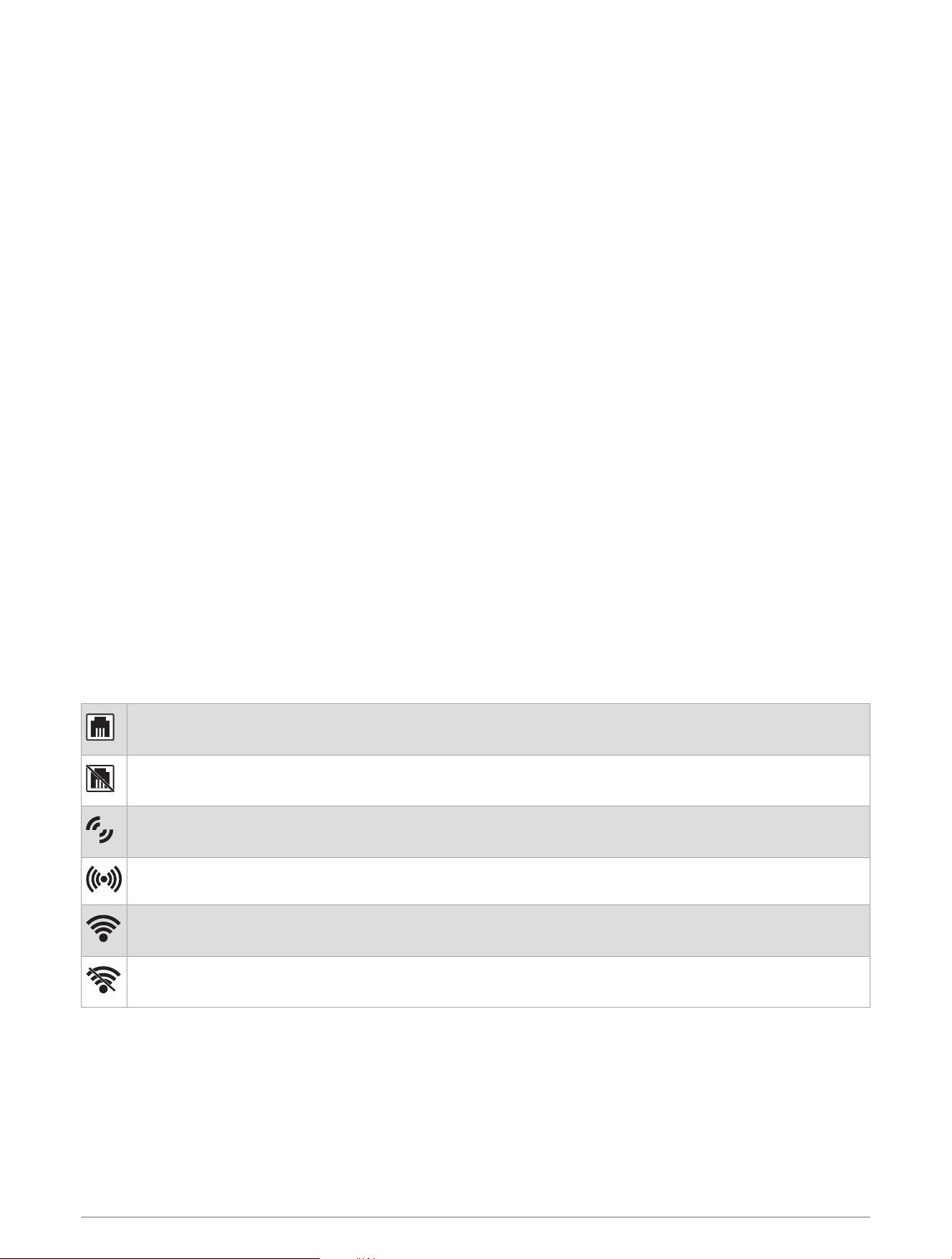
Network Troubleshooting
If you cannot see or connect to Fusion Apollo devices on the network, perform these steps.
• Verify that all Fusion Apollo stereos, remote controls, network switches, routers, and wireless access points
are connected to the network and turned on.
• Verify that wireless Fusion Apollo devices are connected to a wireless router or wireless access point on the
network.
NOTE: Wired connections are more reliable than wireless connections. If possible, you should connect
devices to the network using an Ethernet cable.
• Verify that only one device, either a stereo or a router, is configured as a DHCP server. If you are connected
to a Garmin chartplotter using a wired Garmin BlueNet or Garmin Marine Network connection, it acts as the
DHCP server for the network and no connected stereo should be configured as a DHCP server.
• Change the channel on your router or wireless access point to test for and correct interference.
You may experience wireless interference if there are many nearby wireless access points.
• Disconnect Bluetooth devices to test for and correct interference.
Connecting a Bluetooth device to a stereo configured as a wireless access point or client may reduce
wireless performance.
• If you configured static IP addresses, verify that every device has a unique IP address, that the first three sets
of numbers in the IP addresses match, and that the subnet masks on every device are identical.
• If you have made configuration changes that might be causing networking issues, reset all network settings
to the factory default values.
• If you connected the Fusion Apollo device to a Garmin chartplotter using a wired Garmin BlueNet or Garmin
Marine Network connection, the network settings on the device should change automatically to GARMIN
MARINE NETWORK.
If the network settings do not change as expected, reset the network settings on the device (Resetting
Network Settings, page30).
Network Status Icons
A network-status icon is shown on some screens of the stereo. You can refer to this table to understand the
appearance of the icon and help diagnose issues with the Fusion PartyBus network.
The stereo is configured for a wired network connection and connected to a wired network using an
Ethernet cable.
The stereo is configured for a wired network connection, but cannot detect the wired network. An
Ethernet cable may not be connected or there may be other problems with the network.
The stereo is in Wi‑Fi accessory configuration (WAC) mode, which allows for an easy connection to
Apple devices.
The stereo is configured as a wireless access point.
The stereo is configured as a wireless client and connected to a wireless access point. The number of
bars indicates the signal strength.
The stereo is configured as a wireless client, but is not connected to a wireless access point. There may
be a problem with the connection settings or with the wireless access point.
Appendix 39

Software Update Troubleshooting
If a stereo software update you downloaded from the Garmin website does not complete successfully, perform
these steps.
• Make sure the update file you downloaded is intended for the stereo model you are updating. Only software
update files intended for the specific stereo will update the stereo.
• Make sure the update file is a newer version than what is presently installed on the stereo. Only newer
software update files can be installed on a stereo.
• Make sure the update file was extracted from the .zip file and loaded onto the root of the USB flash drive.
When properly prepared, the USB flash drive will have a directory named Garmin containing the update file.
• Make sure the USB flash drive is formatted using the FAT32 file system. The stereo will not apply an update
from a USB flash drive formatted using the NTFS file system.
• If the stereo is part of a Fusion PartyBus network group, remove it from the group before starting the update.
The stereo does not update as part of a Garmin network update
If you are attempting to update a stereo or stereos using a Garmin chartplotter on a network, and the stereo
software update does not complete successfully, perform these steps.
• Make sure that the stereo or stereos you want to update over the network are using software verison 6.20 or
later. If any connected stereos are using an earlier software version, you must update the stereo individually
using a USB flash drive or the Fusion app before it can be included in a network update.
• If the network update fails the first time, try it again before further troubleshooting.
• Try disconnecting any Bluetooth devices and try the update again.
• Make sure the stereo is connected properly to the Garmin chartplotter using an Ethernet cable. A stereo
connected using Wi‑Fi technology only cannot be updated with other devices on the network.
• If your network contains both a Garmin BlueNet chartplotter and Legacy Garmin Marine Network devices,
make sure the stereo is connected to either the Garmin BlueNet chartplotter or a Garmin BlueNet 20 switch.
See garmin.com/manuals/bluenet for more information.
• Make sure that all stereos connected to the network are set to GARMIN MARINE NETWORK as the network
type.
• Make sure that all the stereos connected to the network are set to WI-FI OFF.
• If the network type is not set to GARMIN MARINE NETWORK, and you cannot change the network type or set
WI-FI OFF, reset the network settings on the stereo (Resetting Network Settings, page30).
The stereo keeps locking up when connected to an Apple device
• Press and hold the power button to reset the stereo.
• Reset the Apple device. Go to www.apple.com for more information.
• Make sure you have the latest version of iTunes
®
and the latest operating software on your Apple device.
The stereo is not finding my connected Apple device
• Make sure your Apple device supports Interface Accessory Protocol 2 (iAP2). This stereo is not compatible
with iAP1 devices.
• Make sure you have the latest version of iTunes and the latest operating software on your Apple device.
• Make sure you have the latest version of the Fusion Audio application on your Apple device.
• Try rotating and re-inserting the USB-C cable into the stereo.
• Try using a different cable, preferably an Apple OEM cable.
• If you are using a USB-A to USB-C adapter, try using a different adapter.
• Reset the Apple device.
Go to apple.com for more information.
• Contact your Fusion dealer or go to support.garmin.com.
40 Appendix

My Apple AirPlay audio is interrupted by short breaks
• Make sure the Apple device is not covered or obstructed.
• Make sure the Apple device has a good connection to the same Wi‑Fi network as the stereo.
• Make sure the Apple device is not connected to the stereo using Bluetooth technology and Wi‑Fi.
Using both a Bluetooth and a Wi‑Fi connection may cause playback interruptions.
Specifications
General
Weight 750g (26.5oz.)
Water resistance
IEC 60529 IPX7 (front of stereo only, when properly installed)
IEC 60529 IPX2 (rear of stereo, when properly installed)
Operating temperature range From 0 to 50°C (from 32 to 122°F)
Storage temperature range From -20 to 70°C (from -4 to 158°F)
Input voltage From 10.8 to 32Vdc
Current (max.) 25A
Current (muted) Less than 900mA
Current (off) Less than 350mA
Fuse 25A mini blade-type
NMEA 2000 LEN @ 9Vdc 2 (100mA)
Bluetooth wireless range Up to 10m (30ft.)
ANT wireless range Up to 3m (10ft.)
Wireless frequencies/protocols
Wi‑Fi 2.4GHz @ +19.49dBm maxiumum
Bluetooth 2.4GHz @ +15.11dBm maxiumum
ANT 2.4GHz @ 3.22dBm maxiumum
Compass-safe distance 40 cm (15.75 in)
On-board, Class D Amplifier
Output music power per channel 4 x 80W max. 4ohm
Total output peak power 320W
Output power per channel
3
4 x 40WRMS less than 1%THD+N, 4 ohm {CTA-2006-D}
Line output level (max.) 5.6V (peak to peak)
Aux input level (typical) 1 VRMS typical, 2VRMS max.
3
The stereo may limit the output power to prevent the amplifier from overheating, and to maintain the audio dynamics.
Appendix 41
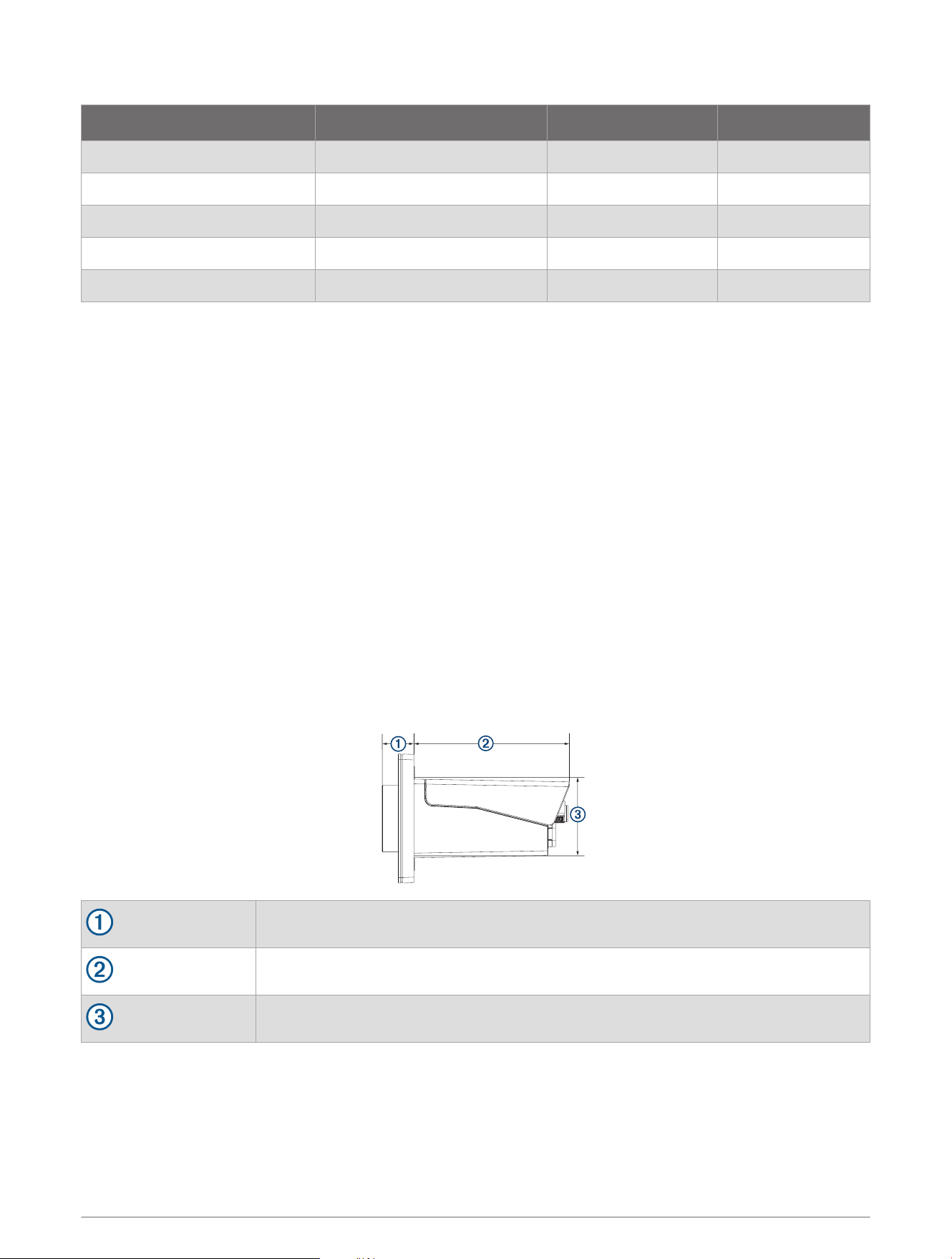
Tuner frequencies
Tuner Europe and Australasia USA Japan
FM radio frequency range 87.5 to 108MHz 87.5 to 107.9MHz 76 to 95MHz
FM frequency step 50kHz 200kHz 50kHz
AM radio frequency range 522 to 1620kHz 530 to 1710kHz 522 to 1620kHz
AM frequency step 9kHz 10kHz 9kHz
DAB frequency 174 to 240 MHz (Band III) N/A N/A
Network Interfaces and Services
Devices connected to the stereo using a Garmin BlueNet cable, a Garmin Marine Network cable, or other
Ethernet cable use these network interfaces and services. These interfaces and surfaces are enabled by default,
cannot be disabled, and are required for proper equipment operation.
• Garmin proprietary services
• DHCP
• HTTP
• LLDP
• NFS
• RPC Bind
• SSH
• Telnet
NOTE: When you connect a new device to the network, private information is synchronized with the newly-added
device.
Stereo Dimension Drawings
Side Dimensions
20.4mm (0.8in.)
99mm (3.9in.)
50mm (1.97in.)
42 Appendix
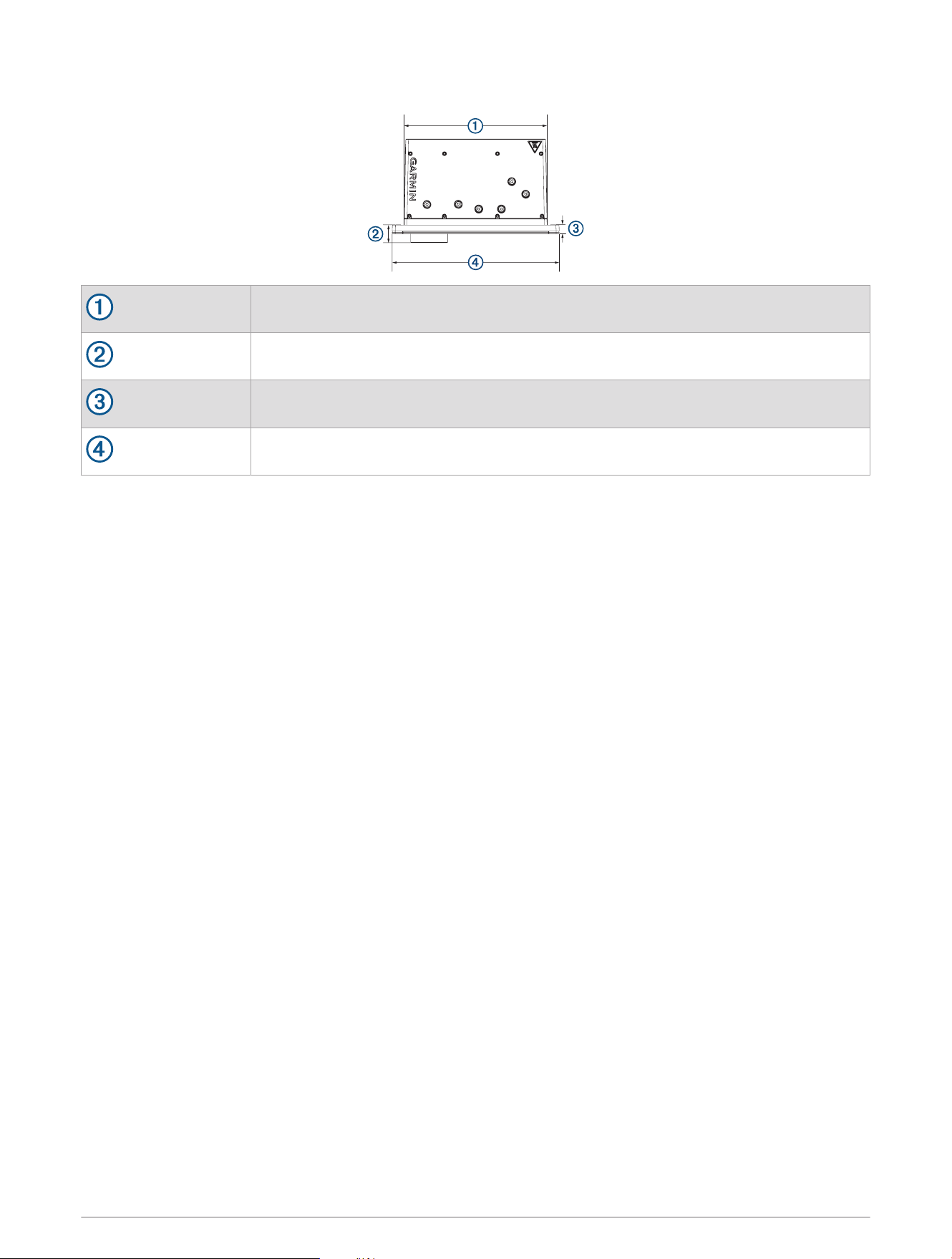
Top Dimensions
164mm (6.5in.)
20.4mm (0.8in.)
10mm (0.39in.)
192mm (7.56in.)
Appendix 43

support.garmin.com
GUID-2BF6BEB7-4CE7-4804-9935-F0D912E72FA7 v1June 2025