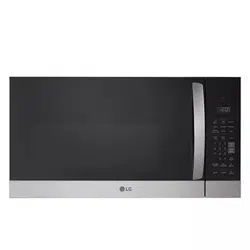
OWNER'S MANUAL
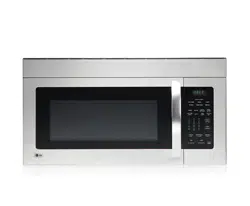
MICROWAVE OVEN
Read this owner's manual thoroughly before operating the
appliance and keep it handy for reference at all times.
ENGLISH
MVEM1621*
MFL05776701
Rev.02_032625
www.lg.com
Copyright © 2025 LG Electronics. All Rights Reserved
Scan to see the online manual.
TABLE OF CONTENTS
2
3 IMPORTANT SAFETY
INSTRUCTIONS
3 READ ALL INSTRUCTIONS BEFORE USE
3WARNING
7 INSTALLATION
7 Product Overview
8 Installation Requirements
9 Before Installing
11 Installing the Microwave Oven
19 OPERATION
19 Control Panel
19 Before Use
21 Quick Start and Stop
21 Manual Cooking
22 Cooking Mode
25 Cookware Guide
26 Cooking Guide
28 SMART FUNCTIONS
28 Smart Diagnosis
TM
Feature
29 MAINTENANCE
29 Cleaning
30 Replacing Parts
32 TROUBLESHOOTING
32 FAQs
34 Before Calling for Service
35 LIMITED WARRANTY
35 USA
PRECAUTIONS TO AVOID POSSIBLE EXPOSURE TO EXCESSIVE MICROWAVE ENERGY
(a) Do not attempt to operate this oven with the door open since open-door operation can result in harmful
exposure to microwave energy. It is important not to defeat or tamper with the safety interlocks.
(b) Do not place any object between the oven front face and the door or allow soil or cleaner residue to
accumulate on sealing surfaces.
(c) Do not operate the oven if it is damaged. It is particularly important that the oven door close properly and
that there is no damage to the: (1) Door (bent), (2) hinges and latches (broken or loosened), (3) door seals
and sealing surfaces.
(d) The oven should not be adjusted or repaired by anyone except properly qualified service personnel.
3IMPORTANT SAFETY INSTRUCTIONS
ENGLISH
IMPORTANT SAFETY INSTRUCTIONS
READ ALL INSTRUCTIONS BEFORE USE
Safety Messages
Your safety and the safety of others are very important.
We have provided many important safety messages in this manual and on your appliance. Always read and
follow all safety messages.
WARNING
WARNING
• To reduce the risk of explosion, fire, death, electric shock, injury or scalding to persons when using this
product, follow basic precautions, including the following:
Technical Safety
• This appliance is not intended for use by persons (including children) with reduced physical, sensory or
mental capabilities, or lack of experience and knowledge, unless they have been given supervision or
instruction concerning use of the appliance by a person responsible for their safety. Children should be
supervised to ensure that they do not play with the appliance.
• To reduce the risk of burns, electric shock, fire, injury to persons or exposure to excessive microwave
energy when using the microwave oven, read all instructions before using the appliance.
• Children must not be allowed to play with accessories or hang down from the door or any part of the
oven. Doing so can cause serious injury and damage. As with any appliance, close supervision is
necessary when used by children.
• Read and follow the specific PRECAUTIONS TO AVOID POSSIBLE EXPOSURE TO EXCESSIVE
MICROWAVE ENERGY found on page 2.
• This appliance must be grounded. Connect only to properly grounded outlet. See “GROUNDING
INSTRUCTIONS” found on Installation Requirements section.
• Use this appliance only for its intended use as described in the manual. Do not use corrosive chemicals
or vapors in this appliance. This type of oven is specifically designed to heat, cook, or dry food. It is not
designed for industrial or laboratory use.
• To avoid electric shock:
- Do not operate this appliance if it has a damaged cord or plug, if it is not working properly or if it has
been damaged or dropped.
This is the safety alert symbol.
This symbol alerts you to potential hazards that can kill or injure you and others. All safety
messages will follow the safety alert symbol and either the word WARNING or CAUTION.
These words mean:
WARNING
You may be killed or seriously injured if you do not follow instructions.
CAUTION
You may be injured or cause damage to the product if you do not follow instructions.
All safety messages will tell you what the potential hazard is, tell you how to reduce the chance of injury, and
tell you what may happen if the instructions are not followed.

4 IMPORTANT SAFETY INSTRUCTIONS
- Do not immerse cord or plug in water. Keep cord away from heated surfaces.
- Do not let cord hang over edge of table or counter.
• To reduce the risk of fire in the oven cavity:
- Do not overcook food. Carefully attend appliance when paper, plastic, or other combustible materials
are placed inside the oven to facilitate cooking.
- Remove wire twist-ties from paper or plastic bags before placing bag in oven.
- If materials inside the oven ignite, keep oven door closed, turn oven off, and disconnect the power
cord, or shut off power at the fuse or circuit breaker panel.
- Do not use the cavity for storage purposes. Do not leave paper products, cooking utensils, or food in
the cavity when not in use.
• Install or locate this appliance only in accordance with the provided installation instructions.
• Some products such as whole eggs and sealed containers – for example, closed glass jars – are able to
explode and should not be heated in this oven.
• Liquids, such as water, coffee, or tea are able to be overheated beyond the boiling point without
appearing to be boiling. Visible bubbling or boiling when the container is removed from the microwave
oven is not always present.
• THIS COULD RESULT IN VERY HOT LIQUIDS SUDDENLY BOILING OVER WHEN THE CONTAINER IS
DISTURBED OR A SPOON OR OTHER UTENSIL IS INSERTED INTO THE LIQUID.
To reduce the risk of injury to persons:
- Do not overheat the liquid. Stir the liquid both before and halfway through heating it.
- Do not use straight-sided containers with narrow necks. Use extreme care when inserting a spoon or
other utensil into the container.
- After heating, allow the container to stand in the microwave oven for a short time before removing the
container.
• Do not cover or block any openings on the appliance.
• Do not store this appliance outdoors. Do not use this product near water - for example, near a kitchen
sink, in a wet basement, near a swimming pool, or similar locations.
• This appliance should be serviced only by qualified service personnel. Contact the nearest authorized
service facility for examination, repair, or adjustment.
• When cleaning surfaces of door and oven that comes together on closing the door, use only mild,
nonabrasive soaps or detergents applied with a sponge or soft cloth.
• HOT CONTENTS CAN CAUSE SEVERE BURNS. DO NOT ALLOW CHILDREN TO USE THE MICROWAVE. Use
caution when removing hot items.
Operation
• Do not use this oven for commercial purposes. It is made for household use only.
• Do not run the oven while it is empty.
• If your oven is dropped or damaged, have it thoroughly checked by a qualified service technician before
using it again.
• Take care when the door is opened to avoid injury.
• To avoid improperly cooking some foods:
- Do not heat any type of baby bottle or baby food. Uneven heating may occur and possibly cause
personal injury.
- Do not heat small-necked containers, such as syrup bottles.
- Do not deep-fat fry in the microwave oven.
- Do not attempt home canning in the microwave oven.
• Do not use the oven for the purpose of dehumidification (for example, operating the microwave oven
with wet newspapers, clothes, toys, electric devices, plants, soil, pets or any other living matter inside it).

5IMPORTANT SAFETY INSTRUCTIONS
ENGLISH
The oven must only be used for heating or cooking food. The results of misuse can include safety risks
such as fire, burns, or death due to electric shock.
• The appliance and its accessible parts become hot during use. Care should be taken to avoid touching
heating elements inside the oven. Children must be kept away unless continuously supervised.
• Do not use recycled paper products. They may contain impurities which may cause sparks and/or fires
when used in cooking.
• The door or the outer surface may get hot when the appliance is operating.
• Liquids heated in certain shaped containers (especially cylindrical-shaped containers) may become
overheated. The liquid may splash out with a loud noise during or after heating or when adding
ingredients (instant coffee, etc.), resulting in harm to the oven and possible injury. In all containers, for
best results, stir the liquid several times before heating. Always stir liquid several times between
reheatings.
• DO NOT TOUCH HEATING ELEMENTS AND/OR INTERIOR SURFACES OF THE MICROWAVE OVEN.
- While using the microwave oven or after use or while cleaning the microwave oven or while using
cooktop for a long time, do not allow flammable materials to come into contact with the heating
elements and/or interior surfaces of the microwave oven until they have had sufficient time to cool
down. Other surfaces, such as the windows of the microwave oven door, the oven lamp, the cooktop
light, and the door open button, can also get hot and may cause burns if not allowed to cool.
Maintenance
• If the door or door seals are damaged, the oven must not be operated until it has been repaired by an
authorized service person.
• The oven should be cleaned regularly and any food deposits should be removed. Failure to maintain the
oven in a clean condition could lead to deterioration of the surface that could adversely affect the life of
the appliance and possibly result in a hazardous situation.
• Do not rinse trays and racks by placing them in water immediately after cooking. This may cause
breakage or damage. Improper use could result in damage to the oven.
• Oversized food or oversized metal utensils should not be inserted in a microwave oven as they may
create a fire or risk of electric shock.
• Do not clean with metal scouring pads. Pieces can burn off the pad and touch electrical parts involving a
risk of electric shock.
• Do not store any materials, other than manufacturer’s recommended accessories, in this oven when not
in use.
• Do not cover racks or any other part of the oven with metal foil. This will cause overheating of the oven.
• Do not allow water to spill into the ventilation openings to prevent damage to the internal working parts
of the oven. Doing so may cause a fire or create a risk of electric shock.
Microwave Oven
• Must be installed following the provided installation instructions.
• Secure the cord in the cabinet above the oven.
• Do not tamper with the built-in safety switches on the oven door. The oven has several built-in safety
switches to make sure the power is off when the door is open.
• Preserve the oven floor:
- Do not heat the oven floor excessively.
- Do not allow the gray film on special microwave-cooking packages to touch the oven floor. Put the
package on a microwavable dish.
- Do not cook anything directly on the oven floor or turntable. Use a microwavable dish.
• Keep a browning dish at least 3/16 inch above the oven floor. Carefully read and follow the instructions
for the browning dish. If you use a browning dish incorrectly, you could damage the oven floor.

6 IMPORTANT SAFETY INSTRUCTIONS
SAVE THESE INSTRUCTIONS
Ventilation
• Burn Hazard: If a range or cooktop located below the microwave is operating, use caution when
operating the microwave. External components of the microwave may become very hot and cause
burns or other injury if touched.
• Clean Ventilating Hoods Frequently – Grease should not be allowed to accumulate on hood or filter.
• When flaming foods under the hood, turn the fan on.
• Use care when cleaning the vent-hood filter. Corrosive cleaning agents, such as lye-based oven cleaners,
may damage the filter.
• Suitable for use above both gas and electric cooking equipment 36 inches wide or less.
Radio/TV/Wireless Equipment Interference
• Operating the microwave oven near equipment-such as a radio, TV, wireless LAN, Bluetooth devices,
medical equipment, or wireless equipment which uses the same frequency, may cause interference. This
interference is not an indication of a defect in the product or its operation. The product is safe to use.
• Do not use medical equipment near the microwave oven, as the interference could affect the medical
equipment’s operation.
• When there is interference, it may be reduced or eliminated by taking the following measures:
- Clean the door and the sealing surfaces of the oven.
- Reorient the receiving antenna of the radio, TV, Bluetooth, or other equipment.
- Relocate the microwave oven in relation to the radio, TV, Bluetooth, or other equipment.
- Move the microwave oven away from the receiver.
- Plug the microwave oven into a different outlet so that the microwave oven and receiver are on
different branch circuits
FEDERAL COMMUNICATIONS COMMISSION RADIO FREQUENCY
INTERFERENCE STATEMENT (U.S.A. ONLY)
• This equipment generates and uses ISM frequency energy and if not installed and used properly, that is
in strict accordance with the manufacturer’s instructions, may cause interference to radio and television
reception. It has been type tested and found to comply with limits for ISM Equipment pursuant to part 18
FCC Rules, which are designed to provide reasonable protection against such interference in a
residential installation. However, there is no guarantee that interference will not occur in a particular
installation. If this equipment does cause interference to radio or television reception, which can be
determined by turning the equipment off and on, the user is encouraged to try to correct the
interference by one or more of the following:
- Reorient or relocate the receiving antenna of the radio or television.
- Increase the separation between the equipment and receiver.
- Connect the equipment into an outlet on a circuit different from that to which the receiver is
connected.
- Consult the dealer or an experienced radio/TV technician for help.
• The manufacturer is not responsible for any radio or TV interference caused by unauthorized
modification to this equipment. It is the responsibility of the user to correct such interference.
7INSTALLATION
ENGLISH
INSTALLATION
Product Overview
Front View
The appearance or components of the appliance
may differ from model to model.
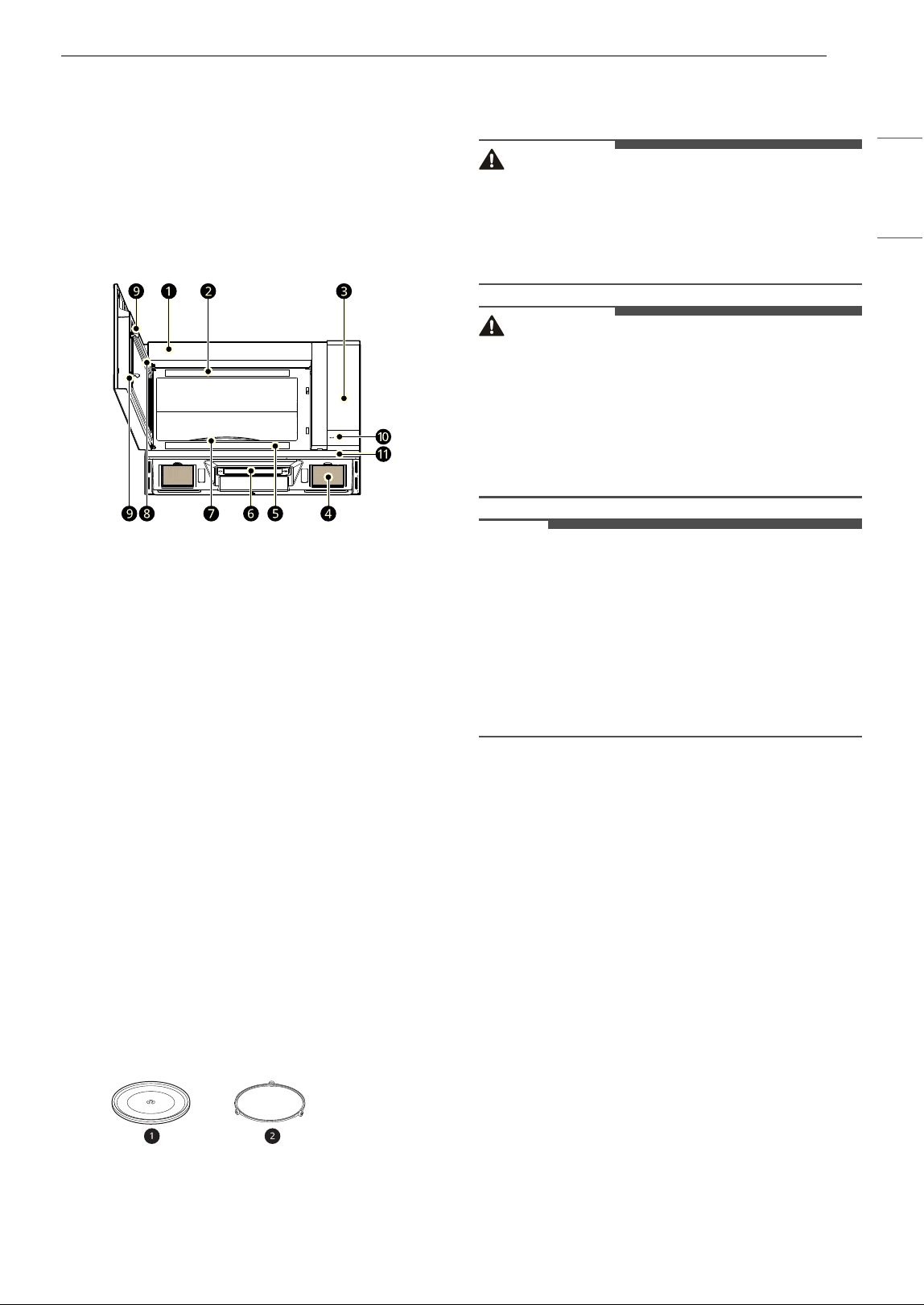
a Vent Grille
b Location of Model Number
c Control Panel
d Grease Filter
e Cooking Guide
f Cooktop Light
g Glass Turntable
h Window with Metal Shield
i Safety Door Lock System
j Door Open Button
k Air Guide
Accessories
Accessories will vary depending on the model
purchased.
a Glass Tray
b Rotating Ring
WARNING
• Do not operate the oven when it is empty or
without the glass tray. It is best to leave a glass
of water in the oven when not in use. The water
will safely absorb all microwave energy, if the
oven is accidentally started.
CAUTION
• To avoid risk of personal injury or property
damage, do not use stoneware, metal cookware,
or metal rimmed cookware in the oven.
• Keep aluminum foil at least 1 inch from the oven
walls and other pieces of foil. Foil can cause
arcing if it gets too close to the oven walls during
cooking.
NOTE
• This microwave oven is designed for household
use only. It is not recommended for commercial
use.
• Do not overcook food. The microwave oven can
be damaged.
• A beep sounds each time you press a key. A
melody signals the end of a timer or a cooking
cycle.
Specifications
MVEM1621* Model
• Power Supply: 120 V AC, 60 Hz
• Rated Power Consumption: 1600 W (Microwave
oven with cooktop lamp and ventilation fan)
• Microwave Output: Max. 1000 W
†
• Rated Current: 14 A
• Dimensions (W x H x D): 29 14/16" x 16 7/16" x
15 14/16"
• Capacity of Oven Cavity: 1.6 cu.ft.
• Net Weight: 47 lbs.
† IEC 60705 RATING STANDARD. Specifications
are subject to change without prior notice.
8 INSTALLATION
Installation Requirements
Installation Location
Make sure you have enough space and support.
• Mount the oven against a flat, vertical wall, so it
is supported by the wall. The wall should be
constructed of a minimum of 2" x 4" wood
studding and 3/8" thick drywall or plaster/lath.
• Attach the 2 lag screws supporting the oven to a
vertical, 2" x 4" wall stud.
• DO NOT mount the microwave oven to an island
or peninsula cabinet.
• Be sure that the upper cabinet and rear wall
structures can support 150 lb. plus the weight of
any items you place inside the oven or upper
cabinet.
• Locate the oven away from areas with strong
drafts, such as near windows, doors, and large
heating vents.
• Make sure that you have enough space. See the
clearance diagrams in the installation manual for
the minimum vertical and horizontal clearances.
• Refer to the Installation Instructions for
details.
Electrical Requirements
The oven is designed to operate on a standard 120
V/60 Hz household outlet. Be sure that the circuit is
at least 15 A or 20 A and the microwave oven is the
only appliance on the circuit. It is not designed for
50 Hz or any circuit other than a 120 V/60 Hz
circuit. No other electrical appliances or lighting
circuits should be on this line. If in doubt, consult a
licensed electrician.
Voltage Warning
The voltage used at the wall socket must be the
same as specified on the oven name plate located
on the back or on the side of the control panel of
the oven. Using a higher voltage is dangerous and
may result in a fire or other type of accident
causing oven damage. Low voltage will cause slow
cooking. If the microwave oven does not perform
normally in spite of proper voltage, unplug and
reconnect the power cord.
Do Not Block Air Vents
All air vents should be kept clear during cooking. If
air vents are covered during oven operation the
oven may overheat. To prevent damage to the
oven, a sensitive safety device detects overheating
and automatically turns the oven off. The oven
cannot be used until it has cooled sufficiently.
Grounding Instructions
This appliance must be grounded. In the event of
an electrical short circuit, grounding reduces the
risk of electric shock by providing an escape wire
for the electric current. This appliance is equipped
with a cord having a grounding wire with a
grounding plug. The plug must be plugged into an
outlet that is properly installed and grounded.
• Consult a qualified electrician or service person if
the grounding instructions are not completely
understood, or if doubt exists as to whether the
appliance is properly grounded.
- Do not use an extension cord. If the power
supply cord is too short, have a qualified
electrician or service person install an outlet
near the appliance.
• Ensure that the product is properly grounded
before use.
• Keep the electrical power cord dry and do not
pinch or crush it in any way.
• For a permanently connected appliance:
This appliance must be connected to a
grounded, metallic, permanent wiring system, or
an equipment grounding conductor should be
run with the circuit conductors and connected to
the equipment grounding terminal or lead on
the appliance.
WARNING
• Improper use of the grounding can result in a
risk of electric shock.
• Do not use an extension cord. If the power
supply cord is too short, have a qualified
electrician or service person install an outlet
near the appliance.
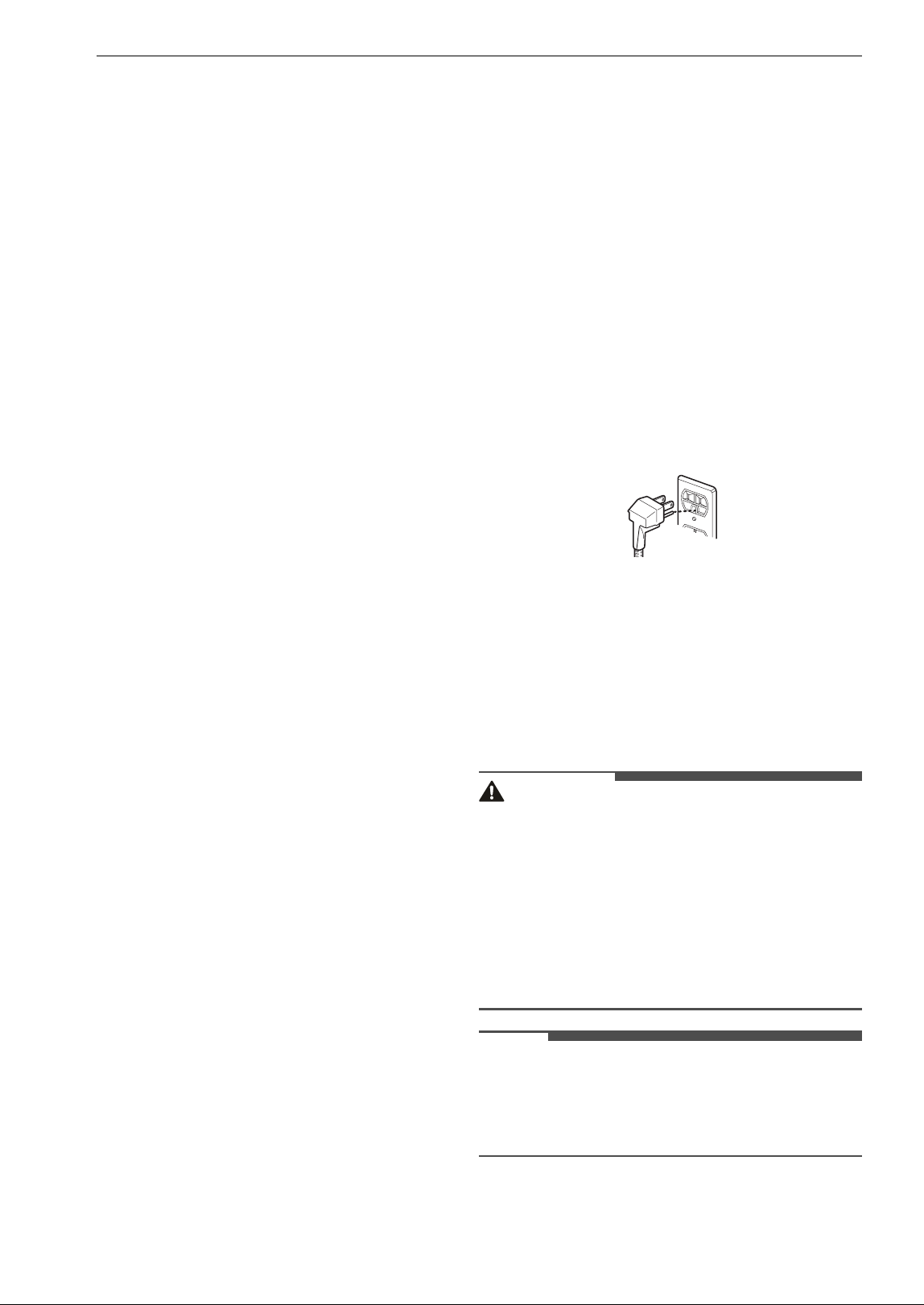
• A short power supply cord is provided to reduce
the risks resulting from becoming entangled in
or tripping over a longer cord.
NOTE
• Because this appliance fits under the cabinet, it
has a short power supply cord. See the separate
installation instructions for directions on
properly placing the cord.
9INSTALLATION
ENGLISH
Before Installing
Before You Start
Be sure to read the following safety instructions
Read the entire manual before you begin. The
model number plate
a is located on the oven
front.
The mounting plate
b is located in the upper
packing material.
NOTE
• Vent grille appearance varies by model.
Make sure you have enough space and support.
• Mount the oven against a flat, vertical wall, so it
is supported by the wall. The wall should be
constructed of a minimum of 2" x 4" wood
studding and 3/8" thick drywall or plaster/lath.
• Attach the two lag screws supporting the oven to
a vertical, 2" x 4" wall stud.
• Do not mount the microwave oven to an island
or peninsula cabinet.
• Be sure the upper cabinet and rear wall
structures can support 150 lbs., plus the weight
of any items you place inside the oven or upper
cabinet.
• Locate the oven away from areas with strong
drafts, such as windows, doors, and strong
heating vents.
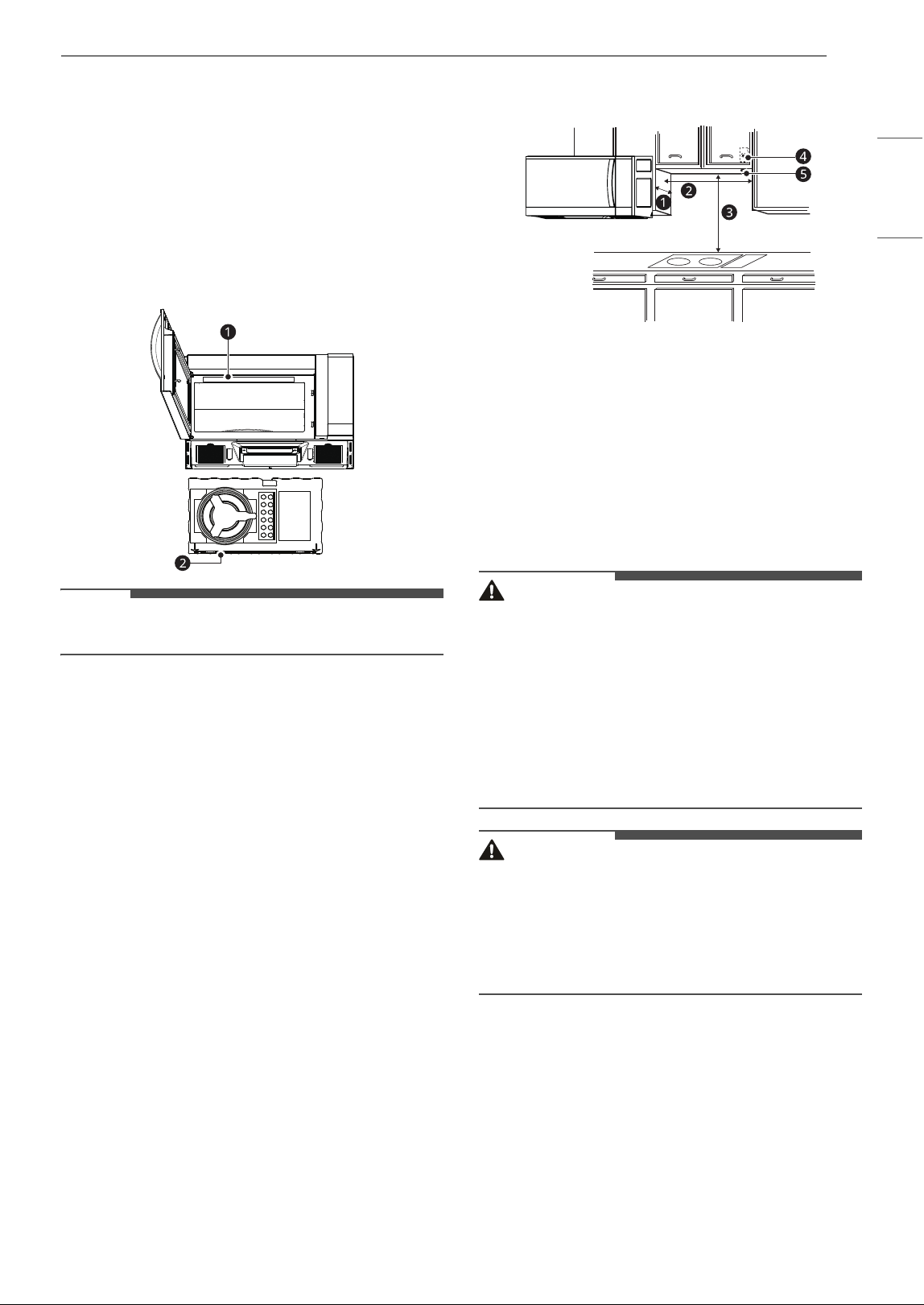
• Be sure you have enough space (minimum
vertical and horizontal clearance).
a Maximum 13": cabinet depth
b Minimum 30": cabinet opening width
c Minimum 30": clearance from bottom of
cabinet to cooking surface or countertop
before installation. (Use templates included
with installation instructions.)
d Grounded Outlet (inside upper cabinet)
e Power Supply Cord Hole
WARNING
• If you do not mount the oven as instructed, you
risk personal injury and/or property damage.
• If your range has cooktop controls in the front,
unplug the range before covering the cooktop to
prevent risk of fire and damage if the knobs are
accidentally activated while installing the OTR.
• The product is heavy. Use at least 2 people when
lifting or installing the appliance to avoid injury
or product damage.
CAUTION
• Before you begin installing the oven, place a
piece of the carton or other heavy material (a
blanket) over the countertop or cooktop to
protect it. Do not use a plastic cover. Failure to
protect these surfaces could result in property
damage.
10 INSTALLATION
Parts
Included Parts
NOTE
• Depending on your ventilation requirements,
you may not use all of these parts.
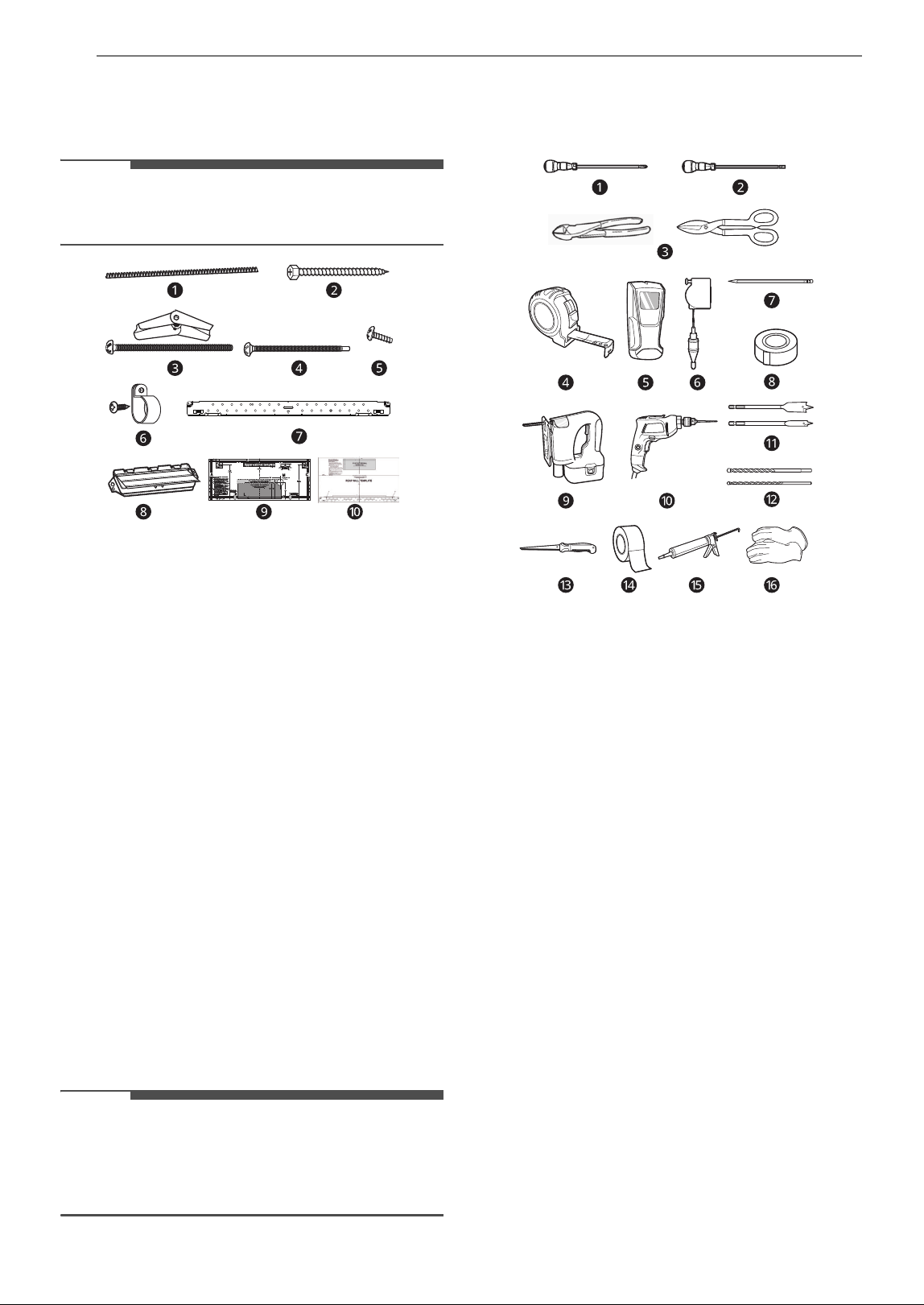
a Power cord clamp bushing (1ea): for the cord
hole in a metal upper cabinet
b 1/4" x 2" lag screw (2ea): for wall stud holes
c 1/4" x 3" toggle bolts (2ea): for drywall holes
Spring toggle heads (2ea): for the toggle bolts
d 1/4" x 3" bolts (2ea): for securing to the upper
cabinet
e Tapping screws (2ea): for attaching the damper
duct connector
f Power cord clamp (1ea) and dark-colored
mounting screw (1ea): to hold the power cord
g Mounting plate (1ea): for supporting the
microwave oven
h Back-draft damper: 2 pieces must be
assembled as shown. (for roof venting or wall
venting installation, not for room venting
installation)
i Upper cabinet template (1ea)
j Rear wall template (1ea): 1 piece mounting
plate only
NOTE
• You need to install at least one lag screw into a
2" x 4" stud and three anchor bolts into the wall.
The mounting area must meet the 150 lb. weight
requirement.
Tools and Materials
You will need the following tools and materials for
the installation:
a Phillips screwdriver (for the screws)
b Flat blade screwdriver (for the toggle bolts)
c Small side cutters (nipper) or tin snips
d Measuring tape (metal preferred)
e Stud finder
f Plumb line
g Pencil
h Clear tape (for taping the templates to the wall)
i Saber saw (for cutting vent holes for roof or
wall venting)
j Electric drill
k 3/8" and 3/4" wood drill bits
l 1/2" and 3/16" drill bits
m Keyhole saw (for the power cord hole)
n Duct tape
o Caulking gun and caulk
p Gloves
11INSTALLATION
ENGLISH
NOTE
• If you have brick or masonry walls, you will need
special hardware and tools.
• The ductwork you need for the installation is not
included. All wall and roof caps must have a
back-draft damper (shown in Parts section).
• Wear proper gloves to protect your hands from
injury.
Installing the Microwave
Oven
Step 1: Prepare the Electrical
Connection
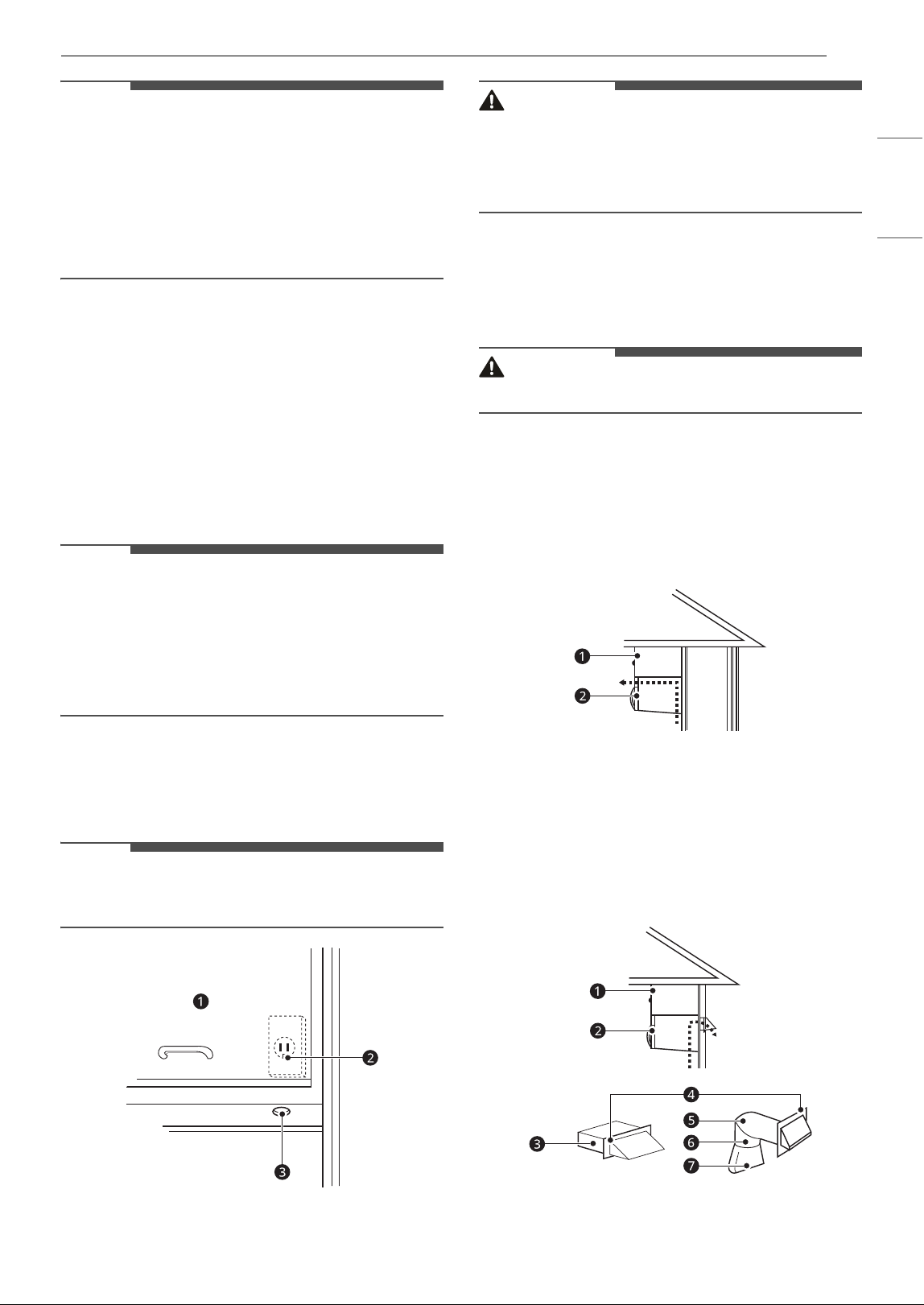
1 Locate the grounded electrical outlet b for
this oven in the upper cabinet a.
NOTE
• The outlet should be on a circuit dedicated to the
microwave oven (120 V, 60 Hz., AC only) with a 15
or 20 A fused electrical supply.
• Important: If you do not have the proper wall
outlet, you MUST have one installed by a
qualified electrician.
2 You will cut the hole c for the power supply
cord later when you prepare the wall and
upper cabinet in Step 4.
NOTE
• Do not use an extension cord. Keep the power
cord dry and do not pinch or crush it.
WARNING
• Avoid electric shock. This appliance must be
grounded.
• Improper grounding could result in electric
shock or other personal injury.
Do not, under any circumstances, remove the
power supply cord grounding prong.
Step 2: Prepare the Venting System
WARNING
• This oven must be properly vented.
You may vent your ductwork in one of three ways.
Do not vent into a wall cavity, an attic, or an
unused area.
Room Venting
The oven is located on an inside wall of your
house.
a Cabinet
b Oven
Wall Venting
The oven is located on an outside wall of your
house: 3 1/4" x 10" duct c or minimum 6"
diameter round duct
f.
a Cabinet
b Oven
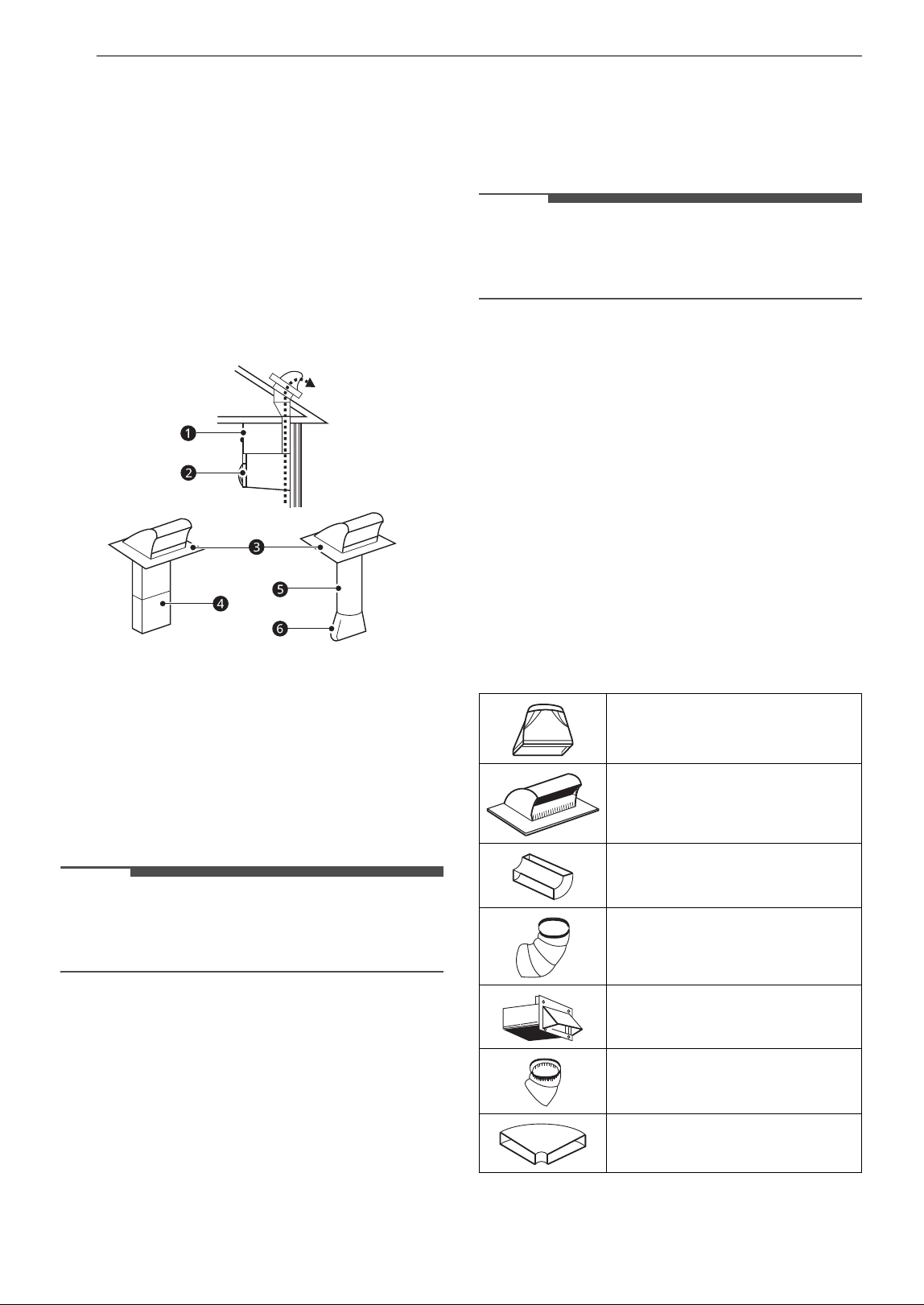
12 INSTALLATION
c 3 1/4" x 10" duct
d Wall cap
e Elbow
f Minimum 6" diameter round duct
g 3 1/4" x 10" to 6" round duct transition
Roof Venting
The oven is located on an outside wall near the
roof: 3 1/4" x 10" duct
d or minimum 6" diameter
round duct
e.
a Cabinet
b Oven
c Roof Cap
d 3 1/4" x 10" duct
e Minimum 6" diameter round duct
f 3 1/4" x 10" to 6" round duct transition
NOTE
• If you choose the rear exhaust method (wall
venting or roof venting), be sure there is enough
clearance within the wall for the exhaust duct.
When Installing Venting
• Keep the length of the ductwork and the number
of elbows to a minimum to ventilate your oven
efficiently. See examples in next section.
• Keep the size of the ductwork the same.
• Do not install two elbows together.
• Use duct tape to seal all joints in the duct system.
• Use caulking to seal the exterior wall or roof
opening around the cap.
• After installation, check the outside hood
opening and operation.
• For the outside hood opening and size refer to
the upper cabinet template or rear wall
template.
NOTE
• The ductwork you need for outside ventilation is
not included with your oven. See the standard
ductwork fittings.
Standard Ductwork Fittings
If the existing duct is round, you must use a
rectangular-to-round adapter, with a rectangular
3" extension duct installed between the damper
assembly and the adapter to prevent the exhaust
damper from sticking.
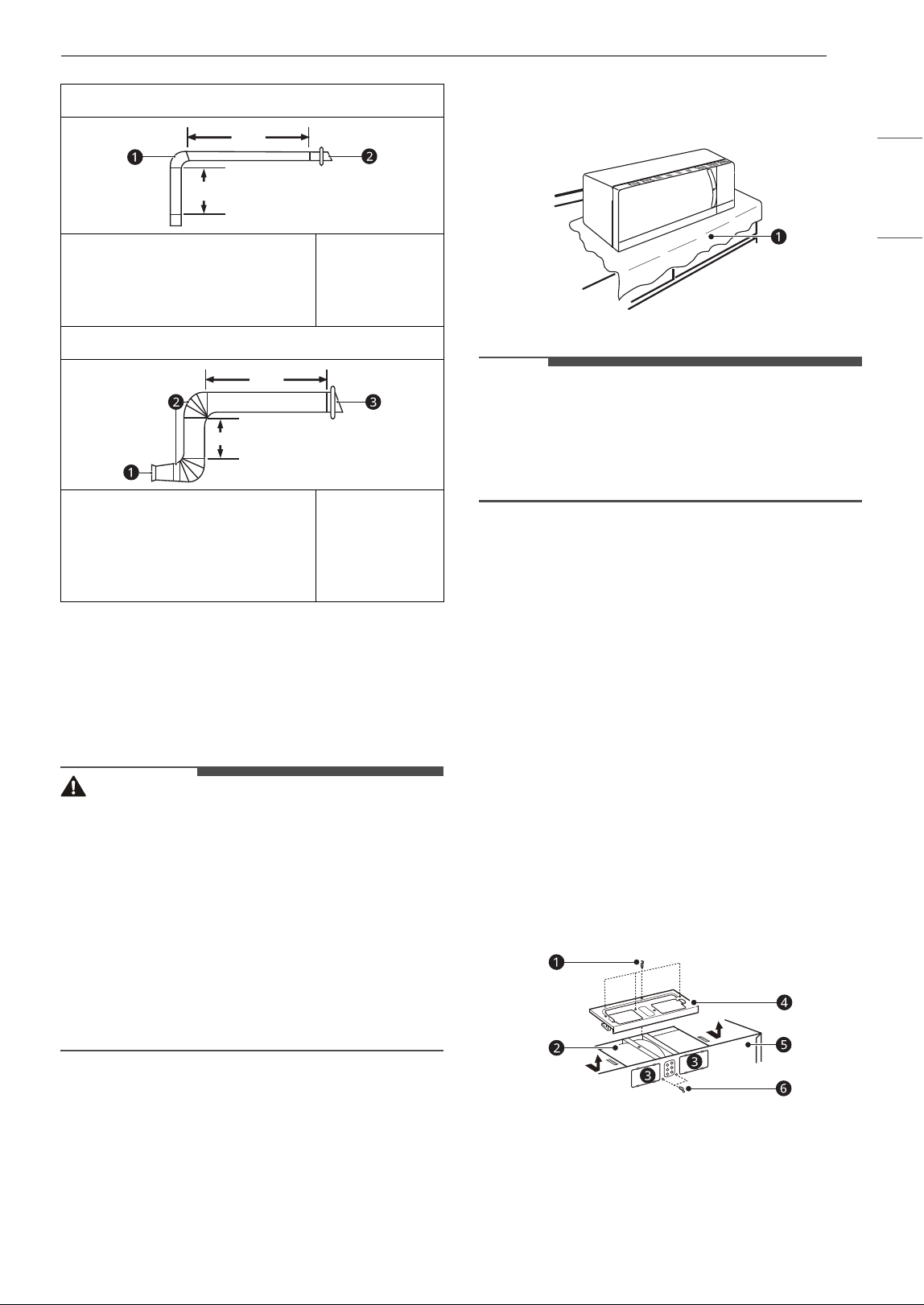
Duct Length
The total length of the duct system, including
straight duct, elbows, transitions, and wall or roof
caps must not exceed 140 feet.
For best performance, do not use more than three
90 degree elbows, and keep the length as short as
possible.
Below are the standard fittings and their
equivalent length in feet.
To calculate the equivalent length of each duct
piece used, see the examples below.
3 1/4" x 10" to 6" transition = 5 ft
3 1/4" x 10" roof cap = 24 ft
3 1/4" x 10" 90° elbow = 25 ft
90° elbow = 10 ft
3 1/4" x 10" wall cap = 40 ft
45° elbow = 5 ft
3 1/4" x 10" flat elbow = 10 ft
13INSTALLATION
ENGLISH
Step 3: Prepare the Venting Blower
Your microwave oven is shipped with the blower
assembled for room venting. You need to adjust
the blower if you want wall-venting or roof-venting
installation.
WARNING
• Electric shock hazard! Unplug unit before
working on it.
• Do not pull or stretch the blower wiring. Pulling
and stretching the blower wiring could result in
electric shock.
• To avoid risk of property damage, unplug the
microwave oven or disconnect the power at the
source by removing the fuse or throwing the
circuit breaker.
• To avoid risk of personal injury, wear protective
gloves when handling the mounting plate.
Installation
1 Remove any shipping materials and parts
from inside the microwave oven. Set them
aside for later use.
2 Cover the countertop or cooktop with a thick,
protective covering to protect it from damage
and dirt.
a Blanket, cardboard or other covering
NOTE
• If you have a free-standing range, disconnect it,
move it onto a piece of cardboard or hardboard
and pull it away from the wall, so that you can
get closer to the upper cabinet and back wall for
easier measuring and drilling.
3 Locate the exhaust adapter, grease filters and
hardware packet.
4 At this point, remove any adhesive tape (if
there is any), on the exhaust adapter, the
grease filters and the power supply cord.
Room-Venting (Recirculating)
Installation
This oven is shipped assembled for room-venting.
Wall-Venting Installation
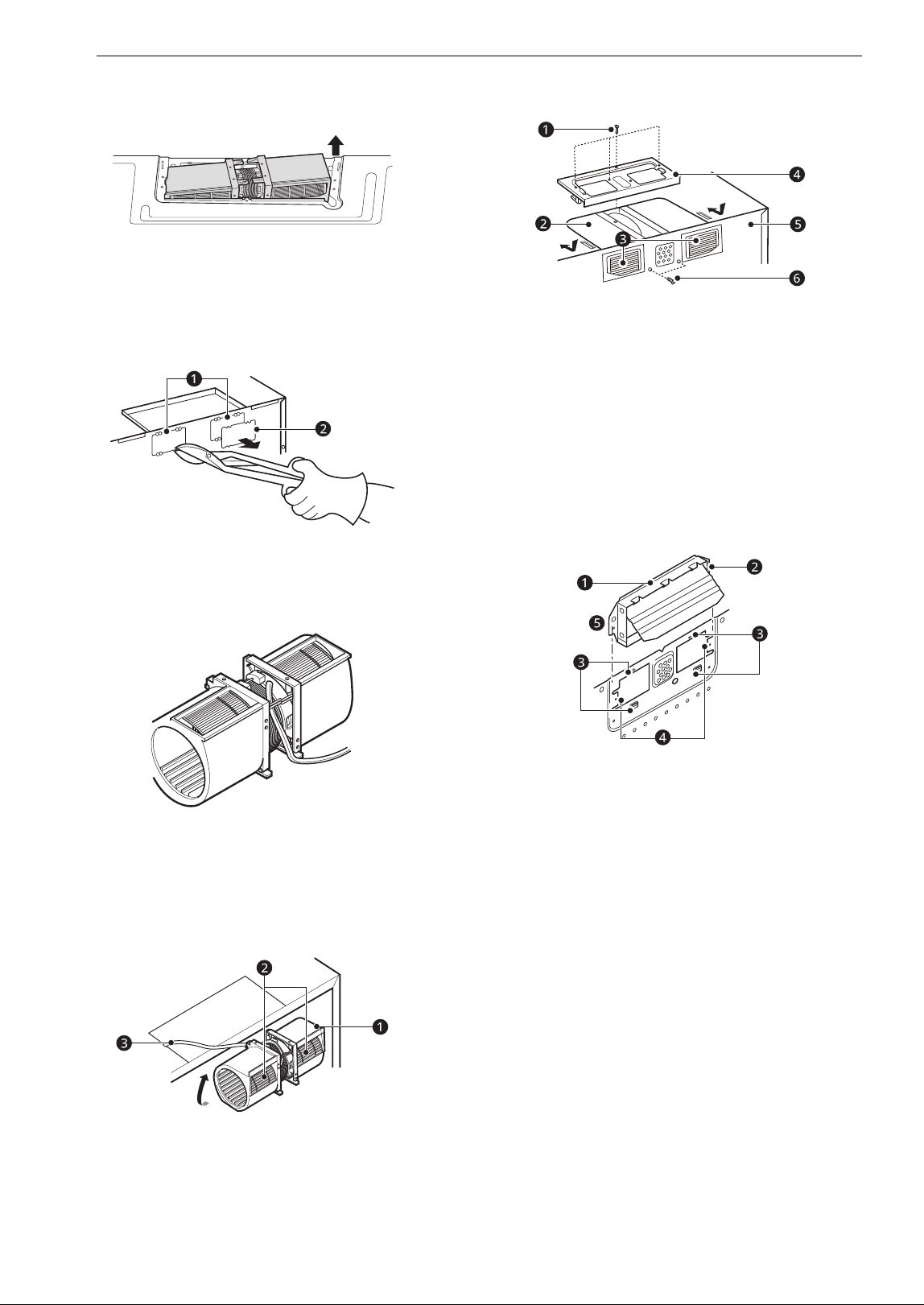
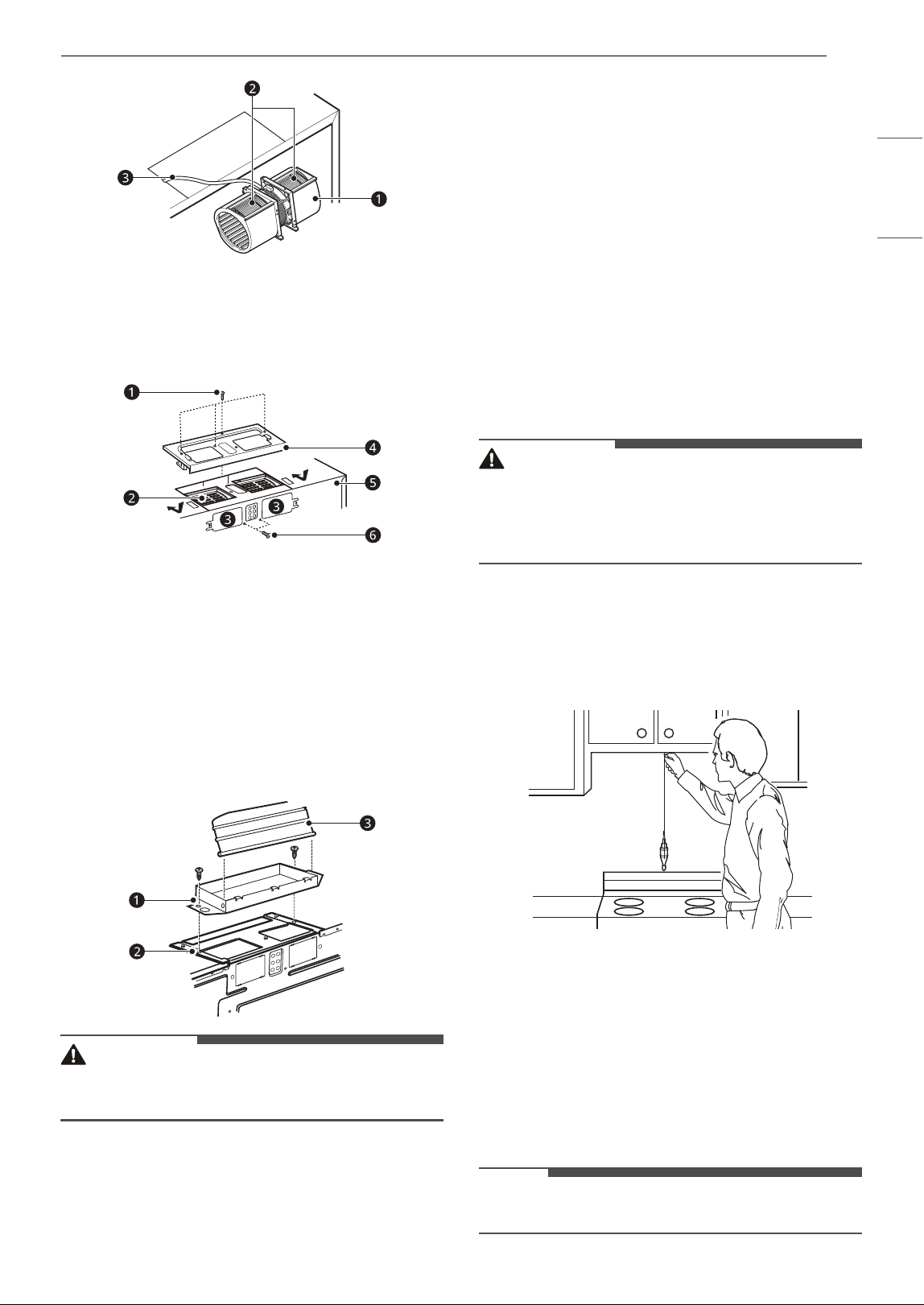
1 Remove one or several blower plate mounting
screw(s) a and one or two blower unit
mounting screw(s)
f. Remove the blower
plate
d from the cabinet.
b Blower unit
c Knockouts
e Back plate
For 3 1/4" x 10" systems
1/4" x 10" 90° elbow
a (1ea)
Wall cap
b(1ea)
Straight duct (8 ft)
Total length
= 25 ft
= 40 ft
= 8 ft
= 73 ft
For 6" round systems
Transition (1ea)
90°elbows
b (2ea)
Wall cap
c (1ea)
Straight duct (8 ft)
Total length
= 5 ft
= 20 ft
= 40 ft
= 8 ft
= 73 ft
6 ft
2 ft
2 ft
6 ft
14 INSTALLATION
2 Carefully lift the blower unit out of the
microwave oven.
3 Use side cutters or tin snips to cut out and
remove the knockouts b from the back plate
a. Be careful not to distort the back plate.
Discard the knockouts.
4 To avoid pinching the blower wire, make sure
that it is channeled underneath and between
the two exhaust ports when they are rotated.
5 Rotate and reinstall the blower unit a so that
the exhaust ports b face the rear of the
cabinet and are aligned with the rear
knockouts. When you insert the blower unit,
the blower wire c must be routed as shown.
6 Attach the blower plate d to the microwave
oven so the blower unit exhaust ports
c and
blower plate opening are aligned. Attach one
or two blower unit mounting screw(s)
f and
then one or several blower plate mounting
screw(s)
a.
b Blower unit
e Back plate
7 Insert the tabs on each side of the damper
into the holes at the inside rear of the
adapter. Attach the exhaust adapter a to the
back plate wall side. Push in securely until it is
past the top locking tabs c and in the lower
locking tabs
c. Make sure that the damper
hinge is at the top and that the damper
swings freely.
b Damper (hinge side up)
d Guides on back plate
e Slide exhaust adapter into guides on back
plate.
Roof-Venting Installation
1 Follow steps 1 and 2 under Wall-Venting
Installation.
2 Rotate and reinstall the blower unit a so that
the exhaust ports
b face the top of the
cabinet. When you insert the blower unit, the
blower wire
c must be routed as shown.
15INSTALLATION
ENGLISH
3 Attach blower plate d to microwave oven.
Attach the one or two blower unit mounting
screw(s)
f and then the one or several blower
plate mounting screw(s)
a.
b Blower unit
c Knockouts
e Back plate
4 Insert the tabs on each side of the damper
into the holes at the inside rear of the
adapter. Attach the exhaust adapter a to the
blower plate
b with the two tapping screws
provided. Make sure that the damper
c
swings freely.
WARNING
• Fire hazard! Correctly install the vent fan before
use.
When changing the vent fan position for wall
venting or roof venting:
• Properly align the ventilation fan openings and
blower plate knockouts.
• Ventilation fan openings should be completely
exposed to the outside.
• After installation, check the air ventilation path.
Refer to step 2 for proper vent selection.
Improper installation can cause problems such as:
• Inability to assemble the blower plate or
ventilation motor correctly
• Abnormal noise during product operation
• Weak ventilation
• Product overheating and the possibility of
product breakdown or fire
Step 4: Prepare the Wall and Upper
Cabinet
WARNING
• To avoid personal injury or property damage, do
not attempt to install this microwave oven if you
cannot find a wall stud. Consult a carpenter or
contractor.
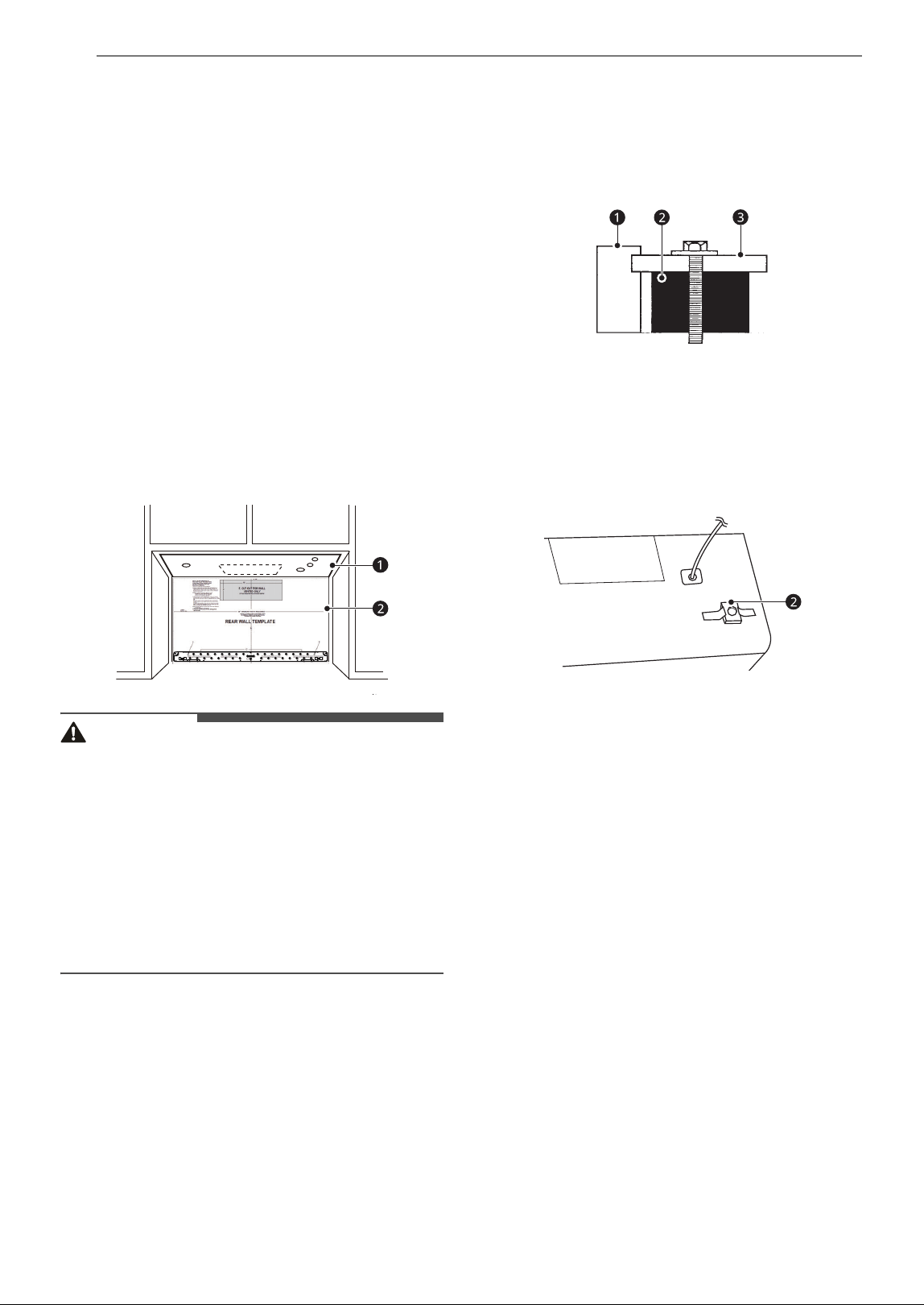
Measure and Attach Templates
1 Using a plumb line and (metal) measuring
tape, find and mark the vertical center line on
the back wall of the opening.
2 Find and mark one or two points where the
studs are on the wall. (Studs are normally 16
inches apart.) Then measure and mark the
stud locations. If you cannot find any wall
studs, consult a local building contractor.
3 Draw a vertical line on the wall at the center of
the 30″ wide opening.
NOTE
• Be sure the minimum width is 30 inches.
16 INSTALLATION
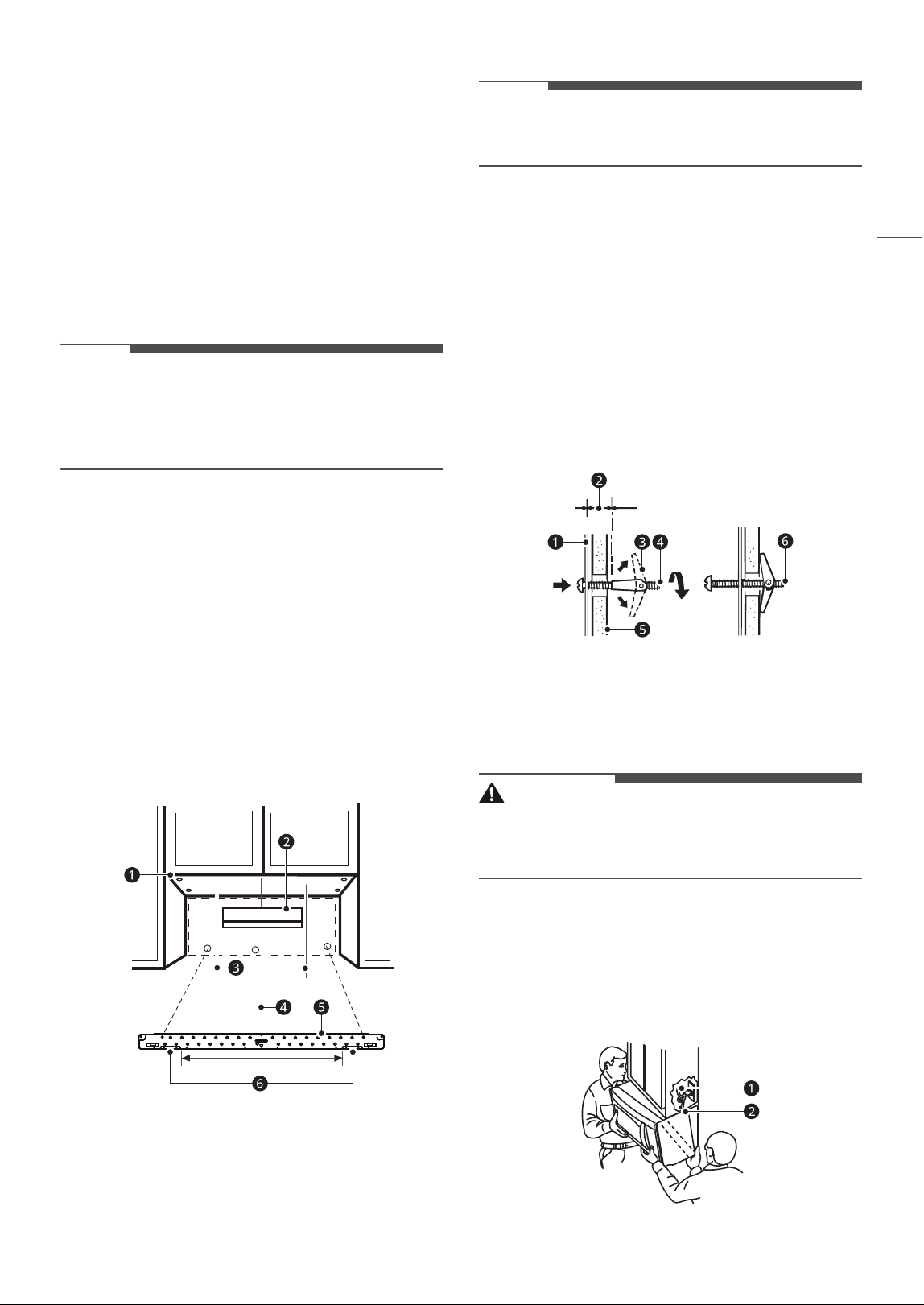
4 Center the rear wall template b in the space
by lining up the plumb line on the wall with
the centerline on the template. Then securely
tape or tack the rear wall template in place.
Make sure the minimum width is 30 inches
and that the top of the rear wall template is
located a minimum of 30 inches above the
cooking surface.
Measure the bottom of the upper cabinet
frame. Trim edges A, B, and C on the upper
cabinet template
a so that the template will
fit on the bottom of the upper cabinet. If the
upper cabinet has a recessed frame, trim the
template so it fits inside the recessed area. If
needed, the template can be trimmed inside
the printed trim lines, as long as you are able
to align the centerline correctly. Align the
centerline of the upper cabinet template with
the centerline of the rear wall template, then
securely tape or tack the upper cabinet
template in place.
WARNING
• To avoid risk of personal injury, electric shock or
death:
- Note where electrical outlets and electrical
wires are before you drill into the wall.
- Locate and disconnect power to any electrical
circuits that could be affected by installing this
oven.
• To avoid risk of personal injury, electric shock or
death, cover the edge of the power supply cord
hole with the power supply cord bushing.
Drill Holes in Wall and Cabinet
1 Drill holes on the circles. If there is a stud, drill
a 3/16" hole for lag screws. If there is no stud,
drill a 3/4" hole for toggle bolts. Make sure to
use at least 1 lag screw in a stud, and 2 toggle
screws in the drywall or the plaster.
2 Drill a 3/8” hole at points J and K on the upper
cabinet template.
If the bottom of the upper cabinet is recessed
3/4" or more, you will need 2"x 2" filler blocks
b (not included) to provide additional support
for the bolts.
a Cabinet front
c Cabinet bottom shelf
Mark the center of each filler block and drill a
3/8” diameter hole at the marks.
Align filler blocks b over the two openings in
the top of the microwave oven cabinet and
attach to the cabinet with masking tape.
3 Cut or drill a 2" diameter hole at the area
marked "M power supply cord hole" on the
upper cabinet template. If the upper cabinet
is metal, you will need to cover the edge of the
hole with the power supply cord bushing
(supplied) to prevent damage to the cord
from the rough metal edge.
4 Cut out the venting areas (with the saber saw)
• Roof-venting: cut out the shaded area
marked L on the upper cabinet template.
• Wall-venting: cut out the shaded area
marked F on the rear wall template.
• Room-venting: go to Step 5: Install the
Mounting Plate.
5 Complete whichever venting system you have
chosen. Use caulking compound to seal the
exterior wall or roof opening around the wall
cap or roof cap.
17INSTALLATION
ENGLISH
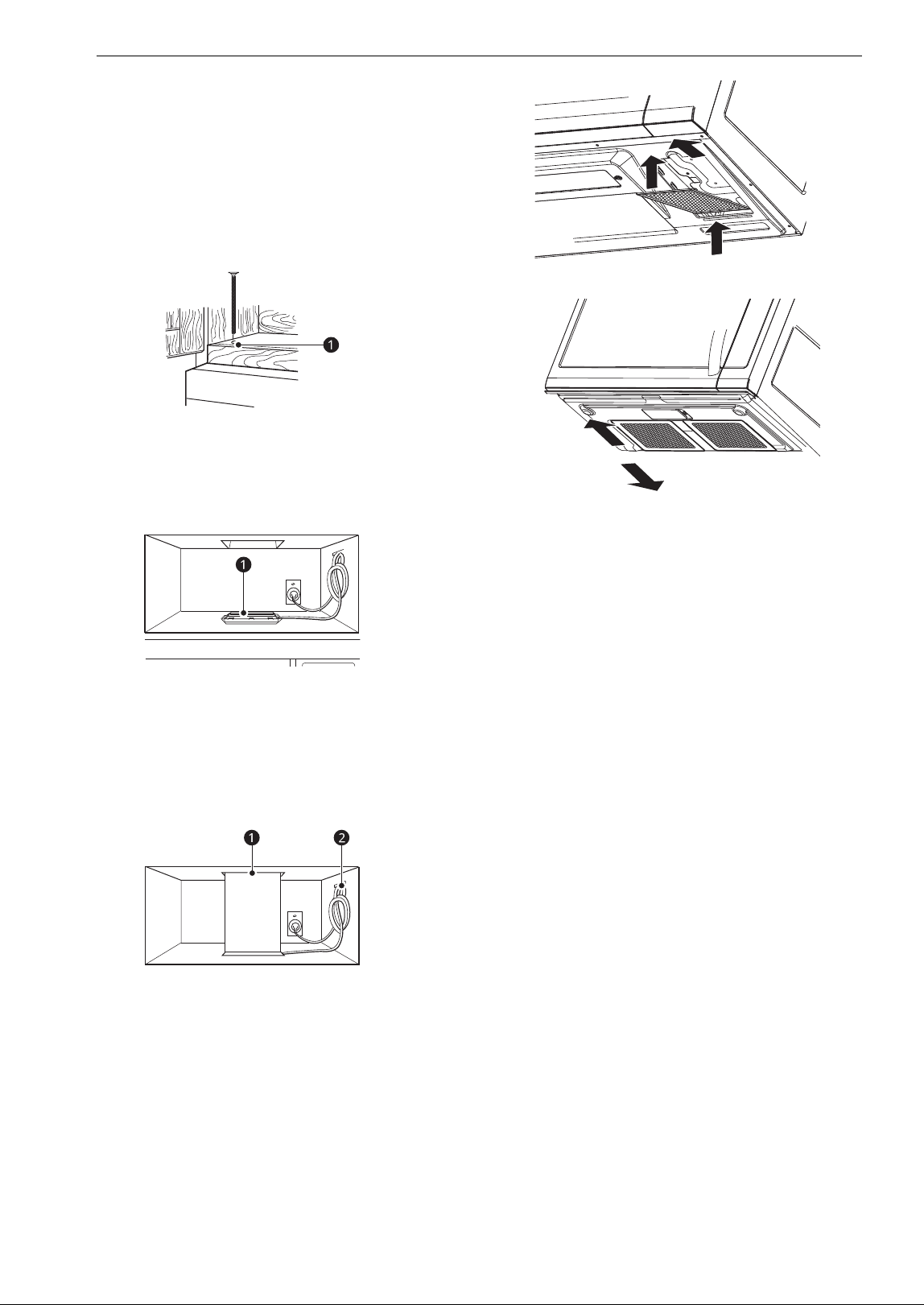
Step 5: Install the Mounting Plate
The oven must be connected to at least one wall
stud.
1 Center the rear wall template in the space by
lining up the plumb line on the wall with the
centerline on the template. Then securely
tape or tack the rear wall template in place.
Make sure the minimum width is 30 inches
and that the top of the rear wall template is
located a minimum of 30 inches above the
cooking surface.
NOTE
• If the cabinets are not plumb, adjust the rear
wall template to the cabinets. If the front edge of
the cabinet is lower than the back edge, adjust
the template to be level with the cabinet front.
2 Drill holes at points A and B. Drill the third
hole inside area C, through one of the bottom
holes to match the location of a stud. If there
is a stud, drill a 3/16 hole for lag screws. If
there is no stud, drill a 5/8 hole for toggle
bolts. These holes must be used for
mounting. If the holes are not used, the
installation will not be secure. The installer
must use these holes for proper installation.
Use toggle bolts through these holes, unless
one of them lines up with a stud. Use a lag
screw for studs. Make sure to use at least 1
lag screw in a stud, and 2 toggle bolts in the
drywall or the plaster.
a Minimum 66" from the floor
b For wall - venting only
c Draw lines on studs
d Draw center Line
e Mounting plate
f Support tab
NOTE
• Cut out the shaded area marked F on the rear
wall template for wall-venting.
3 Remove the template from the rear wall.
4 Attach the plate to the wall e. To use spring
toggle head bolts d: Remove the toggle
wings
c from the bolts. Insert the bolts into
the mounting plate
a and replace the spring
toggle head to 3/4 of the length past the bolt
ends. Insert the spring toggle head into the
holes in the wall to mount the plate. You may
pull forward on the plate to help in tightening
the toggle bolts. Tighten all bolts.
b Space more than wall thickness
f Bolt end
Step 6: Attach the Oven to the Wall
WARNING
• To avoid risk of personal injury or property
damage, you will need two people to install this
microwave oven.
1 Carefully lift the microwave oven and hang it
on the support tabs at the bottom of the
mounting plate. Reaching through the upper
cabinet, thread the power supply cord
a
through the power supply cord hole
b in the
bottom of the upper cabinet.
A
A
B
B
C
18 INSTALLATION
2 Rotate the microwave oven upward so the top
of the oven is against the bottom of the upper
cabinet or cabinet frame.
3 Then insert a bolt down through each hole a
in the upper cabinet bottom. Tighten the bolts
until the gap between the upper cabinet and
microwave oven is closed.
4 Roof venting installation: Install the ductwork
through the vent opening in the upper
cabinet. Use a caulking gun to seal the
exterior roof opening around the exhaust cap.
a Damper
5 Use the power supply cord clamp b to bundle
the power supply cord. Install the power
supply cord clamp to the inside of the cabinet
using a screw.
a Duct
6 Grasp the filter screen with one hand holding
the ring and the other hand holding the
opposite end. Insert the end of the filter
screen without the ring into the opening and
slide towards the side of the microwave oven.
Insert the ring end of the filter screen into the
opening and slide the entire screen towards
the center of the microwave until the screen is
securely in position. Repeat for the other filter
screen.
1
2
3
1
2
19OPERATION
ENGLISH
OPERATION
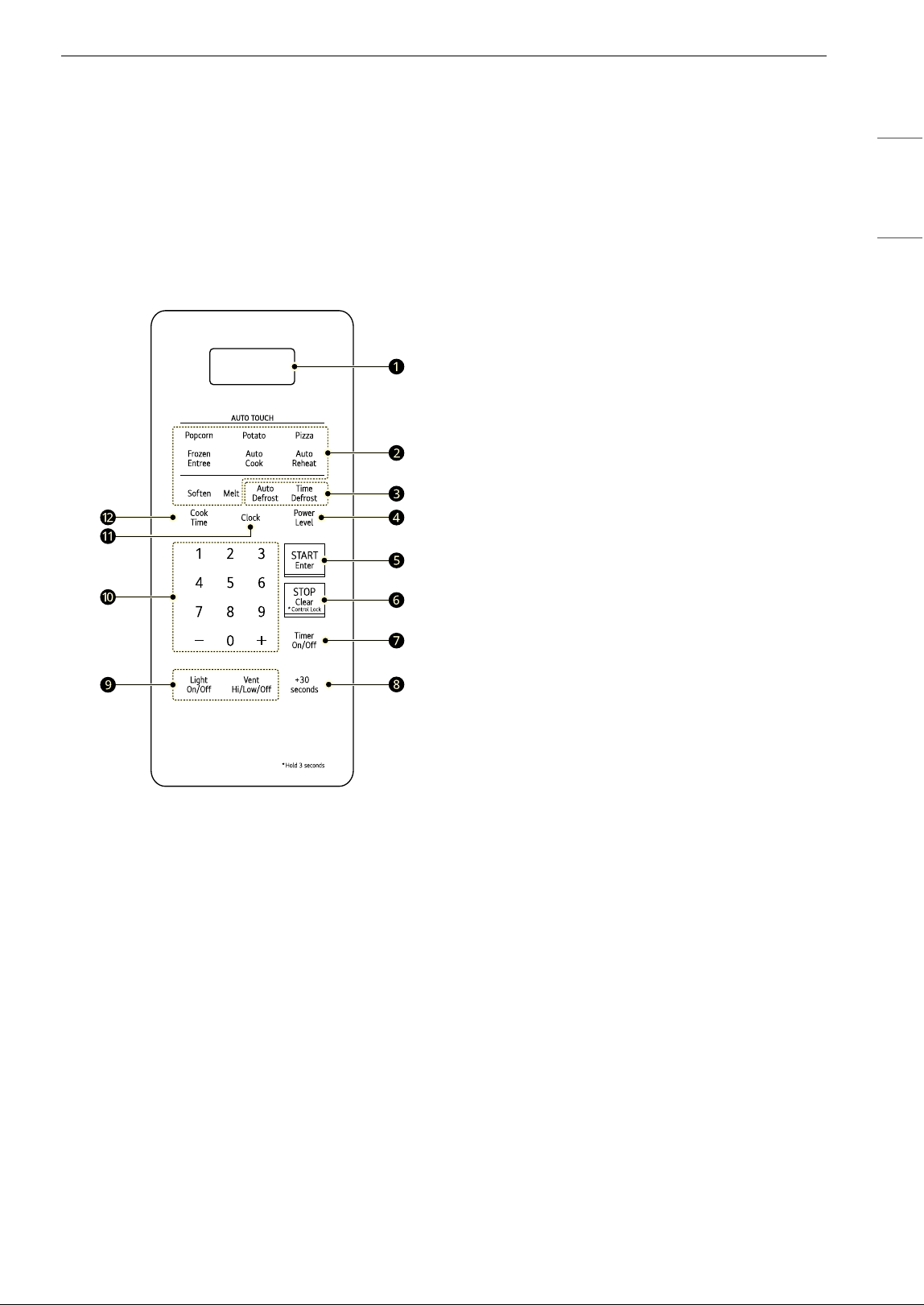
Control Panel
The actual control panel may differ from model to model.
Control Panel Features
The appearance or components of the appliance
may differ from model to model.
a Display
Shows the time of day, cooking time settings,
and selected cooking functions.
b Quick Cooking
Press the menu button to start cooking without
pressing the START/Enter button. The oven
automatically adjusts cooking times or power
levels based on the amount of food.
c Defrost
Press the buttons to select preprogrammed
defrost mode or to set defrost time.
d Power Level
Set a cooking power.
e START/Enter
•Press START/Enter to start the oven or enter
amounts.
f STOP/Clear
• Stop cooking or clear all entries.
Control Lock
• Press and hold button for three seconds to
activate Control Lock.
g Timer On/Off
Set the kitchen timer.
h +30 seconds
• Add 30 seconds of cooking time each time
you press it.
i Light and Vent Functions
• Press Light On/Off to turn the cooktop light
on or off.
• Press Vent Hi/Low/Off to set the vent fan
speed.
j Number Keys and More/Less
• Number Keys: Press the buttons to set
cooking time, power level, quantity, or
weight.
• More/Less: Adjust the pre-programmed
cook time.
- More (+): Press this button to add ten
seconds of cooking time each time you
press it.
- Less (-): Press this button to subtract ten
seconds of cooking time each time you
press it.
k Clock
Press Clock to set the time of day.
l Cook Time
Set a desired cook time manually.
Before Use
Setting the Clock
Set the current time to operate the microwave
oven.
1 Press STOP/Clear and press Clock.
20 OPERATION
2 Press the number keys to set the correct time
of day, and press START/Enter.
• To switch from AM to PM, press Clock until
PM appears in the display and press START/
Enter.
NOTE
• To reset the clock mode, press Clock or unplug
the power cord and plug it back in.
Control Lock
Use this safety feature to lock the control panel
before cleaning the oven or to prevent children
from unsupervised use of the oven.
Setting Control Lock to ON
1 Press STOP/Clear.
2 Press and hold STOP/Clear until Loc appears
in the display (approximately 3 seconds).
Canceling Control Lock
Press and hold STOP/Clear until Loc disappears in
the display (approximately 3 seconds).
NOTE
• If set, the time of day reappears in the display
after 1 second.
• If the oven is locked, Loc appears in the display
when any key is pressed.
• Unlock the oven to resume normal use.
Kitchen Timer
The Timer function serves as an extra kitchen
timer up to 99 minutes, 99 seconds. It chimes
when the set time runs out. It does not start or
stop cooking.
Setting Timer for 3 Minutes
1 Press Timer On/Off.
2 Press the number keys to set the time (3, 0,
and 0), and press START/Enter.
• The timer starts immediately and the time
counts down in the display.
3 To cancel the timer, press Timer On/Off.
NOTE
• When the time is over, the oven beeps
continuously until you press Timer On/Off.
Setting the Cooktop Light
Use the Light settings to adjust the light for the
cooktop below the microwave.
1 Press Light On/Off to turn the light on.
2 Press Light On/Off again to turn the light off.
Setting the Vent Fan Speed
Use this button to set the vent fan speed. The vent
removes steam and other vapors from the cooking
surface.
1 Press Vent Hi/Low/Off once to set the vent
speed to high.
2 Press Vent Hi/Low/Off twice to set the vent
speed to low.
3 Press Vent Hi/Low/Off again to turn the vent
off.
NOTE
• Turn the microwave’s vent fan on whenever you
use the oven range cooktop below it. The fan
captures smoke, steam, and odors and also
prevents the heat from the cooktop from
damaging microwave components.
• If the microwave is cooking, the vent fan turns
on automatically if the sensors detect too much
heat from the cooktop. This is designed to
prevent microwave component damage.
21OPERATION
ENGLISH
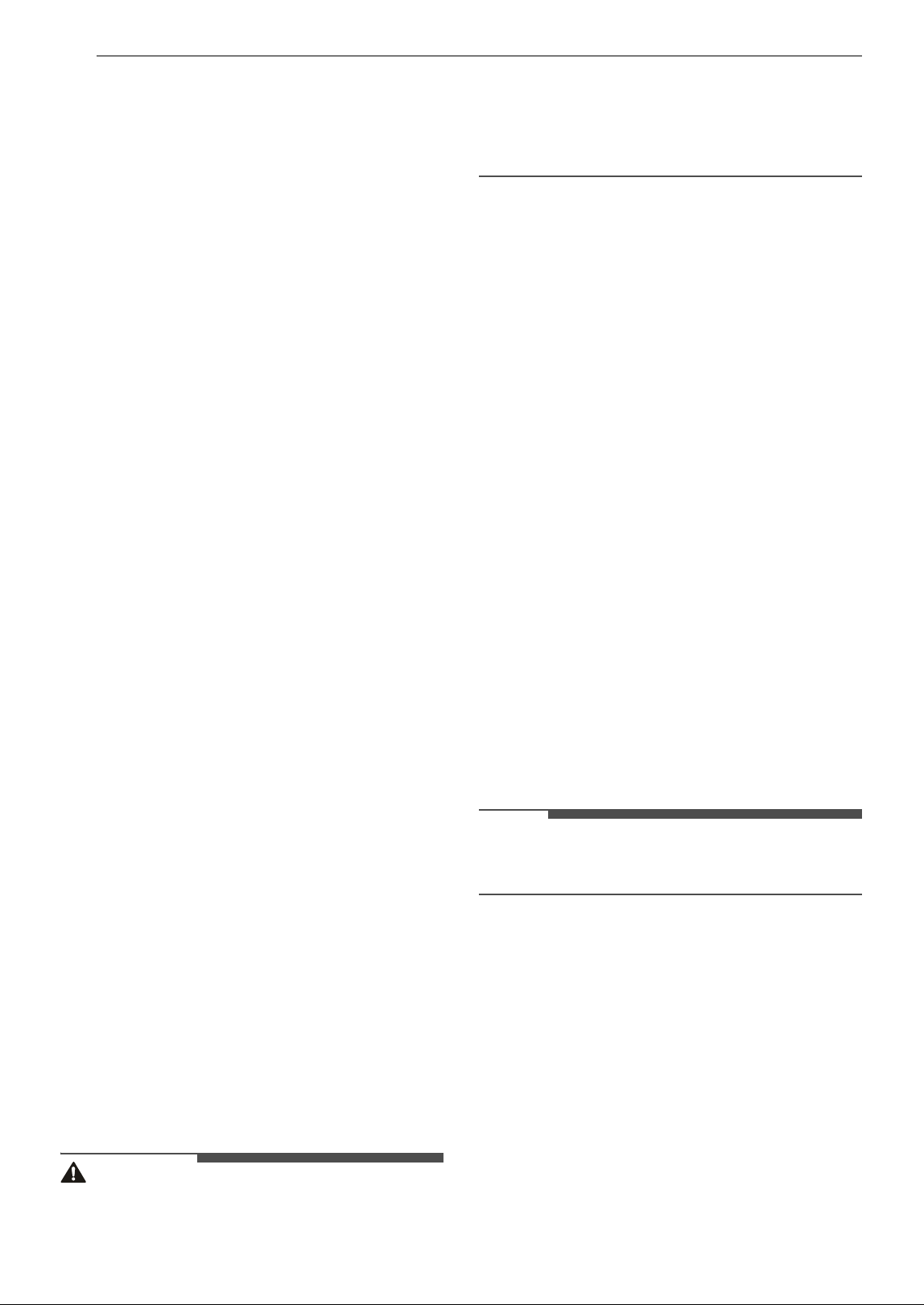
Microwave Power Levels
This microwave oven is equipped with 10 power
levels to give you maximum flexibility and control
over cooking.
• When operating at 100 % power levels for
prolonged periods, the output power will be
reduced gradually to help prevent the unit from
electrically overheating.
Quick Start and Stop
Using Quick Start
This feature allows you to start the microwave
function without pressing the START/Enter
button.
Cooking for 2 Minutes on High Power
Press +30 seconds four times.
• The oven starts immediately and the time counts
down in the display.
•Press +30 seconds repeatedly to extend the
cook time by 30 seconds every time the button is
pressed (up to 99 min 59 seconds).
Interrupting Cooking
• To stop the oven during a cycle, open the door or
Press STOP/Clear once.
• To restart cooking, close the door and press
START/Enter.
• To stop the oven and clear the settings during a
cycle, press STOP/Clear twice.
Manual Cooking
Using Manual Cooking
Unless you are using the auto cooking functions,
the cook time and power level must be set
manually.
Cooking for 5 Minutes, 30 Seconds at 80%
Power
1 Press Cook Time and press the number keys
to set the cook time (5:30).
2 Press Power Level, press the number 8 key to
select power level 8, and press START/Enter.
• When cooking is complete, a chime sounds
and End appears in the display window.
NOTE
• If a power level is not selected, the oven defaults
to 100% power.
Power
Level
Use
High 10
(100 %)
• Boiling water.
• Browning ground beef.
• Making candy.
• Cooking whole poultry, poultry
pieces, fish & vegetables.
• Cooking tender cuts of meat.
9 (90%)
• Reheating rice, pasta & vegetables.
8 (80%)
• Reheating prepared foods quickly.
• Reheating sandwiches.
7 (70%)
• Cooking egg, milk and cheese
dishes.
• Cooking cakes and breads.
• Melting chocolate.
6 (60%)
•Cooking veal.
• Cooking whole fish.
• Cooking puddings and custard.
5 (50%)
• Cooking ham, whole poultry and
lamb.
• Cooking rib roast and sirloin tip.
4 (40%)
• Thawing meat, poultry and seafood.
3 (30%)
• Cooking less tender cuts of meat.
2 (20%)
• Taking chill out of fruit.
• Softening butter.
1 (10%)
• Keeping casseroles and main dishes
warm.
• Softening butter and cream cheese.
0 (0%)
• Standing time
22 OPERATION
Using Multi-Stage Cooking
Program an item to cook in 2 stages with different
power levels and cooking times.
Cooking for 3 Minutes at 80% Power and
then at 50% for 7 Minutes
1 Press Cook Time and enter the first cook time
(3, 0, and 0).
2 Press Power Level and enter the power level
(8).
3 Press Cook Time and enter the second cook
time (7, 0, and 0).
4 Press Power Level and enter the power level
(5).
5 Press START/Enter.
• When the first stage is over, you will hear
two short tones as the oven begins the
second cook stage.
Cooking Mode
Cook your favorite foods without having to select
cooking times and power levels.
Quick Cooking Mode
Press the menu button to start cooking without
pressing the START/Enter button. The oven
automatically adjusts cooking times or power
levels based on the amount of food.
Popcorn (3.0 or 3.5 oz.)
Pop only one package at a time. For best results,
use a fresh bag of popcorn. Place a bag of
prepackaged microwave popcorn on the center of
the glass tray.
• Press Popcorn once for 3.5 oz. bag, and twice for
3.0 oz. bag.
- When the cook time ends, a beep sounds and
End appears in the display.
CAUTION
• Only pop popcorn in a microwavable container
or in commercial packages designed for
microwave ovens.
• Do not reuse popcorn bags.
• Do not leave microwave unattended while
popping corn.
• Follow directions on bag.
Potato (1 - 4 potatoes, 8 oz. per potato)
Pierce potato with fork several times before
cooking.
•Press Potato once for each potato (up to 4
potatoes).
- When the cook time ends, a beep sounds and
End appears in the display.
- Standing time: 5 minutes
Pizza (1 - 3 slices, 5 oz. per slice)
Place pizza on a low plate and paper towel, and
don't cover.
•Press Pizza once for each slice (up to 3 slices).
- When the cook time ends, a beep sounds and
End appears in the display.
Frozen Entree (10 or 20 oz.)
Cook commercially packaged microwave Frozen
Entree.
Remove tray from outer carton.
Do not remove film cover, but cut it to vent.
•Press Frozen Entree once for 10 oz. package
and twice for 20 oz. package.
- When the cook time ends, a beep sounds and
End appears in the display.
NOTE
• If desired, manually pause cooking halfway
through, stir, and then resume cooking.
Auto Cook
1 Press Auto Cook repeatedly until the desired
menu code appears in the display.
2 Use the number keys to enter the desired
amount.
• When the cook time ends, a beep sounds
and End appears in the display.
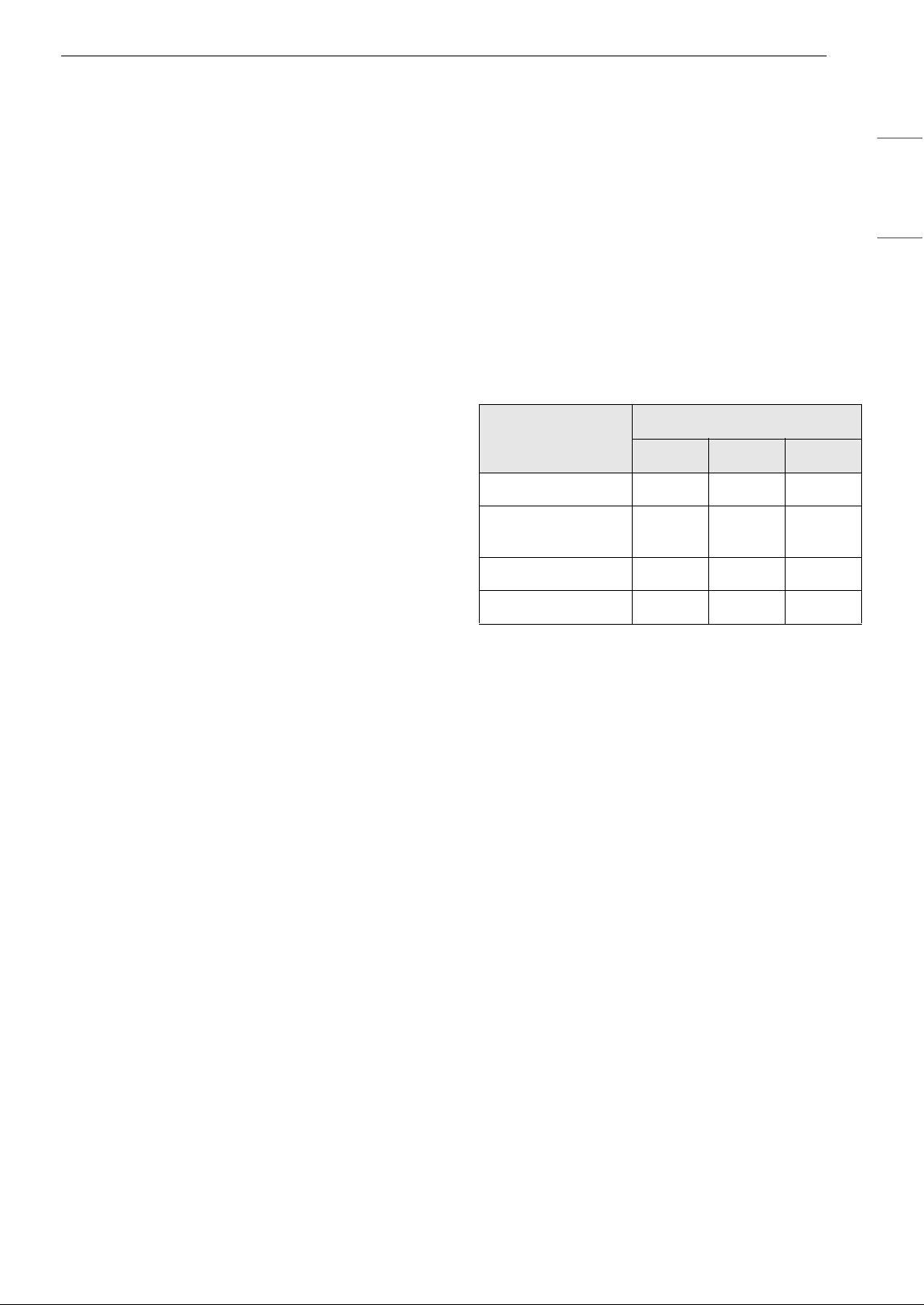
Auto Cook Menu
Refer to the information below to set the desired
menu item and see the recommended amounts.
23OPERATION
ENGLISH
• Ac-1 Fresh Vegetable (1 - 4 cups)
- Place vegetables in a microwavable bowl or
casserole. Add water and cover with vented
plastic wrap.
- Add 2 tbsp water for 1 - 2 cups, add 4 tbsp
water for 3 - 4 cups.
- Standing time: 3 minutes
• Ac-2 Frozen Vegetable (1 - 4 cups)
- Place vegetables in a microwavable bowl or
casserole. Add water and cover with vented
plastic wrap.
- Add 2 tbsp water for 1 - 2 cups, add 4 tbsp
water for 3 - 4 cups.
- Standing time: 3 minutes
• Ac-3 Rice (1 - 2 cups)
- Place in a microwavable bowl or casserole.
Cover with vented plastic wrap.
- Standing time: 5 minutes.
• Ac-4 Casserole (1 - 4 cups)
- Place in a microwavable bowl or casserole.
Cover with vented plastic wrap.
- Standing time: 3 minutes.
- Remove plastic wrap and stir if desired.
Auto Reheat
1 Press Auto Reheat repeatedly until the
desired menu code appears in the display.
2 Use the number keys to enter the desired
amount.
• When the cook time ends, a beep sounds
and End appears in the display.
Auto Reheat Menu
Refer to the information below to set the desired
menu item and see the recommended amounts.
• rh-1 Dinner Plate (1 serving: 10 oz. or 2
servings: 15 oz.)
- Place food on a plate. Cover with vented plastic
wrap.
- Standing time: 3 minutes
• rh-2 Soup / Sauce (1 - 4 cups)
- Place in shallow microwavable casserole.
Cover with vented plastic wrap.
- Standing time: 3 minutes
• rh-3 Casserole (1 - 4 cups)
- Place in a microwavable bowl or casserole.
Cover with vented plastic wrap.
- Standing time: 3 minutes.
• rh-4 Roll / Muffin (1 - 4 pieces, 2 oz. per piece)
- Place on paper towel. Do not cover.
Soften
The oven uses low power to soften foods (butter,
ice cream, cream cheese and frozen juice).
1 Press Soften repeatedly until the desired
menu code appears in the display.
2 Use the number keys to enter the desired
amount.
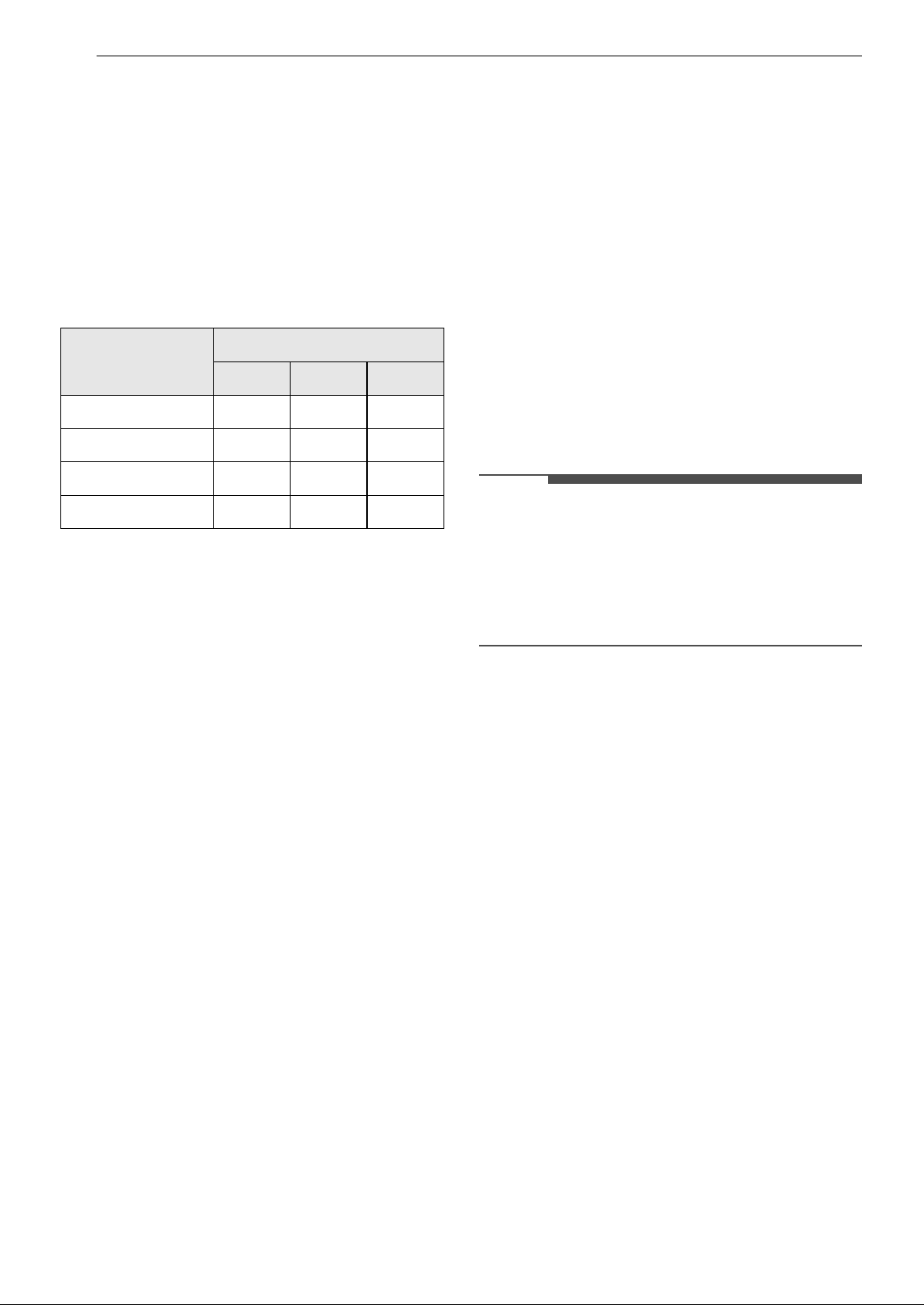
Soften Menu
Refer to the information below to set the desired
menu item and see the recommended amounts.
• 1 Butter (1 - 3 sticks, 1 stick: 4 oz.)
- Cookware: Microwave-safe dish
- Food temperature: Refrigerated
- Instructions: Unwrap and place food in oven.
Butter will be at room temperature and ready
for use in a recipe.
• 2 Ice Cream (Pint, Quart, Half Gallon)
- Food temperature: Frozen
- Instructions: Remove lid and cover. Place food
in oven. Ice cream will be soft enough to make
scooping easier.
• 3 Cream Cheese (3 or 8 oz.)
- Cookware: Microwave-safe dish
- Food temperature: Refrigerated
- Instructions: Unwrap and place food in oven.
Cream cheese will be at room temperature
and ready for use in a recipe.
• 4 Frozen Juice (6, 12, or 16 oz.)
- Food temperature: Frozen
- Instructions: Remove top. Frozen juice will be
soft enough to mix easily with water.
Category
Press Number for Amount
1 2 3
Butter 1 stick 2 sticks 3 sticks
Ice Cream Pint Quart Half
Gallon
Cream Cheese 3 oz.8 oz.-
Frozen Juice 6 oz. 12 oz. 16 oz.
24 OPERATION
Melt
The oven uses low power to melt foods (butter or
margarine, chocolate, marshmallows, or
processed cheese food).
1 Press Melt repeatedly until the desired menu
code appears in the display.
2 Use the number keys to enter the desired
amount.
Melt Menu
Refer to the information below to set the desired
menu item and see the recommended amounts.
• 1 Butter (1 - 3 sticks, 1 stick: 4 oz.)
- Cookware: Microwave-safe bowl
- Food temperature: Refrigerated
- Instructions: Cut butter into equal sized pieces.
Place in bowl and cover with paper towel. After
heating, stir to complete melting.
• 2 Chocolate (4 or 8 oz.)
- Cookware: Microwave-safe bowl
- Food temperature: Room
- Instructions: Chocolate chips or squares of
baking chocolate may be used. Unwrap and
place food in oven. After heating, stir to
complete melting.
• 3 Cheese (8 or 16 oz.)
- Cookware: Microwave-safe bowl
- Food temperature: Refrigerated
- Instructions: Use processed cheese food only.
Unwrap and cut into cubes. Place food in oven.
Stir the food at the beep. After heating, stir to
complete melting.
• 4 Marshmallows(5 or 10 oz.)
- Cookware: Microwave-safe bowl
- Food temperature: Room
- Instructions: Unwrap and place food in oven.
After heating, stir to complete melting.
Defrost Mode
The oven has 4 preset defrost cycles. The Defrost
Menu shows the suggested defrost cycle for
various foods. This defrost function conveniently
chimes during the cycle to remind you to check,
turn over, separate, or rearrange the food.
1 Press Auto Defrost repeatedly until the
desired menu code appears in the display.
2 Use the number keys to enter the desired
amount. Then press START/Enter.
• At the chime, open the oven door and turn
the food over. Remove any food that has
thawed. Return the items which are still
frozen to the oven, and press START/Enter
to complete the defrost cycle.
NOTE
• The countdown appears in the display after
START/Enter is pressed. The oven chimes once
during the defrost cycle.
• When using Defrost, enter the net weight in
pounds and tenths of pounds (the weight of the
food minus the container).
Defrost Menu
Refer to the information below to set the desired
menu item and see the recommended amounts.
• dEF1 Meat (0.1 - 6.0 lbs)
- Beef: Ground beef, round steak, stew cubes,
tenderloin steak, pot roast, rib roast, rump
roast, chuck roast, hamburger patties
- Lamb: Chops (1 inch thick), rolled roast
- Pork: Chops (0.5 inch thick), hot dogs,
spareribs, country-style ribs, rolled roast,
sausage
• dEF2 Poultry (0.1 - 6.0 lbs)
- Poultry: Whole, cut-up, breast (boneless)
- Rinse chicken cavity with tap water before
cooking and let stand for 60 minutes after
cooking for better results.
- Cornish hens: Whole
- Turkey: Breast
• dEF3 Fish (0.1 - 6.0 lbs)
- Fish: Fillets, whole steaks
- Shellfish: Crab meat, lobster tails, shrimp,
scallops
Category
Press Number for Amount
1 2 3
Butter 1 stick 2 sticks 3 sticks
Chocolate 4 oz. 8 oz. -
Cheese 8 oz. 16 oz. -
Marshmallows 5 oz. 10 oz. -

25OPERATION
ENGLISH
• dEF4 Bread (0.1 - 1.0 lbs)
- Sliced bread, buns, baguettes, etc.
- Separate slices and place between paper
towels or on flat plate. Turn food over at beep.
- Standing time: 1-2 minutes
Cookware Guide
Microwave-Safe Cookware
Use microwavable cookware.
• Ovenproof Glass
- Ovenproof glassware that is treated for high
intensity heat so it is heat-resistant is
microwave-safe.
- Use utility dishes, loaf dishes, pie plates, cake
plates, liquid measuring cups, casseroles and
bowls without metal rims.
- Do not use delicate glassware, such as
tumblers or wine glasses, as these might
shatter when heated.
• China
- Use bowls, cups, serving plates, pottery,
stoneware, ceramic, and platters without
metal rims or handles. Many containers made
of these materials are microwave-safe, but test
them before use.
• Plastic
- Plastic Storage Containers: Use plastic
dishes, cups, semi-rigid freezer containers and
plastic bags only for short cooking times. Do
not use them when cooking food for long
periods or at high power levels, as the hot food
will eventually warp or melt the plastic.
- Plastic wrap (as a cover): Lay the plastic wrap
loosely over the dish and press it to the sides.
Vent plastic wrap by turning back one edge
slightly to allow excess steam to escape. The
dish should be deep enough so that the plastic
wrap will not touch the food. As the food heats
it may melt the plastic wrap wherever the wrap
touches the food.
- Plastic Cooking Bags: Provided they are
specially made for cooking, cooking bags are
microwave safe. Remember to make a slit in
the bag so that steam can escape. Never use
ordinary plastic bags for cooking in the
microwave oven, as they will melt and rupture.
- Plastic Microwave Cookware: A variety of
shapes and sizes of microwave cookware are
available. You may be able to use items you
already have on hand rather than investing in
new kitchen equipment.
• Paper
- Use paper towels, waxed paper, paper
napkins, and paper plates with no metal rims
or design. Look for the manufacturer’s label
for use in the microwave oven.
- Paper plates and containers are convenient
and safe to use in the microwave oven,
provided that the cooking time is short and the
foods to be cooked are low in fat and
moisture. Paper towels are also very useful for
wrapping foods and for lining baking trays in
which greasy foods such as bacon are cooked.
- Avoid colored paper products as the color may
run. Do not use recycled paper products in the
microwave oven. They may contain impurities
which could cause arcing or fires when used in
the microwave.
• Tableware
- Many containers made of pottery, stoneware
and ceramic are also microwave-safe. If in
doubt consult the manufacturer’s literature or
perform the microwave test.
- Do not put plates with painted decoration in
the oven, as the paint may contain metal and
cause arcing.
Microwave-Unsafe Cookware
• Metal Containers/Metal Decoration
- Never use metal or metal-rimmed cookware in
the microwave oven.
- Microwaves cannot penetrate metal. They will
bounce off any metal object in the oven and
cause arcing, an alarming phenomenon that
resembles lightning.
- Metal shields the food from microwave energy
and produces uneven cooking. Also avoid
metal skewers, thermometers, foil trays,
metal-rimmed or metal-banded dinnerware,
casserole dishes, etc. The metal rim interferes
with normal cooking and may damage the
oven.
• Aluminum Foil
- Avoid large sheets of aluminum foil because
they hinder cooking and may cause harmful
arcing.
- Use small pieces of foil to shield poultry legs
and wings.
- Keep ALL aluminum foil at least 1 inch from
the side walls and door of the oven.
26 OPERATION
• Wood
- Wood bowls and boards will dry out and may
split or crack when you use them in the
microwave oven.
- Baskets react in the same way.
• Tightly Covered Cookware
- Be sure to leave openings for steam to escape
from covered containers.
- Pierce plastic pouches of vegetables or other
food items before cooking.
- Tightly closed pouches could explode.
• Brown Paper
- Avoid using brown paper bags.
- They absorb too much heat and could burn.
• Flawed or Chipped Cookware
- Any container that is cracked, flawed, or
chipped may break in the oven.
• Metal Twist Ties
- Remove metal twist ties from plastic or paper
bags.
- They become hot and could cause a fire.
Testing Cookware before Use
Most heat resistant and non-metallic cookware is
safe for use in your oven. However, some
cookware may contain materials that are not
suitable for microwave use. Follow the steps below
to find out if cookware can be used in the
microwave.
1 Place the container in question and a glass
measuring cup filled with water next to each
other inside the oven.
2 Heat the container and glass measuring cup
for 1 minute at HIGH power.
• If the water heats up but the container
remains cool to the touch, the container is
microwave-safe.
• If the temperature of the water does not
change but the container becomes warm, it
is not safe for use in the microwave oven.
CAUTION
• Some items with high lead or iron content are
not suitable for microwave cooking.
• Cookware should be checked to ensure that it is
suitable for use in the microwave.
• Always be careful when taking cookware out of
the oven. Some dishes absorb heat from the
cooked food and may be hot.
Cooking Guide
Cooking Tips
Carefully monitor the food in the microwave oven
while it is cooking. Directions given in recipes to
elevate, stir, etc., are the minimum steps
recommended. If food is overcooked (dry),
undercooked, or unevenly cooked, make
adjustments before or during cooking to correct
the problem. Ensure food reaches an internal
temperature of 165
8 for safe consumption when
cooking and reheating.
• Overcooked or Dry Food
- Sprinkling: Sprinkle low-moisture foods such
as roasts and vegetables with water before
cooking, or cover them to retain moisture.
- Density: Light, porous food such as cakes and
breads cook more quickly than heavy, dense
foods such as roasts and casseroles.
- Shielding: Cover the corners of square dishes
with small strips of aluminum foil to prevent
overcooking. Don’t use too much foil, and
secure the foil to the dish. Foil can cause
arcing if it gets too close to the oven walls
during cooking.
- Bones and Fat: Bones conduct heat, and fat
cooks more quickly than meat. Take care with
bony or fatty cuts of meat.
• Undercooked Food
- Covering: Cover food with a microwave-safe
lid, parchment paper (not waxed paper), or
plastic wrap to trap heat and steam and cook
food more quickly.
- Standing Time: Let food stand for several
minutes after being removed from the oven to
allow it to finish cooking and help flavors blend
and develop.
- Quantity: The more food you place in the
oven, the longer the required cooking time.
- Temperature: Ice-cold ingredients take much
longer to cook than room temperature
ingredients.
• Unevenly Cooked Food
- Stirring: Stir food from the outside toward the
center during cooking, as food at the outside
of the dish heats more quickly.
27OPERATION
ENGLISH
- Arranging: Turn food over several times
during cooking. The upper portion of thick
foods cooks more quickly than the lower
portion.
- Shaping: Place the thickest portions of foods
like meat, poultry or fish toward the outside of
the cookware to help them cook more evenly.
If possible, shape foods into thin rounds or
rings.
• Foods with Skin, Shell or Membrane
- Skin or Membrane: Pierce the outsides of
foods like potatoes, sausages, or egg whites or
yolks before cooking.
- Shell: Pierce or remove the shells from eggs,
clams, oysters, or other shelled foods before
cooking.
• Defrosting Tips
- Remove fish, shellfish, meat, and poultry from
its original wrapping paper or plastic package.
Otherwise, the wrap close to the foods will
hold steam and heat, which can cause the
outer surface of the foods to be cooked.
- Remove any metal twist ties.
- Always slit or pierce plastic pouches or
packaging.
- Open containers such as cartons before they
are placed in the oven.
- If food is foil wrapped, remove foil and place
the food in a suitable container.
- The length of defrosting time varies
depending on the shape of the food and on
how solidly the food is frozen.
- As food begins to defrost, separate the food
into pieces so that they can defrost more
easily.
- Turn over food during defrosting or standing
time. Separate into pieces and remove food as
required.
- Let food stand after defrosting. Food should
still be somewhat icy in the center when
removed from the oven.
- When using Defrost, the weight to be entered
is the net weight in pounds and tenths of
pounds (the weight of the food minus the
container).
- Slit the skins of frozen food such as sausage.
- Bend plastic pouches of food to ensure even
defrosting.
- Place food in a shallow container or in a
microwave roasting dish to catch the
drippings.
- Always underestimate defrosting time. Food
should still be somewhat icy in the center
when removed from the oven. If defrosted
food is still frozen solid in the center, return it
to the microwave oven for more defrosting.
- Depending on the shape of the food, some
areas may defrost more quickly than others.
- The shape of the package affects how quickly
food will defrost. Shallow packages will defrost
more quickly than a deep block.
- For best results, shape ground meat into the
form of a doughnut before freezing. When
defrosting, scrape off thawed meat when the
beep sounds and continue defrosting.
- Use small pieces of aluminum foil to shield
parts of food such as chicken wings, leg tips,
fish tails, or areas that start to get warm. Make
sure the foil does not touch the sides, top, or
bottom of the oven. The foil can damage the
oven lining.
Precautions
WARNING
• Do not use your microwave oven to cook eggs in
the shell. Pressure can build up inside the shell,
causing it to burst.
• Never operate the oven when it is empty. Food
or water should always be in the oven during
operation to absorb the microwave energy.
• To program the oven, press the center of each
button firmly. When a button is pressed
correctly, a beep sounds and the oven is
activated. Do not press several buttons at once.
• Do not strike the control panel with silverware,
utensils, etc. It may be damaged or broken.
• Always be careful when taking cookware out of
the oven. Some dishes absorb heat from the
cooked food and may be hot. See the Cookware
Guide section for more information.
• To avoid breakage, allow cookware to cool
before rinsing or submerging in water. Always
allow the turntable to cool before removing it
from the oven.
• Do not use the oven to dry newspapers or
clothes. They may catch fire.
• Use thermometers that have been approved for
microwave oven cooking.
• The turntable must always be in place when you
operate the oven.
28 SMART FUNCTIONS
SMART FUNCTIONS
Smart Diagnosis
TM
Feature
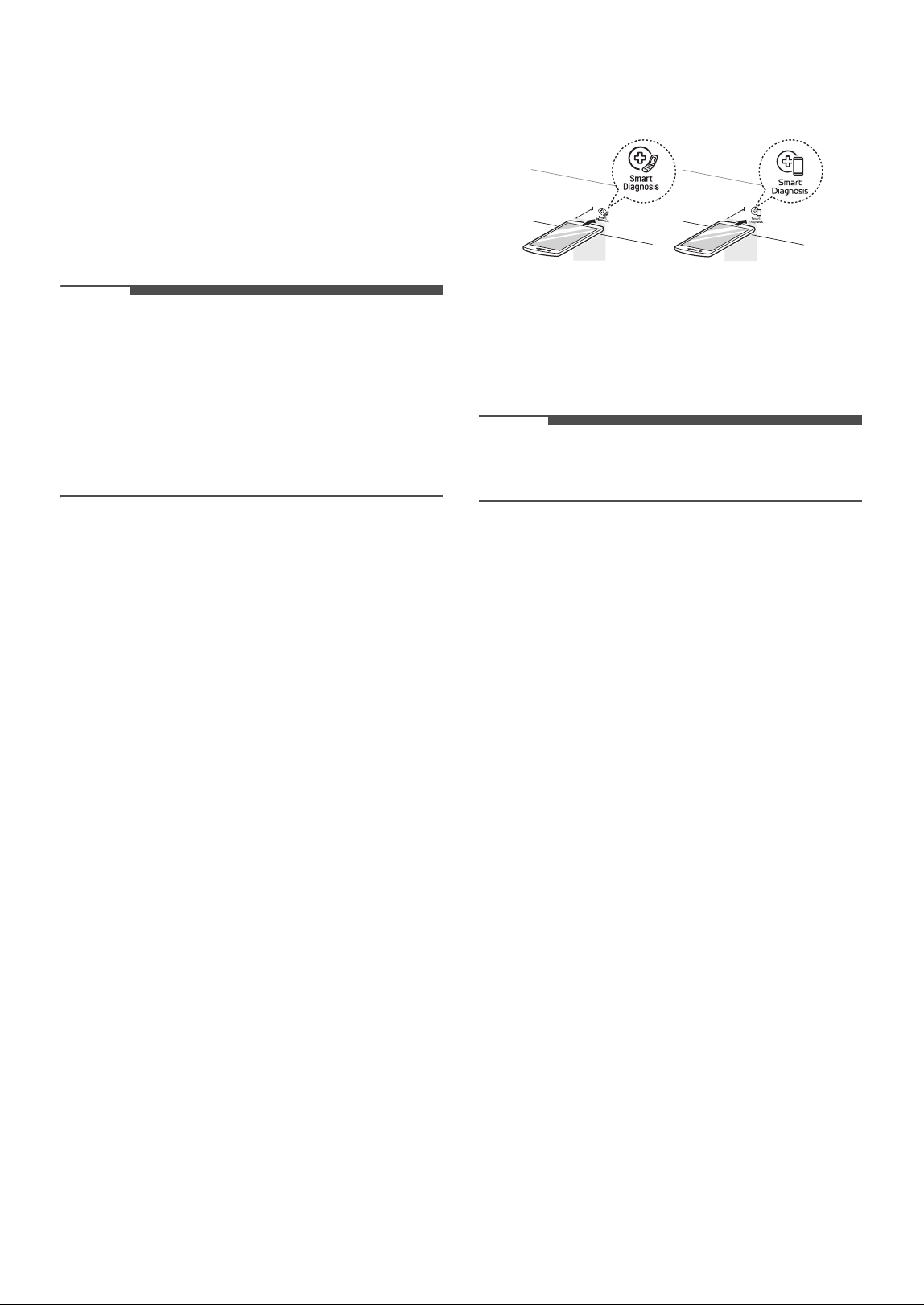
This feature is only available on models with the c
or d logo.
Use this feature to help you diagnose and solve
problems with your appliance.
NOTE
• For reasons not attributable to LGE’s negligence,
the service may not operate due to external
factors such as, but not limited to, Wi-Fi
unavailability, Wi-Fi disconnection, local app
store policy, or app unavailability.
• The feature may be subject to change without
prior notice and may have a different form
depending on where you are located.
Using LG ThinQ to Diagnose Issues
If you experience a problem with your Wi-Fi
equipped appliance, it can transmit
troubleshooting data to a smartphone using the
LG ThinQ application.
• Launch the LG ThinQ application and select the
Smart Diagnosis feature in the menu. Follow
the instructions provided in the LG ThinQ
application.
Using Audible Diagnosis to
Diagnose Issues
Follow the instructions below to use the audible
diagnosis method.
• Launch the LG ThinQ application and select the
Smart Diagnosis feature in the menu. Follow
the instructions for audible diagnosis provided
in the LG ThinQ application.
1 Press the START/Enter button for three
seconds.
• If the display has been locked, you must
deactivate the lock and then reactivate it.
2 Hold the mouthpiece of your phone in front of
the Smart Diagnosis logo located on the
control panel.
3 Keep the phone in place until the tone
transmission has finished. The display will
count down the time. Once the countdown is
over and the tones have stopped, the
diagnosis will be displayed in the application.
NOTE
• For best results, do not move the phone while
the tones are being transmitted.
Max
.
10 mm
Max.
10 mm
29MAINTENANCE
ENGLISH
MAINTENANCE
Cleaning
Cleaning the Interior
Clean the inside of the microwave weekly or as
needed.
1 Use a damp cloth to clean the surfaces of the
door and wipe out crumbs between the door
and the frame.
2 Remove the turntable and support ring. Rinse
them off using mild dish soap and a soft cloth
or clean them in the dishwasher. Make sure
all parts are dry before reassembling.
3 Remove greasy spatters with a mild dish soap
and a soft cloth, rinse, and then dry. Do not
use harsh or abrasive cleaners.
• Wipe spatters immediately with a wet paper
towel, especially after cooking chicken or
bacon.
• If steam accumulates inside or outside of
the oven door, wipe the panels with a soft
cloth.
• For stubborn soil, boil a cup of water in the
oven for 2 to 3 minutes. Steam will soften
the soil. To get rid of odors inside the oven,
boil a cup of water with some lemon juice or
vinegar in it. Use caution when removing
the water, as it will be hot and could cause
burns.
• If some induction cleaners containing
abrasives are used, the appearance of the
product may be damaged.
Cleaning the Exterior
1 Clean the outside of the oven with soap and
water.
2 Rinse with clean water and dry with a soft
cloth or paper towel.
• To prevent damage to the internal working
parts of the oven, do not allow water to
seep into the ventilation openings.
• The door and door seals should be kept
clean. Use warm, soapy water to clean.
Rinse off soap residue and dry thoroughly.
• Frequently wipe metal parts with a damp
cloth.
Cleaning the Control Panel and
Glass
1 Open the door to prevent the oven from
accidentally starting.
2 Gently wipe the control panel clean with a
soft, damp cloth and mild dish soap. Do not
use harsh or abrasive cleaners.
3 To clean the glass, spray glass cleaner on a
damp cloth and wipe. Do not spray glass
cleaner directly onto the microwave.
4 Press STOP/Clear after cleaning.
Cleaning the Accessories
Wash the glass tray and rotating ring in mild,
sudsy water. For heavily soiled areas, use a mild
cleanser and scouring sponge. Dry completely
before use.
• The glass tray and rotating ring are dishwasher
safe.
NOTE
• Abrasive cleansers, steel wool pads, gritty wash
cloths, some paper towels, and other abrasive
surfaces can damage the control panel and the
interior and exterior oven surfaces.
Cleaning the Grease Filters
Filters should be cleaned at least once a month or
more often if needed.
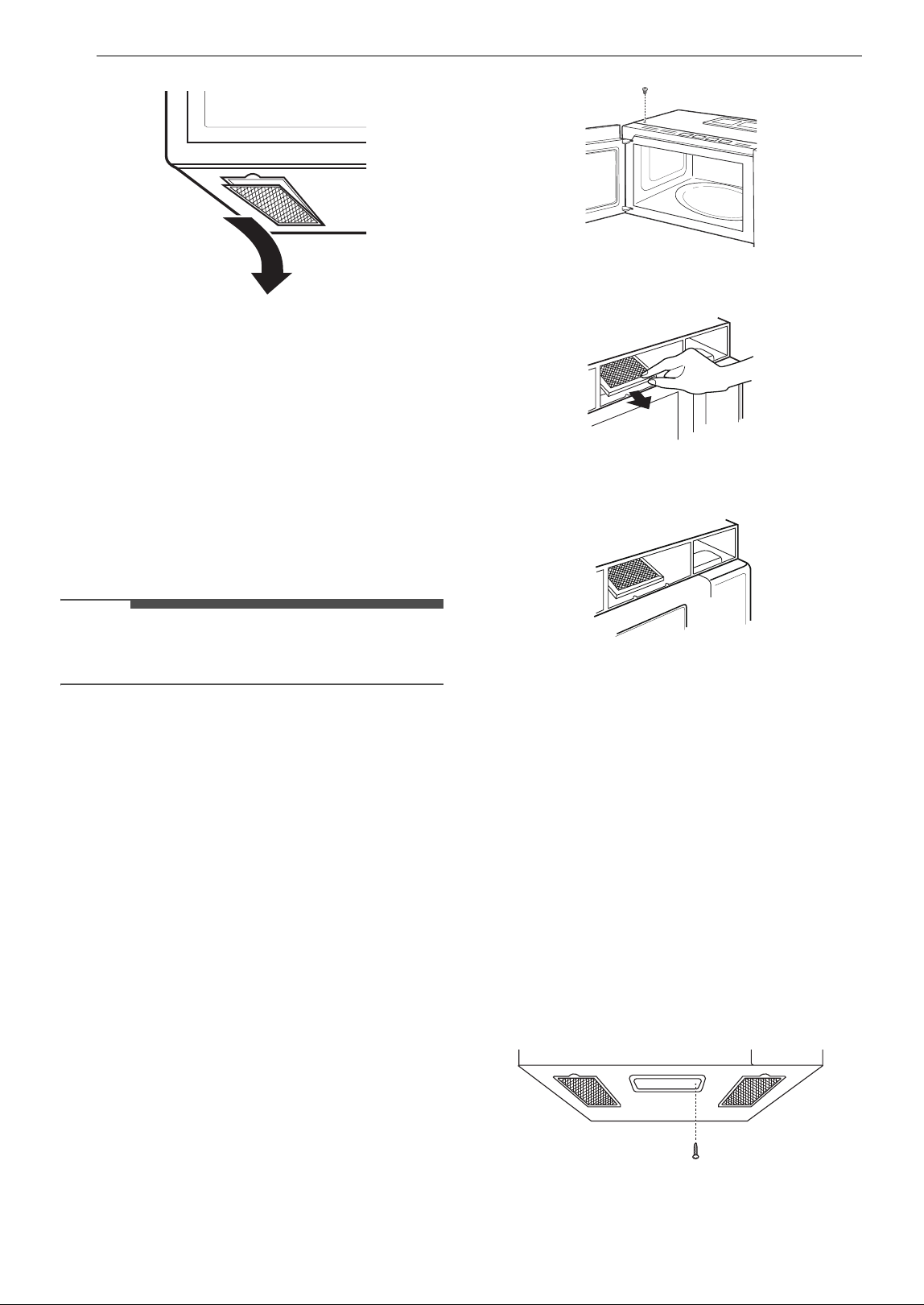
1 To remove, slide the grease filter back slightly
and pull it downward.
30 MAINTENANCE
2 Soak grease filters in hot water and a mild
detergent.
3 Rinse well and shake to dry.
• Do not use ammonia or place in a
dishwasher. The aluminum will darken.
4 To reinstall, slide the filter in on the back side
and push it upward to secure it.
NOTE
• Do not operate the hood without the filters in
place.
Replacing Parts
Replacing the Charcoal Filter
If your oven is vented inside, the charcoal filter
should be replaced every 6 to 12 months, and
more often if necessary. The charcoal filter cannot
be cleaned. To order a new charcoal filter, contact
an LG Customer Information Center or visit the
lg.com website.
1 Unplug the power cord and wear gloves.
2 Remove the vent cover screw. Open the oven
door, hold both sides of the vent cover and
remove it.
3 Remove the old charcoal filter.
4 Slide a new charcoal filter into place.
5 Slide the bottom of the vent cover into place.
Push the top until it snaps into place. Tighten
the screw to secure the vent grille in place.
6 Close the oven door, plug in the power cord
and set the clock.
Replacing the Cooktop Light
1 Unplug the power cord and wear gloves.
2 Remove the bulb cover screws and open the
bulb cover.
3 Replace the bulb with 30 watt appliance bulb.
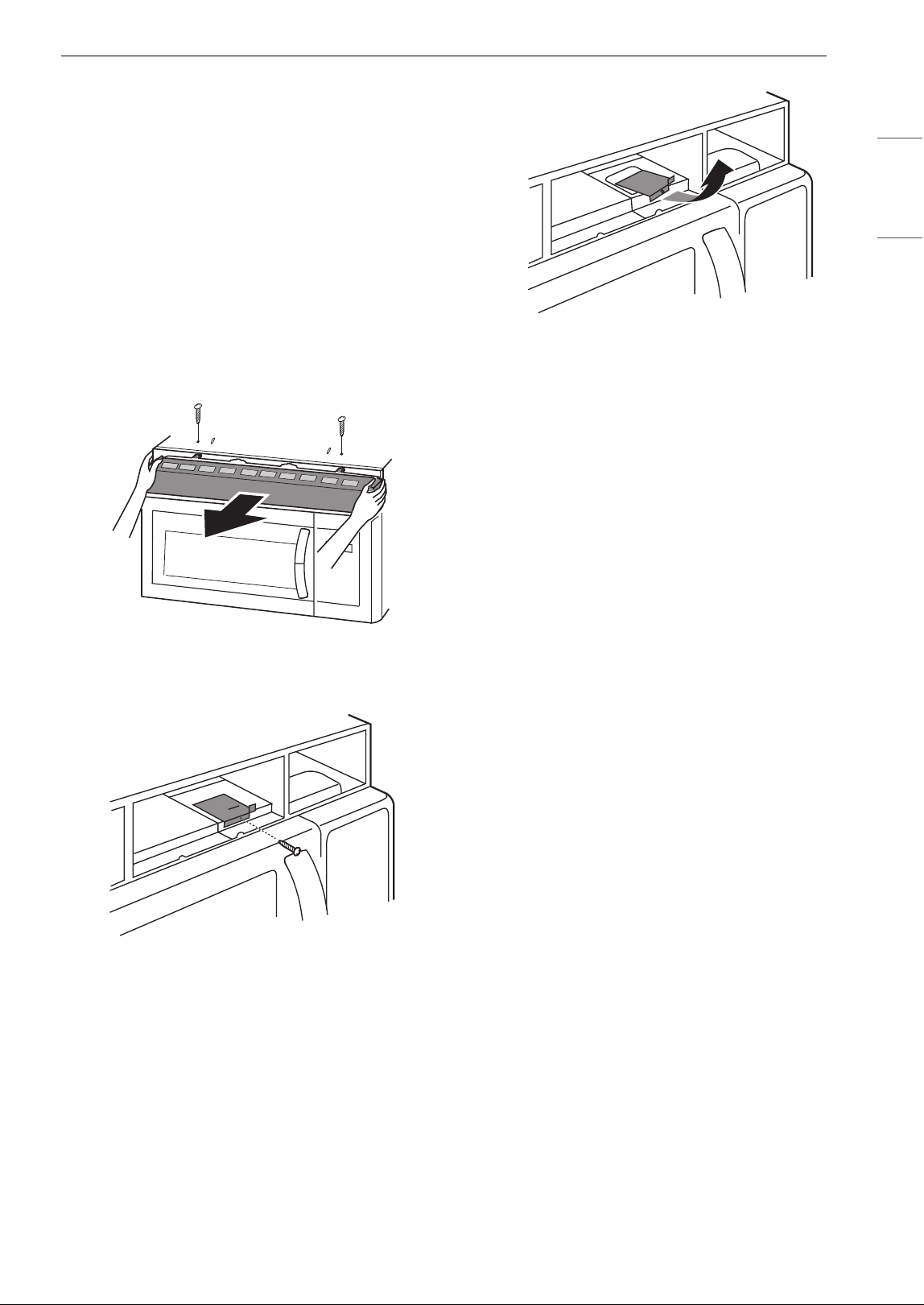
31MAINTENANCE
ENGLISH
4 Close the bulb cover, and tighten the bulb
cover screws in place.
5 Plug the power cord and set the clock.
Replacing the Oven Light
1 Unplug the power cord and put on gloves.
2 Remove the 2 vent grille mounting screws.
Slide the vent grille forward to remove it.
3 Remove the light cover screw.
4 Pull the light cover forward and lift up the
bulb holder.
5 Replace bulb with a 30 watt appliance bulb.
6 Insert the light cover, and tighten the light
cover screw in place.
7 Slide the bottom of the vent grille into place.
Push the top in until it snaps into place. Insert
and tighten the vent grille mounting screws.
8 Plug in the power cord and set the clock.

32 TROUBLESHOOTING
TROUBLESHOOTING
FAQs
Frequently Asked Questions
Q: Will the oven be damaged if it operates while empty?
A: Yes. Never operate the oven while it is empty or without the glass tray.
Q: Does microwave energy pass through the viewing screen in the door?
A: No. The metal screen bounces the energy back to the oven cavity. The holes (or ports) allow only light
to pass through. They do not let microwave energy pass through.
Q: Why do I see a light reflection around the outer case?
A: This light is from the oven light which is located between the oven cavity and the outer wall of the
oven.
Q: What are the various sounds I hear when the oven is operating?
A: The clicking sound is caused by a mechanical switch turning the microwave oven's magnetron ON
and OFF.
The heavy hum and clunk is from the change in power the magnetron draws as it is turned ON and
OFF by a mechanical switch. The change in blower speed is from the change in line voltage caused by
the magnetron being turned ON and OFF.
Q: Can my oven be damaged if food is cooked for too long?
A: Like any other cooking appliance, it is possible to overcook food to the point that the food creates
smoke and even possibly fire, and damages the inside of the oven. It is always best to be near the
oven while you are cooking.
Q: Why is a standing time recommended after microwave cooking time is over?
A: Standing time allows foods to continue cooking evenly for a few minutes after the actual microwave
oven cooking cycle. The amount of standing time depends upon the density of the foods.
Q: Why is additional time required for cooking food stored in the refrigerator?
A: As in conventional cooking, the initial temperature of food affects total cooking time. You need more
time to cook food taken out of a refrigerator than for food at room temperature.
Q: Sometimes the door of my oven appears wavy. Is this normal?
A: This appearance is normal and does not affect the operation of your oven.
Q: Why does the glass tray not move?
A: The correct side of the tray should be facing up and the tray should sit firmly on the center hub. The
support is not operating correctly. Reinstall the glass tray and restart the oven. Cooking without the
glass tray can give you poor results. On some models, the turntable may be turned off. See Setting
the Turntable in the Operation section.
Q: Why does the dish become hot when I microwave food in it? I thought that this should not
happen.
A: As the food becomes hot it will conduct the heat to the dish. Use hot pads to remove food after
cooking.
Q: What does standing time mean?

33TROUBLESHOOTING
ENGLISH
A: Standing time means that food should be taken out of the oven and covered for additional time after
cooking. This process allows the cooking to finish, saves energy, and frees the oven for other
purposes.
Q: Can I pop popcorn in my oven? How do I get the best results?
A: Yes. Pop packaged microwave popcorn following manufacturer’s guidelines or use the
preprogrammed Popcorn button.
Do not use regular paper bags. Use the listening test by stopping the oven as soon as the popping
slows to a pop every one or two seconds. Do not try to repop unpopped kernels. You can also use
special microwave poppers. When using a popper, be sure to follow manufacturer’s directions. Do not
pop popcorn in glass utensils.
Q: Why does steam come out of the air exhaust vent?
A: Steam is normally produced during cooking. The oven has been designed to vent steam out of the
vent.
Q: Why aren't the function buttons working?
A: Make sure that the oven is not in Control Lock mode. "Loc" will show in the display if Control Lock is
activated. To deactivate Control Lock, press and hold STOP/Clear for three seconds.
34 TROUBLESHOOTING
Before Calling for Service
Review this section before calling for service; doing so will save you both time and money.
For detailed information or videos, visit www.lg.com
for the troubleshooting page.
Operation
Problem Possible Cause & Solution
Microwave oven
does not start
Power cord is unplugged, door is open, or cooking time has not been set.
• Plug in power cord or check for a blown circuit fuse or a tripped main circuit breaker.
• Close oven door.
• Set cooking time.
Timer function started.
• If the display shows a time counting down but the oven is not cooking, check to see if a
Timer function has been started instead of a cooking function.
Oven light does not
work
The light bulb is loose or defective, or the power cord is unplugged.
• Replace the light bulb properly.
• Plug in power cord.
Arcing or Sparking Cookware is not microwave safe, or the oven is being operated while it is empty.
• Use microwave-safe cookware. When in doubt, test cookware before use.
• Do not operate oven while it is empty.
Wire twist-ties have not been removed from paper or plastic bags, or the metal rack
was installed improperly.
• Remove wire twist-ties from paper or plastic bags.
• Place the rack securely in the four plastic supports.
Incorrect Time of
Day
Power interruption.
• Reset the time. See Setting the Clock section to reset time of day.
Unevenly Cooked
Foods
Cookware is not microwave safe, or cook settings were wrong.
• Test cookware to make sure it is microwave safe.
• Do not cook without the glass tray.
• Turn or stir food while cooking.
• Defrost food completely before cooking.
• Use correct cook time and power level.
• Check position of aluminum strips used to prevent overcooking.
Overcooked Foods Cooking settings and methods are wrong.
• Change cook time or power level.
Undercooked Foods Cookware is not microwave safe, or cook settings were wrong.
• Test that cookware is microwave safe.
• Defrost food completely before cooking.
• Change cook time or power level.
• Make sure that ventilation ports are not blocked.
Improper Defrosting Cookware is not microwave safe, or cook settings were wrong.
• Test that cookware is microwave safe.
• Change defrost time or weight.
• Turn or stir food during defrost cycle.
35LIMITED WARRANTY
ENGLISH
LIMITED WARRANTY
USA
TERMS AND CONDITIONS
ARBITRATION NOTICE: THIS LIMITED WARRANTY CONTAINS AN ARBITRATION PROVISION THAT
REQUIRES YOU AND LG ELECTRONICS ("LG") TO RESOLVE DISPUTES BY BINDING ARBITRATION
INSTEAD OF IN COURT, UNLESS YOU CHOOSE TO OPT OUT. IN ARBITRATION, CLASS ACTIONS AND
JURY TRIALS ARE NOT PERMITTED. PLEASE SEE THE SECTION TITLED "PROCEDURE FOR RESOLVING
DISPUTES" BELOW.
Should your LG Microwave Oven ("Product") fail due to a defect in materials or workmanship under
normal and proper use, during the warranty period set forth below, LG will, at its option, repair or
replace the Product. This limited warranty is valid only to the original retail purchaser of the
Product ("You") and applies only when purchased lawfully and used within the United States
including U.S. Territories.
• Replacement Products and parts are warranted for the remaining portion of the original warranty period
or ninety (90) days, whichever is greater.
• Replacement Products and parts may be new, reconditioned, refurbished, or otherwise factory
remanufactured.
• Replaced Product or part(s) will be the property of LG.
• Proof of original retail purchase specifying the Product model and date of purchase is required to obtain
warranty service under this limited warranty.
EXCEPT TO THE EXTENT PROHIBITED BY APPLICABLE LAW, ANY IMPLIED WARRANTY OF
MERCHANTABILITY OR FITNESS FOR A PARTICULAR PURPOSE ON THE PRODUCT IS LIMITED IN DURATION
TO THE DURATION OF THE ABOVE LIMITED WARRANTY. UNDER NO CIRCUMSTANCES SHALL LG OR ITS U.S.
DISTRIBUTORS/DEALERS BE LIABLE FOR ANY INDIRECT, INCIDENTAL, CONSEQUENTIAL, SPECIAL, OR
PUNITIVE DAMAGES, INCLUDING, WITHOUT LIMITATION, LOST GOODWILL, LOST REVENUES OR PROFITS,
WORK STOPPAGE, IMPAIRMENT OF OTHER GOODS, COST OF REMOVAL AND REINSTALLATION OF THE
PRODUCT, LOSS OF USE, OR ANY OTHER DAMAGES WHETHER BASED IN CONTRACT, TORT, OR
OTHERWISE. LG'S TOTAL LIABILITY, IF ANY, SHALL NOT EXCEED THE PURCHASE PRICE PAID BY YOU FOR
THE PRODUCT.
SOME STATES DO NOT ALLOW THE EXCLUSION OR LIMITATION OF INCIDENTAL OR CONSEQUENTIAL
DAMAGES OR LIMITATIONS ON HOW LONG AN IMPLIED WARRANTY LASTS, SO THE ABOVE
EXCLUSIONS OR LIMITATIONS MAY NOT APPLY TO YOU. THIS LIMITED WARRANTY GIVES YOU
SPECIFIC LEGAL RIGHTS AND YOU MAY ALSO HAVE OTHER RIGHTS THAT VARY FROM STATE TO STATE.
THIS LIMITED WARRANTY DOES NOT COVER:
• Service trips to deliver, pick up, or install, educate how to operate, correct wiring, or correct
unauthorized repairs.
• Damage or failure of the Product to perform during power failures and interrupted or inadequate
electrical service.
• Damage or failure of the Product caused by leaky or broken water pipes, frozen water pipes, restricted
drain lines, inadequate or interrupted water supply or inadequate supply of air.
WARRANTY PERIOD
Microwave Oven Inverter Magnetron Only
Parts (internal/functional parts only) and Labor: One
(1) year from the date of original retail purchase
Parts Only: Ten (10) years from the date of original
retail purchase You are responsible for any applicable
labor cost.
36 LIMITED WARRANTY
• Damage or failure of the Product resulting from operating the Product in a corrosive atmosphere or
contrary to the Product owner’s manual.
• Damage or failure of the Product caused by accidents, pests and vermin, lightning, wind, fire, floods, acts
of nature, or any other causes beyond the control of LG.
• Damage or failure of the Product caused by unauthorized modification or alteration, or if the Product is
used for other than the intended purpose, or any water leakage where the Product was not properly
installed.
• Damage or failure of the Product caused by incorrect electrical current, voltage, or plumbing codes.
• Damage or failure of the Product caused by transportation, storage, and/or handling, including
scratches, dents, chips, and/or other damage to the finish of the Product, unless such damage is
reported within one (1) week of delivery.
• Damage or failure of the Product resulting from misuse, abuse, improper installation, repair, or
maintenance. Improper repair includes the use of parts not authorized by LG. Improper installation or
maintenance includes installation or maintenance contrary to the Product owner’s manual.
• Damage or failure of the Product caused by the use of parts, components, accessories, consumable
cleaning products, or any other products or services that were not authorized by LG.
• Damage or missing items to any display or open box Product.
• Refurbished Product or any Product sold “As Is”, “Where Is”, “With all Faults”, or similar disclaimer.
• Products with original serial numbers that have been removed, altered, or cannot be readily determined.
• Increases in utility costs and additional utility expenses.
• Any noises associated with normal operation.
• Products used for other than normal and proper household use (e.g., commercial or industrial use) or
contrary to the Product owner’s manual.
• Costs associated with removal and reinstallation of the Product for repairs, or the removal and
reinstallation of the Product if it is installed in an inaccessible location or not installed in accordance with
the Product Owner's manual.
• Accessories, removable components, or consumable parts (e.g. Shelves, door bins, drawers, water/air
filters, racks, light bulbs, batteries, etc., as applicable), except for internal/functional parts covered under
this limited warranty.
The cost of repair or replacement under these excluded circumstances shall be borne by You.
TO OBTAIN WARRANTY SERVICE AND ADDITIONAL INFORMATION
Call 1-800-243-0000
and select the appropriate option from the menu.
Or visit our website at http://www.lg.com
Or by mail: LG Electronics Customer Service P.O. Box 240007 Huntsville, AL 35813 ATTN: CIC
NOT COVERED BY WARRANTY
Problem Cause Solution
Unit has no power
• House power turned off (power supply)
• Tripped breaker.
• The power cord is not installed properly.
• Check house power
supply.
• Check proper power
cord connection.
• Check extension cord.
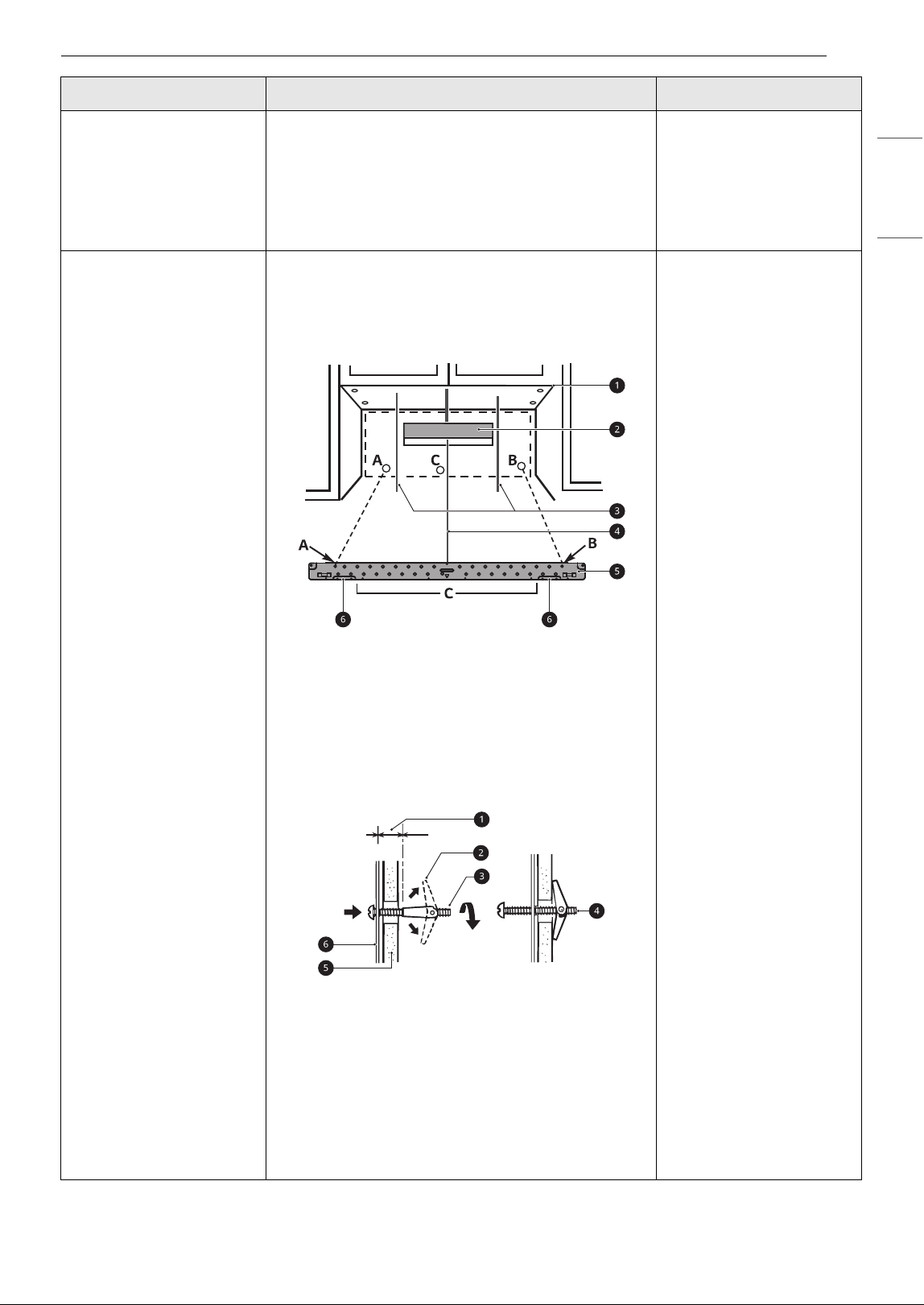
37LIMITED WARRANTY
ENGLISH
Spark / Arcing Aluminum foil or metal utensil used in microwave
mode.
• Check user
instructions.
•DO NOT use
aluminum foil or metal
utensils in microwave
mode.
Microwave oven
installation issue.
• Vibration noise
• Unit is not level
• Installation damage
• Mounting bracket screw not fixed completely.
• Mounting plate not aligned.
- 3/16" Hole on Studs, 5/8" Hole on Drywall
Only
a Minimum 66" from the floor
b For Wall Venting Only
c Draw Lines on Studs
d Draw Center Line
e Mounting Plate
f Support Tab
a Space More Than Wall Thickness
b Toggle Wings
c Toggle Bolt
d Bolt End
e Wall
f Mounting Plate
• Product carried/installed improperly.
Check with installer first.
Problem Cause Solution
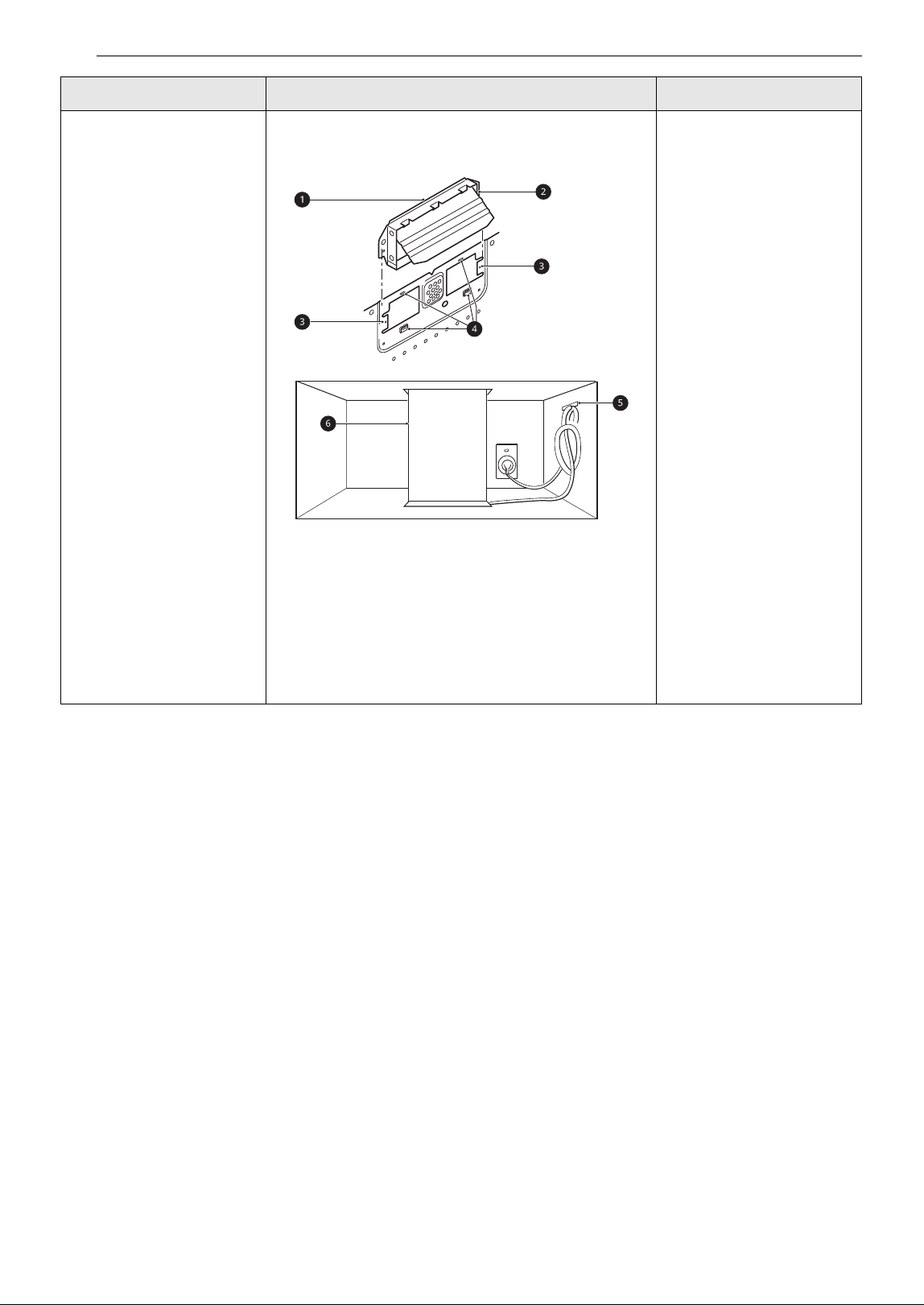
38 LIMITED WARRANTY
PROCEDURE FOR RESOLVING DISPUTES:
ALL DISPUTES BETWEEN YOU AND LG ARISING OUT OF OR RELATING IN ANY WAY TO THIS LIMITED
WARRANTY OR THE PRODUCT SHALL BE RESOLVED EXCLUSIVELY THROUGH BINDING ARBITRATION, AND
NOT IN A COURT OF GENERAL JURISDICTION. BINDING ARBITRATION MEANS THAT YOU AND LG ARE EACH
WAIVING THE RIGHT TO A JURY TRIAL AND TO BRING OR PARTICIPATE IN A CLASS ACTION.
Definitions. For the purposes of this section, references to “LG” mean LG Electronics U.S.A., Inc., its
parents, subsidiaries and affiliates, and each of their officers, directors, employees, agents, beneficiaries,
predecessors in interest, successors, assigns and suppliers; references to “dispute” or “claim” shall include
any dispute, claim or controversy of any kind whatsoever (whether based in contract, tort, statute,
regulation, ordinance, fraud, misrepresentation or any other legal or equitable theory) arising out of or
relating in any way to the sale, condition or performance of the product or this Limited Warranty.
Notice of Dispute. In the event you intend to commence an arbitration proceeding, you must first notify
LG in writing at least 30 days in advance of initiating the arbitration by sending a letter to LG at LG
Electronics, USA, Inc. Attn: Legal Department- Arbitration 111 Sylvan Avenue, Englewood Cliffs, NJ 07632.
You and LG agree to engage in good faith discussions in an attempt to amicably resolve your claim. The
notice must provide your name, address, and telephone number; identify the product that is the subject of
the claim; and describe the nature of the claim and the relief being sought. If you and LG are unable to
resolve the dispute within 30 days, either party may proceed to file a claim for arbitration.
Agreement to Binding Arbitration and Class Action Waiver. Upon failure to resolve the dispute during
the 30 day period after sending written notice to LG, you and LG agree to resolve any claims between us
only by binding arbitration on an individual basis, unless you opt out as provided below. Any dispute
between you and LG shall not be combined or consolidated with a dispute involving any other person’s or
entity’s product or claim. More specifically, without limitation of the foregoing, any dispute between you
and LG shall not under any circumstances proceed as part of a class or representative action. Instead of
Vent is not working.
•Weak or no
ventilation.
• Abnormal noise
during operation.
• Product overheating.
• Improper blower unit direction or installation.
• Improper ductwork or damper connection.
a Exhaust Adapter
b Damper (hinge side up)
c Guides
d Locking Tabs
e Cable Clamping for Power Cord
f Duct
• Check blower unit
direction and reinstall
if necessary.
• Properly align the
exhaust operation
ports and blower plate
opening.
• Blower unit exhaust
ports should be
completely exposed to
the outside.
• After installation,
check the air
ventilation path
Problem Cause Solution

39LIMITED WARRANTY
ENGLISH
arbitration, either party may bring an individual action in small claims court, but that small claims court
action may not be brought on a class or representative basis.
Arbitration Rules and Procedures. To begin arbitration of a claim, either you or LG must make a written
demand for arbitration. The arbitration will be administered by the American Arbitration Association
(“AAA”) and will be conducted before a single arbitrator under the AAA’s Consumer Arbitration Rules that
are in effect at the time the arbitration is initiated (referred to as the “AAA Rules”) and under the
procedures set forth in this section. The AAA Rules are available online at www.adr.org/consumer. Send a
copy of your written demand for arbitration, as well as a copy of this provision, to the AAA in the manner
described in the AAA Rules. You must also send a copy of your written demand to LG at LG Electronics,
USA, Inc. Attn: Legal Department- Arbitration 111 Sylvan Avenue, Englewood Cliffs, NJ 07632. If there is a
conflict between the AAA Rules and the rules set forth in this section, the rules set forth in this section will
govern. This arbitration provision is governed by the Federal Arbitration Act. Judgment may be entered on
the arbitrator’s award in any court of competent jurisdiction. All issues are for the arbitrator to decide,
except that issues relating to the scope and enforceability of the arbitration provision and to the
arbitrability of the dispute are for the court to decide. The arbitrator is bound by the terms of this
provision.
Governing Law. The law of the state of your residence shall govern this Limited Warranty and any
disputes between us except to the extent that such law is preempted by or inconsistent with applicable
federal law.
Fees/Costs. You do not need to pay any fee to begin an arbitration. Upon receipt of your written demand
for arbitration, LG will promptly pay all arbitration filing fees to the AAA unless you seek more than $25,000
in damages, in which case the payment of these fees will be governed by the AAA Rules. Except as
otherwise provided for herein, LG will pay all AAA filing, administration and arbitrator fees for any
arbitration initiated in accordance with the AAA Rules and this arbitration provision. If you prevail in the
arbitration, LG will pay your attorneys’ fees and expenses as long as they are reasonable, by considering
factors including, but not limited to, the purchase amount and claim amount. Notwithstanding the
foregoing, if applicable law allows for an award of reasonable attorneys’ fees and expenses, an arbitrator
can award them to the same extent that a court would. If the arbitrator finds either the substance of your
claim or the relief sought in the demand is frivolous or brought for an improper purpose (as measured by
the standards set forth in Federal Rule of Civil Procedure 11(b)), then the payment of all arbitration fees will
be governed by the AAA Rules. In such a situation, you agree to reimburse LG for all monies previously
disbursed by it that are otherwise your obligation to pay under the AAA Rules. Except as otherwise
provided for, LG waives any rights it may have to seek attorneys’ fees and expenses from you if LG prevails
in the arbitration.
Hearings and Location. If your claim is for $25,000 or less, you may choose to have the arbitration
conducted solely on the basis of (1) documents submitted to the arbitrator, (2) through a telephonic
hearing, or (3) by an in-person hearing as established by the AAA Rules. If your claim exceeds $25,000, the
right to a hearing will be determined by the AAA Rules. Any in-person arbitration hearings will be held at a
location within the federal judicial district in which you reside unless we both agree to another location or
we agree to a telephonic arbitration.
Opt Out. You may opt out of this dispute resolution procedure. If you opt out, neither you nor LG can
require the other to participate in an arbitration proceeding. To opt out, you must send notice to LG no
later than 30 calendar days from the date of the first consumer purchaser’s purchase of the product by
either: (i) sending an e-mail to [email protected]
, with the subject line: “Arbitration Opt Out” or (ii) calling 1-
800-980-2973. You must include in the opt out e-mail or provide by telephone: (a) your name and address;
(b) the date on which the product was purchased; (c) the product model name or model number; and (d)
the serial number (the serial number can be found (i) on the product; or (ii) online by accessing https://
www.lg.com/us/support and clicking on “How do I find my model number?”).
You may only opt out of the dispute resolution procedure in the manner described above (that is, by e-mail
or telephone); no other form of notice will be effective to opt out of this dispute resolution procedure.
Opting out of this dispute resolution procedure will not affect the coverage of the Limited Warranty in any
way, and you will continue to enjoy the full benefits of the Limited Warranty. If you keep this product and
do not opt out, then you accept all terms and conditions of the arbitration provision described above.
LG Customer Information Center
Register your product Online!
www.lg.com
For inquiries or comments,
visit www.lg.com or call:
1-800-243-0000
U.S.A.
1-888-542-2623
CANADA
Centro de Información al Cliente LG
¡Registre su producto en línea!
www.lg.com
Para consultas o comentarios, visite
www.lg.com o llame por teléfono:
1-800-243-0000
EE.UU.
1-888-542-2623
CANADÁ
Centre de Service à la Clientèle de LG
Enregistrez votre produit en ligne!
Pour des questions ou des commentaires,
visitez www.lg.com/ca_fr ou appelez :
1-800-243-0000
ÉTATS-UNIS
1-888-542-2623
CANADA
www.lg.com/ca_fr