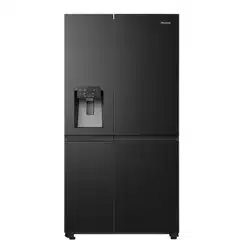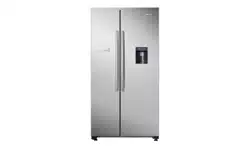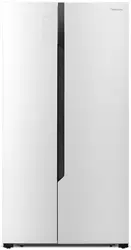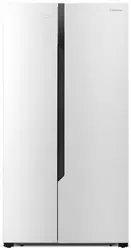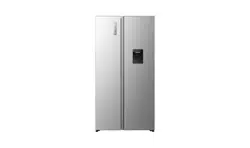

HRSBS540BW
English
EN
USER’S OPERATION MANUAL
Before operating this unit, please read this manual
thoroughly, and retain for future reference
HRSBS540SW
Table of Contents
Thank you for choosing Hisense. We are sure you will find your new refrigerator a
pleasure to use. However, before you use the appliance, we recommend that you
carefully read the instructions, which provide details about installing and using
the product. Please keep this manual for future reference.
REFRIGERATOR SAFETY ...............................................................................................................................................
PARTS AND FEATURES...................................................................................................................................................
INSTALLATION REQUIREMENTS.................................................................................................................................
INSTALLATION INSTRUCTIONS..................................................................................................................................
REFRIGERATOR USE......................................................................................................................................................
REFRIGERATOR CARE...................................................................................................................................................
HELPFUL HINTS AND TIPS...........................................................................................................................................
TROUBLESHOOTING....................................................................................................................................................
DISPOSAL OF THE APPLIANCE.................................................................................................................................
01
14
16
18
21
31
34
35
39
We have provided many important safety messages in this
manual and on your appliance. Always read and obey all
safety messages.
01
Refrigerator Safety
Your safety and the safety of others are very important.
This is the safety alert symbol.
This symbol alerts you to potential hazards that
can kill or hurt you and others. All safety messages
will follow the safety alert symbol and either the
word “DANGER”, “WARNING” or “CAUTION”.
These words mean:
DANGER
An imminently hazardous situation. You could be killed or
seriously injured if you don’t immediately follow instructions.
CAUTION
WARNING
A potentially hazardous situation which, if not avoided, may
result in moderate or minor injury.
A potentially hazardous situation which, if not avoided, could
result in death or serious bodily injury.
All safety messages will tell you what the potential hazard is,
tell you how to reduce the chance of injury, and tell you
what can happen if the instructions are not followed.
02
For your safety and correct usage, before installing and first
using the appliance, read this user manual carefully,
including its hints and warnings. To avoid unnecessary
mistakes and accidents, it is important to make sure that all
people using the appliance are thoroughly familiar with it
operation and safety features. Save these instructions and
be sure that they remain with the appliance if it is moved or
sold, so that anyone using it throughout its life, will be
properly informed on its usage and safety notices.
For the safety of life and property, keep the precautions of
these user's instructions as the manufacturer is not
responsible for damages caused by omission.
According to EN standard
This appliance can be used by children aged from 8
years and above and persons with reduced physical,
sensory or mental capabilities or lack of experience
and knowledge if they have been given supervision or
instruction concerning use of the appliance in a safe
way and understand the hazards involved. Children
shall not play with the appliance. Cleaning and user
maintenance shall not be made by children without
supervision. Children aged from 3 to 8 years are
allowed to load and unload refrigerating appliances.
Safety for children and others who are vulnerable people
Refrigerator Safety
According to IEC standard
This appliance is not intended for use by persons
(including children) with reduced physical, sensory or
mental capabilities, or lack of experience and
knowledge, unless they have been given supervision or
instruction concerning use of the appliance by a
person responsible for their safety.
Children should be supervised to ensure that they do
not play with the appliance.
Keep all packaging away from children as there is risk
of suffocation.
If you are discarding the appliance, pull the plug out
of the socket, cut the connection cable (as close to
the appliance as you can) and remove the door to
prevent children playing from suffering an electric
shock or from closing themselves inside it.
If this appliance, featuring magnetic door seals, is to
replace an older appliance having a spring lock
(latch) on the door or lid, be sure to make the spring
lock unusable before you discard the old appliance.
This will prevent it from becoming a death trap for a
child.
Safety for children and others who are vulnerable people
03
Refrigerator Safety
WARNING
This appliance is intended to be used in household and
similar applications such as
1. staff kitchen areas in shops, offices and other working
environments;
2. farm houses and by hotels, motels and other
residential type environments;
3. bed and breakfast type environments;
4. catering and similar non-retail applications.
WARNING
Do not store explosive substances such as aerosol cans
with a flammable propellant in this appliance.
WARNING
If the supply cord is damaged, it must be replaced by
the manufacturer, its service agent or similarly qualified
persons in order to avoid a hazard.
WARNING
Keep ventilation openings, in the appliance enclosure
or in the built-in structure, clear of obstruction.
WARNING
Fill with potable water only for the water container.
General safety
04
Refrigerator Safety
WARNING
Do not use mechanical devices or other means to
accelerate the defrosting process, other than those
recommended by the manufacturer.
WARNING
Do not damage the refrigerant circuit.
WARNING
Do not use electrical appliances inside the food storage
compartments of the appliance, unless they are of the
type recommended by the manufacturer.
WARNING
The refrigerant and insulation blowing gas are
flammable. When disposing of the appliance, do so
only at an authorized waste disposal centre. Do not
expose to flame.
WARNING
When positioning the appliance, ensure the supply cord
is not trapped or damaged.
WARNING
Do not locate multiple portable socket-outlets or
portable power supplies at the rear of the appliance.
General safety
05
Refrigerator Safety
WARNING
The LED light must not be replaced by the user! If the
LED light is damaged, contact the customer helpline for
assistance.
Replacing the LED
06
The refrigerant isobutene (R600a) is contained within
the refrigerant circuit of the appliance, a natural gas
with a high level of environmental compatibility, which
is nevertheless flammable. During transportation and
installation of the appliance, ensure that none of the
components of the refrigerant circuit become
damaged.
The refrigerant (R600a) is flammable.
WARNING
Refrigerators contain refrigerant and gases in the
insulation. Refrigerant and gases must be disposed of
professionally as they may cause eye injuries or ignition.
Ensure that tubing of the refrigerant circuit is not
damage prior to proper disposal.
Refrigerant
Refrigerator Safety
07
If the refrigerant circuit should be damaged:
Avoid opening flames and sources of ignition.
Thoroughly ventilate the room in which the appliance is
situated.
It is dangerous to alter the specifications or modify this
product in any way.
Any damage to the cord may cause a short circuit, fire,
and/or electric shock.
WARNING
Risk of fire / flammable materials
Refrigerator Safety
Any electrical work required to do the servicing of the
appliance should be carried out by qualified electrician or
competent person.
This product must be serviced by an authorized Service
Center, and only genuine spare parts must be used:
1. If the appliance is Frost Free.
2. If
the appliance contains freezer compartment.
Queensland service notes: In Queensland,
the Authorized
Service Person Must hold a Gas
Work Authorization for
hydrocarbon refrigerants to carry
out servicing or repairs
which involve removal of covers.
Service
1. The power cord must not be lengthened.
2. Make sure that the power plug is not crushed or
damaged. A crushed or damaged power plug may
overheat and cause a fire.
3. Make sure that you can access the main plug of the
appliance.
4. Do not pull the main cable.
5. If the power plug socket is loose, do not insert the
power plug. There is a risk of electric shock or fire.
6. You must not operate the appliance without the
interior lighting lamp cover.
7. The fridge is only applied with power supply of single
phase alternating current of 220~240V/50、60Hz. If
fluctuation of voltage in the district of user is so large
that the voltage exceeds the above scope, for safety
sake, be sure to apply A.C. Automatic voltage
regulator of more than 350W to the fridge. The fridge
must be employed a special power socket instead of
common one with other electric appliances. Its plug
must match the socket with ground wire.
Electrical safety
08
Refrigerator Safety
09
In order to sense the temperature and humidity near the
appliance and make the appliance run better, add
temperature and humidity sensor outside the box of
appliance.
Do not store flammable gases or liquids in the appliance,
there is a risk of an explosion.
Do not operate any electrical appliances in the appliance
(e. g. electric ice cream makers, mixers etc.).
When unplugging always pull the plug from the mains
socket, do not pull on the cable.
Do not place hot items near the plastic components of this
appliance.
Do not place food products directly against the air outlet
on the rear wall.
Store pre-packed frozen food in accordance with the
frozen food manufacture’s instructions.
The appliances manufactures storage recommendations
should be strictly adhered to relevant instructions for
storage.
Do not place carbonated or fizzy drinks in the freezer
compartment as it creates pressure on the container,
which may cause it to explode, resulting in damage to the
appliance.
Frozen food can cause frost burns if consumed straight
from the freezer compartment.
Do not place the appliance in direct sunlight.
Daily use
Refrigerator Safety
Keep burning candles, lamps and other items with naked
flames away from the appliance and do not set the
appliance on fire.
The appliance is intended for keeping food stuff and/or
beverages in normal household as explained in this
instruction booklet. The appliance is heavy. You should take
care when move it as the appliance is heavy.
Do not remove nor touch items from the freezer
compartment if your hands are damp/wet, as this could
cause skin abrasions or frost/freezer burns.
Never use the base, drawers, doors etc. to stand on or as
supports.
Frozen food must not be refrozen once it has been thawed
out.
Do not consume ice popsicles or ice cubes straight from
the freezer as this can cause freezer burn to the mouth
and lips.
To avoid items falling and causing injury or damage to the
appliance, do not overload the door racks or put too much
food in the crisper drawers.
WARNING
Food needs to be packed into bags before it is put into the
refrigerator. Liquids need to be stored in bottles or capped
containers in order to avoid a spill, as the design structure
of the product is not easy to clean.
This refrigerating appliance is not intended to be used as a
built-in appliance.
10
Refrigerator Safety
Care and cleaning
Before maintenance, switch off the appliance and
disconnect the mains plug from the mains socket.
Do not clean the appliance with metal objects, steam
cleaner, ethereal oils, organic solvents or abrasive
cleansers.
Do not use sharp objects to remove frost from the
appliance. Use a plastic scraper.
CAUTION
11
Installation
For electrical connection carefully, follow the instructions
given in this manual.
Unpack the appliance and check if there are damages on
it.
Do not connect the appliance if it is damaged. Report
possible damages immediately to the place you bought
it. In this case retain packing.
It is advisable to wait at least four hours before
connecting the appliance to allow the oil to flow back in
the compressor.
Adequate air circulation should be around the appliance,
lacking this leads to overheating. To achieve sufficient
ventilation, follow the instructions relevant to installation.
Refrigerator Safety
12
Any electrical work required to do the servicing of the
appliance should be carried out by qualified electrician
or competent person.
This product must be serviced by an authorized Service
Center, and only genuine spare parts must be used.
1. If the appliance is Frost Free.
2. If the appliance contains freezer compartment.
Service
Wherever possible, the back of the product should not be
too close to a wall to avoid touching or catching warm
parts (compressor, condenser) to prevent the risk of fire,
follow the instructions relevant to installation.
The appliance must not be locate close to radiators or
cookers.
Make sure that the mains plug is accessible after the
installation of the appliance.
Clean water tanks if they have not been used for 48h; flush
the water system connected to a water supply if water
has not been drawn for 5 days.
Water dispenser cleaning (special
for water dispenser products):
Refrigerator Safety
Proper Disposal of Your Old Refrigerator
Suffocation Hazard
Remove doors from your old refrigerator.
Failure to do so can result in death or brain damage.
WARNING
13
IMPORTANT: Child entrapment and suffocation are not
problems of the past. Junked or abandoned refrigerators
are still dangerous– even if they will sit for “just a few days”.
If you are getting rid of your old refrigerator, please follow
these instructions to help prevent accidents.
Food needs to be packed in bags before putting into
the refrigerator, and liquids need to be packed in
bottles or capped containers to avoid the problem that
the product design structure is not easy to clean.
WARNING
Before You Throw Away Your Old Refrigerator or Freezer:
Take off the doors.
Leave the shelves in place so that children may not easily
climb inside.
Important information to know about disposal of refrigerants:
Dispose of refrigerator in accordance with Federal and Local
regulations. Refrigerants must be evacuated by a licensed, EPA
certified refrigerant technician in accordance with established
procedures.
Refrigerator Safety
14
Parts and Features
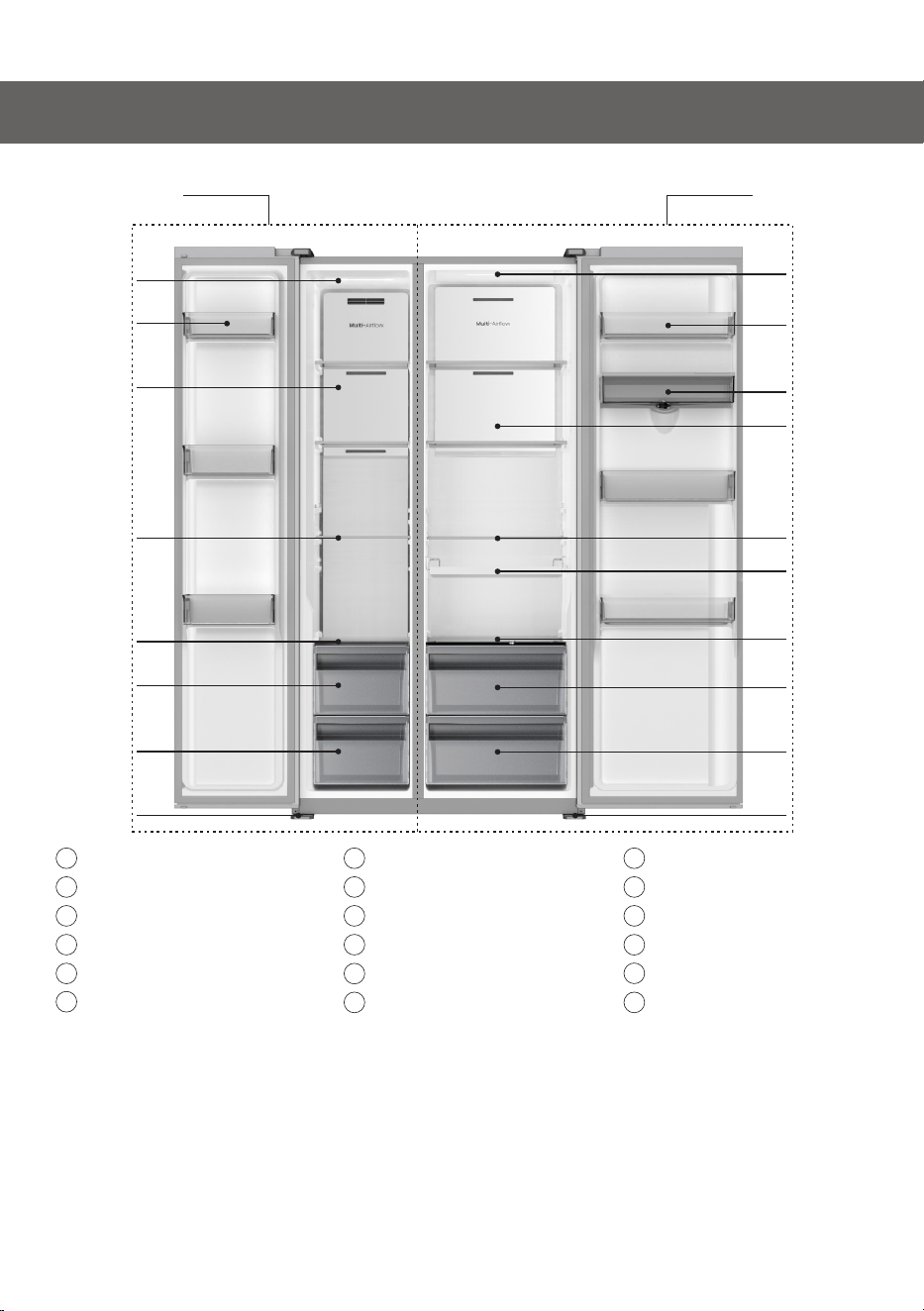
Freezer zone LED light
Freezer door Rack
Wind channel cover in freezer
Freezer shelf
Freezer drawer cover plate
Freezer upper drawer
6
5
4
3
2
1
Freezer lower drawer
Left adjustable bottom feet
Fridge zone LED light
Fridge door Rack
Water storage box part
Wind channel cover in fridge
10
9
8
7
12
11
16
15
14
13
17
18
Fridge shelf
Bottle rack(option)
Fridge drawer cover plate
Fridge upper drawer
Fridge lower drawer
Right adjustable bottom feet
View of the appliance
NOTE:
• Your model may look different from this and other images in this manual,
depending on your model’s features.
• To get the best energy efficiency of this product, please place all shelves, drawers
on their original position as the illustration above.
• To store more food, you can remove the upper drawer of the freezer and place the
freezer drawer cover plate above the lower drawer for storing food.
Freezer Fridge
1
2
3
4
5
6
7
8
9
10
11
12
13
14
15
16
17
18
Installation Requirements
Before using the appliance for the first
time, you should be aware of the
following tips.
1
5
In order to improve efficiency of the
cooling system and save energy, it is
necessary to maintain good
ventilation around the appliance for
the dissipation of heat. For this
reason, sufficient clear space should
be available around the refrigerator.
Ventilation of appliance
Suggest:
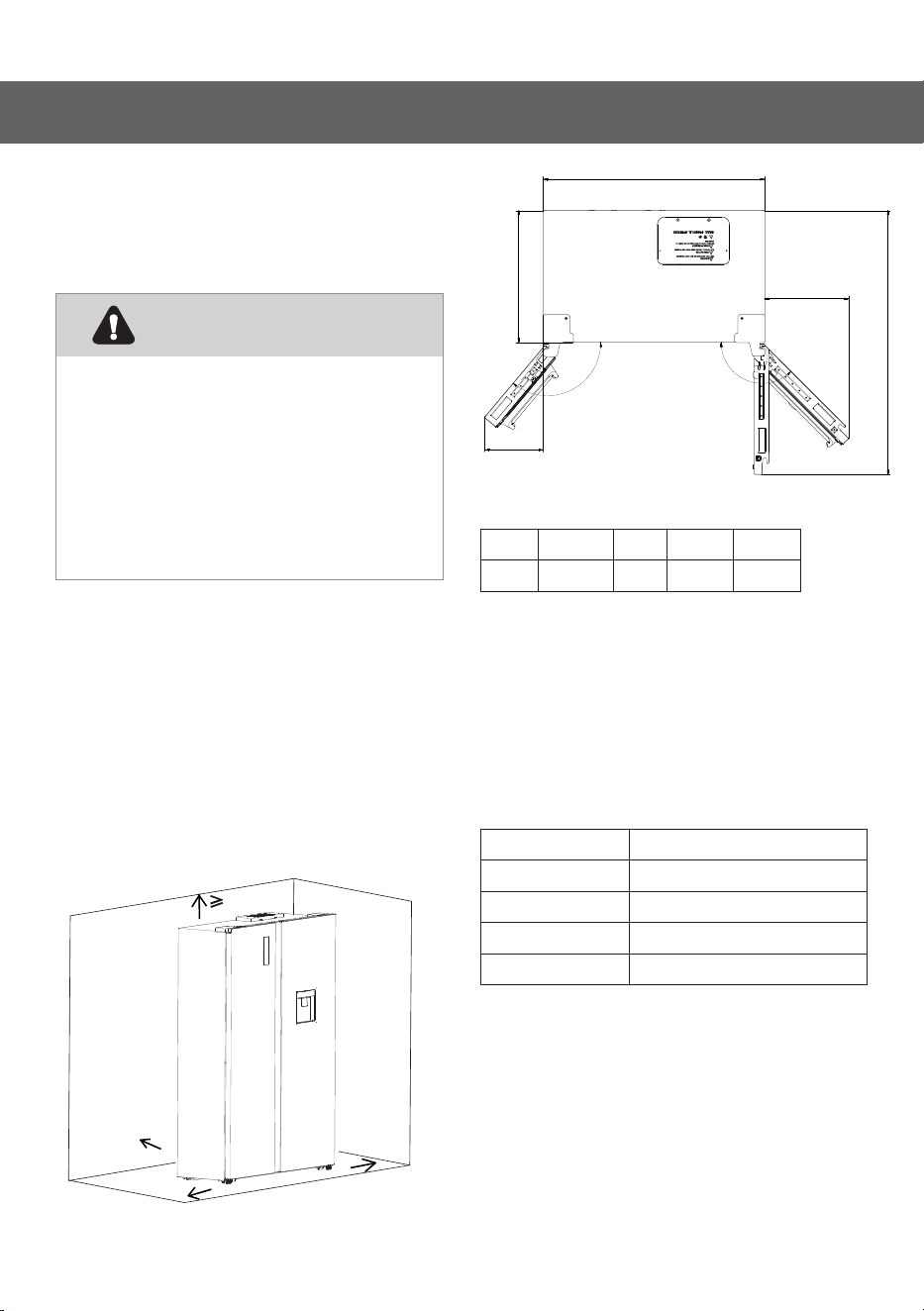
It is advisable for there to be 50-70mm
of space from the back to the wall, at
least 100mm from its top, at least
100mm from its side to the wall and a
clear space upfront to allow the freezer
door to open 135° and the refrigerator
door to open 135°.
See in follow diagrams. Please refer to
the diagrams below.
Installing your new appliance
Relevant information (mm)
908
W
344
W1
540
D
1081
D1
W2
261
Ambient temperature
+10°C to +32°C
+16°C to +32°C
+16°C to +38°C
+16°C to +43°C
Climate class
SN
N
ST
T
50mm
50mm
50mm
100mm
NOTE:
This appliance performs well in the
climate class, please refer to
nameplate. It may not work properly if
being left at a temperature above or
below the indicated range for a long
period.
W
D
W2
W1
D1
135°
135°
Installation Requirements
16
Stand your appliance in a dry place
to avoid high moisture damage.
Keep the appliance out of direct
sunlight, rain or frost. Stand the
appliance away from heat sources
such as stoves, fires or heaters.
Location Requirements
Keep flammable materials and
vapors, such as gasoline, away
from appliance.
Failure to do so can result in death,
explosion or fire.
WARNING
Explosion and Fire Hazard
IMPORTANT: This refrigerator is
designed for indoor, household use
only.
Temperature
This refrigerator is intended for use in a
location where the temperature refers
to nameplate. The preferred room
temperature range for optimum
performance, which reduces electricity
usage and provides superior cooling, is
between 16°C and 32°C. It is
recommended that you do not install
the refrigerator near a heat source,
such as an oven or radiator.
Electrical Requirements
Plug into a grounded 3 prong outlet.
Do not remove the ground prong
from the power cord plug.
Do not use an adapter.
Do not use an extension cord.
Failure to do so can result in death,
fire or electrical shock.
WARNING
Electrical Shock Hazard
Before you move your refrigerator into
its final location, it is important to make
sure you have the proper electrical
connection.
Recommended Grounding Method
A 220-240 volt, 50/60Hz(please refer to
nameplate), AC only 15- or 20-amp
fused, grounded electrical supply is
required. It is recommended that a
separate circuit serving only your
refrigerator be provided. Use an outlet
that cannot be turned off by a switch.
Do not use an extension cord.
NOTE:
Before performing any type of
installation or cleaning, disconnect the
refrigerator from the electrical source.
When you are finished, reconnect the
refrigerator to the electrical source and
reset the temperature controls to the
desired setting.
Installation Instructions
1
7
Remove the Packaging
Remove tape and glue residue from
surfaces before turning on the
refrigerator. Rub a small amount of
liquid dish soap over the adhesive
with your fingers. Wipe with warm water
and dry.
Unpack the Refrigerator
Do not puncture refrigerant tubing.
Follow handling instructions
carefully.
Flammable refrigerant used.
Failure to do so can result in death,
explosion or fire.
WARNING
Fire or Explosion Hazard
IMPORTANT: Handle with care when
moving refrigerator to avoid either
damaging the refrigerant tubing or
increasing the risk of a leak.
Use two or more people to move
and install refrigerator.
Failure to do so can result in back
or other injury.
WARNING
Excessive Weight Hazard
NOTE:
Do not use sharp instruments, rubbing
alcohol, flammable fluids, or abrasive
cleaners to remove tape or glue. These
products can damage the surface of
your refrigerator. For more information,
see “Refrigerator Safety”.
Dispose of/recycle all packaging
materials.
If the refrigerator has been placed in a
horizontal or tilted position for any
period of time wait 4 hours before
plugging it in to allow the oil to settle
into the compressor.
When Moving Your Refrigerator:
Your refrigerator is heavy. When moving
the refrigerator for cleaning or service,
be sure to cover the floor with
cardboard or hardboard to avoid floor
damage. Always pull the refrigerator
straight out when moving it. Do not
wiggle or “walk” the refrigerator when
trying to move it, as floor damage
could occur.
Clean Before Using
After you remove all of the packaging
materials, clean the inside of the
refrigerator before using it. See the
cleaning instructions in “Refrigerator
Care”.
Installation Instructions
18
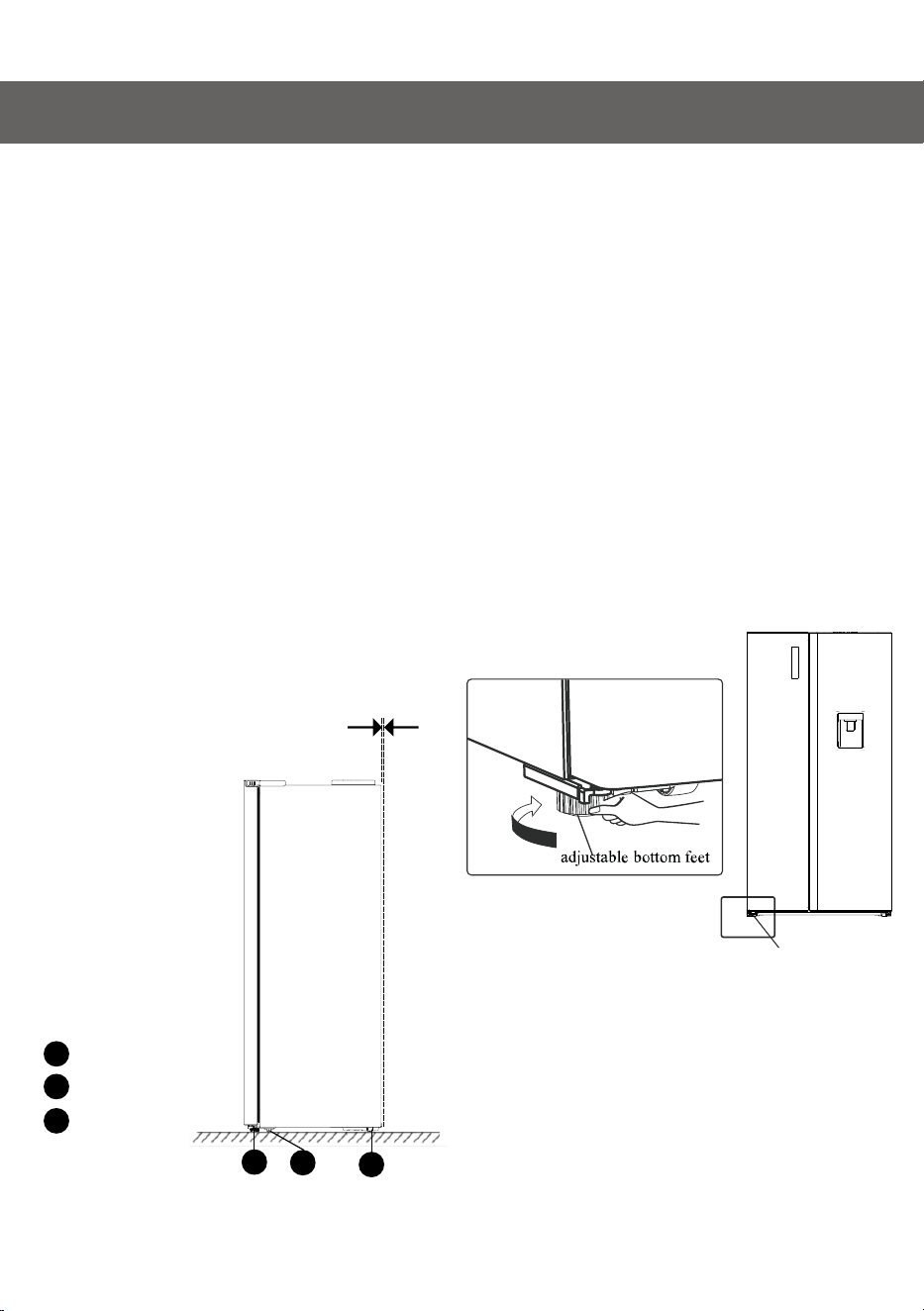
NOTE:
Having someone push against the top
of the refrigerator takes some weight off
the leveling feet. This makes it easier to
turn the feet.
Level Refrigerator
(if needed)
The refrigerator must be level to
maintain optimal performance and
appearance.
1. Turn the leveling feet on the bottom,
front of the cabinet to raise or lower
that side of the refrigerator until the
refrigerator is level side to-side.
2. Turn both feet, by the same amount,
to slightly raise the front of the
refrigerator. This will make it easier for
the doors to close.
Rotate the adjustable feet clockwise to
raise or raise counter-clockwise to
lower your refrigerator. To make sure
that the doors close automatically, tilt
the top of your refrigerator backward
about 10mm to 15mm. If necessary,
use a spanner wrench to adjust the
feet.
Align Doors
(if needed)
Whenever you want to move the
appliance, remember to turn the feet
back up, so that the appliance can roll
freely. Reinstall the appliance when
relocating.
A
B
C
Adjustable foot
Roller
Roller
10mm to 15mm
C
A
B
adjustable bottom feet
Installation Instructions
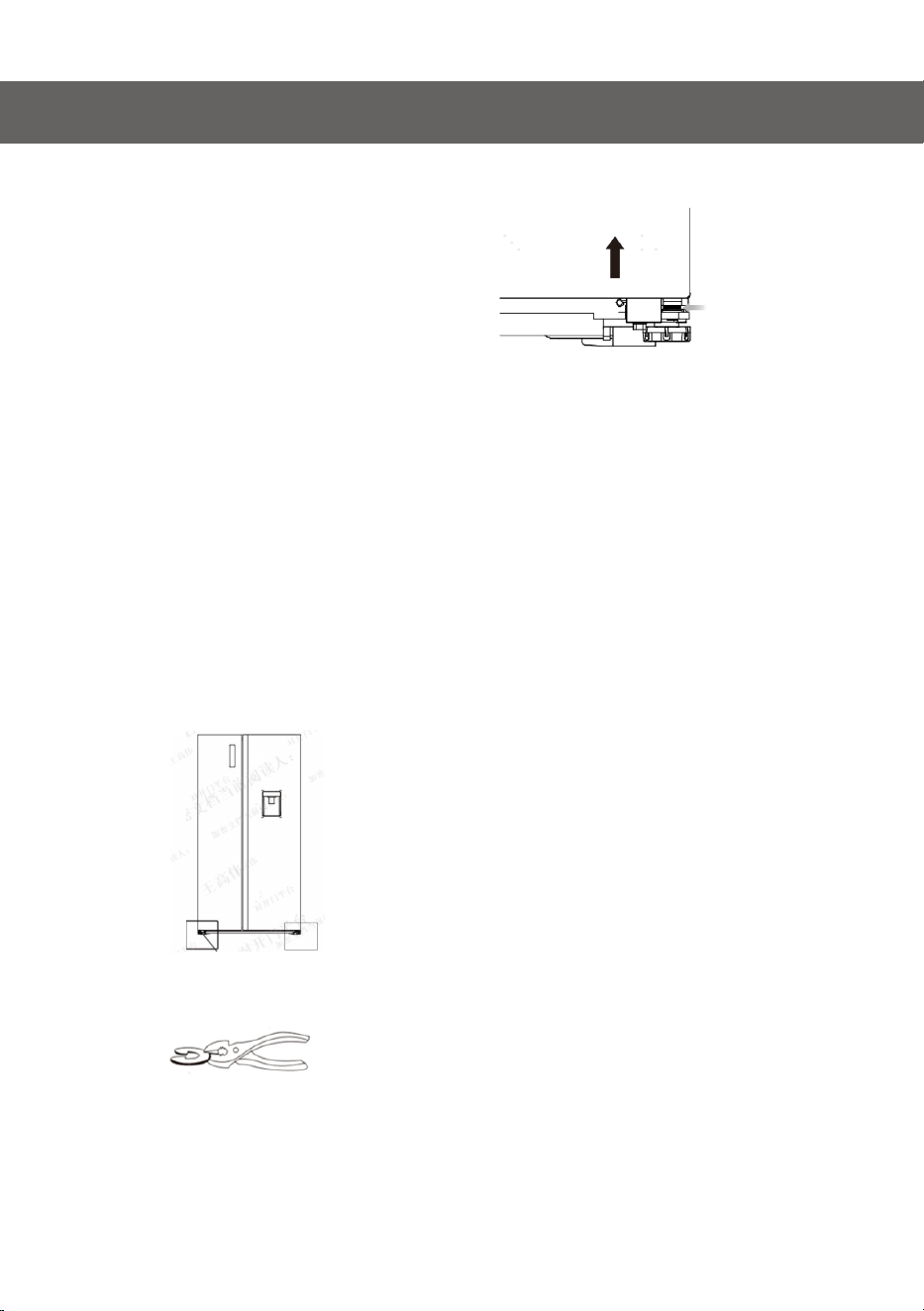
4. "C" type gasket specification:
1.0mm/1.5mm, thickness mark is
engraved on the gasket.
5. The door may have a certain run-in
sinking when it is loaded with food.
After a period of use, it will stabilize to
a stable state, which belongs to the
normal site. If the left and right doors
are uneven and need to be adjusted,
it is recommended that the user use
the appropriate "C" type gasket to
adjust after a period of use.
NOTE:
1. To avoid hand clamping when
inserting or disassembling the "C"
gasket, please use a tool.
2. Please take care of the "C" type gasket
to avoid children playing with the "C"
type gasket, or putting it into the
mouth.
3. When more than 1 piece of gasket is
used for a single door, there may be a
risk of gasket falling off or abnormal
opening and closing noise.
4. Disconnect the power supply of the
refrigerator before installation or
disassembly. Neglect of this may
result in serious injury or death
Door height adjustment
(if needed)
When the left and right sides of the door
uneven:
1. The height of the refrigerator door can
be inserted into the corresponding
height of the "C" type gasket at the
lower end of the corresponding door
shaft.
2. After confirming the height difference
between the left and right doors,
select the appropriate gasket, and
only 1 piece can be placed on each
door.
3. When assembling, please open the
lower side of the door and gently lift it,
and insert the gasket directly into the
gap between the door and the
rotating shaft.
The position of the "C" type gasket
Installation tool
Insert the "C" type gasket
19
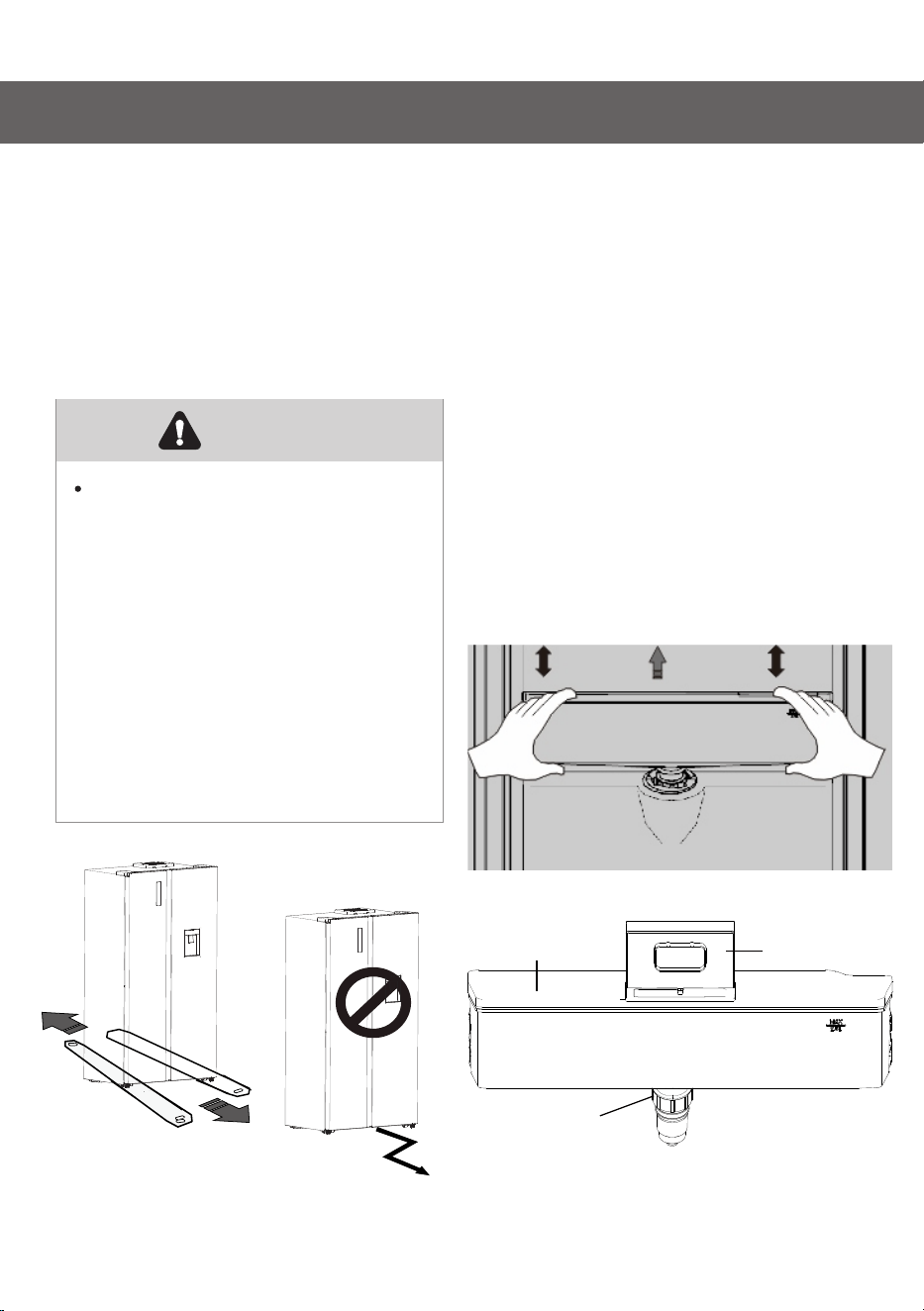
Providing room for doors to open
Make sure that you have enough room
in front of your refrigerator to swing the
doors open.
The two doors can be opened and
closed either separately or together.
Refrigerator Use
Opening and Closing Doors
For proper installation, this
refrigerator must be placed on a
level surface of hard material that
is the same height as the rest of the
flooring. This surface should be
strong enough to support a fully
loaded refrigerator. The rollers,
which are not castors, should be
only used for forward or backward
movement. Moving the refrigerator
sideways may damage your floor
and the rollers.
WARNING
The water dispenser, located in fridge
door, is used for storing drinking water.
This feature provides chilled water
easily without opening refrigerator. You
should be informed of following tips.
Before using
Please clean the water dispenser parts
before using this appliance for the first
time.
1. Hold two sides of the water tank
tightly, then pull up the water tank
carefully by shaking up and down.
2. Clean the inside of water tank
(including large lid and small lid).
3. Dry it in natural way or using a dryer.
Water Dispenser
Large lid
Small lid
Head
20
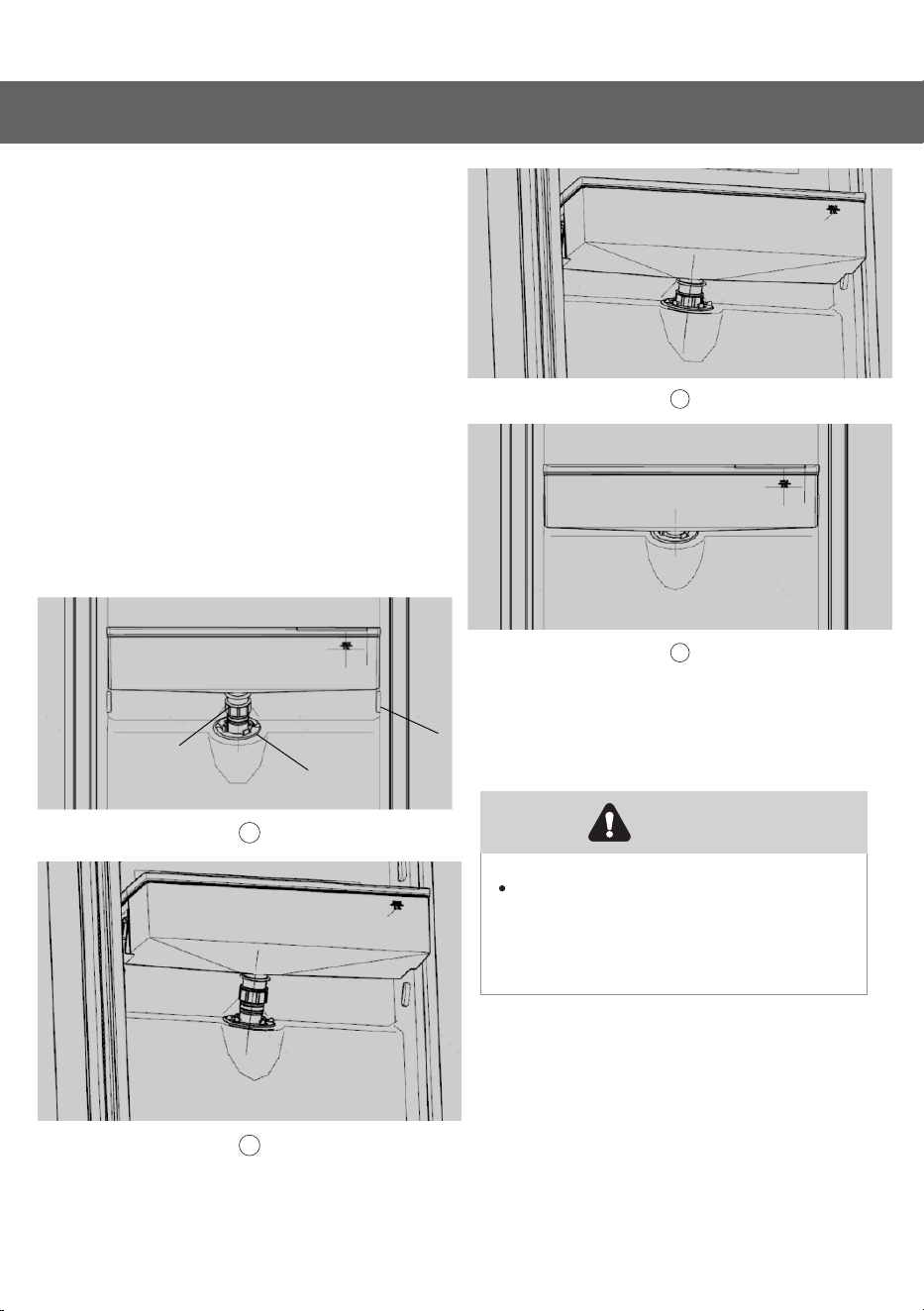
Refrigerator Use
Assembling
After cleaning, please assemble these
parts together, with reverse sequence
of cleaning procedure; and then fit
them on the door according to the
following procedure.
1. Insert the head into the hole on the
door.
2. Fit the tank along the guides on the
door.
3. Press down on the two side of the
tank.
4. When you hear a click sound, that
means the installation is completed.
Filling water
Before you fill the drinking water into the
water tank, ensure that the water tank is
steady and in a correct position.
Fill with water up to 3L (which is
suggested), and not above the
level. Otherwise, it may overflow
when the lid is close.
CAUTION
We recommend that you fill the water
by the following ways.
Open the small lid by rotating it and fill
water from the inlet of the large lid.
please remember to rotate the small lid
back to its original position when finish
filling water.
3
4
Head
Slot
Guide
2
1
2
1
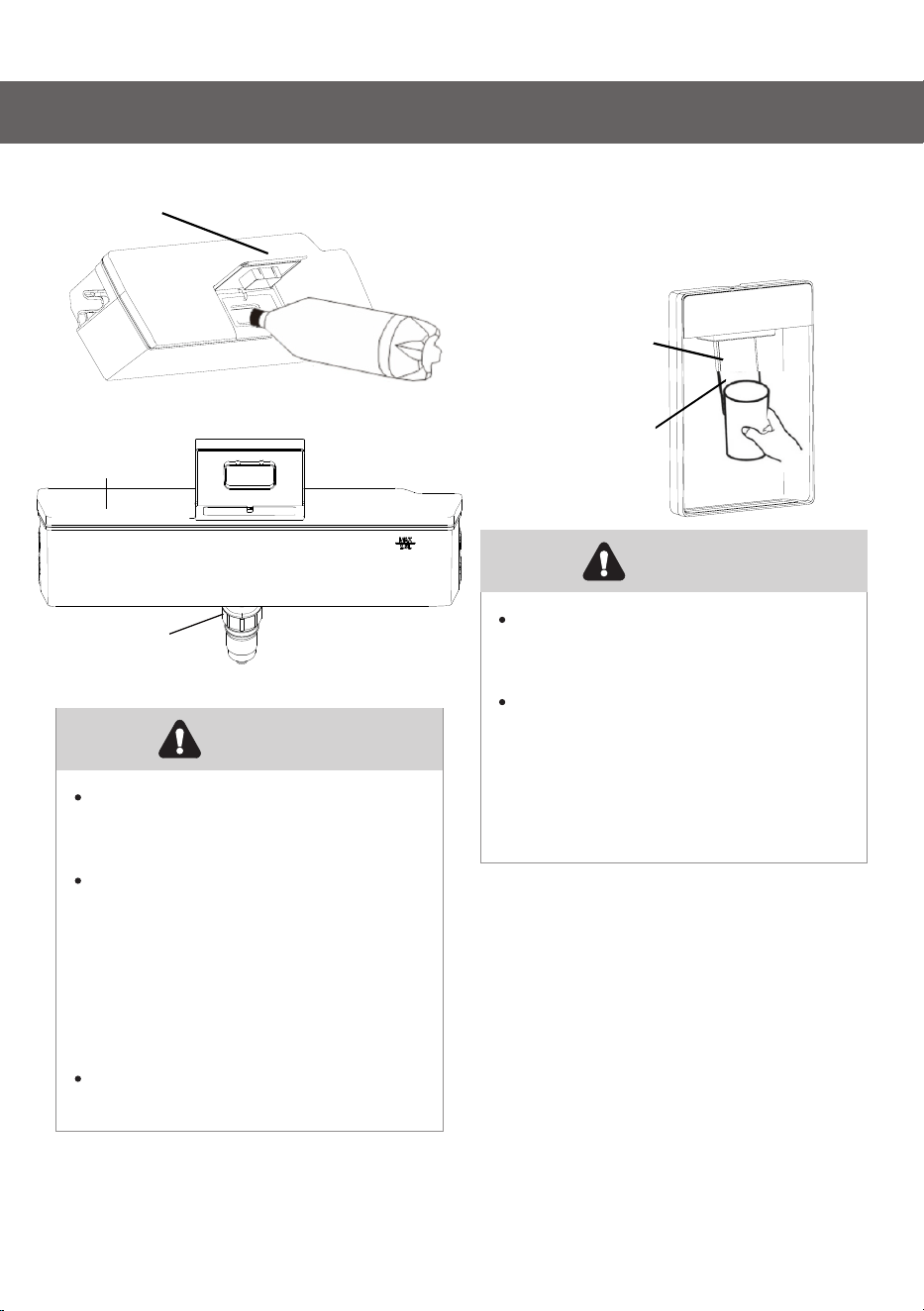
Refrigerator Use
Receiving water
You should use the correct cups to
receive water underneath the water
dispenser.
Don’t touch other parts when filling
water, which may cause water
leakage.
Other beverage (milk, juice,
carbonated beverage etc.) were
not suggested to be filled in except
for drinking water, especially
beverage including particles
(which may result in function
failure).
Hot water was forbidden to be filled
into the water tank.
WARNING
Don’t push the water dispenser
lever forward without a cup below
since it may cause water spilling.
To avoid cold air leaking out from
cabinet, keep the water dispenser
parts (especially the water storage
box and head) still be installed
even if the water dispenser was
out of use.
WARNING
Dispenser lever
Suggested position
Small lid
Large lid
Head
22
Bottle rack
It is for storing bottled wine or drinks.
Note:
Please use gently when you removed
the bottled wine or drinks. The shelf can
be taken out to be cleaned or you can
adjust to save the shelf space.
Cleaning
1. Put the water tank out of the door
carefully, and then wash the tank, lid,
and head lightly in water.
2. After you have successfully cleaned
the appliance, you should dry it by
natural drying or using the dryer.
3. If you have used the water dispenser
for many times, the water in the
receiving tank may drop on the floor,
which may make your floor wet, and
you should clean the tank with dry
towel regularly before overflow.
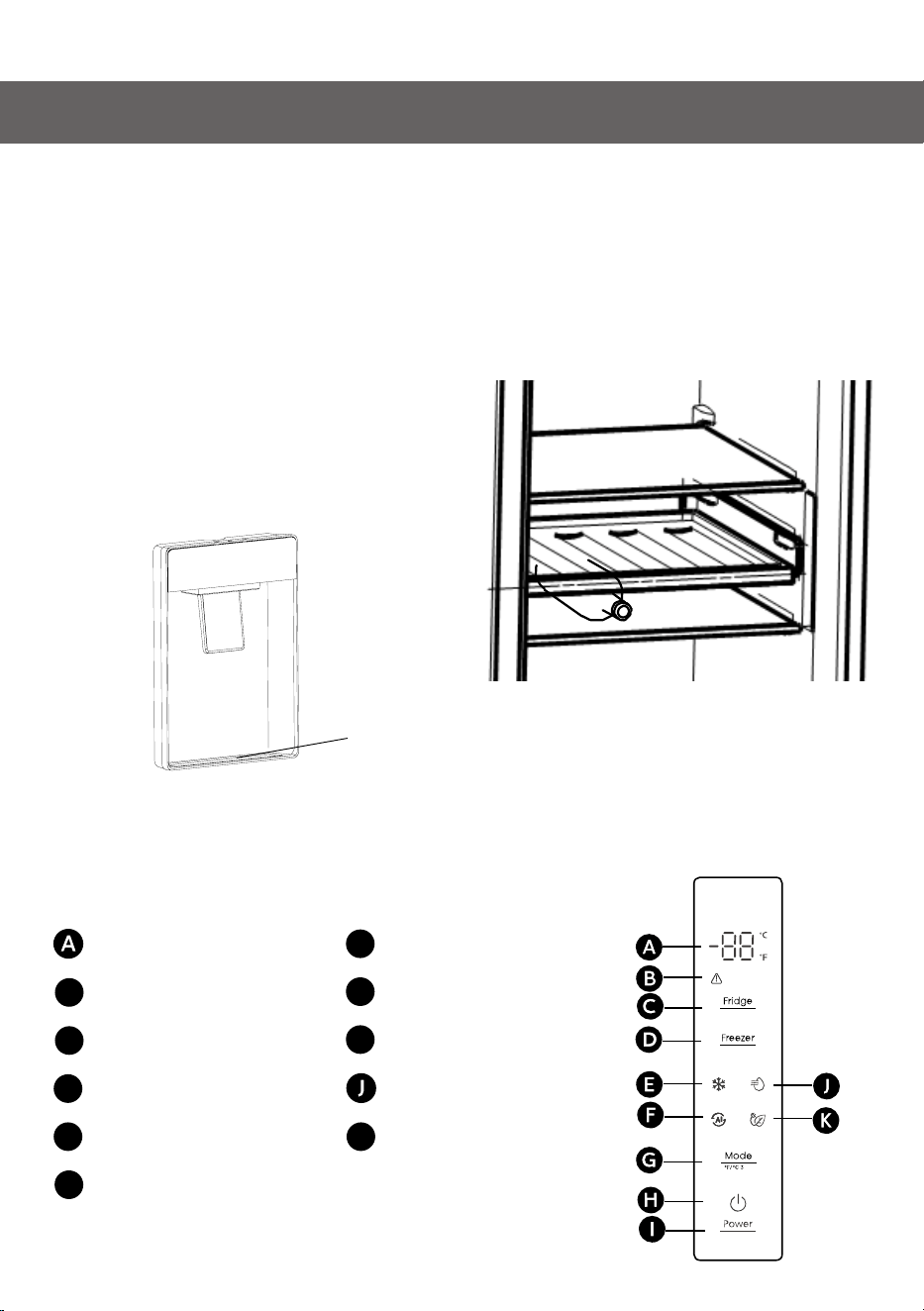
Use your appliance according to the following control regulations, your appliance
has the corresponding functions and modes as the control panels showed in the
pictures below.
Using the Controls
Receiving
tank
Sec
Hold 3 Sec
B
C
D
E
F
Temperature Setting
Door Alarm
Fridge Button
Freezer Button
Super Freeze Icon
Fuzzy Icon
G
H
I
K
Mode Button
Standby Icon
Power Button
Super Cool Icon
Energy Saving Icon
Refrigerator Use
2
3
NOTE:
Setting the refrigerator running at high
temperature will accelerate food
decomposition. For optimum food
preservation, we recommend that when
starting the refrigerator for the first time,
the temperature of fridge is set to 4°C,
and that of the freezer to -18°C.
the buzzer rings 3 times per minute.
Closing all the doors, the " " icon will
go off and buzzing will stop. In addition,
door alarm will stop automatically after
10 minutes.
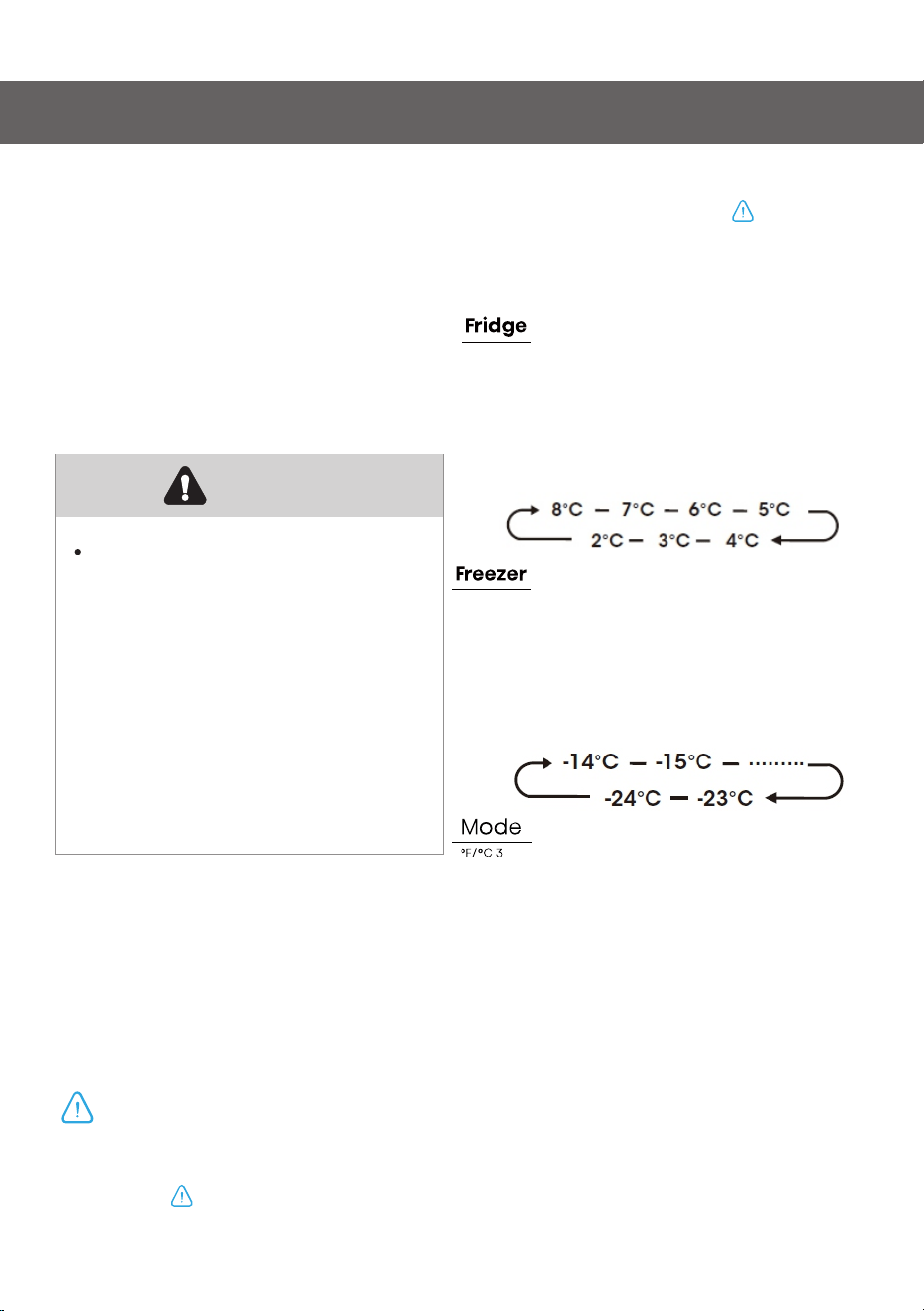
Fridge Temperature Setting
Touch the "Fridge" key to activate the
temperature setting function of fridge.
After that, touch the key continuously,
the temperature will be set according
to the following sequence:
NOTE:
• Once the appliance is powered on, all
icons on the display panel will be lit for
3 seconds with a buzzer sound.
• All the icons will go off on the
condition of all keys untouched and all
doors closed for one minute.
• The control panel will light up when
the door is open or you touch any
button.
The temperature only means the
average temperature of the whole
refrigerator cabinet. Temperatures
inside each compartment may
vary from those displayed on the
panel, depending on how much
food stored and where the
refrigerator is placed. In addition,
the actual temperature from
higher room and lower room will
be different.
CAUTION
Freezer Temperature Setting
Touch the "Freezer" key to activate the
temperature setting function of fridge.
After that, touch the key continuously,
the temperature will be set according
to the following sequence:
Refrigerator Use
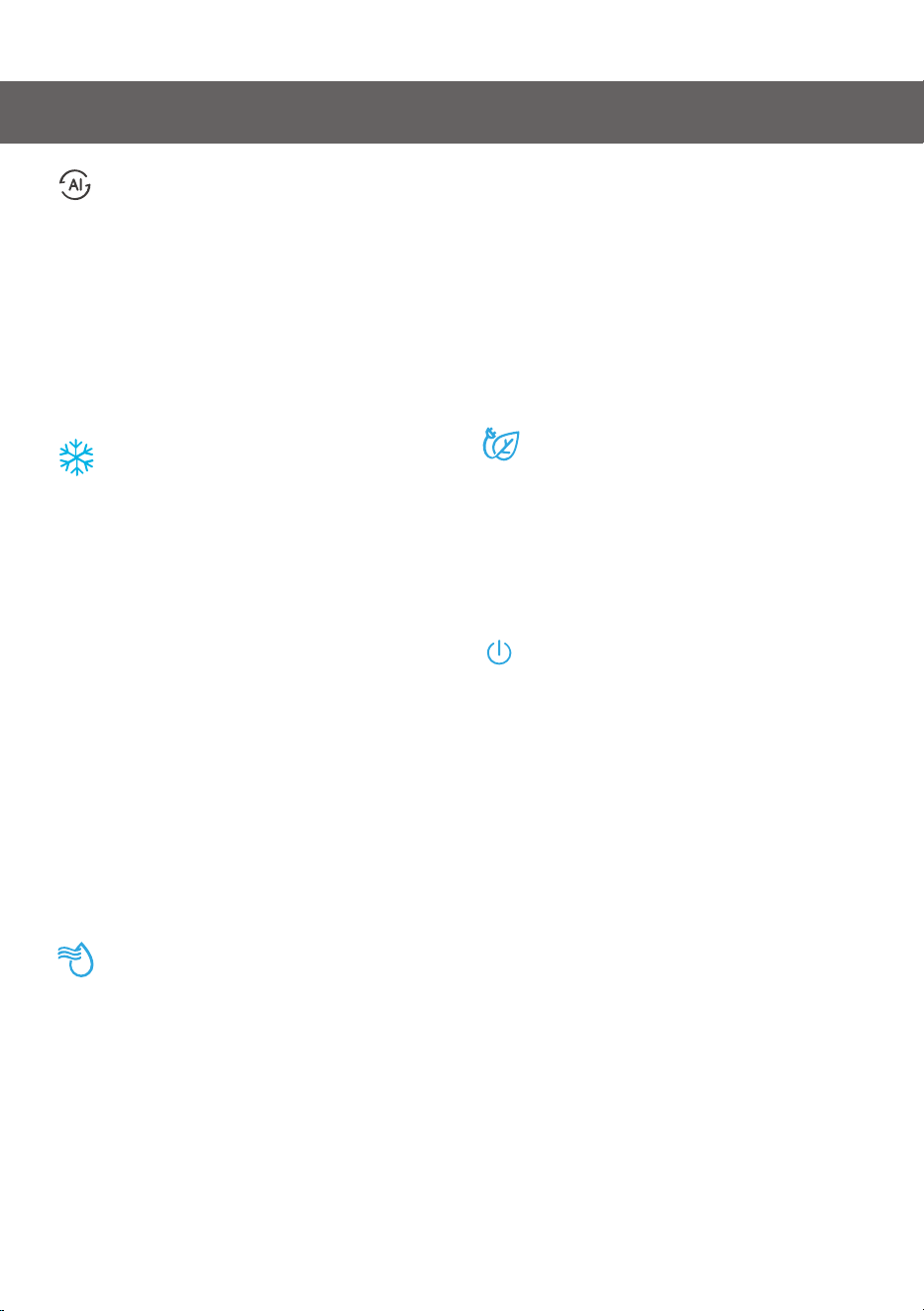
Mode Setting
Each time you press the "Mode" button,
the refrigerator mode will switch from
the current mode (if not, start from
Fuzzy), and switch between Fuzzy -
Super Freeze - Super Cool - Energy
Saving - Fuzzy 4 modes in turn, the
corresponding icon lights up, and the
temperature display area displays the
corresponding set temperature. Exit the
relevant mode when setting the
refrigerating and freezing temperature.
Door Alarm
Opening the fridge door or freezer door
for over 2 minutes will trigger door
alarm. The " " icon starts to blink and
Sec
2
4
Fuzzy
The refrigerator works in the way that is
most conducive to the preservation
and storage of food.
NOTE:
In Fuzzy mode, the set temperatures of
the refrigerator compartment and
freezer compartment are 4°Cand -18°C
respectively.
Super Freeze
Use this mode when you want to quickly
freeze food that has just been placed in
the freezer.
NOTE:
If the freezing capacity according to the
rating plate is to be used, switch on
Super Freezer at least 24 hours before
the fresh products are placed in the
freezer compartment. In the Super
Freeze mode, the set temperature of the
freezer compartment is -24°C, the
refrigerator compartment still operates
at the set temperature before entering
the Super Freeze mode, and
automatically exits after running for a
certain period of time.
Super Cool
This mode can be used when you want
to quickly cool down the food you put in
the refrigerator.
NOTE:
In the Super Cool mode, the set
temperature of the refrigerator
compartment is 2°C, and the freezer
compartment still operates at the set
temperature before entering the Super
Cool mode, and automatically exits
after running for a certain period of
time.
Energy Saving
NOTE:
In the Energy Saving mode, the set
temperatures of the refrigerator
compartment and the freezer
compartment are 6°C and -17°C
respectively.
Standby
Press the "Power" button for 3 seconds
to enter/exit the standby function.
NOTE:
When the refrigerator enters the
standby function, the refrigerator will
stop cooling and the temperature
setting area will display "--".
Temperature Measure Change
You can change the temperature
display setting from Celsius to
Fahrenheit degrees by touch the
"Mode" key for 3 seconds, and vice
versa.
Refrigerator Use
2
5
Important information to know about
glass shelves and covers:
Do not clean glass shelves or covers
with warm water when they are cold.
Shelves and covers may break if
exposed to sudden temperature
changes or impact, such as bumping.
Tempered glass is designed to shatter
into many small, pebble-size pieces.
This is normal. Glass shelves and covers
are heavy. Use both hands when
removing them to avoid dropping.
Features
Refrigerator
IMPORTANT: To avoid damage to the
doors, make sure all shelves and
drawers are pushed fully into the
cabinet before closing a door.
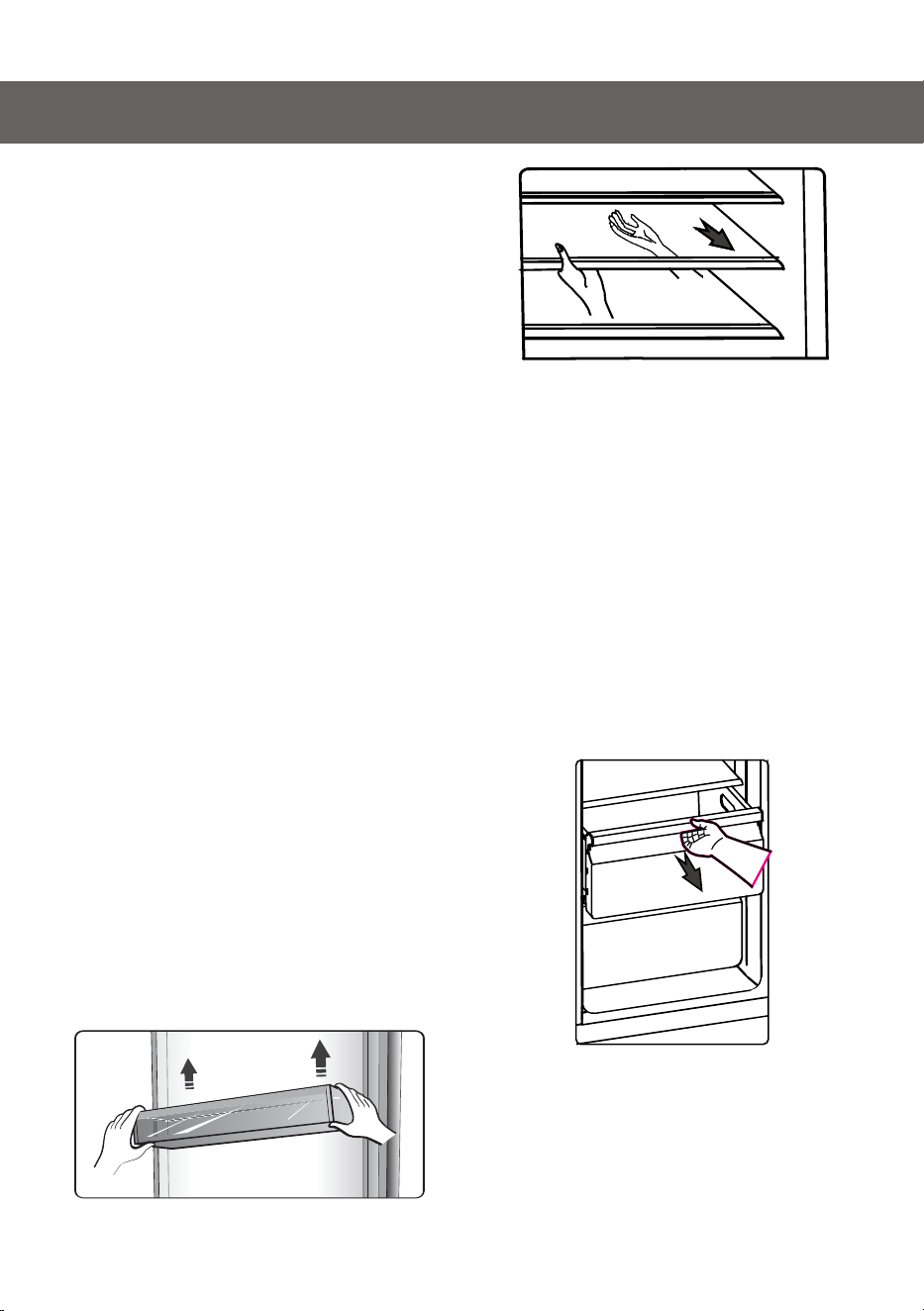
Glass shelves and Door racks
The refrigerator compartment is
provided with several different door
racks, which are suitable for the storage
of eggs, canned liquid, bottled drinks
and packed food. They can be placed
at different heights according to your
need, but do not place too many heavy
things in racks. Before you lift up the
door shelf vertically, please take the
food out.
NOTE:
The door racks and shelves can be
taken out to be cleaned.
When you remove the shelves, gently
pull them forward until the shelf comes
clear of the shelf guides. When you
return the shelves, make sure there is no
obstacle behind and gently push the
shelf back into the position.
Drawers
These are suitable for storage of fruits
and vegetable. And it can be taken out
to be cleaned.
Freezer Compartment
The freezer compartment is suitable for
storage of foods required to be frozen,
such as meat, fish, ice-cream and other
perishable items.
Refrigerator Use
2
6
General Use Information
• When first turning on refrigerator after
a period of non-use, allow the
refrigerator to cool at least 2 hours
before adding food.
• Do not block air circulation vents with
stored items.
• Store items so that the air can
circulate freely around them.
• Cover or wrap stored food well to
avoid transfer of odors.
• Once defrosted, food quality will
deteriorate rapidly. Defrosted food
should not be refrozen.
• Neither bottled nor canned drinks
should be stored in the freezer
compartment. Bottles and cans may
explode.
• Ensure that bottles are not left in the
freezer for longer than needed as
freezing may cause the bottle break.
To avoid contamination of food, please
respect the following instructions:
• Opening the door for long periods can
cause a significant increase of the
temperature in the compartments of
the appliance.
• Clean regularly surfaces that can
come in contact with food and
accessible drainage systems.
• Store raw meat and fish in suitable
containers in the refrigerator, so that it
is not in contact with or drip onto other
food.
• Two-star frozen-food compartments
are suitable for storing pre-frozen
food, storing or making ice-cream
and making ice cubes.
• One-, two- and three-star
compartments are not suitable for the
freezing of fresh food.
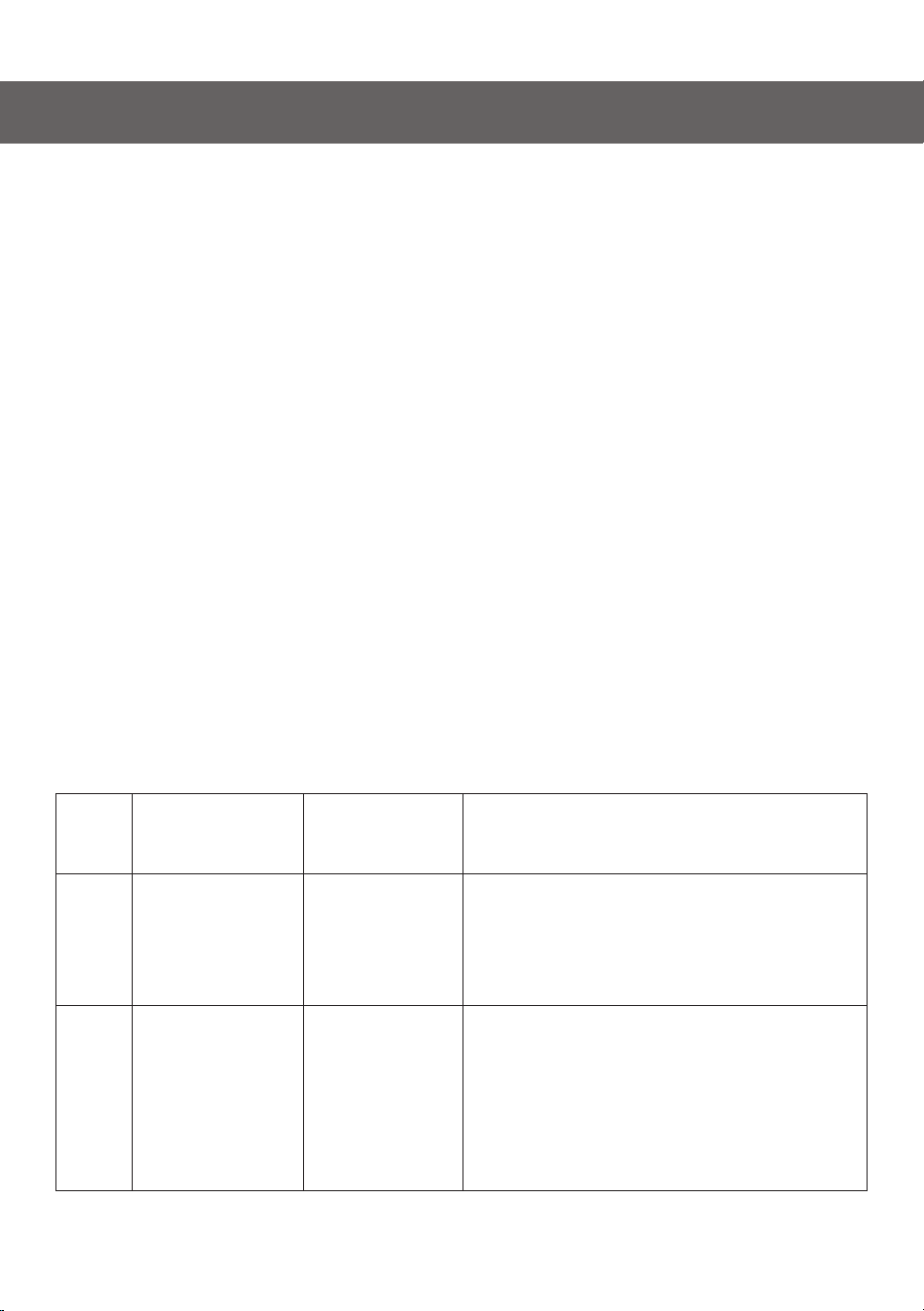
Appropriate food
Eggs, cooked food, packaged food,
fruits and vegetables, dairy products,
cakes, drinks and other foods which
are not suitable for freezing.
Compartments
type
Order Target storage
temp.[°C]
1
Fridge
+2~+8
2
Seafood (fish, shrimp, shellfish),
freshwater aquatic products and
meat products (recommended for 3
months ,the longer the storage time,
the worse the taste and nutrition),
suitable for frozen fresh food.
(***)*-Freezer
≤-18
Refrigerator Use
2
7
Appropriate foodCompartments
type
Order Target storage
temp.[°C]
Seafood (fish, shrimp, shellfish),
freshwater aquatic products and
meat products (recommended for 2
months, the longer the storage time,
the worse the taste and nutrition), are
not suitable for frozen fresh food.
**-Freezer
≤-12
Seafood (fish, shrimp, shellfish),
freshwater aquatic products and
meat products (recommended for 1
month, the longer the storage time,
the worse the taste and nutrition).
3
*-Freezer
≤-6
5
4
0-star
-6~0
Fresh pork, beef, fish, chicken, some
packaged processed foods, etc.
(Recommended to eat within the
same day, preferably no later than 3
days). Partially encapsulated
processed foods(nonfreezable foods).
6
Seafood (fish, shrimp, shellfish),
freshwater aquatic products and
meat products (recommended for 3
months, the longer the storage time,
the worse the taste and nutrition),are
not suitable for frozen fresh.
***-Freezer
≤-18
7
Fresh/frozen pork, beef, chicken,
freshwater aquatic products, etc. (7
days below 0°C and above 0°C is
recommended for consumption within
that day, preferably no more than 2
days).Seafood (less than 0°C for 15
days, it is not recommended to store
above 0°C). --Applicable to countries
using the IEC62552:2007 standard.
Chill
-2~+3
Refrigerator Use
2
8
Appropriate foodCompartments
type
Order Target storage
temp.[°C]
8
9
Fresh pork, beef, fish, chicken, cooked
food, etc. (Recommended to eat
within the same day, preferably no
more than 3 days)
Fresh Food
0~+4
Red wine, white wine, sparkling wine
etc.
Wine
+5~+20
NOTE:
Please store different foods according to the compartments or target storage
temperature of your purchased products.
• If the refrigerating appliance is left empty for long periods, switch off, defrost, clean,
dry, and leave the door open to prevent mould developing within the appliance.
Refrigerator Use
7
Fresh/frozen pork, beef, chicken,
freshwater aquatic products, etc. (7
days below 0°C and above 0°C is
recommended for consumption within
that day, preferably no more than 2
days).Seafood (less than 0°C for 15
days, it is not recommended to store
above 0°C). --Applicable to countries
using the IEC62552:2020 standard.
Chill
-3~+3
2
9
Both the refrigerator and freezer
sections defrost automatically.
However, clean both sections about
once a month to avoid buildup of
odors. Wipe up spills immediately. To
avoid odor transfer and drying out of
food, wrap or cover foods tightly.
Refrigerator Care
Cleaning
Use nonflammable cleaner.
Failure to do so can result in death,
explosion or fire.
WARNING
Explosion Hazard
IMPORTANT:
• Do not use harsh chemicals,
ammonia, chlorine bleach,
concentrated detergent, solvents,
abrasives or metal scouring pads to
clean your refrigerator inside or out.
They can damage and/or discolor the
refrigerator finish.
• Do not use warm water to clean glass
shelves while they are still cold. Glass
may break when exposed to sudden
temperature changes or impact.
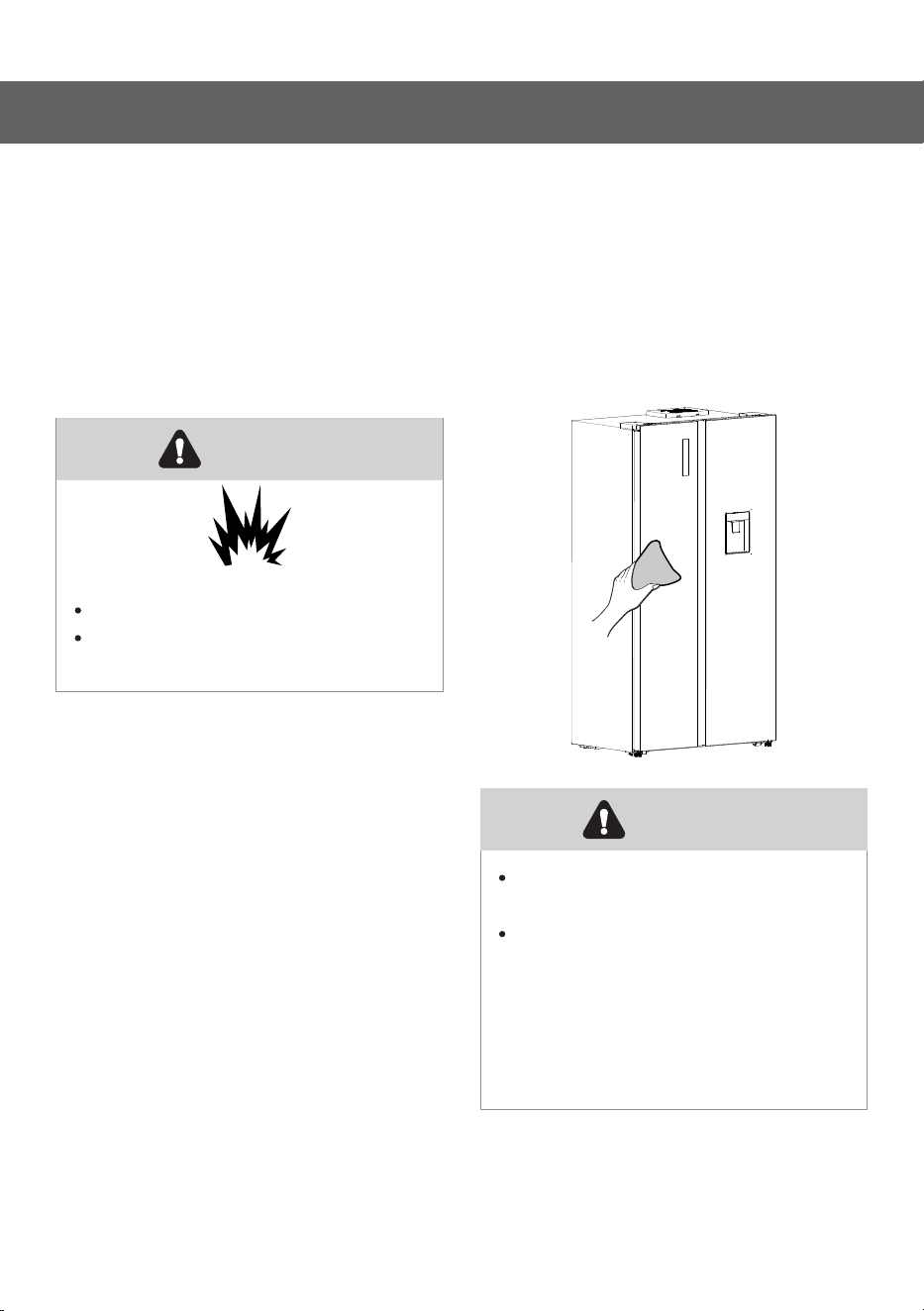
Exterior clean
To maintain good appearance of your
appliance, you should clean it regularly.
• Wipe the digital panel and display
panel with a clean, soft cloth.
• Spray water onto the cleaning cloth
instead of spraying directly on the
surface of the appliance. This helps
ensure an even distribution of
moisture to the surface.
• Clean the doors, handles and cabinet
surfaces with a mild detergent and
then wiped dry with a soft cloth.
Do not use sharp objects as they
are likely to scratch the surface.
Do not use Thinner, Car detergent,
Clorox, ethereal oil, abrasive
cleansers or organic solvent such
as Benzene for cleaning. They may
damage the surface of the
appliance and may cause fire.
WARNING
30
Unplug your appliance or
disconnect power before cleaning.
Failure to do so can result in death,
electric shock or personal injury.
WARNING
Electrical Shock Hazard
1. Unplug refrigerator or disconnect
power.
2. Clean the interior.
Hand wash, rinse, and dry removable
parts and interior surfaces
thoroughly. Use a clean sponge or
soft cloth and a mild detergent in
warm water.
3. Clean the door seals (gaskets). A dirty
or sticky door seal may adhere to the
cabinet and tear when you open the
door.
Using a soft cloth and a solution of
mild detergent and warm water,
hand wash the door seals. Rinse with
clear water and dry thoroughly.
4. Clean the exterior surfaces.
Wash exterior surfaces with a clean,
soft cloth or sponge and a mild
detergent in warm water. Rinse
surfaces with clean, warm water and
dry immediately to avoid water spots.
5. Plug in refrigerator or reconnect
power.
IMPORTANT:
Your refrigerator is equipped with LED
lighting. If the lights stop operating,
please contact a qualified technician
for replacement.
NOTE:
This product contains a light source of
energy efficiency class <G>.
Lights
Vacation
If You Choose to Leave the Refrigerator
On While You’re Away:
• Use up any perishables and freeze
other items.
If You Choose to Turn Off the
Refrigerator Before You Leave:
1. Remove all food from the refrigerator
and freezer.
2. Unplug refrigerator or disconnect
power.
3. Clean refrigerator, wipe it, and dry
well.
4. Tape rubber or wood blocks to the
tops of both doors to prop them open
far enough for air to get in. This stops
odor and mold from building up.
Vacation and Moving Care
Refrigerator Care
31
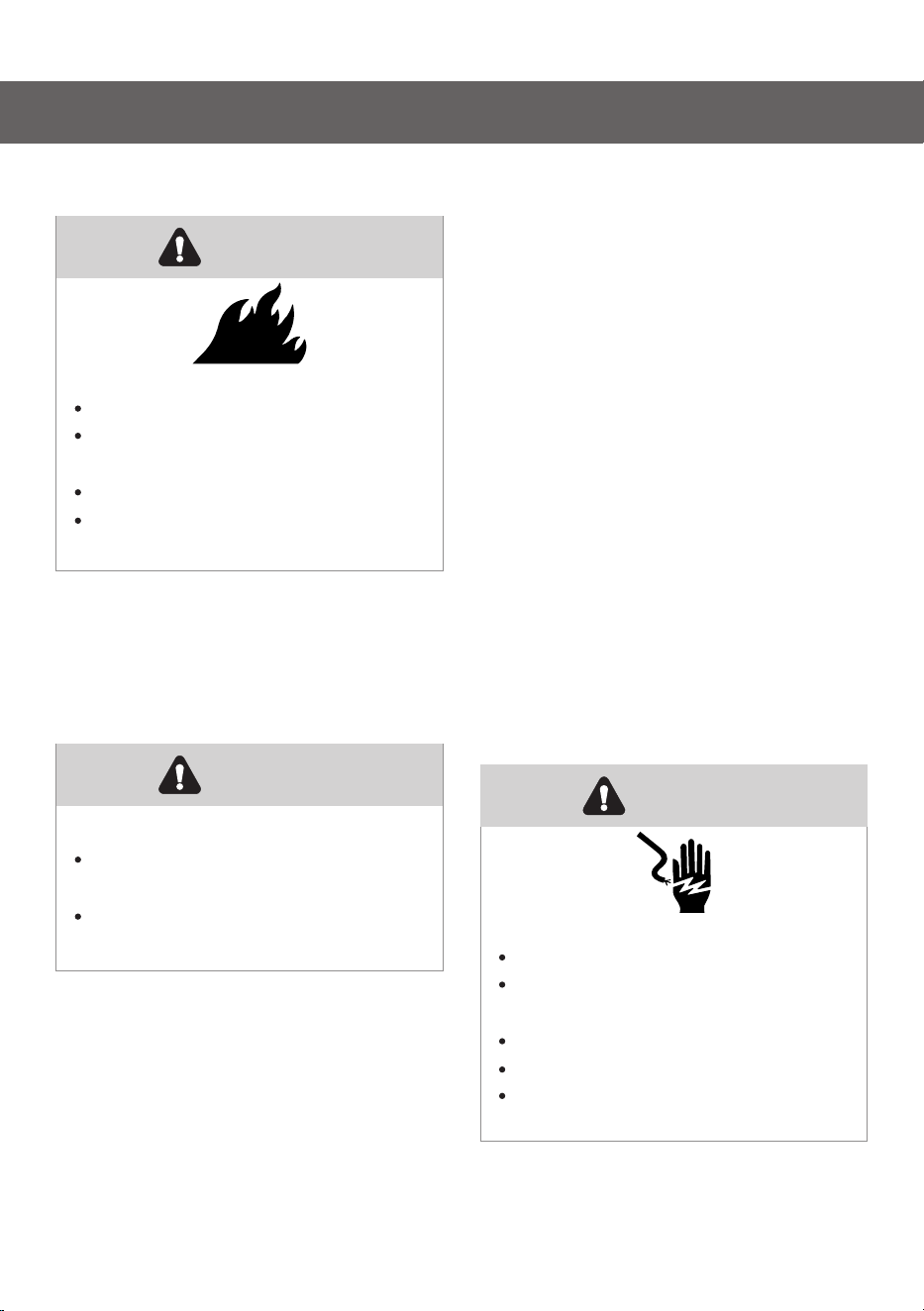
Do not puncture refrigerant tubing.
Follow handling instructions
carefully.
Flammable refrigerant used.
Failure to do so can result in death,
explosion or fire.
WARNING
Fire or Explosion Hazard
IMPORTANT:
Handle with care when moving
refrigerator to avoid either damaging
the refrigerant tubing or increasing the
risk of a leak.
If the refrigerator has been placed in a
horizontal or tilted position for any period
of time wait 4 hours before plugging it in to
allow the oil to settle into the compressor.
1. Clean refrigerator. See “Cleaning”.
2. Place refrigerator in desired location and
level. See “Installation Instructions”.
Reinstalling/Using Refrigerator
Again
Moving
Use two or more people to move
and install refrigerator.
Failure to do so can result in back
or other injury.
WARNING
Excessive Weight Hazard
When you are moving your refrigerator
to a new home, follow these steps to
prepare it for the move.
1. Remove all food from the refrigerator
and pack all frozen food in dry ice.
2. Unplug refrigerator.
3. Clean, wipe, and dry thoroughly.
4. Take out all removable parts, wrap them
well, and tape them together so they
don’t shift and rattle during the move.
5. Raise the leveling legs so they don’t
scrape the floor. See “Level Refrigerator”.
6. Tape the doors closed and tape the
power cord to the back of the
refrigerator. When you get to your new
home, put everything back and refer to
the “Installation Instructions” section for
preparation instructions.
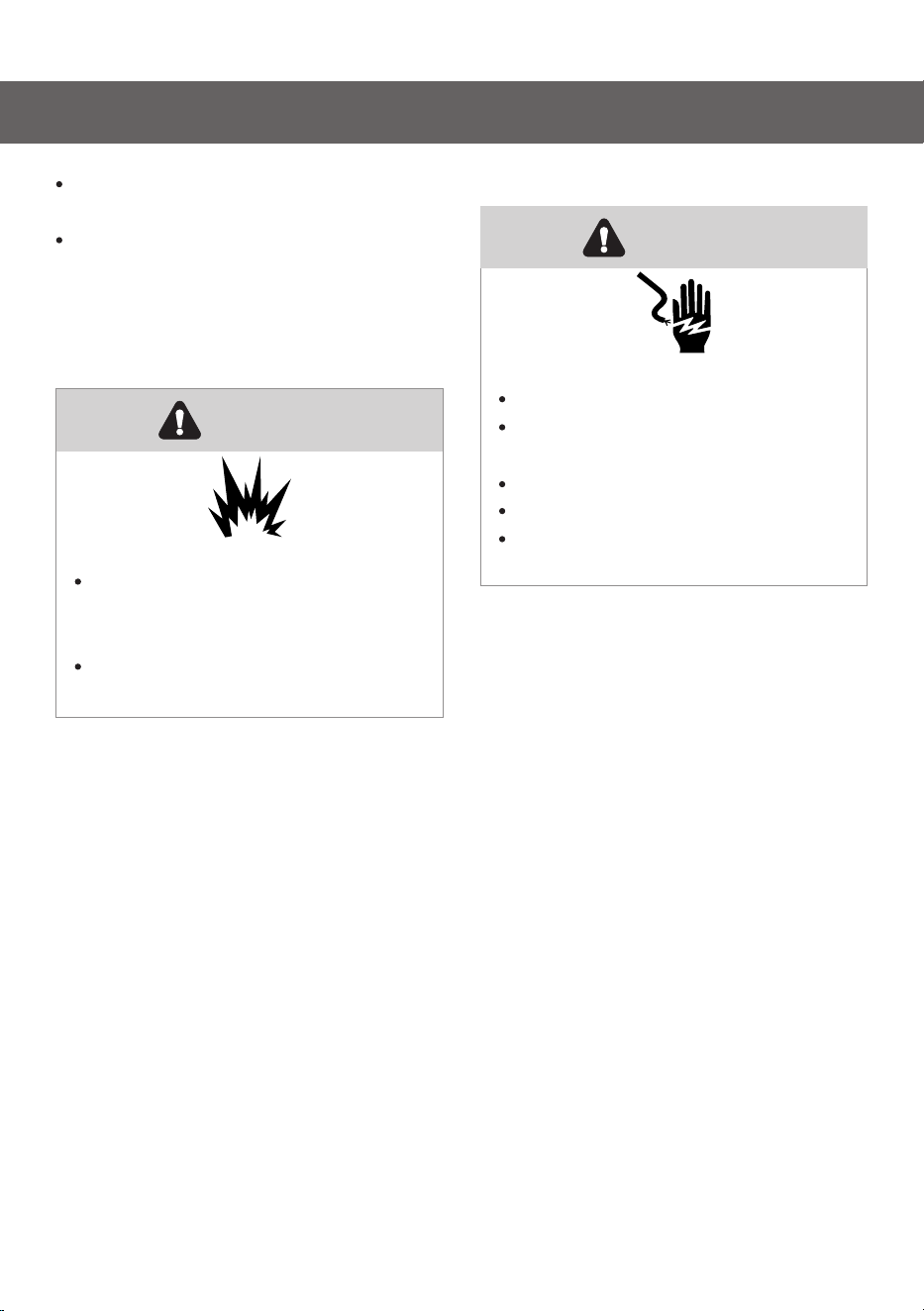
Plug into a grounded 3 prong outlet.
Do not remove the ground prong
from the power cord plug.
Do not use an adapter.
Do not use an extension cord.
Failure to do so can result in death,
fire or electrical shock.
WARNING
Electrical Shock Hazard
3. Plug into grounded 3 prong outlet.
Refrigerator Care
32
Helpful hints and tips
We recommend that you follow the
tips to save energy.
Try to avoid keeping the door open for
long periods in order to conserve
energy.
Ensure the appliance is away from
any sources of heat (direct sunlight,
electric oven or cooker etc.)
Don't set the temperature colder than
necessary.
Don't store warm food or evaporating
liquid in the appliance.
Place the appliance in a well
ventilated, humidity free room. Please
refer to installing your new appliance
chapter.
The diagram shows the correct
combination for the drawers, crisper
and shelves. Do not adjust the
combination as this is designed to be
the most energy efficient
configuration.
Energy saving tips
Do not place hot food directly into the
refrigerator, the internal temperature
will increase resulting in the
compressor having to work harder
and will consume more energy.
Do cover or wrap the food,
particularly if it has a strong flavor.
Place food properly so that air can
circulate freely around it.
Hints for fresh food refrigeration
Meat (All Types) Wrap in polythene
food:
Wrap and place on the glass shelf
above the vegetable drawer. Always
follow food storage times and use by
dates suggested by manufacturers.
Cooked food, cold dishes, etc:
They should be covered and may be
placed on any shelf.
Fruit and vegetables:
They should be stored in the special
drawer provided.
Butter and cheese:
Should be wrapped in airtight foil or
plastic film wrap.
Milk bottles:
Should have a lid and be stored in the
door racks.
Hints for refrigeration
When first starting-up or after a
period out of use, let the appliance
run at least 2 hours on the higher
settings before putting food in the
compartment.
Prepare food in small portions to
enable it to be rapidly and
completely frozen and to make it
possible to subsequently thaw only
the quantity required.
Wrap up the food in aluminum foil or
polyethylene food wraps which are
airtight.
Do not allow fresh frozen food to
touch the food which is already
frozen to avoid partially thawing the
frozen food.
Hints for freezing
33
Helpful hints and tips
Iced products, if consumed
immediately after removal from the
freezer compartment, will probably
cause frost burns to the skin.
It is recommended to label and date
each frozen package in order to keep
track of the storage time.
Ensure that frozen food has been
stored correctly by the food retailer .
Once defrosted, food will deteriorate
rapidly and should not be re-frozen.
Do not exceed the storage period
indicated by the food manufacturer.
Hints for fresh food refrigeration
If the appliance needs to be switched
off for an extended period, the
following steps should be taken
prevent mould on the appliance.
1. Remove all food.
2. Remove the power plug from the
mains socket.
3. Clean and dry the interior
thoroughly.
4. Ensure that all the doors are
wedged open slightly to allow air to
circulate.
Switching off your appliance
Try the solutions suggested here first in order to avoid the cost of an unnecessary
service call.
Troubleshooting
Problem
Possible cause(s)
Appliance is not
working correctly
Refrigerator is unplugged. Plug refrigerator into a grounded 3
prong outlet.
Refrigerator is Not Operating
Solution
Breaker is tripped or turned
off, or fuse is blown.
Reset/Turn on breaker or replace
fuse.
Refrigerator is in defrost
mode.
Wait for defrost cycle to end and
cooling system to restart.
34
Troubleshooting
Problem
Possible cause(s)
Refrigerator
compressor runs
frequently or for
long periods of
time
Note: This
refrigerator is
designed to run
for longer periods
of time at a lower
energy usage.
Refrigerator is first plugged
in.
This is normal. Allow 24 hours for
the refrigerator to cool down.
Solution
Warm or large amounts of
food added.
This is normal.
Door is left open, or
refrigerator is not level.
Check that an item is not preventing
door from closing. Level the
refrigerator. See “Level Refrigerator”.
Hot weather or frequent
openings.
This is normal.
Temperature control set to
coldest setting.
Adjust temperature to a warmer
setting.
Refrigerator has
an odor
Food is not sealed or
packaged properly.
Reseal packaging. Place an opened
box of baking soda in the
refrigerator, replace every 3 months.
Interior needs to be
cleaned.
Clean the interior. See “Cleaning”.
Food stored too long. Dispose of spoiled food.
Light does not
come on
Refrigerator is unplugged. Plug refrigerator into a grounded 3
prong outlet.
LED light is burned out. Contact a qualified technician to
replace the burned out LED.
Vibration or
rattling
Refrigerator is not resting
firmly on floor.
See “Level Refrigerator”.
Normal Sounds
It sounds like water is
flowing from the
efrigerator.
Refrigerant flowing in the lines will
make this sound when the
compressor starts and stops.
The refrigerator has an automatic
defrosting system. The defrosted
water will make this sound.
35
Troubleshooting
Problem
Possible cause(s)
Normal Sounds
Humming or buzzing
sounds
The compressor and fans used for
cold air circulation can make this
sound. If the refrigerator is not level,
the sound will be louder.
Solution
Cracking or clicking
sounds
The interior parts will make this
sound as they contract and expand
in response to temperature
changes.
Popping noise May occur during automatic
defrosting.
Temperature control is not
set cold enough.
Adjust the compartment to a
colder setting; allow 24 hours for
the temperature to adjust.
Refrigerator or
freezer is too
warm
Doors opened frequently
or left open.
Limit door openings to maintain the
internal temperature. Check that an
item is not preventing door from
closing.
Warm food added recently. Allow time for food and refrigerator
to cool.
The space between the
back of the refrigerator
and the wall is too close.
Allow 5 cm space between the back
of the refrigerator and the wall.
Items against back of
compartments are
blocking proper airflow.
Store items only inside the trim of
the glass shelves; don’t place items
against sides of the compartments
or directly in front of any vents.
Refrigerator or
freezer is too cold
Temperature control is set
too cold.
Adjust temperature in the
compartment to the next warmer
setting; allow 24 hours for
temperature to adjust.
36
Troubleshooting
Problem
Possible cause(s)
Moisture on
exterior/interior
of refrigerator
High humidity This is normal during times of high
humidity. Dry surface and adjust
temperature to a slightly colder
setting.
Solution
Doors opened frequently
or left open.
Keep door closed. Check that an
item is not preventing the door from
closing. Level the refrigerator. See
“Level Refrigerator”.
Open container of water in
refrigerator.
Cover or seal container.
Freezer door left open or
opened frequently.
Limit door openings to maintain
the internal temperature. Check
that an item is not preventing door
from closing.
Frost or ice
crystals on
frozen food
Refrigerator is not level. Level the refrigerator. See “Level
Refrigerator”.
Items blocking freezer air
vents and preventing
proper air flow.
Move items away from rear wall.
Refrigerator or
freezer is too cold
Food placed too close to
the air vent.
Move items away from back and
top of the refrigerator.
Temperature control set
too cold.
Adjust the temperature to a less
cold setting.
37
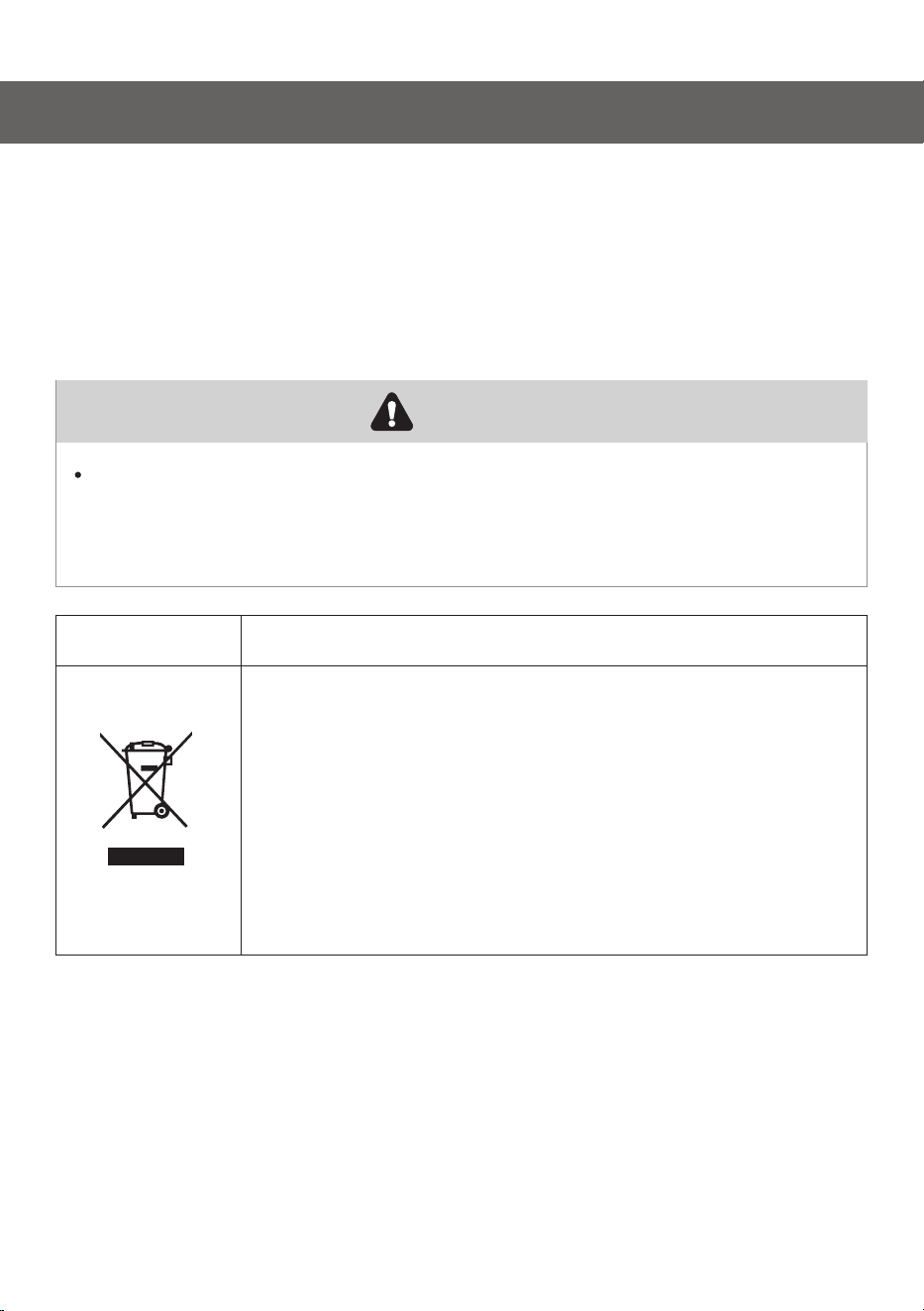
It is prohibited to dispose of this appliance as household waste.
Packaging materials
Packaging materials with the recycle symbol are recyclable. Dispose of the
packaging into a suitable waste collection container to recycle it.
Before disposal of the appliance
1. Pull out the mains plug from the mains socket.
2. Cut off the power cord and discard with the mains plug.
Disposal of the appliance
Refrigerators contain refrigerant and gases in the insulation. Refrigerant and
gases must be disposed of professionally as they may cause eye injuries or
ignition. Ensure that tubing of the refrigerant circuit is not damage prior to
proper disposal.
WARNING
Correct Disposal of this product
This marking indicates that this product should not be
disposed with other household wastes throughout the EU.
To prevent possible harm to the environment or human
health from uncontrolled waste disposal, recycle it
responsibly to promote the sustainable reuse of material
resources. To return your used device, please use the
return and collection systems or contact the retailer where
the product was purchased. They can take this product for
environmental safe recycling.
38