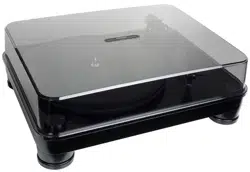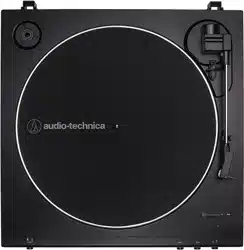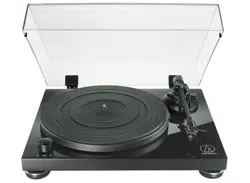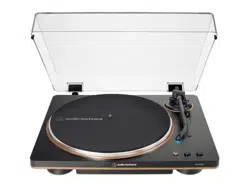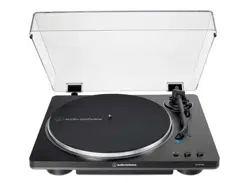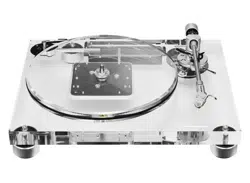

AT-LPA2
Belt-Drive Turntable
User Manual
English

1
Introduction
This product can be used only in the countries where the product is sold. Make sure that the operating voltage and plug
of the power cable of the product are correct for the country you live in.
2
Safety precautions
Although this product was designed to be used safely, failing to use it correctly may result in an accident. To ensure
safety, observe all warnings and cautions while using the product.
Important information
Warning
To prevent fire or shock hazard, do not expose this apparatus to rain or moisture.
Caution
Do not expose this apparatus to drips or splashes.
To avoid electric shock, do not open the cabinet.
Refer servicing to qualified personnel only.
Do not expose this apparatus to excessive heat such as sunshine, fire or the like.
Do not subject this apparatus to strong impact.
This apparatus should be located close enough to the AC outlet so that you can easily grasp the power cord plug at
any time.
In case of emergency, disconnect the power cord plug of this apparatus quickly.
Do not place any objects filled with liquids, such as vases, on this apparatus.
To prevent fire, do not place any naked flame sources (such as lighted candles) on this apparatus.
Do not install this apparatus in a confined space such as a bookcase or similar unit.
Install this apparatus only in the place where ventilation is good.
This apparatus with Class I construction shall be connected to the AC outlet with a protective grounding connection.
This apparatus is not disconnected from the mains as long as it is connected to the AC outlet, even if the unit itself
has been turned off.
The rating label is put on the bottom of this apparatus.
For customers in the USA/Canada
CAUTION
RISK OF ELECTRIC SHOCK
DO NOT OPEN

Safety precautions
3
Caution
To prevent electric shock, do not remove the cover. There are no user-serviceable parts inside. Internal adjustments are
for qualified professionals only. Refer all servicing to qualified service personnel.
The lightning flash with arrowhead symbol, within an equilateral triangle, is intended to alert the user to the presence of
uninsulated “dangerous voltage” within the product’s enclosure that may be of sufficient magnitude to constitute a risk
of shock to persons.
The exclamation point symbol within an equilateral triangle is intended to alert the user to the presence of important
operating and maintenance (servicing) instructions in the literature accompanying the product.
FCC Notice
Warning
This device complies with Part 15 of the FCC Rules. Operation is subject to the following two conditions: (1) This device
may not cause harmful interference, and (2) this device must accept any interference received, including interference
that may cause undesired operation.
Caution
You are cautioned that any changes or modifications not expressly approved in this manual could void your authority to
operate this equipment.
Note: This equipment has been tested and found to comply with the limits for a Class B digital device, pursuant to part
15 of the FCC Rules. These limits are designed to provide reasonable protection against harmful interference in a
residential installation. This equipment generates, uses and can radiate radio frequency energy and, if not installed and
used in accordance with the instructions, may cause harmful interference to radio communications. However, there is
no guarantee that interference will not occur in a particular installation. If this equipment does cause harmful
interference to radio or television reception, which can be determined by turning the equipment off and on, the user is
encouraged to try to correct the interference by one or more of the following measures:
– Reorient or relocate the receiving antenna.
– Increase the separation between the equipment and receiver.
– Connect the equipment into an outlet on a circuit different from that to which the receiver is connected.
– Consult the dealer or an experienced radio/TV technician for help.
Contact
Responsible Company: Audio-Technica U.S., Inc.
Address: 1221 Commerce Drive, Stow, Ohio 44224, USA
Tel: 330-686-2600

Safety precautions
4
For customers in Canada
ISED statement
CAN ICES-003(B)/NMB-003(B)

5
Notes on use
Turntable body
Do not set and use the product in locations that are considerably hot or humid, dirty, or subject to extreme vibrations.
The product should be positioned on a flat, level surface.
When opening or closing the dust cover, do so slowly. When closing the dust cover, close it completely.
Cartridge
The stylus is extremely delicate. Handle with care.
Attach the provided protector to the cartridge when the product is not in use.
Do not touch the stylus of the cartridge with your finger.
Do not allow the stylus to bump against the platter or edge of the record.
Be sure to attach the protector before setting the cartridge aside on a table or other surface. Do not allow the stylus
to touch a table or other surface. Doing so could damage, chip, or break the stylus.
The cartridge of this product is not intended for DJs. Do not operate the product in any way that may damage the
stylus, such as scratching (rubbing the record on the turntable by hand to produce sound).
Do not apply lateral force to the stylus while it is on the record. Doing so could damage, chip, or break the stylus tip.
The record could also be damaged.
Because this product includes an MC cartridge, a phono equalizer or MC transformer that is compatible with MC
cartridges is required.
6
Package contents
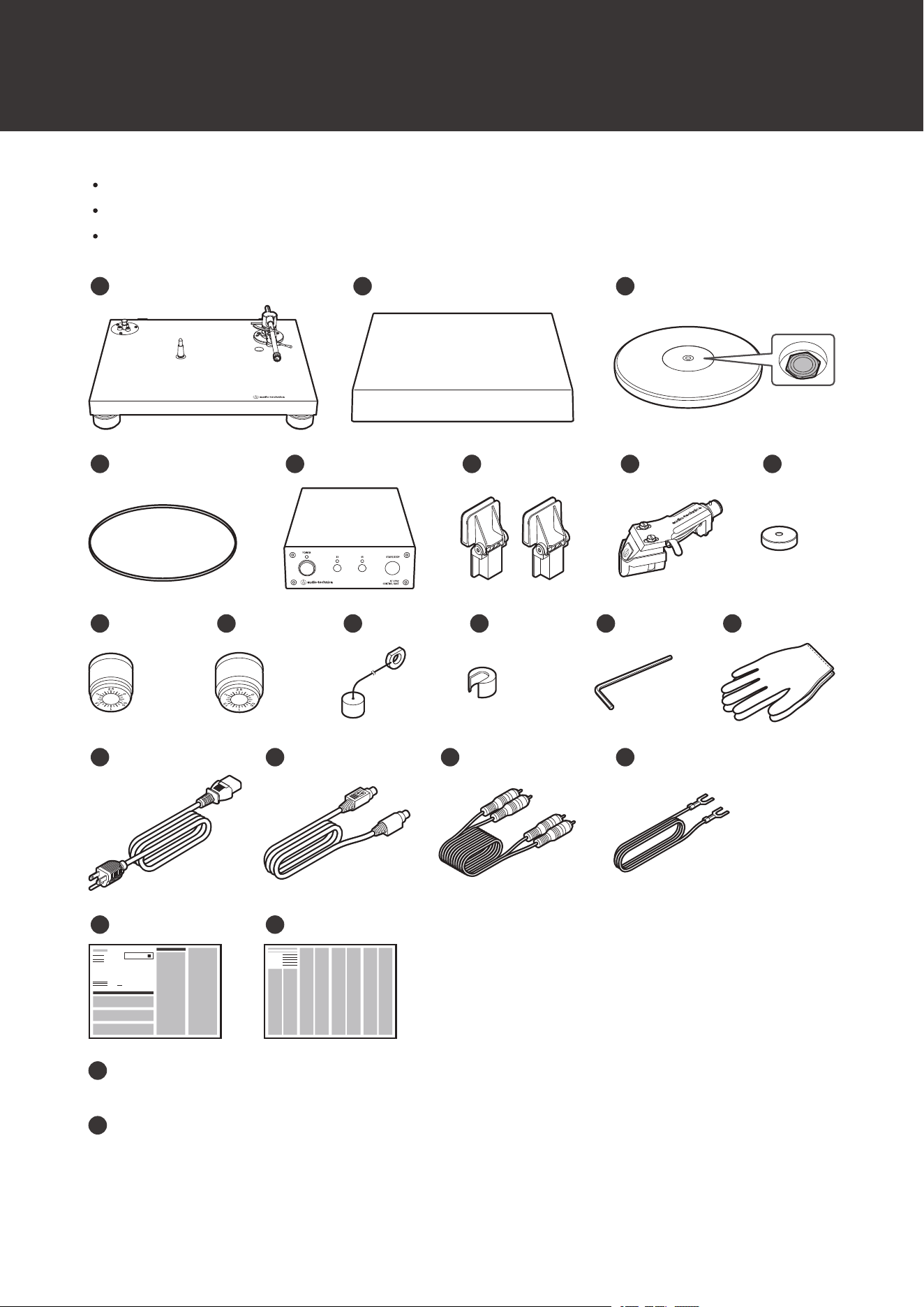
Make sure that you have all the included items before using this product.
If some items are missing or damaged, contact your local Audio-Technica dealer.
After purchase, we suggest that you save all packaging materials for possible future storage, moving, or shipping.
1
9
10
11
8
7
54
6
18
17
15
16
2 3
12
19
13
20
14
1
Turntable body
Remove the protective sheet before use.
2
Dust cover

Package contents
7
3
Platter
Remove the protective sheet before use.
The side where you can see the hexagonal nut (see figure) is the bottom side of the platter. Be mindful of the top
and bottom when installing.
4
Drive belt
5
Control unit
6
Dust cover hinges
7
Headshell with cartridge
8
45 RPM adapter
9
Counterweight (light)
The small counterweight is lighter.
10
Counterweight (heavy)
The large counterweight is heavier.
11
Weight for anti-skate
12
Auxiliary weight for anti-skate
13
Hexagonal wrench (for tonearm height adjustment)
14
Gloves
15
Power cable (approx. 1.8 m (5.9'))
16
Control cable (approx. 1.0 m (3.3'))
17
RCA audio cable (approx. 1.1 m (3.6'))
18
Ground cable (approx. 1.1 m (3.6'))
19
Quick Start Guide
20
Caution Guide
8
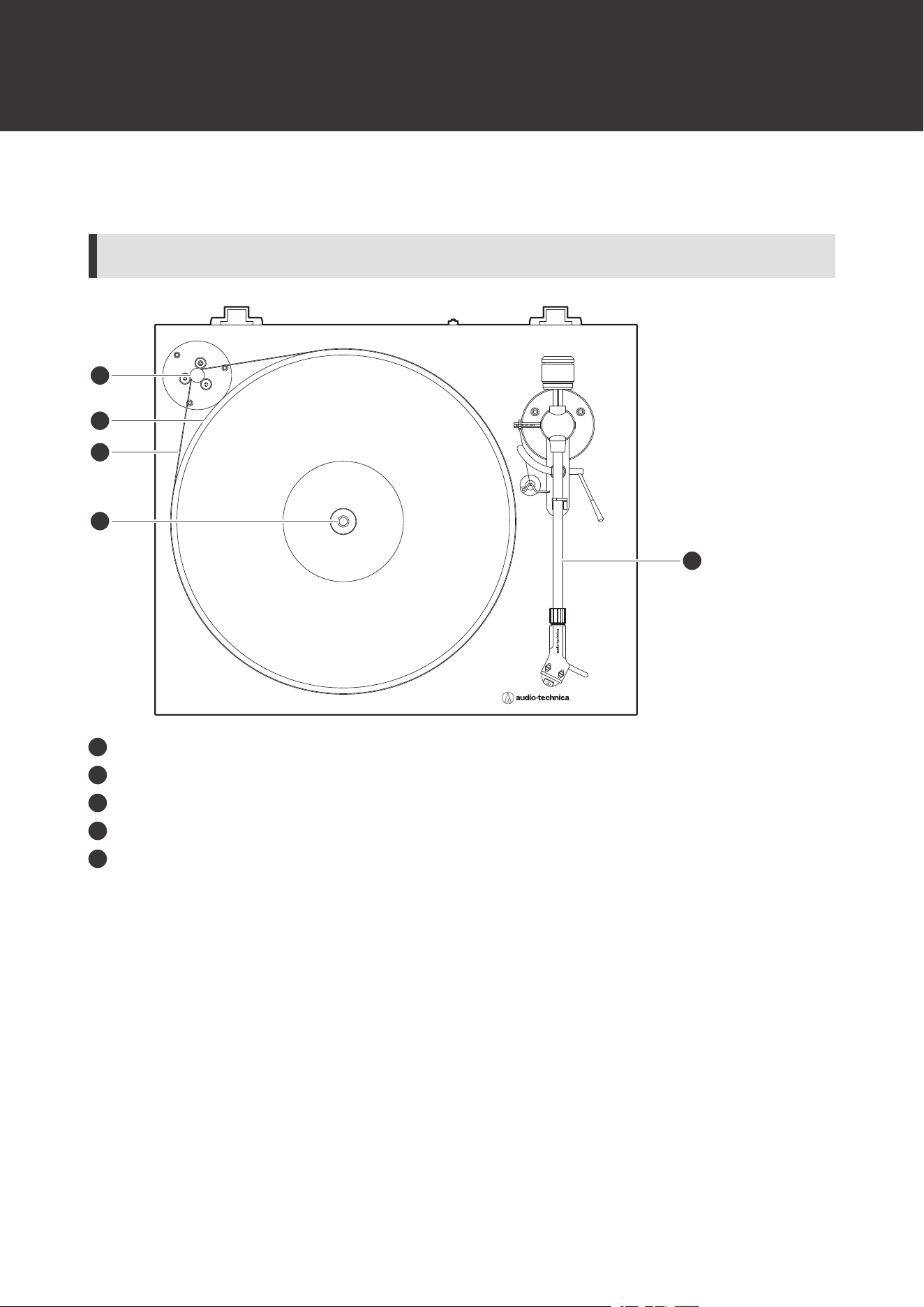
Part names and functions
Turntable body
Top view
5
4
3
2
1
1
Motor pulley
2
Platter
3
Drive belt
4
Spindle
5
Tonearm
Part names and functions
9
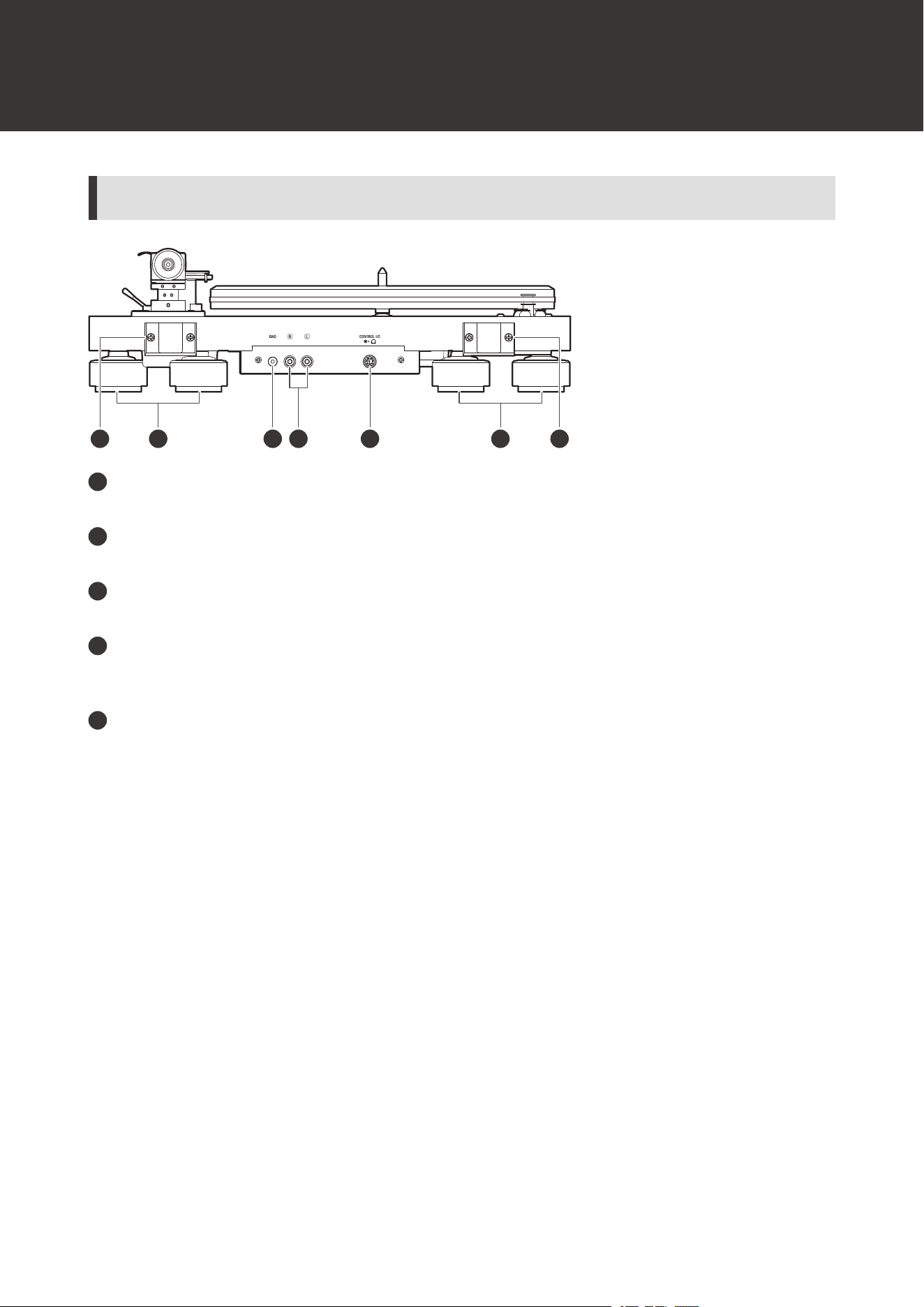
Rear view
1 13 42 25
1
Dust cover hinge holder
Attachment points for dust cover hinges.
2
Foot
Adjust the level of the product.
3
Ground (earth) terminal
Connect the amplifier’s ground (earth) terminal to this terminal using the ground cable.
4
Stereo output terminal
Connect the RCA audio cable. Connect to the PHONO input jack of the phono equalizer or amplifier with built-in
phono equalizer. The red terminal is the right channel and the white terminal is the left channel.
5
Control unit connection terminal
Connect the control unit using the control cable.
Part names and functions
10
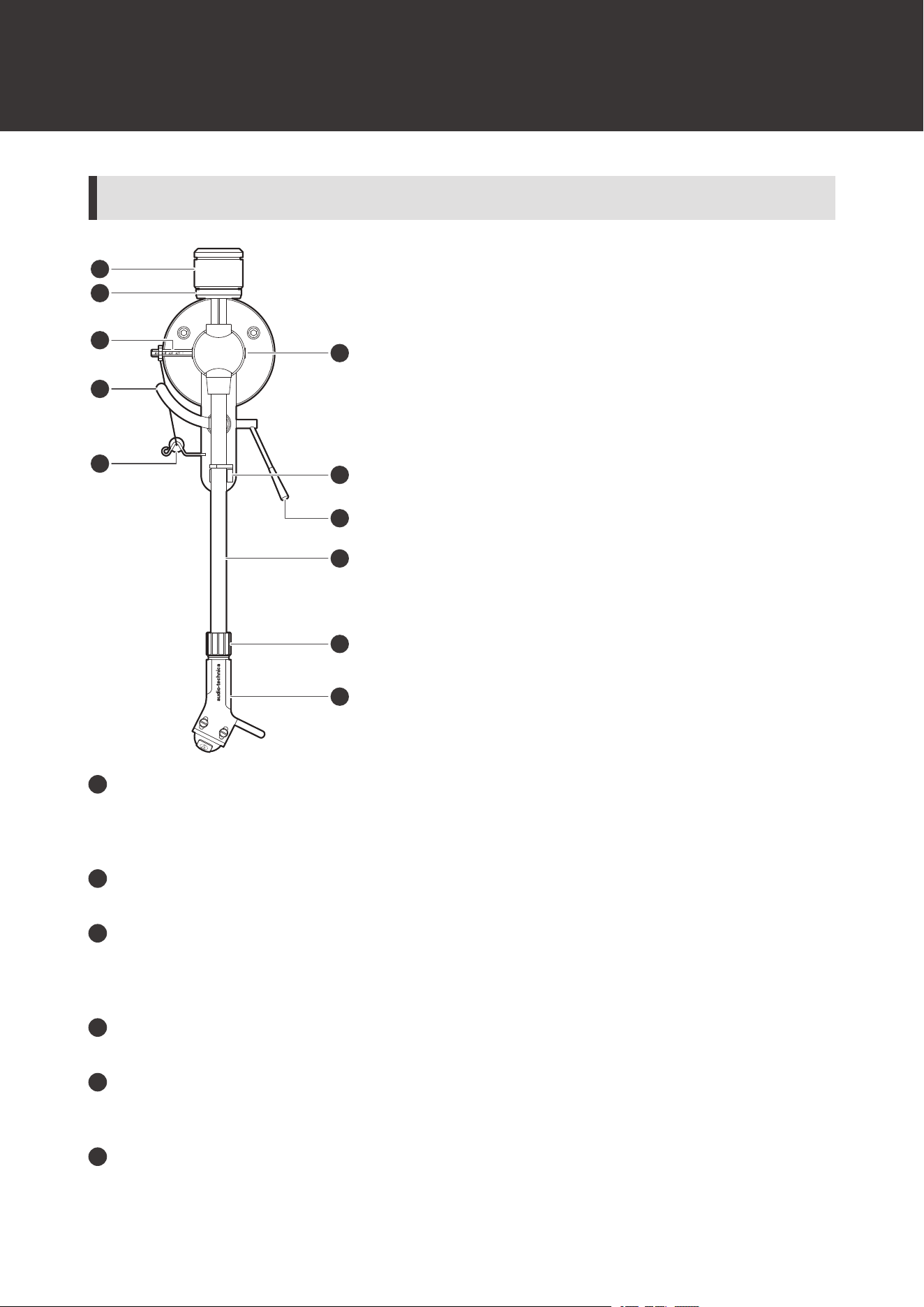
Tonearm
9
8
7
6
10
11
5
4
3
1
2
1
Counterweight
Balances the tonearm and adjusts to provide the proper tracking force. There are two counterweights with different
weights. Attach the counterweight (light) if using the included cartridge. Attach the correct counterweight for the
weight of the cartridge you are using. For details, see "Choosing the correct counterweight" (p. 18).
2
Tracking force gauge ring
Use to adjust the tracking force.
3
Anti-skate bar
While the record is playing, a force acts on the stylus tip to pull it inward. This force can be counteracted by setting
the weight for anti-skate for the tracking force value. Adjust the position where the weight for anti-skate is hooked
to match the multiplier scale. For details, see "Setting the anti-skate adjustment" (p. 18).
4
Tonearm lift
Moves the tonearm vertically to and from the face of the record.
5
Weight for anti-skate
This weight is for adjusting anti-skate. If using a cartridge other than the included cartridge, depending on the
tracking force, it may be necessary to make adjustments by adding the auxiliary weight for anti-skate.
6
Tonearm height adjustment socket
For details, see "Adjusting the tonearm’s height" (p. 34).
Part names and functions
11
7
Tonearm rest with clamp
Use the clamp to secure the tonearm so that it does not move.
8
Tonearm lift control lever
Operates the tonearm lift.
9
Tonearm
10
Locking ring
Rotate the ring to the left (counterclockwise) to secure the headshell. To remove the headshell, rotate the ring to the
right.
11
Headshell and cartridge
The cartridge is attached to the headshell.
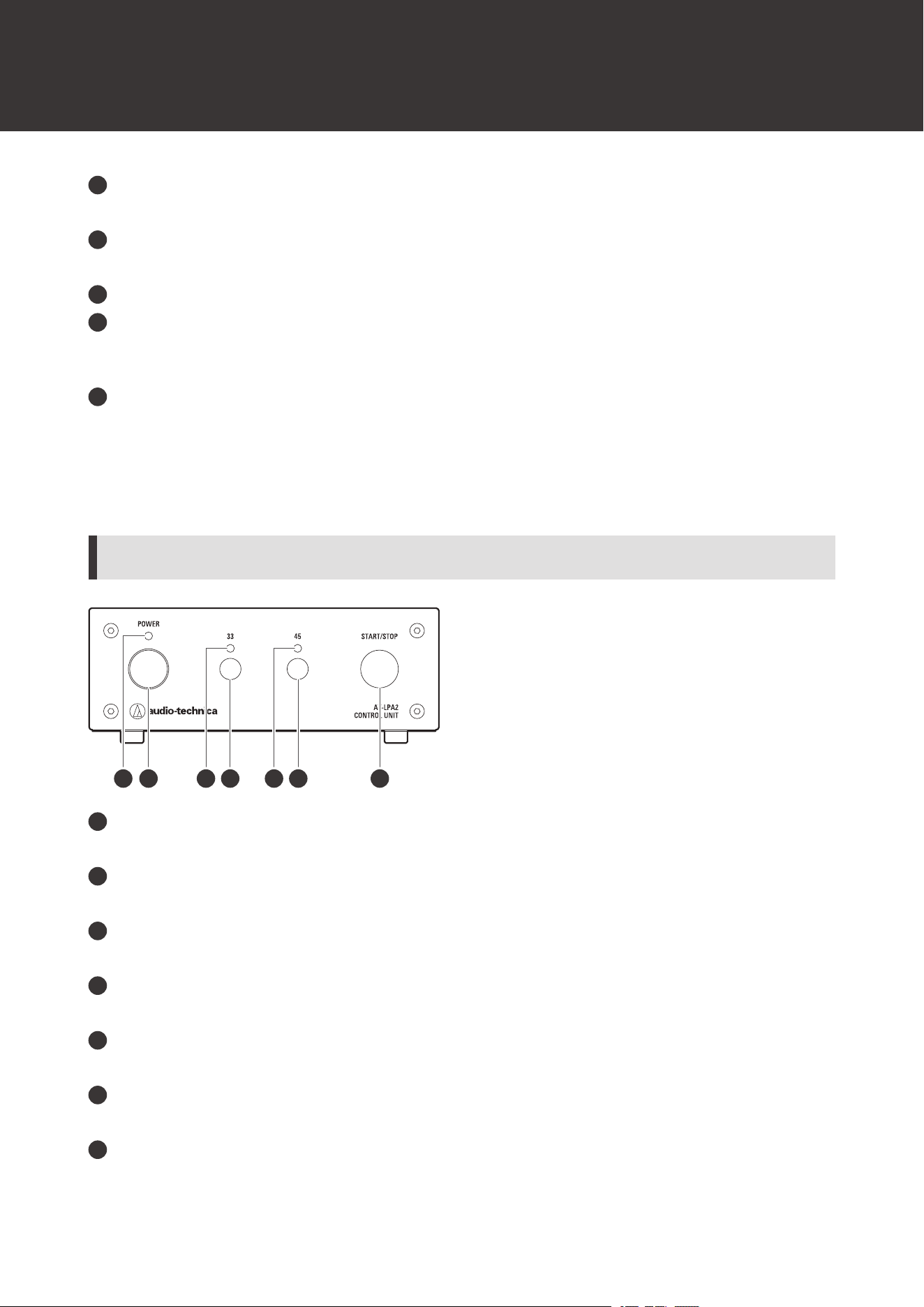
Control unit
Front
2 74 61 3 5
1
Power supply indicator lamp
Lights up when power is turned on.
2
Power supply button
Turns power on and off.
3
Platter speed indicator lamp (33-1/3 RPM)
Lights up when 33-1/3 RPM is selected.
4
Platter speed button (33-1/3 RPM)
Press to select 33-1/3 RPM.
5
Platter speed indicator lamp (45 RPM)
Lights up when 45 RPM is selected.
6
Platter speed button (45 RPM)
Press to select 45 RPM.
7
START/STOP button
Press to start or stop plater rotation.
Part names and functions
12
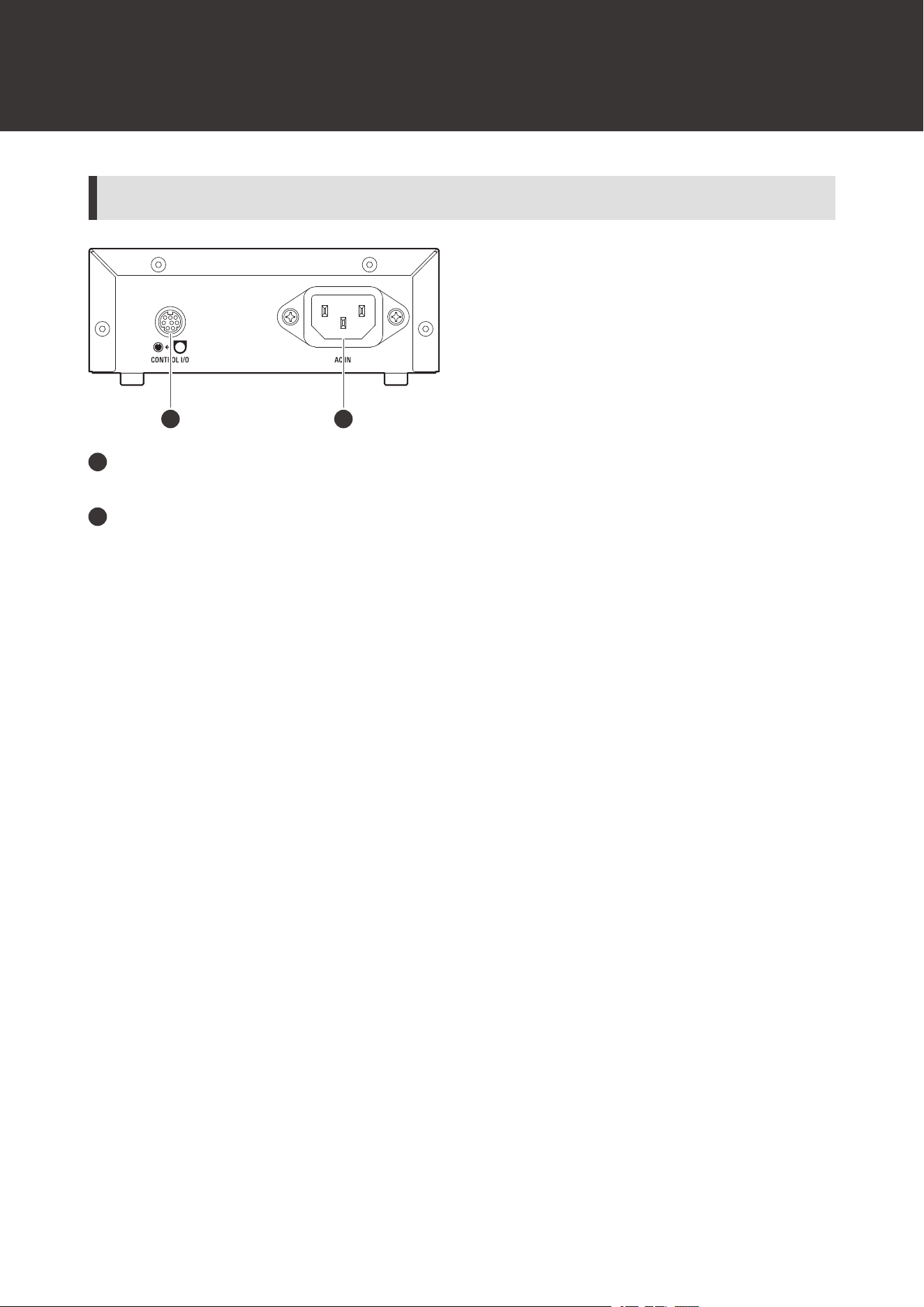
Rear view
1 2
1
Turntable connection terminal
Connect the turntable body using the control cable.
2
Power input jack
Insert the power cable here.
13
Preparation for use
Setting up the turntable
Position the product on a level surface.
To avoid the effects of vibrations and acoustic pressure, do not mount the product next to such items as speakers.
The product may pick up radio static if placed next to a radio. Therefore, try to keep the product away from radios.
If the product is near equipment (cell phone, etc.) that emits strong radio waves, noise may occur.
Place the turntable body and control unit close to each other.
Use the included gloves to avoid fingerprints on the product.
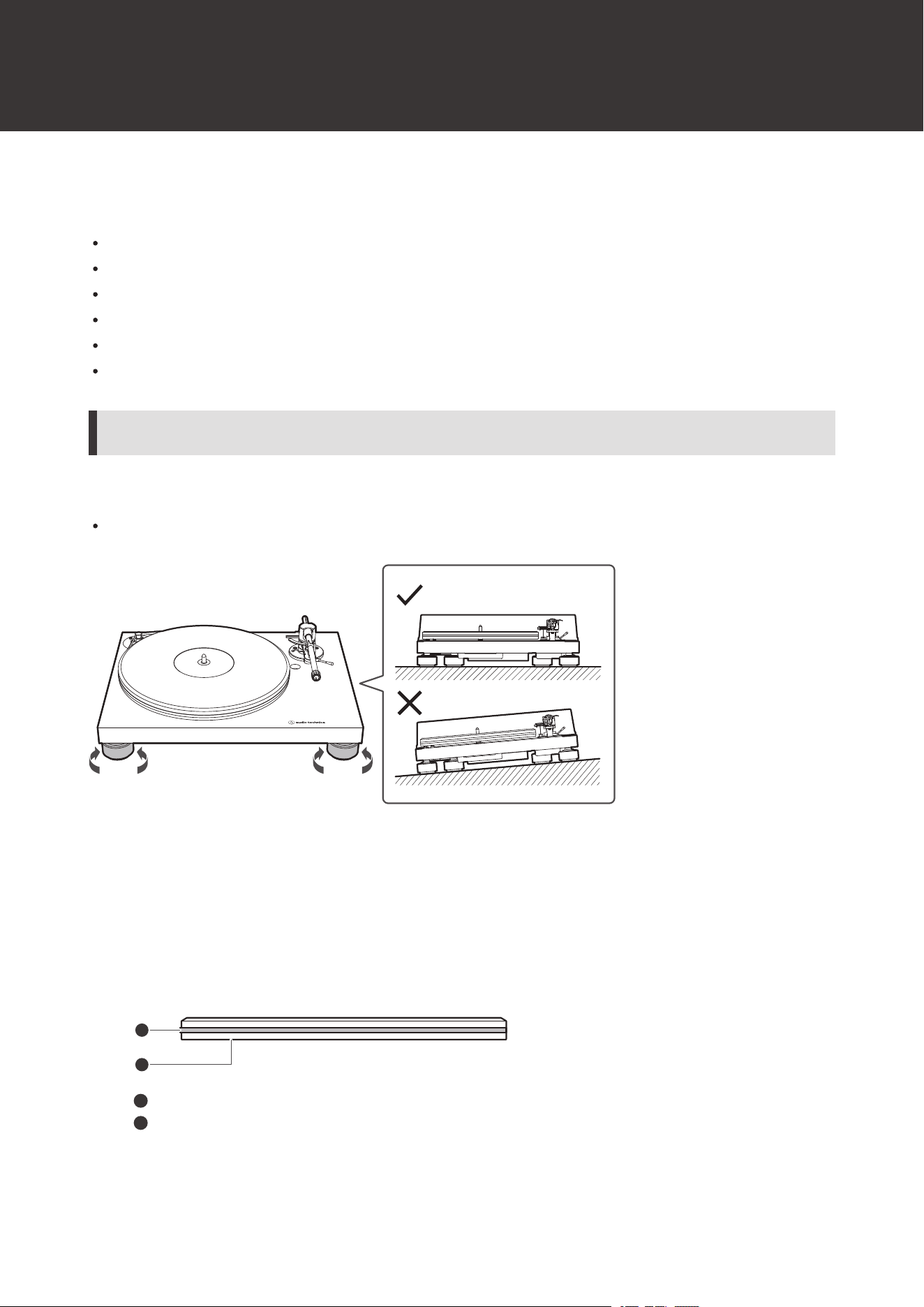
Leveling the turntable
After positioning the product where you want to use it, adjust the feet so that the product is level.
Use a level (sold separately) as needed to ensure that the product is level.
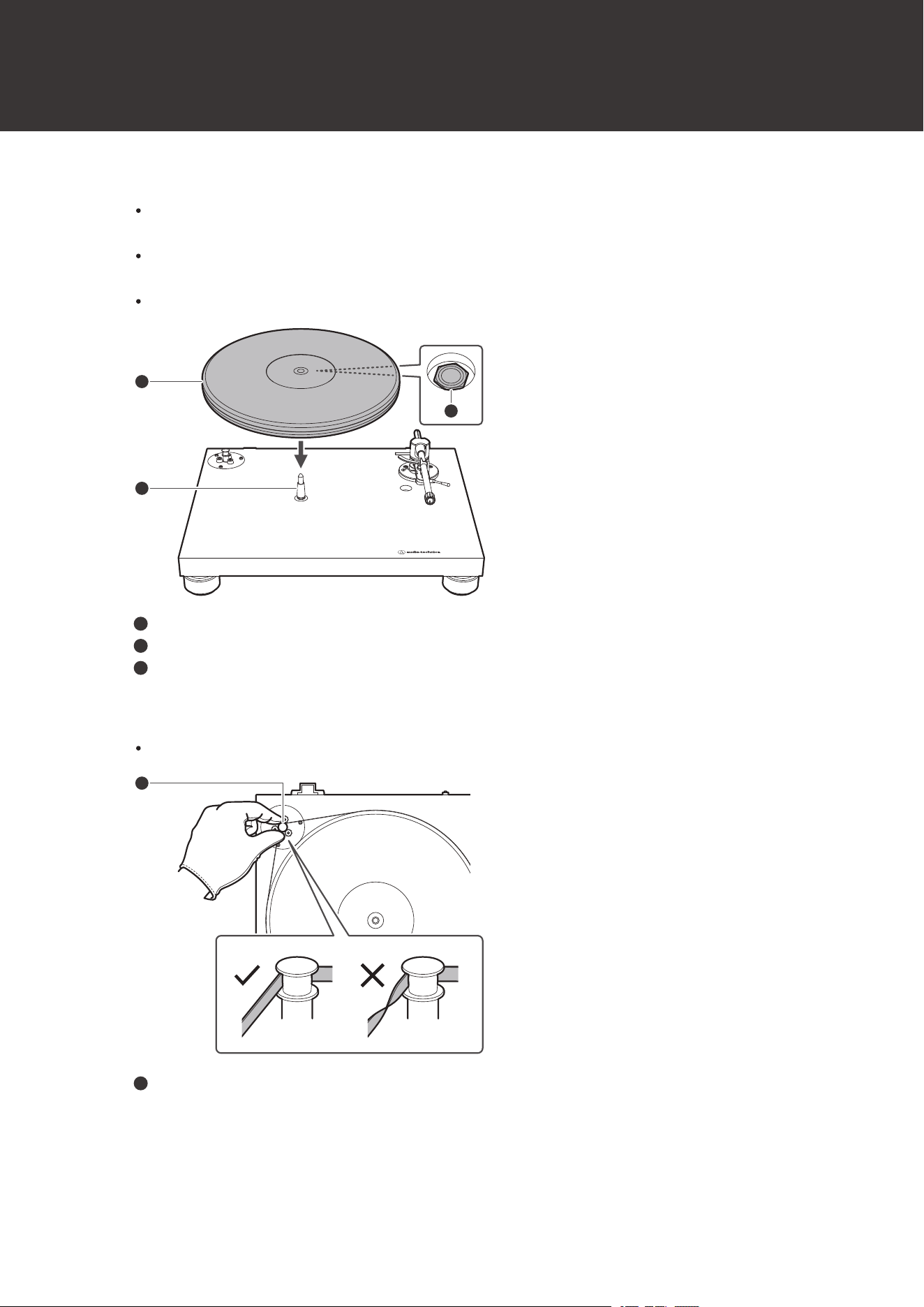
Placing the platter
This product requires some assembly before using it for the first time.
1
Attach the drive belt to the side of the platter.
1
2
1
Drive belt
2
Platter
2
Using the included gloves to avoid getting fingerprints on the product, remove the protective sheets
from the platter and turntable body.
Preparation for use
14
3
With the power turned off, set the platter on the spindle.
Do not mistake the top and bottom of the platter. The side where you can see the hexagonal nut is the bottom
side of the platter.
To avoid damaging the spindle when seating the platter, align the positions of the spindle and the platter’s
hole, and then slowly seat the platter.
Make certain that the platter is fully seated on the spindle.
1
3
2
1
Platter
2
Spindle
3
Hexagonal nut
4
Attach the drive belt to the motor pulley.
Make sure that the belt does not get twisted.
1
1
Motor pulley
Preparation for use
15
Assembling the tonearm
1
Remove the cable tie used to secure the tonearm at the time of delivery.
Use the clamp to temporarily secure the tonearm to the tonearm rest.
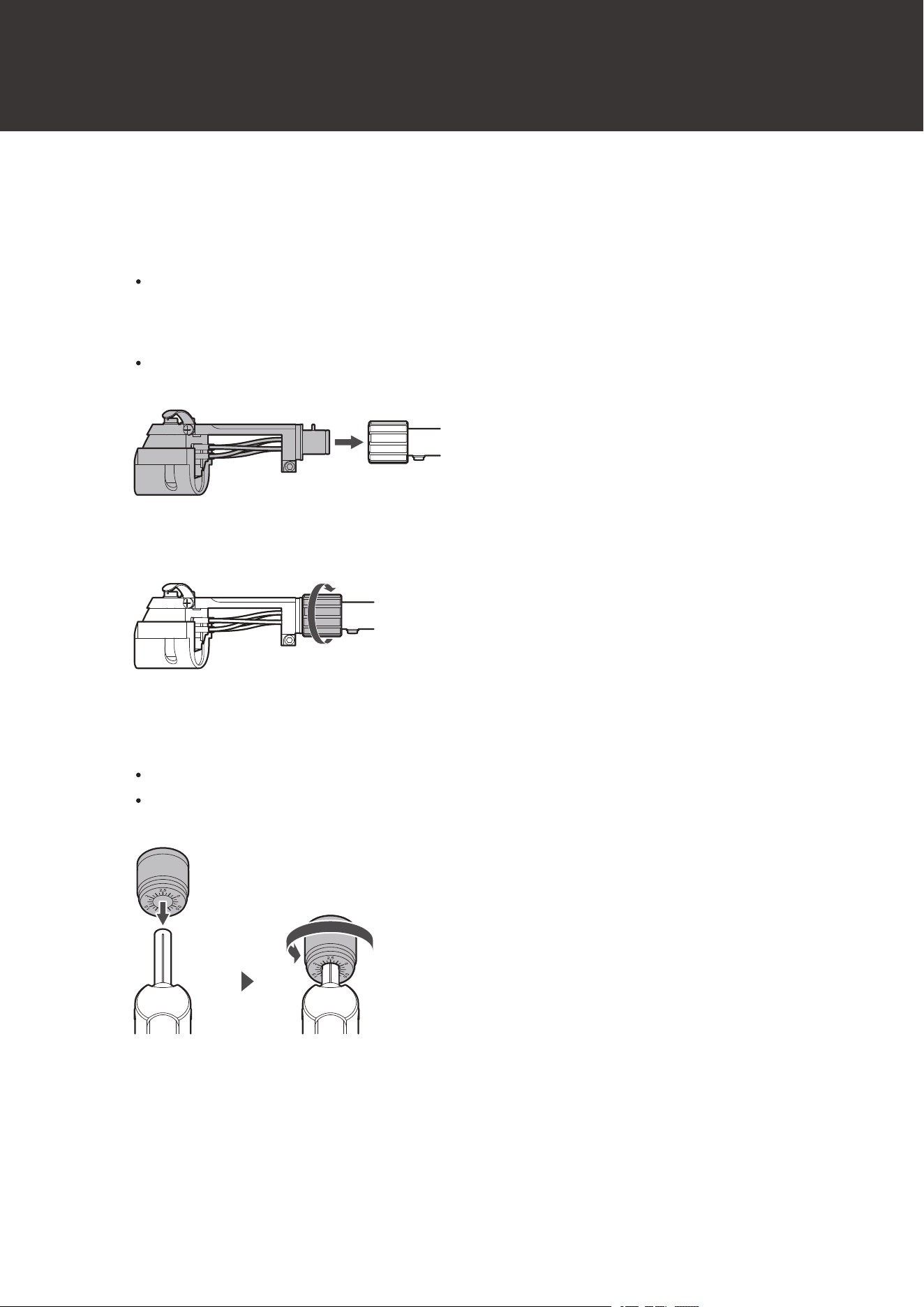
2
Insert the headshell into the tonearm.
Hold the right and left edges of the headshell so that you do not damage the stylus or cut the cartridge’s
wires.
3
With the headshell inserted, turn the locking ring counterclockwise (to the left).
4
Attach the counterweight to the back of the tonearm and slowly turn it counterclockwise (to the
left).
Attach the counterweight (light) if using the included cartridge.
If using a cartridge other than the one included, attach a counterweight (heavy) according to the weight of the
cartridge. For details, see "Choosing the correct counterweight" (p. 18).
Tonearm balance and tracking force
In order for the cartridge to pick up sound correctly from the record’s grooves, the tonearm’s balance and tracking force
must be adjusted to fit the specifications of the cartridge. If the tonearm’s balance and tracking force are not properly
adjusted, the record or the cartridge’s stylus may become damaged.
Preparation for use
16
Do not drag the cartridge’s stylus across the record or platter when adjusting the tonearm’s balance or tracking
force. Doing so may damage the stylus.
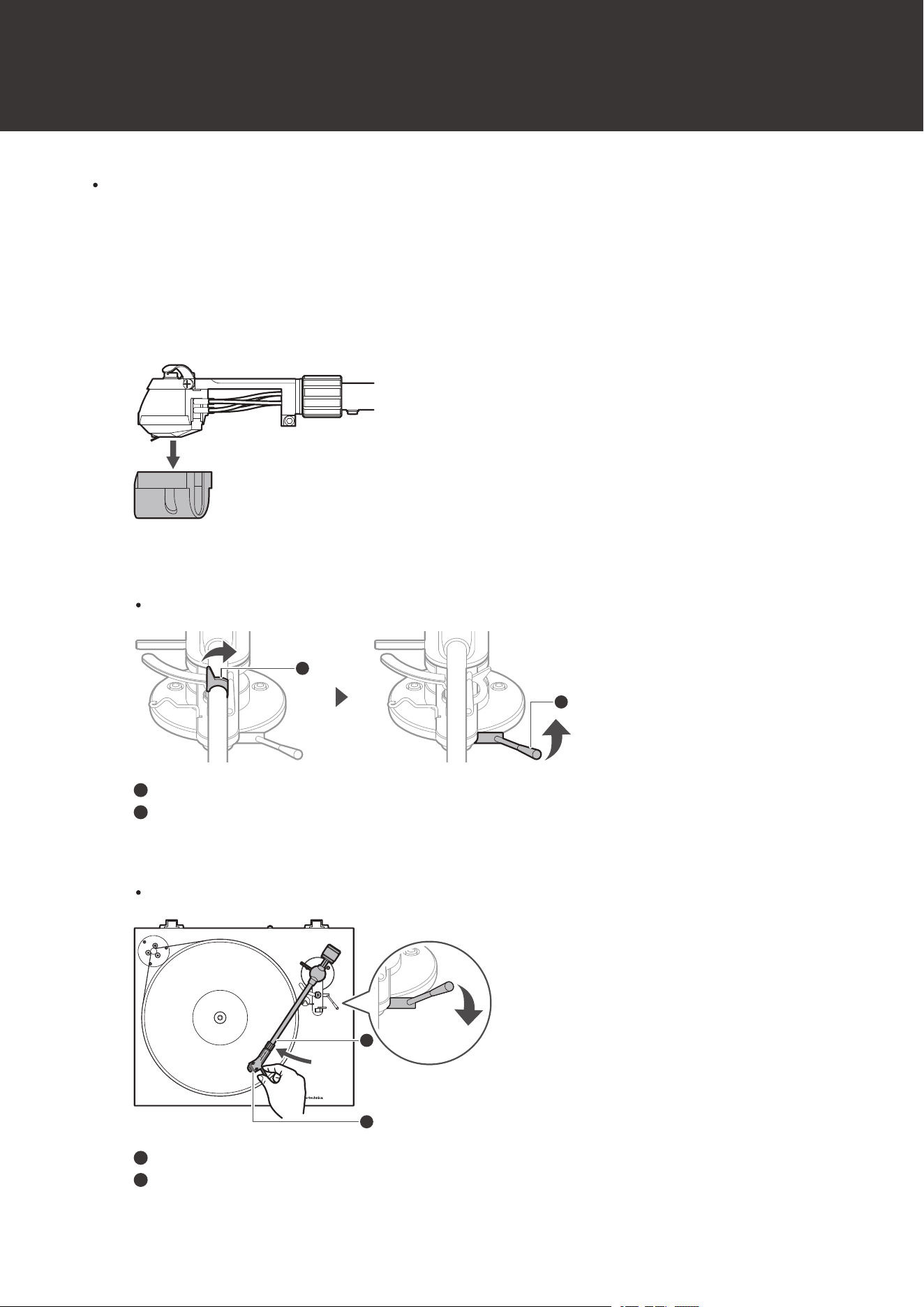
Setting tonearm balance
1
Remove the cartridge’s protector.
2
Remove the clamp and lift the tonearm lift control lever.
The tonearm is tilted because the balance has yet to be adjusted.
1
2
1
Clamp
2
Tonearm lift control lever
3
Move the tonearm over the platter. Lower the tonearm lift control lever while holding the headshell.
Be careful not to allow the stylus tip to touch the platter.
1
2
1
Tonearm
2
Headshell
Preparation for use
17
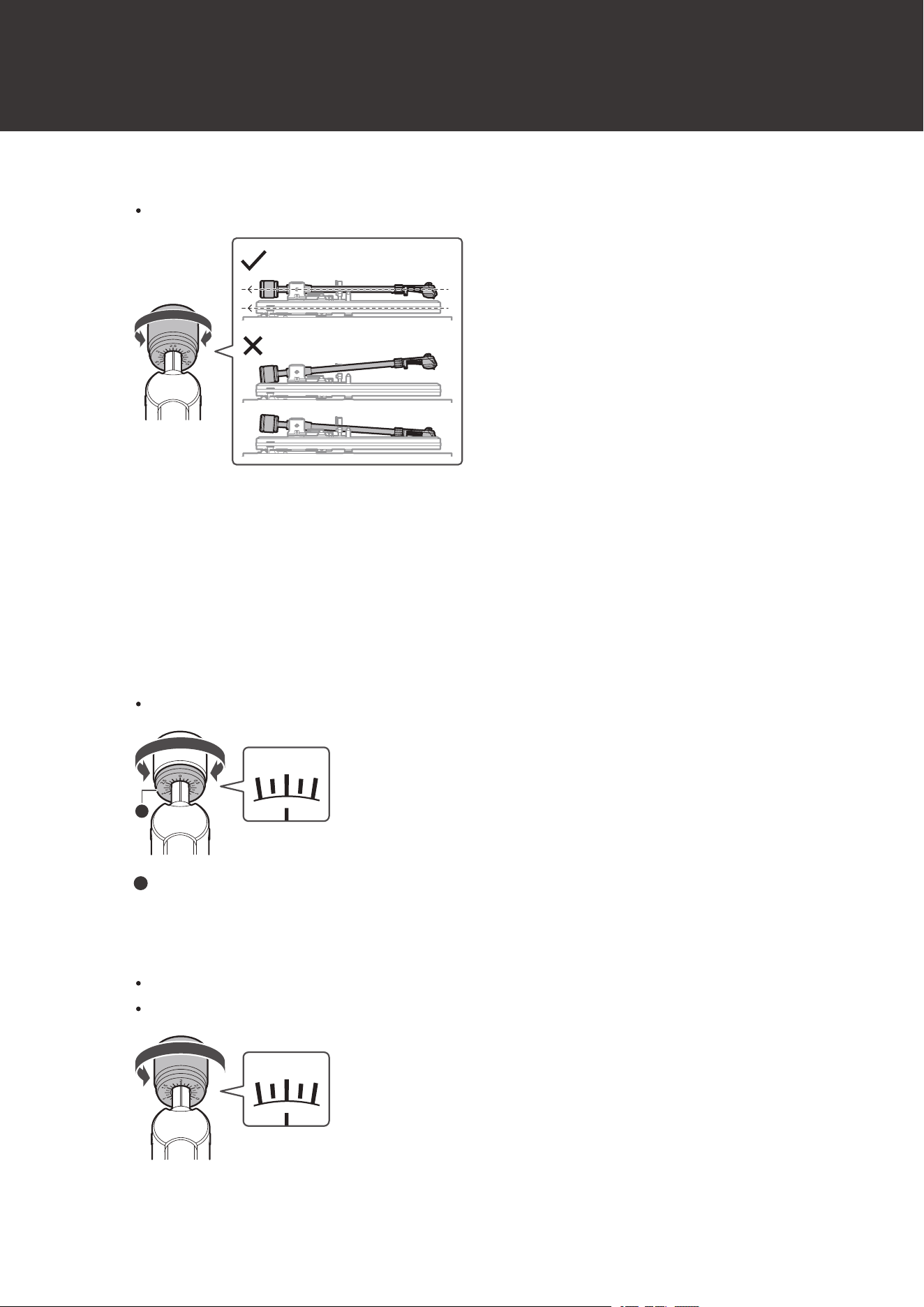
4
While still lightly holding the headshell, turn the counterweight to adjust the tonearm’s balance.
Adjust the balance so that the tonearm is level when you release the headshell.
5
Return the tonearm to the tonearm rest.
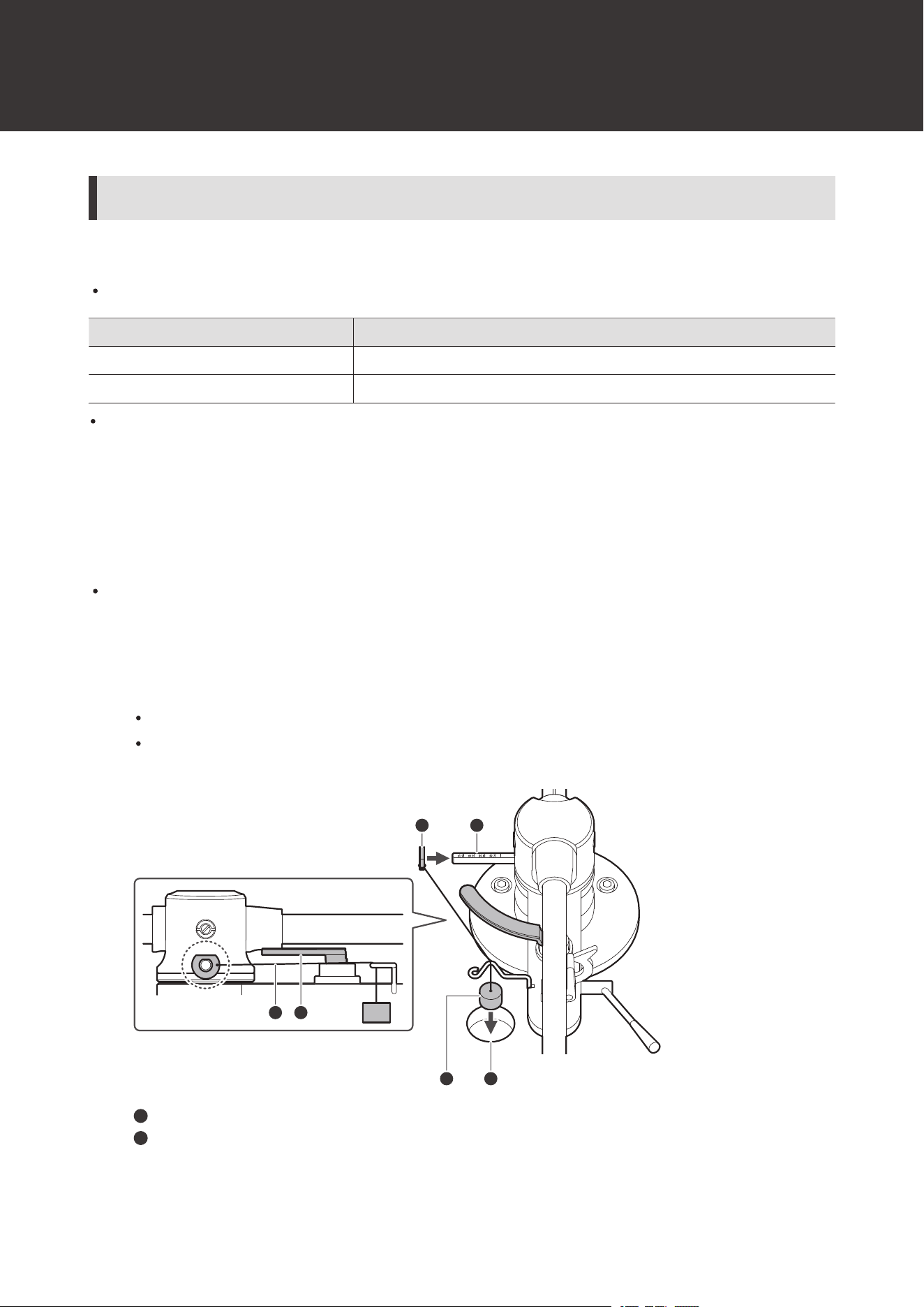
Setting tracking force
1
While supporting the counterweight so that it does not move, turn the tracking force gauge ring so
that its “0” position lines up with the centerline on the back of the tonearm.
The tracking force is not adjusted simply by turning the tracking force gauge ring.
0
1
1
Tracking force gauge ring
2
Turn the counterweight and the tracking force gauge ring counterclockwise (to the left) to set the
tracking force to the recommended tracking force value for the cartridge you are using.
Refer to the cartridge maker’s specifications for the recommended tracking force value.
The tracking force value for the cartridge provided with this product is 2.0 g (0.071 oz).
2
Preparation for use
18
Choosing the correct counterweight
When using a cartridge other than the one included, choose the correct counterweight for the weight of the cartridge.
The small counterweight is lighter while the large counterweight is heavier.
Counterweight Compatible cartridge weight
Counterweight (light) 6.1 g (0.22 oz) to 9.2 g (0.32 oz)
Counterweight (heavy) 9.2 g (0.32 oz) to 13.9 g (0.49 oz)
If the cartridge is 9.2 g (0.32 oz), either the light or heavy counterweight can be used, but the light counterweight is recommended.
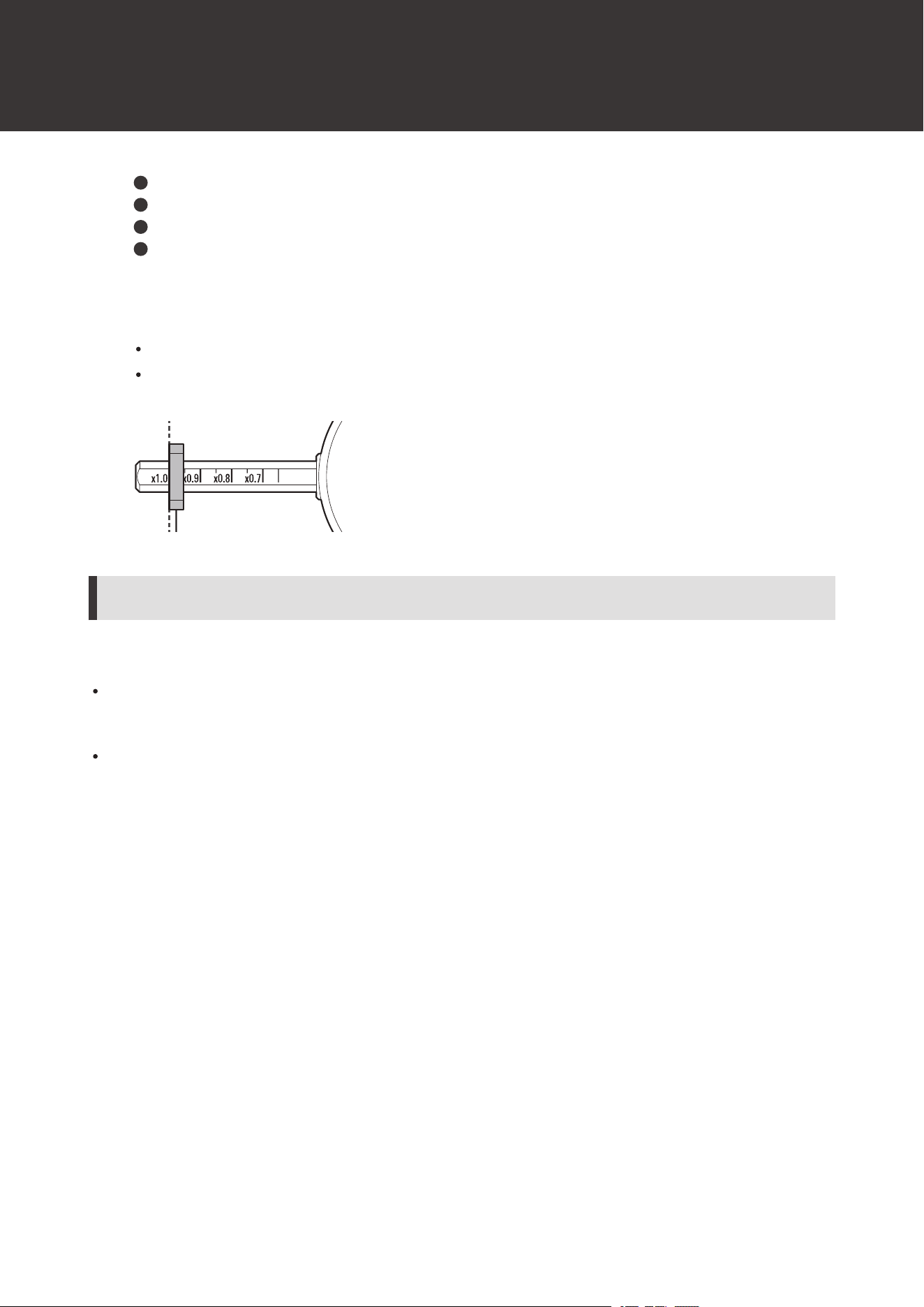
Setting the anti-skate adjustment
While the record is playing, a force acts on the stylus tip to pull it inward. This force can be counteracted by setting the
multiplier for the weight for anti-skate according to the tracking force value.
If using a cartridge other than the included cartridge, depending on the tracking force, it may be necessary to make
adjustments by adding the auxiliary weight for anti-skate.
1
Place the weight for anti-skate into the slot in the turntable body and slide the ring onto the anti-
skate bar.
Pass the weight for anti-skate string under the tonearm lift.
Attach the anti-skate bar in the direction shown in the figure. Take care not to mistake the attachment
direction.
6
21
43
5
1
Ring
2
Anti-skate bar
Preparation for use
19
3
String
4
Tonearm lift
5
Weight for anti-skate
6
Slot
2
Adjust the position of the ring on the anti-skate bar to set the proper weight for anti-skate multiplier
for the tracking force setting on the counterweight.
Using the left side of the ring as a reference, align with the multiplier scale.
If using the included cartridge, set to “1.0”. If using a cartridge other than the included cartridge, see "If using
a cartridge other than the included cartridge" (p. 19).
If using a cartridge other than the included cartridge
Calculate the weight and anti-skate multiplier to be used based on the proper tracking force of the cartridge being used.
Two types of weights are used: 2.0 g (0.071 oz) (weight for anti-skate only) and 3.0 g (0.11 oz) (weight for anti-skate +
auxiliary weight for anti-skate). If the proper tracking force is 2.0 g (0.071 oz) or less, use the 2.0 g (0.071 oz) weight.
If 2.1 g (0.074 oz) or more, use the 3.0 g (0.11 oz) weight.
The anti-skate multiplier can be calculated by dividing the proper tracking force by the weight.
Preparation for use
20
Proper cartridge tracking force Weight used Anti-skate multiplier
1.3 g (0.046 oz)
[1]
2.0 g (0.071 oz)
0.65
1.4 g (0.049 oz) 0.7
1.5 g (0.053 oz) 0.75
1.6 g (0.056 oz) 0.8
1.7 g (0.060 oz) 0.85
1.8 g (0.063 oz) 0.9
1.9 g (0.067 oz) 0.95
2.0 g (0.071 oz) (included cartridge) 1.0
2.1 g (0.074 oz)
3.0 g (0.11 oz)
0.7
2.2 g (0.078 oz) 0.73
2.3 g (0.081 oz) 0.77
2.4 g (0.085 oz) 0.8
2.5 g (0.088 oz) 0.83
2.6 g (0.092 oz) 0.87
2.7 g (0.095 oz) 0.9
2.8 g (0.099 oz) 0.93
2.9 g (0.10 oz) 0.97
3.0 g (0.11 oz)
[2]
1.0
[1] For tracking forces less than 1.3 g (0.046 oz), use the same anti-skating multiplier as for 1.3 g (0.046 oz).
[2] For tracking forces more than 3.0 g (0.11 oz), use the same anti-skating multiplier as for 3.0 g (0.11 oz).
1
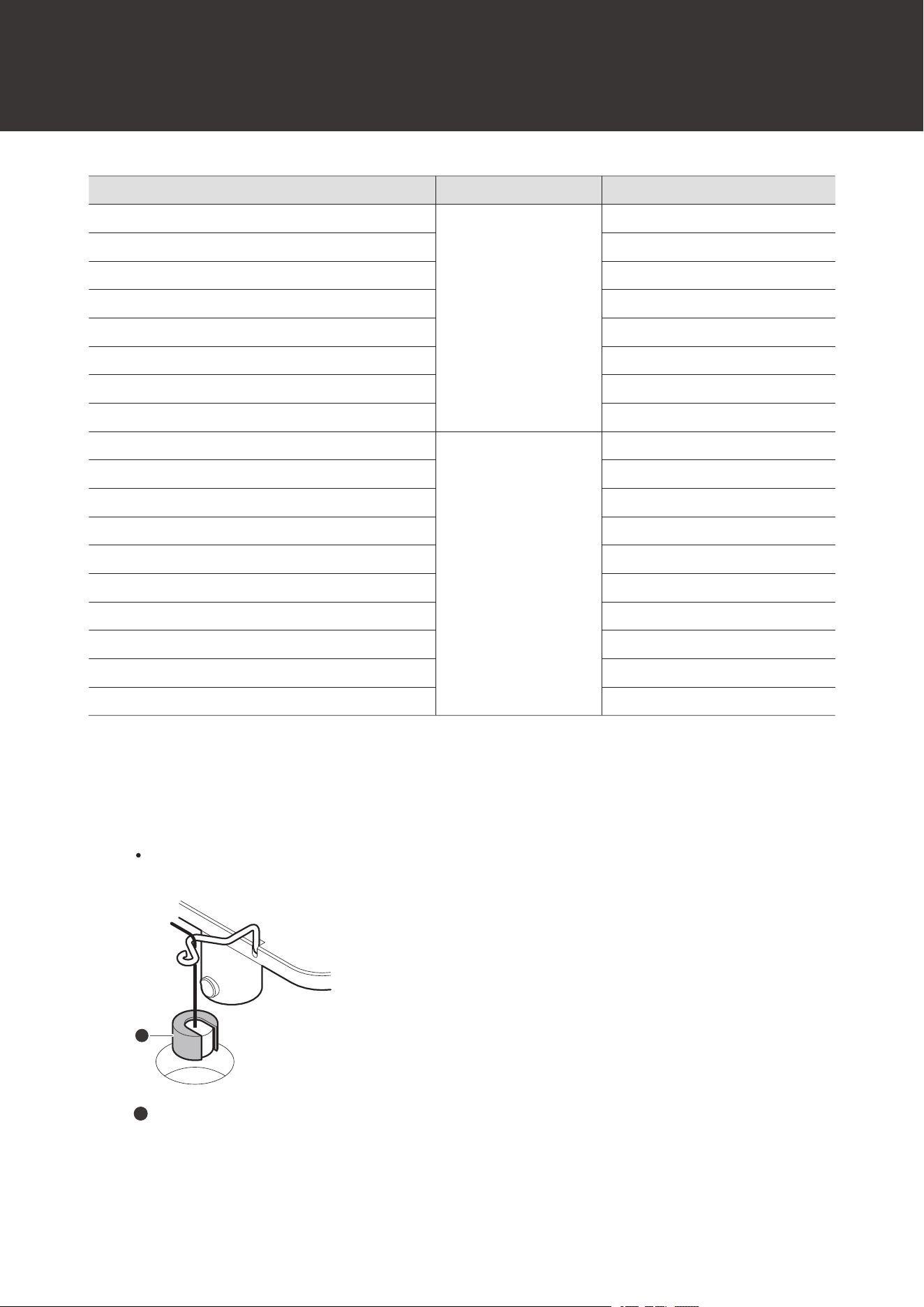
If using the auxiliary weight for anti-skate, place the auxiliary weight for anti-skate over the weight
for anti-skate.
The weight will tilt when the auxiliary weight for anti-skate is placed over it. Using in this tilted state will not
result in any problems.
1
1
Auxiliary weight for anti-skate
2
Align the ring of the weight for anti-skate with the multiplier scale of the anti-skate bar.
Preparation for use
21
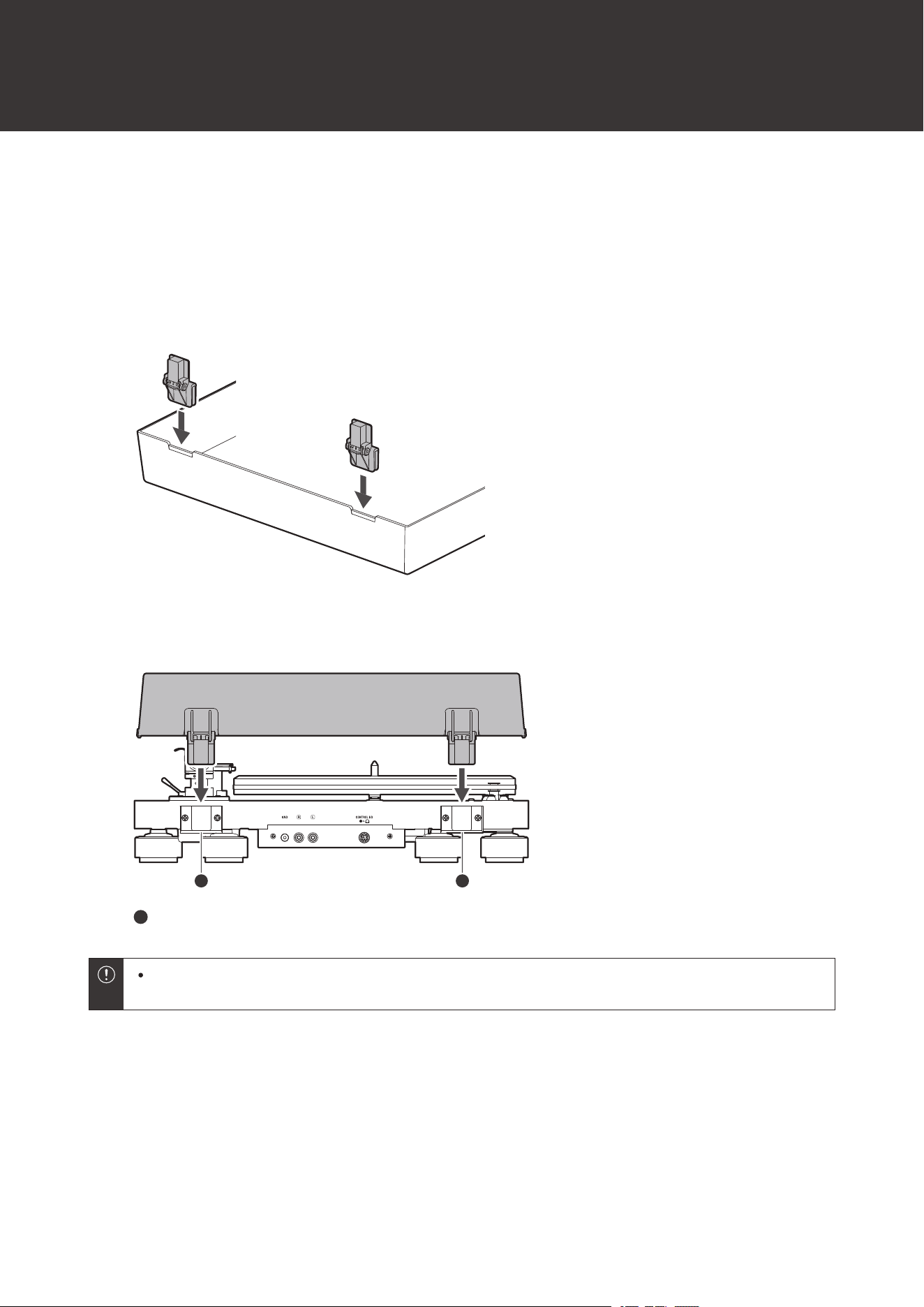
Installing the dust cover
The dust cover is designed to protect the product’s sensitive components from foreign materials such as dust when the
product is not in use.
1
Attach the dust cover hinges to the slots on the dust cover.
2
Insert the hinges of the dust cover into the two dust cover hinge holders on the back of the body.
1 1
1
Dust cover hinge holder
When removing the dust cover, slowly pull the dust cover out from the dust cover hinge holders on the
body.
22
Using the product
This product is used by connecting the turntable body and control unit.
This product does not have a built-in phono equalizer function. Connect the RCA audio cable to the PHONO input
jack of a phono equalizer or an amplifier with a built-in phono equalizer.
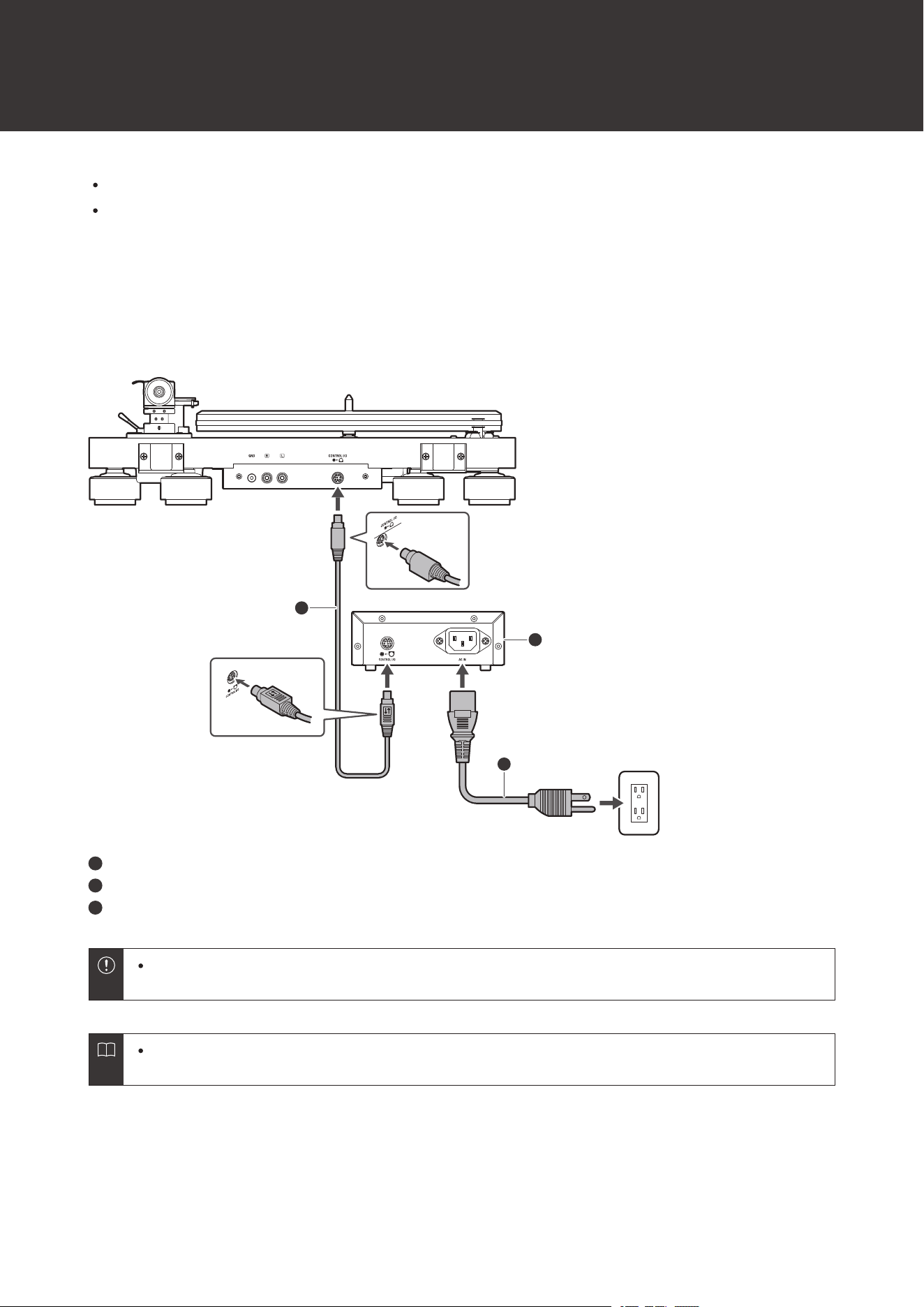
Connecting to the control unit
Connect the turntable body and control unit using the control cable.
2
1
3
1
Control cable
2
Control unit
3
Power cable
The control cable is inserted with the terminal facing downward on the turntable body and upward on the
control unit. Take care not to forcibly insert the terminals, as doing so may cause damage.
If the power cable has a ground line, connect it before use (the shape of the power cable varies depending
on the country in which it is sold).
Using the product
23
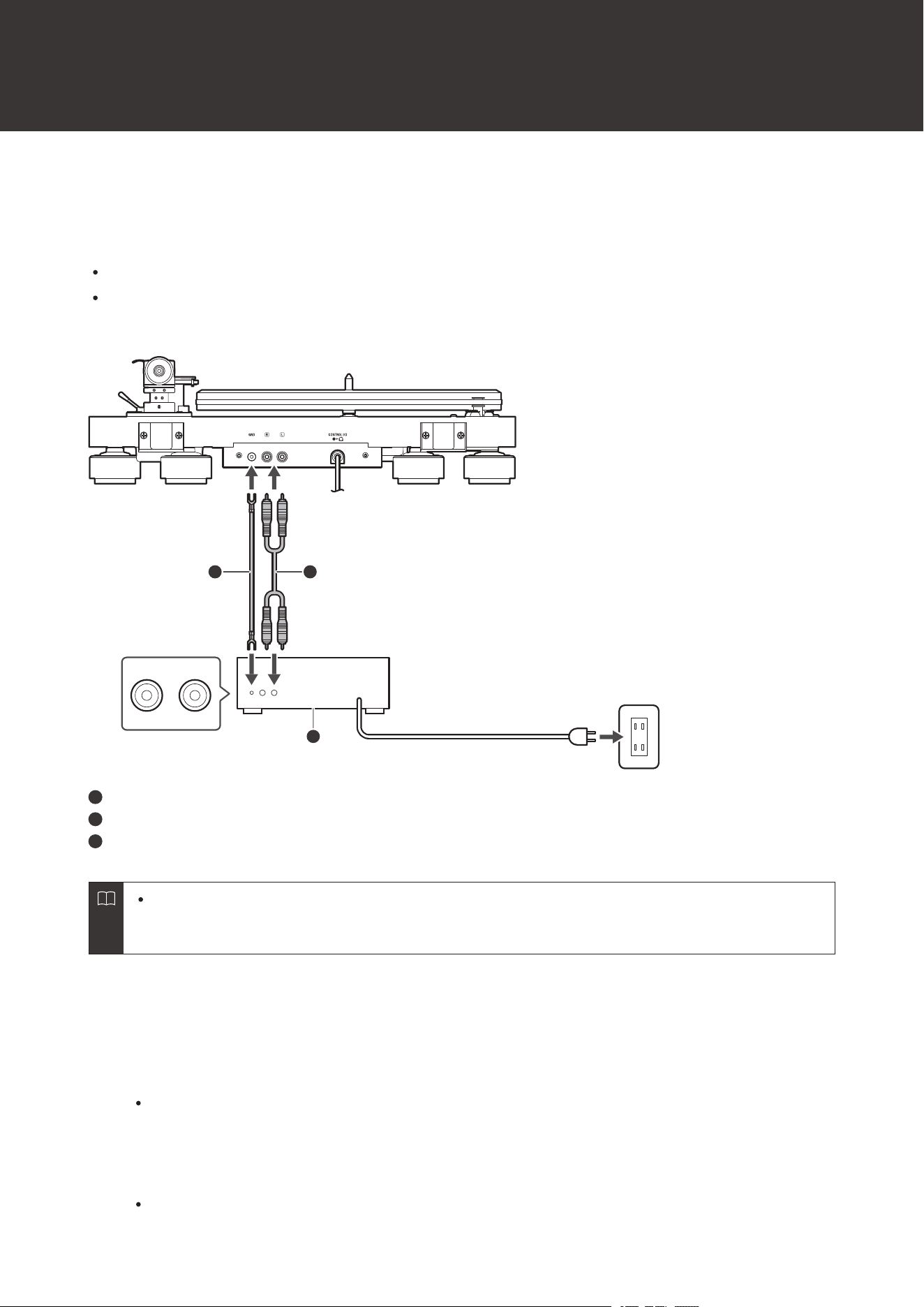
Connecting to a phono equalizer or an amplifier with built-in
phono equalizer
The RCA audio cable’s red plug is for the right (R) channel, and the white plug is for the left (L) channel.
Because this product includes an MC cartridge, a phono equalizer or MC transformer that is compatible with MC
cartridges is required.
PHONO
L R
1 2
3
1
Ground cable
2
RCA audio cable
3
Phono equalizer or amplifier with built-in phono equalizer
Depending on the equipment you are connecting, a ground (earth) terminal may exist near the PHONO input
jack. If so, connect using the ground cable. This will help prevent a low humming noise that might otherwise
be heard during playback.
Before playing a record
1
Plug the power cable into an outlet.
Make sure that the power to the control unit is off. If the power remains on while the power cable is
connected, a standby current is always running through the product, even when it is not being used.
2
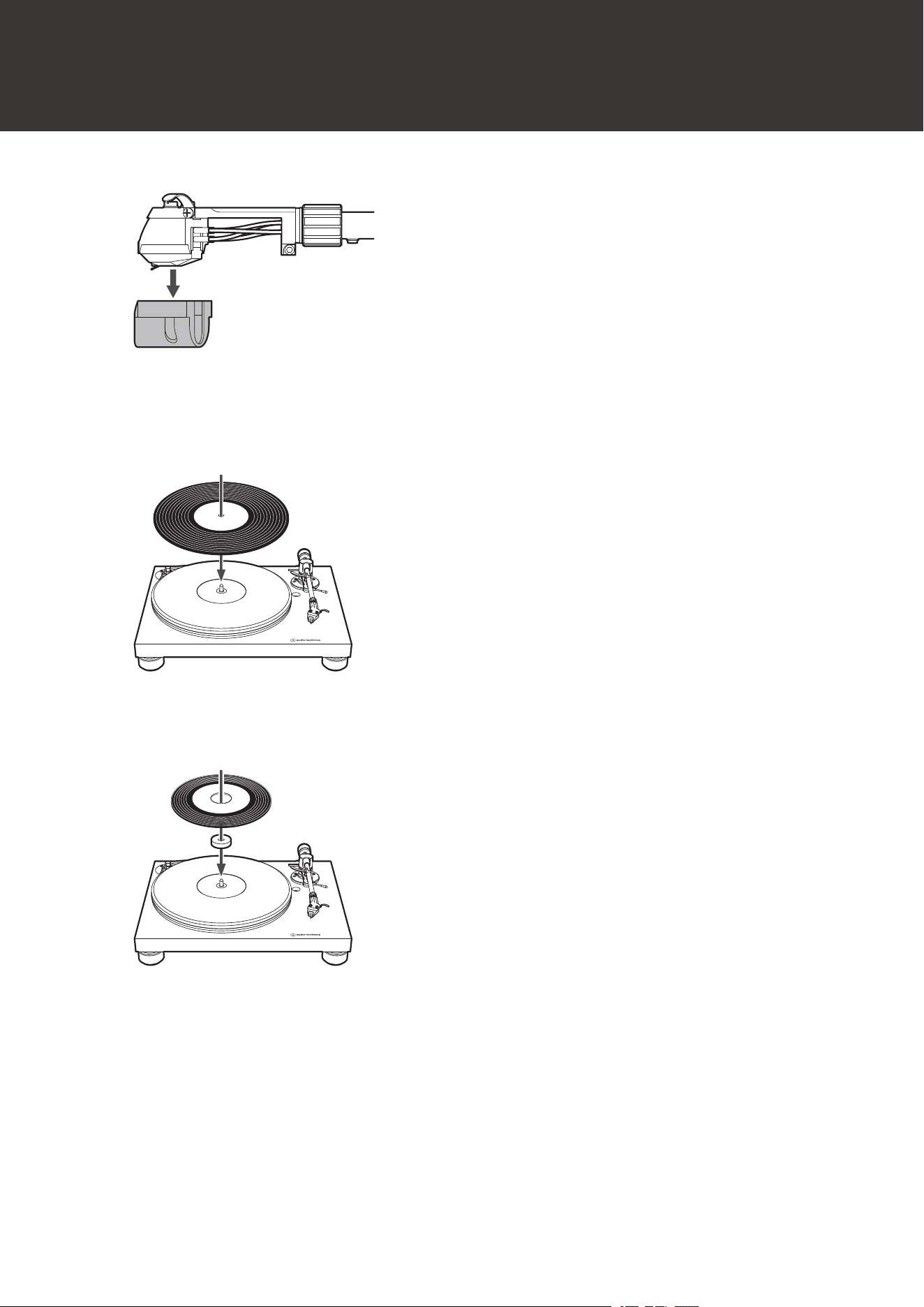
Remove the cartridge’s protector.
If the tonearm is fixed to the tonearm rest, remove the clamp.
Using the product
24
3
Place the record on the platter so that the center hole aligns with the spindle.
At 33-1/3 RPM
At 45 RPM
To play a 45 RPM record, attach the 45 RPM adapter.
Playing a record
Lower the volume of the amplifier, active speakers, etc., sufficiently.
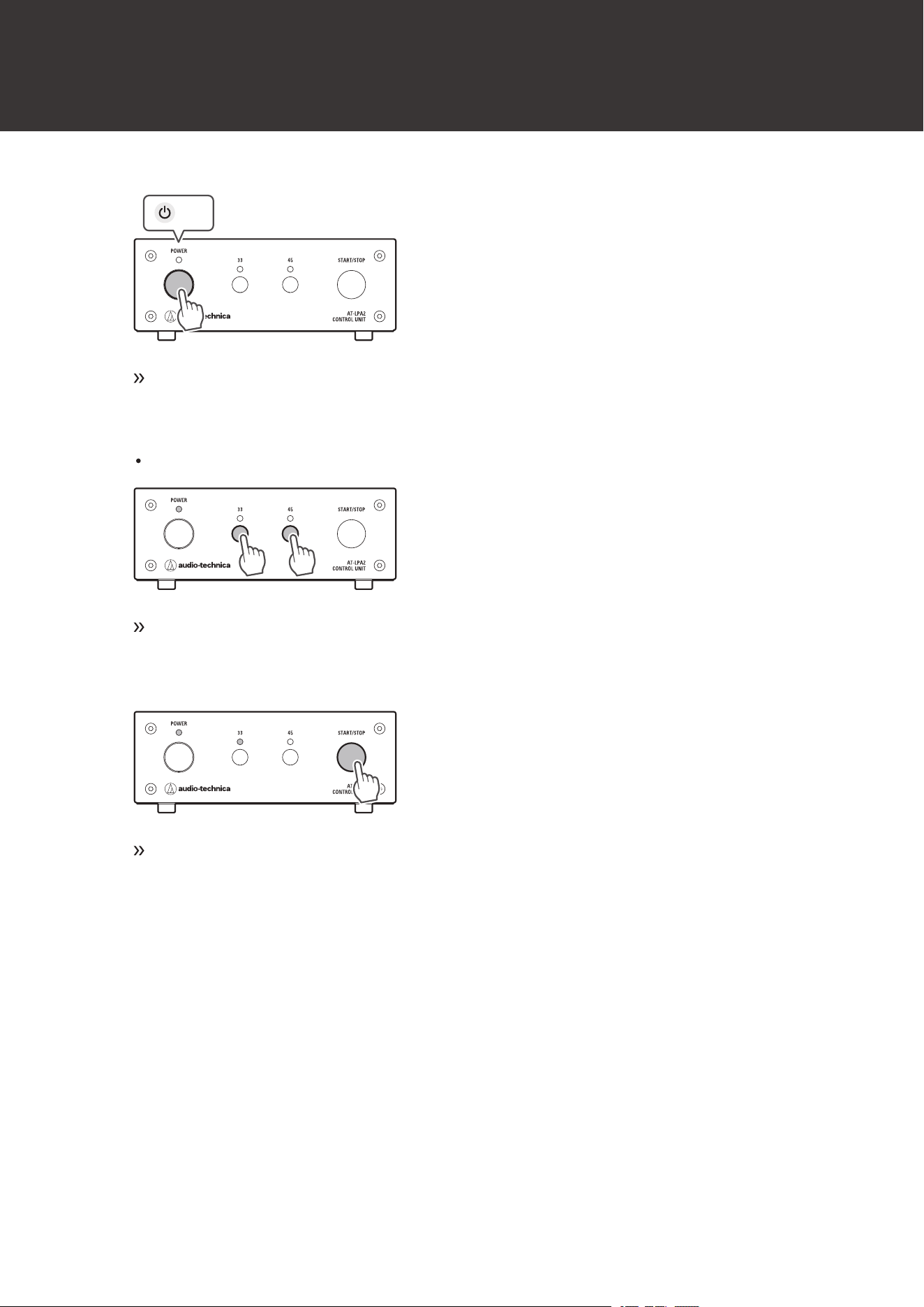
1
Turn on the control unit by pressing the power supply button.
Using the product
25
ON
The power supply indicator lamp turns on.
2
Select the speed by pressing the platter speed button.
Select “33” to play 33-1/3-RPM records or “45” to play 45-RPM records.
The indicator lamp for the selected speed turns on.
3
Press the START/STOP button.
The platter begins spinning.
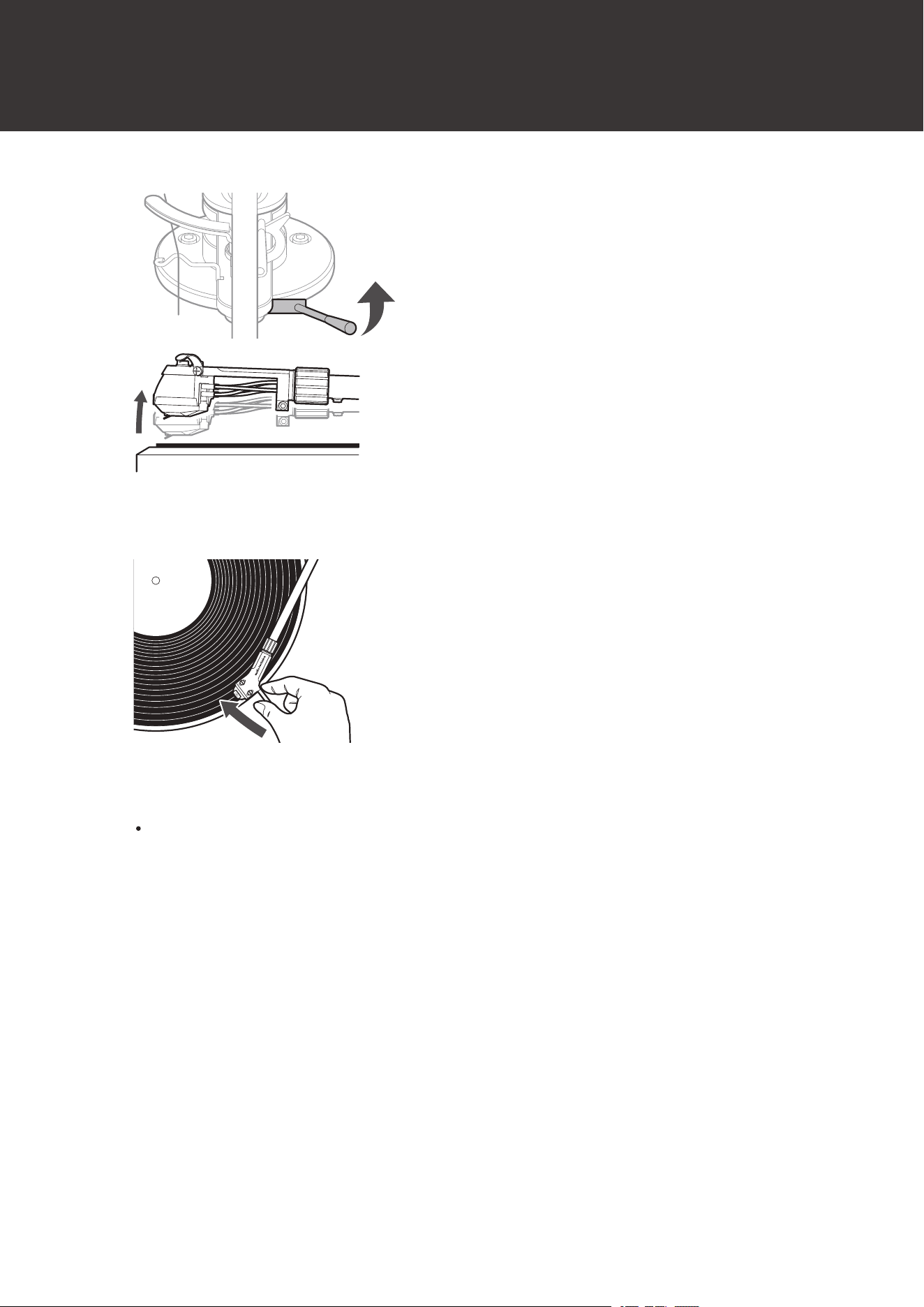
4
Raise the tonearm by lifting the tonearm lift control lever to the UP position.
Using the product
26
5
Position the tonearm over the desired location (groove) on the record.
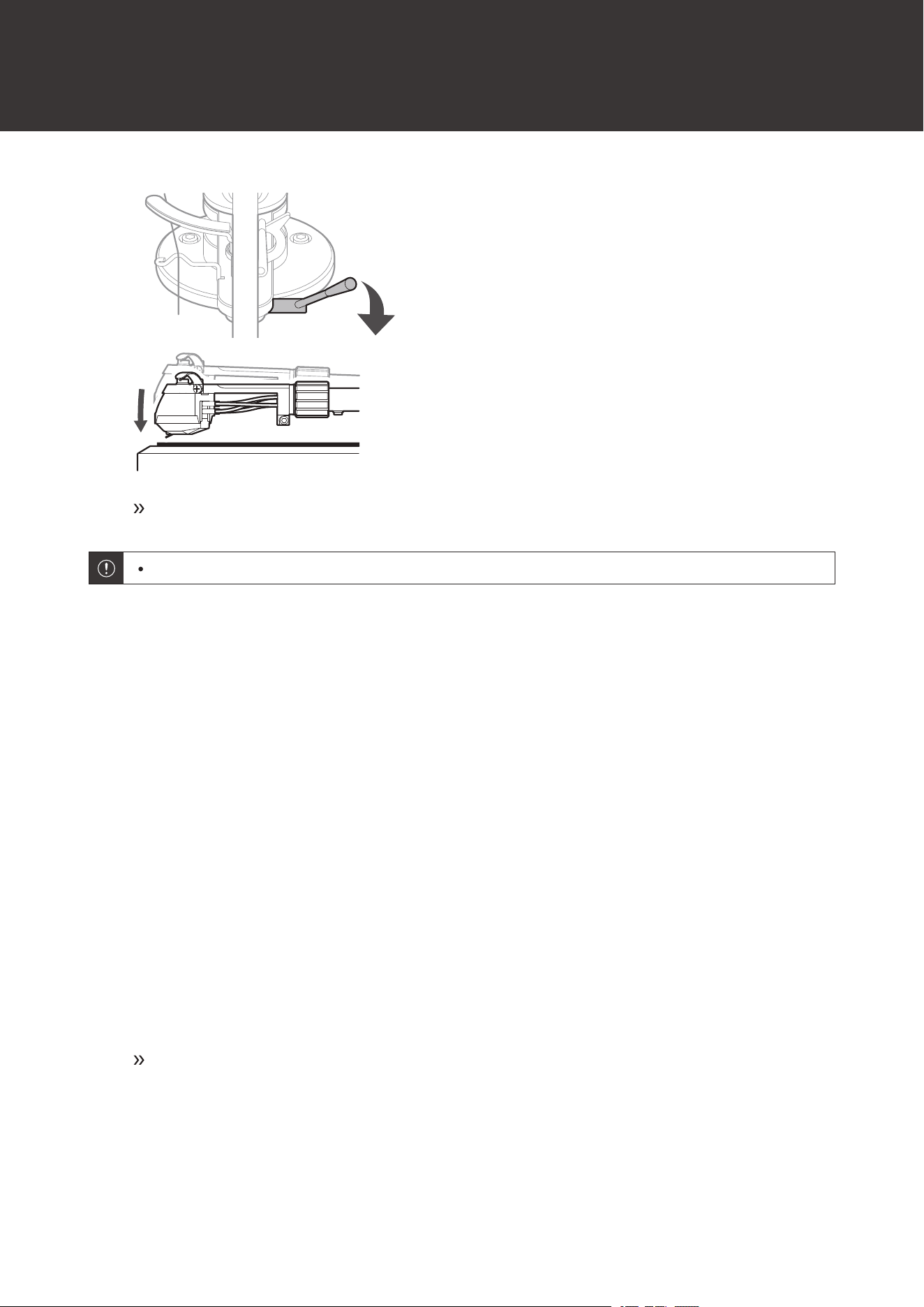
6
Lower the tonearm by moving the tonearm lift control lever to the DOWN position.
Alternatively, you can skip steps 4 and 5, and use your fingers to lift the headshell, move the tonearm over the
desired location on the record, and then place the headshell down to begin playing the record.
Using the product
27
The tonearm descends slowly onto the record and play begins.
Do not subject the product to strong impact during playback.
Pausing the record
1
After lowering the volume of the amplifier, etc., sufficiently, lift the tonearm with the tonearm lift
control lever.
Stopping the record
1
Lower the volume of the amplifier, etc. sufficiently.
2
Lift the tonearm lift control lever.
3
Return the tonearm to its original position and fix it with the clamp.
4
Press the START/STOP button.
The platter slows down and rotation stops.
5
Attach the protector.
6
Remove the record after the platter has come to a complete stop.

Using the product
28
If the platter gets dirty, it can easily scratch the record, so remove the platter periodically and wipe off any
dust.
To prevent the record from becoming scratched or warped, remove it after use.
Do not use a platter other than the one provided.
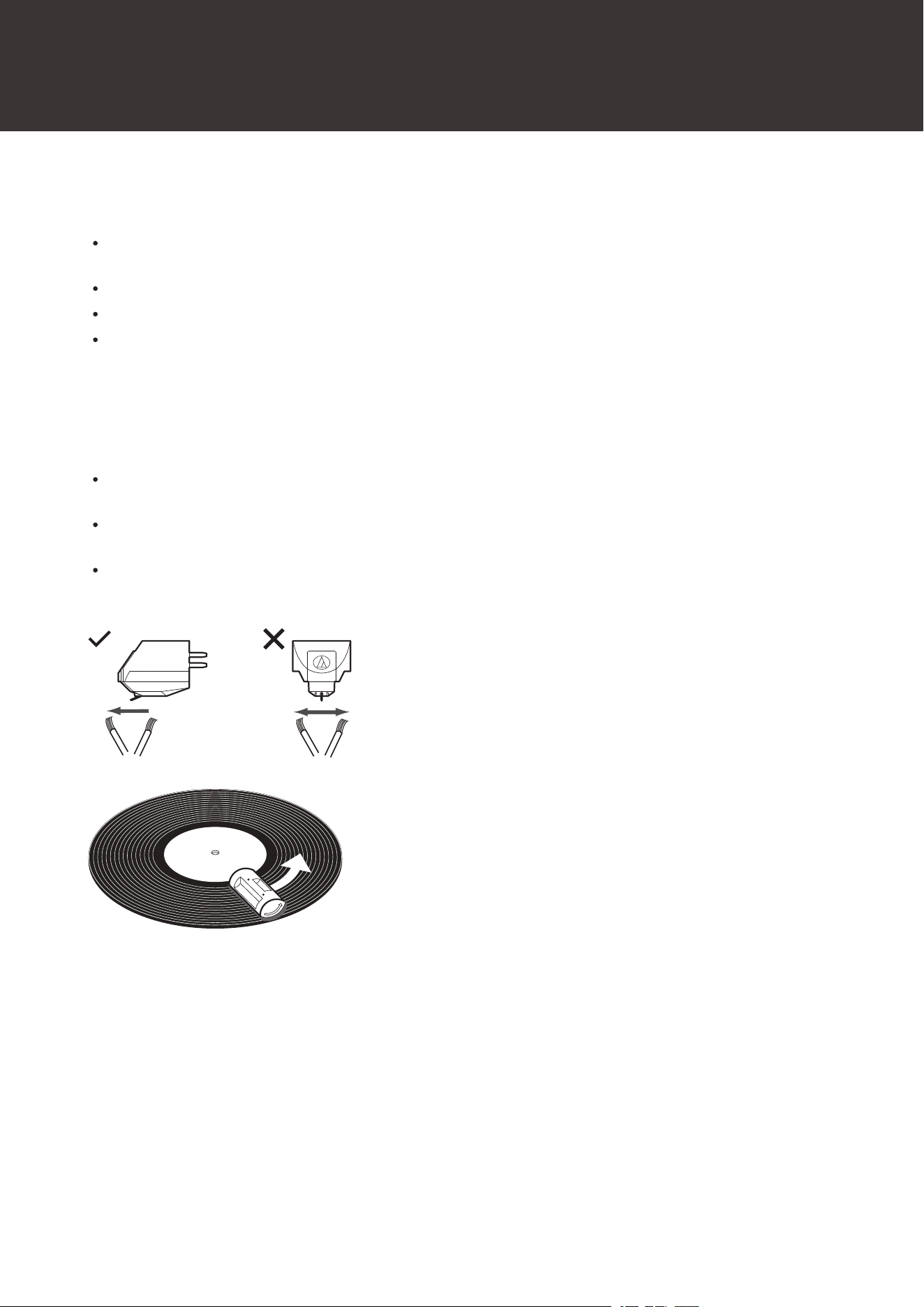
This product is not intended for DJs. Do not touch the record or the platter while the record is playing. Do
not operate the product in any way that may damage the stylus, such as scratching (rubbing the record on
the turntable by hand to produce sound).
Do not apply lateral force to the stylus while it is on the record. Doing so could damage, chip, or break the
stylus tip. The record could also be damaged.
29
Care
Cleaning the turntable body and control unit
When the turntable body is dirty or dusty, first turn off the power switch, disconnect the power cable, and then wipe
off the dirt and dust with a soft, dry cloth.
Do not use alcohol, benzenes, thinners, etc.
If the platter gets dirty, it can easily scratch the record, so remove the platter periodically and wipe off any dust.
When storing the product for a long time, first turn off the power, disconnect the power cable from the outlet, and
then wrap the equipment in plastic; do not allow it to become damp.
Cleaning the stylus tip of the cartridge/record
If dirt and grime are stuck to the stylus tip, clean it as needed. During cleaning, be sure to first turn off the power, and
then disconnect the product’s power cable from the outlet.
We recommend using a stylus cleaner (sold separately by Audio-Technica) if the stylus tip is considerably dirty. Clean
the stylus tip by moving the brush from the rear to the front of the stylus tip.
For more details on record and stylus cleaners (sold separately by Audio-Technica), please visit the Audio-Technica
website (https://www.audio-technica.com/).

30
Replacing the cartridge
In addition to the deterioration of sound quality, records may also be damaged as the stylus tip of the cartridge wears
down.
As a rule of thumb, replace the included cartridge after 300 hours of use.
31
Replacing a cartridge
Refer to the user manual for the cartridge that you will be using if you are replacing the cartridge with a commercially
available one.
After you replace the old cartridge with a new one, you must readjust the overhang and the tonearm’s balance and
tracking force.
1
Release the headshell from the tonearm.
Use the clamp to secure the tonearm and then remove the headshell gently.
2
Remove the cartridge.
3
Remove the lead tips.
Be careful not to damage the lead tips.
4
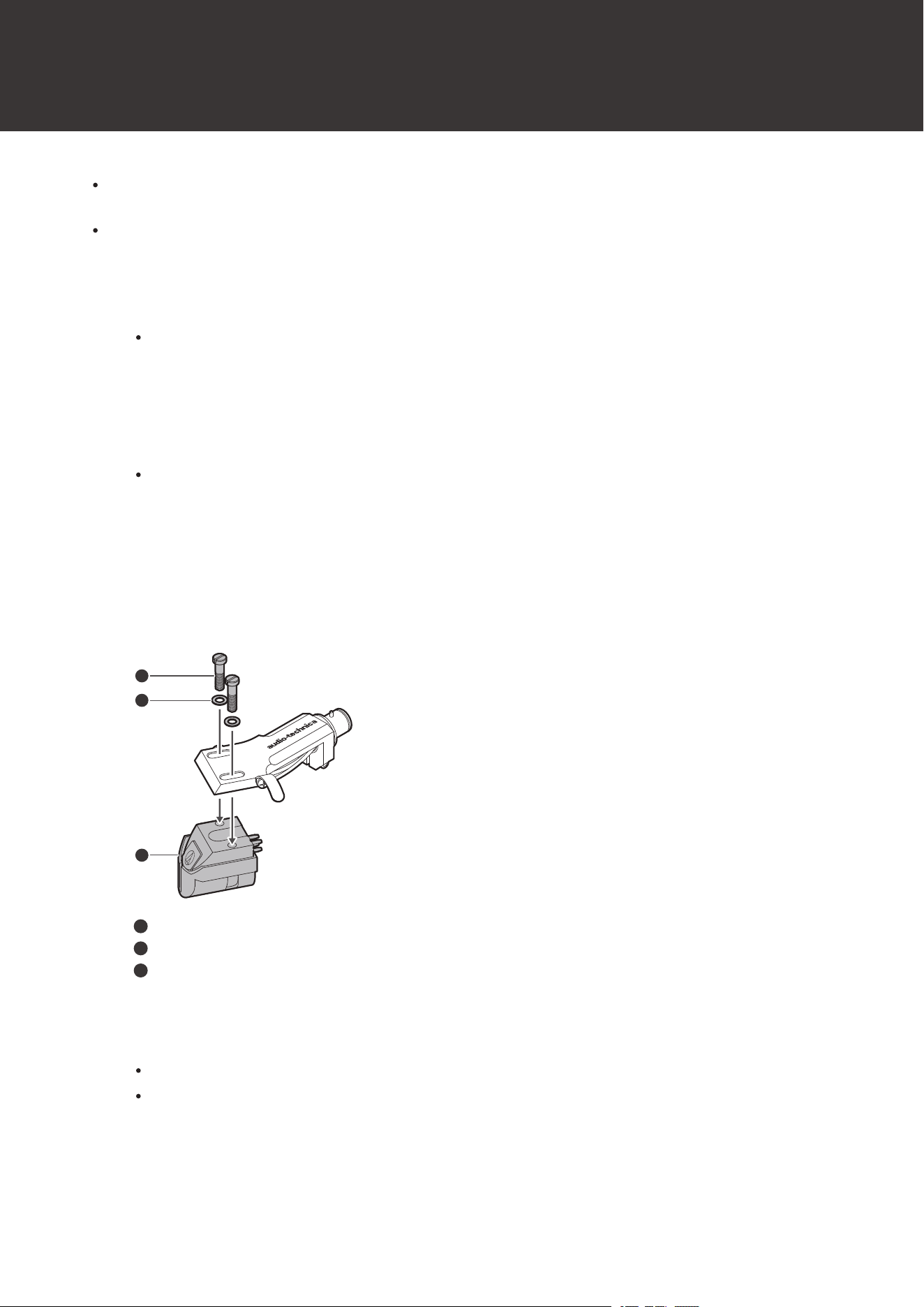
Using a commercially sold, non-metallic slotted screwdriver, remove the installation screws, and
then remove the cartridge from the headshell.
5
Refer to the user manual for the new cartridge for mounting instructions and connecting to the lead
tips.
1
2
3
1
Installation screw
2
Plastic washer
3
Cartridge
6
Using a commercially sold, non-magnetic slotted screwdriver, loosen both of the installation screws,
and then adjust the overhang.
Refer to "Adjusting the overhang" (p. 36).
After the adjustments are complete, tighten the screws securely.
7
Attach the headshell to the tonearm.

Replacing a cartridge
32
8
Adjust the tonearm balance, tracking force and anti-skate.
Refer to "Setting tonearm balance" (p. 16), "Setting tracking force" (p. 17) and "Setting the anti-skate
adjustment" (p. 18) to adjust them.
9
Adjust the tonearm's height.
Refer to "Adjusting the tonearm’s height" (p. 34) to adjust it.
33
Replacing the belt
The belt is a consumable part. Replace the belt if the speed of playback slows down or irregular rotation occurs. As a
rule of thumb, we suggest replacing the belt once a year.
Before replacing the belt, first turn off the power, and then disconnect the product’s power cable from the outlet.
1
Remove the belt from the motor pulley, and then remove the old belt.
2
Attach the new belt to the side of the platter.
3
Attach the drive belt to the motor pulley.
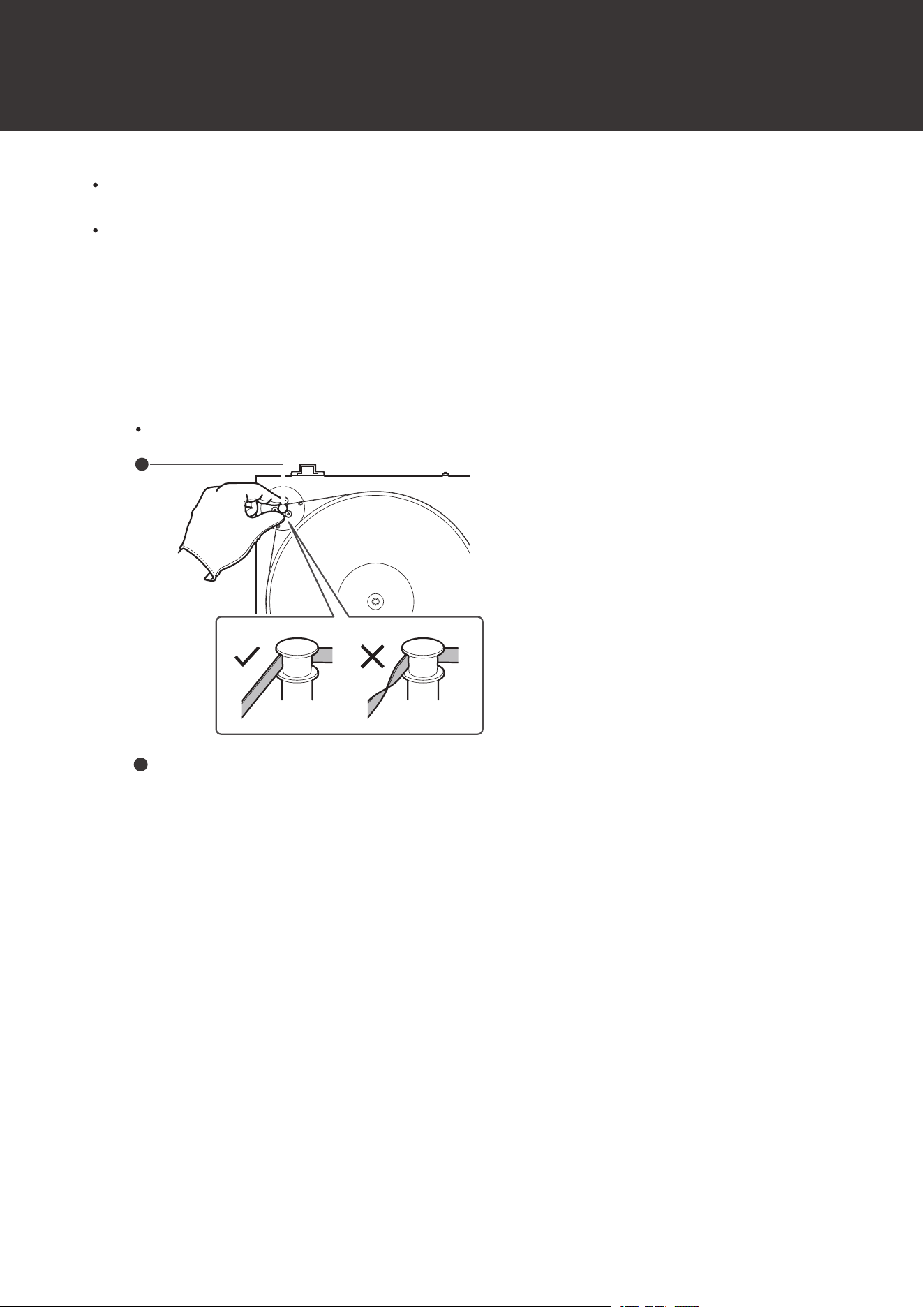
Make sure that the belt does not get twisted.
1
1
Motor pulley
34
Adjusting the tonearm’s height
When installing a cartridge other than the one provided, you must maintain a suitable distance between the cartridge
and the surface of the record. Place the stylus tip with recommended tracking force on the record and confirm that the
tonearm is parallel to the record’s surface. If it is not parallel, adjust the height of the tonearm.
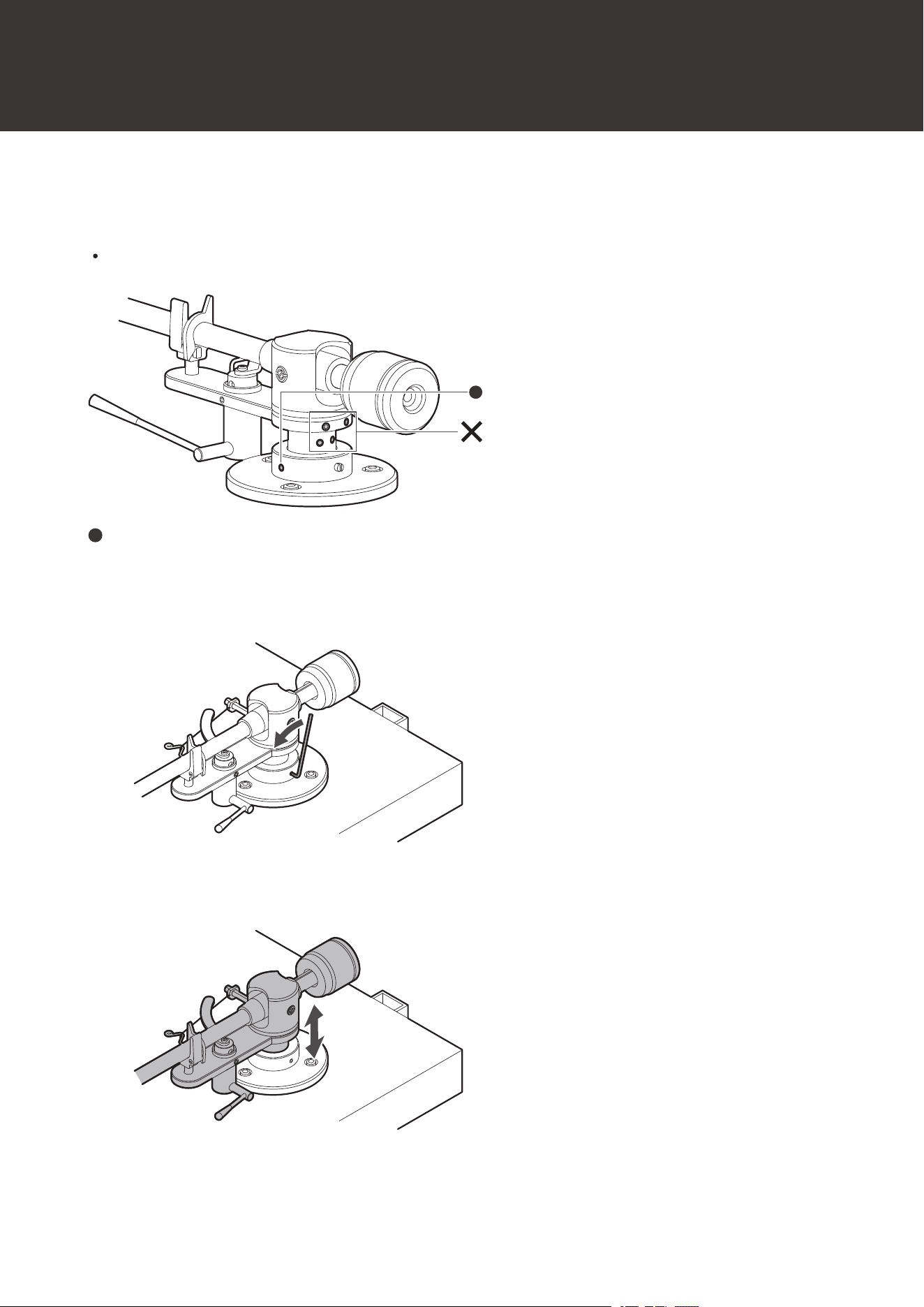
Screws other than those shown in the diagram are not used for height adjustment. Do not touch them.
1
1
Tonearm height adjustment screw
1
Insert the included hexagonal wrench into the tonearm height adjustment screw and turn it
counterclockwise to loosen it.
2
Adjust the tonearm height by manually lifting or lowering the tonearm assembly.
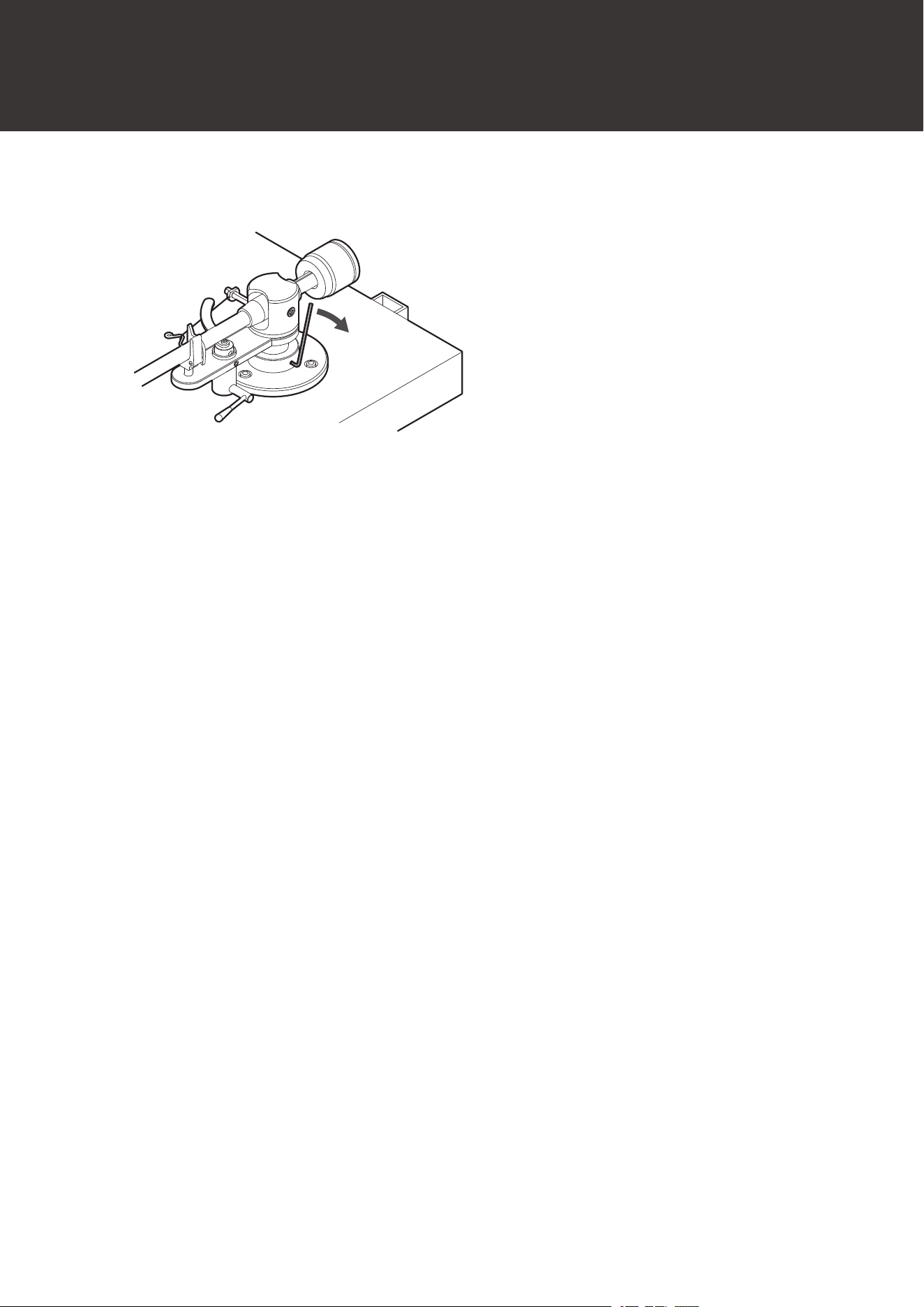
Adjusting the tonearm’s height
35
3
Reinsert the hexagonal wrench into the tonearm height adjustment screw and turn it clockwise to fix
the tonearm height.
4
Place a record on the platter, position the cartridge over the record. Lower the stylus tip to the record
surface, and confirm that the tonearm is parallel to the record’s surface.

36
Adjusting the overhang
The position of the cartridge must be accurately determined (adjusting the overhang) when mounting a cartridge or
headshell other than the one provided.
Please use a printer to print (at actual size) the PDF for the Overhang Adjustment Guide available on our website.

37
When the turntable is moved
Using the product’s original packaging materials, pack the turntable in the reverse order of unpacking it. If you do not
have the original packaging materials, take the following measures:
After turning off the power, disconnect the power cable from the outlet, remove the platter, and then wrap the
turntable body so that it does not get damaged. If the product is moved while the platter is still seated, it may
damage the spindle.
Disconnect the power cable, control cable, RCA audio cable, and ground cable.
Make sure the tonearm lift control lever is lowered.
Use the tonearm rest clamp to secure the tonearm so that it does not move.
Remove the weight for anti-skate, auxiliary weight for anti-skate, and counterweight.
Remove the headshell from the tonearm with the cartridge’s protector attached, and then wrap the entire headshell
assembly so that it does not get damaged.
Wrap the turntable body and control unit with paper or a soft cloth so that they do not get damaged.

38
Troubleshooting
The platter does not spin.
Is the control cable disconnected from the turntable body or control unit? Plug the control cable into the
turntable body and control unit.
Is the power cable connected to the outlet? Connect the power cable to the outlet.
The platter spins, but there is no sound or the volume is not loud enough.
Is the cartridge’s protector still attached to the cartridge? Remove the cartridge’s protector.
Is the tonearm lifted? Lower the tonearm.
Are the function settings and input for connected equipment (amplifier, etc.) selected correctly? Check
whether the settings for the connected equipment are correct.
Is the stylus damaged? Check the stylus and replace it, if necessary.
Is the cartridge placed correctly on the tonearm? Check the cartridge and adjust it, if necessary.
Is the tracking force set too heavy? Adjust the tracking force.
The stylus skips.
Is the tracking force set too light or too heavy? Adjust the tracking force.
Is the anti-skate set improperly? Verify anti-skate is set for same value as cartridge tracking force.
Is the record warped? Check the record.
Is the record scratched? Check the record.
Is the stylus dirty? Excessive accumulation of dirt and dust on the stylus affects the record’s playback quality.
There is howling.
Is the product picking up excessive vibrations from the floor, surfaces of the walls, or nearby speakers?
Decrease the vibrations or mount the product on a surface that is not subject to the effects of vibrations.
Is the product mounted on an unstable surface? Check whether the surface on which the product is mounted
is suitable.
There is noise when the record is playing.
Is there dust on the stylus tip of the cartridge? If dust is stuck to the stylus tip, clean it with a commercially
sold brush.

Troubleshooting
39
The sound when the record is playing is either too fast or too slow.
Are the speed settings for the product correct? Use the platter speed button to select the correct speed for
the type of record being played.
Humming noise is heard during playback.
Is the ground cable connected correctly? Make sure the ground cable is properly connected.
If the noise continues, remove the ground cable. This may reduce the noise.
Is the headshell attached to the tonearm firmly? Make sure the locking ring is tight.
40
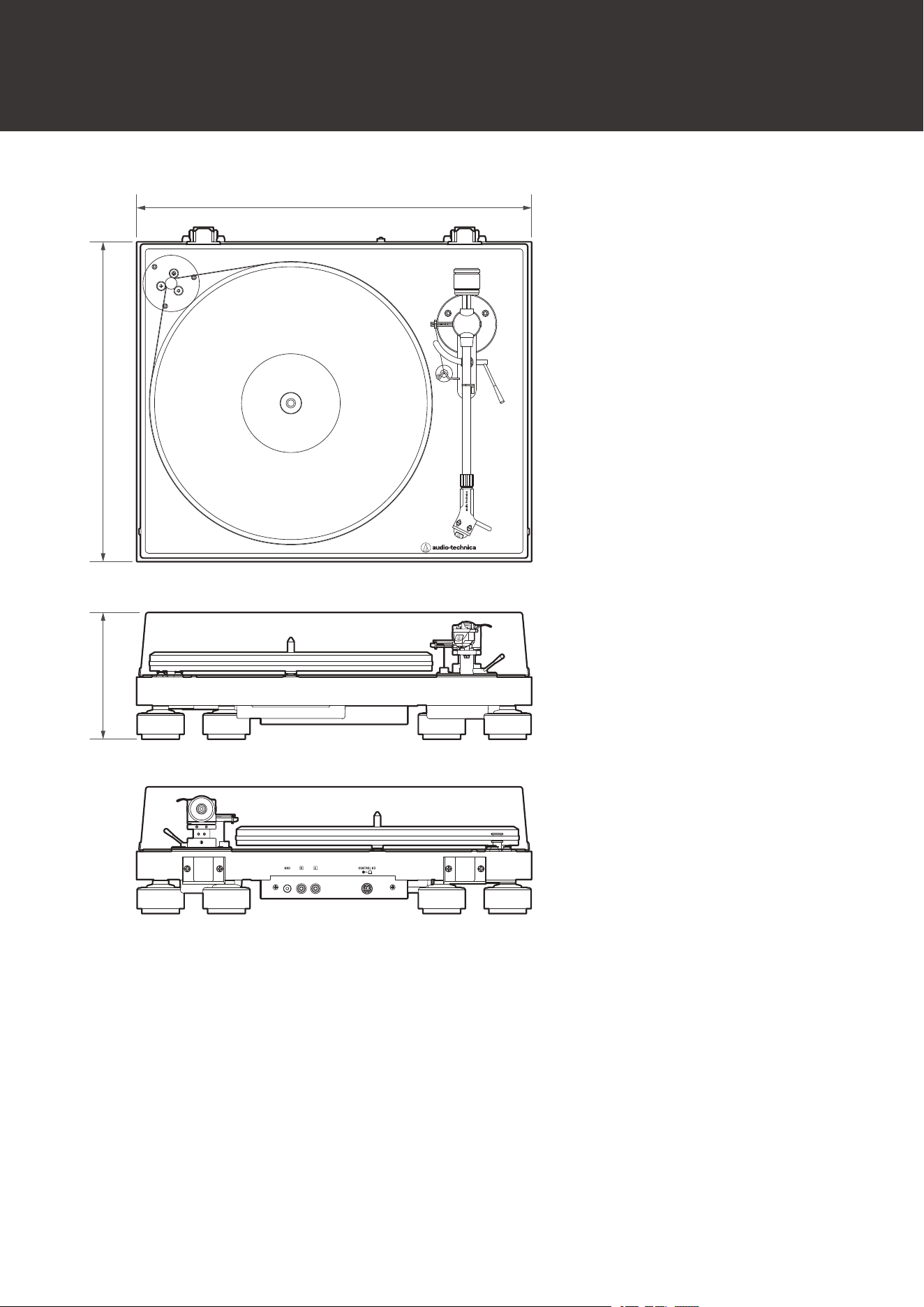
Dimensions
420
340135
(Unit: mm)
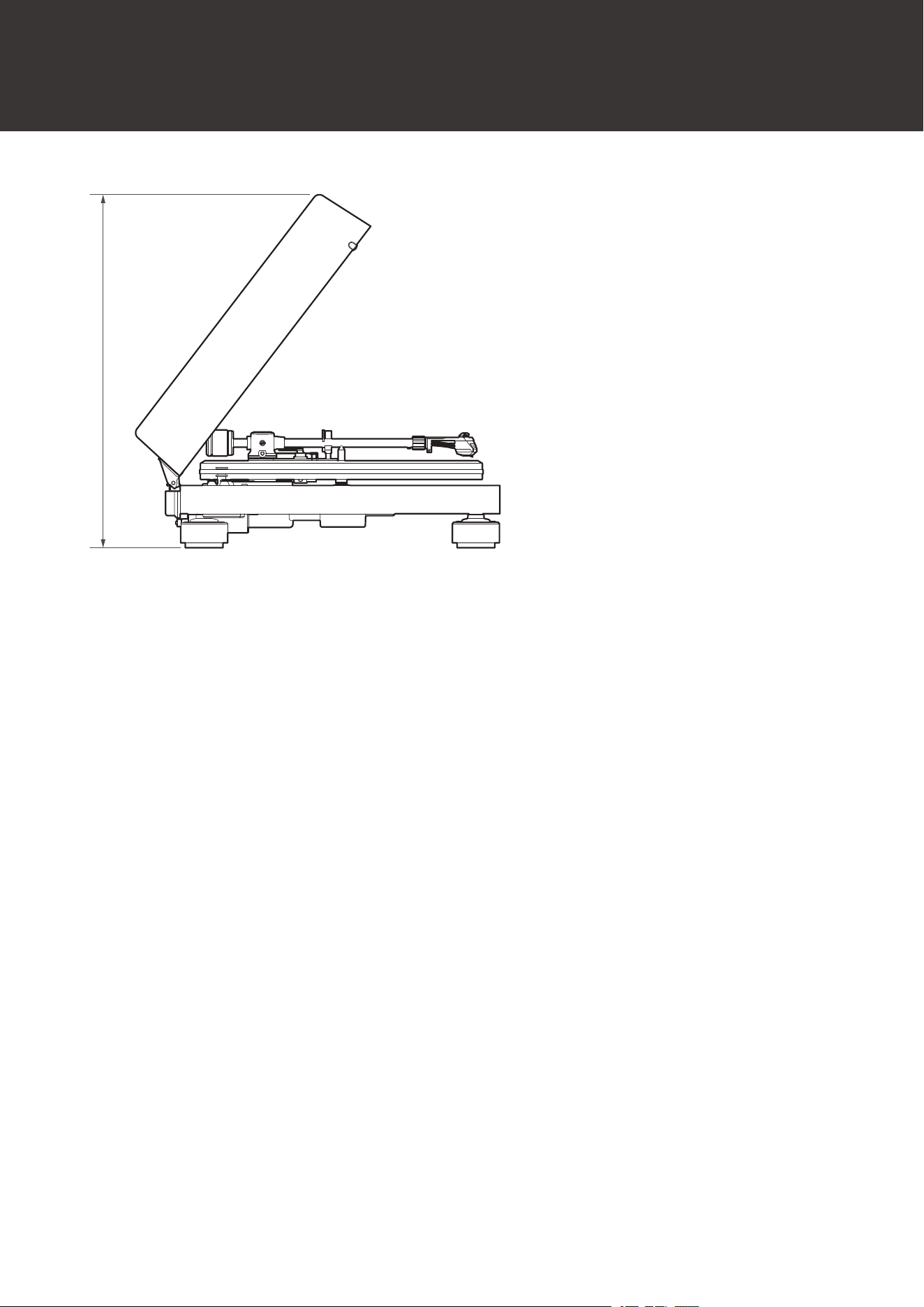
Dimensions
41
(Unit: mm)
400

42
Specifications
Turntable specifications
Motor
DC servo motor
Drive method
Belt drive
Speeds
33-1/3 RPM, 45 RPM
Turntable platter
20 mm (0.79") thick acrylic platter
Wow and flutter
< 0.12% WRMS (33 RPM)
Signal-to-noise ratio
> 60 dB
Tonearm specifications
Type
Static balanced straight carbon tonearm
Effective length
223.6 mm (8.8")
Overhang
18.6 mm (0.73")
Maximum tracking error angle
Less than 2.0°
Tracking force adjustment
range
0 g to 3.0 g
Applicable cartridge weight
range (excluding headshell)
When counterweight (light) is used: 6.1 g (0.22 oz) to 9.2 g (0.32 oz)
When counterweight (heavy) is used: 9.2 g (0.32 oz) to 13.9 g (0.49 oz)
Tonearm height adjustment
range
−1.5 mm to +7 mm (when using included cartridge)
Anti-skate mechanism
String and weight type
Anti-skate adjustment range
Tracking force equivalent to 1.3 g to 3.0 g
Cartridge and headshell specifications
Cartridge model
AT-OC9XEN
Cartridge type
MC
Recommended load impedance
≥ 100 ohms (when head amplifier connected)
Frequency response
20 Hz to 30,000 Hz
Output voltage
0.35 mV (1 kHz, 5 cm/sec.)
Stylus
0.3 mil × 0.7 mil nude elliptical stylus
Cantilever
Aluminum pipe
Tracking force range
1.8 g to 2.2 g (standard 2.0 g)
Cartridge weight
Approx. 7.6 g (0.27 oz)
Headshell weight
Approx. 11.0 g (0.39 oz) (including lead wires)
Approx. 10.2 g (0.36 oz) (excluding lead wires)
Headshell overhang adjustment
+2.5 mm to −2.5 mm (when using AT-OC9XEN)

Specifications
43
General specifications
Dimensions
Turntable body: 420 mm (17") × 340 mm (13") × 135 mm (5.3") (W × D × H)
Control unit: 133 mm (5.2") × 228 mm (9.0") × 50 mm (2.0") (W × D × H)
Weight
Turntable body: Approx. 8.4 kg (19 lbs)
Control unit: Approx. 1.1 kg (2.4 lbs)
Power supply requirements
100 V to 240 V, 50/60 Hz
Power consumption
6 W
Accessories
Control unit, dust cover, platter, drive belt, dust cover hinges, counterweight
(light), counterweight (heavy), weight for anti-skate, auxiliary weight for anti-
skate, headshell with MC stereo cartridge (AT-OC9XEN), 45 RPM adapter,
RCA audio cable (approx. 1.1 m (3.6')), power cable (approx. 1.8 m (5.9'))
[1]
,
control cable (approx. 1.0 m (3.3')), ground cable (approx. 1.1 m (3.6')),
hexagonal wrench, gloves
Replacement belt (sold
separately)
AT-LPA2 exclusive belt
[1] The length of the power cable and its plug type may differ depending on the country of sale.
For product improvement, the product is subject to modification without notice.

株式会社オーディオテクニカ
〒194-8666 東京都町田市西成瀬2-46-1
www.audio-technica.co.jp
Audio-Technica Corporation
2-46-1 Nishi-naruse, Machida, Tokyo 194-8666, Japan
www.audio-technica.com
©2025 Audio-Technica Corporation
Global Support Contact: www.at-globalsupport.com
351718610-02-01 ver.1 2025.04.01